SIMPLY CLEVER
OWNER´S MANUAL
OWNER´S MANUAL
ŠKODA Citigo

1ST012720AK

Preface
You have opted for a ŠKODA – our sincere thanks for your confidence in us.
This Owner´s Manual contains instructions about the vehicle operation, important information about
safety, vehicle care, maintenance and self-help and technical vehicle data.
Please read this Owner's Manual carefully, because the operation in accordance with these instruc-
tions is a prerequisite for proper use of the vehicle.
When using the vehicle you should always comply with the statutory regulations that apply to the
country you are in (e.g. with respect to transporting children, deactivating airbags, fitting of the appro-
priate tyres, road use etc.)
We wish you much pleasure with your ŠKODA and pleasant motoring at all times.
Your ŠKODA AUTO a.s. (hereinafter referred to only as ŠKODA or manufacturer)
1ST012720AK

Table of Contents
Board literature 4
Notes 5
Structure and more information about the
Owner's Manual 6
Abbreviations
Safety
Passive Safety 8
General information 8
Correct and safe seated position 8
Seat belts 11
Using seat belts 11
Inertia reels and belt tensioners 13
Airbag system 14
Description of the airbag system 14
Airbag overview 15
Deactivating airbags 17
Transporting children safely 19
Child seat 19
Fastening systems 22
Using the system
Cockpit 27
Overview
26
Instruments and control lights
28
Instrument cluster
28
Multi-function display (MFD)
31
Warning lights
34
Unlocking and opening
39
Unlocking and locking
39
Luggage compartment lid
42
Window operations 43
Panorama sliding/tilting roof 45
Lights and visibility 47
Lights 47
Indoor Lighting 50
Visibility 50
Windscreen wipers and washers 51
Rear mirror 52
Seats and head restraints 54
Seats and head restraints 54
Seat features 55
Transporting and practical equipment 58
Useful equipment 58
Luggage compartment and transporting
cargo 64
Roof rack 67
Heating and ventilation 69
Heating, manual air conditioning system 69
Communication and multimedia 72
Telephone and Move & Fun 72
Driving
Starting-off and Driving 75
Starting and turning off the engine
75
START-STOPsystem 77
Brakes and parking 78
Manual gear changing and pedals 80
Automated transmission 81
Running-in and economical driving 83
Avoiding damage to your vehicle 84
Assist systems 85
General information 85
Braking and stabilisation systems 85
Parking aid (ParkPilot) 86
Cruise Control System 88
City Safe Drive 89
Tyre pressure monitoring 90
General Maintenance
Care and maintenance 92
Modifications, adjustments and technical
alterations 92
Washing vehicle 95
Cleaning vehicle exterior 96
Interior care 100
Inspecting and replenishing 102
Fuel 102
Engine compartment 106
Engine oil 109
Coolant 110
Brake fluid 112
Vehicle battery 112
Wheels 116
Tyres and wheel rims 116
Winter operation 120
Do-it-yourself
Emergency equipment and self-help
122
Emergency equipment 122
Changing a wheel 123
Puncture repair kit 127
Jump-starting 129
Towing the vehicle 130
Remote control 132
Emergency unlocking/locking 132
Replacing windscreen wiper blades 133
Fuses and light bulbs 134
Fuses 134
Replacing bulbs 138
2
Table of Contents


Board literature
You will always find this Owner's manual and the Service Plan included in the
on-board literature for your vehicle.
Depending on the equipment, the on-board literature can also include the
Owner´s Manual Radioand in some countries also the brochure On the road.
Owner´s Manual
These Owner´s Manual apply to all body variants of the vehicle and all related
model versions as well as all equipment levels.
This Owner's manual describes all possible equipment variants without identi-
fying them as special equipment, model variants or market-dependent equip-
ment. Consequently, this vehicle does not contain all of the equipment com-
ponents described in this Owner's Manual.
The level of equipment of your vehicle refers to your purchase contract of the
vehicle. For any questions regarding the scope of equipment, please contact a
ŠKODA Partner.
The Pictures in this Owner's Manual are for illustrative purposes only. The il-
lustrations can differ in minor details from your vehicle; they are only intended
to provide general information.
ŠKODA AUTO a.s. pursues a policy of constant product and model develop-
ment. Changes in terms of supply scope are possible at any time with regard to
design, equipment and technology. The information listed in this Owner's Man-
ual corresponds to the information available at the time of going to press.
No basis for legal claims may therefore be derived from the technical data, il-
lustrations and information provided in this Owner's Manual.
Service schedule
The service schedule includes the documentation of the vehicle handover,
warranty information and service events.
The Owner´s Manual Radio
The Owner´s Manual Radio contains a description of the operation of the radio.
On-the-road brochure
The on-the-road brochure contains the customer service number of the im-
porter and the service number for individual countries as well as emergency
numbers.
On-board literature online
Fig. 1
The web page showing a model overview for the ŠKODA brand can be ac-
cessed using this QR code.
The page can also be called up by entering the following address in your web
browser.
http://www.skoda-auto.com/en/mini-apps/owners-manuals/
▶
Select the model you want - a menu with the on-board literature will be dis-
played.
▶
Select the production period and the language desired.
▶
Select the manual desired - this can either be displayed online or in PDF for-
mat.
4
Board literature

Notes
Terms used
The on-board literature contains the following terms relating to the service
work for your vehicle.
- Workshop - a workshop that carries out specialist service tasks
for ŠKODA vehicles. A specialist can be a ŠKODA partner, a ŠKODA serv-
ice partner, as well as an independent workshop.
- a workshop which has been contractually author-
ised, either by the manufacturer or its sales partner, to carry out servic-
ing for vehicles belonging to the ŠKODA brand and to sell ŠKODA Origi-
nal Accessories.
- a company which has been authorised, either by the manu-
facturer or its sales partner, to sell new vehicles belonging to the ŠKODA
brand and, where appropriate, to service those vehicles using ŠKODA
Original Accessories and to sell ŠKODA Original Accessories.
Explanation of symbols
An overview of the symbols used in the Owner's Manual and a brief explana-
tion of their meaning.
Reference to the introductory module of a chapter with important infor-
mation and safety warnings
Continuation of the module on the next page
Situations in which the vehicle must be stopped as soon as possible
® Trademark
WARNING
Texts with this symbol draw attention to threats of a serious accident, in-
jury or loss of life.
CAUTION
Texts with this symbol draw attention to the risk of vehicle damage or possible
inoperability of some systems.
For the sake of the environment
Texts with this symbol contain information on environmental protection as
well as tips for economical operation.
“Specialist”
“ŠKODA service partner”
“ŠKODA partner”
Note
Texts with this symbol contain additional information.
5
Notes

Structure and more information about the Owner's
Manual
Structure of the Owner's Manual
The Owner's Manual is hierarchically divided into the following areas.
■
Section (e.g. Safety) - the title of the Section is always indicated at the lower
left side
■
Main chapters (e.g. Airbag System) - the title of the main chapter is always
indicated at the lower right side
■
Chapter (e.g. Airbag Overview)
■
Introduction to the subject - model overview within a chapter intro-
ductory information on the contents of the chapter; where appropriate,
comments relating to the whole chapter
■
Module (e.g. Front Airbags)
Information Search
When searching for information in the Owner´s Manual, we recommend using
the Index at the end of the manual.
Direction indications
All direction indications such as “left”, “right”, “front”, “rear” relate to the for-
ward direction of travel of the vehicle.
Units of measurement
The volume, weight, speed and length data are given in metric units, unless
otherwise indicated.
6
Structure and more information about the Owner's Manual

Abbreviations
Abbreviation Definition
rpm Engine revolutions per minute
ABS Anti-lock brake system
AGM Vehicle battery type
ASG Automatic gearbox
TCS Traction control
CNG compressed natural gas
CO
2
Carbon dioxide
COC Declaration of conformity
EDL Electronic differential lock
ECE Economic Commission for Europe
EPC Engine performance check
ESC Electronic Stability Control
D Rim depth
EU European Union
G-TEC Labelling for natural gas vehicles
HBA Hydraulic brake assist
HHC Uphill start assist
kW Kilowatt, measuring unit for output
MG Manual gearbox
MFD Multifunction display
MPI Gasoline engine with a multi-point fuel injection
N1
Panel van intended exclusively or mainly for the transporta-
tion of goods
Nm Newton meter, measuring unit for the engine torque
OPS visual parking system
TMC Service for transmitting traffic information to the driver
VIN Vehicle identification number
W Watt, unit of power
7
Abbreviations

Safety
Passive Safety
General information
Introduction
This chapter contains information on the following subjects:
Before setting off
8
Driving safety 8
In this section of the instructions you will find important information, tips and
notes on the subject of passive safety.
We have combined everything here which you should be familiar with, for ex-
ample, regarding seat belts, airbags, safety of children and anything similar.
You can find further information on safety concerning you and those travelling
with you in the following chapters of this Owner's Manual.
The complete on-board literature should therefore always be in the vehicle.
This applies in particular, if you rent out or sell the vehicle.
Before setting off
For your own safety and the safety of the people travelling with you, please
pay attention to the following points before setting off.
▶
Ensure that the lighting and the turn signal system are functioning properly.
▶
Ensure that the function of the wipers and the condition of the wiper blades
are free of any defects.
▶
Ensure that all of the windows offer good visibility to the outside.
▶
Adjust the rear-view mirror so that vision to the rear is guaranteed.
▶
Ensure that the mirrors are not covered.
▶
Check the tyre inflation pressure.
▶
Check the engine oil, brake fluid and coolant level.
▶
Secure all items of luggage.
▶
Do not exceed the permissible axle loads and permissible gross weight of the
vehicle.
▶
Close all doors as well as the bonnet and boot lid.
▶
Ensure that no objects can obstruct the pedals.
▶
Protect children in suitable child seats with correctly fastened seat belts
» page 19, Transporting children safely.
▶
Adopt the correct seated position » page 8, Correct and safe seated posi-
tion. Tell your passengers to assume the correct seated position.
Driving safety
The driver is fully responsible for himself and passengers, especially children. If
your driving safety is effected, you place yourself and the oncoming traffic at
risk.
The following guidelines must therefore be observed.
▶
Do not become distracted from concentrating on the traffic situation, (e.g. by
your passengers or mobile phone calls).
▶
Never drive when your driving ability is impaired, (e.g. due to medication, al-
cohol or drugs).
▶
Keep to the traffic regulations and the permissible speed limit.
▶
Always adjust the driving speed to the road, traffic and weather conditions.
▶
Take regular breaks on long journeys (at least every two hours).
The following list contains instructions for the Passenger which, if not ob-
served, may cause serious injuries or death.
▶
Do not lean against the dash panel.
▶
Do not put your feet on the dash panel.
The following list contains instructions for all Passengers which, if not ob-
served, may cause serious injuries or death.
▶
Do not sit only on the front part of the seat.
▶
Do not sit facing to the side.
▶
Do not lean out of the window.
▶
Do not put your limbs out of the window.
▶
Do not put your feet on the seat cushion.
Correct and safe seated position
Introduction
This chapter contains information on the following subjects:
Correct seat position of the driver 9
Adjusting the steering wheel position
9
Correct seated position for the front passenger
10
Correct seated position for the passengers in the rear seats
10
8
Safety
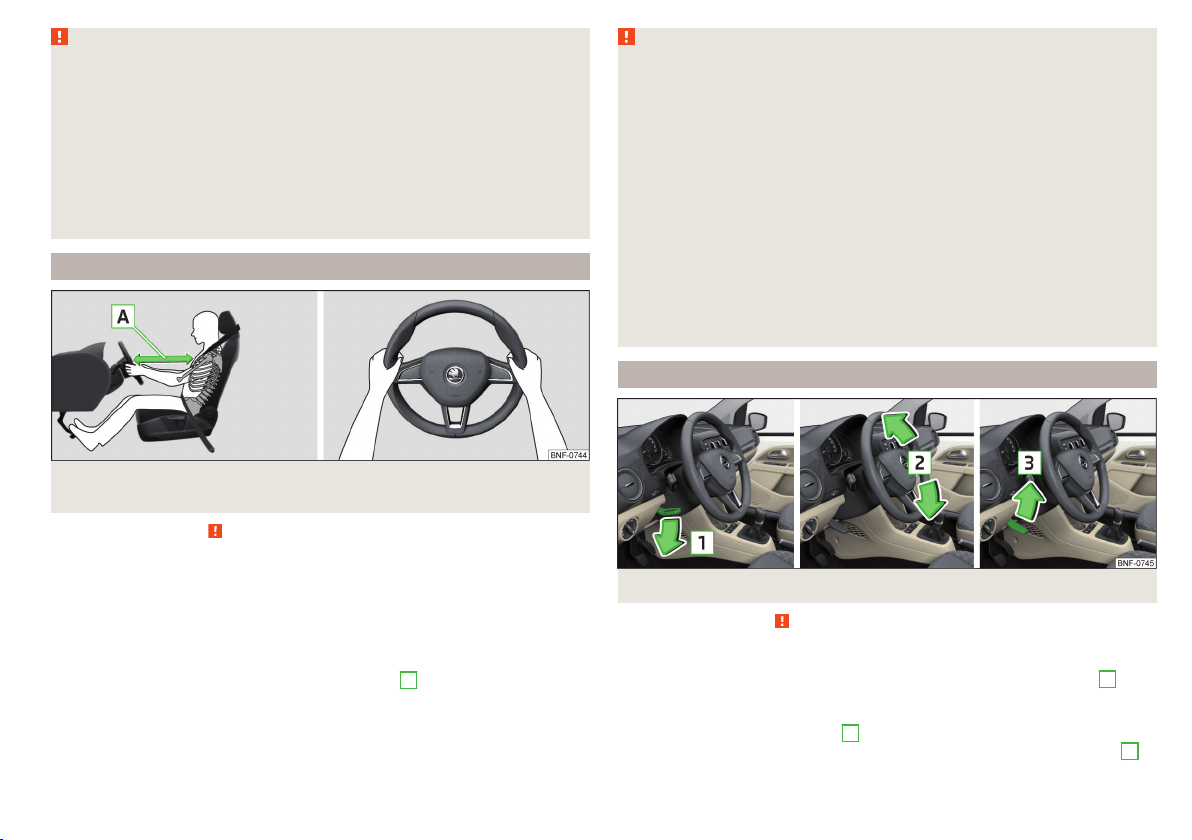
WARNING
■
The front seats and all head restraints must be adjusted to match the
body size at all times and the seat belt must always be fastened properly to
provide the most effective levels of protection to the passengers.
■
Each occupant must correctly fasten the seat belt belonging to the seat.
Children must be fastened » page 19, Transporting children safely with a
suitable restraint system.
■
By sitting incorrectly, the occupant is risking life-threatening injuries.
■
The seat backrests must not be tilted too far back when driving, as this
will impair the function of the seat belts and of the airbag system – risk of
injury!
Correct seat position of the driver
Fig. 2 Correct seated position for the driver/correct steering wheel posi-
tion
Read and observe
on page 9 first.
For your own safety and to reduce the risk of injury in the event of an accident,
the following instructions must be observed.
Adjust the driver’s seat in the forward/back direction so that the pedals
can be fully depressed with slightly bent legs.
Adjust the seat backrest so that the highest point of the steering wheel
can be reached with your arms at a slight angle.
Adjust the steering wheel so that the distance
A
between the steering
wheel and your chest is at least 25 cm » Fig. 2.
Correctly fasten the seat belt » page 13.
WARNING
■
Always assume the correct seated position before setting off and do not
change this position while driving. Also advise your passengers to adopt
the correct seated position and not to change this position while the car is
moving.
■
Maintain a distance of at least 25 cm to the steering wheel. Not maintain-
ing this minimum distance will mean that the airbag system will not be able
to properly protect you – hazard!
■
When driving, hold the steering wheel with both hands firmly on the out-
er edge in the “9 o'clock” and “3 o'clock” position » Fig. 2. Never hold the
steering wheel in the “12 o'clock” position or in any other way (e.g. in the
middle, inner edge of the steering wheel or similar). In such cases, you
could severely injure the arms, hands and head when the driver airbag is
deployed.
■
Ensure that there are no objects in the driver's footwell as they may get
caught behind the pedals when driving or applying the braking. You would
then no longer be able to operate the clutch, brake or acceleration pedals.
Adjusting the steering wheel position
Fig. 3 Adjusting the steering wheel position
Read and observe on page 9 first.
The height of the steering wheel can be adjusted.
›
Turn the safety lever beneath the steering wheel towards the arrow
1
» Fig. 3.
›
Adjust the steering wheel to the desired position. The steering wheel can be
adjusted in line with the arrow
2
.
›
Press the safety lever down until it clicks into the direction of the arrow
3
.
9
Passive Safety

WARNING
■
Never adjust the steering wheel when the vehicle is moving only when
the vehicle is stationary!
■
The safety lever must be locked so that the steering wheel cannot acci-
dentally change position – risk of accident!
Correct seated position for the front passenger
Read and observe on page 9 first.
For passenger safety and to reduce the risk of injury in an accident, the follow-
ing instructions must be observed.
Position the front passenger seat back as far as possible. The front pas-
senger must maintain a distance of at least 25 cm to the dash panel so
that the airbag offers the greatest possible safety if it is deployed.
Correctly fasten the seat belt » page 13.
In exceptional cases the front passenger airbag can be deactivated
» page 17, Deactivating airbags.
WARNING
■
Maintain a distance of at least 25 cm to the dash panel. Not maintaining
this minimum distance will mean that the airbag system will not be able to
properly protect you – hazard!
■
Always keep your feet in the footwell when the car is being driven – nev-
er place your feet on the instrument panel, out of the window or on the
surface of the seats! You will be exposed to increased risk of injury if it be-
comes necessary to apply the brake or in the event of an accident. If an air-
bag is deployed, you could suffer fatal injuries by adopting an incorrect
seated position!
Correct seated position for the passengers in the rear seats
Read and observe on page 9 first.
To reduce the risk of injury in the event of a sudden braking manoeuvre or an
accident, the occupants on the rear seats must observe the following.
Adjust the head restraint so that the top edge of the head restraint is at
the same level as the upper part of your head.
Correctly fasten the seat belt » page 13.
Use a suitable child restraint system if transporting children in the vehicle
» page 19, Transporting children safely.
10
Safety

Seat belts
Using seat belts
Introduction
This chapter contains information on the following subjects:
The physical principle of a frontal collision 12
Correct routing of seat belt 12
Fastening and unfastening seat belts 13
Seat belts that are fastened correctly offer good protection in the event of an
accident. They reduce the risk of an injury and increase the chance of survival
in the event of a major accident.
Properly fastened seat belts hold occupants to correctly set seats in the right
seat position.
Particular safety aspects must be observed when transporting children in the
vehicle » page 19, Transporting children safely.
WARNING
■
Fasten your seat belt before each journey – even when driving in town!
This also applies to other passengers - there is a danger of injury!
■
Maximum seat belt protection is only achieved if you are correctly seated
» page 8, Correct and safe seated position.
■
The seat backrests of the front seats must not be tilted too far to the rear
otherwise the seatbelts can lose their effectiveness.
WARNING
Information on the correct routing of the belt
■
Always ensure that the webbing of the seat belts is properly routed. Seat
belts which are not correctly adjusted can themselves cause injuries even
in minor accidents.
■
A seat belt which is hanging too loose can result in injuries as your body is
moved forward by the kinetic energy produced in an accident and is then
suddenly held firm by the belt.
■
The belt webbing must not run across solid or fragile objects (e.g. specta-
cles, ball-point pens, bunches of keys etc.). Such objects can cause injury.
WARNING
Information on dealing with the safety belts
■
The belt webbing must not be jammed in-between at any point or twis-
ted, or chafe against any sharp edges.
■
Make sure you do not catch the seat belt when closing the door.
WARNING
Information on the proper use of the safety belts
■
No two persons (also not children) should ever use a single seat belt to-
gether.
■
The lock tongue should only be inserted into the lock which is the correct
one for your seat. Wrong use of the safety belt will reduce its capacity to
protect and the risk of injury increases.
■
The slot of the belt tongue must not be blocked, otherwise the belt
tongue will not lock in place properly.
■
Many layers of clothing and loose clothing (e. g. a winter coat over a jack-
et) do not allow you to be correctly seated and impairs proper operation of
the seat belts.
■
Do not use clamps or other objects to adjust seat belts (e.g. for shorten-
ing the belts for smaller persons).
■
The seat belts for the rear seats can only fulfil their function reliably
when the seat backrests are correctly locked into position » page 57, Seat
backrests.
WARNING
Information on the care and maintenance of the safety belts
■
The belt webbing must always be kept clean. Soiled belt webbing may im-
pair proper operation of the inertia reel » page 102, Safety belts.
■
The seat belts must not be removed or changed in any way. Do not at-
tempt to repair the seat belts yourself.
■
Check the condition of all the seat belts on a regular basis. If any damage
to the seat belts, seat belt connections, inertia reel or the lock is detected,
the relevant seat belt must be replaced by a specialist garage.
■
Damaged seat belts which have been subjected to stress in an accident
and were therefore stretched, must be replaced – this is best done by a
specialist garage. The anchorage points of the belts must also be inspec-
ted. The anchorage points for the belts should also be checked.
11
Seat belts

The physical principle of a frontal collision
Fig. 4 Driver without a fastened seat belt/rear seat passenger without a
fastened seat belt
Read and observe on page 11 first.
As soon as the vehicle is moving, so-called kinetic energy (the energy of mo-
tion) is produced both in terms of the car as well as in terms of the occupants.
The magnitude of this kinetic energy depends essentially on the speed at
which the vehicle is travelling and on the weight of the vehicle including the
occupants.
Doubling the speed of the vehicle from 25 km/h up to 50 km/hour increases
the kinetic energy four times.
For example, a person's weight of 80 kg “increases” to 4.8 tons (4800 kg) at
50 km/h.
In the event of a frontal collision, occupants of the car not wearing a seat belt
are thrown forward and strike parts of the interior of the car, such as the
steering wheel, dash panel, windscreen in ways which cannot be controlled
» Fig. 4 -
. In certain circumstances you could even be thrown out of the vehi-
cle, which could cause life threatening or even fatal injuries.
A rear seat passenger who has not fastened their seat belt is a danger not on-
ly to himself but also for those seated at the front » Fig. 4 –
.
Correct routing of seat belt
Fig. 5 Routing of belt webbing over the shoulders and the lap belt/Rout-
ing of belt webbing for an expectant mother
Read and observe
on page 11 first.
It is important that the belt is properly routed to ensure seat belts offer the
maximum protection.
The shoulder part of the seat belt must never run across the neck but must
roughly run over the middle of the shoulder and fit snugly against the chest.
The lap part of the belt must run across the pelvis, must not be positioned
across the stomach and must always fit snugly » Fig. 5 -
.
Seat belts with pregnant women
Expectant women must also always wear a seat belt. This is the only way of
ensuring optimal protection for the unborn child.
With pregnant women, the lap part of the belt must be positioned as low as
possible on the pelvis to avoid exerting any pressure on the lower abdomen
» Fig. 5 -
.
12
Safety
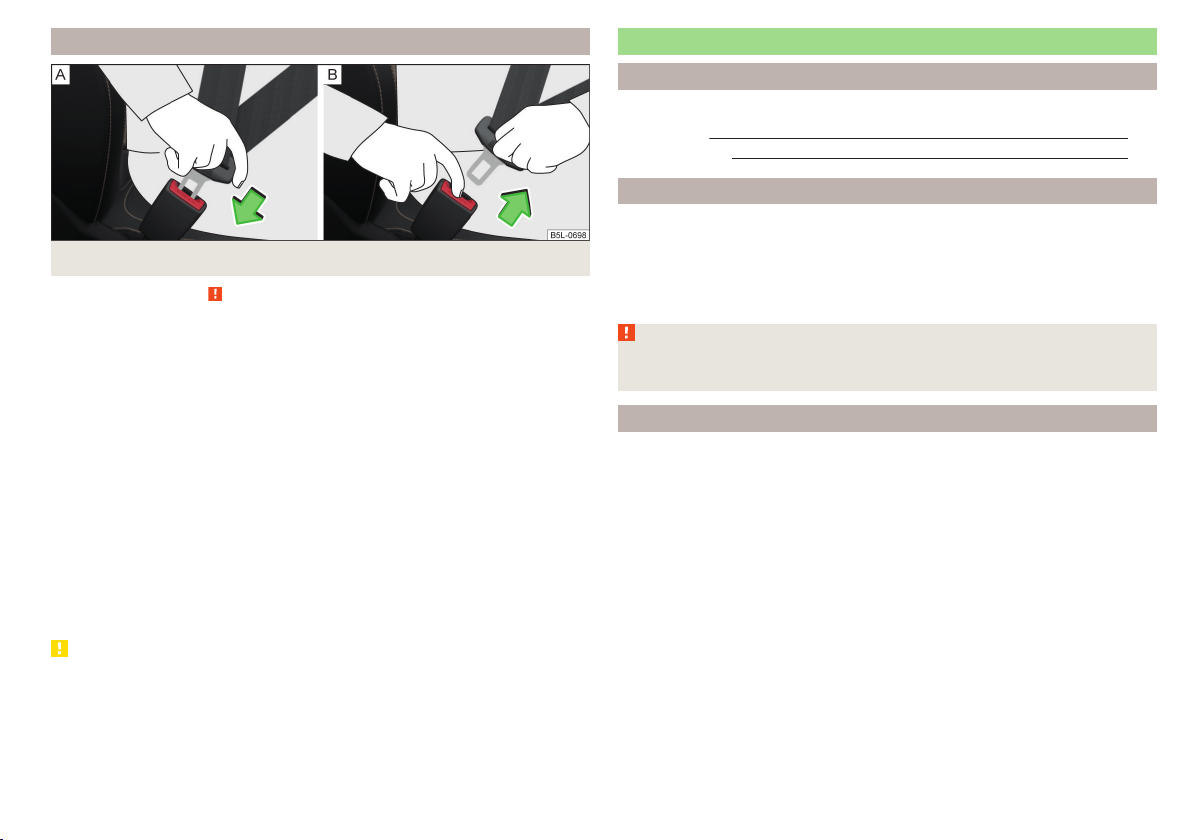
Fastening and unfastening seat belts
Fig. 6 Fastening/unfastening the seat belt
Read and observe
on page 11 first.
Before using the seat belts the following conditions must be met.
Correctly set head restraint (not for seats with integrated head restraint).
Correctly adjusted seat (applies for the front seats).
Correctly adjusted steering wheel (applies to the Driver's seat ).
Fastening
›
Use the lock tongue to slowly pull the webbing over your chest and pelvis.
›
Insert the lock tongue into the belt buckle » Fig. 6 –
that is part of the seat
until it clicks into place.
›
Pull on the belt to check that it has engaged correctly in the lock.
Releasing
Release the seat belt only when the vehicle is stationary.
›
Press the red button in the belt buckle » Fig. 6 –
, the lock tongue pops
out.
›
Manually guide the belt back so that it is easier to fully roll up the webbing,
the seat belt does not twist.
CAUTION
When releasing the seatbelt ensure that the tongue of the lock does not dam-
age the door trim or other parts of the interior.
Inertia reels and belt tensioners
Introduction
This chapter contains information on the following subjects:
Inertia reels
13
Belt tensioners 13
Inertia reels
Each seat belt is equipped with an inertia reel. When pulling slowly on the seat
belt, the belt can move freely.
When pulling sharply on the seat belt, the movement is locked by the inertia
reel. The belts also lock when full braking, when the car accelerates, when
driving downhill and when cornering.
WARNING
If the seat belt does not lock when pulling sharply on it, have it inspected
immediately by a specialist garage.
Belt tensioners
Safety for the driver and front passenger wearing their seat belts is enhanced
by the belt tensioners fitted to the inertia reels of the front three-point seat
belts.
If there is a collision the seat belts are tightened by the belt tensioner so that
unwanted body motion is prevented.
The three-point seat belts are automatically tensioned in the event of a frontal
collision of a certain severity.
The front seat belts are automatically tensioned in the event of a side collision
of a certain severity.
Belt tensioners are not activated in the event of minor frontal, side or rear-
end collisions, in the case of a roll-over and also not in accidents in which no
major forces are produced.
13
Seat belts

WARNING
■
Any work on the belt tensioner system including removal and installation
of system components because of other repair work, must only be carried
out by a specialist garage.
■
If the belt tensioners have been deployed, it is then necessary to replace
the entire system.
Note
■
The belt tensioners can also be deployed if the seat belts are not fastened.
■
Smoke is generated when the belt tensioners are deployed. This is not an in-
dication of a fire in the vehicle.
Airbag system
Description of the airbag system
Introduction
This chapter contains information on the following subjects:
System description 15
Airbag deployment 15
The airbag system supplements the fastened seat belts and provides addition-
al occupant protection in severe frontal and side collisions.
The functional status of the airbag system is indicated by the indicator light
in the instrument cluster » page 37.
WARNING
■
An airbag can only offer you optimal protection in combination with a
fastened seat belt.
■
The airbag is not a substitute for the seat belt, but instead forms part of
the complete passive vehicle safety concept.
■
To ensure passengers are protected with the greatest possible effect
when the airbag is deployed, the front seats must be correctly adjusted to
match the body size » page 8, Correct and safe seated position.
■
If you do not fasten the seat belts when driving, lean too far forward or
adopt an incorrect seated position, you are exposing yourself to increased
risk of injury in the event of an accident.
WARNING
Information on the use of the airbag system
■
If there is a fault, have the airbag system checked immediately by a spe-
cialist garage. Otherwise, there is a risk that the airbag will not be deployed
in the event of an accident.
■
No modifications of any kind must be made to parts of the airbag system.
■
Any work on the airbag system including the installation and removal of
system components due to other repair work (e.g. removal of the steering
wheel) must only be carried out by a specialist garage.
■
Never make any changes to the front bumper or the bodywork.
■
Do not manipulate individual parts of the airbag system, as this might re-
sult in the airbag being deployed.
■
The airbag system must then be replaced if the airbag has been deployed.
14
Safety
System description
Read and observe on page 14 first.
The inflation of the airbag is carried out in a fraction of a second.
When the airbags are deployed, they fill with gas and inflate.
A grey white or red, non-harmful gas is released when the airbag is inflated.
This is perfectly normal and is not an indication of a fire in the vehicle.
Depending on the vehicle equipment, the airbag system consists of the
following parts.
▶
Front airbag for the driver and the front passenger » page 15.
▶
Side airbags Head-thorax » page 17.
▶
Airbag warning light in the instrument cluster » page 37,
Airbag system.
▶
Key switch for the front passenger airbag » page 18.
▶
Warning light for the front passenger airbag in the middle of the dash panel
» page 18.
Airbag deployment
Read and observe
on page 14 first.
The airbag system is only functional when the ignition is switched on.
Triggering conditions
It is not possible to generally determine which deployment conditions apply to
the airbag system in every situation. An important role is played by factors
such as the type of object that the vehicle hits (hard/soft), the impact angle,
vehicle speed etc.
A decisive factor for the deployment of the airbags is the deceleration which
occurs. If the vehicle deceleration which occurs and is measured during the
collision remains below the prescribed reference values specified in the control
unit, the airbags are not deployed although the vehicle may well suffer severe
damage to the bodywork as a consequence of the accident.
The following airbags will be deployed in the event of a severe frontal
collision.
▶
Driver’s front airbag.
▶
Front passenger airbag.
The following airbags will be deployed in the event of a severe side collision.
▶
Head-Thorax side airbag on the crash side.
When an airbag is deployed, the following events occur.
▶
The interior light comes on (if the automatic operation of the interior light is
switched on - switch
).
▶
The hazard warning lights are switched on.
▶
All doors are unlocked.
▶
The fuel supply to the engine is interrupted.
When there is no air bag deployment?
With minor frontal and side collisions, rear collision, overturning of the vehicle
or vehicle roll-over there is no airbag deployment.
Airbag overview
Introduction
This chapter contains information on the following subjects:
Front airbags
15
Side airbags Head-Thorax 17
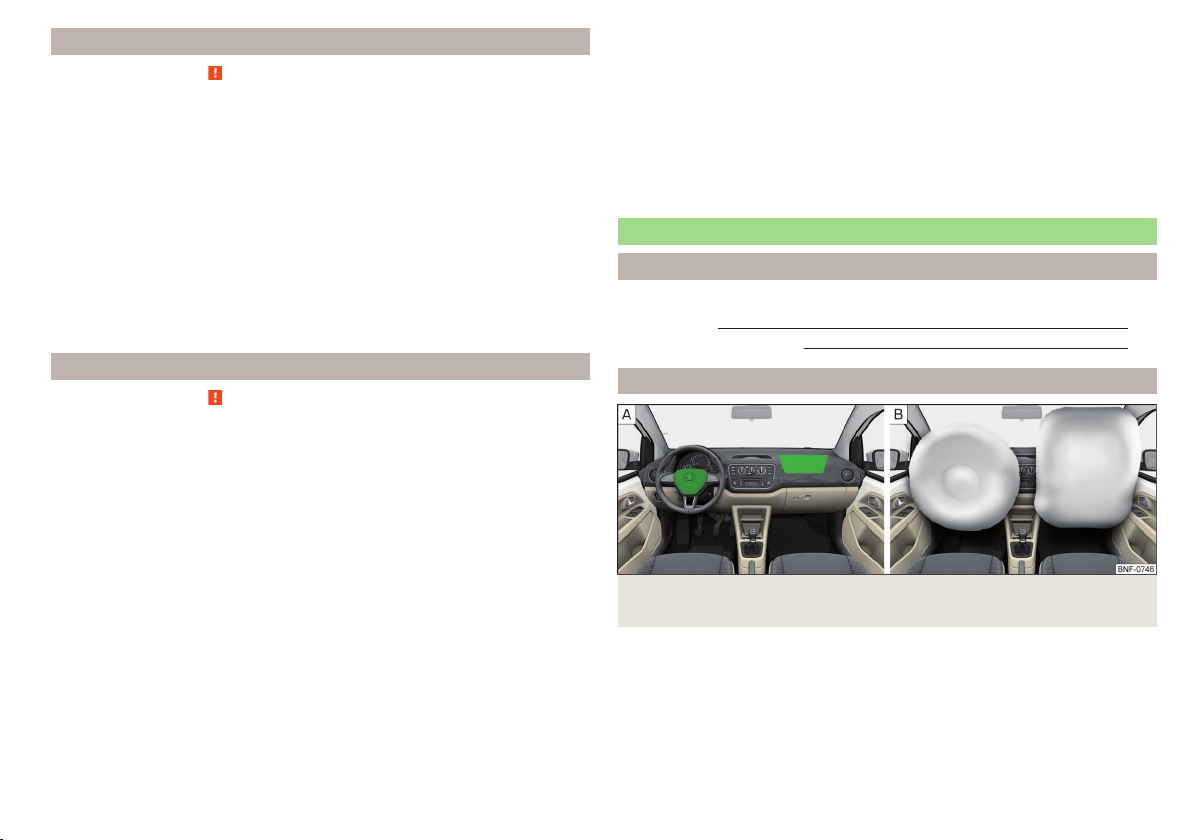
Front airbags
Fig. 7 Driver airbag in the steering wheel/front passenger airbag in the
dashboard
15
Airbag system

Fig. 8
Safe distance to steering wheel
In the event of a severe frontal collision, the front airbags offer additional pro-
tection for the head and chest area of the driver and front passenger.
The driver's front airbag is located in the steering wheel, the front passenger
airbag is located in the instrument panel above the glove compartment » Fig. 7
-
.
The airbags inflate in front of the driver and front passenger when they are
deployed » Fig. 8 -
. The forward movement of the driver and of the front
passenger is cushioned when they make contact with the fully inflated airbag
and the risk of injury to head and chest is thus reduced.
WARNING
Information on correct seated position
■
For the driver and front passenger, it is important to maintain a distance
of at least 25 cm to the steering wheel or dashboard
A
» Fig. 8. Not main-
taining this minimum distance will mean that the airbag system will not be
able to properly protect you – hazard! The front seats must always also be
correctly adjusted to match the body size of the occupant.
■
The airbag develops enormous forces when triggered, which can lead to
injuries if the sitting position or seated position is not correct.
■
There must not by any further persons, animals or objects positioned be-
tween the front seated occupants and the deployment area of the airbag.
WARNING
Front airbag and transporting children
■
Never transport children on the front seat of a vehicle without using a
proper restraint system. If airbags are deployed in the event of an accident,
the child might suffer severe or even fatal injuries!
■
The front passenger airbag must be deactivated if using a rear-facing
child seat on the front passenger seat » page 18, Deactivating the front
passenger airbag. If this is not done, there is a risk of the child suffering se-
vere or even fatal injuries if the front passenger airbag is deployed.
WARNING
General information
■
The steering wheel and the surface of the airbag module in the dash pan-
el on the passenger side must not have stickers attached, be covered or
modified in any other way. These parts should only be cleaned with a cloth
that is dry or has been moistened with water. No objects (such as cup hold-
ers, mobile phone mounts, etc.) are to be attached to the covers of the air-
bag modules or be located within their immediate vicinity.
■
Never place objects on the surface of the front passenger airbag module
in the dash panel.
Note
■
In vehicles with driver's airbag, the text can be found on the steering
wheel.
■
In vehicles with front passenger airbag, the text
is located on the dash
panel on the passenger side.
16
Safety
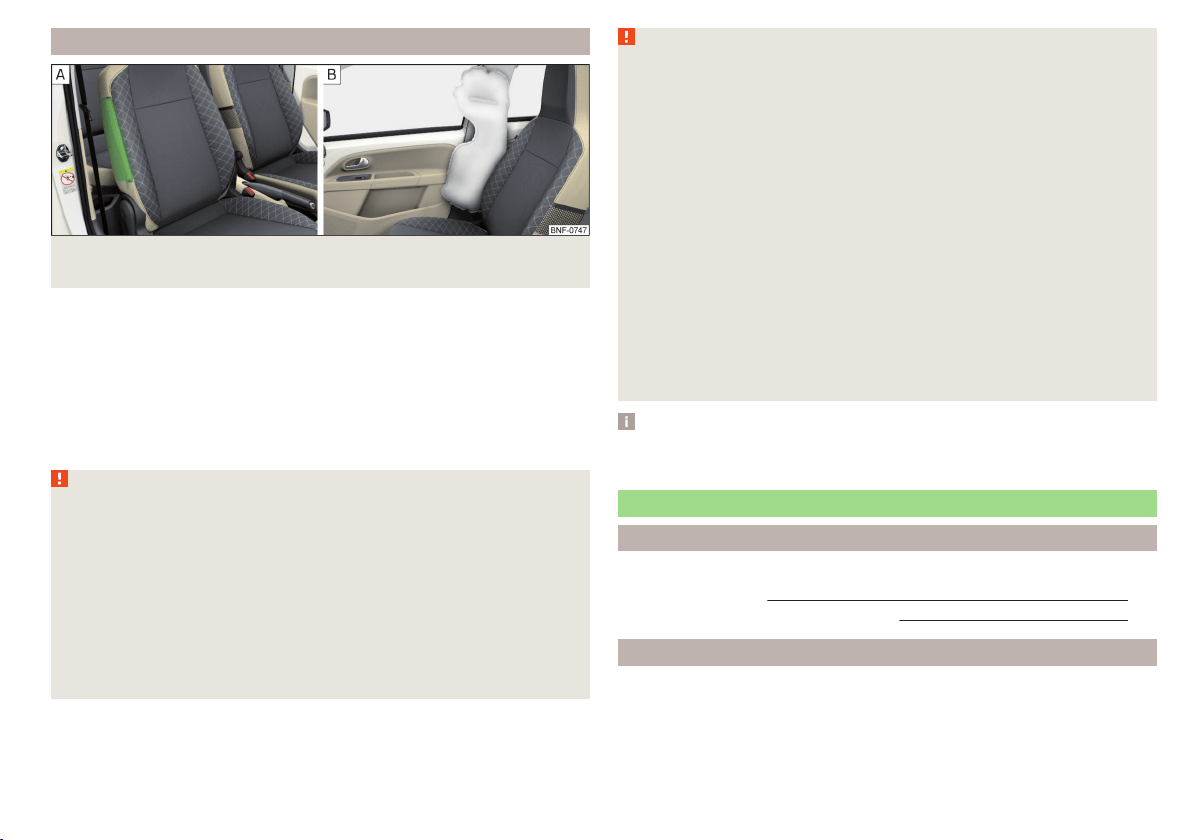
Side airbags Head-Thorax
Fig. 9 Place of installation of the front seat side airbag/deployment area
of the side airbag
In the event of severe side collisions, the side airbag system Head-Thorax pro-
vides additional protection for the upper body (chest, stomach and pelvis) of
passengers in the vehicle.
The side airbags are housed in the upholstery of the seat backrests of the
front seats » Fig. 9 –
.
The load of the occupants is cushioned when plunging into the fully inflated
airbag » Fig. 9 -
the risk of injury to head and the entire upper body (chest,
stomach and pelvis) is reduced on the side facing the door.
WARNING
Information on correct seated position
■
Your head should never be positioned in the deployment area of the side
airbag. You might suffer severe injuries in the event of an accident. This ap-
plies in particular to children who are transported without using a suitable
child safety seat » page 21, Child safety and side airbag.
■
There must not be any further persons, animals or objects positioned be-
tween the occupants and the deployment area of the airbag. No accesso-
ries, such as cup holders, should be attached to the doors.
■
If children adopt an incorrect seated position when travelling, they may
be exposed to an increased risk of injury in the event of an accident. This
can result in serious injuries » page 19, Child seat.
WARNING
■
Do not place any objects within the deployment area of the side airbags –
risk of injury!
■
The airbag control unit operates using pressure sensors located in the
front doors. For this reason, no adjustments may be carried out to the
doors or door panels (e.g. installation of additional loudspeakers). Further
information » page 94, Airbags.
■
Ensure that there are no excessive forces, such as violent knocks, kicks
etc., impact on the backrests of the seats otherwise the system may be
damaged. The side airbags would not be deployed in such a case!
■
Any seat or protective covers which you fit to the driver or front passen-
ger seats must only be of the type expressly authorized by ŠKODA. In view
of the fact that the airbag inflates out of the backrest of the seat, use of
non-approved seat or protective covers would considerably impair the pro-
tective function of the side airbag.
■
Any damage to the original seat covers in the area of the side airbag mod-
ule must be repaired immediately by a specialist garage.
■
The airbag modules in the front seats must not display any damage,
cracks or deep scratches. It is not permissible to use force in order to open
the modules.
Note
In vehicles with side airbags a label with the lettering is located on the
front seat backrests.
Deactivating airbags
Introduction
This chapter contains information on the following subjects:
Deactivating airbags
17
Deactivating the front passenger airbag 18
Deactivating airbags
If you sell your vehicle, provide the complete vehicle documentation to the
new owner. Please note that the information relating to the possibility of de-
activating the front passenger airbag must be included!
If an airbag in the vehicle is to be turned off, then the buyer is to draw atten-
tion to this fact!
17
Airbag system
Deactivating an airbag should be considered in cases such as the ones below.
▶
If a child seat is to be used on the front passenger seat, where the child is
transported with its back to the direction of travel » page 19, Transporting
children safely.
▶
If it is not possible to maintain a distance of at least 25 cm between the mid-
dle of the steering wheel and chest, despite the driver's seat being correctly
adjusted.
▶
If special attachments are required in the area of the steering wheel because
of a physical disability.
▶
If different seats have been fitted (e.g. orthopaedic seats without side air-
bags).
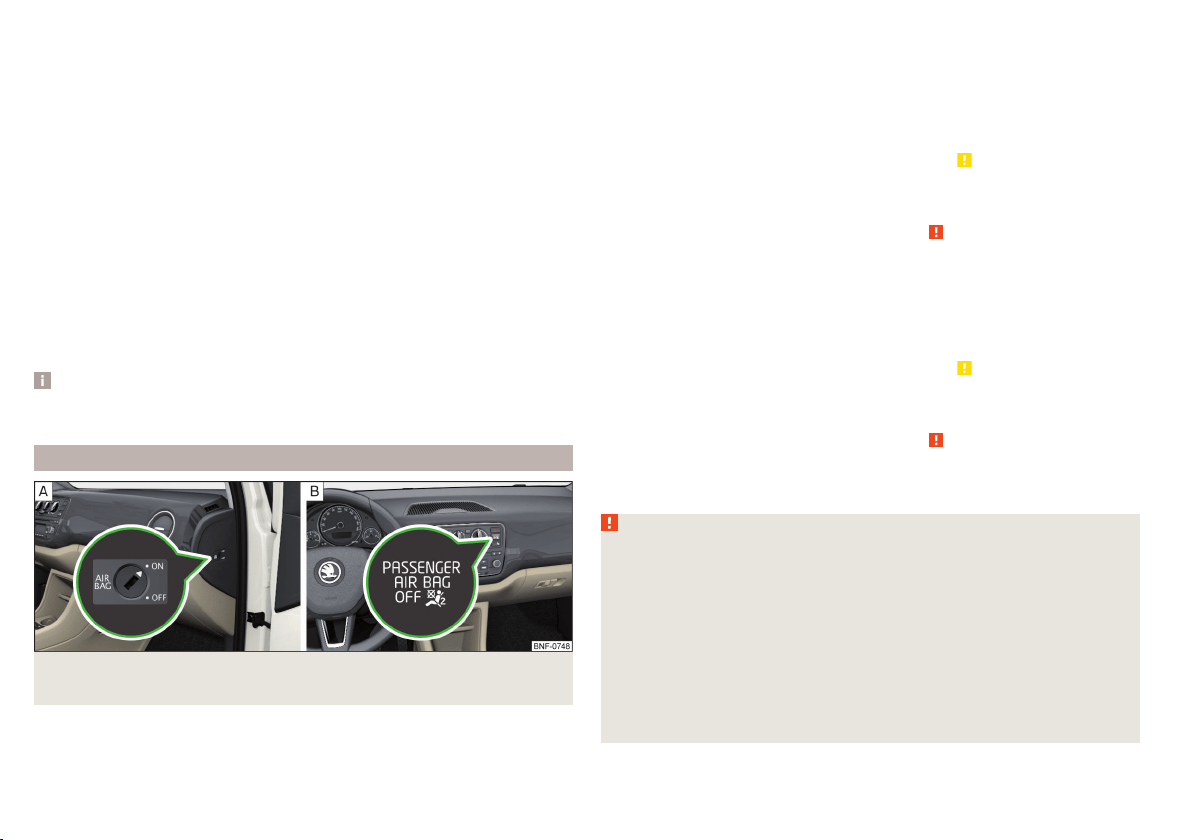
The front passenger airbag can be switched off with the key-operated switch
» Fig. 10 on page 18 -
.
We recommend that you ask a ŠKODA service partner to deactivate any other
airbags.
Deactivation indicator
Display of the airbag deactivation » page 37,
Airbag system.
Note
A ŠKODA service partner will be able to inform you which, if any, of your vehi-
cle's airbags can or must be deactivated.
Deactivating the front passenger airbag
Fig. 10 Key-operated switch for the front passenger airbag / warning
light for front passenger airbag
Only the front passenger airbag is deactivated with the key switch.
Key switch positions » Fig. 10 -
Passenger front airbag activated
Passenger front airbag deactivated
Switch off
›
Switch off the ignition.
›
Open the passenger door.
›
Fold the key bit out completely for the radio key » .
›
Carefully insert the key into the key slot in the key switch as far as the stop.
›
Use the key to turn the slot of the key switch » Fig. 10
carefully into the
position
.
›
Pull the key out of the slot in the key switch » .
›
Close the passenger door.
›
Check that the warning light
» Fig. 10 -
lights up once
the ignition is switched on.
Switching on
›
Switch off the ignition.
›
Open the passenger door.
›
Fold the key bit out completely for the radio key » .
›
Carefully insert the key into the key slot in the key switch as far as the stop.
›
Use the key to turn the slot of the key switch » Fig. 10
carefully into the
position
.
›
Pull the key out of the slot in the key switch » .
›
Close the passenger door.
›
Check that the warning light
» Fig. 10 -
does not illumi-
nate after the ignition is switched on.
WARNING
■
The driver is responsible for whether the airbag is switched on or switch-
ed off.
■
Only switch off the airbag when the ignition is switched off! Otherwise a
fault can occur in the system for deactivating the airbag.
■
If the warning light
flashes, the front passenger air-
bag will not be deployed in the event of an accident! Have the airbag sys-
tem checked by a specialist garage immediately.
■
Do not leave the key inserted in the key-operated switch while driving -
vibrations can cause the key to turn in the slot and switch on the airbag!
The airbag could be triggered unexpectedly in an accident - it may result in
injury or death!
18
Safety

CAUTION
An insufficiently folded out key bit can damage the key switch!
Transporting children safely
Child seat
Introduction
This chapter contains information on the following subjects:
Using a child seat on the front passenger seat 20
Use of the child seat in the front passenger seat 21
Child safety and side airbag 21
Classification of child seats 21
Use of child seats fastened with a seat belt 22
To avoid serious injury or death children are always to be in an appropriate
child safety seat with regards to height, weight, and age.
For safety reasons, we recommend that you always transport child seats on
the rear seats.
Child seats complying with the ECE-R 44 Economic Commission for Europe
standard must be used.
Child seats that comply with the ECE-R 44 standard are identified with a test
mark that cannot be removed: a large E within a circle with the test number
below.
With child safety seats in groups 2 and 3, make sure that the loop-around fit-
tings attached to the child seat headrest is positioned in front of or at the
same height as the loop-around fittings on the B pillar on the passenger side.
WARNING
■
One should never carry children, and also not babies! - on one's lap.
■
Never leave children unattended in the vehicle. Certain outside climatic
conditions can cause life-threatening temperatures in the vehicle.
■
The child must be secured in the vehicle during the entire journey! Other-
wise, the child would be thrown through the vehicle in the event of an acci-
dent, causing fatal injuries to both the child and other occupants.
19
Transporting children safely
WARNING (Continued)
■
Children are exposed to an increased risk of injury in the event of an acci-
dent if they lean forward or adopt an incorrect seated position when the
vehicle is moving. This particularly applies to children who are transported
on the front passenger seat as they can suffer severe, or even fatal injuries
if the airbag system is deployed!
■
Pay particular attention to the information provided by the manufacturer
of the child safety seat regarding the correct routing of the belt. Seat belts
which are not correctly adjusted can themselves cause injuries even in mi-
nor accidents.
■
Safety belts must be checked to ensure that they are running properly.
One should also ensure that the belt is not damaged by sharp-edged fit-
tings.
■
The front passenger airbag must be deactivated if using a rear-facing
child seat on the front passenger seat. Further information » page 20, Us-
ing a child seat on the front passenger seat. As soon as the rear-facing
child seat is no longer being used on the passenger seat, the front passen-
ger airbag should be re-activated again.
■
When installing the child seat on the back seat, the corresponding front
seat must be adjusted so that there is no contact between the front seat
and the child seat or the child being transported in a child seat.
CAUTION
■
When installing a child seat in which the child faces forward, adjust the head
restraints so that they are as high as possible (valid for the rear seats).
■
If the head restraints still prevent the child seat from being installed, even in
the highest position, you will need to remove them (valid for the rear seats)
» page 55. After removing the child seat, refit the head restraints.
Note
We recommend that you use child seats from ŠKODA Original Accessories.
These child seats were developed and also tested for use in ŠKODA vehicles.
They meet the ECE-R 44 standard.
Using a child seat on the front passenger seat
Does not apply to Taiwan
Fig. 11
Sticker on the B column on the
front passenger side
Fig. 12
Front passenger sun visor / label
Read and observe and on page 19 first.
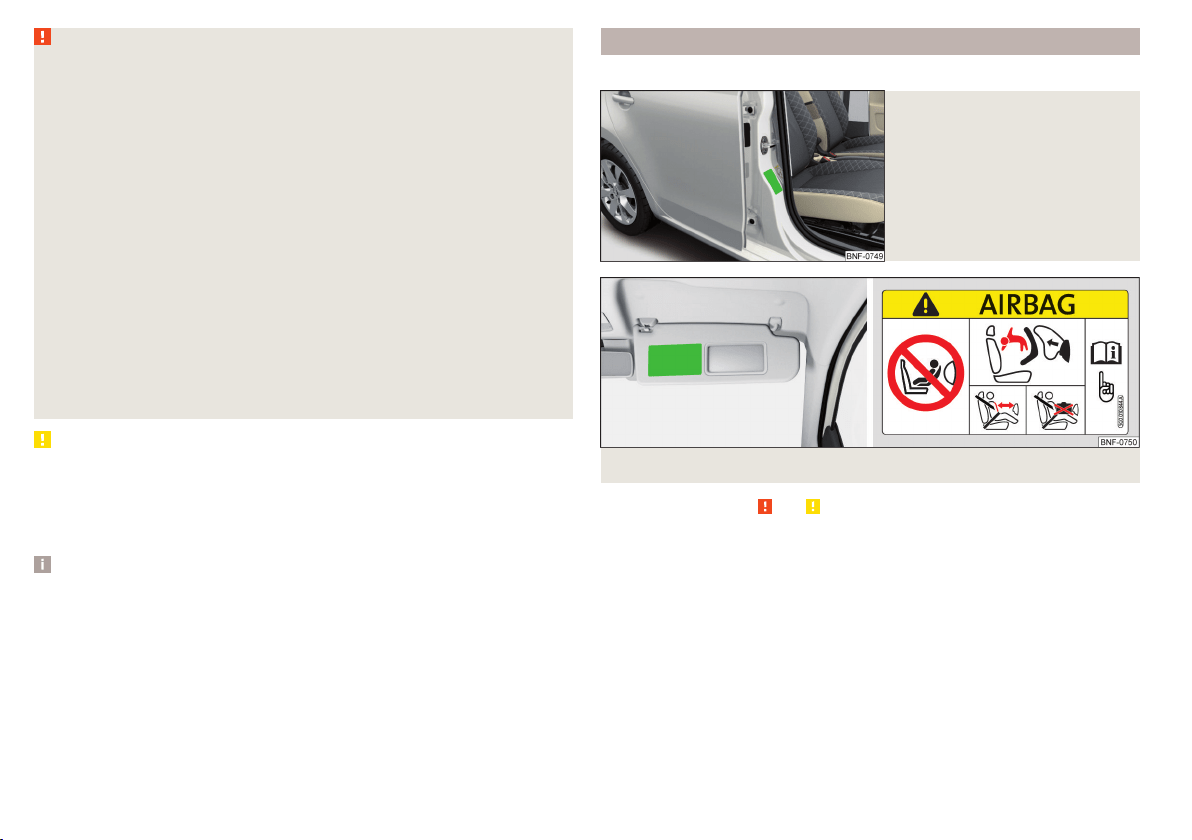
Never use a rearward-facing child restraint system on a seat which is protec-
ted by an active airbag. This could cause serious injury to the child, even
death.
There are also stickers located in the places shown below that point this fact
out.
▶
On the B-column on the front passenger side » Fig. 11. The sticker is visible
upon opening the front passenger door.
▶
On the front passenger's sun visor» Fig. 12 .
20
Safety
The following instructions must be followed when using a child seat on the
front passenger seat.
▶
The front passenger airbag must be deactivated if using a rear-facing child
seat » .
▶
If possible, adjust the front passenger seat backrest so that it is as vertical,
so as to ensure secure contact between the passenger seat backrest and the
back of the child seat.
▶
If possible, move the front passenger seat backwards so that there is no con-
tact between the front passenger seat and the child seat behind it.
▶
Set the height-adjustable front passenger seat as high up as possible.
WARNING
Never use a rear-facing child seat on the front passenger seat if the pas-
senger airbag is activated. This child safety seat is positioned in the deploy-
ment area of the front passenger airbag. The airbag may cause the child se-
vere, or even fatal injuries, in the event of it being deployed.
Use of the child seat in the front passenger seat
Applies to Taiwan
Fig. 13 Front passenger sun visor / label
Read and observe and on page 19 first.
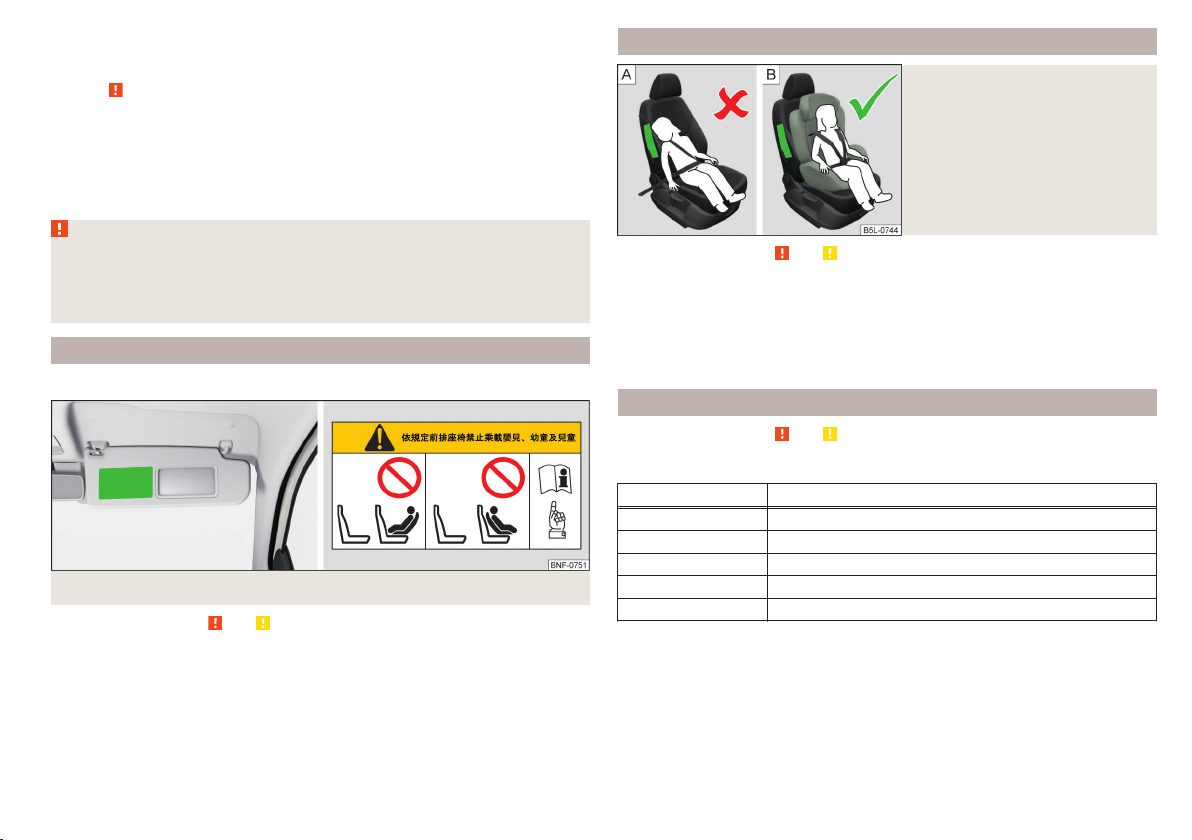
No babies, infants or children to be carried on the passenger seat.
Also indicated by the label on the passenger's sun visor » Fig. 13.
Child safety and side airbag
Fig. 14
Incorrect seated position of a
child who is not properly secured
– risk from the side airbag/Child
properly protected by safety seat
Read and observe and on page 19 first.
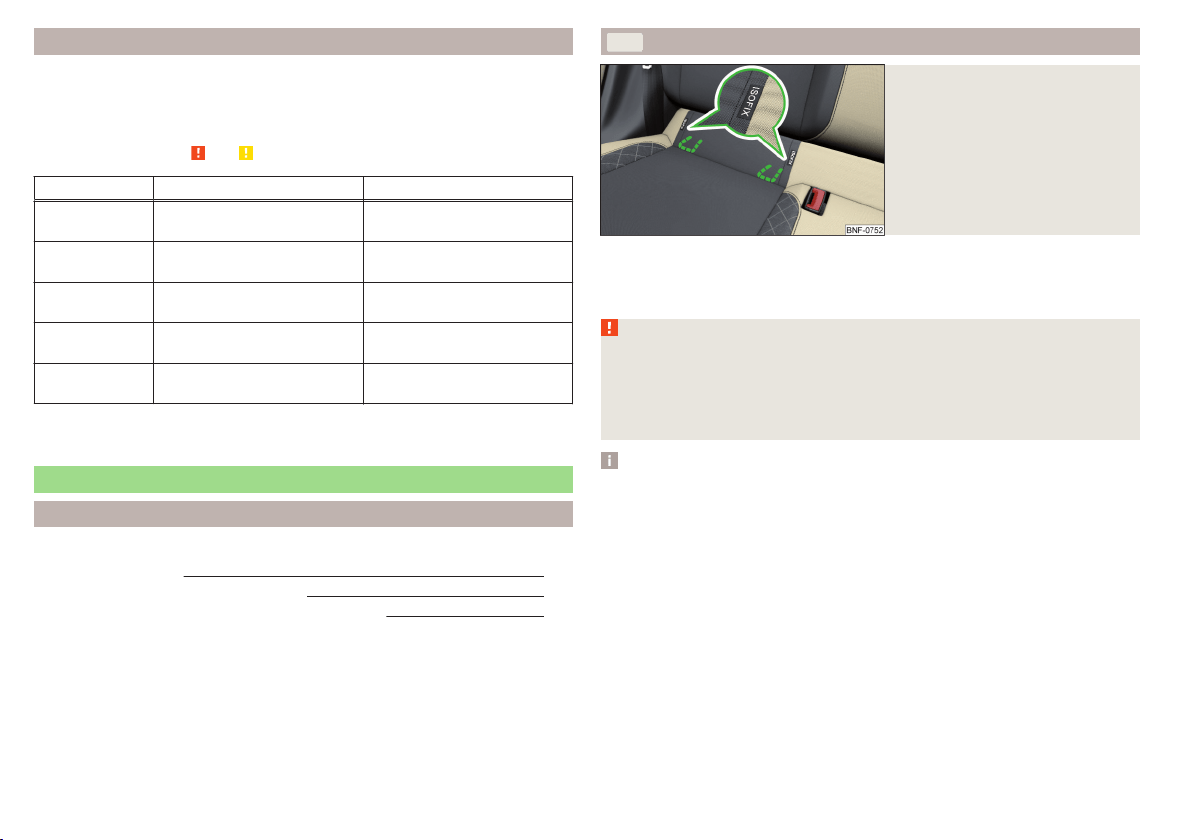
The child must not be positioned in the deployment area of the side airbag
» Fig. 14 –
.
There must be sufficient room between the child and the deployment area of
the side airbag that the airbag can provide as much protection as possible
» Fig. 14 –
.
Classification of child seats
Read and observe
and on page 19 first.
Classification of child seats according to the ECE-R 44 standard.
Group Weight of the child
0 up to 10 kg
0+ up to 13 kg
1 9-18 kg
2 15-25 kg
3 22-36 kg
21
Transporting children safely
Use of child seats fastened with a seat belt
Never use a rear-facing child seat on the front passenger seat if the passen-
ger airbag is activated. This child safety seat is positioned in the deployment
area of the front passenger airbag. The airbag may cause the child severe, or
even fatal injuries, in the event of it being deployed.
Read and observe and on page 19 first.
Group Front passenger seat Rear seats
0
up to 10 kg
U U
0+
up to 13 kg
U U
1
9-18 kg
U U
2
15-25 kg
U U
3
22-36 kg
U U
The seat is suitable for the use of approved child seats in the “Universal”
weight group category.
Fastening systems
Introduction
This chapter contains information on the following subjects:
securing system
22
Use of child seats with the
system
23
Securing of the child seat with the
system
24
U
securing system
Fig. 15
Attachment points of the
system
is a system for securing child seats quickly and safely.
There are two fixing eyes between the seat backrest and the seat cushion of
the rear passenger seat for fixing a child seat with the
system » Fig. 15.
WARNING
■
Always refer to the instructions of the manufacturer of the child seat
when installing and removing a child seat with the system.
■
Never attach other child seats, belts or objects to the attachment points
intended for the installation of a child seat with the
system – risk of
death!
Note
■
A child seat fitted with the system can only be mounted in a vehicle fit-
ted with a system if the child seat has been approved for this type of ve-
hicle. Further information is available from a ŠKODA Partner.
■
Child seats with the
system can be purchased from ŠKODA Original Ac-
cessories.
22
Safety
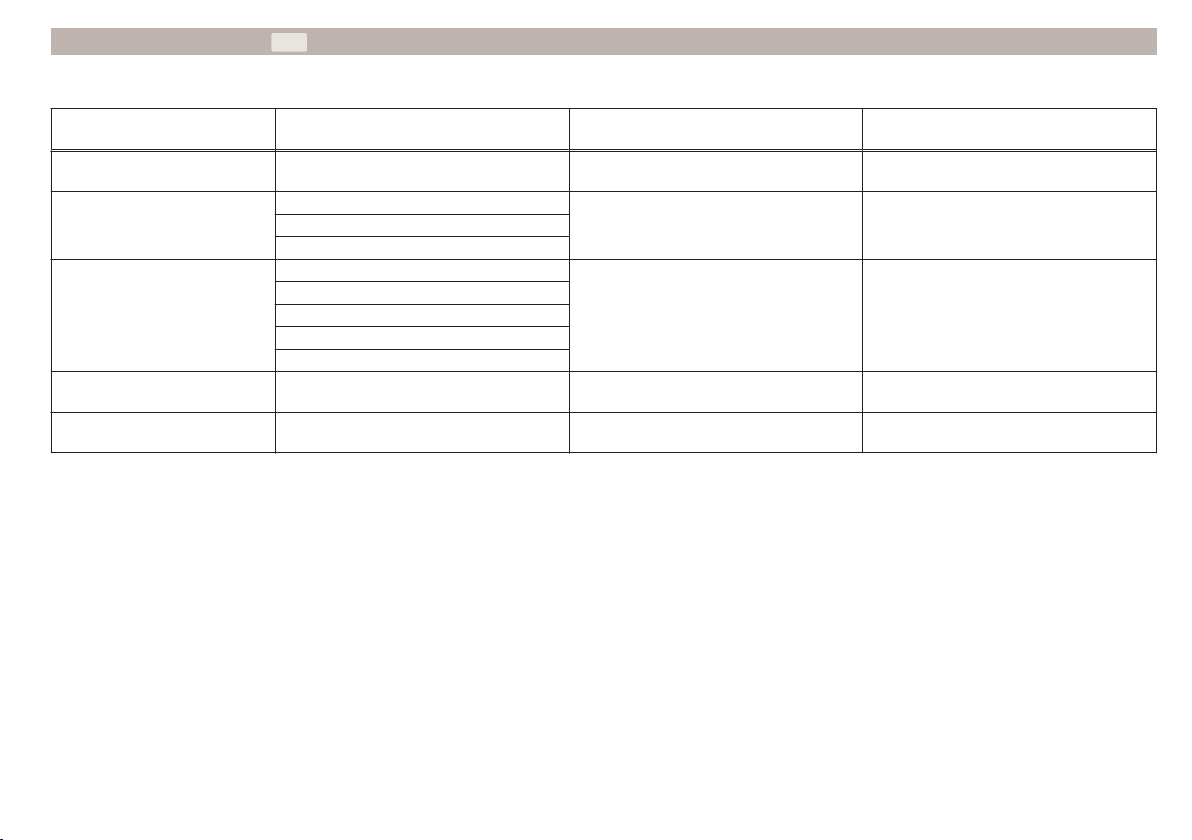
Use of child seats with the system
Never use a rear-facing child seat on the front passenger seat if the passenger airbag is activated. This child safety seat is positioned in the deployment area of
the front passenger airbag. The airbag may cause the child severe, or even fatal injuries, in the event of it being deployed.
Group
Size class of
the child seat
a)
Front passenger seat Rear seats
0
up to 10 kg
E X IL-SU
0+
up to 13 kg
E
X IL-SUD
C
1
9-18 kg
D
X
IL-SU
IUF
C
B
B1
A
2
15-25 kg
- X IL-SU
3
22-36 kg
- X IL-SU
a)
The size category is shown on the label attached to the child seat.
IL-SU The seat is suitable for the use of approved child seats in in the “Semi-Universal”category. The “Semi-Universal” category means that the child seat
with the
system is approved for your vehicle. Observe the list of vehicles that comes with the child seat.
IUF The seat is suitable for the use of approved forward facing child seats in the “Universal” weight group category.
X The seat is not fitted with system attachment points.
23
Transporting children safely
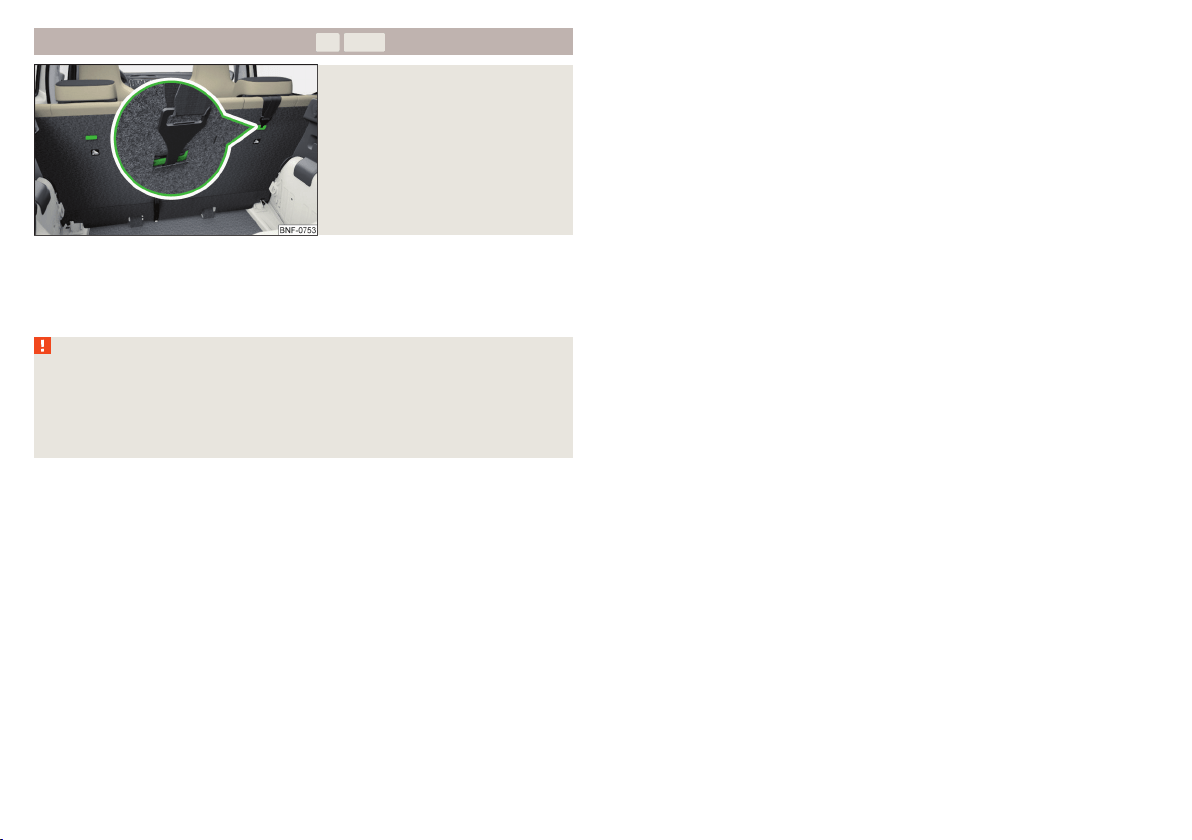
Securing of the child seat with the system
Fig. 16
Rear seat: TOP TETHER
is a fastening system, which restricts the movement of the upper part
of the child seat.
The attachment points for attaching the belt for a child seat with the
system are located on the back of the rear seat backrests » Fig. 16.
WARNING
■
Always refer to the instructions from the manufacturer of the child seat
when installing and removing a child seat with the system.
■
Only use child seats with the
system on the seats with the at-
tachment points.
■
Only ever attach one belt from the child seat to a locking eye.
24
Safety

25
Transporting children safely
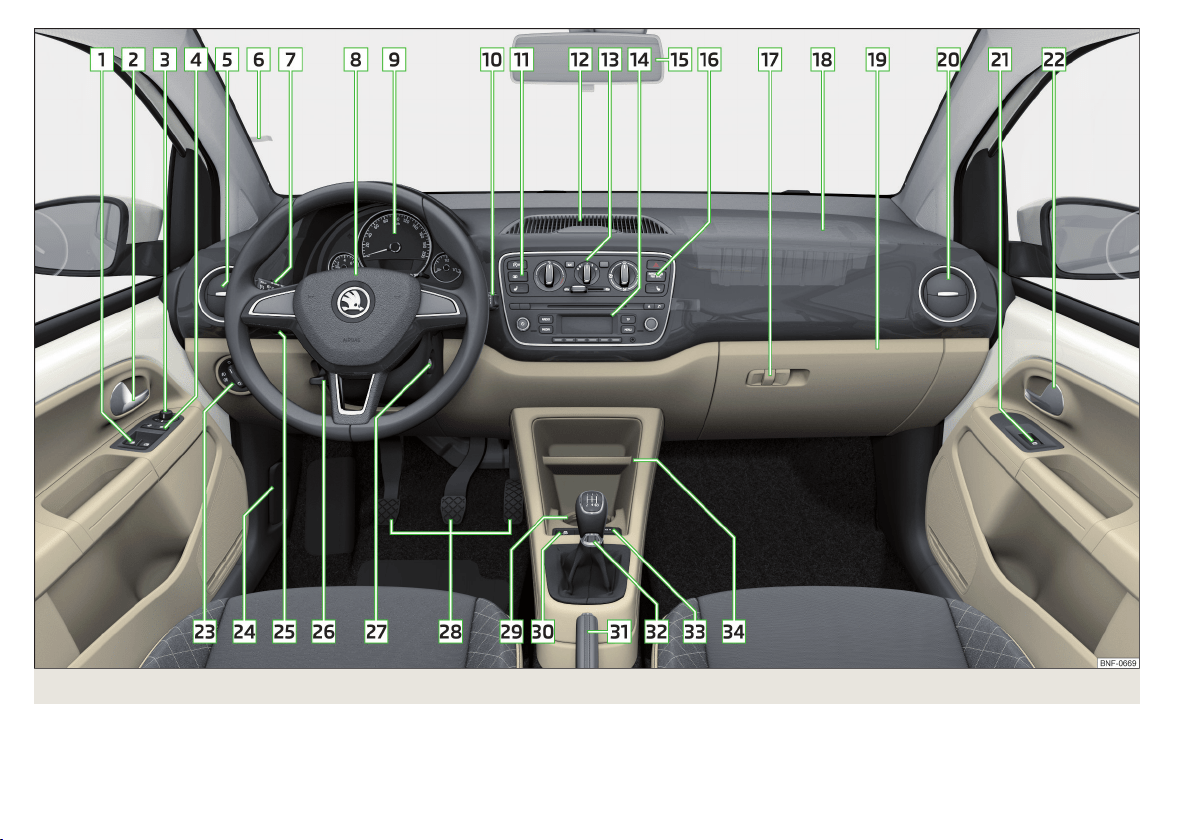
Fig. 17 Cockpit
26
Using the system

Using the system
Cockpit
Overview
Electric power windows 44
Door opening lever 41
Electric exterior mirror adjustment 53
Central locking system 40
Air vent 71
Parking ticket holder 58
Operating lever:
▶
Turn signal lights and main beam, headlight flasher 48
▶
Speed regulating system
88
Steering wheel:
▶
With horn
▶
With driver’s front airbag 15
Instrument cluster: Instruments and warning lights 28
Operating lever:
▶
Multifunction display 31
▶
Windscreen wiper and wash system
51
Buttons (depending on the specification):
▶
START STOP 77
▶
Button for rear window heater
51
▶
Button for seat heating for the left front seat
55
Air vent
71
Depending on specification:
▶
Operating controls for the heating 69
▶
Operating controls for the air conditioning system 69
Radio
Interior rear-view mirror 53
Buttons / warning lights (depending on the specification):
▶
Button for hazard warning light system 49
▶
Warning light for the front seat passenger
airbag 18
▶
Button for seat heating of the right front seat 55
Bag holder 63
1
2
3
4
5
6
7
8
9
10
11
12
13
14
15
16
17
Front passenger airbag 15
Storage compartment on the front passenger side 62
Air vent 71
Power window in the front passenger door 44
Door opening lever 41
Light switch 47
Bonnet release lever 106
Regulator for headlamp beam adjustment for the headlights 47
Lever for adjusting the steering wheel 9
Ignition lock 76
Pedals 80
Cup holder 59
Buttons (depending on the specification):
▶
Button for the City Safe Drivesystem
89
▶
Button for the low tyre pressure warning 90
Handbrake lever 79
Depending on specification:
▶
Shift lever (manual transmission) 80
▶
Selector lever (automated gearbox)
81
Depending on specification:
▶
12-volt power socket 61
▶
Cigarette lighter
60
Storage compartment 59
Note
■
Cars with factory-fitted radio are supplied with separate instructions for op-
erating such equipment.
■
The arrangement of the controls right-hand drive models may differ from the
layout shown in » Fig. 17. The symbols on the controls and switches are the
same as for left-hand drive models.
18
19
20
21
22
23
24
25
26
27
28
29
30
31
32
33
34
27
Cockpit
Instruments and control lights
Instrument cluster
Introduction
This chapter contains information on the following subjects:
Overview 28
Fuel reserve display 29
Tachometer 29
Counter for distance driven 30
Service interval display 30
Gear recommendation 30
The instrument cluster gives the driver basic information such as the current
speed, engine speed, the state of some vehicle systems and the like.
WARNING
Concentrate fully at all times on your driving! As the driver you are fully re-
sponsible for road safety.
Note
Appears in the display then the system indicates that the ignition is
switched on.
Overview
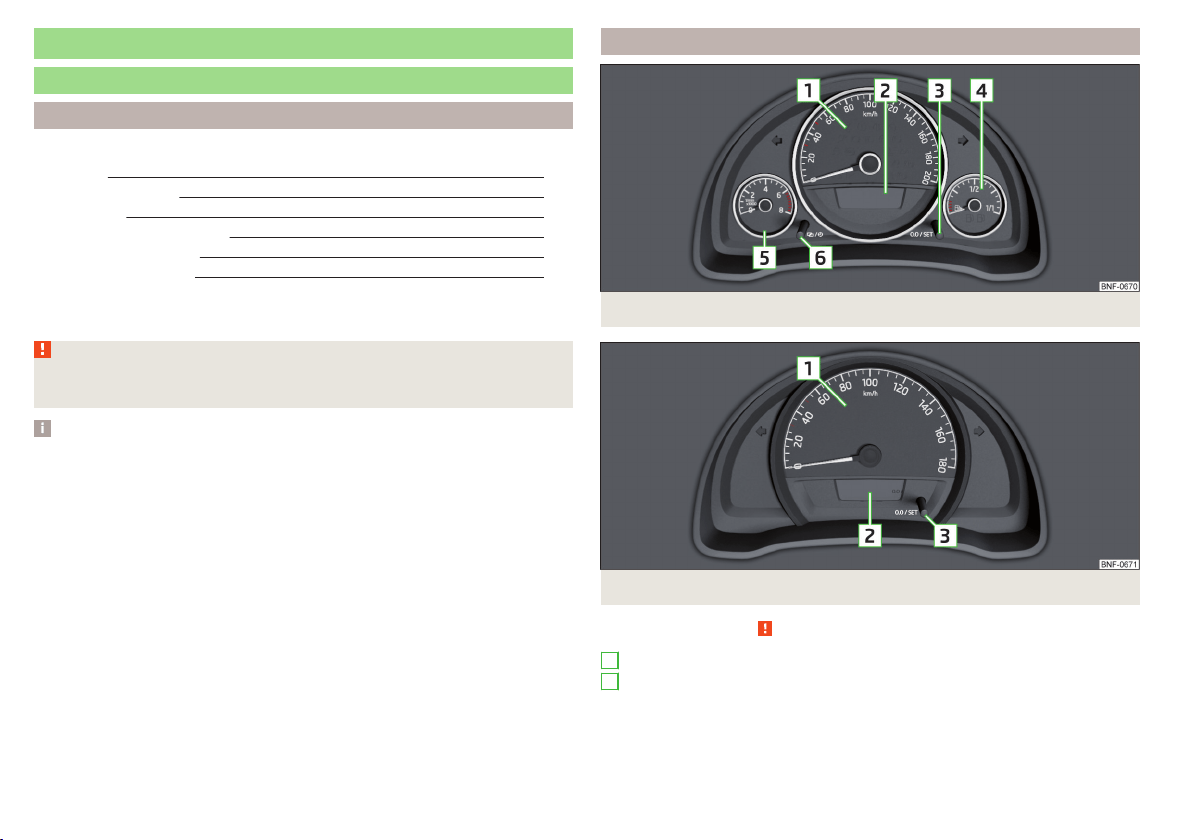
Fig. 18 Instrument cluster - Version 1
Fig. 19 Instrument cluster - Version 2
Read and observe on page 28 first.
Speedometer
Display:
▶
with fuel gauge (only in the instrument cluster - variant 2) » page 29
▶
With counter for distance driven » page 30
▶
With service interval display » page 30
▶
With multifunction display » page 31
▶
with outside temperature display » page 32
1
2
28
Using the system
The counter for the distance travelled button (trip) » page 30
Fuel gauge » page 29
Engine revolutions counter » page 29
Time adjust button » page 33
Fuel reserve display
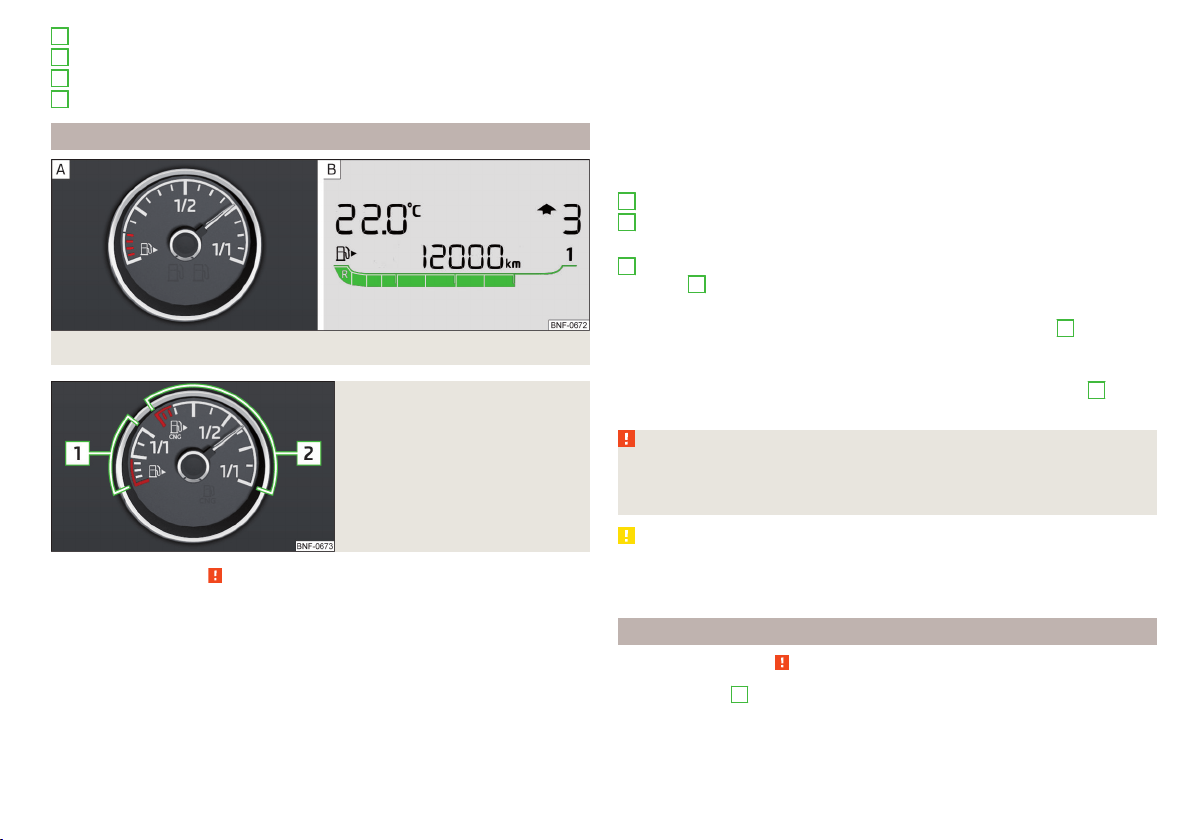
Fig. 20
Petrol fuel gauge: Version 1/version 2
Fig. 21
Petrol and natural gas gauge
Read and observe on page 28 first.
The fuel gauge only works if the ignition is switched on.
Vehicles with petrol engine
Fuel gauge types » Fig. 20
Display in the instrument cluster - Version 1
Display in the instrument cluster display - Version 2
The fuel tank has a capacity of about 35 litres.
3
4
5
6
When the fuel level reaches the reserve area in the fuel tank, the warning light
(the pointer of the display in the red scale area) lights up in the display var-
iant 1 on or it flashes the symbol in the display variant 2 for 10 seconds
to-
gether with the remaining segments of the display. There are now about 4 li-
tres of fuel remaining in the tank.
An audible signal sounds as a warning.
G-TEC vehicles (natural gas drive)
Fuel gauge » Fig. 21
Gasoline reserve
Natural gas reserve
When the vehicle runs on petrol, the pointer of the fuel gauge is in the range
1
» Fig. 21. When the vehicle runs on petrol, the pointer of the fuel gauge is in
the range
2
.
If the fuel level in the fuel tank reaches the reserve area for petrol, the warn-
ing light
goes on. The pointer is in the red range of the gauge
1
» Fig. 21.
There are now about 5 l of fuel remaining in the tank.
If the fuel level in the fuel tank reaches the reserve area for natural gas the
warning light
goes on. The pointer is in the red range of the gauge
2
» Fig. 21. There are now about 1.5 kg of fuel remaining in the tank.
WARNING
In order for the vehicle systems to function properly and thus to make driv-
ing safe, there must be sufficient fuel in the tank. Never drive until the fuel
tank is completely empty - there is a risk of accidents!
CAUTION
Never drive until the fuel tank is completely empty! The irregular supply of fuel
can cause misfiring. This can result in considerable damage to parts of the en-
gine and the exhaust system.
Tachometer
Read and observe on page 28 first.
The tachometer
5
» Fig. 19 on page 28 shows the actual engine speed per mi-
nute.
The beginning of the red scale range of the tachometer indicates the maxi-
mum permitted engine speed of a driven-in and operating warm engine.
1
2
29
Instruments and control lights

You should shift into the next highest gear before the red scale of the revolu-
tion counter is reached, or select mode D on the automatic gearbox.
The gear recommendation is important to note in order to maintain the opti-
mum engine speed » page 30.
Avoid high engine speeds during the running-in period and before the engine
has warmed up to the operating temperature.
CAUTION
The pointer of the tachometer must reach the red area for only a short time -
there is a risk of engine damage!
Counter for distance driven
Fig. 22
Counter for distance travelled
(trip)
Read and observe on page 28 first.
Display » Fig. 22
Counter showing the distance travelled since the last reset (trip)
Odometer
Choose between the odometer display and the counter showing the distance
driven (trip)
›
Press down on button
3
» Fig. 18 on page 28 » Fig. 19 on page 28 briefly.
Reset counter for distance travelled (trip)
›
Select the counter for distance travelled (trip).
›
Press and hold the
3
» Fig. 18 on page 28 or » Fig. 19 on page 28 button.
Service interval display
Read and observe on page 28 first.
The service interval display shows the mileage to the next service event.
Before the next service interval has been reached, the message appears in
the instrument cluster display for some seconds and the remaining kilometres
are shown after switching on the ignition.
If the time of the service has been reached, an acoustic signal will sound and
the message
appears for a few seconds after switching on the ignition.
The information regarding the service intervals can be found in the service
schedule.
Note
Information is retained in the Service Interval Display even after the vehicle
battery is disconnected.
Gear recommendation
Fig. 23
Recommended gear
Read and observe on page 28 first.
A correctly engaged gear or, where appropriate, a recommendation to shift up
or down is shown in the display.
A correctly engaged gear helps to reduce the fuel consumption and assist the
service life and reliability of the engine.
Display » Fig. 23
Optimal gear engaged
Recommended gear
Recommended gear
The gear recommendation is intended only for vehicles with a manual trans-
mission or for vehicles with an automatic transmission in manual shift mode
(Tiptronic).
30
Using the system
The arrow symbol is shown after the name of the engaged gear.
- Recommends that you change up to a higher gear
- Recommends that you change down to a lower gear
Gear recommendation - vehicles with manual transmission
The recommended gear and the arrow icon is displayed.
If e.g.
appears, this means it would be beneficial to change up from a lower
gear into 3rd gear.
Gear recommendation - vehicles with automated manual transmission mode
for manual gearshifting (Tiptronic)
The currently engaged gear and the relevant arrow icon is displayed.
If .g
appears, this means it would be beneficial to change up from 3rd gear
to a higher gear
WARNING
The driver is always responsible for selecting the correct gear in different
driving situations, such as overtaking.
Multi-function display (MFD)
Introduction
This chapter contains information on the following subjects:
Operation
31
Multifunction display details 31
Warning at excessive speeds 32
Memory 33
33
The driving data is displayed on the multifunction display.
The multifunction display only operates if the ignition is switched on. After the
ignition is switched on, the function that was last selected before switching
off the ignition is displayed.
WARNING
■
Concentrate fully at all times on your driving! As the driver you are fully
responsible for the operation of your vehicle.
■
Even at temperatures of around +4 °C, black ice may still be on the road
surface! You should therefore not only rely on the outside temperature dis-
play for accurate information as to whether there is ice on the road.
Operation
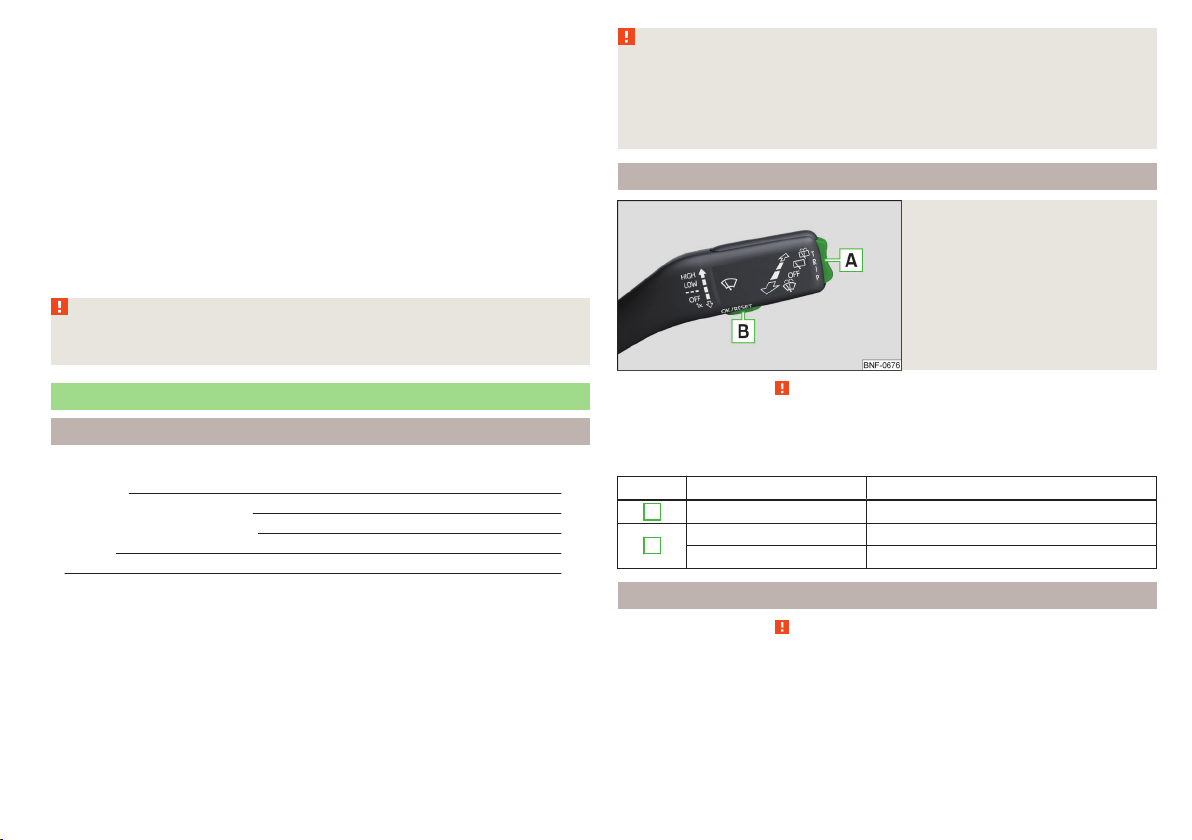
Fig. 24
Buttons on the control lever
Read and observe on page 31 first.
Some features of the multi-function display can be operated with the buttons
on the control lever » Fig. 24.
Operation description
Button Action Operation
A
Briefly push up or down Select data / set data values
B
Press briefly View information / confirm specification
Press and hold button Reset memory
Multifunction display details
Read and observe on page 31 first.
Overview of driving data (depending on the vehicle equipment).
Clock
The current time is displayed.
31
Instruments and control lights

Outside temperature
If the outside temperature drops below +4 °C, the temperature indicator ap-
pears and a snow flake symbol
(display for low temperature) flashes for a
few seconds, then remains displayed together with the outside temperature.
Driving time
The time travelled since the memory was last erased is displayed.
The maximum time displayed is 19 hours and 59 minutes. The indicator is auto-
matically set back to zero if this value is exceeded.
Current fuel consumption
You can use this information to adapt your driving style to the desired fuel
consumption.
When the vehicle is stationary or moving slowly the fuel consumption is dis-
played in l/h (on models for some countries the following appears --,- km/l).
Average fuel consumption
The value is calculated continuously from the point the memory was last de-
leted.
After erasing the memory, no data will appear for the first 300 m driven.
Range
The detail provides information about the distance in km that can be travelled
on the current tank, and with the same driving style.
If you drive more efficiently this value can increase.
Distance travelled
The distance travelled since the memory was last erased is displayed.
The maximum distance that can be displayed is 1999 km. The indicator is auto-
matically set back to zero if this value is exceeded.
Average speed
The value is calculated continuously from the point the memory was last de-
leted.
After erasing the memory, no data will appear for the first 300 m driven.
Current driving speed
The display is identical to the display on the speedometer.
Coolant temperature
If the coolant temperature is in the range 80-110 °C the engine operating tem-
perature has been reached.
If the coolant temperature is below 80 °C or above 110 °C, avoid high engine
revs, full throttle and overloading the engine.
Warning against excessive speeds
Set the speed limit, for example, for the maximum permissible speed in town
» page 32, Warning at excessive speeds.
Warning at excessive speeds
Read and observe on page 31 first.
The system allows you to set a speed limit and when this is reached, an acous-
tic warning signal sounds. At the same time the message
(warning against
excessive speed) appears on the display with the set limit value.
Adjust the speed limit while the vehicle is stationary
›
Select and confirm the menu item
(warning when speed limit is exceeded).
›
Set the desired speed limit.
›
Confirm the set value, or wait several seconds; your settings will be saved
automatically.
The speed limit can be set in 5 km/h intervals.
Adjusting the speed limit while the vehicle is moving
›
Select and confirm the menu item
(warning when speed limit is exceeded).
›
Drive at the desired speed.
›
Confirm the current speed as the speed limit.
The set speed limit can be manually adjusted later if needed.
Deactivate speed limit
›
Select and confirm the menu item
(warning when speed limit is exceeded).
›
Confirm the speed limit entered.
The speed limit will be deactivated.
The set driving mode remains stored even after switching the ignition on and
off.
32
Using the system
Memory
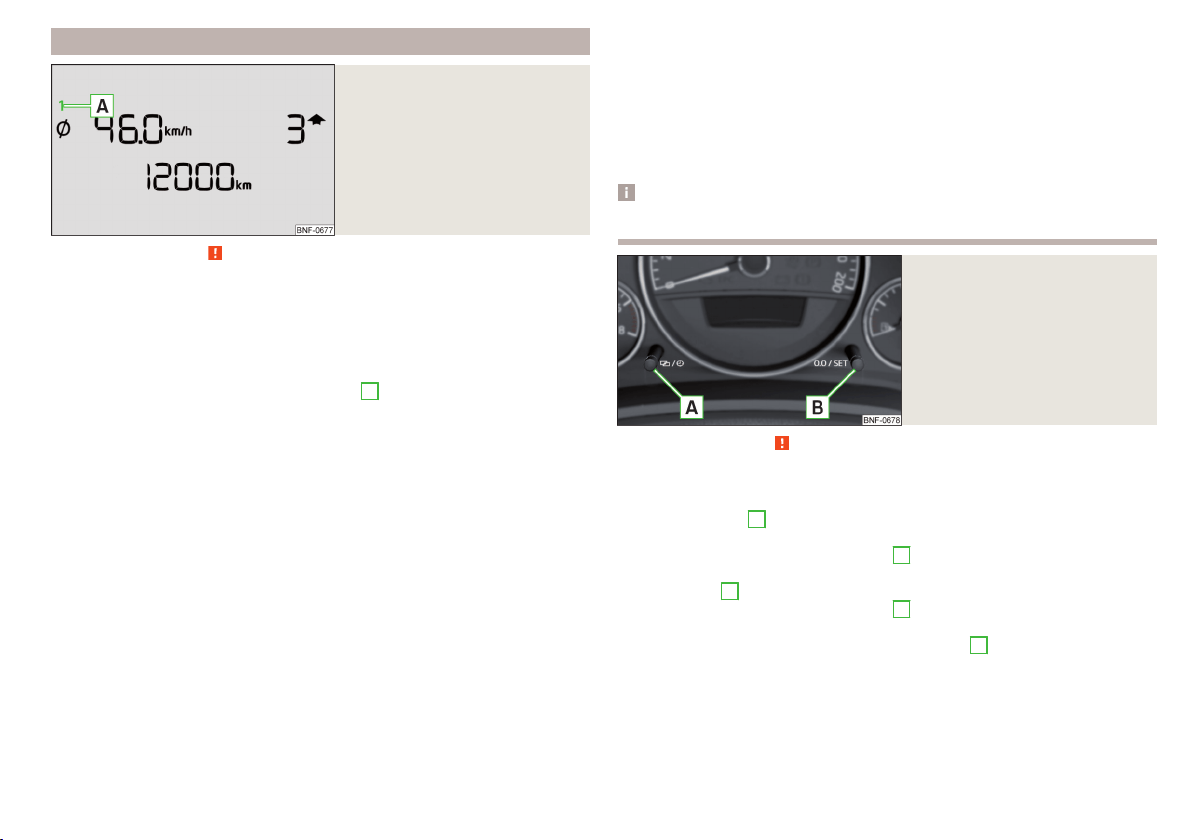
Fig. 25
Multi-function display - Display
example of the memory
Read and observe on page 31 first.
The following data will be saved in two memory banks 1 and 2 .
▶
Average fuel consumption.
▶
Distance driven.
▶
Average speed.
▶
Driving time.
The selected memory is displayed at position
A
» Fig. 25.
“1” - Single-trip memory
The memory collates the driving information from the moment the ignition is
switched on until it is switched off.
New data will also flow into the calculation of the current driving information if
the trip is continued within 2 hours after switching off the ignition.
If the trip is interrupted for more than 2 hours, the memory is automatically
erased.
“2” - Long-term memory
The memory gathers driving information from any number of individual jour-
neys up to a total of 19 hours and 59 minutes driving or 1999 kilometres driven.
The memory is deleted when either of these limits is reached and the calcula-
tion starts all over again.
Unlike the single-trip memory, the total-trip memory is not deleted after a pe-
riod of interruption of driving of 2 hours.
Select memory
Operation » page 31,
▶
Select the desired data to be displayed in the multi-function display.
▶
Confirm details again to select the desired memory.
Reset memory
Operation » page 31,
▶
Select the desired data to be displayed in the multi-function display.
▶
Select the desired memory.
▶
Reset the selected memory by pressing down on it for a long time.
Note
Disconnecting the vehicle battery will delete all memory data.
Fig. 26
Buttons in the instrument clus-
ter - variant 1
Read and observe on page 31 first.
The time is set as follows.
›
Select the time display on the instrument cluster » page 31, Operation.
›
Press the button
A
» Fig. 26 and keep it pressed down until the hour display
starts flashing.
›
To change the value, press the button
B
. To change the value quickly, hold
down the button.
›
Press button
A
until it flashes to select the minute display.
›
To change the value, press the button
B
. To change the value quickly, hold
down the button.
›
Confirm the value entered by pressing the button
A
again, or wait for
around 5 seconds. The setting is saved automatically (the value stops flash-
ing).
33
Instruments and control lights

Warning lights
Introduction
This chapter contains information on the following subjects:
Handbrake
34
Braking system 34
Seat belt warning light 34
Alternator 35
Engine oil pressure too low 35
Coolant 35
Automated transmission 35
Power steering 36
Stability Control (ESC) / traction control (ASR) 36
Antilock brake system (ABS) 36
Tyre pressure 36
Rear fog light 37
Exhaust inspection system 37
Checking the engine electronics 37
Airbag system 37
Handbrake - automatic transmission 38
Brake pedal (automatic transmission) 38
Turn signal system 38
Cruise control system 38
Main beam 38
/
Rear seat belt warning light 38
City Safe Drive 38
/
START-STOP 38
The warning lights indicate certain functions or faults.
The lighting up of some warning lights may be accompanied by acoustic sig-
nals.
After switching on the ignition, some warning lights light up briefly as a func-
tion test.
If the tested systems are OK, the corresponding warning lights extinguishes
for a few seconds after switching on the ignition or after starting the engine.
WARNING
■
Ignoring light-up indicator lamps in the instrument cluster and the control
symbols in the display may cause serious injury or damage to the vehicle.
■
If you have to stop for technical reasons, then park the vehicle at a safe
distance from the traffic, switch off the engine and activate the hazard
warning light system » page 49. Place the warning triangle at the prescri-
bed distance.
■
The engine compartment of your car is a hazardous area. The following
warning instructions must be followed at all times when working in the en-
gine compartment » page 106, Engine compartment.
Handbrake
Read and observe on page 34 first.
lights up - the hand brake is engaged.
An audible warning is also given if you drive the vehicle for at least 3 seconds
at a speed of more than 6 km/h.
Braking system
Read and observe
on page 34 first.
lights up - the brake fluid level in the brake system is too low or there is an
ABS fault.
›
Stop the vehicle, switch off the engine, and check the level of the brake fluid
» page 112.
WARNING
■
If the warning light illuminates together with the warning light
» page 36, Antilock brake system (ABS), stop driving! Seek help from
a specialist garage.
■
A fault to the ABS system or the braking system can increase the vehi-
cle's braking distance – risk of accident!
Seat belt warning light
Read and observe on page 34 first.
lights up - the driver or front passenger has not fastened their seat belt.
34
Using the system

At a speed of more than approximately 20 km/h the warning light flashes
and an audible warning sounds at a time.
The warning signal is switched of and the
indicator light is permanently lit if
the driver and front passenger have not fastened their seat belts within the
next 90 seconds.
Alternator
Read and observe on page 34 first.
illuminates - the battery is not being charged whilst the engine is running.
Seek help from a specialist garage.
CAUTION
If in addition to the symbol the symbol » page 35illuminates while driv-
ing, stop driving- risk of engine damage! Switch off the engine and seek as-
sistance from a specialist garage.
Engine oil pressure too low
Read and observe
on page 34 first.
lights up or flashes - the engine oil pressure is too low.
An audible signal sounds as a warning.
›
Stop the vehicle, switch off the engine, and check the engine oil level
» page 109, Checking the oil level.
If the warning light
illuminates or flashes, do not drive any further, even if
the oil level is correct! Switch off the engine and seek assistance from a spe-
cialist garage.
CAUTION
■
The oil pressure light is not an oil level indicator! One should therefore
check the oil level at regular intervals, preferably after every refuelling stop.
■
If for some reason, it is not possible to top up the engine oil under the cur-
rent circumstances,
do not continue driving! Switch off the engine and seek
assistance from a specialist garage.
Coolant
Read and observe on page 34 first.
lights up or flashes - the coolant temperature is too high or the coolant lev-
el is too low.
An audible signal sounds as a warning tone.
›
Stop the vehicle, switch off the engine, and allow the engine to cool down.
›
Check the coolant level, if necessary top up the coolant.
If the coolant is within the specified range, the cooling fan may be malfunc-
tioning.
›
Switch off the ignition.
›
Check the fuse for the cooling fan, replace if necessary.
If the coolant level and fan fuse are both OK but the warning light
is still
illuminated,
do not drive any further!
Seek help from a specialist garage.
Automated transmission
Read and observe
on page 34 first.
fault
lights up - there is a fault in the automatic transmission.
An audible signal sounds as a warning tone.
Do not continue to drive! Switch off the engine and seek assistance from a
specialist garage.
Functional impairment
lights up and gear change is not possible - for technical reasons there may
be an impairment of the automatic transmission.
›
Stop the car, turn the ignition off and on again.
If the warning light
lights up after you again switch on the ignition, seek as-
sistance from a specialist garage.
Gearbox overheating
and is possibly also
illuminated - the automatic transmission is overheat-
ing.
An audible signal sounds as a warning tone.
35
Instruments and control lights

›
Stop and allow the transmission to cool down or drive more quickly than
20 km/h (12 mph).
If the warning light
lights up again, switch off the vehicle, shut off the en-
gine and allow the gearbox to cool down.
Further information » page 81, Automated transmission.
Power steering
Read and observe on page 34 first.
lights up - this indicates a complete failure of the power steering and the
steering assist has failed (significantly higher steering forces).
lights up - this indicates a partial failure of the power steering and the
steering forces can be greater.
›
Stop the car, turn the ignition off and on again.
If the indicator light does not illuminate after the engine has been turned on
again, the power steering is fully operational again.
If the warning light illuminates again, then obtain assistance from an author-
ised dealer.
Disconnecting the vehicle battery
If the vehicle's battery has been disconnected and reconnected, the warning
light comes on after switching on the
ignition.
The warning light should go out after driving a short distance.
If, after the motor is restarted and a short drive, the indicator light does not go
out, there is a system error.
Seek help from a specialist garage.
Stability Control (ESC) / traction control (ASR)
Read and observe
on page 34 first.
flashes - the ESC or TCS is currently being accessed.
lights up - there is an ESC or TCS fault.
Seek help from a specialist garage.
As the ESC operates in conjunction with the ABS, the ESC warning light will al-
so come on if the ABS system fails.
If the warning light comes on straight after starting the engine, the TCS may
be switched off for technical reasons.
›
Switch the ignition off and on again.
If the warning light
does not illuminate after you switch the engine back on,
the ASR is fully functional again.
Disconnecting the vehicle battery
If the vehicle's battery has been disconnected and reconnected, the warning
light comes on after switching on the
ignition.
The warning light should go out after driving a short distance.
If, after a short drive, the indicator light does not go out, there is a system er-
ror.
Seek help from a specialist garage.
More information about the ESC system » page 85, Stability Control (ESC) or
TCS system » page 85, Traction control (TCS).
Antilock brake system (ABS)
Read and observe on page 34 first.
lights up - there is an ABS fault.
The vehicle will only be braked by the normal brake system without the ABS.
Seek help from a specialist garage.
In the event of an ABS fault, the other braking and stabilization systems are
turned off » page 85, Braking and stabilisation systems .
WARNING
■
A fault to the ABS system or the braking system can increase the vehi-
cle's braking distance – risk of accident!
■
If the ABS warning light
together with the indicator light
» page 34
lights,
do not continue to drive! Seek help from a specialist garage.
Tyre pressure
Read and observe on page 34 first.
Change of tyre pressure values
lights up - there was a pressure change in one of the tyres.
36
Using the system

An audible signal sounds as a warning.
›
Immediately reduce speed and avoid sudden steering and braking manoeu-
vres.
›
Stop the vehicle, turn the ignition off and check the tyres and their inflation
pressures » page 117.
›
Correct the tyre pressure if necessary or replace the affected wheel
» page 123 or use the repair kit » page 127.
›
Save the tyre pressure values in the system » page 91.
System fault
flashes for approximately 1 minute and remains lit - there may be a fault in
the tyre pressure monitoring system.
›
Stop the vehicle, turn the ignition off and start the engine again.
If the warning light
flashes again after the engine has started, there is a
system error.
Seek help from a specialist garage.
Disconnecting the vehicle battery
If the vehicle's battery has been disconnected and reconnected, the warning
light comes on after switching on the
ignition.
The warning light should go out after driving a short distance.
If, after a short drive, the indicator light does not go out, there is a system er-
ror.
Seek help from a specialist garage.
Other incidents
The following reasons can explain the warning light
being illuminated.
▶
The vehicle is loaded on one side. Distribute loads as evenly as possible.
▶
The wheels of one axle are loaded more heavily (e.g. when towing a trailer or
when driving uphill or downhill).
▶
Snow chains are mounted.
▶
A wheel has been changed.
CAUTION
Under certain circumstances (e.g. sporty style of driving, wintry or unpaved
roads) the warning light in the instrument cluster can be delayed or does
not light up at all.
Rear fog light
Read and observe on page 34 first.
lights up - the rear fog light is switched on.
Exhaust inspection system
Read and observe on page 34 first.
lights up - there is a fault in the emission control system. The system allows
the vehicle to run in emergency mode.
Seek help from a specialist garage.
Checking the engine electronics
Read and observe on page 34 first.
lights up - there is a fault in the electronic engine management system. The
system allows the vehicle to run in emergency mode.
Seek help from a specialist garage.
Airbag system
Read and observe on page 34 first.
System fault
lights up - there is a fault in the airbag system.
This also applies if the warning light does not come on when the ignition is
switched on.
The functionality of the airbag system is monitored automatically even if one
of the airbags is switched off.
One of the airbags or a belt tensioner has been disabled by the diagnostic
tool
lights up for approximately 4 seconds after the ignition is switched on and
then flashes for approximately 12 seconds.
The front passenger airbag has been disabled with the key switch
lights up for a few seconds when the ignition is switched on.
37
Instruments and control lights

the lettering in the middle of the dash panel lights up
after switching on the ignition » page 18, Deactivating the front passenger air-
bag.
WARNING
When a fault in the airbag system occurs, there is a risk of the system not
being triggered in the event of an accident. Therefore, this must be
checked immediately by a specialized garage.
Handbrake - automatic transmission
Read and observe on page 34 first.
lights up or flashes - engage the parking brake.
Further information » page 81, Automated transmission.
Brake pedal (automatic transmission)
Read and observe
on page 34 first.
lights up - apply the brake.
Further information » page 81, Automated transmission.
Turn signal system
Read and observe on page 34 first.
flashes - the left turn signal is turned on.
flashes - the right turn signal is turned on.
If there is a fault in the turn signal system, the warning light flashes at twice
its normal rate.
When the hazard warning light system is switched on, this will cause all of the
turn signal lights as well as both warning lights to flash.
Cruise control system
Read and observe
on page 34 first.
lights up - the vehicle is regulated by the cruise control.
Main beam
Read and observe on page 34 first.
illuminates - the main beam or the headlight flasher is switched on.
/
Rear seat belt warning light
Read and observe on page 34 first.
illuminates - a rear seat belt is not fastened.
illuminates - a rear seat belt is fastened.
When the seat belt is fastened/unfastened, the particular light lights up briefly
and indicates the current belt status!
City Safe Drive
Read and observe on page 34 first.
flashes quickly - City Safe Drivesystem is braking the vehicle automatically.
flashes slowly - the system is not available or there is a system malfunction.
If the system is turned off and the vehicle is moving at a speed of about 5 - 30
km/h, the warning light
illuminates on the instrument cluster display.
If the system is activated again, the warning light
illuminates in the in-
strument cluster display for about 5 s.
Further information » page 89, City Safe Drive.
/
START-STOP
Read and observe on page 34 first.
illuminates - the START-STOPsystem is active.
illuminates - the START-STOPsystem is active, but the automatic cut off is
not possible.
flashes - the START-STOPsystem is not available.
Further information » page 77, START-STOPsystem.
38
Using the system

Unlocking and opening
Unlocking and locking
Introduction
This chapter contains information on the following subjects:
Unlock / lock using key and lock 40
Unlocking / locking with the remote control key 40
Locking / unlocking the vehicle with the central locking button 40
Safe securing system 41
Opening/closing a door 41
Door opening lever 42
Child safety lock 42
Malfunctions 42
Your car is equipped with a central locking system.
The central locking system allows you to lock and unlock all doors and the lug-
gage compartment lid at the same time.
Depending on the equipment configuration, the following applies after un-
locking.
▶
The turn signal lights flash twice as confirmation that the vehicle has been
unlocked.
▶
All the doors and the boot lid are unlocked.
▶
The interior light comes on.
▶
The Safelock system is switched off.
▶
The indicator light in the driver door stops flashing.
Depending on the equipment configuration, the following applies after lock-
ing.
▶
The turn signal lights flash once as confirmation that the vehicle has been
locked.
▶
All the doors and the luggage compartment lid are locked.
▶
The interior lamp goes out.
▶
The Safelock system is switched on.
▶
The warning light in the driver door begins flashing.
If the doors or the luggage compartment lid remain open after the vehicle has
been locked, the turn signal lights do not flash until they have been closed.
Protection against unintended vehicle unlocking
If you unlock the vehicle and do not open a door or the boot lid within the next
30 seconds, the vehicle will lock again automatically and the Safelock system
will be switched on.
Automatic locking/unlocking
All the doors and the luggage compartment lid are locked automatically once
the car reaches a speed of about 15 km/h.
If the ignition key is withdrawn, the car is then automatically unlocked again. It
is also possible for the driver to unlock the car by pressing the central locking
button.
The vehicle doors can be unlocked and opened at any time by pulling once on
the door opening lever.
WARNING
■
Never leave the key in the vehicle when you exit the vehicle. Unauthor-
ized persons, such as children, for example, could lock the car, turn on the
ignition or start the engine - there is a danger of injury and accidents!
■
When leaving the vehicle, never leave persons who are not completely in-
dependent, such as children, unattended in the vehicle. These individuals
might not be able to exit the vehicle by themselves or to help themselves.
Can be fatal at very high or very low temperatures!
CAUTION
■
Each key contains electronic components; therefore it must be protected
against moisture and severe shocks.
■
Keep the groove of the keys absolutely clean. Impurities (textile fibres, dust,
etc.) have a negative effect on the functionality of the locking cylinder and ig-
nition lock.
■
If the driver's door has been opened, the vehicle cannot be locked.
39
Unlocking and opening
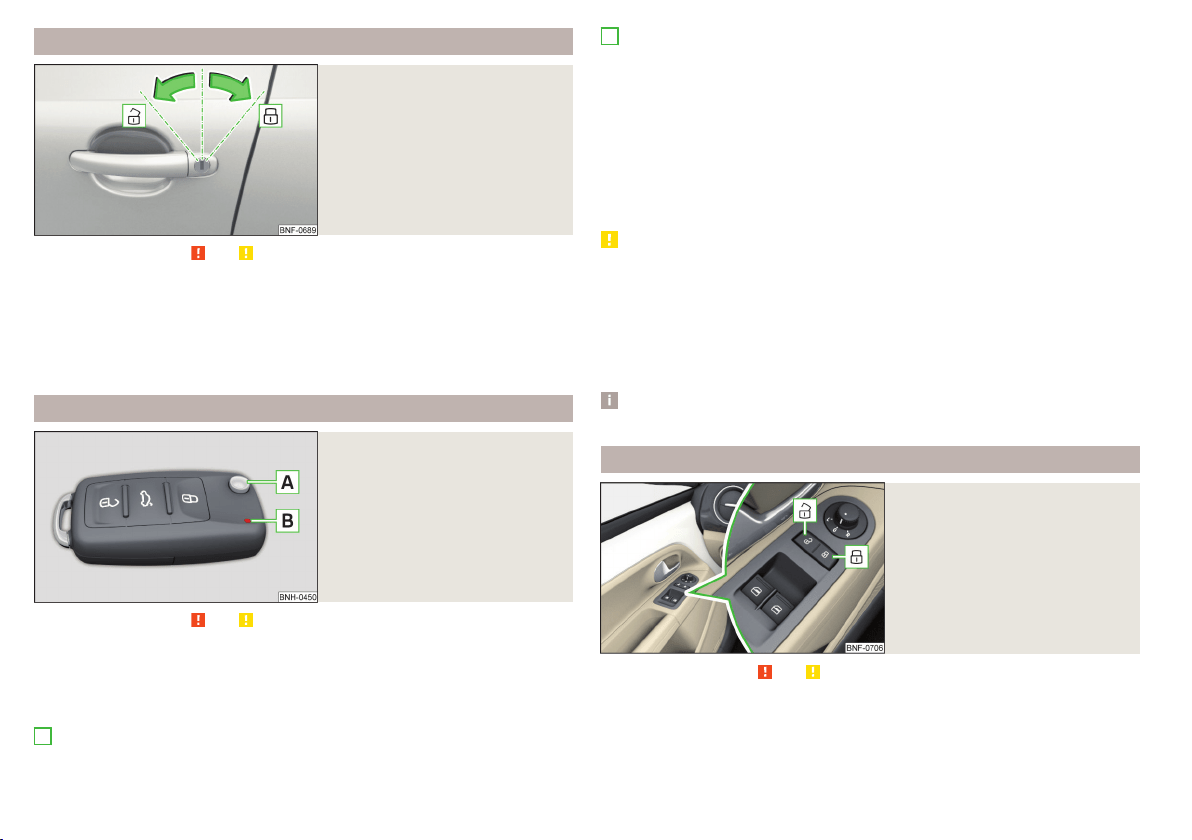
Unlock / lock using key and lock
Fig. 27
Left side of the vehicle: Turning
the key for unlocking and locking
the vehicle
Read and observe and on page 39 first.
The key allows you to unlock and lock the vehicle via the lock cylinder in the
driver's door.
Unlocking/locking the vehicle with the key » Fig. 27
Unlocking the vehicle
Locking the vehicle
Unlocking / locking with the remote control key
Fig. 28
Remote control key
Read and observe and on page 39 first.
Function and description of the key » Fig. 28
Unlocking the vehicle
Locking the vehicle
Unlocking the boot lid
Button for the extension / retraction of the key
A
Warning light for the battery charge status
If the red warning light does not flash when you press a button on the key,
the battery is discharged.
Unlocking / locking the boot lid
Bypressing briefly the symbol button
the boot lid unlocks.
Press and hold the symbol button
to release the lid (partially opened).
If the lid is unlocked or released with the symbol button
on the key, then
the lid is automatically locked after closing. You can set a lock delay
» page 43.
CAUTION
■
The operation of the remote control may temporarily be affected by signal in-
terference from transmitters close to the car and which operate in the same
frequency range.
■
The operating range of the remote control key is approx. 30 m. But this range
of the remote control can be reduced if the batteries are weak.
■
The battery must be replaced if the central locking does react to the remote
control at less than around 3 metres away » page 132.
Note
The remote control will operate only when the vehicle is within sight.
Locking / unlocking the vehicle with the central locking button
Fig. 29
Central locking button
Read and observe and on page 39 first.
When the vehicle has not been locked from the outside and no door is open
the button » Fig. 29can be used to unlock or lock the vehicle.
B
40
Using the system
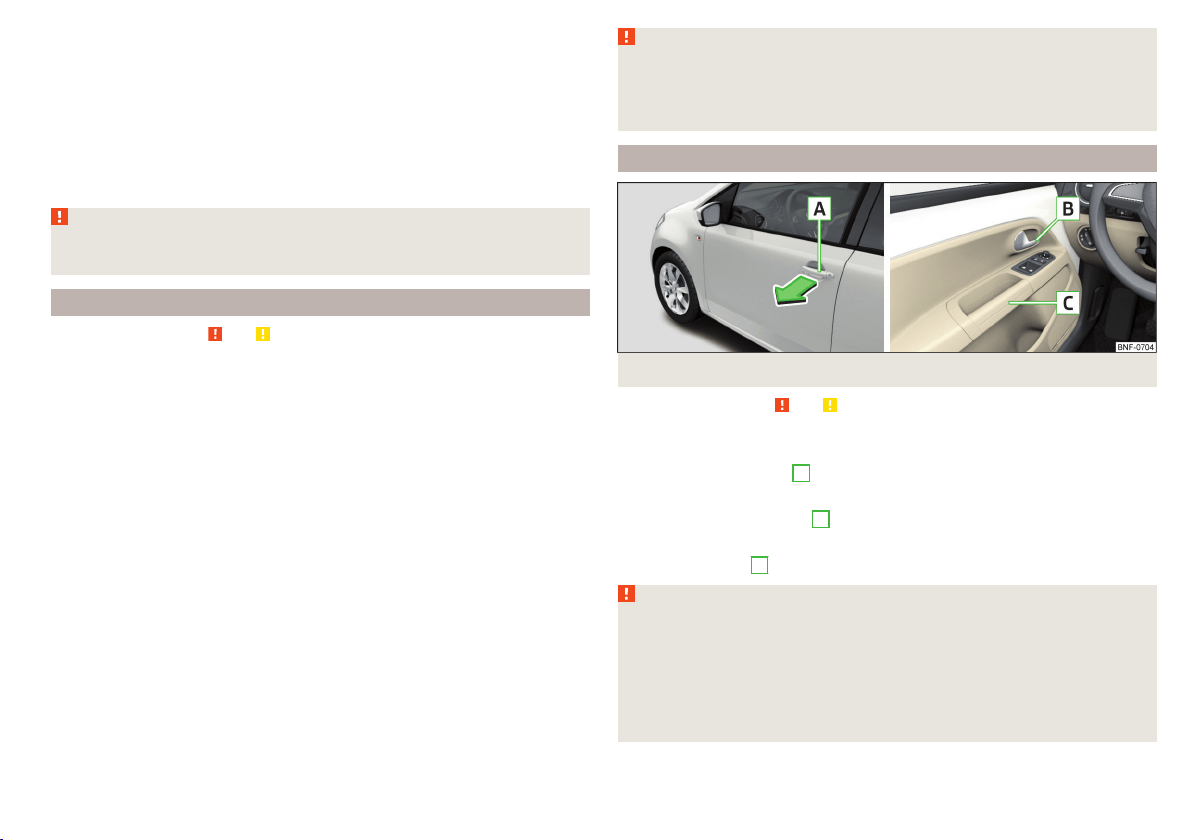
Unlocking / locking » Fig. 29
Locking
Unlocking
The central locking system also operates if the ignition is switched off.
The following applies after locking.
▶
Opening the doors and the boot lid from the outside is not possible.
▶
The doors can be unlocked and opened from the inside by a single pull on the
opening lever of the respective door.
WARNING
Doors locked from the inside make it difficult for rescuers to get into the
vehicle in an emergency – risk to life!
Safe securing system
Read and observe
and on page 39 first.
As soon as the vehicle has been locked from the outside, the Safelock system
prevents the doors from being opened from the inside.
You will be informed that the safelock system has been activated after the ve-
hicle has been locked by means of the message
on the instrument
cluster display.
After locking the vehicle, the warning light in the driver's door flashes for
around 2 seconds in quick succession, afterwards it begins to flash evenly at
longer intervals.
Switching off
▶
The safelock can be switched off by locking twice within 2 seconds.
The indicator light in the driver door flashes for about 2 seconds fast, goes out
and starts to flash at longer intervals after about 30 seconds.
If the vehicle is locked and the safe securing system is switched off, the door
can be opened separately from the inside by a single pull on opening lever.
The Safelock system switches back on when the vehicle is locked.
WARNING
If the car is locked and the safe securing system activated, no people must
remain in the car as it will then not be possible to either unlock a door or
open a window from the inside. The locked doors make it more difficult for
rescuers to get into the vehicle in an emergency – risk to life!
Opening/closing a door
Fig. 30 Door handle/door opening lever
Read and observe
and on page 39 first.
Opening from the outside
›
Unlock the vehicle.
›
Pull on the door handle
A
in the direction of the arrow » Fig. 30.
Opening from the inside
›
Pull on door opening lever
B
of the door and push the door away from you.
Closing from the inside
›
Grasp pull handle
C
and close the door.
WARNING
■
Make sure that the door has closed correctly as it can open suddenly
while driving – risk of death!
■
Only open and close the door when there is no one in the opening/closing
range – risk of injury!
■
An opened door can close automatically if there is a strong wind or the
vehicle is on an incline – risk of injury!
■
Never drive with the doors open - there is a risk of death!
41
Unlocking and opening

Door opening lever
Fig. 31 Door opening lever
Read and observe and on page 39 first.
On vehicles without central locking, you can lock and unlock doors which do
not have a locking cylinder from the inside.
Locking
›
Push the door opening lever in the direction of the arrow so that the red
marking
A
» Fig. 31 is visible.
Unlocking
›
Open the door by pulling the door opening lever once against the direction of
the arrow » Fig. 31 .
Child safety lock
Fig. 32 Rear door: Child safety lock switch on / off
Read and observe and on page 39 first.
The child safety lock prevents the rear door from being opened from the in-
side. The door can only be opened from the outside.
Child safety lock switch on / off » Fig. 32
Switching on
Switching off
You can switch the child safety lock on and off using the vehicle key.
Malfunctions
Read and observe and on page 39 first.
Central locking fault
If the warning light in the driver's door initially flashes quickly for around 2 sec-
onds, and then illuminates for 30 seconds without interruption before flashing
again slowly, you will need to seek the assistance of a specialist garage.
If there is a fault with the central locking system, only the driver's door can be
unlocked or locked with the key. The other doors and the boot lid can be man-
ually locked or unlocked.
▶
Locking the door » page 132.
▶
Unlocking the boot lid » page 133.
Key battery discharged
Replace the battery » page 132.
Luggage compartment lid
Introduction
This chapter contains information on the following subjects:
Opening/closing 43
Delayed locking of the boot lid
43
When closing the boot lid do not press on the rear window.
Ensure that the lock is properly engaged after closing the luggage compart-
ment lid.
The button in the boot lid is deactivated when the vehicle moves off or moves
at a speed above 9 km/h. The function is restored after the vehicle stops and
the door is opened.
42
Using the system
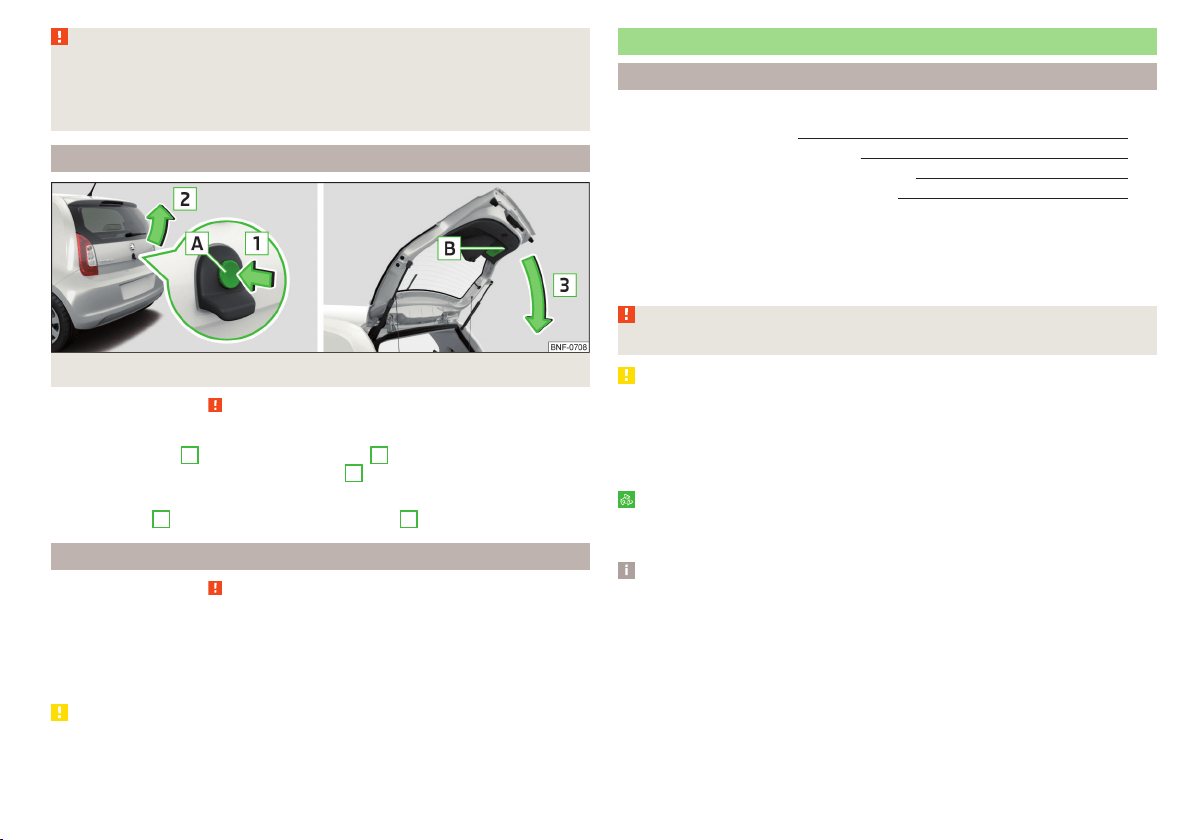
WARNING
■
Never drive with the luggage compartment lid open or ajar, as otherwise
exhaust gases may get into the interior of the vehicle – risk of poisoning!
■
Make sure that when closing the boot lid, no body parts are crushed -
there is danger of injury!
Opening/closing
Fig. 33 Opening / closing the boot lid
Read and observe
on page 43 first.
Opening
›
Press the button
A
in the direction of arrow
1
» Fig. 33.
›
Raise the lid in the direction of the arrow
2
.
Closing
›
Grasp recess
B
and pull in the direction of arrow
3
.
Delayed locking of the boot lid
Read and observe
on page 43 first.
If the boot lid is unlocked with the symbol button
on the key, then the boot
lid will automatically relock after closing.
The period after which the boot lid is locked automatically can be extended by
a specialist garage.
CAUTION
There is a risk of unwanted entry into the vehicle before the boot lid is locked
automatically. We therefore recommend locking the vehicle with the symbol
key
on the key.
Window operations
Introduction
This chapter contains information on the following subjects:
Mechanical window lifter
44
Electric WindowsElectric Windows 44
Open/close window in the passenger door 44
Manually opening/closing rear windows 45
The windows can be operated mechanically by the winder attached to the re-
spective door panel.
The windows in the front doors can be operated electrically from the driving
position.
WARNING
The windows should nevertheless be closed carefully – risk of injury!
CAUTION
■
If windows are frozen, always remove ice » page 98, Windows and external
mirrors before operating the electrical power windows. The window seals and
the electrical power window mechanism can otherwise be damaged.
■
Always make sure that the windows are closed when you leave the locked
vehicle.
For the sake of the environment
At high speeds you should keep the windows closed to prevent unnecessarily
high fuel consumption.
Note
When driving always use the existing heating, air conditioning and ventilation
system for ventilating the interior of the vehicle. If the windows are open, dust
as well as other dirt can get into the vehicle and in addition the wind noise is
more at certain speeds.
43
Unlocking and opening
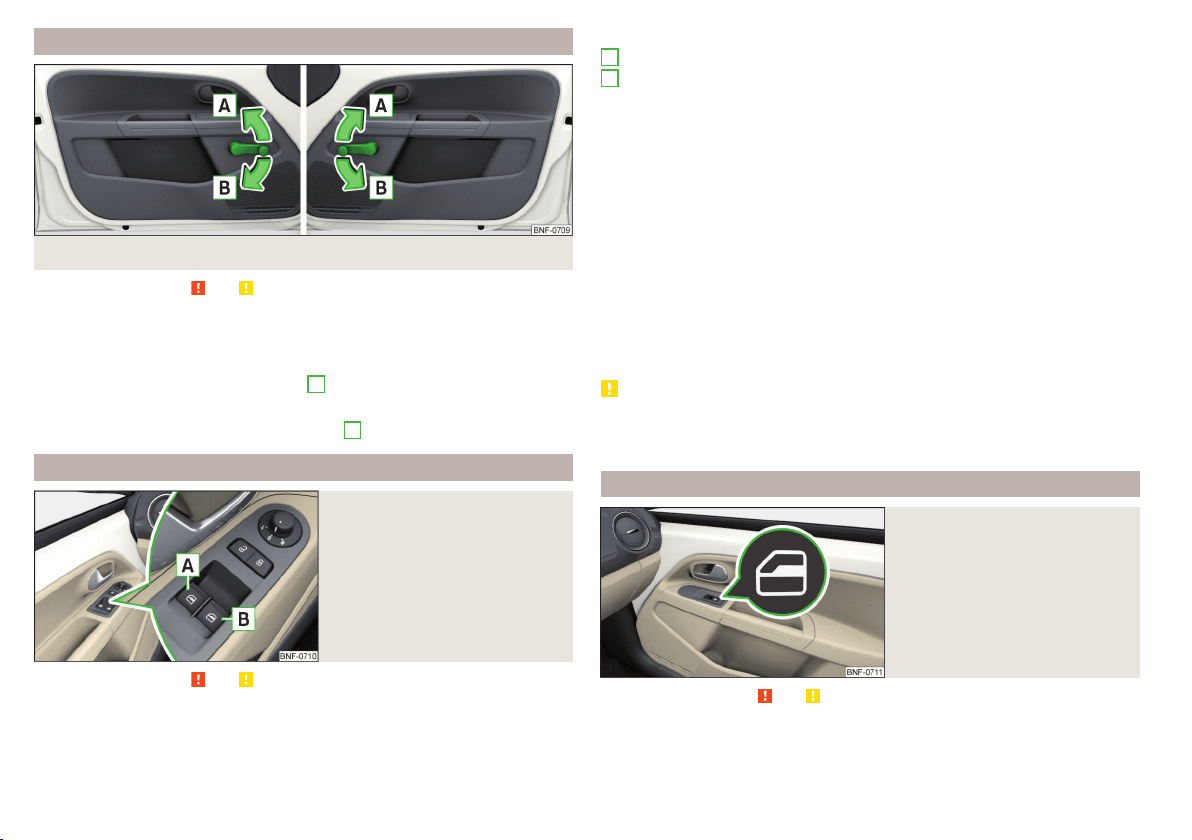
Mechanical window lifter
Fig. 34 Window operation: left / right
Read and observe
and on page 43 first.
Using the respective window crank only one window can be operated mechan-
ically.
Opening
›
Lift the crank in the direction of arrow
A
» Fig. 34.
Closing
›
Turn the crank in the direction of the arrow
B
» Fig. 34.
Electric WindowsElectric Windows
Fig. 35
Buttons for window levers
Read and observe and on page 43 first.
The electrical power windows can only be operated when the ignition is
switched on.
The windows in the front doors can be operated from the driving position.
Power window buttons » Fig. 35
Front door left
Front door right
Opening
›
Lightly press the appropriate button down and hold it until the window has
moved into the desired position.
Releasing the button causes the window to halt immediately.
Closing
›
Pull gently on the top edge of the corresponding button and hold until the
window has moved into the desired position.
Releasing the button causes the window to halt immediately.
The window lift mechanism is protected against overheating. Repeated open-
ing and closing of the window can cause this mechanism to overheat. If this
happens, it will not be possible to operate the window for a short time. You
will be able to operate the window again as soon as the overheating protec-
tion has cooled down.
CAUTION
■
Keep the windows clean to ensure the correct functionality of the electric
windows.
■
Always close the windows before disconnecting the battery.
Open/close window in the passenger door
Fig. 36
Power window button
Read and observe and on page 43 first.
The button in the front passenger door is only for that window.
A
B
44
Using the system
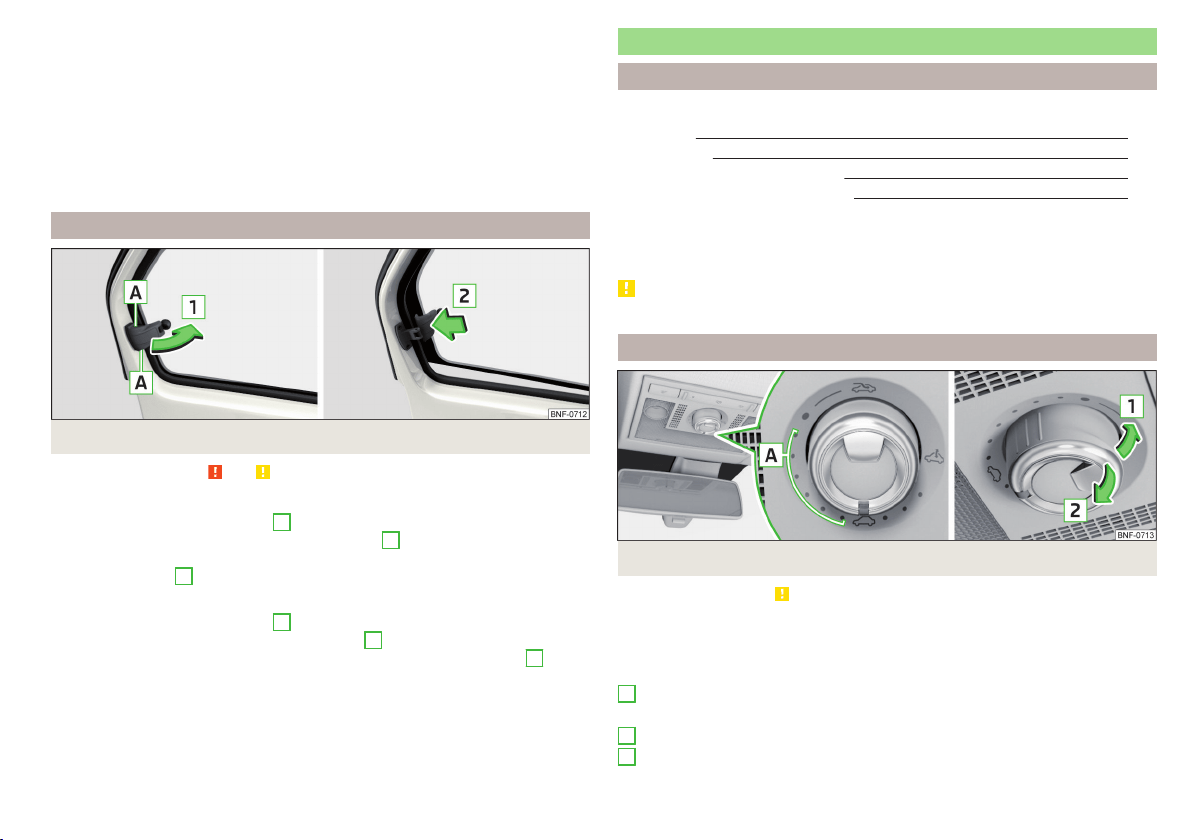
Opening
›
Lightly press the button down and hold it until the window has moved into
the desired position.
Releasing the button causes the window to halt immediately.
Closing
›
Pull gently on the top edge of the button and hold until the window has
moved into the desired position.
Releasing the button causes the window to halt immediately.
Manually opening/closing rear windows
Fig. 37
Opening/closing rear windows
Read and observe and on page 43 first.
Opening
›
Grasp the safety lock in recess
A
» Fig. 37 .
›
Open the window in the direction of the arrow
1
.
›
Lock the window in the opened position by pressing the safety lock in the di-
rection of arrow
2
until it clicks into place.
Closing
›
Grasp the safety lock in recess
A
.
›
Pull the safety lock in the direction of arrow
1
.
›
Close the window in the initial position in the direction of the arrow
2
until
the safety lock audibly latches.
Panorama sliding/tilting roof
Introduction
This chapter contains information on the following subjects:
Operation
45
Force limiter 46
Sliding / tilting roof malfunction 46
Manual operation of the sunblind 46
The panorama sliding/tilting roof (hereinafter referred to as 'sliding/tilting
roof') can only be operated when the ignition is turned on and when the out-
door temperature is no lower than -20 °C.
CAUTION
Always close the sliding/tilting roof before disconnecting the battery.
Operation
Fig. 38
Operation of the sliding/tilting roof
Read and observe on page 45 first.
The sun roof can be operated with the rotary switch.
Operation of the sliding/tilting roof
Open fully
Open partially
Comfort position
Opening (switch in position
)
Closing (switch in position
)
A
1
2
45
Unlocking and opening
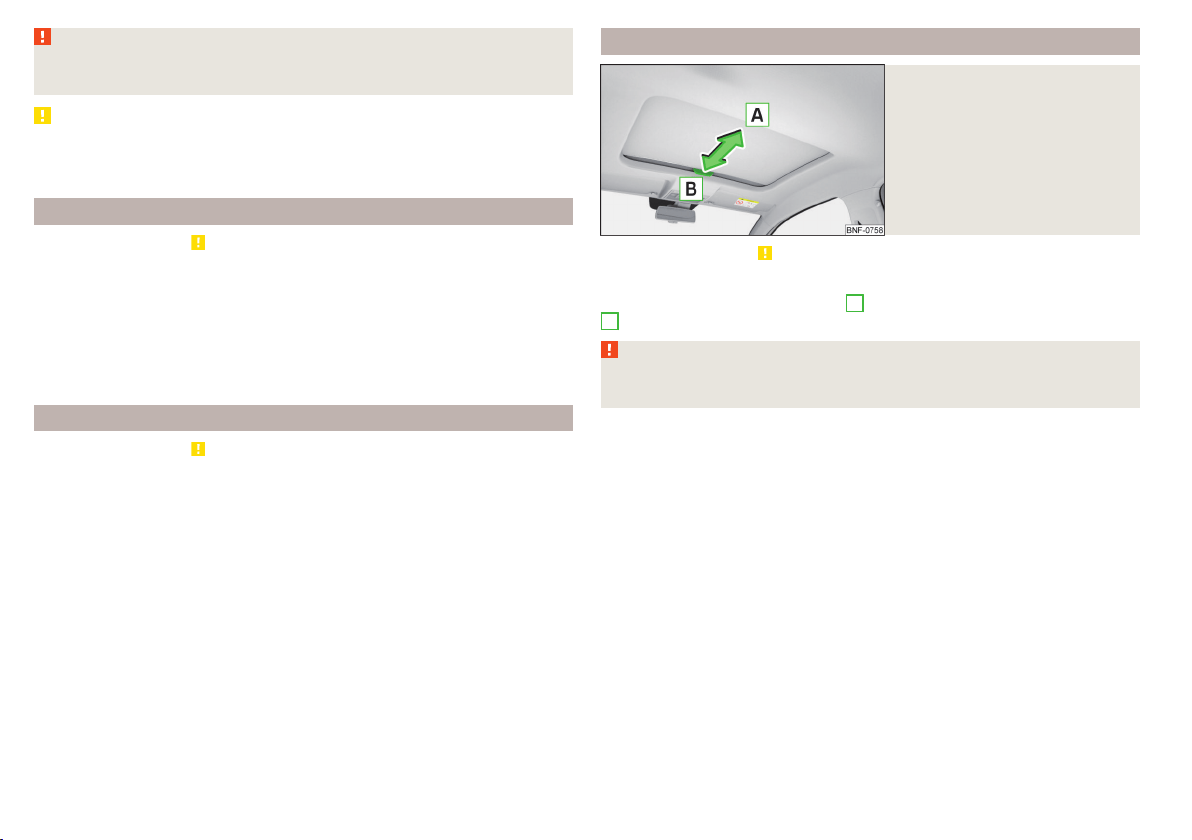
WARNING
Be careful when operating the sliding/tilting roof to avoid crushing injuries
– risk of injury!
CAUTION
During the winter it may be necessary to remove any ice and snow in the vicin-
ity of the sliding/tilting roof before opening it to prevent any damage to the
opening mechanism.
Force limiter
Read and observe
on page 45 first.
The sliding/tilting roof is fitted with a force limiter.
The sliding/tilting roof stops and moves back several centimetres when it can-
not be closed because there is something in the way (e.g. ice).
The sliding/tilting roof only closes without the force limiter activated at the
third attempt at closing. The time interval between the individual closing at-
tempts should not exceed 5 s - the sliding/tilting roof closes with full force!.
Sliding / tilting roof malfunction
Read and observe on page 45 first.
If the battery has been disconnected and reconnected, it is possible that the
sliding/tilting roof will not operate. The sun roof must be activated.
Activation sequence
›
Switch on the ignition.
›
Set the switch to the position
» Fig. 38 on page 45 .
›
Press the switch on the recess E down and pull forwards.
›
The sliding/tilting roof opens and closes again after around 10 seconds.
›
Release the lever.
Manual operation of the sunblind
Fig. 39
Operation of the sunblind
Read and observe on page 45 first.
The sunblind for the sliding/tilting roof is opened manually by pulling up on the
handle in the direction of the arrow
A
and closed in the direction of the arrow
B
» Fig. 39.
WARNING
Operate the sunblind with care to avoid causing crushing injuries – risk of
injury!
46
Using the system
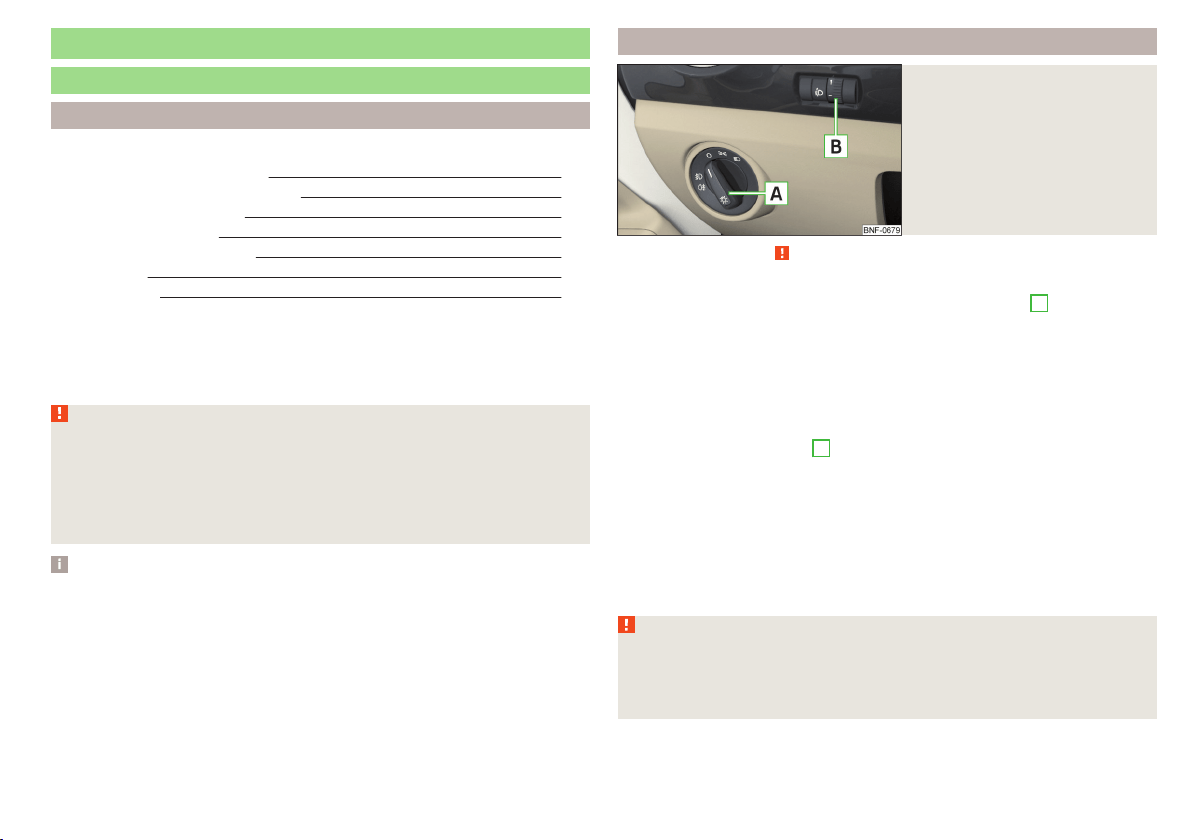
Lights and visibility
Lights
Introduction
This chapter contains information on the following subjects:
Operation of the light function 47
Daylight running lights (DAY LIGHT) 48
Turn signal and main beam 48
Front and rear fog light 49
Hazard warning light system 49
Parking light 49
Driving abroad 50
Unless otherwise stated, the lights only work when the ignition is on.
The arrangement of the controls right-hand drive models may differ from the
layout shown in » Fig. 40 on page 47. The symbols which mark the positions
of the controls are identical.
WARNING
■
The driver is always responsible for the correct settings and use of the
lights.
■
Never drive with only the side lights on! The side lights are not bright
enough to light up the road sufficiently in front of you or to be seen by oth-
er oncoming traffic. Therefore always switch on the low beam when it is
dark or if visibility is poor.
Note
■
The instruments are also illuminated when the side light or low beam light is
switched on.
■
The headlights may mist up temporarily. When the driving lights are switched
on, the light outlet surfaces are free from mist after a short period, although
the headlight lenses may still be misted up in the peripheral areas. This mist
has no influence on the life of the lighting system.
Operation of the light function
Fig. 40
Light switch / Knob for headlamp
beam adjustment
Read and observe on page 47 first.
Switching lights on and off
Depending on the equipment configuration, the light switch
A
» Fig. 40 can
be turned to one of the following positions.
Switching off lights (except daytime running lights)
Switch on daytime running lights and side lights or parking lights
» page 49
Turn on the low beam
Headlight range control
By turning the rotary switch
B
» Fig. 40 from position
to
, the headlight
range control is gradually adjusted, thereby shortening the light cone.
The positions of the width of illumination correspond approximately to the fol-
lowing car load.
Front seats occupied, boot empty
All seats occupied, boot empty
All seats occupied, boot loaded
Driver seat occupied, boot loaded
WARNING
Always adjust the headlight beam to meet the following conditions.
■
The vehicle does not dazzle other road users, especially oncoming vehi-
cles.
■
The beam range is sufficient for safe driving.
47
Lights and visibility
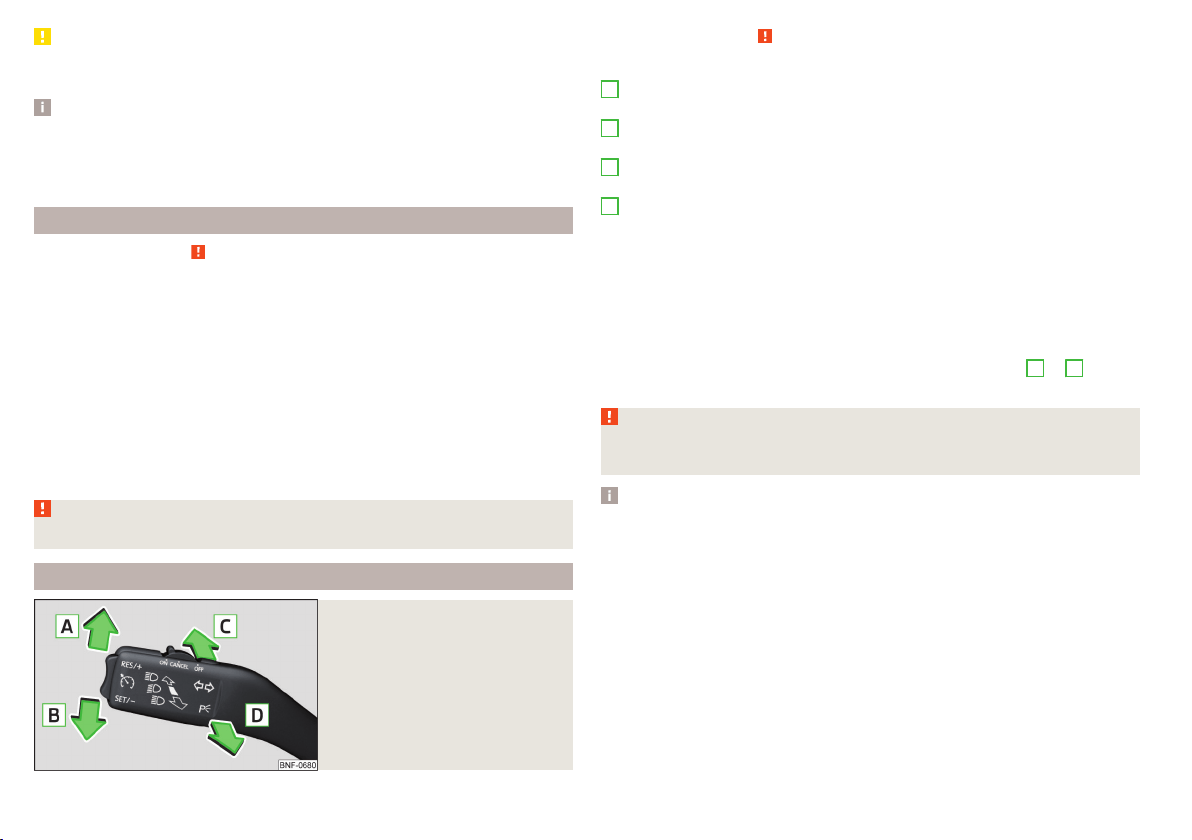
CAUTION
If leaving the vehicle without needing the parking lights on, always turn the
light switch to position .
Note
If the light switch is in the position , the ignition key is removed and the
driver's door is open, an audible warning signal will sound. The audible warning
signal is switched off when the driver's door is closed, however the side lights
remain on to illuminate the parked vehicle if necessary.
Daylight running lights (DAY LIGHT)
Read and observe on page 47 first.
The daytime running lights light up the area in front of and to the rear of the
vehicle (only applicable for some countries).
The daytime running lights are switched on automatically if the following
conditions are met.
The ignition is switched on.
The light switch is in the position
or
.
The light switch is in position
and the fog lights are turned on, the daytime
running lights will turn off.
The light switch is in position
, the lighting of the instrument cluster is switch-
ed off.
WARNING
Always switch on the low beam when visibility is poor.
Turn signal and main beam
Fig. 41
Operating lever: Turn signal and
main beam operation
Read and observe on page 47 first.
Control lever positions » Fig. 41
When the right turn signal light is switched on, the warning light flashes in
the instrument cluster
When the left turn signal light is switched on, the warning light flashes in
the instrument cluster
Switch on main beam (spring setting) - the warning light illuminates in the
instrument cluster
Switching off main beam / switching on headlamp flasher (spring-loaded
position)
The main beam can only be switched on when the low beam lights are on.
The headlight flasher can be operated even if the ignition is switched off.
The turn signal light switches itself off automatically when driving around a
curve or after making a turn.
“Convenience turn signal”
When the control lever is lightly pressed to the pressure point
A
or
B
then
the respective turn-signal lamp flashes three times.
WARNING
Only turn on the main beam or the headlight flasher if other road users will
not be dazzled.
Note
An acoustic warning signal will sound when the driver's door is opened if the
lever is not in the middle position after removing the ignition key from the igni-
tion lock. The acoustic warning signal will stop just as soon as the driver's door
is closed.
A
B
C
D
48
Using the system
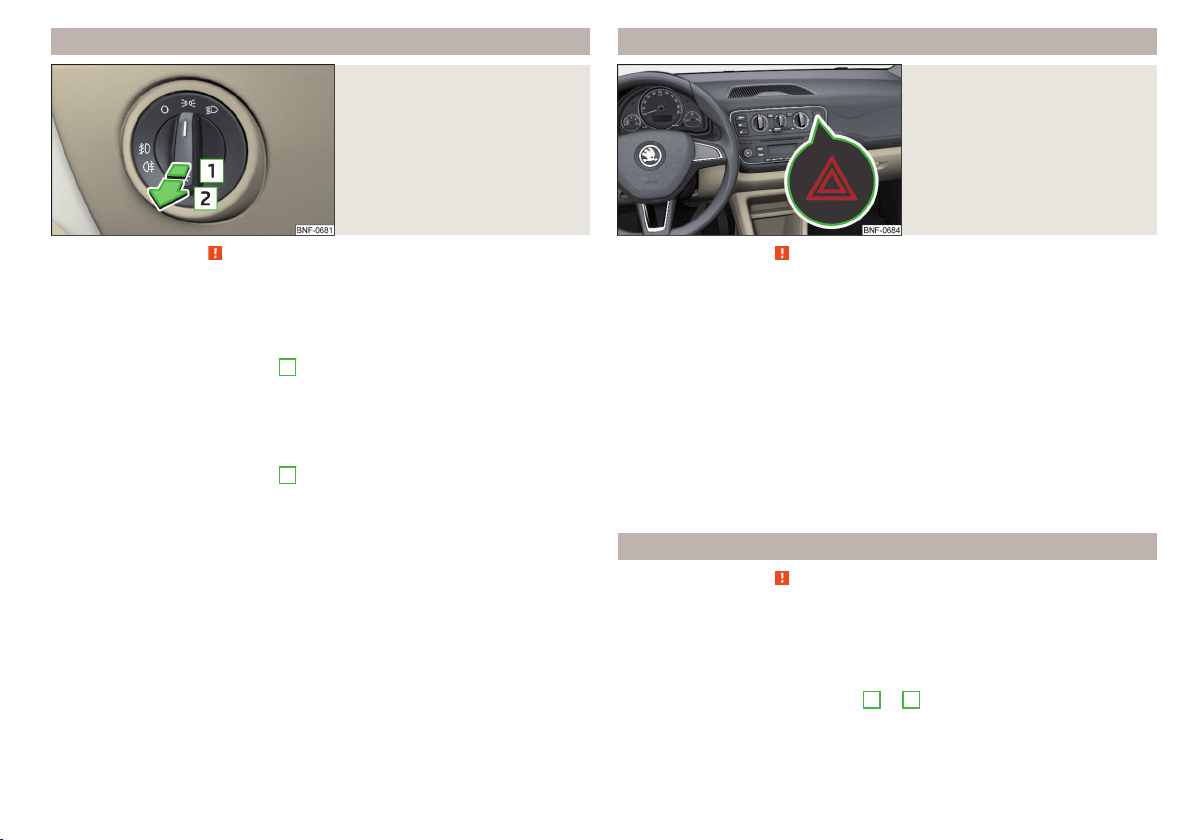
Front and rear fog light
Fig. 42
Light switch - switch on front
and rear fog light
Read and observe on page 47 first.
Depending on the equipment configuration, the fog lights and the rear fog
lamp can be switched on.
Turn fog lights on / off
›
Turn the light switch » Fig. 42 to position
or
.
›
Pull the light switch to position
1
; the indicator lamp
in the light switch
lights up.
The fog light is switched off in the reverse order.
Turn rear fog lamp on / off
›
Turn the light switch » Fig. 42 to position
or
.
›
Pull the light switch to position
2
; the indicator lamp
in the light switch
lights up.
The rear fog light is switched off in the reverse order.
If the vehicle is not fitted with fog lights, the rear fog light is switched on by
pulling out the light switch directly to the only possible setting.
Hazard warning light system
Fig. 43
Button for hazard warning light
system
Read and observe on page 47 first.
The hazard warning lights make other road users aware of your vehicle.
The function switches the flashing light on the left and a right side of the vehi-
cle.
Switching on/off
›
Press the button
» Fig. 43.
When you turn it on the warning light
flashes in the button and at the same
time the warning lights
in the instrument cluster.
The hazard warning light system can also be operated if the ignition is switch-
ed off.
If one of the airbags is deployed, the hazard warning light system will switch
on automatically.
Parking light
Read and observe
on page 47 first.
The side light is provided for lighting of the parked vehicle.
The function switches on the side lights.
Switching on the side light on one side
›
Switch off the ignition.
›
Place the control lever to position
A
or
B
as far as the stop » Fig. 41 on
page 48.
The side lights on the right or left side of the vehicle are turned on.
49
Lights and visibility
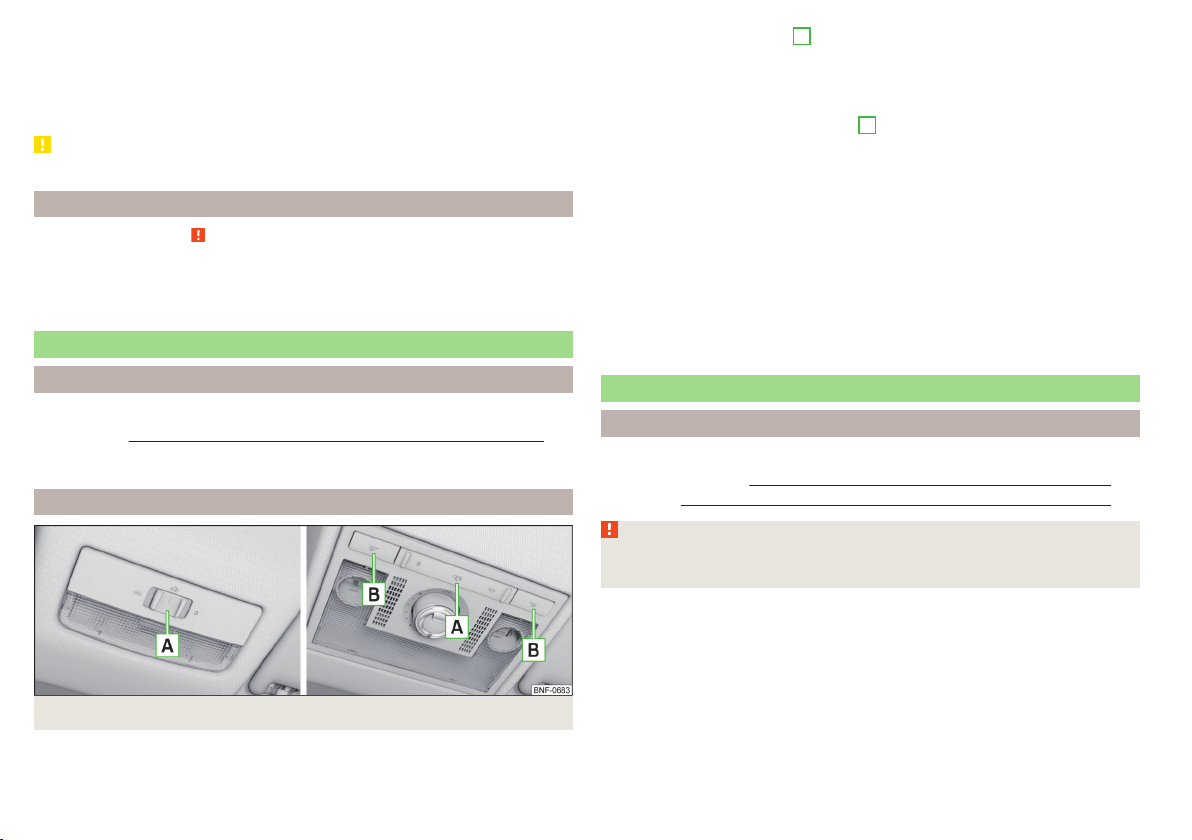
Switching on the side light on both sides
›
Turn the light switch » Fig. 42 on page 49 to position and lock the vehicle.
After pulling out the ignition key and opening the driver's door, an audible
warning sounds. After a few seconds or after closing the driver's door, the au-
dible alarm is turned off, but the parking lights will remain switched on.
CAUTION
Turning on the parking light means the battery is heavily loaded.
Driving abroad
Read and observe on page 47 first.
When driving in countries with opposing traffic system (traffic on the
left/right), your headlights may dazzle oncoming traffic. In order to avoid this,
the headlights must be adjusted at a specialist garage.
Indoor Lighting
Introduction
This chapter contains information on the following subjects:
Interior light
50
With the ignition off, the light turns off automatically after about 10 minutes.
Interior light
Fig. 44 Interior lighting: Version 1/version 2
Position of the light switch
A
» Fig. 44
Switching on
Automatic operation (centre position)
Switching off
Switch for turning the reading lights
B
on / off » Fig. 44
Reading lamp left
Reading lamp right
Automatic operation of the lamp - position
The system is turned on when any of the following is present.
▶
The vehicle is unlocked.
▶
One of the doors is opened.
▶
The ignition key is removed.
The system is turned off when any of the following is present.
▶
The vehicle is locked.
▶
The ignition is switched on.
▶
About 30 seconds after all the doors have been closed.
Visibility
Introduction
This chapter contains information on the following subjects:
Rear window heater
51
Sun visors 51
WARNING
Make sure that the view outside is not hindered by ice, snow, mist or other
objects.
50
Using the system
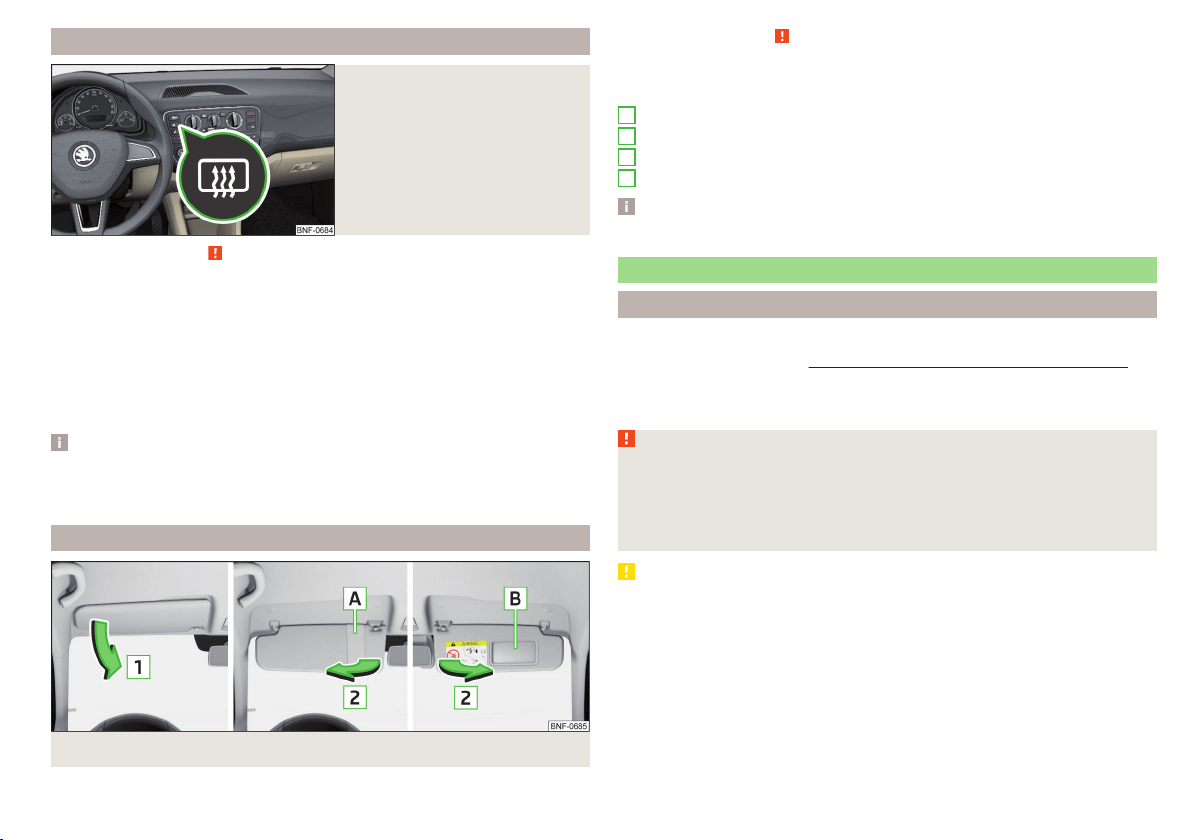
Rear window heater
Fig. 45
Button for rear window heater
Read and observe on page 50 first.
The heater allows rapid defrosting and ventilation of the rear window.
Button for the heating in the centre console » Fig. 45
Switching the rear window heater on/off
When the heater is switched on, a lamp illuminates inside the button.
The heating only works when the engine is running.
The heater automatically switches off after approximately 10 minutes.
Note
If the on-board voltage drops, the heater switches off automatically, in order
to provide sufficient electrical energy for the engine control » page 115, Auto-
matic load deactivation.
Sun visors
Fig. 46 Sun visor: Driver's side/front passenger's side
Read and observe on page 50 first.
The sun visors protect against glare.
Operation and description of the sun visor » Fig. 46
Fold down the cover
Swivel cover towards the door
Parking ticket band (if part of the specification)
Make-up mirrors
Note
A make-up mirror can also be installed in the driver's sun visor.
Windscreen wipers and washers
Introduction
This chapter contains information on the following subjects:
Operate wiper and washer 52
The windscreen wipers and the windscreen washer system only operate if the
ignition is switched on.
WARNING
■
Properly maintained windscreen wiper blades are essential for clear visi-
bility and safe driving » page 133.
■
Do not use the windscreen washer system at low temperatures, without
heating the windscreen beforehand. The window washer fluid could other-
wise freeze on the windscreen and restrict the view to the front.
CAUTION
■
In cold temperatures and during the winter, check before switching on the
ignition that the wiper blades are not frozen to the windscreen. If the wind-
screen wipers are switched on when the blades are frozen to the windscreen,
this may damage both the blades and windscreen wiper motor!
■
Carefully peel frozen wiper blades off the pane.
■
Remove snow and ice from the windscreen wipers before driving.
■
If the windscreen wipers are handled carelessly, there is a risk of damage to
the windscreen.
1
2
A
B
51
Lights and visibility
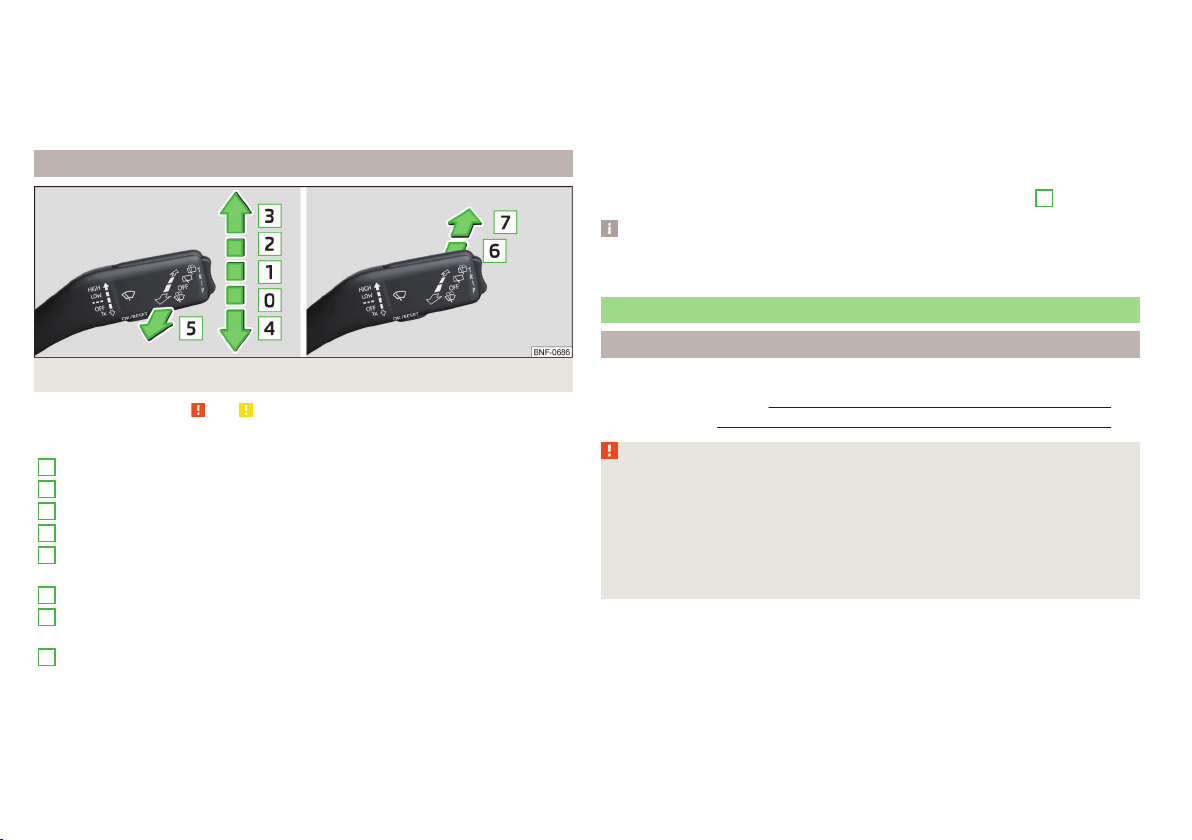
■
Do not switch on the ignition if the front wiper arms are retracted. The wiper
arms could damage the paint of the bonnet.
■
If there is an obstacle on the windscreen, the wiper will try to push away the
obstacle. If the obstacle continues to block the wiper, the wiper stops in order
to avoid damaging the wiper. Remove the obstacle and switch the wiper on
again.
Operate wiper and washer
Fig. 47
Operation of the front / rear wipers and washers
Read and observe and on page 51 first.
Lever positions
0
Wipers off
1
Interval windscreen wiping
2
Slow windscreen wiping
3
Rapid windscreen wiping
4
Flick windscreen wiping, service position of the wiper arms
» page 133, (spring-loaded position)
5
Spraying and wiping the windscreen (sprung position)
6
Wiping the rear window pane (the windscreen wiper wipes at regu-
lar intervals after a few seconds)
7
Spraying and wiping the rear window (sprung position)
Spraying and wiping the windscreen
The wash system operates immediately, the windscreen wipers wipe some-
what later.
Letting go of the operating lever will cause the windscreen wash system to
stop and the wipers to continue for another 1-3 wiper strokes (depending on
the spraying duration).
Spraying and wiping the rear window (sprung position)
The wash system operates immediately, the windscreen wiper wipes some-
what later.
Letting go of the operating lever will cause the windscreen wash system to
stop and the wiper to continue for another 1-3 wiper strokes (depending on
the spraying duration). The operating lever remains in position
6
.
Note
The rear window is wiped once automatically if the windscreen wipers are on
when reverse gear is selected.
Rear mirror
Introduction
This chapter contains information on the following subjects:
Interior mirror dimming 53
Exterior mirrors
53
WARNING
■
Make sure that the mirrors are not covered.
■
Convex (curved outward) or aspheric exterior mirrors increase the field of
vision. They do, however, make objects appear smaller in the mirror. These
mirrors are therefore only of limited use for estimating distances to the fol-
lowing vehicles.
■
Whenever possible use the interior mirror for estimating the distances to
the following vehicles.
52
Using the system

Interior mirror dimming
Fig. 48
Adjusting the rear view mirror
Read and observe on page 52 first.
Mirror adjustment positions » Fig. 48
Basic position of the mirror
Mirror blackout
Exterior mirrors
Fig. 49 Side door - knob for the exterior mirror: mechanical / electrical
Read and observe on page 52 first.
Adjust the position
By moving the rotary knob in the direction of the arrow, the mirror surface can
be adjusted to the desired position » Fig. 49 -
/
.
The movement of the mirror surface is identical to the movement of the rotary
knob.
A
B
Electrically-adjustable mirrors
The knob can be moved into the following positions » Fig. 49 - .
Adjust the left mirror
Adjust the right mirror
Switch off mirror control
Mirror heater
The mirror heating only works when the engine is running.
Folding in the exterior mirrors
The whole exterior mirror can be manually folded towards the side windows.
To put it back into its original position, it should be folded back from the side
window until it audibly clicks into place.
WARNING
Do not touch the exterior mirror surfaces, if the exterior mirror heating is
switched on - hazard of burning.
CAUTION
If the electrical mirror setting fails at any time, the mirrors can be adjusted by
hand by pressing on the edge of the mirror surface.
53
Lights and visibility
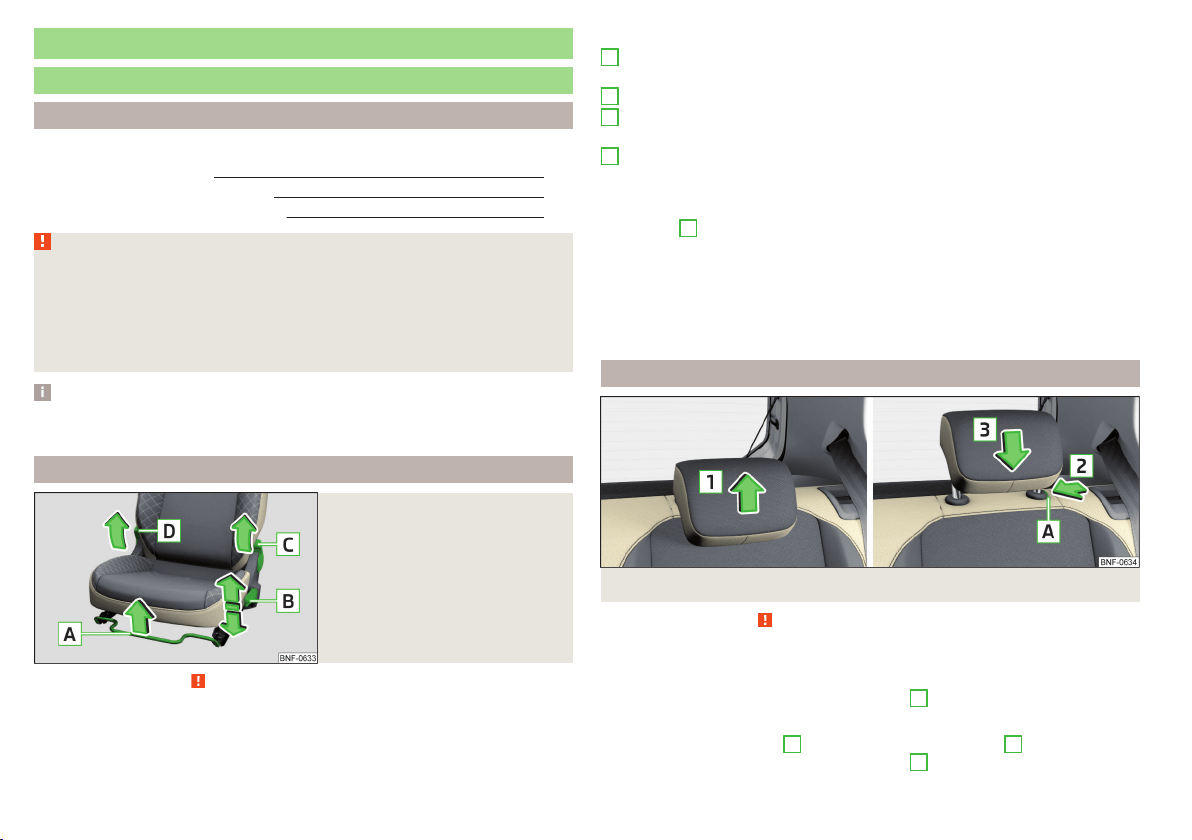
Seats and head restraints
Seats and head restraints
Introduction
This chapter contains information on the following subjects:
Adjusting the front seats 54
Head restraints - adjusting height 54
Headrests - removing and installing 55
WARNING
■
Only adjust the driver's seat when the vehicle is stationary – risk of acci-
dent!
■
Caution when adjusting the seat! You may suffer injuries or bruises as a
result of adjusting the seat without paying proper attention.
■
Do not carry any objects on the front passenger seat except objects de-
signed for this purpose (e.g. child seat) – risk of accident!
Note
After a certain time, play can develop within the adjustment mechanism of the
backrest angle.
Adjusting the front seats
Fig. 50
Driver's seat controls
Read and observe on page 54 first.
The seats can be adjusted by pulling or pressing the controls for the seat in
question in the direction of the arrows.
Driver's seat controls » Fig. 50
Adjusting the seat in the longitudinal direction (after releasing the control
lever, locking must be audible)
Adjusting the seat height
Adjusting the tilt of the backrest (do not lean on the backrest when ad-
justing)
Adjust the tilt of the seat back (seats with Easy Entry System)
On the passenger seat, some controls are arranged in mirror image.
Fold forward and slide seat using the Easy Entry System
›
Pull lever
D
» Fig. 50 and fold the seat backrest forwards.
›
At the same time, move the seat forwards.
Restore position of the seat with Easy Entry System
›
Push the seat backwards again to its original position.
›
Fold the seat backrest back.
The seat back must lock audibly - check by pulling on the seat back.
Head restraints - adjusting height
Fig. 51 Rear head restraints: move up / move down
Read and observe
on page 54 first.
Only the rear head restraints can be removed.
Shift upwards
›
Push the headrest in the direction of arrow
1
» Fig. 51.
Move down
›
Press the locking button
A
and hold it in arrow direction
2
» Fig. 51.
›
Push the headrest in the direction of arrow
3
.
A
B
C
D
54
Using the system
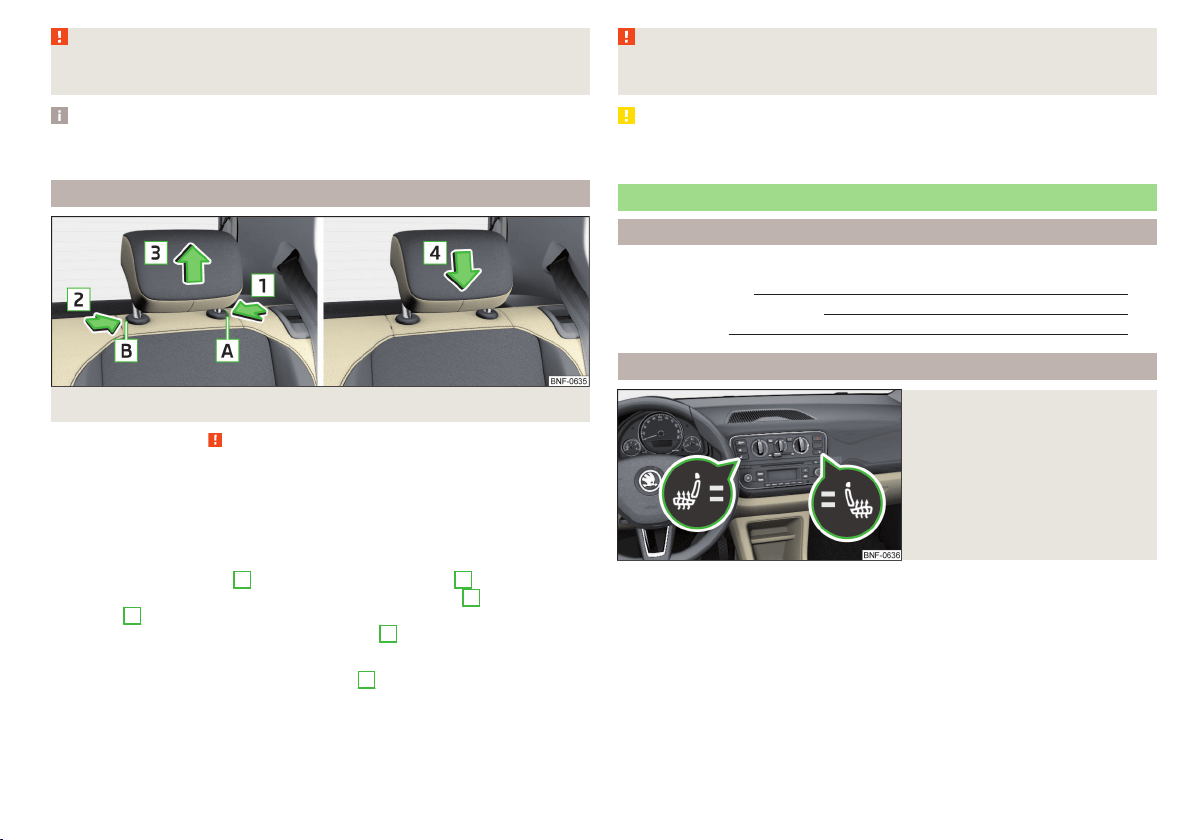
WARNING
Please note the following points about the head restraint settings
» page 8, Correct and safe seated position.
Note
The front headrests are integrated into the seat backrests and cannot be ad-
justed in height.
Headrests - removing and installing
Fig. 52 Removing / installing rear head restraints
Read and observe on page 54 first.
Only the real head restraints may be removed or installed.
Before removal and installation of the head restraints, fold the respective seat
backrest forward slightly » page 57.
Removal
›
Pull the head restraint out of the seat backrest as far as the stop.
›
Press the locking button
A
and hold it in arrow direction
1
» Fig. 52.
›
Use the vehicle key to press the locking button in opening
B
in the direction
of arrow
2
.
›
Remove the restraint in the direction of arrow
3
.
Installing
›
Push the restraint in the direction of arrow
4
until the locking button en-
gages » Fig. 52,
WARNING
Please note the following points about the head restraint settings
» page 8, Correct and safe seated position.
CAUTION
Store the removed head restraints in a clean and secure place (to avoid dam-
age or soiling).
Seat features
Introduction
This chapter contains information on the following subjects:
Front seat heating
55
Folding front passenger seat 56
Seat backrests 57
Front seat heating
Fig. 53
Buttons for heating the front
seats
The seat backrests and seats can be heated electrically.
The seat heating can only be switched on when the engine is running.
Buttons for the seat heating » Fig. 53
Left seat heating
Right seat heating
Switching on
›
Press the corresponding symbol button
or
» Fig. 53.
Pressing once switches the seat heating on at its maximum level - Level 2.
55
Seats and head restraints
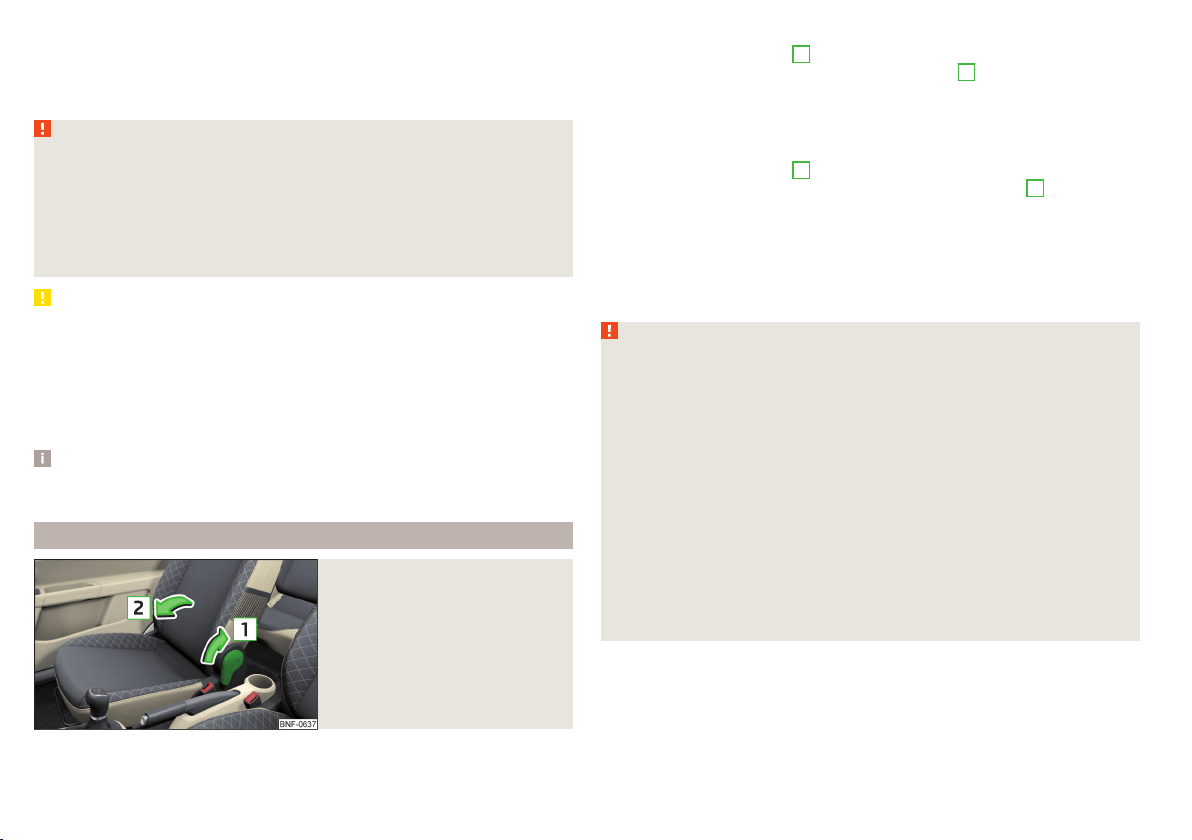
With repeated pressing of the switch, the intensity of the heating is reduced
until it is switched off.
The level of the seat heating is indicated by the number of illuminated warning
lights in the switch.
WARNING
If you have impaired sensitivity to pain and/or temperature, e.g. through
medication, paralysis or because of chronic illness (e.g. diabetes), we rec-
ommend not to use the seat heating. There is a possibility of suffering from
difficult to heal burns. If the seat heating is used, we recommend to make
regular breaks in your journey when driving long distances, so that the
body can recuperate from the stress of the journey. Please consult your
doctor, who can evaluate your specific condition.
CAUTION
The following instructions should be observed to avoid damage to the seats.
■
Do not kneel on the seats or otherwise apply concentrated pressure to them.
■
Do not turn on the seat heating for any seats that are not occupied.
■
Do not switch on the seat heating if the seat in question has objects attach-
ed to or placed on it, for example a child seat, a bag, etc.
■
Do not switch on the seat heating if the seat in question has additional pro-
tective covers or protective covers on it
Note
If the on-board voltage decreases, the seat heating switches off automatically
» page 115, Automatic load deactivation.
Folding front passenger seat
Fig. 54
Folding the front passenger seat
forward
The front passenger seat can be folded forward into a horizontal position.
Folding forward
›
Place the lever in position
1
» Fig. 54.
›
Remove the seat rest in the direction of the arrow
2
.
The locking mechanism must audibly snap into place.
›
Slide the seat forwards up to the stop.
Folding backwards
›
Place the lever in position
1
» Fig. 54.
›
Fold the seat backrest in the opposite direction of the arrow
2
.
The locking mechanism must audibly snap into place.
›
Move the seat backwards until the stop.
When fitted with the Easy Entry system and the memory function, the seat
adopts the position set when moving backwards which was set when the seat
backrest was folded forwards.
WARNING
■
The front passenger airbag should be switched off when transporting ob-
jects on the seat backrest that has been folded forwards » page 18.
■
Only adjust the seat backrest when the vehicle is stationary.
■
When moving the seat backrest, make sure that the seat backrest has
been properly secured – check by pulling on the seat backrest.
■
If the seat backrest is folded, passengers may only be transported on the
outer seat behind the driver.
■
When moving the seat backrest, keep limbs out of the area between the
seat and seat backrest – risk of injury!
■
Never transport the following items on the seat backrest when folded
forwards.
■
Objects that could restrict the driver's view.
■
Objects which make it impossible for the driver to control the vehicle,
e.g. if they roll under the pedals, or could protrude into the driver's zone.
■
Objects which could lead to injury to passengers due to a change of di-
rection or braking manoeuvre when accelerating sharply.
56
Using the system
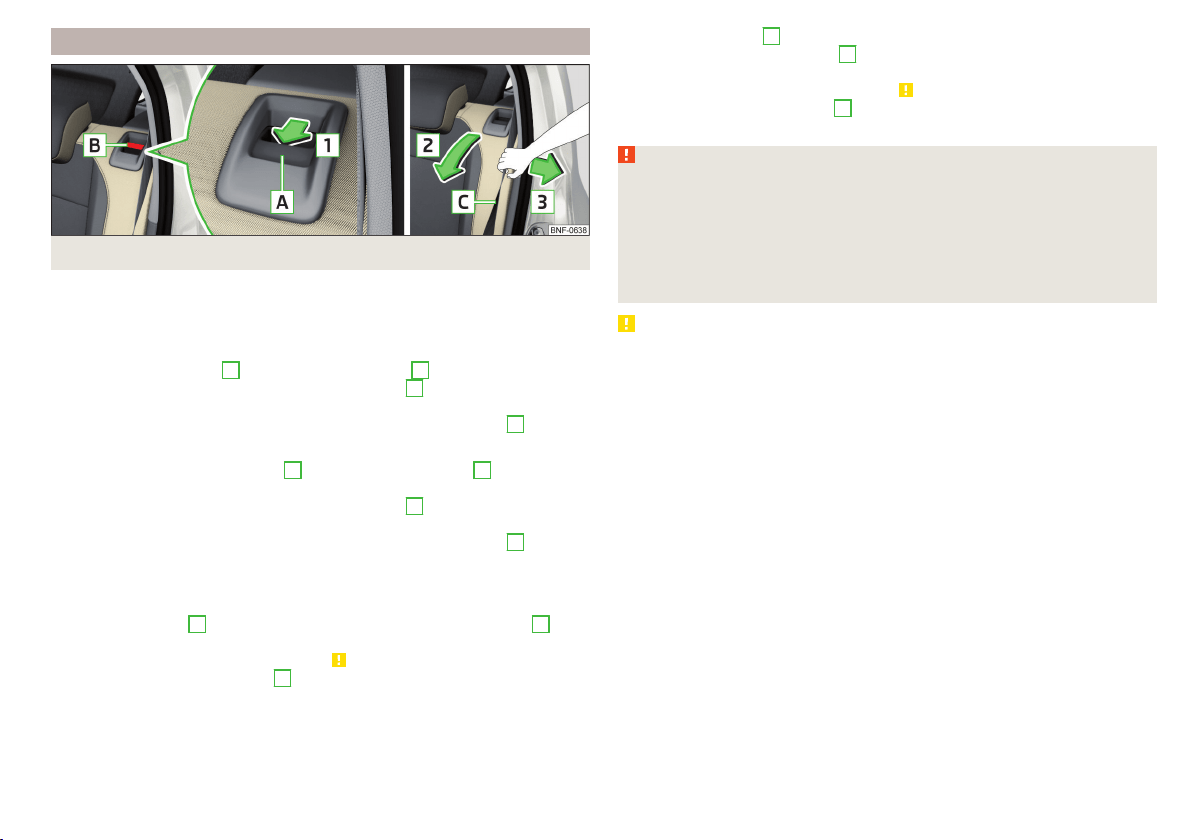
Seat backrests
Fig. 55 Folding the seat backrest forwards
The rear seat backrest can be folded forwards to increase the size of the lug-
gage compartment. The seat backrests can also be folded forward individually
on vehicles with divided rear seats.
Fold down split seat backrest
›
Press the release lever
A
in the direction of arrow
1
» Fig. 55.
›
Tilt the seat backrest in the direction of the arrow
2
.
›
Move the head restraint fully towards the rear, or remove » page 55.
›
Fold down the seat backrest completely in the direction of arrow
2
.
Fold down undivided seat backrest
›
Press down the release handles
A
in the direction of arrow
1
on both sides
of the seat backrest » Fig. 55.
›
Tilt the seat backrest in the direction of the arrow
2
.
›
Move the head restraint fully downwards or remove » page 55.
›
Fold down the seat backrest completely in the direction of arrow
2
.
Fold back split seat backrest
›
If you removed the head restraint, you need to reinsert it with the backrest
tilted slightly forwards » page 55.
›
Hold the seat belt
C
against the side panel in the direction of arrow
3
.
›
Then fold the seat backrest back until the securing knob clicks into place -
check by pulling on the seat backrest » .
›
Make sure that the red marker
B
» Fig. 55 is hidden.
Fold back undivided seat backrest
›
If you removed the head restraints, you need to reinsert them with the back-
rest tilted slightly forwards » page 55.
›
Hold the seat belts
C
on both sides of the seat backrest against the side
panel in the direction of arrow
3
.
›
Then fold the seat backrests back until the securing knobs clicks into place -
check by pulling on the seat backrest » .
›
Make sure that the red marks
B
» Fig. 55 on both sides of the seat back are
no longer visible.
WARNING
■
In occupied rear seats make sure that the respective seat backrests are
properly engaged.
■
After folding back the seat backrest, the seat belts and belt buckles must
be ready for use.
■
The seat backrests must be securely locked in position so that no objects
in the luggage compartment can slide into the passenger compartment on
sudden braking – risk of injury.
CAUTION
Ensure that the seat belts are not damaged when operating the seat backr-
ests. Under no circumstances must the rear seat belts be jammed by the fol-
ded back seat backrests.
57
Seats and head restraints
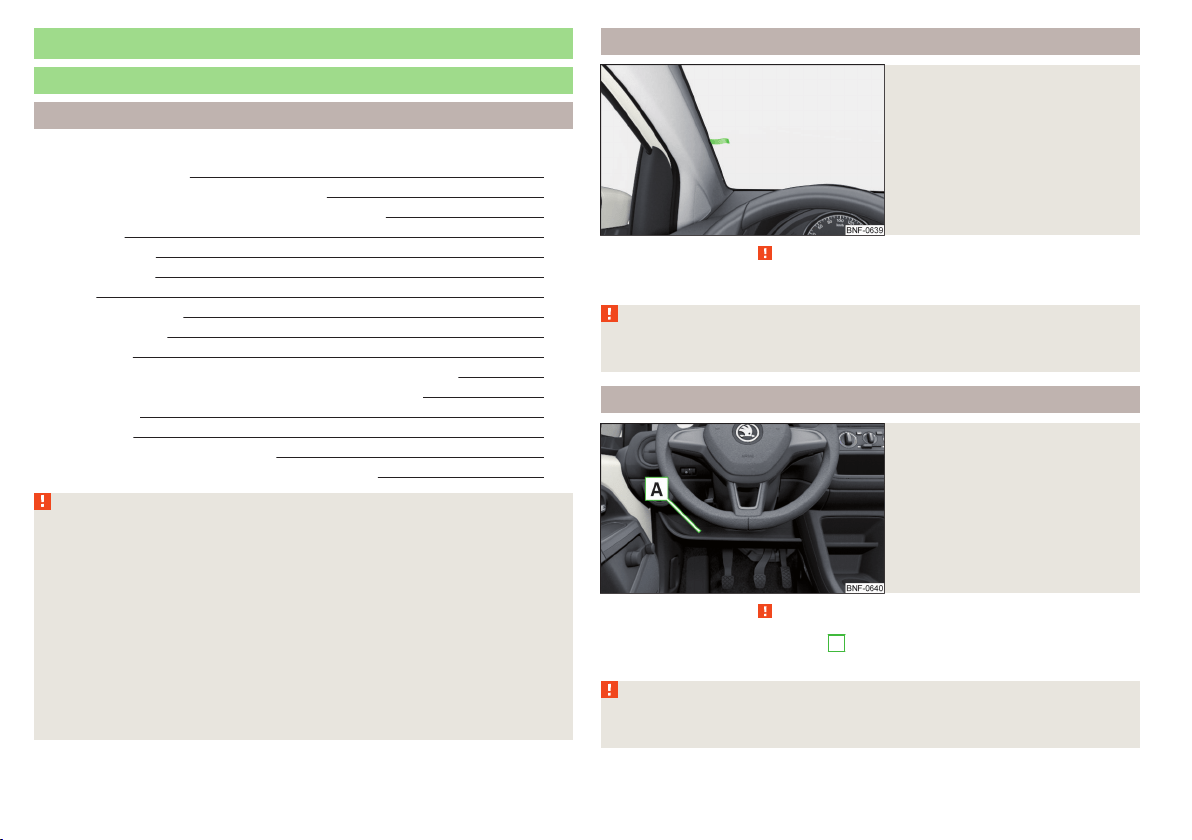
Transporting and practical equipment
Useful equipment
Introduction
This chapter contains information on the following subjects:
Car park ticket holder 58
Storage compartment on the driver's side 58
Storage compartments in the front centre console 59
Cup holders 59
Waste container 59
Cigarette lighter 60
Ashtray 61
12-Volt power outlet 61
Multimedia holder 62
Photo holder 62
Storage compartment on the front passenger side - version 1 62
Storage compartment on the passenger side - version 2 62
Foldable hook 63
Clothes hook 63
Net pockets on the front seat rest 64
Stowage compartments in front of the rear seats 64
WARNING
■
Do not place anything on the dash panel. These objects might slide or fall
down when driving (when accelerating, cornering or following a bad ma-
noeuvre) and may distract you from concentrating on the traffic – there is a
risk of an accident.
■
When driving, ensure that no objects from the centre console or from oth-
er storage compartments can get into the driver's footwell. You would not
be able to brake, operate the clutch pedal or accelerate - danger of causing
an accident!
■
No objects should be placed in the storage compartments nor in the
drinks holders; the vehicle occupants could be endangered if there is sud-
den braking or the vehicle collides with something.
■
Ash, cigarettes, cigars and the like. may only be placed in the ashtray!
Car park ticket holder
Fig. 56
Parking ticket holder
Read and observe on page 58 first.
The note holder » Fig. 56 is designed e.g. for attaching car park tickets.
WARNING
The ticket should always be removed before starting off in order not to im-
pair the driver's vision.
Storage compartment on the driver's side
Fig. 57
Storage compartment on the
driver's side
Read and observe on page 58 first.
The open stowage compartment
A
can be found underneath the dash panel
on the driver's side » Fig. 57.
WARNING
Never store hard, heavy or sharp items in an opened stowage compart-
ment.
58
Using the system
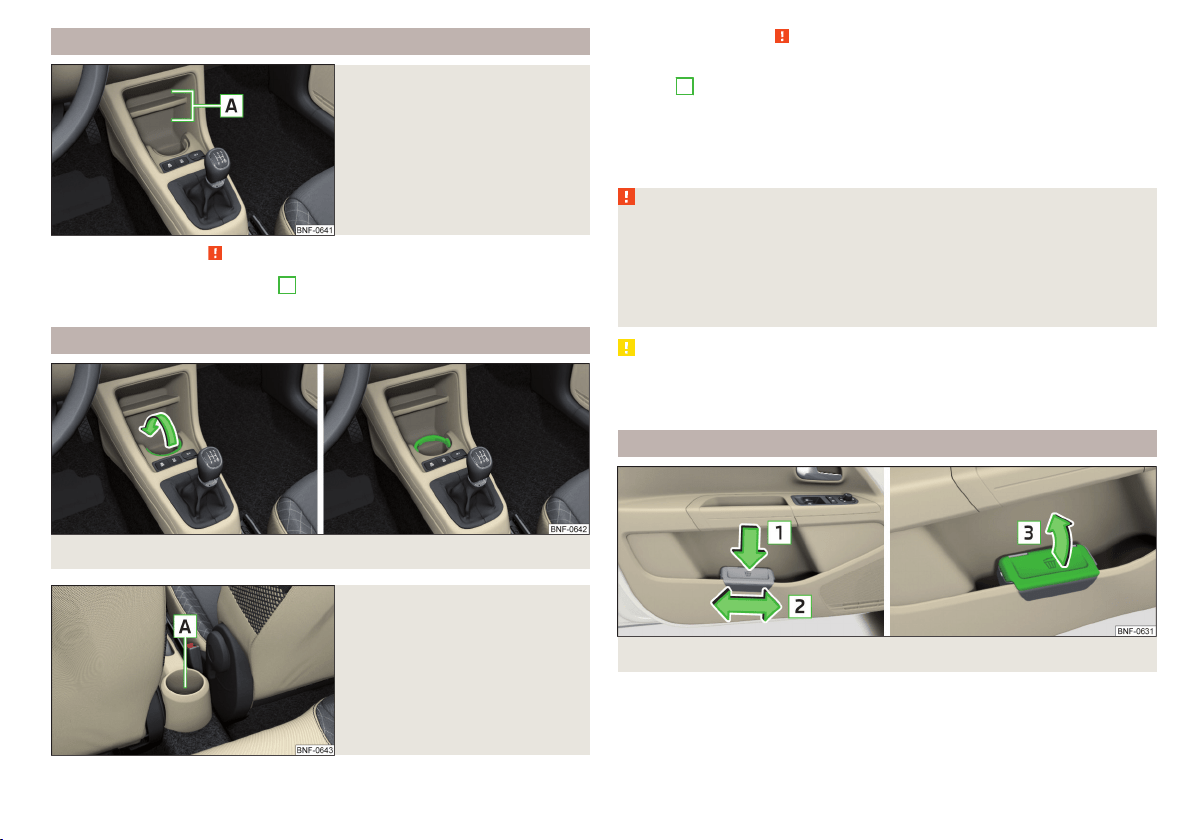
Storage compartments in the front centre console
Fig. 58
Storage compartments
Read and observe on page 58 first.
The open storage compartments
A
can be found in the front centre console
» Fig. 58,
Cup holders
Fig. 59 Cup holder in the front
Fig. 60
Rear cup holder
Read and observe on page 58 first.
The cup holders are located in the centre console at the front » Fig. 59 and at
the rear
A
» Fig. 60.
Fixing cups in the front cup holder
›
Open the cup holder in the direction of the arrow » Fig. 59.
›
Place the cup into the cup holder so that the cup holder clip surrounds the
cup securely.
WARNING
■
Do not use any cups or beakers which are made of brittle material (e.g.
glass, porcelain). This could lead to injuries in the event of an accident.
■
Never put hot cups in the cup holders. If the vehicle moves, they may spill
– risk of scalding!
■
No objects should be placed in the holders that might endanger the vehi-
cle's occupants if the vehicle brakes suddenly or the vehicle is in collision.
CAUTION
Do not leave open beverage containers in the cup holders during the journey.
There is a risk of spilling e.g. when braking which may cause damage to the
electrical components or seat upholstery.
Waste container
Fig. 61 Waste container: inserting and moving / opening
59
Transporting and practical equipment
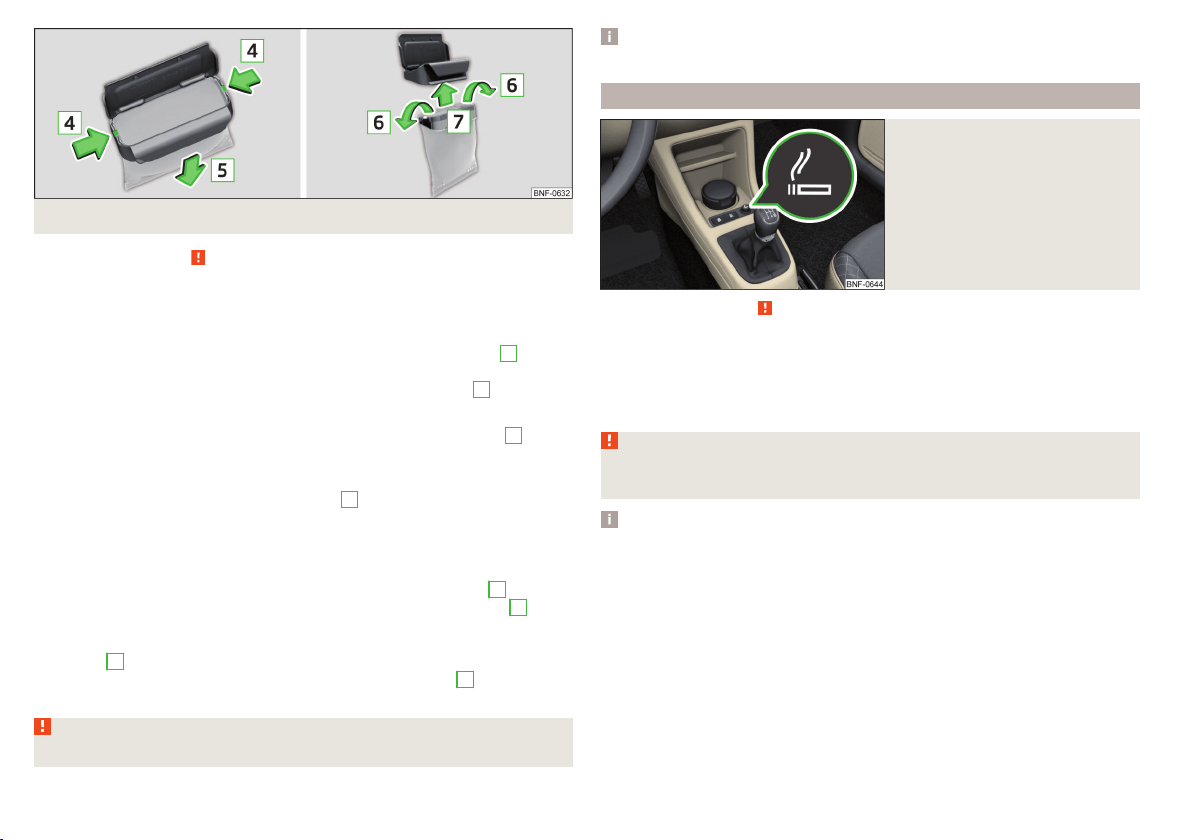
Fig. 62 Replace bags
Read and observe on page 58 first.
The waste container can be inserted into the slots in the doors.
Insert waste container
›
Position the waste container at the front edge of the slot.
›
Push the waste container to the back in the direction of the arrow
1
» Fig. 61.
›
Push the waste container as required in the direction of arrow
2.
Remove the waste container
›
Remove the waste container in the opposite direction to the arrow
1
» Fig. 61.
Open/close waste container
›
Remove the cover in the direction of arrow
3
» Fig. 61.
Closing takes place in reverse order.
Replace bags
›
Remove the waste container from the slot.
›
Press the two locking lugs on the frame in the direction of arrow
4
» Fig. 62.
›
Pull the bag together with the frame down in the direction of arrow
5
.
›
Remove the bag from the frame.
›
Pull the new bag through the frame and pull it over the frame in the direction
of arrow
6
.
›
Place the bag containing the frame in the direction of arrow
7
into the con-
tainer body, so that the two lugs engage audibly to the frame.
WARNING
Never use the waste container as an ashtray - risk of fire!
Note
We recommend that you use 20x30 cm bags.
Cigarette lighter
Fig. 63
Cigarette lighter
Read and observe on page 58 first.
Use
›
Press the lighter in as far as the stop » Fig. 63.
›
Wait until the lighter pops out.
›
Remove the glowing lighter and use immediately.
›
Place the cigarette lighter back into the socket.
WARNING
Take care when using the cigarette lighter! Improper use of the cigarette
lighter can cause burns.
Note
■
The cigarette lighter operates only if the ignition is switched on.
■
The cigarette lighter socket can also be used as a 12 volt socket for electrical
appliances.
60
Using the system
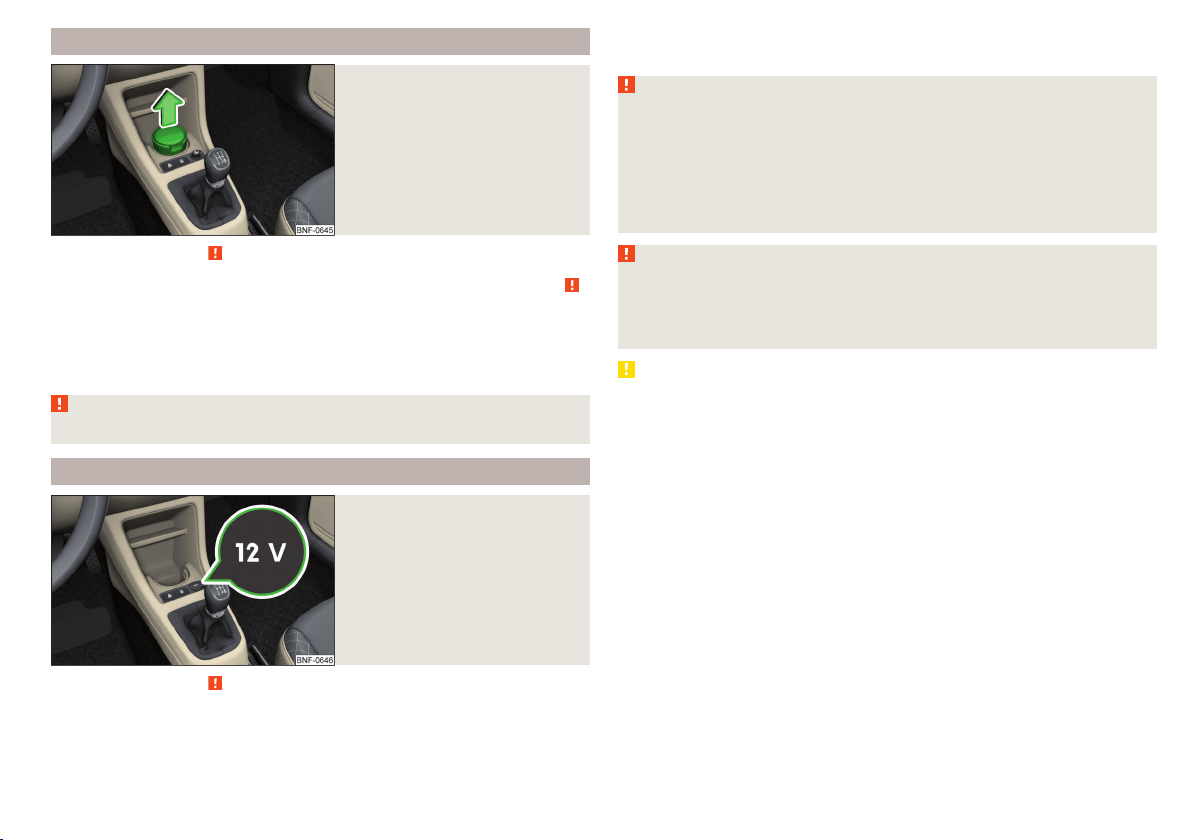
Ashtray
Fig. 64
Removing the ashtray
Read and observe on page 58 first.
The ashtray can be used for discarding ash, cigarettes, cigars and the like » .
Removing/inserting
›
When removing, do not hold the ashtray by its cover.
›
Pull out the ashtray in the direction of the arrow » Fig. 64.
Insertion takes place in reverse order.
WARNING
Never place hot or flammable objects in the ashtray – risk of fire!
12-Volt power outlet
Fig. 65
12-volt power socket
Read and observe on page 58 first.
Use
›
Open the power socket cap » Fig. 65.
›
Connect the plug for the electrical appliance to the socket.
The power socket and a connected device can only be used when the ignition
is switched on.
WARNING
Warnings concerning any device connected to the power socket.
■
Stow the device away safely during the journey to prevent it from being
thrown around the interior in the event of a sudden braking manoeuvre or
an accident – risk of death!
■
The device may warm up during operation – risk of injury or fire! If the de-
vice becomes too hot, switch it off immediately and disconnect it from the
power supply.
WARNING
Improper use of the power sockets and the electrical accessories can cause
fires, burns and other serious injuries. Therefore, when leaving the vehicle,
never leave people who are not completely independent, such as children,
unattended in the vehicle.
CAUTION
■
The socket can only be used for the connection of approved electrical acces-
sories with a total power consumption of up to 120 watts, otherwise the elec-
trical system of the vehicle may be damaged.
■
Connecting appliances when the engine is not running will drain the vehicle's
battery!
■
Switch off the device connected to the power socket before you switch the
ignition on or off and before starting the engine, to avoid damage from voltage
fluctuations.
61
Transporting and practical equipment
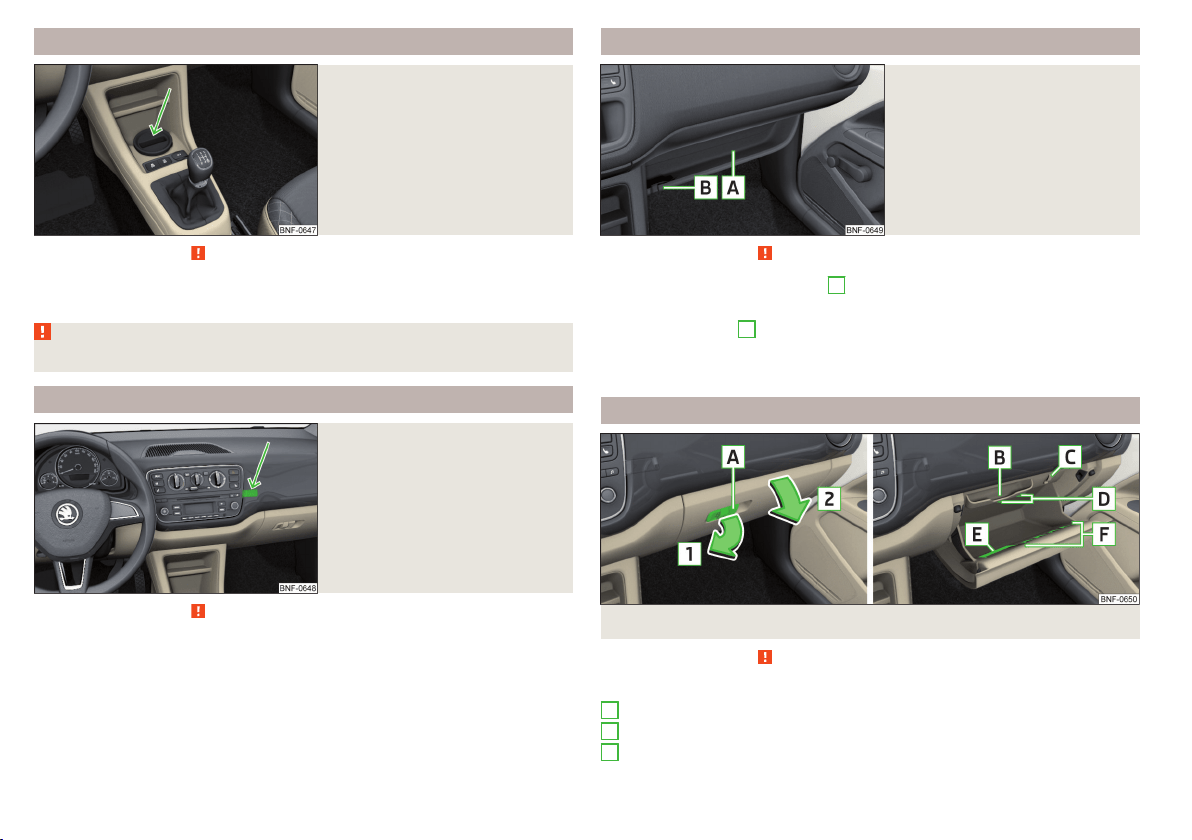
Multimedia holder
Fig. 66
Multimedia holder
Read and observe on page 58 first.
You can use this multimedia holder» Fig. 66 to store e.g. a mobile phone, MP3
player or similar devices.
WARNING
Never use the multimedia holder as an ashtray - risk of fire!
Photo holder
Fig. 67
Photo holder
Read and observe on page 58 first.
The photo holder » Fig. 67 can be used to hold, for example, photos, sticky
notes and such like.
Storage compartment on the front passenger side - version 1
Fig. 68
Storage compartment on the
front passenger side
Read and observe on page 58 first.
The open stowage compartment
A
can be found underneath the dash panel
on the front passenger's side » Fig. 68.
There is a bag hook
B
in the open stowage compartment which is used to
hang smaller items of luggage, e.g. bags, or similar.
The maximum permissible load for the hook is 1.5 kg.
Storage compartment on the passenger side - version 2
Fig. 69 Open storage compartment / interior of the storage compartment
Read and observe on page 58 first.
Storage compartment » Fig. 69
Opening lever
Glasses storage box
Notepad holder
A
B
C
62
Using the system
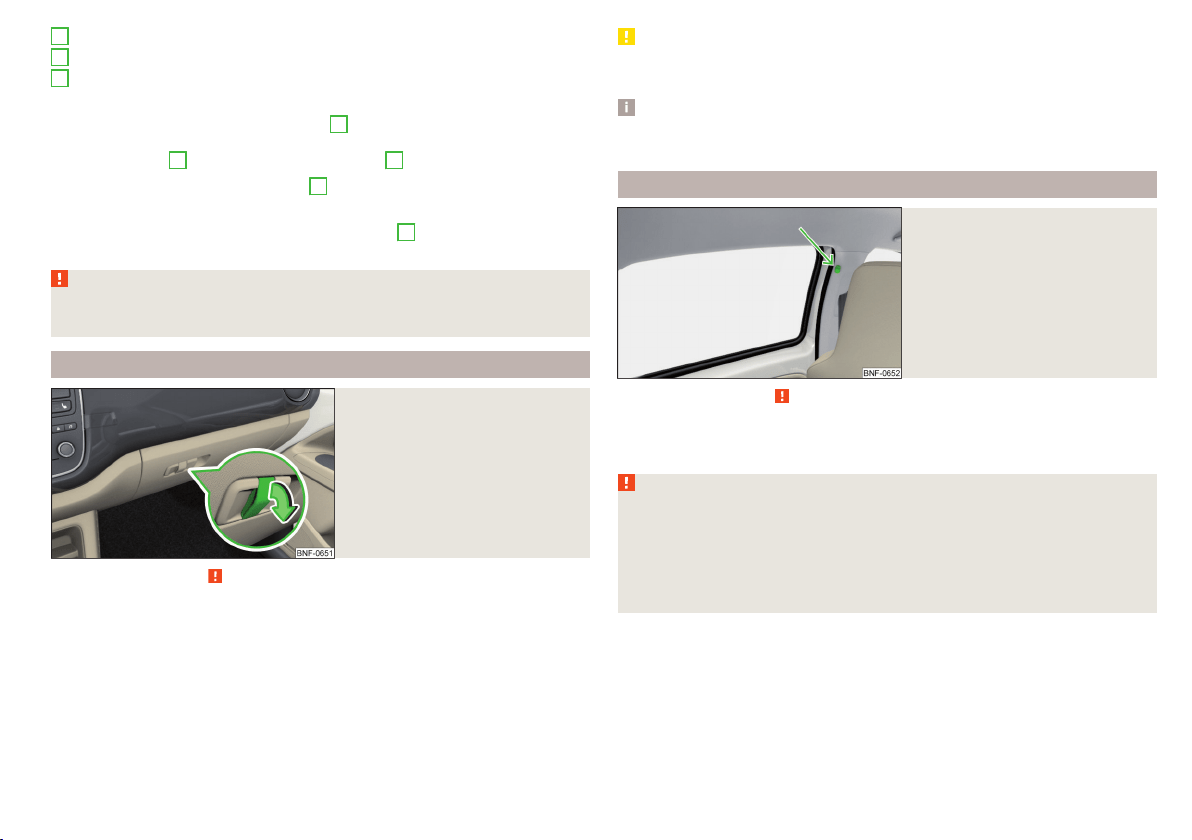
Pen holder
Holder for credit and other cards
Coin holder
Opening
›
If there is a folding hook on the handle
A
remove any items hanging from it
» Fig. 69,
›
Pull the handle
A
in the direction of the arrow
1
.
The cover folds in the arrow direction
2
.
Closing
›
Turn the cover in the opposite direction to arrow
2
» Fig. 69 until it audibly
clicks into place.
WARNING
The storage compartment must always be closed when driving for safety
reasons.
Foldable hook
Fig. 70
Fold down hook
Read and observe on page 58 first.
The foldable hook is located in the handle of the storage compartment cover
on the passenger side .
The foldable hook can be used to hang small items of luggage, such as bags
and the like.
The maximum permissible load for the hook is 1.5 kg.
Folding down
›
Fold down the hook in the direction of the arrow » Fig. 70.
D
E
F
CAUTION
Remove suspended luggage from the hook before opening the storage com-
partment lid - there is a risk of damage to hook.
Note
When the hook is folded forward, it folds back automatically when the storage
compartment is opened.
Clothes hook
Fig. 71
Clothes hooks
Read and observe on page 58 first.
The clothes hooks are located on the centre door bars of the vehicle » Fig. 71.
The maximum permissible load of the hooks is 2 kg.
WARNING
■
Do not leave any heavy or sharp-edged objects in the pockets of the
items of clothing hung up.
■
Do not use hangers to hang up the clothes - there is a risk of limiting the
effectiveness of the head airbags.
■
Ensure that any clothes hanging from the hooks do not impair your vision
to the rear.
63
Transporting and practical equipment
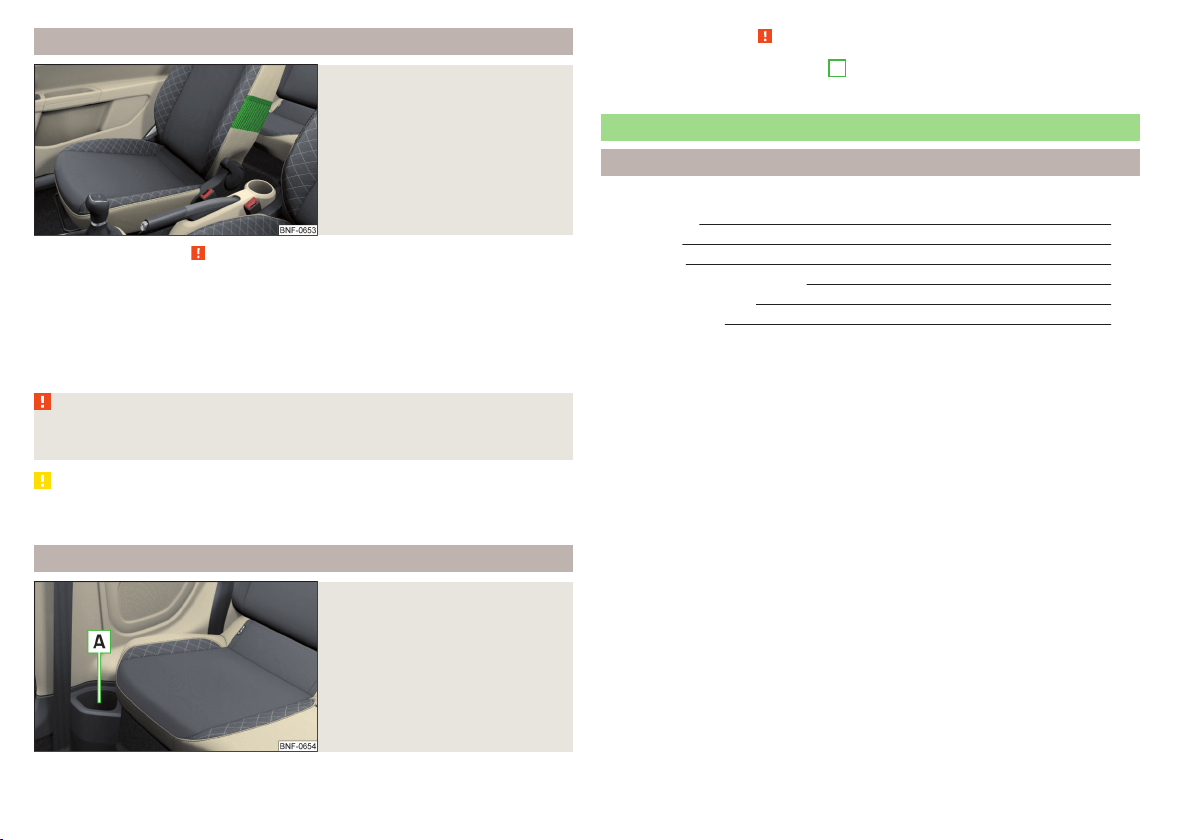
Net pockets on the front seat rest
Fig. 72
Meshed pocket
Read and observe on page 58 first.
The net pockets are used for storage of small and light objects, such as mobile
phones and the like.
The net pockets are located on the inner sides of the front seat backrests
» Fig. 72.
The maximum permissible load of the net pockets is 150 g.
WARNING
Do not exceed the maximum permissible load of the meshed pockets.
Heavy objects are not secured sufficiently – risk of injury!
CAUTION
Do not put large objects, e.g. bottles or objects with sharp edges into the net
pockets - risk of damaging the pockets and seat coverings.
Stowage compartments in front of the rear seats
Fig. 73
Storage compartment
Read and observe on page 58 first.
The open storage compartments
A
are located on the backs of the front
seats » Fig. 73.
Luggage compartment and transporting cargo
Introduction
This chapter contains information on the following subjects:
Lashing eyes
65
Bag hooks 65
Fixing nets 65
Luggage compartment cover
66
Variable loading floor 67
Class N1 vehicles 67
When transporting cargo the following instructions must be adhered to
▶
When transporting heavy objects, the driving characteristics change due to
the shift in centre-of-gravity. The speed and style of driving must be adjus-
ted accordingly.
▶
The cargo should be stowed in the luggage compartment. To prevent it from
moving it should be secured with suitable lashing straps to the lashing eyes
or secured with fixing nets.
▶
Distribute loads as evenly as possible.
▶
Place heavy objects as far forward as possible.
▶
The transported items must be stowed in such a way that no objects are able
to slip forward on sudden driving or braking manoeuvres – risk of injury!
▶
Tyre pressure should be adjusted for the load.
▶
When transporting loads in the luggage compartment that has been en-
larged by folding one of the rear seats forward, care should be taken to en-
sure the safety of passengers transported on the other rear seat.
In the event of an accident, even small and light objects gain so much kinetic
energy that they can cause severe injuries.
The magnitude of the kinetic energy is dependent on the speed at which the
vehicle is travelling and the weight of the object.
Example: In the event of a frontal collision at a speed of 50 km/h, an object
with a weight of 4.5 kg produces an energy, which corresponds to 20 times its
own weight. This means that it results in a weight of approx. 90 kg “ ”.
64
Using the system
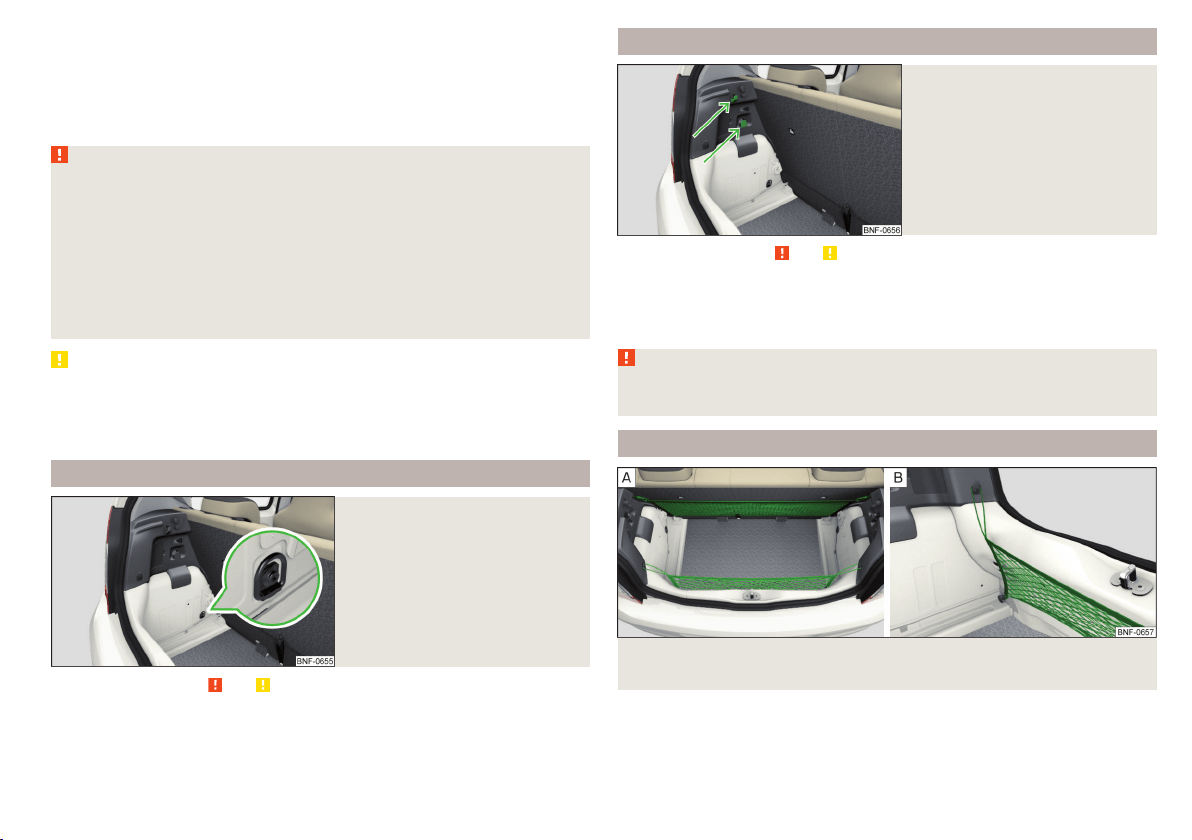
Luggage compartment light
The warning light illuminates when boot is opened.
The warning light turns off when the boot is closed.
If the boot lid is open and the ignition switched off, the light will extinguish
automatically after around 10 minutes.
WARNING
■
Never exceed the maximum permissible load for the respective fasteners,
nets, hooks etc. If heavy objects have not been suitably secured – risk of
injury!
■
If the cargo is tied down with unsuitable or damaged lashing straps, inju-
ries can occur in the event of braking manoeuvres or accidents.
■
Loose cargo can be thrown forward during a sudden manoeuvre or in the
event of an accident and can injure the occupants or other road users.
■
Loose cargo could hit a deployed airbag and injure occupants – danger of
death!
CAUTION
■
Never exceed the maximum permissible load for the respective fasteners,
nets, hooks etc. - these could become damaged.
■
Please ensure that the heating elements for the rear window heater are not
damaged as a result of abrasive objects.
Lashing eyes
Fig. 74
Lashing
Read and observe and on page 65 first.
Fixing eyes are located on the sides of the loading area for lashing the goods
to be loaded » Fig. 74.
The maximum permissible static load for each lashing points is 350 kg.
Bag hooks
Fig. 75
Bag hooks
Read and observe and on page 65 first.
Hooks for attaching small items of luggage, such as bags etc., are provided on
both sides of the luggage compartment. » Fig. 75.
An item of luggage weighing up to 1.5 kg can be attached to the hook.
WARNING
Never use the bag hooks for lashing loaded goods. The bag hooks may tear
off during sudden braking manoeuvres or in the event of an accident.
Fixing nets
Fig. 76
Example of how to fix nets/fastening details for the rear area of
the luggage compartment
65
Transporting and practical equipment

Fig. 77 Details of the fastening behind the rear seats
Read and observe and on page 65 first.
Fixing the nets » Fig. 76 and » Fig. 77
cross bags
Fastening details in the rear area of the luggage compartment
Details of the fastening to the upper lashing eyes behind the foldable rear
seat rest
Details of the fastening to the lashing eyes on the luggage compartment
floor behind the rear seats
The maximum permissible load of the fixing nets is 1.5 kg.
CAUTION
Do not place any sharp objects in the nets – risk of net damage.
Luggage compartment cover
Fig. 78 Removing/installing the luggage compartment cover
Read and observe and on page 65 first.
If the support straps
A
» Fig. 78 are attached to the boot lid, then opening the
lid will raise the boot lid cover (hereafter referred to as cover).
The cover can be removed if you wish to transport bulky goods.
Fold up and lock
›
Fold up the cover.
›
Lock the cover in the brackets
C
» Fig. 78 .
Unlocking
›
Fold the raised cover down.
The cover is released from the brackets
C
» Fig. 78.
Removal
›
On both sides of the boot lid unhook the straps
A
in the direction of the ar-
row » Fig. 78.
›
Tap on the lower part of the cover to release it from the brackets
C
and re-
move it from the vehicle.
Fitting
›
Place the cover on the brackets
B
» Fig. 78 and tap on the upper surface of
the cover to lock it into the brackets.
›
On both sides of the boot lid unhook the straps
A
.
WARNING
■
No objects should be placed on the cover. This could endanger the vehicle
occupants during sudden braking or vehicle impact.
■
Never ride with folded up cover.
66
Using the system
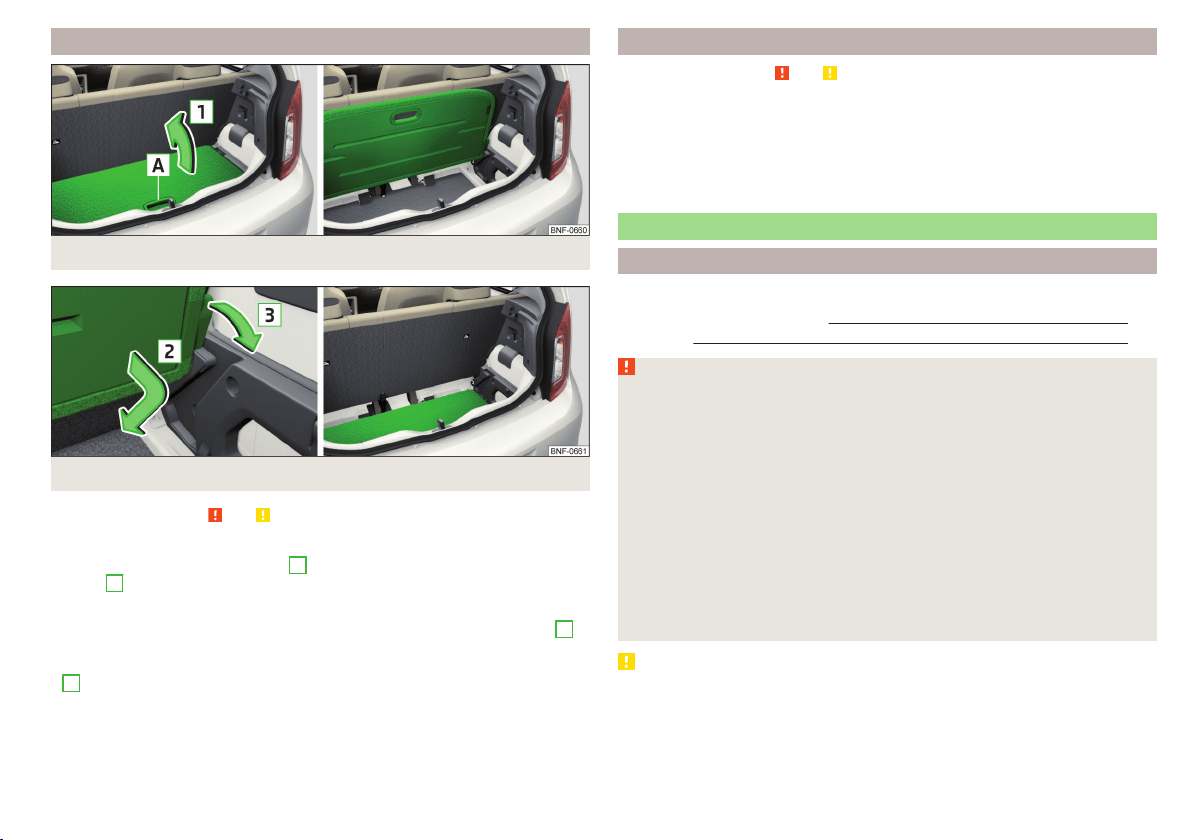
Variable loading floor
Fig. 79 Variable loading floor in the raised position: fold up / folded up
Fig. 80 Variable loading floor: fold down / in folded-down condition
Read and observe and on page 65 first.
Folding up to the raised position
›
Grasp the loading floor at handle
A
and raise to the stop in the direction of
arrow
1
» Fig. 79.
Folding down to the lower position
›
Lift the loading floor and push into the grooves in the direction of arrow
2
» Fig. 80.
›
Lay the loading floor on the load compartment floor in the direction of arrow
3
.
Class N1 vehicles
Read and observe and on page 65 first.
In class N1 vehicles that are not fitted with a protective grille, a lashing set that
complies with the EN 12195 standard (1-4) must be used for fastening the load.
For safe vehicle operation, the proper functioning of the electrical installation
is essential. It is important to ensure that it is not damaged in adaptation as
well as the loading and unloading of the cargo space.
Roof rack
Introduction
This chapter contains information on the following subjects:
fixing points for base support
68
Roof load
68
WARNING
When transporting cargo the following instructions must be adhered to.
■
The transported items on the roof rack must always be securely attached
– risk of accident!
■
Always secure the load with appropriate and undamaged lashing straps
or tensioning straps.
■
Distribute the load evenly over the roof rack system.
■
When transporting heavy objects or objects which take up a large area on
the roof rack system, the handling of the car may change as a result of the
displacement of the centre of gravity. The style of driving and speed must
therefore be adapted to the current circumstances.
■
Avoid abrupt and sudden driving/braking manoeuvres.
■
The permissible roof load, permissible axle loads and permissible total ve-
hicle weight must not be exceeded under any circumstances – risk of acci-
dent!
CAUTION
■
On vehicles with a panoramic sunroof, make sure that the tilted panorama
roof does not strike any items which are transported.
■
Ensure that the luggage compartment lid does not hit the roof load when
opened.
67
Transporting and practical equipment
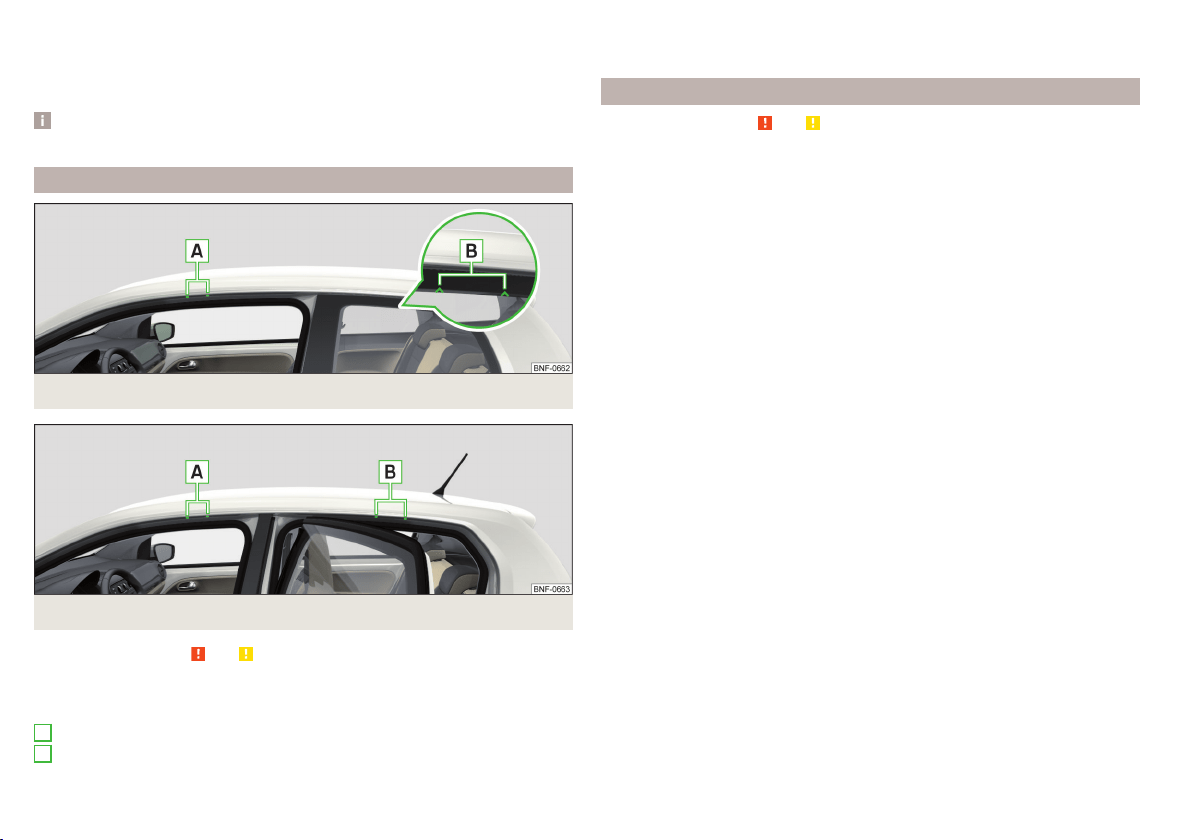
■
The height of the vehicle changes after mounting a roof rack system plus the
load to be transported. Compare the vehicle height with available clearances,
such as underpasses and garage doors.
■
Ensure the roof aerial is not impaired by the load being transported.
Note
We recommend that you use a roof rack from ŠKODA Original Accessories.
fixing points for base support
Fig. 81 Attachment points - 3-door
Fig. 82 Attachment points - 5-door
Read and observe
and on page 67 first.
The attachment points are located on both sides of the vehicle.
Arrangement of attachment points » Fig. 81 and » Fig. 82
Front attachment points
Rear attachment points
A
B
The basic carrier should be mounted and dismounted in accordance with the
instructions provided.
Roof load
Read and observe and on page 67 first.
Do not exceed the permissible roof load of 50 kg - this includes the carrier sys-
tem.
The full permissible roof load cannot be used if a roof rack system with a lower
load carrying capacity is used. The maximum capacity of the carrier system
should never be exceeded.
68
Using the system
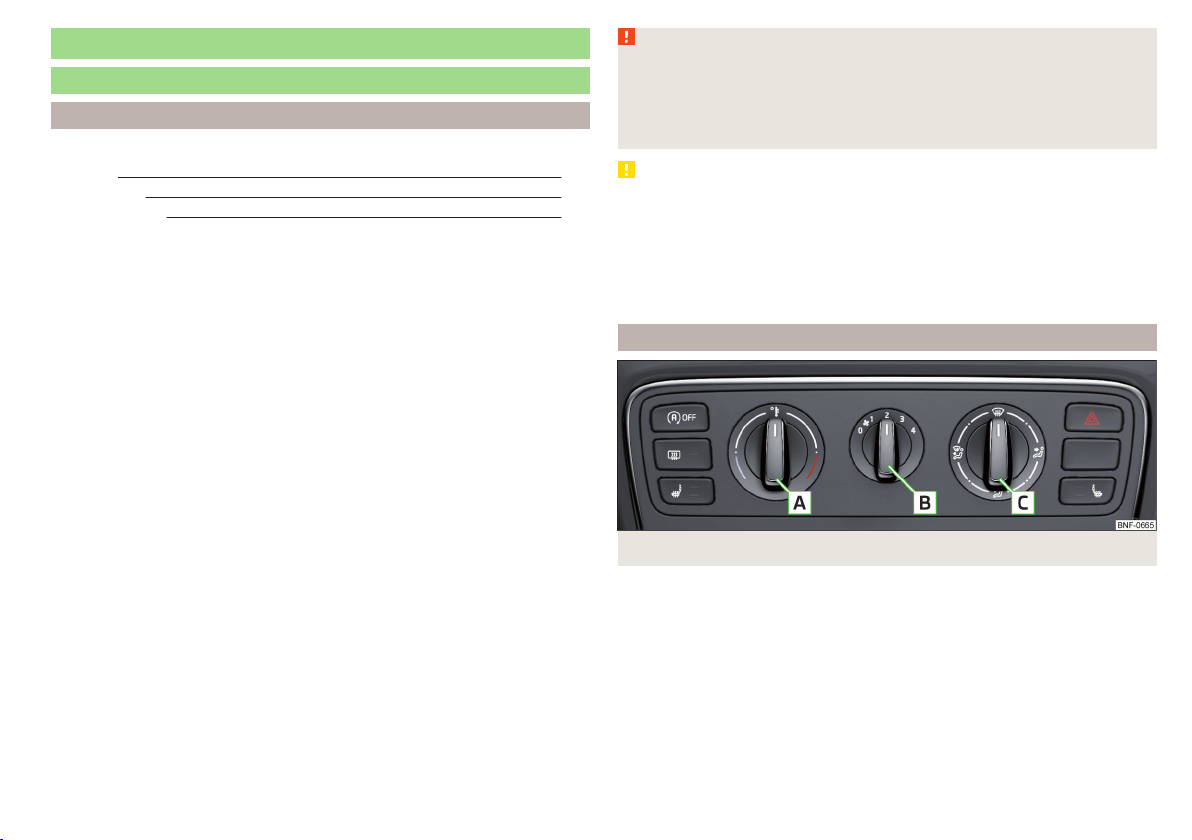
Heating and ventilation
Heating, manual air conditioning system
Introduction
This chapter contains information on the following subjects:
Controls 69
recirculation 70
Air outlet vents 71
The heating and air conditioning ventilate and heat the vehicle interior. The air
conditioning system also cools and dehumidifies the vehicle interior.
The heating effect is dependent upon the coolant temperature, thus full heat
output only occurs when the engine has reached its operating temperature.
The cooling system only operates if the following conditions are met.
The cooling system is switched on.
The engine is running.
The outside temperature is above approx. +2 °C.
The blower is switched on.
If the cooling system is switched on, the temperature and air humidity drops in
the vehicle. The cooling system prevents the windows from misting up during
winter months.
It is possible to briefly activate recirculated air mode to enhance the cooling
effect » page 70.
Health protection
To reduce health risks (e.g. common colds), the following instructions for the
use of the cooling system are to be observed.
▶
The difference between the indoor temperature and the outdoor air temper-
ature should not be greater than about 5 ° C.
▶
The cooling system is to be turned off about 10 minutes before the end of
the journey.
▶
Once a year, a disinfection of the air conditioner is to be carried out by a spe-
cialist company.
WARNING
■
For your own safety and that of other road users, ensure that all the win-
dows are free of ice, snow and misting. The blower should always be on to
prevent the windows from misting up.
■
Under certain circumstances, air at a temperature of about 5 °C can flow
out of the vents when the cooling system is switched on.
CAUTION
■
The air inlet in front of the windscreen must be free from ice, snow or leaves,
for example, to ensure that the heating and cooling system works properly.
■
After switching on the cooling Condensation from the evaporator of the air
conditioning may drip down and form a puddle below the vehicle. This is not a
leak!
■
If the coolant temperature is too high, the cooling system is switched off to
ensure that the engine cools down.
Controls
Fig. 83 Heating Controls
69
Heating and ventilation
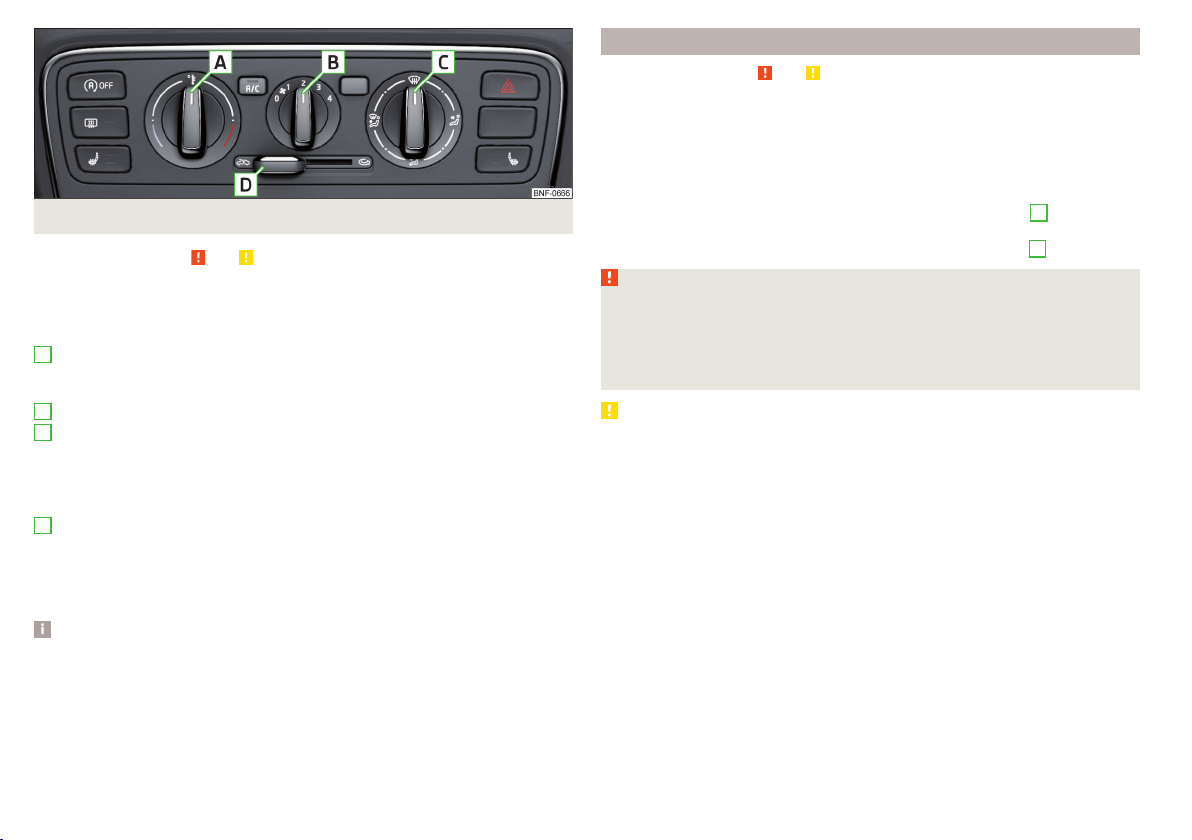
Fig. 84 Controls of the air conditioning
Read and observe and on page 69 first.
Individual functions can be adjusted by rotating or moving the controls, if nec-
essary by adjusting or pressing the button on and off.
Functions of the individual controls » Fig. 83 and » Fig. 84
Setting temperature
▶
Lowering the temperature
▶
Increasing the temperature
Setting the fan speed (level 0: fan off, level 4: highest setting)
Setting the direction of the air outlet » page 71
▶
Air flow to the windows
▶
Air flow to the upper body
▶
Air flow to the footwell
▶
Airflow to the windows and the footwell
Recirculated air mode
▶
Switching off
▶
Switching on
Switching the cooling system on/off (when this function is switched on,
the warning light illuminates in the button)
Note
■
The warning light in the button lights after activation, even if not all of the
conditions for the function of the cooling system have been met. By lighting up
of the indicator light in the button, the operational readiness of the cooling
system is signalled.
■
During operation of the air conditioning, an increase in engine idle speed may
occur under certain circumstances in order to ensure sufficient heating com-
fort.
A
B
C
D
recirculation
Read and observe and on page 69 first.
The recirculation mode prevents contaminated outside air getting into the in-
terior of the vehicle.
In recirculated air mode air is sucked out of the interior of the vehicle and then
fed back into the interior.
The air conditioning system
›
To turn on the air recirculation,. move the slider into position
D
» Fig. 84
on page 70.
›
To turn off the air recirculation, move the slider into position
D
.
WARNING
The recirculation system cannot be switched on for a longer period of time,
because there is no supply of fresh air from the outside. “Stale air” may re-
sult in fatigue in the driver and occupants, reduce attention levels and also
cause the windows to mist up. The risk of having an accident increases.
Switch off recirculated air mode as soon as the windows start to mist up.
CAUTION
We recommend not smoking in the vehicle when the recirculating air operation
is switched on. The smoke sucked from inside the vehicle is deposited on the
evaporator of the air conditioner. This produces a permanent odour when the
air conditioning system is operating which can only be eliminated through con-
siderable effort and expense (replacement of compressor).
70
Using the system
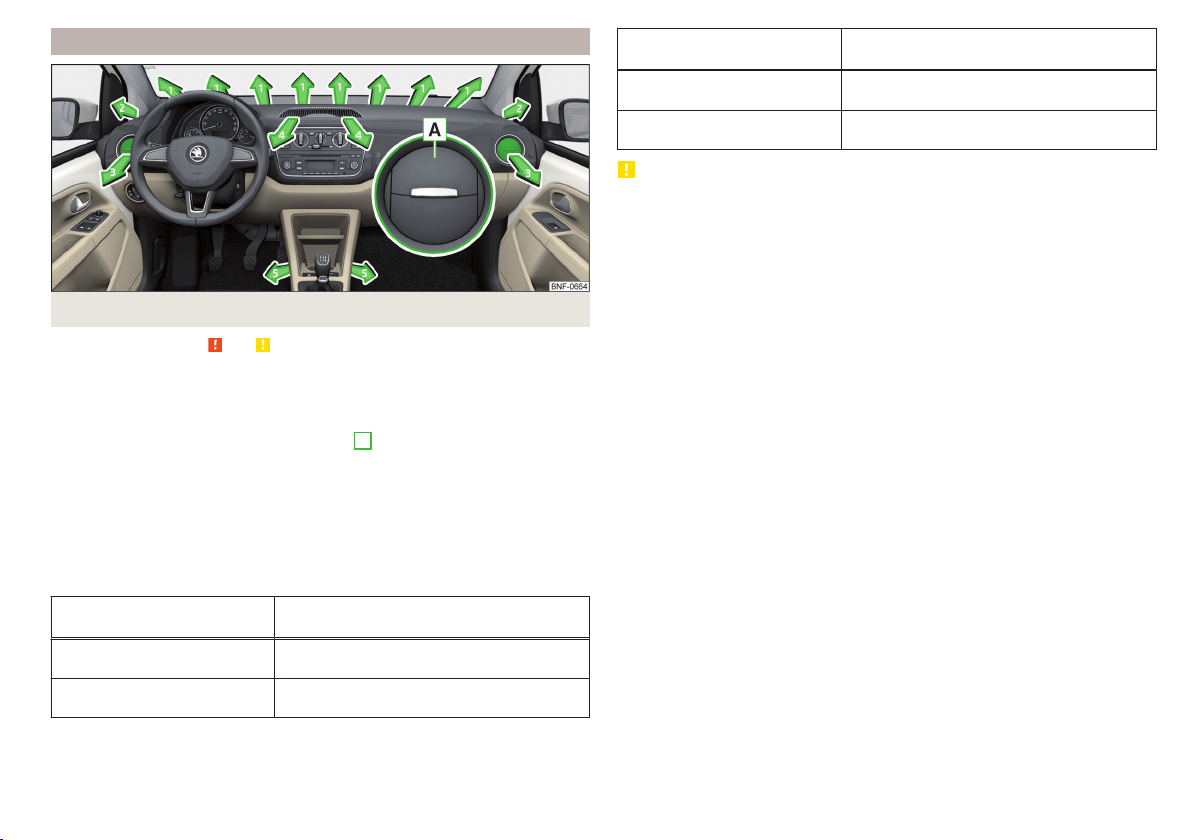
Air outlet vents
Fig. 85 Air outlet vents
Read and observe and on page 69 first.
The direction of airflow can be adjusted for the air vents 3 » Fig. 85 and the
vents can also be opened and closed individually.
Opening
›
Press on the outer edge of the slat in area
A
» Fig. 85.
Closing
›
Restore the original position of the fin.
Changing the direction of air flow
›
Move the slats to the required position.
Depending on the setting for the air distribution on the control panel of the
heater or the air conditioning system, the following air vents are active.
Set the direction of the air
outlet
Active air vents » Fig. 85
1, 2, 3
3, 4
Set the direction of the air
outlet
Active air vents » Fig. 85
3, 5
1, 2, 3, 5
CAUTION
To ensure that the heating and air conditioning systems work properly, do not
block the air outlet vents.
71
Heating and ventilation
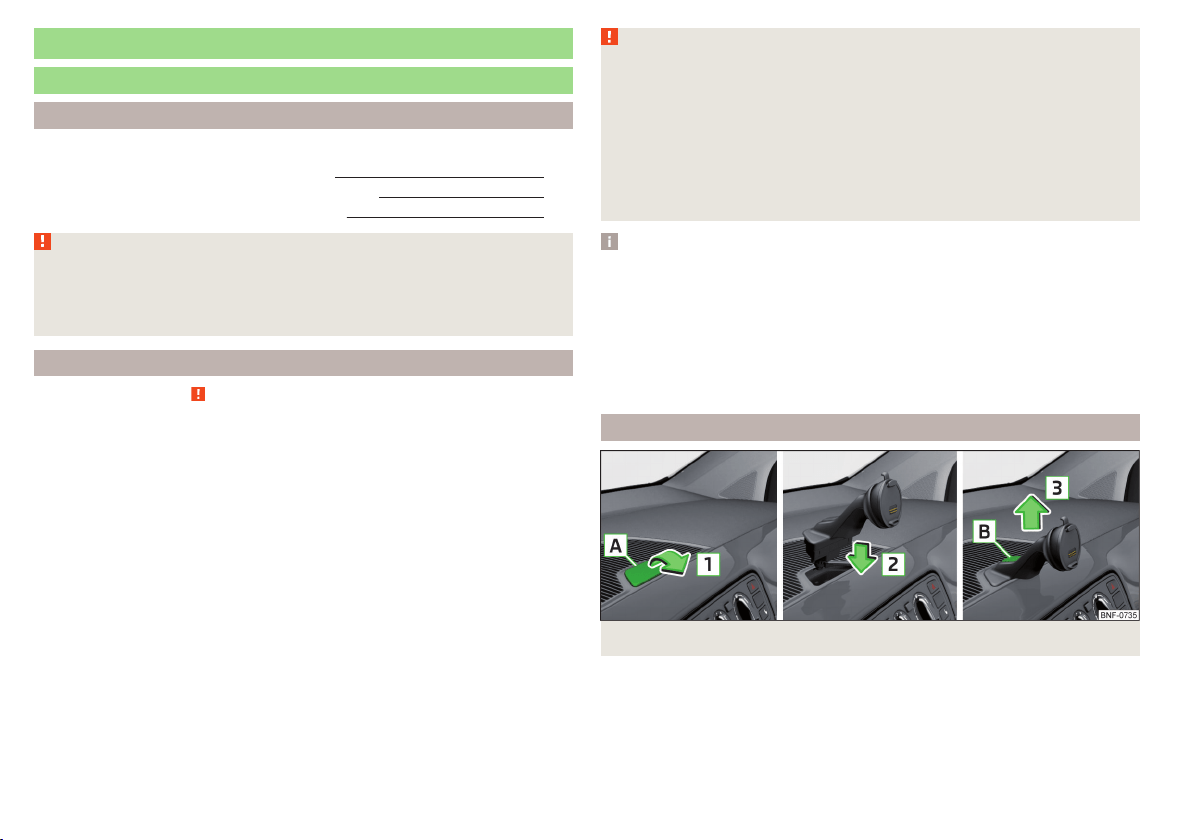
Communication and multimedia
Telephone and Move & Fun
Introduction
This chapter contains information on the following subjects:
Mobile phones and two-way radio systems 72
Multifunction device Move & Fun - install/remove 72
Multifunction device Move & Fun - operation 73
WARNING
You should, first and foremost, concentrate fully on driving at all times! As
the driver you are fully responsible for the operation of your vehicle. Use
the telephone system only to such an extent that you are in full control of
your vehicle at any time.
Mobile phones and two-way radio systems
Read and observe on page 72 first.
ŠKODA permits the operation of mobile phones and two-way radio systems
with a professionally installed external aerial and a maximum transmission
power of up to 10 watts.
Please consult a ŠKODA Partner for information about the possibility of instal-
ling and operating mobile phones and two-way radio systems with a transmis-
sion power of more than 10 W.
Operating mobile phones or two-way radio systems may interfere with the
functionality of the electronic systems in your vehicle.
The possible reasons for this are.
▶
no external aerial.
▶
external aerial incorrectly installed.
▶
transmission power greater than 10 watts.
WARNING
■
If a mobile phone or a two-way radio system is operated in a vehicle with-
out an external aerial or an external aerial which has been installed incor-
rectly, this can increase the strength of the electromagnetic field inside the
vehicle.
■
Two-way radio systems, mobile phones or mounts must not be installed
on airbag covers or within the immediate deployment range of the airbags.
■
Never leave a mobile phone on a seat, on the dash panel or in another
area from which it can be thrown during a sudden braking manoeuvre, an
accident or a collision — risk of injury.
Note
■
We recommend that the installation of mobile phones and two-way radio
systems in a vehicle be carried out by a specialist garage.
■
The range of the Bluetooth
®
connection to the hands-free system is restric-
ted to the vehicle interior. The range is dependent on local factors, e.g. obsta-
cles between the devices and mutual interferences with other devices. If your
mobile phone is in a jacket pocket, for example, this can lead to difficulties
when establishing a connection with the hands-free-system or transferring
data.
Multifunction device Move & Fun - install/remove
Fig. 86 Install/remove the fixture for the device
72
Using the system
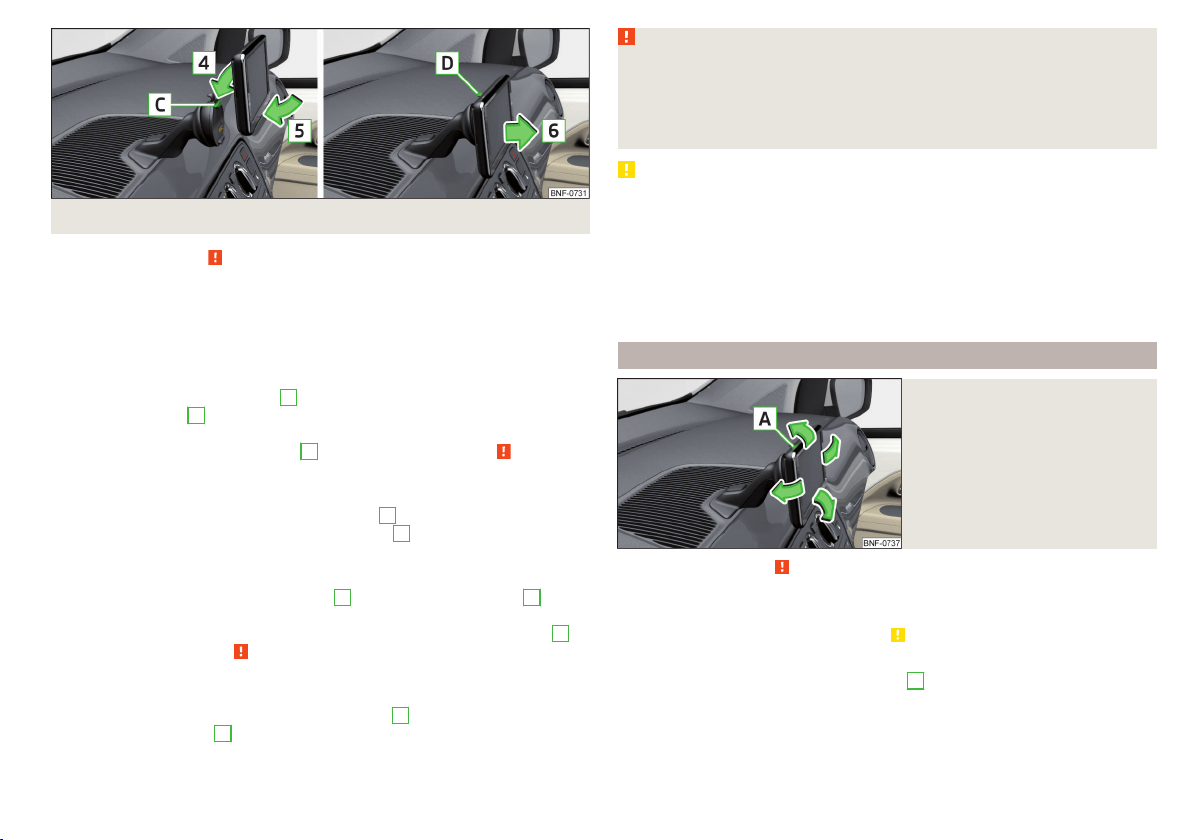
Fig. 87 Secure/remove device
Read and observe on page 72 first.
Your vehicle can be fitted with the Move & Fun multifunction device (herein-
after referred to as the device).
The device is secured in a fixture which is installed in the opening provided in
the middle part of the dash panel.
Installing the fixture
›
Insert e.g. a coin in the opening
A
» Fig. 86 and carefully open the cap in the
direction of arrow
1
.
›
Insert the fixture from above into the opening provided in the dash panel
and press in the direction of arrow
2
until it snaps into place » .
Removing the fixture
›
Grab hold of the cradle with one hand.
›
With the other hand, press the release button
B
» Fig. 86 .
›
Remove the fixture in the direction of the arrow
3
.
›
Close the opening for the fixture in the dash panel with the cover.
Securing the device in the fixture
›
Place the device first in the top bracket
C
in the direction of arrow
4
» Fig. 87 .
›
Press the bottom of the device into the fixture in the direction of arrow
5
until it clicks into place » .
Removing the device from the fixture
›
With one hand hold the device by its upper and lower edges.
›
With the other hand press the unlocking button
D
and remove the device in
the direction of arrow
6
» Fig. 87 .
›
Store the device in a safe place to avoid damaging it.
WARNING
■
Always slot the device securely into the fixture or store it safely in the ve-
hicle.
■
An unsecured or incorrectly secured device may be thrown through the
interior of the vehicle in a sudden driving or braking manoeuvre or accident,
and could cause injuries.
CAUTION
■
Always take the device with you when leaving the vehicle to protect it from
extreme temperatures and strong sunlight. Extreme ambient temperatures
can impair the functioning of the device and may damage the device.
■
Moisture can damage the electrical contacts in the dash panel for the device.
■
Never use water when cleaning the fixture. Always use a dry cloth instead.
■
Always install/remove the fixture without the device in it.
■
Only attach or remove the device when the fixture for the device has been
fitted in the panel.
Multifunction device Move & Fun - operation
Fig. 88
Setting the tilt of the device
Read and observe on page 72 first.
Setting the tilt of the device
›
You can set the tilt to the required position by gently moving the device in
the direction of the arrows » Fig. 88 » .
Loading the Owner´s Manual
›
Switch on the device by pressing button
A
» Fig. 88 .
›
Press the button
more
on the screen.
›
Press the button
Manual
on the screen.
›
Call up the required chapter by pressing the appropriate button.
73
Communication and multimedia

Functions of the device
▶
Navigation, TMC traffic information, lane assistance, and speed assistant.
▶
Operating the radio, media player and multimedia devices connected via
Bluetooth
®
.
▶
Displaying information from the MFD, rev counter and coolant temperature
» page 28.
▶
Hands-free device for mobile phones linked to the device via Bluetooth
®
.
▶
Indicator for opened bonnet, doors and luggage compartment lid.
▶
Display from the visual parking system (OPS).
▶
Image viewer.
▶
The toll service Live services - traffic, radar to measure the speed on the
road, weather and news search in the Yelpsystem.
▶
Route planning with consideration of the CNG filling station network (multi-
stop).
WARNING
■
Adjust the volume to ensure that acoustic signals from outside, e.g. sirens
from vehicles which have the right of way, such as police, ambulance and
fire brigade vehicles, can be heard at all time.
■
An audio volume set too high may damage your hearing!
CAUTION
Improper adjustment of the tilt may damage the unit as well as the fixture.
Note
The range of the Bluetooth
®
connection to the hands-free system is restricted
to the vehicle interior. The range is dependent on local factors, e.g. obstacles
between the devices and mutual interferences with other devices. If your mo-
bile phone is e.g. in a jacket pocket, this can lead to difficulties when establish-
ing the Bluetooth
®
connection with the hands-free system or the data trans-
fer.
74
Using the system

Driving
Starting-off and Driving
Starting and turning off the engine
Introduction
This chapter contains information on the following subjects:
Electronic immobilizer
75
Lock/unlock steering lock 76
Ignition on / off and start the engine 76
Switch off engine 76
With the key in the ignition, the ignition can be switched on and off and the
engine can be started / stopped.
WARNING
■
While driving with the engine stopped, the ignition must always be
switched on » page 76, Ignition on / off and start the engine.
■
With the ignition off, the steering may lock » page 76 - danger of an
accident!
■
Do not withdraw the ignition key from the ignition lock until the vehicle
has come to a stop » page 80, Parking. Otherwise, the steering may lock -
danger of an accident!
■
Never leave the key in the vehicle when you exit the vehicle. Unauthor-
ized persons, such as children, for example, could lock the car, turn on the
ignition or start the engine - there is a danger of injury, accidents and dam-
age!
■
Never leave the vehicle unattended with the engine running - there is
risk of accident, damage or theft!
■
Never switch off the engine before the vehicle is stationary – risk of acci-
dent!
WARNING
■
Never (e.g. in garages) run the engine in a closed place - there is the dan-
ger of poisoning and death!
■
Do not leave any items (e.g. cloths or tools) in the engine compartment.
This presents a fire hazard and the risk of engine damage.
■
Never cover the engine with additional insulation material (e.g. with a
cover) – risk of fire!
CAUTION
■
Only start the engine when the engine and the vehicle are stationary - there
is a danger of starter and engine damage!
■
Do not push-start the engine – risk of damaging the engine and the catalytic
converter. The battery from another vehicle can be used as a jump-start aid
» page 129.
Note
Do not warm up the engine while the vehicle is stationary. If possible, start
your journey as soon as the engine has started. Through this, the engine rea-
ches its operating temperature faster.
Electronic immobilizer
Read and observe
and on page 75 first.
The electronic immobiliser (hereinafter: immobiliser) makes the attempted
theft or unauthorised use of your vehicle more difficult.
An electronic chip is integrated in the head of the key. The immobiliser is deac-
tivated with the aid of this chip when the key is inserted in the ignition lock.
As soon as the ignition key is removed from the ignition lock the immobiliser is
automatically activated.
Operational problems
It is not possible to start the engine if there is a failure of the components in
the immobiliser key.
Use the other vehicle key to start the engine; if necessary, seek help from a
specialist garage.
75
Starting-off and Driving
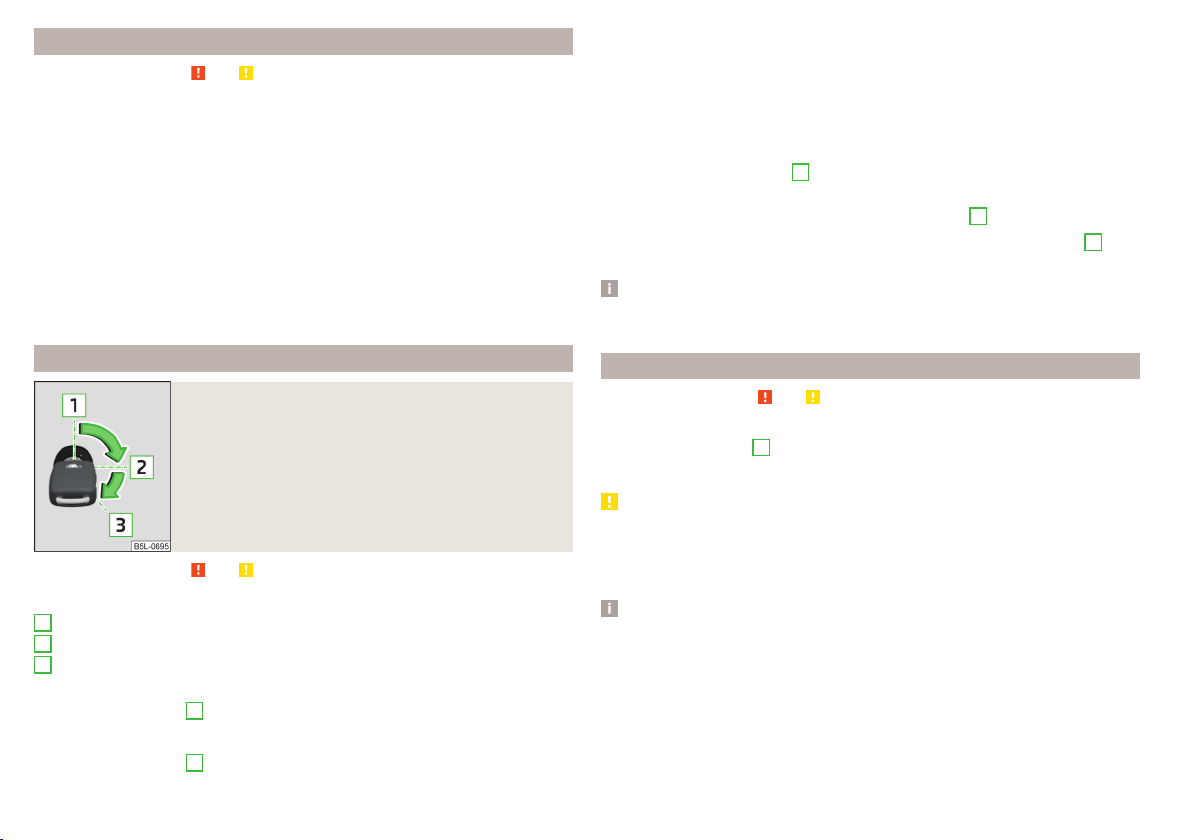
Lock/unlock steering lock
Read and observe and on page 75 first.
The steering lock (steering lock) deters any attempted theft of your vehicle.
Locking
›
Withdraw the ignition key.
›
Turn the steering wheel to the left or right until the steering lock clicks into
place.
Unlocking
›
Insert the key into the ignition lock.
›
Switch on the ignition » page 76.
The steering lock is unlocked.
If the ignition switch cannot be turned on, then turn the steering wheel back
and forth slightly and thereby unlock the steering lock.
Ignition on / off and start the engine
Fig. 89
Positions of the vehicle key in the ignition lock
Read and observe and on page 75 first.
Positions of the vehicle key in the ignition lock » Fig. 89
Ignition switched off, engine switched off
Ignition switched on
Starting engine
Switching ignition on/off
›
Turn key to position
2
.
The ignition is switched on.
›
Turn key to position
1
.
1
2
3
The ignition is switched off.
Procedure for starting the engine
›
Firmly apply the handbrake.
›
For vehicles with manual transmission, shift gear stick to neutral, depress
the clutch pedal and hold it there until the engine starts.
›
On vehicles with automatic gearbox, place the selector lever in position N
and depress the brake pedal until the engine starts.
›
Turn the key into position
3
to the stop and release immediately after the
engine has been started – do not apply the accelerator.
After letting go, the vehicle key will return to position
2
.
If the engine does not start within 10 seconds, turn the key to position
1
. Re-
peat the start-up process after approx. half a minute.
Note
The engine running noises may louder at first be louder for a short time after
starting the cold engine. This is quite normal and is not an operating problem.
Switch off engine
Read and observe and on page 75 first.
›
Stop the vehicle » page 80, Parking.
›
Turn key to position
1
» Fig. 89 on page 76.
The engine and the ignition are switched off simultaneously.
CAUTION
Do not switch the engine off immediately at the end of your journey after the
engine has been operated over a prolonged period at high loads but leave it to
run at an idling speed for about 1 minute. This prevents any possible accumula-
tion of heat when the engine is switched off.
Note
After switching off the ignition, the radiator fan can intermittently continue to
operate for approx. 10 minutes.
76
Driving

START-STOPsystem
Introduction
This chapter contains information on the following subjects:
Operation
77
Manually deactivating/activating the system 78
The START-STOPsystem (hereinafter referred to as: the system) reduces
CO
2
emissions and harmful emissions, and saves fuel.
If the system determine that the engine is not needed when the vehicle stops
(e.g. at the traffic lights), it turns off the engine and starts it again when mov-
ing off.
The system function depends on many factors. Some of them are down to the
driver, the others are systemic and can neither be influenced nor identified.
Therefore the system may react differently in situations which seem identi-
cal from the driver's perspective.
The system is automatically activated every time the ignition is switched on
(even where this has previously been manually deactivated with the button
).
Note
If the engine has stopped due to the system, the ignition remains on.
Operation
Fig. 90
Display
Vehicles with manual transmission
The engine is automatically switched offas soon as the vehicle comes to a halt,
the shift lever is moved into neutral and the clutch pedal is released.
The engine is automatically startedas soon as the clutch pedal is depressed.
Vehicles with automatic transmission
The engine is automatically switched offas soon as the vehicle comes to a
standstill and the brake pedal is operated.
The engine is automatically startedas soon as the brake pedal is released.
Requirements for the system to function correctly
The following conditions must be met for the system to function correctly.
The driver's door is closed.
The driver has fastened the seat belt.
The bonnet is closed.
The driving speed was higher than 4 km/h after the last stop.
System status
The system status is shown in the display when the vehicle comes to a halt
» Fig. 90.
The engine is automatically switched off; when the vehicle moves off the
ignition process will be automatically initiated.
The engine is not automatically switched off.
Reasons for the engine running
It may be essential for the engine to keep running when the vehicle comes to
a halt, for the following reasons.
▶
The engine temperature for the proper function of the system has not yet
been reached.
▶
The charge state of the vehicle battery is too low.
▶
The current consumption is too high.
▶
High air-conditioning or heating capacity (high fan speed, big difference be-
tween the desired and actual interior temperature).
When the engine is shut-down automatically and the system detects that the
engine is required such as when the brake pedal is pressed repeatedly then
the system automatically starts the engine.
77
Starting-off and Driving
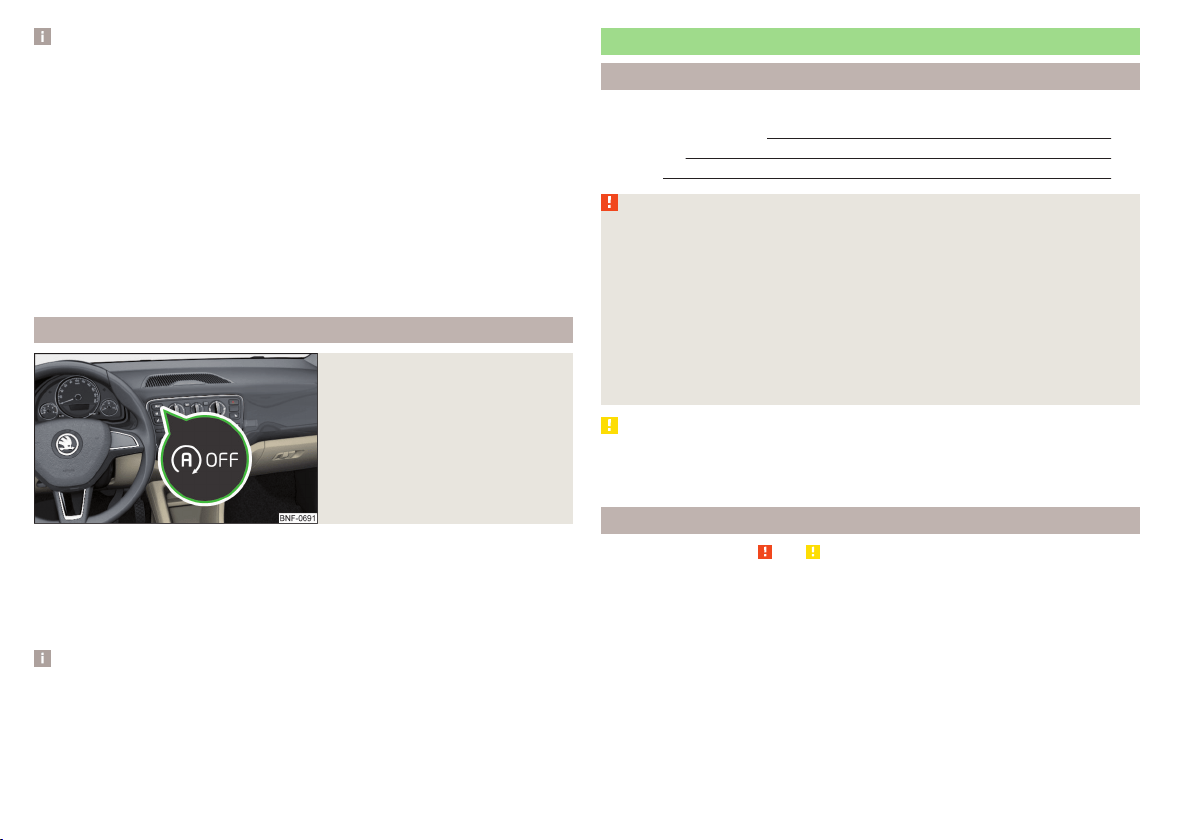
Note
■
If the vehicle remains outdoors for a long time in minus temperatures or in
direct sunlight, it can take several hours until the internal temperature of the
vehicle battery reaches a suitable temperature for proper operation of the
START STOP system.
■
If the driver's seat belt is removed for more than approx. 30 seconds or the
driver's door is opened during stop mode, the engine will have to be started
manually.
■
No automatic engine shut-down takes place when a vehicle with automatic
transmission is moving at low speed (e.g. during a traffic jam) and remains sta-
tionary after pressing the brake pedal lightly. Automatic engine shutdown
takes place if you press the brake pedal down with more force.
■
For vehicles with automatic transmission there is no automatic engine shut-
down when the system detects a manoeuvring action due to a large steering
angle.
Manually deactivating/activating the system
Fig. 91
Button for the START-STOP sys-
tem
Deactivating/activating
›
Press the symbol button
» Fig. 91 .
When system is deactivated, the warning light in the button illuminates.
If the system is turned off, it will be automatically reactivated after turning the
ignition off and on.
Note
If the system is deactivated when the engine is turned off automatically, then
the automatic start process takes place.
Brakes and parking
Introduction
This chapter contains information on the following subjects:
Information on braking
78
Handbrake 79
Parking 80
WARNING
■
Greater physical effort is required for braking when the engine is switch-
ed off – risk of accident!
■
When braking in a vehicle with manual transmission, when the vehicle is
in gear and at low revs, the clutch pedal must be depressed. Otherwise, the
functionality of the brake system may be impaired – risk of accident!
■
When leaving the vehicle, never leave persons who might, for example,
release the handbrake or take the vehicle out of gear unattended in the ve-
hicle. The vehicle could then start to move – risk of accident!
■
Observe the recommendations on the new brake pads » page 83, New
brake pads.
CAUTION
Never let the brakes slip with light pressure on the pedal if braking is not nec-
essary. This causes the brakes to overheat and can also result in a longer brak-
ing distance and excessive wear.
Information on braking
Read and observe and on page 78 first.
Wear-and-tear
The wear of the brake pads is dependent on the operating conditions and driv-
ing style.
The brake pads wear more quickly if a lot of journeys are completed in towns
and over short distances or if a very sporty style of driving is adopted.
Under these severe conditions, the thickness of the brake pads must also be
checked by a specialist garage between service intervals.
78
Driving

Wet roads or road salt
The performance of the brakes can be delayed as the brake discs and brake
pads may be moist or have a coating of ice or layer of salt on them in winter.
The brakes are cleaned and dried by applying the brakes several times » .
Corrosion
Corrosion on the brake discs and dirt on the brake pads occur if the vehicle has
been parked for a long period and if you do not make much use of the braking
system. The brakes are cleaned by applying the brakes several times » .
Long or steep slopes
Before travelling a long distance with a steep gradient, reduce speed and shift
into the next lowest gear. As a result, the braking effect of the engine will be
used, reducing the load on the brakes. Any additional braking should be com-
pleted intermittently, not continuously.
Emergency brake display
If the brakes are applied in full and the vehicle systems evaluate the situation
as dangerous for the traffic following behind, the brake light flashes automati-
cally.
After the speed was reduced below around 10 km/h or the vehicle was stop-
ped, the brake light stops flashing and the hazard warning light system
switches on. The hazard warning light system is switched off automatically af-
ter accelerating or driving off again.
Faults in the brake surface
If it is found that the braking distance has suddenly become longer and that
the brake pedal can be depressed further, the brake system may be faulty.
Visit a specialist garage immediately and adjust your style of driving appropri-
ately as you will not know the exact extent of the damage.
Low brake fluid level
An insufficient level of brake fluid may result in problems in the brake system.
The level of the brake fluid is monitored electronically » page 34,
Braking
system.
Brake booster
The brake booster increases the pressure generated with the brake pedal. The
brake booster only operates when the engine is running.
WARNING
Only apply the brakes for the purpose of drying and cleaning the brake
discs if the traffic conditions permit this. Do not place any other road users
in jeopardy.
Handbrake
Fig. 92
Handbrake
Read and observe and on page 78 first.
The hand brake is used when stopping and parking for securing the vehicle
against unwanted movement.
Apply
›
Pull the handbrake lever firmly upwards.
Loosening
›
Pull the handbrake lever up slightly and at the same time push in the locking
button » Fig. 92 .
›
Move the lever right down while pressing the lock button.
The handbrake warning light
illuminates when the handbrake is applied,
provided the ignition is on.
A warning signal sounds if the vehicle is inadvertently driven off with the
handbrake applied.
The handbrake warning is activated if the vehicle is driven at a speed of more
than around 5 km/h for more than 3 seconds.
79
Starting-off and Driving

WARNING
Please note that the handbrake must be fully released. A handbrake which
is only partially released can result in the rear brakes overheating. This can
have a negative effect on the operation of the brake system – risk of acci-
dent!
Parking
Read and observe and on page 78 first.
When stopping and parking, look for a place with a suitable surface » .
Only carry out the activities while parking in the specified order.
›
Bring the vehicle to a stop and depress the brake pedal.
›
Firmly apply the handbrake.
›
For vehicles with automated gearbox shift the lever to position D or R.
›
Switch off the engine.
›
For vehicles with manual transmission select 1st gear or reverse gear (R) .
›
Release the brake pedal.
WARNING
The parts of the exhaust system can become very hot. Therefore, never
stop the vehicle at places where the underside of your vehicle can come in-
to contact with flammable materials such as dry grass, undergrowth,
leaves, spilled fuel or such like. - Risk of fire and serious injury can occur!
Manual gear changing and pedals
Introduction
This chapter contains information on the following subjects:
Manual gear changing 80
Pedals 80
Manual gear changing
Fig. 93
The shift pattern
The shift pattern for the individual gear positions is shown on the gear lever
» Fig. 93,
The gearshift indicator must be observed when changing gear » page 30.
Always depress the clutch pedal all the way down. This prevents uneven wear
to the clutch.
Reverse gear is engaged
›
Stop the vehicle.
›
The clutch pedal is fully depressed.
›
Move the shift lever to the idle position switch and press down.
›
Move the shift lever fully to the right and then backwards in position R.
The reversing lights will come on once reverse gear is engaged, provided the
ignition is on.
WARNING
Never engage reverse gear when driving – risk of accident!
CAUTION
■
If not in the process of changing gear, do not leave your hand on the gear-
shift lever while driving. The pressure from the hand can cause the gearshift
mechanism to wear excessively.
■
When stopping on a slope, never try to hold the vehicle in position by using
the accelerator pedal and the clutch – this may lead to clutch damage.
Pedals
The operation of the pedals must not be hindered under any circumstances!
80
Driving
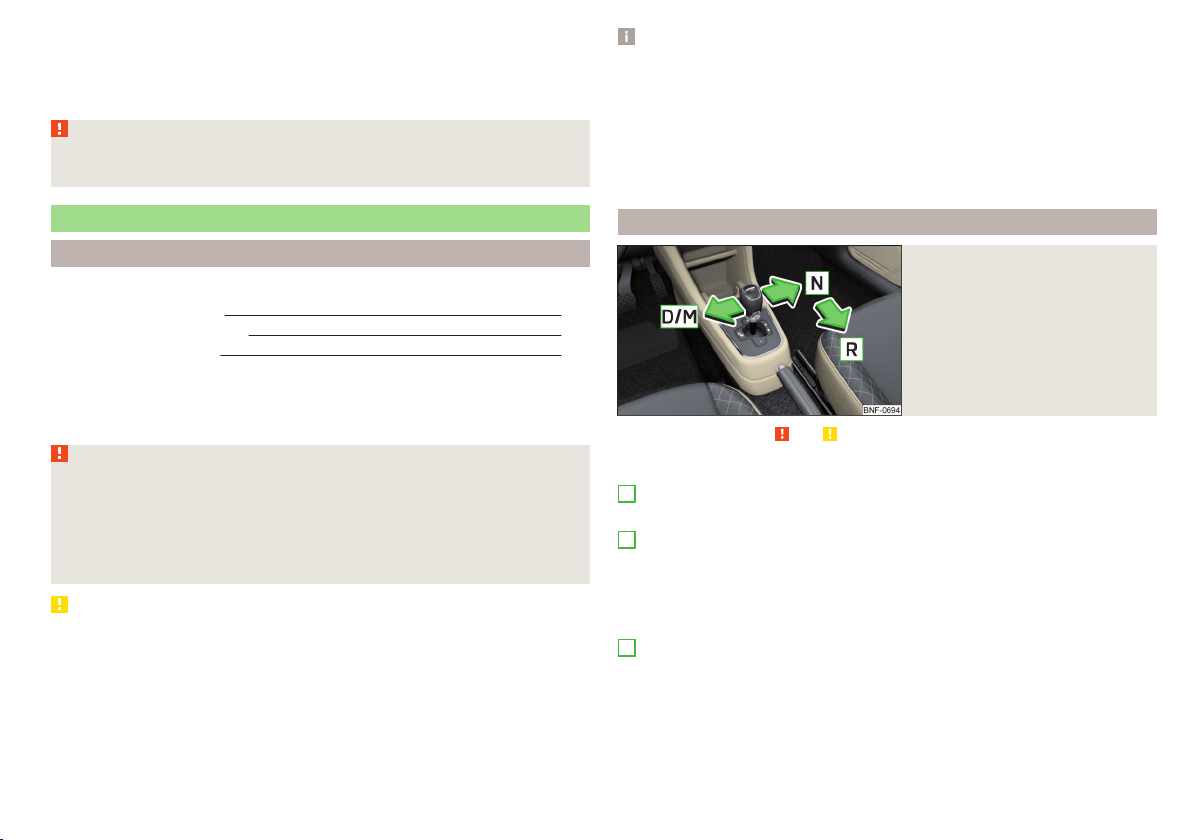
In the driver's footwell, only a footmat, which is attached to the two corre-
sponding attachment points may be used.
Only use factory-supplied footmats or footmats from the range of ŠKODAOrigi-
nal Accessories, which are fitted to two attachment points.
WARNING
No objects are allowed in the driver's footwell – risk of obstruction or limi-
tation in operating the pedals!
Automated transmission
Introduction
This chapter contains information on the following subjects:
Modes and lever control
81
Manual gearshift (Tiptronic) 82
Starting-off and driving 82
The automatic transmission performs automatic gear changes.
The modes of the automatic transmission are adjusted by the driver by means
of the selector lever.
WARNING
■
No throttle when it is set before starting the mode for moving forward
with the selector lever - there is a risk of accident!
■
Never move the selector lever to mode R when driving – risk of accident!
■
Always firmly apply the handbrake before leaving the vehicle! Otherwise,
the vehicle could be automatically set in motion - there is a risk of acci-
dents!
CAUTION
When stopping on a slope, never try to hold the vehicle using the accelerator
pedal – this may lead to gear damage.
Note
■
The engine can only be left on in position N, when the brake pedal is de-
pressed .
■
If the selector lever position N is accidentally selected while driving, it is first
necessary to release pressure on the accelerator pedal and wait for the idling
speed of the engine to be reached before the selector lever can be engaged in
the drive position.
■
If the N symbol flashes next to the selector lever, engage the selector lever
position N.
Modes and lever control
Fig. 94
Selector lever
Read and observe and on page 81 first.
The following modes can be selected with the selector lever » Fig. 94.
N
– Neutral
The power transmission to the drive wheels is interrupted in this mode.
R
– Reverse gear
Reverse gear can only be engaged when the vehicle is stationary and the en-
gine is at idling speed.
The brake pedal must be depressed before setting into position R from posi-
tion N.
D
- Mode for forwards travel (normal programme)
In mode D, the forward gears are automatically changed according to the en-
gine load, accelerator pedal actuation and driving speed.
The brake pedal must be depressed before setting into position D from posi-
tion N.
81
Starting-off and Driving
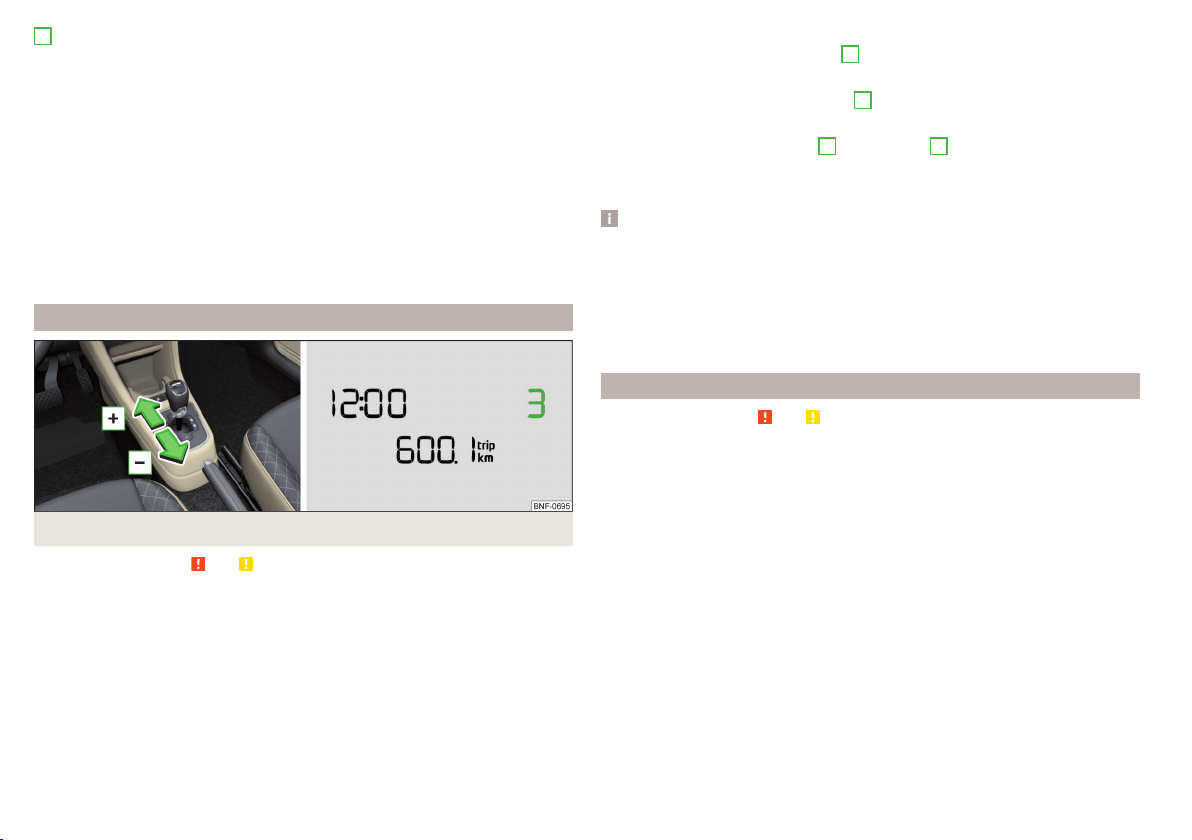
M
- Manual gearshift (Tiptronic)
Further information » page 82.
With driving mode set, the vehicle will not start up
If the vehicle does not start off, the problem may be that the selector lever is
not completely in the selected position. In such an instance, press the brake
pedal and put the selector lever into the required position.
Faults in the automatic gearbox
In the event of a fault in the automatic gearbox, warning lights may light up in
the instrument panel » page 35,
Automated transmission.
An error on the automated manual transmission can become noticed, for ex-
ample, by the following.
▶
Only certain gears are selected.
▶
The reverse gear R cannot be used.
Manual gearshift (Tiptronic)
Fig. 95
Selector lever: manual shifting/information display
Read and observe and on page 81 first.
Tiptronic mode makes it possible to manually shift gears on the selector lever.
The gearshift indicator must be observed when changing gear » page 30.
Switching to manual shifting when the vehicle is stationary
›
Depress the brake pedal.
›
Press the selector lever twice to the left in the spring-tensioned position.
Switching to manual shifting during driving
›
Press the selector lever towards the left in the spring-tensioned position in
the direction of the arrow and set in position M. The selector lever position
you have engaged is shown in the instrument cluster display» Fig. 95.
Shifting up gears
›
Press the selector lever forwards
+
» Fig. 95 .
Shifting down gears
›
Press the selector lever backwards
-
» Fig. 95 .
Temporarily switching to manual shifting in position D
›
Tilt the selector lever forward
+
or rearwards
-
» Fig. 95.
If in a short time, no manual gear change takes place, then the temporary
manual shifting switches off.
Note
■
It may be beneficial, for example, when travelling downhill, to use manual
shifting of gears. Shifting to a lower gear reduces the load on the brakes and
hence the wear on the brakes » page 78, Information on braking.
■
When accelerating, the gearbox automatically shifts up into the higher gear
just before the maximum permissible engine speed is reached.
■
If a lower gear is selected, the gearbox does not shift down until there is no
risk of the engine overrevving.
Starting-off and driving
Read and observe and on page 81 first.
Starting off
›
Start the engine.
›
Firmly depress and hold the brake pedal.
›
Press the selector lever towards the left in the spring-tensioned position in
the direction of the arrow » Fig. 94 on page 81 and insert into position D .
›
Release the brake pedal and accelerate.
Stopping (while the car is moving)
›
Fully depress and hold the brake pedal and bring the vehicle to a stop.
›
Keep holding the brake pedal until driving is resumed.
The selector lever position N does not have to be selected when stopping for a
short time, such as at a cross roads.
Kick-down
The Kick-down function allows you to achieve the maximum acceleration of
your vehicle while driving.
When the accelerator pedal is fully depressed, the Kick-down function is acti-
vated in any forward driving mode.
82
Driving

The gearbox shifts down one or more gears depending on the vehicle speed
and engine speed, and the vehicle accelerates.
The gearbox does not shift up into the highest gear until the engine has
reached its maximum revolutions for this gear range.
WARNING
Rapid acceleration, particularly on slippery roads, can lead to loss of vehicle
control – risk of accident!
Running-in and economical driving
Introduction
This chapter contains information on the following subjects:
Running-in
83
Tips for economical driving 83
The fuel consumption, degree of pollution and vehicle wear depend on driving
style, road condition, weather conditions and the like.
Running-in
Driving in the engine
The engine has to be run in during the first 1 500 kilometres. During this peri-
od, the driving style decides on the quality of the driving-in process.
During the first 1 000 km we recommend not driving faster than 3/4 of the
maximum permissible engine speed, not to drive at full throttle and to dis-
pense with the trailer.
In the area of 1,000 to 1,500 kilometres the engine load can be increased up
to the maximum permitted engine speed.
New tyres
New tyres must firstly be “run in” since they do not offer optimal grip at first.
Therefore, drive especially carefully for the first 500 km or so.
New brake pads
New brake pads have to first “grind in” because these do not initially have the
best possible braking effect.
Therefore, drive especially carefully for the first 200 km or so.
Tips for economical driving
To achieve the lowest possible fuel consumption, the following instructions
must be observed.
Looking ahead when driving
Avoid unnecessary acceleration and braking.
Switch in an energy saving and timely manner
Observe the recommended gear » page 30.
Avoid full throttle and high speeds
Fuel consumption can be reduced by half if only three-quarters of the possible
top speed of your vehicle is used.
Reducing idling
If the vehicle is fitted with the START - STOP system there is an automatic re-
duction of the idling. If the engine is stopped on vehicles without START-STOP
system, such as when waiting in a traffic jam, the fuel economy is already
greater after 30 - 40 s than the fuel quantity which is required for engine re-
start.
Avoid short distances
When driving a short distance of less than about 4 km, the engine cannot
reach its operating temperature. As long as the engine has not reached oper-
ating temperature, the fuel consumption is significantly higher than with the
engine hot.
Pay attention to the correct tyre inflation pressure being maintained
Further information » page 117.
Avoid unnecessary ballast
Per 100 kg of weight, consumption increases by about 0.3 l/100 km. At a speed
of 100 - 120 km/h, a vehicle fitted with a roof rack cross member without a load
will use about 10 % more fuel than normal due to the increased aerodynamic
drag.
Saving electricity
Only turn on electrical consumers (e.g. seat, window and mirror heating and
similar) for as long as necessary.
Use the cooling system economically
The air conditioning system compressor uses power from the engine when in
cooling mode, which will affect the fuel consumption.
83
Starting-off and Driving

It recommended to open the windows or the doors of a vehicle for which the
interior has been strongly heated through the effect of direct sunlight in order
to allow the heated air to escape.
The cooling system should not be on if the windows are open.
Avoiding damage to your vehicle
Introduction
This chapter contains information on the following subjects:
Driving Tips
84
Driving through water 84
This section of the manual contains important information on preventing dam-
age to the vehicle while driving.
Driving Tips
Only drive on such roads and in such terrain, which match the vehicle parame-
ters » page 142, Technical data as well as your driving skills.
The driver is always responsible for deciding whether the vehicle can handle
travelling in the given terrain.
WARNING
■
Always adjust your driving to the current terrain and weather conditions.
Excessive speed or incorrect driving manoeuvres can cause damage to the
vehicle and lead to serious injuries.
■
Combustible objects such as dry leaves or twigs caught under the base of
the vehicle could ignite on hot vehicle parts - risk of fire!
CAUTION
■
Pay attention to the ground clearance of the vehicle! When driving over ob-
jects which are larger than the ground clearance, the vehicle can get damaged.
■
Any objects that get trapped under the vehicle floor must be removed as
soon as possible. These objects can damage the fuel lines, the brake system,
seals and other parts of the vehicle.
■
Drive slowly in unknown terrain and watch out for unexpected obstacles,
such as potholes, rocks, stumps, etc.
■
Check up on confusing sections of unpaved roads before travelling on them
and consider whether such travelling is possible without risk.
Driving through water
Fig. 96
Maximum permissible water lev-
el when driving through water
The following instructions must be observed if vehicle damage is to be avoided
when driving through water (e.g. flooded roads).
›
Therefore determine the depth of the water before driving through bodies of
water.
The water level must not reach above the web of the lower beam » Fig. 96.
›
Do not drive any faster than at a walking speed.
At a higher speed, a water wave can form in front of the vehicle, which can
cause water to penetrate into the engine's air induction system or other parts
of the vehicle.
›
Never stop in the water, do not reverse and do not switch the engine off.
CAUTION
■
Should water penetrate into the intake system of the engine, there is a
threat of serious damage being incurred by the engine parts!
■
When driving through water, some vehicle parts such as chassis, electrics or
transmission can be severely damaged.
■
Oncoming vehicles can generate water waves which can exceed the permis-
sible water level for your vehicle.
■
Potholes, mud or rocks can be hidden under the water, making it difficult or
impossible to drive through the body of water.
■
Do not drive through salt water, as the salt can cause corrosion. An vehicle
coming into contact with salt water is to be thoroughly rinsed with fresh wa-
ter.
84
Driving

Assist systems
General information
Introduction
WARNING
The following general instructions regarding the use of assistance systems
must be observed.
■
The assistance systems serve merely to support the driver and do not re-
lieve the driver of responsibility for the operation of the vehicle.
■
The increased safety as well as the increased occupant protection offered
by the assistance systems must not tempt you to take safety risks - there
is a risk of an accident!
■
Adjust the speed and driving style to the current visibility, weather, road
and traffic conditions.
■
The assistance systems have physical and system-related limitations. For
this reason, the driver may experience some undesired or delayed system
responses in certain situations. You should therefore always be alert and
ready to intervene!
■
Only activate, deactivate and set the assistance systems to keep you fully
in control of the vehicle in every traffic situation - otherwise there is a risk
of an accident!
Braking and stabilisation systems
Introduction
This chapter contains information on the following subjects:
Stability Control (ESC) 85
Anti-lock braking system (ABS) 85
Traction control (TCS) 85
Electronic Differential Lock (EDL) 86
Brake Assist (HBA) 86
Hill Start Assist (HHC) 86
This chapter describes the functions of the brake and stabilization systems.
The error display is in Chapter » page 34, Warning lights.
The brake and stabilisation systems are automatically activated each time the
ignition is switched on, unless otherwise indicated.
WARNING
The general information relating to the use of assistance systems must be
observed » page 85, in section Introduction.
Stability Control (ESC)
Read and observe on page 85 first.
The ESC improves vehicle stability in dynamic driving situations, such as when
the vehicle starts to skid.
The ESC monitors whether the desired direction of the current vehicle motion
is occurring. In case of any deviation (e.g. oversteer), the ESC automatically
brakes individual wheels to maintain the desired direction.
During an intervention of the system, the warning light
flashes in the instru-
ment cluster.
Anti-lock braking system (ABS)
Read and observe
on page 85 first.
ABS prevents the wheels locking when braking. Thus helping the driver to
maintain control of the vehicle.
The intervention of the ABS is noticeable from the pulsating movements of
the brake pedal which is accompanied by noises.
When the ABS system is active, do not brake periodically or reduce the pres-
sure on the brake pedal.
Traction control (TCS)
Read and observe on page 85 first.
TCS prevents the spinning of the wheels on the drive axle. TCS reduces the
drive power transmitted to the wheels that are spinning Thus, for example,
driving on road surfaces with low grip is made easier.
If there is a TCS intervention, the warning light
flashes in the instrument
cluster.
85
Assist systems

Electronic Differential Lock (EDL)
Read and observe on page 85 first.
EDL prevents the turning of the respective wheel of the driven axle. EDL
brakes the spinning wheel, if necessary, and transmits the driving force to the
other driving wheel. Driving becomes easier on road surfaces with different
traction under each wheel of the driven axle.
The EDL switches off automatically in order to avoid excessive heat generation
on the brake of the wheel being braked. Once the brakes have cooled down,
there is an automatic re-activation of EDL.
Brake Assist (HBA)
Read and observe on page 85 first.
HBA increases the braking effect and helps to shorten the braking distance.
The HBA is activated by very quick operation of the brake pedal. In order to
achieve the shortest possible braking distance, the brake pedal must be ap-
plied firmly until the vehicle has come to a standstill.
The HBA function is automatically switched off when the brake pedal is re-
leased.
Hill Start Assist (HHC)
Read and observe on page 85 first.
When driving on slopes, HHC allows you to move your foot from the brake ped-
al to the accelerator pedal without having to use the handbrake.
The system holds the brake pressure produced by the activation of the brake
pedal for approx. 2 seconds after the brake pedal is released.
The HHC is active as of a 5 % slope, if the driver door is closed. HHC is always
only active on slopes when in forward or reverse start off.
Parking aid (ParkPilot)
Introduction
This chapter contains information on the following subjects:
Function
87
Visual parking system 87
The parking aid (hereinafter referred to as: the system) draws attention to any
obstacles via audible signals and a display in the Move & Fun multifunction de-
vice screen when manoeuvring in the vicinity of the vehicle » page 87, Visual
parking system.
WARNING
■
The general information relating to the use of assistance systems must
be observed » page 85, in section Introduction.
■
Moving persons or objects may not be recognized by the system sensors.
■
Under certain circumstances, surfaces of certain objects and types of
clothing cannot reflect the system signals. For this reason, such people or
objects may not be recognised by the system sensors.
■
External noise sources may affect the signals of the system sensors. Un-
der adverse conditions, this may cause objects or people not to be recog-
nised by the system.
■
Before reversing, you should make sure that there are no small obstacles,
such as rocks, thin posts, trailer drawbars etc. behind your vehicle. Such ob-
stacles may not be recognised by the system sensors.
CAUTION
■
Keep the system sensors clean, snow-and ice-free and do not cover with any
objects of any kind, otherwise the system functioning may be impaired.
■
Under adverse weather conditions (heavy rain, water vapour, very low or
high temperatures etc.), the system function may be limited - “incorrect recog-
nition of obstacle”.
■
Additionally installed accessories such as e.g. bicycle carriers can impair the
system function.
86
Driving

Function
Fig. 97 Fitting the sensors / Range of sensors
Read and observe
and on page 86 first.
The system uses ultrasound waves to calculate the distance between the
bumper and an obstacle. The ultrasonic sensors are integrated in the rear
bumper » Fig. 97.
Area scanned and range of the sensors » Fig. 97
150 cm
60 cm
Audible signals
The interval between the acoustic signals becomes shorter as the clearance is
reduced. A continuous tone sounds from a distance of approx. 30 cm - danger
area. From this moment on, do not continue reversing!
Activation/deactivation
The system is activated by engaging reverse gear. This is confirmed by a brief
audible signal.
The system is deactivated by disengaging reverse gear.
Fault display
If a warning signal sounds for about 3 seconds after activating the system and
there is no obstacle close to your car, this indicates a system fault. Seek help
from a specialist garage.
A
B
Visual parking system
Fig. 98
Screen display of the visual park-
ing system
Read and observe and on page 86 first.
The visual parking system is shown in the screen of the multifunctional device
Move & Fun.
Switching on the screen display of the visual parking system
When the ignition and the multifunction device Move & Fun are both on, the
visual parking system is switched on by shifting into reverse gear.
Screen display » Fig. 98
An obstacle appearing in the collision zone is shown as an orange-col-
oured segment » Fig. 98.
Do not continue to drive!
An area without detected obstacles is shown as a transparent segment.
An obstacle in the sensor range which lies outside of the collision area is
shown by the light-blue segment.
A region behind the detected obstacle is shown with the dark-blue seg-
ment.
Switching off the screen display of the visual parking system
The screen display can be switched off as follows.
▶
Through touching the screen of the multifunction device » Fig. 98 with the
fingers.
▶
By shifting out of reverse.
▶
By turning off the ignition.
A
B
C
D
87
Assist systems
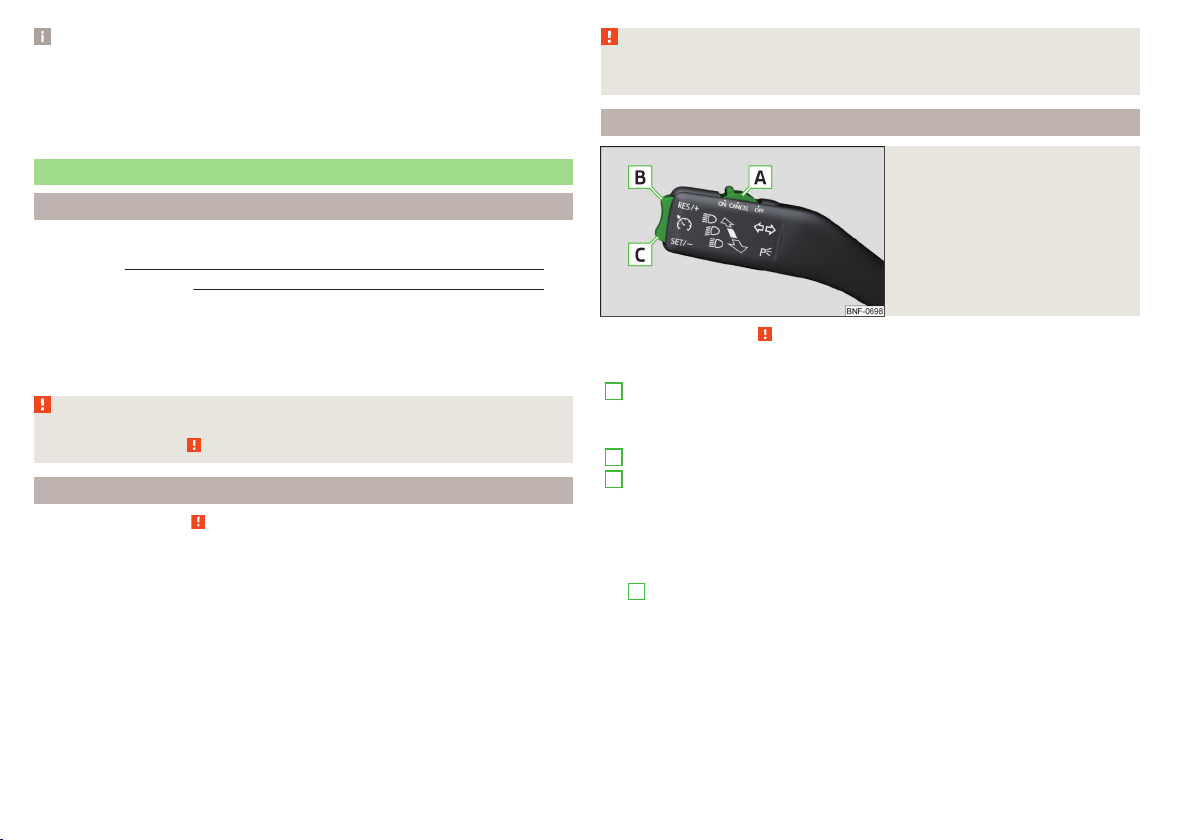
Note
■
The visual parking system is shown in the screen of the multifunction device
Move & Fun within a few seconds of shifting into reverse gear.
■
More information about the mobile multifunction device Move & Fun can be
found in the digital Owner´s Manual in the device » page 72, Multifunction de-
vice Move & Fun - install/remove.
Cruise Control System
Introduction
This chapter contains information on the following subjects:
Functioning 88
Operating Description
88
The Cruise Control System (CCS) maintains a set speed without you having to
actuate the accelerator pedal.
The state where the GRA maintains the speed is referred to hereinafter as the
control.
WARNING
The general information relating to the use of assistance systems must be
observed » page 85, in section Introduction.
Functioning
Read and observe on page 88 first.
Basic requirements for start of control
The GRA is activated.
On vehicles with a manual transmission, the second gear or higher is en-
gaged.
On vehicles with an automatic transmission, the selector lever is in the D
position or in the Tiptronic position.
The current speed is higher than approx. 20 km/h.
This is only possible within the range which is permitted by the power output
and braking power of the engine.
WARNING
If the engine power and engine braking effect is insufficient to maintain
the set speed, vehicle operation must be taken over!
Operating Description
Fig. 99
Cruise control system controls
Read and observe on page 88 first.
Overview of the control elements of the CCS » Fig. 99
A
Deactivate CCS (delete set speed)
Interrupt control (sprung position)
Activate ACC (control deactivated)
B
Take control again
a)
/ Increase speed
C
Launch control / reduce speed
a)
If no speed is set the current speed is adopted.
After the start of the regulation, the GRA regulates the vehicle to the current
speed and the warning light
illuminates in the instrument cluster.
After the interruption in control, the stored speed can be resumed by pressing
the
B
button.
Automatic control interruption
Automatic control interruption occurs if any of the following conditions are
met.
▶
By pressing the brake or clutch pedal.
▶
When one of the brake assist systems (e.g. ESC) intervenes.
▶
Through an airbag deployment.
88
Driving
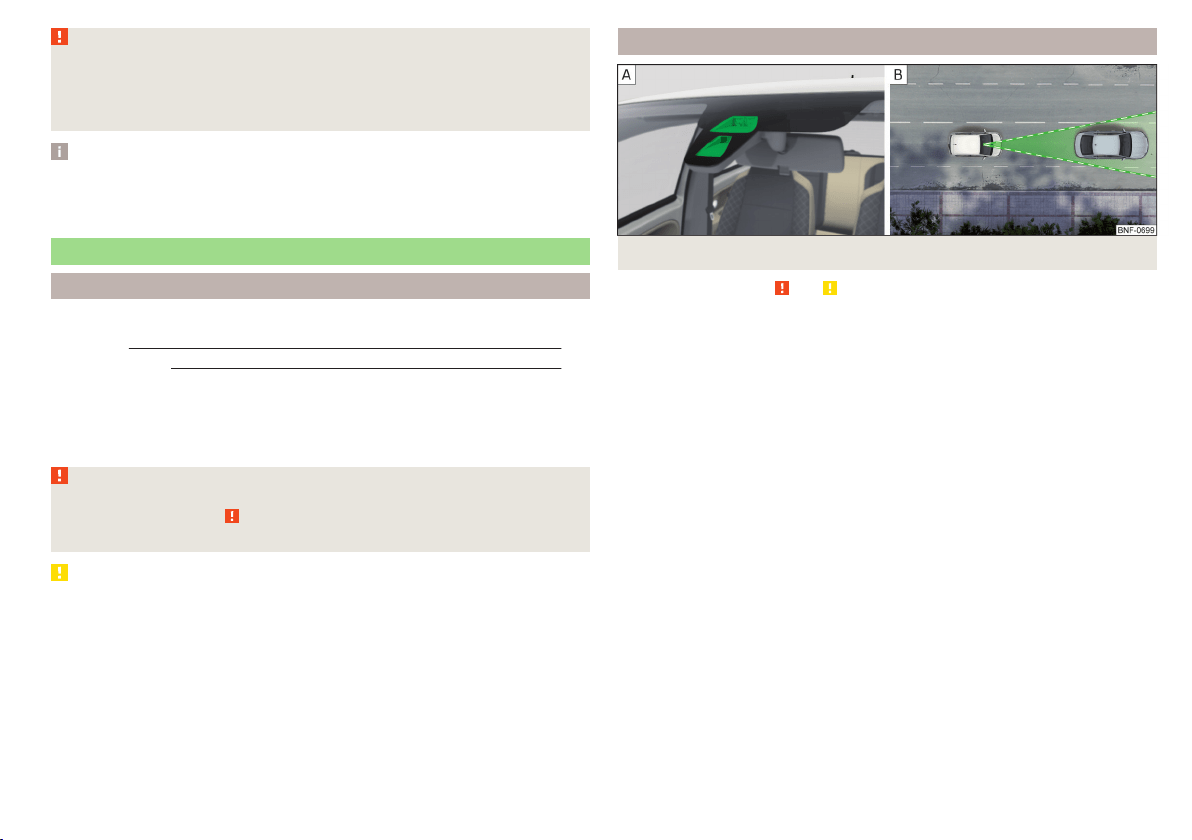
WARNING
■
Always deactivate the cruise control system after use to prevent the sys-
tem being switched on unintentionally.
■
Control may only be resumed if the set speed is not too high for the cur-
rent traffic conditions.
Note
During control, speed can be increased by pressing the accelerator pedal. Re-
leasing the accelerator pedal will cause the speed to drop again to the set
speed.
City Safe Drive
Introduction
This chapter contains information on the following subjects:
Operation
89
Disable / Enable 90
City Safe Drive (hereinafter referred to as: the system) monitors the traffic sit-
uation ahead of the vehicle. If the system detects a risk of collision with an ob-
stacle ahead of the vehicle, then automatic braking is applied. The risk of a col-
lision is thus reduced and the consequences of an impact are minimized.
WARNING
■
The general information relating to the use of assistance systems must
be observed » page 85, in section Introduction.
■
The system does not respond to crossing or oncoming objects.
CAUTION
The system can slow down the vehicle to a standstill. If the vehicle continues
to roll forward after stopping, then it should be stopped with the footbrake.
Operation
Fig. 100 Laser sensor/detection range
Read and observe and on page 89 first.
By means of a laser sensor » Fig. 100 -
the system detects traffic situations
ahead of the vehicle up to a distance of about 10 meters » Fig. 100 -
.
The system interventions take place when a risk of collision is detected as fol-
lows.
▶
The brake system is prepared for an emergency stop.
▶
If the driver fails to respond to a detected danger, an automatic braking ac-
tion is performed.
The system is ready to intervene automatically in the following conditions.
The engine is running.
The system is activated.
The travel speed is about 5-30 km/h.
The field of view of the laser sensor is not impaired.
If the system triggers automatic braking, the indicator symbol flashes
in the
display of the instrument cluster quickly.
Automatic braking interventions by the emergency brake function can be ter-
minated by pressing the clutch or the accelerator or by moving the steering
wheel.
The system can, for example, be affected in the following situations or not
be available.
▶
When visibility is poor, (e.g. fog, heavy rain, thick snowfall).
▶
Driving around “sharp” bends.
▶
When fully pressing down the accelerator pedal.
89
Assist systems
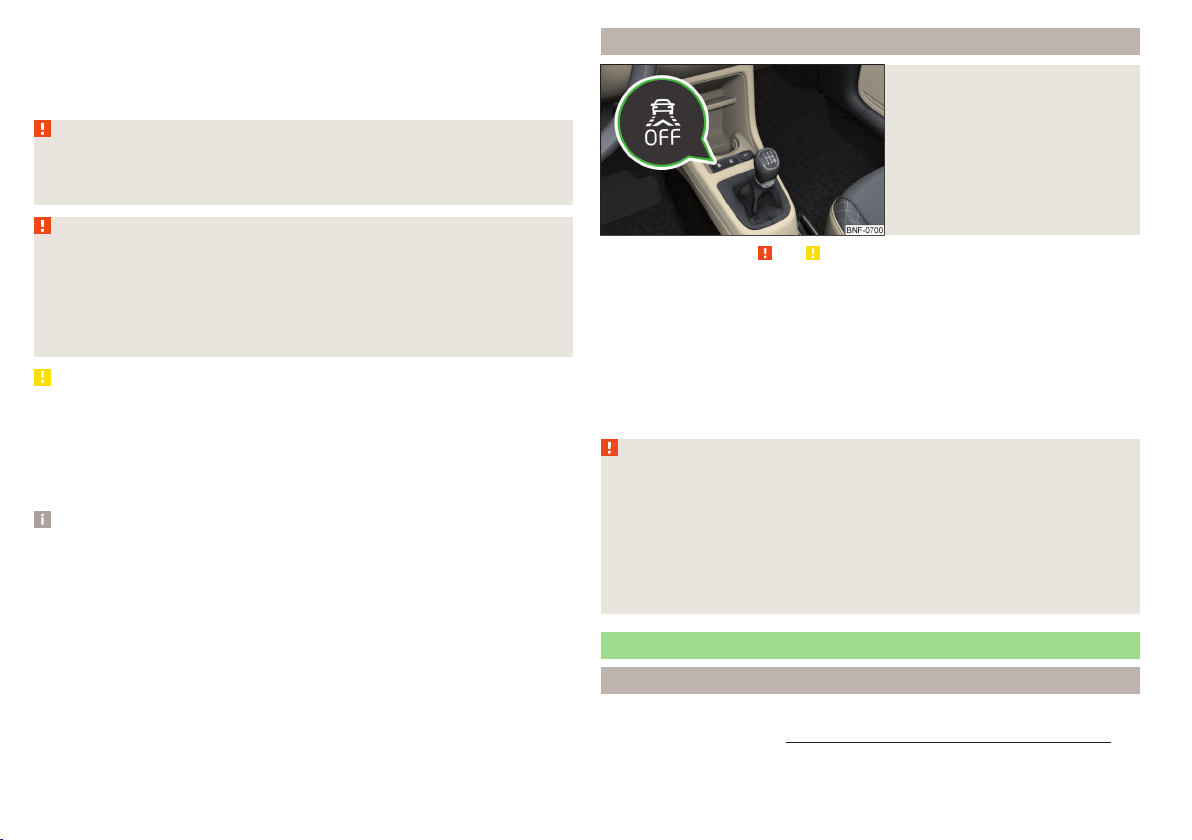
▶
When the laser sensor is dirty or obscured.
▶
When the vehicles are very dirty and have a low level of reflection.
If the system is not available or there is a system malfunction, the indicator
symbol flashes
slowly in the display of the instrument cluster.
WARNING
■
The windscreen may be neither blocked nor covered with dirt in the area
of the laser sensor. This can lead to impaired function of the sensor - risk of
accidents!
WARNING
The laser beam from the laser sensor can cause serious eye injuries. The la-
ser beam is not visible to the human eye.
■
Never use optical devices, e.g. a range-finder camera or magnifying glass
to look into the laser sensor.
■
The laser beam can also be active when the system is disabled or is not
available.
CAUTION
■
Remove the snow from the windscreen in the area of the laser sensor with a
hand brush and the ice with a solvent-free de-icing spray.
■
If the laser sensor range on the windscreen has scratches, cracks, etc, re-
place the windscreen. Only use windscreens approved by the manufacturer.
■
When replacing the windscreen wiper blades, only use windscreen wiper
blades approved by the manufacturer.
Note
If an automatic brake intervention is triggered by the system, the pressure in
the brake system increases and the brake pedal cannot be operated with the
normal pedal stroke.
Disable / Enable
Fig. 101
Button for the City Safe Drive
system
Read and observe and on page 89 first.
The function is automatically activated each time the ignition is switched on.
Deactivating/activating
›
Press the button » Fig. 101.
If the system is turned off and the vehicle is moving at a speed of about 5 - 30
km/h, the warning light
illuminates on the instrument cluster display.
If the system is activated » Fig. 101, the warning light
illuminates in the in-
strument cluster display for about 5 s.
WARNING
Deactivate the system for safety reasons in the following cases.
■
When the vehicle is being towed away.
■
When the vehicle is driven though an automatic car wash.
■
If the laser sensor is damaged or faulty.
■
When the vehicle is on a rolling test bench.
■
When the windscreen is damaged in the region of the laser sensor.
■
For example, if the charge extends to the roof rack over the front edge of
the roof.
Tyre pressure monitoring
Introduction
This chapter contains information on the following subjects:
Save tyre pressure values
91
90
Driving
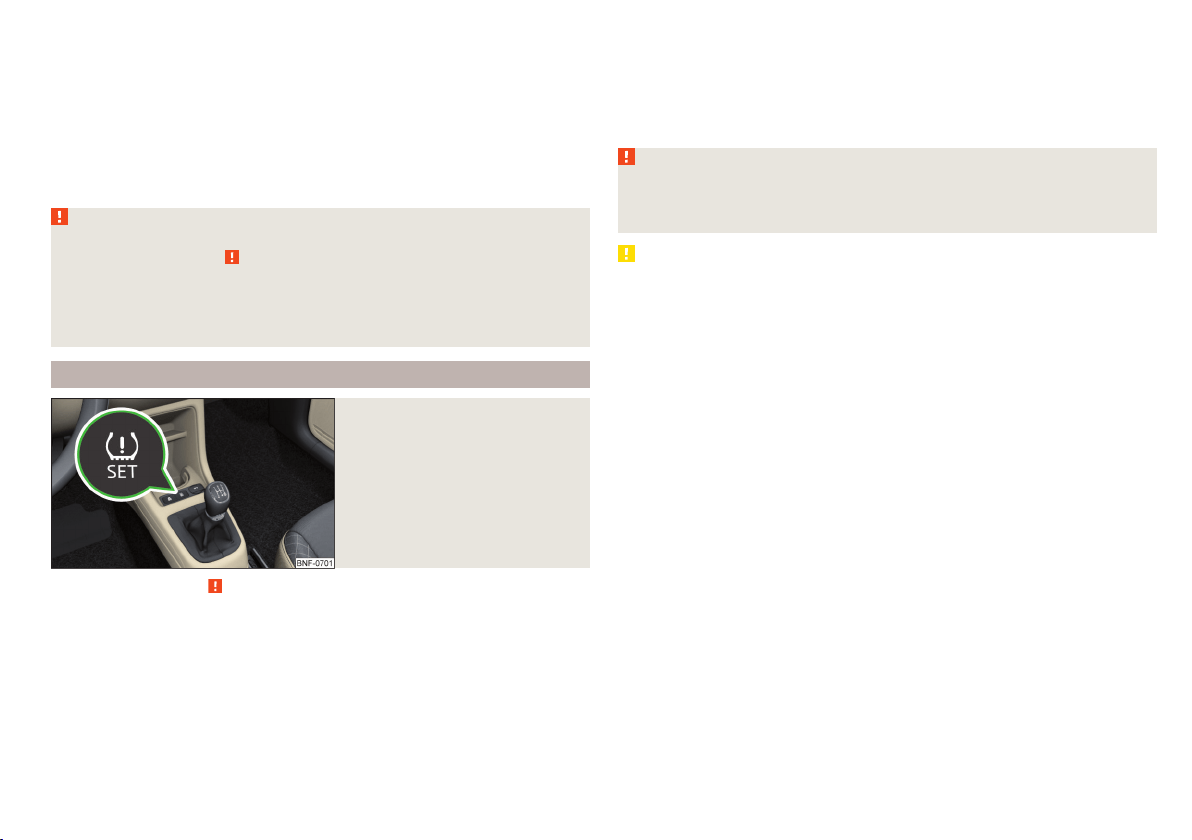
The tyre pressure monitoring function (hereinafter referred to as: the system)
monitors the tyre pressure while driving.
If the rolling circumference of a wheel is changed, the warning light
in the
instrument cluster illuminates and an audible signal sounds.
Information on the procedure for the notification of change of tyre inflation
pressure » page 36.
The system can only function properly if the tyres have the prescribed inflation
pressure and these pressure values are stored in the system.
WARNING
■
The general information relating to the use of assistance systems must
be observed » page 85, in section Introduction.
■
Having the correct tyre inflation pressure is always the driver's responsi-
bility. Tyre pressure should be checked regularly » page 117.
■
The system cannot warn in case of very rapid tyre inflation pressure loss,
e.g. in case of sudden tyre damage.
Save tyre pressure values
Fig. 102
Key for storing the pressure val-
ues
Read and observe on page 91 first.
Procedure for storing the tyre pressure values
›
Inflate all the tyres to the specified pressure.
›
Switch on the ignition.
›
Press the symbol key
» Fig. 102 and hold it down.
The warning light
in the instrument cluster illuminates.
An acoustic signal and the control indicator provide information about the
storage of the tyre pressure values.
›
Press the symbol key
Release the symbol key.
Always save the tyre pressure values in the system if one of the following
events occurs.
▶
Change of tyre inflation pressure.
▶
Change one or more wheels.
▶
Change in position of a wheel on the vehicle.
▶
Illumination of the warning light
in the instrument cluster.
WARNING
Before storing the pressures, the tyres must be inflated to the specified in-
flation pressure » page 117. If the wrong pressure valuesare stored, the
system may not issue any warnings, even if the tyre pressure is too low.
CAUTION
Save the tyre pressure values every 10,000 km or 1x annually to ensure correct
system functioning.
91
Assist systems

General Maintenance
Care and maintenance
Modifications, adjustments and technical alterations
Introduction
This chapter contains information on the following subjects:
Vehicle operating under different weather conditions
92
Statutory checks 92
ŠKODA Service Partners 93
ŠKODA Original parts 93
ŠKODA Original accessories
93
Spoiler 94
Airbags 94
Trailer operation 95
Acceptance and recycling of used vehicles 95
The instructions and guidelines from ŠKODA AUTO a.s. must be observed when
carrying out all modifications, repairs or technical alterations to your vehicle.
Adhering to these instructions and guidelines helps ensure road safety and
helps keep your vehicle in a good technical condition. After carrying out modifi-
cations, repairs or technical alterations, the vehicle will comply with German
road transport regulations (StVO).
Always consult a ŠKODA Partner » page 93 before buying accessories or
parts, or before carrying out any modifications, repairs or technical alterations
to your vehicle.
WARNING
■
Work on your vehicle, which have been carried out unprofessionally, can
cause operational faults – risk of accident!
■
Interference on the electronic components and their software can lead to
operational faults. This interference can also impair not directly affected
systems because of the networking of the electronic components. The op-
erational safety of the vehicle may be at significant risk and can lead to in-
creased wear of parts.
For the sake of the environment
Technical documents regarding alterations carried out on the vehicle must be
kept by the vehicle user in order to be handed over to the recyclers at a later
date. This ensures that the vehicle is recycled in an environmentally sound
manner.
Note
■
We recommend only having these modifications, repairs and technical
changes performed by a specialist garage.
■
Any damage caused by technical alterations made without the approval of
the manufacturer is excluded from the warranty » Service schedule.
■
The ŠKODA Partner does not assume any liability for products that have not
been approved by ŠKODA AUTO a.s. even though these may be products with
an operational approval or that have been approved by a government testing
institute.
■
We advise you only to use ŠKODA Original Accessories and ŠKODA Original
Parts which have been expressly approved for use on your vehicle. Reliability,
safety and suitability for your vehicle are guaranteed with these.
■
ŠKODA Original Accessories and ŠKODA Original Parts can be purchased from
ŠKODA Partners, who will also perform the professional assembly of the pur-
chased parts.
Vehicle operating under different weather conditions
Read and observe
on page 92 first.
If you would like to operate your vehicle in countries other than those with its
intended weather conditions, you should contact a ŠKODA Partner.
She will advise you if certain precautions need to be taken to ensure the full
functioning of the vehicle and to prevent damage.
This involves, for example, the coolant, battery replacement and the like.
Statutory checks
Read and observe on page 92 first.
Many countries have legislation which require that the reliability and road wor-
thiness and/or exhaust gas composition of a vehicle must be tested at specific
intervals. These tests can be carried out by workshops or checking stations
that have been legally authorized for this purpose.
92
General Maintenance

The ŠKODA service partners have been informed about the necessary legal
tests and will prepare the vehicle for the tests in a service operation at the
customer's discretion, or will ensure that these tests are carried out. The spe-
cialist garages can carry out the specified tests directly at the customer's dis-
cretion, if they are designated for such a procedure. This saves you time and
money.
Even if you want to take your vehicle to an officially approved test centre for
prior checking in preparation of a legally required test, we recommend that you
consult the service consultant of your ŠKODA service partner beforehand.
The service consultant will tell you which areas, according to his appraisal, you
should focus on in order that your vehicle may pass the technical test without
any problems. In this way, you can avoid additional expenses resulting from a
possible subsequent test.
ŠKODA Service Partners
Read and observe on page 92 first.
The ŠKODA Service Partners feature modern, specially developed tools and
equipment. Here, trained specialists have access to a comprehensive range of
ŠKODA Original Parts and ŠKODA Original Accessories for carrying out modifi-
cations, repairs and technical alterations.
All ŠKODA service partners operate according to the most recent guidelines
and instructions from ŠKODA AUTO a.s. All service and repair work is therefore
carried out on time and at the appropriate quality. Adhering to these guide-
lines and instructions helps ensure road safety and helps keep your vehicle in
a good technical condition.
ŠKODA Service Partners are therefore properly prepared to service your vehicle
and to provide quality work. We therefore advise you to have all modifications,
repairs and technical alterations to your vehicle carried out by a ŠKODA Service
Partner.
ŠKODA Original parts
Read and observe
on page 92 first.
We recommend the use of ŠKODA Genuine Parts for your vehicle, since these
parts are approved by ŠKODA AUTO a.s. They correspond exactly to the ŠKODA
AUTO a.s. regulations in regard to design, dimensional accuracy and material,
and are identical to the components used in the batch production.
ŠKODA AUTO a.s. is able to warrant the safety, suitability, and long life of
these products. Therefore, we recommend that you only use ŠKODA Genuine
Parts.
ŠKODA AUTO a.s. supplies the market with a complete range of ŠKODA Genu-
ine Parts not only while the model is still in production but for at least 15 years
after the end of series production; the market is supplied with wear-and-tear
parts and for at least 10 years with equipment parts.
ŠKODA service partners are liable for any ŠKODA original part defects for a pe-
riod of 2 years after sale in accordance with the materials defect liability, provi-
ded that nothing else was agreed in the purchase agreement. You should keep
the approved warranty certificate and the bill for these components for this
period of time, so that the commencement of the term may be verified.
Body repairs
ŠKODA vehicles are designed so that if the body suffers damage, it is only nec-
essary to replace those parts which are in fact damaged.
Before you decide to have damaged body parts replaced, however, you should
first of all contact your specialist garage to determine whether or not such
parts can also be repaired. Repairs to body parts are usually cheaper.
ŠKODA Original accessories
Read and observe on page 92 first.
If you wish to fit accessories to your vehicle, you should bear in mind the fol-
lowing:
We recommend that you use ŠKODA Genuine Accessories in your vehicle.
ŠKODA AUTO a.s. has selected such accessories to ensure that they are relia-
ble, safe and suitable for your particular vehicle. Although we constantly moni-
tor the market, we are not able to assess or warrant the parts even though in
some instances such parts may have a type approval or may have been ap-
proved by a nationally recognised testing laboratory.
All accessory products go through a fastidious process in the area of technical
development (technical tests) and quality inspection (customer tests), and only
if all tests are positive does the product become a ŠKODA Genuine Accessory.
Our ŠKODA Genuine Accessories service also provides expert advice, and pro-
fessional fitting at the customer's discretion.
93
Care and maintenance

ŠKODA service partners are liable for any ŠKODA Genuine Part defects for a
period of 2 years after installation or delivery in accordance with the materials
defect liability, provided that nothing else was agreed in the purchase contract
or in any other agreements. You should keep the approved warranty certificate
and the bill for these components for this period of time, so that commence-
ment of the term may be verified.
In addition, ŠKODA Service Partners also stock a range of suitable car care
products as well as those parts which are subject to natural wear-and-tear,
such as tyres, batteries, bulbs and wiper blades.
Note
The accessories authorized by the company ŠKODA AUTO a.s. will be offered
by the ŠKODA partners in all countries where the company ŠKODA AUTO a.s.
has a sales and service network. This will usually be in the form of a printed
catalogue of Original ŠKODA Accessories, in the form of separate printed bro-
chures or in the form of offers for ŠKODA Genuine Accessories on the ŠKODA
partner web pages.
Spoiler
Read and observe on page 92 first.
If your new vehicle is fitted with a spoiler on the front bumper in combination
with the spoiler on the luggage compartment lid, the following instructions
must be adhered to.
▶
For safety reasons, the vehicle must only be fitted with a spoiler on the front
bumper in combination with the associated spoiler on the luggage compart-
ment lid.
▶
This kind of spoiler cannot be left on the front bumper either on its own, in
combination with another spoiler not on the luggage compartment lid or in
combination with an unsuitable spoiler on the luggage compartment lid.
▶
We recommend that you consult the ŠKODA service partner for any repairs to
or replacement, addition or removal of spoilers.
WARNING
■
If work on your vehicle's spoilers is not carried out properly, this can lead
to operational faults - risk of accident and serious injuries.
■
If a front spoiler, full wheel trim, etc. is mounted retrospectively, it must
be ensured that the air supply to the front wheel brakes is not reduced.
The front brakes may overheat, which can have a negative impact on the
functioning of the braking system – risk of accident!
Airbags
Read and observe on page 92 first.
WARNING
■
Modifications, repairs and technical alterations that have been carried out
unprofessionally can cause damage and operational faults, and can also se-
riously impair the effectiveness of the airbag system – risk of accident and
fatal injury!
■
A change to the vehicle's wheel suspension, including the use of non-ap-
proved wheels and tire combinations, can alter the functioning of the air-
bag system - risk of accident and fatal injury!
WARNING
Information on the use of the airbag system
■
Never install any airbag parts into the vehicle that have been removed
from old cars or have been recycled.
■
Never install damaged airbag parts in the vehicle. The airbags may then
not be deployed properly or even at all in the event of an accident.
WARNING
■
No modifications of any kind must be made to parts of the airbag system.
■
Any work on the airbag system including the installation and removal of
system components due to other repair work (e.g. removal of the steering
wheel) must only be carried out by a specialist garage.
■
Never make any changes to the front bumper or the bodywork.
■
It is prohibited to manipulate individual parts of the airbag system, as this
might result in the airbag being deployed.
■
The protective function of the airbag system is sufficient for only one ac-
cident. The airbag system must then be replaced if the airbag has been de-
ployed.
94
General Maintenance

WARNING
The airbag system operates using pressure sensors located in the front
doors. For this reason, no adjustments may be carried out to the doors or
door panels (e.g. installation of additional loudspeakers). Resulting damage
can have a negative impact on the function of the airbag system. Any work
on the front doors and their door panels must be carried out by a specialist
garage. The following instructions must be observed.
■
Never drive with inner door panels removed.
■
Never drive if parts of the inner door panel have been removed and the
resulting openings have not been properly sealed.
■
Never drive if the loudspeakers in the doors have been removed, unless
the loudspeaker openings have been properly sealed.
■
Always make sure that the openings are covered or filled if additional
loudspeakers or other equipment parts have been installed in the inner
door panels.
Trailer operation
Read and observe
on page 92 first.
The vehicle is not approved for towing a trailer. The vehicle is not factory-
equipped with a towing device and it cannot be retrofitted with a towing de-
vice.
WARNING
Never attach a towing device to the vehicle.
Acceptance and recycling of used vehicles
Read and observe on page 92 first.
ŠKODA meets the requirements of the brand and its products with regard to
protecting the environment and the preserving resources. All new ŠKODA ve-
hicles are 95% recyclable.
Note
You can find more detailed information about the trade-in and recycling of old
cars from a specialist garage.
Washing vehicle
Introduction
This chapter contains information on the following subjects:
Washing by hand
95
Automatic car wash systems 96
Washing the vehicle with high-pressure cleaners 96
The best way to protect your vehicle against harmful environmental influences
is frequent washing.
The longer insect residues, bird droppings, road salt and other aggressive de-
posits remain on the paintwork of your vehicle, the more detrimental their de-
structive effect can be. High temperatures, such as those caused by intensive
sun's rays, accentuate this caustic effect.
It is essential to also thoroughly clean the underside of the vehicle at the end
of the winter.
WARNING
When washing your vehicle in the winter: Water and ice in the braking sys-
tem can affect the braking efficiency – risk of accident!
CAUTION
The temperature of the water used for cleaning must not exceed 60 °C – risk
of damaging the vehicle.
For the sake of the environment
Only wash the vehicle at washing bays intended for this purpose.
Washing by hand
Read and observe and on page 95 first.
Soak the dirt with plenty of water and rinse as well as possible.
Clean the vehicle with a soft sponge, a washing glove or a washing brush.
Work from the top to the bottom – starting with the roof.
For stubborn dirt, agents specifically intended for this purpose are to be used.
Wash out the sponge or washing glove thoroughly at short intervals.
95
Care and maintenance

Clean wheels, door sills and similar parts last. Use a second sponge for such
areas.
Give the vehicle a good rinse after washing it and dry it off using a chamois
leather.
WARNING
Protect your hands and arms from sharp-edged metal parts when cleaning
the underfloor or the inside of the wheel housings or the wheel trims – risk
of cuts!
CAUTION
■
Only apply slight pressure when cleaning the vehicle's paintwork.
■
Do not wash your vehicle in bright sunlight – risk of paint damage.
Automatic car wash systems
Read and observe and on page 95 first.
The usual precautionary measures must be taken before washing the vehicle
in an automatic car wash system (e.g. closing the windows and the sliding/tilt-
ing roof etc.).
If your vehicle is fitted with any particular attached parts, such as a spoiler,
roof rack system etc., it is best to consult the operator of the car wash system
beforehand.
After an automatic wash with wax treatment, the lips of the wipers should be
cleaned with cleaning agents specially designed for the purpose, and then de-
greased.
CAUTION
■
Before driving through a car wash fold in the exterior mirrors - there is a risk
of damage.
■
Before driving through a car wash unscrew the antenna - there is a risk of
damage.
Washing the vehicle with high-pressure cleaners
Read and observe
and on page 95 first.
When washing the vehicle with a high-pressure cleaner, the instructions for
use of the equipment must be observed. This applies in particular to the pres-
sure used and to the spraying distance.
Maintain a sufficiently large distance to the parking aid sensors and soft mate-
rials such as rubber hoses or insulation material.
CAUTION
■
The films should not be washed with any high-pressure cleaners - there is
risk of damage » page 97.
■
Do not aim the water jet directly at the lock cylinders or the door or opening
joints when washing the vehicle in the winter – there is a risk of freezing.
■
The sensors of the parking aid can be sprayed only for a short time and there
must be a minimum distance of 10 cm - there is a risk of damage.
Cleaning vehicle exterior
Introduction
This chapter contains information on the following subjects:
Vehicle paintwork 97
Films
97
Plastic parts
98
Rubber seals
98
Chrome and anodized parts
98
Windows and external mirrors
98
Headlight glasses
98
Door closing cylinder
99
Cavity protection
99
Jack
99
Wheels
99
Under-body protection
99
Wiper blades
100
We recommend using vehicle care products from ŠKODA Original Accessories.
These are available from ŠKODA Partners. The usage instructions on the pack-
age must be observed.
96
General Maintenance

WARNING
■
Vehicle care products may be harmful to your health if not used according
to the instructions.
■
Always keep the vehicle care products safe from people who are not com-
pletely independent, e.g. children - there is a danger of poisoning!
■
Protect your hands and arms from sharp-edged metal parts when clean-
ing the underfloor, the inside of the wheel housings or the wheel trims –
risk of cuts!
CAUTION
■
Do not use any insect sponges, rough kitchen sponges or similar cleaning
products – risk of damaging the paintwork surface.
■
Cleaner that contain solvents can damage the material being cleaned.
Note
Due to the special tools and knowledge required, and to avoid any potential
problems with the cleaning and care of your vehicle's exterior, we recommend
that the cleaning and care of your vehicle be carried out by a ŠKODA Service
Partner.
Vehicle paintwork
Read and observe
and on page 97 first.
Preserving the vehicle paintwork
A thorough wax treatment provides the vehicle's paintwork with highly effec-
tive protection against harmful environmental influences.
The vehicle must be treated with a high-quality hard wax polish at the latest,
when no more drops form on the clean paintwork.
A new layer of a high-quality hard wax polish can be applied to the clean body-
work after it has dried thoroughly.
Even if you use a wax preserver regularly we still recommend that you treat
the paintwork of the vehicle at least twice a year with hard wax.
Polishing
Polishing is necessary if the vehicle's paintwork has become unattractive and
if it is no longer possible to achieve a gloss with wax preservatives.
If the polish does not contain any preserving elements, the paint must be trea-
ted with a preservative afterwards.
CAUTION
■
Paint damage is to be repaired immediately.
■
Never apply wax to the windows.
■
Mat painted or plastic parts must not be treated with polishing products or
hard waxes.
■
Do not polish the paintwork in a dusty environment - risk of paint scratches.
■
Do not apply any paint care products to door seals or window guides.
■
If possible, do not apply any paint care products to parts of the bodywork
that come into contact with door seals or window guides.
Films
Read and observe and on page 97 first.
Cleaning
Films (eg. roofing, decorative, protective films and similar) require more careful
cleaning than paintwork cleaning.
The films may not be washed with a high-pressure cleaner.
Wash the films only with a soft sponge, mild soap solution and clean, warm
water.
Life
Environmental influences (eg. sunlight, humidity, air pollution, chipping) will af-
fect the life of the films.
The sunlight may also affect the strength of the film colour.
Films will age and become brittle - this is entirely normal; this is not a fault.
CAUTION
■
Never use aggressive cleaning agents or chemical solvents for the glued sur-
faces with films - there is a danger of film damage.
■
Never use dirty cloths or chemical solvents for the glued surfaces with films -
there is a danger of damaging the film.
■
In the winter months, do not use an ice scraper to remove ice and snow from
the areas with films. Do not use any other objects to remove frozen layers of
snow or ice – risk of film damage.
■
Do not polish the films - risk of damage!
■
When transporting a load on the roof rack (e.g. roof box or similar) there is an
increased risk of film damage (e.g. of chipping from the secured load).
97
Care and maintenance

Plastic parts
Read and observe and on page 97 first.
Clean plastic parts with a damp cloth.
If this method does not completely clean the plastic parts, use cleaning prod-
ucts specially designed for this purpose.
CAUTION
Do not use paint care products on plastic parts.
Rubber seals
Read and observe and on page 97 first.
All door seals and window guides are factory-treated with a colourless matt
varnish layer to prevent the freezing of painted body parts and to protect
against driving noise.
CAUTION
■
Do not treat the door seals and window guides with any products.
■
Applying additional treatments to the seals can corrode the protective coat-
ing, and driving noise may occur.
Chrome and anodized parts
Read and observe and on page 97 first.
First clean the chrome parts and anodized parts with a damp cloth and then
polish them with a soft, dry cloth.
If this method does not completely clean the parts, use cleaning products spe-
cially designed for this purpose.
CAUTION
■
Do not polish the chrome parts and anodized parts in a dusty environment -
risk of surface scratches.
■
Never use aggressive cleaning agents or chemical solvents for these parts -
there is risk of damage.
Windows and external mirrors
Read and observe and on page 97 first.
Removing snow and ice
Use a plastic ice scraper for removing snow and ice from the windows and mir-
rors.
Cleaning windows
Regularly clean windows from the inside with clean water.
Dry the glass surfaces with a clean chamois leather or a cloth intended for this
purpose.
CAUTION
Instructions for removing snow and ice
■
The ice scraper should not be moved forward and backward but in one direc-
tion to avoid any damage to the surface of the glass.
■
Snow or ice that is contaminated with coarse dirt such as fine gravel, sand or
salt must not be removed from the windows and mirrors – there is a risk of
damage to the surface of the windows and mirrors.
■
Do not remove snow or ice from glass parts using warm or hot water – risk of
cracks forming in the glass.
■
Make sure that when removing snow and ice from the windows, the labels
attached to the vehicle by the factory are not damaged.
CAUTION
Information for cleaning windows
■
Do not clean the inside of the windows with sharp-edged objects or corro-
sive and acidic cleaning agents – there is a risk of damaging the heating ele-
ments or window aerial.
■
When drying the windows after washing the vehicle, do not use window
leathers that have been used to polish the bodywork. Residues of preserva-
tives in the window leather can make the window dirty and reduce visibility.
Headlight glasses
Read and observe and on page 97 first.
Clean plastic front headlight lenses using clean, warm water and soap.
98
General Maintenance

CAUTION
■
The headlights are never to be wiped dry - there is a risk of damaging the
protective lacquer and the headlight glass subsequently developing cracks.
■
Do not use sharp objects to clean the glasses - there is a risk of damaging
the protective lacquer and the headlight glasses subsequently developing
cracks.
■
Do not use any aggressive cleaning or chemical solvent products to clean the
headlights – risk of damaging the headlight lenses.
Door closing cylinder
Read and observe and on page 97 first.
Specific products must be used for de-icing door lock cylinders.
CAUTION
Make sure that as little water as possible gets into the locking cylinder when
washing the vehicle - there is a risk of freezing the lock cylinder!
Cavity protection
Read and observe and on page 97 first.
All the cavities of your vehicle which are at risk from corrosion are protected
for life by a layer of protective wax applied in the factory.
This wax protection does not need to be inspected or re-applied.
If any small amount of wax flow out of the cavities at high temperatures, these
must be removed with a plastic scraper and the stains cleaned using a petrole-
um cleaner.
WARNING
Safety regulations should be observed when using petroleum cleaner to re-
move wax – risk of fire!
Jack
Read and observe and on page 97 first.
The jack is maintenance-free.
If necessary, the moving parts of the jack should be lubricated with a suitable
lubricant.
Wheels
Read and observe and on page 97 first.
Wheel rims
Also thoroughly wash the wheel rims when washing the vehicle on a regular
basis.
Regularly remove salt and brake abrasion, otherwise the rim material will be
corroded.
Light alloy wheels
After washing thoroughly and treat the wheel rims with a protective product
for light alloy wheels.
For the treatment of wheel rims do not use products which may cause damage
to the paint on the rims.
CAUTION
■
Damage to the paint layer on the wheel rims must be touched up immediate-
ly.
■
Severe layers of dirt on the wheels can also result in wheel imbalance. This
may show itself in the form of a wheel vibration which is transmitted to the
steering wheel which, in certain circumstances, can cause premature wear of
the steering. This means it is necessary to remove the dirt.
Under-body protection
Read and observe
and on page 97 first.
The underside of your vehicle is already permanently protected by the factory
against chemical and mechanical influences.
It is not possible to guarantee that the protective coating will not suffer any
damage as the vehicle is driven.
We recommend having the protective layer underneath the vehicle and the
chassis checked — preferably before the beginning of winter and at the end of
winter.
WARNING
Never use additional underbody protection or anti-corrosion agents for ex-
haust pipes, catalytic converters or heat shields. When the engine reaches
its operating temperature, these substances may ignite - risk of fire!
99
Care and maintenance

Wiper blades
Read and observe and on page 97 first.
Clean the wiper blades regularly with a glass cleaner. The wiper blades should
be cleaned with a sponge or cloth if they are heavily soiled by insect residues,
for example.
The wiper blades can become soiled with wax residues after washing in auto-
matic vehicle wash systems for example.
Interior care
Introduction
This chapter contains information on the following subjects:
Natural leather
100
Artificial leather, materials and Alcantara
®
101
Seat covers
101
Safety belts
102
We recommend using vehicle care products from ŠKODA Original Accessories.
These are available from ŠKODA Partners. The usage instructions on the pack-
age must be observed.
WARNING
■
Vehicle care products may be harmful to your health if not used according
to the instructions.
■
Always keep the vehicle care products safe from people who are not com-
pletely independent, e.g. children - there is a danger of poisoning!
■
Air fresheners and scents can be hazardous to heath when the tempera-
ture inside the vehicle is high.
CAUTION
■
Be sure to check clothing for colour fastness to avoid any damage or visible
stains on the material (leather), panels and textiles.
■
Remove fresh stains such as those from ball-point pens, ink, lipstick, shoe
polish, etc., from the material (leather), panels and textiles as quickly as possi-
ble.
■
Do not attach scents or air fresheners to the dash panel – there is a risk of
damage to the dash panel.
■
Do not attach any stickers to the filaments or glass antenna - there is risk of
damage.
■
Do not clean the roof panelling with a brush – risk of damage to the surface
of the panelling.
■
Cleaner that contain solvents can damage the material being cleaned.
■
Apply only a small amount of the cleaning and care product.
Note
Due to the special tools and knowledge required, and to avoid any potential
problems with the cleaning and care of the interior of your vehicle, we recom-
mend that cleaning and care of the interior of your vehicle be carried out by a
ŠKODA service partner.
Natural leather
Read and observe
and on page 100 first.
The leather needs, depending on the strain placed on it, regular cleaning and
maintenance.
Dust and dirt in pores and creases cause abrasions on the surface and lead to
premature embrittlement of the leather surface. Therefore, they must be re-
moved regularly at short intervals with a cloth or vacuum cleaner.
Clean soiled leather surfaces with a water-dampened cotton or woollen cloth
and then dry with a clean, dry cloth » .
Clean severely soiled areas with a cloth soaked in a mild soap solution (2 ta-
blespoons of neutral soap to 1 litre of water).
To remove stains, use a cleaning agent specially designed for this purpose.
Treat the leather periodically with a suitable leather protector and use a skin
care cream with light blocker and impregnation after each cleaning.
CAUTION
■
Ensure that no part of the leather is soaked through during cleaning and that
no water gets into the seams. Otherwise, the leather could become brittle or
cracked.
■
Avoid leaving the vehicle for lengthy periods in bright sunlight to avoid the
leather from bleaching. If the vehicle is parked in the open for lengthy periods,
protect the leather from direct sunlight by covering it.
■
The use of an additional mechanical steering wheel lock may damage the
leather surface of the steering wheel.
100
General Maintenance

■
Some clothing materials, e.g. dark denim, do not have sufficient colour fast-
ness. This can cause damage or clearly visible discolouration to seat covers,
even when used correctly. This applies particularly to light-coloured seat cov-
ers. This does not relate to a fault in the seat cover, but rather to poor colour
fastness of the clothing textiles.
■
Sharp-edged objects on items of clothing such as zip fasteners, rivets, sharp-
edged belts etc may leave permanent scratches or signs of rubbing on the sur-
face or damage these. Such damage cannot be subsequently recognised as a
justified complaint.
Note
When using the vehicle, minor visible changes may occur to the leather parts
of the covers (e.g. wrinkles or creases) as a result of the stress applied to the
covers.
Artificial leather, materials and Alcantara
®
Read and observe
and on page 100 first.
Artificial leather
Clean artificial leather with a damp cloth.
If this method does not completely clean the artificial leather, use a mild soap
solution or cleaning products specially designed for this purpose.
Fabric
Clean upholstery cover materials and cloth trims on doors, luggage compart-
ment cover, etc. using specific cleaning agents, e.g., dry foam.
Use a soft sponge, brush, or commercially available microfibre cloth.
Use a cloth and a specific cleaning agent to clean the roof trim.
Remove any lumps on the cover fabric and any fabric residue using a brush.
Remove stubborn hair using a “cleaning glove”.
Alcantara
®
Dust and dirt in pores, creases and seams may chafe and damage the surface.
Therefore, they must be removed regularly at short intervals with a cloth or
vacuum cleaner.
Minor changes in colour caused by use are normal.
CAUTION
■
For Alcantara
®
seat covers, do not use any solvents, floor wax, shoe cream,
stain remover, leather cleaners or similar agents.
■
Avoid leaving the vehicle in bright sunlight for long periods of time in order
to stop the artificial leather, materials or Alcantara
®
from bleaching. During ex-
tended periods of standing outdoors, protect artificial leather, fabrics or Alcan-
tara
®
by covering.
■
Some clothing materials, e.g. dark denim, do not have sufficient colour fast-
ness. This can cause damage or clearly visible discolouration to seat covers,
even when used correctly. This applies particularly to light-coloured seat cov-
ers. This does not relate to a fault in the seat cover, but rather to poor colour
fastness of the clothing textiles.
Seat covers
Read and observe
and on page 100 first.
Electrically heated seats
Use a specific cleaning agent such as dry foam or similar to clean the covers.
» .
Seats without seat heating
Thoroughly vacuum the seat covers with a vacuum cleaner before cleaning.
Clean the seat covers with a damp cloth or cleaning products specially de-
signed for this purpose.
Indented points arising on the fabrics by everyday use, can be removed by
brushing against the direction of hair with a damp brush.
Always clean all parts of the covers, so that there are no visible edges. Then
allow the seat to dry completely.
CAUTION
■
Do not clean the covers of electrically heated seats either with water or with
other liquids - there is a risk of damaging the seat heating system.
■
Regularly remove dust from the seat covers using a vacuum cleaner.
■
Electrically heated seats must not be dried after cleaning by switching on the
heater.
■
Do not sit on wet seats - risk of seat deformation.
■
Always clean the seats “from seam to seam”.
101
Care and maintenance

Safety belts
Read and observe and on page 100 first.
Wash dirty seat belts with mild soapy water.
Remove coarse dirt with a soft brush.
WARNING
■
The seat belts must not be removed for cleaning.
■
Never clean the seat belts chemically as chemical cleaning products could
destroy the fabric.
■
The seat belts must not be allowed to come into contact with corrosive
liquids (e.g. acids).
■
The seat belts must be fully dried before being rolled up.
Inspecting and replenishing
Fuel
Introduction
This chapter contains information on the following subjects:
Petrol Refuelling 103
Lead-free petrol 103
Refuelling CNG (compressed natural gas) 104
CNG 105
The correct fuel grades for your vehicle are specified on the inside of the fuel
filler flap » Fig. 103 on page 103.
WARNING
■
The operating instructions of the refuelling system must always be fol-
lowed.
■
Do not smoke when refuelling and do not use a mobile phone.
■
Fuel vapours are explosive - can be fatal!
CAUTION
■
Never drive until the fuel tank is completely empty! The irregular supply of
fuel can cause misfiring, which can result in damage to parts of the engine and
the exhaust system.
■
Immediately remove any fuel that has spilled onto the vehicle's paintwork –
risk of paint damage.
■
If the vehicle was not purchased in the country where it was intended to be
operated, you should check whether the fuel specified by the manufacturer is
offered in the country where the vehicle will be operated. You should also per-
haps check whether the manufacturer has recommended a different fuel for
operation of the vehicle in the corresponding country. If no prescribed fuel is
available, then you must check whether it is permitted by the manufacturer to
operate the vehicle with another fuel type.
102
General Maintenance
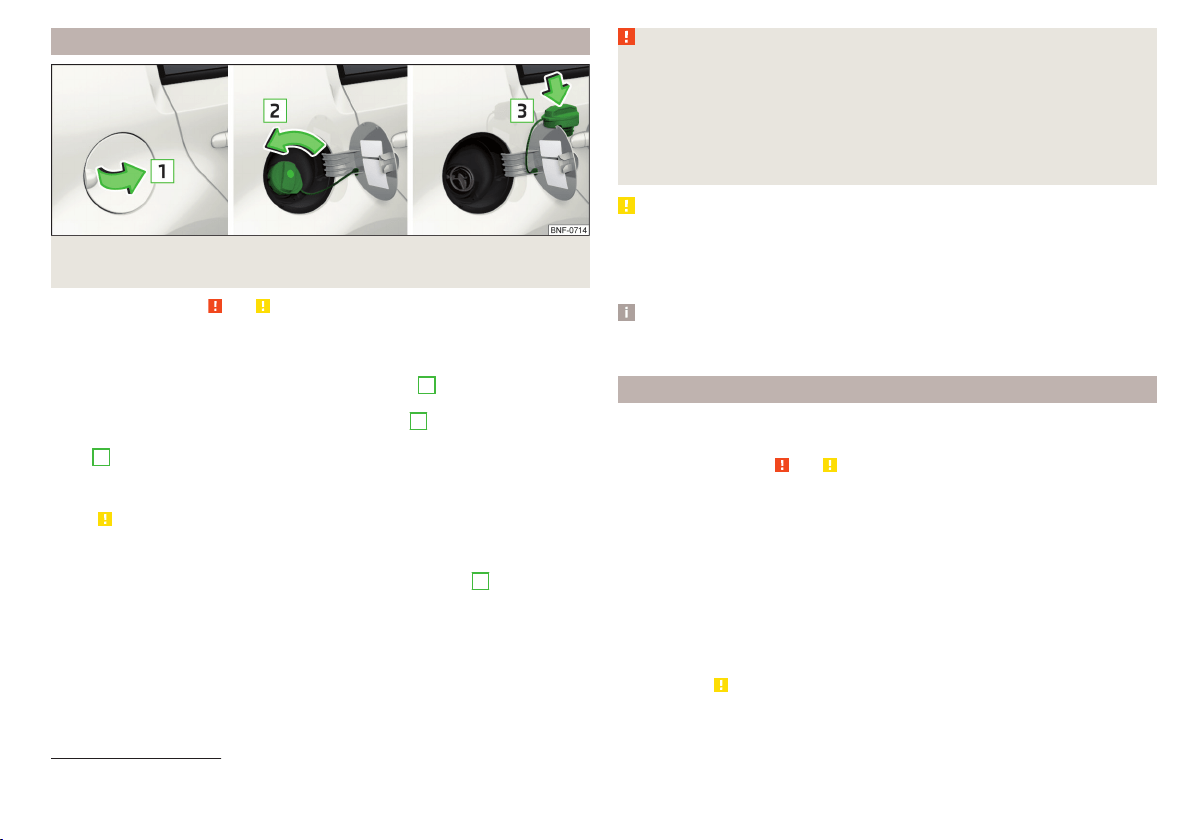
Petrol Refuelling
Fig. 103 Opening the fuel filler flap / unscrewing the tank cap / placing
the tank cap on the fuel filler flap
Read and observe
and on page 102 first.
Refuelling is only possible if the following condition is fulfilled.
The engine and the ignition are switched off.
›
Open out the fuel filler flap in the direction of arrow
1
» Fig. 103.
›
Hold the fuel tank cap firmly and unlock with the key counter-clockwise.
›
Unscrew the tank cap in the direction of the arrow
2
.
›
Remove the tank cap and place on top of the fuel filler flap in direction of ar-
row
3
.
›
Insert the pump nozzle into the fuel filler tube as far as it will go.
The fuel tank is full just as soon as the pump nozzle switches off for the first
time » .
›
Remove the pump nozzle from the fuel filler tube and put it back in the
pump.
›
Screw in the tank cap in the opposite direction to the arrow
2
until it audi-
bly locks into place.
›
Hold the fuel cap hold firmly, lock with the key clockwise and remove the
key.
›
Close the fuel filler flap.
Check that the fuel filler flap is closed properly.
WARNING
Instructions for filling the reserve canister
■
Never fill the reserve can inside the vehicle.
■
Never place the reserve can on the vehicle.
■
Always place the reserve can on the floor.
■
We do not recommend carrying any fuel canisters in your vehicle for safe-
ty reasons. in the event of an accident, these canisters can become dam-
aged and fuel may escape – risk of fire!
CAUTION
■
The fuel tank is full just as soon as the pump nozzle switches off for the first
time, provided the nozzle has been operated properly. Not continue refuelling.
■
Be careful when filling diesel fuel from the spare canister and then do this
slowly and cautiously – danger of contaminating the body.
Note
The fuel tank has a capacity of about 35 litres, including a reserve of approx.
4 litres.
Lead-free petrol
The correct fuel grades for your vehicle are specified on the inside of the fuel
filler flap.
Read and observe
and on page 102 first.
The vehicle can only be operated with unleaded petrol that meets the EN 228
1)
standard.
All petrol engines can be operated using petrol that contains at most 10% bio-
ethanol (E10).
Unleaded petrol min. 95 RON / ROZ
Use unleaded fuel with the octane rating 95 RON or higher.
In an emergency petrol with the octane ratings 91, 92 and/or 93 RON can also
be used, but may result in a slight loss in performance and slightly increased
fuel consumption. Continue driving at medium engine speeds and minimum
engine load » .
Refuel using petrol of the prescribed octane number as soon as possible.
1)
In Germany, DIN 51626-1 or E10 for unleaded gasoline with octane number 95 and 91.
103
Inspecting and replenishing
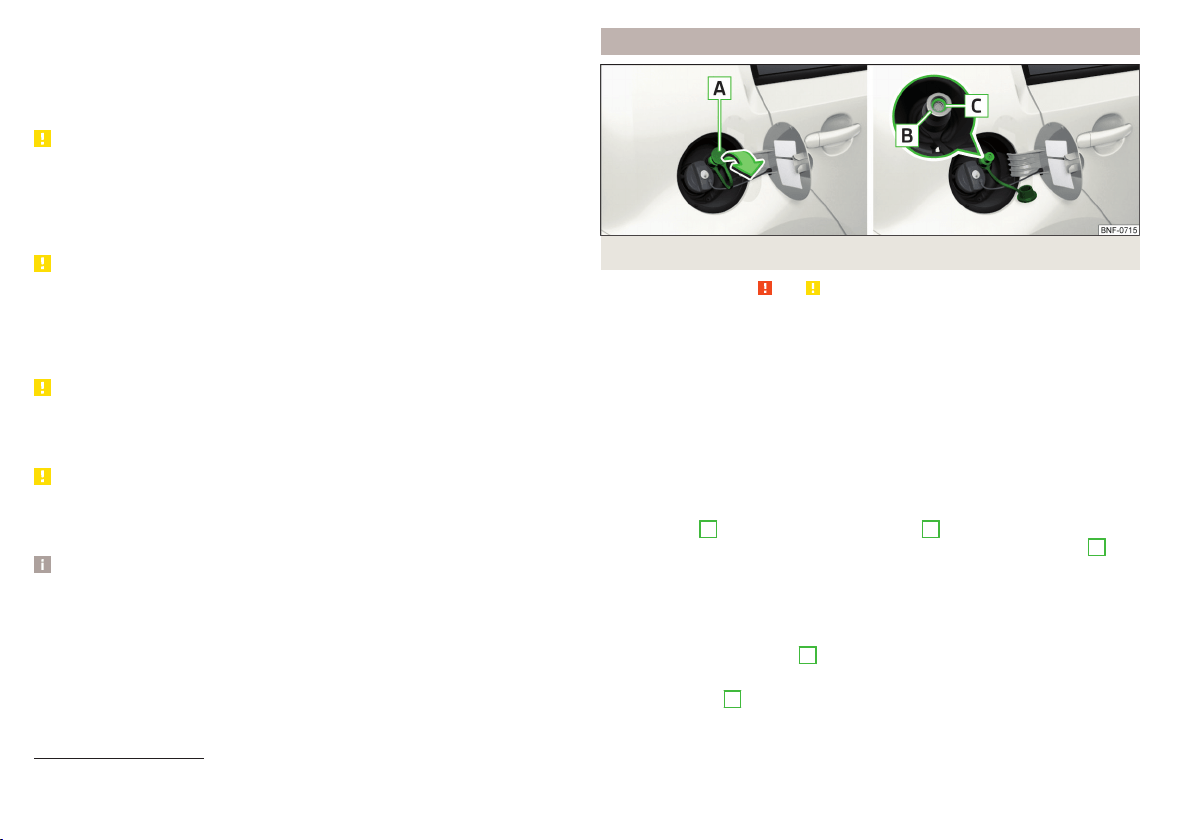
Fuel additives
Unleaded petrol in accordance with the EN 228 standard
1)
meets all the condi-
tions for a smooth-running engine. We therefore recommend that no fuel ad-
ditives are used. This can result in considerable damage to parts of the engine
or the exhaust system.
CAUTION
■
Even one filling of the tank with petrol that does not meet the standards can
lead to serious damage to parts of the exhaust system!
■
If a fuel other than unleaded fuel which complies to the above mentioned
standards (e.g. leaded petrol) is put in the tank by mistake, do not start the en-
gine or switch on the ignition. Extensive damage to engine parts can occur.
CAUTION
■
If petrol with a lower octane number than the one prescribed is used do not
drive with a high engine speed. A high engine load can severely damage en-
gine components.
■
Even in the event of an emergency, petrol of a lower octane number than 91
RON must not be used, otherwise the engine can be severely damaged.
CAUTION
In no case may fuel additives with metal components be used, especially not
with manganese or iron content. There is a risk of causing severe damage to
parts of the engine or exhaust system.
CAUTION
Fuels with metal components, such as LRP (lead replacement petrol) must
not be used. There is a risk of causing severe damage to parts of the engine
or exhaust system.
Note
■
Unleaded petrol that has a higher octane number than that required by the
engine can be used without limitations.
■
On vehicles using prescribed unleaded petrol of min. 95 RON, the use of pet-
rol with a higher octane number than 95 RON can increase the power and re-
duce fuel consumption.
Refuelling CNG (compressed natural gas)
Fig. 104 Natural gas filler tubes
Read and observe
and on page 102 first.
Natural gas refuelling can be carried out if the following condition is fulfilled.
The engine and the ignition are switched off.
The gas filler tube for refuelling with natural gas is located behind the fuel fill-
er flap next to the petrol filler tube.
The filling couplings of the natural gas refuelling systems may differ in han-
dling. When refuelling with natural gas at unfamiliar refuelling systems, you
should seek help from trained fuel station staff. If unsure, have the refuelling
done by trained fuel station staff.
Open fuel filler flap
›
Open the fuel filler flap.
›
Remove cap
A
» Fig. 104 from gas filler tube
B
in the direction of the arrow.
›
Plug the filling coupling of the refuelling system on the gas filler tube
B
.
The fuel tank is full when the compressor of the refuelling system automati-
cally switches off. To stop the refuelling operation prematurely, press the
“Stop ” button of the refuelling system.
Closing the filler cap
›
Check that the sealing ring
C
» Fig. 104 has remained inserted in the gas fill-
er tube.
If the sealing ring
C
has slipped onto the filling coupling, reinsert it into the
gas filler tube.
1)
In Germany, DIN 51626-1 or E10 for unleaded gasoline with octane number 95 and 91.
104
General Maintenance
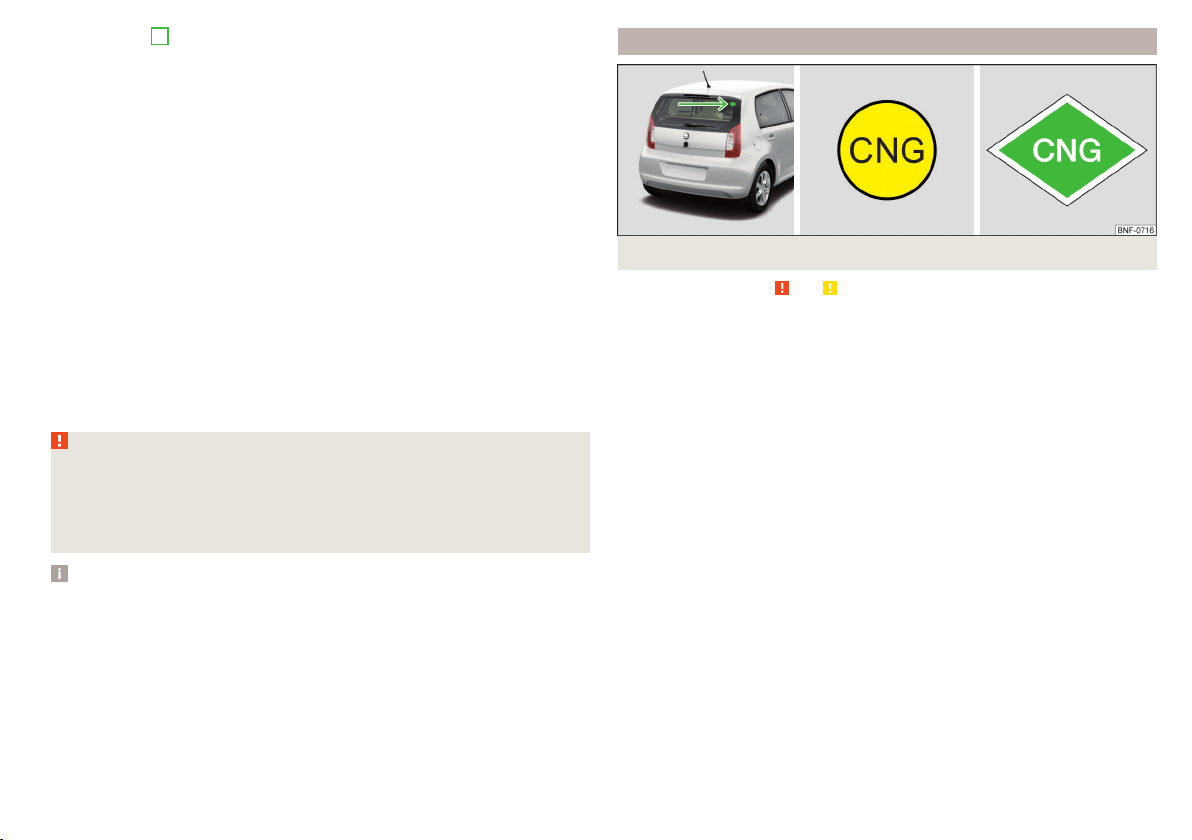
›
Plug the cap
A
onto the gas filler tube.
›
Close the bonnet.
The natural gas refuelling systems have an overfill protection relating to the
outdoor temperature. At very high outside temperatures, it may happen that
the gas tank may not be fully refuelled.
The natural gas system of your vehicle is suitable both for “slow fuelling” (fuel-
ling from small compressors) and for “quick fuelling” (fuelling from natural gas
stations with large compressors).
If the vehicle is parked for a longer period of time immediately after refuelling,
the situation may arise in which the pointer of the fuel tank gauge does not
indicate exactly the same level as was the case immediately after refuelling
when the engine is restarted. This is not due to any system leakages but a
drop in pressure in the natural gas fuel tank due to technical reasons after a
cooling phase directly after refuelling.
The maximum lifetime of the gas tank is 20 years.
The capacity of the natural gas fuel tank is about 11 litres, of which about 1.5
litres are in reserve.
The capacity of the gasoline fuel tank is about 10 litres, of which about 5 litres
are in reserve.
WARNING
■
When refuelling, never get into the vehicle. If you have to get into your
vehicle in exceptional cases, touch a metal surface before you touch the
filling coupling again. This will avoid electrostatic discharges, which may
generate sparks. Sparks can cause a fire during refuelling.
■
Natural gas is highly explosive and highly flammable.
Note
During the filling process sounds are heard which are harmless. If you are un-
sure which service station staff to use, ask the petrol station staff.
CNG
Fig. 105 Position of the CNG label(s).
Read and observe
and on page 102 first.
A G-TEC-vehicle may be operated with CNG and petrol.
In some countries, national legislation requires that vehicles with CNG opera-
tion be identified by one of the labels » Fig. 105.
Position of the CNG label » Fig. 105.
Natural gas quality and consumption
Depending on the natural gas supplier, the natural gas quality (heating value)
may vary. The engine system adjusts automatically to the natural gas quality.
Automatically switching over from natural gas mode to petrol mode
The vehicle automatically switches from natural gas to petrol, for example, if
one of the following cases occurs.
▶
With an empty gas tank or not enough pressure in the tank.
▶
After refuelling with natural gas.
▶
At very low surrounding temperatures.
Use up all the petrol in the fuel tank once every six months until the warning
light
illuminates and then refill with petrol. This is to ensure that the fuel
system functions correctly and to preserve the quality of the fuel.
Gas smell
If you smell gas proceed as follows.
▶
Stop the vehicle.
▶
Put out cigarettes.
▶
Switch off the ignition.
▶
Open doors and the boot lid to ventilate the vehicle sufficiently.
105
Inspecting and replenishing

▶
Remove any spark producing or incendiary items from the car and immedi-
ately switch off.
▶
Do not continue if the odour persists.
Seek help from a specialist garage to correct the gas system fault.
Regular gas system checks must be carried out in a specialist workshop on
natural gas-powered vehicles.
WARNING
Do not underestimate the smell of gas in the car or when refuelling - it may
result in fire, explosion and injury.
Engine compartment
Introduction
This chapter contains information on the following subjects:
Opening and closing the bonnet
107
Engine compartment overview 108
Radiator fan 108
Windscreen washer system 108
WARNING
Injuries or scolding or risks of accident or fire may occur when working in
the engine compartment. For this reason, it is essential to comply with the
warning instructions outlined below and with the general applicable safety
rules. The engine compartment of your car is a hazardous area!
WARNING
Instructions before beginning work in the engine compartment
■
Turn off the engine and remove the ignition key.
■
Firmly apply the handbrake.
■
For vehicles with manual transmission the lever into the neutral position.
■
For vehicles with automated manual transmission, shift the lever to posi-
tion N.
■
Allow the engine to cool.
■
Never open the bonnet if you can see steam or coolant escaping from the
engine compartment – risk of scalding! Wait until no more steam or coolant
is escaping.
WARNING
Information for working in the engine compartment
■
Keep all people, especially children, away from the engine compartment.
■
Never touch the radiator fan. The fan might suddenly start running!
■
Do not touch any hot engine parts – risk of burns!
WARNING
Information for working in the engine compartment with the engine run-
ning
■
Pay particular attention to moving engine parts, e.g. V-ribbed belt, gener-
ator, radiator fan - danger to life!
■
Never touch the electric wiring on the ignition system.
■
Avoid short circuits in the electrical system, particularly on the vehicle's
battery.
■
Always make sure that no jewellery, loose clothing or long hair can get
caught in rotating engine parts – risk to life! Always remove any jewellery,
tie back long hair and wear tight fitting clothing before completing any
work.
WARNING
Information for working on the fuel system or the electrical system
■
Always disconnect the vehicle battery from the electrical system.
■
Do not smoke.
■
Never work near open flames.
■
Always have a functioning fire extinguisher nearby.
WARNING
■
Read and observe the information and warning instructions on the fluid
containers.
■
Keep the working fluids in sealed original containers and safe from peo-
ple who are not completely independent, e.g. children.
■
Never spill operating fluids over the hot engine - risk of fire.
■
If you intend to work underneath the vehicle, you must secure the vehicle
from rolling away and support it with suitable supporting blocks; the car
jack is not sufficient – risk of injury!
CAUTION
Always top up using the correct specification of fluids. This may result in major
operating problems and also vehicle damage!
106
General Maintenance
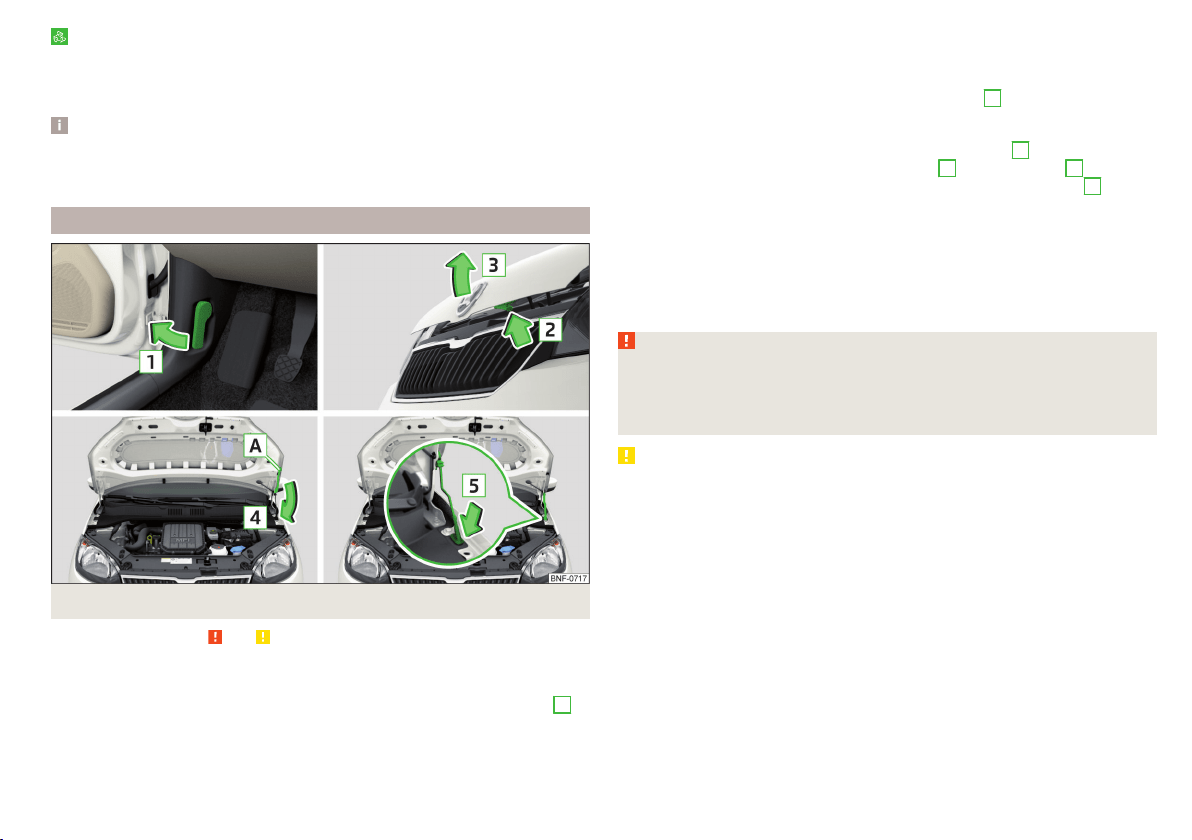
For the sake of the environment
In view of the requirements for the environmentally friendly disposal of fluids
and the special tools and knowledge required for such work, we recommend
that fluids be changed by a specialist garage.
Note
■
Please consult a specialist garage for any questions relating to fluids.
■
Fluids with the proper specifications can be purchased from the ŠKODA Origi-
nal Accessories or from the ŠKODA Genuine Parts ranges.
Opening and closing the bonnet
Fig. 106 Opening the bonnet
Read and observe and on page 106 first.
Open flap
›
Open the front door.
›
Pull the release lever under the dash panel in the direction of the arrow
1
» Fig. 106.
Before opening the bonnet, ensure that the arms of the windscreen wipers
are correctly in place against the windscreen, otherwise the paintwork on the
flap could be damaged.
›
Press the release lever in the direction of the arrow
2
» Fig. 106.
The flap is then unlocked.
›
Grasp the bonnet catch and lift in the direction of arrow
3
.
›
Remove the lid prop in the direction of arrow
4
from its fixture
A
.
›
Secure the open flap by inserting the end of the post into opening
5
.
Close the flap
›
Lift the bonnet.
›
Decouple the bonnet support and press into the holder designed to hold it.
›
Let the bonnet drop into the lock carrier lock from a height of around 20 cm –
do not push it in.
Check that the bonnet is closed properly.
WARNING
■
If you notice that the lock is not properly engaged while driving, stop the
vehicle immediately and close the bonnet – risk of accident!
■
Make sure that when closing the bonnet, no body parts are crushed -
there is danger of injury!
CAUTION
Never open the bonnet by the locking lever » Fig. 106.
107
Inspecting and replenishing
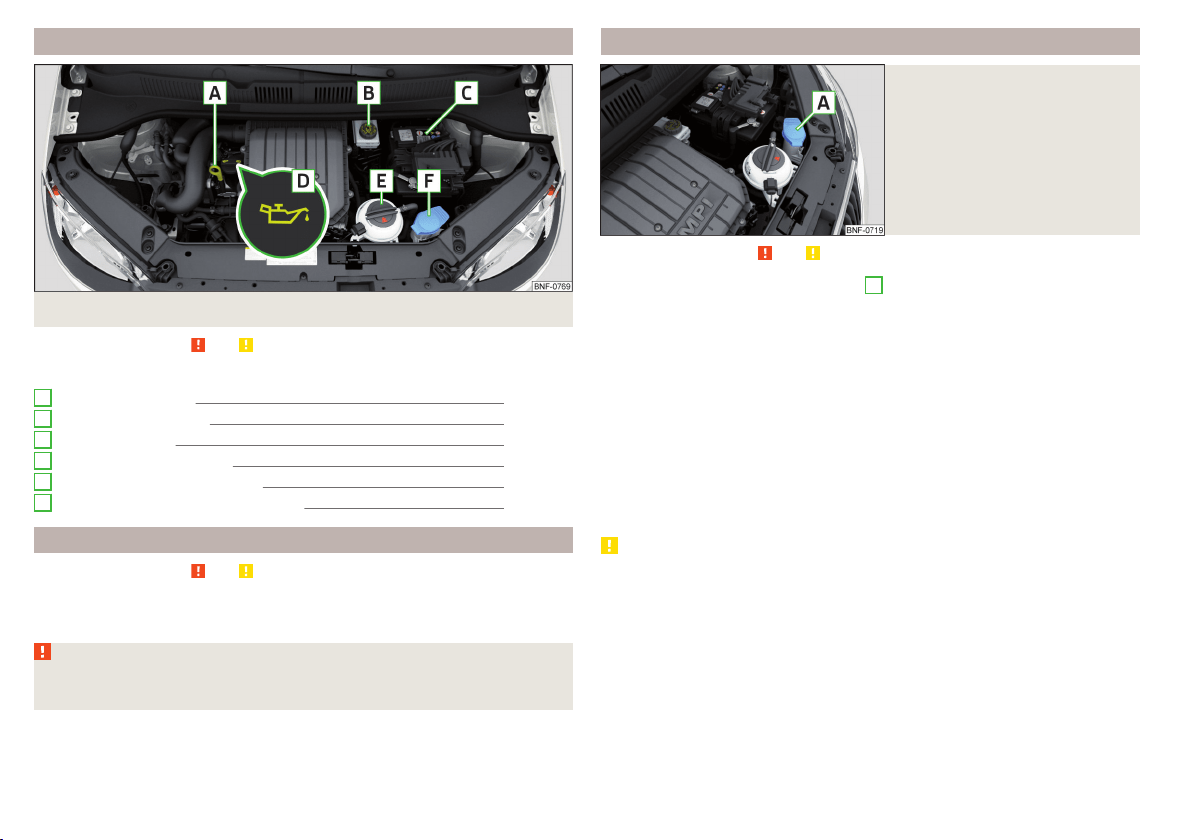
Engine compartment overview
Fig. 107 Principle sketch: Engine compartment
Read and observe and on page 106 first.
Layout of the engine compartment » Fig. 107
Engine oil dipstick 109
Brake fluid reservoir 112
Vehicle battery 112
Engine oil filler opening 110
Coolant expansion reservoir 111
Windscreen washer fluid reservoir 108
Radiator fan
Read and observe
and on page 106 first.
The radiator fan is powered by an electric motor. Operation is controlled ac-
cording to the temperature of the coolant.
WARNING
After switching off the ignition, the fan may intermittently continue to op-
erate for approx. 10 minutes.
A
B
C
D
E
F
Windscreen washer system
Fig. 108
Windscreen washer fluid reser-
voir
Read and observe and on page 106 first.
The windscreen washer fluid reservoir
A
is located in the engine compart-
ment » Fig. 108.
The cleaning fluid is provided for the cleaning of the front and rear window.
The capacity of the tank is about 3 litres.
Water alone is not sufficient to intensively clean the windscreen. We recom-
mend using clean water together with a screen cleaner from the range of
ŠKODA Original Accessories (with antifreeze in winter), which will remove any
stubborn dirt.
Under exceptional circumstances, methylated spirits can also be used if no
screen cleaner with antifreeze is available. The concentration of methylated
spirits must not be more than 15 %. The freeze protection at this concentration
is sufficient only to -5 °C.
CAUTION
■
Under no circumstances must radiator antifreeze or other additives be added
to the windscreen washer fluid.
■
Do not remove the filter from the windscreen washer fluid reservoir when re-
filling, as this may cause contamination of the liquid transportation system,
leading in turn to a windscreen washer system malfunction.
108
General Maintenance
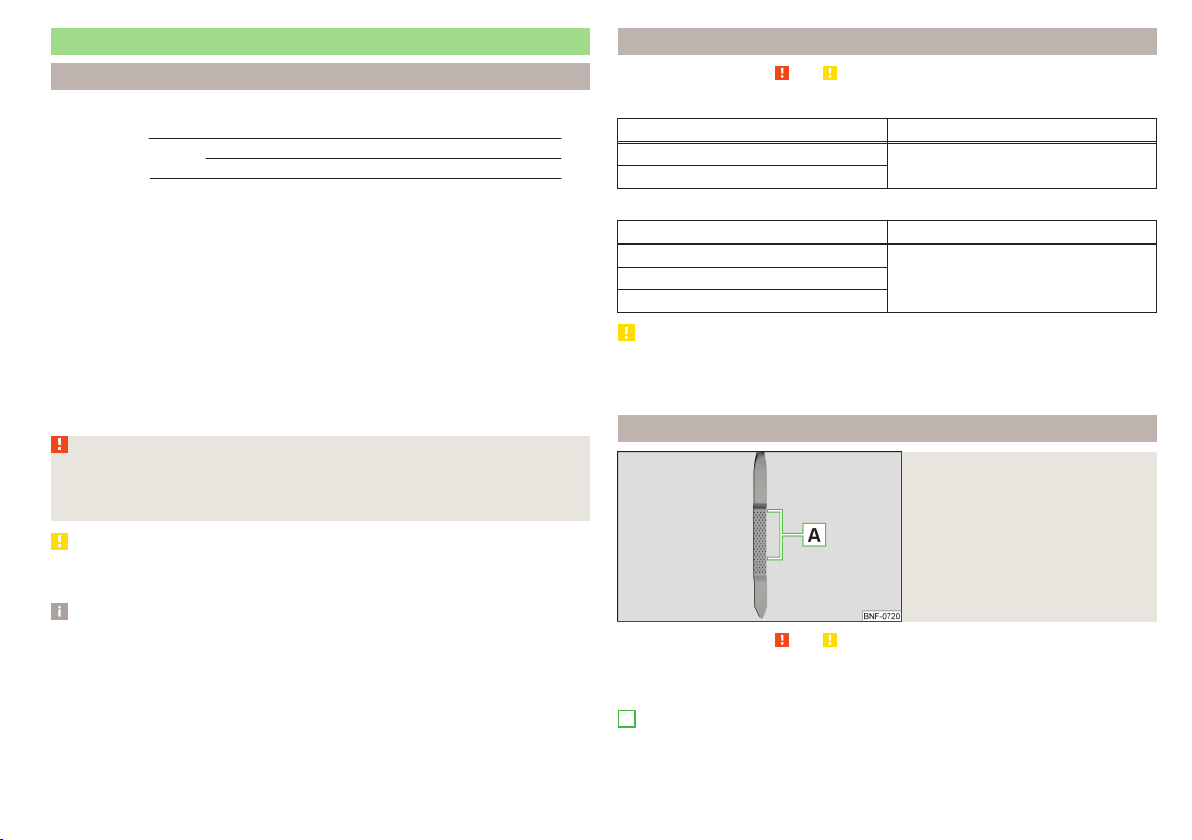
Engine oil
Introduction
This chapter contains information on the following subjects:
Specification
109
Checking the oil level 109
Replenishing 110
The engine has been factory-filled with a high-grade oil that can be use
throughout the year - except in extreme climate zones.
The engine oils are undergoing continuous further development. Thus the in-
formation stated in this Owner's Manual is only correct at the time of publica-
tion.
ŠKODA Service Partners are informed about the latest changes by the manu-
facturer. We therefore recommend that the oil change be completed by a
ŠKODA Service Partner.
The specifications (VW standards) stated in the following can be indicated sep-
arately or together with other specifications on the bottle.
The engine oil should be changed after specified service intervals » page 30.
WARNING
The engine compartment of your car is a hazardous area. The following
warning instructions must be followed at all times when working in the en-
gine compartment » page 106.
CAUTION
Do not pour any additives into the engine oil – risk of serious damage to the
engine parts.
Note
■
Before a long drive we recommend that you purchase and carry with you en-
gine oil which complies with the specification for your vehicle.
■
We recommend that you use oils from ŠKODA Original Accessories.
■
If your skin has come into contact with oil, it must be washed thoroughly.
Specification
Read and observe and on page 109 first.
Vehicles with variable service intervals
Engine Specification
1.0 ltr./44 kW MPI
VW 504 00
1.0 ltr./55 kW MPI
Vehicles with fixed service intervals
Engine Specification
1.0 ltr./44 kW MPI
VW 502 001.0 ltr./55 kW MPI
1.0 l/50 kW MPI G-TEC
CAUTION
■
In an emergency, another engine oil can be used. To prevent damage to the
engine, a maximum of 0.5 litres only of the following engine oils may be used:
■
for petrol engines: ACEA A3/ACEA B4 or API SN, (API SM).
Checking the oil level
Fig. 109
Principle sketch: Dipstick
Read and observe and on page 109 first.
The dipstick indicates the engine oil level .
Dipstick » Fig. 109
The oil level must be within this range.
A
109
Inspecting and replenishing

The oil can be checked and topped up, if the following conditions are satisfied.
The vehicle is standing on a horizontal surface.
The engine operating temperature is reached.
The engine is turned off.
The bonnet is open.
Checking the level
›
Wait a few minutes until the engine oil flows back into the oil trough.
›
Pull out the dipstick.
›
Wipe the dipstick with a clean cloth and insert it again to the stop.
›
Pull the dipstick out again and check the oil level.
›
Re-insert the dipstick.
The engine consumes a little oil. The oil consumption may be as much as 0.5
l/1 000 km depending on your style of driving and the conditions under which
you operate your vehicle. Consumption may be slightly higher than this during
the first 5 000 km.
The oil level must be checked at regular intervals.
In the event of the oil level being too low, the warning light appears in the dis-
play of the instrument cluster» page 35. Check the oil level using the dipstick
as soon as possible. Add oil accordingly.
CAUTION
■
The oil level must never be above the range
A
» Fig. 109 - risk of damage to
the motor as well as the exhaust system.
■
If for some reason, it is not possible to top up the engine oil under the cur-
rent circumstances,
do not continue driving! Switch off the engine and seek
assistance from a specialist garage.
■
If the oil level is above the range
A
,
stop driving! Switch off the engine
and seek assistance from a specialist garage.
Replenishing
Read and observe
and on page 109 first.
›
Unscrew the cap of the engine oil filler opening » Fig. 107 on page 108.
›
Replenish the oil in portions of 0.5 litres in accordance with the correct speci-
fications » page 109.
›
Check the oil level » page 109.
›
Screw the lid of the engine oil filler closed carefully.
›
Pull the dipstick out as far as the stop.
Coolant
Introduction
This chapter contains information on the following subjects:
Checking the coolant level
111
Replenishing 111
The coolant provides cooling for the motor.
It consists of water and coolant additive with additives that protect the cooling
system against corrosion and prevents furring.
The proportion of coolant additive in the coolant must be at least 40%.
The coolant additive may be increased to a maximum of 60%.
The correct mixing ratio of water and coolant additive is to be checked if nec-
essary by a specialist garage or is to be restored if necessary.
The description of the coolant is shown in the coolant expansion reservoir
» Fig. 110 on page 111.
WARNING
The engine compartment of your car is a hazardous area. The following
warning instructions must be followed at all times when working in the en-
gine compartment » page 106.
■
The coolant is harmful to health.
■
Avoid contact with the coolant.
■
Coolant vapours are harmful to health.
■
Never open the end cover of the coolant expansion reservoir while the
engine is still warm. The cooling system is pressurized!
■
When opening the end cover of the coolant expansion reservoir, cover it
with a cloth to protect your face, hands and arms from hot steam or hot
coolant.
■
If any coolant splashes into your eyes, immediately rinse out your eyes
with clear water and contact a doctor as soon as possible.
■
Always keep the coolant in the original container, safe from people who
are not completely independent, especially children - there is a danger of
poisoning!
■
If coolant is swallowed, consult a doctor immediately.
■
Never spill operating fluids over the hot engine - risk of fire.
110
General Maintenance
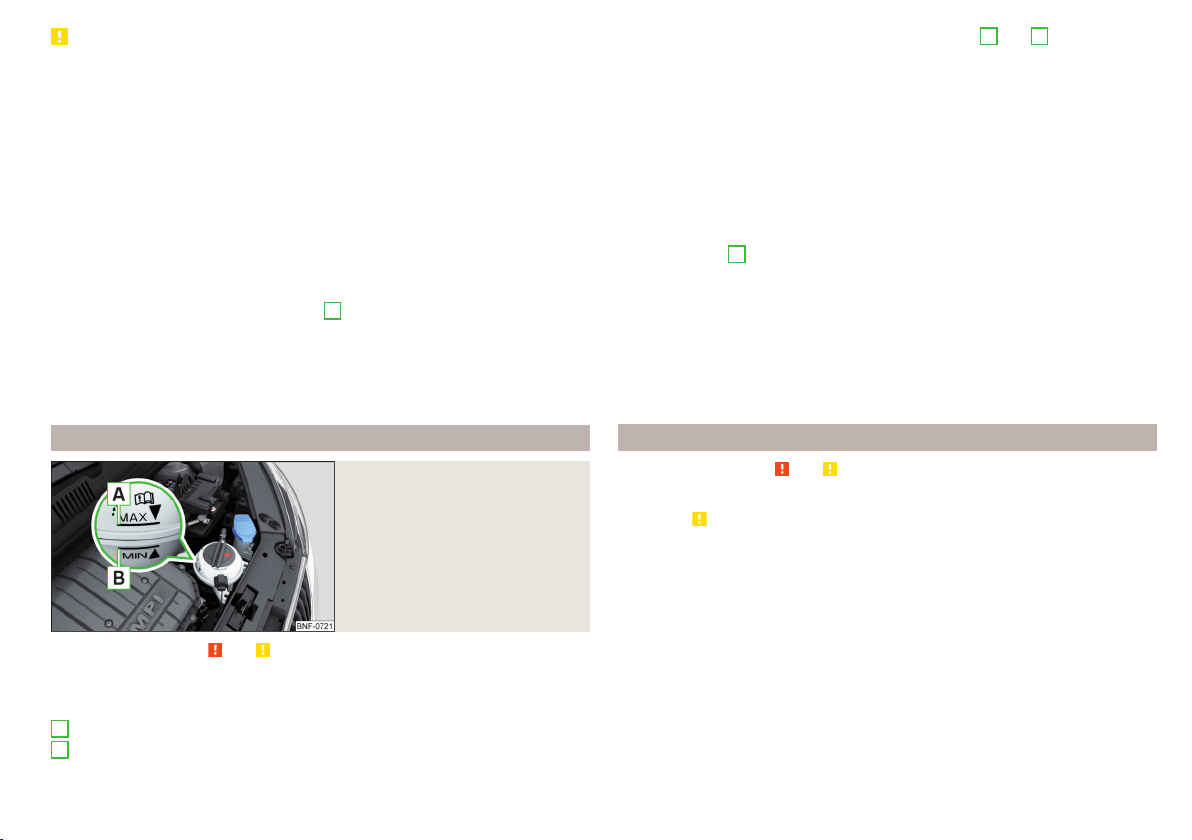
CAUTION
■
Do not continue if for some reason it is not possible to fill with coolant un-
der the current circumstances! Switch off the engine and seek assistance from
a specialist garage.
■
If the expansion tank is empty, do not top up with coolant. The system could
fill with air - risk of engine damage,
stop driving! Switch off the engine and
seek assistance from a specialist garage.
■
The concentration of coolant additive in the coolant must never be under
40%.
■
Over 60% of coolant additive in the coolant reduces the antifreeze protec-
tion and cooling effect.
■
A coolant additive that does not comply with the correct specification can
significantly reduce the corrosion protection of the cooling system.
■
Any faults resulting from corrosion may cause a loss of coolant and can con-
sequently result in major engine damage.
■
Do not fill the coolant above the mark
A
» Fig. 110 on page 111.
■
If an error occurs, leading to the engine overheating, the help of a professio-
nal garage is to be sought - there is a risk of serious engine damage occurring.
■
Additional headlights and other attached components in front of the air inlet
impair the cooling efficiency of the coolant.
■
Never cover the radiator - there is a risk of the engine overheating.
Checking the coolant level
Fig. 110
Coolant expansion reservoir
Read and observe and on page 110 first.
The coolant expansion bottle is located in the engine compartment.
Coolant expansion reservoir » Fig. 110
Mark for the maximum permissible coolant level
Mark for the lowest permissible coolant level
A
B
The coolant level should be kept between the marks
A
and
B
.
The coolant can be checked and topped up, if the following conditions are sat-
isfied.
The vehicle is standing on a horizontal surface.
The engine is turned off.
The engine is not heated.
The bonnet is open.
Checking the level
›
Check the level of coolant in the coolant expansion bottle » Fig. 110.
If the engine is warm, the test result may be inaccurate. The level can also be
above the mark
A
» Fig. 110 .
In the event of the coolant level being too low, a warning light appears in the
instrument cluster
» page 35. We still recommend inspecting the coolant lev-
el directly at the reservoir from time to time.
Loss of coolant
A loss of coolant is first and foremost an indication of a leak in the cooling sys-
tem. Do not merely top up the coolant. Have the cooling system checked by a
specialist garage.
Replenishing
Read and observe and on page 110 first.
The coolant expansion tank must always contain a small amount of coolant
» page 111, in section Introduction.
›
Place a cloth over the cap of the coolant expansion tank and unscrew the
cap carefully.
›
Replenish the coolant.
›
Turn the cap until it clicks into place.
Do not use an alternative additive if the specified coolant is not available. In
this case, use just water and have the correct mixing ratio of water and cool-
ant additive restored by a specialist garage as soon as possible.
Only top up with new coolant.
111
Inspecting and replenishing
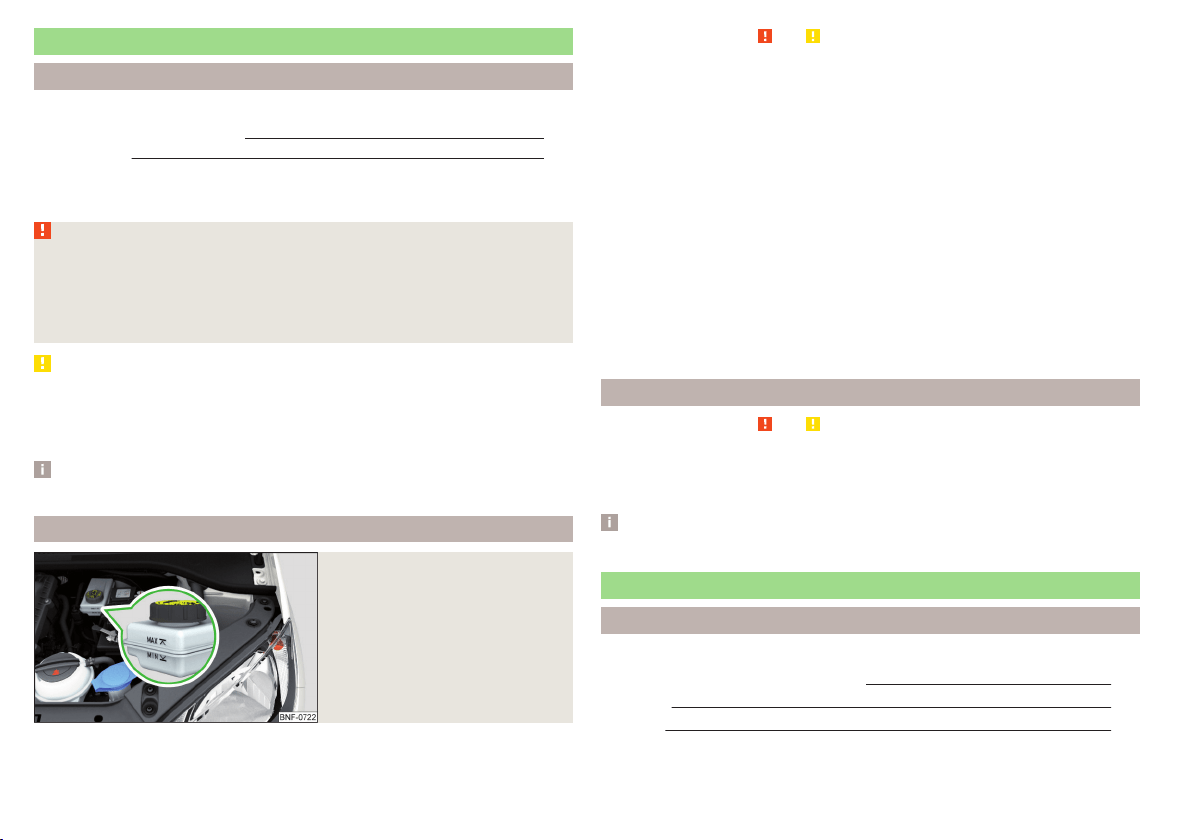
Brake fluid
Introduction
This chapter contains information on the following subjects:
Checking the brake fluid level
112
Specification 112
The brake fluid reservoir is located in the engine compartment » Fig. 111 on
page 112.
WARNING
■
The engine compartment of your car is a hazardous area. The following
warning instructions must be followed at all times when working in the en-
gine compartment » page 106.
■
Do not use used brake fluid - the function of the brake system may be im-
paired – risk of accident!
CAUTION
■
Do not continue your journey if the fluid level has dropped below the “MIN”
marking » Fig. 111 on page 112, do not continue driving - there is a risk of an
accident! Seek help from a specialist garage.
■
Brake fluid damages the paintwork of the vehicle.
Note
The brake fluid is changed as part of a compulsory inspection service.
Checking the brake fluid level
Fig. 111
Brake fluid reservoir
Read and observe and on page 112 first.
The fluid can be checked if the following conditions are met.
The vehicle is standing on a horizontal surface.
The engine is turned off.
The bonnet is open.
Checking the level
›
Check the level of brake fluid in the reservoir » Fig. 111.
The level must be between the “MIN” and “MAX” markings.
A slight drop in the fluid level results when driving due to normal wear-and-
tear and automatic adjustment of the brake pads.
There may be an indication of a leak in the brake system, however, if the fluid
level drops significantly within a short time or if it drops below the “MIN” mark-
ing.
Too low brake fluid level is indicated by the warning light
illuminating in the
display of the instrument cluster » page 34,
Braking system.
Specification
Read and observe and on page 112 first.
To ensure the optimal functioning of the braking system, only use a brake fluid
meeting the standard VW 501 14 (this standard meets the requirements of
FMVSS 116 DOT4).
Note
We recommend using brake fluids from the ŠKODA Original Accessories range.
Vehicle battery
Introduction
This chapter contains information on the following subjects:
Checking the battery electrolyte level 114
Charging 114
Replace 115
112
General Maintenance
Disconnecting and reconnecting 115
Automatic load deactivation 115
The vehicle battery represents a power source for the motor to start and for
the supply of electrical consumers in the car.
Warning symbols on the vehicle battery
Symbol Importance
Always wear eye protection.
Battery acid is severely caustic. Always wear gloves and eye pro-
tection.
Keep fire, sparks, open flames and lit cigarettes well clear of the
vehicle battery.
When charging the vehicle battery, a highly explosive gas mixture
is produced.
Keep children away from the vehicle battery.
WARNING
There is risk of injuries, poisoning, chemical burns, explosions or fire when
working on the battery and on the electrical system. It is essential to com-
ply with the general applicable safety rules as well as the warning instruc-
tions outlined below.
■
Keep the vehicle battery away from people who are not completely inde-
pendent, especially children.
■
Do not tilt the battery otherwise battery electrolyte may flow out of the
battery vent openings.
■
Protect your eyes by wearing safety goggles or a face shield – risk of
blindness!
■
Always wear protective gloves, eye and skin protection when handling
the vehicle battery.
■
The battery acid is strongly corrosive and must, therefore, be handled
with the greatest of care.
■
Corrosive fumes in the air irritate the air passages and lead to conjunctivi-
tis and inflammation of the air passages in the lungs.
■
Battery acid corrodes dental enamel and, if it comes into contact with the
skin, causes deep wounds that take a long time to heal.
WARNING (Continued)
■
If any battery acid comes into contact with your eyes, rinse the affected
eye immediately with clean water for several minutes and consult a doctor
immediately!
■
Splashes of acid on your skin or clothes should be neutralised as soon as
possible using soap suds and then rinsed with plenty of water.
■
If you swallow battery acid, consult a doctor immediately!
WARNING
■
The use of open flames and light should be avoided.
■
Smoking and radio triggering activities should be avoided.
■
Never use a damaged vehicle battery – risk of explosion!
■
Never charge a frozen or thawed vehicle battery – risk of explosion and
chemical burns!
■
Replace a frozen vehicle battery.
■
Never jump-start vehicle batteries with insufficient acid levels – risk of
explosion and chemical burns.
CAUTION
■
Improper handling of the vehicle battery may cause damage.
■
Ensure that battery acid does not come into contact with the bodywork – risk
of damage to the paintwork.
■
If the vehicle has not been driven for more than 3 to 4 weeks, the battery will
discharge. Prevent the battery from discharging by disconnecting the battery's
negative terminal
or continuously charging the battery with a very low
charging current.
■
Do not place the battery in direct daylight in order to protect the vehicle bat-
tery housing from the effects of ultra-violet light.
■
If the vehicle is frequently used for making short trips, the vehicle battery
will not have time to charge up sufficiently and may discharge.
Note
■
We recommend having all work on the vehicle battery carried out by a spe-
cialist garage.
■
You should replace batteries older than 5 years.
113
Inspecting and replenishing
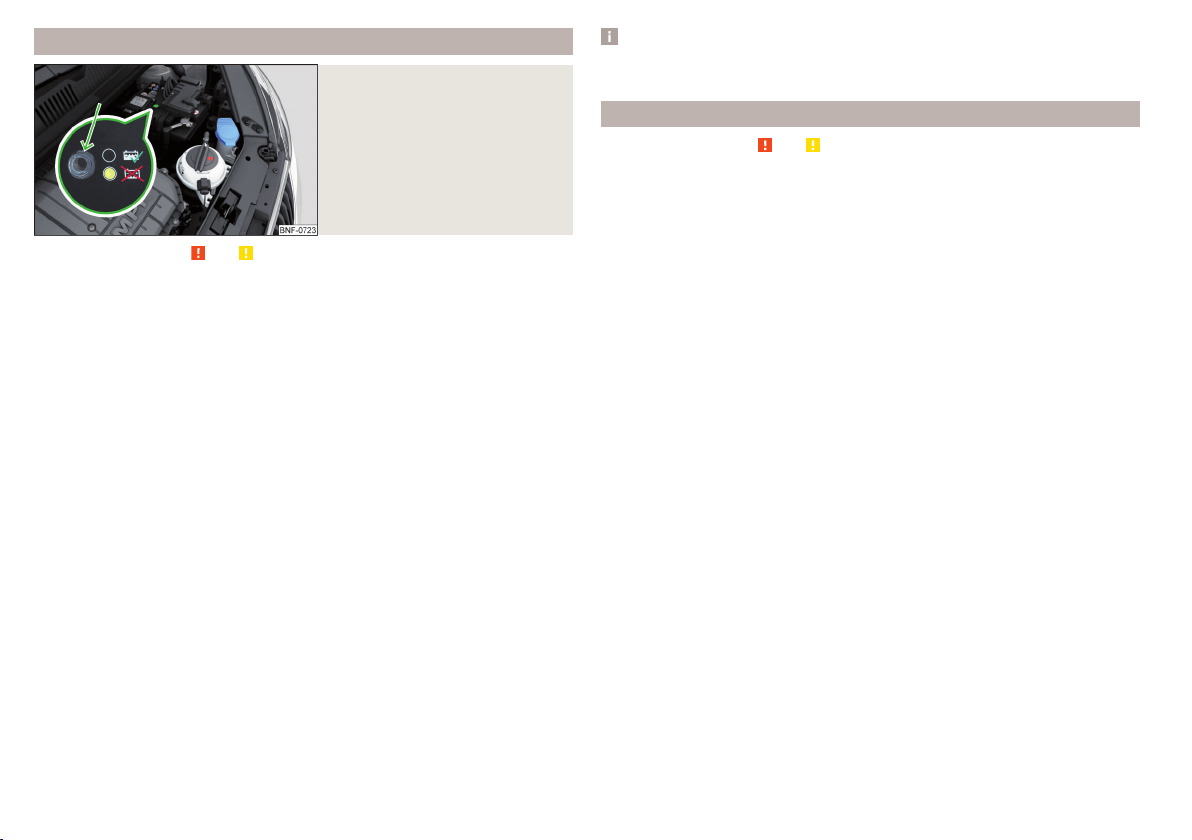
Checking the battery electrolyte level
Fig. 112
Vehicle battery: Electrolyte level
indicator
Read and observe and on page 113 first.
On vehicles with a vehicle battery fitted with a colour indicator, the electrolyte
level can be determined by looking at the change in the colour of this display.
Air bubbles can influence the colour of the indicator. For this reason carefully
knock on the indicator before carrying out the check.
Checking
Black colour – electrolyte level is correct.
Colourless or light yellow colour – electrolyte level too low, the battery must
be replaced.
For technical reasons, the electrolyte level cannot be checked on vehicles with
the designation “AGM” .
Vehicles with the START-STOPsystem are fitted with a battery control unit for
checking the energy level for recurring engine starts.
We recommend that you have the acid level checked regularly by a specialist
garage, especially in the following cases.
▶
High external temperatures.
▶
Longer day trips.
▶
After each charge.
Winter time
The vehicle battery only has a proportion of the starting power in lower tem-
peratures. A discharged vehicle battery may already freeze at temperatures
just below 0 °C.
We therefore recommend that you have the battery checked and, if necessary,
recharged by a specialist garage before the start of the winter.
Note
The battery acid level is also checked regularly by a specialist garage as part of
the inspection service.
Charging
Read and observe and on page 113 first.
A properly charged vehicle battery is essential for reliably starting the engine.
A charging operation can be performed if the following conditions are satis-
fied.
The engine is turned off.
The ignition is switched off.
All consumers are turned off.
The bonnet is open.
“Fast charging” with high currents
›
Disconnect both battery cables (first of all “negative”, then “positive”).
›
Attach the terminal clamps of the charger to the battery terminals (red =
“positive”, black = “negative”).
›
Plug the mains cable of the charger into the power socket and switch on the
device.
›
After charging has been successful: Switch off the charger and remove the
mains cable from the power socket.
›
Only then disconnect the charger's terminal clamps.
›
Reconnect the cables to the battery (first “positive”, then “negative”).
Charging with low voltages
It is not necessary to disconnect the cables from the battery if you recharge
the vehicle battery, for example from a mini-charger.
Refer to the instructions of the charger manufacturer.
A charging current of 0.1 multiple of the total vehicle battery capacity (or low-
er) must be used until full charging is achieved.
The vent plugs of the vehicle battery should not be opened for charging.
114
General Maintenance

WARNING
■
When you charge a battery, hydrogen is released, and a highly explosive
gas mixture is also produced. An explosion can be caused through sparkling
over during unclamping or loosening of the cable plug while the ignition is
on.
■
Creating a bridge between the poles on the battery (e.g. with metal ob-
jects - cables) creates a short circuit - risk of damage to the battery, explo-
sion and burning of the battery, jets of acid spurting out.
■
Avoid creating sparks when working with cables and electrical devices.
Strong sparking represents a risk of injury.
■
Before carrying out any work on the electrical system, switch off the en-
gine, the ignition and all electrical consumers and disconnect the negative
terminal
.
■
“Quick-charging” the vehicle battery is dangerous and requires a special
charger and specialist knowledge.
■
We therefore recommend that vehicle batteries be “rapidly charged” by a
specialist garage.
CAUTION
On vehicles with the START-STOP system, the pole terminal of the charger
must not be connected directly to the negative terminal of the vehicle battery,
but only to the engine earth » page 129.
Replace
Read and observe and on page 113 first.
The new vehicle battery must have the same capacity, voltage, current and
size as the original battery. Suitable vehicle battery types can be purchased
from a specialist garage.
We recommend you have the battery replaced by a specialist garage.
Disconnecting and reconnecting
Read and observe
and on page 113 first.
Disconnecting
›
Switch off the ignition.
›
Disconnect the negative terminal
first and then the positive
terminal of
the battery.
Connecting
›
Connect the positive terminal first, then the negative battery terminal.
After disconnecting and re-connecting the vehicle battery, the following func-
tions or devices are partially or completely inoperative.
Function / device Operating measure
Radio
Enter code » Owner´s Manual
Radio
Time settings » page 33
CAUTION
■
Disconnect the vehicle battery only with the ignition turned off - there is a
risk of damaging the electrical system of the vehicle.
■
Under no circumstances must the battery cables be connected incorrectly –
risk of a cable fire.
Note
■
After disconnecting and re-connecting the vehicle battery, we recommend
having the vehicle checked by a specialist to ensure that the full functionality
of all electrical systems is guaranteed.
■
The data of the multi-function display will be reset.
Automatic load deactivation
Read and observe
and on page 113 first.
The vehicle's electrical system automatically prevents the battery from dis-
charging when the battery is being heavily used. This manifests itself by the
following.
▶
The idling speed is raised to allow the generator to deliver more electricity to
the electrical system.
▶
Where necessary, large convenience consumers such as seat heaters and
rear window heaters have their power limited or are shut off completely in
the event of an emergency.
115
Inspecting and replenishing

CAUTION
■
Despite such intervention by the vehicle electric system management, the
vehicle battery may be drained. For example, when the ignition is switched on
a long time with the engine turned off or the side or parking lights are turned
on during longer parking.
■
Consumers that are supplied via a 12-V power socket can cause the vehicle
battery to discharge when the ignition is switched off.
Note
Driving comfort is not impaired by consumers being deactivated. The driver is
often not aware of it having taken place.
Wheels
Tyres and wheel rims
Introduction
This chapter contains information on the following subjects:
Notes on using wheels 116
Tyre pressure 117
Tyre wear 118
Tyre wear indicator and wheel replacement 118
Tyre damage 119
Unidirectional tyres 119
Spare wheel 119
Spare wheel 119
Tyre label 120
Only use tyres or wheel rims that have been approved by ŠKODA for your mod-
el of vehicle.
WARNING
For reasons of driving safety, do not replace tyres individually.
Note
■
We recommend that any work on the wheels or tyres be carried out by a spe-
cialist garage.
■
We recommend that you use wheel rims, tyres, full wheel trims and snow
chains from ŠKODA Original Accessories.
Notes on using wheels
Read and observe
on page 116 first.
New tyres do not offer optimum grip during the first 500 km and appropriate
care should therefore be taken when driving.
Always fit the tyres with the deeper tread depth to the front wheels.
Tyre storage
Identify disassembled tyres so that the previous direction of rotation can be
maintained if the tyres are reassembled.
116
General Maintenance
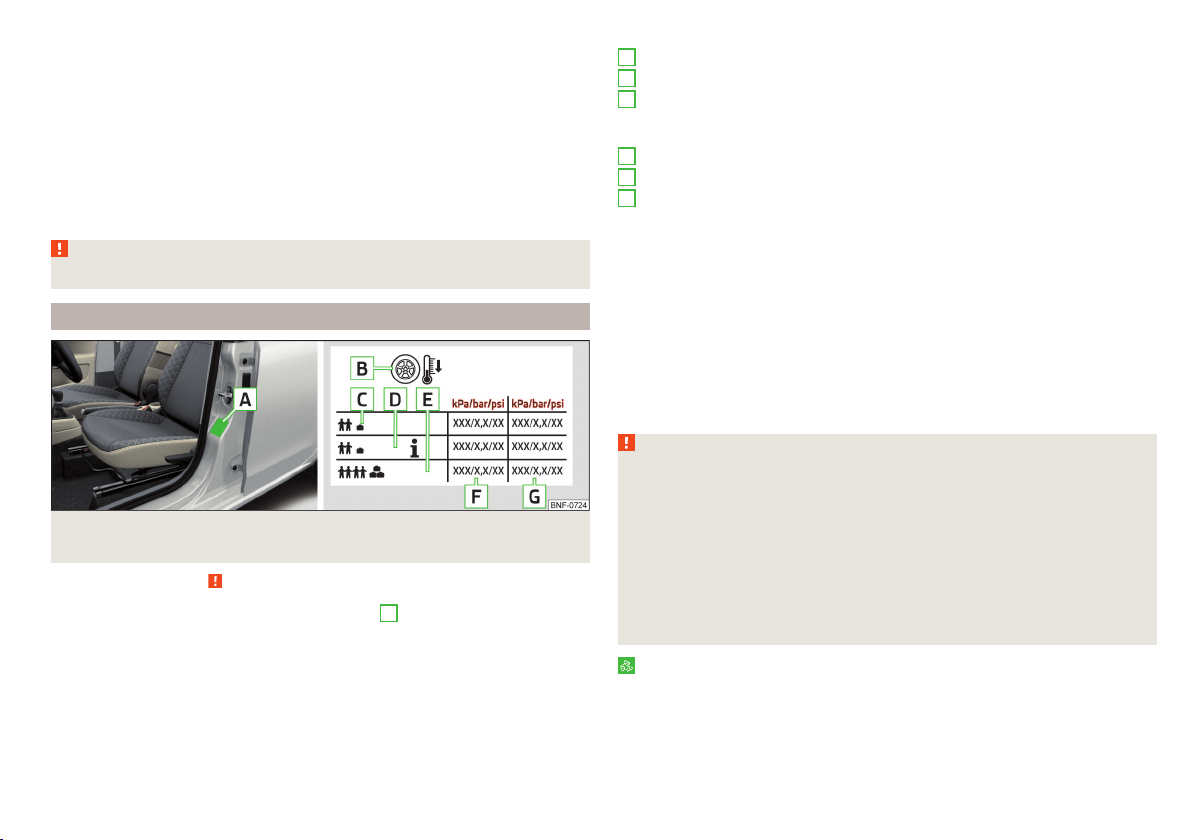
Always store wheels or tyres in a cool, dry place that is as dark as possible.
Tyres which are not fixed to a wheel trim should be stored upright.
Tyre age
Tyres age and lose their original characteristics, even if they are not being
used. The service life of the tyres is 6 years. Therefore, we recommend not us-
ing tyres that are older than 6 years.
Wheel bolts
Wheels and wheel bolts are matched to each other in terms of design. We rec-
ommend that you use wheel rims and wheel bolts from ŠKODA Original Acces-
sories.
WARNING
Never use tyres if you do not know anything about the condition and age.
Tyre pressure
Fig. 113 Principle sketch: An example on the position of the sticker / tyre
inflation
Read and observe on page 116 first.
The specified tyre pressures are shown on label
A
» Fig. 113.
The sticker can be located at the following locations.
▶
B-pillar on the driver's side.
▶
Inside of the fuel filler flap.
Tyre pressure is always to match the load.
Inflation pressure for cold tyres
Inflation pressure for half load
Inflation pressure for increased driving comfort at half load
As a result of pressure level adaption to this value, the fuel consumption
and pollutant emissions may increase slightly.
Inflation pressure for full load
Tyre pressure value on the front axle
Tyre pressure value on the rear axle
The approved tyre sizes for your vehicle are listed in the vehicle's technical
documentation and in the declaration of conformity (the so-called COC docu-
ment).
Check tyre pressures
Check the tyre pressure, including that of the emergency or spare wheel, at
least once a month and also before setting off on a long journey.
Always check the inflation pressure when the tyres are cold. Do not reduce the
higher pressure on warm tyres.
In vehicles with tyre pressure monitoring, tyre pressure values must be stored
every time the tyre pressure changes » page 91.
WARNING
■
Having the correct tyre inflation pressure is always the driver's responsi-
bility.
■
Too low or too high inflation pressure impairs handling.
■
If the inflation pressure is too low, the tyre will have to overcome a higher
rolling resistance. This will cause a significant increase in the temperature
of the tyre, especially at higher speeds. This can result in tread separation
and a tyre blow-out.
■
In the event of very fast tyre inflation pressure loss, such as a sudden tyre
failure, an attempt should be made to bring the vehicle carefully to a stop
without sudden steering movements and without any hard braking.
For the sake of the environment
Tyres that are insufficiently inflated increase your fuel consumption.
B
C
D
E
F
G
117
Wheels
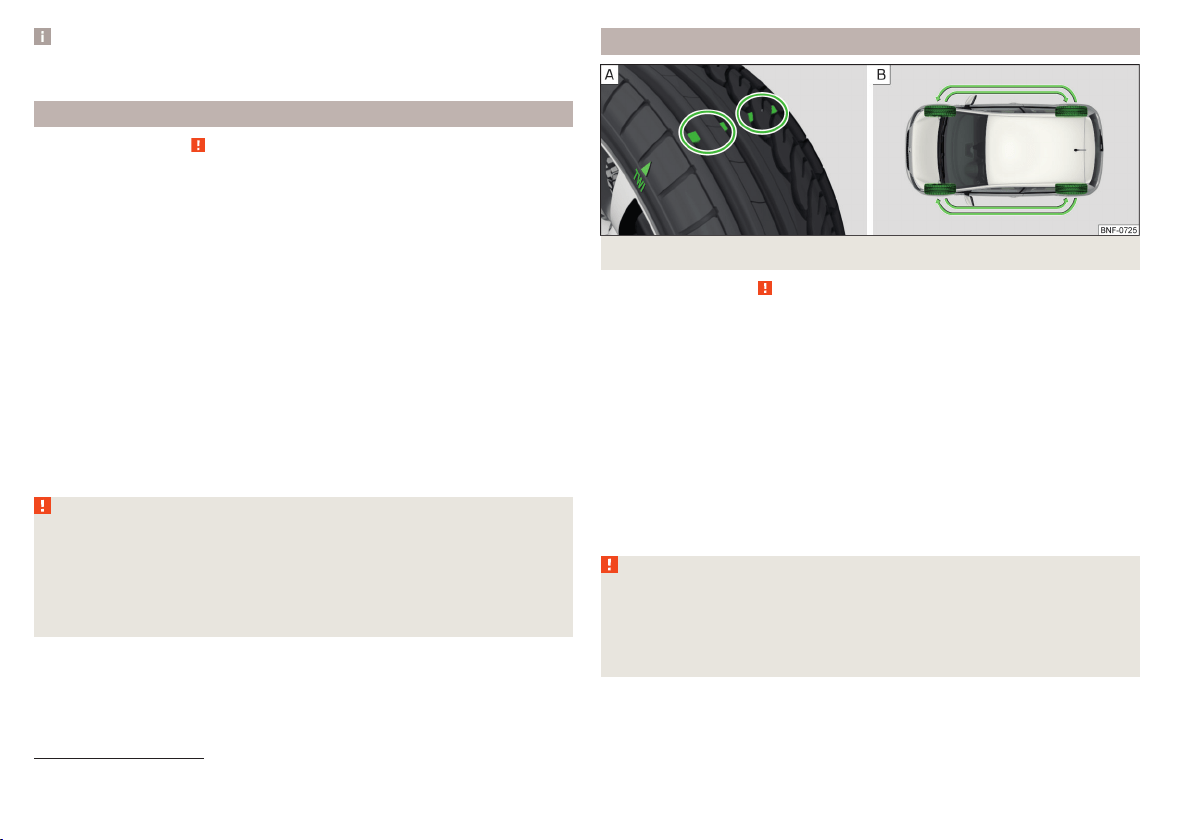
Note
The declaration of conformity (the so-called COC document), can be obtained
from a ŠKODA
1)
partner.
Tyre wear
Read and observe on page 116 first.
Tyre wear depends on the pressure, driving style, and other circumstances.
Attention to the following factors can reduce tyre wear.
Driving style
Fast cornering, sharp acceleration and braking increase the wear of your tyres.
Wheel balance
The wheels of a new vehicle are balanced. When driving, however, there are a
range of factors that may result in an imbalance. This may become apparent by
a “vibration” in the steering. If this is the case, have the wheels checked by a
specialist garage.
Have the wheels likewise rebalanced after replacing the tyres.
Setting the vehicle geometry
Incorrect wheel alignment at the front or rear leads to excess wear on the
tyres and impairs driving safety. With a distinct tyre wear pattern, we recom-
mend that you check the setting of the vehicle geometry in a specialist work-
shop.
WARNING
■
An incorrect wheel alignment at the front or rear impairs handling.
■
Unusual vibrations or pulling of the vehicle to one side could be a sign of
tyre damage. If there is any doubt that a wheel is damaged, immediately re-
duce your speed and stop! If no external tyre damage is evident, drive slow-
ly and carefully to the nearest specialist garage to have the vehicle
checked.
Tyre wear indicator and wheel replacement
Fig. 114 Principle sketch: Replace tire tread with wear indicators / wheels
Read and observe
on page 116 first.
Wear indicators
The base of the tread of the tyres contains has a 1.6 mm high wear indicator
» Fig. 114 -
. In some countries, different tyre wear rates may apply.
Markings on the walls of the tyres through the letters “TWI”, triangular sym-
bols or other symbols identify the position of the wear indicators.
Replacement of wheels
For uniform wear on all tyres, we recommend that you change the wheels ev-
ery 10 000 km according to the scheme » Fig. 114-
. You will then obtain ap-
proximately the same life for all the tyres.
After a wheel has been replaced, the tyre pressure has to be adjusted.
In vehicles with tyre pressure monitoring, save tyre pressure values» page 91.
WARNING
■
You must have your tyres replaced with new ones at the latest when the
wear indicators have been worn down.
■
Worn tyres impair necessary adhesion to the road surface, particularly at
high speeds on wet roads. This could lead to “aquaplaning” (uncontrolled
vehicle movement – “swimming” on a wet road surface).
1)
Only valid for some countries and some models.
118
General Maintenance

Tyre damage
Read and observe on page 116 first.
We recommend checking your tyres and wheel rims for damage (punctures,
cuts, splits and bulges, etc.) on a regular basis. Remove foreign bodies (e.g.
small stones) from the tyre tread immediately.
Drive over kerbs and other such obstacles slowly and at right angles wherever
possible in order to avoid damage to tyres and wheel trims.
Immediately replace damaged wheel rims or tyres.
WARNING
Never drive with damaged tyres – risk of accident.
CAUTION
The tyres must be protected from contact with substances such as oil, grease
and fuel, which could damage them. If the tyres come into contact with these
substances, then we recommend you have this checked out in a specialist
workshop.
Unidirectional tyres
Read and observe on page 116 first.
The direction of rotation of the tyres is marked by arrows on the wall of the
tyre.
The indicated direction of rotation must be adhered to in order to ensure the
optimal characteristics of these tyres.
These characteristics mainly relate to the following:
▶
Increased driving stability.
▶
Reduced risk of aquaplaning.
▶
Reduced tyre noise and tyre wear.
Spare wheel
Read and observe
on page 116 first.
The size of the spare wheel is identical to that of the vehicle factory installed
wheels.
After changing the spare wheel, the tyre pressure should be adjusted.
In vehicles with tyre pressure monitoring, the tyre pressure values should be
saved » page 91.
WARNING
■
If, you get a puncture and a spare tyre has to be mounted with opposite
direction of rotation, then drive carefully. The best properties of the tyre
are no longer present in this situation.
■
If the dimensions or design of the spare wheel differ from the tyres fitted
to the vehicle (e.g. winter tyres or low-profile tyres), it must only be used
briefly in the event of a puncture and if an appropriately cautious style of
driving is adopted.
■
Never use the temporary spare wheel if it is damaged.
Spare wheel
Read and observe
on page 116 first.
A yellow warning label is always displayed on the rim of the temporary spare
wheel.
Please note the following if you intend to use the temporary spare wheel.
▶
The warning label must not be covered after installing the wheel.
▶
Be particularly observant when driving.
▶
The temporary spare wheel is inflated to the maximum inflation pressure for
the vehicle » page 117.
▶
Only use this temporary spare wheel to reach the nearest specialist garage,
since it is not intended for permanent use.
If you need to use a spare wheel, make sure to fit a standard wheel of the ap-
propriate dimensions and design as soon as possible.
In vehicles with tyre pressure monitoring, the tyre pressure values should be
saved » page 91.
WARNING
■
Never drive with more than one temporary spare wheel mounted!
■
Only use the temporary spare wheel when absolutely necessary.
■
Avoid accelerating at full throttle, sharp braking and fast cornering.
■
The snow chains cannot be used on the temporary spare wheel.
■
If the dimensions or design of the temporary spare wheel differ from the
tyres fitted, never drive faster than 80 km/h (or 50 mph).
119
Wheels

WARNING (Continued)
■
Never use the emergency spare wheel if it is damaged.
■
Observe the instructions on the warning sign of the temporary spare
wheel.
Tyre label
Read and observe on page 116 first.
Only use radial tyres of the same type, size (rolling circumference) and tread
pattern on one axle on all four wheels.
When mounting new tires the tires have to be replaced axle by axle.
Explanation of tyre markings
For example, 175/65 R 14 82 T means:
175 Tyre width in mm
65 Height/width ratio in %
R Code letter for the type of tyre – Radial
14 Diameter of wheel in inches
82 Load index
T Speed symbol
The date of manufacture is stated on the tyre wall (possibly on the inside).
For example DOT ... 10 15... means, for example, that the tyre was manufac-
tured in the 10th week of 2015.
Load index
The load index indicates the maximum permissible load for each individual
tyre.
load index
80 81 82 83
Load
(In kg)
450 462 475 487
Speed symbol
The maximum speed symbol indicates the maximum permissible vehicle speed
with fitted tyres in each category.
speed
symbol
S T U H
Maximum
speed
(in km/h)
180 190 200 210
WARNING
■
Never exceed the maximum permissible load bearing capacity of moun-
ted tyres.
■
Never exceed the maximum permissible speed for the mounted tyres.
Winter operation
Introduction
This chapter contains information on the following subjects:
Winter tyres
120
Snow chains 121
Do not use alloy rims with bevelled or polished surfaces during the winter. The
rim surface does not have sufficient corrosion protection and could be perma-
nently damaged (e.g. through grit).
Winter tyres
The handling of your vehicle will be significantly improved when driving on
wintry roads if you fit winter tyres (labelled M+S).
To obtain the best possible handling, winter tyres must be fitted to all four
wheels. The minimum tread depth must be 4 mm.
Fit the summer tyres on again in good time as they provide better handling
properties, a shorter braking distance, less tyre noise, and reduced tyre wear
on roads which are free of snow and ice as well as at temperatures above 7 °C.
Speed symbol
Winter tyres (marked with M+S and a peak/snowflake symbol
) of a lower
speed category can be used provided that the permissible maximum speed of
these tyres is not exceeded even if the possible maximum speed of the vehicle
is higher.
120
General Maintenance

Snow chains
When driving in wintry road conditions, snow chains improve not only traction,
but also the braking performance.
Snow chains must only be mounted on the front wheels.
It is only permissible to fit snow chains with the following wheel/tyre combina-
tions.
Wheel size Impression depth D Tyre size
5J x 14 35 mm 165/70
Only fit snow chains with links and locks not larger than 15 mm.
Remove the full wheel trims before installing the snow chains » page 124.
CAUTION
The chains must be removed when driving on snow-free paths. They would
otherwise cause loss of performance and damage the tyres.
121
Wheels
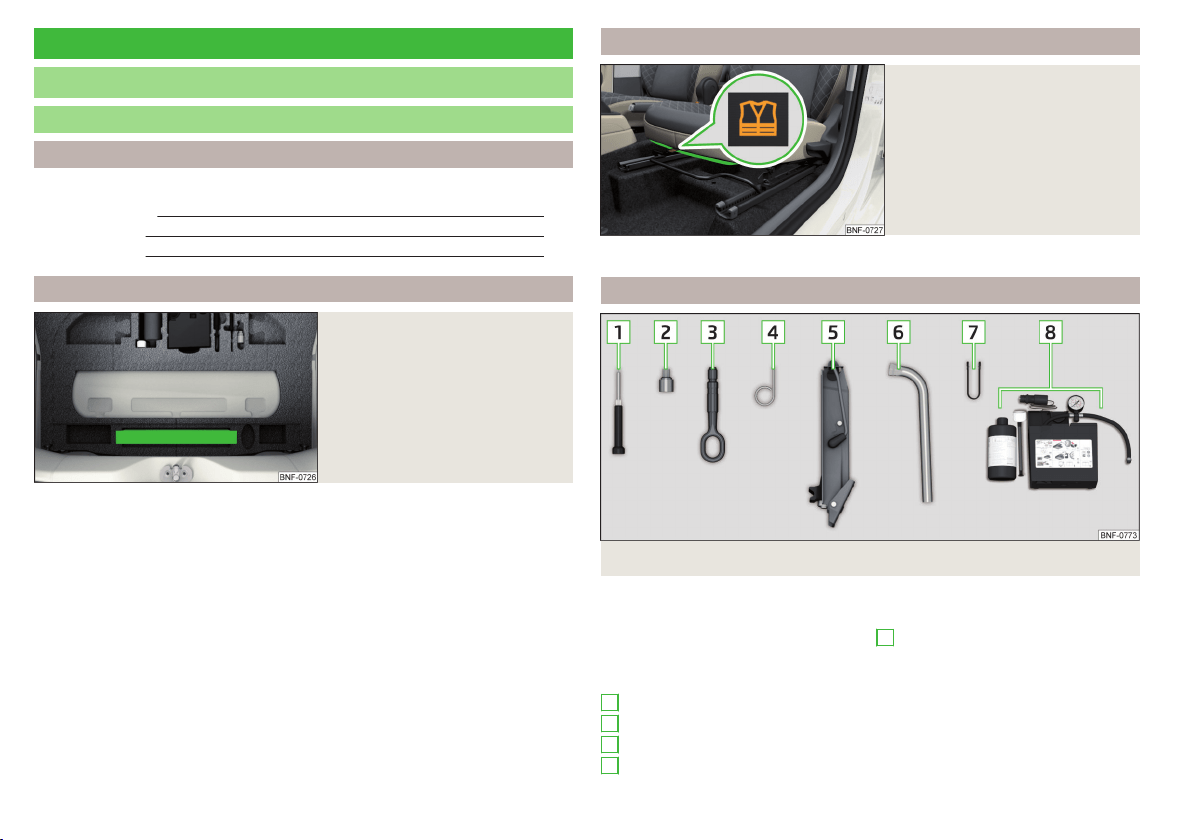
Do-it-yourself
Emergency equipment and self-help
Emergency equipment
Introduction
This chapter contains information on the following subjects:
Warning triangle
122
Reflective vest 122
Vehicle tool kit 122
Warning triangle
Fig. 115
Positioning of the warning trian-
gle - natural gas vehicles
For natural gas vehicles, the warning triangle can be stowed in a box under the
floor covering in the luggage compartment » Fig. 115.
This applies to the warning triangle from the ŠKODA Original Accessories
range. The storage compartment might be too small for a different type of
warning triangle.
Reflective vest
Fig. 116
Storage compartment for the re-
flective vest
The reflective vest can be stored in a holder under the driver's seat » Fig. 116.
Vehicle tool kit
Fig. 117
Vehicle tool kit
The tool kit is housed in a box in the spare or emergency wheel or in its com-
partment.
Lift up the floor covering at the opening
A
» Fig. 118 on page 123 .
Depending on the vehicle configuration, it may not contain all the compo-
nents listed in the on-board tool kit.
Screwdriver
Adapter for anti-theft wheel bolts
Towing eye
Clamps for removing the wheel trims
1
2
3
4
122
Do-it-yourself
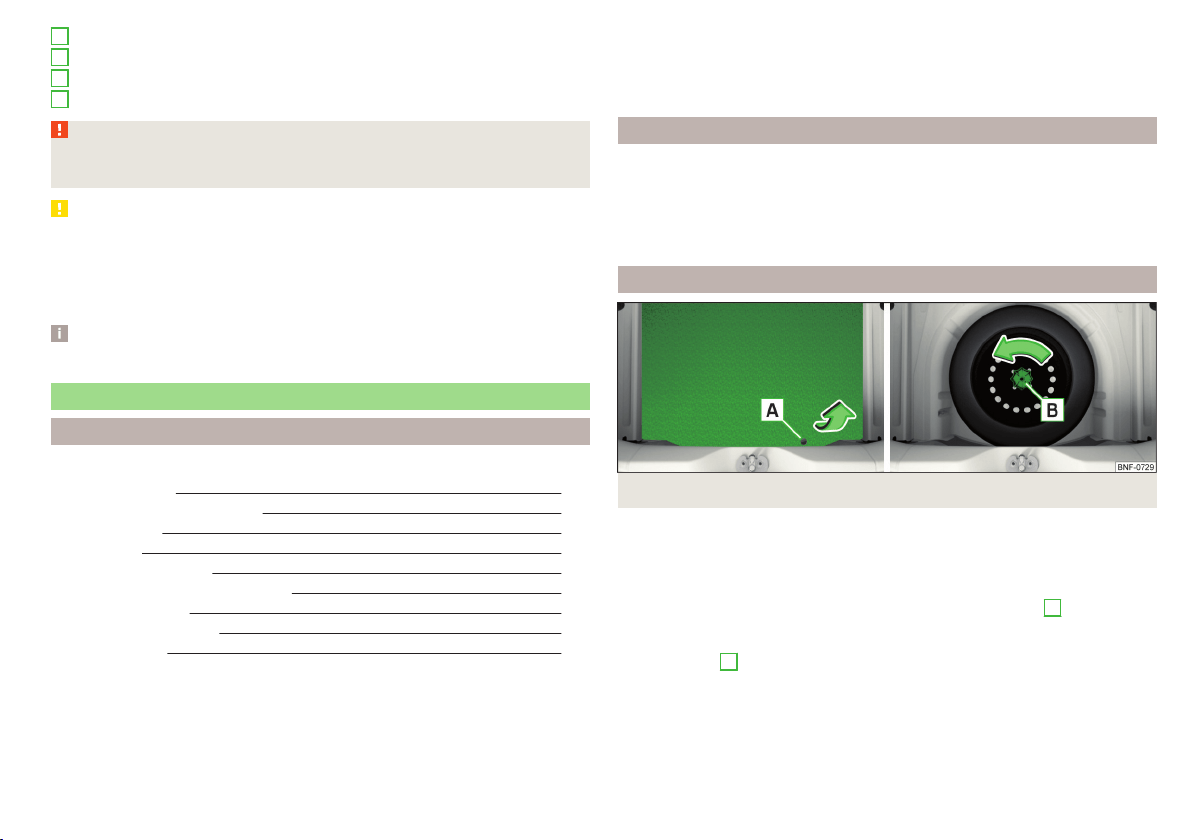
Jack with instruction card
Wheel wrench
Extraction pliers for wheel bolt caps
Breakdown kit
WARNING
The factory-supplied lifting jack is only intended for your model of vehicle.
Under no circumstances attempt to lift heavier vehicles or other loads.
CAUTION
■
Screw the jack back into the starting position before storing in the box with
the tool kit.
■
Ensure that the vehicle tool kit is safely secured in the luggage compart-
ment.
■
Ensure that the box is always secured with the strap.
Note
The declaration of conformity is included with the jack or the log folder.
Changing a wheel
Introduction
This chapter contains information on the following subjects:
Preliminary work
123
Removing/stowing the wheel
123
Full wheel trim
124
Wheel bolts
124
Anti-theft wheel bolts
124
Loosening/tightening wheel bolts
125
Raising the vehicle
125
Remove the wheel / fix
126
Follow-up work
126
For your own safety and the safety of the passengers, the following instruc-
tions must be observed before changing a wheel on the road.
Switch on the hazard warning lights system.
Place the warning triangle at the prescribed distance.
Park the vehicle as far away as possible from the flowing traffic.
5
6
7
8
Choose a location with a flat, solid surface.
Haveall the occupants get out. The passengers should not stand on the
road (instead they should remain behind a crash barrier, for instance) while
the wheel is being changed.
Preliminary work
Before changing the wheel, the following work must be carried out.
›
Switch off the engine.
›
For vehicles with manual transmission select 1st gear .
›
For vehicles with automated gearbox shift the lever to position D or R.
›
Firmly apply the handbrake.
Removing/stowing the wheel
Fig. 118 Take out the wheel
The spare wheel is located in a well under the floor covering in the boot and is
fixed in place with a special bolt » Fig. 118.
Take out the wheel
›
Open the boot lid.
›
Grasp the floor covering in the luggage compartment in area
A
» Fig. 118 and
lift.
›
Loosen the retaining belt and take out the box with the tool kit.
›
Unscrew nut
B
in the direction of the arrow.
›
Take out the wheel.
Stow the wheel
›
Place the wheel into the wheel well with the wheel rim pointing downward.
›
Pull the fixing band through the opposite holes in the wheel rim.
123
Emergency equipment and self-help
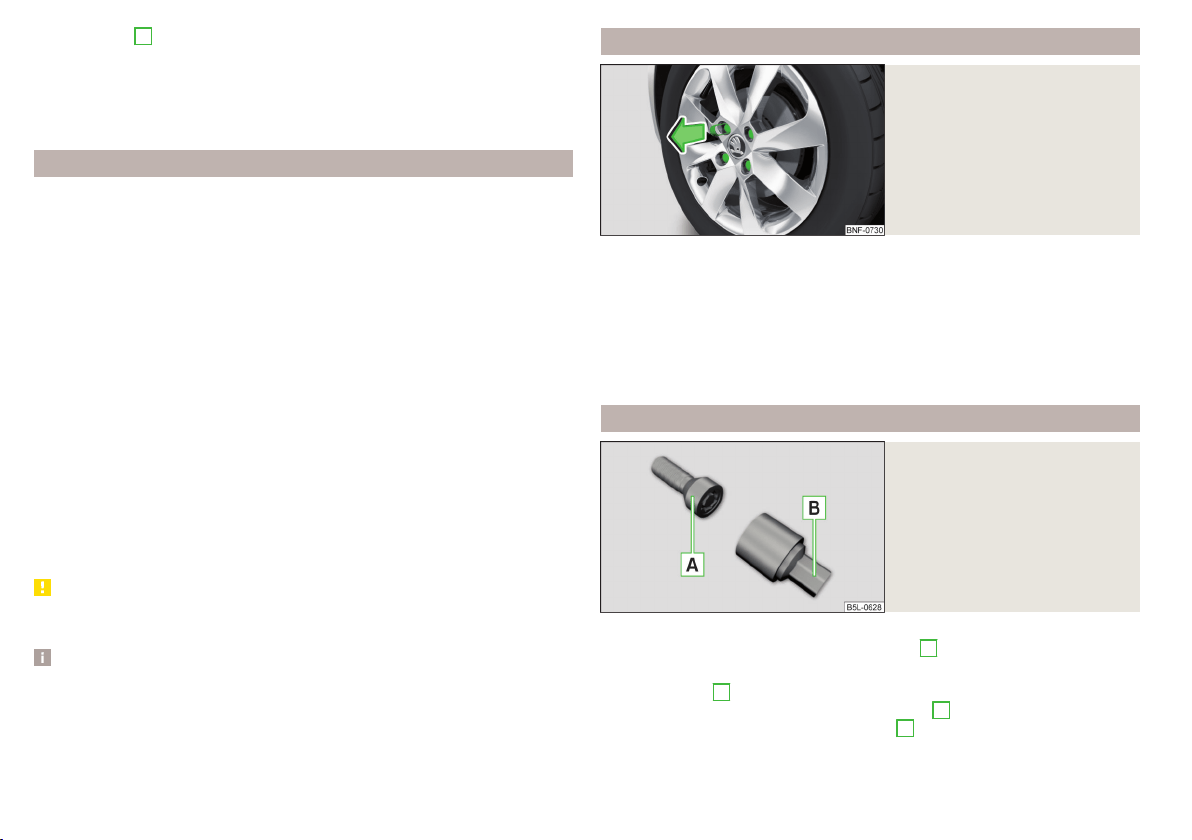
›
Screw in nut
B
in the opposite direction to the arrow » Fig. 118until the
wheel is safely secured.
›
Replace the box with the tool kit into the emergency or spare wheel and se-
cure it with the tape.
›
Fold back the floor in the luggage compartment.
›
Close the boot lid.
Full wheel trim
Before removing the wheel bolts, remove the wheel cover.
Pulling off
›
Hook the clamp found in the vehicle tool kit » page 122 into the reinforced
edge of the wheel trim.
›
Push the wheel wrench through the clamp, support on the tyre and pull off
the wheel trim.
Installing
›
Press the wheel trim onto the wheel rim at the designated valve opening.
›
Then press the trim into the wheel rim until its entire circumference locks
correctly in place.
Notes from the factory or from the ŠKODA Original accessory delivered trim.
▶
When using an anti-theft wheel bolt, make sure that this has been fitted ac-
cording to the position marked on the back of the wheel cover position.
▶
On the back of the wheel cover, the position for the anti-theft wheel bolt is
marked by means of a symbol. If the wheel cover is set outside the position
marked for the anti-theft wheel bolt, there is a risk of damaging the wheel
cover.
If wheel trims are fitted, an adequate flow of air must be assured in order to
cool the brake system.
CAUTION
Use the pressure of your hand only, do not strike the full wheel trim. The cover
could be damaged.
Note
We recommend that you use wheel trims from ŠKODA Original Accessories.
Wheel bolts
Fig. 119
Remove the cap
Before removing the wheel bolts, remove the covering caps.
Pulling off
›
Push the extraction pliers
» page 122 sufficiently far onto the cap until the
inner catches of the pliers are positioned at the collar of the cap.
›
Remove the cap in the direction of the arrow » Fig. 119.
Installing
›
Push the cap onto the wheel bolt up to the stop.
Anti-theft wheel bolts
Fig. 120
Principle sketch: Anti-theft
wheel bolt with adapter
The anti-theft wheel bolts protect the wheels from theft. These can only be
loosened or tightened with the use of adapter
B
» Fig. 120.
›
Remove the full wheel trim or the caps of the wheel bolts.
›
Insert adapter
B
» Fig. 120 with the toothed side all the way into the inner
teeth in the head of the anti-theft wheel bolts
A
.
›
Push the wheel wrench onto the adapter
B
up to the stop.
›
Loosen or tighten the wheel bolt » page 125.
›
Remove the adapter.
124
Do-it-yourself

›
Replace the wheel trim or the caps.
To be equipped for a possible wheel change, the adapter for the anti-theft
wheel bolts must always be kept in the vehicle. The adapter is stowed in the
tool kit.
The position of the anti-theft wheel bolt is marked on the back of the wheel
cover on every factory-fitted or ŠKODA Original Accessory hub cap.
When using an anti-theft wheel bolt, make sure that this has been fitted ac-
cording to the position marked on the back of the wheel cover position.
Note
■
Note the code number which is embossed both on the adapter and also on
the end of each anti-theft wheel bolt. This number can be used to purchase a
replacement adapter from ŠKODA Original Parts if necessary.
■
The anti-theft wheel bolt set and adapter can be purchased from a ŠKODA
Partner.
Loosening/tightening wheel bolts
Fig. 121
Changing a wheel: Loosening the
wheel bolts
Before removing the wheel bolts, the caps for the wheel bolts must be pulled
off.
Loosening
›
Push the wheel wrench onto the wheel bolt until it locks into place.
Use the appropriate adapter for undoing the anti-theft wheel bolts » page 124.
›
Grasp the end of the wrench and turn the bolt about one turn in the direction
of the arrow » Fig. 121.
Tightening
›
Push the wheel wrench onto the wheel bolt until it locks into place.
Use the appropriate adapter for tightening the anti-theft wheel bolts
» page 124.
›
Grasp the end of the wrench and turn the bolt against the direction of the
arrow » Fig. 121, until it is tight.
After tightening the wheel bolts, the covering caps must be replaced.
WARNING
If it proves difficult to undo the bolts, carefully apply pressure to the end of
the wrench with your foot. Keep hold of the vehicle when doing so, and
make sure you keep your footing.
Raising the vehicle
Fig. 122
Jacking points for positioning
lifting jack
Fig. 123 Principle sketch: Attach lifting jack
Use the jack from the tool kit to raise the vehicle.
Position the car jack at the jacking point closest to the flat tyre .
125
Emergency equipment and self-help

The mounting points are located on the metal bar of the lower sill on the un-
derside of your vehicle. The positions of these are embossed by means of
markings on the side surface of the lower sill » Fig. 122.
›
Support the base plate of the jack with its full area resting on level ground
and ensure that the jack is located in a vertical position at the jacking point
» Fig. 123 -
.
›
Position the lifting jack below the jacking point with the crank and move it up
until its claw encloses the web » Fig. 123 -
.
›
Continue turning up the jack until the wheel is just about lifted off the
ground.
WARNING
■
If the wheel has to be changed on a slope, first of all block the opposite
wheel with a stone or similar object to prevent the vehicle from unexpect-
edly rolling away.
■
Secure the base plate of the lifting jack with suitable means to prevent
possible moving. A soft and slippery ground under the base plate may move
the lifting jack, causing the vehicle to fall down. It is therefore always nec-
essary to place the lifting jack on a solid surface or use a wide and stable
base. If the surface is smooth, such as on cobbled stones, tiled floor etc.,
use a non-slip base (e.g. a rubber foot mat).
■
Only attach the lifting jack to the attachment points provided for this pur-
pose.
■
Always raise the vehicle with the doors closed.
■
Never position any body parts, such as arms or legs under the vehicle,
while the vehicle is raised with a lifting jack.
■
When the vehicle is raised, never start the engine.
CAUTION
It is important to ensure that the jack is correctly attached to the web of the
lower fork leg - risk of damage to the vehicle.
Remove the wheel / fix
When changing a wheel, the following instructions must be followed.
›
Remove the full wheel trim or the caps of the wheel bolts.
›
First of all slacken the anti-theft wheel bolt and then the other wheel bolts.
›
Jack up the vehicle until the wheel that needs changing is clear of the
ground.
›
Unscrew the wheel bolts and place them on a clean surface (cloth, paper,
etc.).
›
Remove the wheel carefully.
›
Attach the wheel and slightly screw on the wheel bolts.
›
Lower the vehicle.
›
Alternately tighten wheel bolts opposite (diagonally) with the wheel wrench.
Tighten the anti-theft wheel bolt last.
›
Replace the wheel trim or the caps.
When fitting unidirectional tyres, ensure that the direction of rotation is cor-
rect » page 119.
All bolts must be clean and must turn easily.
If it is established when changing a wheel that the wheel bolts are corroded
and difficult to move, then these must be replaced.
Under no circumstances grease or oil the wheel bolts!
WARNING
Undo the wheel bolts only a little (about one turn) provided that the vehicle
has not yet been jacked up. Otherwise the wheel could become loose and
fall off.
Follow-up work
After changing the wheel, the following work must be carried out.
›
Stow the replaced wheel in the wheel well and secure it with a special nut.
›
Stow the tool kit in the space provided and secure using the band.
›
Check the tyre pressure on the fitted wheel as soon as possible.
›
Have the tightening torque of the wheel bolts checked with a torque wrench
as soon as possible.
After changing the wheel, the tyre pressure should be adjusted. In vehicles
with tyre pressure monitoring, save tyre pressure values» page 91.
Replace the damaged wheel or consult a specialist garage about repair op-
tions.
The prescribed tightening torque of the wheel bolts is 110 Nm.
126
Do-it-yourself
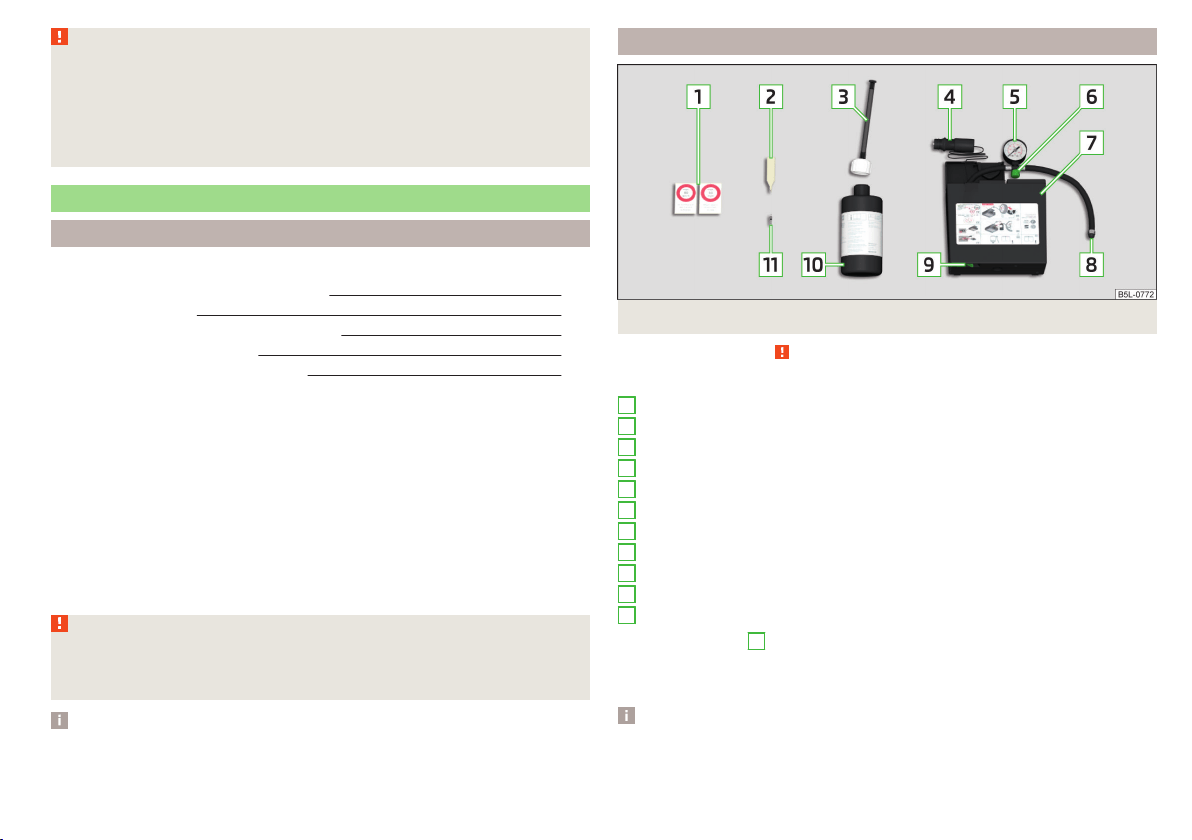
WARNING
■
If the wheel bolts are tightened to a too low tightening torque, the rim
can come loose when the car is moving. A tightening torque which is too
high can damage the bolts and threads and this can result in permanent
deformation of the contact surfaces on the rim.
■
Drive cautiously and only at a moderate speed until the tightening torque
has been checked.
Puncture repair kit
Introduction
This chapter contains information on the following subjects:
Components of the puncture repair kits 127
General information 128
Preparations for using the breakdown kit 128
Sealing and inflating the tyre 128
Notes for driving with repaired tyres 129
Use the breakdown kit to reliably repair tyre damage caused by foreign bodies
or a puncture with diameters up to approx. 4 mm.
A repair made using the breakdown kit is never intended to replace a perma-
nent repair on the tyre. Its purpose is to get you to the nearest specialist ga-
rage.
The wheel must not be removed during repair.
Do not remove foreign bodies, which have penetrated the wheel profile from
the tyre (e.g. screws or nails).
Immediately replace the tyre that was repaired using the breakdown kit, or
consult a specialist garage about repair options.
WARNING
■
The sealant is hazardous to heath. Remove immediately if it comes into
contact with the skin.
■
Observe the manufacturer's usage instructions for the breakdown kit.
Note
A new bottle of sealant can be purchased from ŠKODA Original Parts.
Components of the puncture repair kits
Fig. 124 Principle sketch: Components of the breakdown kit
Read and observe on page 127 first.
Kit components » Fig. 124
Sticker with speed designation “max. 80 km/h”/“max. 50 mph”
Valve remover
Inflation hose with plug
12 volt cable connector
Tyre inflation pressure indicator
Air release valve
Air compressor
Tyre inflation hose
ON and OFF switch
Tyre inflator bottle with sealing agent
Replacement valve core
The valve remover
2
has a slot at its lower end which fits into the valve core.
The kit is located in a box under the floor covering in the luggage compart-
ment. The kit contains a sealant and an air compressor.
Note
The declaration of conformity is included with the air compressor or the log
folder.
1
2
3
4
5
6
7
8
9
10
11
127
Emergency equipment and self-help

General information
Read and observe on page 127 first.
For your own safety and the safety of your passengers, the following instruc-
tions must be observed before carrying out a wheel repair on the road.
Switch on the hazard warning lights system.
Place the warning triangle at the prescribed distance.
Park the vehicle as far away as possible from the flowing traffic.
Choose a location with a flat, solid surface.
Haveall the occupants get out. The passengers should not stand on the
road (instead they should remain behind a crash barrier, for instance) while
the wheel is being changed.
The breakdown kit must not be used under the following circumstances.
▶
The rim is damaged.
▶
The outside temperature is below -20 ° C.
▶
The cut or puncture is larger than 4 mm.
▶
The tyre wall is damaged.
▶
After the expiration date (see inflation bottle).
Preparations for using the breakdown kit
Read and observe
on page 127 first.
The following preparatory work must be carried out before using the puncture
repair kit.
›
Switch off the engine.
›
For vehicles with manual transmission select 1st gear .
›
For vehicles with
automated gearbox shift the lever to position D or R.
›
Firmly apply the handbrake.
›
Check that you can carry out the repairs with the breakdown kit » page 127.
›
Remove the breakdown kit from the boot.
›
Stick the sticker
1
» Fig. 124 on page 127 on the dash panel in the driver's
field of view.
›
Unscrew the valve cap.
›
Use the valve remover
2
to unscrew the valve core and place it on a clean
surface (rag, paper, etc.).
Sealing and inflating the tyre
Read and observe on page 127 first.
Sealing
›
Forcefully shake the tyre inflator bottle
10
» Fig. 124 on page 127 several
times.
›
Firmly screw the inflation hose
3
onto the tyre inflater bottle
10
. The film
on the cap is pierced automatically.
›
Remove the plug from the inflation hose
3
and plug the open end fully onto
the tyre valve.
›
Hold the bottle
10
with the bottom facing upwards and fill all of the sealing
agent from the tyre inflator bottle into the tyre.
›
Remove the filler plug from the tyre valve.
›
Screw the valve core back into the tyre valve using the valve remover
2
.
Inflating
›
Screw the air compressor tyre inflation hose
8
» Fig. 124 on page 127 firmly
onto the tyre valve.
›
For vehicles with manual transmission the lever into the neutral position.
›
For vehicles with automated manual transmission shift the lever to position
N.
›
Check that the air release valve
6
is closed.
›
Start the engine and run it in idle.
›
Plug the connector
4
into 12 volt socket » page 61, 12-Volt power outlet.
›
Switch on the air compressor with the ON and OFF switch
9
.
›
Allow the air compressor to run until a pressure of 2.0 - 2.5 bar is achieved.
Maximum run time of 8 minutes » .
›
Switch off the air compressor.
›
If you cannot reach an air pressure of 2.0 - 2.5 bar, unscrew the tyre inflation
hose
8
from the tyre valve.
›
Drive the vehicle 10 metres forwards or backwards to allow the sealing agent
to “distribute” in the tyre.
›
Firmly screw the tyre inflation hose
8
back onto the tyre valve and repeat
the inflation process.
›
Switch off the air compressor.
›
Remove the tyre inflation hose
8
from the tyre valve.
Once a tyre inflation pressure of 2.0 - 2.5 bar has been achieved, you can con-
tinue the journey.
128
Do-it-yourself
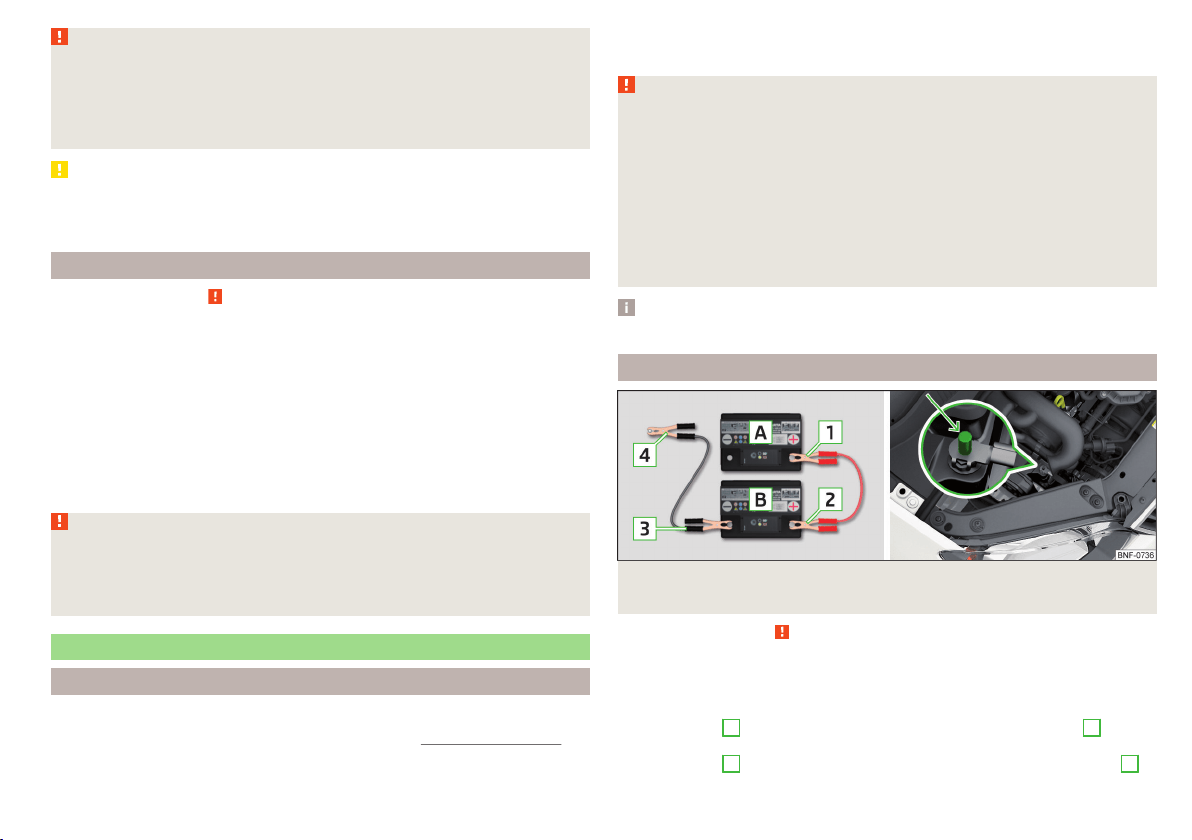
WARNING
■
If the tire does not inflate at least 2.0 bar, the damage is too great. The
sealing agent cannot be used to seal the tyre. Do not drive the vehicle!
Seek help from a specialist garage.
■
The tyre inflation hose and air compressor may get hot as the tyre is be-
ing inflated – risk of burning.
CAUTION
Switch off the air compressor after running 8 minutes at the latest – there is a
risk of overheating. Allow the air compressor to cool a few minutes before
switching it on again.
Notes for driving with repaired tyres
Read and observe on page 127 first.
The inflation pressure of the repaired tyre must be checked after driving for 10
minutes.
If the tyre pressure is 1.3 bar or less
›
Do not continue to drive! You cannot properly seal with tyre with the
breakdown kit.
If the tyre pressure is 1.3 bar or more
›
Set the tyre pressure to the correct value.
›
Continue driving carefully to the nearest specialist garage at a maximum
speed of 80 km/h (50 mph).
WARNING
■
A tyre filled with sealant has the same driving characteristics as a stand-
ard tyre.
■
Do not drive faster than 80 km/h (50 mph).
■
Avoid accelerating at full throttle, sharp braking and fast cornering.
Jump-starting
Introduction
This chapter contains information on the following subjects:
Jump-starting using the battery from another vehicle
129
The battery of another vehicle can be used to jump-start your vehicle if the en-
gine will not start because the battery is flat.
WARNING
■
Pay attention to the warning instructions relating to working in the en-
gine compartment » page 106.
■
A discharged vehicle battery may already freeze at temperatures just be-
low 0 °C. If the battery is frozen, do not jump start with the battery of an-
other vehicle – there is a risk of explosion.
■
Keep any sources of ignition (naked flame, smouldering cigarettes, etc.)
away from the battery – risk of explosion!
■
Never jump-start vehicle batteries with insufficient acid levels – risk of
explosion and chemical burns.
■
The vent screws of the battery cells must be tightened firmly.
Note
We recommend you buy jump-start cables from a car battery specialist.
Jump-starting using the battery from another vehicle
Fig. 125 Jump-starting: A – flat battery, B – battery providing current / en-
gine earthing point
Read and observe
on page 129 first.
The starting process using the battery of another vehicle requires the use of
jumper cables.
The jump-start cables must be attached in the following sequence.
›
Attach clamp
1
to the positive terminal of the discharged battery
A
» Fig. 125 .
›
Attach clamp
2
to the positive terminal of the battery supplying power
B
.
129
Emergency equipment and self-help
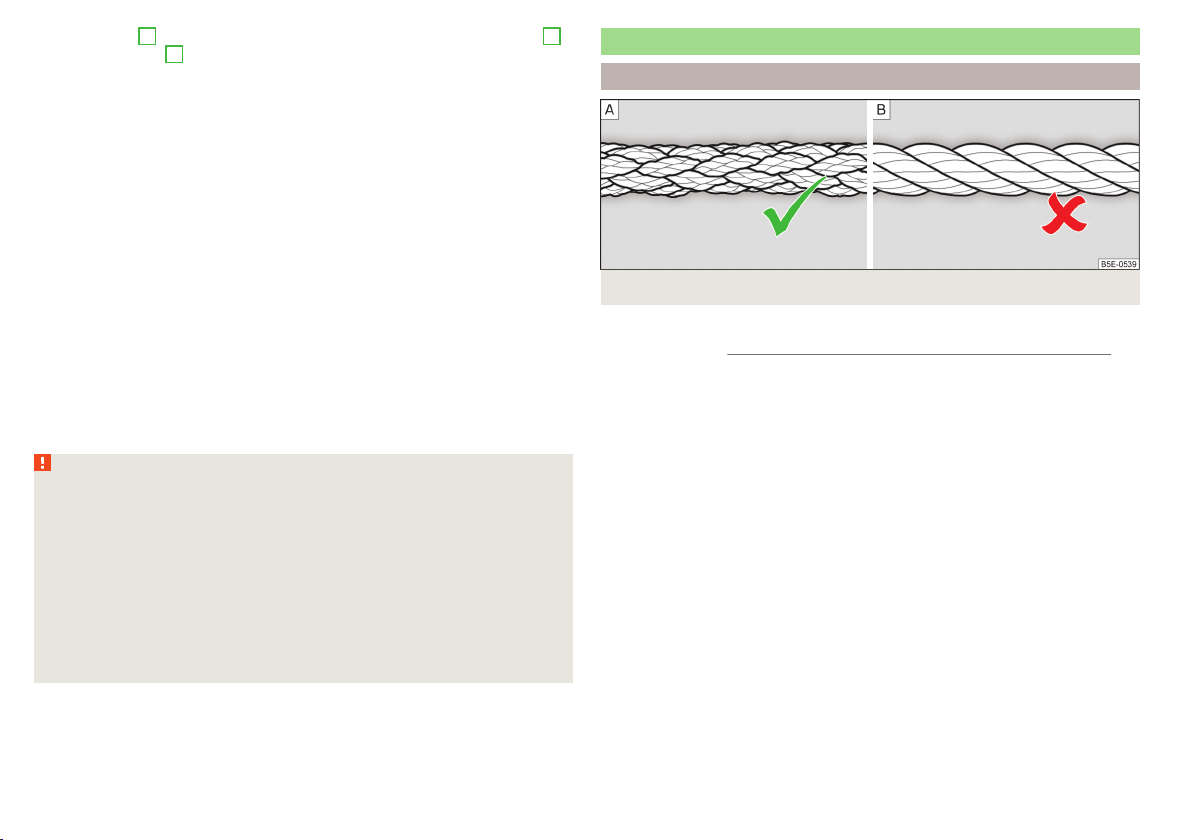
›
Attach clamp
3
to the negative terminal of the battery supplying power
B
.
›
Attach the clamp
4
to a solid metal component firmly connected to the en-
gine block or to the engine block itself.
On vehicles with the START-STOPsystem the jump-start cable must be con-
nected to the engine earthing point » Fig. 125.
Starting engine
›
Start the engine on the vehicle providing the power and allow it to idle.
›
Start the engine of the vehicle with the discharged battery.
›
If the engine does not start, halt the attempt to start the engine after 10 sec-
onds and wait for 30 seconds before repeating the process.
›
Remove the jump start cables in the reverse order as attachment.
Both batteries must have a rated voltage of 12 V. The capacity (Ah) of the bat-
tery supplying the power must not be significantly less than the capacity of
the discharged battery in your vehicle.
Jump-start cables
Only use jump-start cables which have an adequately large cross-section and
insulated terminal clamps. Observe the instructions of the jumper lead manu-
facturer.
Positive cable – colour coding in the majority of cases is red.
Negative cable – colour coding in the majority of cases is black.
WARNING
■
Do not clamp the jump-start cable to the negative terminal of the dis-
charged battery. There is the risk of detonating gas seeping out the battery
being ignited by the strong spark which results from the engine being star-
ted.
■
The non-insulated parts of the terminal clamps must never touch each
other – there is a risk of short circuit.
■
The jump-start cable connected to the positive terminal of the battery
must not come into contact with electrically conducting parts of the vehicle
– there is a risk of short circuit.
■
Route the jump-start cables so that they cannot be caught by any rotat-
ing parts in the engine compartment.
Towing the vehicle
Introduction
Fig. 126 Braided tow rope / Spiral tow rope
This chapter contains information on the following subjects:
Front towing eye 131
For towing, a braided tow rope is to be used » Fig. 126 -
.
When towing, the following guidelines must be observed.
Vehicles with manual transmission may be towed with a tow bar or a tow rope
or with the front or rear wheels raised.
Vehicles with automatic transmission may be towed in with a tow bar or a tow
rope or with the front wheels raised. If the vehicle is raised at rear, the auto-
matic gearbox is damaged!
Driver of the tow vehicle
›
Engage the clutch gently when starting off or depress the accelerator partic-
ularly gently if the vehicle is fitted with an automatic gearbox.
›
Only then approach correctly when the rope is taut.
The maximum towing speed is 50 km/h.
Driver of the towed vehicle
›
Switch on the ignition so that the steering wheel is not locked and so that
the turn-signal lights, windscreen wipers and windscreen washer system can
be used.
›
Take the vehicle out of gear or move the selector lever into position N if the
vehicle is fitted with an automated transmission.
130
Do-it-yourself
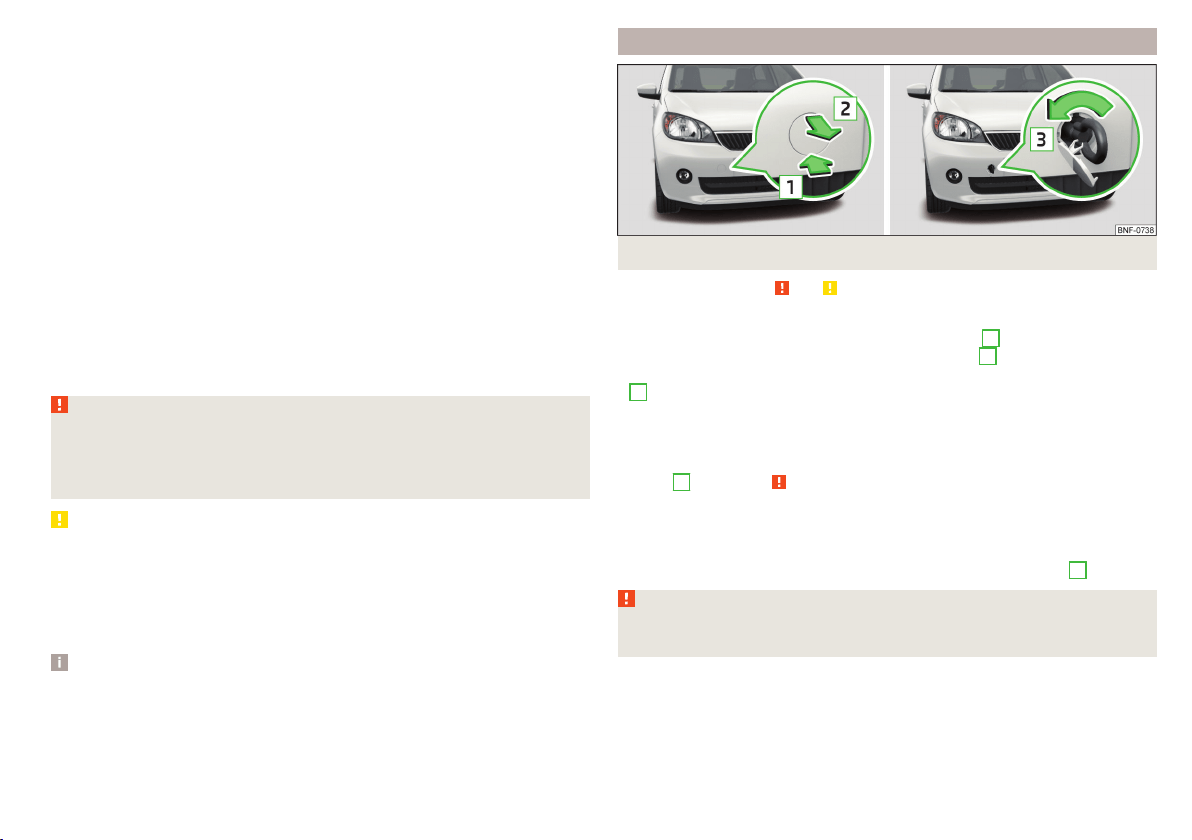
Please note that the brake servo unit and power steering only operate if the
engine is running. If the engine is not running, significantly more physical force
is required to depress the brake pedal and steer the vehicle.
If using a tow rope, ensure that it is always kept taught.
General information on towing
Both drivers should be familiar with the problems which might occur while a
vehicle is being towed. Unskilled drivers should not attempt to tow in another
vehicle or to be towed in.
The vehicle must be transported on a special breakdown vehicle or trailer if it
is not possible to tow in the vehicle in the way described or if the towing dis-
tance is greater than 50 km.
If the gearbox has no oil, your vehicle must be towed with the front axle raised
clear of the ground or on a breakdown vehicle or trailer.
To protect both vehicles when tow-starting or towing, the tow rope should be
elastic. Thus one should only use plastic fibre rope or a rope made out of a
similarly elastic material.
Attach the tow rope or the tow bar only to the towing eye » page 131.
WARNING
■
When towing, exercise increased caution.
■
Do not use spiral rope for towing » Fig. 126- , the towing eye may un-
screw from the vehicle - risk of accident.
■
Ensure tow rope is not twisted - risk of accident.
CAUTION
■
Do not start engine by towing - there is a risk of damaging the engine parts.
The battery from another vehicle can be used as a jump-start aid » page 129,
Jump-starting.
■
There is always a risk of excessive stresses and damage resulting at the
points to which you attach the tow rope or tow bar when you attempt to tow a
vehicle which is not standing on a paved road.
Note
We recommend using a tow rope from ŠKODA Original Accessories, which is
available from a ŠKODA Partner.
Front towing eye
Fig. 127 Removing the cap/installing the towing eye
Read and observe
and on page 131 first.
Removing/fitting the cover cap
›
Press on the cover cap in the direction of the arrow
1
» Fig. 127 .
›
Remove the cover cap in the direction of the arrow
2
.
›
After screwing out the towing eye, insert the cover cap in the area of arrow
1
and then press the opposite side of the cover cap.
The cap must engage firmly.
Removing/fitting the towing eye
›
Manually screw in the towing eye as far as it will go in the direction of the
arrow
3
» Fig. 127 » .
For tightening purposes, we recommend, for example, using the wheel
wrench, towing eye from another vehicle or a similar object that can be pushed
through the eye.
›
Unscrew the towing eye against the opposite direction to arrow
3
.
WARNING
The towing eye must always be screwed in fully and firmly tightened, oth-
erwise the towing eye can tear when towing in or tow-starting.
131
Emergency equipment and self-help
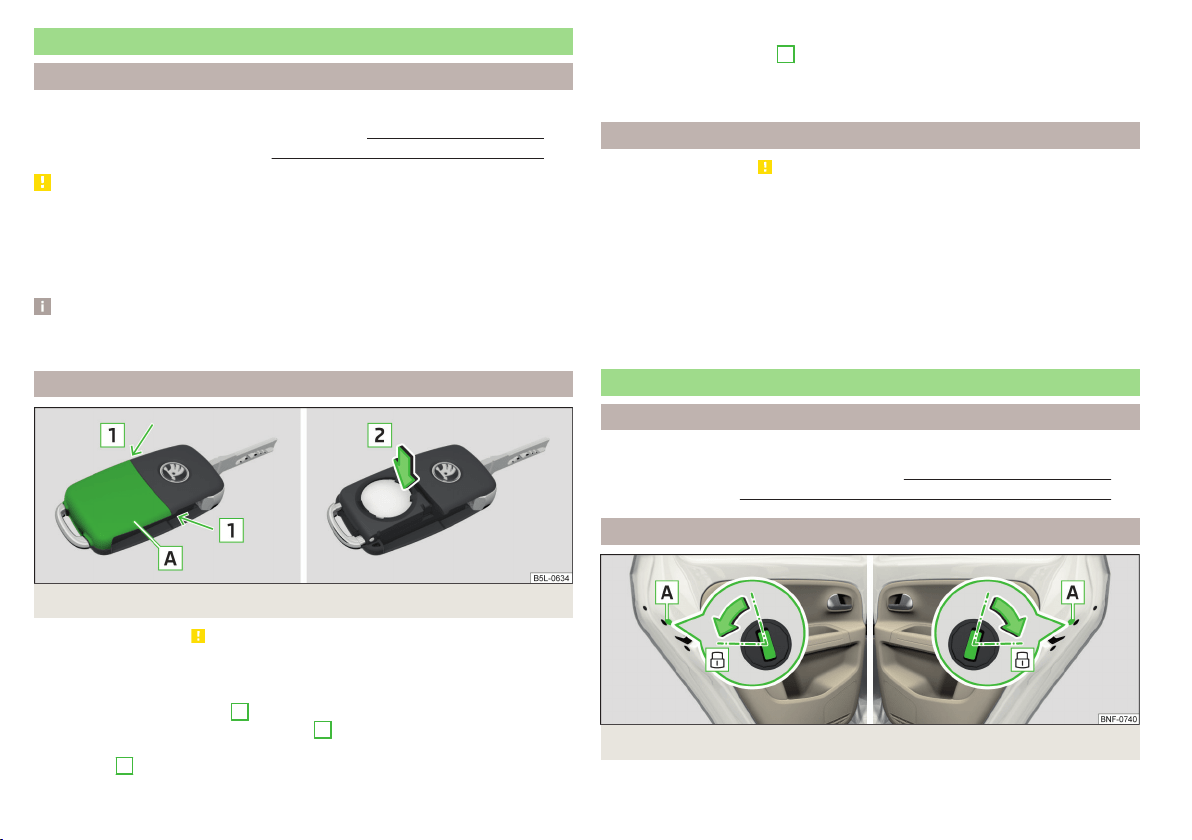
Remote control
Introduction
This chapter contains information on the following subjects:
Replacing the battery in the remote control key
132
Synchronising the remote control 132
CAUTION
■
The replacement battery must have the same specification as the original
battery.
■
We recommend having faulty rechargeable batteries replaced by a ŠKODA
service partner.
■
Pay attention to the correct polarity when changing the battery.
Note
If a key has an affixed decorative cover, this will be destroyed when the bat-
tery is replaced. A replacement cover can be purchased from a ŠKODA Partner.
Replacing the battery in the remote control key
Fig. 128 Remove cover/take out battery
Read and observe on page 132 first.
The battery change is carried out as follows.
›
Flip out the key.
›
Press off the battery cover
A
» Fig. 128 with your thumb or using a flat
screwdriver in the region of the arrows
1
.
›
Remove the discharged battery by pressing the battery down in the region of
the arrow
2
.
›
Insert the new battery.
›
Insert the battery cover
A
and press it down until it clicks audibly into place.
The key has to be synchronised if the vehicle cannot be unlocked or locked
with the remote control key after replacing the battery » page 132.
Synchronising the remote control
Read and observe on page 132 first.
If the vehicle does not unlock when pressing the remote control, the key may
not be synchronised. This can occur when the buttons on the remote control
key are actuated a number of times outside of the operative range of the
equipment or the battery in the remote control key has been replaced.
Synchronise the key as follows.
›
Press any button on the remote control key.
›
Unlock the door with the key in the lock cylinder within 1 minute of pressing
the button.
Emergency unlocking/locking
Introduction
This chapter contains information on the following subjects:
Locking the door without a locking cylinder
132
Unlock the boot lid
133
Locking the door without a locking cylinder
Fig. 129
Emergency locking: Front door right
132
Do-it-yourself
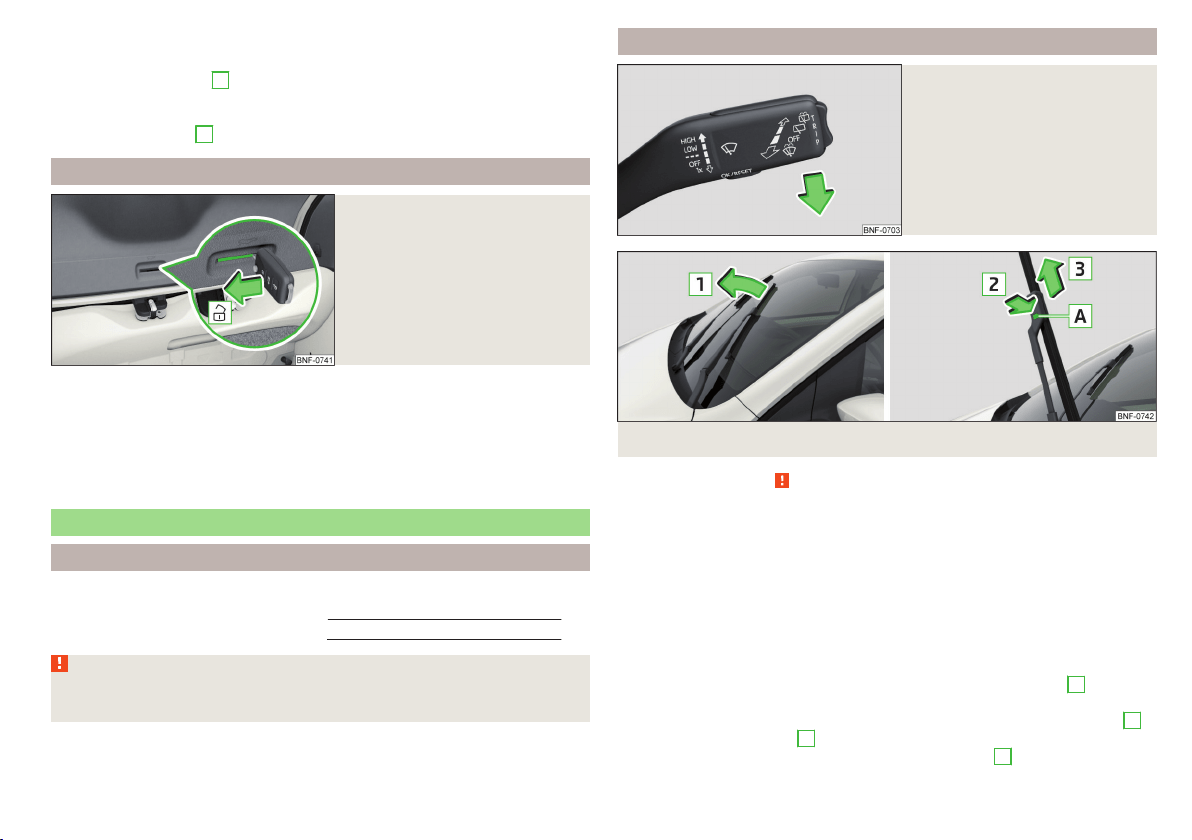
An emergency locking mechanism is located on the face side of the doors
which have no locking cylinder, it is only visible after opening the door.
›
Remove the aperture
A
(applies to the rear door) » Fig. 129.
›
Insert the vehicle key into the slot and turn in the direction of the arrow
(sprung position).
›
Insert the aperture
A
(applies to the rear door).
Unlock the boot lid
Fig. 130
Unlocking the boot lid
The boot lid can be unlocked manually.
›
Fold the rear seat backrest forward » page 57.
›
Insert the vehicle key into the slot in the trim panel » Fig. 130 as far as it will
go.
›
Unlock the lid by moving it in the direction of the arrow.
›
Open the boot lid.
Replacing windscreen wiper blades
Introduction
This chapter contains information on the following subjects:
Replacing the windscreen wiper blades 133
Replacing the rear window wiper blade
134
WARNING
Replace the windscreen wiper blades once or twice a year for safety rea-
sons. These can be purchased from a ŠKODA Partner.
Replacing the windscreen wiper blades
Fig. 131
Setting the service position for
the wiper arms
Fig. 132
Windscreen wiper blade
Read and observe on page 133 first.
Set the windscreen wiper arms to the service position before replacing the
windscreen wiper blades.
Service position for changing wiper blades
›
Closing the bonnet.
›
Switch the ignition on and off again.
›
Push the lever in the direction of the arrow » Fig. 131.
The windscreen wiper arms move into the service position.
Removing the wiper blade
›
Lift the wiper arm from the windscreen in the direction of arrow
1
» Fig. 132.
›
Tilt the wiper blade as far as it will go in the same direction.
›
Hold the upper part of the wiper arm and press the securing mechanism
A
in the direction of arrow
2
.
›
Remove the wiper blade in the direction of the arrow
3
.
133
Emergency equipment and self-help
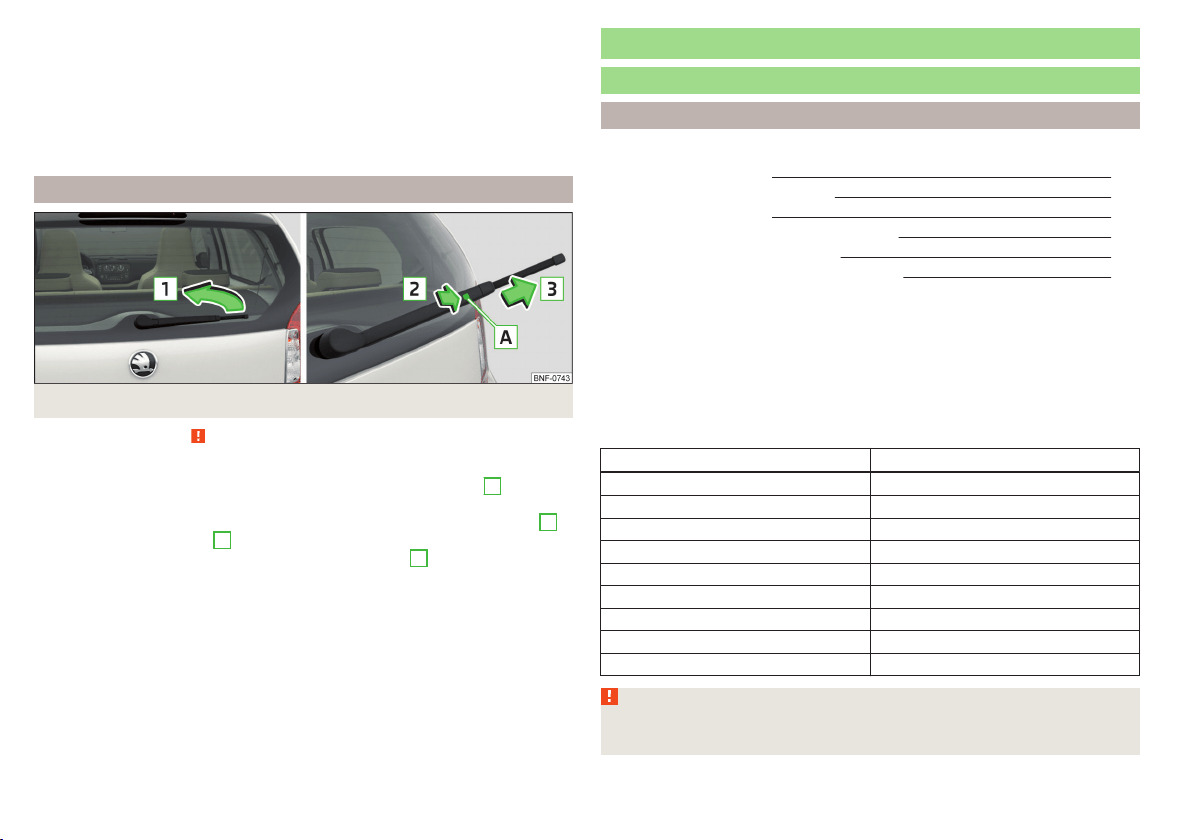
Attaching the wiper blade
›
Push the windscreen wiper blade until the stop and it locks in place.
›
Check that the wiper blade is correctly attached.
›
Fold the wiper arm back to the windscreen.
›
Turn on the ignition and press the lever into the direction of the arrow
» Fig. 131.
The windscreen wiper arms move into the home position.
Replacing the rear window wiper blade
Fig. 133
Rear window wiper blade
Read and observe on page 133 first.
Removing the wiper blade
›
Lift the wiper arm from the windscreen in the direction of arrow
1
» Fig. 133.
›
Tilt the wiper blade as far as it will go in the same direction.
›
Hold the upper part of the wiper arm and press the securing mechanism
A
in the direction of arrow
2
.
›
Remove the wiper blade in the direction of the arrow
3
.
Attaching the wiper blade
›
Push the windscreen wiper blade until the stop and it locks in place.
›
Check that the wiper blade is correctly attached.
›
Fold the wiper arm back to the windscreen.
Fuses and light bulbs
Fuses
Introduction
This chapter contains information on the following subjects:
Fuses in the dash panel 135
Fuse allocation in the dash panel 135
Fuses in the dash panel 136
Assignment of the fuses in the dash panel 137
Fuses in the engine compartment 137
Fuse allocation in the engine compartment 137
Individual electrical circuits are protected by fuses.
Switch off the ignition and the corresponding power consuming device before
replacing a fuse.
Find out which fuse belongs to the component that is not operating
» page 135, Fuses in the dash panel, » page 137, Fuses in the engine com-
partment, or » page 136, Fuses in the dash panel.
Colour coding of fuses
Fuse colour Maximum amperage
purple 3
light brown 5
brown 7.5
red 10
blue 15
yellow 20
white 25
green 30
orange 40
WARNING
Always read and observe the warnings before completing any work in the
engine compartment » page 106.
134
Do-it-yourself
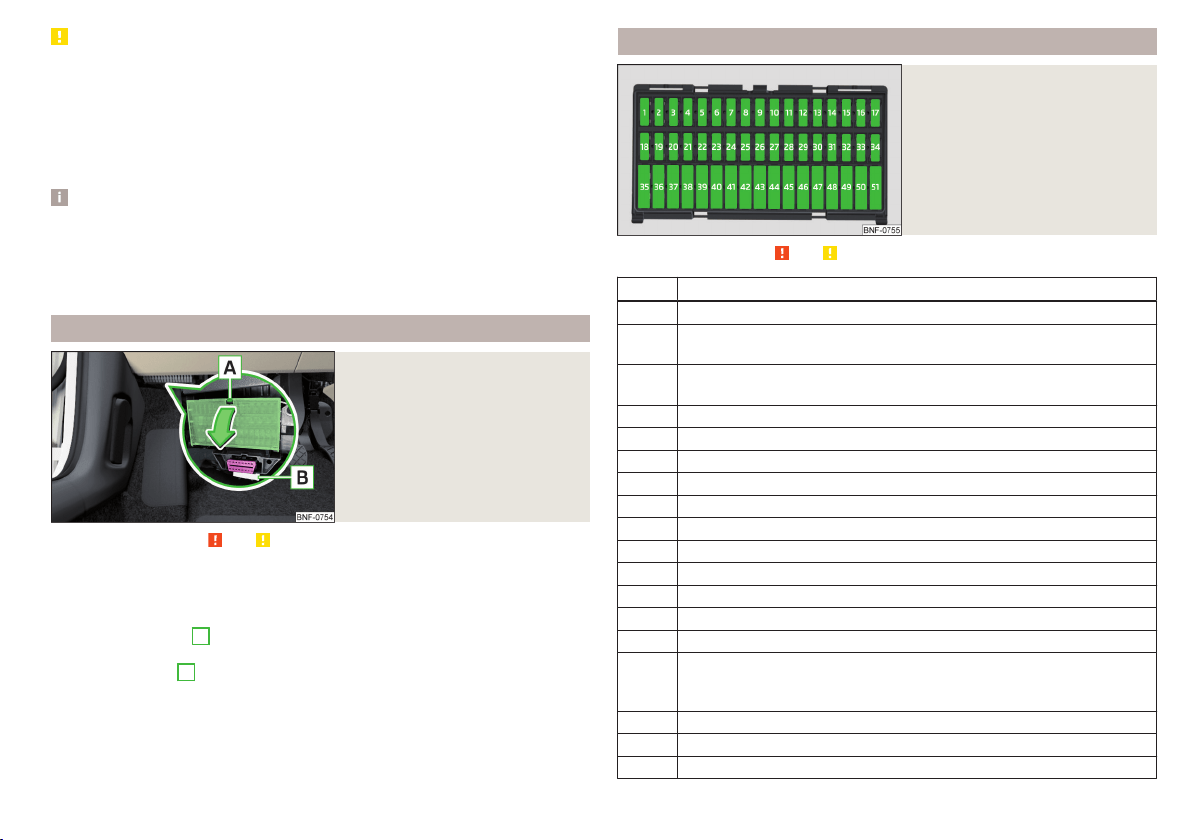
CAUTION
■
“Never repair” fuses and also do not replace them with a fuse of a higher am-
perage – risk of fire! This may also cause damage at another part of the electri-
cal system.
■
If a newly inserted fuse blows again after a short time, have the electrical
system checked as quickly as possible by a specialist garage.
■
A blown fuses is recognisable by the molten metal strip. Replace the faulty
fuse with a new one of the same amperage.
Note
■
We recommend always carrying replacement fuses in the vehicle. A box of
replacement fuses and bulbs can be purchased from ŠKODA Original Accesso-
ries.
■
There can be several power consuming devices for one fuse.
■
Multiple fuses may exist for a single power consuming device.
Fuses in the dash panel
Fig. 134
Remove the fuse box cover.
Read and observe and on page 134 first.
The fuses are located underneath the steering wheel on the underside of the
dash panel » Fig. 134.
Replacing fuses
›
Press securing tab
A
» Fig. 134.
›
Push the lid in the direction of the arrow.
›
Remove bracket
B
.
›
Place the bracket on the respective fuse and pull this out.
›
Insert a new fuse.
›
Replace the bracket at the original position.
›
Fold the cover upwards against the direction of the arrow.
›
Close the cover until it clicks into place.
Fuse allocation in the dash panel
Fig. 135
Fuses
Read and observe and on page 134 first.
No. Consumer
1 Air Conditioning, diagnostic connector
2
Headlight range control, park assist, electric exterior mirror adjust-
ment
3
Automatic transmission, engine control unit, power steering, control
lever under the steering wheel, instrument cluster
4 Airbag
5 Reversing light
6 Rear wiper, windscreen washer system
7 Main beam headlamp - left side
8 Main beam headlamp - right side
9 Not assigned
10 Electric exterior mirror heater
11 Not assigned
12 Vehicle lighting
13 Vehicle lighting
14 Vehicle lighting
15
Vehicle with START-STOPsystem: Radio
Vehicle without START-STOPsystem: Central Control Unit, heating,
automatic transmission, light switch, license plate light
16 Vehicle lighting
17 Rear window wiper
18 Panoramic sunroof
135
Fuses and light bulbs

No. Consumer
19 Central locking system
20 Rear window heater
21 Reversing light
22 Horn
23 Voltage transformer
24 Headlamp flasher
25 Windscreen wipers
26 Radio
27 Turn signal lights, brake lights
28 Selector lever for the automatic transmission
29 Fuel pump
30
Engine control unit, instrument cluster, central control unit, rain sen-
sor, control lever under the steering wheel, diagnostic connector
31 Vehicle lighting
32 Central control unit
33 Vehicle lighting
34 Indoor lighting
35 Vehicle lighting
36 Vehicle lighting
37 ESC
38 Key bar
39 Lever under the steering wheel, windscreen washer system
40 Engine components
41 Brake pedal switch, cooling fan
42 Engine control unit
43 Fuel pump
44 Engine components
45 Engine components
46 12-volt power socket
47 Air blower for air conditioning/heating
48 Seat heaters
49 Electric power windows
No. Consumer
50 Vehicle lighting
51 Electric power windows
Fuses in the dash panel
Fig. 136
Remove the fuse box cover.
Read and observe and on page 134 first.
On vehicles with the START-STOPsystem, the fuses are on the left side of the
dash panel behind a cover.
Replacing fuses
›
Insert a slotted screwdriver into the recess
A
in the cover » Fig. 136.
›
Loosen the cover and remove in the direction of the arrow.
›
Replace the appropriate fuse.
›
Close the cover until it clicks into place.
136
Do-it-yourself
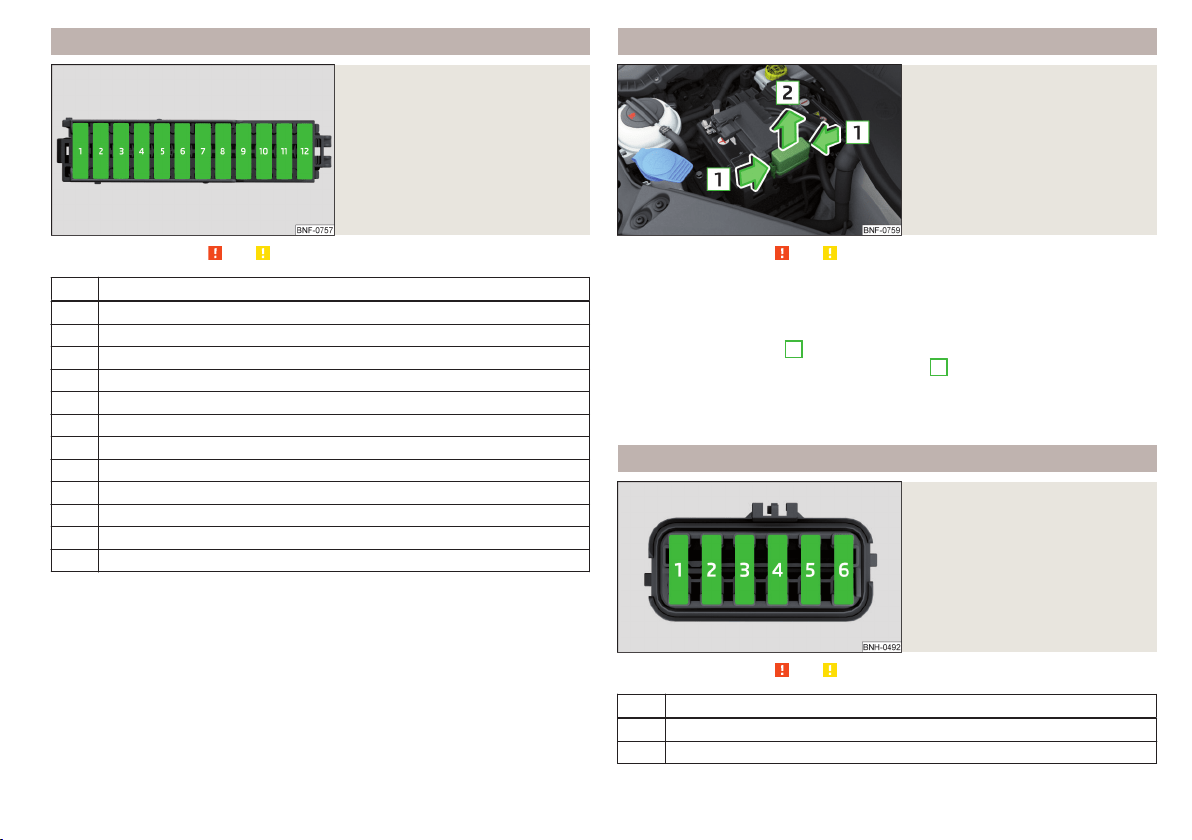
Assignment of the fuses in the dash panel
Fig. 137
Fuses
Read and observe and on page 134 first.
No. Consumer
1 ABS/ESP
2 Instrument cluster
3 Radio
4 DC-DC voltage converter, starter relay, bar with buttons
5 Air conditioning system
6 Not assigned
7 Not assigned
8 Not assigned
9 Vehicle lighting - right side
10 Vehicle lighting - left side
11 Starter
12 DC-DC voltage converter, ABS, instrument cluster, radio
Fuses in the engine compartment
Fig. 138
Remove the fuse box cover.
Read and observe and on page 134 first.
The fuses are located underneath a cover next to the vehicle battery
» Fig. 138.
Replacing fuses
›
Press the locking keys
1
of the cover » Fig. 138 together simultaneously.
›
Push the cover in the direction of the arrow
2
.
›
Replace the appropriate fuse.
›
Insert the cover in the direction counter to the arrow.
›
Close the cover until it clicks into place.
Fuse allocation in the engine compartment
Fig. 139
Fuses
Read and observe and on page 134 first.
No. Consumer
1 ABS/ESP
2 Radiator fan
137
Fuses and light bulbs
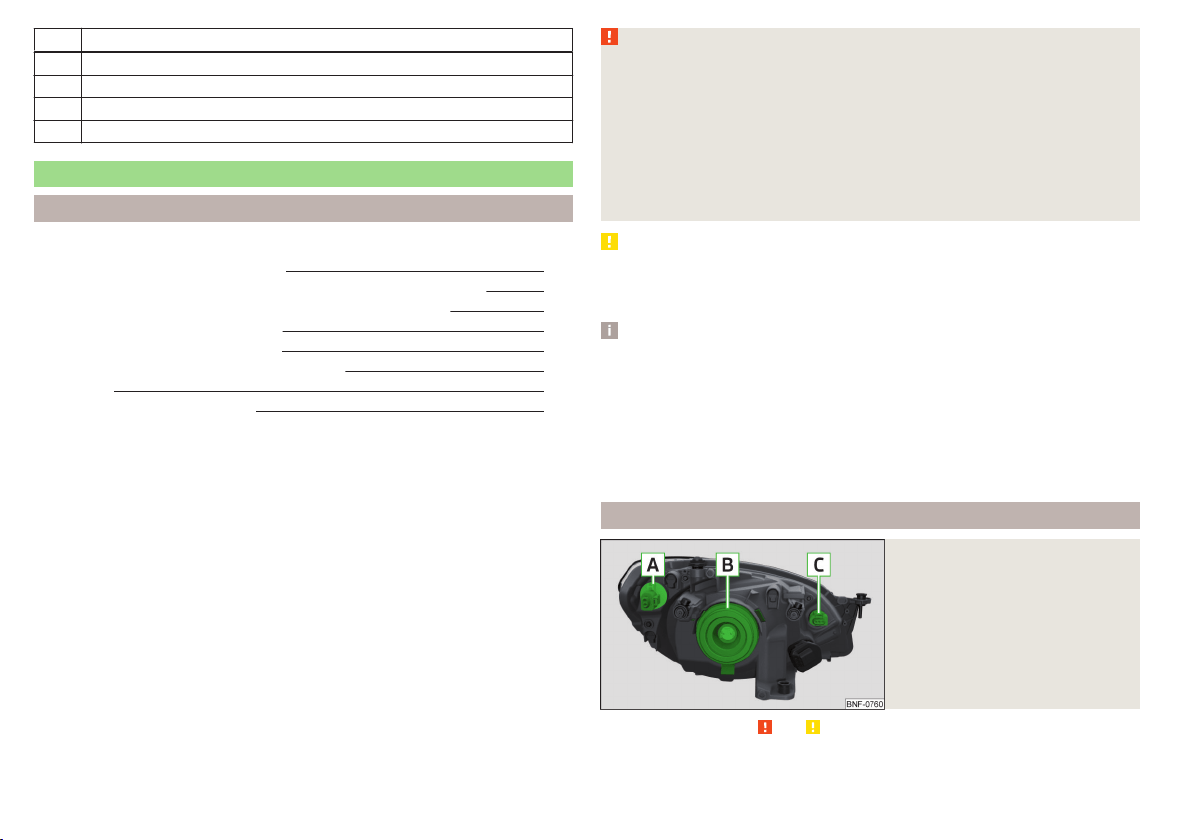
No. Consumer
3 Control unit for radiator fan, ignition
4 ABS/ESP
5 Central control unit, battery data module
6 Ignition lock, starter
Replacing bulbs
Introduction
This chapter contains information on the following subjects:
Bulb arrangement in the headlights
138
Changing the low beam and high beam bulb (halogen headlights)
139
Replacing bulb for daytime running lights and parking lights 139
Changing the front turn signal bulb 139
Replacing the bulb for the fog light 140
Replacing the bulb for the licence plate light 140
Rear Light 141
Changing a bulb in the tail light 141
Some manual skills are required to change a bulb. For this reason, we recom-
mend having bulbs replaced by a specialist garage or seeking other expert help
in the event of any uncertainties.
▶
Switch off the ignition and all of the lights before replacing a bulb.
▶
Faulty bulbs must only be replaced with the same type of bulbs. The designa-
tion is located on the light socket or the glass bulb.
▶
A stowage compartment for replacement bulbs is located in a plastic box in
the spare wheel or underneath the floor covering in the luggage compart-
ment.
Depending on the vehicle design, some vehicles may be equipped with LED
daytime running lights in the front bumper instead of the fog lights.
WARNING
■
Always read and observe the warnings before completing any work in the
engine compartment » page 106.
■
Accidents can be caused if the road in front of the vehicle is not suffi-
ciently illuminated and the vehicle cannot or can only be seen with difficul-
ty by other road users.
■
The H4 bulb is pressurised and may explode during a bulb replacement -
risk of injury! We therefore recommended wearing gloves and safety
glasses when changing a bulb.
■
Switch off the respective vehicle light when changing the bulb.
CAUTION
Do not take hold of the glass bulb with naked fingers (even the smallest
amount of dirt reduces the working life of the light bulb). Use a clean cloth,
napkin, or similar.
Note
■
This Owner's Manual only describes the replacement of bulbs where it is pos-
sible to replace the bulbs on your own without any complications arising. Other
bulbs must be replaced by a specialist garage.
■
We recommend that a box of replacement bulbs always be carried in the ve-
hicle. Replacement bulbs can be purchased from ŠKODAOriginal Accessories.
■
We recommend having the headlight settings checked by a specialist garage
after replacing a bulb in the main beam, low beam or fog lights.
■
If the LED diode is defect visit a specialist garage.
Bulb arrangement in the headlights
Fig. 140
Principle sketch: Headlights
Read and observe and on page 138 first.
The vehicle is equipped with headlights with halogen bulbs.
138
Do-it-yourself
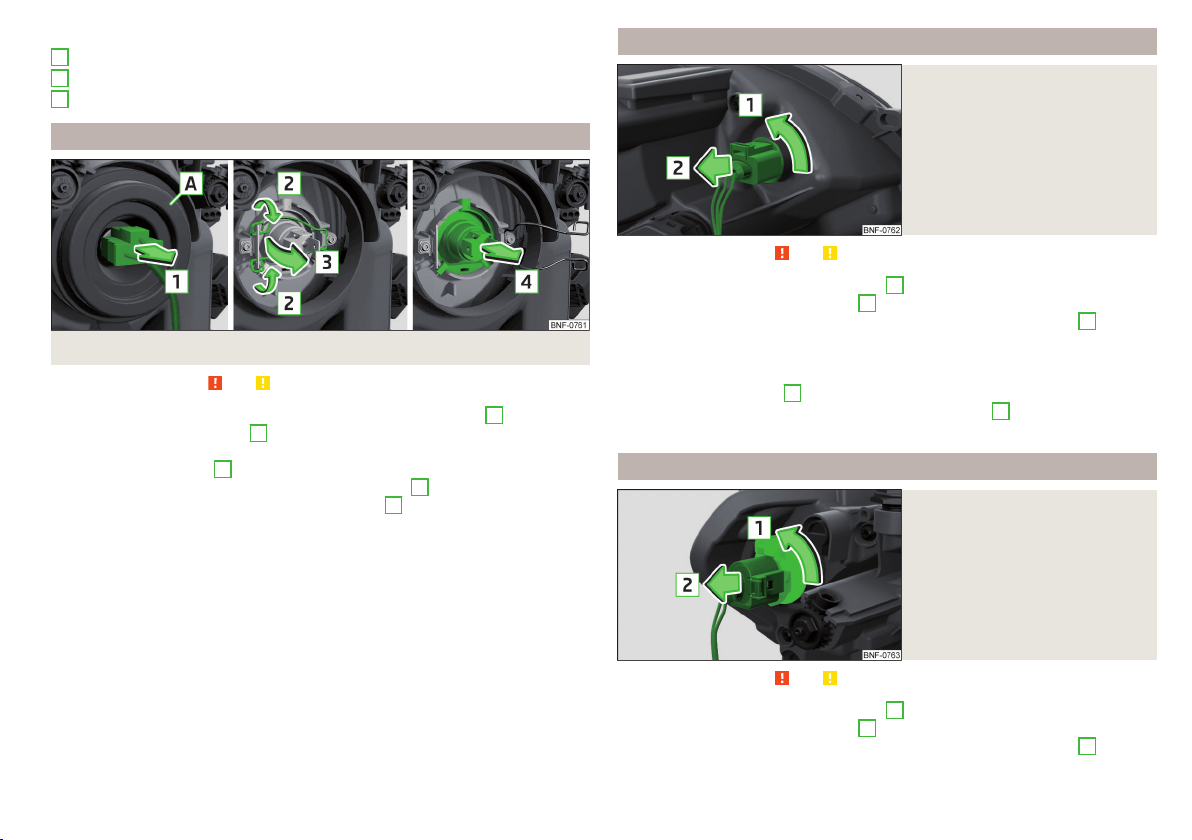
Bulb arrangement » Fig. 140
Flashing
Low beam and high beam
Daytime running and parking light
Changing the low beam and high beam bulb (halogen headlights)
Fig. 141
Replacing the bulb for low beam and main beam
Read and observe and on page 138 first.
›
Remove the connector from the bulb in the direction of arrow
1
» Fig. 141 .
›
Remove the protective cap
A
.
›
Press the safety catch in the direction of the headlamp and then unhook in
the direction of arrow
2
» Fig. 141 .
›
Open out the safety catch in the direction of arrow
3
.
›
Remove the light bulb in the direction of arrow
4
and insert a new light bulb
in such a way that the fixing lugs of the light bulb socket fit into the recesses
of the lamp.
Installation is carried out in the reverse order.
A
B
C
Replacing bulb for daytime running lights and parking lights
Fig. 142
Replacing the bulb for daytime
running lights and parking lights
Read and observe and on page 138 first.
›
Turn the housing containing the bulb
C
» Fig. 140 on page 138 as far as the
stop in the direction of the arrow
1
» Fig. 142 .
›
Remove the housing containing the bulb in the direction of arrow
2
.
›
Remove the faulty bulb from the housing.
›
Insert a new bulb into the housing.
›
Insert the housing containing the light bulb in the lamp housing in the oppo-
site direction to arrow
2
.
›
Screw the housing in the opposite direction to arrow
1
until it clicks into
place.
Changing the front turn signal bulb
Fig. 143
Changing the bulb for the front
turn signal light
Read and observe and on page 138 first.
›
Turn the housing containing the bulb
A
» Fig. 140 on page 138 as far as the
stop in the direction of the arrow
1
» Fig. 143 .
›
Remove the housing containing the bulb in the direction of arrow
2
.
139
Fuses and light bulbs
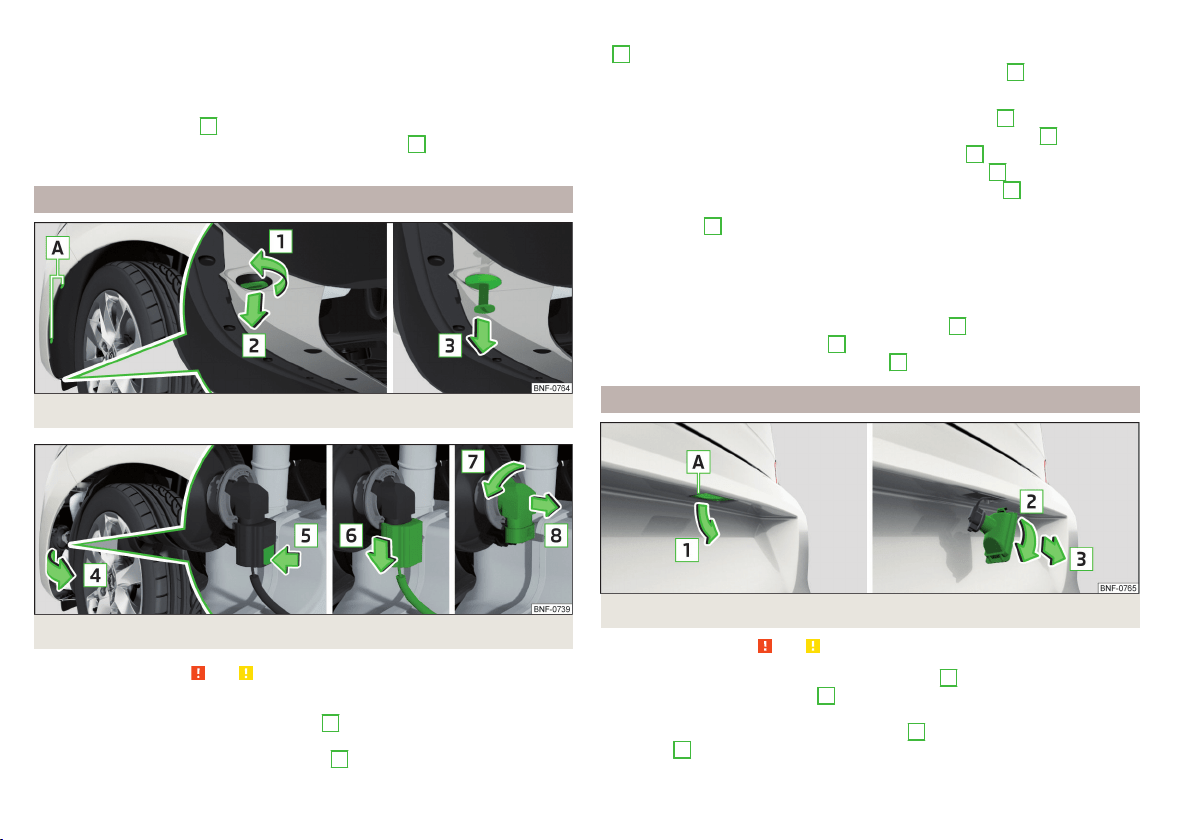
›
Unscrew the defective bulb in its housing in an anti-clockwise direction and
remove it.
›
Place a new bulb in the housing and turn it in a clockwise direction as far as
it will go.
›
Insert the housing containing the light bulb in the lamp housing in the oppo-
site direction to arrow
2
.
›
Screw the housing in the opposite direction to arrow
1
until it clicks into
place.
Replacing the bulb for the fog light
Fig. 144
Removing the wheel house trim
Fig. 145 Changing a bulb
Read and observe and on page 138 first.
Removing the wheel house trim
›
Use the on board tool to remove screws
A
» Fig. 144 from the wheel well.
›
Using a flat, blunt object, e.g. a coin, turn the part of the expansion rivet with
a slit 90 degrees in the direction of arrow
1
.
›
Pull out the part of the expansion rivet with a slit in the direction of arrow
2
.
›
Take out the expansion rivet in the direction of the arrow
3
.
Changing a bulb
›
Open out the wheel house trim in the direction of arrow
4
» Fig. 145 .
›
Press in the locking for the connector in the direction of arrow
5
.
›
Remove the connector in the direction of the arrow
6
.
›
Screw the lamp connector in the direction of the arrow
7
as far as the stop.
›
Remove the lamp connector in the direction of the arrow
8
.
›
Place a new connector with the bulb in the headlamp and turn it in the direc-
tion of arrow
7
as far as the stop.
›
Attach the connector until it clicks firmly into place.
Fitting the wheel house trim
›
Fold the wheel house trim back.
›
Push the expansion rivet back in.
›
Push in the part of the expansion rivet with a slit
2
and turn it 90 degrees in
the opposite direction to arrow
1
» Fig. 144 .
›
Firmly tighten the two attachment bolts
A
with the screwdriver.
Replacing the bulb for the licence plate light
Fig. 146 Removing the licence plate lamp
Read and observe and on page 138 first.
›
Insert a slotted screwdriver into the slot in area
A
» Fig. 146 and free up the
lamp in the direction of arrow
1
.
›
Remove the lamp from the bumper.
›
Unscrew the lamp in the direction of arrow
2
and remove it in the direction
of arrow
3
.
›
Remove the faulty bulb from the housing.
140
Do-it-yourself
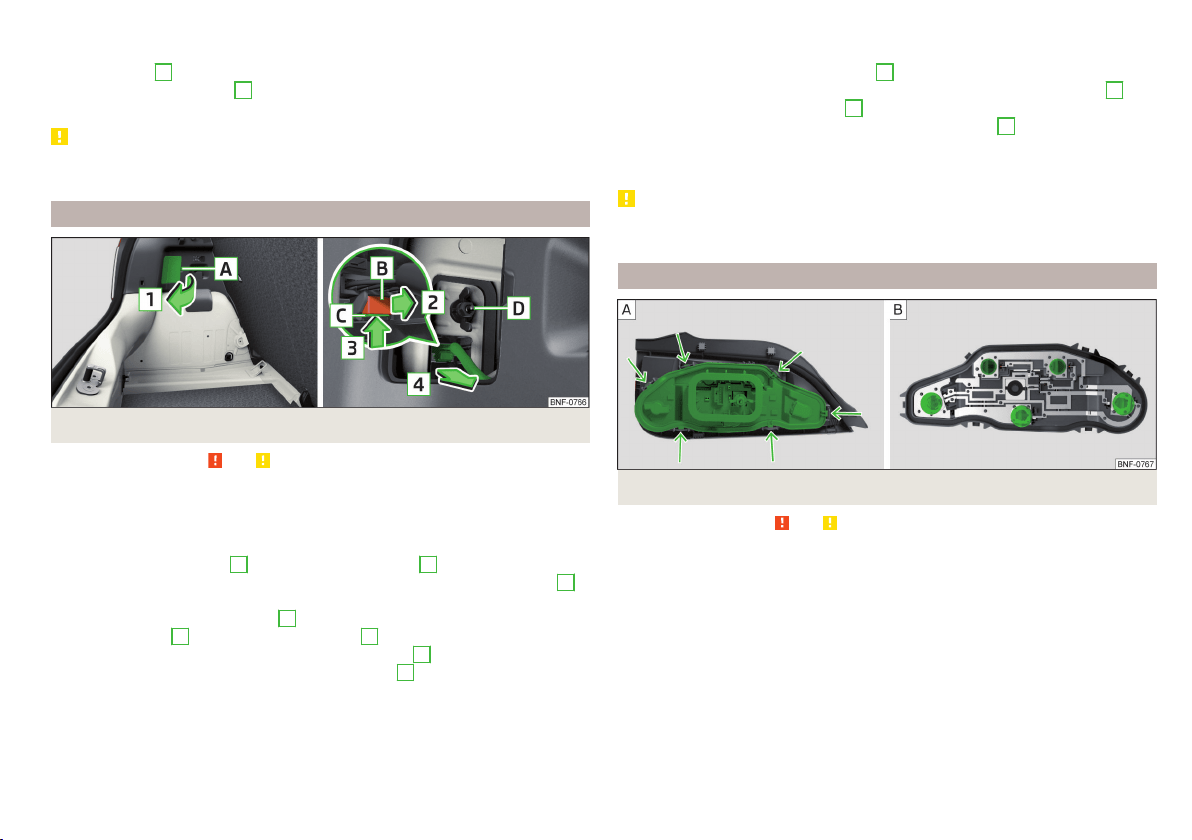
›
Insert a new bulb into the housing.
›
Insert the housing with the bulb in the lamp and turn it in the opposite direc-
tion to arrow
2
as far as the stop.
›
Insert the lamp into area
A
into the bumper opening and press lightly until
the spring locks into place.
CAUTION
Ensure that the vehicle paintwork and the tail lamp are not damaged when re-
moving and installing the tail lamp.
Rear Light
Fig. 147
Removing lamp / connector
Read and observe
and on page 138 first.
Removing lamp
›
Open the boot lid.
›
Fold the rear seat backrest forward » page 57, Seat backrests.
›
Remove the boot cover » page 66.
›
Open up the flap in area
A
in the direction of arrow
1
» Fig. 147 .
›
Insert the screwdriver under the bottom edge of the locking mechanism
B
» page 122, Vehicle tool kit and pull out the locking mechanism on the con-
nector in the direction of arrow
2
.
›
Press the catch
C
in the direction of arrow
3
.
›
Pull out the connector in the direction of the arrow
4
.
›
Hold the lamp firmly and unscrew the plastic nut
D
.
›
Carefully remove the light from the body and place it on a clean, smooth sur-
face.
Fitting the lamp
›
Insert the bulb holder in the light.
›
Carefully place the tail light assembly in the opening in the body and hold
firmly.
›
Screw in and tighten the plastic nut
D
» Fig. 147 .
›
Push the connector into the bulb holder and press down on the catch
B
in
the opposite direction to arrow
2
.
›
Fold back the cover in the opposite direction to arrow
1
.
›
Install the luggage compartment cover and close the tailgate.
Fold the rear seat backrest back.
CAUTION
Ensure that the vehicle paintwork and the tail lamp are not damaged when re-
moving and installing the lamp.
Changing a bulb in the tail light
Fig. 148 Inner part of the lamp
Read and observe and on page 138 first.
Changing a bulb
›
Unhook the bulb holder » Fig. 148 -
.
›
Take the holder out of the lamp assembly.
›
Unscrew the defective bulb in its housing in an anti-clockwise direction and
remove it » Fig. 148 -
.
›
Place a new bulb in the housing and turn it in a clockwise direction as far as
it will go.
141
Fuses and light bulbs

Technical data
Technical data
Basic vehicle data
Introduction
This chapter contains information on the following subjects:
Vehicle characteristics
142
Operating weight 143
Payload 143
Measurement of fuel consumption and CO
2
emissions according to ECE
Regulations and EU Directives
143
Dimensions 144
Departure angle 145
The details given in the vehicle's technical documentation always take prece-
dence over the details in the Owner's Manual.
The listed performance values were determined without performance-reduc-
ing equipment, e.g. air conditioning system.
The values given have been determined in accordance with regulations and in
conditions prescribed by legal or technical provisions for determining the oper-
ating and technical data of vehicles.
Vehicle characteristics
Fig. 149 Vehicle data sticker/type plate
Vehicle data sticker
The vehicle data sticker » Fig. 149 - is located on the base of the luggage
compartment and is also stuck into the service schedule.
The vehicle data sticker contains the following data.
Vehicle identification number (VIN)
Vehicle type
Gearbox code/paint number/interior equipment/engine output/engine
code
Partial vehicle description
Type plate
The type plate » Fig. 149 -
is located at the bottom of the B-pillar on the left
driver's side.
The type plate contains the following data.
Manufacturer
Vehicle identification number (VIN)
Maximum permissible gross weight
Maximum permissible front axle load
Maximum permissible rear axle load
Vehicle identification number (VIN)
The vehicle identification number - VIN (vehicle body number) is stamped into
the engine compartment on the right hand suspension strut dome. This num-
ber is also located on a sign on the lower left hand edge below the windscreen
(together with a VIN bar code), and on the type plate.
Engine number
The engine number (three-digit code letter and serial number) is stamped on
the engine block.
Supplementary Information (applies to Russia)
The full type approval number of the means of transport is indicated in the
registration documents, field 17.
WARNING
Do not exceed the specified maximum permissible weights – risk of acci-
dent and damage!
1
2
3
4
5
6
7
8
9
142
Technical data

Operating weight
The value represents the lightest possible vehicle weight without any addi-
tional equipment that would add to the weight, e.g. air conditioning, spare
wheel.
The specified operating weight is for orientation purposes only.
The operating weight also contains the weight of the driver (75 kg), the weight
of the operating fluids, the tool kit, and a fuel tank filled to 90 % capacity.
Engine Transmission Operating weight (kg)
1.0 l/44 kW MPI
MT 929
AT 932
1.0 l/44 kW MPI Green tec
MT 940
AT 931
1.0 l/55 kW MPI
MT 929
AT 932
1.0 l/55 kW MPI Green tec
MT 940
AT 931
1.0 l/50 kW MPI G-TEC MT 1031
Note
If required, you can find out the precise weight of your vehicle at a specialist
garage.
Payload
It is possible to calculate the approximate maximum payload from the differ-
ence between the permissible total weight and the operating weight.
The payload consists of the following weights.
▶
The weight of the passengers.
▶
The weight of all items of luggage and other loads.
▶
The weight of the roof, including the roof rack system.
▶
The weight of the equipment that is excluded from the operating weight.
Measurement of fuel consumption and CO
2
emissions according to
ECE Regulations and EU Directives
The data on fuel consumption and CO
2
emissions were not available at the
time of going to press.
The data on fuel consumption and CO
2
emissions are given on the ŠKODA
websites or in the sales and technical vehicle documentation.
The measurement of the intra-urban cycle begins with a cold start of the en-
gine. Afterwards urban driving is simulated.
In the extra-urban driving cycle, the vehicle is accelerated and decelerated in
all gears, corresponding to daily routine driving conditions. The driving speed
varies between 0 and 120 km/h.
The calculation of the combined fuel consumption considers a weighting of
about 37 % for the intra-urban cycle and 63 % for the extra-urban cycle.
Note
■
The fuel consumption and emission levels given on the ŠKODA websites or in
the commercial and technical vehicle documentation have been established in
accordance with rules and under conditions that are set out by legal or techni-
cal rules for the determination of operational and technical data of motor vehi-
cles.
■
Depending on the extent of the equipment, the driving style, traffic condi-
tions, weather influences and vehicle condition, consumption values can in
practice result in fuel economy figures in the use of the vehicle that differ from
the fuel consumption values listed on the ŠKODA websites or in the commer-
cial and technical vehicle documentation.
143
Technical data
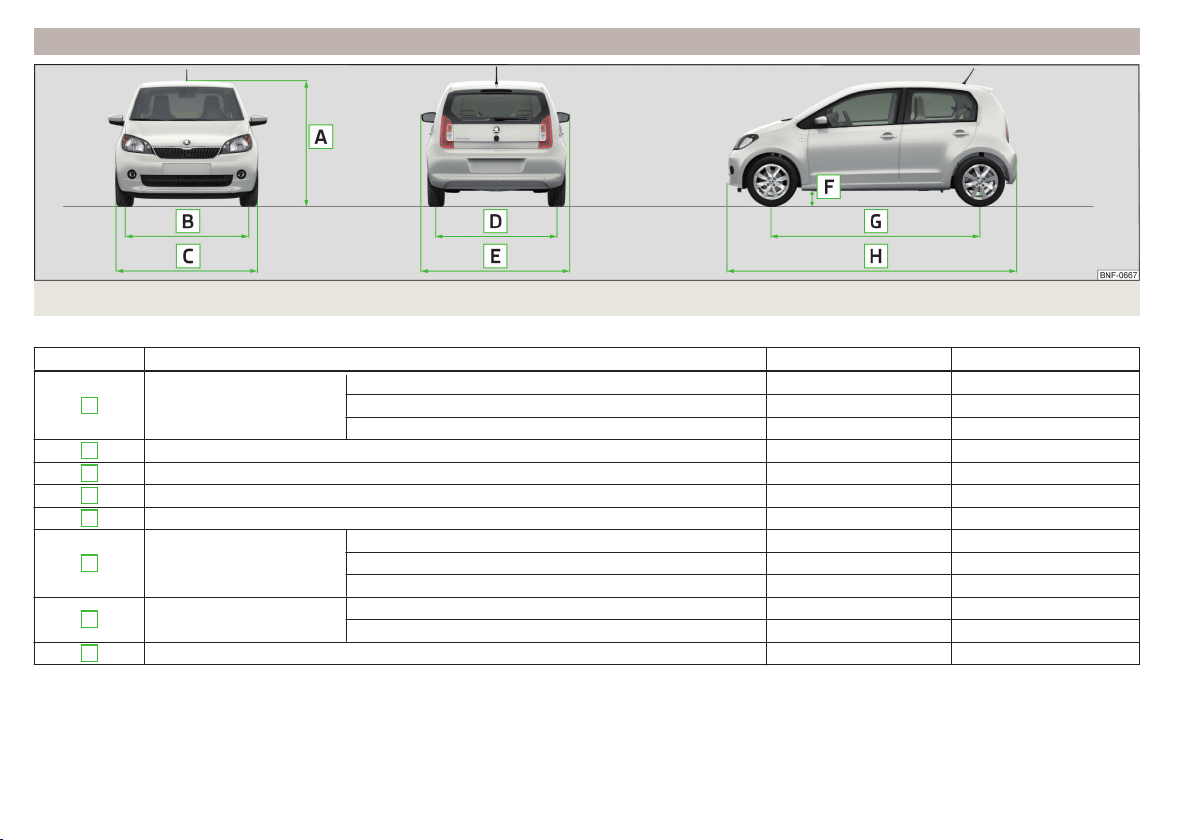
Dimensions
Fig. 150 Principle sketch: Vehicle dimensions
Vehicle dimensions for operating weight without driver (in mm)
» Fig. 150 Specification 3-door 5-door
A
Height
Basic dimension 1478 1478
Vehicles with the Green tec package 1463 1463
G-TEC vehicles 1480 1480
B
Front track 1428 1428
C
Width 1641 1645
D
Rear track 1424 1424
E
Width including exterior mirror 1910 1910
F
Clearance
Basic dimension 136 136
Vehicles with the Green tec package 121 121
G-TEC vehicles 134 134
G
Wheel base
Basic dimension 2420 2420
G-TEC vehicles 2421 2421
H
Length 3563 3563
144
Technical data
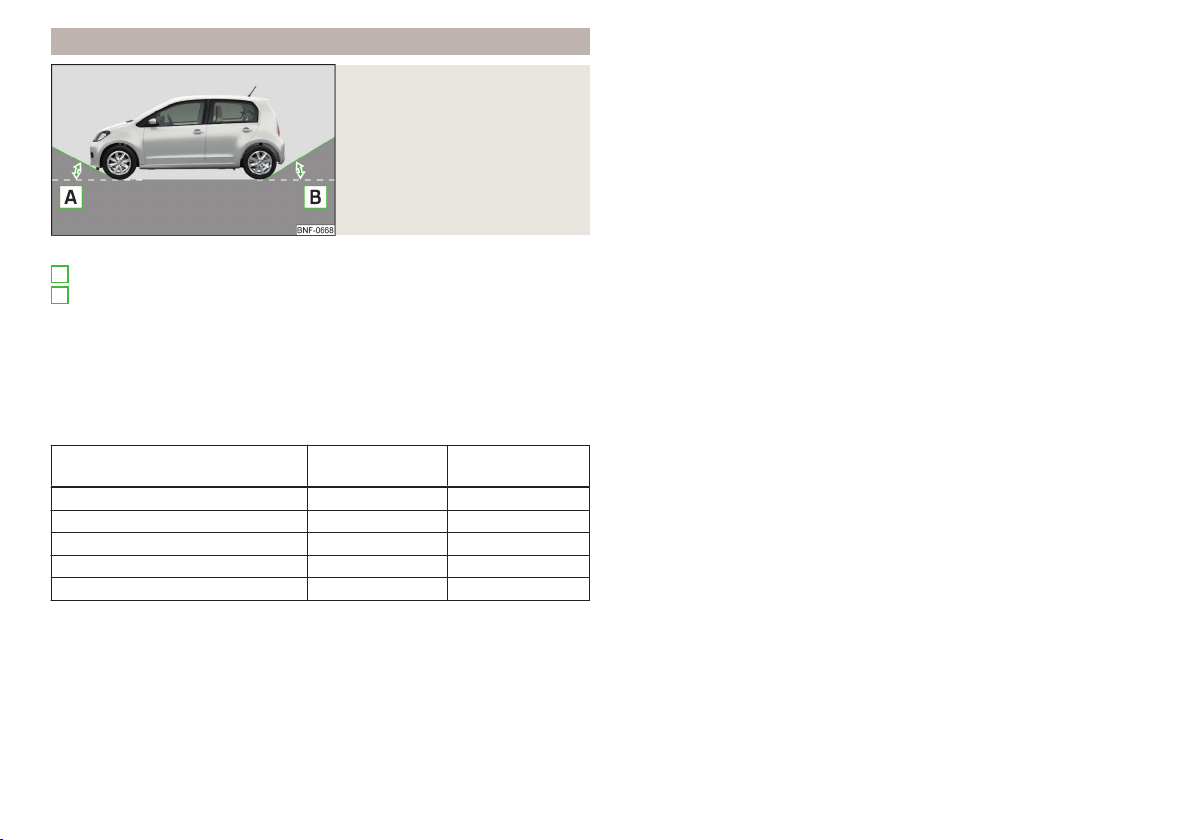
Departure angle
Fig. 151
Principle sketch: Departure an-
gle
Angle » Fig. 151
Overhang angle, front
Overhang angle, rear
Departure angle
The values shown indicate the maximum incline of an embankment, up which
the vehicle can drive at a slow speed without collision of the bumper or under-
body.
The values listed correspond to the maximum axle load, front or back.
Departure angle (°)
Engine
Overhang angle,
front
Overhang angle,
rear
1.0 ltr./44 kW MPI 14.6 22.3
1.0 l/44 kW MPI Green tec 12.5 22.9
1.0 l/55 kW MPI 14.6 22.3
1.0 l/55 kW MPI Green tec 12.5 22.9
1.0 l/50 kW MPI G-TEC 13.2 26.6
A
B
145
Technical data

Vehicle-specific data depending on the engine
Introduction
This chapter contains information on the following subjects:
1.0 ltr./44 kW MPI engine
146
1.0 l/55 kW MPI engine 146
1.0 l/50 kW MPI G-TEC engine 146
The values given have been determined in accordance with regulations and in
conditions prescribed by legal or technical provisions for determining the op-
erating and technical data of vehicles.
The emissions standard is detailed in the technical vehicle documentation as
well as in the certificate of conformity (so-called COC document), which can
be obtained from a ŠKODA partner
a)
.
a)
Only valid for some countries and some models.
1.0 ltr./44 kW MPI engine
Output (kW/rpm) 44/5000
Maximum torque (Nm at rpm) 95/3000
Number of cylinders/displacement (cm
3
) 3/999
Transmission MT MT (Green tec) AT ASG (Green tec)
Top speed (km/h) 160 161 160 161
Acceleration 0-100 km/h (s) 14.4 14.4 15.3 15.3
1.0 l/55 kW MPI engine
Maximum torque (Nm at rpm) 95/3000
Output (kW/rpm) 55/6200
Number of cylinders/displacement (cm
3
) 3/999
Transmission MT MT (Green tec) AT ASG (Green tec)
Top speed (km/h) 171 172 171 172
Acceleration 0-100 km/h (s) 13.2 13.2 13.9 13.9
1.0 l/50 kW MPI G-TEC engine
Output (kW/rpm) 50/6200
Maximum torque (Nm at rpm) 90/3000
Number of cylinders/displacement (cm
3
) 3/999
Transmission MT
Top speed (km/h) 164
Acceleration 0-100 km/h (s) 16.3
146
Technical data

Index
A
abroad
lead-free petrol 103
Abroad
Headlights 50
ABS
Operation 85
Warning light 36
Acceptance and recycling of used vehicles 95
Accessories 92
Adjusting
Exterior mirrors
53
head restraints 54
Seat 54
Steering wheel 9
Adjusting the seats 8
Air-conditioning system
Air outlet vents 71
Airbag 14
Deactivating 17
Deactivating the front passenger airbag 18
Deployment 15
Front airbag 15
Modifications and damage to the airbag system 94
Side airbag Head-Thorax 17
Warning light 37
Airbag system 14
air conditioning
recirculation 70
Air conditioning 69
Controls 69
Air outlet vents 71
Alcantara
cleaning 101
Alternator
Warning light 35
Anodized parts
Refer to vehicle maintenance 98
Anti-lock braking system (ABS) 85
Anti-theft wheel bolts 124
artificial leather 101
Ashtray 61
Assistance systems
City Safe Drive 89
Parking aid 86
Assistance Systems
ESC 36
Assist systems 85
ABS 36
Cruise Control System 88
Visual parking system 87
Auto-computer
see multi-function display 31
Automated transmission 81
Lever control 81
Warning light 35
Automatic gearbox
Tiptronic 82
Automatic load deactivation 115
Automatic transmission
Kick-down 82
Starting-off and driving 82
Avoiding damage to your vehicle 84
B
Bag hooks 65
Battery
In the remote control key 132
Belts 11
Belt tensioners 13
Bonnet
Closing 107
Opening 107
Boot
Class N1 vehicles 67
See Boot lid 43
Boot lid
automatic locking 43
Closing 43
Opening 43
Brake Assist (HBA) 86
Brake booster 79
brake fluid
specification 112
Brake fluid 112
Checking 112
Brake pedal - automatic transmission
warning light 38
Brakes
Brake booster 79
Brake fluid 112
Braking and stabilisation systems 85
Handbrake 79
Running-in 83
Warning lights 34
Brakes and parking 78
Brake system 85
Braking
Information on braking 78
Button in driver's door
electric windows 44
C
Car care
Jack 99
Care and maintenance 92
Car park ticket holder 58
Carrier
Roof rack 67
Cavity protection 99
Central locking 39
problems 42
147
Index

Central locking button 40
Change
engine oil 109
Change engine
oil 109
Changing
Bulb in the tail light 141
Front turn signal bulb 139
light bulb in tail light 141
Low beam and high beam bulb - halogen head-
lights 139
Wheels 123
Changing a wheel
Follow-up work 126
Preliminary work 123
Changing wheels
Wheel removal and fix 126
Charging a vehicle battery 114
Checking
Battery electrolyte level 114
Brake fluid 112
Coolant 111
Engine oil 109
Oil level 109
Windscreen washer fluid 108
Checks
Statutory checks 92
Children and safety 19
Child safety
Side airbag 21
Child safety lock 42
Child seat
Classification 21
ISOFIX 22
on the front passenger seat 20
TOP TETHER 24
Use of child seats 22
Use of ISOFIX child seats 23
Chrome parts
Refer to vehicle maintenance 98
Cigarette lighter 60
City Safe Drive 89
Disable/Enable 90
Operation 89
warning symbol 38
Clean
Anodized parts 98
Chrome parts 98
Cleaning
Alcantara 101
and maintaining belts 102
artificial leather 101
headlight glasses 98
materials 101
natural leather 100
plastic parts 98
seats covers of the electrically heated seats 101
wheels 99
Cleaning safety
belt 102
Cleaning seat
covers 101
Cleaning the interior
artificial leather 101
Seat covers 101
Cleaning the vehicle exterior
Cavity protection 99
Decorative films 97
Door locking cylinder 99
Headlight glasses 98
Protective films 97
Under-body protection 99
Vehicle paintwork 97
wheels 99
Windows and external mirrors 98
Cleaning vehicle 95
Cleaning vehicle exterior 96
Anodized parts 98
Chrome parts 98
Plastic parts 98
Rubber seals 98
Wiper blades 100
Clean interior
Safety belt 102
Clothes hook 63
CNG 105
Fuel reserve display 29
refuelling 104
Refuelling 104
Sticker 105
Cockpit
12-Volt power outlet 61
Ashtray 61
Cigarette lighter 60
General view 27
Light 50
storage compartments 58
useful equipment 58
compartments 58
Components of the puncture repair kits 127
Compressed natural gas
see CNG 105
Computer
see multi-function display 31
Conserving the vehicle paintwork
see vehicle care 97
convenience turn signal 48
Coolant 110
Checking 111
Replenishing 111
Warning light 35
Correct routing of seat belt
12
Correct seated position 8
Front passenger 10
Rear seats 10
Correct seat position
Driver 9
Counter for distance driven 30
148
Index

cruise control
operation 88
operation Description 88
Cruise control system
Warning light 38
Cruise Control System 88
Cup holders 59
D
DAY LIGHT
see Daylight running lights 48
Daylight running lights 48
De-icing
windows 98
Deactivating an airbag 17
Decorative films 97
Defrosting rear window 51
Delayed locking of the boot lid
see boot lid 43
Departure angle 145
Digital Clock
Time 33
Dimmed headlights 47
Dipstick 109
Disconnecting and reconnecting
vehicle battery 115
Display
Service interval
30
Display of
fuel reserve 29
Disposal
Acceptance and recycling of used vehicles 95
Distance driven 30
Door
Child safety lock 42
Closing 41
Emergency locking 132
Opening 41
Door opening lever
locking of 42
unlocking of 42
Drive
Driving through water 84
Driving
Emissions 143
Fuel consumption 143
through water 84
Top speed 146
Trailer operation 95
E
Economical driving
Tips 83
EDL 86
Electric Windows 44
Button in driver's door 44
Button in the front passenger door 44
Electronic Differential Lock (EDL) 86
Electronic immobilizer 75
Emergency
Changing a wheel 123
Hazard warning light system 49
Jump-starting 129
Locking the door without a locking cylinder 132
Towing the vehicle 130
Tyre repair
127
Emergency equipment
Jack 122
Reflective vest 122
Vehicle tool kit 122
Warning triangle 122
Emissions 143
Engine
Running-in 83
Switch off engine 76
Engine compartment 106
Brake fluid 112
Overview 108
Vehicle battery 112
Engine number 142
engine oil
specification 109
Engine oil 109
Checking 109
Replenishing 110
Warning light 35
EPC
Warning light 37
ESC
Operation 85
Warning light 36
Exhaust inspection system
Warning light 37
F
Films 97
Fog Lights 49
Foldable hook 63
Footmats 80
see footmats 80
Force limit
Sliding/tilting roof 45
Force limiter
Sliding/tilting roof
46
Front airbag 15
fuel
lead-free petrol 103
Fuel 102
CNG 105
Fuel reserve display 29
refer to Fuel 102
Refuelling 103
Refuelling - natural gas 104
Fuel consumption 143
149
Index

Fuses
Assignment 134
Assignment of fuses in the dash panel 137
Colour coding 134
Fuse allocation in the dash panel 135
Fuse allocation in the engine compartment 137
Replacing 134
Fuses in the engine compartment
Allocation 137
G
Gear changing
Gear stick 80
Gear recommendation 30
General view
Cockpit 27
Genuine parts 93
H
Handbrake
79
Warning light 34
Handbrake - automatic transmission
Warning light 38
Hazard warning light system 49
HBA 86
Head-Thorax 17
Headlights
Bulb arrangement 138
Driving abroad 50
Head restraints 54
Adjust height 54
Headrest,
removing and installing 55
Heating 69
Controls 69
Exterior mirrors 53
Rear window 51
Seats 55
HHC 86
Hill Start Assist (HHC) 86
Horn 27
I
Ice scrapers 98
Ignition lock 76
Immobilizer 75
Inertia reels
13
Instrument cluster 28
Counter for distance driven 30
Fuel reserve display 29
Gear recommendation 30
Memory of the multi-function display 33
Multi-function display 31
Overview 28
see instrument cluster 28
Service interval display 30
Tachometer 29
Instruments
see instrument cluster 28
Interior care 100
Natural leather 100
ISOFIX 22
J
Jack
122
- fit 125
Maintenance 99
Jump-starting 129
K
Key
Lock
40
Start the engine 76
Unlock 40
L
Labels
Airbag 20
Lashing eyes 65
Leather
Natural leather care 100
Lever
Main beam 48
Turn signal 48
Wiper 52
lever control 81
See lever control 81
Light
Cockpit 50
Dimmed headlights 47
Fog Lights 49
Headlight range control 47
on and off 47
Parking light 49
Rear fog light 49
Sidelights 47
Lighting
Luggage compartment 64
Light on and off 47
Lights 47
Daylight running 48
Hazard warning light system 49
Headlight flasher 48
Main beam 48
Replacing bulbs 138
Turn signal 48
Warning lights 34
Load 143
Loading floor 67
Lock
Key 40
Lock/unlock steering lock 76
Locking
Door opening lever 42
Remote control 40
Locking and unlocking the vehicle from the in-
side 40
150
Index

Locking the door without a locking cylinder
Emergency 132
Low tyre pressure warning
refer to the tyre pressure monitoring 90
Luggage compartment 64
Cover 66
Fixing nets 65
Lashing eyes 65
Lighting 64
unlock manually 133
Unlock the boot lid 133
Variable loading floor 67
Luggage compartment cover 66
Luggage compartment lid 42
Luggage storage
Bag hooks 65
M
Main beam 48
Warning light 38
Manual gear changing
see gear changing 80
Maximum
permissible weights 142
Mechanical window lifter
open and close 44
Mechanical window lifters 43
Media
see Radio
4
MFD
see multi-function display 31
Mirror
Exterior mirrors 53
Interior mirror 53
Mirrors
Vanity 51
Mobile phone 72
Modes of automated transmission 81
Modifications 92
Modifications and technical alterations
Airbags 94
Service 93
Spoiler 94
Trailer operation 95
Move & Fun 72
install/remove 72
operation 73
Multi-function display
Functions 31
Memory 33
Operation 31
Multi-function display operation 31
Multimedia holder 62
N
N1 67
Nameplate 142
Natural gas vehicles
see CNG 105
Nets 65
Notes for driving with repaired tyres 129
Notes on using wheels 116
O
Oil
See Engine oil
109
On-board computer
see multi-function display 31
Operate
wiper 52
Operating weight 143
Operation in winter
Vehicle battery 114
Original accessories 93
Outside temperature 32
Overview
Engine compartment 108
Warning lights 34
P
Parking
80
Parking aid 86
Visual parking system 87
Parking aid 86
Function 87
Parking space
80
Parking vehicle 80
ParkPilot 86
Part replacement 92
Passive safety
Before setting off 8
Driving safety 8
Passive Safety 8
Pedals 80
Footmats 80
Petrol
see fuel 103
Photo holder 62
Plastic parts 98
Pocket holder 63
Pockets on the front seat rests 64
Polishing the vehicle paintwork
see vehicle care 97
Power outlet
12 V 61
Power steering
Warning light
36
Power windows 43
Practical equipment
Net pockets on the front seat rests 64
Photo holder 62
Pocket holder 63
Reflective vest 122
Practical features
12-Volt power outlet 61
Waste container 59
Protective films 97
151
Index

Puncture repair kit 127
R
Radiator fan 108
Radio 4
Raising the vehicle 125
Rear-view mirror
Exterior mirrors
53
Rear fog light 49
Warning light 37
Rear mirror 52
Rear view mirror
Interior mirror 53
Rear window heating 51
Rear windows
Closing 45
Opening 45
Recirculation 70
Refuelling 103
Fuel 103
Fuel - natural gas 104
Regulation
Lighting range 47
Remote control
Locking 40
Replacing the battery 132
Synchronisation process 132
Unlocking
40
Remote control key
Replacing the battery 132
Repairs and technical alterations 92
Replace
vehicle battery 115
Replace vehicle
battery 115
Replacing
Bulb for daytime running lights and parking
lights 139
Bulb for the fog light 140
Bulb for the licence plate light 140
Bulbs 138
Fuses 134
Fuses in the dash panel 135, 136
Fuses in the engine compartment 137
Rear window wiper blade 134
Windscreen wiper blades 133
Replenishing
Coolant 111
Engine oil 110
Windscreen washer fluid 108
Roof
Load 68
Roof rack 67
mounting points 68
Roof load 68
Rubber seals 98
Running-in
Brake linings 83
Engine 83
Tyres 83
S
SAFE
See Safe securing system 41
SAFELOCK
See Safe securing system 41
Safe securing system
41
Safety 8
Child safety 19
Child safety seats 19
Correct seated position 8
Head restraints 54
ISOFIX 22
TOP TETHER 24
Save electrical energy 83
Save fuel 83
Seals
Vehicle care 98
Seat
Adjusting 54
Seat belt
height adjustment 12
Warning icon 38
Seat belts 11
Belt tensioners 13
fastening and unfastening 13
Inertia reels 13
The physical principle of a frontal collision 12
Warning light 34
Seat features 55
Seats
Folding front passenger seat 56
Head restraints 54
Heating 55
Seat backrests 57
Seats and head restraint 54
Service 93
Service display 30
Setting 33
Seat belt height 12
seats and head restraints 54
Settings
Interior mirror 53
Setting the 33
Shift
Gear recommendation 30
Information on the gear changed 30
Side airbag 17
Sidelights 47
Sliding/tilting roof
Closing 45
Sliding / tilting roof
Malfunction 46
Sliding/tilting roof
Opening and tilting 45
Operation 45
Sunblind 46
Snow chains 121
152
Index

Spare wheel 119
stow 123
take out 123
Speed symbol
See Wheels 120
Spoiler 94
Stabilisation system 85
Stability Control (ESC) 85
Staring engine
Jump-starting 129
START-STOP 77
control symbol 38
Jump-starting 129
Manually deactivating/activating the system 78
operation 77
START-STOP system 77
Starting engine
Jump-starting 129
Start the engine 76
Stating and turning off the engine 75
Steering wheel
correct posture 9
setting 9
Stopping 80
Storage 58
Storage compartment
in the front centre console 59
on the driver's side 58
on the front passenger side 62
with cover on the passenger side 62
Storage compartments 58
Stowage compartment
on front of the rear seats 64
Sunblind
operation 46
Sun visors 51
Switch off the ignition 76
Switch on the ignition 76
T
Tachometer 29
Taking care of the vehicle
Pressure Washer 96
Taking care of your vehicle
Automatic car wash system 96
Washing by hand
95
Wash system 96
TCS
Operation 85
Technical data 142
Tiptronic
see automatic gearbox 82
Tools 122
Top speed 146
TOP TETHER 24
Towing 130
Towing device 95
Towing eye 131
Traction control (TCS) 85
Transport
Luggage compartment 64
Roof rack 67
Transporting 58
Transporting children safely 19
Triangle 122
Turn signal
48
Turn signal system
Warning light 38
Two-way radio systems 72
Tyre
Damage 119
Explanation of the label 120
see wheels 120
Tyre load-bearing capacity
See Wheels 120
Tyre pressure 117
Warning light 36
Tyre pressure monitoring 90
Display 36
Save tyre pressure values 91
Tyre repair
General notes 128
Preparations 128
Pressure test 129
Sealing and inflating the tyre 128
Tyres 116
new 83
Tyre pressure 117
Wear and tear 118
Wear indicator 118
Tyre size 120
see wheels 120
U
Under-body
Vehicle care 99
Under-body protection 99
Unlock
Key 40
Unlocking
Remote control 40
Unlocking and locking 39
Used vehicles
Acceptance and recycling 95
Useful equipment
Ashtray
61
Car park ticket holder 58
Cigarette lighter 60
Clothes hook 63
Cup holders 59
Multimedia holder 62
Storage compartment 58
V
Vehicle battery
Automatic load deactivation
115
charging 114
153
Index

Checking the battery electrolyte level 114
Operation in winter 114
Safety instructions 112
Vehicle care
Alcantara 101
Anodized parts 98
Artificial leather 101
Cavity protection 99
Chrome parts 98
Cleaning vehicle exterior 96
Cleaning wheels 99
Decorative and protective films 97
Door locking cylinder 99
Headlight glasses 98
Interior care 100
Maintenance 97
Materials 101
Natural leather 100
Plastic parts 98
Polishing the vehicle paintwork 97
Rubber seals 98
Safety belt 102
Seat covers 101
Under-body protections 99
washing 95
Vehicle data sticker 142
Vehicle data sticker and nameplate
Vehicle data sticker and nameplate 142
Vehicle dimensions 144
Vehicle height 144
Vehicle Identification Number (VIN) 142
Vehicle length 144
Vehicle tool kit 122
Vehicle width 144
vest
Positioning of the reflective vest 122
VIN
Vehicle Identification Number 142
Visibility 50
Visors
see Sun visors 51
Visual parking system 87
W
Warning at excessive speeds 32
Warning lights 34
Warning symbols
34
Warning triangle 122
Washing
Automatic car wash system 96
by hand 95
Washing the vehicle
Pressure Washer 96
Washing vehicles 95
Waste container 59
Weather conditions 92
Wheel bolts
Anti-theft wheel bolts 124
Caps 124
Loosening and tightening 125
Wheel rims 116
Wheels
Age of wheels 116
Changing 123
Driving style 118
Full trim 124
General information
116
Load index 120
Snow chains 121
Speed symbol 120
Storage of wheels 116
stow 123
take out 123
Tyre damage 119
Tyre pressure 117
Tyre size 120
Tyre wear 118
Tyre wear indicator 118
Unidirectional tyres 119
Wheel balance 118
Wheel replacement 118
Winter tyres 120
Window wiper
Replacing the rear window wiper blade 134
Windscreen washer fluid
Checking 108
Replenishing 108
Winter 108
Windscreen washer system 108
Windscreen washer system 52
Windscreen wipers
Replacing the windscreen wiper blades 133
Servicing position for the windscreen wiper
arms 133
Windscreen washer fluid 108
Windscreen wipers and washers 51
Winter operation 120
De-icing windows 98
Snow chains 121
Winter tyres 120
Winter tyres
See Wheels 120
Wiper blades 100
Wiper interval 52
Wipers
Maintaining wiper blades 100
154
Index

Reprinting, reproduction, translation, or any other use, either in whole or in
part, is not permitted without the written consent of ŠKODA AUTO a.s..
ŠKODA AUTO a.s. expressly reserves all rights relating to copyright laws.
Subject to change.
Issued by: ŠKODA AUTO a.s.
© ŠKODA AUTO a.s. 2015


www.skoda-auto.com
Návod k obsluze
Citigo anglicky 11.2015
S10.5610.13.20
1ST012720AK
1ST012720AK