Form No. 3469-825 Rev A
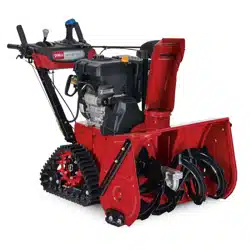
Power TRX Commercial 1428 OHXE Snowthrower
Model No. 38890 —Serial No. 417200000 and Up
Model No. 38891 —Serial No. 416174373 and Up
Operator's Manual
Introduction
This machine is intended to be used by residential
homeowners and professional, hired operators. It
is designed primarily for removing snow from paved
surfaces, such as driveways and sidewalks, and
other surfaces for traf c on residential or commercial
properties. It is not designed for removing materials
other than snow . Using this product for purposes
other than its intended use could prove dangerous to
you and bystanders.
Read this information carefully to learn how to operate
and maintain your product properly and to avoid
injury and product damage. Y ou are responsible for
operating the product properly and safely .
V isit www .T oro.com for product safety and operation
training materials, accessory information, help nding
a dealer , or to register your product.
Whenever you need service, genuine T oro parts, or
additional information, contact an Authorized Service
Dealer or T oro Customer Service and have the model
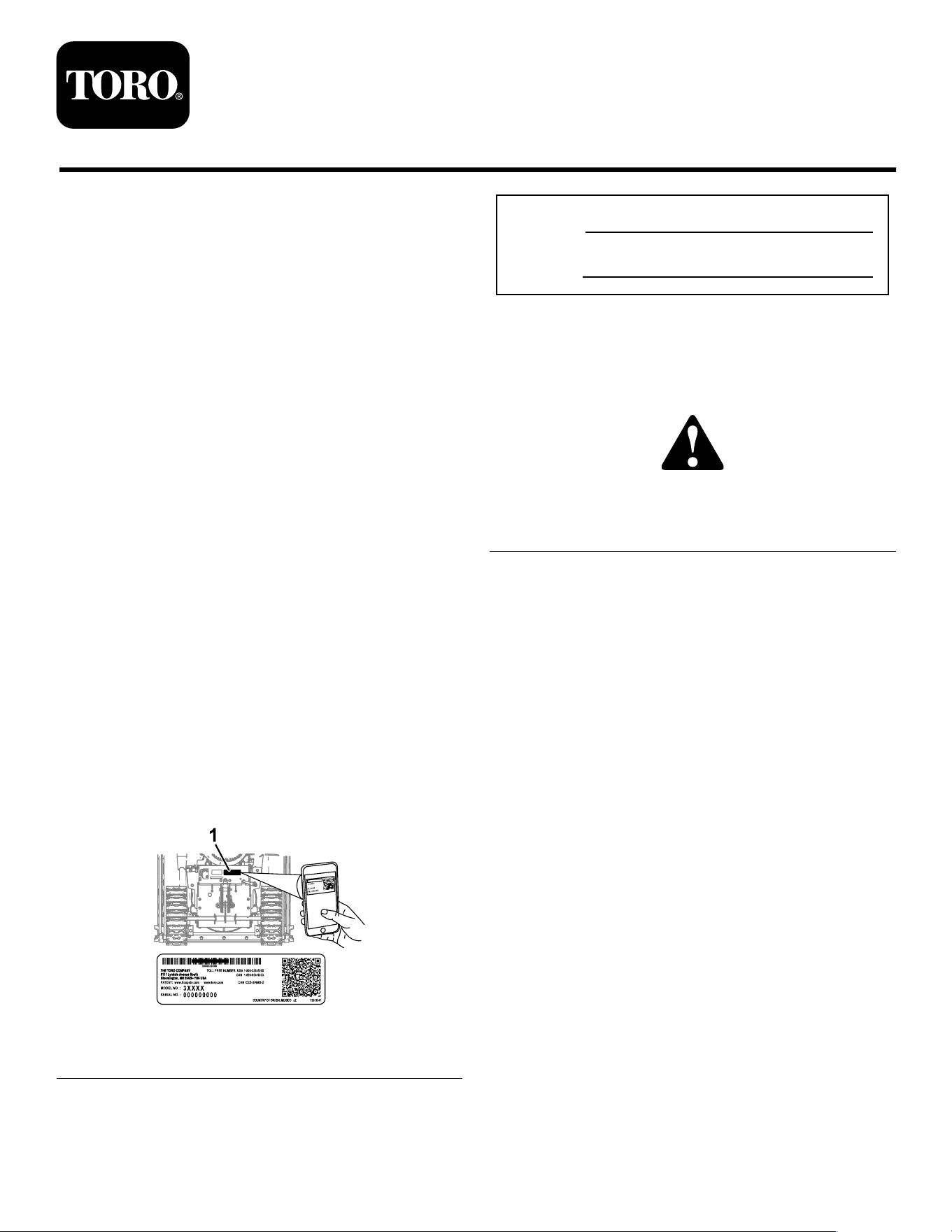
and serial numbers of your product ready . Figure 1
identies the location of the model and serial numbers
on the product. W rite the numbers in the space
provided.
Important: W ith your mobile device, you can
scan the QR code on the serial number decal (if
equipped) to access warranty , parts, and other
product information.
g323172
Figure 1
1. Model and serial number location
Model No.
Serial No.
This manual identies potential hazards and has
safety messages identied by the safety-alert symbol
( Figure 2 ), which signals a hazard that may cause
serious injury or death if you do not follow the
recommended precautions.
g000502
Figure 2
Safety-alert symbol
This manual uses 2 words to highlight information.
Important calls attention to special mechanical
information and Note emphasizes general information
worthy of special attention.
This product complies with all relevant European
directives; for details, please see the separate product
specic Declaration of Conformity (DOC) sheet.
Important: If you are using this machine above
1500 m (5,000 ft) for a continuous period, ensure
that the High Altitude Kit has been installed
so that the engine meets CARB/EP A emission
regulations. The High Altitude Kit increases
engine performance while preventing spark-plug
fouling, hard starting, and increased emissions.
Once you have installed the kit, attach the
high-altitude label next to the serial decal on the
machine. Contact any Authorized T oro Service
Dealer to obtain the proper High Altitude Kit and
high-altitude label for your machine. T o locate
a dealer convenient to you, access our website
at www .T oro.com or contact our T oro Customer
Care Department at the number(s) listed in your
Emission Control W arranty Statement. Remove
the kit from the engine and restore the engine to
its original factory conguration when running the
engine under 1500 m (5,000 ft). Do not operate an
engine that has been converted for high-altitude
use at lower altitudes; otherwise, you could
overheat and damage the engine.
© 2024—The T oro® Company
81 1 1 L yndale A venue South
Bloomington, MN 55420 Register at www .T oro.com.
Original Instructions (EN)
Printed in the USA
All Rights Reserved
*3469-825*

If you are unsure whether or not your machine has
been converted for high-altitude use, look for the
following label ( Figure 3 ).
decal127-9363
Figure 3
W ARNING
CALIFORNIA
Proposition 65 W arning
The engine exhaust from this product
contains chemicals known to the State of
California to cause cancer , birth defects,
or other reproductive harm.
Use of this product may cause exposure
to chemicals known to the State of
California to cause cancer , birth defects,
or other reproductive harm.
Contents
Introduction . . . . . . . . . . . . . . . . . . . . . . . . . . . . . . . . . . . . . . . . . . . . . . . . . . . . . . . . . . . . . . . 1
Safety . . . . . . . . . . . . . . . . . . . . . . . . . . . . . . . . . . . . . . . . . . . . . . . . . . . . . . . . . . . . . . . . . . . . . . . 2
General Safety . . . . . . . . . . . . . . . . . . . . . . . . . . . . . . . . . . . . . . . . . . . . . . . . . . . 2
Safety and Instructional Decals . . . . . . . . . . . . . . . . . . . . . . . . . . 3
Setup . . . . . . . . . . . . . . . . . . . . . . . . . . . . . . . . . . . . . . . . . . . . . . . . . . . . . . . . . . . . . . . . . . . . . . . . 5
1 Checking the Engine-Oil Level . . . . . . . . . . . . . . . . . . . . . . . . . 5
2 Checking the Skids and Scraper . . . . . . . . . . . . . . . . . . . . . . 5
3 Checking the Operation of the T raction
Drive . . . . . . . . . . . . . . . . . . . . . . . . . . . . . . . . . . . . . . . . . . . . . . . . . . . . . . . . . . . . . . . 5
4 Extending the Drift Breakers . . . . . . . . . . . . . . . . . . . . . . . . . . . . 6
Product Overview . . . . . . . . . . . . . . . . . . . . . . . . . . . . . . . . . . . . . . . . . . . . . . . . . . . . . 7
Specications . . . . . . . . . . . . . . . . . . . . . . . . . . . . . . . . . . . . . . . . . . . . . . . . . . . . 7
Attachments/Accessories . . . . . . . . . . . . . . . . . . . . . . . . . . . . . . . . . . . 7
Operation . . . . . . . . . . . . . . . . . . . . . . . . . . . . . . . . . . . . . . . . . . . . . . . . . . . . . . . . . . . . . . . . . . 8
Before Operation . . . . . . . . . . . . . . . . . . . . . . . . . . . . . . . . . . . . . . . . . . . . . . . . . . . 8
Before Operation Safety . . . . . . . . . . . . . . . . . . . . . . . . . . . . . . . . . . . . . 8
Filling the Fuel T ank . . . . . . . . . . . . . . . . . . . . . . . . . . . . . . . . . . . . . . . . . . . . 8
During Operation . . . . . . . . . . . . . . . . . . . . . . . . . . . . . . . . . . . . . . . . . . . . . . . . . . . 8
During Operation Safety . . . . . . . . . . . . . . . . . . . . . . . . . . . . . . . . . . . . . 8
Starting the Engine . . . . . . . . . . . . . . . . . . . . . . . . . . . . . . . . . . . . . . . . . . . . . 9
Shutting Of f the Engine . . . . . . . . . . . . . . . . . . . . . . . . . . . . . . . . . . . . . . 1 1
Operating the Handwarmers . . . . . . . . . . . . . . . . . . . . . . . . . . . . . . 1 1
Operating the Auger-Height Lever . . . . . . . . . . . . . . . . . . . . . 1 1
Operating the T raction Drive . . . . . . . . . . . . . . . . . . . . . . . . . . . . . 12
Using the Wheel-Clutch Levers . . . . . . . . . . . . . . . . . . . . . . . . . 12
Operating the Speed Selector . . . . . . . . . . . . . . . . . . . . . . . . . . . 12
Operating the Auger/Impeller Drive . . . . . . . . . . . . . . . . . . . 13
Operating the Quick Stick® . . . . . . . . . . . . . . . . . . . . . . . . . . . . . . . 13
Clearing a Clogged Discharge Chute . . . . . . . . . . . . . . . . 13
Operating T ips . . . . . . . . . . . . . . . . . . . . . . . . . . . . . . . . . . . . . . . . . . . . . . . . . 14
After Operation . . . . . . . . . . . . . . . . . . . . . . . . . . . . . . . . . . . . . . . . . . . . . . . . . . . . 14
After Operation Safety . . . . . . . . . . . . . . . . . . . . . . . . . . . . . . . . . . . . . . 14
Preventing Freeze-up after Use . . . . . . . . . . . . . . . . . . . . . . . . 14
Maintenance . . . . . . . . . . . . . . . . . . . . . . . . . . . . . . . . . . . . . . . . . . . . . . . . . . . . . . . . . . . 15
Recommended Maintenance Schedule(s) . . . . . . . . . . . 15
Maintenance Safety . . . . . . . . . . . . . . . . . . . . . . . . . . . . . . . . . . . . . . . . . . 15
Preparing for Maintenance . . . . . . . . . . . . . . . . . . . . . . . . . . . . . . . 15
Checking the Engine-Oil Level . . . . . . . . . . . . . . . . . . . . . . . . . . 16
Checking and Adjusting the Auger Skids and
Scraper . . . . . . . . . . . . . . . . . . . . . . . . . . . . . . . . . . . . . . . . . . . . . . . . . . . . . . . . . 16
Inspecting and T ightening the Bogey
Wheels . . . . . . . . . . . . . . . . . . . . . . . . . . . . . . . . . . . . . . . . . . . . . . . . . . . . . . . . . . 17
Checking and Adjusting the T rack
T ension . . . . . . . . . . . . . . . . . . . . . . . . . . . . . . . . . . . . . . . . . . . . . . . . . . . . . . . . . 17
Checking and Adjusting the T raction
Cable . . . . . . . . . . . . . . . . . . . . . . . . . . . . . . . . . . . . . . . . . . . . . . . . . . . . . . . . . . . . 18
Checking and Adjusting the Auger/Impeller
Cable . . . . . . . . . . . . . . . . . . . . . . . . . . . . . . . . . . . . . . . . . . . . . . . . . . . . . . . . . . . . 19
Checking the Auger-Gearbox-Oil Level . . . . . . . . . . . . . 19
Changing the Engine Oil . . . . . . . . . . . . . . . . . . . . . . . . . . . . . . . . . . . 20
Replacing the Spark Plug . . . . . . . . . . . . . . . . . . . . . . . . . . . . . . . . . 21
Replacing the Drive Belts . . . . . . . . . . . . . . . . . . . . . . . . . . . . . . . . . . 21
Replacing the Headlight . . . . . . . . . . . . . . . . . . . . . . . . . . . . . . . . . . . . 22
Storage . . . . . . . . . . . . . . . . . . . . . . . . . . . . . . . . . . . . . . . . . . . . . . . . . . . . . . . . . . . . . . . . . . . 22
Storage Safety . . . . . . . . . . . . . . . . . . . . . . . . . . . . . . . . . . . . . . . . . . . . . . . . . . 22
Storing the Machine . . . . . . . . . . . . . . . . . . . . . . . . . . . . . . . . . . . . . . . . . . 22
Removing the Machine from Storage . . . . . . . . . . . . . . . . 23
T roubleshooting . . . . . . . . . . . . . . . . . . . . . . . . . . . . . . . . . . . . . . . . . . . . . . . . . . . . . . 24
Safety
General Safety
This product is capable of amputating hands and
feet and of throwing objects. Always follow all safety
instructions to avoid serious personal injury .
• Read and understand the contents of this
Operator ’ s Manual before you start the engine.
Ensure that everyone using this product knows
how to use it, knows how to shut of f the engine
quickly , and understands the warnings.
• Shut of f the engine whenever you leave the
operating position for any reason.
• Do not put your hands or feet near moving parts
on the machine.
• Do not operate the machine without all guards
and other safety protective devices in place and
working.
2
• Keep clear of any discharge opening. Keep
bystanders, especially small children, out of the
operating area.
• Never allow children to operate the machine.
Safety and Instructional Decals
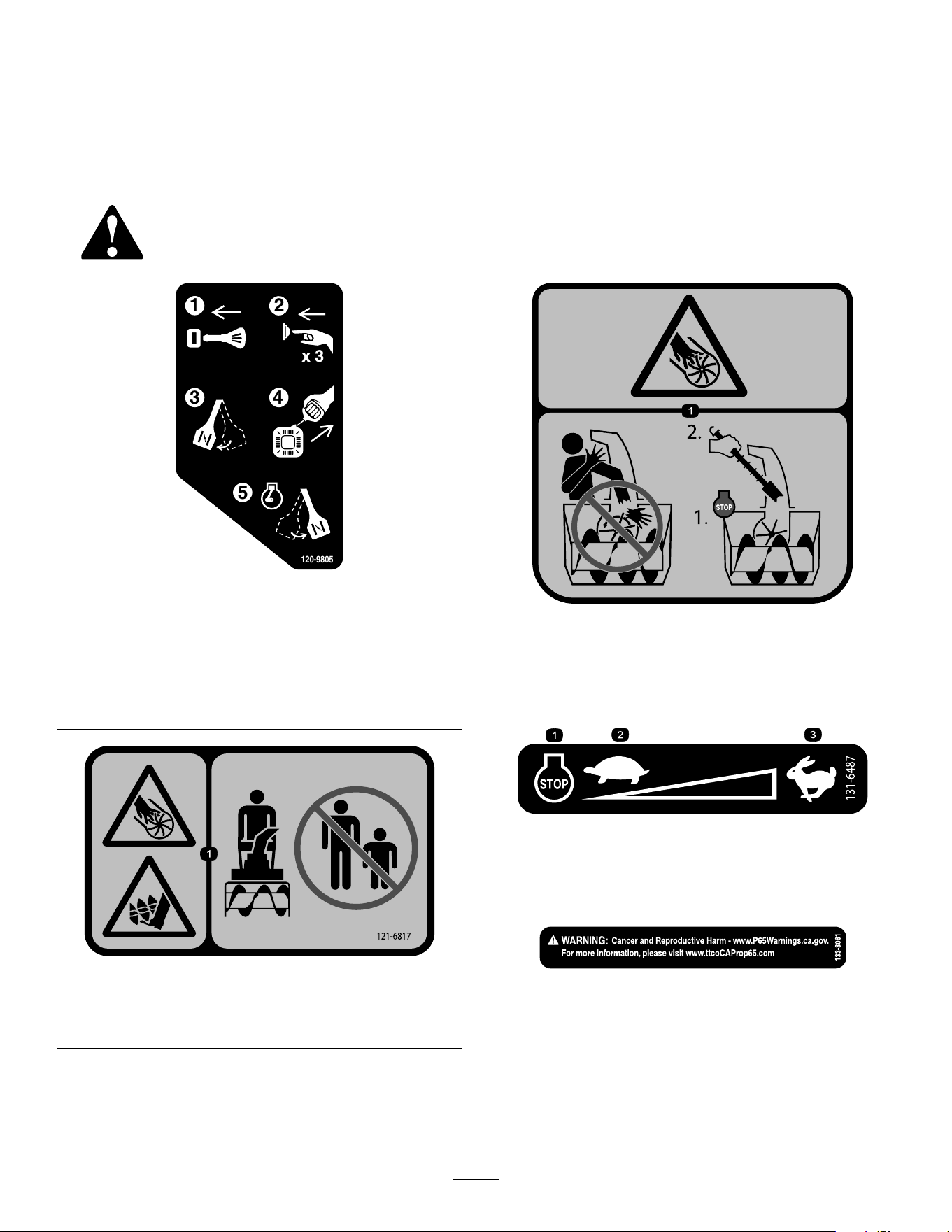
Safety decals and instructions are easily visible to the operator and are located near any area
of potential danger . Replace any decal that is damaged or missing.
x 3
1
2
3
4
5
120-9805
decal120-9805
120-9805
1. Insert the key .
2. Prime the engine 3 times.
3. Engage the choke.
4. Pull the starter cord.
5. Once the engine is running, disengage the choke.
decal121-6817
121-6817
1. Cutting/dismemberment hazard of hand or foot, impeller
and auger—keep bystanders away .
decal121-6847
121-6847
1. Cutting/dismemberment hazard of the ngers or hand,
impeller—do not place your hand in the chute; shut of f the
engine before using the tool to clear the chute.
decal131-6487
131-6487
1. Engine—shut of f
3. Fast
2. Slow
decal133-8061
133-8061
3
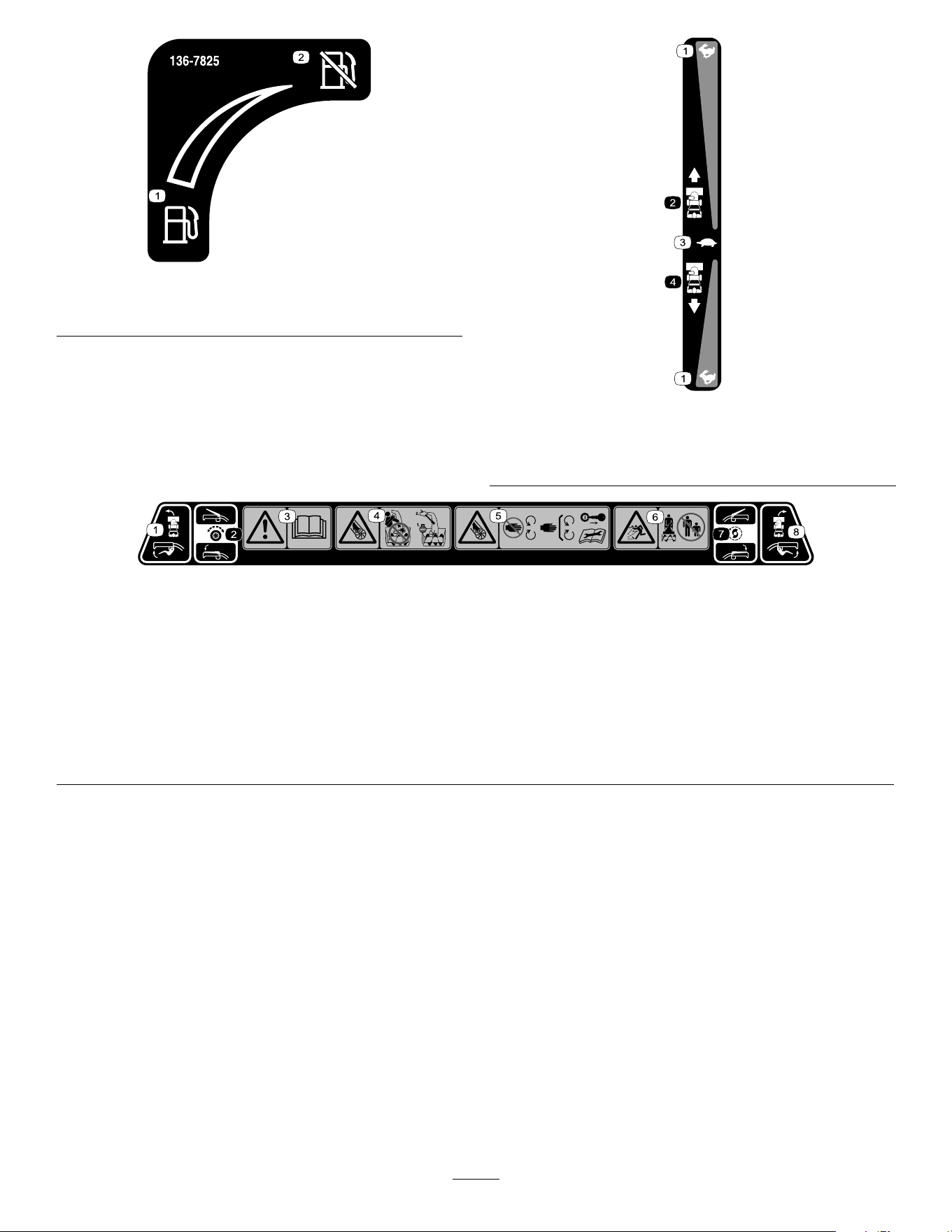
decal136-7825
136-7825
1. Fuel
2. Fuel shutof f
decal144-0326
144-0326
1. Fast
3. Slow
2. Forward speed 4. Reverse speed
decal138-0650
138-0650
1. Squeeze the lower lever to turn left. 5. Cutting/dismemberment of ngers or hand, impeller
blade—keep away from moving parts; keep all guards and
shields in place; remove the key from the ignition before
servicing the machine.
2. Squeeze the upper lever to engage the traction drive.
6. Thrown object hazard—keep bystanders away .
3. W arning—read the Operator ’ s Manual . 7. Squeeze the upper lever to engage the impeller .
4. Cutting/dismemberment of ngers or hand, impeller blade—do
not place your hand in the chute; shut of f the engine before
using the tool to clear the chute.
8. Squeeze the lower lever to turn right.
4
Setup
1
Checking the Engine-Oil
Level
No Parts Required
Procedure
Note: Y our machine comes with oil in the engine
crankcase. Before starting the engine, check the oil
level and add oil if necessary .
Refer to Checking the Engine-Oil Level ( page 16 ) .
2
Checking the Skids and
Scraper
No Parts Required
Procedure
Refer to Checking and Adjusting the Auger Skids and
Scraper ( page 16 ) .
3
Checking the Operation of
the T raction Drive
No Parts Required
Procedure
CAUTION
If the traction drive is not properly adjusted,
the machine may move in the direction
opposite of what you intended, causing injury
and/or property damage.
Carefully check the traction drive and adjust it
properly , if necessary .
1. Start the engine; refer to Starting the Engine
( page 9 ) .
2. Pull the speed selector slightly out of the neutral
position; refer to Operating the Speed Selector
( page 12 ) .
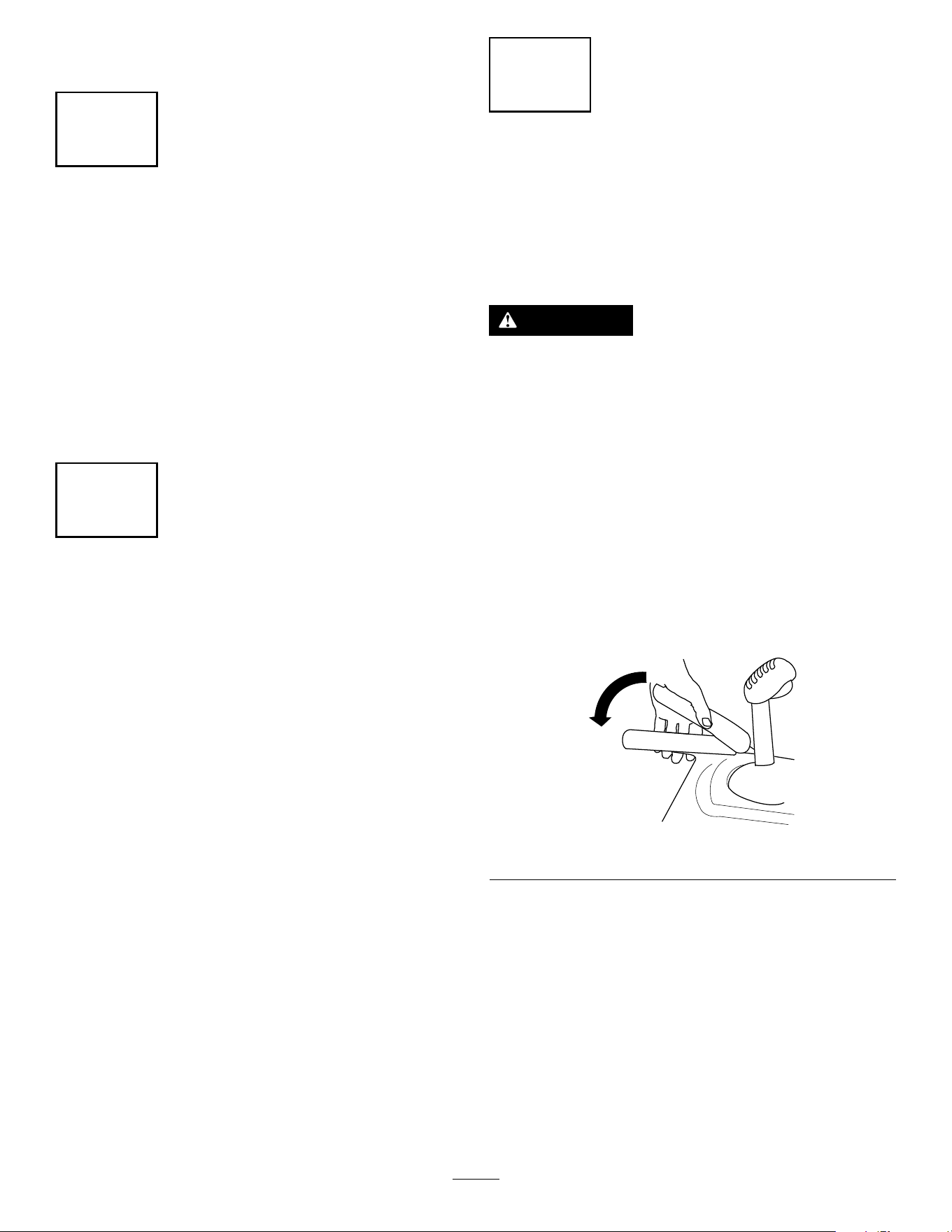
3. Squeeze the left (traction) lever to the handgrip
( Figure 4 ).
g322974
Figure 4
The machine should move rearward. If the
machine does not move or moves forward,
complete the following:
A. Release the traction lever and shut of f the
engine.
B. Loosen the 2 nuts on the speed cable
resting on the speed-selector-lever bracket,
located under the control panel ( Figure 5 ).
5
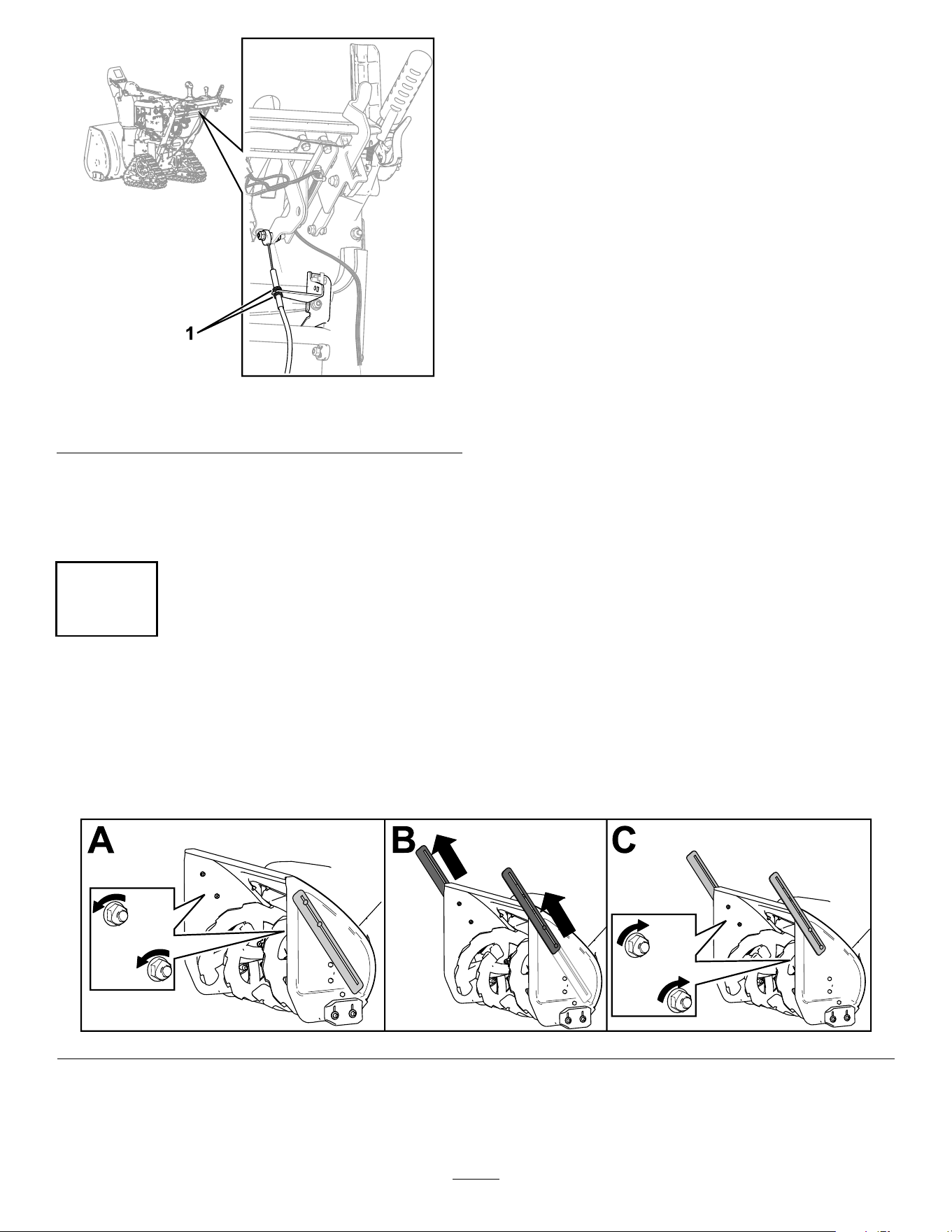
g326129
Figure 5
1. Nuts on the speed cable
C. Pull the cable downward.
D. T ighten the 2 nuts.
4. Release the traction lever .
5. Push the speed selector slightly out of the
neutral position; refer to Operating the Speed
Selector ( page 12 ) .
6. Squeeze the left (traction) lever to the handgrip
( Figure 4 ).
The machine should move forward. If the
machine does not move or moves rearward,
complete the following:
A. Release the traction lever and shut of f the
engine.
B. Loosen the 2 nuts on the speed cable
resting on the speed-selector-lever bracket,
located under the control panel ( Figure 5 ).
C. Push the cable upward.
D. T ighten the 2 nuts.
7. If you made any adjustments, repeat this
procedure until no adjustments are required.
Important: If the machine moves when the
traction lever is in the released position, check the
traction cable; refer to Checking and Adjusting
the T raction Cable ( page 18 ) or take the machine
to an Authorized Service Dealer for service.
4
Extending the Drift Breakers
No Parts Required
Procedure
Extend the drift breakers as needed.
g258084
6
Product Overview
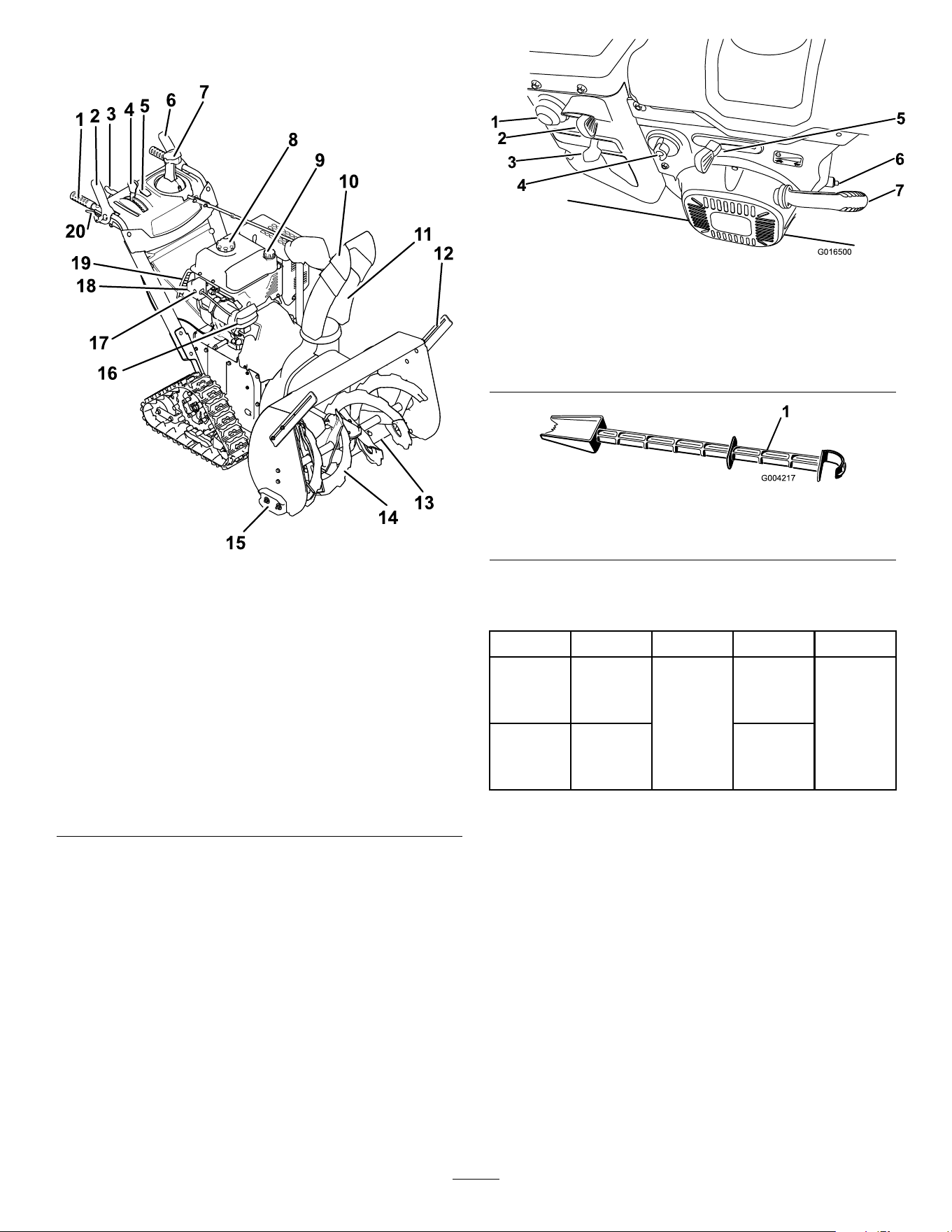
g323249
Figure 7
1. Handgrip (2)
1 1. Discharge chute
2. Auger/impeller lever 12. Drift breaker (2)
3. Auger-height lever
13. Scraper
4. Speed-selector lever
14. Auger
5. Handwarmer switch
15. Skid (2)
6. T raction lever 16. Headlight
7. Quick Stick®
discharge-chute control
17. Electric-start button
8. Fuel-tank cap 18. Electric-start plug-in
9. Oil-ll tube/dipstick
19. Recoil-start handle
10. Chute deector 20. Wheel-clutch lever (2)
g016500
Figure 8
1. Primer 5. Throttle
2. Key
6. Oil-drain plug
3. Choke
7. Recoil-start handle
4. Fuel-shutof f valve
g004217
Figure 9
1. Snow-cleanout tool (attached to the handle)
Specications
Model W eight Length W idth Height
138 kg 74 cm
38890
(304 lb)
160 cm
(29
inches) 1 14 cm
141 kg 84 cm
38891
(31 1 lb)
(63
inches)
(33
inches)
(45
inches)
Attachments/Accessories
A selection of T oro approved attachments and
accessories is available for use with the machine
to enhance and expand its capabilities. Contact
your Authorized Service Dealer or authorized T oro
distributor or go to www .T oro.com for a list of all
approved attachments and accessories.
T o ensure optimum performance and continued safety
certication of the machine, use only genuine T oro
replacement parts and accessories. Replacement
parts and accessories made by other manufacturers
could be dangerous, and such use could void the
product warranty .
7
Operation
Note: Determine the left and right sides of the
machine from the normal operating position.
Before Operation
Before Operation Safety
General Safety
• For electric-start models only: Use extension
cords and receptacles as specied in the manual.
Inspect the electrical cord before plugging it into
a power source. If the cord is damaged, replace
it. Unplug the power cord whenever you are not
starting the machine.
• W ear appropriate clothing, including eye
protection; long pants; substantial, slip-resistant
footwear; and hearing protection. T ie back long
hair , secure loose clothing, and do not wear loose
jewelry .
• Thoroughly inspect the area where you will use the
machine, and remove all doormats, sleds, boards,
wires, and other foreign objects.
• If a shield, safety device, or decal is damaged,
illegible, or missing, repair or replace it before
beginning operation. Also, tighten any loose
fasteners.
• Adjust the collector housing height to clear a
gravel or crushed-rock surface.
Fuel Safety
Fuel is extremely ammable and explosive. A re or
explosion from fuel can burn you and others.
• T o prevent a static charge from igniting the fuel,
place the container and/or machine on the ground
before lling, not in a vehicle or on an object.
• Fill the fuel tank outdoors when the engine is cold.
Replace the fuel cap securely and wipe up spills.
• Do not handle fuel when smoking or around an
open ame or sparks.
• Store fuel in an approved fuel container , out of the
reach of children.
• When fuel is in the tank, tip the machine only as
directed in the instructions.
• If you spill fuel on your clothing, change your
clothing immediately .
Filling the Fuel T ank
T ype Unleaded gasoline
Minimum octane rating
87 (US) or 91 (research
octane; outside the US)
Ethanol
No more than 10% by volume
Methanol None
MTBE (methyl tertiary butyl
ether)
Less than 15% by volume
Oil Do not add to the fuel
Use only clean, fresh (no more than 30 days old), fuel
from a reputable source.
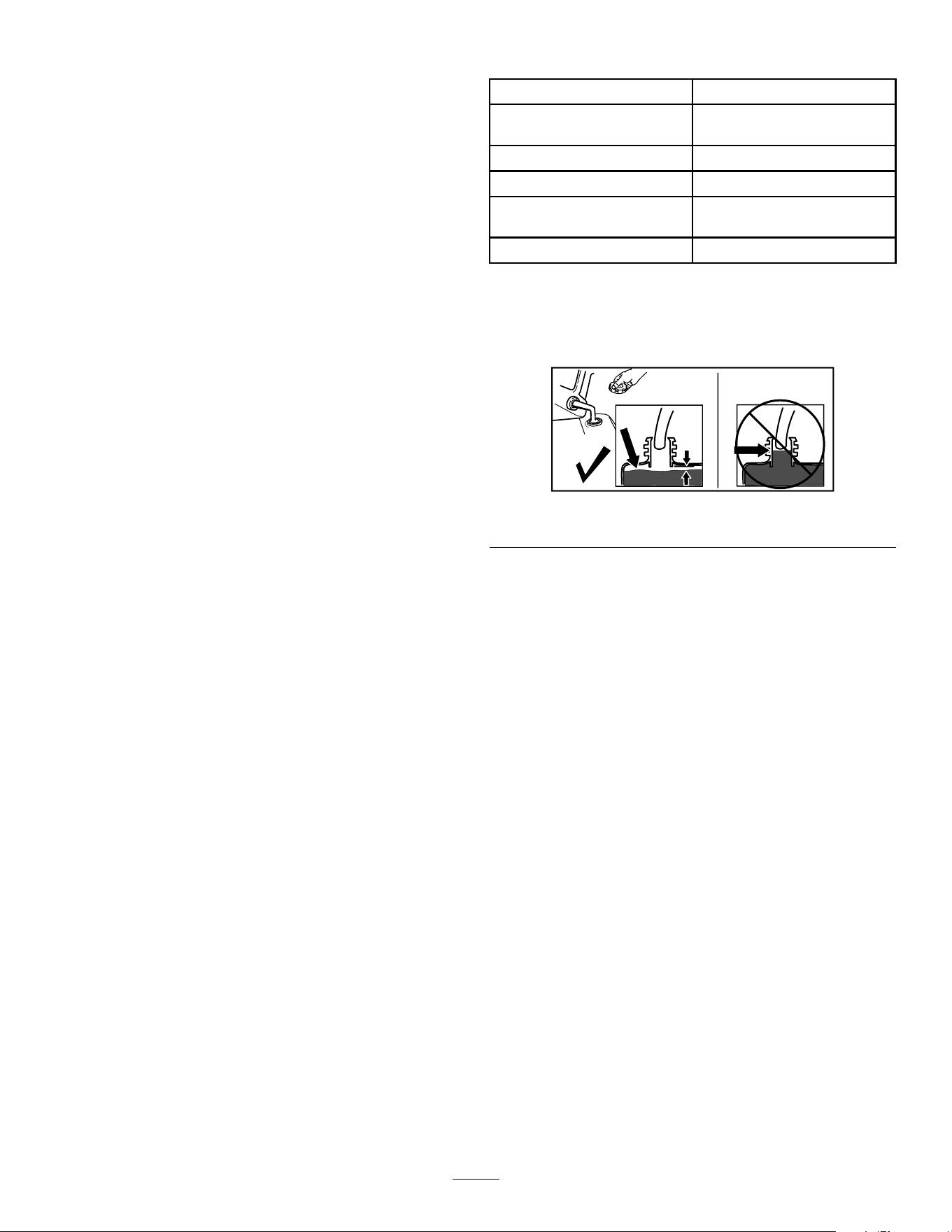
Fill the fuel tank as shown in Figure 10 ; do not ll
above the bottom of the fuel tank neck.
g216203
Figure 10
Important: For best results, purchase only the
quantity of fuel that you expect to use in 30 days.
Otherwise, add fuel stabilizer/conditioner to fresh
fuel as directed by the fuel-stabilizer/conditioner
manufacturer .
During Operation
During Operation Safety
General Safety
• Shut off the engine before unclogging the
machine and always use a stick or the
snow-cleanout tool (if provided).
• Stay behind the handles and away from the
discharge opening while operating the machine.
Keep your face, hands, feet, and any other part
of your body or clothing away from moving or
rotating parts.
• Never direct the discharge toward people or areas
where property damage can occur .
• Use your full attention while operating the
machine. Do not engage in any activity that
causes distractions; otherwise, injury or property
damage may occur .
• Exercise caution to avoid slipping or falling,
especially when operating the machine in reverse.
8

• Always be sure of your footing, and keep a rm
hold on the handles. W alk; never run.
• Exercise extreme caution when operating the
machine on a slope.
• Do not operate the machine without good visibility
or light.
• Look behind and use care when backing up the
machine.
• When not actively clearing snow , disengage power
to the auger .
• Exercise extreme caution when operating the
machine on or crossing gravel drives, walks, or
roads. Stay alert for hidden hazards or traf c.
• Never attempt to make any adjustments while
the engine is running, except as directed in the
instructions.
• After striking a foreign object, shut of f the engine,
remove the key , and inspect the machine for
damage. Repair any damage before starting the
machine.
• If the machine starts to vibrate abnormally , shut of f
the engine and check immediately for the cause.
• Do not run the engine indoors; exhaust fumes are
dangerous.
• Do not overload the machine capacity by
attempting to clear snow at too fast a rate.
• Disengage all clutches and shift into neutral before
starting the engine.
• Shut of f the engine whenever you leave the
operating position, before clearing or unclogging
the collector , impeller , or discharge chute, and
when making any repairs, adjustments, or
inspections.
• Never operate the machine at high transport
speeds on slippery surfaces.
Starting the Engine
Using Electric Start
Note: T o use the electric starter (electric-start models only), connect a power cord to the plug-in rst and then
to a power outlet. Use only a UL-listed, 16-gauge extension cord recommended for outdoor use that is not
longer than 15 m (50 ft).
W ARNING
The electrical cord can become damaged, causing a shock or re.
Thoroughly inspect the electrical cord before using the machine. If the cord is damaged, do
not use it. Replace or repair the damaged cord immediately . Contact an Authorized Service
Dealer for assistance.
CAUTION
If you leave the machine plugged into a power outlet, someone can inadvertently start the
machine and injure people or damage property .
Unplug the power cord whenever you are not starting the machine.
9
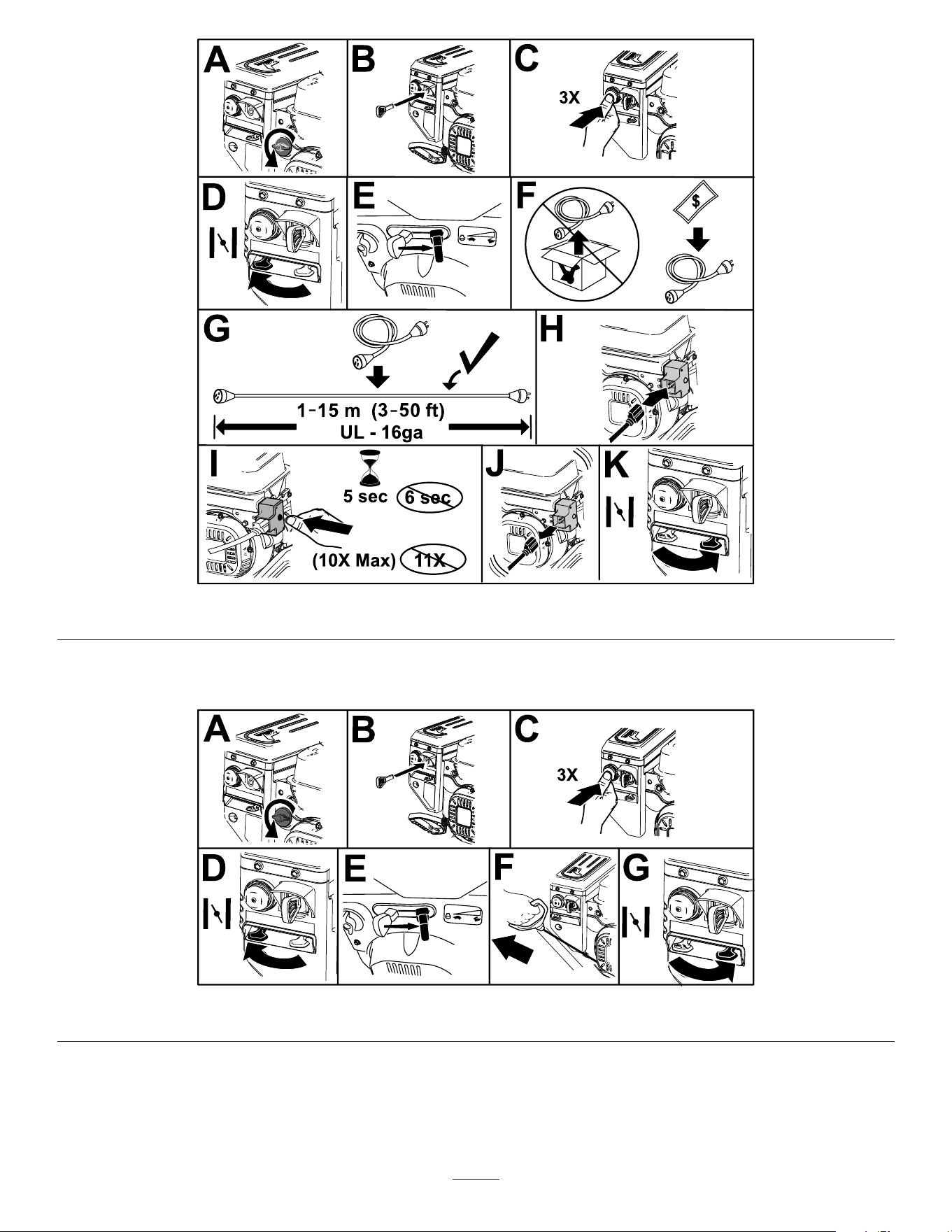
g323193
Figure 1 1
Using Recoil Start
g260415
Figure 12
10
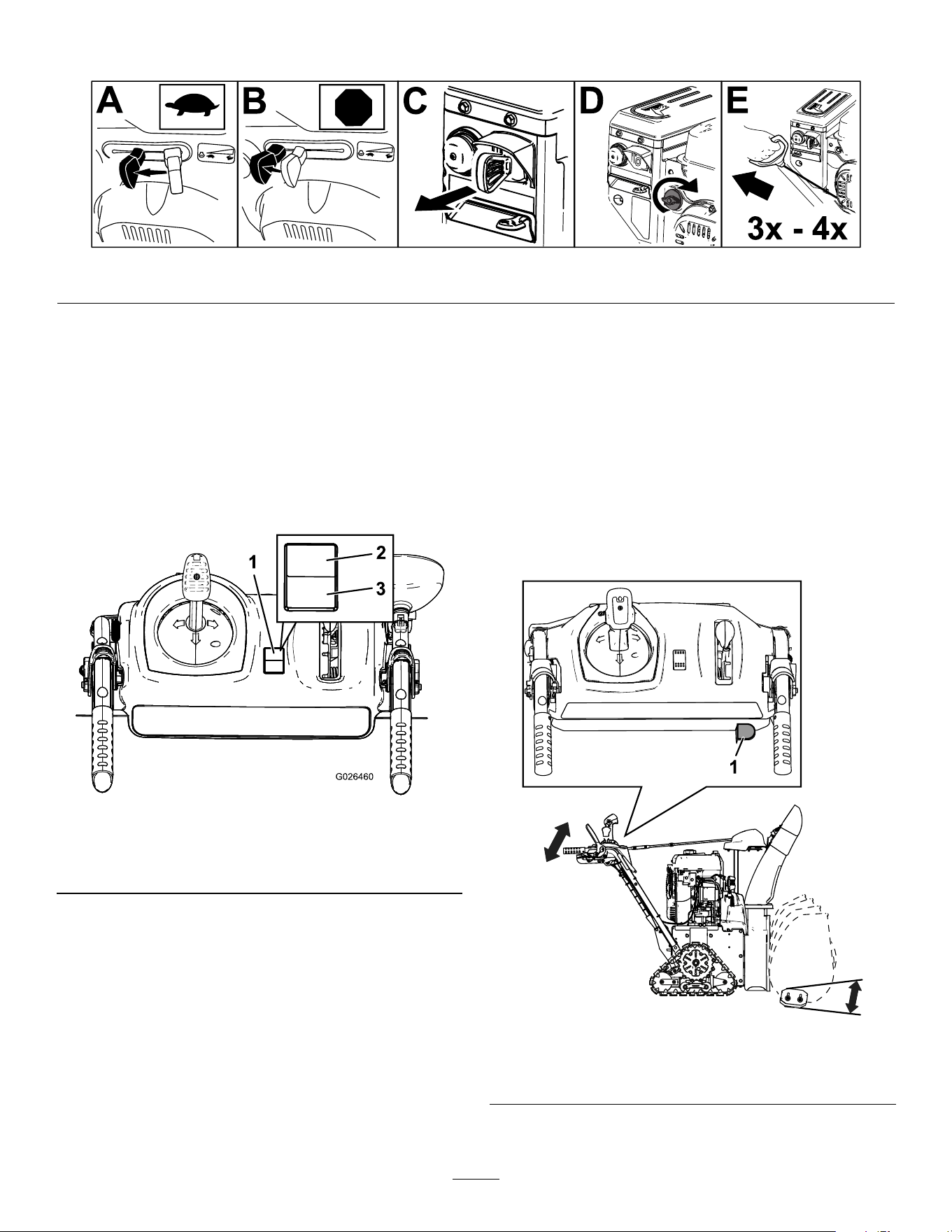
Shutting Off the Engine
g25241 1
Figure 13
Operating the
Handwarmers
Operate the handwarmers as follows:
• Press the switch to the O N position to turn on the
handwarmers.
• Press the switch to the O FF position to turn of f the
handwarmers.
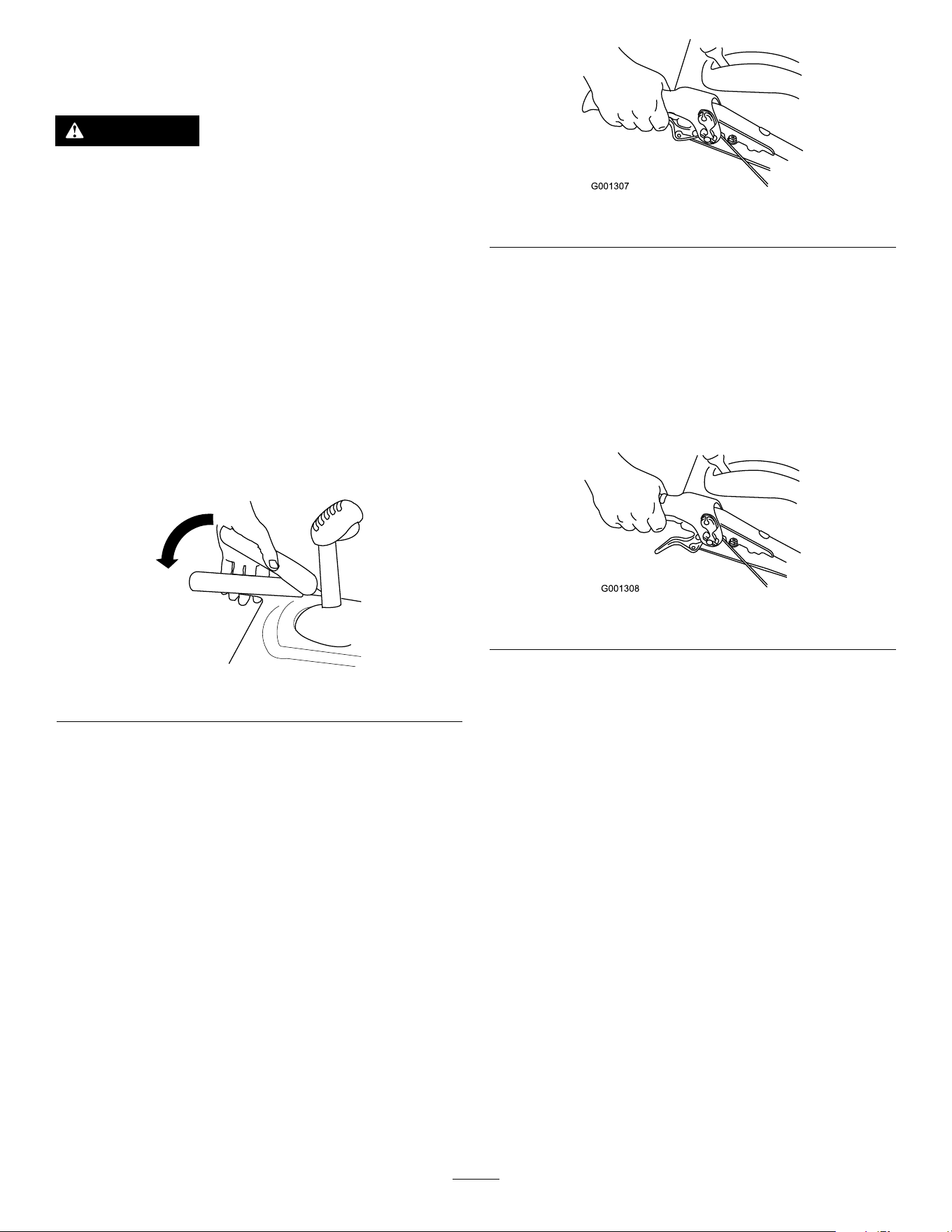
g026460
Figure 14
1. On/Of f switch 3. O FF position
2. O N position
Operating the Auger-Height
Lever
Use the auger-height lever to adjust the height of the
auger housing.
Press the auger-height lever down while moving the
handles up or down as needed to obtain the desired
auger height.
Release the lever to lock the auger at the desired
height.
g51 1 191
Figure 15
1. Auger-height lever
1 1
Operating the T raction
Drive
CAUTION
If the traction drive is not properly adjusted,
the machine may move in the direction
opposite of what you intended, causing injury
and/or property damage.
Carefully check the traction drive and adjust
it properly , if necessary; refer to Checking
and Adjusting the T raction Cable ( page 18 ) for
more information.
Important: If the machine moves when the
traction lever is in the released position, check the
traction cable; refer to Checking and Adjusting
the T raction Cable ( page 18 ) or take the machine
to an Authorized Service Dealer for service.
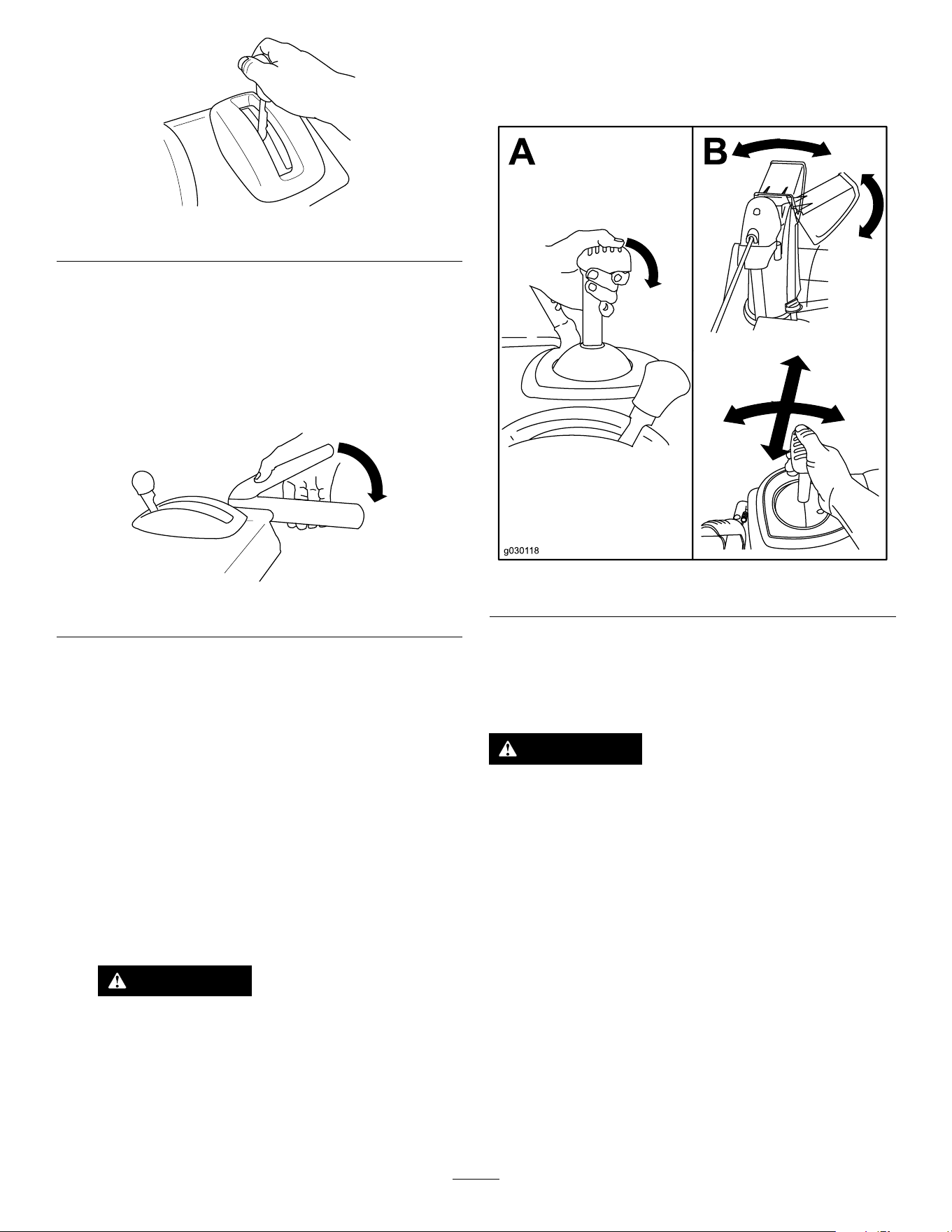
1. T o engage the traction drive, squeeze the left
(traction) lever to the handgrip ( Figure 16 ).
g322974
Figure 16
2. T o stop the traction drive, release the traction
lever .
Using the Wheel-Clutch
Levers
The wheel-clutch levers allow you to momentarily
disengage the drive to 1 or both wheels with the
traction-drive lever still engaged. This enables you to
turn and maneuver the machine easily .
Note: Holding down the traction lever against the
handle engages the traction drive to both wheels.
T o turn the machine to the right, lift up the right
wheel-clutch lever and squeeze it toward the handle
( Figure 17 ).
g001307
Figure 17
Note: This disengages the drive to the right wheel
while the left wheel continues driving, and the machine
turns to the right.
Note: Similarly , squeezing the left wheel-clutch lever
turns the machine to the left.
When you complete the turn, release the wheel-clutch
lever , and the drive re-engages both wheels ( Figure
18 ).
g001308
Figure 18
Momentarily squeezing and releasing the left or right
wheel-clutch lever also allows for steering adjustments
to keep the machine going in a straight line, especially
in deep snow .
Squeezing both wheel-clutch levers simultaneously
disengages the drive to both wheels. This enables
you to manually move the machine backward without
stopping to shift it into a reverse gear . It also allows
you to maneuver and transport the machine more
easily when the engine is not running.
Operating the Speed
Selector
The speed selector has forward and reverse gears.
T o change speeds, release the traction lever and
shift the speed-selector lever to the desired position
( Figure 19 ). The lever locks in a notch at each speed
selection.
12
g326462
Figure 19
Operating the
Auger/Impeller Drive
1. T o engage the auger/impeller drive, squeeze
the right (auger/impeller) lever to the handgrip
( Figure 20 ).
g322975
Figure 20
2. T o stop the auger and impeller , release the right
lever .
Important: When you engage both the
auger/impeller lever and the traction lever ,
the traction lever locks the auger/impeller
lever down, freeing your right hand. T o
release both levers, simply release the left
(traction) lever .
3. If the auger and impeller continue to rotate when
you release the auger/impeller lever , do not
operate the machine. Check the auger/impeller
cable; refer to Checking and Adjusting the
Auger/Impeller Cable ( page 19 ) and adjust it if
necessary . Otherwise, take the machine to an
Authorized Service Dealer for service.
W ARNING
If the auger and impeller continue
to rotate when you release the
auger/impeller lever , you could seriously
injure yourself or others.
Do not operate the machine. T ake it to an
Authorized Service Dealer for service.
Operating the Quick Stick®
Note: Fully press the blue knob to release the latch
and operate the Quick Stick®.
g0301 18
Figure 21
Clearing a Clogged
Discharge Chute
W ARNING
If the auger/impeller is running but there is no
snow coming out of the discharge chute, the
discharge chute may be clogged.
Never use your hands to clear a clogged
discharge chute. This could result in personal
injury .
• T o unclog the discharge chute, stay in the
operating position and release the left (traction)
lever . While running the auger/impeller , push down
on the handles to raise the front of the machine a
few centimeters (inches) of f the pavement. Then
lift the handles quickly to bump the front of the
machine on the pavement. Repeat if necessary
until a stream of snow comes out the discharge
chute.
• If you cannot unclog the discharge chute by
bumping the front of the machine, shut off the
13

engine, wait for all moving parts to stop, and
use the snow-cleanout tool ( Figure 9 ).
Important: Unclogging the discharge chute
by bumping the front of the machine on the
pavement may cause the skids to move. Adjust
the skids and tighten the skid bolts securely;
refer to Checking and Adjusting the Auger
Skids and Scraper ( page 16 ) .
Operating T ips
DANGER
When the machine is in operation, the impeller
and auger rotate and can injure or amputate
hands or feet.
• Before adjusting, cleaning, inspecting,
troubleshooting, or repairing the machine,
shut off the engine and wait for all moving
parts to stop. Disconnect the wire from
the spark plug and keep it away from the
plug to prevent someone from accidentally
starting the engine.
• Remove an obstruction from the discharge
chute; refer to Clearing a Clogged
Discharge Chute ( page 13 ) . Use the
snow-cleanout tool ( Figure 10 ), not your
hands, to remove an obstruction from the
discharge chute.
• Stay behind the handles and away from
the discharge opening while operating the
machine.
• Keep your face, hands, feet, and any other
part of your body or clothing away from
concealed, moving, or rotating parts.
W ARNING
The impeller can throw stones, toys, and other
foreign objects and cause serious personal
injury to you or bystanders.
• Keep the area to be cleared free of all
objects that the auger could pick up and
throw .
• Keep all children and pets away from the
area of operation.
• Always set the throttle to the F AST position when
throwing snow .
• If the engine slows down under a load or the tracks
slip, shift the machine into a lower gear .
• If the front of the machine rides up, shift the
machine into a lower gear . If the front continues to
ride up, lift up on the handles.
After Operation
After Operation Safety
General Safety
• Never store the machine with fuel in the fuel
tank inside a building where ignition sources are
present, such as hot water heaters, space heaters,
or clothes dryers. Allow the engine to cool before
storing the machine in any enclosure.
• When storing the machine for more than 30
days, refer to Storage ( page 22 ) for important
information.
• Run the machine a few minutes after throwing
snow to prevent freeze-up of the collector and
impeller .
Preventing Freeze-up after
Use
• In snowy and cold conditions, some controls and
moving parts may freeze. Do not use excessive
force when trying to operate frozen controls.
If you have dif culty operating any control or part,
start the engine and let it run for a few minutes.
• After using the machine, let the engine run for
a few minutes to prevent moving parts from
freezing. Engage the auger/impeller to clear any
remaining snow from inside the housing. Rotate
the Quick Stick to prevent it from freezing. Shut of f
the engine, wait for all moving parts to stop, and
remove all ice and snow from the machine.
• With the engine of f, pull the recoil-start handle
several times and push the electric-start button
once to prevent the recoil starter and electric
starter from freezing up.
14

Maintenance
Recommended Maintenance Schedule(s)
Maintenance Service
Interval
Maintenance Procedure
After the rst 2 hours
• Inspect the traction cable and adjust it if necessary .
• Inspect the auger/impeller cable and adjust it if necessary .
After the rst 5 hours
• Change the engine oil.
Before each use or daily
• Check the engine-oil level and add oil if necessary .
Every 50 hours
• Change the engine oil. Change the engine oil every 25 operating hours when
operating the engine under a heavy load.
Every 100 hours
• Replace the spark plug.
Monthly
• Check the track tension and adjust if needed.
Y early
• Check the skids and the scraper and adjust them if necessary .
• Inspect the bogey wheels and tighten or replace them if necessary .
• Inspect the traction cable and adjust or replace it if necessary .
• Inspect the auger/impeller cable and adjust or replace it if necessary .
• Check the auger-gearbox oil and add oil if necessary .
Y early or before storage
• Drain the fuel and run the engine to dry out the fuel tank and the carburetor at the
end of the season.
• Have an Authorized Service Dealer inspect and replace the traction drive belt and/or
the auger/impeller drive belt, if necessary .
Maintenance Safety
Read the following safety precautions before
performing any maintenance on the machine:
• Shut of f the engine, remove the key , and wait
for all movement to stop before you leave the
operator ’ s position. Allow the machine to cool
before adjusting, servicing, cleaning, or storing it.
• Always wear eye protection while performing an
adjustment or repair to protect your eyes from
foreign objects that the machine may throw .
• Check all fasteners at frequent intervals for proper
tightness to ensure that the machine is in safe
working condition.
• Do not change the governor settings on the engine.
Purchase only genuine T oro replacement parts
and accessories.
Preparing for Maintenance
1. Move the machine to a level surface.
2. Shut of f the engine, remove the key , and wait for
all moving parts to stop.
3. Disconnect the spark-plug wire. Refer to
Replacing the Spark Plug ( page 21 ) .
15
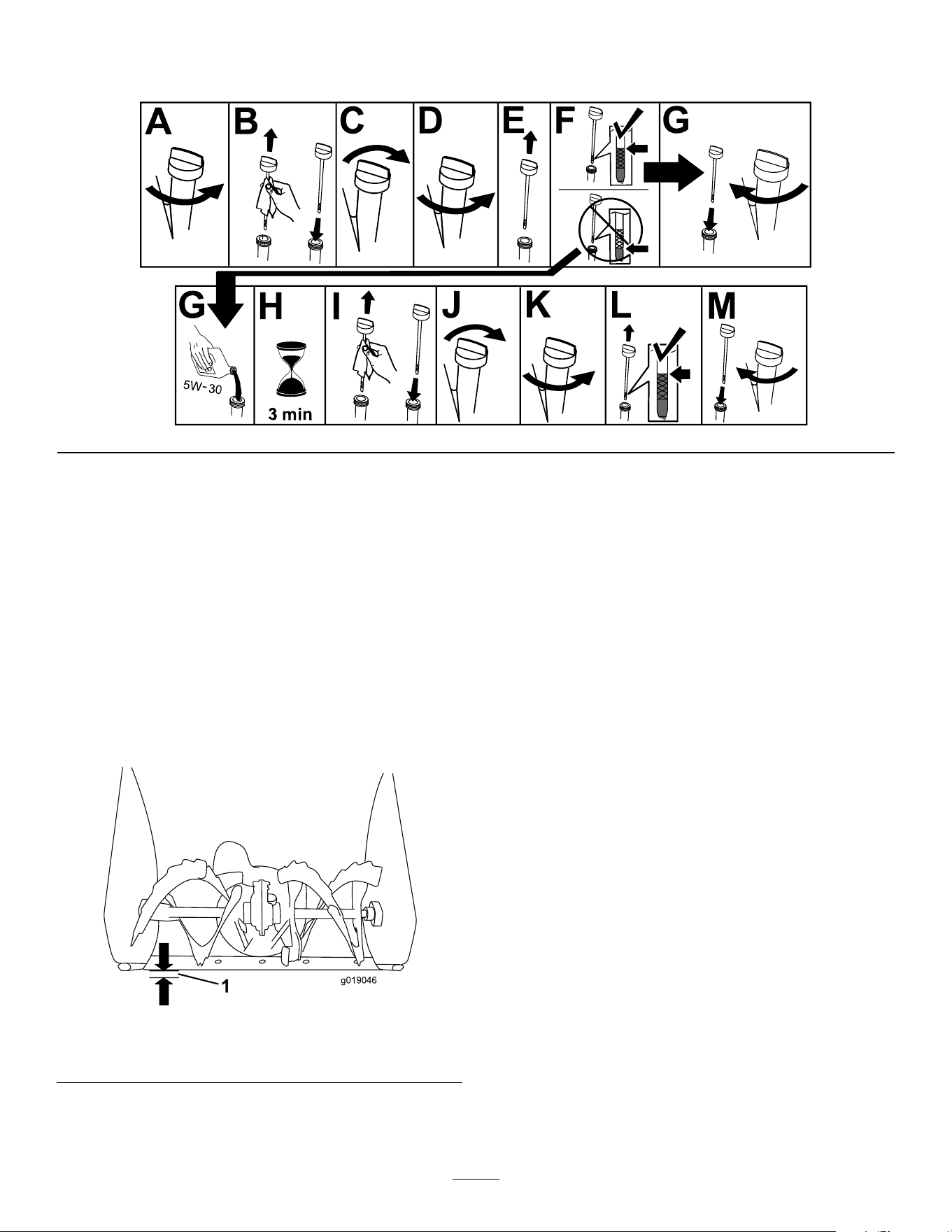
Checking the Engine-Oil Level
Service Interval : Before each use or daily —Check the engine-oil level and add oil if necessary .
g257528
Checking and Adjusting the
Auger Skids and Scraper
Service Interval : Y early —Check the skids and
the scraper and adjust them if
necessary .
Check the skids and the scraper to ensure that the
auger does not contact the paved or gravel surface.
Adjust the skids and the scraper as needed to
compensate for wear .
1. Loosen the nuts that secure both skids to the
auger sides until the skids slide up and down
easily .
g019046
Figure 23
1. 3 mm (1/8 inch)
Important: The auger blades must be
supported above the ground by the skids.
2. Ensure that the scraper is 3 mm (1/8 inch) above
and parallel to a level surface.
Note: If the pavement is cracked, rough, or
uneven, adjust the skids to raise the scraper . For
gravel surfaces, adjust the skids further down to
prevent the machine from picking up rocks.
3. Move the skids down until they are even with
the ground.
4. Firmly tighten the nuts that secure both skids
to the auger sides.
Note: T o quickly adjust the skids if they loosen,
support the scraper 3 mm (1/8 inch) of f the
pavement, then adjust the skids down to the
pavement.
Note: If the skids become excessively worn,
you can turn them over and set the unused side
toward the pavement.
16
Inspecting and T ightening
the Bogey Wheels
Service Interval : Y early
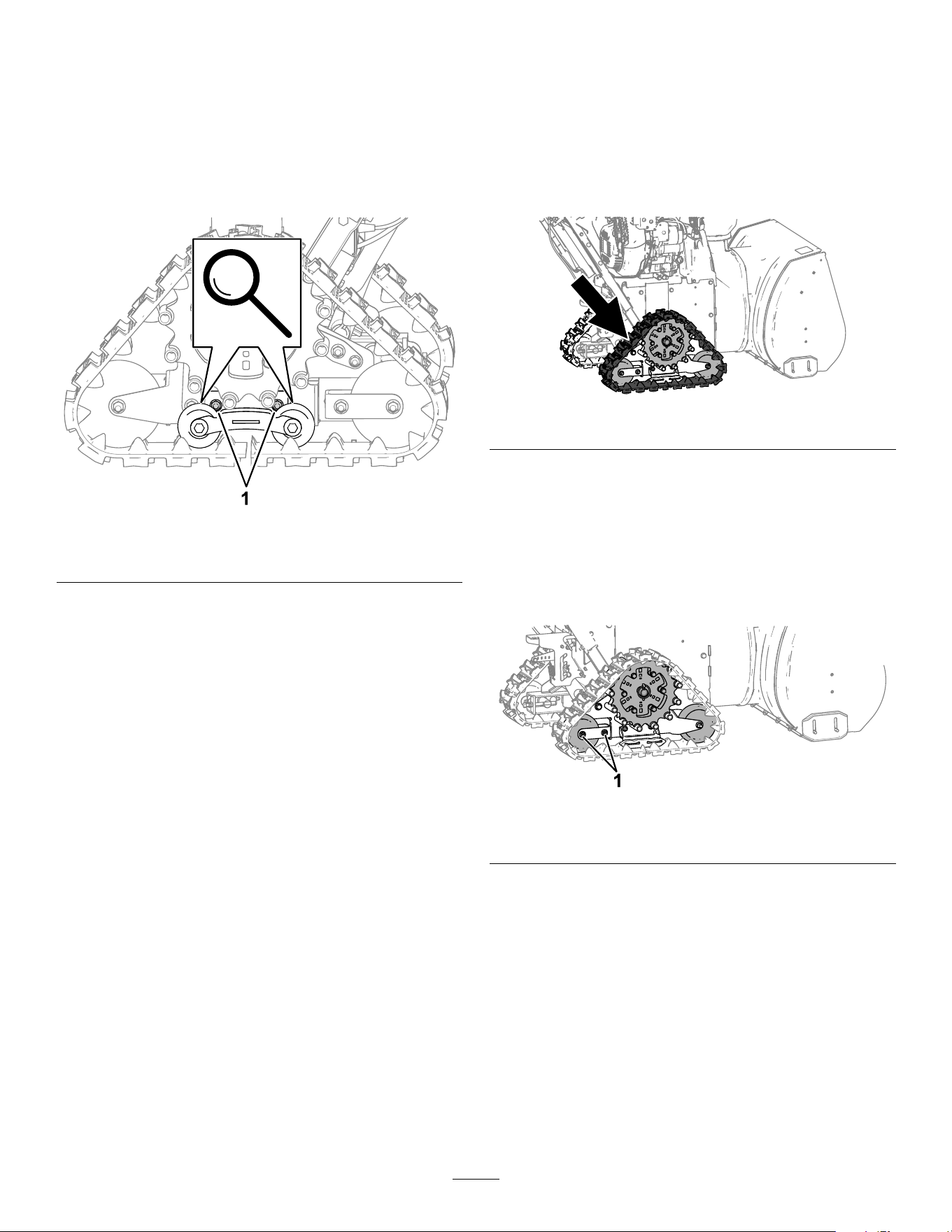
1. Refer to Preparing for Maintenance ( page 15 ) .
2. Inspect the bogey wheels. T ighten the bolts or
replace the bogey wheels if necessary .
g491239
Figure 24
1. T ighten the bolts if necessary .
Checking and Adjusting the
T rack T ension
Service Interval : Monthly
1. Refer to Preparing for Maintenance ( page 15 ) .
2. Apply 44 N (10 lbf) between the middle and rear
roller ( Figure 25 ).
g325787
Figure 25
3. Ensure that the deection of the track is
approximately 9.5 mm (3/8 inch).
4. If the track deection is not approximately 9.5
mm (3/8) inch or if the tracks are jumping, adjust
the track tension as follows:
A. Slightly loosen the nuts on the rear roller
yoke ( Figure 26 ).
g325788
Figure 26
1. Rear-roller-yoke nuts
17
B. Adjust the hex head bolt as needed ( Figure
27 ).
Note: T urn the bolt clockwise if the track
has more than 9.5 mm (3/8 inch) deection.
T urn the bolt counterclockwise if the track
has less than 9.5 mm (3/8 inch) deection.
g325789
Figure 27
1. Hex head adjustment bolts
C. Ensure that the deection of the track is
approximately 9.5 mm (3/8 inch).
D. T ighten the nuts on the rear roller yoke.
E. Repeat for the other track.
Checking and Adjusting the
T raction Cable
Service Interval : After the rst 2 hours —Inspect
the traction cable and adjust it if
necessary .
Y early —Inspect the traction cable and adjust or
replace it if necessary .
If the machine does not drive in the forward or reverse
speeds or it drives when you release the traction lever ,
adjust the traction cable.
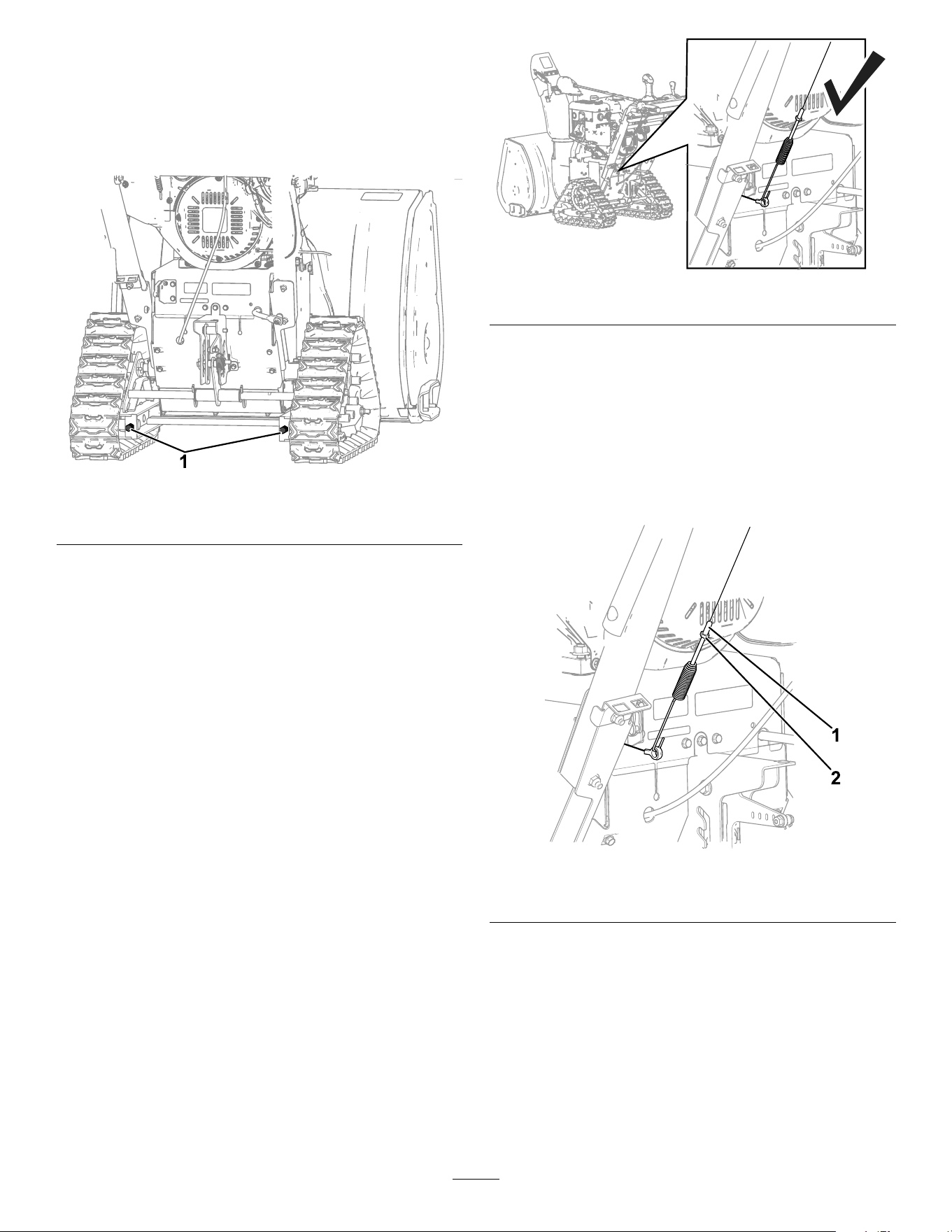
With the traction level disengaged, ensure that the
there is no slack in the traction cable ( Figure 28 ).
g325790
Figure 28
If there is slack in the traction cable, the left (traction)
cable is not properly adjusted.
T o adjust the traction cable, do the following:
1. Loosen the jam nut ( Figure 29 ).
2. Loosen or tighten the turnbuckle until the cable
is taught.
3. T ighten the jam nut.
g325791
Figure 29
1. T urnbuckle 2. Jam nut
18

Checking and Adjusting the
Auger/Impeller Cable
Service Interval : After the rst 2 hours —Inspect the
auger/impeller cable and adjust it if
necessary .
Y early —Inspect the auger/impeller cable and
adjust or replace it if necessary .
1. Remove the 2 screws that are holding the belt
cover in place ( Figure 30 ).
2. Remove the belt cover ( Figure 30 ).
g323250
Figure 30
3. With the auger/impeller lever disengaged,
ensure that the gap between the auger clutch
arm and the frame of the machine is 1.5 mm
(1/16 inch) as shown in Figure 31 .
g260108
Figure 31
1. 1.5 mm (1/16 inch)
3. Auger clutch arm
2. Frame
4. If the auger/impeller cable is not properly
adjusted, do the following steps:
5. Loosen the jam nut ( Figure 32 ).
g322960
Figure 32
1. Jam nut 2. T urnbuckle
6. Loosen or tighten the turnbuckle that adjusts the
tension on the cable ( Figure 32 ).
7. Adjust the turnbuckle until you obtain the proper
gap.
8. T ighten the jam nut.
9. Insert the 2 screws that you previously removed
on the belt cover .
10. If the auger/impeller cable is properly adjusted
but a problem remains, contact an Authorized
Service Dealer .
Checking the
Auger-Gearbox-Oil Level
Service Interval : Y early —Check the auger-gearbox
oil and add oil if necessary .
1. Move the machine to a level surface.
2. Clean the area around the pipe plug and remove
the pipe plug from the gearbox ( Figure 33 ).
Note: If needed, use pliers to assist in removing
the pipe plug.
19

g323263
Figure 33
3. Check the oil level using a suitable measuring
device, such as a clean cable tie. The oil should
be approximately 3.8 cm (1.5 inches) below the
ller opening ( Figure 34 ).
g257737
Figure 34
4. If the oil level is low , add GL-5 or GL-6, SAE
85-95 EP gear oil lubricant to the gearbox, then
check the oil level again.
Note: Do not use synthetic oil.
5. Install the pipe plug in the gearbox.
Changing the Engine Oil
Service Interval : After the rst 5 hours —Change the
engine oil.
Every 50 hours —Change the engine oil.
Change the engine oil every 25 operating hours
when operating the engine under a heavy load.
If possible, run the engine for a few minutes before
changing the oil because warm oil ows better and
carries more contaminants.
Engine oil capacity
0.95 L (32 oz)*
Oil viscosity Refer to Figure 36 .
API service classication SJ or higher
*There is residual oil in the crankcase after you drain
the oil. Do not pour the entire capacity of oil into the
crankcase. Fill the crankcase with oil as directed in
the following steps.
1. Move the machine to a level surface.
2. Clean the area around the oil-drain nut ( Figure
35 ).
g016496
Figure 35
1. Oil-drain nut
3. Slide an oil-drain pan under the drain extension
and remove the oil-drain nut.
4. Drain the oil.
Note: Dispose of the used oil properly at a local
recycling center .
5. Install the oil-drain nut and tighten it securely .
6. Clean around the oil ll/dipstick.
7. Unscrew the dipstick and remove it.
8. Carefully pour about 3/4 of the engine capacity
of oil into the oil-ll tube.
Use Figure 36 to select the best oil viscosity for
the outdoor temperature range expected:
g01 1606
Figure 36
20
9. W ait 3 minutes for the oil to settle in the engine.
10. Wipe the dipstick clean with a clean cloth.
1 1. Insert the dipstick into the oil-ll tube and screw
it in, then remove the dipstick.
12. Read the oil level on the dipstick.
• If the oil level on the dipstick is too low ,
carefully pour a small amount of oil into
the oil-ll tube, wait 3 minutes, and repeat
steps 10 through 12 until the oil level on the
dipstick is correct.
• If the oil level on the dipstick is too high,
drain the excess oil until the oil level on the
dipstick is correct.
Important: If the oil level in the engine is too
low or too high and you run the engine, you
may damage the engine.
13. Install the dipstick into the oil-ll tube securely .
Replacing the Spark Plug
Service Interval : Every 100 hours —Replace the
spark plug.
W ARNING
Replacing the spark plug while the engine is
hot can result in burns.
W ait until the engine is cool to replace the
spark plug.
Use a T oro spark plug or equivalent (Champion®
RN9YC or NGK BPR6ES).
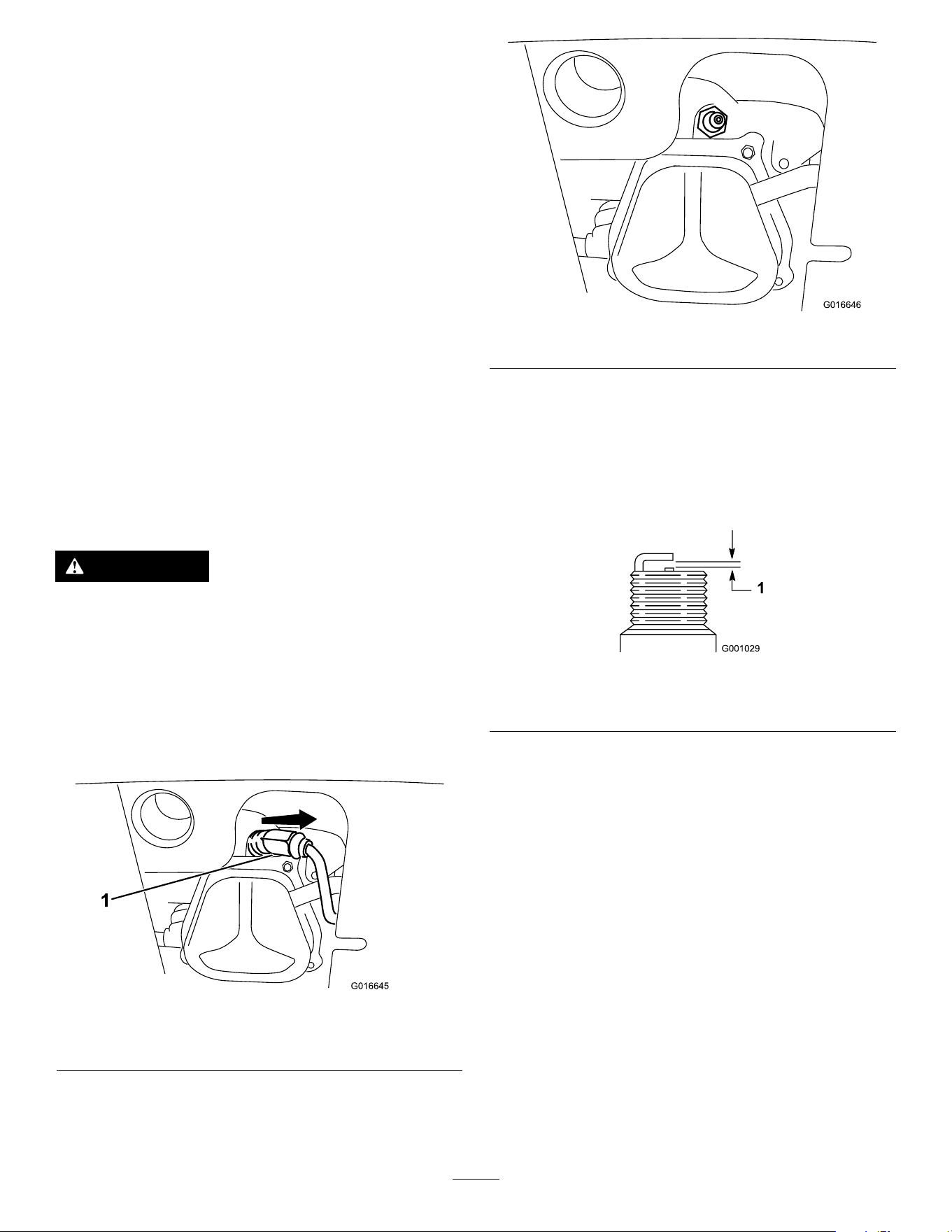
1. Remove the boot ( Figure 37 ).
g016645
Figure 37
1. Spark-plug boot
2. Clean around the base of the spark plug.
g016646
Figure 38
3. Remove and discard the old spark plug.
Note: Y ou will need a ratchet wrench extension
to remove the spark plug.
4. Set the gap between the electrodes on a new
spark plug at 0.76 mm (0.030 inch) as shown
in Figure 39 .
g001029
Figure 39
1. 0.76 mm (0.030 inch)
5. Install the new spark plug, tighten it rmly , and
attach the ignition wire to the spark plug.
Note: Ensure that the ignition wire snaps
completely into place on the spark plug.
Replacing the Drive Belts
If the auger/impeller drive belt or the traction-drive belt
becomes worn, oil-soaked, or otherwise damaged,
have an Authorized Service Dealer replace the belt.
21
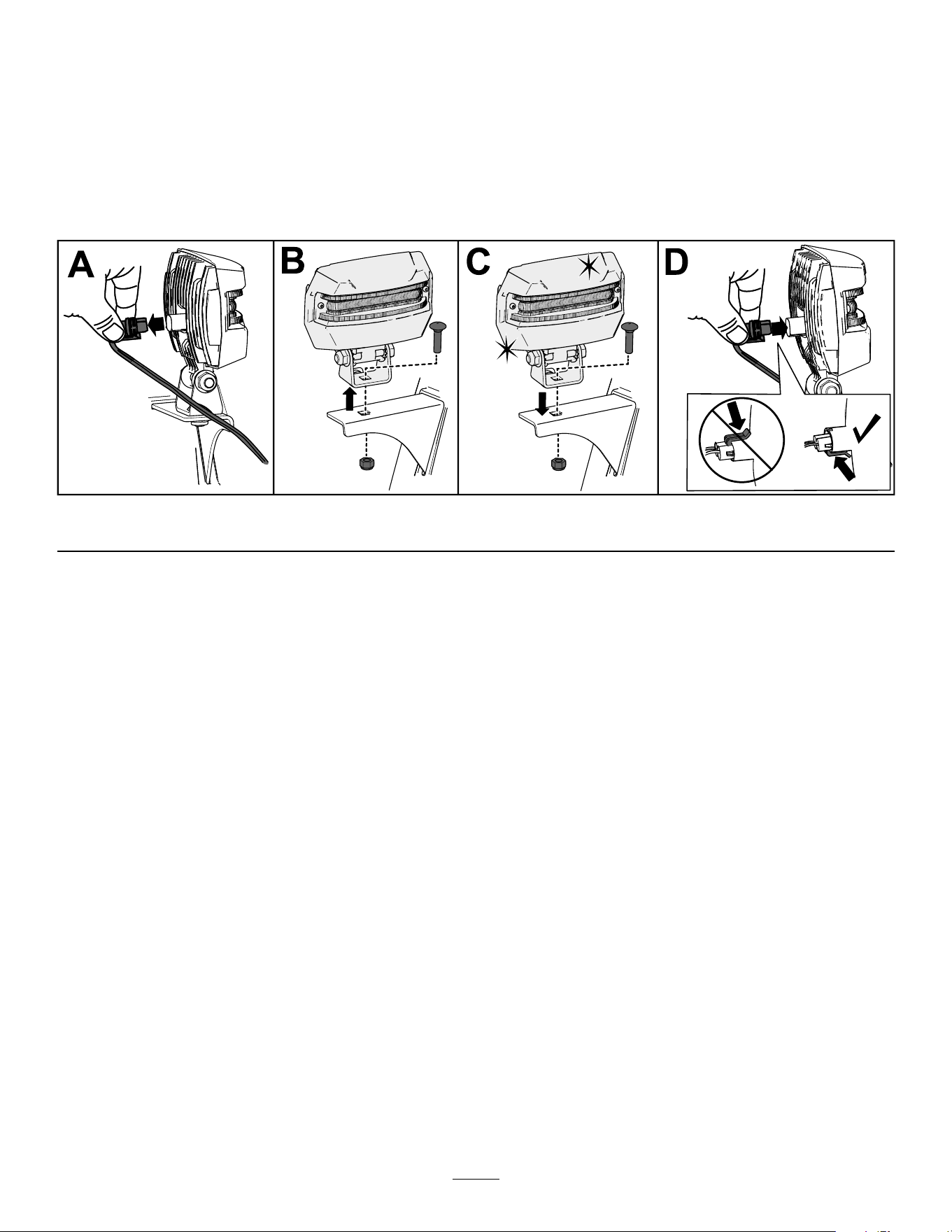
Replacing the Headlight
Replace the headlight assembly (T oro part number 138-0670) when needed.
1. Remove the headlight wire from the back of the headlight (A of Figure 40 ).
2. Remove the bolt and nut holding the headlight assembly onto the headlight bracket and then remove the
old headlight assembly (B of Figure 40 ).
3. Secure the new headlight assembly onto the headlight bracket with the previously removed nut and
bolt (C of Figure 40 ).
4. Insert the headlight wire straight into the back of the headlight until it is securely in place (D of Figure 40 ).
g326789
Figure 40
Storage
Storage Safety
• Shut of f the engine, remove the key , and wait
for all movement to stop before you leave the
operator ’ s position. Allow the machine to cool
before adjusting, servicing, cleaning, or storing it.
• Fuel fumes are highly ammable, explosive, and
dangerous if inhaled. If you store the product in an
area with an open ame, the fuel fumes may ignite
and cause an explosion.
• Do not store the machine in a house (living
area), basement, or any other area where ignition
sources may be present, such as hot water and
space heaters, clothes dryers, furnaces, and other
appliances.
• Do not tip the machine either forward or backward
with fuel in the fuel tank; otherwise, fuel may leak
out of the machine.
• Do not store the machine with its handle tipped
down onto the ground; otherwise, oil may leak into
the engine cylinder and onto the ground, and the
engine may not start.
Storing the Machine
1. On the last refueling of the year , add fuel
stabilizer to fresh fuel as directed by the fuel
stabilizer manufacturer .
Important: Do not store fuel longer
than that suggested by the fuel stabilizer
manufacturer .
2. Run the engine for 10 minutes to distribute the
conditioned fuel through the fuel system.
3. Run the machine until the engine runs out of fuel.
4. Prime the engine and start it again.
5. Allow the engine to run until it shuts of f.
When you can no longer start the engine, it is
suf ciently dry .
6. Allow the engine to cool.
7. Remove the key .
8. Clean the machine thoroughly .
9. T ouch up chipped surfaces with paint available
from an Authorized Service Dealer . Sand
af fected areas before painting, and use a rust
preventative to prevent the metal parts from
rusting.
10. T ighten all loose screws, bolts, and locknuts.
Repair or replace any damaged parts.
22


T roubleshooting
Problem
Possible Cause Corrective Action
1. The power cord is disconnected at the
outlet or the machine.
1. Connect the power cord to the outlet
and/or the machine.
2. The power cord is worn, corroded, or
damaged.
2. Replace the power cord.
The electric starter does not turn
(electric-start models only).
3. The power outlet is not energized.
3. Have a qualied electrician energize
the outlet.
1. The key is not in the ignition. 1. Insert the key into the ignition.
2. The choke is in the O FF position and
the primer has not been pressed.
2. Move the choke to the O N position and
press the primer 3 times.
3. The fuel-shutof f valve is not open. 3. Open the fuel-shutof f valve.
4. The throttle is not in the F AST position. 4. Move the throttle to the F AST position.
5. The fuel tank is empty or the fuel
system contains stale fuel.
5. Drain and/or ll the fuel tank with
fresh fuel (not more than 30 days old).
If the problem persists, contact an
Authorized Service Dealer .
6. The spark-plug wire is loose or
disconnected.
6. Connect the wire to the spark plug.
7. The spark plug is pitted, fouled, or the
gap is incorrect.
7. Check the spark plug and adjust the
gap if necessary . Replace the spark
plug if it is pitted, fouled, or cracked.
8. The fuel-vent cap is restricted.
8. Remove the vent restriction or replace
the fuel cap.
The engine does not start or starts hard.
9. The engine-oil level in the engine
crankcase is too low or too high.
9. Add or drain oil to adjust the oil level in
the engine crankcase to the Full mark
on the dipstick.
1. The choke is in the O N position. 1. Move the choke to the O FF position.
2. The fuel-shutof f valve is not completely
open.
2. Open the fuel-shutof f valve.
3. The fuel tank is nearly empty or
contains stale fuel.
3. Drain and ll the fuel tank with fresh
fuel (not more than 30 days old).
If the problem persists, contact an
Authorized Service Dealer .
4. The spark-plug wire is loose.
4. Connect the wire to the spark plug.
5. The spark plug is pitted, fouled, or the
gap is incorrect.
5. Check the spark plug and adjust the
gap if necessary . Replace the spark
plug if it is pitted, fouled, or cracked.
The engine runs rough.
6. The engine-oil level in the engine
crankcase is too low or too high.
6. Add or drain oil to adjust the oil level in
the engine crankcase to the Full mark
on the dipstick.
24

Problem
Possible Cause Corrective Action
1. The throttle is not in the F AST position
when throwing snow .
1. Move the throttle to the F AST position.
2. The machine is moving too fast to clear
the snow .
2. Shift the machine into a lower gear .
3. Y ou are trying to remove too much
snow per swath.
3. Reduce the amount of snow removed
per swath.
4. Y ou are trying to remove extremely
heavy or wet snow .
4. Do not overload the machine with
extremely heavy or wet snow .
5. The discharge chute is plugged. 5. Unclog the discharge chute.
6. The auger/impeller drive belt is loose
or is of f the pulley .
6. Install and/or adjust the auger/impeller
drive belt; refer to www .T oro.com
for servicing information or take the
machine to an Authorized Service
Dealer .
The engine runs, but the machine
discharges snow poorly or not at all.
7. The auger/impeller drive belt is worn
or broken.
7. Replace the auger/impeller drive belt;
refer to www .T oro.com for servicing
information or take the machine to an
Authorized Service Dealer .
The discharge chute either does not lock
into place or does not move.
1. The discharge-chute latch is not
properly adjusted.
1. Adjust the discharge-chute latch.
The machine does not properly clear the
snow of f the surface.
1. The skids and/or scraper are not
properly adjusted.
1. Adjust the skids and/or the scraper .
25

Notes:

California Proposition 65 W arning Information
What is this warning?
Y ou may see a product for sale that has a warning label like the following:
W ARNING: Cancer and Reproductive Harm—www .p65W arnings.ca.gov .
What is Prop 65?
Prop 65 applies to any company operating in California, selling products in California, or manufacturing products that may be sold in or brought into
California. It mandates that the Governor of California maintain and publish a list of chemicals known to cause cancer , birth defects, and/or other
reproductive harm. The list, which is updated annually , includes hundreds of chemicals found in many everyday items. The purpose of Prop 65 is to
inform the public about exposure to these chemicals.
Prop 65 does not ban the sale of products containing these chemicals but instead requires warnings on any product, product packaging, or literature with
the product. Moreover , a Prop 65 warning does not mean that a product is in violation of any product safety standards or requirements. In fact, the
California government has claried that a Prop 65 warning “is not the same as a regulatory decision that a product is ‘safe’ or ‘unsafe.’” Many of these
chemicals have been used in everyday products for years without documented harm. For more information, go to https://oag.ca.gov/prop65/faqs-view-all .
A Prop 65 warning means that a company has either (1) evaluated the exposure and has concluded that it exceeds the “no signicant risk level”; or (2)
has chosen to provide a warning based on its understanding about the presence of a listed chemical without attempting to evaluate the exposure.
Does this law apply everywhere?
Prop 65 warnings are required under California law only . These warnings are seen throughout California in a wide range of settings, including but not
limited to restaurants, grocery stores, hotels, schools, and hospitals, and on a wide variety of products. Additionally , some online and mail order
retailers provide Prop 65 warnings on their websites or in catalogs.
How do the California warnings compare to federal limits?
Prop 65 standards are often more stringent than federal and international standards. There are various substances that require a Prop 65 warning
at levels that are far lower than federal action limits. For example, the Prop 65 standard for warnings for lead is 0.5 μg/day , which is well below
the federal and international standards.
Why don’t all similar products carry the warning?
• Products sold in California require Prop 65 labelling while similar products sold elsewhere do not.
• A company involved in a Prop 65 lawsuit reaching a settlement may be required to use Prop 65 warnings for its products, but other companies
making similar products may have no such requirement.
• The enforcement of Prop 65 is inconsistent.
• Companies may elect not to provide warnings because they conclude that they are not required to do so under Prop 65; a lack of warnings for a
product does not mean that the product is free of listed chemicals at similar levels.
Why does T oro include this warning?
T oro has chosen to provide consumers with as much information as possible so that they can make informed decisions about the products they buy and
use. T oro provides warnings in certain cases based on its knowledge of the presence of one or more listed chemicals without evaluating the level of
exposure, as not all the listed chemicals provide exposure limit requirements. While the exposure from T oro products may be negligible or well within the
“no signicant risk” range, out of an abundance of caution, T oro has elected to provide the Prop 65 warnings. Moreover , if T oro does not provide these
warnings, it could be sued by the State of California or by private parties seeking to enforce Prop 65 and subject to substantial penalties.
Rev A