1
KOBALT and logo design are trademarks or
registered trademarks of LF, LLC. All rights
reserved.
Serial Number
SG24111
Purchase Date
ITEM #5974889
MODEL #KPC 6180-06
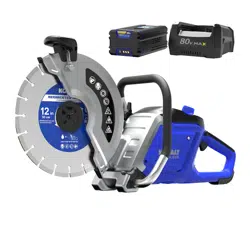
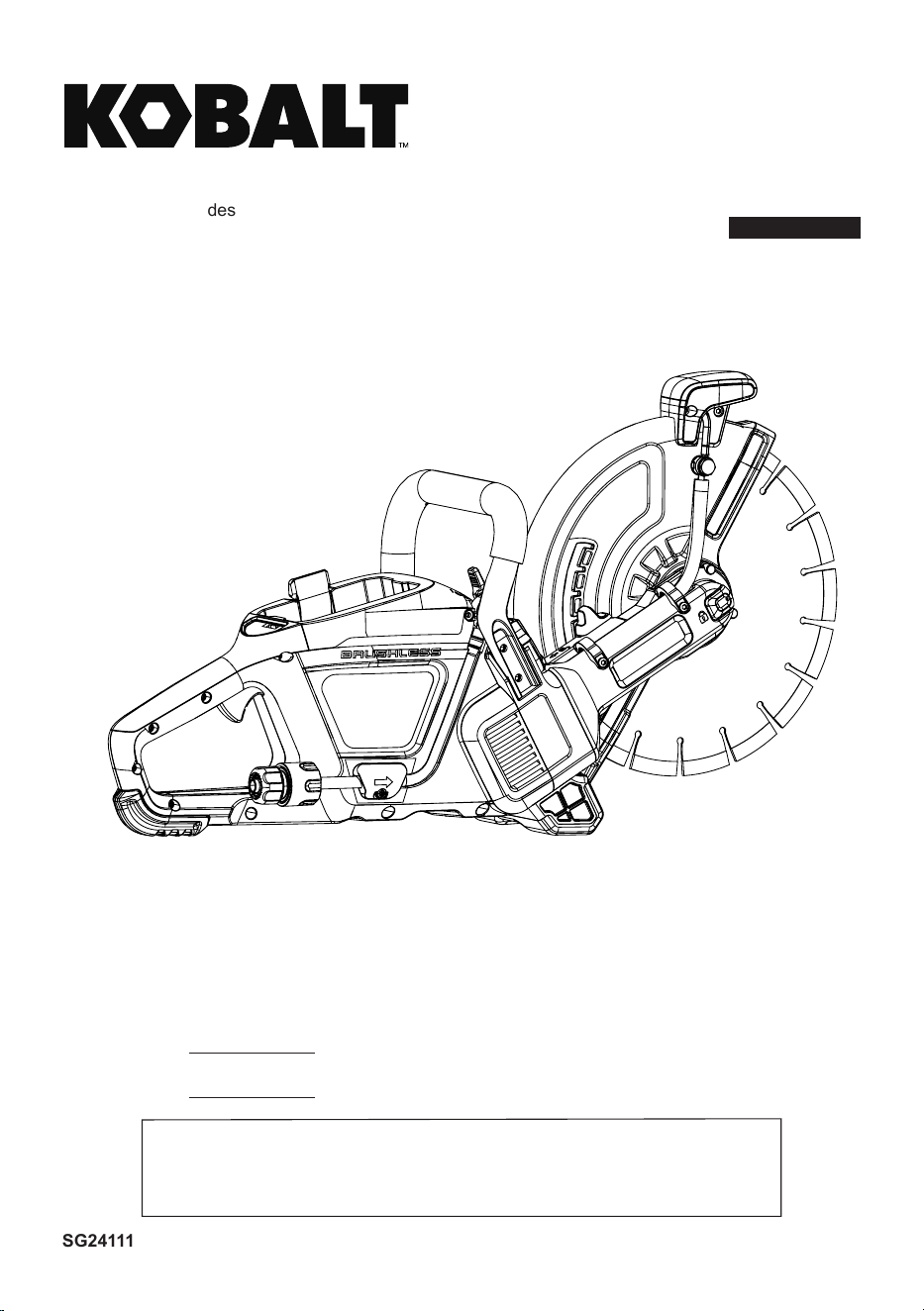
80 V LITHIUM-ION
12 IN. POWER CUTTER
Español p. 23
Thank you for purchasing this KOBALT product.
Questions, problems or missing parts?
Before returning, contact us on:
888-356-2258, 8 a.m. - 8 p.m., EST, Monday - Sunday or [email protected].

2
TABLE OF CONTENTS
PRODUCT SPECIFICATIONS
Product Specications.........................................................................................................................
Package Contents.................................................................................................................................
Hardware Contents................................................................................................................................
Symbols..................................................................................................................................................
Safety Information..................................................................................................................................
Preparation.............................................................................................................................................
Assembly Instructions.............................................................................................................................
Operating Instructions............................................................................................................................
Care and Maintenance ..........................................................................................................................
Troubleshooting......................................................................................................................................
Warranty.................................................................................................................................................
Replacement Parts List..........................................................................................................................
2
3
4
5
7
12
12
16
19
21
22
22
SPECIFICATIONS
Battery type 80V Lithium-ion
Blade thickness 0.1 in. (3 mm)
Blade outside diameter 12 in. (300 mm)
Blade bore diameter 0.8 in. (20 mm) / 1 in. (25.4 mm)
Blade tightening torque 18.5 ft-lbs
Max. peripheral gap between segments 0.1 in. (3 mm)
Max. depth of cut 4.33 in. (110 mm)
Max. pressure of water supply 6 bar
3
PACKAGE CONTENTS
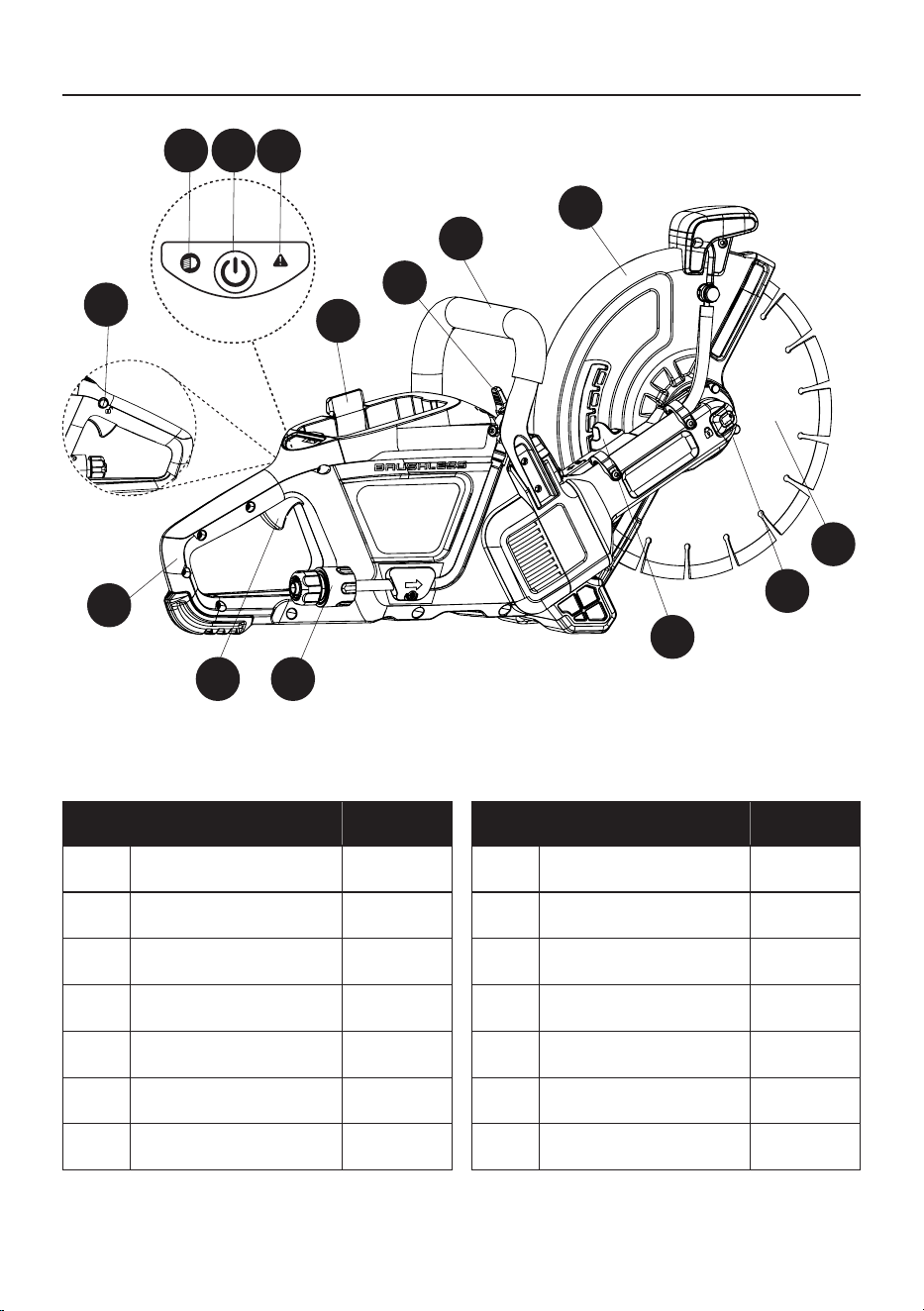
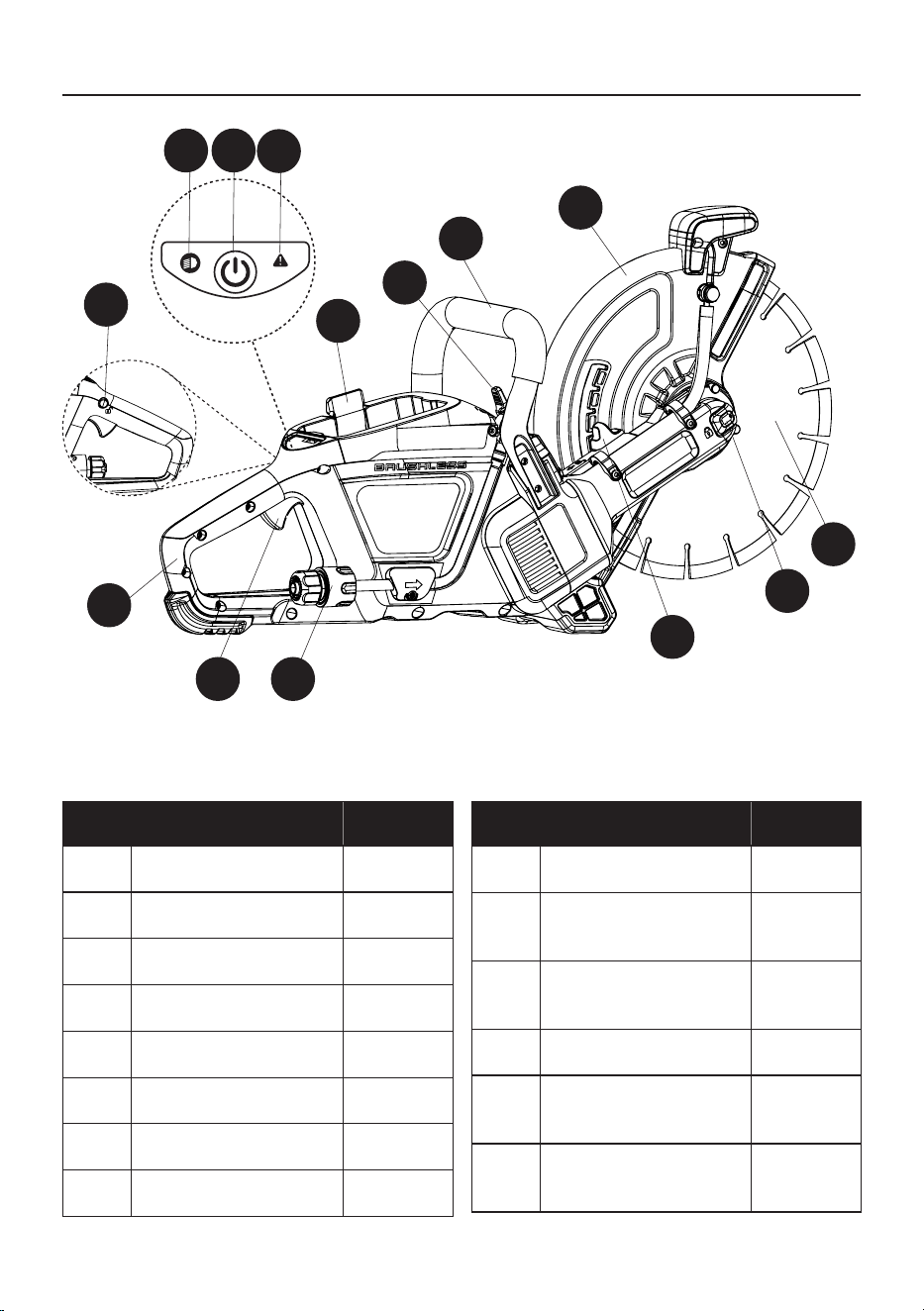
PART DESCRIPTION QUANTITY
A Blade guard 1
B Front handle 1
C Water ow lever 1
D Warning indicator 1
E Power button 1
F Light button 1
G Trigger lockout 1
PART DESCRIPTION QUANTITY
H Main handle 1
I Trigger 1
J Quick-connect coupler 1
K Spindle lock button 1
L Cutting blade 1
M Guard adjustment lock 1
N Battery release button 1
K
K
K
K
I
I
A
K
L
M
I
H
F
G
C
N
B
D
E
J
4
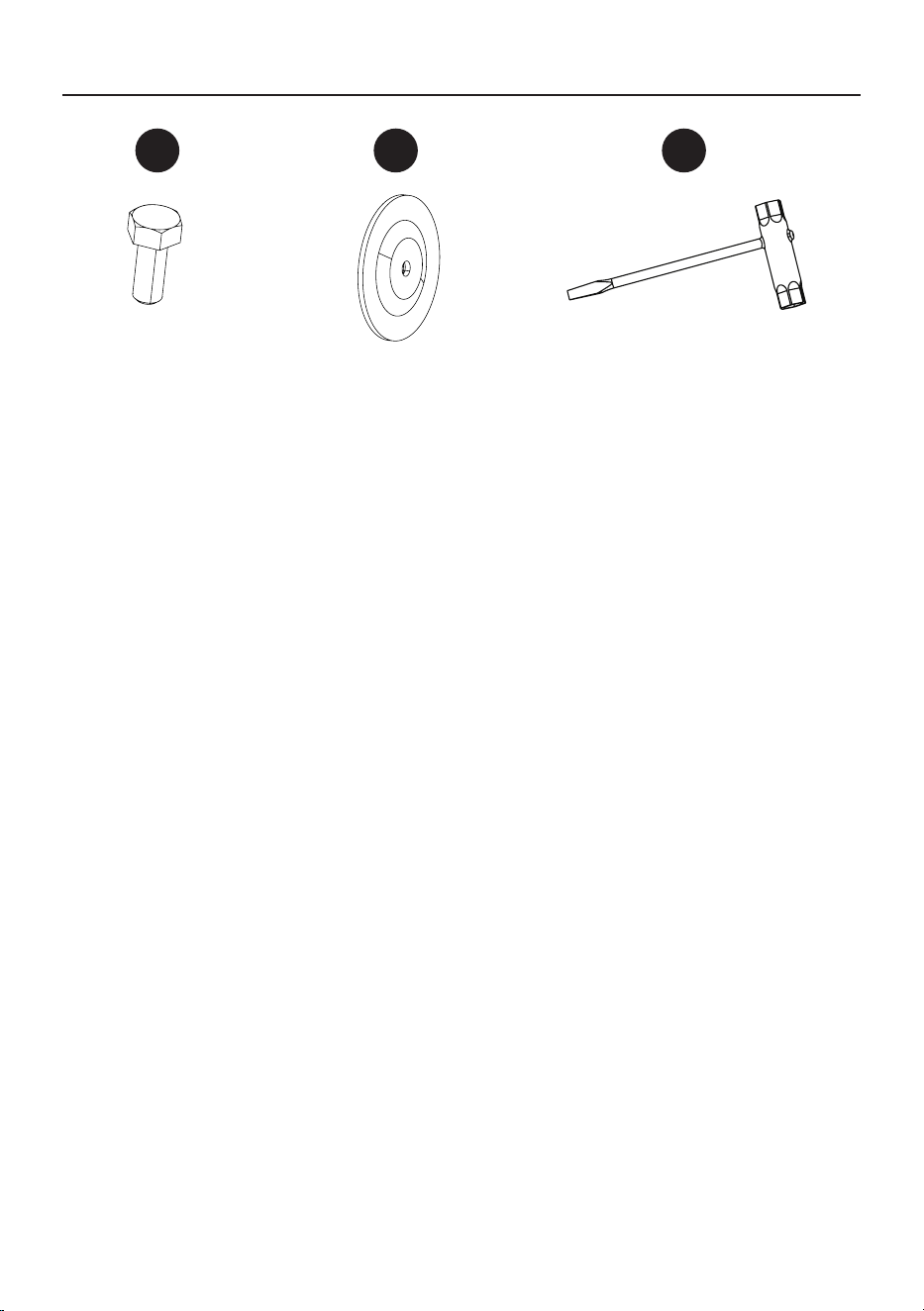
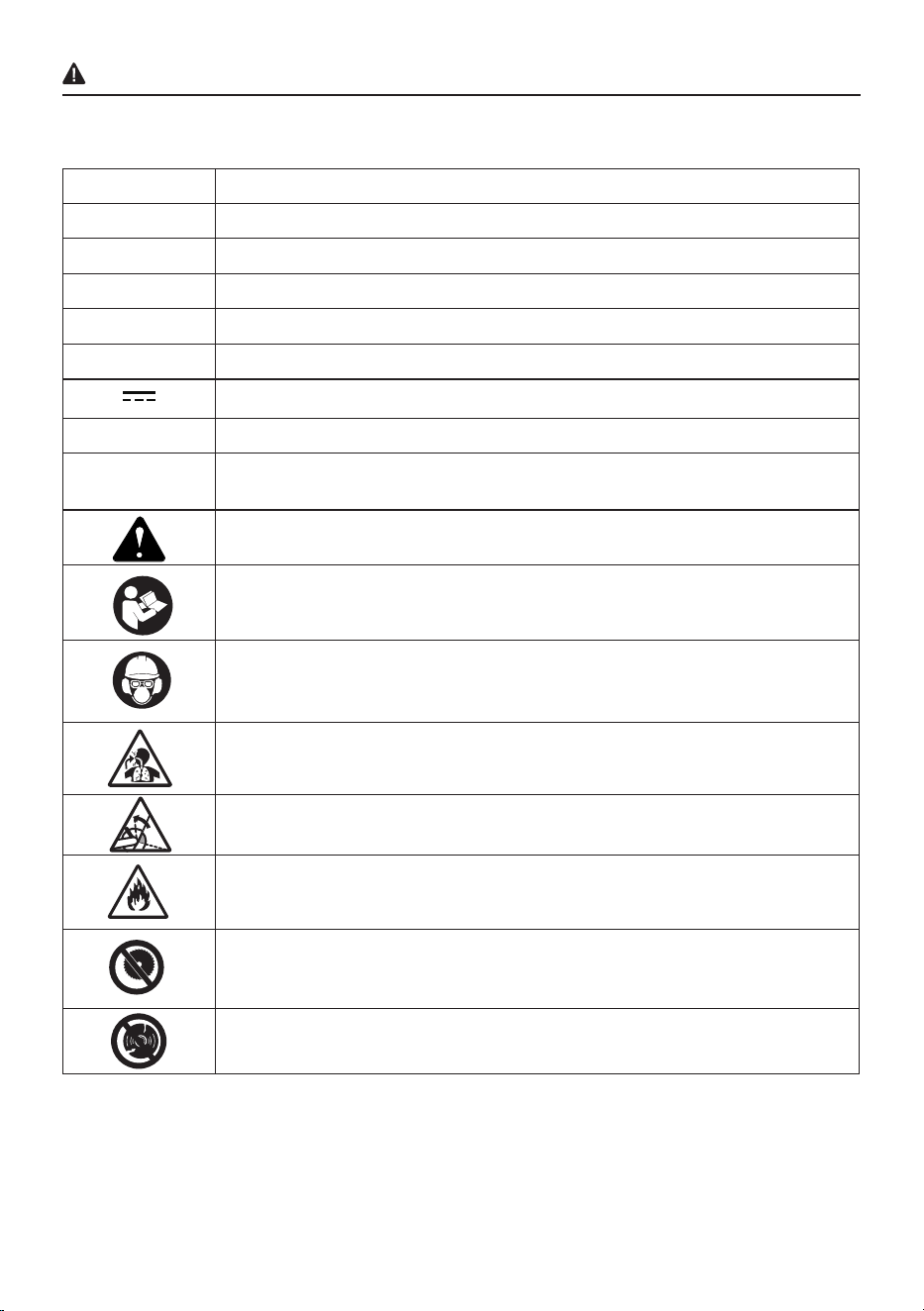
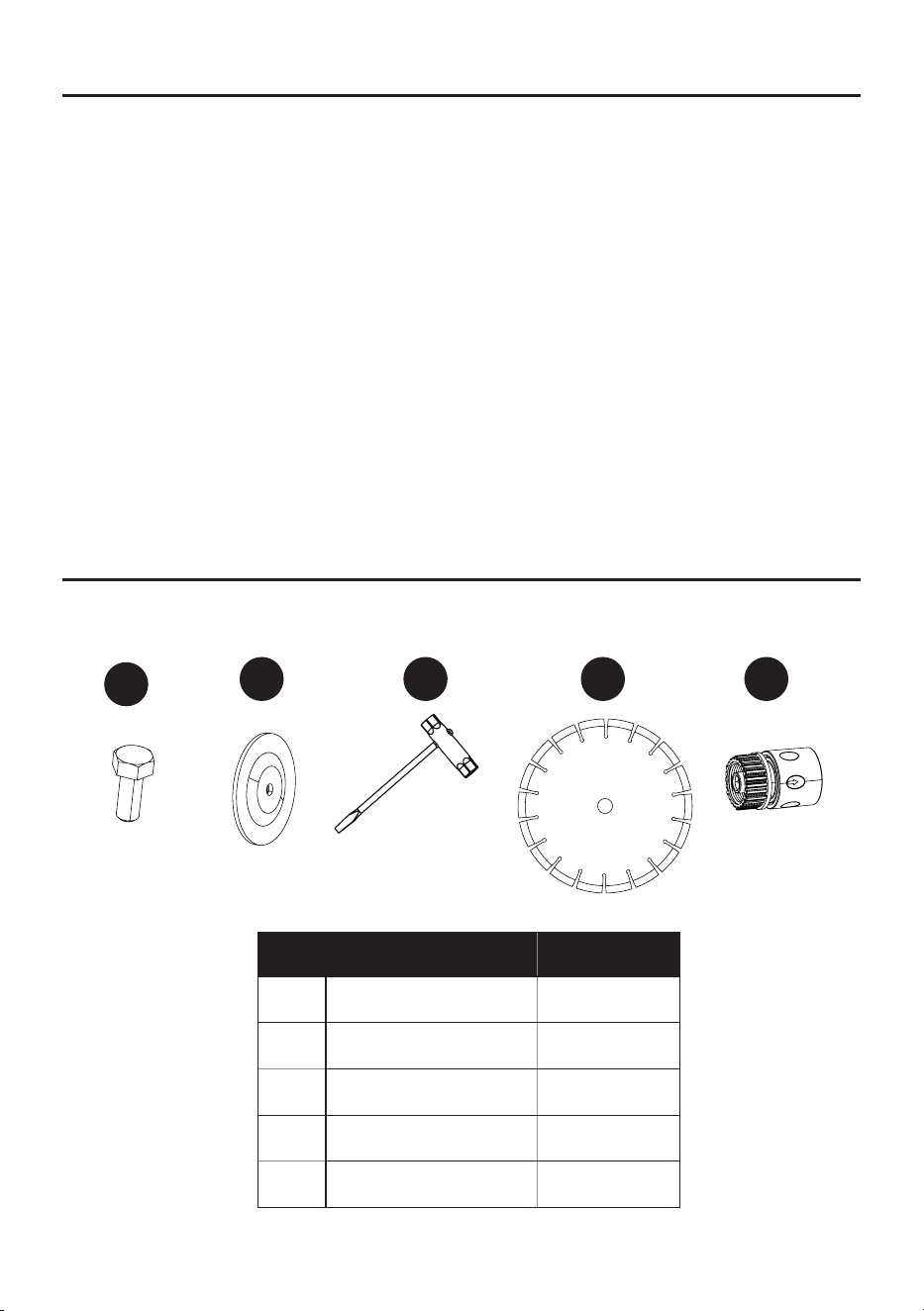
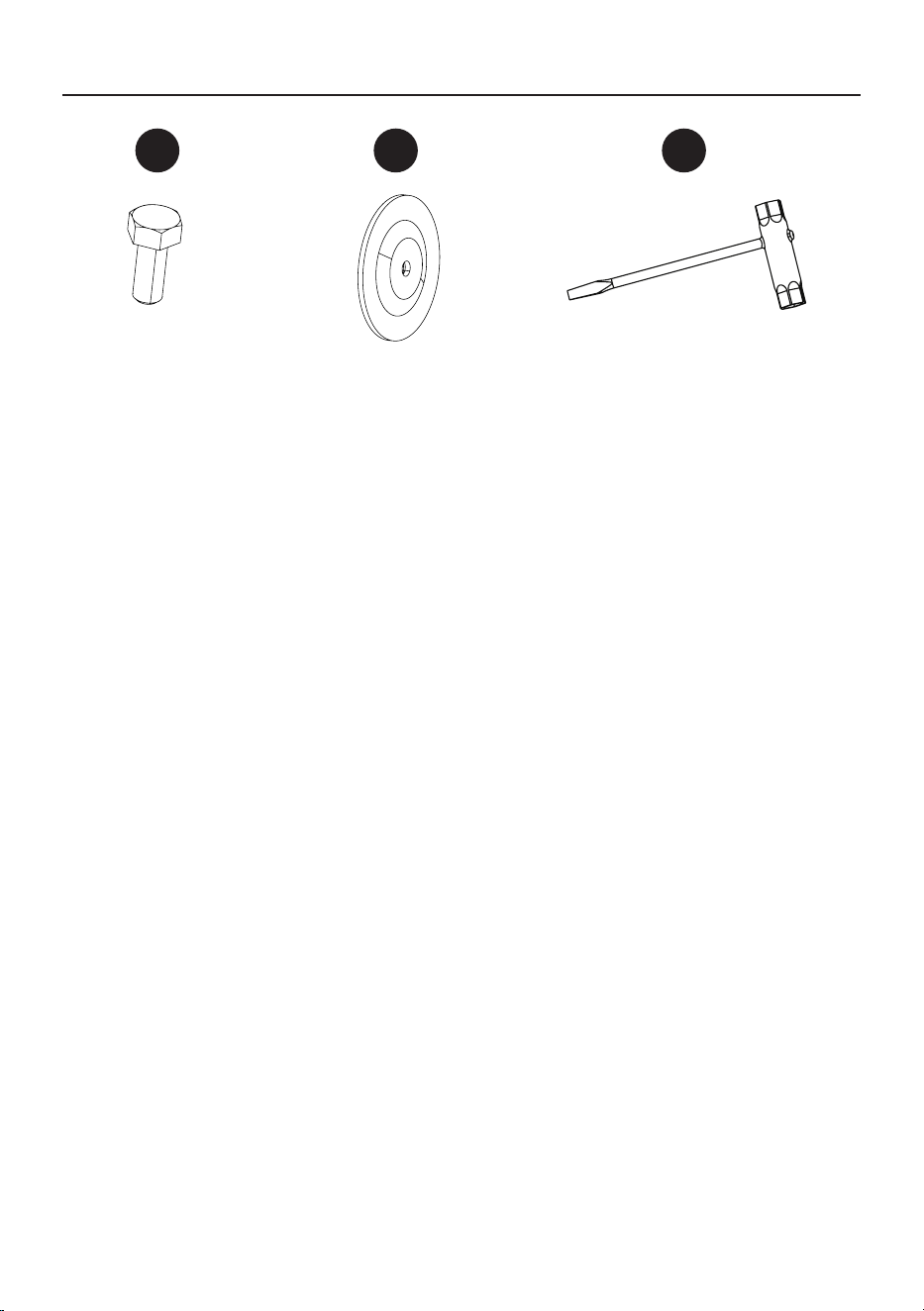
HARDWARE CONTENTS (Not to scale)
M8 x 20 mm
Bolt
Qty. 1
φ76 mm
Washer
Qty. 1
Wrench
Qty. 1
AA BB CC
5
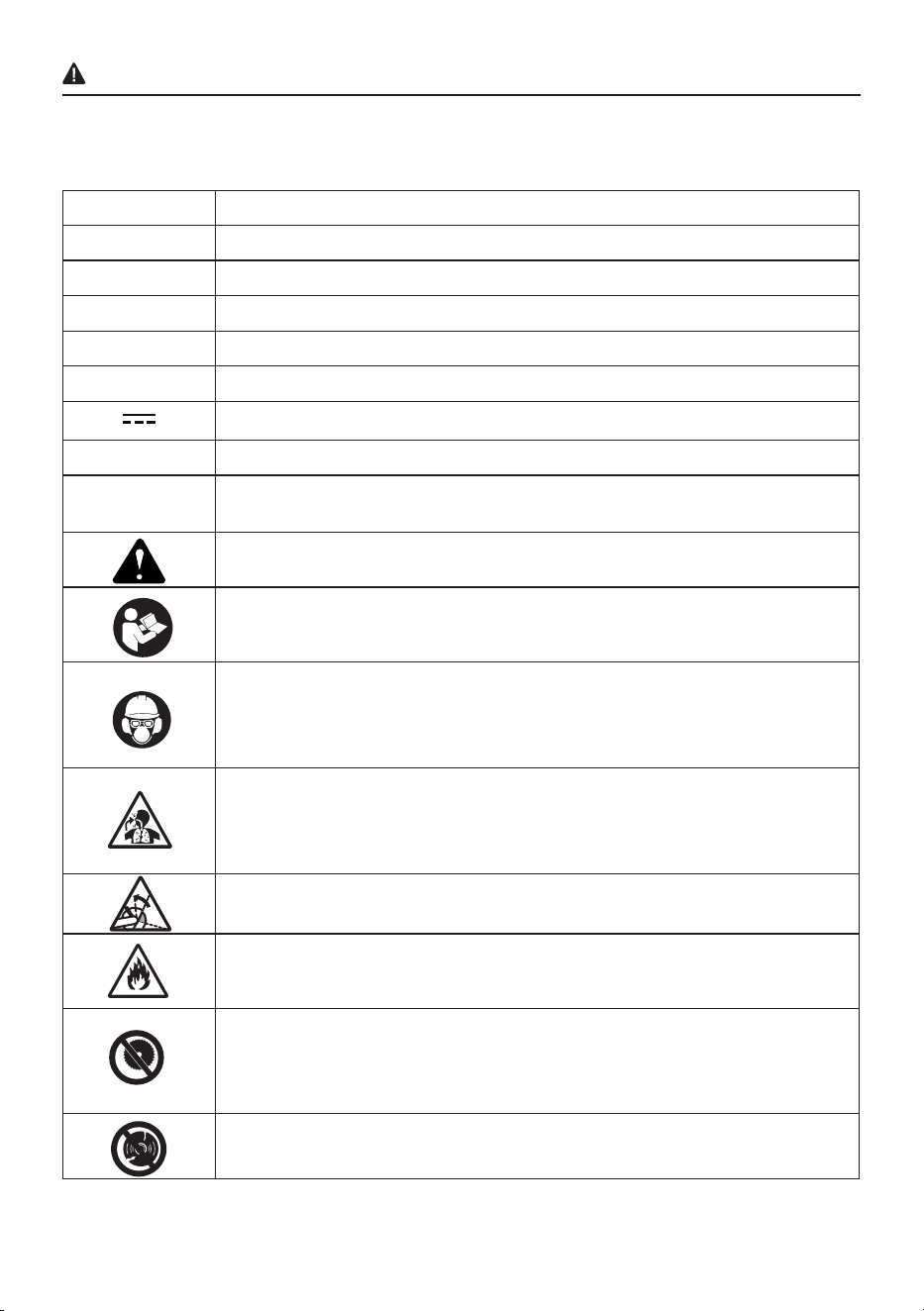
SYMBOLS
Some of the following symbols may be used on this product. Please study them and learn their
meaning. Proper interpretation of these symbols will allow you to operate the product better and safer.
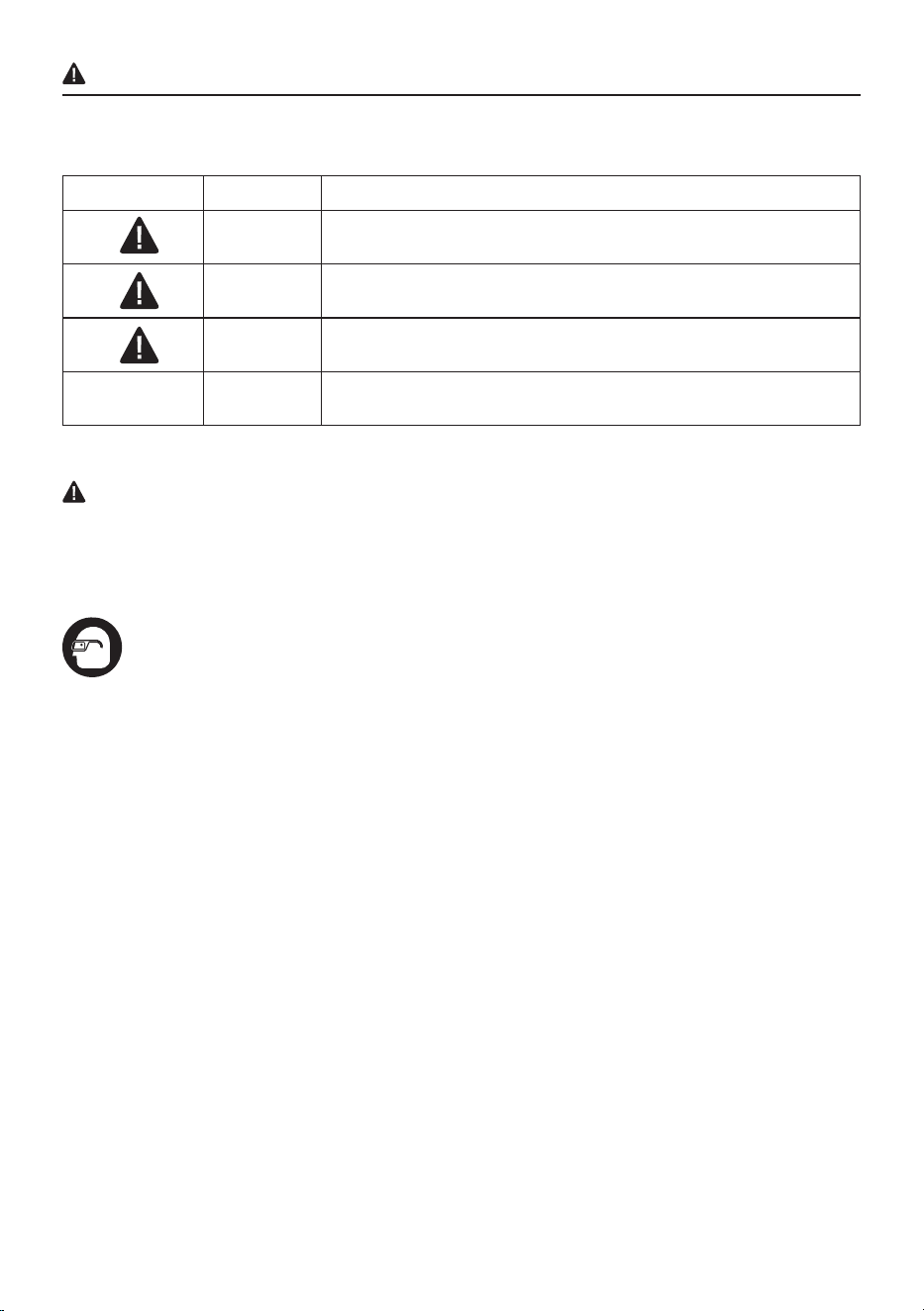
SYMBOLS EXPLANATION
V Voltage
A Current
Hz Frequency (cycles per second)
W Power
min Time
Type or a characteristic of current
Rational speed, at no load
/min Revolutions, strokes, surface speed, orbits etc., per minute
Precautions that involve your safety.
To reduce the risk of injury user must read and understand operator’s manual
before using this product.
Wear eye and ear protection, wear a face mask and make sure it ts correctly,
wear a hard hat wherever there is any risk of falling objects.
Fume from cutting can cause injuries if breathed in. Use an approved breathing
protection. Prevent breathe exhaust fumes. Make sure that the airow is sufcient.
Kickbacks can be sudden, fast and can cause injuries.
Sparks from the cutting blade can cause re in ammable materials such as:
gasoline, wood, clothes and dry grass.
Never use circular saw blades, carbide, rescue or wood cutting attachments
or saws of any kind – these may cause fatal injuries!
Make sure the blade is not cracked or damaged.
n
o
6
SYMBOLS
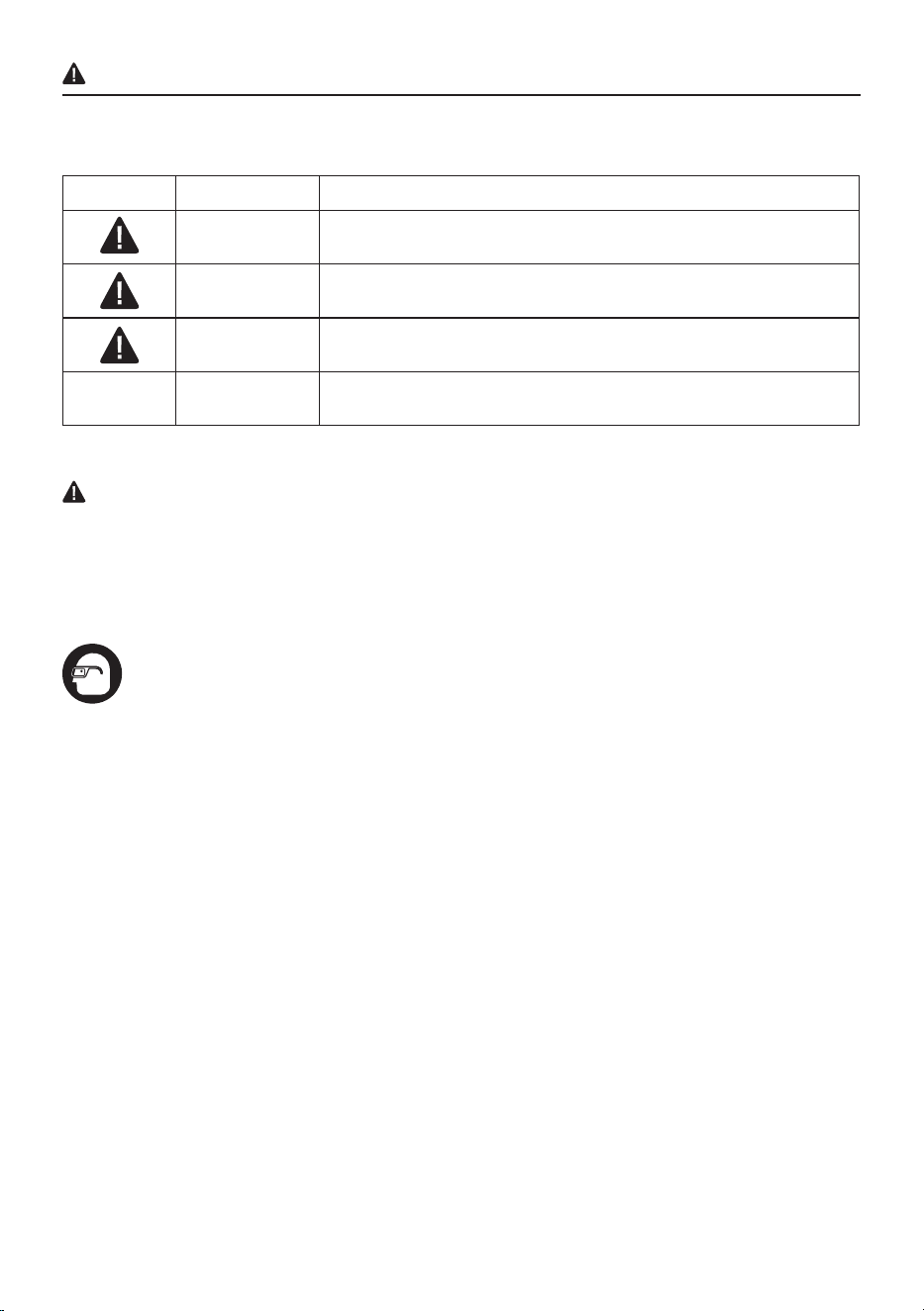
WARNING
The following signal words and meanings are intended to explain the levels of risk associated with this
product.
SYMBOL SIGNAL MEANING
DANGER
Indicates an imminently hazardous situation, which, if not avoided,
will result in death or serious injury.
WARNING
Indicates a potentially hazardous situation, which, if not avoided,
could result in death or serious injury.
CAUTION
Indicates a potentially hazardous situation, which, if not avoided,
may result in minor or moderate injury.
CAUTION
(Without Safety Alert Symbol) Indicates a situation that may result
in property damage.
• To avoid serious personal injury, do not attempt to use this product until you have read this owner's
manual thoroughly and understand it completely. If you do not understand the warnings and
instructions in this owner's manual, do not use this product. Call 888-356-2258 for assistance.
The operation of any product can result in foreign objects being thrown into your eyes, which
can result in severe eye damage. Before operating a product, always wear safety goggles,
safety glasses with side shields, or a full-face shield when needed. A Wide Vision Safety Mask
is recommended for use over eyeglasses or standard safety glasses with side shields. Always
use eye protection that is marked to comply with ANSI Z87.1.

7
SAFETY INFORMATION
WARNING
Read all safety warnings and all instructions. Failure to follow the warnings and instructions may
result in electric shock, re and/or serious injury.
Save all warnings and instructions for future reference.
The term "power tool" in the warnings
refers to your mains-operated (corded) power tool or battery-operated (cordless) power tool.
1. WORK AREA SAFETY
• Keep work area clean and well lit. Cluttered or dark areas invite accidents.
• Do not operate power tools in explosive atmospheres, such as in the presence of
ammable liquids, gases or dust. Power tools create sparks which may ignite the dust or fumes.
• Keep children and bystanders away while operating a power tool. Distractions can cause you
to lose control.
2. ELECTRICAL SAFETY
• Power tool plugs must match the outlet. Never modify the plug in any way. Do not use any
adapter plugs with earthed (grounded) power tools. Unmodied plugs and matching outlets will
reduce risk of electric shock.
• Avoid body contact with earthed or grounded surfaces, such as pipes, radiators, ranges and
refrigerators. There is an increased risk of electric shock if your body is earthed or grounded.
• Do not expose power tools to rain or wet conditions. Water entering a power tool will increase
the risk of electric shock.
• Do not abuse the cord. Never use the cord for carrying, pulling or unplugging the power tool.
Keep cord away from heat, oil, sharp edges or moving parts. Damaged or entangled cords
increase the risk of electric shock.
• When operating a power tool outdoors, use an extension cord suitable for outdoor use. Use
of a cord suitable for outdoor use reduces the risk of electric shock.
• If operating a power tool in a damp location is unavoidable, use a residual current device
(RCD) protected supply. Use of an RCD reduces the risk of electric shock.
• Use only KOBALT 80-volt batteries (KB 280C-06, KB 2580C-06, KB 480-06, KB 580C-06, KB
680C-06).
• Use only KOBALT charger (KRC 0280-06, KRC 30-06, KDC 50-06).
3. PERSONAL SAFETY
• Stay alert, watch what you are doing and use common sense when operating a power tool.
Do not use a power tool while you are tired or under the inuence of drugs, alcohol or
medication. A moment of inattention while operating power tools may result in serious personal
injury.
• Use personal protective equipment. Always wear eye protection. Protective equipment such as
dust mask, non-skid safety shoes, hard hat, or hearing protection used for appropriate conditions
will reduce personal injuries.
• Prevent unintentional starting. Ensure the switch is in the off position before connecting to
power source and/or battery pack, picking up or carrying the tool. Carrying power tools with
your nger on the switch or energizing power tools that have the switch on invites accidents.

8
SAFETY INFORMATION
• Remove any adjusting key or wrench before turning the power tool on. A wrench or a key left
attached to a rotating part of the power tool may result in personal injury.
• Do not overreach. Keep proper footing and balance at all times. This enables better control of
the power tool in unexpected situations.
• Dress properly. Do not wear loose clothing or jewelry. Keep your hair, clothing and gloves away
from moving parts. Loose clothes, jewelry or long hair can be caught in moving parts.
• If devices are provided for the connection of dust extraction and collection facilities,
ensure these are connected and properly used. Use of dust collection can reduce dust-related
hazards.
4. POWER TOOL USE AND CARE
• Do not force the power tool. Use the correct power tool for your application. The correct
power tool will do the job better and safer at the rate for which it was designed.
• Do not use the power tool if the switch does not turn it on and off. Any power tool that cannot
be controlled with the switch is dangerous and must be repaired.
• Disconnect the plug from the power source and/or the battery pack from the power tool
before making any adjustments, changing accessories, or storing power tools. Such
preventive safety measures reduce the risk of starting the power tool accidentally.
• Store idle power tools out of the reach of children and do not allow persons unfamiliar with
the power tool or these instructions to operate the power tool. Power tools are dangerous in
the hands of untrained users.
• Maintain power tools. Check for misalignment or binding of moving parts, breakage of parts
and any other condition that may affect the power tool’s operation. If damaged, have the
power tool repaired before use. Many accidents are caused by poorly maintained power tools.
• Keep cutting tools sharp and clean. Properly maintained cutting tools with sharp cutting edges
are less likely to bind and are easier to control.
• Use the power tool, accessories and tool bits etc. in accordance with these instructions,
taking into account the working conditions and the work to be performed. Use of the power
tool for operations different from those intended could result in a hazardous situation.
• Keep handles and grasping surfaces dry, clean and free from oil and grease. Slippery
handles and grasping surfaces do not allow for safe handling and control of the tool in unexpected
situations.
5. BATTERY TOOL USE AND CARE
• Recharge only with the charger specied by the manufacturer. A charger that is suitable for
one type of battery pack may create a risk of re when used with another battery pack.
• Use power tools only with specically designated battery packs. Use of any other battery
packs may create a risk of injury and re.
• When battery pack is not in use, keep it away from other metal objects, like paper clips,
coins, keys, nails, screws or other small metal objects, that can make a connection from one
terminal to another. Shorting the battery terminals together may cause burns or a re.
• Under abusive conditions, liquid may be ejected from the battery; avoid contact. If contact
accidentally occurs, ush with water. If liquid contacts eyes, additionally seek medical help.
Liquid ejected from the battery may cause irritation or burns.

9
SAFETY INFORMATION
• Do not use a battery pack or tool that is damaged or modied. Damaged or modied batteries
may exhibit unpredictable behavior resulting in re, explosion or risk of injury.
• Do not expose a battery pack or tool to re or excessive temperature. Exposure to re or
temperature above 130°C may cause explosion.
• Follow all charging instructions and do not charge the battery pack or tool outside the
temperature range specied in the instructions. Charging improperly or at temperatures outside
the specied range may damage the battery and increase the risk of re.
6. SERVICE
• Have your power tool serviced by a qualied repair person using only identical replacement
parts. This will ensure that the safety of the power tool is maintained.
• Never service damaged battery packs. Service of battery packs should only be performed by the
manufacturer or authorized service providers.
7. CUT-OFF MACHINE SAFETY WARNINGS
• The guard provided with the tool must be securely attached to the power tool and positioned
for maximum safety, so the least amount of wheel is exposed towards the operator. Position
yourself and bystanders away from the plane of the rotating wheel. The guard helps to protect
operator from broken wheel fragments and accidental contact with wheel.
• Use only diamond cut-off wheels for your power tool. Just because an accessory can be
attached to your power tool, it does not assure safe operation.
• The rated speed of the accessory must be at least equal to the maximum speed marked on
the power tool. Accessories running faster than their rated speed can break and y apart.
• Wheels must be used only for recommended applications. For example, do not grind with
the side of cut-off wheel. Abrasive cut-off wheels are intended for peripheral grinding, side forces
applied to these wheels may cause them to shatter.
• Always use undamaged wheel anges that are of correct diameter for your selected wheel.
Proper wheel anges support the wheel thus reducing the possibility of wheel breakage.
• Do not use worn down reinforced wheels from larger power tools. Wheels intended for a larger
power tool are not suitable for the higher speed of a smaller tool and may burst.
• The outside diameter and the thickness of your accessory must be within the capacity rating
of your power tool. Incorrectly sized accessories cannot be adequately guarded or controlled.
• The arbor size of wheels and anges must properly t the spindle of the power tool. Wheels
and anges with arbor holes that do not match the mounting hardware of the power tool will run out
of balance, vibrate excessively and may cause loss of control.
• Do not use damaged wheels. Before each use, inspect the wheels for chips and cracks. If
power tool or wheel is dropped, inspect for damage or install an undamaged wheel. After
inspecting and installing the wheel, position yourself and bystanders away from the plane
of the rotating wheel and run the power tool at maximum no load speed for one minute.
Damaged wheels will normally break apart during this test time.
• Wear personal protective equipment. Depending on application, use face shield, safety
goggles or safety glasses. As appropriate, wear dust mask, hearing protectors, gloves and
shop apron capable of stopping small abrasive or workpiece fragments. The eye protection
must be capable of stopping ying debris generated by various operations. The dust mask or
respirator must be capable of ltrating particles generated by your operation. Prolonged exposure to

10
SAFETY INFORMATION
high intensity noise may cause hearing loss.
• Keep bystanders a safe distance away from work area. Anyone entering the work area must
wear personal protective equipment. Fragments of workpiece or of a broken wheel may y away
and cause injury beyond immediate area of operation.
• Hold the power tool by insulated gripping surfaces only, when performing an operation
where the cutting accessory may contact hidden wiring. Cutting accessory contacting a “live”
wire may make exposed metal parts of the power tool “live” and could give the operator an electric
shock.
• Position the cord clear of the spinning accessory. If you lose control, the cord may be cut or
snagged and your hand or arm may be pulled into the spinning wheel.
• Never lay the power tool down until the accessory has come to a complete stop. The spinning
wheel may grab the surface and pull the power tool out of your control.
• Do not run the power tool while carrying it at your side. Accidental contact with the spinning
accessory could snag your clothing, pulling the accessory into your body.
• Regularly clean the power tool’s air vents. The motor’s fan will draw the dust inside the housing
and excessive accumulation of powdered metal may cause electrical hazards.
• Do not operate the power tool near ammable materials. Sparks could ignite these materials.
8. KICKBACK AND RELATED WARNINGS
Kickback is a sudden reaction to a pinched or snagged rotating wheel. Pinching or snagging causes
rapid stalling of the rotating wheel which in turn causes the uncontrolled power tool to be forced in the
direction opposite of the wheel’s rotation at the point of the binding. For example, if an abrasive wheel
is snagged or pinched by the workpiece, the edge of the wheel that is entering into the pinch point can
dig into the surface of the material causing the wheel to climb out or kick out. The wheel may either
jump toward or away from the operator, depending on direction of the wheel’s movement at the point
of pinching. Abrasive wheels may also break under these conditions. Kickback is the result of power
tool misuse and/or incorrect operating procedures or conditions and can be avoided by taking proper
precautions as given below.
• Maintain a rm grip on the power tool and position your body and arm to allow you to
resist kickback forces. Always use auxiliary handle, if provided, for maximum control over
kickback or torque reaction during start-up. The operator can control torque reactions or
kickback forces, if proper precautions are taken.
• Never place your hand near the rotating accessory. Accessory may kickback over your hand.
• Do not position your body in line with the rotating wheel. Kickback will propel the tool in
direction opposite to the wheel’s movement at the point of snagging.
• Use special care when working corners, sharp edges etc. Avoid bouncing and snagging the
accessory. Corners, sharp edges or bouncing have a tendency to snag the rotating accessory and
cause loss of control or kickback.
• Do not attach a saw chain, woodcarving blade, segmented diamond wheel with a peripheral
gap greater than 10 mm or toothed saw blade. Such blades create frequent kickback and loss of
control.
• Do not “jam” the wheel or apply excessive pressure. Do not attempt to make an excessive
depth of cut. Overstressing the wheel increases the loading and susceptibility to twisting or binding
of the wheel in the cut and the possibility of kickback or wheel breakage.
• When wheel is binding or when interrupting a cut for any reason, switch off the power tool
11
SAFETY INFORMATION
and hold the power tool motionless until the wheel comes to a complete stop. Never attempt
to remove the wheel from the cut while the wheel is in motion otherwise kickback may occur.
Investigate and take corrective action to eliminate the cause of wheel binding.
• Do not restart the cutting operation in the workpiece. Let the wheel reach full speed and
carefully re-enter the cut. The wheel may bind, walk up or kickback if the power tool is restarted in
the workpiece.
• Support panels or any oversized workpiece to minimize the risk of wheel pinching and
kickback. Large workpieces tend to sag under their own weight. Supports must be placed under
the workpiece near the line of cut and near the edge of the workpiece on both sides of the wheel.
• Use extra caution when making a “pocket cut” into existing walls or other blind areas. The
protruding wheel may cut gas or water pipes, electrical wiring or objects that can cause kickback.
9. THE RECOMMENDED AMBIENT TEMPERATURE RANGE:
Item Temperature
Appliance storage temperature range 32°F (0°C) - 113°F (45°C)
Appliance operation temperature range 32°F (0°C) - 113°F (45°C)
Battery charging temperature range 39°F (4°C) - 104°F (40°C)
Charger operation temperature range 39°F (4°C) - 104°F (40°C)
Battery storage temperature range 32°F (0°C) - 113°F (45°C)
Battery discharging temperature range 32°F (0°C) - 113°F (45°C)
WARNING (PROPOSITION 65)
Some dust created by power sanding, sawing, grinding, drilling, and other construction activities
contain chemicals known to cause cancer, birth defects or other reproductive harm. Some examples
of these chemicals are:
• Lead from lead-based paints.
• Crystalline silica from bricks and cement and other masonry products, and
• Arsenic and chromium from chemically treated lumber.
Your risk of exposure to these chemicals varies depending on how often you do this type of work. To
reduce your exposure to these chemicals, work in a well-ventilated area, and work with approved safety
equipment, such as dust masks that are specically designed to lter out microscopic particles.

12
WARNING
WARNING
PREPARATION
Before beginning assembly of product, make sure all parts are present. Compare parts with package
contents list and hardware contents list. If any part is missing or damaged, do not attempt to assemble
the product.
Estimated Assembly Time: 5 - 10 minutes
ASSEMBLY INSTRUCTIONS
• If any parts are damaged or missing, do not operate this product until the parts are replaced.
Using a product with damaged or missing parts could result in serious personal injury.
• Do not attempt to modify this product or create accessories not recommended for use with this
product. Any such alteration or modication is misuse and could result in a hazardous condition
leading to possible serious personal injury.
• Do not allow familiarity with this product to make you careless. Remember that a careless fraction
of second is sufcient to inict serious injury.
• Do not use any attachments or accessories not recommended by the manufacturer of this
product. The use of attachments or accessories not recommended can result in serious personal
injury.
13
ASSEMBLY INSTRUCTIONS
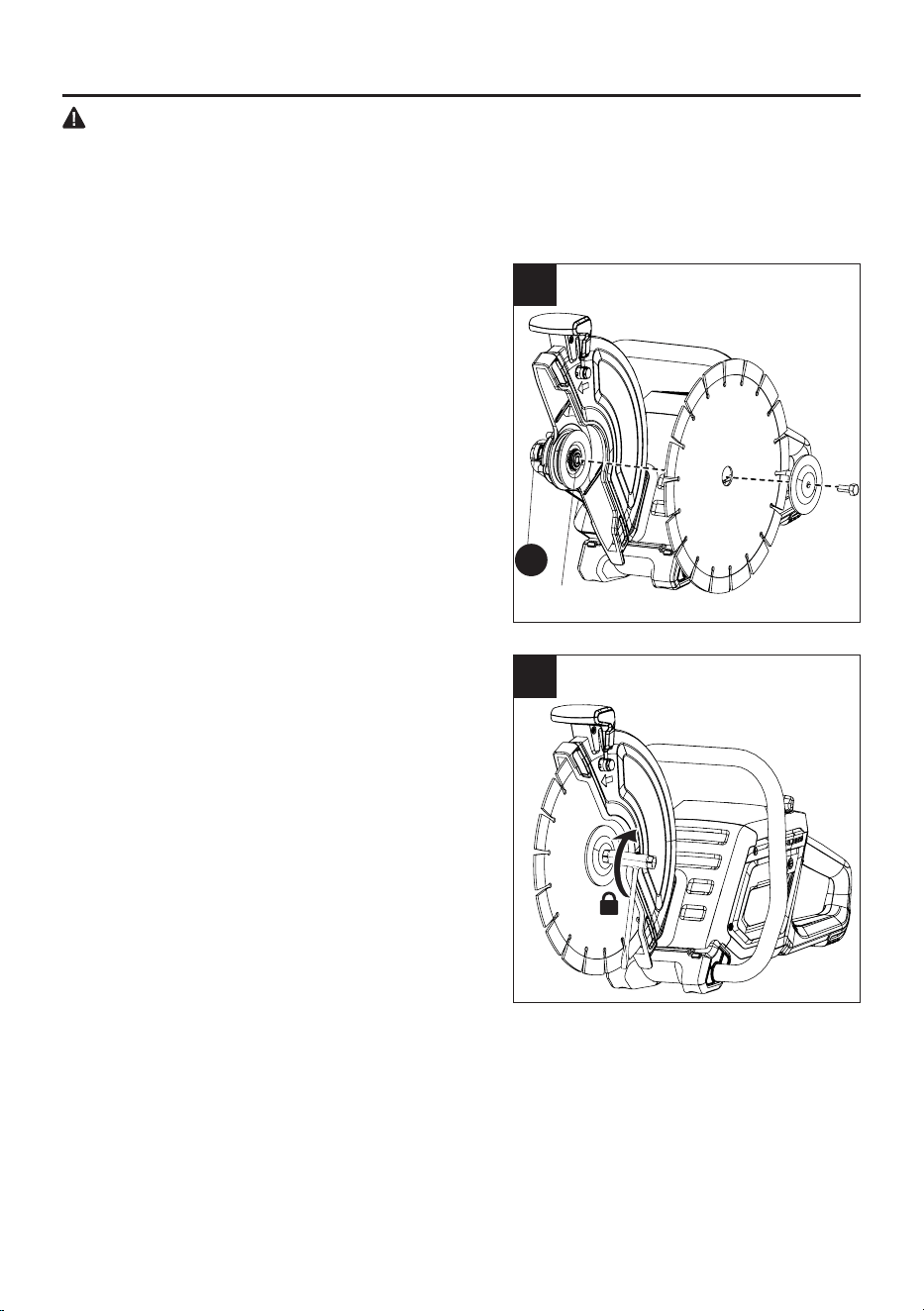
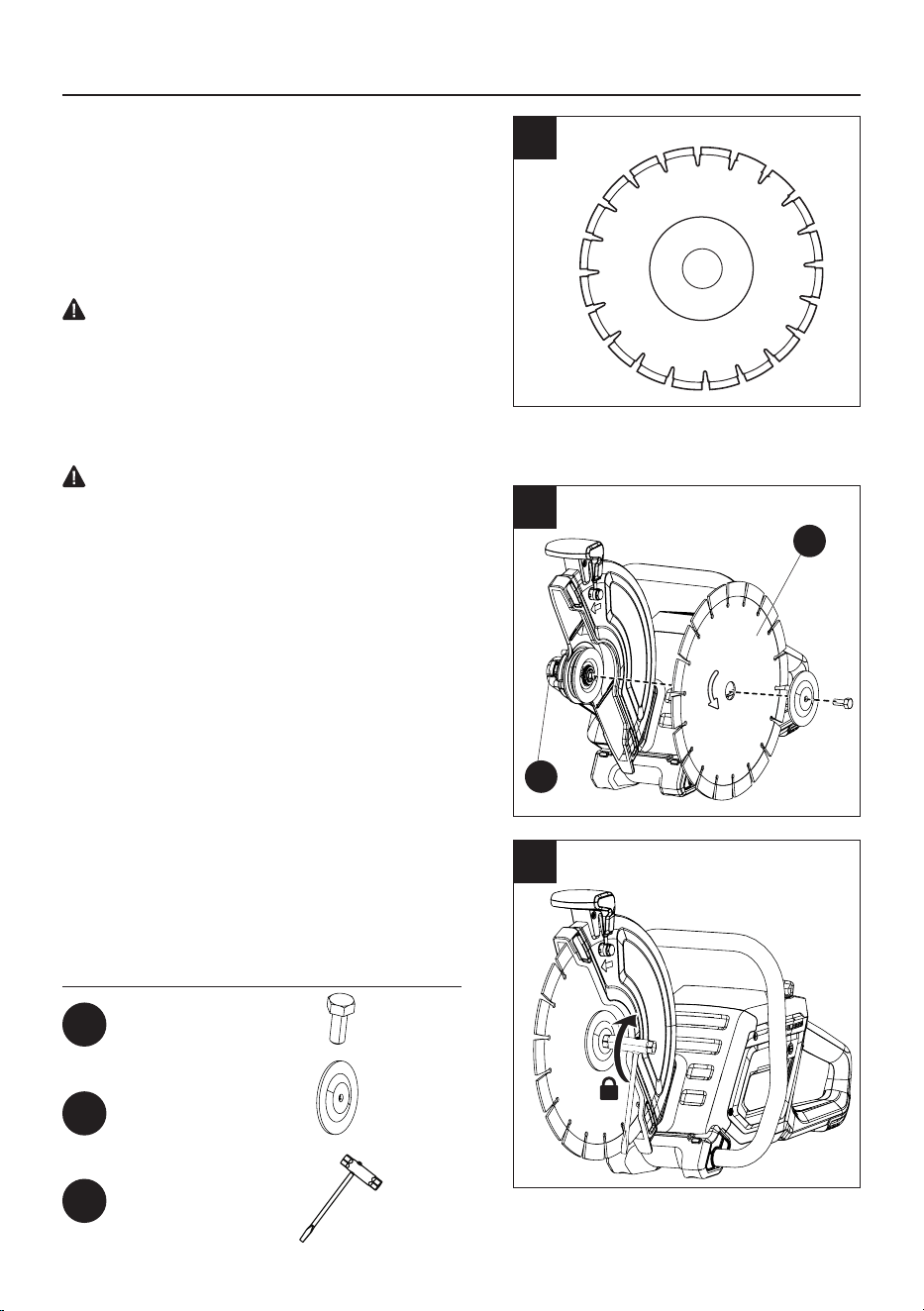
1a
1b
1c
L
K
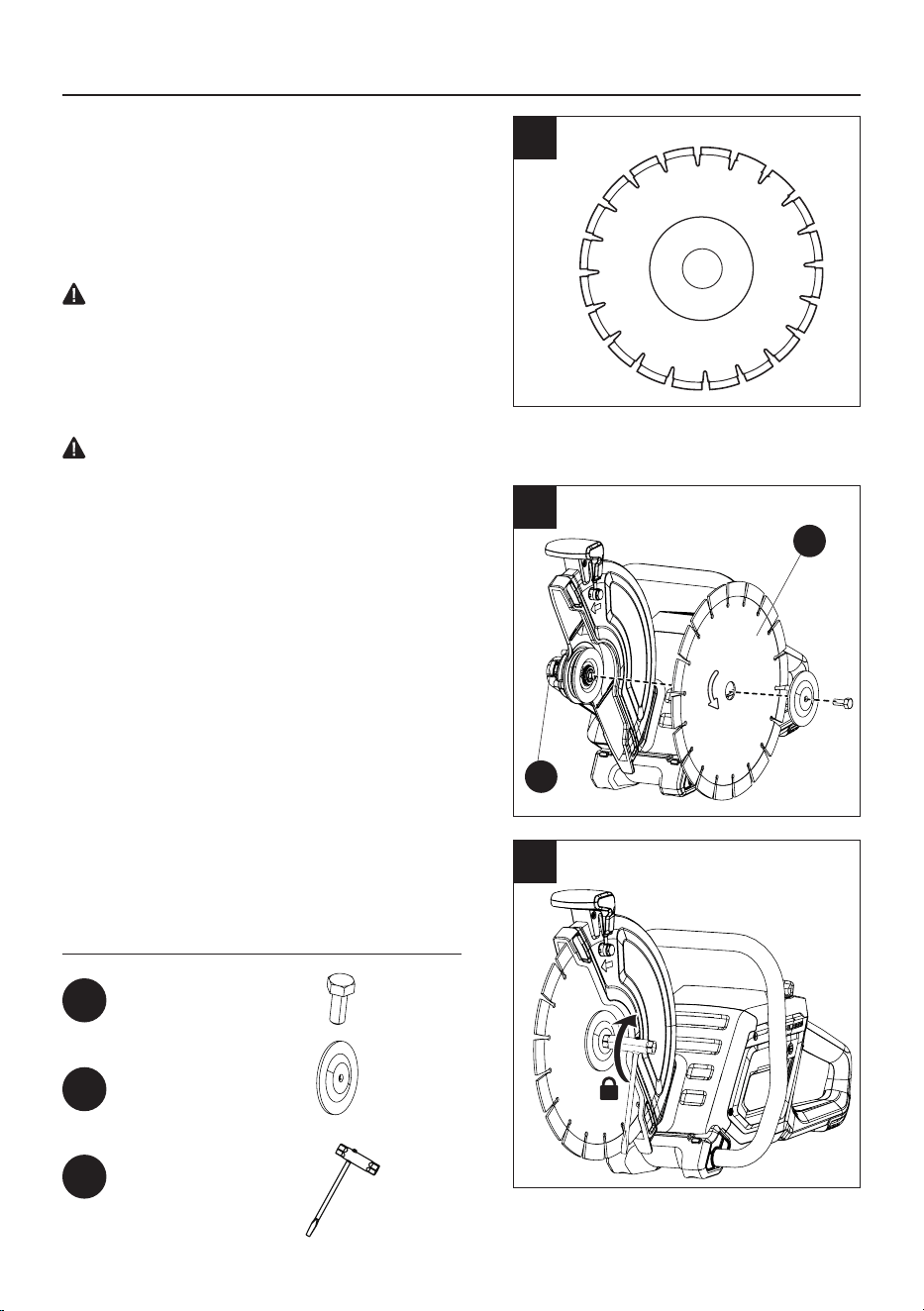
1. Installing the cutting blade
1a. This product is equipped with a diamond blade,
which is suitable, depending on the version,
for cutting certain materials such as asphalt,
concrete, hard stone, clay brick, clay pipe. Do
not cut any other materials – Risk of accident!
Hardware Used
M8 x 20 mm Bolt
x 1
AA
φ76 mm Washer
x 1
BB
Wrench
x 1
CC
WARNING
WARNING
• Never use a diamond blade to cut plastic
material. The heat produced during cutting may
melt the plastic and it can stick to the cutting
blade and cause a kickback.
• Diamond blades become very hot when used.
An overheated blade is a result of improper
use, and may cause deformation of the blade,
resulting in damage and injuries.
1b. Press and hold the spindle lock button (K).
• Remove the washer and bolt.
• Install the cutting blade (L), washer and bolt.
Note: The arrow on the guard shows the rotation
direction. Ensure the arrow on the blade follows
the same direction.
1c. Press and hold the spindle lock button.
• Tighten the bolt within a torque range of 18.5
ft-lbs.
14
ASSEMBLY INSTRUCTIONS
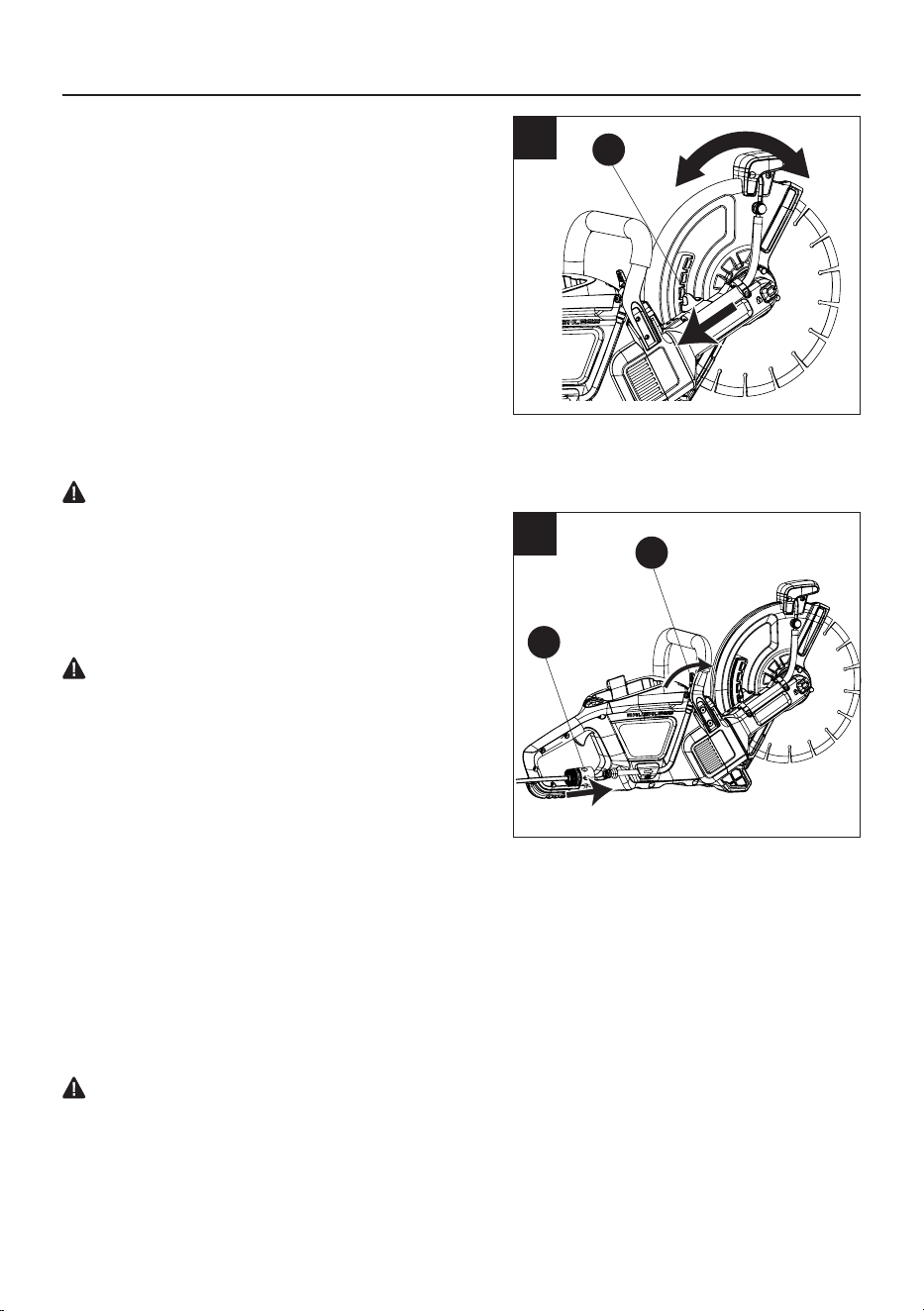
M
2
3
C
J
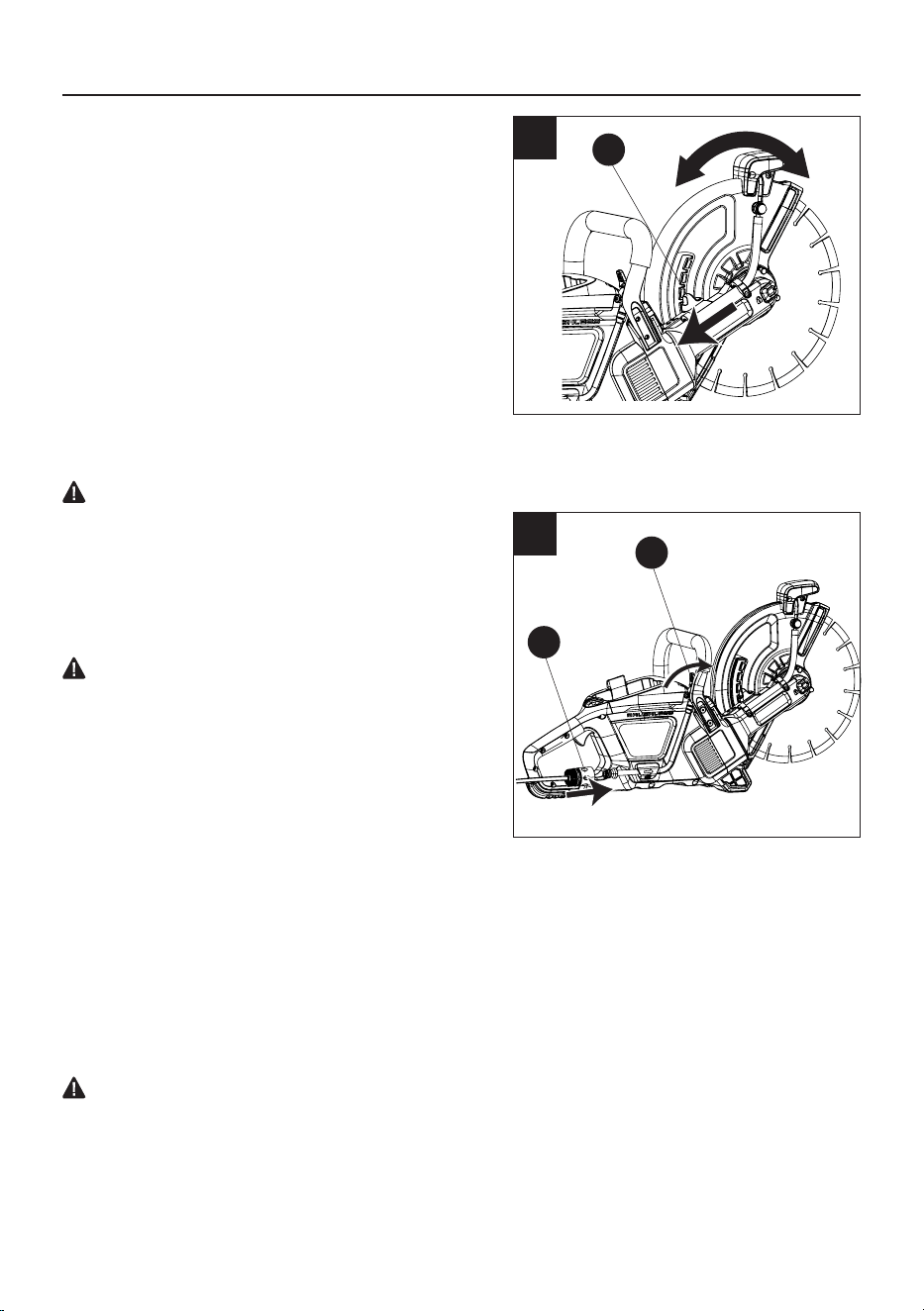
2. Adjusting the angle of the blade guard
The blade guard can be adjusted to different
angles.
3. Connect the water supply
WARNING
WARNING
WARNING
• Wet cutting is used only with the diamond
abrasive blade when cutting concrete.
• Carefully read and understand the safety
chapter and operation instructions before
applying water.
• In sub-zero temperature, the water must be
drained out from the pipe after nishing work to
avoid the risk of freezing.
• Do not cut after turning off the water supply, as it may lead to concrete grout blocking the water
outlet.
• Slide the guard adjustment lock (M) rearward
and hold it.
• Move the guard to the desired angle.
• When you hear a click, release the guard
adjustment lock to secure the guard.
• Remove the quick-connect coupler (J) and
securely attach to the hose.
• Reinstall the quick-connect coupler to the
product.
• Adjust the water ow lever (C) based on your
work conditions.
After nishing work:
• Switch off the product.
• Close the water ow lever.
• Disconnect the product from the water supply.
15
ASSEMBLY INSTRUCTIONS
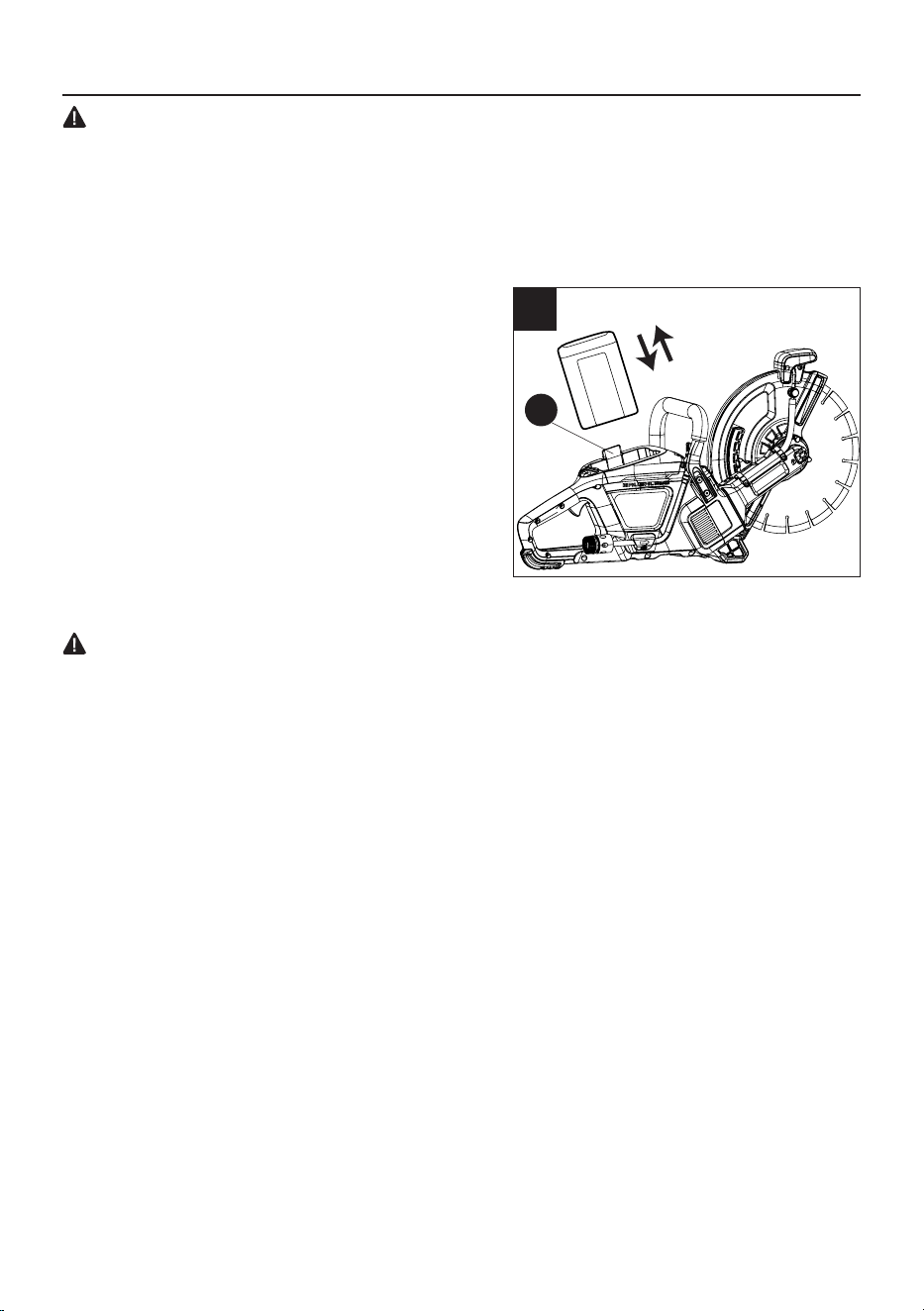
4
N
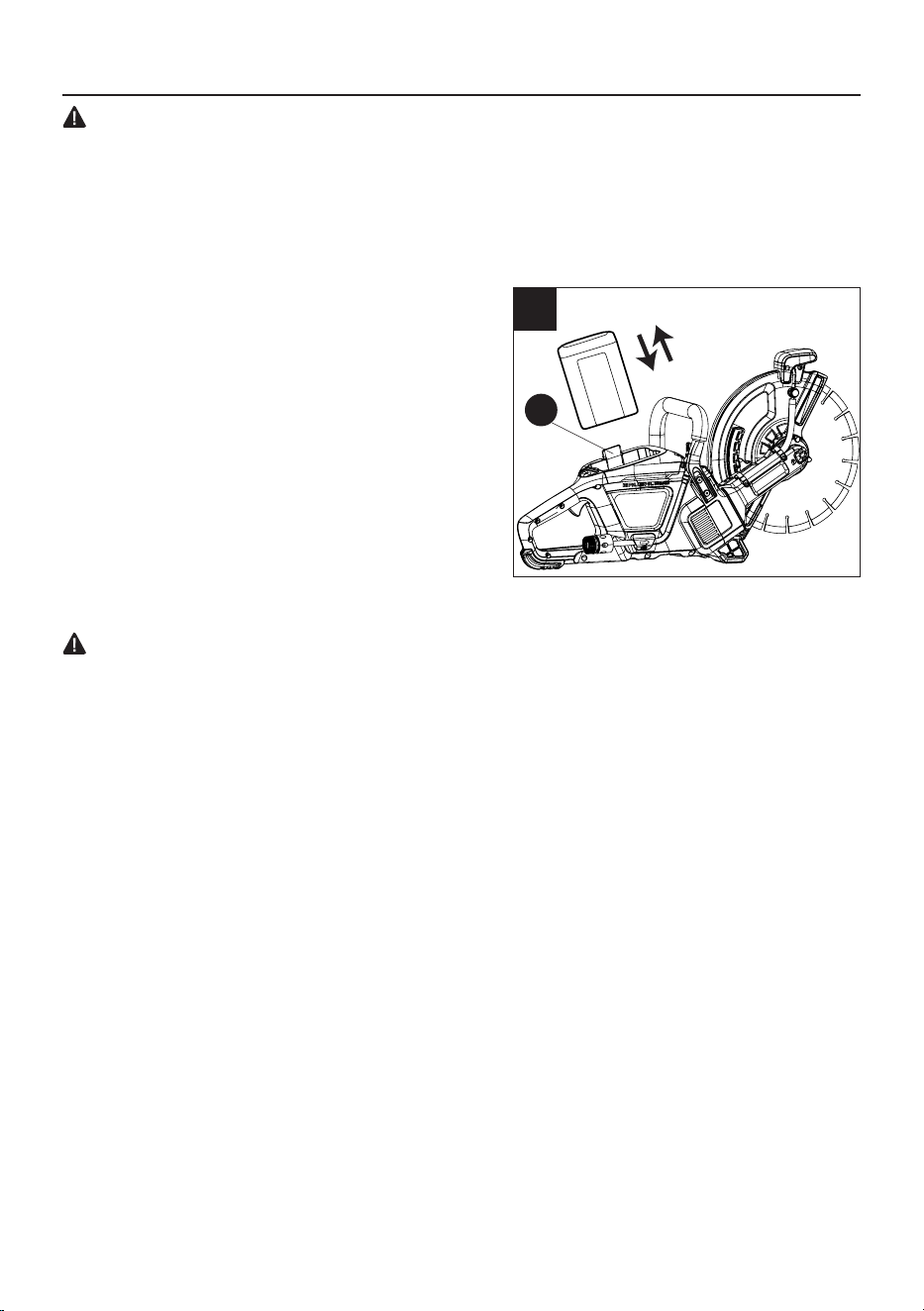
4. Installing / removing the battery
4a. To install battery
• Align the ribs on the battery pack with the
grooves in the battery compartment.
• Push the battery pack into the battery
compartment until the battery pack locks into
place.
• When you hear a click, the battery pack is
installed.
4b. To remove battery
• Push and hold the battery release button (N).
• Remove the battery pack from the product.
WARNING
WARNING
• Always remove battery from your product when you are assembling parts, making adjustments,
cleaning, or when not in use. Removing battery will prevent accidental starting that could cause
serious personal injury.
Follow these instructions on order to avoid injury and to reduce the risk of electric shock or re:
• Replace the battery or the charger immediately if the battery case or charger cord is damaged.
• Verify that the battery is removed before inspecting, adjusting, or performing maintenance on any
part of the product.
• Read, understand, and follow the instructions contained in the charger manual.
16
OPERATING INSTRUCTIONS
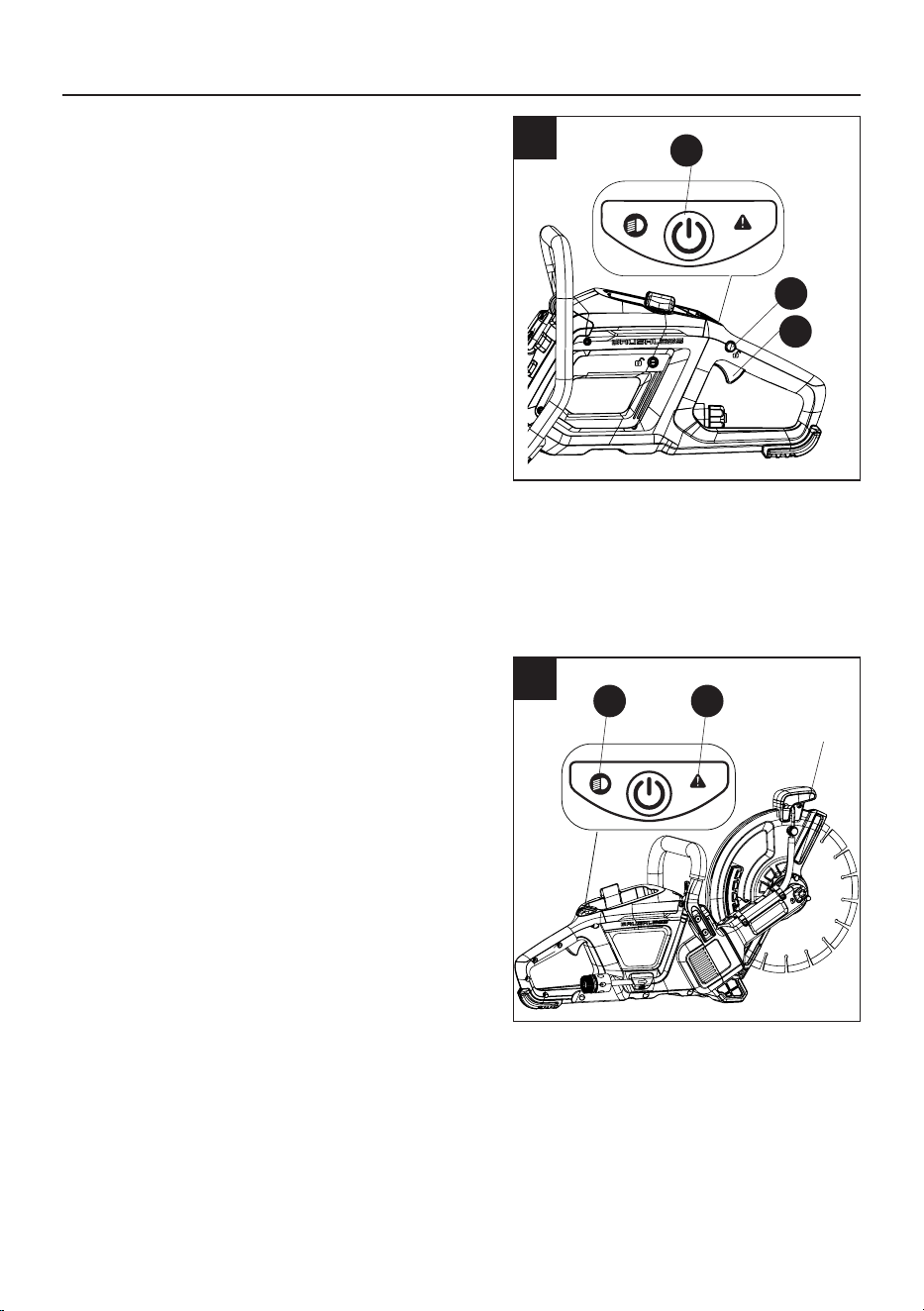
G
LED light
DF
I
1
2
E
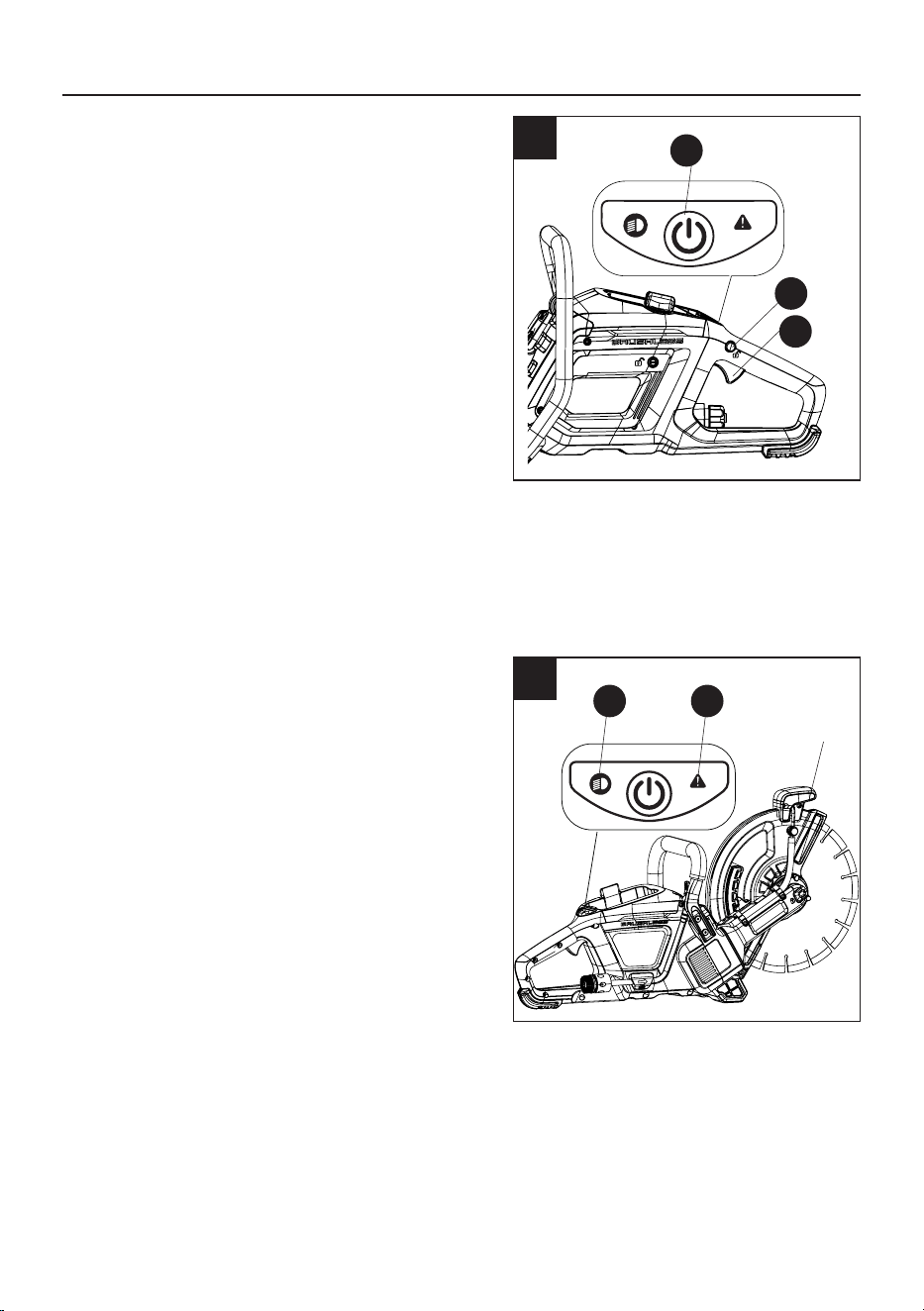
1. Starting / stopping the product
1a. To start the product
• Insert the battery into the product.
• Press the power button (E).
• Simultaneously push the trigger lockout (G)
and pull the trigger (I).
1b. To stop the product
• Release the trigger (I).
• Push the power button to turn the product off.
• Push and hold the battery release button.
• Remove the battery from the product to fully
stop its operation.
2. LED Indicator
2a. Light button (F)
• Press the light button to turn on the LED light.
Note: If there is a 10-minute period of inactivity, the
light will automatically switch off. The light will ash
during the last minute of the delay before turning off.
• Press the light button again to turn off the LED
light.
2b. Warning indicator (D)
• LED will illuminate RED indicating an abnormal
condition. Refer to the chart below.
Automatic shutdown safety function
The product has an automatic shutdown function that stops the product if it is not used. The product will
stand by after 1 minute of inactivity, and will power off after 10 minutes of inactivity.

17
OPERATING INSTRUCTIONS
PROBLEM POSSIBLE CAUSE CORRECTIVE ACTION
1 ash Motor low speed protection Release the trigger and start the
product again.
2 ashes Controller failure 1. Install the battery pack again.
2. Replace the controller if the
fault appears again.
3 ashes Battery pack communication
failure
1. Install the battery pack again.
2. Replace the controller if the
fault appears again.
4 ashes Overcurrent protection Release the trigger and start the
product again.
5 ashes Low-voltage protection Charge the battery pack.
6 ashes Controller over temperature
protection
Cool the controller to ambient
temperature.
7 ashes Blocking protection or
communication failure of hall
1. Release the trigger and start
the product again.
2. Replace the controller if the
fault appears again.
8 ashes Switch logic error 1. Release the trigger and start
the product again.
2. Replace the controller if the
fault appears again.
9 ashes Software authentication error 1. Install the battery pack again.
2. Replace the controller if the
fault appears again.
10 ashes Motor over-temperature
protection
Cool the controller to ambient
temperature.
11 ashes Battery temperature is too high. Cool the battery pack to ambient
temperature.
18
OPERATING INSTRUCTIONS
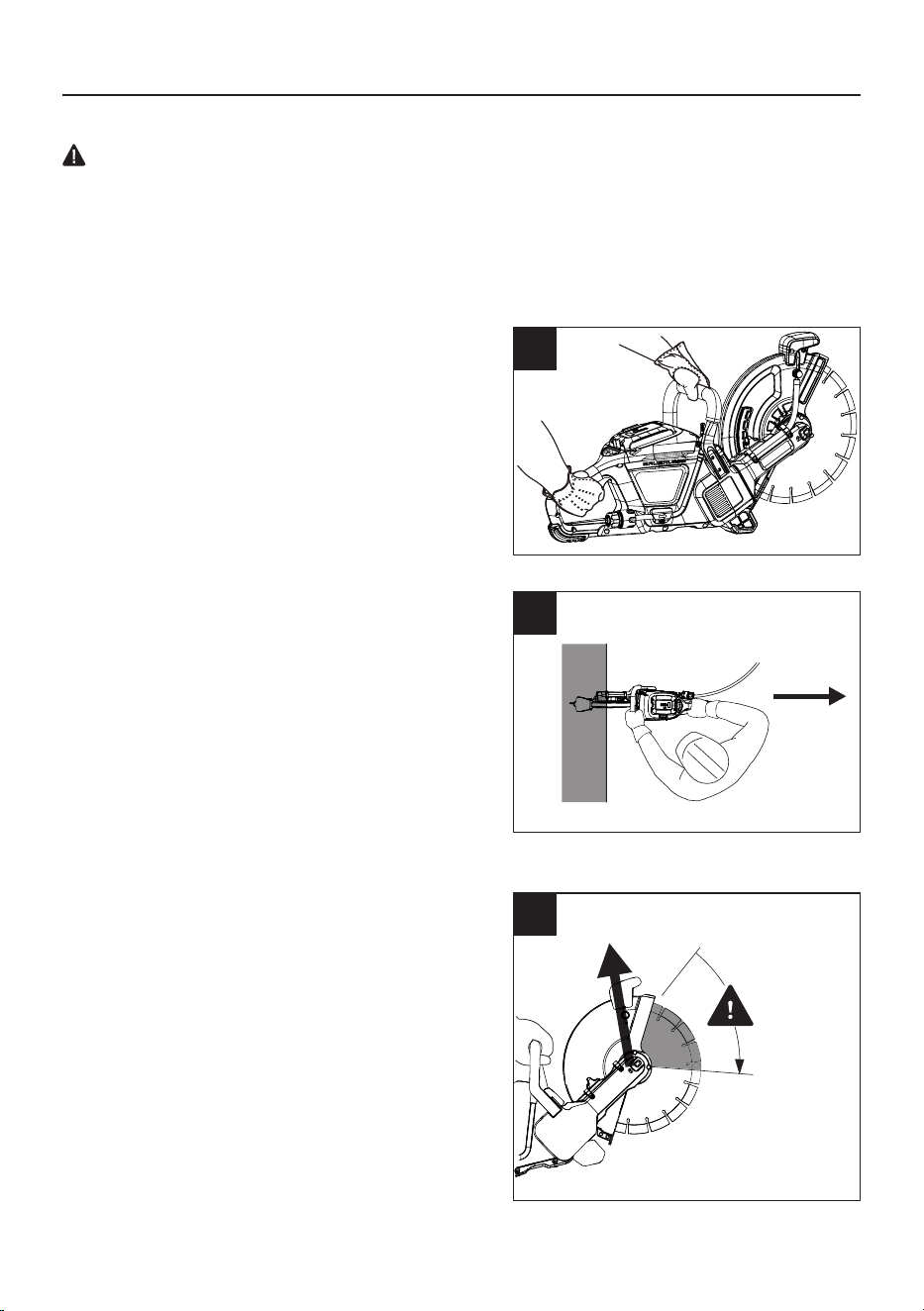
Operation tips
WARNING
• Do not move the product to the side. This can prevent the free movement of the blade and cause
the blade to break, which can cause an injury.
• Do not use the side of the blade. The blade can become damaged and broken, which can cause an
injury. Use only the cutting edge.
• Do not use a diamond blade to cut plastic material. The heat that occurs can melt the plastic. Melted
plastic can attach to the cutting blade and cause a kickback.
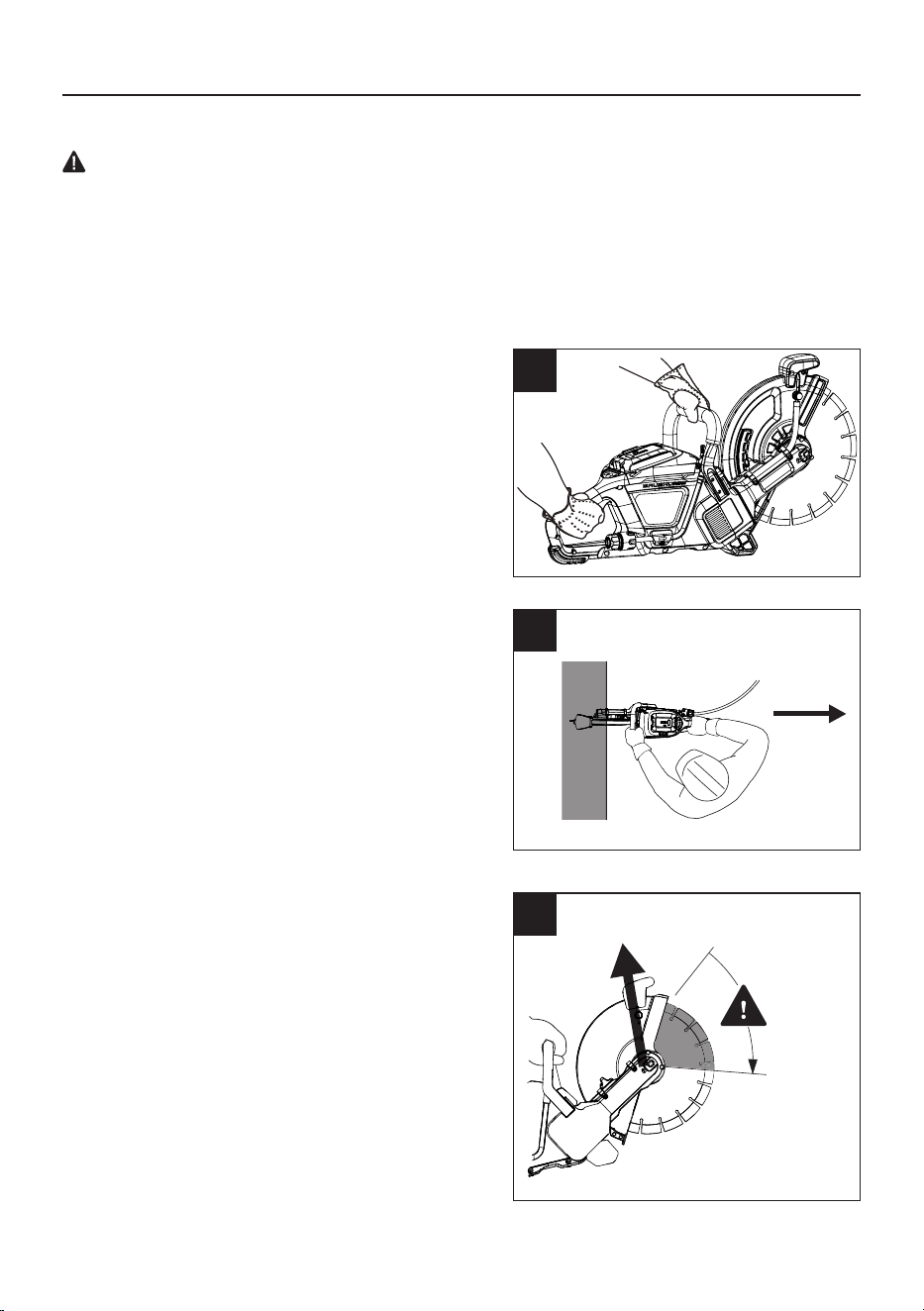
3. Hold the product securely with one hand on
the rear handle and the other hand on the front
handle. Always use both hands while operating
the product.
• Grip the handles rmly with your thumbs and
ngers wrapped around them.
• Ensure that the thumb of the hand holding the
front handle is positioned below the handle for a
secure grip.
4. Maintain good balance and footing at all the
times. Never cut while standing on a ladder.
• Position the product in such a way that your
body is clear of the cutting attachment. Avoid
standing in direct line with the blade. Never
bend over the cutting attachment, especially
when there is a risk of reactive forces. Ensure
sufcient freedom of movement, especially in
trenches. Make sure there is sufcient space for
the user and the fall of the severed part.
• Do not operate above shoulder height. Use a
platform or scaffold if the cutting operation is
above shoulder height. Do not overreach.
5. A kickback occurs when the blade is pinched
in the kickback zone. Usually they are not
dangerous but a strong kickback can cause
injury or death.
• A reactive force pulls the product in the opposite
direction of the blade movement. Most of the
time this force is not strong. If the blade is
pinched the strength of the reactive force can
cause a kickback.
• Do not tilt the product when the cutting
equipment rotates. Centrifugal forces can
decrease movement.
• Do not cut with the kickback zone of the cutting
blade. If the blade is pinched in the kickback
zone, the reactive force rotates the product up
and back. It can hit the operator and can result
in injury or death.
3
4
5
Kickback
Danger
Zone
19
CARE AND MAINTENANCE
WARNING
WARNING
• When servicing, use only identical replacement parts. Use of any other parts may create a hazard
or cause product damage.
• Always wear safety goggles or safety glasses with side shields during power tool operation or when
blowing dust. If the operation is dusty, also wear a dust mask.
General maintenance
Avoid using solvents when cleaning plastic parts. Most plastics are susceptible to damage from various
types of commercial solvents and may be damaged by their use. Use clean cloths to remove dirt, dust,
lubricant, grease, etc..
• Do not at any time let brake uids, gasoline, petroleum-based products, penetrating oils, etc., come
in contact with plastic parts. Chemicals can damage, weaken, or destroy plastic, which may result in
serious personal injury.
WARNING
• To avoid serious personal injury, read and understand all the safety instructions in this section.
• Before performing any maintenance, make sure the battery is removed. Failure to heed this warning
could result in serious personal injury.
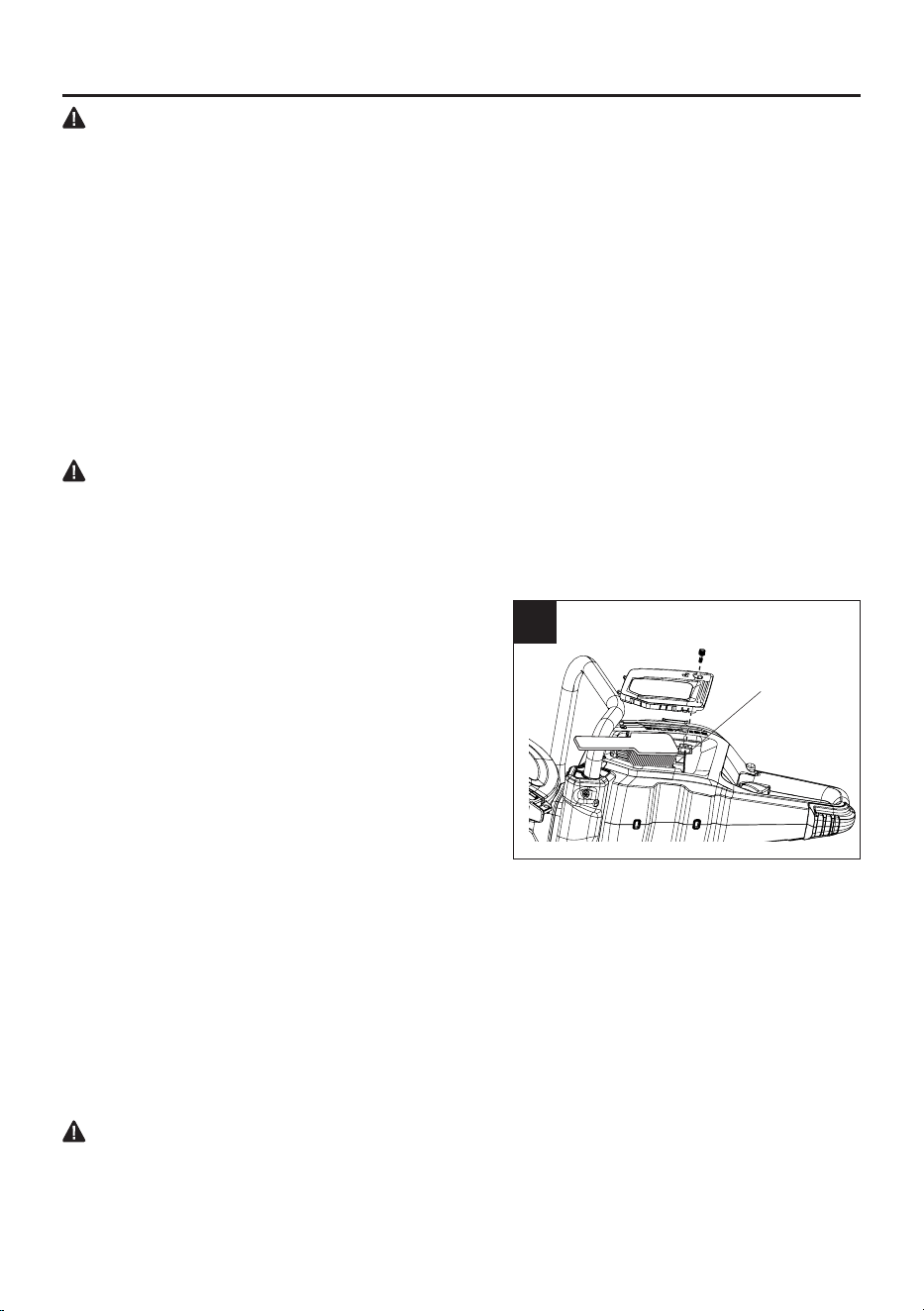
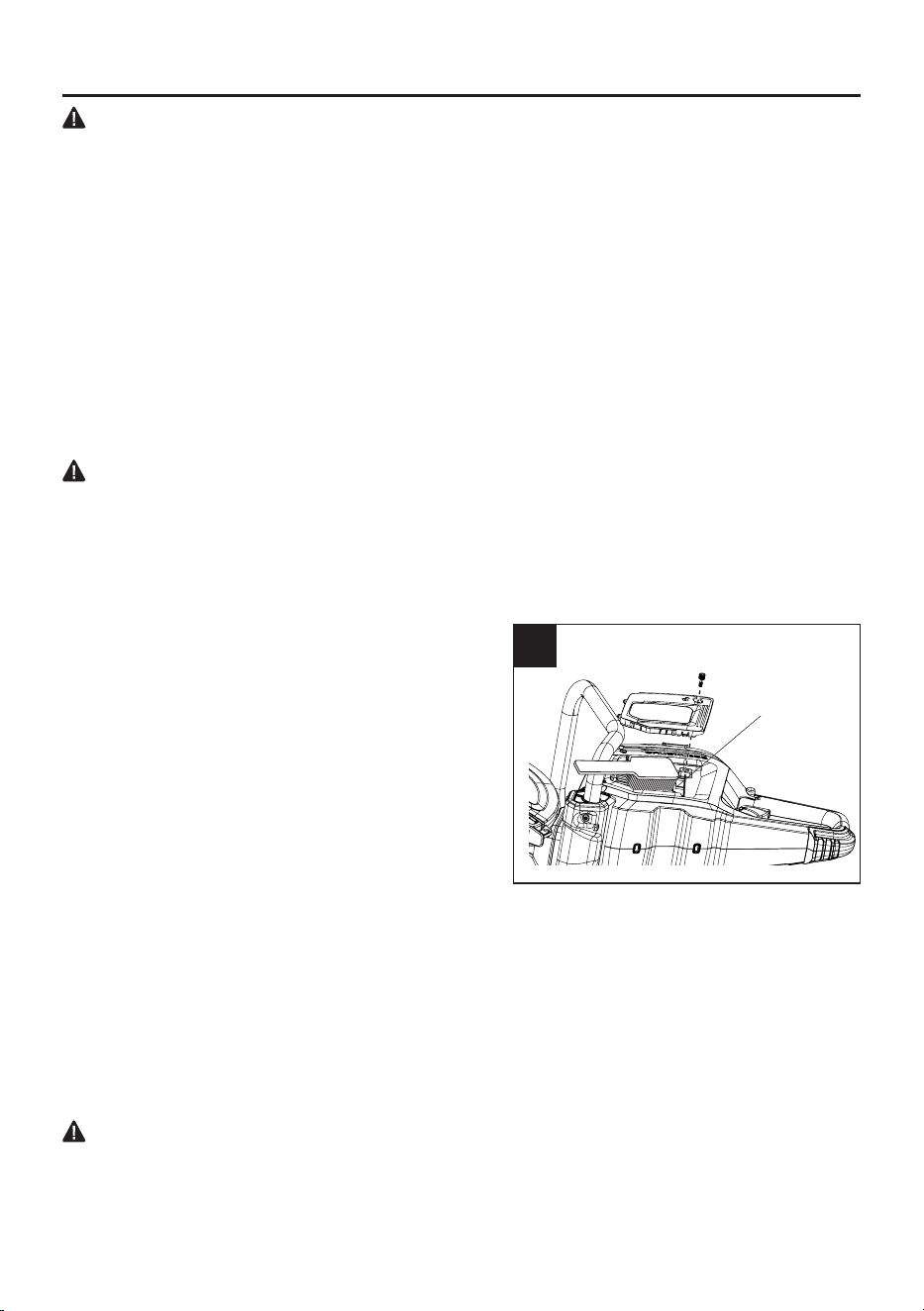
1. Cleaning the magnet lter
Check and clean the magnet lter after every
metalcutting session.Insert the battery into the
product.
• Loosen the screw and remove the left side
cover.
• Clean the magnet lter with a brush.
2. Replacing the cutting blade
1
CAUTION
• The diamond abrasive blade (included) is designed for cutting concrete and should not be used for
other materials. For cutting steel, it is recommended to use a composite abrasive blade.
• Use only approved replacement blades.
Magnet lter
20
WARNING
CARE AND MAINTENANCE
2a
2a. Stop the product.
• Remove the battery.
• Press and hold the spindle lock button (K).
• Remove the bolt, washer and blade.
Note: The product is compatible with two blade bore
sizes (0.8’’ and 1’’). You can switch between sizes
by ipping the shaft sleeve.
2b. Install the new blade, washer and bolt.
• Press and hold the spindle lock button.
• Tighten the bolt within a torque range of 18.5
ft-lbs.
K
2b
• Always protect your hands by wearing heavy gloves and/or wrapping the cutting edges with rags or
other materials when performing any maintenance on the blades. Always remove the battery when
servicing or transporting the product.
Shaft sleeve

21
TROUBLESHOOTING
PROBLEM POSSIBLE CAUSE CORRECTIVE ACTION
The motor runs but the
blade does not rotate.
The blade is too loose. Make sure the bolt is tightened
with correct torque.
The blade is damaged and
cannot rotate.
Check the blade guard and
remove unwanted material.
The motor is damaged.
1. Remove the battery pack from
the product.
2. Remove the blade.
3. Clean the product.
4. Install battery pack and
operate the product.
5. Call service center if the fault
appears again.
The motor runs and
the blade rotates, but it
does not cut.
The blade is dull. Replace the cutting blade.
The blade is installed in the
incorrect direction.
Follow the instructions of the
cutting blade of how to mount it
on product.
The blade is tight or loose. Make sure the bolt is tightened
with 18.5 ft-lbs in torque.
The product does not
start.
The product and battery are not
connected correctly.
Make sure that the battery
release button clicks when you
install the battery pack.
The battery level is low. Charge the battery pack.
The battery is too hot or too cold. Refer to battery and charger
manual.
If you still have questions or an unresolved issue after going through this troubleshooting guide, or just
want to speak to a KOBALT product expert, please call our KOBALT customer service department at
888-356-2258, 8 a.m. - 8 p.m., EST, Monday - Sunday or [email protected].
22
WARRANTY
REPLACEMENT PARTS LIST
For replacement parts, call our customer service department at 888-356-2258, 8 a.m. - 8 p.m., EST,
Monday - Sunday. You may also contact us at [email protected].
Printed in China
PART DESCRIPTION PART #
AA Bolt R0101747-00
BB Washer R0209346-00
CC Wrench RB333001890
L Cutting blade R0203654-00
J Quick-connect coupler R0203282-00
5-YEAR LIMITED WARRANTY
This KOBALT 80 V Lithium-Ion 12 in. Power cutter is warranted to the original purchaser from the
original purchase date for ve (5) years subject to the warranty coverage described herein.
This KOBALT 80 V Lithium-Ion 12 in. Power cutter is warranted for the original user to be free from
defects in material and workmanship.
If you believe that the KOBALT 80 V Lithium-Ion 12 in. Power cutter is defective at any time during
the specied warranty period, simply call our Warranty service (888-356-2258) along with proof of
purchase.
This warranty is void if: defects in materials or workmanship or damages result from repairs or
alterations which have been made or attempted by others or the unauthorized use of nonconforming
parts; the damage is due to normal wear, damage is due to abuse (including overloading of the tool
beyond capacity), improper maintenance, neglect or accident; or the damage is due to the use of the
tool after partial failure or use with improper accessories or unauthorized repair or alteration.
This warranty excludes replacement blades.
This warranty gives you specic legal rights, and you may also have other rights that vary from state to
state.
AA
BB CC L J
23
KOBALT y el diseño del logotipo son
marcas comerciales o marcas registradas
de LF, LLC. Todos los derechos
reservados.
Número de serie
Fecha de compra
ARTÍCULO #5974889
MODELO #KPC 6180-06
CORTADOR
ELÉCTRICO DE 30.48
CM CON BATERÍA DE
IONES DE LITIO DE 80 V
Gracias por comprar este producto KOBALT.
¿Preguntas, problemas o piezas faltantes?
Antes de devolver, póngase en contacto con nosotros en:
888-356-2258, de lunes a domingo, de 8 a.m. a 8 p.m., hora estándar del Este,
o escriba a [email protected].

24
ÍNDICE
ESPECIFICACIONES DEL PRODUCTO
Especicaciones del producto................................................................................................................
Contenido del paquete...........................................................................................................................
Aditamentos...........................................................................................................................................
Símbolos................................................................................................................................................
Información de seguridad.......................................................................................................................
Preparación...........................................................................................................................................
Instrucciones de ensamblaje.................................................................................................................
Instrucciones de funcionamiento............................................................................................................
Cuidado y mantenimiento .....................................................................................................................
Solución de problemas..........................................................................................................................
Garantía................................................................................................................................................
Lista de piezas de repuesto..................................................................................................................
24
25
26
27
29
35
35
39
42
44
45
46
ESPECIFICACIONES
Tipo de batería Iones de litio de 80 V
Grosor de la cuchilla 2.54 mm (0.1 pulg.)
Diámetro exterior de la cuchilla 30.48 cm (12 pulg.)
Diámetro interior de la cuchilla 20.32 mm (0.8 pulg.) / 2.54 cm (1 pulg.)
Torsión de apriete de la cuchilla 2.55 kgf-m
Separación periférica máxima entre segmentos 2.54 mm (0.1 pulg.)
Profundidad máxima del corte 10.99 cm (4.33 pulg.)
Presión máxima del suministro de agua 6 bar
25
CONTENIDO DEL PAQUETE
PIEZA DESCRIPCIÓN CANTIDAD
A Protector de hoja 1
B Manija frontal 1
C Palanca de ujo de agua 1
D Indicador de advertencia 1
E Botón de encendido 1
F Botón de la luz 1
G Bloqueo del gatillo 1
H Manija principal 1
PIEZA DESCRIPCIÓN CANTIDAD
I Gatillo 1
J Acoplador de conexión
rápida
1
K Botón de bloqueo del
husillo
1
L Cuchilla de corte 1
M Bloqueo de ajuste del
protector
1
N Botón de liberación de
la batería
1
K
K
K
K
I
I
A
K
L
M
I
H
F
G
C
N
B
D
E
J
26
ADITAMENTOS (no se muestran a escala)
Perno M8 x
20 mm
Cant. 1
Arandela de
φ76 mm
Cant. 1
Llave
Cant. 1
AA BB CC
27
SÍMBOLOS
Algunos de los siguientes símbolos pueden aplicarse al uso de este producto. Obsérvelos y aprenda
su signicado. La interpretación correcta de estos símbolos le permitirá utilizar el producto de manera
ecaz y segura.
SÍMBOLOS EXPLICACIÓN
V Voltaje
A Corriente
Hz Frecuencia (ciclos por segundo)
W Alimentación
min Tiempo
Tipo o característica de corriente
Velocidad de rotación sin carga
/min Revoluciones, pasadas, velocidad de supercie, órbitas, etc., por minuto
Precauciones que involucran su seguridad.
Para reducir el riesgo de lesiones, el usuario debe leer y comprender el manual
del operador antes de utilizar este producto.
Use protección para los ojos y los oídos, use una máscara y asegúrese de que
se ajuste correctamente, use un casco siempre que haya riesgo de que caigan
objetos.
Los vapores del corte puede causar lesiones si se inhalan. Utilice una protección
respiratoria aprobada. Evite respirar los gases de escape. Asegúrese de que el
ujo de aire sea suciente.
Los contragolpes pueden ser repentinos, rápidos y causar lesiones.
Las chispas de la cuchilla de corte pueden provocar incendios en materiales
inamables como: gasolina, madera, ropa y pasto seco.
Nunca utilice hojas de sierra circular, accesorios de carburo, de rescate o de
corte de madera, así como sierras de ningún tipo: podrían provocar lesiones
mortales.
Asegúrese de que la cuchilla no esté agrietada ni dañada.
n
o
28
SÍMBOLOS
ADVERTENCIA
Se usan las siguientes indicaciones y sus signicados para explicar los niveles de riesgo asociados a
este producto.
SÍMBOLO INDICACIÓN SIGNIFICADO
PELIGRO
Indica una situación de peligro inminente que, de no evitarse,
ocasionará la muerte o lesiones graves.
ADVERTENCIA
Indica una situación potencialmente peligrosa que, de no evitarse,
puede ocasionar la muerte o lesiones graves.
PRECAUCIÓN
Indica una situación potencialmente peligrosa que, de no evitarse,
puede ocasionar lesiones menores o moderadas.
PRECAUCIÓN
(Sin símbolo de alerta de seguridad) Indica una situación que
puede ocasionar daños materiales.
• Para evitar lesiones personales graves, no intente usar este producto hasta que haya leído y
comprendido completamente este manual del propietario. Si no comprende las advertencias e
instrucciones de este manual del propietario, no utilice este producto. Llame al 888-356-2258 para
obtener ayuda.
La operación de cualquier producto puede provocar que objetos extraños salten a sus ojos
y, de esta manera, provoquen graves daños oculares. Antes de operar un producto, use
siempre lentes o gafas de seguridad con protecciones laterales y un protector facial cuando
sea necesario. Se recomienda una máscara de seguridad de visión amplia sobre los lentes o
las gafas de seguridad estándar con protección lateral. Siempre use lentes de protección que
cumplan con la norma ANSI Z87.1.

29
INFORMACIÓN DE SEGURIDAD
ADVERTENCIA
Lea todas las advertencias de seguridad y todas las instrucciones. No seguir las advertencias y
las instrucciones podría provocar descargas eléctricas, incendios o lesiones graves.
Guarde todas las advertencias e instrucciones para referencia futura.
El término "herramienta
eléctrica" que aparece en las advertencias se reere a la herramienta eléctrica que se conecta a la
línea principal (con cable) o a la herramienta eléctrica que funciona con batería (inalámbrica).
1. SEGURIDAD EN EL ÁREA DE TRABAJO
• Mantenga el área de trabajo limpia y bien iluminada. Las áreas desordenadas u oscuras
aumentan las posibilidades de accidentes.
• No utilice herramientas eléctricas en atmósferas en las que exista riesgo de explosión, como
por ejemplo en presencia de líquidos inamables, gases o polvo. Las herramientas eléctricas
producen chispas que podrían encender el polvo o humo.
• Mantenga a los niños y espectadores alejados durante la operación de una herramienta
eléctrica. Las distracciones pueden provocar que pierda el control.
2. SEGURIDAD ELÉCTRICA
• Los enchufes de las herramientas eléctricas deben encajar en el tomacorriente. Nunca
modique el enchufe de ningún modo. No utilice ningún enchufe adaptador con
herramientas eléctricas (con puesta a tierra). Los enchufes sin modicaciones y que encajan en
los tomacorrientes reducen el riesgo de descarga eléctrica.
• Evite el contacto del cuerpo con supercies con puesta a tierra, tales como tuberías,
radiadores, estufas o refrigeradores. Existe un gran riesgo de descarga eléctrica si su cuerpo
tiene conexión a tierra.
• No exponga las herramientas eléctricas a la lluvia o a condiciones de humedad. Si ingresa
agua en una herramienta eléctrica, aumentará el riesgo de descarga eléctrica.
• No maltrate el cable. Nunca use el cable para transportar, jalar ni desenchufar la herramienta
eléctrica. Mantenga el cable alejado del calor, el aceite, los bordes losos o las piezas
en movimiento. Los cables dañados o enredados aumentan el riesgo de que se produzca una
descarga eléctrica.
• Si opera una herramienta eléctrica en exteriores, use la extensión eléctrica apropiada para el
uso en exteriores. El uso de un cable apto para exteriores reduce el riesgo de sufrir una descarga
eléctrica.
• Si es inevitable utilizar una herramienta eléctrica en un lugar húmedo, use un suministro
protegido con un interruptor diferencial residual (RCD, por sus siglas en inglés). El uso de un
RCD disminuye el riesgo de descargas eléctricas.
• Use solo baterías KOBALT de 80 voltios (KB 280C-06, KB 2580C-06, KB 480-06, KB 580C-06,
KB 680C-06).
• Use solo un cargador KOBALT (KRC 0280-06, KRC 30-06, KDC 50-06).
3. SEGURIDAD PERSONAL
• Manténgase alerta, preste atención a lo que hace y utilice el sentido común cuando utilice
una herramienta eléctrica. No utilice una herramienta eléctrica si está cansado o bajo los
efectos de drogas, alcohol o medicamentos. Un momento de desatención mientras opera
herramientas eléctricas puede provocar lesiones personales graves.

30
INFORMACIÓN DE SEGURIDAD
• Use equipos de protección personal. Siempre use lentes de protección. Los equipos de
protección como una mascarilla antipolvo, zapatos de seguridad antideslizantes, un casco
o protección para los oídos, utilizados en las condiciones apropiadas, reducirán las lesiones
personales.
• Evite un arranque accidental. Asegúrese de que el interruptor esté en la posición de
apagado antes de conectar la fuente o la batería, levantar o transportar la herramienta.
Transportar herramientas eléctricas con el dedo en el interruptor o enchufar herramientas eléctricas
que tienen el interruptor encendido aumenta las posibilidades de accidentes.
• Retire todas las llaves de ajuste o llaves inglesas antes de encender la herramienta eléctrica.
Si se deja una llave inglesa o una llave conectada a una pieza giratoria de la herramienta eléctrica,
se pueden producir lesiones personales.
• No se extienda demasiado. Mantenga una postura y un equilibrio adecuados en todo
momento. Esto permite un mejor control de la herramienta eléctrica en situaciones inesperadas.
• Use ropa adecuada. No use ropa holgada ni joyas. Mantenga el cabello, la ropa y los guantes
lejos de las piezas en movimiento. La ropa holgada, las joyas o el cabello largo pueden quedar
atrapados en las piezas en movimiento.
• Si se proporcionan dispositivos para la conexión de instalaciones de extracción y
recolección de polvo, asegúrese de que se conecten y se usen debidamente. La recolección
de polvo puede disminuir los peligros relacionados.
4. USO Y CUIDADO DE LAS HERRAMIENTAS ELÉCTRICAS
• No fuerce la herramienta eléctrica. Utilice la herramienta eléctrica adecuada para su
aplicación. La herramienta eléctrica adecuada realizará un trabajo más seguro y de mejor calidad
al ritmo para el que se diseñó.
• No utilice la herramienta eléctrica si el interruptor no la enciende o apaga. Cualquier
herramienta eléctrica que no pueda controlarse con el interruptor es peligrosa y debe repararse.
• Desconecte el enchufe de la fuente de alimentación o la batería de la herramienta eléctrica
antes de realizar cualquier ajuste, cambiar accesorios o almacenar herramientas eléctricas.
Este tipo de medidas de seguridad preventivas reduce el riesgo de arranques accidentales de la
herramienta eléctrica.
• Almacene las herramientas eléctricas que no estén en uso fuera del alcance de los niños
y no permita que personas no familiarizadas con la herramienta o estas instrucciones la
operen. Las herramientas eléctricas son peligrosas en manos de usuarios sin capacitación.
• Realice mantenimiento a las herramientas eléctricas. Revise si hay piezas móviles
desalineadas o trabadas, si hay piezas rotas y cualquier otra condición que pueda afectar
el funcionamiento de la herramienta eléctrica. Si se daña la herramienta eléctrica, hágala
reparar antes de usarla. Muchos accidentes son producto del mantenimiento incorrecto de las
herramientas eléctricas.
• Mantenga las herramientas de corte aladas y limpias. Las herramientas de corte con
mantenimiento adecuado y bordes de corte alados son menos propensas a trabarse y más fáciles
de controlar.
• Use la herramienta eléctrica, los accesorios, las brocas, etc. de acuerdo con estas
instrucciones, considerando las condiciones de trabajo y la tarea que desea realizar. El
uso de la herramienta eléctrica en operaciones distintas para las que se diseñó podría crear una
situación de peligro.

31
INFORMACIÓN DE SEGURIDAD
• Mantenga las manijas y las supercies de agarre secas, limpias y sin aceite ni grasa. Los
mangos y las supercies de agarre resbaladizos no permiten manipular ni controlar la herramienta
de forma segura en situaciones inesperadas.
5. USO Y CUIDADO DE LA HERRAMIENTA A BATERÍA
• Recargue solo con el cargador especicado por el fabricante. Un cargador adecuado para un
tipo de paquete de baterías puede generar un riesgo de incendio cuando se usa con otro paquete
de baterías.
• Use herramientas eléctricas solo con paquetes de baterías designados especícamente. El
uso de cualquier otro paquete de baterías puede crear un riesgo de lesión e incendio.
• Cuando el paquete de baterías no esté en uso, aléjelo de objetos metálicos, como
sujetapapeles, monedas, llaves, clavos, tornillos u otros objetos metálicos pequeños que
pudieran crear una conexión entre los terminales. Es posible que conectar los terminales de la
batería entre sí produzca quemaduras o un incendio.
• En condiciones de maltrato, es posible que salga líquido de la batería. Evite el contacto. Si
se produce un contacto accidental, enjuague con agua. Si el líquido entra en contacto con
los ojos, busque atención médica adicional. El líquido que sale de la batería puede provocar
irritación o quemaduras.
• No utilice un paquete de baterías ni una herramienta si están dañados o modicados. Las
baterías dañadas o modicadas pueden presentar un comportamiento impredecible que puede
provocar un incendio, explosión o riesgo de lesión.
• No exponga el paquete de baterías ni la herramienta al fuego o a una temperatura excesiva.
La exposición al fuego o temperaturas superiores a 130 °C puede provocar una explosión.
• Siga todas las instrucciones de carga y no cargue el paquete de baterías ni la herramienta
fuera del rango de temperatura especicado en las instrucciones. La carga inadecuada o a
temperaturas fuera del rango especicado podría dañar la batería y aumentar el riesgo de incendio.
6. REPARACIÓN
• Permita que solo una persona capacitada repare la herramienta eléctrica, mediante el uso
solo de piezas de repuesto idénticas. Esto mantendrá la seguridad de la herramienta eléctrica.
• Nunca realice mantenimiento a los paquetes de baterías. Solo el fabricante o proveedores de
servicio autorizados pueden realizar el mantenimiento de los paquetes de baterías.
7. ADVERTENCIAS DE SEGURIDAD DE LA MÁQUINA DE CORTE
• El protector proporcionado con la herramienta debe estar instalado rmemente en la
herramienta eléctrica y debe colocarse con el n de obtener la máxima seguridad, de manera
que la exposición del disco hacia el operador sea mínima. Usted y los espectadores deben
ubicarse lejos del alcance del disco giratorio. El tope ayuda a proteger al operador contra
fragmentos rotos del disco y el contacto accidental con el mismo.
• Use solo discos de corte de diamante para su herramienta eléctrica. El hecho de que un
accesorio pueda jarse a la herramienta eléctrica no garantiza una operación segura.
• La velocidad calicada del accesorio debe ser, al menos, igual a la velocidad máxima que
se indica en esta herramienta eléctrica. Los accesorios que funcionen por sobre el rango de
velocidad recomendada pueden romperse y salir disparados.
• Los discos solo deben usarse para las aplicaciones recomendadas. Por ejemplo, no amole

32
INFORMACIÓN DE SEGURIDAD
con el costado del disco de corte. Los discos de corte abrasivo están diseñados para amolados
periféricos; aplicar fuerza lateral a estos discos podría provocar que se rompan.
• Siempre use rebordes de discos que no estén dañados y que sean del diámetro correcto
para el disco seleccionado. Una brida correcta ofrece soporte al disco, por lo tanto se reduce la
posibilidad de rompimiento del disco.
• No use discos desgastados o reforzados de herramientas eléctricas más grandes. Los discos
diseñados para una herramienta eléctrica más grande no son adecuados para la alta velocidad de
una herramienta más pequeña y puede explotar.
• El diámetro externo y el grosor del accesorio deben encontrarse dentro de la capacidad
recomendada de la herramienta eléctrica. No es posible proteger ni controlar debidamente los
accesorios de un tamaño incorrecto.
• El tamaño del eje de los discos y los rebordes deben ajustarse correctamente al husillo
de la herramienta eléctrica. Los discos y rebordes con oricios para el eje que no calcen con
los aditamentos de montaje de la herramienta eléctrica perderán equilibrio, vibrarán en exceso y
causarán una pérdida de control.
• No utilice discos dañados. Antes de cada uso, inspeccione los discos en busca de astillas y
grietas. Si la herramienta eléctrica o el disco caen al suelo, compruebe que no haya habido
daños o instale un disco nuevo. Después de revisar e instalar el disco, usted y otros deben
ubicarse lejos del alcance del disco giratorio y operar la herramienta eléctrica a velocidad
máxima sin carga durante un minuto. Normalmente, los discos dañados se desprenderán
durante este período de prueba.
• Use equipos de protección personal. Según la aplicación, use protector facial, gafas o
lentes de seguridad. Según corresponda, utilice una mascarilla antipolvo, protectores
auditivos, guantes y un faldón para taller que puedan detener pequeños fragmentos de
pieza de trabajo abrasivos. Los lentes de protección deben ser capaces de detener los desechos
eyectados que se generan en diversas operaciones. La mascarilla antipolvo o el respirador deben
ltrar las partículas generadas durante la operación. La exposición prolongada a ruidos de alta
intensidad puede causar la pérdida de la audición.
• Mantenga a los transeúntes a una distancia segura del área de trabajo. Toda persona que
ingrese al área de trabajo debe usar equipos de protección personal. Fragmentos de piezas
de trabajo o de un disco roto pueden salir eyectados y causar lesiones incluso más lejos del área
de operación.
• Sostenga la herramienta eléctrica por las supercies de agarre aisladas solo al realizar una
operación en la que el accesorio de corte pueda entrar en contacto con cableado oculto.
Es posible que un accesorio de corte que entre en contacto con un cable “energizado” también
“energice” las piezas de metal expuestas de la herramienta eléctrica y provoque una descarga
eléctrica al operador.
• Coloque el cordón lejos del accesorio giratorio. Si pierde el control, es posible que el cordón se
corte o enganche y que su mano o brazo queden atrapados en el disco giratorio.
• Nunca coloque la herramienta eléctrica en el suelo antes de que el accesorio se haya
detenido por completo. Es posible que el disco giratorio se enganche a la supercie, lo que
podría provocar que usted pierda el control de la herramienta eléctrica.
• No haga funcionar la herramienta eléctrica mientras la lleve a su lado. El contacto accidental
con el accesorio giratorio puede hacer que su ropa se enganche y que tire hacia usted.
• Limpie periódicamente los conductos de ventilación de la herramienta eléctrica. El ventilador
del motor atrae el polvo hacia dentro de la carcasa y la acumulación excesiva de metal en polvo

33
INFORMACIÓN DE SEGURIDAD
puede producir peligros eléctricos.
• No use la herramienta eléctrica cerca de materiales inamables. Las chispas podrían encender
estos materiales.
8. CONTRAGOLPE Y ADVERTENCIAS RELACIONADAS
El contragolpe es una reacción repentina de un disco giratorio. El enganche o el atrapamiento causan
atascamientos en el disco giratorio que a su vez provoca la pérdida de control de la herramienta
eléctrica, pues la fuerza en la dirección opuesta de giro del disco en el punto de trabamiento. Por
ejemplo, si un disco abrasivo se engancha o atasca debido a la pieza de trabajo, el borde del disco que
ingresa en el punto de atascamiento puede penetrar la supercie del material y provocar que el disco se
monte o desprenda. Es posible que el disco salte hacia el operador o lejos de este, dependiendo de la
dirección del movimiento de la rueda en el punto de enganche. Los discos abrasivos pueden romperse
bajo estas condiciones. El contragolpe es la consecuencia del uso inadecuado de la herramienta
eléctrica y/o condiciones o procedimientos de funcionamiento incorrectos, y se puede evitar al tomar
precauciones adecuadas como se indica a continuación.
• Agarre rmemente la herramienta eléctrica y coloque su cuerpo y brazo de manera que
resista la fuerza de contragolpe. Siempre use un mango auxiliar, si se incluye, para obtener
un máximo control de la reacción del contragolpe o fuerza de torsión durante el arranque.
El operador puede controlar las fuerzas de contragolpe o de reacciones de torsión, si toma las
precauciones adecuadas.
• Nunca coloque su mano cerca del accesorio giratorio. Es posible que el accesorio produzca un
contragolpe en su mano.
• No ubique su cuerpo junto al disco giratorio. El contragolpe impulsará la herramienta en
dirección opuesta al movimiento del disco en el punto de enganche.
• Tenga especial cuidado cuando trabaje en esquinas, bordes losos o áreas similares. Evite
saltos y enganches del accesorio. Las esquinas, los bordes losos o los saltos tienden a enganchar
el accesorio giratorio y provocan pérdida de control o contragolpe.
• No coloque una cadena de sierra, hojas para trinchar, discos de diamante segmentados con
una separación periférica superior a 10 mm o una hoja de sierra dentada. Estas hojas crean
contragolpe y pérdida de control frecuentes.
• No “atasque” el disco ni aplique presión en exceso. No intente lograr un corte de una
profundidad excesiva. Forzar en exceso el disco aumenta la carga y la vulnerabilidad al giro o
atascamiento del disco en el corte además de la posibilidad de contragolpe o rompimiento de disco.
• Cuando el disco se atasque o cuando interrumpa un corte por cualquier motivo, desconecte
la energía de la herramienta eléctrica y sujétela sin moverla hasta que el disco se detenga
completamente. Nunca intente retirar el disco mientras corta y está en movimiento; de lo
contrario puede generarse un contragolpe. Investigue las causas y aplique una acción correctiva
para evitar que el disco se trabe.
• No reinicie la operación de corte en la pieza de trabajo. Permita que el disco alcance
velocidad plena y retome el corte cuidadosamente. Es posible que el disco se atasque, se eleve
o produzca un contragolpe si la herramienta eléctrica se reinicia en la pieza de trabajo.
• Apoye los paneles o cualquier pieza de trabajo de gran tamaño para minimizar el riesgo
de que el disco se enganche o se produzca un contragolpe. Las piezas de trabajo tienden a
doblarse debido a su propio peso. Los soportes deben colocarse bajo la pieza de trabajo, cerca de
la línea de corte y el borde la pieza de trabajo en ambos costados del disco.
• Tome precauciones adicionales al realizar un “corte de cavidad” en paredes existentes u
34
INFORMACIÓN DE SEGURIDAD
ADVERTENCIA (PROPUESTA 65)
Parte del polvo causado por el lijado eléctrico, el serruchado, la trituración, el taladrado y otras activi-
dades de la construcción contienen productos químicos que causan cáncer, defectos congénitos u otros
daños en el aparato reproductivo. Algunos ejemplos de estos productos químicos son:
• Plomo de pinturas a base de plomo.
• Sílice cristalina de ladrillos, cemento y otros productos de mampostería, y
• Arsénico y cromo de madera tratada con químicos.
El riesgo que corre debido a la exposición a estos productos químicos varía según la frecuencia con que
realiza este tipo de trabajo. Para reducir su exposición a estas sustancias químicas, trabaje en un área
bien ventilada y utilice un equipo de seguridad aprobado, como las mascarillas antipolvo especialmente
diseñadas para ltrar estas partículas microscópicas.
ARTÍCULO TEMPERATURA
Rango de temperatura de almacenamiento del
electrodoméstico
0 °C (32 °F) - 45 °C (113 °F)
Rango de temperatura de operación del
electrodoméstico
0 °C (32 °F) - 45 °C (113 °F)
Rango de temperatura de carga de la batería 4 °C (39 °F) - 40 °C (104 °F)
Rango de temperatura de funcionamiento del
cargador
4 °C (39 °F) - 40 °C (104 °F)
Rango de temperatura de almacenamiento de la
batería
0 °C (32 °F) - 45 °C (113 °F)
Rango de temperatura de descarga de la batería 0 °C (32 °F) - 45 °C (113 °F)
otras áreas ciegas. El disco sobresaliente puede cortar tuberías de gas o agua, cableado eléctrico
u objetos que pueden causar contragolpe.
9. RANGO DE TEMPERATURA AMBIENTE RECOMENDADO:

35
ADVERTENCIA
ADVERTENCIA
PREPARACIÓN
Antes de comenzar a ensamblar el producto, asegúrese de tener todas las piezas. Compare las
piezas con la lista del contenido del paquete y la lista de aditamentos. No intente ensamblar el
producto si falta alguna pieza o si estas están dañadas.
Tiempo estimado de ensamblaje: 5 a 10 minutos
INSTRUCCIONES DE ENSAMBLAJE
• Si hay piezas dañadas o faltantes, no utilice el producto hasta que las haya reemplazado. El uso
de este producto con piezas dañadas o faltantes podría causar lesiones personales graves.
• No intente modicar este producto ni crear accesorios que no sean recomendados para utilizar
con este producto. Cualquier alteración o modicación se considera un uso inadecuado y podría
causar una condición peligrosa que podría producir lesiones personales graves.
• No se descuide por el hecho de conocer el producto. Recuerde que un descuido de una fracción
de segundo es suciente para provocar lesiones graves.
• No use ningún acoplamiento o accesorio que el fabricante de este producto no recomiende.
El uso de acoplamientos o accesorios no recomendados puede producir lesiones personales
graves.
36
INSTRUCCIONES DE ENSAMBLAJE
1a
1b
1c
L
K
1. Instalación de la cuchilla de corte
1a. Este producto está equipado con una cuchilla
de diamante adecuada, según la versión, para
cortar determinados materiales como asfalto,
concreto, piedra dura, ladrillos de arcilla,
tubos de arcilla. No corte ningún otro material:
¡peligro de accidente!
Aditamentos utilizados
Perno M8 x 20 mm
x 1
AA
Arandela de φ76 mm
x 1
BB
Llave
x 1
CC
ADVERTENCIA
ADVERTENCIA
• Nunca utilice una cuchilla de diamante para
cortar material plástico. El calor producido
durante el corte puede derretir el plástico y este
puede adherirse a la cuchilla de corte y provocar
un contragolpe.
• Las cuchillas de diamante se calientan mucho
cuando se utilizan. Una cuchilla sobrecalentada
es el resultado de un uso inadecuado y puede
causar deformación de la cuchilla, lo que
provoca daños y lesiones.
1b. Mantenga presionado el botón de bloqueo del
husillo (K).
• Retire la arandela y el perno.
• Instale la cuchilla de corte (L), la arandela y el
perno.
Nota: la echa en el protector muestra la direc-
ción de rotación. Asegúrese de que la echa de la
cuchilla siga la misma dirección.
1c. Mantenga presionado el botón de bloqueo del
husillo.
• Apriete el perno dentro de un rango de torsión
de 2.55 kgf-m.
37
INSTRUCCIONES DE ENSAMBLAJE
M
2
3
C
J
2. Ajuste del ángulo del protector de hoja
El protector de hoja se puede ajustar en
diferentes ángulos.
3. Conecte el suministro de agua
ADVERTENCIA
ADVERTENCIA
ADVERTENCIA
• El corte en húmedo se utiliza únicamente con la
cuchilla abrasiva de diamante al cortar concreto.
• Lea atentamente y comprenda el capítulo de
seguridad y las instrucciones de operación
antes de aplicar agua.
• En temperaturas bajo cero, se debe drenar
el agua de la tubería después de terminar el
trabajo para evitar el riesgo de congelación.
• No corte después de cerrar el suministro de agua, ya que puede provocar que la lechada de
concreto bloquee la salida de agua.
• Deslice el bloqueo de ajuste del protector (M)
hacia atrás y sosténgalo.
• Mueva el protector al ángulo deseado.
• Cuando escuche un clic, suelte el bloqueo de
ajuste del protector para asegurarlo.
• Retire el acoplador de conexión rápida (J) y
fíjelo rmemente a la manguera.
• Vuelva a instalar el acoplador de conexión
rápida en el producto.
• Ajuste la palanca de ujo de agua (C) según sus
condiciones de trabajo.
Después de terminar el trabajo:
• Apague el producto.
• Cierre la palanca de ujo de agua.
• Desconecte el producto del suministro de agua.
38
INSTRUCCIONES DE ENSAMBLAJE
4
N
4. Instalación y retiro de la batería
4a. Para instalar la batería
• Alinee las lengüetas del paquete de baterías
con las ranuras en el compartimiento de las
baterías.
• Empuje el paquete de baterías en el
compartimiento de la batería hasta que el
paquete de baterías encaje en su lugar.
• Cuando escuche un clic, el paquete de
baterías está instalado.
4b. Para retirar la batería
• Mantenga presionado el botón de liberación de
la batería (N).
• Retire el paquete de baterías del producto.
ADVERTENCIA
ADVERTENCIA
• Siempre retire la batería del producto cuando no esté en uso o cuando esté ensamblando las
piezas, realizando ajustes o limpiándolo. La extracción de la batería evitará que se produzca un
arranque accidental, lo que podría causar graves lesiones personales..
Siga estas instrucciones para evitar lesiones y reducir el riesgo de descarga eléctrica o incendio:
• Reemplace inmediatamente la batería o el cargador si la funda de la batería o el cable del cargador
están dañados.
• Verique que se haya retirado la batería antes de inspeccionar, ajustar o realizar mantenimiento en
cualquier parte del producto.
• Lea, comprenda y siga las instrucciones que aparecen en el manual del cargador.
39
INSTRUCCIONES DE FUNCIONAMIENTO
G
Luz LED
DF
I
1
2
E
1. Arranque y detención del producto
1a. Para arrancar el producto
• Inserte la batería en el producto.
• Presione el botón de encendido (E).
• Simultáneamente presione el bloqueo del
gatillo (G) y apriete el gatillo (I).
1b. Para detener el producto
• Suelte el gatillo (I).
• Presione el botón de encendido para apagar el
producto.
• Mantenga presionado el botón de liberación de
la batería.
• Retire la batería del producto para detener
completamente su funcionamiento.
2. Indicador LED
2a. Botón de la luz (F)
• Presione el botón de la luz para encender la
luz LED.
Nota: si hay un período de inactividad de 10
minutos, la luz se apagará automáticamente. La
luz parpadeará durante el último minuto del retardo
antes de apagarse.
• Para apagar la luz LED, presione el botón de
la luz otra vez.
2b. Indicador de advertencia (D)
• La luz LED se iluminará en ROJO para indicar
una condición anormal. Consulte la tabla a
continuación.
Función de seguridad de apagado automático
El producto tiene una función de apagado automático que detiene el producto si no se utiliza. El produc-
to permanecerá en espera después de 1 minuto de inactividad y se apagará después de 10 minutos de
inactividad.

40
INSTRUCCIONES DE FUNCIONAMIENTO
PROBLEMA CAUSA POSIBLE ACCIÓN CORRECTIVA
1 destello Protección de baja velocidad del
motor
Suelte el gatillo y vuelva a
encender el producto.
2 destellos Falla del controlador 1. Vuelva a instalar el paquete de
baterías.
2. Reemplace el controlador si la
falla vuelve a aparecer.
3 destellos Falla de comunicación del paquete
de baterías
1. Vuelva a instalar el paquete de
baterías.
2. Reemplace el controlador si la
falla vuelve a aparecer.
4 destellos Protección contra sobretensión Suelte el gatillo y vuelva a
encender el producto.
5 destellos Protección contra voltaje bajo Cargue el paquete de baterías.
6 destellos Protección contra
sobrecalentamiento del controlador
Enfríe el controlador a
temperatura ambiente.
7 destellos Protección de bloqueo o falla de
comunicación de la sala
1. Suelte el gatillo y vuelva a
encender el producto.
2. Reemplace el controlador si la
falla vuelve a aparecer.
8 destellos Error de lógica del interruptor 1. Suelte el gatillo y vuelva a
encender el producto.
2. Reemplace el controlador si la
falla vuelve a aparecer.
9 destellos Error de autenticación de software 1. Vuelva a instalar el paquete de
baterías.
2. Reemplace el controlador si la
falla vuelve a aparecer.
10 destellos Protección contra
sobrecalentamiento del motor
Enfríe el controlador a
temperatura ambiente.
11 destellos La temperatura de la batería es
demasiado alta.
Enfríe el paquete de baterías a
temperatura ambiente.
41
INSTRUCCIONES DE FUNCIONAMIENTO
Consejos de funcionamiento
ADVERTENCIA
• No mueva el producto hacia un lado. Esto puede impedir el libre movimiento de la cuchilla y
provocar que esta se rompa, lo que puede causar lesiones.
• No utilice el costado de la cuchilla. La hoja puede dañarse y romperse, lo que puede provocar
lesiones. Utilice solo el borde de corte.
• No utilice una cuchilla de diamante para cortar material plástico. El calor que se produce puede derretir
el plástico. El plástico derretido puede adherirse a la cuchilla de corte y provocar un contragolpe.
3. Sostenga el producto con rmeza, coloque una
mano en el mango posterior y la otra mano en el
mango frontal. Utilice siempre ambas manos al
operar el producto.
• Agarre los mangos rmemente con los pulgares
y los dedos a su alrededor.
• Asegúrese de que el pulgar de la mano que
sostiene el mango frontal esté ubicado debajo
del mango para un agarre seguro.
4. Mantenga un buen equilibrio y una buena
posición en todo momento. Nunca corte
mientras está parado en una escalera.
• Coloque el producto de tal manera que su
cuerpo quede alejado del accesorio de corte.
Evite pararse en línea directa con la cuchilla.
Nunca se incline sobre el equipo de corte,
especialmente cuando existe riesgo de fuerzas
reactivas. Garantice que haya suciente libertad
de movimiento, especialmente en zanjas.
Asegúrese de que haya suciente espacio para
el usuario y la caída de la parte cortada.
• No opere por encima de la altura de los hombros.
Utilice una plataforma o andamio si la operación
de corte se realiza por encima de la altura de los
hombros. No se extienda demasiado.
5.
Se produce un contragolpe cuando la hoja queda
atrapada en la zona de contragolpe. Normalmente
no son peligrosos, pero un contragolpe fuerte
puede provocar lesiones o la muerte.
• Una fuerza reactiva jala del producto en la
dirección opuesta al movimiento de la cuchilla.
La mayoría de las veces esta fuerza no es fuerte.
Si la cuchilla queda atrapada, la potencia de la
fuerza reactiva puede provocar un contragolpe.
• No incline el producto cuando el equipo de corte
esté girando. Las fuerzas centrífugas pueden
disminuir el movimiento.
• No corte con la zona de contragolpe de la
cuchilla de corte. Si la cuchilla queda atrapada
en la zona de contragolpe, la fuerza reactiva
hace girar el producto hacia arriba y hacia atrás.
Puede golpear al operador y provocar lesiones
o la muerte.
3
4
5
Zonade
peligrode
contragolpe
42
CUIDADO Y MANTENIMIENTO
ADVERTENCIA
ADVERTENCIA
• Al realizar mantenimiento, utilice solo piezas de repuesto idénticas. El uso de cualquier otra pieza
puede ser peligroso o causar daños en el producto.
• Use siempre gafas o anteojos de seguridad con protectores laterales durante la operación de
la herramienta eléctrica o al soplar el polvo. Si hay demasiado polvo durante la operación, use
también una mascarilla antipolvo.
Mantenimiento general
Evite utilizar solventes para limpiar las piezas de plástico. La mayoría de los plásticos tienden a dañarse
si se usan distintos tipos de solventes comerciales. Utilice paños limpios para eliminar suciedad, polvo,
lubricante, grasa, etc.
• Nunca deje que el líquido de frenos, la gasolina, los productos a base de petróleo, los aceites
penetrantes, entre otros entren en contacto con las piezas de plástico. Los productos químicos
pueden dañar, debilitar o destruir el plástico, lo que puede resultar en lesiones graves.
ADVERTENCIA
• Para evitar lesiones personales graves, lea y comprenda todas las instrucciones de seguridad de
esta sección.
• Antes de realizar cualquier mantenimiento, asegúrese de retirar la batería. No seguir esta
advertencia podría provocar lesiones personales graves.
1. Limpieza del ltro del imán
Revise y limpie el ltro del imán después de
cada sesión de corte de metales. Inserte la
batería en el producto.
• Aoje el tornillo y retire la cubierta lateral
izquierda.
• Limpie el ltro magnético con un cepillo.
2. Reemplazo de la cuchilla de corte
1
PRECAUCIÓN
• La cuchilla abrasiva de diamante (incluida) está diseñada para cortar concreto y no debe
usarse para otros materiales. Para cortar acero, se recomienda utilizar una cuchilla abrasiva de
compuesto.
• Use solo cuchillas de repuesto aprobadas.
Filtro del
imán
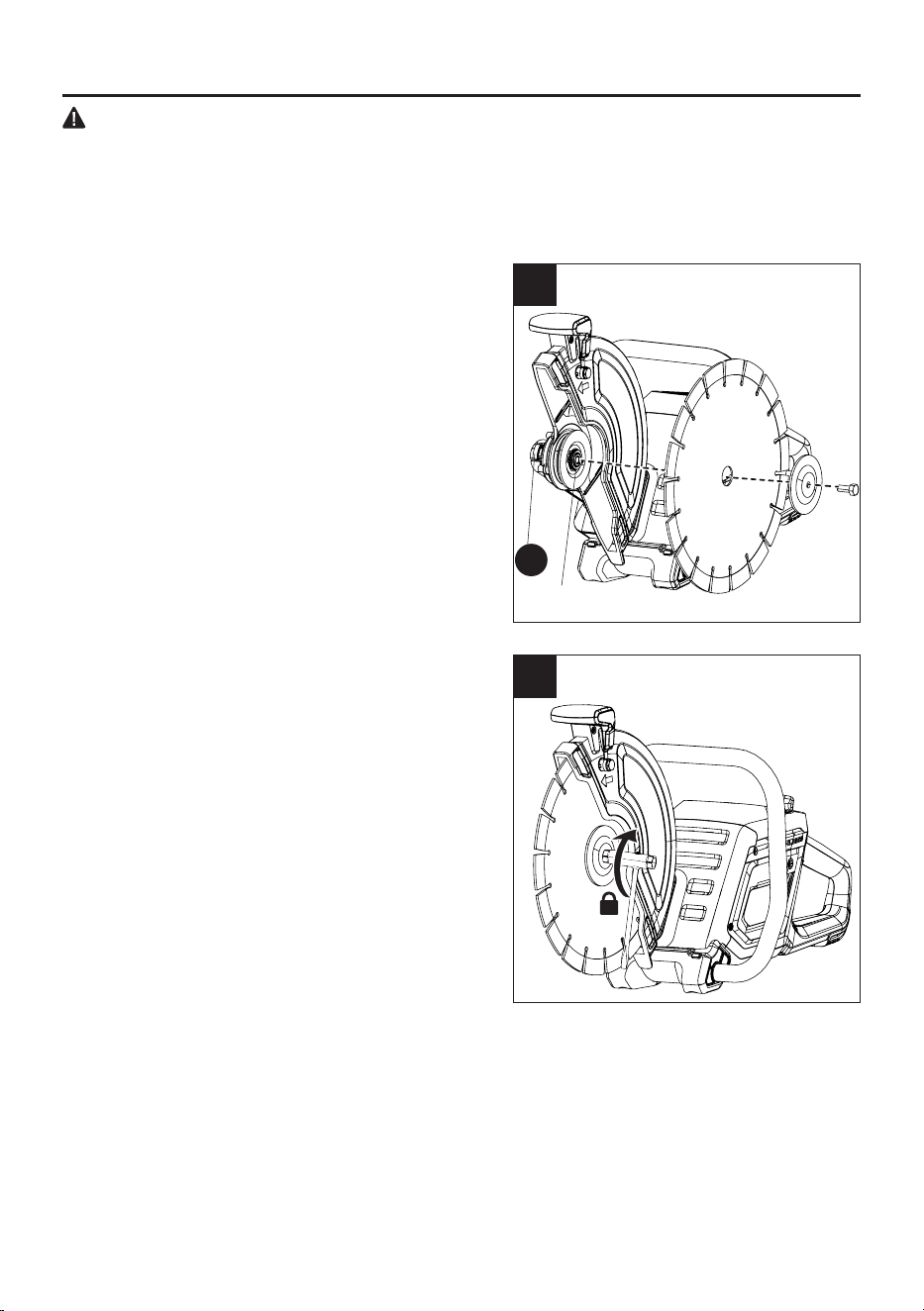
43
ADVERTENCIA
CUIDADO Y MANTENIMIENTO
2a
2a. Detenga el producto.
• Retire la batería.
• Mantenga presionado el botón de bloqueo del
husillo (K).
• Retire el perno, la arandela y la cuchilla.
Nota: el producto es compatible con dos tamaños
de oricio de hoja (20.32 mm y 2.54 cm). Puede
cambiar entre tamaños al girar el manguito del eje.
2b. Instale la cuchilla nueva, la arandela y el
perno.
• Mantenga presionado el botón de bloqueo del
husillo.
• Apriete el perno dentro de un rango de torsión
de 2.55 kgf-m.
K
2b
• Siempre use guantes para trabajo pesado y envuelva los bordes cortantes con harapos u otros
materiales para protegerse las manos cuando le haga cualquier mantenimiento a las cuchillas.
Siempre retire la batería al transportar el producto o efectuarle tareas de mantenimiento.
Manguito del eje

44
SOLUCIÓN DE PROBLEMAS
PROBLEMA CAUSA POSIBLE ACCIÓN CORRECTIVA
El motor funciona pero
la cuchilla no gira.
La cuchilla está demasiado oja. Asegúrese de que el perno esté
apretado con la torsión correcta.
La cuchilla está dañada y no
puede girar.
Revise el protector de hoja y
retire el material no deseado.
El motor está dañado.
1. Retire el paquete de baterías
del producto.
2. Retire la hoja.
3. Limpie el producto.
4. Instale el paquete de baterías
y opere el producto.
5. Llame al centro de servicio si
la falla vuelve a aparecer.
El motor funciona y la
cuchilla gira, pero no
corta.
La hoja está roma. Reemplace la cuchilla de corte.
La cuchilla está instalada en la
dirección incorrecta.
Siga las instrucciones de la
cuchilla de corte sobre cómo
montarla en el producto.
La cuchilla está apretada o oja. Asegúrese de que el perno esté
apretado con una torsión de 2.55
kgf-m.
El producto no arranca.
El producto y la batería no están
conectados correctamente.
Asegúrese de que el botón de
liberación de la batería haga clic
cuando instale el paquete de
baterías.
El nivel de la batería es bajo. Cargue el paquete de baterías.
La batería está demasiado
caliente o demasiado fría.
Consulte el manual de la batería
y el cargador.
Si todavía tiene preguntas o un problema no resuelto después de leer esta guía de solución de
problemas, o si simplemente desea hablar con un experto en productos Kobalt, llame a nuestro
Departamento de Servicio al Cliente de Kobalt al 888-356-2258, de lunes a domingo, de 8 a.m. a 8
p.m., hora estándar del Este, o escriba a [email protected].

45
GARANTÍA
5 AÑOS DE GARANTÍA LIMITADA
Este cortador eléctrico KOBALT de 30.48 cm con batería de iones de litio de 80 V tiene garantía
para el comprador original desde la fecha de compra original hasta cinco (5) años y está sujeto a la
cobertura de garantía que se describe en el presente.
Este cortador eléctrico KOBALT de 30.48 cm con batería de iones de litio de 80 V tiene una garantía
para el usuario original contra defectos en los materiales y la mano de obra.
Si cree que cortador eléctrico KOBALT de 30.48 cm con batería de iones de litio de 80 V está
defectuoso en cualquier momento durante el período de garantía especicado, simplemente llame a
nuestro servicio de garantía (888-356-2258) y tenga el comprobante de compra a mano.
Esta garantía es nula si: los defectos en los materiales, la mano de obra o los daños se produjeron
debido a reparaciones o modicaciones hechas o que se hayan intentado hacer por parte de terceros
o el uso no autorizado de piezas que no cumplan con los requisitos, el daño se debe al desgaste
normal; el daño se debe al abuso (lo que incluye la sobrecarga de la herramienta más allá de su
capacidad), mantenimiento inadecuado, negligencia o accidente; o el daño se debe al uso de la
herramienta después de una falla parcial o uso con accesorios inadecuados o reparación o alteración
no autorizada.
Esta garantía excluye las cuchillas de reemplazo.
Esta garantía le otorga derechos legales especícos, pero podría tener también otros derechos que
varían según el estado.
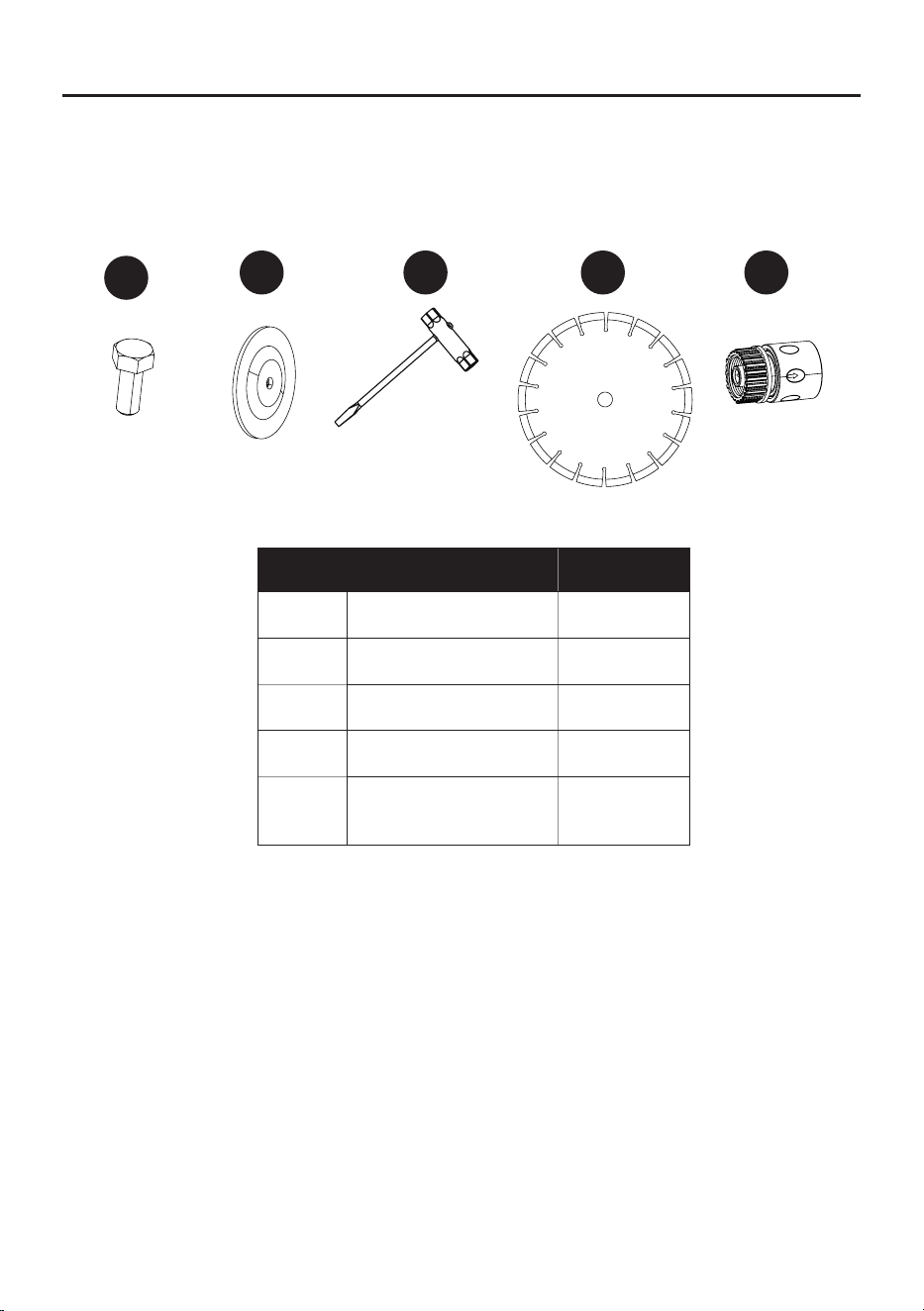
46
LISTA DE PIEZAS DE REPUESTO
Para obtener piezas de repuesto, llame a nuestro Departamento de Servicio al Cliente al 888-356-
2258, de lunes a domingo de 8 a.m. a 8 p.m., hora estándar del Este. También puede ponerse en
contacto con nosotros a través de [email protected].
Impreso en China
PIEZA # DESCRIPCIÓN PIEZA #
AA Perno R0101747-00
BB Arandela R0209346-00
CC Llave RB333001890
L Cuchilla de corte R0203654-00
J Acoplador de conexión
rápida
R0203282-00
AA
BB CC L J
