AS22027
ATTACH YOUR RECEIPT HERE
Serial Number Purchase Date
Español p. 19
ITEM #4913879
BRUSHLESS
HAMMER DRILL
MODEL #KHD 124B-03
KOBALT and logo design are trademarks
or registered trademarks of LF, LLC.
All rights reserved.
Questions, problems, missing parts? Before returning to your retailer, call our customer
service department at 888-3KOBALT (888-356-2258), 8 a.m.-8 p.m., EST,
Monday-Sunday. You could also contact us at [email protected].

2
TABLE OF CONTENTS
Product Specications ......................................................................................2
Packaging Contents ......................................................................................... 3
Safety Information ............................................................................................ 4
Preparation .......................................................................................................8
Operating Instructions ...................................................................................... 9
Care and Maintenance ...................................................................................16
Troubleshooting..............................................................................................16
Warranty .........................................................................................................17
PRODUCT SPECIFICATIONS
COMPONENT SPECIFICATION
Rated voltage
24V
No-load speed (n
0
) 0-550 / 0-2000 /min (RPM)
Impact rate 0-8800/0-32000 /min (BPM)
Chuck capacity 1/2 in. (13mm)
Maximum torque 850 in. lbs
Recommended operating, charging and
storage temperature
41°F (5°C) - 104°F (40°C)
3
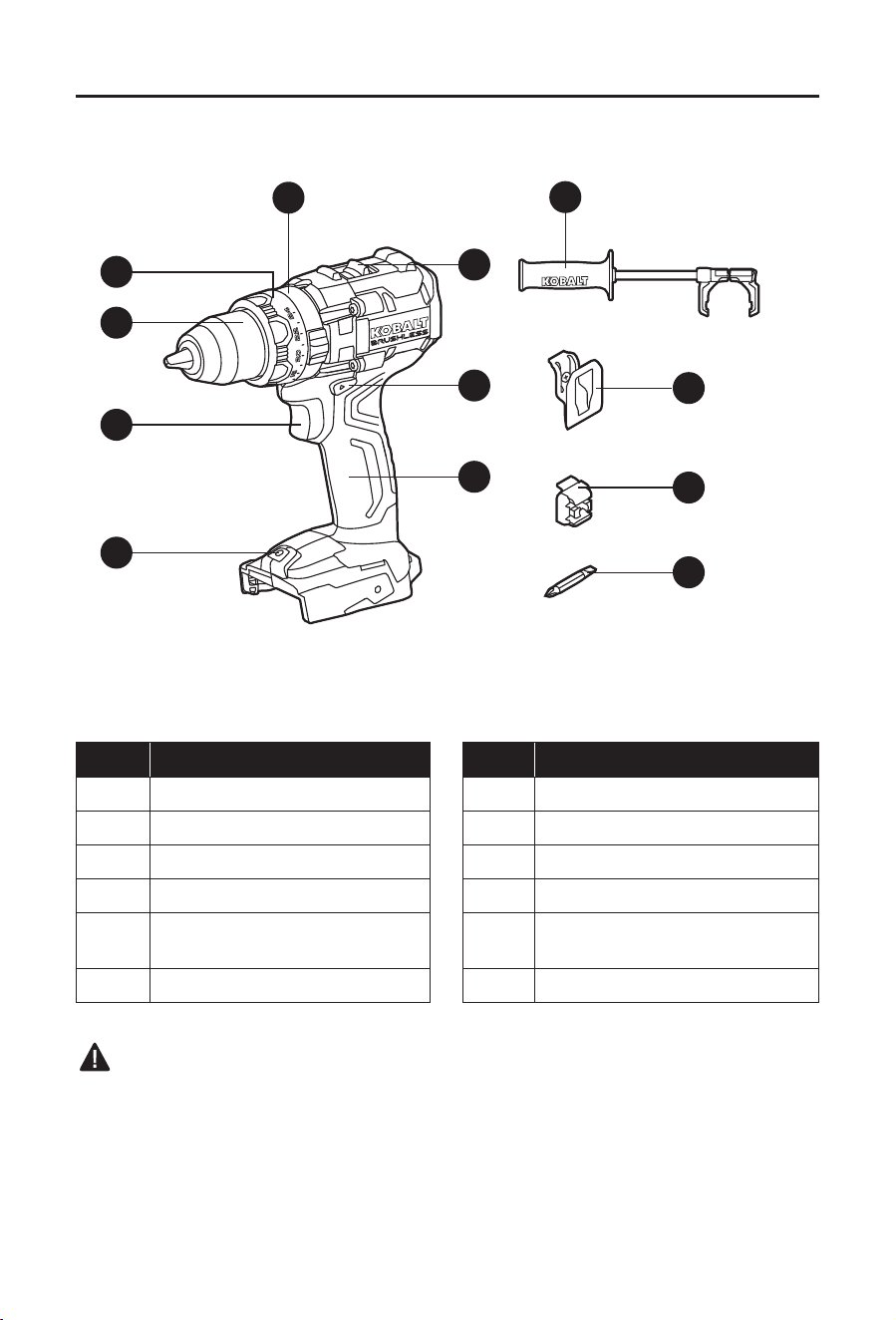
PACKAGE CONTENTS
H
I
J
K
C
B
A
F
G
E
D
L
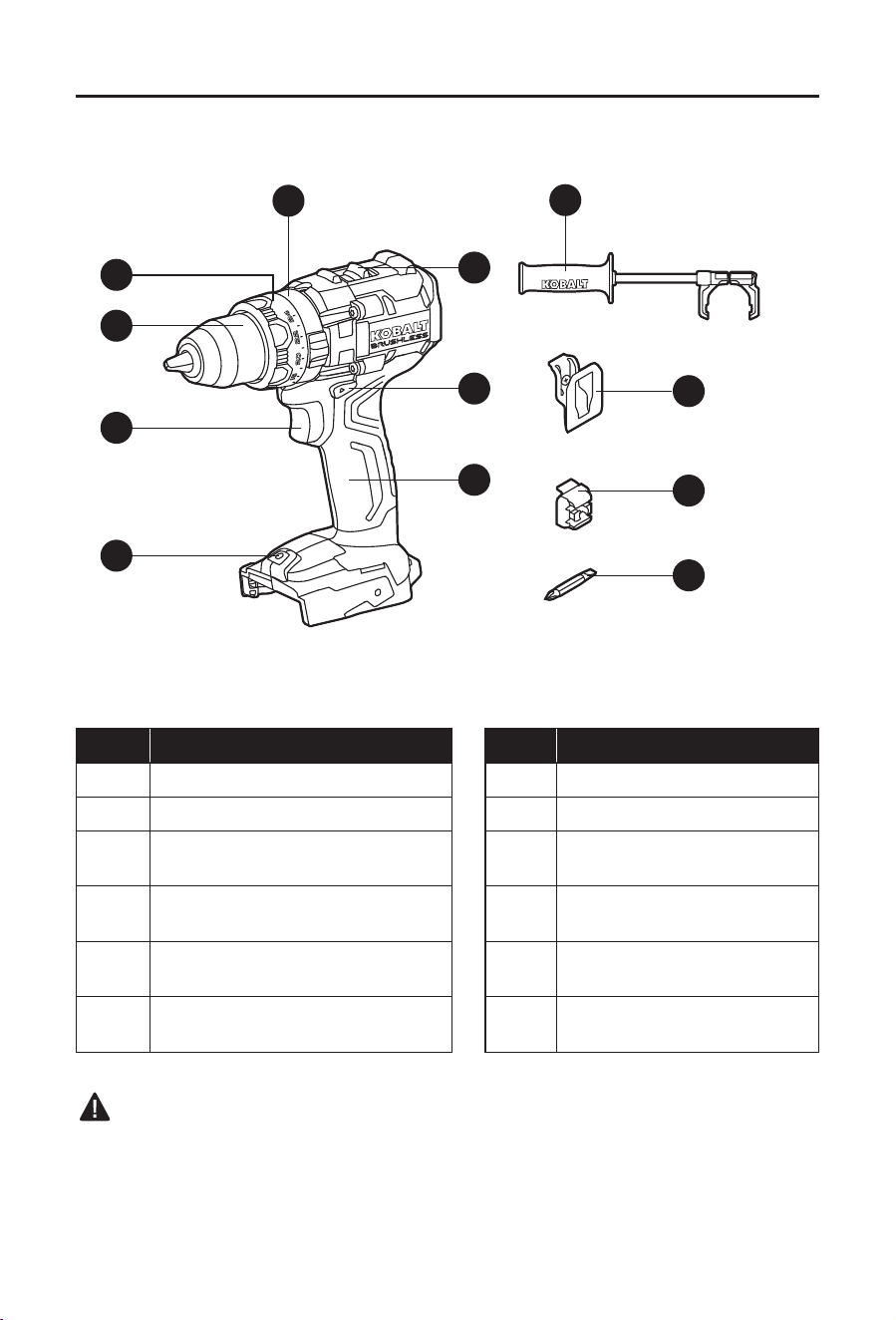
PART DESCRIPTION PART DESCRIPTION
A Keyless chuck G LED work light
B Torque adjustment ring H Auxiliary handle
C Mode selector I Belt clip (with screw)
D Gear selector J Bit holder (with screw)
E
Direction-of-rotation selector
(forward/center-lock/reverse)
K Double ended bit
F Variable-speed trigger switch L Handle
WARNING
• Remove the tool from the package and examine it carefully. Do not discard the carton or any
packaging material until all parts have been examined.
• If any part of the tool is missing or damaged, do not attach the battery pack or use the tool
until the part has been repaired or replaced. Failure to heed this warning could result in
serious injury.

4
SAFETY INFORMATION
Please read and understand this entire manual before attempting to assemble or operate
this product. If you have any questions regarding the product, please call customer service
at 888-3KOBALT (888-356-2258) , 8 a.m. - 8 p.m., EST, Monday - Sunday. You could also
contact us at [email protected].
WARNING
• The operation of any power tool can result in foreign objects being thrown into your eyes,
which can result in severe eye damage. Before beginning power-tool operation, always wear
safety goggles or safety glasses with side shields and a full-face shield, when needed. We
recommend using a wide vision safety mask over eyeglasses or standard safety glasses
with shields. Always use eye protection marked to comply with ANSI Z87.1.
• Some dust created by power sanding, sawing, grinding, drilling and other construction
activities contains chemicals known to the state of California to cause cancer, birth defects
or other reproductive harm. Some examples of these chemicals are:
– Lead from lead-based paints,
– Crystalline silica from bricks and cement and other masonry products, and
– Arsenic and chromium from chemically-treated lumber.
• Your risk from these exposures varies, depending on how often you do this type of work.
To reduce your exposure to these chemical: work in a well ventilated area, and work with
approved safety equipment, such as those dust masks that are specially designed to lter
out microscopic particles.
Know the Tool
To operate this tool, carefully read this manual and all labels afxed to the tool before using it.
Keep this manual available for future reference.
Important
This tool should be serviced only by a qualied service technician.
Read All Instructions Thoroughly
5
SAFETY INFORMATION
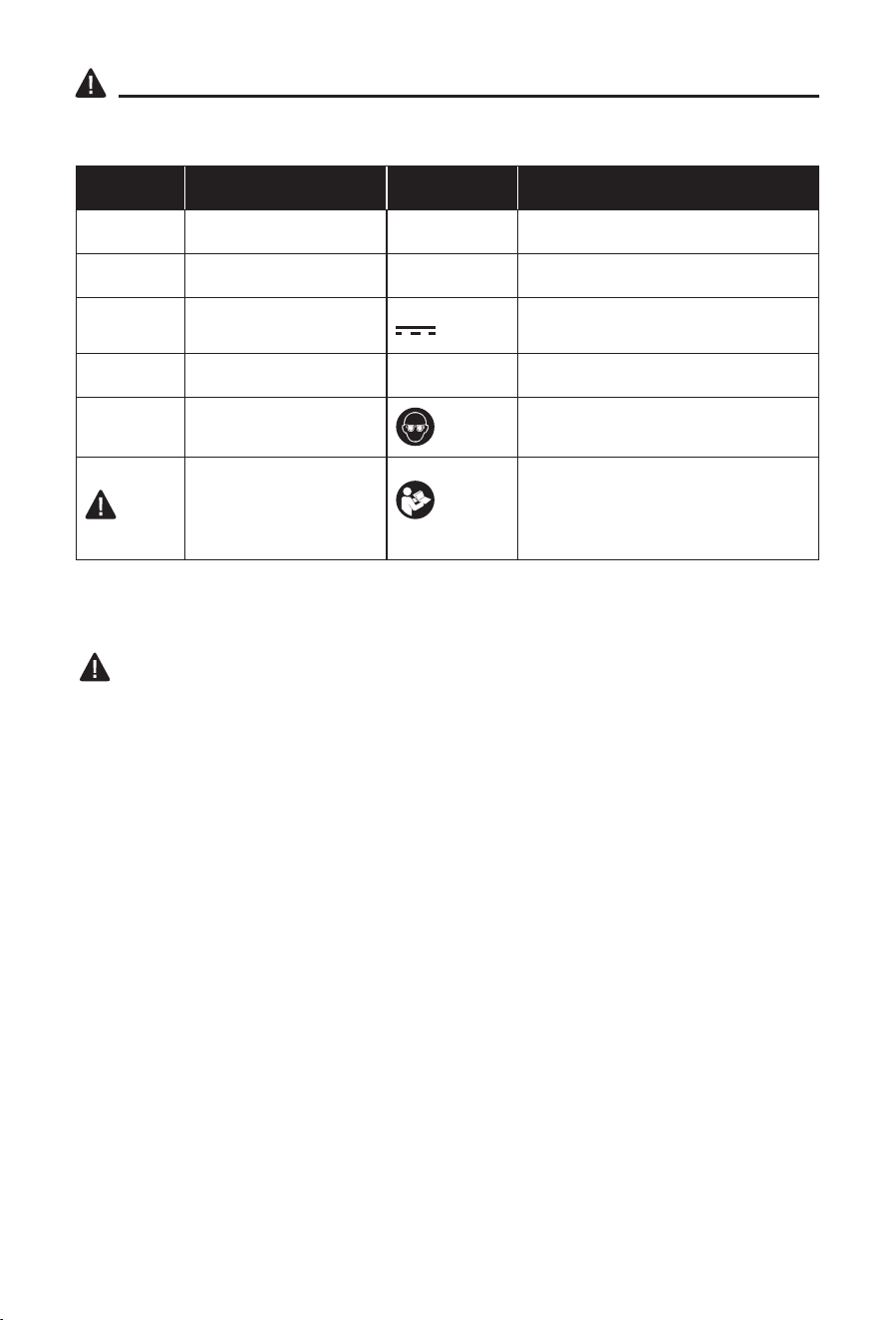
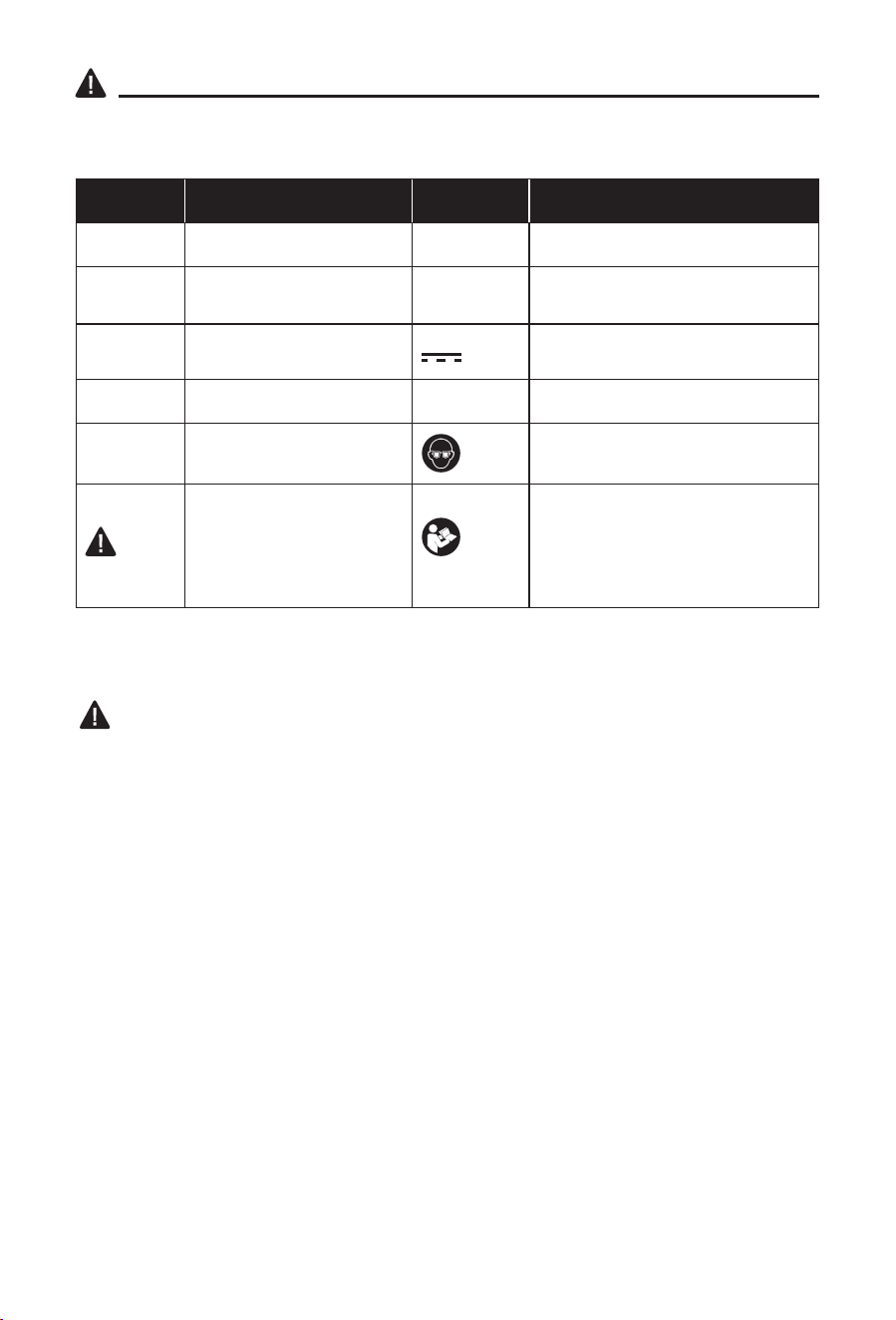
Some of the following symbols may be used on this tool. Please study them and their meaning.
Proper interpretation of these symbols will allow you to operate the tool better and more safely.
SYMBOL DEFINITION SYMBOL DEFINITION
V Volts n
0
No-load Speed
RPM Revolutions per Minute BPM Beats per Minute
…/min
Revolutions or Strokes
per Minute
or d.c.
Direct Current
" or in. Inch in. lbs. Inch-Pound
N m Newton Meter
To reduce the risk of injury, always
wear eye protection.
A danger, warning,
or caution. It means
‘Attention! Your safety
is involved.’
To reduce the risk of injury, user
must read instruction manual.
General Power Tool Safety Warnings
WARNING
• Read all safety warnings, instructions, illustrations and specications provided with
this power tool. Failure to follow all instructions listed below may result in electric shock,
re and/or serious injury.
Save all warnings and instructions for future reference
The term “power tool” in the warnings refers to your mains-operated (corded) power tool or
battery-operated (cordless) power tool.
Work Area Safety
• Keep work area clean and well lit. Cluttered or dark areas invite accidents.
• Do not operate power tools in explosive atmospheres, such as in the presence of
ammable liquids, gases or dust. Power tools create sparks, which may ignite the dust or
fumes.
• Keep children and bystanders away while operating a power tool. Distractions can
cause you to lose control.
Electrical Safety
• Power tool plugs must match the outlet. Never modify the plug in any way. Do not use
any adapter plugs with earthed (grounded) power tools. Unmodied plugs and matching
outlets will reduce the risk of electric shock.
• Avoid body contact with earthed or grounded surfaces such as pipes, radiators,
ranges and refrigerators. There is an increased risk of electric shock if your body is
earthed or grounded.

6
SAFETY INFORMATION
• Do not expose power tools to rain or wet conditions. Water entering a power tool will
increase risk of electric shock.
• Do not abuse the cord. Never use the cord for carrying, pulling or unplugging the
power tool. Keep cord away from heat, oil, sharp edges or moving parts. Damaged or
entangled cords increase the risk of electric shock.
• When operating a power tool outdoors, use an extension cord suitable for outdoor
use. Use of a cord suitable for outdoor use reduces the risk of electric shock.
• If operating a power tool in a damp location is unavoidable, use a ground fault circuit
interrupter (GFCI) protected supply. Use of a GFCI reduces the risk of electric shock.
Personal Safety
• Stay alert, watch what you are doing and use common sense when operating a power
tool. Do not use a power tool while you are tired or under the inuence of drugs,
alcohol or medication. A moment of inattention while operating power tools may result in
serious personal injury.
• Use personal protective equipment. Always wear eye protection. Protective equipment
such as a dust mask, non-skid safety shoes, hard hat or hearing protection used for
appropriate conditions will reduce personal injuries.
• Prevent unintentional starting. Ensure the switch is in the off-position before
connecting to power source and/or battery pack, picking up or carrying the tool.
Carrying power tools with your nger on the switch or energising power tools that have the
switch on invites accidents.
• Remove any adjusting key or wrench before turning the power tool on. A wrench or a
key left attached to a rotating part of the power tool may result in personal injury.
• Do not overreach. Keep proper footing and balance at all times. This enables better
control of the power tool in unexpected situations.
• Dress properly. Do not wear loose clothing or jewelry. Keep your hair and clothing away
from moving parts. Loose clothes, jewelry or long hair can be caught in moving parts.
• If devices are provided for the connection of dust extraction and collection facilities,
ensure these are connected and properly used. Use of dust collection can reduce dust-
related hazards.
• Do not let familiarity gained from frequent use of tools allow you to become
complacent and ignore tool safety principles. A careless action can cause severe injury
within a fraction of a second.
Power tool use and care
• Do not force the power tool. Use the correct power tool for your application. The
correct power tool will do the job better and safer at the rate for which it was designed.
• Do not use the power tool if the switch does not turn it on and off. Any power tool that
cannot be controlled with the switch is dangerous and must be repaired.
• Disconnect the plug from the power source and/or remove the battery pack,
if detachable, from the power tool before making any adjustments, changing
accessories, or storing power tools. Such preventive safety measures reduce the risk of
starting the power tool accidentally.
• Store idle power tools out of the reach of children and do not allow persons
unfamiliar with the power tool or these instructions to operate the power tool. Power
tools are dangerous in the hands of untrained users.
• Maintain power tools and accessories. Check for misalignment or binding of moving
parts, breakage of parts and any other condition that may affect the power tool’s
operation. If damaged, have the power tool repaired before use. Many accidents are
caused by poorly maintained power tools.

7
SAFETY INFORMATION
• Keep cutting tools sharp and clean. Properly maintained cutting tools with sharp cutting
edges are less likely to bind and are easier to control.
• Use the power tool, accessories and tool bits etc. in accordance with these
instructions, taking into account the working conditions and the work to be
performed. Use of the power tool for operations different from those intended could result in
a hazardous situation.
• Keep handles and grasping surfaces dry, clean and free from oil and grease. Slippery
handles and grasping surfaces do not allow for safe handling and control of the tool in
unexpected situations.
Battery Tool Use and Care
• Recharge only with the charger specied by the manufacturer. A charger that is suitable
for one type of battery pack may create a risk of re when used with another battery pack.
• Use power tools only with specically designated battery packs. Use of any other
battery packs may create a risk of injury and re.
• When battery pack is not in use, keep it away from other metal objects, like paper
clips, coins, keys, nails, screws or other small metal objects, that can make a
connection from one terminal to another. Shorting the battery terminals together may
cause burns or a re.
• Under abusive conditions, liquid may be ejected from the battery; avoid contact. If
contact accidentally occurs, ush with water. If liquid contacts eyes, additionally seek
medical help. Liquid ejected from the battery may cause irritation or burns.
• Do not use a battery pack or tool that is damaged or modied. Damaged or modied
batteries may exhibit unpredictable behavior resulting in re, explosion or risk of injury.
• Do not expose a battery pack or tool to re or excessive temperature. Exposure to re
or temperature above 265 °F (130 °C) may cause explosion.
• Follow all charging instructions and do not charge the battery pack or tool outside
the temperature range specied in the instructions. Charging improperly or at
temperatures outside the specied range may damage the battery and increase the risk of
re.
Service
• Have your power tool serviced by a qualied repair person using only identical
replacement parts. This will ensure that the safety of the power tool is maintained.
• Never service damaged battery packs. Service of battery packs should only be performed
by the manufacturer or authorized service providers.
Drill Safety Warnings
Safety Instructions for All Operations
• Wear ear protectors when impact drilling. Exposure to noise can cause hearing loss.
• Use the auxiliary handle(s). Loss of control can cause personal injury.
• Hold the power tool by insulated gripping surfaces, when performing an operation
where the cutting accessory or fasteners may contact hidden wiring. Cutting accessory
or fasteners contacting a “live” wire may make exposed metal parts of the power tool “live”
and could give the operator an electric shock.

8
SAFETY INFORMATION
Safety Instructions When Using Long Drill Bits
• Never operate at higher speed than the maximum speed rating of the drill bit. At higher
speeds, the bit is likely to bend if allowed to rotate freely without contacting the workpiece,
resulting in personal injury.
• Always start drilling at low speed and with the bit tip in contact with the workpiece.
At higher speeds, the bit is likely to bend if allowed to rotate freely without contacting the
workpiece, resulting in personal injury.
• Apply pressure only in direct line with the bit and do not apply excessive pressure.
Bits can bend causing breakage or loss of control, resulting in personal injury.
Additional Warnings
• Use only with the battery packs and chargers listed below:
BATTERY PACK BATTERY CHARGER
KB 224-03; KB 424-03; KB 524-03;
KB 624-03; KXB 424-03; KXB 824-03
KRC 2445-03; KRC 2490-03;
KRC 2404-03; KDPC 124-03;
KCH 2401-03; KCH 2411-03
PREPARATION
Know Your Hammer Drill
Before attempting to use the hammer drill, familiarize yourself with all of its operating features
and safety requirements.
WARNING
• Do not allow familiarity with the hammer drill to cause carelessness. Remember that one
careless moment is enough to cause severe injury. Before attempting to use any tool, be
sure to become familiar with all of the operating features and safety instructions.
• Do not attempt to modify this tool or create accessories not recommended for use with this
tool. Any such alteration or modication is misuse and could result in a hazardous condition
leading to possible serious personal injury.
9
OPERATING INSTRUCTIONS
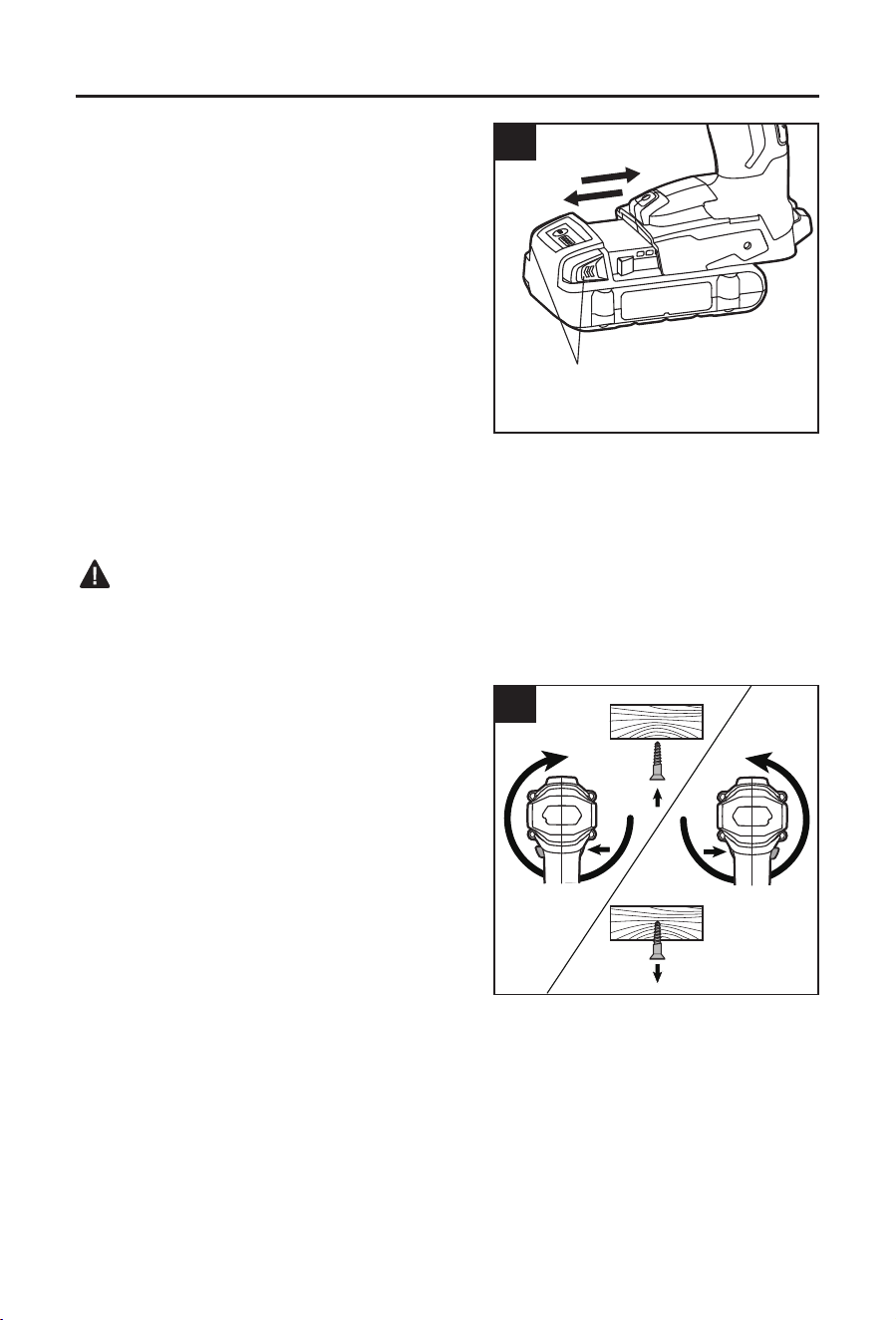
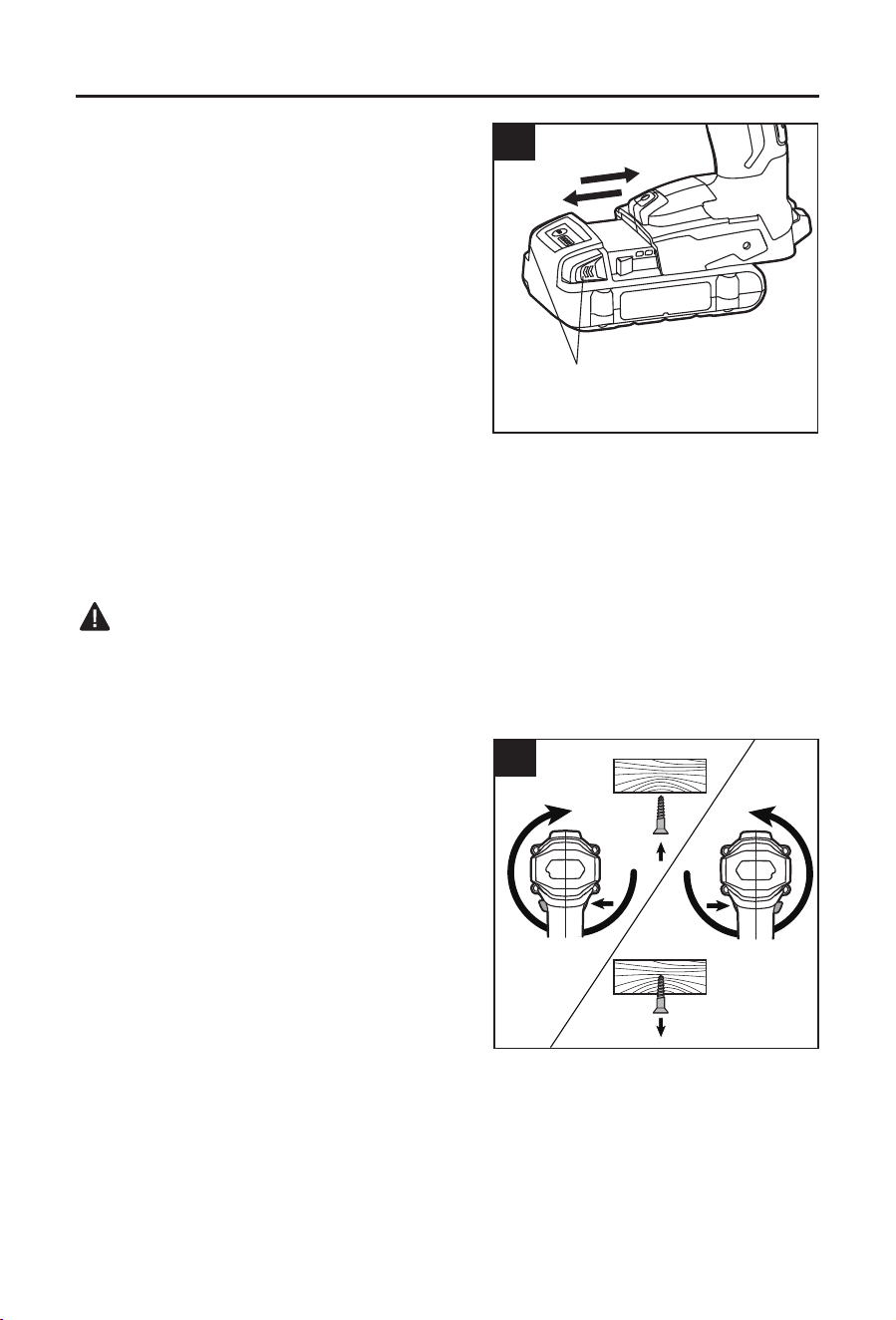
1. To Attach Battery Pack
a. Align the raised portion on the battery pack
with the grooves on the bottom of the tool, and
then slide the battery pack onto the tool as
shown.
b. Make sure that the latch on the battery pack
snaps into place and the battery pack is
secured to the tool before beginning operation.
NOTICE: When placing the battery pack on the
tool, be sure that the raised rib on battery pack
aligns with the groove on the tool and the latches
snap into place properly. Improper assembly of
the battery pack can cause damage to internal
components.
To Detach Battery Pack
a. Press the battery-release buttons to release the battery pack.
b. Pull the battery pack backward to remove it from the tool.
WARNING
• Battery tools are always in operating condition. Therefore, always remove the battery pack
when the tool is not in use or when carrying the tool at your side.
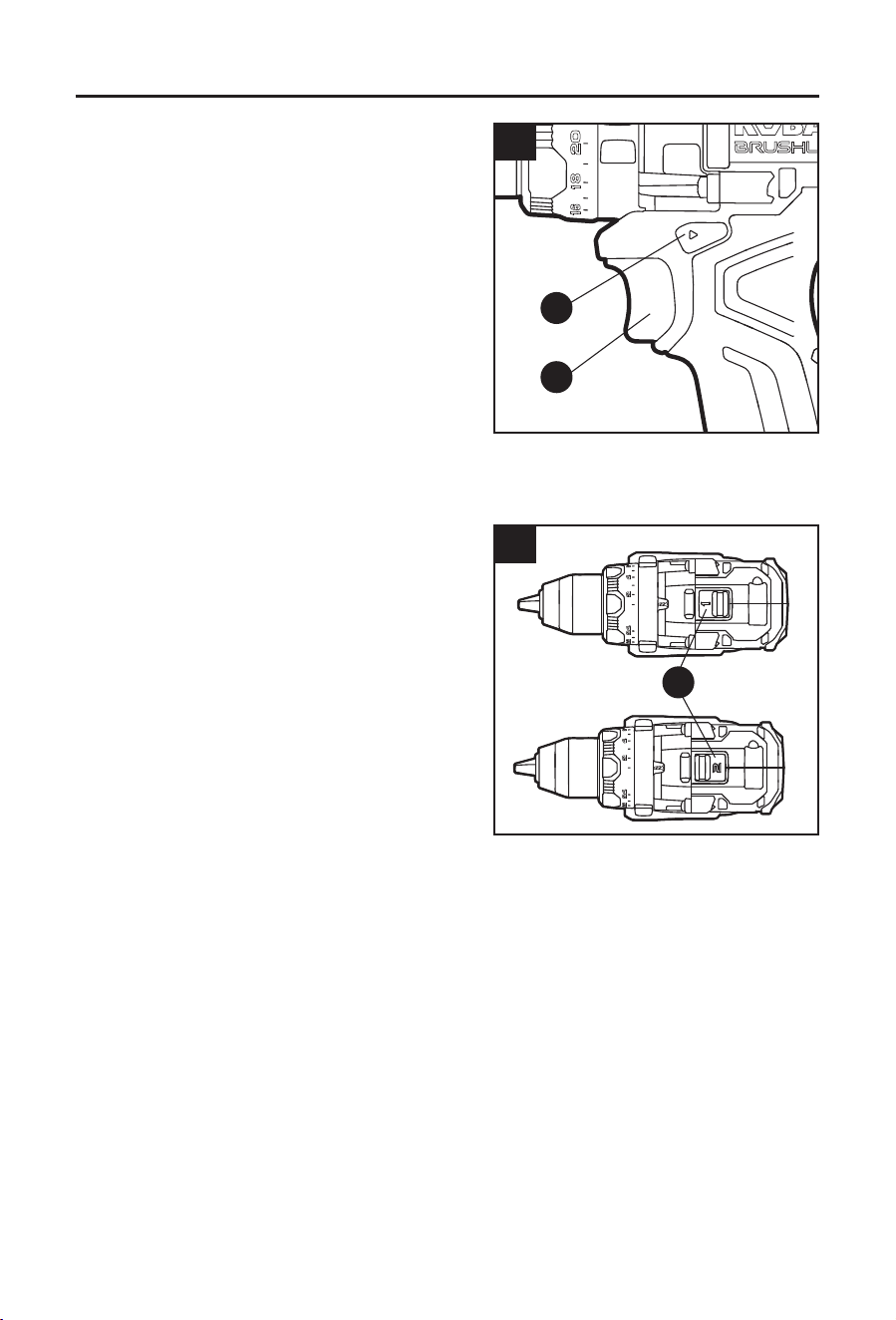
2. Direction-of-Rotation Selector
(Forward/Center Lock/Reverse)
The direction of bit rotation is reversible and is
controlled by the selector located above the trigger
switch (F). With the hammer drill held in the normal
operating position, pointing away from you:
a. Position the direction-of-rotation selector (E) to
the left of the tool for forward rotation to drill in
or drive the screws in.
b. Position the direction-of-rotation selector to the
right of the tool for reverse rotation to remove
screws.
c. Setting the selector in the center position locks
the trigger to helps reduce the possibility of
accidental starting when the tool is not in use.
NOTICE: To prevent gear damage, always allow the hammer drill to come to a complete stop
before changing the direction of rotation.
NOTICE: The hammer drill will not run unless the direction-of-rotation selector is engaged fully
to the left or right.
2
Forward Reverse
1
Battery-release
buttons
10
OPERATING INSTRUCTIONS
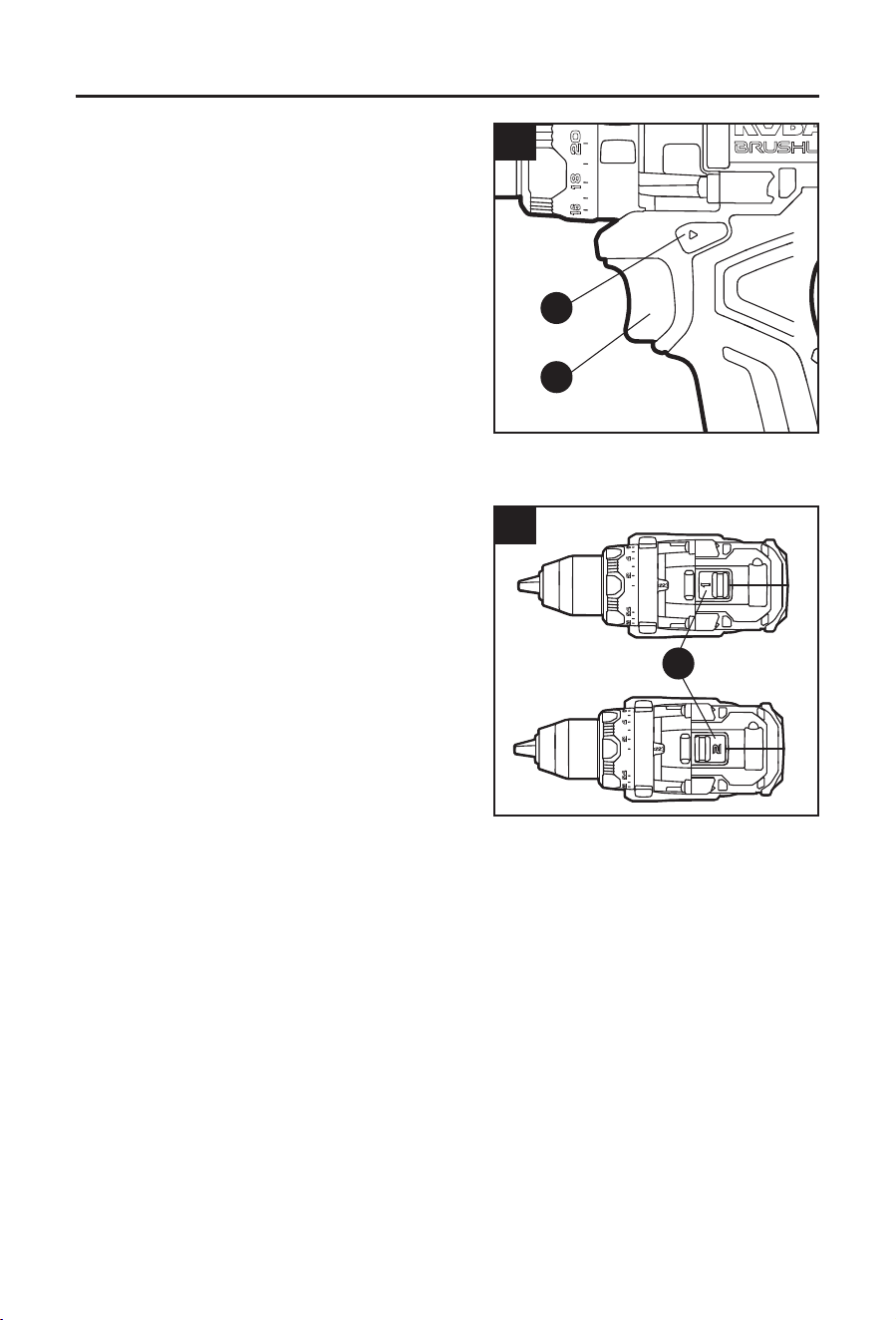
3. Variable-speed Trigger Switch
a. Position the direction-of-rotation selector (E) to
the left or right of the tool as needed to unlock
the trigger switch (F).
b. To turn the hammer drill ON, depress the
trigger switch (F).
c. To turn it OFF, release the trigger switch.
Variable Speed
The variable-speed trigger switch delivers higher
speed with increased trigger pressure and lower
speed with decreased trigger pressure.
Electric Brake
The hammer drill is equipped with an electric
brake. When the trigger switch is released, the electric brake engages automatically to quickly
stop rotation.
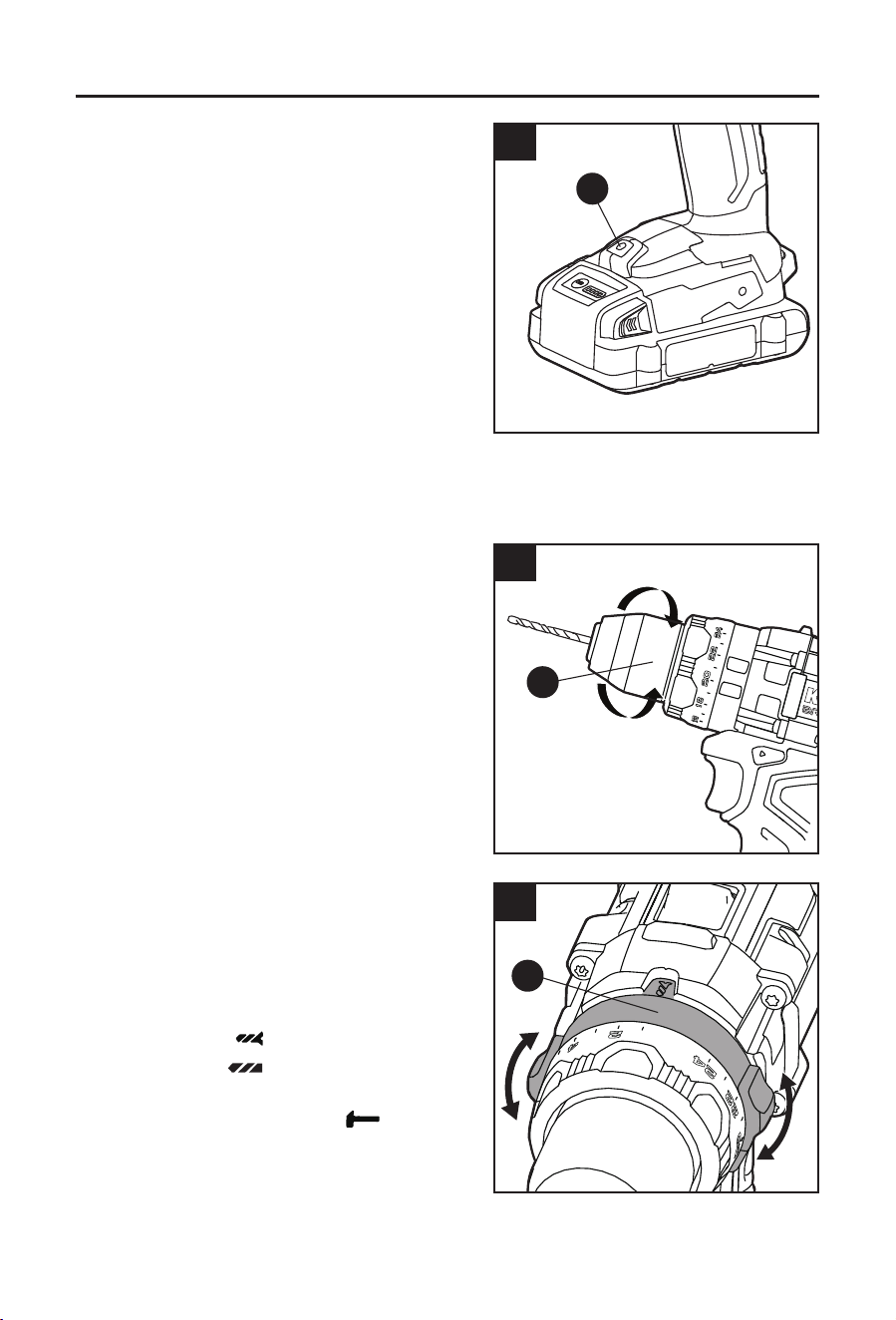
4. Two-Speed Gear Box
The hammer drill has a two-speed gear box
designed for drilling or driving at two different
variable-speed ranges. The gear selector (D) is
located on the top of the hammer drill, allowing you
to select either “1” (Low) speed range or “2” (High)
speed range.
a. Setting “1” will deliver lower speeds and
increased power and torque. Use setting “1”
for heavy-duty work or driving screws.
b. Setting “2” will deliver higher speeds and
reduced power and torque. Use setting “2” for
drilling wood and wood composites and for
using abrasive and polishing accessories.
NOTICE: Never change gears while the tool is running. Failure to obey this caution could
result in serious damage to the hammer drill.
3
E
F
4
D
11
OPERATING INSTRUCTIONS
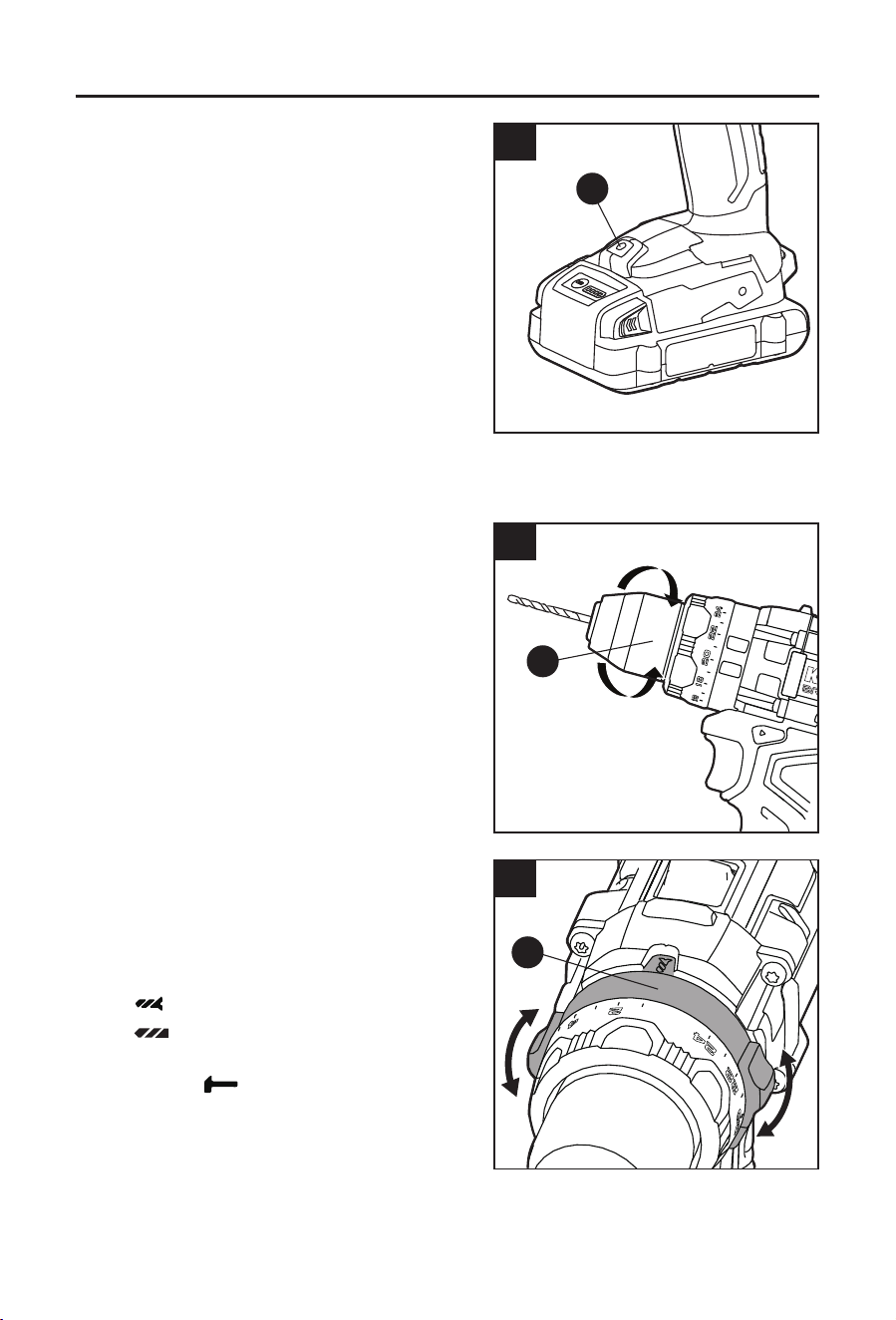
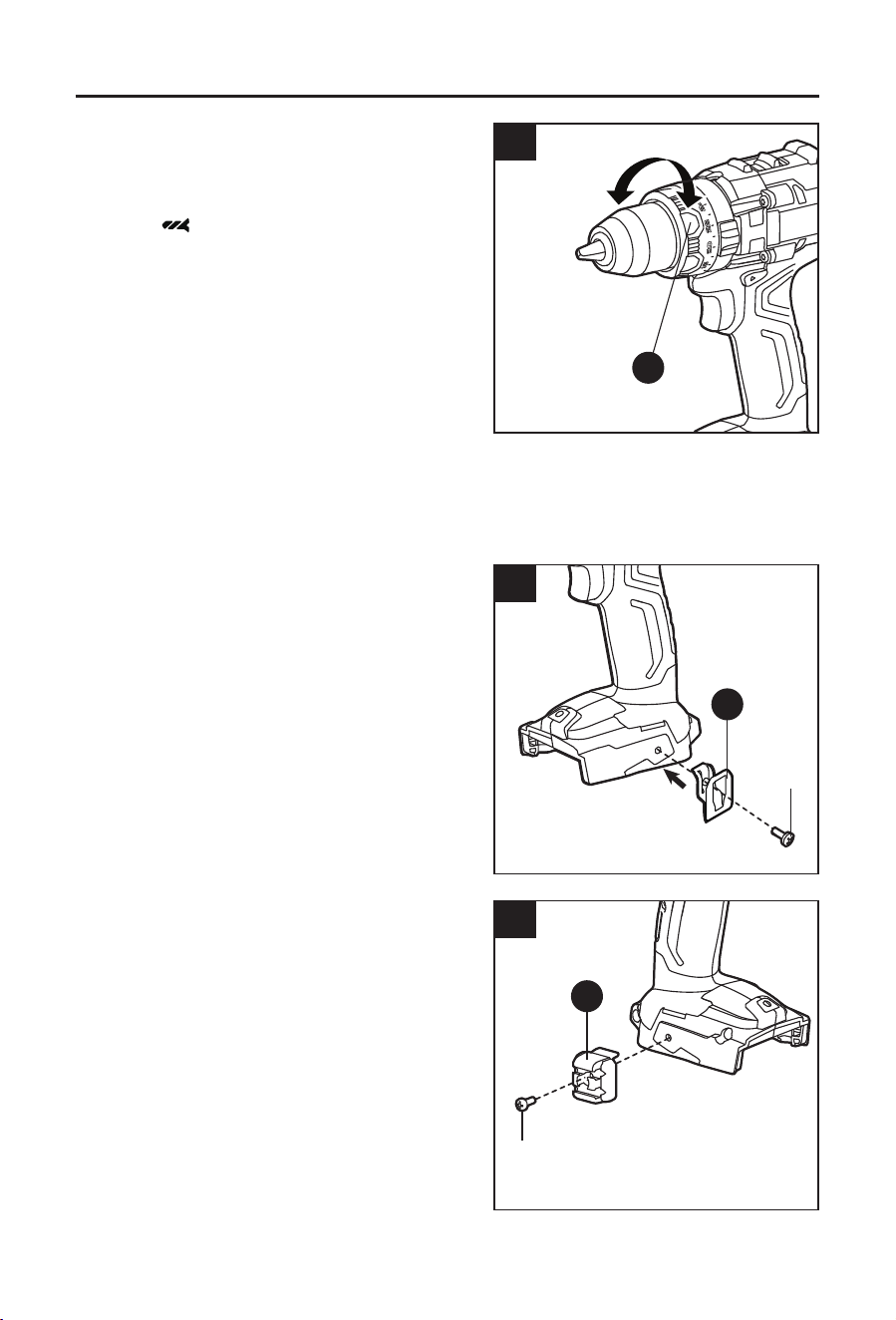
5. LED Work Light
The LED work light (G), located on the base of the
hammer drill, will illuminate when the trigger switch
is depressed. This provides additional light on the
surface of the work piece for operation in lower-
light areas.
The LED work light will turn off within
approximately 10 seconds after the variable-speed
trigger switch is released.
The LED work light will ash rapidly if the tool has
stopped automatically when the tool and/or battery
pack became overloaded or too hot. Please wait
for the tool and/or battery pack to cool down, at
which point it can be started again.
The LED work light will ash slowly to indicate that the battery charge is very low. Please
recharge the battery pack.
6. Keyless Chuck
The hammer drill features a keyless chuck (A)
to tighten or release drill bits in the chuck jaws
without using an additional tool. The arrows on the
chuck indicate the direction in which to rotate the
chuck body in order to GRIP (tighten) or OPEN
(loosen) the chuck jaws on the drill bit.
7. Mode Selector
The mode selector (C) allows the tool to be set for
various applications.
Rotate the selector clockwise or counterclockwise,
depending on the application.
Driving
mode : For driving screws.
Drilling
mode : For drilling in wood, metal,
plastic, or other materials.
Hammer drilling
mode : For drilling with
hammer action in concrete, masonry, or similar
hard material.
NOTICE: Do not change the mode setting when
the tool is running.
5
G
6
A
Tighten
Loosen
7
C
12
OPERATING INSTRUCTIONS
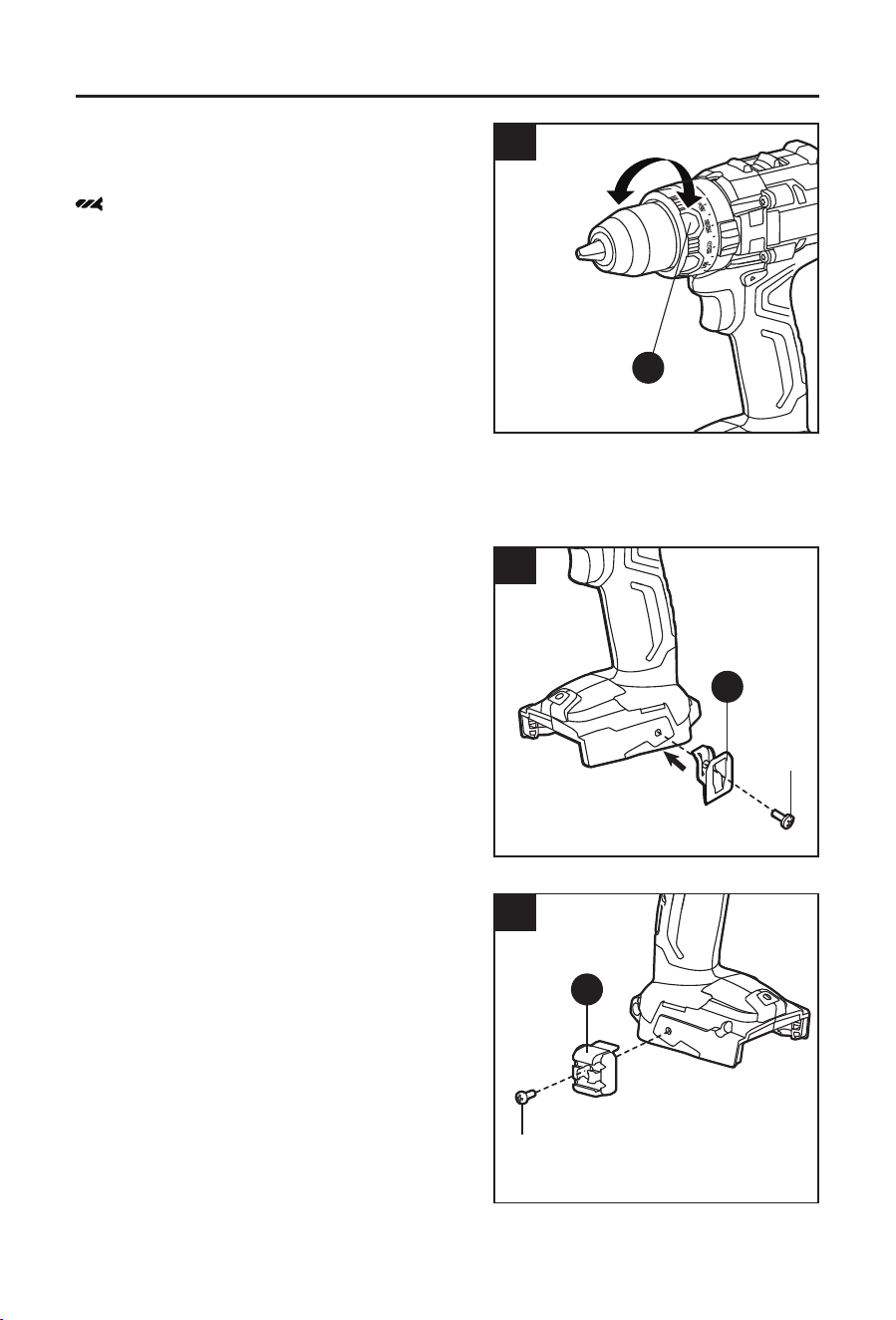
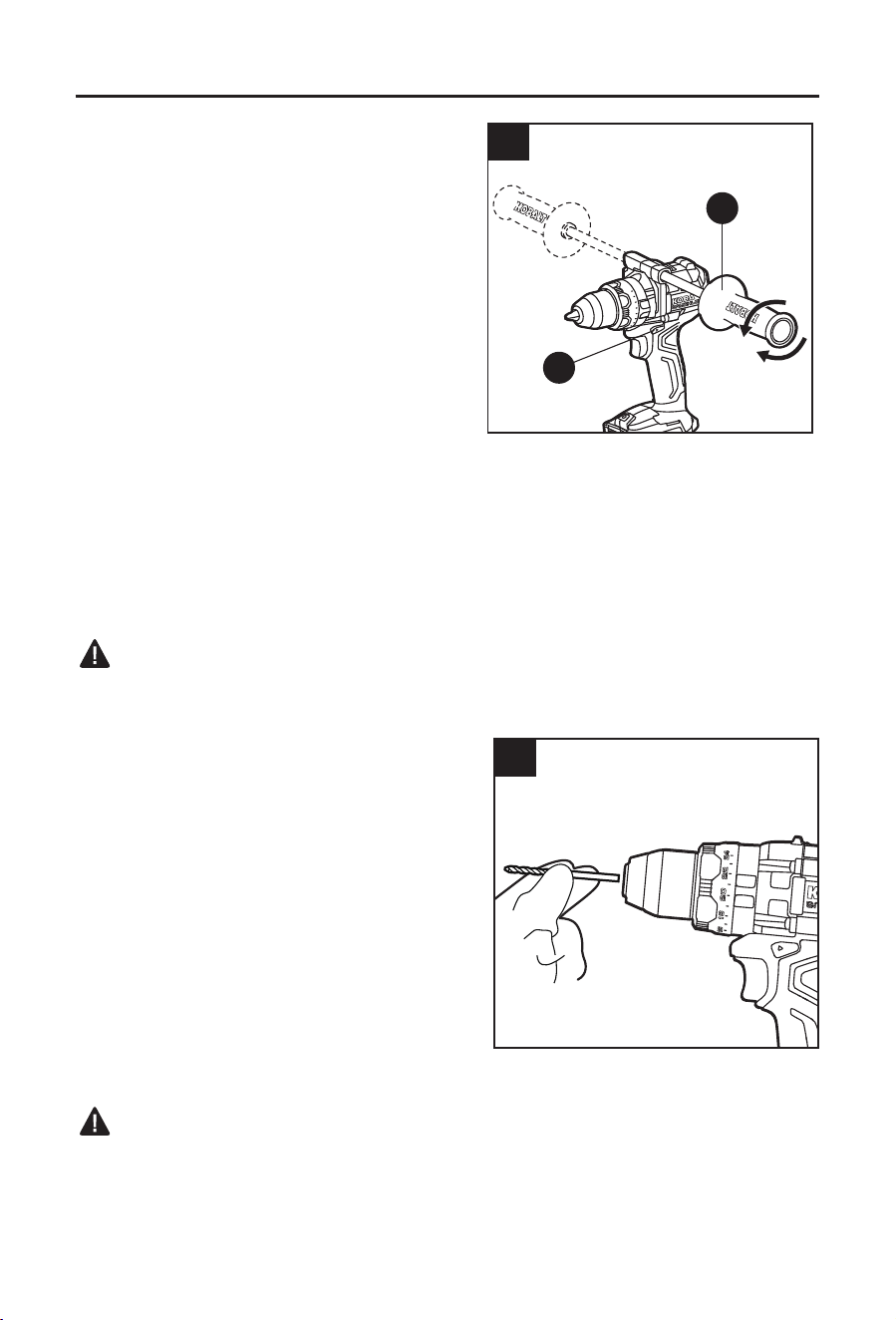
8. Adjustable Torque Clutch
The torque adjustment ring (B) can be set any of 24
torque settings when the tool is in the driving mode
.
Adjust the torque by rotating the torque adjustment
ring (B). The higher the torque setting number, the
more force the hammer drill produces to turn an
object.
The proper setting depends on the job and the type
of bit, fastener, and material you will be using. In
general, use greater torque for larger screws. If the
torque is too high, the screws may be damaged or
broken.
Torque adjustment is not available for the drilling or
hammer mode.
NOTICE: Do not change the torque setting when the tool is running.
9. Installing and Removing the Belt Clip
a. Align the rib of the belt clip (I) with the hole on
the base of the hammer drill.
b. Insert the screw and tighten the screw securely
with a Phillips-head screwdriver (not included).
c. To remove the belt clip, use a Phillips-head
screwdriver to loosen the screw holding the
belt clip to the hammer rill.
NOTE: The belt clip can be installed on the right or
left side of the tool.
10. Installing and Removing the Bit Holder
a. Align the rib of the bit holder (J) with the hole
on the base of the hammer drill.
b. Insert the screw and tighten the screw securely
with a Phillips-head screwdriver (not included).
c. To remove the bit holder, use a Phillips-head
screwdriver to loosen the screw holding the bit
holder to the hammer drill.
NOTE: The bit holder can be installed on the right
or left side of the tool.
8
B
9
I
Screw
10
J
Screw
13
OPERATING INSTRUCTIONS
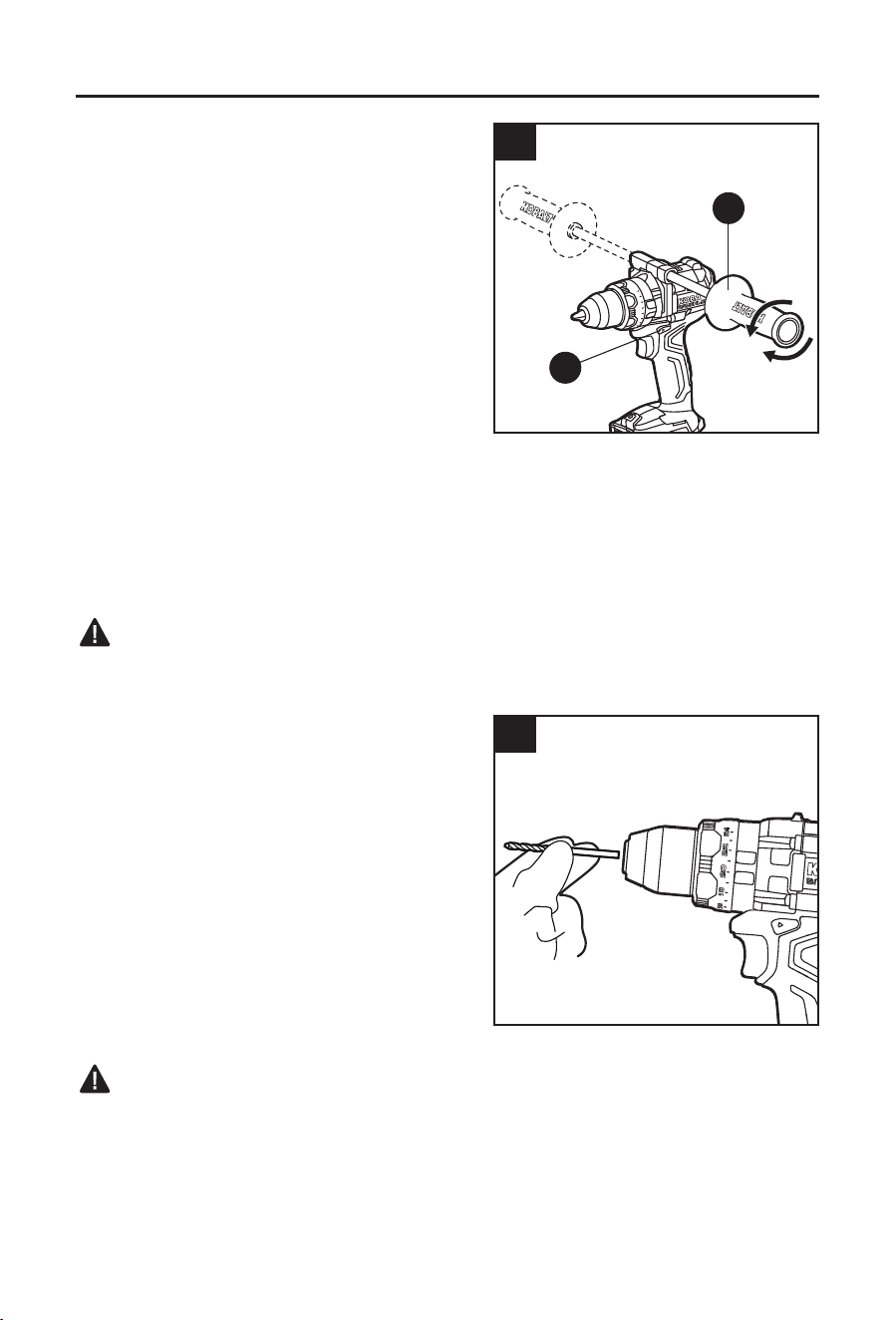
11. Auxiliary Handle
This hammer drill is equipped with an auxiliary
handle (H). For ease of operation, you can use the
handle with either the left or the right hand. The
handle can be locked in the two positions shown in
Fig.11.
To install the auxiliary handle:
a. Place the direction-of-rotation selector (E) in the
center lock position.
b. Loosen the auxiliary handle (H) by turning the
grip handle counterclockwise.
c. Align the raised portion on the auxiliary handle
with the grooves on gear box of the hammer
drill, then slide the auxiliary handle onto the tool as shown.
d. Securely tighten the auxiliary handle in place by turning the grip handle clockwise.
To remove the auxiliary handle:
a. Place the direction-of-rotation selector (E) in the center lock position.
b. Loosen the auxiliary handle (H) by turning the grip handle counterclockwise.
c. Remove the auxiliary handle from the tool.
WARNING
• For safety and ease of operation, securely tighten the auxiliary handle by turning the grip
handle clockwise before every use.
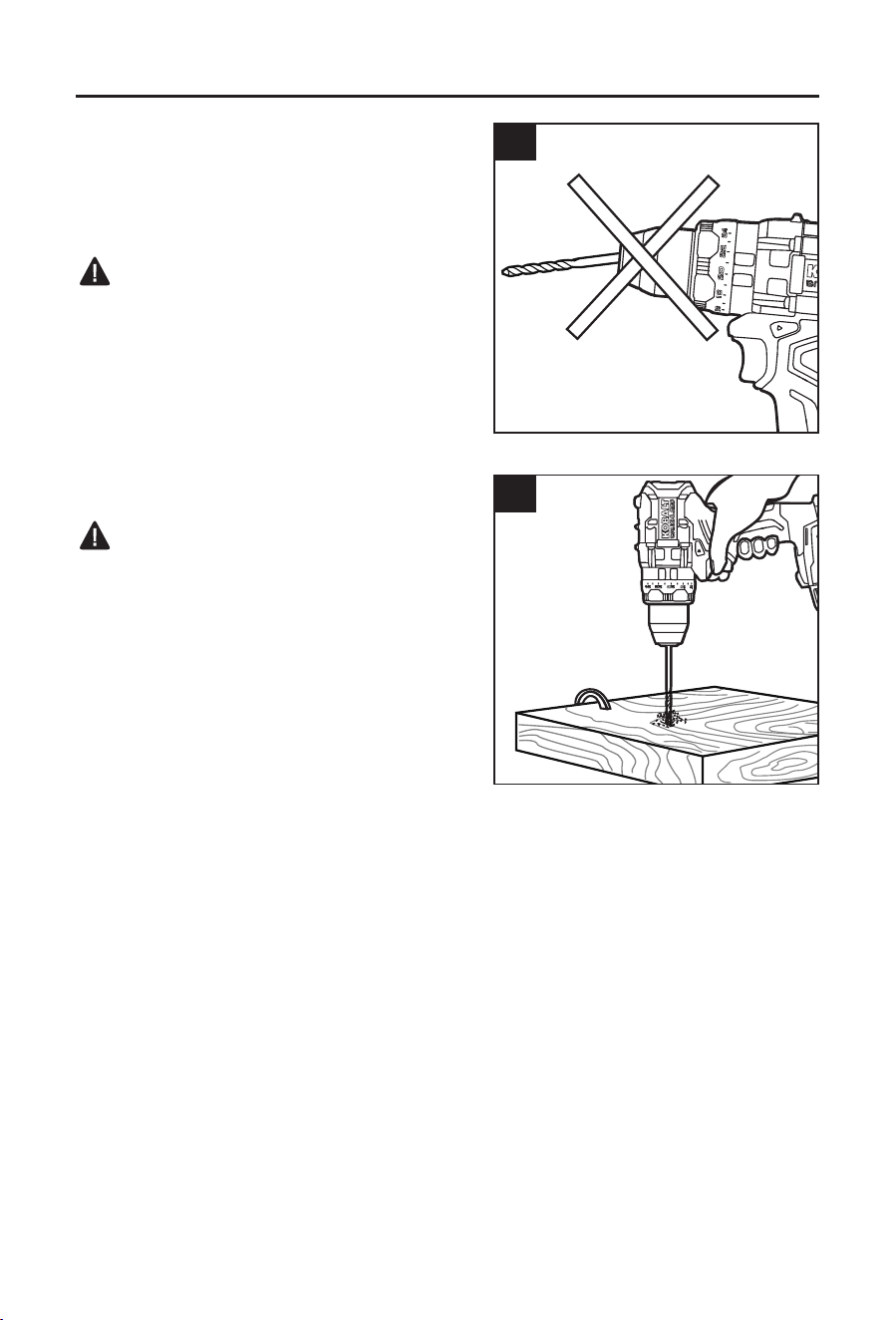
12. Bits
Installing Bits
a. Place the direction-of-rotation selector (E) in the
center lock position.
b. Open or close the chuck jaws to a point where
the opening is slightly larger than the shank of
the bit you intend to use.
c. Insert the bit.
d. Tighten the chuck jaws securely on the bit.
NOTICE: Rotate the chuck body in the direction of
the arrow marked “GRIP” to close the chuck jaws.
Do not use a wrench to tighten or loosen the chuck
jaws.
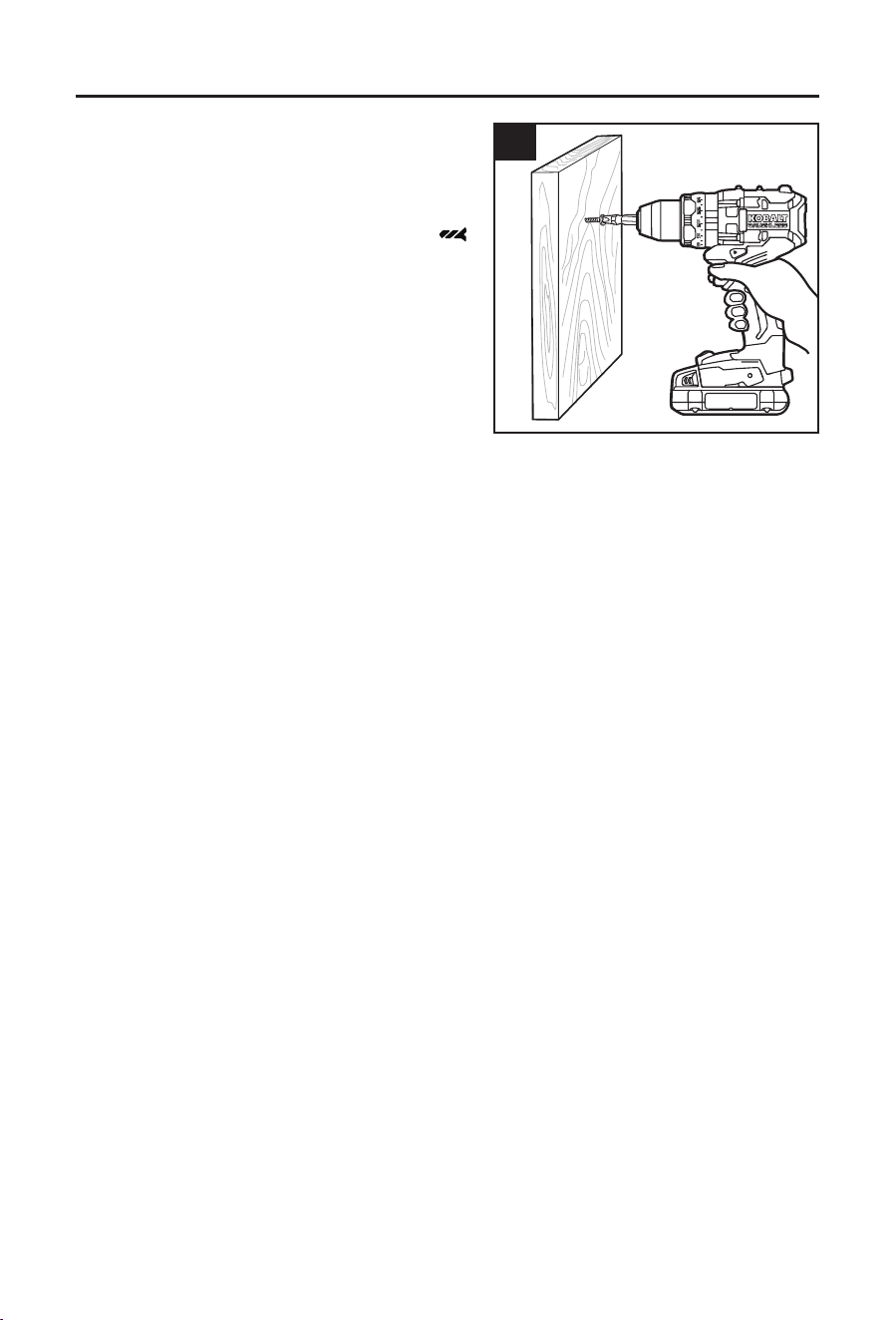
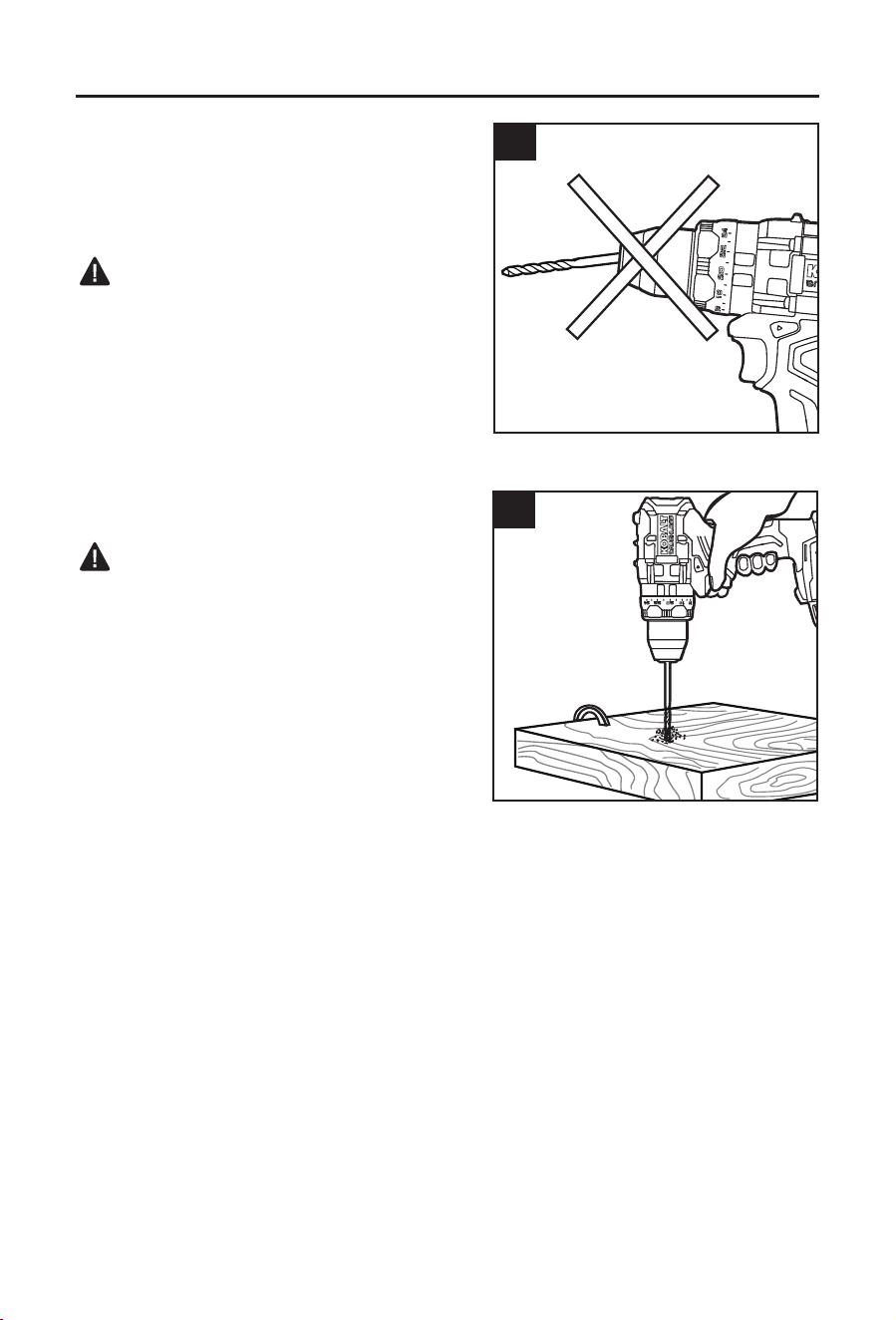
WARNING
• Make sure to insert the drill bit straight into the chuck jaws. Do not tighten the chuck jaws if
the drill bit is inserted at an angle as shown in Fig. 12b. This could cause the drill bit to be
thrown from the hammer drill, resulting in possibly serious personal injury or damage to the
chuck.
12a
11
Loosen
Tighten
H
E
14
OPERATING INSTRUCTIONS
Removing Bits
a. Place the direction-of-rotation selector (E) in the
center lock position.
b. Open the chuck jaws.
c. Remove the drill bit.
WARNING
• Do not hold the chuck body with one hand and
use the power of the hammer drill to tighten or
loosen the chuck jaws on the drill bit. The chuck
body could slip in your hand, or your hand could
slip and come in contact with the rotating bit.
This could cause an accident resulting in serious
personal injury.
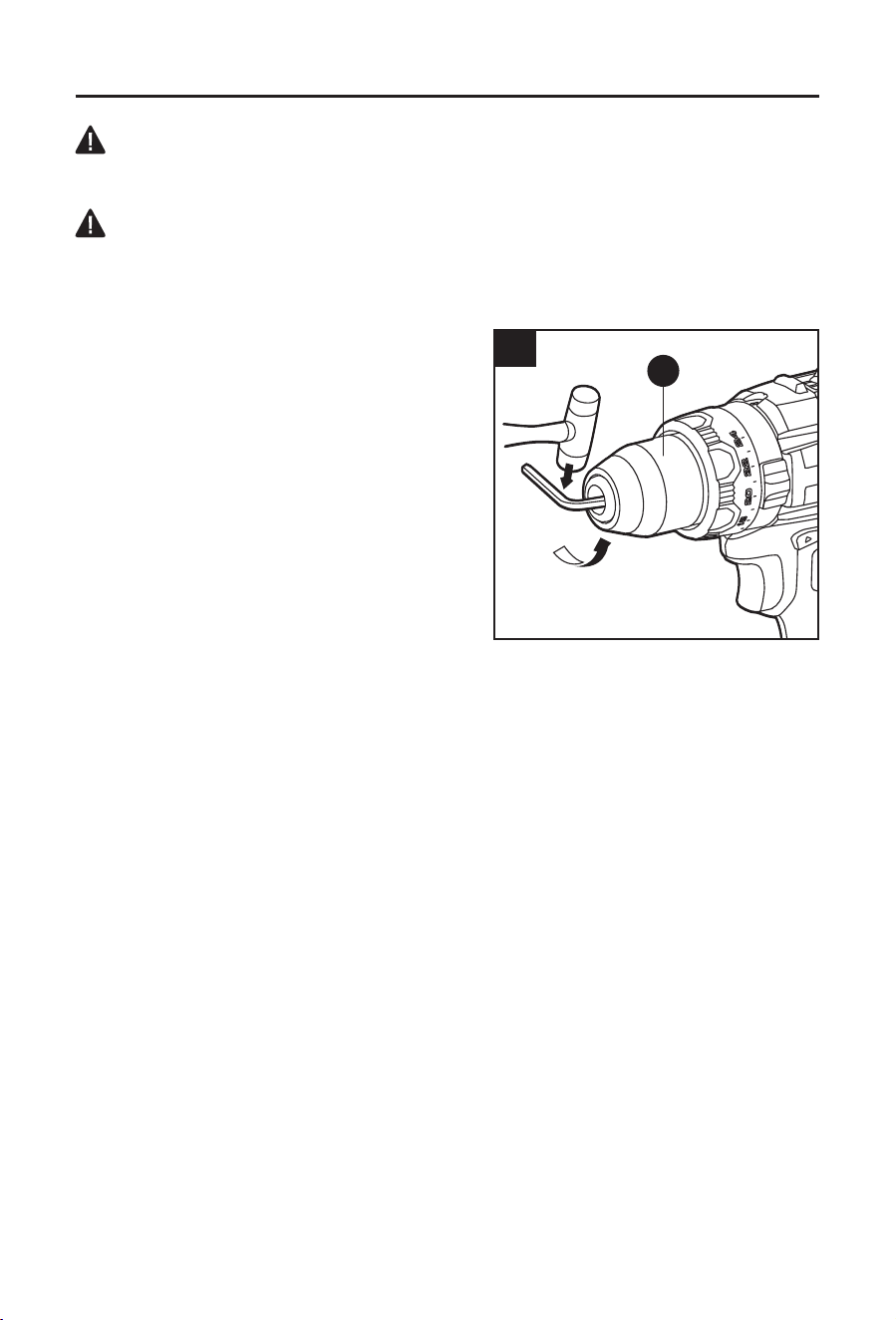
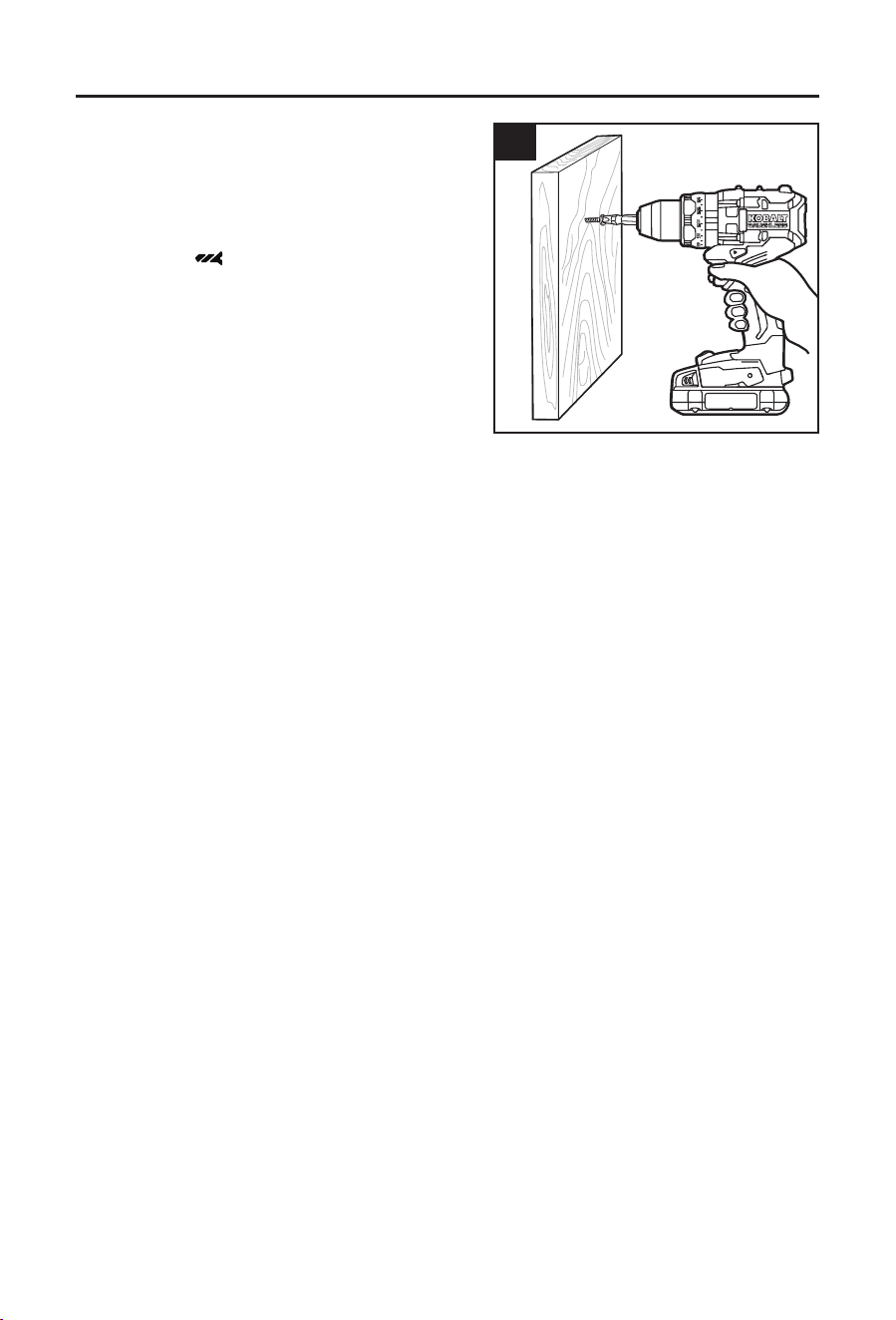
13. Drilling
WARNING
• Always wear safety goggles or safety glasses
with side shields during power tool operation or
when blowing dust. If operation is dusty, also
wear a dust mask.
a. Set the direction-of-rotation selector (E) to
forward rotation.
b. Secure the material to be drilled in a vise or
with clamps to keep it from turning as the drill
bit rotates.
c. Hold the hammer drill rmly and place the bit at
the point to be drilled.
d. Depress the variable-speed trigger switch (F) to start the hammer drill.
e. Move the drill bit into the work piece, applying only enough pressure to keep the bit drilling.
Do not force the hammer drill or apply side pressure to elongate a hole. Let the tool do the
work.
f. When drilling hard, smooth surfaces, use a center punch (sold separately) to mark the
desired location of the hole. This will prevent the drill bit from slipping off center as the hole
is started.
g. If the bit jams in the work piece or if the hammer drill stalls, stop the tool immediately.
Remove the bit from the work piece and determine the reason for jamming.
h. To stop the hammer drill, release the variable speed trigger switch and allow the tool to
come to a complete stop.
12b
13

15
OPERATING INSTRUCTIONS
Drilling Wood
a. For maximum performance, use high-speed steel or brad-point bits for drilling wood.
b. Set the mode selector (C) to drilling mode
for best performance.
c. Begin drilling at a very low speed to prevent the bit from slipping off the starting point.
d. Increase speed as the drill bit bites into the material.
e. When drilling “through” holes, place a block of wood behind the work piece to prevent
ragged or splintered edges on the back side of the hole.
NOTICE: When drilling deep holes, the bit may overheat. Change the direction of rotation and
pull out the bit frequently to clear wood chips from utes.
Drilling Metal
a. For maximum performance, use high-speed steel bits for drilling metal or steel.
b. Set the mode selector (C) to drilling mode
for best performance.
c. When drilling metals, use light oil on the drill bit to keep it from overheating. The oil will
prolong the life of the bit and increase the drilling efciency.
d. Begin drilling at a very low speed to prevent the bit from slipping off the starting point.
e. Maintain a speed and pressure which will allow cutting without overheating the bit.
Applying too much pressure will:
•Overheat the tool.
•Wear the bearings.
•Bend or burn bits.
•Produce off-center or irregularly-shaped holes.
Masonry Drilling
a. For maximum performance, use carbide-tipped masonry bits when drilling holes in brick,
concrete, etc.
b. Set the mode selector (C) to hammer mode
or best performance.
c. Maintain a speed and pressure which will allow cutting without overheating the bit or the
tool. Applying too much pressure will:
•Overheat the tool.
•Wear the bearings.
•Bend or burn bits.
•Produce off-center or irregularly-shaped holes.
d. Apply light pressure and medium speed for best results in brick.
e. Apply additional pressure for hard materials, such as concrete.
f. Begin drilling at a very low speed to prevent the bit from slipping off the starting point.
16
OPERATING INSTRUCTIONS
14. Driving Screws
Try to use standard-type screws for easy driving
and improved grip.
a. Install the correct driver bit.
b. Set the mode selector (C) to driving mode
for best performance.
c. Ensure that the torque-adjustment ring is set to
the most suitable setting. If in doubt, start with
a low setting and gradually increase the setting
as necessary. Do not change the torque setting
when the tool is running.
d. Use the correct speed range for the job and
initially apply minimal pressure to the variable-
speed trigger switch. Increase the speed only
when full control can be maintained.
e. It is advisable to drill a pilot hole rst. This hole should be slightly longer than the screw
to be driven and slightly thinner than the shank diameter of the screw. The pilot hole will
act as a guide for the screw and will also make tightening the screw less difcult. When
screws are positioned close to an edge of the material, a pilot hole will also help to prevent
splitting of the wood.
f. Use a countersinking bit (sold separately) to accommodate the screw head so that it does
not protrude from the surface.
g. Keep sufcient pressure on the drill to prevent the bit from turning out of the screw head.
The screw head can easily become damaged, making it difcult to drive home or remove.
h. To stop the hammer drill, release the trigger switch and allow the tool to come to a
complete stop.
14
17
CARE AND MAINTENANCE
All maintenance should only be carried out by a qualied service technician.
Cleaning
Before cleaning or performing any maintenance, remove the battery pack from the tool.
For safe and proper operation, always keep the tool and its ventilation slots clean.
Always use only a soft, dry cloth to clean your hammer drill; never use detergent or alcohol.
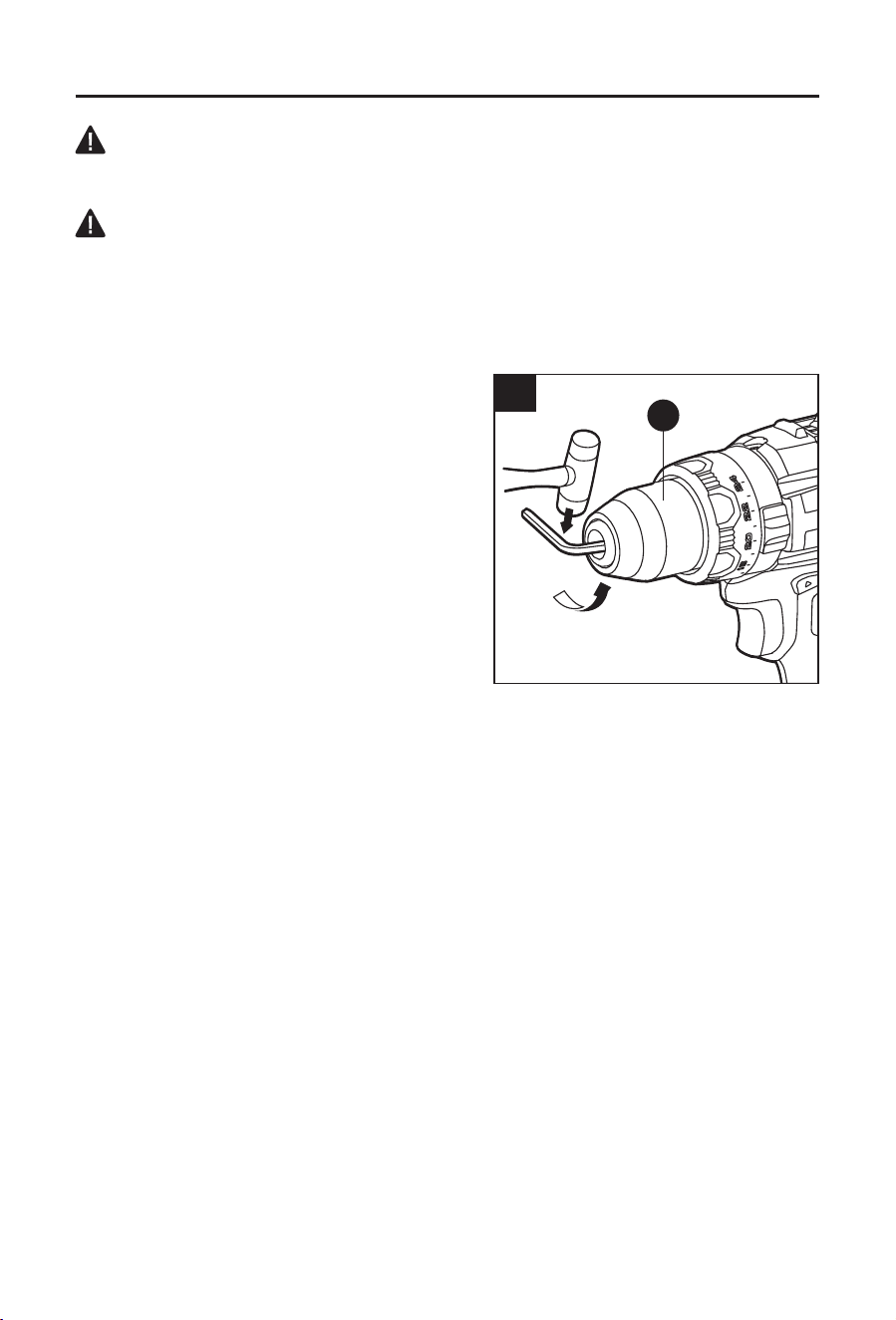
15. Chuck Removal
The keyless chuck (A) can be removed and
replaced.
a. Lock the trigger switch by placing the direction-
of-rotation selector (E) in the center position.
b. Open the chuck jaws.
c. Use a screwdriver (not included) to remove
the chuck screw by turning it in a clockwise
direction.
d. Insert a 5/16-in. or larger hex key (not included)
into the chuck of the hammer drill and securely
tighten the chuck jaws around the hex key.
e. Tap the hex key sharply with a mallet (not
included) in a counterclockwise direction. This
will loosen the chuck for easy removal.
NOTICE: The chuck screw has left-handed threads. Attach a new chuck to the spindle and
tighten the chuck screw.
15
A

18
Printed in China
Lowe’s Home Centers LLC. MOORESVILLE, NC 28117
TROUBLESHOOTING
WARNING
Place the direction-of-rotation selector (E) in the center lock position and detach the battery
pack from the hammer drill before performing troubleshooting procedures.
PROBLEM POSSIBLE CAUSE CORRECTIVE ACTION
The hammer drill
does not work.
Battery pack is depleted. Charge the battery pack.
Bit cannot be
installed.
Chuck is not released. Release the chuck.
Bit does not t the
chuck.
Use an appropriate bit or use a suitable
adaptor.
Motor overheating. Ventilation slots are
obstructed.
Clean and clear the ventilation slots. Do
not cover ventilation slots with hand during
operation.
The LED work light
ashes rapidly.
The tool has stopped
working to protect
internal circuits.
Release the trigger switch, wait for the tool
to cool down, then and start the tool again.
The LED work light
ashes slowly.
The battery pack charge
is very low.
Charge the battery pack.
WARRANTY
For 5 years from the date of purchase, the power tool is warranted and for 3 years from date of
purchase the battery & charger are warranted for the original purchaser to be free from defects
in material and workmanship. This guarantee does not cover damage due to abuse, normal
wear, improper maintenance, neglect, unauthorized repair/alteration, or expendable parts and
accessories expected to become unusable after a reasonable period of use.
If you think your product meets the above guarantee criteria, please return it to the place of
purchase with valid proof of purchase and the defective product will be repaired or replaced at
no charge. This guarantee gives you specic legal rights, and you may also have other rights
that vary from state to state.
ADJUNTE SU RECIBO AQUÍ
Número de serie Fecha de compra
KOBALT y el diseño del logotipo
son marcas comerciales o marcas
registradas de LF, LLC. Todos los
derechos reservados.
ARTÍCULO #4913879
TALADRO PERCUTOR
SIN ESCOBILLAS
MODELO #KHD 124B-03
¿Preguntas, problemas, piezas faltantes? Antes de volver a la tienda, llame a nuestro
Departamento de Servicio al Cliente al 888-3KOBALT (888-356-2258), de lunes a
domingo de 8 a.m. a 8 p.m., hora estándar del Este. También puede ponerse en contacto
con nosotros en [email protected].

20
ÍNDICE
Especicaciones del producto ........................................................................20
Contenido del paquete ................................................................................... 21
Información de seguridad ...............................................................................22
Preparación ....................................................................................................27
Instrucciones de funcionamiento ....................................................................28
Cuidado y mantenimiento ..............................................................................36
Solución de problemas ...................................................................................37
Garantía .........................................................................................................37
ESPECIFICACIONES DEL PRODUCTO
COMPONENTE ESPECIFICACIONES
Voltaje nominal
24V
Velocidad sin carga (n
0
) 0-550 / 0-2000 /mín. (RPM)
Clasicación de impacto 0-8800/0-32000 /mín. (BPM)
Capacidad del mandril 13 mm (1/2 pulg.)
Torsión máxima 850 pulg. lb
Temperatura recomendada de
funcionamiento, carga y almacenamiento
De 5 °C (41 °F) a 40 °C (104 °F)
21
CONTENIDO DEL PAQUETE
H
I
J
K
C
B
A
F
G
E
D
L
PIEZA DESCRIPCIÓN PIEZA DESCRIPCIÓN
A Mandril sin llave G Luz de trabajo LED
B Anillo de ajuste de torsión H Manija auxiliar
C Selector de modo I
Presilla para cinturón
(con tornillo)
D Selector de engranajes J
Soporte para brocas
(con tornillo)
E
Selector de dirección de rotación
(adelante, bloqueo central o reversa)
K Broca doble
F
Interruptor tipo gatillo de velocidad
variable
L Mango
ADVERTENCIA
• Retire la herramienta del paquete y examínela cuidadosamente. No deseche la caja ni
ningún material de embalaje hasta después de examinar todas las piezas.
• Si falta alguna pieza de la herramienta o si alguna pieza está dañada, no je el paquete
de baterías ni use la herramienta hasta reparar o reemplazar la pieza. No seguir esta
advertencia podría provocar lesiones graves.

22
INFORMACIÓN DE SEGURIDAD
Lea y comprenda completamente este manual antes de intentar ensamblar u operar este
producto. Si tiene preguntas relacionadas con el producto, comuníquese con Servicio al Cliente
al 888-3KOBALT (888-356-2258), de lunes a domingo, de 8 a. m. a 8 p. m., hora estándar del
Este. También puede ponerse en contacto con nosotros en [email protected].
ADVERTENCIA
• La operación de cualquier herramienta eléctrica puede arrojar objetos extraños a los
ojos y, de esta manera, causar graves daños oculares. Use siempre lentes o gafas de
seguridad con protecciones laterales y, cuando sea necesario, un protector facial que cubra
todo el rostro antes de comenzar a operar una herramienta eléctrica. Recomendamos
usar una máscara de seguridad de visión amplia sobre los lentes o gafas de seguridad
con protecciones estándar. Siempre use lentes de protección que cumplan con la norma
ANSI Z87.1.
• Parte del polvo causado por el lijado eléctrico, el serruchado, la trituración, el taladro y
otras actividades de construcción contiene sustancias químicas que, según el estado de
California, causan cáncer, defectos congénitos u otros daños reproductivos. Estos son
algunos ejemplos de dichos productos químicos:
– Plomo presente en las pinturas con base de plomo,
– Sílice cristalina de ladrillos, cemento y otros productos de mampostería y
– Arsénico y cromo de madera tratada con químicos.
• El riesgo que corre debido a la exposición a estos químicos varía según la frecuencia con
que realiza este tipo de trabajo. Para reducir su exposición a estas sustancias químicas,
trabaje en un área bien ventilada y utilice un equipo de seguridad aprobado, como las
mascarillas antipolvo especialmente diseñadas para ltrar partículas microscópicas.
Conozca la herramienta
Para operar esta herramienta, lea cuidadosamente este manual y todas las etiquetas
adheridas a la herramienta antes de usarla. Guarde este manual para referencia futura.
Importante
Solo un técnico calicado puede reparar esta herramienta.
Lea por completo todas las instrucciones
23
INFORMACIÓN DE SEGURIDAD
Algunos de los siguientes símbolos pueden aparecer en esta herramienta. Obsérvelos y
aprenda su signicado. La interpretación correcta de estos símbolos le permitirá utilizar la
herramienta de manera más ecaz y segura.
SÍMBOLO DEFINICIÓN SÍMBOLO DEFINICIÓN
V Voltios n
0
Velocidad sin carga
RPM Revoluciones por minuto BPM Golpes por minuto
…/min
Revoluciones o pasadas
por minuto
o CC
Corriente continua
" o pulg. Pulgada pulg. lb pulgada-libra
N·m Metro de Newton
Para reducir el riesgo de lesiones,
use siempre lentes de protección.
Peligro, advertencia o
precaución. Signica
"¡Atención! Su seguridad
está en riesgo".
Para reducir el riesgo de lesiones,
el usuario debe leer el manual de
instrucciones.
Advertencias generales sobre la seguridad en el manejo de herramientas eléctricas
ADVERTENCIA
• Lea todas las advertencias de seguridad, las instrucciones, las ilustraciones y las
especicaciones que se incluyen para esta herramienta eléctrica. No cumplir con todas
las instrucciones que se detallan a continuación podría provocar descargas eléctricas,
incendios o lesiones graves.
Guarde todas las advertencias e instrucciones para referencia futura
El término “herramienta eléctrica” que aparece en las advertencias hace referencia a la
herramienta eléctrica que se conecta a la línea principal (con cable) o a la herramienta
eléctrica que funciona a batería (inalámbrica).
Seguridad en el área de trabajo
• Mantenga el área de trabajo limpia y bien iluminada. Las áreas oscuras o desordenadas
propician los accidentes.
• No utilice herramientas eléctricas en ambientes en los que exista riesgo de
explosión, como por ejemplo, en presencia de líquidos inamables, gases o polvo.
Las herramientas eléctricas producen chispas que podrían encender el polvo o humo.
• Mantenga a los niños y transeúntes alejados durante la operación de una herramienta
eléctrica. Las distracciones pueden hacerle perder el control.

24
INFORMACIÓN DE SEGURIDAD
Seguridad eléctrica
• Los enchufes de las herramientas eléctricas deben encajar en el tomacorriente. No
modique el enchufe de ninguna manera. No utilice ningún enchufe adaptador con
herramientas eléctricas con puesta a tierra. Los enchufes originales y que encajan
adecuadamente en los tomacorrientes reducen el riesgo de descarga eléctrica.
• Evite el contacto del cuerpo con supercies conectadas a tierra, como tuberías,
radiadores, extractores o refrigeradores. Si su cuerpo tiene contacto a tierra, corre
mayor riesgo de sufrir una descarga eléctrica.
• No exponga las herramientas eléctricas a la lluvia o a condiciones de humedad.
Si ingresa agua en una herramienta eléctrica, aumenta el riesgo de sufrir una descarga
eléctrica.
• No maltrate el cable. Nunca use el cable para transportar, jalar ni desenchufar la
herramienta eléctrica. Mantenga el cable alejado del calor, el aceite, los bordes
losos o las piezas en movimiento. Los cables dañados o enredados aumentan el riesgo
de descarga eléctrica.
• Cuando utilice una herramienta eléctrica en exteriores, use una extensión eléctrica
adecuada para uso en exteriores. Usar un cable apto para exteriores reduce el riesgo de
sufrir una descarga eléctrica.
• Si debe utilizar una herramienta eléctrica en un área húmeda, use un suministro
protegido con un interruptor de circuito de falla a tierra GFCI (por sus siglas en
inglés). Usar un GFCI disminuye el riesgo de recibir una descarga eléctrica.
Seguridad personal
• Manténgase alerta, preste atención a lo que hace y utilice el sentido común cuando
utilice una herramienta eléctrica. No use una herramienta eléctrica si está cansado
o bajo los efectos de drogas, alcohol o medicamentos. Un momento de desatención
mientras opera herramientas eléctricas puede provocar lesiones personales graves.
• Use un equipo de protección personal. Use siempre lentes de protección. Los
equipos de protección, como mascarillas antipolvo, zapatos de seguridad antideslizantes,
cascos protectores o auriculares de seguridad, utilizados para las condiciones adecuadas,
disminuyen el riesgo de lesiones personales.
• Evite un arranque accidental. Asegúrese de que el interruptor esté en la posición de
apagado antes de conectar la herramienta a la fuente de alimentación o al paquete de
baterías o antes de levantarla o transportarla. Transportar herramientas eléctricas con el
dedo en el interruptor o enchufar herramientas eléctricas que tienen el interruptor encendido
aumenta las posibilidades de sufrir accidentes.
• Retire todas las llaves de ajuste o llaves inglesas antes de encender la herramienta
eléctrica. Dejar una llave inglesa o una llave conectada a una pieza giratoria de la
herramienta eléctrica puede provocar lesiones personales.
• No se extienda demasiado. Mantenga una postura y un equilibrio adecuados en
todo momento. Esto permite controlar mejor la herramienta eléctrica ante situaciones
inesperadas.
• Use ropa adecuada. No use ropa holgada ni joyas. Mantenga el cabello y la ropa
alejados de las piezas en movimiento. La ropa holgada, las joyas o el cabello largo
pueden quedar atrapados en las piezas en movimiento.
• Si se proporcionan dispositivos para la conexión de instalaciones de extracción
y recolección de polvo, asegúrese de que se conecten y se usen debidamente. La
recolección de polvo puede disminuir los peligros relacionados con el polvo.
• No permita que la familiaridad del uso frecuente de las herramientas lo haga no tener
en cuenta los principios de seguridad en el manejo de las herramientas. Un descuido
puede ocasionar una lesión grave en cuestión de segundos.

25
INFORMACIÓN DE SEGURIDAD
Uso y cuidado de las herramientas eléctricas
• No fuerce la herramienta eléctrica. Use la herramienta eléctrica adecuada para la
tarea. La herramienta eléctrica adecuada realizará un trabajo de mejor calidad y más
seguro, al ritmo para el cual se diseñó.
• No utilice la herramienta eléctrica si el interruptor no la enciende o apaga. Cualquier
herramienta eléctrica que no pueda controlarse con el interruptor es peligrosa y debe
repararse.
• Desconecte el enchufe de la fuente de alimentación o retire el paquete de baterías,
si fuera posible, de la herramienta eléctrica antes de realizar cualquier ajuste,
cambiar accesorios o almacenar herramientas eléctricas. Estas medidas de seguridad
preventivas reducen el riesgo de provocar arranques accidentales de la herramienta
eléctrica.
• Almacene las herramientas eléctricas que no estén en uso fuera del alcance de
los niños y no permita que personas no familiarizadas con la herramienta o estas
instrucciones la operen. Las herramientas eléctricas son peligrosas en manos de usuarios
sin capacitación.
• Realice mantenimiento a las herramientas eléctricas y a los accesorios. Revise si
hay piezas móviles desalineadas o trabadas, si hay piezas rotas y cualquier otra
condición que pueda afectar el funcionamiento de la herramienta eléctrica. Si se
daña la herramienta eléctrica, hágala reparar antes de usarla. Muchos accidentes son
producto del mantenimiento deciente de las herramientas eléctricas.
• Mantenga las herramientas de corte aladas y limpias. Las herramientas de corte que
se mantienen adecuadamente con sus bordes de corte alados son menos propensas a
trabarse y son más fáciles de controlar.
• Use la herramienta eléctrica, los accesorios, las brocas, etc. de acuerdo con estas
instrucciones y considere las condiciones de operación y el trabajo que desea
realizar. Si la herramienta eléctrica se usa en operaciones para las cuales no se diseñó,
podría crear una situación de peligro.
• Mantenga las manijas y las supercies de agarre secas, limpias y sin aceite ni grasa.
Las manijas y las supercies de agarre resbaladizas no permiten manipular ni controlar la
herramienta de forma segura en situaciones inesperadas.
Uso y cuidado de herramientas a batería
• Recargue el paquete de baterías solo con el cargador especicado por el fabricante.
Un cargador adecuado para un tipo de paquete de baterías puede ocasionar un riesgo de
incendio si se usa con otro paquete de baterías diferente.
• Use herramientas eléctricas solo con paquetes de baterías designados
especícamente. El uso de cualquier otro paquete de baterías puede crear un riesgo de
lesión e incendio.
• Cuando el paquete de baterías no está en uso, aléjelo de objetos metálicos, como
sujetapapeles, monedas, llaves, clavos, tornillos u otros objetos metálicos pequeños
que pudieran crear una conexión entre los terminales. El cortocircuito de los terminales
de la batería puede causar quemaduras o un incendio.
• En condiciones de maltrato, es posible que salga líquido de la batería. Evite el
contacto. Si se produce un contacto accidental, enjuague con agua. Si el líquido
entra en contacto con los ojos, solicite atención médica. El líquido que sale de la
batería puede provocar irritación o quemaduras.
• No utilice un paquete de baterías ni una herramienta si están dañadas o modicadas.
Las baterías dañadas o modicadas pueden realizar acciones impredecibles, que podrían
provocar incendios, explosiones o riesgo de lesiones.

26
INFORMACIÓN DE SEGURIDAD
• No exponga el paquete de baterías ni la herramienta al fuego o a una temperatura
excesiva. La exposición al fuego o a temperaturas por encima de los 130 °C (265 °F)
podría causar una explosión.
• Siga todas las instrucciones de carga y no cargue el paquete de baterías ni la
herramienta fuera del rango de temperatura especicado en las instrucciones. La
carga inadecuada o a temperaturas fuera del rango especicado podría dañar la batería y
aumentar el riesgo de incendio.
Reparación
• Permita que solo una persona capacitada repare la herramienta eléctrica, mediante
el uso solo de piezas de repuesto idénticas. Esto garantizará que se mantenga la
seguridad de la herramienta eléctrica.
• Nunca realice mantenimiento a los paquetes de baterías. Solo el fabricante o los
proveedores de servicio autorizados pueden realizarles mantenimiento.
Advertencias de seguridad del taladro
Instrucciones de seguridad para todo tipo de operaciones
• Utilice protectores para los oídos cuando realice una perforación de impacto. La
exposición al ruido puede causar la pérdida de la audición.
• Use los mangos auxiliares. La pérdida de control puede causar lesiones personales
graves.
• Sostenga la herramienta eléctrica por las supercies de agarre aisladas cuando
realice una operación en la que la herramienta de corte o los sujetadores puedan
entrar en contacto con cableado oculto. Es posible que un accesorio de corte que entre
en contacto con un cable “energizado” también “energice” las piezas de metal expuestas de
la herramienta eléctrica y podría provocar una descarga eléctrica al operador.
Instrucciones de seguridad para el uso de brocas para taladro largas
• Nunca opere a una velocidad superior a la velocidad nominal máxima de la broca. A
velocidades más altas, es probable que la broca se doble si gira libremente sin entrar en
contacto con la pieza de trabajo, lo que puede causar lesiones personales.
• Empiece siempre a taladrar a baja velocidad y con la punta de la broca en contacto
con la pieza de trabajo. A velocidades más altas, es probable que la broca se doble si
gira libremente sin entrar en contacto con la pieza de trabajo, lo que puede causar lesiones
personales.
• Aplique presión solo en línea directa con la broca y no aplique presión excesiva. Las
brocas pueden doblarse y causar roturas o pérdida del control, y así ocasionar lesiones
personales.
Advertencias adicionales
• Use solamente los paquetes de baterías y los cargadores que se indican a
continuación:
PAQUETE DE BATERÍAS CARGADOR DE BATERÍA
KB 224-03; KB 424-03; KB 524-03;
KB 624-03; KXB 424-03; KXB 824-03
KRC 2445-03; KRC 2490-03;
KRC 2404-03; KDPC 124-03;
KCH 2401-03; KCH 2411-03

27
PREPARACIÓN
Información acerca del taladro percutor
Antes de intentar usar el taladro percutor, familiarícese con todas sus características de
operación y requisitos de seguridad.
ADVERTENCIA
• Sea cuidadoso, incluso si está familiarizado con el taladro percutor. Recuerde que un
momento de descuido es suciente para causar lesiones graves. Antes de intentar utilizar
una herramienta, asegúrese de familiarizarse con todas las funciones de operación e
instrucciones de seguridad.
• No intente modicar esta herramienta ni crear accesorios que no sean los recomendados
para esta. Cualquier alteración o modicación se considera un uso indebido y podría causar
una situación peligrosa que provoque lesiones graves.
28
INSTRUCCIONES DE FUNCIONAMIENTO
1. Para jar el paquete de baterías
a. Alinee la parte elevada del paquete de
baterías con las ranuras de la parte inferior de
la herramienta y luego deslice el paquete de
baterías hacia dentro de la herramienta, como
se muestra.
b. Asegúrese de que el pestillo del paquete de
baterías encaje en su lugar y que el paquete
de baterías esté jo en la herramienta antes
de comenzar la operación.
AVISO: cuando coloque el paquete de baterías
en la herramienta, asegúrese de que la varilla
elevada del paquete de baterías se alinee con
la ranura de la herramienta y que los pestillos
encajen en su lugar de manera correcta. El ensamblaje inadecuado del paquete de baterías
puede provocar daños a los componentes internos.
Para retirar el paquete de baterías
a. Presione los botones de liberación de la batería para poder liberar el paquete de baterías.
b. Jale el paquete de baterías hacia atrás para retirarlo de la herramienta.
ADVERTENCIA
• Las herramientas con batería siempre están en condiciones de operación. Por lo tanto,
siempre retire el paquete de baterías cuando no use la herramienta o cuando la transporte
junto a usted.
2. Selector de dirección de rotación
(hacia delante/bloqueo central/reverso)
La dirección de rotación de la broca es reversible
y se controla mediante el selector ubicado sobre el
interruptor tipo gatillo (F). Con el taladro percutor
sostenido en la posición de operación normal,
apuntando en dirección opuesta a usted:
a. Coloque el selector de dirección de rotación
(E) a la izquierda de la herramienta para que
rote hacia adelante a n de perforar o colocar
los tornillos.
b. Coloque el selector de dirección de rotación a
la derecha de la herramienta para que rote en
reverso a n de quitar los tornillos.
c. Fijar el selector en la posición de bloqueo
central bloquea el gatillo para ayuda a reducir la posibilidad de arranque accidental
cuando no se está utilizando la herramienta.
AVISO: para evitar que los engranajes se dañen, siempre deje que el taladro percutor se
detenga por completo antes de cambiar la dirección de la rotación.
AVISO: el taladro percutor no funciona a menos que el selector de dirección de rotación esté
completamente posicionado a la izquierda o la derecha.
2
Hacia adelante
Reversa
1
Botones de liberación
de la batería
29
INSTRUCCIONES DE FUNCIONAMIENTO
3. Interruptor tipo gatillo de velocidad variable
a. Coloque el selector de dirección de rotación
(E) a la izquierda o derecha de la herramienta
según sea necesario para desbloquear el
interruptor tipo gatillo (F).
b. Para encender el taladro/destornillador,
presione el interruptor tipo gatillo (F).
c. Para apagarlo, suelte el interruptor tipo gatillo.
Velocidad variable
El interruptor tipo gatillo de velocidad variable
proporciona mayor velocidad con mayor presión
en el gatillo y menor velocidad con menor presión
en el gatillo.
Freno eléctrico
El taladro percutor está equipado con un freno eléctrico. Al soltar el interruptor tipo gatillo, se
activará automáticamente el freno eléctrico para detener rápidamente la rotación.
4. Caja de dos velocidades
El taladro percutor cuenta con una caja de
engranaje de dos velocidades diseñada para
taladrar o atornillar a dos rangos de velocidad
variable diferentes. El selector de engranaje (D)
se encuentra en la parte superior del taladro
percutor, y este le permite seleccionar un rango de
velocidad “1” (bajo) o “2” (alto).
a. La conguración “1” ofrece velocidades más
bajas y mayor potencia y torsión. Use la
conguración “1” para trabajo pesado o para
apretar tornillos.
b. La conguración “2” tiene velocidades más
altas y potencia y torsión reducidos. Use
la opción “2” para perforar madera y compuestos de madera y para usar accesorios
abrasivos y de pulido.
AVISO: nunca cambie los engranajes mientras la herramienta esté en funcionamiento. El no
obedecer esta medida de precaución podría causarle daños graves al taladro percutor.
3
E
F
4
D
30
INSTRUCCIONES DE FUNCIONAMIENTO
5. Luz de trabajo LED
La luz de trabajo LED (G), ubicada en la base del
taladro percutor, se iluminará cuando presione el
interruptor tipo gatillo. Esto brinda más iluminación
a la supercie de la pieza de trabajo para usar la
herramienta en áreas con poca iluminación.
La luz de trabajo LED se apagará
aproximadamente 10 segundos después
de que se suelte el interruptor tipo gatillo de
velocidad variable.
La luz de trabajo LED parpadeará rápidamente si
la herramienta o el paquete de baterías se detuvo
automáticamente cuando se sobrecargó o se
calentó demasiado. Espere hasta que la batería o
el paquete de baterías se enfríe para volver a hacer funcionar la herramienta.
La luz de trabajo LED parpadeará de forma pausada para indicar que la carga de la batería se
encuentra demasiado baja. Recargue el paquete de baterías.
6. Mandril sin llave
El taladro percutor cuenta con un mandril sin llave
(A) para apretar o soltar las brocas para taladro en
las mordazas del mandril sin usar una herramienta
adicional. Las echas en el mandril señalan la
dirección en la que se debe girar el cuerpo del
mandril para SUJETAR (apretar) o ABRIR (aojar)
las mordazas en el mandril de la broca para
taladro.
7. Selector de modo
El selector de modo (C) permite congurar la
herramienta para varias aplicaciones.
Rote el selector en dirección de las manecillas del
reloj o en dirección contraria a las manecillas del
reloj, según la aplicación.
Modo de atornillado
: para atornillar tornillos.
Modo de taladrado
: para taladrar maderas,
metales, plásticos u otros materiales.
Modo de perforación con percutor
: para
taladrar con acción de martillo en concreto,
mampostería o materiales duros similares.
AVISO: no cambie la conguración de modo
mientras la herramienta esté en funcionamiento.
5
G
6
A
Apretar
Aojar
7
C
31
INSTRUCCIONES DE FUNCIONAMIENTO
8. Embrague de torque ajustable
El anillo de ajuste de torque (B) se puede
congurar en cualquiera de las 24 conguraciones
de torsión cuando la herramienta está en el modo
atornillado .
Ajuste la fuerza de torsión girando el anillo
de ajuste de torque (B). A mayor número de
conguración de torsión, mayor fuerza produce el
taladro percutor para girar un objeto.
La conguración correcta depende del trabajo y
del tipo de broca, sujetador y material que utilice.
En general, use una fuerza de torsión mayor para
tornillos más grandes. Si la torsión es demasiado
elevada, los tornillos podrían dañarse o quebrarse.
No se puede ajustar el torque en los modos taladro ni martillo.
AVISO: no cambie la conguración de torsión mientras la herramienta está en funcionamiento.
9. Instalación y retiro de la presilla para
cinturón
a. Alinee la pestaña de la presilla para cinturón
(I) con el oricio en la base del taladro
percutor.
b. Inserte el tornillo y apriételo rmemente con un
destornillador Phillips (no se incluye).
c. Para retirar la presilla para cinturón, utilice un
destornillador Phillips para aojar el tornillo
que ja la presilla para cinturón al taladro
percutor.
NOTA: la presilla para cinturón se puede instalar
en el lado derecho o izquierdo de la herramienta.
10. Instalación y retiro del soporte para brocas
a. Alinee la pestaña del soporte para brocas (J)
con el oricio en la base del taladro percutor.
b. Inserte el tornillo y apriételo rmemente con un
destornillador Phillips (no se incluye).
c. Para retirar el soporte para brocas, utilice un
destornillador Phillips a n de aojar el tornillo
que ja el soporte para brocas al taladro
percutor.
NOTA: el soporte para brocas se puede instalar
en el lado derecho o izquierdo de la herramienta.
8
B
9
I
Tornillo
10
J
Tornillo
32
INSTRUCCIONES DE FUNCIONAMIENTO
11. Manija auxiliar
Este taladro percutor está equipado con un mango
auxiliar (H). Para una operación más fácil, se
puede usar el mango con la mano izquierda o la
derecha. El mango se puede bloquear en las dos
posiciones que se muestran en la Fig. 11.
Para instalar el mango auxiliar:
a. Coloque el selector de dirección de rotación
(E) en la posición central de bloqueo.
b. Aoje el mango auxiliar (H) girando el agarre en
dirección contraria a las manecillas del reloj.
c. Alinee la parte elevada del mango auxiliar
con las ranuras de la caja de velocidades del
taladro percutor y, luego, deslice el mango auxiliar en la herramienta, como se muestra.
d. Apriete rmemente el mango auxiliar en el lugar girando la manija de agarre en dirección
de las manecillas del reloj.
Para retirar el mango auxiliar:
a. Coloque el selector de dirección de rotación (E) en la posición central de bloqueo.
b. Aoje el mango auxiliar (H) girando el agarre en dirección contraria a las manecillas del reloj.
c. Retire el mango auxiliar de la herramienta.
ADVERTENCIA
• Para su seguridad y para que operar la herramienta sea más fácil, apriete con rmeza la
manija auxiliar girando el agarre en dirección de las manecillas del reloj antes de cada uso.
12. Brocas
Instalación de las brocas
a. Coloque el selector de dirección de rotación (E)
en la posición central de bloqueo.
b. Abra o cierre las mordazas del mandril hasta
que la abertura sea un poco más grande que el
vástago de la broca que va a usar.
c. Inserte la broca.
d. Apriete bien las mordazas del mandril en la
broca.
AVISO: gire el cuerpo del mandril en la dirección
que indica la echa AGARRE para cerrar las
mordazas del mandril. No utilice una llave inglesa
para apretar o aojar las mordazas del mandril.
ADVERTENCIA
• Asegúrese de colocar la broca para taladro de forma derecha dentro de las mordazas del
mandril. No apriete las mordazas del mandril si la bronca del taladro se inserta en ángulo,
como se muestra en la Fig. 12b. Esto puede hacer que la broca para taladro salga disparada
del taladro percutor, lo que puede producir lesiones personales graves o daños al mandril.
12a
11
Aojar
Apretar
H
E
33
INSTRUCCIONES DE FUNCIONAMIENTO
Retiro de las brocas
a. Coloque el selector de dirección de rotación (E)
en la posición central de bloqueo.
b. Abra las mordazas del portabrocas.
c. Retire la broca para taladro.
ADVERTENCIA
• No sostenga el cuerpo del mandril con una sola
mano y use la potencia del taladro percutor para
apretar o aojar las mordazas del mandril en
la broca para taladro. El cuerpo del mandril se
puede resbalar en la mano, o la mano puede
resbalarse y entrar en contacto con la pieza
giratoria. Esto puede provocar un accidente que
resulte en lesiones personales graves.
13. Perforaciones
ADVERTENCIA
• Use siempre gafas o lentes de seguridad con
protectores laterales durante la operación de la
herramienta eléctrica o cuando sople el polvo. Si
hay demasiado polvo durante la operación, use
también una mascarilla antipolvo.
a. Coloque el selector de dirección de rotación (E)
en rotación hacia adelante.
b. Asegure el material que va a perforar en un
tornillo de banco o con abrazaderas para evitar
que gire cuando la broca para taladro esté
girando.
c. Sostenga el taladro percutor con rmeza y coloque la broca en el punto que va a perforar.
d. Presione el interruptor tipo gatillo (F) de velocidad variable para encender el taladro
percutor.
e. Mueva la broca para taladro en la pieza de trabajo, aplicando la presión suciente como
para mantener la broca taladrando. No fuerce el taladro percutor ni aplique presión lateral
para ampliar un oricio. Deje que este realice el trabajo.
f. Cuando taladre supercies duras y suaves, use un sacabocado (se vende por separado)
para marcar la ubicación deseada del oricio. Esto evitará que la broca para taladro se
mueva a medida que hace el oricio.
g. Si la broca se atasca en la pieza de trabajo o si el taladro percutor se para, detenga la
herramienta inmediatamente. Retire la broca de la pieza de trabajo y determine la causa
del atasco.
h. Para detener el taladro percutor, suelte el interruptor tipo gatillo de velocidad variable y
permita que la herramienta se detenga completamente.
12b
13

34
INSTRUCCIONES DE FUNCIONAMIENTO
Taladrado en madera
a. Para obtener un máximo rendimiento, use brocas de acero de alta velocidad o de tres
puntas para perforar madera.
b. Coloque el selector de modo (C) en función taladro
para obtener el mejor rendimiento
posible.
c. Comience perforando a una velocidad muy baja para evitar que la broca se deslice del
punto de inicio.
d. Aumente la velocidad a medida que la broca del taladro penetre el material.
e. Cuando taladre “a través” de oricios, coloque un bloque de madera detrás de la pieza de
trabajo para evitar que se formen bordes irregulares o astillados en la parte posterior de
los oricios.
AVISO: al perforar agujeros profundos, la broca puede sobrecalentarse. Cambie la dirección
de rotación en reversa y quite la broca con frecuencia para quitar el aserrín de los canales.
Taladrado en metal
a. Para obtener un máximo rendimiento, use brocas de acero de alta velocidad para taladrar
metal o acero.
b. Coloque el selector de modo (C) en función taladro
para obtener el mejor rendimiento
posible.
c. Cuando perfore metales, unte aceite ligero en la broca para taladro para evitar que se
sobrecaliente. El aceite prolongará la vida útil de la broca y aumentará la eciencia del
taladro.
d. Comience perforando a una velocidad muy baja para evitar que la broca se deslice del
punto de inicio.
e. Mantenga una velocidad y presión que permitan cortar sin sobrecalentar la broca. Aplicar
demasiada presión podría:
•Sobrecalentar la herramienta.
•Desgastar los rodamientos.
•Doblar o quemar las brocas.
•Producir oricios descentrados o irregulares.
Taladrado en mampostería
a. Para obtener el mejor rendimiento, utilice brocas para mampostería con punta de carburo
cuando taladre oricios en ladrillos, concreto, etc.
b. Coloque el selector de modo (C) en función martillo
para obtener el mejor
rendimiento.
c. Mantenga una velocidad y presión que permitan cortar sin sobrecalentar la broca ni la
herramienta. Aplicar demasiada presión podría:
•Sobrecalentar la herramienta.
•Desgastar los rodamientos.
•Doblar o quemar las brocas.
•Producir oricios descentrados o irregulares.
d. Para obtener resultados óptimos en ladrillos, aplique una presión suave y utilice una
velocidad media.
e. En materiales duros, como el concreto, aplique mayor presión.
f. Comience perforando a una velocidad muy baja para evitar que la broca se deslice del
punto de inicio.
35
INSTRUCCIONES DE FUNCIONAMIENTO
14. Tornillos autoperforantes
En lo posible, use tornillos tipo estándar para
facilitar el atornillado y mejorar el agarre.
a. Instale la punta de destornillador adecuada.
b. Coloque el selector de modo (C) en función
atornillado
para obtener el mejor
rendimiento posible.
c. Asegúrese de que el anillo de ajuste de
torque se encuentre en la conguración más
adecuada. Si no está seguro, empiece con una
conguración baja y aumente de forma gradual
la conguración según sea necesario. No
cambie la conguración de torsión mientras la
herramienta está en funcionamiento.
d. Utilice el rango de velocidad correcto para el trabajo y aplique una presión mínima al
interruptor tipo gatillo de velocidad variable. Aumente la velocidad solo cuando pueda
mantener el control por completo.
e. Se aconseja taladrar un oricio guía primero. Este oricio debe ser levemente más grande
que el tornillo que desee colocar y ligeramente más delgado que el diámetro del vástago
del tornillo. El oricio guiará al tornillo y hará que el ajuste de este sea más sencillo. Al
ubicar los tornillos cerca del borde de un material, el oricio guía también ayudará a evitar
que la madera se abra.
f. Use una broca para avellanar (se vende por separado) para acomodar la cabeza del
tornillo y evitar que sobresalga de la supercie.
g. Mantenga la presión suciente sobre el taladro para evitar que la broca gire fuera de la
cabeza del tornillo. La cabeza del tornillo se puede dañar con facilidad, lo que hace difícil
introducir o retirar el tornillo.
h. Para detener el taladro percutor, suelte el interruptor tipo gatillo y permita que la
herramienta se detenga completamente.
14
36
CUIDADO Y MANTENIMIENTO
Todo el mantenimiento debe estar a cargo solo de un técnico de servicio calicado.
Limpieza
Antes de limpiar o realizar cualquier mantenimiento, retire el paquete de baterías de la
herramienta. Para un uso seguro y adecuado, siempre mantenga limpias la herramienta y sus
ranuras de ventilación.
Siempre use solo un paño suave y seco para limpiar el tornillo percutor; nunca use detergente
ni alcohol.
15. Retiro del mandril
El mandril sin llave (A) se puede retirar y
reemplazar.
a. Para bloquear el interruptor tipo gatillo, coloque
el selector de dirección de rotación (E) en la
posición de apagado central.
b. Abra las mordazas del portabrocas.
c. Use un destornillador (no se incluye) para
retirar el tornillo del mandril girándolo en
dirección de las manecillas del reloj.
d. Inserte una llave hexagonal de 7,93 mm
o más (no incluida) en el portabrocas del
taladro percutor y apriete de forma segura las
mordazas del portabrocas alrededor de la llave
hexagonal.
e. Golpee fuertemente la llave hexagonal con un mazo (no se incluye) en dirección contraria
a las manecillas del reloj. Esto aojará el mandril para retirarlo de manera más fácil.
AVISO: el tornillo del mandril tiene roscas hacia la izquierda. Fije un mandril nuevo al eje y
apriete el tornillo del mandril.
15
A

37
Impreso en China
Lowe’s Home Centers LLC. MOORESVILLE, NC 28117
SOLUCIÓN DE PROBLEMAS
ADVERTENCIA
Coloque el selector de dirección de rotación (E) en la posición de bloqueo central y retire
el paquete de baterías del taladro percutor antes de realizar procedimientos de solución de
problemas.
PROBLEMA CAUSA POSIBLE ACCIÓN CORRECTIVA
El martillo
perforador no
funciona.
El paquete de baterías
está agotado.
Cargue el paquete de baterías.
No se puede
instalar la broca.
No se ha aojado el
portabrocas.
Suelte el mandril.
La broca no encaja en el
portabrocas.
Use una broca correcta o un adaptador
adecuado.
El motor se
sobrecalienta.
Las ranuras de
ventilación están
obstruidas.
Revise y limpie las ranuras de ventilación.
No cubra los conductos de ventilación con
la mano durante el funcionamiento.
La luz de trabajo
LED parpadea
rápidamente.
La herramienta ha
dejado de funcionar para
proteger los circuitos
internos.
Suelte el interruptor tipo gatillo, espere
que la herramienta se enfríe y luego
vuelva a encenderla.
La luz de trabajo
LED parpadea
lentamente.
La carga del paquete de
baterías es muy baja.
Cargue el paquete de baterías.
GARANTÍA
Desde la fecha de compra, la herramienta eléctrica posee una garantía de 5 años, y la batería
y el cargador, una garantía de 3 años. Esta garantía se extiende al comprador original para
asegurar que los productos están libres de defectos en los materiales y la mano de obra.
Esta garantía no cubre daños por uso indebido, desgaste normal, mantenimiento inadecuado,
negligencia, reparación o alteración no autorizadas, ni piezas o accesorios desechables cuya
inutilidad es esperable después de un período de uso razonable.
Si considera que el producto cumple con los términos de garantía mencionados arriba,
devuélvalo al lugar donde lo compró con un comprobante de compra válido y el producto
defectuoso se reparará o reemplazará sin cargo. Esta garantía le otorga derechos legales
especícos, pero también podría tener otros derechos que varían según el estado.