267-3223
OPERATOR’S MANUAL
CAUTION:
To Reduce the Risk of Injury, User Must
Read and Understand the Operator’s Manual. Save These
Instructions For Future Reference.
For questions / comments, technical assistance or repair parts –
Please Call Toll Free: 1-866-917-4374 (M-F 8:30am-5:00pm EST).
20V BRUSHLESS
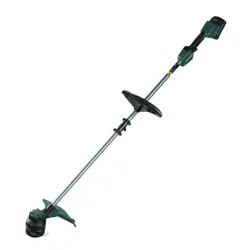
13” STRING TRIMMER

TABLE OF CONTENTS
Safety Symbols ......................................................... Page 2
Safety Instructions ...................................................... Page 3
Overview .............................................................. Page 9
Specications .......................................................... Page 9
Assembly ............................................................ Page 10
Operation ............................................................ Page 11
Maintenance .......................................................... Page 18
Troubleshooting ....................................................... Page 19
Parts List ............................................................. Page 20
Schematic Drawing .................................................... Page 21
Warranty .............................................................Page 22
Page 2
SAFETY SYMBOLS
Some of these following symbols may be used on this machine. Please study them and learn
their meaning. Proper interpretation of these symbols will allow you to operate the machine
better and more safely.
WARNING:
To ensure safety and reliability, all repairs should be performed by a
qualified service technician.
Symbol
Name
Designation / Explanation
V Volts Voltage
A Amps Current
Hz Hertz Frequency (cycles per second)
W Watts Power
kg Kilogram Weight
lbs Pounds Weight
n
o
Maximum speed
Maximum rotational speed of the
machine
.../min
Revolutions or strokes
per minute
Revolutions, strokes, surface speed
orbits, etc., per minute
�
or d.c.
Direct current Type of characteristic of current
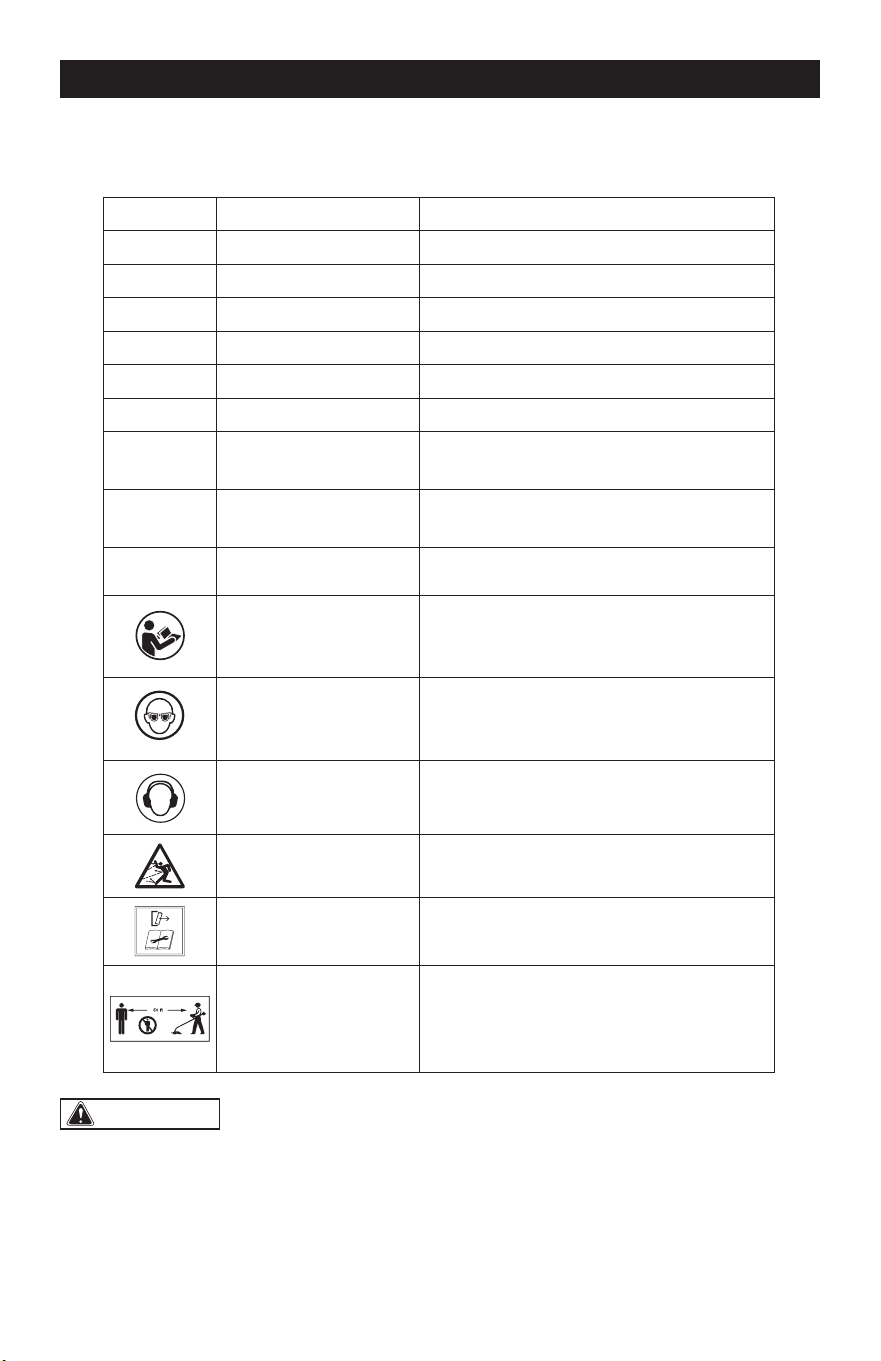
Read & Understand
Operator's Manual
To reduce the risk of injury, user must
read and understand the operator’s
manual before using this product.
Wear eye protection
Always wear safety goggles or safety
glasses with side shields and a full face
shield when operating this product.
Wear ear protection Alerts user to wear ear protection.
Beware of thrown
objects
Alerts user to beware of thrown objects.
Disconnect battery
before maintenance
Alerts user to disconnect battery before
maintenance.
The distance between
the machine and
bystanders shall be at
least 50 ft.
Alerts user to keep the distance between
the machine and bystanders at least 50 ft.
Page 3
The purpose of safety symbols is to attract your attention to possible dangers. The safety
symbols, and the explanations with them, deserve your careful attention and understanding.
The symbol warnings do not, by themselves, eliminate any danger. The instructions and
warnings they give are no substitutes for proper accident prevention measures.
WARNING:
Be sure to read and understand all safety instructions in this manual,
including all safety alert symbols such as “DANGER”, “WARNING” and “CAUTION” before
using this tool. Failure to follow all instructions listed below may result in electric shock,
fire, and/or serious personal injury.
SYMBOL MEANING
SAFETY ALERT SYMBOL: Indicates DANGER, WARNING, OR CAUTION. May be used
in conjunction with other symbols or pictographs.
DANGER:
Indicates an imminently hazardous situation, which, if not avoided, will
result in death or serious injury.
WARNING:
Indicates a potentially hazardous situation, which, if not avoided,
could result in death or serious injury.
CAUTION:
Indicates a potentially hazardous situation, which, if not avoided, could
result in minor or moderate injury.
NOTICE: (Without Safety Alert Symbol) Indicates a situation that may result in property
damage.
SAVE THESE INSTRUCTIONS!
SAFETY INSTRUCTIONS

Page 4
SAFETY INSTRUCTIONS
GENERAL MACHINE SAFETY
WARNINGS
WARNING:
Read all safety
warnings, instructions, illustrations and
specifications provided with this machine.
Failure to follow all instructions listed below
may result in electric shock, re and/or
serious injury.
SAVE ALL WARNINGS AND INSTRUCTIONS
FOR FUTURE REFERENCE.
The term “machine” in the warnings refers
to your mains-operated (corded) machine
or battery-operated (cordless) machine.
WORK AREA SAFETY
1. Keep work area clean and well lit.
Cluttered or dark areas invite accidents.
2. Do not operate machines in explosive
atmospheres, such as in the presence of
flammable liquids, gases or dust. Machines
create sparks which may ignite the dust or
fumes.
3. Keep children and bystanders away
while operating a machine. Distractions
can cause you to lose control.
ELECTRICAL SAFETY
1. Machine plugs must match the outlet.
Never modify the plug in any way. Do
not use any adapter plugs with earthed
(grounded) machines. Unmodied plugs
and matching outlets will reduce risk of
electric shock.
2. Avoid body contact with earthed
or grounded surfaces, such as pipes,
radiators, ranges and refrigerators. There
is an increased risk of electric shock if your
body is earthed or grounded.
3. Do not expose machines to rain or wet
conditions. Water entering a machine will
increase the risk of electric shock.
4. Do not abuse the cord. Never use the
cord for carrying, pulling or unplugging the
machine. Keep cord away from heat, oil,
sharp edges or moving parts. Damaged or
entangled cords increase the risk of electric
shock.
5. When operating a machine outdoors,
use an extension cord suitable for outdoor
use. Use of a cord suitable for outdoor use
reduces the risk of electric shock.
6. If operating a machine in a damp
location is unavoidable, use a ground fault
circuit interrupter (GFCI) protected supply.
Use of an GFCI reduces the risk of electric
shock.
PERSONAL SAFETY
1. Stay alert, watch what you are doing
and use common sense when operating
a machine. Do not use a machine while
you are tired or under the influence of
drugs, alcohol or medication. A moment of
inattention while operating machines may
result in serious personal injury.
2. Use personal protective equipment.
Always wear eye protection. Protective
equipment such as a dust mask, non-skid
safety shoes, hard hat or hearing protection
used for appropriate conditions will reduce
personal injuries.
3. Prevent unintentional starting. Ensure
the switch is in the off-position before
connecting to power source and/or battery
pack, picking up or carrying the machine.
Carrying machines with your nger on the
switch or energizing machines that have the
switch on invites accidents.
4. Remove any adjusting key or wrench
before turning the machine on. A wrench or
a key left attached to a rotating part of the
machine may result in personal injury.
5. Do not overreach. Keep proper footing
and balance at all times. This enables
better control of the machine in unexpected
situations.

Page 5
SAFETY INSTRUCTIONS
6. Dress properly. Do not wear loose
clothing or jewelry. Keep your hair and
clothing away from moving parts. Loose
clothes, jewelry or long hair can be caught
in moving parts.
7. If devices are provided for the
connection of dust extraction and
collection facilities, ensure these are
connected and properly used. Use of dust
collection can reduce dust-related hazards.
8. Do not let familiarity gained from
frequent use of machines allow you to
become complacent and ignore machine
safety principles. A careless action can
cause severe injury within a fraction of a
second.
MACHINE USE AND CARE
1. Do not force the machine. Use the
correct machine for your application. The
correct machine will do the job better and
safer at the rate for which it was designed.
2. Do not use the machine if the switch
does not turn it on and off. Any machine
that cannot be controlled with the switch is
dangerous and must be repaired.
3. Disconnect the plug from the power
source and/or remove the battery pack,
if detachable, from the machine before
making any adjustments, changing
accessories, or storing machines. Such
preventive safety measures reduce the risk
of starting the machine accidentally.
4. Store idle machines out of the reach
of children and do not allow persons
unfamiliar with the machine or these
instructions to operate the machine.
Machines are dangerous in the hands of
untrained users.
5. Maintain machines and accessories.
Check for misalignment or binding of
moving parts, breakage of parts and
any other condition that may affect the
machine’s operation. If damaged, have
the machine repaired before use. Many
accidents are caused by poorly maintained
machines.
6. Keep cutting machines sharp and clean.
Properly maintained cutting machines with
sharp cutting edges are less likely to bind
and are easier to control.
7. Use the machine, accessories and
machine bits etc. in accordance with
these instructions, taking into account
the working conditions and the work to
be performed. Use of the machine for
operations different from those intended
could result in a hazardous situation.
8. Keep handles and grasping surfaces
dry, clean and free from oil and grease.
Slippery handles and grasping surfaces do
not allow for safe handling and control of the
machine in unexpected situations.
BATTERY MACHINE USE AND
CARE
1. Recharge only with the charger
specified by the manufacturer. A charger
that is suitable for one type of battery pack
may create a risk of re when used with
another battery pack.
2. Use machines only with specifically
designated battery packs. Use of any other
battery packs may create a risk of injury and
re.
3. When battery pack is not in use, keep
it away from other metal objects, like
paper clips, coins, keys, nails, screws or
other small metal objects, that can make
a connection from one terminal to another.
Shorting the battery terminals together may
cause burns or a re.
4. Under abusive conditions, liquid may
be ejected from the battery; avoid contact.
If contact accidentally occurs, flush with
water. If liquid contacts eyes, additionally
seek medical help. Liquid ejected from the
battery may cause irritation or burns.
5. Do not use a battery pack or machine
that is damaged or modified. Damaged or
modied batteries may exhibit unpredictable
behavior resulting in re, explosion or risk of
injury.

Page 6
SAFETY INSTRUCTIONS
6. Do not expose a battery pack or
machine to fire or excessive temperature.
Exposure to re or temperature above
265 °F (130 °C) may cause explosion.
7. Follow all charging instructions and do
not charge the battery pack or machine
outside the temperature range specified
in the instructions. Charging improperly or
at temperatures outside the specied range
may damage the battery and increase the
risk of re.
SERVICE
1. Have your machine serviced by a
qualified repair person using only identical
replacement parts. This will ensure that the
safety of the machine is maintained.
2. Never service damaged battery
packs. Service of battery packs should
only be performed by the manufacturer or
authorized service providers.
STRING TRIMMER SAFETY
WARNINGS
1. Do not use the machine in bad weather
conditions, especially when there is a risk
of lightning. This decreases the risk of being
struck by lightning.
2. Thoroughly inspect the area for wildlife
where the machine is to be used. Wildlife
may be injured by the machine during
operation.
3. Thoroughly inspect the area where
the machine is to be used and remove all
stones, sticks, wires, bones, and other
foreign objects. Thrown objects can cause
personal injury.
4. Before using the machine, always
visually inspect to see that the cutter and
the cutter assembly are not damaged.
Damaged parts increase the risk of injury.
5. Follow instructions for changing
accessories. Improperly tightened blade
securing nuts or bolts may either damage
the blade or result in it becoming detached.
6. Wear eye, ear, head and hand
protection. Adequate protective equipment
will reduce personal injury by ying debris
or accidental contact with the cutting line or
blade.
7. While operating the machine, always
wear non-slip and protective footwear. Do
not operate the machine when barefoot
or wearing open sandals. This reduces the
chance of injury to the feet from contact with
the moving lines.
8. While operating the machine, always
wear long trousers. Exposed skin increases
the likelihood of injury from thrown objects.
9. Keep bystanders away while operating
the machine. Thrown debris can result in
serious personal injury.
10. Always use two hands when operating
the machine. Holding the machine with both
hands will avoid loss of control.
11. Hold the machine by the insulated
gripping surfaces only, because the cutting
line or blade may contact hidden wiring.
Cutting line or blades contacting a “live”
wire may make exposed metal parts of the
machine “live” and could give the operator
an electric shock.
12. Always keep proper footing and operate
the machine only when standing on the
ground. Slippery or unstable surfaces may
cause a loss of balance or control of the
machine.
13. Do not operate the machine on
excessively steep slopes. This reduces the
risk of loss of control, slipping and falling
which may result in personal injury.
14. When working on slopes, always be
sure of your footing, always work across
the face of slopes, never up or down and
exercise extreme caution when changing
direction. This reduces the risk of loss of
control, slipping and falling which may result
in personal injury.
15. Keep all parts of the body away from
the line when the machine is operating.
Before you start the machine, make sure
line is not contacting anything. A moment
of inattention while operating the machine
may result in injury to yourself or others.
Page 7
16. Do not operate the machine above
waist height. This helps prevent unintended
line contact and enables better control of
the machine in unexpected situations.
17. When cutting brush or saplings that
are under tension, be alert for spring
back. When the tension in the wood bers
is released, the brush or sapling may strike
the operator and/or throw the machine out
of control.
18. Use extreme caution when cutting
brush and saplings. The slender material
may catch the line and be whipped toward
you or pull you off balance.
19. Maintain control of the machine and
do not touch lines and other hazardous
moving parts while they are still in motion.
This reduces the risk of injury from moving
parts.
20. Carry the machine with the machine
switched off and away from your body.
Proper handling of the machine will reduce
the likelihood of accidental contact with a
moving line.
21. Only use replacement lines and cutting
heads specified by the manufacturer.
Incorrect replacement parts may increase
the risk of breakage and injury.
22. When clearing jammed material or
servicing the machine, make sure the
switch is off and the battery pack is
removed. Unexpected starting of the
machine while clearing jammed material
or servicing may result in serious personal
injury.
23. If you strike a foreign object with the
trimmer or it becomes entangled, stop the
machine immediately, check for damage
and have any damage repaired before
further operation is attempted. Do not
operate with a broken guard or spool.
24. If machine starts to vibrate abnormally,
stop the motor and check immediately for
the cause. Vibration is generally a warning
of trouble. A loose head may vibrate, crack,
break or come off the trimmer, which may
result in serious or fatal injury. Make sure
that the cutting attachment is properly xed
SAFETY INSTRUCTIONS
in position. If the head loosens after xing it
in position, replace it immediately. Never use
a trimmer with a loose cutting attachment.
IMPORTANT SAFETY
INSTRUCTIONS
1. To reduce the risk of electric shock
or damage to the chargers and batteries,
use only with the MASTERFORCE
®
FLEXPOWER
®
20V battery packs and
chargers listed.
Battery pack Charger
252-8029 (1.5Ah)
252-8031 (2.0Ah)
252-8030 (2.5Ah)
252-8003 (2.5Ah)
252-8034 (4.0Ah)
252-8013 (4.0Ah)
252-8035 (5.0Ah)
252-8005 (5.0Ah)
252-8007 (7.5Ah)
252-8014 (8.0Ah)
252-8025
252-8037
252-8026
252-8043
2. For best results, your battery and
machine should be stored, charged and
used in a location where the temperature
is more than 41°F (5°C) but less than 104°F
(40°C). Do not store outside or in vehicles.
NOTE: The battery pack and charger
manuals are provided separately. They
include specic safety rules and operating
instructions. Please refer to the battery pack
and charger manuals for safety rules and
detailed operating instructions.
DANGER:
People with electronic
devices, such as pacemakers, should
consult their physician(s) before using this
product. Operation of electrical equipment
in close proximity to a heart pacemaker
could cause interference or failure of the
pacemaker.
Page 8
SAFETY INSTRUCTIONS
WARNING:
Drilling, sawing,
sanding or machining wood products can
expose you to wood dust, a substance
known to the State of California to cause
cancer. Avoid inhaling wood dust or use a
dust mask or other safeguards for personal
protection. For more information go to
www.P65Warnings.ca.gov/wood.
WARNING:
Some dust created by
power sanding, sawing, grinding, drilling,
and other construction activities contains
chemicals known to the state of California
to cause cancer, birth defects, or other
reproductive harm. Some examples of
these chemicals are:
Lead from lead-based paints.
Crystalline silica from bricks, cement,
and other masonry products.
Arsenic and chromium from chemically-
treated lumber.
Your risk from these exposures varies,
depending upon how often you do this type
of work. To reduce your exposure to these
chemicals:
Work in a well-ventilated area.
Work with approved safety equipment,
such as dust masks that are specially
designed to lter out microscopic particles.
Avoid prolonged contact with dust from
power sanding, sawing, grinding, drilling,
and other construction activities. Wear
protective clothing and wash exposed
areas with soap and water. Allowing dust
to get into your mouth or eyes or to lie on
the skin may promote absorption of harmful
chemicals.
SAVE THESE INSTRUCTIONS!
Page 9
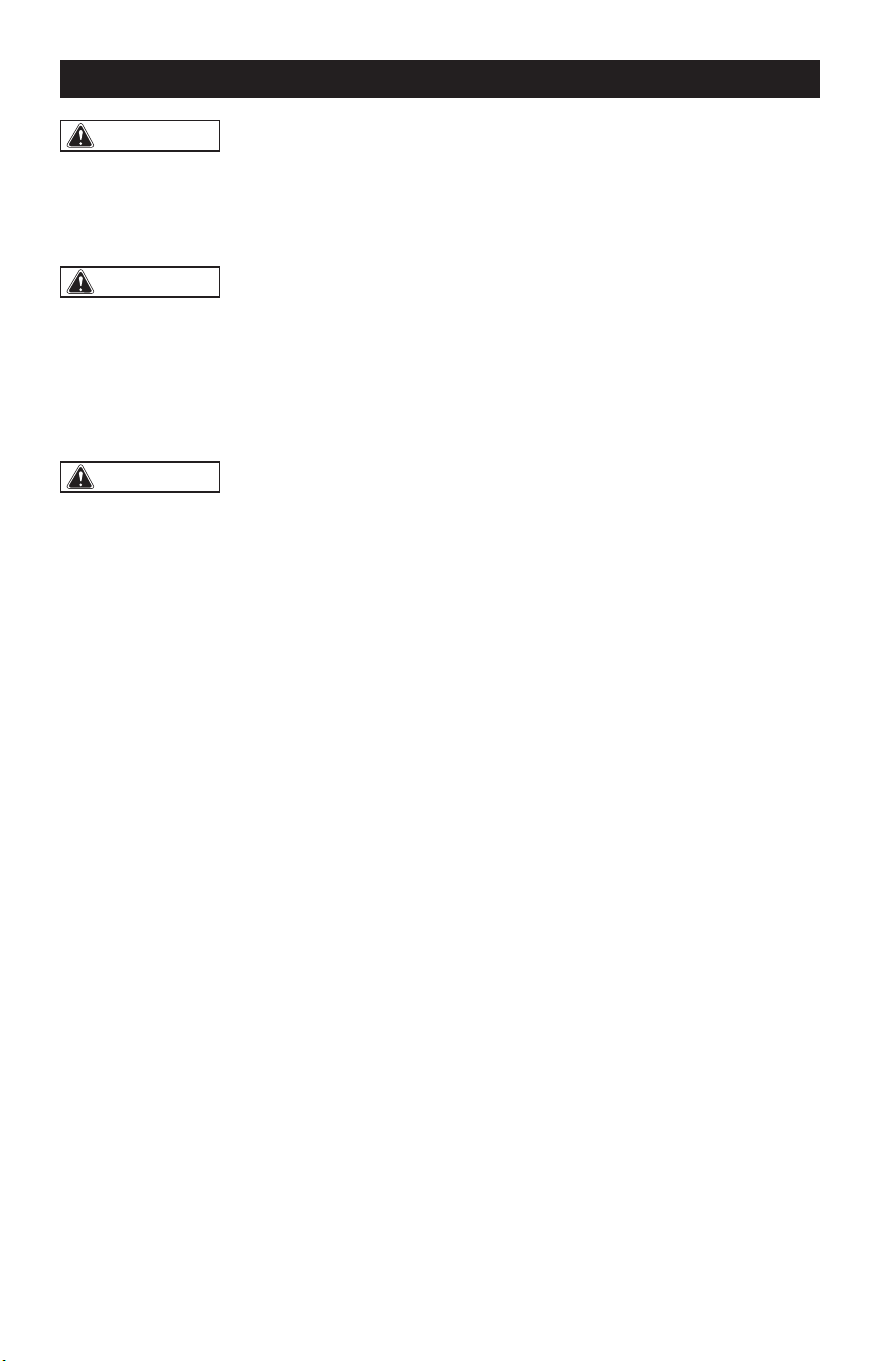
Rated Voltage 20 V d.c.
Maximum No-load Speed 7,000 /min
Cutting-line Type 0.080 in. twisted nylon line
Cutting Swath 13 in.
Weight 6.6 lbs.
OVERVIEW
SPECIFICATIONS
Rear Handle
Lock-off
Button
Variable-speed
Trigger Switch
Limit Label
Hinge
Trimmer
Shaft
Double-ended
Hex Key
Trimmer
Head
Cutting Line
Guard
Release Tab
Line-cutting Blade
Front-assist
Handle
Page 10
WARNING:
If any part is broken or
missing, DO NOT attach the battery pack
or operate the machine until the broken or
missing part is replaced. Failure to do so
could result in possible serious injury.
WARNING:
Do not attempt
to modify this machine or create
accessories not recommended for use
with this machine. Any such alteration or
modification is misuse and could result in
a hazardous condition leading to possible
serious injury.
WARNING:
Your machine should
never be connected to the battery pack
when you are assembling parts, making
adjustments, cleaning, or when it is not
in use. Disconnecting the machine will
prevent accidental starting, which could
cause serious personal injury.
ASSEMBLY
PACKING LIST
- String trimmer
- Front-assist handle
- Hex bolt and wing nut (pre-installed on
the front-assist handle)
- Guard
- Screw (2) and washer (2) for the guard
- Bolt (2) for the hinge
- Double-ended hex key
- Manual
UNPACKING
1. Carefully remove the machine and any
accessories from the carton. Make sure
that all items listed in the packing list are
included.
2. Inspect the machine carefully to make
sure that no breakage or damage
occurred during shipping.
3. Do not discard the packing material
until you have carefully inspected and
satisfactorily operated the machine.
Page 11
UNFOLDING THE TRIMMER
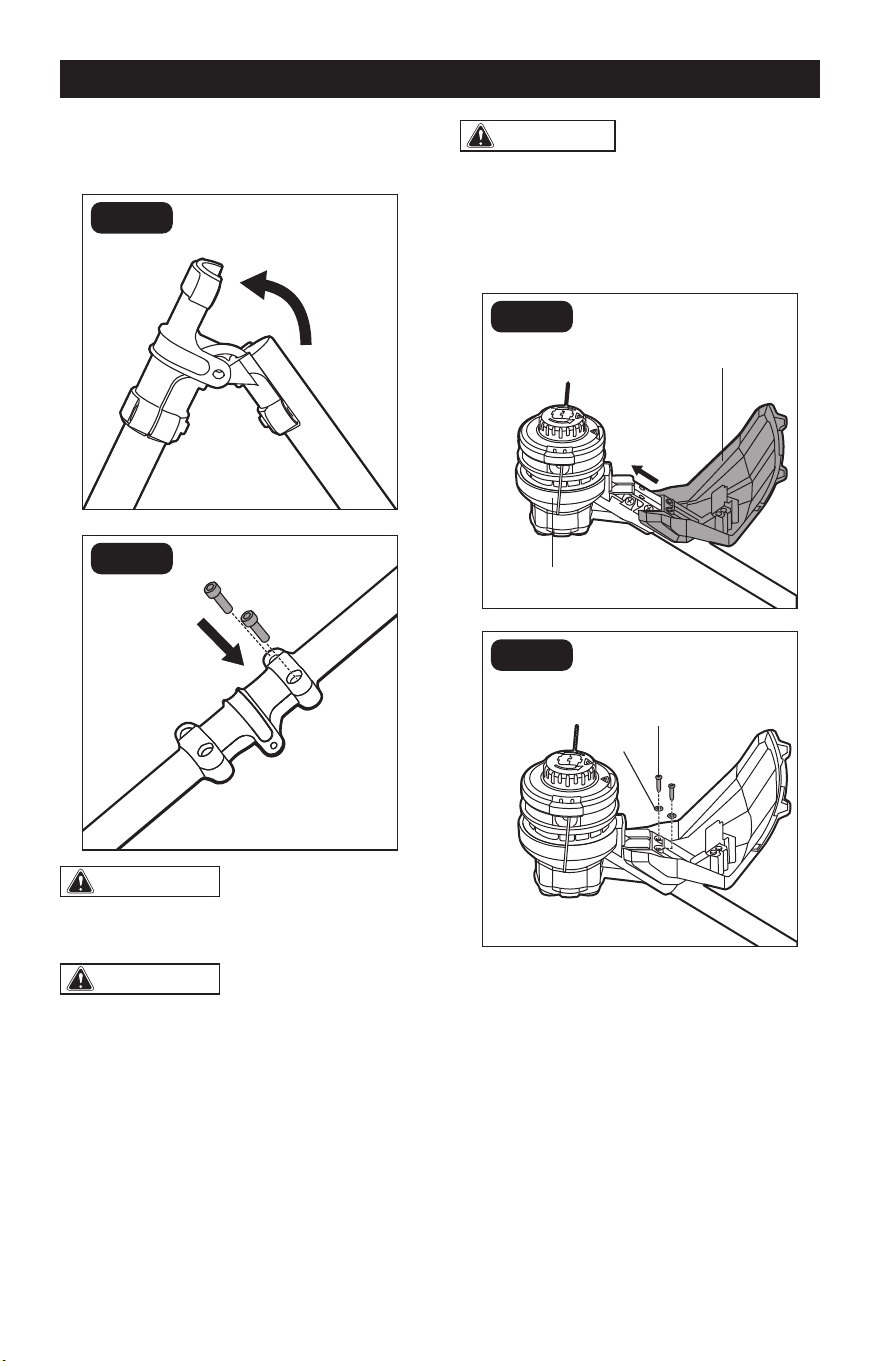
SHAFT (FIG. 1 & FIG. 2)
FIG. 1
FIG. 2
WARNING:
In order to avoid
pinching your hands or fingers, do not
hold the shaft at the hinge.
WARNING:
Do not attempt to
start the trimmer until the shaft has been
locked.
1. Remove the battery pack from the
trimmer.
2. Lay the trimmer on the ground and
carefully unfold the shaft. Make sure
that the cable is inside the shaft so that
it will not be pinched when closing the
hinge (FIG. 1).
3. Insert the two bolts (supplied) and
tighten them with the supplied hex key
to lock the shaft in place (FIG. 2).
CAUTION:
If you want to fold the
shaft again, remove the two bolts near the
rear handle side.
MOUNTING THE GUARD
(FIG. 3 & FIG. 4)
FIG. 3
Guard
Trimmer Head
FIG. 4
Screw
Washer
1. Remove the battery pack from the
trimmer.
2. Lift the trimmer head and face it upward;
align the groove on the bottom of the
guard with the raised portion on the
base of the trimmer head, and then slide
the guard onto the base (FIG. 3).
3. Make sure that the two mounting holes
in the guard are aligned with the two
assembly holes in the base of the shaft.
Insert a screw into each washer, and then
lock the guard in place by tightening the
two screws (FIG. 4).
OPERATION
Page 12
MOUNTING AND ADJUSTING
THE FRONT-ASSIST HANDLE
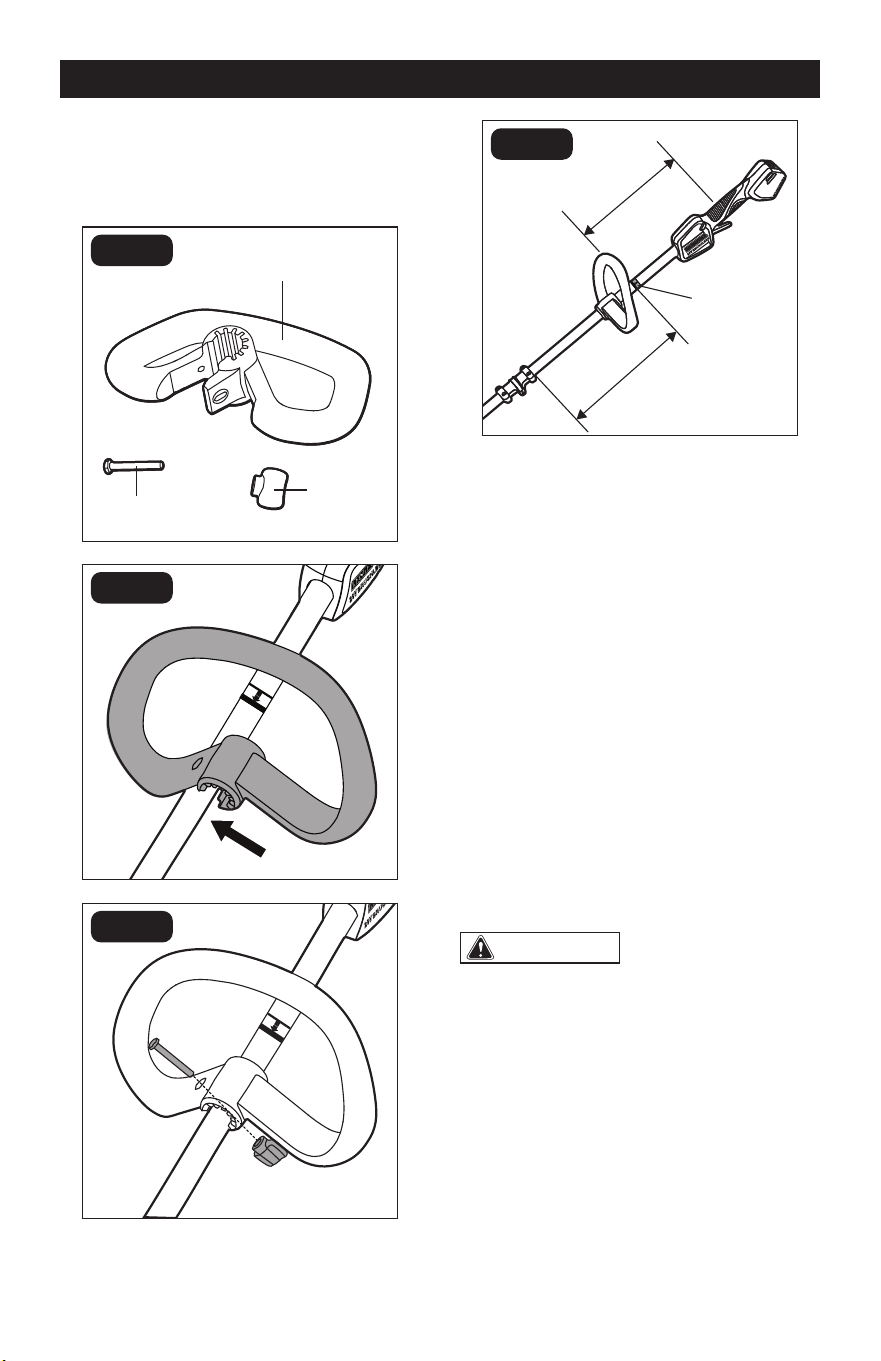
(FIG. 5 – FIG. 8)
FIG. 5
Front-assist Handle
Hex Bolt
Wing Nut
FIG. 6
FIG. 7
FIG. 8
≥10’’
Mounting Zone
Limit Label
1. Remove the battery pack from the
trimmer.
2. Loosen the wing nut and remove it
along with the hex bolt from the front-
assist handle (FIG. 5).
3. Press the front-assist handle onto the
shaft. Make sure that the front-assist
handle is positioned upwards and
points toward the top of the rear handle
(FIG. 6).
4. Mount the hex bolt and the wing nut and
pre-tighten the wing nut (FIG. 7).
5. Adjust the front-assist handle position
so that it is within the mounting zone,
as shown in FIG. 8. The handle should
be positioned so that the arm that is
holding the handle is straight when
using the trimmer.
WARNING:
The front-assist handle
should be positioned within the mounting
zone, not exceeding the limit label, so that
the distance between the centers of the
handles is at least 10” for safe operation.
6. Tighten the wing nut to prevent the
handle from moving along the shaft.
OPERATION
Page 13
ATTACHING/REMOVING BAT-
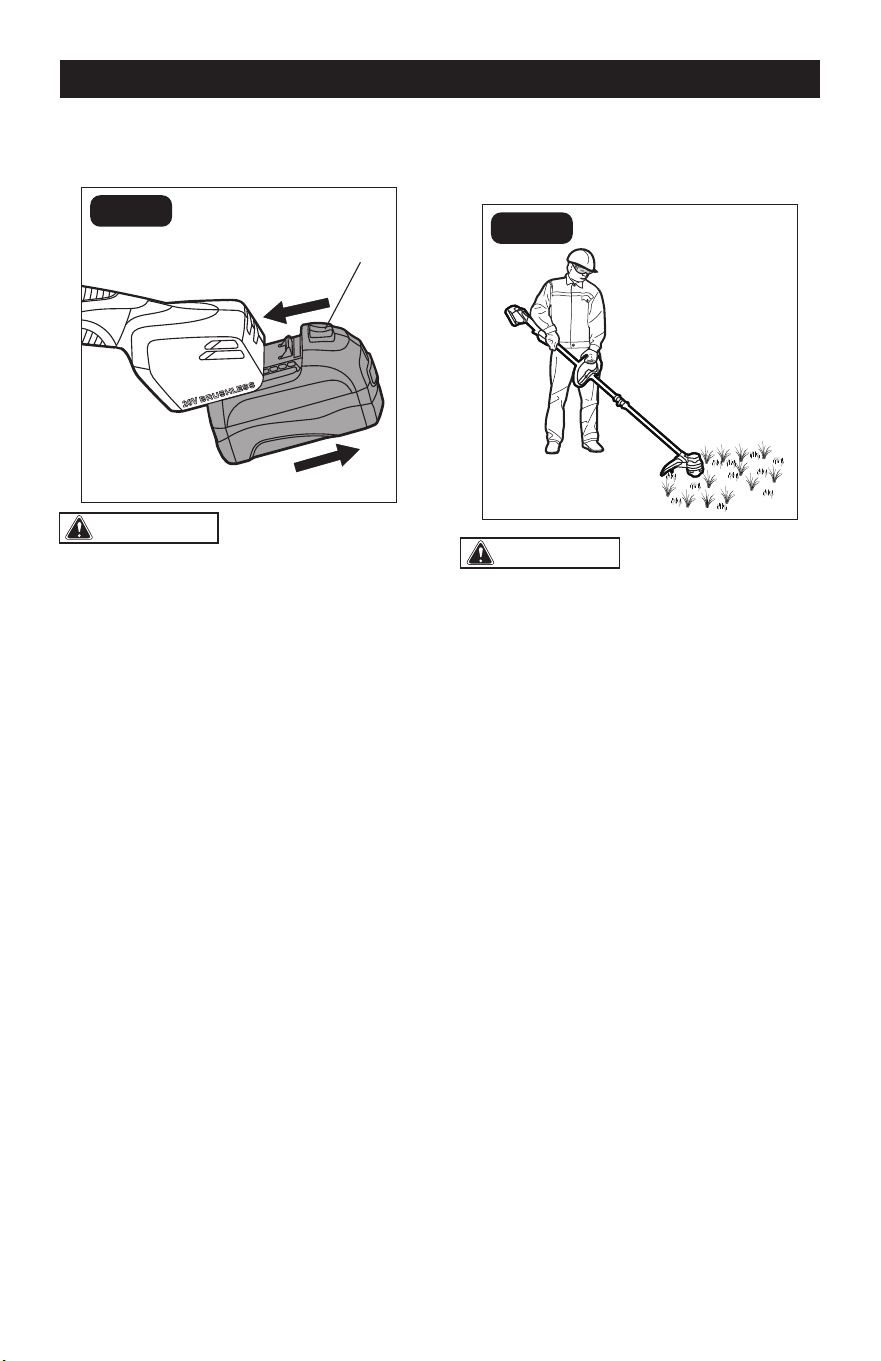
TERY PACK (FIG. 9)
FIG. 9
Battery-
release Button
Attach
Detach
WARNING:
Battery machines are
always in operating condition. Therefore,
remove the battery pack when assembling
parts, making adjustments, cleaning,
when the machine is not in use, or when
carrying it at your side. Removing the
battery pack will prevent accidental starting
that could cause serious personal injury.
TO ATTACH BATTERY PACK
1. Align the raised rib on the battery pack
with the grooves on the string trimmer.
2. Slide the battery pack onto the string
trimmer.
NOTE: Make sure that the latch on the string
trimmer snaps into place and the battery
pack is secured to the string trimmer before
beginning operation.
TO REMOVE BATTERY PACK
1. Depress the battery-release button
located on the front of the battery pack
to release the battery pack.
2. Pull the battery pack out and remove it
from the string trimmer.
HOLDING THE STRING TRIMMER
(FIG. 10)
FIG. 10
WARNING:
Dress properly to
reduce the risk of injury when operating
this machine. Do not wear loose clothing
or jewelry. Wear eye and ear/hearing
protection. Wear heavy, long pants, boots,
and gloves. Do not wear short pants or
sandals or go barefoot.
Before operating the unit, stand in the oper-
ating position and check that:
The operator is wearing eye protection
and proper clothing.
One arm is slightly bent, and the hand on
that arm is holding the rear handle.
The other arm is straight, with that hand
holding the front-assist handle.
The trimmer head is parallel to the
ground and easily contacts the material to
be cut without the operator having to bend
over.
OPERATION
Page 14
STARTING/STOPPING THE
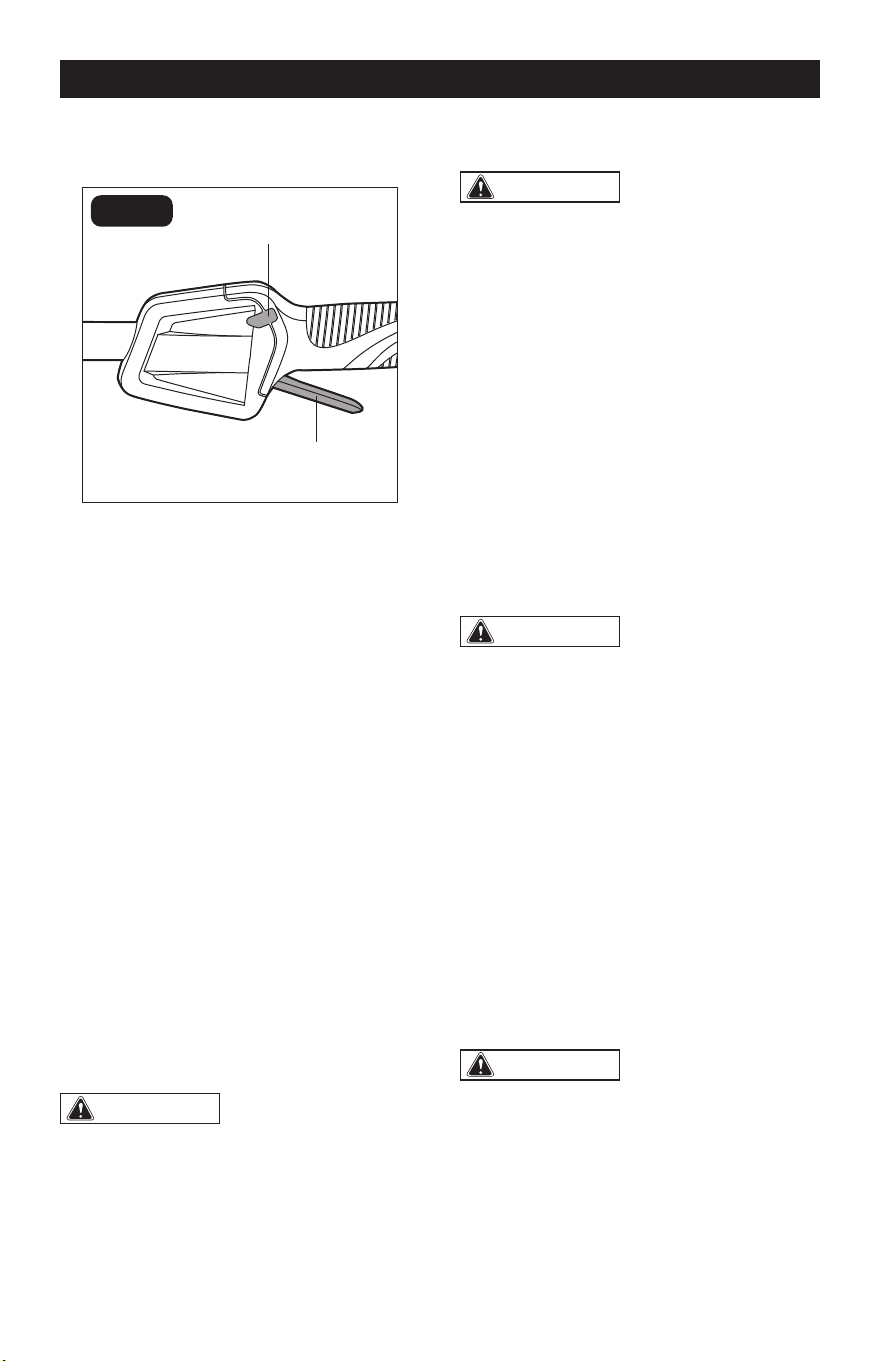
STRING TRIMMER (FIG. 11)
FIG. 11
Lock-off Button
Variable-speed
Trigger Switch
Before starting the string trimmer:
Make sure that you have a secure and
balanced footing.
Stand upright and hold the string trimmer
in a relaxed position.
Make sure that the cutting line is not
touching the ground or any other objects.
Hold the string trimmer with both hands:
one hand on the rear handle and the other
hand on the front-assist handle.
1. To turn the string trimmer on, press the
lock-off button and then depress the
variable-speed trigger switch.
2. The variable-speed trigger switch
delivers higher speed with increased
trigger pressure and lower speed with
decreased trigger pressure.
3. To turn it off, release the variable-speed
trigger switch and allow the trimmer to
come to a complete stop.
WARNING:
Always remove the
battery pack from the string trimmer
during work breaks and after finishing
work.
USING THE STRING TRIMMER
WARNING:
To avoid serious
personal injury, wear goggles or safety
glasses at all times when operating this
unit. Wear a face mask or dust mask in
dusty locations.
Clear the area to be cut before each use.
Remove all objects, such as rocks, bro-
ken glass, nails, wire, or string that can be
thrown or become entangled in the cutting
attachment. Clear the area of children, by-
standers, and pets. At a minimum, keep all
children, bystanders and pets at least 50
feet away; there still may be risk to bystand-
ers from thrown objects. Bystanders should
be encouraged to wear eye protection. If
you are approached, stop the machine im-
mediately.
WARNING:
To prevent serious
personal injury, remove the battery pack
from the machine before servicing,
cleaning, changing attachments or
removing material from the unit.
Before each use check for damaged/worn
parts
Check the trimmer head, guard, and front-
assist handle and replace any parts that are
cracked, warped, bent, or damaged in any
away.
The line-cutting blade on the guard can dull
over time. It is recommended that you pe-
riodically sharpen it with a le or replace it
with a new blade.
WARNING:
Always wear gloves
when mounting or replacing the guard
or when sharpening or replacing the
line-cutting blade. Note the location of the
line-cutting blade on the guard and protect
your hand from injury.
Clean the trimmer after each use
See the “MAINTENANCE” section for clean-
ing instructions.
OPERATION
Page 15
Check for blockage of the trimmer head
To prevent blockage, keep the trimmer head
clean. Remove grass clippings, leaves, dirt
and any other accumulated debris before
and after each use.
When blockage happens, stop the string
trimmer and remove the battery. Then re-
move any grass that may have wrapped it-
self around the motor shaft or trimmer head.
TIPS FOR BEST TRIMMING
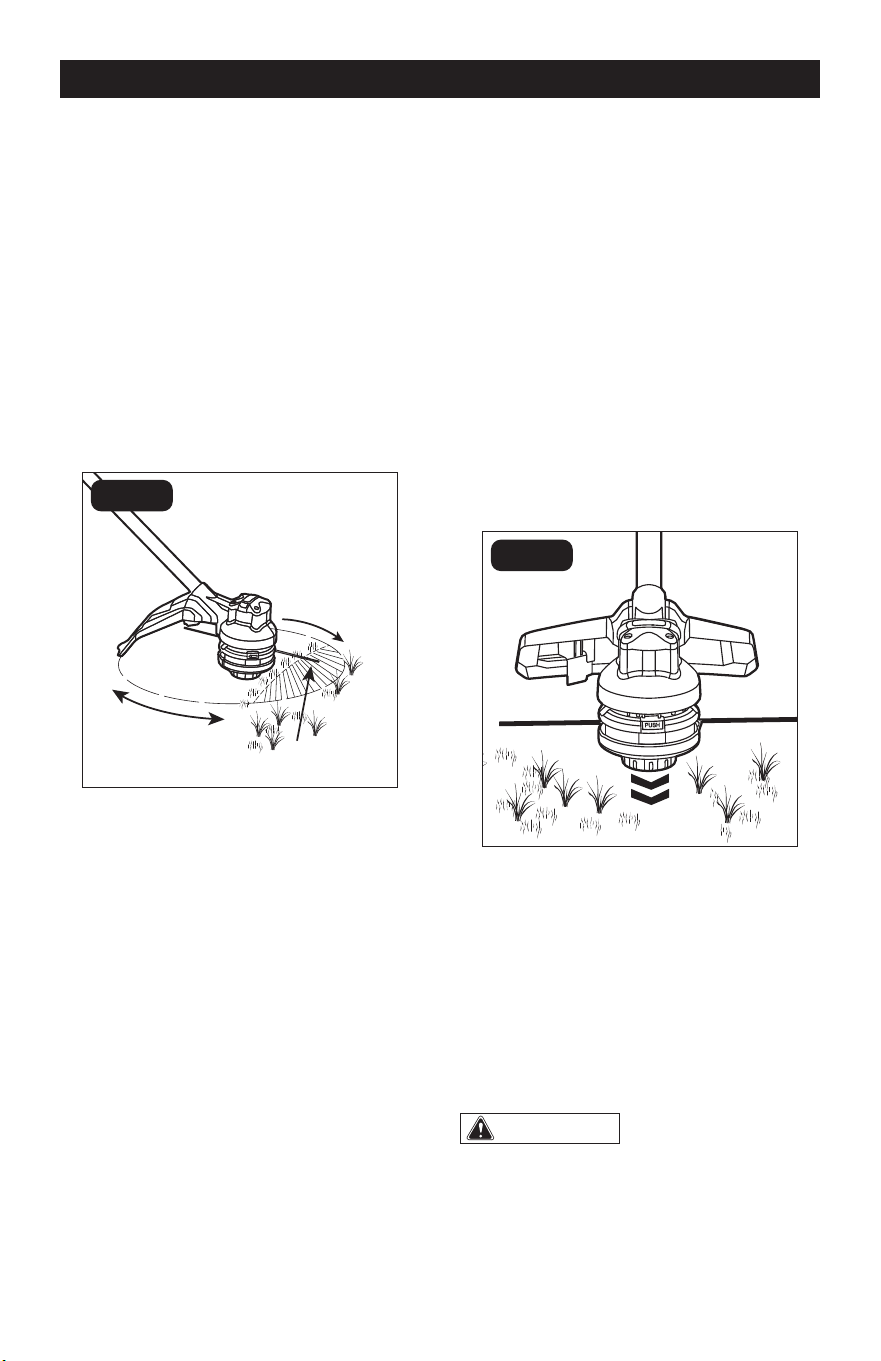
RESULTS (FIG. 12)
FIG. 12
Direction of
Rotation
Best Cutting
Area
Dangerous
Cutting Area
The correct angle for the cutting
attachment is parallel to the ground.
Do not force the trimmer. Allow the very
tip of the line to do the cutting (especially
along walls). Cutting with more than the
tip will reduce cutting efciency and may
overload the motor.
The cutting height is determined by the
distance of the cutting line from the lawn
surface.
Grass over 8 in. should be cut by working
progressively from top to the bottom in small
increments to avoid premature line wear or
motor drag.
Slowly move the trimmer into and out of
the area being cut, maintaining the cutting
head position at the desired cutting height.
This movement can be either a forward-
backward motion or a side-to-side motion.
Cutting shorter lengths produces best results.
Trim only when grass and weeds are dry.
Wire and picket fences can cause extra
string wear or breakage. Stone and brick
walls, curbs, and wood may wear strings
rapidly.
Avoid trees and shrubs. Tree bark, wood
moldings, siding, and fence posts can easily
be damaged by the strings.
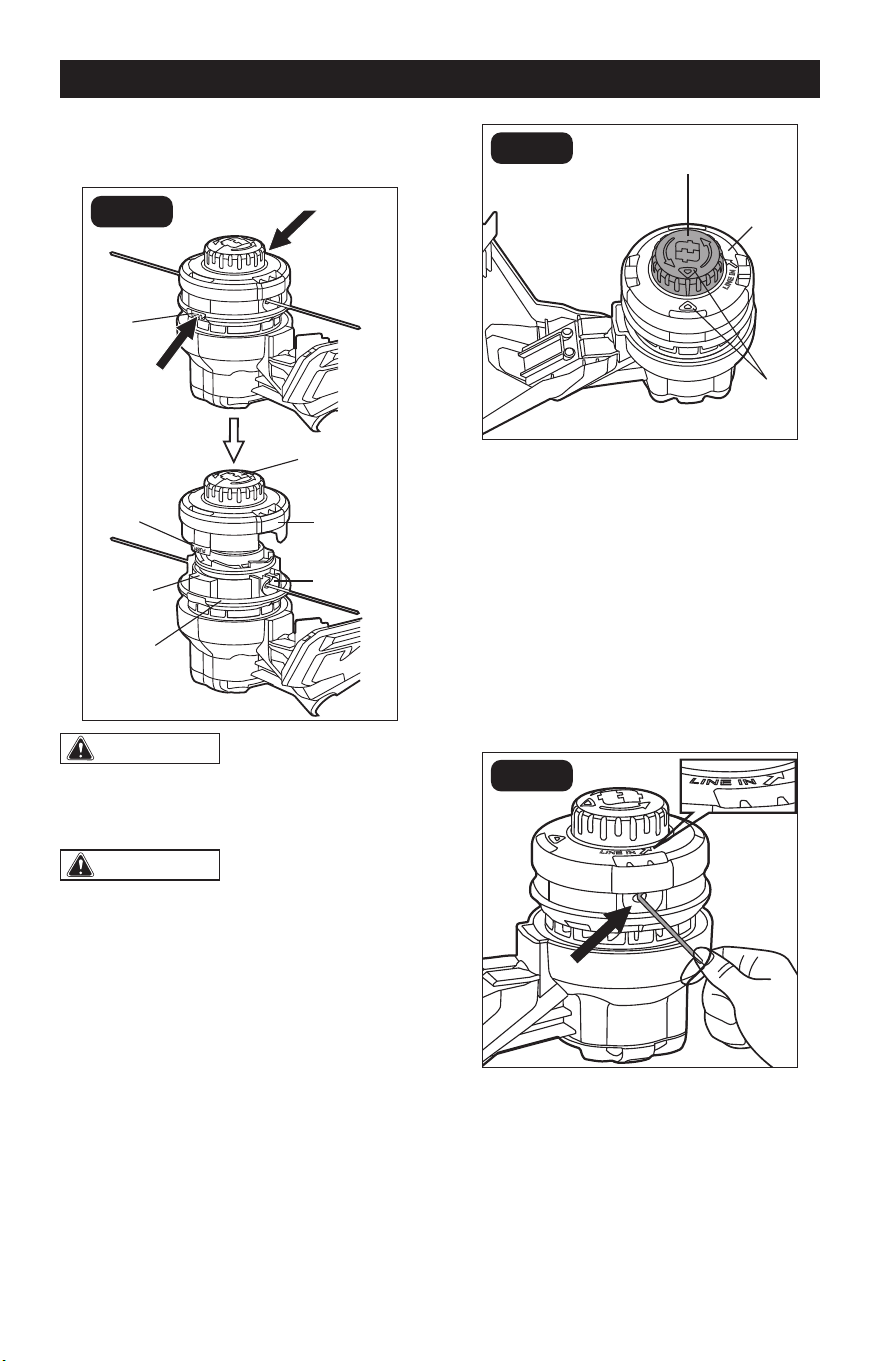
ADJUSTING THE CUTTING LINE
LENGTH (FIG. 13)
FIG. 13
The trimmer head allows the operator to re-
lease more cutting line without stopping the
motor. As line becomes frayed or worn, ad-
ditional line can be released by lightly tap-
ping the trimmer head on the ground while
operating the trimmer.
For best results, tap the trimmer head on bare
ground or hard soil. If line release is attempt-
ed in tall grass, the motor may overheat.
WARNING:
Always keep the
trimming line fully extended. Line release
becomes more difficult as the cutting line
becomes shorter. Do not remove or alter
the line cutting blade assembly. Excessive
line length will cause the motor to overheat
and may result in serious personal injury.
OPERATION
Page 16
OPERATION
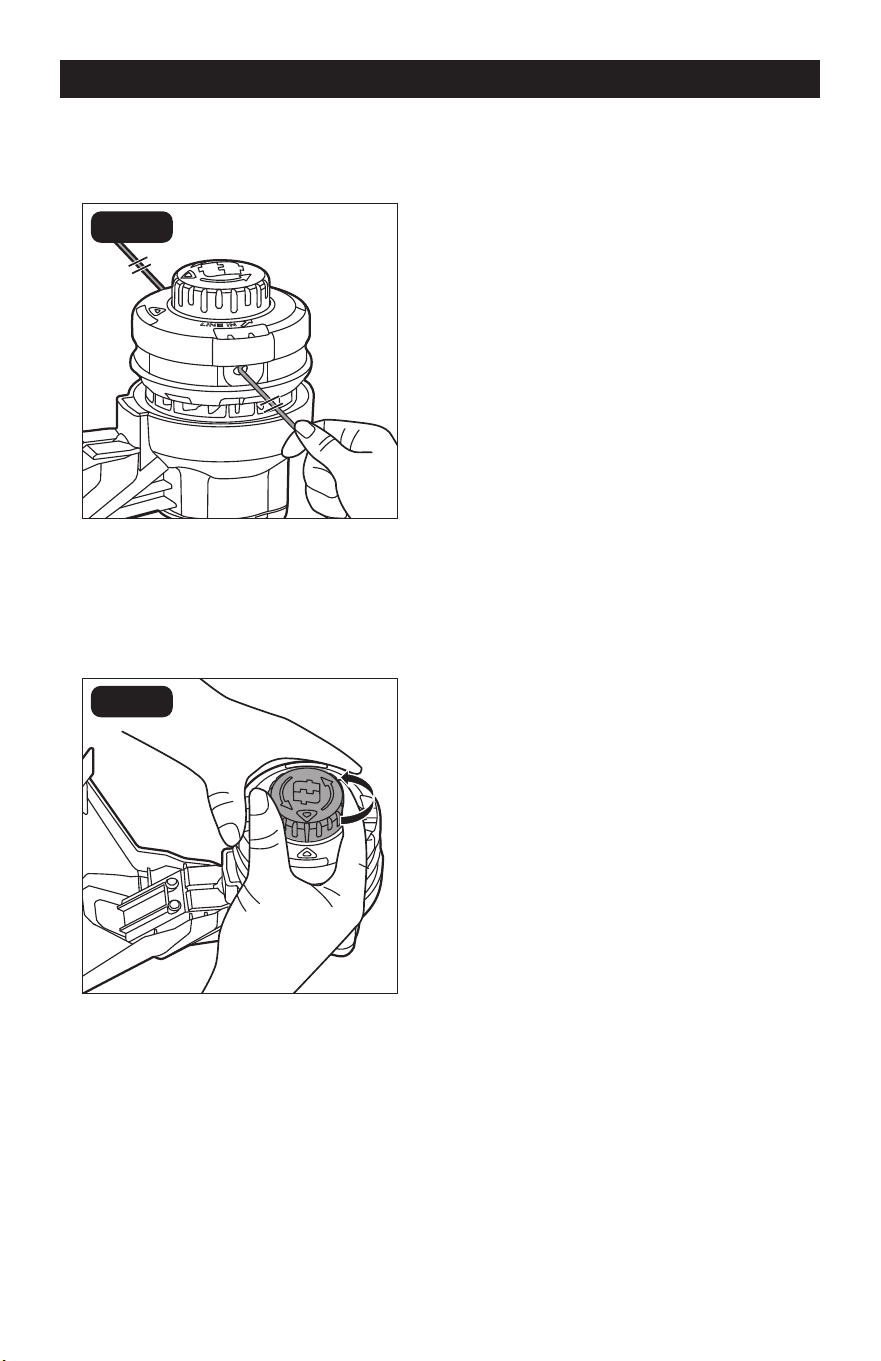
LOADING THE SPOOL WITH NEW
LINE (FIG. 14 – FIG. 18)
FIG. 14
Release
Tab
Release
Tab
Bump
Cap
Lower
Cover
Eyelet
Upper Cover
Assembly
Slot
WARNING:
Never use metal-
reinforced line, wire, rope, etc. These
can break off and become dangerous
projectiles.
WARNING:
To prevent serious
personal injury, remove the battery pack
from the machine before servicing,
cleaning, changing attachments, or
removing material from the unit.
NOTICE: Always use twisted nylon cut-
ting line with a size that does not exceed
0.08 in. Using line other than that specied
may cause the string trimmer to overheat or
become damaged.
1. Remove the battery pack from the string
trimmer.
2. Remove the remaining cutting line rst,
if there is no line, go directly to step 5.
3. Press the two release tabs on the lower
cover and remove the lower cover. Remove
the remaining cutting line (FIG. 14).
FIG. 15
Bump Cap
Lower
Cover
Arrows
4. With one hand holding the trimmer, use
another hand to grasp the lower cover
and align the release tabs on the lower
cover with the slots in the upper cover
assembly. Press the lower cover until it
snaps into place, at which time you will
hear a distinct click sound.
5. Rotate the bump cap to make sure that
the arrow on the bump cap is aligned
with the arrow on the lower cover
(FIG. 15).
FIG. 16
6. Cut one piece of cutting line 16 ft.
maximum length. Insert the new line into
the eyelet from the side marked “LINE
IN” on the lower cover. Feed the line until
the end of the line comes out of the other
side eyelet of the upper cover assembly
(FIG. 16).
Page 17
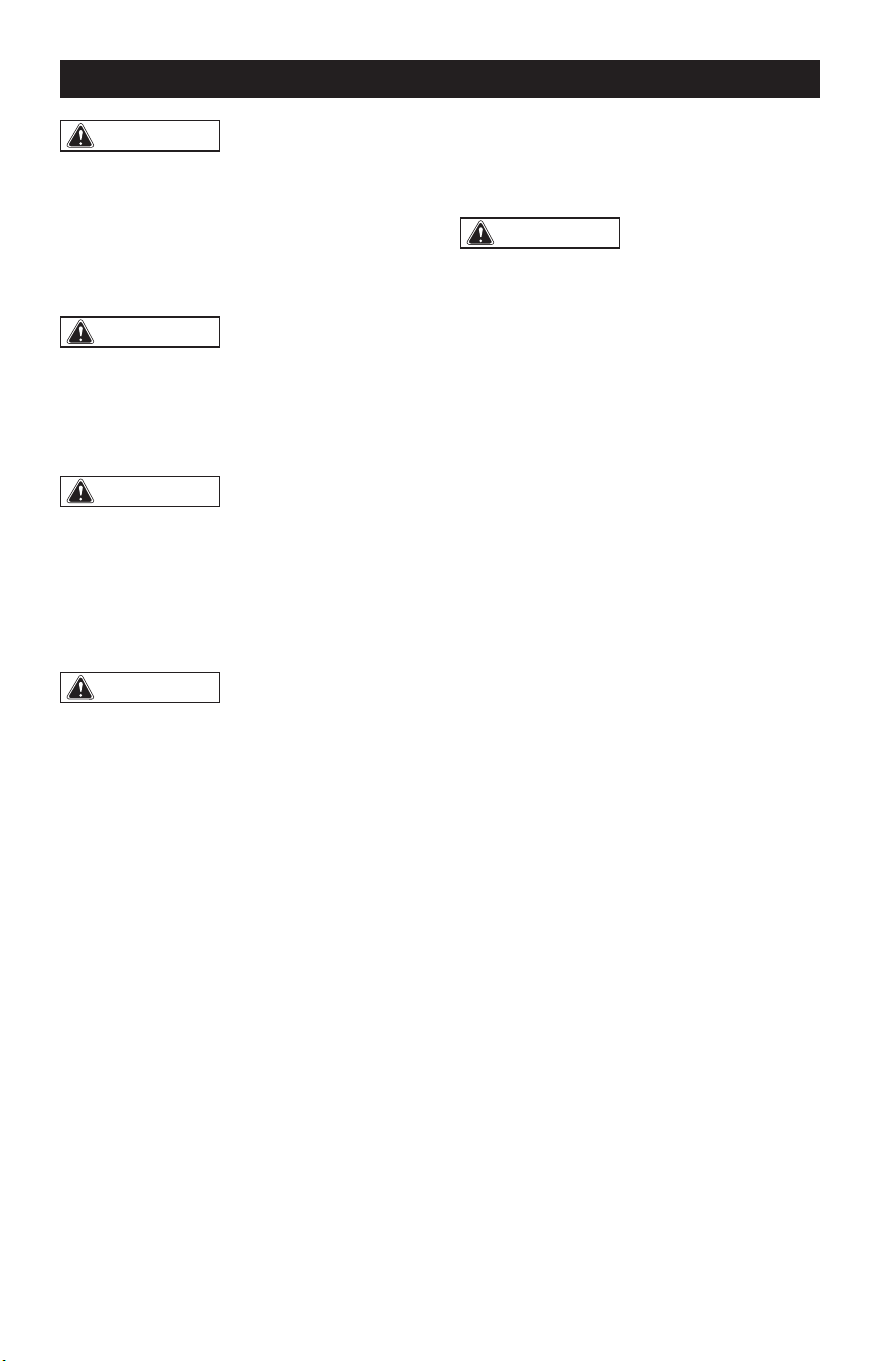
7. Pull the line from the other side until
equal lengths of the line appear on both
sides of the trimmer head (FIG. 17).
FIG. 17
8. Hold the upper cover assembly and
rotate the bump cap counterclockwise
in the direction indicated by the arrow to
wind the cutting line into the trimmer head
(FIG. 18).
FIG. 18
OPERATION
Page 18
WARNING:
To avoid serious
personal injury, remove the battery pack
from the string trimmer before inspecting,
cleaning, or performing maintenance. A
battery operated machine with the battery
pack inserted is always on and can start
accidently.
WARNING:
When servicing, use
only identical replacement parts. Use
of any other parts may create a hazard
or cause product damage. To ensure
safety and reliability, all repairs should be
performed by a qualied service technician.
WARNING:
For safe and proper
operation, always keep the product and its
ventilation slots clean.
CLEANING THE UNIT
WARNING:
Never use water to
clean your trimmer. Avoid using solvents
when cleaning plastic parts. Most plastics
are susceptible to damage from various
types of commercial solvents. Use clean
cloth to remove dirt, dust, oil, grease, etc.
Remove the battery pack.
Clear any grass that may have wrapped
itself around the motor shaft or trimmer
head.
Use a small brush or a vacuum cleaner
with attached crevice nozzle to clean the air
vents.
Keep the air vents free of obstructions.
Clean the unit using a damp cloth with a
mild detergent.
Do not use any strong detergents on the
plastic housing or the handle. The plastic
parts can be damaged by certain aromatic
oils, such as pine and lemon, and by
solvents, such as kerosene.
Moisture can also cause an electric
shock hazard. Wipe off any moisture with a
soft, dry cloth.
MAINTENANCE
SHARPENING THE
LINE-CUTTING BLADE
WARNING:
Always protect your
hands by wearing heavy gloves when
performing any maintenance on the line-
cutting blade.
1. Remove the battery pack from the
trimmer.
2. Wear proper eye protection and gloves
and be careful not to cut yourself.
3. Remove the line-cutting blade from the
guard.
4. Secure the blade in a vise.
5. Carefully le the cutting edges of the
blade with a ne-tooth le or sharpening
stone, being careful to maintain the
original cutting-edge angle.
6. Replace the blade onto the guard and
secure it in place with the two screws.
STORING THE UNIT
Remove the battery pack from the
trimmer.
Maintain and clean the machine
thoroughly before storing.
Store the unit in a dry, well-ventilated
area, locked-up or up high, out of the
reach of children. Do not store the unit on
or adjacent to fertilizers, gasoline, or other
chemicals.
Keep away from corrosive agents such
as garden chemicals and deicing salts.
Page 19
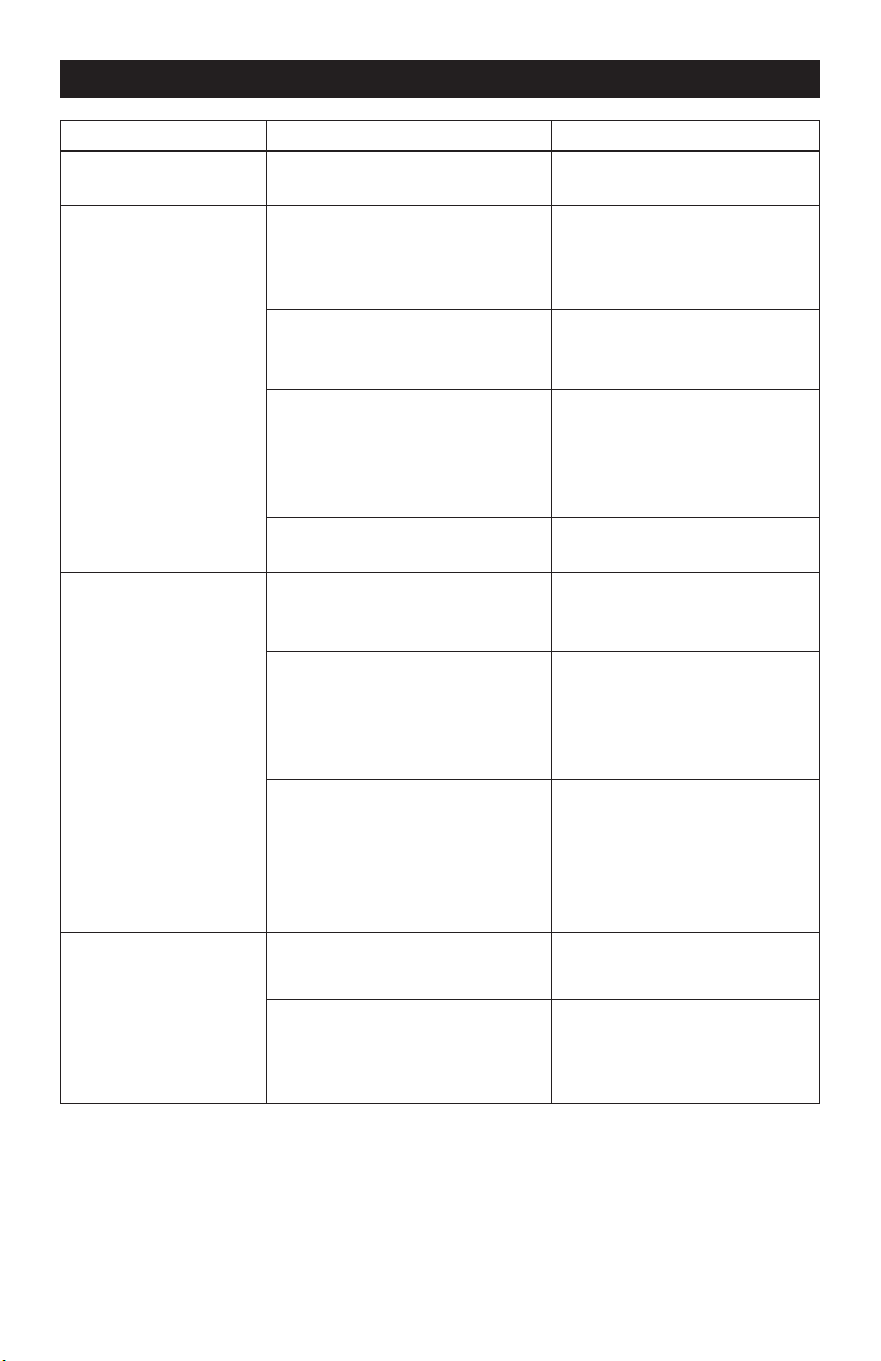
PROBLEM POSSIBLE CAUSE SOLUTION
String trimmer does
not work.
The battery pack charge is
depleted.
Charge the battery pack.
String trimmer stops
while cutting.
The motor shaft or trimmer head
is bound with grass.
Stop the trimmer, remove the
battery, and remove the grass
from the motor shaft and
trimmer head.
Incorrect cutting line is used.
Use recommended nylon
cutting line with diameter no
greater than 0.080 in.
The motor is overloaded.
Remove the trimmer head
from the grass and restart the
tool. Move the trimmer head
to cut the grass no more than
8” of length in a single cut.
The battery pack or string
trimmer is too hot.
Allow the battery pack or
trimmer to cool down.
Trimmer head will not
advance line.
The trimmer head is bound with
grass.
Stop the trimmer, remove the
battery, and clean the trimmer
head.
There is not enough line on the
spool.
Remove the battery and
replace the cutting line;
following the section
“LOADING THE SPOOL WITH
NEW LINE” in this manual.
The line is tangled in the
trimmer head.
Remove the battery and
remove the line from the
trimmer head and rewind
the cutting line, following
“LOADING THE SPOOL WITH
NEW LINE” in this manual.
Line can’t be installed.
Line can’t come out from the
other side of the trimmer head.
Insert the line by following
“LINE IN” direction.
Line can’t be wound properly.
Improper installation of spool,
check the section “LOADING
THE SPOOL WITH NEW
LINE” in this manual.
TROUBLESHOOTING

Page 20
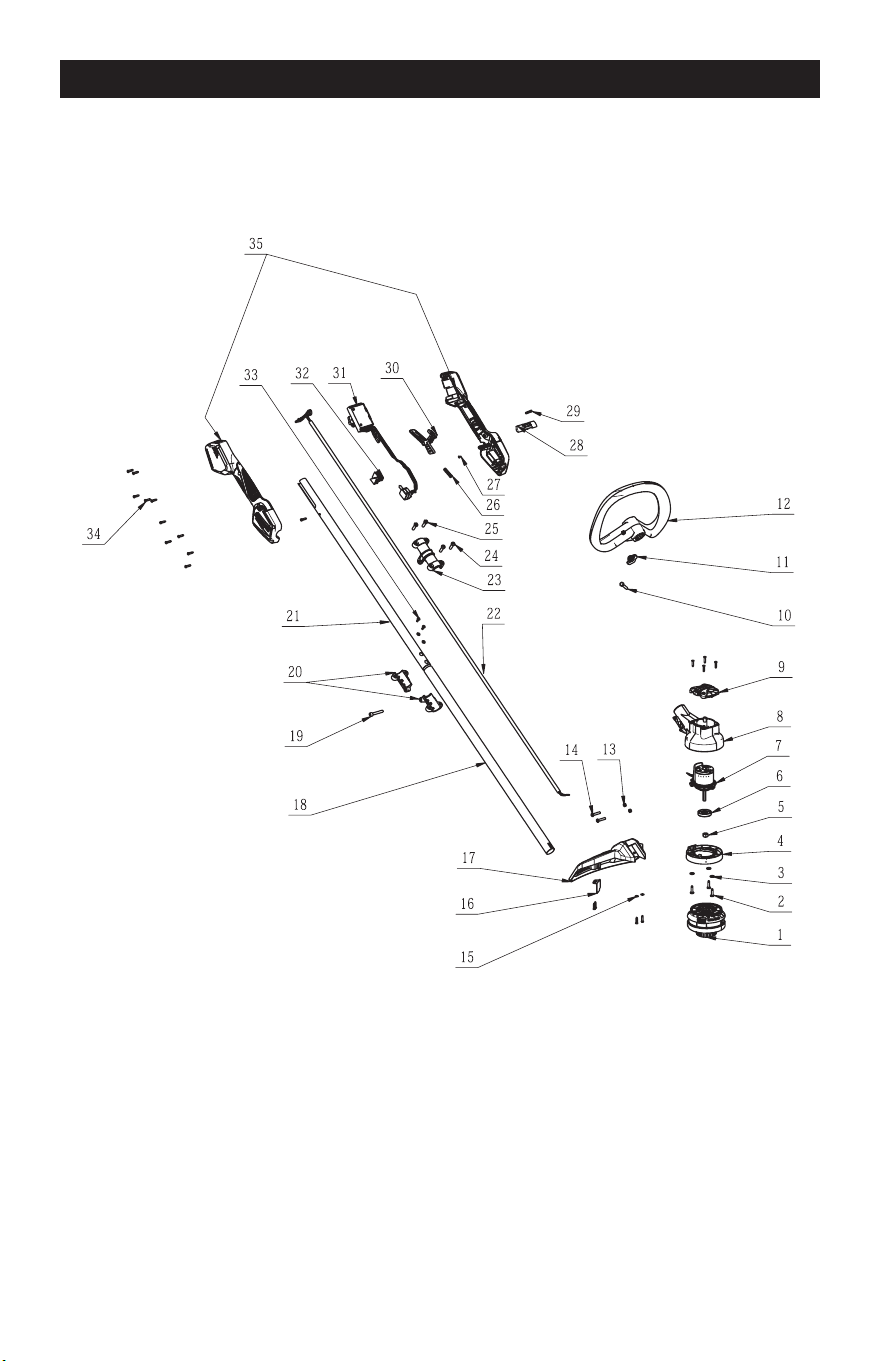
PARTS LIST
No. Part Name No. Part Name
1 Cutting Head Set 19 Hexagon Socket Screw
2 Tapping Screw 20 Connecting Tube
3 Washer 21 Rear Connecting Tube
4 Shield 22 Internal Wire ASSY
5 Nut 23 Connecting Tube
6 Outer Flange 24 Hexalobular Socket Screw
7 DC Motor 25 Hexagon Socket Screw
8 Motor Housing 26 Spring
9 Rear Cover 27 Screw With Washer
10 Hexagon Head Bolt 28 Lock-off Button
11 Wing Nut 29 Spring
12 Front Handle
30 Switch Trigger
13 Prevailing Torque Hexagon Nut 31 Electric Assembly
14 Screw 32 Sliding Block
15 Plain Washer 33 Thread Forming Screw
16 Blade 34 Tapping Screw
17 Guard 35 L R Housing Set
18 Front Connecting Tube
Page 21
SCHEMATIC DRAWING

20V BRUSHLESS 13” STRING TRIMMER

11/2024
© 2024 Menard, Inc., Eau Claire, WI 54703
