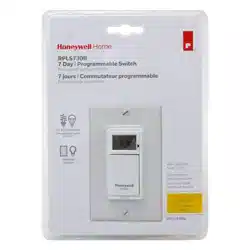
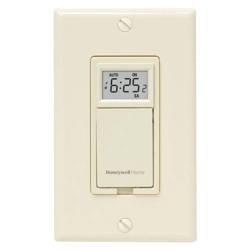
User manual Light Switch Timer
Applications
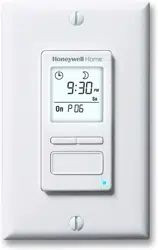
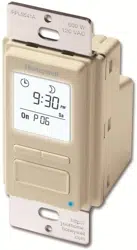
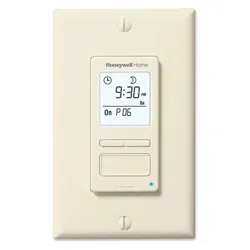
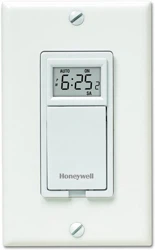
The RPLS740B/RPLS741B programmable wall switch has been designed to control lights and motors:

Installation
NOTE: This switch cannot be used if there is no neutral wire (white wires joint together) inside the electrical box.
- Cut power at the circuit breaker to avoid electric shock.
- Remove the existing switch.
- Install the new switch (see the appropriate section below).
- Apply power at the circuit breaker.

Quick Start-up
Set the time and date before using the timer for the first time.
The RPLS740B/RPLS741B will turn the lights on at sunset and turn them off at 11:00 pm by default. If these settings are appropriate for you, you only need to set the time and date (see shaded zone in the menu flowchart sheet). If the switch’s sunset time does not correspond to the actual sunset time, see sections 5.3.3 and 5.3.4.
Operation

Mode Menu
You can use the Mode menu to select one of the three modes of operation (see sections 5.1.1 to 5.1.3).
Manual Mode 
In Manual mode, the RPLS740B/RPLS741B operates like a regular switch. To turn the lights on or off, briefly press the main button. The icon appears when the switch is in Manual mode.

Automatic Mode 
In Automatic mode, the RPLS740B/RPLS741B turns the lights on or off according to the set programs (see Section 5.4). The icon as well as the current program number are displayed.

Random Mode 
In Random mode, the RPLS740B/RPLS741B has no specific times to turn the lights on or off. This mode is designed to give the impression the house is occupied during your absence. It is similar to the Automatic mode except there is no fixed program. The programs are automatically set to different times by the RPLS740B/RPLS741B every day. The icon appears when the switch is in Random mode.
The first “On” program occurs at sunset. Each “On” program lasts between 1 hour and 1 hour and 30 minutes; each “Off” program lasts between 15 and 30 minutes. The last “Off” program occurs between 10:30 pm and midnight.

Temporary Override
When the RPLS740B/RPLS741B is in Automatic or Random mode, you can press the main button at any time to override the default state for the current program. The lights will turn off if they are on and vice versa. The icon (On or Off) of the new state flashes to indicate that the state is temporary. The new state is maintained until you press the main button again or till the next “On” or “Off” program.
Time Menu
The time display flashes on the screen when the time has not yet been set or after a 4-hour power outage. Use the Time menu to select the time format (12-hour or 24-hour) and to set the clock and date. NOTE: The date is used to determine the sunset and sunrise times.
Use the Configuration menu to set the following parameters (see sections 5.3.1 to 5.3.4).
Backlight mode (SCRN)
The screen is lit at high intensity for 8 seconds when you press any button. The rest of the time, depending on the backlight mode selected, the screen behaves as follows:
Scrn Off: The screen is not lit.
Scrn On HI: The screen is lit at high intensity.
Scrn On LO: The screen is lit at low intensity (default mode).
Automatic Daylight Savings Time Changeover (DLS)
When automatic daylight savings time changeover is on (DLS On), the RPLS740B/RPLS741B changes to daylight savings time (summer time) at 2:00 am on the second Sunday of March and changes back to normal time (winter time) at 2:00 am on the first Sunday of November. This function is enabled (DLS On) by default.
Latitude and Longitude Coordinates (LAT and LONG)
The coordinates are used to turn the lights on at sunset and off at sunrise. The latitude is set to +45 and longitude to -75 by default. These settings provide approximate sunset and sunrise times for most North American cities. To obtain your city’s coordinates (or those of a nearby city), see the coordinates table. You can also obtain this information at www.geonames.org or with a Global Positioning System (GPS) device. The accuracy of the sunset and sunrise times depends on the accuracy of the coordinates you enter for your city.
NOTE: Enter a negative value for a south latitude or a west longitude.
Correction Factor (ADJ)
If your city’s time zone is based on political or economic boundaries instead of its coordinates, your lights might switch on or off too early or too late with respect to sunrise and sunset. In this case, apply a correction factor (+1 or -1 hour; refer to addendum). Otherwise, leave it at 0 (default value).
Use the Program menu to set the programs; i.e. the times you want the lights to turn On or Off when the switch is in Automatic mode. To set a program, proceed as follows:
Select a program number (see section 5.4.1)
Set the day(s) of the program (see section 5.4.2)
Set the program start time (see section 5.4.3)
Selecting a program number
You can set up to 7 “On” programs (“P01 On” to “P07 On”) and 7 “Off” programs (“P01 Off” to “P07 Off”). For example, select an “On” program to set when to turn the lights on; select an “Off” program to set when to turn the lights off.

Setting the day(s) of the program
After selecting a program, set the day(s) of the program. You can select a specific day, all 7 days or “none”. Choose “none” for any unused program.
Setting the program start time
After setting the day(s) of the program, set its start time. You can select either a specific time, the sunset time or the sunrise time:
To select a specific time:
(1) Advance to the hour setting and select the hour.
(2) Advance to the minutes setting and select the minutes.
To select sunset or sunrise time:
(1) Advance to the hour setting and select the sunset time or sunrise time. (When you scroll, the sunset time  and sunrise time
  appear between 11 pm and 12 am.)
(2) To enter an offset (from -70 to +70 minutes in 10-minute increments) between the sunset or sunrise time and the program start time, advance to the minutes setting and change the minutes.
- EXAMPLE: If the sunset time is 6:13 pm and you change the minutes to display 6:43 pm, you have entered a delay of 30 minutes. If, later in the year, the sunset time is 4:01 pm, the program will start at 4:31 pm.
- NOTE: When you enter an offset,
 appears along with or when you display the sunset or sunrise time. To remove the offset, display the sunset or sunrise time and change the minutes until disappears.
Examples
Example 1: The lights turn on at sunset and off at 11:00 pm every day (default setting).

Example 2: The lights turn on at sunset and off at sunrise every day.

Example 3: The lights turn on at 8:00 pm every day and turn off at 10:00 pm every day except on Saturday night when they turn off at 1:00 am.

Be careful about overlapping!
For example, if you set “P01 Off” at 10:00 pm for all 7 days and set “P02 Off” to 11:00 pm for Saturday, on Saturday, the lights will turn off at 10:00 pm, not 11:00 pm since “P01 Off” is set to an earlier time than “P02 Off”.
Reset to default Settings
To return the switch to its default settings, simultaneously press both main and left buttons and hold. The software version will appear for 5 seconds. RST will appear for the next 5 seconds. Release the buttons when all segments appear on the screen. The switch is now reset (see default settings in the menu flowchart).

Troubleshooting
The display is faded or irregular.
- The ambient temperature is either below or above switch’s operating temperature.
The sunset or sunrise time is inaccurate.
- The date or time is wrong (see section 5.2)
- The longitude or latitude is wrong (see section 5.3.3).
- The correction factor is wrong (see section 5.3.4)
- You have entered an offset (see section 5.4.3).
Specifications
Supply: 120 VAC, 60 Hz
Maximum load: 1800 watts
Operating temperature range: -15 °C to 50 °C (5 °F to 122 °F)
Storage temperature range: -40 °C to 60 °C (-40 °F to 140 °F)
Power outage: The screen is blank. Only the time must be set if the outage lasts more than 4 hours; all other settings and programs are permanently saved.
Latitude range: from -65° to +65°
Solar table precision: +/- 11 min. (within ±60° latitude)
Certification: UL (c UL us)