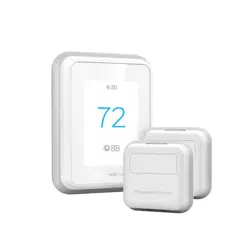
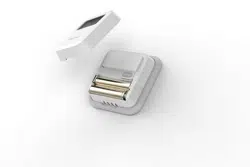
Prioritize a specific room or multiple rooms, or let comfort follow your move using built-in motion detection.
Control on the Go
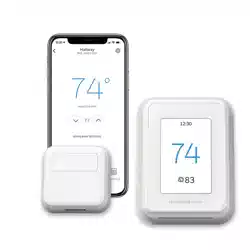
Adjust your thermostat from anywhere using your tablet or smartphone.
Save Energy
With geofencing, you can save money on the most expensive part of your energy bill while you’re away.
Simple Installation
The thermostat automatically programs itself. Just answer a few simple questions and you’ll be up and running in no time.
Whole-Home Range
With a 200-foot range, 20 sensors with temperature, humidity, and occupancy detection can connect to your thermostat from throughout your home.
Keep an eye on your home
Get customizable alerts on your mobile device when the basement is so cold a pipe could burst, or if the baby’s room is getting warm
Using Your Thermostat
The screen will wake up by pressing the center area of the displayed temperature.
Using the Honeywell Home App
Menu Options
Main Menu on Thermostat
From Home Screen, press the menu icon at bottom of the display (3 horizontal lines). If this is not shown at home screen, touch screen to wake display first.
Main Menu options
System mode (Available modes vary depending on how the thermostat was configured)
Heat
Off
Cool
Auto – Operation on page 9.
Em Heat – Operation on page 9.
Fan (Fan setting not available for all system types)
Auto (Fan only runs with a call for heat or cool)
On (fan runs continous)
Circulate (fan runs randomly approx. 33% of the time)
Priority
If wireless indoor temperature/humidity/motion sensors are used, select which sensors are used for temperature control.
You can choose active sensor (ones detecting motion) or manually select which sensors to use.
Schedule
Create new schedule (Set a time-based schedule)
Disable schedule
Reset to default schedule
NOTE: To enable geofencing, use the Honeywell Home app.
Management:
Devices & Sensors
View the temperature and humidity reading from Smart
Room Sensors
Identify a Smart Room Sensor
Add a new Smart Room Sensor
Remove a Smart Room Sensor
Thermostat information
Mac Address
IP Address
Date Code
Model Number
Build Date
Collection Version
Wi-Fi Bootloader Version
Wi-Fi Application Version
Equipment Status
System mode
Heat stages (on or off)
Cool stages (on or off)
Fan on or off
Configuration:
Wi-Fi
Connect App
Security
Preferences
Advanced Setup
Scroll down to see more options
For questions regarding how motion-based priority work with multiple people in the house, and how long are rooms considered “Active” after motion has last been detected, see “Frequently Asked Questions (FAQs)”
Selecting system mode
Touch homescreen to wake the thermostat.
Touch the menu icon and then touch “Select Mode.”
Heat: Controls the heating system.
Cool: Controls the cooling system.
Off: Turns the heating and cooling systems off.
Auto: When enabled, the thermostat will automatically use heating or cooling to reach the desired temperature. Operation on page 9.
Em Heat: Controls auxiliary or emergency heat; only available on systems with a heat pump. Operation on page 9.
Notes:
All available modes may not be shown for some applications. Scroll down to see more mode options (if available).
Auto mode may not appear on the thermostat screen or in the app depending on your equipment, and how your thermostat is configured.
When Auto is selected, “Heat to” and “Cool to” will both be shown from the “active” home screen.
Em Heat is only available for heat pump systems. The thermostat must also be configured to control a heat pump and an auxiliary/emergency heat stage.
When Auto is selected, “Heat to” and “Cool to” will both be shown from the “active” home screen.
Auto Changeover operatio
Auto changeover is available if the thermostat is configured for at least 1 heat stage and 1 cool stage and the installer enabled auto changeover.
When configured this way, you can select “Auto” as one of the options under “System mode”.
When in auto mode, you can always set the heat and cool setpoint to the same temperature, although most customer prefer to have a cool setpoint that is at least 3 degrees above the heat setpoint.
A 1.5°F differential is enforced behind the scenes to ensure the heat doesn’t come on after cooling shuts off or vice-versa.
Em Heat mode
Emergency heat runs when you manually switch the thermostat to the em heat mode. When the thermostat is in emergency heat mode, the heat pump is locked out. When the thermostat is set to em heat mode, the heat pump is locked out and the backup heat is used to maintain the heat setpoint.
Emergency heat mode is only available when the thermostat was configured for a heat pump with Backup heat by the installer.
From home screen touch the menu icon and then “system Mode”. You can set the thermostat to heat, off, cool, emergency heat, or auto (auto only available if configured by installer).
Setting the Fan
Note: Fan setting not available for all system types.
Touch any part of the display to wake the thermostat.
Touch the MENU icon at the bottom of the screen.
Touch Fan
Choose on, auto, or circulate.
Touch arrow in upper left to return to previous screen.
Auto setting only runs the fan with the heating or cooling system.*
On setting runs the fan continuously.
Circ setting runs the fan approx 33% of the time to ensure air circulation.
Scheduling the Fan
You can set the fan to on, auto, or circ for each program when using time-based scheduling or geofencing
Setting the Time/Date
When the thermostat is linked to the home Wi-Fi router and registered to an account using the Honeywell Home app, the date and time will update automatically.
If not using Wi-Fi you can set the time/date as follows:
Touch any part of the display to wake the thermostat.
Touch the MENU icon at the bottom of the screen.
Scroll down and select “Preferences”.
Select “Date and Time”.
Date and time information are displayed.
Set date
If the date shown is incorrect, touch “date”.
Scroll up or down on the left of the display until the correct month is in the middle of screen.
Scroll up or down on the center of the display until the correct day is in the middle of screen.
Scroll up or down on the right of the display until the correct year is in the middle of screen.
Touch “Done”.
Set time
If the time shown is incorrect, touch “time”.
Scroll up or down on the left of the display until the current hour is in the middle of screen.
Scroll up or down on the center of the display until the current minutes are in the middle of screen.
Scroll up or down on the right of the display until the correct am or pm is in the middle of screen.
Touch “Done”.
After touching “Done”. Use the arrow at the top of the display to return to the previous menu. To return to home screen from main menu, press the arrow at top center of display.
Connect to Wi-Fi
Open the Menu
Scroll to and select “Wi-Fi”
Tap “Choose Network”
Select a network
Connect to the Honeywell Home App
Open the Menu
Tap “Connect App”
Follow the on-screen instructions
Select thermostat model
Select location where the thermostat is installed or create a new location
Enabling or disabling Wi-Fi and disconnecting and reconnecting to a Wi-Fi network
On thermostat
Enable Wi-Fi
Touch any part of the display to wake the thermostat.
Touch the MENU icon at the bottom of the screen.
Scroll down and select “Wi-Fi”
Verify “Enable” is selected.
Connecting to a Wi-Fi network
Verify Wi-Fi is enabled using steps above.
Touch “Choose network”
Select the network you wish to connect to from the list and enter the password.
Disable Wi-Fi
Touch any part of the display to wake the thermostat.
Touch the MENU icon at the bottom of the screen.
Scroll down and select “Wi-Fi”
Verify “Enable” is de-selected.
Disconnecting from a Wi-Fi network
Touch any part of the display to wake the thermostat.
Touch the MENU icon at the bottom of the screen.
Scroll down and select “Wi-Fi”.
Touch “Choose network”
Select the network you wish to connect to from the list and enter the password.
Scheduling through the app
Flexible scheduling: You can choose to use location-based temperature control (geofence technology), time-based scheduling, or use a combination of both to make sure your home is always comfortable.
Location-based temperature control: Using geofencing technology, the T9 Smart thermostat will automatically use your smartphone’s location, which can save energy when you leave and make your home comfortable by the time you return.
Smart scheduling: Adds a Sleep period to location-based temperature control.
Time-based scheduling: You can program a schedule where every day is different, a schedule where weekdays and weekends are different, or a schedule where every day is the same. There are four adjustable periods per day: Wake, Away, Home, and Sleep.
No schedule: You can also choose not to set a schedule and adjust the thermostat manually.
Sensor Priority: Select which sensors are used for each program period or when used manually.
In the Honeywell Home app, select the thermostat you wish to schedule. Touch the calendar icon in the lower right of the display
Select Grouped days for all days the same or Single day if you want some days to be scheduled different than others
1. Select “Options” to turn schedule off, create a new time-based schedule, or switch to Geofencing.
2. Set priority sensor(s) for each program.
When location-based temperature control is used, the thermostat active homescreen display will show ”Using Home settings”, “Using Away Settings” or “Using “sleep settings” below the room temperature. If you set an additional Sleep period in the Honeywell Home app, you’ll also see the Following Schedule in the upper left corner of the thermostat screen.
If you manually change the temperature when location-based temperature control is active, the new temperature will remain in effect until you cross the geofence.
To adjust the geofence boundary, follow the steps below.
Open the Honeywell Home app, tap the menu icon in the upper left corner and then tap Geofence.
Tap Geofence Radius, and when the map and current geofence appear, touch, hold and drag the black dot to adjust the geofence boundary.
Tap SAVE to finish.
Setting Preferences
Preference menu options let you select how the thermostat displays information or responds to certain situations.
To access the Preferences menu:
Touch any part of the display to wake the thermostat.
Touch the MENU icon at the bottom of the screen.
Scroll down and select “preferences”. Select an option and follow prompts:
Display
Temperature units (Fahrenheit or Celsius)
Language (English French or Spanish)
Inactive backlight setting (0% to 100%)
Inactive Sleep backlight setting (0% to 100% and inactive sleep time settings. Note: these can be set different than the schedule sleep times)
Indoor display offsets (temperature and humidity)
Clean screen (allows you 30 seconds to clean display without accidently adjusting a setting)
Date and Time
Set date
Set time
Set to 12 or 24 hour clock
Set for daylight savings time
Reminders (these vary based on ISU settings)
Air Filter
Humidifier Pad
Dehumidifier
Filter
Ventilator Filter
Adaptive recovery
On or Off
Touch Done to save your settings
Cleaning the Thermostat Screen
When you select the Clean Screen option, the screen is locked to prevent accidental changes to the thermostat while you clean the screen.
Touch any part of the display to wake the thermostat.
Touch the MENU icon at the bottom of the screen.
Scroll down and select “Preferences”.
Select “Display”.
Select “Clean Screen” A prompt asks if you want to clean the screen for 30 seconds.
Touch Yes. A countdown timer displays elapsed time until the screen is reactivated.
NOTE: Do NOT spray any liquid directly on the thermostat.
Spray liquids onto cloth, then use the damp cloth to clean the screen. Use water or household glass cleaner. Avoid abrasive cleansers.
Adjusting Security Settings
You can adjust security options to prevent unauthorized changes to system settings.
Touch any part of the display to wake the thermostat.
Touch the MENU icon at the bottom of the screen.
Scroll down and select Security.
Select “Change lock mode” or “create password”.
Lock mode options
Unlocked: Full access allowed.
Partially locked: Only temperature can be changed.
Fully locked: No access allowed.
NOTE: If you choose to create a password for additional security, write it down for reference.
Configuration settings (revising settings)
If this is not a new installation and you want to access the configuration menu to view or revise settings
Touch the menu icon (3 horizontal lines at bottom of display)
Scroll down and touch “Advanced setup”
Then touch “modify configuration”.
After selecting the correct option for each setting, Touch NEXT at the bottom of the display to advance to the next option.
To see a list of all setup parameters, go to “Configuration settings” starting on the next page.
To finish setup and save your settings, TOUCH “Done” in the upper left of display
Advanced Features
ADAPTIVE RECOVERY
Over time, the T9 thermostat “learns” how long it takes your system to reach your programmed temperature setting.
The thermostat turns on the heating/cooling system early and assures that the programmed temperature setting is reached at the programmed time regardless of weather conditions. For example, if the Wake program period is set to 6:00 am with a heat setting of 70 degrees, the heat will turn on before 6:00 am, so the temperature is 70 degrees at 6:00 am. The thermostat displays "In Recovery” when it turns the system on early.
Adaptive Intelligent Recovery® calculates the recovery ramp based on how far the room temperature is away from the temperature setting, previous equipment performance and weather history, allowing the thermostat to start recovery at the optimal time so it can reach the programmed temperature setting at the programmed time.
COMPRESSOR PROTECTION
The thermostat keeps the compressor off for a few minutes before restarting, to prevent equipment damage. During this “off” time, the message “Waiting for Equipment” is displayed on screen
Alerts and notifications
The red dot above the Menu icon indicates an active alert or notification. Touch the Menu icon to view active Alerts & Notifications.
Touch Notifications to open this menu.
Touch the alert message to see more information about the alert.
When there is an active alert or notification, you must select the notification banner and acknowledge the message before you are allowed to access the menu icon.
Alerts
Alert Message
Meaning
Action
SET DATE AND TIME
Date and time are required for features such as schedule
Touch “Set Date and Time” button below alert message or register thermostat to Honeywell Home account.
WIFI MODULE ERROR
There is a failure of the Wi-Fi module in the thermostat.
Replace the thermostat
NEED TO REGISTER ONLINE
Sign in to the Honeywell Home App and follow the instructions to add a thermostat.
NO INTERNET CONNECTION
The thermostat is connected to (Network name) but can’t reach the Internet.
Try checking your router and modem.
WI-FI SIGNAL LOST
The Wi-Fi connection has been lost. Try reconnecting or choosing a new network.
Touch “View Wi-Fi settings” below the message on screen and follow instructions.
WI-FI NOT CONFIGURED
Wi-Fi has not been configured on this thermostat.
Touch “View Wi-Fi Settings” under alert to either connect to a network or disable Wi-Fi.
INTERNET REQUIRED
FOR OUTDOOR
TEMPERATURE
To receive outdoor temperature, the thermostat needs to be connected to the Internet. The installer may have configured the thermostat to use outdoor temperature for equipment lockouts.
Touch “View Wi-Fi settings”below alert message to link thermostat to network.
POWER RESTORED
There was an interruption in the power to the thermostat, but it has been restored.
No Action Required.
HEAT PUMP FAILURE
An issue was detected. Contact professional to diagnose and service your heat pump. (L wire energized).
Call contractor to determine what is wrong with heat pump.
MEMORY ERROR
There is a failure of the memory chip in the thermostat.
Replace the thermostat
INTERNAL SENSOR ERROR
There is a failure of the sensor in the thermostat.
Replace the thermostat
INTERNAL HUM TEMP FAILURE
There is a failure of the sensor in the thermostat.
Replace the thermostat
THERMOSTAT MEMORY ERROR
Internal issue with thermostat memory chip.
Replace the thermostat
THERMOSTAT UNKNOWN TIME
Power was lost and the time is not able to update through Wi-Fi either because the thermostat was not registered or there is poor Wi-Fi communication.
Reset the time or Verify Wi-Fi connection.
LOW SENSOR BATTERIES
Display says, “Change the batteries in the (Sensor name) soon”
Replace the AAA Alkaline batteries for the sensor named in alert message
INDOOR SENSOR ERROR
An issue with the wireless (SENSOR NAME) was detected. The sensor may need to be replaced.
Replace the sensor
INDOOR SENSOR
CONNECTION ERROR
(SENSOR NAME) is no longer connected.
Replace the batteries and make sure it is placed in an acceptable location.
IAQ REMINDERS
You can set up IAQ reminders in the thermostat to remind users when filters, pads, UV bulbs, etc. need cleaning or replacement.
Air Filter 1
Humidifier Pad
Dehumidifier
Filter
Ventilator Filter
UV Bulb 1
UV Bulb 2
If you want to disable the alert, go MENU-PREFERENCES-REMINDERS to turn reminder off.
To access or adjust the reminder settings
Touch any part of the display to wake the thermostat.
Touch the MENU icon at the bottom of the screen.
Scroll down and select “preferences.”
Select the reminder you want to set from the list (shown above).
Press ^ or v to set the timer length. Ranges, increments, and units will change based on the reminder.
Press Done to save the reminder.
Press Reset Timer when you have completed the recommended maintenance or you can extend the timer setting to turn off the alert and remind you later to do the recommended maintenance.
Repeat these steps for all reminders you want to set
NOTE: When set for run time days, the thermostat tracks the amount of time the fan has run and compares that time against the number of run time days selected. Fan run time is counted when there is a call for forced air heating, cooling, or fan.
Adding a wireless sensor
Touch any part of the display to wake the thermostat.
Touch the MENU icon at the bottom of the screen.
Scroll down and touch “Devices and Sensors”.
Touch “Add”
Follow the on-screen directions to pair and name your new sensor
To Remove a Sensor from the T9 (from thermostat)
Touch any part of the display to wake the thermostat.
Touch the MENU icon at the bottom of the screen.
Scroll down and select “Devices and Sensors”
Select the sensor you wish to remove. Select the “Options” button at the bottom of the display.
Touch “Delete”.
To Remove a Sensor from the T9 (From the sensor)
Locate the sensor you wish to remove from your thermostat
Remove Sensor Cover and verify the batteries are inserted
With the cover off, Press and Hold the Connect button for 30 seconds. (The Sensor LED will switch from steady green to red.)
Release the Connect button. Your sensor will now be removed from the “Devices and Sensors” list.
If a sensor was previously paired with another T9 Smart thermostat, you will need to remove it from the previous thermostat prior to pairing it with your new T9 Smart thermostat. Sensors are only compatible with one thermostat at a time
Battery Replacement (indoor sensor)
The T9 thermostat does not use any batteries. It is powered by 24 volts from the HVAC transformer using the C (common) wire. The wireless indoor sensors use AAA Alkaline batteries. Batteries: Replace batteries in your indoor sensor when a warning appears on the thermostat screen, about 60 days before batteries are depleted. When the sensor status light begins flashing red, battery power is critically low and will be depleted within 2–3 weeks. During normal operation, the status light remains off. To replace the batteries:
Remove cover from sensor.
Install 2 fresh AAA alkaline batteries. If the status light flashes green, batteries are good; if it flashes red, you must use fresh batteries.
Snap cover back on sensor. The sensor will restore communication with the thermostat a few seconds after new batteries are installed.
Frequently Asked Questions (FAQs)
Wi-Fi connection questions
Q: Will the thermostat still work if the Wi-Fi connection is lost?
A: Yes, you can still manually adjust the temperature at the thermostat. However, some features such as location-based temperature control (geofencing technology) can only be managed through the Honeywell Home app and will not function without a Wi-Fi connection. The thermostat will automatically reconnect to Wi-Fi once the network is restored.
Q: Is there a way to extend the strength of my Wi-Fi signal?
A: The range (distance) of your Wi-Fi signal is determined by your router. Try moving your router closer to the location of the thermostat, or use a router with a stronger signal range.
Q: There’s an alert that says “Wi-Fi signal lost” - what should I do?
A: Wait 5 minutes for the thermostat to reconnect or select an alternate network (if you have one) in the Honeywell Home app configuration menu. If the thermostat isn’t able to reconnect, you’ll need to troubleshoot the router to determine the cause.
Honeywell Home account and app questions
Q: Why haven’t I received an account activation email?
A: If you haven’t received an activation email after 5 minutes, check your Spam folder and look for an email from [email protected]. If you don’t see it, tap Resend to have the activation email resent. If you still don’t receive it, please contact the Technical Support team at 1-800-633-3991.
Q: Can I set up my thermostat with multiple users?
A: Yes. To add users, log into the Honeywell Home app and tap the menu icon in the upper left corner. Select Manage Users, tap Add User and type in the email addresses of the people you’d like to invite. If they already have a Honeywell Home account set up, the thermostat and its location will automatically be added to their account. If they don’t have an account, they’ll receive an email prompting them to download the Honeywell Home app and create a new account.
Q: Can I set up location-based temperature control with multiple users?
A: Yes. Location-based temperature control (geofence technology) will activate based on the last person who leaves and the first person to return. Each user will need to create their own Honeywell Home account with a login ID and password. Two users should not share the same account. Each user will then need to enable location-based temperature control.
Q: Why doesn’t a change I made in the app show up on the thermostat?
A: There may be a short delay when you make temperature and settings changes in the Honeywell Home app. Wait a few minutes, and if you still don’t see your changes on the thermostat, make sure the thermostat is still connected to Wi-Fi and restart your Honeywell Home app.
Software and security questions
Q: How can I be sure my thermostat is running the most up-to-date firmware?
A: When your thermostat is connected to Wi-Fi, it will automatically receive over-the-air firmware updates from the Honeywell Home app. These firmware updates contain things such as new features as well as security upgrades. Keep your thermostat connected to Wi-Fi to ensure it receives these updates.
Q: How can I prevent a cybercriminal from making unathorized changes to my thermostat?
A: If a cybercriminal gains access to your Wi-Fi router, they can tamper with a wide range of online activities, including the settings on your connected devices. Make sure you change the default password on your Wi-Fi router, and when you select a new password, make sure it uses multiple upper- and lower-case letters and special characters.
Other questions
Q: How can I uninstall my T9 Smart thermostat?
A: If you want to replace your T9 Smart thermostat, or if you’re moving out of your home and leaving the thermostat behind, you’ll first want to clear out the personal settings that are stored on the thermostat. (Even when disconnected from power, the thermostat will keep your settings and home router information in memory.) We recommend resetting the thermostat’s Wi-Fi and HomeKit settings (if previously connected).
Q: Is there a motion sensor in the thermostat?
A: There is not a motion sensor in the thermostat. In most homes, the thermostat is mounted in a hallway, so when using active rooms for priority sensing, we would want to exclude the thermostat.
Q: What happens if “Active rooms” is used and no motion is detected in any of the rooms with sensors?
A: If the thermostat is set to control by active rooms, and no motion is detected, the sensor in the thermostat is used and the remote sensors are excluded. Most people schedule the sleep period to use “Selected sensors” rather than “active sensors” and choose the bedrooms for the sleep schedule.
Q: When using active rooms, how long are those rooms considered after motion has last been detected?
A: The sensor has a dynamic occupancy algorithm based on how many motion events it sees within a certain timeframe. If someone walks through a room, then the room will be occupied for 10 minutes. If someone is in a room longer, then the timeout will be increased automatically.
Q: How do the wireless indoor sensors detects motion.
A: The sensors use a Passive Infrared Sensor (PIR) detector.
Q: How does motion-based priority work with multiple people in the house?
A: If the thermostat priority setting is set to ‘Active Rooms’, then any room that detects motion will become prioritized, and those Rooms’ temperatures will be averaged together to be used as the effective indoor temperature. If people leave the room, then the sensor will need to wait for the timeout.
Q: What’s the range of detection on the motion sensor?
A: There are many factors that can affect this (height, body size, layers of clothing, temperature of clothing, angle, etc.). The typical range of our sensor is up to 20 feet.
Q: How does motion-based priority work with multiple people in the house?
A: If the thermostat’s priority is set to ‘Active Rooms’, then any room that detects motion will become prioritized. The average of those rooms’ temperatures will be monitored so that the thermostat can adjust to your preferred temperature setpoint. If one of the sensors no longer detects people in that room, that sensor will adjust after a period of time, using the algorithm based on motion events that it sees within a certain timeframe.
Q: When using active rooms, how long are those rooms considered “Active” after motion has last been detected?
A: The sensor has an occupancy algorithm based on how many motion events it sees within a certain timeframe. This was set up so that if someone briefly walks through a room, the sensor will tell the thermostat that the room is “occupied” for 10 minutes. If someone is in a room longer, then the timeout will be increased automatically.
Sensors communicate directly with the thermostat via Honeywell Home RedLINK technology. After sensing motion, the communication should take less than 3 seconds to assign the room priority, depending on battery and signal strength.
Troubleshooting
If you have difficulty with your thermostat, please try the following suggestions. Most problems can be corrected quickly and easily.
Display is blank
Check circuit breaker and reset if necessary.
Make sure power switch for heating and cooling is on.
Make sure furnace door is closed securely.
Make sure the C-wire is connected.
Make sure R/Rc slider tab is set correctly (see wiring diagrams).
Heating or cooling system does not respond
Press Menu > System Mode > Heat > Done to set the system to Heat mode. Make sure the desired temperature is higher than the indoor temperature.
Press Menu > System Mode > Cool > Done to set the system to Cool mode. Make sure the desired temperature is lower than the indoor temperature.
Check circuit breaker and reset if necessary.
Make sure power switch for heating and cooling system is on.
Make sure furnace door is closed securely.
Wait 5 minutes for the system to respond.
Temperature settings do not change
Make sure desired temperature is within acceptable ranges:
Heat: 40 °F to 90 °F (4.5 °C to 32.0 °C)
Cool: 50 °F to 99 °F (10.0 °C to 37.0 °C)
Aux heat runs in cooling
For heat pump systems, verify there is not a wire attached to W on the UWP.
Cool runs with a call for heat
For heat pump systems, verify there is not a wire attached to W on the UWP.
Sensor will not connect
Press and hold Connect on the wireless sensor for 15 seconds. The LED will turn Amber. Return to the thermotat menu and press Menu > Devices and Sensors. Follow the on-screen instructions to add the sensor.
#1 Will the thermostat still work if the Wi-Fi connection is lost?
Yes, you can still manually adjust the temperature at the thermostat. However, some features such as location-based temperature control (geofencing technology) can only be managed through the Honeywell Home app and will not function without a Wi-Fi connection. The thermostat will automatically reconnect to Wi-Fi once the network is restored.


 in the upper left corner and then tap Geofence.