

EN
Original Instructions
Version 1 - November 2025
30271
PETROL
BRUSH CUTTER
TRIMMER

1.1 Product Reference
User Manual for: Petrol Brush Cutter/Trimmer
Stock No: 30271
Part No: DTP04
1.2 Revisions
Version 1: November 2025
First release
As our manuals are continually updated, always ensure
that the latest version is used.
Please visit drapertools.com/manuals for the latest
version of this manual and the associated parts list, if
applicable.
1.3 Understanding the Safety Content of
This Manual
WARNING! – Situations or actions that may result
in personal injury or death.
CAUTION! – Situations or actions that may result
in damage to the product or surroundings.
Important: – Information or instructions of particular
importance.
1.4 Copyright © Notice
Copyright © Draper Tools Limited.
Permission is granted to reproduce this manual for
personal and educational use ONLY. Commercial
copying, redistribution, hiring or lending is strictly
prohibited.
No part of this manual may be stored in a retrieval system
or transmitted in any other form or means without written
permission from Draper Tools Limited.
In all cases, this copyright notice must remain intact.
1. Preface
– 2 –
These are the original product instructions. Read the
instruction manual in full and retain for future
reference.
Please visit drapertools.com/manuals for the latest
version of this manual and the associated parts list,
if applicable.

2. Contents
– 3 –
EN
1. Preface 2
1.1 Product Reference 2
1.2 Revisions 2
1.3 Understanding the Safety Content of This
Manual 2
1.4 Copyright © Notice 2
2. Contents 3
3. Product Introduction 4-5
3.1 Intended Use 4
3.2 Specication 4
4. Health and Safety Information 5-6
4.1 General Health and Safety Precautions 5
4.2 Additional Health and Safety Instructions
for Brush Cutter/Line Trimmer 6
4.3 Transportation, Handling and Storage 7
4.4 Health and Safety Information regarding
use of Fuels 7
4.5 Residual Risk 7
5. Identication and Unpacking 8-9
5.1 Product Overview 8
5.2 What’s in the Box? 8
5.3 Packaging 9
6. Assembly Instructions 10-13
6.1 Fitting the Handle 10
6.2 Fitting the Attachment Guard 10
6.3 Connecting and Removing the
Attachment Shaft 10
6.4 Attaching the Harness 11
6.5 Fitting the Spool Assembly 11
6.6 Fitting the Blades 12
6.7 Fuelling the Brush Cutter/Trimmer 13
6.8 Checking and Topping up the Engine Oil 14
7. Operating the Brush Cutter/Line Trimmer 14
7.1 Starting and Stopping the Engine 14
7.2 Operating the Line Trimmer 15
7.3 Operating the Brush Cutter 16
8. Maintenance and Troubleshooting 17-23
8.1 General Maintenance 17
8.2 Cleaning the Air Filter 17
8.3 Spark Plug Maintenance 18
8.4 Engine Idle Speed Adjustment 19
8.5 Draining the Fuel 19
8.6 Cleaning the Fuel Filter 19
8.7 Changing the Engine Oil 19
8.8 Cutter Blade Care and Replacement 20
8.9 Removing the Complete Spool Assembly 20
8.10 Replacing the Spool Nylon Line 21
8.11 Troubleshooting 22
9. Spares, Returns and Disposal 24
10. Warranty 25
11. Explanation of Symbols 26

3. Product Introduction
3.1 Intended Use
This hand-held petrol brush cutter and line trimmer is
designed for cutting grass, weeds, bush and other similar
undergrowth.
Any other application beyond the conditions established
for use will be considered misuse. Draper Tools accepts no
responsibility for improper use of this product.
Read this manual in full before attempting to assemble,
operate or maintain the product, and retain it for later use.
3.2 Specication
Stock No. 30271
Part No. DTP04
Engine:
Type: 4 Stroke air cooled
Power output: 0.9kW
Displacement/capacity: 35.8CC
Max. speed (no load): 11,000rpm
Idle speed: 3,000rpm +/-300rpm
Fuel:
Tank capacity: 650ml
Petrol type: E5 or *E10 (95 RON)
Fuel consumption at max: 460g/hour
Oil
Tank capacity: 80ml
Oil grade: 4 stroke/SAE 10W-30
Noise emissions:
Sound pressure level: 93dB (A)
Uncertainty: 3dB (A)
Sound power level: 105.7dB (A)
Uncertainty (K): 3dB (A)
Guaranteed sound power level: 110dB (A)
Vibration level: 7.62m/s
2
Uncertainty (K): 1.5m/s
2
Grass trimmer attachment:
Cutting speed: 7,500rpm
Nylon line cutting width: 440mm
Nylon line diameter: 2.4mm
Nylon line length: 3M
Spool type: Ta p ’ n ’g o
Brush cutter attachment:
Cutting speed: 7,500rpm
Blade diameter: 255mm
Blade thickness: 1.4mm
Net weight: 7.4kg
EN
– 4 –

Important: The declared vibration total values and noise
emissions values have been measured in accordance
with a standard test method and may be used for
comparing one tool with another. These values may also
be used in a preliminary assessment of exposure.
*Draper Tools recommends using an additive or stabiliser
with E10 petrol so the fuel can be safely stored in the fuel
tank for longer.
WARNING! The vibration and noise emissions
during actual use of the product can dier from
the declared values depending on the type of
work and the area upon which it is used. Before
each use, estimate the likely exposure resulting
from the actual conditions of use. Take into
account all parts of the operation cycle in order
to identify any safety measures required to
protect the operator.
3. Product Introduction
4. Health and Safety Information
EN
EN
– 5 –
Save all warnings and instructions for future reference.
4.1 General Health and Safety Precautions
• The tool must ONLY be used by competent persons
who have received appropriate training.
• NEVER allow children to use this product.
• Keep children, animals and bystanders away while
operating this tool. Local regulations may restrict the
age of the operator.
• Stay alert, watch what you are doing and use common
sense when operating this product.
• DO NOT use this product while you are tired, or under
the inuence of drugs, alcohol or medication.
• Dress properly! DO NOT wear loose clothing or
jewellery, which can be caught in moving parts.
• Prevent unintentional starting. ALWAYS ensure the
engine is switched o before picking up or carrying
the tool.
• DO NOT overreach and keep proper footing and
balance at all times.
• Keep cutting tools clean and sharp.
• Before every use, inspect the product and all
accessories for broken, cracked and loose parts.
Ensure that the safety features are present and
functioning and that all visible nuts, bolts and screws
remain tight. Vibrations during use can cause them to
loosen over time.
• DO NOT use this product if it is damaged in any way.
Contact Draper Tools to discuss repair and
replacement options.
• Clear the work area before each use. Remove all
objects such as rocks, broken glass, nails, wire, or
string which can be thrown or become entangled in
the cutting line or blade.
• Keep all parts of your body away from the
moving parts.
• NEVER operate this tool on the operator’s left side.
• NEVER attempt to modify or operate a modied tool.
Fully assemble and t all relevant guards before
operating the tool.
• DO NOT operate the tool without being completely
familiar with the safety features and how to
operate them.
• NEVER operate the tool if the stop switch is faulty or
not functioning.
• NEVER operate this tool with defective or missing
guards.
WARNING! Use of this product can pose a danger
to wildlife. Before using this tool, check the area,
particularly long grass and under bushes for
signs of wildlife: if necessary relocate.
NOTE: Not all animals will be deterred by the noise of
the product alone.
• Check the attachment is correctly tted to the tool
before attempting to start the engine.
• NEVER leave the tool running when not in use or leave
it unattended during use.
• DO NOT allow familiarity or experience with this
product to allow you to become complacent; always
remain alert and adhere to the safety instructions
listed in this manual.
WARNING! THIS BRUSH CUTTER/GRASS TRIMMER
CAN CAUSE SERIOUS INJURIES. Read the
instructions carefully for the correct handling,
preparation, maintenance and starting/ stopping of
the tool. Become familiar with all the controls and
proper use of the cutter/trimmer.

– 6 –
4. Health and Safety Information
EN
Service
• Have the tool serviced ONLY by authorised and
suitably qualied personnel, using only identical
replacement parts.
4.2 Additional Health and Safety
Instructions for Brush Cutter/Line
Trimmers
WARNING! During operate the engine gets very
hot. DO NOT touch it, especially the exhaust.
ALWAYS Stop the engine before:
− Cleaning or when clearing a blockage.
− Checking or carrying out any maintenance on
the tool.
− Adjusting the working position of the cutting device.
• DO NOT operate the brush cutter/trimmer with a
damaged or excessively worn cutting device.
• To reduce re hazards, keep the engine free of debris,
leaves and excessive lubricant.
• ALWAYS ensure that all handles and guards are tted
when using the tool.
• ALWAYS use two hands to operate the tool.
• ALWAYS be aware of your surroundings and stay alert
for possible hazards of which you might not be aware
of due to the noise of the tool.
• ALWAYS wear appropriate PPE (Personal Protective
Equipment). ALWAYS wear suitable eye/face
protection. Use of sturdy gloves, non-skid footwear,
safety helmet, ear protection and safety glasses are
recommended to prevent personal injuries.
• If the cutting mechanism strikes any foreign object or
the tool starts making any unusual noises or
vibrations. Switch o the engine and allow the tool to
stop. Disconnect the spark plug wire from the spark
plug and take the following steps:
− Inspect for damage.
− Check for and tighten any loose parts.
− Replace or repair any damaged parts with
equivalent specication parts.
Brush Cutter & Blade
• After the engine is switched o, keep the rotating
blade in contact with the material being cut until it
completely stops.
• DO NOT operate the brush cutter unless the brush cutter
guard is rmly secured in place and in good condition.
• Use heavy gloves when operating the brush cutter and
when installing or removing blades.
• DO NOT attempt to touch the blade when it is
rotating. Maintain proper control until the blade has
completely stopped rotating.
• Replace the blade if it has been damaged. ALWAYS
ensure the blade is installed correctly and securely
fastened before each use. Failure to do so can cause
serious injury.
• Only use cutting blades recommended by Draper
Tools and suitable for this brush cutter.
• The blade is suited for cutting thicker weeds or pulpy
stalks only. NEVER use the blade to cut woody brush.
• Exercise extreme caution when using the cutter blade.
If the spinning blade contacts anything it cannot cut,
it may cause the blade to stop for an instant, and
suddenly “thrust” the unit away from the object that
was hit. This reaction can cause the operator to lose
control of the unit. Blade thrust can occur without
warning if the blade snags, stalls, or binds. This is
more likely to occur in areas where it is dicult to see
the material being cut. For cutting ease and safety,
approach the material being cut from the right to
the left.
• NEVER cut any material over 13mm diameter.
• Always wear the shoulder harness when using the
brush cutter and adjust to a comfortable operating
position.
• Maintain a rm grip on both handles while cutting
with a blade. Keep the blade away from your body and
below waist level.
Line Trimmer
• Replace line spool if cracked, chipped, or damaged in
any way.
• Ensure the spool is properly installed and securely
fastened. Failure to do so can cause serious injury.
• Keep the spool line below waist level.
• Only use cutting lines recommended by Draper Tools.
DO NOT use any other cutting attachment.
• NEVER operate unit without the trimmer guard in
place and in good condition.
• Maintain a rm grip on both handles while trimming.

– 7 –
4. Health and Safety Information
EN
4.3 Transportation, Handling and Storage
• Switch o the engine when you are crossing roads or
gravel paths.
• ALWAYS clean and maintain before storing, pay
special attention to the guards and cutting
attachments.
• Before transporting the unit in a vehicle stop the
engine and allow it to cool. Empty the fuel tank and
securely locate the unit.
• When removing the tool from a vehicle or from
storage, be careful not to drop the engine on the
ground as this may severely damage the fuel tank.
• NEVER drag the tool across the ground, or throw it to
the ground this is highly dangerous and will damage
the fuel tank, causing the fuel to leak, possibly
causing re.
4.4 Health and Safety Information
regarding use of Fuels
WARNING! During use, parts of this product
become hot enough to ignite some materials.
• DO NOT touch the engine or exhaust during or
immediately after use and allow it to cool before
refuelling.
• NEVER remove the fuel cap while the engine is
running or immediately after use.
− Take care when opening the fuel cap after use as
hot vapour may be released from the opening.
• NEVER place objects on the engine while it is in use
and keep all air vents clear of dust, dirt and other
obstructions.
• Faulty exhausts must be replaced.
• NEVER store the machine with fuel in the tank inside
any structure where petrol fumes could reach an open
ame or spark.
• To reduce the risk of re, keep the engine, exhaust
and petrol storage area free from vegetation and
excessive grease.
WARNING! Petrol is highly ammable:
− Store fuel in containers specically designed for
this purpose.
− NEVER use this product in environments where
there is a risk of explosion.
− NEVER smoke in the vicinity of the machine.
− Refuel outdoors only and do not smoke while
refuelling.
− Add fuel before starting the engine; never remove
the cap of the fuel tank or add petrol while the
engine is running or when the engine is hot.
− NEVER start the engine if you can smell petrol
vapour in the air.
− If petrol is spilled, do not attempt to start the
engine but move the machine away from the area
of spillage and avoid creating any source of
ignition until petrol vapours have dissipated.
− Replace all fuel tank and container caps securely.
WARNING! Fuels are toxic, they contain
substances that have an immediate toxic eect
and may cause permanent damage to your health.
− DO NOT inhale fuel fumes.
− NEVER start the engine in a closed or poorly
ventilated area.
Important: E10 petrol is hygroscopic and attracts
moisture, which may damage the fuel system if stored in
the product for more than four weeks. E10 petrol should be
used within 30 days of purchase. It is recommended to use
an additive or stabiliser with E10 petrol to extend the
period that it can be safely stored in the fuel tank. ALWAYS
read the label of any additive or stabiliser applied.
4.5 Residual Risk
The safety instructions in this manual cannot account for all
possible conditions and situations that may occur. Exercise
common sense and caution when using this product and
protect against any additional conceivable risks.

– 8 –
5. Identication and Unpacking
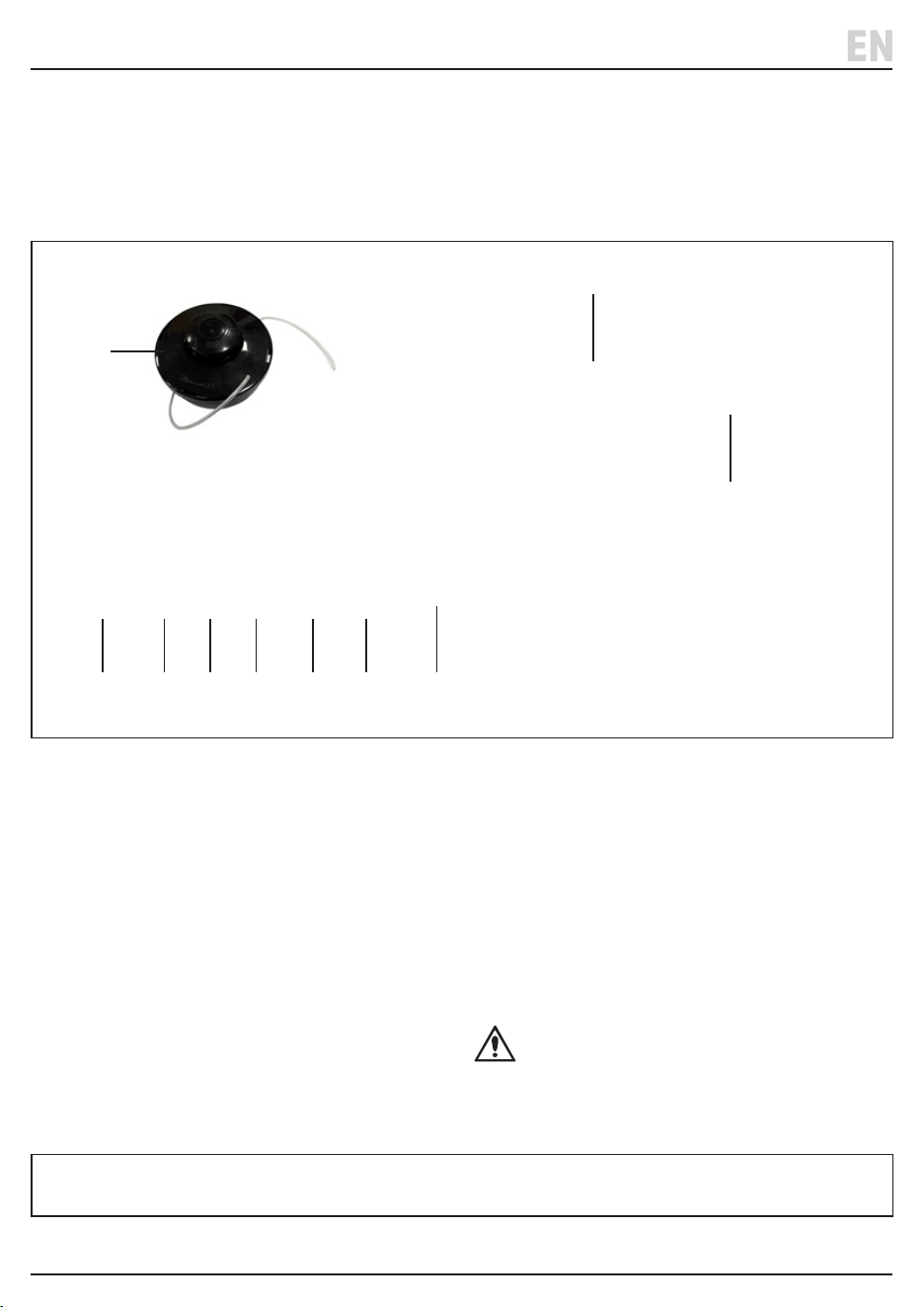
5.1 Product Overview
(1) Engine
(2) Harness hook
(3) Left handle
(4) Right handle with controls
(5) Throttle trigger
(6) ON/OFF switch
(7) Safety lever
(8) Split shaft connector
(9) Connector locking knob & nut
(10) Attachment shaft
(11) Attachment guard
(12) Cutting lament trimming blade
(13) Connector head
(14) Spool assembly
(15) Cutter blade
Engine
(16) Air lter lock.
(17) Air lter cover
(18) Choke lever
(19) Fuel primer (behind air lter)
(20) Fuel tank
(21) Fuel cap
(22) Recoil starter handle
(23) Oil ller cap
(24) Exhaust
(25) Spark plug cover (H.T lead) (inside top cover)
EN
(3)
(4)
(5)
(6)
(11)
(12)
(7)
(10)
(13)
(16)
(25)
(17)
(18)
(19)
(15)
(20)
(21)
(23)
(22)
(24)
(9)
(2)
(1)
(8)
(14)
5. Identication and Unpacking
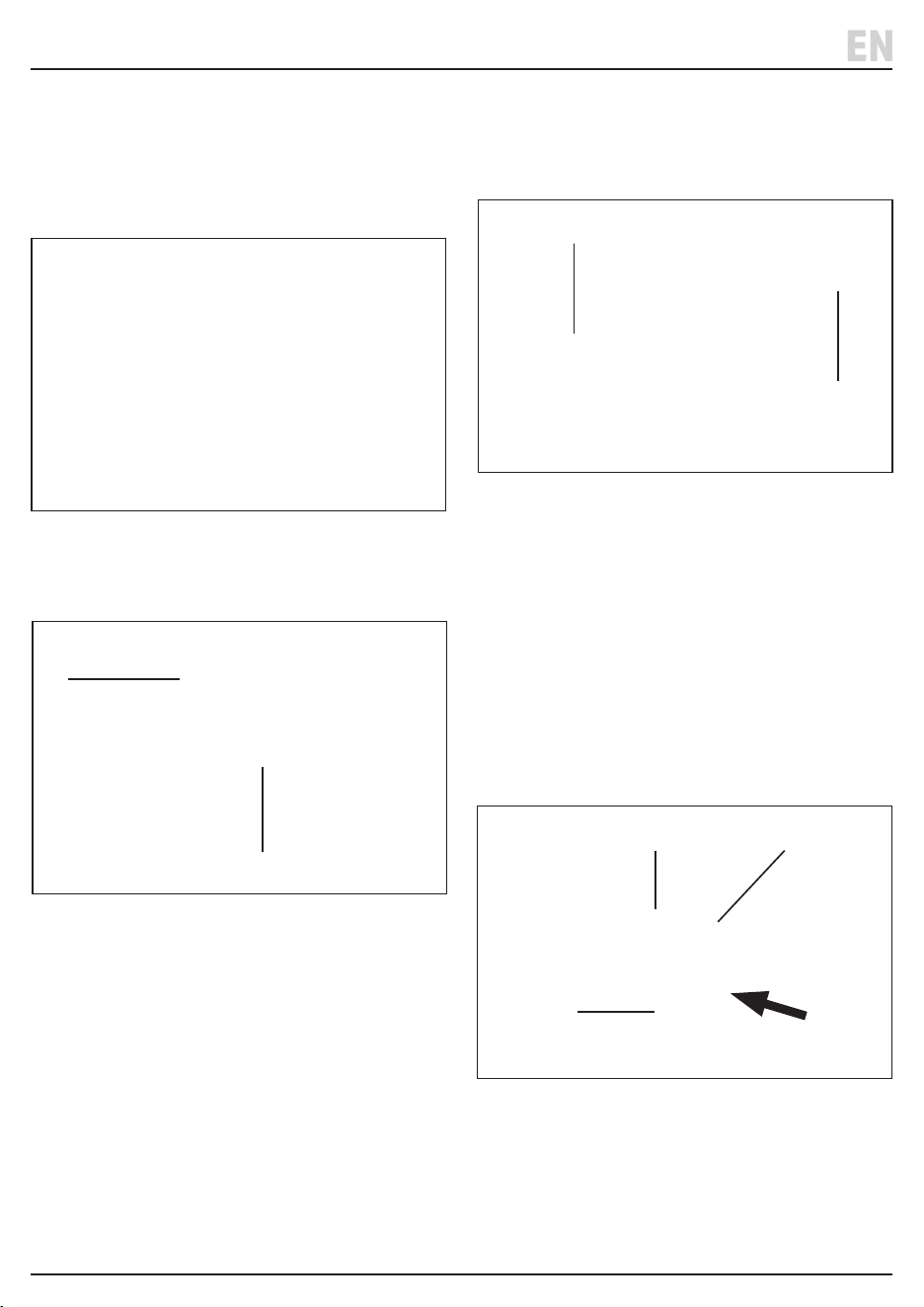
5.2 What’s in the Box?
Carefully remove the product from the packaging and
examine it for any signs of damage that may have occurred
during shipment. Before assembling the product, lay the
contents out and check them against the parts shown
below. If any part is damaged or missing, do not attempt to
use the product. Please contact the Draper Helpline;
contact details can be found at the back of this manual.
5.3 Packaging
Keep the product packaging for the duration of the
warranty period in case the product needs to be returned
for repair.
WARNING! Keep packaging materials out of
reach of children. Dispose of packaging
correctly and responsibly and in accordance
with local regulations.
EN
(14) Spool assembly
(15) Cutter blade
(15.1) Floating disc
(15.2) Washer
(15.3) Locknut
(26) Harness strap (with quick release)
(27) Spark plug spanner
(28) 2 X Hex keys (4mm & 5mm)
(29) Opened ended spanner (8 & 10mm)
(30) Flat head screwdriver
– 9 –
Please visit drapertools.com for our full range of accessories and consumables.
(15)
(14)
(27) (28) (29) (30) (15.3) (15.2) (15.1)
(26)
– 10 –
6. Assembly Instructions
EN
Important: Before preparing or adjusting this product,
read and understand all the safety instructions listed in
this manual.
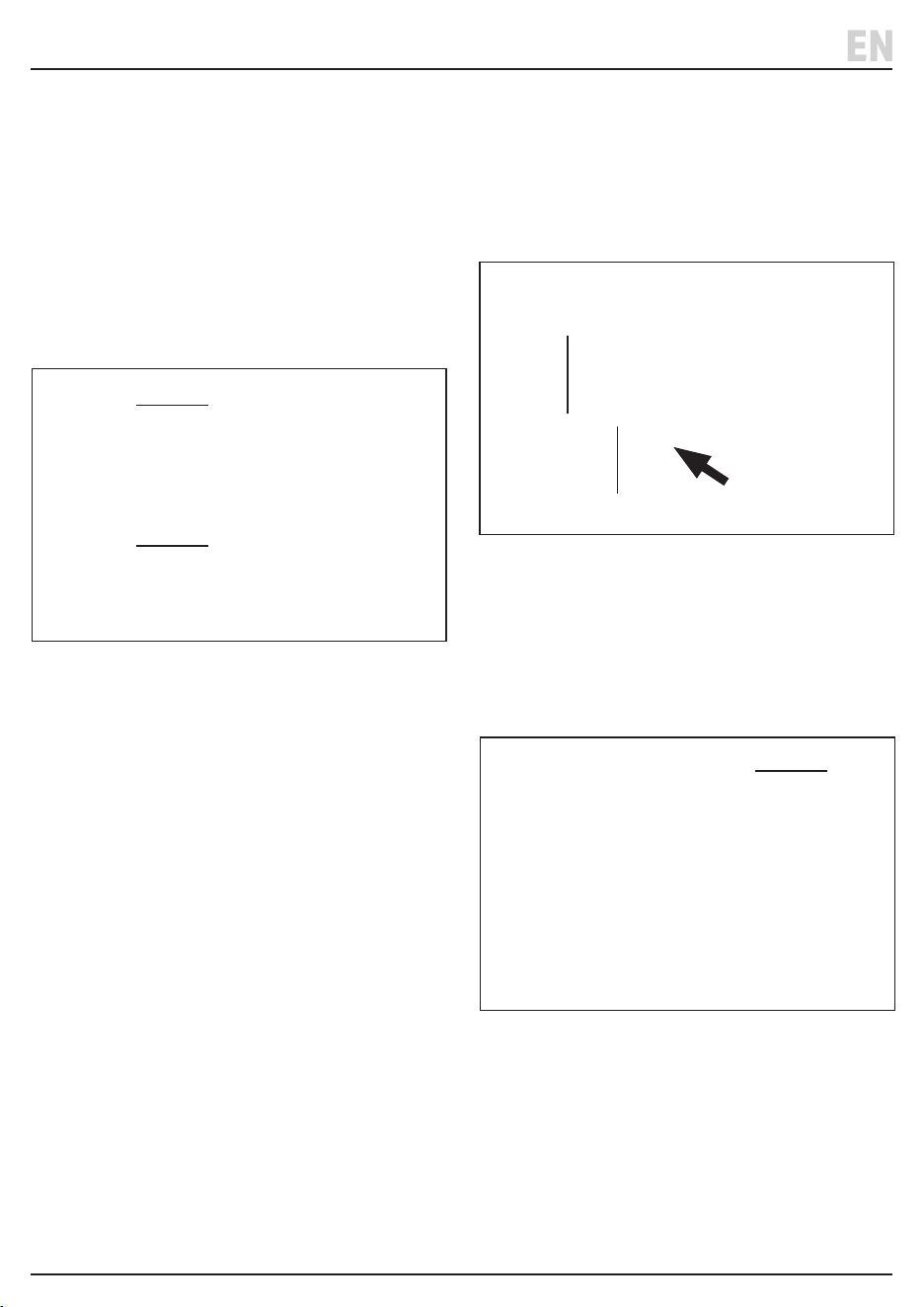
6.1 Fitting the Handle (Fig.1 – Fig.2)
1. Loosen the four bolts securing the top cover of the
mounting bracket using the 4mm hex. key supplied.
2. Remove the top cover of the bracket and install the two
handles. Ensure the handle with the controls (4) is
positioned for use with your right hand.
6.2 Fitting the Attachment Guard (Fig.3)
The attachment guard (11) must be tted correctly
before using this tool.
• Align the attachment guard (11) with the lower
shaft (10).
• Attach the bracket to the guard with the hex bolts
supplied, nger tighten.
• Use the 5mm hex key supplied and tighten the bolts.
6.3 Connecting and Removing the
Attachment Shaft (Fig.4)
• Before starting the engine, the required attachment
must be correctly tted to the shaft connector (8).
1. Ensure the shaft locking knob (9) is loose by turning
anticlockwise a few turns.
Fig.2
(3)
(4)
Fig.3
(11)
(10)
Fig.1
Fig.4
(9)
(8) (10.1)
6. Assembly Instructions
EN
2. Align the pin on the lower shaft connector (10.1) with
the groove in the top shaft connector (8). Insert the
lower shaft until the pin sits in the notch.
3. Tighten the handle locking knob (9) to secure in place.
To Disconnect the Attachment Shaft
To remove the attachment – loosen the handle locking
knob (9) to separate the top and bottom shafts.
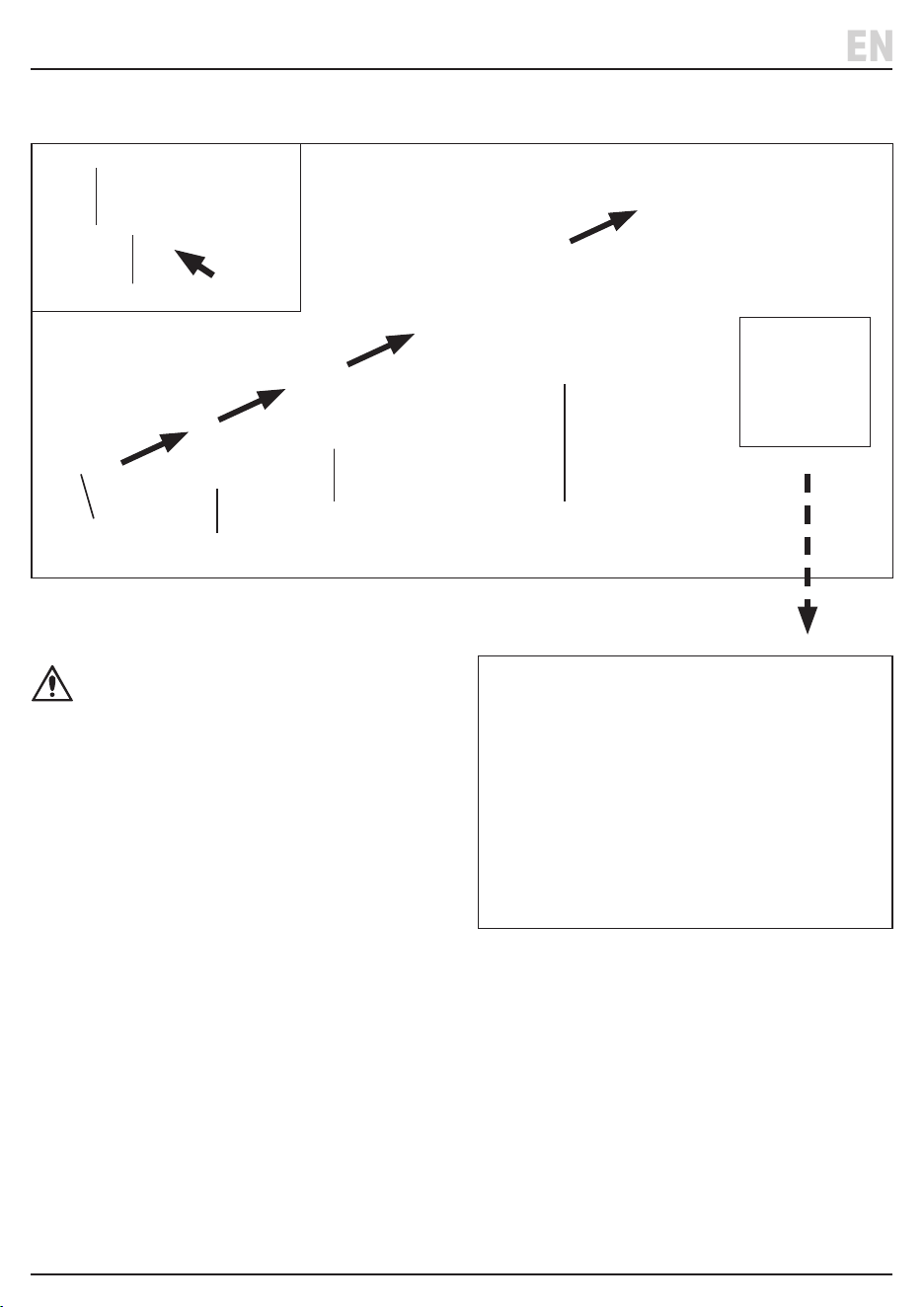
6.4 Attaching the Harness (Fig.5)
1. Attach the Harness (26) latch to the hook ( 2) on the
shaft.
2. Adjust the shoulder strap/harness to a comfortable,
balanced position where the blade or cutter
attachment will suspend between 100 mm to 300 mm
above the ground surface.
3. To quickly release the product from the shoulder strap,
operate the quick release tab.
6.5 Fitting the Spool Assembly (Fig.6 – Fig.7)
1. Ensure the engine is switched o and separate the
attachment shaft from the connector.
2. Place the mounting disc (10.2) on the underside of the
connector head.
3. Align the hole in the mounting disc (10.2) with the hole
(10.3) in the side of the connector head (13) and insert
the 4mm hex. key.
4. Screw the spool assembly (14) directly onto the
attachment shaft clockwise by hand.
Fig.6
(10.2)
(10.3)
Fig.7
(13)
– 11 –
Fig.5
(2)
(26)
(14)
– 12 –
6. Assembly Instructions
EN
6.6 Fitting the Blades (Fig.8 – Fig.10)
WARNING! To prevent injury, wear thick safety
gloves and use the correct tools when tting
the blade.
1. Switch o the engine and separate the attachment
shaft from the connector and remove the spool
assembly if tted – see Section 8.9.
2. Place the mounting disc (10.2) on the underside of the
connector head (13).
3. Align the hole in the mounting disc (10.2) with the hole
(10.3) in the side of the connector head (13). Then
insert the 4mm hex.key and hold in position.
4. Position the blade (15) with text uppermost, washer
(15.2), oating disc (15.3) and locking nut (15.3).
5. Tighten the locknut by turning anticlockwise using the
spark plug spanner (27) supplied.
6. Once secure check the blade moves freely.
Fig.10
Fig.9
Fig.8
(15)(15.1)
(15.2)
(15.3)
(10.2)
(10.3)
(28)
(13)

– 13 –
6. Assembly Instructions
EN
6.7 Fuelling the Brush Cutter/Trimmer (Fig.11)
CAUTION! This machine is shipped WITHOUT
fuel. Check the fuel level before EVERY use and
top up as appropriate. NEVER attempt to run the
engine on an empty fuel tank.
Important: This product must be used with high-quality
unleaded fuel ONLY. ALWAYS use automotive petrol
suitable for four-stroke engines.
• This tool is compatible with E10 fuel. To maintain the
fuel performance stated in this manual it is
recommended that E5 unleaded fuel is used.
• Fuel quality degrades rapidly. Avoid storing the fuel
and use as required. Using fuel that has degraded will
cause starting/running problems.
1. Ensure the tool is switched o and cooled down before
adding fuel.
2. Open the fuel cap (21) by turning it anticlockwise.
3. Carefully ll the fuel tank (20) to the bottom of the ller
neck – taking care not to overll or spill any of the
petrol. Keep a cloth to hand to clean away any residues
or spilt fuel.
4. Replace the fuel cap ensuring it is seated correctly before
tightening. If the threads become crossed it will damage
the tank and may result in fuel leaking out during use.
6.8 Checking and Topping up the Engine Oil
(Fig.12)
CAUTION! This machine is NOT supplied with
engine oil. Check the engine oil level before every
use or every 10 hours if operated continously.
Running the machine with a low oil level oil may
cause serious damage to the engine.
1. Ensure that the tool is switched o and has completely
cooled, then place it on a stable and level surface.
2. Rotate the oil ller cap (23) anticlockwise to remove it
from the reservoir and clean it.
3. Insert the oil ller cap/dipstick back into the reservoir
and remove it again. Important: DO NOT screw the
ller cap into place when checking the oil level; insert
the cap into the reservoir and remove it again.
4. Inspect the oil level on the oil ller cap against the MIN
and MAX level markings: If the oil is below the MIN level
marking, top up with SAE 10W-30 until the MAX
marking is reached.
• If the oil has become contaminated or discoloured, drain
and replace the oil; see 8.7 Draining the Engine Oil.
Fig.12
Fig.11
– 14 –
7. Operating the Brush Cutter/Line Trimmer
Important: Before operating this product, read and
understand all the safety instructions listed in this
manual. Ensure that the product is fully assembled and
correctly prepared for use.
7.1 Starting and Stopping the Engine
(Fig.13 – Fig.15)
• Check that the product is fuelled and required
attachment is tted correctly before starting the engine.
To Start the Engine
• Place the brush cutter/trimmer on a at bare surface
before starting.
1. Prime the engine with fuel by pressing the fuel primer
(19) until fuel can be seen in the clear plastic return tube.
− Cold start - move the choke (18) upwards to the
‘CLOSED/OFF’ position.
− Warm Start – Move the choke (18) downwards to
the ‘OPEN/ON’ position.
ATTENTION! Over priming will cause the engine
to ood and stop the engine from starting.
2. Move the ON/OFF switch (6) to the ‘ON (I)’ position.
3. Press the safety lever (7) and squeeze the throttle
trigger (5) fully.
4. Then pull the recoil starter handle (22) three to ve
times.
− Cold Start - pull the recoil starter no more than
four times until the engine attempts to start. Then
move the choke (18) down to the ‘OPEN/ON’
position. Then pull the recoil starter again no
more than six times until the engine runs.
5. If the engine does not start repeat the previous steps.
To Stop the Engine
1. Release the throttle trigger and allow engine to return
to idle before shutting o the engine.
2. Move the ‘ON/OFF’ switch (6) to the ‘OFF’ (O)
position.
• Wait for the cutter blade/spool line to stop before
putting the cutter/trimmer down.
Fig.13
Fig.15
Fig.14
(18)
(19)
ON
OFF
EN
(6)
(5)
(7)

EN
– 15 –
7. Operating the Brush Cutter/Line Trimmer
7.2 Operating the Line Trimmer
(Fig.16 – Fig.18)
WARNING! Use of this product can pose a danger
to wildlife. Before using this tool, check the area,
particularly long grass and under bushes for
signs of wildlife: if necessary relocate.
WARNING! ALWAYS position the trimmer on the
operator’s right side and with the engine below
waist height. The use of the machine on the
operator’s left side will expose the operator to hot
surfaces and can result in possible burn injury.
• This trimmer is only suitable for cutting grass. NEVER
use for cutting any other hard plants.
• Important: To prolong the life of the nylon line avoid
contact with trees, stones, walls, fences and other
hard surfaces.
• Keep a rm grip with both hands while in operation.
Trimmer should be held at a comfortable position with
the trigger handle about hip height.
1. Hold the trimmer with the right hand on the trigger
handle and the left hand on the left handle.
2. Begin cutting at full throttle, hovering the spool
assembly just o the ground while making arc shaped
sweeping actions through the vegetation.
3. Keep the nylon line level with the ground to avoid
scalping the ground surface.
4. When the nylon line is running at speed take care to
avoid plastic items such as garden furniture, owerpots
and other similar items to avoid damage.
• When cutting vegetation, the cutting distance from
the spool head will decrease when the line length is
deteriorating. Before the line disappears inside the
spool housing, strike the cutting head while it is
running at speed onto a piece of suitable ground. This
will release a set amount of line from the head. Any
excess line is automatically trimmed as it strikes the
trimming blade (12) on the underneath of the guard.
• If the line breaks and disappears inside the spool
housing it will need to be rewound – refer to
section 8.9 & 8.10.
Fig.18
(12)
Fig.16
Fig.17
A. Straight shaft
trimmer
B. Dangerous
cutting area
C. Direction of
rotation
D. Best cutting
area

– 16 –
7. Operating the Brush Cutter/Line Trimmer
EN
7.3 Operating the Brush Cutter (Fig.19)
WARNING! Use of this product can pose a danger
to wildlife. Before using this tool, check the area,
particularly long grass and under bushes for
signs of wildlife: if necessary relocate.
WARNING! ALWAYS position the cutter on the
operator’s right side and with the engine below
waist height. The use of the machine on the
operator’s left side will expose the operator to hot
surfaces and can result in possible burn injury.
• This cutter is only suitable for cutting coarse grass,
pulpy weeds, brush and similar vegetation.
• DO NOT use on woody stems with a diameter greater
than 2cm.
• DO NOT sharpen the blade. Replace if damaged
or worn.
• Keep a rm grip with both hands while in operation.
The cutter should be held at a comfortable position
with the trigger handle about hip height.
1. Hold the brush cutter with a rm grip on both handles.
2. Position yourself so that you will not be drawn o balance
by the blade thrust or kick back reaction of the cutting
blade. Maintain your grip and balance on both feet.
3. Inspect and clear the area of any hidden objects such as
glass, stones, concrete, fencing, wire, wood, metal, etc.
• NEVER use blades near footpaths, fencing, posts,
buildings or other immovable objects.
• NEVER use a blade after hitting a hard object without
rst inspecting it for damage. DO NOT use if any
damage is evident.
4. Start cutting at full throttle.
5. The cutter should be used as a scythe, cutting from
right to left in a broad sweeping action from side
to side.
Blade Thrust
• Blade thrust is a sudden and uncontrolled motion
towards the operator that may occur when the
rotating blade comes into contact with a solid object
that it cannot cut such as a tree, rock or wall. This
contact may cause the blade to stop for an instant,
and suddenly “thrust” the tool away from the object
that was hit. This reaction can be violent enough to
cause the operator to lose control of the unit.
• Blade thrust can occur without warning if the blade
snags, stalls, or binds. This is more likely to occur in
areas where it is dicult to see the material being cut.
• For cutting ease and safety, approach from the right
to the left. In the event an unexpected object or
woody stock is encountered, this could minimize the
blade thrust reaction.
Fig.19
– 17 –
8. Maintenance and Troubleshooting
Important: Maintenance and repairs should be carried
out ONLY by authorised and suitably qualied personnel.
WARNING! ALWAYS turn o the engine, allow it
to cool and disconnect the spark plug before
maintaining or storing this product. If the
engine must be run for testing, ensure that this
is carried out in a well-ventilated environment
that allows carbon monoxide from the exhaust
to dissipate quickly.
8.1 General Maintenance
• Regularly inspect the conditions of the product:
− Check all nuts, screws and bolts are correctly
tightened for safe operation.
− Check for damaged, loose or missing parts.
− Check condition of attachments. Clean after every
use – wipe over with a damp cloth.
Important: DO NOT use solvents as this may damage
any plastic or uninsulated parts.
1. Use ONLY spare parts recommended by Draper Tools.
2. Store the tool in a dry and dust-free environment, out
of reach of children.
3. Store the tool at temperature between 0–45°C.
4. DO NOT store near ammable materials.
8.2 Cleaning the Air Filter (Fig.20 - Fig.22)
• A dirty clogged air lter will restrict the air ow and
cause the engine to run rough. It will also increase fuel
consumption and may result in starting issues.
ATTENTION! ALWAYS stop the engine before
removing the air lter.
1. Press the air cover lock (16) to release the air lter
cover (17).
2. To remove the cover - lift away the bottom rst, then
lift free from the tab at the top.
3. Remove and wash the foam lter (17.1) in warm soapy
water, rinse and allow to dry thoroughly.
− DO NOT use solvents.
4. Ensure the lter is 100% dry before retting.
5. Dip the lter in clean engine oil and squeeze out any
excess oil.
Note: the engine will smoke when start if too much oil
left in foam lter.
6. Check the lter is seated correctly. Then ret the lter
cover securely.
7. Replace the lter if it appears worn or damaged.
EN
Fig.20
Fig.21
Fig.22
(16)
(17)
(17.1)

– 18 –
8. Maintenance and Troubleshooting
8.3 Spark Plug Maintenance (Fig.23 – Fig.26)
• Over time the spark plug can become contaminated.
This can adversely aect the running condition of parts
such as the throttle over a prolonged period of time or
too much oil in the fuel mix. This contamination can
cause the engine to run rough, reduce the fuel
consumption and create starting issues.
CAUTION! Risk if injury from moving parts or
burns from exhaust.
− DO NOT operate the engine when the top is removed.
− DO NOT pull the recoil stater when the top cover
is removed.
1. Remove the top cover by unscrewing the bolt on the
top using the 4mm hex key supplied.
2. Remove the lead cover (25) from the back of the spark
plug. To avoid damaging the H.T lead do not use any tools.
3. Use the spark plug spanner supplied (28) to remove
the spark plug (25.1) by turning anticlockwise.
4. Clean the spark plug and check the electrode gap
(maintain a gap of 0.6 – 0.7mm).
ATTENTION! The spark plug should be replaced
annually during a service or after 60 hours of
use. Replace with the same or an alternative
compatible resistor type spark plug with the
same heat range.
5. Ensure the spark plug thread is correctly seated
before screwing it clockwise to t.
6. Tighten the spark plug with the spanner supplied
before replacing the H.T lead cover.
7. The H.T lead cap rubber surround should be tucked
inside the plastic housing to ensure a good
connection with the spark plug.
8. Reconnect the lead cover and secure the top cover.
EN
Fig.24
Fig.25
Fig.26
Fig.23

– 19 –
8. Maintenance and Troubleshooting
8.4 Engine Idle Speed Adjustment (Fig.27)
• The attachments must not operate/rotate with the
engine running at idle. Adjust as necessary.
• Run the engine until warm.
• If the blade rotates at idling speed, the idle speed is
too high. Turn the adjustment screw (1.1)
anticlockwise to decrease the idle speed.
• If the engine vibrates too much, the idle speed is too
low,. Turn the adjustment screw (1.1) clockwise to
increase the idle speed.
8.5 Draining the Fuel
Important: Read all the Health and Safety guidance for
the use of fuel before lling or draining this product.
1. Ensure that the ‘ON/OFF’ switch (6) is in the ‘OFF’
position and the spark plug cover (25) is
disconnected.
2. Remove the fuel tank cap (21) slowly and tip the
engine unit backwards to allow the fuel to drain into
a suitable container.
WARNING! If the tool has been recently used,
hot steam may vent from the fuel tank outlet.
Take care when removing the fuel cap.
3. Ret the fuel tank cap securely and wipe up any
spillages. Then reconnect the spark plug cover.
8.6 Cleaning the Fuel Filter (Fig.28)
• To ensure the fuel supply remains clean the fuel lter
must be checked and cleaned regularly. The fuel lter is
attached to the pick-up tube inside the fuel tank.
1. Remove the fuel tank cap (21) from the fuel tank.
2. Drain the fuel tank (20) completely.
3. Tilt the engine so that the fuel tank opening is at the
lowest point. Then shake the tank to allow the fuel
lter (20.1) to be reached.
4. Gently pull the lter clear of the tank.
5. Hold the pick-up line, then squeeze the hose clip and
move it away from the lter.
6. While holding the fuel line, pull the clogged lter o
and insert a clean lter.
7. Reposition the hose clip so that it grips the fuel line
onto the lter.
8. Push the lter back into the tank.
8.7 Changing the Engine Oil (Fig.29)
• Change the oil when the engine is warm as the oil will
drain quicker.
• Drain the oil every 10 hours of operation for improved
performance and engine life.
EN
Fig.27
Fig.28
(21)
(20.1)
(1.1)
Fig.29
– 20 –
8. Maintenance and Troubleshooting
1. Ensure that the tool is switched o and has
completely cooled, then place it on a stable and
level surface.
2. Check that the fuel cap (21) is securely tted.
3. Place a suitable container below the engine to catch
the used oil.
4. Remove the oil ller cap/dipstick (23) and drain the
oil into the container by tipping the engine toward
the oil ller neck.
5. Top the oil and replace the oil ller cap – see
Section 6.8.
Important: ALWAYS dispose of waste oil responsibly and
in accordance with local regulations.
8.8 Cutter Blade Care and Replacement
(Fig.30)
• After use clean the cutting blade (15) thoroughly
and remove any debris or moisture.
• Brush the blades to remove any debris.
• Spray the blade with a moisture dispersant
lubricating oil.
• Regularly check for wear or damage and replace as
necessary. DO NOT sharpen.
To replace the blade
WARNING! To prevent injury, wear thick safety
gloves and use the correct tools when tting
the blade.
1. Switch o the engine and separate the attachment
shaft from the connector before changing the blade.
2. Align the hole in the mounting disc (10.2) with the
hole (10.3) in the side of the connector head (13).
Then insert the 4mm hex.key and hold in position.
3. Unlock the locking nut (15.3) using the spark plug
spanner (28). Turn clockwise to loosen.
4. Remove the oating disc (15.1) ,washer (15.2) and
then the blade.
5. Fit the new blade - refer to section 6.6 tting the
cutter blade.
8.9 Removing the Complete Spool
Assembly (Fig.31)
• The spool requires regular maintenance including
relling or replacing the spool.
To remove the spool from the trimmer shaft
1. Ensure the engine is switched o and separate the
attachment shaft from the connector.
2. Align the hole in the mounting disc (10.2) with the
hole (10.3) in the side of the connector head (13).
Then insert the 4mm hex key and hold in position.
3. Then unscrew the spool (14) from the shaft by turning
clockwise by hand.
4. To ret the spool assembly – see Section 6.5.
EN
Fig.30
Fig.31
(10.2)
(15.3)
(27)
(10.3)
– 21 –
8. Maintenance and Troubleshooting
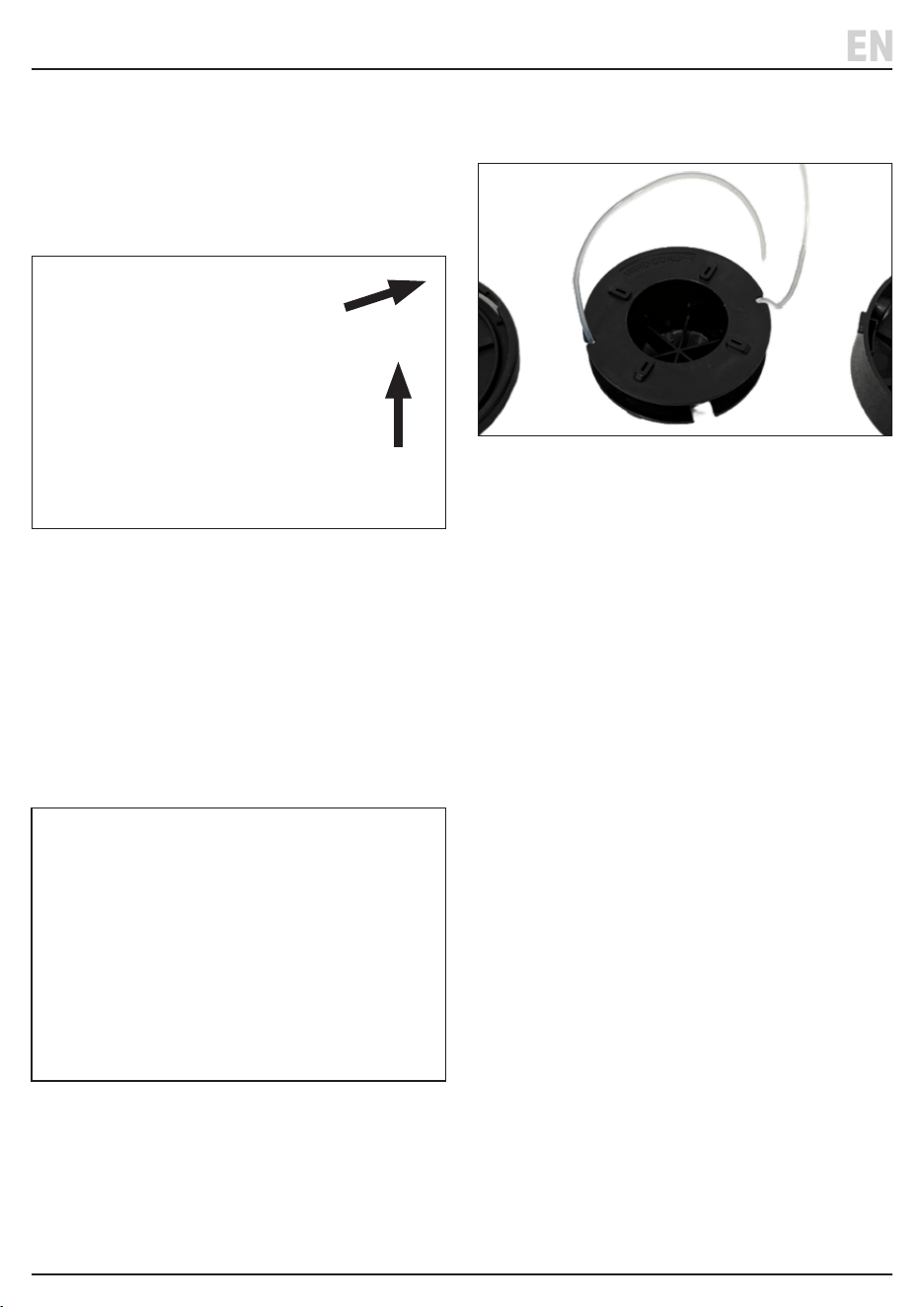
8.10 Replacing the Spool Nylon Line
(Fig.32 – Fig.34)
Line replacement required 2.4mm diameter X 3 metres.
1. Remove the spool assembly from the shaft before
replacing the nylon line.
2. Hold the spool assembly and squeeze the tab (14.1)
on the side of the spool housing and twist
anticlockwise (direction of rotation is on the cover) to
release the spool cover.
3. Remove the empty spool insert from the assembly.
• Underneath the spool insert there is a large spring
and a washer, take care when lifting out the insert
they do not spring out.
4. To install the new spool line – nd the middle of the
replacement line and hook into the insert point.
5. Wind the line neatly in both channels in the indicated
direction.
6. When both the lines are wound evenly, Hook the end
through the insert notches to hold them in place.
7. Leave a short piece of nylon to feed out through the
spool housing.
8. Feed the line ends out evenly through the spool
housing.
9. Lower the spool insert down over the washer and
spring while pulling the line end tight.
10. When everything is lined up push down on the insert
and at the same time pull the line end free from the
insert. Check that the line does not become trapped.
11. Press down rmly on the insert and then replace the
spool cover and clip it back down.
EN
Fig.32
Fig.33
Fig.32
(14.1)

– 22 –
8. Maintenance and Troubleshooting
EN
Problem Possible Cause Remedy
Engine will not start. ON/OFF switch in ‘OFF’ position. Move switch to ‘ON’ position.
Insucient or no fuel. Rell with a fresh batch of fuel/oil
mix. Refer to Section 6.7.
Old/stagnant fuel. Drain fuel and rell with fresh mix.
Refer to Section 6.7.
Spark plug electrode fouled or gap
set incorrectly.
Remove and service/replace spark
plug. Refer to Section 8.3.
Spark plug H.T lead not correctly
connected
Check H.T lead is pushed on rmly.
Choke set incorrectly for the
starting conditions.
Adjust choke. Refer to Section 7.1.
Air lter clogged. Clean/replace air lter. Refer to
Section 8.2.
Engine ooded with fuel/over
primed.
Remove spark plug and dry the
electrode of fuel. Slowly pull the
starter handle 10-15 times without
the spark plug tted.
Wait a moment before retting the
spark plug and trying again.
Fuel lter clogged. Clean fuel lter. Refer to Section 8.6.
Other issues. Contact Draper Tools for advice.
Engine runs ‘rough.’ Choke set incorrectly. Adjust choke. Refer to Section 7.1.
Requires servicing. Clean/replace air lter and
spark plug.
Carburettor out of adjustment/
Engine revs too high.
Adjust engine speed – Refer to
Section 8.4.
Old/stagnant fuel. Drain fuel and rell with fresh
petrol. Refer to Section 6.7.
Heavy blue smoke from exhaust. Incorrect fuel. Drain fuel tank and add fresh batch
of fuel. Refer to Section 6.7.
8.11 Troubleshooting

– 23 –
8. Maintenance and Troubleshooting
EN
Problem Possible Cause Remedy
Line Trimmer Attachment
Line will not advance when using
the line tap system.
Line is welded together. Lubricate line with silicone spray.
Insucient line on spool. Fit new spool line – see Section 8.9
& 8.10.
Line is too short Remove spool from trimmer and
release more line – see Section 7.2.
Grass wrapping round shaft
housing or spool.
Cutting tall grass. Cut tall grass from the top down to
prevent wrapping.
Brush Cutter Attachment
Poor cutting performance. Blade clogged. Stop engine. Clean and lubricate
blade assembly
Blade blunt. Replace blade – see Section 6.6
Unusual noise from cutting head. Insucient grease in gearbox. Stop engine. Add grease – contact
Draper Tools for advice.

For spare parts, servicing, and repair and replacement
options, please contact the Draper Tools Product
Helpline for details of your nearest authorised agent.
Draper Tools will endeavour to hold any spare parts, if
applicable, for seven years from the date that it sells the
nal matching stock item.
Any servicing or repairs carried out by unauthorised
personnel or installation of spare parts not supplied by
Draper Tools will invalidate your warranty.
Important: For safety, ALWAYS drain and clean the
product of any oil, fuel, chemicals or other substances
before returning it to Draper Tools or its authorised
agent. Store these materials in suitable containers and
dispose of them in accordance with local regulations.
Draper Tools and its agents cannot be responsible for the
disposal of these substances.
At the end of its working life, dispose of the product
responsibly and in line with local regulations. Recycle
where possible.
• DO NOT Dispose of fuel and oil separately and in
accordance with local regulations; DO NOT abandon
it in the environment.
9. Spares, Returns and Disposal
– 24 –
EN

This warranty covers parts and labour for 12 months
from date of purchase – visit drapertools.com/warranty
for more information.. However, if the tools are hired out,
the warranty period is 90 days from the date of purchase.
Should the tool develop a fault within the warranty
period, return the complete tool to the place of purchase
or contact Draper Tools directly. Proof of purchase must
be provided.
This warranty does not apply to any consumable parts {,
batteries} or normal wear and tear.
It also does not cover any damage caused by misuse,
careless or unsafe handling, modications, or repairs
carried out by any personnel other than an authorised
Draper Tools repair agent.
Please note that this guarantee is in addition to and does
not aect your statutory rights.
Draper Tools
10. Warranty
EN
– 25 –

– 26 –
11. Explanation of Symbols
EN
Read the instruction manual
Wear ear defenders and safety glasses
Wear suitable protective footwear.
Do not abandon in the environment
Keep out of the reach of children
Warning!
Mandatory!
Do not incinerate or throw onto re
89
dB
Continuous A-weighted sound power level
European conformity
UK Conformity Assessed
During use, keep a minimum distance of
15m between the machine and third
parties.
Attention! Beware of ying debris.
Protect feet from risk of injury
Warning! Machine is still running on idle.

Notes
– 27 –
EN

© Published by Draper Tools Limited© Published by Draper Tools Limited
Contact Details
Draper Tools
Draper Tools Limited
Hursley Road
Chandler’s Ford
Eastleigh
Hampshire
SO53 1YF
UK
Website: drapertools.com
Email: [email protected]
Product Helpline: +44 (0) 23 8049 4344
Telephone Sales Desk: +44 (0) 23 8049 4333
General Enquiries: +44 (0) 23 8026 6355
Please contact the Draper Tools Product Helpline for repair and servicing enquiries.
Draper Tools Europe B.V.
Oude Graaf 8
6002 NL
Weert
Netherlands
