SM21455
Questions, problems, missing parts? Before returning to your retailer, call our customer
service department at 1-888-3KOBALT (1-888-356-2258), 8 a.m. - 8 p.m., EST,
Monday - Sunday. You could also contact us at [email protected] or visit
www.lowespartsplus.com.
ATTACH YOUR RECEIPT HERE
Serial Number Purchase Date
Español p. 17
KOBALT and logo design are trademarks or
registered trademarks of LF, LLC. All rights reserved.
ITEM #3809898/4132850/4665016
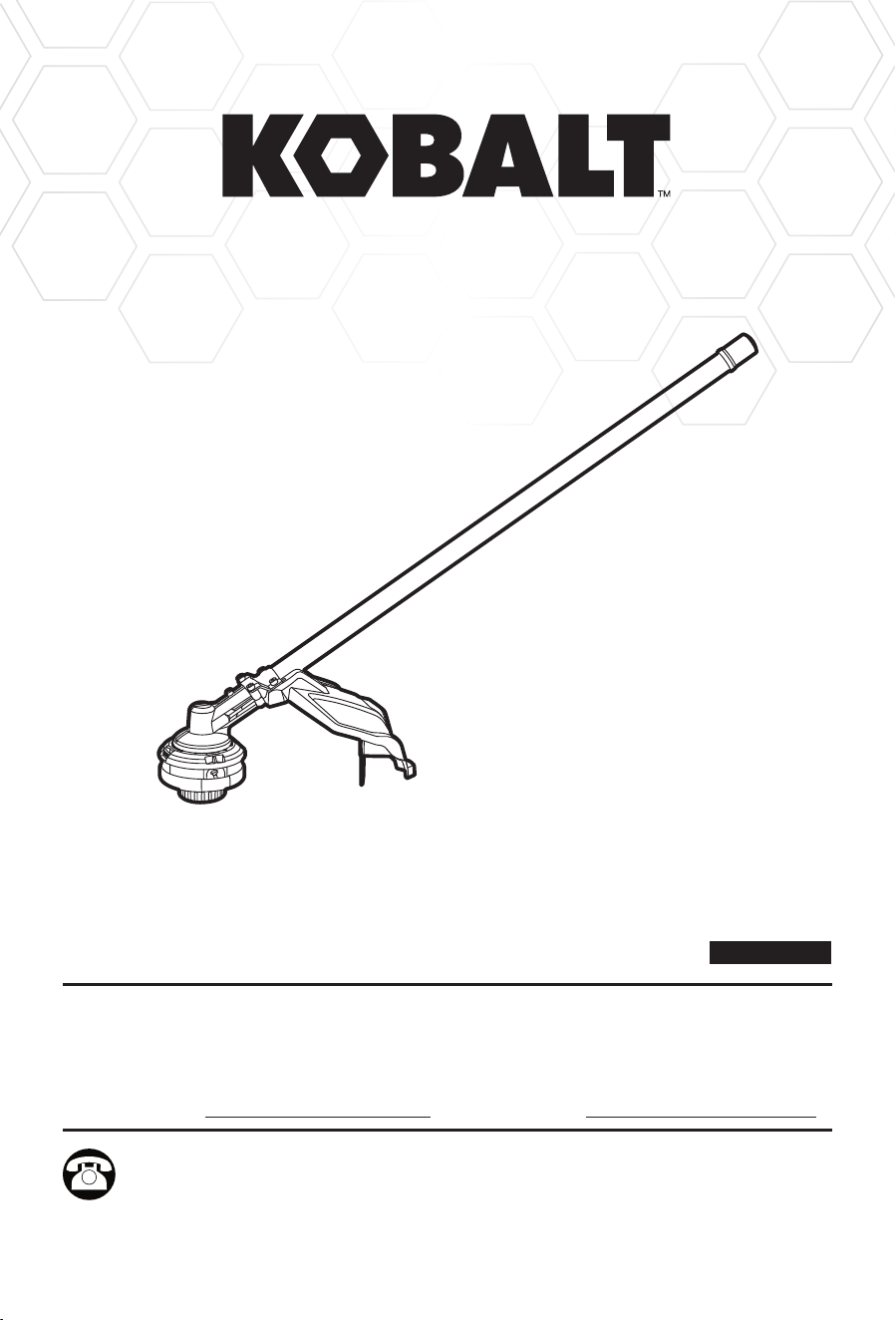
STRING TRIMMER
ATTACHMENT
MODEL #KMS 1040-03

2
TABLE OF CONTENTS
Product Specications ......................................................................................2
Package Contents ............................................................................................3
Safety Information ............................................................................................ 4
Preparation .......................................................................................................7
Operating Instructions ...................................................................................... 8
Care and Maintenance ...................................................................................12
Troubleshooting.............................................................................................. 16
Warranty ......................................................................................................... 16
PRODUCT SPECIFICATIONS
COMPONENT SPECIFICATION
Cutting Mechanism Bump Head
Cutting-Line Type 0.08 in. twisted nylon line
Cutting Width 15 in. (38cm)
Operating temperature 32°F (0°C) - 104°F (40°C)
Storage temperature 32°F (0°C) - 104°F (40°C)
3
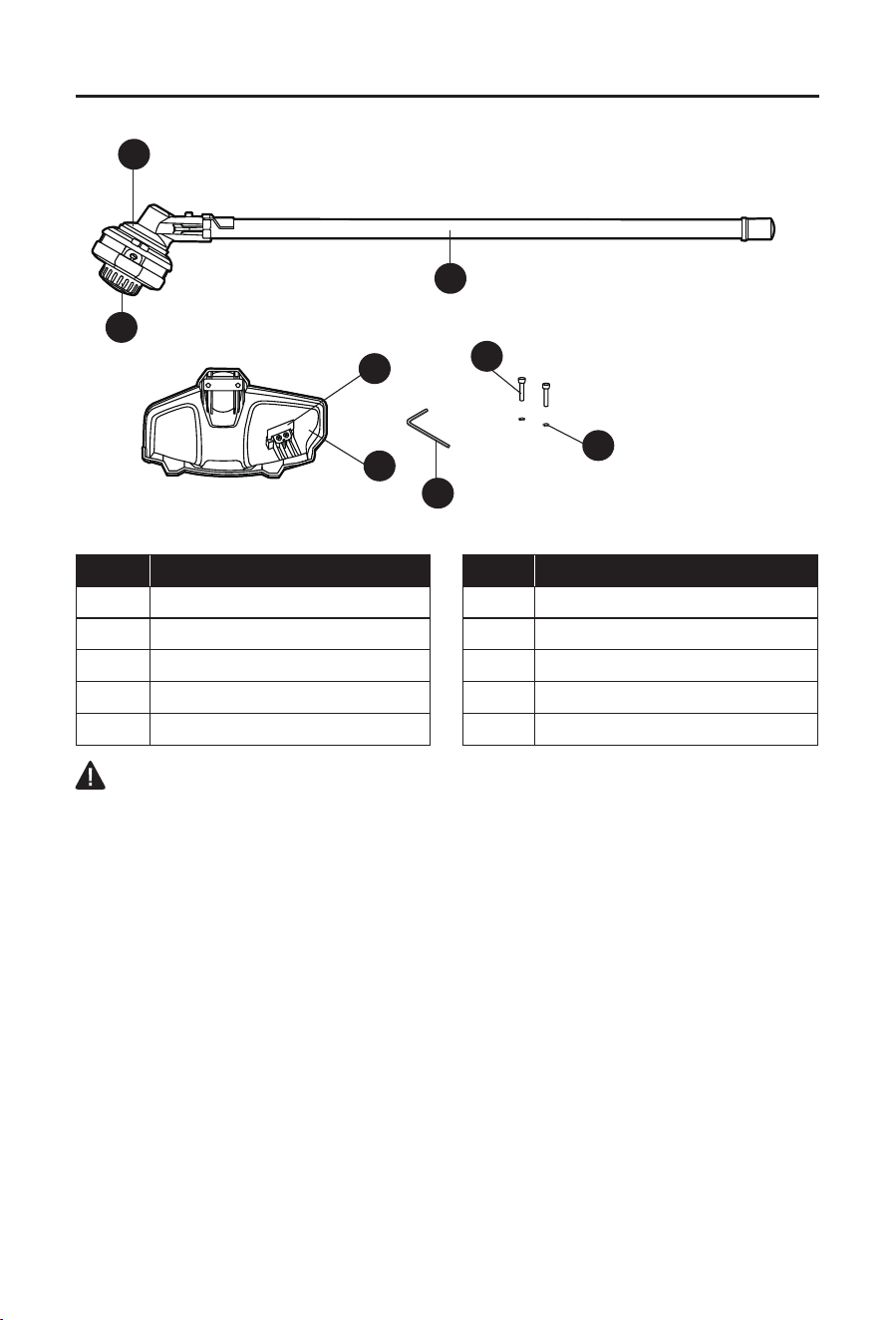
PACKAGE CONTENTS
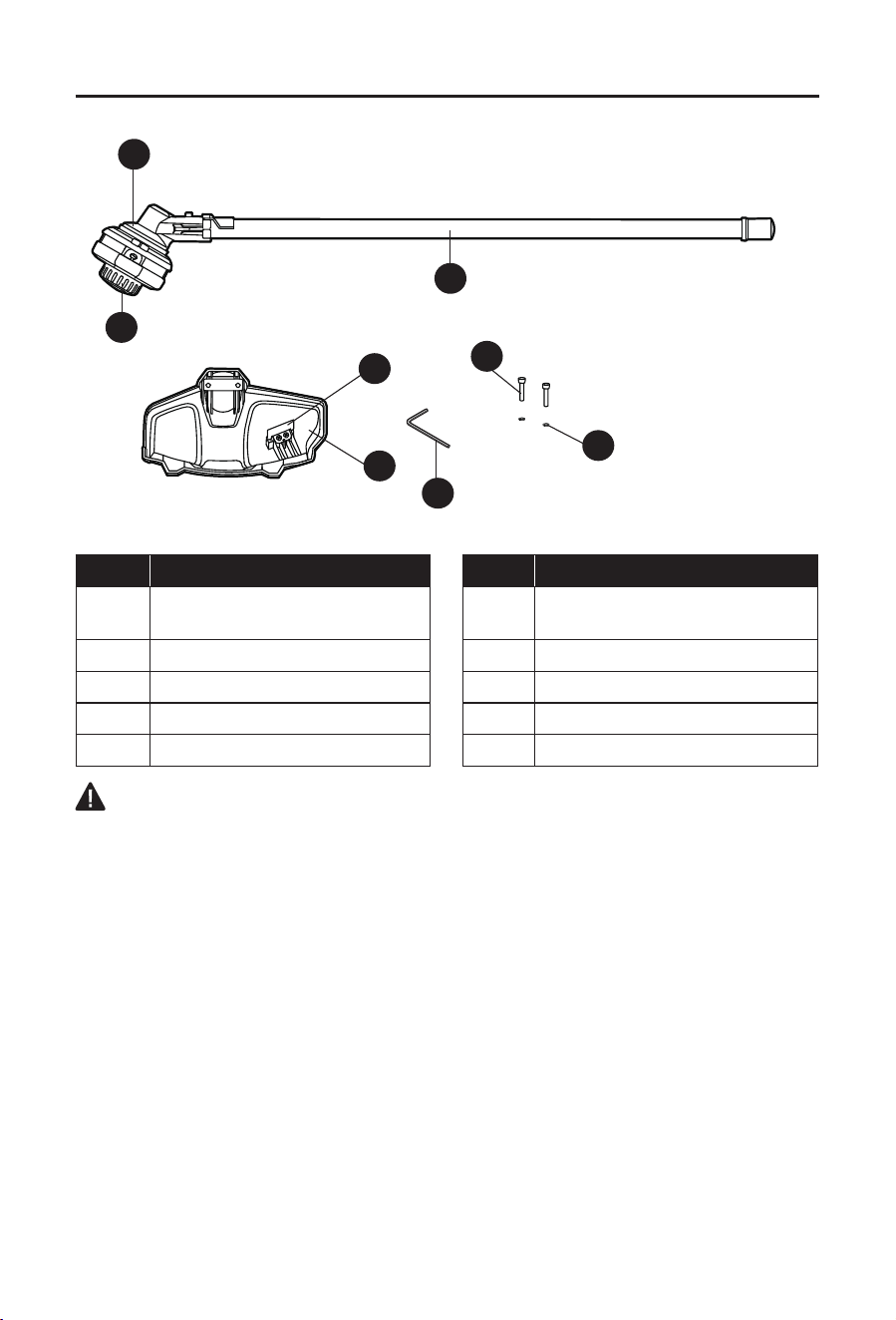
A
D
E
B
C
G
H
F
PART DESCRIPTION PART DESCRIPTION
A Bump head F Hex Key
B Line-cutting blade G Bolt (2)
C Guard H Spring washer (2)
D Trimmer attachment shaft
E Trimmer head
WARNING
• Remove the tool from the package and examine it carefully. Inspect the tool carefully to
make sure that no breakage or damage occurred during shipping. If any parts are damaged
or missing, please return the product to the place of purchase. Do not discard the carton or
any packaging material until all parts have been examined.
• If any part of the tool is missing or damaged, do not attach the battery to use the tool until
the part has been repaired or replaced. Failure to heed this warning could result in serious
injury.

4
SAFETY INFORMATION
Please read and understand this entire manual before attempting to assemble or operate
this product. If you have any questions regarding the product, please call customer service at
1-888-3KOBALT (1-888-356-2258), 8 a.m. - 8 p.m., EST, Monday - Sunday. You could also
contact us at [email protected] or visit www.lowespartsplus.com.
WARNING
• The operation of any power tool can result in foreign objects being thrown into your eyes,
which can result in severe eye damage. Before beginning power-tool operation, always wear
safety goggles or safety glasses with side shields and a full-face shield, when needed. We
recommend using a wide vision safety mask over eyeglasses or standard safety glasses
with shields. Always use eye protection marked to comply with ANSI Z87.1.
• Some dust created by power sanding, sawing, grinding, drilling, and other construction
activities contains chemicals known to the state of California to cause cancer, birth defects,
or other reproductive harm. Some examples of these chemicals are:
– Lead from lead-based paints
– Crystalline silica from bricks, cement, and other masonry products
– Arsenic and chromium from chemically-treated lumber
• Your risk from these exposures varies, depending upon how often you do this type of work.
To reduce your exposure to these chemicals:
– Work in a well-ventilated area.
– Work with approved safety equipment, such as dust masks that are specially designed to
lter out microscopic particles.
– Avoid prolonged contact with dust from power sanding, sawing, grinding, drilling, and
other construction activities. Wear protective clothing and wash exposed areas with soap
and water. Allowing dust to get into your mouth or eyes or to lie on the skin may promote
absorption of harmful chemicals.
Know the Tool
To operate this tool, carefully read this manual and all labels afxed to the tool before using it.
Keep this manual available for future reference.
Important
This tool should be serviced only by a qualied service technician.
Read All Instructions Thoroughly
5
SAFETY INFORMATION
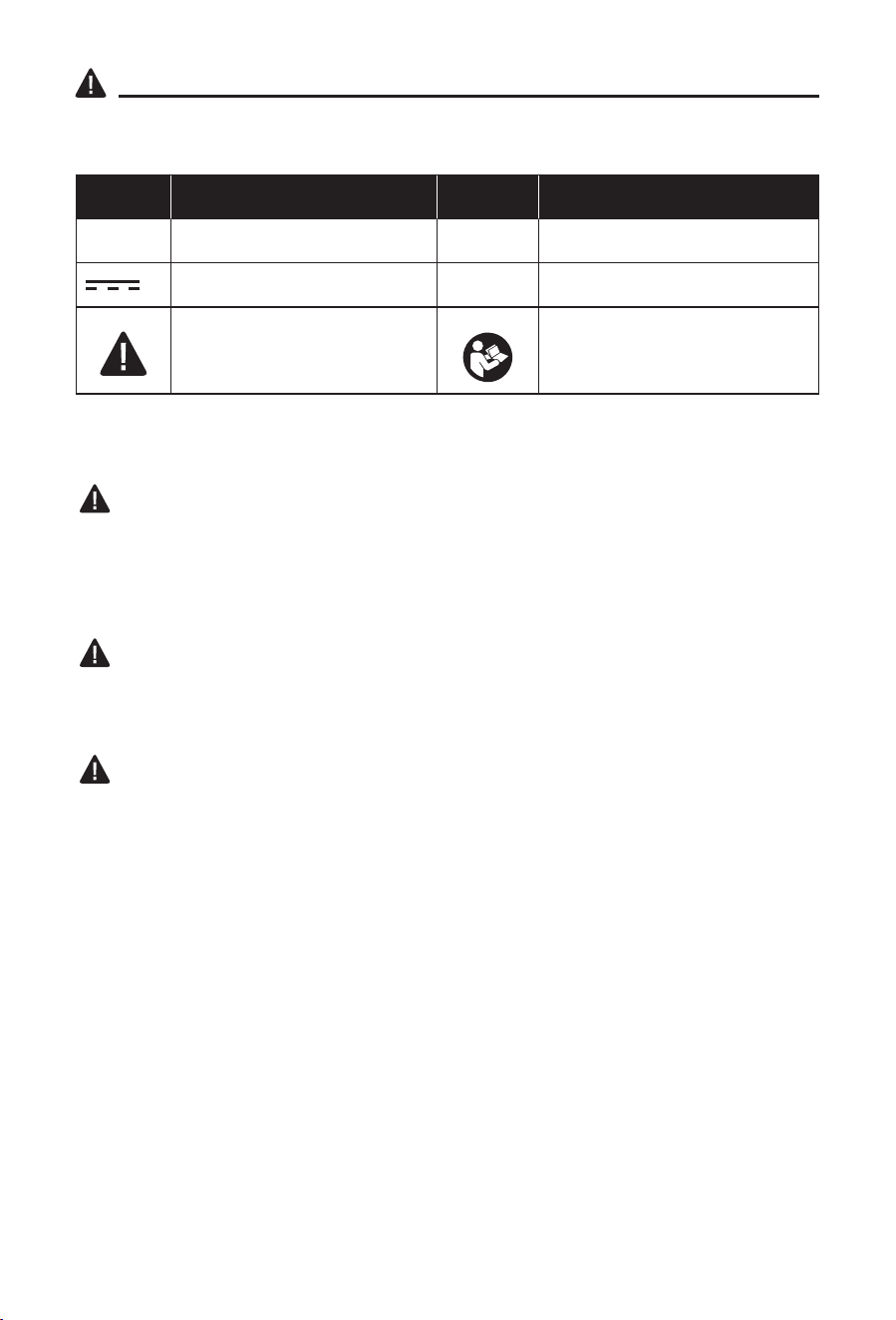
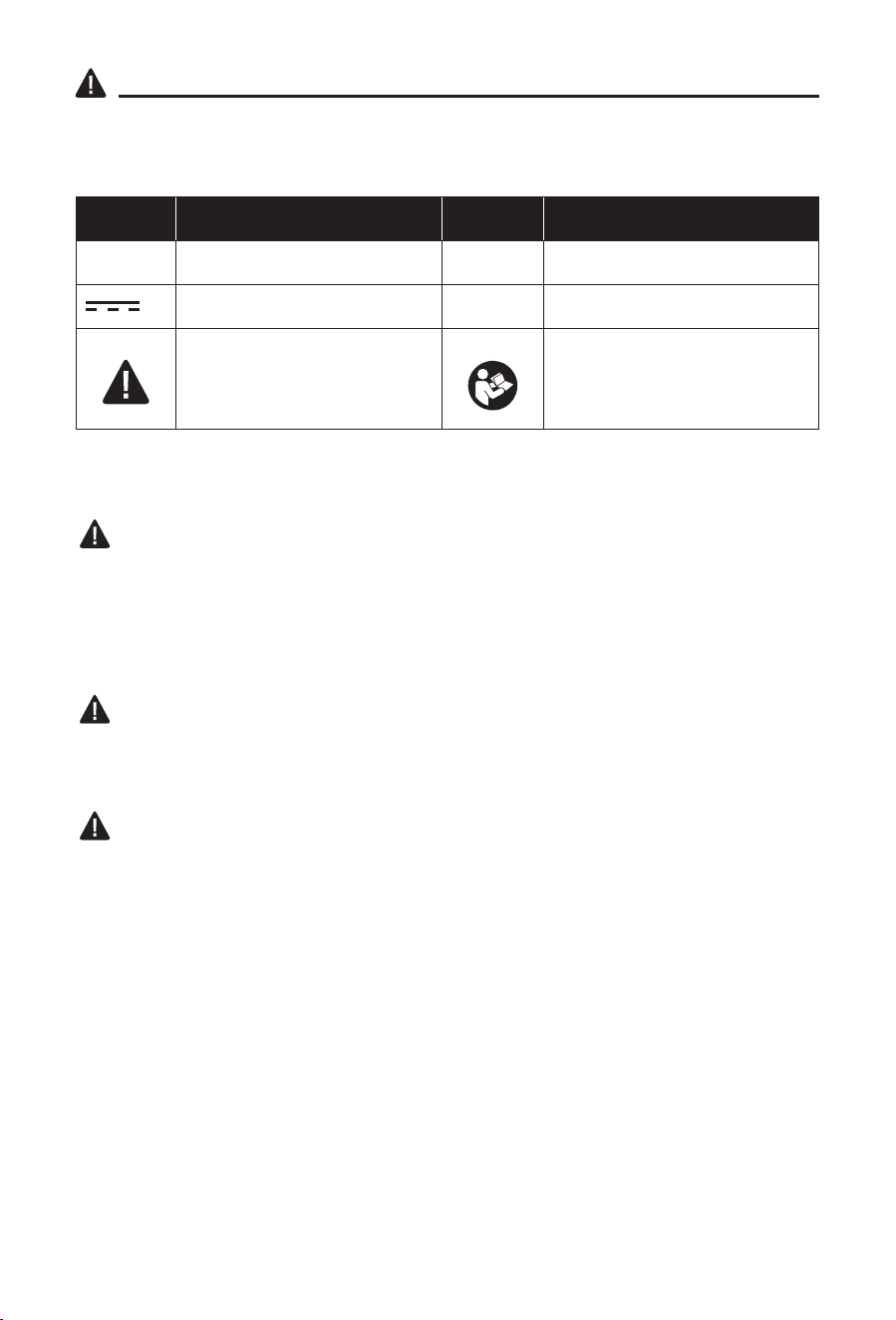
Some of the following symbols may be used on this tool. Please study them and their meaning.
Proper interpretation of these symbols will allow you to operate the tool better and more safely.
SYMBOL DEFINITION SYMBOL DEFINITION
V Volts n
0
No-load speed
Direct current RPM Revolutions per Minute
A danger, warning, or caution.
It means ‘Attention! Your safety
is involved.’
To reduce the risk of injury, user
must read instruction manual.
IMPORTANT SAFETY INSTRUCTIONS
WARNING
• When using electric trimmers, basic safety precautions should always be followed to reduce
the risk of re, electric shock, and personal injury, including the following:
READ ALL INSTRUCTIONS
DANGER
• Do not rely on the tool’s insulation against electric shock. To reduce the risk of
electrocution, never operate the tool in the vicinity of any wires or cables which may
carry electric current.
CAUTION
• Wear appropriate personal hearing protection during use. Under some conditions and
durations of use, noise from this product may contribute to hearing loss.
• Avoid dangerous environments - Don’t use appliances in damp or wet location.
• Don’t use in rain.
• Keep children away - All visitors should be kept at least 100 ft. (30.5 m) away from work
area.
• Dress properly - Do not wear loose clothing or jewelry. They can be caught in moving parts.
Use of rubber gloves and substantial footwear is recommended when working outdoors.
Wear protective hair covering to contain long hair.
• Use safety glasses. Always use face or dust mask if operation is dusty.
• Use the right appliance - Do not use the tool for any job except that for which it is intended.
• Don’t force the appliance - It will do the job better and with less likelihood of a risk of injury
at the rate for which it was designed.
• Don’t overreach - Keep proper footing and balance at all times.
• Stay alert - Watch what you are doing. Use common sense. Do not operate the appliance
when you are tired.
• Keep guards in place and in working order.
• Keep hands and feet away from the cutting area.
• Store idle appliances indoors - When not in use, the appliances should be stored indoors
in a dry and high or locked-up place with the battery pack removed and out of reach of
children.

6
SAFETY INFORMATION
• Maintain appliance with care - Keep cutting edge sharp and clean for best performance
and to reduce the risk of injury. Follow instructions for lubricating and changing accessories.
Keep handles dry, clean, and free from oil and grease.
• Check damaged parts - Before further use of the trimmer, a guard or other part that
is damaged should be carefully checked to determine that it will operate properly and
perform its intended function. Check for alignment of moving parts, binding of moving parts,
breakage of parts, mounting, and any other condition that may affect its operation. A guard
or other part that is damaged should be properly repaired or replaced by an authorized
service center unless indicated elsewhere in this manual.
• Do not charge the battery pack in rain or in wet locations.
• Prevent unintentional starting. Ensure the switch is in the “off” position before connecting
to battery pack, picking up or carrying the appliance. Carrying the appliance with your nger
on the switch or energizing appliances that have the switch on invites accidents.
• Disconnect the battery pack from the appliance before making any adjustments,
changing accessories, or storing appliance. Such preventive safety measures reduce
the risk of starting the appliance accidentally.
• Use the battery-operated trimmer only with specically designated battery pack. Use
of any other batteries may create a risk of re.
• Use only with the battery packs and chargers listed below:
BATTERY PACK CHARGER
KB 240-03; KB 440-03; KB 640-03; KRC 840-03
• Do not use a battery pack or appliance that is damaged or modied. Damaged or
modied batteries may exhibit unpredictable behavior resulting in re explosion or risk of
injury.
• Do not expose a battery pack or appliance to re or excessive temperature. Exposure
to re or temperature above 212°F (100°C) may cause explosion.
• Follow all charging instructions and do not charge the battery pack or appliance
outside of the temperature range specied in the instructions. Charging improperly or
at temperatures outside of the specied range may damage the battery and increase the
risk of re.
• Have servicing performed by a qualied repair person using only identical
replacement parts. This will ensure that the safety of the product is maintained.
• Do not modify or attempt to repair the appliance or the battery pack except as
indicated in the instructions for use and care.
• Do not dispose of the battery in a re. The cells may explode. Check with local codes
for possible special disposal instructions.
• Do not open or mutilate the battery. Released electrolyte is corrosive and may cause
damage to the eyes or skin. It may be toxic if swallowed.
• Exercise care in handling batteries in order not to short the battery with conducting
materials such as rings, bracelets, and keys. The battery or conductor may overheat and
cause burns.
• Use Only With the 40V Lithium-Ion Power Head KMH 1040-03.
• Do not operate the trimmer while under the inuence of alcohol or drugs.
• Clear the area to be cut before each use. Remove all objects such as rocks, broken
glass, nails, wire, or string that can be thrown or become entangled in the cutting
attachment. Make sure that other persons and pets are at least 100 ft. (30.5m) away.
• Always hold the trimmer rmly, with both hands on the handles, while operating.
Wrap your ngers and thumbs around the handles.
• To reduce the risk of injury from loss of control, never work on a ladder or on any
other insecure support. Never hold the cutting attachment above waist height.

7
SAFETY INFORMATION
• Do not operate the trimmer in gaseous or explosive atmospheres. Motors in these
appliances normally spark, and the sparks might ignite fumes.
• Wear heavy long pants, long sleeves, boots, and gloves. Avoid loose garments or
jewelry that could get caught in moving parts of the machine or its motor.
• Damage to trimmer - If you strike a foreign object with the trimmer or it becomes
entangled, stop the tool immediately, check for damage and have any damage
repaired before further operation is attempted. Do not operate with a broken guard or
spool.
• If the equipment should start to vibrate abnormally, stop the motor and check
immediately for the cause. Vibration is generally a warning of trouble.
• A loose head may vibrate, crack, break or come off the trimmer, which may result
in serious or fatal injury. Make sure that the cutting attachment is properly xed in
position. If the head loosens after xing it in position, replace it immediately.
• Never use a trimmer with a loose cutting attachment.
• Replace a cracked, damaged or worn-out cutting head immediately, even if damage
is limited to supercial cracks. Such attachments may shatter at high speed and cause
serious or fatal injury.
• Check the cutting attachment at regular short intervals during operation, or
immediately if there is a noticeable change in cutting behavior.
• When replacing the cutting line, use triangle-shaped twisted nylon cutting line with a
size that does not exceed 0.08 in. (2.0 mm); using heavier lines than recommended by
the manufacturer increases the load on the motor and reduces its operating speed.
This results in overheating and damage to the trimmer.
• To reduce the risk of serious injury, never use wire or metal-reinforced line or other
material in place of the nylon cutting lines. Pieces of wire could break off and be thrown
at high speed toward the operator or bystanders.
• When servicing, use only identical replacement parts. Use of any other accessory or
attachment which is not recommended for use with this tool may increase the risk of injury.
• Do not wash with a hose; avoid getting water in motor and electrical connections.
• Save these instructions. Refer to them frequently and use them to instruct others
who may use this tool. If you lend this tool to someone else, also lend these instructions to
them to prevent misuse of the product and possible injury.
NOTE: SEE OPERATOR’S MANUAL FOR YOUR KOBALT KMH 1040-03 POWER HEAD
FOR SPECIFIC SAFETY RULES.
PREPARATION
Know Your String Trimmer
This product requires assembly. Carefully lift the tool from the carton and place it on a level
work surface. Before attempting to use the string trimmer attachment, familiarize yourself with
all of its operating features and safety requirements.
WARNING
• Do not allow familiarity with the tool to cause carelessness. Remember that one careless
moment is enough to cause severe injury. Before attempting to use any tool, be sure to
become familiar with all of the operating features and safety instructions.
• Do not attempt to modify this tool or create accessories not recommended for use with this
tool. Any such alteration or modication is misuse and could result in a hazardous condition
leading to possible serious personal injury.
8
ASSEMBLY INSTRUCTIONS
WARNING: This product requires assembly. To reduce the risk of injury to persons, never
operate without the guard in place. The guard must always be on the tool to protect the user.
1. Mounting the Guard
WARNING
• Install the guard before the attachment is
connected to the power head.
• To reduce the risk of injury to persons, do not
operate without guard in place.
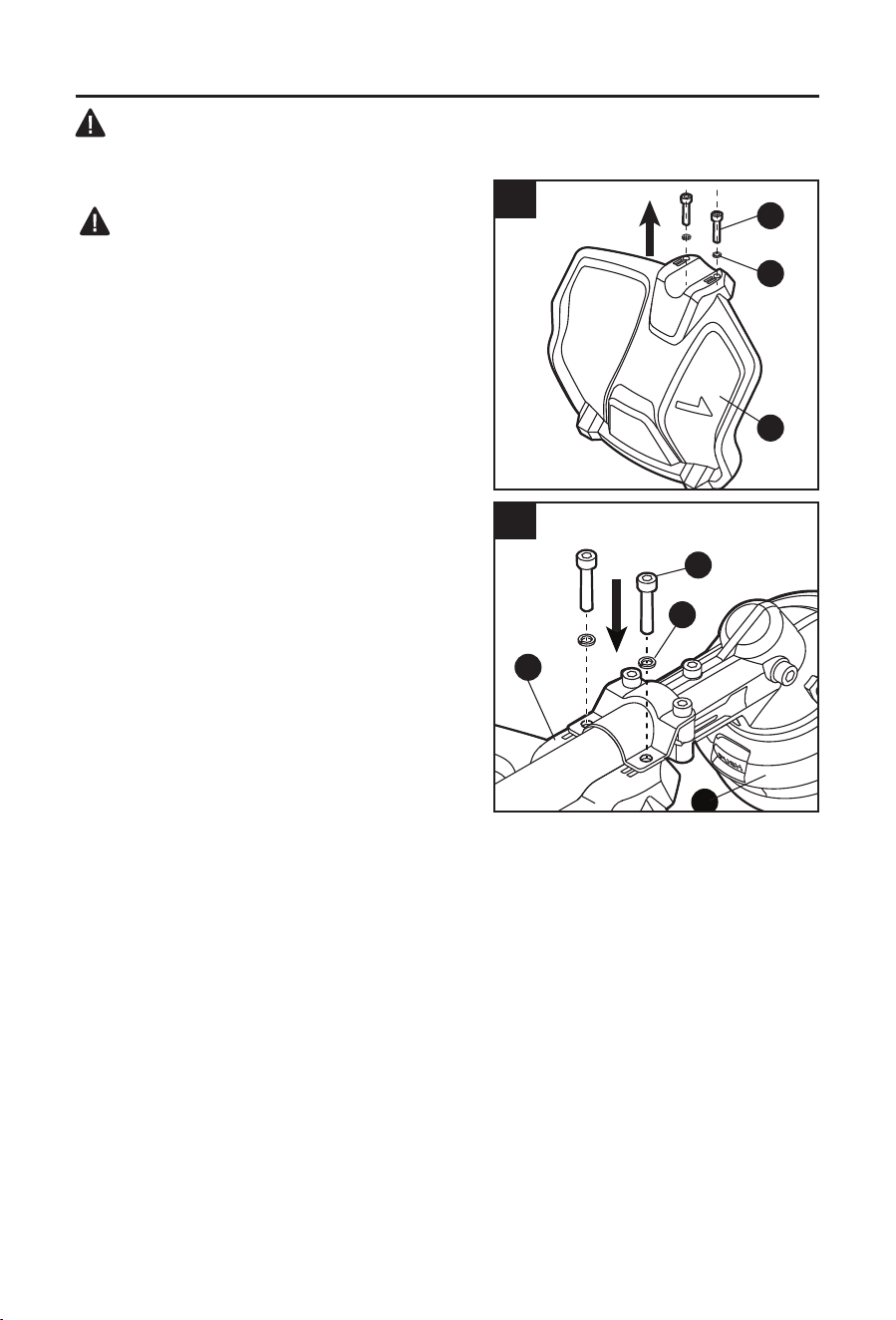
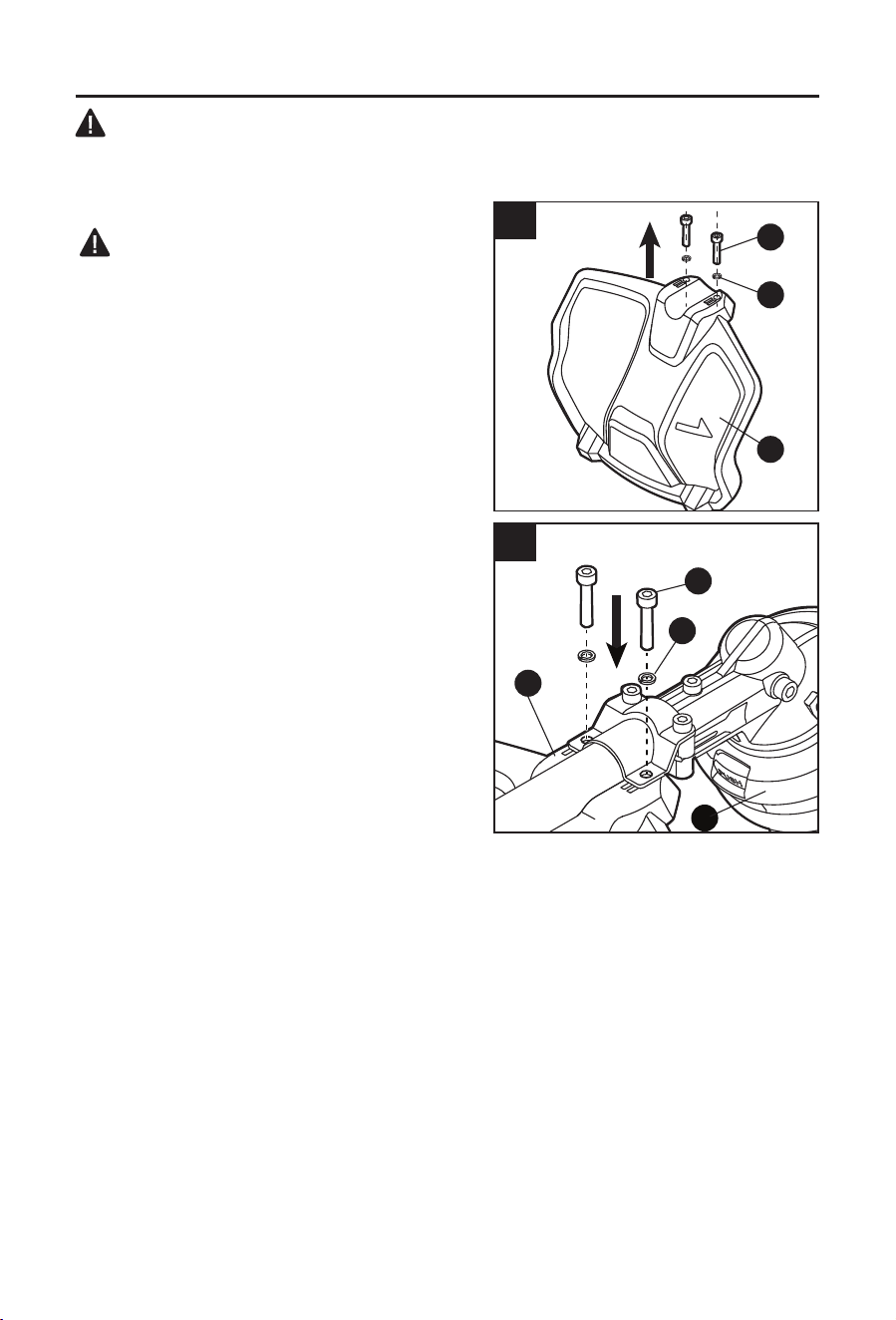
a. Loosen the two bolts (G) in the guard with the
supplied hex key (F). Remove the bolts and
spring washers (H) from the guard (C)
(Fig. 1a).
b. Lift the trimmer head (E) and face it downward;
align the two mounting holes in the guard with
the two assembly holes in the base of the shaft.
Make sure that the inner surface of the guard
faces towards the trimmer head (Fig. 1b).
c. Use the supplied hex key to secure the guard in
place with the washers and bolts.
1a
H
C
G
G
H
E
C
1b
9
ASSEMBLY INSTRUCTIONS
2. Connecting the String Trimmer Attachment
to the Power Head (KMH 1040-03)
Installing the attachment
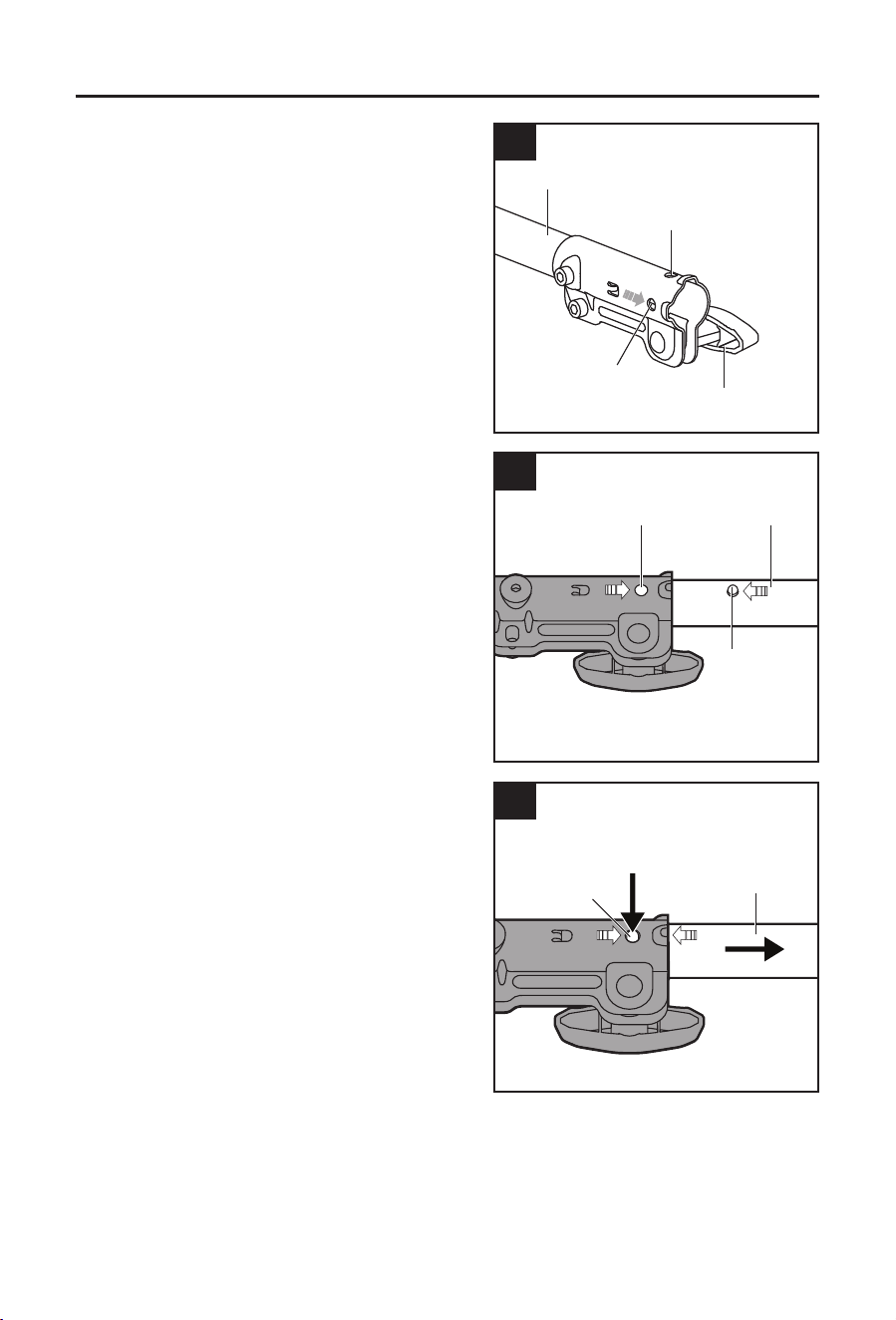
a. Remove the battery pack from the power head.
b. Loosen the wing knob on the power-head shaft
(Fig. 2a).
c. The power head has two grooves on the
coupler, ONLY the groove 1 is used to connect
attachments: KMS 1040-03 and KEG 1040-03.
d. Align the spring-loaded pin on the attachment
with the groove on the coupler and push the
attachment shaft into the power head shaft until
the pin pops out of the groove and you hear an
audible “click” sound at the same time (Fig. 2b).
e. Pull the shaft of the attachment to verify that it
is securely locked into the coupler.
f. Tighten the wing knob securely.
Removing the attachment
a. Remove the battery pack from the power head.
b. Loosen the wing knob.
c. Press down the spring-loaded pin and pull the
attachment shaft out of the coupler (Fig. 2c).
2b
Groove
Pin
Attachment
shaft
2c
Attachment
shaft
Pin
2a
Power-head shaft
Groove 2
Wing knob
Groove 1
10
OPERATING INSTRUCTIONS
3. Holding the String Trimmer
WARNING
• Dress properly to reduce the risk of injury when
operating this tool.
Do not wear loose clothing or jewelry. Wear eye
and ear/hearing protection. Wear heavy, long pants,
boots and gloves. Do not wear short pants and
sandals or go barefoot.
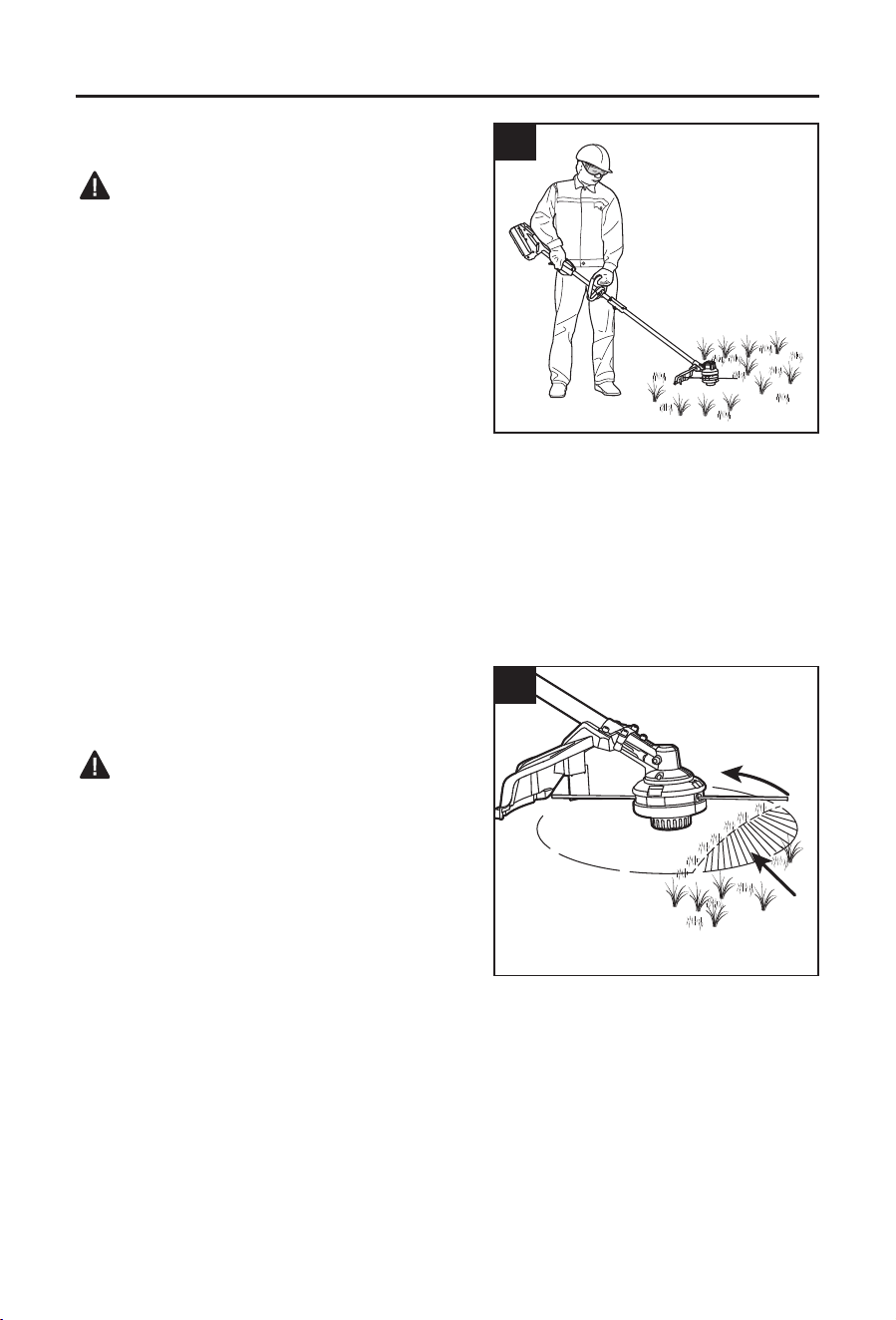
Before operating the unit, stand in the operating
position and check that:
• The operator is wearing eye protection and
proper clothing.
• One arm is slightly bent. The hand of that arm is holding the rear handle.
• The other arm is straight. The hand of that arm is holding the front-assist handle.
• The trimmer head is parallel to the ground and easily contacts the material to be cut without
the operator having to bend over.
4. To Start/Stop the String Trimmer
See “STARTING/STOPPING THE POWER HEAD” section in the KMH 1040-03 power head
operator’s manual.
5. Using the String Trimmer
Tips for best trimming results (Fig. 5a)
WARNING
• Check for damaged/worn parts before each use.
• To avoid serious personal injury, wear goggles
or safety glasses at all times when operating
this unit. Wear a face mask or dust mask in
dusty locations. Wear proper clothing and
footwear during operation to reduce the risk of
injury that may be caused by ying debris.
• Clear the area to be cut before each use.
Remove all objects, such as rocks, broken
glass, nails, wire, or string that can be thrown or become entangled in the cutting
attachment. Clear the area of children, bystanders, and pets. At a minimum, keep all
children, bystanders, and pets at least 100 ft. (30.5 m) away. There still may be risk to
bystanders from thrown objects.
• Bystanders should be encouraged to wear eye protection. If you are approached, stop the
motor and cutting attachment immediately.
• The correct angle for the cutting attachment is parallel to the ground.
3
5a
Direction of
rotation
Best cutting
area
Dangerous
cutting area
11
OPERATING INSTRUCTIONS
• This string trimmer allows you to rest the bump head (A) on the ground for more comfortable
operation.
• Do not force the trimmer. Allow the very tip of the line to do the cutting (especially along
walls). Cutting with more than the tip will reduce cutting efciency and may overload the
motor.
• The cutting height is determined by the distance of the cutting line from the lawn surface.
• Grass over 8 in. (200 mm) should be cut by working from top to the bottom in small
increments to avoid premature line wear or motor drag.
• Slowly move the trimmer into and out of the area being cut, maintaining the cutting head
position at the desired cutting height. This movement can be either a forward-backward
motion or a side-to-side motion. Cutting shorter lengths produces best results.
• Trim only when grass and weeds are dry.
• Wire and picket fences can cause extra string wear or breakage. Stone and brick walls,
curbs, and wood may wear strings rapidly.
• Avoid trees and shrubs. Tree bark, wood moldings, siding, and fence posts can easily be
damaged by the strings.
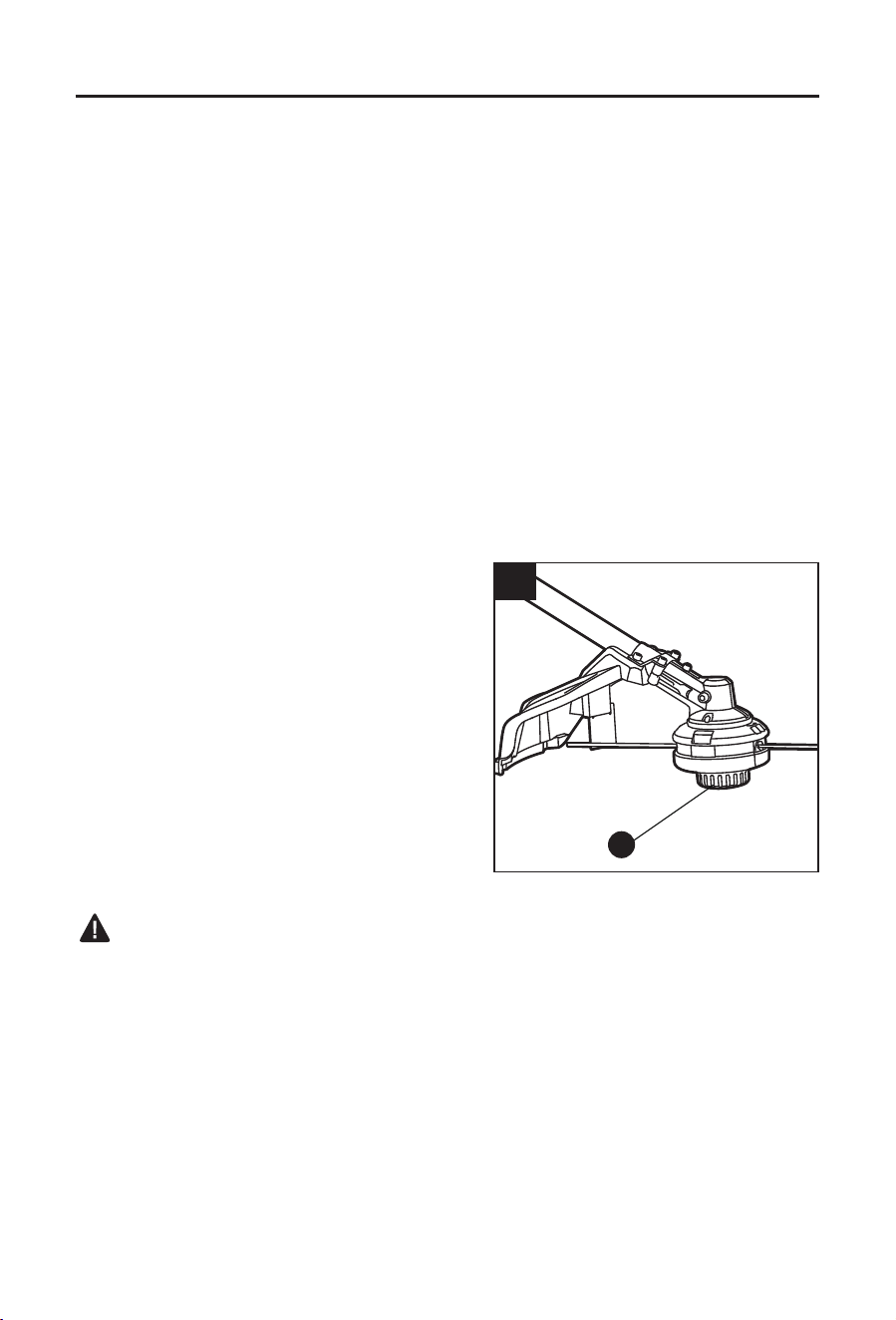
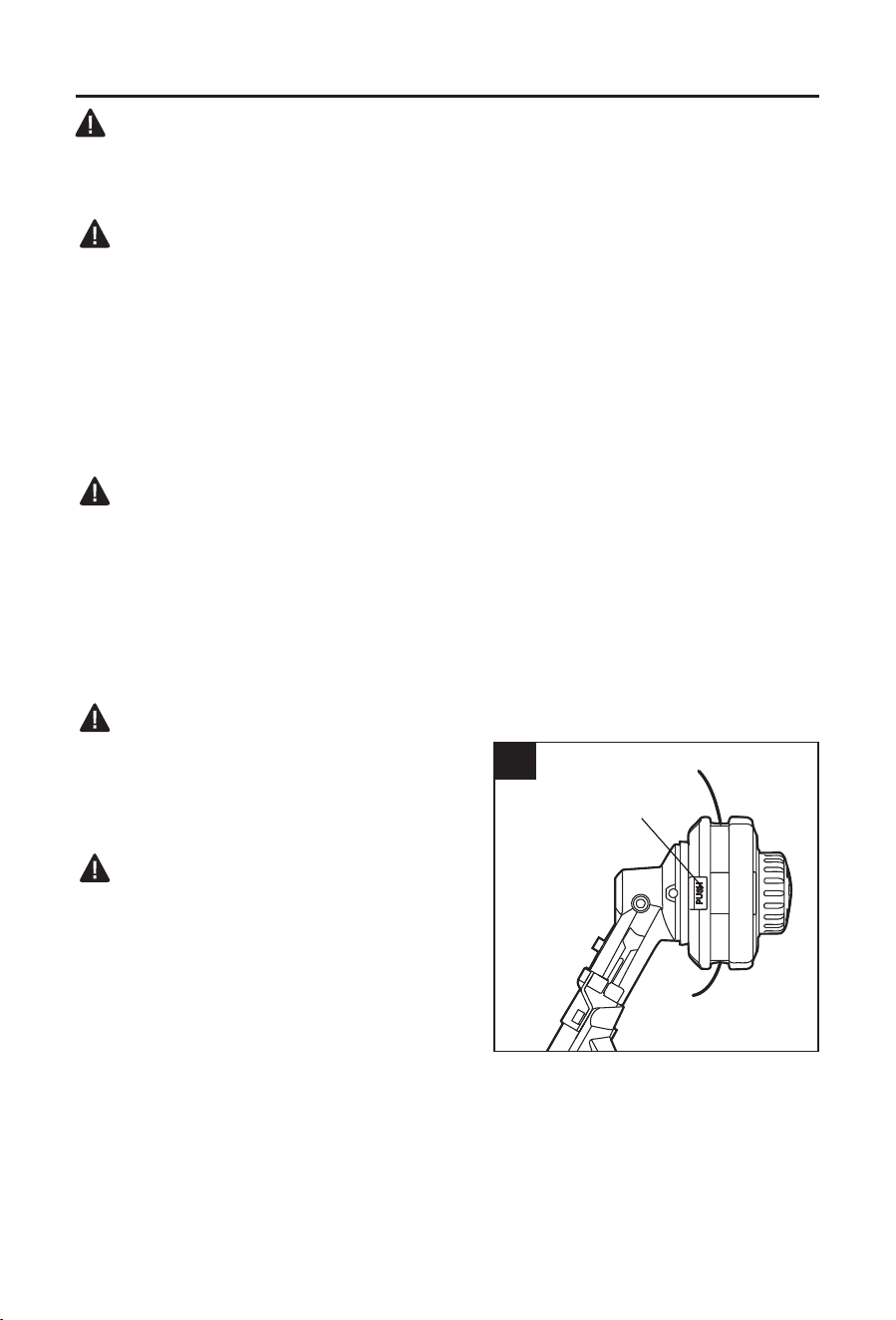
Adjusting Cutting Line Length (Fig 5b)
The trimmer head allows the operator to release
more cutting line without stopping the motor.
As the line becomes frayed or worn, additional line
can be released by lightly tapping the bump head
(A) on the ground while operating the trimmer (Fig.
5b).
For best results, tap the bump head on bare ground
or hard soil. If line release is attempted in tall grass,
the motor may overheat.
Always keep the trimming line fully extended. Line
release becomes more difcult as the cutting line
becomes shorter.
WARNING
• Do not remove or alter the line-cutting blade assembly. Excessive line length will cause the
motor to overheat and may result in serious personal injury.
5b
A
12
CARE AND MAINTENANCE
WARNING
All maintenance should only be carried out by a qualied service technician.
Clean the trimmer after each use
WARNING
• To prevent serious personal injury, remove the battery pack from the tool before servicing,
cleaning, changing attachments or removing material from the tool.
a. Clear any grass that may have wrapped itself around the motor shaft or trimmer head.
b. Use only a clean, dry and soft cloth to clean the tool. Never let any liquid get inside the
tool; never immerse any part of the tool into a liquid.
c. Keep the air vents free from debris at all times.
NOTICE: Obstructing the vents will prevent the air from owing into the motor housing and
may result in overheating or damage to the motor.
WARNING
• Never use water for cleaning your trimmer. Avoid using solvents when cleaning plastic parts.
Most plastics are susceptible to damage from various types of commercial solvents. Use
clean clothes to remove dirt, dust, oil, grease, etc.
6. Line Replacement
NOTICE: Always use triangle-shaped twisted nylon cutting line with a size that does not
exceed 0.08 in. (2.0 mm). Using line other than that specied may cause the string trimmer to
overheat or become damaged.
WARNING
• Never use metal-reinforced line, wire, or rope,
etc. These can break off and become dangerous
projectiles.
Wind the spool with new line
WARNING
• To prevent serious personal injury, remove the
battery pack from the tool before servicing,
cleaning, changing attachments, or removing
material from the unit.
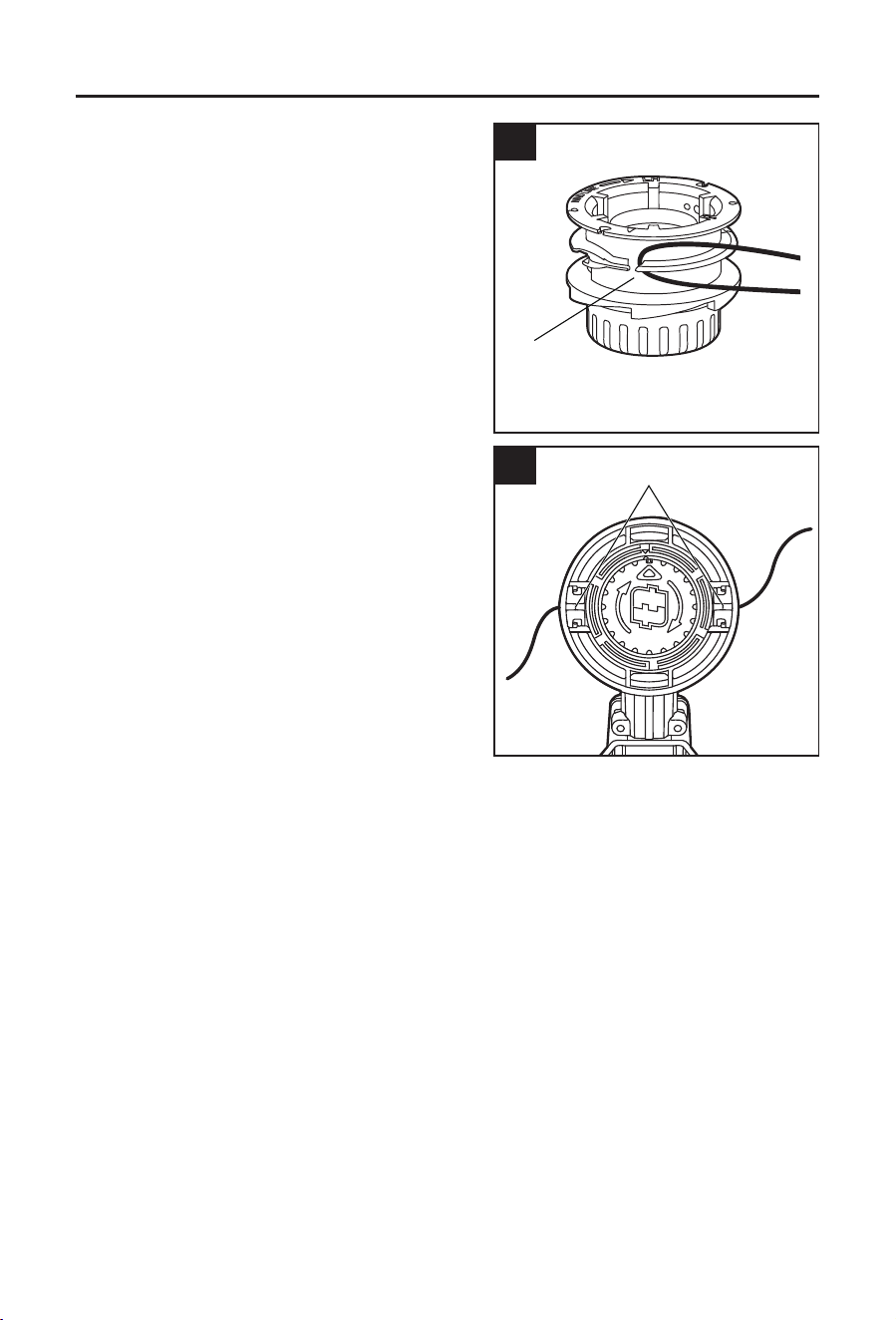
a. Press the two release tabs on the spool base
and remove the spool retainer by pulling it
straight out (Fig. 6a).
b. Use a clean cloth to clean the inner surface of the spool retainer and spool base.
NOTICE: Always clean the spool retainer and spool base before reassembling the trimmer head.
c. Check the spool retainer and spool base for worn or damaged parts.
6a
Tab
13
CARE AND MAINTENANCE
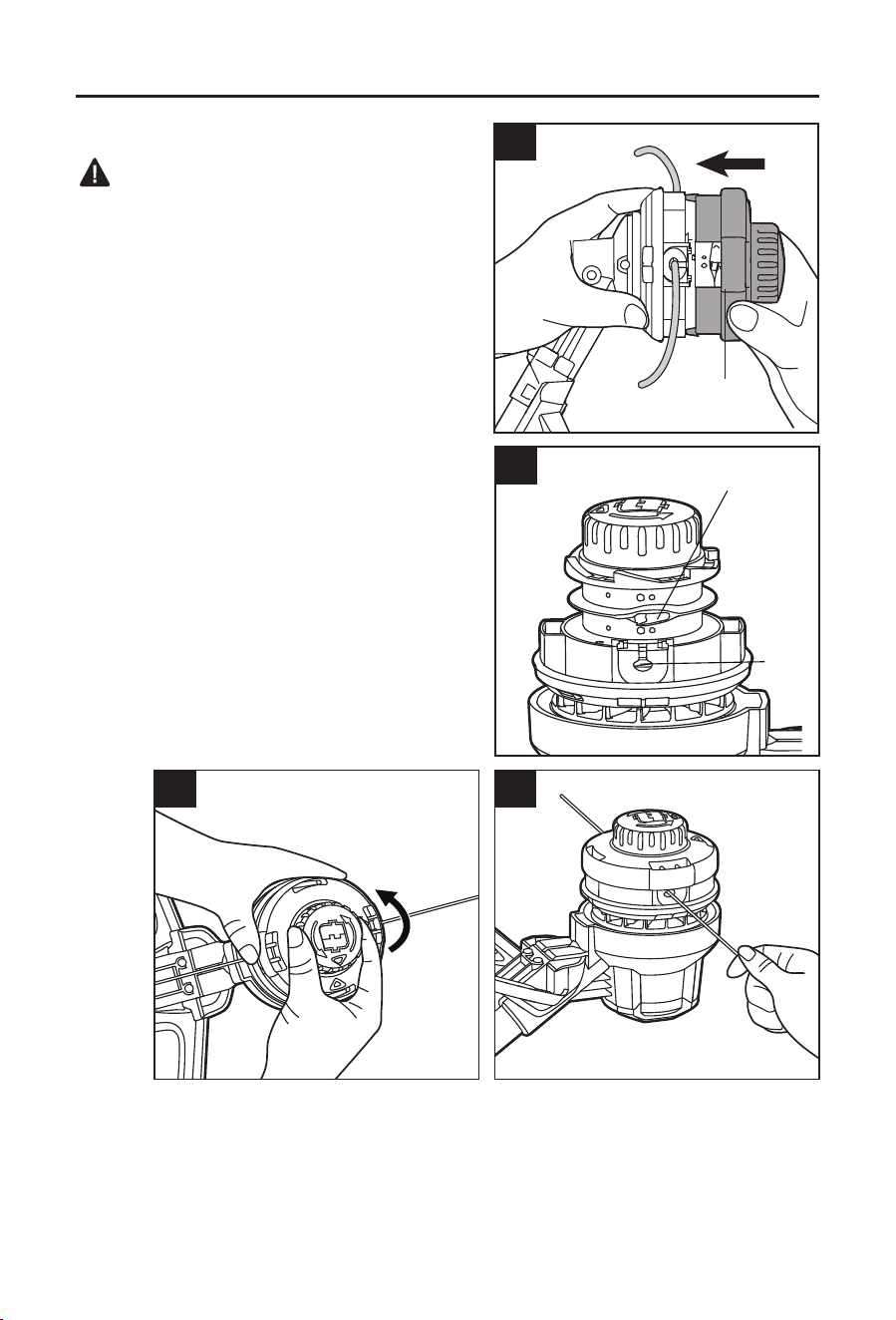
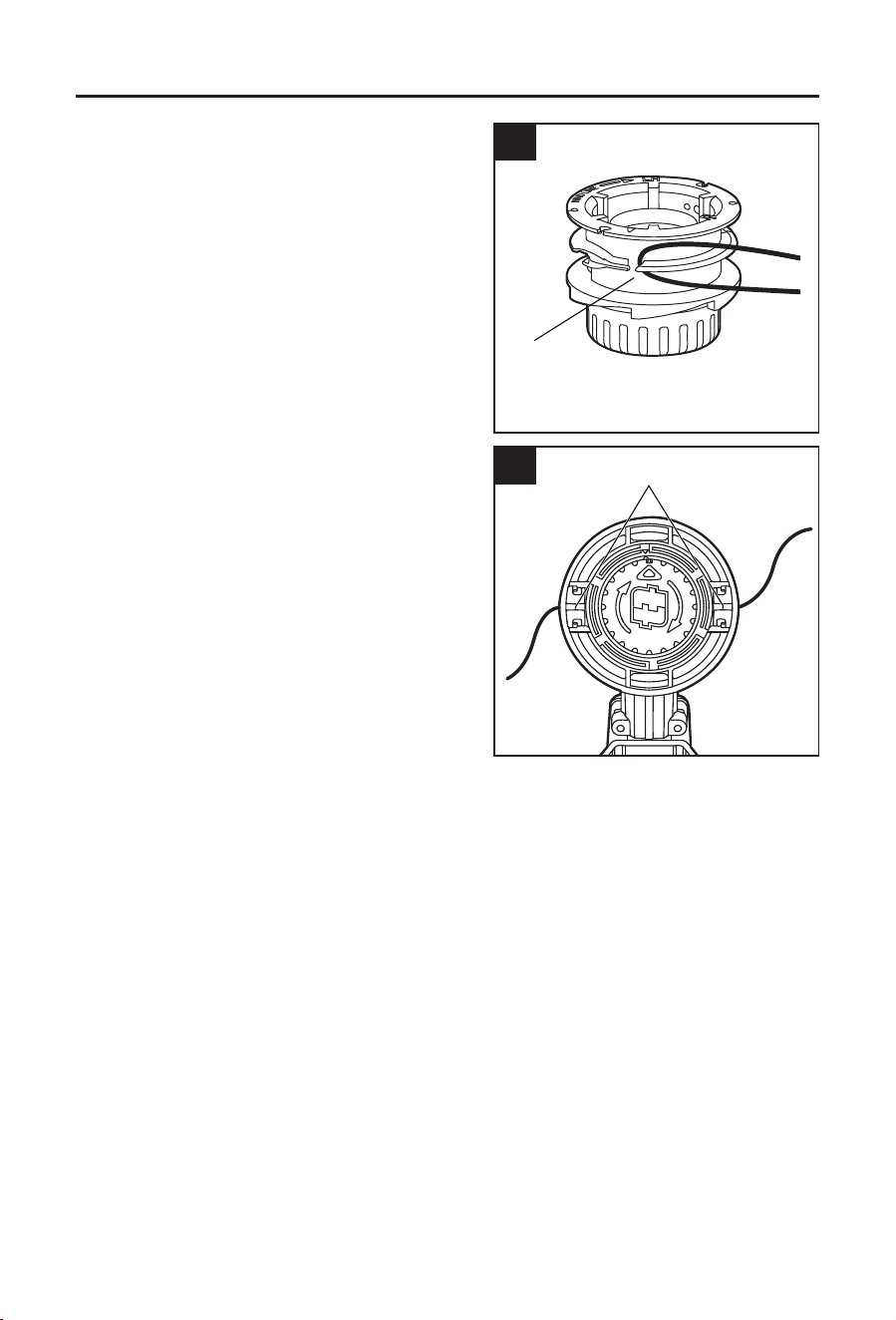
d. Fold the cutting line in half and hook the folded
end of the cutting line as shown in Fig. 6b.
e. Wind the line, in two even and tight layers,
onto the spool retainer.
NOTICE: Failure to wind the line in the direction
indicated will cause the trimmer head to operate
incorrectly.
f. Place the ends of the line in two opposite
eyelets (Fig. 6c).
g. Align the two tabs on the spool base with
the slots on trimmer head and press it until it
snaps into place (Fig. 6d).
NOTICE: Make sure that the tabs on the spool
base snap into place, otherwise the spool will
come out during operation.
6b
Spool
retainer
6c
Eyelets
14
CARE AND MAINTENANCE
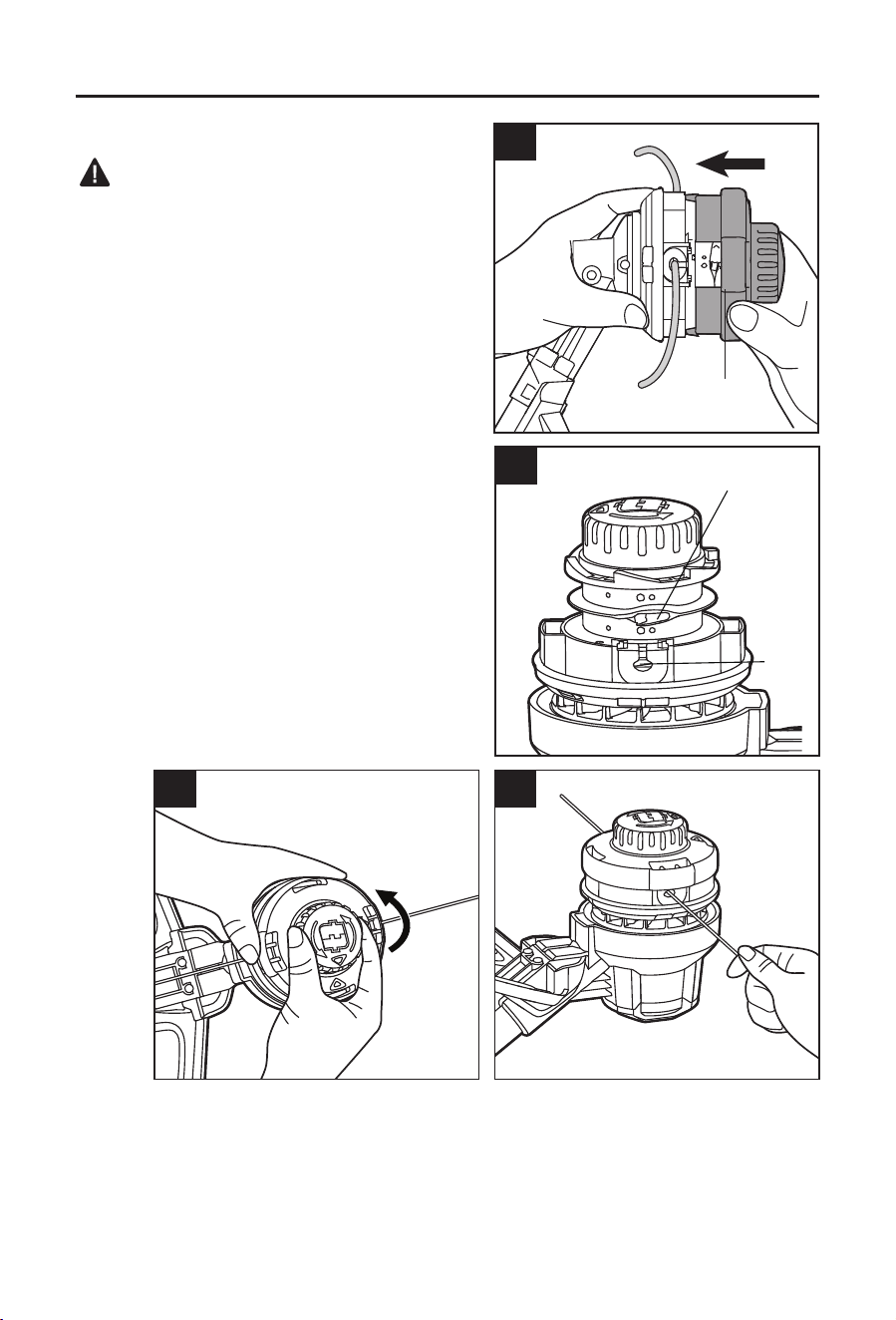
You can replace the new line in another way:
WARNING
• To prevent serious personal injury, remove the
battery pack from the tool before servicing,
cleaning, changing attachments or removing
material from the unit.
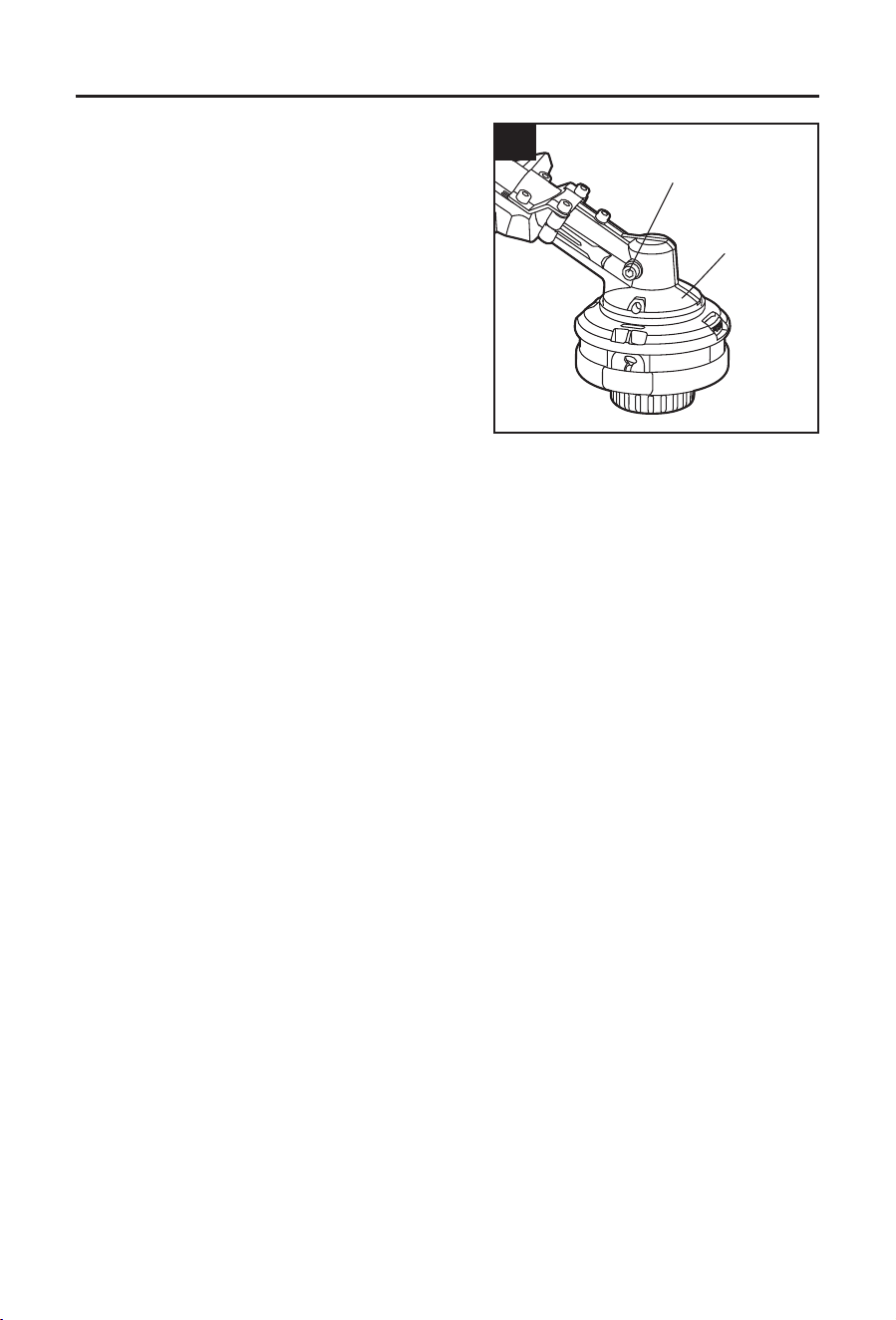
a. Press the two release tabs on the spool base
and remove the spool retainer.
b. Reinstall the spool retainer in such a way that
the threading hole on the spool retainer is
aligned with one of the eyelets (Fig. 6e).
c. Insert the new line into the eyelet. Feed the line
until the end of the line comes out of the other
side eyelet of the spool base (Fig. 6f).
d. Pull the line from the other side until equal
amounts of line appear on both sides.
e. Hold the spool base and rotate the bump head
in the direction indicated by the arrow to wind
the cutting line into the trimmer head (Fig. 6g).
• Push down on the bump head and check for
proper installation of the cutting line.
6e
Threading
hole
Eyelet
6f6g
6d
Spool base
15
CARE AND MAINTENANCE
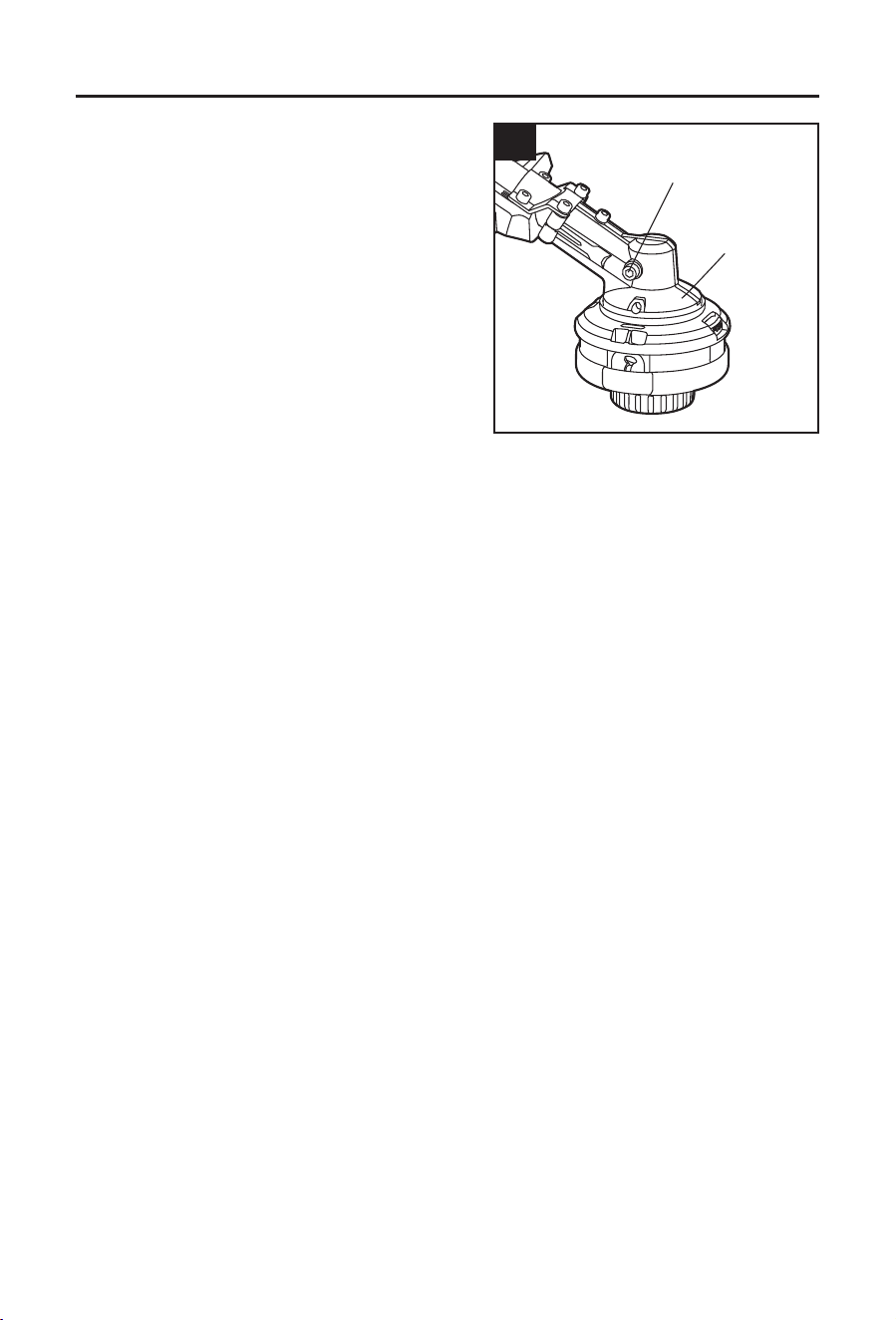
7. Transmission Gears Lubrication
The transmission gears in the gear case need be
lubricated periodically with gear grease. Check
the gear case grease level about every 50 hours
of operation by removing the sealing screw on the
side of the case.
If no grease can be seen on the sides of the gear,
follow the steps below to ll with gear grease up to
3/4 capacity.
Do not completely ll the transmission gear case.
a. Hold the string trimmer attachment on its side
so that the sealing screw is facing upwards
(Fig. 7).
b. Use the multi-function wrench (I) to loosen and remove the sealing screw.
c. Use a grease syringe (not included) to inject some grease into the lubrication opening,
taking care not to exceed 3/4 capacity.
d. Tighten the sealing screw after injection.
Storage
Clean the tool thoroughly before storing it.
Store the unit in a dry, well-ventilated area, locked-up or up high, out of the reach of children.
Keep away from corrosive agents, such as garden chemicals and de-icing salts.
7
Sealing screw
Gear case

16
TROUBLESHOOTING
WARNING:
• Release trigger switch (B) in the OFF position and remove the battery before performing
troubleshooting procedures.
PROBLEM POSSIBLE CAUSE CORRECTIVE ACTION
Tool does not
work.
1. Low battery pack capacity. 1. Charge the battery pack.
2. The battery pack is not
attached to the power head.
2. Attach the battery pack to the power
head.
String trimmer
stops while
cutting.
1. The motor shaft or trimmer
head is bound with grass.
1. Stop the trimmer, remove the battery
pack, and remove the grass from the
motor shaft and trimmer head.
2. The motor is overloaded. 2. Move the trimmer head to cut the
grass no more than 8 in. (20 cm) of
length in a single cut. Remove the
trimmer head from the grass and restart
the tool.
3. The battery pack or string
trimmer is too hot.
3. Release the trigger switch, wait for
the tool to cool down, and then start the
tool again.
4. The guard is not mounted
on the trimmer, resulting in
an overly long cutting line
and overload.
4. Remove the battery pack and mount
the guard on the trimmer.
Trimmer head
will not advance
the cutting line.
1. The trimmer head is bound
with grass.
1. Stop the trimmer, remove the battery
pack, and clean the trimmer head.
2. There is not enough line
on the spool.
2. Remove the battery pack and replace
the cutting line by following the section
“Line Replacement” in this manual.
WARRANTY
For 5 years from the date of purchase, this product is warranted for the original purchaser to
be free from defects in material and workmanship. This guarantee does not cover damage
due to abuse, normal wear, improper maintenance, neglect, unauthorized repair/alteration, or
expendable parts and accessories expected to become unusable after a reasonable period of
use. This warranty is limited to 90 days for commercial and rental use.
If you think your product meets the above guarantee criteria, please return it to the place of
purchase with valid proof of purchase and the defective product will be repaired or replaced at
no charge. This guarantee gives you specic legal rights, and you may also have other rights
that vary from state to state.
Lowe’s Home Centers LLC.
Mooresville, NC 28117
Printed in China
ARTÍCULO # 3809898/4132850/4665016
ACCESORIO PARA
ORILLADORA
MODELO #KMS 1040-03
¿Preguntas, problemas, piezas faltantes? Antes de volver a la tienda, llame a nuestro
Departamento de Servicio al Cliente al 1-888-3KOBALT (1-888-356-2258), de lunes a
domingo de 8 a.m. a 8 p.m., hora estándar del Este. También puede ponerse en contacto
con nosotros en [email protected] o visitar www.lowespartsplus.com.
ADJUNTE SU RECIBO AQUÍ
Número de serie Fecha de compra
KOBALT y el diseño del logotipo son marcas
comerciales o marcas registradas de LF, LLC.
Todos los derechos reservados.

18
ÍNDICE
Especicaciones del producto ........................................................................18
Contenido del paquete ................................................................................... 19
Información de seguridad ...............................................................................20
Preparación ....................................................................................................24
Instrucciones de funcionamiento ....................................................................25
Cuidado y mantenimiento ..............................................................................29
Solución de problemas ...................................................................................33
Garantía .........................................................................................................34
ESPECIFICACIONES DEL PRODUCTO
COMPONENTE ESPECIFICACIONES
Mecanismo de corte Cabezal de alimentación por golpeteo
Tipo de hilo de corte Hilo de nailon torcido de 0,08 pulgadas
Ancho de corte 38 cm (15 pulg.)
Temperatura de funcionamiento De 0° C (32 °F) a 40 °C (104 °F)
Temperatura de almacenaje De 0° C (32 °F) a 40 °C (104 °F)
19
CONTENIDO DEL PAQUETE
A
D
E
B
C
G
H
F
PIEZA DESCRIPCIÓN PIEZA DESCRIPCIÓN
A Cabezal de alimentación por
golpeteo
F Llave hexagonal
B Cuchilla del hilo de corte G Perno (2)
C Protector H Arandela de resorte (2)
D Eje del accesorio para orilladora
E Cabezal de orilladoras
ADVERTENCIA
• Retire la herramienta del paquete y examínela cuidadosamente. Inspeccione
cuidadosamente la herramienta para asegurarse de que no se produjo ninguna ruptura o
daño durante el envío. Si hay piezas faltantes o dañadas, devuelva este producto al lugar
donde lo compró. No deseche la caja ni ningún material de embalaje hasta después de
examinar todas las piezas.
• Si falta alguna pieza o si está dañada, no coloque la batería para usar la herramienta hasta
reparar o reemplazar dicha pieza. El incumplimiento de esta advertencia podría provocar
lesiones graves.

20
INFORMACIÓN DE SEGURIDAD
Lea y comprenda completamente este manual antes de intentar ensamblar u operar este
producto. Si tiene preguntas relacionadas con el producto, llame al Departamento de Servicio
al Cliente al 1-888-3KOBALT (1-888-356-2258), de lunes a domingo de 8 a.m. a 8:00 p.m.,
hora estándar del Este. También puede ponerse en contacto con nosotros a través de
[email protected] o visitar www.lowespartsplus.com.
ADVERTENCIA
• Operar cualquier herramienta eléctrica puede provocar que objetos extraños salten a sus
ojos y que, consecuentemente, le causen graves daños oculares. Use siempre lentes o
gafas de seguridad con protecciones laterales y, cuando sea necesario, una mascarilla que
cubra todo el rostro antes de comenzar a operar una herramienta eléctrica. Recomendamos
usar una máscara de seguridad de visión amplia sobre los lentes o gafas de seguridad con
protecciones estándar. Siempre use lentes de protección que cumplan con la norma ANSI
Z87.1.
• Parte del polvo producido por el lijado, el serruchado, la trituración y el taladrado eléctrico
y otras actividades de construcción contiene productos químicos reconocidos por el estado
de California como causantes de cáncer, defectos congénitos u otros daños en el aparato
reproductivo. Algunos ejemplos de estos productos químicos son los siguientes:
– Plomo de pinturas a base de plomo
– Sílice cristalina de ladrillos, cemento y otros productos de mampostería
– Arsénico y cromo de madera tratada con químicos
• El riesgo que corre debido a la exposición varía según la frecuencia con la que realiza este
tipo de trabajo. Para reducir la exposición a estos productos químicos:
– Trabaje en un área bien ventilada.
– Trabaje con equipo de seguridad aprobado, como las mascarillas antipolvo
especialmente diseñadas para ltrar partículas microscópicas.
– Evite estar en contacto prolongado con el polvo provocado por el lijado, el serruchado,
la trituración, el taladrado y otras actividades de construcción. Use ropa protectora y lave
todas las áreas expuestas del cuerpo con agua y jabón. Si el polvo ingresa a la boca o a
los ojos, o si cae sobre la piel, es posible que se absorban productos químicos dañinos.
Conozca la herramienta
Para operar esta herramienta, lea cuidadosamente este manual y todas las etiquetas jadas a
la herramienta antes de usarla. Guarde este manual para referencia futura.
Importante
Solo un técnico calicado puede reparar esta herramienta.
Lea por completo todas las instrucciones
21
INFORMACIÓN DE SEGURIDAD
Algunos de los siguientes símbolos pueden aplicarse al uso de esta herramienta. Obsérvelos
y aprenda su signicado. La interpretación correcta de estos símbolos le permitirá utilizar la
herramienta de manera ecaz y segura.
SÍMBOLO DEFINICIÓN SÍMBOLO DEFINICIÓN
V Voltios n
0
Velocidad sin carga
Corriente directa RPM Revoluciones por minuto
Peligro, advertencia o
precaución. Signica
"¡Atención! Su seguridad está
comprometida".
Para reducir el riesgo de
lesiones, el usuario debe leer el
manual de instrucciones.
INSTRUCCIONES IMPORTANTES DE SEGURIDAD
ADVERTENCIA
• Cuando utilice orilladoras eléctricas, siga siempre las medidas de seguridad básicas para
reducir el riesgo de incendios, descargas eléctricas y lesiones personales, incluido lo
siguiente:
LEA TODAS LAS INSTRUCCIONES
PELIGRO
• No confíe exclusivamente en el aislamiento de la herramienta contra las descargas
eléctricas. Para reducir el riesgo de descarga eléctrica, no utilice la herramienta cerca
de conductores o cables que puedan transportar corriente eléctrica.
PRECAUCIÓN
• Use auriculares de seguridad adecuados mientras utiliza el producto. El ruido que
genera este producto puede contribuir a la pérdida de la audición en algunas condiciones y
períodos de uso.
• Evite los entornos peligrosos: no use electrodomésticos en lugares húmedos o mojados.
• No lo use bajo la lluvia.
• Mantenga a los niños alejados: todas las visitas deben mantenerse a una distancia de al
menos 30,5 m (100 pies) del área de trabajo.
• Use ropa adecuada: no use ropa holgada ni joyas. Pueden quedar atrapadas en las piezas
móviles. Se recomienda utilizar guantes de goma y un calzado adecuado si trabaja en el
exterior. Use una malla protectora para contener el cabello largo.
• Use gafas de seguridad. También use siempre una mascarilla antipolvo si se desprende
demasiado polvo.
• Use el electrodoméstico adecuado: no use la herramienta en tareas diferentes de aquella
para la que fue diseñada.
• No fuerce el electrodoméstico: este tendrá un mejor rendimiento con menos
probabilidades de riesgo de lesiones si lo utiliza a la velocidad para la que fue diseñado.
• No se extienda demasiado: mantenga una posición y un equilibrio adecuados en todo
momento.

22
INFORMACIÓN DE SEGURIDAD
• Esté alerta: preste atención a lo que está haciendo. Use el sentido común. No use el
electrodoméstico si está cansado.
• Mantenga los protectores en su lugar y en buenas condiciones de funcionamiento.
• Mantenga las manos y los pies alejados del área de corte.
• Almacene los electrodomésticos que no utiliza en interiores: cuando no estén en uso,
los electrodomésticos deben almacenarse en interiores en un lugar seco y alto o cerrado,
fuera del alcance de los niños, sin el paquete de baterías.
• Mantenga el electrodoméstico en buenas condiciones: mantenga el borde de corte
alado y limpio para obtener el mejor rendimiento y reducir el riesgo de lesiones. Siga
las instrucciones para lubricar y reemplazar los accesorios. Mantenga las manijas secas,
limpias y sin aceite ni grasa.
• Verique que no haya piezas dañadas: antes de seguir utilizando la orilladora, debe
vericar detenidamente que los protectores, o cualquier otra pieza dañada, funcionen
correctamente y realicen la función deseada. Verique la alineación y el trabamiento de
las piezas móviles, la ruptura de las piezas, la instalación y cualquier otro tipo de condición
que pueda afectar el funcionamiento. Si un protector o cualquier otra pieza están dañados,
deben repararse o reemplazarse de inmediato en un centro de servicio autorizado, a menos
que se indique otro lugar en este manual.
• No cargue el paquete de baterías en un lugar húmedo o mojado.
• Evite un arranque accidental. Asegúrese de que el interruptor esté en la posición de
apagado antes de conectar el paquete de baterías o antes de levantar o transportar el
electrodoméstico. Transportarlo con el dedo en el interruptor o enchufar electrodomésticos
que tienen el interruptor en la posición de encendido aumenta las posibilidades de
accidentes.
• Desconecte el paquete de baterías del electrodoméstico antes de realizar cualquier
ajuste, cambiar accesorios o almacenarlo. Este tipo de medidas de seguridad
preventivas reduce el riesgo de arranques accidentales del electrodoméstico.
• Use la orilladora a batería solo con el paquete de baterías especícamente
designado. El uso de cualquier otra batería puede crear un riesgo de incendio.
• Use solamente los paquetes de baterías y los cargadores que se indican a
continuación:
PAQUETE DE BATERÍAS CARGADOR
KB 240-03; KB 440-03; KB 640-03; KRC 840-03
• No utilice un paquete de baterías ni el electrodoméstico si están dañados o
modicados. Las baterías dañadas o modicadas pueden mostrar una conducta
impredecible que podría provocar incendios, explosiones o riesgo de lesiones.
• No exponga el paquete de baterías ni el electrodoméstico al fuego o a una
temperatura excesiva. La exposición al fuego o a temperaturas por encima de los 100 °C
(212 °F) puede causar una explosión.
• Siga todas las instrucciones de carga y no cargue el paquete de baterías o el
electrodoméstico fuera del rango de temperatura especicado en las instrucciones.
La carga inadecuada o a temperaturas fuera del rango especicado puede dañar la batería
y aumentar el riesgo de incendio.
• Haga reparar el producto por una persona calicada que utilice solo piezas de
repuesto idénticas. Esto garantizará que se mantenga la seguridad del producto.
• No modique ni intente reparar el electrodoméstico o el paquete de baterías, excepto
como se indica en las instrucciones de uso y cuidado.
• No incinere la batería. Las celdas pueden explotar. Revise los códigos locales para
obtener las instrucciones de eliminación especiales posibles.

23
INFORMACIÓN DE SEGURIDAD
• No abra ni mutile la batería. Los electrolitos liberados son corrosivos y pueden
causar daños en los ojos o la piel. Pueden ser tóxicos si se ingieren.
• Tenga cuidado al manipular las baterías para no hacer cortocircuito con la batería
con materiales conductores, como anillos, pulseras o llaves. Es posible que la batería
o el conductor se sobrecalienten y produzcan quemaduras.
• Use solamente el cabezal de potencia de iones de litio de 40 V KMH 1040-03.
• No use la orilladora bajo los efectos del alcohol o de las drogas.
• Despeje el área que va a cortar antes de cada uso. Retire todos los objetos, como
rocas, vidrios rotos, clavos, alambres o cuerdas, que puedan ser lanzados por la
máquina o que puedan enredarse en el accesorio de corte. Asegúrese de que las
demás personas y mascotas se encuentren a una distancia de al menos 30,5 m (100 pies).
• Siempre sostenga la orilladora rmemente con ambas manos en las manijas durante
el uso. Rodee las manijas con los dedos y los pulgares.
• Para reducir el riesgo de lesiones por pérdida de control, no trabaje en escaleras ni
en otros soportes inseguros. No sostenga el accesorio de corte por encima de la altura
de la cintura.
• No utilice la orilladora en atmósferas gaseosas ni en las que exista riesgo de
explosión. Los motores en estos electrodomésticos normalmente producen chispas que
pueden encender gases.
• Use pantalones largos pesados, mangas largas, botas y guantes. Evite usar ropa
holgada o joyas ya que estas podrían atraparse en las piezas en movimiento de la máquina
o de su motor.
• Daños en la orilladora: si la orilladora choca con un objeto extraño o si se enreda,
detenga la herramienta inmediatamente, verique que no haya daños y repare los
daños que haya antes de intentar volver a utilizarla. No utilice la herramienta si el
protector o el carrete están dañados.
• Si el equipo comienza a vibrar de manera anormal, detenga el motor y busque la
causa de inmediato. Por lo general, la vibración advierte un problema.
• Un cabezal suelto puede vibrar, agrietarse, romperse o salirse de la orilladora, lo cual
puede producir lesiones graves o fatales. Asegúrese de que el accesorio de corte
esté jo en su posición de forma correcta. Si el cabezal se aoja después de jarlo en su
posición, reemplácelo inmediatamente.
• Nunca use una orilladora con un accesorio de corte suelto.
• Reemplace los cabezales agrietados, dañados o gastados de inmediato, aunque
el daño se limite a grietas superciales. Estos accesorios pueden quebrarse a una
velocidad alta y provocar lesiones graves o fatales.
• Verique el accesorio de corte en intervalos breves y regulares durante el uso o
inmediatamente si hay un cambio notable en el comportamiento de corte.
• Al reemplazar el hilo de corte, use un hilo de corte de nailon torcido triangular de
un tamaño que no supere los 2 mm (0,08 pulg.). El uso de hilos más pesados que
los recomendados por el fabricante aumenta la carga sobre el motor y reduce su
velocidad de funcionamiento. Esto produce sobrecalentamiento y daño de la orilladora.
• Para reducir el riesgo de lesiones graves, nunca utilice hilo de alambre o de metal
reforzado ni otro material en lugar de los hilos de corte de nailon. Los trozos de
alambre pueden romperse a una velocidad alta en dirección del operador o de los
transeúntes.
• Al realizar mantenimiento, utilice solo piezas de repuesto idénticas. El uso de
cualquier otro accesorio que no esté recomendado para esta herramienta puede aumentar
el riesgo de lesiones.
• No lave con una manguera, evite que ingrese agua al motor y a las conexiones
eléctricas.

24
INFORMACIÓN DE SEGURIDAD
• Guarde estas instrucciones. Consúltelas periódicamente y utilícelas para capacitar a
otras personas que puedan utilizar esta herramienta. Si presta la herramienta a alguien
más, préstele también estas instrucciones para prevenir el mal uso del producto y posibles
lesiones.
NOTA: CONSULTE EL MANUAL DEL OPERADOR DEL CABEZAL DE POTENCIA KOBALT
KMH 1040-03 PARA CONOCER LAS REGLAS DE SEGURIDAD ESPECÍFICAS.
PREPARACIÓN
Conozca su orilladora
Este producto requiere ensamblaje. Extraiga la herramienta de la caja cuidadosamente y
colóquela sobre una supercie de trabajo nivelada. Antes de intentar usar el accesorio para
orilladora, familiarícese con todas sus características de operación y requisitos de seguridad.
ADVERTENCIA
• Sea cuidadoso, incluso si está familiarizado con la herramienta. Recuerde que un momento
de descuido es suciente para causar lesiones graves. Antes de intentar utilizar cualquier
herramienta, asegúrese de familiarizarse con todas las características de funcionamiento e
instrucciones de seguridad.
• No intente modicar esta herramienta ni crear accesorios que no sean los recomendados
para esta. Cualquier alteración o modicación se considera un uso inadecuado y podría
causar una condición peligrosa que produzca lesiones personales graves.
25
INSTRUCCIONES DE ENSAMBLAJE
ADVERTENCIA: este producto requiere ensamblaje. Para reducir el riesgo de lesiones a
personas, no use la herramienta si el protector no está en su lugar. El protector siempre debe
estar en la herramienta para proteger al usuario.
1. Montaje del protector
ADVERTENCIA
• Instale el protector antes de conectar el accesorio
al cabezal de potencia.
• Para reducir el riesgo de lesiones a personas, no
opere sin el protector en su lugar.
a. Aoje los dos pernos (G) del protector con la
llave hexagonal provista (F). Retire los pernos
y las arandelas de resorte (H) del protector (C)
(Fig. 1a).
b. Levante el cabezal de la orilladora (E) y
oriéntelo hacia abajo; alinee los dos oricios de
montaje del protector con los dos oricios de
ensamble de la base del eje. Asegúrese de que
la cara interna del protector se oriente hacia el
cabezal de la orilladora (Fig. 1b).
c. Utilice la llave hexagonal provista para
asegurar el protector en su lugar con las
arandelas y los pernos.
1a
H
C
G
G
H
E
C
1b
26
INSTRUCCIONES DE ENSAMBLAJE
2. Conexión del accesorio para orilladora al
cabezal de potencia (KMH 1040-03)
Instalación del accesorio
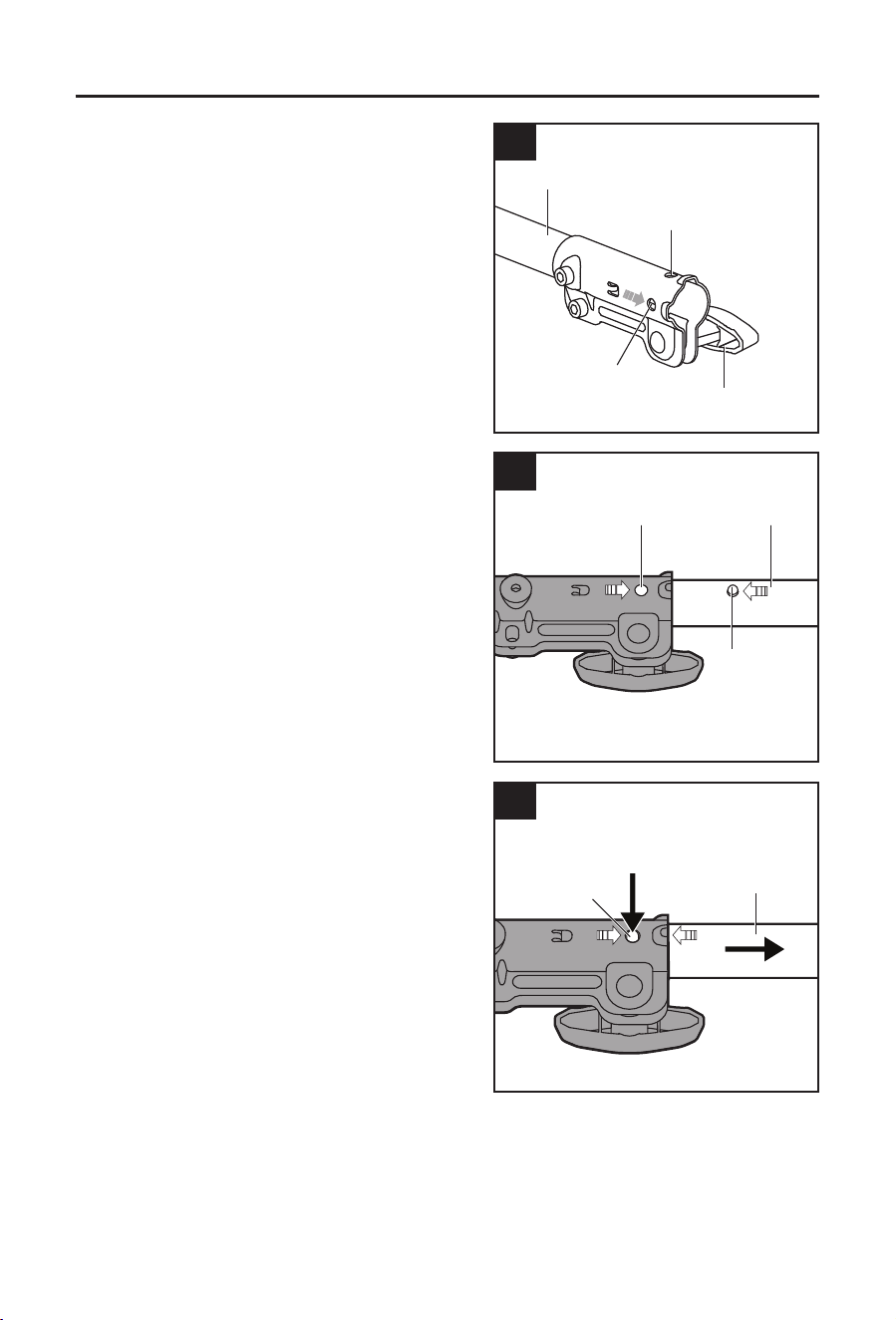
a. Retire el paquete de baterías del cabezal de
potencia.
b. Aoje la perilla mariposa del eje del cabezal de
potencia (Fig. 2a).
c. El cabezal de potencia tiene dos ranuras en
el acoplador, SOLO se utiliza la ranura 1 para
conectar accesorios: KMS 1040-03 y KEG
1040-03.
d. Alinee el pasador activado por resorte del
accesorio con la ranura del acoplador y empuje
el eje del accesorio en el eje del cabezal de
potencia hasta que el pasador salga de la
ranura y escuche un sonido de “clic” al mismo
tiempo (Fig. 2b).
e. Jale el eje del accesorio para vericar que esté
rmemente asegurado en el acoplador.
f. Ajuste rmemente la perilla mariposa.
Extracción del accesorio
a. Retire el paquete de baterías del cabezal de
potencia.
b. Aoje la perilla mariposa.
c. Presione hacia abajo el pasador activado por
resorte y extraiga el eje del accesorio del
acoplador (Fig. 2c).
2b
Ranura
Pasador
Eje del
accesorio
2c
Eje del
accesorio
Pasador
2a
Eje del cabezal de potencia
Ranura 2
Perilla mariposa
Ranura 1
27
INSTRUCCIONES DE FUNCIONAMIENTO
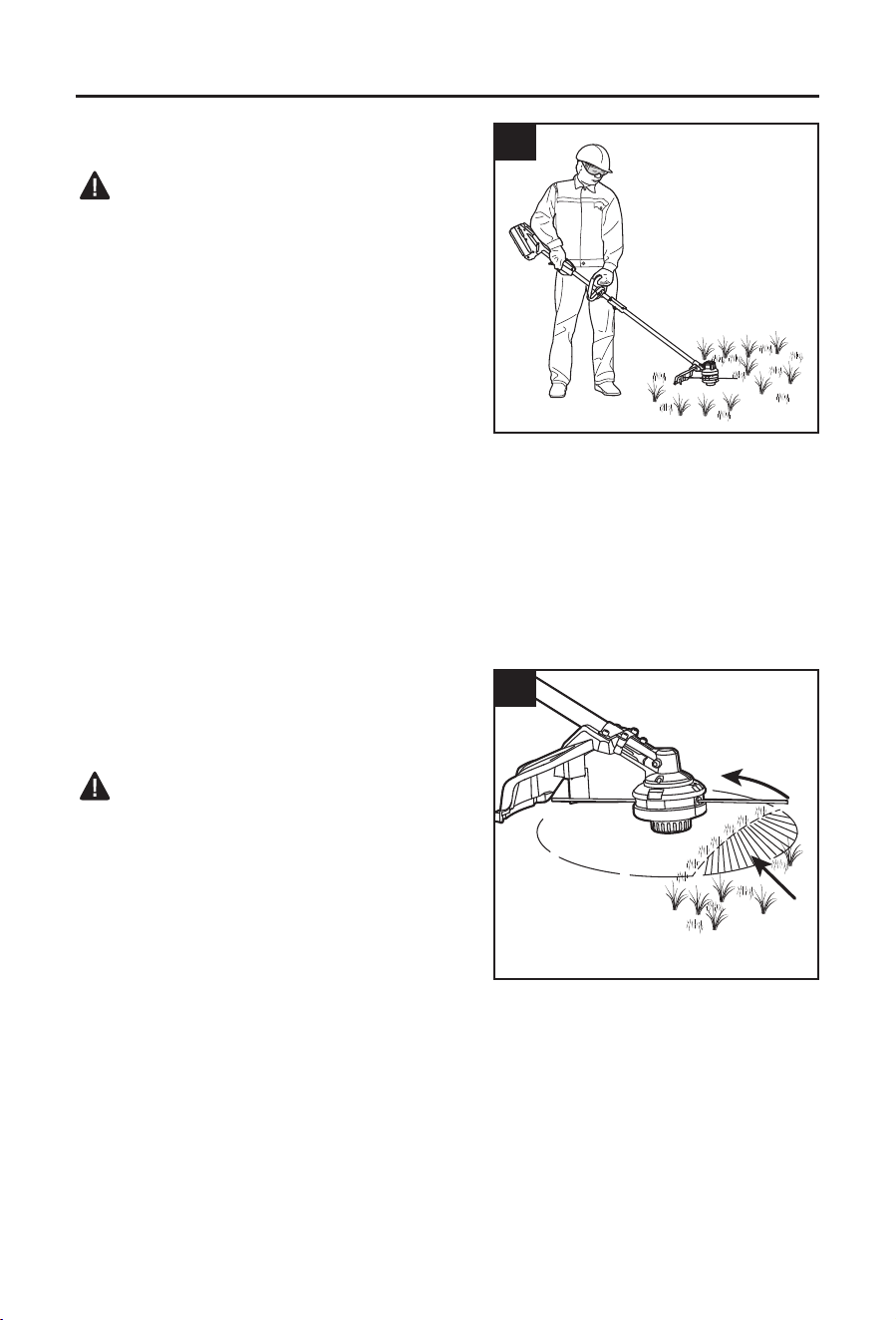
3. Cómo sostener la orilladora
ADVERTENCIA
• Use ropa adecuada para reducir el riesgo de
lesiones cuando opere esta herramienta.
No use ropa holgada ni joyas. Use protección
para los ojos y las orejas. Use pantalones largos
y pesados, botas y guantes. No use pantalones
cortos ni sandalias, ni tenga los pies descalzos.
Antes de usar la unidad, colóquese en la posición
de operación y verique lo siguiente:
• El operador usa lentes de protección y ropa
adecuada.
• Un brazo está ligeramente doblado. La mano de ese brazo sostiene la manija trasera.
• El otro brazo está recto. La mano de ese brazo sostiene la manija delantera.
• El cabezal de la orilladora se encuentra paralelo al suelo y entra en contacto fácilmente con
el material que debe cortar, sin que el operador deba inclinarse.
4. Encendido y apagado de la orilladora
Consulte la sección “CÓMO ENCENDER/DETENER EL CABEZAL DE POTENCIA” en el
manual del operador del cabezal de potencia KMH 1040-03.
5. Uso de la orilladora
Consejos para obtener mejores resultados de
corte (Fig. 5a)
ADVERTENCIA
• Revise si hay piezas dañadas o desgastadas
antes de cada uso.
• Para evitar lesiones personales graves, use
gafas o lentes de seguridad en todo momento
al trabajar con esta unidad. Use una máscara
o mascarilla antipolvo en lugares donde hay
polvo. Use ropa y calzado adecuados durante
el uso para reducir el riesgo de lesiones que
pueden originarse a causa de desechos
eyectados.
• Despeje el área que va a cortar antes de cada uso. Retire todos los objetos, como rocas,
vidrios rotos, clavos, alambres o cuerdas, que puedan ser lanzados por la máquina o
que puedan enredarse en el accesorio de corte. Despeje el área de niños, transeúntes y
mascotas. Como mínimo, mantenga a todos los niños, transeúntes y mascotas al menos a
30,5 m (100 pies) de distancia. Aún podrían existir riesgos para los transeúntes debido a los
objetos disparados.
• Se debe pedir a los transeúntes que usen lentes de protección. Si alguien se aproxima a
usted, detenga el motor y el accesorio de corte inmediatamente.
• El ángulo correcto del accesorio de corte es paralelo al suelo.
3
5a
Dirección de
la rotación
Área de
corte ideal
Área de corte
peligrosa
28
INSTRUCCIONES DE FUNCIONAMIENTO
• Esta orilladora le permite apoyar el cabezal de alimentación por golpeteo (A) sobre el suelo
para un funcionamiento más cómodo.
• No fuerce la herramienta. Permita que la punta del hilo realice el corte (especialmente
contra las paredes). Si corta con más que la punta, se reducirá la eciencia de corte y se
provocará una sobrecarga del motor.
• La altura de corte se determina según la distancia del hilo de corte a la supercie del
césped.
• El césped de más de 200 mm (8 pulg.) debe cortarse desde la parte superior hacia la
inferior en pequeños incrementos para evitar el desgaste prematuro del hilo o el arrastre del
motor.
• Mueva lentamente la orilladora de hilo dentro y fuera del área que cortará y mantenga
la posición del cabezal de corte en la altura de corte que desea. Este puede ser un
movimiento hacia delante y hacia atrás, o de un lado a otro. El corte de largos menores
produce mejores resultados.
• Corte el césped y las malezas solo cuando estén secos.
• Las cercas de alambre y de estacas pueden causar un desgaste excesivo o roturas.
Las paredes de piedra o ladrillo, los bordes y la madera puede desgastar las cuerdas
rápidamente.
• Evite los árboles y arbustos. Las cuerdas pueden dañar fácilmente las cortezas de los
árboles, las molduras en madera, los paneles de revestimiento y los postes para cerca.
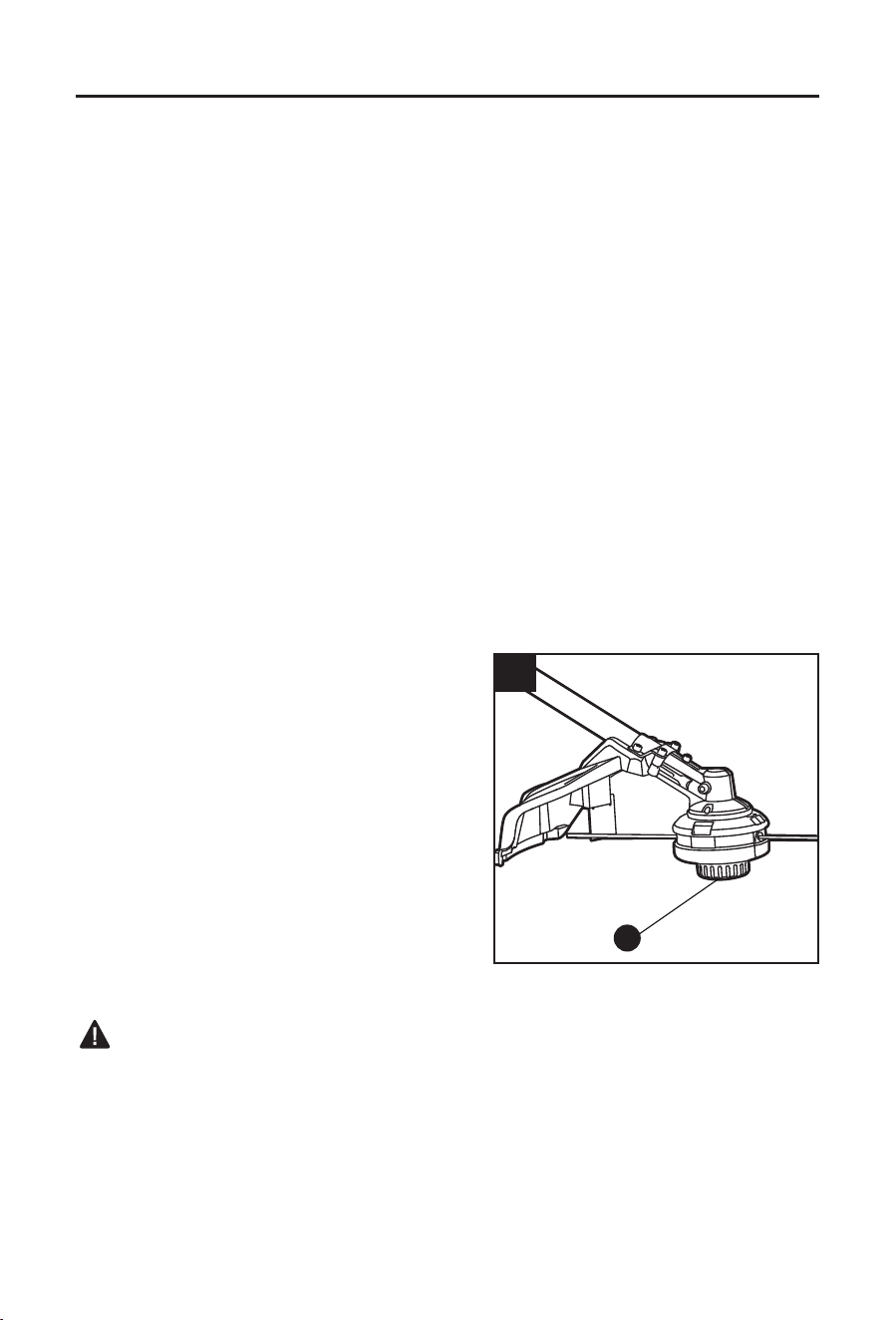
Ajuste del largo del hilo de corte (Fig. 5b)
El cabezal de la orilladora le permite al operador
liberar más hilo de corte sin detener el motor.
A medida que el hilo se rasga o desgasta, puede
liberarse hilo adicional si se golpea ligeramente el
cabezal de alimentación por golpeteo (A) contra el
suelo mientras se usa la orilladora (Fig. 5b).
Para obtener mejores resultados, golpee el cabezal
de alimentación por golpeteo contra suelo desnudo
o tierra dura. Si intenta liberar hilo en césped alto,
el motor puede sobrecalentarse.
Siempre mantenga el hilo de la orilladora
completamente extendido. La liberación de hilo se
hace más difícil a medida que el hilo de corte se acorta.
ADVERTENCIA
• No retire ni modique el ensamble de la cuchilla del hilo de corte. Un largo excesivo del hilo
puede producir el sobrecalentamiento del motor y esto puede dar como resultado lesiones
personales graves.
5b
A
29
CUIDADO Y MANTENIMIENTO
ADVERTENCIA
Todo el mantenimiento debe estar a cargo solo de un técnico de servicio calicado.
Limpie la orilladora después de cada uso.
ADVERTENCIA
• Para evitar lesiones personales graves, retire el paquete de baterías de la herramienta
antes de realizar el mantenimiento, limpiarlo, cambiar los accesorios o retirar el material de
la herramienta.
a. Limpie el pasto que pueda cubrir el eje del motor o el cabezal de la orilladora.
b. Use solo un paño limpio, seco y suave para limpiar la herramienta. Nunca deje que
ingresen líquidos a la herramienta; nunca sumerja alguna pieza de la herramienta en
líquido.
c. Mantenga los conductos de ventilación libres de desechos en todo momento.
AVISO: la obstrucción de los conductos de ventilación impide que el aire uya al armazón del
motor, lo cual puede producir el sobrecalentamiento o el daño del motor.
ADVERTENCIA
• Nunca utilice agua para limpiar la orilladora. Evite utilizar solventes para limpiar las piezas
de plástico. La mayoría de los plásticos son susceptibles a diferentes tipos de solventes
comerciales. Utilice paños limpios para eliminar la suciedad, el polvo, el aceite, la grasa, etc.
6. Reemplazo del hilo
AVISO: siempre use hilo de corte de nailon torcido triangular de un tamaño que no supere
los 2 mm (0,08 pulg.). El uso de hilos diferentes de los especicados puede ocasionar que la
orilladora se sobrecaliente o se dañe.
ADVERTENCIA
• Nunca use hilo de metal reforzado, alambre
o cuerda, etc. Estos podrían romperse y
convertirse en un proyectil peligroso.
Enrollado del carrete con el hilo nuevo
ADVERTENCIA
• Para evitar lesiones personales graves, retire el
paquete de baterías de la herramienta antes de
realizar el mantenimiento, limpiarlo, cambiar los
accesorios o retirar el material de la unidad.
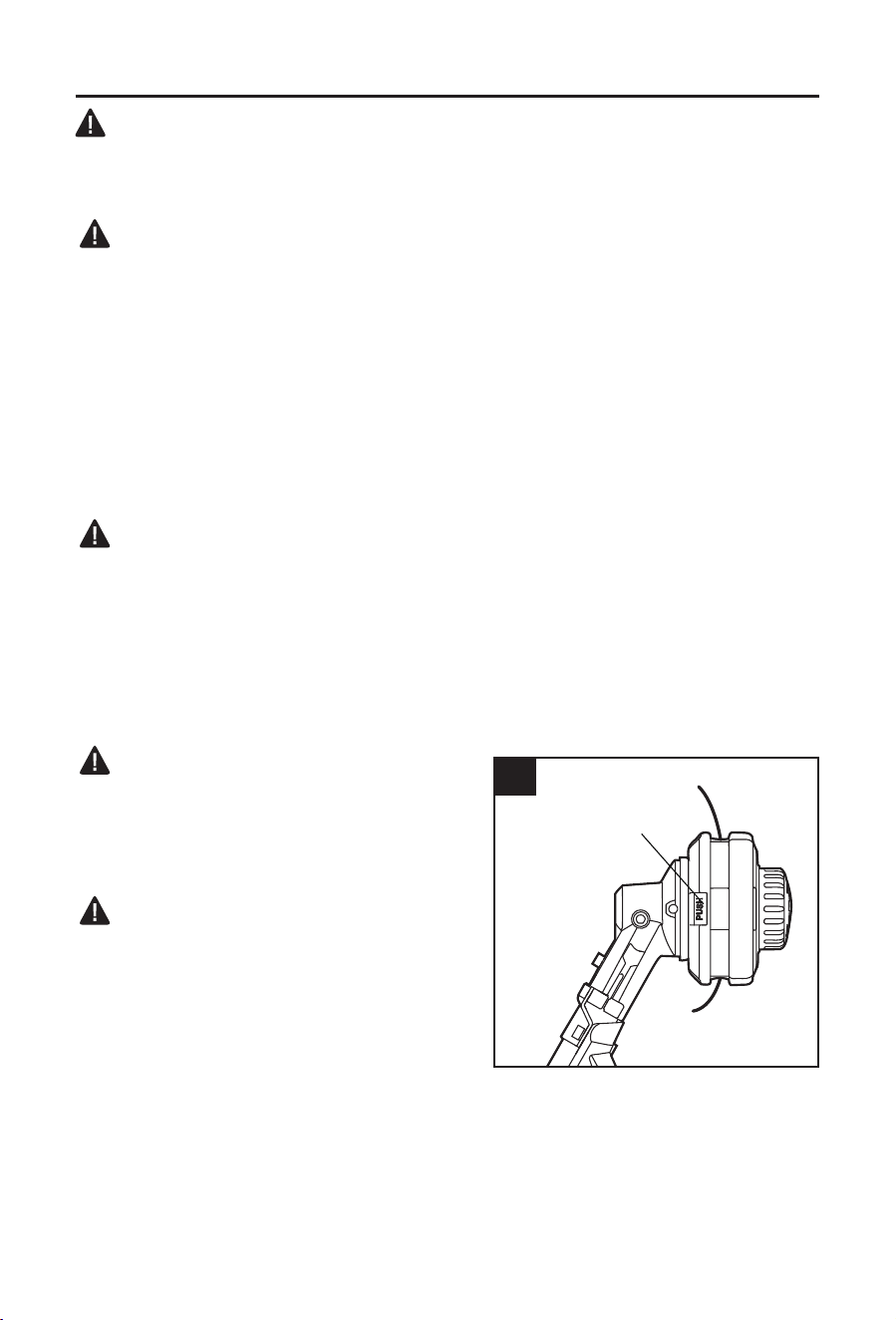
a. Presione las dos lengüetas de liberación de
la base del carrete y retire el retenedor del
carrete jalándolo hacia afuera (Fig. 6a).
b. Use un paño limpio para limpiar la supercie interna del retenedor del carrete y la base del
carrete.
AVISO: siempre limpie el retenedor del carrete y la base del carrete antes de volver a ensamblar
el cabezal de la orilladora.
c. Verique si hay piezas desgastadas o dañadas en el retenedor del carrete o la base del
carrete.
6a
Lengüeta
30
CUIDADO Y MANTENIMIENTO
d. Doble el hilo de corte por la mitad y enganche
el extremo plegado del hilo de corte, como, se
muestra en la Fig. 6b.
e. Enrolle el hilo en dos capas uniformes y
apretadas sobre el retenedor del carrete.
AVISO: si no se enrolla el hilo en la dirección que
se indica, el cabezal de la orilladora funcionará
incorrectamente.
f. Coloque los extremos del hilo en dos ojales
opuestos (Fig. 6c).
g. Alinee las dos lengüetas de la base del carrete
con las ranuras del cabezal de la orilladora
y presiónelas hasta que encajen en su lugar
(Fig. 6d).
AVISO: asegúrese de que las lengüetas de
la base del carrete se jen en su lugar o, de
lo contrario, el carrete se saldrá durante el
funcionamiento.
6b
Retenedor
del carrete
6c
Ojales
31
CUIDADO Y MANTENIMIENTO
Puede reemplazar el hilo nuevo de otra manera:
ADVERTENCIA
• Para evitar lesiones personales graves, retire el
paquete de baterías de la herramienta antes de
realizar el mantenimiento, limpiarlo, cambiar los
accesorios o retirar el material de la unidad.
a. Presione las dos lengüetas de liberación de
la base del carrete y retire el retenedor del
carrete.
b. Vuelva a instalar el retenedor del carrete de
tal manera que el oricio de enhebrado del
retenedor del carrete quede alineado con uno
de los ojales (Fig. 6e).
c. Coloque el hilo nuevo en el ojal. Inserte el hilo
hasta que el extremo nal salga por el otro ojal
lateral de la base del carrete (Fig. 6f).
d. Tire del hilo desde el otro lado hasta que
aparezcan cantidades iguales de hilo en ambos
lados.
e. Sostenga la base del carrete y gire el cabezal
de alimentación por golpeteo en la dirección
indicada por la echa a n de enrollar el hilo de
corte en el cabezal de la orilladora (Fig. 6g).
• Empuje el cabezal de alimentación por golpeteo
hacia abajo y verique que el hilo de corte esté
instalado correctamente.
6e
Oricio de
roscado
Ojal
6f6g
6d
Base del
carrete
32
CUIDADO Y MANTENIMIENTO
7. Lubricación de los cambios de transmisión
Los cambios de transmisión en la caja de cambios
tienen que lubricarse periódicamente con aceite
para cambios. Verique el nivel de grasa de la caja
de cambios aproximadamente cada 50 horas de
funcionamiento al retirar el tornillo sellador en el
lateral de la caja.
Si no se ve grasa en los laterales del cambio,
siga los pasos a continuación para engrasar los
cambios hasta ¾ de la capacidad.
No llene por completo la caja de cambios de
transmisión.
a. Sostenga el accesorio para orilladora de
costado de modo que el tornillo sellador quede hacia arriba (Fig. 7).
b. Utilice la llave multiuso (I) para aojar y retirar el tornillo sellador.
c. Utilice una jeringa de grasa (no se incluye) para inyectar algo de grasa en el oricio de
lubricación sin superar los 3/4 de la capacidad.
d. Apriete el tornillo sellador luego de la inyección.
Almacenamiento
Haga una limpieza profunda de la herramienta antes de almacenarla.
Almacene la unidad en un lugar seco y bien ventilado, alto o con seguro y fuera del alcance
de los niños. Debe mantenerse alejada de agentes corrosivos, como productos químicos para
jardín y sales descongelantes.
7
Tornillo de sellado
Caja de cambios

33
SOLUCIÓN DE PROBLEMAS
ADVERTENCIA:
• Suelte el interruptor tipo gatillo (B) en la posición de APAGADO y retire el paquete de baterías
antes de realizar los procedimientos de solución de problemas.
PROBLEMA CAUSA POSIBLE ACCIÓN CORRECTIVA
La herramienta
no funciona.
1. La capacidad del paquete
de baterías es baja.
1. Cargue el paquete de baterías.
2. El paquete de baterías
no está jo al cabezal de
potencia.
2. Fije el paquete de baterías al cabezal
de potencia.
La orilladora se
detiene mientras
se corta.
1. El eje del motor o el
cabezal de la orilladora
están atascados con
césped.
1. Detenga la orilladora, retire el paquete
de baterías y quite el césped del
eje del motor y del cabezal de la
orilladora.
2. El motor está
sobrecargado.
2. Mueva el cabezal de la orilladora para
cortar el césped no más de 20 cm
(8 pulg.) de largo en un solo corte.
Retire el cabezal de la orilladora del
césped y reinicie la herramienta.
3. El paquete de baterías o
la orilladora est demasiado
caliente.
3. Suelte el interruptor tipo gatillo,
espere que la herramienta se enfríe y
luego vuelva a encenderla.
4. El protector no está
instalado en la orilladora,
lo que genera una línea de
corte demasiado larga y
una sobrecarga.
4. Retire el paquete de baterías e instale
el protector en la orilladora.
El cabezal de
la orilladora no
hace avanzar el
hilo de corte.
1. El cabezal de la orilladora
está atascado con césped.
1. Detenga la orilladora, retire el paquete
de baterías y limpie el cabezal de la
orilladora.
2. No hay suciente hilo en el
carrete.
2. Retire el paquete de baterías y
reemplace el hilo de corte. Para ello,
siga la sección "Reemplazo del hilo"
de este manual.

34
GARANTÍA
Este producto tiene cobertura de garantía contra defectos en materiales y mano de obra
durante 5 años a partir de la fecha de compra para el comprador original. Esta garantía no
cubre daños debidos al maltrato, desgaste normal, mantenimiento inadecuado, negligencia,
reparaciones o alteraciones no autorizadas, o piezas y accesorios prescindibles que se espera
que resulten inutilizables después de un período de uso razonable. Esta garantía está limitada
a 90 días para uso comercial y de alquiler.
Si cree que este producto cumple con la garantía mencionada anteriormente, devuelva
el producto al lugar donde lo compró con un comprobante de compra válido y el producto
defectuoso se reparará o reemplazará sin cargo. Esta garantía le otorga derechos legales
especícos, pero también podría tener otros derechos que varían según el estado.
Lowe’s Home Centers LLC.
Mooresville, NC 28117
Impreso en China