1
Serial Number
SG24114
Purchase Date
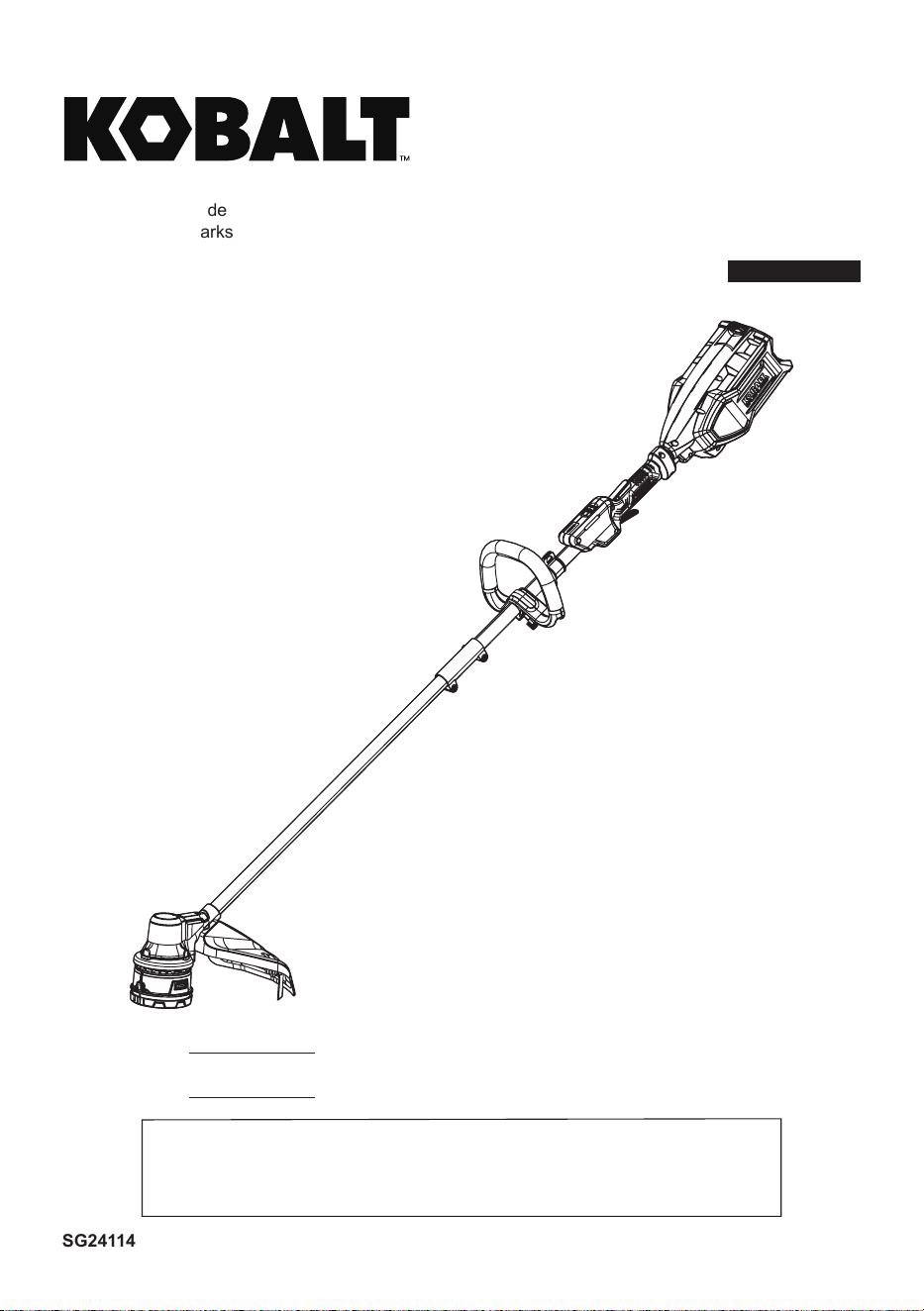
ITEM #5974895
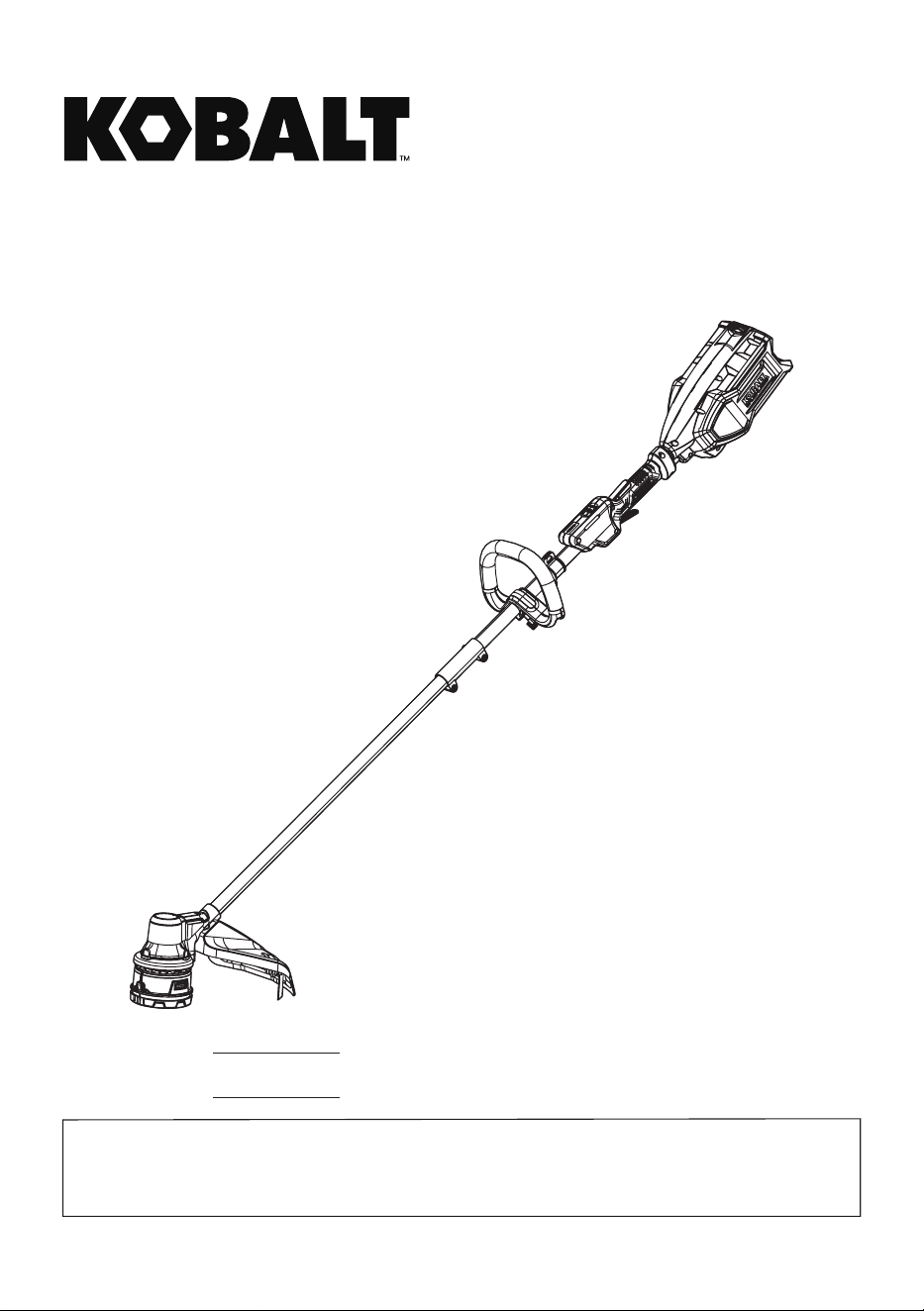
MODEL #KST 2180-06
80 V LITHIUM-ION
BRUSHLESS
STRING TRIMMER
Español p. 23
Thank you for purchasing this KOBALT product.
Questions, problems or missing parts?
Before returning, contact us on:
888-356-2258, 8 a.m. - 8 p.m., EST, Monday - Sunday or [email protected].
KOBALT and logo design are trademarks or
registered trademarks of LF, LLC. All rights
reserved.

2
TABLE OF CONTENTS
PRODUCT SPECIFICATIONS
Product Specications............................................................................................................................
Package Contents...................................................................................................................................
Hardware Contents.................................................................................................................................
Symbols..................................................................................................................................................
Safety Information...................................................................................................................................
Preparation.............................................................................................................................................
Assembly Instructions.............................................................................................................................
Operating Instructions.............................................................................................................................
Care and Maintenance............................................................................................................................
Troubleshooting......................................................................................................................................
Warranty.................................................................................................................................................
Replacement Parts List..........................................................................................................................
2
3
4
5
7
10
10
17
19
20
21
22
SPECIFICATIONS
Battery type 80 V Lithium-ion
No-load speed 4900 / 5800 RPM ± 10%
Cutting path 15 / 17 in. (381 / 432 mm)
Line diameter 0.095 in. (2.4 mm)
Cutting capacity Dual line
3
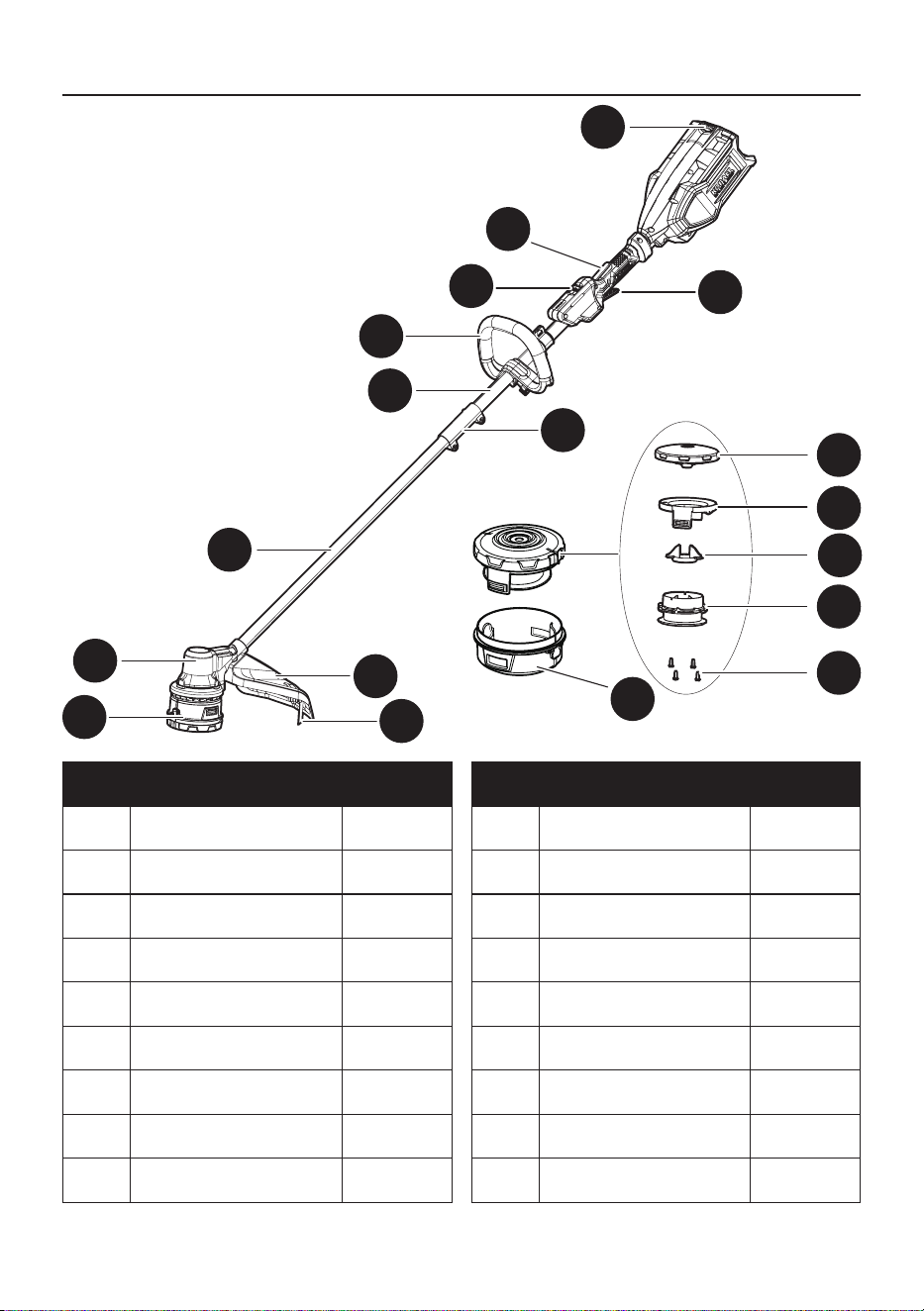
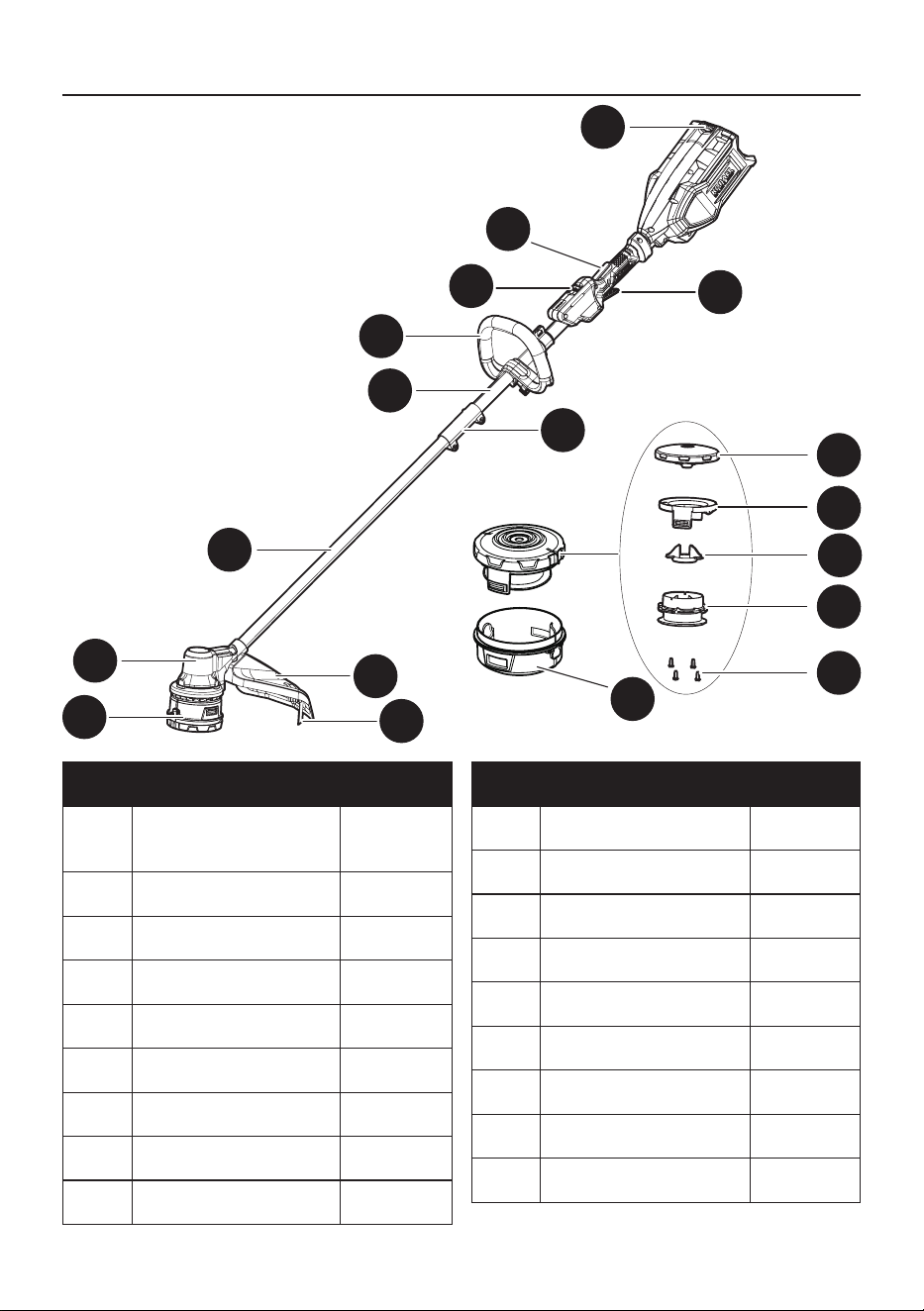
PACKAGE CONTENTS
PART DESCRIPTION QUANTITY
A Battery release button 1
B Trigger 1
C Lock-o lever 1
D Speed switch 1
E Front / Auxiliary handle 1
F Upper tube 1
G Coupler 1
H Lower tube 1
I Motor housing 1
PART DESCRIPTION QUANTITY
J String head 1
K Cut-o blade 1
L Guard 1
M Spool cover 1
N Location housing 1
O Slot cover 1
P Spool 1
Q Screw 4
R Spool housing 1
A
B
C
D
E
F
G
H
I
J
K
L
M
N
O
P
Q
R
4
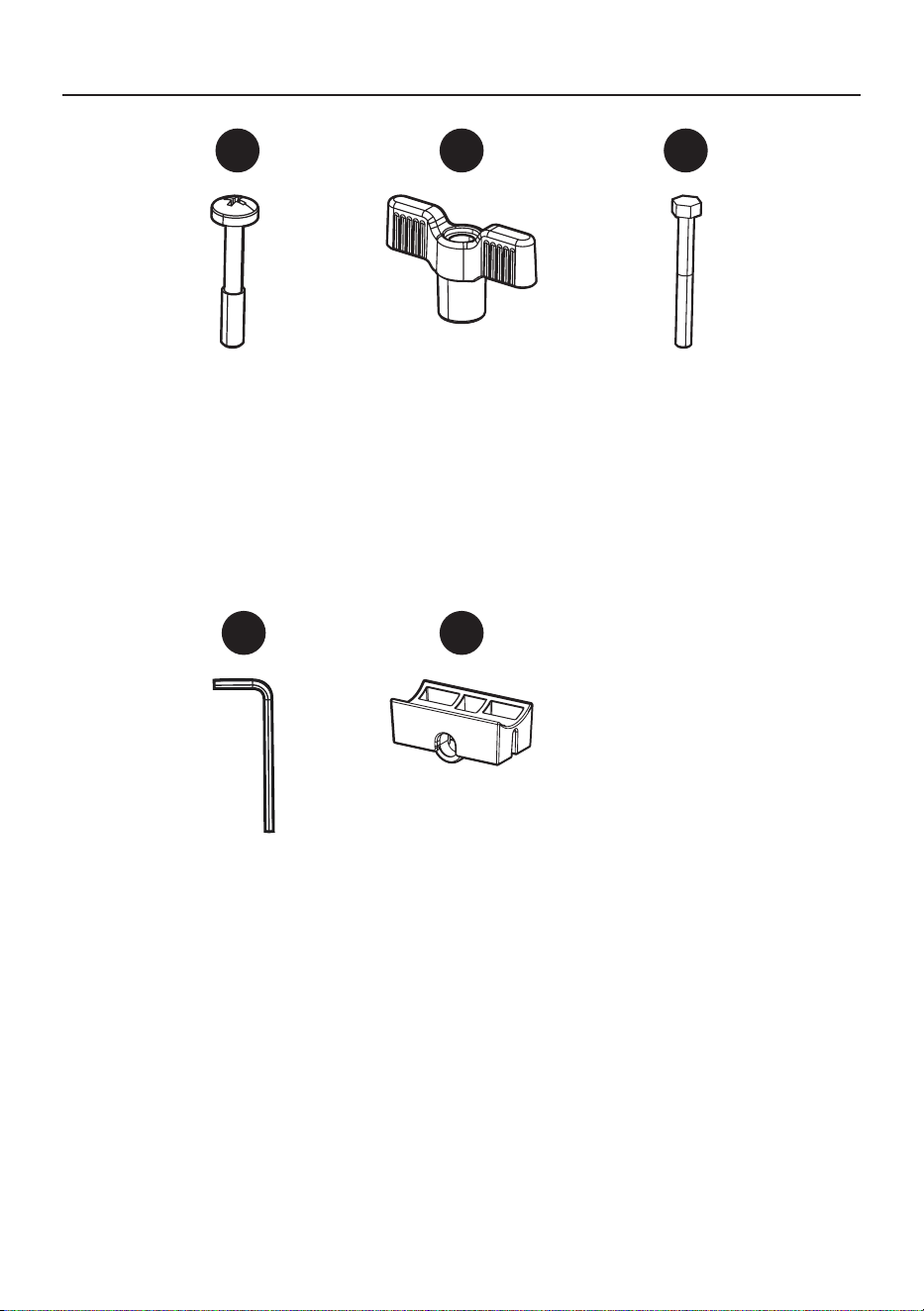
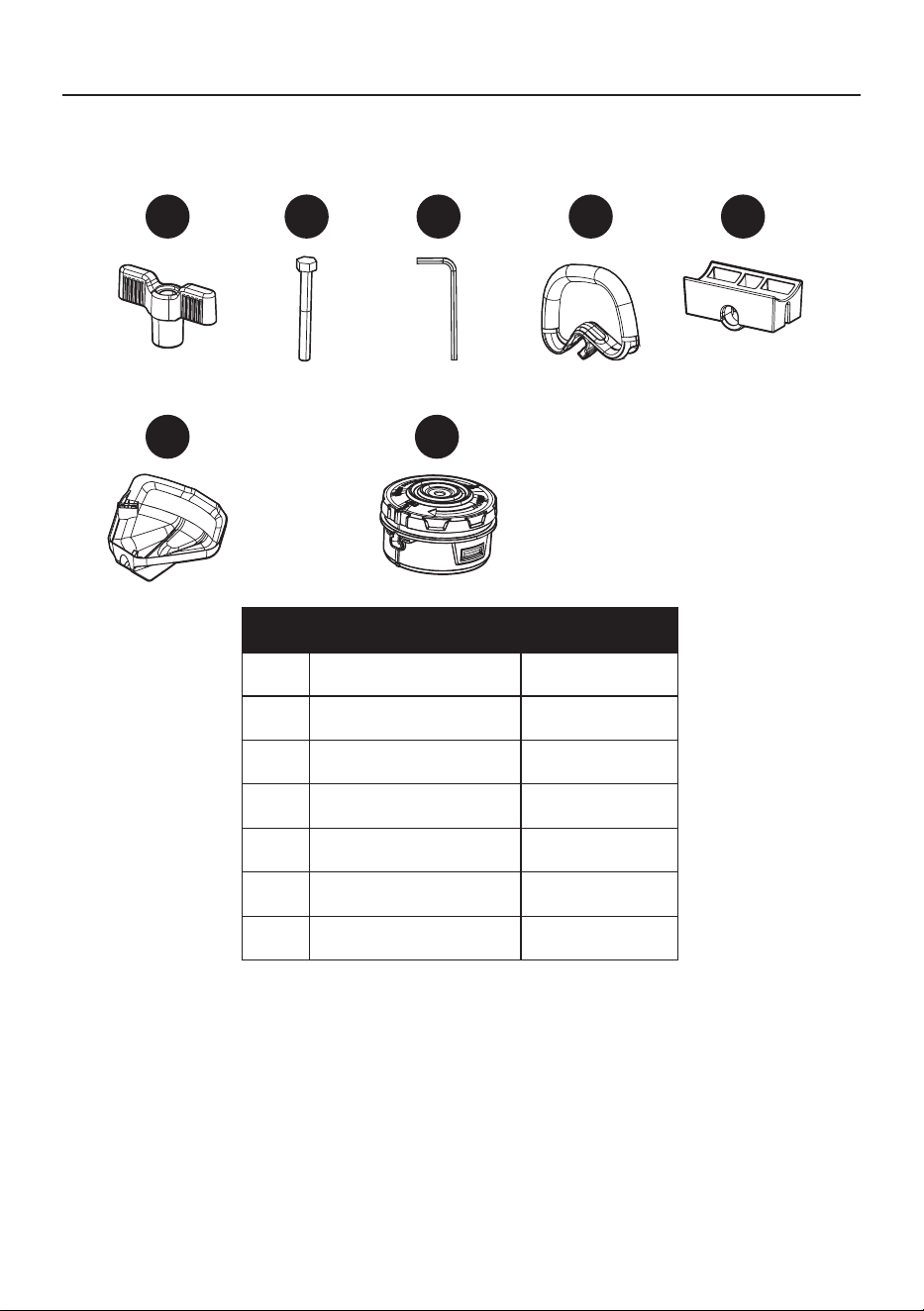
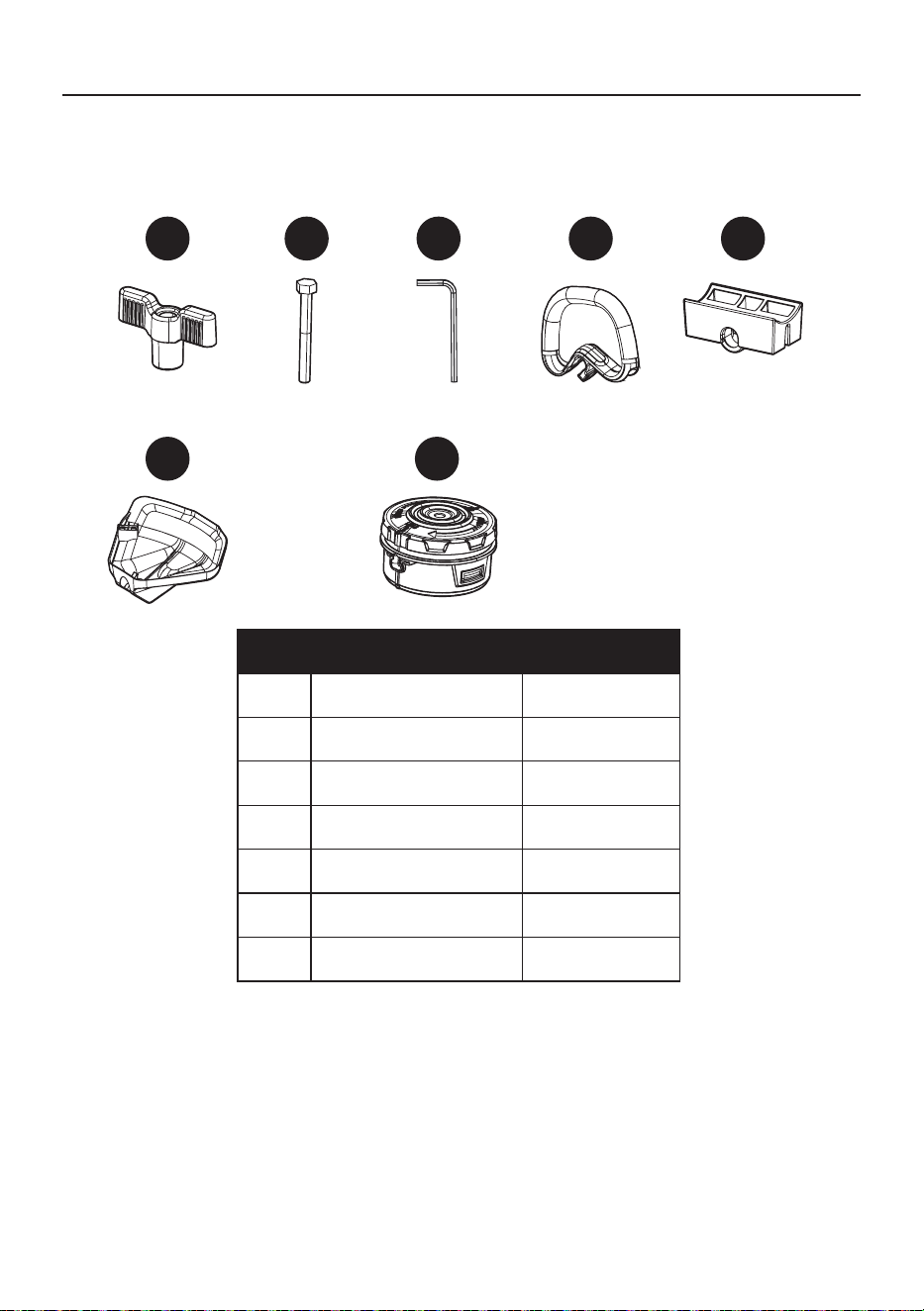
HARDWARE CONTENTS (Not to scale)
Screw
(preassembled to the Guard (L))
Qty. 2
Fastening
Knob
Qty. 1
Fixed Block
Qty. 1
Hex Wrench
Qty. 1
Bolt
Qty. 1
AA
DD
BB
EE
CC
5
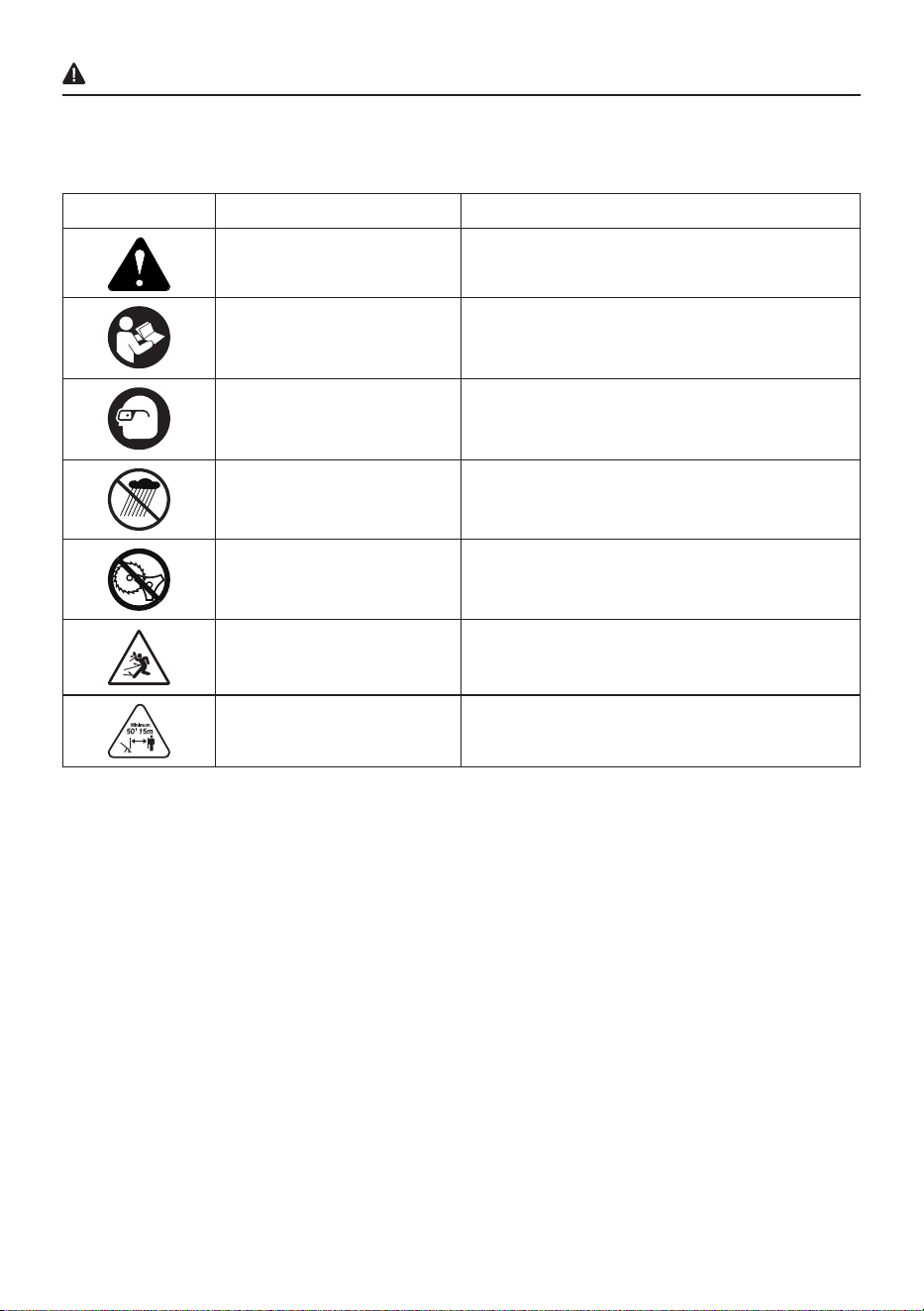
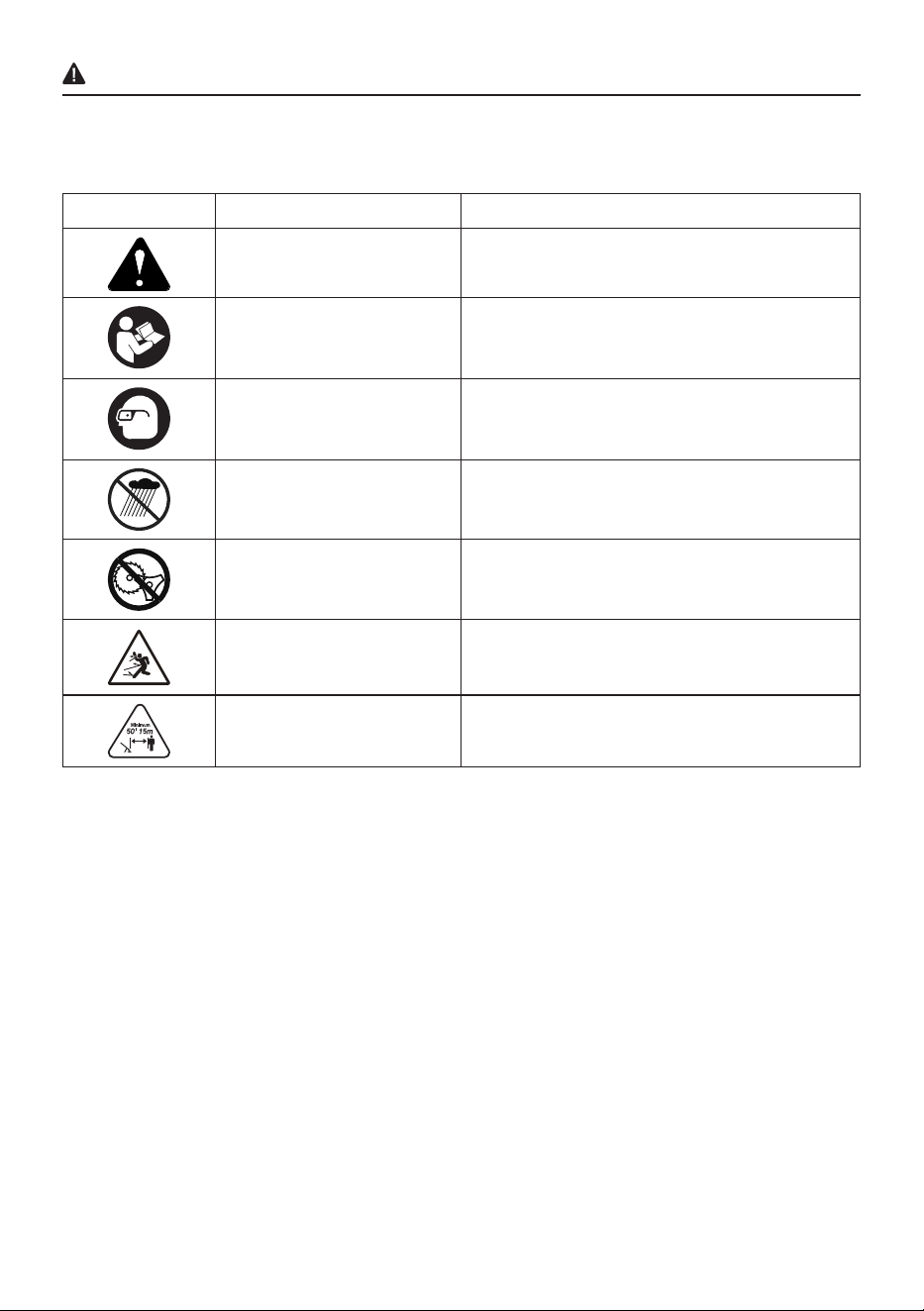
SYMBOLS
Some of the following symbols may be used on this product. Please study them and learn their
meaning. Proper interpretation of these symbols will allow you to operate the product better and safer.
SYMBOLS DESIGNATION EXPLANATION
Safety Alert Indicates a potential personal injury hazard.
Read The Operator’s Manual
To reduce the risk of injury, user must read and
understand operator’s manual before using this
product.
Eye Protection
Always wear eye protection with side shields
marked to comply with ANSI Z87.1.
Wet Conditions Alert Do not expose to rain or use in damp locations.
No Blade
Do not install or use any type of blade on a
product displaying this symbol.
Ricochet
Thrown objects can ricochet and result in
personal injury or property damage.
Keep Bystanders Away Keep all bystanders at least 50 ft. (15 M) away.
6
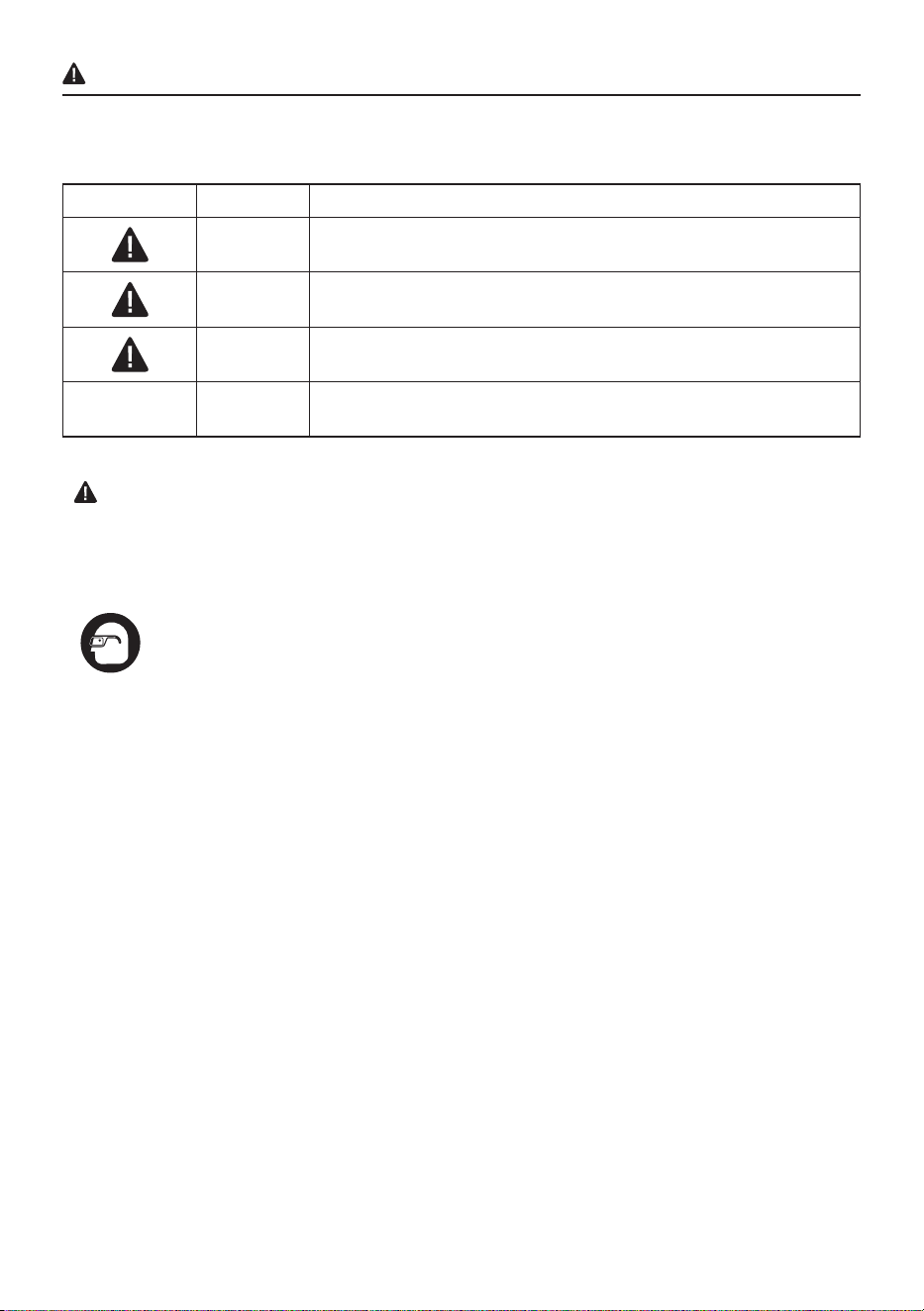
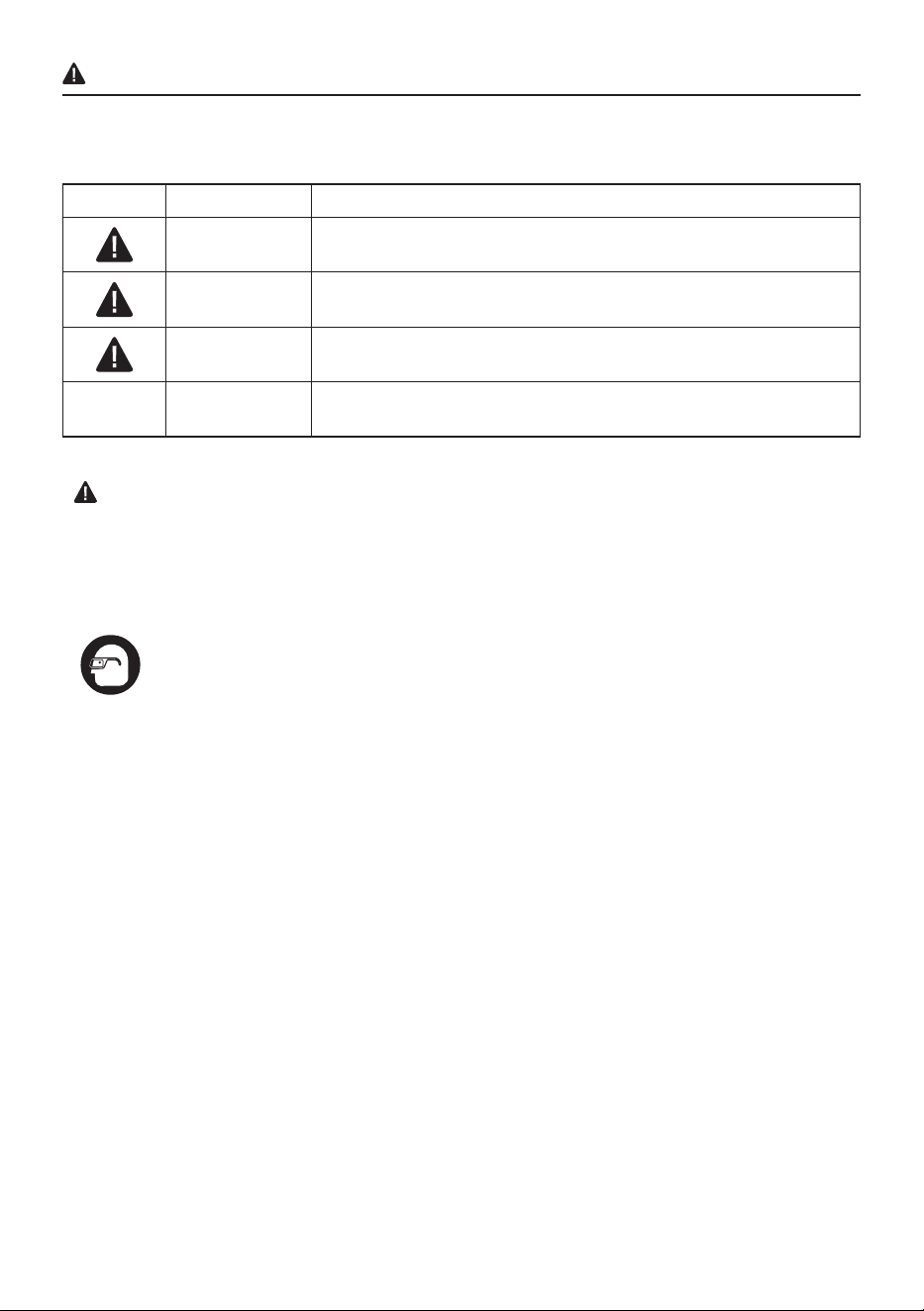
SYMBOLS
The following signal words and meanings are intended to explain the levels of risk associated with this
product.
SYMBOL SIGNAL MEANING
DANGER
Indicates an imminently hazardous situation, which, if not avoided,
will result in death or serious injury.
WARNING
Indicates a potentially hazardous situation, which, if not avoided,
could result in death or serious injury.
CAUTION
Indicates a potentially hazardous situation, which, if not avoided,
may result in minor or moderate injury.
CAUTION
(Without Safety Alert Symbol) Indicates a situation that may result in
property damage.
WARNING
• To avoid serious personal injury, do not attempt to use this product until you have read this owner’s
manual thoroughly and understand it completely. If you do not understand the warnings and
instructions in this owner’s manual, do not use this product. Call 888-356-2258 for assistance.
•
The operation of any product can result in foreign objects being thrown into your eyes,
which can result in severe eye damage. Before operating a product, always wear safety
goggles, safety glasses with side shields, or a full-face shield when needed. A Wide Vision
Safety Mask is recommended for use over eyeglasses or standard safety glasses with side
shields. Always use eye protection that is marked to comply with ANSI Z87.1.
SAVE THESE INSTRUCTIONS

7
SAFETY INFORMATION
WARNING
• Do not operate power tools in explosive atmospheres, such as in the presence of ammable liquids,
gases, or dust. Power tools create sparks that may ignite the dust or fumes.
• Do not allow children or untrained individuals to use this unit.
• Don’t expose power tools to rain or wet conditions. Water entering a power tool will increase the risk of
electric shock.
• Do not handle battery or tool with wet hands.
• Never allow children to operate the equipment. Never allow adults to operate the equipment without
proper instruction.
• Always wear safety glasses with side shields that are marked to comply with ANSI Z87.1. Everyday
glasses have only impact resistant lenses. They are NOT safety glasses. Following this rule will
reduce the risk of eye injury. Use face mask if operation is dusty.
• Don’t use in the rain. Store indoors.
• Do not operate in poor lighting.
• Keep all parts of your body away from any moving part.
• Prevent unintentional starting. Ensure the switch is in the o-position before connecting to battery
pack, picking up or carrying the appliance. Carrying the appliance with your nger on the switch or
energizing appliance that have the switch on invites accidents.
• Do not force tool. Use the correct tool for your application. The correct tool will do the job better and
safer at the rate for which it is designed.
• Do not operate the equipment while bare foot or when wearing sandals or similar lightweight footwear.
Wear protective footwear that will protect your feet and improve your footing on slippery surfaces.
• Keep rm footing and balance. Do not overreach. Overreaching can result in loss of balance.
• Check Damaged Parts – Before further use of the appliance, a guard or other part that is damaged
should be carefully checked to determine that it will operate properly and perform its intended function.
Check for alignment of moving parts, binding of moving parts, breakage of parts, mounting and any
other condition that may aect its operation. A guard or other part that is damaged should, be properly
repaired or replaced by an authorized service center unless indicated elsewhere in this manual.
• Keep guards in place and in working order.
• Keep hands and feet away from cutting area.
• Do not allow to be used as a toy. Close attention is necessary when used by or near children.
• Do not use tool if switch does not turn it on or o. Any tool that cannot be controlled with the switch is
dangerous and must be repaired.
• Keep all bystanders, children, and pets at least 50 ft. away.
• Do not operate this unit when you are tired, ill, or under the inuence of alcohol, drugs, or medication.
• Do not put any object into openings. Do not use with any opening blocked; keep openings free.
• Check the work area before each use. Remove all objects such as rocks, broken glass, nails, wire, or
string which can be thrown or become entangled in the machine.
• Use only identical manufacturer’s replacement parts and accessories. Use of any other parts may
create a hazard or cause product damage.
• Do not charge battery in the rain, or damp or wet locations. Following this rule will reduce the risk of
electric shock.
• For household use only.
• Battery tools do not have to be plugged into an electrical outlet; therefore, they are always in
Read and understand all instructions. Failure to follow all instructions listed below may result
in electric shock, re, and/or serious personal injury.
Please read and understand this entire manual before attempting to assemble, operate or install the
product.

8
SAFETY INFORMATION
operating condition. Be aware of possible hazards when not using your battery tool or when changing
accessories. Following this rule will reduce the risk of electric shock, re, or serious personal injury.
• Remove or disconnect battery before servicing, cleaning or removing material from the gardening
appliance.
• Use only KOBALT 80-volt batteries. (KB 280C-06, KB 2580C-06, KB 480-06, KB 580C-06, KB 680C-
06).
• Use only KOBALT 80-volt charger. (KRC 0280-06, KRC 30-06, KDC 50-06).
• Use appliance only with specially designated battery packs. Use of any other battery packs may
create a risk of injury and re.
• Store idle appliances - When not in use, the string trimmer should be stored indoors in a dry, locked
place out of the reach of children.
• Do not dispose batteries in a re. The cell may explode. Check with local codes for possible special
disposal instructions.
• Do not open or mutilate the batteries. Released electrolyte is corrosive and may cause damages to
the eyes or skin. It may be toxic if swallowed.
• Do not place battery tools or their batteries near re or heat. This will reduce the risk of explosion and
possibly injury.
• Batteries can explode in the presence of a source of ignition, such as pilot light. To reduce the risk
of serious personal injury, never use any cordless product in the presence of an open ame. An
exploded battery can propel debris and chemicals. If exposed, ush with water immediately.
• Do not crush, drop or damage battery. Do noy use a battery or charger that has been dropped or
received a sharp blow. A damaged battery is subject to explosion. Properly dispose a dropped or
damaged battery immediately.
• Exercise care in handling batteries in order not to short the battery with conducting materials such as
rings, bracelets, and keys. The battery or conductor may overheat and cause burns.
• Under extreme usage or temperature conditions, battery leakage may occur. If liquid comes in contact
with your skin, wash immediately with soap and water, then neutralize with lemon juice or vinegar. If
liquid gets into your eyes, ush them with clean water for at least 10 minutes, then seek immediate
medical attention. Following this rule will reduce the risk of serious personal injury.
• If the charger power supply cord is damaged, it must be replaced only by the manufacturer or by an
authorized service center to avoid risk.
• Do not point the string trimmer in the direction of people or pets.
• When not in use, the string trimmer should be stored indoors in a dry, locked up place out of the reach
of children.
• Maintain tool with care. Keep all vents and openings clean and clear of debris. Follow instructions for
proper maintenance. Do not attempt to clear clogs from tool without rst switching it o and removing
the battery.
• Dress Properly – Do not wear loose clothing or jewelry. They can be caught in moving parts. Use of
rubber gloves and substantial footwear is recommended when working outdoors. Wear protective hair
covering to contain long hair.
• Use the Correct Appliance – Do not use appliance for any job except that for which it is intended.
• When battery pack is not in use, keep it away from other metal objects like paper clips, coins, keys,
nails, screws or other small metal objects that can make a connection from one terminal to another.
Shorting the battery terminals together may cause burns or a re.
• Do not expose a battery pack or appliance to re or excessive temperature. Exposure to re or
temperature above 265°F may cause explosion.
• Follow all charging instructions and do not charge the battery pack or appliance outside of the
temperature range specied in the instructions. Charging improperly or at temperatures outside of the
specied range may damage the battery and increase the risk of re.
• Have servicing performed by a qualied repair person using only identical replacement parts. This will
ensure that the safety of the product is maintained.

9
SAFETY INFORMATION
• Do not modify or attempt to repair the appliance or the battery pack (as applicable) except as
indicated in the instructions for use and care.
• Ambient temperature range:
- String trimmer storage temperature range: -4°F (-20°C) - 158°F (70°C)
- String trimmer operation temperature range: -4°F (-20°C) - 104°F (40°C)
- Battery charging temperature range: 39°F (4°C) - 104°F (40°C)
- Charger operation temperature range: 39°F (4°C) - 113°F (45°C)
- Battery storage temperature range: 1 year: 32°F (0°C) - 73°F(23°C)
3 month: 32°F (0°C) -113°F (45°C)
1 month: 32°F (0°C) -140°F (60°C)
- Battery discharging temperature range: 6.8°F (-14°C) - 113°F (45°C)
Child safety
Tragic accidents can occur if the operator is not aware of the presence of children.
• Keep children out of the working area and under the watchful care of a responsible adult.
• Do not allow children under the age of 14 to operate this trimmer. Children who are 14 years of age or
older must read and understand the operating instructions and safety rules in this manual and must be
trained and supervised by a parent.
• Stay alert and turn the trimmer o if a child or any other person enters the working area.
• Look behind and down for small children before and while cutting backwards.
• Use extreme care when approaching blind corners, doorways, shrubs, trees, or other objects that may
obscure your view of a child who may run into the path of the trimmer.
SAVE THESE INSTRUCTIONS
WARNING (PROPOSITION 65)
Some dust created by power sanding, sawing, grinding, drilling, and other construction activities
contains chemicals known to cause cancer, birth defects or other reproductive harm. Some
examples of these chemicals are:
• Lead from lead-based paints.
• Crystalline silica from bricks and cement and other masonry products, and
• Arsenic and chromium from chemically treated lumber.
Your risk of exposure to these chemicals varies depending on how often you do this type of work.
To reduce your exposure to these chemicals, work in a well-ventilated area, and work with approved
safety equipment, such as dust masks that are specially designed to lter out microscopic particles.
SERVICE
Servicing requires extreme care and knowledge and should be performed only by a qualied service
technician. For service, it is suggested you return the product to your nearest AUTHORIZED SERVICE
DEPARTMENT for repair. When servicing, use only identical replacement parts.
10
PREPARATION
Before beginning assembly of product, make sure all parts are present. Compare parts with package
contents list and hardware contents list. If any part is missing or damaged, do not attempt to assemble
the product.
Estimated Assembly Time: 5 - 10 minutes
Tools Required for Assembly (not included): Phillips Screwdriver
ASSEMBLY INSTRUCTIONS
WARNING
To avoid injury and to reduce the risk of electrical shock or re:
• Replace the battery or charger immediately if the battery case or charger cord is damaged.
• Always make sure the string trimmer switch is OFF before inserting or removing the battery.
• Always make sure the battery is removed and the switch is turned OFF before inspecting, adjusting,
or maintaining any other part of the string trimmer.
• Read, understand, and follow the Battery Charger instructions.
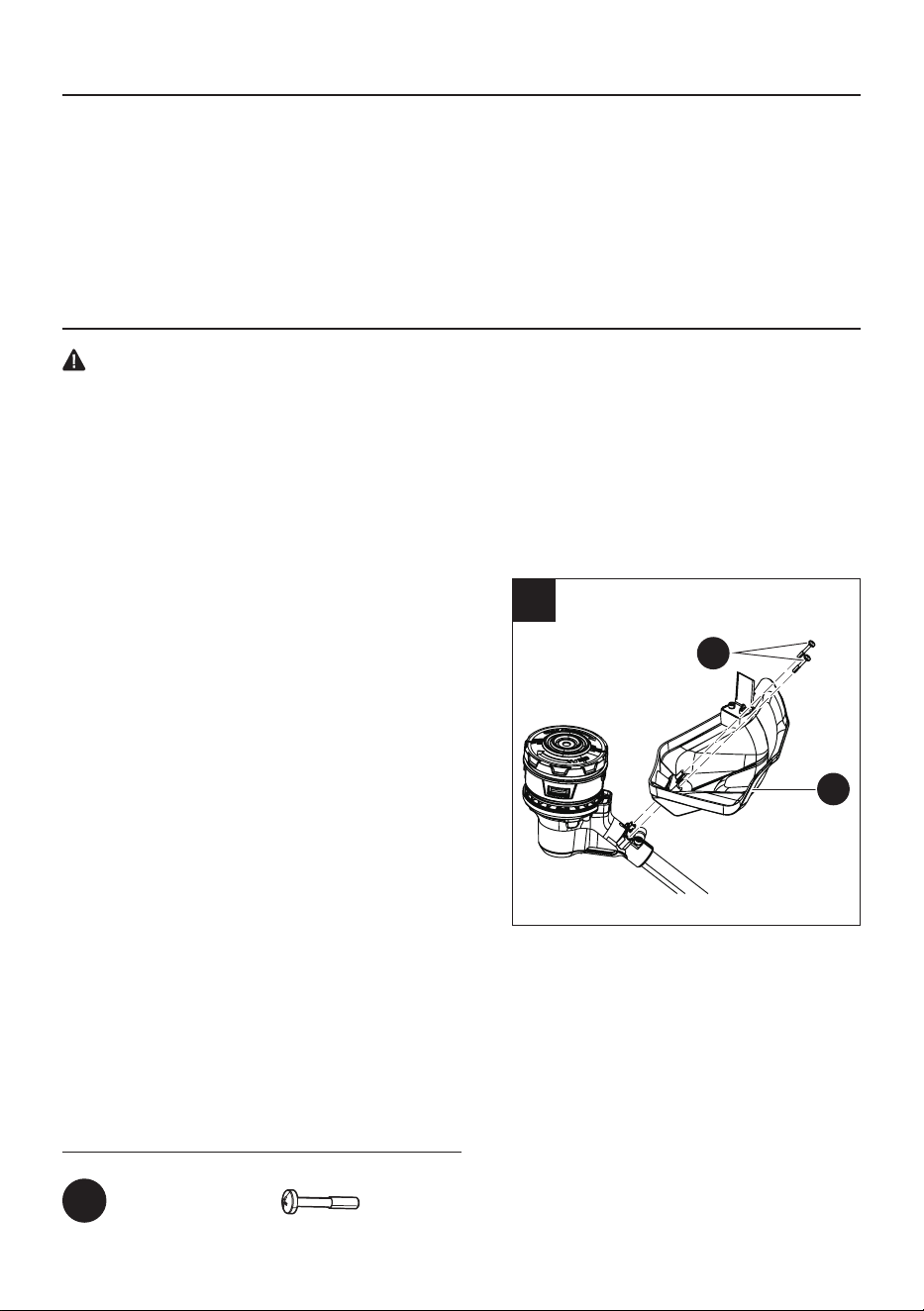
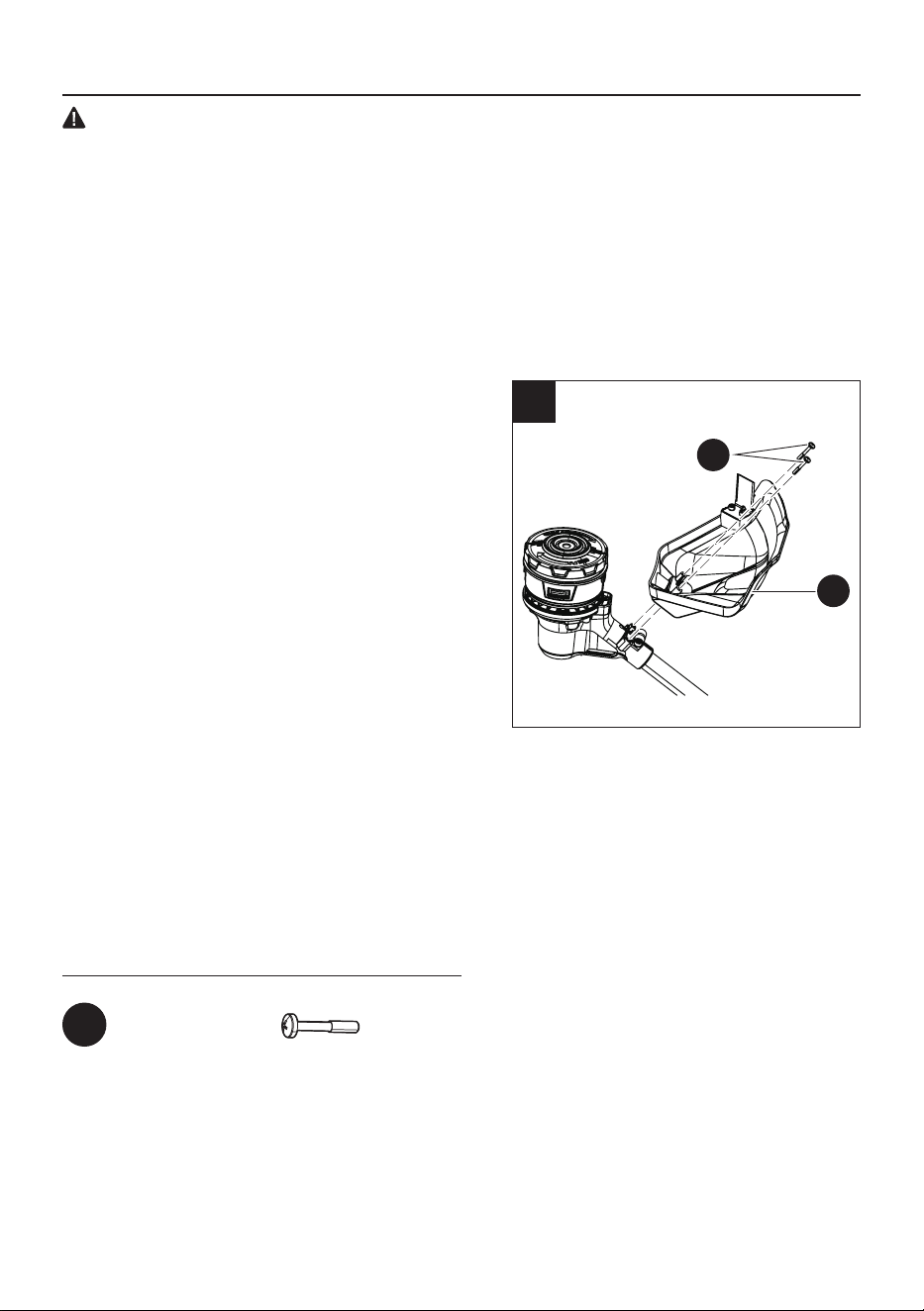
1. Installing the guard
1
CAUTION
To avoid injury, always remove the battery before
installing the guard, changing a cutting line, or
making any adjustments. If the guard is damaged,
do not use the grass trimmer until it is replaced.
Note: Install the protective guard before
operating the grass trimmer. It should not be
removed or disassembled.
• Invert the grass trimmer to access the trimmer
head.
• Using a phillips head screwdriver (not included),
remove the pre-installed screws (AA) from the
trimmer guard.
• Place the guard (L) onto the trimmer head.
• Align the screw holes on the guard with the screw
holes on the trimmer head.
• Insert the screws into the trimmer head and
tighten to fasten the guard in place.
AA
L
Hardware Used
Screw x 2
AA
11
ASSEMBLY INSTRUCTIONS
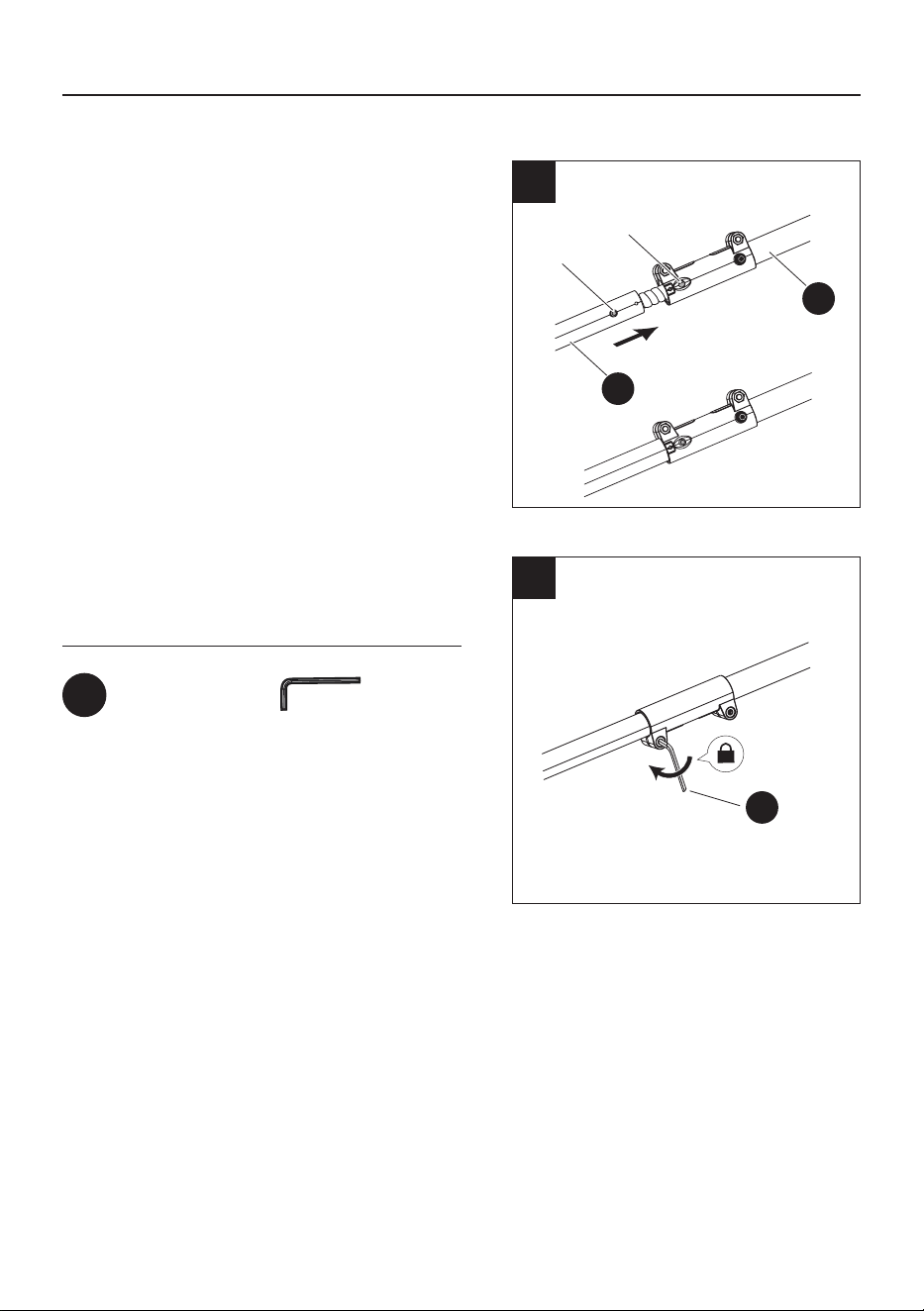
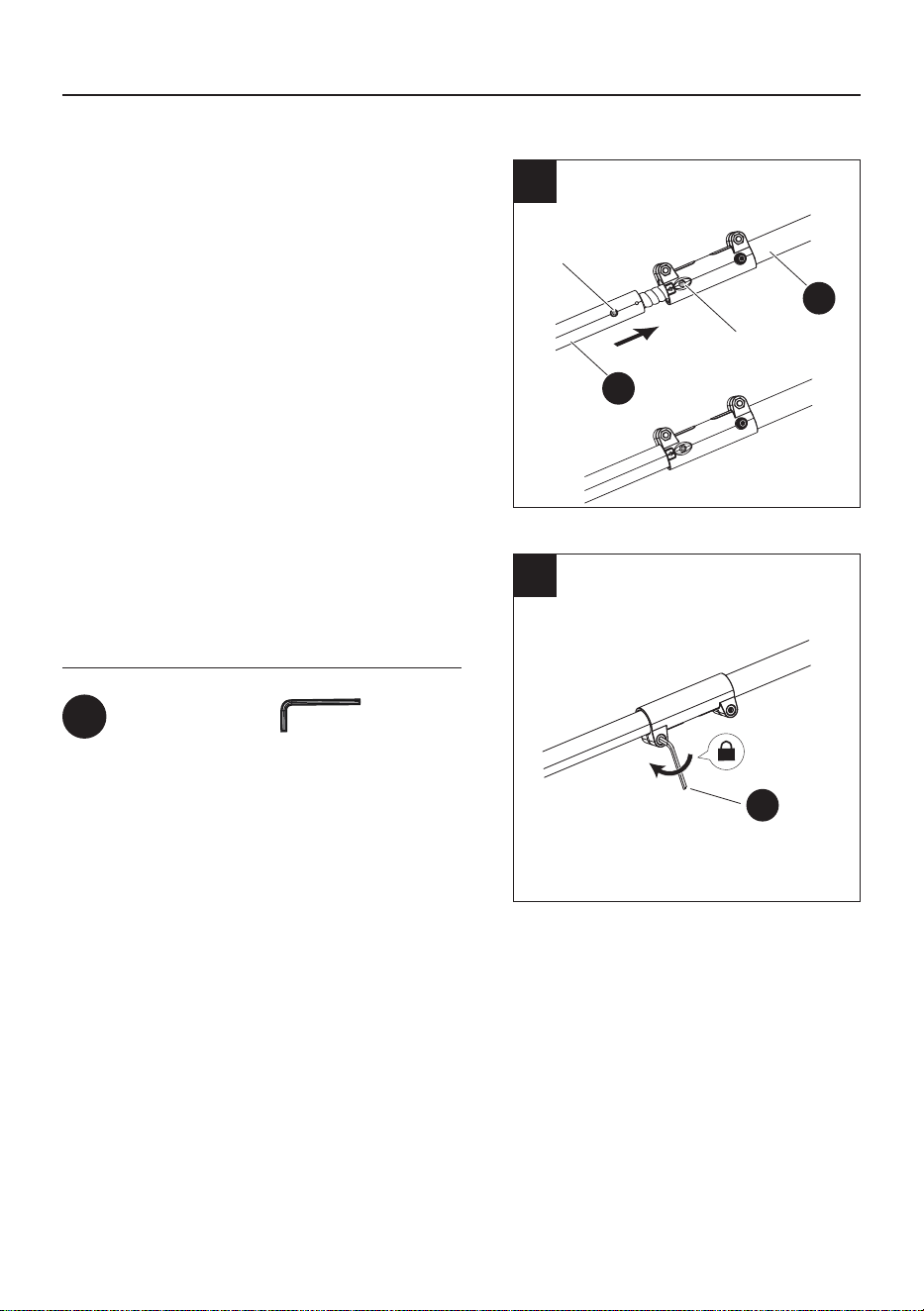
2a
2. Connecting upper / lower trimmer tubes
Hardware Used
Hex Wrench x 1
DD
H
F
DD
Release button
Positioning hole
2a. Push in the release button located on the lower
tube (H).
• Align the release button with the positioning hole
on the upper tube (F) and slide the two tubes
together.
• Rotate the lower tube until the release button
locks into the positioning hole.
2b
2b. Tighten the screw with the hex wrench (DD).
12
ASSEMBLY INSTRUCTIONS
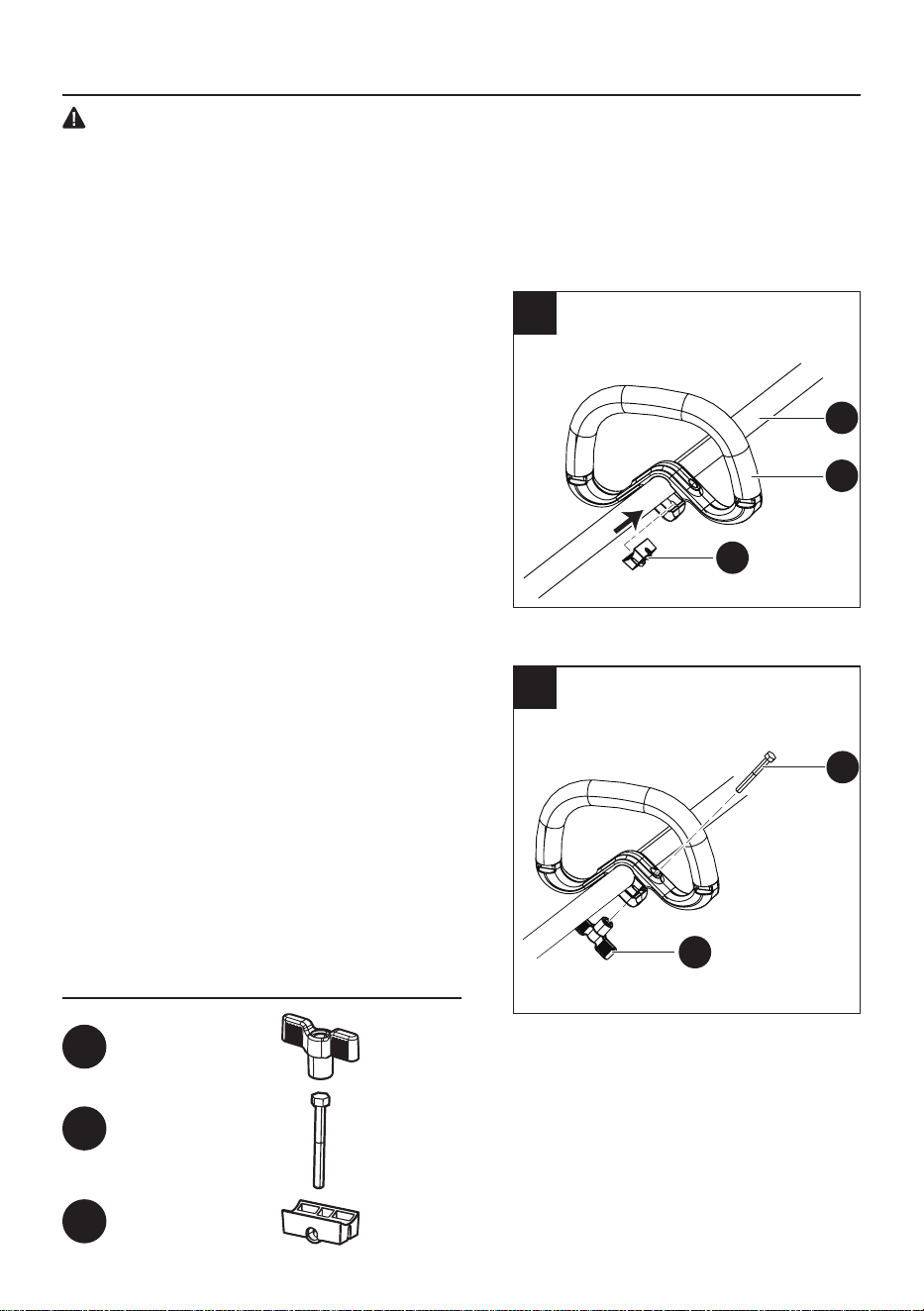
3a
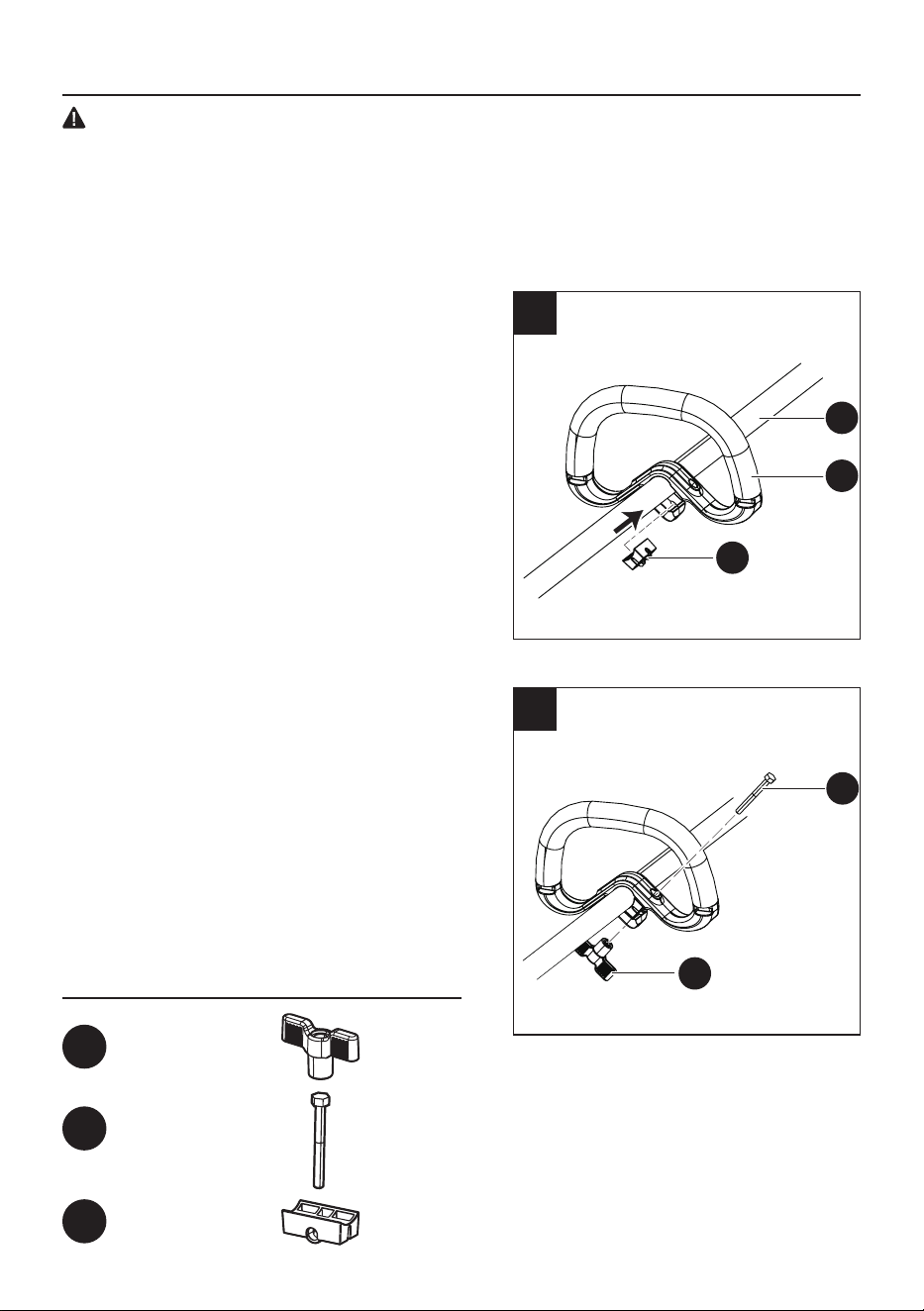
3. Installing the front / auxiliary handle
3a. Position the front / auxiliary handle (E) onto the
upper tube (F).
• Place the xed block (EE) into the slot on the
handle.
3b. Align the hole on the handle with the hole on
the xed block, then slide the bolt (CC) through
the top of the handle and secure with the
fastening knob (BB).
• The front handle can be adjusted to a suitable
position.
• Tighten until there is no movement in the
handle.
Note: Do not overtighten the fastening knob. It
could cause the xed block to break.
Hardware Used
Fastening Knob x 1
BB
WARNING
To avoid injury, adjust the auxiliary handle for optimum control and balance. Do not overreach when
operating grass trimmer. Keep proper balance at all times for better control of the tool in unexpected
situations.
3b
F
E
EE
Bolt x 1
CC
Fixed Block x 1
EE
CC
BB
13
ASSEMBLY INSTRUCTIONS
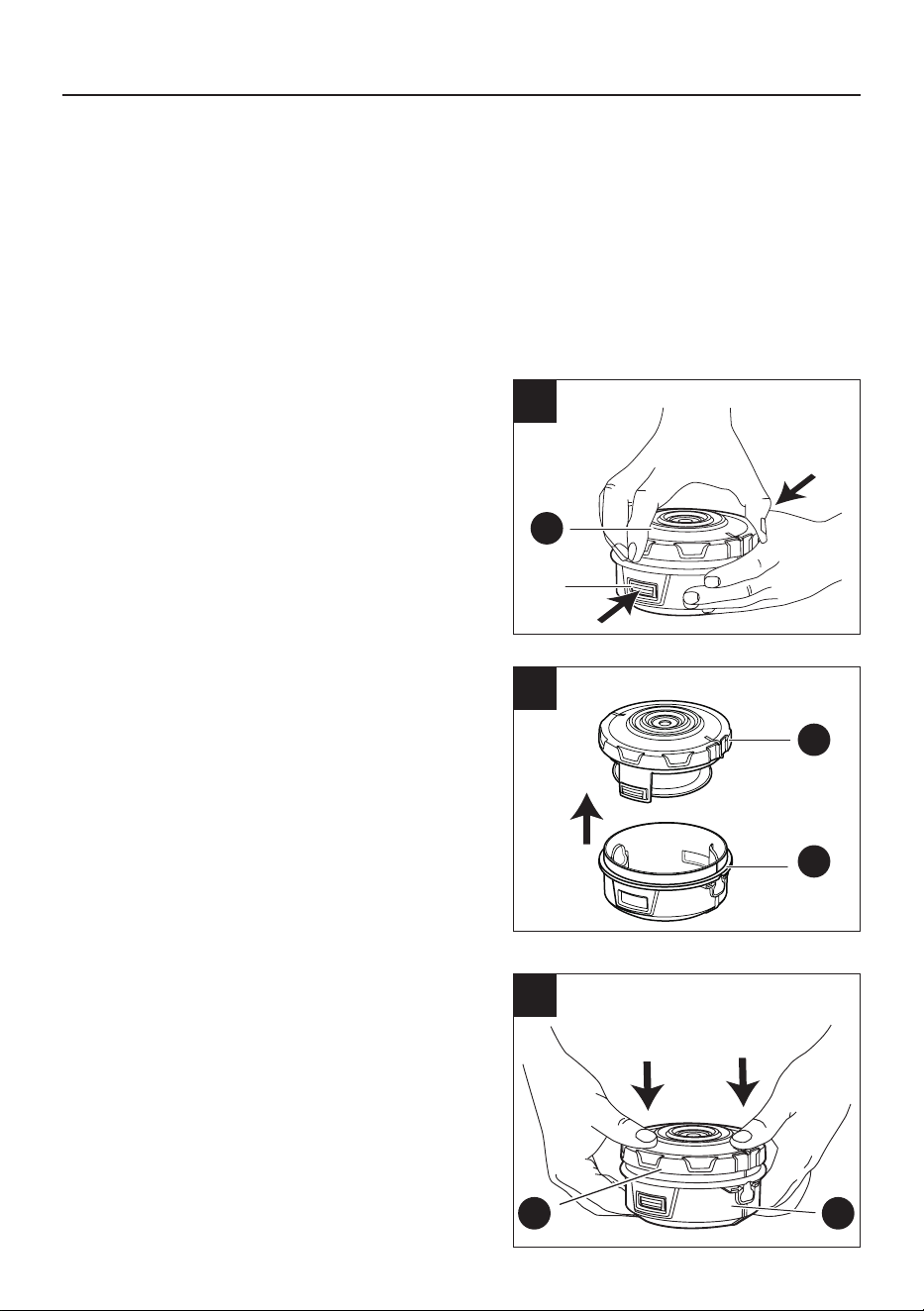
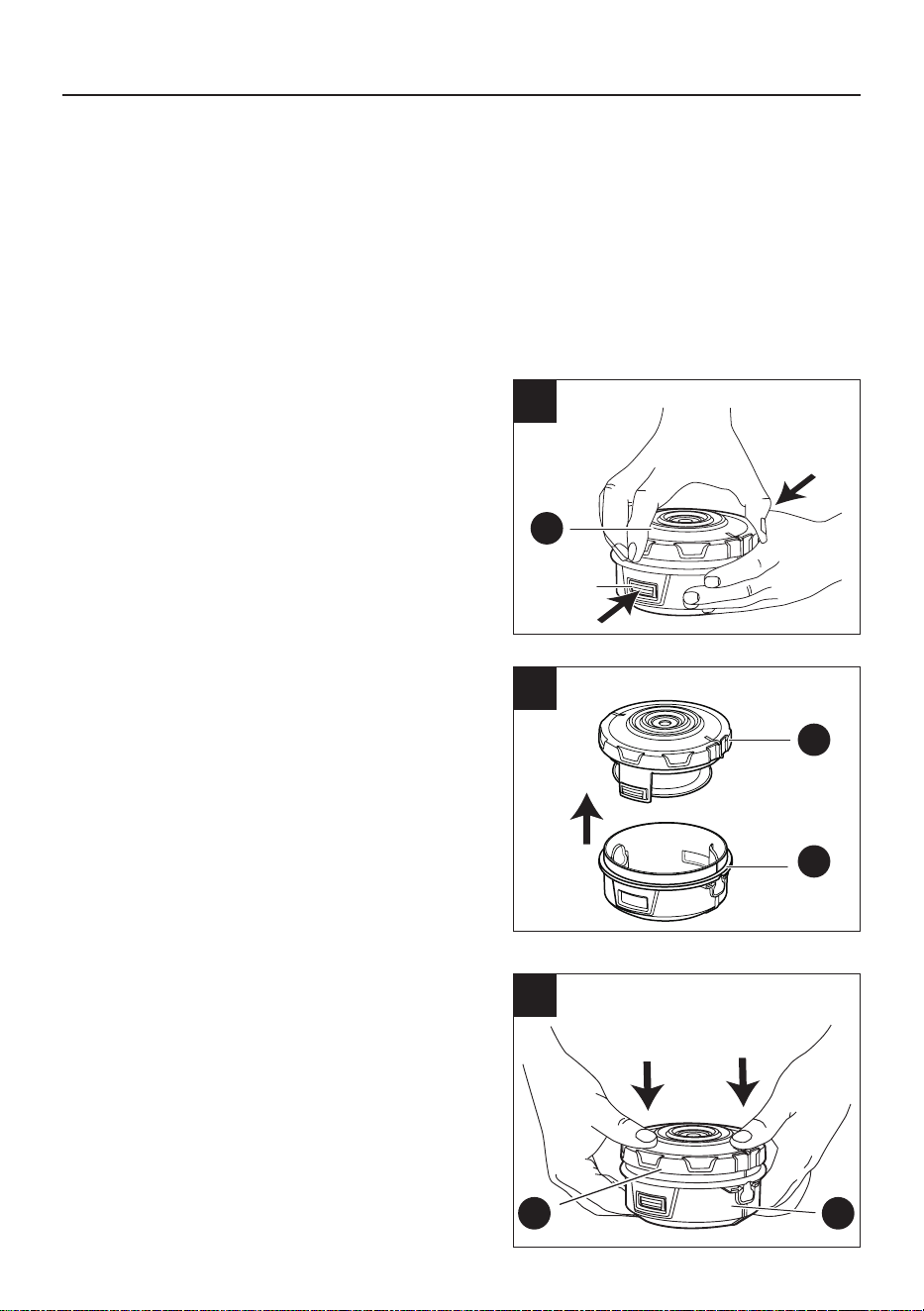
4. Removing / installing the cutting line
A spool of cutting line is pre-installed on the trimmer. When the cutting line needs replacing, rewind
new line onto existing spool.
CAUTION
To avoid injury, always remove the battery before installing the guard, changing a cutting line, or
making any adjustments.
To remove the cutting line
4a. Turn the string trimmer over to access the
spool.
• Remove the spool cover (M) by pressing on the
two tabs parallel to each other on the sides of
the spool cover.
4b. Remove the spool cover (M) from the spool
housing (R) and remove any excess line.
4c. Reinstall the spool cover (M) and spool housing
(R).
4a
4b
M
R
4c
M
Tab
M R
14
ASSEMBLY INSTRUCTIONS
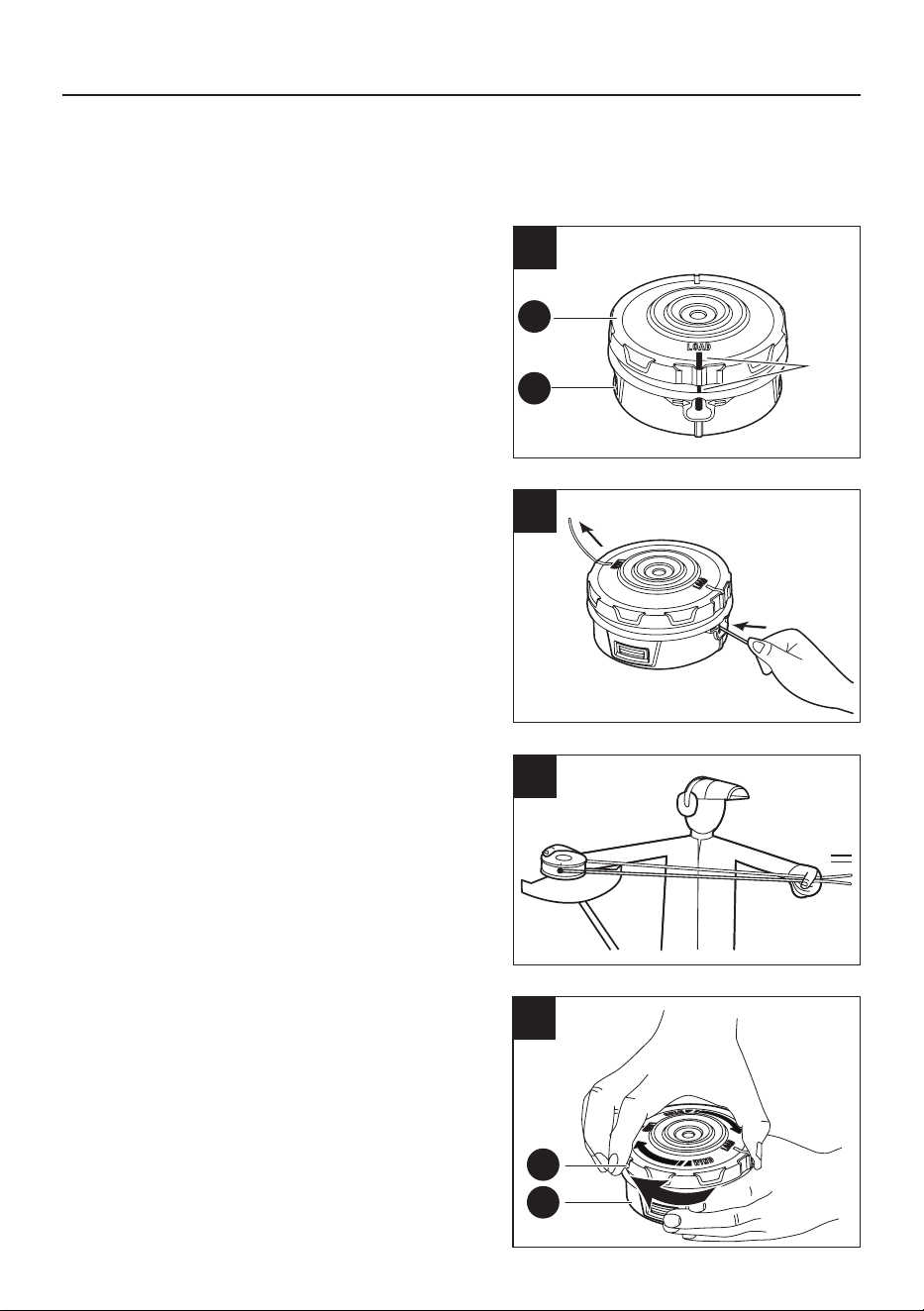
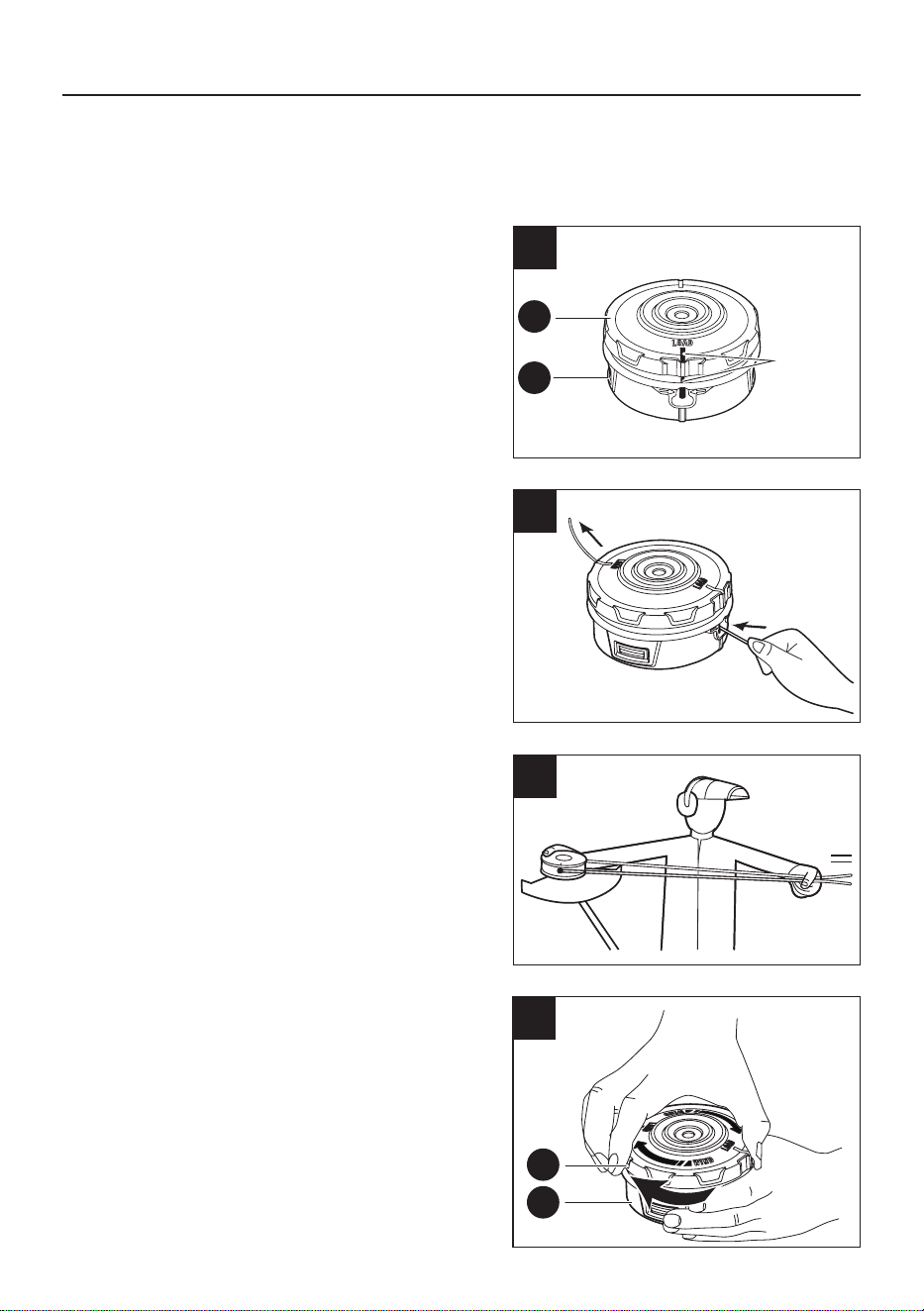
To Install the cutting line
Note: For 0.095 in. (2.4 mm) nylon line, do not
put more than 23 feet (7 m) of cutting line in at
a time.
4d. Line up the slots on the spool cover (M) with the
slots on the spool housing (R).
4e. Insert line through the eyelet. Push line until it
exits the opposite string head hole.
4f. Pull the line through until there is an equal
amount of line on each side.
4g. Push and turn the spool cover (M) clockwise to
wind the string into the string head (J). Leave
approximately 5 inches (13 mm) of string
protruding out of each side of the head.
4d
M
R
4e
4f
4g
M
J
Slots
15
ASSEMBLY INSTRUCTIONS
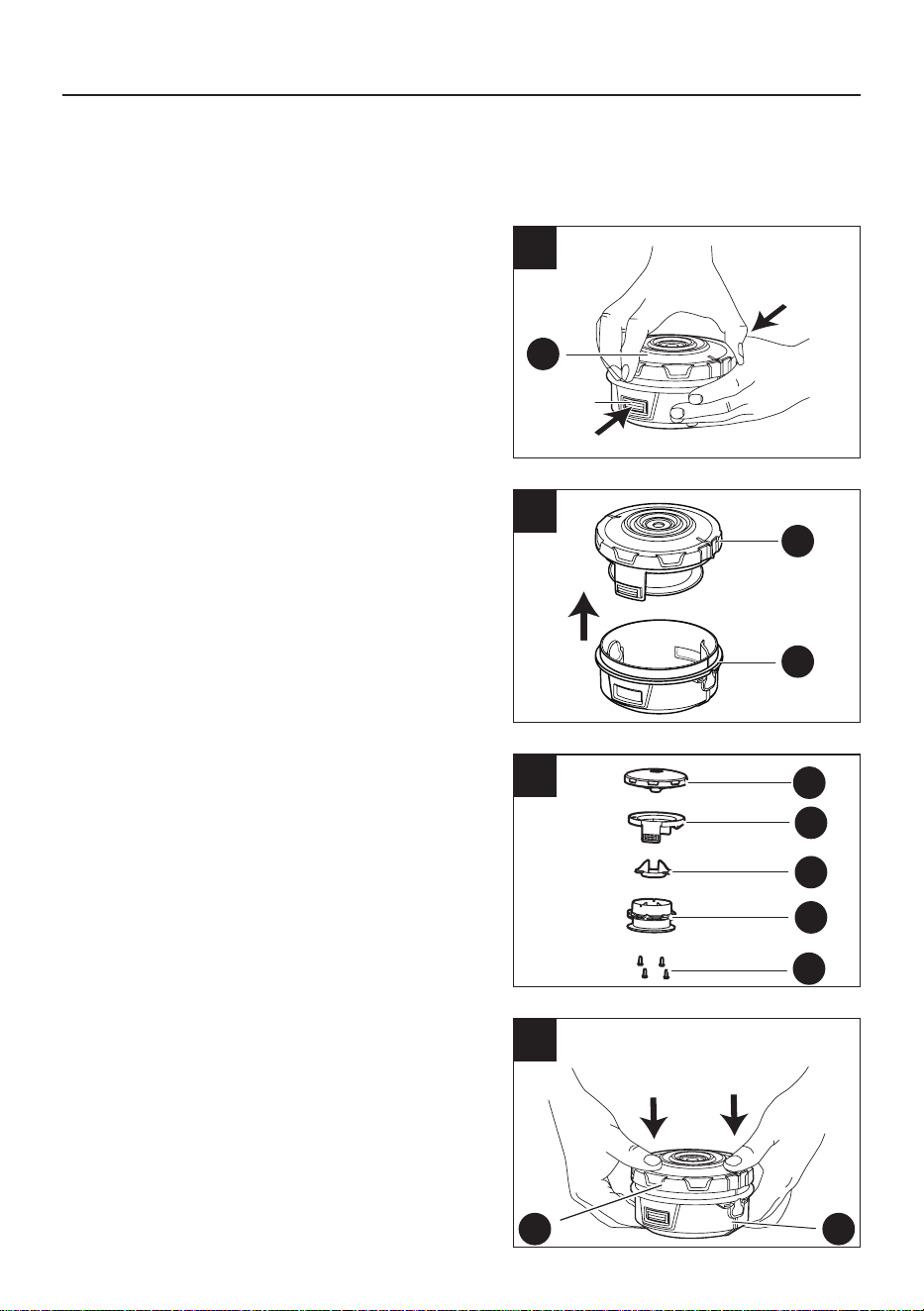
5a
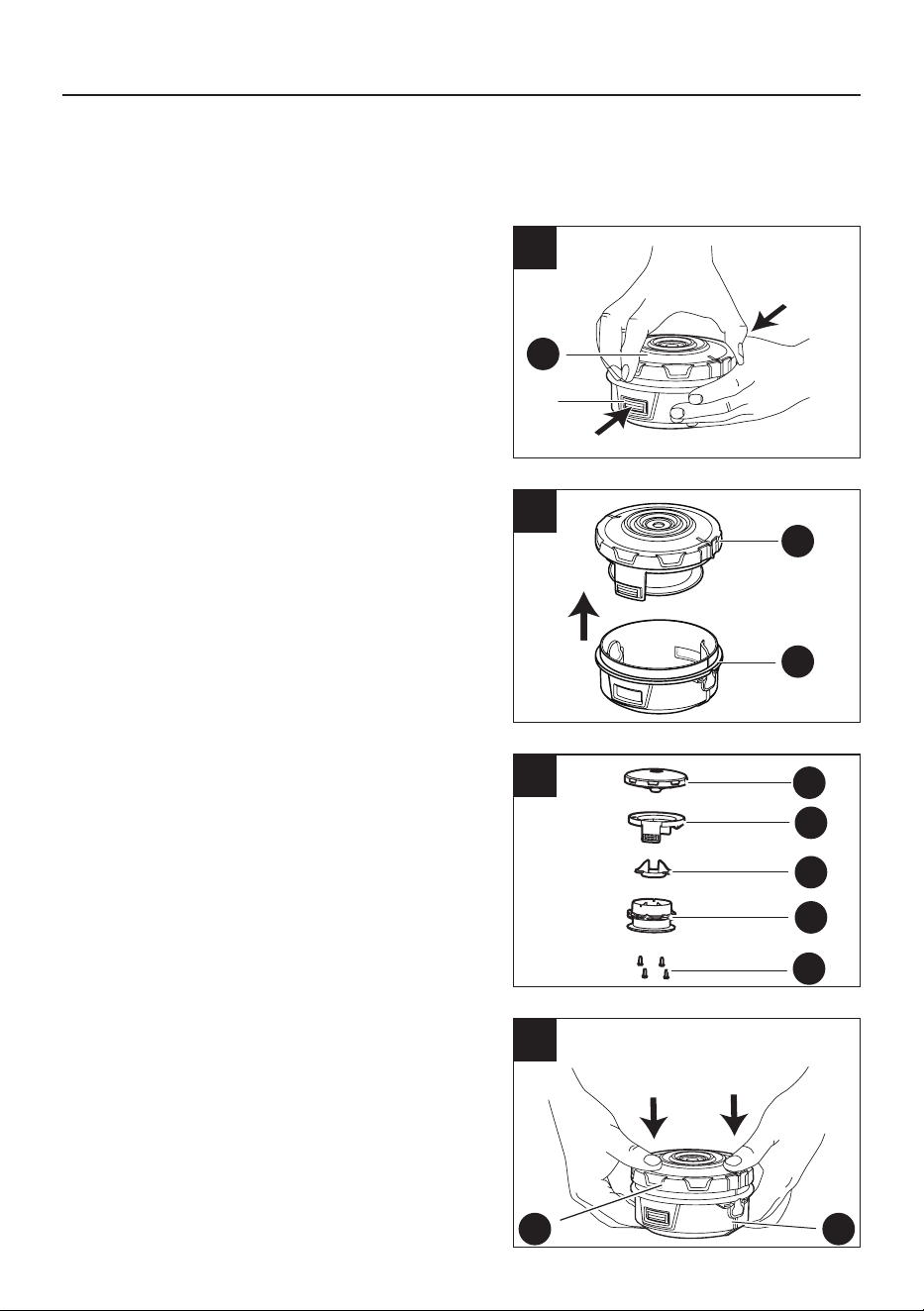
5. Replacing the spool
Note: For normal use, head disassembly is not necessary. However, if circumstances require
disassembly, follow these instructions.
5b
M
R
5c
M
N
O
P
Q
5d
Tab
M
M R
5a. Turn the string trimmer over to access the spool.
• Remove the spool cover (M) by pressing on the
two tabs parallel to each other on the sides of
the spool cover.
5b. Remove the spool cover (M) from the spool
housing (R) and remove any excess line.
5c. Remove screws (Q), spool (P), slot cover (O),
and location housing (N) from the spool cover
(M). Replace with a new spool.
5d. Reinstall the spool cover (M) and spool
housing (R).
16
ASSEMBLY INSTRUCTIONS
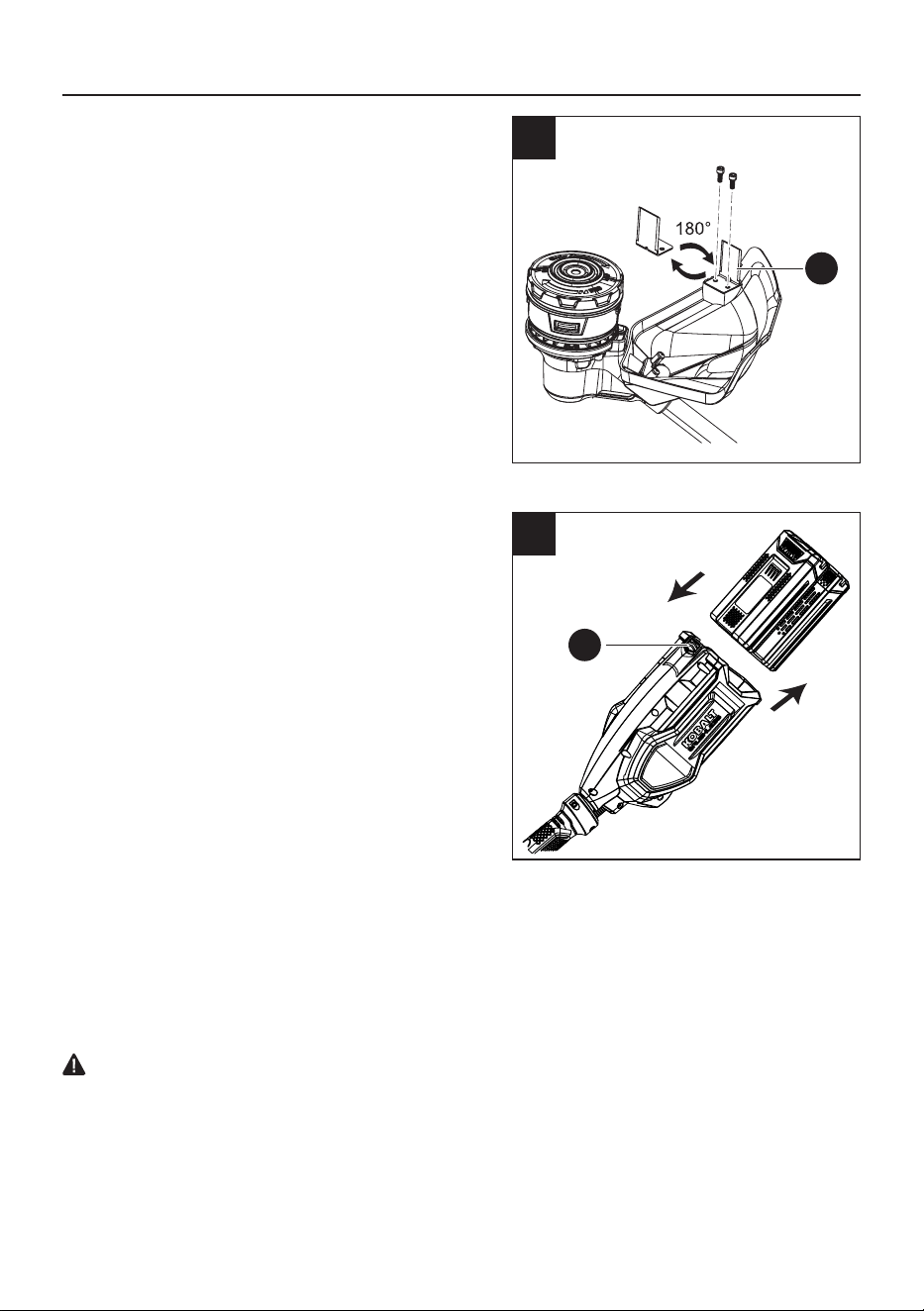
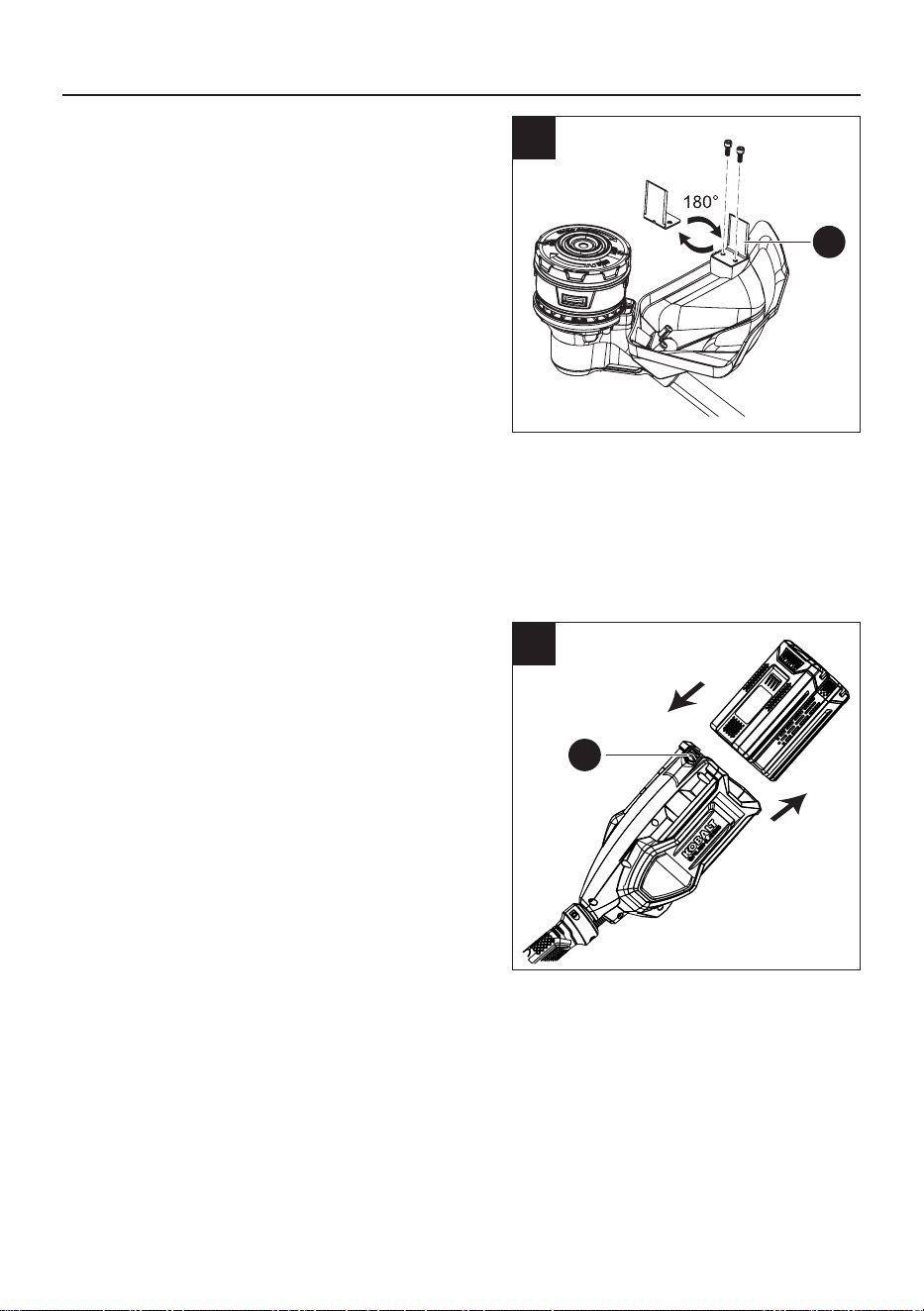
7
7. Installing / removing the battery
IMPORTANT
The battery is not charged when it is purchased.
Before using the trimmer for the rst time, place
the battery in the battery charger and charge.
To install the battery
• Align the battery with the cavity in the string
trimmer housing.
• Insert the battery into the handle until the battery
release button (A) locks into place.
• Push down on the battery until it locks into place.
You should hear a “click” once it is installed.
A
To remove the battery
• Press the battery release button (A) on the string trimmer. This will cause the battery to raise out of the
tool slightly.
• Grasp the trimmer rmly and pull the battery out of the handle.
Note: The battery ts into the handle snugly in order to prevent accidental dislodging.
WARNING
Follow these instructions in order to avoid injury and to reduce the risk of electric shock or re:
• Replace the battery immediately if the battery case is damaged.
• Verify that the switch is in the OFF position before inserting or removing the battery.
• Verify that the battery is removed and the switch is in the OFF position before inspecting, adjusting, or
performing maintenance on any part of the string trimmer.
6
6. Adjusting the cutter-o blade
This trimmer is equipped with a line cut-o
blade on the guard. Advance line when trimming
eciency diminishes. This will maintain best
performance and keep line long enough to
advance properly. This trimmer is currently set at
the 15 in. (381 mm) cutting swath. To adjust to a
cutting swath of 17 in. (432 mm):
• Remove both screws on the cut-o blade (K) with
a phillips head screwdriver.
• Rotate the cut-o blade 180°.
• Replace both screws in the cut-o blade.
Note: Set the cut-o blade to 15 in. (381 mm)
for greater runtime. Set the cut-o blade to 17 in.
(432 mm) for greater cutting area.
K
17
OPERATING INSTRUCTIONS
WARNING
To avoid injury:
• Do not squeeze the trigger while the grass trimmer is inverted.
• Do not carry the grass trimmer with your nger on the switch. Avoid unintentional starting.
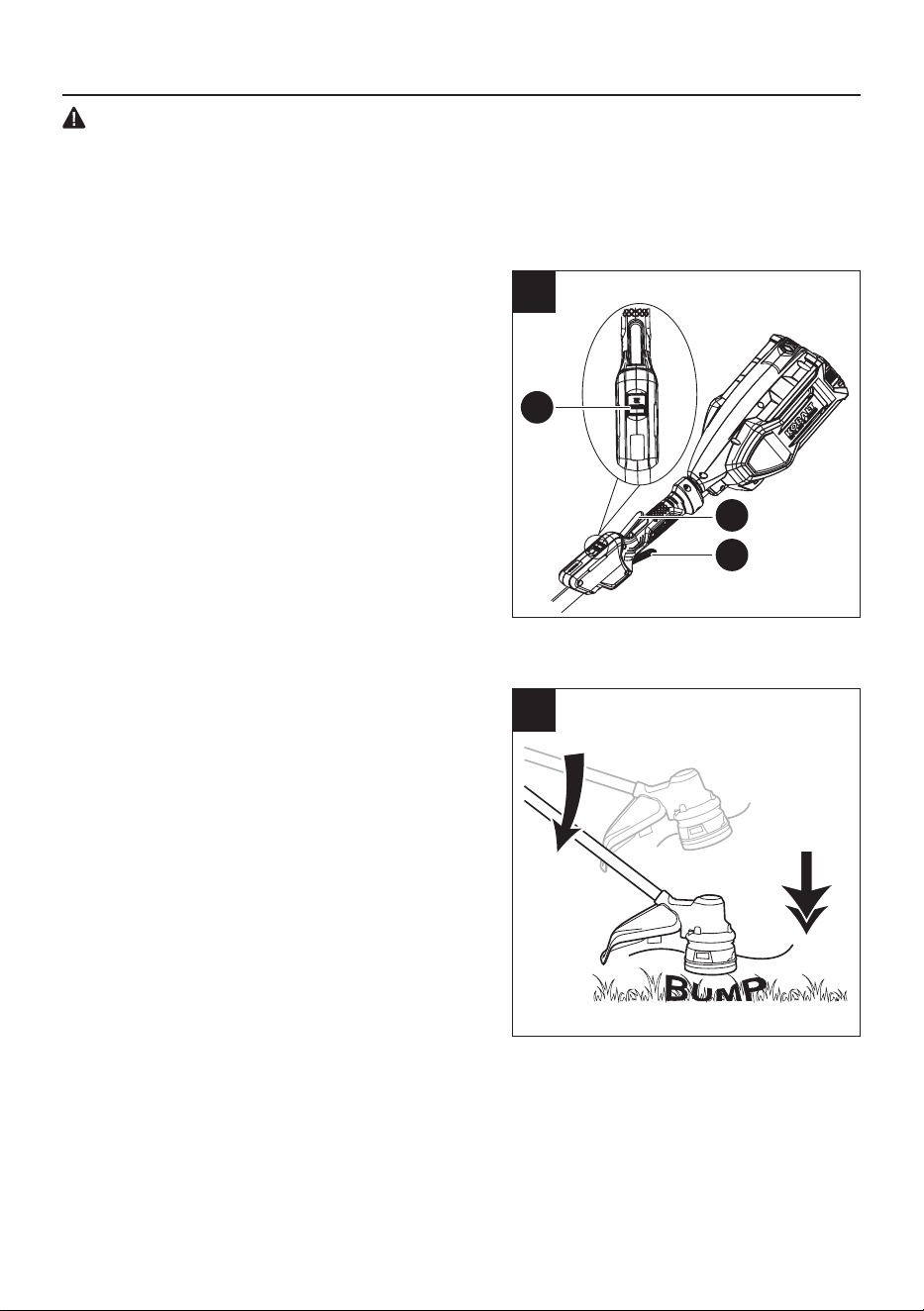
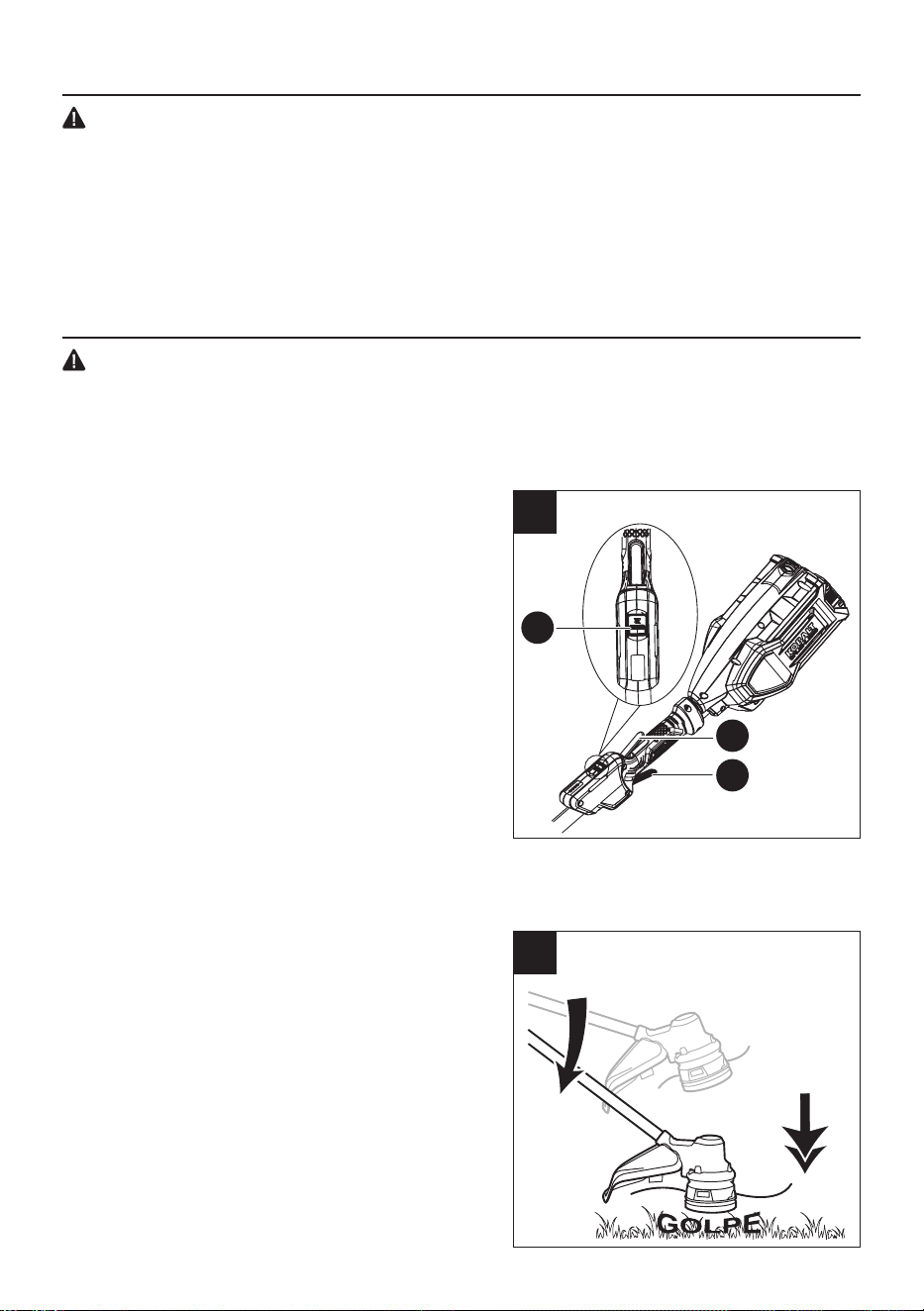
1
1. Starting / stopping the product
• Slide the speed switch (D) to the desired
operating speed. Slide the speed switch to
position 1 for low speed or position 2 for high
speed.
• Press the lock-o lever (C). Squeeze the trigger
(B) to start.
• Release the trigger to stop.
CAUTION
Always allow 5 seconds or more for the cutting line
spool to stop rotating after releasing the trigger. Do
not invert the grass trimmer or place your hands
under the protective guard until the grass trimmer
spool has come to a complete stop.
C
B
D
2
2. Lengthening the line
While the string trimmer is operating, the cutting
line gets worn down and becomes shorter.
This trimmer is equipped with bump feed line
advancement, which advances additional line
once the head is bumped on the ground while
rotating. The cut-o blade will cut the line to
keep an accurate cutting swath.
18
OPERATING INSTRUCTIONS
3. Trimmer tips
Before each use:
• Make sure the protective guard is tightly installed. If not, tighten the guard screws.
• Before trimming, inspect the area for string, wire, branches or other material that may become
entangled in the cutting line and thrown.
Storage tips:
• Do not store the grass trimmer in sunlight, in an excessively warm place, or near a furnace.
• The battery life will be shortened.
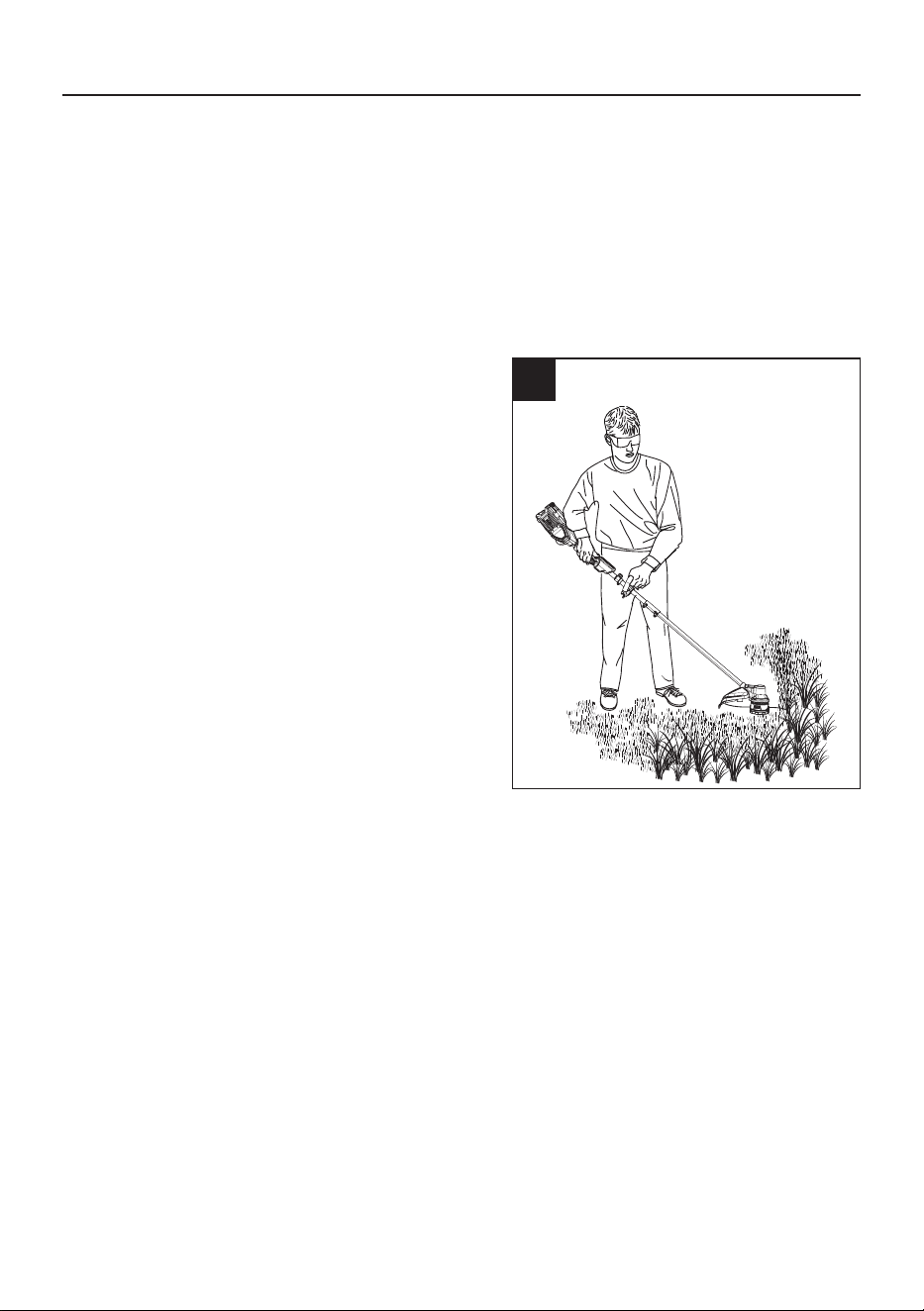
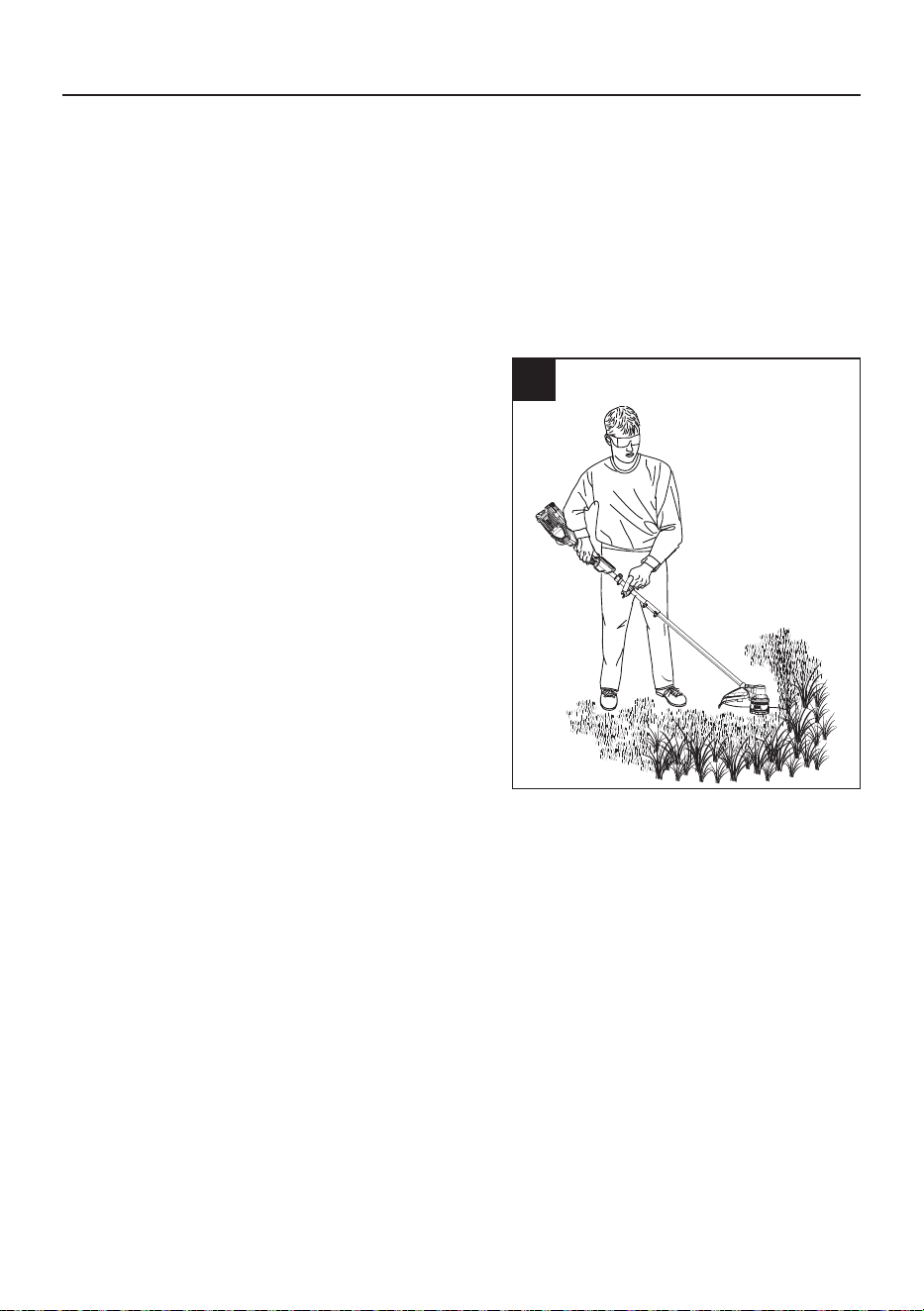
3
During use:
• Trim only when the grass and weeds are dry.
• Do not trim grass at night. Always make sure you
have adequate lighting.
• Hold the grass trimmer by both the switch handle
and the auxiliary handle for best control and
balance.
• Stand with the cutting head tipped down at an
angle in front, guiding the grass trimmer in a
semicircular motion around you.
• If possible, guide the grass trimmer to the left
to cut. The line will cut as soon as it leaves the
guard, and the clippings are thrown away from
you.
• To produce a smoothly trimmed area, move
the grass trimmer out of the area being cut with
consistent speed and height.
• Use only the tip of the cutting line to do the trimming, especially near walls and fences. Trimming with
the side of the cutting line may overload the motor, wear out the line faster, and break the line more
often.
• Do not rest the trimmer spool on the ground while trimming. This will cause spool wear and battery
drain.
• If the grass is higher than 6 in. (15 cm), trim in small stages.
• When the grass trimmer is turned o and the spool stops rotating, the cutting line will relax and may
recede. Feed extra cutting line before storing the trimmer to prevent losing the line completely into the
spool.
• If the diameter of the cutting area gets smaller, the line is worn down and needs to be advanced more
often.
• If the grass trimmer is not cutting correctly, the cutting line may not be feeding properly.
• Remove and rewind the line spool.
19
CARE AND MAINTENANCE
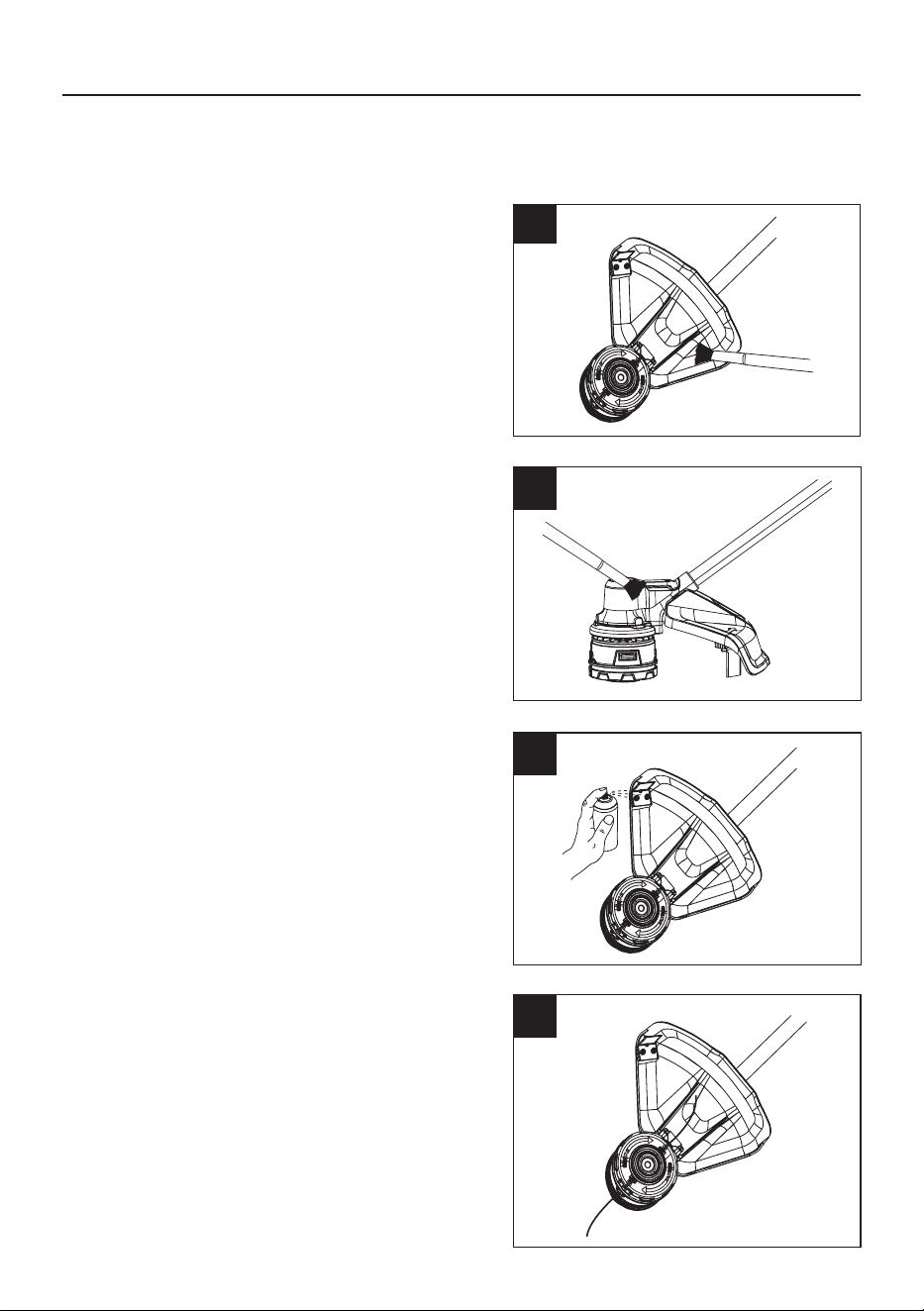
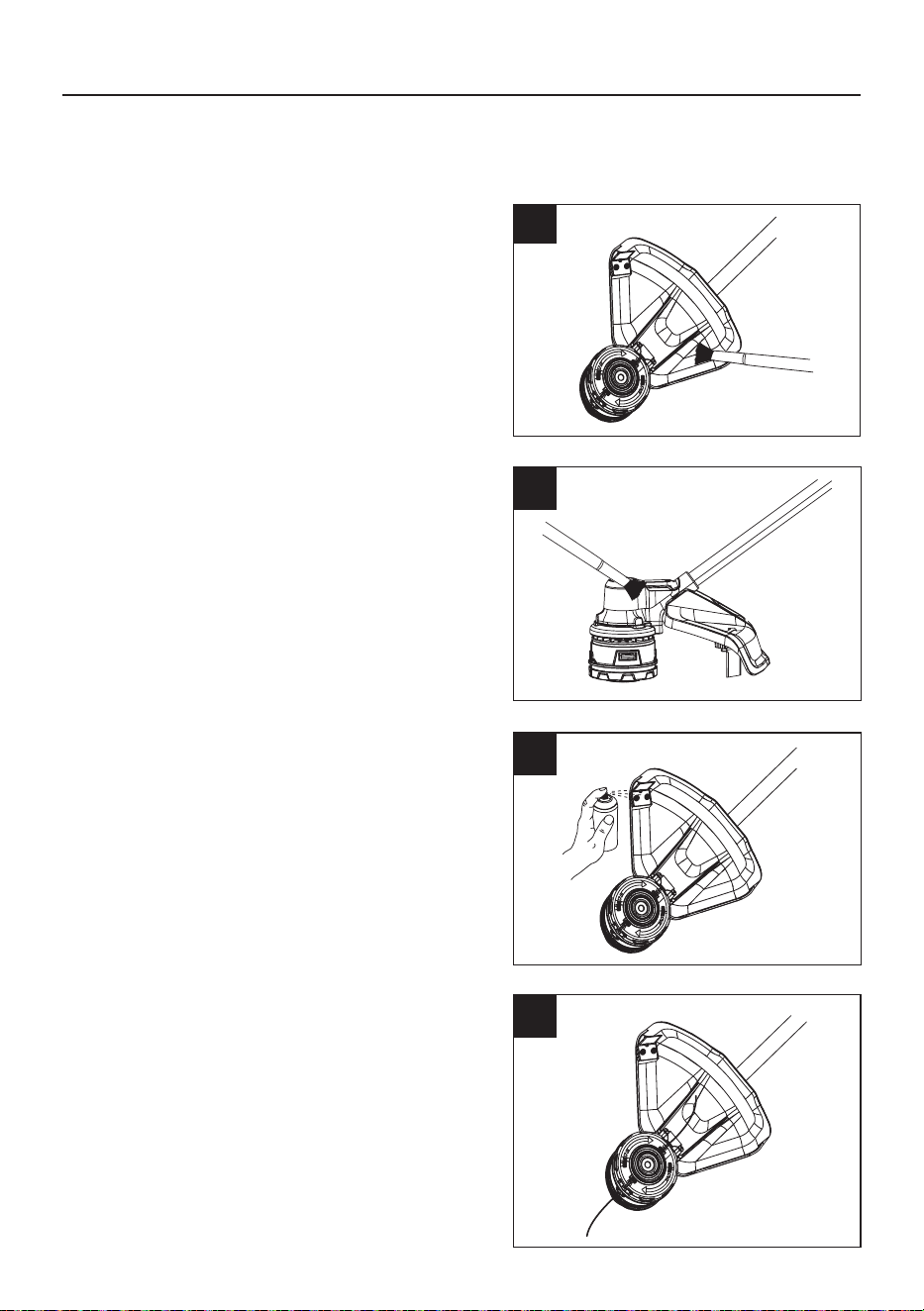
1a
1. Trimmer guard and motor maintenance
Note: Before performing maintenance, remove battery from the tool.
1b
1c
1d
1a. Remove dirt and debris from guard using a paint
brush (not included).
1b. Clean dirt and debris o of motor cover and
connection joints.
1c. Clean line cutter blades by using a wire brush
and spraying with an appropriate degreaser.
1d. Inspect spool cover and line to ensure that
there is an adequate amount of line and that no
damage is present on the spool cover.

20
TROUBLESHOOTING
PROBLEM POSSIBLE CAUSE CORRECTIVE ACTION
Motor fails to start
when switch trigger is
depressed.
Battery is not secure. To secure the battery, make
sure the latches on the battery
compartment snap into place.
Battery is not charged. Charge the battery according
to the instructions included with
your model.
Possible wiring or electrical
contact problem.
Call 888-3KOBALT (888-356-
2258) for technical service.
Trimmer smokes during
operation.
Trimmer damaged. Do not use the string trimmer.
Trimmer head will not
advance line.
The motor shaft or trimmer head
is bound with grass.
Stop the trimmer, remove the
battery, and remove any grass.
Not enough line in the spool. Remove the battery and replace
the trimmer line. Reference
section "Cutting Line" in this
manual.
Trimmer head is dirty. Remove the battery and clean
the spool.
Line is tangled on the spool. Remove the battery, remove the
line from the spool and rewind.
Line is not cutting well. The cutting blade on the guard
has become dull.
Sharpen the cutting blade with a
le or replace it with a new blade.
If you still have questions or an unresolved issue after going through this troubleshooting guide, or just
want to speak to a KOBALT product expert, please call our KOBALT customer service department at
888-356-2258.

21
WARRANTY
5-YEAR LIMITED WARRANTY
This KOBALT 80 V String Trimmer is warranted to the original purchaser from the original purchase
date for ve (5) years subject to the warranty coverage described herein.
This KOBALT 80 V String Trimmer is warranted for the original user to be free from defects in material
and workmanship.
If you believe that the KOBALT 80V String Trimmer is defective at any time during the specied
warranty period, simply return the 80 V String Trimmer along with proof of purchase to the place of
purchase for a free replacement or refund, or call 888-3KOBALT (888-356-2258) for warranty service.
This warranty is void if: defects in materials or workmanship or damages result from repairs or
alterations which have been made or attempted by others or the unauthorized use of nonconforming
parts; the damage is due to normal wear, damage is due to abuse (including overloading of the tool
beyond capacity), improper maintenance, neglect or accident; or the damage is due to the use of the
tool after partial failure or use with improper accessories or unauthorized repair or alteration.
This warranty excludes spool.
This warranty gives you specic legal rights, and you may also have other rights that vary from state to
state.
22
REPLACEMENT PARTS LIST
For replacement parts, call our customer service department at 888-356-2258, 8 a.m. - 8 p.m., EST,
Monday - Sunday. You may also contact us at [email protected].
Printed in Vietnam
PART DESCRIPTION PART #
BB Fastening knob R0209229-00
CC Bolt R0204432-00
DD Hex wrench R0201770-00
E Front / Auxiliary handle R0209234-00
EE Fixed block R0209232-00
L Guard R0209235-00
J String head R0209233-00
DDBB EECC E
L J
23
Número de serie
SG24114
Fecha de compra
ARTÍCULO #5974895
MODELO #KST 2180-06
ORILLADORA SIN
ESCOBILLAS CON
BATERÍA DE IONES
DE LITIO DE 80 V
Gracias por comprar este producto KOBALT.
¿Preguntas, problemas o piezas faltantes?
Antes de devolver, póngase en contacto con nosotros en:
888-356-2258, de lunes a domingo, de 8 a.m. a 8 p.m., hora estándar del Este, o escriba a [email protected].
KOBALT y el diseño del logotipo son
marcas comerciales o marcas registradas
de LF, LLC. Todos los derechos
reservados.

24
ÍNDICE
ESPECIFICACIONES DEL PRODUCTO
Especicaciones del producto...............................................................................................................
Contenido del paquete...........................................................................................................................
Aditamentos...........................................................................................................................................
Símbolos................................................................................................................................................
Información de seguridad......................................................................................................................
Preparación...........................................................................................................................................
Instrucciones de ensamblaje.................................................................................................................
Instrucciones de funcionamiento...........................................................................................................
Cuidado y mantenimiento......................................................................................................................
Solución de problemas..........................................................................................................................
Garantía.................................................................................................................................................
Lista de piezas de repuesto...................................................................................................................
24
25
26
27
29
32
33
40
42
43
44
45
ESPECIFICACIONES
Tipo de batería Iones de litio de 80 V
Velocidad sin carga 4900 / 5800 RPM ± 10%
Línea de corte 38.1 cm / 43.2 cm (15 pulg. / 17 pulg.)
Diámetro de hilo 2.4 mm (0.095 pulg.)
Capacidad de corte Doble hilo
25
CONTENIDO DEL PAQUETE
PIEZA DESCRIPCIÓN CANTIDAD
A Botón de liberación de
la batería
1
B Gatillo 1
C Palanca de bloqueo 1
D Regulador de velocidad 1
E Mango frontal y auxiliar 1
F Tubo superior 1
G Acoplador 1
H Tubo inferior 1
I Carcasa del motor 1
PIEZA DESCRIPCIÓN CANTIDAD
J Cabezal de hilo 1
K Cuchilla de corte 1
L Protector 1
M Cubierta del carrete 1
N Carcasa de ubicación 1
O Cubierta de la ranura 1
P Carrete 1
Q Tornillo 4
R Carcasa del carrete 1
A
B
C
D
E
F
G
H
I
J
K
L
M
N
O
P
Q
R
26
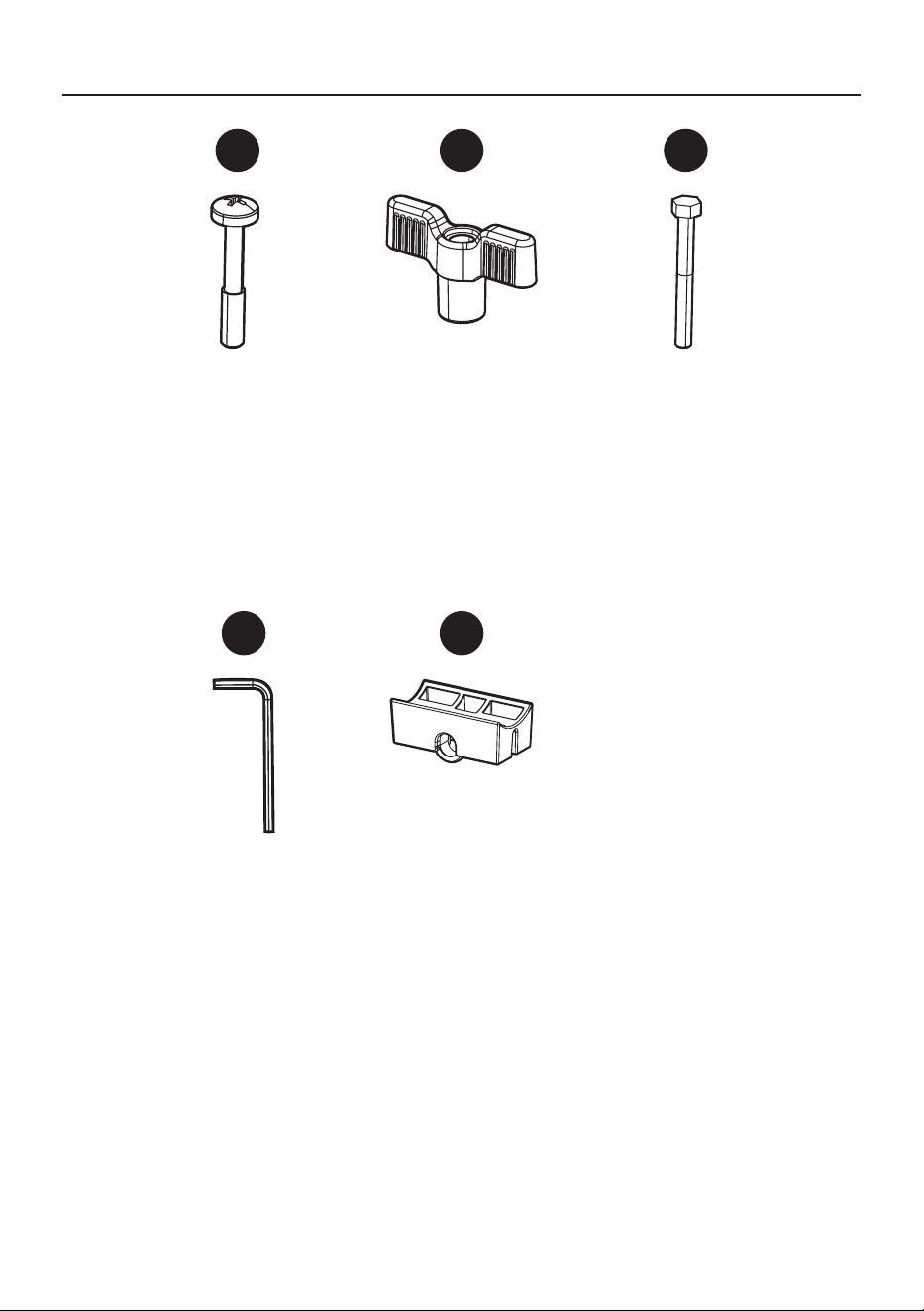
ADITAMENTOS (no se muestran a escala)
Tornillo
(preensamblado en el protector (L))
Cant. 2
Perilla de
sujeción
Cant. 1
Bloque jo
Cant. 1
Llave hexagonal
Cant. 1
Perno
Cant. 1
AA
DD
BB
EE
CC
27
SÍMBOLOS
Algunos de los siguientes símbolos pueden aplicarse al uso de este producto. Obsérvelos y aprenda
su signicado. La interpretación correcta de estos símbolos le permitirá utilizar el producto de manera
ecaz y segura.
SÍMBOLOS
DESIGNACIÓN EXPLICACIÓN
Alerta de seguridad
Indica que existe el riesgo de que se produzcan
lesiones personales.
Lea el manual del operador
Para reducir el riesgo de lesiones, el usuario
debe leer y comprender el manual del operador
antes de utilizar este producto.
Lentes de protección
Siempre use lentes de protección con protección
lateral que cumplan con la norma ANSI Z87.1.
Alerta de condiciones de
humedad
No exponga esta herramienta a la lluvia ni la
utilice en áreas húmedas.
Sin cuchilla
No instale ni utilice ningún tipo de cuchilla en un
producto que muestre este símbolo.
Rebote
Los objetos lanzados pueden rebotar y provocar
lesiones personales o daños materiales.
Mantenga a los transeúntes
alejados
Mantenga a los transeúntes al menos a 15.24 m
(50 pies) de distancia.
28
SÍMBOLOS
Se usan las siguientes indicaciones y sus signicados para explicar los niveles de riesgo asociados a
este producto.
SÍMBOLO INDICACIÓN SIGNIFICADO
PELIGRO
Indica una situación de peligro inminente que, de no evitarse,
ocasionará la muerte o lesiones graves.
ADVERTENCIA
Indica una situación potencialmente peligrosa que, de no evitarse,
puede ocasionar la muerte o lesiones graves.
PRECAUCIÓN
Indica una situación potencialmente peligrosa que, de no evitarse,
puede ocasionar lesiones menores o moderadas.
PRECAUCIÓN
(Sin símbolo de alerta de seguridad) Indica una situación que puede
ocasionar daños materiales.
ADVERTENCIA
• Para evitar lesiones personales graves, no intente usar este producto hasta que haya leído y
comprendido completamente este manual del propietario. Si no comprende las advertencias e
instrucciones de este manual del propietario, no utilice este producto. Llame al 888-356-2258 para
obtener ayuda.
•
La operación de cualquier producto puede provocar que objetos extraños salten a sus
ojos y, de esta manera, se causen graves daños oculares. Antes de operar un producto,
use siempre lentes o gafas de seguridad con protecciones laterales y un protector facial
cuando sea necesario. Se recomienda una máscara de seguridad de visión amplia sobre
los lentes o las gafas de seguridad estándar con protección lateral. Siempre use lentes de
protección que cumplan con la norma ANSI Z87.1.
GUARDE ESTAS INSTRUCCIONES

29
INFORMACIÓN DE SEGURIDAD
ADVERTENCIA
• No utilice herramientas eléctricas en atmósferas en las que exista riesgo de explosión, como por
ejemplo en presencia de líquidos inamables, gases o polvo. Las herramientas eléctricas producen
chispas que podrían encender el polvo o humo.
• No permita que los niños o personas no calicadas utilicen la unidad.
• No exponga las herramientas eléctricas a la lluvia o a condiciones de humedad. Si ingresa agua en
una herramienta eléctrica, aumentará el riesgo de descarga eléctrica.
• No manipule la batería o la herramienta con las manos mojadas.
• Nunca permita que los niños utilicen el equipo. Nunca permita que adultos usen el equipo sin la
instrucción apropiada.
• Utilice siempre gafas de seguridad con protectores laterales que cumplan con la norma ANSI Z87.1.
Los anteojos comunes solo poseen lentes con resistencia al impacto. NO son gafas de seguridad.
Seguir esta norma puede reducir el riesgo de lesiones oculares. Utilice una máscara si va a utilizar en
condiciones de polvo.
• No use el producto bajo la lluvia. Almacénelo en interiores.
• No utilice en lugares con poca iluminación.
• Mantenga su cuerpo alejado de cualquier pieza en movimiento.
• Evite un arranque accidental. Asegúrese de que el interruptor esté en la posición de apagado
antes de conectar al paquete de baterías, levantar o transportar el electrodoméstico. Transportar
el electrodoméstico con el dedo en el interruptor o enchufar herramientas eléctricas que tienen el
interruptor en la posición de encendido aumentan las posibilidades de accidentes.
• No fuerce la herramienta. Utilice la herramienta adecuada para su aplicación. La herramienta
adecuada realizará un trabajo más seguro y de mejor calidad al ritmo para el que se diseñó.
• No utilice el equipo a pies descalzos o si lleva sandalias u otro tipo de zapato liviano similar. Use
calzado de seguridad para proteger sus pies y mejorar el equilibrio en supercies resbaladizas.
• Mantenga una posición rme y un equilibrio adecuados. No se extienda demasiado. Hacerlo puede
causar pérdida de equilibrio.
• Verique que no haya piezas dañadas: antes de seguir utilizando el electrodoméstico, debe vericar
detenidamente que los protectores, o cualquier otra pieza dañada, funcionen correctamente y
realicen la función deseada. Verique la alineación y el trabamiento de las piezas móviles, la ruptura
de las piezas, la instalación y cualquier otro tipo de condición que pueda afectar el funcionamiento. Si
un protector o cualquier otra pieza están dañados, deben repararse o reemplazarse de inmediato en
un centro de servicio autorizado, a menos que se indique otro lugar en este manual.
• Mantenga los protectores en su lugar y en buenas condiciones de funcionamiento.
• Mantenga las manos y los pies alejados del área de corte.
• No permita que se use como un juguete. Es necesaria una estricta supervisión cuando los niños la
utilicen o estén cerca.
• No utilice la herramienta si el interruptor no la enciende o no la apaga. Cualquier herramienta que no
pueda controlarse con el interruptor es peligrosa y debe repararse.
• Mantenga a los transeúntes, niños y mascotas al menos a 15.24 m de distancia.
• No use esta unidad si está cansado, enfermo, o bajo la inuencia del alcohol, drogas o
medicamentos.
• No coloque ningún objeto en las aberturas. No utilice si una abertura está bloqueada; mantenga las
Lea y comprenda todas las instrucciones. Si no se siguen todas las instrucciones detalladas
a continuación, existe la posibilidad de una descarga eléctrica, un incendio o lesiones
personales graves.
Lea y comprenda completamente este manual antes de intentar ensamblar, usar o instalar el
producto.

30
INFORMACIÓN DE SEGURIDAD
aberturas despejadas.
• Inspeccione el área de trabajo antes de cada uso. Retire todos los objetos, como rocas, vidrios rotos,
clavos, alambres o cuerdas, que puedan ser lanzados por la máquina o que puedan enredarse en la
máquina.
• Use solo piezas y accesorios de repuesto idénticos a los del fabricante. El uso de cualquier otra pieza
puede ser peligroso o causar daños en el producto.
• No cargue el paquete de baterías bajo la lluvia o en un lugar húmedo o mojado. Seguir esta norma
reducirá el riesgo de descarga eléctrica.
• Solo para uso doméstico.
• Las herramientas que funcionan a batería no se deben enchufar en un tomacorriente; por lo tanto,
siempre están en condiciones de funcionamiento. Tenga en cuenta que hay posibles peligros cuando
no usa su herramienta con batería o cuando cambia los accesorios. Al seguir esta norma disminuirá
el riesgo de una descarga eléctrica, incendio o lesiones personales.
• Retire o desconecte la batería antes de darle servicio, limpiar o retirar materiales del electrodoméstico
de jardinería.
• Use solo baterías KOBALT de 80 voltios. (KB 280C-06, KB 2580C-06, KB 480-06, KB 580C-06, KB
680C-06).
• Use solo un cargador KOBALT de 80 voltios. (KRC 0280-06, KRC 30-06, KDC 50-06).
• Use el electrodoméstico solo con paquetes de baterías designados especícamente. El uso de
cualquier otro paquete de baterías puede crear un riesgo de lesión e incendio.
• Guarde las herramientas que no utiliza. Cuando no esté en uso, debe guardar la orilladora en el
interior, en un lugar seco y cerrado, fuera del alcance de los niños.
• No incinere las baterías, ya que la celda podría explotar. Revise los códigos locales para obtener las
instrucciones de eliminación especiales posibles.
• No abra ni mutile las baterías. Los electrolitos liberados son corrosivos y pueden causar daños en los
ojos o la piel. Puede ser tóxico si se ingiere.
• No coloque las herramientas con batería ni sus baterías cerca del fuego o calor. Esto disminuirá el
riesgo de explosión y posiblemente lesiones.
• Las baterías pueden explotar en la presencia de una fuente de ignición, como la luz piloto. Para
reducir el riesgo de lesiones personales graves, nunca utilice un producto inalámbrico en la presencia
de una llama directa. La explosión de una batería puede lanzar desechos y productos químicos. Si se
expone, enjuague inmediatamente con agua.
• No aplaste, deje caer ni dañe la batería. No utilice una batería o un cargador que se haya caído o
recibido un golpe fuerte. Una batería dañada puede explotar. Deseche adecuada e inmediatamente
una batería que se haya caído o presente daños.
• Tenga cuidado al manipular las baterías para no hacer cortocircuito con la batería con materiales
conductores, como anillos, pulseras o llaves. Es posible que la batería o el conductor se
sobrecalienten y produzcan quemaduras.
• Es posible que se produzcan fugas de la batería bajo condiciones de temperatura o uso extremos. Si
un líquido entra en contacto con su piel, lave inmediatamente con agua y jabón, luego neutralice con
jugo de limón o vinagre. Si entra líquido en sus ojos, enjuáguelos con agua limpia durante al menos
10 minutos y luego busque atención médica inmediatamente. Seguir esta norma puede reducir el
riesgo de lesiones personales graves.
• Si el cargador del suministro de electricidad está dañado, se debe reemplazar únicamente por parte
del fabricante o un centro de servicio autorizado para evitar riesgos.
• No apunte la orilladora a personas o mascotas.
• Cuando la orilladora no esté en uso, debe almacenarse en interiores, en un lugar seco y cerrado,
fuera del alcance de los niños.
• Realice un mantenimiento adecuado de la herramienta. Mantenga todos los conductos y las
aberturas de ventilación limpios y libres de desechos. Siga las instrucciones para un mantenimiento
adecuado. No intente eliminar obstrucciones de la herramienta sin antes apagarla y retirar la batería.

31
INFORMACIÓN DE SEGURIDAD
• Use ropa adecuada: no use ropa holgada ni joyas. Pueden quedar atrapadas en las piezas móviles.
Se recomienda utilizar guantes de goma y un calzado adecuado si trabaja en el exterior. Use una
malla protectora para contener el cabello largo.
• Use el electrodoméstico correcto. No use el electrodoméstico en tareas diferentes para las que fue
diseñado.
• Cuando el paquete de baterías no esté en uso, aléjelo de objetos metálicos, como sujetapapeles,
monedas, llaves, clavos, tornillos u otros objetos metálicos pequeños que pudieran crear una
conexión entre los terminales. Es posible que conectar los terminales de la batería entre sí produzca
quemaduras o un incendio.
• No exponga el paquete de baterías ni el electrodoméstico al fuego o a una temperatura excesiva. La
exposición al fuego o temperaturas superiores a 129 °C (265 °F) puede causar una explosión.
• Siga todas las instrucciones de carga y no cargue el paquete de baterías o el electrodoméstico fuera
del rango de temperatura especicado en las instrucciones. La carga incorrecta o a temperaturas
fuera del rango especicado puede dañar la batería y aumentar el riesgo de incendio.
• Haga reparar el producto por una persona calicada que utilice solo piezas de repuesto idénticas.
Esto mantendrá la seguridad del producto.
• No modique ni intente reparar el electrodoméstico ni el paquete de baterías (según corresponda)
excepto como se indique en las instrucciones para uso y cuidado.
• Rango de temperatura ambiente:
- Rango de la temperatura de almacenaje de la orilladora: -20 °C (-4 °F) a 70 °C (158 °F)
- Rango de la temperatura de funcionamiento de la orilladora: -20 °C (-4 °F) a 40 °C (104 °F)
- Rango de temperatura de carga de la batería: 4° C (39 °F) a 40 °C (104 °F)
- Rango de temperatura de funcionamiento del cargador: 4 °C (39 °F) a 45 °C (113 °F)
- Rango de temperatura de almacenamiento de la batería: 1 año: 0° C (32 °F) a 23 °C (73 °F)
3 meses: 0° C (32 °F) a 45 °C (113 °F)
1 mes: 0° C (32 °F) a 60 °C (140 °F)
- Rango de temperatura de descarga de la batería: -14 °C (6.8 °F) a 45 °C (113 °F)
Seguridad infantil
Pueden ocurrir accidentes trágicos si el operador no está atento a la presencia de niños.
• Mantenga a los niños fuera del área de trabajo y bajo estricta vigilancia de un adulto responsable.
• No permita que niños menores de 14 años usen esta orilladora. Los niños de 14 años o más deben
leer y comprender las instrucciones de funcionamiento y las normas de seguridad en este manual,
además de recibir capacitación y supervisión por parte de sus padres.
• Esté alerta y apague la orilladora si un niño o cualquier otra persona ingresan al área de trabajo.
• Antes y mientras se está moviendo hacia atrás, mire hacia abajo y hacia atrás para vericar que no
haya niños.
• Tenga extremo cuidado cuando se acerque a esquinas ciegas, entradas de puertas, arbustos, árboles
u otros objetos que puedan bloquearle la vista de un niño que pudiera correr hacia la orilladora.

32
PREPARACIÓN
Antes de comenzar a ensamblar el producto, asegúrese de tener todas las piezas. Compare las
piezas con la lista del contenido del paquete y la lista de aditamentos. No intente ensamblar el
producto si falta alguna pieza o si estas están dañadas.
Tiempo estimado de ensamblaje: 5 a 10 minutos
Herramientas necesarias para el ensamblaje (no se incluyen): destornillador Phillips
INFORMACIÓN DE SEGURIDAD
ADVERTENCIA (PROPUESTA 65)
Parte del polvo causado por el lijado eléctrico, el serruchado, la trituración, el taladrado y otras
actividades de la construcción contienen productos químicos que causan cáncer, defectos congénitos
u otros daños en el aparato reproductivo. Algunos ejemplos de estos productos químicos son:
• Plomo de pinturas a base de plomo.
• Sílice cristalina de ladrillos, cemento y otros productos de mampostería, y
• Arsénico y cromo de madera tratada con químicos.
El riesgo que corre debido a la exposición a estos productos químicos varía según la frecuencia con
que realiza este tipo de trabajo. Para reducir su exposición a estas sustancias químicas, trabaje en
un área bien ventilada y utilice un equipo de seguridad aprobado, como las mascarillas antipolvo
especialmente diseñadas para ltrar estas partículas microscópicas.
SERVICIO
El mantenimiento requiere sumo cuidado y conocimiento, y solo un técnico de servicio calicado debe
realizarlo. Para realizar el mantenimiento, le recomendamos llevar el producto al DEPARTAMENTO
DE SERVICIO AUTORIZADO más cercano para su reparación. Al realizar mantenimiento, utilice solo
piezas de repuesto idénticas.
GUARDE ESTAS INSTRUCCIONES
33
INSTRUCCIONES DE ENSAMBLAJE
ADVERTENCIA
Para evitar lesiones y disminuir el riesgo de descargas eléctricas o incendio:
• Reemplace inmediatamente la batería o el cargador si la funda de la batería o el cable del cargador
están dañados.
• Siempre asegúrese de que el interruptor de la orilladora esté apagado antes de insertar o retirar la
batería.
• Asegúrese siempre de retirar la batería y de que el interruptor esté apagado antes de inspeccionar,
ajustar o dar mantenimiento a cualquier pieza de la orilladora.
• Lea, comprenda y siga las instrucciones del cargador de la batería.
1. Instalación del protector
1
PRECAUCIÓN
Para evitar lesiones, retire siempre la batería antes
de instalar el protector, cambiar un hilo de corte
o realizar cualquier ajuste. Si el protector está
dañado, no utilice la orilladora hasta reemplazarlo.
Nota: instale el protector antes de operar la
orilladora. No se debe retirar ni desmontar.
• Invierta la orilladora para acceder al cabezal de
la orilladora.
• Con un destornillador Phillips (no incluido), retire
los tornillos preinstalados (AA) del protector de la
orilladora.
• Coloque el protector (L) sobre el cabezal de la
orilladora.
• Alinee los oricios para tornillos del protector
con los oricios para tornillos del cabezal de la
orilladora.
• Inserte los tornillos en el cabezal de la orilladora
y apriete para asegurarlos en su lugar.
AA
L
Aditamentos utilizados
Tornillo x 2
AA
34
2a
2. Conexión de los tubos superior e inferior de la orilladora
Aditamentos utilizados
Llave hexagonal x 1
DD
H
F
DD
Botón de liberación
Oricio de
posicionamiento
2a. Presione el botón de liberación ubicado en el
tubo inferior (H).
• Alinee el botón de liberación con el oricio
de posicionamiento en el tubo superior (F) y
deslice los dos tubos juntos.
• Rote el tubo inferior hasta que el botón
de liberación se trabe en el oricio de
posicionamiento.
2b
2b. Apriete el tornillo con la llave de tuercas
hexagonal (DD).
INSTRUCCIONES DE ENSAMBLAJE
35
3a
3. Instalación del mango frontal y auxiliar
3a. Coloque el mango frontal y auxiliar (E) en el
tubo superior (F).
• Coloque el bloque jo (EE) en la ranura del
mango.
3b. Alinee el oricio del mango con el oricio del
bloque jo, luego deslice el perno (CC) a través
de la parte superior del mango y asegúrelo con
la perilla de sujeción (BB).
• El mango frontal se puede ajustar a una
posición adecuada.
• Apriete hasta que no haya movimiento en el
mango.
Nota: no apriete demasiado la perilla de
sujeción, podría hacer que el bloque jo se
rompa.
Aditamentos utilizados
Perilla de sujeción x 1
BB
ADVERTENCIA
Para evitar lesiones, ajuste el mango auxiliar para obtener un equilibrio y un control óptimos. No se
incline demasiado cuando opere la orilladora. Mantenga el equilibrio todo el tiempo para controlar
mejor la herramienta en situaciones inesperadas.
3b
F
E
EE
Perno x 1
CC
Bloque jo x 1
EE
CC
BB
INSTRUCCIONES DE ENSAMBLAJE
36
4. Retiro e instalación del hilo de corte
Se ha instalado previamente un carrete de hilo de corte en la orilladora. Cuando los hilos de corte
requieran reemplazo, rebobine el hilo nuevo en el carrete existente.
PRECAUCIÓN
Para evitar lesiones, retire siempre la batería antes de instalar el protector, cambiar un hilo de corte o
realizar cualquier ajuste.
Para retirar el hilo de corte
4a. Dé vuelta la orilladora para acceder al carrete.
• Retire la cubierta del carrete (M) presionando
las dos lengüetas paralelas entre sí en los lados
de la cubierta del carrete.
4b. Retire la cubierta del carrete (M) de la carcasa
del carrete (R) y retire el exceso de hilo.
4c. Vuelva a instalar la cubierta del carrete (M) y la
carcasa del carrete (R).
4a
4b
M
R
4c
M
Lengüeta
M R
INSTRUCCIONES DE ENSAMBLAJE
37
Para instalar el hilo de corte
Nota: para hilo de nailon de 2.41 mm (0.095
pulg.), no coloque más de 7.01 m (23 pies) de
hilo de corte a la vez.
4d. Alinee las ranuras en la cubierta del carrete (M)
con las ranuras de la carcasa del carrete (R).
4e. Inserte el hilo a través del ojal. Empuje el hilo
hasta que salga por el oricio opuesto del
cabezal de hilo.
4f. Jale el hilo hasta que haya una cantidad igual de
hilo a cada lado.
4g. Empuje y gire la cubierta del carrete (M) en
dirección de las manecillas del reloj para
enrollar el hilo en el cabezal del hilo (J). Deje
aproximadamente 12.7 cm (5 pulg.) de hilo que
sobresalga de cada lado del cabezal.
4d
M
R
4e
4f
4g
M
J
Ranuras
INSTRUCCIONES DE ENSAMBLAJE
38
5a
5. Reemplazo del carrete
Nota: para un uso normal, no es necesario desmontar el cabezal. Sin embargo, si las
circunstancias requieren el desmontaje, siga estas instrucciones.
5b
M
R
5c
M
N
O
P
Q
5d
M
M R
INSTRUCCIONES DE ENSAMBLAJE
Lengüeta
5a. Dé vuelta la orilladora para acceder al carrete.
• Retire la cubierta del carrete (M) presionando
las dos lengüetas paralelas entre sí en los lados
de la cubierta del carrete.
5b. Retire la cubierta del carrete (M) de la carcasa
del carrete (R) y retire el exceso de hilo.
5c. Retire los tornillos (Q), el carrete (P), la cubierta
de la ranura (O) y la carcasa de ubicación (N)
de la cubierta del carrete (M). Remplace el
carrete por uno nuevo.
5d. Vuelva a instalar la cubierta del carrete (M) y la
carcasa del carrete (R).
39
7
7. Instalación y remoción de la batería
IMPORTANTE
La batería no está cargada cuando se compra.
Antes de usar la orilladora por primera vez,
coloque la batería en el cargador de baterías y
cárguela.
Para instalar la batería
• Alinee la batería con la cavidad de la carcasa de
la orilladora.
• Coloque la batería en el mango hasta que el
botón de liberación de la batería (A) se bloquee
en su lugar.
• Empuje la batería hacia abajo hasta que encaje
en su lugar. Deberá escuchar un “clic” una vez
que está instalado.
A
Para retirar la batería
• Presione el botón de liberación de la batería (A) en la orilladora. Esto hará que la batería se levante y
se separe levemente de la herramienta.
• Agarre rmemente la orilladora y jale de la batería hasta retirarla del mango.
Nota: la batería se ajusta primero en el mango rmemente, de modo que se evite el despren-
dimiento accidental.
6
6. Ajuste de la cuchilla de corte
Esta orilladora está equipada con una cuchilla
de corte de hilo en el protector. Haga avanzar
el hilo cuando disminuya la eciencia de
corte. Esto mantendrá el mejor rendimiento y
mantendrá el hilo lo sucientemente largo para
avanzar correctamente. Esta orilladora está
actualmente congurada en una amplitud de
corte de 38.1 cm (15 pulg.). Para ajustarse a
una amplitud de corte de 43.18 cm (17 pulg.):
• Retire ambos tornillos de la cuchilla de corte (K)
con un destornillador Phillips.
• Gire la cuchilla de corte 180°.
• Vuelva a colocar ambos tornillos en la cuchilla
de corte.
Nota: ajuste la cuchilla de corte a 38.1 cm
(15 pulg.) para obtener un mayor tiempo de
funcionamiento. Ajuste la cuchilla de corte a
43.18 cm (17 pulg.) para obtener una mayor área
de corte.
K
INSTRUCCIONES DE ENSAMBLAJE
40
INSTRUCCIONES DE FUNCIONAMIENTO
ADVERTENCIA
Para evitar lesiones:
• No apriete el gatillo cuando la orilladora está invertida.
• No traslade la orilladora con el dedo en el interruptor. Evite los encendidos accidentales.
1
1. Arranque y detención del producto
• Deslice el interruptor de velocidad (D) a la
velocidad de operación deseada. Deslice el
interruptor de velocidad a la posición 1 para
velocidad baja o a la posición 2 para velocidad
alta.
• Presione la palanca de bloqueo (C). Apriete el
gatillo (B) para comenzar.
• Libere el gatillo para detenerse.
PRECAUCIÓN
Después de soltar el gatillo, siempre espere 5
segundos o más hasta que el carrete de hilo
de corte se detenga. No invierta la orilladora ni
coloque las manos debajo del protector hasta que
el carrete de la orilladora se haya detenido por
completo.
C
B
D
2
2. Alargue del hilo
Mientras la orilladora está en funcionamiento,
el hilo de corte se desgasta y se acorta. Esta
orilladora está equipada con un sistema de
avance del hilo de alimentación por contacto,
que hace avanzar hilo adicional una vez que
el cabezal golpea el suelo mientras gira. La
cuchilla de corte cortará el hilo para mantener
una amplitud de corte precisa.
INSTRUCCIONES DE ENSAMBLAJE
ADVERTENCIA
Siga estas instrucciones para evitar lesiones y reducir el riesgo de descarga eléctrica o incendio:
• Reemplace la batería inmediatamente si la funda de la batería está dañada.
• Verique que el interruptor esté en la posición de apagado antes de insertar o retirar la batería.
• Verique que haya retirado la batería y que el interruptor esté en la posición de apagado antes de
inspeccionar, ajustar o realizar mantenimiento en cualquier pieza de la orilladora.
41
INSTRUCCIONES DE FUNCIONAMIENTO
3. Consejos de la orilladora
Antes de cada uso:
• Asegúrese de que el protector esté bien instalado. De lo contrario, apriete los tornillos del protector.
• Antes de utilizar la herramienta, revise el área para vericar que no haya cuerdas, alambres, ramas u
otros materiales que puedan enredarse en el hilo de corte o que puedan salir disparados.
Consejos para el almacenamiento:
• No guarde la orilladora a la luz del sol, en un lugar excesivamente cálido o cerca de una caldera.
• La duración de la batería se reducirá.
3
Durante el uso:
• Corte el césped y las malezas solo cuando estén
secas.
• No corte el césped de noche. Asegúrese siempre
de tener una iluminación adecuada.
• Sostenga la orilladora por ambos mangos y
utilice el mango auxiliar para obtener un mejor
control y equilibrio.
• Párese con el cabezal de corte inclinado en un
ángulo hacia abajo y hacia el frente, y realice
movimientos semicirculares alrededor suyo con
la orilladora.
• Si es posible, guíe la orilladora hacia la izquierda
para cortar. El hilo se cortará tan pronto como
salga del protector y los recortes se arrojarán
lejos de usted.
• Para cortar un área de manera uniforme, mueva
la orilladora hacia fuera del área que está
cortando y mantenga una altura y una velocidad
consistentes.
• Utilice solo la punta del hilo de corte para cortar, especialmente cerca de paredes y cercos. Si utiliza
la parte lateral del hilo de corte para cortar, puede sobrecalentar el motor, desgastar el hilo más rápido
o romperlo más seguido.
• No apoye el carrete de la orilladora sobre el piso mientras corta. Esto hará que se desgaste el carrete
y se agote la batería.
• Si el césped tiene más de 15.24 cm (6 pulg.) de altura, córtelo en pequeñas etapas.
• Cuando se apaga la orilladora y el carrete deja de girar, el hilo de corte se relajará y puede retroceder.
Alimente hilo de corte adicional antes de guardar la orilladora para evitar que el hilo se pierda
completamente en el carrete.
• Si el diámetro del área de corte se reduce, el hilo se desgasta y es necesario avanzar con más
frecuencia.
• Si la orilladora no corta correctamente, es posible que no se esté alimentando el hilo de corte
correctamente.
• Retire y rebobine el carrete de hilo.
42
CUIDADO Y MANTENIMIENTO
1a
1. Mantenimiento del protector y el motor de la orilladora
Nota: antes de realizar mantenimiento, retire la batería de la herramienta.
1b
1c
1d
1a. Elimine la suciedad y los desechos del protector
con una brocha (no incluida).
1b. Limpie la suciedad y los desechos de la cubierta
del motor y de las juntas de conexión.
1c. Limpie las cuchillas de corte del hilo con
un cepillo de alambre y rocíe con un
desengrasante adecuado.
1d. Inspeccione la cubierta del carrete y el hilo
para asegurarse de que haya una cantidad
adecuada de hilo y que no haya daños en la
cubierta del carrete.

43
SOLUCIÓN DE PROBLEMAS
PROBLEMA CAUSA POSIBLE ACCIÓN CORRECTIVA
El motor no arranca
cuando se presiona el
gatillo del interruptor.
La batería no está segura. Para asegurar la batería,
asegúrese de que los pestillos
del compartimiento de la batería
encajen en su lugar.
La batería no está cargada. Cargue la batería según las
instrucciones incluidas con su
modelo.
Posible problema de cableado o
de contactos eléctricos.
Llame al servicio técnico al
888-3KOBALT (888-356-2258).
La orilladora humea
durante la operación.
La orilladora está dañada. No utilice la orilladora.
El cabezal de la
orilladora no avanza
el hilo.
El eje del motor o el cabezal de
la orilladora están atascados con
césped.
Detenga la orilladora, retire la
batería y quite el césped.
No hay suciente hilo en el
carrete.
Retire la batería y reemplace el
hilo de la orilladora. Consulte la
sección “Hilo de corte” en este
manual.
El cabezal de orilladora está
sucio.
Retire la batería y limpie el
carrete.
El hilo está enredado en el
carrete.
Retire la batería, retire el hilo del
carrete y rebobine.
El hilo no corta bien. La cuchilla de corte del protector
ha perdido lo.
Ale la cuchilla de corte con
una lima o reemplácela con una
cuchilla nueva.
Si todavía tiene preguntas o un problema no resuelto después de leer esta guía de solución de
problemas, o si simplemente desea hablar con un experto en productos KOBALT, llame a nuestro
Departamento de Servicio al Cliente de KOBALT al 888-356-2258.

44
GARANTÍA
5 AÑOS DE GARANTÍA LIMITADA
Esta orilladora KOBALT de 80 V está garantizada para el comprador original desde la fecha de
compra original durante cinco (5) años y está sujeta a la cobertura de garantía que se describe en el
presente.
Esta orilladora KOBALT de 80 V tiene una garantía para el usuario original contra defectos en los
materiales y la mano de obra.
Si cree que la orilladora KOBALT de 80 V está defectuosa en cualquier momento durante el período
de garantía especicado, simplemente devuélvala junto con el comprobante de compra al lugar de
compra para obtener un reemplazo o un reembolso gratuito, o llame al 888-3KOBALT (888-356-2258)
para obtener el servicio de garantía.
Esta garantía es nula si: los defectos en los materiales o la mano de obra o los daños han sido
causados por reparaciones o modicaciones hechas o que se hayan intentado hacer por parte de
terceros o el uso no autorizado de piezas incompatibles; el daño es debido al desgaste normal; el
daño es debido al abuso (lo que incluye la sobrecarga de la herramienta por encima de su capaci-
dad), mantenimiento inadecuado, negligencia o accidente; o el daño es debido al uso de la herramien-
ta después de una falla parcial, el uso con accesorios inadecuados o reparaciones o alteraciones no
autorizadas.
Esta garantía no incluye el carrete.
Esta garantía le otorga derechos legales especícos, pero podría tener también otros derechos que
varían según el estado.
45
LISTA DE PIEZAS DE REPUESTO
Para obtener piezas de repuesto, llame a nuestro Departamento de Servicio al Cliente al 888-356-
2258, de lunes a domingo de 8 a.m. a 8 p.m., hora estándar del Este. También puede ponerse en
contacto con nosotros a través de [email protected].
Impreso en Vietnam
PIEZA DESCRIPCIÓN PIEZA #
BB Perilla de sujeción R0209229-00
CC Perno R0204432-00
DD Llave hexagonal R0201770-00
E Mango frontal y auxiliar R0209234-00
EE Bloque jo R0209232-00
L Protector R0209235-00
J Cabezal de hilo R0209233-00
DDBB EECC E
L J
