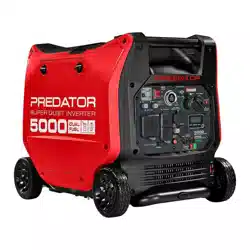
5000 WATT
DUAL FUEL
SUPER QUIET
INVERTER
GENERATOR
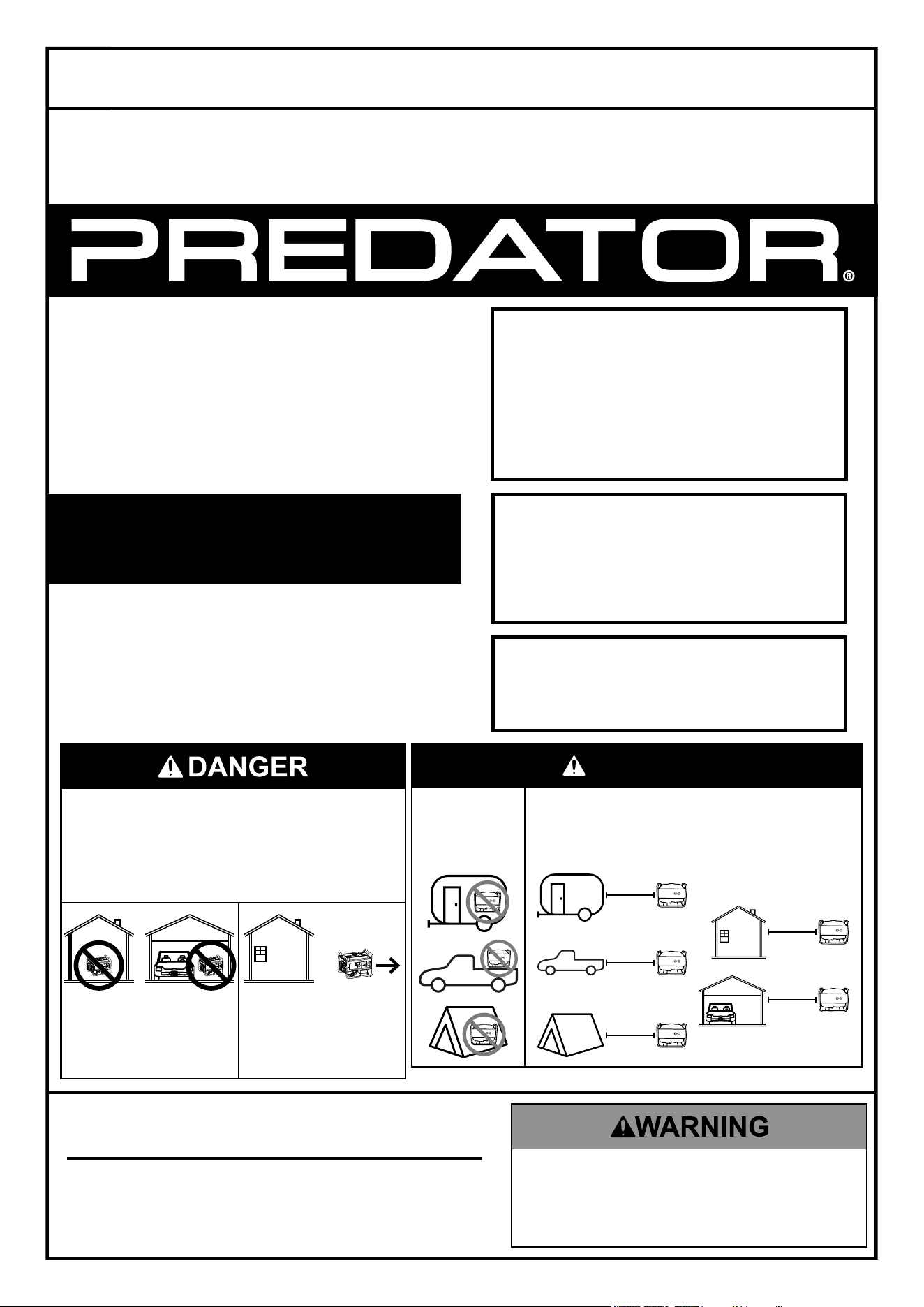
DANGER
Do not use
in trailers,
truck beds,
or tents.
Use at least 20 feet away from people,
animals, and structures with exhaust pointed
away. Generator will still produce carbon
monoxide, even when burning propane.
20′
20′
20′
20′
20′
71367
FOR YOUR SAFETY
IF YOU SMELL GAS:
1. Don’t touch electrical switches.
2. Extinguish any open flame.
3. Immediately call your gas supplier.
WARNING: Improper installation,
adjustment, alteration, service, or
maintenance can cause injury or property
damage. Refer to this manual. For
assistance or additional information consult
a qualified service technician, service
agency, manufacturer, or the gas supplier.
FOR YOUR SAFETY
Do not store gasoline or other
flammable vapors and liquids in the
vicinity of this or any other generator .
5000
GASOLINE MAX STARTING WATT
3900 GASOLINE RUNNING WATTS
5000 LPG MAX STARTING WATTS
3600 LPG RUNNING WATTS
Visit our website at:
http://www.harborfreight.com
Email our technical support at:
Email our engine support at:
Owner’s Manual & Safety Instructions
Save This Manual Keep this manual for the safety warnings and precautions, assembly,
operating, inspection, maintenance and cleaning procedures. Write the product’s serial number in the
back of the manual (or month and year of purchase if product has no number). Keep this manual and the
receipt in a safe and dry place for future reference. 24d
Using a generator indoors CAN
KILL YOU IN MINUTES.
Generator exhaust contains
carbon monoxide. This is a poison
you cannot see or smell.
NEVER use inside
a home or garage,
EVEN IF doors and
windows are open.
Only use OUTSIDE
and far away from
windows, doors,
and vents.
When unpacking, make sure that the product is intact
and undamaged. If any parts are missing or broken,
please call 1-888-866-5797 as soon as possible.
Copyright
©
2024 by Harbor Freight Tools
®
. All rights reserved.
No portion of this manual or any artwork contained herein may be reproduced in
any shape or form without the express written consent of Harbor Freight Tools.
Diagrams within this manual may not be drawn proportionally. Due to continuing
improvements, actual product may differ slightly from the product described herein.
Tools required for assembly and service may not be included.
Read this material before using this product.
Failure to do so can result in serious injury.
SAVE THIS MANUAL.
Page 2
For technical questions, please call 1-888-866-5797.
71367
IF YOU SMELL GAS
1. NO FLAMES OR SPARKS!
Immediately put out all smoking
materials and other open flames.
Do not operate lights, appliances,
telephones, or cell phones.
Flames or sparks from these sources
can trigger an explosion or a fire.
2. LEAVE THE AREA IMMEDIATELY!
Get everyone out of the building or area
where you suspect gas is leaking.
3. SHUT OFF THE GAS. Turn off the main
gas supply valve on your propane tank
if it is safe to do so. To close the valve,
turn it to the right (clockwise).
4. REPORT THE LEAK. From a
neighbor’s home or other nearby
building away from the gas leak,
call your propane retailer right away.
If you can’t reach your propane retailer,
call 911 or your local fire department.
5. DO NOT RETURN TO THE BUILDING
OR AREA until your propane
retailer, emergency responder,
or qualified service technician
determines that it is safe to do so.
6. GET YOUR SYSTEM CHECKED.
Before you attempt to use any of
your propane appliances, your
propane retailer or a qualified service
technician must check your entire
system to ensure that it is leak-free.
CAN YOU SMELL IT?
Propane smells like rotten eggs, a skunk’s
spray, or a dead animal. Some people
may have difficulty smelling propane
due to their age (older people may
have a less sensitive sense of smell);
a medical condition; or the effects of
medication, alcohol, tobacco, or drugs.
ODOR LOSS. On rare occasions,
propane can lose its odor. Several
things can cause this including:
•
The presence of air, water, or rust
in a propane tank or cylinder
•
The passage of leaking
propane through the soil
Since there is a possibility of
odor loss or problems with
your sense of smell, you
should respond immediately
to even a faint odor of gas.
PROPANE GAS DETECTORS
Under some circumstances, you may
not smell a propane leak. Propane gas
detectors sound an alarm if they sense
propane in the air. They can provide
an additional measure of security.
You should consider the purchase of
one or more detectors for your home.
GUIDELINES regarding
propane gas detectors:
•
Buy only units that are listed
under the latest Underwriters
Laboratories (UL) standard.
•
Follow the manufacturer’s instructions
regarding installation and maintenance.
•
Never ignore the smell of
propane, even if no detector
is sounding an alarm.
APPLIANCE MAINTENANCE
LEAVE IT TO THE EXPERTS.
Only a qualified service technician has
the training to install, inspect, service,
maintain, and repair your appliances.
Have your appliances and propane
system inspected just before the
start of each heating season.
DO NOT TRY TO MODIFY OR REPAIR
valves, regulators, connectors, controls, or
other appliance and cylinder/tank parts.
Doing so creates the risk of a gas leak
that can result in property damage,
serious injury, or death.
CO AND YOUR SAFETY
WHAT IS CARBON MONOXIDE (CO)?
You can’t taste or smell CO, but it is a
very dangerous gas. High levels of CO
can come from appliances that are not
operating correctly, or from a venting
system or chimney that becomes blocked.
CO CAN BE DEADLY! High levels of CO
can make you dizzy or sick. In extreme
cases, CO can cause brain damage
or death. Symptoms of CO poisoning
include: headache, dizziness, fatigue,
shortness of breath, and nausea.
IF YOU SUSPECT CO IS
PRESENT, ACT IMMEDIATELY!
1. If you or a family member shows
physical symptoms of CO poisoning,
get everyone out of the building and
call 911 or your local fire department.
2. If it is safe to do so, open windows
to allow entry of fresh air, and
turn off any appliances you
suspect may be releasing CO.
3. If no one has symptoms, but you
suspect that CO is present, call
your propane retailer or a qualified
service technician to check CO levels
and your propane equipment.
CO DETECTORS CAN IMPROVE
SAFETY. For an extra measure of safety,
consider installing a CO detector listed
by UL on each level of your home.
TO HELP REDUCE THE RISK
OF CO POISONING:
•
Have a qualified service technician
check your propane appliances and
venting systems annually, preferably
before the heating season.
•
Install UL-listed CO detectors
on every level of your home.
•
Never use a gas oven or range-top
burners to provide space heating.
•
Never use portable generators
indoors unless they are designed
and approved for indoor use.
•
Never use a barbecue grill
(propane or charcoal) indoors
for cooking or heating.
•
Regularly check your appliance
exhaust vents for blockage.
RUNNING OUT OF GAS
DON’T RUN OUT OF GAS.
SERIOUS SAFETY HAZARDS,
INCLUDING FIRE OR
EXPLOSION, CAN RESULT.
•
If an appliance valve or a gas line is
left open, a leak could occur when the
system is recharged with propane.
•
If your propane tank runs
out of gas, any pilot lights on
your appliances will go out.
This can be extremely dangerous.
•
A LEAK CHECK IS REQUIRED.
In many states, a propane retailer or
a qualified service technician must
perform a leak check of your propane
system before turning on the gas.
LIGHTING PILOT LIGHTS
Note: This generator does
not have a pilot light.
IF A PILOT LIGHT REPEATEDLY
GOES OUT or is very difficult to light,
there may be a safety problem.
DO NOT try to fix the problem yourself.
It is strongly recommended that only a
QUALIFIED SERVICE TECHNICIAN
light any pilot light that has gone out.
YOU ARE TAKING THE RISK of
starting a fire or an explosion if you light
a pilot light yourself. Carefully follow
all of the manufacturer’s instructions
and warnings concerning the appliance
before attempting to light the pilot.

Page 3
For technical questions, please call 1-888-866-5797.
71367
Table of Contents
Specifications ...............................................................4
Safety ...........................................................................6
Setup ...........................................................................13
Operation .....................................................................17
Maintenance ................................................................ 26
Troubleshooting ........................................................... 31
Parts List and Diagram ................................................ 34
Warranties ...................................................................38
Page 4
For technical questions, please call 1-888-866-5797.
71367
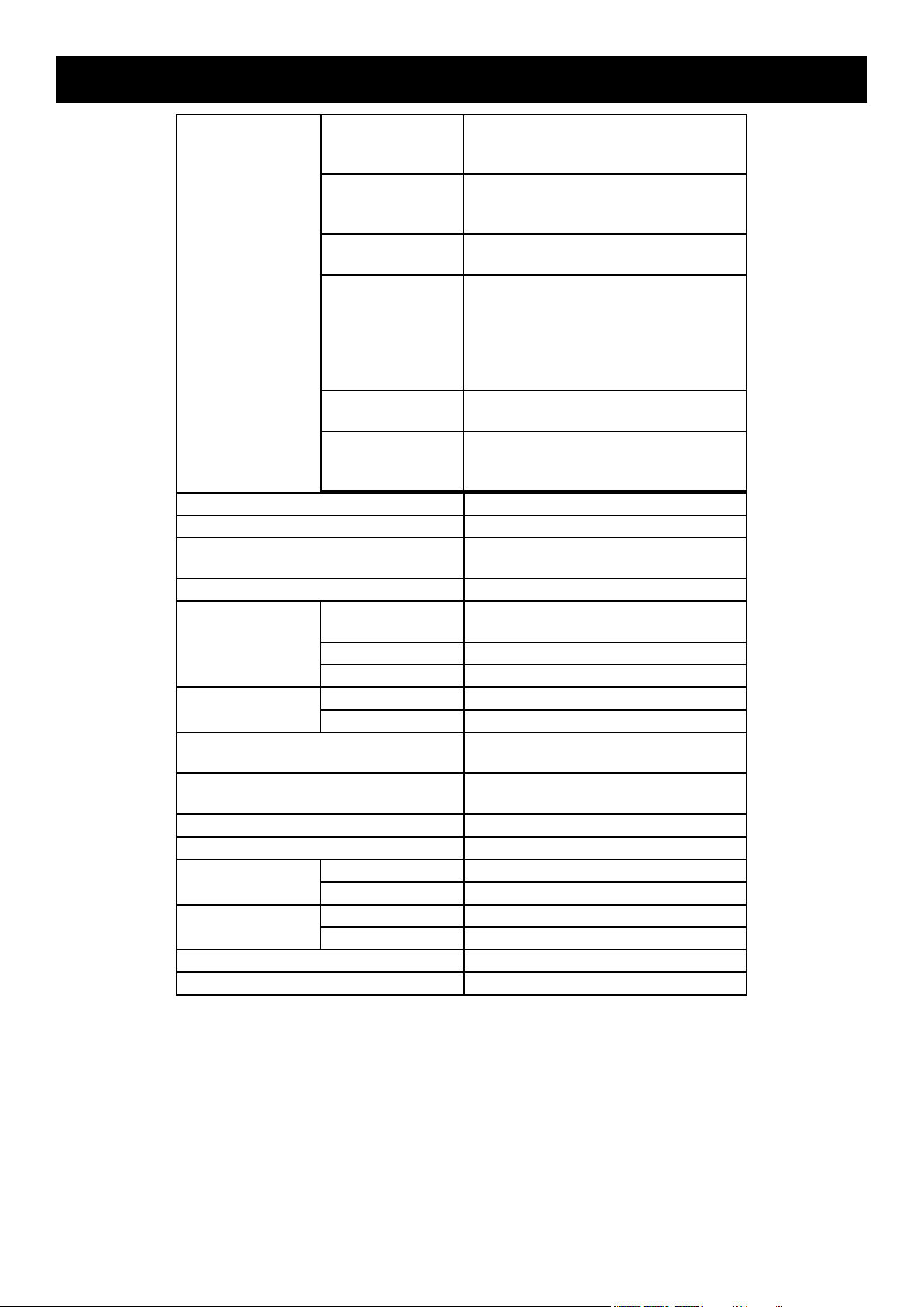
Specifications
Generator
AC Output
(Gasoline)
120 VAC, 60 Hz, 32.5 A, 1 Phase
3900 Running Watts
5000 Maximum Starting Watts
AC Output
(LPG/Propane)
120 VAC, 60 Hz, 30 A, 1 Phase
3600 Running Watts
5000 Maximum Starting Watts
DC Output
12 VDC, 8 A (Nominal)
USB Ports, PD 24W, 5/9/12V
Receptacles
2 x 120 VAC, 20 A
1 x 120 VAC, RV TT-30R
1 x 12 VDC Two Pin Outlet
1 x USB-A
1 x USB-C
Parallel Ports
Remote Control
Battery
3V CR2032
Internal Battery
CO Sensor: 3V CR2032
Display: 3V CR2032
Contains non-replaceable battery
Displacement 224 cc
Compression Ratio 8.6:1
Engine Type
Horizontal Single Cylinder
4-stroke, OHV
Cooling System Forced air cooled
Fuel
Type
87+ octane, stabilizer-treated
unleaded gasoline or LPG / propane
Gasoline Tank 3.7 Gallon / 14 Liter
LPG/Propane Tank 20 lb tank minimum
Engine Oil
Type SAE 10W-30
Capacity 0.64 Quart / 0.60 Liter
Run Time @ 25% Load
with full gasoline tank
18.2 hours
Run Time @ 25% Load
with 20 lb LPG/propane tank
14.6 hours
Sound Level at 23 feet, 25% load 60.5 dB(A)
Bore x Stroke 70 mm x 58 mm
Spark Plug
Type F7TC (Torch) or equivalent
Gap 0.028"– 0.031"
Valve Clearance
Intake 0.003"– 0.005"
Exhaust 0.005"– 0.007"
Engine Speed 2600 – 3800 RPM
Electric Start Battery 12V – 6.5 Ah Lead-Acid Non-Spillable
The emissions control system for this Engine is warranted for standards set by the
U.S. Environmental Protection Agency. For warranty information, refer to the last pages of this manual.
In reference to the remote: Changes or modifications not expressly approved by Harbor Freight Tools
could void the user’s authority to operate the equipment. FCC ID: 2AL6E-YKQT01
Page 5
For technical questions, please call 1-888-866-5797.
71367
SAFETYOPERATIONMAINTENANCE SETUP
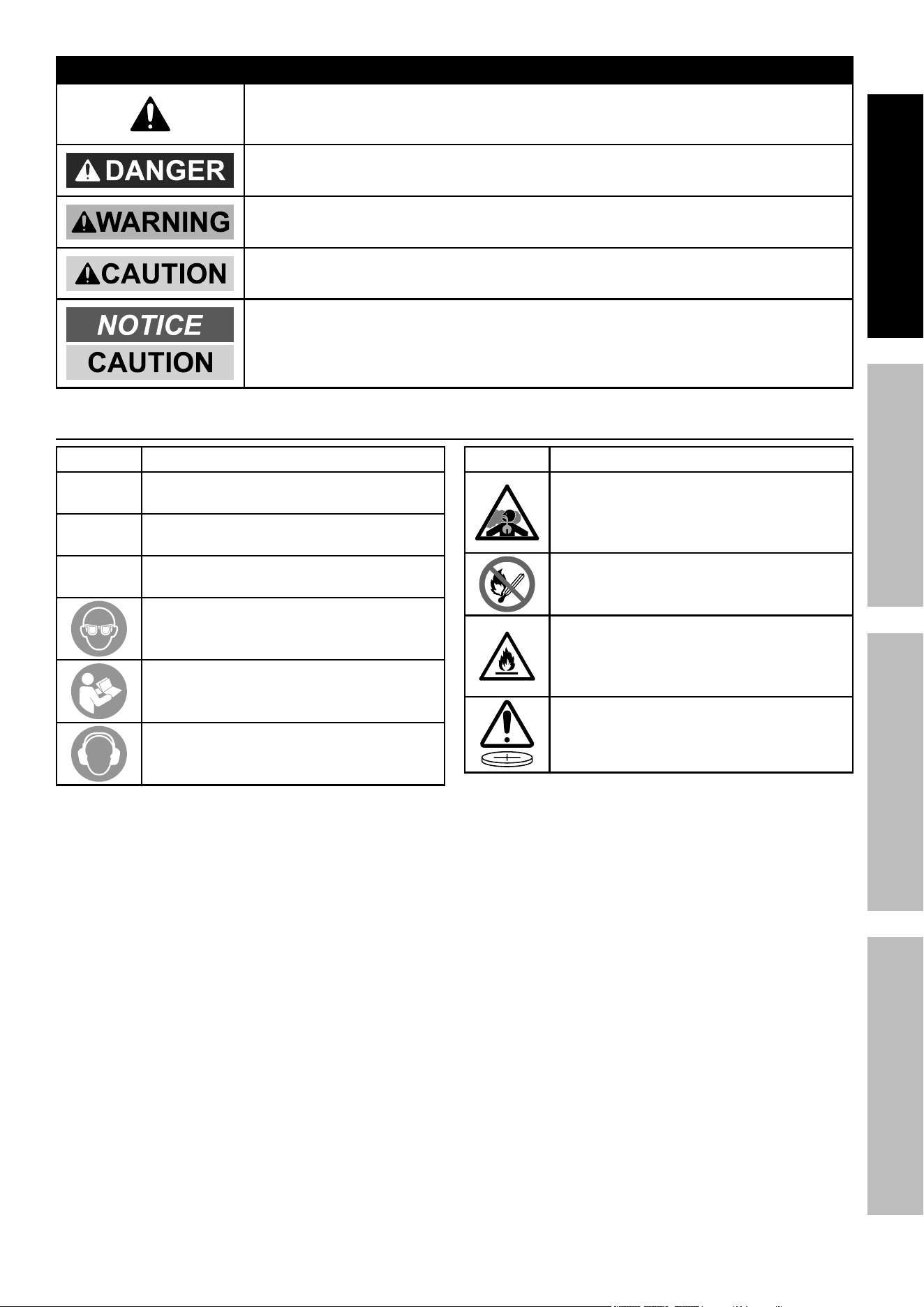
WARNING SYMBOLS AND DEFINITIONS
This is the safety alert symbol. It is used to alert you to potential
personal injury hazards. Obey all safety messages that
follow this symbol to avoid possible injury or death.
Indicates a hazardous situation which, if not avoided,
will result in death or serious injury.
Indicates a hazardous situation which, if not avoided,
could result in death or serious injury.
Indicates a hazardous situation which, if not avoided,
could result in minor or moderate injury.
Addresses practices not related to personal injury.
Symbol Definitions
Symbol Property or Statement
RPM
Revolutions Per Minute
HP
Horsepower
AWG
American Wire Gauge
WARNING marking concerning
Risk of Eye Injury. Wear ANSI-approved
safety goggles with side shields.
Read the manual before
set-up and/or use.
WARNING marking concerning
Risk of Hearing Loss.
Wear hearing protection.
Symbol Property or Statement
WARNING marking concerning
Risk of Respiratory Injury.
Operate engine OUTSIDE and far away
from windows, doors, and vents.
WARNING marking concerning
Risk of Fire while handling fuel.
Do not smoke while handling fuel.
WARNING marking concerning
Risk of Fire. Do not refuel while
operating. Keep flammable
objects away from engine.
WARNING: Contains coin battery.

Page 6
For technical questions, please call 1-888-866-5797.
71367
SAFETY OPERATION MAINTENANCESETUP
IMPORTANT SAFETY INSTRUCTIONS
WARNING! Read all instructions.
Failure to follow all instructions listed below may result in fire, serious injury and/or DEATH.
The warnings and precautions discussed in this manual cannot cover all possible conditions and
situations that may occur. It must be understood by the operator that common sense and caution
are factors which cannot be built into this product, but must be supplied by the operator.
SAVE THESE INSTRUCTIONS
Setup Precautions
1. Gasoline fuel and fumes are flammable, and
potentially explosive. Use proper fuel storage
and handling procedures. Do not store fuel
or other flammable materials nearby.
2. Fire and explosion hazard. Never use a
gas container, LPG/propane connector
hose, LPG/propane tank or any other fuel
item that appears to be damaged.
3. Fire and explosion hazard. Only use approved
LPG/propane tanks with an Overfilling Prevention
Device (OPD) valve. Keep the tank in a vertical
position with the valve on top and placed at
ground level on a flat surface. Do not allow tanks
to be near any heat source. When transporting
and storing, turn the propane tank valve to the
fully closed position and disconnect the tank.
Make sure to always cover the generator inlet
and tank outlet with protective plastic caps.
4. Connect LPG/propane tank using provided
attachment kit only. Kit includes 1.5 meter
(4.9 ft) hose. Place tank as far away from
Generator as hose allows and away from engine
exhaust. Do not place tank above Generator.
5. Fire and explosion hazard. If there is a strong smell
of propane while operating the generator, fully close
the LPG/propane tank valve immediately. Once the
propane is off, use soapy water to check for leaks
on the hose and connections on the tank valve and
the generator. Do not smoke or light a cigarette or
check for leaks using any open flame source such
as a match or lighter. If a leak is found, contact a
qualified technician to inspect and repair the LPG/
propane system before using the generator.
6. Install carbon monoxide alarm(s) with
battery backup in nearby buildings according
to manufacturer’s instructions.
7. Have multiple ABC class fire extinguishers nearby.
8. Operation of this equipment may create sparks that
can start fires around dry vegetation.
A spark arrestor may be required. The operator
should contact local fire agencies for laws or
regulations relating to fire prevention requirements.
9. Set up and use only on a flat, level,
well-ventilated surface.
10. All connections and conduits from the Generator
to the load must only be installed by trained and
licensed electricians, and in compliance with all
relevant local, state, and federal electrical codes and
standards, and other regulations where applicable.
11. Connections for standby power to a building
electrical system must be made by a qualified
electrician. The connection must isolate the
Generator power from utility power, and must
comply with all applicable laws and electrical codes.
12. A transfer switch should be installed by a
licensed electrician in compliance with all
applicable laws and electrical codes.
13. Wear ANSI-approved safety goggles, heavy-duty
work gloves, and dust mask/respirator during set up.
14. Use only lubricants and fuel recommended
in the Specifications chart of this manual.
15. Improper connections to a building electrical system
can allow electrical current from the Generator
to backfeed into the utility lines. Such backfeed
may electrocute utility company workers or others
who contact the lines during a power outage,
and the Generator may explode, burn, or cause
fires when utility power is restored. Consult
the utility company and a qualified electrician if
intending to use the Generator for back up power.
16. Do not operate the Generator before grounding.
The Generator must be earth-grounded
in accordance with all relevant electrical
codes and standards before operation.
Page 7
For technical questions, please call 1-888-866-5797.
71367
SAFETYOPERATIONMAINTENANCE SETUP
Operating Precautions
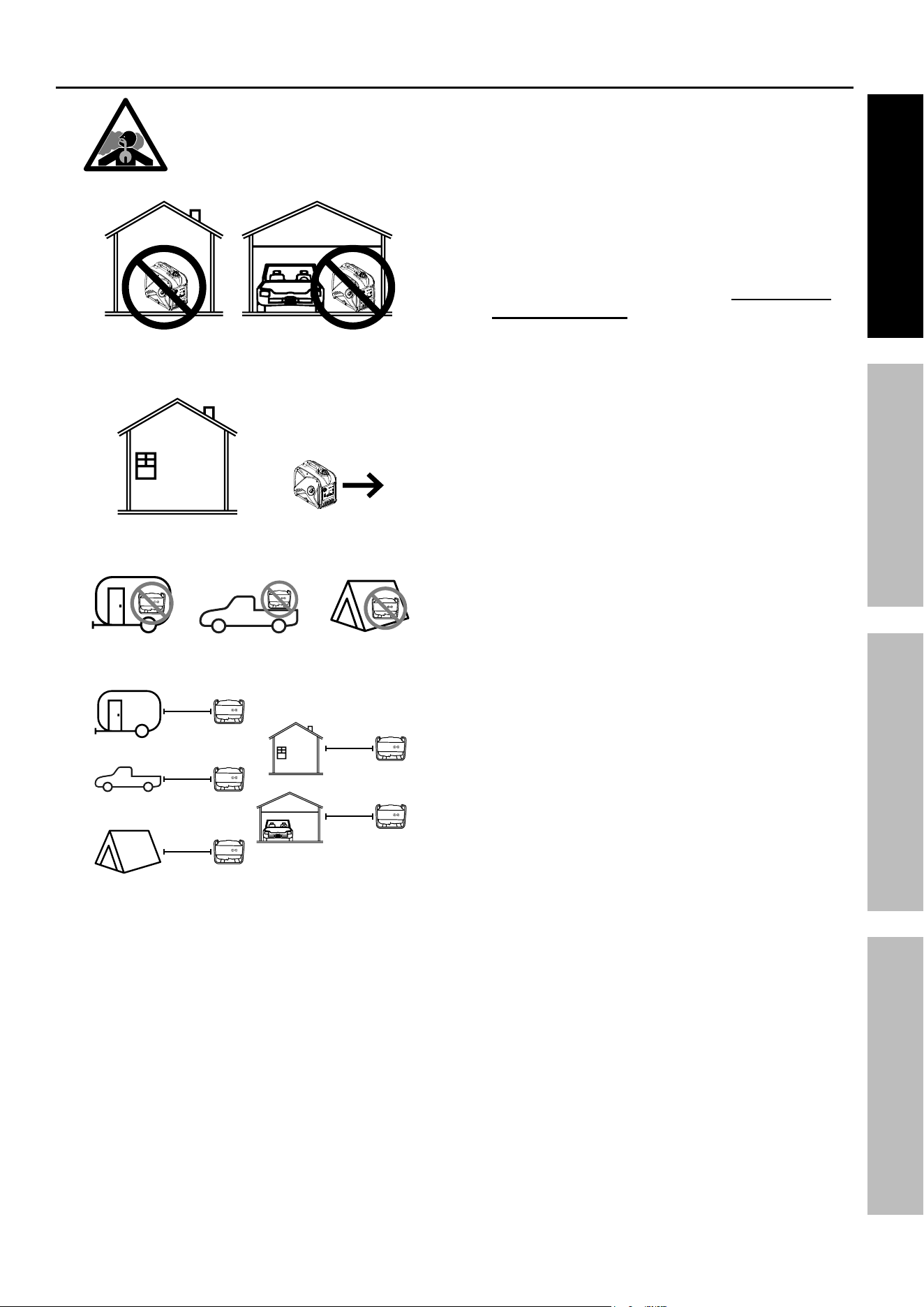
1. CARBON MONOXIDE HAZARD
Using a generator indoors CAN KILL YOU IN MINUTES.
Generator exhaust contains carbon monoxide. This is a poison you cannot see or smell.
OFF
RUN
START
LOW OIL
OVERLOAD
OUTPUT
PARALLEL OUTLETS
RESET
AC 120V
RESET
DC 12V
ESC
THROTTLE
OFF
RUN
START
LOW OIL
OVERLOAD
OUTPUT
PARALLEL OUTLETS
RESET
AC 120V
RESET
DC 12V
ESC
THROTTLE
NEVER use inside a home or garage,
EVEN IF doors and windows are open.
OFF
RUN
START
LOW OIL
OVERLOAD
OUTPUT
PARALLEL OUTLETS
RESET
AC 120V
RESET
DC 12V
ESC
THROTTLE
Only use OUTSIDE and far away
from windows, doors, and vents.
Do not use in trailers, truck beds, or tents.
20′
20′
20′
20′
20′
Use at least 20 feet away from people,
animals, and structures with exhaust pointed
away. Generator will still produce carbon
monoxide, even when burning propane.
2. CARBON MONOXIDE SHUTOFF
DANGER! TO PREVENT SERIOUS
INJURY AND DEATH FROM
CARBON MONOXIDE INHALATION:
The Carbon Monoxide sensor is an additional
layer of protection only. Do not use the
Generator in any area or situation that will
allow carbon monoxide to accumulate.
• FLASHING RED LIGHT:
Dangerous levels of carbon monoxide gas have
built up and generator will shutoff.
Leave immediately until area has aired
out. Move Generator to well-ventilated
area before operation.
• FLASHING YELLOW LIGHT:
Carbon monoxide sensor malfunction.
Sensor needs service. Do not use the
Generator until the sensor is working
properly. For technical questions,
please call 1-888-866-5797.
NOTE: Yellow light flashes once after
starting to indicate passing self-check
and is functioning normally.
Carbon Monoxide sensor must only be serviced
by qualified technician to restore it to original
settings. Do not modify or tamper with the
Carbon Monoxide sensor. Not following these
instructions can result in death or serious injury
due to Carbon Monoxide sensor malfunction.
3. Never use a generator indoors, including in
garages, basements, crawl spaces and sheds.
Opening doors and windows or using fans will NOT
prevent carbon monoxide build up in the home.
4. When using generators, keep them outdoors
and far away from open doors, windows,
and vents to avoid toxic levels of carbon
monoxide from building up indoors.
5. If you start to feel sick, dizzy, or weak while
using a generator, get to fresh air right away.
The carbon monoxide from generators can
quickly lead to full incapacitation and death.
6. LPG/Propane is highly flammable and explosive.
7. Flammable gas under pressure can
cause a fire or explosion if ignited.
8. LPG/Propane can settle in low places
because it is heavier than air.
9. LPG/Propane has a distinctive odor added
to help detect potential leaks. This odor can
diminish over time or due to other factors.
10. Keep LPG/Propane tanks in an upright position.

Page 8
For technical questions, please call 1-888-866-5797.
71367
SAFETY OPERATION MAINTENANCESETUP
11. Connect LPG/propane tank using provided
attachment kit only. Kit includes 1.5 meter
(4.9 ft) hose. Place tank as far away from
Generator as hose allows and away from engine
exhaust. Do not place tank above Generator.
12. When exchanging LPG/propane tanks, be
sure the tank valve is the same type.
13. In case of a LPG/propane fire, do not
attempt to extinguish unless the fuel
supply can be shut off safely.
14. LPG/propane will burn the skin. Prevent
skin contact at all times.
15. Keep the propane tank away from
the generator exhaust.
16. Keep children away from the equipment,
especially while it is operating.
17. Keep all spectators at least six feet
from the engine during operation.
18. Fire Hazard! Do not fill gas tank while engine is
running. Do not operate if gasoline has been spilled.
Clean spilled gasoline before starting engine.
Do not operate near pilot light or open flame.
19. Do not touch engine during use.
Let engine cool down after use.
20. Never store fuel or other flammable
materials near the engine.
21. If the plugged in product operates abnormally
or unusually slow, immediately stop using the
generator as a power source. Read and adhere
to the instruction manual of the product to be
powered to make sure that it can be safely and
efficiently powered by a portable generator.
22. Before connecting an appliance or power cord
to the generator: Make sure that it is in good
working order. Faulty appliances or power cords
can create a potential for electrical shock.
23. Do not exceed the running wattage of the generator.
Make sure that the total electrical rating of the
all of the tools or appliances plugged into the
generator at the same time does not exceed that
of the generator. Check that the startup surge
will not be beyond the limit of the generator.
24. Do not overload the generator. Even a
slight overload may lead to premature
generator failure and a substantial
overload will trip the circuit breaker.
25. Do not attempt to connect or disconnect
load connections while standing in water,
or on wet or soggy ground.
26. Do not touch electrically energized parts of
the generator and interconnecting cables or
conductors with any part of the body, or with
any non-insulated conductive object.
27. Connect the generator only to a load that is
compatible with the electrical characteristics
and running wattage of the generator.
28. Insulate all connections and disconnected wires.
29. Guard against electric shock.
Prevent body contact with grounded surfaces such
as pipes, radiators, ranges, and refrigerators.
30. Only use a suitable means of transport and
lifting devices with sufficient weight bearing
capacity when transporting the generator.
31. Secure the generator on transport vehicles to
prevent it from rolling, slipping, and tilting.
32. Industrial applications must follow
OSHA requirements.
33. Do not leave the generator unattended when it is
running. Turn off the generator (and remove safety
keys, if available) before leaving the work area.
34. The generator can produce high noise levels.
Prolonged exposure to noise levels
above 85 dBA is hazardous to hearing.
Wear ear protection when operating the generator
or when working nearby while it is operating.
35. Wear ANSI-approved safety glasses
and hearing protection during use.
36. People with pacemakers should consult their
physician(s) before use. Electromagnetic fields in
close proximity to a heart pacemaker could cause
pacemaker interference or pacemaker failure.
Caution is necessary when near the
engine’s magneto or recoil starter.
37. Use only accessories that are recommended
by Harbor Freight Tools for your model.
Accessories that may be suitable for one
piece of equipment may become hazardous
when used on another piece of equipment.
38. Do not operate in explosive atmospheres,
such as in the presence of flammable
liquids, gases, or dust. Gasoline-powered
engines may ignite the dust or fumes.
39. Stay alert, watch what you are doing and
use common sense when operating this
generator. Do not use while tired or under the
influence of drugs, alcohol or medication.
40. Dress properly. Do not wear loose clothing or
jewelry. Keep hair, clothing and gloves away
from moving parts. Loose clothes, jewelry or
long hair can be caught in moving parts.
41. Parts, especially exhaust system components,
get very hot during use. Stay clear of hot parts.
42. Keep the stop / start remote control away from
children. Do not place in tight spaces with other
objects that may actuate the remote buttons and
send an undesired start signal to the generator.
43. Do not cover the generator during operation.
44. Keep the generator and surrounding
area clean at all times.
45. Do not smoke, or allow sparks, flames,
or other sources of ignition around the
equipment, especially when refuelling.
Page 9
For technical questions, please call 1-888-866-5797.
71367
SAFETYOPERATIONMAINTENANCE SETUP
46. Use the equipment, accessories, etc.,
in accordance with these instructions and in
the manner intended for the particular type of
equipment, taking into account the working
conditions and the work to be performed.
Use of the equipment for operations different from
those intended could result in a hazardous situation.
47. Do not operate the equipment with known
leaks in the engine’s fuel system.
48. When spills of fuel or oil occur, they must be
cleaned up immediately. Dispose of fluids and
cleaning materials as per any local, state, or
federal codes and regulations. Store oil rags in
a bottom-ventilated, covered, metal container.
49. Keep hands and feet away from moving parts. Do
not reach over or across equipment while operating.
50. Before use, check for misalignment or binding of
moving parts, breakage of parts, and any other
condition that may affect the equipment’s operation.
If damaged, have the equipment serviced
before using. Many accidents are caused
by poorly maintained equipment.
51. Use the correct equipment for the application.
Do not modify the equipment and do not use the
equipment for a purpose for which it is not intended.
52. Extension Cord - Make sure your extension cord
is in good condition. When using an extension
cord, be sure to use one heavy enough to carry
the current your product will draw. An undersized
extension cord will cause a drop in line voltage
resulting in loss of power and overheating.
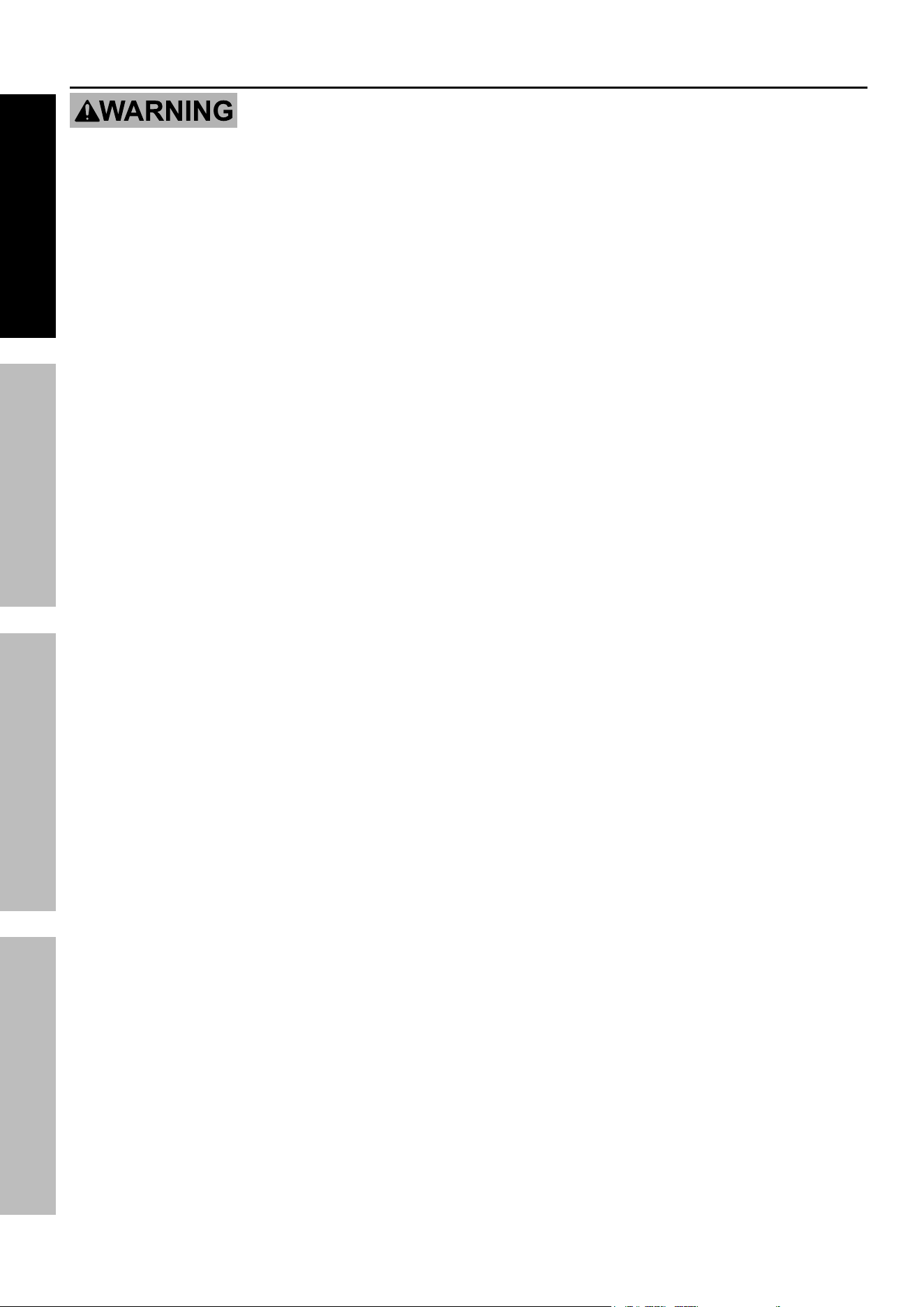
The table below shows the correct cord size to use
depending on cord length and nameplate ampere
rating. If in doubt, use the next heavier gauge.
The smaller the gauge number, the heavier the cord.
RECOMMENDED MINIMUM WIRE GAUGE FOR EXTENSION CORDS
Current
(Amps)
Load @ 120 V
(Watts)
20 ~ 50 ft 50 ~ 75 ft 75 ~ 100 ft
2 240 18 AWG
4 480 18 AWG 16 AWG
6 720 18 AWG 16 AWG 14 AWG
8 960 16 AWG 12 AWG
10 1200 16 AWG 14 AWG 12 AWG
15 1800 14 AWG 12 AWG 10 AWG
20 2400 12 AWG 10 AWG
25 3000 12 AWG 10 AWG 8 AWG
30 3600 10 AWG 8 AWG
40 4800 6 AWG
Do not use extension cords less than 20 feet in length.
Page 10
For technical questions, please call 1-888-866-5797.
71367
SAFETY OPERATION MAINTENANCESETUP
Parallel Kit Precautions
TO PREVENT SERIOUS INJURY, DEATH, AND GENERATOR AND/OR
EQUIPMENT DAMAGE FROM ELECTRIC SHOCK AND FIRE:
1. Follow Parallel Kit instructions provided with
Kit for connection and use of a Parallel Kit.
2. Only connect two identical Inverter Generators
together using a Parallel Kit.
3. Connect Parallel Kit only to terminals marked
“Parallel Outlets” on the front of the Generator.
4. Do not remove or connect a Parallel Kit
while the Generator is running.
5. Do not use a Parallel Kit that is
attached to only one Generator.

Page 11
For technical questions, please call 1-888-866-5797.
71367
SAFETYOPERATIONMAINTENANCE SETUP
Service Precautions
1. Before service, maintenance, or cleaning:
a. Unplug all devices from the generator.
b. Push the Engine / Battery Switch
to its “OFF” position.
c. Turn the Fuel Selector Switch to
its “OFF / STORAGE” position.
d. Allow the engine to completely cool.
e. Then, remove the spark plug cap
from the spark plug.
2. Keep all safety guards in place and in
proper working order. Safety guards include
muffler, air cleaner, mechanical guards,
and heat shields, among other guards.
3. Keep all electrical equipment clean and dry.
Replace any wiring where the insulation is
cracked, cut, abraded, or otherwise degraded.
Replace terminals that are worn, discolored, or
corroded. Keep terminals clean and tight.
4. Do not alter or adjust any part of the
equipment or its engine that is sealed by the
manufacturer or distributor. Only a qualified
service technician may adjust parts that may
increase or decrease governed engine speed.
5. Wear ANSI-approved safety goggles,
heavy-duty work gloves, and
dust mask/respirator during service.
6. Maintain labels and nameplates on the equipment.
These carry important information.
If unreadable or missing, contact
Harbor Freight Tools for a replacement.
7. Have the equipment serviced by a qualified repair
person using only identical replacement parts.
This will ensure that the safety of the equipment
is maintained. Do not attempt any service or
maintenance procedures not explained in this
manual or any procedures that you are uncertain
about your ability to perform safely or correctly.
8. Store equipment out of the reach of children.
9. Follow scheduled engine and
equipment maintenance.
Refueling:
1. Turn off the generator before refilling the fuel tank.
Do not refill the fuel tank while the engine is hot.
2. Do not smoke, or allow sparks, flames,
or other sources of ignition around the
equipment, especially when refuelling.
3. Do not fill fuel tank to the top.
Leave a little room for the fuel to expand as needed.
4. Refuel in a well-ventilated area only.
5. Wipe up any spilled fuel and allow excess
to evaporate before starting engine.
To prevent FIRE, do not start the engine
while the smell of fuel hangs in the air.
Page 12
For technical questions, please call 1-888-866-5797.
71367
SAFETY OPERATION MAINTENANCESETUP
Button/Coin Battery Warnings
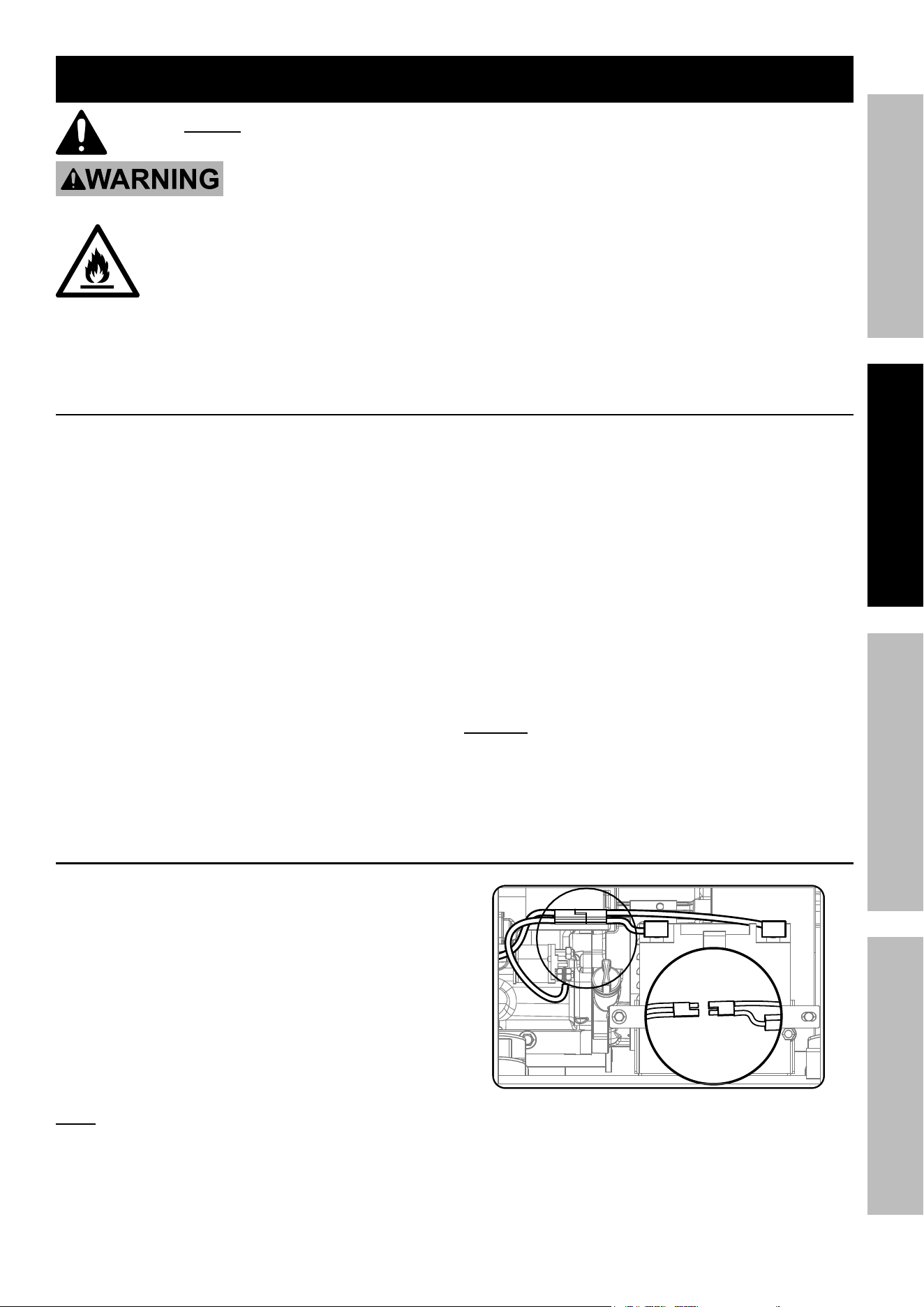
WARNING
• INGESTION HAZARD: This product contains
a button cell or coin battery.
• DEATH or serious injury can occur if ingested.
• A swallowed button cell or coin battery can cause
Internal Chemical Burns in as little as 2 hours.
• KEEP new and used batteries OUT OF REACH OF CHILDREN
• Seek immediate medical attention if a battery is suspected
to be swallowed or inserted inside any part of the body.
This symbol means:
INGESTION HAZARD: This product contains a
button cell or coin battery.
1. Remove and immediately recycle or dispose
of used batteries according to local regulations
and keep away from children. Do NOT dispose
of batteries in household trash or incinerate.
2. Even used batteries may cause
severe injury or death.
3. Call a local poison control center
for treatment information.
4. Non-rechargeable batteries are not to be recharged.
5. Do not force discharge, recharge, disassemble,
heat above 140°F or incinerate. Doing so
may result in injury due to venting, leakage
or explosion resulting in chemical burns.
6. Ensure the batteries are installed correctly
according to polarity (+ and -).
7. Do not mix old and new batteries, different
brands or types of batteries, such as alkaline,
carbon-zinc, or rechargeable batteries.
8. Remove and immediately recycle or dispose of
batteries from equipment not used for an extended
period of time according to local regulations.
9. Always completely secure the battery compartment.
If the battery compartment does not close
securely, stop using the product, remove the
batteries, and keep them away from children.
SAVE THESE INSTRUCTIONS.
Page 13
For technical questions, please call 1-888-866-5797.
71367
SAFETYOPERATIONMAINTENANCE SETUP
Set Up
Read the ENTIRE IMPORTANT SAFETY INFORMATION section at the beginning of this manual
including all text under subheadings therein before set up or use of this product.
TO PREVENT SERIOUS INJURY AND FIRE: Operate only with proper spark arrestor installed.
Operation of this equipment may create sparks that can start fires around dry vegetation.
A spark arrestor may be required.
The operator should contact local fire agencies for laws or regulations relating to fire
prevention requirements.
At high altitudes, the engine’s carburetor, governor, and any other parts that control the fuel-air ratio
will need to be adjusted by a qualified mechanic to allow efficient high-altitude use and
to prevent damage to the engine and any other devices used with this product.
Grounding
The Generator must be properly grounded in
accordance with all relevant electrical codes and
standards before operation. In many locations, local
code will not require this generator to be grounded
when used with cord and plug equipment plugged
directly into the receptacles on the generator. However,
your local regulations may require the generator to be
grounded. Contact a licensed electrician or consult
local authorities regarding local grounding requirements.
If grounding is required, have the unit grounded by a
qualified electrician if you are not qualified to do so.
General grounding instructions are as follows:
Use one of the following as the grounding electrode:
Pipe or conduit, minimum 3/4 in. diameter, minimum
8 ft. long. If steel, it must have anti-corrosion coating.
Rod, stainless steel or copper- or zinc-coated steel,
minimum 5/8 in. diameter, minimum 8 ft. long.
1. Drive electrode at least 8 ft.
vertically into the ground.
a. If rock layer prevents vertical entry, drive at an
angle not exceeding 45 degrees from vertical.
b. If rock layer prevents angle entry, bury electrode
in horizontal trench at least 30 in. deep.
2. The upper end of electrode must be
protected if above ground level.
3. Connect a #6 AWG grounding wire (not included)
from the Grounding Terminal on the Generator
Control Panel to the buried electrode.
For additional information on grounding methods,
please see the National Electrical Code.
NOTICE: The portable generator Neutral conductor
is isolated from the frame and from the AC receptacle
ground pin. Electrical devices that require a
connection between one conductor pin and the
grounded receptacle pin may not function properly.
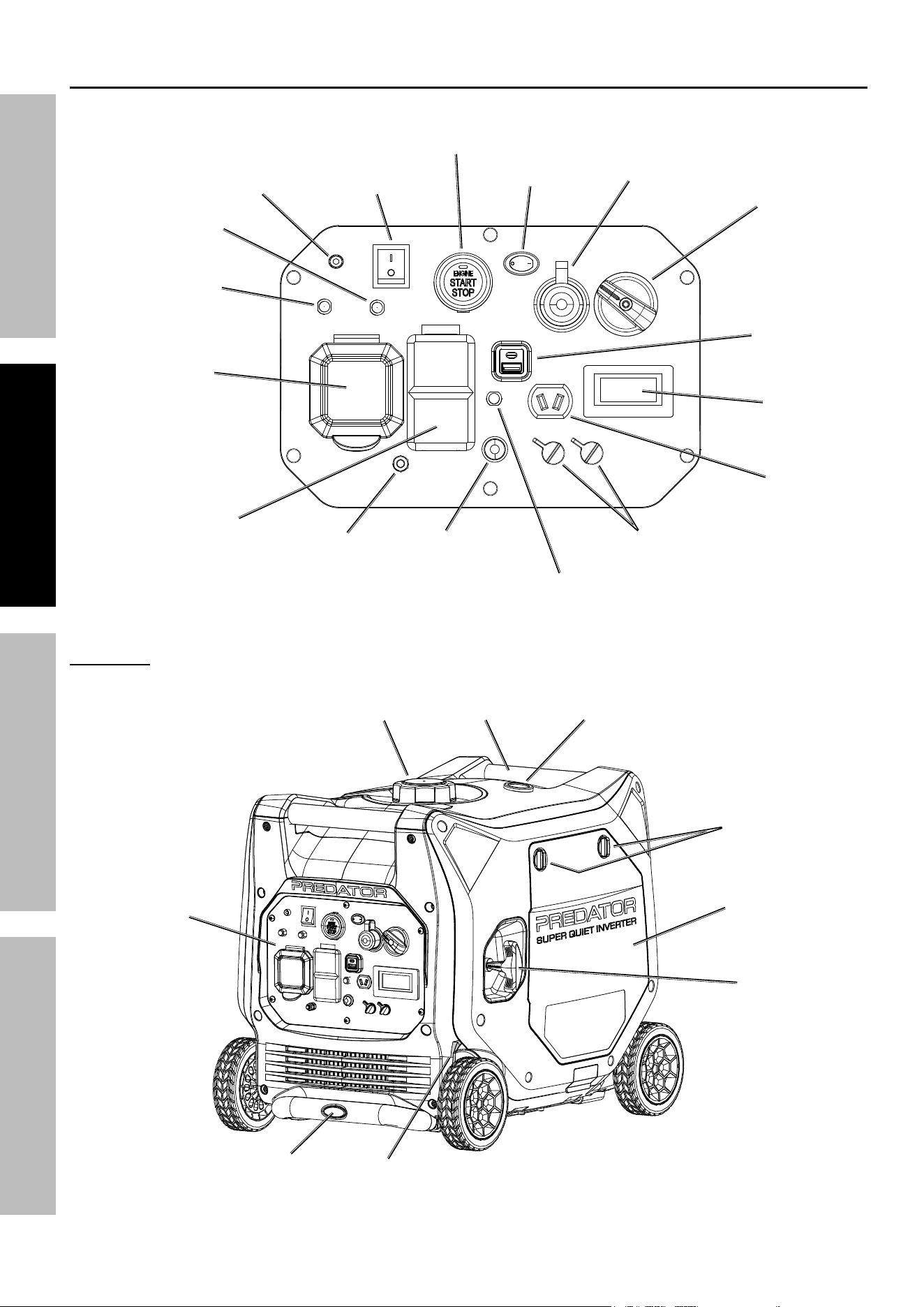
Electric Starter Battery Connection
For the electric start function, the included 12 VDC
Battery must be connected before first use.
1. Turn Engine/Battery Switch to OFF position.
2. Remove the Battery and Oil Fill Access Panel.
3. Locate the battery pigtail and connect
to the mating connector.
4. Make sure the battery harness is
secured and routed properly.
5. Replace the Battery and Oil Fill Access Panel.
Note: The built-in charging circuit charges the Battery while the Engine is running.
Turn the Engine / Battery Switch off when the Generator is not in use to prevent
draining the Battery.
Page 14
For technical questions, please call 1-888-866-5797.
71367
SAFETY OPERATION MAINTENANCESETUP
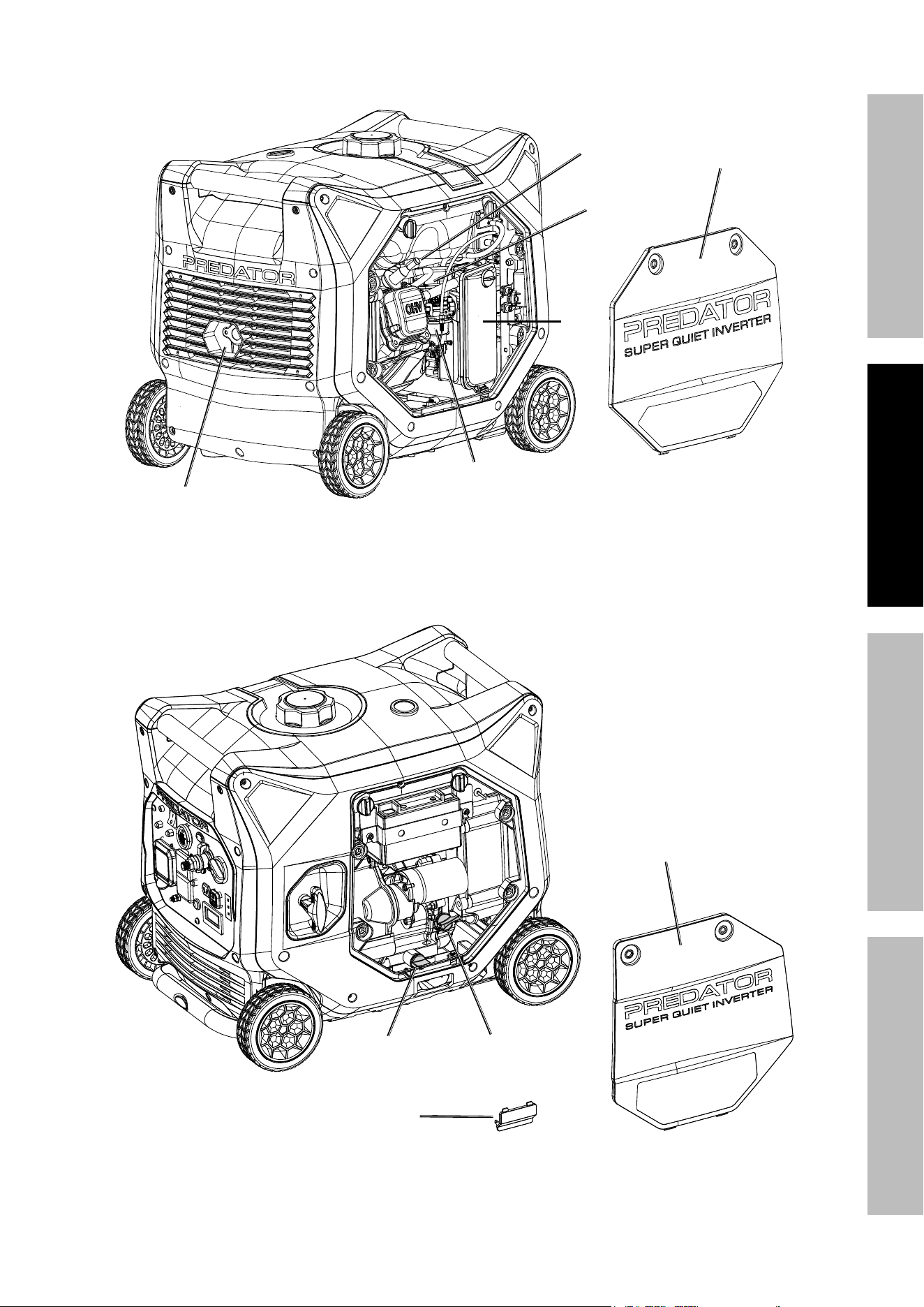
Components and Controls
LPG / Propane
Inlet
Fuel Selector
Switch
Ground
Terminal
120 VAC 20 A
Receptacles
(5-20R)
120 VAC 30 A
Receptacle
(TT-30R)
12 VDC
Receptacle
12 VDC Breaker
Reset Button
CO Sensor
Light
Parallel Kit
Terminals
Economy
(ESC) Switch
Overload
Reset Button
120 VAC 20 A Breaker
Reset Button
120 VAC 30 A Breaker
Reset Button
Digital
Display
Engine / Battery
Switch
Engine
Stop / Start
Switch
USB Ports
Figure A: Control Panel
WARNING! TO PREVENT SERIOUS INJURY: Follow Parallel Kit instructions for
connection and use of a Parallel Kit (Parallel Kit and instructions sold separately).
Fuel Cap
Control Panel
Access Panel
Lock Knobs
Telescopic Handle
Release Button
Battery
and Oil Fill
Access Panel
Handle
Fuel Gauge
Starter
Handle
Wheel Lock
Figure B: Generator Front
Page 15
For technical questions, please call 1-888-866-5797.
71367
SAFETYOPERATIONMAINTENANCE SETUP
Exhaust
Spark
Plug
Manual Choke
Override
Air
Filter
Maintenance
Access Panel
Carburetor
Figure C: Generator Rear and Interior
Battery
and Oil Fill
Access Panel
Oil Fill
Cap / Dipstick
Oil Drain
Access Door
Oil Drain
Plug
Page 16
For technical questions, please call 1-888-866-5797.
71367
SAFETY OPERATION MAINTENANCESETUP
High Altitude Operation Above 2000 feet
WARNING! TO PREVENT SERIOUS INJURY FROM FIRE:
Follow instructions in a well-ventilated area away from ignition sources.
If the Engine is hot from use, shut the engine off and wait for it to cool before proceeding. Do not smoke.
NOTICE: Warranty void if necessary adjustments are not made for high altitude use.
At high altitudes, the engine’s carburetor, governor, and any other parts that control the fuel-air ratio will need
to be adjusted by a qualified mechanic to allow efficient high-altitude use and to prevent damage to the engine
and any other devices used with this product. The fuel system on this engine may be influenced by operation
at higher altitudes. Proper operation can be ensured by installing an altitude kit at altitudes higher than 2000 ft.
above sea level. At elevations above 7000 ft, the engine may experience decreased performance, even with
the proper main jet. Operating this engine without the proper altitude kit installed may increase the engine’s
emissions and decrease fuel economy and performance. The kit should be installed by a qualified mechanic.
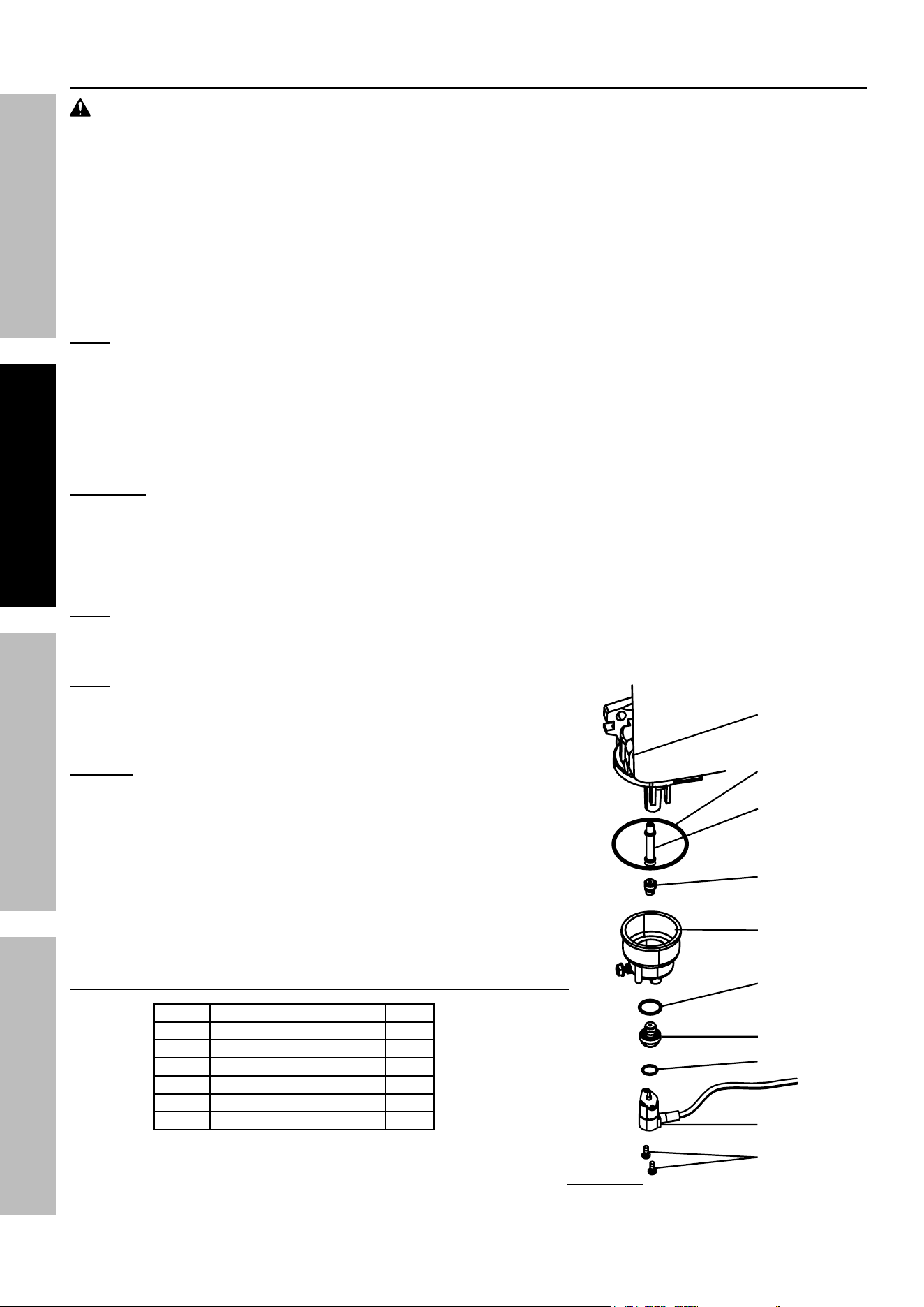
Note: Not all Generator models have a Solenoid. Skip those steps if a Solenoid is not present.
1. Turn off the Engine.
2. Close the Fuel Valve by turning the Fuel Selector Switch to the OFF/STORAGE position.
3. Remove the Maintenance Access Panel to access the Carburetor.
4. Place a bowl under the Fuel Cup to catch any spilled fuel.
5. Unthread the screws holding the Solenoid in place.
CAUTION! Carburetor bowl may have gas in it which will leak upon removing the Solenoid/Bolt.
6. Disconnect the Solenoid and Solenoid Seal from the Bolt.
7. Unthread the Bolt holding the Fuel Cup.
8. Remove the Bolt, Bolt Seal, Fuel Cup, Fuel Cup Seal and Main Jet from the body of the Carburetor assembly.
A carburetor screwdriver (not included) is needed to remove and install the Main Jet.
Note: The mixing tube is held in place by the Main Jet and might fall out when it is removed.
If it falls out, replace it in the same orientation before replacing the Main Jet.
9. Replace the Main Jet with the replacement Main Jet needed for your altitude range (part 1a, 2a, or 3a).
Note: The Fuel Cup Seal and Bolt Seal may be damaged during
removal and should be replaced with the new ones from the kit.
10. Replace the Fuel Cup Seal (5a), Fuel Cup,
Bolt Seal (4a), and Bolt. Tighten in place.
NOTICE: Do not cross thread bolt when tightening.
Finger tighten first and then use a wrench to
make sure the bolt is properly threaded.
11. Replace the Solenoid and Solenoid Seal (6a),
and tighten in place with screws.
12. Replace the
Maintenance Access Panel
.
13. Wipe up any spilled fuel and allow excess to evaporate before
starting Engine. To prevent FIRE, do not start the Engine while
the smell of fuel hangs in the air.
High Altitude Kit Parts List - A
Part Description Qty
1a Main Jet 2000-3000 ft. 1
2a Main Jet 3000-6000 ft. 1
3a Main Jet 6000-7000 ft. 1
4a Bolt Seal 1
5a Fuel Cup Seal 1
6a Solenoid Seal 1
Carburetor
Assembly
Main Jet
Fuel Cup Seal
Mixing Tube
(might remain
inside carburetor)
Fuel Cup
Bolt Seal
Bolt
Solenoid
Solenoid Seal
Screws
Not present
on some
Generators
Page 17
For technical questions, please call 1-888-866-5797.
71367
SAFETYOPERATIONMAINTENANCE SETUP
Operation
Read the ENTIRE IMPORTANT SAFETY INFORMATION section at the beginning of this manual
including all text under subheadings therein before set up or use of this product.
Pre-Start Checks
Only operate the generator outside and at least 20 feet away from people, animals, and structures,
with exhaust pointed away. Inspect Engine and Generator looking for damaged, loose, and missing
parts before set up and starting. Keep generator maintenance access panels in place and secured
during operation. If any problems are found, do not use equipment until fixed properly.
Checking and Filling Engine Oil
NOTICE: Generator is shipped without engine
oil. Engine’s crankcase MUST be filled with
oil before first use. Your Warranty is VOID if
the Engine’s crankcase is not properly filled
with oil before first use and before each use
thereafter. Before each use, check the oil level.
Engine will not start with low or no engine oil.
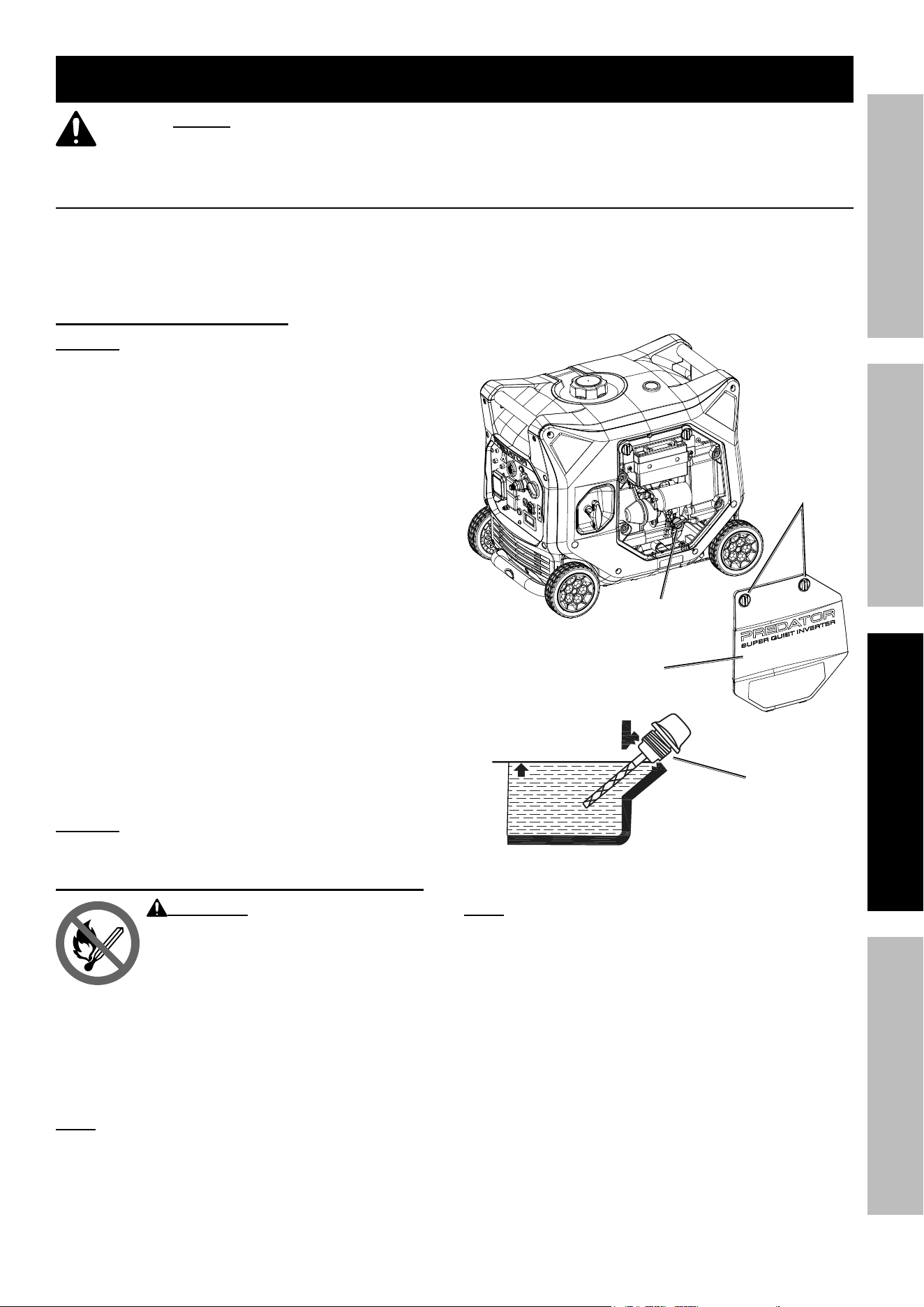
1. Make sure the Engine is stopped and is level.
2. On the right side of the Generator, loosen the
Access Panel Lock Knobs and remove the Battery
and Oil Fill Access Panel, as shown to the right.
3. Clean the top of the Oil Fill Cap / Dipstick
and the area around it. Remove the
Cap / Dipstick, turning it counterclockwise.
4. Check the oil level. The oil level should be
up to the edge of the hole as shown.
5. As needed, add the appropriate type of
oil until the oil level is at the proper level.
SAE 10W-30 oil is recommended for general use.
6. Thread the Oil Fill Cap / Dipstick back in clockwise
and replace the Battery and Oil Fill Access Panel.
NOTICE: Do not run the engine with too little oil.
Engine will shut off if engine oil level is too low.
Full Level
Oil Fill
Cap / Dipstick
Oil Fill
Cap / Dipstick
Access Panel
Lock Knobs
Battery and Oil
Fill Access Panel
For Gasoline Operation : Checking and Filling Fuel
WARNING! TO PREVENT SERIOUS
INJURY FROM FIRE:
Fill the fuel tank in a well-ventilated area
away from ignition sources. If the Engine
is hot from use, shut the Engine off and
wait for it to cool before adding fuel. Do not smoke.
1. Clean the Fuel Cap and the area around it.
2. Unscrew and remove the Fuel Cap.
3. Remove the Strainer and remove any dirt
and debris. Then replace the Strainer.
Note: Do not use gasoline containing more than
10% ethanol (E10). Do not use E85 ethanol. Add fuel
stabilizer to the gasoline or the Warranty is VOID.
Note: Do not use gasoline that has been stored in a
metal fuel container or a dirty fuel container. It can
cause particles to enter the carburetor, affecting
Engine performance and/or causing damage.
4. If needed, fill the Fuel Tank to about 1 inch under
the fill neck of the Fuel Tank with 87 octane or
higher unleaded gasoline that has been treated
with a fuel stabilizer additive. Follow fuel stabilizer
manufacturer’s recommendations for use.
5. Replace the Fuel Cap.
6. Wipe up any spilled fuel and allow excess
to evaporate before starting engine.
To prevent FIRE, do not start the engine
while the smell of fuel hangs in the air.
Page 18
For technical questions, please call 1-888-866-5797.
71367
SAFETY OPERATION MAINTENANCESETUP
For LPG Operation : Connecting LPG / Propane Tank
a. The LPG / Propane tank must have a minimum capacity of 20lb.
b. The LPG / Propane tank must conform to the standard as listed in Setup Precautions section.
c. Propane tanks that use a liquid withdrawal system cannot be
used with this Generator.
d. Verify the re-qualification date on the tank has not expired.
e. Connect LPG / Propane tank using provided attachment kit only. Kit includes
1.5 meter (4.9 ft) Hose. Place tank as far away from Generator as Hose allows
and away from engine exhaust. Do not place tank above Generator.
Do not use included LPG / Propane Hose with any other appliances.
f. All new tanks or used tanks that have not been plugged or kept closed
must be purged of air and moisture by a propane supplier prior to filling.
g. Position the tank so the connection between the tank valve and the
LPG / Propane Inlet will not cause sharp bends or kinks in the Hose.
h. Inspect the LPG / Propane Hose before every use.
Do not use damaged equipment. If damage is detected,
have the problem corrected before further use.
WARNING! EXPLOSION HAZARD.
TO PREVENT SERIOUS INJURY:
Do not start the engine if the smell of
LPG / Propane hangs in the air. Close the
propane tank valve and disconnect the
LPG / Propane hose from the Generator when not in use.
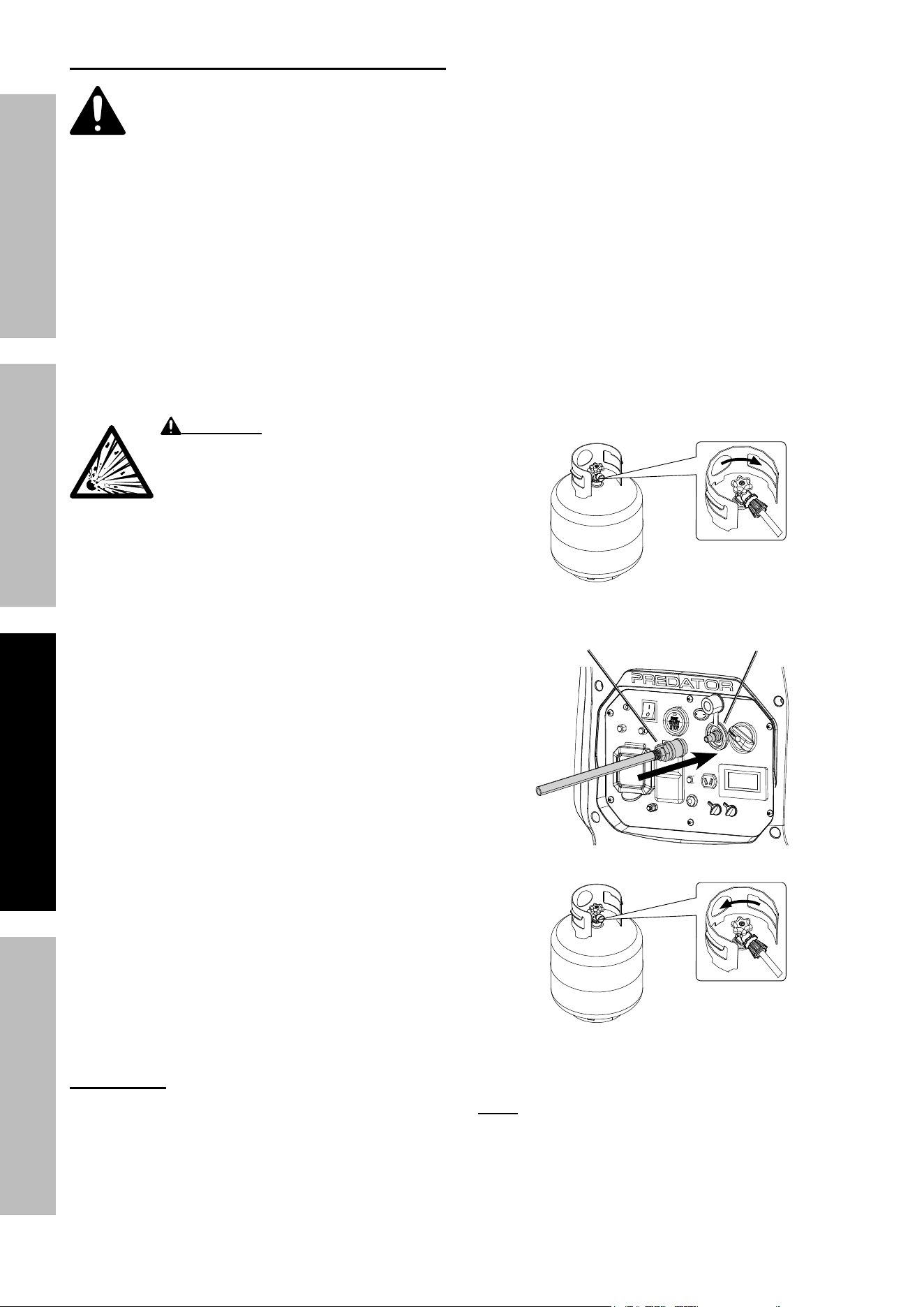
1. Turn the Generator OFF and place on a flat surface
in a well ventilated area.
2. Verify that the propane tank valve
is in the fully closed position.
3. Remove the cover on the LPG / Propane Inlet.
4. Align the finger on the female hose fitting on
the LPG / Propane Hose with the slot next
to the male coupling on the Generator.
5. Insert the female hose fitting into the coupling
and push in until it clicks into place.
6. Remove the safety plug or cap from
the propane tank valve.
7. Attach the other end of the Hose to the
LPG / Propane connector on the tank.
Hand tighten clockwise to a positive
stop. To prevent damage, do not use a
wrench or tool to tighten the connector.
8. Turn the propane tank valve to the fully open
position. Check for leaks by applying soapy water
to all connections. Look for bubbles. If bubbles
are present at connections, close the propane tank
valve and tighten connections. Open the valve
and recheck connections. If a leak continues or
is not at a connection do not use the Generator.
Have the problem corrected before further use.
Remote Start
The Start / Stop Remote Control will operate up
to approximately 100 feet in distance from the
Generator. The distance at which the Remote will
function may be adversely affected by obstructions
between the Generator and the Remote Control.
Note: The operational range of the Remote Control may
decrease as the battery in the Remote become depleted.
Remote replacement battery: 3V CR2032
LPG / Propane
Inlet
LPG / Propane
Hose
Close Tank Valve
Open Tank Valve
Page 19
For technical questions, please call 1-888-866-5797.
71367
SAFETYOPERATIONMAINTENANCE SETUP
Reprogramming the Start/Stop Remote Control
If the Start/Stop Remote Control is
replaced or needs to be paired to the
generator, follow this procedure:
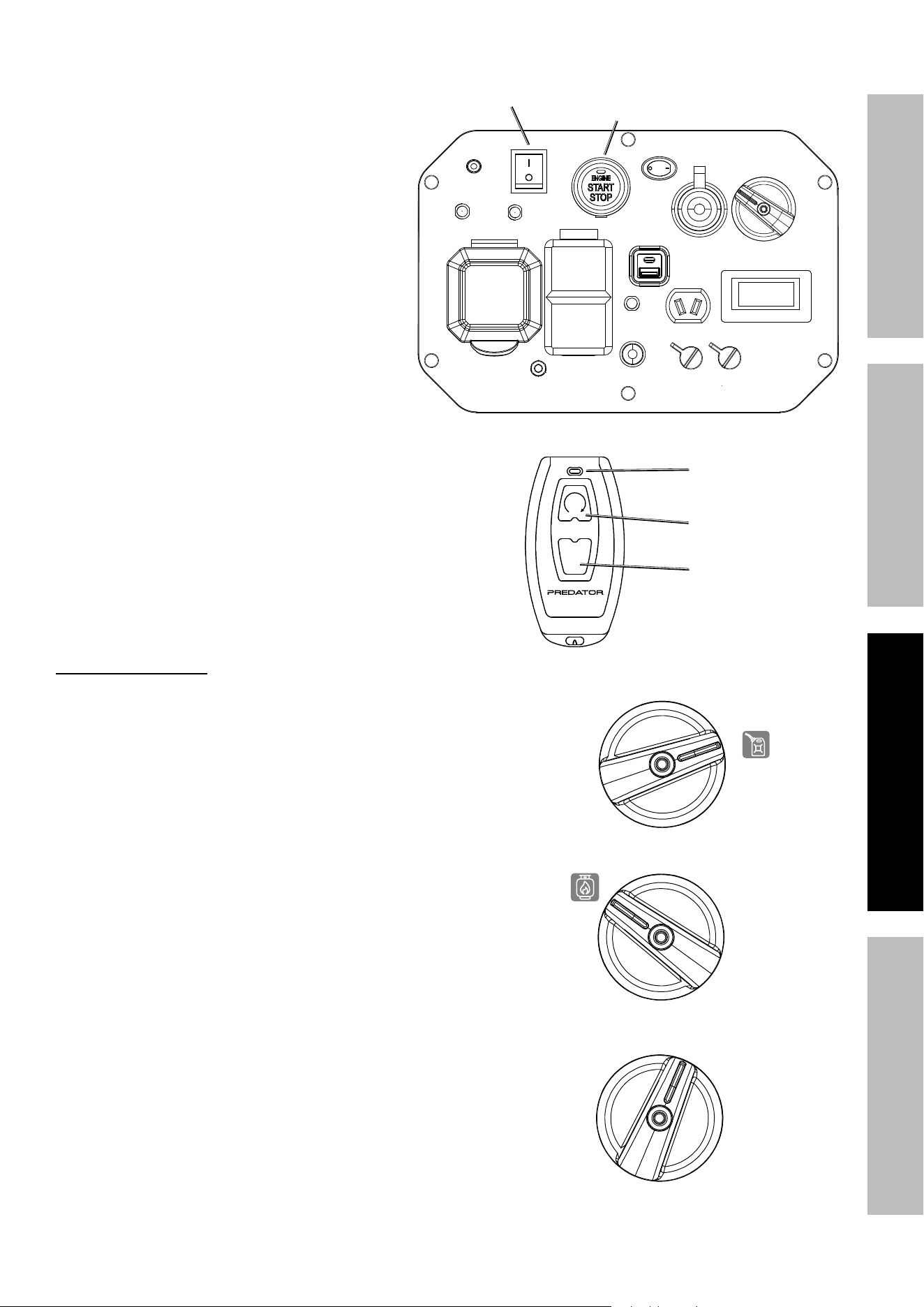
1. Push the Engine/Battery Switch to the
ON position.
2. Push and hold the Engine Start/Stop
Switch until the Switch Indicator Light
flashes green and red (hold for 10~15
seconds), then release the Switch.
3. Push the 2x button on the Stop/Start Remote
Control. It will pair with Generator and the Switch
Indicator Light on the Generator will stop flashing.
Fuel Selector Switch
Turn the Fuel Selector Switch on the Control
Panel to the desired fuel setting.
1. To operate the Generator on gasoline turn the Fuel Selector
Switch fully to the right to the GASOLINE setting.
2. To operate the Generator on LPG / Propane turn the Fuel
Selector Switch fully to the left to the PROPANE setting.
3. When the Generator is not in use turn the Fuel Selector
Switch to the OFF / STORAGE position to turn off gasoline
and LPG / Propane fuel flow to Engine.
Engine / Battery
Switch
Engine
Stop / Start
Switch
OFF
2x
Remote Control
Activation Light
OFF Button
ON (2x) Button
GASOLINE
PROPANE
OFF /STORAGE
Page 20
For technical questions, please call 1-888-866-5797.
71367
SAFETY OPERATION MAINTENANCESETUP
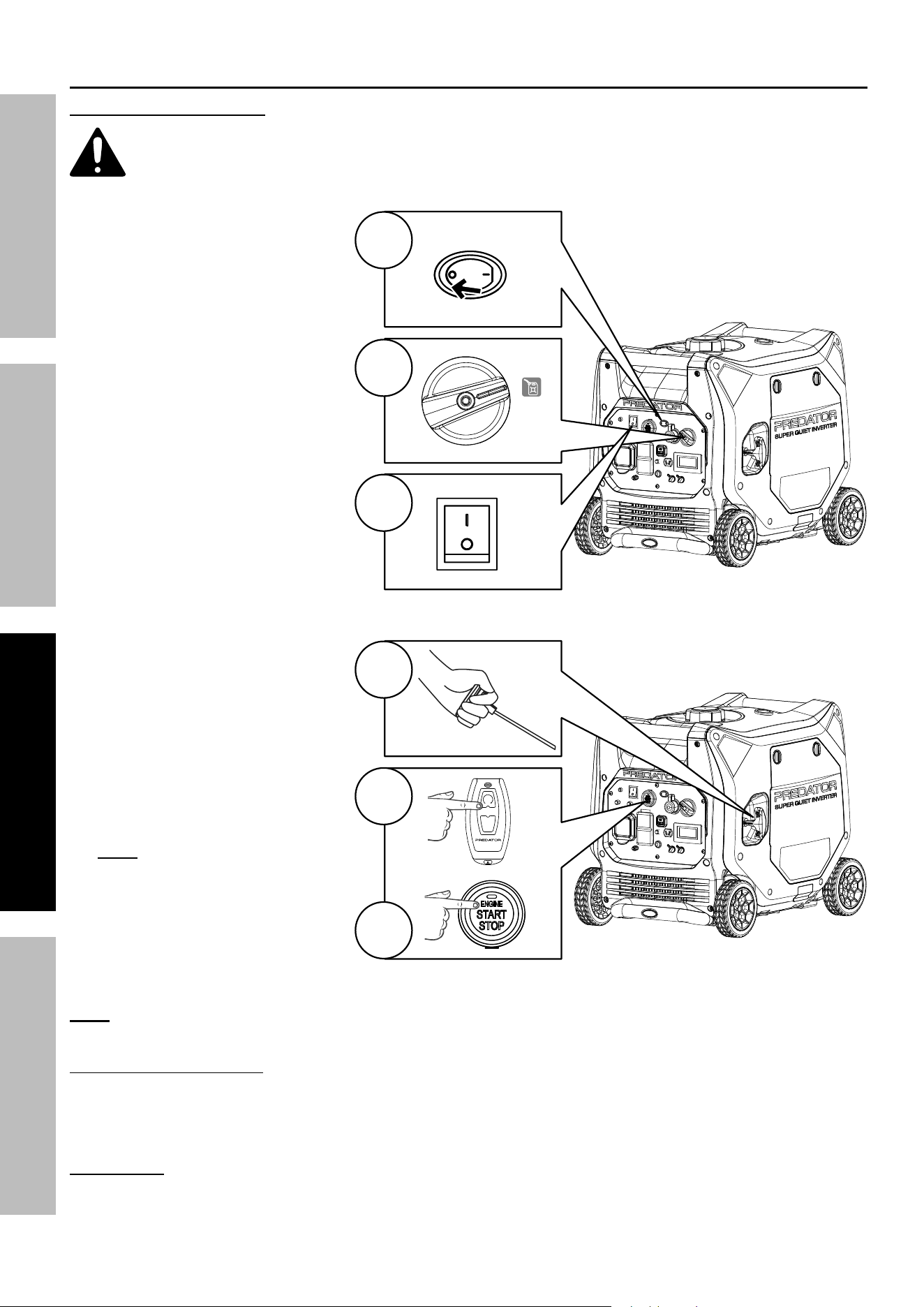
Starting the Engine – Gasoline Operation
Before Starting the Engine
a. Inspect the generator and engine.
b. Disconnect all electrical loads from the generator.
c. Fill the engine with the proper amount and type of
both stabilizer-treated unleaded gasoline and oil.
1. Move the Economy (ESC) Switch
to the OFF position.
2. Turn the Fuel Selector Switch
to the GASOLINE setting.
3. Push the Engine / Battery
Switch to the ON position.
Select a starting method:
4. Manual Start: Grip the Starter
Handle of the Engine loosely
and pull it slowly several times
to allow gasoline to flow into the
Engine’s carburetor. Then pull
the Starter Handle gently until
resistance is felt. Allow Cable to
retract fully and then pull it quickly.
Repeat until the Engine starts. Do
not let the Starter Handle snap back
against the housing. Hold it as it
recoils so it doesn't hit the housing.
5. Remote Start: Slowly press and
release the 2x Button on the
Stop / Start Remote Control twice.
Note: If a CO shutoff event has
occurred the remote start capability
will be disabled until the Generator
Engine has been restarted by
another method.
6. Electric Start: Slowly press
and release the Engine
Start / Stop Switch twice.
Note: The Engine is equipped with an auto-choke system. In the case of a dead battery, there is a mechanical
choke override located above the carburetor which can be used to manually choke and unchoke the Engine.
If engine does not start:
• Check engine oil level.
Engine will not start with low or no engine oil.
• Check spark arrestor cleanliness.
Engine will not start if spark arrestor is clogged.
IMPORTANT: Allow the Engine to run at
no load for five minutes after each start-up
so that the Engine can stabilize.
ESC THROTTLE
ONOFF
1
2
OFF
3
ON
GASOLINE
4
5
6
OFF
2x
Page 21
For technical questions, please call 1-888-866-5797.
71367
SAFETYOPERATIONMAINTENANCE SETUP
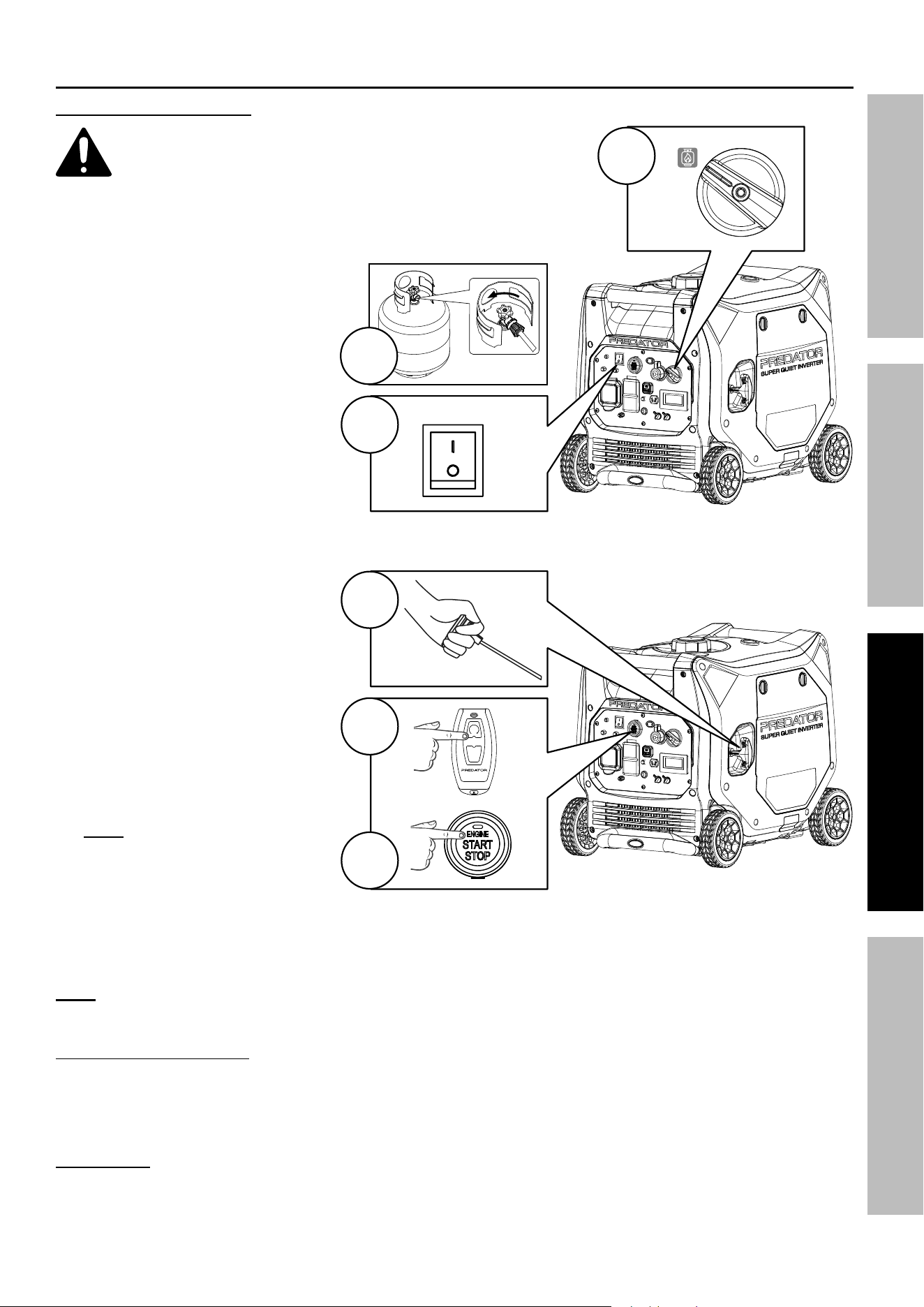
Starting the Engine – LPG / Propane Operation
Before Starting the Engine
a. Inspect the generator and engine.
b. Disconnect all electrical loads from the generator.
c. Make sure the LPG / Propane hose is correctly
connected to the generator and propane tank.
1. Turn the Fuel Selector Switch to
the PROPANE setting.
2. Fully open the valve on the
LPG / Propane tank.
3. Push the Engine / Battery
Switch to the ON position.
Select a starting method:
4. Manual Start: Grip the Starter
Handle of the Engine loosely
and pull it slowly several times
to allow gasoline to flow into the
Engine’s carburetor. Then pull
the Starter Handle gently until
resistance is felt. Allow Cable to
retract fully and then pull it quickly.
Repeat until the Engine starts. Do
not let the Starter Handle snap back
against the housing. Hold it as it
recoils so it doesn’t hit the housing.
5. Remote Start: Slowly press and
release the 2x Button on the
Stop / Start Remote Control twice.
Note: If a CO shutoff event has
occurred the remote start capability
will be disabled until the Generator
Engine has been restarted by
another method.
6. Electric Start: Slowly press
and release the Engine
Start / Stop Switch twice.
Note: The Engine is equipped with an auto-choke system. In the case of a dead battery, there is a mechanical
choke override located above the carburetor which can be used to manually choke and unchoke the Engine.
If engine does not start:
• Check engine oil level.
Engine will not start with low or no engine oil.
• Check spark arrestor cleanliness.
Engine will not start if spark arrestor is clogged.
IMPORTANT: Allow the Engine to run
at no load for five minutes after each
start-up so that the Engine can stabilize.
OFF
3
ON
1
2
PROPANE
4
5
6
OFF
2x
Page 22
For technical questions, please call 1-888-866-5797.
71367
SAFETY OPERATION MAINTENANCESETUP
Switching Fuel Sources
Fire and explosion hazard. DO NOT add gasoline to the fuel tank or connect LPG/Propane Hose
to the generator while the generator is in operation.
The fuel source can be switched while the Engine is running if a propane
tank is connected to the Generator BEFORE operation.
Switching from Gasoline to LPG / Propane
1. IMPORTANT: Disconnect all electrical loads from the Generator
before switching from one fuel type to another.
2. Fully open the valve on the LPG / Propane tank.
3. Turn the Fuel Selector Switch to the PROPANE setting.
Note: When switching from gasoline to LPG / Propane operation the Engine may run
rough for a few seconds while it purges gasoline in the carburetor. If the Engine stops
when switching fuel sources, the unit may be restarted using either fuel source.
Switching from LPG / Propane to Gasoline
1. IMPORTANT: Disconnect all electrical loads from the Generator
before switching from one fuel type to another.
2. Turn the Fuel Selector Switch to the GASOLINE setting.
3. Turn the LPG / Propane tank valve to the fully closed position.
Break-in Period
a. Breaking-in the Engine will help to ensure proper equipment and Engine operation.
b. The break-in period will last about 30 hours of use.
DO NOT exceed 75% of the Generator’s running wattage during this period.
• Change the engine oil after this period.
Under normal operating conditions subsequent maintenance follows
the schedule explained in the MAINTENANCE section.
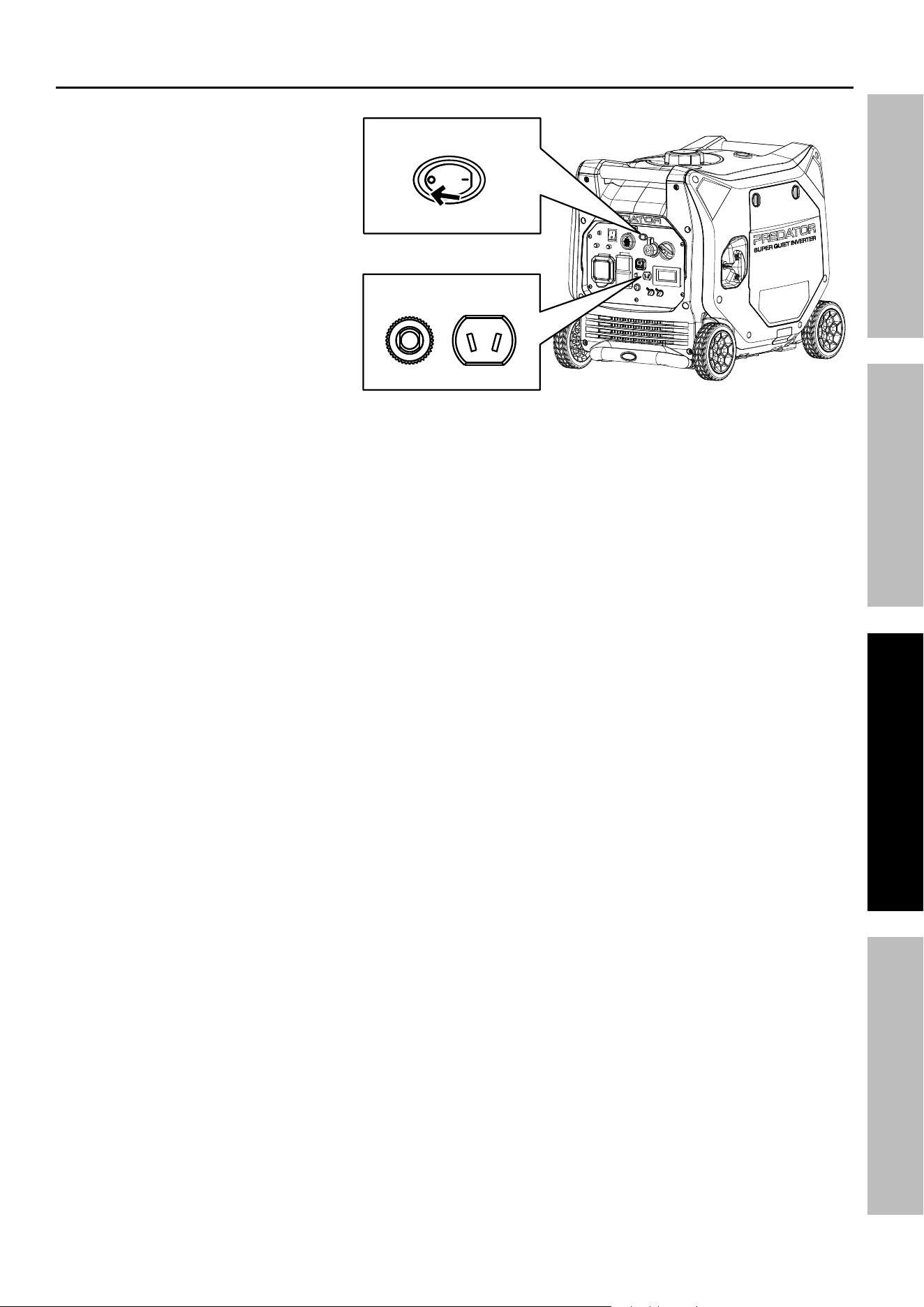
CARBON MONOXIDE SHUTOFFCARBON MONOXIDE SHUTOFF
DANGER! TO PREVENT SERIOUS INJURY AND DEATH FROM CARBON MONOXIDE INHALATION:
The Carbon Monoxide sensor is an additional layer of protection only.
DO NOT USE THE GENERATOR INDOORS OR IN ANY ENCLOSED SPACE OR IN ANY OTHER
AREA OR SITUATION THAT WILL ALLOW CARBON MONOXIDE TO ACCUMULATE.
• FLASHING RED LIGHT:
Dangerous levels of carbon monoxide gas
have built up. Leave immediately until
area has aired out. Move Generator to
well-ventilated area before operation.
• FLASHING YELLOW LIGHT:
Carbon monoxide sensor malfunction.
Sensor needs service. Call 1-888-866-5797 as
soon as possible. Do not use the Generator until
the sensor is working properly.
NOTE: Yellow light flashes once
after starting to indicate passing self-
check and is functioning normally.
The Carbon Monoxide sensor must only be serviced by a qualified technician to restore it to
original settings. Do not modify or tamper with the Carbon Monoxide sensor. Not following these
instructions can result in death or serious injury due to Carbon Monoxide sensor malfunction.
Page 23
For technical questions, please call 1-888-866-5797.
71367
SAFETYOPERATIONMAINTENANCE SETUP
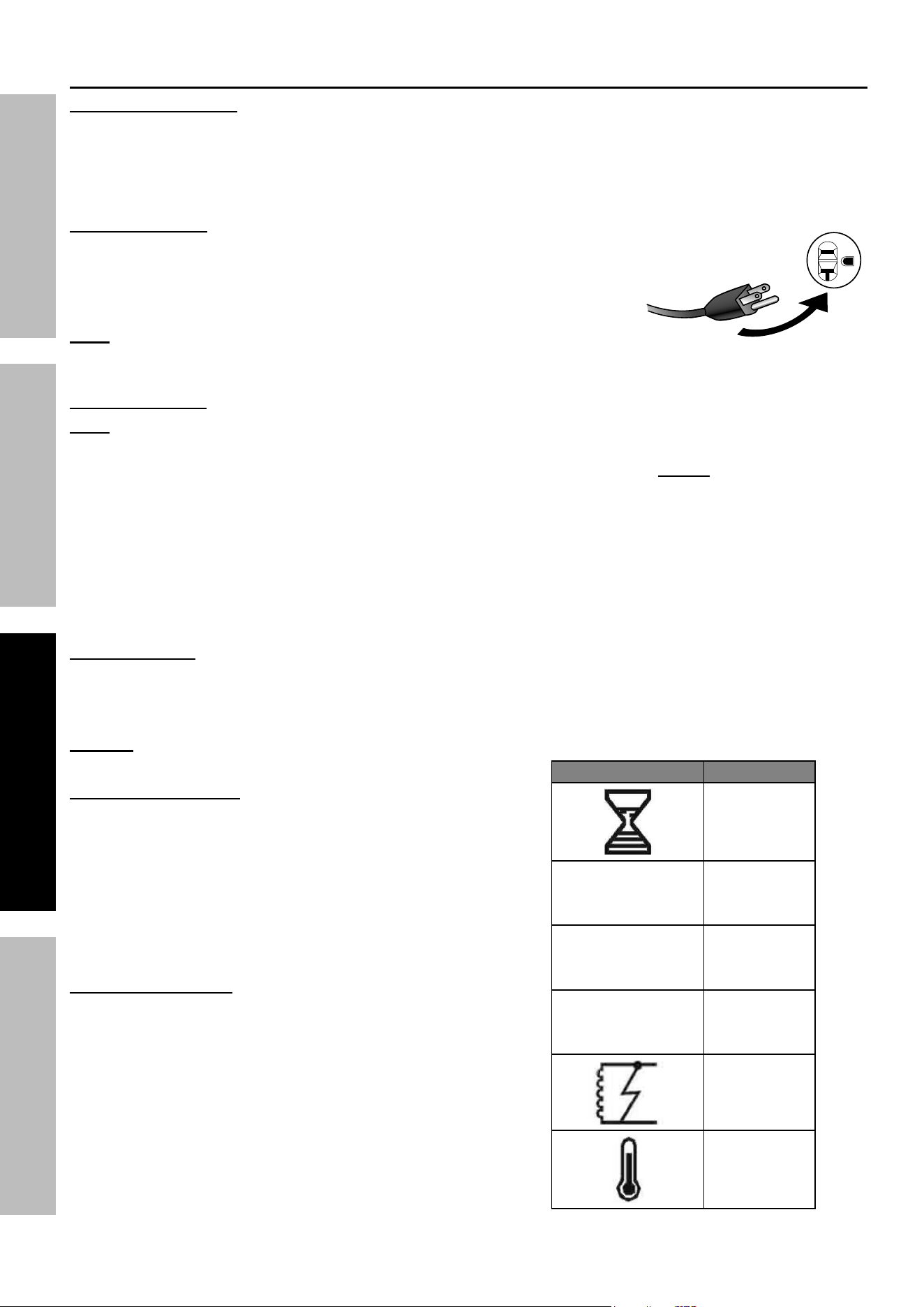
Nominal 12 VDC Output
1. Move the Economy (ESC) Switch to
the OFF position.
2. Only use the 12 VDC receptacle
and provided charging cable with
clamps to charge a 12 volt lead-acid
type battery. Do not overcharge.
3. Do not connect any device
to the 12 VDC terminal that
draws more than 8 amps.
4. If this 12 VDC circuit protection is
tripped, reduce the load, and press
the Reset Button next to the outlet.
ESC THROTTLE
ONOFF
DC 12 V 8 A
RESET
ESC THROTTLE
ON
OFF
Page 24
For technical questions, please call 1-888-866-5797.
71367
SAFETY OPERATION MAINTENANCESETUP
Connecting 120 VAC Loads to the Generator
Calculate Power Draw:
Power draw can be calculated by multiplying volts and amps. The resulting number is wattage.
• Never exceed the running wattage for the Generator or any outlet amperage rating.
• Refer to appliance/tool owner’s manuals to determine the wattage of electrical load devices.
• Long power cords and extension cords draw additional power. Keep cord length at a minimum.
Wattage Estimates
Refer to your device documentation for start-up and running wattage requirements.
Check nameplate wattages on all loads before connecting to Generator.
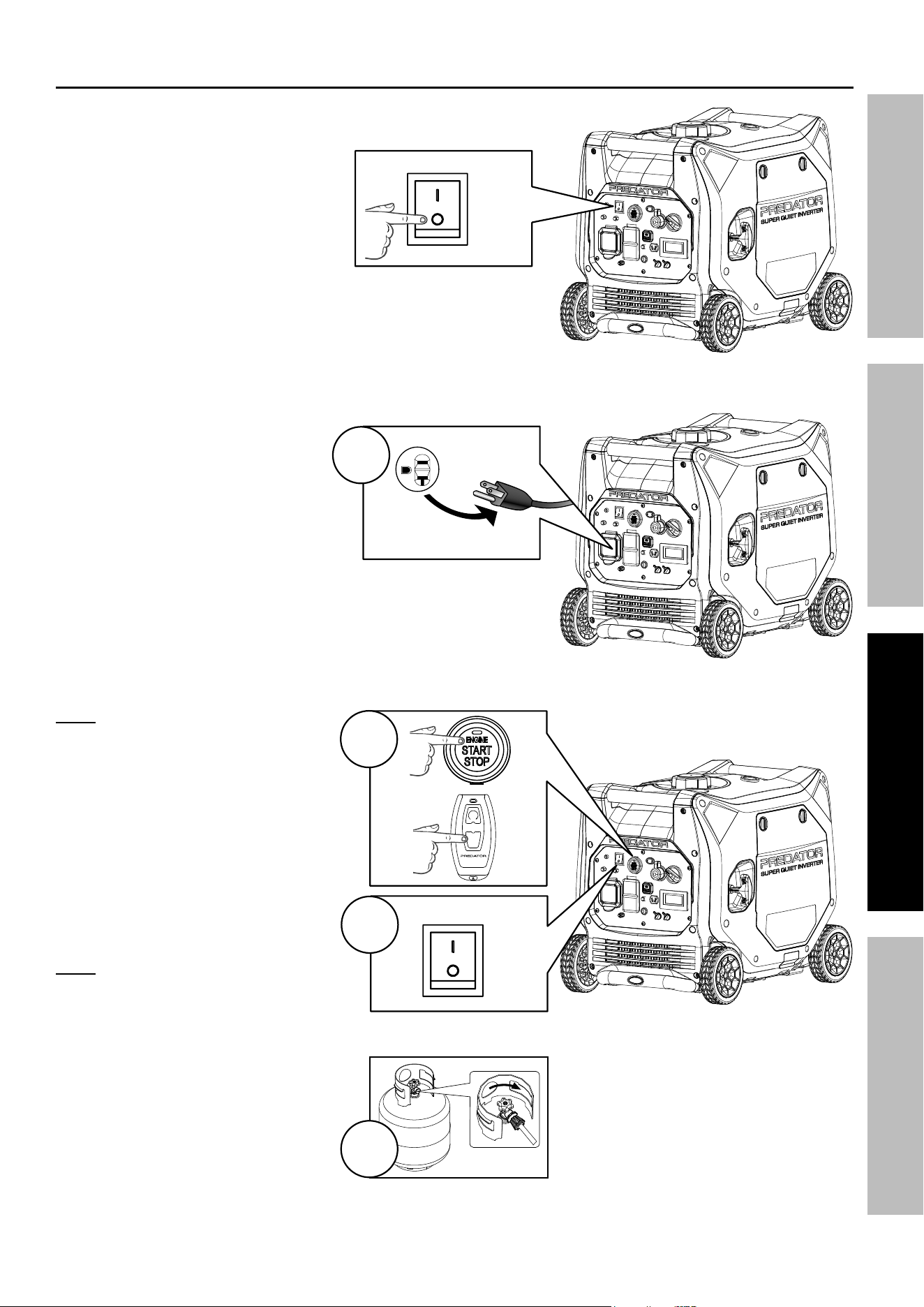
Plug the power cord of the 120 volt appliance/tool into the 120 VAC Outlet
on the Generator. Plug in appliances from largest to smallest load.
Note: Do not allow the Generator to completely run out of fuel with
devices attached. A Generator’s output may sharply spike as it runs
out of fuel, causing damage to attached devices.
Overload Indicator
Note: The OVERLOAD light may turn on for a few seconds as a large device starts up.
This is normal for loads approaching the capacity of this Generator.
1. The total combined load through the outlet on the Generator must not exceed the running power of the unit.
2. When approaching maximum running power, the OVERLOAD light will blink. If the OVERLOAD
light turns on continuously and the Generator stops producing power, it has been overloaded.
3. Turn off and disconnect all electrical devices. Compare device requirements to Generator rating and reduce the
total wattage of connected devices if necessary. Move anything that may be limiting Generator ventilation away.
4. Check if any circuit breakers have tripped and make sure that ALL circuit breakers are reset.
5. Press the OVERLOAD RESET button to restore Generator power output and
reconnect devices while being careful to not overload Generator.
Low Oil Indicator
1. If the Engine oil level is too low, the LOW OIL light turns on and the Engine will automatically shut off.
2. The Engine cannot be restarted until the proper amount of oil has been added. Add the appropriate
type of oil until the oil level is at the proper level. SAE 10W-30 oil is recommended for general use.
NOTICE: Do not run the engine with too little oil.
Engine will shut off if engine oil level is too low.
Economy (ESC) Switch
1. Turn the Economy (ESC) Switch ON to limit noise
and fuel consumption for lighter generator loads.
2. Turn the Economy (ESC) Switch OFF to
operate engine at full speed:
a. when starting
b. when a heavy load is applied
c. when using the 12 VDC output
Digital Display Screen
The Display Screen can be used to monitor the operating
status of the Generator. Use the Display Control Button
to scroll through the following indicators and symbols:
• V – Voltage
• A – Amperage
• VA – Volt Amps / Watts
• Hour – current run time and accumulative run time
Symbol Meaning
Normal
U >
AC Overvoltage
U <
AC Undervoltage
I >
Generator Output
Overcurrent
Generator Output
Short Circuit
Inverter
Overheating
Display Screen Symbology
Plug Load In
Page 25
For technical questions, please call 1-888-866-5797.
71367
SAFETYOPERATIONMAINTENANCE SETUP
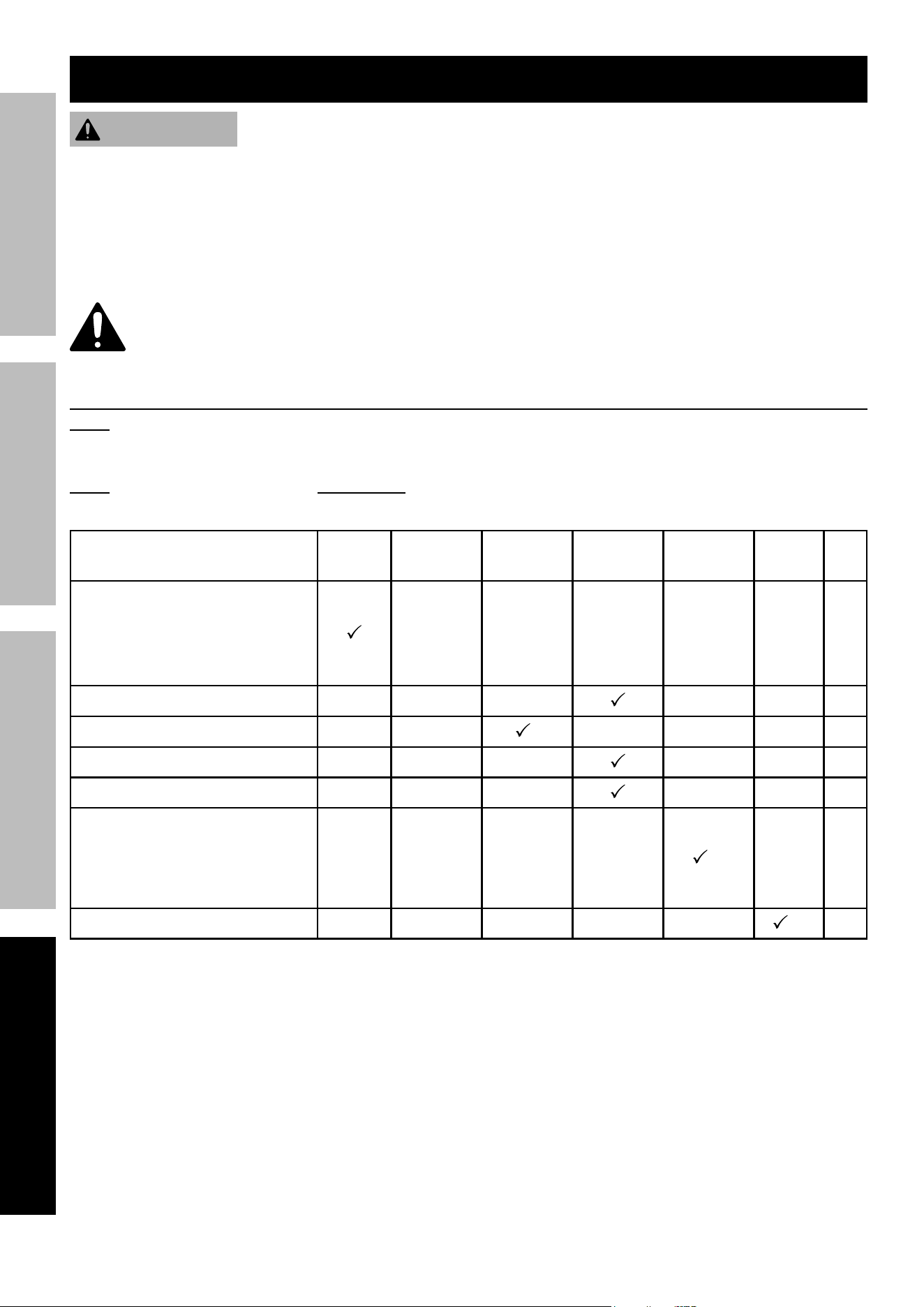
Stopping the Engine
To stop the Engine in an emergency,
turn the Engine / Battery Switch OFF.
Under normal conditions, use the following procedure to shut off the Generator:
1. Turn all electrical load
devices off and unplug them
from the Generator.
2. Slowly press and release the
Engine Start/Stop Switch. Or
slowly press and release the OFF
button on the Stop / Start Remote
Control. Turn the Fuel Selector
Switch to the OFF/STORAGE position.
Note: When the Generator is turned
OFF using the Stop / Start Switch or
Remote Control, the Generator enters
standby mode and can be restarted
remotely using procedures indicated
in starting section. If Generator is not
started within 12 hours the Controller
shuts down completely to save the
battery. Turn the Engine / Battery Switch
OFF then ON to reactivate standby mode.
3. Push the Engine / Battery Switch
to the OFF position.
Note: Turn the Engine/Battery Switch
off when the Generator is not in use
to prevent draining the Battery.
4. If operating on LPG / Propane, turn
the propane tank valve to the fully
closed position.
OFF
ON
EMERGENCY
SHUT OFF
Unplug Loads
1
OFF
3
ON
2
OFF
2x
4
Page 26
For technical questions, please call 1-888-866-5797.
71367
SAFETY OPERATION MAINTENANCESETUP
Maintenance
WARNING
TO PREVENT SERIOUS INJURY FROM ACCIDENTAL STARTING:
Push the Engine / Battery Switch of the equipment to the “OFF” position, wait for the engine to cool, and
disconnect the spark plug cap before performing any inspection, maintenance, or cleaning procedures.
TO PREVENT SERIOUS INJURY FROM EQUIPMENT FAILURE:
Do not use damaged equipment. If abnormal noise, vibration, or
excess smoking occurs, have the problem corrected before further use.
Follow all service instructions in this manual. The engine may fail critically if not serviced properly.
Many maintenance procedures, including any not detailed in this manual, will need to be performed
by a qualified technician for safety. If you have any doubts about your ability to safely service the
equipment or engine, have a qualified technician service the equipment instead.
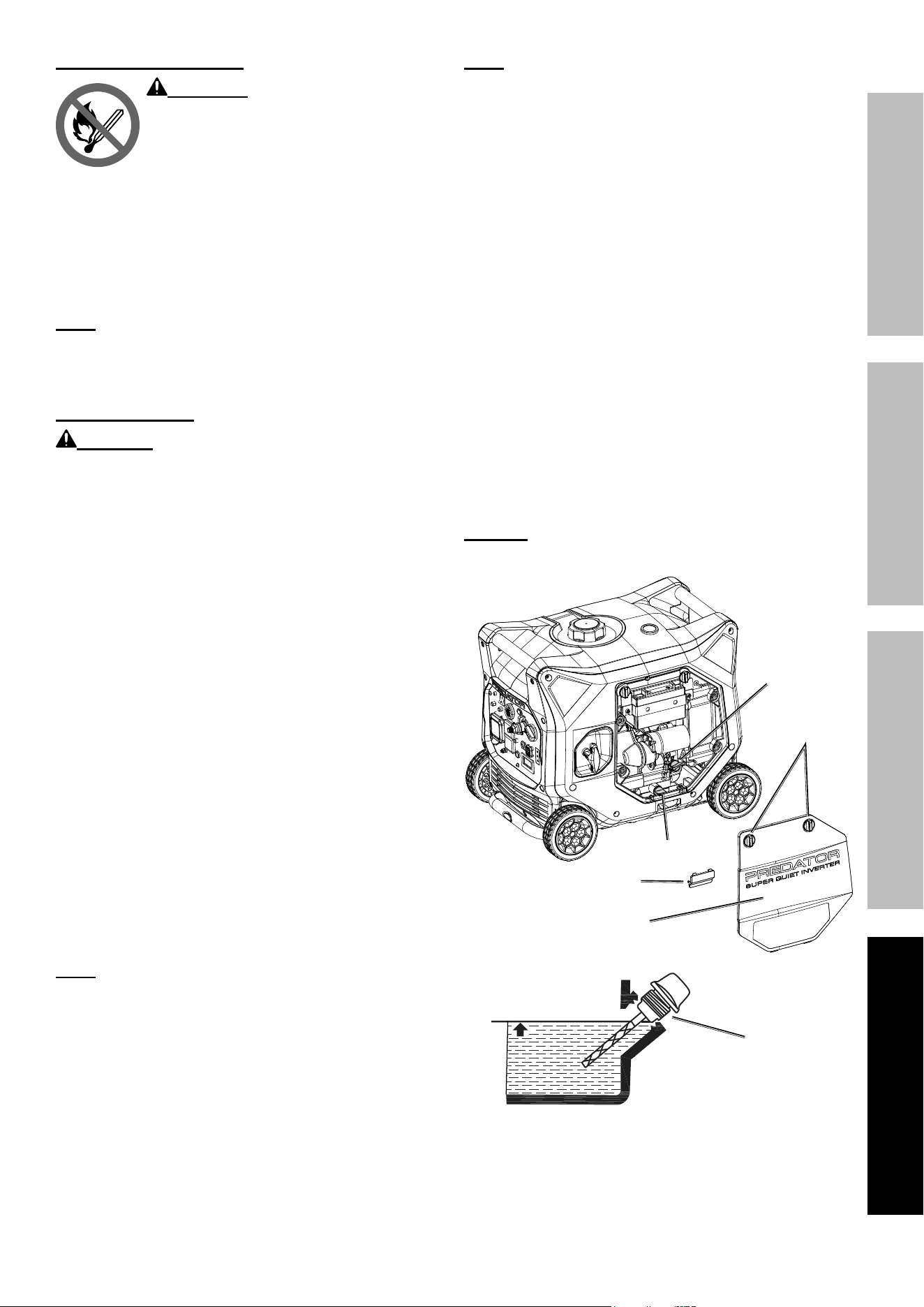
Cleaning, Maintenance, and Lubrication Schedule
Note: This maintenance schedule is intended solely as a general guide. If performance decreases or if
equipment operates unusually, check systems immediately. The maintenance needs of each piece of equipment
will differ depending on factors such as duty cycle, temperature, air quality, fuel quality, and other factors.
Note: The following procedures are in addition to the regular checks and maintenance
explained as part of the regular operation of the engine and equipment.
Procedure
Before
Each Use
Monthly or
every 8 hr.
of use
Every 3 mo.
or 50 hr.
of use
Every 6 mo.
or 100 hr.
of use
Yearly or
every 300 hr.
of use
Every
2 Years
Page
1. Brush off outside of engine
2. Check engine oil level
3. Check air filter
4. Check LPG/Propane
hose assembly
Change engine oil
27
Clean/replace air cleaner
*
28
Check and clean spark arrestor
28
Check and clean spark plug
29
1. Check/adjust valve clearance
2. Clean fuel tank, strainer
and carburetor
3. Clean carbon build-up from
combustion chamber
**
–
Replace fuel line if necessary
**
–
*Service more frequently when used in dusty areas.
**These items should be serviced by a qualified technician.
Page 27
For technical questions, please call 1-888-866-5797.
71367
SAFETYOPERATIONMAINTENANCE SETUP
Checking and Filling Fuel
WARNING! TO PREVENT SERIOUS
INJURY FROM FIRE:
Fill the fuel tank in a well-ventilated area
away from ignition sources. If the
engine is hot from use, shut the engine
off and wait for it to cool before adding fuel.
Do not smoke.
1. Clean the Fuel Cap and the area around it.
2. Unscrew and remove the Fuel Cap.
3. Remove the Strainer and remove any dirt
and debris. Then replace the Strainer.
Note: Do not use gasoline containing more than
10% ethanol (E10). Do not use E85 ethanol. Add fuel
stabilizer to the gasoline or the Warranty is VOID.
Note: Do not use gasoline that has been stored in a
metal fuel container or a dirty fuel container. It can
cause particles to enter the carburetor, affecting
engine performance and/or causing damage.
4. If needed, fill the Fuel Tank to about 1 inch under
the fill neck of the Fuel Tank with 87 octane or
higher unleaded gasoline that has been treated
with a fuel stabilizer additive. Follow fuel stabilizer
manufacturer’s recommendations for use.
5. Replace the Fuel Cap.
6. Wipe up any spilled fuel and allow excess
to evaporate before starting engine.
To prevent FIRE, do not start the engine
while the smell of fuel hangs in the air.
Engine Oil Change
CAUTION! Oil is very hot during operation and can cause burns. Wait for engine to cool before changing oil.
1. Make sure the Engine is stopped and is level.
2. On the right side of the Generator, loosen the
Lock Knobs and remove the Access Panel
and Oil Drain Door, as shown to the right.
3. Place an oil drain pan under the Generator
and center under the Oil Drain Door opening.
Remove the Oil Drain Plug, tilt the Generator
slightly to facilitate drainage and wait for oil
to drain completely. Recycle used oil.
4. Tilt the Generator and replace the Oil
Drain Plug, then set the Generator
back down on a level surface.
5. Clean the top of the Oil Fill Cap / Dipstick
and the area around it. Remove the
Cap / Dipstick, turning it counterclockwise.
6. Add the appropriate type of oil until the oil
level is at the proper level. SAE 10W-30 oil is
recommended for general use.
Note: Make sure Generator is level when adding oil to
prevent overfilling which could cause engine damage.
7. Check the oil level. The oil level should be
up to the edge of the hole as shown.
8. Thread the Oil Fill Cap / Dipstick back in clockwise
and replace the Access Panel and Oil Drain Door.
NOTICE: Do not run the engine with too little oil.
Engine will not start with low or no engine oil.
Oil Fill Cap /
Dipstick
Oil Drain Plug
Oil Drain Door
Access Panel
Lock Knobs
Battery and Oil
Fill Access Panel
Full Level
Oil Fill
Cap / Dipstick
Page 28
For technical questions, please call 1-888-866-5797.
71367
SAFETY OPERATION MAINTENANCESETUP
Air Filter Element Maintenance
1. Loosen two Lock Knobs and remove the Access
Panel on the left side of the Generator.
Maintenance
Access Panel
Access Panel
Lock Knobs
2. Remove the Air Filter Cover and the
air filter elements and check for dirt.
Clean as described below.
Air Filter Air Filter
CoverCover
Air Filter Air Filter
ElementElement
Air Filter Air Filter
3. Cleaning:
• For “paper” filter elements:
To prevent injury from dust and debris,
wear ANSI-approved safety goggles,
NIOSH-approved dust mask/respirator, and
heavy-duty work gloves. In a well-ventilated
area away from bystanders, use pressurized
air to blow dust out of the air filter.
• For foam filter elements:
Wash the element in warm water and
mild detergent several times. Rinse.
Squeeze out excess water and allow it to dry
completely. Soak the filter in lightweight oil
briefly, then squeeze out the excess oil.
4. Install the cleaned filter.
5. Secure the Air Filter Cover and replace the
Maintenance Access Panel before use.
Spark Arrestor Maintenance
TO PREVENT SERIOUS INJURY AND FIRE: Operate only with proper spark arrestor installed.
Operation of this equipment may create sparks that can start fires around dry vegetation.
A spark arrestor may be required. The operator should contact local fire agencies for laws or
regulations relating to fire prevention requirements.
1. Allow the Generator to cool completely.
2. Remove the two Bolts holding the
Spark Arrestor Bracket in place.
Spark
Arrestor
3. Clean the Spark Arrestor using a wire brush
(sold separately). Replace Arrestor if damaged.
Bolt
Bracket
Spark
Arrestor
4. WARNING! TO PREVENT SERIOUS INJURY
FROM ACCIDENTAL BRUSH FIRE, secure
Spark Arrestor back in place immediately
after cleaning and before further operation.
Page 29
For technical questions, please call 1-888-866-5797.
71367
SAFETYOPERATIONMAINTENANCE SETUP
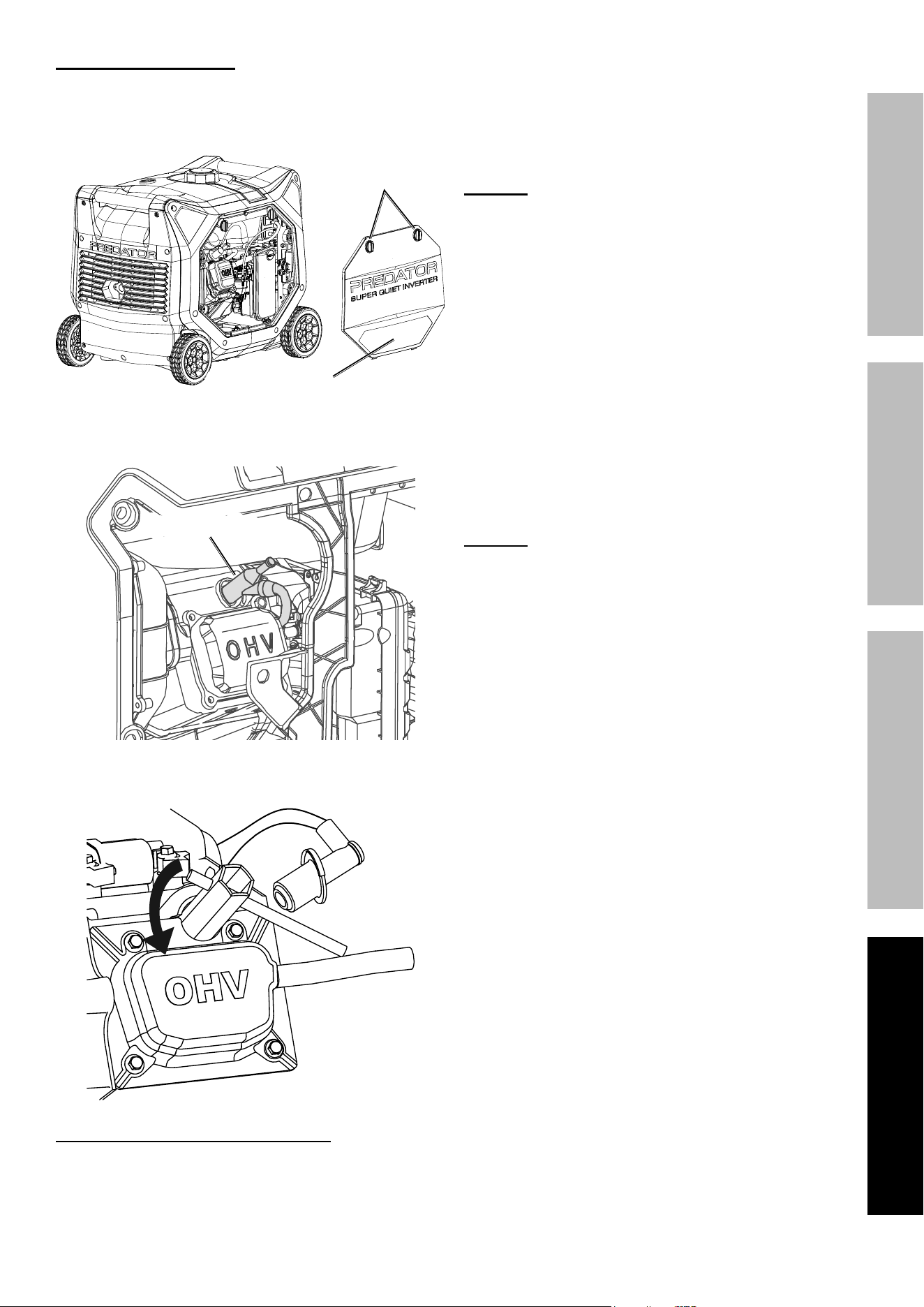
Spark Plug Maintenance
1. Loosen the Maintenance Access Panel
Lock Knobs and remove the Access Panel
on the left side of the Generator.
Maintenance
Access Panel
Access Panel
Lock Knobs
2. Disconnect Spark Plug Cap from end of plug.
Clean out debris from around Spark Plug.
Spark Plug Cap
3. Use the included spark plug wrench
to remove the Spark Plug.
4. Inspect the Spark Plug:
If the electrode is oily, clean it using a clean, dry rag.
If the electrode has deposits on it, polish it using
emery paper. If the white insulator is cracked or
chipped, the Spark Plug needs to be replaced.
NOTICE: Use only F7TC type spark plug or equivalent.
Using an incorrect spark plug may damage the engine.
5. When installing a new spark plug,
adjust the plug’s gap to the specification on the
Specifications chart. Do not pry against the
electrode — the spark plug can be damaged.
6. Apply anti-seize material to Spark Plug threads.
Install the new spark plug or
the cleaned spark plug into the engine.
• Gasket-style:
Finger-tighten until the gasket
contacts the cylinder head,
then tighten about 1/2-2/3 turn more.
• Non-gasket-style:
Finger-tighten until the plug
contacts the cylinder head,
then tighten about 1/16 turn more.
NOTICE: Tighten the spark plug properly.
If loose, the spark plug will cause the
engine to overheat.
If overtightened, the threads in the
engine block will be damaged.
7. Apply dielectric spark plug boot protector
(not included) to the end of the spark plug
and reattach the cap securely.
8. Replace the Maintenance Access Panel before use.
Remote Control Battery Replacement
1. To replace battery, remove screw(s)
and open battery compartment.
2. Install new CR2032 battery in correct polarity,
close compartment and replace screw(s).
Page 30
For technical questions, please call 1-888-866-5797.
71367
SAFETY OPERATION MAINTENANCESETUP
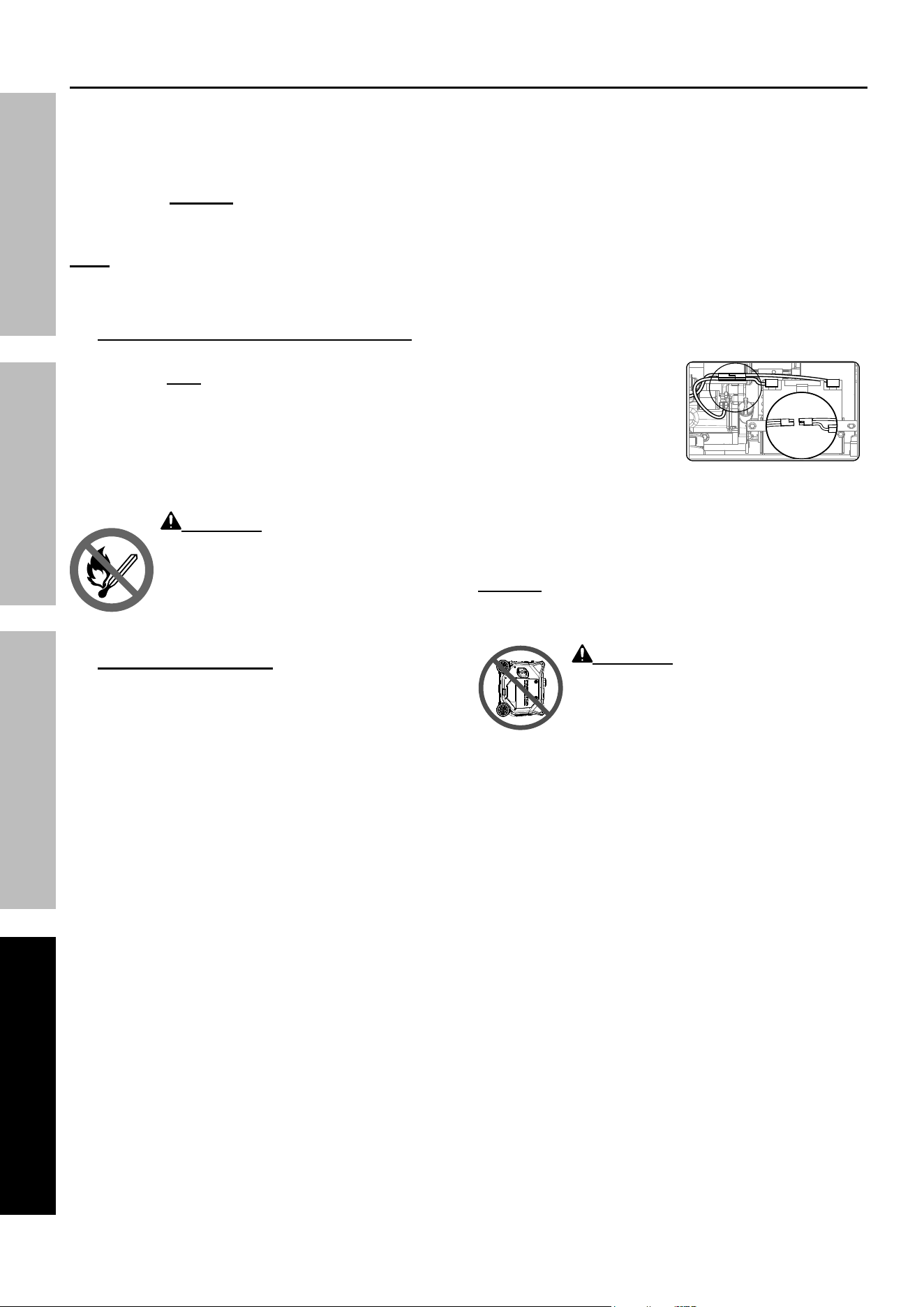
Storage
When the equipment is to remain idle for longer than
20 days, prepare the engine for storage as follows:
1. CLEANING:
Wait for engine to cool, then clean engine with
dry cloth. NOTICE: Do not clean using water.
The water will gradually enter the
engine and cause damage.
Note: Cover the LPG/Propane Inlet with the
provided cap during cleaning and storage.
2. FUEL:
Gasoline Treatment/Draining the Fuel Tank
To protect the Fuel Tank during storage, fill the
Tank with fresh gasoline that has been treated
with a fuel stabilizer additive. Follow fuel stabilizer
manufacturer’s recommendations for use. Refer
to Checking and Filling Fuel on page 17.
Aged gasoline that has not been treated with
stabilizer ahead of time must be safely drained
away and not run through the Engine.
WARNING! TO PREVENT SERIOUS
INJURY FROM FIRE:
Fill tank in a well-ventilated area away
from ignition sources. If the engine
is hot from use, shut the engine off and
wait for it to cool before adding fuel.
Do not smoke.
Draining the Carburetor
After closing the Fuel Valve by turning the
Fuel Selector Switch to the OFF/STORAGE
position, place an appropriate container under
the Carburetor. Route the fuel drain hose on
the Carburetor to the container, then carefully
loosen the Drain Bolt and allow the fuel to drain
completely. Replace the Drain Bolt after draining.
WARNING! To prevent serious
injury and fire, close the Fuel Valve
before draining the Carburetor.
3. LUBRICATION:
a. Change engine oil.
b. Clean out area around spark plug.
Remove spark plug and pour one tablespoon of
engine oil into cylinder through spark plug hole.
c. Replace spark plug, but leave
spark plug cap disconnected.
d. Pull Starter Handle to distribute oil in cylinder.
Stop after one or two revolutions when you
feel the piston start the compression stroke
(when you start to feel resistance).
4. BATTERY:
Disconnect the Battery
Cable during extended
storage periods to
help prevent draining
the Battery.
5. STORAGE AREA:
Cover and store in a dry, level, well-ventilated
area out of reach of children. Storage area should
also be away from ignition sources, such as
water heaters, clothes dryers, and furnaces.
NOTICE: During extended storage periods the
Engine must be started every 3 months and allowed
to run for 15 – 20 minutes or the Warranty is VOID.
WARNING! To prevent serious injury
from product malfunction:
Store the Generator standing on its
wheels. Do not store the unit on its
side or in a vertical position.
6. AFTER STORAGE:
Before starting the Engine after storage, keep in
mind that untreated gasoline will deteriorate quickly.
Drain the Fuel Tank and change to fresh fuel if
untreated gasoline has been sitting for a month,
if treated gasoline has been sitting beyond the
fuel stabilizer’s recommended time period,
or if the Engine does not start.
Page 31
For technical questions, please call 1-888-866-5797.
71367
SAFETYOPERATIONMAINTENANCE SETUP
Troubleshooting
Problem Possible Causes Probable Solutions
Engine will not start FUEL RELATED:
1. No fuel in tank or fuel valve closed.
2. No fuel flow.
3. Gasoline with more than 10% ethanol
used. (E15, E20, E85, etc.)
4. Low quality or deteriorated, old gasoline.
5. Carburetor not primed.
6. Dirty fuel passageways.
7. Carburetor needle stuck.
Fuel can be smelled in the air.
8. Too much fuel in chamber. This can be
caused by the carburetor needle sticking.
9. Clogged Fuel Filter.
FUEL RELATED:
1. Fill fuel tank with fresh 87+ octane stabilizer-treated
unleaded gasoline and open fuel valve.
Do not use gasoline with more than
10% ethanol (E15, E20, E85, etc.).
2. Move Fuel Selector Switch to desired fuel
type. For LPG / Propane fuel, make sure valve
on LPG / Propane tank is fully open.
3. Clean out ethanol rich gasoline from fuel system.
Replace components damaged by ethanol. Use fresh
87+ octane stabilizer-treated unleaded gasoline only.
Do not use gasoline with more than
10% ethanol (E15, E20, E85, etc.).
4. Use fresh 87+ octane stabilizer-treated
unleaded gasoline.
Do not use gasoline with more than
10% ethanol (E15, E20, E85, etc.).
5. Pull on Starter Handle to prime.
6. Clean out passageways using fuel additive.
Heavy deposits may require further cleaning.
7. Gently tap side of carburetor float
chamber with screwdriver handle.
8. Turn Choke to RUN position. Remove spark plug and
pull the start handle several times to air out the chamber.
Reinstall spark plug and set Choke to START position.
9. Replace Fuel Filter.
IGNITION (SPARK) RELATED:
1. Engine/Battery Switch at OFF position.
2. Spark plug cap not connected securely.
3. Spark plug electrode wet or dirty.
4. Incorrect spark plug gap.
5. Spark plug cap broken.
6. Circuit breaker tripped (electric
start models only).
7. Incorrect spark timing or
faulty ignition system.
IGNITION (SPARK) RELATED:
1. Push Engine/Battery Switch to ON position.
2. Connect spark plug cap properly.
3. Clean spark plug.
4. Correct spark plug gap.
5. Replace spark plug cap.
6. Reset circuit breaker. Check wiring and
starter motor if breaker continues to trip.
7. Have qualified technician diagnose/
repair ignition system.
COMPRESSION RELATED:
1. Cylinder not lubricated.
Problem after long storage periods.
2. Loose or broken spark plug.
(Hissing noise will occur
when trying to start.)
3. Loose cylinder head or damaged
head gasket. (Hissing noise will
occur when trying to start.)
4. Engine valves or tappets
mis-adjusted or stuck.
ENGINE OIL RELATED:
1. Low engine oil.
2. Engine mounted on slope,
triggering low oil shutdown.
SPARK ARRESTOR RELATED:
Spark Arrestor clogged with soot.
COMPRESSION RELATED:
1. Pour tablespoon of oil into spark plug hole. Crank
engine a few times and try to start again.
2. Tighten spark plug.
If that does not work, replace spark plug.
If problem persists, may have head
gasket problem, see #3.
3. Tighten head.
If that does not remedy problem, replace head gasket.
4. Have qualified technician adjust/
repair valves and tappets.
ENGINE OIL RELATED:
1. Fill engine oil to proper level. Check engine
oil before EVERY use.
2. Operate engine on level surface. Check engine oil level.
SPARK ARRESTOR RELATED:
Clean and replace Spark Arrestor.
Follow all safety precautions whenever diagnosing or servicing the generator or engine.
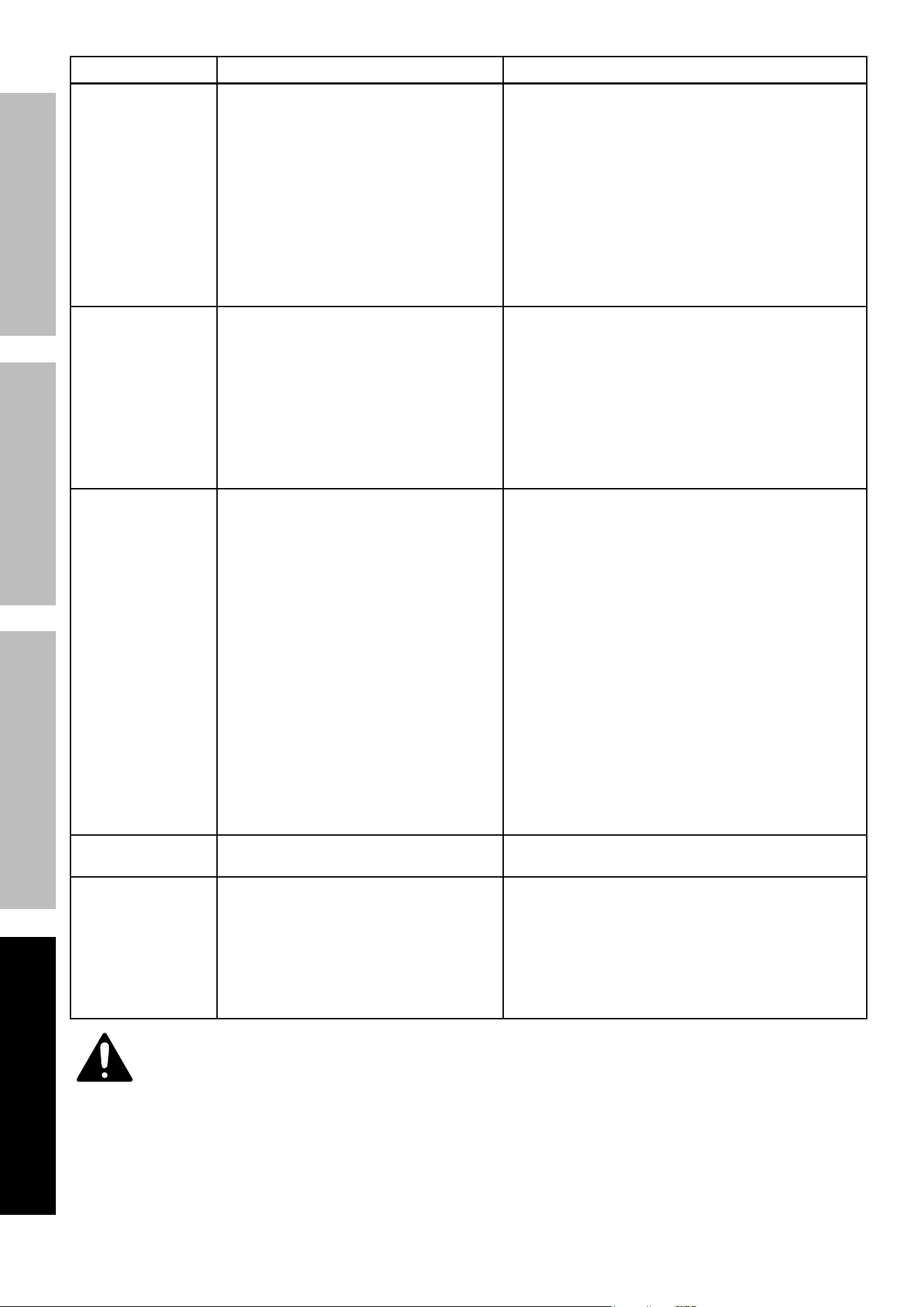
Page 32
For technical questions, please call 1-888-866-5797.
71367
SAFETY OPERATION MAINTENANCESETUP
Problem Possible Causes Probable Solutions
Engine will not
start (continued)
ELECTRIC OR REMOTE START RELATED:
1. No battery or defective battery installed.
2. Engine Start/Stop Switch flashes
red – Battery is low.
3. Electric start fuse (5A) is blown.
4. Stop/Start Remote Control is
not paired with Generator.
5. Generator not picking up Stop/Start
Remote Control signal consistently.
6. Engine not restarting remotely
after CO shutdown event.
ELECTRIC OR REMOTE START RELATED:
1. Install a new battery. Refer to page 13.
2. Charge battery with external charger or start
Generator manually and allow to run for 5 hours.
3. Replace fuse with similar size fuse.
4. Pair Remote Control to Generator. Refer to page 19.
5. Replace the Remote Control battery; press on Remote
Button longer; stay within operational range of Remote.
6. After a CO shutdown event, the remote start
capability will be disabled until the Engine
has been first restarted non-remotely.
Engine misfires 1. Spark plug cap loose.
2. Incorrect spark plug gap or
damaged spark plug.
3. Defective spark plug cap.
4. Old or low quality gasoline.
5. Incorrect compression.
1. Check cap and wire connections.
2. Re-gap or replace spark plug.
3. Replace spark plug cap.
4. Use only fresh 87+ octane stabilizer-treated
unleaded gasoline.
Do not use gasoline with more than
10% ethanol (E15, E20, E85, etc.).
5. Diagnose and repair compression. Use Engine will
not start: COMPRESSION RELATED section.
Engine stops suddenly 1. Carbon Monoxide level high. Red light
on Carbon Monoxide Sensor illuminates.
2. CO Sensor Alarm flashes yellow
continually shortly after starting.
3. CO Sensor Alarm flashes yellow
continually after longer period of operation.
4. Low oil shutdown.
5. Fuel tank empty or full of impure or low
quality gasoline.
6. Faulty magneto.
7. Disconnected or improperly
connected spark plug cap.
8. Unintentional shutdown signal sent
from Stop/Start Remote Control.
1. Leave area immediately and allow area to ventilate
thoroughly. Only operate generator outside.
2. Carbon monoxide sensor malfunction.
Sensor needs service. Call 1-888-866-5797 as
soon as possible. Do not use the Generator
until the sensor is working properly.
3. Make sure to operate Generator within
rated ambient temperature; maintain
minimum 5 ft. clearance from all sides.
4. Fill engine oil to proper level. Check
engine oil before EVERY use.
5. Fill fuel tank with fresh 87+ octane stabilizer treated
unleaded gasoline.
Do not use gasoline with more than 10%
ethanol (E15, E20, E85, etc.).
6. Have qualified technician service magneto.
7. Secure spark plug cap.
8. Store the Remote Control in a safe
location and away from children.
Engine stops when
under heavy load
1. Dirty air filter
2. Engine running cold.
1. Clean element.
2. Allow engine to warm up prior to operating equipment.
Engine knocks 1. Old or low quality gasoline.
2. Engine overloaded.
3. Incorrect spark timing, deposit
buildup, worn engine, or other
mechanical problems.
1. Fill fuel tank with fresh 87+ octane stabilizer-treated
unleaded gasoline.
Do not use gasoline with more than
10% ethanol (E15, E20, E85, etc.).
2. Do not exceed equipment’s load rating.
3. Have qualified technician diagnose and service engine.
Follow all safety precautions whenever diagnosing or servicing the generator or engine.
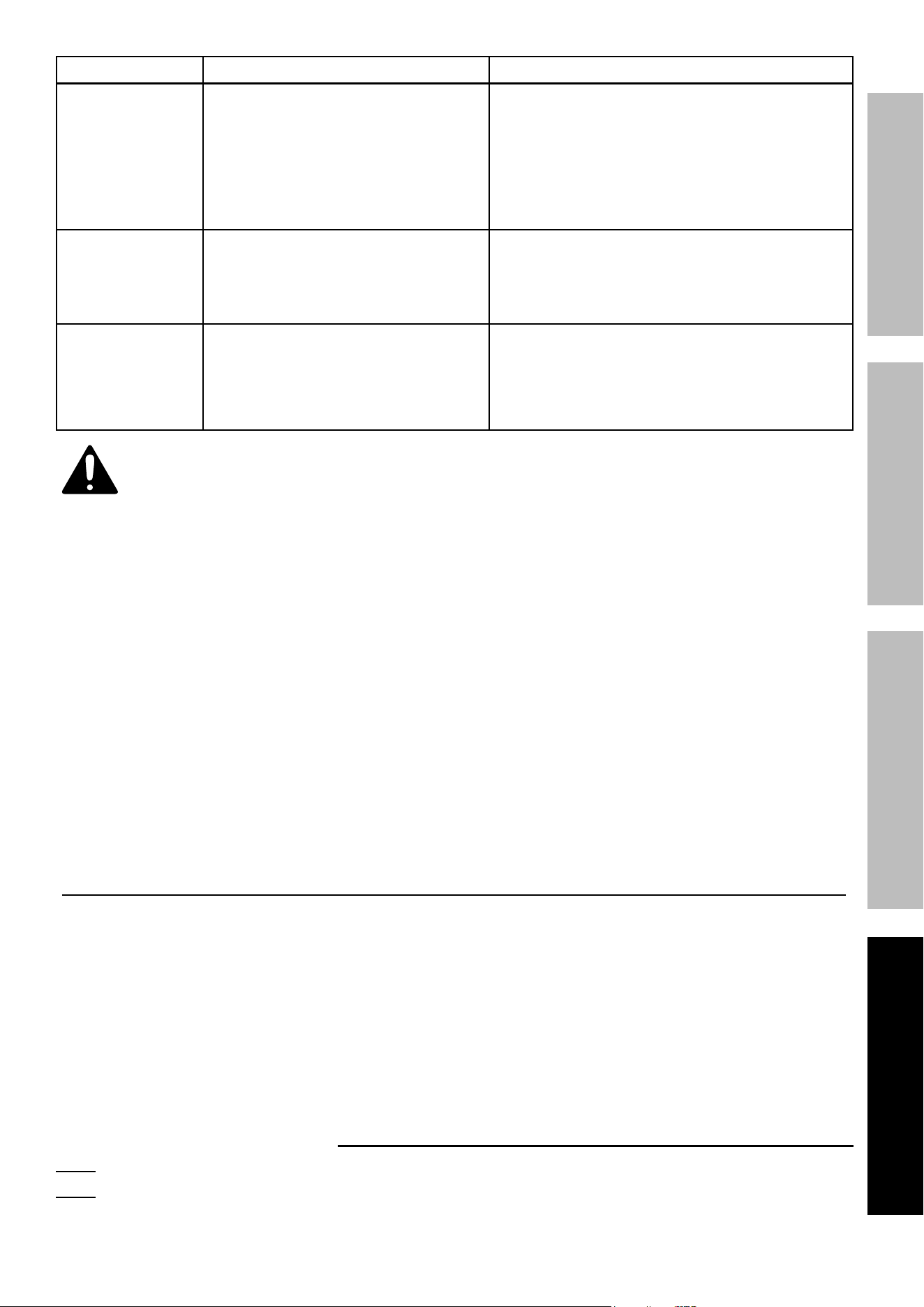
Page 33
For technical questions, please call 1-888-866-5797.
71367
SAFETYOPERATIONMAINTENANCE SETUP
Problem Possible Causes Probable Solutions
Engine backfires 1. Impure or low quality gasoline.
2. Engine too cold.
3. Intake valve stuck or overheated engine.
4. Incorrect timing.
1. Fill fuel tank with fresh 87+ octane stabilizer-treated
unleaded gasoline.
Do not use gasoline with more than
10% ethanol (E15, E20, E85, etc.).
2. Use cold weather fuel and oil additives
to prevent backfiring.
3. Have qualified technician diagnose and service engine.
4. Check engine timing.
Attached device
doesn’t have power
1. Device not plugged in properly.
2. Circuit Breaker tripped.
3. Product needs service.
1. Turn off and unplug the device,
then plug it back in again and turn on.
2. Turn off and unplug device, reset Circuit
Breaker, plug in device and turn on.
3. Have product repaired.
Attached device
begins to operate
abnormally
1. Problem with device.
2. Rated load capacity exceeded.
1. Immediately unplug device.
Have device repaired by a qualified
technician, or replace device.
2. Lower the number of items plugged into the
Generator to stay within the rated capacity,
or use a more powerful generator.
Follow all safety precautions whenever diagnosing or servicing the generator or engine.
PLEASE READ THE FOLLOWING CAREFULLY
THE MANUFACTURER AND/OR DISTRIBUTOR HAS PROVIDED THE PARTS LISTS AND ASSEMBLY
DIAGRAMS IN THIS MANUAL AS A REFERENCE TOOL ONLY. NEITHER THE MANUFACTURER OR
DISTRIBUTOR MAKES ANY REPRESENTATION OR WARRANTY OF ANY KIND TO THE BUYER THAT HE
OR SHE IS QUALIFIED TO MAKE ANY REPAIRS TO THE PRODUCT, OR THAT HE OR SHE IS QUALIFIED
TO REPLACE ANY PARTS OF THE PRODUCT. IN FACT, THE MANUFACTURER AND/OR DISTRIBUTOR
EXPRESSLY STATES THAT ALL REPAIRS AND PARTS REPLACEMENTS SHOULD BE UNDERTAKEN BY
CERTIFIED AND LICENSED TECHNICIANS, AND NOT BY THE BUYER. THE BUYER ASSUMES ALL RISK
AND LIABILITY ARISING OUT OF HIS OR HER REPAIRS TO THE ORIGINAL PRODUCT OR REPLACEMENT
PARTS THERETO, OR ARISING OUT OF HIS OR HER INSTALLATION OF REPLACEMENT PARTS THERETO.
Record Product’s Serial Number Here:
Note: If product has no serial number, record month and year of purchase instead.
Note: Some parts are listed and shown for illustration purposes only, and are not available
individually as replacement parts. Specify UPC 193175546364 when ordering parts.
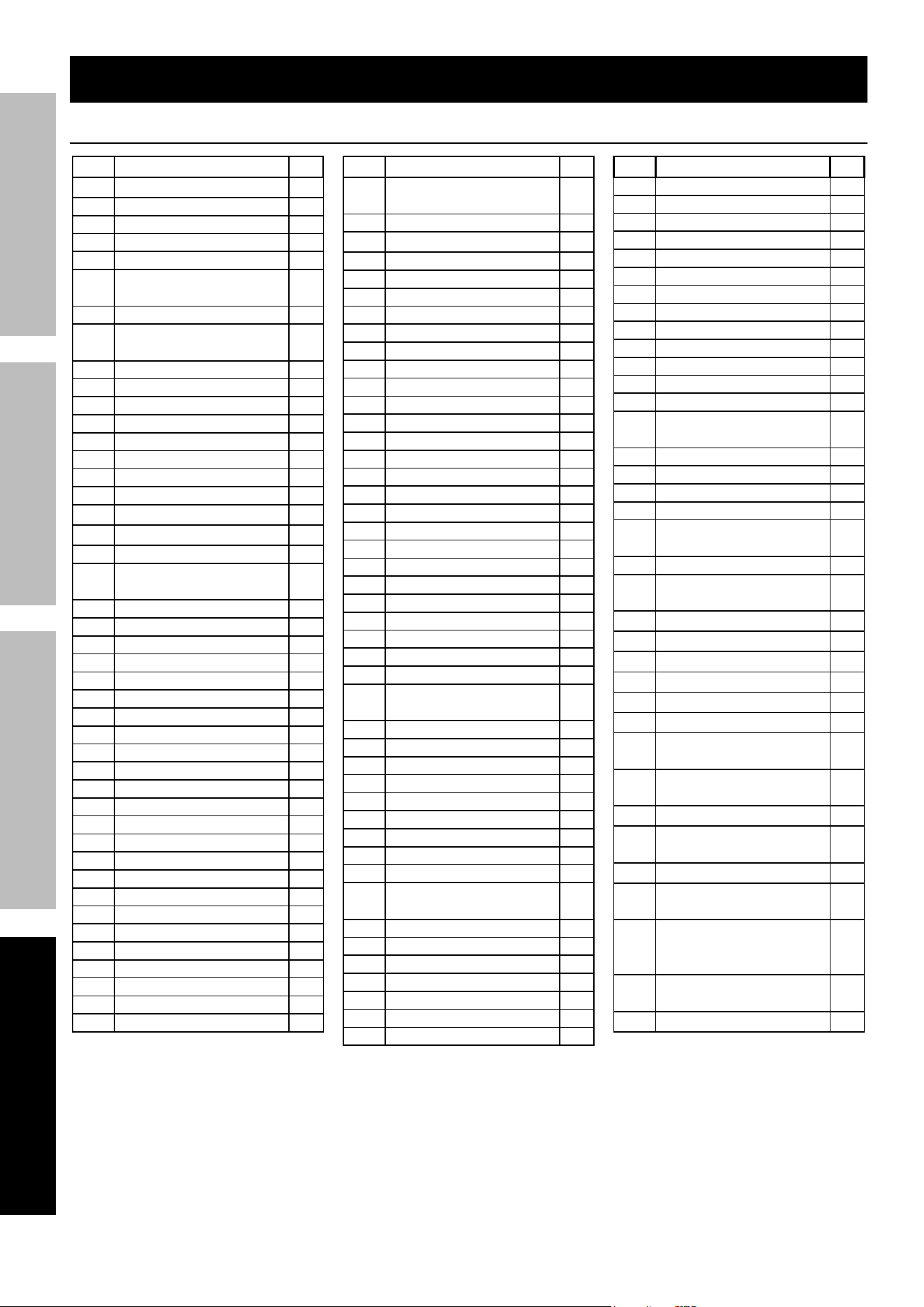
Page 34
For technical questions, please call 1-888-866-5797.
71367
SAFETY OPERATION MAINTENANCESETUP
Part Description Qty
1 N/A
2 Screw M4 x 8 4
3 Decorative Board 1
4 Sealing Ring 1
5 Left Housing 1
6 Maintenance Access
Panel
1
7 Right Housing 1
8 Battery and Oil Fill
Access Panel
1
9 Cover 1
10 Side Cover Knob 4
11 Panel Rear Cover 1
12 Muffler Baffle 1
13 Engine Bottom Plate 1
14 Hub Cap 4
15 Wheel 4
16 Brake Assembly 1
17 N/A
18 N/A
19 Exhaust Sealant 1
20 Handle Decoration
Block
1
21 Oil Switch Bracket 1
22 Rod Components 1
23 Inverter Bracket 2
24 Inverter 1
25 Handle 2
26 Left Front Pillar 1
27 Right Front Pillar 1
28 Left Rear Pillar 1
29 Right Rear Pillar 1
30 Tank Front Bracket 1
31 Tank Back Bracket 1
32 Tank Right Support 1
33 Battery Holder 1
34 Axle 4
35 Panel Comp 1
36 Wiring Harness 1
37 Intake Connector 1
38 Switch Axis 1
39 Tee 1
40 Front Shroud 1
41 Microswitch 1
42 Plug 1
43 Sealing Ring 2
44 Outlet Connector 1
Part Description Qty
45 Self-Tapping Screw
M4 x 16
2
46 Knob Plug 1
47 N/A
48 Circlip Ø6 4
49 Grounding Wire 2
50 Starter Grip 1
51 Starter Grip Cover 1
52 Fuel Filter 1
53 Connector 1
54 Fuel Cock 1
55 Gear 1
56 Gear 1
57 Upper Cover 1
58 Lower Lid 1
59 Fuel Tank Cap 1
60 Fuel Filter 1
61 Clip 6
62 Oil Switch Bracket 1
63 Rubber Gasket 8
64 Jacket 1
65 CO Module 1
66 Back Shroud 1
67 Cable Tray 1
68 DC Voltage Regulator 1
69 Control Module 1
70 Bolt M6 x 20 4
71 Bolt M6 x 25 2
72 Pan Head Tapping
Screw ST4.2 x 13
8
73 Fuel Line Clip Ø9.5 x 0.8 2
74 Rotor Bolt Gasket 4
75 Fuel Hose Clip Ø10 3
76 Screw M5 x 12 14
77 Bolt M6 x 12 38
78 Nut M8 4
79 Locking Clip 32
80 Screw M4 x 16 1
81 Tooth Washer 5
82 Inner Hexalobular Tooth
Tamper Proof Bolt
2
83 Flat Gasket Ø4 1
84 Wire Sleeve 1
85 Adhesive Strip 1
86 Left Handle Bracket 2
87 Right Handle Bracket 2
88 Pull Rod Pressing Plate 2
89 CO Bracket 1
Part Description Qty
90 Bolt M6 x 25 6
91 Bolt M6 x 16 50
92 Fuel Pipe 1
93 Fuel Pipe 1
94 Foot Pad 2
95 Battery 1
96 Battery Wiring Assembly 1
97 Knob 1
98 Cable 1
99 Butterfly Bolt M6 x 12 2
100 Fuel Tank 1
101 Spring 1
102 Steel Ball 1
103 Conical Countersunk
Head Screw 4.2 x 13
1
104 Fuel Gauge 1
105 Rubber Sleeve 1
106 Filter 1
107 Fuel Hose Clip Ø8.5 4
108 Flat Gasket
Ø10 x Ø20 x 2
4
109 Flat Gasket Ø8 4
110 Fuel Tank Lower Beam
Bracket
1
111 Bolt M5*16
3
112 Clip,Wire Harness
2
113 Axle
2
114 Line of Cases
1
115 Gasket Breather
2
116 Remote Key
1
117 Primary Pressure
Reducing Valve
1
118 Pressure Reducing
Valve
1
119 Low Pressure Hose
1
120 Pressure Reducing
Valve Bracket
1
121 Bolt M6*12
3
122 Engine Assembly
DHLG225
1
123 Carbon Canister and
Fuel Tank Connecting
Pipe
1
124 Carbon Canister and Air
Filter Connecting Pipe
1
125 Carbon Canister
1
Parts List and Diagram
Generator Parts List
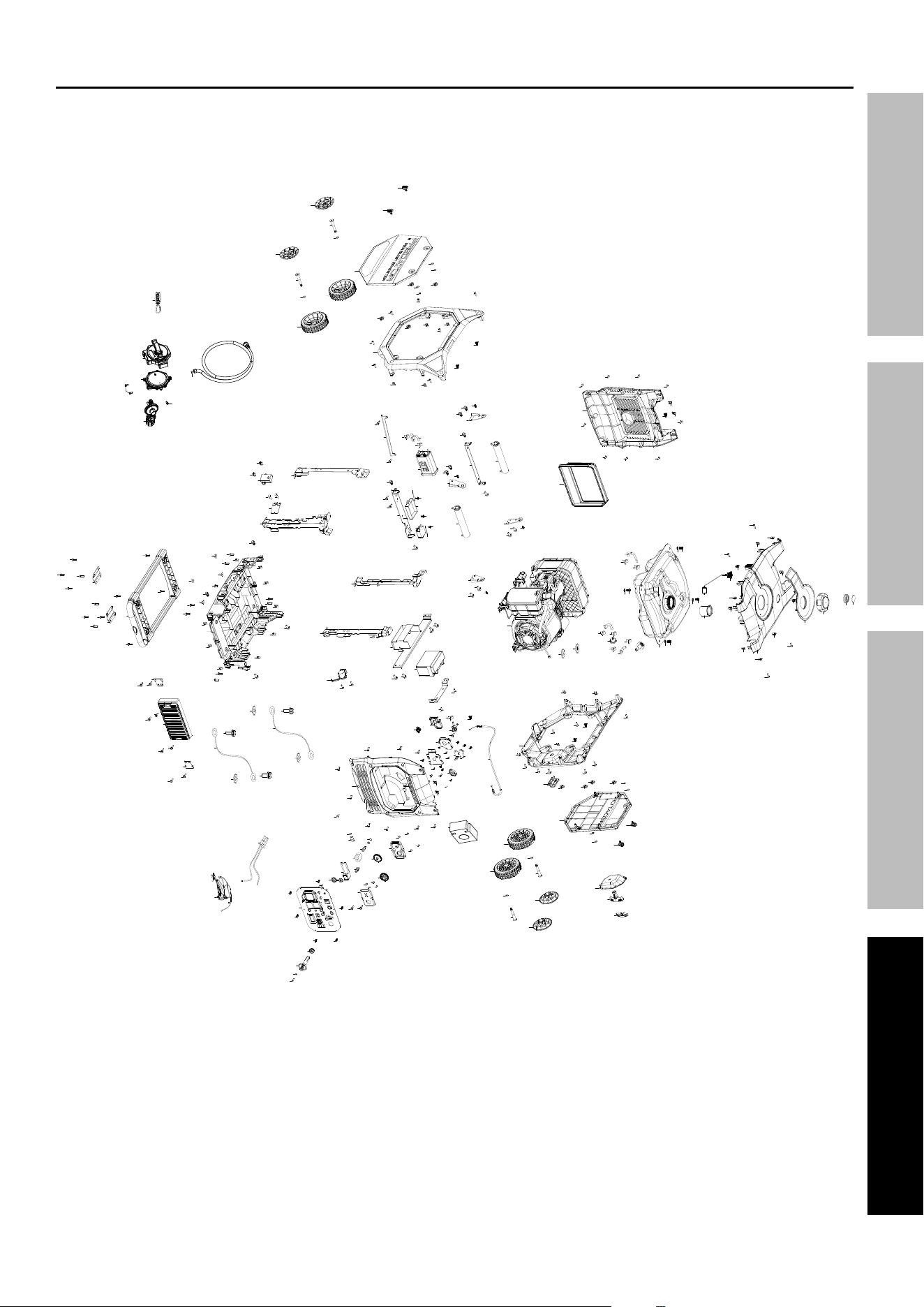
Page 35
For technical questions, please call 1-888-866-5797.
71367
SAFETYOPERATIONMAINTENANCE SETUP
Generator Assembly Diagram
91
91
91
22
401
97
95
79
91
77
88
77
90
77
23
77
23
77
77
77
77
24
79
19
13
79
91
49
36
91
115
77
76
81
81
77
79
73
79
49
77
96
35
76
81
37
16
27
90
42
76
84
91
76
64
76
97
80
83
46
76
56
44
43
71
37
58
71
38
39
11
91
55
2
2
2
43
2
90
411
91
77
32
77
91
57
91
45
45
45
72
72
45
91
91
76
76
79
79
72
76
91
41
301
95
77
77
40
21
66
33
99
72
54
99
77
72
75
62
72
61
72
72
61
201
101
67
39
14
34
221
15
94
108
98
79
7
91
91
14
801
311
19
16
58
9
36
8
97
19
18
97
16
19
18
57
97
901
36
36
19
84
02
15
47
53
05
10
36
01
84
901
29
57
57
25
57
19
001
06
70
78
91
91
91
91
116
88
91
90
121
118
120
117
90
90
121
119
115
78
79
78
78
73
91
77
61
73
82
79
91
91
82
91
91
77
79
79
65
26
77
89
79
14
34
14
801
311
94
108
28
15
63
92
77
5
91
91
110
77
97
63
77
77
77
30
6
91
10
10
36
48
901
91
901
63
48
91
77
31
77
211
77
86
112
111
69
111
111
91
97
79
91
77
77
61
79
87
77
76
76
87
25
77
86
19
77
76
77
86
25
76
77
91
19
21
91
19
701
07
701
47
19
19
19
91
16
07
07
47
47
97
97
19
97
19
97
97
19
97
97
97
501
106
19
97
3
97
97
91
4
321
521
421
107
107
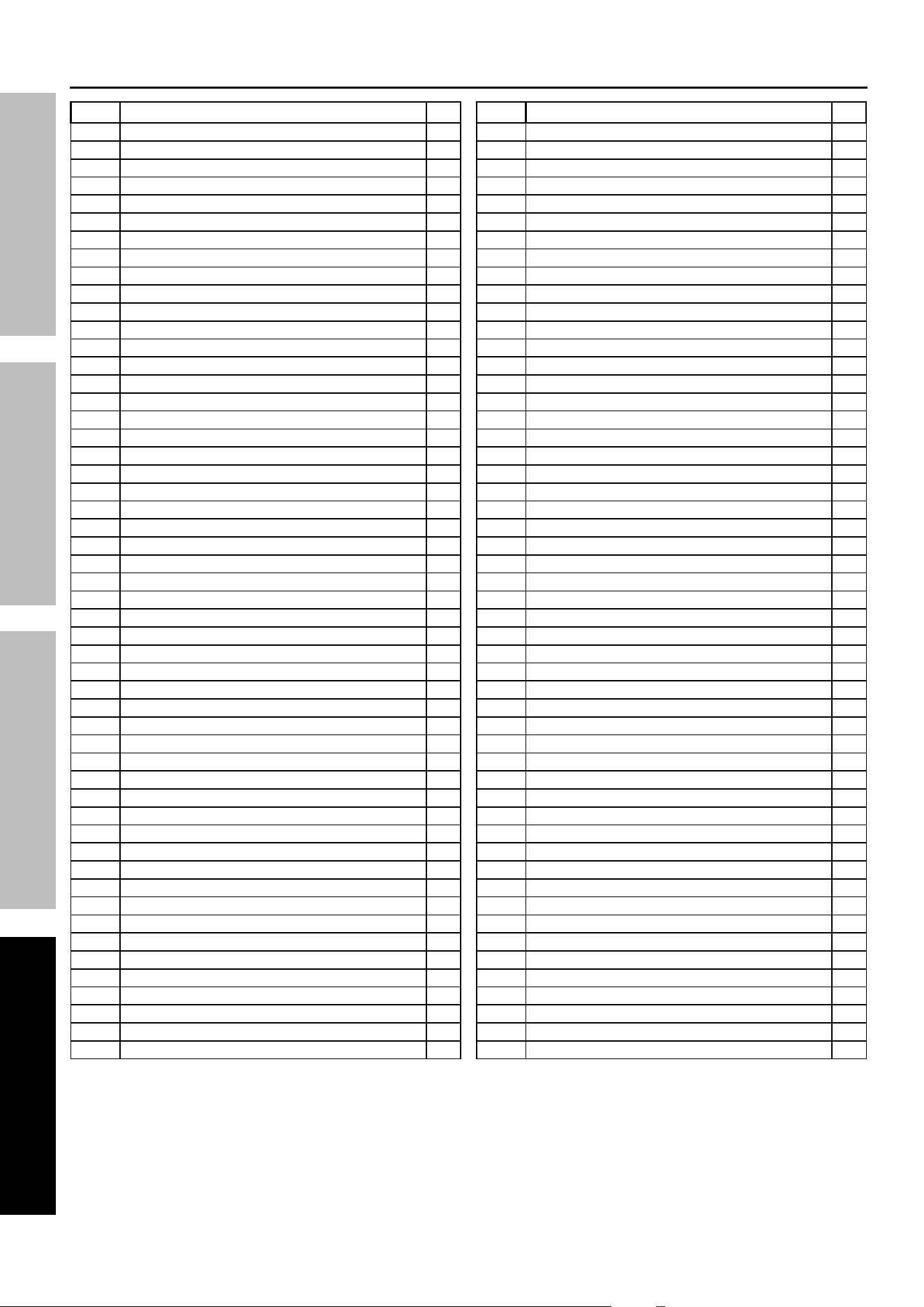
Page 36
For technical questions, please call 1-888-866-5797.
71367
SAFETY OPERATION MAINTENANCESETUP
Engine Parts List
Part Description Qty
1A Crankcase 1
2A Ball Bearing 2
3A Oil Seal 1
4A Bolt M6 x 16 3
5A Drain Plug Bolt 1
6A Drain Plug Washer 2
7A Crankcase Cover Dowel Pin 4
8A Piston 1
9A Piston Ring Set 1
10A Connecting Rod Assembly 1
11A Piston Pin 1
12A Piston Clip 2
13A Crankcase Cover Assembly 1
14A Dipstick 1
15A Intake Valve 1
16A Exhaust Valve 1
17A Intake Valve Returner 1
18A Valve Spring 2
19A Valve Spring Seat 2
20A Valve Lock Clamp 4
21A Rotator 2
22A Stud Bolt 2
23A Nut M6 2
24A Crankshaft Assembly 1
25A Valve Lifter 2
26A Crankcase Cover Gasket 1
27A Camshaft Assembly 1
28A Dowel Pin 2
29A Bolt M8 x 30 6
30A Cylinder Head Gasket 1
31A Bolt M8 x 60 4
32A Spark Plug 1
33A Push Rod 2
34A Bolt M6 x 12 9
35A Cylinder Head Cover Gasket 1
36A Cylinder Head Cover 1
37A Nut 1
38A Intake Gasket 1
39A Carburetor Gasket 1
40A Bolt M5 x 12 2
41A Temperature Sensor 1
42A Rocker Assembly 2
43A Adjuster Rocker Arm 2
44A Recoil Starter Assembly 1
45A Rotor 1
46A Bolt M6 x 60 3
47A Stator 1
48A Recoil Starter Fan 1
49A Starter Pulley 1
50A Ignition Coil 1
51A Wind Deflector Shroud 1
52A Bracket 1
Part Description Qty
53A Bolt M6 x 35 1
54A Carburetor Insulator 1
55A Carburetor Assembly 1
56A Stepper Motor 1
57A Breather Tube 1
58A Stud Bolt 2
59A Fuel Line Clip Ø12 1
60A Recoil Starter Components 1
61A Carburetor Spacer 1
62A Oil Level Switch Assembly 1
63A Push Rod Guide Plate 1
64A Waterproof Cover 1
65A Bottom Plate Guide Hood 1
66A Cylinder Head 1
67A Bolt M6 x 25 4
68A Wind Deflector 1
69A Bolt M6 x 8 2
70A Air Cleaner Assembly 1
71A Fuel Line Clip 1
72A Inner Cylinder Head Cover 1
73A Bolt 1
74A Starter Motor Assembly 1
75A Fuel Line Clip Ø9.5 x 0.8 1
76A Fuel Line 1
77A Bolt M6 x 20 21
78A Stepper Motor 1
79A Bolt M4 x 20 1
80A Crossing Screw M4 x 6 4
81A Polyurethane Screen 3
82A Stepper Motor Bracket 1
83A Low Pressure Hose 1
84A Exhaust Sealant 1
85A Muffler Back Cover 1
86A Muffler Front Cover 1
87A Left Power Base Plate 1
88A Right Power Base Plate 1
89A Muffler Junction Plate 1
90A Vibration 4
91A Muffler 1
92A Bolt M8 x 45 4
93A Crossing Screw M4 x 25 2
94A Nut M8 2
95A Spring Washer Ø8 2
96A Nut M8 8
97A Drain Tube 1
98A Oil Plug 1
99A Low Pressure Hose Loop 1
100A Bolt M6*30 2
101A Clip Wire Harness 6
102A Bolt M6*28 1
103A Bolt M6*35 1
104A Heat Insulation Cotton 1
When ordering replacement parts from this list, the “A” suffix must be included in order to get the correct part.
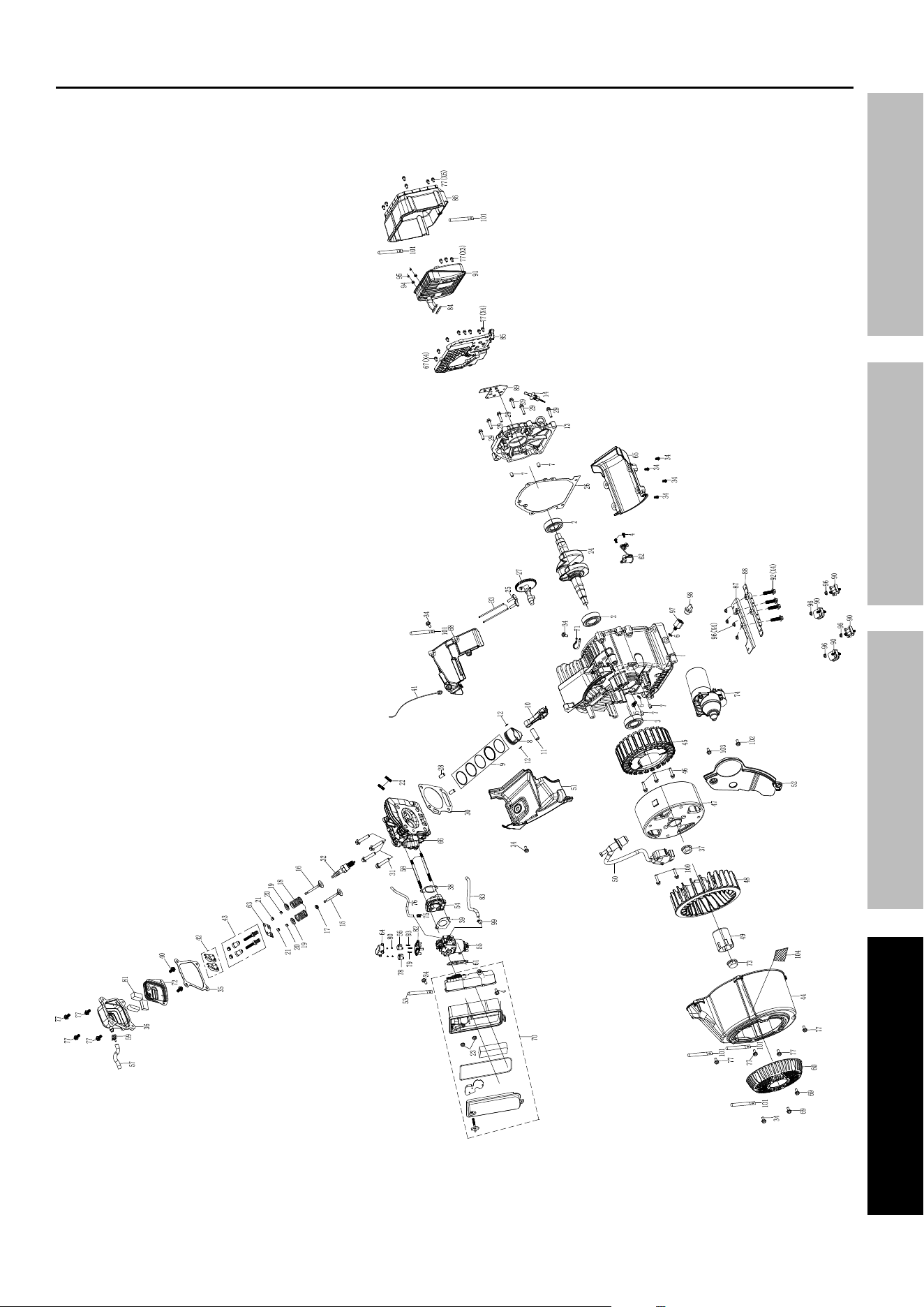
Page 37
For technical questions, please call 1-888-866-5797.
71367
SAFETYOPERATIONMAINTENANCE SETUP
Engine Assembly Diagram

Page 38
For technical questions, please call 1-888-866-5797.
71367
SAFETY OPERATION MAINTENANCESETUP
Warranties
Limited 90 Day Warranty (Retail)
Harbor Freight Tools Co. makes every effort to assure that its products meet high quality and durability standards,
and warrants to the original purchaser that this product is free from defects in materials and workmanship for the
period of 90 days from the date of purchase. This warranty does not apply to damage due directly or indirectly,
to misuse, abuse, negligence or accidents, repairs or alterations outside our facilities, criminal activity, improper
installation, normal wear and tear, or to lack of maintenance. We shall in no event be liable for death, injuries
to persons or property, or for incidental, contingent, special or consequential damages arising from the use of
our product. Some states do not allow the exclusion or limitation of incidental or consequential damages, so
the above limitation of exclusion may not apply to you. THIS WARRANTY IS EXPRESSLY IN LIEU OF ALL
OTHER WARRANTIES, EXPRESS OR IMPLIED, INCLUDING THE WARRANTIES OF MERCHANTABILITY
AND FITNESS, EXCEPT FOR THE EMISSIONS CONTROL SYSTEM WARRANTY BELOW.
To take advantage of this warranty, the product or part must be returned to us with transportation charges prepaid.
Proof of purchase date and an explanation of the complaint must accompany the merchandise. If our
inspection verifies the defect, we will either repair or replace the product at our election or we may elect to
refund the purchase price if we cannot readily and quickly provide you with a replacement. We will return
repaired products at our expense, but if we determine there is no defect, or that the defect resulted from
causes not within the scope of our warranty, then you must bear the cost of returning the product.
This warranty gives you specific legal rights and you may also have other rights which vary from state to state.

Page 39
For technical questions, please call 1-888-866-5797.
71367
SAFETYOPERATIONMAINTENANCE SETUP
Emissions Control System Warranty
Harbor Freight Tools (HFT) is pleased to explain the emissions control system warranty on your Small Off-Road
Engine produced after January 1, 2024 (engine), in addition to the Retail Warranty above. HFT warrants that the
emissions control system on your engine is designed, built, and equipped so that it conforms to the United States
Environmental Protections Agency’s (EPA) emissions requirements in effect at the time of manufacture. HFT also
warrants that the emissions control system on your engine will be free from defects in material and workmanship for
two (2) years, provided there has been no improper maintenance, misuse, or abuse of your engine.
Your emissions control system may include parts such as the carburetor or fuel-injection system, and the ignition
system. Also included may be hoses, belts, connectors and other emissions-related assemblies.
WHAT WE WILL DO
Where a warrantable condition exists, HFT will repair or replace, at our option, any emissions-related part on
your engine if it becomes defective, malfunctions, or otherwise fails to conform with this warranty under normal use
and service during the two (2) year term of this warranty at no cost to you, including diagnosis, parts and labor. This
warranty applies to the original purchaser and any subsequent owner within the two year warranty period.
WHAT IS COVERED?
The following parts are examples of components of the emissions control system and are covered by this
two (2) year warranty. For a full list of emissions control components covered by this warranty, please see 40 CFR
§1068, Appendix I.
1. Fuel Metering System
a. Carburetor and its internal parts.
b. Fuel pump (if so equipped).
c. Cold start enrichment system.
2. Air Induction System
a. Intake pipe/manifold.
b. Air cleaner.
3. Ignition System
a. Spark plug.
b. Magneto ignition system.
4. Catalyst System (if so equipped)
a. Exhaust pipe stud.
b. Muffler.
c. Catalytic converter (if so equipped).
5. Miscellaneous Items Used in Above Systems
a. Vacuum, temperature and time sensitive valves
and switches.
b. Hoses, belts, connectors, and assemblies.
c. Carbon Canister (if so equipped).
This warranty does not cover normal maintenance services or replacement of maintenance items such as filters,
oils, or spark plugs.
WHAT YOU MUST DO TO OBTAIN WARRANTY SERVICE
As the engine owner, you are responsible for the performance of the required maintenance listed in your
Owner’s Manual. HFT may deny you warranty coverage if your engine or a part has failed due to abuse (including
failure to follow the fuel use instructions contained in this manual), neglect, improper maintenance, or unapproved
modifications.
In order to obtain warranty repair or replacement, you may either (a) contact HFT product support at 1-888-866-5797
or [email protected]; or (b) bring the engine/equipment to your nearest Harbor Freight Tools retail
store. When going to the retail store or contacting product support, you must indicate the specific emissions control
part or defect that you are claiming and the date this was originally purchased. The nearest Harbor Freight Tools retail
store can be found on the internet at http://www.harborfreight.com.

26677 Agoura Road • Calabasas, CA 91302 • 1-888-866-5797
