
USER MANUAL
DO NOT RETURN THIS PRODUCT TO THE STORE
If you have questions or need assistance, please call customer
service at 855-944-3571.
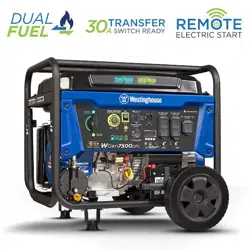
WGen7500DFc
Dual Fuel Portable Generator
Gasoline: 7500 Running Watts | 9500 Peak Watts
Propane: 6750 Running Watts | 8550 Peak Watts
2 | Westinghouse Outdoor Power Equipment, LLC
INTRODUCTION
INTRODUCTION
WARNING: Operating, servicing, and maintaining
this equipment can expose you to chemicals including
engine exhaust, carbon monoxide, phthalates, and lead,
which are known to the State of California to cause
cancer and birth defects or other reproductive harm. To
minimize exposure, avoid breathing exhaust, and wear
gloves or wash your hands frequently when servicing
this equipment. For more information go to www.
P65warnings.ca.gov.
DISCLAIMERS
All information, illustrations, and specications in
this manual were in effect at the time of publishing.
The illustrations used in this manual are intended as
representative reference views only. We reserve the right
to make any specication or design change without notice.
ALL RIGHTS RESERVED
All rights reserved. No reproduction allowed in any form
without written permission from Westinghouse Outdoor
Power Equipment, LLC.
DANGER
Read this manual before using or performing
maintenance on this product. Failure to follow
the instructions and safety precautions in this
manual can result in serious injury or death.
SAVE THESE INSTRUCTIONS
TABLE OF CONTENTS
INTRODUCTION
DISCLAIMERS .........................................................................2
ALL RIGHTS RESERVED ........................................................2
SPECIFICATIONS....................................................................3
PRODUCT REGISTRATION .................................................... 3
SAFETY
SAFETY DEFINITIONS............................................................4
SAFETY SYMBOLS .................................................................4
SAFETY INSTRUCTIONS .......................................................5
GFCI ......................................................................................... 7
SAFETY LABELS AND DECALS .............................................8
CO SENSOR ............................................................................ 9
ACTION LABEL ........................................................................9
CONTROL PANEL CO AUTO-SHUTOFF ................................9
COMPONENTS
CONTROL PANEL COMPONENTS .......................................10
GENERATOR COMPONENTS .............................................. 11
ASSEMBLY
CARTON CONTENTS ...........................................................12
INSTALL FEET AND WHEELS ..............................................12
INITIAL OIL FILL ....................................................................13
FUEL ......................................................................................13
CONNECT A LPG/PROPANE TANK ...................................... 14
CONNECT THE BATTERY ....................................................15
OPERATION
GENERATOR LOCATION ......................................................16
GROUNDING .........................................................................16
HIGH ALTITUDE OPERATION ..............................................17
REMOTE START ...................................................................17
FUEL SELECTOR SWITCH ..................................................18
BREAK-IN PERIOD ...............................................................18
BEFORE STARTING THE GENERATOR ..............................18
STARTING THE ENGINE: GASOLINE ..................................18
STARTING THE ENGINE: PROPANE ...................................19
SWITCHING FUEL SOURCES .............................................. 19
STOPPING THE ENGINE ...................................................... 19
FREQUENCY OF USE ..........................................................19
AC CIRCUIT BREAKERS ......................................................20
GENERATOR CAPACITY ......................................................20
POWER MANAGEMENT .......................................................20
EXTENSION CORDS ............................................................21
ST SWITCH ............................................................................21
TRANSPORTING ................................................................... 22
MAINTENANCE
MAINTENANCE SCHEDULE ................................................23
MAINTENANCE REMINDERS ..............................................23
MAINTENANCE REPLACEMENT PARTS ............................23
AIR FILTER MAINTENANCE .................................................23
ENGINE OIL LEVEL CHECK .................................................24
ENGINE OIL CHANGE ..........................................................24
SPARK PLUG MAINTENANCE .............................................25
SPARK ARRESTOR SERVICE ..............................................25
FUEL FILTER .........................................................................26
BATTERY MAINTENANCE .................................................... 26
BATTERY REPLACEMENT ...................................................26
STORAGE .............................................................................. 27
VALVE CLEARANCE .............................................................28
TROUBLESHOOTING
TROUBLESHOOTING ...........................................................30
EXPLODED VIEWS AND PARTS LISTS
ENGINE EXPLODED VIEW ................................................... 31
GENERATOR EXPLODED VIEW ..........................................34
SCHEMATICS
SCHEMATICS ........................................................................37
ESPAÑOL ...............................................................................38
FRANÇAIS .............................................................................69
Westinghouse Outdoor Power Equipment, LLC | 3
SPECIFICATIONS
Specications
Running Watts:
7500 Gasoline
6750 LPG
Peak Watts:
9500 Gasoline
8550 LPG
Rated Voltage: 120V/240V
Rated Power @1.0 Power
Factor:
7.5 kW Gasoline
6.75 kW LPG
Peak Power:
9.5 kVA Gasoline
8.55 kVA LPG
Rated frequency: 60 Hz @ 3600 RPM
Phase: Single phase
Total Harmonic
Distortion:
≤ 23%
Engine Displacement: 420 cc
Starting Type:
Recoil, Electric Start,
Remote
Fuel Capacity: 6.6 Gallons (25 Liters)
Fuel Type:
Unleaded gasoline
87–93 octane*
Oil Capacity: 1.16 Quart (1.1 Liter)
Oil Type: SAE 10W-30
Spark Plug: 91708 (F7TC)
Spark Plug Gap:
0.024 – 0.032 in.
(0.60 – 0.80 mm)
Valve Intake
Clearance:
0.0031 – 0.0047 in.
(0.08 – 0.12 mm)
Valve Exhaust
Clearance:
0.0051 – 0.0067 in.
(0.13 – 0.17 mm)
AC Grounding System: Neutral bonded to frame
Voltage Regulator: AVR
Alternator Type: Brushed
Maximum Ambient
Temperature:
104°F (40°C)
Certications:
• EPA
• CARB
• CSA
*Ethanol content of 10% or less. DO NOT use E15 or E85.
UPDATES
The latest User Manual for your Westinghouse
generator can be found under our support tab. https://
westinghouseoutdoorpower.com/pages/manuals
Or scan the following QR code with your smartphone
camera to be directed to the link.
NOTICE
This product is designed and rated for continuous
operation at ambient temperatures up to 104°F (40°C).
If needed, this product can be operated at temperatures
ranging from 5°F (15°C)–122°F (50°C) for short periods.
If the product is exposed to temperatures outside of this
range during storage, it should be brought back within
this range before operation. This product must ALWAYS
be operated outdoors in a well-ventilated area and far
away from doors, windows, and other vents.
Maximum wattage and current are subject to and
limited by such factors as fuel BTU content, ambient
temperature, altitude, engine conditions, etc. Maximum
power decreases about 3.5% for each 1,000 feet above
sea level, and will also decrease about 1% for each 10°F
(6°C) above 60°F (16°C) ambient temperature.
PRODUCT REGISTRATION
For trouble-free warranty coverage, it is important to
register your Westinghouse generator.
You can register by:
• Completing and mailing the product registration card
included in the carton.
• Registering your product online at:
https://westinghouseoutdoorpower.com/pages/
warranty-registration
• Scan the following QR code with your smartphone
camera to be directed to the mobile registration link.
• Sending the following product information to:
Westinghouse Outdoor Power
Warranty registration
777 Manor Park Drive
Columbus, OH 43228
For Your Records
Date of Purchase:
Model Number:
Serial Number:
Place of Purchase:
IMPORTANT: Keep your purchase receipt for trouble-free
warranty coverage.
INTRODUCTION
4 | Westinghouse Outdoor Power Equipment, LLC
SAFETY
SAFETY
SAFETY DEFINITIONS
The words DANGER, WARNING, CAUTION, and
NOTICE are used throughout this manual to highlight
important information. Make sure that the meanings of this
safety information is known to all who operate, perform
maintenance on, or are near the generator.
This safety alert symbol appears
with most safety statements. It
means attention, become alert, your
safety is involved! Please read and
abide by the message that follows
the safety alerts symbol.
DANGER
Indicates a hazardous situation which, if not avoided,
will result in death or serious injury.
WARNING
Indicates a hazardous situation which, if not avoided,
could result in death or serious injury.
CAUTION
Indicates a hazardous situation which, if not avoided,
could result in minor or moderate injury.
NOTICE
Indicates a situation which can cause damage
to the generator, personal property, and/or the
environment, or cause the equipment to operate
improperly.
Note: Indicates a procedure, practice or condition
that should be followed for the generator to function
in the manner intended.
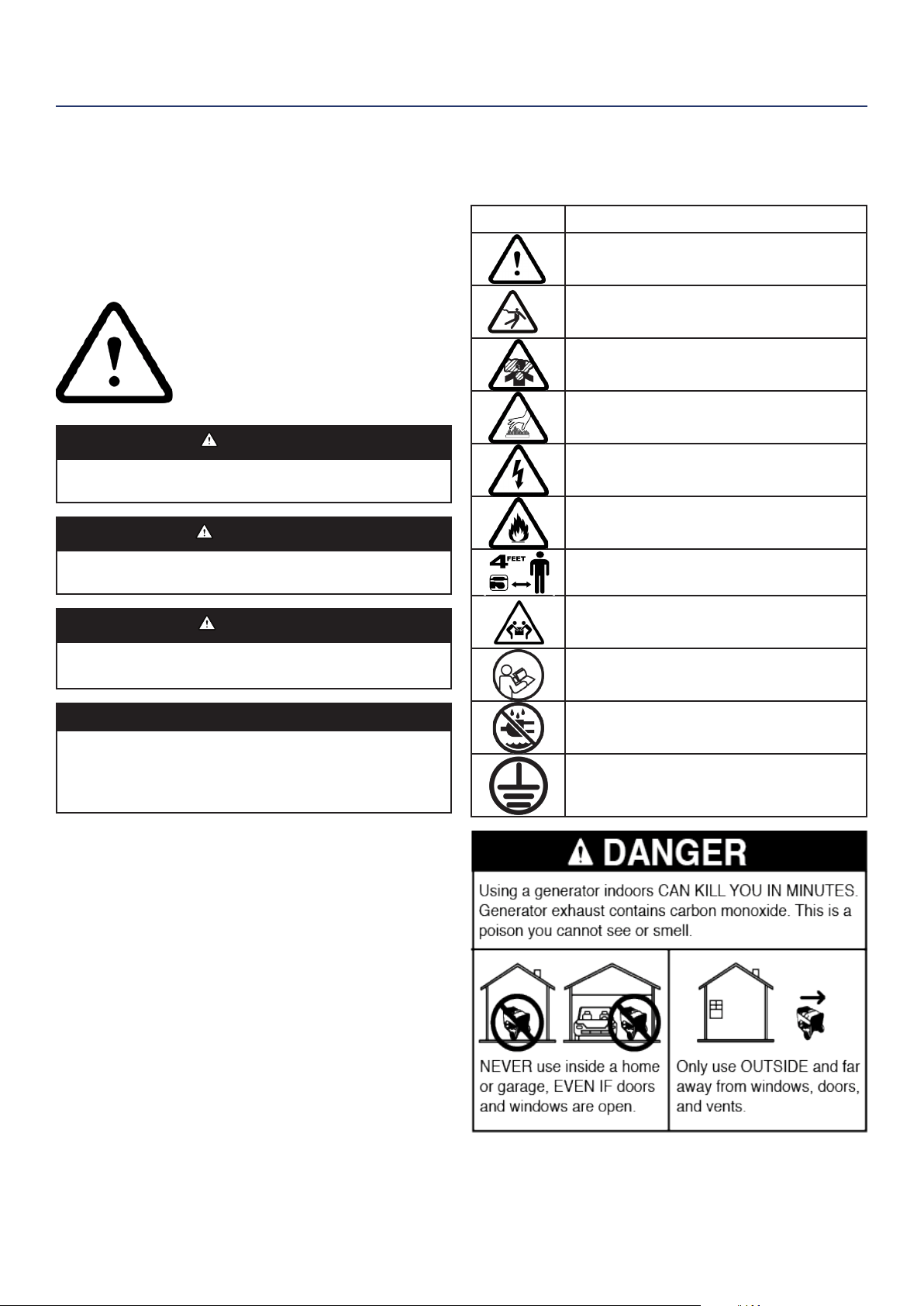
SAFETY SYMBOLS
Follow all safety information contained in this manual
and on the generator.
Symbol Description
Safety Alert Symbol
Electrocution Hazard
Asphyxiation Hazard
Burn Hazard. DO NOT touch hot surfaces.
Electrical Shock Hazard
Fire Hazard
Maintain Safe Distance
Lifting Hazard
Read Manufacturer’s Instructions
DO NOT Operate in Wet Conditions
Ground. Consult with electrician to
determine grounding requirements before
operation.
Westinghouse Outdoor Power Equipment, LLC | 5
SAFETY INSTRUCTIONS
NOTICE
Install battery-powered carbon monoxide detectors or
plug-in carbon monoxide detectors with battery back-up
in living areas.
DANGER
Fire and electrocution hazard. DO NOT connect to
a building’s electrical system unless the generator
and transfer switch have been properly installed and
the electrical output has been veried by a qualied
electrician. The connection must isolate the generator
power from utility power and must comply with all
applicable laws and electrical codes.
GENERAL SAFETY PRECAUTIONS
• NEVER use the generator to power medical support
equipment.
• DO NOT operate the generator when you are tired or
under the inuence of drugs, alcohol, or medication.
DANGER
Electrocution hazard. Never use the generator in a
location that is wet or damp. Never expose the generator
to rain, snow, water spray, or standing water while in
use. Protect the generator from all hazardous weather
conditions. Moisture or ice can cause a short circuit or
other malfunction in the electrical circuit.
SAFETY
6 | Westinghouse Outdoor Power Equipment, LLC
• DO NOT use generator with electrical cords which are
worn, frayed, bare, or otherwise damaged.
• All electrical tools and appliances operated from this
generator must be properly grounded by use of a third
wire or be double-insulated.
• When this generator is used to supply a building wiring
system the generator must be installed by a qualied
electrician and connected to a transfer switch as a
separately derived system in accordance with NFPA 70,
National Electrical Code.
• If you begin to feel sick, dizzy, or weak while using
the generator, move to fresh air IMMEDIATELY. See a
doctor, as you can have carbon monoxide poisoning.
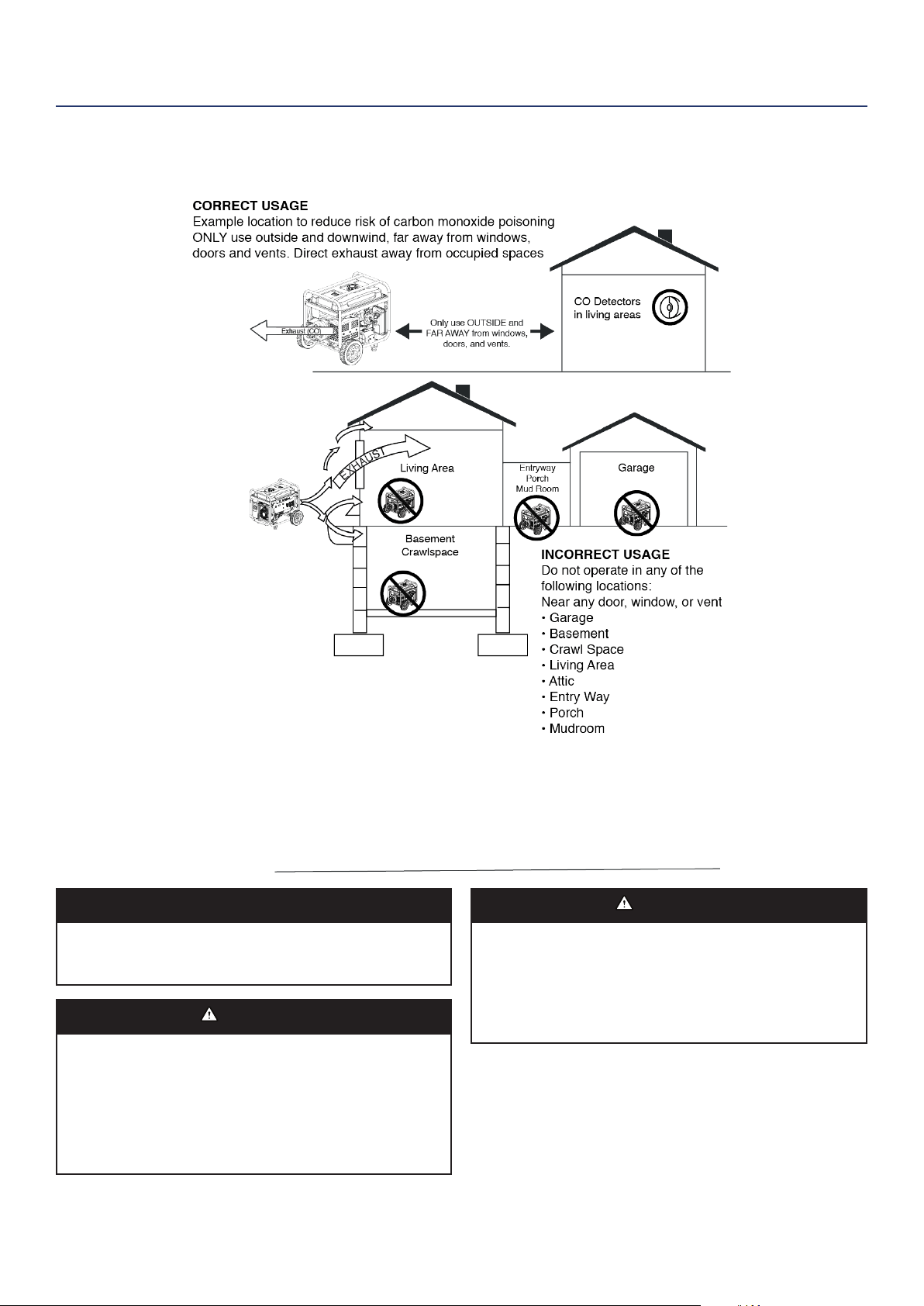
• Only use OUTSIDE and far away from windows, doors,
and vents as recommended by the US Department
of Health and Human Services Centers for Disease
Control and Prevention. Your specic home and/or wind
conditions may require additional distance.
• While operating and storing, keep at least ve feet
of clearance on all sides of the generator, including
overhead. Allow the generator to cool a minimum of 30
minutes before storage. Heat created by the mufer and
exhaust gases could be hot enough to cause serious
burns and/or ignite combustible objects.
• DO NOT touch the mufer or engine. They are very
HOT and will cause severe burns. DO NOT put body
parts or any ammable or combustible materials in the
direct path of the exhaust.
• ALWAYS remove any tools or other service equipment
used during maintenance away from the generator
before operating.
• Avoid skin contact with engine oil or gasoline. Wear
protective clothing and equipment. Wash all exposed
skin with soap and water.
• A transfer switch must be installed by a licensed
electrician approved by the authority having jurisdiction.
The installation must comply with all applicable laws
and electrical codes.
FUEL SAFETY
• Store fuel in a container approved for gasoline.
• DO NOT smoke when lling the generator with gasoline.
• DO NOT allow the generator’s gas tank to overow
when lling.
• Shut down the engine and allow it to cool for two
minutes before adding gasoline or oil to the generator.
• NEVER remove the fuel cap when the generator is
running. Shut off the engine and allow the unit to cool
at least two minutes. Remove the fuel cap slowly to
release pressure, keep fuel from escaping around the
cap, and to avoid the heat from the mufer igniting fuel
vapors. Tighten the fuel cap securely after refueling.
• Wipe spilled fuel from the unit.
• NEVER attempt to burn off spilled fuel.
• NEVER overll the fuel tank. Leave room for fuel to
expand. Overlling the fuel tank can result in a sudden
overow of gasoline and result in spilled gasoline
coming in contact with HOT surfaces.
• Spilled fuel can ignite. If fuel is spilled on the generator,
wipe up any spills immediately. Dispose of rag properly.
Allow area of spilled fuel to dry before operating the
generator.
• Wear eye protection while refueling.
• NEVER use gasoline as a cleaning agent.
• Store any containers containing gasoline or LPG/
propane in a well-ventilated area, away from any
combustibles or source of ignition.
GASOLINE AND GASOLINE VAPOR (GAS)
DANGER
Fire and explosion hazard. Gasoline and LPG/propane
are highly explosive and ammable and can cause
severe burns or death.
• In case of a gas re, DO NOT attempt to extinguish
the ame if the fuel tank valve is in the ON position.
Introducing an extinguisher to a generator with an open
fuel valve could create an explosion hazard.
• Gas has a distinctive odor, this will help detect potential
leaks quickly.
• Gas vapors can cause a re if ignited.
• Gasoline is a skin irritant and needs to be cleaned up
immediately if it comes in contact with the skin.
LIQUID PETROLEUM GAS (LPG/PROPANE)
WARNING
Fire and explosion hazard. NEVER use a gas container,
LPG/propane connector hose, LPG/propane tank or any
other fuel item that appears to be damaged.
CAUTION
Fire and explosion hazard. Only use approved LPG/
propane tanks with an Overlling Prevention Device
(OPD) valve. ALWAYS keep the tank in a vertical position
with the valve on top and placed at ground level on a
at surface. DO NOT allow tanks to be near any heat
source. When transporting and storing, turn the propane
tank valve to the fully closed position and disconnect the
tank. Make sure to ALWAYS cover the generator inlet
and tank outlet with protective plastic caps.
• LPG/Propane is highly ammable and explosive.
• Flammable gas under pressure can cause a re or
explosion if ignited.
• LPG/Propane can settle in low places because it is
heavier than air.
SAFETY
Westinghouse Outdoor Power Equipment, LLC | 7
• LPG/Propane has a distinctive odor added to help
detect potential leaks.
• ALWAYS keep a LPG/Propane tank in an upright
position.
• When exchanging LPG/propane tanks, be sure the tank
valve is the same type.
• In case of a LPG/propane re, DO NOT attempt to
extinguish unless the fuel supply can be shut off safely.
• LPG/propane will burn the skin. Prevent skin contact at
all times.
• Keep the propane tank away from the generator
exhaust.
• Large (500–1000 gallon) LPG/propane tanks will
require a certied plumber to install the fuel line to
the generator and the loose regulator is not used (the
regulator that is attached to the fuel tank). The pressure
as measured at the regulator mounted to the generator
must be 7” to 14” of water column. A certied plumber
must ensure that the pressure is correct or install a step
down regulator if needed.
WARNING
Fire and explosion hazard. If there is a strong smell of
propane while operating the generator, fully close the
LPG/propane tank valve immediately. Once the propane
is off, use soapy water to check for leaks on the hose
and connections on the tank valve and the generator.
DO NOT smoke or light a cigarette or check for leaks
using any open ame source such as a match or lighter.
If a leak is found, contact a qualied technician to inspect
and repair the LPG/propane system before using the
generator.
When starting the generator:
• Make sure that the fuel cap, air lter, spark plug, fuel
lines, and exhaust system are properly in place.
• If you spill any gasoline on the tank, allow it to fully
evaporate before operating.
• Make sure the generator and LPG/propane tank are on
a at surface before operating.
• If there is a propane odor DO NOT start the unit because
there may be a potential leak. NEVER place a LPG/
propane tank near the engine exhaust.
When transporting or servicing the generator:
• Make sure the LPG/propane tank and LPG/propane
hose are not attached to the generator.
• Disconnect the spark boot to prevent accidental starting.
When storing the generator:
• Store away from sparks, open ames, pilot lights, heat,
and other sources of ignition.
• DO NOT store gas or a LPG/propane tank near
furnaces, water heaters, or any other appliances that
produce heat or have automatic ignitions.
GFCI
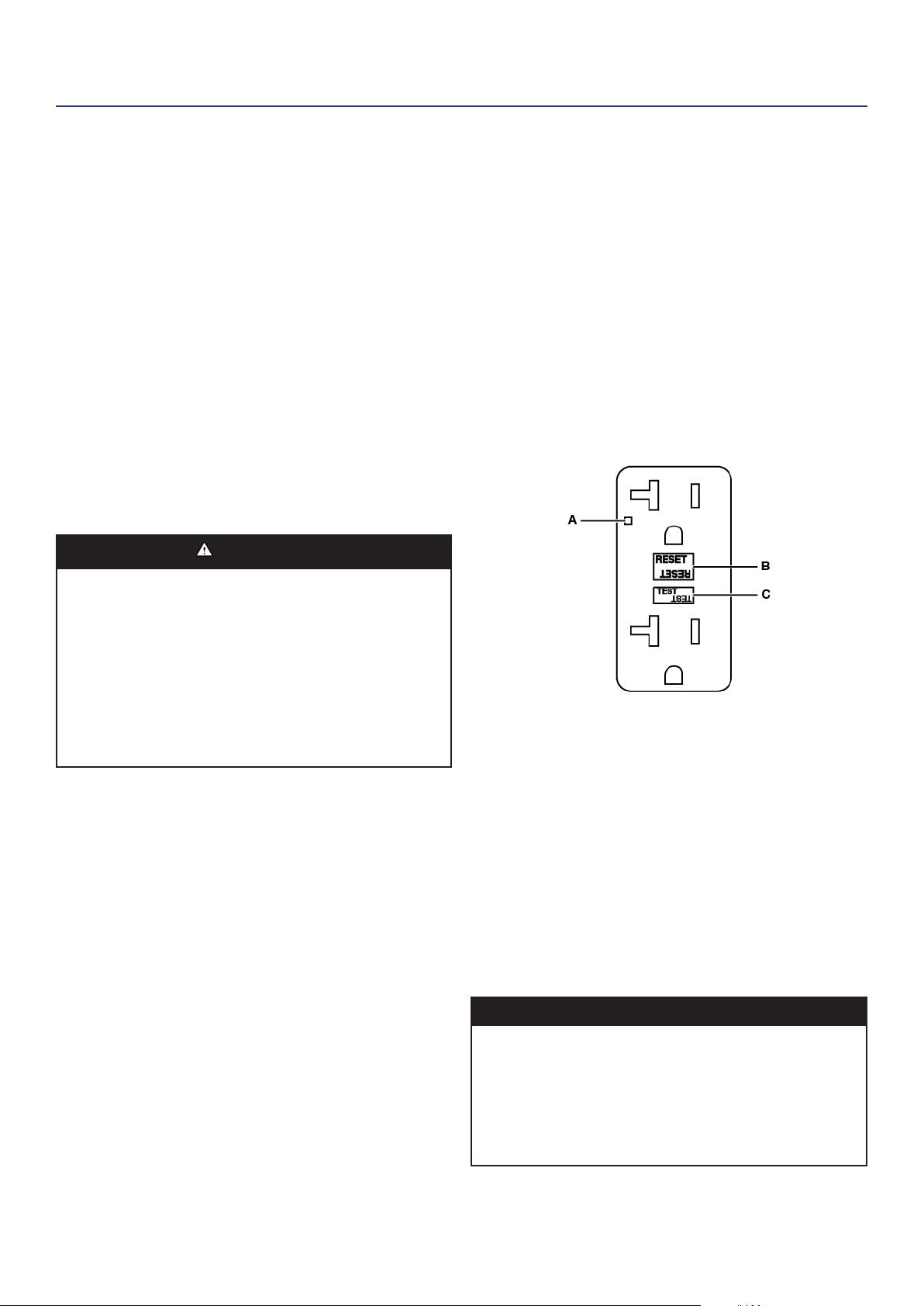
The generator is equipped with Ground Fault Circuit
Interrupter (GFCI) receptacles. In the event of a ground
fault, a GFCI trips automatically to stop the ow of electricity
and prevent serious injury. The green indicator light (A)
on the receptacle will also turn off. Push the “RESET” (B)
button located on the front of the receptacle to restore the
ow of electricity. The indicator light will turn back on. GFCI
does not protect against circuit overloads.
To check the proper operation of a GFCI receptacle:
1. With the generator running, plug a lamp into the GFCI
receptacle. Turn the lamp on.
2. Press the “TEST” (C) button located on the front of the
receptacle to trip the device. This should immediately
stop the ow of electricity and shut off the lamp. If the
electricity is not stopped, DO NOT use this receptacle
until it has been serviced or replaced.
3. Press the “RESET” button located on the front of the
receptacle to restore the ow of electricity. If the indicator
light does not come back on or if the GFCI cannot be
reset then it must be replaced.
NOTICE
Some stationary motors, such as a bathroom vent fan,
uorescent lighting xtures or some refrigerators, may
produce enough current leakage to cause nuisance
tripping. To avoid nuisance tripping, a GFCI should not
supply: uorescent or other types of electric-discharge
lighting xtures or permanently installed electric motors,
like air conditioners, furnaces or refrigerators.
SAFETY
8 | Westinghouse Outdoor Power Equipment, LLC
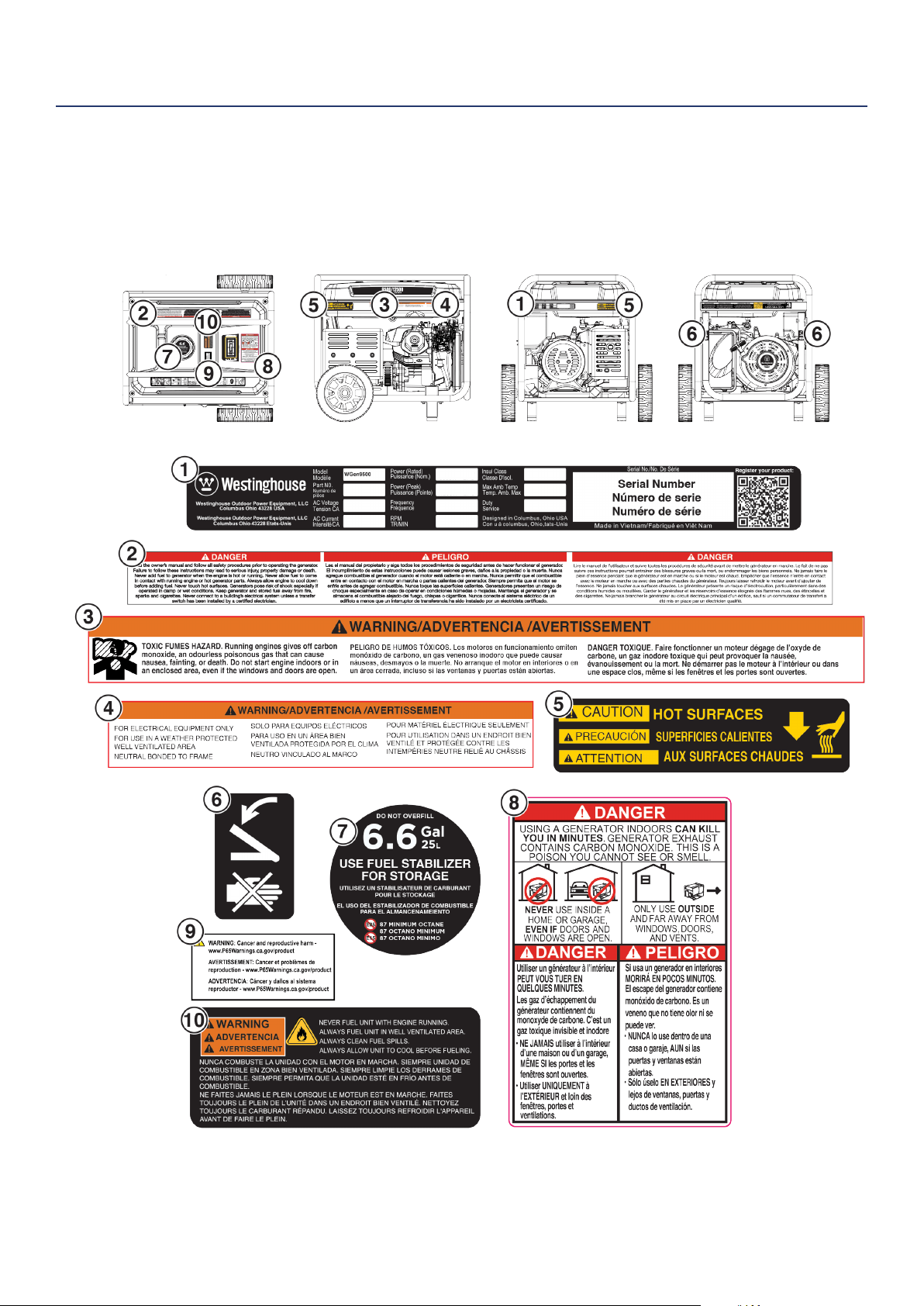
SAFETY LABELS AND DECALS
SAFETY
Westinghouse Outdoor Power Equipment, LLC | 9
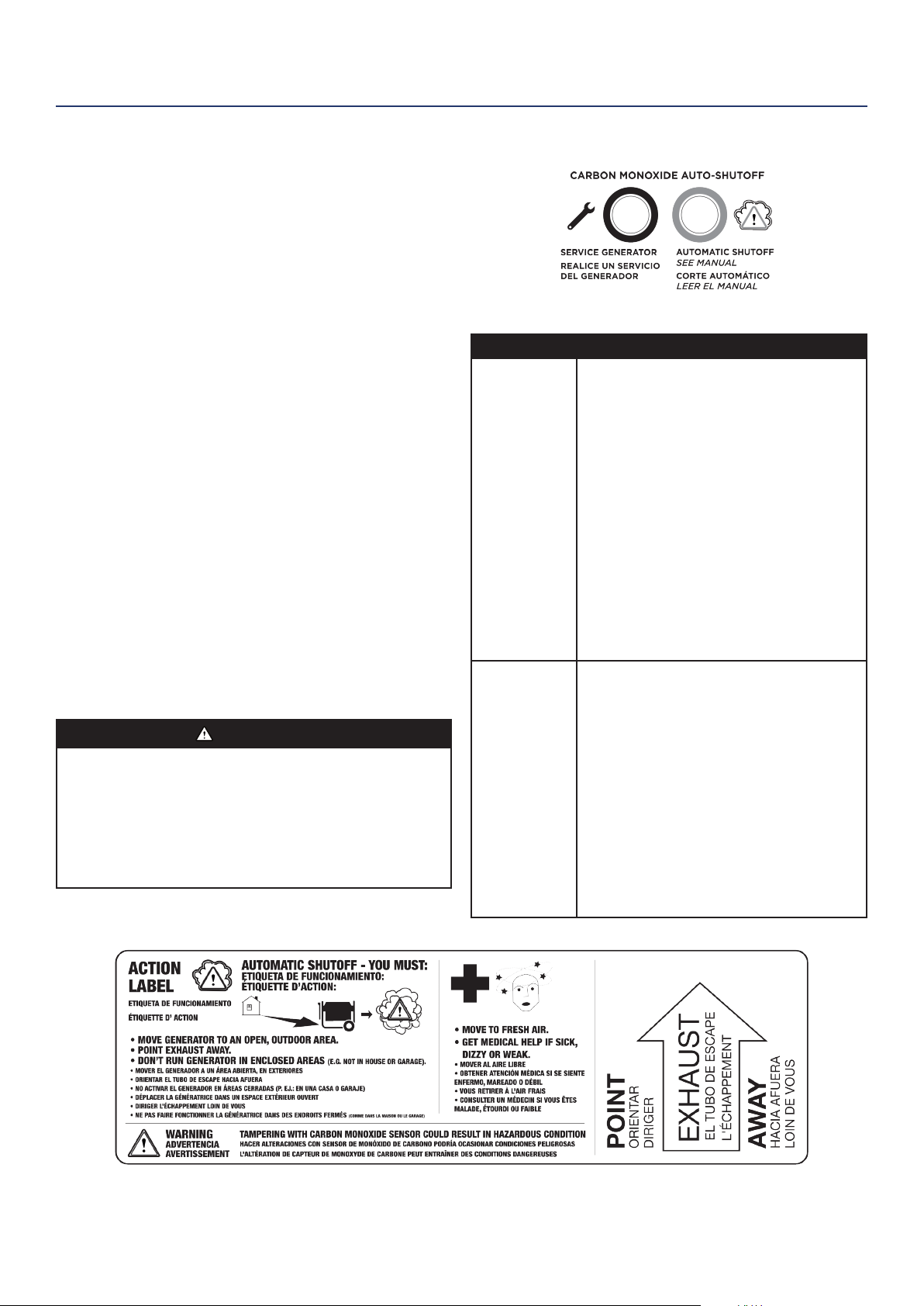
CO SENSOR
The CO Sensor monitors for the accumulation of
poisonous carbon monoxide gas around the generator
when the engine is running. If increasing levels of CO gas
are detected, the CO Sensor automatically shuts down the
engine.
The CO Sensor will also detect the accumulation of carbon
monoxide from other fuel burning sources used in the area
of operation. For example, if the exhaust of fuel burning
tools is pointed at a CO Sensor-equipped generator, a
shut-off may be initiated due to rising CO levels. This is not
an error. Hazardous carbon monoxide has been detected.
Move and redirect any additional fuel burning sources
to dissipate carbon monoxide away from personnel and
occupied buildings.
Note: Remote start-equipped generators must be restarted
with the START/STOP button on the control panel
after an automatic shut-down occurs.
Generators are intended to be used outdoors, far from
occupied buildings and the exhaust pointed away from
personnel and buildings. If misused and operated in a
location that results in the accumulation of CO, like in
a partially enclosed area, the CO Sensor shuts off the
engine, noties the user with a RED indicator light, and
directs the user to read the Action Label for steps to take.
The CO Sensor DOES NOT replace carbon monoxide
alarms. Install battery-powered carbon monoxide alarm(s)
in your home.
WARNING
Automatic shutoff accompanied with a ashing RED
light in the CO Sensor portion of the control panel is an
indication that the generator was improperly located. If
you start to feel sick, dizzy, weak, or carbon monoxide
detectors in your home indicate an alarm, get to fresh
air immediately. Call emergency services. You may have
carbon monoxide poisoning.
ACTION LABEL
CONTROL PANEL CO AUTO-SHUTOFF
CO SENSOR INDICATOR LIGHTS
Color Description
RED
Carbon monoxide accumulated around
the generator. After shut-off, the RED
indicator light in the CO Sensor area
of the control panel will ash to provide
notication that the generator was shut-
off due to an accumulating CO hazard.
The RED light will ash for at least ve
minutes after a CO shut-off.
Move the generator to an open, outdoor
area far away from occupied spaces
with exhaust pointed away. Once
relocated to a safe area, the generator
can be restarted. Introduce fresh air and
ventilate the area where the generator
had shut down.
YELLOW
A CO sensor system fault occurred.
When a system fault occurs, the
generator is automatically shut down
and the YELLOW indicator light in the
CO auto-shutoff area of the control panel
will ash to provide notication that the a
fault has occurred. The YELLOW light
will ash for at least ve minutes after a
fault. The generator can be re-started,
but may continue to shutoff. A CO sensor
fault can only be diagnosed and repaired
by an authorized Westinghouse service
center.
SAFETY
10 | Westinghouse Outdoor Power Equipment, LLC
COMPONENTS
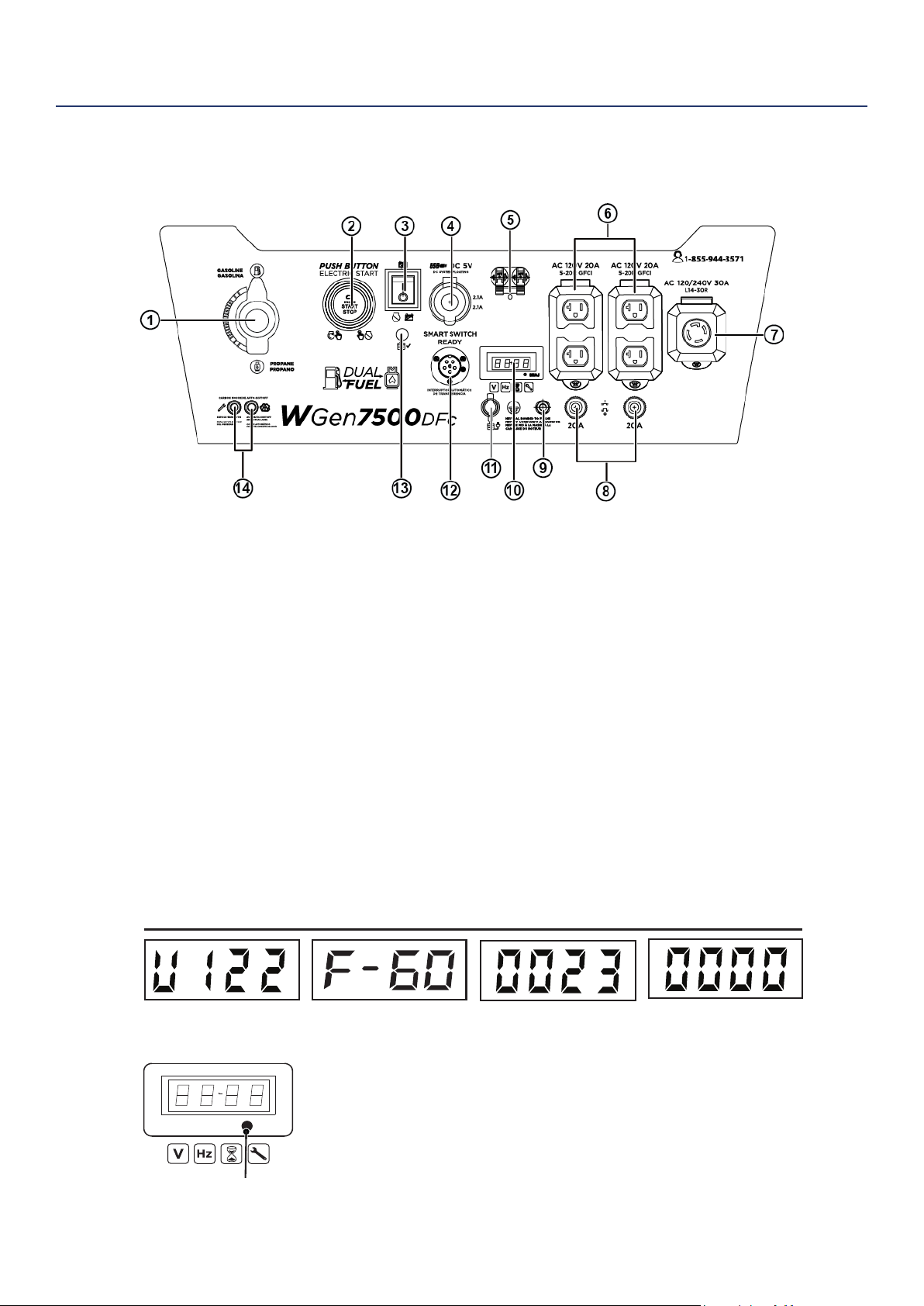
CONTROL PANEL COMPONENTS
1. Fuel Selector Switch: Used to select gas or propane
operation.
2. Push-Button START/STOP: Push once to
automatically start the engine. Push again to stop
the engine.
3. Battery Switch: Turns battery ON and OFF. Must be
ON before electric or remote start.
4. USB Ports: Two-port 5V/2.1A USB outlet. Accepts
Type A USB plugs.
5. Main Circuit Breaker: The main circuit breaker controls
total output of all outlets to protect the generator from
overload or short circuit.
6. 120 Volt AC, 20 Amp Duplex GFCI NEMA 5-20R
Receptacles: Receptacles can supply a maximum of
20 Amps.
7. 120/240 Volt AC, 30 Amp NEMA 14-30R Twist-Lock
Receptacle: Receptacle can supply a maximum of
30 Amps.
8. 20 Amp AC Circuit Breakers: Circuit breakers
limits the current that can be delivered through the
NEMA 5-20R receptacles to 20 Amps.
9. Ground Terminal: The ground terminal is used to
externally ground the generator.
10. Data Center: Toggle to show voltage, frequency,
total hour meter, and run/maintenance timer.
11. Battery Charging Port: Used to charge the battery
with the included battery charger.
12. Smart Switch Outlet: Connects the Westinghouse
ST Switch (sold separately) to the control panel.
13. Battery Indicator: Indicates that power is ON. Light
will remain illuminated while the unit is ON.
14. CO Sensor indicator lights: The CO Sensor
monitors for the accumulation of poisonous carbon
monoxide gas. If increasing levels of CO gas are
detected, the CO Sensor automatically shuts down
the engine.
DATA DISPLAY
Run Time/Maintenance:
Displays current run time.
Resets to zero when shut
down. Maintenance
reminder displayed
when required.
Frequency (Hz):
Displays power output
frequency in Hertz.
Voltage:
Displays current voltage
output.
Lifetime Hours:
Displays the lifetime run
hours.
Mode Button
METER V-F-T
Maintenance Codes:
P25: Change engine oil
P50: Clean air filter,
Change engine oil
P100: Change engine oil,
clean air filter, replace
fuel filter
Push the Mode button to cycle through
the data display modes.
COMPONENTS
Westinghouse Outdoor Power Equipment, LLC | 11
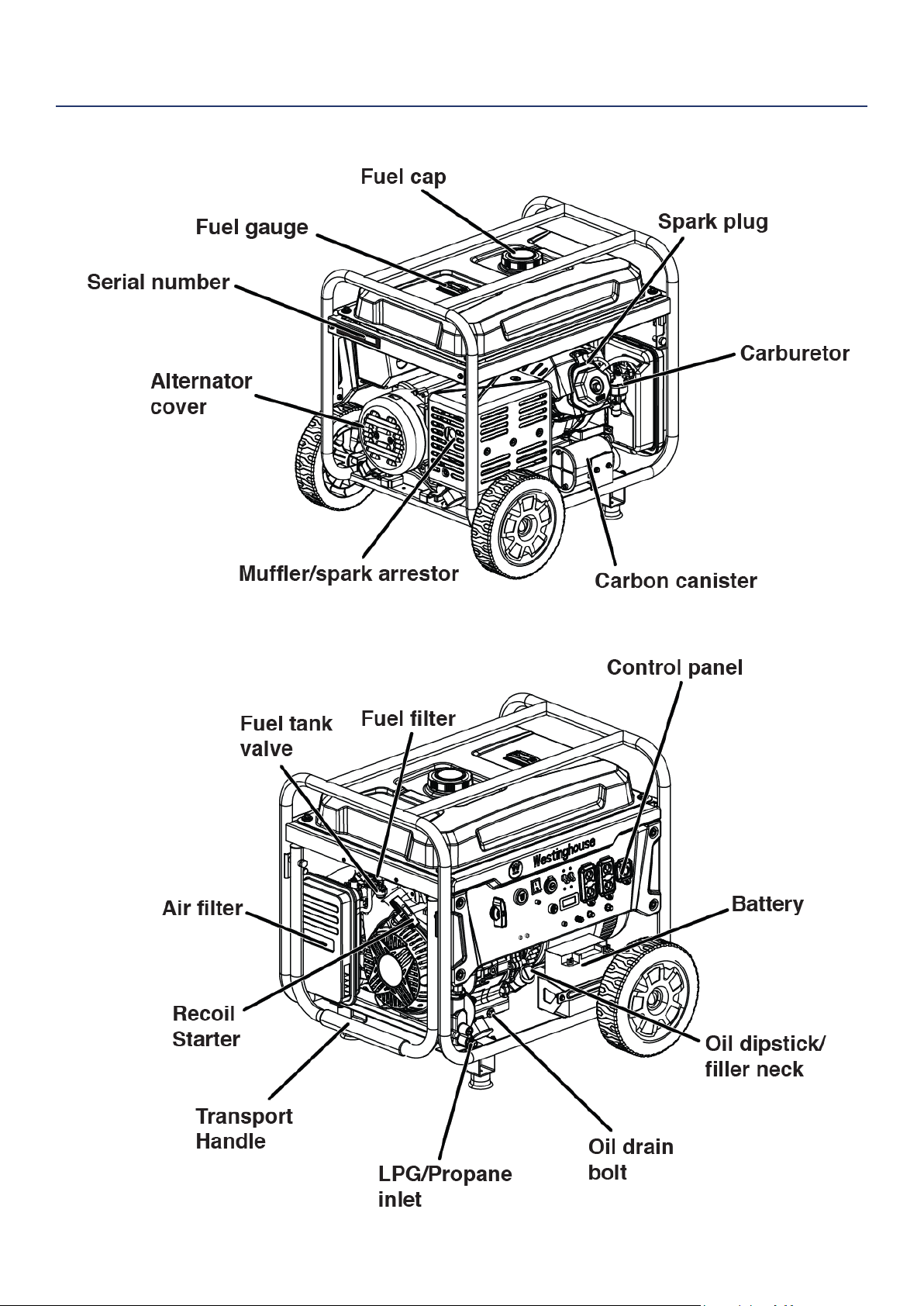
GENERATOR COMPONENTS
COMPONENTS
12 | Westinghouse Outdoor Power Equipment, LLC
ASSEMBLY
CARTON CONTENTS
CAUTION
Weight hazard. ALWAYS have assistance when lifting
the generator.
1. Carefully open the carton.
2. Remove and save the carton contents.
3. Remove and discard the packing tray.
4. Unfold the top of the plastic bag enclosing the generator.
5. Carefully cut the vertical corners of the carton to access
the generator.
6. Recycle or dispose of the packaging materials properly.
CARTON CONTENTS
• User manual
• Quick Start Guide
• LPG/propane hose with regulator
• Remote start key fob (attached to recoil starter)
• 1.16 Quart (1.1 Liter) bottle of SAE 10W-30 Oil
• Battery charger
• Spark plug socket wrench
• Oil Funnel
• Assembly wrench
• Wheel and mounting foot components
Item Quantity
• Mounting foot 2
• Flange bolt, M8 4
• Wheel 2
• Axle pin 2
• Washer 2
• Cotter pin 2
If any parts are missing, contact our service team at
[email protected] or call 1-855-944-3571.
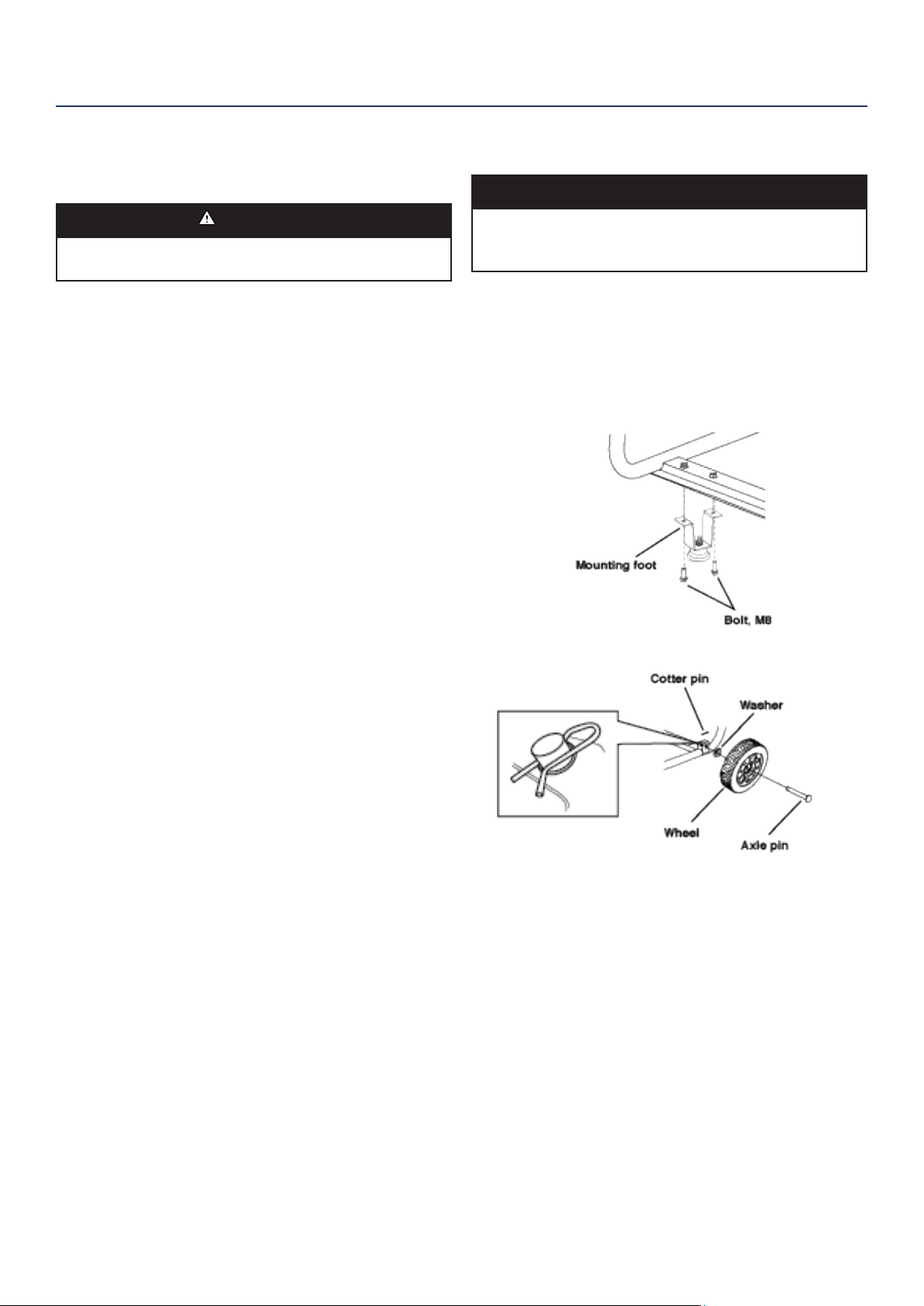
INSTALL FEET AND WHEELS
NOTICE
Assembling the generator will require lifting the unit on
one side. Install the mounting feet and wheel before
adding fuel or oil.
1. Place generator on a at surface.
2. Tip the generator on a piece of cardboard or other soft
material to protect the frame paint and prevent the
generator from sliding.
3. With the included wrench, install the mounting feet to
the frame as shown.
4. Install the wheels as shown.
Note: The wheels are only intended for hand transport.
The wheels are not suitable for towing the generator
either on or off-road.
ASSEMBLY
Westinghouse Outdoor Power Equipment, LLC | 13
INITIAL OIL FILL
NOTICE
THIS GENERATOR HAS BEEN SHIPPED WITHOUT
OIL. DO NOT attempt to crank or start engine before
it has been properly serviced with recommended oil.
Failure to add engine oil before starting will result in
serious engine damage.
NOTICE
Use of 2-stroke/cycle oil or other unapproved oil types
can cause severe engine damage that is not covered
under warranty.
The included, recommended oil type for typical use is
10W-30 engine oil. If running the generator in extreme
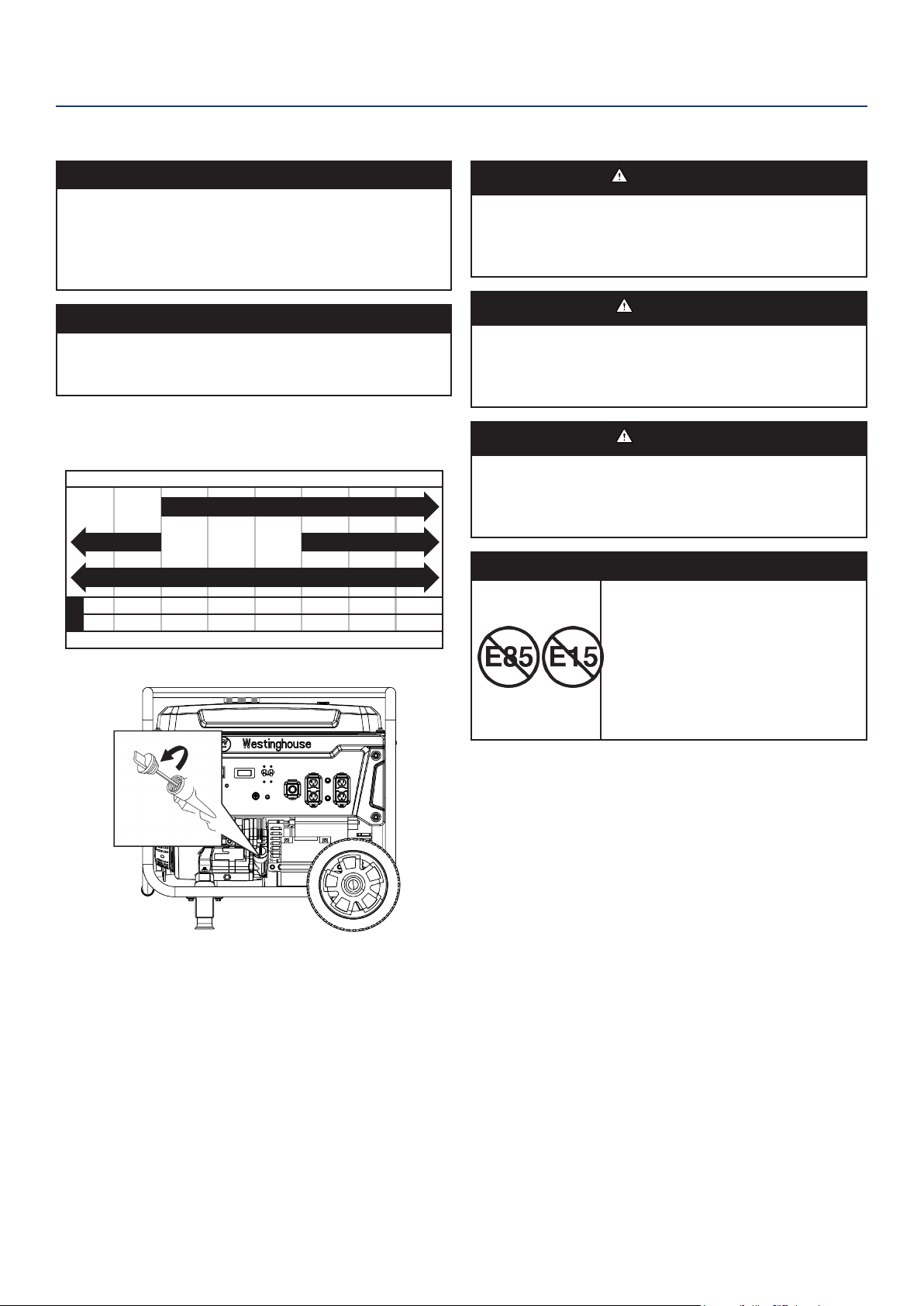
temperatures, refer to the following chart.
-20 0 20 40 60
Ambient temperature
Recommended Engine Oil Type
80 100 120
-28.9
°F
°C -17.8 -6.7 4.4 15.6 26.7 37.8 48.9
10W-30
5W-30 Synthetic
10W-405W-30
1. On a level surface, remove the oil dipstick.
2. Using the supplied funnel and oil, add oil into oil ller
neck.
Note: As residual oil from the factory may remain in the
engine, add the oil incrementally near the end of the
bottle to prevent overlling the engine. See Engine
Oil Level Check in the Maintenance section.
3. Replace the oil dipstick and hand-tighten.
FUEL
WARNING
Fire and explosion hazard. NEVER use a gasoline
container, gasoline tank, propane connector hose,
propane tanks, or any other fuel item that is broken, cut,
torn or damaged.
DANGER
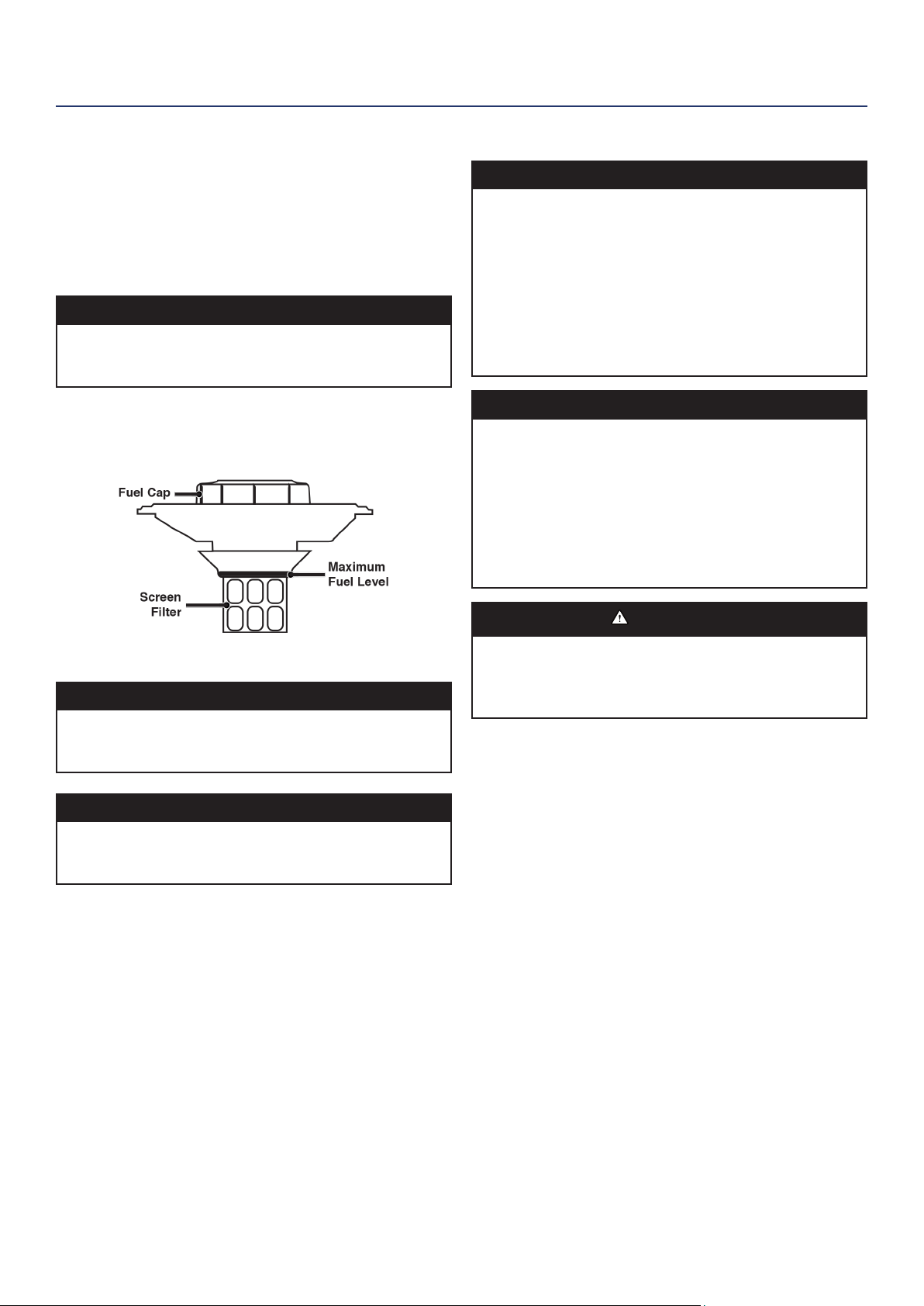
Fire and explosion hazard. DO NOT overll fuel tank. Fill
only to the red ll ring located in the in-tank fuel screen
lter. Overlling may cause fuel to spill onto engine
causing a re or explosion hazard.
DANGER
Fire and explosion hazard. NEVER refuel the generator
while the engine is running. ALWAYS turn the engine off
and allow the generator to cool for two minutes before
refueling.
NOTICE
DO NOT use E15 or E85 fuel in
this product. Engine or equipment
damage caused by stale fuel or
the use of unapproved fuels (such
as E15 or E85 ethanol blends) is
not covered by warranty. Only use
unleaded gasoline containing up to
10% ethanol.
FUEL REQUIREMENTS
• CLEAN, FRESH, unleaded gasoline, 87–93 octane.
• Up to 10% ethanol (gasohol) is acceptable (where
available; non-ethanol fuel is recommended).
• DO NOT use E85 or E15.
• DO NOT use a gas oil mix.
• DO NOT modify the engine to run on alternate fuels.
• DO NOT fuel indoors.
• DO NOT create a spark or ame while fueling.
USING FUEL STABILIZER
Adding a fuel stabilizer (not included) extends the usable
life of fuel and helps prevent deposits from forming that
can clog the fuel system. Follow the manufacturer’s
instructions for use.
ALWAYS mix the correct amount of fuel stabilizer to
gasoline in an approved gasoline container before fueling
the generator. Run the generator for ve minutes to allow
the stabilizer to treat the entire fuel system.
ASSEMBLY
14 | Westinghouse Outdoor Power Equipment, LLC
FILLING THE FUEL TANK
1. Turn the generator OFF and allow to cool for a minimum
of two minutes before fueling.
2. Place the generator on level ground in a well ventilated
area.
3. Clean area around fuel cap and remove the cap slowly.
NOTICE
Only ll the tank from an approved gasoline container.
Make sure the gasoline container is internally clean and
in good condition to prevent fuel system contamination.
4. Slowly add the recommended fuel. DO NOT overll. Fill
only to the red maximum ll ring on the fuel screen lter
visible in the ller neck.
5. Install the fuel cap.
NOTICE
Fuel can damage paint and plastic. Use caution when
lling the fuel tank. Damage caused by spilled fuel is not
covered under warranty.
NOTICE
Clean the fuel screen lter of debris before and after
each fueling. Remove the fuel screen lter by slightly
compressing it while removing it from the fuel tank.
CONNECT A LPG/PROPANE TANK
NOTICE
• The LPG/propane tank can be of any capacity but the
tank must conform to the standard as listed in Fuel
Safety section.
• Propane tanks that use liquid withdrawal system can
not be used on these models.
• Verify the re-qualication date on the tank has not
expired.
• DO NOT use included LPG/propane hose for any
other appliances.
NOTICE
• All new tanks must be purged of air and moisture
prior to lling. Used tanks that have not been plugged
or kept closed must also be purged. The purging
process should be done by a propane supplier (Tanks
from an exchange supplier should have been purged
and lled properly).
• ALWAYS position the tank so the connection between
the valve and the gas inlet will not cause sharp bends
or kinks in the hose.
WARNING
Explosion hazard. DO NOT start generator if you smell
propane. ALWAYS fully close the propane tank valve and
disconnect the LPG/propane hose from the generator
when not in use.
1. Turn the generator OFF and place on a at surface in a
well ventilated area.
2. Verify that the propane tank valve is in the fully closed
position.
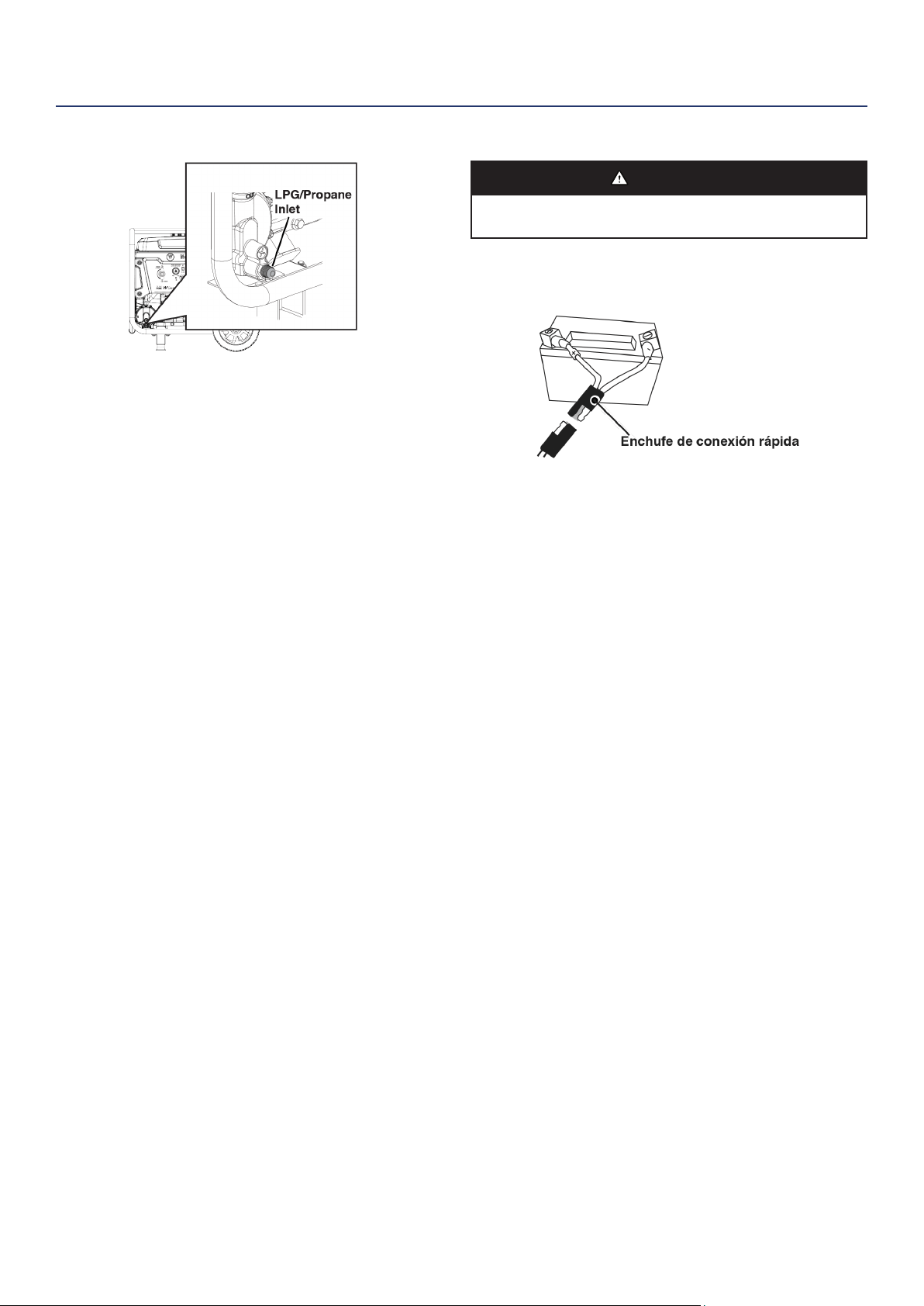
3. Remove the cover on the generator propane inlet valve.
4. Use your ngers to hand thread the LPG/propane hose
(included) to the propane inlet on the generator.
IMPORTANT: DO NOT use thread seal tape or any other
type of sealant to seal the LPG/propane
hose connection.
5. Tighten the LPG/propane hose connector to the
generator with a 19 mm or adjustable wrench. DO NOT
over-tighten.
Torque: 5-10 lb-ft.
ASSEMBLY
Westinghouse Outdoor Power Equipment, LLC | 15
6. Remove the safety plug or cap from the propane tank
valve and attach the other end of the hose to the LPG/
propane connector on the tank. Hand tighten.
7. Turn the propane tank valve to the fully open position.
Check all connections for leaks by wetting the ttings
with a solution of soap and water. Bubbles which appear
or bubbles which grow indicate that a leak exists. If a
leak exists at a tting, turn the propane tank valve to
the fully closed position and tighten the tting. Open the
propane tank valve and recheck the tting with the soap
and water solution. If the leak continues or if the leak
is not at a tting then DO NOT use the generator and
contact customer service.
IMPORTANT: Keep the propane tank valve in the fully
closed position unless in use.
CONNECT THE BATTERY
WARNING
Explosion hazard. Batteries emit explosive gases while
charging. Keep re and spark away.
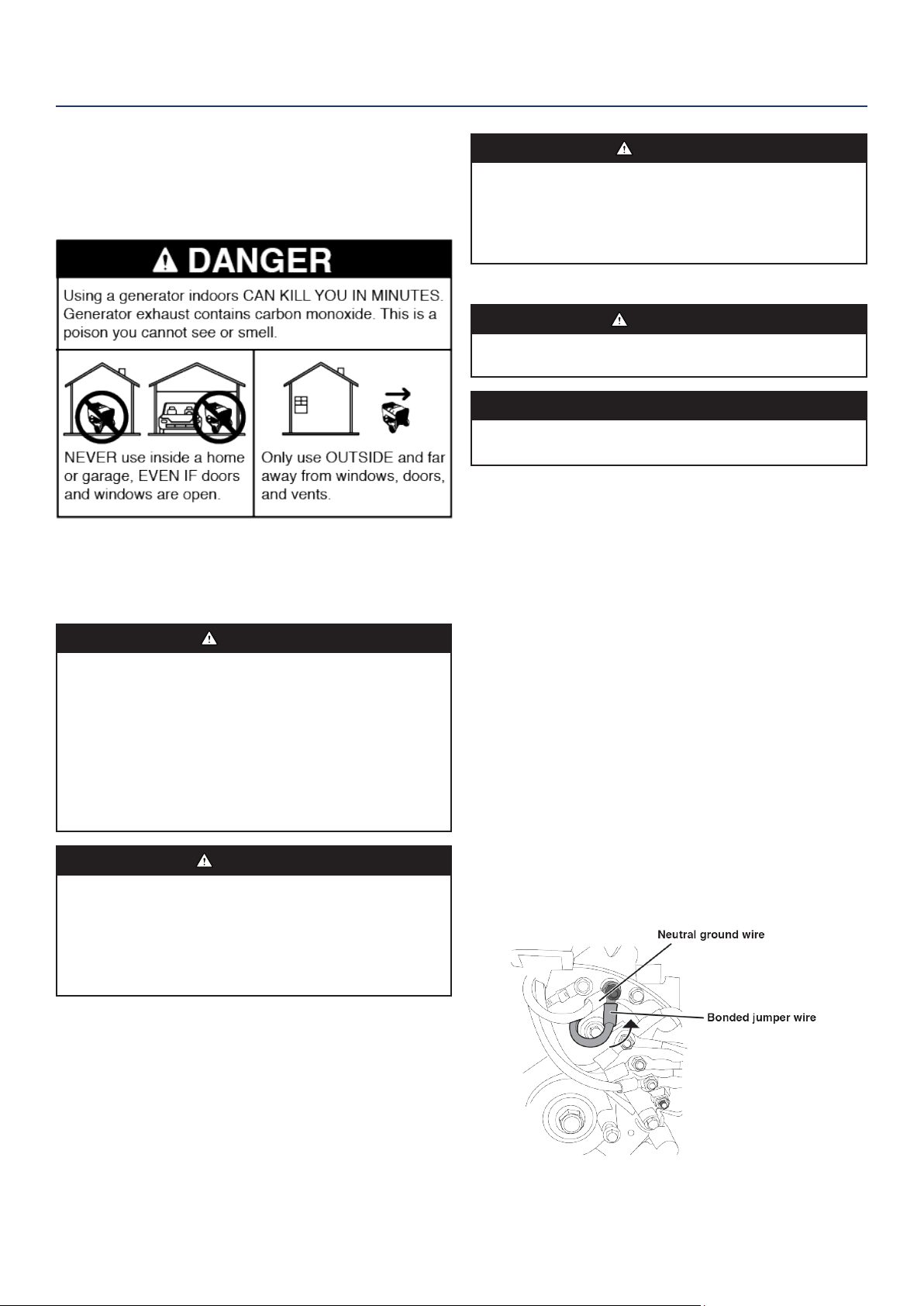
A quick-connect battery plug is pre-installed on the battery.
Remove the cable tie securing the plugs then push rmly
to connect them.
Note: The generator is equipped with a battery charging
feature. Once the engine is running, a small charge
will slowly recharge the battery.
ASSEMBLY
16 | Westinghouse Outdoor Power Equipment, LLC
OPERATION
GENERATOR LOCATION
Read and understand all safety information before starting
the generator.
NEVER operate the generator inside any building, including
garages, basements, crawlspaces, sheds, enclosure, or
compartment, including the generator compartment of a
recreational vehicle.
DANGER
Electrocution hazard. NEVER use the generator in
a location that is wet or damp. NEVER expose the
generator to rain, snow, water spray, or standing water
while in use. Protect the generator from all hazardous
weather conditions. Moisture or ice can cause a short
circuit or other malfunction in the electrical circuit. Using
a generator or electrical appliance in wet conditions,
such as rain or snow, or near a pool or sprinkler system,
or when your hands are wet, could result in electrocution
WARNING
Fire hazard. Only operate the generator on a solid, level
surface. Operating the generator on a surface with loose
material such as sand or grass CLAMPpings can cause
debris to be ingested by the generator that could block
cooling vents or the air intake system. Allow the generator
to cool for 30 minutes before transport or storage.
The generator should be on a at, level surface at all times
(Even while not in operation). The generator must have
at least 5 ft. (1.5 m) of clearance from all combustible
material.
DO NOT operate the generator in the back of a SUV,
camper, trailer, truck bed (regular, at, or otherwise), under
stairs, next to walls or buildings, or in any other location
that will not allow for adequate cooling of the generator
and/or the mufer. DO NOT contain generators during
operation.
DANGER
Asphyxiation hazard. Place the generator in a well-
ventilated area. DO NOT place the generator near vents
or intakes where exhaust fumes could be drawn into
occupied or conned spaces. Carefully consider wind
and air currents when positioning the generator.
GROUNDING
WARNING
Shock hazard. Failure to properly ground the generator
can result in electric shock.
NOTICE
Only use grounded 3-prong extension cords, tools, and
appliances, or double-insulated tools and appliances.
The generator neutral is bonded to the frame. There is a
permanent conductor between the generator (stator wire)
and the frame. If this generator will be used only with cord
and plug equipment connected to the receptacles mounted
on the generator, National Electric Code does not require
that the unit be grounded. However, other methods of
using the generator may require grounding to reduce the
risk of shock or electrocution.
Before using the ground terminal, consult a qualied
electrician, electrical inspector, or local agency having
jurisdiction for local codes or ordinances that apply to the
intended use of the generator.
DISCONNECTING THE BONDED NEUTRAL
Removing the bonded neutral disables the GFCI protection
from the 5-20R receptacles. The bonded neutral should
only be removed under specic circumstances. Consult a
qualied electrician to determine if your situation requires
disconnecting the bonded neutral.
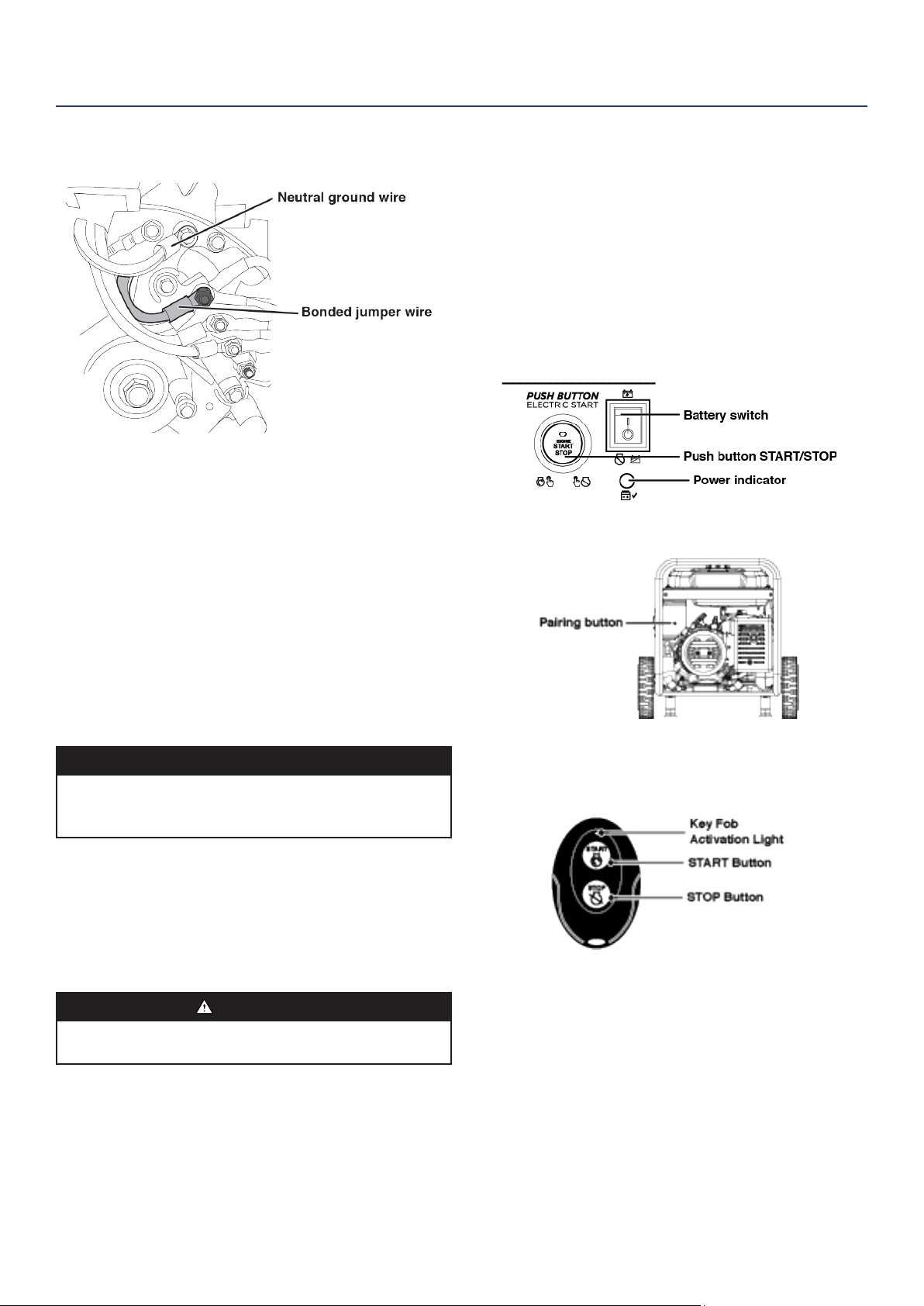
1. Remove the alternator cover.
2. Remove the bonded jumper wire and reinstall the nut.
OPERATION
Westinghouse Outdoor Power Equipment, LLC | 17
OPERATION
3. Remove the nut securing the neutral ground wire and
attach the bonded jumper wire. Reinstall the nut.
4. Reinstall the alternator cover.
IMPORTANT: Apply a new “NEUTRAL UNBONDED”
Label over the “NEUTRAL BONDED TO
FRAME” label on the front of the control
panel.
HIGH ALTITUDE OPERATION
Engine power is reduced the higher you operate above sea
level. Output will be reduced approximately 3.5% for every
1000 feet of increased altitude from sea level.
High altitude adjustment is required for operation at
altitudes over 5,000 ft. (1524 m). Operation without this
adjustment will cause decreased performance, increased
fuel consumption, and increased emissions.
NOTICE
DO NOT operate the generator at altitudes below 2,000
ft. (762 m) with the high altitude kit installed. Engine
damage may occur.
High Altitude Carburetor Kit: Part# 518073
High Altitude DF Regulator: Part# 518045-1
Note: You must purchase both the Dual Fuel Regulator
and Carburetor Kit for proper high altitude operation.
REMOTE START
WARNING
Verify that the area around the generator is clear before
remote starting the generator.
The remote start key fob included with the generator should
be attached to the recoil handle or control panel. If your
unit was shipped without a key fob, contact Westinghouse
customer service.
The generator can be started remotely from up to 99 feet
(30 meter) using the remote start key fob.
Note: As the batteries in the remote start key fob drain,
operational distance will decrease.
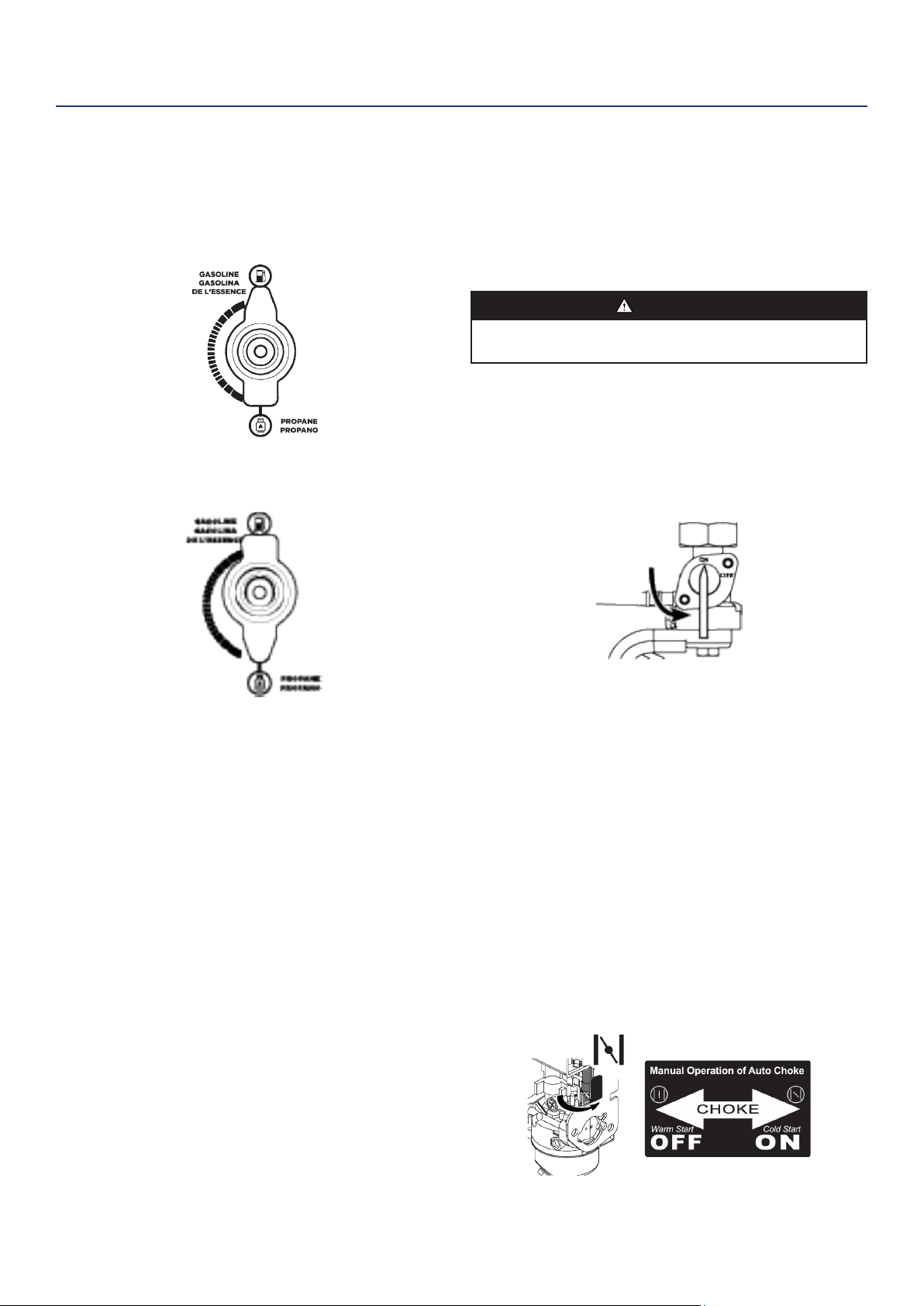
PAIRING THE REMOTE START
Remote replacement batteries: (2) CR2016
Replacement remote: # 100714A
If the remote start key fob is replaced or needs re-paired to
the generator, follow this procedure.
1. Turn the generator battery switch to the ON position.
The power indicator light will illuminate.
2. Push and hold the red Pairing button on the side of the
control panel until the START/STOP button illuminates.
3. Push and hold the STOP button on the key fob until the
START/STOP button illumination turns OFF. Release
the button. The START/STOP button will illuminate after
the button is released.
4. Push and hold the START button on the key fob until the
START/STOP button illumination turns OFF. Release
the button. The START/STOP button will illuminate after
the button is released.
5. Push the Pairing button on the side of the control panel
until the START/STOP button illumination turns OFF.
Release the button.
6. Turn the generator battery switch to the OFF position.
The remote is now paired.
18 | Westinghouse Outdoor Power Equipment, LLC
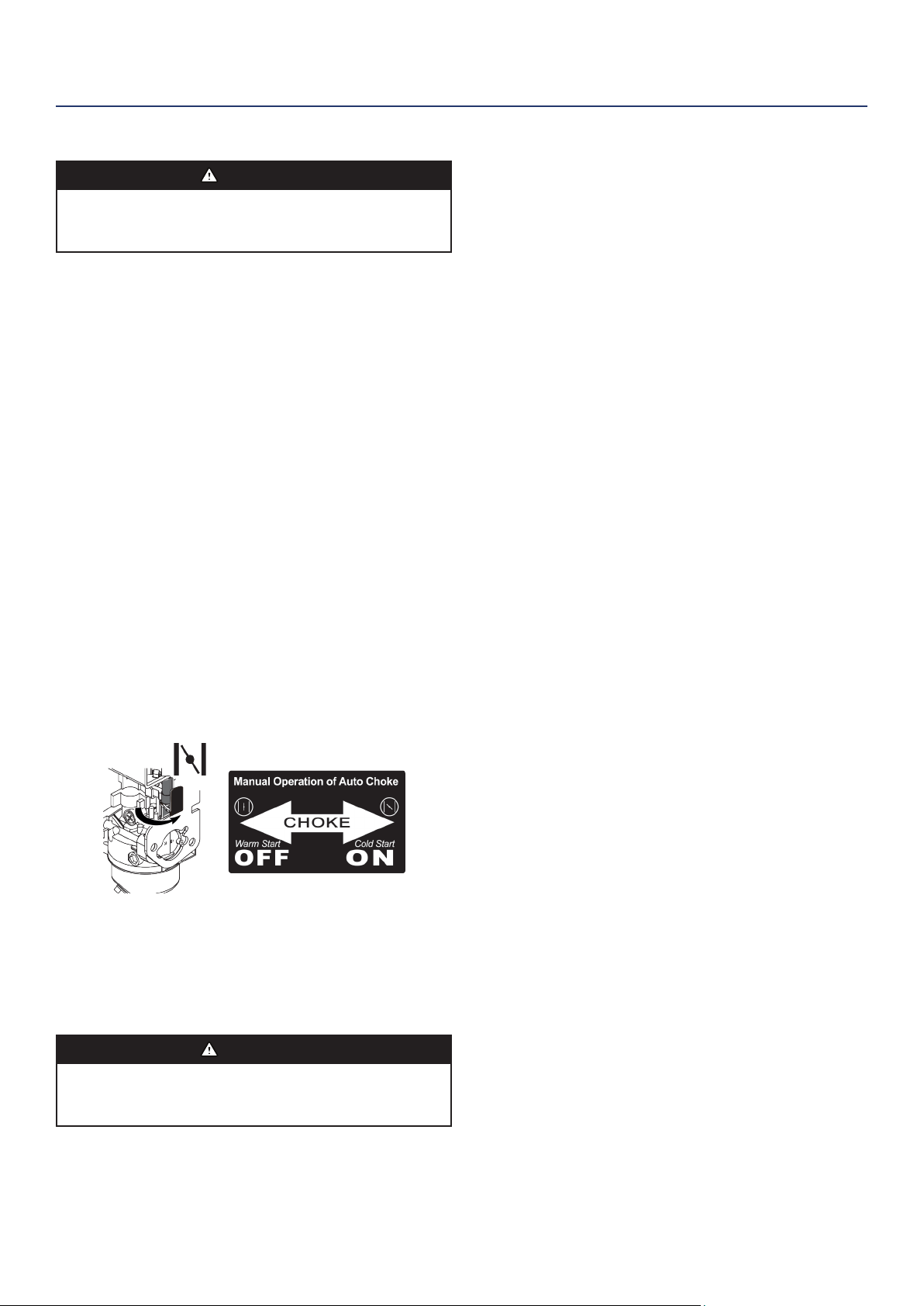
FUEL SELECTOR SWITCH
Position the fuel selector switch on the front control panel
to the desired fuel choice.
Turn the fuel selector switch fully upward for gasoline
operation.
Turn the fuel selector switch fully downward for propane
operation.
BREAK-IN PERIOD
For proper break-in, DO NOT exceed 50% of the rated
running watts (3750 watts) during the rst ve hours of
operation.
Vary the load occasionally to allow stator windings to heat
and cool and help seat the piston rings.
BEFORE STARTING THE GENERATOR
Verify that:
• The generator is placed in an safe, appropriate location.
• The generator is on a dry, at, and level surface.
• The engine is lled with oil.
• All loads are disconnected.
DANGER
Fire and explosion hazard. DO NOT move or tip the
generator during operation.
STARTING THE ENGINE: GASOLINE
1. Verify that fuel is in the gas tank.
2. Turn the fuel selector switch on the control panel to
gasoline operation.
3. Turn the fuel tank valve to the ON position.
4. Push the battery switch to the ON position.
5. Choose the starting method:
a. Remote Start: Push and hold the START button on
the remote start key fob for one second.
Note: Remote start-equipped generators must be restarted
with the START/STOP button on the control panel
after an automatic shut-down occurs.
b. Push-Button Start: Push and hold the engine
START/STOP button for two seconds.
c. Recoil Start: Manually close the choke if the engine
is cold. Firmly grasp and pull the recoil handle slowly
until you feel increased resistance, then pull rapidly.
Cold start: Close the choke by moving it right
toward the front handle of the generator.
OPERATION
Westinghouse Outdoor Power Equipment, LLC | 19
STARTING THE ENGINE: PROPANE
DANGER
Fire and explosion hazard. ALWAYS turn the propane
tank valve to the fully closed position if not running the
generator on propane.
1. Make sure the LPG/propane hose is correctly connected
to the generator and propane tank.
2. Turn the fuel selector switch to propane operation.
3. Fully open the valve on the propane tank.
4. Push the battery switch to the ON position.
5. Choose the starting method:
a. Remote Start: Push and hold the START button on
the remote start key fob for one second.
Note: Remote start-equipped generators must be restarted
with the START/STOP button on the control panel
after an automatic shut-down occurs.
b. Push-Button Start: Push and hold the engine
START/STOP button for two seconds.
c. Recoil Start: Manually close the choke if the engine
is cold. Firmly grasp and pull the recoil handle slowly
until you feel increased resistance, then pull rapidly.
Cold start: Close the choke by moving it right
toward the front handle of the generator.
Note: During Push-Button or Remote Start the engine
will automatically set the choke and begin the start
sequence. If the engine fails to start, the generator
will attempt to start the engine two more times.
SWITCHING FUEL SOURCES
DANGER
Fire and explosion hazard. DO NOT add gasoline to
the fuel tank or connect the LPG/propane hose to the
generator while the generator is in operation.
The fuel source can be switched while the engine is
running if a propane tank is connected to the generator
BEFORE operation.
GASOLINE TO PROPANE
IMPORTANT: Load capacity is reduced when running
on propane. Make sure the generator can
supply enough (running) and surge (starting)
watts for the items you are powering before
switching to propane.
1. Fully open the valve on the propane tank.
2. Turn the fuel selector switch to propane operation.
3. Turn the fuel tank valve to the OFF position.
PROPANE TO GASOLINE
1. Turn the fuel tank valve to the ON position.
2. Turn the fuel selector switch to gasoline operation.
3. Turn the propane tank valve to the fully closed position.
Note: When switching to propane operation the engine
may run rough for a few seconds while it purges
gasoline in the carburetor.
If the engine stops when switching fuel sources, disconnect
all loads then restart the unit on the fuel source of choice.
STOPPING THE ENGINE
1. Turn off and unplug all connected electrical loads.
IMPORTANT: NEVER start or stop the generator with
electrical devices connected.
2. Let the generator run with no load for several minutes to
stabilize internal temperatures of the engine.
3. Push and hold the START/STOP button for one second
or push STOP on the remote start key fob for one
second.
Note: Alternately, if the generator is used infrequently, turn
the fuel tank valve to the OFF position to limit the
residual fuel remaining in the carburetor oat bowl.
The engine will stop when fuel in the carburetor and
fuel line is exhausted.
4. Push the battery switch to the OFF position.
5. If operating on LPG, turn the propane tank valve to the
fully closed position.
FREQUENCY OF USE
If the generator will be used on an infrequent or intermittent
basis (more than one month before next use), refer to
the Battery Maintenance and Storage sections of this
manual for information regarding battery charging and fuel
deterioration.
OPERATION
20 | Westinghouse Outdoor Power Equipment, LLC
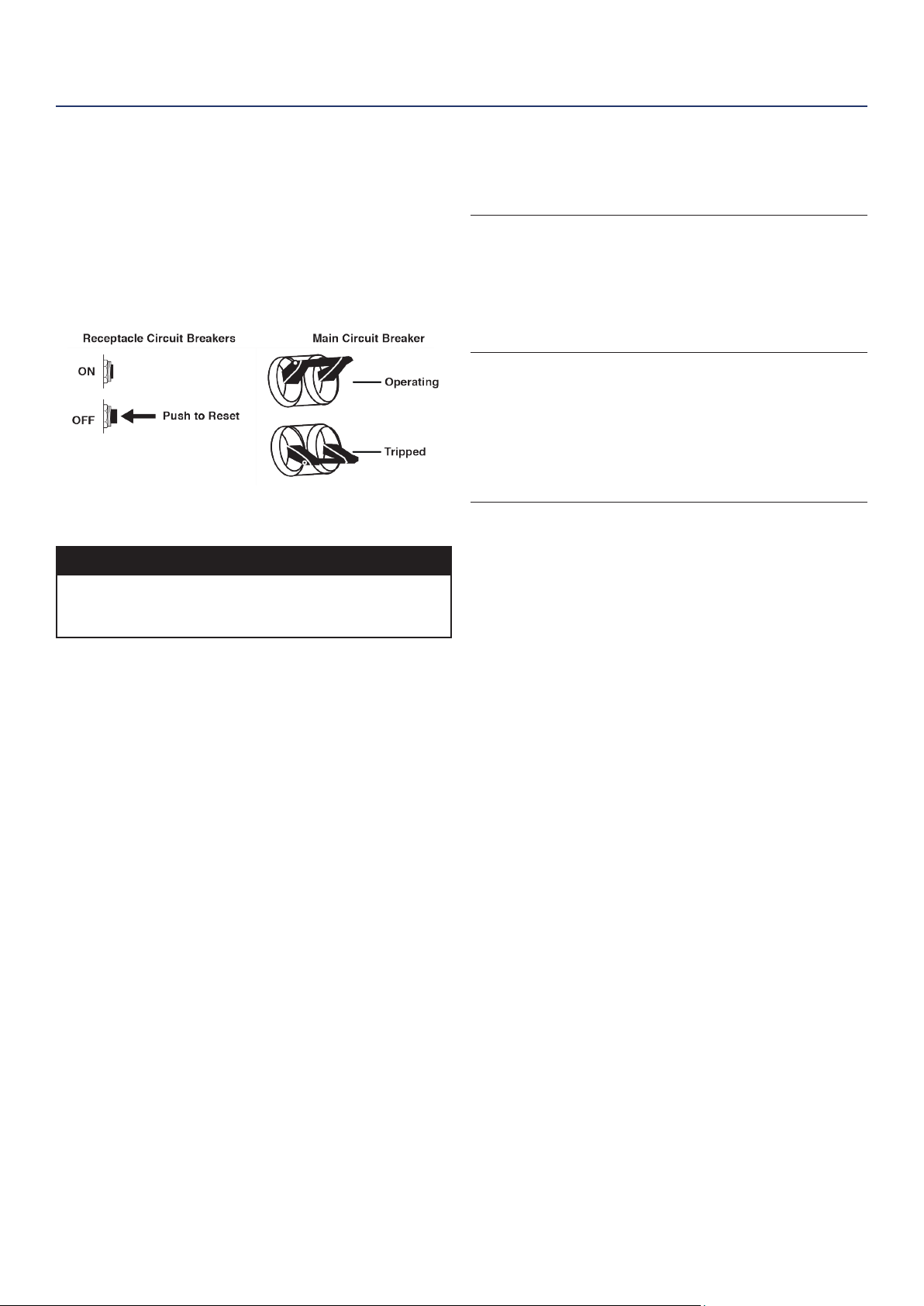
AC CIRCUIT BREAKERS
The circuit breakers will automatically switch OFF if there
is a short circuit or a signicant overload of the generator
at each receptacle.
If an AC circuit breaker switches OFF automatically,
check that the appliance is working correctly and it does
not exceed the rated load capacity of the circuit before
resetting the AC circuit breaker ON.
GENERATOR CAPACITY
NOTICE
DO NOT overload the generator’s capacity. Exceeding
the generator’s wattage/amperage capacity can damage
the generator and/or electrical devices connected to it.
Make sure the generator can supply enough continuous
(running) and surge (starting) watts for the items you will
power at the same time.
The total power requirements (Volts x Amps = Watts) of all
appliances connected must be considered. Appliance and
power tool manufacturers usually list rating information
near the model or serial number.
To determine power requirements:
1. Select the items you will power at the same time.
2. Total the continuous (running) watts of these items. This
is the amount of power the generator must produce
to keep the items running. See the wattage reference
chart on the next page.
3. Estimate how many surge (starting) watts you will need.
Surge wattage is the short burst of power needed to
start electric motor-driven tools or appliances such as a
circular saw or refrigerator. Because not all motors start
at the same time, total surge watts can be estimated by
adding only the item(s) with the highest additional surge
watts to the total rated watts from step 2.
Example:
Tool or Appliance
Running
Watts*
Starting
Watts*
RV Air Conditioner (11,000 BTU) 1010 1600
TV (Tube Type) 300 0
RV Refrigerator 180 600
Radio 200 0
Light (75 Watts) 300 0
Coffee Maker 600 0
2590 Total
Running
Watts*
1600
Highest
Starting
Watts*
Total Running Watts 2590
Highest Starting Watts + 1600
Total Starting Watts Needed 4190
*Wattages listed are approximate. Verify actual wattage.
POWER MANAGEMENT
To prolong the life of the generator and attached devices,
use care when adding electrical loads to the generator.
There should be nothing connected to the generator
outlets before starting the engine. The correct and safe
way to manage generator power is to sequentially add
loads as follows:
1. With nothing connected to the generator, start the
engine as described in this manual.
2. Plug in and turn on the rst load, preferably the largest
load you have.
3. Permit the generator output to stabilize (engine runs
smoothly and attached device operates properly).
4. Plug in and turn on the next load.
5. Again, permit the generator to stabilize.
6. Repeat steps 4 and 5 for each additional load.
OPERATION
Westinghouse Outdoor Power Equipment, LLC | 21
Wattage Reference
Tool or Appliance
Estimated
Running
Watts*
Estimated
Starting
Watts*
Incandescent Lights
(4 Quantity x 75 Watts)
300 0
TV (Tube Type) 300 0
Sump Pump (1/3 hp) 800 1300
Refrigerator or Freezer 700 2200
Well Pump (1/3 hp) 1000 2000
Furnace (1/2 hp) 800 2350
Radio 200 0
Drill (3/8”, 4 amps) 440 600
Circular Saw
(Heavy Duty, 7-1/4”)
1400 2300
Miter Saw (10”)
1800 1800
Table Saw (10”)
2000 2000
*Wattages listed are approximate. Verify actual wattage.
EXTENSION CORDS
WARNING
Asphyxiation hazard. Extension cords running directly
into the home increase the risk of carbon monoxide
poisoning through any openings. If an extension cord
running directly into your home is used to power indoor
items, there is a risk of carbon monoxide poisoning to
people inside the home. ALWAYS use battery-powered
carbon monoxide detector (s) that meet current UL 2034
safety standards when running the generator. Regularly
check the detector (s) battery.
WARNING
Asphyxiation hazard. When operating the generator with
extension cords, make sure the generator is located in
an open, outdoor area, far away from occupied spaces
with exhaust pointed away.
WARNING
Fire and electrocution hazard. NEVER use worn or
damaged extension cords. Damaged or overloaded
extension cords could overheat, arc, and burn resulting
in death or serious injury.
Before connecting an AC appliance or power cord to the
generator:
• Use grounded 3-prong extension cords, tools, and
appliances, or double-insulated tools and appliances.
• Make sure the tool or appliance is in good working
order. Faulty appliances or power cords can create a
potential for electric shock.
• Make sure the electrical rating of the tool or appliance
does not exceed the rated power of the generator or the
receptacle being used.
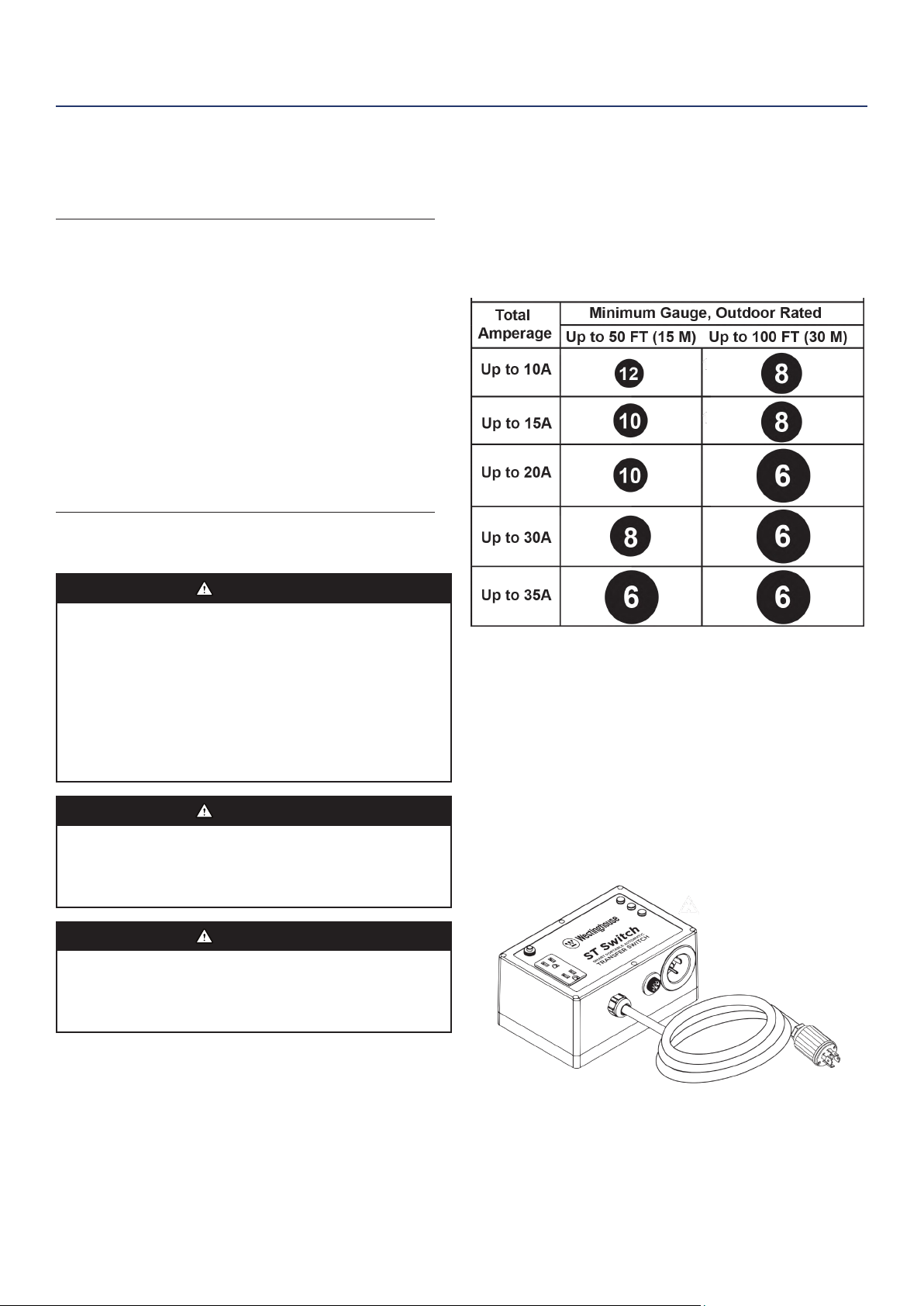
EXTENSION CORD SIZING
Only use grounded 3-prong extension cords marked for
outdoor use that are rated for the electrical load.
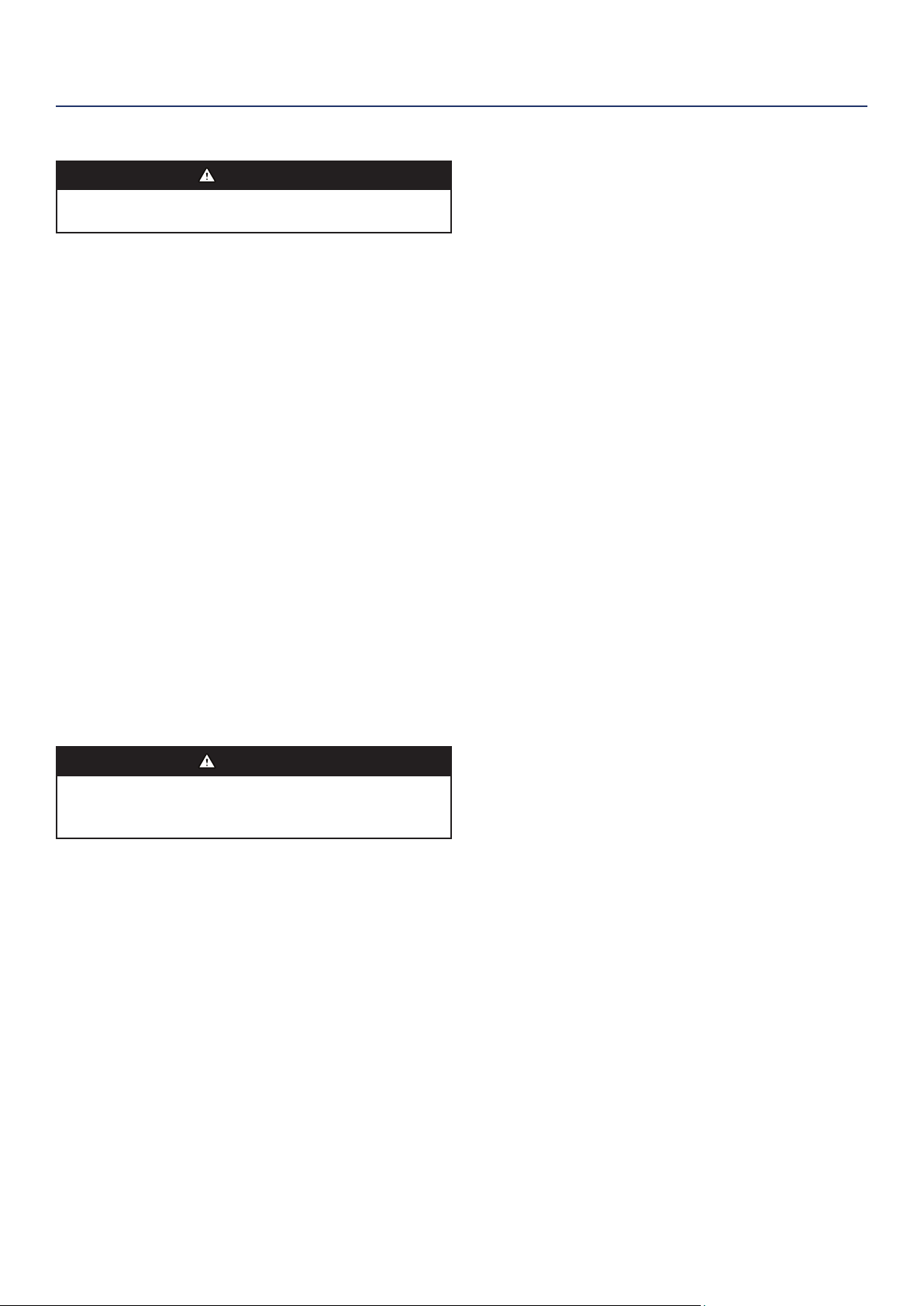
ST SWITCH
The generator is compatible with the ST Switch, purchased
separately. When utility power is on it will provide power (up
to 120V @ 20A) to the appliances plugged into the 5-20R
receptacle on the ST Switch. When utility power is lost the
ST Switch automatically transfers input power from utility
to generator power. When utility power is restored, the
ST Switch transfers input power back to utility. Visit www.
westinghouseoutdoorpower.com for more information.
OPERATION
22 | Westinghouse Outdoor Power Equipment, LLC
TRANSPORTING
CAUTION
Weight hazard. ALWAYS have assistance when lifting
the generator.
• Allow the generator to cool a minimum of 30 minutes
before transporting.
• If operating on LPG, turn the propane tank valve to the
fully closed position.
• Disconnect the LPG/propane hose from the generator
and propane tank.
• Replace all protective covers on the generator control
panel.
• Only use the generator’s xed frame to lift the unit or
attach any load restraints such as ropes or tie-down
straps. DO NOT attempt to lift or secure the generator
by holding onto any of its other components.
• Keep the unit level during transport to minimize the
possibility of fuel leakage or, if possible, drain the fuel
or run the engine until the fuel tank is empty before
transport.
• The generator wheels are only intended for hand
transport. The wheels are not suitable for towing the
generator either on or off-road.
• Use the extendable handle for one-person, hand
transport. Only use the handle while the generator is
OFF, stationary, and resting on a horizontal surface. DO
NOT use the handle to lift the generator entirely off the
ground, tow it, or up-end it.
CAUTION
Fire hazard. DO NOT up-end the generator or place it on
its side. Fuel or oil can leak and damage to the generator
may occur.
OPERATION
Westinghouse Outdoor Power Equipment, LLC | 23
MAINTENANCE
WARNING
Accidental start-up. Disconnect the spark plug boot from
the spark plug and disconnect the battery quick-connect
plugs when performing maintenance on the generator.
MAINTENANCE SCHEDULE
Regular maintenance will improve performance and
extend the service life of the generator. Follow the hourly
or calendar intervals, whichever occurs rst. More frequent
service is required when operating in adverse conditions
as noted below.
Before Each Use
Check engine oil
After First 25 Hours or First Month
Change engine oil
After 50 Hours or Every 6 Months
Change engine oil
1
Clean air lter
2
After 100 Hours or Every 6 Months
Inspect/clean spark arrestor
Inspect/clean spark plug
Replace fuel lter
Fuel valve maintenance
Inspect/adjust valve clearance
3
After 300 Hours or Every Year
Replace spark plug
Replace air lter
1
Change oil every month when operating under heavy
load or in high temperatures.
2
Clean more often under dirty or dusty conditions.
Replace air lter if it cannot be adequately cleaned.
3
Recommend service to be performed by authorized
Westinghouse service dealer.
MAINTENANCE REMINDERS
Maintenance reminder codes will be shown on the Data
Display based on unit Lifetime Hours. The maintenance
codes will be displayed until the unit is turned off. Refer to
the Maintenance section for specic procedures.
Maintenance Code Required Maintenance
P25 Change engine oil
P50
• Change engine oil
• Clean air lter
P100
• Change engine oil
• Clean air lter
• Fuel valve maintenance
• Replace fuel lter
• Inspect/adjust valve clearance
MAINTENANCE REPLACEMENT PARTS
Description Part Number
Air lter 5205
Oil drain plug crush washer 94004
Spark arrestor 6866
Battery, 9.0 AH 511008
Fuel lter 516401
Spark plug 97108 (F7TC)
AIR FILTER MAINTENANCE
WARNING
Fire hazard. NEVER use gasoline or other ammable
solvents to clean the air lter. Use only household
detergent soap to clean the air lter.
The air lter must be cleaned after every 50 hours of use or
six months (frequency should be increased if the generator
is operated in a dusty environment).
1. Place the generator on a level surface and allow the
engine to cool for several minutes.
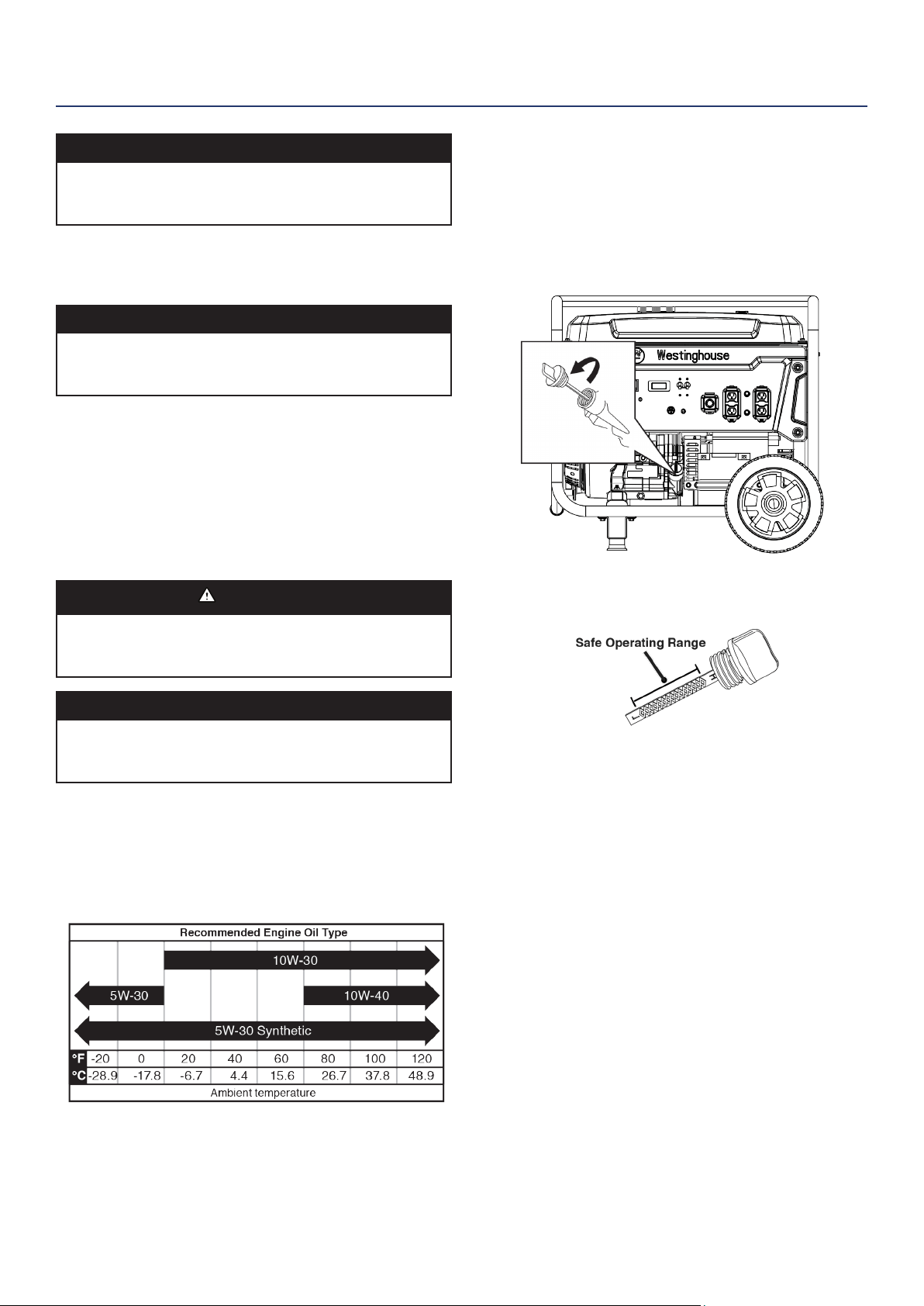
2. Release the top and bottom clamps then remove the air
lter cover.
3. Remove the air lters. Use compressed air to clean the
coarse air lter.
Note: The foam air lter element is oil soaked. Use an
appropriate cleaning container.
NOTICE
Avoid skin contact with engine oil. Wear protective
clothing and equipment. Wash all exposed skin with
soap and water.
4. Remove the foam air lter and wash it by submerging
the element in a solution of household detergent soap
and warm water. Slowly squeeze the foam to thoroughly
clean.
MAINTENANCE
24 | Westinghouse Outdoor Power Equipment, LLC
MAINTENANCE
NOTICE
DO NOT twist or tear the foam air lter element during
cleaning or drying. Only apply slow but rm squeezing
action.
5. Rinse the air lter element by submerging it in fresh
water and applying a slow squeezing action. Allow the
lter to dry thoroughly.
NOTICE
DO NOT pollute. Follow the guidelines of the EPA or other
governmental agencies for proper disposal of hazardous
materials. Consult local authorities or reclamation facility.
6. Dip the foam air lter in clean engine oil then squeeze
out all excess oil. The engine will smoke when started if
too much oil is left in the lter.
7. Install the foam air lter in the housing, then the coarse
air lter. Install the air cleaner cover and secure with the
cover clamps.
ENGINE OIL LEVEL CHECK
CAUTION
Avoid skin contact with engine oil. Wear protective
clothing and equipment. Wash all exposed skin with
soap and water.
NOTICE
ALWAYS use the specied engine oil. Failure to use the
specied engine oil can cause accelerated wear and/or
shorten the life of the engine.
When using the generator under extreme, dirty, dusty
conditions or in extremely hot weather, change the oil
more frequently.
Ambient air temperature will affect engine oil performance.
Change the type of engine oil used based on weather
conditions.
Check the engine oil level before each use or every 8
hours of operation.
1. Place the generator on a level surface and allow the
engine to cool for several minutes.
2. With a damp rag, clean around the oil dipstick.
3. Remove the oil dipstick and wipe the dipstick clean.
4. Wipe the dipstick clean, then insert it into the oil ller
neck without screwing it in. Remove the dipstick and
verify that the oil level is within safe operating range.
5. If low, add recommended engine oil incrementally and
recheck until the level is between the L and H marks on
the dipstick. DO NOT overll. If over the full mark on
the dipstick, drain the oil to reduce the oil level to the
full mark.
6. Replace the oil dipstick and hand-tighten.
ENGINE OIL CHANGE
When using the generator under extreme, dirty, dusty
conditions or in extremely hot weather, change the oil
more frequently. Change the oil while the engine is still
warm from operation.
1. Place the generator on a level surface and allow the
engine to cool for several minutes.
2. With a damp rag, clean around the oil dipstick. Remove
the dipstick and wipe clean.
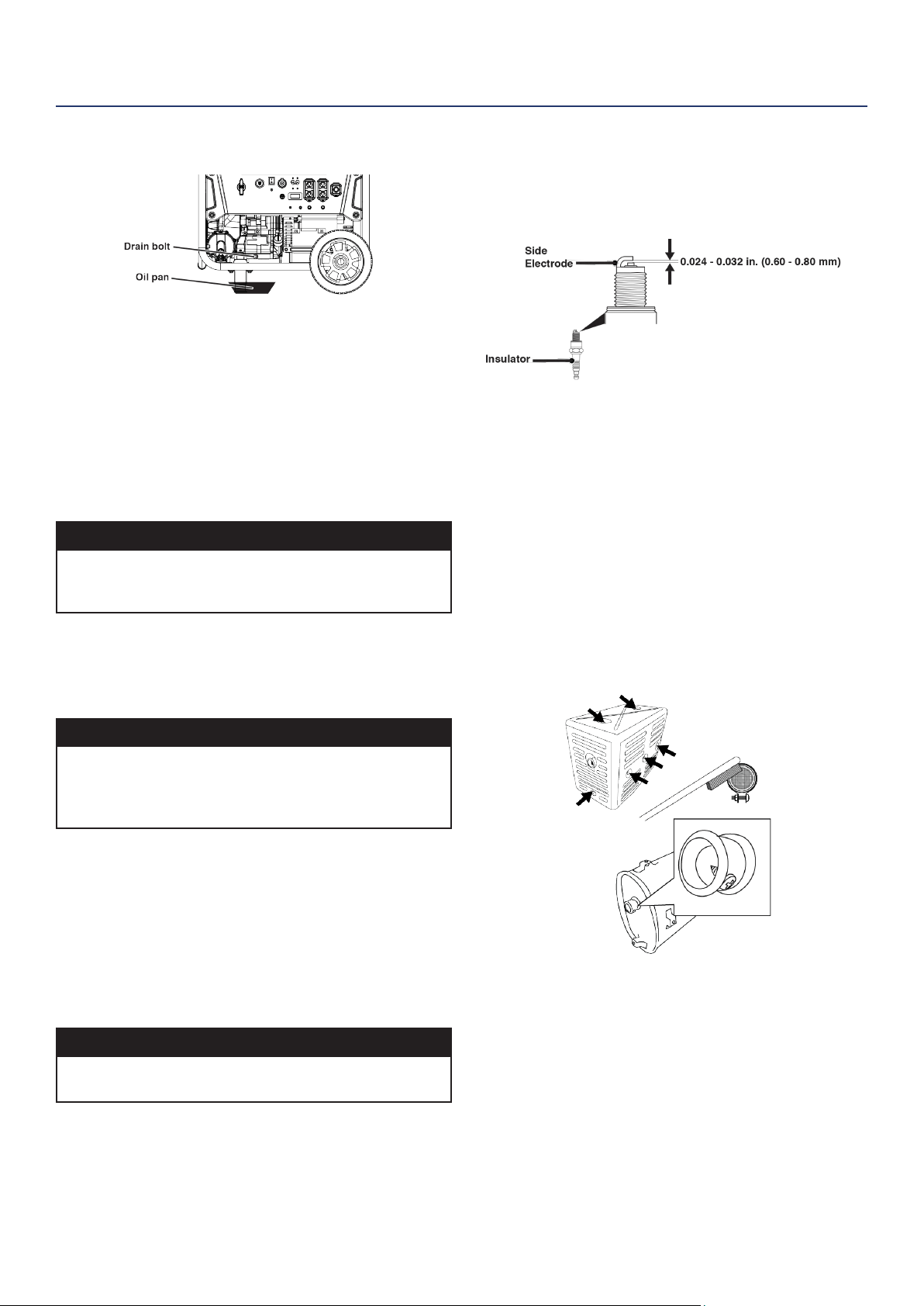
3. Place an oil pan (or suitable container) under the oil
drain bolt.
Westinghouse Outdoor Power Equipment, LLC | 25
4. Using a 10mm wrench, remove the oil drain bolt and
allow the oil the to drain.
5. Install the oil drain bolt and tighten securely.
Note: A new oil drain plug crush washer is recommended
at each oil change.
6. Slowly pour oil into the oil ller neck until oil the level
is between the L and H marks on the dipstick. Stop
frequently to check the oil level. DO NOT overll.
Maximum oil capacity: 1.16 Quart (1.1 Liter)
7. Install the oil dipstick and hand-tighten.
NOTICE
DO NOT pollute. Follow the guidelines of the EPA or other
governmental agencies for proper disposal of hazardous
materials. Consult local authorities or reclamation facility.
SPARK PLUG MAINTENANCE
Inspect and clean the spark plug after every 100 hours of
use or six months. Replace the spark plug after 300 hours
of use or every year.
NOTICE
ALWAYS use the Westinghouse OEM or compatible
non-resistor-type spark plug. Use of resistor-type spark
plug can result in rough idling, misre, or may prevent
the engine from starting.
1. Place the generator on a level surface and allow the
engine to cool.
2. Remove the spark plug boot by rmly pulling the spark
boot directly away from the engine.
3. Clean the area around the spark plug.
4. Remove the spark plug with the included spark plug
socket wrench.
NOTICE
NEVER apply any side load or move the spark plug
laterally when removing the spark plug.
5. Inspect the spark plug. Replace if electrodes are
pitted, burned, or the insulator is cracked. Only use a
recommended replacement plug.
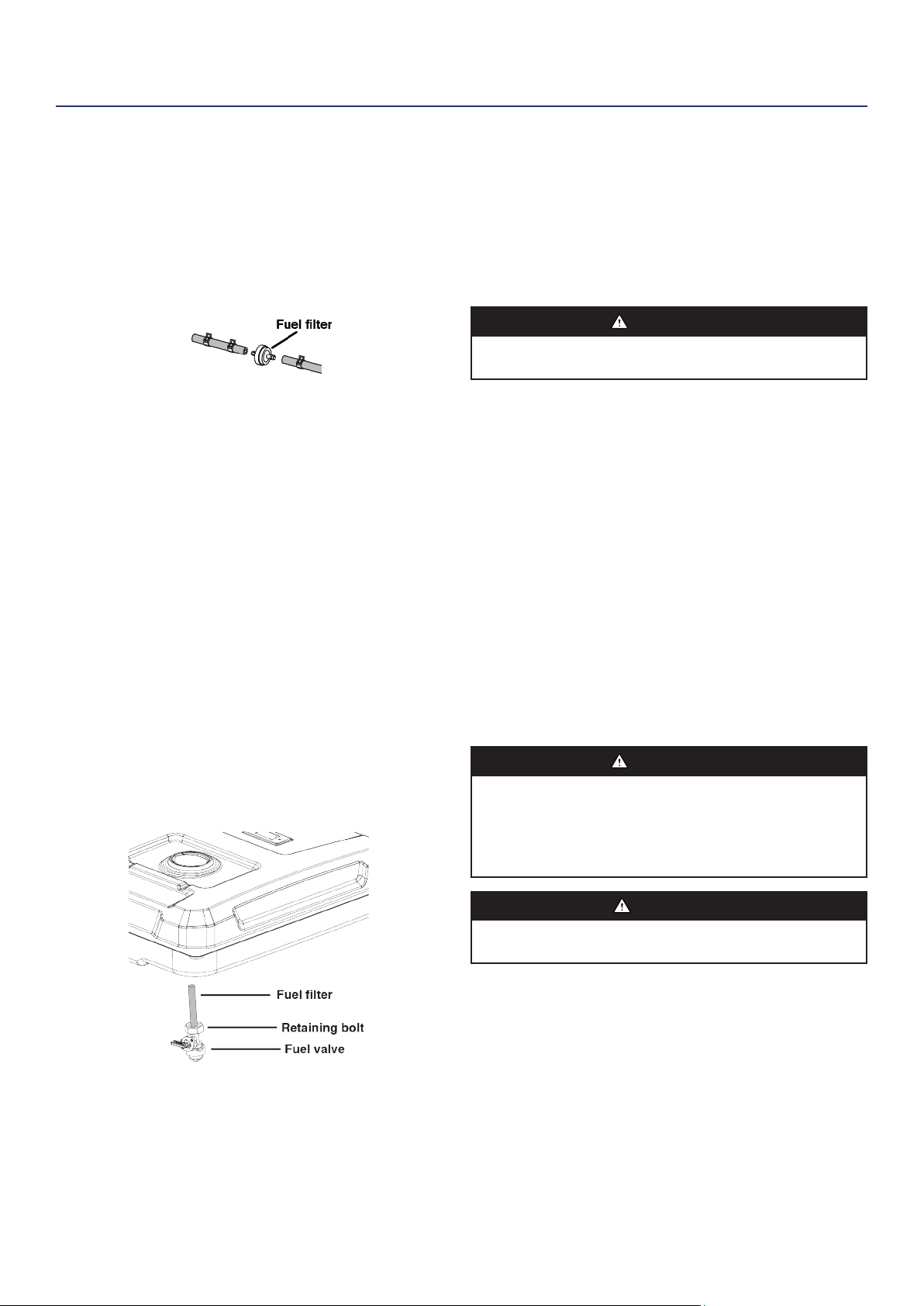
6. Measure the spark plug electrode gap with a wire-type
feeler gauge. If necessary, correct the gap by carefully
bending the side electrode.
Spark plug gap: 0.024 – 0.032 in. (0.60 – 0.80 mm)
7. Carefully install the spark plug nger tight, then tighten
as additional 3/8 to 1/2 turn with the spark plug wrench.
8. Attach the spark plug boot.
SPARK ARRESTOR SERVICE
Allow the mufer to cool completely before servicing the
spark arrestor. Check and clean the spark arrestor after
every 100 hours of use or six months. Failure to clean the
spark arrestor will result in degraded engine performance.
1. Place the generator on a level surface.
2. Remove the cover screws and the mufer cover. Use a
screw driver to remove the spark arrestor.
3. Carefully remove the carbon deposits from the spark
arrestor screen with a wire brush. The spark arrestor
must be free of breaks and tears. Replace the spark
arrestor if damaged.
4. Reinstall the spark arrestor and mufer cover.
MAINTENANCE
26 | Westinghouse Outdoor Power Equipment, LLC
FUEL FILTER
Replace the fuel lter after 100 hours of use.
Note: Have an appropriate gasoline container and rags
ready to catch residual fuel in the lter and fuel line.
1. Allow the generator to cool completely.
2. Turn the fuel valve to the OFF position.
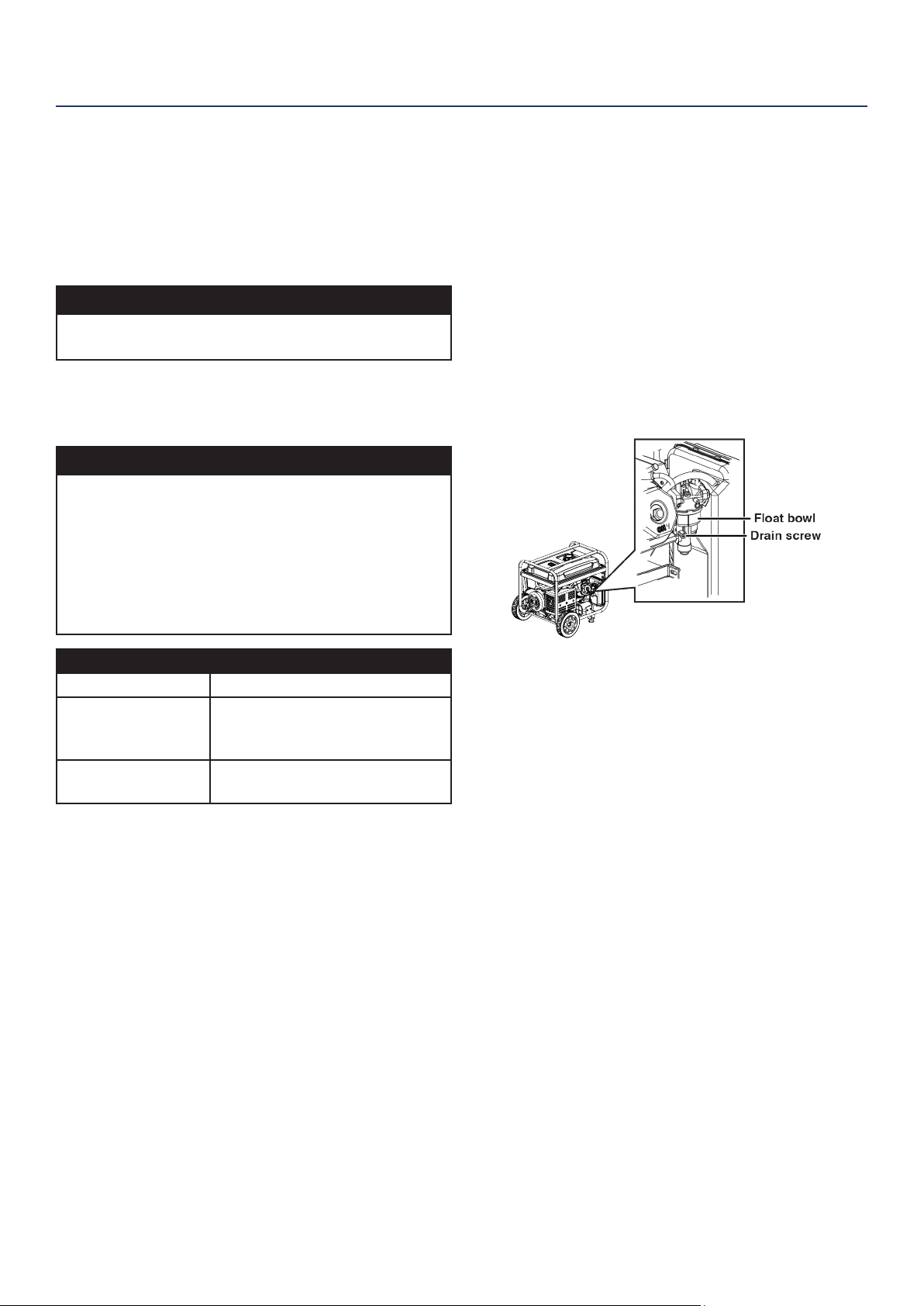
3. Note the orientation of the fuel lter. Using pliers, remove
the fuel line clamps and remove the fuel lter.
4. Install the new fuel lter in the reverse order of removal.
FUEL VALVE MAINTENANCE
The fuel valve is equipped with an inline fuel lter. The
fuel valve lter does not require servicing if the unit
is properly maintained with fresh, clean fuel. If fuel-
related troubleshooting is required, perform fuel valve
maintenance.
1. Allow the generator to cool completely.
2. Place an appropriate gasoline container under the
carburetor drain bolt to catch the drained fuel.
3. Remove the drain bolt on the bottom of the carburetor
and allow the fuel tank to drain completely. Install and
tighten the drain bolt securely.
4. Remove the fuel line from the fuel valve. Be prepared to
capture the remaining fuel from the fuel line.
5. Loosen the retaining bolt. Unscrew and remove the fuel
valve from the fuel tank. Be prepared to capture any
remaining fuel from the fuel tank.
6. Open the fuel valve. Use compressed air to clean the
fuel lter and the fuel passage from the fuel line side of
the passage.
7. Install and tighten the fuel valve until it has a few threads
remaining and is facing outward.
8. Hold it in place and tighten the retaining bolt. DO NOT
overtighten.
9. Replace the fuel line and secure with the clamp.
BATTERY MAINTENANCE
WARNING
Exposion hazard. Batteries emit explosive gases while
charging. Keep re and spark away.
The battery shipped with the generator has been fully
charged. A battery may lose some charge when not in use
for prolonged periods of time.
Note: Once started, the generator will charge the battery
after 30–60 minutes of use.
The included trickle charger can remain connected and
will maintain the battery for an indenite period of time. A
red light on the charger indicates charging in progress. A
green light indicates charging complete. Charge in a dry
location.
1. Plug the charger into the battery charging port on the
control panel.
2. Plug the wall receptacle end of the battery charger into
a 120 Volt AC wall outlet.
BATTERY REPLACEMENT
WARNING
Burn hazard. The battery contains sulfuric acid
(electrolyte) which is highly corrosive and poisonous.
Wear protective clothing and eye protection when
working near the battery. Keep children away from the
battery.
CAUTION
Battery posts, terminals contain lead and lead
compounds. Wash hands after handling.
1. Loosen and remove the bolt on the battery hold-down
plate and swing the plate out.
2. Disconnect the quick-connect plugs and remove the
battery from the unit.
3. Disconnect the quick-disconnect cable leads from the
battery.
4. On the replacement battery, connect the white (-) quick-
connect cable to the battery negative terminal. Slide the
rubber boot over the connection hardware.
MAINTENANCE
Westinghouse Outdoor Power Equipment, LLC | 27
5. Connect the red (+) quick-connect cable to the battery
positive terminal. Slide the rubber boot over the
connection hardware.
6. Install the battery into the generator. Reinstall the battery
hold-down plate and tighten the bolt.
7. Connect the quick-connect plug.
NOTICE
Dispose of the used battery properly according to the
guidelines established by your local or state government.
STORAGE
Proper storage preparation is required for trouble-free
operation and generator longevity.
NOTICE
Gasoline stored for as little as 30 days can deteriorate,
causing gum, varnish, and corrosive buildup in fuel lines,
fuel passages, and the engine. This corrosive buildup
restricts the ow of fuel, which can prevent the engine
from starting after a prolonged storage period. The use
of fuel stabilizer signicantly increases the storage life of
gasoline. Full-time use of fuel stabilizer is recommended.
Follow the manufacturer’s instructions for use.
STORAGE TIME RECOMMENDED PROCEDURE
Less than 1 month No service required.
2 to 6 months
Fill with fresh gasoline and add
gasoline stabilizer. Drain the
carburetor oat bowl.
6 months or longer
Drain the fuel tank and carburetor
oat bowl.
SHORT TERM STORAGE
• Allow the generator to cool a minimum of 30 minutes
before storage.
• If operating on LPG, turn the propane tank valve to the
fully closed position and disconnect the LPG/propane
hose from the generator and propane tank.
• Replace all protective covers on the generator control
panel.
• Wipe the generator with a moist cloth. Clean any debris
from the mufer cooling vents.
• Store the generator in a well-ventilated, dry location
away from sparks, open ames, pilot lights, heat, and
other sources of ignition such as areas with a spark-
producing electric motor or where power tools are
operated.
• DO NOT store the generator, gasoline, or propane tanks
near furnaces, water heaters, or any other appliances
that produce heat or have automatic ignitions.
• With the engine and exhaust system cool and all
surfaces dry, cover the generator to keep out dust. DO
NOT use a plastic sheet as a dust cover. Non-porous
materials trap moisture and promote rust and corrosion.
LONG TERM STORAGE
Even properly stabilized fuel can leave residue and cause
corrosion if left long term. If storing the generator for two to
six months, drain the oat bowl to prevent gum and varnish
buildup in the carburetor.
DRAINING THE FLOAT BOWL
1. Turn the fuel tank valve to the OFF position.
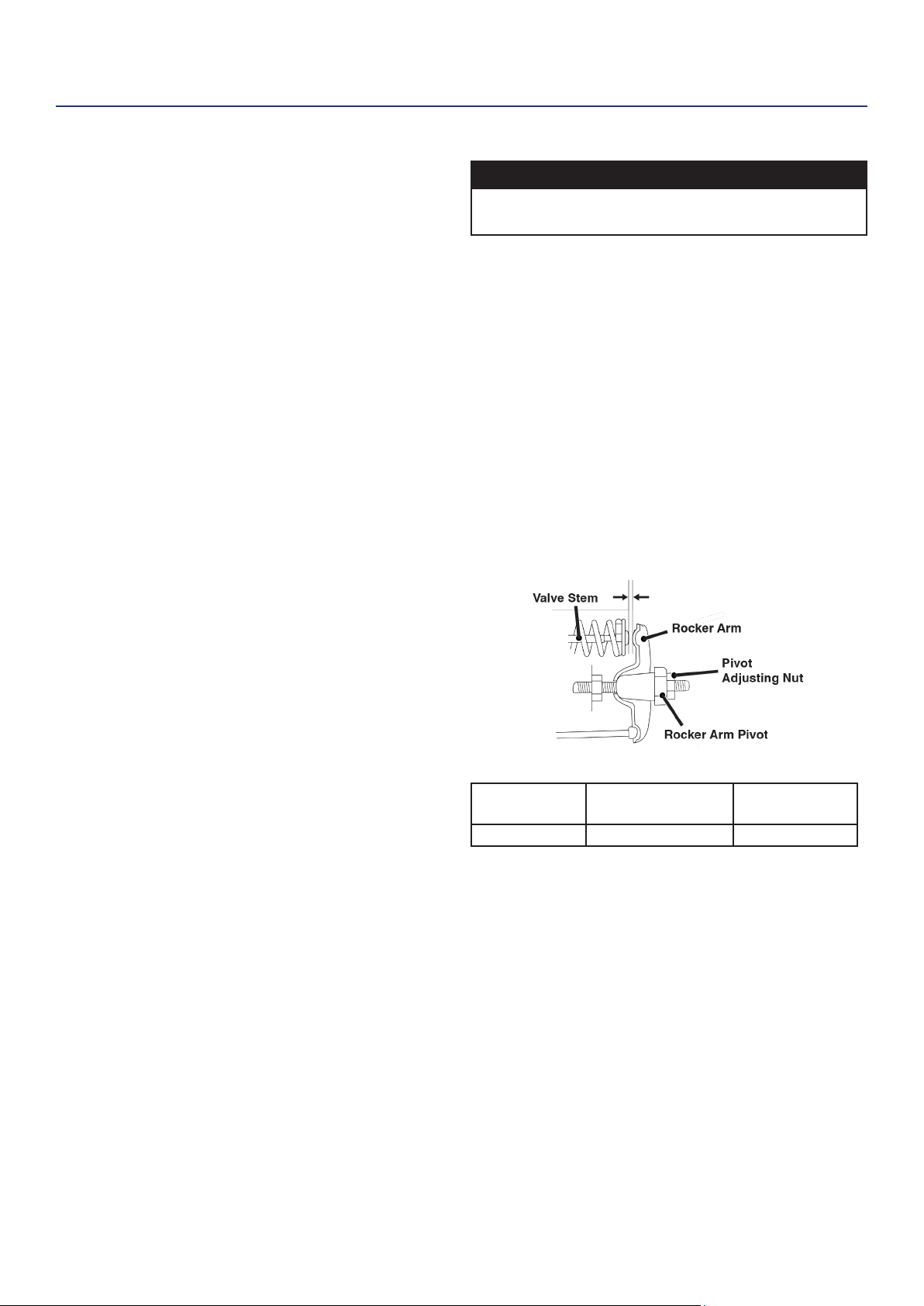
2. Locate the drain screw on the bottom of the carburetor
oat bowl.
3. Place an appropriate gasoline container under the drain
screw to catch the drained fuel.
4. Loosen the oat bowl drain screw and allow the fuel to
drain. Tighten the oat bowl drain screw.
MAINTENANCE
28 | Westinghouse Outdoor Power Equipment, LLC
DRAINING THE FUEL TANK
If storing the generator for longer than six months, drain
the fuel tank to prevent fuel separation, deterioration, and
deposits in the fuel system.
1. Unscrew the fuel tank cap. Remove the fuel screen lter
by slightly compressing it while removing it from the
tank.
2. Using a commercially available gasoline hand pump
(not included), siphon the gasoline from the fuel tank
into an approved gasoline container. DO NOT use an
electric pump.
3. Reinstall the fuel screen lter and the fuel tank cap.
4. Start the generator and allow it to run until the generator
engine stops.
5. Push the battery switch to the OFF position.
6. Disconnect the battery quick-connect plugs.
7. Remove the spark plug.
8. Put a teaspoon of engine oil into the cylinder and pull the
recoil handle until resistance is felt. At this position the
piston is coming up on its compression stroke and both
valves are closed. Storing the engine in this position will
help prevent internal corrosion. Return the recoil handle
gently.
9. Reinstall the spark plug. Leave the spark plug boot
disconnected to prevent accidental starting.
VALVE CLEARANCE
NOTICE
Checking and adjusting valve clearance must be done
when the engine is cold.
1. Remove the rocker arm cover and carefully remove
the gasket. If the gasket is torn or damaged, it must be
replaced.
2. Remove the spark plug so the engine can be rotated
more easily.
3. Rotate the engine to top dead center (TDC) by pulling
the recoil handle slowly. Looking through the spark plug
hole, the piston should be at the top (both valves are
closed).
4. Both the rocker arms should be loose at TDC on the
compression stroke. If they are not, rotate the engine
360°.
5. Insert a feeler gauge between the rocker arm and the
valve stem to measure valve clearance.
Intake Valve Exhaust Valve
Valve Clearance
0.0031 – 0.0047 in
(0.08 – 0.12 mm)
0.0051 – 0.0067 in
(0.13 – 0.17 mm)
Torque 8-12 N•m 8-12 N•m
6. If an adjustment is necessary, hold the rocker arm pivot
and loosen the pivot adjusting nut.
7. Turn the rocker arm pivot to obtain the specied
clearance. Hold the rocker arm pivot and re-tighten the
pivot adjusting nut to the specied torque.
Torque: 106 inch-pound (12 N•m)
8. Perform this procedure for the other valve.
9. Install the gasket, rocker arm cover, and spark plug.
MAINTENANCE
Westinghouse Outdoor Power Equipment, LLC | 29
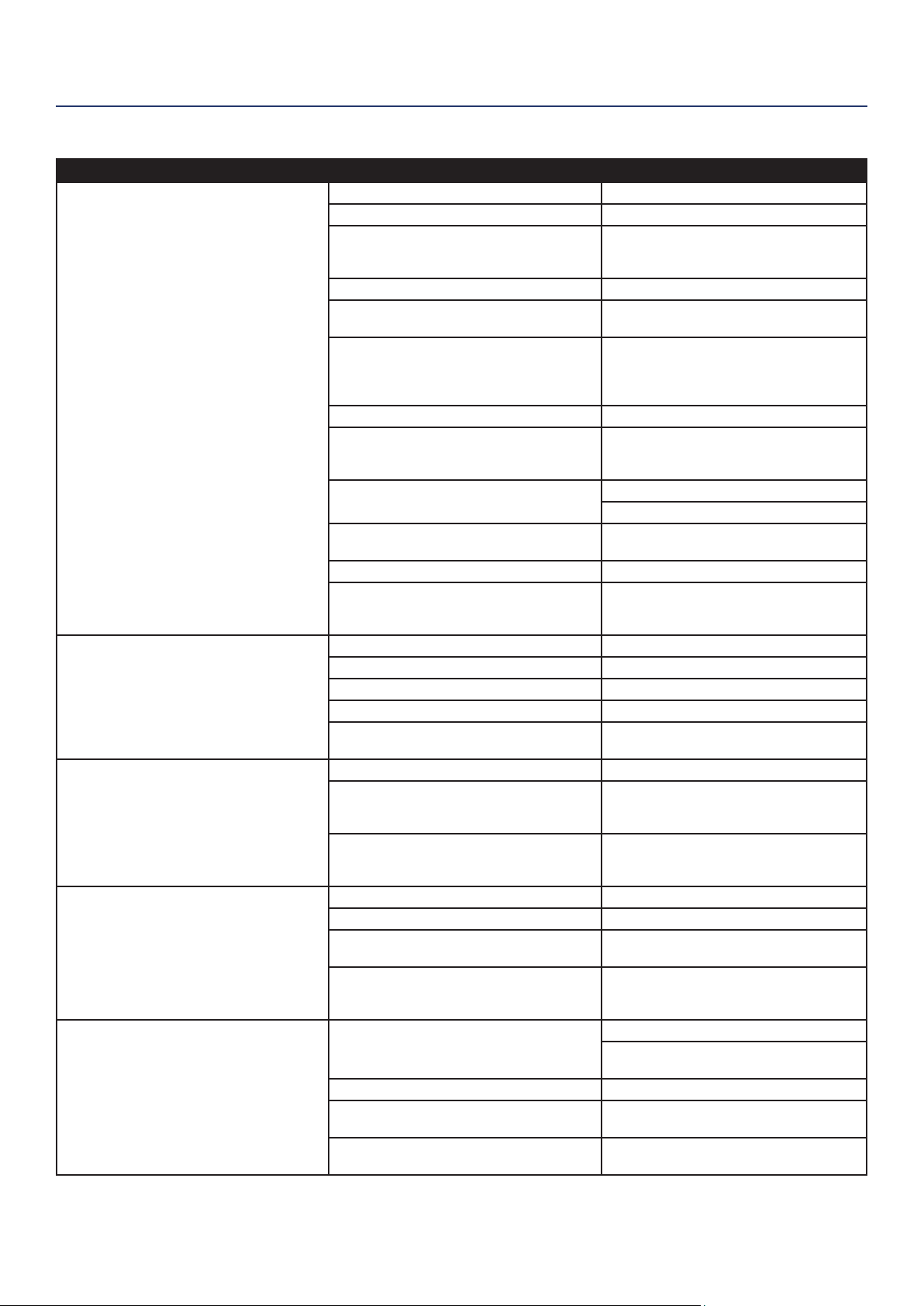
PROBLEM POSSIBLE CAUSE CORRECTION
Engine will not start
Battery switch in the OFF position. Turn battery switch to the ON position.
Out of fuel. Refuel.
Bad fuel, generator stored without treating
or draining gasoline, or refueled with bad
gasoline.
Drain the fuel tank. Refuel with fresh gasoline.
Dirty air lter. Clean the air lter.
Low engine oil level stopped generator.
If low oil LED illuminated, turn battery switch
to the OFF position. Add engine oil.
Spark plug wet with fuel (ooded engine).
Wait ve minutes. Turn battery switch to
the OFF position. Pull recoil handle rapidly
several times. If the generator does not start,
remove spark plug and dry.
Spark plug faulty, fouled, or improperly gapped. Gap or replace the spark plug. Reinstall.
Fuel lter restricted, fuel system malfunction,
fuel pump failure, ignition malfunction, valves
stuck, etc.
Contact Westinghouse customer service toll-
free at 1 (855) 944-3571.
Battery drained.
Use the recoil handle to start the generator.
Charge the battery.
Choke partially open or closed due to weak or
disconnected battery.
Manually set the choke. See Maintenance
section.
CO sensor removed or modied. Return to original conguration.
CO sensor activated or system fault occurred.
Relocate generator / Contact Westinghouse
customer service toll-free at 1 (855) 944-
3571.
Engine starts, then shuts down
Out of fuel. Refuel.
Incorrect engine oil level. Check engine oil level.
Dirty air lter. Clean the air lter.
Contaminated fuel. Drain the fuel tank. Refuel with fresh gasoline.
Defective low oil level switch.
Contact Westinghouse customer service toll-
free at 1 (855) 944-3571.
Engine lacks power
Air lter restricted. Clean or replace air lter.
Bad fuel, generator stored without treating
or draining gasoline, or refueled with bad
gasoline.
Drain the fuel tank. Refuel with fresh gasoline.
Fuel lter restricted, fuel system malfunction,
fuel pump failure, ignition malfunction, valves
stuck, etc.
Contact Westinghouse customer service toll-
free at 1 (855) 944-3571.
Engine runs rough or bogs when load applied
Dirty air lter. Clean the air lter.
Generator overloaded. Unplug some devices.
Faulty power tool or appliance.
Replace or repair tool or appliance. Stop and
restart the engine.
Fuel lter restricted, fuel system malfunction,
fuel pump failure, ignition malfunction, valves
stuck, etc.
Contact Westinghouse customer service toll-
free at 1 (855) 944-3571.
No power at AC receptacles
OUTPUT READY LED is OFF and
OVERLOAD LED is ON.
Check AC load. Stop and restart engine.
Check the air inlet. Stop and restart the
engine.
AC circuit breaker/s tripped. Check AC loads and reset circuit breaker/s.
Faulty power tool or appliance.
Replace or repair tool or appliance. Stop and
restart the engine.
Faulty generator.
Contact Westinghouse customer service toll-
free at 1 (855) 944-3571.
TROUBLESHOOTING

30 | Westinghouse Outdoor Power Equipment, LLC
TROUBLESHOOTING
TROUBLESHOOTING
TROUBLESHOOTING
PROBLEM POSSIBLE CAUSE CORRECTION
Frost on the propane tank or regulator
If the temperature of the propane tank drops below
the dew point, condensation on the tank may turn to
frost or ice. This typically occurs in humid conditions.
Providing all the propane fuel handling equipment
is functioning normally, no correction is needed.
The Propane tank is not equipped with an Overlling
Prevention Device (OPD).
If you suspect your propane fuel tank is not
equipped with an OPD device, discontinue
operation immediately and replace the propane
fuel tank with a propane tank equipped with a an
OPD.
Propane fuel tank overlled.
If you suspect your propane fuel tank has been
overlled, discontinue operation immediately
and return the propane fuel tank to the place of
purchase or relling.
Propane fuel smell
Fuel regulator or fuel hose and ttings not securely
sealed.
Using a soap solution check each connection
and tighten as needed.
Propane fuel regulator vent active.
The propane fuel regulator is equipped with a
vent that will allow a small amount of propane
fuel vapor to escape from the regulator when the
propane tank valve is opened. This can be normal
providing the venting of the propane is brief. If
you suspect that this is abnormal, immediately
discontinue use and have the propane regulator
inspected by a qualied technician.
Residual fuel from the carburetor dispersing after
operation.
Normal, no correction is needed.
Poor performance or engine stalling on
Propane
Propane fuel line kinked or crushed.
Inspect propane fuel line and remove kinks or
other obstructions.
Fuel selector valve not properly positioned.
Rotate the fuel valve fully until the pointer is
directly in line with the desired fuel.
Gasoline not purged from the carburetor before
switching to propane.
Close the propane fuel tank valve. Move the fuel
selector switch to gas. Start the engine and allow
the engine to run until the gasoline has been
consumed in the carburetor. Begin propane start
up procedure.
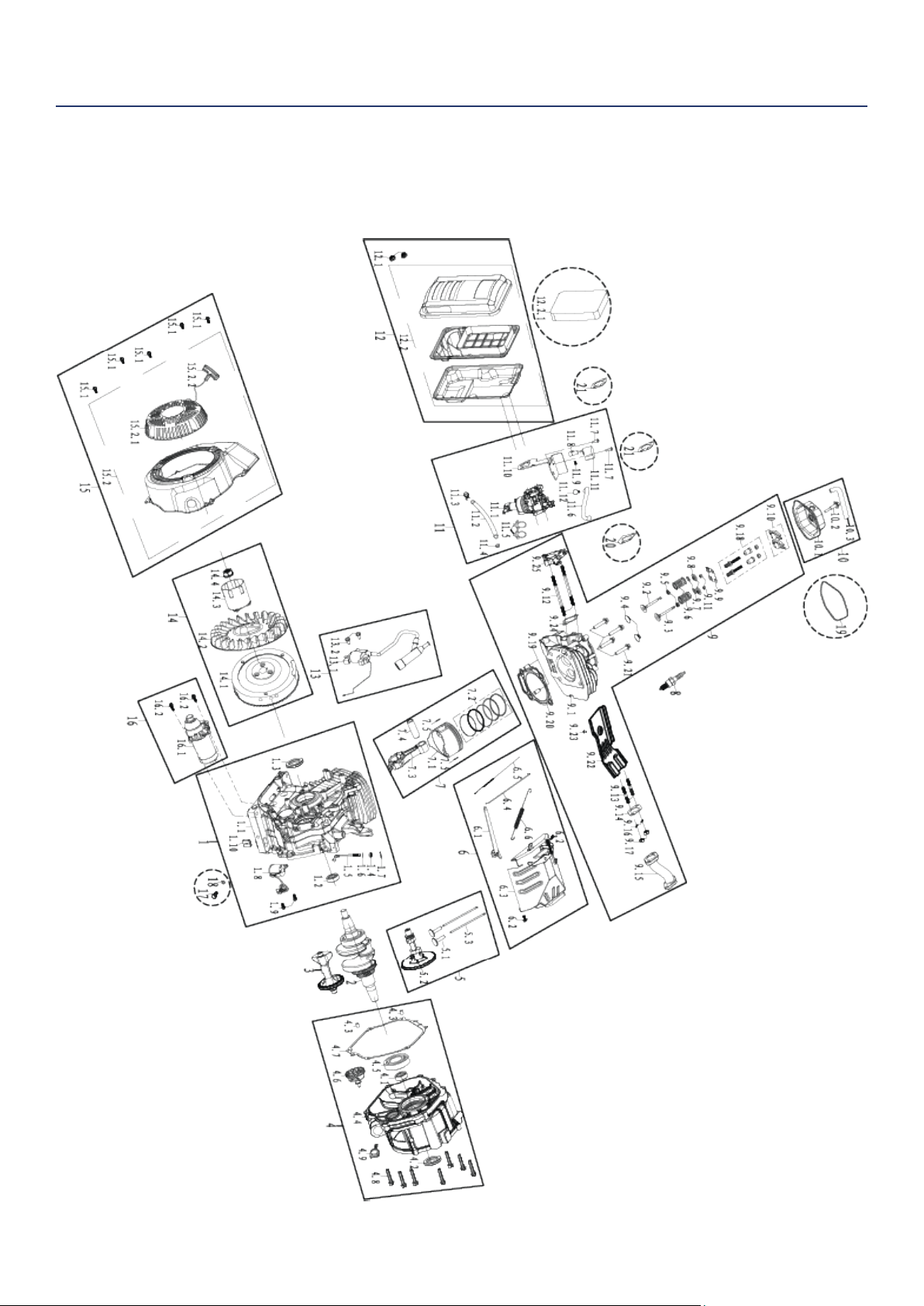
Westinghouse Outdoor Power Equipment, LLC | 31
EXPLODED VIEWS AND PARTS LISTS
ENGINE EXPLODED VIEW
EXPLODED VIEWS

32 | Westinghouse Outdoor Power Equipment, LLC
ENGINE PARTS LIST
NO. PART# DESCRIPTION
1 CRANKCASE ASSEMBLY
1.1 260218 CRANKCASE
1.2 93002 BEARING
1.3 93512 CRANKCASE OIL SEAL
1.4 93516 SWING ROD OIL SEAL
1.5 263901 RACKING BAR
1.6 96806 SWINGING ROD GASKET
1.7 263902 RETAINING CLIP
1.8 265102 OIL SENSOR ASSEMBLY
1.9 91329 BOLT M6X16
1.10 269901 RUBBER CABLE BLOCK
2 260319 CRANKSHAFT
3 260301 BALANCE SHAFT
4 CRANKCASE COVER ASSEMBLY
4.1 93002 BEARING
4.2 93512 CRANKCASE OIL SEAL
4.3 240904 CRANKCASE LOCATING PIN
4.4 260111 CRANKCASE COVER
4.5 93015 BEARING
4.6 264301
CENTRIFUGAL GOVERNOR GEAR
ASSEMBLY
4.7 96072 CRANKCASE SEAL WASHER
4.8 91349 BOLT M8X40
4.9 265604-295 DIPSTICK ASSEMBLY
5 CAMSHAFT ASSEMBLY
5.1 266101 VALVE LIFTER
5.2 272003 CAMSHAFT ASSEMBLY
5.3 261901 PUSH ROD
6 SPEED GOVERNOR ASSEMBLY
6.1 264001 SPEED REGULATING ARM
6.2 91325 BOLT M6X12
6.3 264404 SPEED CONTROLLER
6.4 262701 THROTTLE LEVER
6.5 264201 SPRING C
6.6 264101 SPRING B
7 PISTON & PISTON RING ASSEMBLY
7.1 261205 PISTON
7.2 261604 PISTON RING ASSEMBLY
7.3 261503 CONNECTING ROD ASSEMBLY
7.4 265501 PISTON PIN
7.5 261301 PISTON PIN RING
8 97108 SPARK PLUG
9 CYLINDER HEAD ASSEMBLY
9.1 271005 CYLINDER HEAD
9.2 271702 INTAKE VALVE
9.3 275902 EXHAUST VALVE
NO. PART# DESCRIPTION
9.4 261807 INTAKE VALVE SPRING LOWER SEAT
9.5 93513 VALVE SEAL
9.6 266002 VALVE SPRING
9.7 260802 VALVE LOCK CLAMP
9.8 261805 EXHAUST VALVE SPRING SEAT
9.9 262201 VALVE RETAINER ASSEMBLY
9.10 262101 ROCKING ARM
9.11 261806 TOP CAP
9.12 91016 AIR INLET STUD BOLT
9.13 91007 AIR EXHAUST STUD BOLT
9.14 96083 EXHAUST SEAL WASHER
9.15 95207 MUFFLER CONNECTING PIPE
9.16 94206 SPRING WASHER
9.17 90011 NUT M8
9.18 91818
ROCKING ARM WITH TIGHT BOLT
ASSEMBLY
9.19 260901 CYLINDER HEAD LOCATING PIN
9.20 96089 CYLINDER HEAD GASKET
9.21 91321 BOLT M10X80
9.22 270501 WIND-LEAD-COVER
9.23 91325 BOLT M6X12
9.24 96078 INTAKE GASKET
9.25 262301 CARBURETOR CONNECTION BLOCK
10 CYLINDER HEAD COVER ASSEMBLY
10.1 261104 CYLINDER HEAD COVER
10.2 91819
CYLINDER HEAD COVER FASTENING
BOLT
10.3 95606 BLAST PIPE
11 CARBURETOR ASSEMBLY
11.1 262860 CARBURETOR
11.2 95750 FUEL HOSE
11.3 94403 FUEL HOSE CLAMP
11.4 94401 FUEL HOSE RUBBER SLEEVE
11.5 260801 CABLE CLIP
11.6 517903 LOW PRESSURE HOSE
11.7 92007 CROSS SCREW STUD M4*8
11.8 249905 STEPPER MOTOR DRIVE SHAFT
11.9 244202 SPRING
11.10 269909 BRACKET
11.11 249904 STEPPER MOTOR
11.12 599302 LOW PRESSURE HOSE HOOP
12 AIR FILTER KIT ASSEMBLY
12.1 90016 NUT M6
12.2 262908-052 AIR FILTER ASSEMBLY
12.2.1 5205 FILTER ELEMENT
13 IGNITOR KIT ASSEMBLY
13.1 97551 IGNITOR ASSEMBLY
EXPLODED VIEWS

Westinghouse Outdoor Power Equipment, LLC | 33
ENGINE PARTS LIST CONTINUED
EXPLODED VIEWS
NO. PART# DESCRIPTION
13.2 91331 BOLT M6X25
14 FLYWHEEL KIT ASSEMBLY
14.1 260407 FLYWHEEL
14.2 264601 IMPELLER
14.3 264501 STARTER PULLEY
14.4 90004 FLYWHEEL NUT
15 RECOIL STARTER ASSEMBLY
15.1 91325 BOLT M6X12
15.2 264738-221B STARTER ASSEMBLY
15.2.1 5910-221 RECOIL STARTER
15.2.2 5943 RECOIL HANDLE
16 STARTER MOTOR ASSEMBLY
16.1 97415 STARTING MOTOR
16.2 91348 BOLT M8*35
17 91817 OIL DRAIN BOLT
18 94004 OIL DRAIN BOLT WASHER
19 96075 CYLINDER HEAD COVER GASKET
20 96081 CARBURETOR WASHER
21 96086 AIR FILTER GASKET
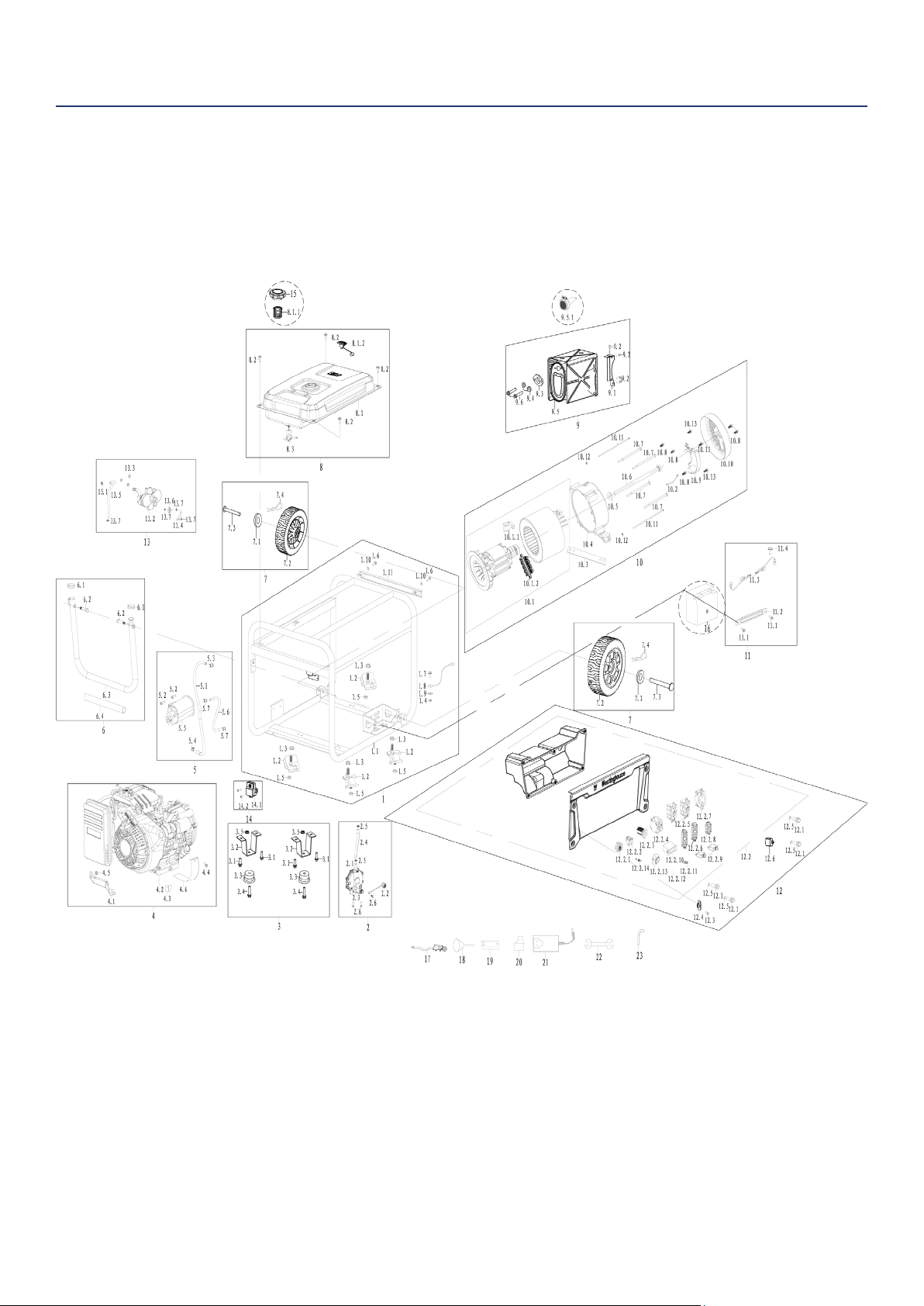
34 | Westinghouse Outdoor Power Equipment, LLC
GENERATOR EXPLODED VIEW
EXPLODED VIEWS

Westinghouse Outdoor Power Equipment, LLC | 35
GENERATOR PARTS LIST
EXPLODED VIEWS
NO. PART# DESCRIPTION
1 FRAME ASSEMBLY
1.1 774070-116 FRAME
1.2 531314 SHOCK ABSORBER
1.3 90013 NUT M10
1.4 90018 NUT M8
1.5 90011 NUT M8
1.6 91327 BOLT M6X12
1.7 91343 BOLT M8X16
1.8 544307 FRAME WIRE
1.9 94009 TOOTH WASHER
1.10 96120 PAPER WASHER
1.11 530606-116 DISTANCE TUBE
2
PRESSURE REDUCING VALVE
ASSEMBLY
2.1 96120 PAPER WASHER
2.2 519387 PROTECTIVE CASE
2.3 50280033
PRESSURE REDUCING VALVE
ASSEMBLY
2.4 517328 LOW PRESSURE HOSE
2.5 599302 LOW PRESSURE HOSE HOOP
2.6 91325 BOLT M6X12
3 FOOT BRACKET ASSEMBLY
3.1 91343 BOLT M8X16
3.2 525608-116 FOOT BRACKET ASSEMBLY
3.3 531115 FOOT BRACKET SHOCK ABSORBER
3.4 91333 BOLT M6X28
3.5 90023 NUT M6
4 ENGINE ASSEMBLY
4.1 540601 AIR FILTER BRACKET
4.2
1148420
220054
ENGINE ASSEMBLY
4.3 549603 DUST BOARD
4.4 91322 BOLT M5X12
4.5 90016 NUT M6
4.6 539602 CRANKCASE COVER
5 CARBON CANNISTER ASSEMBLY
5.1 95123
CARBON CANISTER AND FUEL TANK
CONNECTING PIPE
5.2 91327 BOLT M6X12
5.3 94423 FUEL HOSE CLIP
5.4 94408 FUEL HOSE CLIP
5.5 543601L CARBON CANISTER ASSEMBLY
5.6 95124
CARBON CANISTER AND AIR FILTER
CONNECTING PIPE
5.7 94402 FUEL HOSE CLIP
6 HANDLE WELDING ASSEMBLY
6.1 527603 HANDLE PLUG
NO. PART# DESCRIPTION
6.2 527612 BOLT M10
6.3 526620-116 HANDLE
6.4 528607 HANDLE RUBBER SLEEVE
7 WHEEL ASSEMBLY
7.1 94207 FLAT WASHER
7.2 523646 WHEEL
7.3 524619 AXLE
7.4 548302 STOP REFUND
8 FUEL TANK ASSEMBLY
8.1
700378L-
116
FUEL TANK
8.1.1 518801 FUEL TANK FILTER
8.1.2 6861 FUEL GAUGE
8.2 91460 BOLT M6X25
8.3 518208 FUEL SWITCH
9 EXHAUST MUFFLER ASSEMBLY
9.1 520305 MUFFLER MOUNTING BRACKET
9.2 91343 BOLT M8X16
9.3 96002 MUFFLER CONNECTING PIPE GASKET
9.4 94206 SPRING WASHER
9.5 705944 MUFFLER
9.5.1 6866 SPARK ARRESTER
9.6 91347 BOLT M8X30
10 ALTERNATOR ASSEMBLY
10.1 757526 ALTERNATOR
10.1.1 599019 CARBON BRUSH
10.1.2 6560 TERMINAL ASSEMBLY
10.2 544610 SHORT WIRE
10.3 532303-052 TAIL BRACKET FIXING PLATE
10.4 532301 ALTERNATOR TAIL BRACKET
10.5 96813 GASKET
10.6 91717 BOLT M10X1.25X275
10.7 91614 BOLT M6X190
10.8 91322 BOLT M5X12
10.9 534813 AVR
10.10 533302-221 ALTERNATOR TAIL COVER
10.11 91512 BOLT M5X230
10.12 90104 NUT M5
10.13 91323 BOLT M5X16
11 BATTERY BRACKET ASSEMBLY
11.1 91327 BOLT M6X12
11.2 542614-116 BATTERY PRESSURE PLATE
11.3 512058 BATTERY WIRING ASSEMBLY
11.4 91325 BOLT M6X12

36 | Westinghouse Outdoor Power Equipment, LLC
EXPLODED VIEWS
GENERATOR PARTS LIST CONTINUED
NO. PART# DESCRIPTION
12 CONTROL PANEL ASSEMBLY
12.1 91327 BOLT M6X12
12.2 714381 CONTROL PANEL ASSEMBLY
12.2.1 536002 ONE PUSH BUTTON SWITCH
12.2.2 6502 SWITCH
12.2.3 6796 DC SOCKET
12.2.4 6523 BREAKER
12.2.5 6275 SOCKET
12.2.6 6845 WATERPROOF CAP
12.2.7 6385 SOCKET
12.2.8 6848 WATERPROOF CAP
12.2.9 6439-20 THERMAL PROTECTOR
12.2.10 6041 DIGITAL DISPLAY
12.2.11 6386 GROUND BOLT ASSEMBLY
12.2.12 6387 CHARGING SOCKET
12.2.13 6488 AVIATION SOCKET
12.2.14 6393 INDICATOR LIGHT
12.3 92083 HEXAGON SOCKET PAN HEAD SCREWS
12.4 599035 SWITCH TURNTABLE ASSEMBLY
12.5 96120 PAPER WASHER
12.6 599065 CO SHUTDOWN ACTUATOR
13 DUAL FUEL SELECTOR SWITCH
13.1 94403 FUEL HOSE CLIP
13.2 50280010 FUEL SWITCH ASSEMBLY
13.3 90015 NUT M5
13.4 95486L FUEL HOSE
13.5 95750 FUEL HOSE
13.6 516401 FILTER
13.7 503034 FUEL HOSE CLIP
14 60450005 CO MODULE ASSEMBLY
14.1 CO MODULE
14.2 92270 CROSS SLOTTED HEAD SCREW M4*16
15 519215 FUEL CAP
16 511008 BATTERY
17 545331 PRESSURE REDUCING VALVE
18 99504 FUNNEL
19 99010 SPARK PLUG WRENCH
20 99631 OIL BOTTLE
21 511076 CHARGER
22 99025 WRENCH
23 94432 NYLON BRAIDED TUBE
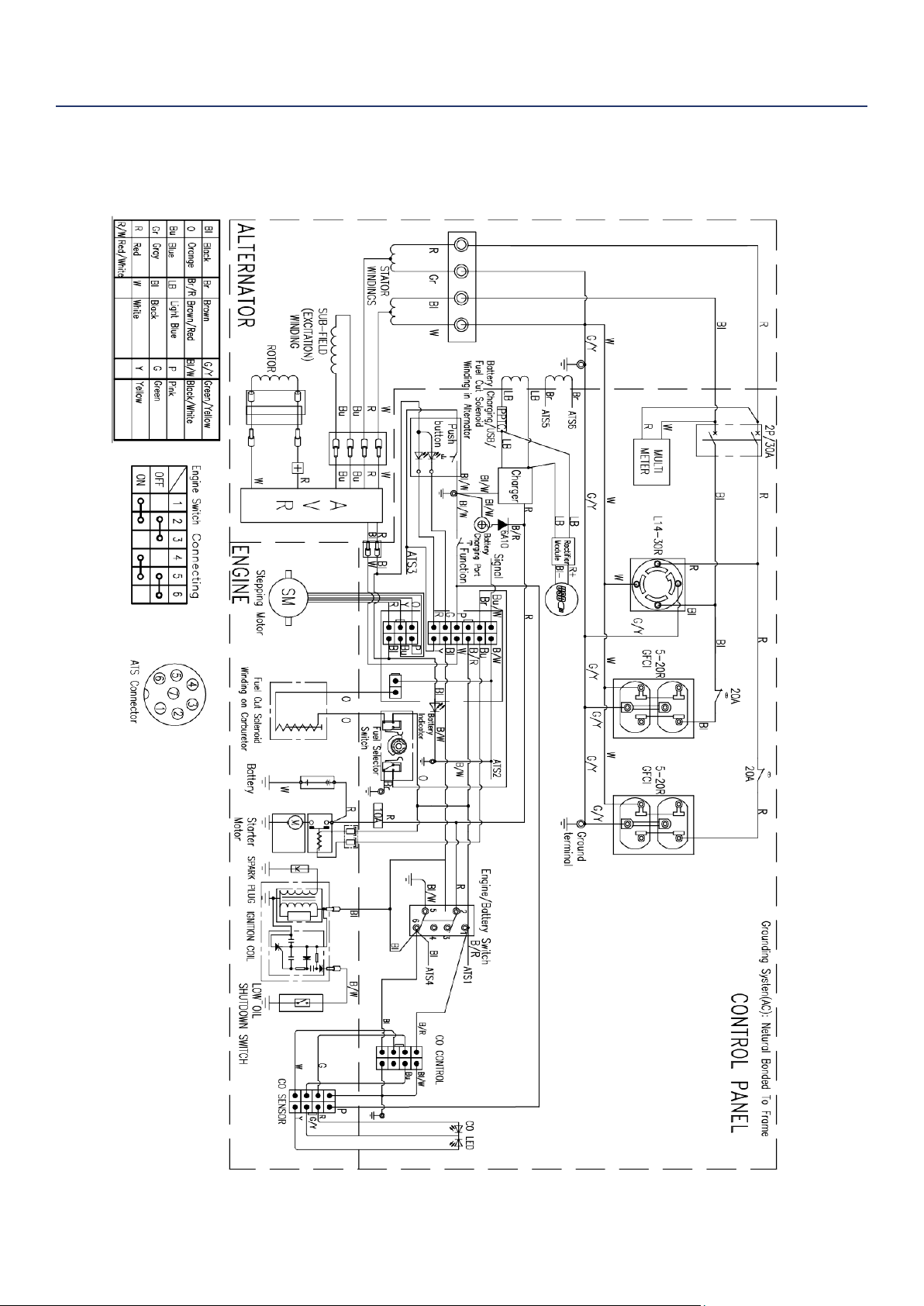
Westinghouse Outdoor Power Equipment, LLC | 37
SCHEMATICS
SCHEMATICS
SCHEMATICS
