

Read all safety rules and instructions carefully before operating this tool.
Owner’s Manual
TOLL-FREE HELPLINE: 1-888-90WORKS
(888.909.6757)
www.GreenWorksTools.com
40 V Lithium-Ion Dual Blade Mower
25302

2
Contents .............................................................................................................................. 2
Product specications .......................................................................................................... 2
Safety information ............................................................................................................. 3-7
Symbols ............................................................................................................................8-9
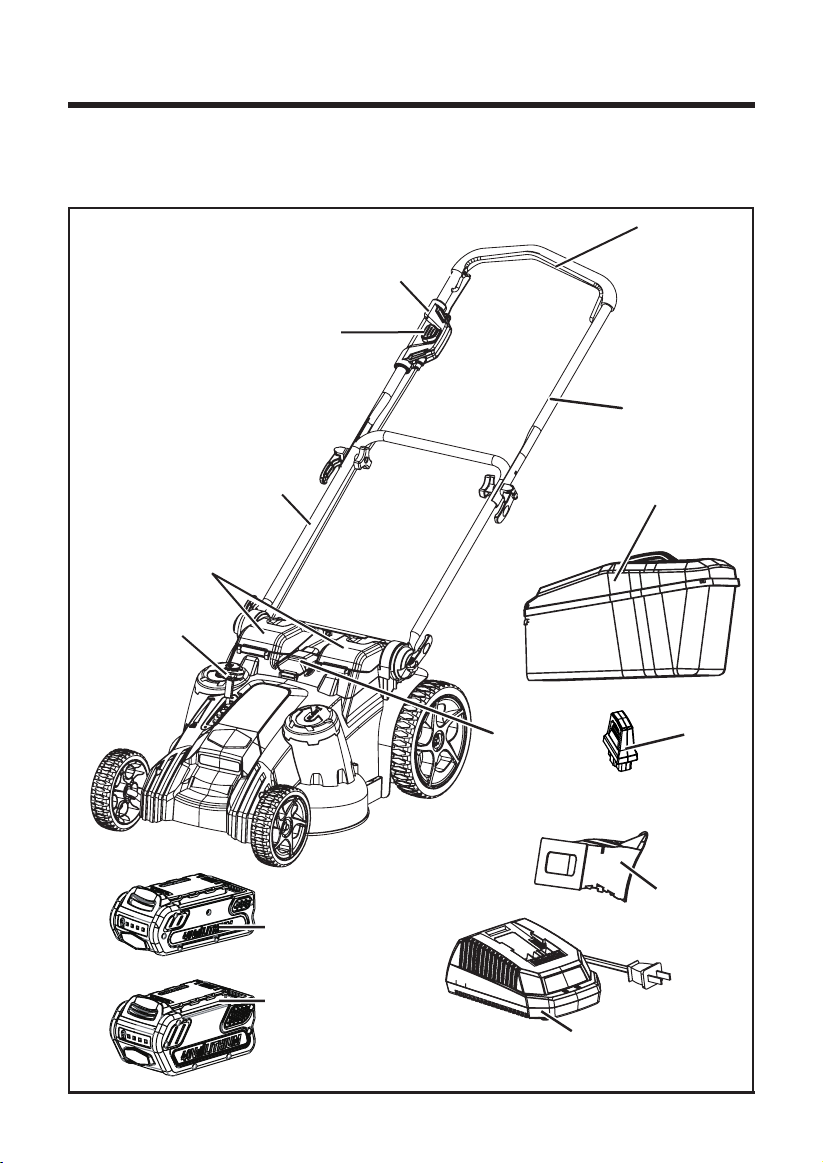
Know your lawn mower ...................................................................................................... 10
Assembly .......................................................................................................................11-17
Operation ...................................................................................................................... 18-22
Battery charger .............................................................................................................23-24
Maintenance ................................................................................................................. 25-28
Service .............................................................................................................................. 29
Environmentally safe battery disposal ............................................................................... 30
Troubleshooting ................................................................................................................. 31
Warranty ............................................................................................................................ 32
Exploded View ................................................................................................................... 33
Parts List.......................................................................................................................34-36
PRODUCT SPECIFICATIONS
40 V LITHIUM-ION DUAL BLADE MOWER
Battery type ............................................................................................ 40V Lithium-ion
Charger time ........................................................................1 hour, for 40V 73Wh battery
2 hours, for 40V 146Wh battery
No-load speed ................................................................................................ 5000 RPM
Height adjustments .................................................................1 3/8- 3 3/8” (3.5 - 8.5 cm)
Functions .................................................................................. 2-in-1: Mulch or rear bag
Unit weight (without battery) ................................................................ 42.5 lbs (19.3 kg)
CONTENTS
3
SAFETY INFORMATION
GENERAL SAFETY RULES
READ ALL INSTRUCTIONS CAREFULLY
W A R N I N G
This symbol indicates important safety instructions. If these instructions are not followed, it could
endanger the personal safety and/or property of the operator and others. Read and understand
all instructions in this manual before attempting to operate the mower. Failure to comply with
these instructions may result in personal injury.
D A N G E R
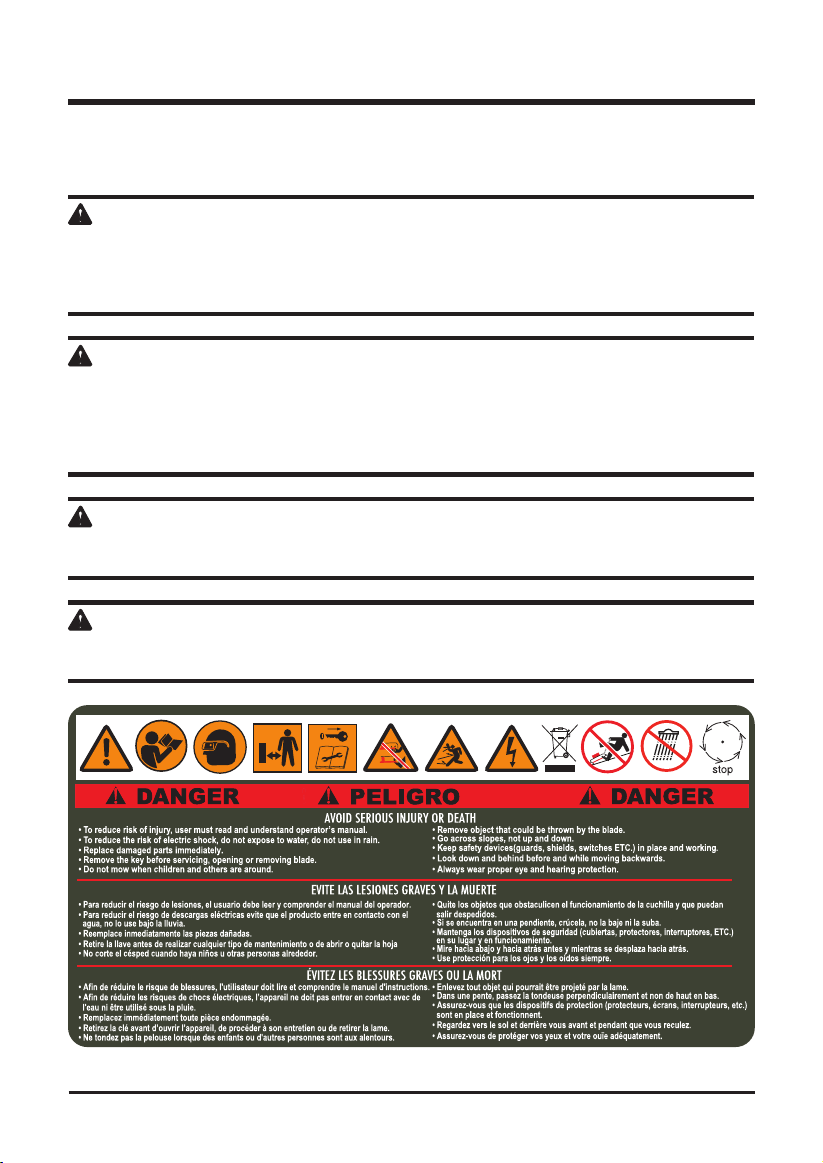
This mower was built to be operated according to the rules for safe operation that are contained
in this manual. As with any type of power equipment, carelessness or error on the part of the
operator can result in serious injury. This mower is capable of amputating body parts and
throwing objects. Failure to observe the following safety rules could result in serious injury or
death.
W A R N I N G
Basic safety precautions should always be followed when using electric lawn mowers, in order to
reduce the risk of re, electric shock, and personal injury.
W A R N I N G
Use of this mower should be restricted to individuals who have read and understoood and will
follow the warnings and instructions that are printed in this manual and on the mower.

4
SAFETY INFORMATION
• Carefully read all instructions on the mower and in the manual before attempting to assemble and
operate the mower. Keep this manual in a safe place for future reference, and consult it regularly.
• Become familiar with all controls and their proper operation. Know how to stop the mower and
how to disengage the power in an emergency.
• In order to avoid contact with the blade or injury caused by a thrown object, stay in the
operating zone behind the handles, and keep children and bystanders at least 50’ (15 m) away
from the mower while it is in operation. Stop the motor immediately if someone enters the
mowing area.
• Thoroughly inspect the area where the mower is to be used. Remove all stones, sticks, wire,
bones, toys, and other objects that could be tripped over or thrown by the blade. Thrown
objects can cause serious personal injury.
• Plan your mowing pattern in such a way as to avoid discharging material toward roads,
sidewalks, bystanders, etc. Do not discharge material against a wall or obstruction. Doing so
may cause the discharged material to ricochet back toward the operator.
• Always wear proper eye protection that complies with ANSI Z87.1 in order to protect your
eyes while operating or performing any adjustment or repair. Thrown objects that ricochet can
cause serious eye injury.
• Always wear a face mask or a dust mask when operating the mower in a dusty environment.
• Dress properly. Do not wear loose clothing or jewelry that can get caught in moving parts. The
wearing of protective gloves and safety footwear is recommended.
• Ground Fault Circuit Interrupter (GFCI) protection should be provided on the circuit(s) or
outlet(s) that will be used to charge the lawn mower battery. Outlets with built-in GFCI
protection are available, and may be used as an added safety measure.
• Many injuries occur as a result of the mower being pulled over the operator’s foot during a
fall caused by slipping or tripping. Do not operate this mower in bare feet, or while wearing
sandals or lightweight (e.g., canvas) shoes. Do not hold on to the mower if you are falling.
Release the handle immediately.
• Never pull the mower back toward you while you are walking. If you must back the mower
away from a wall or an obstruction, rst look down and behind in order to avoid tripping, and
then follow these steps:
• Step back from the mower in order to fully extend your arms.
• Be sure that you are well balanced.
• Pull the mower back slowly.
• Do not use the mower for any job except that for which it is intended. Do not force the mower.
• Do not operate the mower while under the inuence of alcohol or drugs.
• Stay Alert: Do not operate the mower when you are tired. Pay attention to what you are doing.
Use common sense.
• Do not put hands or feet near rotating parts or under the cutting deck. Contact with the blade
can amputate hands and feet.
• Do not attempt to adjust the wheels or the cutting height while the motor is running.
• Avoid dangerous environments. Do not operate the mower in the rain or in wet or damp grass.
• Mow only in daylight or in good articial light. Do not rush a mowing job.

5
SAFETY INFORMATION
• Stop the blade when crossing gravel driveways, walkways, or roads.
• If the mower starts to vibrate excessively, stop the motor and check for the cause immediately.
Vibration is generally a warning of trouble.
• Stop the motor and wait until the blade comes to a complete stop before removing the grass
catcher or unclogging the chute. The cutting blade will continue to rotate for a few seconds
after the motor is shut off. Do not place any part of your body in the blade area until you are
sure that the blade has stopped rotating.
• Never operate mower without a proper trail shield, discharge cover, grass catcher, switch
control, or other safety device in place and in working order. Do not operate the mower with
damaged safety devices. Doing so can result in injury.
• Don’t force lawn mower. It will do the job better and safer at the rate for which it was designed.
• Store idle lawn mower indoors. When not in use, lawn mower should be stored in an indoor
dry and look-up place, out of reach of children.
• Maintain lawn mower. Keep cutting edgers sharp and clean for best and safety performance.
• If lawn mower strikes a foreign objects follow these steps:
• Stop lawn mower, release the switch.
• Remove the key and battery.
• Inspect for damage.
• Repair any damage before restarting and operating the lawn mower.
• Do not charge lawn mower in rain or in wet location.
• Remove or disconnect battery before servicing, cleaning or removing material from lawn mower.
CHILD SAFETY
Tragic accidents can occur if the operator is not aware of the presence of children.
• Keep children out of the mowing area and under the watchful care of a responsible adult.
• Do not allow children under the age of 14 to operate this mower. Children who are 14 years
of age and older must read and understand the operating instructions and safety rules in this
manual, and must be trained and supervised by a parent.
• Stay alert, and turn the mower off if a child or any other person enters the mowing area.
• Look behind and down for small children before and while moving backwards.
• Use extreme care when approaching blind corners, doorways, shrubs, trees, or other objects
that may obscure your view of a child who may run into the path of the mower.
BATTERY & CHARGER
C A U T I O N
USE ONLY GREENWORKS APPROVED REPLACEMENT BATTERIES, OTHER BATTERIES
MAY CAUSE INJURY OR DAMAGE TO THE MOWER. Use with GREENWORKS 40V battery.
BATTERY SAFETY RULES
• Battery tools do not have to be plugged into an electrical outlet; therefore, they are always in

6
SAFETY INFORMATION
PROPER CARE FOR BATTERY
Off-season storage
To obtain the longest possible battery life, we suggest the following:
operating condition. Be aware of possible hazards when not using your battery tool or when
changing accessories. Following this rule will reduce the risk of electric shock, re, or serious
personal injury.
• Do not place battery tools or their batteries near fire or heat. This will reduce the risk of
explosion and possibly injury.
• Do not crush, drop or damage battery pack. Do not use a battery pack or charger that has
been dropped or received a sharp blow. A damaged battery is subject to explosion. Properly
dispose of a dropped or damaged battery immediately.
• Batteries can explode in the presence of a source of ignition, such as a pilot light. To reduce
the risk of serious personal injury, never use any cordless product in the presence of open
flame. An exploded battery can propel debris and chemicals. If exposed, flush with water
immediately.Do not charge battery tool in a damp or wet location. Following this rule will
reduce the risk of electric shock.
• For best results, your battery tool should be charged in a location where the temperature is
more than 45°F but less than 104°F. To reduce the risk of serious personal injury, do not store
outside or in vehicles.
• Under extreme usage or temperature conditions, battery leakage may occur. If liquid comes
in contact with your skin, wash immediately with soap and water. If liquid gets into your eyes,
ush them with clean water for at least 10 minutes, then seek immediate medical attention.
Following this rule will reduce the risk of serious personal injury.
• When battery pack is not in use, keep it away from other metal objects like: paper clips, coins,
keys, nails, screws, or other small metal objects that can make a connection from one terminal
to another. Shorting the battery terminals together may cause sparks, burns, or a re.
• Always remove battery pack from your tool when you are assembling parts, making
adjustments, cleaning, or when not in use. Removing battery pack will prevent accidental
starting that could cause serious personal injury.
• Always remove battery pack before storing the device. When battery becomes fully charged,
unplug the charger from the power supply and remove the battery pack from the charger.
• Always wear eye protection with side shields marked to comply with ANSI Z87.1, along with
hearing protection. Failure to do so could result in objects being thrown into your eyes and
other possible serious injuries.
• Keep battery pack dry, clean, and free from oil and grease. Always use a clean cloth when
cleaning. Never use brake fluids, gasoline, petroleum-based products, or any solvents to
clean battery pack.
• When replacing batteries, all batteries should be replaced at the same time. Mixing fresh
and discharged batteries could increase internal cell pressure and rupture the discharge
battery(ies). (Applies to products employing more than one separately replaceable primary
battery.)
• When inserting batteries into this product, the proper polarity or direction must be observed.
Reverse insertion of batteries can result in leakage or explosion. (Applies to product
employing more than one separately replaceable primary battery.)
SAVE THESE INSTRUCTIONS
77
SAFETY INFORMATION
• Remove the battery pack from the charger once it is fully charged and ready for use.
For battery pack storage longer than 30 days:
• Store the battery pack where the temperature is below 80°F and away from moisture.
• Store battery packs in a 30%-50% charged condition.
• Every two months of storage, charge the pack as normal.
CHARGER SAFETY RULES
• Charge the mower battery in a dry area that is protected from the weather. Do not expose the
mower or the charger to rain. Do not charge the battery in a wet location. Operate the battery
charger in temperatures between 45° and 104°F. In order to reduce the risk of electric shock,
use only the charger that is provided by the manufacturer to charge the battery.
• DO NOT ABUSE THE CHARGE CORD. Never carry the charger by the cord. Do not
disconnect the charger from the outlet or from the mower by pulling the charger cord.
• Do not use a damaged charger. Replace the charger cords or the charger immediately.
• Keep the mower and the charger away from water, heat sources (radiators, heaters, stoves,
etc.), ames, and chemicals.
• Make sure the battery pack is secured in the charger before beginning operation.
• The battery pack will become slightly warm to the touch while charging. This is normal and
does not indicate a problem.
• Do not place the charger and battery pack in an area of extreme heat or cold. They will work
best at normal room temperature.
• When batteries become fully charged, unplug the charger from the power supply and remove
the battery pack.
W A R N I N G
When transporting or servicing unit, always remove the key and battery.
W A R N I N G ( P R O P O S I T I O N 6 5 )
Some dust created by power sanding, sawing, grinding, drilling and other construction activities
contains chemicals known to the state of California to cause cancer, birth defects or other
reproductive harm. Some examples of these chemicals are:
• Lead from lead-based paints,
• Crystalline silica from bricks and cement and other masonry products, and
• Arsenic and chromium from chemically-treated lumber.
Your risk from these exposures varies, depending on how often you do this type of work. To
reduce your exposure to these chemical: work in a well ventilated area, and work with approved
safety equipment, such as those dust masks that are specially designed to lter out microscopic
particles.
8
SYMBOLS
8
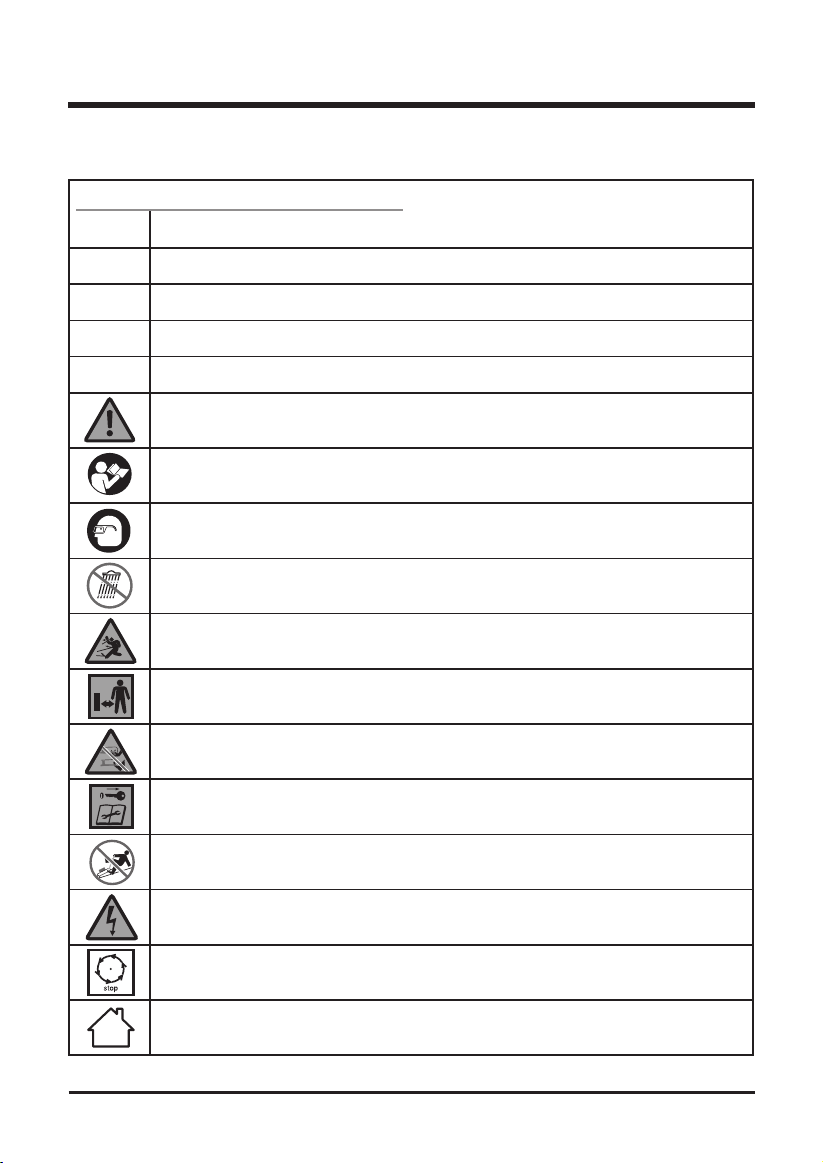
Some of the following symbols may be used on this product. Please study them and learn their
meaning. Proper interpretation of these symbols will allow you to operate the product better and safer.
SYMBOL DESIGNATION/EXPLANATION
V Volts
A Amperes
Hz Hertz
W Watts
Hrs Hours
Precautions that involve your safety.
To reduce the risk of injury, user must read and understand user’s manual before
using this product.
Wear eye and head protection when operating this equipment.
Do not expose machine to rain or wet conditions.
Pay attention that bystanders are not injured through foreign objects thrown from
the mower.
Keep all bystanders (especially children and pets) at least 15 m away from the
work area.
Keep hands and feet away from blade and cutting area.
Switch off and remove isolator key before adjusting, cleaning and before leaving the
product unattended for any period.
Do not operate on inclines greater than 15°. Mow across the face of slopes, never
up and down.
Beware of electric shock hazard.
Wait for all components of machine to have completely stopped before touching
them.
The charger is intended for indoor use only.
9
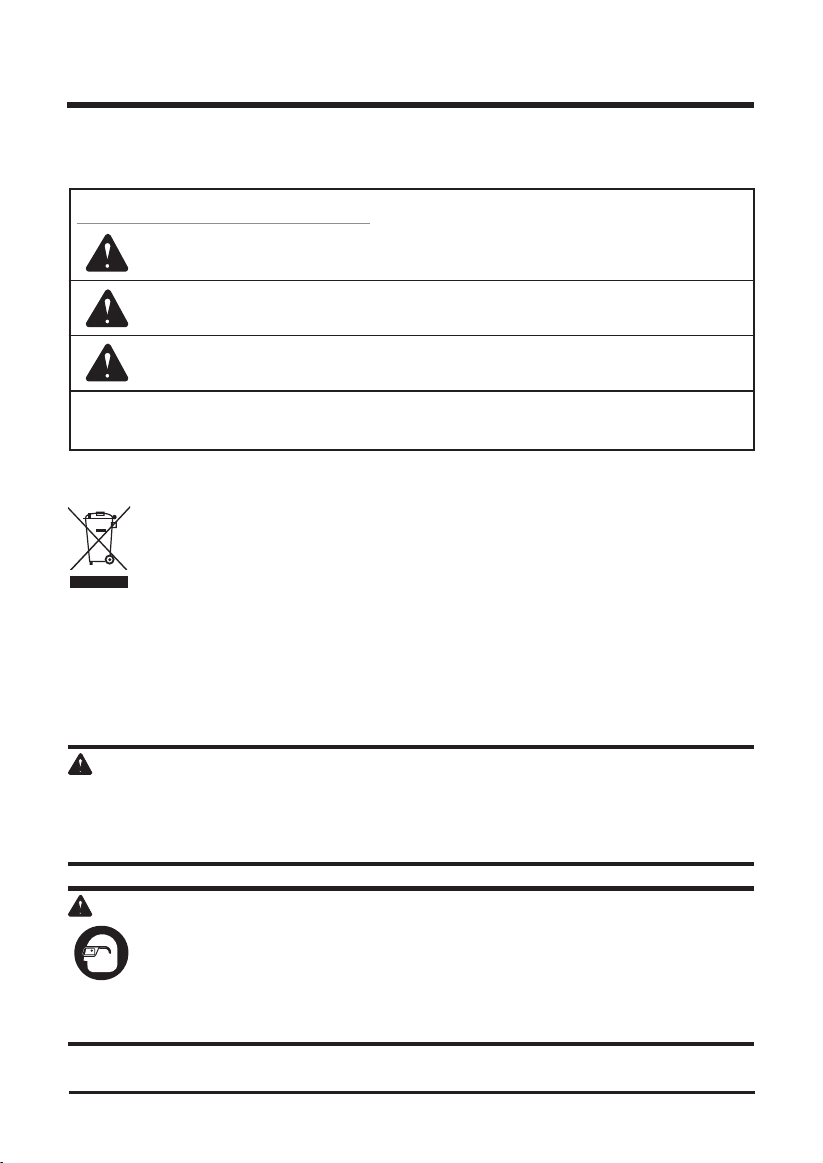
The following signal words and meanings are intended to explain the levels of risk associated
with this product.
ENVIRONMENTAL PROTECTION
Waste electrical products should not be disposed of with household waste. Please
recycle where facilities exist. Check with your local authority or retailer for recycling
advice.
The battery contains material which is hazardous to you and the environment. It must
be removed and disposed of separately at a facility that accepts lithium-ion batteries.
SERVICE
Servicing requires extreme care and knowledge and should be performed only by a qualified
service technician. For service we suggest you return the product to your nearest AUTHORIZED
SERVICE CENTER for repair. When servicing, use only identical replacement parts.
W A R N I N G
To avoid serious personal injury, do not attempt to use this product until you have read this
Owner's Manual thoroughly and understand it completely. If you do not understand the warnings
and instructions in this Owner's Manual, do not use this product. Call the Toll-free Helpline (1-
888-909-6757) for assistance.
W A R N I N G
The operation of any power tool can result in foreign objects being thrown into your
eyes, which can result in severe eye damage. Before beginning power tool operation,
always wear safety goggles or safety glasses with side shields and, when needed, a
full face shield. We recommend Wide Vision Safety Mask for use over eyeglasses or
standard safety glasses with side shields. Always use eye protection which is marked
to comply with ANSI Z87.1.
SYMBOL SIGNAL MEANING
DANGER Indicates an imminently hazardous situation, which, if not
avoided, will result in death or serious injury.
WARNING Indicates a potentially hazardous situation, which, if not avoided,
could result in death or serious injury.
CAUTION Indicates a potentially hazardous situation, which, if not avoided,
may result in minor or moderate injury.
CAUTION (Without Safety Alert Symbol) Indicates a situation that may
result in property damage.
SYMBOLS
SAVE THESE INSTRUCTIONS
10
KNOW YOUR LAWN MOWER
Fig. 1
Motor/blade
control assembly
Start button
Height
adjustment
lever
Bail
Upper
handle
Lower
handle
40V Charger
(Model#:29482)
Mulching
plug
Read this operator's manual and safety rules before operating your lawn mower. Compare the
illustration in Figure 1 to your lawn mower in order to familiarize yourself with the location of
various controls and adjustments. Save this manual for future reference.
Battery door
Key door
Key
Grass
catcher
bag
40V 73Wh Battery
(Model#:29462)
40V 146Wh Battery
(Model#:29472)
11
UNPACKING
• Carefully remove the product and any accessories from the box. Make sure that all items
listed in the packing list are included.
• Inspect the product carefully to make sure no breakage or damage occurred during shipping.
• Do not discard the packing material until you have carefully inspected and satisfactorily
operated the product.
• If any parts are damaged or missing, please call 1-888-909-6757 for assistance.
PACKING LIST
• Lawn mower
• Key
• Mulching plug
• Grass catcher bag
W A R N I N G
If any parts are damaged or missing do not operate this product until the parts are replaced.
Using a product with damaged or missing parts could result in serious personal injury.
W A R N I N G
Do not attempt to modify this product or create accessories not recommended for use with this
product. Any such alteration or modication is misuse and could result in a hazardous condition
leading to possible serious personal injury.
W A R N I N G
Do not inser key until assembly is complete and you are ready to mow. Failure to comply could
result in accidental starting and possible serious personal injury.
W A R N I N G
To prevent accidental starting that could cause serious personal injury, always remove the battery
pack from the product when assembling parts.
W A R N I N G
Never operate the mower without the proper safety devices in place and working. Never operate
the mower with damaged safety devices. Operation of this product with damaged or missing
parts could result in serious personal injury.
ASSEMBLY INSTRUCTIONS
• 40V 146Wh Battery (Model#:29472)
• 40V 73Wh Battery (Model#:29462)
• 40V Charger (Model#:29482)
• Owner’s Manual
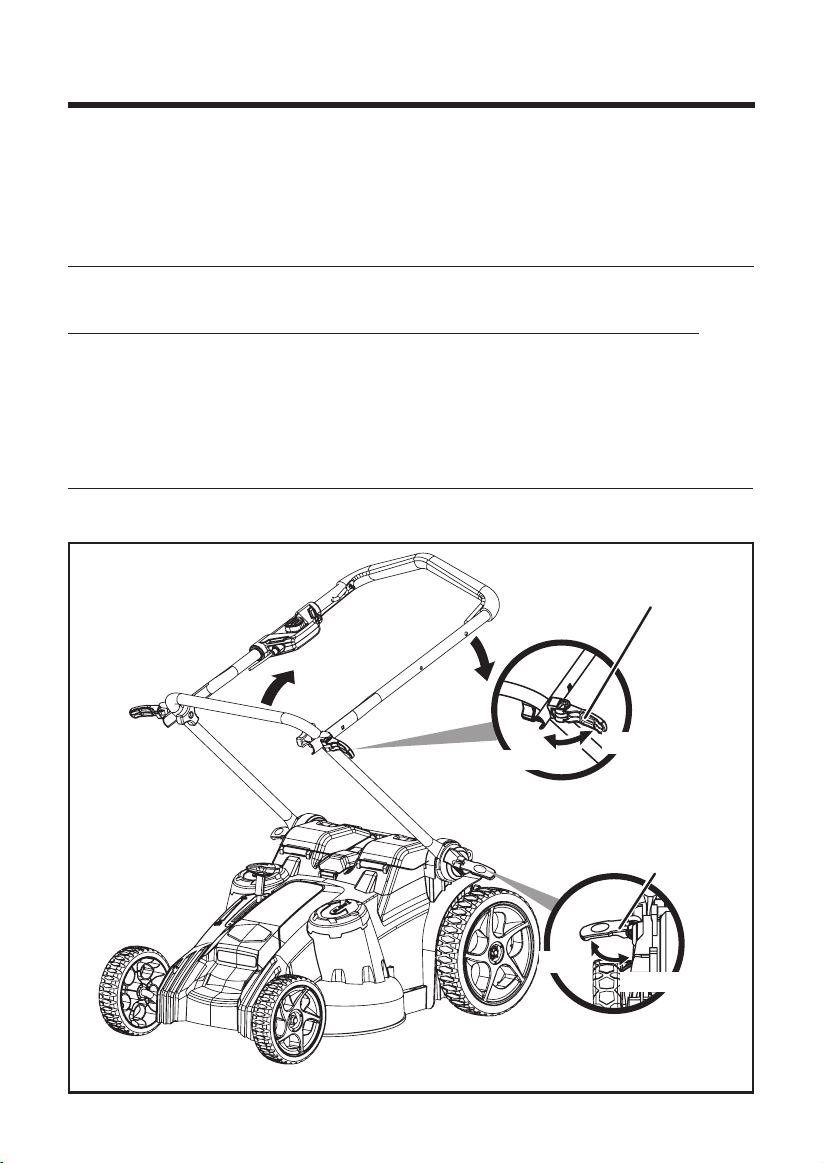
UNFOLDING AND ADJUSTING HANDLE ASSEMBLY (See Figure 2-3)
To raise handle assembly:
• Open the lower handle locks.
• Pull up and back on the lower handle until it is aligned with the slot between the handle locks
and the mower housing.
NOTE: If the lower handle is difcult to move, turn the lower handle locks counterclockwise to free the handle.
• To secure the lower handle in place, close the lower handle locks.
NOTE: If the lower handle is loose or does not seat completely in the slot, turn the lower handle locks
clockwise to secure the handle.
• Open the upper handle locks.
• Pull up and back on the upper handle to raise it into operating position. Make sure that the
lower handle is seated in the grooves at the bottom of the upper handle.
• To secure the upper handle in place, close the upper handle locks.
NOTE: If the upper handle is loose or separated from the lower handle, tighten the knobs on the upper handle
locks by turning them clockwise.
ASSEMBLY INSTRUCTIONS
12
Fig. 2
Open
Close
Upper handle lock
Lower handle lock
Open
Close
13
ASSEMBLY INSTRUCTIONS
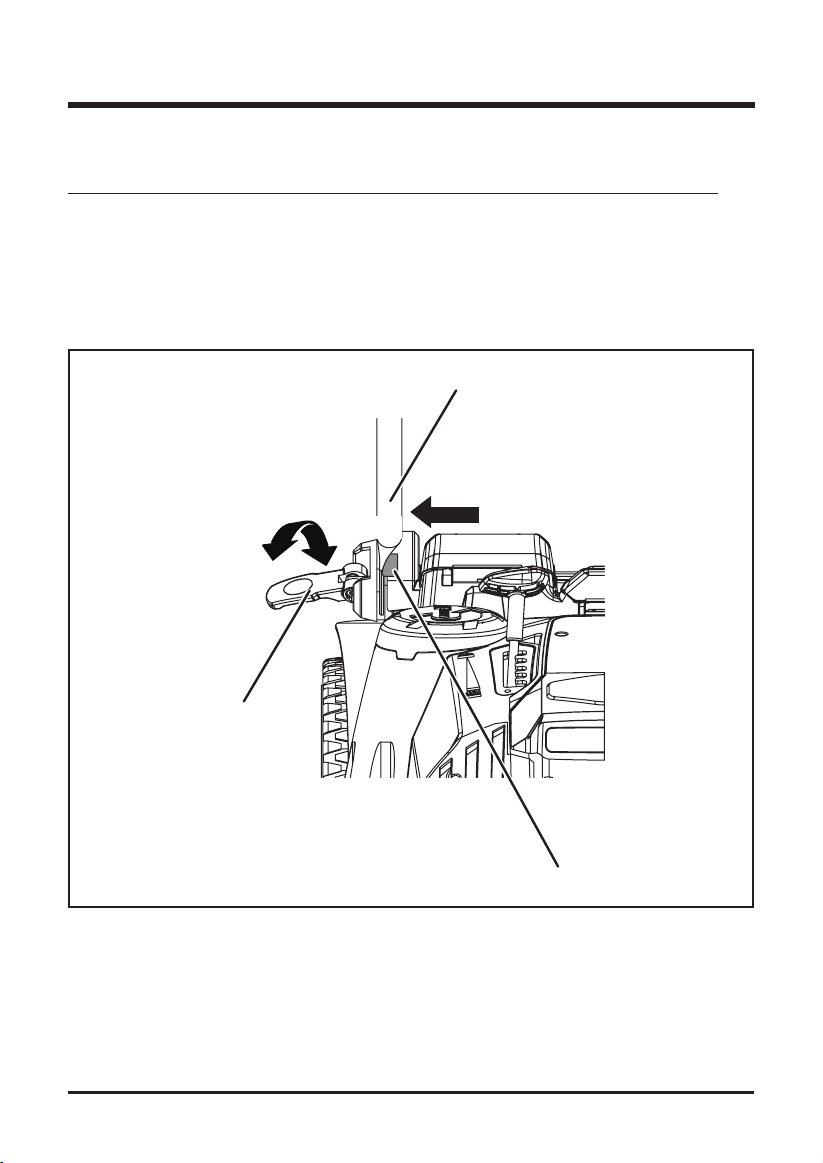
To lower the handle assembly:
• Open the upper handle locks.
NOTE: If the handle lock is difcult to open, loosen the knobs on the upper handle locks by turning them
counterclockwise.
• Lower the upper handle.
• Open the lower handle lock.
• Push outward on each side of the lower handle until it is free from the slot. Then, fold the
handle to the front of the unit. Avoid pinching or trapping any cables.
Fig. 3
Lower handle
Slot
Lower handle lock
Loosen
Tighten
14
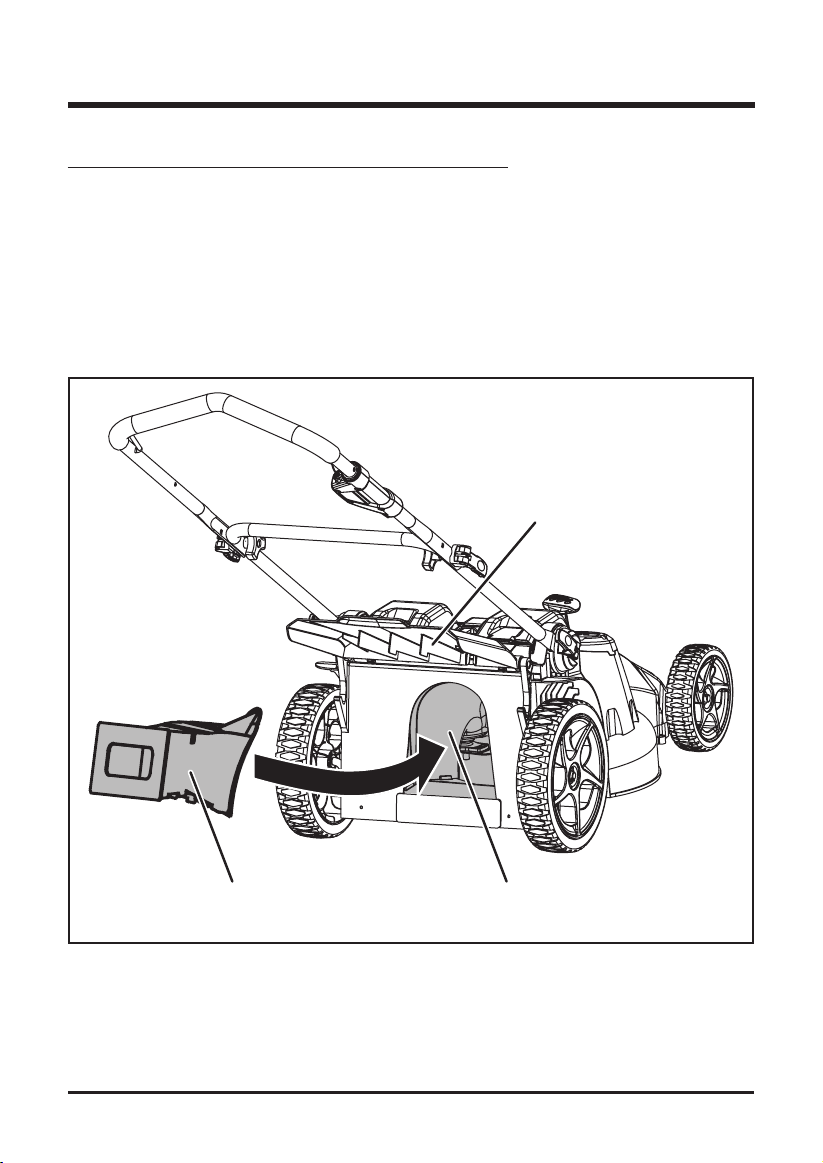
INSTALLING THE MULCHING PLUG (FOR MULCHING OPERATION) (See Figure 4)
NOTE: When using the mulching plug, do not install the grass catcher.
• Remove key and battery pack.
• Lift and hold the rear discharge door.
• Grasp the mulching plug by its handle and insert it at a slight angle, as shown.
• Push the mulching plug securely into place.
• Lower the rear discharge door.
• Reinstall key and battery pack when you are ready to mow.
ASSEMBLY INSTRUCTIONS
Fig. 4
Rear discharge openingMulching plug
Rear discharge door
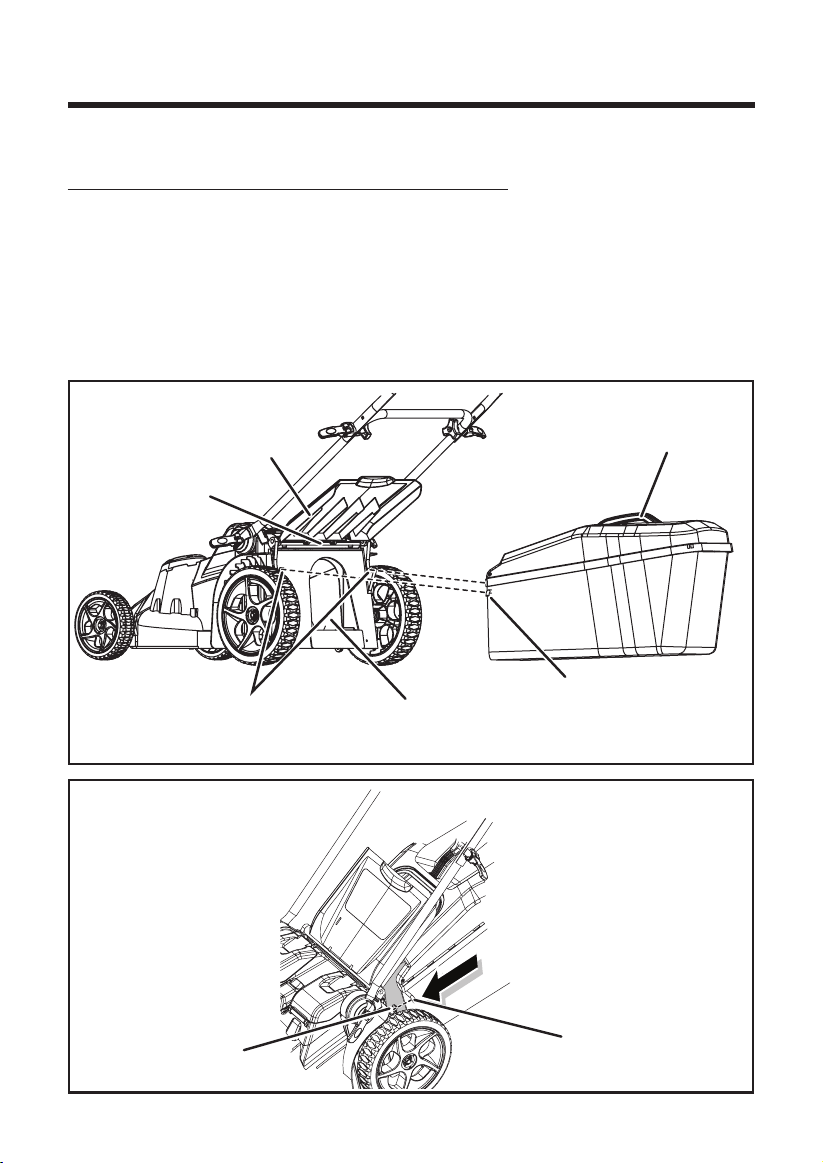
INSTALLING THE GRASS CATCHER (FOR REAR BAGGING OPERATION) (See
Figure 5-6)
NOTE: When using the grass catcher, do not install the mulching plug.
• Remove key and battery pack.
• Lift the rear discharge door.
• Lift the grass catcher by its handle and place under the rear discharge door so that the hooks
on the grass catcher are seated onto the slots on the mower housing.
• Release the rear discharge door.
• Reinstall key and battery pack when you are ready to mow.
ASSEMBLY INSTRUCTIONS
Fig. 5
Fig. 6
Grass catcher handle
Rear discharge
opening
Slots
Hooks
Rear door
Door rod
15
Hooks
Slots
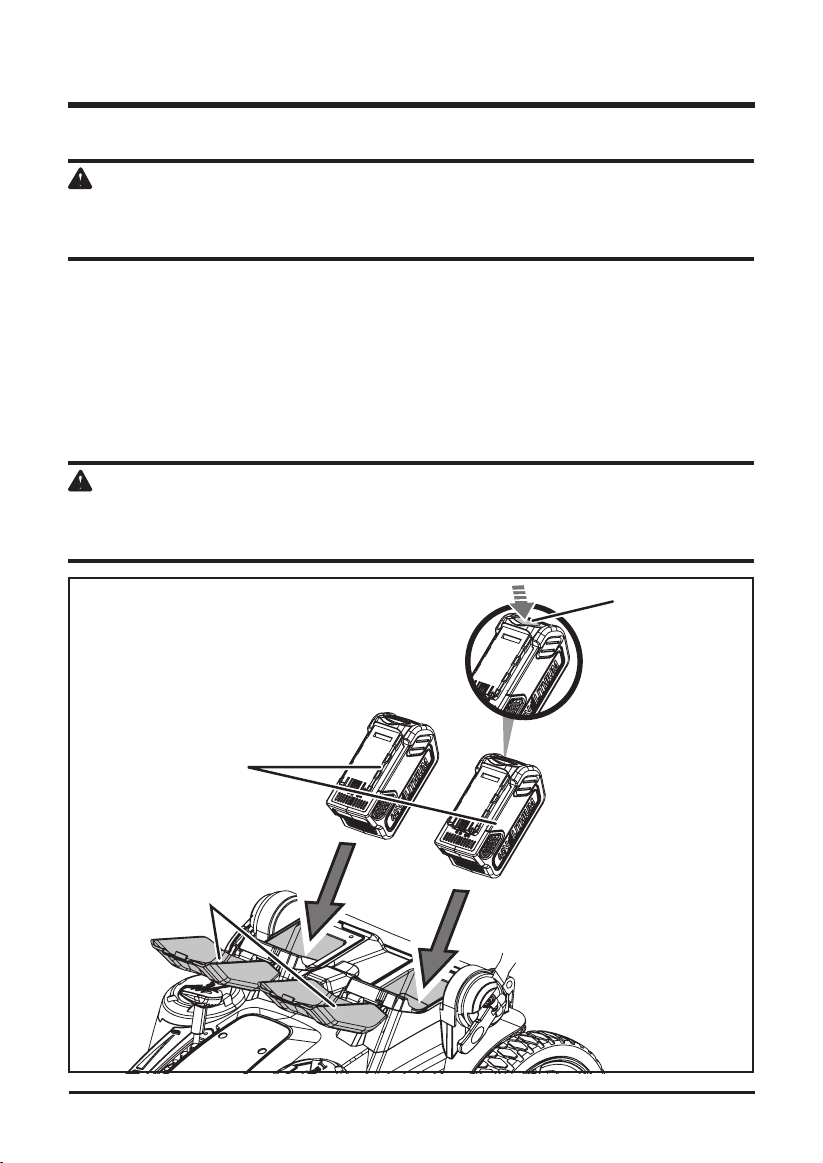
TO INSTALL BATTERY PACK (See Figure 7)
W A R N I N G
Always remove battery pack and key from your tool when you are assembling parts, making
adjustments, cleaning, or when not in use. Removing battery pack and key will prevent accidental
starting that could cause serious personal injury.
• Raise the battery cover.
• Place the battery pack in the mower.
• Align raised ribs on battery pack with grooves in the mower’s battery port.
• Push down into battery compartment until the battery clicks into place.
• Lower the battery cover.
• When installing the 73Wh Battery, follow the instructions above. There will be a gap between
the battery and battery compartment. This is normal.
W A R N I N G
Make sure the latch on the top of the battery pack snaps in place and the battery pack is fully
seated and secure in the mower’s battery port before beginning operation. Failure to securely
seat the battery pack could cause the battery pack to fall out, resulting in serious personal injury.
ASSEMBLY INSTRUCTIONS
Fig. 7
16
Battery pack
Battery cover
Latch
17
ASSEMBLY INSTRUCTIONS
TO REMOVE BATTERY PACK (See Figure 7)
• Raise the battery cover.
• Press and hold the battery latch button at the top of the battery pack.
• Remove battery pack from the mower.
W A R N I N G
To avoid serious personal injury, always remove the battery pack and key when carrying or
transporting the tool.
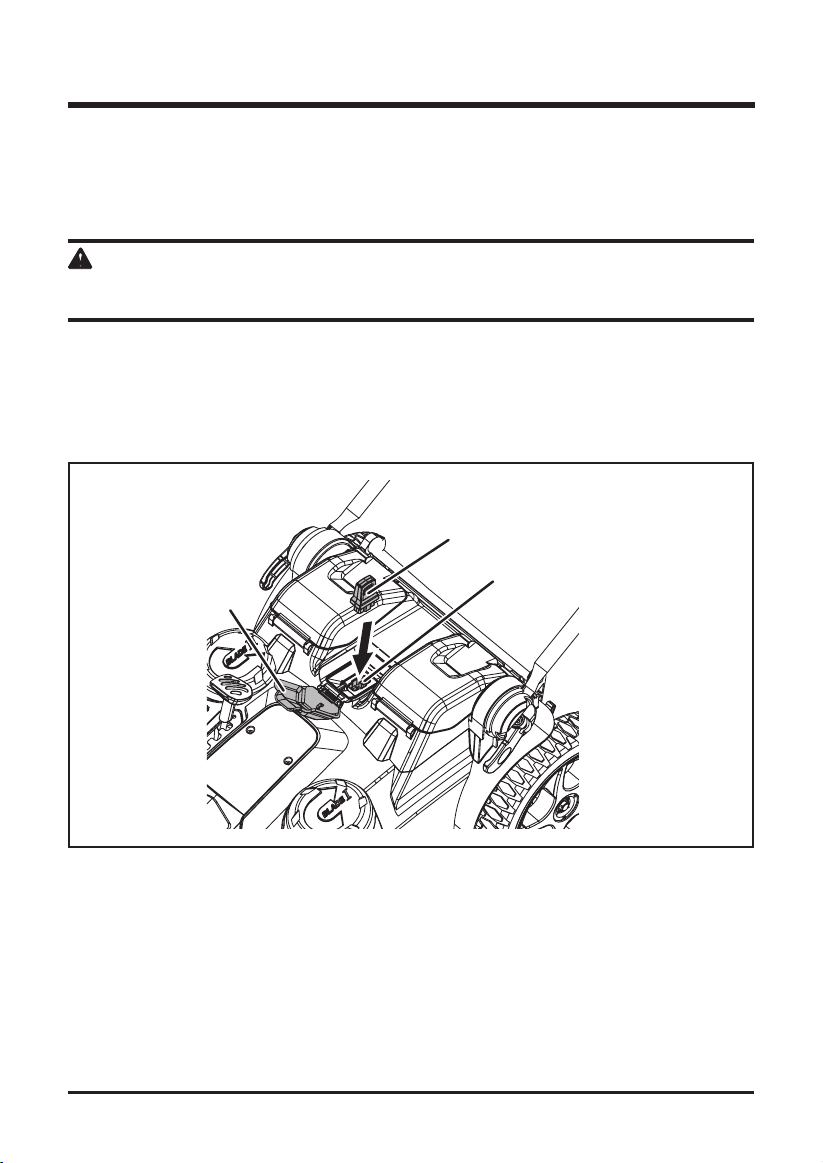
TO INSTALL KEY (See Figure 8)
• Raise the key cover.
• Insert the key into the slot.
• Lower the key cover.
Fig. 8
Key
Key slot
Key cover
18
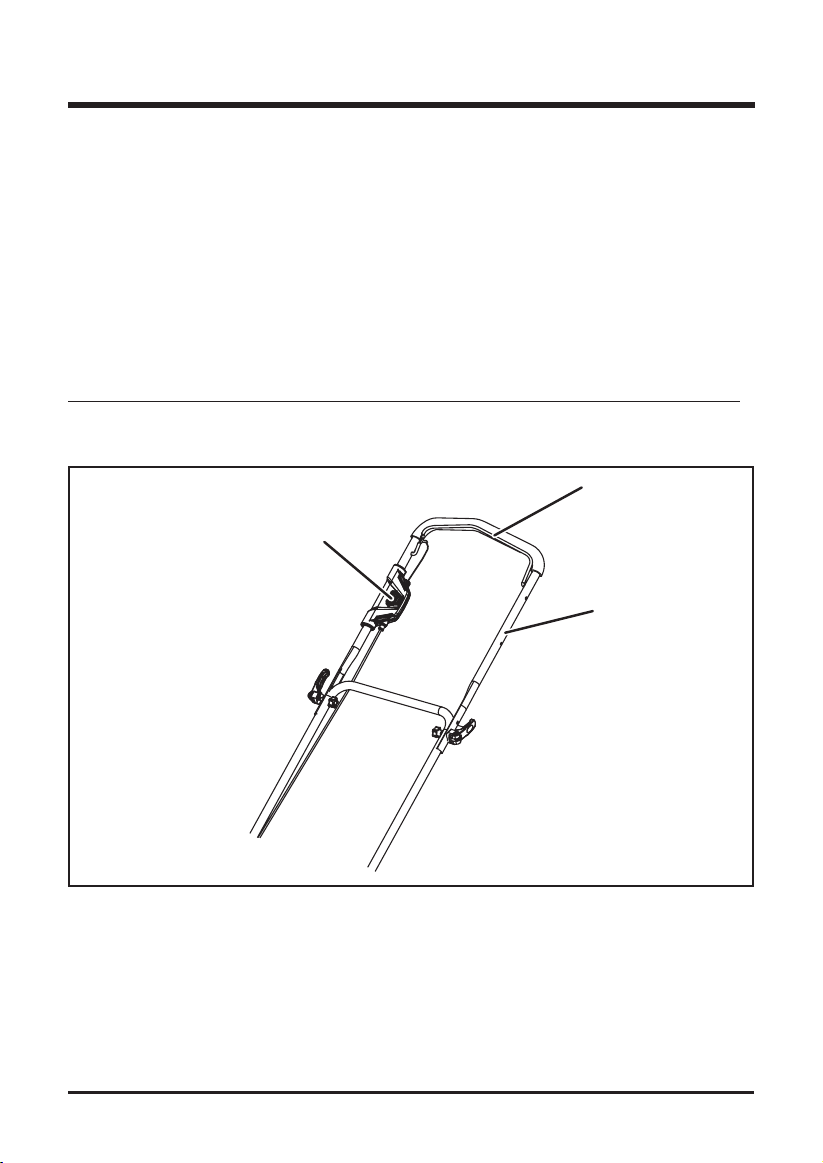
STARTING/STOPPING THE MOWER (See Figure 9)
• Raise the battery cover.
• Install battery pack.
• Lower the battery cover.
• Raise the key cover.
• Insert the key into the slot.
• Lower the key cover.
• Press and hold the start button. Pull the bail toward the handle and release the button to start
the mower.
• To stop the mower, release the bail.
NOTE: Power Save feature automatically adjusts the cutting speed of the blades to match the application to
give the best possible cut while maximizing run time and battery life.
OPERATING YOUR LAWN MOWER
Fig. 9
Start button
Bail
Upper handle
19
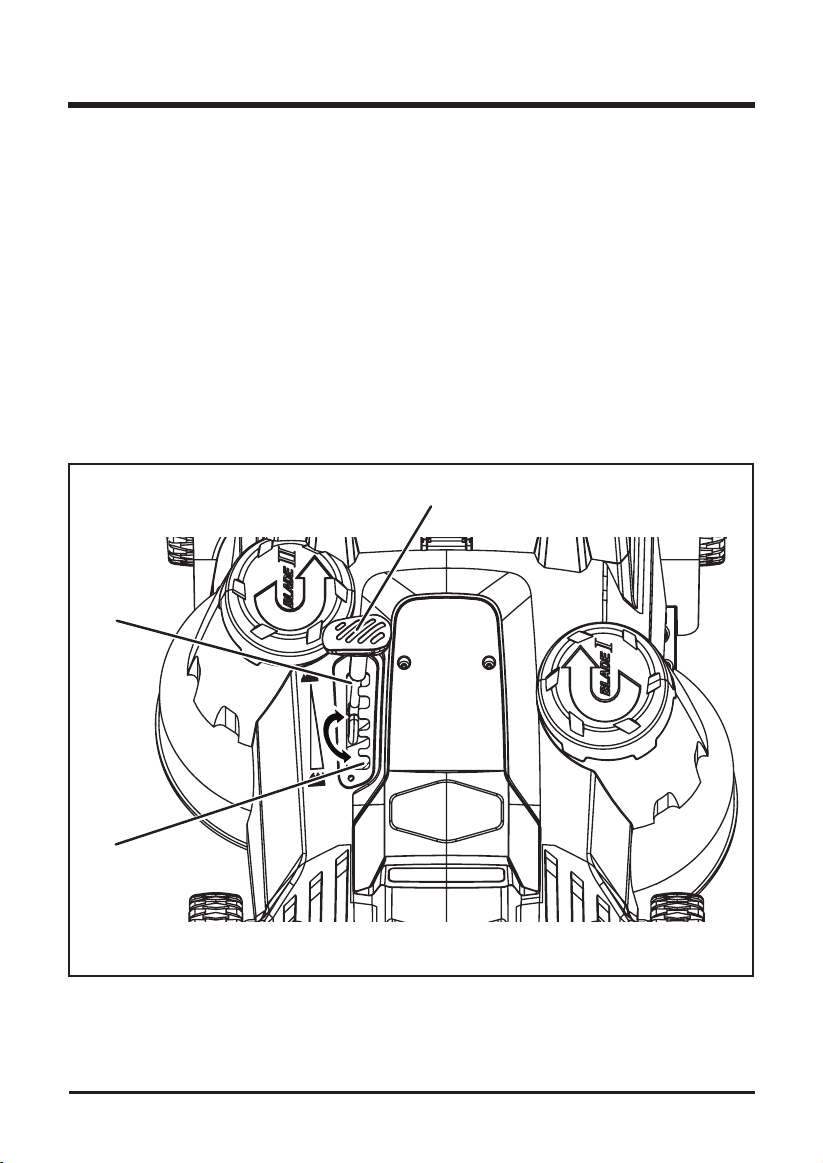
SETTING BLADE HEIGHT (See Figure 10)
When shipped, the wheels on the mower are set to a low-cutting position. Before using the
mower for the rst time, raise the cutting position to the height best suited for your lawn. The
average lawn should be between 1-1/2 in. to 2 in. during cool months and between 2 in. and 3-1/4
in. during hot months.
To adjust the blade height:
• Remove key and battery pack.
• To raise the blade height, grasp the height adjustment lever and move it toward the front of the
mower.
• To lower the blade height, grasp the height adjustment lever and move it toward the back of
the mower.
• Reinstall key and battery pack when you are ready to mow.
OPERATING YOUR LAWN MOWER
Fig. 10
Height adjustment lever
Lowest
blade setting
Highest
blade setting
20
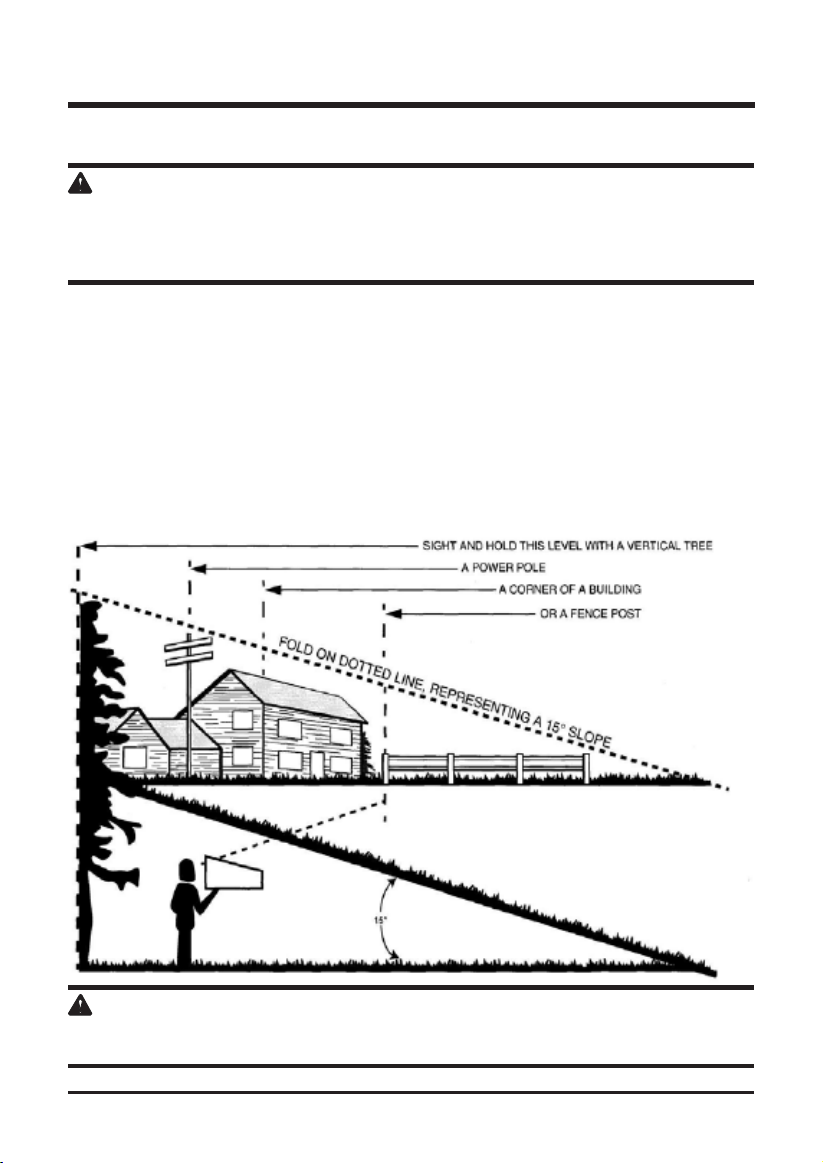
SLOPE GAUGE (See Figure 11)
W A R N I N G
Slopes are a major factor related to accidents involving slips and falls, which can result in severe
injury. Operating the mower on a slope requires extra caution. If you feel uneasy on a slope,
do not mow it. For your safety, use the slope gauge that is included as part of this manual to
measure slopes before operating this unit on a sloped or hilly area.
• Mow across the face of a slope, and never up and down. Exercise extreme caution when
changing direction on a slope.
• Watch for holes, ruts, rocks, hidden objects, or bumps that may cause a slip or a trip. Tall
grass can hide obstacles.
• Always be sure of your footing. If you feel like you are losing your balance, release the blade/
motor control handle immediately. The blade will stop rotating within 3 seconds.
• Do not mow near drop-offs, ditches, or embankments, because you could lose your footing or
balance.
• Do not mow a slope that has an angle of greater than 15°, as determined using the slope gauge.
• Do not mow wet or damp grass. Unstable footing can cause slipping.
W A R N I N G
Do not mow a slope that has an angle of greater than 15° (a rise of approximately 2 1/2’ [.75 m]
every 10’ [3 m]). Mow across the face of a slope, and never up and down.
OPERATING YOUR LAWN MOWER
Fig. 11

21
OPERATING YOUR LAWN MOWER
MOWING TIPS
NOTE: A sharp blade will greatly enhance the performance of the mower, especially when cutting high grass.
Be sure to check the blade and to sharpen it at least once per year, as described in the Maintenance section.
• Verify that the lawn is free of stones, sticks, wires, and other objects that could damage
the blades or the motor. These objects could be accidentally thrown by the mower in any
direction, and could cause serious personal injury to the operator and to others. In order to
prevent electric shock, do not operate the mower in damp or wet conditions.
• Do not mow in circles. Travel back and forth across the lawn.
• When cutting thick grass, reduce walking speed in order to allow for a more effective cut and
a proper discharge of the clippings.
• For a healthy lawn, always cut off one-third or less of the total length of the grass. The
average lawn should be approximately 1 1/2 to 2” (3.8 to 5 cm) long during cool months, and
between 2" to 3 1/4" (5 cm to 8.3 cm) long during hot months. If there is growth, the lawn
should be cut in the fall.
MULCHING TIPS
NOTE: INSPECT THE AREA WHERE THE MOWER IS TO BE USED, AND REMOVE ALL STONES,
STICKS, WIRE, BONES, AND OTHER DEBRIS THAT MIGHT BE THROWN BY THE ROTATING BLADE.
• Release the switch to turn the mower OFF when crossing any graveled area (stones can be
thrown by the blade).
• Set mower to the highest cutting height when mowing on uneven ground or in tall weeds.
• For effective mulching, do not cut wet grass, because it tends to stick to the underside of
the deck, preventing proper mulching of grass clippings. New or thick grass may require a
narrower cut. The ground speed should be adjusted to the condition of the lawn. If mowing
has been delayed and the grass has been allowed to grow longer than 4" (10 cm), mow the
lawn twice in order to reduce the grass height to a maximum of 3 1/4” (8.3 cm).
• Walk at a steady pace. Overlap the cutting rows. Do not let the grass get too tall. If the grass
gets too long, start at the highest cutting position and work down to the desired cutting height.
W A R N I N G
If you strike a foreign object, stop the motor and remove the battery. Thoroughly inspect the mower
for any damage. Repair any damage before operating the mower. Excessive vibration of the mower
during operation is an indication of damage. Thoroughly inspect the mower and repair any damage
before operating the mower.
22
OPERATING YOUR LAWN MOWER
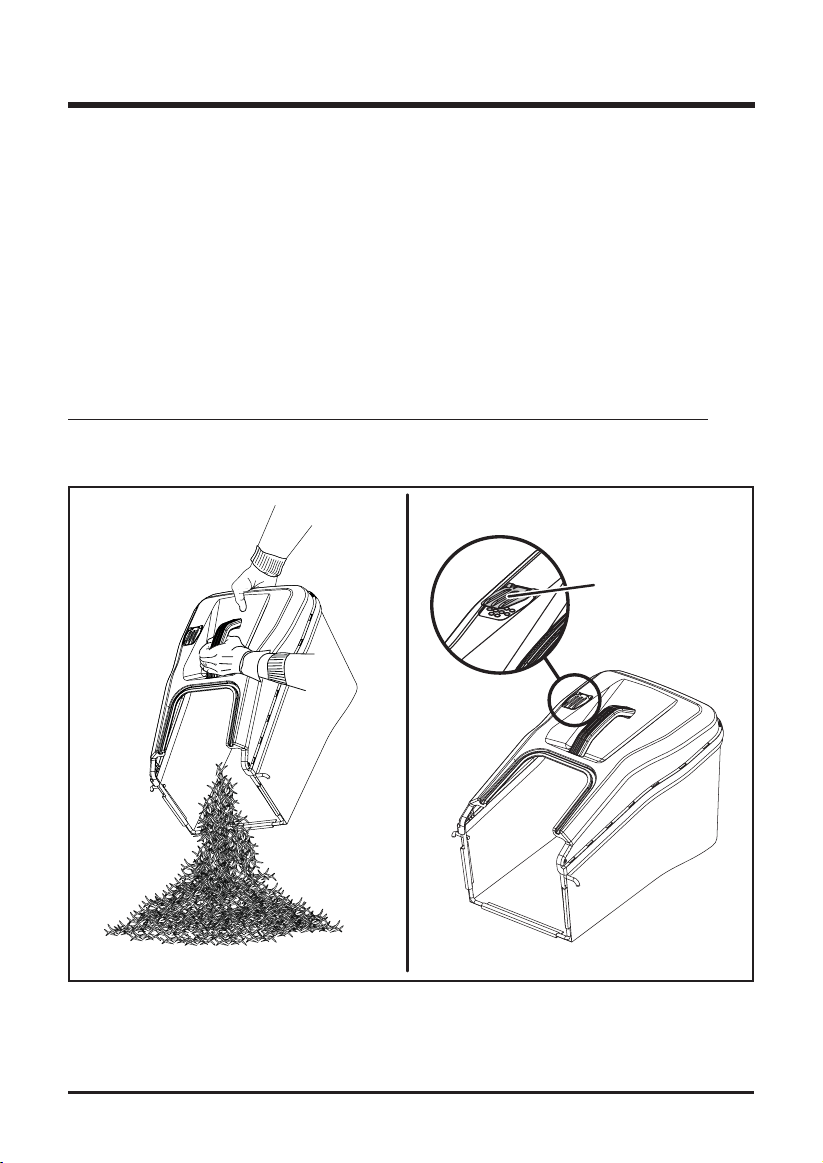
EMPTYING THE GRASS CATCHER BAG (See Figure 12-13)
• Stop the mower and allow blades to completely stop.
• Remove key and battery pack.
• Lift the rear discharge door.
• Lift the grass catcher by its handle to remove from mower.
• Empty grass clippings.
• Lift the rear discharge door and reinstall the grass catcher as described earlier in this manual.
• Reinstall key and battery pack when you are ready to mow.
NOTE: When you start the mower, the full bag indicator of the grass catcher will lift up. Once the grass
catcher is full, the full bag indicator will fall wholly. So the grass catcher bag need to be empty.
Fig. 12 Fig. 13
Full bag
indicator
2323
BATTERY CHARGER
CHARGING PROCEDURE (See Figure 14)
NOTE: The battery is not shipped fully charged. It is recommended to fully charge before rst use to ensure
that maximum run time can be achieved. This lithium-ion battery will not develop a memory and may be
charged at any time. A fully discharged battery pack will require approximately 60 minutes (73Wh) / 120
minutes (146Wh) to fully charge from a discharged state.
• Plug the charger into an AC power outlet.
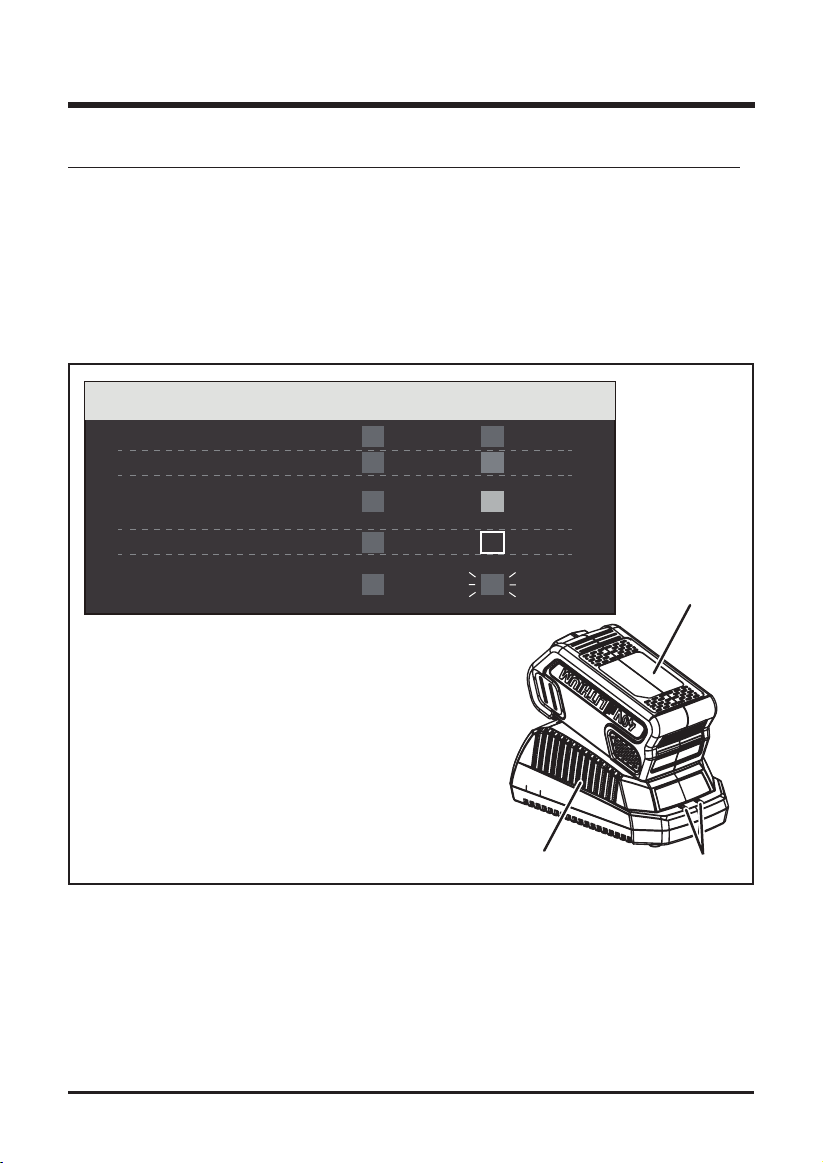
• Insert the battery pack (1) into the charger (2).
This is a diagnostic charger. The Charger LED Lights (3) will illuminate in specific order to
communicate the current battery status. They are as follows:
CHECKING THE CHARGE
If the battery pack does not charge properly:
• Check the current at the power outlet with another tool. Make sure that the outlet is not turned off.
• Check that the charger contacts have not been shorted by debris or foreign material.
• If the surrounding air temperature is not normal room temperature, move the charger and
battery pack to a location where the temperature is between 45˚F and 104˚F .
Fig. 14
3
1
2
CHARGING PROCEDURE (LED INDICATOR)
BATTERY IS CHARGING:
FULLY CHARGED:
BATTERY IS TOO WARM:
(REMOVE FOR APPROX. 30
MINUTES TO ALLOW TO COOL)
DEFECTIVE BATTERY:
(REMOVE AND REPLACE WITH
NEW BATTERY IF THIS OCCURS)
NO BATTERY PRESENT
RED RED
GREEN
ORANGE
OFF
RED
RED
RED
RED
RED
BLINKING
2424
BATTERY CHARGER
CHARGER MAINTENANCE
• Keep the charger clean and clear of debris. Do not allow foreign material into the recessed
cavity or on the contacts. Wipe with a dry cloth. Do not use solvents, water, or place in wet
conditions.
• Always unplug the charger when there is no battery pack in it.
• The battery pack may be stored in the charger. however, it is recommended to disconnect
the charger from the power source. To ensure safety and reliability all repairs should be
performed by a qualied service technician.
• Check that the charger contacts have not been shorted by debris or foreign material.
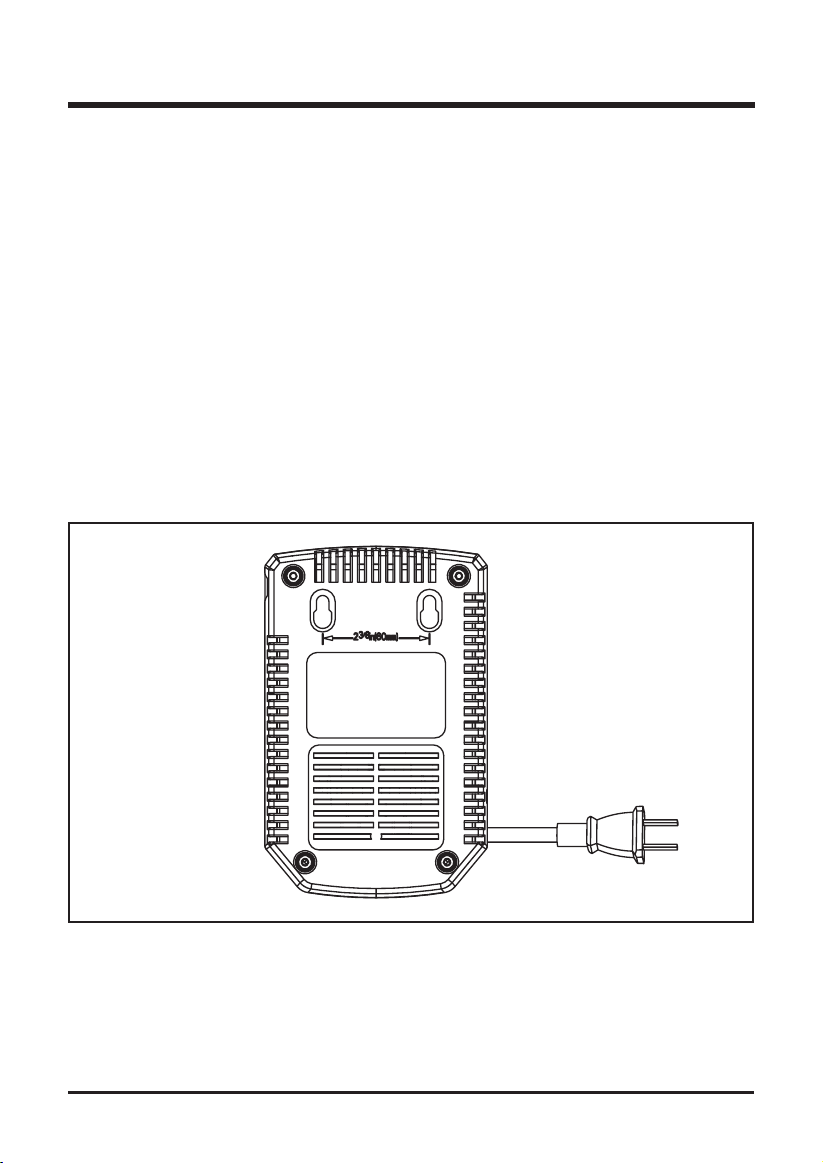
CHARGER MOUNTING (See Figure 15)
• This charger can be installed hanging on a wall using two screws (not supplied)
• Locate the placement for the charger to be wall mounted.
• If fastening to wood studs use 2 wood screws.
• Drill two holes 2 3/8” (6 cm) on center ensuring they are level.
• If fastening to dry wall use wall anchors and screws to secure the charger to the wall.
Fig. 15
25
MAINTENANCE
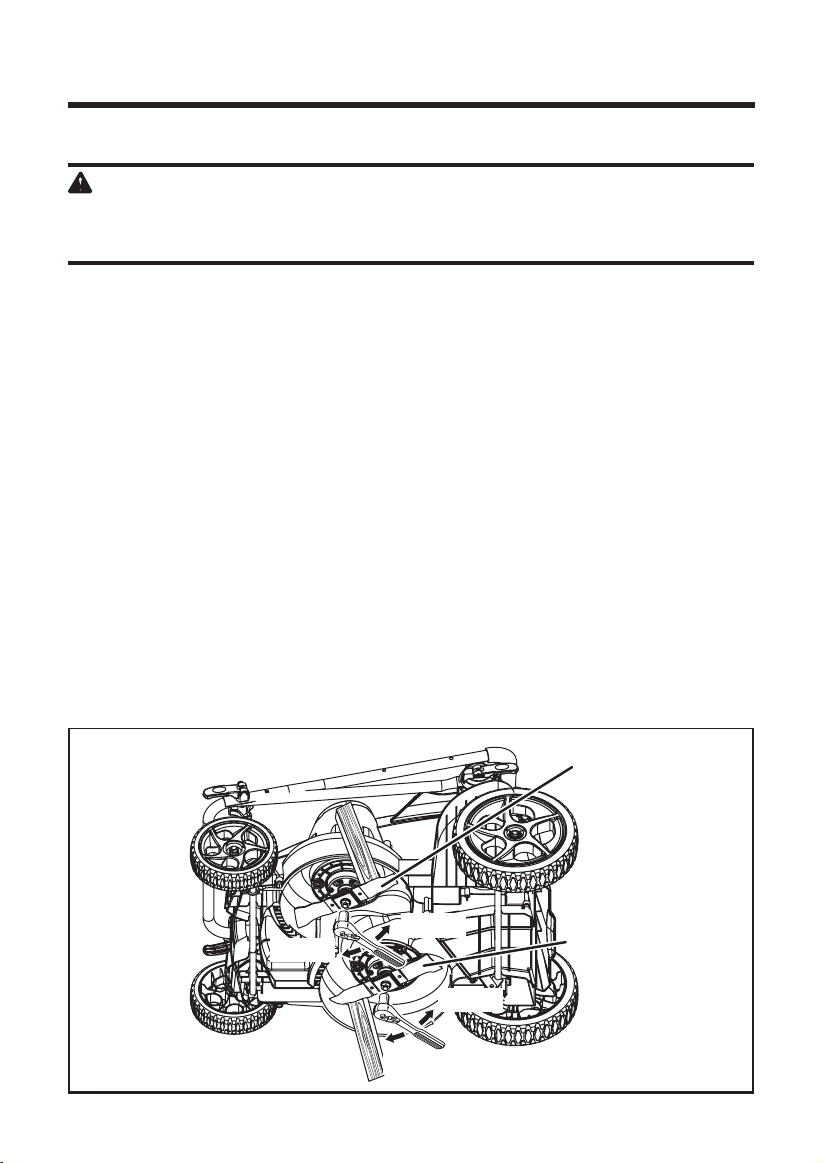
REPLACING THE CUTTING BLADE (See Figure 16-17)
W A R N I N G
Always protect your hands by wearing heavy gloves and/or wrapping the cutting edges with rags
or other materials when performing any maintenance on the blades. ALWAYS remove the key and
battery when servicing or transporting the mower.
Only use authorized replacement blades.
• Stop the motor and remove the key. Allow blade to come to a complete stop.
• Remove the battery pack.
• Turn the mower on its side.
• Wedge a block of wood between the blade and mower deck to prevent the blade from turning.
• For the BLADE I, loosen the blade nut by turning it clockwise (as viewed from bottom of
mower) using a 15 mm wrench or socket (not provided). For the BLADE II, loosen the blade
nut by turning it counterclockwise (as viewed from bottom of mower) using a 15 mm wrench or
socket (not provided).
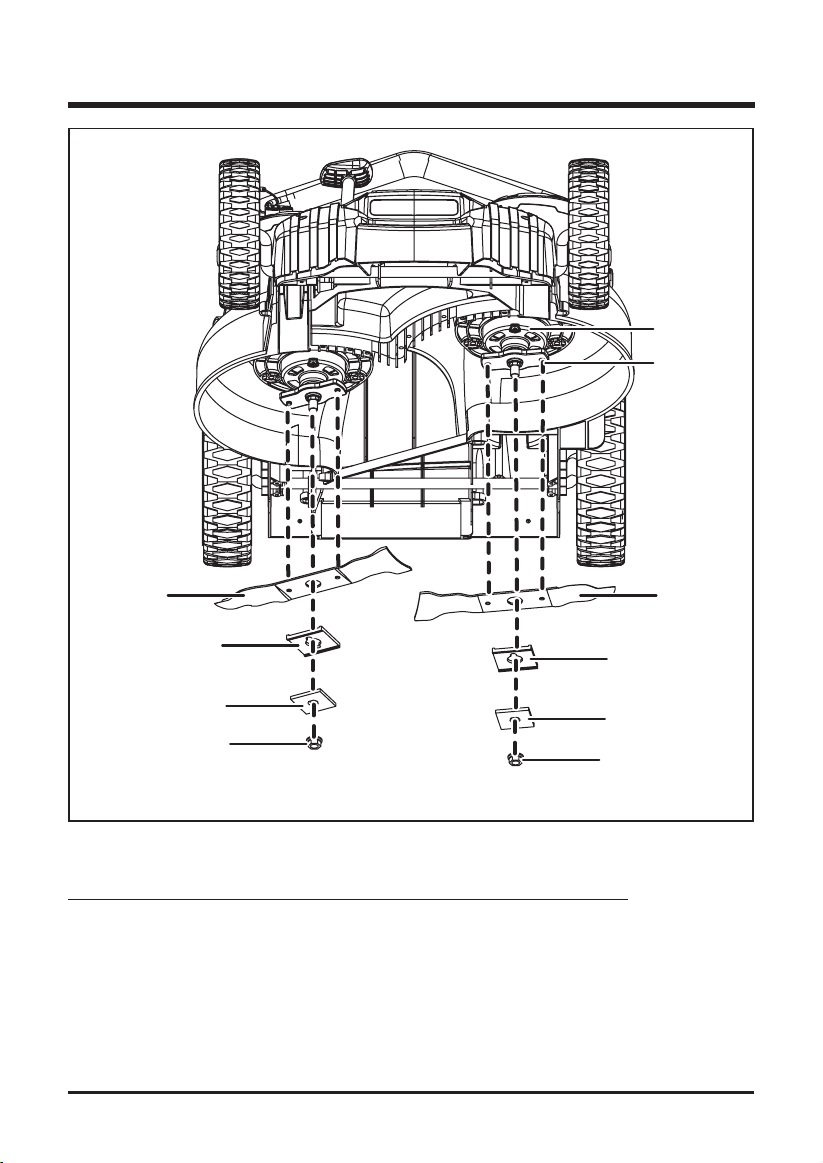
• Remove the blade nut, spacer, blade insulator, and blade.
• Make certain the motor assembly is pushed completely against the motor shaft.
• Place the new blade on the shaft against the motor assembly. Ensure blade is properly
seated with shaft going through center blade hole and the two blade posts inserted into their
respective holes on the blade. Make sure it is installed with the curved ends pointing up
toward the mower deck and not down toward the ground. When seated properly, the blade
should be at against the motor assembly.
Fig. 16
Tighten
Tighten
Loosen
Loosen
BLADE I
BLADE II
26
MAINTENANCE
• Replace the blade insulator and spacer, then thread the blade nut on the shaft and finger
tighten.
NOTE: Make certain all parts are replaced in the exact order in which they were removed.
• For the BLADE I, torque the blade nut down counterclockwise using a torque wrench (not
provided) to ensure the bolt is properly tightened. For the BLADE II, torque the blade nut
down clockwise using a torque wrench (not provided) to ensure the bolt is properly tightened.
The recommended torque for the blade nut is 350-400 in. lbs.
Fig. 17
BLADE IBLADE II
Motor
assembly
Blade posts
Blade insulator
Spacer
Blade nut
Blade nut
Spacer
Blade insulator

27
MAINTENANCE
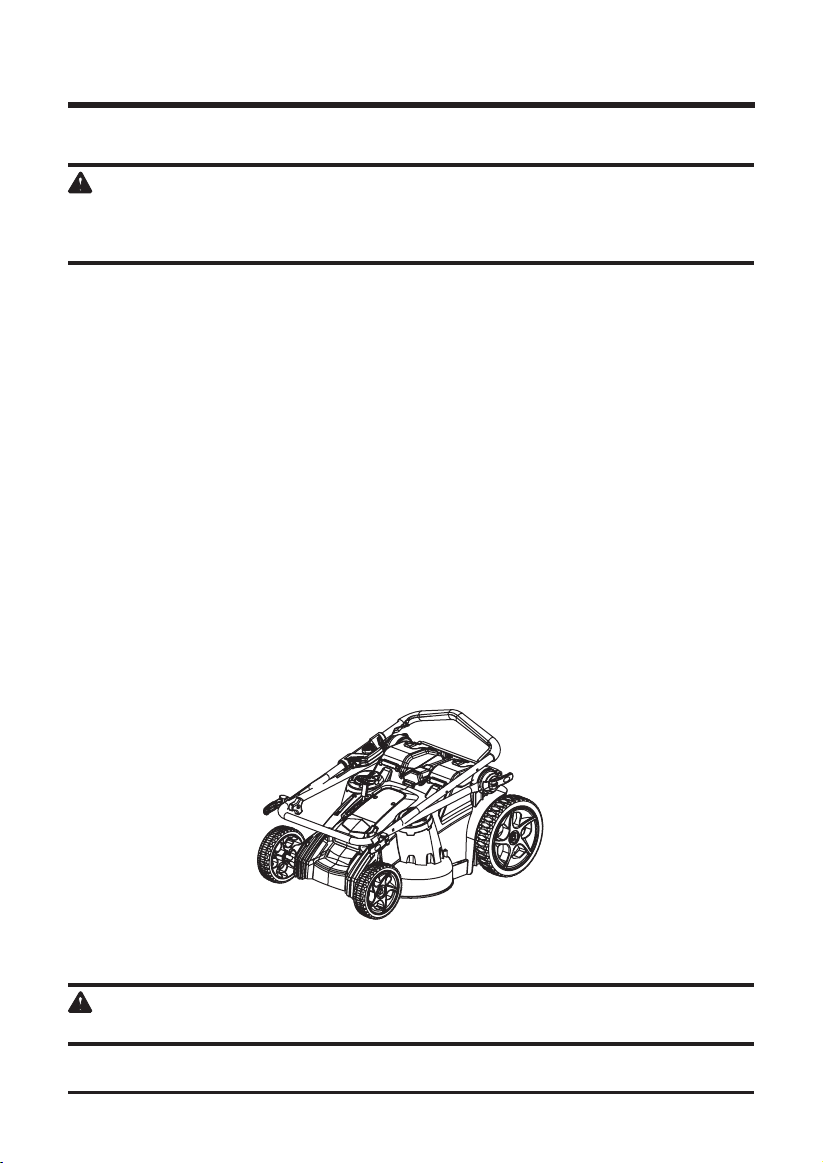
REPLACING THE BATTERY
The mower battery is designed for maximum life; however, like all batteries, it will eventually
need to be replaced.
Charge the new battery pack before use.
To install a new battery:
• Remove the key.
• Carefully unlock and remove the battery pack.
• Install the new battery pack.
• Take the old battery pack to a recycling center that accepts lead acid/lithium ion batteries.
Never dispose of battery in re or regular household trash.
28
MAINTENANCE
CLEANING THE MOWER
W A R N I N G
In order to reduce the risk of electric shock, do not expose the mower to water. The underside of
the mower deck should be cleaned after each use, because grass clippings, leaves, dirt, and other
debris will accumulate, which will cause rust and corrosion.
Remove any build-up of grass and leaves on or around the motor cover (do not use water).
Occasionally wipe the mower clean with a dry cloth. If debris builds up on the underside of the
mower during use, stop the motor, disconnect it from the battery, and then tilt the mower forward
or on its side, and scrape it clean using an appropriate tool.
STORING THE MOWER
The following steps should be taken in order to prepare the lawn mower for storage.
• Clean the mower as described in the previous section.
• Inspect the blade, and replace it or sharpen it, if required (refer to the Maintenance section).
• Lubricate the mower (refer to the Maintenance section).
• Store the mower in a dry, clean location. Do not store it next to corrosive materials, such as
fertilizer or rock salt.
• Store the mower indoors, in a cool, dry place, out of the reach of children. Do not cover the
lawn mower with a solid plastic sheet. Plastic coverings trap moisture around the mower,
which causes rust and corrosion.
• The handle may be folded away completely for storage.
(See Figure 2-3)
• Remove the battery and key, store it in a cool dry location, if possible. Charge the battery
every two months when not in use in order to increase its life.
W A R N I N G
This battery must be charged when in storage to maintain running life.

29
SERVICE
• When servicing the mower, use only replacement parts that are available from the
manufacturer. In order to obtain replacement parts, call the toll-free helpline, at 1-888-909-
6757. The use of parts that do not meet the original equipment specifications may lead to
improper performance, and may compromise safety.
• Before cleaning, repairing, or inspecting, verify that the blade and all moving parts have come
to a complete stop. Remove the battery when making any adjustments or when any of the four
wheels must be lifted off the ground.
• Follow the instructions for lubricating and changing accessories.
• Keep the handles dry, clean, and free of oil and grease.
• In order to reduce the risk of re, keep the motor free of grass, leaves, and debris build-up.
• Check the blade and motor mounting bolts for proper tightness frequently. Visually inspect
blade for damage (e.g., bent, cracked, or worn).
• For best and safest performance, maintain the mower with care. Keep the mower blade sharp
and clean. Mower blades are sharp, and can cut. Wrap the blades or wear gloves, and use
extra caution when servicing.
• Keep all nuts, bolts, and screws tight in order to be sure that the equipment is in safe working
condition.
• Never tamper with safety devices. Check them regularly for proper operation.
• After striking a foreign object, stop the motor. Thoroughly inspect the mower for any damage.
Repair any damage before operating the mower.
• The grass catcher components, discharge cover, and trail shield are subject to wear and
damage, which could expose moving parts or allow objects to be thrown. As a safety
precaution, check these components frequently, and immediately replace any parts that show
signs of wear, or that are cracked or broken. Use original equipment manufacturer's (OEM)
parts only, as listed in this manual.
• When it is not in use, store the mower indoors in a dry area, and out of the reach of children.
W A R N I N G
ALWAYS REMOVE KEY AND BATTERY WHEN SERVICING OR TRANSPORTING THE
MOWER.

30
ENVIRONMENTALLY SAFE BATTERY DISPOSAL
The batteries used in this mower's battery pack contain the following toxic and corrosive material:
LITHIUM-ION.
W A R N I N G
Toxic materials must be disposed of in a specied manner in order to prevent contamination of the
environment. Before disposing of damaged or worn out Lithium-Ion battery packs, contact your
local waste disposal agency for information and specic instructions. Take the batteries to a local
recycling and/or disposal centre that is certied for disposal. If the battery pack cracks or breaks,
whether it leaks or not, do not recharge it and do not use it. Dispose of it and replace it with a new
battery pack. DO NOT ATTEMPT TO REPAIR IT!
Follow these instructions in order to avoid injury and the risk of re, explosion, or electric shock,
and to avoid damage to the environment:
• Cover the battery's terminals with heavy-duty adhesive tape.
• Do not attempt to remove or destroy any of the components of the battery pack.
• Do not attempt to open the battery pack.
• If a leak develops, the electrolytes that are released are corrosive and toxic. Do not get the
solution in the eyes or on the skin, and do not swallow it.
• Do not place batteries in regular household trash.
• DO NOT incinerate batteries.
• DO NOT place batteries where they will become part of any waste landll or municipal solid
waste stream.
• Dispose of batteries at a certied recycling or disposal centre.
31
TROUBLESHOOTING
PROBLEM POSSIBLE CAUSE SOLUTION
The mower does
not start.
The mower cuts
the grass unevenly.
The mower does
not mulch properly.
The mower is hard
to push.
The mower is
excessively noisy
and vibrates.
The mower speeds
up and slows down
while in operation.
The battery is not charged.
The switch is defective.
Grass jammed at blade.
The battery is not attached to
the motor.
Battery may require service or
replacement.
Key is not installed.
The lawn is rough or uneven.
The cutting height is not set
properly.
Wet grass clippings are sticking
to the underside of the deck.
The mulching plug is missing.
The grass is too tall, or the
cutting height is too low.
The rear of the mower housing
and the blade are dragging in
thick grass.
The motor shaft is bent.
The blade is unbalanced.
This is normal. Power Save
feature automatically adjusts
the cutting speed of the blades
to match the application to
give the best possible cut while
maximizing run time and battery
life.
Charge the battery.
Replace the switch (call the tollfree
helpline, at 1-888-909-6757
Remove battery; check under deck for
jams.
Check the connection between the motor
connector and the battery.
Call toll free helpline, at 1-888-909-6757
or replace battery.
Insert the key.
Check the mowing area.
Move the wheels to a higher setting.
Wait until the grass dries before mowing.
Install the mulching plug.
Raise the cutting height.
Empty the grass clippings from the grass
catcher bag.
Stop the motor, and inspect for damage.
Repair before restarting. If vibration
persists, call the toll free helpline (1-888-
909-6757)
None, this is normal.

32
GREENWORKS™ hereby warranties this product, to the original purchaser with proof of
purchase, for a period of four (4) years against defects in materials, parts or workmanship.
GREENWORKS™, at its own discretion will repair or replace any and all parts found to be
defective, through normal use, free of charge to the customer. This warranty is valid only for
units which have been used for personal use that have not been hired or rented for industrial/
commercial use, and that have been maintained in accordance with the instructions in the
owners’ manual supplied with the product from new.
Battery carries a two (2) years warranty against defects in workmanship and materials. Batteries
must be charged in accordance with the operator’s manuals directions and regulations in order
to be valid.
ITEMS NOT COVERED BY WARRANTY:
1. Any part that has become inoperative due to misuse, commercial use, abuse, neglect,
accident, improper maintenance, or alteration; or
2. The unit, if it has not been operated and/or maintained in accordance with the owner's
manual; or
3. Normal wear, except as noted below;
4. Routine maintenance items such as lubricants, blade sharpening;
5. Normal deterioration of the exterior nish due to use or exposure.
GREENWORKS HELPLINE (1 888 90WORKS):
Warranty service is available by calling our toll-free helpline, 9 a.m. to 5 p.m. EST. at 1 888 909
6757 (1 888 90WORKS).
TRANSPORTATION CHARGES:
Transportation charges for the movement of any power equipment unit or attachment are the
responsibility of the purchaser. It is the purchaser’s responsibility to pay transportation charges
for any part submitted for replacement under this warranty unless such return is requested in
writing by GREENWORKS.
LIMITED FOUR-YEAR WARRANTY
33
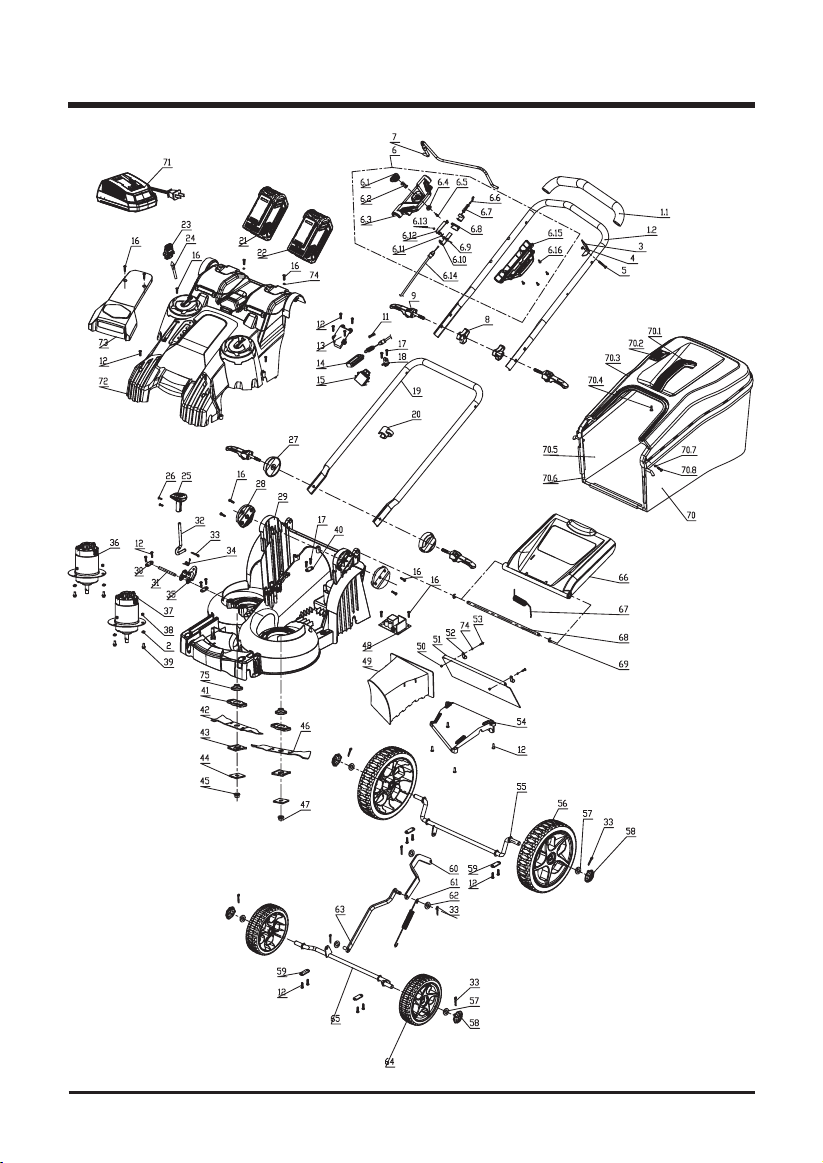
EXPLODED VIEW

34
PARTS LIST
ITEM NO. PART NO. DESCRIPTION QTY
1 31104488 Upper handle assy. 1
1.1 34135486 Foam grip 1
1.2 33310470-2 Upper handle 1
2 32207115 Washer 6
3 33323250-1 Stop sheet 1
4 3220439 Lock nut M5 1
5 32208234A Screw M5x30 1
6 31107486-1 Motor engagement box assy. 1
6.1 34136486 Start button 1
6.2 33401229 Spring 1
6.3 34122486 Upper cover, motor engagement box 1
6.4 34140486 Compressor 1
6.5 3220735N Screw ST3x8-C 3
6.6 31901250 Start cable (short) 1
6.7 33318250 Tension spring 1
6.8 34118250 Block 1
6.9 32204250 Screw M3x20 1
6.10 33317250 Slide block 1
6.11 33316250 Torsion spring 1
6.12 33315250 Spring 1
6.13 3221305 Nut M3 1
6.14 31901486 Start cable (long) 1
6.15 34121486 Lower cover, motor engagement box 1
6.16 32204113D Screw ST4.2x20-C 4
7 33305469-3 Motor bail 1
8 34106467-1 Knob 2
9 31102467-2 Cam lock assy. 4
10 33324250 Cord guide 1
11 33332250 Spring 1
12 32204113D Screw ST4.2x20-C 4
13 34119486 Upper cover, switch box 1
14 34114250 Slide block, switch box 1
15 36301289 Switch 1
16 32201572 Screw ST4.2x14 4
17 32202517 Screw ST4x10 5
18 33314486 Switch box bracket 1
19 33315486 Lower handle 1
20 34135469A Cord guide 1
21 31104975 40V 146Wh battery pack 1
22 31103976 40V 73Wh battery pack 1
23 31201470 Key 1
24 34903250 knit 15 cm

35
PARTS LIST
ITEM NO. PART NO. DESCRIPTION QTY
25 34109470-1 Height adjustment knob 1
26 32201470 Srew M3x8 2
27 34105470-2 Cam lock cover 2
28 34123486 Cam lock base 2
29 34105486 Deck 1
30 33306470 Height adjustment plate 2
31 33201470 Height adjustment alxe 1
32 33305486 Height adjustment lever 1
33 3290135 Pin φ2.5 8
34 33901470 Height adjustment torsion spring 1
35 33305470 Height adjustment bracket 1
36 36101486A Motor, 5335F-40V/20” 1
37 36101486 Motor, 5335Z-40V/20” 1
38 3220537 Lock nut M6 6
39 3220135 Bolt M6x25 6
40 3410403 Wire clip 1
41 34106486 Blade holder 2
42 33308486 Reverse blade 1
43 34107486 Blade insulator 2
44 33309486 Spacer 2
45 3220535A Nut M10x1.25 1
46 33307486 Blade 1
47 3221037A Nut M10x1.25 1
48 36202486-1 Power switch board 1
49 34141486 Mulching plug 1
50 3221237 Lock nut M4 2
51 34127486-1 Rear shield 1
52 3330490-1 Wire clip 2
53 3220511D Screw M4x12.5 2
54 34128486 Rear bafe 1
55 33302486 Rear wheel axle 1
56 34102486 10” wheel 2
57 3220898 Washer 4
58 34106488 Wheel cover 4
59 33318486 Wheel alxe washer 4
60 33304486 Link bar (rear) 1
61 33306486 Height adjustment tension spring 1
62 32904131-1 Washer 3
63 33303486 Link bar (front) 1
64 34103486 7” wheel 2

36
PARTS LIST
ITEM NO. PART NO. DESCRIPTION QTY
65 33311486 Front wheel axle 1
66 34126486 Rear cover 1
67 33904486 Torsion spring, rear cover 1
68 33317486 Rear cover rod 1
69 3290506 Retaining ring 8 2
70 31108486 Grass catcher bag assy. 1
70.1 34132486 Catcher bag handle 1
70.2 34133486 Indicator 1
70.3 34130486 Grass catcher bag cover 1
70.4 32201572 Screw ST4.2x14 2
70.5 34125486 Grass catcher bag 1
70.6 33316486 Grass catcher frame 1
70.7 3290305 Washer 2
70.8 3220511D Screw M4x12.5 2
71 31102998 40 Charger 1
72 31109486 Motor cover assy. 1
73 34111486 Upper cover 1
74 3290305 Washer 4
75 33320486 Spindle guard 2

TOLL-FREE HELPLINE: 1-888-90WORKS
(888.909.6757)
Rev: 01 (11-15-12) Printed in China on 100% Recycled Paper
