User manual Camera
Getting Started
INSTALLING THE SWANN SECURITY APP
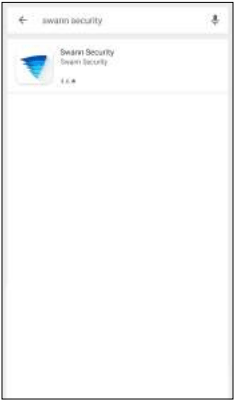
Search and download the latest version of the Swann Security app using the Google Play® store app on your phone.

After the Swann Security app is installed on your phone, the Swann Security app icon appears on the Home or Apps screen.
To open the Swann Security app, tap the app icon.
CREATING YOUR SWANN SECURITY ACCOUNT

Open the Swann Security app and tap Not yet registered? Sign Up.

Enter your first and last name, email address, a desired password and confirm the password. This will be the email address and password you use to sign into the Swann Security app and on any other phone. Tap the Next button to continue.
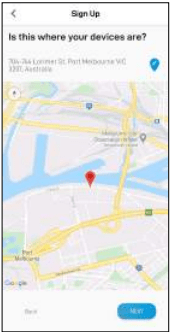
Your address is automatically set based on your phone's current location.
If the location is not accurate or if your phone's Location (GPS) setting is not turned on, tap  to enter your address manually.
Your device location helps us personalize your experience on the Swann Security app and other Swann services.
Tap the Next button to continue.
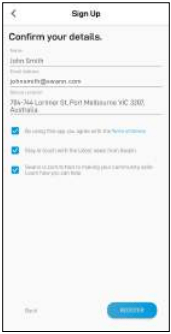
Review your details, read the Terms of Service, and select the checkbox to agree to the Terms of Service.
Tap the Register button to create your Swann Security account.
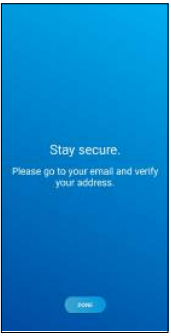
Go to your email inbox and open the link in the verification email from Swann Security.
If you can't find the verification email, try checking the Junk/Spam folder.
Tap the Done button to return to the Sign In screen.
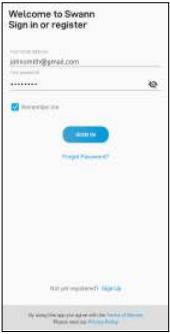
Once your email address is verified, you can sign into the app with your Swann Security account email address and password.
The Remember Me option allows you to save your login credentials so you don't have to sign in every time you open the app.
PAIRING THE DEVICE

The first time you launch the app, the Pair Device screen is displayed. Follow the on-screen instructions to set up and pair your device to your Swann Security account. Once the pairing process is complete, your device will be displayed on the Live View tab.
Note:
- If you need help with the device's QR code, see "Scanning the QR Code" on page 7.
- Your phone's Location (GPS) setting should be switched on as the app requires this permission temporarily to detect wireless networks during the pairing process.
- If you see a pop-up requesting permission to access the device's location, select Allow only while using the app (older devices, tap Allow) to enable the Wi-Fi connection from the phone to the Swann camera to work. If you deny location access, the app will not be able to detect and display the Wi-Fi access point on the "Preferred Wi-Fi" pairing screen later.
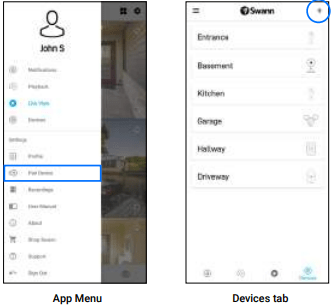
After you have paired your first Swann device, you can add subsequent Swann devices via:
- the Pair Device menu option in the app menu, or
- the + icon in the top right corner of the Devices tab.
SCANNING THE QR CODE
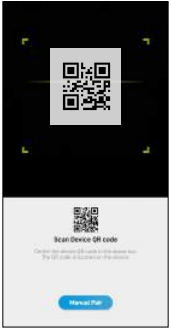
During the pairing process, you'll need to scan the device's QR code which can be generally found on the top, bottom, or back of the device. Check out the figures below for examples of where the QR code is located.
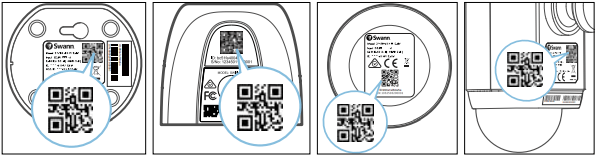
Note: If the device was previously migrated from the SAFE by Swann app, check your inbox for an email from Swann Security with the subject "Important - Save this QR Code for your camera". This email will contain the camera's QR code which you can scan with your phone.
If your phone can’t scan the QR code
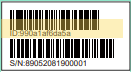
- You can tap the Manual Pair button at the bottom of the QR code scanning screen, select the device you want to pair from the product menu, and type in the device's ID/MAC (consists of 12 alphanumeric characters) is listed on a sticker located on the back, bottom or base of the device, as shown below
About the App Interface
APP NAVIGATION

- App Menu: Tap to open the menu where you can edit your account profile, pair a new device, download the app manual, and more. See "App Menu" on page 10.
- Notifications Tab: Tap to view and manage device notifications from Swann Security. If a notification dot, for example
 , is displayed next to the icon, it indicates the number of unread notifications in the Notifications tab. For more information, see "Notifications Tab" on page 11.
- Playback Tab: Tap to access and playback the event recordings from your devices. For more information, see "Playback Tab" on page 16.
- Live View Tab: Tap to view live video feed from all your connected devices in multi-view screen as well as in single-view where you can operate various camera functions. For more information, see "Live View Tab - CCTV System" on page 12, "Live View Tab - Wi-Fi Cameras" on page 13, and "Live View Tab - Single Camera View Mode" on page 14.
- Devices Tab: Tap to view and manage settings for your devices as well as check device status and perform general maintenance including firmware updates. For more information, see "Device Management" on page 18.
APP MENU
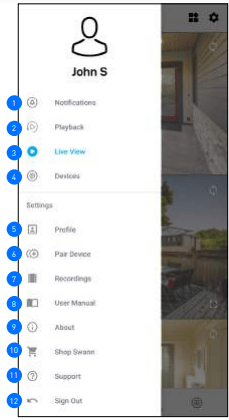
- Open the Notifications tab to view and manage device notifications from Swann Security. See "Notifications Tab" on page 11.
- Open the Playback tab to access and playback the event recordings from your devices. For more information, see "Playback Tab" on page 16.
- Open the Live View tab to monitor live video feed from your devices. For more information, see "Live View Tab - CCTV System" on page 12 and "Live View Tab - Wi-Fi Cameras" on page 13.
- Update your profile name, account password, and address. See "Updating Your Account Profile" on page 27.
- Pair a new Swann device to your Swann Security account or re-pair an existing Swann device after factory reset.
- Tap to view and manage settings for your devices as well as view device status and perform general maintenance including firmware updates. For more information, see "Device Management" on page 18.
- Open your phone's Gallery or Photos app to view snapshots and clips that were captured or downloaded.
- Download the Swann Security app user manual (PDF file) to your phone. For best viewing experience, open the file using Acrobat Reader (available on Google Play).
- Display the app version information and view terms of service and privacy policy relating to the usage of the Swann Security app.
- Open the Swann.com website where you can find and purchase the latest products to integrate with your Swann Security system.
- Open the Swann Support Center website where you can obtain technical support for your Swann Security account and devices.
- Sign out of the Swann Security app.
NOTIFICATIONS TAB

1. The Notifications tab displays notifications about device status and events from Swann Security. Notifications are sorted by date and time with most recent on top. Depending on the type of device you have, you can receive notifications for: Motion detection, Sound detection, Person detection, Face detection, and Device status (such as Online, Offline, Restart, Low Wi-Fi signal, Low Battery, Charging, Firmware update progress)
- Tap a notification to clear the "Unread" label and display the live view of the corresponding camera.
- To delete an individual notification, press and hold the notification and tap Confirm on the Clear Event pop-up.
- To clear all notifications, tap
 in the bottom right corner of the screen.
2. Tap to manage notification settings.
3. Notification Status is enabled by default. If the Notification Status is turned off, you will stop receiving device notifications from Swann Security.
4. Check or uncheck the Receive notifications from this camera/DVR box to enable or disable notifications about a specific device.
5. Some versions of the Android operating system automatically put apps to sleep to conserve battery life when your phone is not in use or when an app hasn't been used for a few days. You may need to turn off (or exclude) "Battery optimization" for the Swann Security app so you can continuously receive notifications. Please check the user guide that comes with your phone for more information about "Battery optimization".
LIVE VIEW TAB - CCTV SYSTEM

1. Toggle the layout of camera (channel) tiles in the viewing area between list and two-column grid views.
2. Tap to configure settings for the Live View tab. You can hide unused camera channels from being displayed (for example, you may have a 8-channel DVR/ NVR system with only 4 cameras connected to the corresponding channels. DVR/ NVR channels without any cameras connected are displayed as blank tiles, as shown on the right) and customize the order of camera tiles according to their importance. For more information, see "Live View Settings" on page 15.
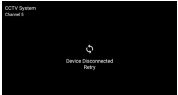
3. The device and camera (channel) names are displayed. You can rename the device and camera (channel) via the device's settings screen.
4. Tap to display live video of the selected camera in single view mode and access additional camera options (device-dependent) including quick snapshots/clips, 2-way talk, spotlights, and siren. For more information, see "Live View Tab - Single Camera View Mode" on page 14.
LIVE VIEW TAB - WI-FI CAMERAS

1. If you have more than two cameras, you can toggle the layout of camera tiles in the viewing area between list and two-column grid views.
2. Tap to configure settings for the Live View tab. You can hide camera tiles and customize the order of camera tiles according to their importance. For more information, see "Live View Settings" on page 15.
3. The camera name is displayed. You can rename the camera via the device's settings screen.
4. Tap to refresh the camera's live video feed if it has stopped streaming.
If the camera has completely lost connection to the app (due to connection timeout, device sleeping, Wi-Fi/Network issues, etc), the camera tile will be displayed as shown on the right. Tap  to re-establish the camera connection.
Note: If your camera stays offline for an extended period of time, try turning the power to the camera off for 10 seconds before turning it back on. You might also want to make sure that your internet connection is working properly. You can try rebooting your Wi-Fi router to resolve any network connectivity issue.
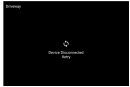
5. Tap to display live view of the selected camera in single view mode and access additional camera options (device-dependent) including quick snapshots/clips, 2-way talk, pan tilt controls, siren, and more. For more information, see "Live View Tab - Single Camera View Mode" on page 14.
6. If a firmware update to the camera is available, an update prompt  will appear in the bottom of the camera tile. Tap , then tap Check for updates on the Settings screen and tap the Update button to install the new firmware on the camera.
LIVE VIEW TAB - SINGLE CAMERA VIEW MODE
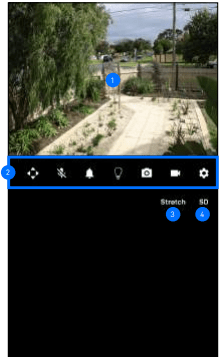
1. The camera's live video window
- You can zoom in or out on the video. Use two fingers to pinch and spread out to zoom in on an area, and pinch back to zoom out.
- You can turn your phone sideways to view the video window in landscape (fullscreen) mode.
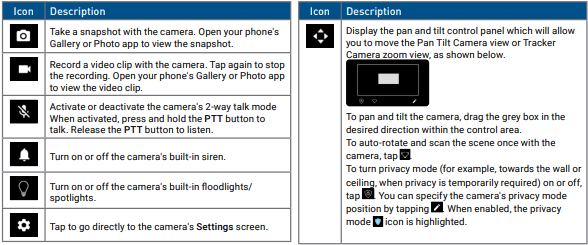
2. The camera functions that are displayed here are dependent on the camera model. Check the camera specifications to find out which functions are supported. Certain functions, such as snapshot and video capture, are available to all cameras. See table below for descriptions of the available camera functions.
3. Toggle between different aspect ratios - Original (match the camera's aspect ratio), 16:9, 4:3, Stretch (expand to fill the entire video window available).
4. (DVR/NVR only) Tap to select your preferred live video quality - SD/MD/HD. The HD quality setting will display the clearest and sharpest video possible, but the bandwidth required to stream video will be much higher and you'll need high-speed internet on both ends of the connection. Lower video quality settings use less bandwidth to stream video and may result in a smoother experience (recommended for slow mobile/Wi-Fi, limited data allowance).
LIVE VIEW SETTINGS
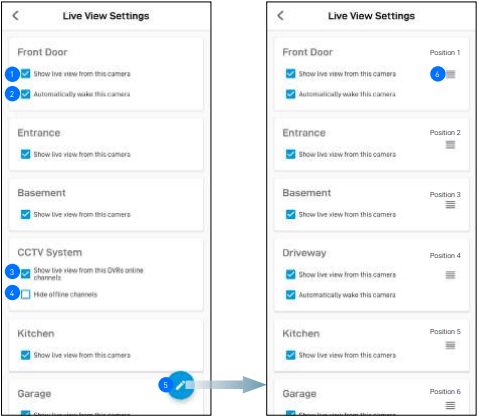
1. You can hide camera tiles from being displayed on the Live View tab. For example, if you want live video from a specific camera not to be visible on the Live View tab, you can hide that camera's tile until you need it.
To hide a camera tile, uncheck the "Show live view from this camera" box.
To unhide a camera tile, check the "Show live view from this camera" box.
2. (Battery-powered cameras only) By default when the app is launched, the camera will automatically wake up from sleep and stream live video. If you want to save battery life between charges, you can uncheck the "Automatically wake this camera" box. You will need to tap on the camera tile to manually wake the camera and start the live video stream, as shown on the right.

3. (DVR/NVR only) Uncheck the "Show live view from DVR" box to hide all DVR/NVR channel tiles from the Live View tab. To unhide all DVR/NVR channel tiles, check the "Show live view from DVR" box
4. (DVR/NVR only) You can hide offline (unused) DVR/NVR channel tiles from being displayed. Check the "Hide offline channels" box. To unhide offline DVR/NVR channel tiles, uncheck the "Hide offline channels" box.
5. Tap to rearrange the order of camera tiles on the Live View tab.
6. Press and hold the  icon of the selected camera, then drag it to a new position. The camera already in the position will slide over to the next position.
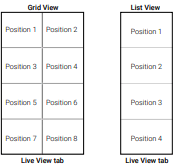
Camera tile positions in grid and list views on the Live View tab are arranged in the following order, as shown on the right.
Note: You cannot arrange the order of DVR/NVR channels. They are always arranged in sequential order according to the channel number (1, 2, 3, 4, etc).
PLAYBACK TAB
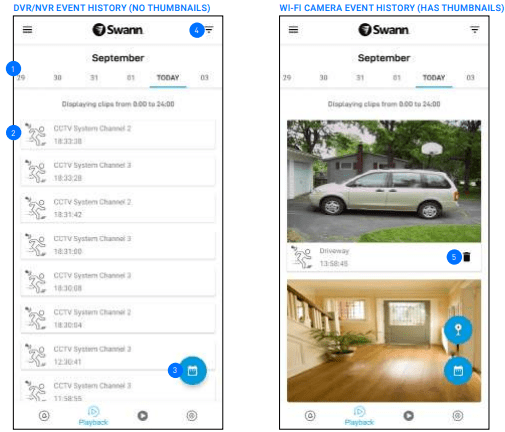
1. By default, the Playback tab displays a list of today's event recordings from all of your devices (except Wi-Fi cameras that only record to the local microSD storage, see note below). You can manually refresh Today's event history by pulling down on the screen. To view events that were captured on a different date, either scroll left or right to select a date, or simply tap the Month to specify a date.
Note:
- For Wi-Fi cameras that only record to the local microSD storage, tap the Camera
 button in the bottom right of the Playback tab (see screenshot above on the right) to go to the camera's local Storage screen to view and playback event recordings directly from the camera's microSD card.
- For Wi-Fi cameras with cloud storage, event recordings displayed on the Playback tab will be available for the length of time determined by the cloud subscription plan associated with the camera. To find out more about the cloud storage subscriptions available for your cameras,
2. Shows the camera name (or channel number) and the start time of the event recording. For Wi-Fi camera events, a thumbnail of the event is also displayed. Tap the event to open a window where you can view and download the recording. See "Video Playback Screen" on page 17.
3. Tap to display the calendar where you can select a specific date to search for event recordings.
4. Tap to display the playback filter where you can sort event recordings by ascending or descending order as well as filter by device type and time range.
For DVR/NVR recorders, you can also filter events based on video stream type (Mainstream or Substream). If you can't see any events from your DVR/NVR recorder, make sure you have selected the correct video stream type (for example, you may have configured your DVR/NVR to record events in "Substream" only. Check your DVR/NVR recording setting), as shown on the right.

5. (Wi-Fi cameras with cloud storage only) Tap to delete the event from the event history and the camera's cloud storage. Be sure to save the video clip to your phone first if you'd like to keep it.
VIDEO PLAYBACK SCREEN

- Tap to go back to the Playback tab.
- (DVR/NVR only) Tap to toggle between video quality options. Default is SD. Choosing lower video quality (such as SD) will make the video clip load quicker and play smoother.
- Tap to capture a snapshot. Open your phone's Gallery or Photo app to view the snapshot.
- Tap to download the video clip to your phone. Open your phone's Gallery or Photo app to view the video clip.
- Video playback controls. You can pause/play, rewind, forward, and enlarge (fullscreen) the video.
Device Management
MANAGING YOUR DEVICES
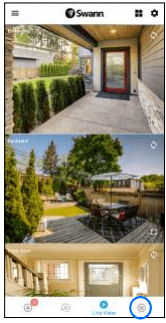
From the navigation bar, tap the Devices  icon.
icon.
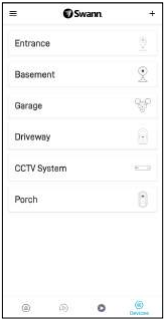
Tap the device for which you would like to view details or change settings.
DEVICE INFORMATION & SETTINGS OVERVIEW
CCTV SYSTEM (DVR/NVR)
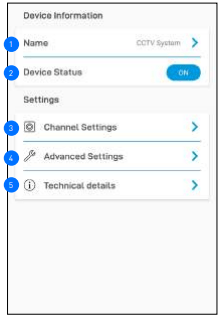
1. The name of your DVR/NVR. You can tap > to change it.
2. The connection status of your DVR/NVR: ON or OFF.
3. Within Channel Settings, you can change the name of the camera channels on the DVR/NVR, as shown on the right. If you rename the camera channel through the app, it will also be automatically updated on your DVR/NVR .
4. Within Advanced Settings, you have the option to remove (unpair) the DVR/NVR from your Swann Security account. In some cases, you might need to unpair your DVR/NVR. For example, if you want to use your DVR/NVR with a different Swann Security account or if you give away your DVR/NVR to a family member, you need to unpair it first.

5. View technical information about your DVR/NVR such as the model code, software (firmware) version, device ID, MAC address, and network IP address.
Note: The DVR/NVR's MAC address (including colons) —a unique 12-character hardware ID (for example, BC:51:FE:12:34) assigned to the device—can be used as the recovery code to reset the DVR/NVR password locally via the system's Unlock screen > Forgot Password. Refer to your DVR/NVR's instruction manual for more information on resetting a forgotten password.
WI-FI CAMERA (SWIFI/SWWHD MODELS)
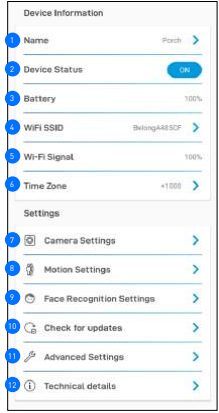
- The name of your camera. You can tap > to change it.
- The connection status of your camera: ON, STANDBY or OFF.
- (Battery-powered cameras only) Displays the current battery level of the camera. "Battery Charging" is displayed while the camera is being charged via the USB power charger or Swann solar panel.
- The name (SSID) of the Wi-Fi network to which your camera is connected. If you have multiple Wi-Fi networks in your home, you can tap > to change the Wi-Fi connection the camera is using. For more information, see "Changing the Camera's Wi-Fi Network" on page 28. Note that, for best video streaming performance, you should always connect your camera to the WiFi access point or extender nearest to it.
- The Wi-Fi signal strength. In general, the closer the camera is to the home Wi-Fi router or access point, the stronger the signal strength (higher % percentage), and the more reliable and faster the wireless connection between devices. If the camera is far from the router/access point and does not have strong wireless connection (<60%), it can occasionally drop off the network.
- The timezone of your camera. The date and time stamp of camera recordings will be based on the timezone you've selected. You can tap > to change the timezone. Timezone is based on Universal Coordinated Time (UTC), and options range from UTC -12:00 to UTC +14:00.
- Adjust the camera's audio and video settings such as the video stream quality, image flip, image mirror, microphone volume, and speaker volume. See "Camera Settings" on page 22.
- Adjust the camera's detection settings such as the motion and sound sensitivity and siren duration. See "Motion Settings" on page 23.
- (SWIFICAM model only) Manage the face recognition profiles registered on the camera. See "Face Recognition Settings" on page 24 .
- Check for firmware updates. New firmware may from time to time be available for your camera to improve the performance, fix bugs, or roll out new features and enhancements.
- Perform general maintenance such as rebooting the camera, resetting camera settings, formatting internal storage, and factory reset. There is also the option to remove (unpair) the camera from your Swann Security account. See "Face Recognition Settings" on page 24 .
- View technical information about the camera such as the model code, firmware version, installation date, MAC address, and Wi-Fi IP address.
STORAGE OPTION
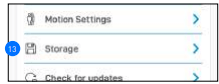
13. On some camera models, you can access recorded events on the camera's internal memory/microSD card within the Storage screen. When the internal memory/microSD card is full, the oldest clips will be overwritten to free up space.
CAMERA SETTINGS
WI-FI CAMERA (SWIFI/SWWHD MODELS)
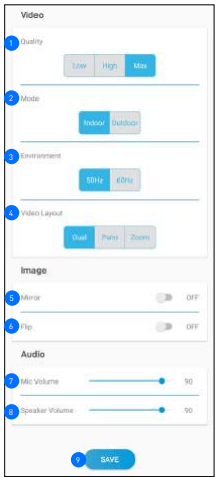
1. Select the live view quality. If you find that the camera is taking awhile to show live view, this is generally caused by the slow internet speed on your phone (poor Wi-Fi/cellular coverage) or limited home internet bandwidth (other video streaming activity running at the same time on your Wi-Fi network can result in congestion affecting your internet upload and download speeds). Try using the Low setting which may help improve loading times and provide smoother video streaming. The Low setting can also help limit data consumption on your mobile device as less internet bandwidth is used to stream video. Note: This setting does not affect the video quality of camera events which are always recorded in HD.
2. Select the mode according to where your camera is physically located.
3. If your camera is used in Indoor mode, you can set your camera's frequency to match with your country's electrical frequency.
This can help prevent video flicker caused by fluorescent lights.
- 50Hz (Australia/UK)
- 60Hz (North America)
4. (Tracker Camera only) Select the layout of the camera's live view: Dual (both Pano and Zoom views), Pano, Zoom

Dual layout
Top - 180° Panoramic wide-angle view Bottom - Zoom view (tracks movement of detected person)
5. Lets you horizontally reverse the orientation of the camera's video display.
6. Lets you turn the camera's video display upside down. This is useful if your camera has been mounted upside down.
7. (Not available on all models) Adjust the camera's microphone volume. You can also turn off the camera's microphone by sliding the level all the way to the left.
8. (Not available on all models) Adjust the camera's speaker volume. You can also turn off the camera's speaker by sliding the level all the way to the left.
9. Save any changes made to the camera's audio and video settings.
MOTION SETTINGS
MOTION SETTINGS
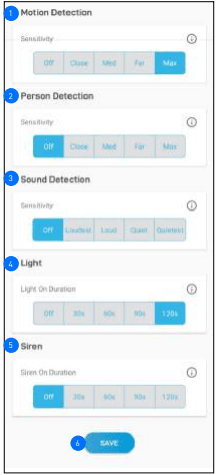
1. Select the motion sensitivity level to optimize motion detection recordings for your home environment.
- Higher sensitivity settings will increase the distance at which motion events can be detected.
- Use lower settings to reduce detection range and minimize unwanted recordings.
- To turn off the motion detection feature, select Off.
2. (Not available on all models) Receive person detection alerts when the camera detects the presence of a person during the motion event or live view. The higher the person detection sensitivity, the more sensitive the camera is in distinguishing between human shapes and other motion objects further away. Selecting Off turns off person detection alerts.
Note: To receive person detection alerts, the Motion Detection sensitivity setting (above) must not be set to Off.
3. (Not available on all models) Select the sound sensitivity level to optimize sound detection recordings for your home environment.
- The highest sensitivity level (Max) will detect most ambient sounds—even the quietest of sounds like whispers or keyboard typing.
- The lowest sensitivity level (Loudest) will only detect very loud noises like vacuum cleaners or smoke alarms.
- If you're getting too many sound detection alerts even on the lowest sensitivity, you can adjust the camera's microphone volume level, lowering it to 90 or below in Camera Settings > Audio > Mic Volume. This will further reduce the camera's microphone sensitivity to background noise.
- Every home environment is unique, so we recommend experimenting with the sound sensitivity settings to find out which works best for yours. You can also adjust and finetune the microphone volume level of the camera to suit the location.
- To turn off the sound detection feature, select Off.
4. (Not available on all models) Select how long the camera's spotlights/floodlights will stay on when motion or sound is detected during night time.
Note: The camera's built-in night detection sensor, which reads the ambient light levels, will automatically keep the spotlights/ floodlights off during daytime to conserve electricity and make them last longer. During daytime, you can manually turn on and off the spotlights/floodlights via the camera's live view screen by tapping the  bulb icon.
5. (Not available on all models) Select how long the camera's builtin siren will sound when motion or sound is detected.
Note: Please exercise discretion and good judgment when deciding to activate the siren. Make sure to comply with all local noise regulations.
6. Save any changes made to the camera's detection settings
SLEEP PERIOD SETTING (BATTERY CAMERAS ONLY)
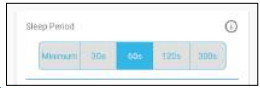
Select the time that must elapse before the camera can be triggered again by another motion activity.
Note: Set a longer sleep period temporarily when you know that there’s ongoing activity within the vicinity of the camera like someone mowing the grass in the backyard or guests walking in and out of a party. This will prevent unnecessary recordings and help conserve battery life.
FACE RECOGNITION SETTINGS

1. Displays the list of face recognition profiles which have been registered on the camera.
2. The Face Recognition video analytic feature uses profiles to represent individuals (e.g., family members). Each profile will require enrolling multiple face images (5 different face views) of an individual which you want the camera to recognize. When the camera detects and identifies an individual matching a profile, you'll receive a Face Recognition alert notification from the app.
To register a new Face Recognition profile, tap on an empty slot and follow the on-screen instructions (as shown on the right figure) to capture the face images of the individual that you want to associate with the profile. You can enter a name for the profile once all of the required face images have been taken.
NOTE:
- It is recommended that you register the Face Recognition profiles at the camera location.
- Keep a distance of about 30cm to 70cm from the camera during the registration process.
- Ensure the face is centered and directly in front of the camera. The green dot that is displayed in the video window indicates where the face should look towards.
- If glasses are worn, ensure the frame of the glasses does not obscure the eyes and there is no reflection from the lens.
- If the individual occasionally switches between wearing glasses and not wearing glasses (for example, contact lens may be worn), simply register two separate Face Recognition profiles (i.e., with and without glasses) for the individual and name the profiles accordingly.
- To replace an existing Face Recognition profile, simply tap the profile and start the Face Recognition registration process again.
- You can store up to 10 Face Recognition profiles on the camera.
- To enable the Face Recognition feature, the camera's Person Detection setting (on the Motion Settings screen) must not be turned Off.
- Face recognition results may vary depending on many factors (distance, facial expressions, lighting, etc)
3. Remove all face recognition profiles from the camera.
ADVANCED SETTINGS
NOTE: THE AVAILABILITY OF CERTAIN ADVANCED SETTINGS SHOWN BELOW MAY VARY DEPENDING ON DEVICE TYPE

- Tap to restart your camera. The camera's status will temporarily change from ON to OFF before coming back online as ON.
- Tap to reset camera settings such as the name, timezone, audio, video, and detection settings to default values.
- Tap to format the camera’s internal memory (or installed microSD memory card) and permanently erase all recordings on it.
- Tap to reset the camera to factory defaults. This is usually only necessary for troubleshooting. It isn’t something to do lightly as it will format the internal memory, wipe the current Wi-Fi information, and return all of the camera settings (camera name, timezone, etc) to factory defaults. If your camera is already offline, you can factory reset the camera using the physical Reset button located on the device. See "Factory Resetting the Camera" on page 29.
- Tap to remove (unpair) the device from your Swann Security account.
Note: In some cases, you might need to unpair your device such as your Wi-FI camera or DVR/NVR. For example, if you want to use your device with a different Swann Security account or if you give away your device to a family member, it must be unpaired first.
FAQS: GENERAL
I have forgotten my Swann Security account password. How do I reset it?
Tap the “Forgot Password” link on the Sign In screen of the Swann Security app and submit the email address that you used to create your account. You'll shortly receive an email with instructions on how to reset your account password.
Can I access my devices with another phone?
Yes. Just install the Swann Security app on your other phone and sign in using the same Swann Security account credentials. For privacy, make sure to sign out of the app on any secondary devices before switching back to your primary phone.
Can I register my devices to another Swann Security account?
A device can be registered to a single Swann Security account only. If you want to register the device to a new account (for example, if you want to give the device to a friend), you'll first need to remove the device (i.e., unpair) from your account. Once removed, the device can be registered to another Swann Security account.
Where is my device's ID?
For CCTV systems (DVR/NVR): The device's ID is listed on a sticker located on the top of the device. For SWIFI/SWWHD cameras: The device's ID (or MAC Address) is listed on a sticker located on the back, bottom or base of the device.
If the device is already paired to your account, you can find the device's ID in the app: Devices tab > Select the device > Technical details
Will I be able to stream live video if I'm travelling overseas?
As long as your mobile phone and the Swann Security devices are both connected to the internet, you can conveniently check in on your devices via the Swann Security app from anywhere in the world.
Why is the live video stream slow to load?
Camera streaming issues may be caused by any of the following:
- Poor internet connection (e.g., weak cellular/Wi-Fi signal) is the most common reason. Test your internet speed using an online speed checker app or at speedtest.net. We recommend internet speeds of at least 2 Mbps for optimal streaming performance. You can also install a Wi-Fi extender to improve the Wi-Fi coverage in your home to ensure the camera can receive a strong Wi-Fi signal.
- Limited internet bandwidth at home, for example, other video streaming services running at the same time on your network can cause congestion slowing down the internet upload and download speeds. As a general rule, the more devices you have connected to your Wi-Fi router, the more internet bandwidth you'll need.
Why have I stopped receiving notifications on my phone?
- The Swann Security app is not running in the background. If you recently restarted your phone, make sure to open the Swann Security app again.
- Some versions of the Android operating system automatically put apps to sleep to conserve battery life when your phone is not in use or when an app hasn't been used for a few days. You may need to turn off the "Optimize battery usage" setting under Settings > Apps > Special Access on your phone for the Swann Security app so that push notifications can be received. For more information, please see your phone's user guide.
FAQS: WI-FI CAMERAS
I cannot connect the camera to my Wi-Fi network. How do I fix this?
- Make sure the Wi-Fi network that you want the camera to join is not an unencrypted (open) network or 5GHz band network.
- Test your Wi-Fi network with other devices such as smart TV to make sure it is operating properly. Bring your phone to the location where your camera will be installed and check the Wi-Fi icon on your phone—at least 2 bars is recommended for the Wi-Fi signal to be considered reliable.
- Wi-Fi quality can vary significantly at different locations around the home due to environmental factors such as home construction type (e.g., metal objects are generally known to block Wi-Fi signals. A camera mounted on a metal surface may experience more Wi-Fi problems) and wireless interference from other electronic devices.
- If you're getting a weak Wi-Fi signal or can’t connect to Wi-Fi at the installation site, try moving your router closer (to provide a stronger signal), installing a Wi-Fi extender (to increase signal coverage) or selecting another location with better Wi-Fi coverage. Be mindful of the physical barriers located between the camera and router. Ideally, try to place your camera within a clear line of sight to your router.
- The Wi-Fi connection may not be stable during pairing. Try moving the camera closer to your WI-Fi router.
- The Wi-Fi network password is case sensitive, so make sure to enter it exactly the same as it was created or as found on your Wi-Fi router.
- Check whether your Wi-Fi router is using MAC filtering. MAC filtering provides an extra level of security by ensuring that no unknown devices can connect to your Wi-Fi network without prior authorization. If you cannot disable MAC filtering, you will need to add the camera’s MAC address to the router’s white-list of allowed devices. You can find the camera's MAC address printed on a label at the bottom of the device.
Can I use my camera without an internet connection?
No, your camera requires a Wi-Fi network connection with internet access so you can stream live video to your phone and manage the camera's settings.
Why is my camera offline?
Occasionally you might get a notification that your camera is offline. When your camera can't be reached by the Swann Security server, you'll get a notification that it is offline. This could mean your internet is down, the internet connection between your camera and our server is unstable, or your camera has been moved out of range from your Wi-Fi router. Normally, your camera should come back online by itself once your internet access is available again. If your camera stays offline for an extended period of time, try turning the power to the camera off for 10 seconds before turning it back on. You might also want to make sure that your internet connection is working properly. You can try rebooting your Wi-Fi router to resolve any network connectivity issue.
Why am I getting false motion alerts?
Moving cars, passersby, direct sunlight or reflection may cause unwanted motion detection. To minimize false motion detections, adjust the camera angle slightly downward and ensure the field of view is focused only on the immediate area of concern and excludes as much background activity as possible. If placed outdoors, avoid locations where your camera will be directly exposed to sunlight during the day. Also, take note of shiny surfaces in the vicinity, such as house or car windows, which can reflect sunlight and trigger your camera's motion sensor. You can also try lowering the motion detection sensitivity to suit the environment.
Can my camera still record events if my internet connection goes down?
Your camera continues to detect and record events locally to its internal memory even if your home Wi-Fi network or internet is having issues, as long as your camera is not powered off. Once your camera comes back online, it will attempt to upload any event clips that were recorded during the downtime to your cloud storage which you can later view from the Playback tab.
If I set my camera's live view quality to Low, will it also affect the video quality of event clips?
No, event recordings will always be captured in the highest camera resolution available.
(For Battery-powered cameras) What can I do to maximize the battery performance on my camera?
Here are some simple and practical tips to get more battery life out of your camera:
- Make sure your camera’s firmware is the latest version.
- Your camera will last longer when you stream at a lower resolution. The fewer pixels that your camera has to stream, the less power it uses.
- Lower the motion sensor sensitivity or turn off motion detection to conserve battery life when activity monitoring is not needed.
- Make sure your camera is properly positioned to eliminate any false motion triggering. The more events the camera records, the faster the battery life will drain.
- As a general rule, the nearer your camera is to your router, the better the wireless connection quality and battery performance. Your camera will work harder and use more power trying to maintain wireless connection the further it is away from your router. Consider installing a Wi-Fi range extender if your camera has poor Wi-Fi reception where it is located.
- Your camera can operate over a wide temperature range, however, in freezing conditions, the battery discharges more quickly and will not hold a charge for as long as it normally would in more moderate climates.
(For Wi-Fi camera models with cloud storage) How far back can I access my camera's cloud recordings?
Note: Please check the product specifications to find out if the cloud storage feature is available on your camera. Swann Security provides free basic cloud storage for your camera. From the Playback tab, you can retrieve up to the last 7 days of camera event clips stored in the cloud.
Can I disable the siren so it doesn’t sound when my camera is triggered?
Yes, you can easily set your camera not to activate its built-in siren when an motion is detected. Go to Devices tab > Select the camera > Motion Settings, and under the Siren setting, select OFF.
How long is a camera event clip?
Event clips can be as short as 10 seconds and up to 1 minute in length, depending on how long the sound or motion activity lasts. The camera will begin recording an event when sound or motion is first detected, and continue to record until there is completely no sound or motion. If the camera continues to detect sound or motion for longer than a minute, a new recording will be created as a separate event in the camera's event history.
How long does it take for camera recordings to appear on the Playback tab?
Depending on the size of the video and the strength of your network, this can be highly variable. In normal circumstances, an event should be displayed on the Playback tab a few minutes after it has been recorded. Try pulling down the Playback tab to refresh the event history.
Why doesn't the camera event clip have sound?
Make sure that the camera's microphone volume setting is not turned OFF or the volume level set too low—the camera will not be able to pick up any sound in the background when it is recording the event.
(For SWIFI Pan Tilt Camera/Tracker Camera) Can my camera record events without a microSD card installed?
No. The camera requires a microSD card to be installed. If the camera doesn't have a microSD card installed, it can still detect events but it will not be able to record video. The camera will also not be able to download and perform firmware updates without a microSD card.
(For SWIFI Pan Tilt Camera/Tracker Camera) Why has my camera stopped recording events to the microSD card?
If you’ve recently removed your microSD card from the camera (for example, to copy files to your computer) and then re-inserted the card, the camera might not have recognized and mounted the microSD card properly. Try restarting your camera. From the app, go the Devices tab > Select the camera > Advanced Settings, and tap Format.
(For SWIFI Pan Tilt Camera/Tracker Camera) What is the maximum microSD card size that can be used?
The maximum microSD card size supported is 128GB (class 10 or higher recommended).