User Manual
© Copyright 2013, Superscope Technologies, Inc.
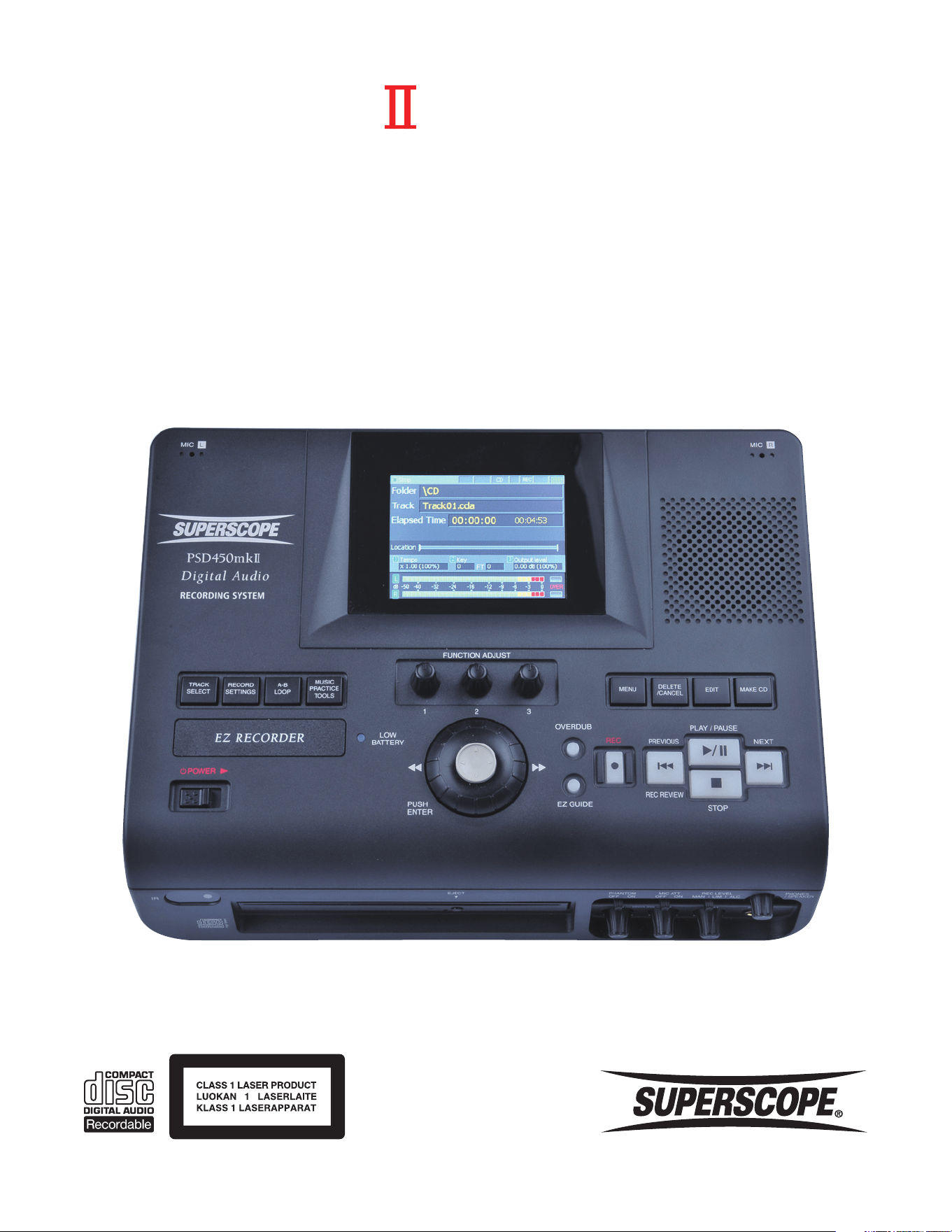
PSD450mk
Digital Audio Recording System
- ii -
Superscope PSD450mkII User Manual
Contents
The lightning flash with arrowhead symbol within
an equilateral triangle is intended to alert the
user to the presence of uninsulated "dangerous
voltage" within the product's enclosure that may
be of sufficient magnitude to constitute a risk of
electric shock to persons.
The exclamation point within an equilateral
triangle is intended to alert the user to
the presence of important operating and
maintenance (servicing) instructions in the
literature accompanying the appliance.
■Important Safety
Instructions
READ BEFORE OPERATING EQUIPMENT
This product was designed and manufactured to meet strict quality
and safety standards. There are, however, some installation and
operation precautions which you should be particularly aware of.
1. Read instructions.
2. Keep these instructions.
3. Heed all warnings.
4. Follow all instructions.
5. Clean only with dry cloth.
6. Do not use this apparatus near water.
7. To ventilate the unit, do not install it in a rack or bookshelf, and
note the following: Do not insert objects beneath the unit. Do not
block ventilation slots at the top of the unit. Do not place anything
about 1 meter above the top panel. Make a space of about 8“ (20
cm) around the unit.
8. Do not install near nay heat sources such as radiators, heat
registers, stoves, or other apparatus (including amplifiers) that
produce heat.
9. Do not defeat the safety purpose of the polarized or grounding-
type plug. A polarized plug has two blades with one wider than
the other. A grounding type plug has two blades and a third
grounding prong. The wide blade or the third prong are provided
for your safety. If the provided plug does not fit into your outlet,
consult an electrician for replacement of the obsolete outlet.
10. Protect the power cord from being walked on or pinched
particularly at plugs, convenience receptacles, and the point where
they exit from the apparatus.
11. Only use attachments/accessories specified by
the manufacturer.
12. Use only with the cart, stand, tripod, bracket,
or table specified by the manufacturer, or
sold with the apparatus. When a cart is used,
use caution when moving the cart/apparatus
combination to avoid injury from tip-over.
13. Unplug this apparatus during lightning storms or when unused for
long periods of time.
14. Refer all servicing to qualified service personnel. Servicing is
required when the apparatus has been damaged in any way, such
as power-supply cord or plug is damaged, liquid has been spilled
or objects have fallen into the apparatus, the apparatus has been
exposed to rain or moisture, does not operate normally, or has
been dropped.
Additional Safety Information!
•Thisproductshouldnotbeplacedinabuilt-ininstallationsuch
as a bookcase or rack unless proper ventilation is provided or the
manufacturer’s instructions have been adhered to.
•Apparatusshallnotbeexposedtodrippingorsplashingandthat
no objects filled with liquids, such as vases, shall be placed on the
apparatus.
•WhentheswitchisintheOFFposition,theapparatusisn’t
completely switched-off from the MAINS.
WARNINGS
Do not expose the equipment to rain or moisture.
Do not remove the cover from the equipment.
No naked flame sources, such as lighted candles, should be placed on the
equipment.
Protect the power cord from being walked on or pinched particularly at plugs,
convenience receptacles, and the point where they exit from the apparatus.
Set the unit up on an even surface away from direct sunlight, high
temperatures, high humidity, and excessive vibration.
Do not place heavy items on the unit.
Do not use high voltage power sources. This can overload the unit and cause a
fire.
Do not handle the plug with wet hands. This can cause electric shock.
Do not let metal objects fall inside the unit.
Do not let liquids get into the unit.
Do not spray insecticides onto or into the unit.
Do not attempt to repair this unit by yourself.
WARNING
TO REDUCE THE RISK OF FIRE OR ELECTRIC SHOCK, DO NOT
EXPOSE THIS PRODUCT TO RAIN OR MOISTURE.
CAUTION: TO PREVENT ELECTRIC SHOCK, MATCH WIDE
BLADE OF PLUG TO WIDE SLOT, FULLY INSERT.
ATTENTION: POUR EVITER LES CHOC ELECTRIQUES, INTRODUIRE LA
LAME LA PLUS LARGE DE LA FICHE DANS LA BORNE CORRESPONDANTE
DE LA PRISE ET POUSSER JUSQUíAU FOND.
CAUTION
USE OF CONTROLS OR ADJUSTMENTS OR PERFORMANCE OF
PROCEDURE OTHER THAN THOSE SPECIFIED HEREIN MAY RESULT
IN HAZARDOUS EXPOSURE.
LASER SAFETY
This unit employs a laser. Only a qualified service person should
remove the cover or attempt to service this device, due to possible
eye injury.
NOTE TO CATV SYSTEM INSTALLER:
This reminder is provided to call the CATV (Cable-TV) system installer’s
attention to Section 820-40 of the NEC which provides guidelines for
proper grounding and, in particular, specifies that the cable ground
shall be connected to the grounding system of the building, as close to
the point of cable entry as practical.
NOTE: This equipment has been tested and found to comply with the
limits for a Class B digital device, pursuant to Part 15 of the FCC Rules.
These limits are designed to provide reasonable protection against
harmful interference in a residential installation. This equipment
generates, uses and can radiate radio frequency energy and, if not
installed and used in accordance with the instructions, may cause
harmful interference to radio communications. However, there is no
guarantee that interference will not occur in a particular installation. If
this equipment does cause harmful interference to radio or television
reception, which can be determined by tuning the equipment off and
on, the user is encouraged to try to correct the interference by one or
more of the following measures:
•Reorientorrelocatethereceivingantenna.
•Increasetheseparationbetweentheequipmentandreceiver.
•Connecttheequipmentintoanoutletonacircuitdifferentfrom
that to which the receiver is connected.
•Consultthedealeroranexperiencedradio/TVtechnicianforhelp.
NOTE: Changes or modifications not expressly approved by the party
responsible for compliance could void the user’s authority to operate
the equipment.
This Class B digital apparatus complies with Canadian ICES-003.
Cet appareil numÈrique de la Classe B conforme à la norme NMB-003
du Canada.
SD Logo is a trademark. microSD Logo is a trademark.
CAUTION: TO REDUCE THE RISK OF ELECTRIC SHOCK,
DO NOT REMOVE COVER (OR BACK)
NO USER-SERVICEABLE PARTS INSIDE
REFER SERVICING TO QUALIFIED SERVICE PERSONNEL
RISK OF ELECTRIC SHOCK
DO NOT OPEN
CAUTION

Superscope PSD450mkII User Manual
- iii -
For EU Countries

- iv -
Superscope PSD450mkII User Manual
For EU Countries
Superscope PSD450mkII User Manual
- v -
Contents
■Table of Contents
■Important Safety Instructions ................... ii
■Table of Contents ....................................... v
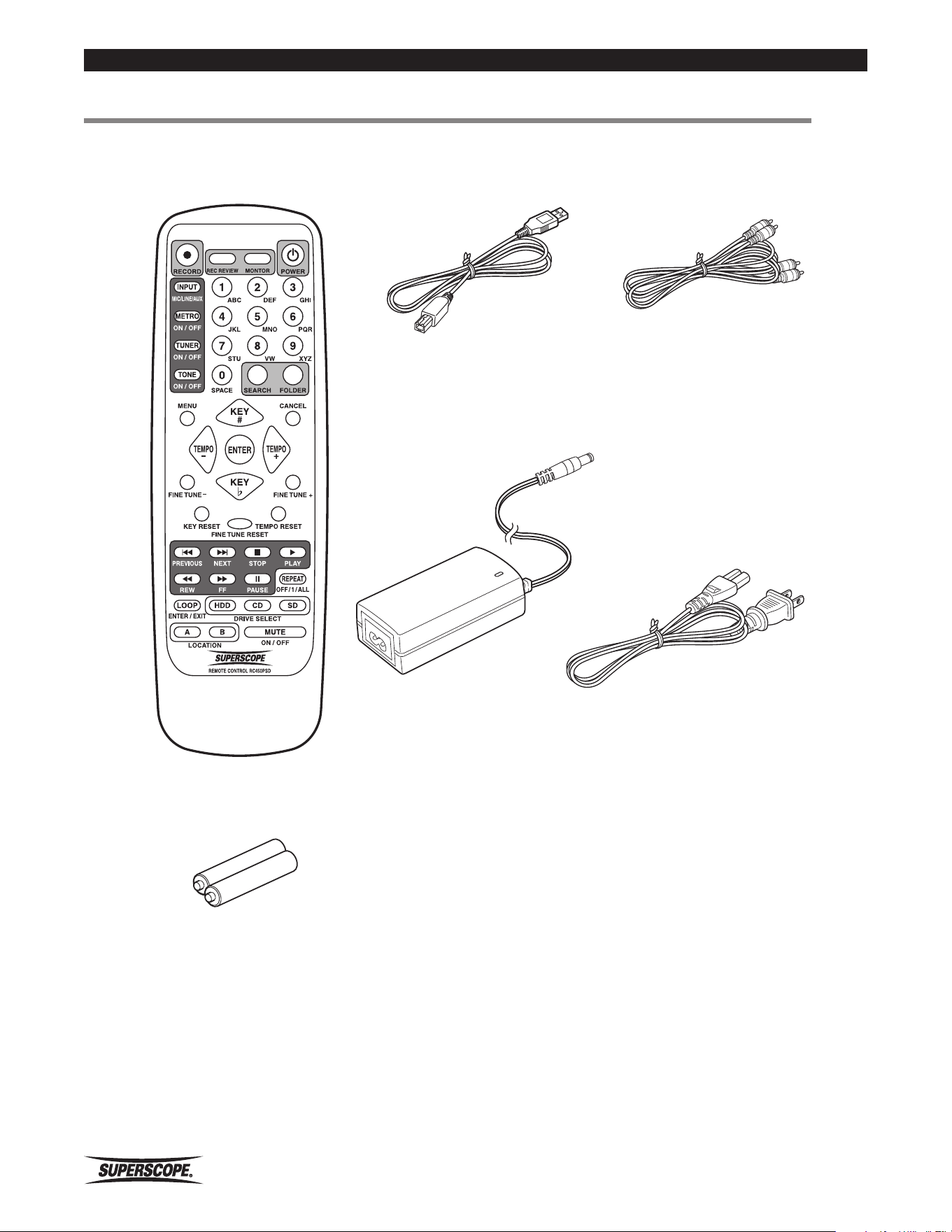
■Supplied Accessories .................................. 8
Infrared (IR) Remote ............................................... 8
AAA Batteries ........................................................ 8
AC Adapter ............................................................ 8
USB Cable .............................................................. 8
AC Power Cord ...................................................... 8
RCA Patch Cables ................................................... 8
■Introduction ................................................ 9
General Features .................................................... 9
Recording Features ................................................. 9
Music Practice Features .......................................... 9
Package Contents .................................................. 9
■Preparations Before Use ............................ 10
AC Adapter Connection ..................................... 10
AC Adapter Safety ............................................. 10
Using Batteries ................................................... 10
Safety Cautions When Handling Batteries ....... 10
Remote Controller Notes ................................... 10
Remote Controller Battery Installation .................... 11
■About Discs ................................................. 12
Playable discs ...................................................... 12
Disc Care ................................................................ 12
■Top Panel ..................................................... 13
POWER ................................................... 13
FUNCTION CONTROL Buttons .......................... 13
A. TRACK SELECT .................................................. 13
B. RECORD SETTINGS ............................................. 13
C. A-B LOOP .......................................................... 14
D. MUSIC PRACTICE TOOLS ................................... 14
Low Battery Indicator ....................................... 14
FUNCTION ADJUST Knobs ................................ 14
JOG WHEEL / JOYSTICK / ENTER ....................... 14
OVERDUB ......................................................... 14
EZ GUIDE ......................................................... 14
CONTROL Buttons (Transport) .......................... 15
A. REC Button ........................................................ 15
B. PREVIOUS & REC REVIEW Button ....................... 15
C. PLAY/PAUSE Button ........................................... 15
D. STOP Button ...................................................... 15
E. NEXT .................................................................. 15
CONTROL Buttons (Top Right) .......................... 15
A. MENU ................................................................ 15
B. DELETE / CANCEL ............................................... 15
C. EDIT ................................................................... 15
D. MAKE CD .......................................................... 15
Internal Speaker ............................................... 15
- Internal Mic R & Internal Mic L .................. 15
LCD Color Display ............................................. 15
■Front Panel .................................................. 16
Infrared (IR) Receiver ......................................... 16
IR Signal Indicator ............................................. 16
CD-RW Drive .................................................... 16
EJECT Button ................................................... 16
MIC / LINE L & R Level Control .......................... 16
INST (Instrument) Level Control ........................ 16
PHONES Jack .................................................... 16
PHANTOM Power ON/OFF SWITCH .................. 16
MIC ATT ON/OFF ............................................. 16
RECORD LEVEL MAN / LIM / ALC ...................... 16
MAN (Manual) ....................................................... 16
LIM (Limiter) ........................................................... 16
ALC (Automatic Level Control) ............................... 16
PHONES / SPEAKER LEVEL ................................ 16
■Right Side Panel .......................................... 17
Left / XLR / 1/4” Input Jack ............................... 17
Right / XLR / 1/4” Input Jack ............................. 17
INST IN Jack ..................................................... 17
AUX LEVEL ....................................................... 17
AUX IN Jacks .................................................... 17
LINE OUT Jacks ................................................ 17
■Left Side Panel ............................................ 18
DC Input Jack ................................................... 18
USB Connector B .............................................. 18
USB PC / Flash Memory Switch ......................... 18
USB Connector A ............................................. 18
FOOT PEDAL Jack ............................................. 18
DIGITAL OUT Jack ............................................ 18
DIGITAL IN Jack ................................................ 18
■Back Panel ................................................... 19
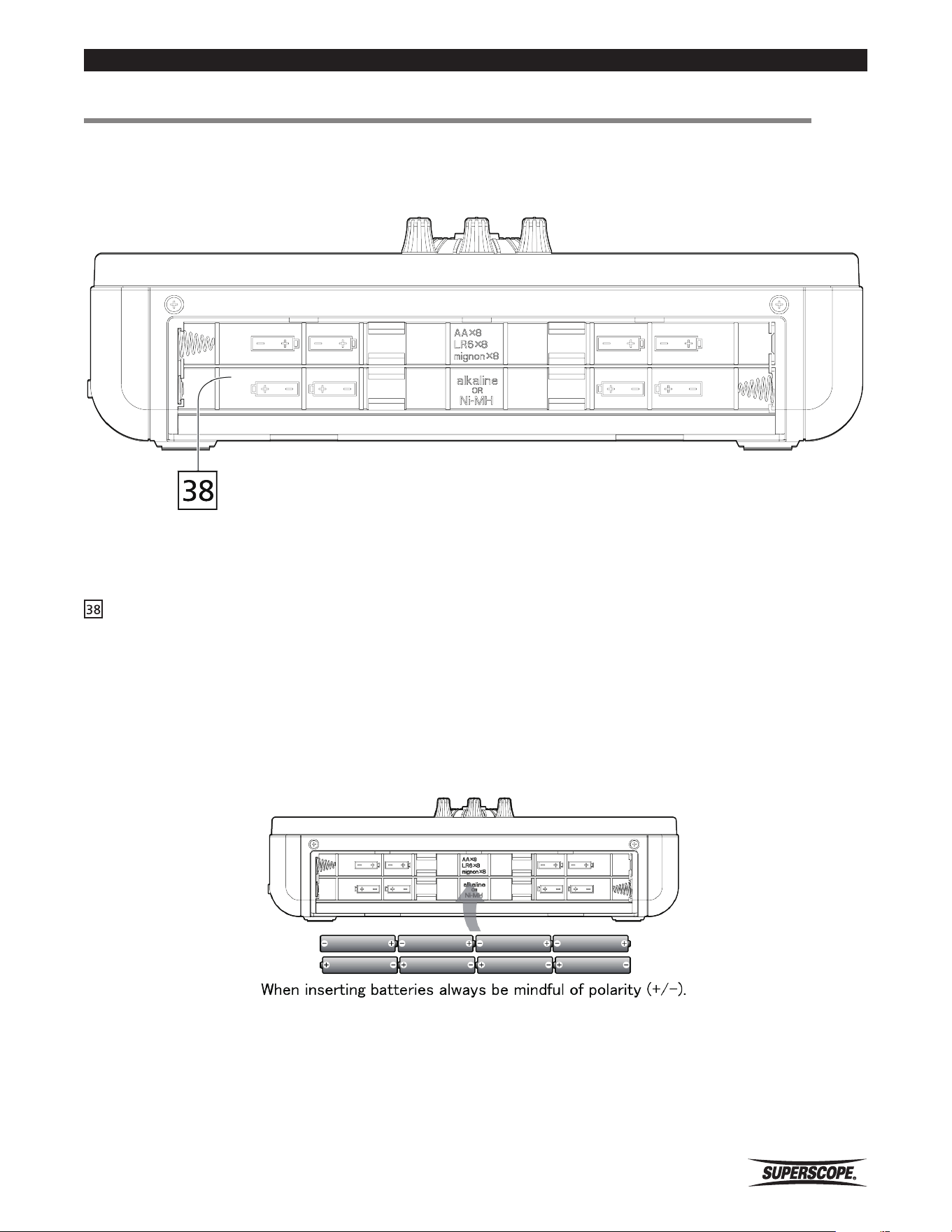
Battery Compartment ...................................... 19
■Remote Control .......................................... 20
STANDBY / POWER ...................................... 20
w Alphanumeric Keypad ........................................ 20
e FOLDER .............................................................. 20
r SEARCH ............................................................. 20
t CANCEL ............................................................. 20
y TEMPO ............................................................... 20
u ENTER ................................................................ 20
i FINE TUNE .......................................................... 20
o TEMPO RESET .................................................... 20
a PLAY
.............................................................. 20
s STOP
.............................................................. 21
d REPEAT............................................................... 21
f PAUSE
............................................................. 21
g DRIVE SELECT .................................................... 21
h MUTE ................................................................. 21

- vi -
Superscope PSD450mkII User Manual
Contents
j LOCATION ......................................................... 21
k LOOP ENTER/EXIT .............................................. 21
FF
(Fast Forward) ........................................... 21
REW
(Rewind) ............................................... 21
NEXT
............................................................ 21
PREVIOUS
.................................................... 21
FINE TUNE RESET ............................................... 21
KEY RESET ......................................................... 21
KEY .................................................................... 21
MENU ................................................................ 21
TONE ON/OFF .................................................... 21
TUNER ON/OFF .................................................. 21
METRO ON/OFF ................................................. 21
INPUT MIC/LINE/AUX ......................................... 21
RECORD ............................................................. 21
RECORD REVIEW ................................................ 21
MONITOR .......................................................... 21
■LCD Display ................................................. 22
PLAY / STOP Mode ................................................. 22
Ⓐ Icons .................................................................. 22
① Status Icons ....................................................... 22
② Silent Skip Icons ................................................ 22
③ Repeat Icons...................................................... 22
④ CD, CD-R, CD-RW Icons ................................... 23
⑤ Voice Reduction Icons ....................................... 23
⑥ Monitor Icons ................................................... 23
⑦ Mute Icons ....................................................... 23
⑧ AC/Battery Icons ............................................... 23
Ⓑ File Information ................................................. 23
Ⓒ Playback Data .................................................... 24
Ⓓ Location ............................................................ 24
Ⓔ Tempo, key, Output Level .................................. 24
Ⓕ VU Meters ......................................................... 24
■Powering On ............................................... 25
Using the AC Adapter ............................................ 25
Using Batteries ....................................................... 25
Battery Life ............................................................. 26
AC Power and Battery Tips ..................................... 26
Setting Date and Time ............................................ 27
The Internal Memory .............................................. 28
Inserting a USB Memory ......................................... 28
■Setting Up Speakers ................................... 29
Using Headphones or the Built-In Speaker ...... 29
External Speakers ............................................... 29
■Setting Up Microphones, Instruments and
Other Sound Sources ..................................... 30
Microphones .......................................................... 30
Balanced Connections ............................................ 30
Unbalanced Connections ....................................... 30
External Microphones ............................................ 30
Setting Levels ......................................................... 31
STEREO/PAN Mode ................................................ 32
Pan Setting – L/1 ................................................... 32
Pan Setting – R/2 ................................................... 32
Recording a Solo Performance ................................ 33
Internal Built-in Microphones.................................. 34
Connecting Musical Instruments ............................ 35
Recording a Microphone and a Musical Instrument at
the Same Time ....................................................... 36
Line Level Sources .................................................. 38
AUX ....................................................................... 40
Digital Connection ................................................. 41
Computer Connection ............................................ 42
■Working with Files and Folders ................. 44
Searching Folders ................................................... 44
Search a USB Device, Internal Memory or CD ......... 44
Using the [Search] Feature ...................................... 45
Text Input Method ................................................. 45
Create a Folder ....................................................... 47
Rename .................................................................. 47
Create a Playlist ...................................................... 48
Create a CD Playlist ................................................ 49
■CD Ripping .................................................. 51
Ripping an entire Audio CD .................................... 51
Ripping Selected Tracks from an Audio CD ............. 52
■Music Practice ............................................. 54
Music Practice Tools ............................................... 54
Adjusting Tempo, Key, and Fine Tune Tempo .......... 54
Key ........................................................................ 54
Interval Indication ................................................... 54
Fine Tune ............................................................... 55
Voice Reduction ..................................................... 55
How to Use the Tuner ............................................ 55
Using the Chromatic Tuner ..................................... 55
Using the Tuning Tone ............................................ 56
Using the Metronome ............................................ 57
Adjusting Accent Beat and Accent Beat Volume ..... 58
■Play .............................................................. 59
Playback Operation ................................................ 59
Playback Modes ..................................................... 60
Repeat Modes ........................................................ 60
Equalizer Settings ................................................... 61
Playback Equalizer .................................................. 61
Frequency .............................................................. 61
Gain ....................................................................... 61
Bandwidth ............................................................. 62
A-B Loop (Repeat Playback) .................................... 62
Press the A-B LOOP button during playback ........... 62
Press and hold the A-B LOOP button for 3 seconds or
longer. ................................................................... 62
Delete a Loop Point ................................................ 63
■Editing ......................................................... 64
Export a File ........................................................... 64
Creating a File with a New Tempo or Key ............... 64
Changing File Format ............................................. 65
Naming the Exported File ....................................... 65
Move a Track .......................................................... 66
Copy a Track .......................................................... 67
Divide a Track ......................................................... 69
Combine a Track .................................................... 70
Trim In / Out ........................................................... 71
Edit Track Information ............................................ 72
Title/Artist/Album ................................................... 73
Genre ..................................................................... 73
24>16bit Convert ................................................... 74

Superscope PSD450mkII User Manual
- vii -
Contents
■Delete/Cancel .............................................. 75
Delete .................................................................... 75
Cancel .................................................................... 76
■Recording .................................................... 77
Recording to the Internal Memory .......................... 77
Recording to a USB Memory .................................. 78
Recording Direct to CD ........................................... 78
Track Increment ...................................................... 79
Advanced Record Settings Menu ............................ 79
Silent Skip Recording .............................................. 79
Pre-Roll Time/ Post-Roll Time .................................. 80
Fade In / Out .......................................................... 81
Auto Track Increment ............................................. 81
One Touch Recording ............................................. 81
Count In ................................................................. 81
Auto Convert ......................................................... 81
CD Pre-Gap Setting ............................................... 81
Int Memory + USB HDD ........................................ 81
■Input Effects ............................................... 82
Selecting an Input Signal ........................................ 82
① Delay Time ......................................................... 83
② Decay ................................................................ 83
Input Equalizer ....................................................... 83
Frequency .............................................................. 84
Gain ....................................................................... 84
Bandwidth ............................................................. 84
Playback Balance and Level..................................... 84
■Overdub ...................................................... 86
Overdubbing for Composition (Layering sections of a
Track) ..................................................................... 86
Overdubbing for Practice (Recording over a Loop) .. 88
Monitor Source ...................................................... 89
OverDub Screen .................................................. 91
OverDub Screen and Audio Signal .................... 92
■CD Burning .................................................. 95
Creating an Audio CD ............................................ 95
Finalizing a CD ....................................................... 96
Creating a Data CD ................................................ 97
CD Duplication ....................................................... 98
Erasing a CD-RW .................................................... 99
Unfinalize a CD-RW................................................ 99
Erase Last ............................................................... 100
Finalized CD-RW Menu .......................................... 101
Unfinalized CD-RW Menu ...................................... 101
Erase All ................................................................. 101
Finalized CD-RW Menu .......................................... 102
Unfinalized CD-RW Menu ...................................... 102
■EZ Guide ...................................................... 103
Record ................................................................... 103
Record with a Track/File ......................................... 103
Play a Track/File ...................................................... 104
Import CD .............................................................. 104
Duplicate CD .......................................................... 105
Modify and Save File .............................................. 105
Copy File to USB ..................................................... 105
Create/REC Playlist ................................................. 105
■System Settings .......................................... 106
Auto Power Off ...................................................... 106
Backlight Timer ...................................................... 106
Recording Dimmer ................................................. 106
Battery Type ........................................................... 106
Foot Pedal .............................................................. 106
■Appendix ..................................................... 108
Main Menu (1 of 2) ................................................ 108
Main Menu (2 of 2) ................................................ 110
Recording Settings Menu ....................................... 111
Edit Menu Options ................................................. 112
Music Practice Tools Menu ..................................... 113
Continuous Recording Time with Battery Operation 114
Pop-Up Messages .................................................. 115
Pop-Up Messages (continued) ................................ 116
■Specifications .............................................. 117
General .................................................................. 117
Audio ..................................................................... 117
Input/Outputs ....................................................... 117
■Trademarks, Copyrights and Disclaimers .. 118
MPEG Layer-3 Licensing ......................................... 118
■One Year Limited Warranty ....................... 119
- 8 -
Superscope PSD450mkII User Manual
Superscope PSD450mkII User Manual
■Supplied Accessories
The following items (not pictured) are also in the box:
• Instruction Manual on CD-ROM (PDF format)
• Quick Start Guide (printed)
Infrared (IR) Remote
USB Cable RCA Patch Cables
AC Adapter
AC Power Cord
AAA Batteries

Superscope PSD450mkII User Manual
- 9 -
Superscope PSD450mkII User Manual
■Introduction
Thank you for purchasing a Superscope PSD400 Series Recording System.
Were you looking for a high-quality, portable recorder? A music practice and transcription tool? If either factor is
important to you, we’re confident you’ll find your recorder to be an immensely powerful and versatile audio system.
Here are just a few features of the PSD400 recorder series:
General Features
• 3.5-inch liquid crystal color display for easy navigation of all features.
• Record up to 6 hours with eight nickel metal hydride AA batteries (or 3.6 hours with alkaline batteries).
• USB connection for transferring audio files to and from a computer.
• Stereo internal microphones.
• Stereo XLR combo microphone jacks.
• 48 V phantom power.
Recording Features
• Record live performances to the Internal Memory, external USB storage, or direct to Compact Disc.
• Record WAV or MP3 files to the Internal Memory or external USB storage.
• Burn Compact Discs from audio files on your Internal Memory or external USB storage.
• Layer audio with the Overdub feature.
• Edit file information or recorded audio (Trim, Divide, etc.).
Music Practice Features
• Change the key of a song without affecting tempo (+/- one octave in half steps or finer increments).
• Change the tempo of a song without affecting musical pitch (-75% to +50%).
• Create new versions of audio files in different keys and tempos.
• Seamlessly loop different sections of audio material for practice or transcription.
• Reduce lead vocals from stereo recordings.
• Rehearse with the built-in metronome.
• Tune your instrument with the 440 Hz tone or chromatic tuner.
Package Contents
• One Superscope PSD450mkII Recorder.
• One AC adapter (DA450PSD).
• One infrared wireless remote controller (RC450PSD).
• 2-AAA type batteries (for remote control).
• One USB cable.
• One RCA stereo audio system cable.
• One instruction manual on CD-ROM.
• One Quick Start Guide (printed).
Perchlorate Material - special handling may apply,
See www.dtsc.ca.gov/hazardouswaste/perchlorate.”
- 10 -
Superscope PSD450mkII User Manual
Getting Started
■Preparations
Before Use
AC Adapter Connection
Connect the power output plug of the adapter to the DC
IN jack of the recorder. Connect the AC Power cord to
the household AC power receptacle.
AC Adapter Safety
Only use the AC adapter that is provided with the
recorder. Use of other adapters may result in damage to
the recorder and invalidate the warranty.
Using Batteries
The recorder is designed for use with 8 “AA” size
Alkaline or Nickel-Metal Hydride (Ni-MH) batteries.
The recorder DOES NOT allow for charging of
rechargeable batteries. If you use rechargeable batteries,
you must use an external battery charger (see battery
charger manufacturer instructions for operation and safe
use).
The battery capacity monitoring is different for alkaline
batteries and Ni-MH batteries. Please select the correct
battery type you are using from the System Settings
menu of the recorder.
To operate the recorder with battery power, install
batteries into the recorder as follows:
1. Remove the battery cover from the rear side of the
recorder.
2. Insert the batteries into the battery compartment,
making sure to align the positive ( + ) and negative
( - ) end of each battery according to the polarity
diagram shown inside the compartment.
3. Re-attach the battery cover to the rear side of the
recorder.
※ Burning CDs with battery power is not
recommended. Please connect AC power
before burning a CD.
Safety Cautions When Handling
Batteries
To avoid leakage, overheating, fire and rupturing, always
follow the points below when using batteries with the
recorder.
• Electrolyte leakage or corrosion may occur if
batteries are kept inside the recorder for prolonged
periods of time. Remove batteries prior to prolonged
storage of the recorder.
• When installing batteries into the recorder, make
sure the batteries are installed with the proper
polarity shown inside the battery compartment of
the recorder.
• Do not attempt to recharge non-rechargeable
batteries.
• Do not install old/exhausted batteries into the
recorder. Dispose of old batteries properly.
• Do not mix the types (Alkaline or Ni-MH) or voltages
of batteries.
Remote Controller Notes
The remote controller may not work if the infrared
receiver is exposed to direct sunlight.
The remote controller will not work when there is an
obstacle between the wireless remote controller and the
infrared receiver.
Please be careful when using the remote controller near
other equipment that responds to infrared signals.
Please do not place objects on the remote controller. If
an object resting on the remote continuously depresses a
button, battery power will drain.
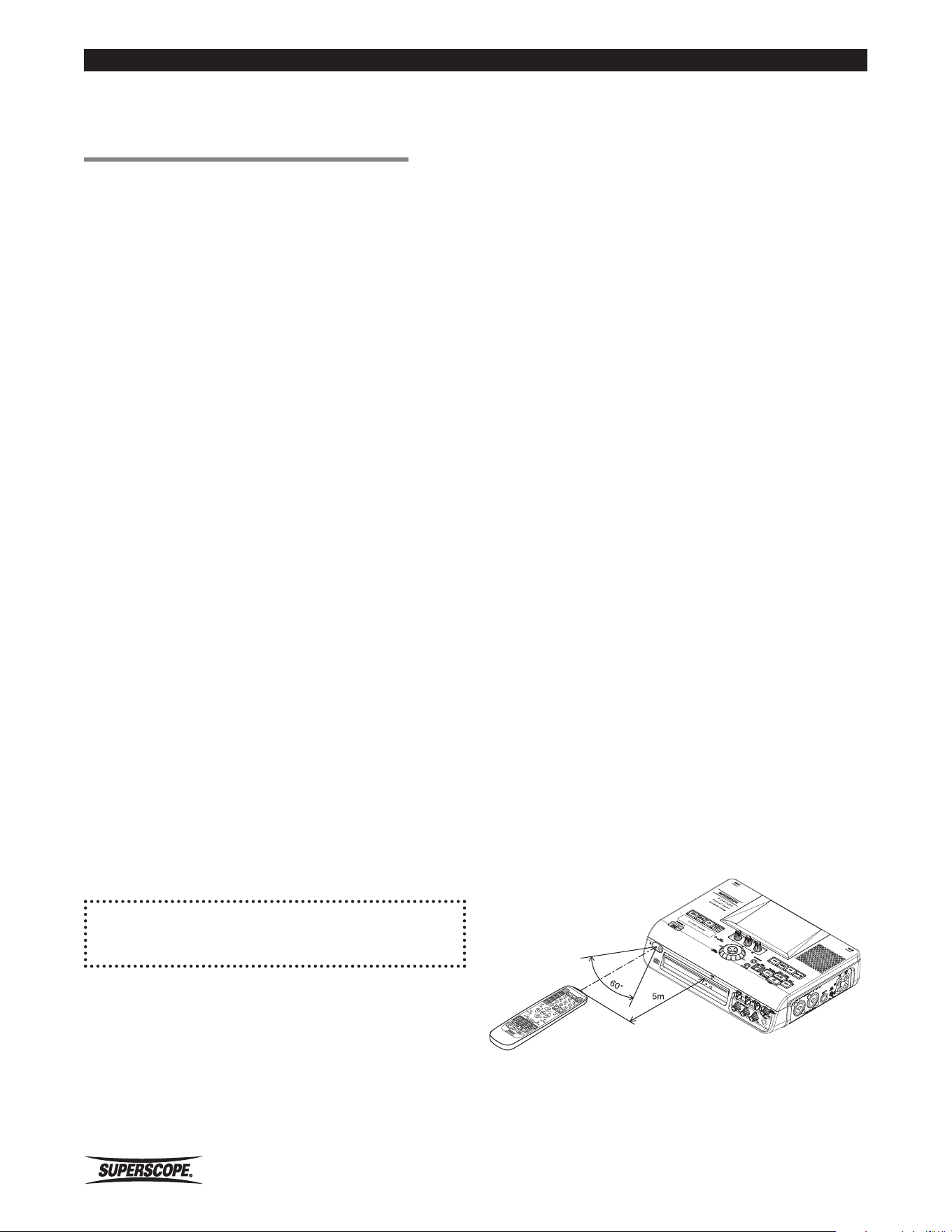
The remote controller will work within a range of
5 m and 60 degrees right or left of the IR receiver, as
indicated by the following image:
Superscope PSD450mkII User Manual
- 11 -
Getting Started
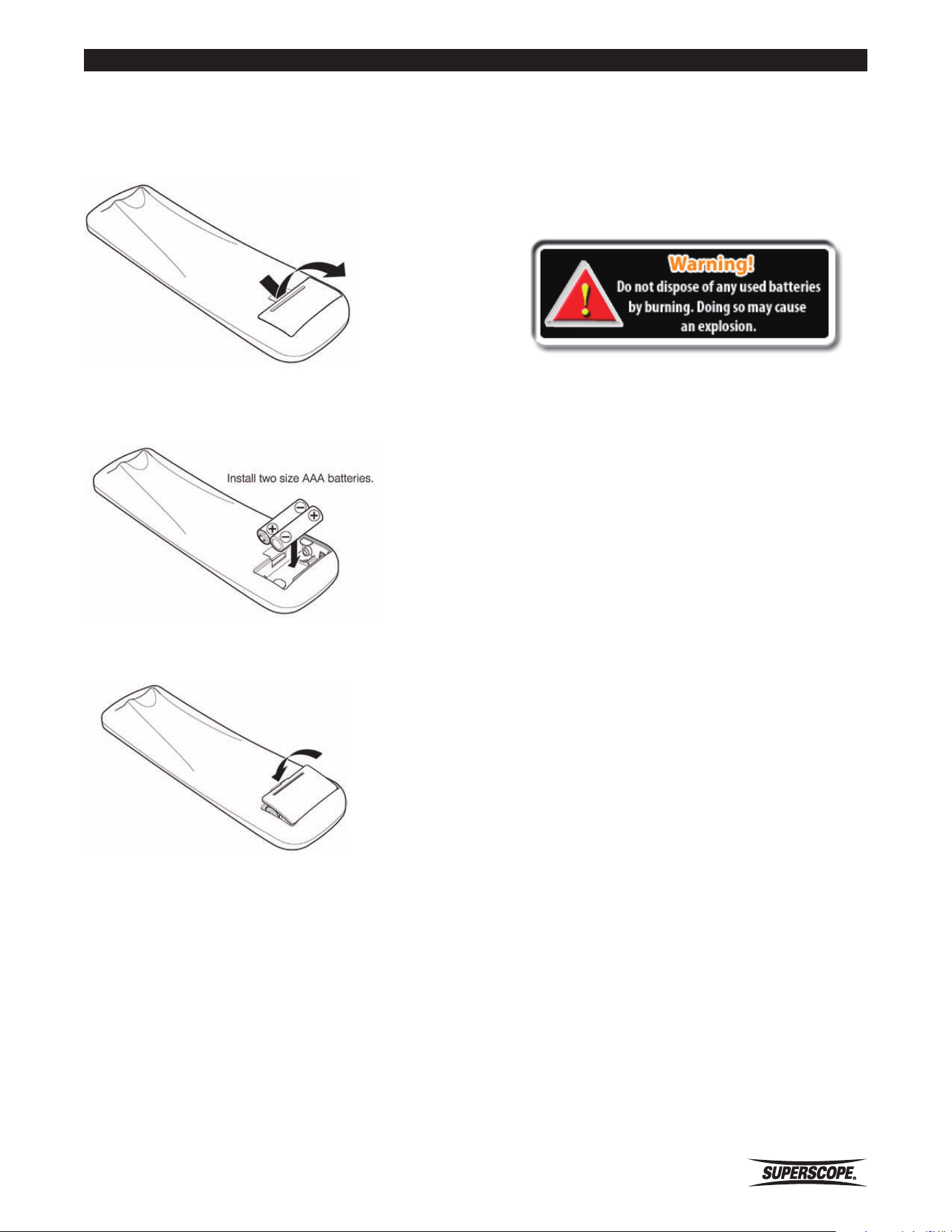
Remote Controller Battery Installation
Place 2-AAA batteries (included) inside the wireless
remote controller before it is used. Replace batteries by
removing the battery cover as shown:
Always match the polarity of the 2-AAA batteries with
the polarity indication inside the battery compartment.
Close the battery cover as shown:
With improper battery use, batteries may rupture, leak,
and cause corrosion. Please read the following guidelines
carefully:
If the remote controller is not in use for a long period of
time (more than one month), remove the batteries.
Please do not mix old batteries and new batteries
together.
Please match the polarity of the battery (+/ -) with the
polarity indication on the remote controller.
Batteries may have the same shape, but different
voltages. Do not mix different battery types.
If a battery leaks, clean the liquid from the battery
compartment and dispose of the leaking battery
according to the guidelines of your local government.
Please dispose of all used batteries according to the
guidelines of your local government.
- 12 -
Superscope PSD450mkII User Manual
Getting Started
■About Discs
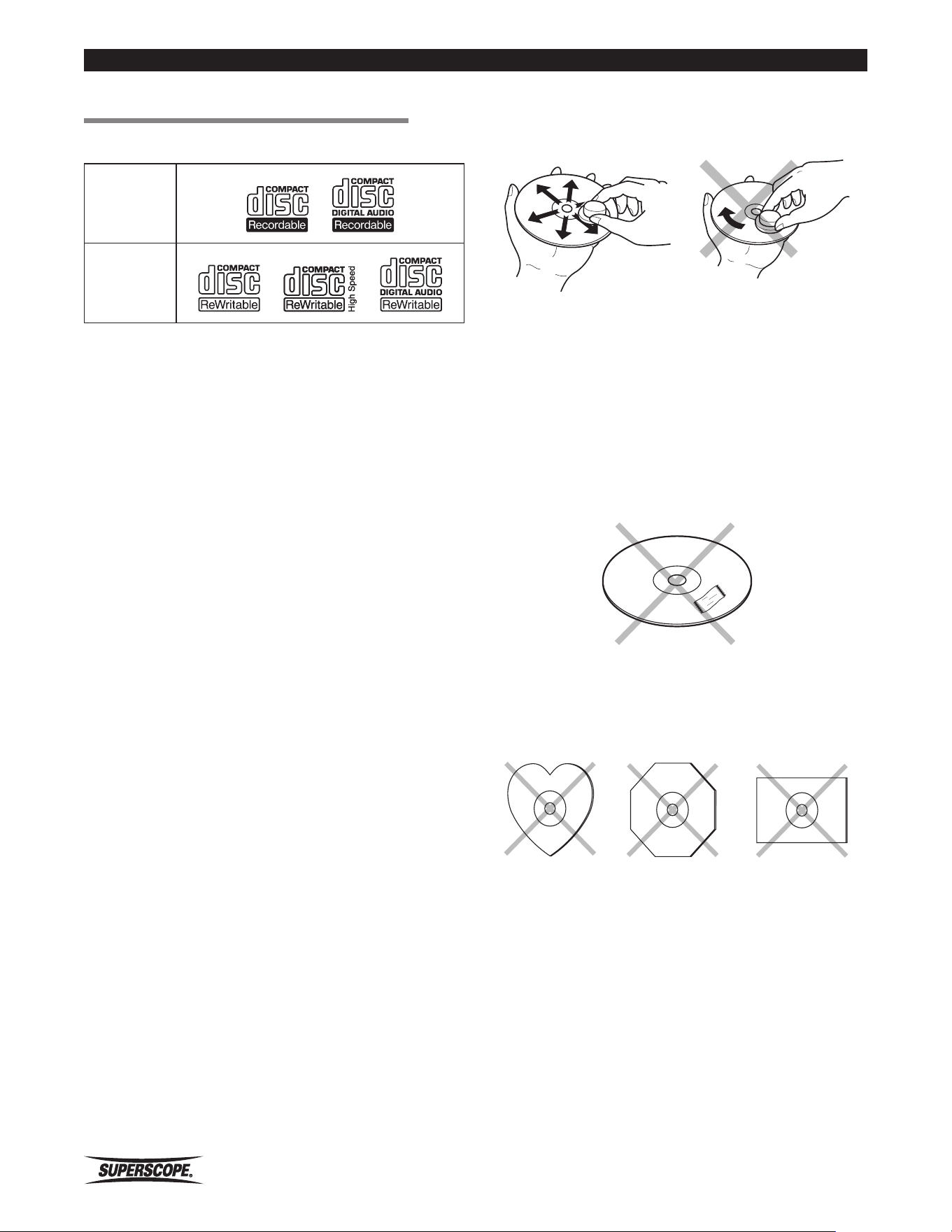
Playable discs
CD-R
CD-RW
Finalized CD-R and CD-RW discs recorded in the CD-DA
format and MP3 format can be played with the unit.
• Finalize is the process to make a CD-R/CD-RW playable
for players (not recorders).
• Some discs may not be able to be played depending
on condition of the discs and recording software.
• Single CDs (8 cm) cannot be used.
Disc Care
The glossy side shining like a rainbow is the front side of
the disc, and the side on which the label is printed is the
back. Unlike conventional turntables for playing analog
discs, the unit reads the information recorded on the disc
from underneath without contacting it using a beam of
laser light. Therefore, the performance of a compact disc
will not degrade like conventional analog records.
Handle discs carefully so as not to damage or
scratch the front side.
To protect the disc, avoid placing it in the following
locations:
• In direct sunlight or near a source of heat like a heater.
• In a place which is damp or dirty.
• In a place which could be exposed to rain, such as
near a window.
Always keep the disc surface clean.
When cleaning the disc surface, always be sure to use a
special compact disc cleaner and wipe as shown below.
• Do not use conventional record cleaner for analog
records, as this will adversely affect the disc surface.
Store discs properly by placing them in their disc cases.
• Do not attach a piece of paper or sticker on the label
side of disc. When a disc has a piece of plastic tape or
rental CD label with paste protruded from the edge or
when a disc has a trace of such a sticky object, do not
attempt to play the disc. If such a disc is played on the
CD player, it may cause the disc drive to malfunction
or it may be impossible to remove the disc.
• Do not use a disc with a special shape.
Do not attempt to play a disc with a special shape such
as a heart-shaped disc or octagonal disc. Equipment
malfunction may result.
Superscope PSD450mkII User Manual
- 13 -
Controls
■Top Panel
POWER
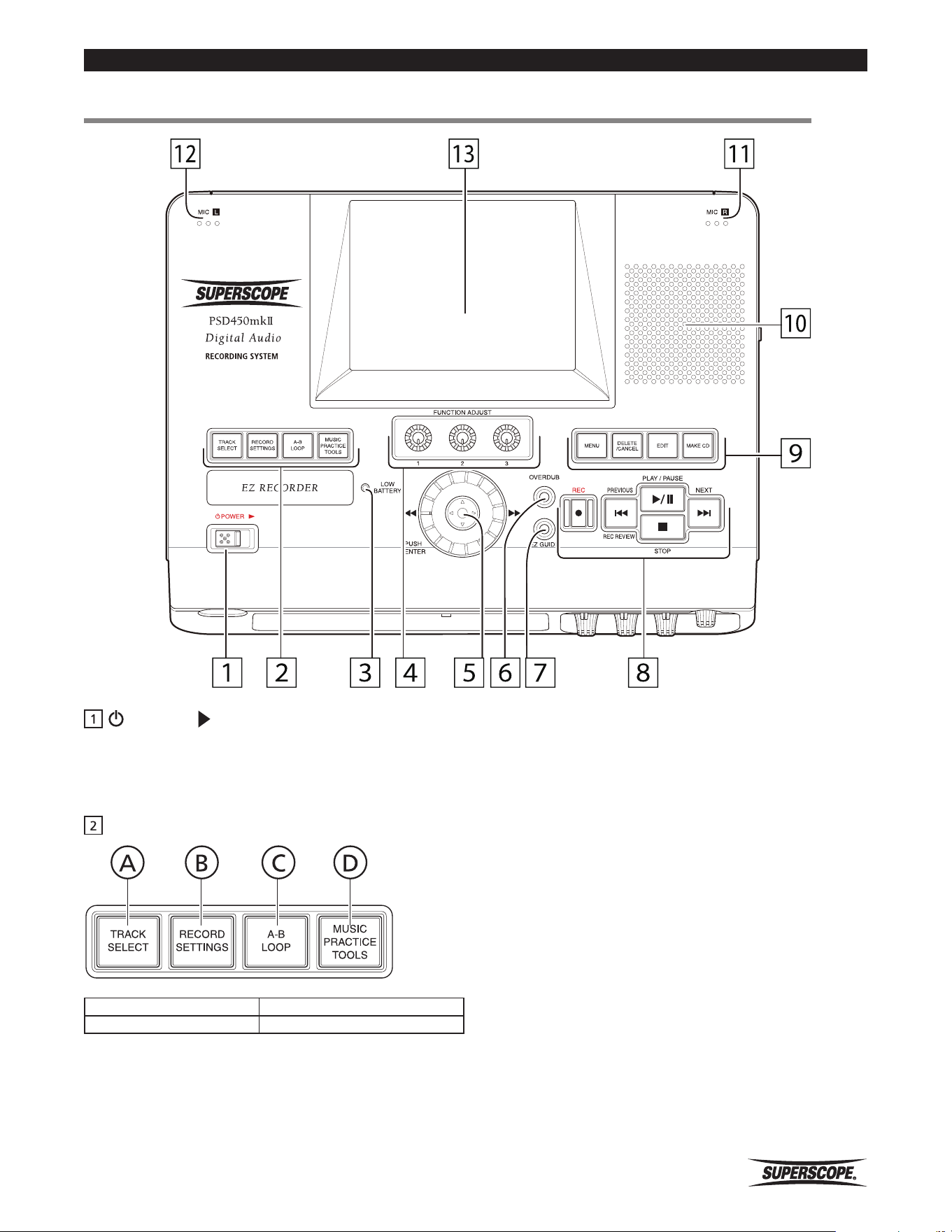
Slide the POWER switch to the right to turn power ON or
OFF.
FUNCTION CONTROL Buttons
Ⓐ TRACK SELECT Ⓒ A-B LOOP
Ⓑ RECORD SETTINGS Ⓓ MUSIC PRACTICE TOOLS
A. TRACK SELECT
Press to select a track for playback, Edit, or Overdub.
Also, use to select a record location. Press this button a
second time to return to the main screen.
B. RECORD SETTINGS
Press to set for recording as follows;
Input Source, Recording Folder, Record Format (WAV/
MP3), Stereo/Mono setting, Bit Number/Bit Rate. Press
this button a second time to return to the main screen.
- 14 -
Superscope PSD450mkII User Manual
Controls
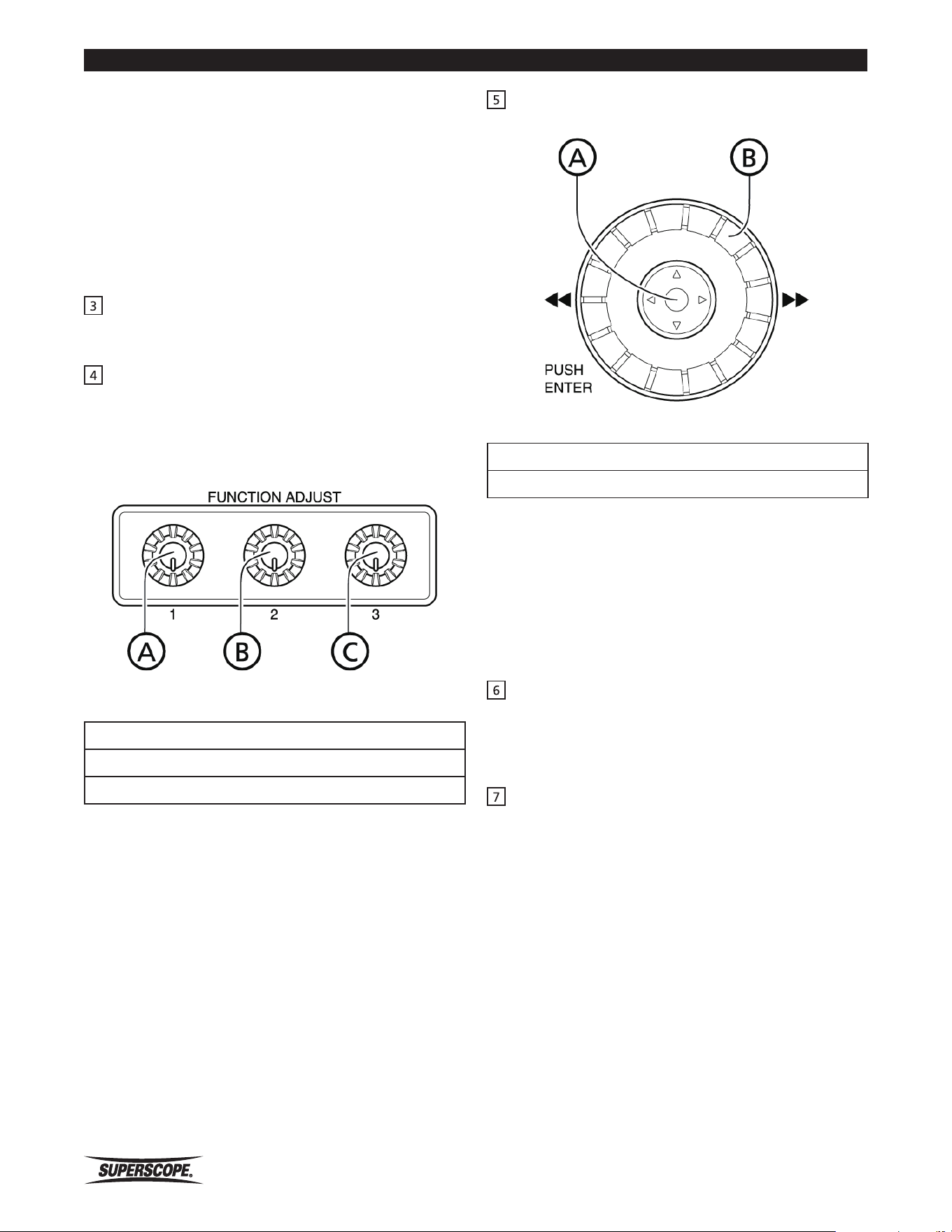
C. A-B LOOP
Press to set the A-B loop when a music file plays. Press
and hold for 3 seconds to display the A-B loop detail
screen.
D. MUSIC PRACTICE TOOLS
Press to display the setting screen as follows;
TEMPO/KEY/Fine Tune, Voice Reduction, Tuner, Tone,
Metronome.
Low Battery Indicator
LED flashes when the battery power is low.
FUNCTION ADJUST Knobs
Turn to adjust various parameters. In addition, pushing
the knobs resets certain settings to their default
values. Refer to indication on display for knob/function
relationship.
Ⓐ FUNCTION ADJUST #1 knob
Ⓑ FUNCTION ADJUST #2 knob
Ⓒ FUNCTION ADJUST #3 knob
JOG WHEEL / JOYSTICK / ENTER
Ⓐ JOYSTICK / ENTER
Ⓑ JOG WHEEL
A. Move the joystick up and down to select items, or in
certain modes, to change screens. Move the joystick
right and left to changes parameters, or in Play mode
to search through a track. In addition, push the
joystick to "ENTER" (select) items or settings.
B. Turn the jog wheel to select various items or
parameters.
OVERDUB
When an accompaniment track is selected, press this
button to enter Overdub mode. When overdubbing is
complete, press this button to return to the main screen.
EZ GUIDE
Press for assistance operating the most popular features.
Superscope PSD450mkII User Manual
- 15 -
Controls
CONTROL Buttons (Transport)
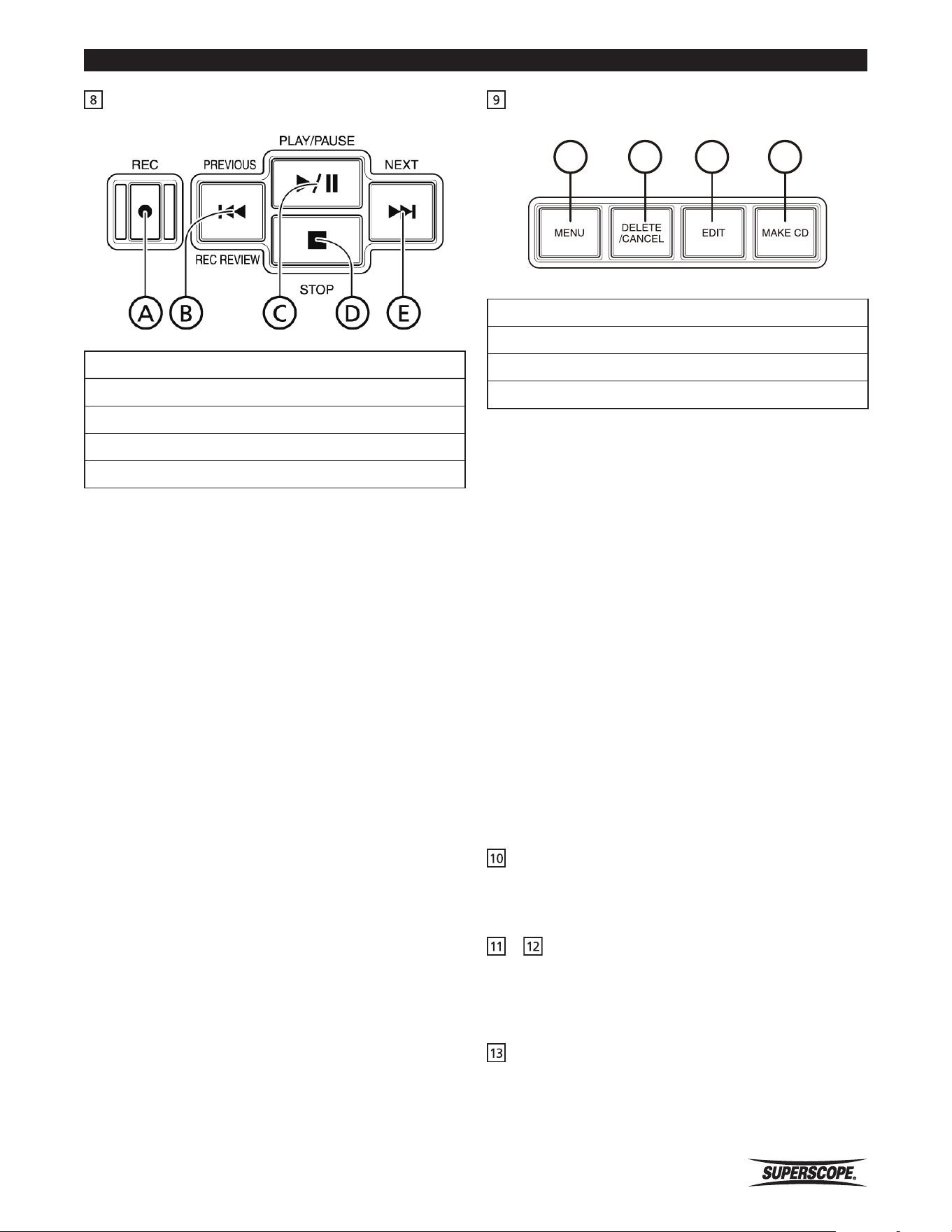
Ⓐ REC
Ⓑ PREVIOUS & REC REVIEW
Ⓒ PLAY/PAUSE
Ⓓ STOP
Ⓔ NEXT
A. REC Button
From Stop mode, press to enter Record Pause mode or
Record mode. The Record LED will flash during Record
Pause mode and remain lit during Record mode. From
Stop mode, press to enter Record Pause mode or Record
mode. The Record LED will flash during Record Pause
mode and remain lit during Record mode. From Record
mode, press to increment a track.
Note: The Record button cannot be used to increment
tracks when recording direct to CD.
B. PREVIOUS & REC REVIEW Button
During playback, press to return to the beginning of the
track. If playback is within one second of the start point,
press to return to the beginning of the previous track.
In Stop mode, press to return to the beginning of the
previous track. In Record Mode, press to stop recording
and automatically play back the recently recorded file
(Rec Review function).
C. PLAY/PAUSE Button
From Stop mode, press to start or pause playback.
From Record Pause mode, press to begin recording.
From Record mode, press to pause the recording and
increment a track.
D. STOP Button
Press to stop playback or recording.
E. NEXT
Press to advance to the next track.
CONTROL Buttons (Top Right)
A B C D
Ⓐ MENU
Ⓑ DELETE / CANCEL
Ⓒ EDIT
Ⓓ MAKE CD
A. MENU
Press to view menu options.
B. DELETE / CANCEL
Press to cancel settings and delete characters when
editing titles and file information, or delete the music
data.
C. EDIT
Press to view edit options.
D. MAKE CD
Press to:
• Burn a CD (audio or data)
• Finalize a CD
• Duplicate a CD
• Erase (CD-RW only)
Internal Speaker
All sounds can be heard through the built-in monitor
speaker.
- Internal Mic R & Internal Mic L
Use the Right and Left internal mics to record without
additional equipment.
LCD Color Display
High-resolution full-color liquid crystal display monitor.
Please refer to LCD Display for an explanation of display
icons.
- 16 -
Superscope PSD450mkII User Manual
Controls
■Front Panel
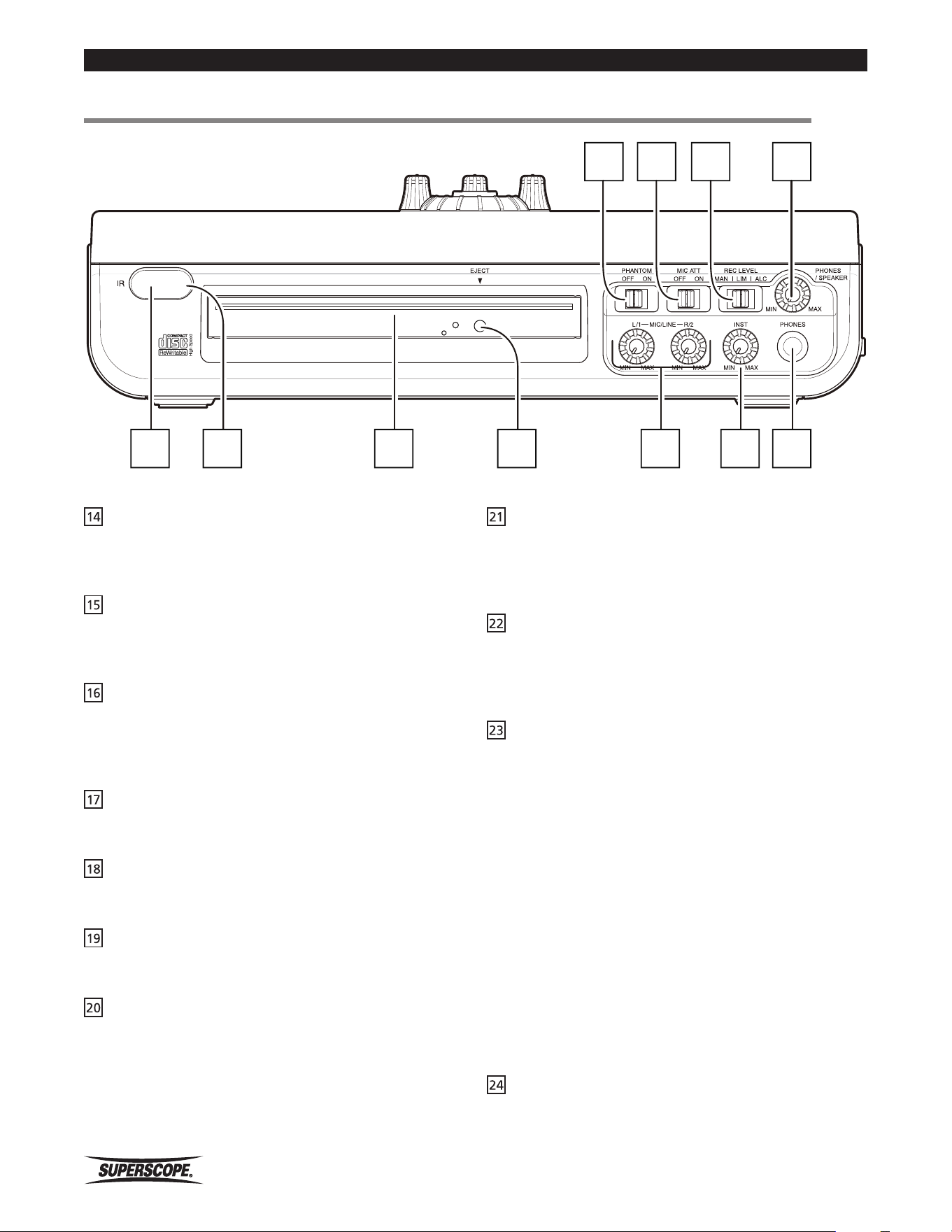
Infrared (IR) Receiver
The infrared receiver detects signals from the wireless
remote controller.
IR Signal Indicator
This LED flashes red when a signal from the wireless
remote controller is received.
CD-RW Drive
Insert an audio CD for playback, accompaniment,
transfer to the Internal Memory or duplication. Insert a
CD-R/RW for burning audio or data discs.
EJECT Button
Press to eject a compact disc from the CD-RW drive.
MIC / LINE L & R Level Control
Turn these knobs to adjust the level of the MIC/LINE inputs.
INST (Instrument) Level Control
Turn this knob to adjust the level of the INST input.
PHONES Jack
Connect stereo headphones here. This input accepts ¼”
headphone plugs.
PHANTOM Power ON/OFF SWITCH
Switch on to supply 48 V phantom power to
microphones connected to the XLR inputs. Switch off
when a microphone does not need phantom power.
MIC ATT ON/OFF
If input level controls are turned low and microphone or
instrument levels are still too strong, switch on to add 15
dB of attenuation.
RECORD LEVEL MAN / LIM / ALC
This switch determines the method for setting record
levels.
MAN (Manual)
Input level is controlled by manual adjustment of the
Mic/Line, INST, or AUX level controls.
LIM (Limiter)
Input level is controlled by manual adjustment of the
Mic/Line, INST, or AUX level controls. A limiter circuit
protects against signal overload.
ALC (Automatic Level Control)
The Mic/Line, INST, or AUX level controls are bypassed
and input level is controlled automatically. A limiter circuit
protects against signal overload.
PHONES / SPEAKER LEVEL
Turn this knob to adjust the level for the built-in speaker
and headphones.
16 18 19 20
24232221
14 15 17
Superscope PSD450mkII User Manual
- 17 -
Controls
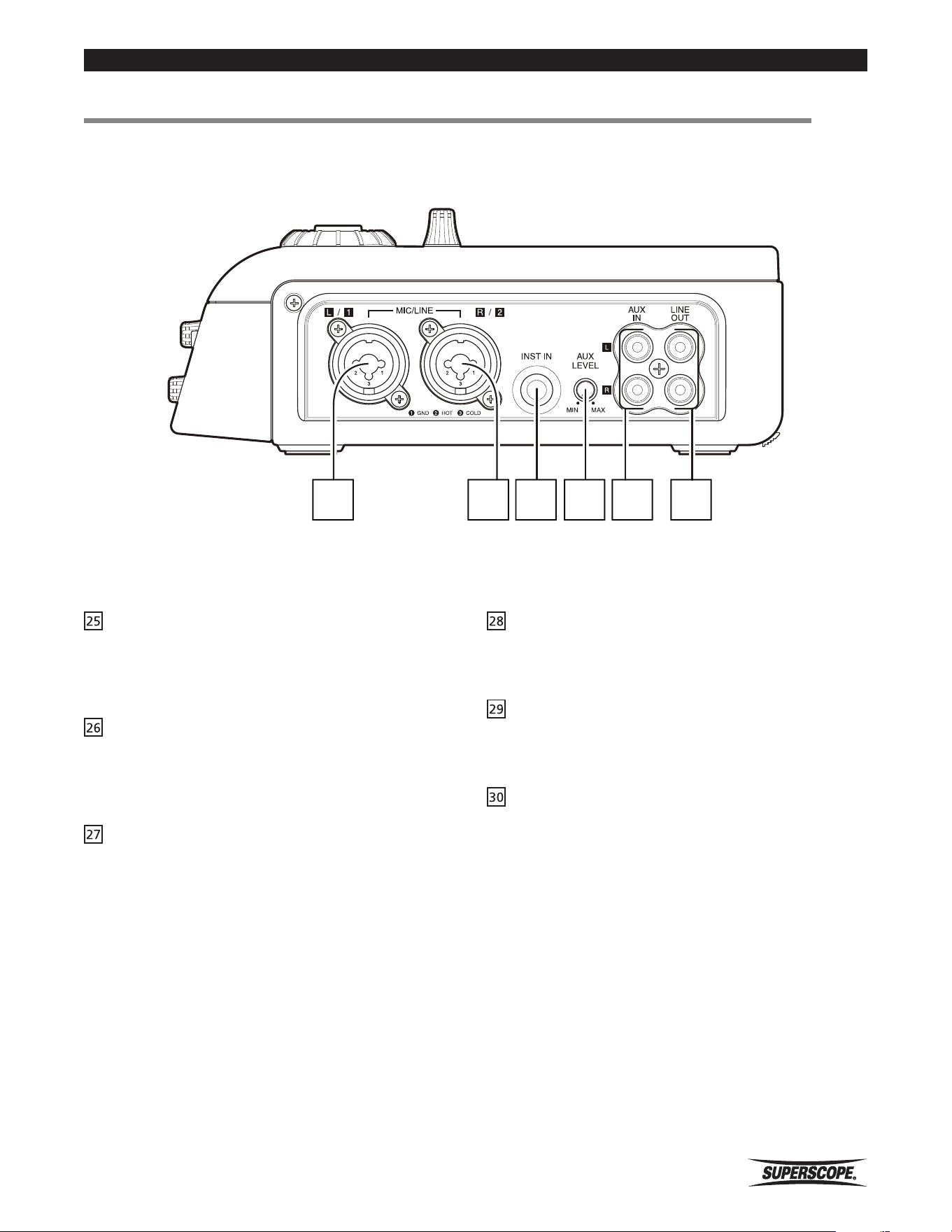
25 26 27 28 29 30
■Right Side Panel
Left / XLR / 1/4” Input Jack
Connect microphones or line level equipment with XLR
or ¼” inch plugs here. Push the RECORD SETTINGS
button [2B] to select the input you wish to use.
Right / XLR / 1/4” Input Jack
Connect microphones or line level equipment with XLR
or ¼” inch plugs here. Push the RECORD SETTINGS
button [2B] to select the input you wish to use.
INST IN Jack
Connect an electric guitar, bass, or keyboard here.
VU Meter Overload If your keyboard or guitar/bass
signals routinely cause the VU meters to display “OVER,”
change INST Input Gain setting to Low.
AUX LEVEL
Turn this knob to adjust the input signal level of the AUX
IN.
AUX IN Jacks
Use these inputs when connecting line level equipment
with RCA outputs, such as CD players or mixing boards.
LINE OUT Jacks
Connect these outputs to the inputs of another audio
device, such as an amplifier, mixing board or alternate
recording device.
- 18 -
Superscope PSD450mkII User Manual
Controls
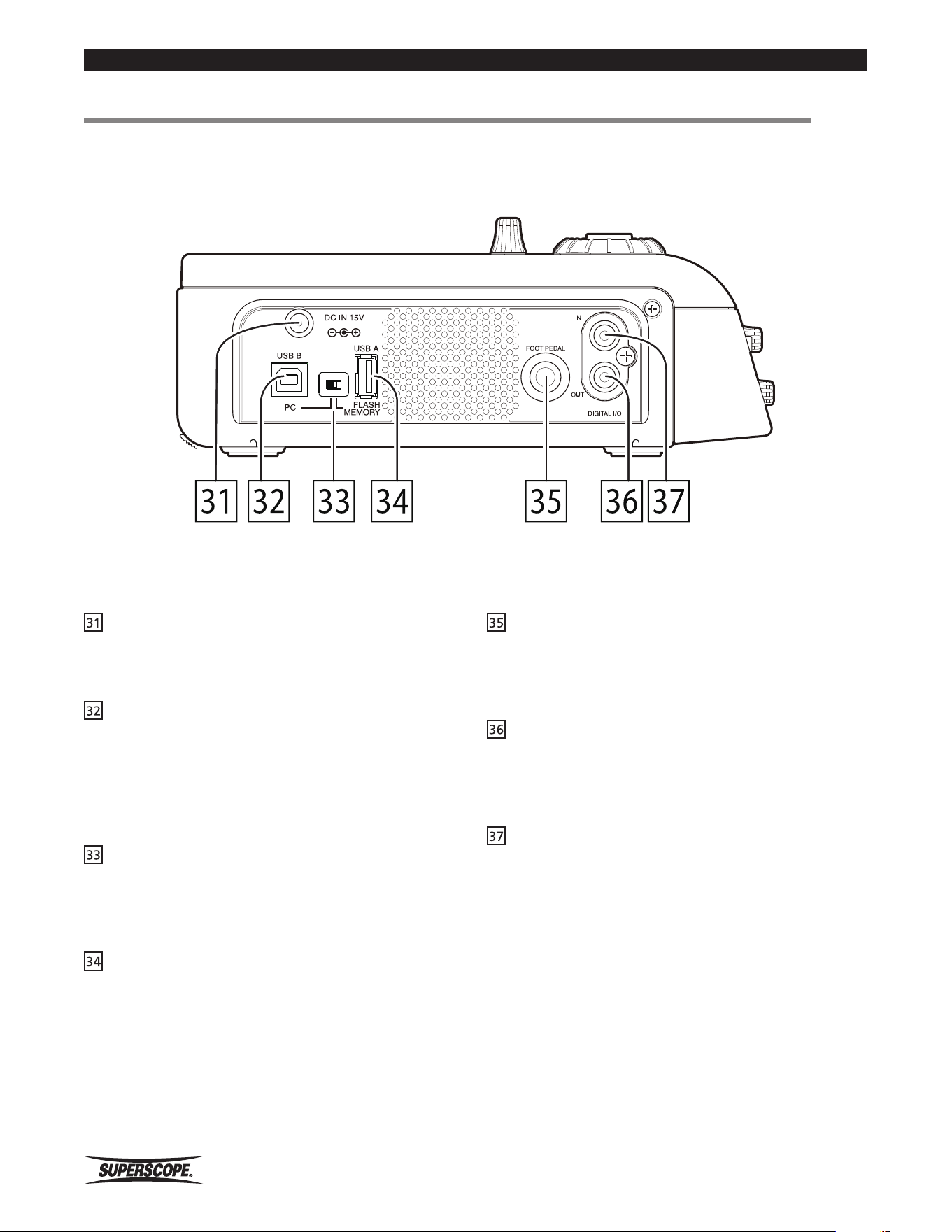
DC Input Jack
Connect the DA450PSD AC to DC adapter here.
Do not use any adapter other than the DA450PSD.
USB Connector B
Connect a USB cable here to transfer data between a
computer and the Internal Memory. In USB mode, all
other features will be inactive. The recorder will not enter
USB mode during recording or when menu screens are
active.
USB PC / Flash Memory Switch
Slide to “PC” when connecting a PC, slide to “FLASH
MEMORY” when connecting a USB memory or other
USB device.
USB Connector A
Connect a USB memory or other USB device.
■Left Side Panel
FOOT PEDAL Jack
Connect an optional foot pedal here to provide Play/
Pause, or Record/Pause control. The Superscope FT200
foot pedal is available at our online store.
DIGITAL OUT Jack
Connect to the digital input terminal of another audio
product. The system outputs a signal with a 44.1 kHz
sample rate.
DIGITAL IN Jack
Connect the digital output of another audio product to
this terminal.
- 20 -
Superscope PSD450mkII User Manual
Controls
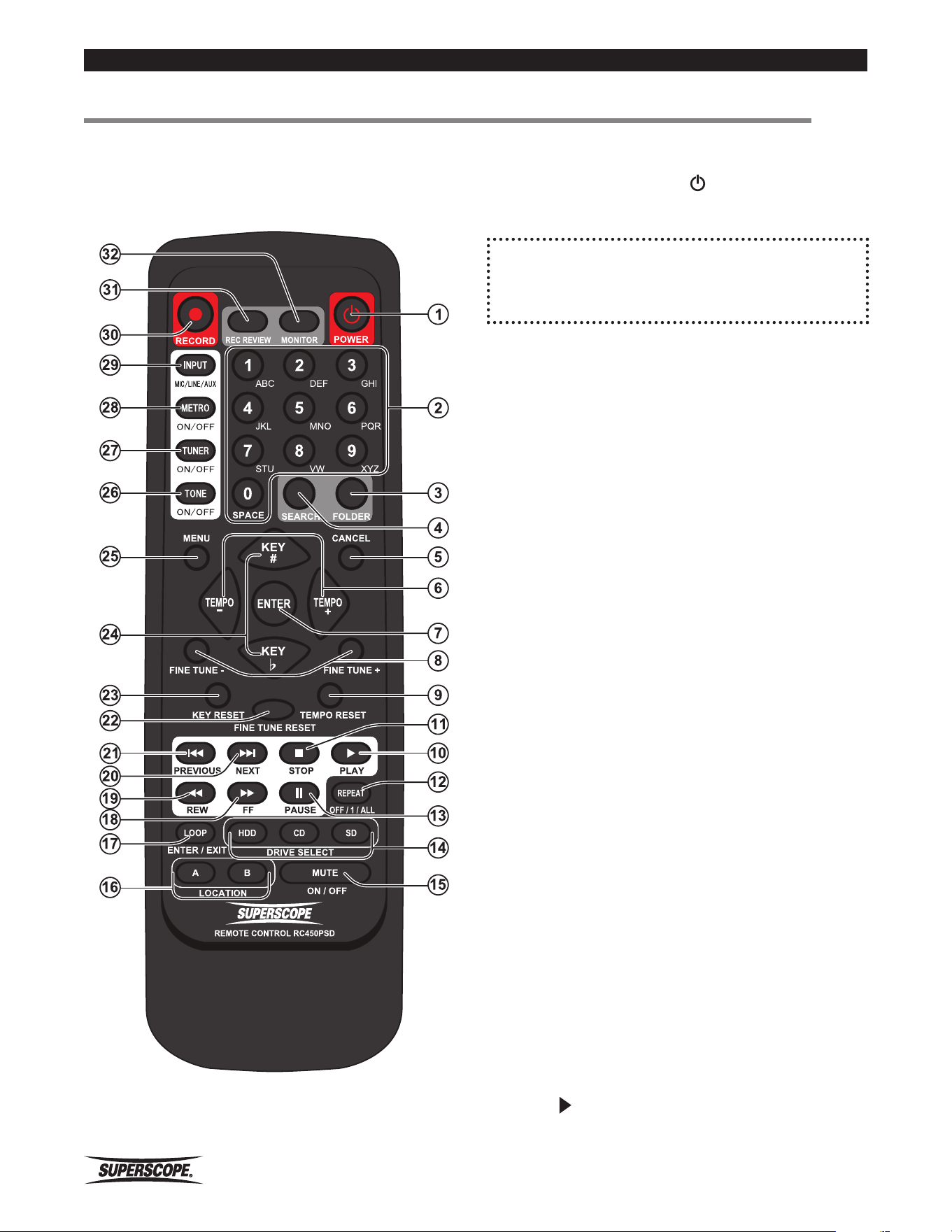
STANDBY / POWER
Press to turn power ON or OFF.
※ During battery operation, this button can only
be used to power the unit off. The AC adapter
must be connected to power the unit on with
the remote control.
w Alphanumeric Keypad
When editing folder names, playlist names, or file
information, use the alphanumeric keypad to enter text.
It is possible to select track number dulling CD play.
e FOLDER
Press to select a new folder.
The place that is deeper than the second hierarchy
cannot access it.
r SEARCH
Press to access the Search function.
t CANCEL
When editing folder names, playlist names, or file
information, use this button to delete a character. Also
used to undo changes to Menu settings.
y TEMPO
Press to increase or decrease playback speed without
affecting pitch.
u ENTER
Press to enter selected menus or confirm setting
changes.
i FINE TUNE
Press to increase or decrease playback pitch without
affecting playback speed. Fine Tune control is adjustable
+/-50 cents (100 cents = 1 semitone).
o TEMPO RESET
Press to reset Tempo control to normal speed.
a PL AY
Press to play the currently selected track.
■Remote Control

Superscope PSD450mkII User Manual
- 21 -
Controls
s STOP
Press to stop playback.
d REPEAT
Press to change repeat mode. Options include: Off, All,
1, (Single, 1), (Single, All), and Single.
f PAUSE
Press to pause playback.
g DRIVE SELECT
Pressing the HDD, CD or SD buttons will display the
contents of the selected drive.
※ The Internal Memory is used with the SD button.
h MUTE
Press to mute the internal speaker and Line Out. This will
not affect the headphones or Digital Out.
j LOCATION
A. LOCATION A – In Loop mode, press to set location A.
B. LOCATION B – In Loop mode, press to set location B.
k LOOP ENTER/EXIT
Press to enter and exit Loop mode.
FF (Fast Forward)
Press and hold to initiate an audible forward search of
the playing track.
REW (Rewind)
Press and hold to initiate an audible reverse search of the
playing track.
NEXT
Press to advance to the next available track.
PREVIOUS
Press to return to the beginning of the selected track.
Press within the first second of playback to return to the
previous track.
FINE TUNE RESET
Press to reset Fine Tune control to normal pitch.
KEY RESET
Press to reset Key control to normal pitch.
KEY
Press to change the playback key in semitones. Press
‘♭’ to lower the key. Press ‘♯’ to raise the key. Key is
adjustable +/- one octave.
MENU
Press to view Menu options.
TONE ON/OFF
Press to sound the 440 Hz tuning tone. The frequency of
this tone is adjustable between 410 Hz and 470 Hz. Press
this button a second time to return to the main screen.
TUNER ON/OFF
Press to access the chromatic tuner. Press this button a
second time to return to the main screen.
METRO ON/OFF
Press to turn the metronome ON and to enter the
metronome screen. Press this button a second time to
stop the metronome and return to the main screen.
INPUT MIC/LINE/AUX
Press to change the Input Source. Options include: Input
MUTE, Internal MIC, External MIC, LINE, INST, Internal
MIC (L ch) + INST, External MIC (L ch) + INST, LINE (L ch)
+ INST, AUX, and DIGITAL.
RECORD
Press to enter Record Pause mode. Press this button a
second time to begin recording. During recording, press
this button to increment tracks.
When using One Touch Recording, recording begins after
this button is pressed one time.
RECORD REVIEW
In Record mode, press to stop recording and
automatically play back the recently recorded file.
MONITOR
Press to toggle the monitor source between Playback
Signal and Recording Signal. When Playback Signal is
selected, the input signals, e.g., External MIC, INST, etc.
will not be heard.
- 22 -
Superscope PSD450mkII User Manual
LCD Display
■LCD Display
PLAY / STOP Mode
Ⓐ Icons
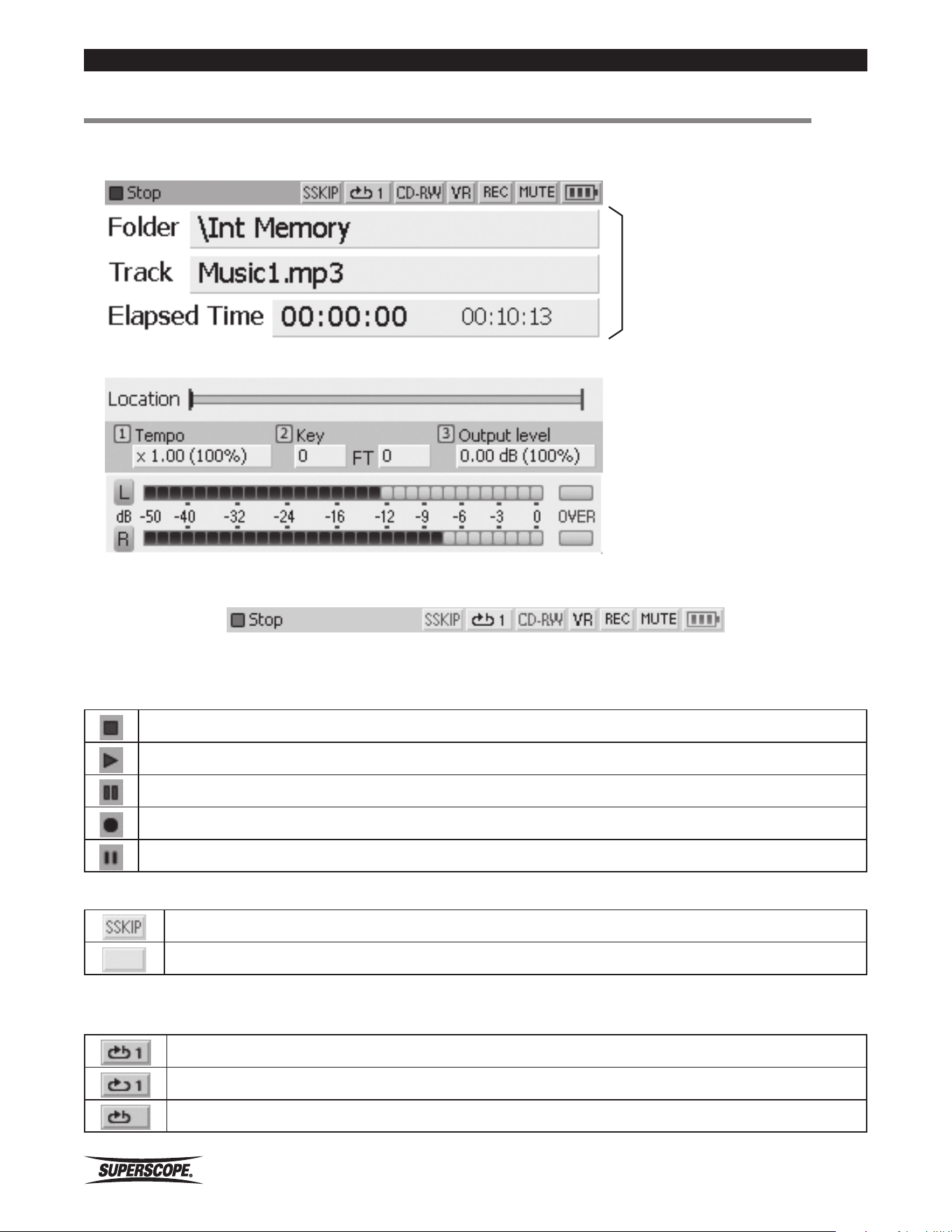
① Status Icons
Indicates STOP
Indicates PLAY
Indicates PLAYBACK PAUSE
Indicates RECORD
Indicates RECORD PAUSE
②
Silent Skip Icons
Silent Skip is ON
Silent Skip is OFF
③
Repeat Icons
Play back current track once, then stop at start of current track (Single, 1)
Play back and repeat current track (Repeat 1)
Play back all tracks once, then stop at start of the first track (Single, All)
Character Color:
The character color changes
by media for easy visual
identification as follows:
Int Memory: White
CD/CD-R/CD-RW: Orange
USBHDD: Green
Superscope PSD450mkII User Manual
- 23 -
LCD Display
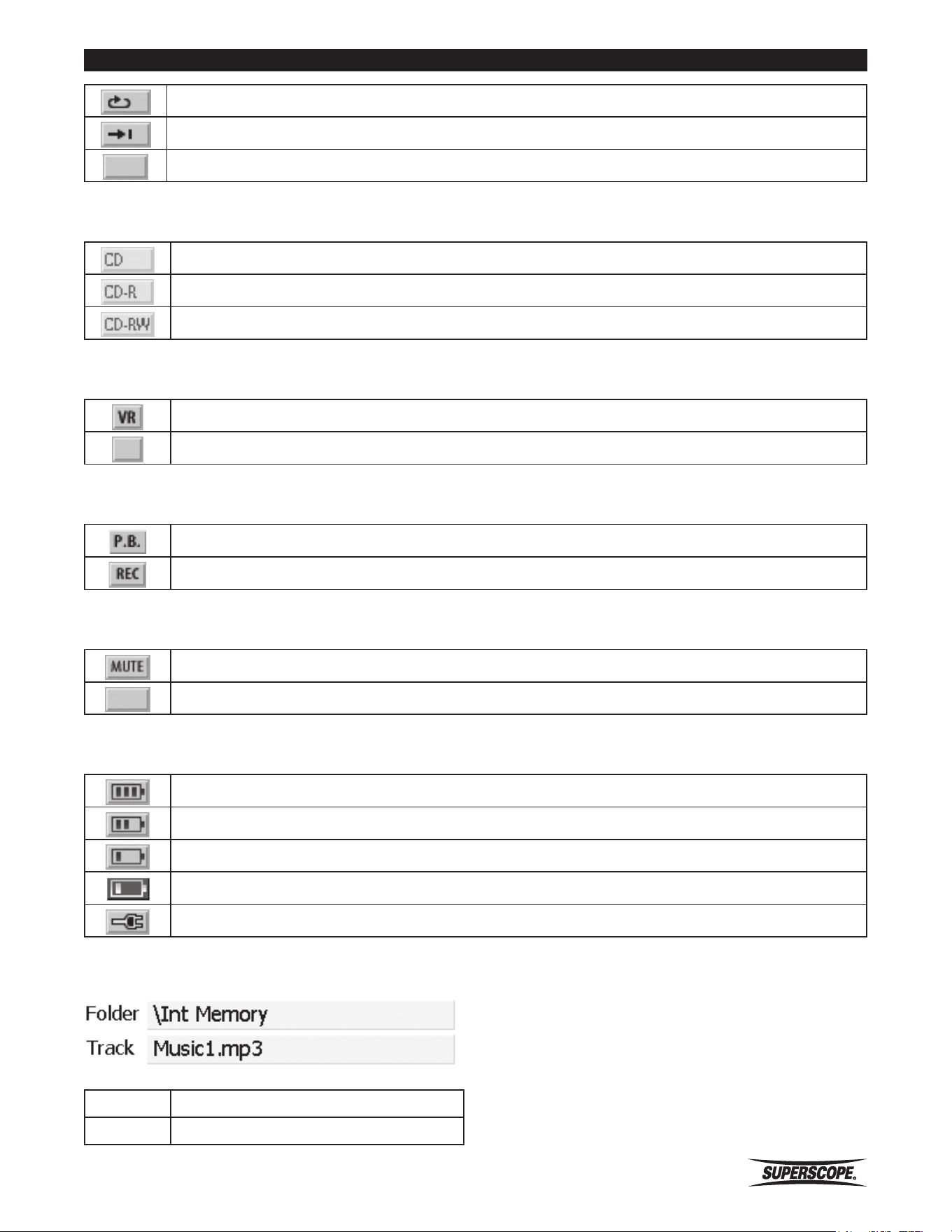
Play back and repeat all tracks (Repeat All)
Play back current track once, then stop at start of the next track (Single)
No indication when Repeat Mode if OFF
④
CD, CD-R, CD-RW Icons
Indicates a CD is inserted
Indicates a CD-R is inserted
Indicates a CD-RW is inserted
⑤
Voice Reduction Icons
Indicates VR is ON
Indicates VR is OFF
⑥
Monitor Icons
Playback audio is being monitored
Record audio is being monitored
⑦
Mute Icons
Indicates MUTE is ON
No indication when MUTE is OFF
⑧
AC/Battery Icons
Indicates the battery level is full
Indicates the battery level is less than full capacity
Indicates the battery level is low
Indicates the battery level is almost empty (needs to be charged or replaced)
Indicates the AC Adapter is connected
PLAY / STOP Mode
Ⓑ File Information
Folder
Displays the current folder
Track
Displays the active track
- 24 -
Superscope PSD450mkII User Manual
LCD Display
PLAY / STOP Mode
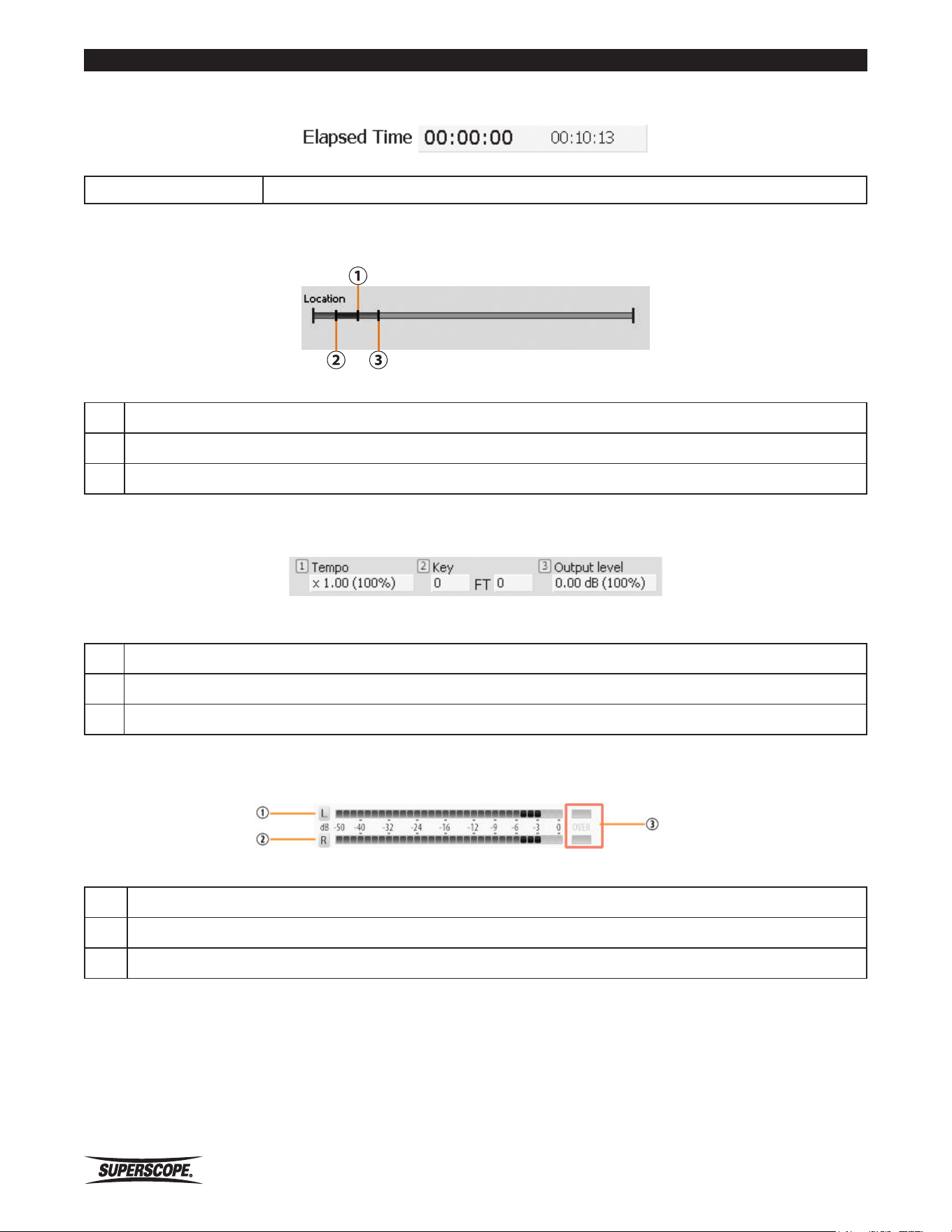
Ⓒ Playback Data
Elapsed Time Displays the elapsed and remaining time for the current track
PLAY / STOP Mode
Ⓓ Location
Indicating Location
Displays the current position on the time line.
w
Displays the position of location A on the time line.
e
Displays the position of location B on the time line.
PLAY / STOP Mode
Ⓔ Tempo, key, Output Level
Assignment of FUNCTION ADJUST knobs
When the Play/Stop mode screen is active, use FUNCTION ADJUST #1 to adjust Tempo.
w
When the Play/Stop mode screen is active, use FUNCTION ADJUST #2 to adjust Key.
e
When the Play/Stop mode screen is active, use FUNCTION ADJUST #3 to adjust Output Level.
PLAY / STOP Mode
Ⓕ VU Meters
Level meter indication
Displays the sound level of the left channel in decibels (dB).
w
Displays the sound level of the right channel in decibels (dB).
e
When sound level is beyond 0dB, “OVER” turns on.
Superscope PSD450mkII User Manual
- 25 -
Set Up
■Powering On
PSD400 series recorders work with AC power or AA size
batteries.
Before using batteries, please refer to Using Batteries.
※ It is not possible to power the unit ON with the
remote controller when using battery power.
※ Burning CDs with battery power is not
recommended. Please connect AC power
before burning a CD.
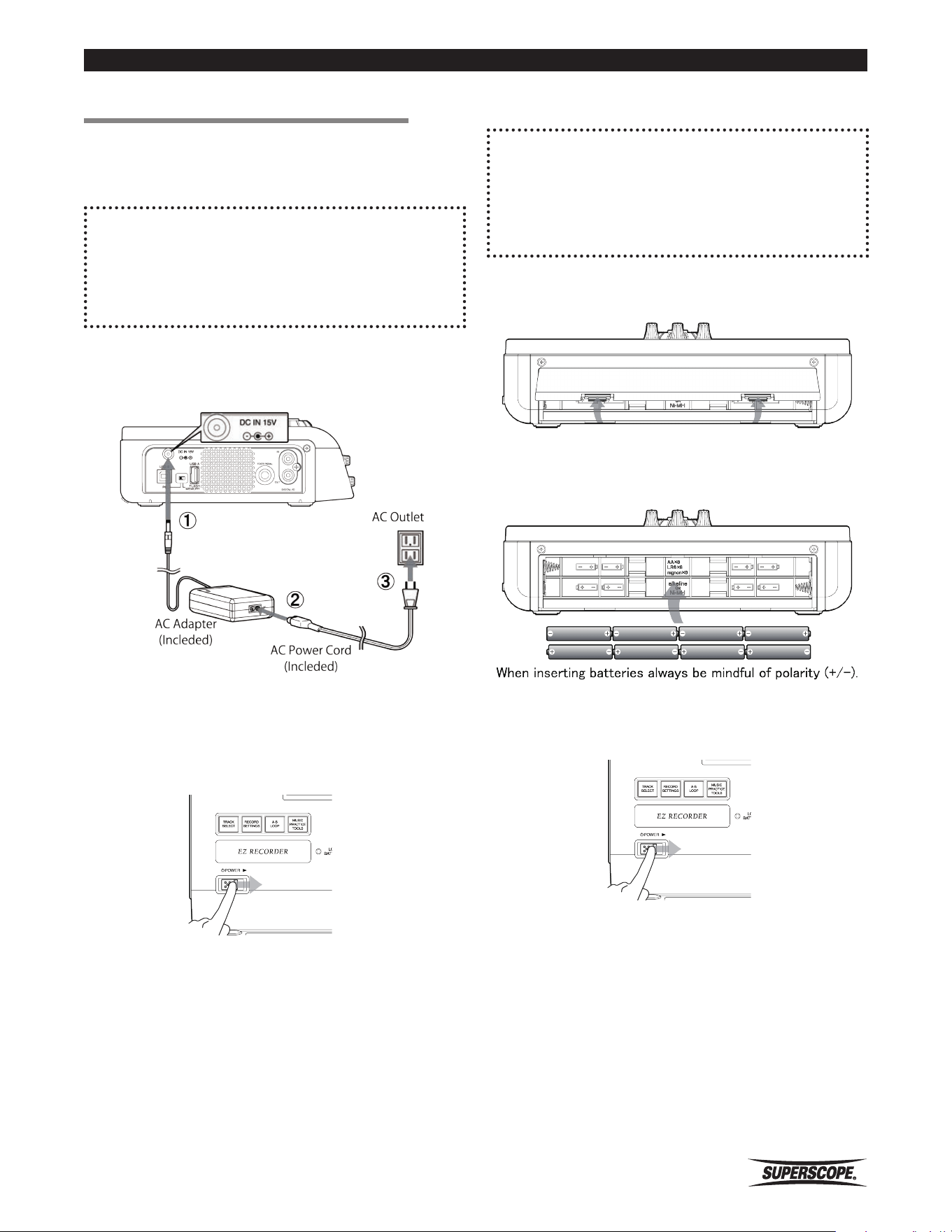
Using the AC Adapter
Connect the AC Adapter to the DC Jack.
w Connect the AC Cord to the Input of the AC Adapter.
e Connect the AC Plug to AC power source.
r Slide the POWER switch to power on.
r
Using Batteries
Compatible Batteries
PSD400 series recorders work with alkaline batteries
and rechargeable Ni-MH batteries.
※ Manganese batteries are not recommended
due to their low capacity.
1. Remove the battery cover on the back of the
recorder.
2. Insert eight alkaline AA size or Ni-MH batteries (fully
charged).
3. Close the battery cover.
4. Slide the POWER switch to power on.
When inserting batteries always be mindful of polarity
(+/-).
※ During battery operation, an icon is displayed
in the top right corner of the display showing
battery power. See AC/Battery Icons.
- 26 -
Superscope PSD450mkII User Manual
Set Up
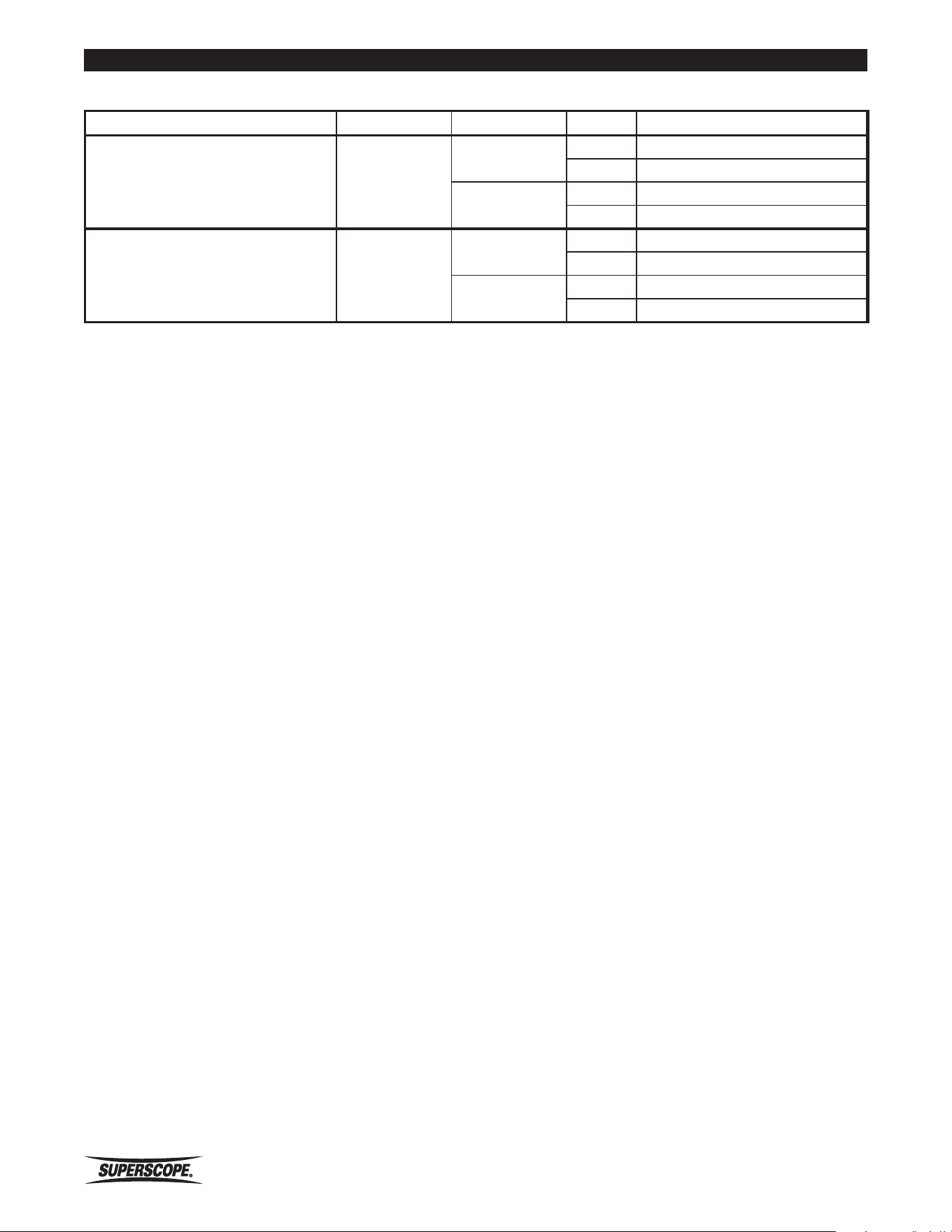
Battery Life
Battery Type ATA LCD Phantom
Battery Life (hours)
Fully charged 2,700mAh
Ni-MH
ON
Full bright
OFF 4.8
ON 4.4
Dimmer
OFF 5.9
ON 4.9
AA size
Alkaline
ON
Full bright
OFF 2.5
ON 2.4
Dimmer
OFF 3.2
ON 2.7
Conditions: 77 degrees Fahrenheit.
Volume controller: Minimum position.
Mode: Recording MP3-Stereo-128kbps.
AC Power and Battery Tips
• When the AC adapter is connected while batteries
are inserted, AC power will have priority over the
battery power supply.
• It can be helpful to use batteries and the AC power
supply together. If the AC power supply is removed
unexpectedly, recording or playback will continue
without interruption using battery power.
• Do not mix new and old batteries or battery types
(Alkaline or Ni-MH).
• When the unit is not in use for a long period of time,
please remove batteries to prevent battery leakage.
Superscope PSD450mkII User Manual
- 27 -
Set Up
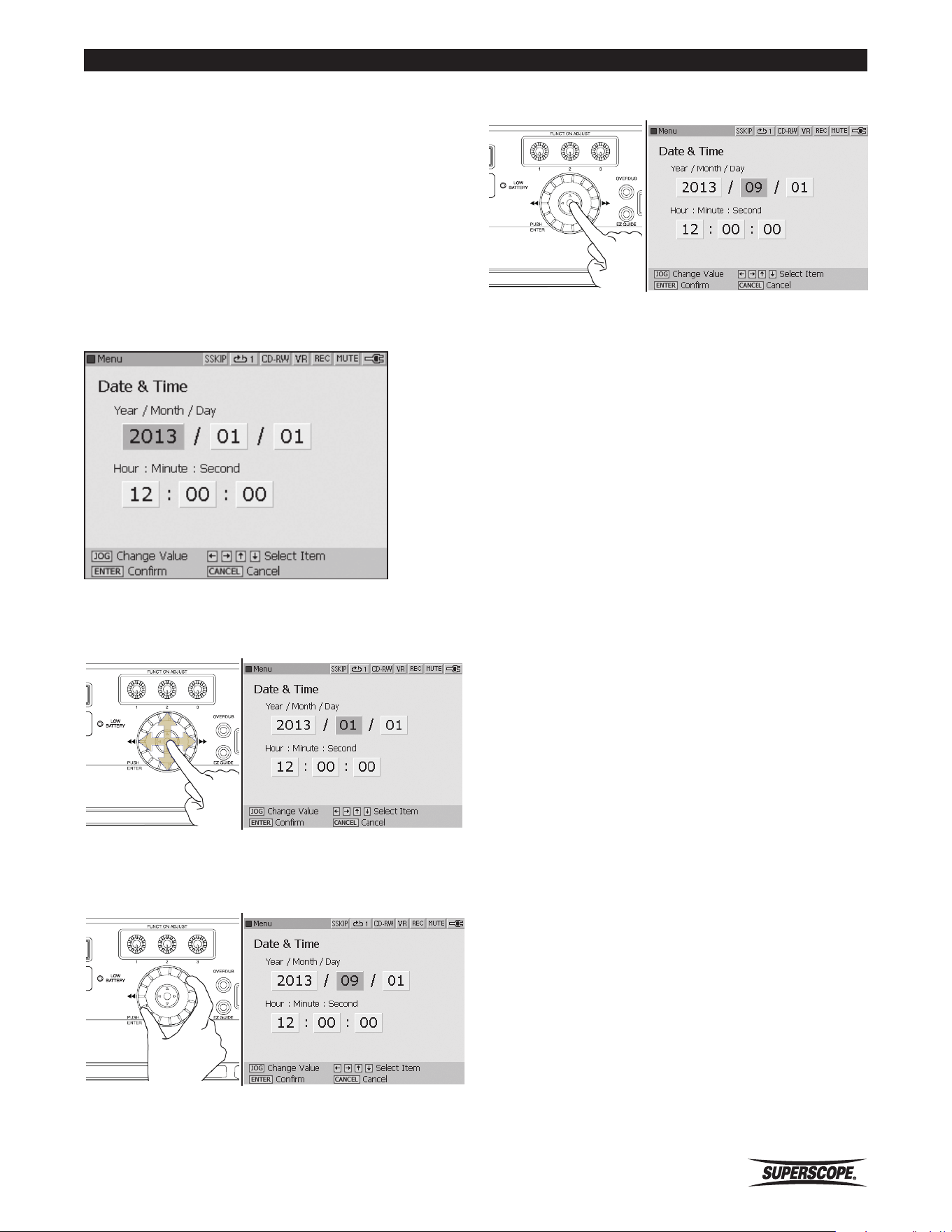
Setting Date and Time
New recordings are given a default track title comprised
of the current date and time, e.g., 2013-01-01
(12h00m00s).wav. Follow these steps to ensure that the
date and time is accurate.
1. Press the MENU button.
2. Use the joystick or jog wheel to highlight
Maintenance. Press ENTER.
3. Use the joystick or jog wheel to highlight Set Time/
Date. Press ENTER.
The following screen should appear:
4. Move the joystick right, left, up, or down to select
Year, Month, Day, Hour, Minute, or Second.
5. Change Time and Date values by turning the jog
wheel.
6. Press ENTER to confirm new settings.
- 28 -
Superscope PSD450mkII User Manual
Set Up
The Internal Memory
Upon Powering Up, the unit will create a file
database on the Internal Memory. During this
process, the unit scans the Internal Memory for audio
files (WAV, MP3) and ID3 tag information (Artist, Title,
Album, etc.). The time to create this database will vary
based on the contents of the Internal Memory:
A. Maintaining a Large Number of Audio Files on
the Internal Memory
The amount of audio files and folders you choose
to store on the Internal Memory will directly affect
the amount of time it takes to create a file database.
Superscope recommends that you limit the number of
files and folders on the Internal Memory.
B. Maintaining a Large Number of Non-Audio Files
on the Internal Memory
The unit must scan all files before proceeding, so
storing non-audio files on the Internal Memory is not
recommended. Any number of additional files on the
Internal Memory (e.g., jpg, mov, pdf, etc) will slow
down database creation.
C. Storing Large Audio Files on the Internal
Memory
When an audio file is detected on the Internal
Memory, the unit will open the audio file and begin
searching for content information, e.g. Title, Artist,
Album, etc. The unit must search the entire file in
case this information is stored at the end of the file.
Large audio files therefore require more time during
database creation.
※ The unit will recognize a maximum 99 files
for each folder. If you attempt to record more
than 99 files in a folder, a new folder will be
created automatically.
File and Folder Limits
Files Per Folder 99
Single File Size 2GB
※ When the above limits are exceeded
during recording, a new folder is created
automatically and recording continues.
Note: During the transition time, audio may
be lost.
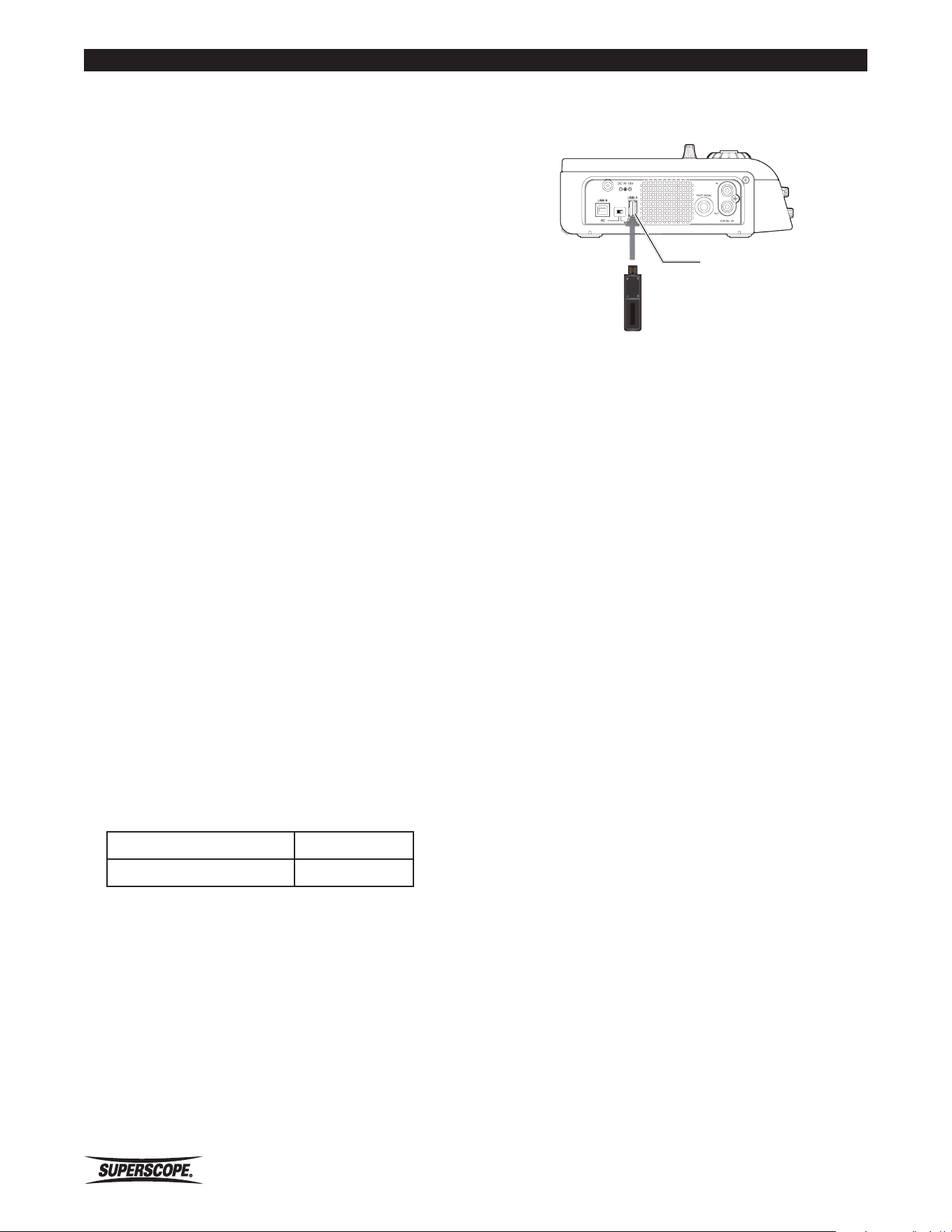
Inserting a USB Memory
Insert a USB Memory on the left panel of the recorder.
USB Memory slot
※ Do not remove the USB Memory during
recording, playback, or editing. It is
recommended that you remove the USB
Memory only after switching off power to
avoid any risk of lost or damaged data.
Superscope PSD450mkII User Manual
- 29 -
Set Up
■Setting Up
Speakers
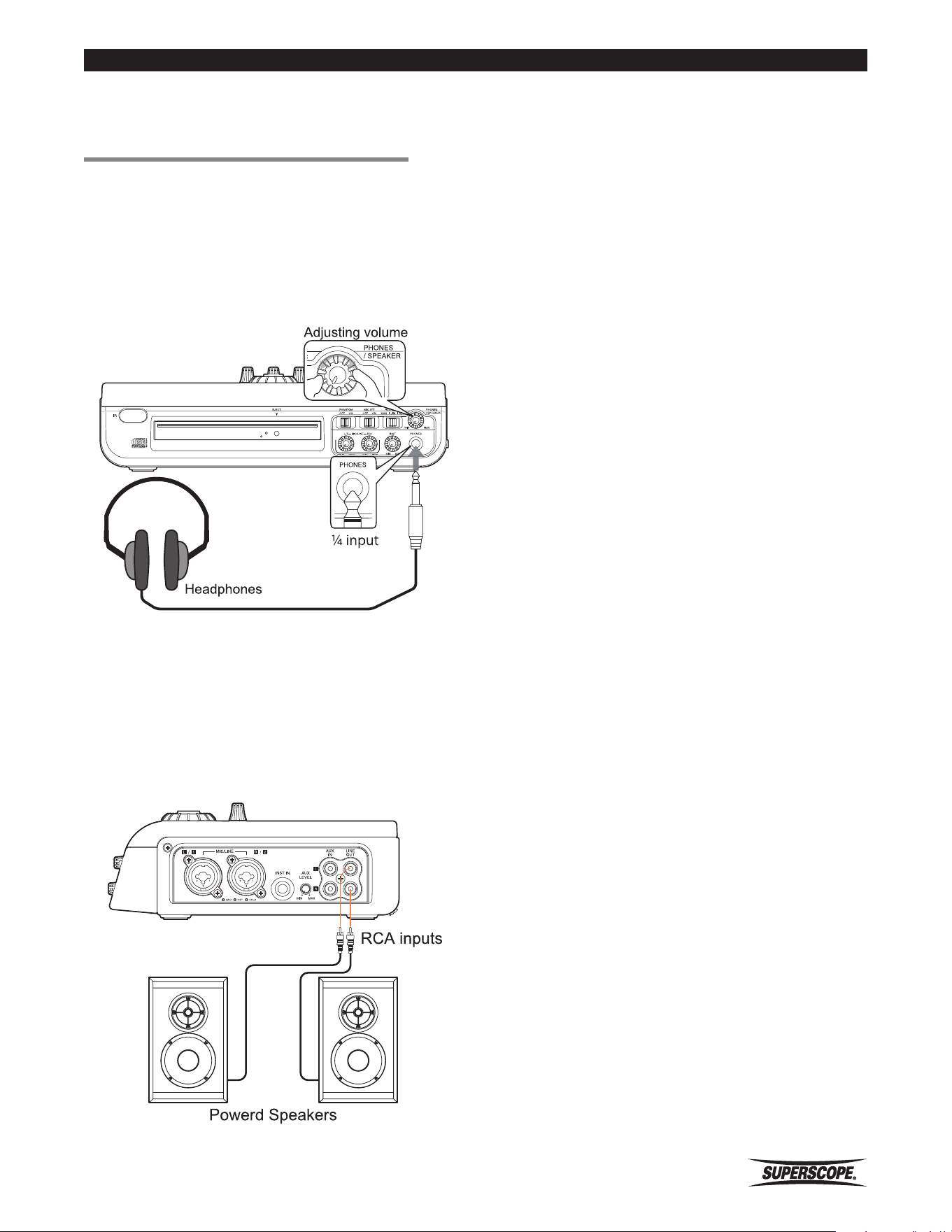
Using Headphones or the Built-In
Speaker
When using headphones or the built-in speaker, regulate
volume by turning the PHONES/SPEAKER level knob on
the front panel. The internal speaker will be muted when
headphones are connected.
External Speakers
When using a powered speaker system, (speakers with
built-in amplifiers), please connect the speaker’s LINE
INPUT to the LINE OUT terminal on the right side panel.
The left channel is the white terminal and the right
channel is the red terminal. Use the volume control on
the powered speakers to adjust level.
.
- 30 -
Superscope PSD450mkII User Manual
Set Up
■Setting Up
Microphones,
Instruments and
Other Sound
Sources
The PSD400 series is designed to record microphones,
musical instruments (guitars and keyboards), line level
equipment and digital equipment (preamps, mixers,
etc.). Please refer to the procedure that describes your
particular recording set-up.
Microphones
Balanced Connections
Balanced signals require three separate connections
(HOT, COLD, GND):
GND refers to the grounding wire.
HOT refers to the original audio signal.
The COLD signal is the original signal with
opposite phase.
Using balanced connections like the XLR plug (male)
will help to eliminate noise, especially when running
long cable lengths.
XLR Plug
Unbalanced Connections
Unbalanced signals only use two connections and are
therefore more susceptible to noise than balanced
connections.
Unbalanced ¼” Plug
External Microphones
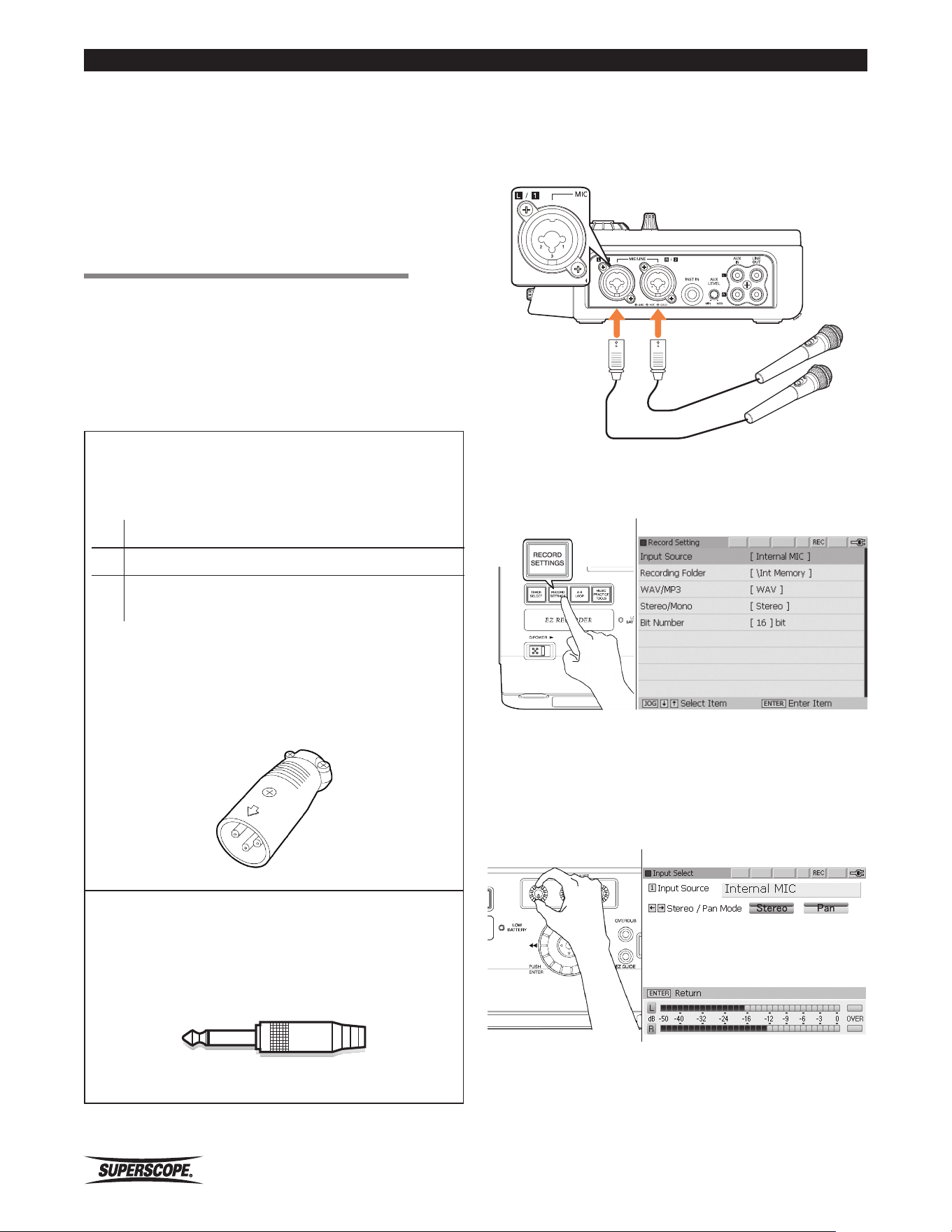
1. Insert microphones into the MIC/LINE input jacks on
the side panel. Both XLR type and ¼”standard plug
types can be used.
XLR plugs
2. Push the RECORD SETTINGS button to open the
Record Settings Screen. Turn the jog wheel or toggle
the joystick to select Input Source and Push Enter.
Record Settings Screen
Turn the jog wheel or toggle joystick to select Input
Source and Push Enter.
3. The Input Select Screen is displayed. Turn function
knob #1 to select External Mic and then press the
Record Settings button to exit the screen.
Input Select Screen
Superscope PSD450mkII User Manual
- 31 -
Set Up
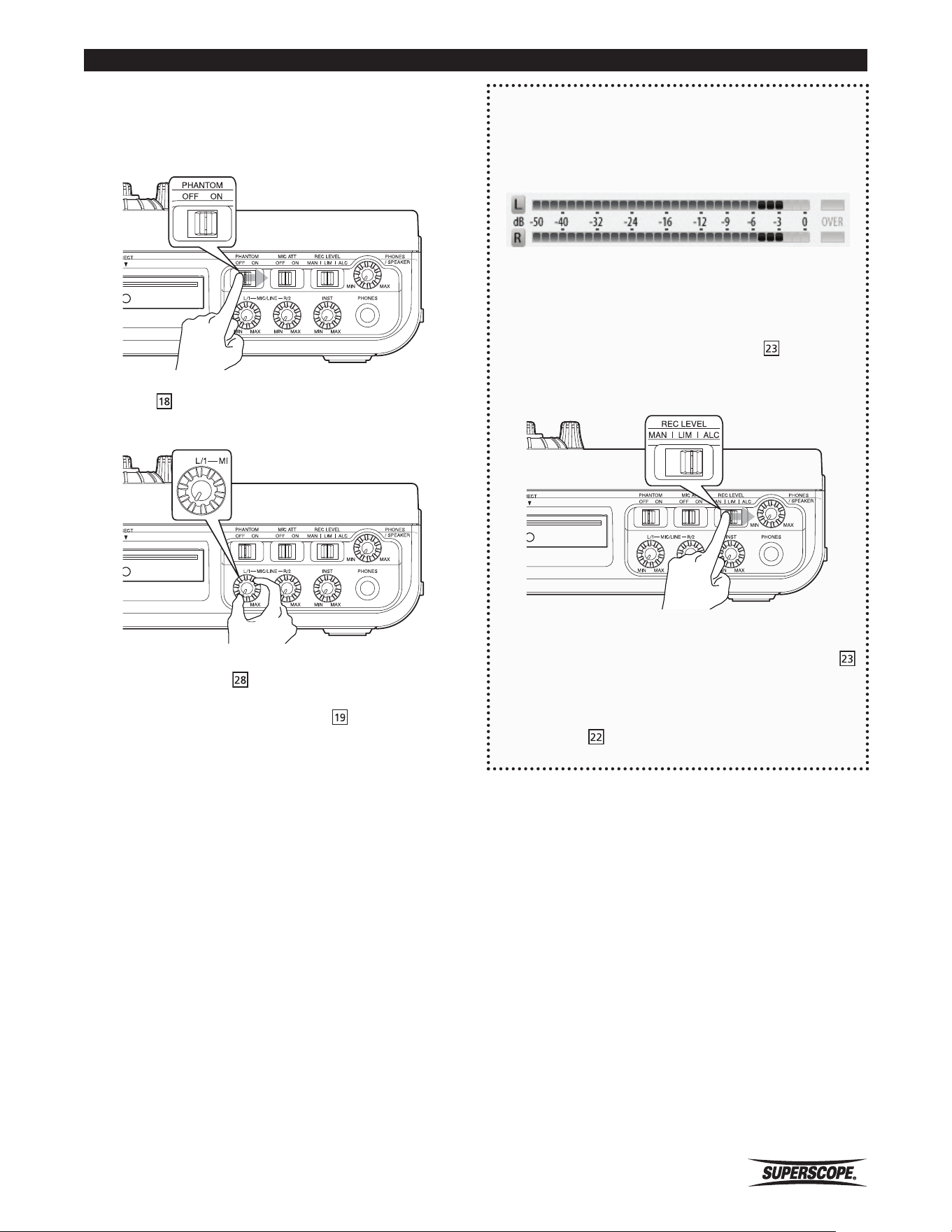
When using microphones requiring 48 V phantom
power, move the PHANTOM switch to the ON position.
Consult your microphone’s owner’s manual for power
requirement specifications.
Adjust the MIC / LINE L & R Level Controls to obtain a
suitable recording level. See Setting Levels, below.
※ When using the AUX input, control input
level with the
AUX LEVEL controller on the
right side panel. When using the INST input,
control input level with the
Instrument
level controller.
Setting Levels
As you sing or play your instrument, turn the L/1
and R/2 input-level control knobs clockwise while
observing the display VU meters.
When your performance is at its loudest, the VU meter
should approach 0 dB without lighting OVER.
If the meter consistently lights red, adjust the input-
level control knobs counter clockwise to reduce the
level and avoid distortion. Switching the
REC LEVEL
switch to the LIM (Limiter) setting can protect the
recording from distortion caused by transient peaks.
To disengage the L/1 and R/2 input-level control knobs
and set the recording level automatically, adjust the
REC LEVEL switch to ALC.
If your mics have higher than normal output, try
switching the MIC ATT switch to ON.
- 32 -
Superscope PSD450mkII User Manual
Set Up
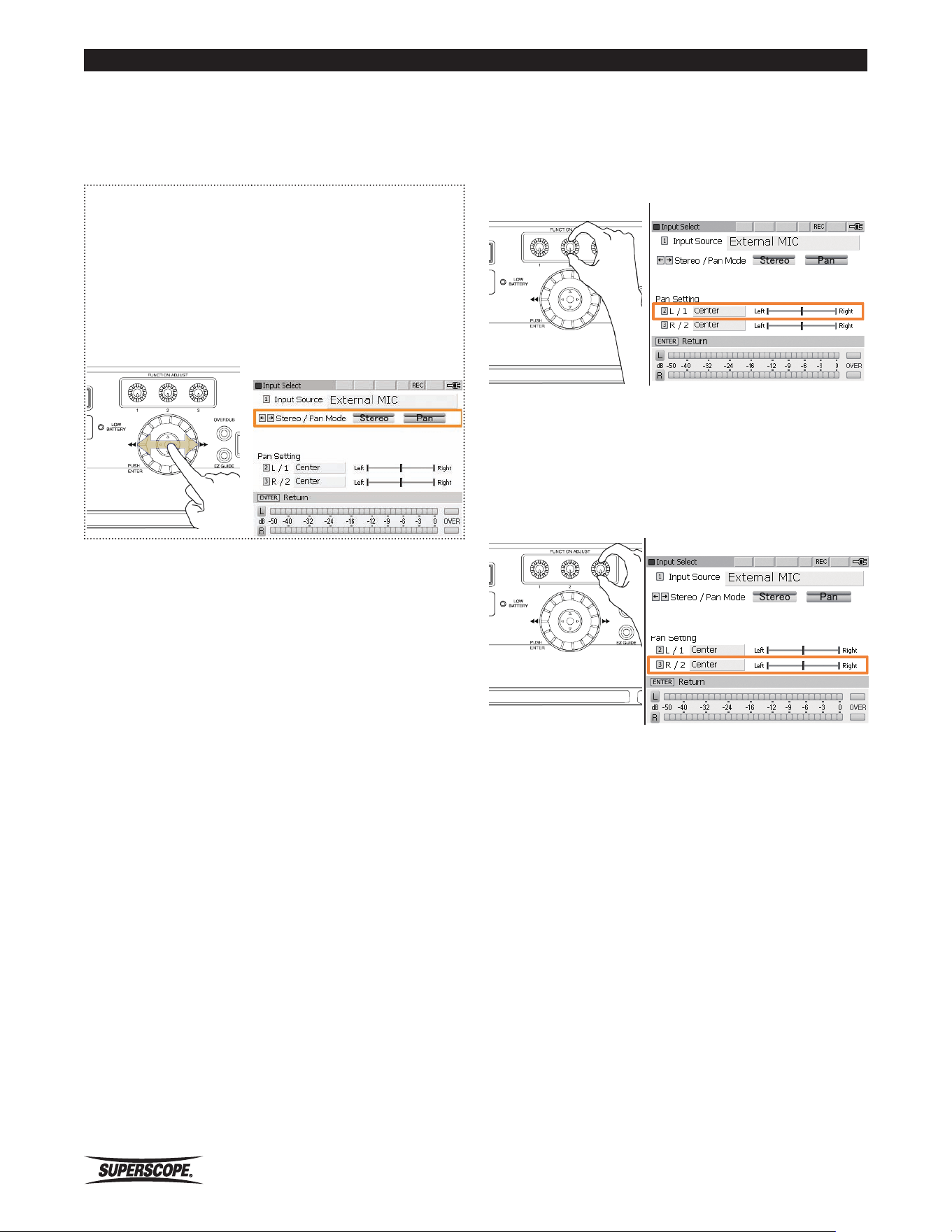
STEREO/PAN Mode
From the Input Select screen, move the joystick right or
left to select Stereo Mode or Pan Mode (Stereo mode is
the default setting).
Stereo Mode
Left channel inputs (L) are routed to the left channel
of the recording. Right channel inputs (R) are routed to
the right channel of the recording.
Pan Mode
Input signals can be routed to any position along the
(L/R) stereo spectrum.
Input Select Screen
Pan Setting – L/1
Turn FUNCTION ADJUST #2 (4B) to adjust the Pan
Setting for input L/1 (the left microphone). Adjustments
are made in 1% increments between Left 100% - Center
- Right 100%. The initial setting is Center.
Input Select Screen
Pan Setting – R/2
Turn FUNCTION ADJUST #3 (4C) to adjust the Pan
Setting for input R/2 (the right microphone). Adjustments
are made in 1% increments between Left 100% - Center
- Right 100%. The initial setting is Center.
Input Select Screen
Superscope PSD450mkII User Manual
- 33 -
Set Up
Recording a Solo Performance
Follow the instructions below when recording a voice or
instrument with a single microphone:
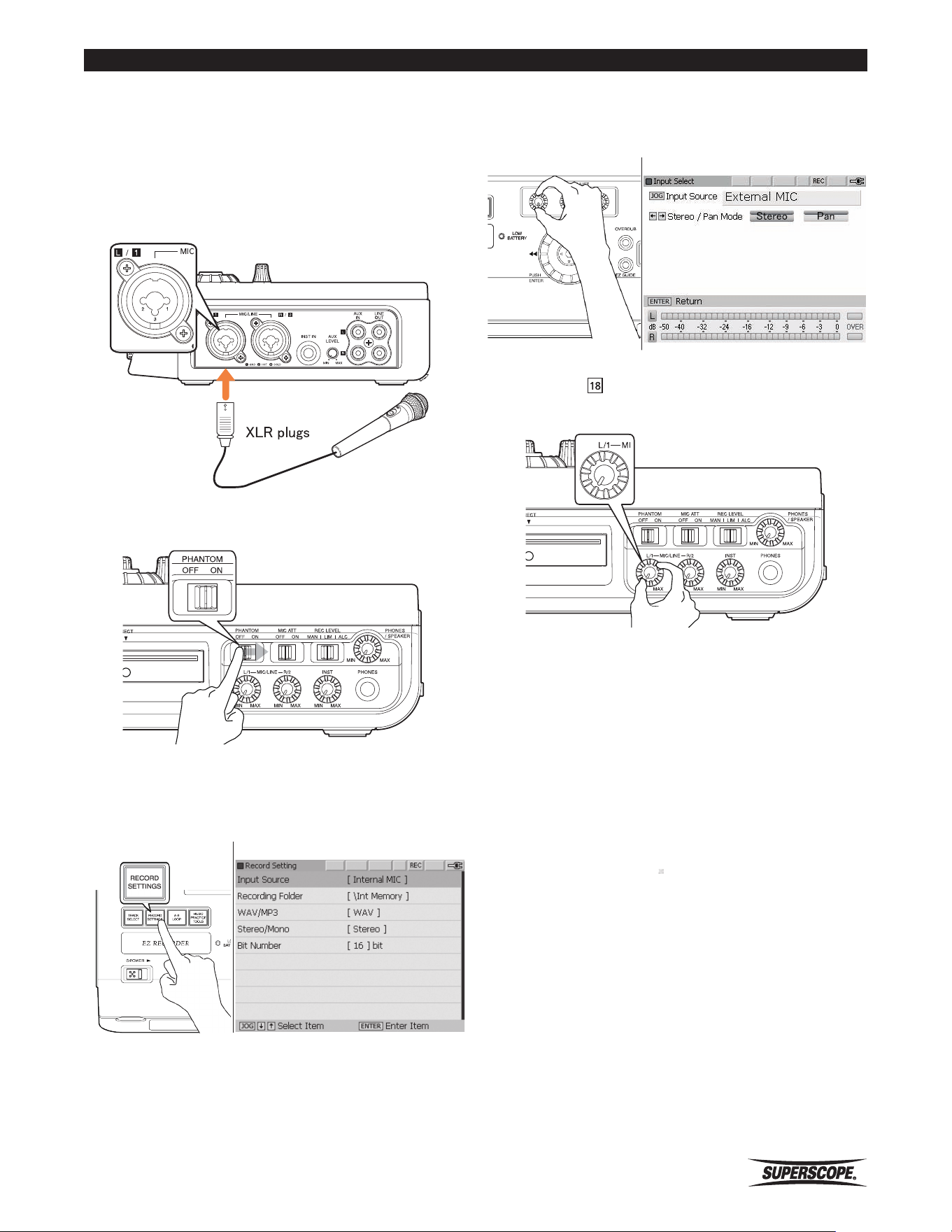
1. Insert a microphone into the MIC/LINE input (L/1)
on the side panel. Both XLR type and 1/4 “standard
plug types can be used.
When using a microphone that requires 48 V phantom
power, move the PHANTOM switch to the ON position.
2. Push the RECORD SETTINGS button to open the
Record Settings Screen. Turn the jog wheel or toggle
the joystick to select Input Source and Push Enter.
Record Settings Screen
Turn the jog wheel or toggle joystick to select Input
Source and Push ENTER.
3. The Input Select Screen is displayed. Turn function
knob #1 to select External Mic and then press the
Record Settings button to exit the screen.
Input Select Screen
4. Adjust the MIC / LINE level control (L/1) to
obtain a suitable recording level. See Setting Levels.
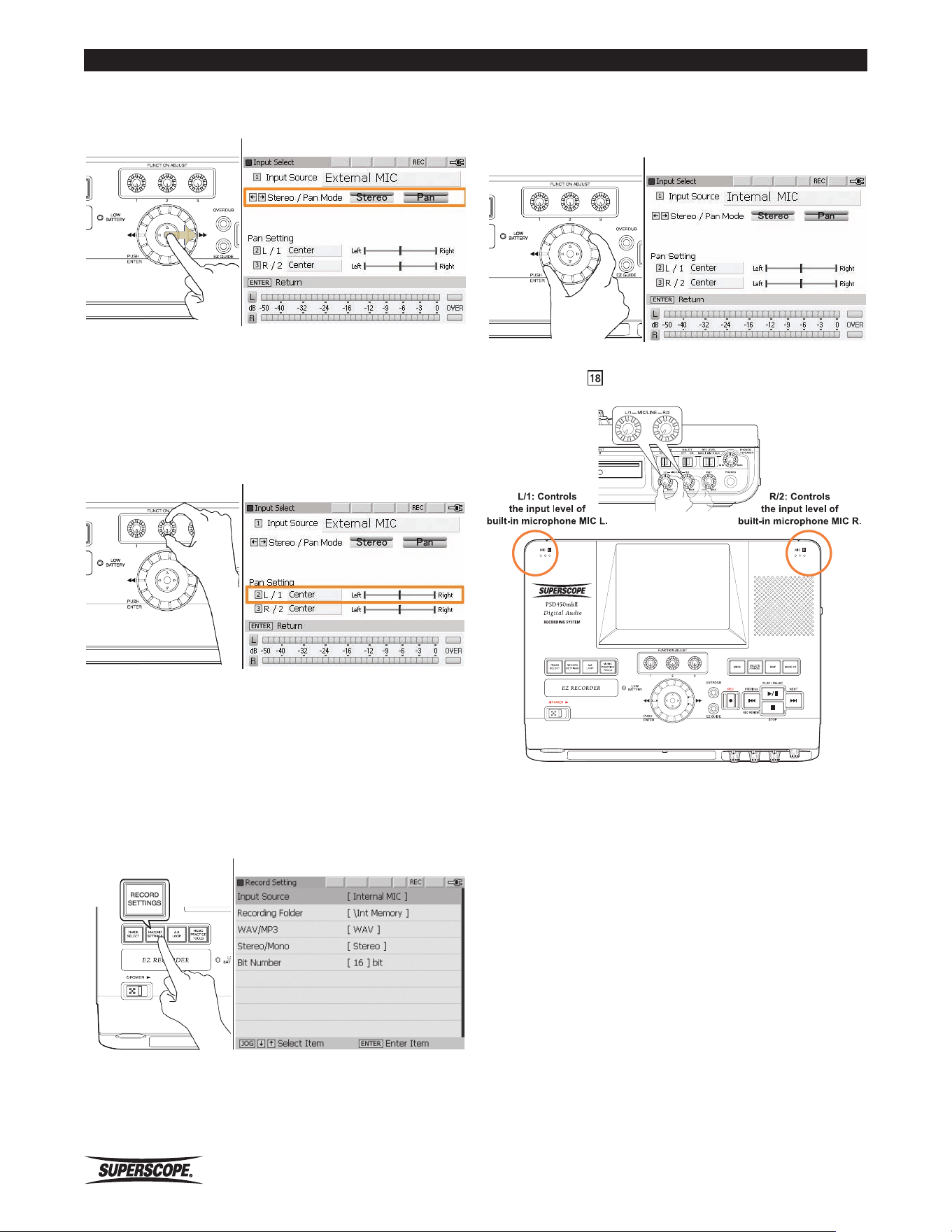
5. When the setting up Pan mode, press the
RECORDING SETTINGS button once again. The Input
Select screen is displayed. Or while displaying the
screen in Fig.3. And operate the following Fig.6 and
Fig7.
- 34 -
Superscope PSD450mkII User Manual
Set Up
6. From the Input Select Screen, move the joystick to
the right to select Pan Mode.
Input Select Screen
7. Pan Setting – L/1 Selecting Pan Mode will “center”
the stereo position of the microphone connected to
Input (L/1). When recording a solo performance, it is
most common to place the soloist in the “center” of
the stereo spectrum. To alter the stereo positioning
for Input (L/1), turn FUNCTION ADJUST #2 (4B).
Input Select Screen
Internal Built-in Microphones
The recorder has two built-in microphones for stereo
recording. When using the built-in microphones, please
refer to the following procedures.
1. Push the RECORD SETTINGS button to display the
Input Source options.
Record Settings Screen
2. Turn the jog wheel or joystick to select “Input
Source” and then press ENTER button. The Input
Select screen is displayed.
Input Select Screen
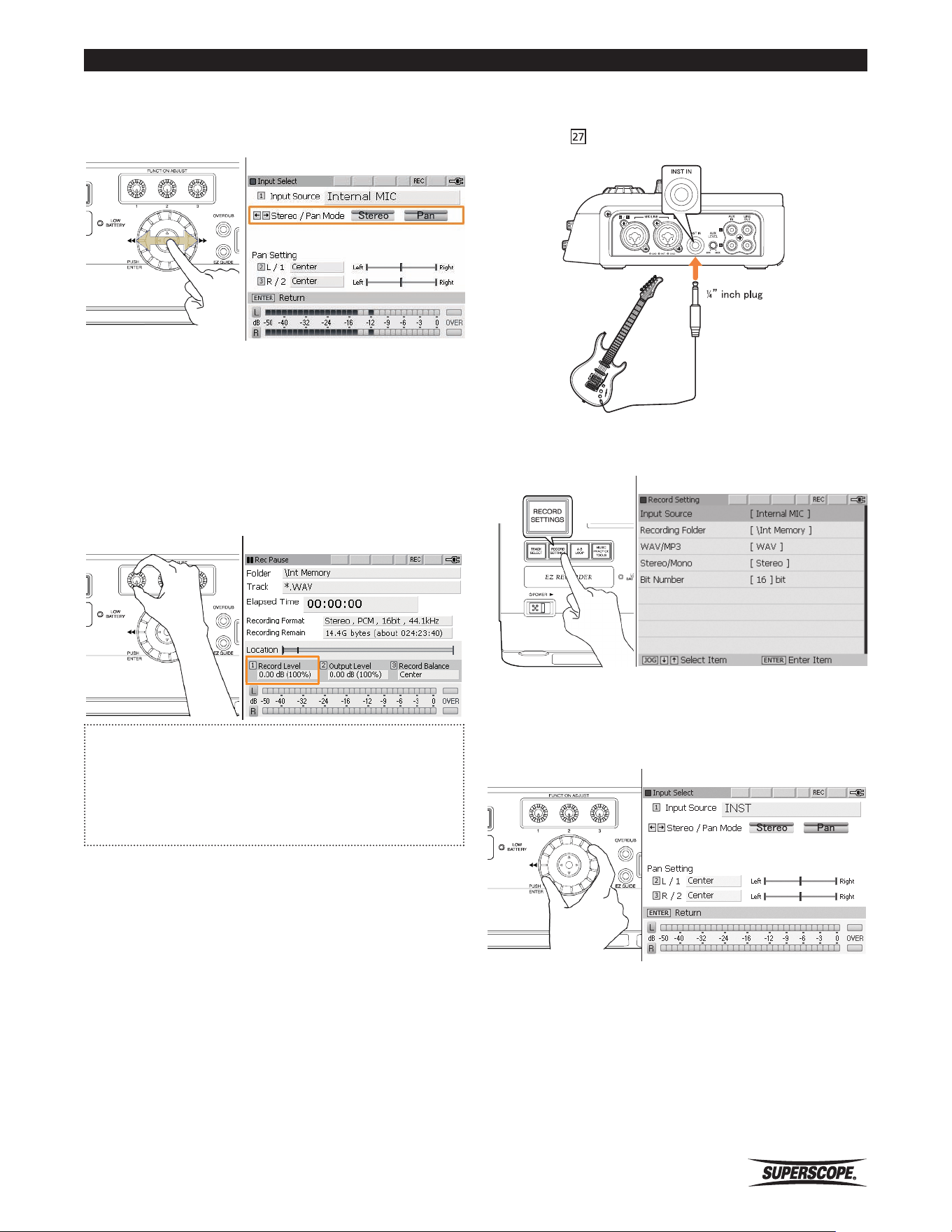
3. Adjust the MIC / LINE L & R Level Controls to
obtain a suitable recording level. See Setting Levels.
Superscope PSD450mkII User Manual
- 35 -
Set Up
4. Stereo mode is the default setting. If required, move
the joystick right or left to select Stereo Mode or Pan
Mode (Stereo mode is the default setting).
Input Select Screen
5. Set Record Level - For most applications, the Record
Level should be set to the default value of 0 dB.
The Record Level is displayed on the Track Select
REC/PAUSE screen when the REC button is pushed.
Record Level is no longer on the Input Select screen.
Show the Rec Pause screen with the placement
of the Record Level field which is adjusted by
FUNCTION ADJUST #1 (4A).
Rec Pause Screen
※ When using the built-in microphones, the
built-in speaker is muted to prevent feedback.
To prevent the built-in microphones from
picking up the sound of buttons on the
top panel, operate the recorder with the
RC450PSD remote control.
Connecting Musical Instruments
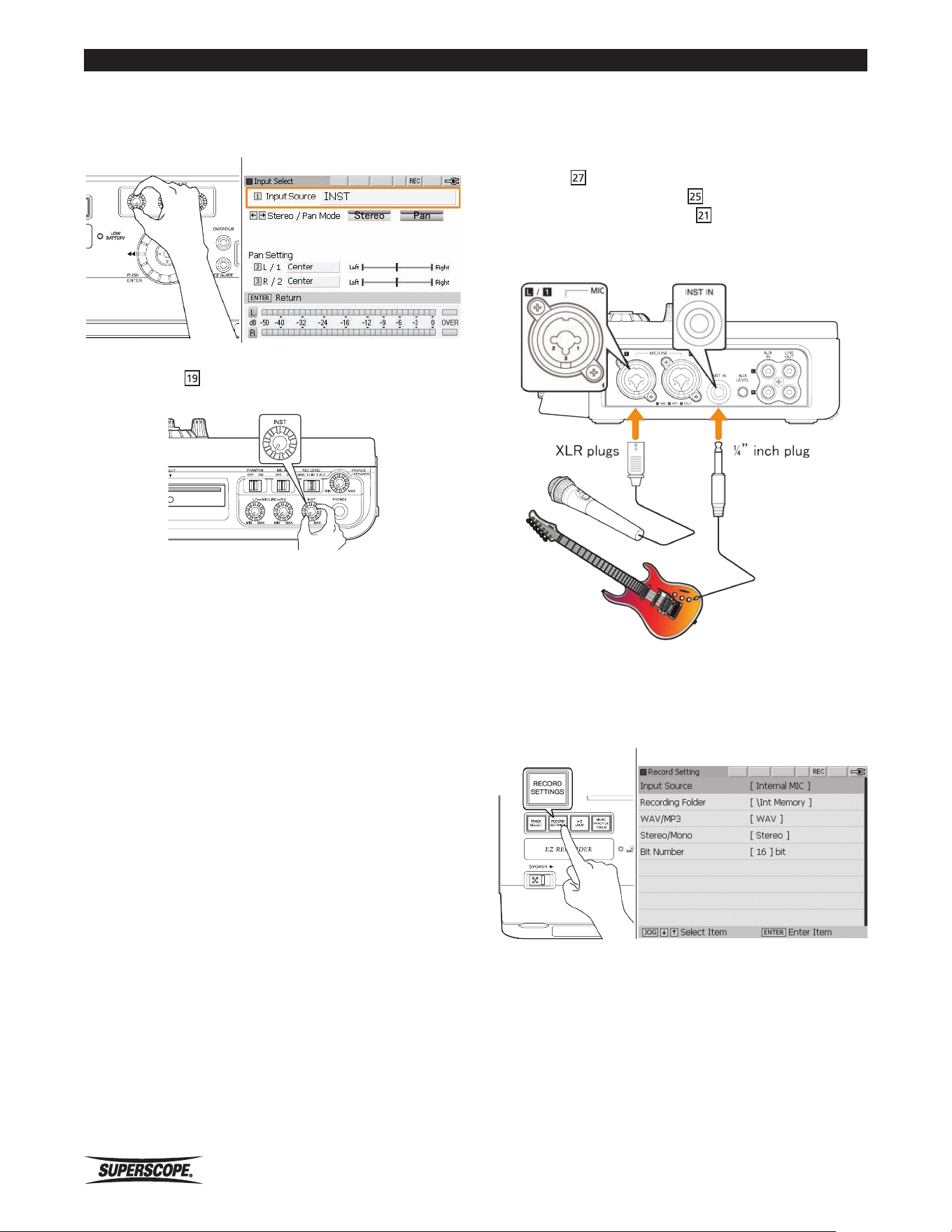
1. Please insert the plug from your instrument cable
into the
INST IN jack on the right side panel.
2. Press the RECORD SETTINGS button to open the
Record Setting screen.
Record Settings Screen
3. Turn the jog wheel or joystick to select “Input
Source” and then press ENTER button. The Input
Select screen is displayed.
Input Select Screen
- 36 -
Superscope PSD450mkII User Manual
Set Up
4. Turn the FUNCTION ADJUST #1 to select INST and
then press the RECORD SETTINGS button to exit the
screen.
Input Select Screen
5. Adjust the INST knob to obtain a suitable
recording level.
See Setting Levels.
Recording a Microphone and a Musical
Instrument at the Same Time
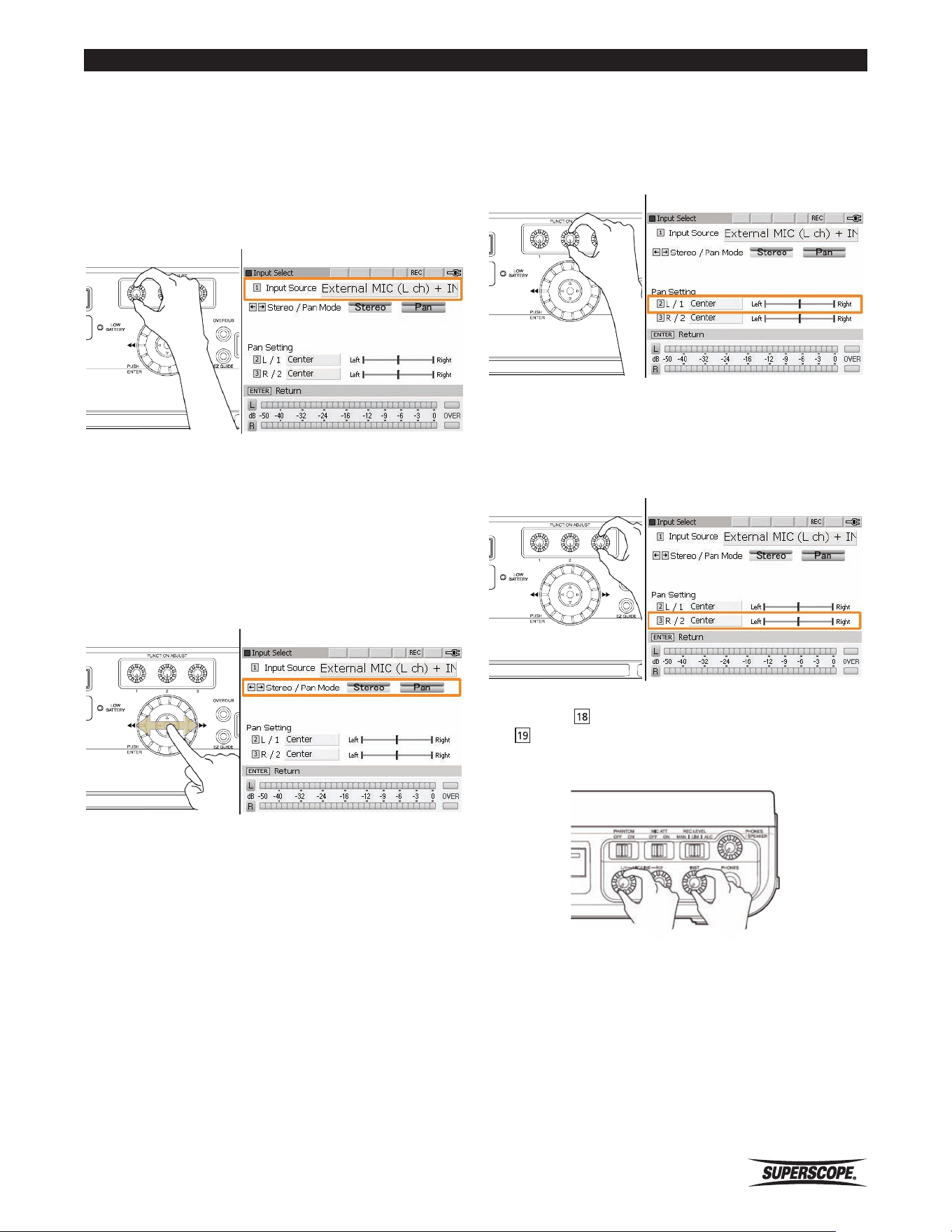
1. Please insert the plug from your instrument cable
into the
INST IN Jack on the side panel. Insert
the microphone plug into
MIC/LINE jack L1. In
addition, please switch the
PHANTOM switch on
the front panel ON when connecting a condenser
microphone.
2. Push the RECOR SETTINGS button to open the
Record Settings Screen. Turn the jog wheel or toggle
the joystick to select Input Source and Push ENTER.
Record Settings Screen
Superscope PSD450mkII User Manual
- 37 -
Set Up
3. The Input Select Screen is displayed. Turn FUNCTION
ADJUST #1 (4A) to select External Mic (L ch) + INST
and then press the RECORD SETTINGS button to exit
the screen.
※ When connecting an instrument along with
a line level device such as an electronic piano,
please choose LINE (L ch) + INST.
Input Select Screen
4. When the setting up Pan mode, press the
RECORDING SETTINGS button once again. The Input
Select screen is displayed. Or while displaying the
screen in Fig.3. And operate the following Fig.6 and
Fig7.
5. Move the joystick right or left to select Stereo Mode
or Pan Mode (Stereo mode is the default setting).
Input Select Screen
6. If Pan Mode is selected, turn FUNCTION ADJUST
#2 (4B) to adjust the Pan Setting for input L/1 (the
left microphone). Adjustments are made in 1%
increments between Left 100% - Center - Right
100%. The initial setting is Center.
Input Select Screen
7. Turn FUNCTION ADJUST #3 (4C) to adjust the Pan
Setting for the INST input. Adjustments are made in
1% increments between Left 100% - Center - Right
100%. The initial setting is Center.
Input Select Screen
8. Turn the MIC/LINE input level knob (L/1) and the
INST knob to obtain a proper level and balance
between the microphone and the instrument. Please
refer to Setting Levels.
※ After the recording is completed, the MIC/
INST balance cannot be changed.
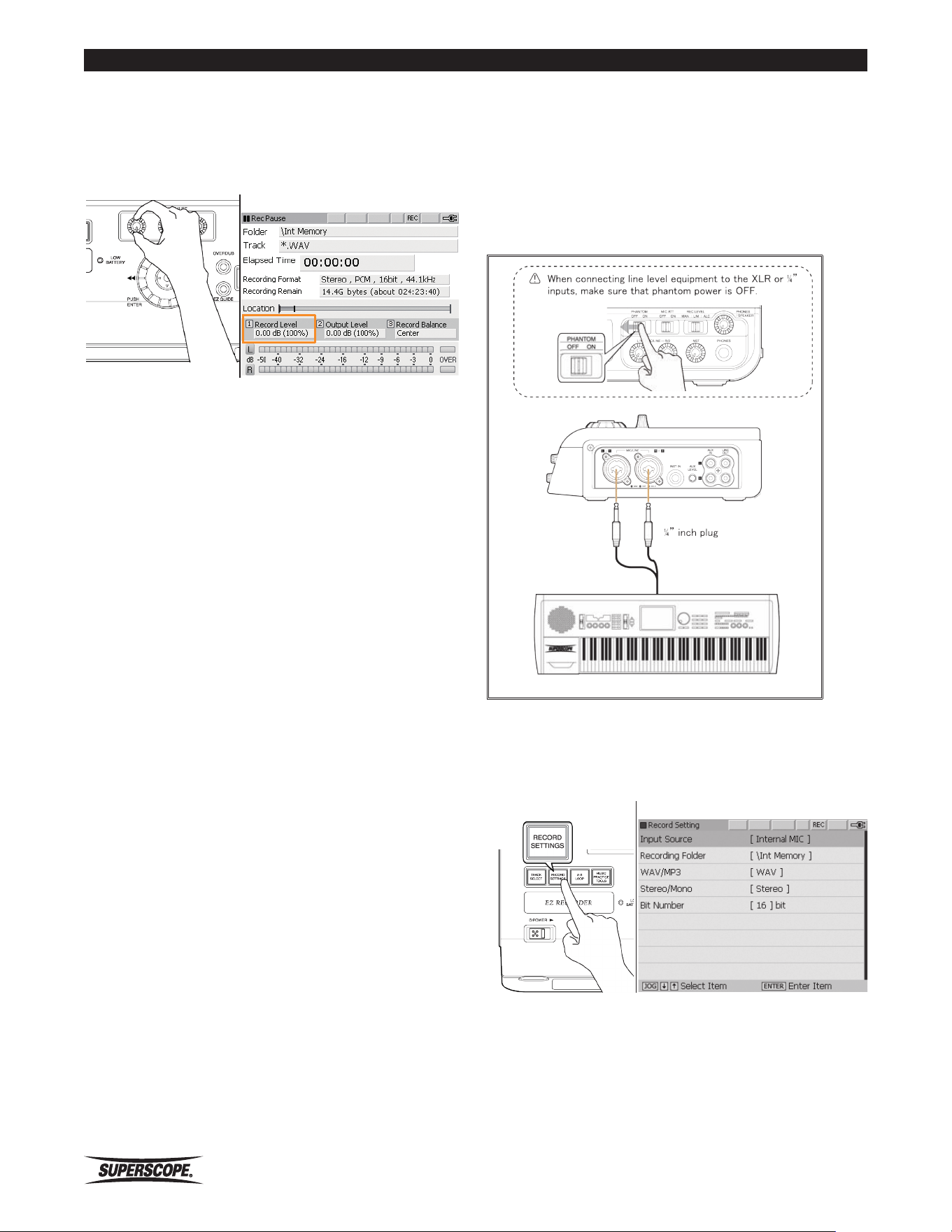
- 38 -
Superscope PSD450mkII User Manual
Set Up
Line Level Sources
Use the following procedure when connecting line level
equipment (keyboards, mixers, CD players, etc.) to the
XLR or ¼” balanced inputs.
1. Connect line level audio equipment such as mixers
or keyboards to the MIC/LINE Jacks on the right side
panel.
2. Push the RECCOR SETTINGS button to open the
Record Settings Screen. Turn the jog wheel or toggle
the joystick to select Input Source and Push ENTER.
Record Settings Screen
9. Set Record Level - For most applications, the Record
Level should be set to the default value of 0.00 dB.
Turn FUNCTION ADJUST #1 (4A) to adjust Record
Level. Press FUNCTION ADJUST #1 (4A) to return
Record Level to 0.00 dB.
Rec Pause Screen
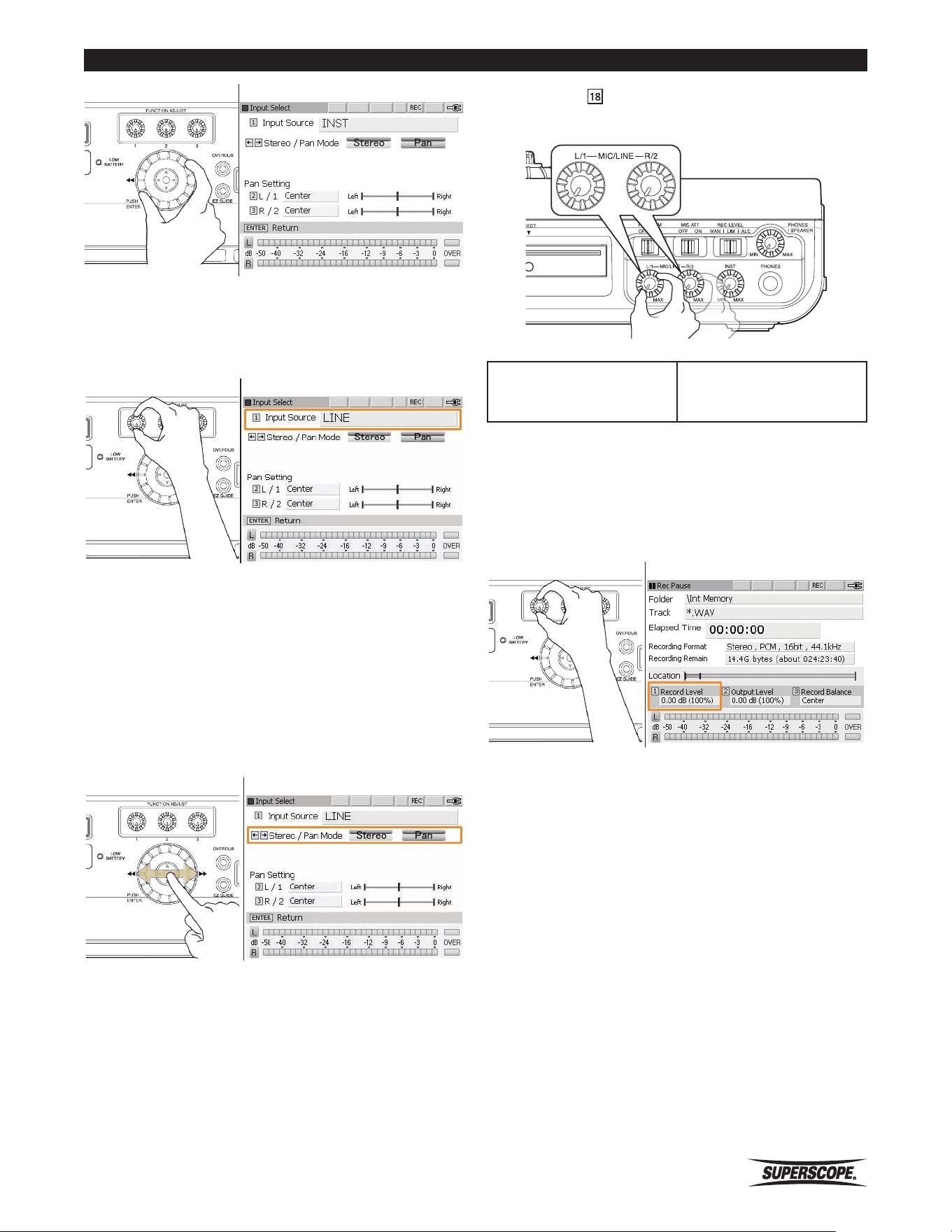
Superscope PSD450mkII User Manual
- 39 -
Set Up
6. Adjust the MIC / LINE L & R level controls to
obtain a suitable recording level. See Setting Levels.
L/1: Controls the input
level for LINE L/1.
R/2: Controls the input
level for LINE R/2.
7. Set Record Level - For most applications, the Record
Level should be set to the default value of 0 dB. Turn
FUNCTION ADJUST #1 (4A) to adjust Record Level.
Press FUNCTION ADJUST #1 (4A) to return Record
Level to 0 dB.
Rec Pause Screen
Input Select Screen
3. The Input Select Screen is displayed. Turn FUNCTION
ADJUST #1 to select Line and then press the RECORD
SETTINGS button to exit the screen.
Input Select Screen
4. When the setting up Pan mode, press the
RECORDING SETTINGS button once again. The Input
Select screen is displayed. Or while displaying the
screen in Fig.3. And operate the following Fig.6 and
Fig7.
5. Move the joystick right or left to select Stereo Mode
or Pan Mode (Stereo mode is the default setting). For
adjustment of Pan Setting see STEREO/PAN Mode.
Input Select Screen
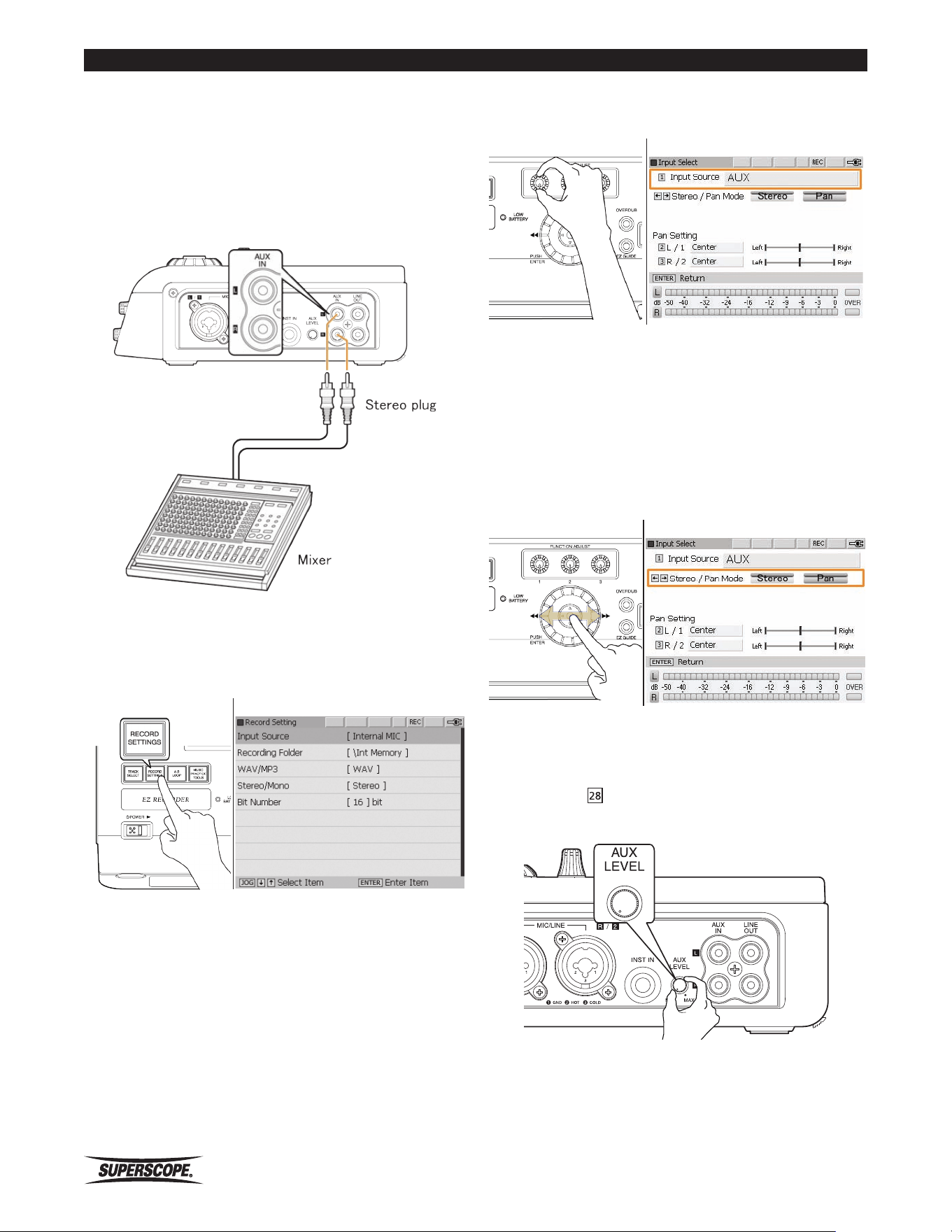
- 40 -
Superscope PSD450mkII User Manual
Set Up
AUX
Use the following procedure when connecting line level
equipment (keyboards, mixers, CD players, etc.) to the
RCA unbalanced inputs.
1. Connect line level audio equipment such as mixers or
keyboards to the AUX IN Jack on the right side panel.
2. Push the RECOR SETTINGS button to open the
Record Settings Screen. Turn the jog wheel or toggle
the joystick to select Input Source and Push ENTER.
Record Settings Screen
3. Turn the jog wheel to select AUX and then press the
RECORD SETTINGS button to exit the screen.
Input Select Screen
4. When the setting up Pan mode, press the
RECORDING SETTINGS button once again. The Input
Select screen is displayed. Or while displaying the
screen in Fig.3. And operate the following Fig.6 and
Fig7.
5. Move the joystick right or left to select Stereo Mode
or Pan Mode (Stereo mode is the default setting).
Input Select Screen
※ For adjustment of Pan Setting see STEREO/
PAN Mode.
6. Adjust the
AUX LEVEL control to obtain a
suitable recording level. See Setting Levels.
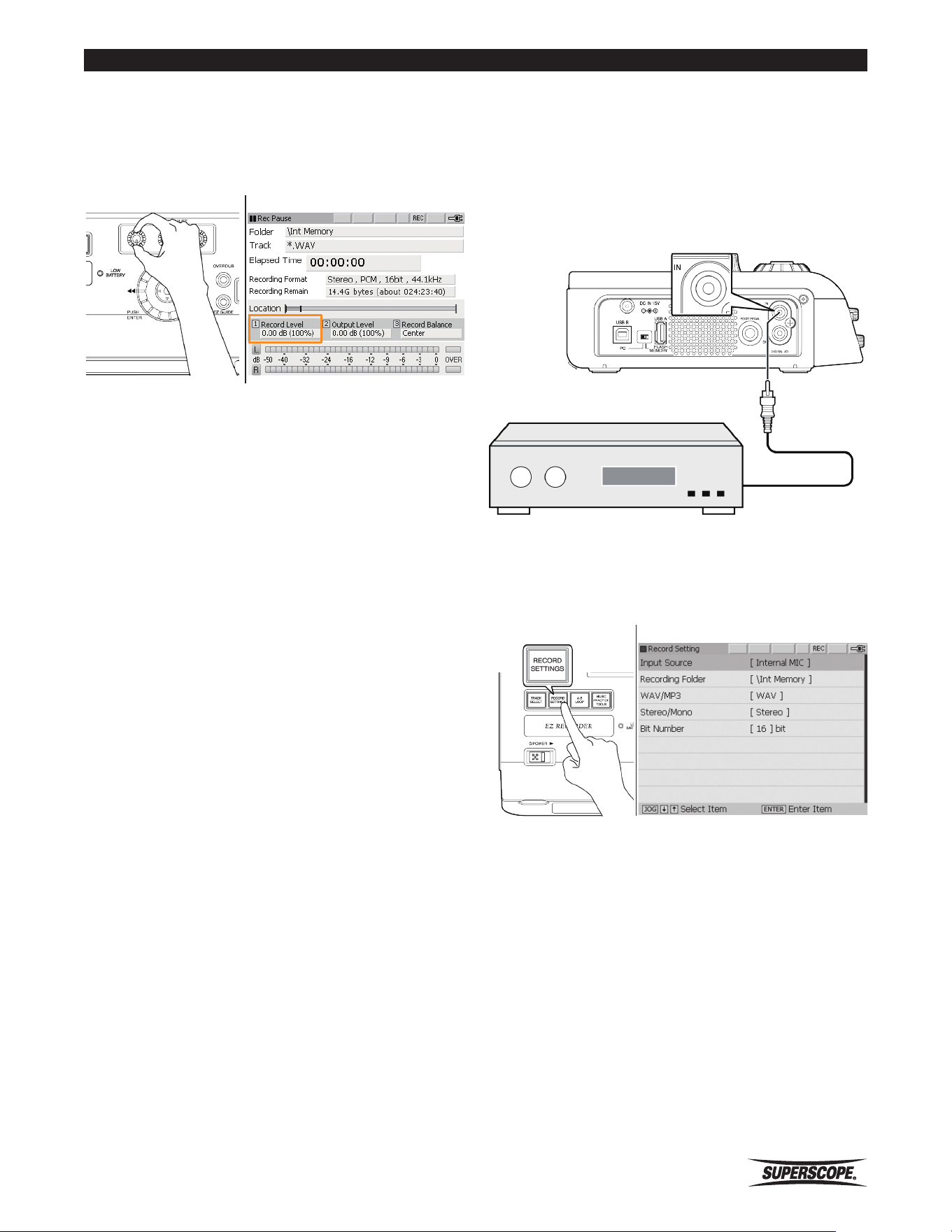
Superscope PSD450mkII User Manual
- 41 -
Set Up
7. Set Record Level - For most applications, the Record
Level should be set to the default value of 0.00 dB.
Turn FUNCTION ADJUST #1 (4A) to adjust Record
Level. Press FUNCTION ADJUST #1 (4A) to return
Record Level to 0.00 dB.
Rec Pause Screen
Digital Connection
Use the following procedure when connecting
equipment with digital outputs (keyboards, mixers, CD
players, etc.).
1. Connect digital equipment such as mixers or effects
processors to the DIGITAL IN on the left side panel.
2. Push the RECOR SETTINGS button to open the
Record Settings Screen. Turn the jog wheel or toggle
the joystick to select Input Source and Push ENTER.
Record Settings Screen
- 42 -
Superscope PSD450mkII User Manual
Set Up
Computer Connection
By connecting your recorder to a PC or Mac, you can
transfer music to and from a computer for editing or data
backup. When in USB mode, your computer will be able
to access the files and folders on the Internal Memory.
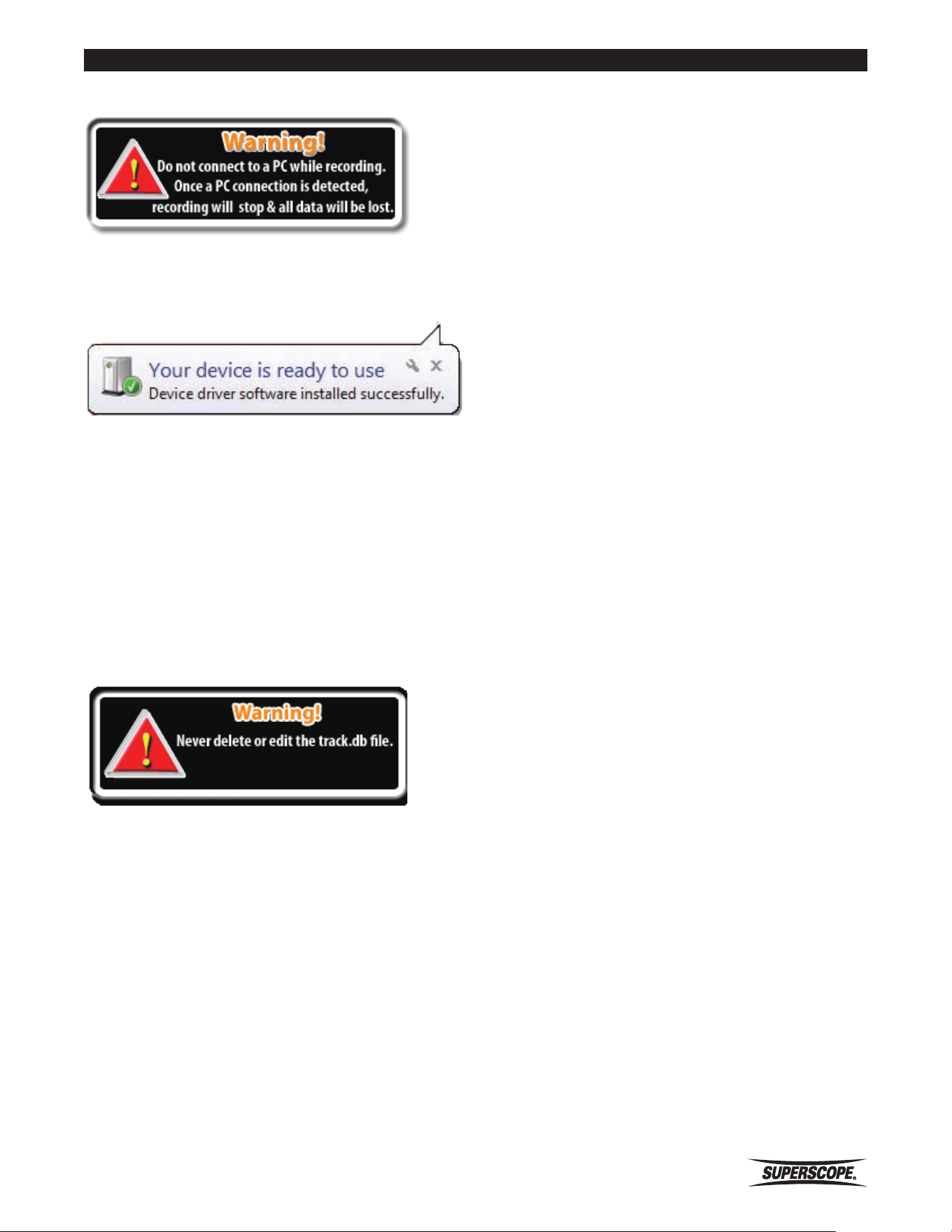
1. Confirm that the recorder is in Stop Mode and the
Main Screen is active before entering USB mode.
USB Mode Screen
※ When in USB Mode, all other features will be
inactive.
2. Use the included USB cable to connect the recorder
to your computer.
※ Do not connect to a computer before
powering on the recorder.
※ By connecting your recorder to a PC or Mac,
slide the switch to “PC” and then connect the
USB B plug into the USB connector B.
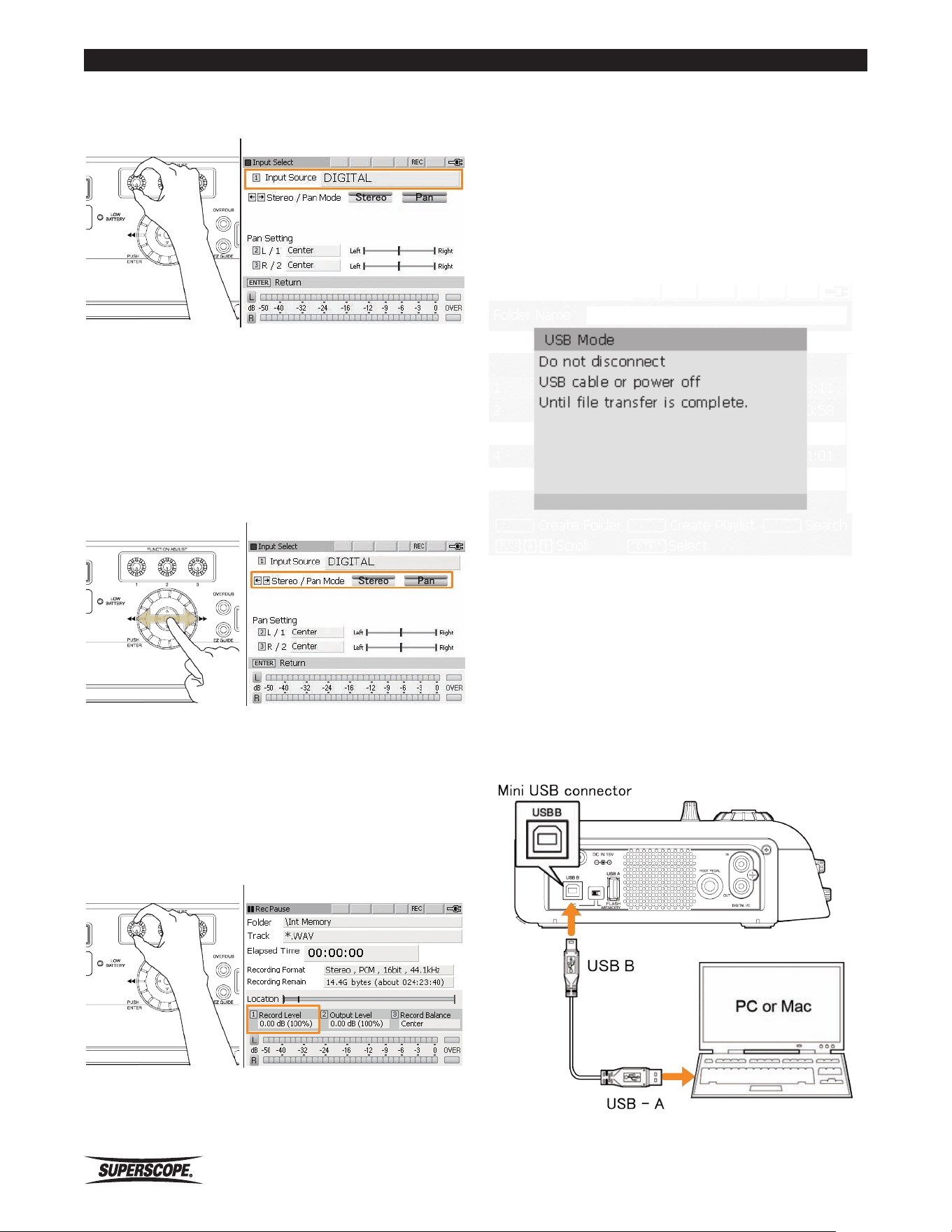
3. Turn the jog wheel to select DIGITAL and then press
the RECORD SETTINGS button to exit the screen.
Input Select Screen
4. When the setting up Pan mode, press the
RECORDING SETTINGS button once again. The Input
Select screen is displayed. Or while displaying the
screen in Fig.3. And operate the following Fig.6 and
Fig7.
5. Move the joystick right or left to select Stereo Mode
or Pan Mode (Stereo mode is the default setting).
Input Select Screen
※ For adjustment of pan settings, see STEREO/
PAN Mode.
6. Set Record Level - For most applications, the Record
Level should be set to the default value of 0 dB. Turn
FUNCTION ADJUST #1 (4A) to adjust Record Level.
Press FUNCTION ADJUST #1 (4A) to return Record
Level to 0 dB.
Rec Pause Screen
Superscope PSD450mkII User Manual
- 43 -
Set Up
3. The recorder should be recognized as an external
drive without having to install a new driver.
4. Locate the PSD450mkII in your computer’s directory.
Copy, move, and delete files using your computer’s
operating system.
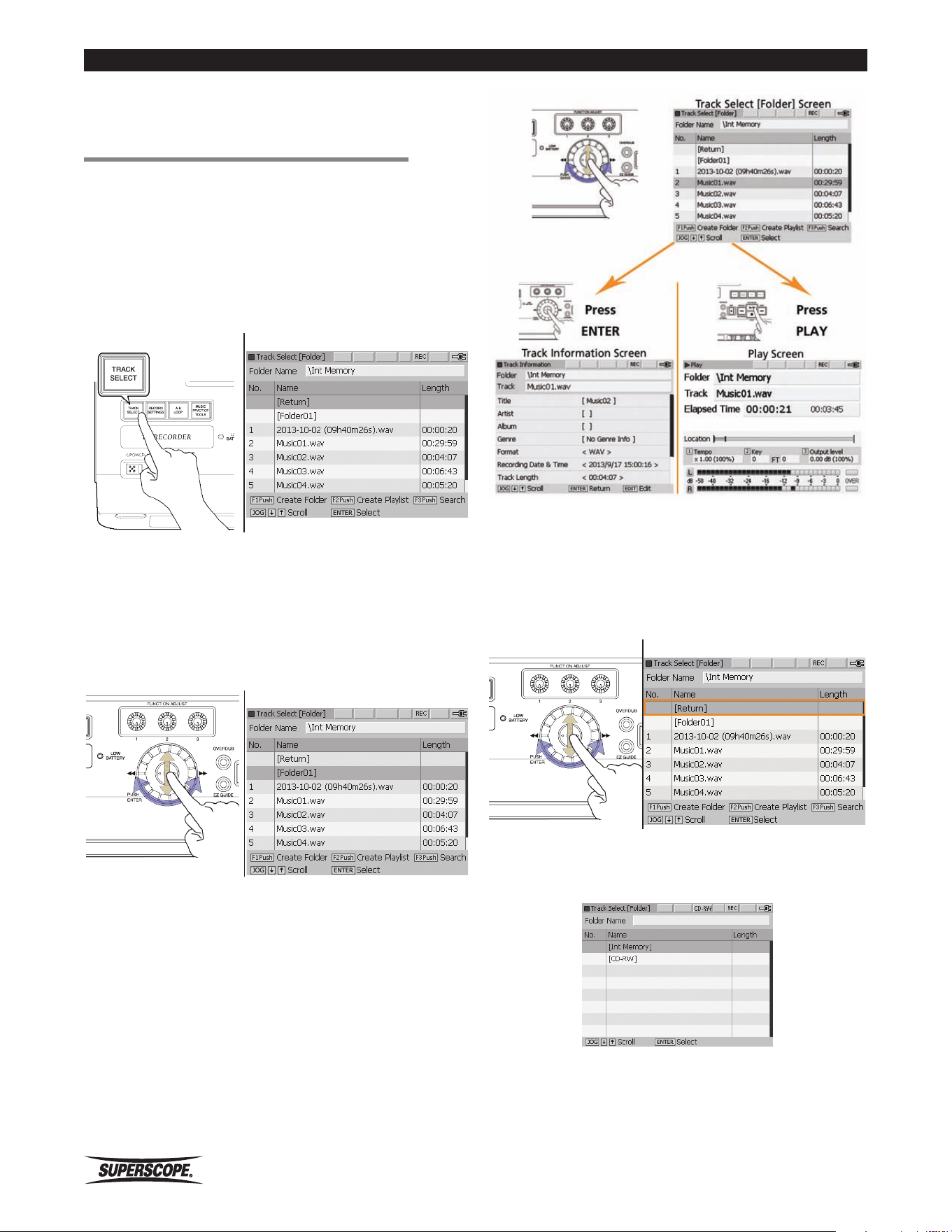
※ When your recorder is connected to a
computer, the file “track.db” and a folder
named “PSD450mkII” will appear in your
recorder’s file directory. If this file or folder is
edited or deleted, you may lose access to your
audio files and settings.
- 44 -
Superscope PSD450mkII User Manual
Working with Files and Folders
■Working with
Files and Folders
This unit offers several methods for locating a track for
playback, editing, or for use as accompaniment when
overdubbing.
Searching Folders
1. Press the TRACK SELECT button to view all files,
folders, and playlists on the unit.
Track Select [Folder] Screen
2. All newly recorded files will appear in the main
folder. Turn the jog wheel or move the joystick up or
down to highlight tracks or subfolders. Sub folders
will appear in brackets, e.g., [sub folder 1]. To search
the contents of a sub folder, either turn the jog
wheel or move the joystick up or down to highlight a
sub folder.
Track Select [Folder] Screen
3. Press ENTER to view the contents of the selected
folder.
※ When a track is highlighted in the Track
Select Screen, push ENTER to view or edit
track information. Press the PLAY/PAUSE
button (8C) to begin playback.
Search a USB Device, Internal Memory
or CD
To search the contents of a USB device or CD, select
[Return] on the Track Select [Folder] screen and press
ENTER.
Track Select [Folder] Screen
Select a device and press ENTER.
Track Select Screen
The contents of the storage device will now be displayed.
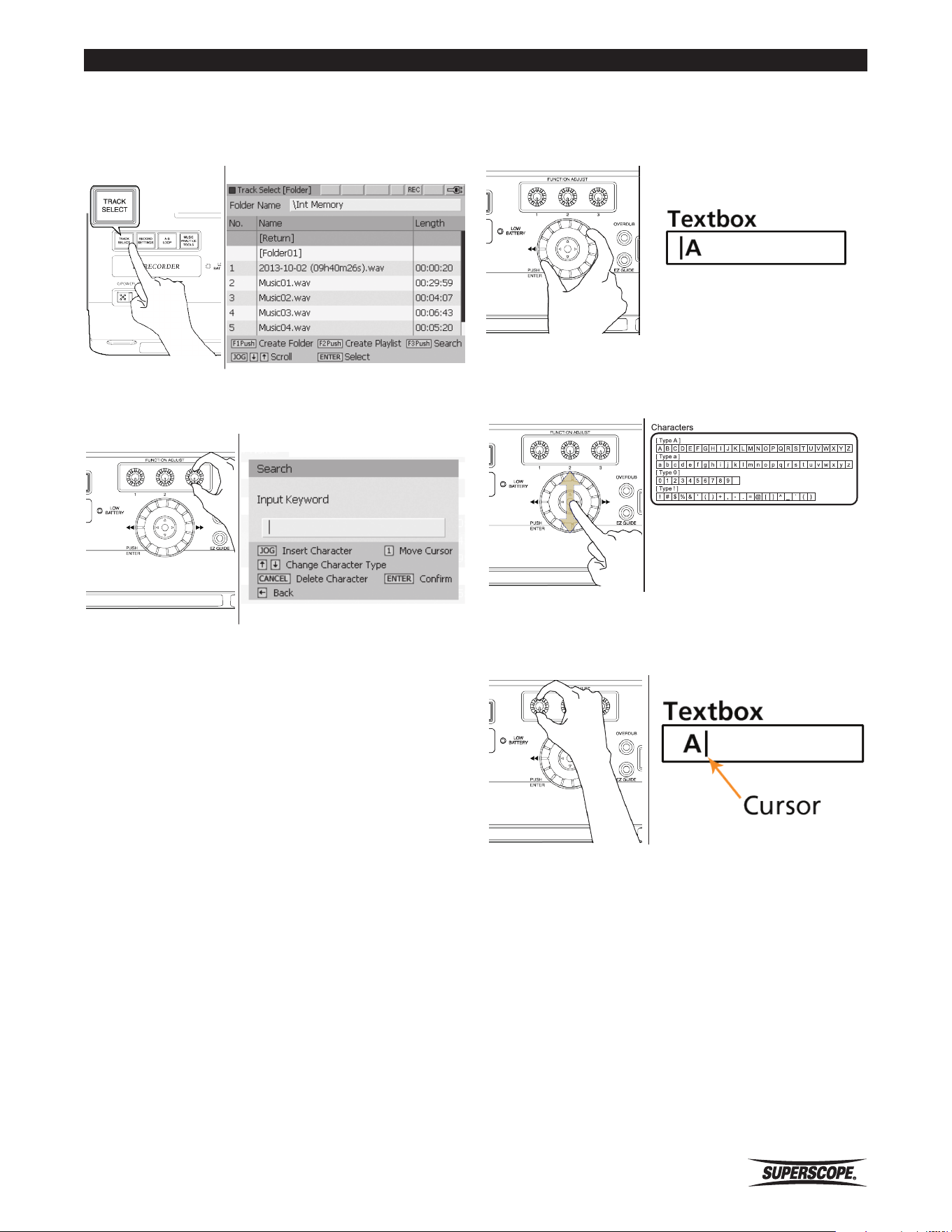
Superscope PSD450mkII User Manual
- 45 -
Working with Files and Folders
Using the [Search] Feature
1. Press the TRACK SELECT Key to open the Track
Select [Folder] screen.
Track Select [Folder] Screen
2. Press the FUNCTION ADJUST #3 (4C) key, and then
the [Search] option is displayed.
Track Select [Folder] Screen
3. Use the Text Input Method below to type the file
name or part of the file name you are searching for.
Text Input Method
Enter Characters
Turn the jog wheel to enter characters.
Change Character Type
Move the joystick up or down to change character types.
The four different character groups are shown below.
Move the Cursor
Use FUNCTION ADJUST # 1 (4A) to move the cursor to a
new character.
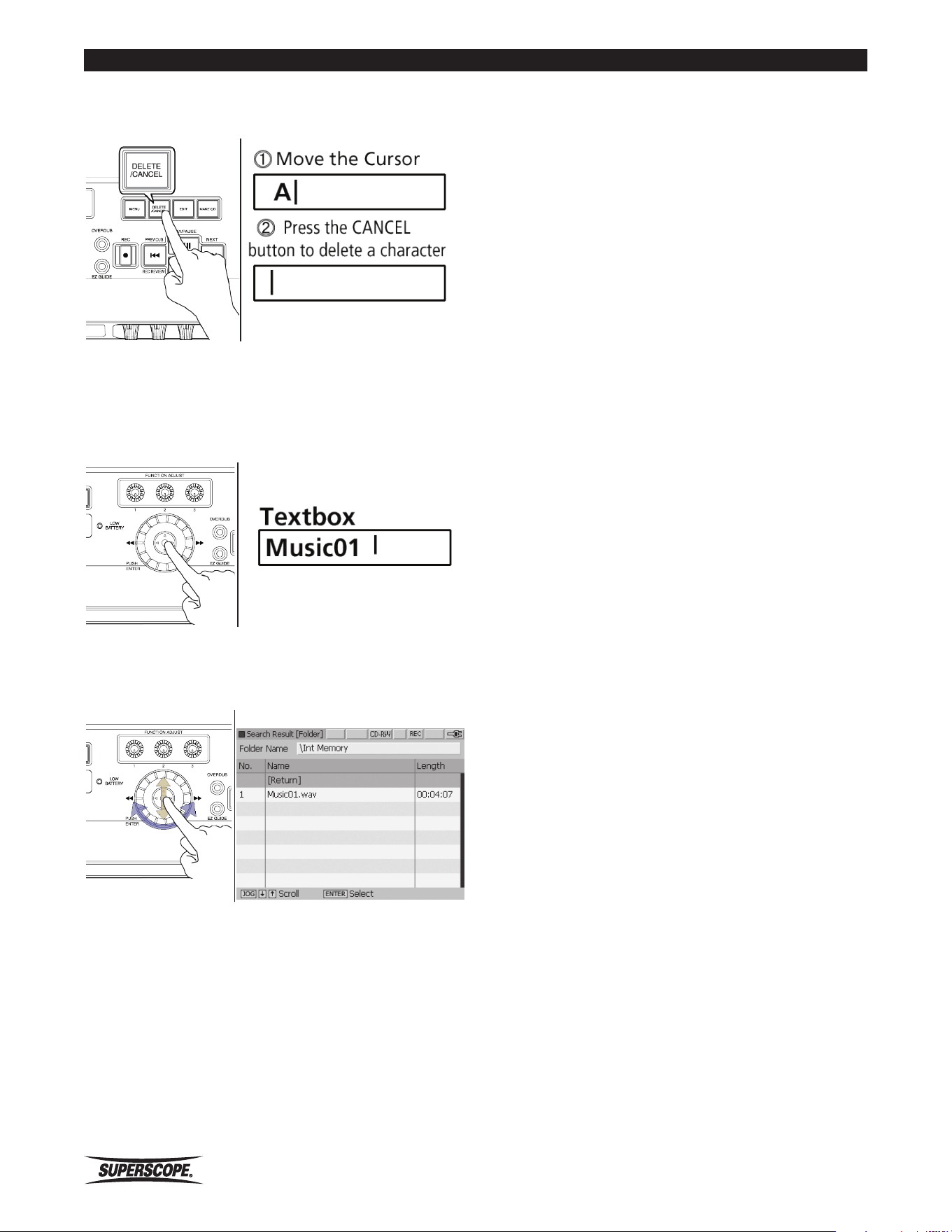
- 46 -
Superscope PSD450mkII User Manual
Working with Files and Folders
Delete a Character
Press the DELETE/CANCEL button to delete a character.
Confirm Entry
When you are finished entering text, press the joystick to
ENTER. When the search is complete, the search results
will be displayed.
Move the joystick up or down or turn the jog wheel to
select a track from the Search Result [Folder] screen.
Search Result [Folder] Screen
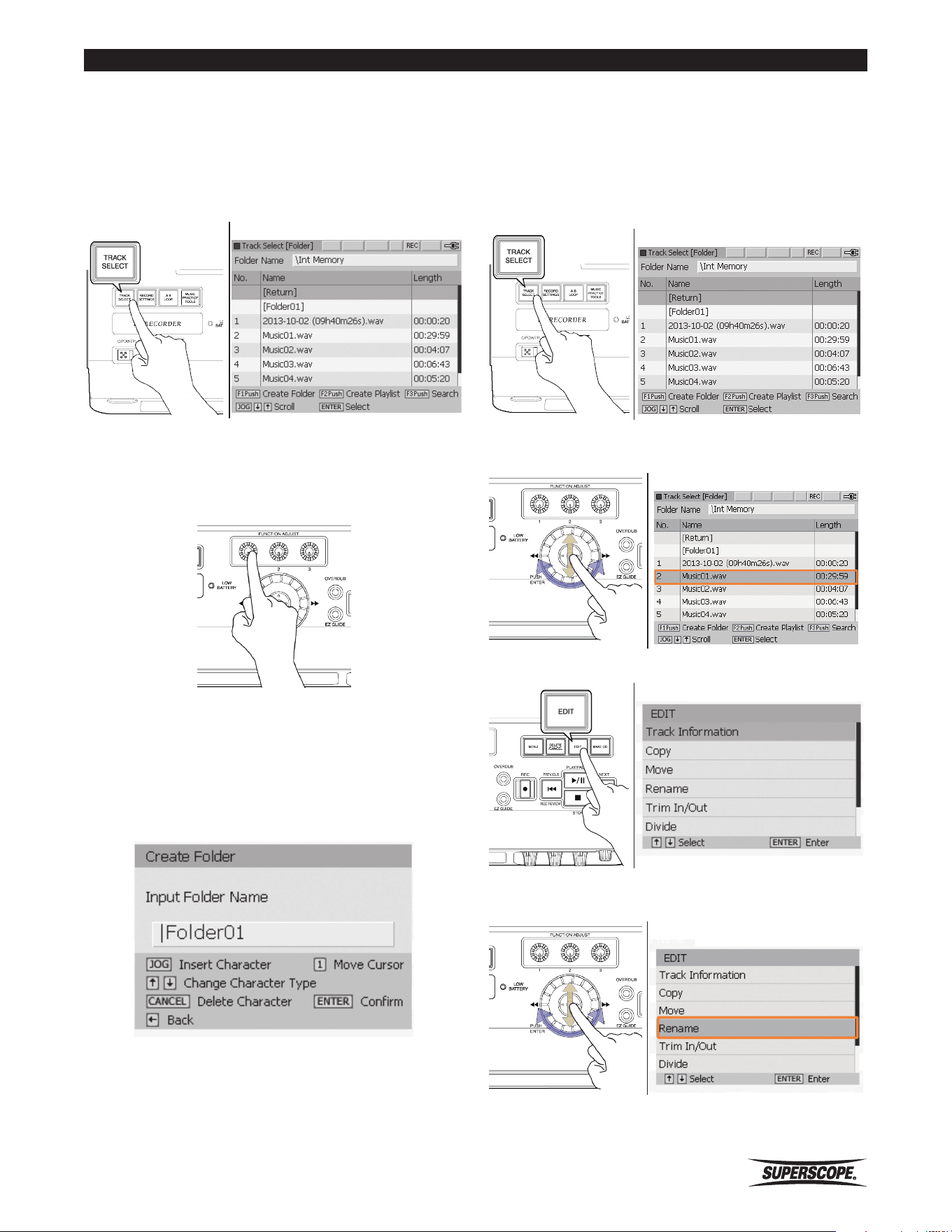
Superscope PSD450mkII User Manual
- 47 -
Working with Files and Folders
Create a Folder
Use the following steps to create a new folder for
organizing files.
Press the TRACK SELECT button to open the Track Select
[Folder] screen.
Track Select [Folder] Screen
1. Press FUNCTION ADJUST #1 (4A) key to create a
folder.
Create Folder screen is open and a provisional folder
name is displayed.
2. When you use the provisional folder name, press
ENTER.
Use the Text Input Method to rename the folder
name.
Text Input Screen
Rename
Use the following steps to rename folders or tracks. The
recorder will not allow you to use the same name as
another file or folder in the same location.
1. Press the TRACK SELECT button to open the Track
Select [Folder] screen.
Track Select [folder] Screen
2. Turn the jog wheel or move the joystick up or down
to highlight the folder or file you wish to rename.
Track Select [Folder] Screen
3. Press the EDIT button.
Edit Screen
4. Turn the jog wheel or move the joystick up or down
to highlight Rename. Press ENTER.
Edit Screen
5. Enter the name of the new folder by using the Text
Input Method.
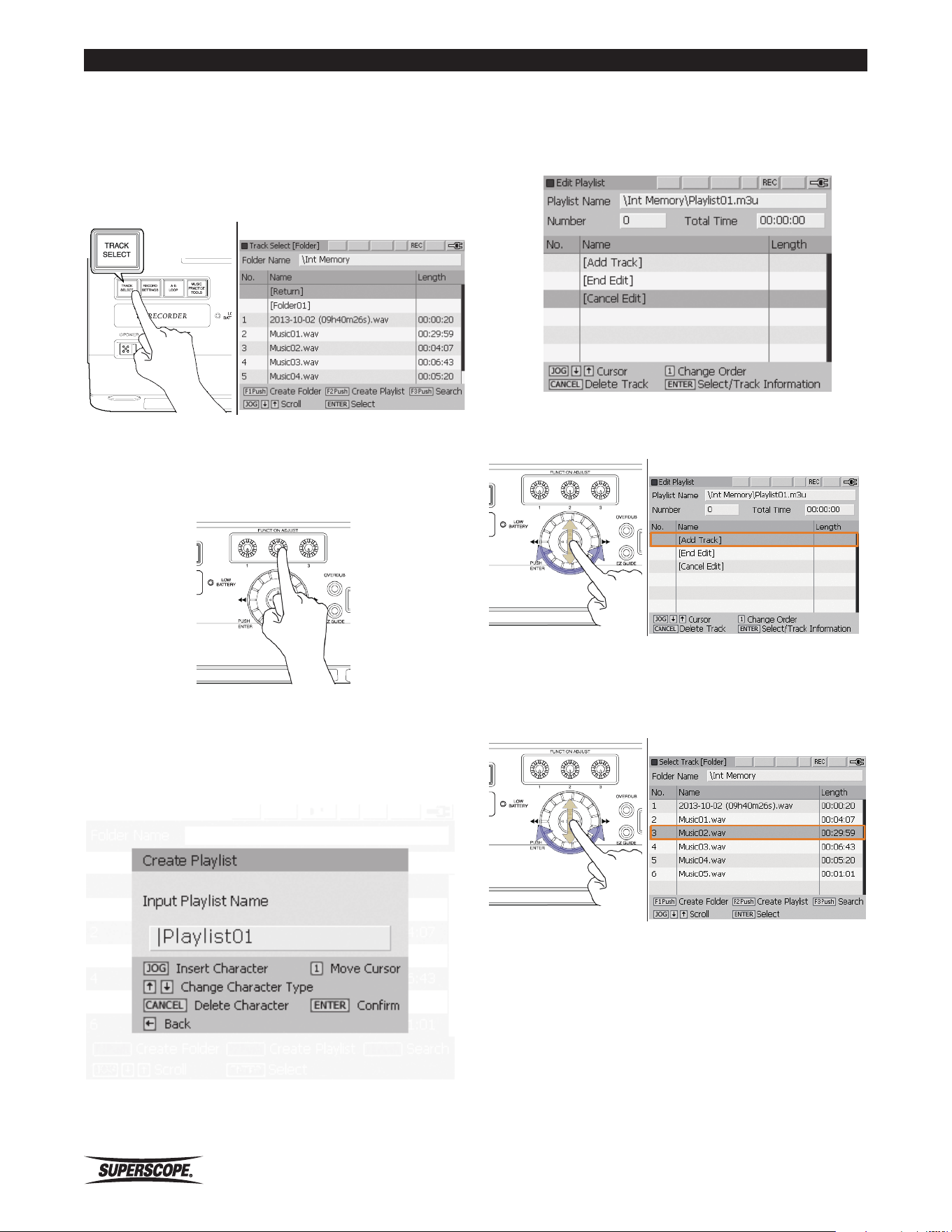
- 48 -
Superscope PSD450mkII User Manual
Working with Files and Folders
Create a Playlist
Use the following steps to create a playlist (M3U file
format).
1. Press the TRACK SELECT button to open the Track
Select [Folder] screen.
Track Select [Folder] Screen
2. Press FUNCTION ADJUST #2 (4B) key to create a
playlist.
Playlist screen is open and a provisional playlist name
is displayed.
3. When you use the provisional playlist name, press
ENTER.
Use the Text Input Method to rename the playlist
name.
Text Input Screen
4. When you have finished naming your new playlist
and pressed ENTER to confirm the new title, the Edit
Playlist screen will appear.
Edit Playlist Screen
5. Turn the jog wheel or move the joystick up or down
to highlight [Add Track]. Press ENTER.
Edit Playlist Screen
6. The Select Track [Folder] screen will appear. Turn
the jog wheel or move the joystick up or down to
highlight a track. Press ENTER to add the selected
track to the playlist.
Select Track [Folder] Screen
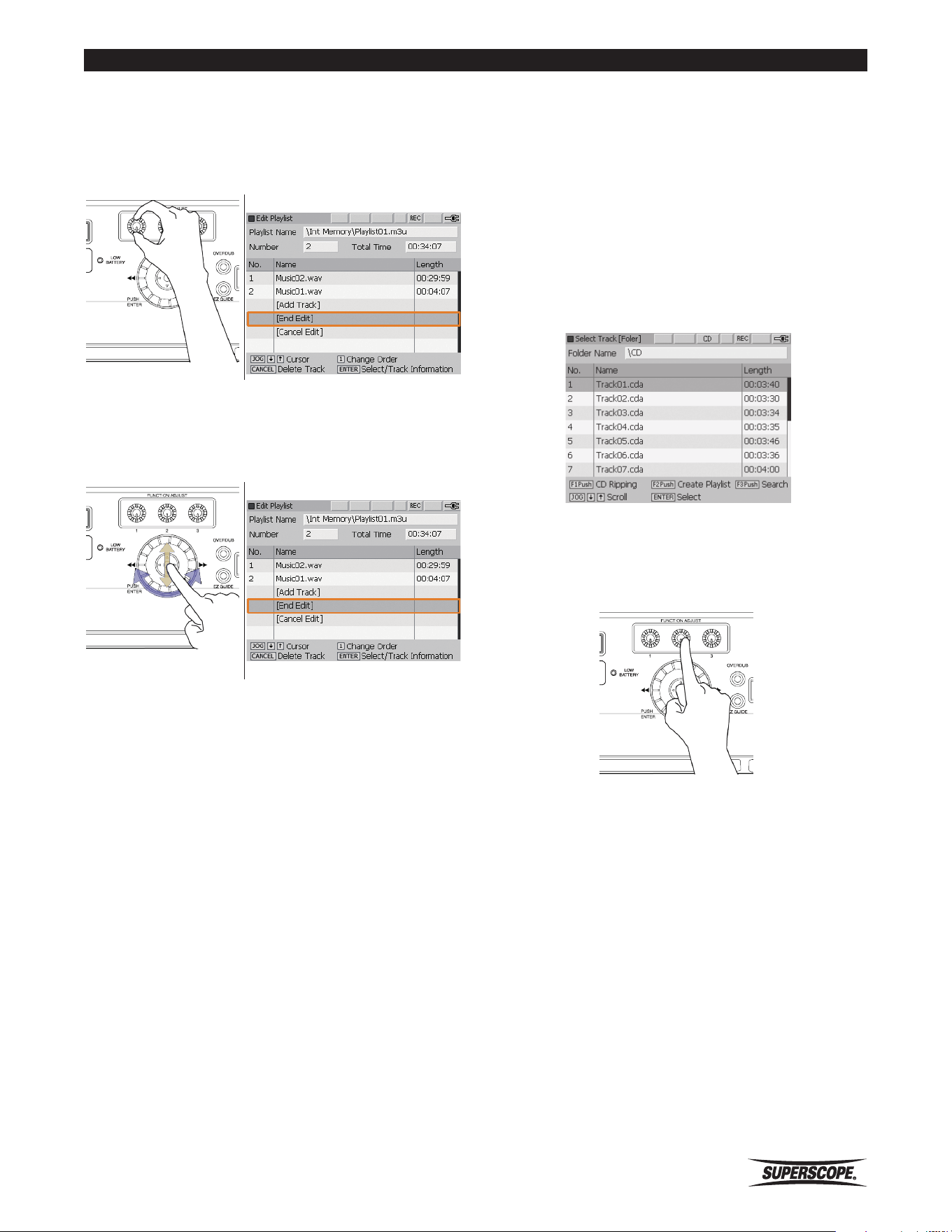
Superscope PSD450mkII User Manual
- 49 -
Working with Files and Folders
Change Track Order
7. Highlight a track and turn FUNCTION ADJUST #1
(4A) to change the order of tracks in a playlist.
Highlight a track and press the DELETE/CANCEL
button to remove the track from the playlist.
Edit Playlist Screen
8. When you have finished adding tracks to the playlist,
turn the jog wheel to highlight [End Edit]. Press
ENTER to save the new playlist and exit.
Edit Playlist Screen
Create a CD Playlist
Use the following steps to create a CD Playlist (M3U file
format) in the Internal Memory.
1. Insert a CD.
Track Select [Folder] screen will appear autocratically.
You can open the Track Select [Folder] screen by
pressing the TRACK SELECT button.
Track Select [Folder] Screen
2. Press FUNCTION ADJUST #2 (4B) key to create a
playlist.
The Playlist screen is opened and a provisional
playlist name is displayed.
3. Press ENTER to use the provisional playlist name.
Use the Text Input Method to rename the playlist.
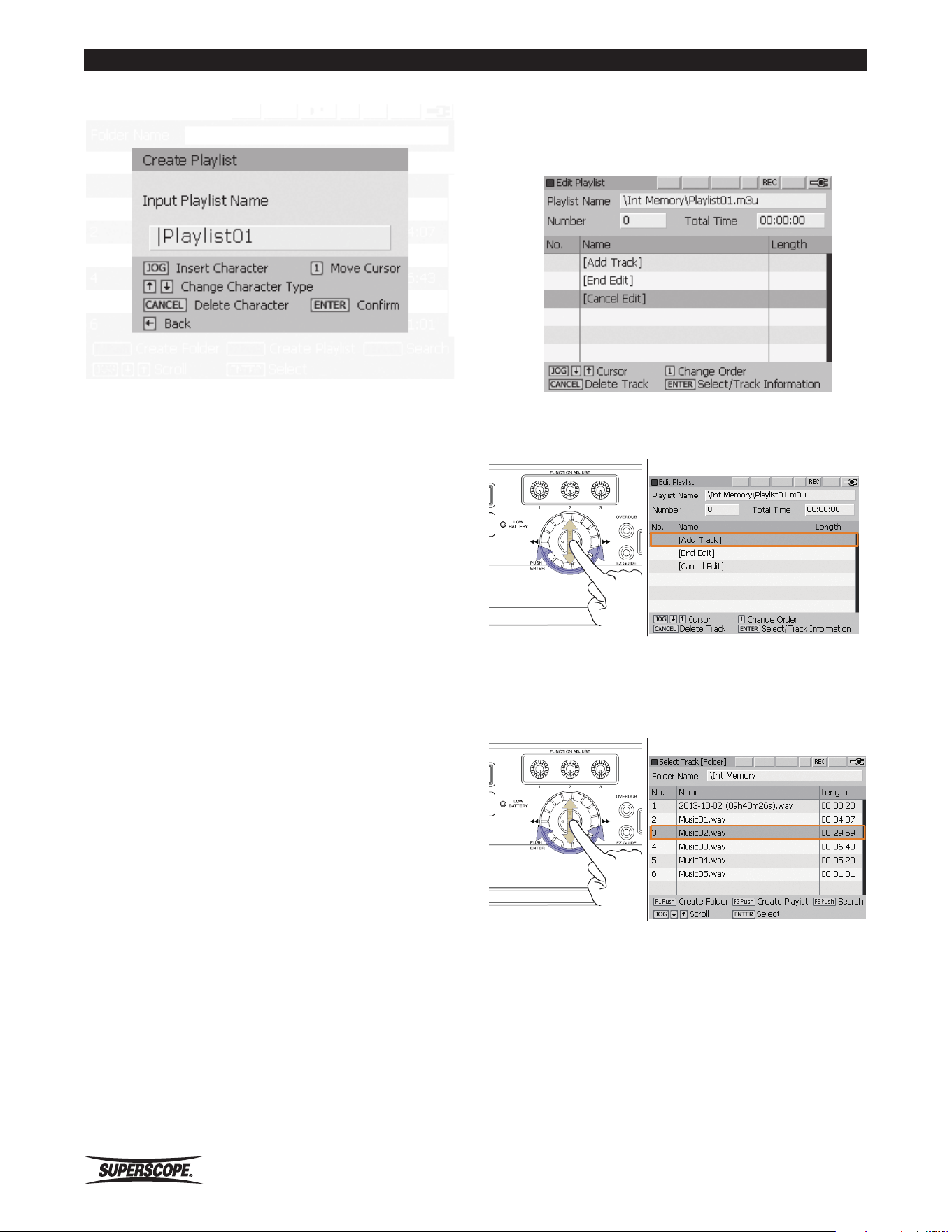
- 50 -
Superscope PSD450mkII User Manual
Working with Files and Folders
Text Input Screen
4. When you have finished naming your new playlist
and pressed ENTER to confirm the new title, the Edit
Playlist screen will appear.
Edit Playlist Screen
5. Turn the jog wheel or move the joystick up or down
to highlight [Add Track]. Press ENTER.
Edit Playlist Screen
6. The Select Track [Folder] screen will appear. Turn
the jog wheel or move the joystick up or down to
highlight a track. Press ENTER to add the selected
track to the playlist.
Select Track [Folder] Screen
※ The CD Playlist is created in a new folder in
the CD Playlist folder in the Internal Memory.
When you play a CD Playlist, you will find it in
the CD Playlist folder in the Internal Memory.
Press the PLAY key to play.
※ The CD Playlist is erased when the CD is
ejected or the unit is turned off.
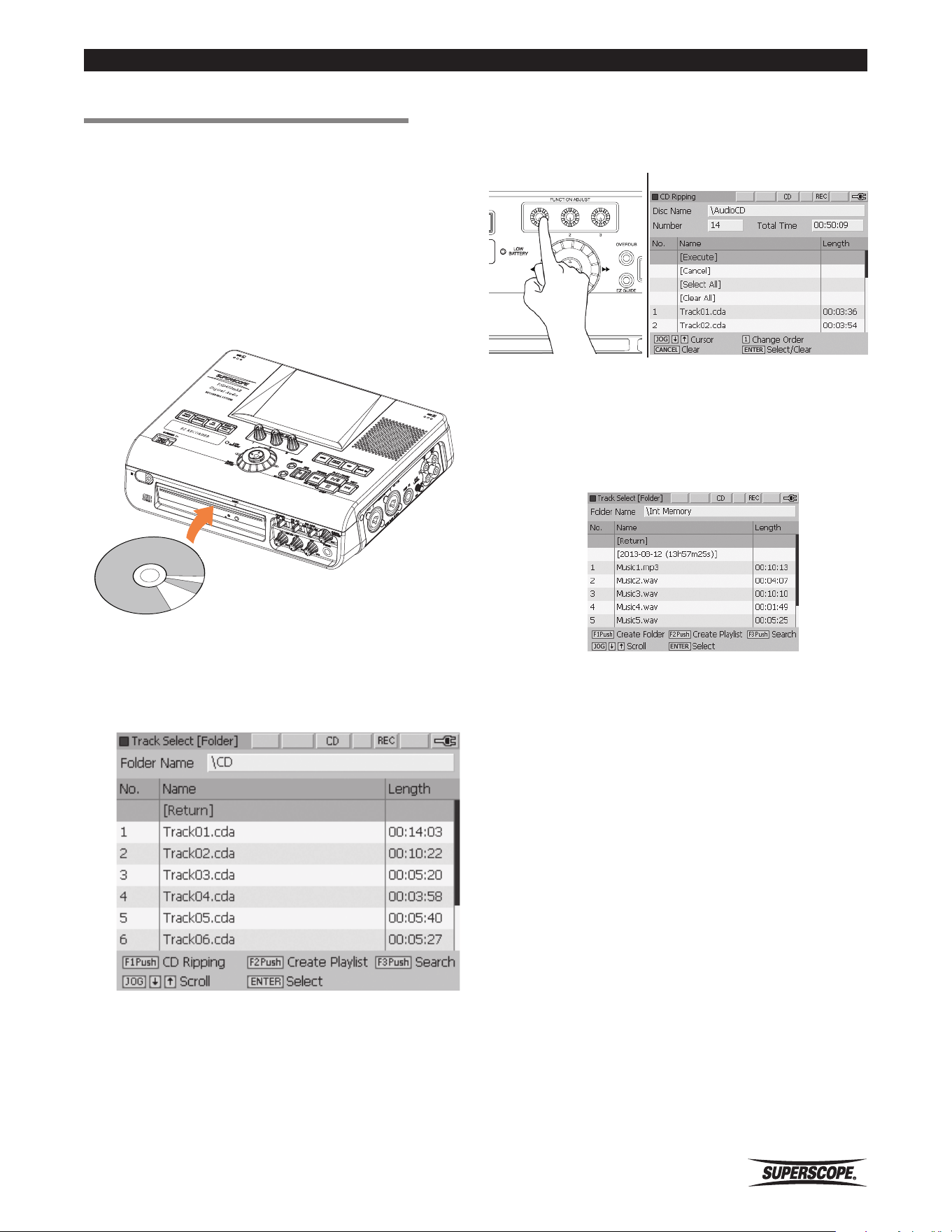
Superscope PSD450mkII User Manual
- 51 -
CD Ripping
■CD Ripping
Follow these instruction to “rip” the digital audio from
CD audio tracks to WAV files on the Internal Memory.
Press the DELETE/CANCEL button during CD ripping to
end the procedure.
Ripping an entire Audio CD
1. Insert the CD you wish to rip into the CD-R/RW
drive.
2. When a CD audio disc is inserted, the contents of
the disc are displayed automatically .
Track Select [Folder] Screen
3. If you have exited the Track Select [Folder]\CD
screen, see How to Select [CD] to display the CD
contents again. Turn the jog wheel or move the
joystick up or down to highlight a track.
4. Press FUNCTION ADJUST #1 (4A), all CD tracks are
selected. To rip the entire CD, simply turn the jog
wheel or move the joystick up or down to highlight
[Execute]. Press ENTER.
CD Ripping Screen
5. The CD tracks will be ripped to a folder in the main
directory of the Internal Memory. The name of the
folder will be the current time and date, e.g., [2013-
08-12 (13h57m25s)].
Track Select [Folder] Screen
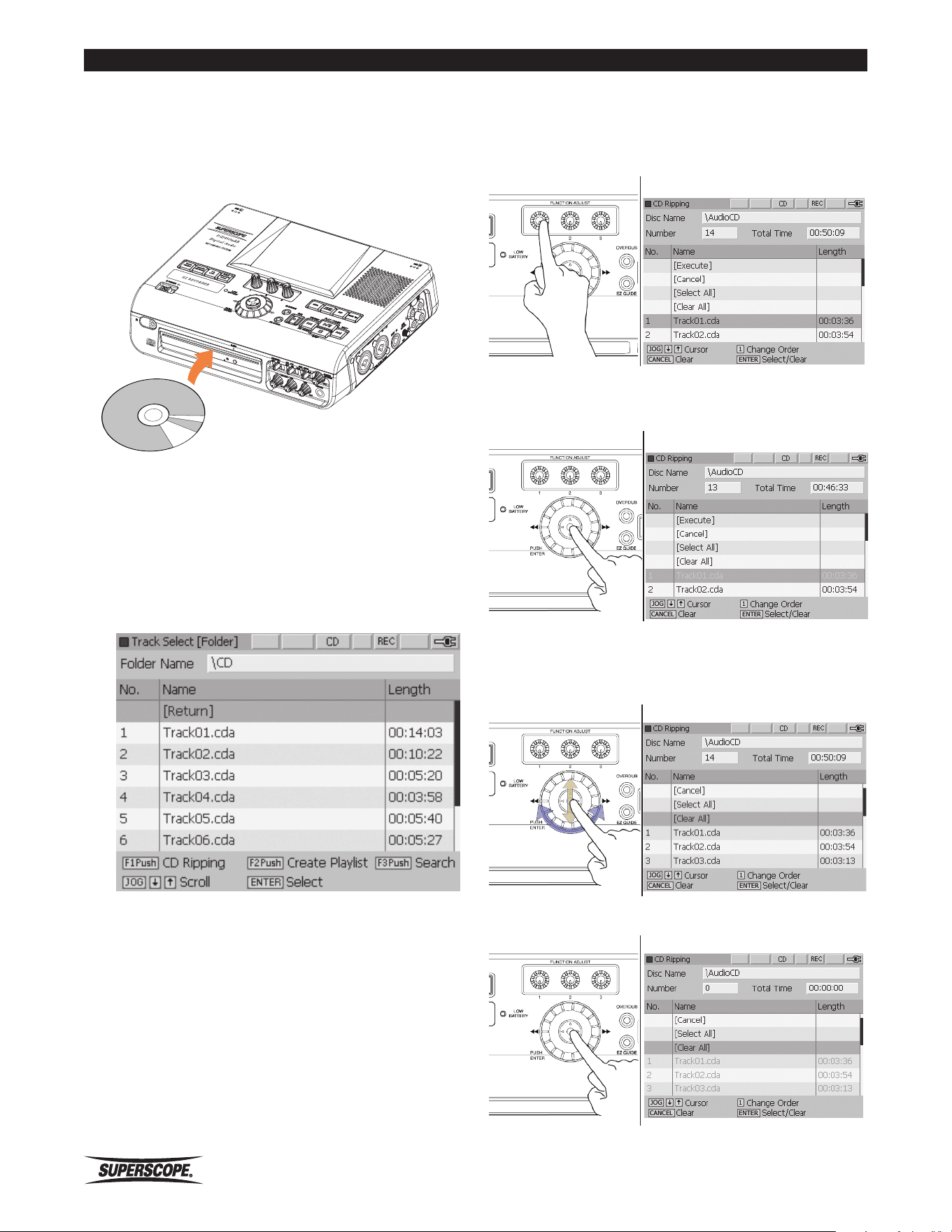
- 52 -
Superscope PSD450mkII User Manual
CD Ripping
Ripping Selected Tracks from an Audio
CD
1. Insert the CD you wish to rip into the CD-R/RW
drive.
2. When a CD audio disc is inserted, the contents of
the disc are displayed automatically. If you have
exited the Track Select [Folder]\CD screen, see How
to Select [CD] to display the CD contents again. Turn
the jog wheel or move the joystick up or down to
highlight a track.
Track Select [Folder] Screen
3. Press FUNCTION ADJUST #1 (4A), all CD tracks are
selected. If you intend to rip most of the tracks on
the CD, turn the jog wheel or move the joystick up or
down to select the tracks you do not wish to rip.
CD Ripping Screen
Press ENTER to remove a track from the list of ripped
tracks.
CD Ripping Screen
If you only intend to rip a small number of tracks from
the CD, turn the jog wheel or move the joystick up or
down to highlight [Clear All].
CD Ripping Screen
Press ENTER. All tracks will appear in grey.
CD Ripping Screen
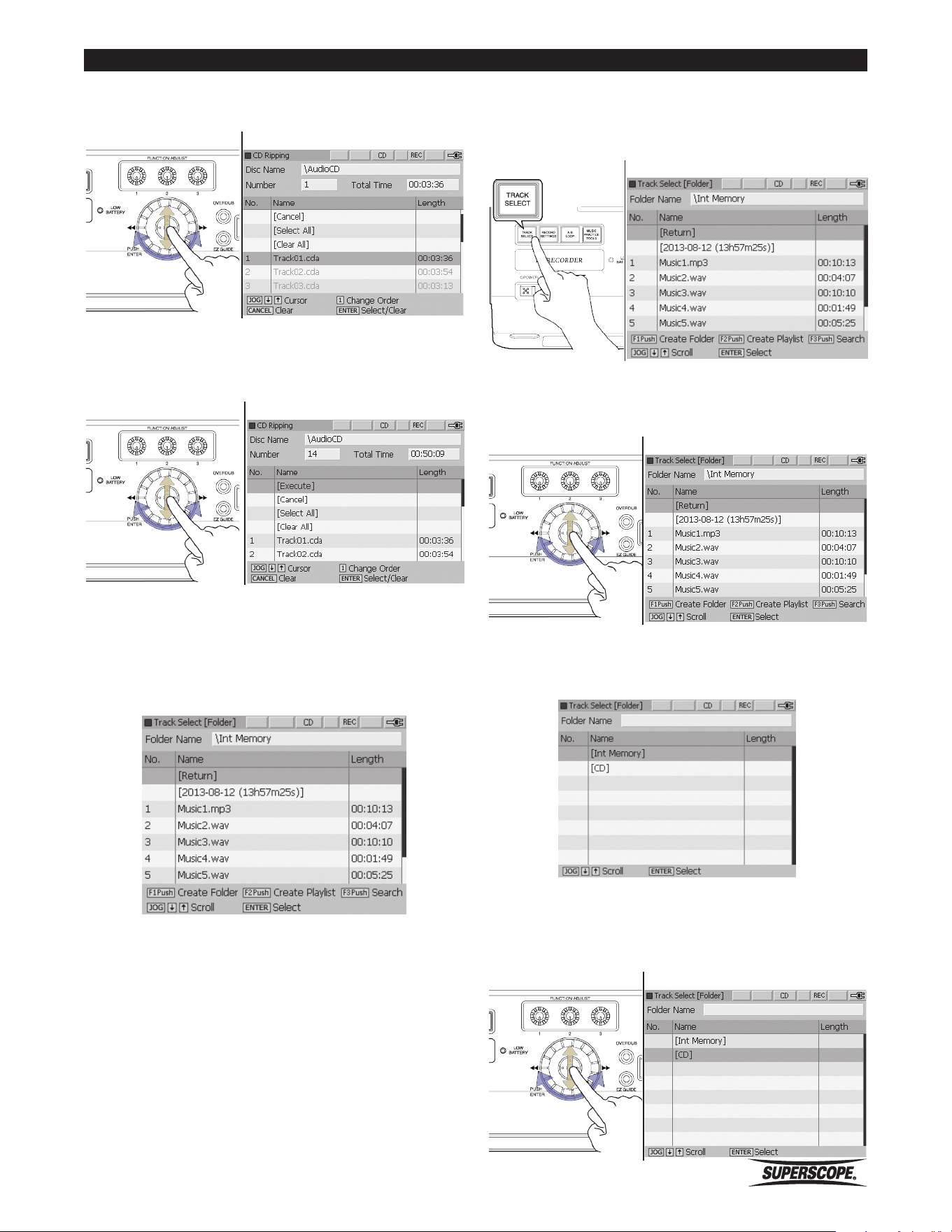
Superscope PSD450mkII User Manual
- 53 -
CD Ripping
Turn the jog wheel or move the joystick up or down to
highlight the tracks you wish to rip. Press ENTER.
CD Ripping Screen
4. When you have selected your tracks for ripping, turn
the jog wheel or move the joystick up or down to
highlight [Execute]. Press ENTER.
CD Ripping Screen
5. The CD tracks will be ripped to a folder in the main
directory of the Internal Memory. The name of the
folder will be the current time and date, e.g., [2013-
08-12 (13h57m25s)].
Track Select [Folder] Screen
How to Select [CD / CD-R / CD-RW]
1. Press the TRACK SELECT button. The recorder will
show the previously accessed folder.
Track Select [Folder] Screen
2. Turn the jog wheel or move the joystick up or down
to highlight [Return] and press ENTER.
Track Select [Folder] Screen
3. The Device Select Screen is shown.
Track Select Screen
4. Turn the jog wheel or move the joystick up or down
to highlight [CD]. Press ENTER to open the the CD
track folder.
Track Select Screen
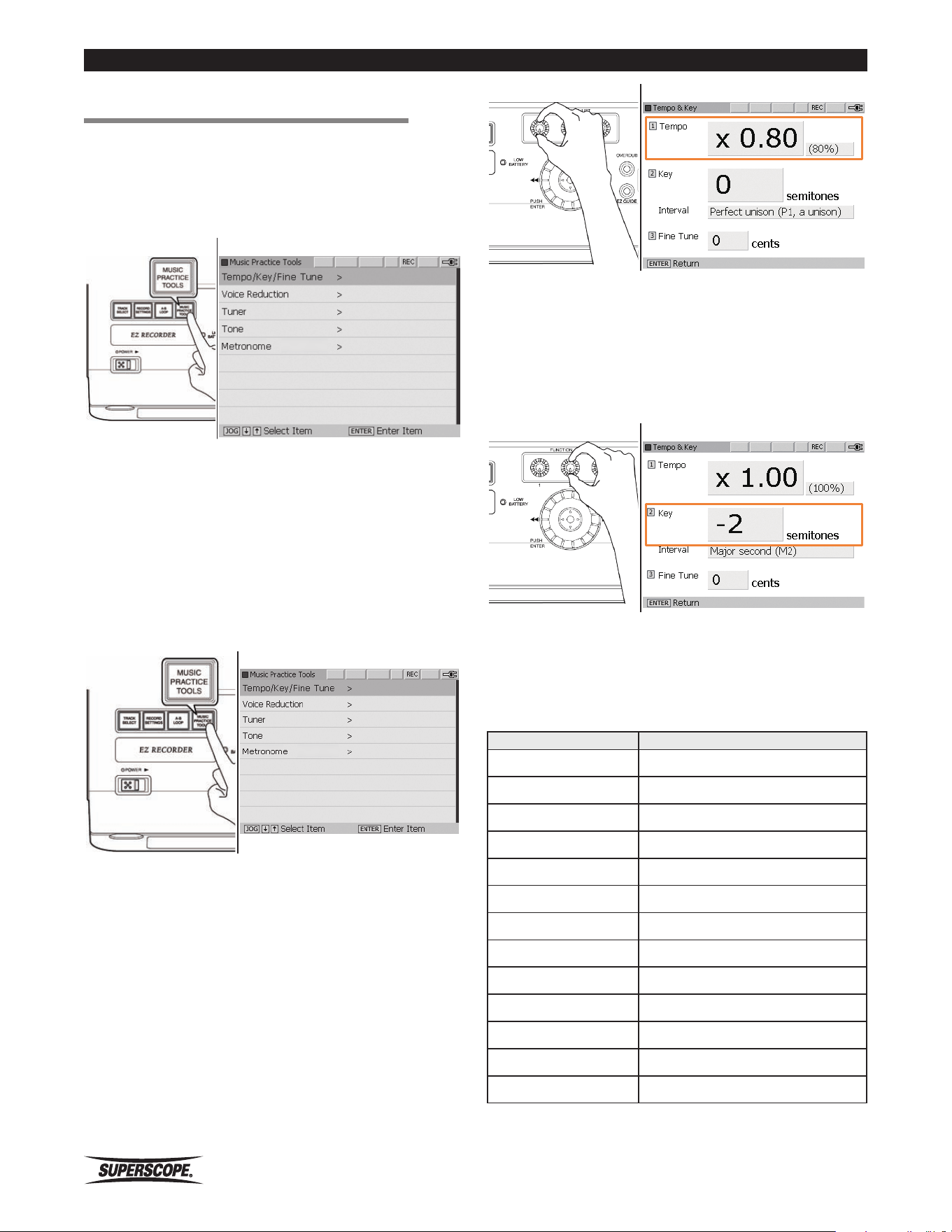
- 54 -
Superscope PSD450mkII User Manual
Music Practice
■Music Practice
Music Practice Tools
1. Press the MUSIC PRACTICE TOOLS button. Select
tools by using the jog wheel or the joystick, and
press ENTER.
Music Practice Tools Screen
Tempo/Key/Fine Tuner and Voice Reduction can
be set while paused. Effects can easily be checked
during playback. Refer to PLAY for playback details.
Adjusting Tempo, Key, and Fine Tune
Tempo
1. Push the MUSIC PRACTICE TOOLS button during
playback or while paused. Select Tempo/Key/Fine
Tune by using the jog wheel or the joystick, and
press ENTER.
Music Practice Tools Screen
2. Turn FUNCTION ADJUST #1 (4A) to adjust Tempo
(playback speed). Press FUNCTION ADJUST #1 (4A)
to reset Tempo to normal speed. The tempo control
function can modify a track’s tempo (playback
speed) between -75% and +50% (1% intervals)
without affecting playback pitch.
Tempo and Key Screen
Key
1. Turn FUNCTION ADJUST #2 (4B) to modify playback
Key in semitones. Push FUNCTION ADJUST #2 (4B)
to reset Key to normal playback (no Key adjustment).
The Key adjustment range is +/-12 semitones (half
steps).
Tempo and Key Screen
Interval Indication
The Interval indication displays the interval for the
corresponding Key change in semitones.
Semitones Interval
[0] Perfect unison (P1, a unison)
[-1/+1] Minor second (m2)
[-2/+2] Major second (M2)
[-3/+3] Minor third (m3)
[-4/+4] Major third (M3)
[-5/+5] Perfect fourth (P4)
[-6/+6] Tritone (TT)
[-7/+7] Perfect fifth (P5)
[-8/+8] Minor sixth (m6)
[-9/+9] Major sixth (M6)
[-10/+10] Minor seventh (m7)
[-11/+11] Major seventh (M7)
[-12/+12] Perfect octave (P8)
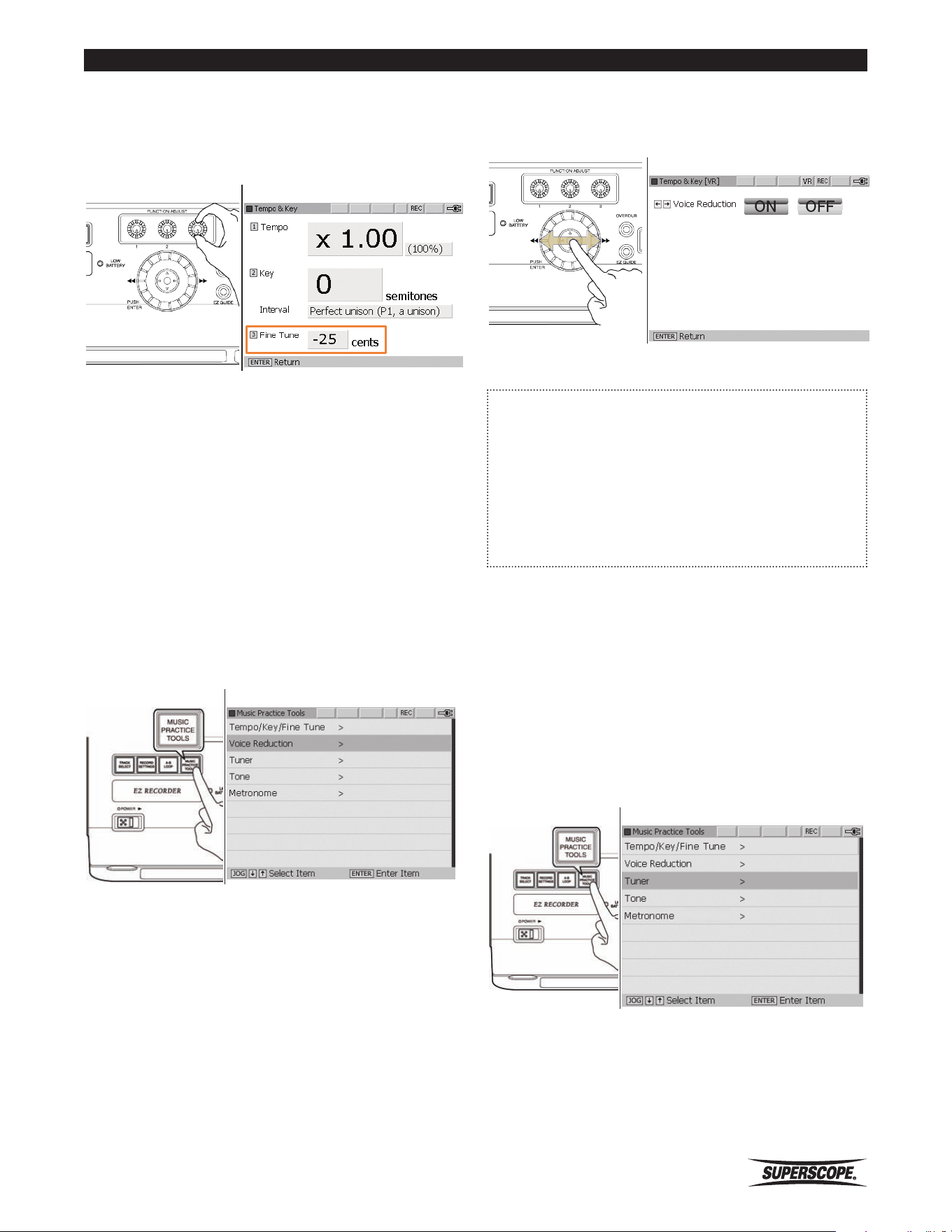
Superscope PSD450mkII User Manual
- 55 -
Music Practice
Fine Tune
Turn FUNCTION ADJUST #3 (4C) to fine tune playback
pitch +/-50 cents. Push FUNCTION ADJUST #3 (4C) to
reset FINE TUNE to normal pitch.
Tempo and Key Screen
※ When you exit the Tempo/Key screen, all
settings are stored along with the selected
file. Press the MUSIC PRACTICE TOOLS button
to exit.
Voice Reduction
The voice reduction function is used to reduce the lead
vocal performance in stereo recordings. Use this feature
in conjunction with the Overdub feature to create your
own karaoke-style recordings.
1. Push the MUSIC PRACTICE TOOLS button. Select
Voice Reduction by using the jog wheel or the
joystick, and press ENTER. The Voice Reduction
screen will appear.
Music Practice Tools Screen
2. Move the joystick to the right or left to select Voice
Reduction ON. A VR icon will be displayed at the top
of the screen.
Tempo & Key [VR] Screen
3. When a file is played, the level of the main vocal will
be reduced.
※ The Vocal Reduction feature uses a technique
called Center Channel Cancellation to reduce
vocals in stereo recordings. For this feature
to be effective, the main vocal performance
must be positioned in the center of the stereo
field (equal level in the right and left channel).
Vocal Reduction will not work with vocals that
are panned to the right or left channel. Press
the MUSIC PRACTICE TOOLS button to exit.
How to Use the Tuner
The PSD400 series provides two options for tuning
instruments: a chromatic tuner (range = A0 ~ C8) and a
tone generator (default = 440 Hz).
Using the Chromatic Tuner
1. Push the MUSIC PRACTICE TOOLS button. Select
Tuner by using the jog wheel or the joystick and
press ENTER.
Music Practice Tools Screen
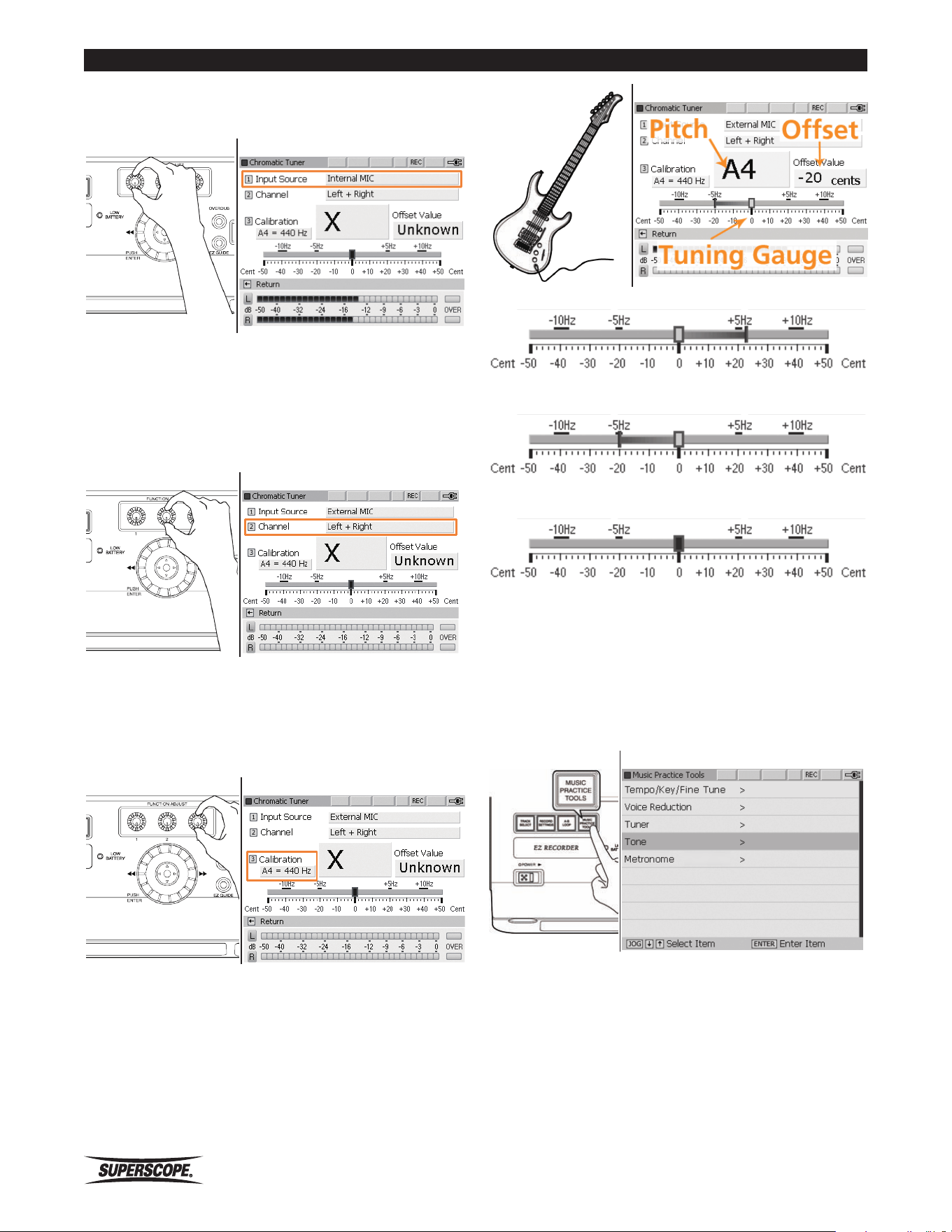
- 56 -
Superscope PSD450mkII User Manual
Music Practice
2. Turn the FUNCTION ADJUST #1 (4A) to select the
Input Source.
Chromatic Tuner Screen
3. Turn FUNCTION ADJUST #2 (4B) to select the Input
Channel. Specifying an Input Channel improves
tuning accuracy by preventing interference from
other channels. For example, if you are using one
microphone connected to Input L/1, select Input
Source: External MIC, Channel: Left.
Chromatic Tuner Screen
4. By default, the chromatic tuner is calibrated to A4 =
440 Hz. The tuner can be calibrated to any frequency
between 410 Hz and 470 Hz by turning FUNCTION
ADJUST #3 (4C). Press FUNCTION ADJUST #3 to
return to the default setting of A4=440Hz.
Chromatic Tuner Screen
5. As you play a note on your instrument, the closest
musical pitch will be displayed along with an Offset
Value showing how flat or sharp the note is (+/- 50
cents). Tune your instrument until the tuning gauge
is centered and the Offset Value displays “In Tune”.
Chromatic Tuner Screen
Tuning gauge indicating “Sharp”
Tuning gauge indicating “Flat”
Tuning gauge indicating “In Tune”
Using the Tuning Tone
1. Push the MUSIC PRACTICE TOOLS button. Select
Tone by using the jog wheel or the joystick and press
ENTER.
Music Practice Tools Screen
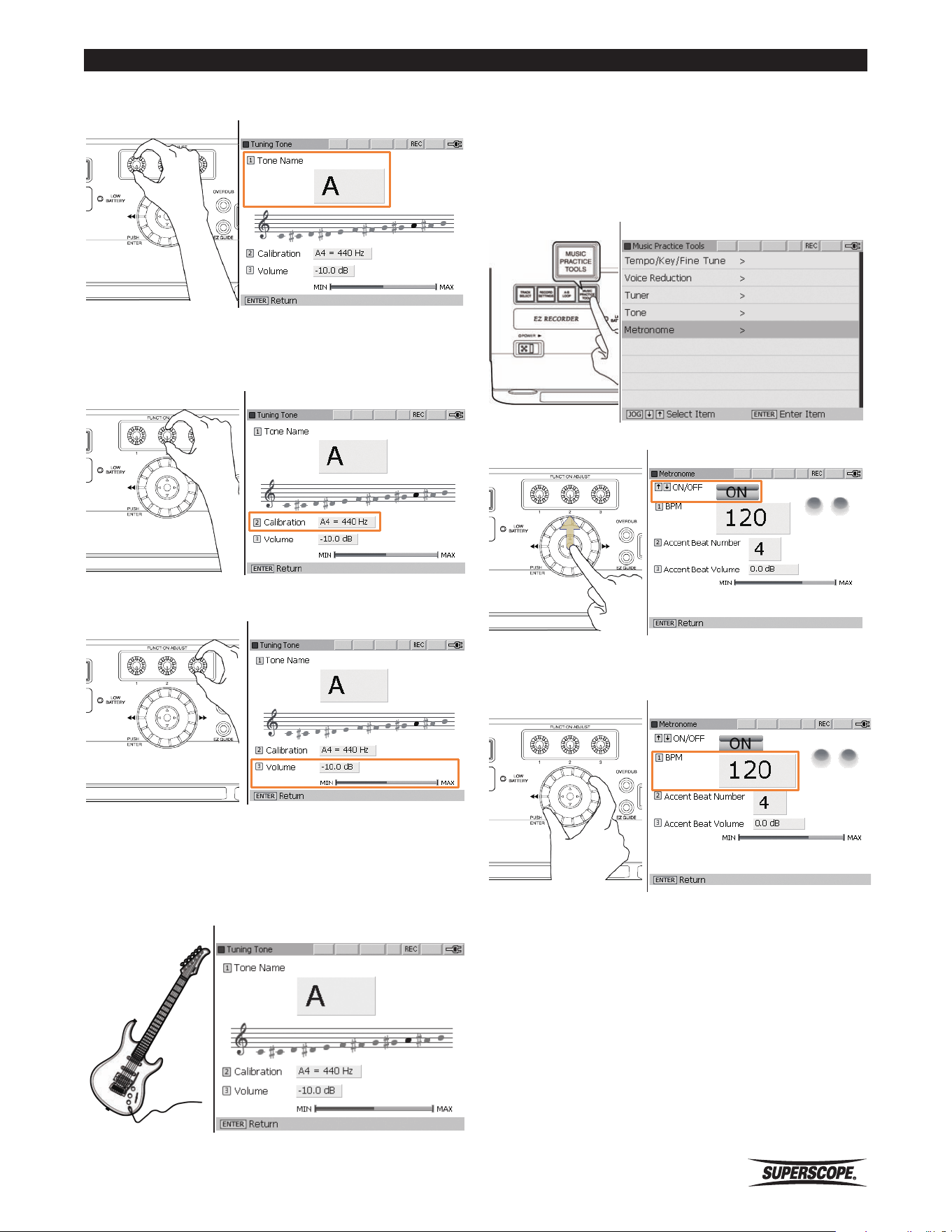
Superscope PSD450mkII User Manual
- 57 -
Music Practice
Using the Metronome
The metronome signal can be heard through the line
outputs, headphones or built-in speaker.
1. Push the MUSIC PRACTICE TOOLS button. Select
Metronome by using the jog wheel or the joystick
and press ENTER.
Music Practice Tools Screen
2. Move the joystick up to turn the metronome ON.
Metronome Screen
3. Turn the FUNCTION ADJUST #1 (4A) to adjust
tempo. Tempo can be set between 35BPM and
120BPM.
Metronome Screen
2. Turn the FUNCTION ADJUST #1 (4A) to select the
frequency of the tone generator.
Tuning Tone Screen
3. By default, the tone generator is calibrated to
A4 = 440 Hz. The tuner can be calibrated to any
frequency between 410 Hz and 470 Hz by turning
FUNCTION ADJUST #2 (4B).
Tuning Tone Screen
4. Turn FUNCTION ADJUST #3 (4C) to adjust the
volume of the tone generator.
Tuning Tone Screen
5. All notes are displayed in concert pitch. Tune your
instrument to match Tone Name displayed on
the Tuning Tone screen. Press the corresponding
function adjust knob (1, 2 or 3) to return to default
settings for each function.
Tuning Tone Screen
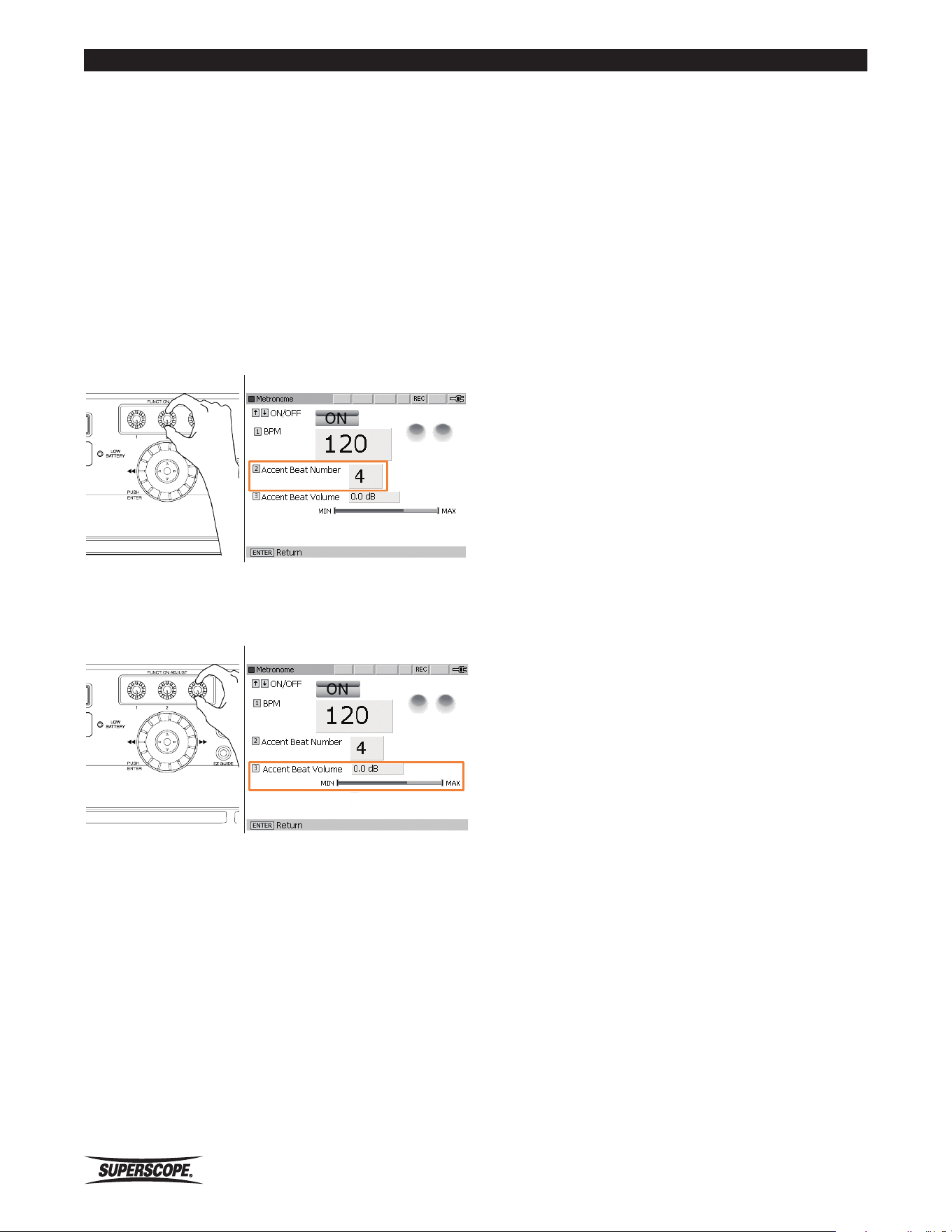
- 58 -
Superscope PSD450mkII User Manual
Music Practice
Adjusting Accent Beat and Accent Beat
Volume
By designating a particular beat to play louder than other
beats, the metronome is able to imply different rhythmic
meters. For instance, setting the Accent Beat Number to
3 will cause every third beat to sound louder than the
other two. At moderate tempos, this will create a waltz
feel. Adjusting the Accent Beat Volume will determine
how much louder the Accent Beat will sound over the
non-accented beats.
1. Turn FUNCTION ADJUST #2 (4B) to set an Accent
Beat Number. Select beat 1-9 or ‘0’ for no accent
beat. Press FUNCTION ADJUST #2 (4B) to return the
Accent Beat Number to the default setting (4).
Metronome Screen
2. Turn FUNCTION ADJUST #3 (4C) to set the volume of
the accent beat. Press FUNCTION ADJUST #3 (4C) to
return the Accent Beat Volume to the default setting
(0.0 dB).
Metronome Screen
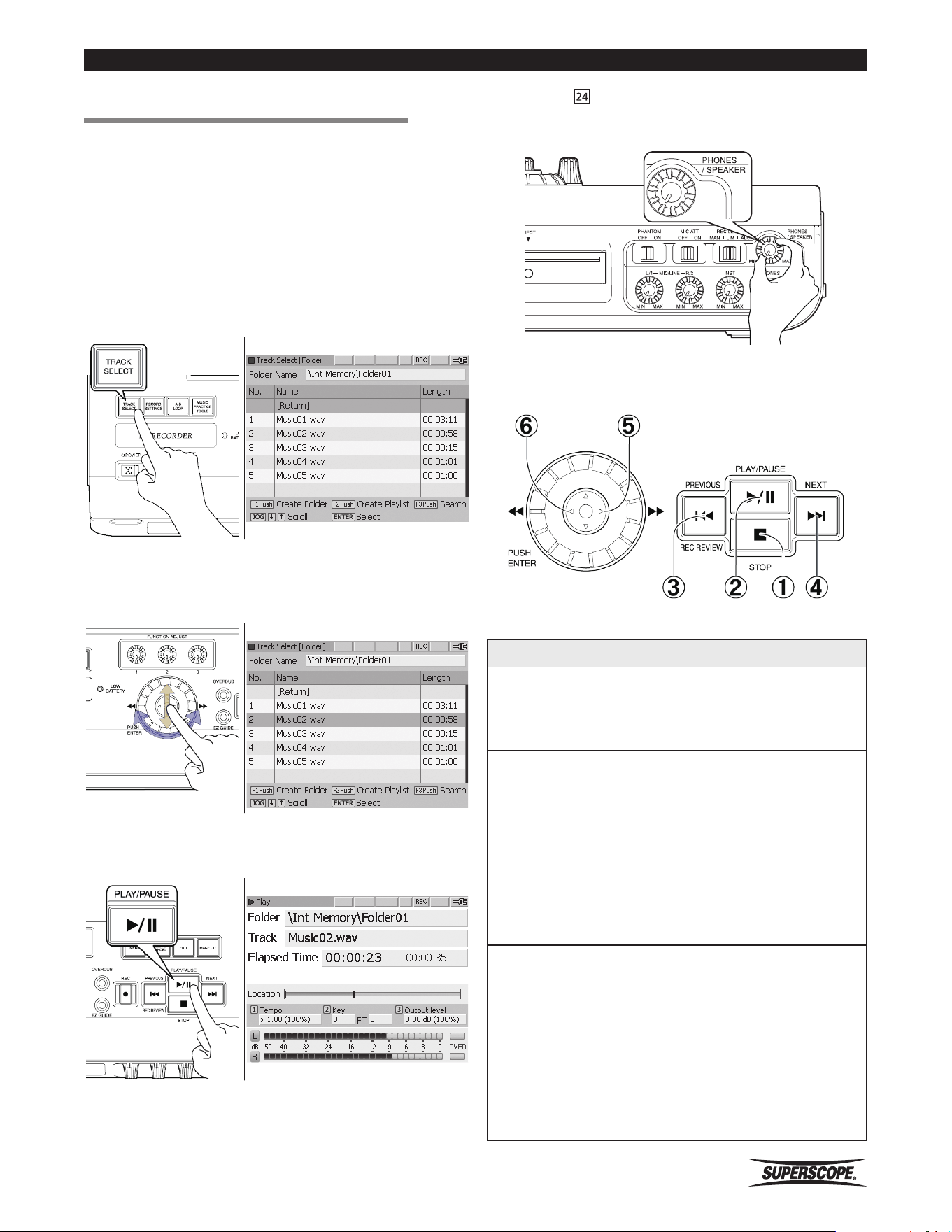
Superscope PSD450mkII User Manual
- 59 -
Playback
■Play
The PSD450mkII can play CD audio or WAV or MP3 files
located on the Internal Memory, USB storage device, or
CD.
1. Power the unit on (see Set Up).
2. Press the TRACK SELECT button to open the Track
Select [Folder] screen. The contents of the Internal
Memory will be displayed. To search the contents of
a different device, see Search a USB Device or CD.
Track Select [Folder] Screen
3. Turn the jog wheel or move the joystick up or down
to highlight track for playback.
Track Select [Folder] Screen
4. Press the PLAY/PAUSE button (8C) to play the
selected track.
Play Screen
5. Turn the PHONES/SPEAKER knob to adjust the
volume of the speaker or headphones.
Playback Operation
Button Function
① STOP
Press to stop playback. Playback
location returns to the beginning
of the track.
② PLAY/PAUSE
• From Stop Mode, press to
begin playback.
• From Pause Mode, press to
resume playback from the
pause location.
• From Play Mode, press to
pause playback.
③ PREVIOUS
Press during playback to return
to the start of the track. Press
the PREVIOUS button within
the first one second of playback
to return to the start of the
previous track.
Press during Stop Mode to
return to the start of the
previous track.
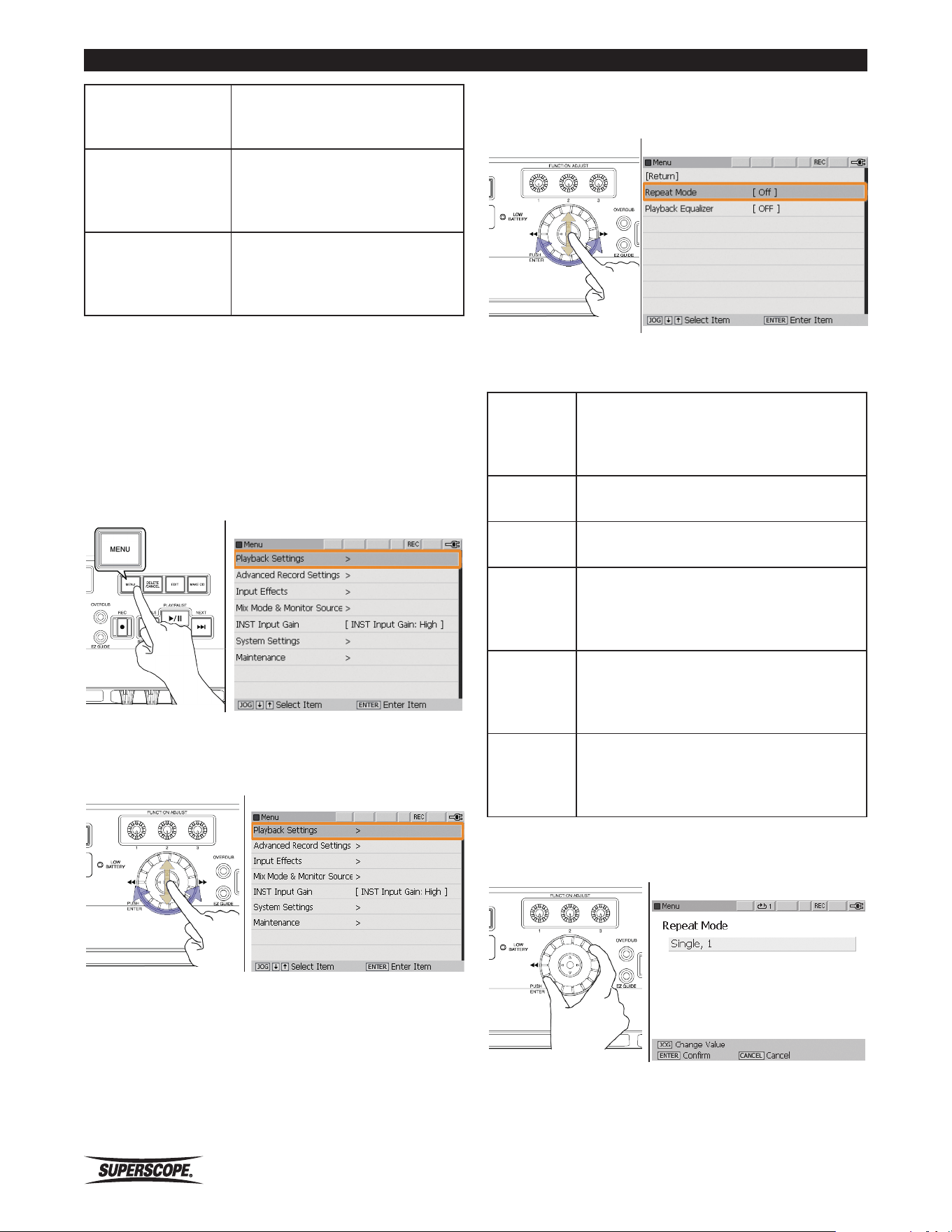
- 60 -
Superscope PSD450mkII User Manual
Playback
④ NEXT
Press to begin playback at the
beginning of the next track.
⑤ Fast Forward
Hold the joystick to the right
to begin audible high-speed
searching.
⑥ Fast Rewind
Hold the joystick to the left
to begin audible high-speed
backward searching.
Playback Modes
In Normal operation, playback continues to the next track
as soon as the current track is finished playing.
The PSD400 series contains several alternative playback
modes to accommodate a variety of situations. Follow
these steps to select a new playback (repeat) mode.
1. Press the MENU button to open the Menu screen.
Menu Screen
2. Use the jog wheel or joystick to highlight Playback
Settings and then press ENTER.
Menu Screen
3. Use the jog wheel or joystick to highlight "Repeat
Mode" and then press ENTER.
Menu Screen
Repeat Modes
OFF
Normal operation. When a track is
finished playing, playback continues to
the next track.
All
All songs in a given folder play repeatedly.
1
The current track will play repeatedly.
Single, 1
The current track plays once before
playback stops at the beginning of the
current track.
Single, All
All songs in a given folder play once
before playback stops at the beginning of
the first track.
Single
The current track plays once before
playback stops at the beginning of next
track.
4. Select a Repeat Mode by turning the jog wheel.
Press ENTER to confirm the selection.
Repeat Mode Screen
To cancel the setting, press the DELETE/CANCEL button.
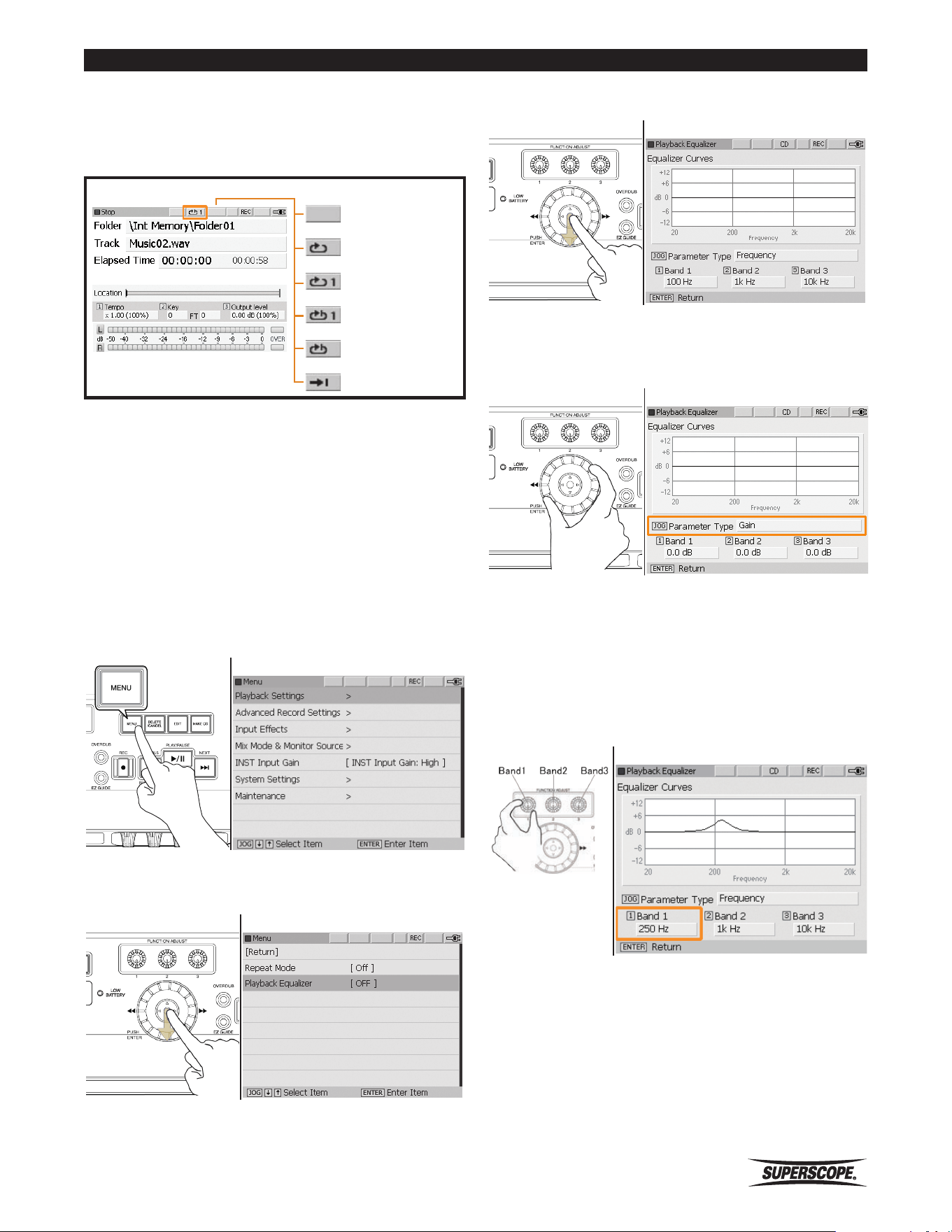
Superscope PSD450mkII User Manual
- 61 -
Playback
5. Press the MENU button to exit.
The following Repeat icons will be displayed when the
corresponding Repeat Mode is selected:
OFF
All
1
Single, 1
Single, All
Single
Equalizer Settings
The unit offers two independent 3-band parametric
equalizers (EQ); one equalizer affects input signals
(microphones, instruments, etc.) while the other equalizer
affects file playback. Follow these steps to adjust the
playback equalizer (Note: When you exit this screen, all
settings will be stored with the selected file):
Playback Equalizer
1. Press the MENU button to open the Menu screen.
Tempo and Key Screen
2. Select Playback Settings and then select Playback
Equalizer.
Playback Equalizer Screen
3. Press joystick down to open Playback Equalizer
screen.
Playback Equalizer Screen
4. Parameter Type: Turn the jog wheel to select
the parameter to be adjusted: Frequency, Gain, or
Bandwidth.
Playback Equalizer Screen
Frequency
When Parameter Type is set for Frequency, turn the
FUNCTION ADJUST controller (1, 2 or 3) to select any
frequency between 20 Hz and 20 kHz for each band.
Pressing the FUNCTION ADJUST knobs will return all
settings to default values.
Playback Equalizer Screen
Gain
When Parameter Type is set for Gain, turn the FUNCTION
ADJUST controller (1, 2 or 3) to determine the gain for
each Band. Gain can be adjusted +/- 12dB. Pressing
the FUNCTION ADJUST knobs will return all settings to
default values.
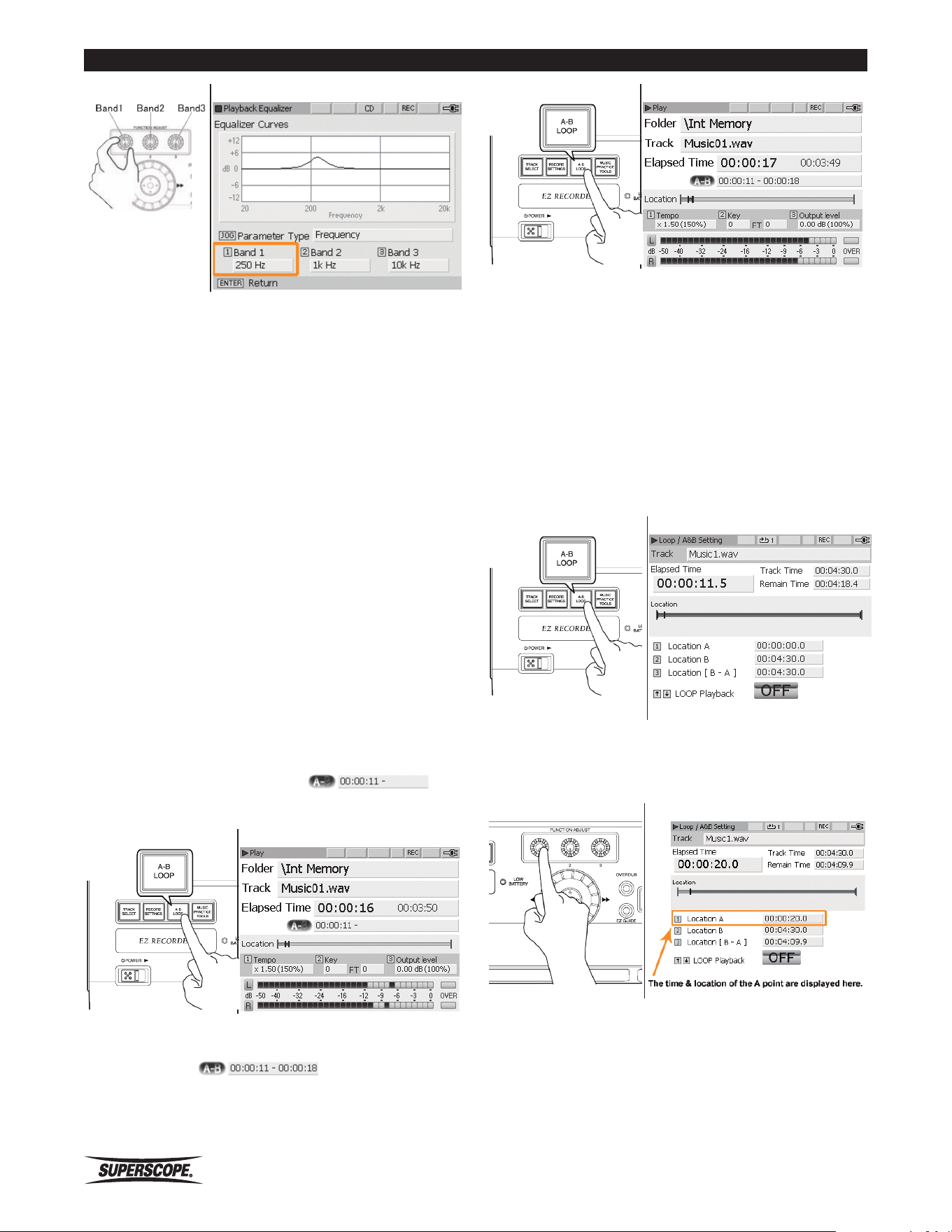
- 62 -
Superscope PSD450mkII User Manual
Playback
Playback Equalizer Screen
Bandwidth
When Parameter Type is set for Bandwidth, turn the
FUNCTION ADJUST controller to set the bandwidth for
each band. Turn right to widen the frequency band.
Turn left to narrow the frequency band. Pressing the
FUNCTION ADJUST knobs will return all settings to
default values.
A-B Loop (Repeat Playback)
Use the A-B Loop function to play a section of audio
repeatedly.
The A-B LOOP button can be used as follows:
1. Press the A-B LOOP button during playback quickly.
2. Press and hold the A-B LOOP button for 3 seconds
or longer with the Loop/A&B Setting screen, the
setting of the A-B repeat playback point is possible in
detail.
Press the A-B LOOP button during
playback
1. Press the A-B Loop button [2-C] to set the start point
of the loop during playback. ‘ ’ will
appear on the screen.
A-B Loop Screen
2. Press the A-B Loop button [2-C] to set the end point
of the loop. ‘ ’ will appear and
playback will begin looping between the start and
end markers automatically.
A-B Loop Screen
Press and hold the A-B LOOP button
for 3 seconds or longer.
1. Press and hold the A-B LOOP button for 3 seconds or
longer during playback to change the Loop Setting
menu. The A-B loop can be set in greater detail on
this screen.
※ The function below is also used when
determining In/Out points for Overdub.
Loop / A&B Setting screen
2. When you hear the point at which the loop should
begin, press FUNCTION ADJUST #1 (4A).
Loop / A&B Setting Screen
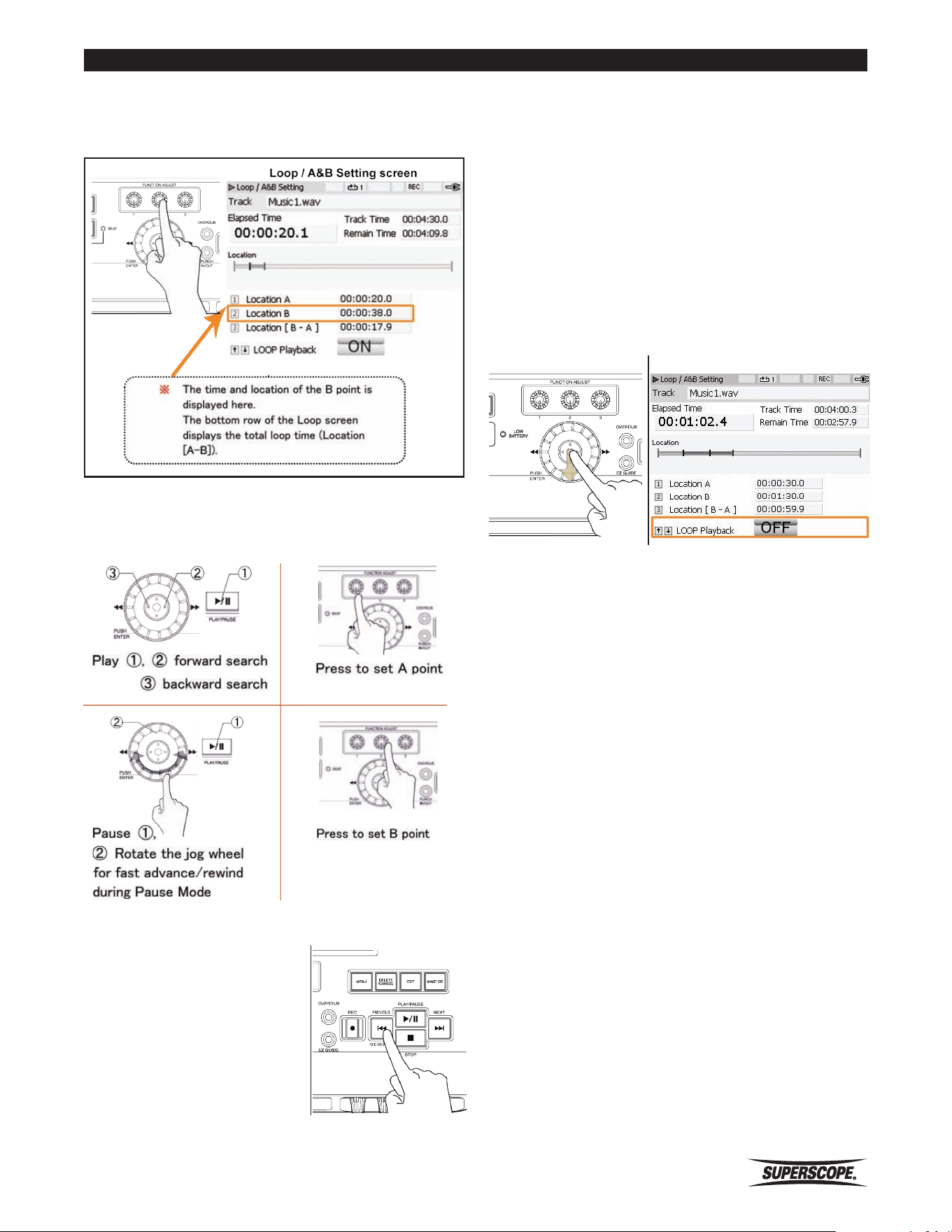
Superscope PSD450mkII User Manual
- 63 -
Playback
3. When you hear the point at which the loop should
end, press FUNCTION ADJUST #2 (4B). When the B
point is set, LOOP Playback begins automatically.
Use the following controls during Loop Mode to locate A
and B points.
During Loop playback, press the
PREVIOUS button to return to
the beginning of the loop.
※ To fine adjust the A point, turn FUNCTION
ADJUST#1 (4A). To fine adjust the B point,
turn FUNCTION ADJUST #2 (4B). Turn
FUNCTION ADJUST #3 (4C) to reposition the A
and B point at the same time.
The A and B points for each track are stored with the file,
so the next time you access the selected track, the same
loop points should appear.
Moving the joystick down will switch to normal playback
(LOOP Playback OFF). Moving the joystick up will resume
A-B Repeat playback (LOOP Playback ON).
Loop / A&B Setting Screen
Delete a Loop Point
1. Push and hold FUNCTION ADJUST #1 (4A) to reset
the A point the beginning of the track (0:00).
2. Push and hold FUNCTION ADJUST #2 (4B) to reset
the B point to the end of the track.
3. Push and hold FUNCTION ADJUST #3 (4C) to reset
both the A and the B point.
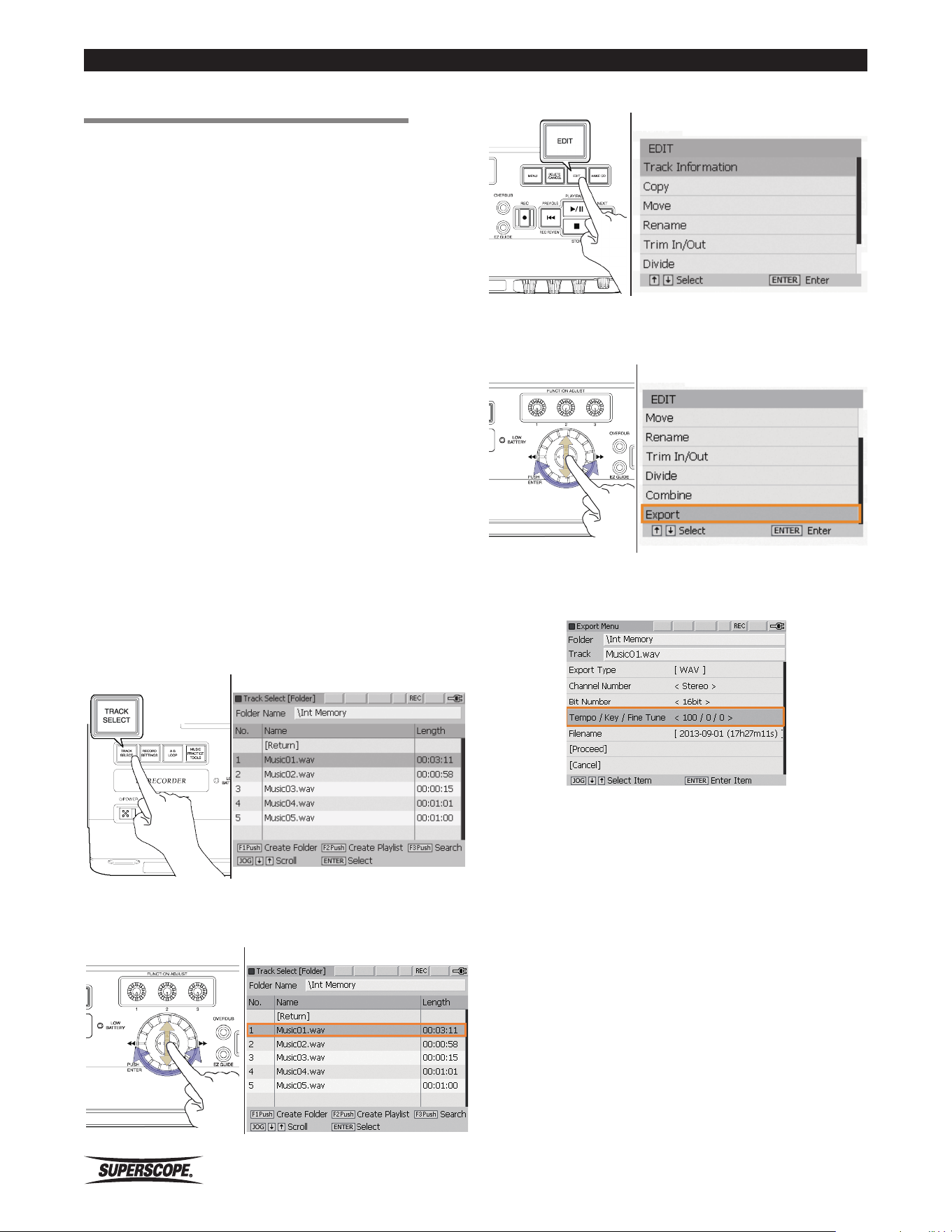
- 64 -
Superscope PSD450mkII User Manual
Editing
■Editing
※ See the Appendix section for a list of all file,
folder or playlist Edit Menu Options.
Export a File
The Export feature allows you to::
1. Create a new file with different Tempo, Key, or Fine
Tune settings.
2. Create a new file in a different format (i.e., an MP3
version of a WAV file).
The new file will always be exported to the same folder
as the original.
Creating a File with a New Tempo or
Key
When Tempo, Key, or Fine Tune settings are altered, the
new values are stored with the file. To change Tempo,
Key and Fine Tune settings, see Adjusting Key, Tempo
and Fine Tune. Once you have altered these settings,
follow these steps to create a new file:
1. Press the TRACK SELECT button to open the Track
Select [Folder] screen.
Track Select [Folder] Screen
2. Turn the jog wheel or move the joystick up or down
to highlight the track you wish to export.
Track Select [Folder] Screen
3. Press the EDIT button.
Edit Screen
4. Turn the jog wheel or move the joystick up or down
to highlight Export. Press ENTER.
Edit Screen
5. Confirm the Tempo, Key, and Fine Tune settings.
Export Menu Screen
If the displayed values are correct, proceed to Naming
the Exported File. If not, turn the jog wheel or move the
joystick down to select [Cancel]. See Adjusting Tempo,
Key and Fine Tune.
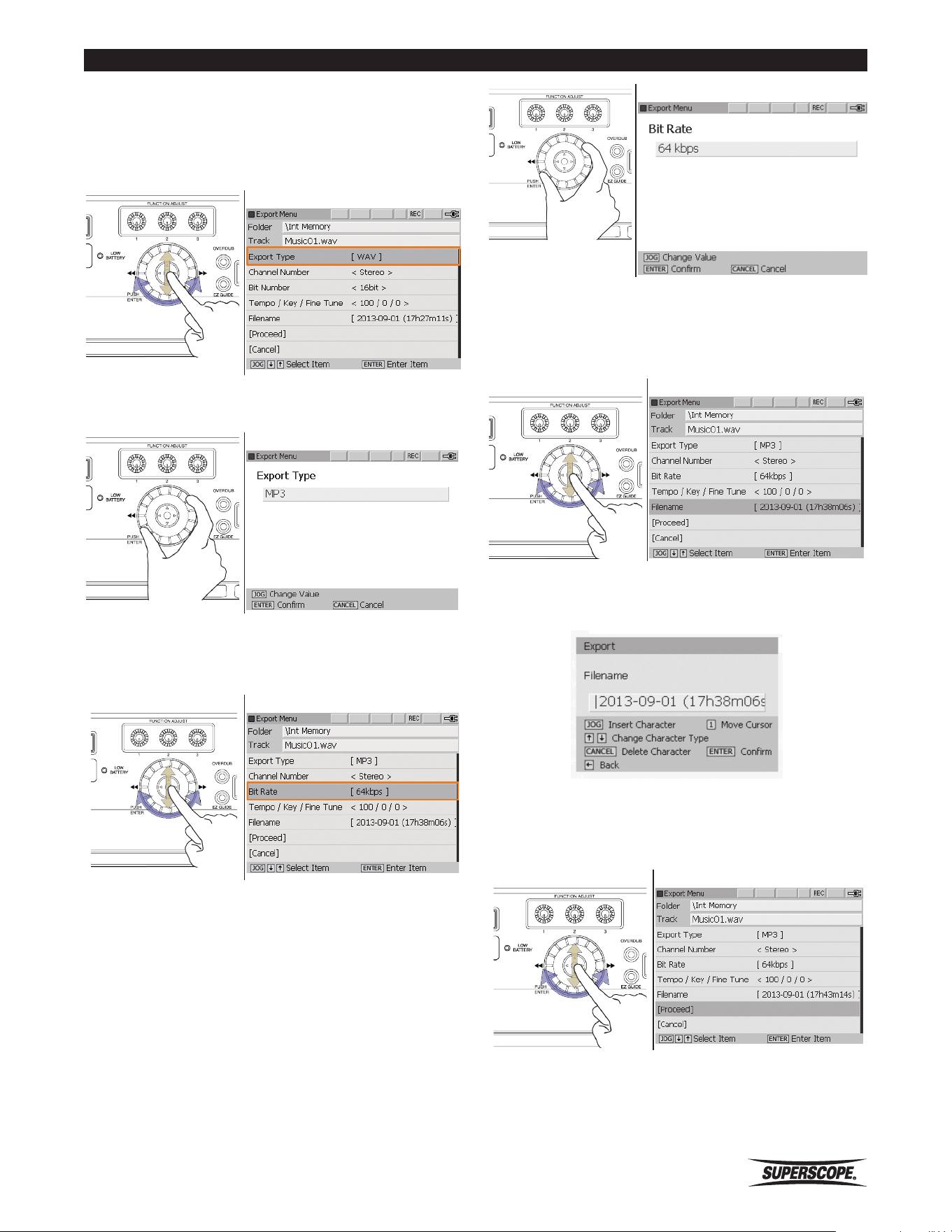
Superscope PSD450mkII User Manual
- 65 -
Editing
Changing File Format
1. Turn the jog wheel or move the joystick up or
down to highlight Export Type. The default setting
is [WAV]. To export the selected file as MP3, press
ENTER.
Export Menu Screen
2. Turn the jog wheel to select MP3. Press ENTER to
confirm the change.
Export Menu Edit Screen
3. The Export Menu will be displayed. Turn the jog
wheel or move the joystick up or down to select Bit
Rate. Press ENTER.
Export Type Setting Screen
4. Turn the jog wheel to select a bit rate. Press ENTER
to confirm the setting. Options include 64, 80, 96,
112, 128, 160, 192, 224, 256 or 320 kbps for stereo
files. When exporting mono files, options include 32,
40, 48, 56, 64, 80, 96, 112, 128 or 160 kbps.
Export Menu Edit Screen
Naming the Exported File
1. Turn the jog wheel or move the joystick up or down
to select Filename. Press ENTER.
Export Menu Screen
2. Enter the name of the new file by using the Text Input
Method.
Text Input Screen
3. When you have finished naming the new file and
pressed ENTER to confirm the new title, the Export
Menu screen will appear. Turn the jog wheel to select
[Proceed]. Press ENTER to begin exporting.
Export Menu Screen
※ A progress bar is displayed during the Export
procedure. Do not power off until the
procedure is complete. If power is interrupted
during Export, the exported file will be lost.
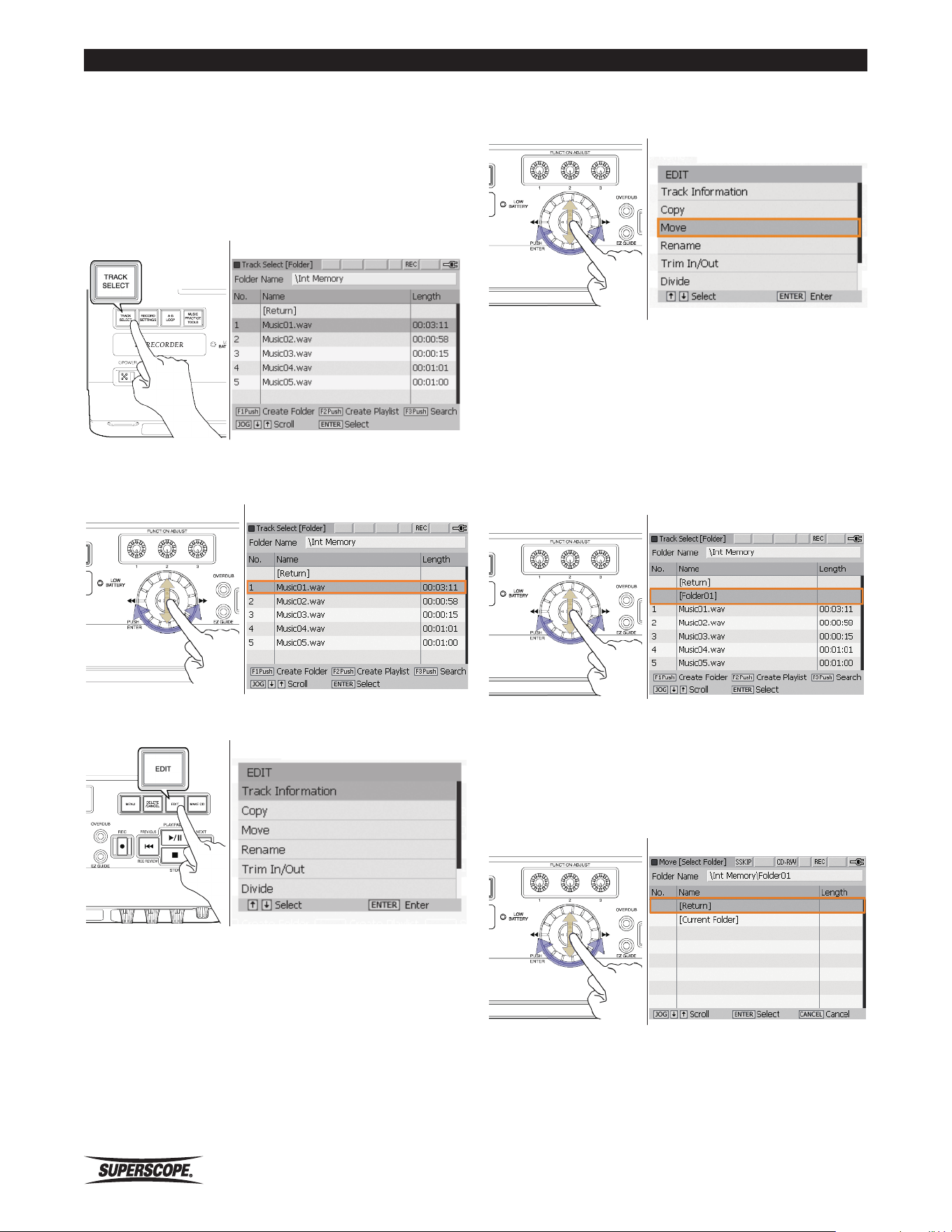
- 66 -
Superscope PSD450mkII User Manual
Editing
Move a Track
Use this feature to move a folder or file to another
location, either a new folder or a different drive: Internal
Memory or USBHDD.
1. Press the TRACK SELECT button to open the Track
Select [Folder] screen.
Track Select [Folder] Screen
2. Turn the jog wheel or move the joystick up or down
to highlight the folder or file you wish to move.
Track Select [Folder] Screen
3. Push the EDIT button to open the Edit menu screen.
Edit Screen
4. Turn the jog wheel or move the joystick up or down
to highlight Move. Press ENTER.
Edit Screen
5. The Move screen will open with the question Move
Selected File? Use the jog wheel or move the joystick
up or down to highlight Yes. Push ENTER with the
joystick to confirm the selection.
6. Turn the jog wheel or move the joystick up or down
to select the folder you wish to move the selected
item to. Once you have highlighted the new location,
press ENTER.
Move Select [Folder] Screen
7. Turn the jog wheel or move the joystick up or down
to highlight [Current Folder]. Press ENTER.
8. The Move screen will open with the question Move
1 file? Move the joystick to the left to highlight OK.
Push ENTER to confirm and move the file.
Move Select [Folder] Screen
9. To move a file to the USBHDD, start by following
steps 1 through 5. After selecting Yes on the Move
screen, the Int Memory folder will be shown. Turn
the jog wheel or move the joystick up or down to
highlight [Return]. Push ENTER.
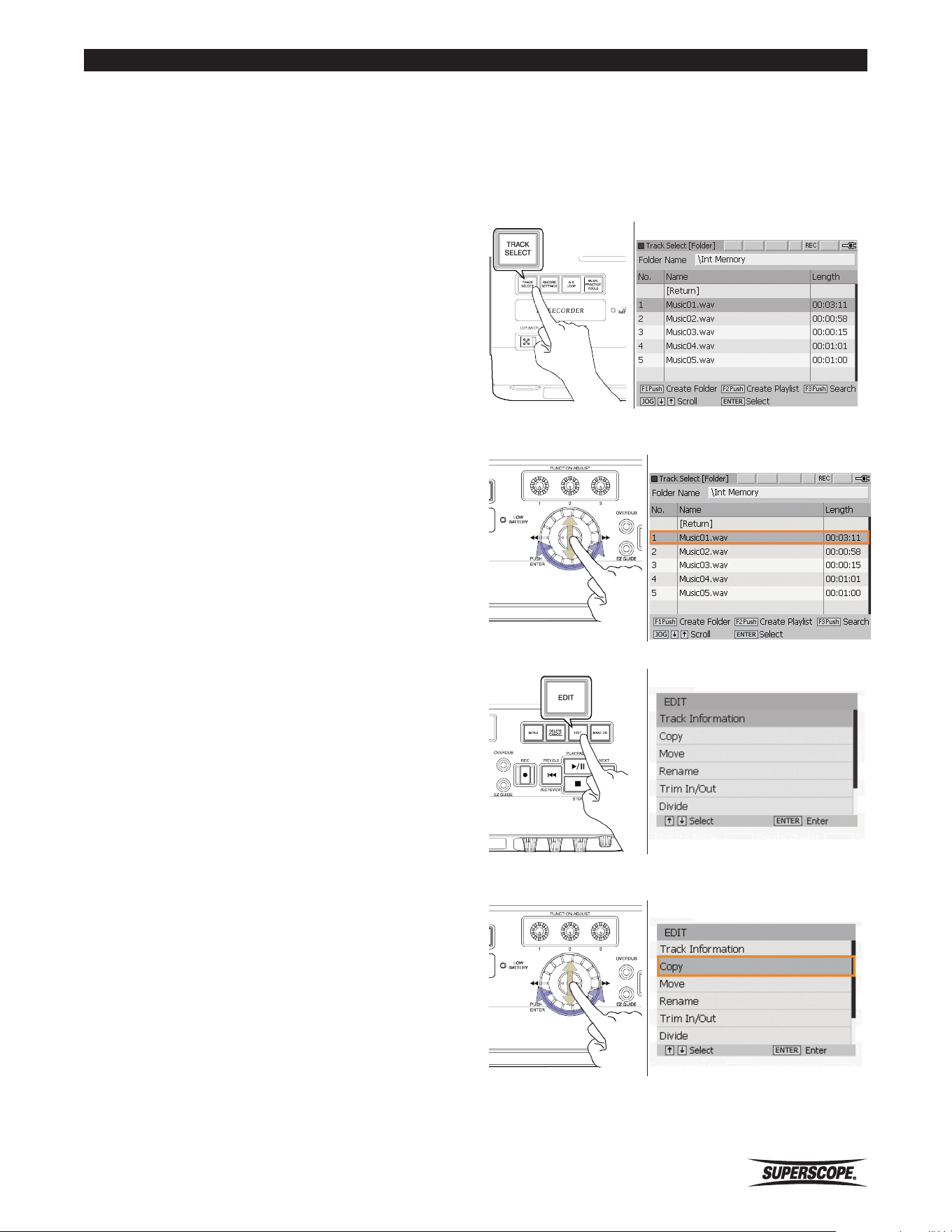
Superscope PSD450mkII User Manual
- 67 -
Editing
10. The Device Select Screen will be shown. Turn the jog
wheel or move the joystick up or down to highlight
[USBHDD] . Push ENTER.
11. The USBHDD folder will be shown. Turn the jog
wheel or move the joystick up or down to highlight
[Current Folder]. Press ENTER.
12. The Move screen will open with the question Move
1 file? Move the joystick to the left to highlight OK.
Push ENTER to confirm and move the file to the
USBHDD.
※ A progress bar is displayed during the Move
procedure. Do not power off until the
procedure is complete. If power is interrupted
during the Move operation, the file you are
moving may be lost.
Copy a Track
Use this feature to copy a folder or file to another
location, either a new folder or a different drive: Internal
Memory or USBHDD.
1. Press the TRACK SELECT button to open the Track
Select [Folder] screen.
Track Select [Folder] Screen
2. Turn the jog wheel or move the joystick up or down
to highlight the folder or file you wish to copy.
Track Select [Folder] Screen
3. Push the EDIT button to open the Edit menu screen.
Edit Screen
4. Turn the jog wheel or move the joystick up or down
to highlight Copy. Press ENTER.
Edit Screen
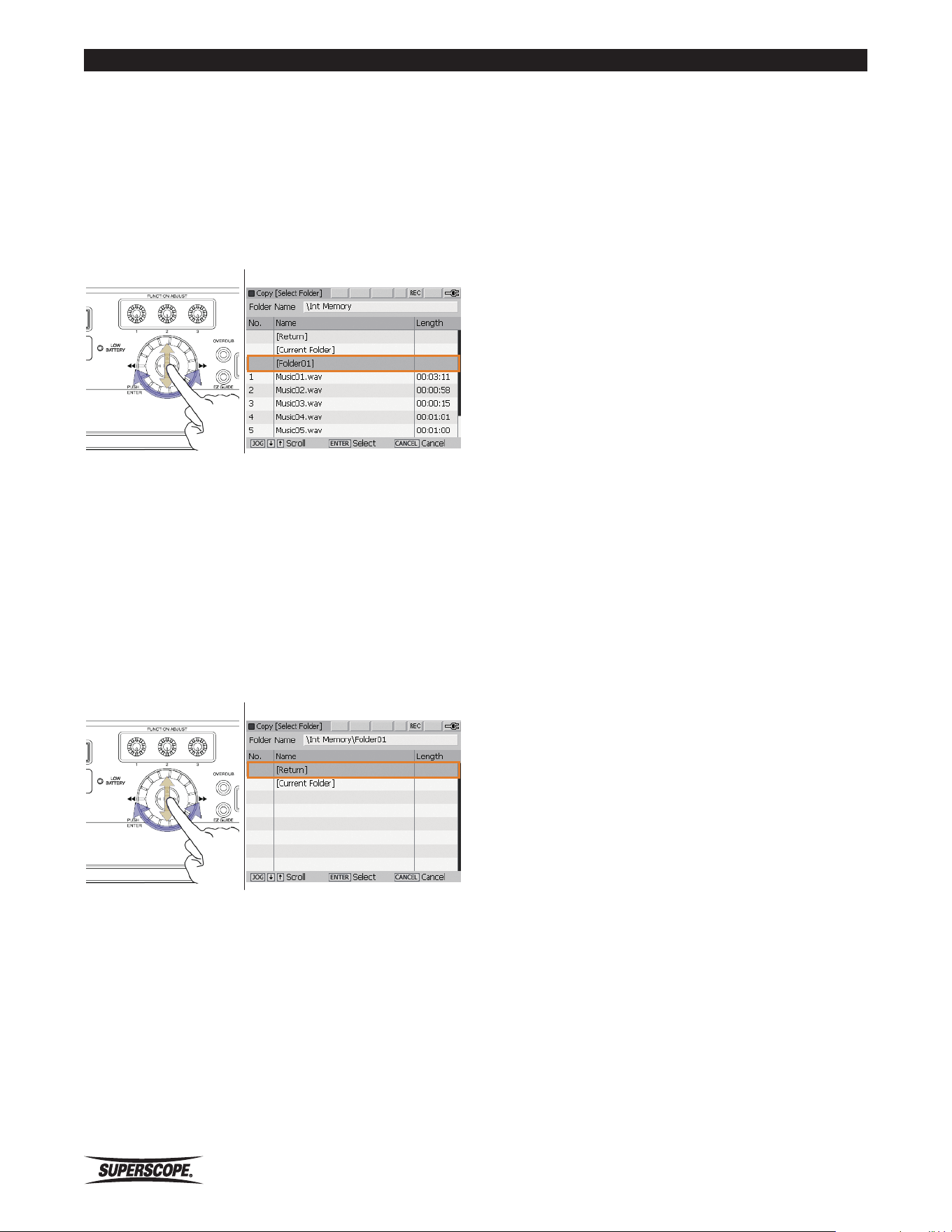
- 68 -
Superscope PSD450mkII User Manual
Editing
5. The Copy screen will open with the question Copy
Selected File? Use the jog wheel or move the joystick
up or down to highlight Yes. Push ENTER with the
joystick to confirm the selection.
6. Turn the jog wheel or move the joystick up or down
to select the folder you wish to copy the selected
item to. Once you have highlighted the new location,
press ENTER.
Copy [Select Folder] Screen
7. Turn the jog wheel or move the joystick up or down
to highlight [Current Folder]. Press ENTER.
8. The Copy screen will open with the question Copy
1 file? Move the joystick to the left to highlight OK.
Push ENTER to confirm and copy the file.
※ A progress bar is displayed during the Copy
procedure. Do not power off until the
procedure is complete. If power is interrupted
during the Copy operation, data may be lost.
Copy [Slect Folder] Screen
9. To copy a file to the USBHDD, start by following
steps 1 through 5. After selecting Yes on the Copy
screen, the Int Memory folder will be shown. Turn
the jog wheel or move the joystick up or down to
highlight [Return]. Push ENTER.
10. The Device Select Screen will be shown. Turn the jog
wheel or move the joystick up or down to highlight
[USBHDD] . Push ENTER.
11. The USBHDD folder will be shown. Turn the jog
wheel or move the joystick up or down to highlight
[Current Folder]. Press ENTER.
12. The Copy screen will open with the question Copy
1 file? Move the joystick to the left to highlight
OK. Push ENTER to confirm and copy the file to the
USBHDD.
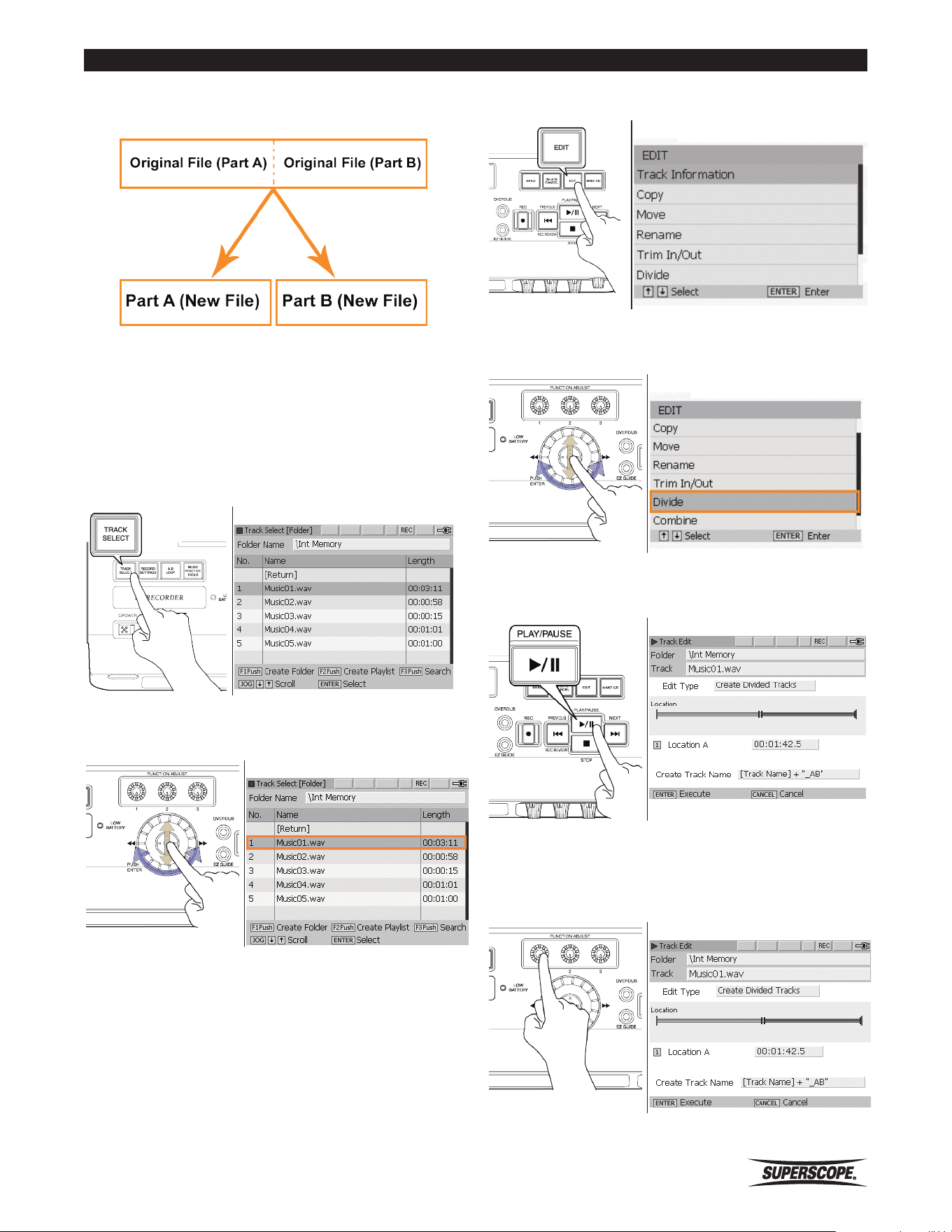
Superscope PSD450mkII User Manual
- 69 -
Editing
Divide a Track
Use this feature to divide a track into two separate tracks.
※ This feature works with WAV files only. If you
wish to divide an MP3 file, convert the file
to WAV format first before using the Divide
feature (see Export). Each new file must be
more than 4 seconds.
1. Press the TRACK SELECT button to open the Track
Select [Folder] screen.
Track Select [Folder] Screen
2. Turn the jog wheel or move the joystick up or down
to highlight the folder or file you wish to divide.
Track Select [Folder] Screen
3. Push the EDIT button to open the Edit menu screen.
Edit Screen
4. Turn the jog wheel or move the joystick up or down
to highlight Divide. Press ENTER.
Edit Screen
5. The Divide screen will be displayed. Press the PLAY/
PAUSE button [8C] to begin playback.
Track Edit Screen
6. When you hear the point at which you want to
divide the track, press FUNCTION ADJUST #1 (4A).
Playback will loop the 4 seconds before the Divide
point.
Track Edit Screen
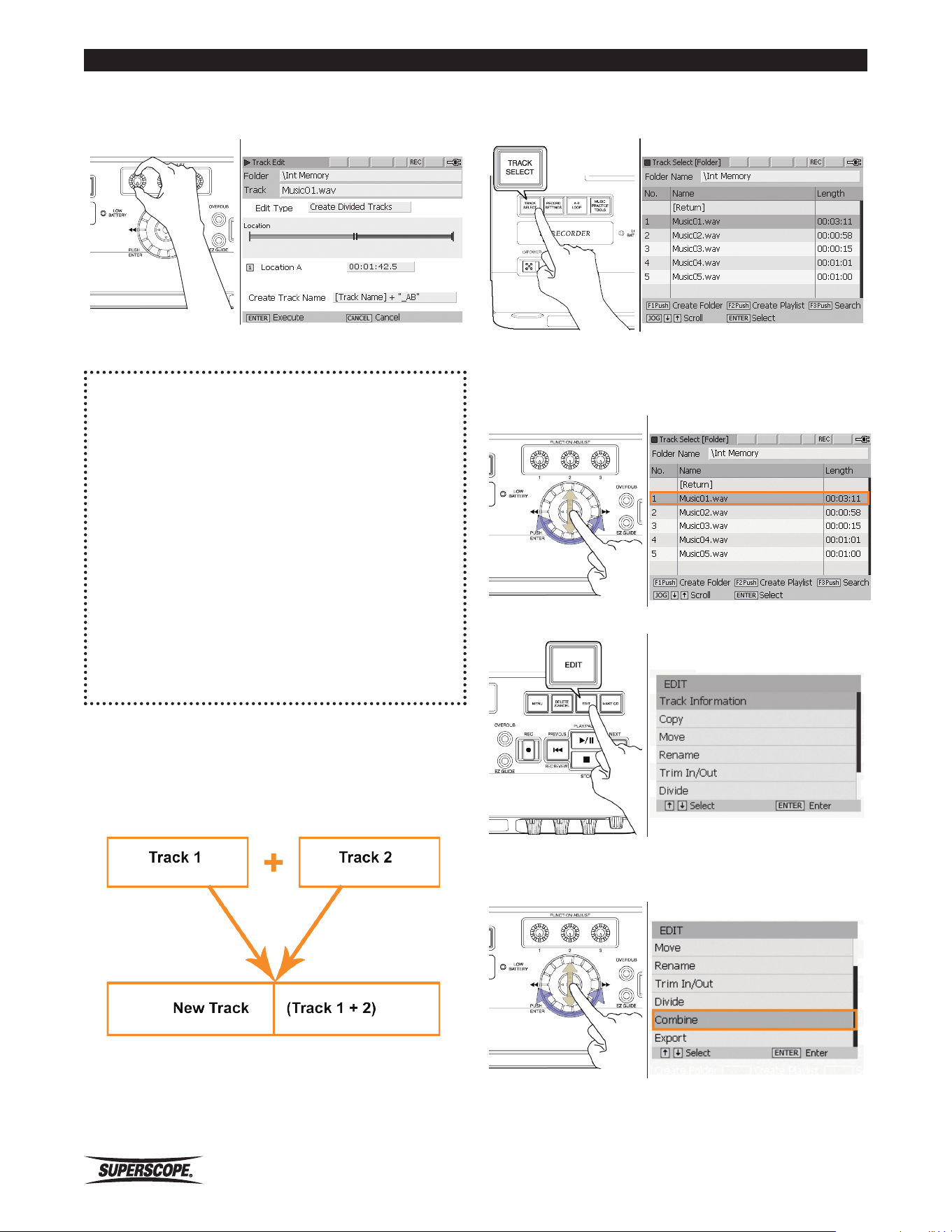
- 70 -
Superscope PSD450mkII User Manual
Editing
7. You can fine-adjust the divide point by turning
FUNCTION ADJUST #1 (4A).
Track Edit Screen
8. Press ENTER to divide the track.
The two new files will be placed in the same folder as
the original track.
The new files will be named according to the following
format:
Original file = ‘Track01. wav’
Part A (before Divide point) = ‘Track01_A.wav’
Part B (after Divide point) = ‘Track01_B.wav’
※ A progress bar is displayed during the Divide
procedure. Do not power off until the
procedure is complete. If power is interrupted
during the Divide operation, the new files may
be lost.
Combine a Track
Follow these steps to combine two audio files into one
file.
1. Press the TRACK SELECT button to open the Track
Select [Folder] screen.
Track Select [Folder] Screen
2. Turn the jog wheel or move the joystick up or down
to highlight the file you wish to combine (this track
will become the first part of the combined file).
Track Edit Screen
3. Push the EDIT button to open the Edit menu screen.
Edit Screen
4. Turn the jog wheel or move the joystick up or down
to highlight Combine. Press ENTER.
Edit Screen
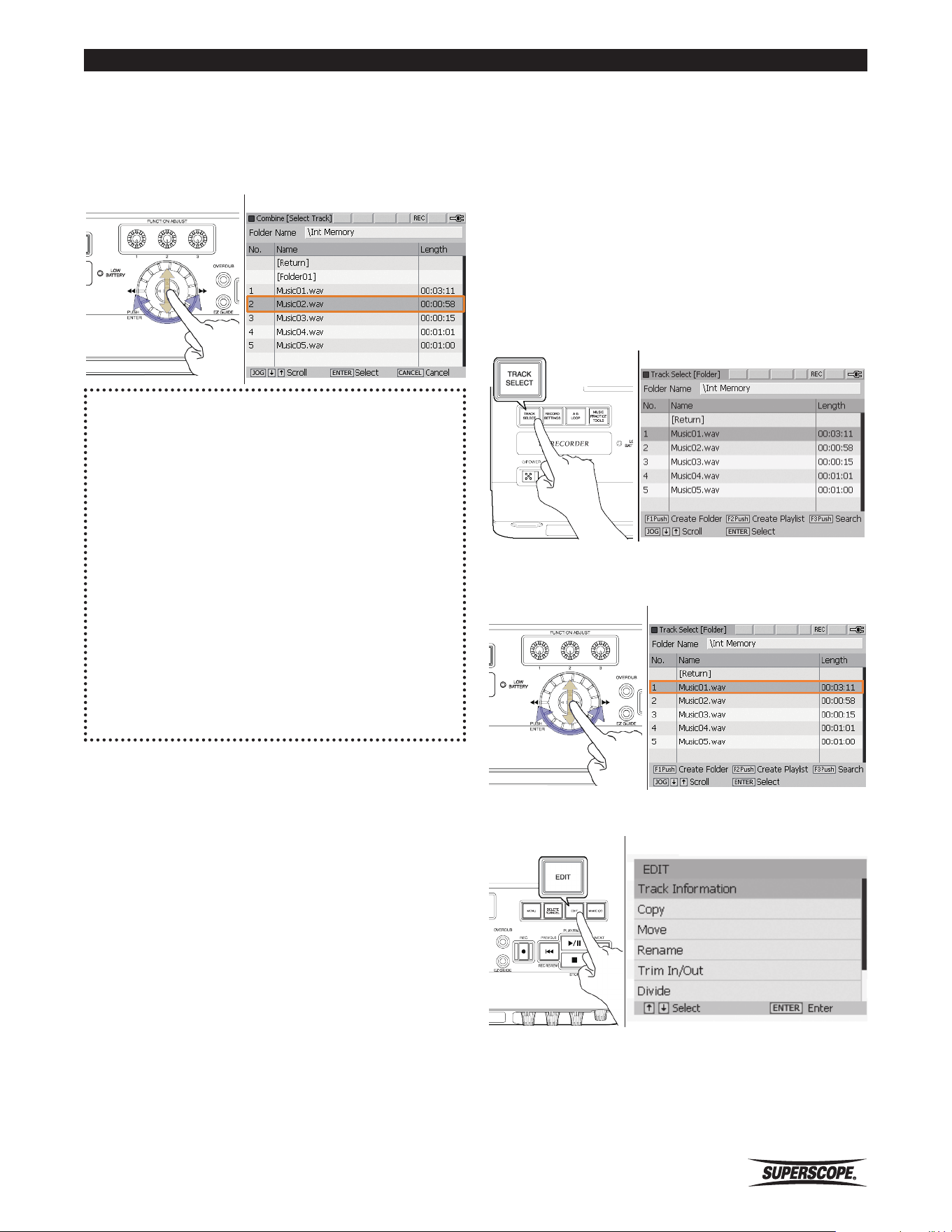
Superscope PSD450mkII User Manual
- 71 -
Editing
5. The Combine [Select Track] screen will be displayed.
Turn the jog wheel or move the joystick up or down
to highlight the file you wish to combine (this track
will become the second part of the combined file).
Press ENTER.
Combine [Select Track] Screen
The new file will be placed in the same folder as
track 1 (the first track selected during the Combine
procedure). The new file will be named according to
the following format:
Part A (first file selected) = ‘TrackA.wav’
Part B (second file selected) = ‘TrackB.wav’
Combined file = ‘TrackA_001.wav’
A progress bar is displayed during the Combine
procedure.
※ Do not power off until the procedure is
complete. If power is interrupted during the
Combine operation, the new file may be lost.
Trim In / Out
Use this feature to remove unnecessary audio at the
beginning or end of track.
※ This feature works with WAV files only. If
you wish to trim an MP3 file, convert the file
to WAV format first before using the Trim
feature (see Export). Each new file must be
more than 4 seconds.
1. Press the TRACK SELECT button to open the Track
Select [Folder] screen.
Track Select [Folder] Screen
2. Turn the jog wheel or move the joystick up or down
to highlight the file you wish to trim.
Track Select [Folder] Screen
3. Push the EDIT button to open the Edit menu screen.
Edit Screen
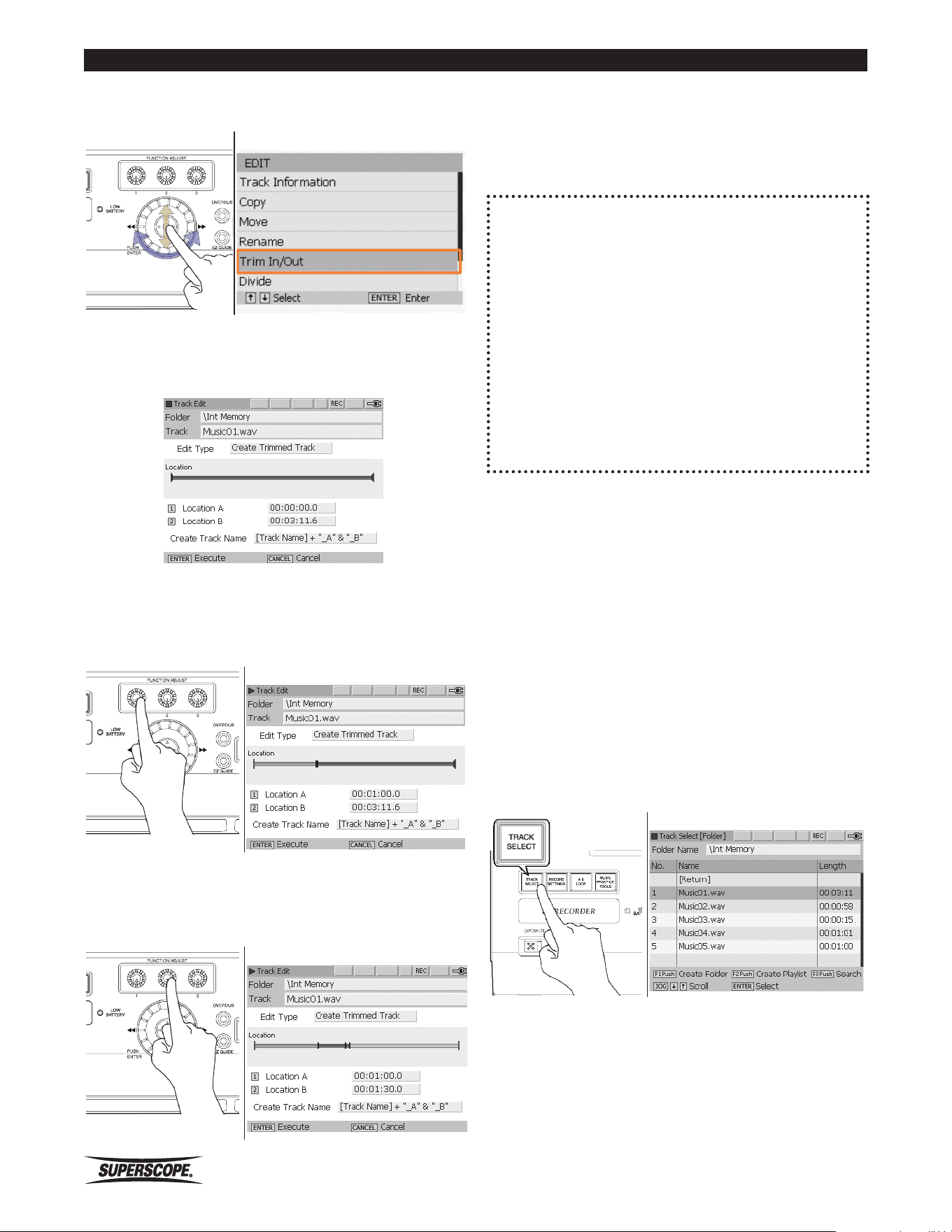
- 72 -
Superscope PSD450mkII User Manual
Editing
4. Turn the jog wheel or move the joystick up or down
to highlight Trim In/Out. Press ENTER.
Edit Screen
5. The Trim In/Out screen will be displayed. Press the
PLAY/PAUSE button [8C] to begin playback.
Track Edit Screen
6. When you hear the point at which you want to trim,
press FUNCTION ADJUST #1 (4A). Playback will loop
the 4 seconds after the Trim point. Audio from the
beginning of the track to this point will be removed.
Track Edit Screen
7. Press FUNCTION ADJUST #2 (4B) to switch playback
to the second trim point. Audio from this point to
the end of the track will be removed. Playback will
loop the 4 seconds before the Trim point.
Track Edit Screen
8. You can fine-adjust the first Trim point by turning
FUNCTION ADJUST #1 (4A). Fine-adjust the second
Trim point by turning FUNCTION ADJUST #2 (4B).
9. Press ENTER to trim the track.
The new file will be placed in the same folder as the
original track. The new file will be named according to
the following format:
Original file = ‘TrackA.wav’
Trimmed file = ‘TrackA_AB.wav’
A progress bar is displayed during the Trim procedure.
※ Do not power off until the procedure is
complete. If power is interrupted during the
Trim operation, the new file may be lost.
Edit Track Information
Whenever a file is selected in the Track Select screen
or the Normal screen, simply press ENTER to view Track
Information.
The following information is stored with each file: Title,
Artist, Album, Genre, Format, Recording Date & Time,
Track Length, Channel Number, Sampling Rate, and Bit
Number/Bit Rate.
Follow these steps to edit a track’s Title, Artist, Album,
and Genre information:
1. Press the TRACK SELECT button to open the Track
Select [Folder] screen.
Track Select [Folder] Screen
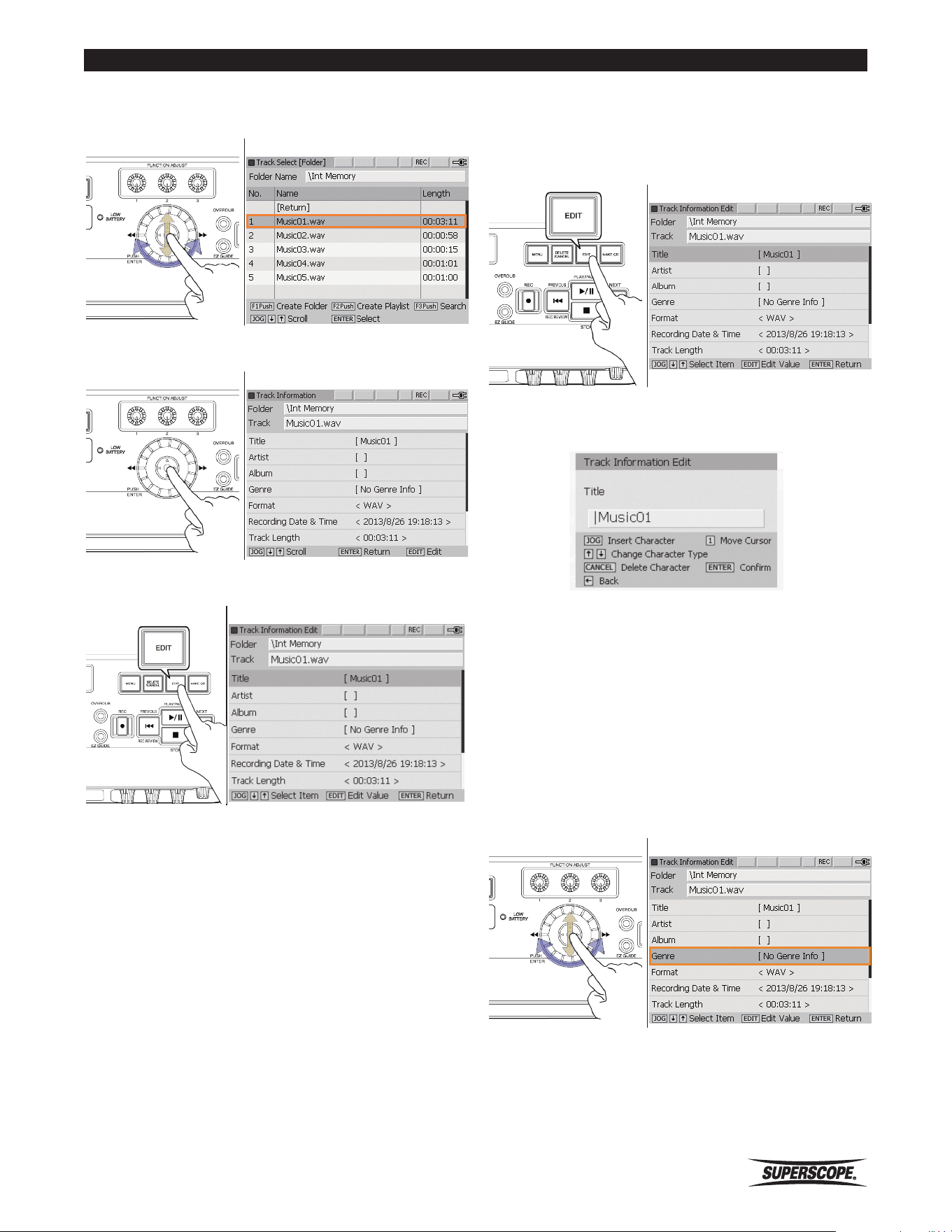
Superscope PSD450mkII User Manual
- 73 -
Editing
2. Turn the jog wheel or move the joystick up or down
to highlight the file you wish to edit.
Track Select [Folder] Screen
3. Press ENTER to view the file’s track information.
Track Information Screen
4. Press the EDIT button to begin editing track
information.
Track Information Edit Screen
Title/Artist/Album
1. From the Track Information Edit screen, turn the jog
wheel or move the joystick up or down to highlight
Title. Press the EDIT button to change the title.
Track Information Edit Screen
2. Enter the new title by using the Text Input Method.
Text Input Screen
3. When you have finished editing text and pressed
ENTER to confirm the new title, the Track
Information Edit screen will appear. Turn the jog
wheel to highlight Artist or Album.
4. Press the EDIT button. Enter the new Artist or Album
information by using the Text Input Method.
Genre
1. From the Track Information Edit screen, turn the jog
wheel or move the joystick up or down to highlight
Genre.
Track Information Edit Screen
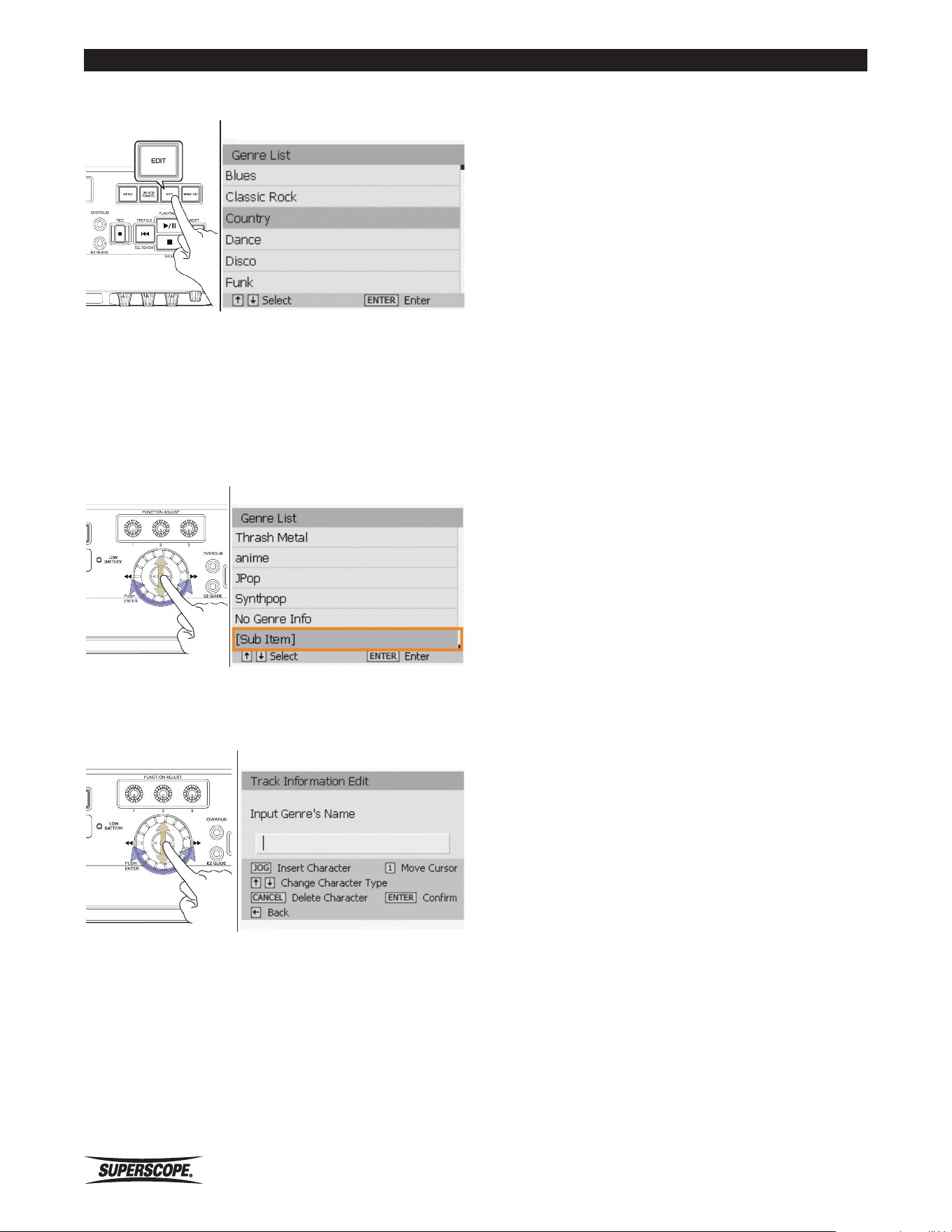
- 74 -
Superscope PSD450mkII User Manual
Editing
2. Press the EDIT button.
Genre List Screen
Turn the jog wheel or move the joystick up or down to
highlight a genre from the list. Press ENTER to select a
genre.
※ If the genre is not listed, turn the jog wheel
or move the joystick up or down to highlight
[Sub Item].
Genre List Screen
Press ENTER. Enter the new genre by using the Text
Input Method. Repeat steps 1-3. The new genre will now
appear as an option.
Text Input Screen
24>16bit Convert
This option only appears for 24-bit WAV files. Select this
option to make 24-bit files playable on this recorder. See
Auto Convert.
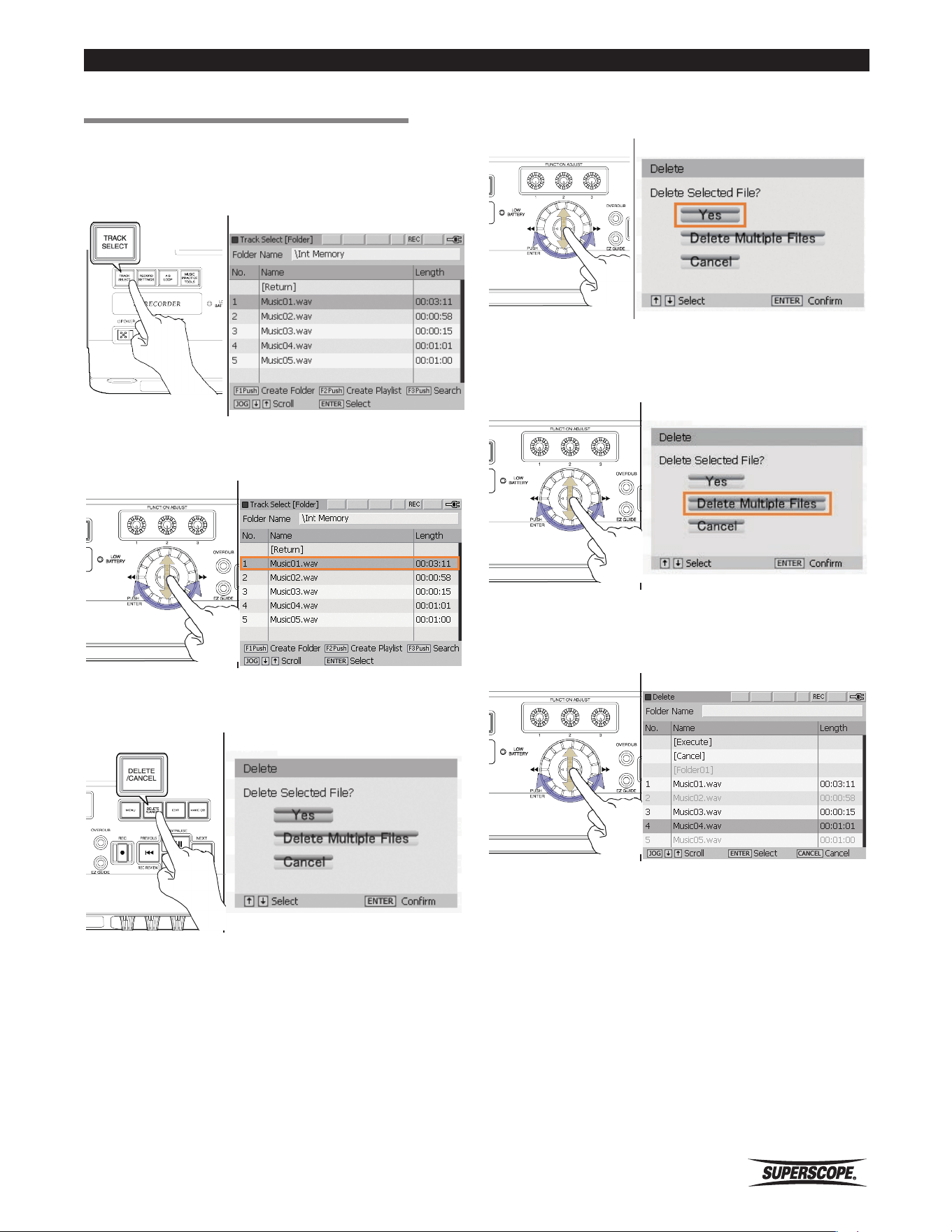
Superscope PSD450mkII User Manual
- 75 -
Delete/Cancel
■Delete/Cancel
Delete
1. Press the TRACK SELECT button to open the Track
Select [Folder] screen.
Track Select [Folder] Screen
2. Turn the jog wheel or move the joystick up or down
to highlight the folder or file you wish to delete.
Track Select [Folder] Screen
3. Press DELETE/CANCEL button to open the Delete
menu screen.
Delete Screen
4. To delete the selected file, move the joystick to select
“Yes” and then press ENTER.
Delete Screen
5. To delete the selected file and others, move the
joystick to select “Delete Multiple Files” and then
press ENTER.
Delete Screen
6. Turn the jog wheel or move the joystick up/ down
and press ENTER to highlight a file that you want to
delete.
Track Select Delete
7. Repeat step 6 to select the files to be deleted.
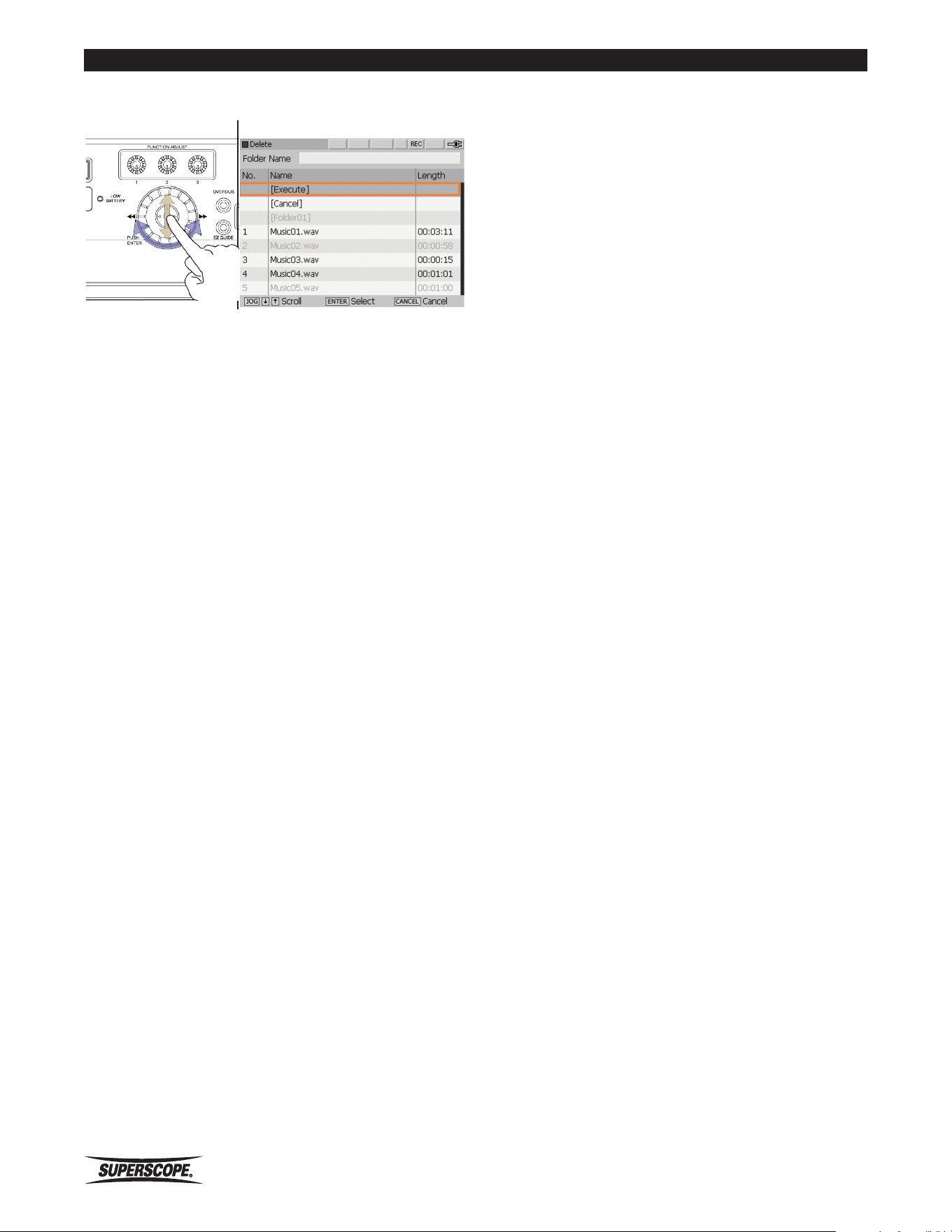
- 76 -
Superscope PSD450mkII User Manual
Delete/Cancel
8. Move the joystick to select “Execute”.
Track Select Delete
9. Press ENTER to open the Delete menu screen.
10. Move the joystick to select “OK” and press ENTER to
delete the files.
Cancel
Press to cancel settings and delete characters when
editing titles and file information.
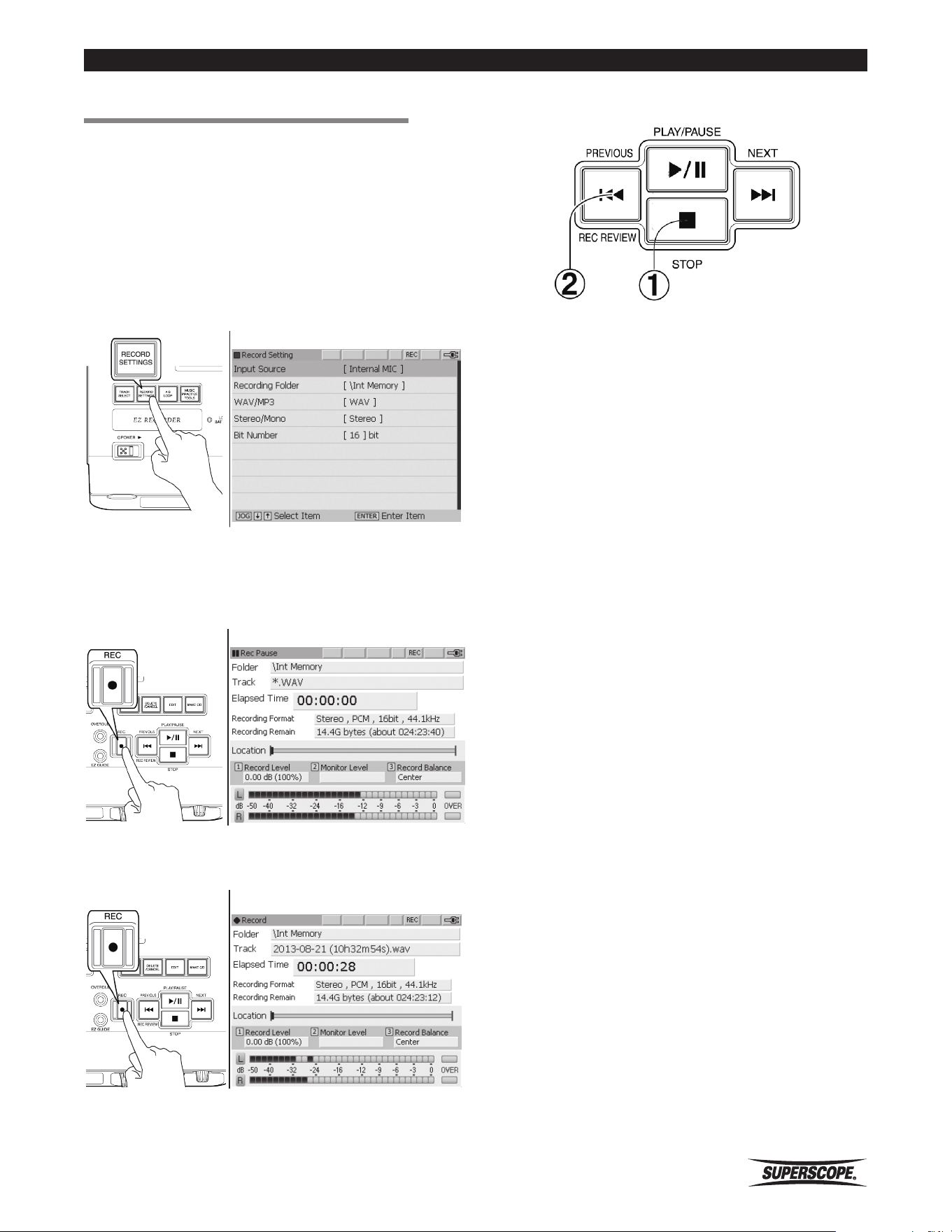
Superscope PSD450mkII User Manual
- 77 -
Recording
■Recording
Recording to the Internal Memory
Internal Memory is the default recording destination.
1. Press the RECORDING SETTINGS button to confirm
Recording Settings. When the selected menu is not
changed, skip the next step. To change the selected
menu, refer to Recording Settings Menu.
Record Settings Screen
2. Press the Record button once to enter Record Pause
mode. The Record button will flash and the VU
meters at the bottom of the display will respond to
your input signal(s).
Rec. Pause Screen
3. Press the Record button again to start recording. The
Record button will stay lit during recording.
Record Screen
4. Finish recording.
① Press the STOP button when you are finished
recording, or
② Press the REC REVIEW button to stop the recording
and playback the recording immediately.
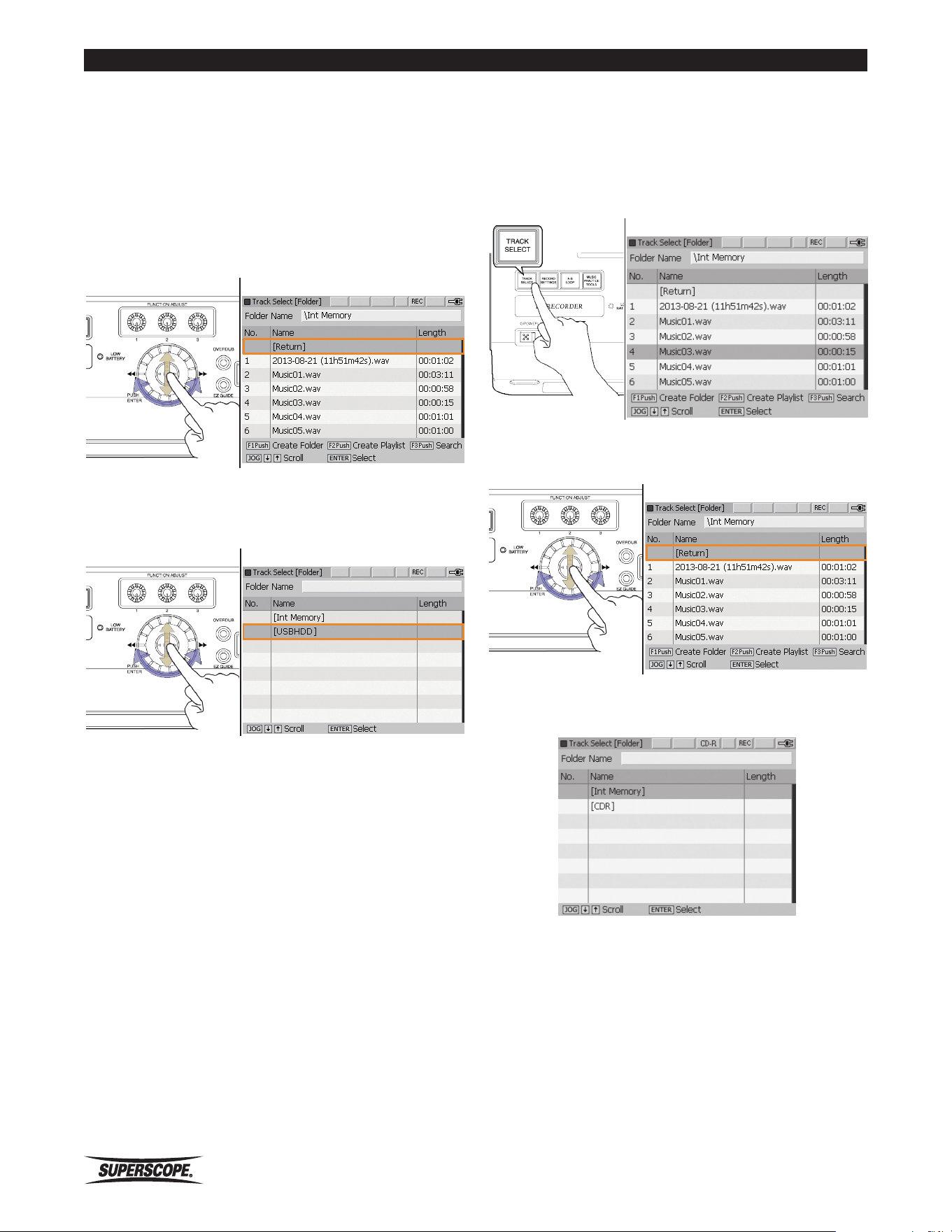
- 78 -
Superscope PSD450mkII User Manual
Recording
Recording to a USB Memory
1. Insert USB Flash Drive.
2. Press Record Settings and confirm that [USBHDD] is
shown as your recording folder. If it is not shown,
highlight Recording Folder and press Enter. Highlight
Return and press Enter until USBHDD appears as a
folder option.
Track Select [Folder] Screen
3. Turn the jog wheel or move the joystick up or down
to Select [USBHDD] and press ENTER.
Track Select [Folder] Screen
The remaining steps are identical to Recording to the
Internal Memory (see above).
※ To record to the Int Memory and the USBHDD
at the same time, turn on Int Memory +
USBHDD Recording in the Record Settings
menu. Select [USBHDD] as the recording
folder in order for this feature to work.
Recording Direct to CD
1. Press the TRACK SELECT button. Insert a recordable
disc into the CDR drive, wait 10 seconds for the disc
to be recognized. Press Record Settings , highlight
Record Folder and press Enter.
Track Select [Folder] Screen
2. Turn the jog wheel or move the joystick up or down
to highlight [Return].
Track Select [Folder] Screen
3. Repeat this step until the following screen appears:
Device Select Screen
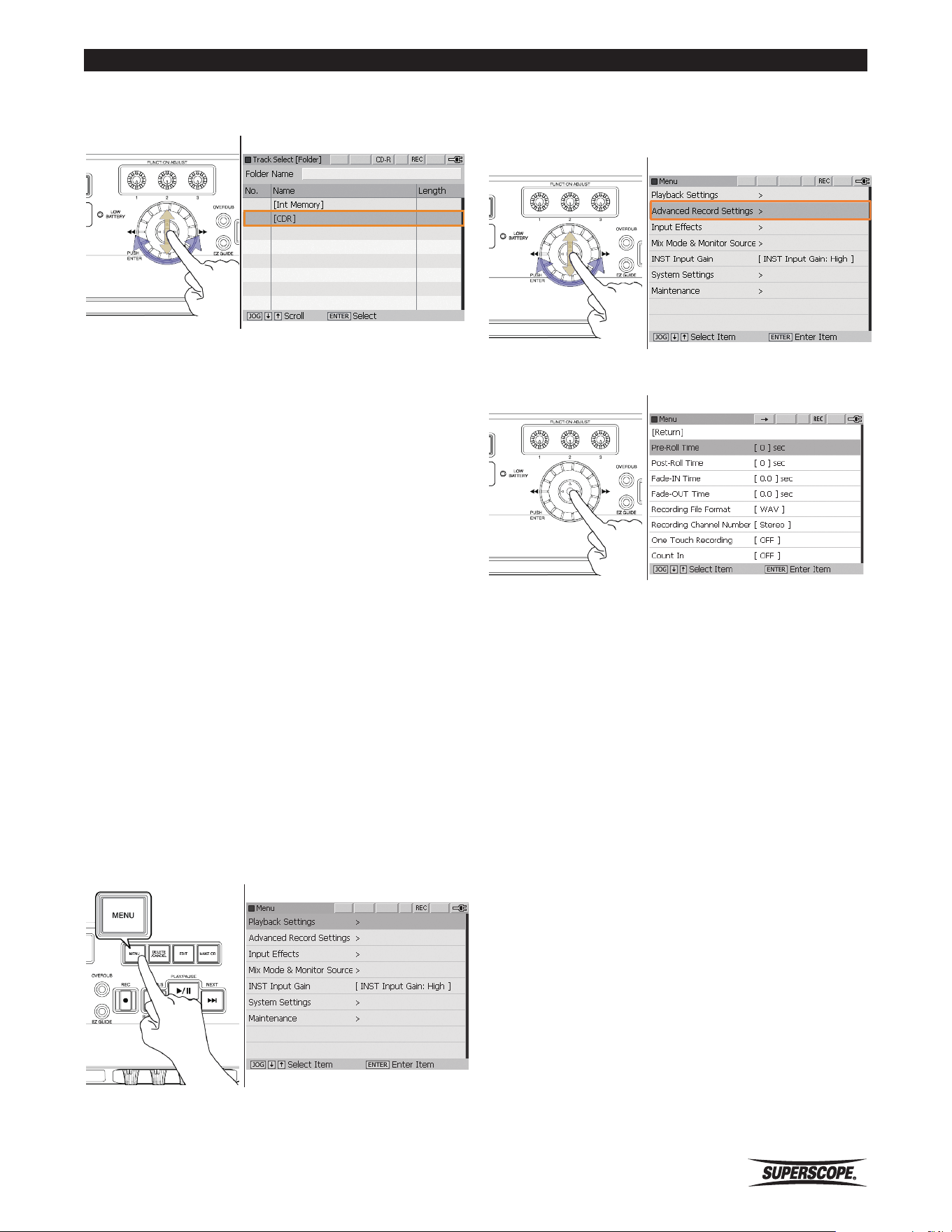
Superscope PSD450mkII User Manual
- 79 -
Recording
4. Turn the jog wheel or move the joystick up or down
to highlight [CDR]. Press ENTER.
Device Select Screen
※ Direct to CD recording is not recommended
when using internal microphones. The
recorder’s built-in mics are sensitive to the
sound of the CD drive.
The remaining steps are identical to Recording to the
Internal Memory (see above).
Track Increment
During recording, you can increment tracks by:
(1) pressing the Record button (seamless track increment)
when recording to the Internal Memory or USB.*
(2) pressing the PLAY/PAUSE button (recording is paused).
When a recording is paused, press the PLAY/PAUSE
button again to continue recording on a new track.
* There is no seamless track increment when recording
direct to CD. The recorder must enter RECORD/PAUSE
mode.
Advanced Record Settings Menu
To access the Advanced Record Settings menu:
1. Press the MENU button.
Menu Screen
2. From the menu screen, turn the jog wheel or
move the joystick down to select Advanced Record
Settings.
Menu Screen
3. Press ENTER to view the Record Settings Menu.
Record setting Menu
To change Record Setting:
1. Move the joystick up or down or turn the jog wheel
to highlight options on the Record Settings screen.
2. Press ENTER to select the setting you wish to edit.
3. Turn the jog wheel to change the value.
4. Press ENTER to confirm or CANCEL to cancel the
change.
Silent Skip Recording
Silent Skip pauses recording when audio has a silent part
for a few seconds. Silent Skip resumes recording when
the sound signal reappears.
Note: A new file is added each time the unit resumes
recording.
Silent Skip menu selections are as follows:
- Sets this function On/Off.
- Sets the silent time detector.
(0, 1, 2, 3, 4, 5 seconds)
- Sets the Threshold level of the silent part.
(-60 dB to -20 dB)
The initial settings are as follows:
Silent Skip Recording: Off
Silent time detector: 3 seconds
Threshold level: -40 dB
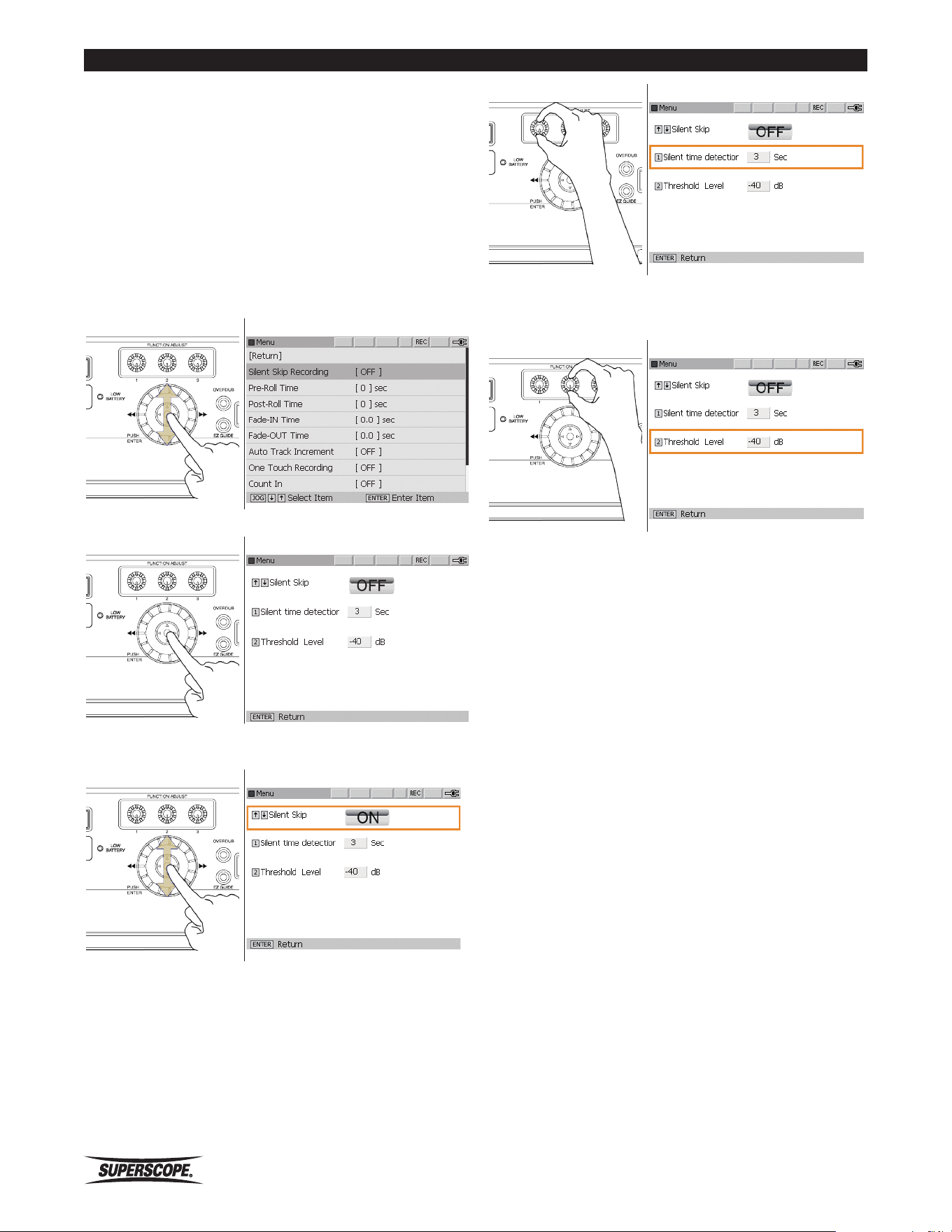
- 80 -
Superscope PSD450mkII User Manual
Recording
※ Recording is continued at least for 4 seconds
when the silent part is detected within 4
seconds after recording.
Silent Skip is activated after recording.
Silent Skip is unavailable for the following
functions:
Count In, Fade In/Out, Auto Track Increment.
To access the Advanced Record Settings menu:
1. From Advanced Record Settings, turn the jog wheel
or move the joystick down to select Silent Skip.
Silent Skip Recording Screen
2. Press ENTER to view the Silent Skip Menu.
Silent Skip Recording Screen
3. Move the joystick up or down to select Silent Skip
ON or OFF.
Silent Skip Recording Menu
Turn the FUNCTION ADJUST #1 to set Silent time
detector.
Silent Skip Recording Menu
Turn the FUNCTION ADJUST #2 to set Threshold
Level.
Silent Skip Recording Menu
4. Press ENTER to complete settings.
Pre-Roll Time/ Post-Roll Time
During Overdub, it is often helpful to add a time gap
between the moment the Record button is pressed and
the moment that recording begins (Pre-Roll Time). This
added time allows the user to listen to or play along
with the accompaniment track before recording. This
allows for smooth transitions between original recorded
material and new material added through an overdub.
Adding a Post-Roll Time during Overdub will allow the
accompaniment track to play for an additional amount
of time after the user is finished recording new material.
Pre-Roll Time and Post-Roll Time can be adjusted
between 0 seconds and 10 seconds in 1 second intervals.
The default setting for Pre-Roll Time and Post-Roll Time is
[0] seconds.

Superscope PSD450mkII User Manual
- 81 -
Recording
Fade In / Out
When a Fade-IN Time is selected, the Record Level will
gradually increase from a mute condition to full Record
Level, from the beginning of the recording to the time
specified.
The range for Fade-IN Time is 0.0 (OFF) ~ 10.0 seconds,
adjustable in increments of 0.5 seconds. The default
setting is 0.0 (OFF) seconds.
When a Fade-OUT Time is selected, the Record Level
will gradually decrease from full Record Level to a mute
condition. The fade begins the moment the recording is
stopped.
The range for Fade-OUT Time is 0.0 (OFF) ~ 10.0
seconds, adjustable in increments of 0.5 seconds. The
default setting is 0.0 (OFF) seconds.
※ To fade out manually, gradually turn
FUNCTION ADJUST #1 (4A) (Record Level)
counter-clockwise before stopping a
recording.
Make sure ALC is set to OFF.
Auto Track Increment
Increment tracks at pre-set time intervals. Options
include: OFF, 1 minute, 5 minutes, 10 minutes, 15
minutes or 30 minutes. The default setting is OFF. This
feature does not work when recording direct to CD.
One Touch Recording
The PSD400 series has the ability to bypass Record Pause
Mode and simply begin recording after the user presses
the Record button once. The default setting for One
Touch Recording is [OFF].
Count In
During Overdub, when a Count In value is selected,
the metronome will play the specified number of beats
before recording begins. You can select up to 16 beats
for a Count In. To record using Count In, follow the
normal steps (see Recording). When you press the
Record button to begin recording, the metronome will
begin automatically before recording begins. To adjust
metronome settings, see Using the Metronome.
Auto Convert
Your Superscope PSD400 series recorder is designed to
be a “music practice recording system.” Your recorder is
therefore capable of performing a number of different
audio manipulations concurrently, i.e., simultaneous
Tempo, Key, and Fine Tune adjustment; Voice Reduction;
Parametric EQ; etc..
To allow for this level of real time processing, it is
necessary for playback to be CD quality (16bit/44.1 kHz).
When higher-than-CD quality (24bit) recordings are
made, a CD quality (16bit) version of the file should be
created for playback on the PSD400 series recorder The
original 24bit recording will be unaffected and available
for transfer to a computer for editing or playback. 24bit
recordings appear in grey type in the Track Select [Folder]
screen.
To create a 16bit playback file automatically, select Auto
Convert [ON]. The default value is Auto Convert [OFF].
CD Pre-Gap Setting
To add a time gap between tracks on an audio CD,
adjust this setting between 0 to 5 seconds. The default
value is 0 seconds.
Int Memory + USB HDD
Turn on this feature to simultaneously record to an
Internal Memory and the USB HDD. The primary
recording destination must be [USBHDD]. When this
feature is on, the unit will record to the USB Flash
Drive and make a duplicate copy of the file in the root
directory of the Internal Memory.
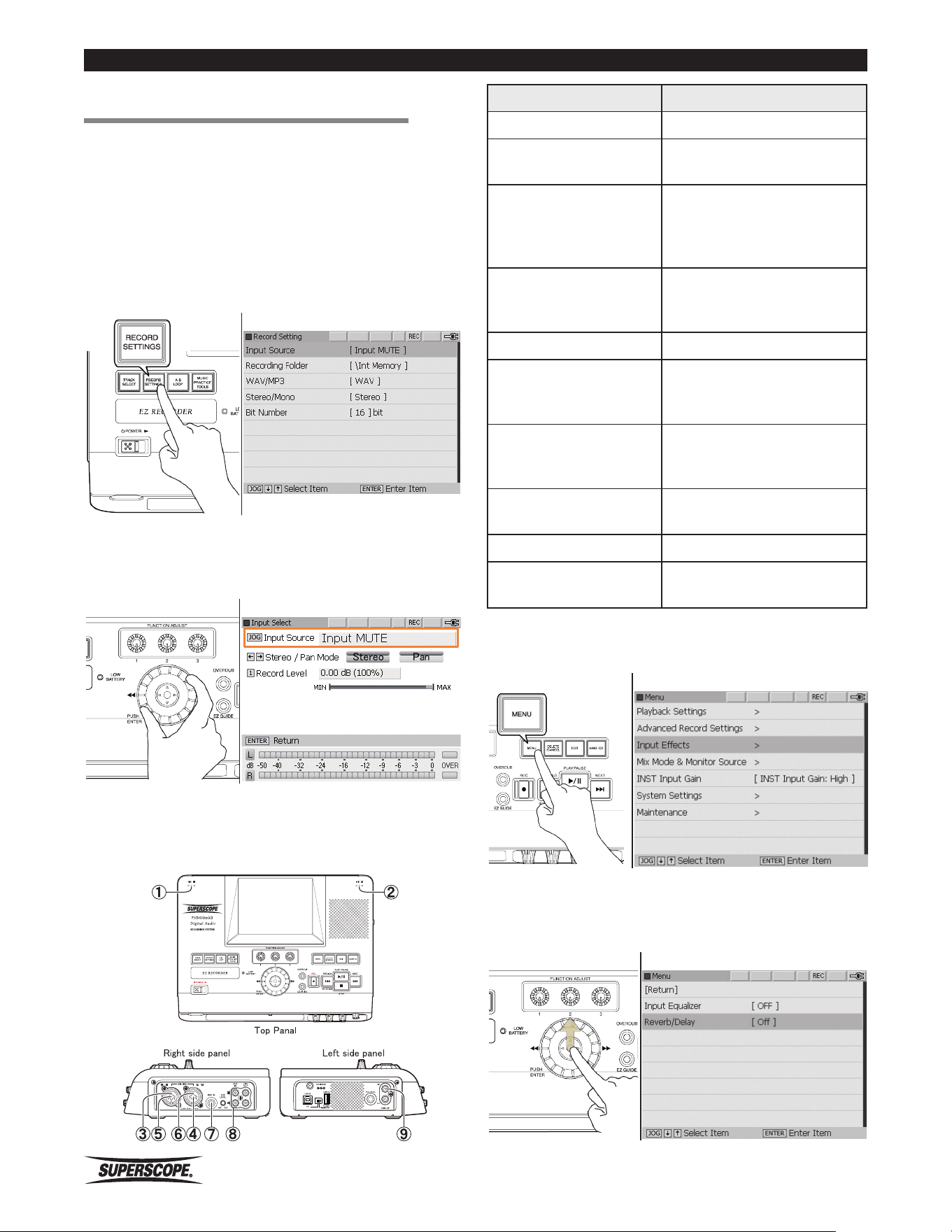
- 82 -
Superscope PSD450mkII User Manual
Recording
■Input Effects
Reverb and Delay effects can be added to input signals
and then recorded. It is not possible to add an effect
to an existing recording. Follow these steps to apply an
effect to your selected input.
Selecting an Input Signal
1. Press the RECORD SETTINGS button to open the
Input Select screen.
Record Setting Screen
2. Select a input source and press ENTER and then turn
the jog wheel to select an input configuration from
the options below.
Input select Screen
Available Input Sources
Please refer to the chart on the following page.
Input Description
Input Mute Input signal is muted.
Internal MIC
Selects the built-in
microphones ① ②.
External MIC
Select this setting when
external microphones are
connected to the XLR/1/4”
inputs③ ④.
LINE
Select this setting when LINE
level signals are connected
to the XLR/1/4” inputs ⑤⑥.
INST
Selects the INST input ⑦.
Internal MIC (L ch) +
INST
Select the Left internal
microphone ① + the INST
input ⑦.
External MIC (L ch) +
INST
Selects the Left external
microphone input ③ + the
INST input ⑦.
LINE (L ch) + INST
Selects the Left LINE input
⑤ + the INST input ⑦.
AUX
Selects the AUX inputs ⑧.
DIGITAL
Selects the DIGITAL Inputs
⑨.
3. Press the MENU button, and select Input Effect by
using the jog wheel or the joystick and press ENTER.
Menu Screen
4. Select Reverb/Delay by using the jog wheel or the
joystick and press ENTER.
Menu Screen
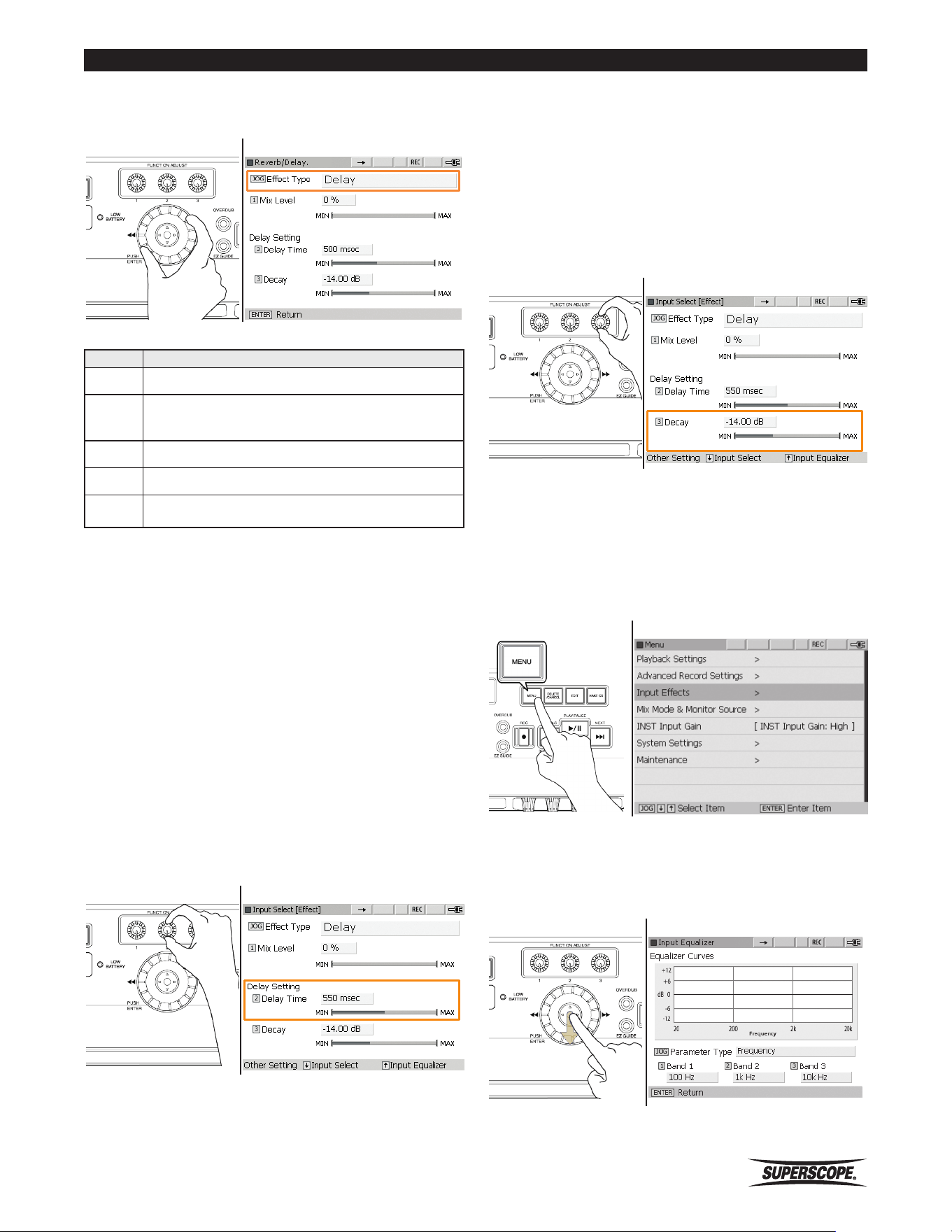
Superscope PSD450mkII User Manual
- 83 -
Recording
② Decay
Decay sets the amount of attenuation for each successive
repeat. The greater the attenuation, the quicker the
echoes will fade away. Decay can be adjusted between
-20.00 and -3.00 ㏈ in 0.25 ㏈ steps.
The default is setting is -14.00 dB. Turn FUNCTION
ADJUST # 3 to adjust Decay. Press FUNCTION ADJUST #
3 to return to the default setting.
Input Select [Effect] Screen
Input Equalizer
Follow these steps to adjust the input equalizer:
1. Press the MENU button and select Input Effect by
using the jog wheel or the joystick. Press ENTER.
Menu Screen
2. Select Input Equalizer by using the jog wheel or the
joystick. Press ENTER.
3. Press the joystick down one time to open the Input
Select [EQ] screen.
Input Equalizer Screen
5. Turn the jog wheel to select the effect type from the
table below. The default setting is OFF.
Input Select [Effect] Screen
Effect Type Settings
Effect Description
OFF No effect.
Room
Adds ambience similar to that of a small to
medium sized room.
Hall Adds ambience similar to that of a large hall.
Plate Imitates the sound of a plate reverb unit.
Delay Adds discrete echoes to the sound source.
6. If Room, Hall, or Plate is selected as the Effect Type,
the only parameter to adjust is the Mix Level. The
Mix Level setting controls the balance between direct
signal (0%) and processed signal (100%).
7. If Delay is selected as the Effect Type, the following
additional parameters should be adjusted:
① Delay Time
Delay Time sets the amount of time delay between
repeats.
Delay Time can be adjusted between 0 msec and 1000
msec in 1 msec intervals. The default setting is 500 msec.
Turn FUNCTION ADJUST # 2 (4B) to adjust Delay Time.
Press FUNCTION ADJUST # 2 (4B) to return to the default
setting.
Input Select [Effect] Screen
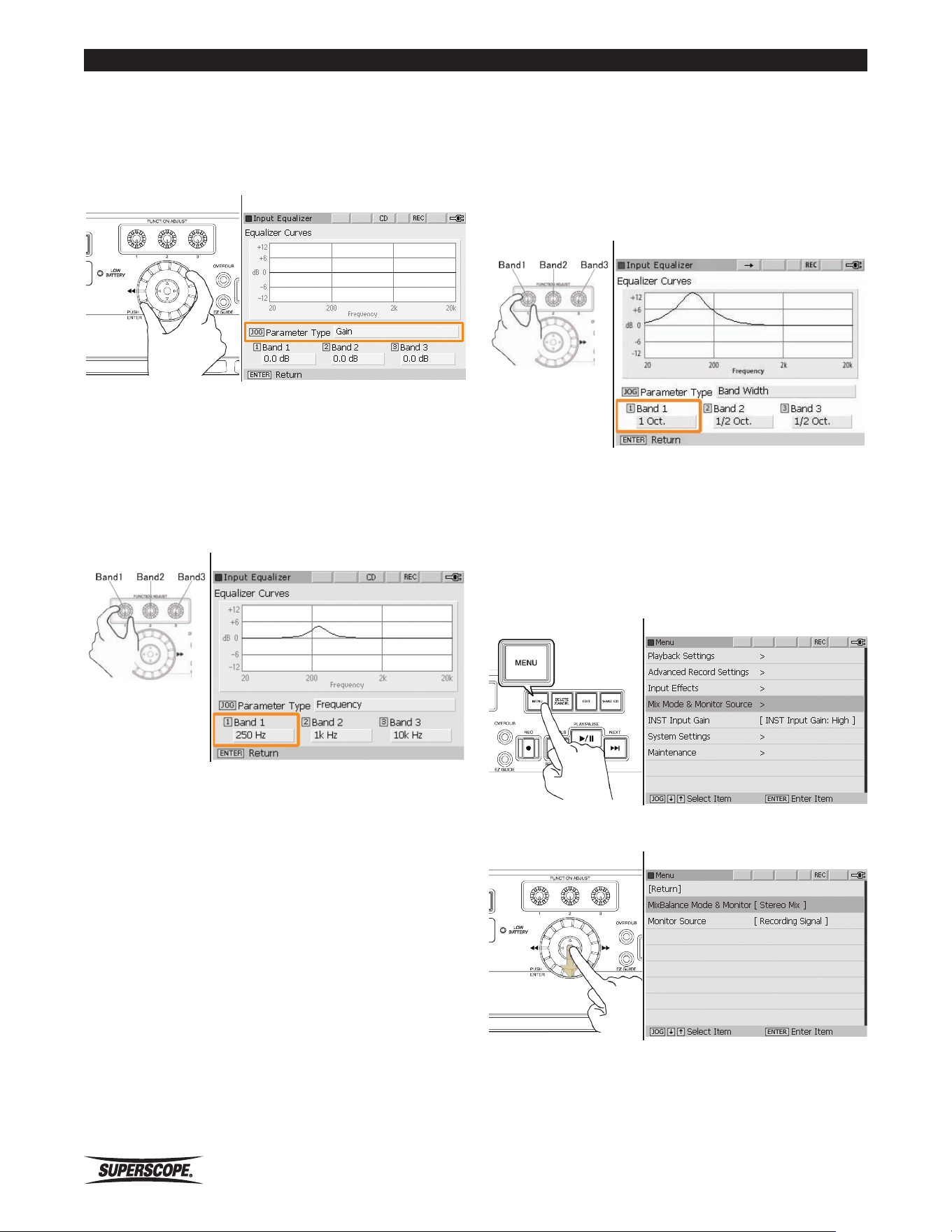
- 84 -
Superscope PSD450mkII User Manual
Recording
4. Repeat the remaining steps under Equalizer Settings:
Playback Equalizer.
5. Parameter Type: Turn the jog wheel to select
the parameter to be adjusted: Frequency, Gain, or
Bandwidth.
Input Equalizer Screen
Frequency
When Parameter Type is set for Frequency, turn the
FUNCTION ADJUST controller to select any frequency
between 20 Hz and 20 kHz for each band. Pressing
the FUNCTION ADJUST knobs will return all settings to
default values.
Input Equalizer Screen
Gain
When Parameter Type is set for Gain, turn the FUNCTION
ADJUST controller to determine the gain for each Band.
Gain can be adjusted +/- 12 dB. Pressing the FUNCTION
ADJUST knobs will return all settings to default values.
Bandwidth
When Parameter Type is set for Bandwidth, turn the
FUNCTION ADJUST controller to set the bandwidth for
each band. Turn right to widen the frequency band.
Turn left to narrow the frequency band. Pressing the
FUNCTION ADJUST knobs will return all settings to
default values.
Playback Equalizer Screen
Playback Balance and Level
This unit offers a great deal of flexibility when
determining Playback Balance. Follow these steps to alter
the Balance and Level of any file during playback.
1. Press the MENU button and select Mix Mode &
Monitor Source, and then press ENTER.
Menu Screen
2. Press the joystick down one time to open the Mix
Mode & Monitor Source screen.
Menu (Mix Mode Settings) Screen
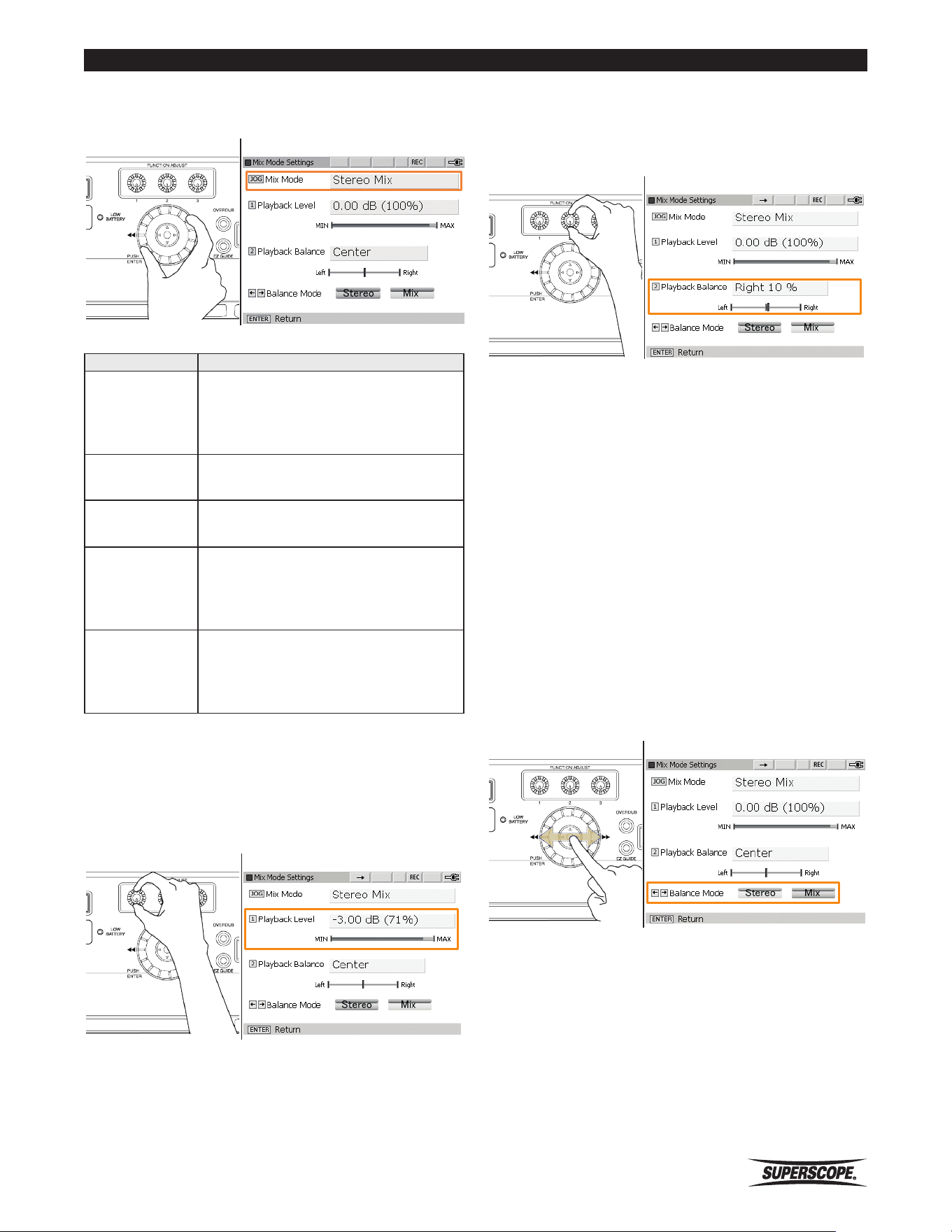
Superscope PSD450mkII User Manual
- 85 -
Recording
3. Turn the jog wheel to select Mix Mode. The Mix
Mode settings are explained in the chart below.
Mix Mode Settings Screen
Mix Mode Output Mix
Stereo Mix
(Normal
operation)
Left channel [input signal (left) +
playback signal (left)]
Right channel [input signal (right) +
playback signal (right)]
L ch – Mix
Left channel [input signal (left) +
playback signal (left)]
R ch – Mix
Right channel [input signals (right) +
playback signal (right)]
Mono - Mix
Left channel [input signal (left) +
playback signal (left + right)]
Right channel [input signals (right) +
playback signal (left + right
Split
Left channel [playback signal (left +
right)]
Right channel [input signal (left +
right)]
4. Playback Level. Turn FUNCTION ADJUST # 1 (4A) to
adjust Playback Level. Playback Level can be adjusted
between MUTE -90 dB (0%) and +6.0 ㏈ (200%)
in 0.25 dB increments. The default setting is 0.0 ㏈
(100%).
Mix Mode Settings Screen
5. Playback Balance. Playback Balance can be adjusted
in 1% increments between Left 100% ~ Center ~
Right 100% by turning FUNCTION ADJUST #2 (4B).
The default setting is Center. For a description of
Playback Balance behavior, see Balance Mode below.
Mix Mode Settings Screen
6. Balance Mode. In normal operation (Stereo),
a Playback Balance setting of Left 100% will
completely mute the Right channel. Likewise, a
Playback Balance setting of Right 100% will mute
the Left channel.
When transcribing an instrument that is solidly in one
channel (Right or Left), it can be useful to move the
desired audio into both channels, rather than muting
the opposing channel, i.e., silencing one speaker or
one side of a pair of headphones.
This Balance Mode is referred to as Mix. In Balance
Mode: Mix, a Playback Balance setting of Left 100%
will place the Left channel content in both the
Left and Right output channels (both sides of your
headphones/ L&R speakers) Move the joystick left or
right to select Stereo or Mix. The default setting is
Stereo.
Mix Mode Settings Screen
7. Monitor Source
About Monitor Source, refer to page 90.
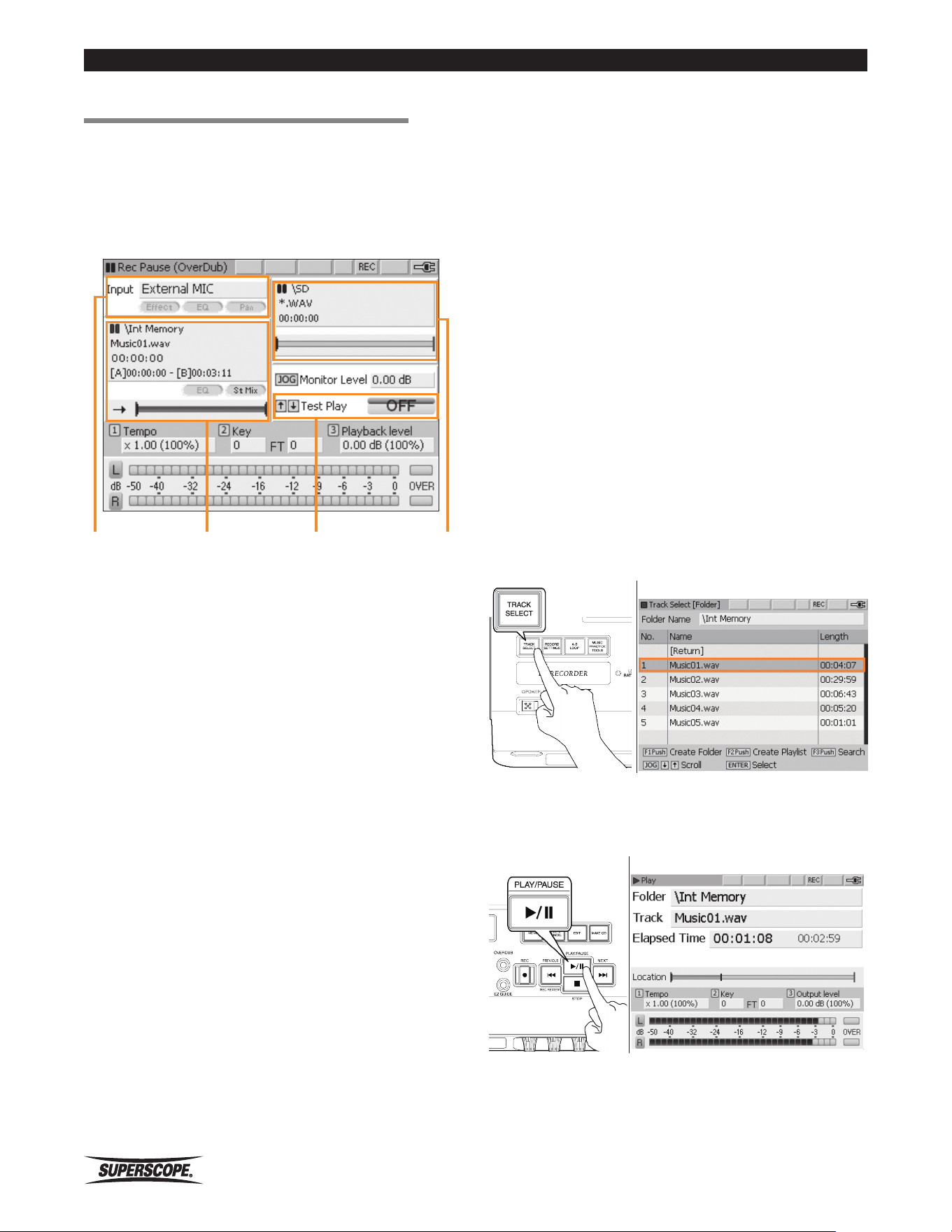
- 86 -
Superscope PSD450mkII User Manual
Recording
By adjusting loop points before using the Overdub
feature, you are able to utilize the recorder’s additional
Overdub modes:
Overdubbing for Composition
(Layering sections of a Track)
In this mode, you will identify a section of audio, then
record additional audio over that section. The end result
is a file identical to the original accompaniment file in
length, but with an added layer of audio within the
section you have outlined.
※ When this mode is selected, playback level
will automatically be reset to maintain
consistent accompaniment level throughout
the recording. See Playback Balance and
Level.
※ This mode is not available when using CD
audio as accompaniment.
1. Press the TRACK SELECT button to select a track to
record over.
Track Select [Folder] Screen
2. If you have already set your Overdub (loop) points,
proceed to step 7. If not, press the PLAY/PAUSE
button to listen to the track.
Play Screen
■Overdub
The Overdub feature allows the user to layer audio over
a pre-existing recording (sound on sound). When the
OVERDUB button is pressed, the recorder enters REC
Pause Mode (Overdub).
Rec Pause (OverDub) Screen
a b c Test Play
a. Input Source
b. Accompaniment Track
c. Destination Folder, Name of New Track
In REC Pause Mode (Overdub), pressing the Record
button (blinking red) or the PLAY/PAUSE button (blinking
green) will mix the selected input signal (see Set Up) with
the currently selected track.
※ The accompaniment track may be located on
the Internal Memory, USB or CD. Using CD
accompaniment is not recommended when
using the built-in microphones, because the
sound of the CD drive may be picked up by
the recorder’s internal microphones.
If you have not adjusted the loop points for the selected
accompaniment track, then you may layer audio until
the accompaniment track finishes playing or until you
stop the recording. When the recording is stopped early
(before the accompaniment track finishes playing), the
length of the newly recorded file will equal the elapsed
time at the moment the recording was stopped.
※ To adjust the level of the accompaniment file,
see Mix Mode & Monitor Source.
(MUNU -> MixMode & Monitor Source ->
Mix Balance Mode & Monitor)
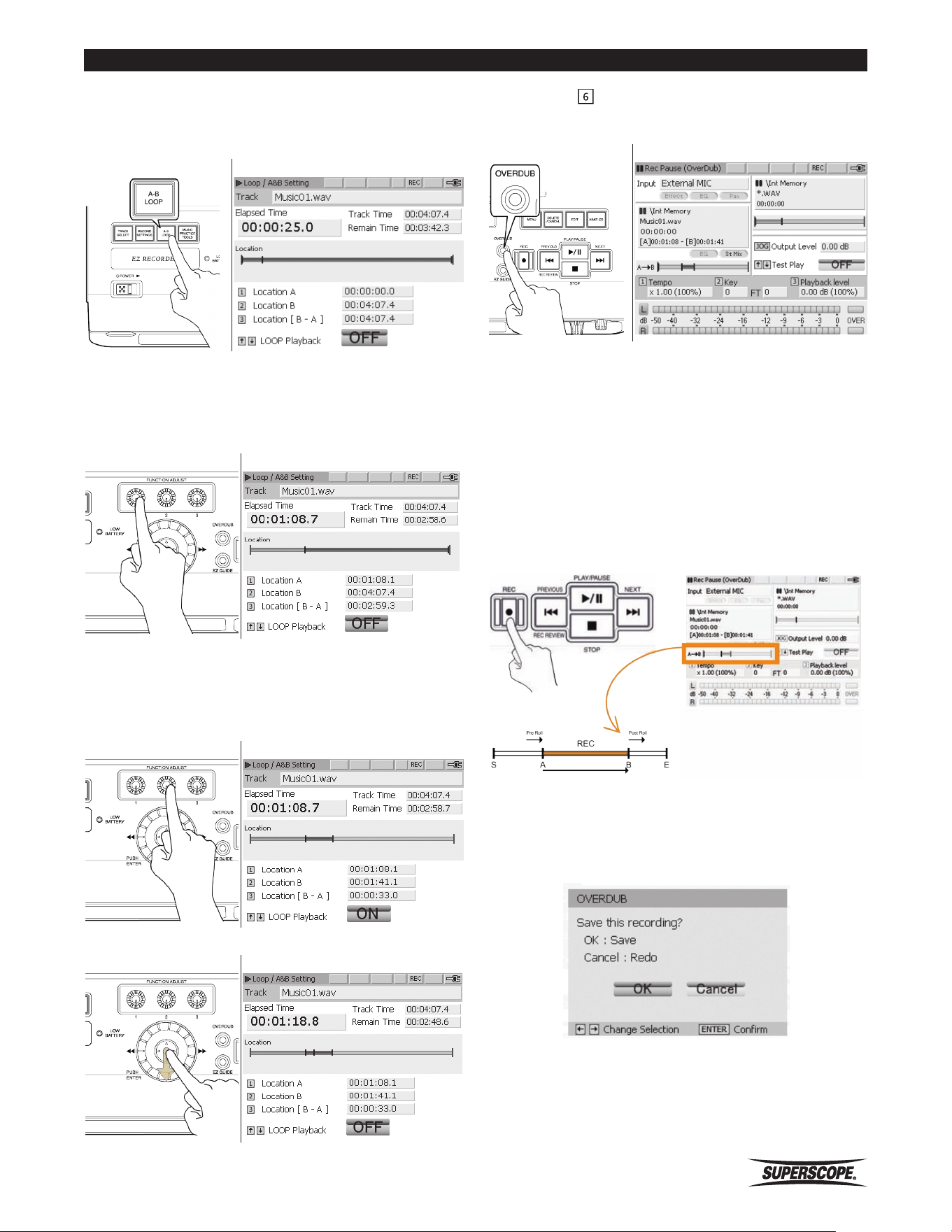
Superscope PSD450mkII User Manual
- 87 -
Recording
3. Press and hold the A-B LOOP button for three
seconds during playback to view the LOOP setting
menu.
Loop setting Screen
4. Press FUNCTION ADJUST #1 (4A) during playback
to set Overdub point A. This is the point in the track
you wish to begin layering audio.
Loop Setting Screen
5. Press FUNCTION ADJUST #2 (4B) during playback to
set Overdub point B. This is the point at which you
will finish layering audio. Loop Playback will start at
point A automatically.
Loop Setting Screen
6. Move the joystick down to turn Loop playback OFF.
Loop Setting Screen
7. Press the OVERDUB button to enter REC Pause
Mode (Overdub).
Rec. Pause [OverDub] Screen
8. Adjust the REC Level knobs so that the Record Level
(left and right channels) does not exceed 0 dB as
indicated on the Level meters. (see Setting Levels).
9. Press the REC button (8A) or PLAY/PAUSE button
(8C) to start overdubbing. If a Pre-Roll Time is set in
the Record Settings menu (see Pre-Roll Time/ Post
Roll Time), playback will begin a number of seconds
before Overdub point A, as determined by the Pre-
Roll Time.
Rec. Pause [OverDub] Scren
10. The accompaniment track will stop at the end of
point B or the Post-Roll Time (see Pre-Roll Time / Post
Roll Time). The Save menu will appear.
Overdub Save Menu Screen
11. Select OK and the new file (executed overdub) will
be saved. Select Cancel and the file will not be
saved. When Cancel is selected, the recorder will
re-enter REC Pause Mode (Overdub) (step 7) allowing
the user to redo the Overdub recording.
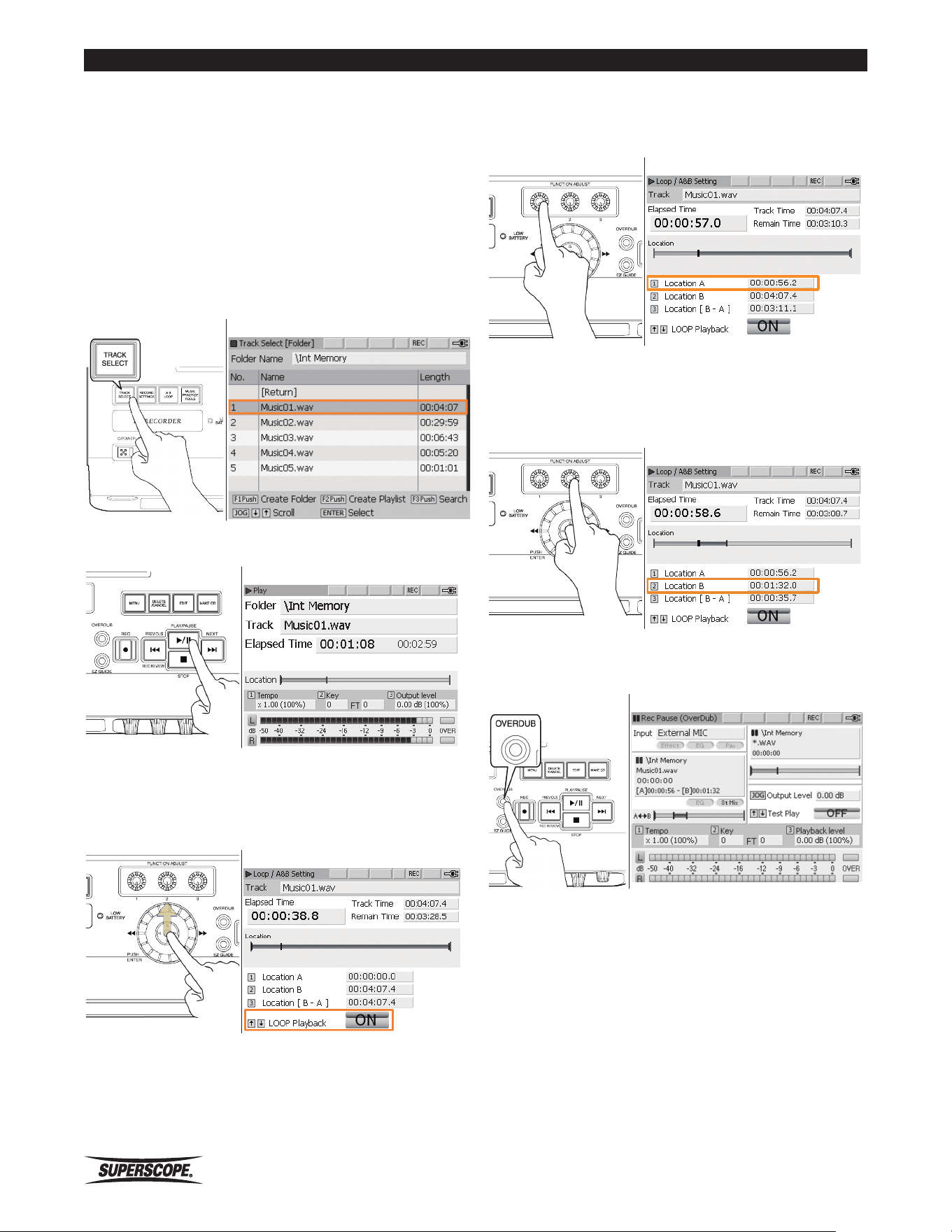
- 88 -
Superscope PSD450mkII User Manual
Recording
Overdubbing for Practice (Recording
over a Loop)
In this mode, you will identify a section of audio, then
record additional audio over that section until the STOP
button is pressed. Unlike Mode A (Layering Sections of
a Track), the length of the resulting file in this mode is
determined by how long you choose to record over the
repeating loop.
1. Select a track to record over by pressing the TRACK
SELECT button.
Track Select [Folder] Screen
2. Press the PLAY/PAUSE button to listen to the track.
Play Screen
3. Press the A-B LOOP button during playback to view
the LOOP setting menu. If you have already set your
Overdub points, simply move the joystick up to turn
Loop playback ON, and proceed to step 6.
Loop / A&B Setting Screen
4. Press FUNCTION ADJUST #1 (4A) during playback
to set the beginning of your accompaniment loop
(point A).
Loop / A&B Setting Screen
5. Press FUNCTION ADJUST #2 (4B) during playback to
set the end of your accompaniment loop (point B).
Loop Playback will start at point A automatically.
Loop / A&B Setting Screen
6. Press the OVERDUB button (6) to enter REC Pause
Mode (Overdub).
Rec. Pause [OverDub] Screen
7. Adjust the REC Level knobs so that the Record Level
(left and right channels) does not exceed 0 dB as
indicated on the Level meters. (see Setting Levels).
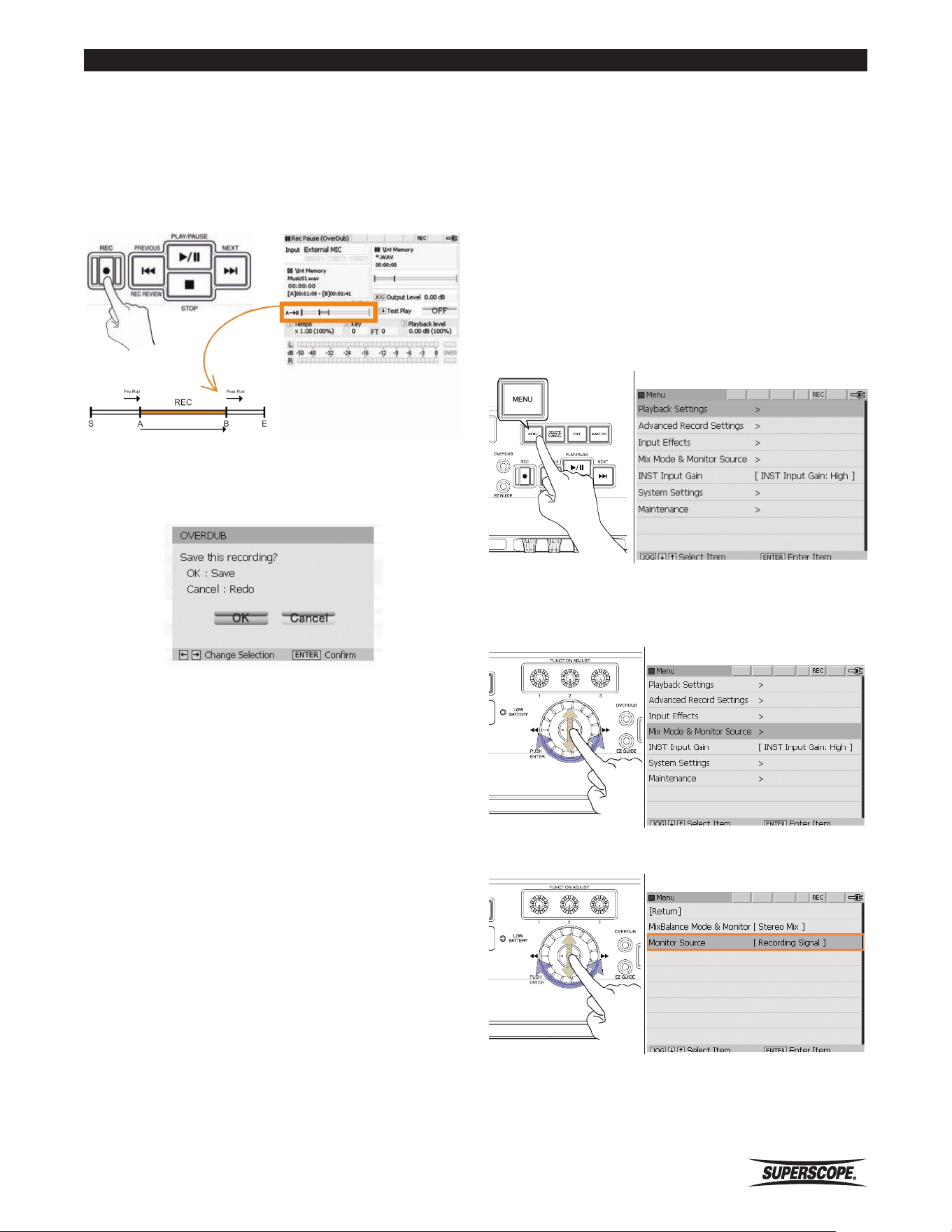
Superscope PSD450mkII User Manual
- 89 -
Recording
8. Press the REC button (8A) or PLAY/PAUSE button
(8C) to start overdubbing. If a Pre-Roll Time is set
in the Record Settings menu (see Pre-Roll Time),
playback will begin a number of seconds before
Overdub point A, as determined by the Pre-Roll
Time.
Rec. Pause [OverDub] Screen
9. Press the STOP button when you are finished
recording. The Save menu will appear.
Overdub Save Menu Screen
10. Select OK and the new file (executed overdub) will
be saved. Select Cancel and the file will not be
saved. When Cancel is selected, the recorder will re-
enter REC Pause Mode (Overdub) (step #6) allowing
the user to redo the Overdub recording.
※ To adjust Playback Level for the
accompaniment file, turn FUNCTION ADJUST
#2 (4B) when the main Overdub screen is
visible.
Monitor Source
When Overdubbing, it is helpful to specify a Monitor
Source. Selecting ‘Recording Signal’ as the Monitor
Source will allow you to hear both the accompaniment
file and the input signals (microphones, instruments, etc.)
in the headphones and built-in speaker as you record.
When ‘Playback Signal’ is selected as the Monitor Source,
the input signals will not be heard in the headphones
or built-in speaker. This allows you to hear the
accompaniment track without hearing your own voice or
instrument during recording.
1. Press the MENU button.
Menu Screen
2. Move the joystick up or down or turn the jog wheel
to select Playback Settings. Press ENTER.
Menu Screen
3. Move the joystick up or down or turn the jog wheel
to select Monitor Source. Press ENTER.
Menu Screen
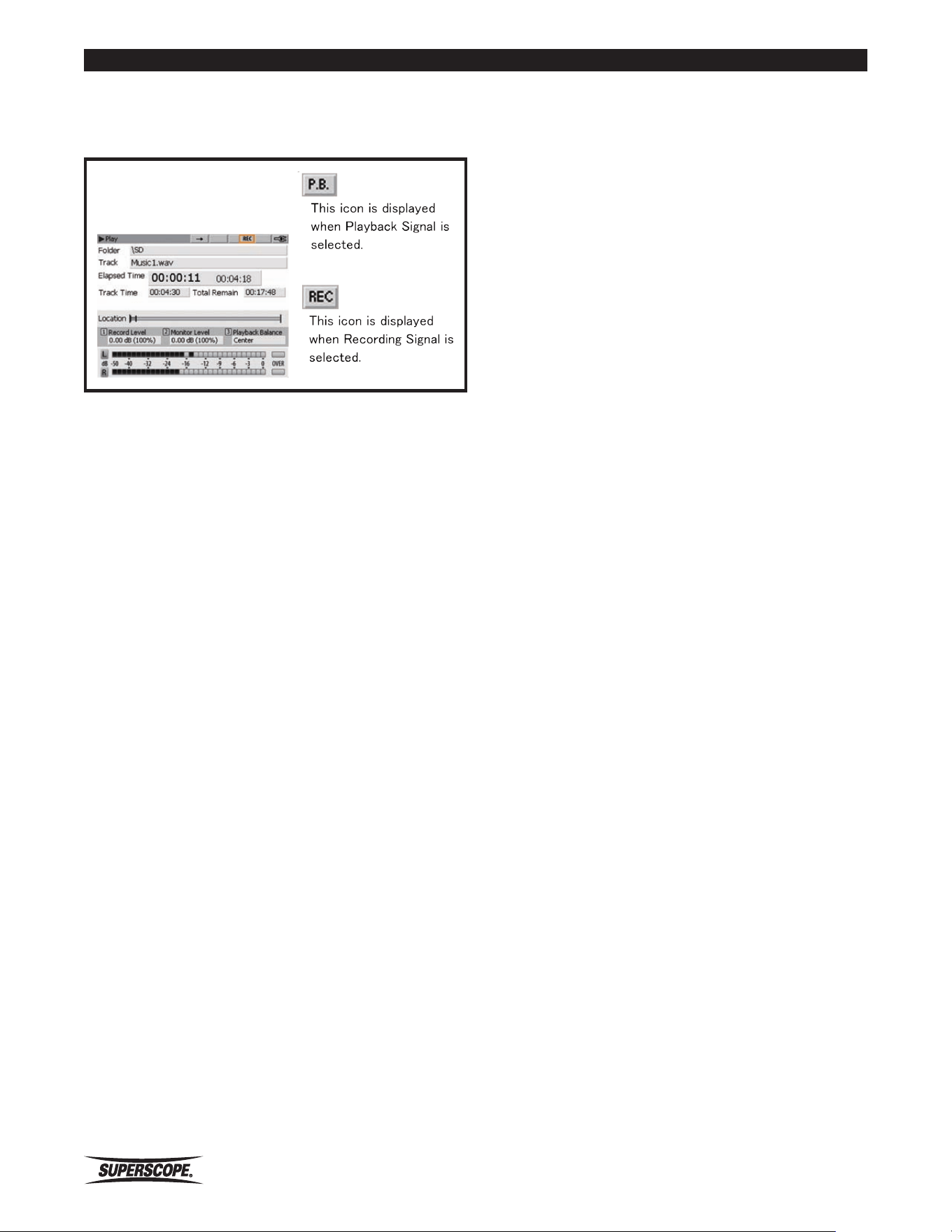
- 90 -
Superscope PSD450mkII User Manual
Recording
4. Turn the jog wheel to select Recording Signal or
Playback Signal. Press ENTER. Press the CANCEL
button to cancel changes.
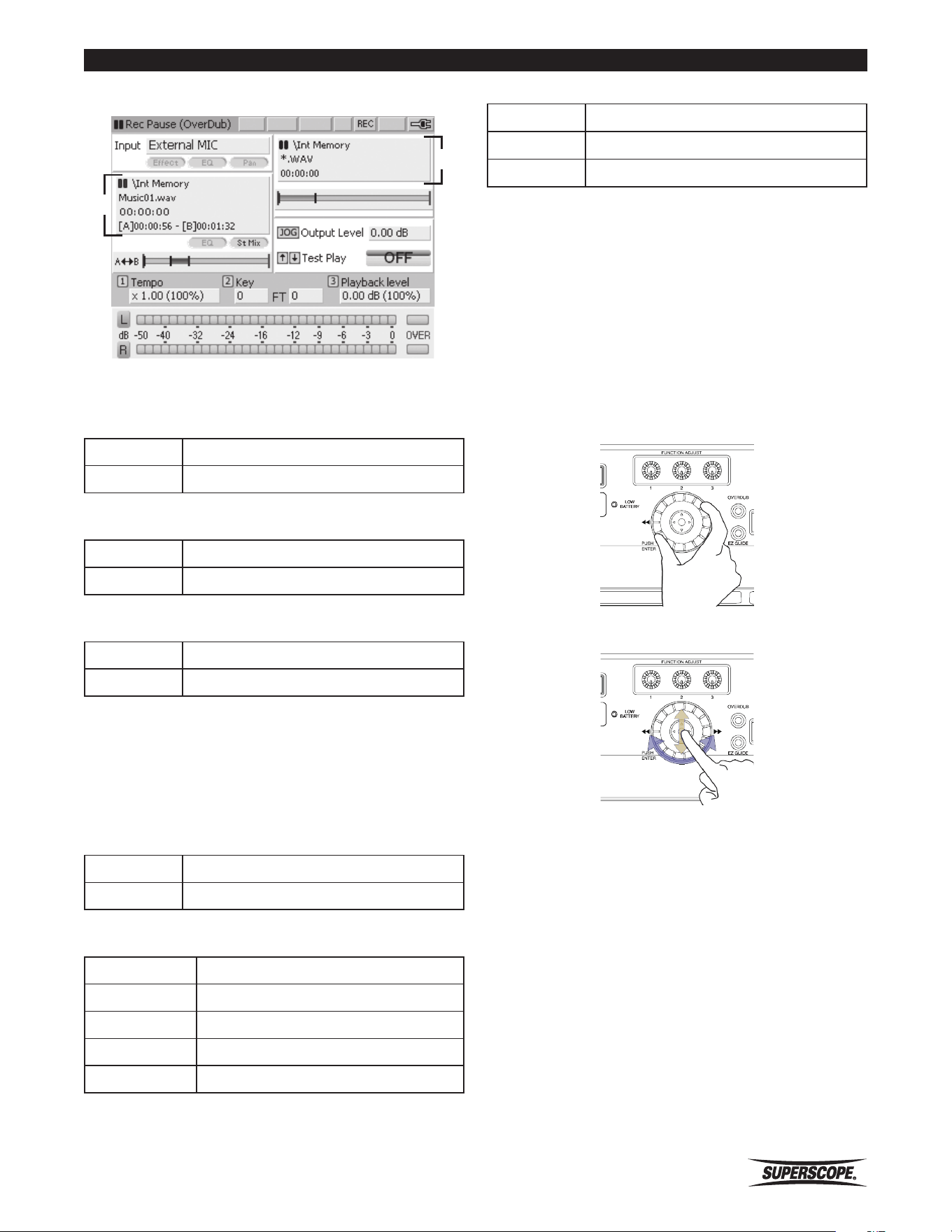
Superscope PSD450mkII User Manual
- 91 -
Recording
OverDub Screen
Input Source is displayed
w Effect (Reverb/Delay) Icon
LIT Reverb/Delay is set.
OFF Reverb/Delay is not set.
e Input Equalizer Icon
LIT Input equalizer is set.
OFF No Input equalizer is set.
r Pan Icon
LIT Pan Mode is set
OFF Stereo Mode is set
t Accompaniment track is displayed.
Displays the folder of the accompaniment track.
Displays the accompaniment track.
Displays elapsed time.
Displays the A + B Loop Points.
y Playback Equalizer Icon
LIT Playback equalizer is set.
OFF No Playback equalizer is set.
u Mix Mode Icon
StMix Mix mode is set Stereo Mix
SPLT Mix mode is set Split
L ch Mix Mix mode is set L ch Mix
R ch Mix Mix mode is set R ch Mix
Monaural Mix Mix mode is set Monaural Mix
i Loop Mode icon
→
No location is set.
A→B
Loop playback is set OFF.
A⇔B
Loop playback is set ON.
o Playback Location
Displays the current position on the time line.
Displays the position of location A and B on the time line
when Loop playback is set.
a Recording Folder
Displays the recording folder
Displays the recording track name
Displays the recording time
s Output Level;
Adjust by using the jog wheel (5-B)
d Test Play ON/OFF
Move the joystick (5-A) up or down to turn on Test Play,
The accompaniment track will be played. Adjust the
volume level of the accompaniment track and the input
signal to record the overdub.
Adjust Tempo (function adjust #1), Key (function
adjust #2) and the accompaniment track playback level
(function adjust #3).
Confirm the level balance of the accompaniment track
and the input signal and turn test play OFF.
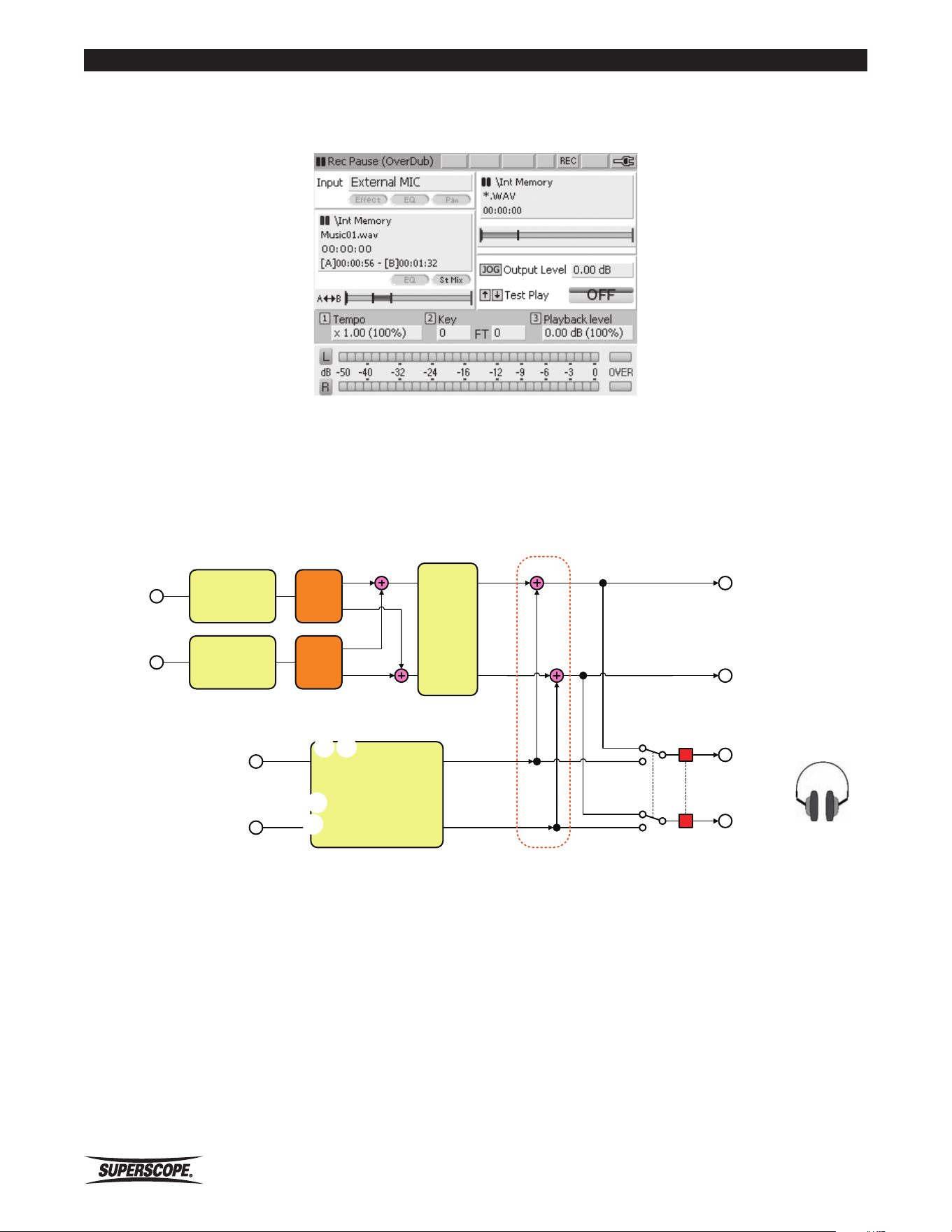
- 92 -
Superscope PSD450mkII User Manual
Recording
OverDub Screen and Audio Signal
The following block diagrams show the audio signal path when OverDubbing.
Mix Mode Settings changes the signal connections as enclosed by dotted lines in the shown below.
The numbers shown on the screen correspond to the numbers in the block diagram.
Mix Mode: Stereo
The stereo signal of the accompaniment file and the input source are mixed and recorded.
Tempo/Key
Playback EQ
Playback level
L cH
R cH
R cH
Pan 1
Pan 2
L cH
Effects
L cH
R cH
Recording Signal
Monitor
Output
Monitor
Source
Mix Mode; Stereo
INPUT
EQ
INPUT
EQ
L cH
R cH
Accompaniment file
Output
Level
Input
Playback Signal
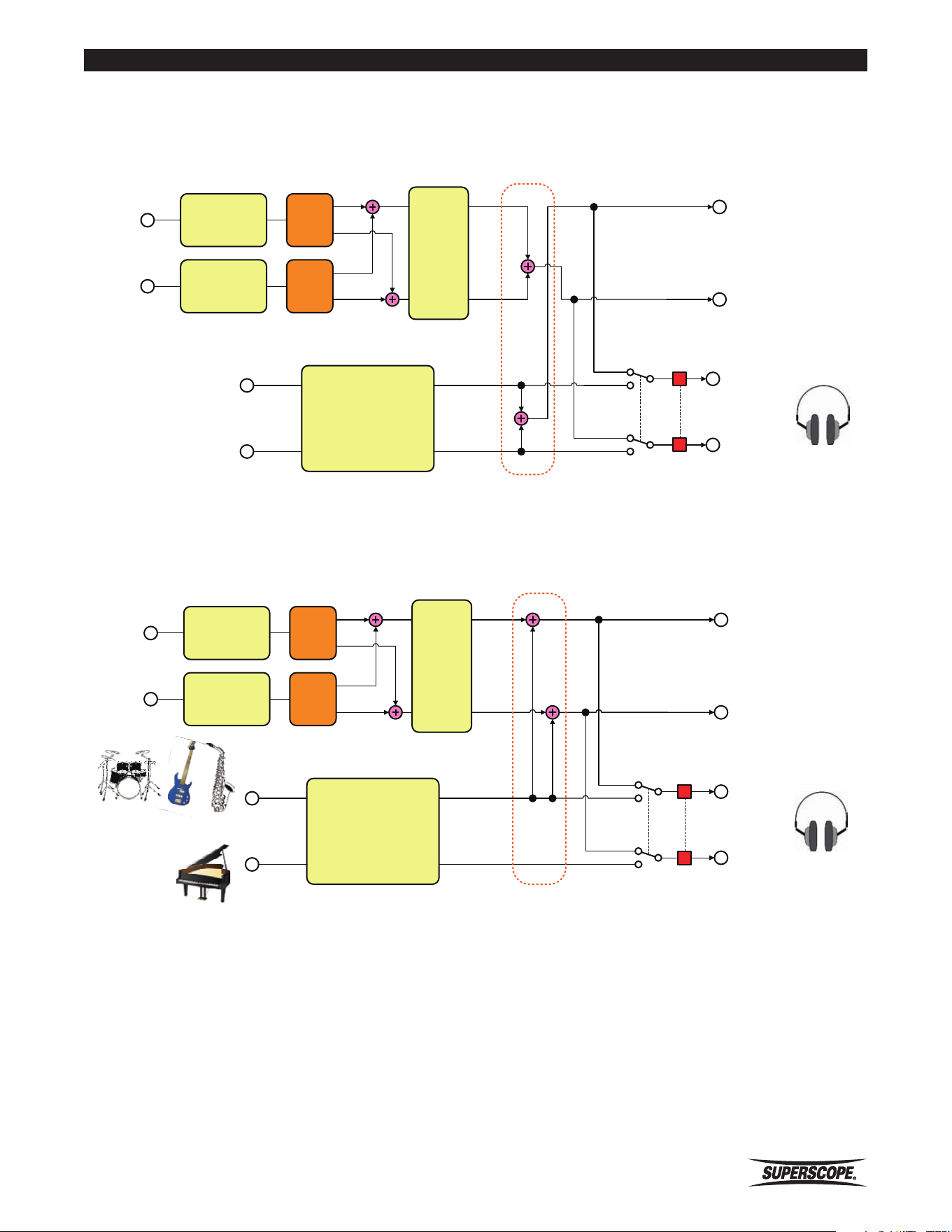
Superscope PSD450mkII User Manual
- 93 -
Recording
Mix Mode: Split
The signal of the accompaniment file is recorded on the L ch, and the mixed signal of the input source is recorded on
the R ch.
L cH
R cH
L cH
R cH
Mix Mode; Split
Tempo/Key
Playback EQ
Playback level
R cH
Pan 1
Pan 2
L cH
Effects
INPUT
EQ
INPUT
EQ
L cH
R cH
Accompaniment file
Input
Playback Signal
Monitor
Source
Monitor
Output
Recording Signal
Output
Level
L cH
R cH
Mix Mode: L ch. Mix
The signal of the L ch accompaniment file is mixed with the L+R input signal and recorded.
Mix Mode; Lch Mix
Tempo/Key
Playback EQ
Playback level
R cH
Pan 1
Pan 2
L cH
Effects
INPUT
EQ
INPUT
EQ
L cH
R cH
Accompaniment file
Input
Monitor
Source
L cH
R cH
L cH
R cH
Recording Signal
Monitor
Output
Playback Signal
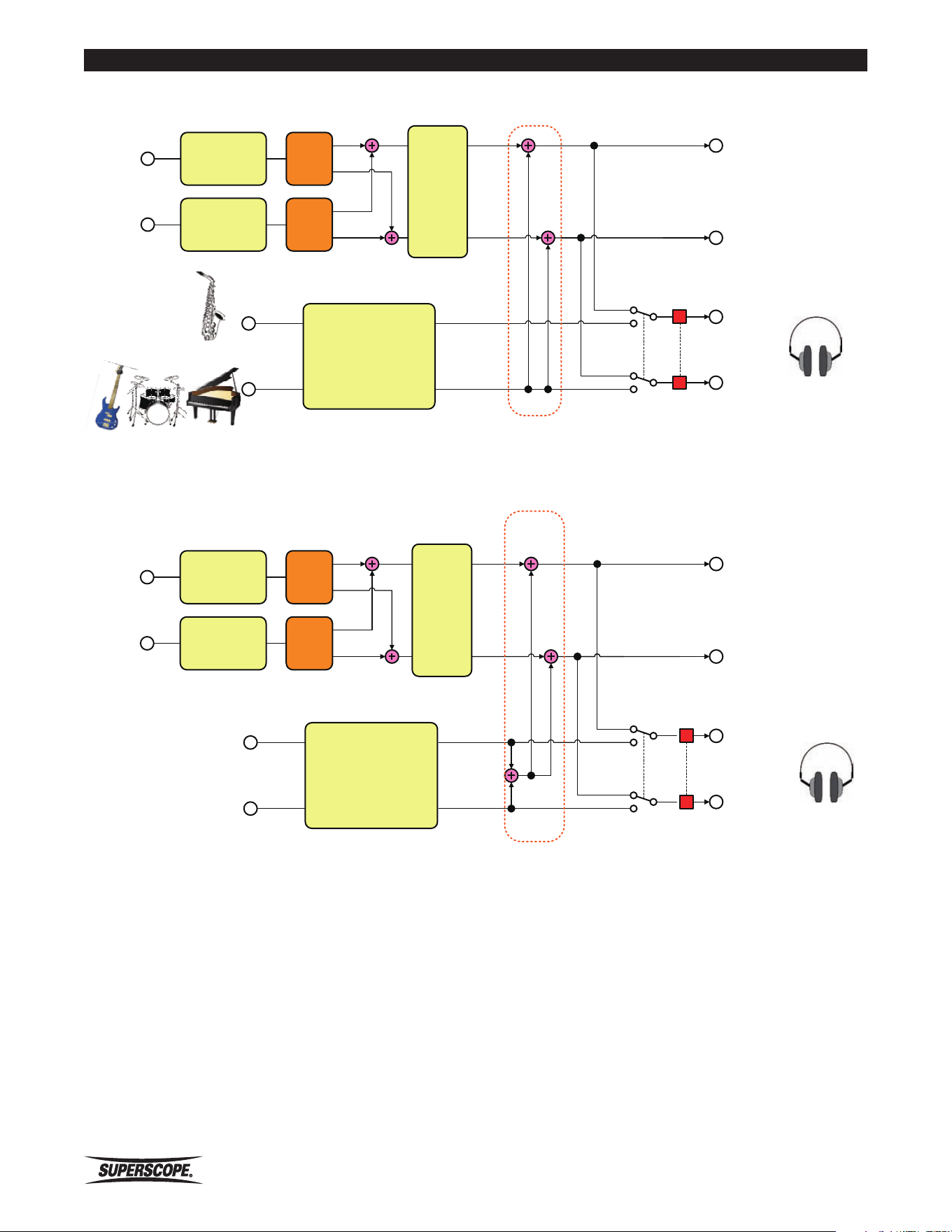
- 94 -
Superscope PSD450mkII User Manual
Recording
Mix Mode: R ch. Mix
The signal of the R ch accompaniment file is mixed with the L+R input signal and recorded.
Mix Mode; Rch Mix
Tempo/Key
Playback EQ
Playback level
R cH
Pan 1
Pan 2
L cH
Effects
INPUT
EQ
INPUT
EQ
L cH
R cH
Accompaniment file
Input
Monitor
Source
L cH
R cH
L cH
R cH
L cH
R cH
Recording Signal
Monitor
Output
Playback Signal
Mix Mode: Monaural Mix
The signal of the L+R accompaniment file is mixed and then recorded with the L+R input signals.
Mix Mode; Monaural MIX
Tempo/Key
Playback EQ
Playback level
R cH
Pan 1
Pan 2
L cH
Effects
INPUT
EQ
INPUT
EQ
L cH
R cH
Accompaniment file
Input
Output
Level
Monitor
Output
Recording Signal
Playback Signal
L cH
R cH
L cH
R cH
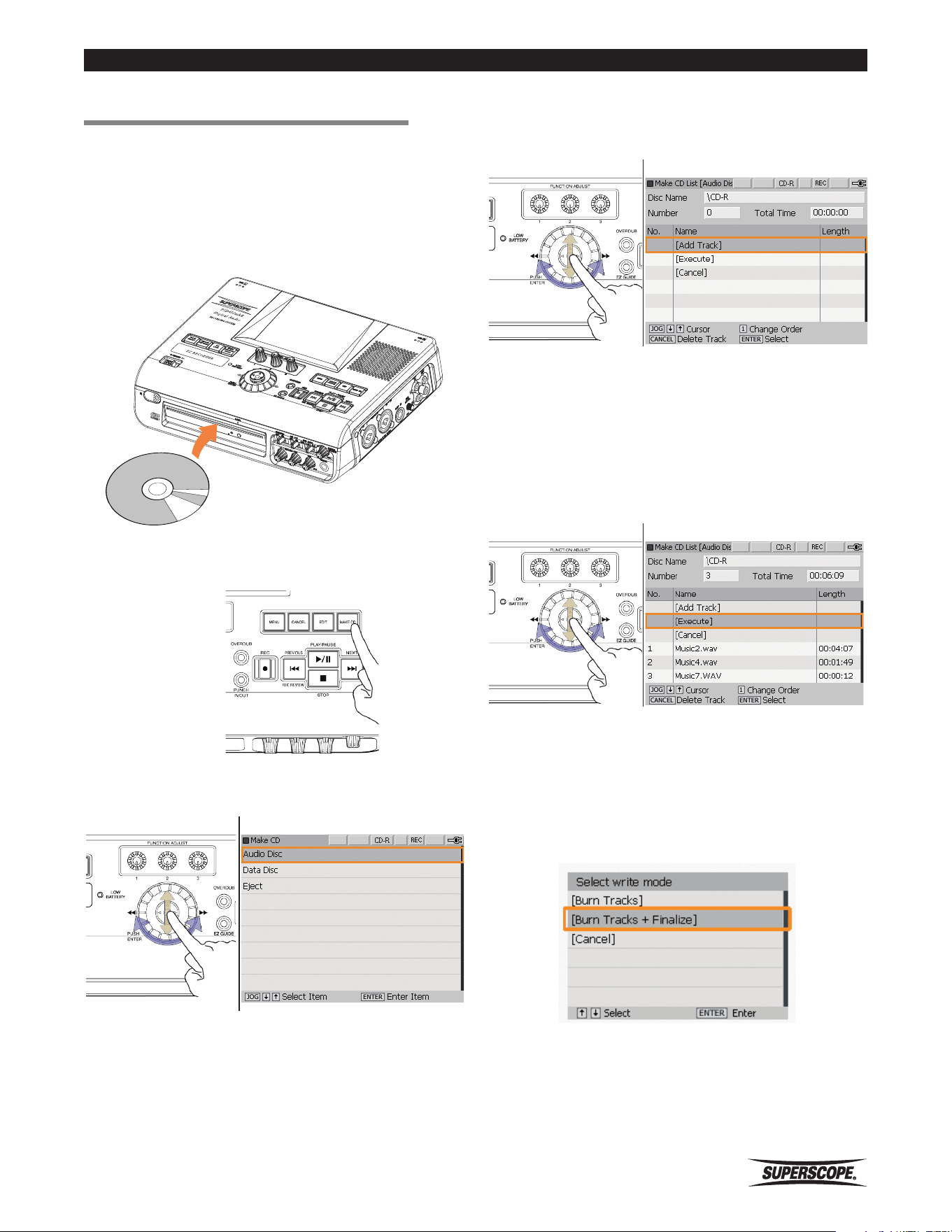
Superscope PSD450mkII User Manual
- 95 -
Recording
■CD Burning
Creating an Audio CD
Follow these steps to create an audio CD using WAV or
MP3 files stored on the Internal Memory, USB storage.
1. Insert a blank or unfinalized CD-R/RW into the CD-R/
RW drive.
2. Press the MAKE CD button.
3. Turn the jog wheel or move the joystick up or down
to highlight Audio Disc. Press ENTER.
Make CD Screen
4. The Make CD List [Audio Disc] screen will appear.
Turn the jog wheel or move the joystick up or down
to highlight [Add Track]. Press ENTER.
Make CD List [Audio Disc] Scrren
5. Use the Track Select method to select a track. Push
ENTER to add the track to the CD list. Repeat until all
desired tracks have been added.
6. When you have finished adding tracks, use the jog
wheel or joy stick to select [Execute] on the Make
CD List [Audio Disc] screen. Press ENTER.
Make CD List [Audio Disc] Screen
7. Select Write Mode - If you wish to add more
tracks or finalize at a later time, select [Burn Tracks].
If you wish to create a finalized disc that is playable
in other CD players, select [Burn Tracks + Finalize].
Press ENTER.
Select write mode Screen
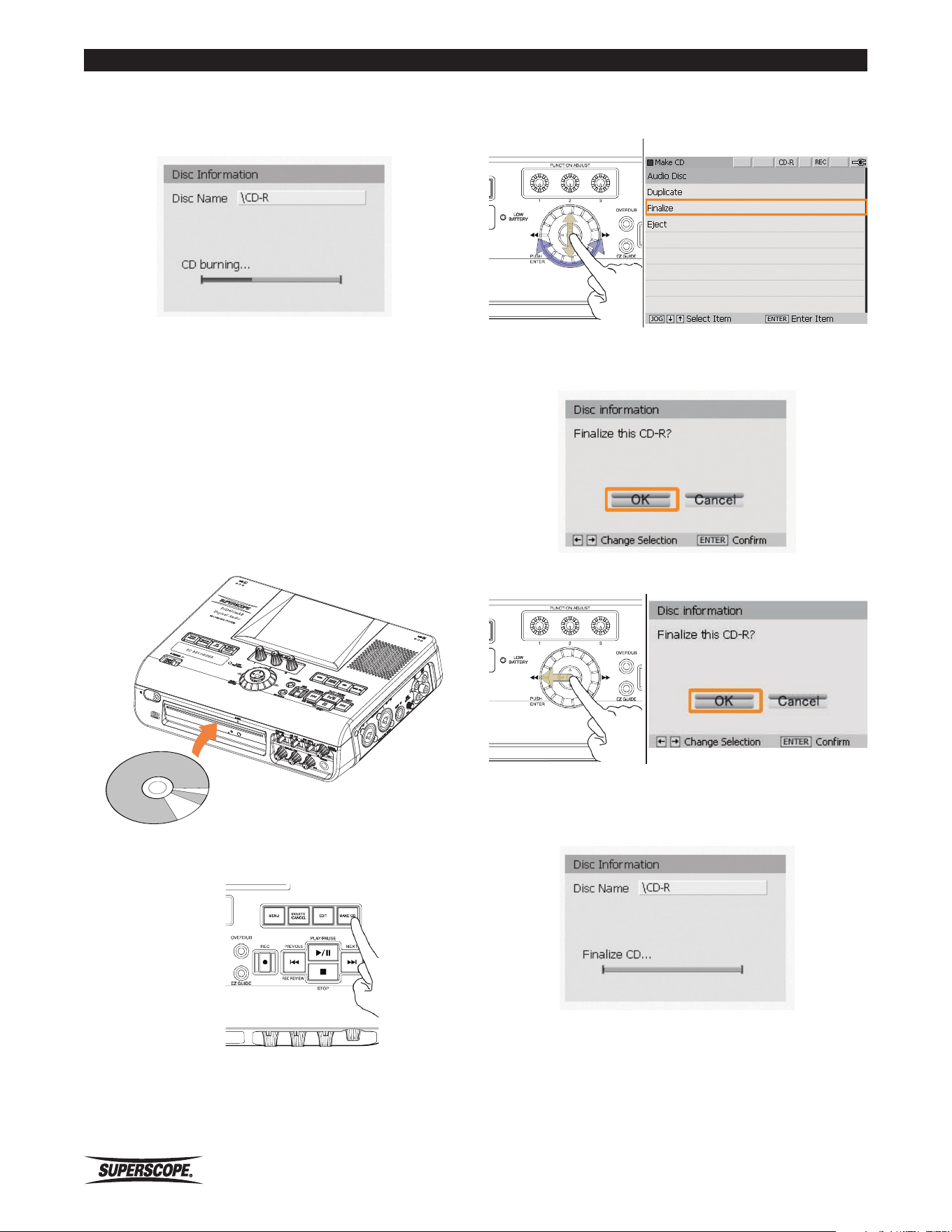
- 96 -
Superscope PSD450mkII User Manual
Recording
8. When burning is finished, the CD will be ejected
automatically.
CD Burning Progress Screen
Finalizing a CD
Note: Prior to burning MP3 files to disc, the Export
procedure will activate.
The finalization process writes the table of contents
(TOC) to a compact disc, making the CD readable in
standard CD players. Follow these instructions to finalize
an audio CD:
1. Insert an unfinalized CD-R/RW into the CD-R/RW
drive.
2. Press the Make CD button.
3. Turn the jog wheel or move the joystick up or down
to highlight Finalize. Press ENTER.
Make CD Screen
4. The following screen will appear:
5. Move the joystick left to select OK. Press ENTER.
6. When you select OK, the following screen will
appear:
FINALIZE Progress Screen
When finalization is complete, status will return to
the Main Screen.
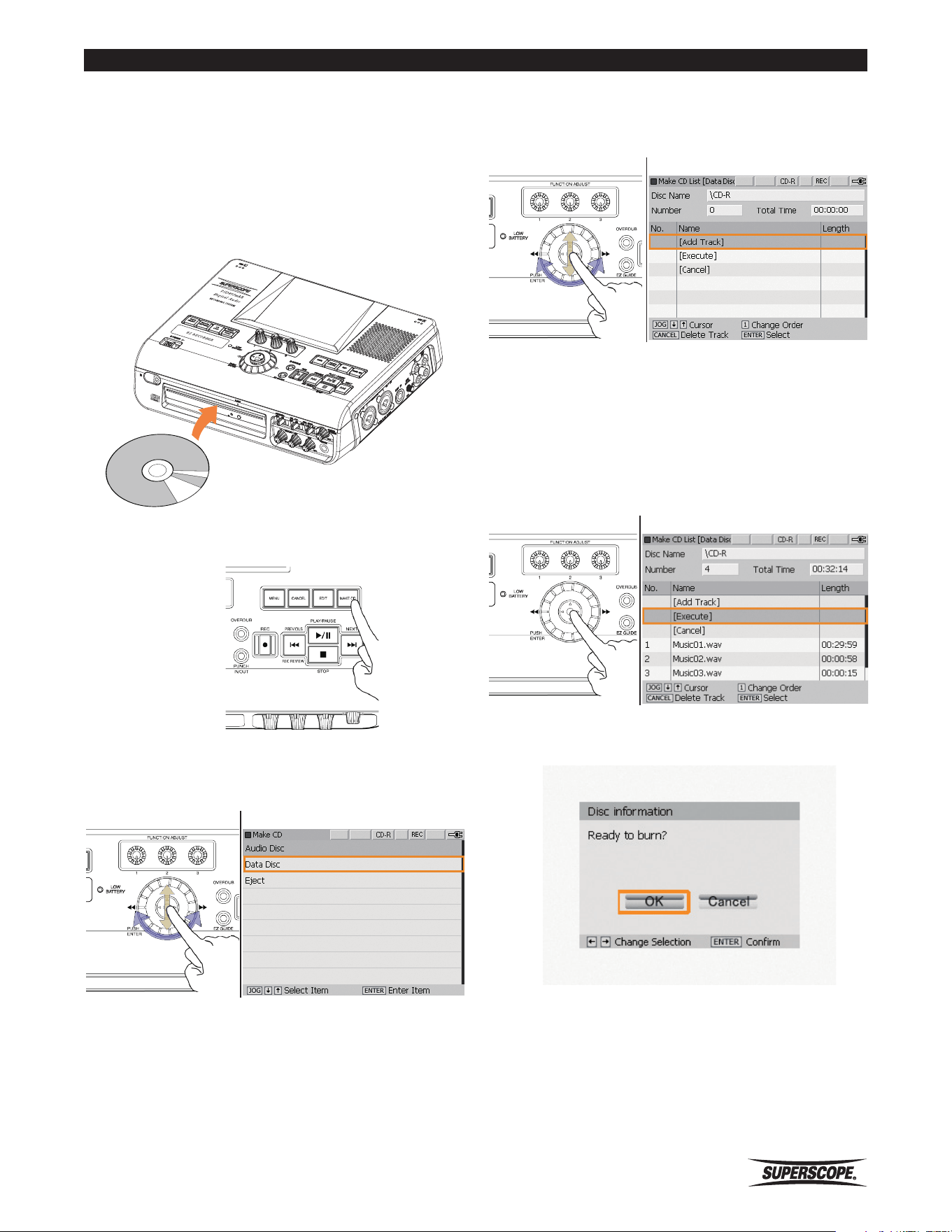
Superscope PSD450mkII User Manual
- 97 -
Recording
Creating a Data CD
Follow these instructions to store WAV or MP3 files on
CD media. Data CDs will not play on standard CD audio
players. Use data CDs to transfer WAV or MP3 files
(recorded on the PSD450mkII) to a computer.
1. Insert a blank CD-R/RW into the CD-R/RW drive.
2. Press the MAKE CD button.
3. Turn the jog wheel or move the joystick up or down
to highlight Data Disc. Press ENTER.
Make CD Screen
4. The Make CD List [Data Disc] screen will appear. Turn
the jog wheel or move the joystick up or down to
highlight [Add Track]. Press ENTER.
Make CD List [Data Disc] Screen
5. Use the Track Select Method to select a track. Push
ENTER to add the track to the CD list. Repeat until all
desired tracks have been added.
6. When you have finished adding tracks, use the jog
wheel or joystick to select [Execute] on the Make CD
List [Data Disc] screen. Press ENTER.
Make CD List [Data Disc] Screen
7. The following screen will appear:
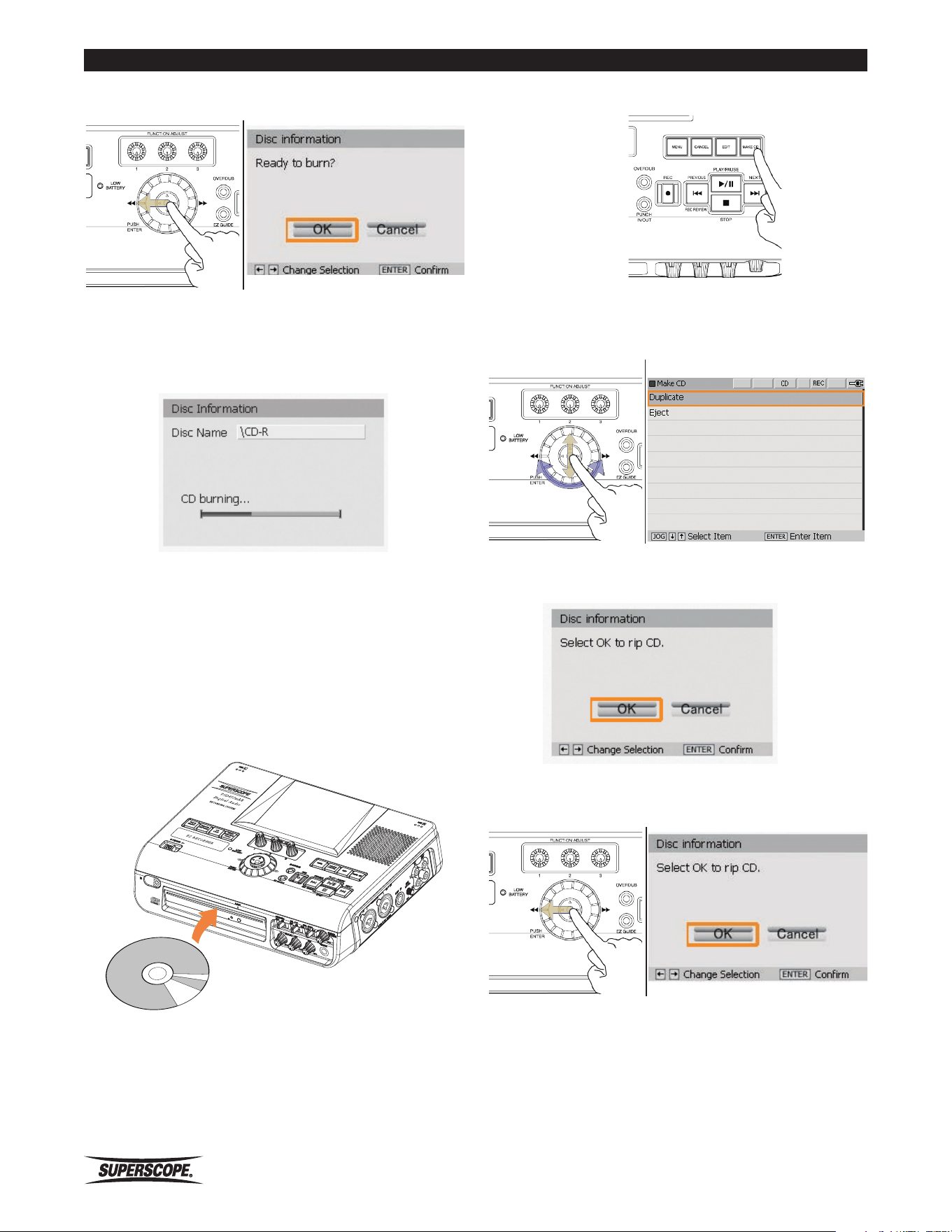
- 98 -
Superscope PSD450mkII User Manual
Recording
8. Move the joystick left to select OK. Press ENTER.
9. When burning is finished, the CD will be ejected
automatically.
CD Burning Progress Screen
CD Duplication
Any audio or data CD can be copied by using the
Duplicate feature. Follow these instructions to copy the
contents of a CD to the Internal Memory and then to a
blank CD-R/RW:
1. Insert the CD to be duplicated into the CD-R/RW
drive.
2. Press the MAKE CD button.
3. Turn the jog wheel or move the joystick up or down
to highlight Duplicate. Press ENTER.
Make CD Screen
4. The following screen will appear:
5. Move the joystick left to select OK. Press ENTER.
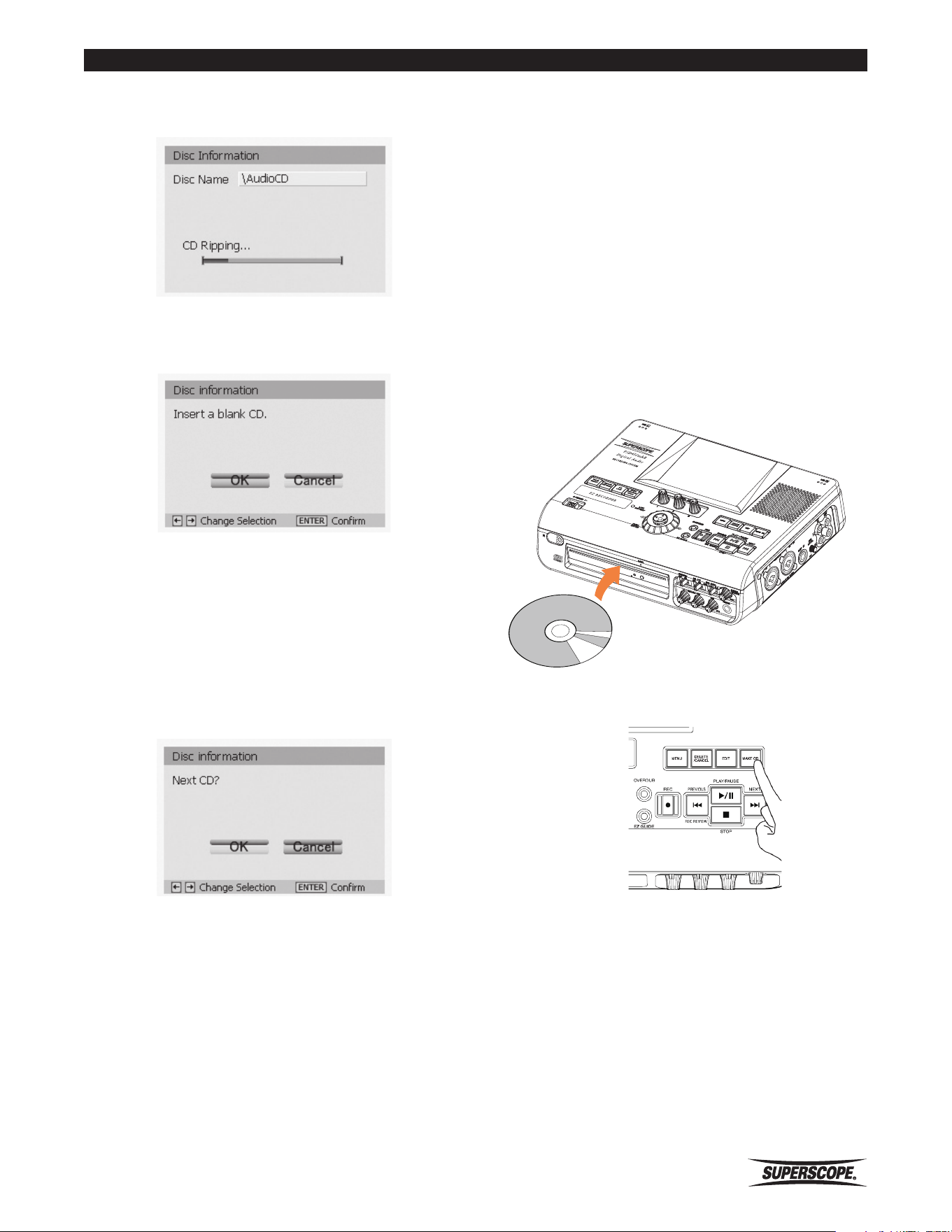
Superscope PSD450mkII User Manual
- 99 -
Recording
6. When ripping is finished, the CD will be ejected
automatically.
7. When CD ripping is complete, the following screen
will appear:
8. Insert a blank CD. When a blank CD is detected, the
recorder will begin burning the ripped WAV files to
CD.
※ If a finalized CD-RW is detected, you will be
prompted to erase the disc before burning.
9. When burning is finished, the CD will be ejected
automatically. The following screen will appear:
10. To make another copy, insert a blank CD and
burning will begin automatically. To end duplication,
select Cancel.
Erasing a CD-RW
When a CD-RW with audio tracks is detected in the
CD-R/RW drive, three additional options will appear in
the Make CD menu: Unfinalize (finalized CD-RW only),
Erase Last, and Erase All.
※ It is not possible to erase or unfinalize a CD-R
disc.
Unfinalize a CD-RW
To add more tracks to a finalized CD-RW, the disc must
be unfinalized first. Follow these instructions to unfinalize
a CD-RW:
1. Insert a finalized CD-RW into the CD-R/RW drive.
2. Press the MAKE CD button.
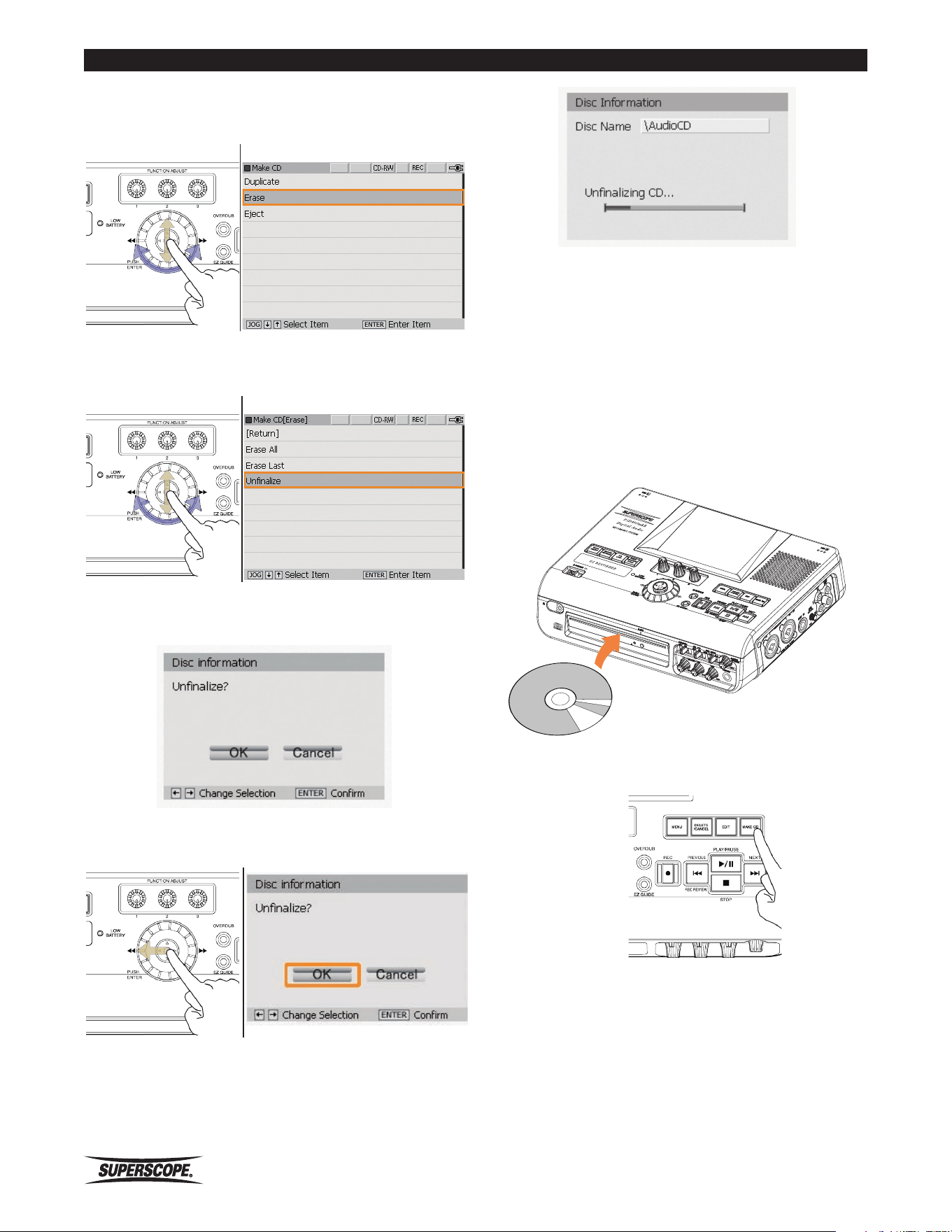
- 100 -
Superscope PSD450mkII User Manual
Recording
3. Turn the jog wheel or move the joystick up or down
to highlight Erase. Press ENTER.
Make CD Screen
4. Turn the jog wheel or move the joystick up or down
to highlight Unfinalize. Press ENTER.
Make CD [Erase] Screen
5. The following screen will appear:
6. Move the joystick left to select OK. Press ENTER.
7. When Unfinalize is complete, status will return to the
Make CD menu.
Erase Last
Follow these instructions to erase the last track on a
CD-RW audio disc. The Erase Last option will not appear
when a data disc is detected.
1. Insert a CD-RW with audio tracks into the CD-R/RW
drive.
2. Press the MAKE CD button.
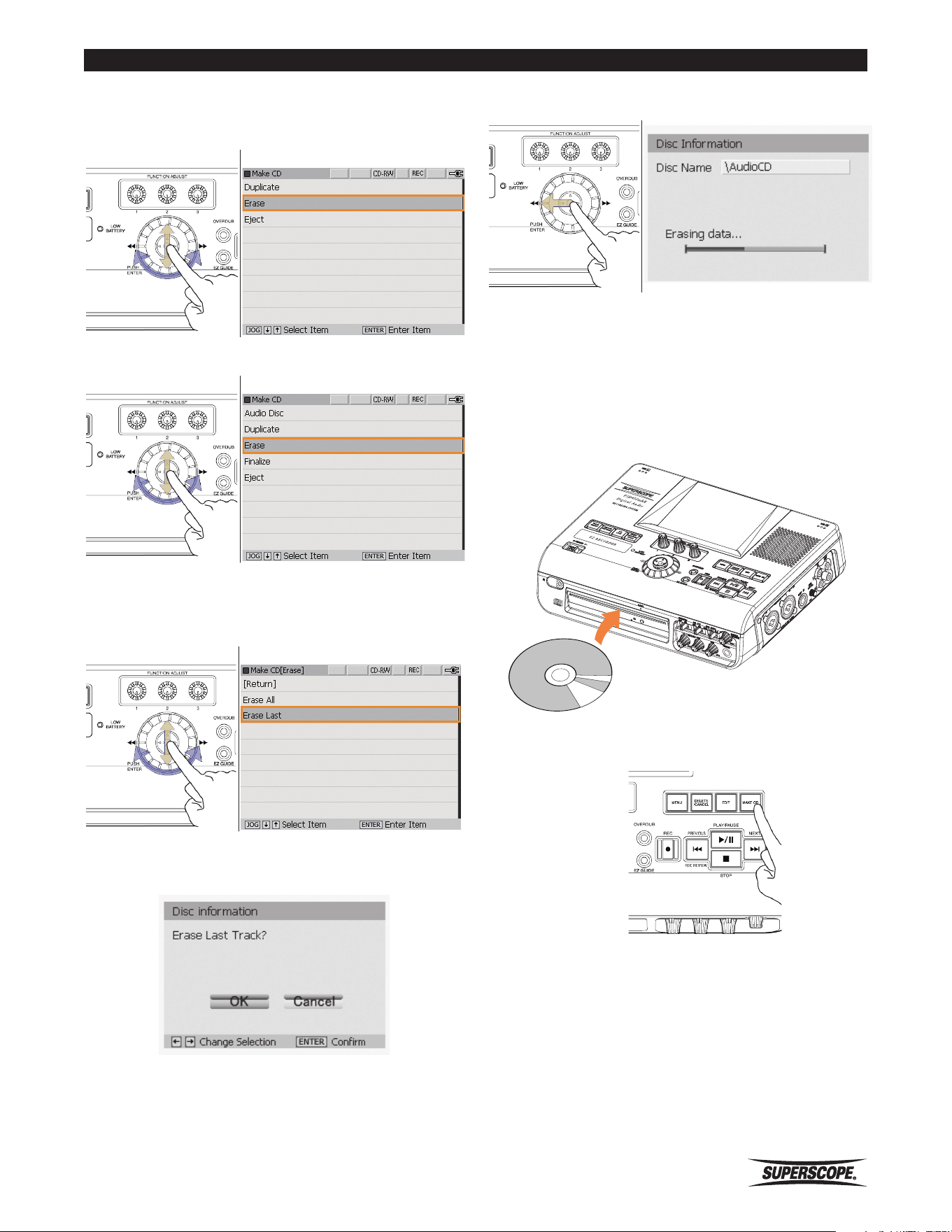
Superscope PSD450mkII User Manual
- 101 -
Recording
3. Turn the jog wheel or move the joystick up or down
to highlight Erase. Press ENTER.
Finalized CD-RW Menu
Make CD Screen
Unfinalized CD-RW Menu
Make CD Screen
4. Turn the jog wheel or move the joystick up or down
to highlight Erase Last. Press ENTER.
Make CD [Erase] Screen
5. The following screen will appear:
6. Move the joystick left to select OK. Press ENTER.
Erase All
Follow these instructions to erase the contents of a CD-
RW audio or data disc:
1. Insert a CD-RW with audio tracks into the CD-R/RW
drive.
2. Press the Make CD button.
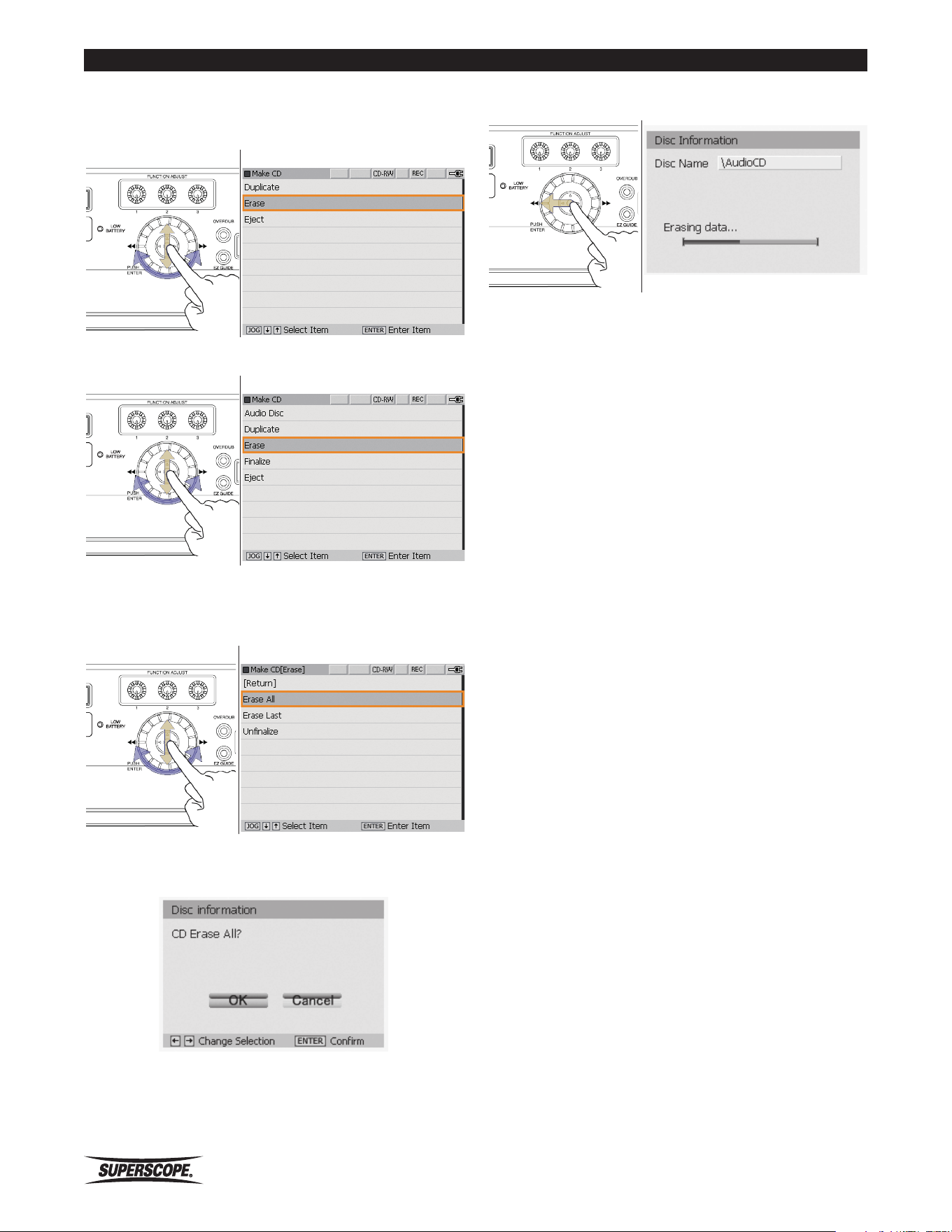
- 102 -
Superscope PSD450mkII User Manual
Recording
3. Turn the jog wheel or move the joystick up or down
to highlight Erase. Press ENTER.
Finalized CD-RW Menu
Make CD Screen
Unfinalized CD-RW Menu
Make CD Screen
4. Turn the jog wheel or move the joystick up or down
to highlight Erase All. Press ENTER.
Make CD [Erase] Screen
5. The following screen will appear:
6. Move the joystick left to select OK. Press ENTER.
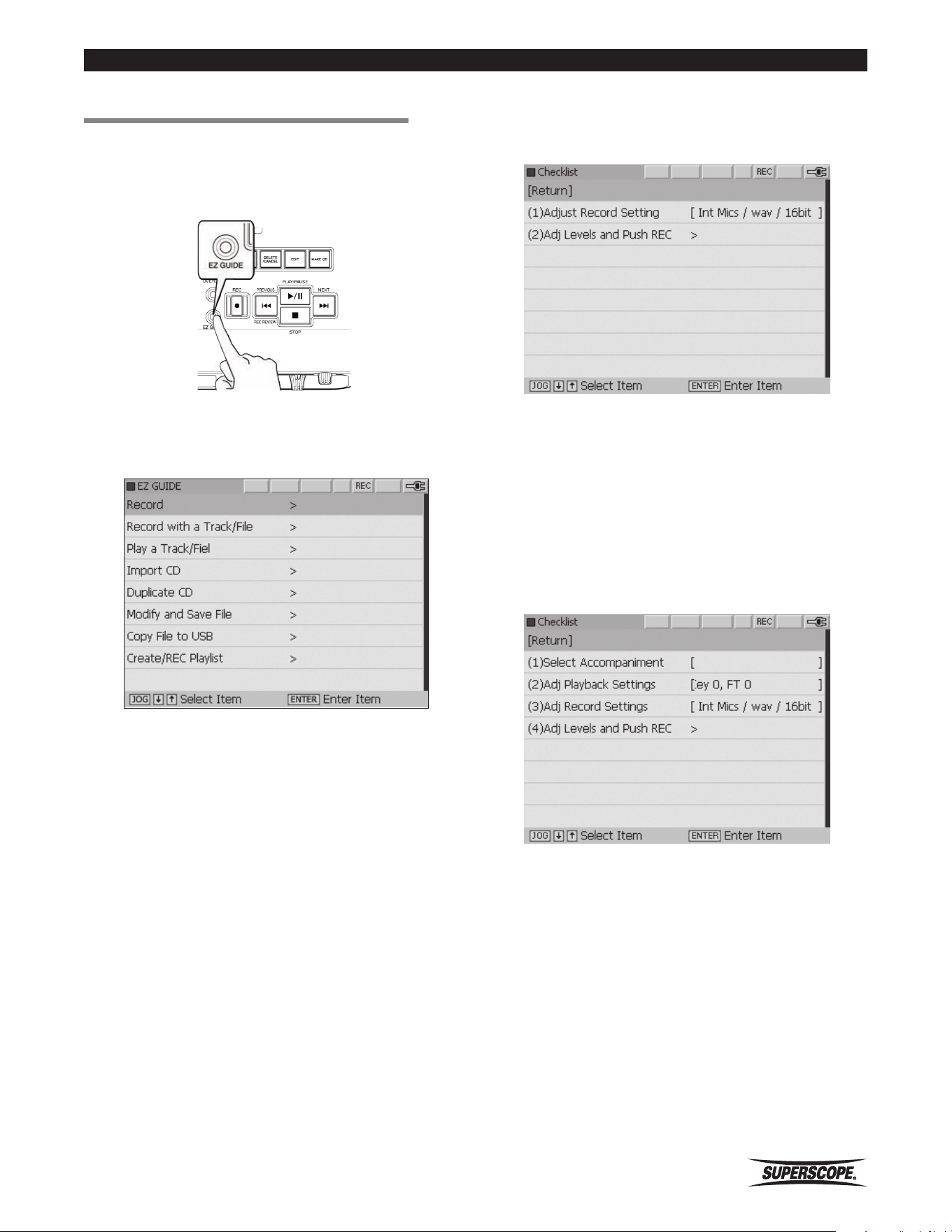
Superscope PSD450mkII User Manual
- 103 -
EZ Guide
■EZ Guide
In EZ Guide, you can operate this unit by pressing the
buttons according to the on-screen instructions.
1. Press the EZ GUIDE button [7].
2. Turn the jog wheel [5-B] or move the joystick [5-A]
up or down to select an item and press ENTER [5-A].
EZ Guide Menu Screen
EZ Guide provides guides to the following items.
① Record
② Record with a Track/File
③ Play a Track/File
④ Import CD
⑤ Duplicate CD
⑥ Modify and Save File
⑦ Copy File to USB
⑧ Create/REC Playlist
Record
This guide is for recording. Configure according to the
procedure that is shown.
1. Highlight [RETURN] and press ENTER [5A] to return to
EZ Guide.
2. Adjust the recording level and push the REC button
(8A) to start recording.
Record with a Track/File
This guide is for overdubbing. Set and select the items
according to the procedure that is shown.
1. Select an accompaniment track.
2. Adjust the playback settings (Tempo and Key).
Note: Changes to WAV/MP3 and Bit Rate must be
made in the record setting menu prior to entering
this EZ Guide feature.
3. Adjust the input source and recording folder.
4. Adjust the recording level and push the REC button
(8A) to start recording.
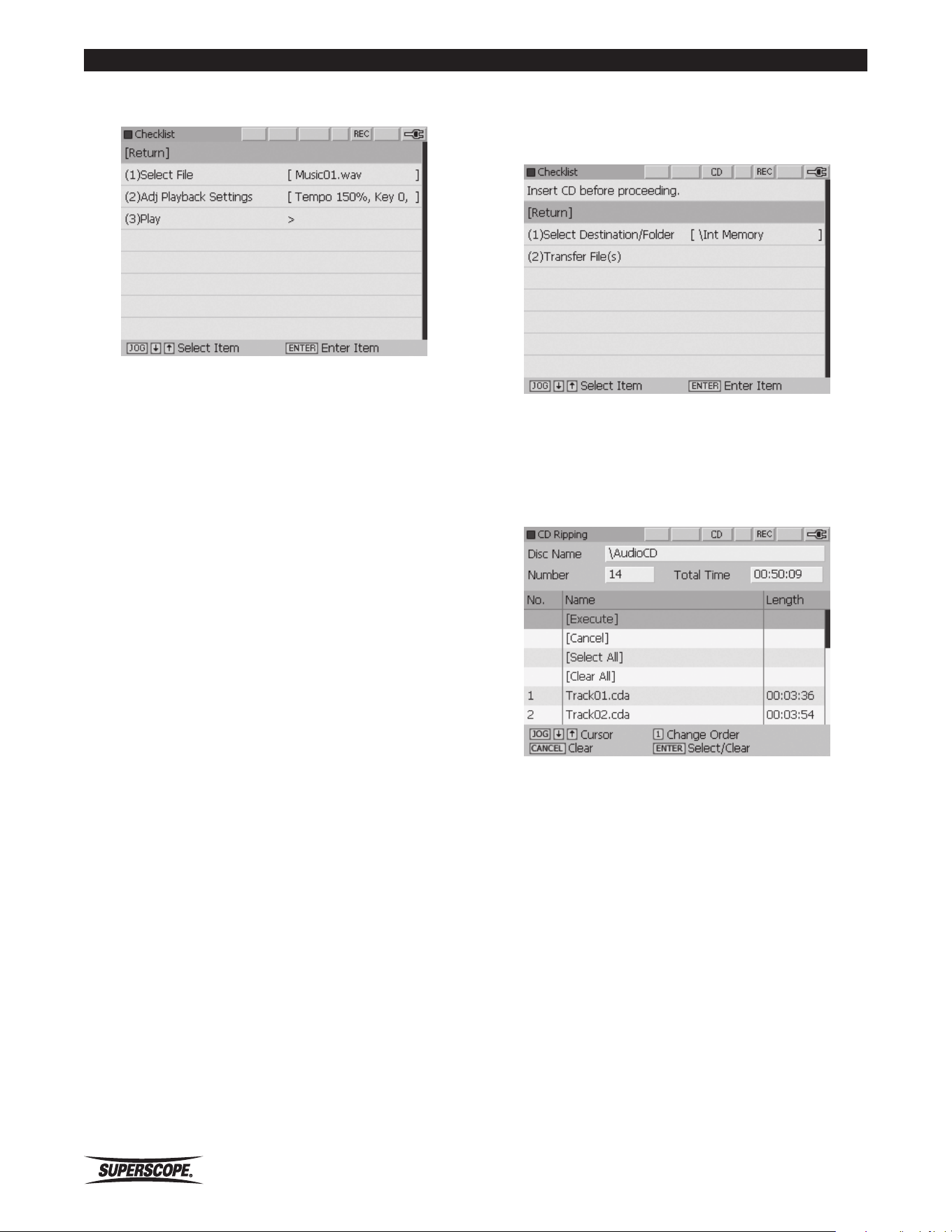
- 104 -
Superscope PSD450mkII User Manual
EZ Guide
Play a Track/File
1. Select the file to be played.
2. Adjust the playback settings (Tempo and Key).
3. Select Play.
Import CD
This guide is for importing a CD. Configure according to
the procedures that are shown below.
1. Select the destination folder for the imported tracks.
(lNT Memory or USBHDD Only).
2. Select Transfer Files
CD Ripping Screen
The contents of the CD will appear in the CD RIPPING
window and all tracks will be highlighted. This indicates
all tracks on the CD will be imported.
To remove selected tracks from the import, highlight the
track to remove and press the joystick down. Repeat to
remove additional tracks from the import.
Select [Execute] and press the joystick down. The
selected tracks will be imported to the destination folder
previously selected,
Note: You cannot change the order of the tracks of a CD
Import.
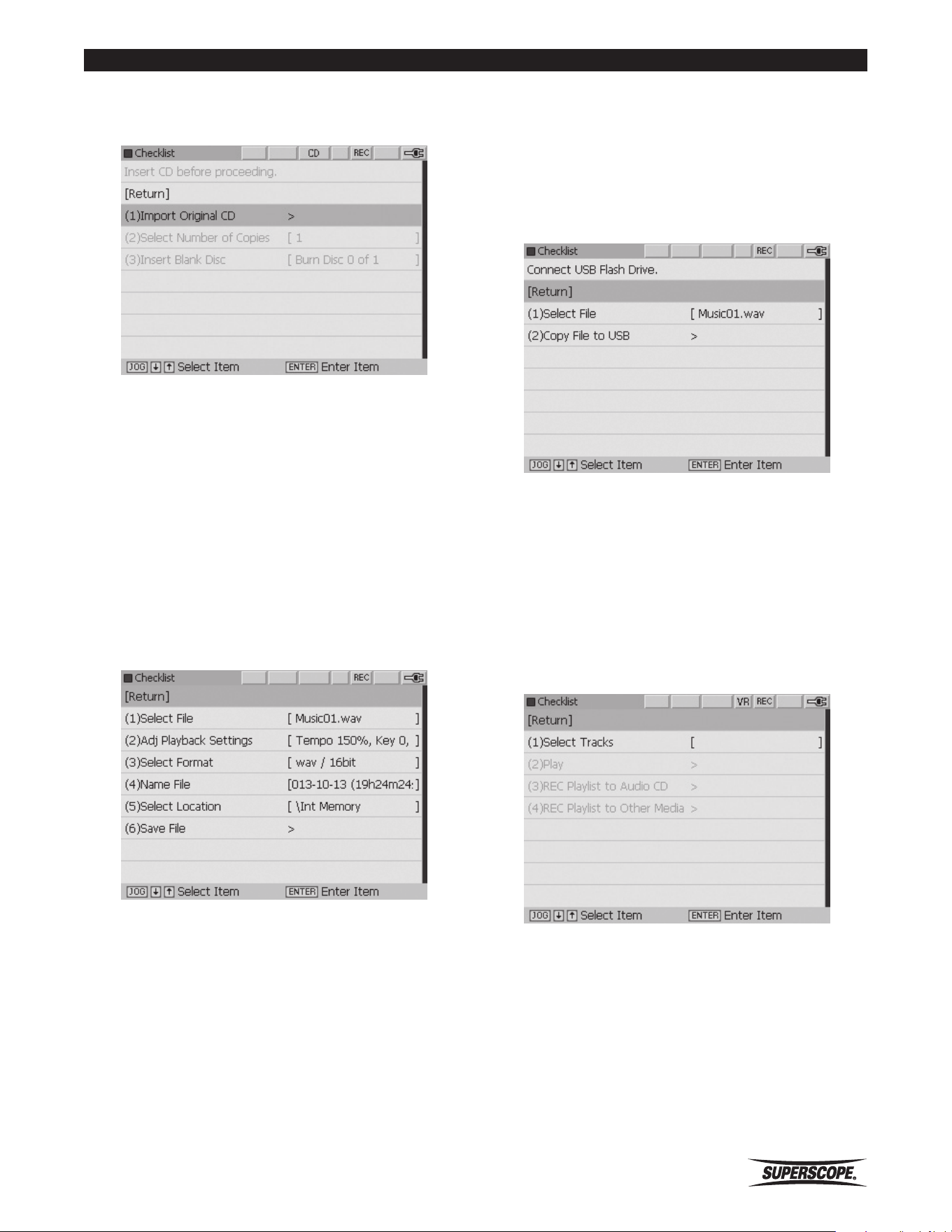
Superscope PSD450mkII User Manual
- 105 -
EZ Guide
Duplicate CD
This guide is for duplicating a CD. Configure settings
according to the steps that are shown.
1. Insert the CD to be duplicated and then press ENTER
to start ripping the CD.
2. After ripping the CD, select the number of copies.
3. Insert the black disc.
Modify and Save File
This guide is for modifying and saving a file that has a set
Key Tempo, File format and/or File name in the Internal
Memory or USB memory. Configure settings according
to the
procedures that are shown.
1. Select the file to be modified.
2. Adjust the playback settings (Tempo and Key) for
modification.
3. Select the format for modification.
4. Select the file to be renamed.
5. Select the location to save the modified file.
CD-R cannot be selected.
6. Save the file.
Copy File to USB
This guide is for copying a file from the Internal Memory
to USB memory. Configure items according to the
“Procedure.”
Note: CD transfer to USB is not possible.
1. Select the file to be copied from the Internal
Memory.
2. Select Copy File to USB.
Create/REC Playlist
This guide is for creating a playlist for playing or
recording, recording files stored as a playlist for CD, or
moving the files to other folders.
1. Select the files for the Playlist and Playlist Name.
2. Highlight PLAY to play playlist.
3. Insert blank CDR or CD-RW and highlight REC
Playlist to Audio CD. Press ENTER to record the
playlist files to a blank CDR or CD-RW. You can
choose either Record or Record + Finalize.
4. Select Record Playlist to Other Media to record the
playlist to a USB Flash Drive or Internal Memory.
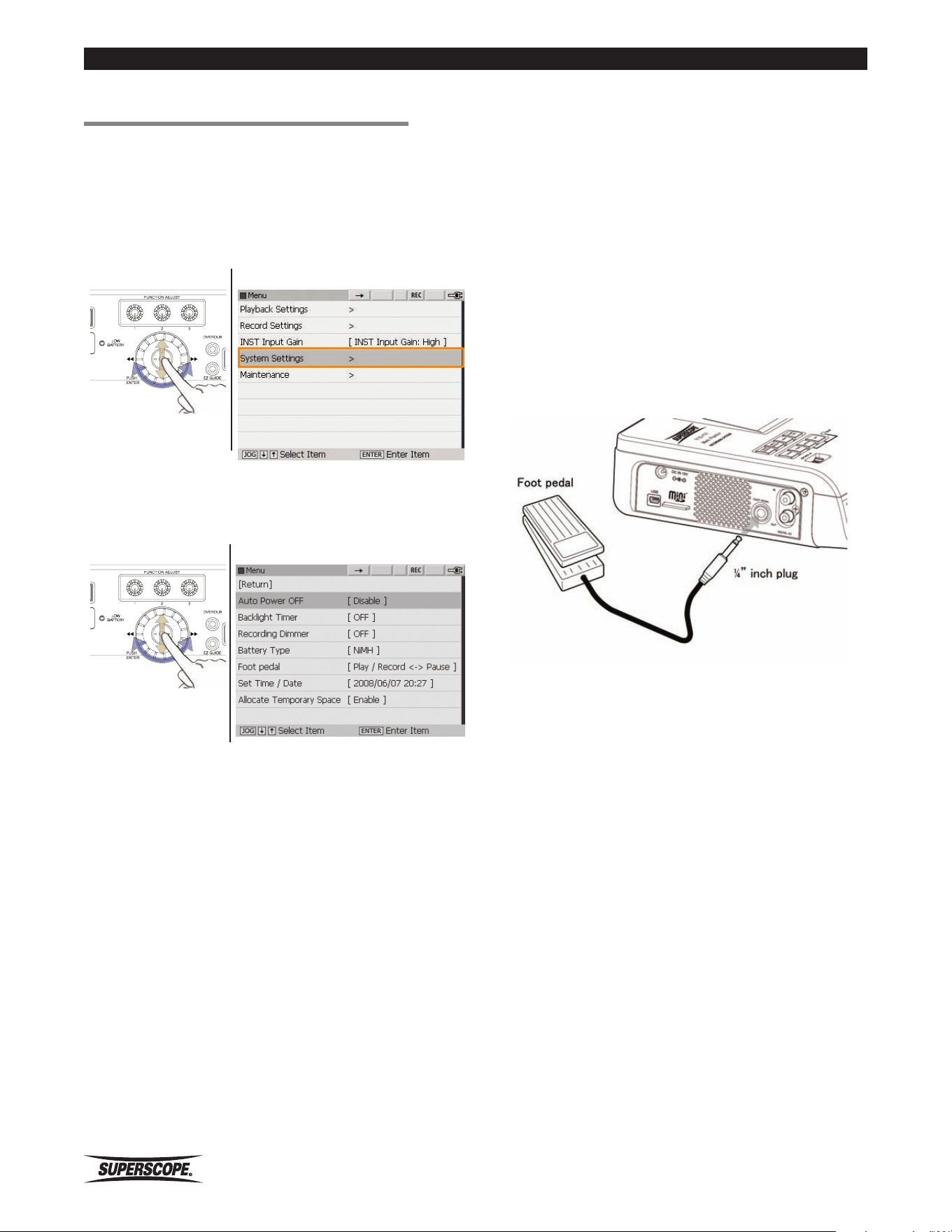
- 106 -
Superscope PSD450mkII User Manual
System Settings
■
System Settings
Follow these steps to adjust System Settings:
1. Press the MENU button to display the menu screen.
2. Turn the jog wheel or move the joystick up or down
to highlight System Settings. Press ENTER.
Menu Screen
3. From the System Settings menu, turn the jog wheel
or move the joystick up or down to highlight a menu
setting. Press ENTER.
Menu Screen
4. Turn the jog wheel to change settings. Press ENTER.
Auto Power Off
Turn this feature on to conserve power when the
recorder is not in use. When Auto Power OFF is enabled,
the recorder will power off automatically after 15
minutes of inactivity. This includes the use of all top
panel buttons and knobs, and the remote control. This
feature is disabled during recording and playback. The
default setting is [Disable].
Backlight Timer
This feature saves power by automatically dimming the
LCD backlight after a period of inactivity. This includes
the use of all top panel buttons and knobs, and the
remote control. Settings include OFF, 2 seconds, 5
seconds, 10 seconds, and 20 seconds.
The default setting is OFF.
Recording Dimmer
When this feature is OFF (default setting), the LCD
backlight will not dim during recording regardless of the
Backlight Timer setting. This will save power by allowing
the backlight to dim during recording.
Battery Type
Setting Battery Type allows for greater accuracy with
the battery life gauge. Available options include alkaline
batteries (default setting) and nickel metal hydride
(Ni-MH).
Foot Pedal
An optional foot pedal can be connected to the Foot
Pedal input on the Left panel.
Superscope PSD450mkII User Manual
- 107 -
System Settings
The following table describes the functions of the foot
pedal:
Foot Pedal Setting Performance
Play/REC <-> Pause
During playback, press the
foot pedal to toggle between
Play and Pause mode.
During Recording, press the
foot pedal to toggle between
Record and Record Pause
mode.
Play <-> Recall
During playback, press the
foot pedal once to mark a
recall point.
When the foot pedal is
pressed a second time,
playback will return to the
recall point.
Play <-> Rewind
During playback, press the
foot pedal to toggle between
play and Rewind.
The default setting is "Play/REC <-> Pause”.
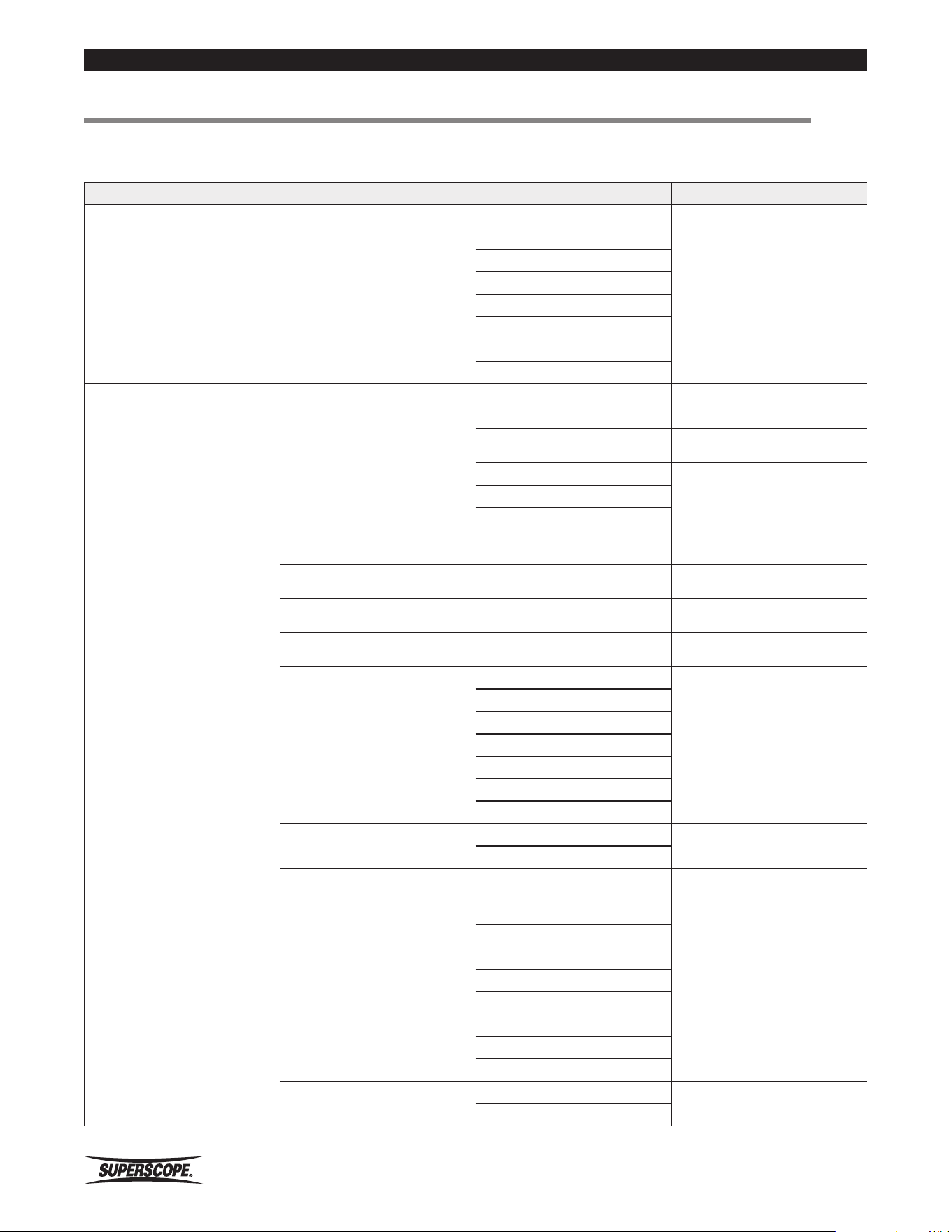
- 108 -
Superscope PSD450mkII User Manual
Appendix
■Appendix
Main Menu (1 of 2)
Sub Menu Menu Item Settings Default Settings
Playback Setting
Repeat Mode
OFF
OFF
All
1
Single, 1
Single, All
Single
Playback Equalizer
OFF
OFF
ON
Advanced Record Settings
Silent Skip Recording
ON
OFF
OFF
Silent time detector
0 ~ 5 sec
3
Theshold
-40 dB-20 dB ~ -60 dB
1 dB step
Pre-Roll Time
OFF, 1 ~ 10 sec
(Increment: 1 sec)
0 sec
Post-Roll Time
OFF, 1 ~ 10 sec
(Increment: 1 sec)
0 sec
Fade-IN Time
0 ~ 10 sec
(Increment: 1 sec)
0 sec
Fade-OUT Time
0 ~ 10 sec
(Increment: 1 sec)
0 sec
Auto Track Increment
(+/- 2 seconds)
OFF
OFF
OFF
1 min.
5 min.
10 min.
15 min.
30 min.
One Touch Recording
ON
ON
OFF
Count In
OFF, 1 ~ 16 beat
Increment: 1 beat
OFF
Auto Convert
ON
OFF
OFF
CD-PreGap Settings
0 Seconds
0 Seconds
1 Second
2 Seconds
3 Seconds
4 Seconds
5 Seconds
USBHDD+Int Memory REC
ON
OFF
OFF
Superscope PSD450mkII User Manual
- 109 -
Appendix
Sub Menu Menu Item Settings Default Settings
Input Effects
Input Equalizer
OFF
OFF
Effecttive
Reverb/Delay
OFF
OFF
Room Reverb
Hall Revereb
Plate Reverb
Delay
Mix Mode & Monitor Source
Mix Balance Mode & Monitor
Stereo Mix
Stereo Mix
Split
L ch Mix
R ch Mix
Monaural Mix
Monitor Source
Recording Signal
Recording Signal
Playback Signal
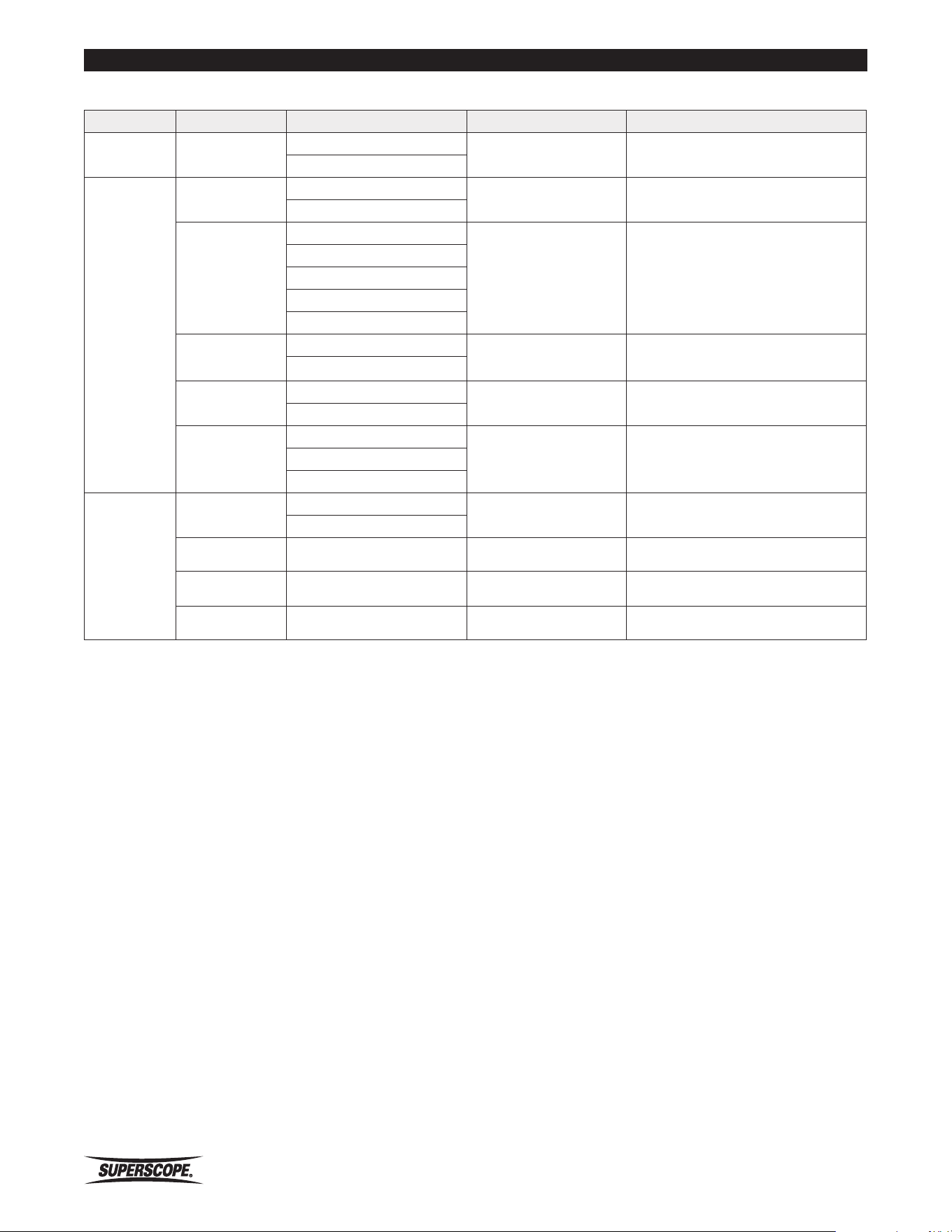
- 110 -
Superscope PSD450mkII User Manual
Appendix
Main Menu (2 of 2)
Sub Menu Menu Item Settings Default Settings Note
Inst Input Gain
Setting
Inst Input Gain
High
High Sets the sensitivity for the INST input.
Low
System
Settings
Auto Power OFF
Disable
Enable
Powers the unit off after 15 minutes of no
activity.
Enable
Backlight Timer
OFF
OFF
Dims the LCD backlight after the selected
period of inactivity.
2 sec
5 sec
10 sec
20 sec
Recording Dimmer
ON
ON
Turn ON to maintain LCD backlight during
recording regardless of Backlight Timer
setting.
OFF
Battery Type
NiMH
NiMH
For accurate battery gauge read out,
select Battery Type.
Allaline
Foot Pedal
Play/Record <-> Pause
Play/Record <-> Pause Select Foot Pedal function.Play <-> Pause
Play <-> Rewind
Maintenance
Set Time/Date
Year/Month/Day
—
Time/Date determines file name for new
recordings. See Setting Date and Time.
Hour: Minute: Second
System
Information
— —
Displays Model, Software Version, HDD
capacity (PSD450 only) and SD capacity.
Format Internal
Memory
— —
※ All the data currently on the SD
card will be deleted.
Restore Defaults — —
Returns all menu settings to factory
default values.
Superscope PSD450mkII User Manual
- 111 -
Appendix
Recording Settings Menu
Sub Menu Menu Item Settings Default Setting
Input Select Input Source
Input Mute
Internal MIC
Input Mute
Internal MIC
External Mic
LINE
INST
Internal Mic (L ch) + INST
External MIC (L ch) + INST
LINE (L ch) + INST
AUX
DIGITAL
Recording Folder Device select
Int Memory
Int MemoryCD-R/CD-RW
USBHDD
WAV/MP2 Recording File Format
WAV
WAV
MP3
Stereo/Mono Recording Channel Number
Stereo
Stereo
Monaural
Bit Rate Recording File Bit Rate
32 bps
192 bps
40 bps
48 bps
56 bps
64 bps
80 bps
96 bps
112 bps
128 bps
160 bps
192 bps
224 bps
256 bps
320 bps
- 112 -
Superscope PSD450mkII User Manual
Appendix
Edit Menu Options
Selected Item
16bit WAV file 24bit WAV file MP3 file Playlist Folder
Track Information Track Information Track Information Copy Copy
Copy Copy Copy Move Move
Move Move Move Rename Rename
Rename Rename Rename Delete Delete
Delete Delete Delete Edit Playlist
Trim In/Out 24 > 16bit Convert Export
Divide
Combine
Export
Superscope PSD450mkII User Manual
- 113 -
Appendix
Music Practice Tools Menu
Sub Menu Menu Item Settings Default Setting
Tempo & Key
Tempo x[-0.75 ~ 1.50] (-75 ~ 150%) Increment: 0.01(1%) X 1.00 (100%)
Key [-12.0 ~ +12.0] semitones Increment: 1 semitone 0 semitones
Fine Tune [-50 ~ +50] cent Increment: 1 cent 0 cents
Calibration A4: [430 ~ 460] Hz Increment: 1 Hz 440 Hz
Voice Reduction
Voice Reduction ON / OFF OFF
Chromatic Tuner
Input Source
Input Mute
Input Mute
Internal MIC
External MIC
LINE
INST
Internal MIC (L ch) + INST
External MIC (L ch) + INST
LINE (L ch) + INST
AUX
DIGITAL
Channel Select
Left + Right
Left + RightLeft
Right
Calibration [410 ~ 470] Hz Increment: 1 Hz 440 Hz
Tuning Tone
Tone Name C, C#, D, D#, E, F, F#, G, G#, A, A#, B A
Calibration [410 ~ 470] Hz Increment: 1 Hz 440 Hz
Volume [-20 ~ 0] dB Increment: 0.5 dB -10.0 dB
Metronome
ON / OFF
ON
OFF
OFF
BPM [35 ~ 250] BPM Increment: 1 BPM 120 BPM
Accent Beat Number [0 (OFF) ~ 9] Increment: 1 4
Normal Beat Volume [MUTE, -20.0 ~ 0.0] dB Increment: 0.5 dB -12.0 dB
Accent Beat Volume [MUTE, -20.0 ~ 10.0] dB Increment: 0.5 dB 0.0 dB
- 114 -
Superscope PSD450mkII User Manual
Appendix
Continuous Recording Time with Battery Operation
The following estimates show minimum battery life.
Battery Type LCD Phantom Battery Life (hours)
Fully charged 2,700 mAh
Ni-MH
Full bright
OFF 5.2
ON 4.7
Dimmer
OFF 6.2
ON 5.4
AA size
Alkaline
Full bright
OFF 2.6
ON 2.5
Dimmer
OFF 3.6
ON 3.0
Conditions:
77 degrees Fahrenheit.
Volume controller:
Minimum position.
Mode:
Recording MP3-Stereo-128kbps.
Internal Memory Times
The table below shows estimated record times.
Estimated Record Times Internal Memory Continuous Recording
WAV
44.1 KHz
16bit 1 hr 34 min
24bit 1 hr 02 min
MP3
Stereo
64 Kbps 34 hr 43 min
80 Kbps 27 hr 46 min
128 Kbps 17 hr 21 min
160 Kbps 13 hr 53 min
256 Kbps 8 hr 40 min
320 Kbps 6 hr 56 min
MP3
Mono
32 Kbps 69 hr 26 min
40 Kbps 55 hr 33 min
64 Kbps 34 hr 43 min
80 Kbps 27 hr 46 min
128 Kbps 17 hr 21 min
160 Kbps 13 hr 53 min
Superscope PSD450mkII User Manual
- 115 -
Appendix
Pop-Up Messages
Category Message Description
Create Playlist
“Edit Playlist”
“File write error.”
Playlist cannot be written if media is full.
CD
“Disc Information”
“CD EJECT”
A disc is ejected.
“Disc Information”
“Now Loading...”
MAKE CD button is pressed and the loaded disc is still
being read.
“Disc Information”
“CD No Disc.”
“Please insert CD.”
MAKE CD button is pressed and no disc is inserted.
“Disc Information”
“CD Error.”
“Unknown Disc.”
MAKE CD button is pressed and the loaded disc is of
an unknown format.
“Warning”
“This folder contains the maximum number of
files.”
“Please select a different folder.”
Record button is pressed and there is already the
maximum number of files in the selected folder.
“Warning”
“This Overdub mode is not possible with CDA
files.”
“Reset loop markers or”
“Use EDIT>CD RIPPING to create WAV version.”
OVERDUB button is pressed and the selected track is
from an Audio CD.
“Warning”
“This disc is not Audio Disc.”
Recording to CD and a data disc is loaded.
“Warning”
“This disc is not recordable.”
Recording to CD and the loaded disc is not recordable.
“Warning”
“This disc has max tracks.”
Recording to CD and the loaded disc has the maximum
number of tracks.
“Disc Information”
“Please wait…”
RecPause during Recording to CD.
“Check AC Adapter”
“Please connect AC Adapter.”
AddTrack/MakeCD when AC Adapter is disconnected.
CD Ripping
EDIT
base:
new:
“Ripping Track…”
During CD Ripping.
EDIT
“Terminate Now?”
DELETE/CANCEL button is pressed during CD Ripping.
MakeCD
“Ready to burn?” When [Execute] is selected on Make CD screen.
“CD burning…” During CD writing.
“Disc Information”
“Disc write error.”
When Disc write error occurs.
AddTrack
“Disc Information”
“This disc has max tracks.”
When the CD Burn List has the maximum number of
tracks.
“CD burning…” During CD writing.
“Convert file…” During converting WAV 24bit to WAV 16bit.
“Disc Information”
“Disc write error.”
When Disc write error occurs.
“Finalize CD…” During Finalize CD.
- 116 -
Superscope PSD450mkII User Manual
Appendix
Duplicate
“CD Ripping…” During CD Ripping.
“Terminate Now?” DELETE/CANCEL button is pressed during CD Ripping.
“Disc Information”
“File write error.”
When Disc write error occurs.
“Disc Information”
“The disc is not supported.”
When disc is not supported.
Ex: multisession disc
“Disc Information”
“File read error.”
When Disc write error occurs.
“Disc Information”
“Now Loading...”
During checking a loaded disc.
“Insert a blank CD.” Insert a blank CD for creating duplicate.
“CD Erase All?” A loaded disc is CD-RW and not a blank disc.
“Erasing data…” During erasing data.
Erase CD
“CD Erase All?” Confirm CD erase.
“Erasing data…” During erasing data.
Erase Last
“Erase Last Track?” When [Erase CD] is selected on Erase screen.
“Unfinalizing CD…” When a loaded disc is Finalized CD-RW.
“Erasing data…” During erasing data.
Finalize
“Finalize this CD-R?” When [Finalize] is selected.
“Finalize this CD-RW?” When [Finalize] is selected.
“Finalize CD…” During finalizing CD.
Unfinalize
“Unfinalize?” When [Unfinalize] is selected.
“Unfinalizing CD…” During unfinalizing CD.
Pop-Up Messages (continued)

Superscope PSD450mkII User Manual
- 117 -
Specifications
■Specifications
General
Number of Recording Channels .................... 2 (stereo)
Recording / Playback Formats ....... WAV, MP3, CD-DA
16bit/24bit Recording Format: linear PCM WAV 44.1KHz
(extension WAV)
MP3 Stereo 64, 80, 128, 160, 256, 320 Kbps
MP3 Mono 32, 40, 64, 80, 128, 160 Kbps
A / D Conversion .......................... 24bit Σ-D conversion
D / A Conversion .......................... 24bit Σ-D conversion
Sampling Rate. ............................................... 44.1 KHz
Maximum Recording File Size ..............................2 GB
Display .. High-resolution 3.5-inch TFT LCD Color Display
Power Requirements ....................................................
15 VDC 1.6A Center Pin Positive
AC 100 - 240 V 50/60 Hz Power Supply
Battery 8 X “AA” Alkaline or Ni-MH
Dimensions ............................... 10.5(W) 3.3(H) 7.8(D) in
269 (W) 81 (H) 202 (D) mm
Weight ..........................4.6 lb / 2.1 Kg without Batteries
Operating Temperature.............................5°C to 35°C
(41°F to 95°F)
Internal Speaker ........................................... 3.5 cm X 1
Internal Microphones ............... Electret Condenser X 2
Phantom Power Supply ..................... 48 V 10 mA max
USB..USB 2.0 High speed / Mass Storage Class Operation
Audio
Analog to Digital Converter ............. 24 Bit Resolution
Digital to Analog Converter ............. 24 Bit Resolution
Overall Frequency Response .20 Hz to 20 KHz +/- 1 dB
Line Output Level ................................2.2 Vrms, 300W
Headphone Output Level ...... 30m W, 32 W, 10% THD
Speaker Output Level ................... 2 W, 8 W, 10% THD
Digital Output Level .....................0.5 Vp-p, 75 W Load
Input/Outputs
Mic / Line Inputs
Mic Level
Input Sensitivity .....................................1.2 mV, 12 KW
THD ..................................................................... 0.18%
S/N............................................................60 dB A-WTD
Max. Input Level .................75 mV RMS (Mic. ATT OFF)
375 mV RMS (Mic. ATT ON)
Line Level
Input Sensitivity ....................................500 mV, 12 KW
THD ..................................................................... 0.01%
S/N............................................................92 dB A-WTD
Max. Input Level .................................................. 4.0 V
Instrument Input
High Gain
Input Sensitivity .......................................10 mV, 1 MW
THD .....................................................................0.03%
S/N............................................................72 dB A-WTD
Max. Input Level .............................................. 670 mV
Low Gain
Input Sensitivity ................................... 500 mV, 22 KW
THD ..................................................................... 0.01%
S/N............................................................92 dB A-WTD
Max. Input Level ........................................... 3,500 mV
AUX Input
Input Sensitivity ................................... 500 mV, 22 KW
THD ..................................................................... 0.01%
S/N............................................................92 dB A-WTD
Max. Input Level .................................There is no limit.
Appearance standards and specifications are subject to
change without notice.

■Trademarks, Copyrights and
Disclaimers
MPEG Layer-3 Licensing
MPEG Layer-3 audio coding technology licensed from Fraunhofer IIS and Thompson.
“Supply of this product does not convey a license nor imply any right to distribute MPEG Layer-3 compliant content
created with this product in revenue-generating broadcast systems (terrestrial, satellite, cable and/or other distribution
channels), streaming applications (via Internet, intranets and/or other networks). Other content distribution systems
(pay-audio or audio-on-demand applications and the like) or on physical media (compact disc, digital versatile discs,
semiconductor chips, hard drives, memory cards and the like). An independent license for such use is required. For
details, please visit http://mp3licensing.com.”
This product is designed to help you record
and reproduce sound works to which you
own or copyright, or where you have obtained
permission from the copyright holder or the
rightful licensor.
Unless you own the copyright, or have obtained
the appropriate permission from the copyright
holder or the rightful licensor, your unauthorized
recording, reproduction or distribution thereof
may result in severe criminal penalties under
copyright laws and international copyright
treaties.

Superscope Technologies, Inc.
1508 Batavia Ave.
Geneva, IL 60134-3302
12/2013
Phone: 630-232-8900 Fax: 630-232-8905
www.SuperscopeTechnologies.com
© Copyright Superscope Technologies, Inc.
All Rights Reserved.
www.SuperscopeTechnologies.com
■One Year Limited Warranty
Your Superscope PSD450mkII is warranted against manufacturer defects in material and workmanship for one year
parts and labor.
Non-transferable Warranty:
This warranty may be enforced only by the original purchaser.
The following are not covered under warranty:
1. Damage, deterioration, malfunction or failure to meet performance specifications resulting from
•accident,actsofnature,misuse,abuse,neglectorunauthorizedproductmodication.
•improperinstallation,removalormaintenance,orfailuretofollowsuppliedinstructions.
•repairorattemptedrepairbyanon-Superscopeauthorizedagent.
•anyshipment(claimsmustbepresentedtothecarrier).
•anycauseotherthanadefectofmanufacturing.
2. Cleaning, check-ups with no fault found.
3. Any product on which the serial number has been defaced, modified, or removed.
4. Accessories, including but not limited to, cables and adaptors.
5. Product purchased outside of the United States, its possessions or territories.
The following are covered under warranty:
All labor and material expenses for items covered by the warranty.
To Obtain Service:
1. If your unit needs service contact Superscope at (630)232-8900. A service representative will advise you of how
to obtain service. Please do not return the unit directly to Superscope Technologies, unless specified by our service
representative.
2. You must pay any shipping charges if it is necessary to ship the product for service. If the necessary repairs are
covered by the warranty, we will pay return shipping charges to your location anywhere in the United States.
3. Whenever warranty service is required, you must present the original dated sales receipt, or other proof of
purchase.
Limitation of Implied Warranties:
All implied warranties, including warranties of merchantability and fitness for a particular purpose, are limited in
duration to the length of this warranty.
Exclusion of Damages:
Liability for any defective product is limited to repair or replacement of the product at Superscope’s option.
Superscope shall not be liable for damage to other products caused by any defects in Superscope products, damages
based on inconvenience or loss of use of the product, or any other damages, whether incidental, consequential, or
otherwise.
Some States do not allow limitations on how long an implied warranty lasts and/or do not allow the exclusion or
limitation of incidental or consequential damages, so the above limitations and exclusions may not apply to you.
How State Law Relates to the Warranty:
This warranty gives you specific legal rights, and you may have other rights which may vary from State to State.
This warranty is enforceable only in the United States and its possessions or territories.
