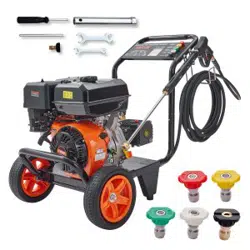

Technical Support and E-Warranty Certificate www.vevor.com/support
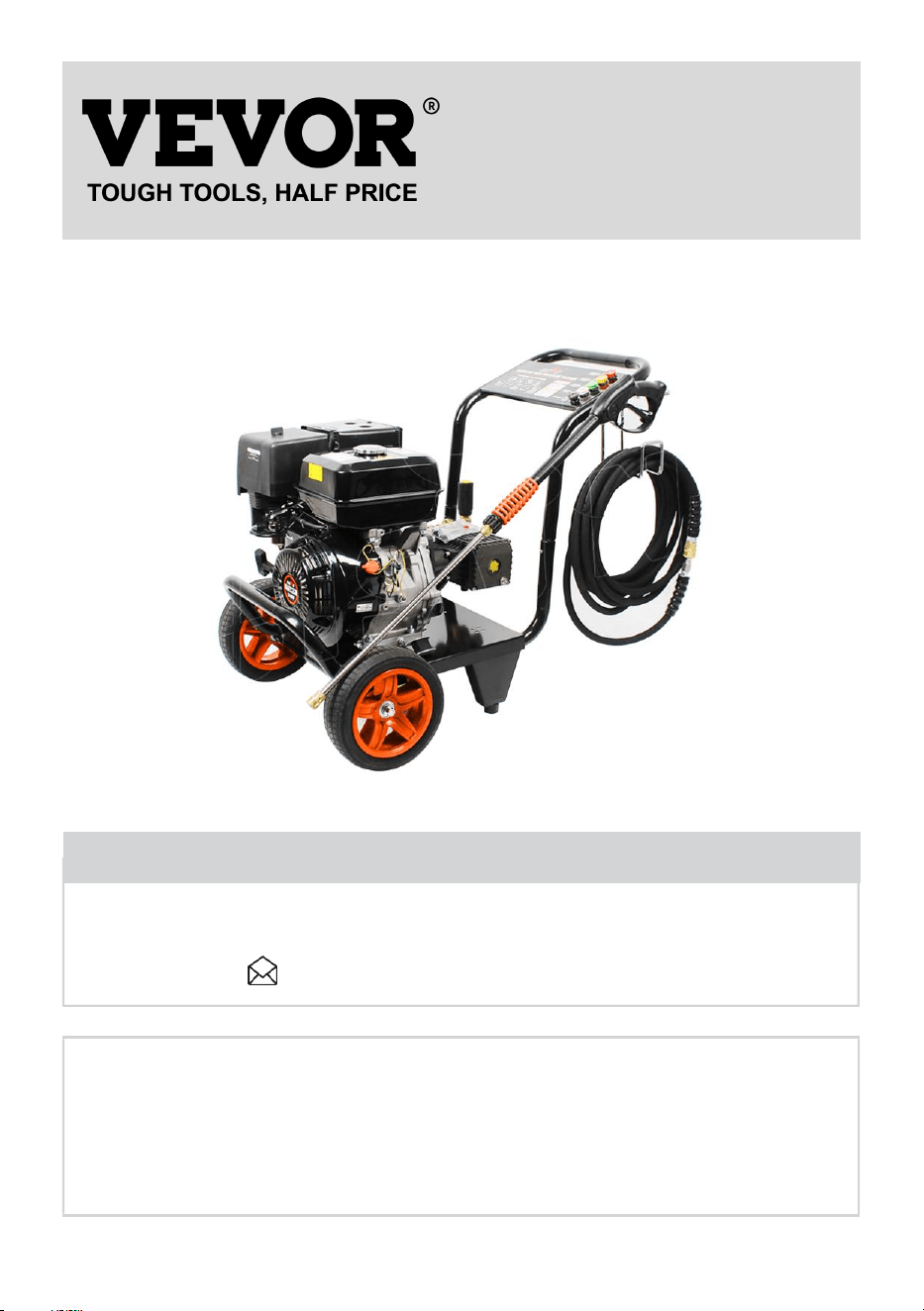
GASOLINE HIGH PRESSURE WASHER
USER'S MANUAL
MODEL:G250A
We continue to be committed to provide you tools with competitive price.
"Save Half", "Half Price" or any other similar expressions used by us only represents an
estimate of savings you might benefit from buying certain tools with us compared to the major
top brands and doses not necessarily mean to cover all categories of tools offered by us. You
are kindly reminded to verify carefully when you are placing an order with us if you are
actually saving half in comparison with the top major brands.

- 1 -
MODEL: IMN1000-UL
G250A
Have product questions? Need technical support? Please feel free to
contact us:
CustomerService@vevor.com
NEED HELP? CONTACT US!
This is the original instruction, please read all manual instructions
carefully before operating. VEVOR reserves a clear interpretation of our
user manual. The appearance of the product shall be subject to the
product you received. Please forgive us that we won't inform you again if
there are any technology or software updates on our product.
GASOLINE HIGH
PRESSURE WASHER
- 2 -
TABLE OF CONTENTS
TABLE OF CONTENTS..........................................................................................2
SAFETY GUIDELINES/DEFINITIONS...................................................................2
IMPORTANTSAFETY INSTRUCTIONS...........................................................3-8
PACKAGE CONTENTS.........................................................................................8
PRESSURE PUMPTECHNICAL PARAMETER.....................................................9
OPERATING INSTRUCTIONS.......................................................................9-18
MAINTENANCE..........................................................................................18-20
STORAGE.......................................................................................................20-21
TROUBLE SHOOTING GUIDE.......................................................................21-25
EXPLODED VIEW OF THE PUMP..................................................................25-28
SAFETY GUIDELINES/DEFINITIONS
This manual contains information that is important for you to know and understand.
This information relates to protecting YOUR SAFETY and PREVENTING
EQUIPMENT PROBLEMS.Please read the manual and attend to these sections.
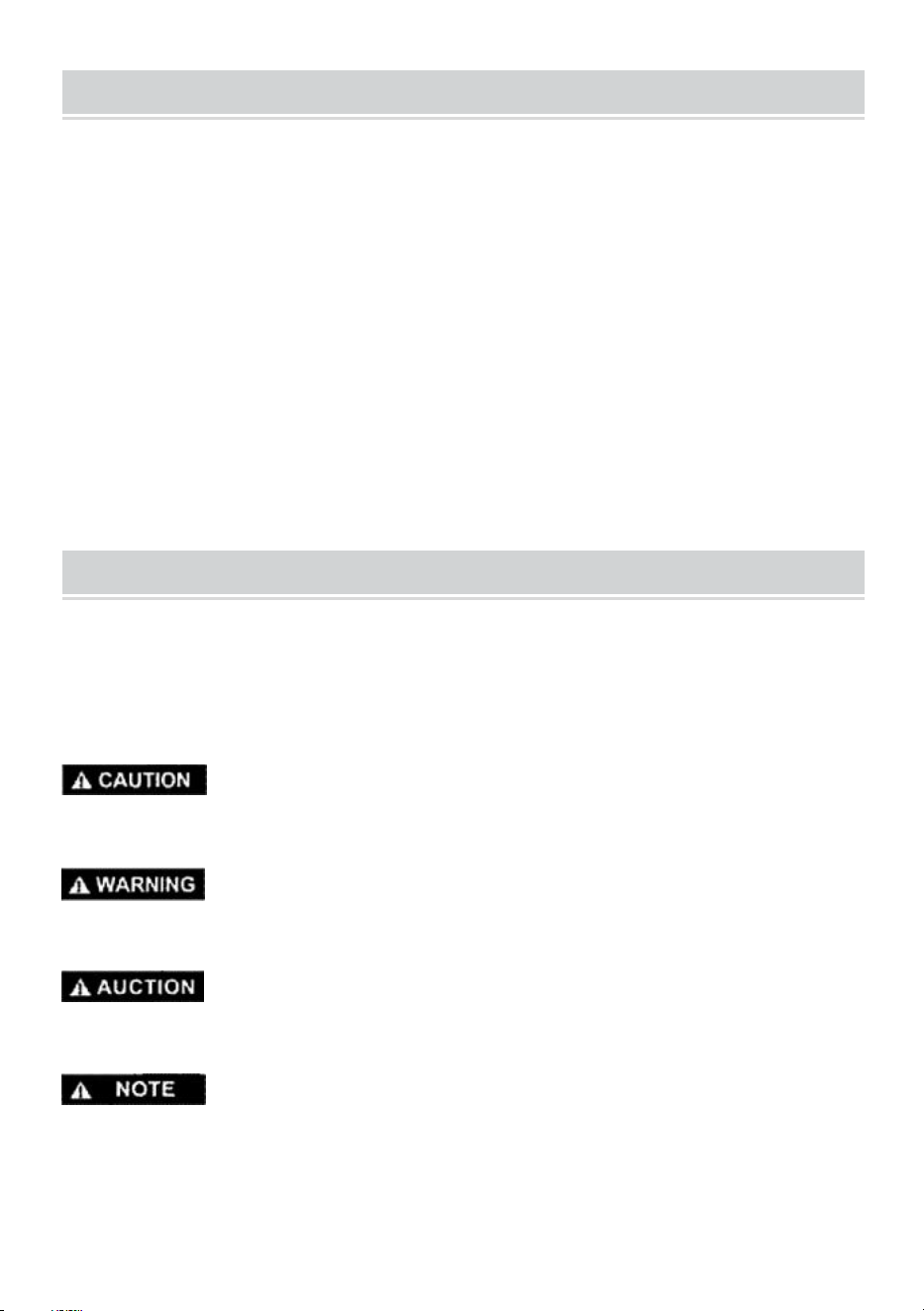
indicates an imminent hazardous situation which, if not avoided,
Will result in death or serious injury.
indicates an potentially hazardous situation which, if not avoided,
could result in death or se rious injury.
indicates an potentially hazardous situation which, if not
avoided,may result in minor or moderate injury.
used without the safety alert symbol indiating potentially
hazardous situation which, if not avoid, may result in property damage.
- 3 -
IMPORTANT SAFETY INSTRUCTIONS
Read operation manual. Do not operate equipment until you
have Read operation manual for safety. Assembly,operation,and maintenance
instructions.
HAZARD RISK OF EXPLOSION OR
FIRE
WHAT CAN HAPPEN
HOW TO PREVENT IT
● Spilled gasoline and it's vapors
can become ignited from cigarette
sparks, electrical arcing,exhaust
gases, and hot Engine components
such as the silencer.
● Shut off engine and allow it to cool
before adding fuel to the lank.
● Use care in filing tank to avoid spilling
fuel.
● Move pressure washer away from
fueling area before starting engine.
● Heat will expand fuel in the tank
which could result in spillage and
possible fire explosion.
● Keep maximum fuel level 1/2 below top
of tank to allow for expansion.
● Operating the pressure washer in
an explosive environment could
result in fire.
● Operate and fuel equipmentin well
ventilated zones free from obstructions.
Equip zone with fire extinguisher suitable
for gasoline fires.
● Materials placed against or near
the
pressure washer can interfere with
its proper ventilation causing
overheating and possible ignition
of the materials.
● Never operate pressure washer in an
area containing dry brush or weeds.
● Silencer exhaust heat can
damage painted surfaces, melt any
material sensitive to heat (such
assiding. plastic, rubber,or
● Always keep pressure washer a
minimum of five feet away from surfaces
(such as houses, automobiles,or live
plants)
- 4 -
vinyl)and damage live plants.
That could be damaged from muffler
exhaust heat.
● Improperly stored fuel could lead to
accidental ignition.Improperly secured fuel could get
into the hands of children or other unqualiffied persons.
● Store fuel in an
approved container
in a secure location
away from work
area.
● Use of acids, toxic or corrosive
chemicals.poisons.insecticides,or any
Kind of flammable solvent with this product could result in
serio- usinjury or death.
● Do not spray
flammable liquids.
HAZARD RISK TO BREATHING
WHAT CAN HAPPEN
HOW TO PREVENT IT
● Breathing exhaust fumes will
cause serious injury even death!
● Operate pressure washer in a well
ventilated area.
● Avoid enclosed areas such as garages,
basements, etc.
● Never operate unit at location occupled
by humans or animals.
● Some cleaning fluids contain
substances that could cause injury
to skin, eyes, or lungs.
● Use only cleaning fluids specifically
reco- mmended for high pressure
washers. Follow manufactures
recommendations. Do not use chlorine
bleach or any other corrosive compound.
HAZARD RISK OF HOT SURFACE
- 5 -
WHAT CAN HAPPEN
HOW TO PREVENT IT
● Contact with hot surfaces,such as
engines exhaust components,could
result in serious burn.
● During operation, touch only the control
surfaces of the pressure washer,Keep
children away from the pressure washer
at all times. They are too young to
recognize the hazards of this product.
HAZARD RISK OF FUILD INJECTION
WHAT CAN HAPPEN
HOW TO PREVENT IT
● Your washer operates at fluid
pressures and velocities high
enough to penetrate human and
animal flesh, which could result in
amputation or other serious injury.
Leaks caused by loose fittings or
damaged hoses can result in
injection juries, DO NOT TREAT
FLUID INJECTION ASA
SIMPLECUT! See a physician
immediately!
● Never place hands in front of nozzle.
● Direct spray away from self or others.
● Make sure hose and fittings are
tightened and in a good condition.
● Never hold onto the hose or fittings
during operation.
● Do not allow hose to contact muffler.
● Never attach or remove spray wand or
Hose fittings while system is pressurized.
● Injuries can result if system
pressure is not reduced before
attempting mainten- ance or
disassembly.
● Use only hose and accessories rated
for pressure higher than your press
washer's p.s.i.
HAZARD RISK OF INJURY FROM
SPRAY
WHAT CAN HAPPEN
HOW TO PREVENT IT
- 6 -
● High velocity fluid spray can
cause objects to break,propelling
particles at High speed.
● Light or unsecured objects can
become hazardous projectiles.
● Always wear approved safety glasses.
Wear protective clothing to protect
against accidental spraying.
● Never point spray wand at people or
animals.
● Always secure trigger lock when spray
wand is not in service to prevent
accidental operation.
● Never permanently secure trigger in
open position.
HAZARD RISK OF CHEMICAL BURN
WHAT CAN HAPPEN
HOW TO PREVENT IT
● Use of acids toxic or corrosive
chemicals, poisons, insecticides, or
any kind of flammable solvent with
this product could result in serious
injury or death.
● Do not use acids,gasoline,kerosene, or
any other flammable materials in this
product. Use only household
detergents, cleaners and degreasers
recommended for use in pressure
washers.
● Wear protective clothing to protect eyes
and skin from contact with sprayed
materials.
HAZARD RISK OF UNSAFE
OPERATION
WHAT CAN HAPPEN
HOW TO PREVENT IT
● Unsafe operation of your
pressure washer could lead to
● Do not use chlorine bleach or any other
Corrosive compound.

- 7 -
serious injury or death to you or
others.
● Become familiar with the operation and
controls of the pressure washer.
● Keep operating area clear of all
persons, pets and obatacles.
● Do not operate the product when
fatigued or under the influence of alcohol
or drugs.
● If proper starting procedure is not
followed, engine can kickback,
causing serious hand and arm
injury.
Stay alert at all times.
● Never defeat the safety features of this
product.
● Do not operate machine with missing.
broken, or unauthorized parts.
● Never leave spray wand unattended
while unit is running.
● If engine does not start after two pulls,
squeeze trigger of gun to relieve pump
pressure,pull starter cord slowly until
resistance is felt. Then pull cord rapidly to
avoid kickback and prevent hand or arm
injury.
● The spray gun/spray wand is a
powerful cleaning tool that could
look like a toy to a child.
● Keep children away from the pressure
washer at all times.
● Reactive force of spray will cause
gun/wand to move, and could
cause the operator to slip or fall,or
misdirect the spray.Improper
control of gun/spray wand can
result in injury to self and others.
● Do not overreach or stand on an
unstable support.Grip gun/spray wand
firmly with both hands. Expect the gun to
kick when triggered.
- 8 -
HAZARD RISK OF ELECTRICAL
SHOCK
WHAT CAN HAPPEN
HOW TO PREVENT IT
● Spray directed at electrical outlets
or switches or objects connected to
an electrical circuit, could result in a
fatal electrical shock.
● Unplug any electrically operated
product before attempting to clean it.
Direct spray away from electric outlets
and swiches.
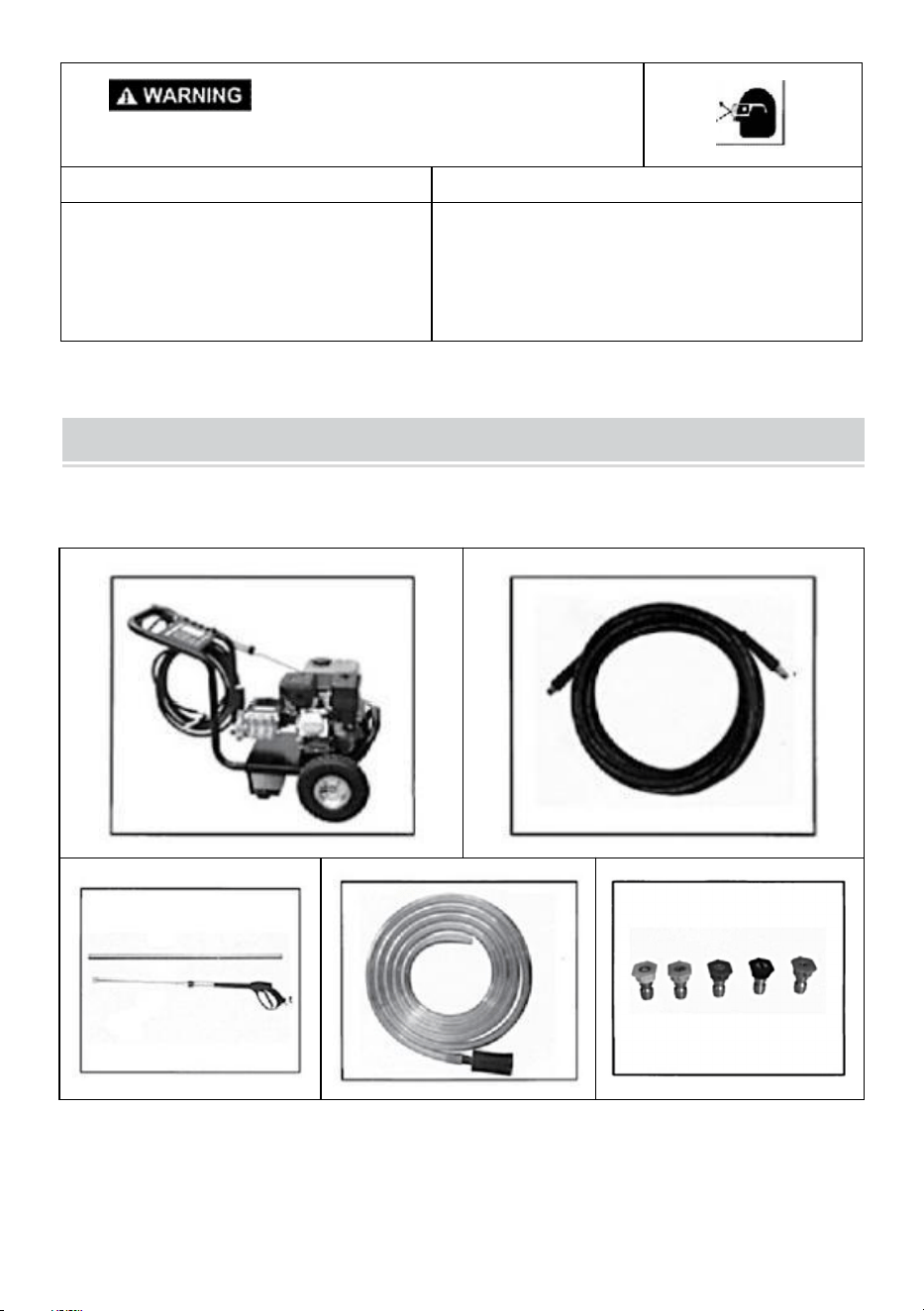
PACKAGE CONTENTS
Note: photographs and line drawings used in this manual are for reference only
and do not represent a specific model.
Manuals: Engine Manual pressure washer operation manual.
- 9 -
PRESSURE PUMP TECHNICAL PARAMETER
PRESSURE PUMP TECHNICAL PARAMETER AND PERFORMANCE
Model
G250A
Model
G250A
Pressure
4400psi
Fuel tank
6.5L
Max.flow
4GPM
Oil volume -
engine
1.1L
Rated power
15HP
Self-pumping start
time
1min
Engine speed
3600RPM
Suction height
1 m
Allowable
temperature
0-60°C
Cut-out function at
low oil level
Yes
Weight
approx. 57.4kg
Size(L*W*H)
950*670*795mm
OPERATING INSTRUCTIONS
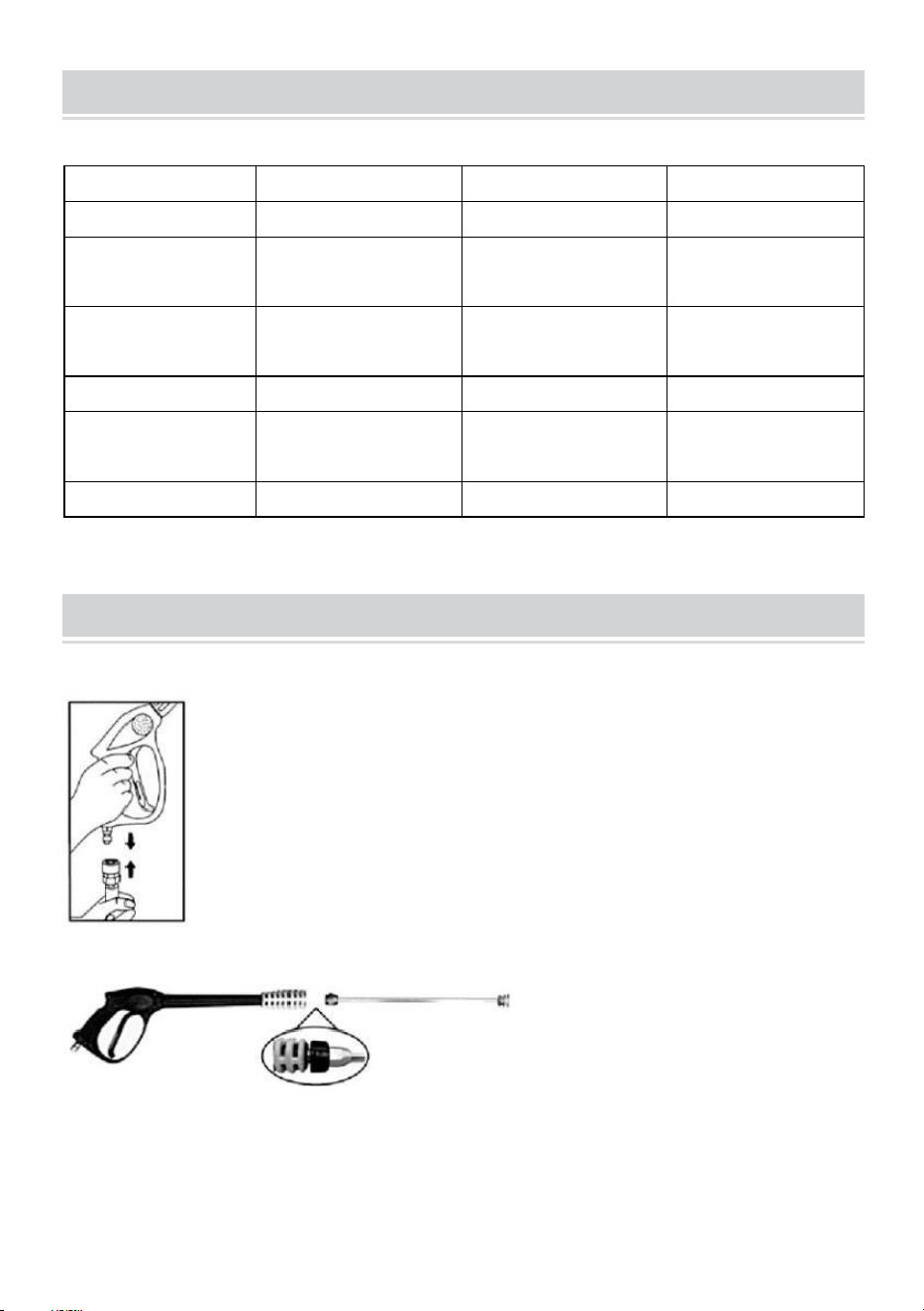
1.Attach high pressure hose to gun. Tighten securely.
2.Connect spray lance to gun. Tighten securely.
3.Assemble grommet kit and quick-connect nozzles as described in the
instructions supplied.
- 10 -
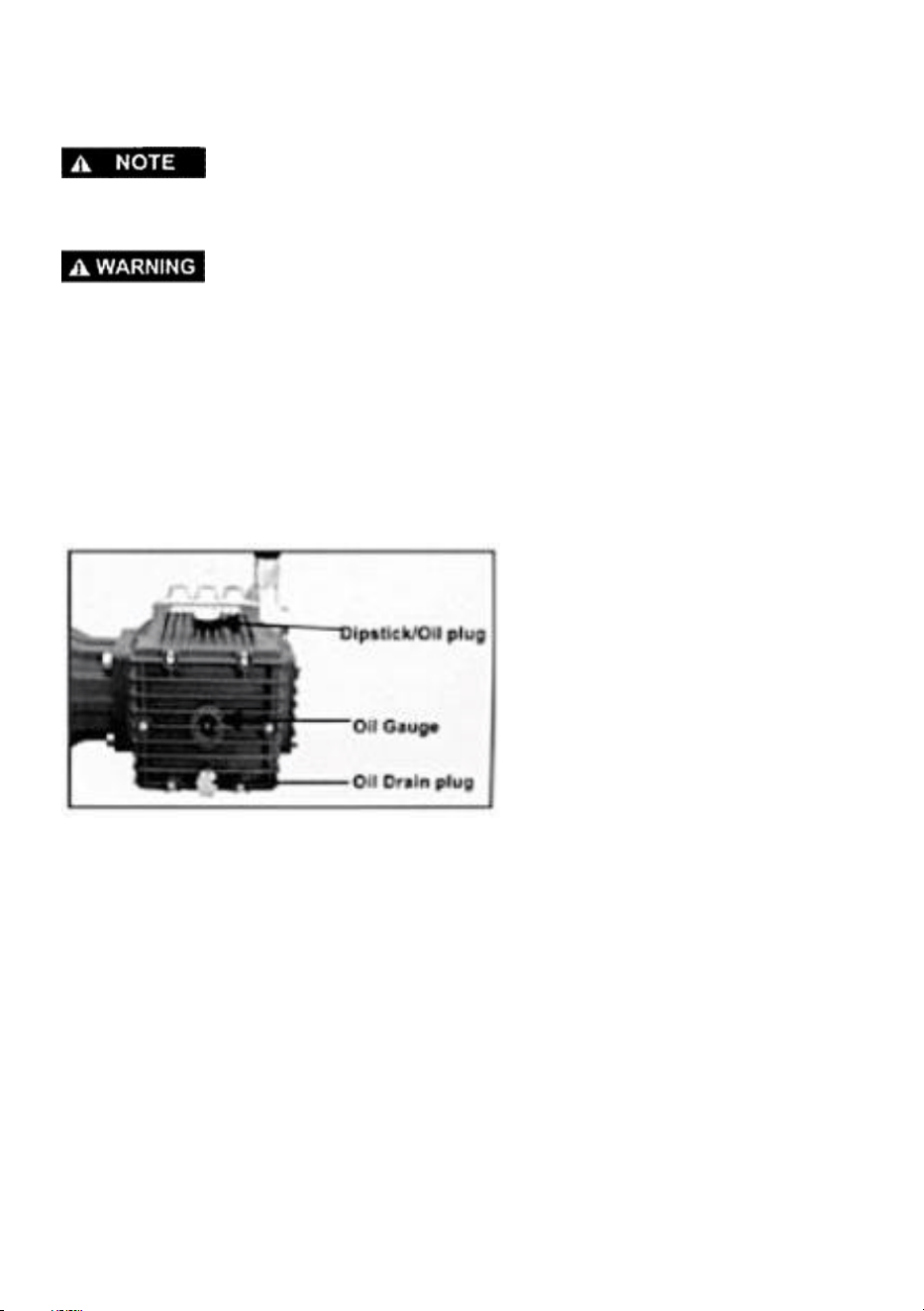
4.Add engine oil(supplied)to engine.Refer to engine owners manual supplied by
engine manufacturer for correct procedure.
There will be a slight amount of oil in the engine from factory
testing.
The shipping plug must be removed and replaced with the
dipstick/oil plug before operating pressure washer.
5.Using a 17 mm wrench, remove shipping plug from pump by turning it
counterclockwise.Discard plug.
6.Remove dipstick/oil plug from plastic bag and install into pump, tighten securely.
READ THIS OWNER'S MANUAL AND SAFETY RULES BEFORE OPERATING
YOUR UNIT. Compare the illustrations with your unit to familiarize yourself with the
location of various controls and adjustments.Save this manual for future reference.
- 11 -
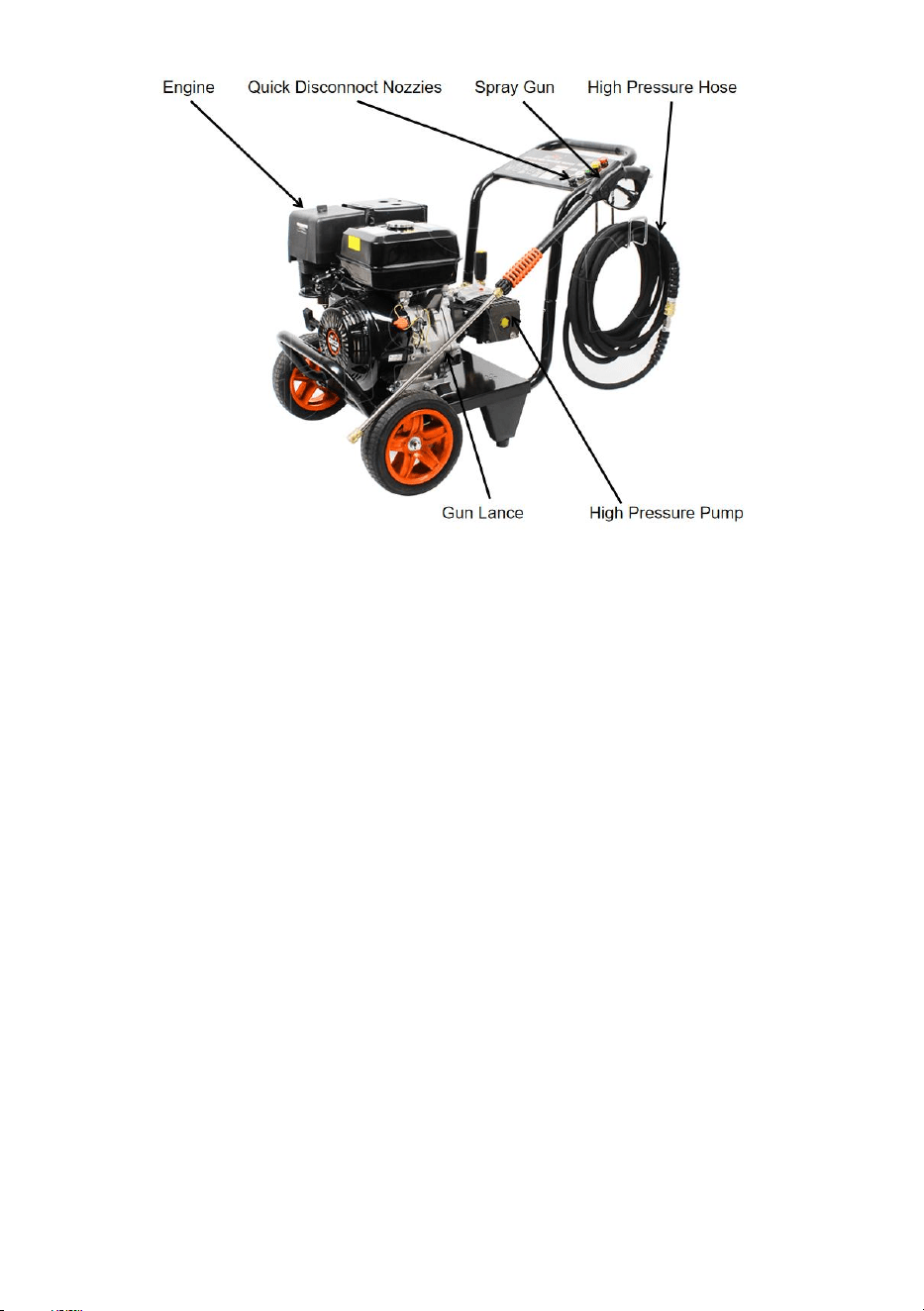
BASIC ELEMENTSOF A PRESSURE WASHER
High Pressure Pump: Increases the pressure of the water
Engine:Drives the high pressure pump.
High Pressure Hose: Carries the pressurized water from the pump to the gun and
spray lance.
Spray Gun: Connects with spray lance to control water flow rate, direction, and
pressure.
Quick Connect Spray lance; Spray lance is equipped with a female quick connect
coupler on the end. This allows the user to quickly change out High-pressure
nozzle for different spray patterns and change the soap nozzle for the low
pressure and chemical /soap applications .see how to use spray lance paragraph
in this section.
Chemical Hose: Feeds cleaning agents into the pump to mix the pressurized
water. see how to apply chemical /cleaning solvent in this section of this Manual.
BASIC ELEMENTSOF ENGINE
Refer to the engine manual for location and operation of engine.

- 12 -
Choke Control Lever: Controls engine speed.
Starter Grip: Pulling starter grip operates recoil starter to crank engine.
Fuel Valve Lever: Opens\Closes connection between fuel tank and carburetor.
Engine Switch: Enables and disables ignition system.
PRESSURE WASHER TERMINOLOGY
PSI: Pounds per square inch.the unit of measure for water pressure,also used for
air pressure hydraulic pressure, etc.
GPM: Gallons per minute, the unit of measure for the flow rate of water
CU: Cleaning units.gpm multiplied by psi
Bypass Mode: In bypass mode;the pump is recirculating water because the
trigger of the spray gun is not pulled. If unit is left in bypass mode for more than
two(2)minutes, the water temperature will rise to a dangerous level and could
damage internal components of the pump.Any damage to pump due to these
causes will not be covered under warranty.
Do not allow unit to operate in bypass mode for more than two
minutes at any time. Overheating of pump can cause damage to pump.
Thermal Relief Valve: In an effort to prevent extreme damage,pumps are
equipped with a thermal relief valve. This valve will open when the temperature
inside the pump rises too high. This valve will then release a gush of water in an
effort to lower the temperature inside the pump.Immediately after this occurs, the
valve will close.
Chemical Injection System: Mixes cleaners or cleaning solverts with the
pressurized water to improve cleaning effectiveness.
Water Supply:All pressure washers must have a source of water. the minimum
requirements for a water supply are 20PSI and 5gallon per minute.
PRESSURE WASHER OPERATING FEATURES
PRESSURE ADJUSTMENTS
The pressure setting is preset at the factory to achieve optimum pressure and

- 13 -
cleaning. if you need to lower the pressure. It can be accomplished by these
methods
1. Back away from the surface to be cleaned. The further away you are, the less
the pressure will be on the surface to be cleaned.
Do not attempt to increase pump pressure. A higher pressure
setting than the factory set pressure may damage pump.
2. Reduce the speed the gasoline engine (RPM). Slow the engine down and the
water Pressure will go down with it.
3. Change to the 40°white nozzle, This nozzle delivers a less powerful stream of
water and a wider spray pattern.
4. Adjust the pressure regulator on the pump. Turn the pressure regulator knob
counterclockwise to lower pressure. Once you have finished using your pressure
washer,return the pressure regulator to its original position by turning it clockwise.
Do not try to turn pressure regulator knob past the built-in stop or
damage to pump will result.
TO USE SPRAY WAND
Your pressure washer is equipped with up to five spray nozzles. Each nozzle is
color coded and delivers a specific spray pattern for a particular cleaning purpose.
The size of the nozzle determines the size of the fan spray and the pressure out of
the nozzle. The0°,15°,25°,and 40°nozzles are high pressure nozzles, the chemical
nozzle is a low pressure nozzle.
The nozzles are housed in receptacles on the panel of the pressure washer
handle. Colors on he panel identify nozzle location and spray pattern.
Risk of injection or injury to person. Do not direct discharge stream
toward persons,unprotect skin,eyes, or any pets or any animals. Serious injury can
occur.
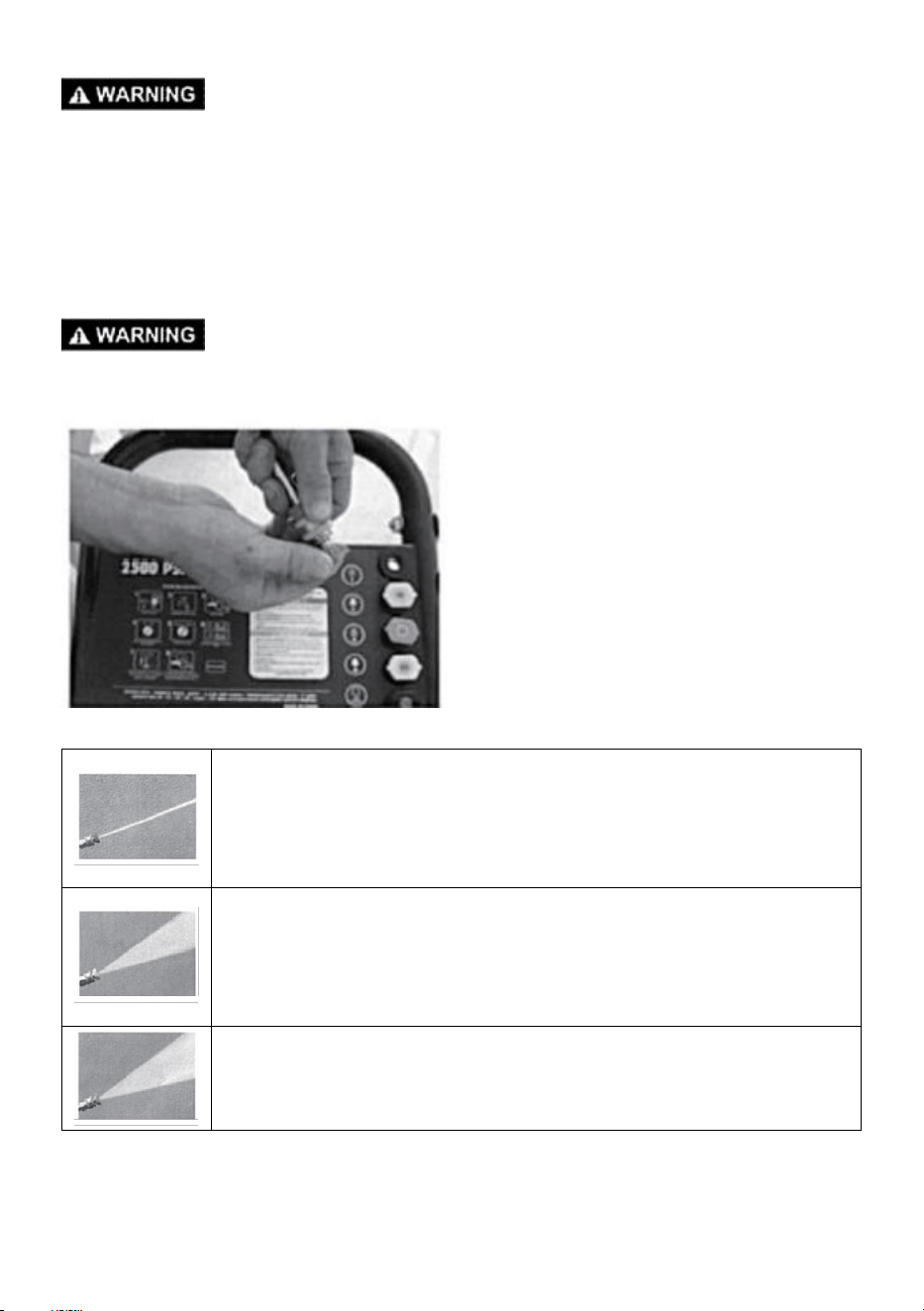
CHANGING NOZZLES
- 14 -
DO NOT attempt to change nozzles while pressure washer is
running. Turn engine off before changing nozzles.
1.Pull quick connect coupler back and insert nozzle.
2.Release quick connect coupler and twist nozzle to make sure it is secure in
coupler.
Risk of injury.Ensure nozzle is completely inserted in QC
socket and QC snap ring is fully engaged (forward) before squeezing gun trigger.
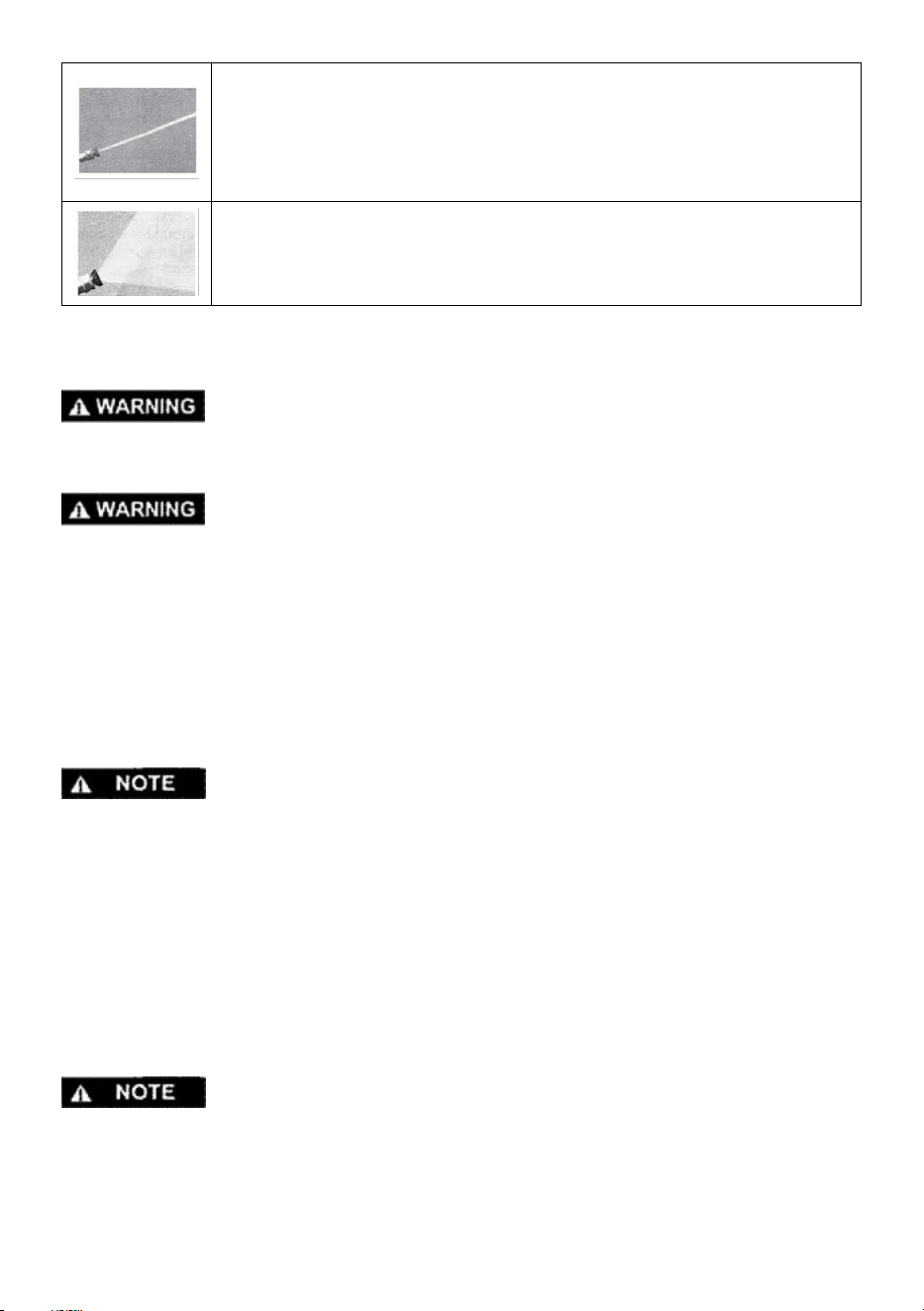
0°nozzle-red. This nozzle delivers a pinpoint stream and is
extremely powerful. It covers a very small area of cleaning. This
nozzle should only be used on surface that can withstand this
high pressure such as metal or concrete. Do not use on wood.
15°nozzle-yellow. This nozzle delivers a powerful 15
degree spray pattern for intense cleaning of small areas. This
nozzle should only be used on areas that can withs- tand the
high pressure from this nozzle.
25°nozzle-green. This nozzle delivers a 25 degree spray pattern
for intense cleaning of larger areas. This nozzle should only be
used on areas that can withstand the pressure from this nozzle.
- 15 -
40°nozzle-white. This nozzle delivers a 40 degree spray pattern
and a less powerful stream of water. It
covers a wide area of cleaning, this nozzle should be used for
most general cleaning jobs.
Chemical nozzle-black. This nozzle is used to apply chemicals
or cleaning solutions. It has the least power stream.
HOW TO APPLY CHEMICALS AND CLEANING SOLVENTS
Applying chemicals or cleaning solvents is a low pressure
operation.
Use only soaps and chemicals designed for pressure washer use.
Do not use bleach.
To apply chemicals:
1.Press chemical hose onto barbed fitting located near high pressure hose
connection of pump as shown.
2.Place other end of chemical hose with filter on it into container holding
chemical/cleaning solution.
The chemical/water ratio is 7:1,for every 7 gallons of water pumped,
1 gallon of chemical/ cleaning solution will be used.
3.Install low pressure(black) nozzle into quick connect fitting of spray wand,see
How To Use Spray Wand paragraph in this section.
4.After use of chemicals, place chemical hose into container of clean water and
draw clean water through chemical injection system to rinse system thoroughly. If
chemicals remain in the pump it could be damaged. Pumps damaged due to
chemicals will not be covered under warranty.
Chemicals and soaps will not siphon when spray wand is in the
high setting.

- 16 -
READ AND UNDERSTAND ALL WARNINGS BEFORE STARTING OPERATION
When using the high pressure setting. DO NOT allow the high
pressure spray to come in contact with unprotected skin, eyes, or with any pets or
animals. Serious injury can occur.
Your washer operates at fluid pressures and velocities high enough to penetrate
human and animal flesh, which could result in amputation or other serious
injury.Leaks caused by loose fittings or worn or damaged hoses can result in
injection injuries. DO NOT TREAT FLUID INJECTION AS A SIMPLE CUT! See a
plysician immediately!
NEVER fill fuel tank when engine is running or hot.Do not smoke
when filing fuel tank.
NEVER fill fuel tank completely. Fill tank to 1/2 below bottom of filler neck to
provide
Space for fuel expansion. Wipe any fuel spillage from engine and equipment
before starting engine.
NEVER run engine indoors or in enclosed, poorly ventilated areas. Engine
exhaust contains carbon monoxide, an odourless and deadly gas.
DO NOT let hoses come in contact with very hot engine muffler during or
immediately after use of your pressure washer. Damage to hoses from contact
with hot engine surfaces will NOT be covered by warranty.
NEVER damage pull water supply hose to move pressure washer.
This could hose and pump inlet.
DO NOT use hot water,use cold water only.
NEVERI run water supply off while pressure washer engine is running or damage
to pump will result.
DO NOT stop spraying water for more than two minutes at a time. Pump operates
in bypass mode when spray gun trigger is not pressed. If pump is left in bypass
mode for more than two minutes internal components of the pump can be
damaged.
- 17 -
STARTING
Before starting, refer to your engine manual for proper starting procedures for your
engine type.
1.In a well ventilated outdoor area add fresh, high quality, unleaded gasoline with a
pump octane rating of 86 or higher, Do not overfill. Wipe up spilled fuel before
starting the engine. Refer to Engine Owners Manual for correct procedure.
2.Check engine oil level. See Engine Owners Manual for correct procedure.
There will be a slight amount of oil in the engine from factory
testing.
3. Verify the filter screen is in water inlet of pump.
Cone side faces out.
4. Connect water source to pump inlet.
Water source must provide a minimum of 5 gallons per minute at
20 p.s.i.
5. Connect high pressure hose to pump outlet.
6. If applying a chemical or cleaning solution, see How To Apply Chemicals/
Cleaning Solvents in Operation section of this manual.
7. Turn water source on.
Failure to do so could cause damage to the pump.
8. Start engine. See Engine Owners Manual for correct procedure.
If the engine does not start after two pulls, pull the
trigger to relieve the pressure.
9. Depress trigger on gun to start water flow.
Stand on a stable surface and grip gun/spray wand firmly with
both hands. Expect the gun to kick when triggered.
10. Release trigger to stop water flow.
11. Adjust spray for the task being performed by changing quick connect nozzle.
- 18 -
See How To Use Spray Wand instructions in this section.
SHUTTING DOWN
1. After each use, if you have applied chemicals, place chemical hose into
container of clean water and draw clean water through chemical injection system
to rinse system thoroughly.
Failure to do so could cause damage to the pump.
2. Turn engine off.See engine owner's manual.
NEVER turn the water off with the engine running.
3. Turn water source off.
4. Pull trigger on spray gun to relieve any water pressure in hose or spray gun.
5. See storage section in this manual for proper storage procedures.
MAINTENANCE
When performing maintenance, you may be exposed to hot
surfaces, water pressure,or moving parts that can cause serious injury or
death!
Before performing any maintenance or repair, disconnect spark plug wire, let
engine cool and release all water pressure.The engine contains flammable fuel.
DO NOT smoke or work near open flames while performing maintenance
To ensure efficient operation and longer life of your pressure washer, a routine
maintenance schedule should be prepared and followed. if the pressure washer is
used in unusual conditions,such as high-temperature of dusty conditions, more
frequent maintenance checks will be required.
ENGINE
Consult the engine owners manual for the manufactures recommendations for any
and all Maintenance.
- 19 -
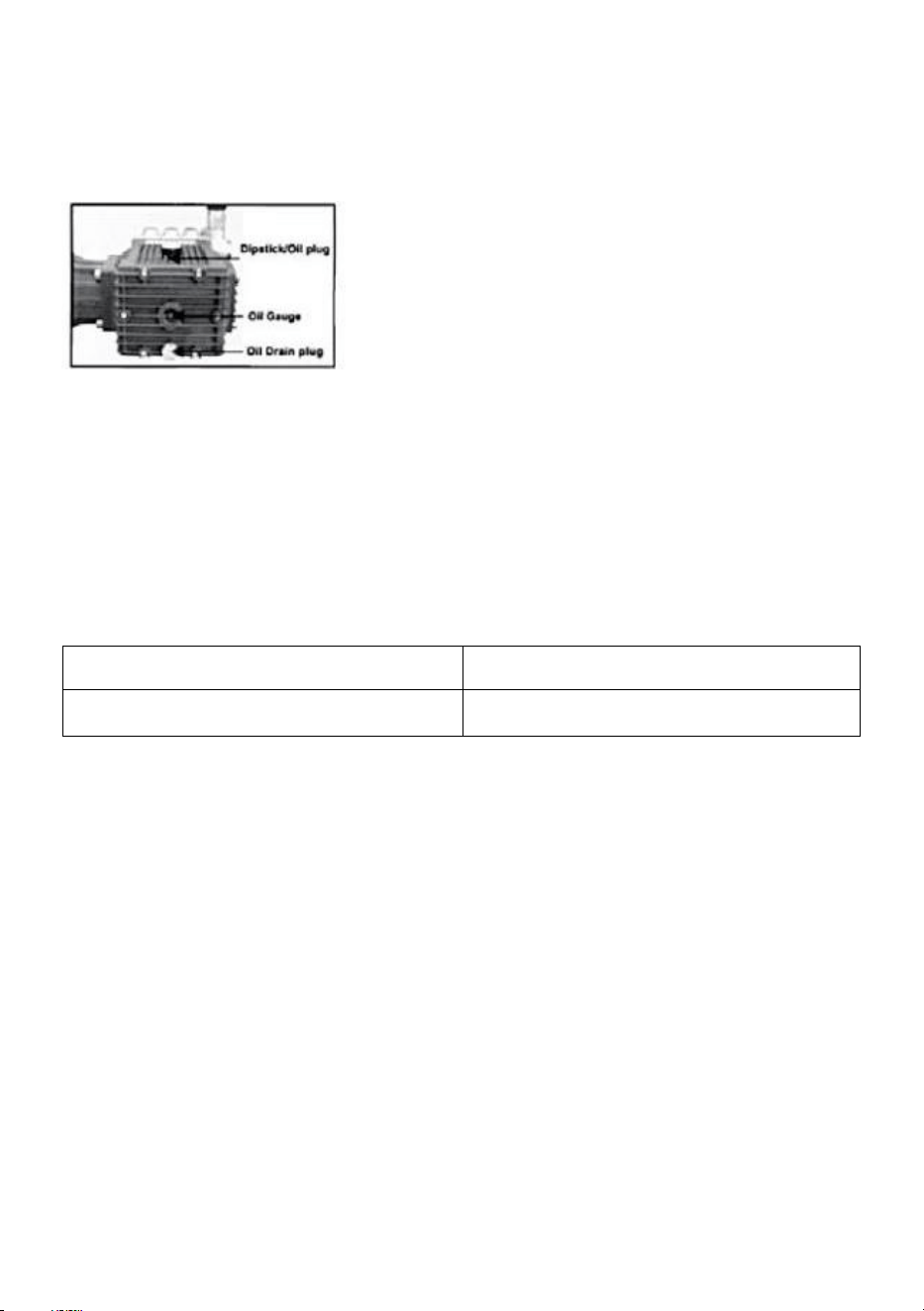
TO CHECK OIL
1.Remove dipstick/oil plug from pump and wipe clean.
2. Insert dipstick/oil plug fully into pump, then remove it.
3. Oil level is correct when oil covers the lower 1/2 inch of end of dipstick /oil plug.
HOW TO CHANGE PUMP OIL
1.Loosen dipstick/oil plug.
2.Place a container under the oil drain plug.
3.Remove oil rain plug.
4.After oil is drained replace oil drain plug. tighten securely.
5.Remove dipstick/oil plug and fill with recommended oil, see the pump oil chart for.
the correct amount and type of oil.
6.Replace dipstick/oil plug and tighten securely.
Model number
Oil type
250
30#
SPRAY LANCE
Excessive pressure may develop if the nozzle becomes clogged with foreign
materials such as dirt. The pump pressure will pulsate if the nozzle becomes
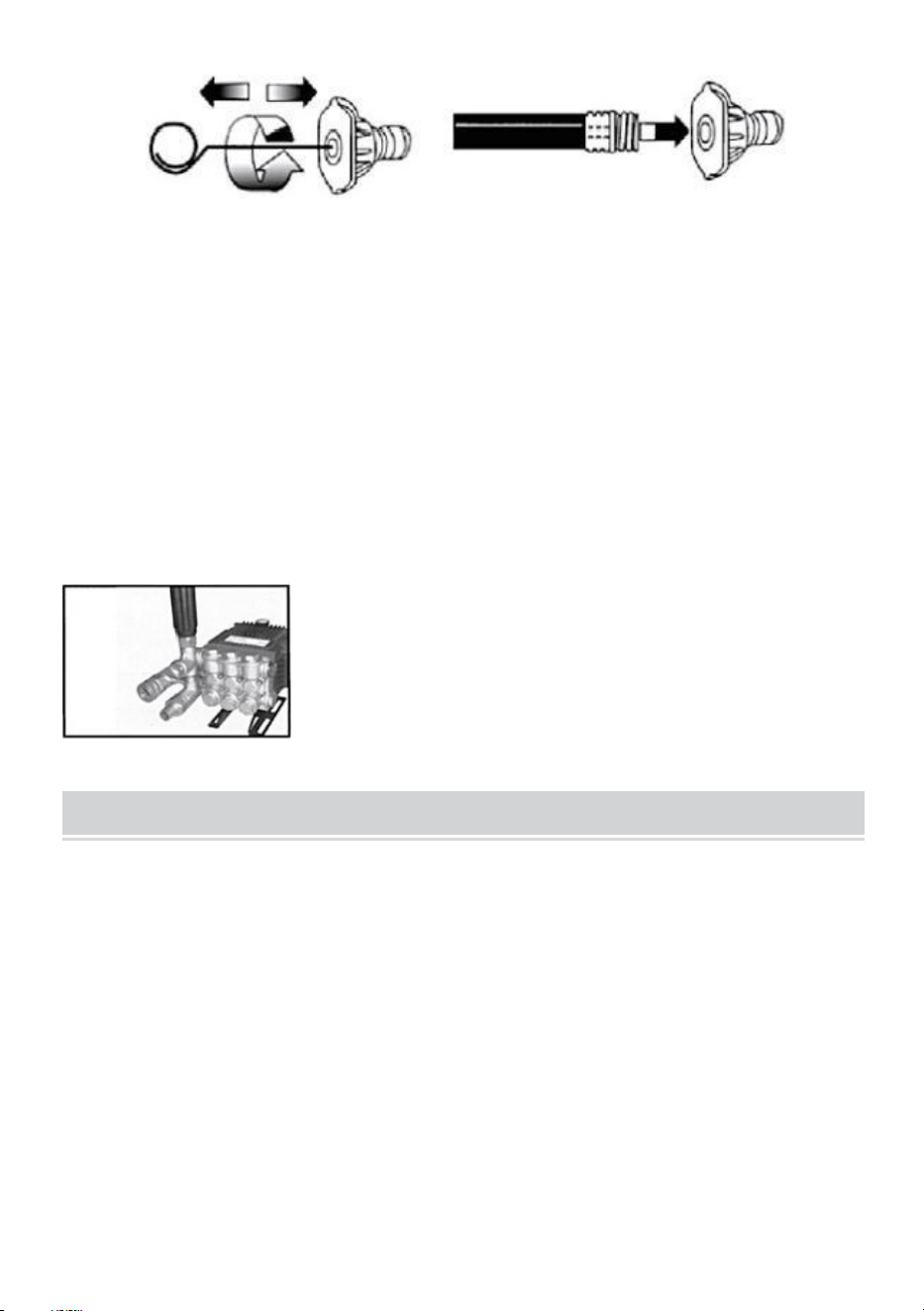
partially blocked or restricted. Clean the nozzle immediately using the nozzle kit
supplied and the following instructions:
1.Shut off the pressure washer and turn off the water supply.
2.Pull trigger on gun handle to relieve any water pressure.
3.Disconnect the spray lance from the gun.
4.Remove the high-Pressure Nozzle From the spray wand.Remove any
obstructions with the nozzle cleaning tool provided and backflush with clean water.
5.Direct water supply into spray wand end to backflush loosened particles for 30
seconds.
- 20 -
6.Reassemble the nozzle to the spray wand.
7.Reconnect spray wand to gun and turn on water supply.
8.Start pressure washer and place wand into high pressure setting to test.
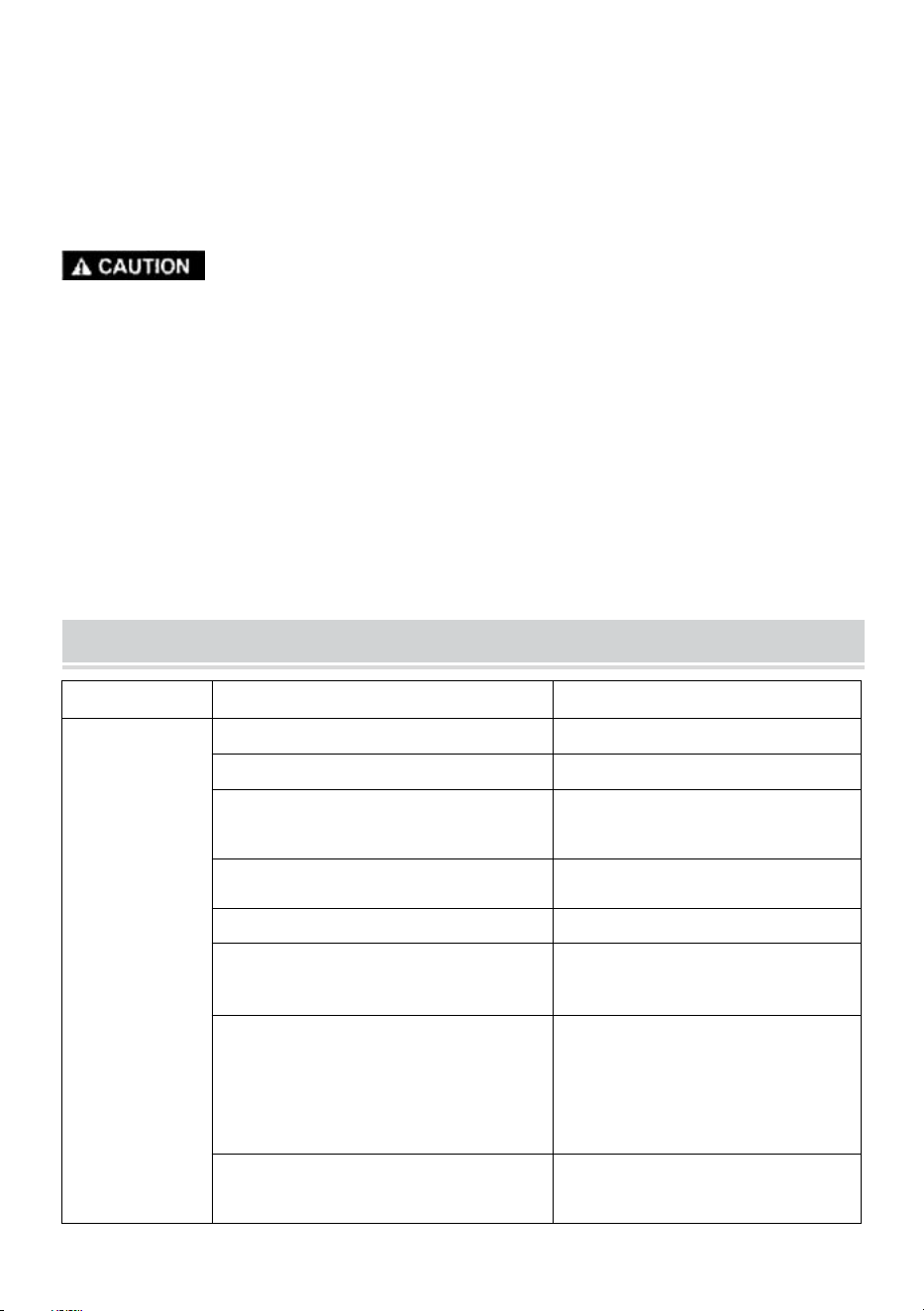
HOW TO CLEAN THE WATER INLET FILTER
This screen filter should be checked periodically and cleaned if necessary.
1.Remove filter by grasping end and removing it from water inlet of pump as
shown.
2.Clean filter by flushing it with water on both sides.
3.Re-insert filter into water inlet of pump.note:cone side faces out.
NOTE: Do not operate pressure washer without filter properly installed.
STORAGE
ENGINE
Consult the owners manual of the manufacturers recommendations for storage.
PUMP
1. Drain all water from high Pressure hose,coil it, and store it in cradle of the
pressure washer handle.
2. Drain all water from spray gun and spray wand by holding spray gun in a vertical
position with nozzle end pointing down and squeezing trigger. Store in gun/hose
holder.
3. Store chemical hose, high pressure hose, spray lance so they are protected
from damage, such as being run over.
- 21 -
It is Recommended That you follow these steps to protect the internal seals of the
pressure washer when STORING THE UNIT FOR MORE THAN 30
DAYSAND/OR WHEN FREEZING TEMPERATURES ARE EXPECTED.
4. Obtain a funnel, six ounces of RV antifreeze, and approximately 36 inches of
garden hose With a male hose connector attached to one end.
Use only RV antifreeze. Any other antifreeze is corrosive and can
damage pump.
5. Disconnect spark plug wire.
6. Connect 36 inch length of hose to water inlet of pump.
7. Add RV antifreeze to hose as shown.
8. Pull engine starter rope slowly several times until antifreeze comes out of high
pressure hose connection of pump.
9. Remove short hose from water inlet of pump.
10. Reconnect spark plug wire.
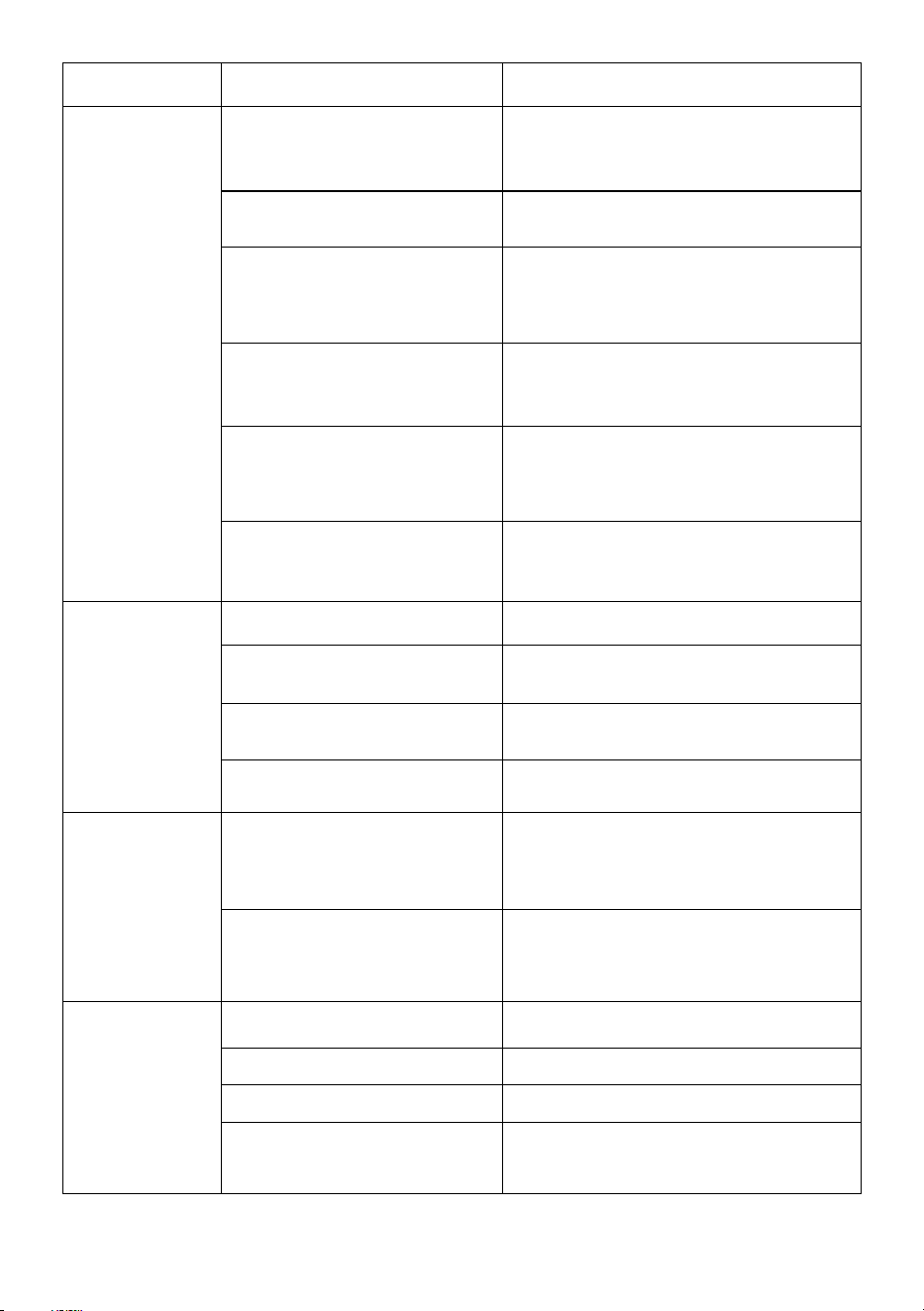
TROUBLESHOOTING GUDIE
Problem
Cause
Correction
Engine will not
start (see engine
manual for
further.engine
troubleshooting)
No fuel
Add fuel.
Low oil
Add required amount of oil.
Pressure builds up after two pulls on
the recoll starter or after initial use.
Squeeze gun trigger to reliever
pressure.
Choke lever in the no choke position
Move choke to the choke position.
Spark plug wire not at
Attach spark plug wire.
Engine ON/OFF switch in OFF position
Place engine ON/OF switch in on
position.
Choke lever in the choke
position on a hot engine or an
engine that has bean exposed to
thermal heat for a long pericd of time.
Move choke to the NO CHOKE
position.
Fuel valve closed.
Move fuel valve lever to the open
position
- 22 -
No or low
pressure
(initial use)
Spray wand not in high pressure.
See how to use spray wand
paragraph in the operation section.
Lower water supply
Water supply must be at least 5
GPM and 20psi.
Leak at high pressure hose fitting.
Tighten.Apply sealant tape if
necessary.
Nozzle obstructed.
See spray wand paragraph in the
maintenance section for the
correct procedure.
Water filter screen clogged.
Remove and clean filter.
Defective E-Z start valve.
Check with authorized warranty
service center(AWSC)
Air in hose.
Turn off the engine, then the water
source.
Disconnect the water source from
the
pump Inlet and tum the water
source on to remove all air from
the hose.When there is a steady
stream of water present, turn
water source off. Re-connect water
source to pump inlet and turn on
water source.
Squeeze trigger to remove
remaining air.
Choke lever in the choke position.
Move choke to the NO CHOKE
position.
Throttle control lever is hot in the Fast
position
Move throttle control lever to the
fast position.
High pressure hose is too long.
Use high pressure hose under
100feet.
- 23 -
Problem
Cause
Correction
Will not
draw
chemicals
Spray wand not in low pressure
See how to use spray wand paragraph
in the operation section.
Chemical filter clogged.
Clean filter.
Chemical screen not in
chemical.
Ensure end of chemical Hose is fully
submerged into chemical.
Chemical too thick.
Dilute chemical. Chemical should be
the same consistency as water.
Pressure hose is too long.
Lengthen water supply hose instead
of high pressure hose.
Chemical build up in
chemical injector
Have parts cleaned or replaced by
AWSC.
No or low
pressure
(after period
of normal
use)
Worn seal or packing
Have replaced by AWSC.
Worn or obstructed valves.
Have replaced by AWSC.
Worn unloader piston.
Have replaced by AWSC.
Worn E-Z start valve.
Have replaced by AWSC.
Water
leaking at
Gun/spray
wand
connection
Worn or broken o-Ring.
Check and replace.
Loose hose connection
Tighten.
Water
leaking at
pump
Loose connections.
Tighten.
Piston packings worn.
Have replaced by AWSC.
Worn or broken o-Rings
Have replaced by AWSC.
Pump head or tubes damaged
from freezing
Have replaced by AWSC.
- 24 -
Oil leaking at
pump
Pump pulsates
Oil seals worn.
Have replaced by AWSC.
Loose drain plug.
Tighten.
worn drain plug, o-ring
Check and replace.
worn fill plug g-ring
Check and replace.
Pump overfilled
Check for correct amount.
Incorrect oil used.
Drain and fill with correct amount
and type of oil.
Vent plug is clogged.
Clean vent plug; blow air through it to
remove any blockage. If problem
persists, replace plug.
Nozzle obstructed.
See spray wand paragraph in the
maintenance section for the correct
procedure.
TO FIND ALOCAL AUTHORIZED SERVICE CENTER NEAT YOU FOR
REPAIRS AND SERVICE PART PURCHASES.
GAS
Use fresh high quality unleaded gas. Add stabilizer to fuel tank and
run engine for 5 minutes before storage.
OIL
Pump oil: refer to owners manual supplied with this unit.
Engine oil: refer to engine manual supplied with his unit.
Some units are equipped with a low oil sensor and adequate oil
must be added or the unit will not start.
WATER
Use only cold water.
Do not operate unit with clogged or missing water filter/screen.
Do not operate unit without adequate water supply to
pump.Adequate water supply is a minimum of20 psi and 5gpm..
PRESSURE
ADJUSTMENT
The pressure setting is preset at the factory to achieve optimum
cleaning. If you need to lower the pressure setting, refer to the
operation manual for proper procedure.
- 25 -
PUMP
Pull gun trigger every 2 minutes while engine is renning.
Do not allow water to freeze in pump.
For cold weather or long term storage refer to the operation
manual for proper procedure.
BY-PASS MODE
Never leave unit running for more than 2 minutes without puling
gun trigger. doing so could
cause damage to pump and avoid warranty.
THERMAL
RELIEF VALVE
Pump is equipped with a thermal relief valve.If the water
overheats, this valve will open and allow a gush of water to
escape.Once the water is
released, the valve closes allowing the pump To operate normally.
HOSE
Do not allow hoses to contact the hot engine muffler during or after
use. Never pull the hose to move the unit.
ENGINE
Do not adjust or attempt maintenance without consulting engine
manual or an authorized engine service center.
Add stabilizer to fuel tank and run engine for 5 minutes before
storage. Always turn on the water before starting the engine
SOAPICHEMICALS
Use only soaps and chemicals designed for pressure washer use.
NOZZLE
Keep nozzle unclogged.Refer to manual for cleaning procedures.
Chemical/ soap cannot be applied in high pressure setting. Only in
low setting.
MAINTENANCE
Follow recommended maintenance schedule for engine & pump.
Refer to manuals.
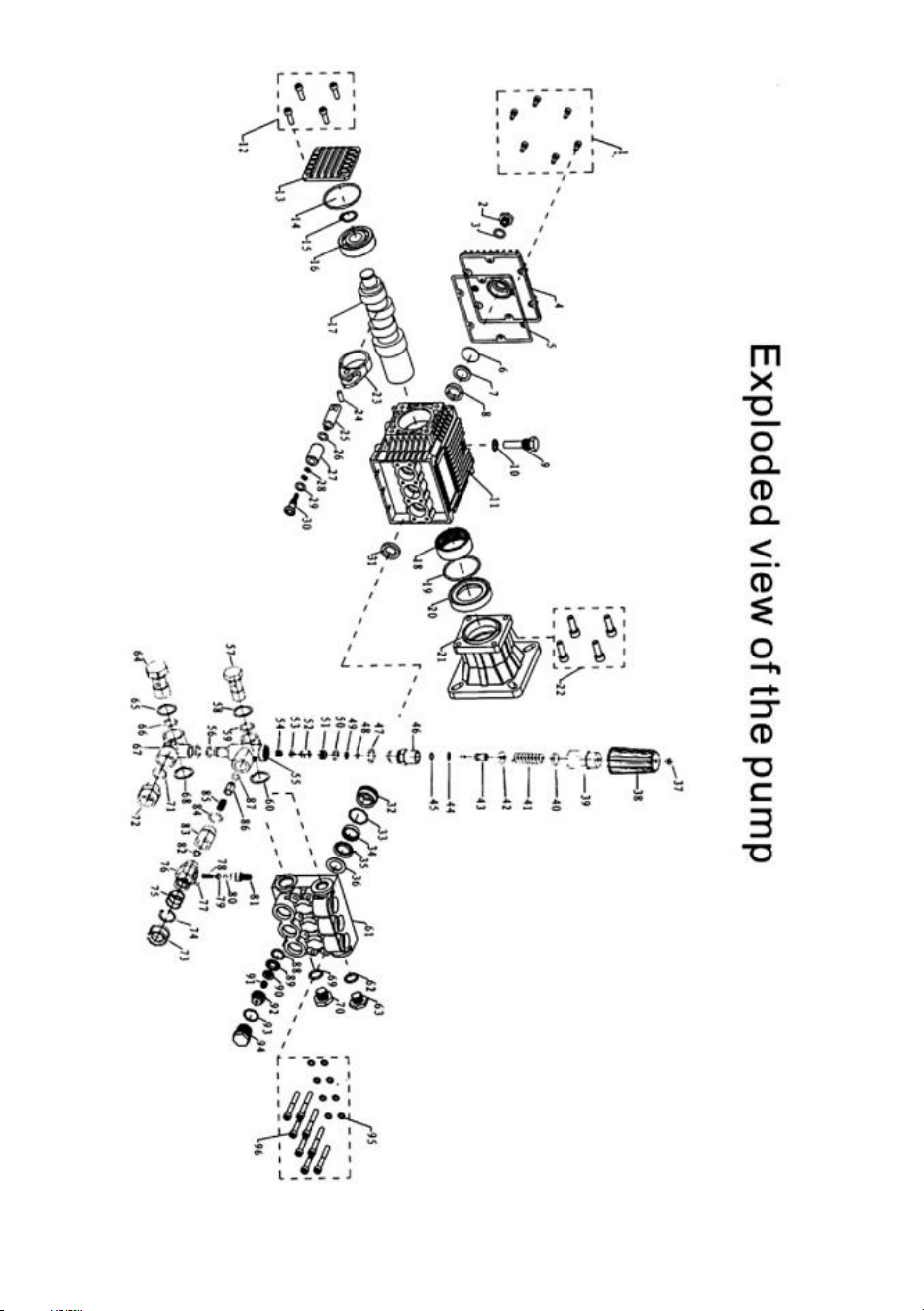
EXPLODED VIEW OF THE PUMP
- 26 -
- 27 -
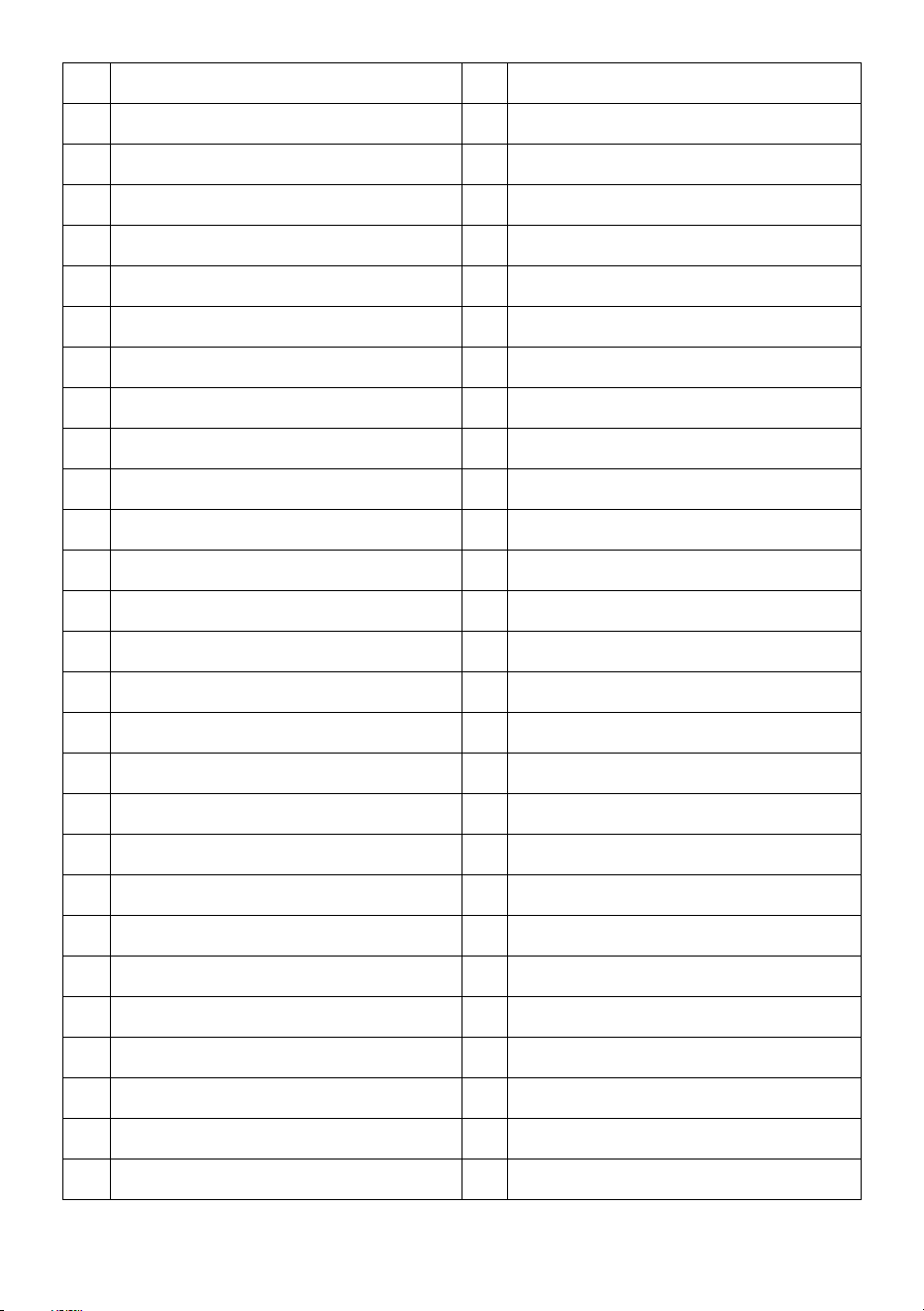
1
bolt,cover of crank case
49
backup ring
2
oil drain plug
50
o-ring
3
sheet of oil drain plug
51
seat,valve body
4
crank case cover
52
water return valve core
5
slip crank case cover
53
o-ring
6
oil lever lence
54
water return valve seat
7
gasket,lence
55
water outlet T connector
8
lence cap
56
o-ring
9
oil inlet plug
57
bolt of water outlet T connector
10
gasket,oil inlet plug
58
bolt sheet
11
crank case
59
o-ring
12
bolt,crank shaft cover
60
o-ring
13
crank shaft cover
61
cylinder
14
seal,gasket bearing cover
62
o-ring
15
bearing clip
63
inlet screw cap
16
ball bearing
64
bolt of water inlet T connector
17
crank shaft
65
bolt sheet
18
needle rotter bearing
66
o-ring
19
flange ring
67
water inlet T connector
20
bolt,flange
68
o-ring
21
flange
69
o-ring
22
bolt,flange
70
inlet screw
23
connecting rod
71
o-ring
24
connecting rod pin
72
water inlet connector
25
plunger rod
73
quick connector cap
26
copper sheet
74
bearing clip
27
ceramic plunger
75
spring
28
plunger,screw cap ring
76
quick connector
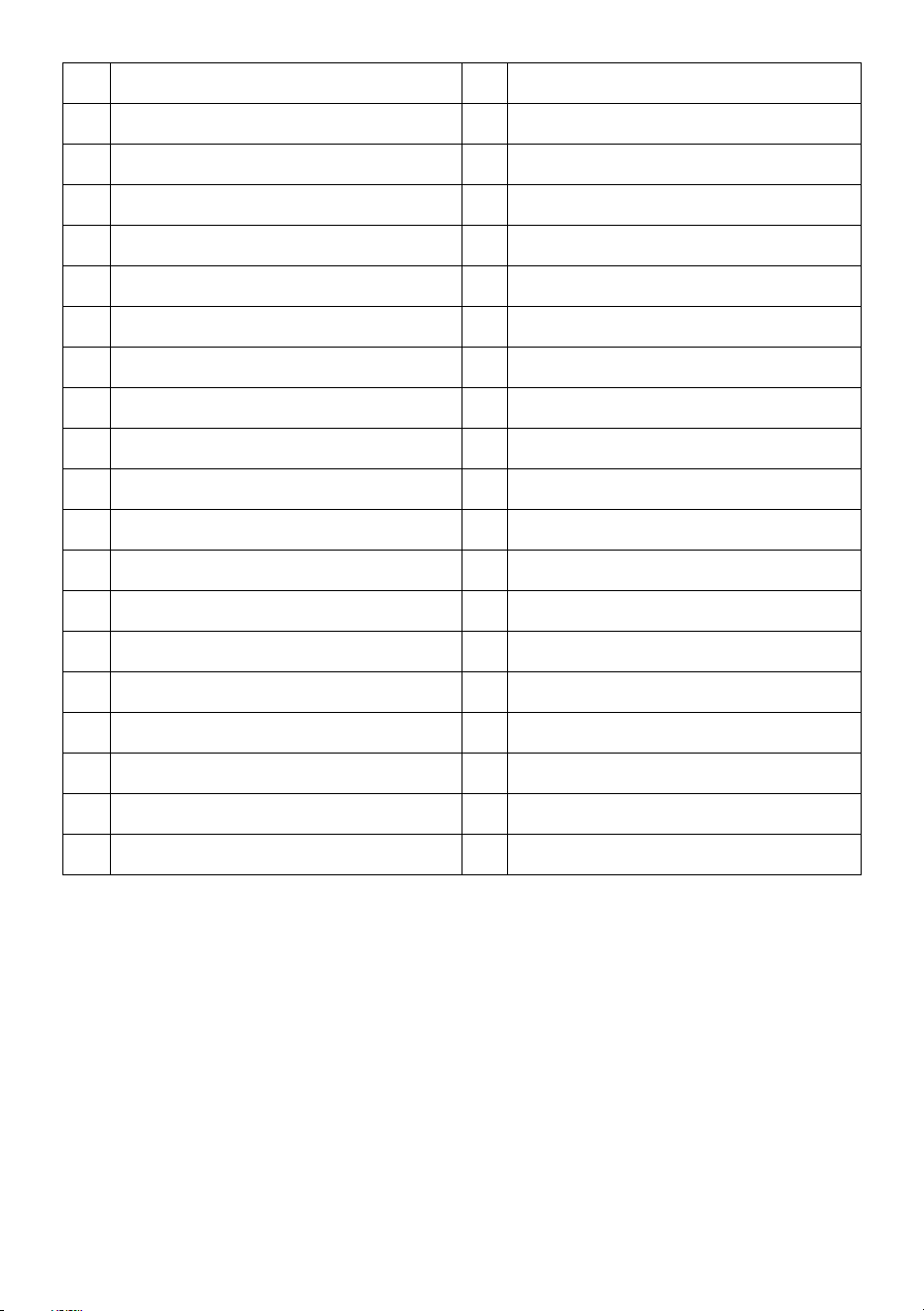
- 28 -
29
copper sheet
77
steel ball
30
plunger,screw cap
78
spring injector
31
oil seal,plunger
79
gasket detergent injector
32
locating ring,compaction ring
80
steel ball
33
o-ring
81
injector nozzle
34
low pressure seal
82
water shooting nozzle
35
high pressure seal
83
water outlet joint
36
supporting ring
84
o-ring
37
fix screw,pressure adjustment
85
spring water outlet cone valve
38
pressure adjustment handle
86
water outlet cone valve
39
pressure adjustment seat
87
o-ring
40
upper washer spring
88
o-ring
41
pressure adjusting spring
89
washer check valve
42
under washer,spring
90
check valve flake
43
water return valve rod
91
spring check valve
44
adjustment valve seat
92
check valve cage
45
o-ring
93
o-ring
46
water return valve jacket
94
check valve compaction cap
47
o-ring
95
sheet
48
o-ring
96
bolt cylinder