DO NOT RETURN THIS PRODUCT TO THE STORE
If you have questions or need assistance, please call customer service at 855-944-3571.
User Manual
WSnow22T 48V - Tool Only
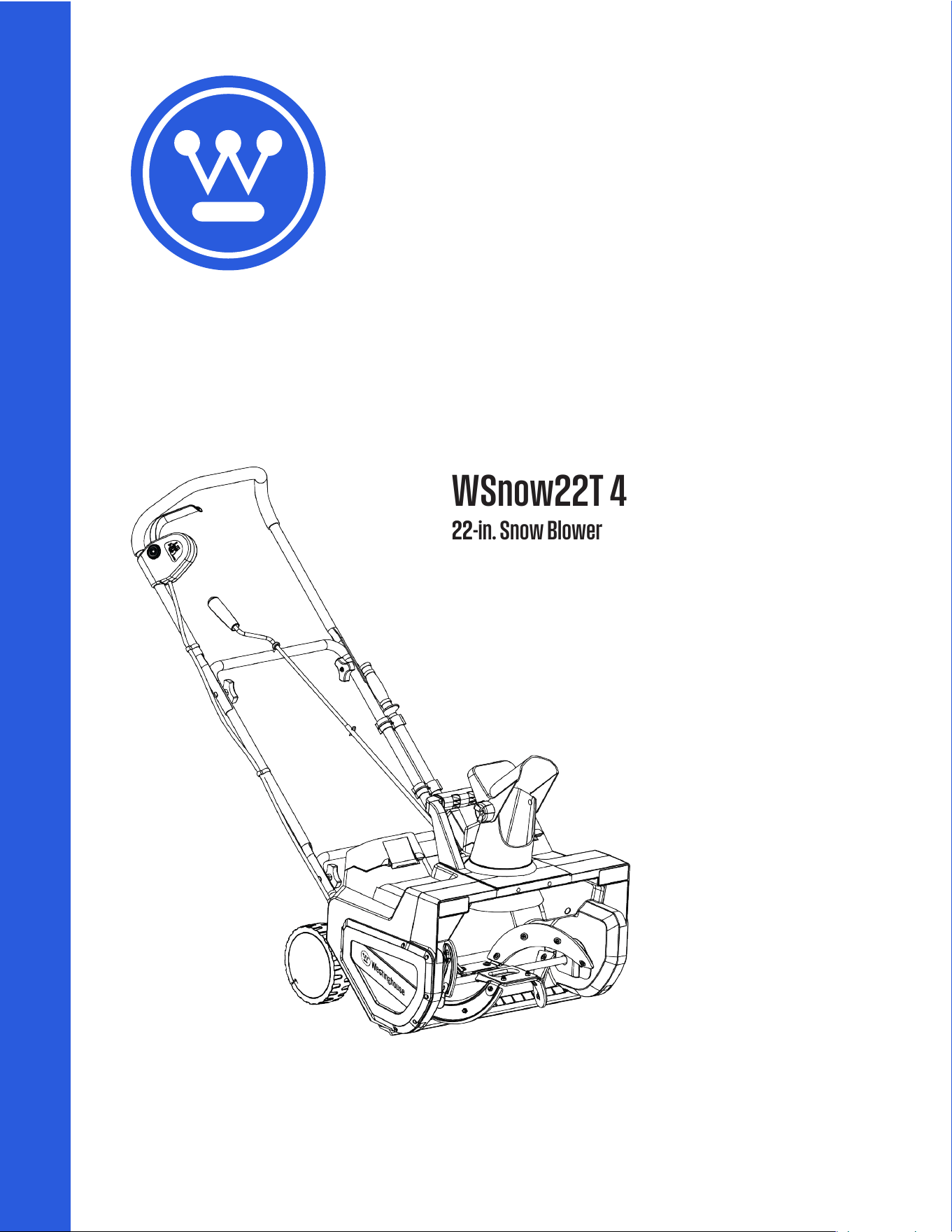
22-22-in. Snow Blower

•
•
•
Product Registration
For trouble-free warranty
coverage, it is important to
register your Westinghouse
product.
You can register by:
Completing and mailing the product
registration card included in the carton.
Registering your product on-line at:
wpowereq.com/pages/warranty-registration
Scanning the above QR code with your
smartphone camera to be directed to the
mobile registration link.
For Your Records
Date of Purchase:_________________
Model Number: __________________
Serial Number:___________________
Place of Purchase:________________
Sending the following product information to:
Westinghouse Outdoor Power
Warranty registration
777 Manor Park Drive
Columbus, OH 43228
WARNING: Operating, servicing, and main-taining this
equipment may expose you to chemicals which are
known to the State of California to cause cancer and birth
defects or other reproductive harm. To minimize
exposure, wear gloves or wash your hands frequently
when servicing this equipment. For more information go
to www.P65warnings.ca.gov.
1

*Generates 48 V max with two 24 V lithium-ion batteries.
Initial no-load voltage, per fully charged battery, peaks at
24 V. Nominal voltage under typical load is 21.6 V.
2
IMPORTANT!
Safety Instructions
All Operators Must Read These
Instructions Before Use
Read all instructions when using cordless snow blowers.
Basic safety precautions should always be followed to reduce
the risk of fire, electric shock, and personal injury.
General Safety Rules
Notice the personal safety alert symbol m used in this
manual to draw your attention to a WARNING given along
with the particular operating instruction. This means that
the operation requires special ATTENTION, CAUTION, and
AWARENESS.
• Keep work area clean and well lit – Cluttered, dark areas
invite accidents.
•
Keep bystanders away – All bystanders and pets should be
kept a safe distance away from the work area.
•
Dress properly – Do not wear loose clothing or jewelry. They
can get caught in moving parts. Protective rubber gloves and
non-slip footwear are recommended when working outdoors.
• Use the right product – Do not use this machine for any job
except that for which it is intended.
•
mCAUTION! – Exercise caution to avoid slipping or falling.
Wear protective footwear that will protect your feet and
improve your footing on slippery surfaces.
•
Use safety glasses – Also use safety footwear, snug-fitting
clothing, protective gloves, hearing and head protection.
•
Do not force the snow blower – Use the snow blower at the
rate for which it was designed to ensure optimal performance
and safe operation.
• Stay alert – Watch what you are doing. Use common sense.
Do not operate the snow blower when you are tired or under
the influence of alcohol or drugs.
•
Do not overreach –
Keep proper footing and balance at
all times.
•
Store indoors – When not in use, the snow blower should be
kept dry and stored out of the reach of children in a high or
locked place.
• Maintain snow blower with care – Follow instructions for
lubricating and changing accessories.
mWARNING! Always disengage the switch lever and
remove the battery pack before making any adjustments,
inspecting, servicing, changing accessories, cleaning the snow
blower, or when any other dangerous conditions are present.
Any such operation should be performed after revolving parts
inside the snow blower stop completely. Such preventive safety
measures reduce the risk of starting the power tool accidentally.
mWARNING! When replacing any parts, you must strictly
observe the instructions and procedures described in this user
manual. Special care should be paid to any rubber parts,
since these parts may increase the motor load and decrease its
mechanical power if damaged.
mWARNING! If you notice that the snow blower is not
running properly or hear abnormal sounds from the motor
when it is in use, immediately stop the machine, disconnect the
battery, and contact your service center.
•
Surfaces – This snow blower is intended for use on paved
surfaces. Do not use on gravel, stone or other unpaved
surfaces unless the snow blower is adjusted for such
surfaces according to the instructions given in the operator’s
manual.
•
Moving parts present risks – Keep your face, hair, clothing,
hands, and feet away from moving parts.
All guards and safety attachments must be installed properly
before using the unit. Shut off and disconnect the battery
before touching any parts other than the handles and switch.
• Avoid unintentional starting – Make sure the safety switch
and the switch lever are in the off position before inserting
the battery in the unit. Do not carry the snow blower with the
safety switch and the switch lever engaged.
• Do not overreach – Maintain proper footing and balance
at all times. Place heels firmly on the ground and tightly
grasp the handle bar. Watch for uneven surfaces and do not
overreach. In case you fall or collide with the snow blower,
inspect the unit for any damages or cracks. When stepping
backwards, be careful to avoid obstacles beneath your feet
or behind you to avoid falling.
mWARNING! If the snow blower strikes any object,
follow these steps:
i) Stop the snow blower. Remove the battery.
ii) Inspect for damage.
iii) Repair any damage before restarting and operating
the snow blower.

3
Battery & Charger
Safety Instructions
We pay a great deal of attention to the design of every battery
pack to ensure that we supply you with batteries that are safe,
durable and have a high energy density. The battery cells have
a wide range of safety devices. Each individual cell is initially
formatted and its electrical characteristic curves are recorded.
This data is then used exclusively to be able to assemble the
best possible battery packs.
Despite all the safety precautions, caution must always be
exercised when handling batteries. The following points must
be obeyed at all times to ensure safe use. Safe use can only be
guaranteed if undamaged cells are used. Incorrect handling of
the battery pack can cause cell damage.
IMPORTANT! Analyses confirm that incorrect use and poor care
of high-perf
ormance batteries are the main factors responsible
for personal and/or product damage.
mWARNING! Read all safety warnings and instructions.
Failure to follow the warnings and instructions may
result in electric shock, fire and/or serious injury
mWARNING! Use only approved replacement batteries;
other batteries may damage the snow blower and cause it to
malfunction.
mCAUTION! To reduce the risk of injury, charge the
24V lithium-ion battery packs only in their designated
24V lithium-ion charger. Other types of chargers present risk of
fire, personal injury and damage. Do not wire
a battery pack to a power supply plug or car cigarette lighter.
Such misuse will permanently disable or damage the battery
pack.
• Avoid dangerous environments – Do not charge the battery
pack in rain, snow or in damp or wet locations. Do not use
the battery pack or charger in the presence of explosive
atmospheres (gaseous fumes, dust or flammable materials)
because sparks may be generated when inserting or
removing the battery pack, which could lead to a fire.
• Charge in a well-ventilated area – Do not block the charger
vents. Keep them clear to allow for proper ventilation. Do not
allow smoking or open flames near a charging battery pack.
Vented gases may explode.
NOTE: The safe temperature range for the battery is
-4°F – 113ºF (-20°C – 45°C). Do not charge the battery
outside in freezing weather; charge it at room temperature.
• Maintain charger cord – When unplugging the charger,
pull the plug, not the cord, from the receptacle to reduce the
risk of damage to the electrical plug and cord.
Never carry the charger by its cord or yank it by the cord
to disconnect it from the receptacle. Keep the cord away
from heat, oil and sharp edges. Make sure the cord will
not be stepped on, tripped over or subjected to damage or
stress when the charger is in use. Do not use the charger
with a damaged cord or plug. Replace a damaged charger
immediately.
• Do not use an extension cord unless it is absolutely
necessary – Using the wrong, damaged or improperly wired
extension cord poses a risk of fire and electric shock. If
an extension cord must be used, plug the charger into a
properly wired 16 gauge or larger extension cord with the
female plug matching the male plug on the charger. Make
sure that the extension cord is in good electrical condition.
• Charger is rated for 120 volt AC only –The charger must
be plugged into an appropriate receptacle.
• Use only recommended attachments – Use of an
attachment not recommended or sold by the battery charger
or battery pack manufacturer may result in risk of fire,
electric shock or personal injury.
• Unplug charger when not in use – Make sure to remove
battery packs from unplugged chargers.
mWARNING! To reduce the risk of electric shock,
always unplug the charger before performing any cleaning or
maintenance. Do not allow water to flow into the charger. Use a
Ground Fault Circuit Interrupter (GFCI) to reduce shock hazards.
• Do not burn or incinerate battery packs – Battery packs
may explode, causing personal injury or damage.
Toxic fumes and materials are created when battery packs
are burned.
• Do not crush, drop or damage battery packs – Do not use
the battery pack or charger if they have sustained a sharp
blow, been dropped, run over or have been damaged in any
way (i.e. pierced with a nail, hit with a hammer, stepped on,
etc.).
• Disconnect the battery pack from the appliance before
making any adjustments, changing accessories,
or storing appliance – Such preventive safety measures
reduce the risk of starting the appliance accidentally.
• Avoid unintentional starting – Make sure the safety switch
and the switch lever are in the off position before inserting
the battery in the unit. Do not carry the snow blower with the
safety switch and the ON/OFF trigger engaged.
• When battery pack is not in use, keep it away from other
metal objects – like paper clips, coins, keys, nails, screws
or other small metal objects that can make a connection
from one terminal to another. Shorting the battery terminals
together may cause burns or a fire.
• Under abusive conditions, liquid may be ejected from the
battery; avoid contact – If contact accidentally occurs,
flush with water. If liquid contacts eyes, additionally seek
medical help. Liquid ejected from the battery may cause
irritation or burns.
• Do not use a battery pack or appliance that is damaged
or modified – Damaged or modified batteries may exhibit
unpredictable behavior resulting in fire, explosion or risk of
injury.
• Do not expose a battery pack or appliance to fire or
excessive temperature – Exposure to fire or temperature
above 130°C (265ºF) may cause explosion.
TOOL ONLY - BATTERY AND CHARGER SOLD SEPARATELY

4
• Follow all charging instructions and do not charge the
battery pack or appliance outside of the temperature
range specified in the instructions – Charging improperly or
at temperatures outside of the specified range may damage
the battery and increase the risk of fire.
• Have servicing performed by a qualified repair person
using only identical replacement parts – This will ensure
that the safety of the product is maintained.
• Do not modify or attempt to repair the appliance or the
battery pack – (as applicable) except as indicated in the
instructions for use and care.
• Do not disassemble – Incorrect reassembly may pose
a serious risk of electric shock, fire or exposure to toxic
battery chemicals. If the battery or charger are damaged,
please contact Westinghouse Outdoor Power Equipment
(855) 944-3571.
• Battery chemicals cause serious burns – Never let a
damaged battery pack contact the skin, eyes or mouth. If a
damaged battery pack leaks battery chemicals, use rubber or
neoprene gloves to safely dispose of it. If skin is exposed to
battery fluids, wash the affected area with soap and water and
rinse with vinegar. If eyes are exposed to battery chemicals,
immediately flush with water for 20 minutes and seek medical
attention. Remove and dispose of contaminated
clothing.
• Store your battery pack and charger in a cool,
dry place – Do not store the battery pack or charger where
temperatures may exceed 104ºF (40ºC), such as in direct
sunlight or inside a vehicle or metal building during the
summer.
Information about Batteries
1. The battery packs have to be charged completely before
you use the tool for the
first time.
2. For optimum battery performance, avoid low discharge
cycles by charging the battery pack frequently.
3. Store the battery pack in a cool place, ideally at 59°F
(15°C) and charged fully.
4. Lithium-ion batteries are subject to a natural aging process.
The battery pack must be replaced at the latest when
its capacity falls to just 80% of its capacity when new.
Weakened cells in an aged battery pack are no longer
capable of meeting the high power requirements needed for
the proper operation of your snow blower,
and therefore pose a safety risk.
5. Do not throw battery packs into an open fire as this poses a
risk of explosion.
6. Do not ignite the battery pack or expose it to fire.
7. Do not exhaustively discharge batteries. Exhaustive
discharge will damage the battery cells. The most common
cause of exhaustive discharge is lengthy storage or non-use
of partially discharged batteries. Stop working as soon
as the performance of the battery falls noticeably or the
electronic protection system triggers. Place the battery pack
in storage only after it has been fully charged.
8. Protect the battery and the tool from overloads.
Overloads will quickly result in overheating and cell damage
inside the battery housing even if this overheating is not
apparent externally.
9. Avoid damage and shocks. Immediately replace batteries
that have been dropped from a height of more than one
meter or those that have been exposed to violent shocks,
even if the housing of the battery pack appears to be
undamaged. The battery cells inside the battery may have
suffered serious damage. In such instances, please read the
waste disposal information for proper battery disposal.
10. If battery pack suffers overloading and overheating, the
integrated protective cutoff will switch off the equipment for
safety reasons. If this situation happens, stop the tool and
let the battery cool down for a few minutes before restarting.
IMPORTANT! Do not press the ON/OFF trigger any more if
the protective cut-off has been activated. This may damage
the battery pack.
11. Use only original battery packs. The use of other batteries
poses a fire risk and may result in injuries or an explosion.
Information about charger and the
charging process
1. Please check the data marked on the rating plate of the
battery charger. Be sure to connect the battery charger to a
power supply with the voltage marked on the rating plate.
Never connect it to a different mains voltage.
2. Protect battery charger and its cord from damage. Keep the
charger and its cord away from heat, oil and sharp edges.
3. Electrical plugs must match the outlet. Never modify
the plug in any way. Do not use any adapter plugs with
grounded appliances. Unmodified plugs and matching
outlets will reduce the risk of electric shock.
4. Keep battery charger, battery pack(s) and the cordless tool
out of the reach of children.
5. Do not use battery charger to charge other cordless tools.
6. During periods of heavy use, the battery pack will become
warm. Allow the battery pack to cool to room temperature
before inserting it into the charger to recharge.
7. Do not overcharge batteries. Do not exceed the maximum
charging times. These charging times only apply to
discharged batteries. Frequent insertion of a charged or
partially charged battery pack will result in overcharging and
cell damage. Do not leave batteries in the charger for days
on end.
8. Never use or charge batteries if you suspect that it has been
more than 12 months since the last time they were charged.
There is a high probability that the battery pack has already
suffered dangerous damage (exhaustive discharge).
TOOL ONLY - BATTERY AND CHARGER SOLD SEPARATELY

5
9. Charging batteries at a temperature below 41°F (5°C) will
cause chemical damage to the cells and may cause a fire.
10. Do not use batteries that have been exposed to heat
during the charging process, as the battery cells may have
suffered dangerous damage.
11. Do not use batteries that have suffered curvature or
deformation during the charging process or those that
exhibit other atypical symptoms (gassing, hissing, cracking,
etc.)
12. Never fully discharge the battery pack (maximum
recommended depth of discharge is 80%). A complete
discharge of the battery pack will lead to premature aging
of the battery cells.
Protection from environmental influences
1. Wear suitable work clothes. Wear safety goggles.
2. Protect your cordless tool from
moisture and rain. Moisture
and rain can cause dangerous cell damage.
3. Do not use the cordless tool near vapors and flammable
liquids.
4. Use cordless tools only in dry conditions and at an ambient
temperature of 50ºF – 104°F (10°C – 40°C).
5. Do not keep the tool in places where the temperature is
liable to reach over 105°F (40.5°C).
In particular, do not leave the battery charger in a car that
is parked in the sunshine.
6. Protect batteries from overheating. Overloads, overcharging
and exposure to direct sunlight will result in overheating and
cell damage. Never charge or work with batteries that have
been overheated – replace them immediately, if possible.
7. Store your cordless tool only in dry locations with an
ambient temperature of 50ºF – 104°F
(10°C – 40°C). Store lithium-ion battery pack in a cool, dry
place at a temperature of 50 – 68°F (10 – 20°C). Protect
battery pack, charger and cordless tool from humidity and
direct sunlight. Only place fully charged batteries in storage.
8. Prevent lithium-ion battery pack from freezing.
Battery packs that were stored below 32°F (0°C) for more
than 60 minutes must be discarded.
9. When handling batteries, be wary of electrostatic charge.
Electrostatic discharges can damage the electronic
protection system and the battery cells. Avoid electrostatic
charging and never touch the battery poles.
Additional Safety Instructions
Safety Instructions for Walk-Behind Snow
Blowers
• Read the operator’s manual carefully – Learn your snow
blower’s applications and limitations as well as the specific
potential hazards related to this machine. Do not use this
machine for any purpose other than the one for which it was
designed. Failure to adhere to these precautions may cause
mechanical defaults, serious damage, or personal injury.
• Preliminary unit inspection – Thoroughly inspect the unit
before use. Make sure all the parts are secure and installed
correctly. If you notice any abnormalities, do not use the
machine until it has been properly repaired.
Always perform a test run the first time you use the snow
blower or after replacing parts to ensure that the unit is
functioning properly.
• Preliminary area inspection – Clear the area to be plowed
before each use. Remove all objects such as rocks,
broken glass, nails, wire, or string, which can be thrown by or
become entangled in the snow blower. Keep the area of
operation clear of all people, children, and pets.
• Excessive force – The snow blower was designed to
respond at a certain rate for various snow conditions for
optimal safety and performance. Do not force it; keep the
applied pressure constant throughout its operation.
•
Malfunctioning switch – Do not use the snow blower if the
switch does not turn it on and off. Any appliance that cannot
be controlled by the switch is not safe to use and must be
repaired.
• Hitting an object – If the snow blower accidentally strikes
an object, first stop the snow blower and remove the battery;
next, inspect for damage; finally, repair or replace any
damaged part before restarting and operating the
snow blower.
• Discharge chute safety – Never direct the snow discharge
chute at the operator, at bystanders, at vehicles, or at
windows. The discharged snow, which may contain foreign
objects accidentally picked up by the snow blower,
can cause serious damage and personal injury. Do not use
your hands to unclog the discharge chute. Stop the motor
before removing debris.
• Hand-held operating position – Operation of the snow
blower in the hand-held position is unsafe.
• Abnormal operation – If you find that the snow blower is
not running properly or hear abnormal sounds or feel
abnormal vibrations from the motor, immediately stop the
machine, remove the battery, and contact Westinghouse
Outdoor Power Equipment (855) 944-3571.
• Noise control – When using the snow blower, respect the
local laws and regulations regarding noise control and
environmental protection. To avoid noise disturbance,
you should carefully decide upon an appropriate operation
time and consider the surrounding conditions.
TOOL ONLY - BATTERY AND CHARGER SOLD SEPARATELY

6
• When work is completed – Remove the battery pack
from the snow blower when not in use, when changing
accessories, and before performing any maintenance task.
• Store safely – Store the snow blower indoors in a dry area
between uses. Keep in a locked area, where children and
unauthorized users cannot gain access. Never store the snow
blower with the battery pack installed. It may cause damage
and injury.
• Maintain for safety and longevity – Check for misalignment
or binding of moving parts, breakage of parts, and any other
conditions that may affect the unit’s operation. If damaged,
repair or replace the damaged part before use. Use only
those replacement parts made for your model. When
replacing any parts, you must strictly observe the instructions
and procedures described in this manual. Special care
should be paid to any rubber parts, since these parts may
increase the motor load and decrease its mechanical power if
damaged.
• Rotating parts – Do not put hands or feet near or under
rotating parts.
Keep clear of the discharge opening at all times.
• Hidden hazards – Exercise extreme caution when operating
on or crossing gravel drives, walks, or roads.
Stay alert for hidden hazards or traffic.
• Exercise extreme caution when operating on slopes.
Never operate the machine at high transport speeds on
slippery surfaces. Look behind and use care when operating
in reverse.
• Never operate the snow blower without good visibility or light.
Always be sure of your footing, and keep a firm hold on the
handles. Walk; never run.
• Do not overload the machine capacity by attempting to clear
snow at too fast a rate.
• Never allow children to operate the equipment. Never allow
adults to operate the equipment without proper instruction.
• Adjust the collector housing height to clear gravel or crushed
rock surface.
• Always wear safety glasses or eye shields during operation or
while performing an adjustment or repair to protect eyes from
foreign objects that may be thrown from the machine.
Clearing a Clogged Discharge Chute
Hand contact with the rotating impeller inside the discharge
chute is the most common cause of injury associated with snow
blowers. Never use your hand to clean out the discharge chute.
To clear the chute:
i) SHUT THE MOTOR OFF!
ii) Wait 10 seconds to be sure the impeller blades have
stopped rotating.
iii) Always use a clean-out tool, not your hands.
Electrical Safety
• Avoid accidental starting – Make sure the safety switch and
the ON/OFF trigger is in the OFF position before inserting the
battery pack into the unit. Do not carry the snow blower with
the safety switch and ON/OFF trigger engaged.
7
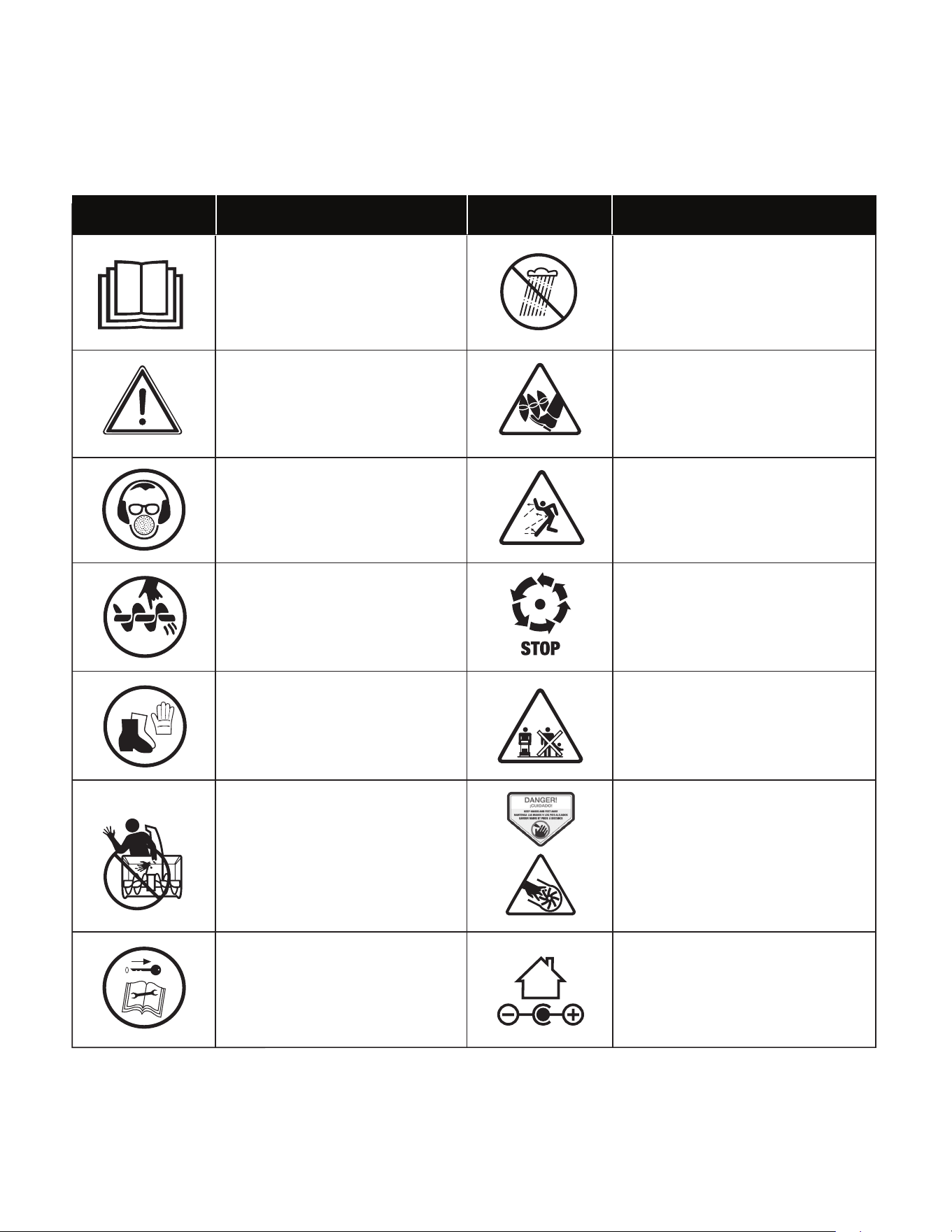
Safety Symbols
The following table depicts and describes safety symbols that may appear on this product. Read, understand and follow all
instructions on the machine before attempting to assemble and operate.
The rotating part will continuously
run for several seconds after you
turn off the machine.
READ THE OPERATOR'S
MANUAL(S) – Read, understand
and follow all instructions in the
user manual(s) before attempting to
assemble and operate.
SAFETY ALERT – Indicates a
precaution, a warning or a danger.
Wear hearing protection.
Wear eye protection.
Wear breathing protection.
WARNING! Do not expose the unit
to rain or wet conditions. Keep
dry.
CAUTION! Beware of stones and
other foreign objects that could be
thrown from the appliance.
DANGER! Cutting/dismemberment
hazard – Keep hands away from the
rotating auger. Do not use hands to
unclog rotor housing. Stop motor
before removing debris.
DANGER! Cutting/dismemberment
hazard - Keep feet away from the
rotating auger.
Symbols SymbolsDescriptions Descriptions
Indoor use only. Only use battery
charger indoors.
Do not use hands to unclog chute.
Keep hands, feet and clothing
away from the rotating auger to
avoid injury.
Keep bystanders and children a
safe distance (at least 33 ft/10 m)
away from the work area.
WARNING! Always turn the
machine OFF before conducting
inspection, cleaning and
maintenance.
Wear protective gloves and non-slip
footwear when using the machine
and handling debris.
8
Technical Data
Battery Voltage Max* .............................................48V D.C. (2 x 24V)
No Load Speed ..................................................................... 2,500 rpm
Auger ...................................................... 4 rubber-tipped steel blades
Clearing Width ............................................................... 22 in. (56 cm)
Depth of Snow Cut ........................................................13 in. (33 cm)
Thro
w Distance Max ....................................................... 25 ft (7.6 m)
Plowing Capacity Max ..................................................... 840 lbs/min
(381 kg/min)
Stages ................................................................................. Single stage
Type of Snow ........................................................................ Light, fluffy
Directional Control ..........................................180º adjustable chute
LED Lights ....................................................................................... 1 W
Tire size ........................................................................... 7 in (27.8 cm)
*Generates 48 V max with two 24 V lithium-ion batteries. Initial no-load voltage, per fully charged battery, peaks at 24 V. Nominal voltage under typical load is 21.6 V.
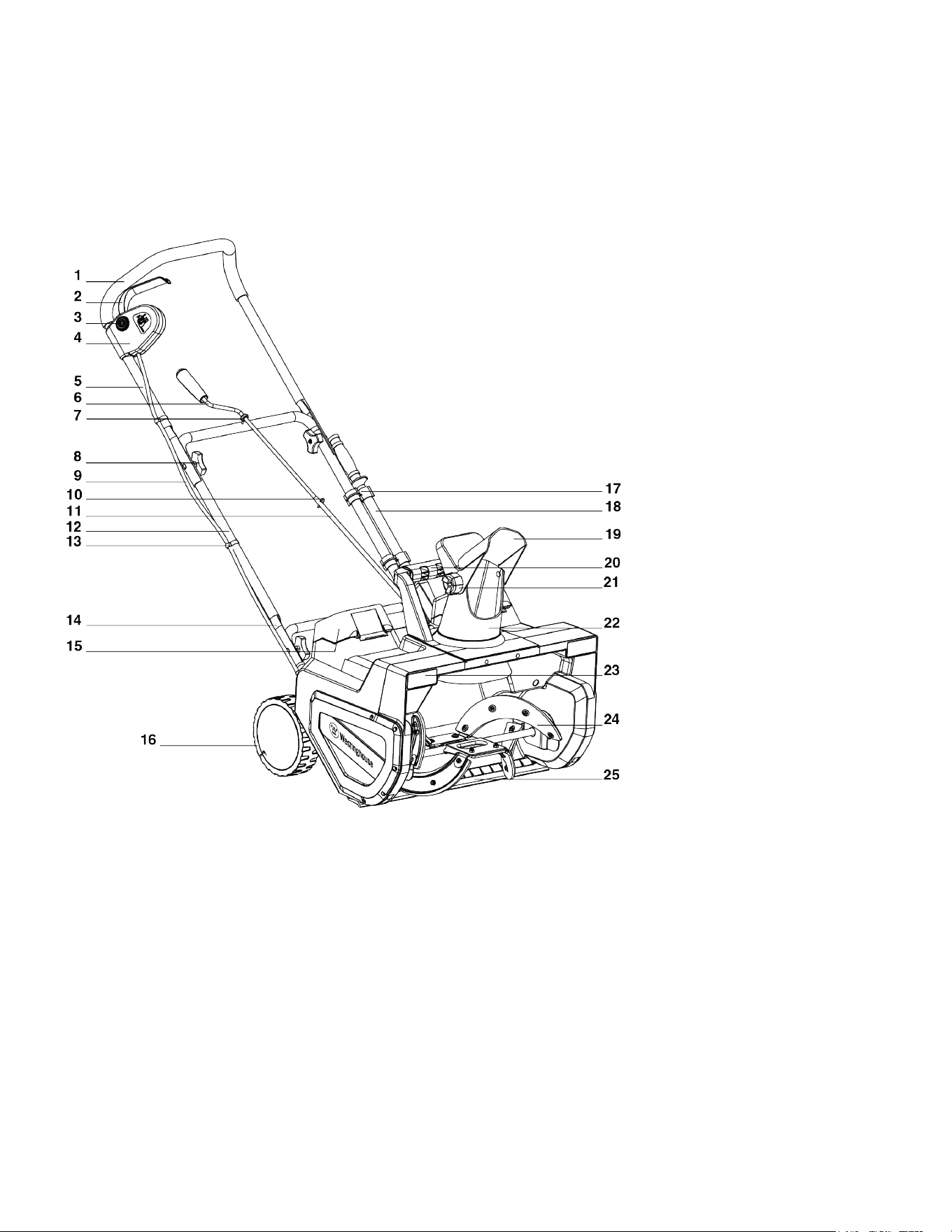
1. Handle bar
2. ON/OFF trigger
3. Safety lock button
4. Switch box
5. Upper frame
6. Upper chute crank
7. Rubber ring
8. Handle knobs and bolts (4)
9. Cable
10. Hitch-pin
11. Lower chute crank
12. Middle frame
13. Cable clips (3)
14. Lower frame
15. Battery compartments (2)
16. Wheels (2)
17. Chute clean-out tool clips (2)
18. Chute clean out tool
19. Chute deflector
20. Auxiliary handle
21. Deflector knob
22. Discharge chute
23. LED lights (2)
24. Auger
25. Scraper bar
Know Your Cordless Snow Blower
Read the owner’s manual and safety rules carefully before operating your cordless snow blower. Compare the illustration
below to the actual unit in order to familiarize yourself with the location of the various controls and adjustments. Save this
manual for future reference.

9
Unpacking
Carton Contents:
• Cordless snow blower
• Middle frame
• Upper frame
• Handle knobs and bolts (4)
• Upper chute crank
• Lower chute crank
• Cable clips (3)
• Chute clean out tool with clips (2)
• Manual
1. Carefully remove the cordless snow blower and check to
see that all of the above items are supplied.
2. Inspect the product carefully to make sure no breakage or
damage occurred during shipping. If you find damaged or
missing parts, DO NOT return the unit to the store.
Please call Westinghouse Outdoor Power Equipment
(855) 944-3571.
NOTE: Do not discard the shipping carton and packaging
material until you are ready to use the cordless snow
blower. The packaging is made of recyclable materials.
Properly dispose of these materials in accordance with
local regulations or save the packaging for long-term
product storage.
IMPORTANT! The equipment and packaging material are
not toys. Do not let children play with plastic bags, foils or small
parts. These items can be swallowed and pose a suffocation
risk!
10
Assembly
Assembling the frames
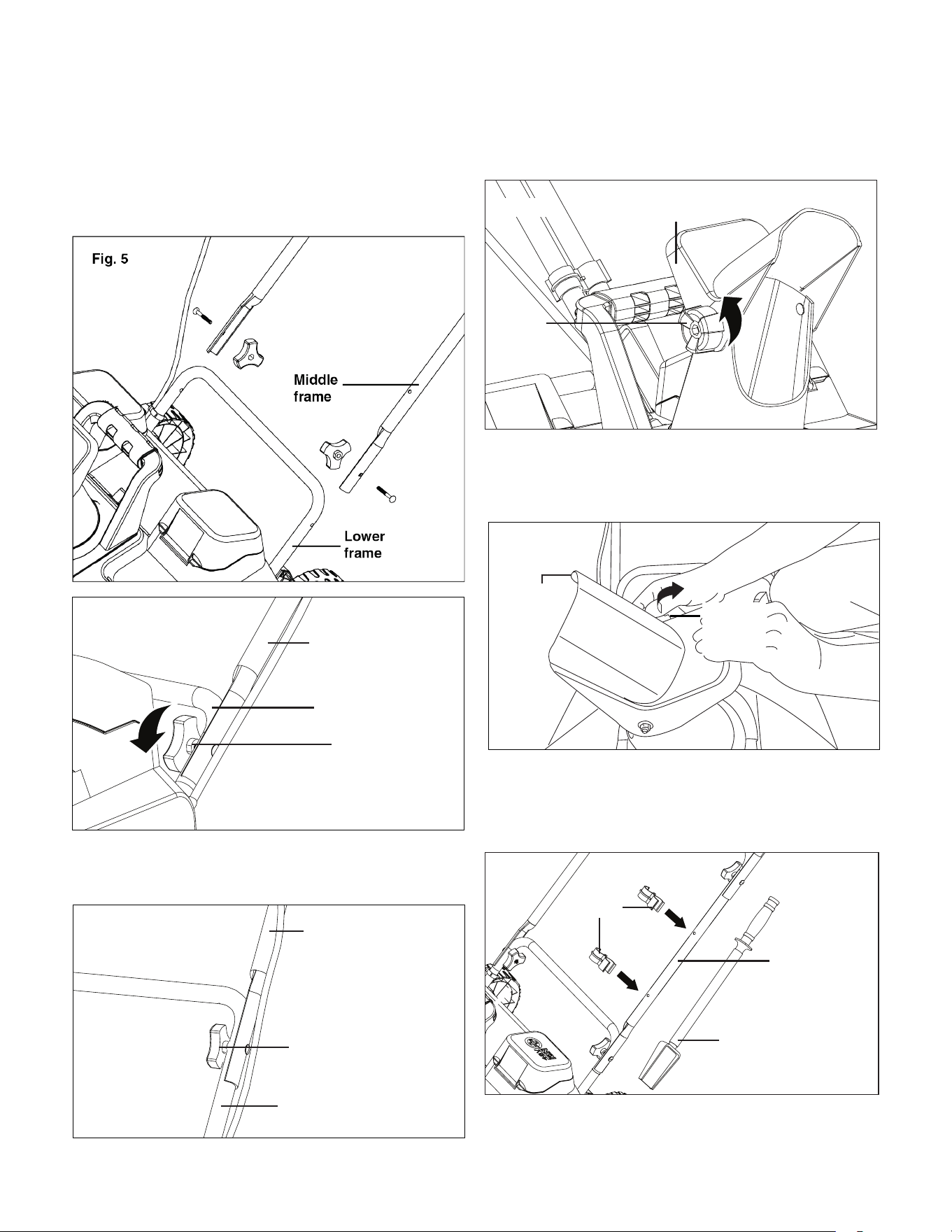
1. Secure the connection of the middle frame to lower frame
by fastening the first set of knobs and bolts on each side
(Figs 5 – 6).
2. Secure the connection of the upper frame to the middle
frame by fastening the second set knobs and bolts on each
side (Fig. 7).
Discharge Chute Assembly
1. Loosen the chute deflector knob to lift the chute deflector
(Fig. 8).
2. Raise or lower the chute deflector to the desired height of
the snow stream and tighten the chute deflector knob
(Fig. 9).
NOTE: Do not overtighten the chute deflector knob.
Attaching the chute clean-out tool
1. Attach the two included chute clean-out tool clips onto the
middle frame, then snap the tool onto the clips to attach it
to the machine (Fig. 10 – 11).
Fig. 6
Lower frame
Middle frame
Knob + bolt
Fig. 7
Middle frame
Upper frame
Knob + bolt
Fig. 8
Chute
deflector
knob
Chute
deflector
Fig. 9
Chute
deflector
Chute
deflector
knob
Fig. 10
Clips
Middle frame
Chute clean-out tool
11
Chute Crank Assembly
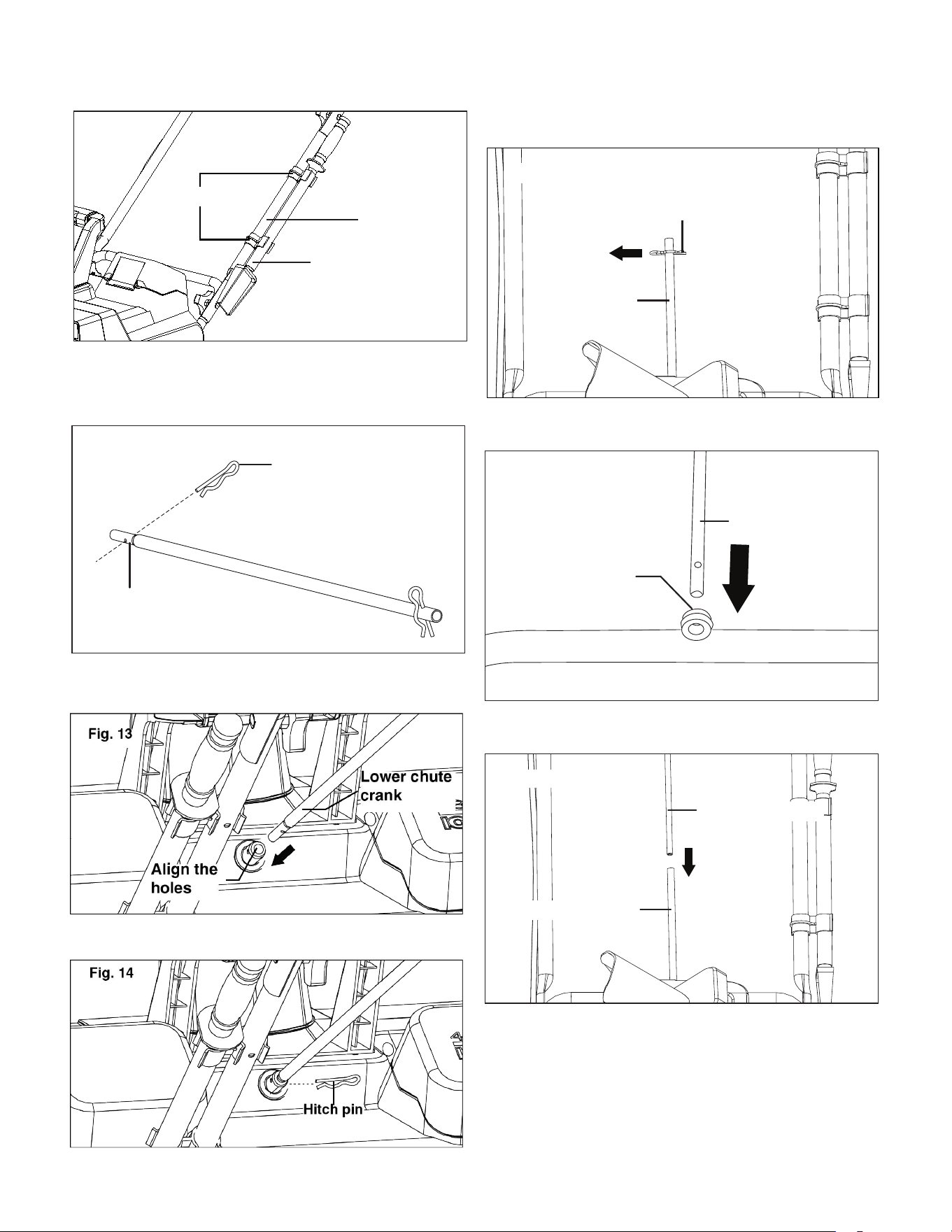
1. Remove the hitch pin from the female end of the lower chute
crank (Fig. 12).
2. Install the lower crank rod by inserting it into the opening at
the back of the housing and aligning the holes (Fig. 13).
3. Secure the lower chute crank in place with the hitch pin
(Fig. 14).
4. Remove the other hitch pin from the lower chute crank (Fig.
15).
5. Slide the upper chute crank through the rubber ring located
on the middle frame (Fig. 16).
6. Slide the upper chute crank into the lower chute crank
(Fig. 17).
Fig. 11
Clips
Middle frame
Chute clean-out tool
Fig. 12
Hitch Pin
Lower chute crank
(female end)
Lower chute
crank
Fig. 15
Hitch pin
Fig. 16
Rubber ring
Upper chute crank
Fig. 17
Lower chute crank
Upper chute crank
12
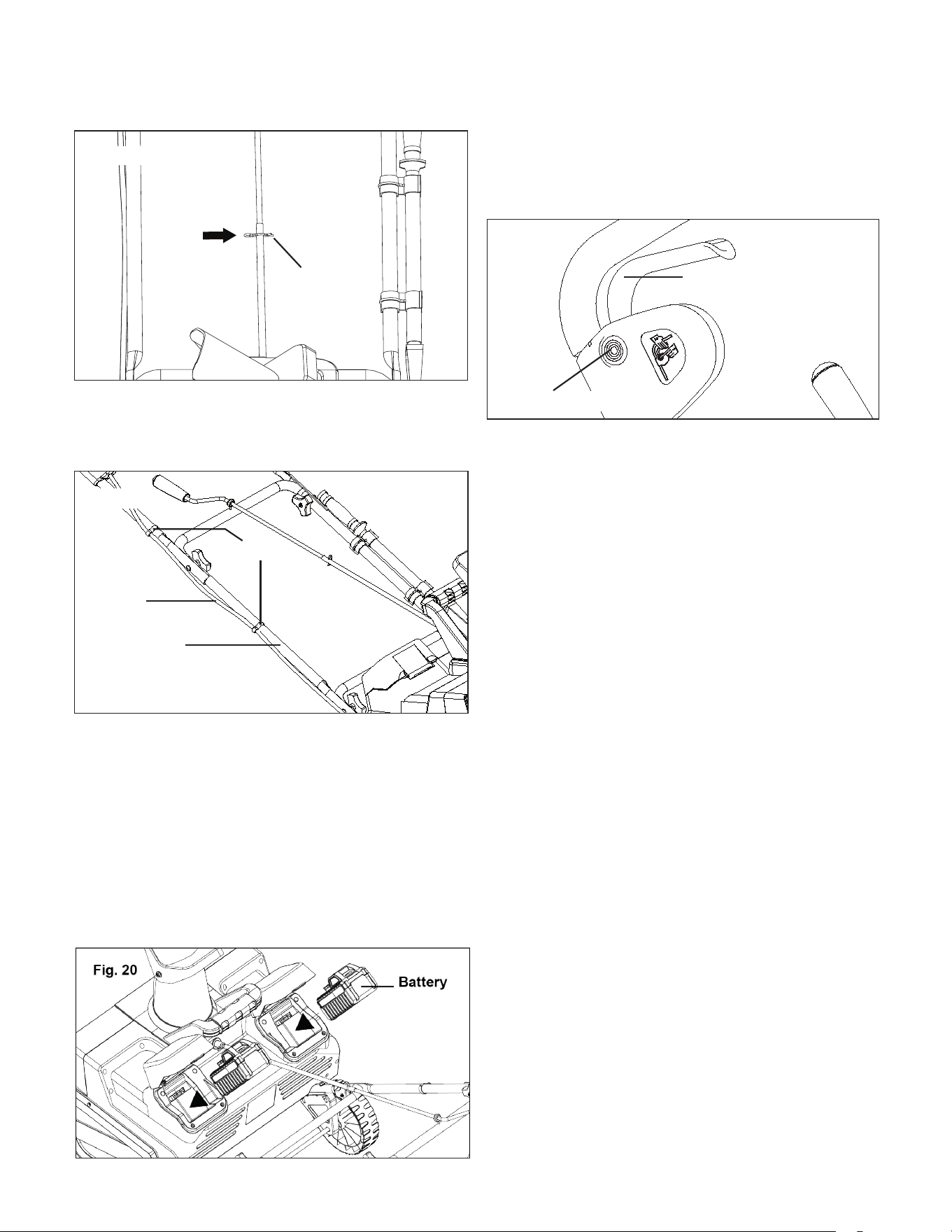
7. Align the screw holes and secure with hitch pin (Fig. 18).
Securing the cable
1. Place the cable clips over the cable while snapping them
onto the middle frame to secure it to the machine (Fig. 19).
Operation
m
WARNING! Keep the area to be cleared free of stones,
toys or other foreign objects that the rotor blades might pick up
and throw. Such items could be covered by snow and are easy
to overlook, so be sure to conduct a thorough inspection of the
area before beginning work.
Starting + Stopping
1. Open the battery compartment covers and slide each
battery down until it clicks to lock it into position (Fig. 20).
2. While depressing the safety switch button, pull the
ON/OFF trigger toward you. Once the machine powers on,
release the safety switch button and begin operation
(Fig. 21). The machine can only be started by depressing
the safety switch button first, followed by squeezing the ON/
OFF trigger; reverse operation will not start the machine.
3. To power off, release your grip on the ON/OFF trigger.
Operating Tips
mWARNING! Foreign objects, such as rocks, broken glass,
nails, wire, or string, can be picked up and thrown by the snow
blower, causing serious personal injury. Remove all foreign
objects from the area to be plowed before operating the snow
blower.
1. Keep the area of operation free of foreign objects that can
become thrown by the rotor blades. Perform a thorough
inspection of the area since some objects may be hidden
from view by surrounding snow. If the snow blower hits an
obstruction or picks up a foreign object during use, stop the
snow blower, remove the batteries, remove the obstruction,
and inspect the unit for damage. Repair or replace any
damaged part before restarting and operating the unit.
2. Keep children, pets, and bystanders away from the area of
operation. Be aware that the normal noise of the machine
when turned on may make it difficult for you to hear
approaching people.
3. When moving the snow blower, use the wheels on one side
as the pivot point. Slightly tilt the snow blower on this pivot
point to move it forward or backward.
4. Start your clearing path outward, throwing snow in a back
and forth motion. To clear in the opposite direction,
pivot the snow blower on its wheels. Make sure to overlap
clearing paths.
5. Note the wind direction. If possible, move in the same
direction as the wind so that the snow is not thrown against
the wind (and thus back into your face and on the just
cleared path).
6. Do not push the snow blower with excessive force.
You should push the machine gently and evenly in
accordance with the unit’s throw rate.
7. Do not apply additional man-made load to the motor since
this may cause motor damage.
8. Some parts of the snow blower may freeze under extreme
temperature conditions. Do not attempt to operate the snow
Fig. 18
Hitch pin
Middle frame
Fig. 19
Cable
Clips
Fig. 21
Safety switch button
ON/OFF trigger
13
blower with frozen parts. If the parts freeze while the snow
blower is in use, stop the snow blower, remove the batteries,
and inspect for frozen parts. Free all parts before restarting
or operating the snow blower.
Never force controls that have frozen.
9. When working on pebbles, gravel, or unpaved surfaces,
avoid throwing loose surface material along with the snow
by pushing down on the handle to raise the scraper at the
base of the unit above the pebbles or gravel.
Headlights
The snow blower is equipped with two headlights that can be
used to illuminate the forward path in the dark. The headlights
will be turned on once the machine is started by depressing the
safety switch button and pulling the ON/OFF trigger
(Fig. 21).
NOTE: The lights will only turn ON when the snow blower is
running. The lights will automatically turn off 30 seconds after
the machine powers off.
Changing Throw Direction and
Throw Height
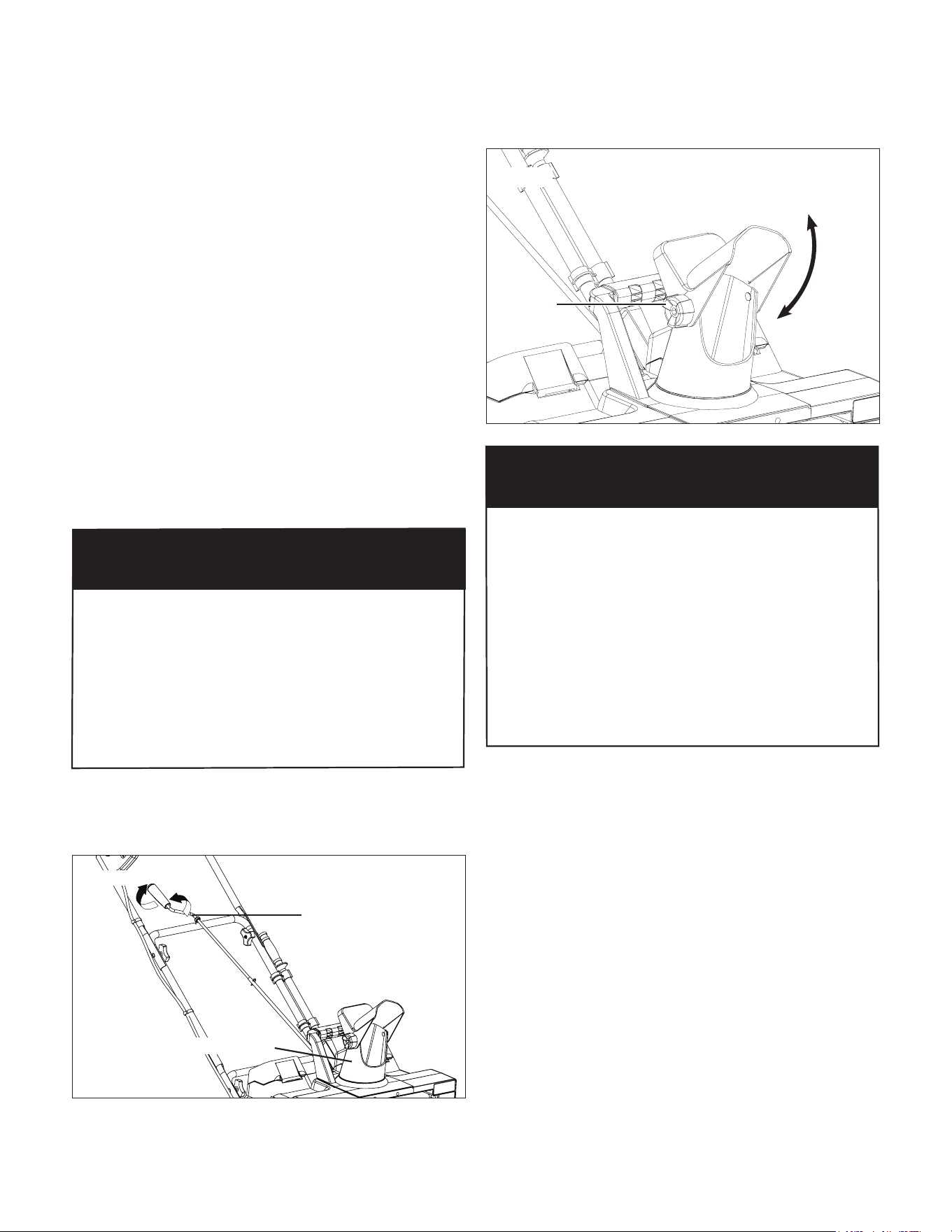
1. The discharge chute can be adjusted 180 degrees by
rotating the chute crank. Rotate the chute control crank
clockwise to move the discharge chute to the left and
counterclockwise to move the chute to the right (Fig. 22).
2. The chute deflector on the top of the discharge chute
controls the height of the snow stream. Loosen the knobs
to raise or lower the deflector to the desired height of snow
you wish to throw. Tighten the knobs to secure the deflector
(Fig. 23).
Maintenance
To order genuine replacement parts or accessories call
Westinghouse Outdoor Power Equipment (855) 944-3571.
mWARNING! Make sure to turn off the switch and remove
the batteries before performing any maintenance task on your
snow blower.
Lifetime Lubrication (Motor + Auger)
Lubrication is not necessary and may damage the unit.
The snow blower is lubricated for lifetime use at the factory
before shipment.
General Maintenance Tips
1. Do not attempt to repair the machine unless you have the
proper tools and instructions for disassembly and repair of
the machine.
m WARNING m
Never direct the snow discharge chute at the operator,
at bystanders, at vehicles, or at nearby windows. The
discharged snow and foreign objects accidentally
picked up by the snow thrower can cause serious
damage and personal injury.
Always orient the discharge chute in the opposite
direction from where you, bystanders, surrounding
vehicles, or windows are located.
Fig. 22
Chute crank
Discharge chute
Deflector
knob
Fig. 23
m WARNING m
Make sure that the chute deflector snaps and locks
completely onto the discharge chute. An opening
between the discharge chute and the chute deflector
may allow foreign objects to be picked up by the snow
thrower and thrown in the direction of the operator
causing serious bodily injury.
• Do not advance the chute deflector too far forward
causing an opening to appear between the
deflector and discharge chute.
• Do not overtighten the knobs on the chute
deflector.

14
2. Check bolts and screws at frequent intervals for proper
tightness to ensure that the equipment is in safe working
condition.
3. After each snow removal session, run the snow blower
for a few minutes to prevent the collector/impeller from
freezing. Shut off the motor, wait for all revolving parts to
stop completely, and wipe residual ice and snow off the
unit. Rotate the chute deflector by the chute control crank
several times to remove any excess snow.
Proper Care for Batteries + Charger
mWARNING! To reduce the risk of injury, always unplug the
charg
er and remove the battery packs from the charger before
performing any maintenance task. Never disassemble the battery
packs or charger.
1. To reduce the risk of injury and damage, never immerse
battery packs or charger in liquid or allow any liquid to
flow
inside these components.
2. Clean out dust and debris from charger vents and electrical
contacts by blowing with compressed air.
3. Use only mild soap on a damp cloth to clean the battery
packs and charger, keeping away from all electrical
contacts. Certain cleaning agents and solvents are harmful
to plastics and other insulated parts. Some of these include
gasoline, turpentine, lacquer thinner, paint thinner,
chlorinated cleaning solvents, ammonia and household
detergents containing ammonia. Never use flammable or
combustible solvents around battery packs,
battery chargers or tools.
Maintenance + Storage
1. Run the machine a few minutes after throwing snow to
prevent the auger from freezing.
2. Examine the cordless snow blower thoroughly for worn,
loose or damaged parts. Should you need to repair or
replace a part, contact Westinghouse Outdoor Power
Equipment (855) 944-3571 for assistance.
3. Clean the snow blower before storing or transporting.
Be sure to secure the unit while transporting.
4
. Remove the batteries from the cordless snow blower before
storing.
5. Store the cordless snow blower indoors in a locked,
dry place out of the reach of children to prevent
unauthorized use or damage.
6. Maintain safety and instruction labels, as necessary.
7. Always refer to the Battery + Charger Off-Season Storage
section for important details if the snow blower is to be
stored for an extended period.
Battery + Charger Off-Season Storage
1. Do not expose battery packs or charger to water, rain or
allow them to get wet. This could permanently damage the
charger and the battery packs. Do not use oil or solvents to
clean or lubricate your battery packs as the plastic casing
can become brittle and crack, causing a serious risk of
injury.
2. Store the battery packs and charger at room temperature
away from moisture. Do not store in damp locations where
corrosion of terminals may occur. As with other battery pack
types, permanent capacity loss can result if the pack is
stored for long periods of time at high temperatures (over
120ºF/49ºC).
3. 24V lithium-ion battery packs maintain their charge during
storage longer than other battery pack types. As a general
practice, it is best to unplug the battery charger and remove
the battery packs when they are not in use. Recharge the
battery packs every 6 months to 50%capacity (2 lights on)
during off-season storage to maintain optimal battery
performance.
Battery Caution +
Disposal Information
Always dispose of battery packs according to federal, state, and
local regulations. Contact a recycling agency in your area for
recycling locations.
mCAUTION! Even discharged battery packs contain
some ener
gy. Before disposing, use electrical tape to cover the
terminals to prevent the battery packs from shorting,
which could cause a fire or explosion.
mWARNING! To reduce the risk of injury or explosion,
never burn or incinerate battery packs even if it is damaged,
dead or completely discharged. When burned, toxic fumes and
materials are emitted into the surrounding atmosphere.
1. Batteries vary according to device. Consult your manual for
specific information.
2. Install only new batteries of the same type in your product
(where applicable).
3. Failure to insert batteries in the correct polarity, as indicated
in the battery compartment or manual, may shorten the life
of the batteries or cause batteries to leak.
4. Do not mix old and new batteries.
5. Do not mix Alkaline, Standard (Carbon-Zinc) or
Rechargeable (Nickel Cadmium, Nickel Metal Hydride,
or Lithium-Ion) batteries.
6. Do not dispose of batteries in fire.
7. Batteries should be recycled or disposed of as per state
and local guidelines.
TOOL ONLY - BATTERY AND CHARGER SOLD SEPARATELY

15
Service + Support
If your cordless snow blower requires service or maintenance,
please call the Westinghouse Outdoor Power Equipment (855)
944-3571.
Model + Serial Numbers
When contacting the company, reordering parts or arranging
service from an authorized dealer, you will need to provide the
model and serial numbers, which can be found on the decal
located on the housing of the unit.

www.WestinghouseOutdoorPower.com
Service Hotline (855) 944-3571
777 Manor Park Drive, Columbus, OH 43228
and Westinghouse are trademarks of Westinghouse Electric Corporation.
Used under license by Westinghouse Outdoor Power Equipment.
© 2024 Westinghouse Outdoor Power Equipment, All Rights Reserved.
WSnow22
T 48V 062624 Rev 01
