DO NOT RETURN THIS PRODUCT TO THE STORE
If you have questions or need assistance, please call customer service at 855-944-3571.
User Manual
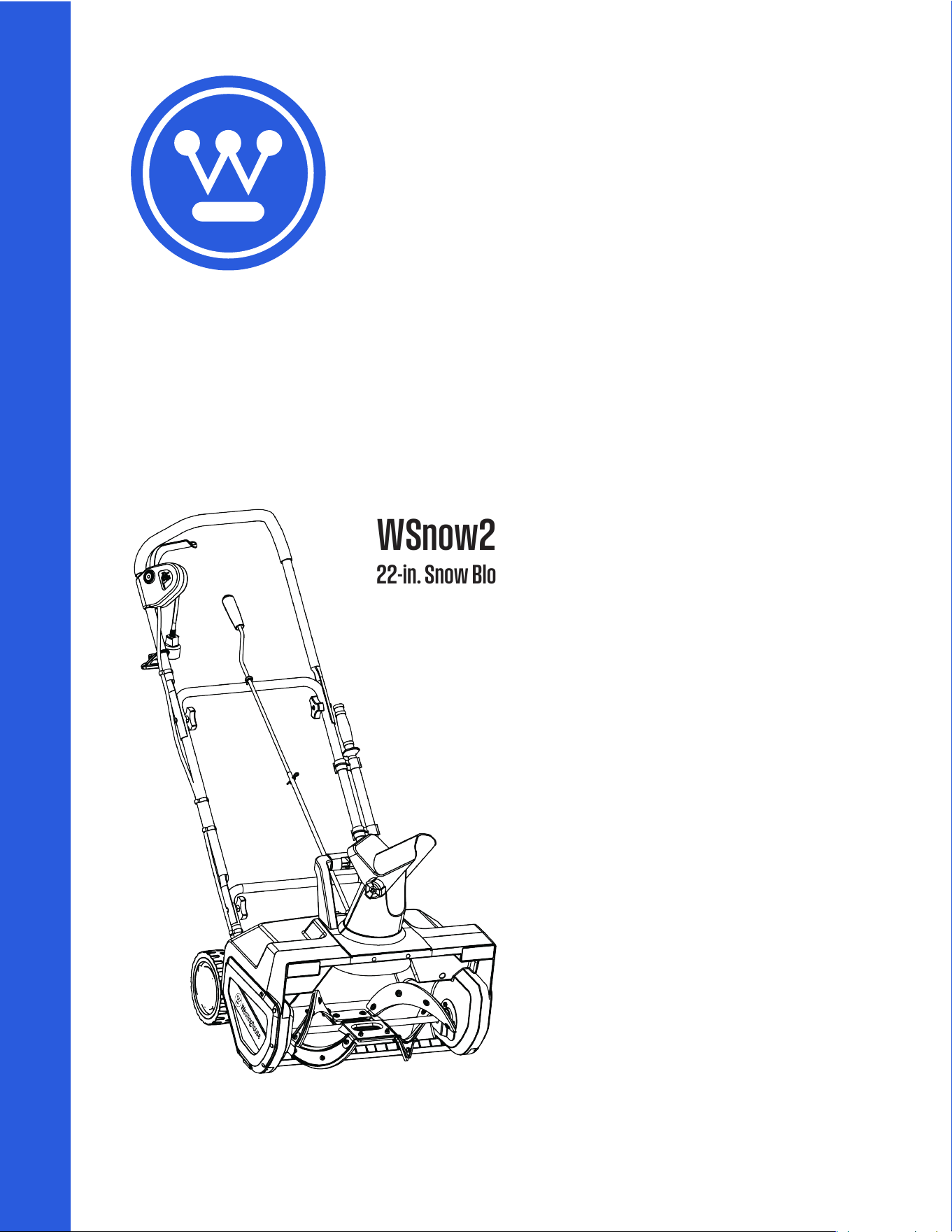
WSnow22
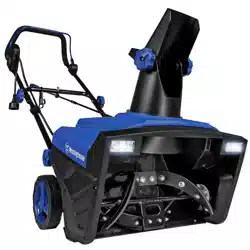
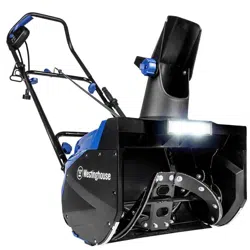
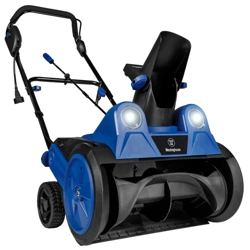
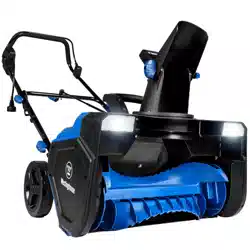
22-in. Snow Blower

•
•
•
Product Registration
For trouble-free warranty
coverage, it is important to
register your Westinghouse
product.
You can register by:
Completing and mailing the product
registration card included in the carton.
Registering your product on-line at:
wpowereq.com/pages/warranty-registration
Scanning the above QR code with your
smartphone camera to be directed to the
mobile registration link.
For Your Records
Date of Purchase:_________________
Model Number: __________________
Serial Number:___________________
Place of Purchase:________________
Sending the following product information to:
Westinghouse Outdoor Power
Warranty registration
777 Manor Park Drive
Columbus, OH 43228
WARNING: Operating, servicing, and main-taining this
equipment may expose you to chemicals which are
known to the State of California to cause cancer and birth
defects or other reproductive harm. To minimize
exposure, wear gloves or wash your hands frequently
when servicing this equipment. For more information go
to www.P65warnings.ca.gov.
1

SAVE THESE INSTRUCTIONS
2
IMPORTANT!
Safety Instructions
All Operators Must Read These
Instructions Before Use
Any electrical appliance can be dangerous if used
incorrectly. Some of the safety precautions given in this
manual apply generally to many appliances. Other warnings
are specic to the use of this snow thrower. Keep this manual
for future reference.
General Safety WARNINGS!
You and any other operator of this snow thrower must read,
understand, and follow these instructions in their entirety, and
should reread them at the start of each snow season. Failure
to follow these instructions may result in ELECTRIC SHOCK,
FIRE, and/or serious PERSONAL INJURY.
Notice the personal safety alert symbol
m used in this
manual to draw your attention to a WARNING given along
with the particular operating instruction. This means that
the operation requires special ATTENTION, CAUTION,
and AWARENESS.
1. Keep work area clean and well lit. Cluttered, dark areas
invite accidents.
2. Do not operate the snow thrower in an explosive
atmosphere, such as in the presence of ammable
liquids, gases, or dust. Electrical appliances create sparks
that may ignite the dust or fumes.
3. Keep children, pets, and bystanders away from the
work area. Be aware that the normal noise of the
machine when turned on may make it dicult for you to
hear approaching people. Spectators should wear safety
glasses and be kept a safe distance away from the work
area. Do not let spectators touch the snow thrower or the
extension cord.
4. Electrical plugs must match the outlet. Never modify
the plug in any way. Do not use any adapter plugs with
grounded appliances. Unmodied plugs and matching
outlets will reduce the risk of electric shock.
5. Avoid body contact with earthed or grounded surfaces
(i.e. upper and lower water pipes, radiators, ranges,
refrigerators, microwave ovens, and outer frames of
heating equipment). Take necessary precautions to avoid
electric shock. There is an increased risk of electric shock
if your body is earthed or grounded.
6. Do not abuse the cord. Keep the cord away from heat,
oil, sharp edges, or moving parts. Never carry the snow
thrower by its cord or yank the cord to disconnect it from
the electrical outlet. Damaged or entangled cords increase
the risk of electric shock.
7.
Replace or properly repair damaged cords. If the cord
becomes damaged in any manner while plugged into the
wall receptacle, immediately pull the extension cord plug
from the receptacle.
8.
Contact with water while operating the snow thrower
can result in electric shock and serious bodily injury.
Do not use the snow thrower in damp or wet locations or
expose to rain. Do not handle the plug or the appliance
with wet hands or while standing in water.
9.
mWARNING – Use outdoor extension cords marked
SW-A, SOW-A, STW-A, STOW-A, SJW-A, SJOW-A,
SJTW-A, or SJTOW-A. These cords are rated for outdoor
use and reduce the risk of electric shock.
10. Turnothepowerswitchanddisconnectthepower
cable before making any adjustments to the unit and
before inspecting, servicing, changing accessories, or
cleaning the snow thrower. Follow the same procedure
if any other dangerous conditions are present during
operation. Any adjustments to the unit should be
performed after revolving parts inside the snow thrower
stop completely. Such preventative safety measures
reduce the risk of starting the power tool accidentally.
11. Ifyoundthemainpowercableortheextensioncable
damaged, please pull out the plug from the socket and
disconnect the power immediately. Repair the cable or
replace it if necessary.
12. When replacing any parts, you must strictly observe
the instructions and procedures described in this
operator's manual. Special care should be paid to any
rubber parts, since these parts may increase the engine
load and decrease its mechanical power if damaged.
13. Do not move or transport the snow thrower when the
plug is connected to the power socket and the switch
is turned on.
3
14. If, during use, you notice that the unit runs unstably
or hear abnormal sounds from the motor, stop the
machine, disconnect the power immediately and
contact Westinghouse Outdoor Power Equipment
(855) 944-3571.
Electrical Safety
1. Ground fault circuit interrupter (GFCI) protection should
be provided on the circuit(s) or outlet(s) to be used for
the snow thrower. Receptacles are available having
built-in GFCI protection and may be used for this
measure of safety.
2. To prevent electric shock, use only with an extension cord
suitable for outdoor use, such as SW-A, SOW-A, STW-A,
STOW-A, SJW-A, SJOW-A, SJTW-A, or SJTOW-A.
Before use, check that the extension cord is in good
condition. When using an extension cord, make sure to
use one heavy enough to carry the current your product
will draw. An undersized cord will cause a drop in line
voltage resulting in loss of power and overheating.
3. To reduce the risk of electric shock, this appliance has
a polarized plug (i.e. one blade is wider than the other).
Use this appliance only with a polarized UL-, CSA-, or
ETL-rated extension cord for outdoor, all-weather use.
The appliance plug will t into a polarized extension
cord only one way.
If the appliance plug does not t fully into the extension
cord, reverse the plug. If the plug still does not t, obtain
a correct polarized extension cord. A polarized extension
cord will require the use of a polarized wall outlet. The
extension cord plug will t into the polarized wall outlet
only one way. If the plug does not t fully into the wall
outlet, reverse the plug. If the plug still does not t,
contact a qualied electrician to install the proper wall
outlet. Do not modify the appliance plug, extension cord
receptacle, or extension cord plug in any way.
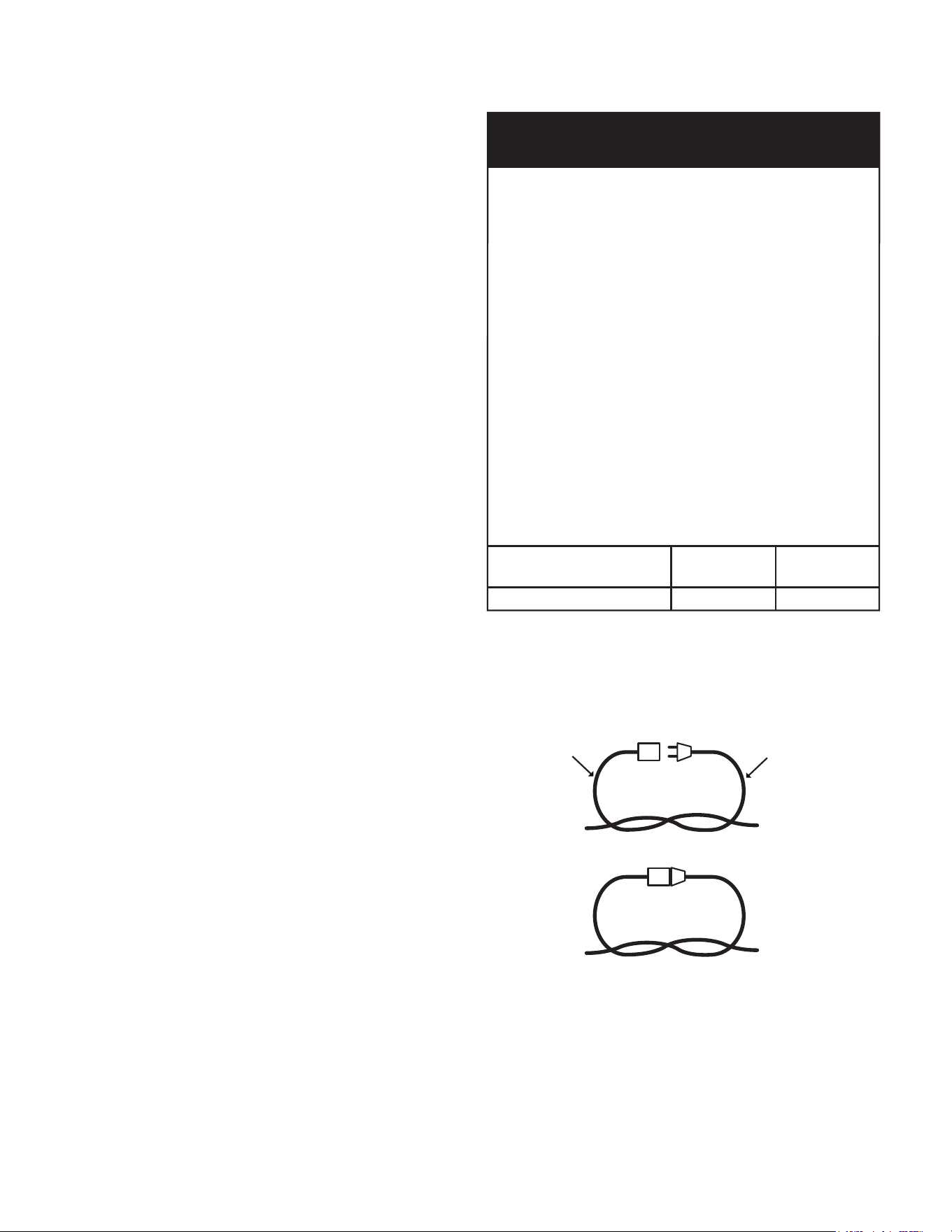
4. To prevent the appliance cord from disconnecting from the
extension cord during operation, use the on-board cord
restraint hook and/or make a knot with the two cords as
shown in Table 1.
5. Do not abuse the cord. Never pull the snow thrower by the
cord or yank the cord to disconnect it from the receptacle.
Keep the cord away from heat, oil, and sharp edges.
Extension Cord
Length
Wire Gauge (A.W.G.):
Up to 50 ft
(15 m)
+50 ft - 100 ft
(+15 m - 30 m)
14 12
m WARNING m
Electric shock may cause SEVERE INJURY or
DEATH. Heed these warnings:
• Do not allow any part of the electric snow thrower to
make contact with water while it is in operation. If the
appliance becomes wet while turned off, wipe dry
before starting.
• Use only a UL-, CSA- or ETL-rated extension cord for
outdoor, all-weather use.
• Do not use an extension cord over 100 ft (30 m).
• Do not touch the appliance or its plug with wet hands
or while standing in water. Wearing rubber boots
offers some protection.
EXTENSION CORD CHART
(B) Connect plug and receptacle
Cord set
Appliance
cord
(A) Tie cord as shown
Table 1. Method of Securing Extension Cord

4
Personal Safety
1. Stay alert – Watch what you are doing and use common
sense when operating the snow thrower. Do not use the
machine when tired, ill, or under the inuence of drugs,
alcohol, or medication. A moment of inattention may result
in serious personal injury.
2. Wear proper clothing – Wearing rubber boots oers
additional protection from electric shock. Do not wear
loose clothing or jewelry that may become caught in the
machine. Wear protective headgear to keep hair away
from revolving parts of the machine. Safety glasses oer
better protection than everyday eyeglasses.
3.
Moving parts present risks – Keep your face, hair, clothing,
hands, and feet away from moving parts. All guards and
safety attachments must be installed properly before using
the unit. Shut o and disconnect the cord before touching
any parts other than the handles and the switch.
4. Surfaces – This snow thrower is intended for use on
paved surfaces. Do not use on gravel, stone, or other
unpaved surfaces unless the snow thrower is adjusted for
such surfaces according to the instructions given in this
operator’s manual.
5. Avoid accidental starting – Make sure the switch is in the
o position before plugging in the unit. Do not carry the
snow thrower with your nger on the switch.
6. Body position – Maintain proper footing and balance
at all times. Place heels rmly on the ground and tightly
grasp the handle bar. Watch for uneven surfaces and do
not overreach. In case you fall or collide with the snow
thrower, inspect the unit for any damage or cracks.
When stepping backwards, be careful to avoid obstacles
beneath your feet or behind you to avoid falling.
7. If the snow thrower strikes any object, immediately
stop the snow thrower, then inspect for damage –
Repair any damage before restarting and operating the
snow thrower.
Safety Instructions for Walk-Behind
Snow Throwers
• Readtheoperator’smanualcarefully–Learn your
snow thrower’s applications and limitations as well as the
specic potential hazards related to this machine. Do not
use this machine for any purpose other than the one for
which it was designed. Otherwise, it may cause mechanical
defaults, serious damage, or personal injury.
• Preliminaryunitinspection–Thoroughly inspect the unit
before use. Make sure all the parts are secure and installed
correctly. If you notice any abnormalities, do not use the
machine until it has been properly repaired.
Always perform a test run the rst time you use the snow
thrower or after replacing parts to ensure that the unit is
functioning properly.
•
Preliminary area inspection – Clear the area to be plowed
before each use. Remove all objects, such as rocks, broken
glass, nails, wire, or string, which can be thrown by or become
entangled in the snow thrower. Keep the area of operation
clear of all spectators, particularly children and pets.
• Excessiveforce–The snow thrower was designed to
respond at a certain rate for various snow conditions for
optimum safety and performance. Do not force it; keep
pressure constant.
• Malfunctioningswitch–Do not use the snow thrower
if the switch does not turn it on and off. Any electrical
appliance that cannot be controlled by the switch is not safe
to use and must be repaired.
• Hittinganobject–If the snow thrower accidentally strikes
an object, follow these steps:
i) Stop the snow thrower and unplug the unit
ii) Inspect for damage
iii) Repair or replace any damaged part before restarting
and operating the snow thrower.
• Discharge chute safety –
Never direct the snow discharge
chute at the operator, at bystanders, at vehicles, or at
windows. The discharged snow stream and foreign objects
accidentally picked up by the snow thrower can cause
serious damage and personal injury. Do not use your hands
to unclog the discharge chute. Stop the motor before
removing debris.
• Hand-heldoperatingposition–Operation of the snow
thrower in the hand-held position is unsafe.
• Abnormaloperation–If you notice the snow thrower
running in an unstable state or hear abnormal sounds from
the engine, immediately stop the machine, disconnect the
power, and contact Westinghouse Outdoor Power
Equipment (855) 944-3571.
• Noisecontrol–When using the snow thrower, you must
respect local laws and regulations regarding noise control
and environmental protection. To avoid noise disturbance,
you should carefully decide upon an appropriate operation
time and consider the surrounding conditions.
• Whenworkiscompleted–Disconnect the snow thrower
from the power source when not in use, when changing
accessories, and before performing any maintenance
function.
• Storesafely–Store the snow thrower indoors in a dry area
between uses. Keep it in a locked area, where children and
unauthorized users cannot gain access. Do not store the
machine while it is still connected to the power source as
this may result in damage and injury.
• Maintainforsafetyandlongevity–Check for
misalignment or binding of moving parts, breakage of parts,
and any other conditions that may affect the unit’s
operation. If damaged, repair or replace the damaged part
before use. Use only original replacement parts designed
specifically for your model. When replacing any parts, you
must strictly observe the instructions and procedures
described in this manual. Special care should be paid to any
rubber parts, since these parts may increase the engine
load and decrease its mechanical power if damaged.
Always check that all bolts, nuts, and knobs are tight before
using the snow thrower!
5
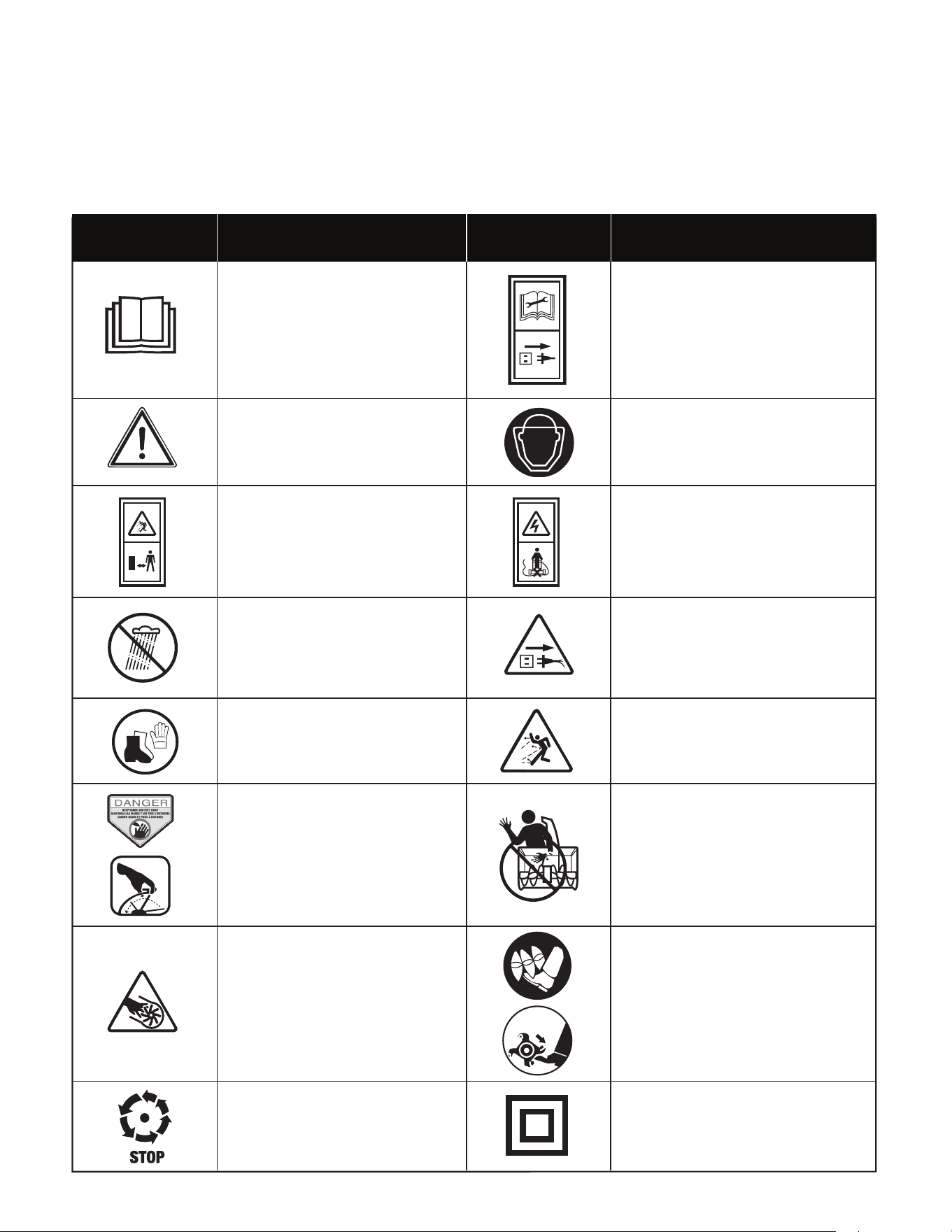
Safety Symbols
The following table describes safety symbols that may appear on this product. Read, understand, and follow all instructions on
the machine before attempting to assemble and operate.
It is obligatory at all times to wear
goggles or a visor to protect the eyes
and face.
Disconnect the plug before
conducting maintenance or when it is
damaged or tangled.
Beware of stones and other objects
that could be thrown from the
appliance. Keep all bystanders and
domestic animals a safe distance
away from the work area.
Keep feet away from the moving
parts of the snow thrower. The
rotating parts can cause severe
bodily injury.
Keep hands and feet away from
the rotating parts.
Keep hands away from the moving
parts of the snow thrower. The
rotating parts can cause severe
bodily injury.
The rotating part will continuously
run for several seconds after you
turn o the machine.
Double insulation.
Keep the exible power supply cord
away from the cutting blades.
Always keep the power cable away
from heat sources, oils, or sharp
edges. Immediately remove plug
from the mains if the cable is
damaged or entangled.
Symbols Descriptions Symbols Descriptions
READ THE OPERATOR'S
MANUAL(S) – Read, understand,
and follow all instructions in the
user manual(s) before attempting
to assemble and operate.
SAFETY ALERT – Indicates
a precaution, a warning, or
a danger.
WARNING! Do not expose the unit
to rain or wet conditions. Keep dry.
Wear protective gloves and non-
slip footwear when using the
machine and handling debris.
CAUTION! Beware of stones and
other foreign objects that could
be thrown from the appliance.
DANGER! Cutting/dismemberment
hazard – Keep hands away from the
rotating auger. Do not use hands to
unclog rotor housing. Stop motor
before removing debris.
6
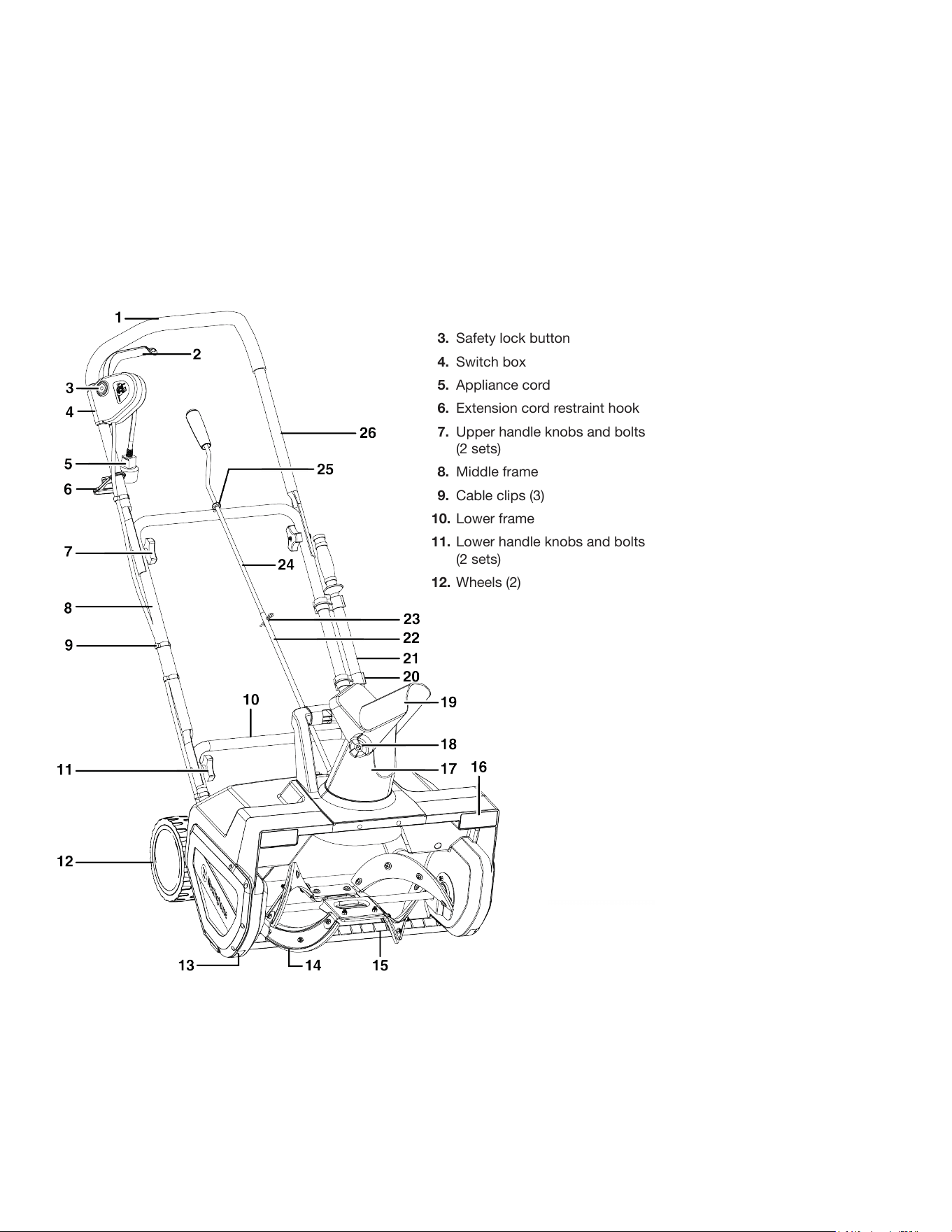
Know Your Electric Snow Thrower
Read the owner’s manual and safety rules carefully before operating your electric snow thrower. Compare the illustration
below to the actual unit in order to familiarize yourself with the location of the various controls and adjustments. Save this
manual for future reference.
Technical Data
Motor .................................................................................... 15A
Rated Voltage ........................................................120V ~ 60 Hz
Light ............................................................ 2 x 1.5 W LED lights
No Load Speed ........................................................... 2700 rpm
Clearing Width ................................................... 22 in. (56 cm)
Clearing Depth ......................................................13 in. (33 cm)
Throw Distance Max ............................................... 25 ft (7.6 m)
Plowing Capacity Max ........................840 lbs/min (381 kg/min)
Directional Control ................................... 180º adjustable chute
Rotor .............................................. 4 rubber-tipped steel blades
Type of Snow ............................................................. Light, uy
Net Weight .......................................................34.6 lbs (15.7 kg)
1. Soft grip
2. ON/OFF switch
3. Safety lock button
4. Switch box
5. Appliance cord
6. Extension cord restraint hook
7. Upper handle knobs and bolts
(2 sets)
8. Middle frame
9. Cable clips (3)
10. Lower frame
11. Lower handle knobs and bolts
(2 sets)
12. Wheels (2)
13. Skid shoes (2)
14. Auger
15. Scraper bar
16. Headlights (2)
17. Discharge chute
18. Deector knob
19. Chute deector
20. Chute clean-out tool clips (2)
21. Chute clean-out tool
22. Lower chute crank
23. Hitch-pin
24. Upper chute crank
25. Rubber ring
26. Upper frame
7
Unpacking
Carton Contents:
• Electric snow thrower with middle frame and upper frame
• Upper crank rod
• Lower crank rod
• Chute clean-out tool with clips (2)
• Extension cord restraint hook
• Cable clips (3)
• Handle knobs and bolts (4 sets)
• Manual
1. Carefully remove the electric snow thrower and check to
see that all of the above items are supplied.
2. Inspect the product carefully to make sure no breakage or
damage occurred during shipping. If you find damaged or
missing parts, DO NOT return the unit to the store. Please
call Westinghouse Outdoor Power Equipment (855)
944-3571.
NOTE: Do not discard the shipping carton and packaging
material until you are ready to use your new electric snow
thrower. The packaging is made of recyclable materials.
Properly dispose of these materials in accordance with
local regulations or save the packaging for long-term
product storage.
IMPORTANT! The equipment and packaging material are
not toys. Do not let children play with plastic bags, foils,
or small parts. These items can be swallowed and pose a
suocation risk!
Assembly
mWARNING! Inspect wiring, which, if damaged during
shipping, may cause serious bodily injury during equipment use.
If any damage is seen or suspected, do not assemble. Instead,
contact Westinghouse Outdoor Power Equipment (855)
944-3571) for assistance.
Handle with care during assembly so that electrical wiring does
not become damaged.
Handle Frame Assembly
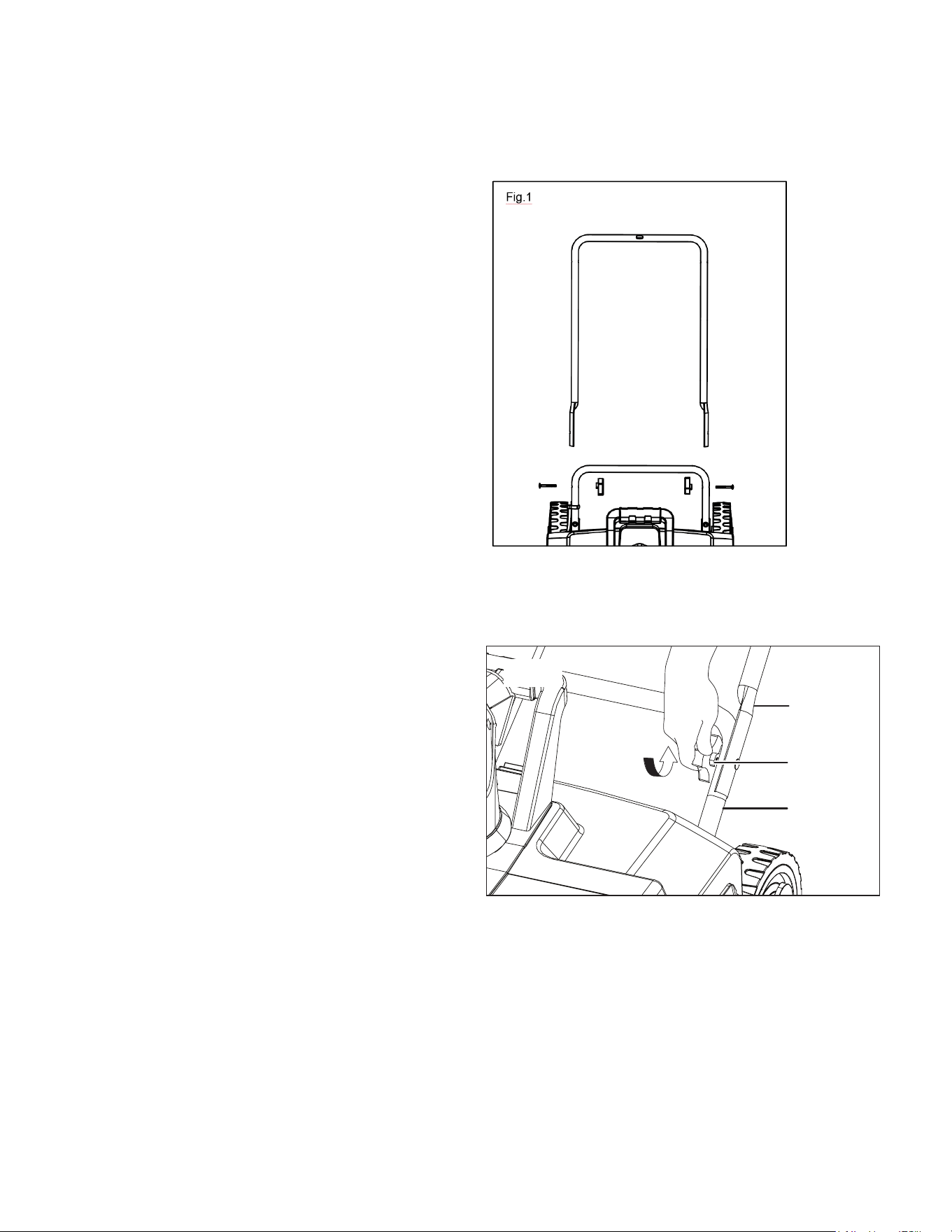
1. Align the middle frame to the lower frame. (Fig.1)
2. Secure the connection of the middle frame to the lower
frame by fastening the rst set of knobs and bolts on each
side (Fig. 2).
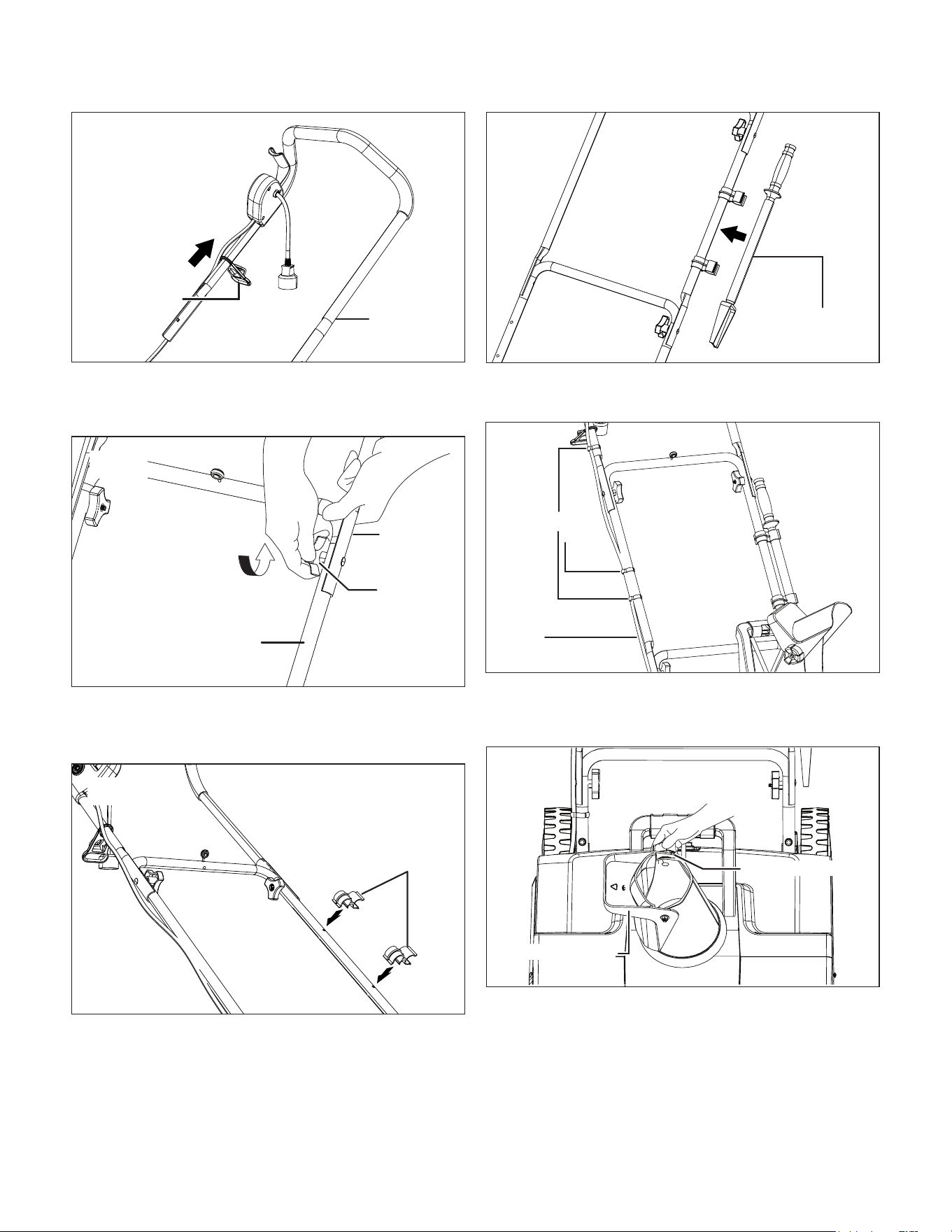
3. Before securing the upper frame, slide the extension cord
restraint hook up the upper frame (Fig. 3).
Fig. 2
Lower frame
Middle
frame
Knob + bolt
8
4. Secure the connection of the upper frame to the middle
frame by fastening the second set knobs and bolts on
each side (Fig. 4).
5. Clip the 2 chute clean-out tool clips on the side of the
middle frame, and insert the chute clean-out tool in the
clips (Figs. 5 - 6).
6.
Clip on the 3 cable clips on the frame, and insert the cable
inside of the cable clips (Fig. 7).
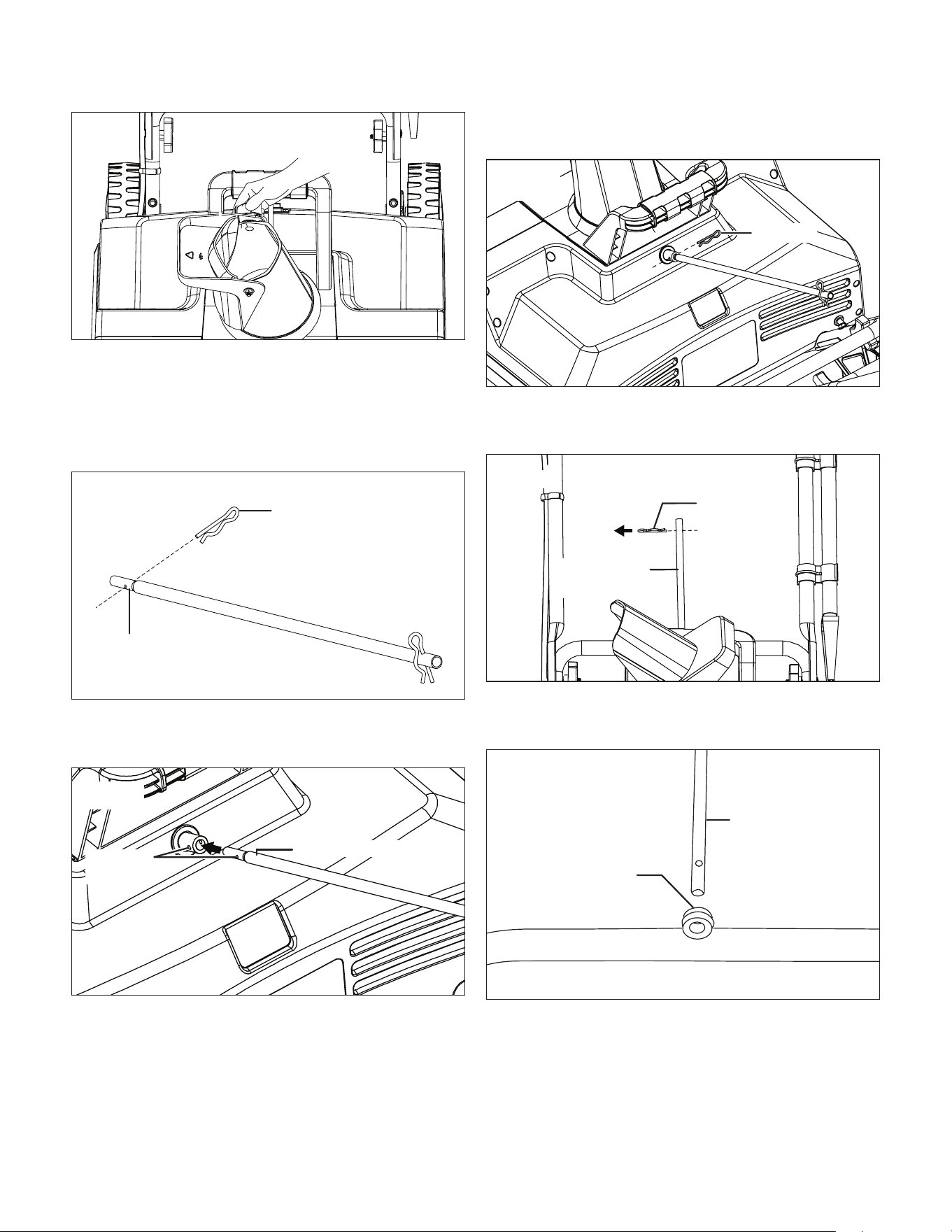
Discharge Chute Assembly
1. Loosen the knob to lift the chute deector (Fig. 8).
2. Secure the chute deector by locking the deector knob
(Fig. 9).
Fig. 3
Upper frame
Extension
cord restraint
hook
Fig. 4
Middle frame
Upper
frame
Knob +
T-bolt
Fig. 5
Chute clean-out
tool clips
Fig. 6
Chute clean-out
tool
Fig. 7
Cable clips
Cable
Fig. 8
Chutedeector
Deectorknob
9
NOTE: Do not overtighten the knob.
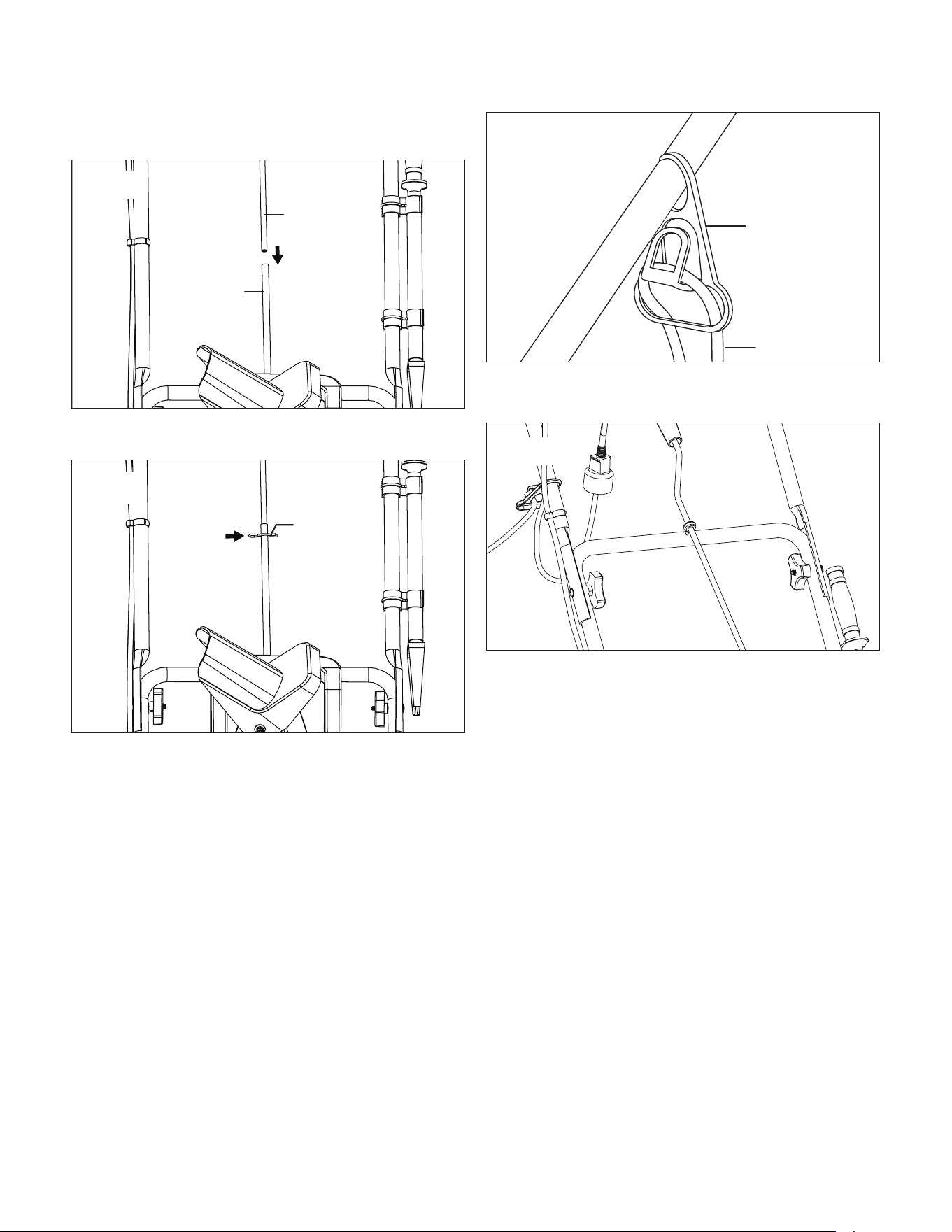
Chute Crank Assembly
1. Remove the hitch pin from the female end of the lower
chute crank (Fig. 10).
2. Install the lower crank rod by inserting it into the opening
at the back of the housing and aligning the holes (Fig. 11).
3. Secure the lower chute crank in place with the hitch pin
(Fig. 12).
4. Remove the other hitch pin from the lower chute crank
(Fig. 13).
5. Slide the upper chute crank through the rubber ring
located on the middle frame (Fig. 14).
Fig. 9
Fig. 10
Hitch Pin
Lower chute crank
(female end)
Fig. 11
Lower chute crank
Align the
holes
Fig. 12
Hitch pin
Fig. 13
Lower chute
crank
Hitch Pin
Fig. 14
Rubber ring
Upper chute crank
10
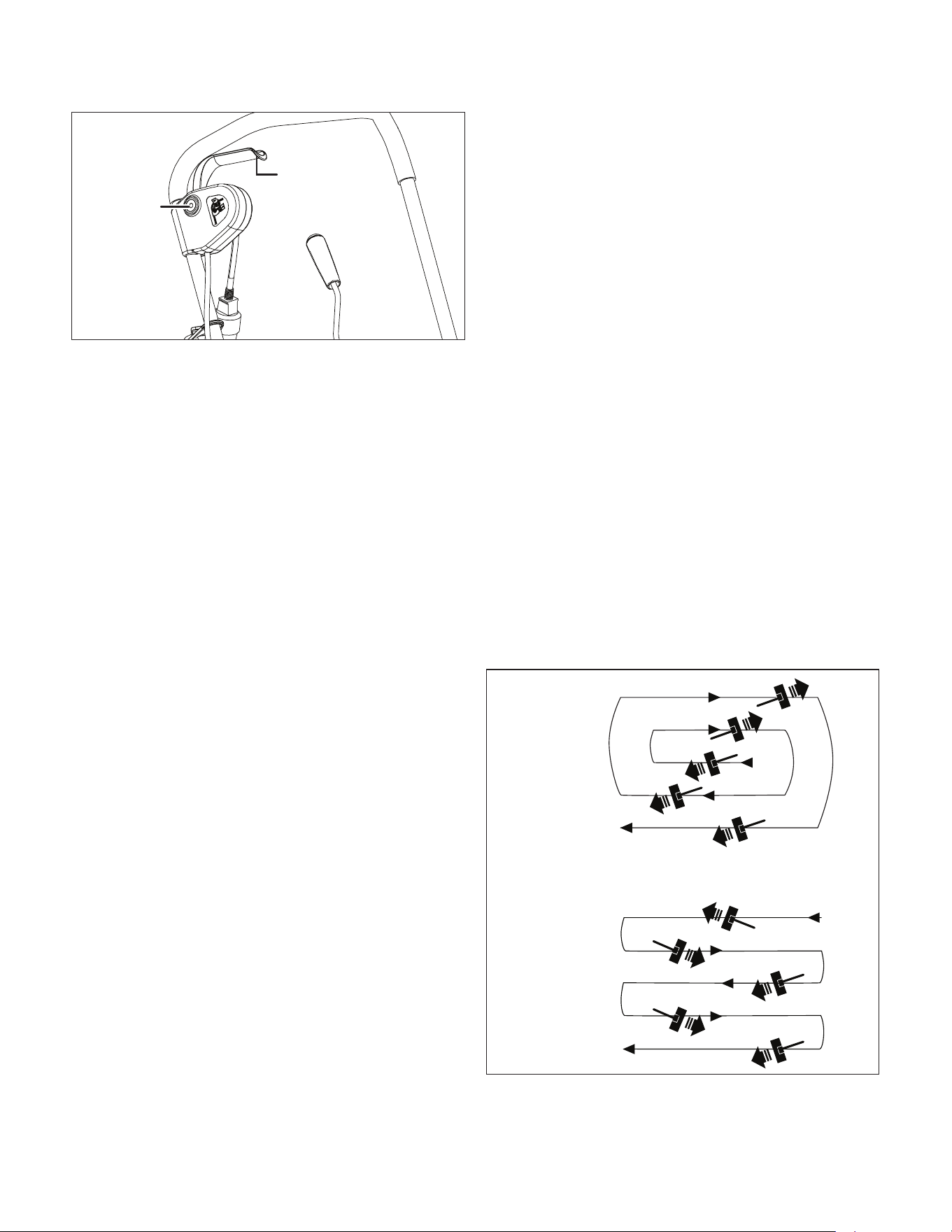
6. Slide the upper chute crank into the lower chute crank
(Fig. 15).
7. Align the screw holes and secure with hitch pin (Fig. 16).
Operation
NOTE: Before using this machine, make sure that the power
source you will use complies with the specications detailed
in this manual. Before inserting the plug into the socket, verify
that the snow thrower’s auger and rubber plates are rmly
secured with screws, and that the rubber plates are facing the
correct direction. Perform a test run to ensure that the rotor
turns freely.
Securing the Extension Cord
1. For safe and ecient use of your snow thrower, use only
a UL-rated extension cord recommended for outdoor use.
Refer to the Extension Cord Chart on page 2.
2. Push the loop of the extension cord through the slot from
the opposite side of the restraint hook. Position the loop
over the hook and pull the cable back through the slot
(Fig. 17).
3. Insert the female end of the extension cord into the
appliance's polarized male plug (Fig. 18).
mWARNING! Damaged electrical cords present risk
offire,electricalshock,andseriousbodilyinjury.Before
operating the snow thrower
, carefully examine the electrical
cord. If the cord is damaged, do not use the snow thrower.
Replace or repair the damaged cord immediately. If you
need assistance, contact Westinghouse Outdoor Power
Equipment (855) 944-3571.
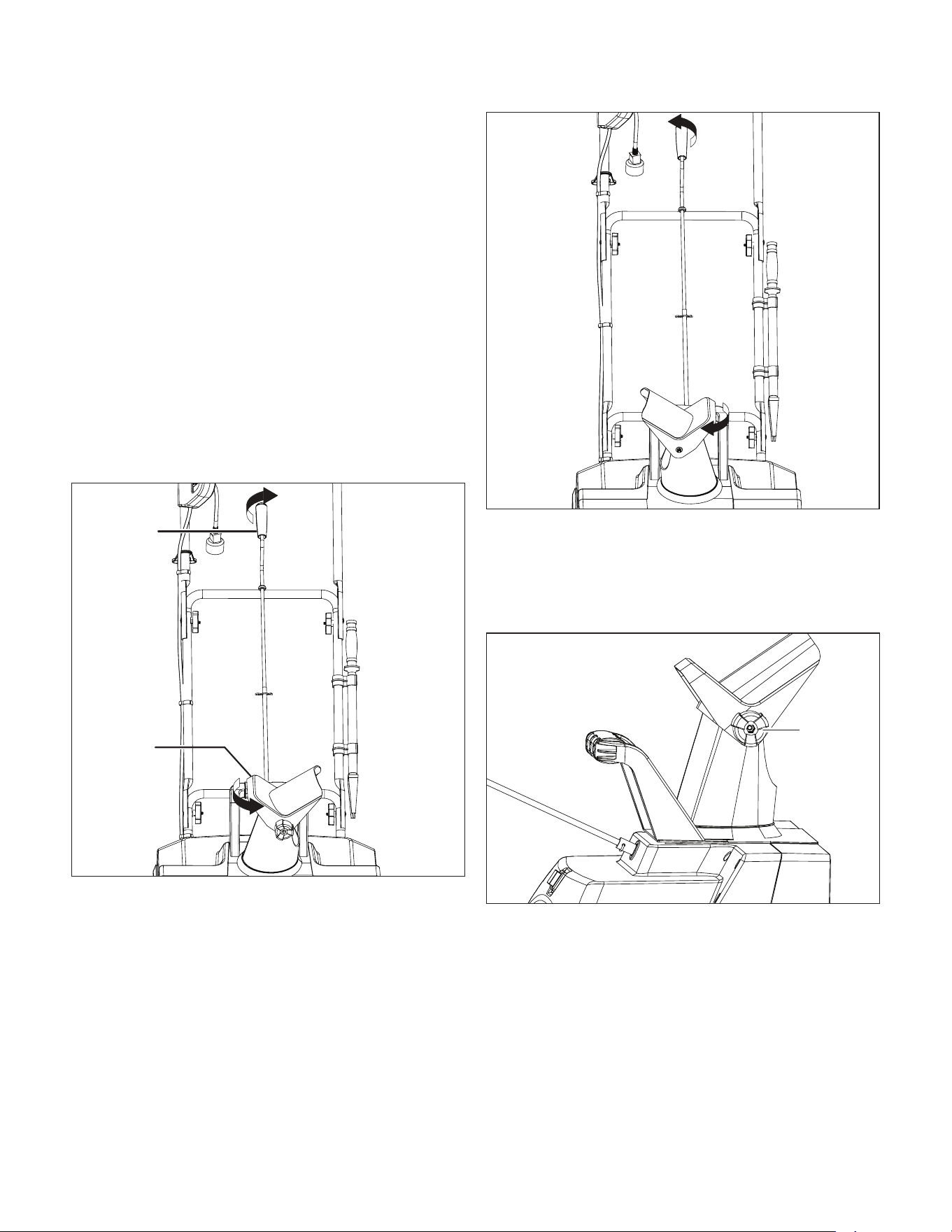
PoweringOn+O
mWARNING! The auger starts rotating immediately
after the snow thrower is switched on. Keep hands
and feet away from the auger.
1. To power on, depress and hold the safety lock button
found alongside the switch housing (Fig. 19).
2. While depressing the safety lock button, pull the
ON/OFF switch lever toward you. Once the machine
powers on, release the safety lock button and begin
operation (Fig. 19). The machine can only be started
by depressing the safety lock button rst, followed by
squeezing the ON/OFF switch lever; reverse operation
will not start the machine.
Fig. 15
Upper chute
crank
Lower chute
crank
Fig. 16
Hitch Pin
Fig. 17
Extension cord
restraint hook
Extension cord
Fig. 18
11
3. To power o, release your grip on the ON/OFF
switch lever.
Headlights
The snow thrower is equipped with 2 headlights that can be
used to illuminate the path ahead in the dark. The lights will
automatically turn ON once the machine has started.
NOTE: The lights will only turn ON when the snow thrower is
running.
Moving the Machine + Plowing the Snow
mWARNING! Foreign objects, such as rocks, broken
glass, nails, wire, or string, can be picked up and thrown by the
snow thrower, causing serious personal injury.
Remove all foreign objects from the area to be plowed before
operating the snow thrower.
1. Keep the area of operation free of foreign objects that can
become thrown by the rotor blades. Perform a thorough
inspection of the area since some objects may be hidden
from view by surrounding snow. If the snow thrower hits
an obstruction or picks up a foreign object during use,
stop the snow thrower, disconnect the extension cord,
remove the obstruction, and inspect the unit for damage.
Repair or replace any damaged part before restarting and
operating the unit.
2. Keep children, pets, and bystanders away from the area of
operation. Be aware that the normal noise of the machine
when turned on may make it dicult for you to hear
approaching people.
3. When moving the snow thrower, use the wheels on one
side as the pivot point. Slightly tilt the snow thrower on
this pivot point to move it forward or backward.
4. Start your clearing path near the electrical outlet and
work outward, throwing snow in a back and forth motion.
To clear in the opposite direction, step over the cord
and pivot the snow thrower on its wheels. Make sure to
overlap clearing paths.
5. Note the wind direction. If possible, move in the same
direction as the wind so that the snow is not thrown
against the wind (and thus back into your face and onto
the just cleared path).
6. While moving the snow thrower, do not drag the power
cable violently or roughly. The snow thrower should move
within the range that the cable can reach.
7. Do not push the snow thrower with excessive force.
You should push the machine gently and evenly in
accordance with the unit’s throw rate.
8. Do not apply additional man-made load to the engine
since this may cause engine damage.
9. Some parts of the snow thrower may freeze under extreme
temperature conditions. Do not attempt to operate the
snow thrower with frozen parts. If the parts freeze while
the snow thrower is in use, stop the snow thrower, unplug
the extension cord, and inspect for frozen parts. Free all
parts before restarting or operating the snow thrower.
Never force controls that have frozen.
10. When working on pebbles, gravel, or unpaved surfaces,
avoid throwing loose surface material along with the snow
by pushing down on the handle to raise the scraper bar at
the base of the unit above the pebbles or gravel.
11. For larger areas, a denite pattern of operation is required
to thoroughly clean an area of snow. These patterns
will avoid throwing snow in unwanted places, a well as
eliminate the need for a second removal of snow (Fig. 20).
Pattern A: Throw the snow to the right or left side where
it is possible. For areas such as a long driveway, it is
advantageous to start in the middle. Plow from one end to
the other, throwing snow to both sides.
Pattern B: If the snow can only be thrown to one side of
the area to be cleared, start on the opposite side.
Fig. 19
On/Oswitch
Safety lock
button
Fig. 20
pattern A
pattern B
12
Changing Throw Direction +
Throw Height
mWARNING! Never direct the discharge chute at the
operator, at bystanders, at vehicles, or at nearby windows.
The discharged snow and foreign objects accidentally picked
up by the snow thrower can cause serious damage and
personal injury.
Always orient the discharge chute in the opposite direction
from where you, bystanders, surrounding vehicles, or windows
are located.
NOTE: The chute crank shaft rotation is sti in the rst initial
use. It will loosen with use.
1. The discharge chute can be adjusted 180 degrees by
rotating the chute crank. Rotate the chute control crank
clockwise to move the discharge chute to the left (Fig. 21)
and counterclockwise to move the chute to the right
(Fig. 22).
2. The chute deector on the top of the discharge chute
controls the height of the snow stream. Loosen the knob
to raise or lower the deector to the desired height of
snow you wish to throw. Tighten the knob to secure the
deector (Fig. 23).
mWARNING! Make sure that the chute deector snaps
and locks completely onto the discharge chute. An opening
between the discharge chute and the chute deector may
allow foreign objects to be picked up by the snow thrower
and thrown in the direction of the operator causing serious
boldly injury.
• Do not advance the chute deector too far forward
causing an opening to appear between the deector and
discharge chute.
• Do not overtighten the knobs on the chute deector.
Fig. 21
Chute
crank
Discharge
chute
Fig. 22
Deector
knob
Fig. 23
13
Maintenance
mWARNING! Make sure to turn o the switch and
disconnect the extension cord before performing any
maintenance task on your snow thrower.
Lifetime Lubrication (Motor + Auger)
Lubrication is not necessary and may damage the unit.
The snow thrower is lubricated for lifetime use at the factory
before shipment.
General Maintenance Tips
1. Do not attempt to repair the machine unless you have the
proper tools and instructions for disassembly and repair of
the machine.
2. Check bolts and screws at frequent intervals for proper
tightness to ensure that the equipment is in safe
working condition.
3. After each snow removal session, run the snow thrower
for a few minutes to prevent the collector/impeller from
freezing. Shut o the motor, wait for all revolving parts to
stop completely, and wipe residual ice and snow o the
unit. Rotate the chute crank several times to remove any
excess snow.
4. Only use a cloth soaked with hot water and a soft brush
to clean the snow thrower; never wet or spray water on
the machine!
5. Do not use detergent or solvents as these could cause
irreparable damage to the snow thrower. Chemicals can
destroy the plastic parts.
6. To protect the snow thrower from corrosion when storing
for long periods, lightly oil the metal parts.
7. Store the appliance in a dry area out of reach of children.
8. For the user's safety, worn or damaged parts must be
replaced. Replace with original replacement parts only.
Parts from another snow thrower may not t properly,
causing an unsafe situation.
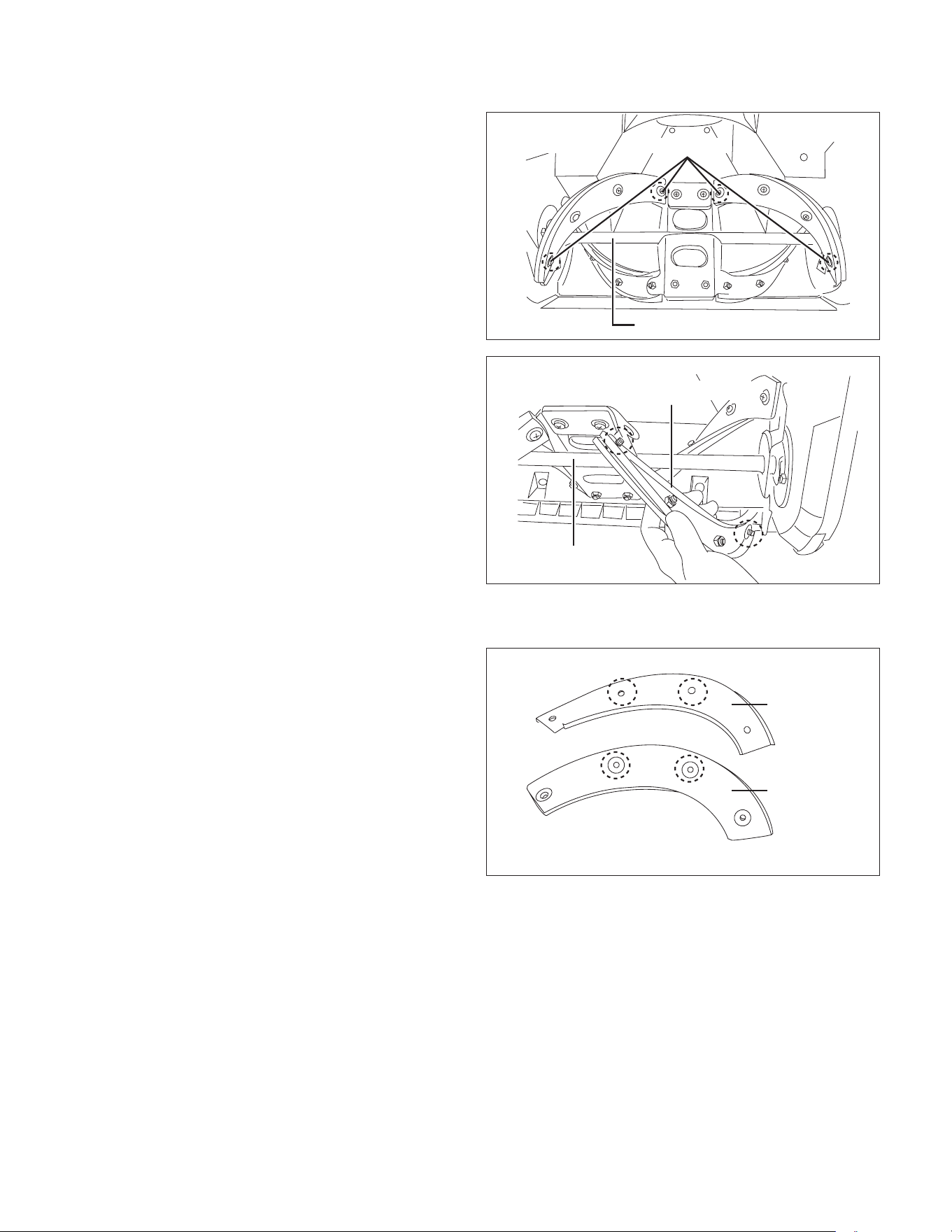
Replacing the Rubber Plates
NOTE: When replacing worn rubber plates, pay close attention
to carefully distinguish between the coarse and smooth side
of the plates. Place the coarse side inside and the smooth
side outside.
1. Detach the worn rubber plate assembly by removing the
four sets of nuts and bolts used to secure it to the auger
assembly (Figs. 24 – 25).
2. Loosen the middle two sets of nuts and bolts to detach
the worn rubber plate from the metal frame (Fig. 26).
3. Attach the new rubber plate onto the metal frame by
replacing and tightening the middle four sets of nuts and
bolts (Fig. 26).
4. Reassemble the rubber plate assembly to the auger
assembly by replacing and tightening the two sets of nuts
and bolts used to secure it (Figs. 24 – 25).
Fig. 24
Nuts + Bolts
Auger assembly
Fig. 25
Rubber plate assembly
Auger assembly
Metal frame
Rubber plate
Fig. 26
14
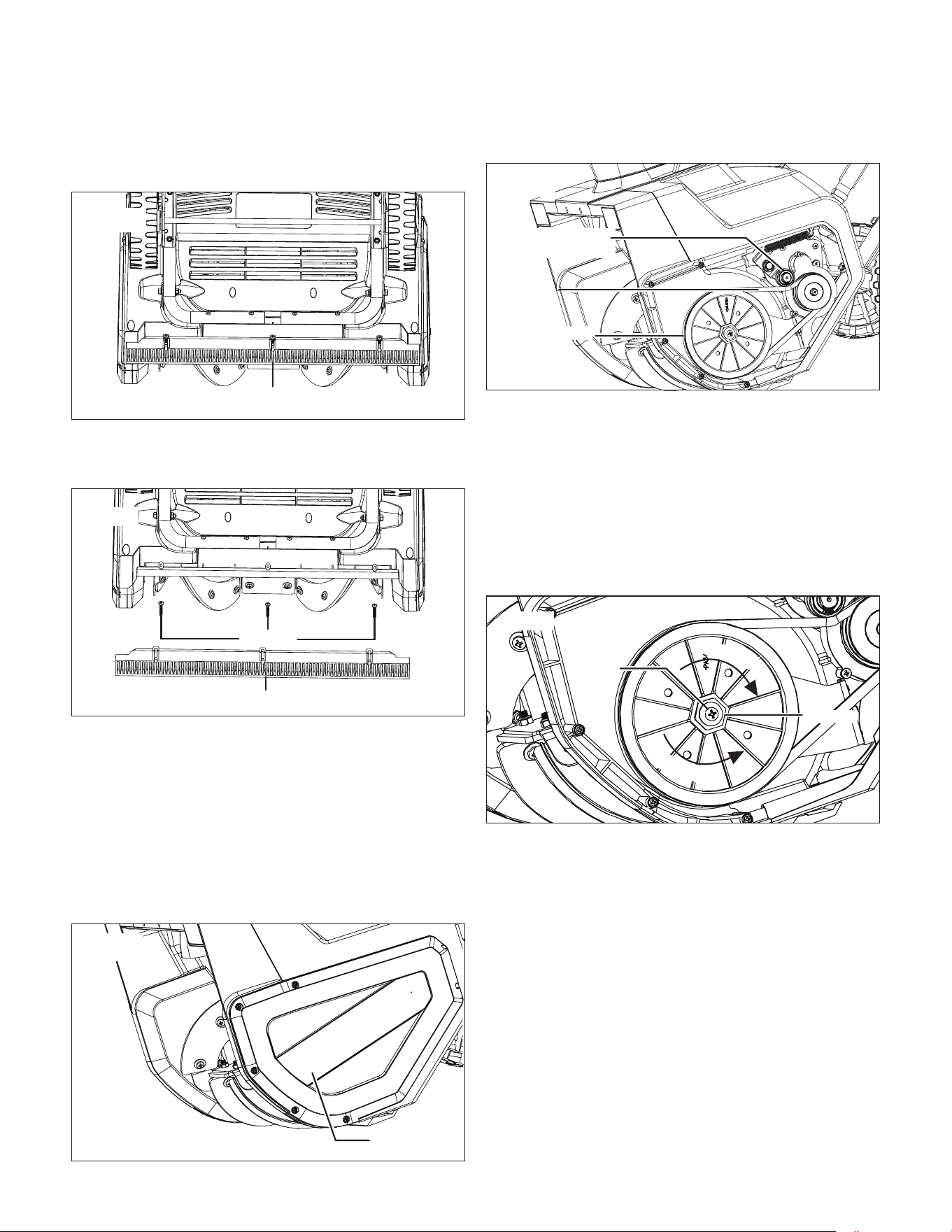
Replacing the Scraper Bar
1. The scraper bar is located at the base of the snow thrower
beneath the rotor housing (Fig. 27).
2. Detach the worn scraper bar from the snow thrower by
removing the 3 screws that hold it in place (Fig. 28).
3. Install the new scraper bar and fasten it securely to the
snow thrower with the 3 screws (Fig. 28).
Replacing the Belt + Pulley
NOTE: Determine the left and right hand side of the
snow thrower by standing behind the unit in the normal
operating position.
1. Remove the screws from the left panel of the snow
thrower and remove the left panel (Fig. 29).
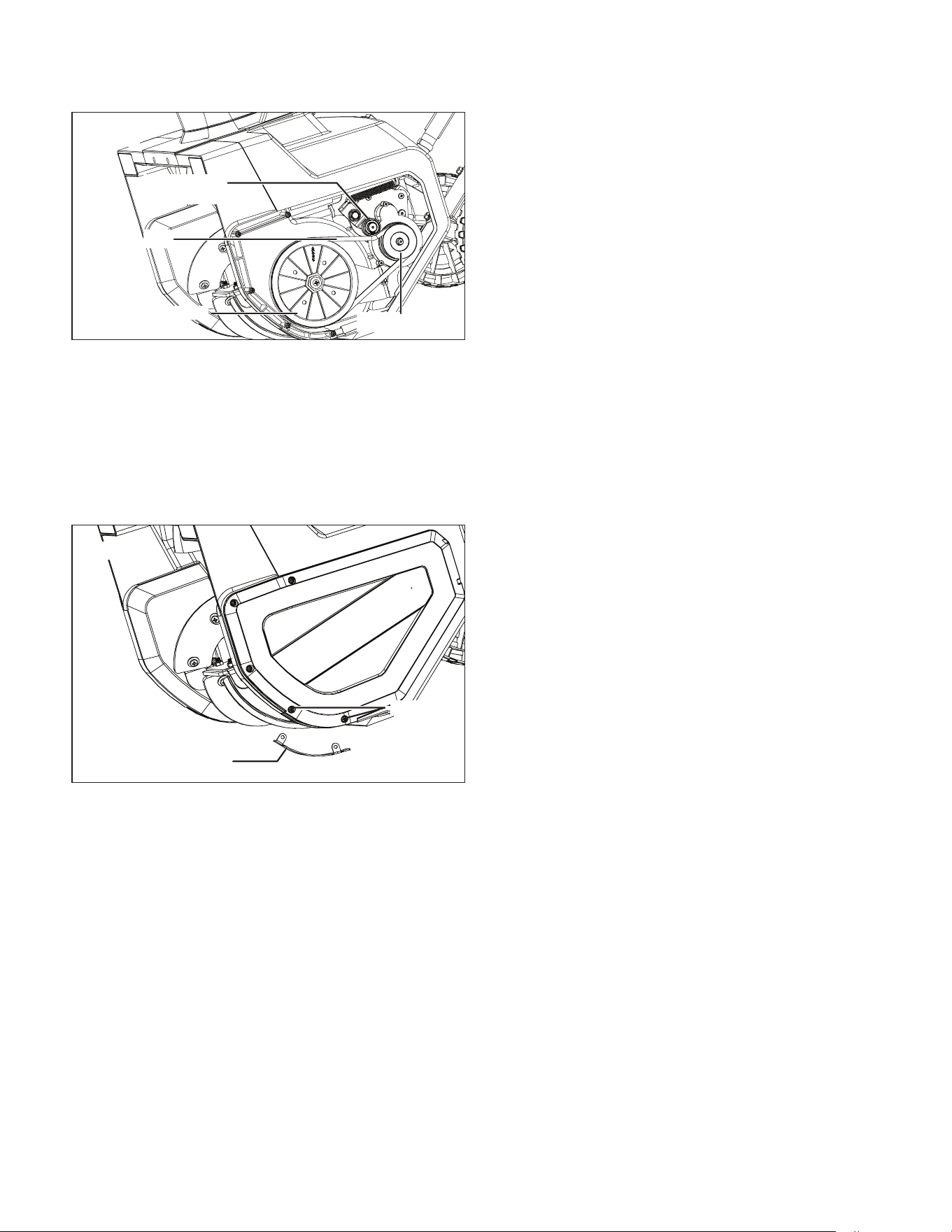
2. Lift the belt tension pulley and roll the worn belt up and o
the big pulley from the top of the big pulley (Fig. 30).
3. To replace the big pulley, remove the screw and washer
from the middle of the pulley. While securing the auger
so it does not spin, use a 7/8-inch socket to turn the
outer nut of the pulley clockwise (the pulley is left-handed,
so loosening and tightening occur in reverse orientation;
clockwise to loosen and counterclockwise to tighten).
Once the old pulley is removed, replace the big pulley
and tighten the outer nut counterclockwise with the
7/8-inch socket. Replace and tighten the screw and
washer (Fig. 31).
NOTE: Heavy wet snow puts a load on belts, thus
requiring more frequent belt replacement.
4. To install the new belt, lift the belt tension pulley and roll
the new belt onto the small pulley at an angle. Then roll
the belt onto the top of big pulley by rotating the big pulley
counterclockwise as the belt grips the top of the big pulley
(Fig. 32).
Fig. 27
Scraper bar
Fig. 28
Screws
Scraper bar
Fig. 29
Left panel
Fig. 30
Big pulley
Belt tension
pulley
Belt
Fig. 31
Screw
Washer
Loosen
Tighten
15
5. Replace the left panel of the snow blower with all screws
(Fig. 29).
Replacing the Skid Shoes
The skid shoes are located at the bottom of the side panels.
Unfasten the two screws on the side panel to remove the worn
skid shoes (Fig. 33). Install the replacement by fastening it to
the side panel with the same two screws.
Automatic Reset
The snow thrower has built-in automatic reset functions. In the
event of a major obstruction that halts auger movement, simply
unplug your unit, clear the auger obstruction, wait 60 seconds,
and then resume use of your machine.
Storage
1. Allow the engine to cool completely before cleaning,
storing, or transporting the snow thrower. Be
sure to secure the unit while transporting.
2. Disconnect the extension cord from the snow thrower.
Inspect the extension cord closely for signs of wear or
damage. Replace it if it is worn or damaged.
3. Inspect the snow thrower carefully for worn, loose, or
damaged parts. Check connections and screws and tighten
if necessary. For repairing or replacing parts, contact
Westinghouse Outdoor Power Equipment (855) 944-3571.
4.
Store the unit, along with the disconnected extension
cord, in a locked, dry place out of the reach of children to
prevent unauthorized use or damage.
Service + Support
If your Westinghouse electric snow thrower requires service or
maintenance, please call Westinghouse Outdoor Power
Equipment (855) 944-3571 for assistance.
Model + Serial Numbers
When contacting the company, reordering parts, or arranging
service from an authorized dealer, you will need to provide the
model and serial numbers, which can be found on the decal
on the main cover of the unit to the left of the discharge
chute.
Fig. 32
Big pulley
Belt tension
pulley
Belt
Small pulley
Fig. 33
Skid shoe
Screws

www.WestinghouseOutdoorPower.com
Service Hotline (855) 944-3571
777 Manor Park Drive, Columbus, OH 43228
and Westinghouse are trademarks of Westinghouse Electric Corporation.
Used under license by Westinghouse Outdoor Power Equipment.
© 2024 Westinghouse Outdoor Power Equipment, All Rights Reserved.
WSnow22
062624 Rev 01