Total fan weight: 5.61 kg/12.34 lbs
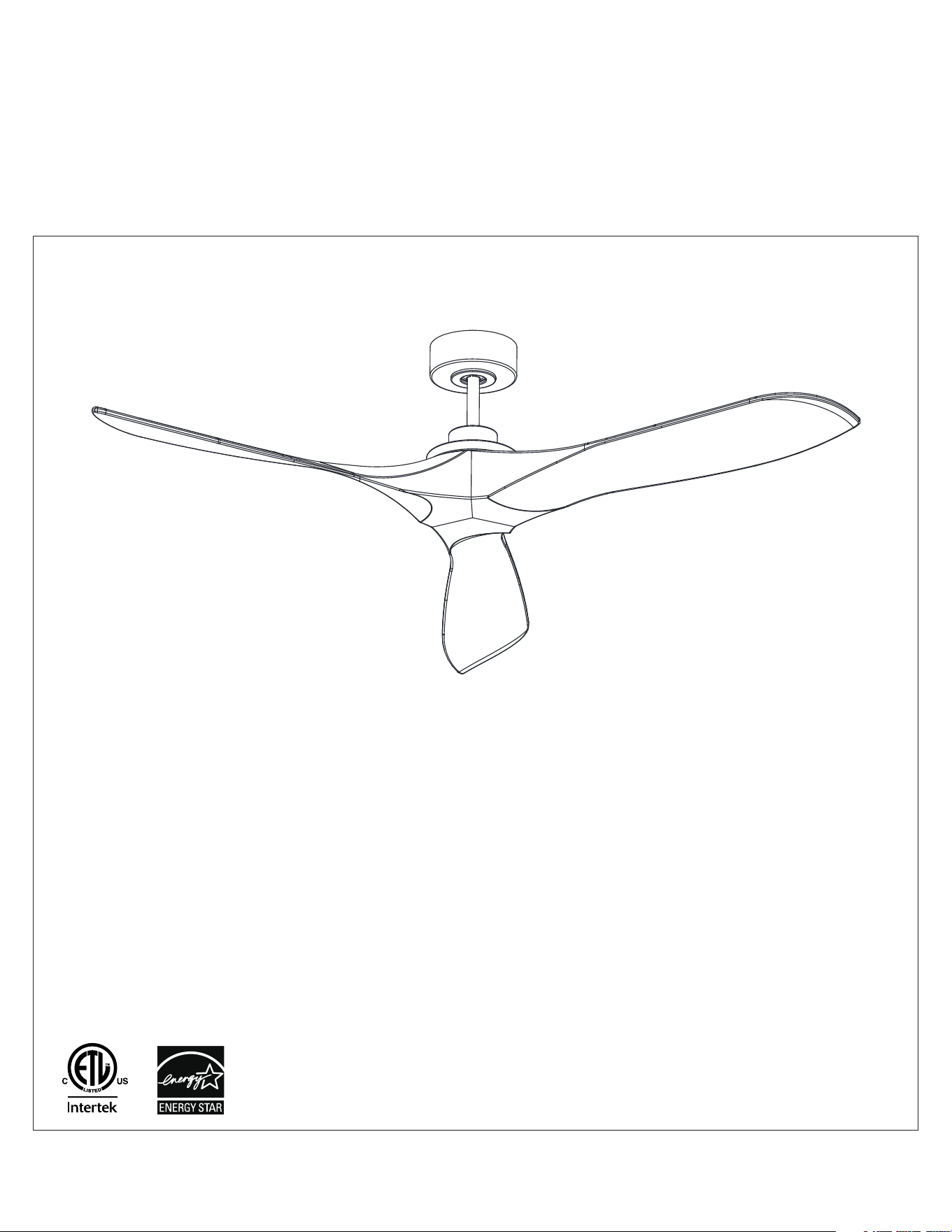
Edge Ceiling Fan
cETL Model NO. : 3EGR60XX-RH

Edge Ceiling Fan
Page 2 of 8
Customer Service
800-969-3347
Customer Service Center
7400 Linder Ave.
Skokie, IL 60077
www.montecarlofans.com
Cautions and Warnings
Installation work and electrical wiring must be done by qualified person(s) in accordance with applicable codes and standards (ANSI/NFPA 70), including
fire-rated construction.
Use this unit only in the manner intended by the manufacturer. If you have any questions, contact the manufacturer.
After making the wire connections, the wires should be spread apart with the grounded conductor and the equipment-grounding conductor on one side
of the outlet box and ungrounded conductor on the other side of the outlet box. The splices, after being made, should be turned upward and pushed
carefully up into the outlet box.
WARNING: Before you begin installing, servicing or cleaning the fan unit, switch the power off at the service panel and lock the service panel to prevent
the power from being switched back on accidentally. If the service panel cannot be locked to prevent the power from being switched on accidentally,
securely fasten a warning sign to the service panel.
Be cautious! Read all instructions and safety information before installing your new fan. Review the accompanying assembly diagrams.
When cutting or drilling into wall or ceiling, do not damage electrical wiring and other hidden utilities.
Make sure the installation site you choose allows the fan blades to rotate without any obstructions. Allow a minimum clearance of 7 feet from the floor
to the trailing edge of the blade.
WARNING: To reduce the risk of fire, electric shock, or personal injury, mount to outlet box marked “Acceptable for Fan Support of 15.9 kg (35 lbs) or
less” and use mounting screws provided with the outlet box.
CAUTION: Comply with local codes and regulations. If installing the secondary support safety cable in the U.S., do not remove knockouts in the outlet
box. Mount the secondary support safety cable through the reserved nail/screw hole on the outlet box to the building structure or the ceiling joist.
WARNING: To reduce the risk of personal injury, do not bend blade holders during installation to motor, balancing or during cleaning. Do not insert
foreign object between rotating blades.
Attach the mounting bracket using only the hardware supplied with the outlet box.
WARNING: To reduce the risk of fire or electric shock, this fan should only be used with fan speed control part no. JY1126R manufactured by Satellite
Electronic (Zhongshan) Ltd.
WARNING: To reduce the risk of fire or electric shock, do not use this fan with any other solid state fan speed control device, or variable speed control.
If this unit is to be installed over a tub or shower, it must be marked as appropriate for the application.
Never place a switch where it can be reached from a tub or shower.
The combustion airflow needed for safe operation of fuel-burning equipment may be affected by this unit’s operation. Follow the heating equipment
manufacturer’s guideline safety standards such as those published by the National Fire Protection Association (NFPA), and the American Society for
Heating, Refrigeration and Air Conditioning Engineers (ASHRAE) and the local code authorities.
CAUTION: To reduce the risk of electric shock, disconnect the electrical supply circuit to the fan before installing the light kit.
CAUTION: The light source is designed for this specific application and can overheat if serviced by untrained personnel. If any servicing is required, the
product should be returned to an authorized service facility for examination or repair.
All set screws must be checked and tightened where necessary before installation.
Note: Suitable for use in damp locations.
Tools Required for Assembly (not included): Electrical Tape, Phillips Screwdriver, Pliers, Safety Glasses, Stepladder and Wire Strippers
WARNING: TO REDUCE THE RISK OF FIRE, ELECTRIC SHOCK, OR INJURY TO PERSONS, FOLLOW THESE INSTRUCTIONS.
1 2 3
4 5 6
Page 3 of 8
Edge Ceiling Fan
ON
OFF
ON
OFF
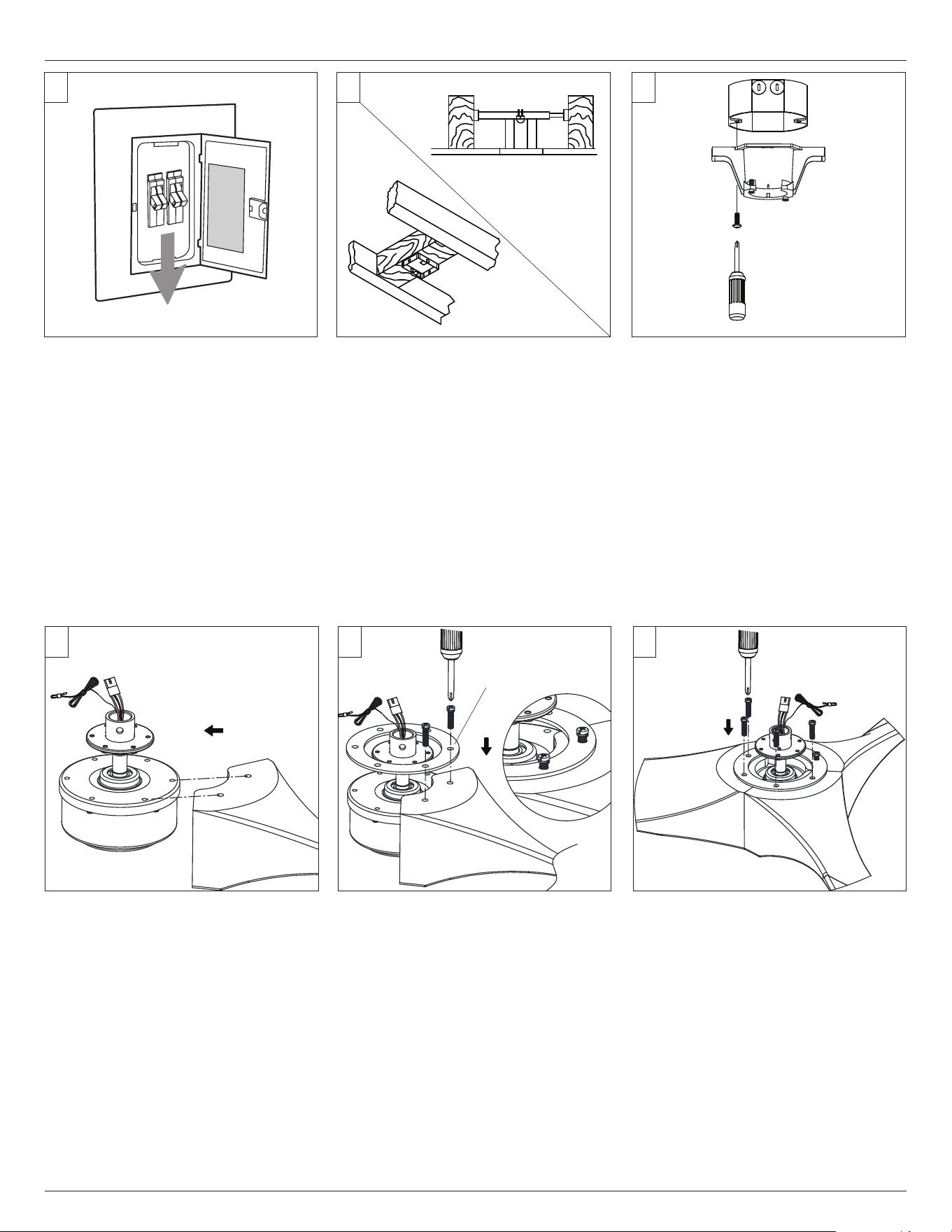
• Switch power off at Service panel.
• Lock service disconnecting means to
prevent power from being switched on
accidentally.
• When the service disconnecting means
cannot be locked, securely fasten a
warning device, such as a tag, to the
service panel.
• Use AC 120V/60HZ power supply
only.
• Before installing this fan make sure the
outlet box is properly installed to the
house structure.
• To reduce the risk of fire, electric
shock, or personal injury, mount to outlet
box or supporting system acceptable for
fan support. (Mounting must support at
least 35 lbs.)
• Use metal outlet box suitable for fan
support and use only the screws provided
with the outlet box (must support 35 lbs).
• Before attaching fan to outlet box, ensure
the outlet box is securely fastened by at
least two points to a structural ceiling
member (a loose box will cause the fan to
wobble).
• Remove the 2 outlet box screws provided
with the box, aligning the holes of the
mounting bracket with the holes of the
outlet box.
• Reinstall the 2 outlet box screws securely.
• Place motor assembly on a suitable
area of paper pulp for blade installation.
• Aligning the holes on the blade with the
screw holes on the motor as shown in the
illustration.
• Install the blade with a blade supporting
plate. Partially install blade set screws as
shown in the illustration. Set screws
provided.
• Warning: Blades, blade supporting plate
and blade mounting screws must be
installed for operation; failure to install
either will void the limited lifetime
warranty
• Install the other 2 blades. Adjust the
blades to make the gaps between blades
even and then tighten all the set screws
securely.
Mounting bracket
Blade
Blade supporting plate
7 8 9
10 11 12
Page 4 of 8
Edge Ceiling Fan
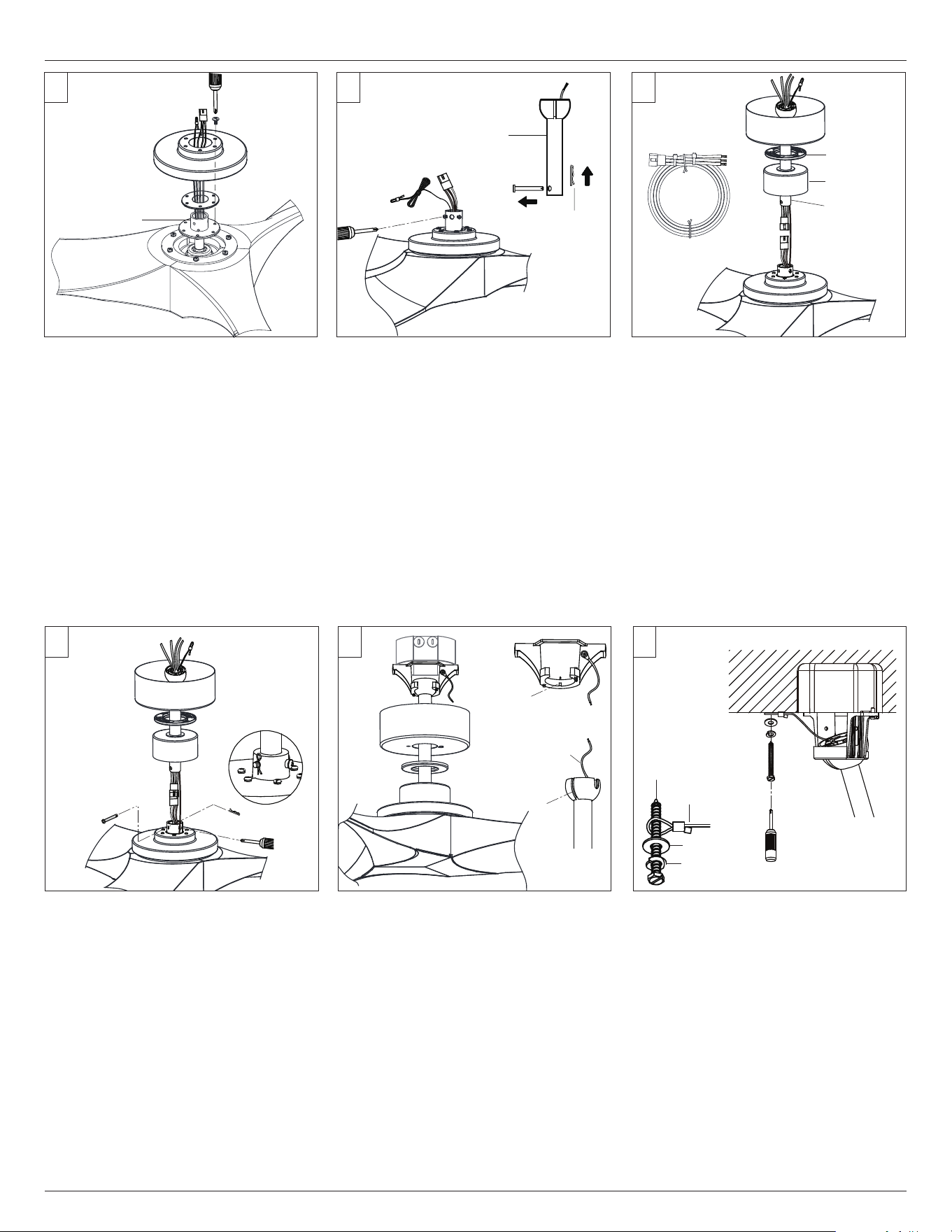
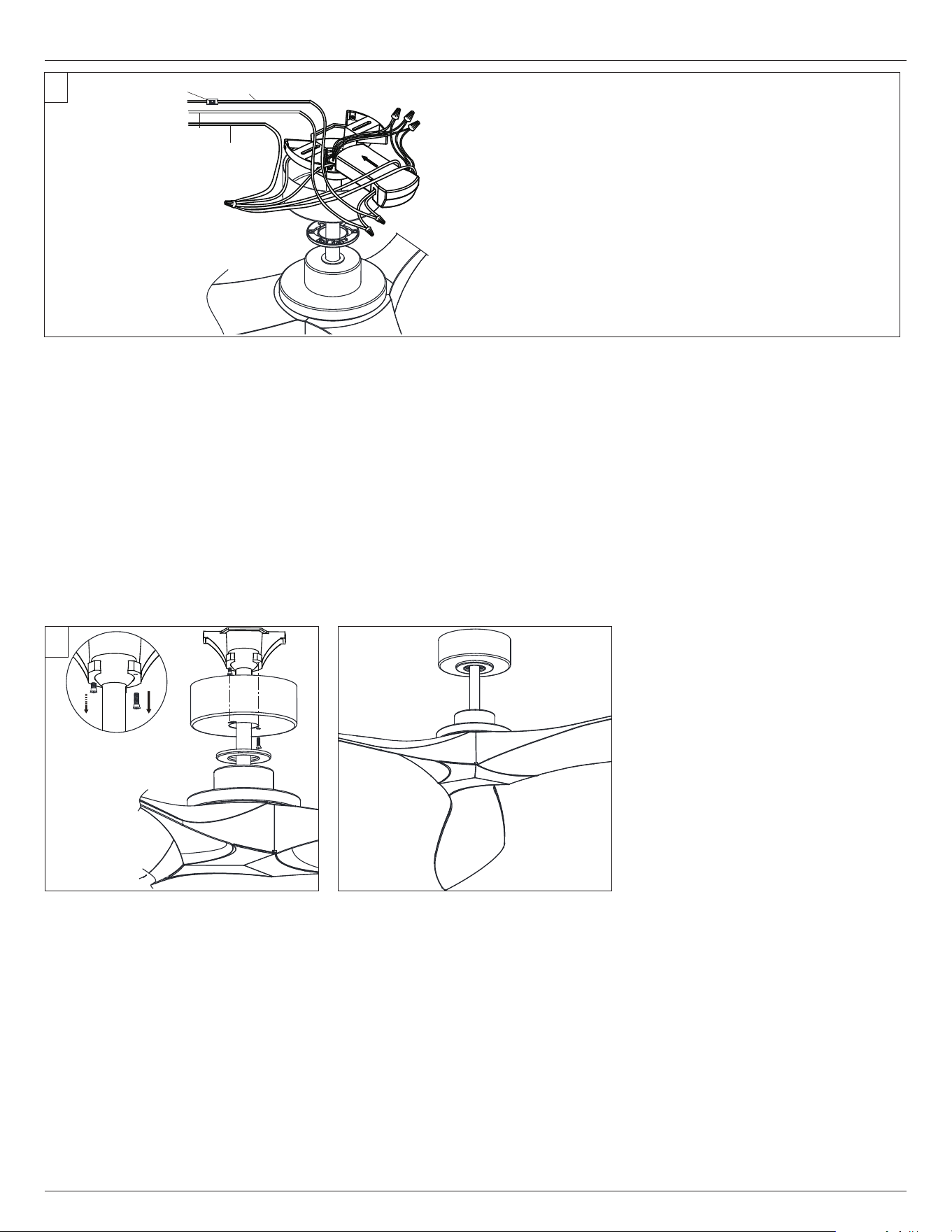
• Place a rubber pad and a top cover
over lead wires and safety cable and
install the top cover onto the yoke with
set screws provided.
• Partially loosen downrod set screws
from yoke at top of motor assembly.
• Remove preassembled keeper pin and
cross pin from downrod. Keep parts.
• Place downrod over canopy, canopy
bottom cap and yoke cover.
• Connect the extension lead wires to the
lead wires from motor. Make sure the
quick connectors are clasped firmly.
• Thread lead wires and safety cable
from motor assembly through downrod.
• Note: Make sure the plugs connections
won’t be pulled apart.
•
Slip downrod into motor housing yoke,
aligning holes and install cross pin and
keeper pin.
• Insert cross pin through yoke and
downrod until point appears on the other
side, and insert keeper pin on cross pin.
• Pull the downrod up tight against the
cross pin, and then evenly tighten the
downrod set screws on motor housing
yoke.
• Place yoke cover on top housing of fan.
• Warning: Cross pin and keeper pin must
be installed securely. Failure to install them
will result in serious injury.
• Install ball end of downrod into
mounting bracket opening.
• Align (engage) slot on ball with tab on
mounting bracket.
• Warning: Failure to align slot on ball
with tab may result in serious injury.
• Important: If using the angle mount,
make sure open end of mounting bracket
is installed facing the higher point of the
ceiling and make sure the ceiling angle is
not steeper than 20º. Longer downrod
may be necessary allowing the fan blades
to rotate without obstructions.
• For Canadian installation and for USA
fan and light kit combinations over 35
lbs, in both flush and downrod modes the
safety cable must be installed into the
house structure beams using 3” lag
screws, washers and lock washers
provided.
• Make sure that when the safety cable is
fully extended, the lead wires are longer
than the cable and no stress is placed on
the lead wires.
• Note: If installing the secondary
support safety cable in the U.S., do not
remove knockouts in the outlet box.
Yoke
Downrod
Cross pin
Keeper pin
Tab
Slot
Top cover
Canopy
Downrod
Yoke cover
Canopy bottom
cap
Extension lead wire
Cross pin
Keeper pin
SAFETY CABLE INSTALLATION
Lag screw
Safety cable
Washer
Lock washer
Rubber pad
13
14
Page 5 of 8
Edge Ceiling Fan
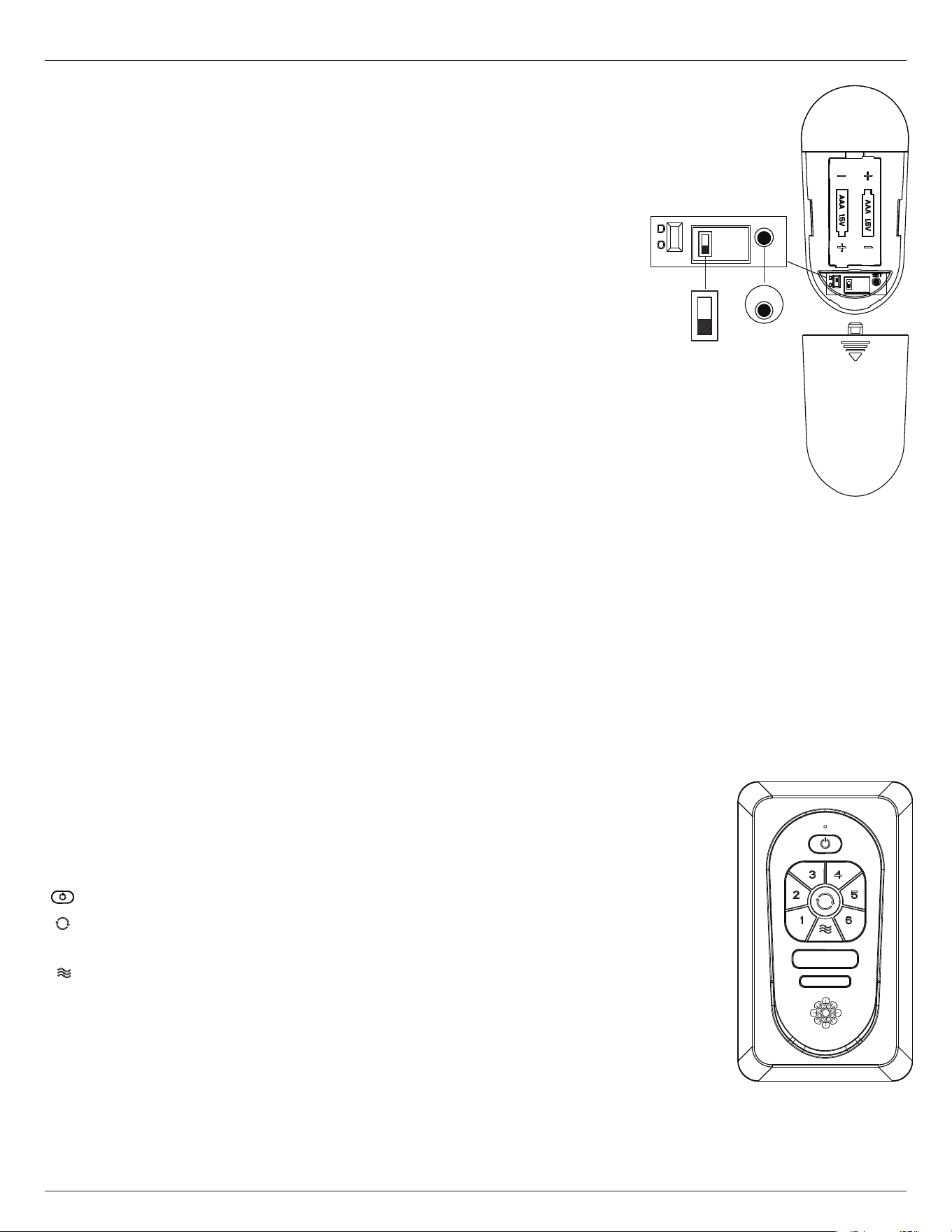
• Make wiring connections using wire connectors provided as indicated above.
Brown wire from fan to Brown wire from receiver marked Motor U.
Gray wire from fan to Gray wire from receiver marked Motor V.
Blue wire from fan to Blue wire from receiver marked Motor W.
White (Neutral) wire from house to White wire from remote marked AC IN N.
Black (Live) wire from house to Black wire from remote marked AC IN L.
Connect all green grounded wires to Grounded wire from House.
Make sure that no filaments are outside of the wire connectors.
• Insert the remote receiver into mounting bracket.
• After making the wire connections, the wires should be spread apart with the grounded conductor and the equipment-grounding
conductor on one side of the outlet box and ungrounded conductor on the other side of the outlet box. The splices after being made
should be turned upward and pushed carefully up into the outlet box.
• Caution: The installation has to be complete before operate the fan. The receiver has to be used on the fan and cannot be
bypassed.
• Partially loosen one and remove one
preassembled screw from mounting
bracket. Save screw.
• Lift canopy up, aligning its keyhole slot
with the preassembled screw on
mounting bracket and twist clockwise to
lock in place. Reinstall the other screw
and tighten all screws securely.
• Attach canopy bottom cap onto canopy
by aligning its holes with the screws on
mounting bracket and fix it with the
magnet which is embedded in the cap.
Canopy bottom
cap
Wall switch Black
Power source
Brown
Grey
White
Blue
White
Black
Ground/Green
Ground/Green
Receiver
Page 6 of 8
Edge Ceiling Fan
Battery cover
SET
SET
1
0
1
0
1
0
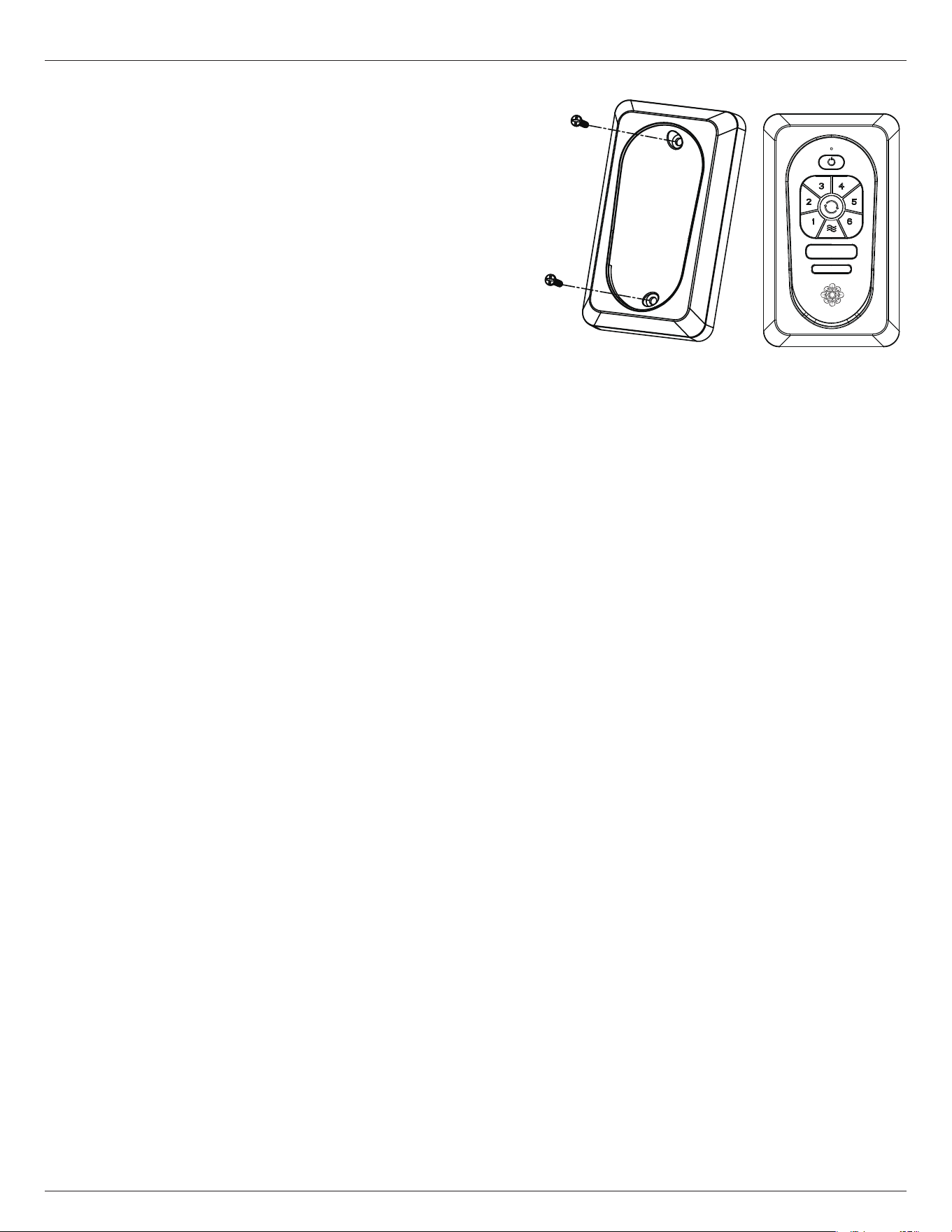
The remote control buttons control the fan speed as follows:
Fan speed
1 = minimum speed 2 = low speed 3 = medium low speed
4 = medium speed 5 = medium high speed 6 = high speed
This button turns the fan off.
Forward/Reverse button: This button is to control direction of fan rotation. Press once
to change direction of the fan rotation. Fan must be running to reverse.
Breeze:
Press the Breeze button, fan will operate at high speed (6
th
) for 30 seconds, then automatically change
to 5
th
, 4
th
, 3
rd
, 2
nd
, 1
st
at intervals of 30 seconds, and then change it from Low speed (1
st
) to 2
nd
, 3
rd
,
4
th
, 5
th
, 6
th
repeat the cycle until the breeze mode is canceled.
Breeze mode can be erased by pressing either the power or speed control buttons.
Note
: This remote controller has auto resume function. The fan will maintain the last setting when
turned back on, with the exception of Breeze mode.
Remote Controller Operation
Remove the battery cover from the remote control transmitter and install batteries.
Replace the cover. This remote uses 2 1.5V/AAA batteries.
Note: If not using for long periods of time, remove the batteries to prevent damage to
remote controller, and store the remote controller away from excess heat or humidity.
The batteries will weaken with age and should be replaced before they leak or corrode as
this will damage the controller. Dispose of the used batteries properly. Always keep
batteries out of the reach of children.
Universal Mode and Learning Mode
Your remote controller has two options: “Universal Mode” (mark “0”) and “Learning Mode”
(mark “1”).
If choosing “Universal Mode,” simply move the switch to the LOWER position (mark “0”).
Your fan with the remote controller is ready to use.
Note: If using Universal Mode, your fan can be controlled with other remote controllers
with the same setting.
To control the fan with a specific remote controller, choose “Learning Mode” by moving the
switch to the UPPER position (mark “1”) and then follow the Learn Mode steps below.
Learn Mode
Important: Turn the power on for ONLY the specific fan you wish to pair with the remote
controller. Make sure to turn the power off for all other fans with which you use the same
remote controller.
Restore power to your fan, press and hold the “SET” button to pair the transmitter and
receiver. You must press the ‘SET” button within 60 seconds of restoring power to the fan.
Note
: Fan will at first operate at minimum speed and light will blink (if your fan has a light)
after you’ve chosen Learn Mode.
Note
: If the power is already on, you must turn the power off and then back on for the
remote control setting.
Note
: If you reset the controller to Universal Mode (mark “0”) and later want to pair the
controller again to a specific fan, you have to repeat the Learn Mode steps.
Page 7 of 8
Edge Ceiling Fan
Wall mount cradle
THIS DEVICE COMPLIES WITH PART 15 OF THE FCC RULES OPERATION IS SUBJECT TO THE FOLLOWING TWO
CONDITIONS. (1)THIS DEVICE MAY NOT CAUSE HARMFUL INTERFERENCE AND (2) THIS DEVICE MUST ACCEPT
ANY INTERFERENCE RECEIVED, INCLUDING INTERFERENCE THAT MAY CAUSE UNDESIRED OPERATION.
The receiver provides the following protective functions:
Lock protection: The DC motor has a build-in safety feature
against blade obstruction during operation. If something
obstructs the fan blades, the motor will stop operation after
about 20 seconds of interruption. Please remove obstacles
and reset it by turning the power off, and then turn power
back on.
Over 40W protection: When the receiver detects motor
power consumption which is greater than 40W, the fan RPM
will automatically lower to prevent it from overloading.
User Tips
1. If your fan is operating automatically after installation, it is still using the factory setting. Follow the settings for Learn Mode
above to reset.
2. If the fan or light isn’t working, reset power (turn the power off then turn the power back on) and follow the Universal Mode or
Learn Mode remote control settings.
3. If two or more fans in the same remote signal range are on the same power supply, they cannot be operated separately by
remote control. Use a separate power supply for each fan, such as an individual wall switch, and restrict the power supply to
only the fan which you are pairing with its transmitter in order to use the remote controller.
4. When the fan is turned on to oscillate in either forward or reverse direction, it may shudder briefly until fully engaged. This is a
normal operation for this fan; the shuddering will quickly cease as movement is engaged.
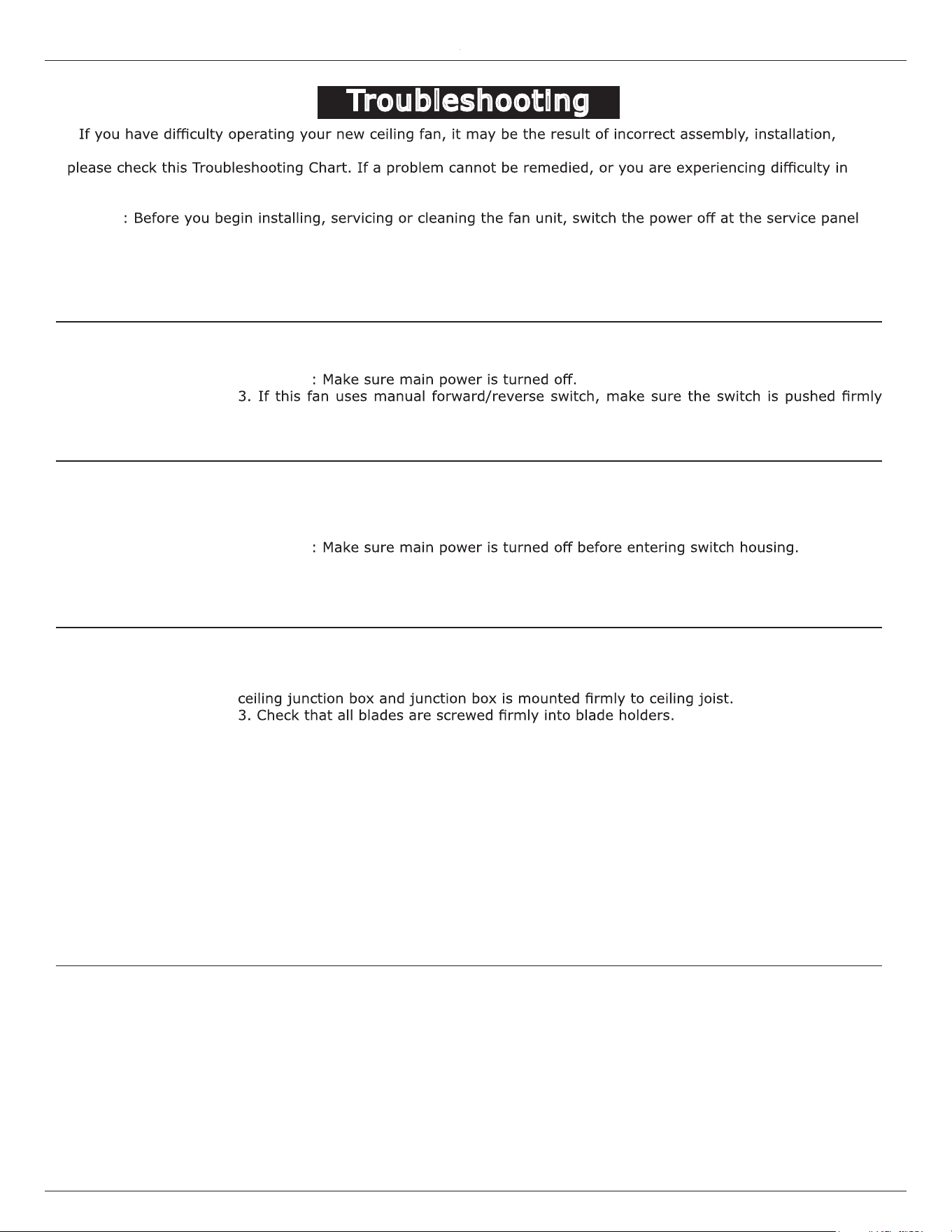
Install Transmitter wall mount cradle with 2 screws provided.
Useful tips:
The remote transmitter can be removed by pressing it
upward from the lower half.
The remote transmitter can be held on magnetic metal
materials by a magnet built in the transmitter.
Page 8 of 8
Edge Ceiling Fan
Troubleshooting
or wiring. In some cases, these installation errors may be mistaken for defects. If you experience any faults,
installation, please call our Customer Service Center at the
number printed on your parts list insert sheet.
Warning
and lock the service panel to prevent the power from being switched back on accidentally. If the service panel
cannot be locked to prevent the power from being switched on accidentally, securely fasten a warning sign to the
service panel.
1. Check main and branch circuit fuses or circuit breakers.
2. Check line wire connections to fan and switch wire connections in switch housing.
CAUTION
either way. Fan will not operate when switch is in the middle.
4. If this fan uses a remote controller, make sure dip switches are in the correct setting
and make sure the battery works.
1. Check to make sure all screws in motor housing are snug (not over tightened).
2. Check to make sure the screws which attach the fan blade holder to the motor are tight.
3. Check to make sure wire nut connectors in switch housing are not rattling against each
other or against the interior wall of the switch housing.
CAUTION
4. Check to be sure lightbulb is tight in socket and not touching the glass shade.
5. Some fan motors are sensitive to signals from Solid State variable speed controls.
6. Allow "break-in" period of 24 hours. Most noises associated with a new fan will
disappear after this period.
1. If this is a downrod mount fan, make sure the ridge on mounting bracket engages the
notch in the downrod ball.
2. Make sure that canopy, mounting bracket or mounting plate are tightened securely to
4. Check that all blade holders are tightened securely to motor.
5. Most fan wobble problems are caused when blade levels are unequal. Check this level
by selecting a point on the ceiling above the tip of one of the blades. Measure this distance
from blade tip to ceiling. Keeping measure within 1/8", rotate the fan until the next blade
is positioned for measurement. Repeat for each blade. If all blade levels are not equal,
you can adjust blade levels by the following procedure. To adjust a blade tip down, insert
a washer (not supplied) between the blade and blade holder at the screw closest to the
motor. To adjust a blade tip up, insert washer (not supplied) between the blade and blade
holder at the two screws farthest from the motor. Reverse the position of the washer if
blades mount from top of blade.
6. If blade wobble is still noticeable, interchanging two adjacent blades can redistribute the
weight and possibly result in smoother operation.
If the above steps do not eliminate the wobble problem, you will need to dynamically
balance your fan with balancing kit provided.
1. Check blue wire from fan to make sure it is connected to hot wire from house.
2. Check for loose or disconnected wires in fan switch housing.
3. Check for loose or disconnected wires in light kit.
4. Check for faulty lightbulb and make sure bulb is tight in socket.
5. Remove light kit and check the plug connections if they are present.
6. If this fan uses a remote controller, make sure dip switches are in the correct setting
and make sure the battery works.
CAUTION: Make sure main power is turned off before entering switch housing and/or
canopy.
2. If fan sounds noisy:
3. If fan wobbles:
4. If light does not work:
1. If fan does not start:
Trouble Suggested Remedy
