Questions, problems, missing parts? Before returning to the store,
call Hampton Bay Customer Service
8 a.m. - 7 p.m., EST, Monday-Friday, 9 a.m. - 6 p.m., EST, Saturday
1-855-HD-HAMPTON
HAMPTONBAY.COM
THANK YOU
We appreciate the trust and condence you have placed in Hampton Bay through the purchase of this ceiling fan. We strive to continually create
quality products designed to enhance your home. Visit us online to see our full line of products available for your home improvement needs.
Thank you for choosing Hampton Bay!
Item #1007 976 465
Model #56056
UL Model #52-WIGR
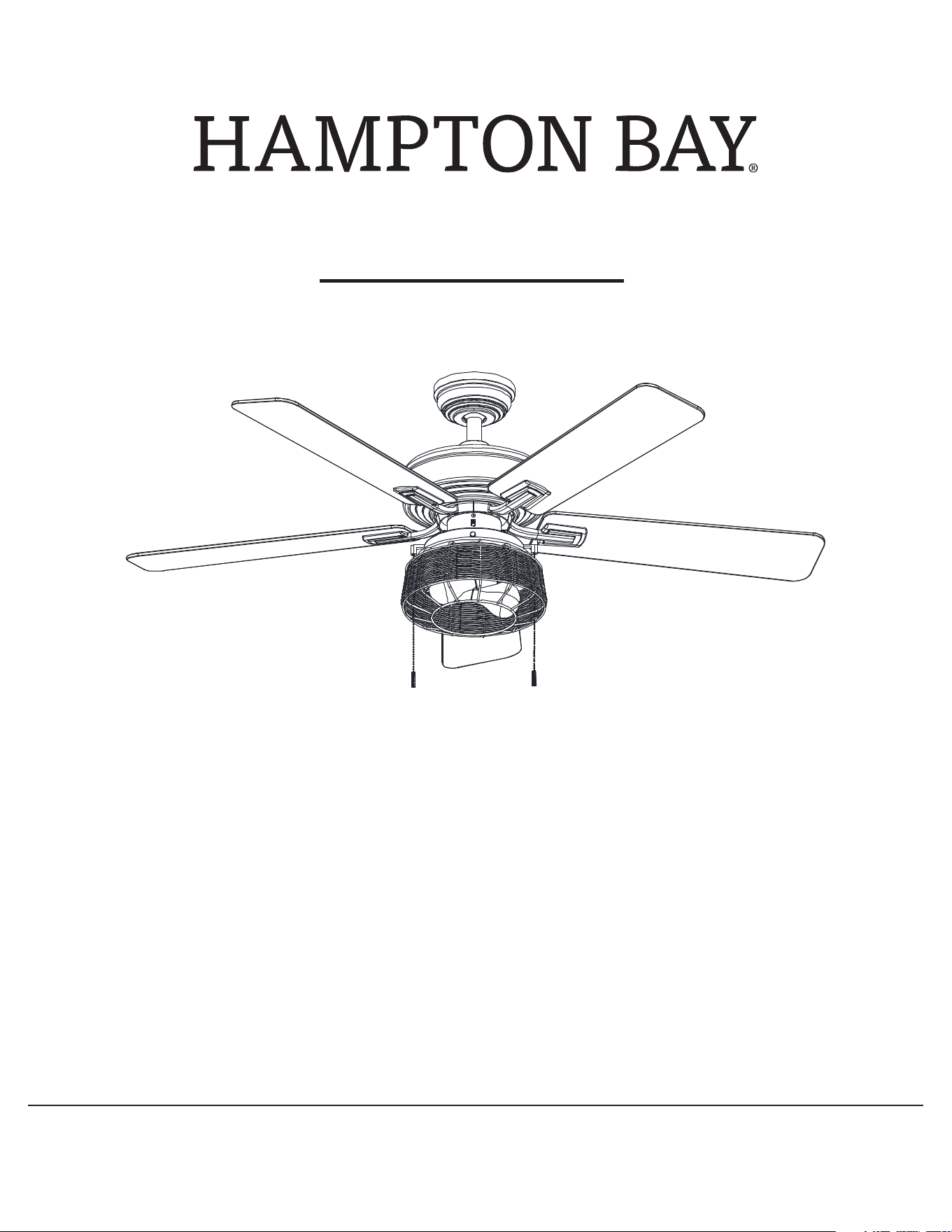
USE AND CARE GUIDE
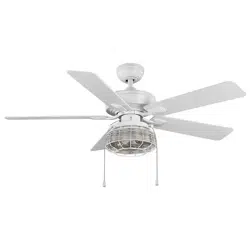
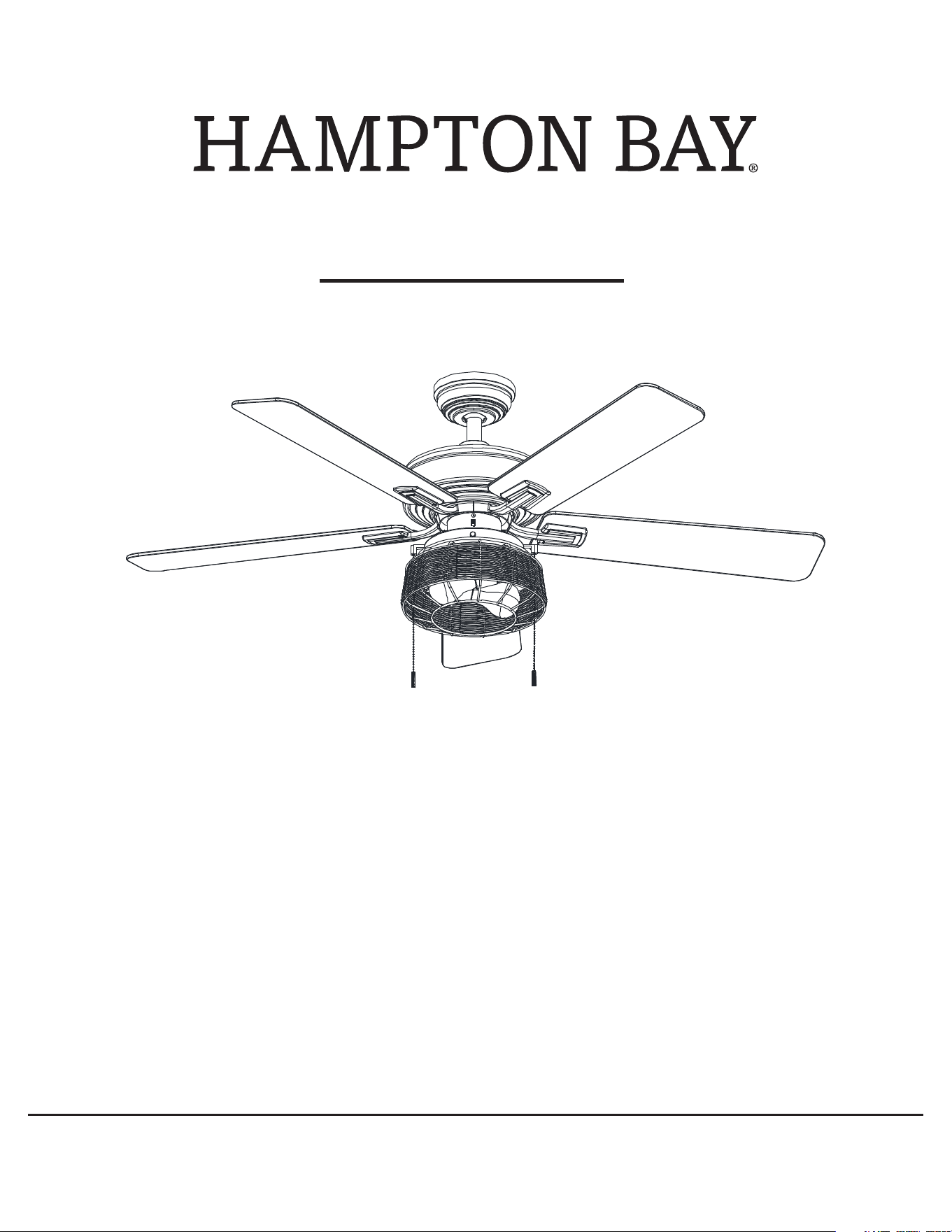
CEYLON 52-INCH CEILING FAN
2
Table of Contents ................................................................ 2
Safety Information ...............................................................2
Warranty ............................................................................... 3
Pre-Installation ....................................................................3
Installation ............................................................................6
Assembly ..............................................................................7
Operation ...........................................................................13
Care and Cleaning ............................................................. 14
Troubleshooting .................................................................14
1. To reduce the risk of electric shock, ensure the electricity has
been turned off at the circuit breaker or fuse box before you
begin.
2. All wiring must be in accordance with the National Electrical
Code ANSI/NFPA 70-1999 and local electrical codes. Electrical
installation should be performed by a qualified licensed
electrician.
3. The outlet box and support structure must be securely mounted
and capable of reliably supporting 35 lb (15.9 kg). Use only UL
Listed outlet boxes marked “Acceptable for Fan Support of 35 lb
(15.9 kg) or less.”
4. The fan must be mounted with a minimum of 7 ft. (2.1 m)
clearance from the trailing edge of the blades to the oor.
5. Do not operate the reversing switch while the fan blades are
in motion. You must turn the fan off and stop the blades before
you reverse the blade direction.
6. Do not place objects in the path of the blades.
7. To avoid personal injury or damage to the fan and other items,
use caution when working around or cleaning the fan.
8. Electrical diagrams are for reference only. Light kits that are
not packed with the fan must be UL Listed and marked suitable
for use with the model fan you are installing. Switches must be
UL General Use Switches. Refer to the instructions packaged
with the light kits and switches for proper assembly.
9. After making electrical connections, spliced conductors should
be turned upward and pushed carefully up into the outlet box.
The wires should be spread apart with the grounded conductor
and the equipment-grounding conductor on one side of the
outlet box.
10. All set screws must be checked and retightened where
necessary before installation.
11. Use only with light kits marked “suitable for damp location”.
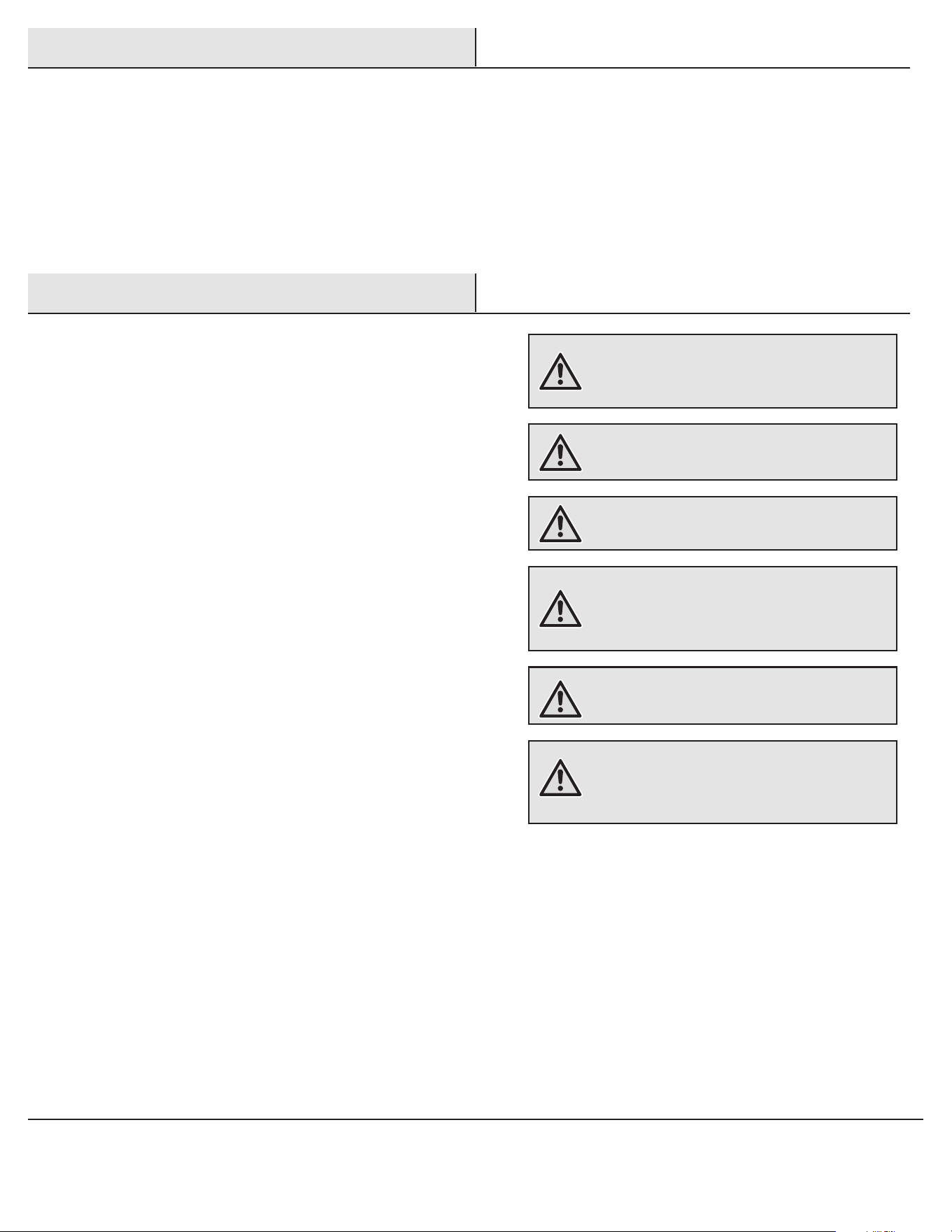
WARNING: To reduce the risk of personal injury,
do not bend the blade brackets (also referred to as
anges) during assembly or after installation. Do not
insert objects in the path of the blades.
WARNING: Remove the rubber motor stops on
the bottom of the fan before installing the blades or
testing the motor.
WARNING: To reduce the risk of re or electric
shock, do not use this fan with any solid-state speed
control device.
WARNING: To avoid possible electrical shock,
turn the electricity off at the main fuse box before
wiring. If you feel you do not have enough electrical
wiring knowledge or experience, contact a licensed
electrician.
WARNING: Electrical diagrams are for reference
only. Optional use of any light kit shall be UL Listed
and marked suitable for use with this fan.
WARNING: To reduce the risk of re, electric shock,
or personal injury, mount to outlet box marked
“Acceptable for fan support of 35 lb (15.9 kg) or
less,” and use the screws provided with the outlet
box.
Safety Information
Table of Contents
READ AND SAVE THESE INSTRUCTIONS
3
HAMPTONBAY.COM
Please contact 1-855-HD-HAMPTON for further assistance.
Pre-Installation
Warranty
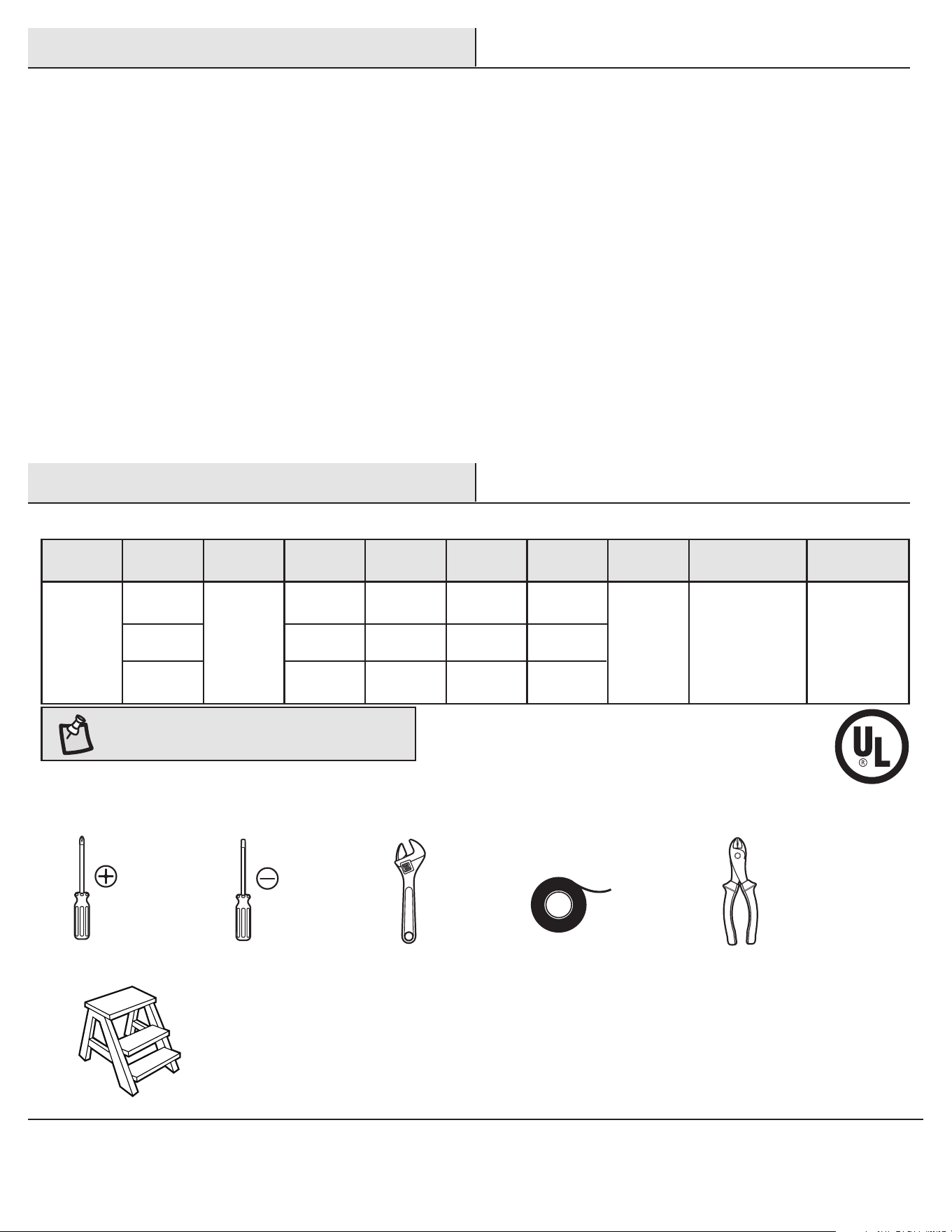
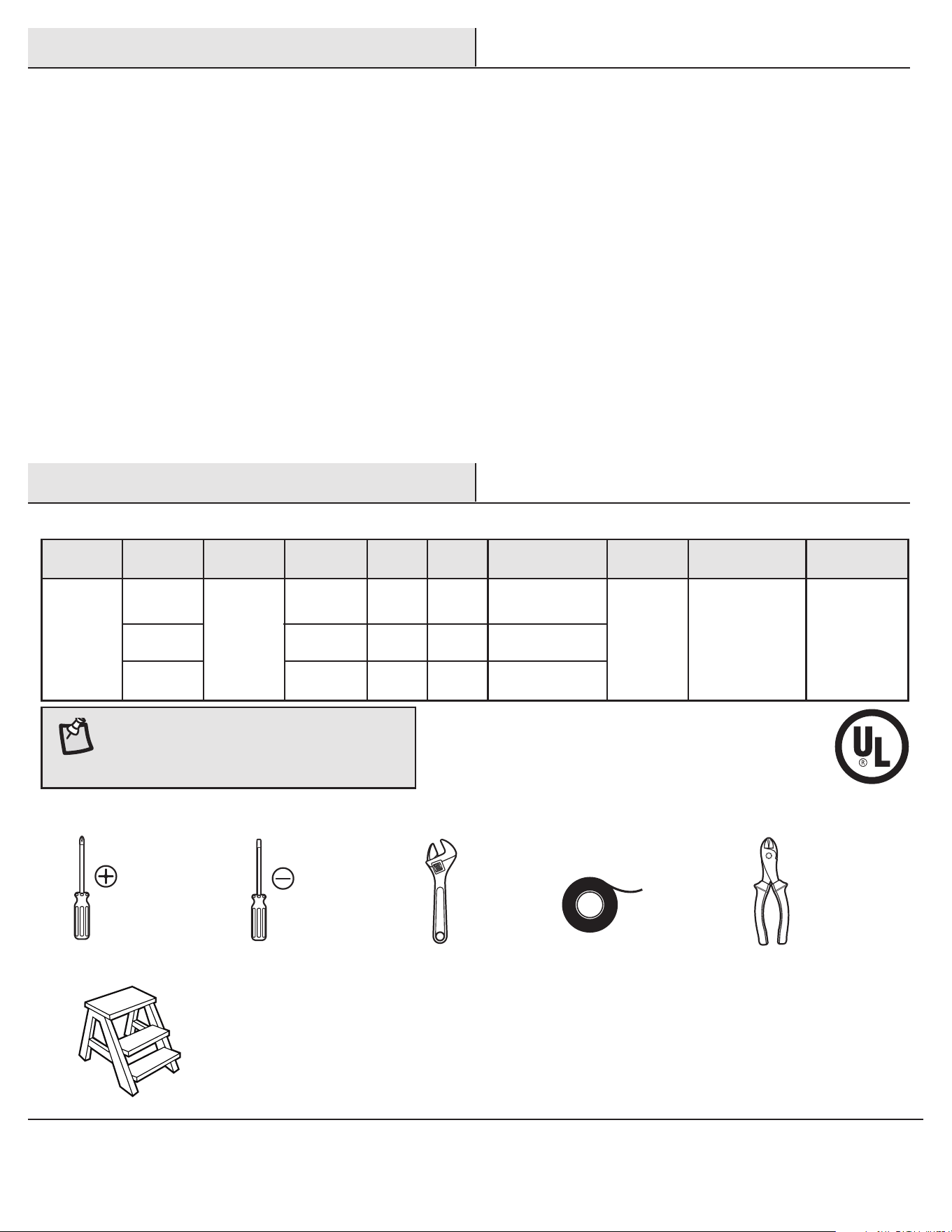
SPECIFICATIONS
TOOLS REQUIRED
Size Speed Volts Amps Watts RPM CFM
Net
Weight
Gross
Weight
Cubic Feet
52 in.
Low
Medium
High
120
0.22
0.36
0.52
12
30
62
60
110
160
1889
3320
5120
19.18 lb
(8.7 kg)
25.45 lb
(11.55 kg)
2.22 cu.ft.
NOTE: These are approximate measures. They do not
include the amps and wattage used by the light kit.
Phillips
screwdriver
Flat blade
screwdriver
Adjustable
wrench
Electrical
tape
Wire
cutter /
stripper
Step ladder
The supplier warrants the fan motor to be free from defects in workmanship and material present at time of shipment from the factory for a
lifetime after the date of purchase by the original purchaser. The supplier warrants that the light kit, excluding any glass, to be free from defects in
workmanship and material at the time of shipment from the factory for a period of three years after the date of purchase by the original purchaser.
The supplier also warrants that other fan parts, excluding any glass or acrylic blades, to be free from defects in workmanship and material at the
time of shipment from the factory for a period of one year after the date of purchase by the original purchaser. We agree to correct such defects
without charge or at our option replace with a comparable or superior model if the product is returned. To obtain warranty service, you must present
a copy of the receipt as proof of purchase. All costs of removing and reinstalling the product are your responsibility. Damage to any part, such as by
accident, misuse, improper installation, or by afxing any accessories, is not covered by this warranty. Because of varying climatic conditions this
warranty does not cover any changes in brass nish, including rusting, pitting, corroding, tarnishing, or peeling. Brass nishes of this type give their
longest useful life when protected from varying weather conditions. A certain amount of “wobble” is normal and should not be considered a defect.
Servicing performed by unauthorized persons shall render the warranty invalid. There is no other express warranty. Hampton Bay hereby disclaims
any and all warranties, including but not limited to those of merchantability and tness for a particular purpose to the extent permitted by law. The
duration of any implied warranty, which cannot be disclaimed, is limited to the time period as specied in the express warranty. Some states do not
allow a limitation on how long an implied warranty lasts, so the above limitation may not apply to you. The retailer shall not be liable for incidental,
consequential, or special damages arising out of or in connection with product use or performance except as may otherwise be accorded by law.
Some states do not allow the exclusion of incidental or consequential damages, so the above exclusion or limitation may not apply to you. This
warranty gives specic legal rights, and you may also have other rights that vary from state to state. This warranty supersedes all prior warranties.
Shipping costs for any return of product as part of a claim on the warranty must be paid by the customer.
Contact the Customer Service Team at 1-855-HD-HAMPTON or visit www.HamptonBay.com.
4
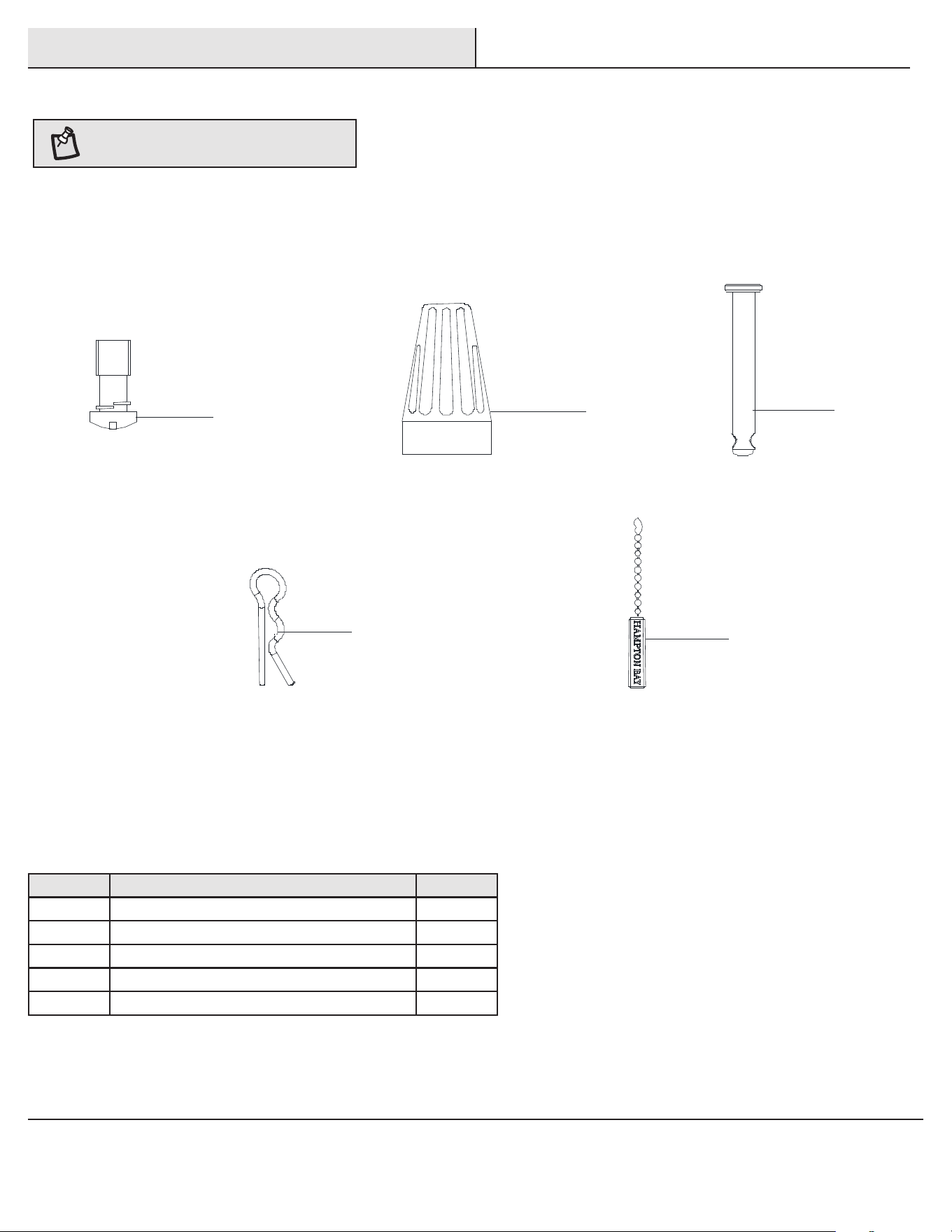
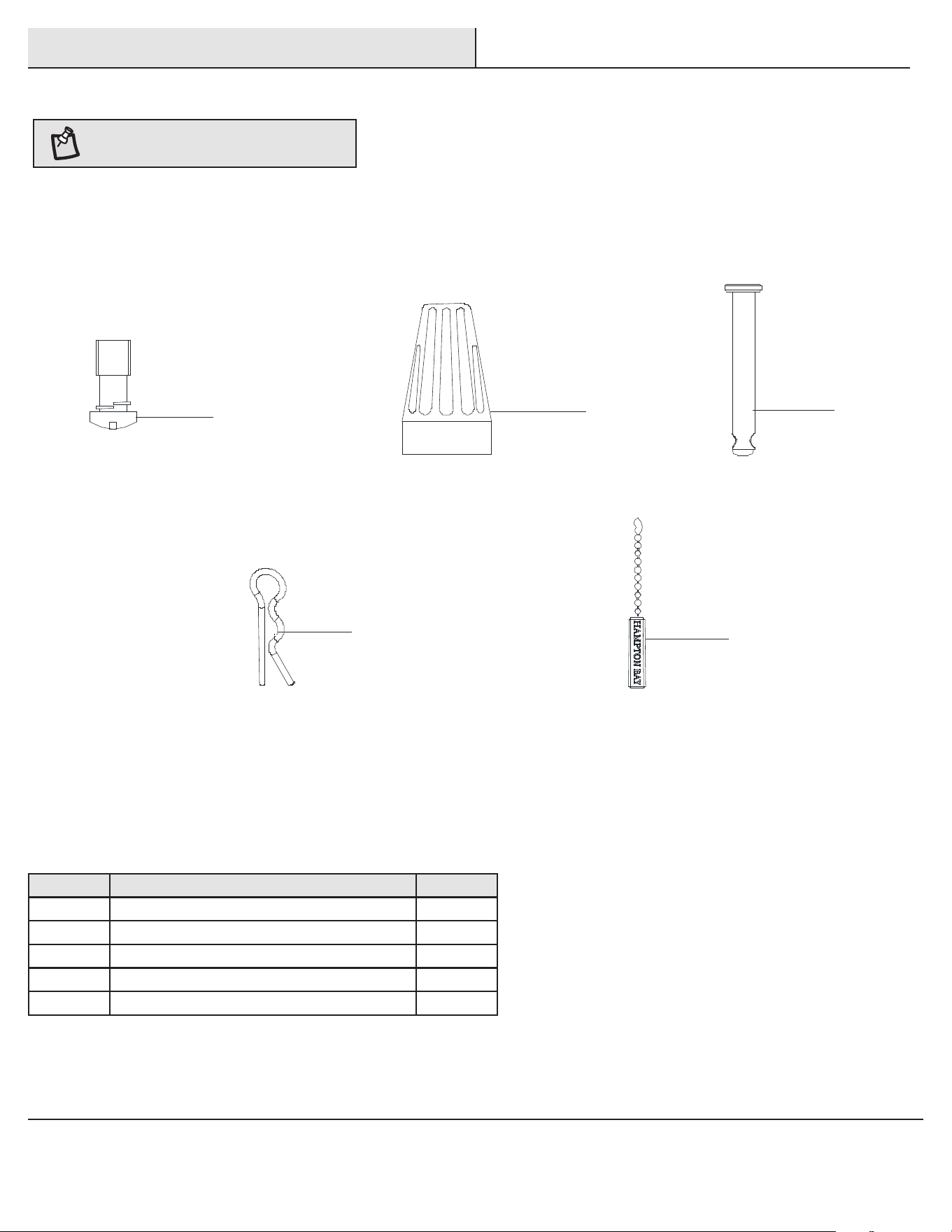
Part Description Quantity
AA Extra blade bracket screw 1
BB Plastic wire connector 3
CC Hanger pin 1
DD Locking pin 1
EE Pull chain 2
Pre-Installation (continued)
HARDWARE INCLUDED
NOTE: Hardware not shown to actual size.
AA
BB
CC
DD
EE
5
HAMPTONBAY.COM
Please contact 1-855-HD-HAMPTON for further assistance.
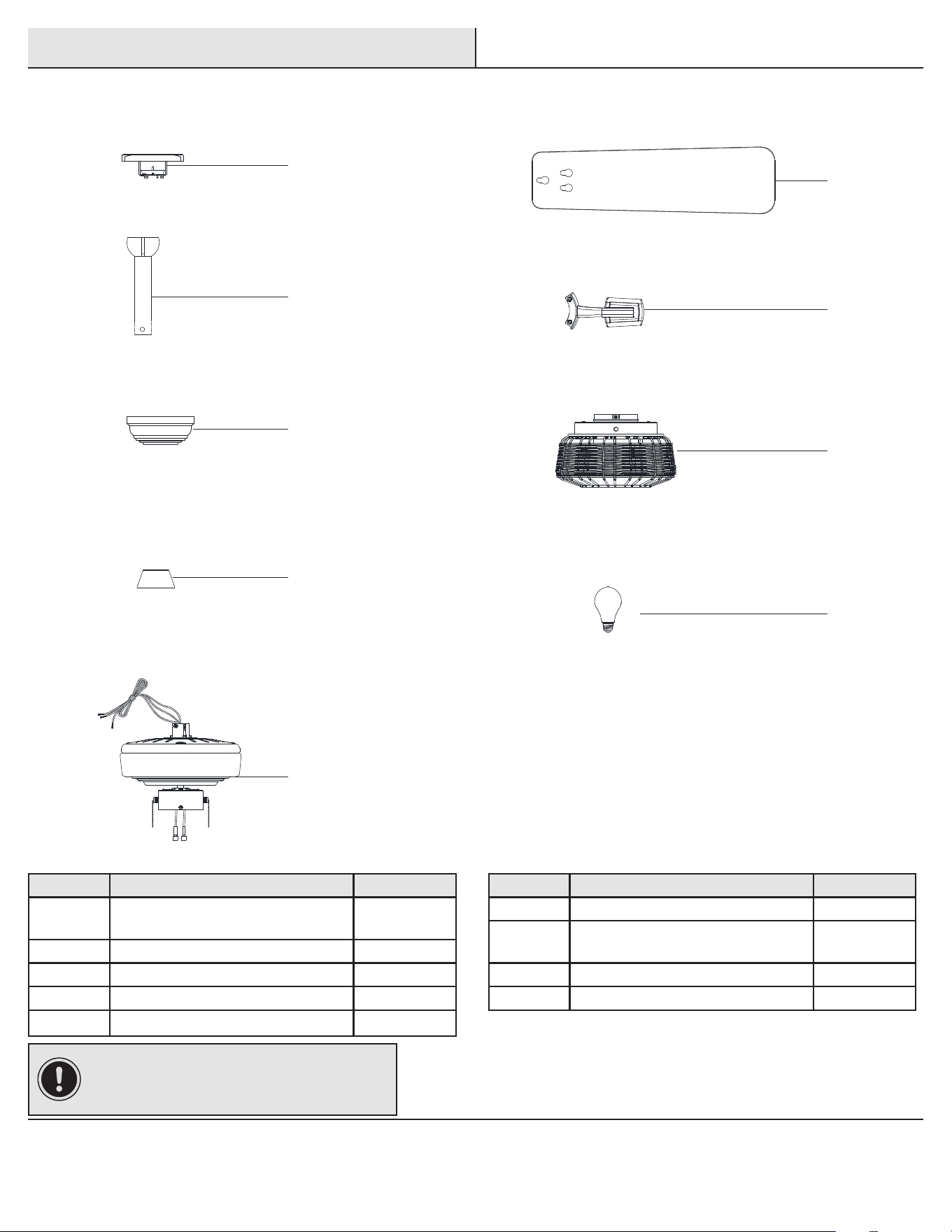
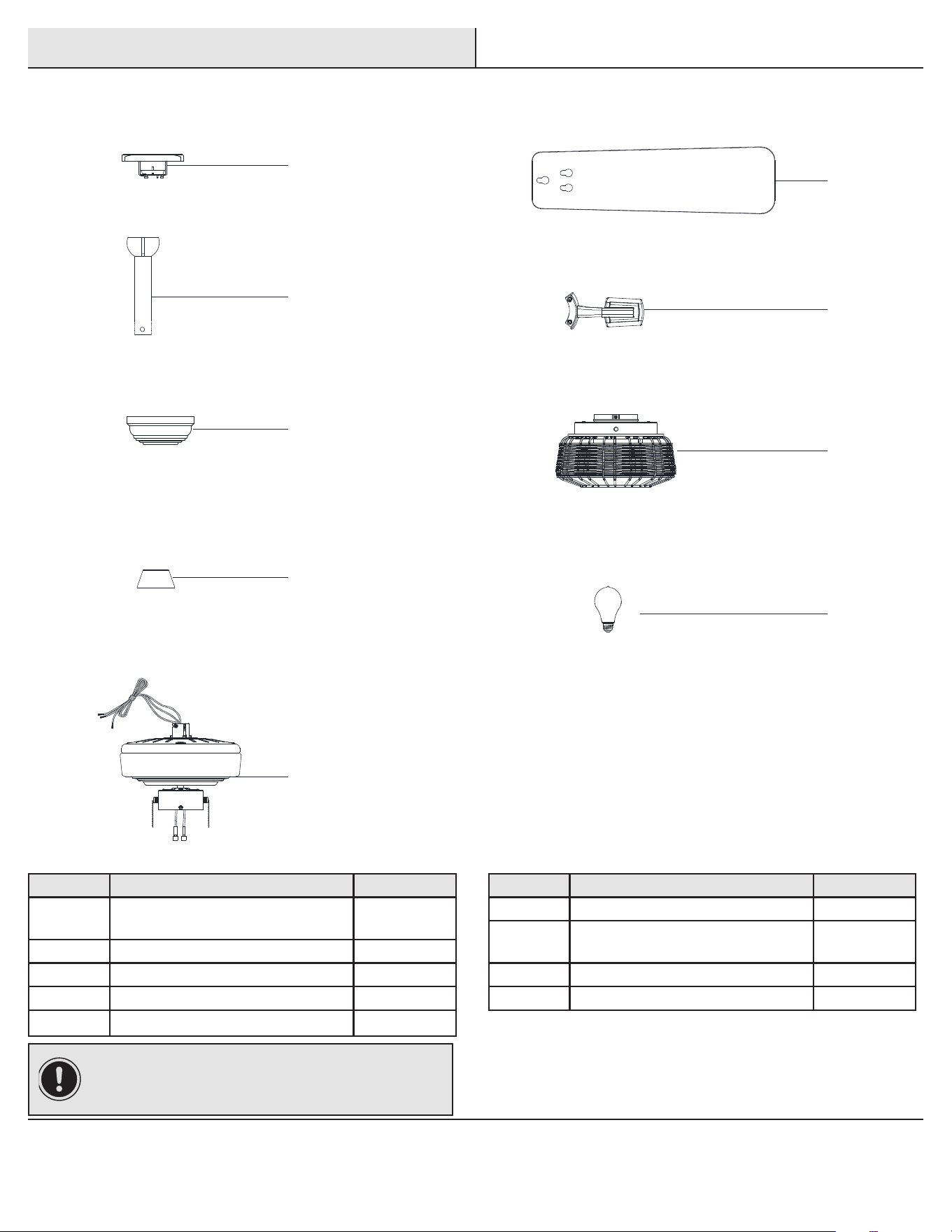
Part Description Quantity
A Slide-on mounting bracket
(inside canopy)
1
B Ball/downrod assembly 1
C Canopy 1
D Decorative motor collar 1
E Fan motor assembly 1
Part Description Quantity
F Blade 5
G
Blade bracket (with pre-installed
screws)
5
H Light kit tter assembly 1
I LED bulbs (6.5-Watt, Maximum) 2
IMPORTANT: This product and/or components are
governed by one or more of the following U.S. Patents:
5,947,436; 5,988,580; 6,010,110; 6,046,416, 6,210,117
and other patents pending.
Pre-Installation (continued)
PACKAGE CONTENTS
I
G
F
H
C
D
B
E
A
6
Installation
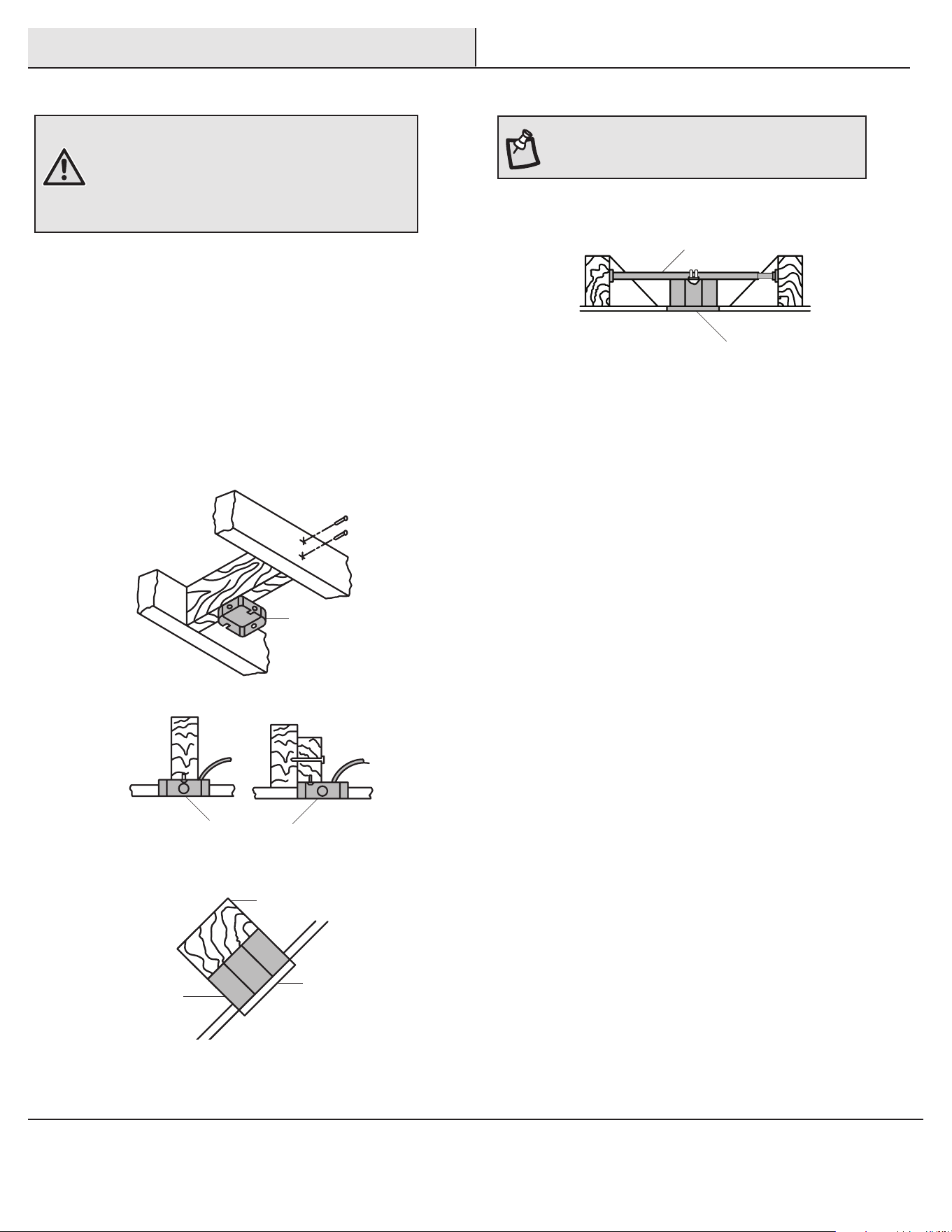
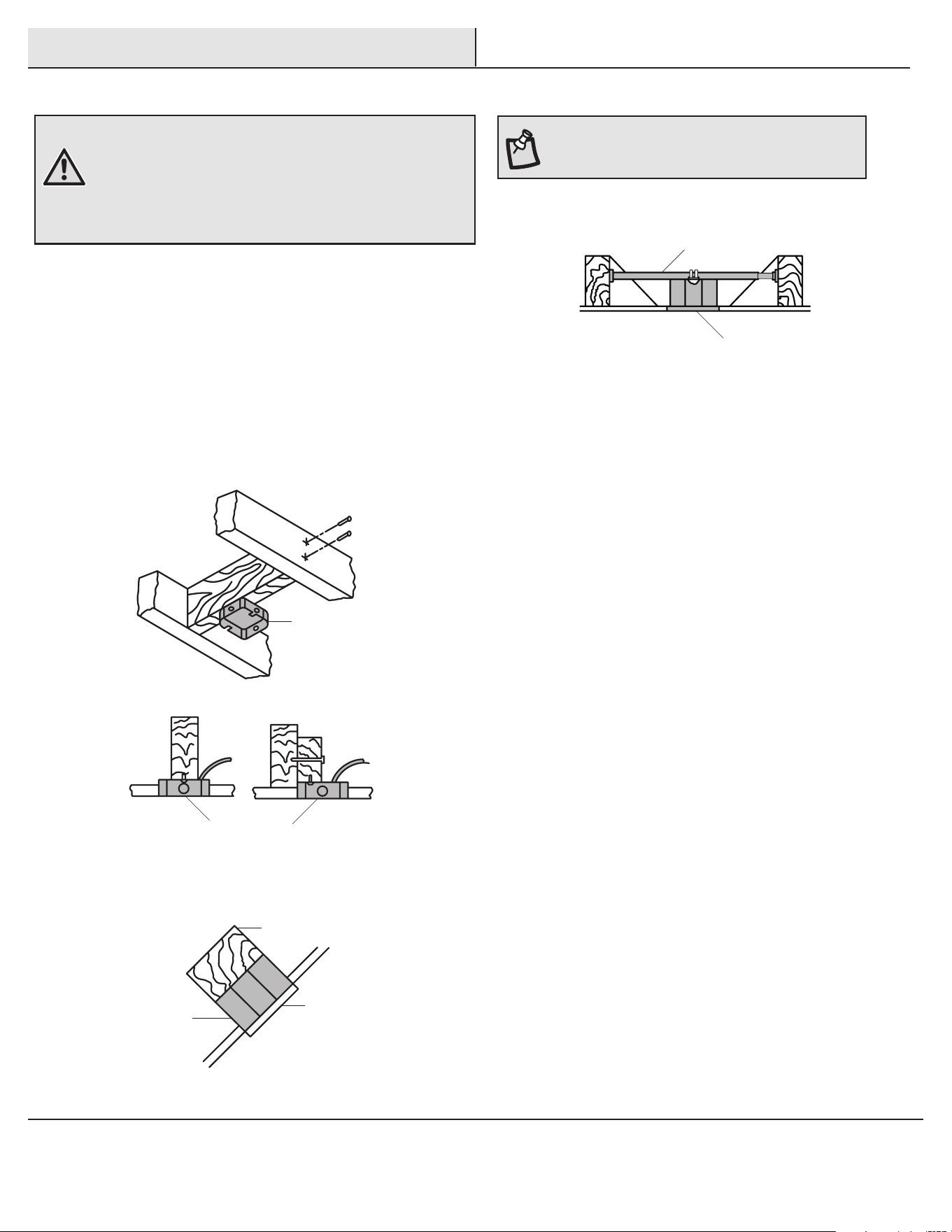
MOUNTING OPTIONS
WARNING: To reduce the risk of re, electric shock
or personal injury, mount to an outlet box marked
“Acceptable for fan support of 35 lb (15.9 kg) or less,”
and use the screws provided with the outlet box. An
outlet box commonly used for the support of lighting
xtures may not be acceptable for fan support and may
need to be replaced. If in doubt, consult a qualied
electrician.
If your ceiling fan does not have an existing UL Listed mounting
box, then install one using the following instructions:
□ Disconnect the power by removing the fuses or turning off
the circuit breakers.
□ Secure the outlet box directly to the building structure.
Use the appropriate fasteners and materials. The outlet box
and its bracing must be able to fully support the weight of
the moving fan (at least 35 lb). Do not use a plastic outlet
box.
The illustrations below show three different ways to mount the
outlet box.
If the canopy (C) touches the ball/downrod assembly (B), then remove
the decorative canopy bottom cover and turn the canopy (C) 180°
before attaching the canopy (C) to the mounting plate.
To hang your fan where there is an existing xture but no ceiling joist,
you may need an installation hanger bar as shown above (available at
any Home Depot store).
NOTE: You may need a longer downrod to maintain
proper blade clearance when installing on a steep, sloped
ceiling. The maximum angle allowable is 20° away from
horizontal.
Outlet Box
Outlet Box
Recessed
Outlet
Box
Provide Strong
Support
Ceiling
Mounting
Plate
Outlet Box
Hanger Bar
7
HAMPTONBAY.COM
Please contact 1-855-HD-HAMPTON for further assistance.
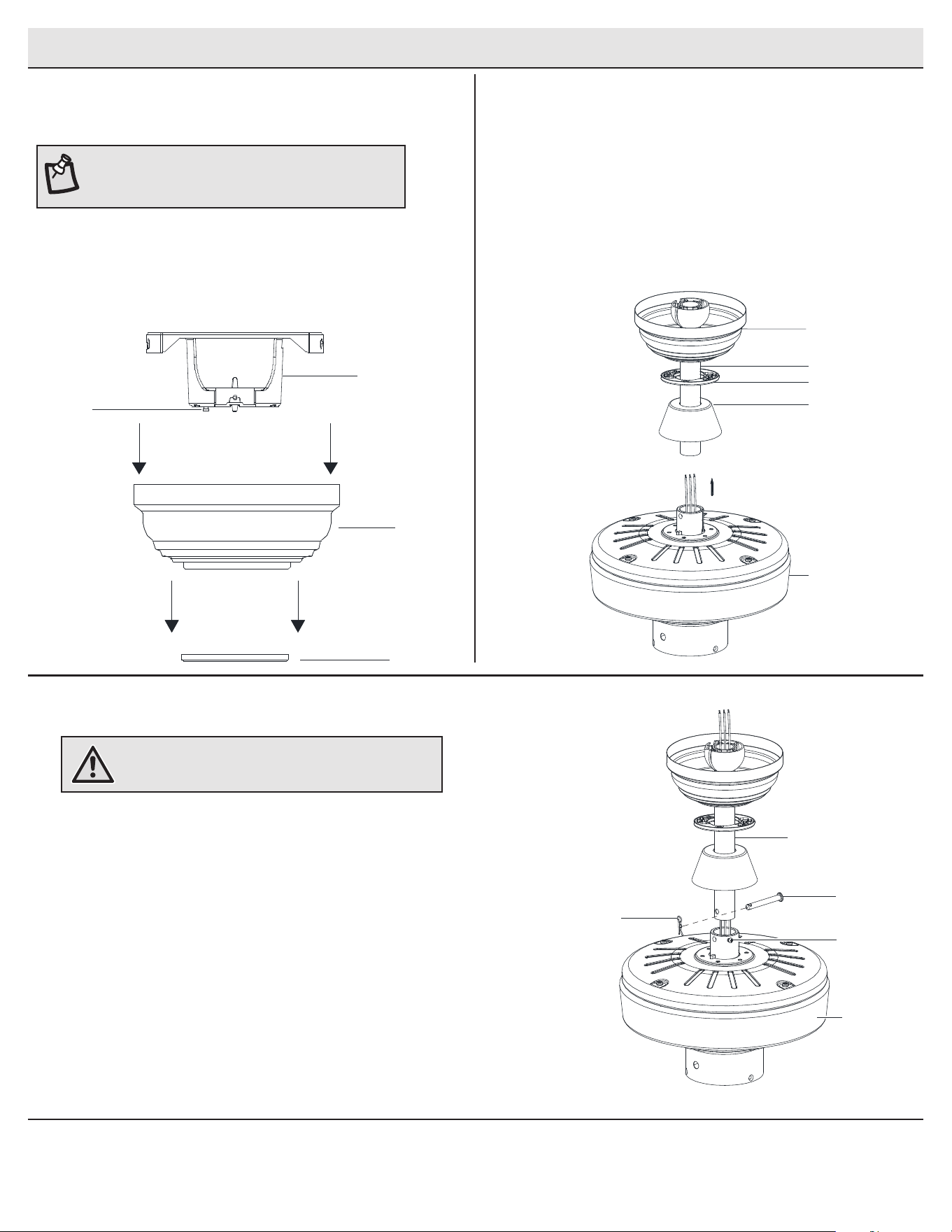
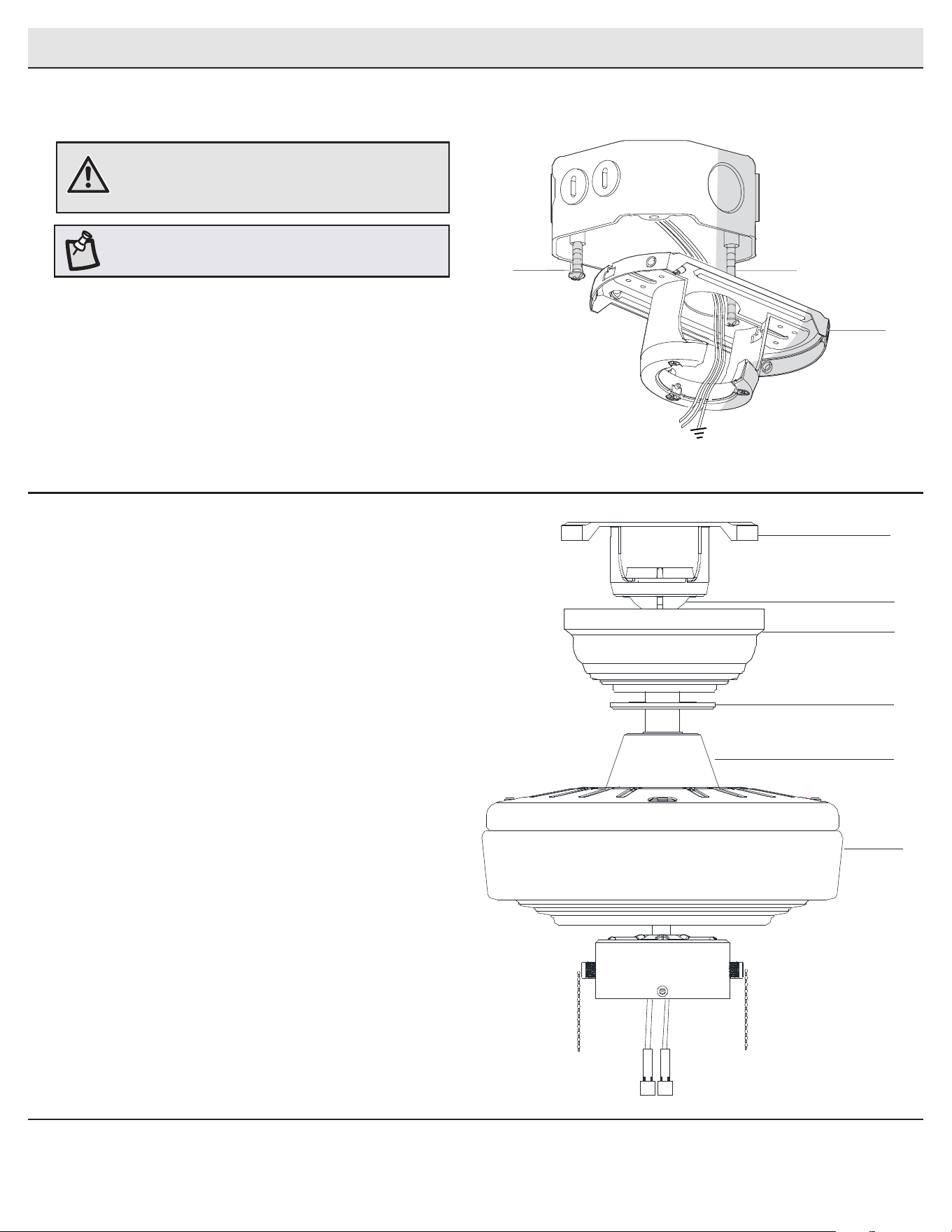
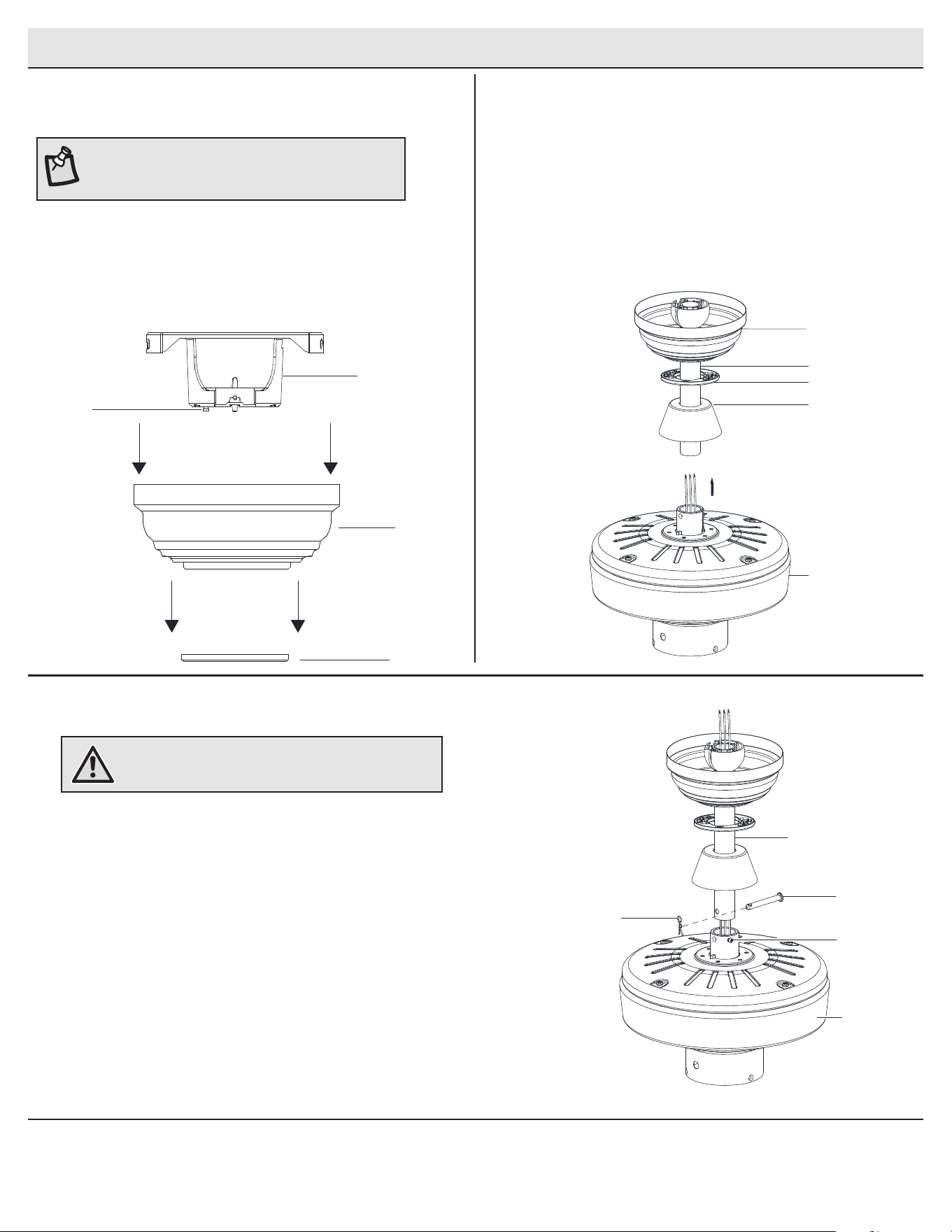
Assembly - Standard Ceiling Mount
Routing the wires
Assembling the fan
Preparing for standard mounting
□ Loosen, but do not remove, the set screws (JJ) on the collar
on top of the fan motor assembly (E).
□ Align the holes at the bottom of the ball/downrod assembly
(B) with the holes in the collar on top of the fan motor
assembly (E).
□ Carefully insert the hanger pin (CC) through the holes in
the collar and ball/downrod assembly (B). Be careful not to
jam the hanger pin (CC) against the wiring inside the ball/
downrod assembly (B).
□ Insert the locking pin (DD) through the hole near the end of
the hanger pin (CC) until it snaps into its locked position.
□ Re-tighten the set screws (JJ) on the collar on top of the fan
motor assembly (E).
□ Route the wires exiting the top of the fan motor assembly
(E) through the decorative motor collar cover (D) and then
the center of the canopy bottom cover (FF). Make sure
the opening of the canopy (C) is on top and insert the ball/
downrod assembly (B) through the canopy (C).
□ Route the wires exiting the top of the fan motor assembly (E)
through the downrod as shown.
□ Pull off the canopy bottom cover (FF) from the canopy (C).
□ Loosen the two canopy screws (HH) located in the bottom of
the slide-on mounting bracket (A), and turn the canopy counter
clockwise to remove the slide-on mounting bracket (A) from
canopy (C).
2
3
1
WARNING: Failure to properly install the locking pin (DD)
could result in the fan becoming loose and possibly
falling.
NOTE: The magnet is pre-attached on the canopy bottom
cover for you to remove and install easily.
FF
HH
C
A
FF
B
E
D
C
DD
CC
JJ
E
B
8
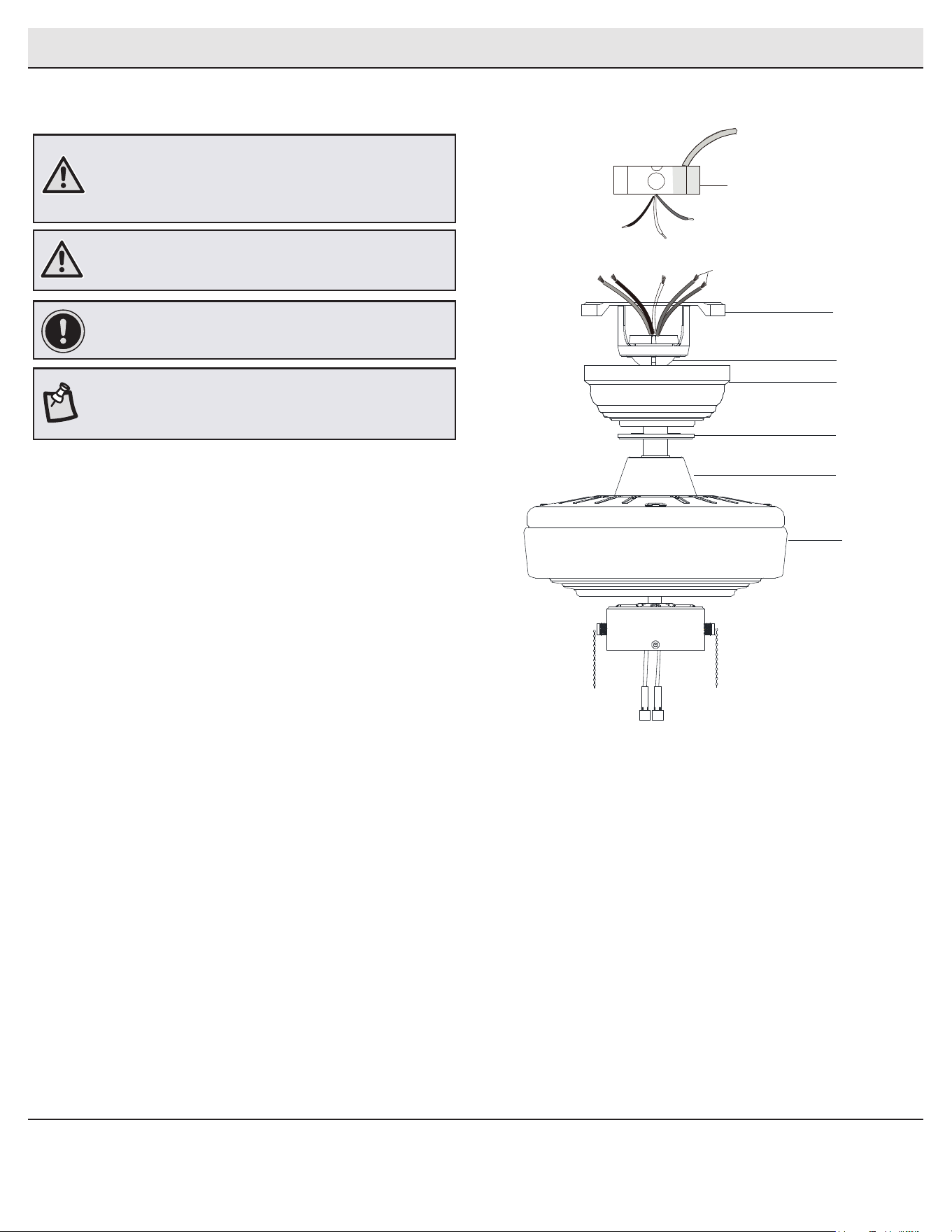
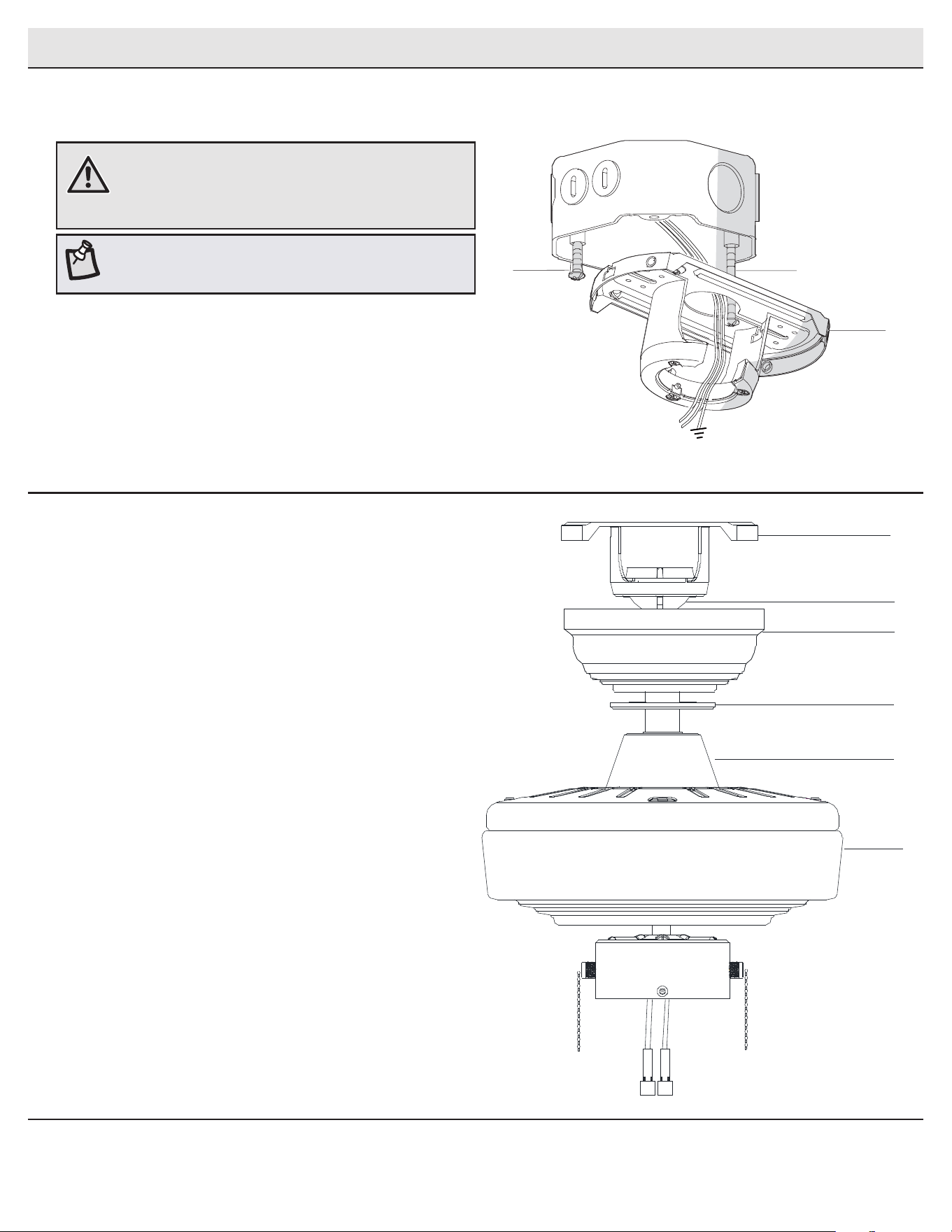
Assembly - Hanging the Fan
Attaching the fan to the electrical
box
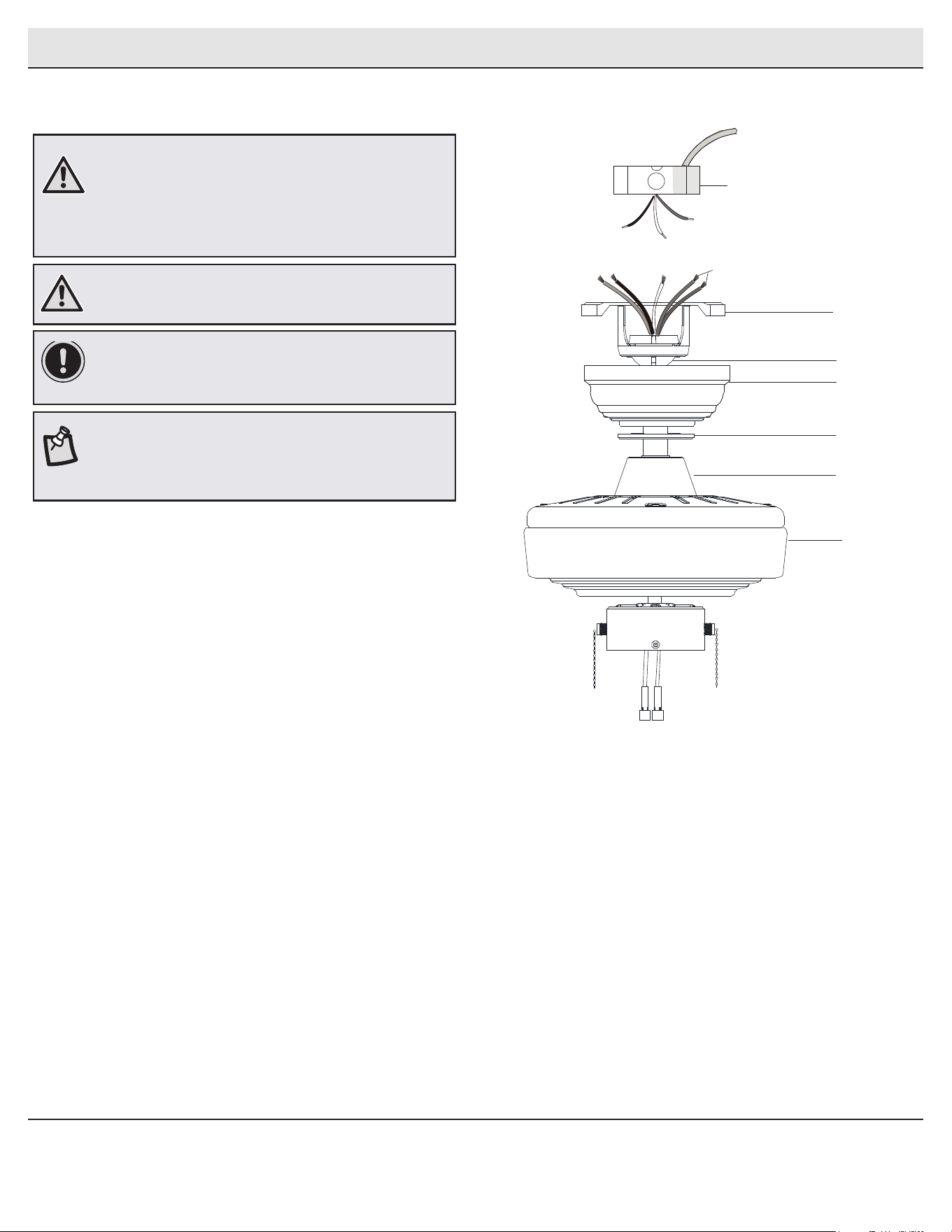
□ Pass the 120-Volt supply wires through the center hole in the
slide-on mounting bracket (A).
□ Install the slide-on mounting bracket (A) on the outlet box by
sliding the slide-on mounting bracket (A) over the two screws (LL)
provided with the outlet box. If necessary, use leveling washers
(not included) between the slide-on mounting bracket (A) and
the outlet box. The at side of the slide-on mounting bracket (A)
should face toward the outlet box, as shown.
□ Securely tighten the two mounting screws (LL).
1
WARNING: To reduce the risk of re, electric shock
or personal injury, mount to an outlet box marked
“Acceptable for fan support of 35 lb (15.9 kg) or less,”
and use the screws provided with the outlet box.
Hanging the fan
2
□ Carefully lift the fan motor assembly (E) up to the slide-on
mounting bracket (A).
□ Seat the hanger ball portion of the ball/downrod assembly (B)
in the mounting bracket socket. Ensure that the tab on the
slide-on mounting bracket (A) socket is properly seated in the
groove in the hanger ball.
NOTE: The mounting bracket (A) is designed to slide into
place on an outlet box with the outlet box screws (LL).
LL
LL
A
E
D
C
B
FF
A
9
HAMPTONBAY.COM
Please contact 1-855-HD-HAMPTON for further assistance.
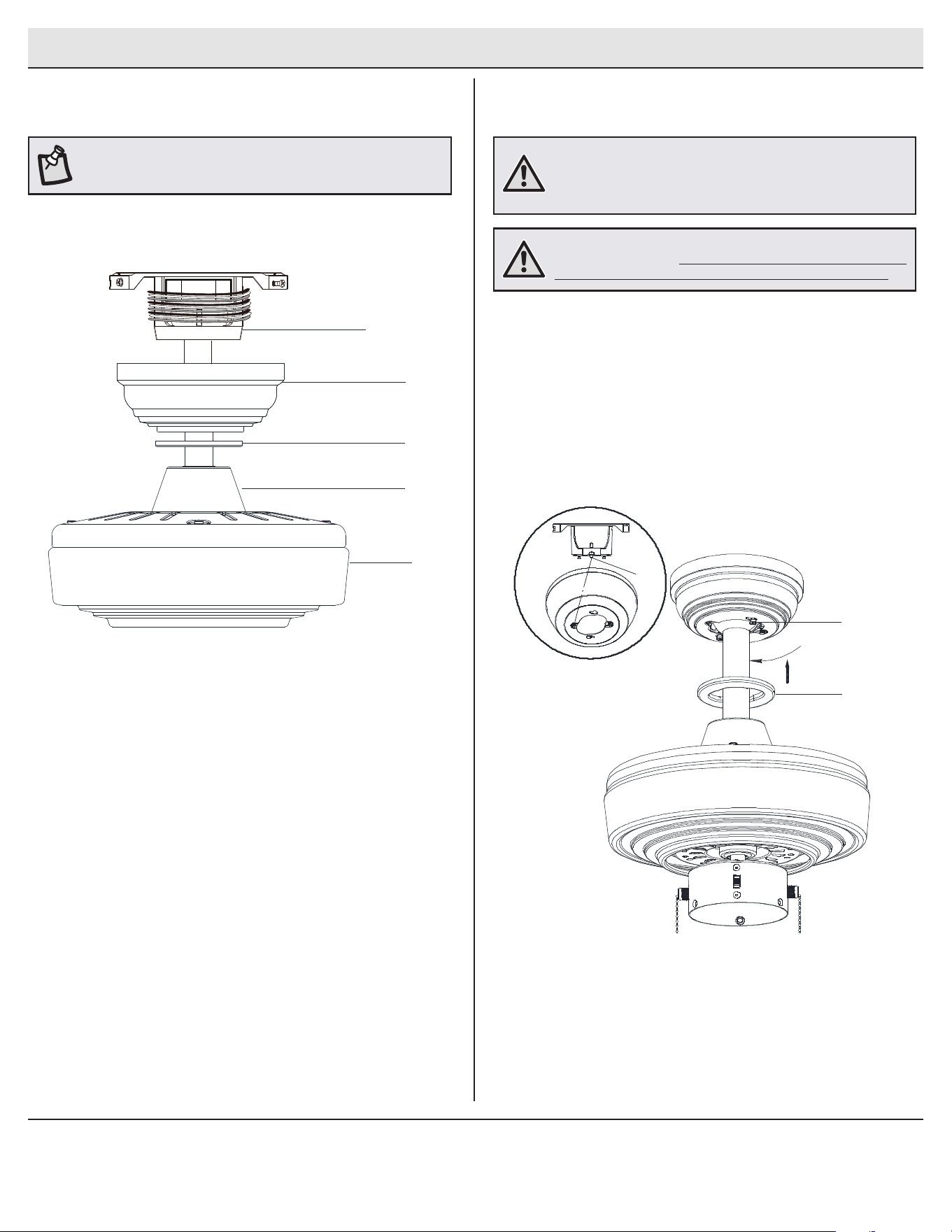
Assembly - Hanging the Fan (continued)
Making the electrical connections
3
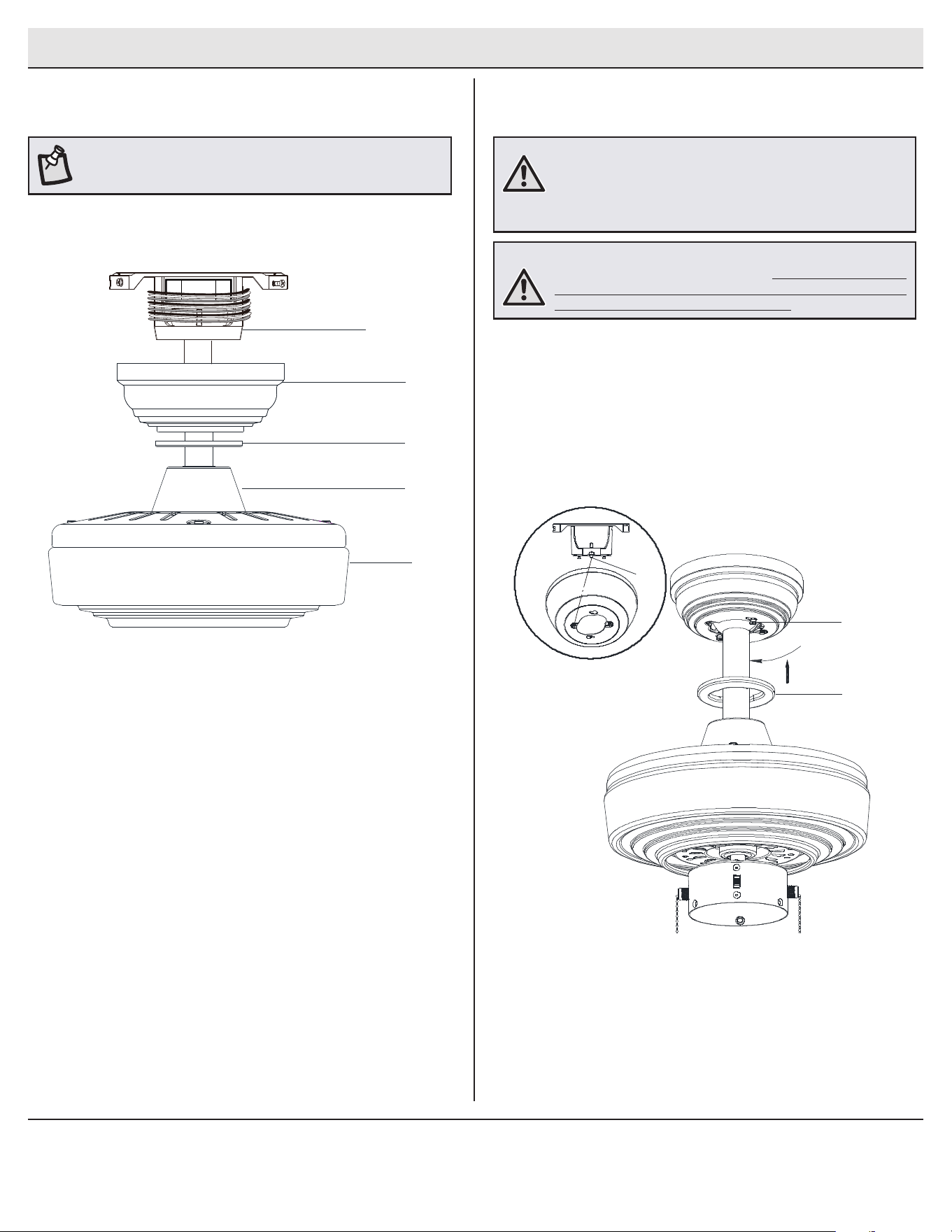
IMPORTANT: Use the plastic wire connectors (BB) supplied with
your fan. Secure the connectors with electrical tape and ensure
there are no loose strands or connections.
WARNING: Each wire nut supplied with this fan is designed to
accept up to one 12-gauge house wire and two wires from the
fan. If you have larger than 12-gauge house wiring or more
than one house wire to connect to the fan wiring, consult an
electrician for the proper size wire nuts to use.
□ The fan comes with 54 in. lead wires for use with an extended
ball/downrod assembly. If using the 4.5 in. ball/downrod
assembly (B) provided, you can cut the lead wires to your
desired length (no shorter than 12 in.) This will make extra
room in the canopy (C), if you do not wish to cut the wires,
you will need to neatly wrap them.
□ Connect the fan motor green wires to the household green or
bare wire using a plastic wire connector (BB).
□ Connect the fan motor white wire to the household white wire
using a plastic wire connector (BB).
□ Connect the fan motor black and blue wires to the household
black wire using a plastic wire connector (BB).
□ Secure each plastic wire connector (BB) using electrical tape.
□ Turn the plastic wire connector (BB) upward and push the
wiring into the outlet box (RR).
NOTE: The fan comes with 54 in. lead wires for use with an
extended ball/downrod assembly. If using the 4.5 in. ball/downrod
assembly (B) provided, you can cut the lead wires to your desired
length (no shorter than 12 in.).
WARNING: Remove the rubber motor stops on the bottom of the
fan before installing the blades or testing the motor.
E
D
C
B
FF
A
RR
Green or Bare
Green
Black
White
Blue & Black
10
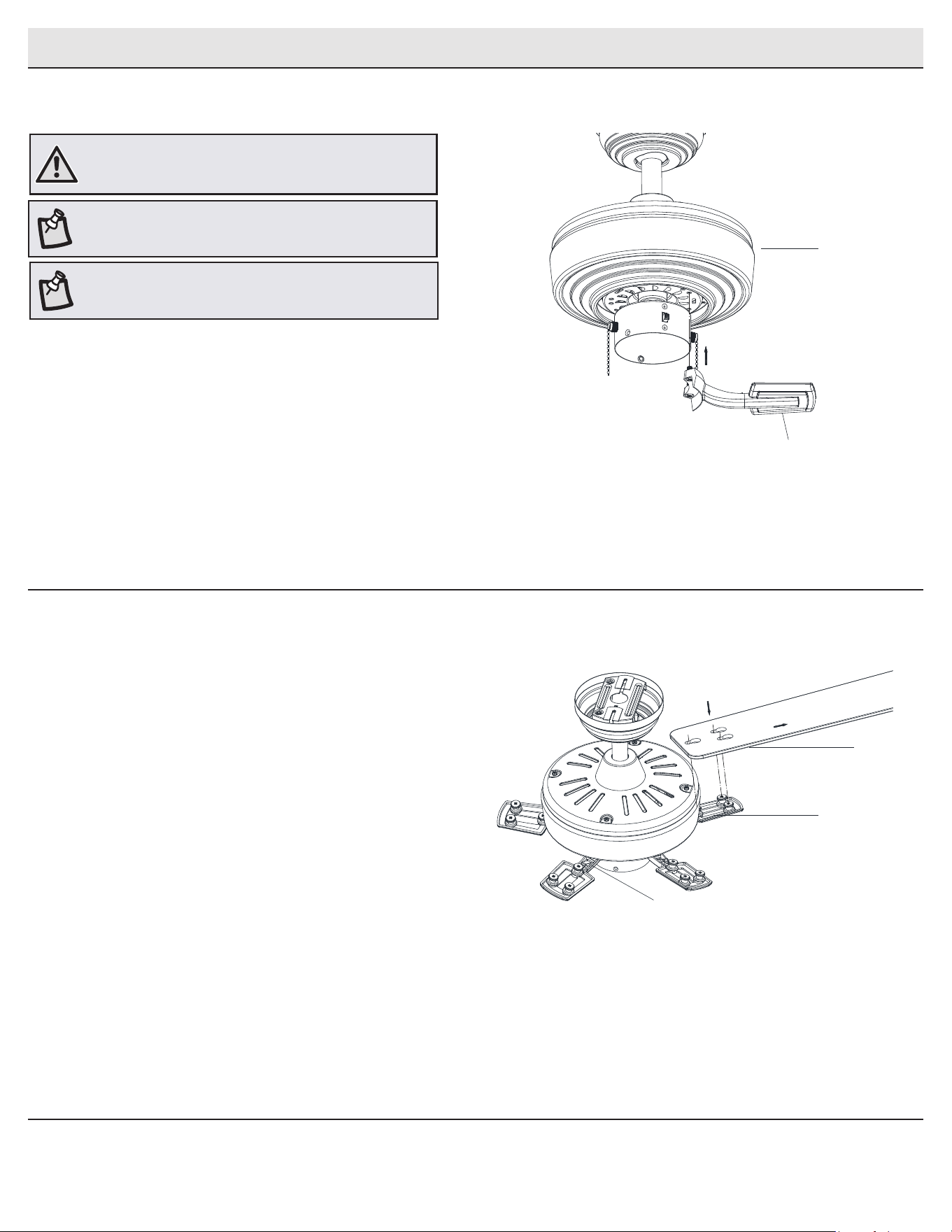
Assembly - Hanging the Fan (continued)
Mounting the fan motor assembly
(standard mount)
4 5
Wrapping the extra wire
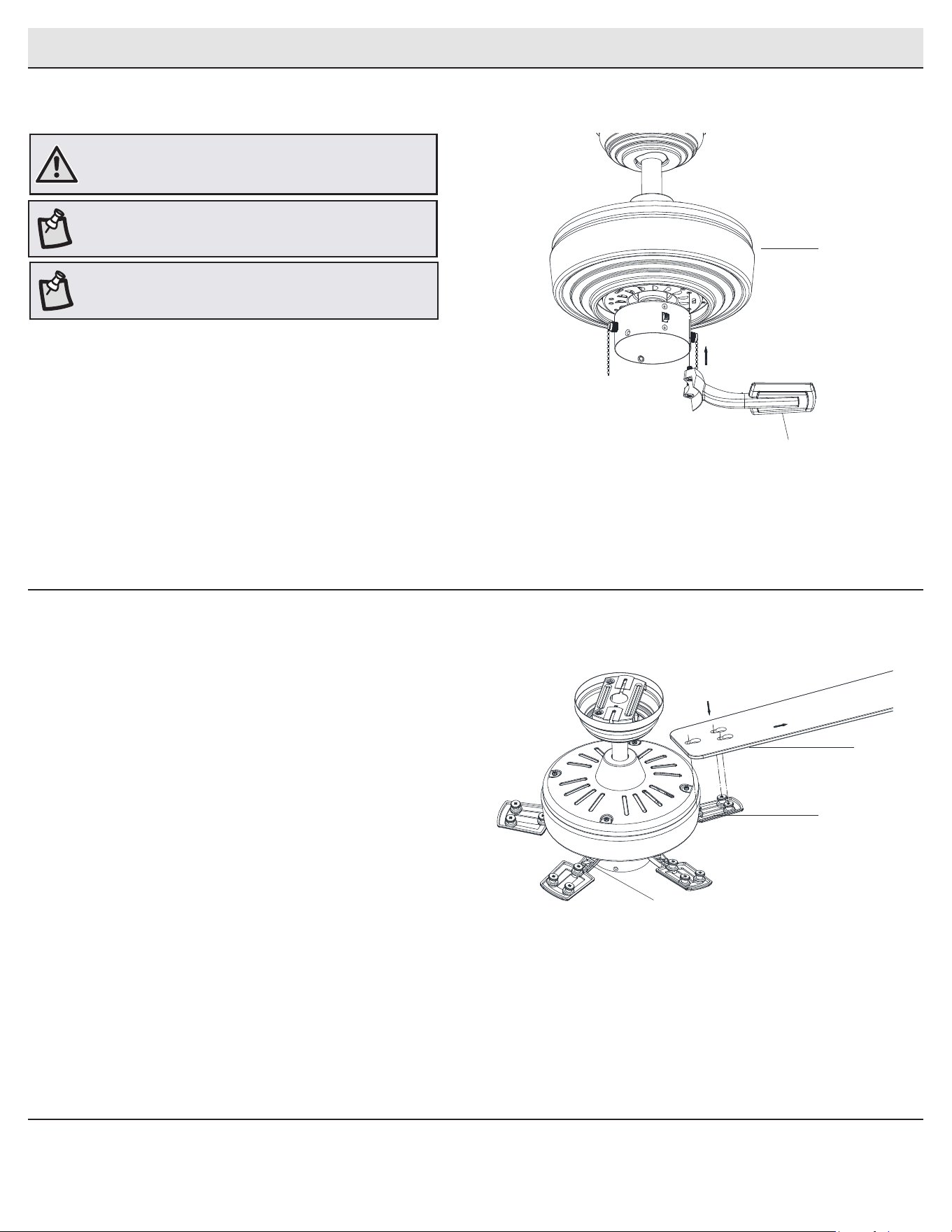
□ Gently wrap the excess wire around the slide-on mounting
bracket (A).
□ Secure with electrical tape.
NOTE: Follow this step ONLY if you did not cut the extra length off
from the wires coming from the ceiling fan.
□ Align the locking slots of the ceiling canopy (C) with the two
screws (MM) in the slide-on mounting bracket (A). Push up to
engage the slots and turn clockwise to lock in place.
□ Firmly tighten the two mounting screws (MM).
□ Install the two mounting screws (saved from Assembly Step
1 “Prepairing for mounting”) into the holes in the canopy (C)
and tighten rmly.
WARNING: When using the standard ball/downrod mounting, the
tab in the ring at the bottom of the mounting bracket must rest in
the groove of the hanger ball. Failure to properly seat the tab in
the groove could cause damage to the wiring.
WARNING: The locking slots of ceiling canopy are provided only
as an aid to mounting. Do not leave the fan assembly unattended
until all four canopy screws are engaged and rmly tightened.
MM
FF
NN
E
D
C
FF
A
11
HAMPTONBAY.COM
Please contact 1-855-HD-HAMPTON for further assistance.
Assembly - Attaching the Fan Blades
Fastening the blade brackets to
the motor
1
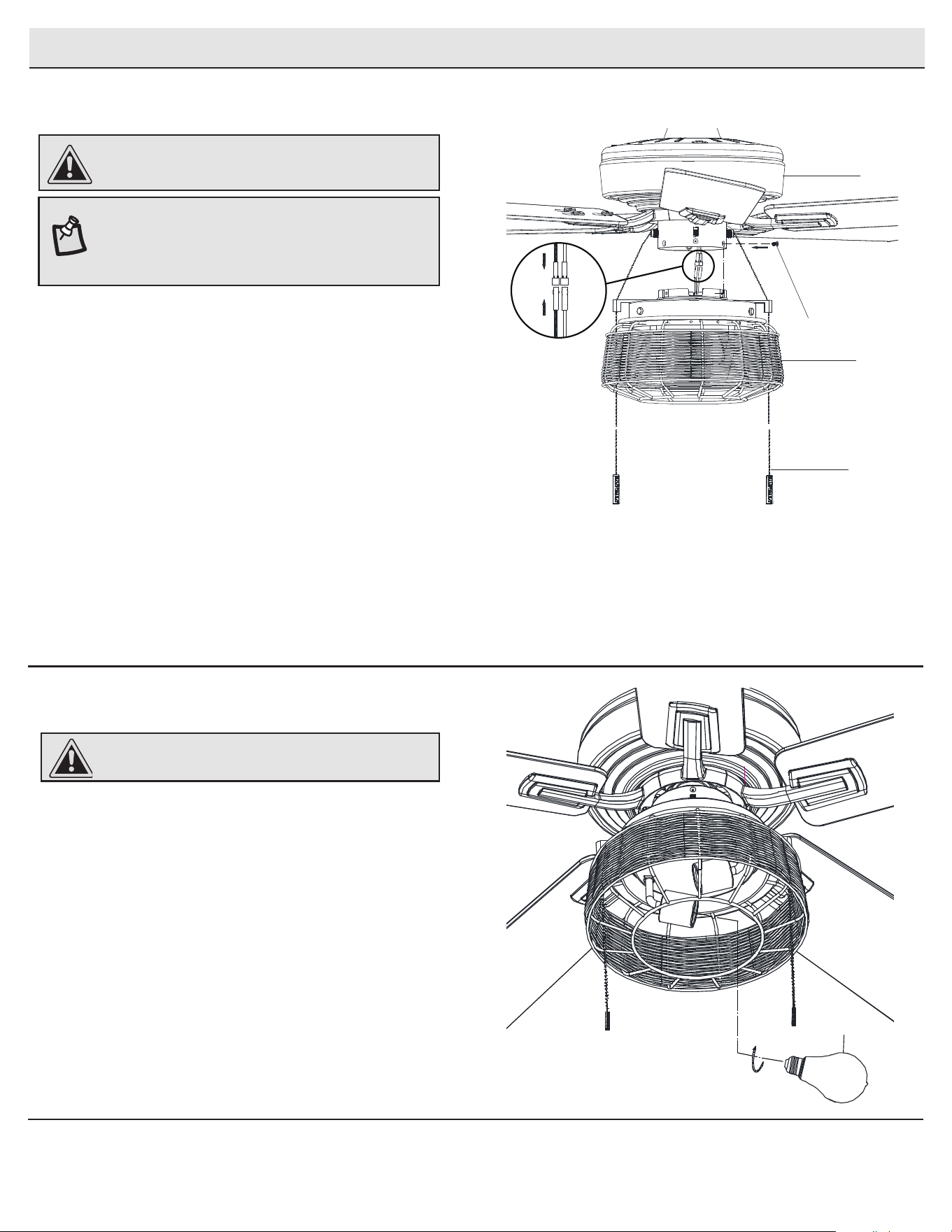
□ Fasten the blade brackets (G) to the fan motor assembly (E)
by inserting the alignment post into the slot on the bottom
of the motor and tightening the pre-installed blade bracket
screws.
□ Repeat this step for the remaining blade brackets.
WARNING: Remove the rubber motor stops on the bottom of
the fan before installing the blades or testing the motor.
NOTE: Your fan features revolutionary advancements for quick
and easy blade installation. Including an alignment post and
captive blade bracket screws.
NOTE: Your fan blades are reversible. Select the blade side nish
which best accentuates your decor.
Attaching the blades to the blade
brackets
2
□ Mount the fan blade (F) to the blade bracket (G) by aligning the
three key-slot holes in the blade (F) with the three posts on the
top of the blade bracket (G).
□ Hold the blade (F) with both hands close to the blade bracket
(G) down rmly. Ensure the key-slot holes are properly seated
on the blade bracket (G) posts.
□ While still holding the blade (F) down with both hands, rmly
slide the blade (F) until it engages in the locking mechanism
(UU). Make sure the locking mechanism (UU) at the rear of the
blade bracket (G) springs upward and butts against the edge of
the blade (F), indicating a secure connection.
□ Visually inspect the top of the blade bracket (G) to ensure the
locking mechanism is securely in place.
□ Repeat this procedure for the remaining blades (F).
G
E
F
G
UU
12
Installing the bulbs
2
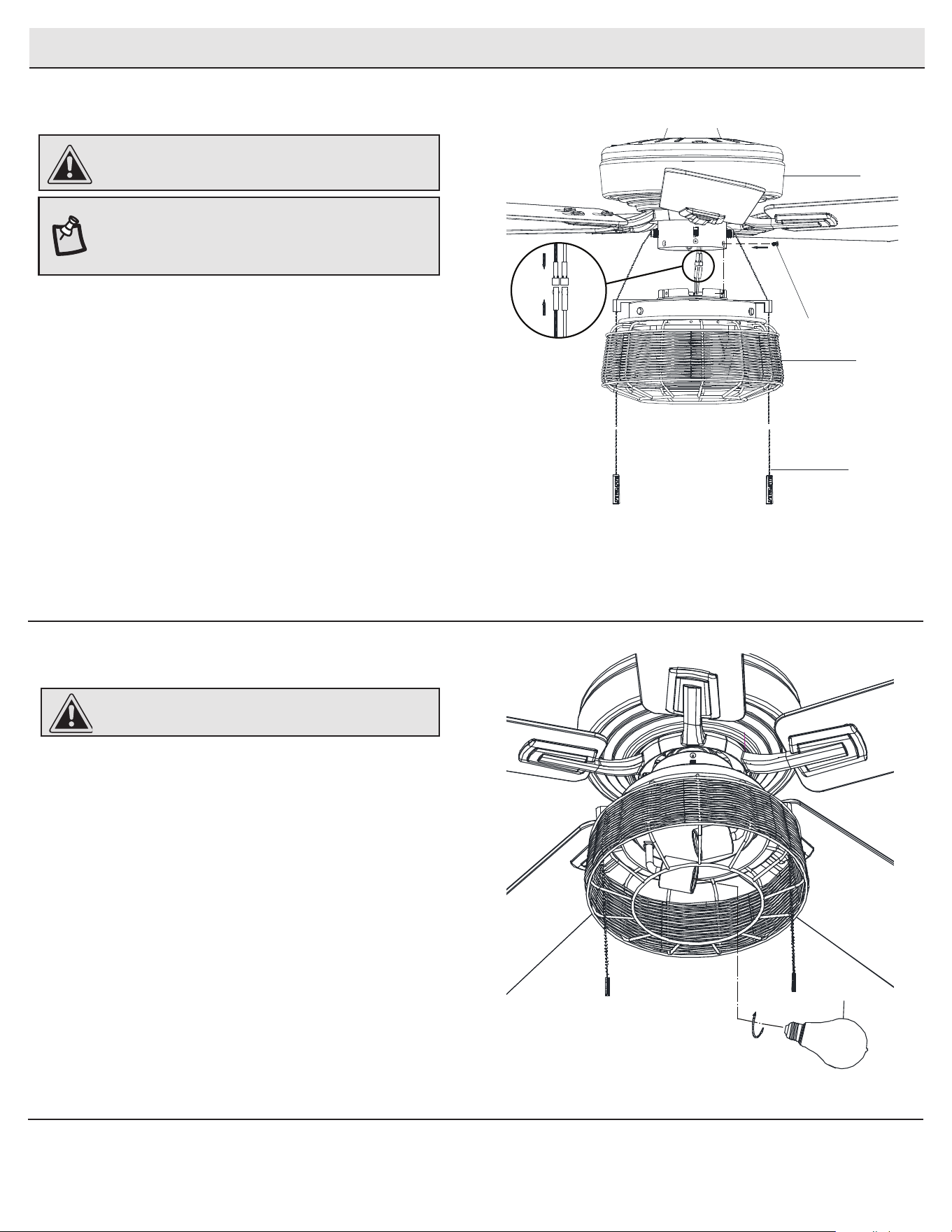
□ With the power off, install the two LED bulbs (I) by screwing
them into the light bulb sockets.
CAUTION: Make sure the power is off before attaching or
removing the LED bulb.
Assembly - Attaching the Lights
Attaching the light kit tter assembly
1
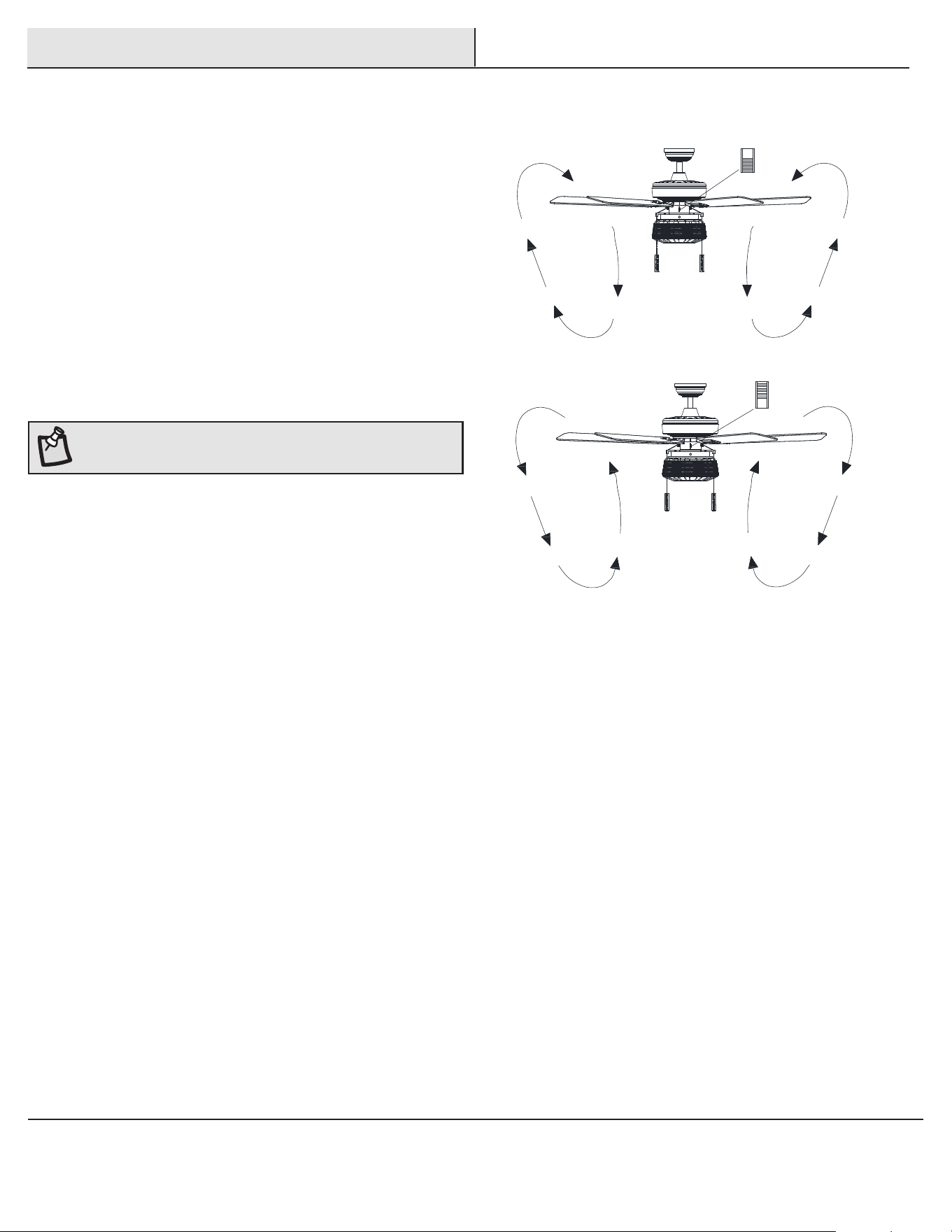
□ Remove the three screws (VV) on the switch cup cover of the
light kit tter assembly (H).
□ Connect the wires from the light kit tter assembly (H) to the
wires from the switch cup of the fan motor assembly (E) by
connecting the molded adaptor plugs together (blue to black,
white to white). Carefully tuck all wires and splices into the
switch cup.
□ Align the three holes in the switch cup cover of the light kit tter
assembly (H) with the three holes in the switch cup of the fan
motor assembly (E). Make sure the notch in the switch cup cover
of the light kit tter assembly (H) clears the reversing switch
in the switch cup of the fan motor assembly (E). Position the
light kit tter assembly (H) and re-install the three screws (VV)
that were removed in the rst step to secure the light kit tter
assembly (H).
□ Attach the pull chains (EE) provided to the light pull chain and fan
pull chain.
CAUTION: To reduce the risk of electric shock, disconnect
the electrical supply circuit to the fan before installing the
light xture.
NOTE: Notice the location of the fan’s slide switch. This is
the switch used to change the fan’s directional rotation.
For more information on the operation of this switch, see
Operating Your Fan on page 13.
I
EE
H
VV
E
13
HAMPTONBAY.COM
Please contact 1-855-HD-HAMPTON for further assistance.
Turn on the power and check the operation of the fan. The fan pull
chain controls the fan speed as follows:
□ 1 pull - High
□ 2 pulls - Medium
□ 3 pulls - Low
□ 4 pulls - off
The appropriate speed settings for warm or cool weather depend on
factors such as the room size, ceiling height, and number of fans.
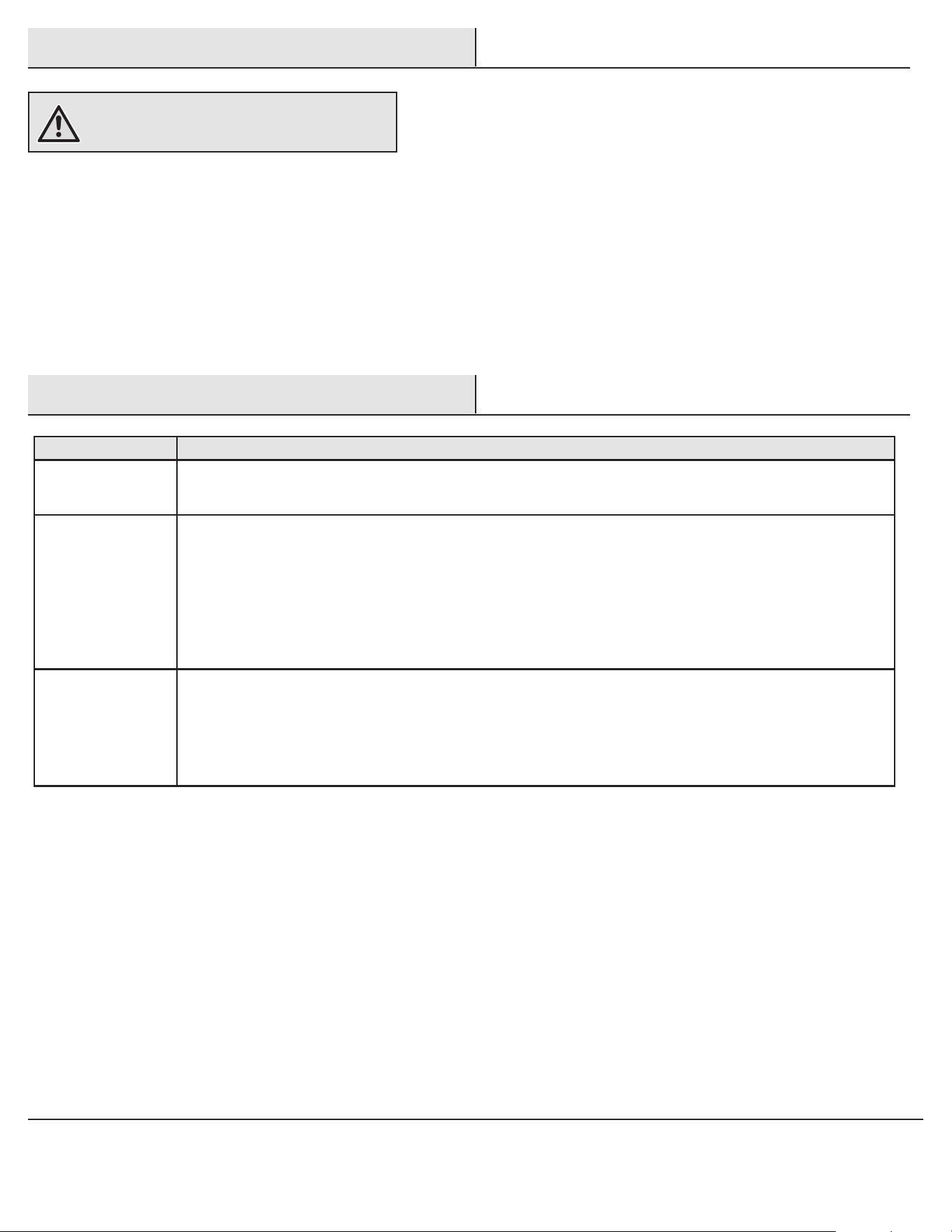
The slide switch (XX) controls the direction of the blades: forward
(switch down) or reverse (switch up).
Warm weather - (Forward) A downward airow creates a cooling effect.
This allows you to set your air conditioner on a higher setting without
affecting your comfort.
Cool weather - (Reverse) An upward airow moves warm air off of the
ceiling. This allows you to set your heating unit on a lower setting
without affecting your comfort.
NOTE: Wait for the fan to stop before reversing the direction of the
blade rotation.
Operation
OPERATING YOUR FAN
Warm Weather
Cool Weather
XX
XX
14
Troubleshooting
Problem Solution
The fan will not start. □ Check the main and branch circuit fuses or breakers.
□ Check the line wire connections to the fan and switch wire connections in the switch housing.
The fan is noisy. □ Ensure all motor housing screws are snug.
□ Ensure the screws that attach the fan blade bracket to the motor hub are tight.
□ Ensure the wire nut connections are not rattling against each other or the interior wall of the switch housing.
□ Allow a 24-hour “breaking in” period. Most noises associated with a new fan disappear during this time.
□ If you are using the Ceiling Fan light kit, ensure the screws securing the glassware are tight. Check that the light
bulbs are also secure.
□ Ensure the canopy is a short distance from the ceiling. It should not touch the ceiling.
□ Ensure your outlet box is secure and rubber isolator pads were used between the mounting plate and outlet box.
The fan wobbles. □ Check that all blade and blade arm screws are secure.
□ Most fan wobble problems are caused when blade levels are unequal. Check this level by selecting a point on the
ceiling above the tip of one of the blades. Measure from a point on the center of each blade to the point on the
ceiling. Measure this distance. Rotate the fan until the next blade is positioned for measurement. Repeat for each
blade. Any measurement deviation should be within 1/8 in. Run the fan for ten minutes. If the fan continues to
wobble please contact Customer Service and a balancing kit will be sent to you at no charge.
□ Because of the fan’s natural movement, some connections may become loose. Check the support connections, brackets, and blade
attachments twice a year. Make sure they are secure. It is not necessary to remove the fan from the ceiling.
□ Clean your fan periodically to help maintain its new appearance over the years. Do not use water when cleaning, as this could damage
the motor or the wood, or possibly cause an electrical shock. Use only a soft brush or lint-free cloth to avoid scratching the nish. The
plating is sealed with a lacquer to minimize discoloration or tarnishing.
□ You can apply a light coat of furniture polish to the wood for additional protection and enhanced beauty. Cover small scratches with a
light application of shoe polish.
□ You do not need to oil your fan. The motor has permanently-lubricated sealed ball bearings.
WARNING: Make sure the power is off before cleaning
your fan.
Care and Cleaning
Questions, problems, missing parts? Before returning to the store,
call Hampton Bay Customer Service
8 a.m. - 7 p.m., EST, Monday - Friday, 9 a.m. - 6 p.m., EST, Saturday
1-855-HD-HAMPTON
HAMPTONBAY.COM
Retain this manual for future use.
Responsible Party - U.S. Contact Information: King of Fans, Inc 1951 NW 22nd Street, Fort Lauderdale, FL 33311, (954) 484-7500
This equipment has been tested and found to comply with the limits for a Class B digital device, pursuant to Part 15 of the FCC Rules. These limits are designed to provide reasonable
protection against harmful interference in a residential installation. This equipment generates, uses and can radiate radio frequency energy and, if not installed and used in accordance
with the instructions, may cause harmful interference to radio communications. However, there is no guarantee that interference will not occur in a particular installation. If this
equipment does cause harmful interference to radio or television reception, which can be determined by turning the equipment off and on, the user is encouraged to try to correct the
interference by one or more of the following measures:
□ Reorient or relocate the receiving antenna.
□ Increase the separation between the equipment and receiver.
□ Connect the equipment into an outlet on a circuit different from that to which the receiver is connected.
□ Consult the dealer or an experienced radio/TV technician for help.
CAUTION: Any changes or modications not expressly approved by the grantee of this device could void the user’s authority to operate the equipment.
This device complies with Part 15 of the FCC Rules. Operation is subject to the following two conditions: (1) This device may not cause harmful
interference, and (2) this device must accept any interference received, including interference that may cause undesired operation.
¿Preguntas, problemas, piezas faltantes? Antes de devolverlo a la tienda,
llama al Servicio al Cliente de Hampton Bay
de lunes a viernes, entre 8:00 a.m. a 7:00 p.m. (hora del Este),
y los sábados de 9:00 a.m. a 6:00 p.m. (hora del Este)
1-855-HD-HAMPTON
HAMPTONBAY.COM
GRACIAS
Apreciamos la plena conanza que has depositado en Hampton Bay con la compra de este ventilador de techo. Nos esforzamos constantemente por crear
productos de calidad diseñados para tu hogar. Visítanos por Internet para ver nuestra línea completa de productos disponibles a n de satisfacer tus
necesidades de mejoras del hogar.
¡Gracias por elegir Hampton Bay!
Artículo Núm. 1007 976 465
Modelo Núm. 56056
Modelo Núm. 52-WIGR aprobado por UL
GUÍA DE USO Y MANTENIMIENTO
VENTILADOR DE TECHO CEYLON, DE 1.3 M
2
Tabla de contenido .............................................................. 2
Información de seguridad...................................................2
Garantía ................................................................................3
Preinstalación ......................................................................3
Instalación ............................................................................6
Ensamblaje ...........................................................................7
Funcionamiento .................................................................13
Mantenimiento y limpieza .................................................14
Solución de problemas .....................................................14
1.
Para disminuir el riesgo de descarga eléctrica hay que garantizar el
corte de electricidad en el cortacircuitos o en la caja de fusibles antes de
comenzar.
2. Todo el cableado tiene que cumplir con el Código Nacional de Electricidad
ANSI/NFPA 70-1999 y los códigos eléctricos locales. La instalación
eléctrica debe hacerse por un electricista calicado con licencia.
3. La caja eléctrica y estructura de soporte tienen que montarse de forma
segura para poder sostener con conanza 35 lb (15.9 kg). Usa solo cajas
eléctricas aprobadas por UL y marcadas como “Apropiada para sostener
ventiladores de 35 lb (15.9 kg) o menos”.
4. El ventilador debe ir montado con un mínimo de 7 pies (2.1 m) de
separación entre el borde trasero de las aspas y el piso.
5. No uses el interruptor de reversa mientras las aspas del ventilador estén
en movimiento. Tienes que apagar el ventilador y detener las aspas antes
de invertir su dirección de giro.
6. No coloques objetos en la trayectoria de las aspas.
7. Para evitar lesiones personales o daños al ventilador y a otros objetos, ten
cuidado al limpiarlo o al trabajar cerca de él.
8. Los diagramas eléctricos son solo para referencia. Los kits de luces no
empaquetados con el ventilador tienen que estar aprobados por UL y
marcados como apropiados para usar con el modelo de ventilador que
estás instalando. Los interruptores tienen que estar clasicados de uso
general por UL. Para ensamblar bien, consulta las instrucciones adjuntas
a los kits de luces e interruptores.
9. Después de concluir las conexiones eléctricas, debes voltear los
conductores empalmados hacia arriba y meterlos con cuidado en la caja
eléctrica. Los cables deben estar separados con el cable a tierra y el
conductor a tierra del equipo a un lado de la caja eléctrica.
10. Antes de la instalación, todos los tornillos de jación tienen que
comprobarse y reajustarse donde sea necesario.
11. Usar solo con kits de luces marcados como “adecuados para uso en
lugares húmedos”.
ADVERTENCIA: Para reducir el riesgo de lesiones,
no dobles los soportes de las aspas (también
llamados bridas) durante el ensamblaje o después de
la instalación. No coloques objetos en la trayectoria
de las aspas.
ADVERTENCIA: Retira los topes de goma del motor en
la parte inferior del ventilador antes de instalar las
aspas o probar el motor.
ADVERTENCIA: Para disminuir el riesgo de incendio
o descarga descarga eléctrica, no utilices este
ventilador con ningún dispositivo de para control de
velocidad.
ADVERTENCIA: Para evitar una posible descarga
eléctrica, desconecta la energía eléctrica en la caja
principal de fusibles antes de instalar el cableado.
Si crees que no tienes suciente experiencia o
conocimientos sobre cableado eléctrico, contacta a
un electricista con licencia.
ADVERTENCIA: Los diagramas eléctricos son sólo
para referencia. Cualquier juego de luces opcional
debe estar aprobado por UL y marcado como
adecuado para usar con este ventilador.
ADVERTENCIA: Para reducir el riesgo de incendio,
descarga eléctrica o lesiones personales, instala
solo en una caja eléctrica clasicada como
“Apropiada para sostener ventiladores de 35 lb
(15.9 kg) o menos” y usa los tornillos que vienen
con ella.
Información de seguridad
Tabla de contenido
LEE Y GUARDA ESTAS INSTRUCCIONES
3
HAMPTONBAY.COM
Llame al 1-855-HD-HAMPTON para mayor asistencia.
NOTA: Estas medidas son aproximadas. No
incluyen ni el amperaje ni el vataje consumido por el
kit de luces.
Preinstalación
Garantía
ESPECIFICACIONES
HERRAMIENTAS NECESARIAS
Destornillador
Phillips
Destornillador
plano
Llave
ajustable
Cinta de
electricista
Cortacables/
pelacables
Escalera de tijera
El proveedor garantiza de por vida que el motor del ventilador no presenta defectos de fabricación ni de materiales al momento del envío desde la fábrica
hasta después de la fecha de adquisición por el comprador original. El proveedor garantiza que el kit de luces, excluyendo cualquier vidrio, no tendrá defectos
de fabricación ni de material en el momento del envío desde la fábrica por un período de tres años después de la fecha de compra por parte del comprador
original. El proveedor también garantiza, por un año a partir de la fecha de adquisición por el comprador original, que todas las demás piezas del ventilador,
excepto las aspas de vidrio o acrílicas, no presentarán ningún defecto de fabricación ni de material al momento del envío desde la fábrica. Si el producto
es devuelto, aceptamos reparar sus defectos sin cargo alguno o, a nuestra discreción, reemplazarlo por modelo similar o superior. Para obtener servicio de
garantía tiene que presentar una copia del recibo como comprobante de compra. Todos los costos de retiro y reinstalación del producto correrán por cuenta
del cliente. Los daños a cualquier pieza por accidente, instalación o uso inadecuado, o por montar cualquier accesorio, no están cubiertos por esta garantía.
Puesto que las condiciones climáticas pueden variar, esta garantía no cubre ningún cambio del acabado en latón, como óxido, perforación, corrosión, manchas
o descascaramiento. Este tipo de acabados en latón tiene una la vida útil prolongada si se lo protege contra las condiciones climáticas cambiantes. Cierta
“oscilación” es normal y no debe considerase un defecto. Cualquier servicio prestado por personal no autorizado invalidará la garantía. No hay ninguna otra
garantía expresa. Por este medio y en el alcance permitido por la ley, Hampton Bay queda exonerado de toda garantía, incluso, pero sin limitarse a ellas,
aquellas de comercialización e idoneidad para un n determinado. La duración de cualquier garantía implícita que no pueda exonerarse se limita al plazo
especicado en la garantía explícita. Algunos estados no permiten limitaciones sobre la duración de las garantías implícitas, así que es posible que la limitación
anterior no se aplique en su caso. El minorista no será responsable por daños incidentales, emergentes ni especiales derivados del uso o funcionamiento del
producto, excepto en los casos en los que la ley así lo disponga. Algunos estados no permiten excluir ni limitar daños directos o indirectos, así que es posible
que la limitación o exclusión anterior no se aplique en este caso. Esta garantía le otorga derechos legales especícos y es posible que también goce de otros
derechos que varían de un estado a otro. Esta garantía sustituye a todas las garantías anteriores. Los costos de envío en cualquier devolución de productos
como parte de un reclamo de garantía corren por cuenta del cliente.
Comuníquese con el equipo de servicio al cliente al teléfono 1-855-HD-HAMPTON o visite www.HamptonBay.com.
Tamaño Velocidad Voltios Amperios Vatios RPM
CFM (pies cúbi-
cos por minuto)
Peso
Neto
Peso
Bruto
Pies
cúbicos
1.32 m
Baja
Media
Alta
120
0.22
0.36
0.52
12
30
62
60
110
160
1889
3320
5120
19.18 lb
(8.7 kg)
25.45 lb
(11.55 kg)
2.22 pies³
(0.06 m³)
4
Pieza Descripción Cantidad
AA Tornillo adicional para soporte de aspas 1
BB Conector de plástico para cables 3
CC Pasador de soporte 1
DD Pasador de cierre 1
EE Cadena para interruptor 2
Preinstalación (continuación)
HERRAJES INCLUIDOS
NOTA: Los herrajes no se muestran en su
tamaño real.
AA
BB
CC
DD
EE
5
HAMPTONBAY.COM
Llame al 1-855-HD-HAMPTON para mayor asistencia.
Pieza Descripción Cantidad
A Soporte de montaje deslizante
(dentro de la cubierta)
1
B Conjunto de tubo bajante/esfera 1
C Cubierta 1
D Motor decorativo de collarín 1
E Ensamblaje del motor del ventilador 1
Pieza Descripción Cantidad
F Aspa 5
G
Soporte de aspa (con tornillos preins-
talados)
5
H Conjunto del soporte del kit de luces 1
I Bombillas LED (6.5 W como máximo) 2
IMPORTANTE: Este producto y/o sus componentes están
protegidos por una o más de las siguientes patentes de los
EE. UU.: 5,947,436; 5,988,580; 6,010,110; 6,046,416, 6,210,117
y otras patentes pendientes.
Preinstalación (continuación)
CONTENIDO DEL PAQUETE
I
G
F
H
C
D
B
E
A
6
Instalación
OPCIONES DE MONTAJE
ADVERTENCIA: Para reducir el riesgo de incendio, descarga
eléctrica o lesiones personales, instala solo en una caja
eléctrica clasicada como “Apropiada para sostener
ventiladores de 35 lb (15.9 kg) o menos” y usa los tornillos que
vienen con ella. Las cajas eléctricas utilizadas comúnmente
para el soporte de lámparas pueden no servir como soporte
de ventilador y tal vez deban reemplazarse. En caso de duda,
consulta a un electricista calicado.
Si tu ventilador de techo no tiene una caja de montaje aprobada por UL,
instálala siguiendo las instrucciones a continuación:
□ Desconecta la electricidad retirando los fusibles o apagando los
cortacircuitos.
□ Asegura la caja eléctrica directamente a la estructura de la edica-
ción. Usa sujetadores y materiales apropiados. La caja eléctrica y su
soporte tienen que ser aptos para sostener completamente el peso
en movimiento del ventilador (al menos 35 lb = 15.9 kg). No uses una
caja eléctrica de plástico.
Las ilustraciones a continuación muestran tres formas distintas de
montar la caja eléctrica.
Si la cubierta (C) toca el conjunto del tubo bajante/esfera (B), retira la
tapa inferior decorativa de la cubierta y gira 180º esta última (C) antes
de jarla a la placa de montaje.
Para colgar el ventilador donde ya haya una lámpara pero ninguna viga
de techo, tal vez necesites una barra de instalación colgante como se
muestra arriba (disponible en cualquier tienda de The Home Depot).
NOTA: Tal vez necesites un tubo bajante más largo, para
mantener la altura mínima adecuada de las aspas, al
instalar el ventilador en un techo inclinado. El ángulo
máximo permitido es 20º desde la línea horizontal.
Caja
eléctrica
Caja eléctrica
Caja eléctrica
Barra para colgar
Caja
eléctrica
empotrada
Provee un
soporte fuerte
Placa de
montaje
en techo
7
HAMPTONBAY.COM
Llame al 1-855-HD-HAMPTON para mayor asistencia.
Ensamblaje - Montaje estándar en el cielo raso
Cómo tender los cables
Cómo ensamblar el ventilador
Preparación para el montaje estándar
□ Aoja, sin quitarlos, los tornillos de jación (JJ) en la parte
superior del conjunto del motor del ventilador (E).
□ Alinea los oricios en la parte inferior del conjunto del tubo
bajante/esfera (B) con los oricios del collarín en la parte
superior del conjunto motor-ventilador (E).
□ Inserta con cuidado el pasador de soporte (CC) a través de los
oricios del collarín y del conjunto del tubo bajante/esfera (B).
Ten cuidado de no forzar el pasador de soporte (CC) contra el
cableado dentro del conjunto del tubo bajante/esfera (B).
□ Inserta el pasador de cierre (DD) en el oricio cercano al
extremo del pasador de soporte (CC) hasta que encaje en su
posición.
□ Vuelve a apretar los tornillos de jación (JJ) en el collarín
sobre la parte superior del conjunto ensamblado motor-
ventilador (E).
□ Inserta los cables que salen por la parte superior del conjunto
motor-ventilador (E) a través de la cubierta decorativa del
collarín del motor (D) y enseguida a través del centro de la tapa
inferior de la cubierta (FF). Asegúrate de que la abertura de la
cubierta (C) esté sobre la parte superior e inserta el ensamblaje
del tubo bajante/esfera (B) a través de la cubierta (C).
□ Inserta los cables que salen por la parte superior del conjunto
motor-ventilador (E) a través del tubo bajante, como se muestra.
□ Retira de la cubierta (C) su tapa inferior (FF).
□ Aoja los dos tornillos de la cubierta (HH) ubicados en la parte
inferior del soporte de montaje deslizante (A) y gira la cubierta
hacia la izquierda para retirar de ella (C) el soporte de montaje
deslizante (A).
2
3
1
ADVERTENCIA: Si el pasador de cierre no se instala
correctamente (DD), es posible que el ventilador se aoje
y caiga.
NOTA: El imán viene prejado en la tapa inferior de la
cubierta para quitar e instalar fácilmente.
FF
HH
C
A
FF
B
E
D
C
DD
CC
JJ
E
B
8
Ensamblaje - Cómo colgar el ventilador
Cómo jar el ventilador a la caja
eléctrica
□ Pasa los cables de suministro de 120 V a través del oricio
central en el soporte de montaje deslizante (A).
□ Instala el soporte de montaje deslizante (A) sobre la caja
eléctrica deslizando el soporte de montaje deslizante (A) sobre
los dos tornillos (LL) suministrados con la caja eléctrica. Si es
necesario, usa arandelas niveladoras (no se incluyen) entre el
soporte de montaje deslizante (A) y la caja eléctrica. El lado plano
del soporte de montaje deslizante (A) debe mirar hacia la caja
eléctrica, como se muestra. Ajusta rmemente los dos tornillos
de montaje (LL).
1
ADVERTENCIA: Para reducir el riesgo de incendio, descarga
eléctrica o lesiones personales, instala solo en una caja
eléctrica clasicada como “Apropiada para sostener
ventiladores de 35 lb (15.9 kg) o menos” y usa los tornillos que
vienen con ella.
Cómo colgar el ventilador
2
□ Levanta con cuidado el conjunto motor-ventilador (E) hasta el
soporte de montaje deslizante (A).
□ Coloca la esfera de soporte del conjunto tubo bajante/esfera
(B) en el soporte de montaje. Asegúrate de que la pestaña en
el casquillo del soporte de montaje deslizante (A) encaje bien
dentro de la ranura de la esfera de soporte.
NOTA: El soporte de montaje (A) está diseñado para ser
deslizado sobre una caja eléctrica con los tornillos de la caja
eléctrica (LL) ya instalados
LL
LL
A
E
D
C
B
FF
A
9
HAMPTONBAY.COM
Llame al 1-855-HD-HAMPTON para mayor asistencia.
Ensamblaje - Cómo colgar el ventilador (continuación)
Cómo hacer las conexiones eléctricas
3
IMPORTANT: Usa los conectores de plástico para cables (BB)
incluidos con tu ventilador. Sujeta los conectores con cinta de
electricista y asegúrate de que no haya conexiones ni cables
sueltos.
ADVERTENCIA: Cada tuerca para cable suministrada con este
ventilador está diseñada para aceptar un cable doméstico de
calibre 12 o menos y dos cables del ventilador. Si tu cableado
doméstico tiene calibre mayor de 12 o más de un cable para
conectar al cableado del ventilador, consulta a un electricista
para saber el tamaño adecuado de las tuercas a usar para los
cables.
□ El ventilador viene con cables terminales de 54 plg (1.37 m)
para usar con un conjunto extendido de tubo bajante/bola. Si
usas el conjunto barra de extensión/bola (B) de 4.5 plg (11.4
cm) incluido, puedes recortar los cables terminales al largo
deseado (no menos de 12 plg= 30.5 cm). Esto dejará más
espacio en la cubierta (C). Si no quieres cortar los cables,
deberás enrollarlos cuidadosamente.
□ Conecta los cables verdes del motor del ventilador al cable
verde o pelado del hogar usando un conector de cables
plástico (BB).
□ Conecta el cable blanco del motor del ventilador al cable
blanco del hogar usando un conector de plástico para cables
(BB).
□ Conecta los cables azul y negro del ventilador al cable negro
del hogar usando un conector de plástico para cables (BB).
□ Asegura cada conector de plástico para cables (BB) con cinta
de electricista.
□ Gira el conector de cables plástico (BB) hacia arriba y coloca
el cableado dentro de la caja eléctrica (RR).
NOTA: El ventilador viene con cables conductores de 54 plg
(137.16 cm) para uso con un ensamblaje extendido de tubo
bajante/esfera. Si usas el conjunto extendido de tubo bajante/
esfera (B) de 4.5 plg (11.4 cm) incluido, puedes recortar los cables
terminales al largo deseado (no menos de 12 plg = 30.5 cm).
ADVERTENCIA: Quita los tapones de goma del motor en la parte
inferior del ventilador antes de instalar las aspas o de vericar
el motor.
E
D
C
B
FF
A
RR
Verde o pelado
verde
Negro
Blanco
Azul y Negro
10
Ensamblaje - Cómo colgar el ventilador (continuación)
Montaje del conjunto del motor
del ventilador (montaje estándar)
4 5
Cómo enroscar el cable sobrante
□ Con cuidado, enrolla el exceso de cable alrededor del soporte
de montaje deslizante (A).
□ Asegura con cinta de electricista.
NOTA: Sigue estos pasos SOLO si no cortaste el cable sobrante del
ventilador de techo.
□ Alinea las ranuras de cierre de la cubierta de techo (C) con los
dos tornillos (MM) del soporte de montaje deslizante (A). Alza
para enganchar las ranuras y gira de izquierda a derecha para
asegurar en su sitio.
□ Ajusta rmemente los dos tornillos de montaje (MM).
□ Instala los dos tornillos de montaje —guardados en el paso
1 del ensamblaje, “cómo preparar la instalación”, en los ori-
cios de la cubierta (C)— y apriétalos rmemente.
ADVERTENCIA: Al usar el conjunto del tubo bajante/esfera
estándar, la pestaña en el aro en la parte inferior del soporte de
montaje tiene que encajar en la ranura de la bola de soporte. Si
la pestaña no se asienta correctamente en la ranura, se puede
dañar el cableado.
ADVERTENCIA: Las ranuras de cierre de la cubierta del techo sólo
sirven de ayuda durante la instalación. No dejes sin supervisión
el ensamblaje del ventilador hasta que los cuatro tornillos de la
cubierta estén jos y rmemente ajustados.
MM
FF
NN
E
D
C
FF
A
11
HAMPTONBAY.COM
Llame al 1-855-HD-HAMPTON para mayor asistencia.
Ensamblaje - Cómo jar las aspas del ventilador
Cómo montar los soportes de las
aspas al motor
1
□ Ajusta los soportes del aspa (G) al conjunto motor-ventilador
(E) insertando el poste de alineación dentro de la ranura de
la parte inferior del motor y ajustando los tornillos del sopor-
te de las aspas preinstalados.
□ Repite este paso para los soportes de aspas restantes.
ADVERTENCIA: Quita los tapones de goma del motor en la
parte inferior del ventilador antes de instalar las aspas o de
vericar el motor.
NOTA: El ventilador cuenta con avances novedosos para facilitar
y acelerar la instalación de las aspas. Esto incluye un poste de
alineación y tornillos jos para el soporte de las aspas.
NOTA: Las aspas de tu ventilador son reversibles. Elige el
acabado del aspa por el lado que mejor resalte tu decoración.
Cómo jar las aspas a los
soportes de las aspas
2
□ Monta las aspas del ventilador (F) al soporte del aspa (G)
alineando los tres oricios tipo ojo de cerradura en el aspa (F)
con los tres postes de la parte superior de los soportes (G).
□ Sostén el aspa (F) con ambas manos al soporte del aspa (G) y
presiona hacia abajo con rmeza. Asegúrate de que los ori-
cios tipo ojo de cerradura estén correctamente apoyados sobre
los postes del soporte del aspa (G).
□ Mientras sujetas el aspa (F) con ambas manos, desliza el aspa
(F) con rmeza hasta que se acople al mecanismo de cierre
(UU). Asegúrate de que el mecanismo de cierre (UU) en la parte
posterior del soporte del aspa (G) se eleve y haga tope contra
el borde del aspa (F), lo que indicará una conexión segura.
□ Revisa la parte superior del soporte del aspa (G) para garanti-
zar que el mecanismo de cierre esté asegurado en su lugar.
□ Repite este procedimiento para las aspas restantes (F).
G
E
F
G
UU
12
Cómo instalar las bombillas
2
□ Con la electricidad cortada, instala las dos bombillas LED (I),
enroscándolas en los portabombillas.
PRECAUCIÓN: Asegúrate de que la electricidad esté
desconectada antes de montar o retirar la bombilla LED.
Ensamblaje - Cómo instalar las luces
Cómo instalar el conjunto del
soporte del kit de luces
1
□ Quita los tres tornillos (VV) en la cubierta de la caja del
interruptor del conjunto del soporte del kit de luces (H).
□ Conecta los cables del conjunto del soporte del kit de luces (H)
a los cables de la caja del interruptor del conjunto del motor del
ventilador (E) uniendo los enchufes con adaptadores moldeados
(azul con negro, blanco con blanco). Coloca con cuidado todos
los cables y empalmes dentro de la caja del interruptor.
□ Alinea los tres oricios de la cubierta de la caja del interruptor
del conjunto del soporte del kit de luces (H) con los tres oricios
de la caja del interruptor del conjunto del motor del ventilador
(E). Asegúrate de que la muesca en la cubierta de la caja del
interruptor del conjunto del soporte del kit de luces (H) permita
que el interruptor de reversa en la caja del interruptor del
conjunto del motor del ventilador (E) se mueva libremente.
□ Coloca el conjunto de soporte del kit de luces (H) y vuelve a
colocar los tres tornillos (VV) que fueron retirados en el primer
paso para asegurar el conjunto del soporte del kit de luces (H).
□ Fija las cadenas de interruptor (EE) suministradas a los
interruptores de cadena de la lámpara y del ventilador.
PRECAUCIÓN: Para disminuir el riesgo de descarga
eléctrica, desconecta el circuito eléctrico del ventilador
antes de instalar la lámpara.
NOTA: Marca la posición del interruptor deslizante del
ventilador. Este es el interruptor utilizado para cambiar el
sentido de rotación del ventilador. Para más información
sobre la operación de este interruptor, consulta, Cómo usar
tu ventilador en la página 13.
I
EE
H
VV
E
13
HAMPTONBAY.COM
Llame al 1-855-HD-HAMPTON para mayor asistencia.
Enciende la electricidad y comprueba el funcionamiento del ventilador.
El interruptor de cadena del ventilador controla sus velocidades al
halarse de las siguientes maneras:
□ Halar 1 vez - Alta
□ Halar 2 veces - Media
□ Hala 3 veces - Baja
□ Hala 4 veces - Apagado
Las conguraciones de velocidad para clima cálido o frío dependen
de factores como el tamaño de la habitación, la altura del techo y la
cantidad de ventiladores.
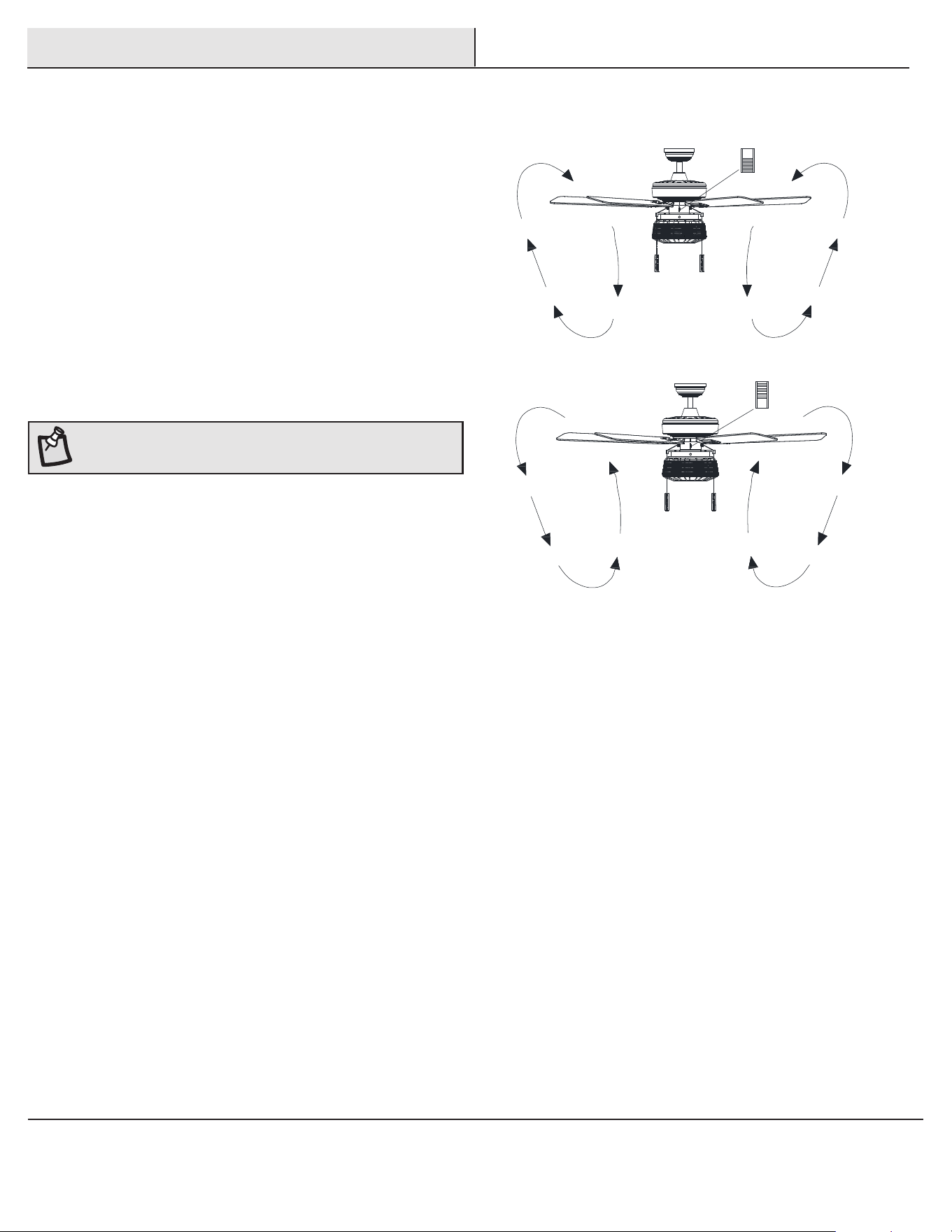
El interruptor deslizante (XX) controla el sentido de giro de las aspas:
hacia adelante (hacia abajo) o reversa (hacia arriba).
Clima cálido (Hacia adelante): Un ujo de aire descendente surte un efecto
refrescante. Esto permite jar tu aire acondicionado en conguración
más alta sin afectar tu comodidad.
Clima frío (Reversa): Un ujo de aire hacia arriba desplaza el aire cálido
del cielo raso. Esto permite jar tu unidad de calefacción en una
conguración más baja sin afectar tu comodidad.
NOTA: Espera a que se detenga el ventilador antes de invertir la
dirección de giro de las aspas.
Funcionamiento
CÓMO USAR TU VENTILADOR
Clima cálido
Clima frío
XX
XX
14
Solución de problemas
Problema Solución
El ventilador no
enciende.
□ Verica los fusibles o disyuntores principales y secundarios.
□ Verica las conexiones de cables en línea al ventilador y las conexiones de cables del interruptor en la caja
correspondiente.
El ventilador hace
ruido.
□ Asegúrate de que todos los tornillos de la carcasa del motor estén ajustados.
□ Verica que los tornillos que unen el soporte de aspa al cubo del motor estén bien apretados.
□ Asegura que las conexiones de tuerca de cable no choquen unas con otras ni con la pared interior de la caja del
interruptor.
□ Deja que transcurra un período de “adaptación” de 24 horas. En ese período desaparecen la mayoría de los
ruidos asociados a un ventilador nuevo.
□ Si usas el kit de luces de ventilador de techo, asegura que los tornillos que sujetan el vidrio estén bien apretados.
Verica que las bombillas también estén aseguradas.
□ Controla que la cubierta quede a corta distancia del techo. No debe tocar el techo.
□ Asegúrate de que la caja eléctrica quede bien ajustada y se hayan instalado almohadillas aislantes de goma
entre la placa de montaje y la caja eléctrica.
El ventilador oscila. □ Verica que todas las aspas y los tornillos de sus brazos estén bien ajustados.
□ La mayoría de los problemas de oscilación del ventilador se debe a que las aspas no están al mismo nivel.
Verica este nivel seleccionando un punto en el techo sobre la punta de una de las aspas. Mide desde un punto
en el centro de cada aspa al punto en el techo. Mide esta distancia. Gira el ventilador hasta que la siguiente
aspa quede en posición para medir. Repite el procedimiento para cada aspa. Las desviaciones de la medición no
deben pasar de 1/8 plg (0.32 cm) durante diez minutos. Si el ventilador continúa oscilando, comunícate con el
servicio al cliente y te enviarán un kit de compensación de aspas, sin costo alguno.
□ Debido al movimiento natural del ventilador, algunas conexiones pueden aojarse. Revisa dos veces al año las conexiones de soporte,
los soportes y los accesorios de las aspas. Comprueba que estén seguros. No es necesario desmontar el ventilador del techo.
□ Limpia el ventilador con frecuencia para que luzca como nuevo con el paso de los años. No uses agua al limpiar, esto puede dañar el
motor o la madera, o causar descargas eléctricas. Usa solo un cepillo suave o un paño sin pelusas para evitar rayar el acabado.
El revestimiento está sellado con laca para minimizar la decoloración u opacidad.
□ Puedes aplicar a la madera una na capa de pulimento para muebles y dar así más protección y belleza. Cubre los rayones diminutos
con una ligera aplicación de lustrador para calzado.
□ No necesitas lubricar tu ventilador. El motor tiene cojinetes de bola sellados y permanentemente lubricados.
ADVERTENCIA: Asegúrate de que la electricidad esté
apagada antes de limpiar el ventilador.
Mantenimiento y limpieza
¿Preguntas, problemas, piezas faltantes? Antes de devolverlo a la tienda,
llama al servicio al cliente de Hampton Bay
De 8:00 a.m. a 7:00 p.m. (Hora Estándar del Este) entre lunes y viernes,
y los sábados de 9:00 a.m. a 6:00 p.m. (Hora Estándar del Este).
1-855-HD-HAMPTON
HAMPTONBAY.COM
Conserva este manual para uso futuro.
Parte responsable ante - U.S. Información de contacto: King of Fans, Inc 1951 NW 22nd Street, Fort Lauderdale, FL 33311, (954) 484-7500
Este equipo ha sido probado y se determinó que cumple con los límites establecidos para un dispositivo digital Clase B, de acuerdo con la Parte 15 de las Normas de la FCC. Estos
límites fueron establecidos para dar protección razonable contra la interferencia dañina en uso residencial. Este equipo genera, consume y puede irradiar energía de radiofrecuencia;
si no se instala y usa de acuerdo con las instrucciones, puede causar interferencia nociva a comunicaciones radiales. Sin embargo, no hay garantía de que no ocurrirá interferencia en
cierta instalación particular. Si este equipo causa interferencia perjudicial a la recepción de radio o televisión, que puede determinarse encendiendo y apagando el equipo, se exhorta
al usuario a tratar de corregir la interferencia mediante una o más de las siguientes medidas:
□ Reorientar o reubicar la antena receptora.
□ Incrementar la distancia entre el equipo y el receptor.
□ Conectar el equipo a un tomacorriente de circuito distinto al que el receptor esté conectado.
□ Consultar al distribuidor o algún técnico de radio/TV con experiencia.
PRECAUCIÓN: Los cambios o modicaciones sin aprobación expresa del responsable de este dispositivo podrían anular el derecho del usuario a operar el equipo.
Este dispositivo cumple con la Parte 15 de las Normas FCC. Su operación está sujeta a las dos condiciones siguientes: (1) Este dispositivo no debe causar
interferencia dañina y (2) tiene que aceptar cualquier interferencia que reciba, incluyendo aquella que pudiera afectar su funcionamiento.
