OPERATION
Prior to operating your new Keystone/Palladian woodstove, please refer to “Setting up your stove” on page 11, located
i
n the Installation portion of the manual.
Seasoning Your Stove
Both soapstone and cast iron need to be seasoned. The seasoning can be accomplished through a series of small to
moderate fires. Your Woodstock Soapstone Stove is an easy stove to season, because even a small fire will provide hours
of radiant heat once the stove is warm. There are two things you will notice during the first fire:
First, there will be a hot, acrid smell as the stove heats up. This smell is a result of the paint on the cast iron curing.
You will want to have your first fire on a day when you can open the windows in the house to provide adequate
ventilation. Fortunately, the odor is non-toxic and will only be present for the first few fires.
Second, there will be some condensation on the glass. This condensation is a result of moisture being driven out of
the furnace cement in the stove, and condensing on the inner surface of the glass. It takes a
couple of small fires to season the stove and remove this excess moisture.
After the first few fires, the texture and grain of the stone may become slightly more
pronounced, and the color may deepen slightly.
Starting a Fire
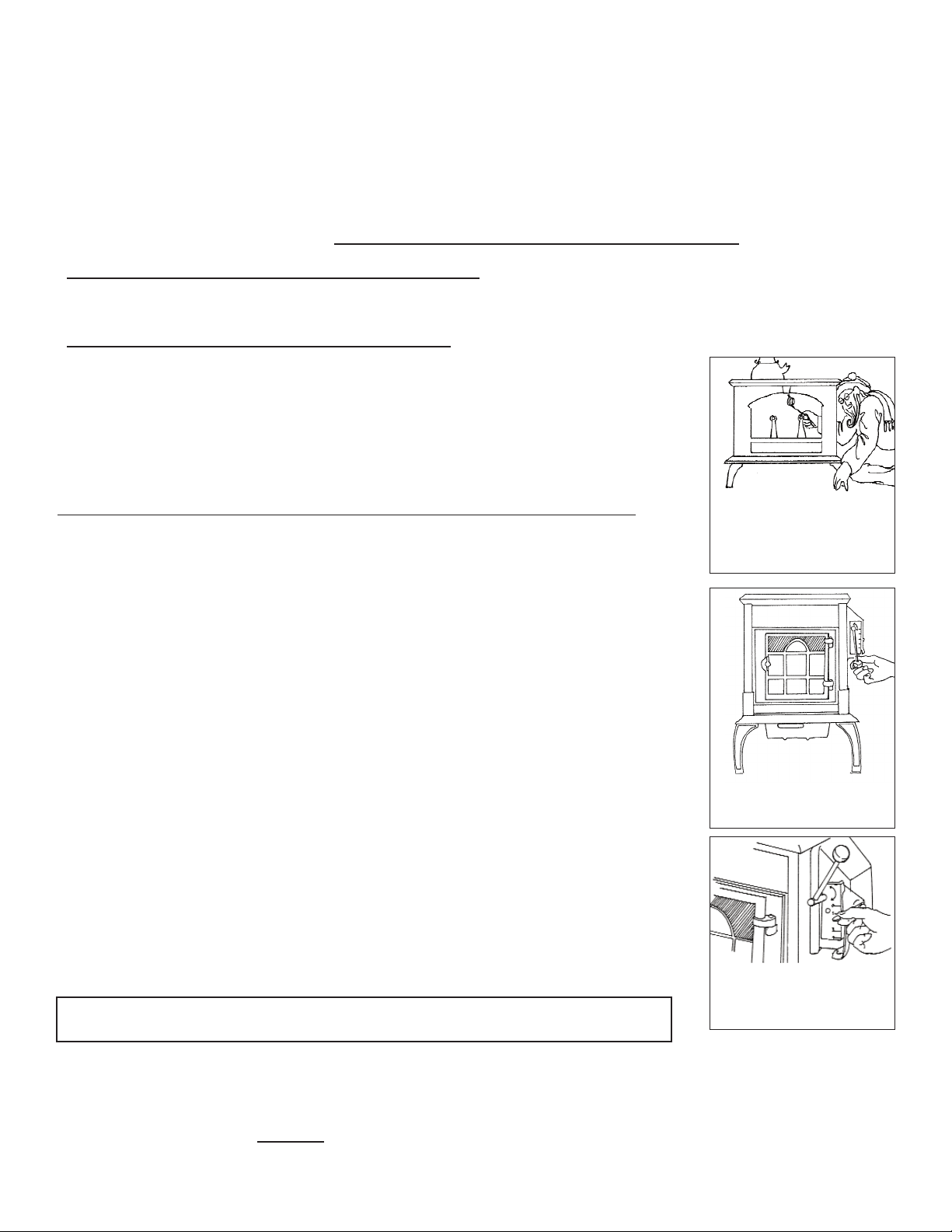
THIS IS IMPORTANT: Check the Draft Before You Light The Stove:
Before you light your stove, it is a good idea to check the draft. If you experience a down
draft (cool air moving down the chimney), you will need to correct this before you light the
stove. Otherwise, you may get smoke in the house.
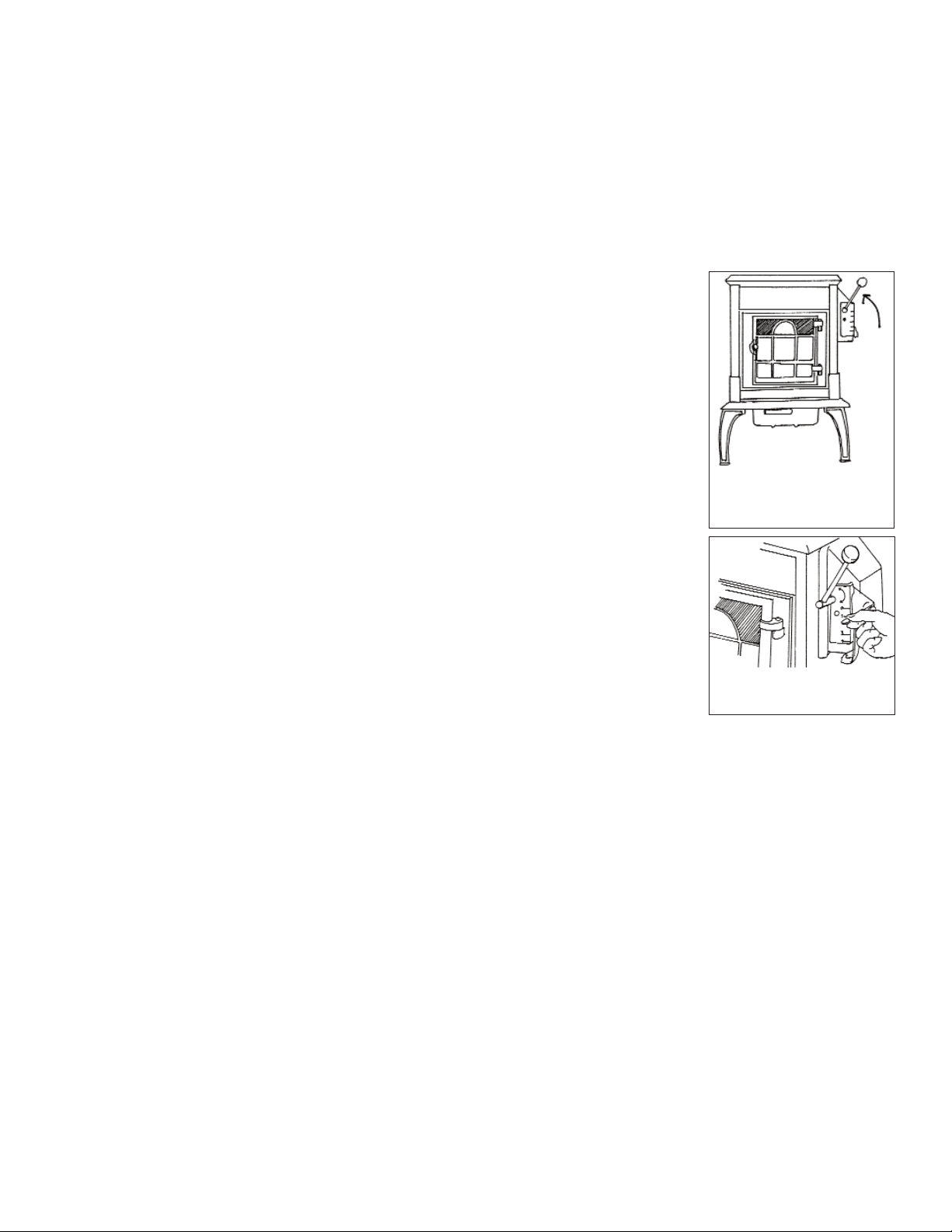
1. Open the catalytic bypass damper by pushing the lever with the black knob all the way
down. This will open the bypass door. (Fig. 1)
2. Push the air lever next to the side door all the way down to “4” to completely open the
air damper. With the lever in the down position, maximum air is allowed into the
firebox. (Fig. 2)
3. Always confirm there is adequate draft before lighting the fire. Hold a lit match or light
a small piece of newspaper in the top of the firebox, where smoke exits. If the flame is
drawn out of the firebox, toward the flue, proceed with lighting the fire. If the flame
stands still or is pushed away from the flue exit, you must establish a good draft before
lighting a fire. There are several ways of establishing a draft, below are a few suggestions:
A) You may be able to correct inadequate draft by opening a door or window in the room
where the stove is installed. Wait a minute or two, then light a match again in front of the
flue outlet. The flame should be pulled into the flue opening.
B) A hair dryer or heat gun pointed at the flue exit is a good way to establish draft
without creating a lot of smoke. After you think you have draft, re-test with a match.
C) Light rolled up newspaper and hold it under the bypass door at the back of the stove.
This should warm the chimney enough to establish proper draft.
Lighting the Fire
DO NOT USE ANDIRONS OR A GRATE TO SUPPORT WOOD. BUILD A FIRE
DIRECTLY ON THE BOTTOM OF THE FIREBOX.
1) Once good draft has been established, build a fire on the floor of the firebox. Do not use additional grates,
andirons, or any other methods to support the fuel in the firebox. Start with crumpled newspaper and dry
kindling.
2) Now light the newspaper. Once it catches, you may leave the door open 1/4 to 1/2 inch for a few minutes to
promote air flow, but DO NOT forget to close it. DO NOT OPEN ASH PAN DOOR TO START THE FIRE.
Always perform the “Match Test”
before lighting your stove. If you
light a match and hold it in front of
the flue exit, the flame will be
pulled into the flue collar if there is
enough draft to light the stove.
13
Figure 1:
Open bypass by lowering
lever with the black knob
Figure 2:
Open air fully by lower-
ing air lever down to “4”.
3) Add small splits of firewood once the kindling has ignited. This will establish a bed of hot coals.
4
) Add small to medium splits onto the hot coals. Assuming the wood is dry, the fire should spread through the
wood. After about 10 minutes, close the air damper down about half way between the “2” and “3” mark.
5) After the stove top temperature reaches 250°F or your single wall pipe temperature reaches 300-350°F, close the
bypass by lifting the lever with the black knob all the way up into the closed position. It will stop when the
b
ypass is fully closed. All of the smoke from the firebox will now pass through the catalytic combustor. The
combustor will generate a substantial amount of heat as it “burns” the smoke passing through it.
6) Adjust the air control damper to a lower setting, our recommendation is near the “1” mark. The closer the lever
is to the “0”, the lower the burn rate, as less air is entering the firebox. The final damper setting will be
determined by the desired heat output from the stove, the condition of the wood
being burned, and the draft through the chimney system.
Engaging the Catalytic Combustor
The catalytic combustor will start to burn the gases and particles in the smoke when the
temperature of the smoke reaches approximately 500ºF, or after about 10-15 minutes of
establishing a strong fire. Each stove comes with a surface thermometer. Use the surface
thermometer to monitor your stove temperatures. The temperature on top of the stove is
approximately 1/2 the temperature inside the stove, so when the thermometer on the stove
top reads 250ºF, it is 500ºF inside. You will find that after the combustor is engaged, surface
temperatures will often rise considerably- evidence that the combustor is producing lots of
heat, and the pipe temperature will go down, indicating less heat loss to your chimney!
Engage the combustor by lifting the bypass handle (with the black knob) up until it clicks
into its upright position and then reduce the air damper to 1. You should see the bright
yellow flames slow down and become more orange in color. Make fine adjustments to your
damper (by moving it closer to 0 in 1/8 to 1/4 inch increments) until you achieve this slower
moving, darker flame. Closing the air damper to 0 will cause smoldering which can smoke
up your stove’s window and produce creosote.
Low & Overnight Burning
These instructions are intended as a guide to operating your wood stove. Your timing and
final damper settings will vary depending on chimney draft, type of wood, moisture content
of the wood, and size of the splits. The Keystone/Palladian model is simply designed and intended to be user friendly,
but it will take some practice to get used to it.
1) Before you open the loading door, you must fully open the catalytic bypass and the air damper. Wait a minute or
so for a strong draft to be established to prevent smoke from spilling back into the room.
2) Stir up the hot coals. If necessary, excess ash should be removed before reloading the firebox. Simply rake the hot
coals back and forth in the firebox to allow the loose ash to fall through the grate into the ash pan. Dispose of the
ash properly. Never put an ash container on a combustible surface, like a wood floor.
3) Place several small splits on top of the hot coals and allow them to ignite.
4) Load the firebox to capacity, leaving space for secondary combustion, with a mix of larger and smaller splits.
Close the loading door and allow the pipe temperature to come back up to 300°-350°.
5) Adjust the air damper to a low setting by lifting the lever up toward #1.
6) Close the catalytic bypass, by lifting the lever with the black knob all the way up into the closed position. It will
stop when the bypass is fully closed.
7) Initially the fire may appear to die out. This may cause a small amount of soot to collect on the glass. Any
buildup on the glass should go away with higher t emperature burns
THE STOVE SHOULD NEVER BE OPERATED WITH THE DRAFT DAMPER COMPLETELY OPEN EXCEPT
The amount of combustion air
available in the firebox is controlled
by the air control lever.
The combustor bypass lever; shown
here in the “engaged” position.
When the handle is down, the com-
bustor is “bypassed”.
14
WHEN KINDLING A FIRE OR RELOADING THE STOVE. It should be “damped down” or partially closed as
soon as the fire has been kindled or, if the stove is being reloaded, as soon as the fire has been re-established.
N
EVER BUILD A ROARING FIRE IN A COLD STOVE! It takes approximately
30-45 minutes to heat the soapstone mass of the Keystone or Palladian stove
thoroughly. Any attempt to hurry this process and generate extremely high heat
quickly could result in damage to the cast-iron or to the soapstone. Your patience will
be rewarded with hours of “stored” warmth.
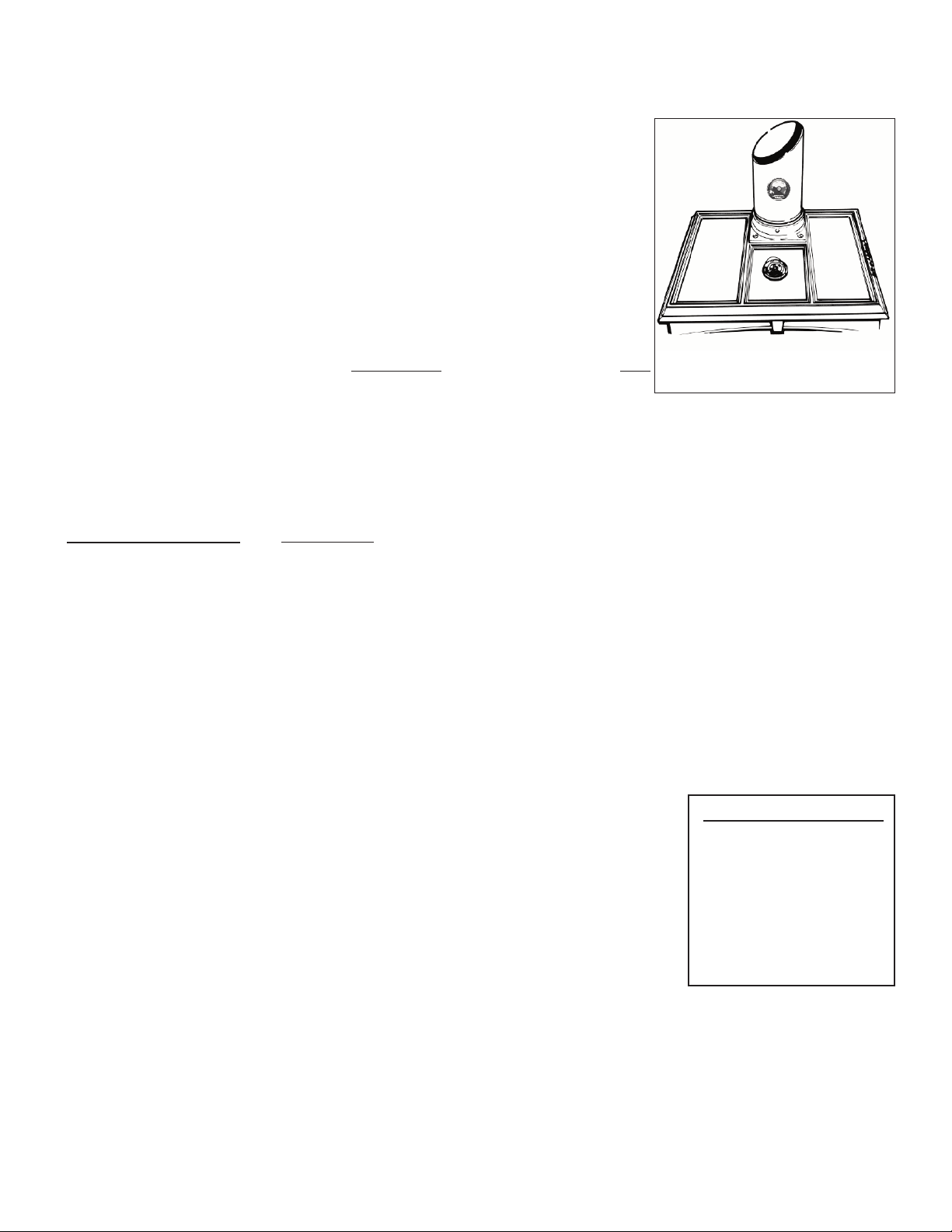
The Surface and Probe Thermometers
We recommend placing the surface thermometer 8”-10”above the flue collar on
single wall stove pipe if the stove is vented out the top. If you are reading the single
wall stove pipe temperature, the interior flue exhaust temperature is about twice as
hot. Since the 22 gauge sheet metal pipe is more reactive (faster heat transfer) than the
stove top, it gives a better idea of exhaust temperatures. We recommend engaging the
catalytic combustor once the pipe thermometer reaches 250°-300° F. Once the
combustor is engaged, you should see the stove surface temperature rise and the pipe
temperature drop, indicating catalytic combustor activity. From a cold start it may
take 30-45 minutes to get the stove up to temperature. If you are reloading a hot
stove, wait approximately 10-15 minutes before engaging the combustor.
The surface thermometer is not a precise instrument – it will not tell you the exact temperature inside the firebox or
in the flue. If reading the surface temperature, the thermometer will not register changes in temperature quickly due to
the thickness and heat retention of soapstone. We supply the thermometer to give you some idea of what is going on
inside the stove, and to provide a guide for operation.
STOVE TOP READING OPERATION
over 250º. . . . . . . . . . . . . . . . . . . . . OK to engage the combustor
400-600º. . . . . . . . . . . . . . . . . . . . . . Normal operating temperature
600-700º. . . . . . . . . . . . . . . . . . . . . . High burn range
over 700º. . . . . . . . . . . . . . . . . . . . . DO NOT burn in this range
The probe thermometer can be inserted into the port beside the flue collar in the rear of the stove. The probe
thermometer will measure the temperature immediately downstream of the catalytic combustor. The sensing end of
the probe extends to within 1 inch of the face of the catalyst. The probe is calibrated from room temperature to 1700
degrees F. The catalyst can be engaged as soon as the temperature on this probe exceeds 500 degrees F, or as soon as
the temperature on the pipe thermometer exceeds 250 degrees (see above). The best operating range for the catalyst is
from 500 - 1400 degrees F. When the temperature on the probe thermometer exceeds 1400
o
F, we recommend closing
the damper to prevent excessive heat from occuring
Overfiring
The cast iron parts in your Woodstock Soapstone Stove are of the finest quality. Our cast
iron parts have been made in the same foundry since the mid 1980’s, and the foundry
itself has been in business for over one hundred years. Each cast iron part is inspected by
our stove builders before it becomes part of a stove. However, cast iron is not
indestructible. Experts have shown that cast iron begins to oxidize (reddish or whitish
discoloration) at 1400º F. Burning a stove frequently at excessive temperatures is known
as overfiring. When the surface temperature is consistently near or over 700º F, the stove
has reached 1400º F inside. Operation with temperatures in this range can lead to cast
iron warping, becoming brittle, and eventually deteriorating completely. Overfiring can
also shorten the useful life of the catalytic combustor.
Avoid overfiring by letting the combustor do most of the work in the stove. Your stove is operating at peak efficiency
when the combustor is “engaged”, with the damper lever set to a low to moderate setting, and the logs are glowing
with some low flames, or lazy floating flames. You will get the greatest amount of heat per pound of wood when the
stove is operated in this manner.
Daily Use
Your Keystone or Palladian is well-suited for continuous firing on a 24 hour-a-day basis. It will burn for hours on one load
DO NOT OVERFIRE!
ATTEMPTS TO ACHIEVE
HEAT OUTPUT RATES
THAT EXCEED STOVE
DESIGN SPECIFICATIONS
CAN RESULT IN PERMA-
NENT DAMAGE TO THE
STOVE AND TO THE
CATALYTIC COMBUSTOR.
15
Place the stove top thermometer on the soap-
stone, in the center of the top of the stove, over
the the catalyst, or on the first 8-10” of single
wall stove pipe.
o
f wood, and will provide steady heat for hours after the fire dies down. When the temperature on top of the stove drops
below 250º during an all-night burn, it is not necessary to disengage the combustor. Disengage the catalytic combustor when
you kindle a fire, or reload the stove. Once the catalyst is ignited, it will continue to function as long as there is smoke to burn.
This is true even if the surface temperature on top of the stove drops below 250º at the end of a long burn.
Your connector pipe and chimney, or chimney pipe, should be inspected at regular intervals (not less than once every
t
wo months). Examine the connector pipe for creosote, corrosion, loose seams, or excessive soot. Clean and replace as
necessary. The chimney, or chimney pipe, should be cleaned and checked by a certified specialist once a year. A small
mirror held at the cleanout door of a masonry chimney will be helpful. For a class A prefabricated metal pipe, some
disassembly is usually required.
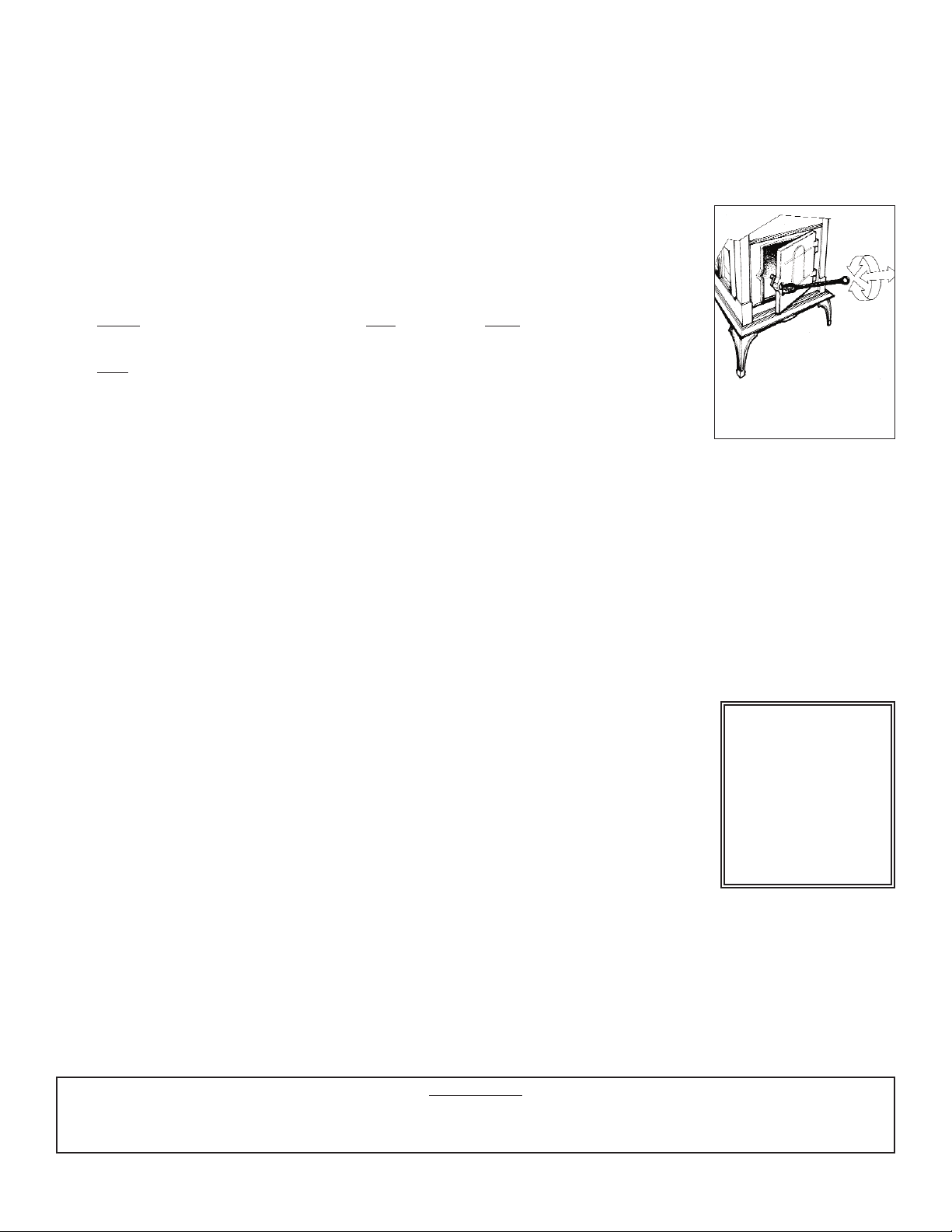
The Fall-Away Handle
The metal “fall-away” handle, which comes with your stove, can be used to operate any of
the three controls on the stove: 1) The side door latch, 2) The draft damper control, and 3) The
catalytic bypass handle.
The FORK of the handle should be used to turn the latch, to push the door closed, or open
and close the damper.
The LEG of the handle should be used to pull the door open or to move the combustor
bypass into position.
The “fall-away” handle conforms to UL requirements and is made so that if you let go of it,
it will “fall-away” from the stove and not become too hot to handle.
Cooking
The soapstone top of your stove provides a good cooking surface for soups and stews or meals cooked in a Dutch
oven. The soapstone distributes heat evenly for long simmering, and the polished surface is a natural no-stick surface.
We do not recommend cooking directly on the stove top, as the surface will discolor. If the soapstone does discolor, it
can easily be restored by sanding lightly with 000 or 0000 steel wool. Soapstone griddles have been popular in New
England for years.
Firewood
Your Woodstock Soapstone Stove is designed to burn seasoned, natural cordwood only. Higher efficiency and lower emissions
generally result when burning air-dried hardwoods, as compared to soft woods or green, freshly cut hardwoods.
The moisture content of some trees may range as high as 50% – i.e., there is as much moisture in
the tree as there is wood. After wood has been stored for a year, the moisture content will usually
range from 15-25%. Splitting wood before it is stored will reduce drying time, result in more even
burning, and lessen the danger of water vapor condensing in the chimney, creosote formation, and
damage to the catalyst. It is safer and more efficient to burn dry or seasoned cordwood than green
or wet wood that smolders.
The advantages of burning dry wood are many. Dry wood is lighter, easier to split and easier to
carry. It is easier to light, produces more heat and generates less smoke. If you burn wet wood
some of the energy generated by the fire is used to drive moisture out of the wood, rather than
producing heat for you. Dry wood will maintain the highest combustor temperatures and burn the
most efficiently. Creosote is much less likely to form if you burn dry wood.
DO NOT BURN treated or painted wood, coal, garbage, cardboard, solvents, colored paper, or trash in your Woodstock
Soapstone Stove. Coal and artificial logs burn much hotter than wood and could cause damage, through overheating, to the
cast iron or the soapstone panels. Burning treated wood, garbage, solvents, colored paper or trash may result in the release of
toxic fumes and may poison or otherwise render the catalytic combustor ineffective.
Burning cardboard, loose paper, and trash will add significantly to ash and soot build-up, and it will not produce much heat.
Fly ash from improper fuel can also coat or plug the combustor, causing smoke spillage into the room.
Under normal operating conditions, the Woodstock Soapstone Stove is designed to last for generations. It is not, however,
designed for continuous over-firing, or firing with coal, artificial logs or trash.
DO NOT BURN
• Treated Wood
• Coal
• Garbage
• Cardboard
• Solvents
• Colored Paper
• Trash
The fall-away handle may be used
to operate the controls on your
stove when they are too hot to
handle safely.
CAUTION
NEVER USE GASOLINE, LANTERN FUEL, KEROSENE, CHARCOAL LIGHTER FLUID, OR SIMILAR LIQ-
UIDS, TO START OR ‘FRESHEN UP’ A FIRE IN THIS STOVE. KEEP ALL SUCH LIQUIDS WELL AWAY
FROM THE STOVE WHILE IT IS IN USE.
16
