66 Airpark Road, West Lebanon, NH 03784 Tel: 800-866-4344
Rev7 (21/06)
CERTIFIED TO AMERICAN NATIONAL
STANDARD Z21.88-2017, Vented Gas Fireplace
AND APPLICABLE PORTIONS OF UL307b
OWNER’S MANUAL
Model 207 Cottage Franklin Gas Fireplace
—
Do not store or use gasoline or other
flammable vapors and liquids in the
vicinity of this or any other appliance.
— WHAT TO DO IF YOU SMELL GAS
• Do not try to light any appliance.
•
Do not touch any electrical switch; do not
use any phone in your building.
• Immediately call your gas supplier from a
neighbor’s phone. Follow the gas
supplier’s instructions.
• If you cannot reach your gas supplier, call
the fire department.
—
Installation and service must be performed
by a qualified installer, service agency or
the gas supplier.
This appliance may be installed in an
aftermarket, permanently located,
manufactured home (USA only) or
mobile home, where not prohibited by
local codes.
This appliance is only for use with the
type of gas indicated on the rating plate.
This appliance is not convertible for use
with other gases, unless a certified kit is
used.
WARNING!:
FIRE OR EXPLOSION HAZARD
Failure to follow safety warnings exactly
could result in serious injury, death, or
property damage
INSTALLER: Leave this manual with the
appliance.
CONSUMER: Retain this manual for future
reference.
A barrier designed to reduce the risk of burns
from the hot viewing glass is provided with this
appliance and shall be installed for the protection
of children and other at-risk individuals.
DANGER!
p
!
HOT GLASS WILL
CAUSE BURNS.
DO NOT TOUCH GLASS
UNTIL COOLED.
NEVER ALLOW CHILDREN
TO TOUCH GLASS.
p
!
TESTED AND LISTED BY

SAFETY PRECAUTIONS
❏
This appliance is only for use with the type of gas indicated on
the rating plate. This appliance may not be converted to use
with other gasses unless a certified kit is used.
❏
This appliance is designed to burn either natural gas or
propane. Do not attempt to burn wood, trash, or any other
material in this appliance.
❏
This appliance may not be connected to a chimney serving a
separate solid-fuel burning appliance.
❏
Due to high temperatures, the appliance should be located out
of traffic and away from furniture and draperies.
❏
Children and adults should be alerted to the hazards of high
surface temperature and should stay away to avoid burns or
clothing ignition.
❏
Young children should be carefully supervised when they are in
the same room as the appliance. Toddlers, young children, and
others may be susceptible to accidental contact burns. A
physical barrier is recommended if there are at-risk individuals
in the house. To restrict access to a fireplace or stove, install an
adjustable safety gate to keep toddlers, young children, and
other at-risk individuals out of the room and away from hot
surfaces.
❏
A barrier designed to reduce the risk of burns from the hot
viewing glass is provided with this appliance and shall be
installed for the protection of children and other individuals at
risk.
❏
Clothing or other flammable material should not be placed on
or near the appliance.
❏
The appliance area must be kept clear and free from
combustible materials, gasoline, and other flammable vapors
and liquids.
❏
WARNING: Do not operate appliance with the glass front
removed, cracked or broken. Replacement of the glass should
be done by a licensed or qualified service person.
❏
The flow of combustion and ventilation air must not be
obstructed.
❏
Any safety screen or guard removed for servicing an appliance
should be replaced prior to operating the appliance.
❏
Do not use this appliance if any part has been under water.
Immediately call a qualified service technician to inspect the
appliance and to replace any part of the control system and gas
control which has been under water.
❏
CAUTION: Label all wires prior to disconnection when
servicing controls. Wiring errors can cause improper and
dangerous operation.
❏
Verify proper operation after servicing.
The installation of the Cottage Franklin
Gas Fireplace must conform with local
codes, or in the absence of local codes, with
the National Fuel Gas Code, ANSI Z21.88-
2017.
The Cottage Franklin Gas Stove must be
vented with approved “direct-vent” pipe.
Direct-Vent pipe has two concentric
passageways which draw outside air in for
combustion, and let exhaust gasses out.
Installation or replacement of gas piping,
the gas Fireplace, and repair or servicing of
equipment shall be performed only by a
qualified agency. The term “qualified
agency” means any individual, firm,
corporation, or company that either in
person or through a representative is
engaged in and is responsible for (a)
installation or replacement of gas
piping or (b) the connection, installation,
repair or servicing of gas utilization
equipment, who is experienced in such
work, familiar
with all precautions required, and has
complied with all the requirements of the
authority having jurisdiction.
Installation and repair should be done
by a qualified service person. The
appliance should be inspected before use
and at least annually by a professional
service person. More frequent cleaning
may be required due to excessive lint
from carpeting, bedding material, et
cetera. It is imperative that control
compartments, burners and circulating
air passageways of the appliance be kept
clean.
The Cottage Franklin Gas Stove and its
main gas supply valve must be disconnected
from the gas supply piping system during
any pressure testing of that system at test
pressures in excess of 1/2 psi (3.5 kPa).
The Cottage Franklin Gas Stove must be
isolated from the gas supply piping system
by closing its equipment shutoff valve
during any pressure testing of the gas supply
piping system at test pressures equal to or
less than 1/2 psi (3.5 kPa).
An inlet pressure test point is provided on
the gas control valve, immediately upstream
of the gas supply connection to the
Fireplace. An outlet pressure test point is
also provided.
The Cottage Franklin Gas Stove, when
installed, must be electrically grounded in
accordance with local codes or, in the
absence of local codes, with the National
Electrical Code, ANSI/NFPA 70.

First, thank you from all of us at Woodstock Soapstone Co. for
installing this Franklin Fireplace for one of our customers. If you have any
questions about installation, please call us at 800-866-4344. Technical
Support will be available from 9:00AM to 5:00PM ET, Monday through
Friday and 9:00-12:00 ET on Saturday. At any other time, you may leave
a message with our answering service with your phone number and the
best time to call, and we will return your call during the next business day.
Please also take the time to go through the Warranty Checklist with
the owner. This will validate the warranty, assure us and the owner that
the installation was performed to local and national codes, and help
familiarize the owner with the safe operation of this gas Fireplace.
Installation must conform to these instructions and local codes
or, in the absence of local codes, with the current National Fuel Gas
Code
ANSI
Z21.88-2017
/NFPA 54
.
We at Woodstock Soapstone Company are proud to manufacture top
quality hearth products. When you install this Fireplace, we ask that
you maintain our tradition of conscientious effort to make our
customers happy with our product and service.
Sincerely,
The Technical Support Staff
Woodstock Soapstone Co., Inc.
-------------------------------------------------------------------------------------------------------------------------------------------------------------------------------------------------------- 1
-------------------------------------------------------------------------------------------------------------------------------------------------------------------------- Table Of Contents
QUESTIONS:
800-866-4344
9:00 AM to 5:00 PM (ET)
Monday –Friday
9:00 AM to 12:00 PM (ET)
Saturday
WARNING: This unit
must be installed by a
qualified gas technician in
accordance with local codes
or in the absence of local
codes, with the most current
edition of the National Fuel
Gas Code ANSI Z21.88-
2017.
TO THE INSTALLING TECHNICIAN:
TABLE OF CONTENTS
Section Page
1) Code Approvals..........................................................2
2) Specifications.............................................................2
3) Tools Needed to Install the Fireplace........................3
4) Approved Venting/Chimney Materials .....................3
5) Approved Clearances for Inside Locations...............4
6) Approved Venting/Chimney Configurations ...........6
7) Approved Venting/Chimney Terminal Clearances .12
8) Unpacking the Cottage Franklin Gas Fireplace......13
9) Pre-Installation Inspection Checklist ......................13
10) Assembling the Cottage Franklin Gas Fireplace....14
11) Connecting the Gas Supply/Testing the Flame.......15
12) Testing Check List & Warranty Registration.....Insert
Section Page
13) Troubleshooting - Installer only............................17
14) Operating your Gas Fireplace...............................18
15) Lighting Instructions.............................................19
16) Safety Instructions ................................................22
17) Remote Control.....................................................23
18) Lighting the Fire for Remote Control Owners.....25
19) Routine Maintenance ............................................26
20) Annual Inspection .................................................27
21) Warranty ................................................................28
22) Troubleshooting - Owner......................................29
Appendix A - Parts List...............................................35
Appendix B - Remote Control Installation ................36
The Woodstock Cottage Franklin Gas Stove is listed as a direct vent
appliance. This type of appliance draws all of its air for combustion from
outside of the dwelling through specially designed pipe. It can be used with
natural gas or LPG (liquid propane gas).
Tested to: American National Standard (
ANSI)
Z21.88-2017
For The Woodstock Cottage Franklin Gas Stove:
Fuel .......................................................Liquefied Petroleum Gas (LPG)
..............................................................................Natural Gas (NG)
Manifold Pressure, LPG ...........................................................10.5" w.c.
Manifold Pressure, NG. .............................................................3.5" w.c.
Minimum inlet supply pressure for input
adjustment LPG................................................................11.0" w.c.
Minimum inlet supply pressure for input
adjustment NG ...................................................................4.0" w.c.
Maximum inlet supply pressure LPG......................................14.0" w.c.
Maximum inlet supply pressure NG .......................................14.0" w.c.
Input, Btu/Hr LPG Max. .......................................................22,988
(0 – 2,000 ft.) Min. .........................................................18,297
NG Max. .......................................................22,552
Min. ........................................................18,691
Output, Btu/Hr LPG Max. .......................................................17,562
Min. ........................................................13,906
NG Max. .......................................................16,515
Min. ........................................................13,644
Orifice size, LPG
Sea level to 5000' ......................................................................#54
5001' or more.......................................................................#55
Orifice size: NG
Sea level to 5000'.......................................................................#43
5001' to 7000'.......................................................................#44
7001' or more.......................................................................#45
AFUE: (Annual Fuel Utilization Efficiency)LPG ..........(76% minimum)
AFUE: (Annual Fuel Utilization Efficiency)NG ............(73% minimum)
Glass Panel..............................................High temperature ceramic glass
Weight, Fireplace only ..................................................................260 lbs.
shipping.............................................................................350 lbs.
Ignition.................................................Standing pilot with Piezo ignition
-------------------------------------------------------------------------------------------------------------------------------------------------------------------------------------------------------- 2
--------------------------------------------------------------------------------------------------------------------------------------------------------------------------------- Specifications
1. CODE APPROVALS • Direct Vent • Natural Gas • LPG
2. SPECIFICATIONS
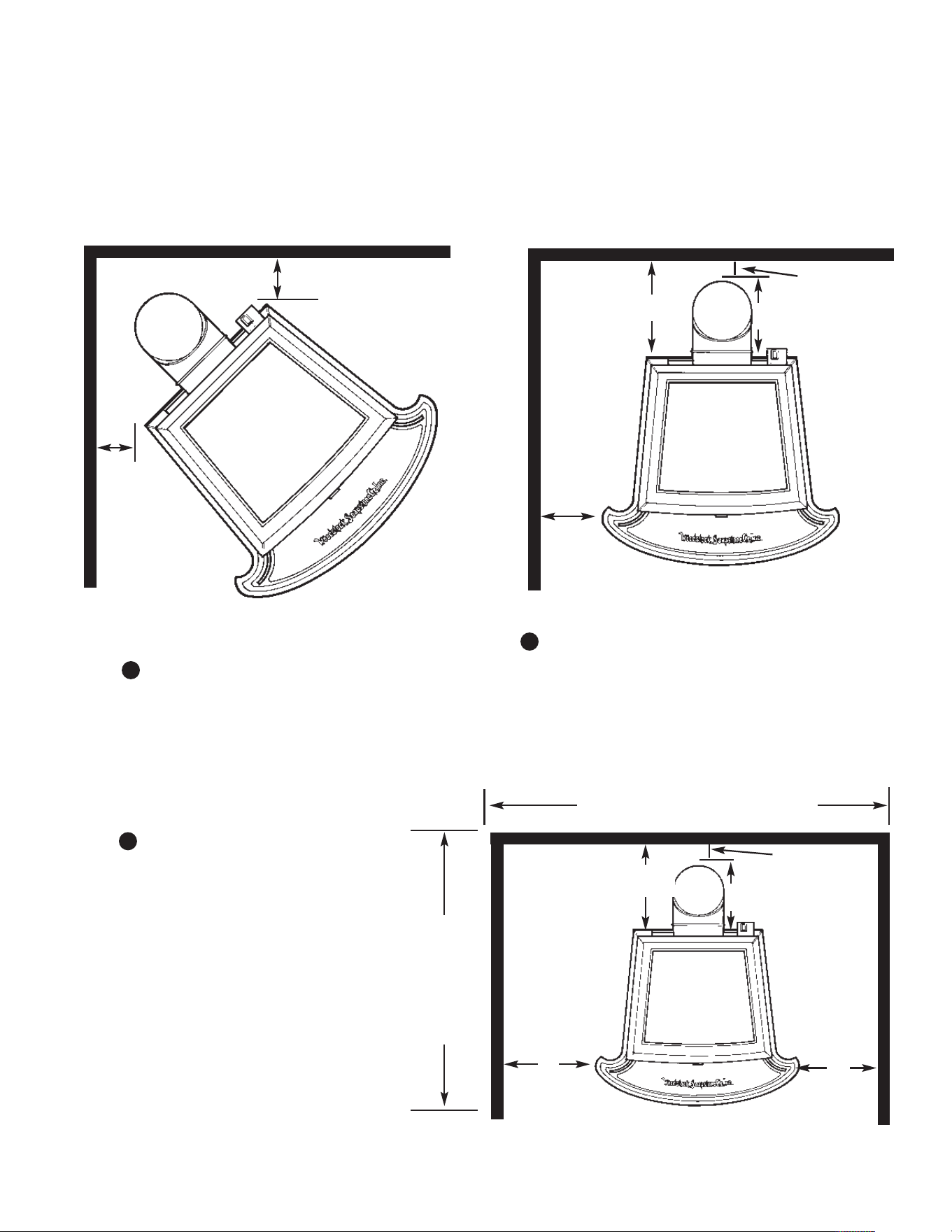
Illustration 2.1 Side View.
Illustration 2.2 Front View.
Illustration 2.3 Top View.
29
7
/8"
18
3
/4"
24
3
/4"
21
1
/4"
9
1
/2"
24
3
/4"
5
1
/2"
17
3
/8"
23
1
/2"
NOTE: Diagrams include
optional 90° elbow.
Hearth: The hearth immediately under the Stove should be constructed of
non-combustible material - ceramic tile (not vinyl), stone, or metal. Protect
carpet or any combustible surface with a hearth that covers an area equal to
the full width and depth of the Stove (24
3
/
4
" x 21
1
/
4
") or greater.
A hearth pad of size 36x36 inch is recommended
Clearance to combustible materials
Front of Firebox .............................................................................36"
Sides of Stove...................................................................................8"
Rear of Stove ..................................................................................11"
Rear Corners of Stove ...................................................................4.5"
Rear of 90 Degree Elbow.................................................................2"
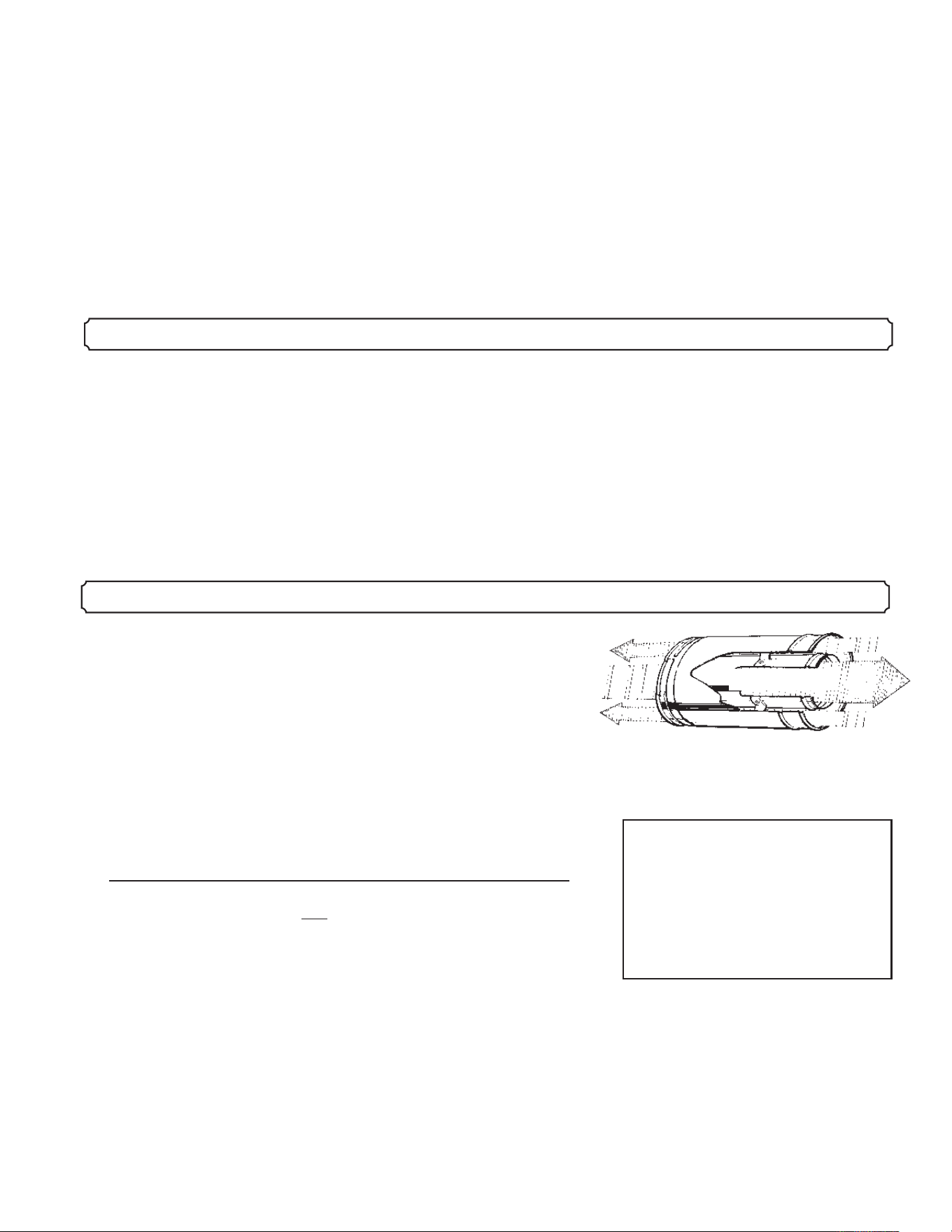
The venting/chimney system for your Franklin Gas
Stove must be constructed of Simpson Dura-Vent 4” x 6
5
/8”
direct vent gas pipe. All approved direct vent components bring
fresh air into the Stove and vent exhaust gasses at the same time
(see illustration 4.1).
Approved venting materials are available from Simpson
Dura-Vent Dealers or direct from Woodstock Soapstone Company.
Approved components are listed below.
Dura-Vent No.
Description Galvanized Black
Standard Direct Vent Kit consists of:
2 6
5
/8" x 2' Straight Pipe OR 46DVA-24 46DVA-24B
1 6
5
/8" x 6” Straight Pipe 46DVA-06 46DVA-06B
1 8
1
/2" Pipe Extension 46DVA-08A 46DVA-08AB
2 6
5
/8" x 90 Degree Elbow 46DVA-E90 46DVA-E90B
1 6
5
/8" Wall Thimble 46DVA-WT *
1 6
5
/8" Wall Thimble Cover 46DVA-DC
1 6
5
/8" Sq. Horizontal Termination 46DVA-HC *
* Galvanized Only
Other Available Pipe:
Description Galvanized Black
6
5
/8" x 6" Straight Pipe 46DVA-06 46DVA-06B
-------------------------------------------------------------------------------------------------------------------------------------------------------------------------------------------------------- 3
------------------------------------------------------------------------------------------------------------------------------------ Installation Tools and Materials Needed
3. TOOLS NEEDED TO INSTALL THE FIREPLACE
4. APPROVED VENTING/CHIMNEY MATERIALS
EXHAUST OUT
AIR IN
AIR IN
Multi-meter ( millivolt )
Strap Wrench for Pipe Installation
Manometer
Gas Sniffer
Window Clip Tool
7/16” Socket or Wrench
Glass Cleaner and Towels
Flashlight
Drill/Driver to install screws in first section of vent pipe
5/32” Allen Wrench*
* To install and adjust leveling screws in stove base
Illustration 4.1 Direct-vent pipe
sends exhaust out and brings air in
at the same time.
THIS APPLIANCE
MUST NOT BE
CONNECTED TO A
CHIMNEY SERVING A
SEPARATE SOLID
FUEL BURNING
APPLIANCE

6
5
/8" x 9" Straight Pipe 46DVA-09 46DVA-09B
6
5
/8" x 12" Straight Pipe 46DVA-12 46DVA-12B
6
5
/8" x 18" Straight Pipe 46DVA-18 46DVA-18B
6
5
/8" x 24" Straight Pipe 46DVA-24 46DVA-24B
6
5
/8" x 36" Straight Pipe 46DVA-36 46DVA-36B
6
5
/8" x 48" Straight Pipe 46DVA-48 46DVA-48B
6
5
/8" x 8.5” Pipe Ext.(3-7”) 46DVA-08A 46DVA-08AB
6
5
/8" x 16” Pipe Ext. (3-14.5”) 46DVA-16A 46DVA-16AB
6
5
/8" x 45 Degree Elbow 46DVA-E45 46DVA-E45B
6
5
/8" x 90 Degree Elbow 46DVA-E90 46DVA-E90B
6
5
/8" x 30 Degree Adj. Elbow 46DVA-E30 *
6
5
/8" x 60 Degree Adj. Elbow 46DVA-E60 *
Sq. Horizontal Termination Cap 46DVA-HC *
48”
Snorkel Termination Cap FF/CF-SNK *
Vinyl Siding Standoff 46DVA-VSS *
6
5
/8" Wall Thimble 46DVA-WT *
Wall Thimble Cover 46DVA-DC
Cathedral Ceiling Support Box 46DVA-CS
Restrictor Disc (top vent) 46DVA-RD *
Storm Collar 46DVA-SC *
Adj Roof Flashing (0/12-6/12 pitch) 46DVA-F6 *
Adj Roof Flashing
(7/12-12/12 steep pitch) 46DVA-F12 *
High Wind Vertical Termination Cap 46DVA-VCH *
ExtendedVertical Termination Cap 46DVA-VCE *
3” x 35’ Flex Extension 2280 *
4” x 35’ Flex Extension 2281 *
Masonry Chimney Conversion Kit 46DVA-KMC
Chimney Conversion Kit A 46DVA-KCA
Chimney Conversion Kit B 46DVA-KCB
Chimney Conversion Kit C 46DVA-KCC
* Galvanized Only
WARNING: Due to high temperatures, the Cottage Franklin Gas Stove
should be placed out of traffic and away from furniture, draperies and other
combustibles.
The Cottage Franklin Gas Stove is approved for venting in five
configurations:
(1) Up vertically and then elbow through an outside wall with a
maximum horizontal run of 4’.
(2) Straight out the back through an outside wall and into a snorkel
termination cap (maximum 4’ horizontal run, with 1/4” rise per foot
of run).
(3) Up vertically through the roof, with maximum rise of 24’.
(4) Into an existing fireplace and chimney (maximum height of 24’).
(5) Into an existing masonry or prefabricated metal chimney (maximum
height of 24’).
NOTE: Details for these five configurations start on page 6. Each
installation is unique. Please call a customer service representative
for assistance at 1-800-866-4344.
-------------------------------------------------------------------------------------------------------------------------------------------------------------------------------------------------------- 4
--------------------------------------------------------------------------------------------------------------------------------- Approved Clearances for Inside Locations
Illustration 4.2 All approved
Simpson Dura-Vent Pipe has an
inside passage to vent exhaust
gasses, and an outside passage
used to bring in fresh air for
combustion.
5. APPROVED CLEARANCES FOR INSIDE LOCATIONS
CLEARANCES TO
COMBUSTIBLE
MATERIALS
Front of Firebox ..............36"
Sides of Stove....................8"
Rear of Fireplace .............11"
Rear Corners...................4.5"
Rear of 90 Degree Elbow..2"
WARNING: This unit
must be installed by a
qualified gas technician in
accordance with local codes or
in the absence of local codes,
with the most current edition
of the National Fuel Gas Code
ANSI Z21.88-2017
-------------------------------------------------------------------------------------------------------------------------------------------------------------------------------------------------------- 5
--------------------------------------------------------------------------------------------------------------------------------- Approved Clearances for Inside Locations
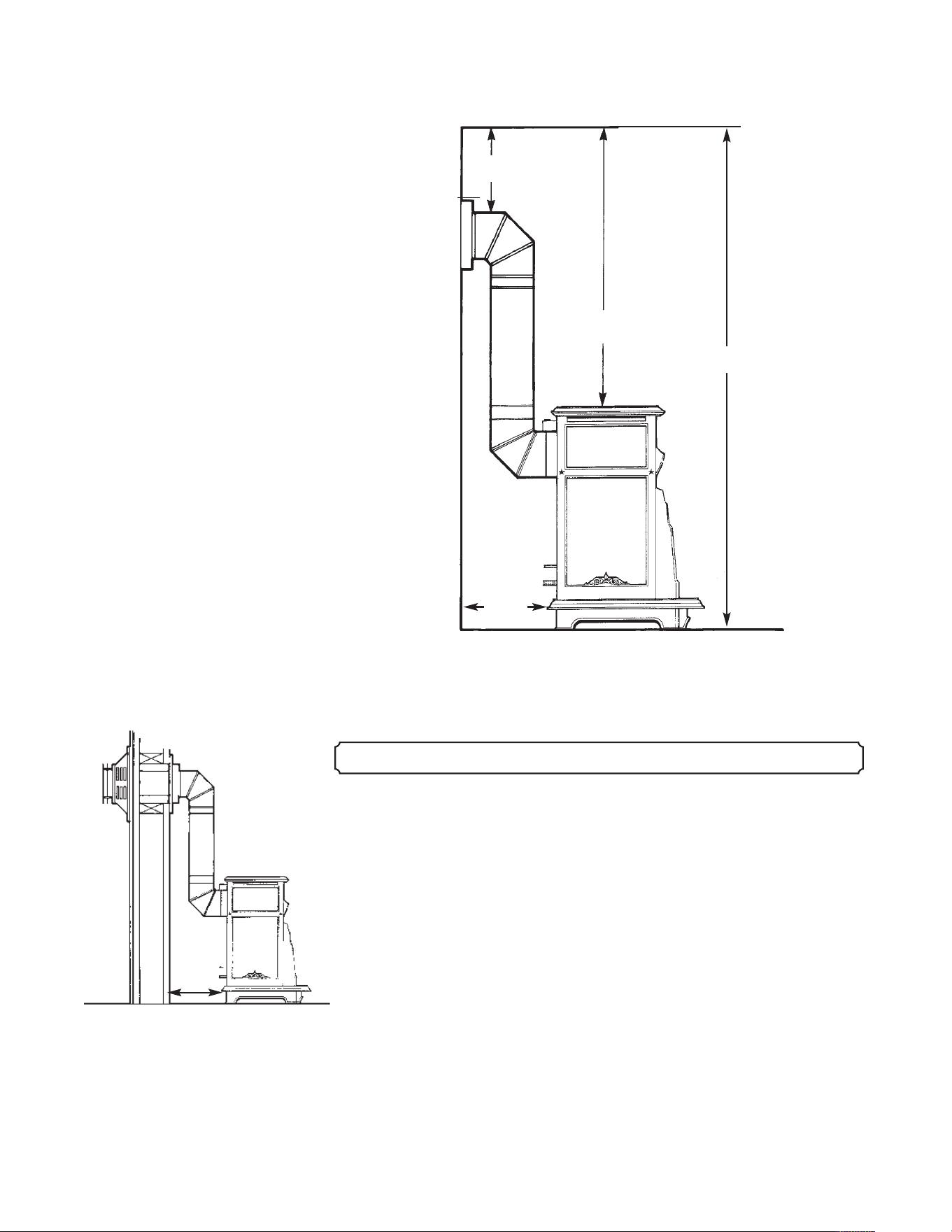
Corner Installation
Minimum Clearances
Min. Clearance from corners to
both side walls ......................4.5"
Pipe to wall
(Vertical Vent)..........................2"
Parallel Installation
Minimum Clearances
Min. Clearance from back of pipe to wall......2"
Min. Clearance from Fireplace to side wall
(Vertical vent)..................................................8"
Min. clearance from back of stove to wall
(Straight vent)...............................................11"
Illustration 5.1 Minimum Clearances: Corner
Installation
Illustration 5.2 Minimum Clearances: Parallel
Installation
2"
8"
4.5"
4.5"
Illustration 5.3 Minimum Clearances: Alcove
Installation
48"
(1220 mm)
Max
Alcove
Depth
42" Min. Alcove width
Alcove Installation
The Cottage Franklin Gas
Stove is approved for installation
in an alcove constructed of
combustible materials.
Minimum Clearances for
Alcove Installation
Min. Clearance from back of
pipe to wall(Vertical Vent).......2"
Min. Clearance from Fireplace to
side walls .................................8"
Min. clearance from back of
stove to wall (Straight vent)...11"
2"
8”
8”
Clearances inside the house for these three basic installations are indicated in the
illustrations which follow.
The surface of the Cottage Franklin Gas Stove is hot when the appliance is in use.
A safe installation requires that there be adequate clearances between the Cottage
Franklin Gas Stove and nearby combustible materials, so that the combustible
materials are not overheated. The diagrams that follow show minimum clearances
between the Stove, Exhaust Pipe and nearby combustible materials.
B
Min. 11”
Min. 11”
10"
10"
-------------------------------------------------------------------------------------------------------------------------------------------------------------------------------------------------------- 6
CLEARANCES FOR VENT TERMINAL
Clearances for vent terminal locations are indicated in the diagram and
chart on page 12.
Refer to the manufacturers instructions regarding installation of your
venting system through walls or ceilings. Use only Simpson Dura-Vent
Direct-Vent Pro Flue Systems.
The Cottage Franklin Gas Stove is designed to be installed in the
following configurations:
-------------------------------------------------------------------------------------------------------------------------------- Approved Venting/Chimney Configurations
Combustible Ceiling in Alcove Installation
24" Min.
Minimum Clearances to
Ceilings in Alcove Installation
Min. Clearance from top of pipe
to ceiling/mantle ......................6"
Illustration 5.4 Minimum Clearances to Ceiling in
Alcove Installation
6" Min.
6. APPROVED VENTING/CHIMNEY CONFIGURATIONS
54" Min.
13"
13"
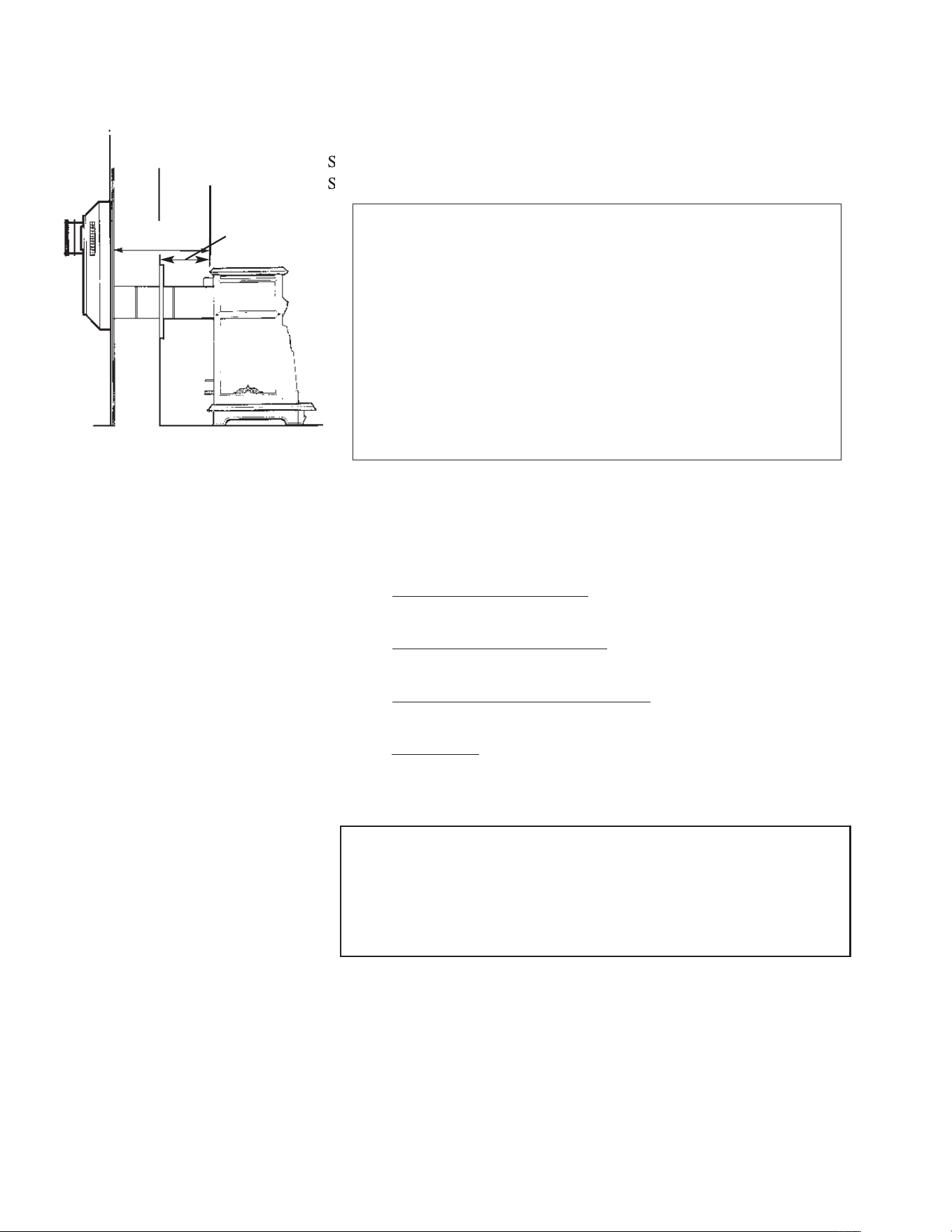
Illustration 6.1
Side wall venting configuration.
(Available as standard vent kit)
13” is the minimum distance rear
of the stove can be from wall
when using two 90 deg. elbows
as above.

-------------------------------------------------------------------------------------------------------------------------------------------------------------------------------------------------------- 7
A. Side Wall Venting
In this venting configuration, the pipe rises directly from the back of the
Stove. The exhaust travels up, through two elbows, and out through a side
wall. See illustration on previous page.
Refer to Simpson Dura-Vent instruction regarding installation of your
Direct-Vent System.
Please note the following considerations for the location of the vent
terminal:
1. The horizontal run must rise
a minimum of 1/4" per foot of run
toward the vent termination.
2. The termination must not be recessed
into the the exterior wall or
siding.
3. Clearances must be maintained
around the vent termination . See
illustrations on page 12.
4. Vinyl Siding
requires protection from vented heat above the
termination. Use Simpson Dura-vent Vinyl Siding Heat Shield Kit,
part #46DVA-VSS.
The venting should be located so that people cannot be burned by
accidentally touching hot vent surfaces while the Stove is in operation.
The vent termination must be placed so that it cannot be damaged by
automobile doors, lawnmowers or yard equipment, or falling ice and snow.
MINIMUM AND MAXIMUM DISTANCES
• Maximum rise ............................................................16 feet
• Maximum recomended run ..........................................4 feet
• Maximum linear distance...........................................20 feet
Note 1. For distance added to horizontal run, an equal
distance must be subtracted from vertical rise. Horizontal
run must not exceed 8'.
Note 2. Each 90 deg. elbow reduces the maximum lineal
distance by 3’. Each additional 45 deg. elbow reduces it by
1.5’
• Wall Opening:
Masonry wall......... ..............................................7" opening
Non-masonry wall.................................framed to 10" x 10"
ALL VENT CLEARANCES MUST BE MAINTAINED.
CHECK YOUR VENT CLEARANCES AGAINST THE
ILLUSTRATIONS ON PAGE 12.
r
!
-------------------------------------------------------------------------------------------------------------------------------- Approved Venting/Chimney Configurations
-------------------------------------------------------------------------------------------------------------------------------------------------------------------------------------------------------- 8
-------------------------------------------------------------------------------------------------------------------------------- Approved Venting/Chimney Configurations
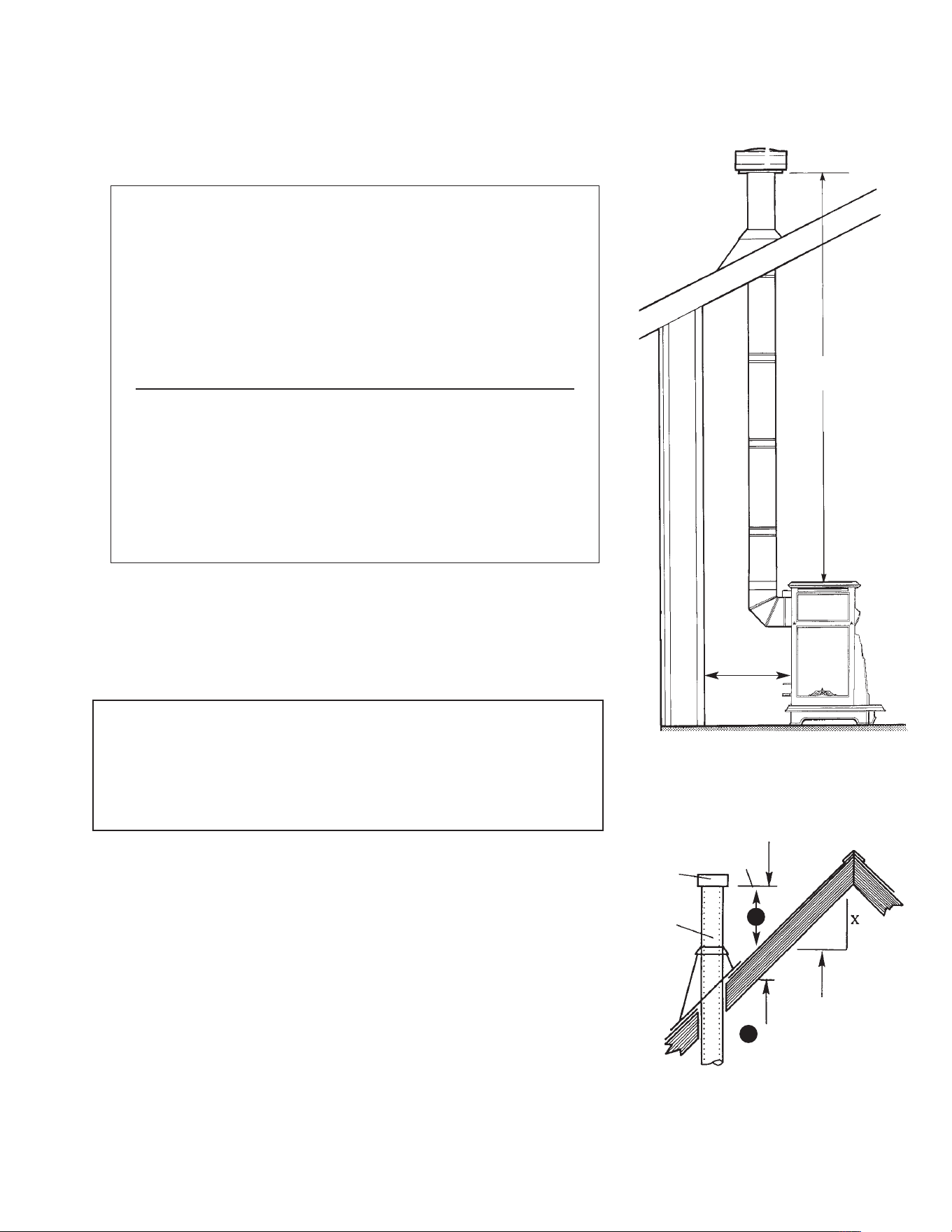
B. Side Wall Venting (straight back through wall)
In this venting configuration, the pipe runs directly out the back of the
Stove, through an outside wall and then up with a snorkel termination cap.
See illustration at left.
Refer to the Simpson Dura-Vent instructions regarding installation of your
Direct-Vent system.
Please note the following considerations for the location of the vent
terminal:
1. The horizontal run must rise
a minimum of 1/4" per foot of run
toward the vent termination.
2. Clearances must be maintained
around the vent termination . See
illustrations on page 12.
3. The termination must not be recessed
into the the exterior wall or
siding.
4. Vinyl Siding
requires protection from vented heat above the
termination. Use Simpson Dura-vent Vinyl Siding Heat Shield Kit,
part #46DVA-VSS.
The venting should be located so that people cannot be burned by
accidentally touching hot vent surfaces while the Stove is in operation.
The vent termination must be placed so that it cannot be damaged by
automobile doors, lawnmowers or yard equipment, or falling ice and snow.
MINIMUM AND MAXIMUM DISTANCES
• Maximum run...............................................................4 feet
Note: Use of 45 deg. elbow reduces the max run to 2.5 feet
• Minimum rise...............................................................2 feet
• Minimum Distance between the inside wall and the
back of Fireplace .............................................................11"
• Wall Opening:
Masonry wall .......................................................7" opening
Non-masonry wall.................................framed to 10" x 10"
4' Max.
11"Min.
Illustration 6.2
If stove is vented straight
back, Snorkel attachment is
required.
ALL VENT CLEARANCES MUST BE MAINTAINED.
CHECK YOUR VENT CLEARANCES AGAINST THE
ILLUSTRATIONS ON PAGE 12.
r
!
-------------------------------------------------------------------------------------------------------------------------------------------------------------------------------------------------------- 9
-------------------------------------------------------------------------------------------------------------------------------- Approved Venting/Chimney Configurations
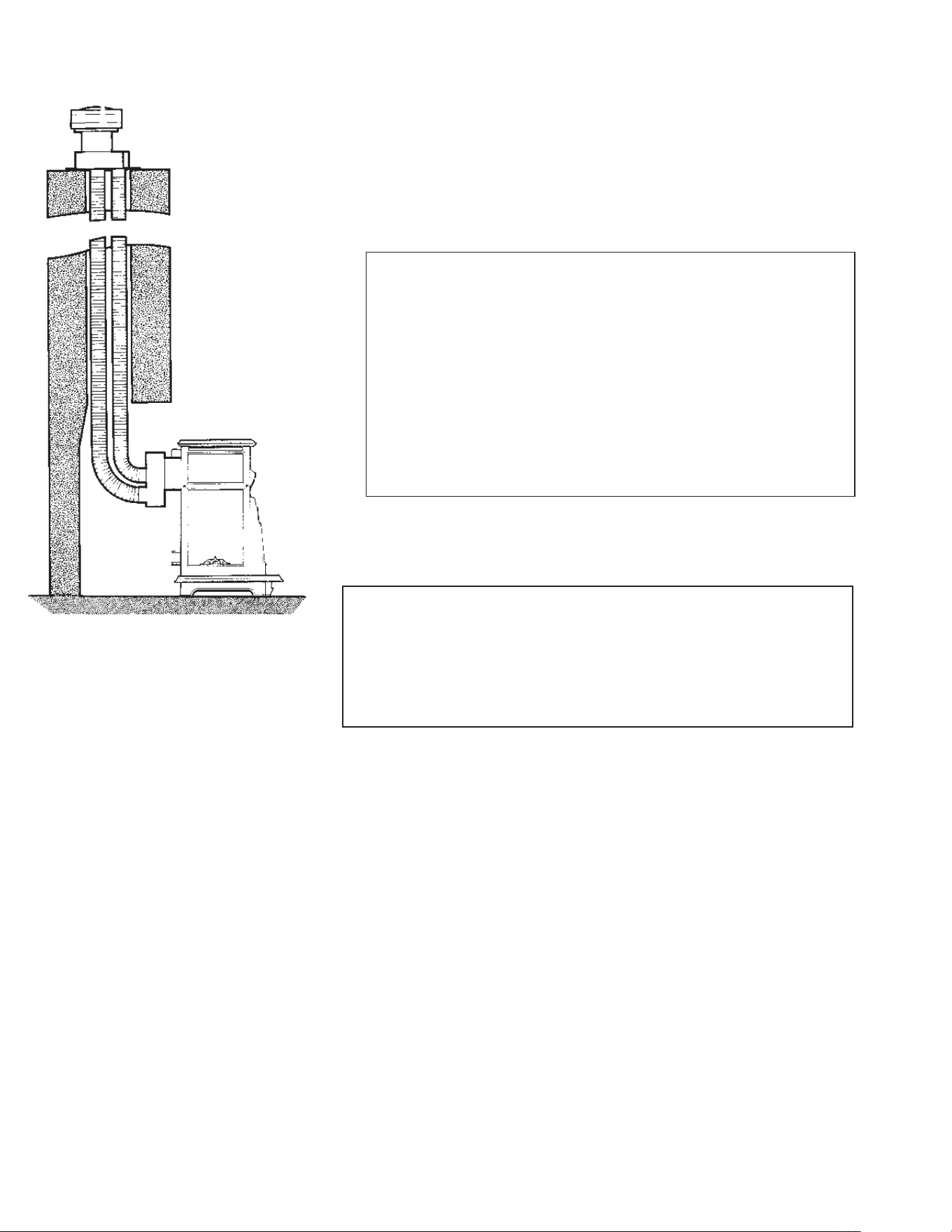
C. Vertical Venting (straight up through roof)
In this venting configuration, the pipe rises directly from Stove and goes
up through the roof, terminating above the roof. See illustration 6.3.
Refer to the Simpson-Dura Vent instructions regarding installation of
your Direct-Vent system.
The Cottage Franklin Gas Stove is currently approved only for
venting with the components listed previously on pages 3 and 4.
Install the vent system according to the manufacturers instructions,
which are included with the components.
MINIMUM AND MAXIMUM DISTANCES
• Maximum vertical rise ...................................................24'*
Height of termination above roof must conform to chart
below
Roof Pitch A Minimum height from roof
to lowest discharge opening
Flat to 6/12 1.0 feet
6/12 to 8/12 2.0 feet
8/12 to 10/12 3.0 feet
10/12 to 12/12 4.0 feet
*Max rise is 24’ without additional elbows
Each 90 deg. elbow reduces the maximum lineal distance by
3’. Each additional 45 deg. elbow reduces it by 1.5’
Lowest
Discharge
Opening
Listed
Cap
Listed
Gas
Vent
12"
Roof Pitch is X/12
Minimum Height
from Roof to Lowest
Discharge Opening
24' Max.
Illustration 6.3
Vertical venting configuration.
(Max height 24’)
Illustration 6.4
ALL VENT CLEARANCES MUST BE MAINTAINED.
CHECK YOUR VENT CLEARANCES AGAINST THE
ILLUSTRATIONS ON PAGE 12.
r
!
11"Min.
------------------------------------------------------------------------------------------------------------------------------------------------------------------------------------------------------ 10
------------------------------------------------------------------------------------------------------------------------------- Approved Venting/Chimney Configurations
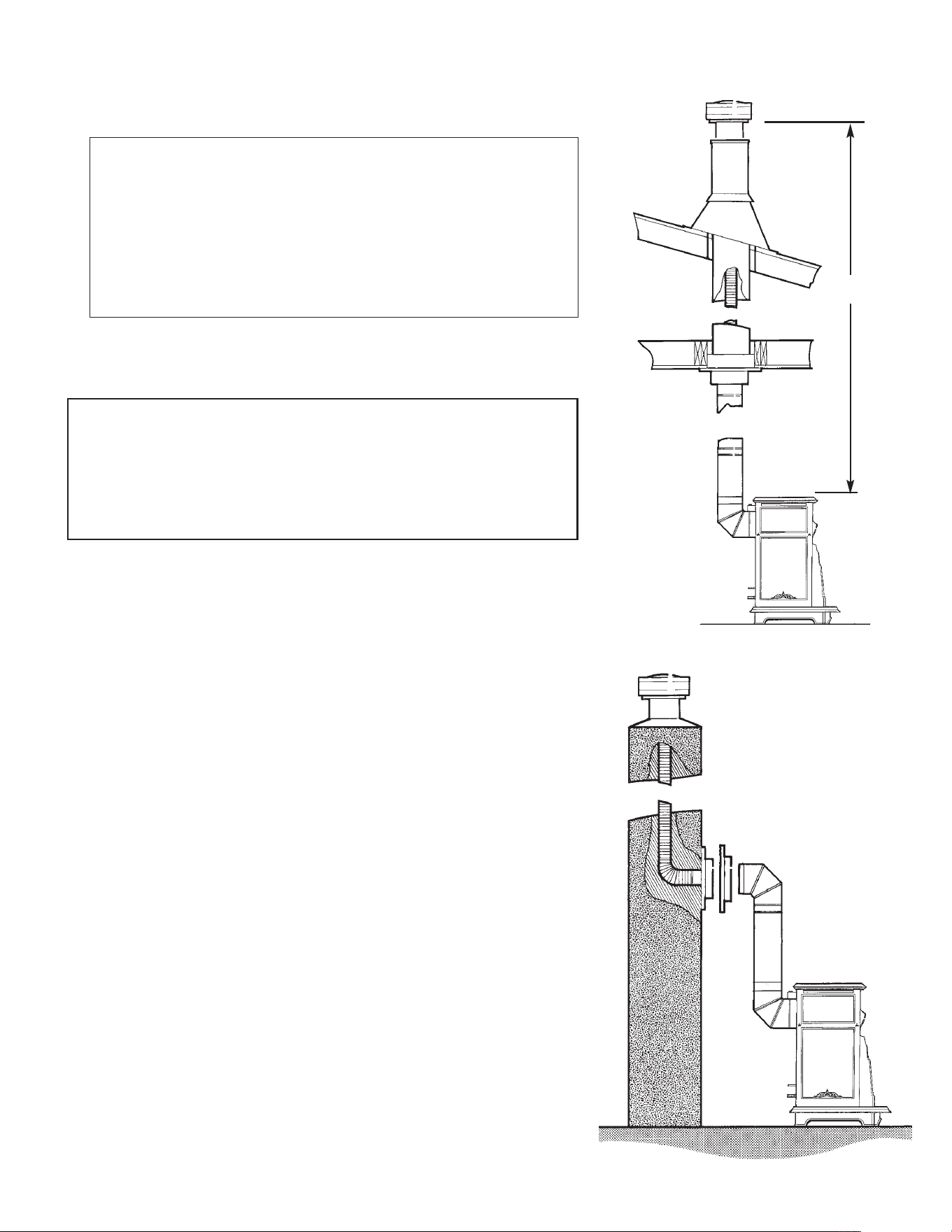
D. Venting Into an Existing Fireplace and Chimney
You can vent your Cottage Franklin Gas Stove into an open
fireplace by running two flexible ducts up the length of the chimney.
One duct will carry the exhaust gases to the top of the chimney while
the other duct brings fresh air into the stove for combustion. See
illustration 6.4.
Refer to the Simpson Dura-Vent instructions regarding installation
of your Direct-Vent system.
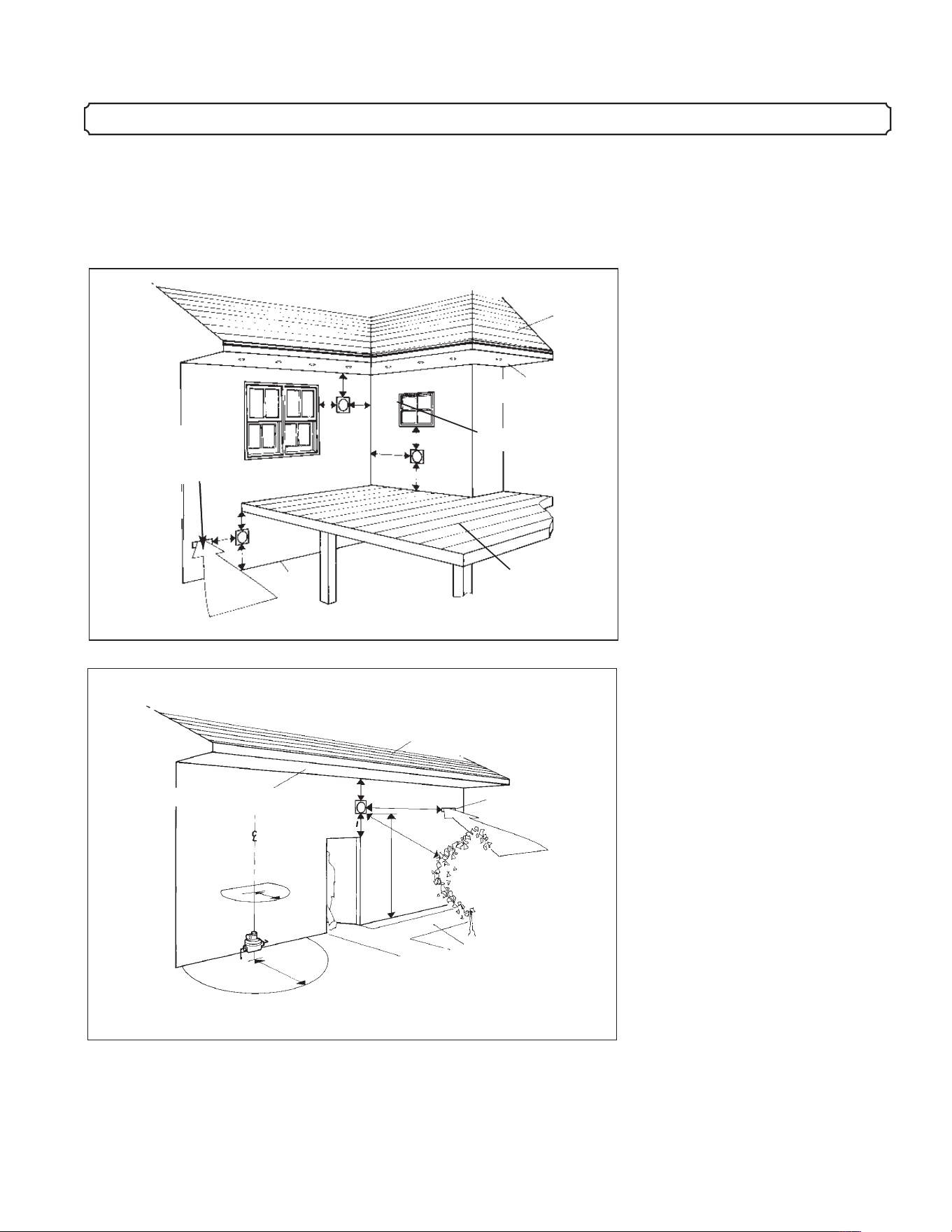
E. Venting Into an Existing Masonry or Prefabricated Metal
Chimney
You can vent your Cottage Franklin Gas Stove into an existing
chimney by running a flexible duct up the length of the chimney.
This 4” duct will carry the exhaust gases to the top of the chimney.
The surrounding chimney area is utilized to bring fresh air into the
stove for combustion.
Venting into a masonry chimney requires a conversion kit, 4”
duct, and a cap. See illustration 6.6 on page 11. Venting into an
existing prefabricated metal chimney requires a conversion kit
specific to the brand of chimney installed, a 4” duct, and a cap. See
illustration 6.5 for more detail.
MINIMUM AND MAXIMUM DISTANCES
• Maximum vertical rise.............................................24 feet*
Venting duct requirements are based on the factors below
• Up to 16’ vertical……........................................3” exhaust,
..................................................................3” combustion air
• Up to 24’ vertical……........................................3” exhaust,
..................................................................4” combustion air
*Each 90 deg. elbow reduces the maximum lineal distance
by 3’. Each additional 45 deg. elbow reduces it by 1.5’
Illustration 6.4 Venting into
fireplace and up into existing
chimney using co-linear ducts.
ALL VENT CLEARANCES MUST BE MAINTAINED.
CHECK YOUR VENT CLEARANCES AGAINST THE
ILLUSTRATIONS ON PAGE 12.
r
!
------------------------------------------------------------------------------------------------------------------------------------------------------------------------------------------------------ 11
------------------------------------------------------------------------------------------------------------------------------- Approved Venting/Chimney Configurations
Refer to the Simpson-Dura Vent instructions regarding installation
of your Direct-Vent system.
MANUFACTURED HOUSING INSTALLATION
The Cottage Franklin Gas Stove may be installed in Manufactured
Housing with the following supplemental requirements:
(1) The appliance must be securely bolted to the floor with steel
straps secured to the leg bolts and to the floor with minimum
1/4” lag bolts. Contact Woodstock Soapstone Company for
steel straps.
(2) The appliance must be grounded to the manufactured home
trailer frame with a No. 8 (minimum) solid conductor.
The Cottage Franklin Gas Stove is currently approved only for
venting with the components listed previously on pages 3 and 4.
Install the vent system according to the manufacturers instructions,
which are included with the components.
MINIMUM AND MAXIMUM DISTANCES
• Maximum vertical rise ...................................................24'*
• Minimum chimney inside diameter ..................................6”
• Required .............................Existing chimney must be lined
*Max rise is 24’ without additional elbows.
Each 90 deg. elbow reduces the maximum lineal distance by
3’. Each additional 45 deg. elbow reduces it by 1.5’
24' Max.
Fig. 6.6 Venting into existing
masonry chimney using 4"
duct and conversion kit.
Fig. 6.5 Venting into
existing metal
chimney using 4"
exhaust duct and
conversion kit.
Note: A manufactured home(USA only) or mobile home OEM
installation must conform with the Manufactured Home
Construction and Safety Standard, Title 24 CFR, Part 3280, or,
when such a standard is not applicable, the Standard for
Manufactured Home Installations, ANSI A225.1/NFPA 501A,
or Standard for Gas Equipped Recreational Vehicles and
Mobile Housing, CSA Z240.4
ALL VENT CLEARANCES MUST BE MAINTAINED.
CHECK YOUR VENT CLEARANCES AGAINST THE
ILLUSTRATIONS ON PAGE 12.
r
!
------------------------------------------------------------------------------------------------------------------------------------------------------------------------------------------------------ 12
--------------------------------------------------------------------------------------------------------------------- Approved Venting/Chimney Terminal Clearances
1. CHECK THE GAS LINE PRESSURE (LP)
7. APPROVED VENTING/CHIMNEY TERMINAL CLEARANCES
Grade
Air
Non
Mechanical
Air Supply
G
D
H
E
C
Roof
Ventilated Soffit
Fixed Window
Deck
A
E
B
C
Mechanical
Air Supply
Vegetation
Roof
K
I
L
J
F
B
M
Nonventilated Soffit
Public Sidewalk or
Driveway
A. Clearance to a permanently
closed window..................12"
B. Clearance to a window or door
that may be opened ..........12"
C. Clearance above grade. Also,
clearance over deck,
porch,
veranda or balcony .............12"
D. Clearance to non-mechanical
air supply inlet or combustion
air inlet of any other
appliance..........................12"
E. Clearance to inside corner or
adjacent wall.....................12"
F. Clearance to a non-ventilated
soffit .................................12"
G. Clearance below deck,
porch, veranda, or balcony
if completely open on two
sides..................................18"
H. Clearance to ventilated soffit
located above the terminal
within a horizontal distance
of 2 feet from the center of the
terminal.............................18"
I. Clearance around a center line
above service regulator.3 feet
J. Clearance to vegetation..3 feet
K. Clearance around a service
regulator vent outlet......6 feet
L. Clearance to a mechanical air
supply............................6 feet
M. Clearance above a paved
sidewalk or driveway on
public property. May not
terminate above a sidewalk
or driveway which is
between two single family
dwellings and serves both
dwellings.......................7 feet
Illustration 7.1
Illustration 7.2
------------------------------------------------------------------------------------------------------------------------------------------------------------------------------------------------------ 13
-------------------------------------------------------------------------------------------------------------------- Pre-Installation Inspection Checklist for Installer
Remove Packaging
1
. There is a corrugated carton packed on the front skirt of the
Fireplace. The corrugated box contains the ceramic logset as
well as leveling screws and the window clip tool. Remove the
carton and set it aside.
2. Use a 7/16” socket or wrench to remove bolts and washers
that attach stove to shipping pallet from below.
3. Lift the Fireplace straight up off the pallet by hand, being
careful not to damage the controls and wiring that are under
and at the back of the Fireplace. The Fireplace is heavy. You
will need 2 people to lift it.
4. The ceramic tile is located in the burner pan. Remove rubber
bands and label before use.
Packing List
A. Owners Manual (packed on top of Fireplace)
B. Corrugated box containing:
1. Log set (handle the log set with care; the ceramic logs
are fragile)
2. Window clip tool
3. Leveling screws
4. Three #8 self drilling screws for first section of pipe
1. Check that both intake and exhaust venting are clear of any
debris or other obstruction at the back of the Fireplace.
2. Check that the gas manifold is connected to both the
controller and the orifice at the back wall of the Fireplace
and is free from damage (see illustration 9.3).
3. Remove the Front Casting (see illustration 9.1).
4. Remove the Glass Front (see illustration 9.2).
5. Check that the Pressure relief Lids are both seated flat
6. Check that the pilot gas tube, and thermocouple are properly
connected to both the pilot assembly and gas controller (see
illustration 9.4)
8. UNPACKING THE FIREPLACE
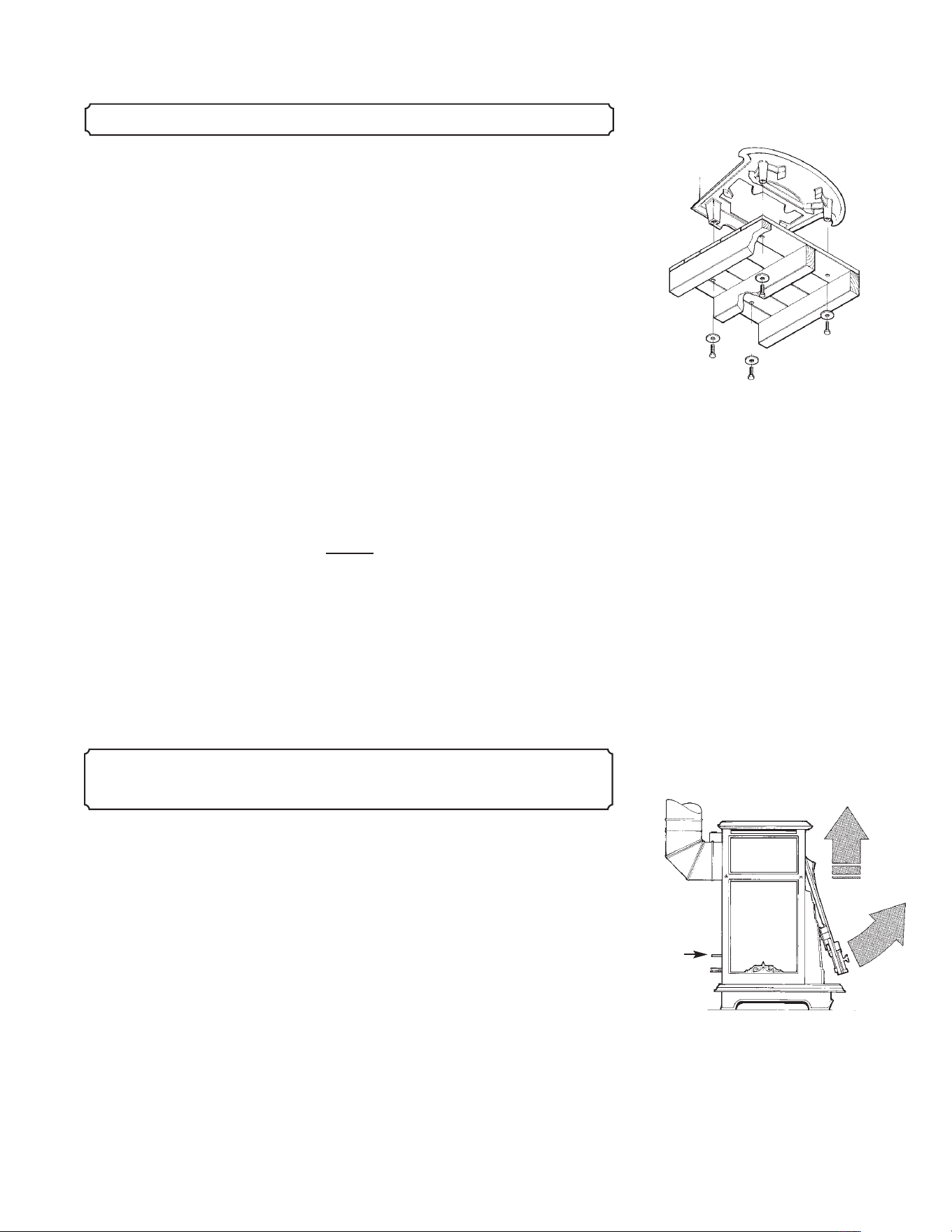
Illustration 8.1 There are four bolts that
hold the Fireplace to the pallet during
transport. Before lifting the Fireplace
off the pallet, you must detach the bolts
from the pallet. Remove the four bolts
using a 7/16” wrench. Insert the 4
leveling screws into the base.
9. PRE-INSTALLATION INSPECTION
CHECKLIST FOR INSTALLER
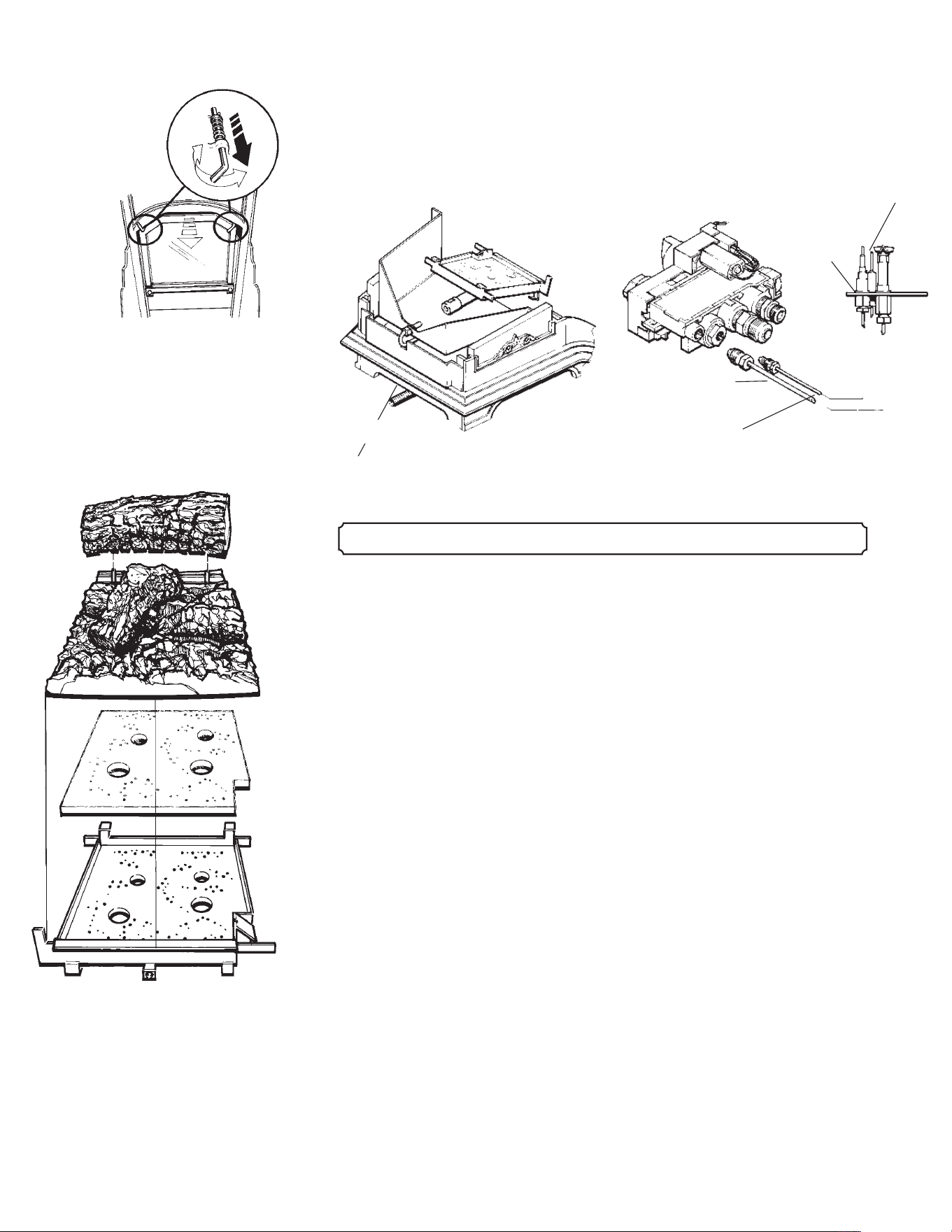
Illustration 9.1 To remove the front
casting, lift straight up under the lip
that extends over the top of the
glass. This assembly includes the
swinging door.
Gas
Manifold
------------------------------------------------------------------------------------------------------------------------------------------------------------------------------------------------------ 14
7. Check that the piezo wire is connected to the pilot assembly.
Push in and turn right gas control knob counterclockwise to
test for spark in the Firebox near the pilot.
CAUTION: Sheet metal edges are sharp. Please handle carefully
1. INSTALLING THE LOGSET
Your Cottage Franklin Gas Stove has been carefully assembled by
our craftsmen. Because of the fragile nature of the ceramic logset it
is packaged separately to ensure safe shipping, and requires minor
assembly. Please refer to the following instructions and diagram to
ensure proper placement of the logset.
Remove the front casting by lifting straight up with one hand on
the cast lip above and below the screen barrier. This assembly
includes the swinging door at the bottom and is heavy. Care should
be taken while removing. (See illustration 9.1 on previous page.)
The glass panel is held in place with two spring loaded clips at the
top and a rail bolted at the bottom. The clips can be released using
the tool provided. Loop the tool over the end of the clips then pull
and twist them out of the way. The panel may be removed by lifting
it up and out. (See illustration 9.2.)
The burner pan is located in the bottom of the firebox and is bolted
in place to ensure safe shipping. The white ceramic tile fits securely
in the recess in the top side of the burner pan. The top of the tile
may protrude above the sides of the burner pan slightly. The logset
base should be placed over the ceramic tile. Locate it by sliding it to
the right and then back to the left until it hits the metal stop on left of
the burner pan (See illustration 10.1.). The logset base should be as
far forward as possible.
Place the large log section over the protruding pins at the rear of
the logset base.
------------------------------------------------------------------------------------------------------------------------------------------------------------- Assembling the Fireplace
Illustration 9.2 The glass front
is held in place by two spring-
loaded clips. To release the
clips, pull and twist.
Illustration 9.3 The burner pan fits
in the base of the Fireplace as
illustrated.
Illustration 9.4 These connections
should be checked carefully.
10. ASSEMBLING THE FIREPLACE
Illustration 10.1 Burner pan with
ceramic tile and logset assembly.
Ceramic tile and Logset are
fragile. Please handle with care
while installing and cleaning.
Gas Pilot Tube
Thermocouple
Connector
Thermocouple
Log
Base
Tile
Burner Pan
Piezo
Gas Manifold
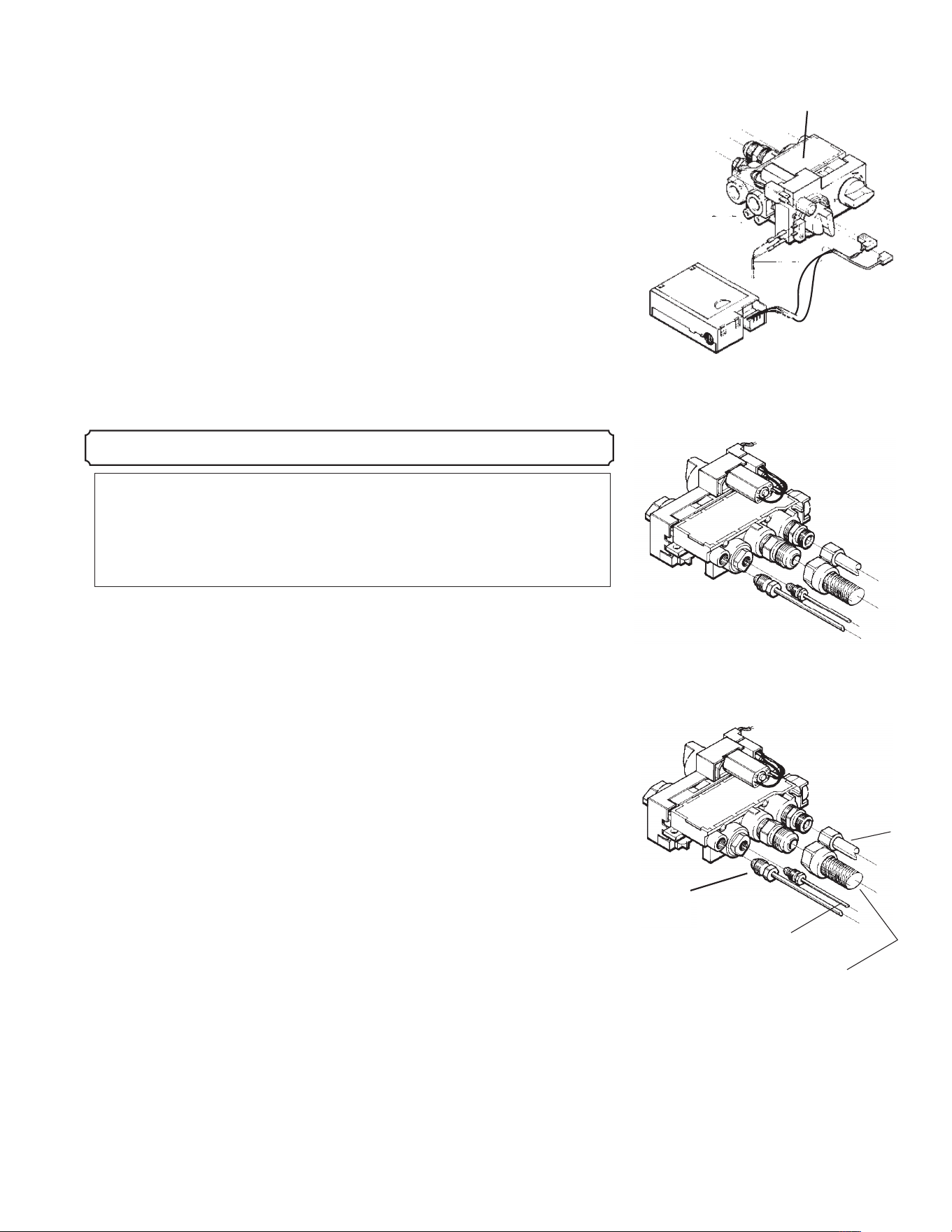
Thermocouple
Connector
Pilot Gas
Tube
Burner Gas
Manifold
Flexible Gas
Connector
Illustration 11.2 This illustration
shows connection at the control valve
at the rear of the Fireplace.
2. REPLACE GLASS FRONT/FRONT CASTING
Once the tile and logset have been assembled the glass panel may be
reinstalled. Be sure the bottom edge of panel fits snugly into bottom
rail and clips are fastened securely.
Replace the front casting.
3. INSTALLING OPTIONAL EQUIPMENT:
Installing optional remote control:
The Cottage Franklin Gas stove may be equipped with an optional
remote control. The remote has several functions. It can turn the
burner on or off, regulate flame height or act as a timer/thermostat.
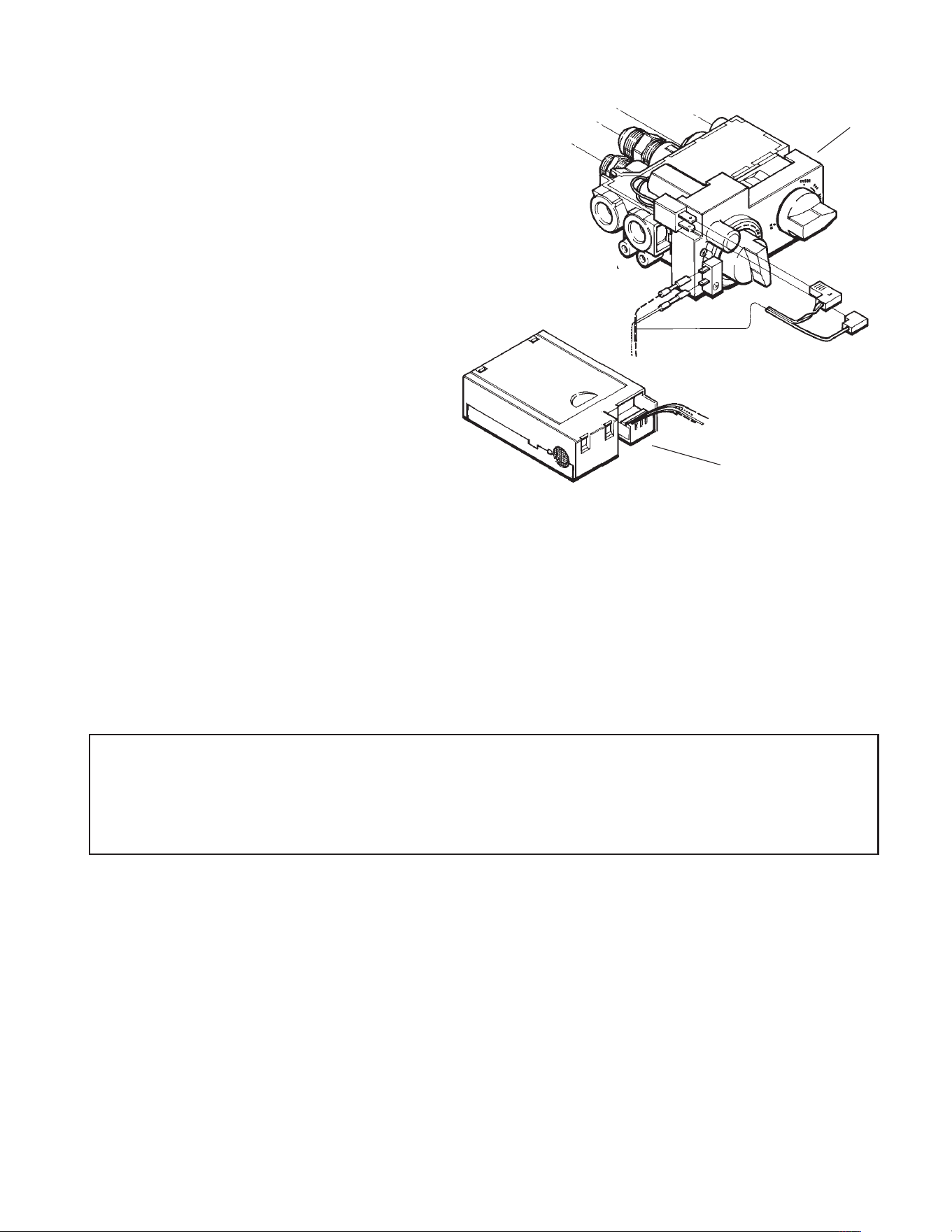
The remote control system includes the remote transmitter, the
remote receiver, and connecting wires.
Refer to instructions for installation and operation included with the
remote control system. (See appendix B page 36)
---------------------------------------------------------------------------------------------------------------------- Connecting the Gas Supply & Testing the Flame
Illustration 10.2 Optional remote
control system connections to the
control valve.
Before connecting the Stove to the gas line, you should check
the gas line pressure. The stove and its main gas valve must be
disconnected from the gas supply piping system during any pressure
testing of that system at test pressures in excess of 1/2 psi
(3.5kPa/14”WC). If the gas line pressure is too high it will rupture
the gas control valve on the Stove.
Isolate the stove from the gas supply pipi ng system by closing the
shut-off valve during any pressure testing of the gas supply piping
system at test pressures in excess of 1/2 psi (3.5kPa/14”WC).
2. ATTACH GAS LINE TO THE CONTROL VALVE
The gas supply line is connected to the stove gas control valve
through a 1/2" flexible connector pre-attached to the valve using a
3
/8" male NPT fitting. The gas supply line for either propane (LPG)
or natural gas (NG) should be large enough to support (25,000 Btu)
and should be connected with a male 1/2" 45 degree flare fitting.
Consult local building codes to properly size the gas supply line.
3. TEST FOR LEAKS
Test for leaks using a sniffer, soapy water or an approved leak
testing spray. Check each joint or connection from the main supply
valve to the Stove. Check the connections on the control valve as well
as those in the Stove in case one loosened in shipment. Again, never
test with an open flame.
WARNING: This unit must be installed by a qualified gas
technician in accordance with local codes or in the absence of
local codes, with the most current edition of the National
Fuel Gas Code ANSI Z21.88-2017
11. CONNECTING THE GAS SUPPLY & TESTING THE FLAME
Illustration 11.1 Connection to the
stove can be made with a straight
or elbowed 1/2" fitting into the
flexible connector.
Gas Control Valve
Remote Receiver
------------------------------------------------------------------------------------------------------------------------------------------------------------------------------------------------------ 15
------------------------------------------------------------------------------------------------------------------------------------------------------------------------------------------------------ 16
---------------------------------------------------------------------------------------------------------------------- Connecting the Gas Supply & Testing the Flame
Replace ceramic tile, logset, glass panel, and front casting following
assembly instructions on page 14. Light fire and see how flame looks with
the adjustment. Allow stove to cool before making further adjustments if
necessary.
The Screen Barrier for the Glass Front
A screen barrier has been installed on the front of your Cottage Franklin
Gas Stove to reduce the risk of burn from the hot viewing glass. It has been
installed at the factory for the protection of children and other at-risk
individuals. It should not be removed.
If the screen barrier becomes damaged, it shall be replaced with the barrier
made by Woodstock Soapstone Company for the Cottage Franklin Gas
Stove. The screen barrier is attached to the front casting, and should not be
removed even to service the stove.
Installation and repair should be done by a qualified service person. The
stove should be inspected before use and at least annually by a professional
service person. More frequent cleaning might be required due to excessive
lint from carpeting, bedding material, and so on. It is imperative that
control compartments, burners, and circulating air passageways be kept
clean.
Note: Clothing or other flammable material should not be placed on or near
the appliance. Do not attempt to dry mittens or gloves by placing them on
the stove.
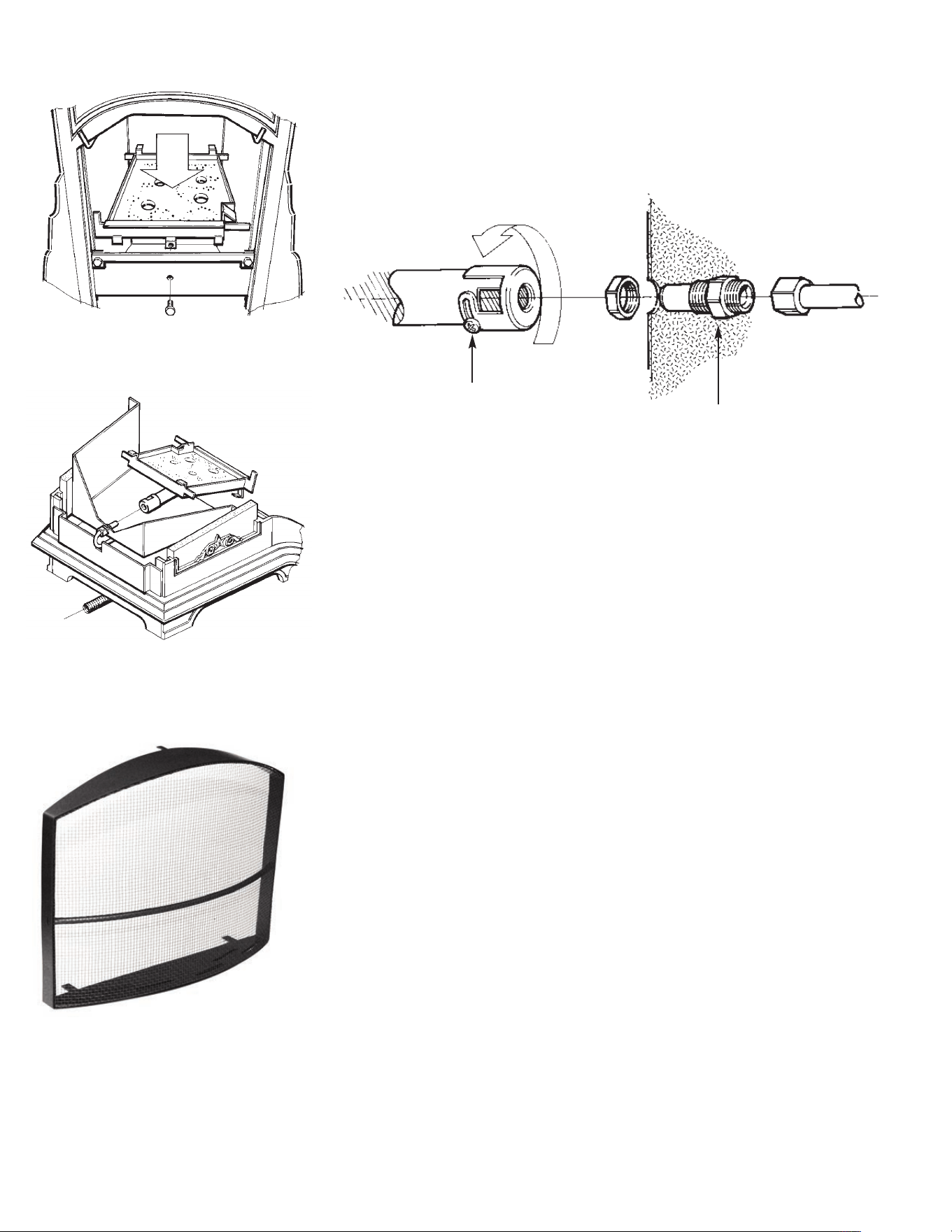
Illustration 11.3 The burner pan
is attached as illustrated above.
Illustration 11.4 The venturi fits
securely over the orifice with the
burner pan properly located in the
firebox.
The screen barrier, part # G-262
is held permanently in place with
three clips, two on the bottom and
one at the top of the barrier.
Gas Orifice
Screw
Illustration 11.5 Installer: adjust the air shutter to modify fuel/air mixture.

-------------------------------------------------------------------------------------------------------------------------------------------------------------------------------------------------------17
------------------------------------------------------------------------------------------------------------------------------------------------- Troubleshooting – Installer Only
13. TROUBLESHOOTING – INSTALLER ONLY
(CERTIFIED GAS TECHNICIAN ONLY)
Pilot will not
light despite
repeated clicking
of ignitor
1. Air in gas lines
2. No ignitor spark, either
checked visually or proven
by lighting the pilot with a
match
3. Low gas pressure.
a. Bleed gas lines
a. Check for loose or disconnected wires
b. Ignition wire is broken or corroded: replace
c. Misaligned electrode, wrong gap: gap should be 1/8"
d. Electrode insulator is cracked or tip is corroded: replace electrode
a. Wrong inlet pressure; adjust inlet pressure regulator to 4" w.c. for
NG, 11" w.c. for LP.
a. Adjust inlet pressure regulator to 4" w.c. for NG, 11"w.c. for LP.
a. It must be placed so that the top 3/8" is engulfed in flame from the
pilot.
a. Clean with fine emery cloth
a. Check open circuit voltage with volt meter, should be between 18mV
and 28mV with induced heat source applied. If less than 18mV, replace.
a. Verify open-circuit thermocouple voltage is between 18mV and 28mV
with induced heat source applied. If so, electromagnet is faulty and
valve must be replaced.
a. Check venting for blockage, loose connections, and that configuration
meets requirements for the stove
a. Call Woodstock Soapstone Company for windguard options designed
for your stove and installation.
a. Check that gas control knob is “ON”.
a. Increase set temperature on remote, go to manual mode, increase gas
flow manually with switch, or knob on valve.
a. Remove and blow out with compressed air or clean out with brush.
PROBLEM CAUSE SOLUTION
Pilot will not
stay lit
1. Low gas pressure
2. Thermocouple not properly
inserted in pilot assembly.
3. Thermocouple has dirty tip;
4. Defective thermocouple;
5. Defective electromagnet,
check operation as follows:
6. Lack of oxygen
7. High wind
Pilot burning,
main burner will
not light
1. Gas Control knob in wrong
position
2. Temperature set in remote
transmitter is lower than
room temperature, and remote
set to Auto.
3. Gas supply orifice is
clogged.
*Optional Equipment

------------------------------------------------------------------------------------------------------------------------------------------------------------------------------------------------------ 18
------------------------------------------------------------------------------------------------------------------------------------------------- Troubleshooting – Installer Only
Delayed Ignition
of burner
1. Burner pan is not in
correct position (pilot cannot
ignite fuel).
2. High Wind
3. Low manifold pressure
4. Low pilot flame
5. Flame Impingement
(logset position).
1. Venting is blocked or
interrupted.
2. Low gas pressure.
1. High wind.
2. Pressure relief lids out of
position
1. Pressure relief lids not
seated correctly.
2. Curing of paint and gasket
cement.
a. Reseat the burner pan following the instructions in the manual
ensuring that the venturi is positioned over the orifice and pilot flame is
running over the top suface of the burner pan.
a. Call Woodstock Soapstone Company for wind guard options designed
for your stove and installation.
a. Use manometer to check output from controller. Must be 3.5" w.c. for
N.G. and 10.5" w.c. for LP. (Check inlet pressure first)
a. Adjust the setting of the “pilot” valve on the controller.(Check inlet
pressure first)
a. If the logset is covering the pilot output contact Woodstock Soapstone
for information.
a. Confirm pressure relief lids on top of and at the rear of firebox are
properly seated.
a. It is normal to experience an odor for the first few hours of constant
use; this will discontinue with normal use.
a. Check that the pipe joints are locked together and free from
obstruction.The inner pipe is more critical than the outer wall.
b. Be sure that the pipe system is completely without interruptions from
the fireplace to the outside termination cap.
a. Confirm inlet pressure.
b. Make sure the gas storage tank is not too low. (Under 20%)
c. Check for moisture in gas supply system.
d. Check for contaminants in gas supply system.
a. Shut off fireplace system and wait for wind to die down.
b. Call Woodstock Soapstone Company for wind guard options designed
for your stove and installation.
a. Confirm pressure relief lids on top of and at the rear of firebox are
properly seated.
PROBLEM CAUSE SOLUTION
Odor
Low flame or
flame goes out
after a short
burn.
Sporadic
changes of flame
level/lifting of
flame.
BEFORE YOU USE YOUR GAS FIREPLACE
1. Determine that the gas shut-off valve is in the open position
(there may be more than one shut-off valve between the
Fireplace and the main gas supply; make sure all are turned on).
2. If the Fireplace has not been used for some time, there will
be air in the gas supply line. This will be automatically
purged when you light the pilot.
3. Smell for gas, especially near the floor if you are using LPG
(propane) as it is a heavy gas and any leaked gas would stay
near the floor. Natural gas is lighter than air and will rise. If
you smell gas, do not attempt to light. Follow “What to do if
you smell gas” instructions shown on the cover of the
manual.
14. OPERATING YOUR GAS FIREPLACE
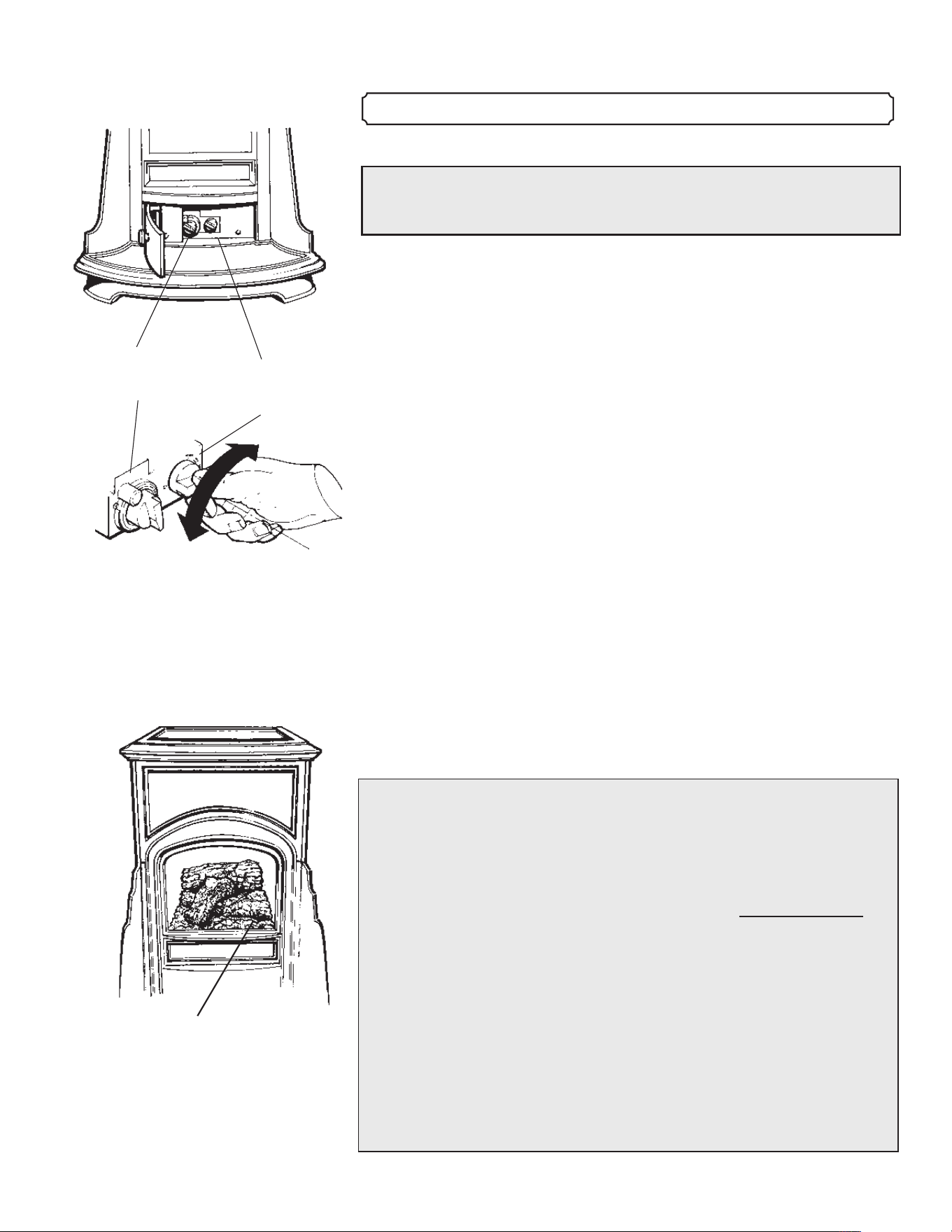
--------------------------------------------------------------------------------------------------------------------------------------------------------------------- Lighting Instructions
FOR YOUR SAFETY READ BEFORE LIGHTING
WARNING: IF YOU DO NOT FOLLOW THESE INSTRUCTIONS
EXACTLY, A FIRE OR EXPLOSION MAY RESULT CAUSING
PROPERTY DAMAGE, PERSONAL INJURY OR LOSS OF LIFE.
This appliance has a pilot. When lighting the pilot, follow these
instructions exactly.
BEFORE OPERATING, smell all around the appliance area for gas.
Be sure to smell next to the floor because LP gas is heavier than air
and will settle on the floor.
WHAT TO DO IF YOU SMELL GAS:
Do not try to light any gas appliance.
Do not touch any electric switch; do not use any phone in your
building.
Immediately call your gas supplier from a neighbor’s phone.
Follow the gas supplier’s instructions.
If you cannot reach your gas supplier, call the fire department.
Use only your hand to push in or turn the gas control knob. Never
use tools. If the knob will not push in or turn by hand, don’t try to
repair it. Call a qualified service technician. Force or attempted
repair may result in fire or explosion.
Do not use this appliance if any part has been under water.
Immediately call a qualified service technician to inspect the
appliance and to replace any part of the control system and any gas
control that has been under water.
TO LIGHT THE PILOT
1. PUSH THE GAS CONTROL KNOB IN COMPLETELY AND
WHILE THE KNOB IS PUSHED IN, TURN IT REPEATEDLY
COUNTERCLOCKWISE FROM "IGN" TO "PILOT". EACH TIME
YOU TURN THE KNOB TO "PILOT" YOU WILL HEAR A CLICK
AS IT PRODUCES A SPARK.
– When you push the control knob in, you are letting gas into the firebox.
– Each time you turn the knob to the left and hear a click, you are
producing a spark.
2. IF THE PILOT DOES NOT LIGHT IN THE FIRST 5-6
SECONDS, STOP.
– Turn the control knob to the "OFF" position. Wait 5 minutes for the
15. LIGHTING INSTRUCTIONS
------------------------------------------------------------------------------------------------------------------------------------------------------------------------------------------------------ 19
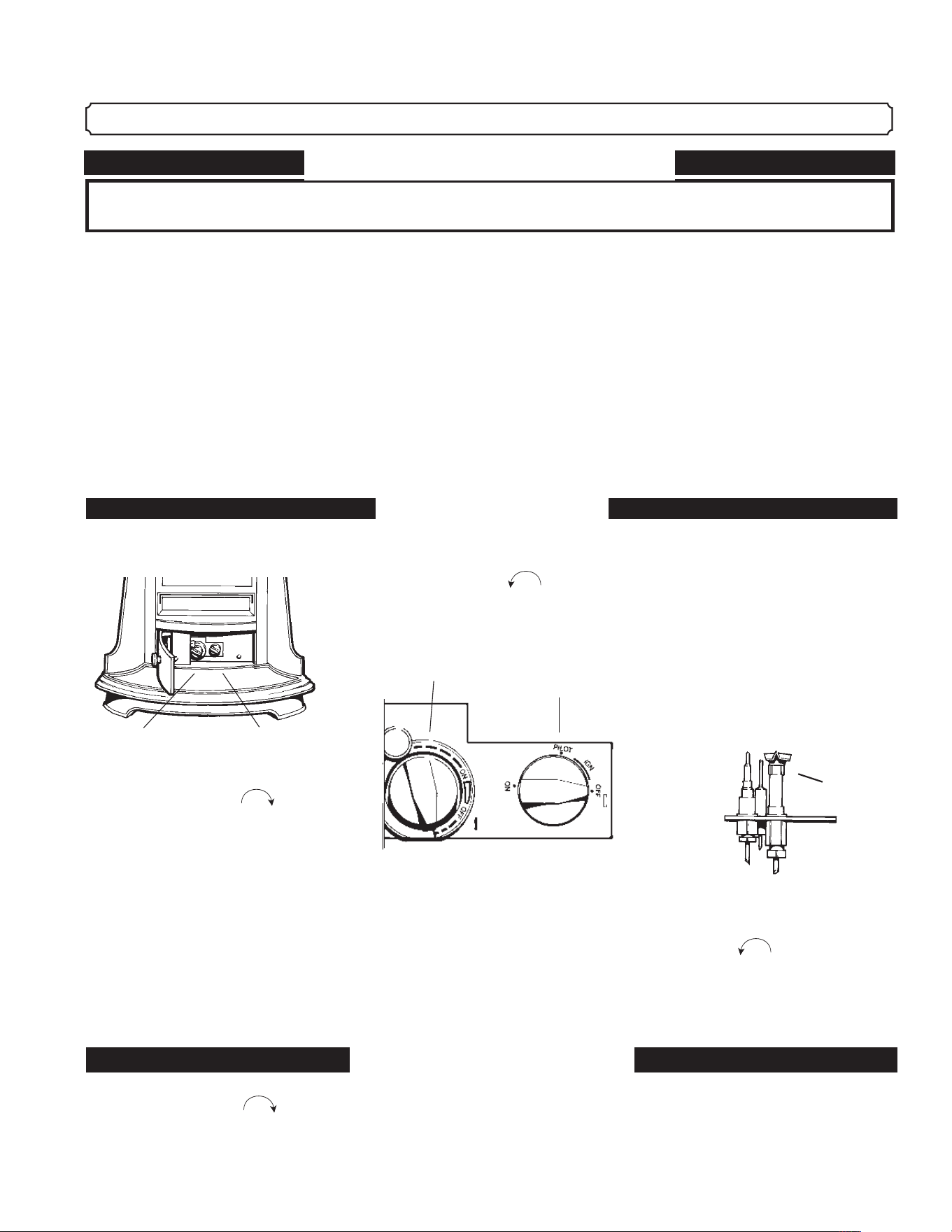
The knob on the right lights the pilot
and the main burner. The knob on
the left controls flame height and
burner On/Off.
Gas control
knob
Flame adjustment
knob
Look for Pilot here.
BEFORE LIGHTING YOUR STOVE READ THESE
INSTRUCTIONS CAREFULLY!
DO NOT LIGHT THE STOVE IF YOU SMELL GAS!
TO LIGHT THE PILOT
1. PUSH THE GAS CONTROL KNOB IN COMPLETELY AND
WHILE THE KNOB IS PUSHED IN, TURN IT REPEATEDLY
COUNTERCLOCKWISE FROM "IGN" TO "PILOT". EACH
TIME YOU TURN THE KNOB TO "PILOT" YOU WILL HEAR
A CLICK AS IT PRODUCES A SPARK.
– When you push the control knob in, you are letting gas into the firebox.
– Each time you turn the knob to the left and hear a click, you are
producing a spark.
2. IF THE PILOT DOES NOT LIGHT IN THE FIRST 5-6
SECONDS, STOP.
– Turn the control knob to the "OFF" position. Wait 5 minutes for
the gas to dissipate before attempting to light the stove again.
------------------------------------------------------------------------------------------------------------------------------------------------------------------------------------------------------ 20
– If you attempt to light the stove too soon the accumulated gas will
ignite, causing an explosion.
3. WHEN THE PILOT LIGHTS, CONTINUE TO HOLD THE
KNOB IN FOR 10 SECONDS SO THE PILOT WILL STAY LIT.
– When the pilot lights a small flame will be visible below the logset
at the right front corner of the firebox.
– Depressing the gas control for 10 seconds after the pilot is lit
warms the thermocouple.
– Release the knob. The pilot will remain lit.
TO LIGHT THE BURNER
1. CONFIRM THE PILOT IS LIT.
– The pilot must be lit before the burner will light.
– Follow instructions above if pilot is not lit.
2. TURN THE GAS CONTROL KNOB COUNTERCLOCKWISE
FROM "PILOT" TO "ON". THE BURNER WILL IGNITE
– If flames do not appear in 10 seconds it may be necessary to turn
the flame adjustment (left) knob counterclockwise until flames
appear.
NOTE: Flame height can be controlled manually at the control panel
using the left knob, or with the optional remote control.
NOTE: Knob cannot be turned from "PILOT" to "OFF" unless
depressed slightly. Do not force or use tools.
TO TURN OFF GAS TO APPLIANCE
To turn the main burner off manually turn the ON-PILOT-OFF knob
clockwise to pilot. In this position the flames from the main burner will be
extinguished, but the pilot will remain lit. The left flame adjustment knob may
also be used to turn the burner off by turning it clockwise until it stops. The
optional remote control can also extinguish the main burner by simply holding
the flame adjustment button in the LO position until the flames go out.
CAUTION; HOT WHILE IN OPERATION. DO NOT TOUCH. KEEP
CHILDREN, CLOTHING, FURNITURE, GASOLINE AND OTHER
LIQUIDS HAVING FLAMMABLE VAPORS AWAY.
WARNING: Improper installation, adjustment, alteration, service or
maintenance can cause injury or property damage. Refer to the owner’s
information manual provided with this appliance. For assistance or additional
information consult a qualified installer, service agency or the gas supplier.
CAUTION: Do not operate this appliance with glass removed, cracked or
broken. Replacement of the panel(s) should be done by a licensed or qualified
service person.
--------------------------------------------------------------------------------------------------------------------------------------------------------------------- Lighting Instructions
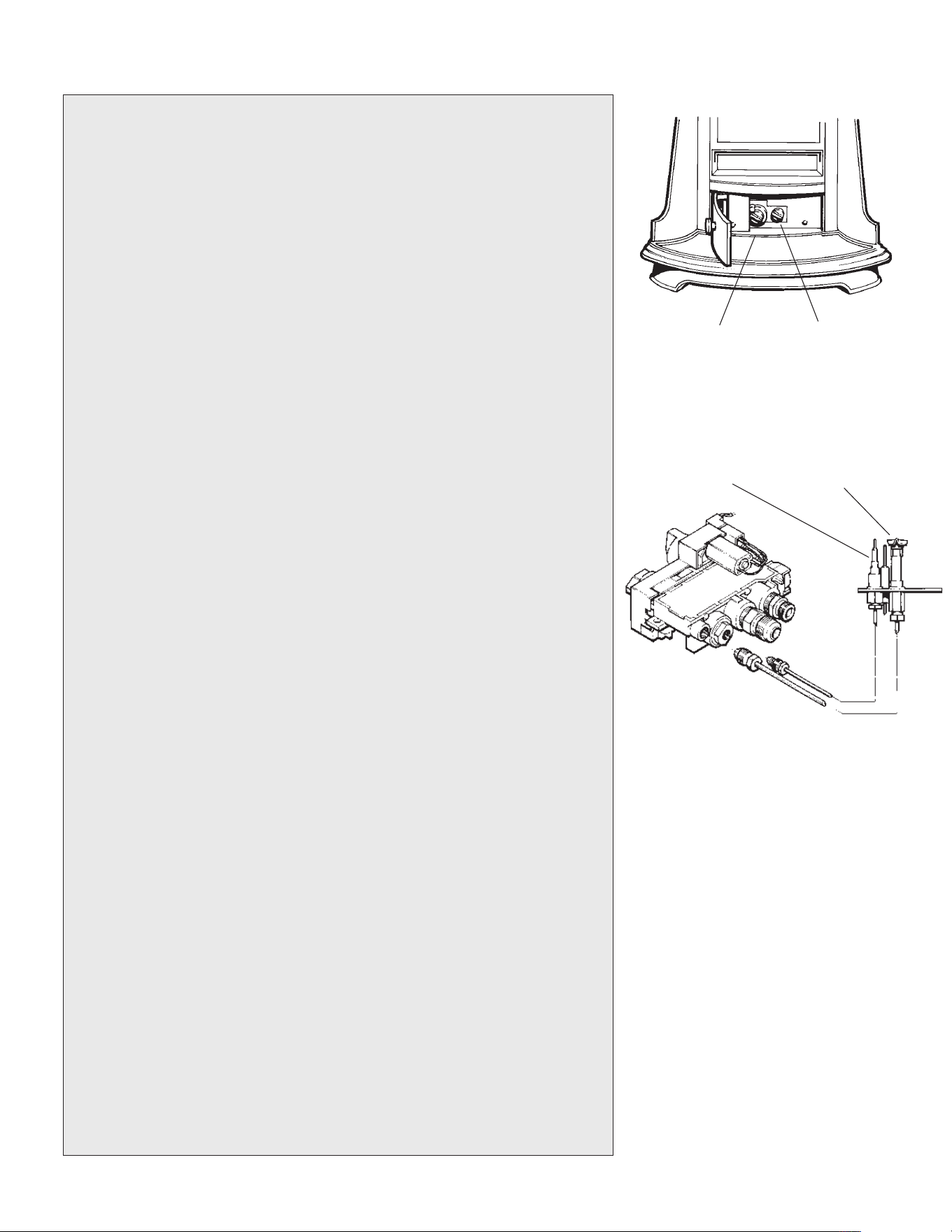
Illustration 15.2 To ignite the pilot,
use the two controls indicated above.
Illustration 15.3 The pilot is
located next to the thermocouple.
The pilot flame is visible on the
right side of the firebox.
Thermocouple
Pilot
Flame adjustment
knob
Gas control
knob
--------------------------------------------------------------------------------------------------------------------------------------------------------------------- Lighting Instructions
------------------------------------------------------------------------------------------------------------------------------------------- 21
Technical Note:
HOW THE PILOT SAFETY CONTROL WORKS: When lit, the pilot
flame warms a thermocouple. The heated thermocouple produces a small
electrical current that activates an electromagnet which keeps the pilot gas
supply valve open. When you hold down the control knob after the pilot
initially lights, you are manually keeping open the gas supply until the
thermocouple warms up enough to automatically keep the gas supply valve
open.
Should the pilot blow out, the thermocouple will cool and the
electromagnet will close the gas supply valve and shut off the supply of gas. If
pilot goes out after being lit long enough to warm the thermocouple, the
thermocouple must cool down before the electromagnet will allow the gas
valve to reopen. This safety mechanism can take up to 30 seconds and
produces an audible “click”.
ADDITIONAL NOTES
1. Check that the flames are evenly distributed. (See illustration 15.6.) in
LP burning stoves they will be mostly blue for the first 15 minutes
and then will change to yellow/orange. NG stoves will remain very
blue/translucent. There may be a slight amount of condensation on
the glass. This will disappear when the fireplace heats up.
2. If this is the first time you have burned your new fireplace for any
length of time, you may smell the fireplace paint curing. This is
normal and will go away within a few hours.
3. The adhesive on the window gasket will also take a few days to
cure. This process will create an unpleasant odor. This is normal
and will go away after about 10 to 12 hours of use on High.
4. To completely shut off the Stove, including the pilot, turn the Gas
Control Knob to the “OFF” position. It is a good idea to turn the Gas
Control Knob to “OFF” and turn the manual gas valve on the supply
line to “OFF” if the stove will not be used for any length of time.
This turns off the pilot, the burner, and the gas supply.
WARNING
Do not attempt to decrease flame size or heat output by closing the manual
gas supply valve. This valve should always be in a fully open position.
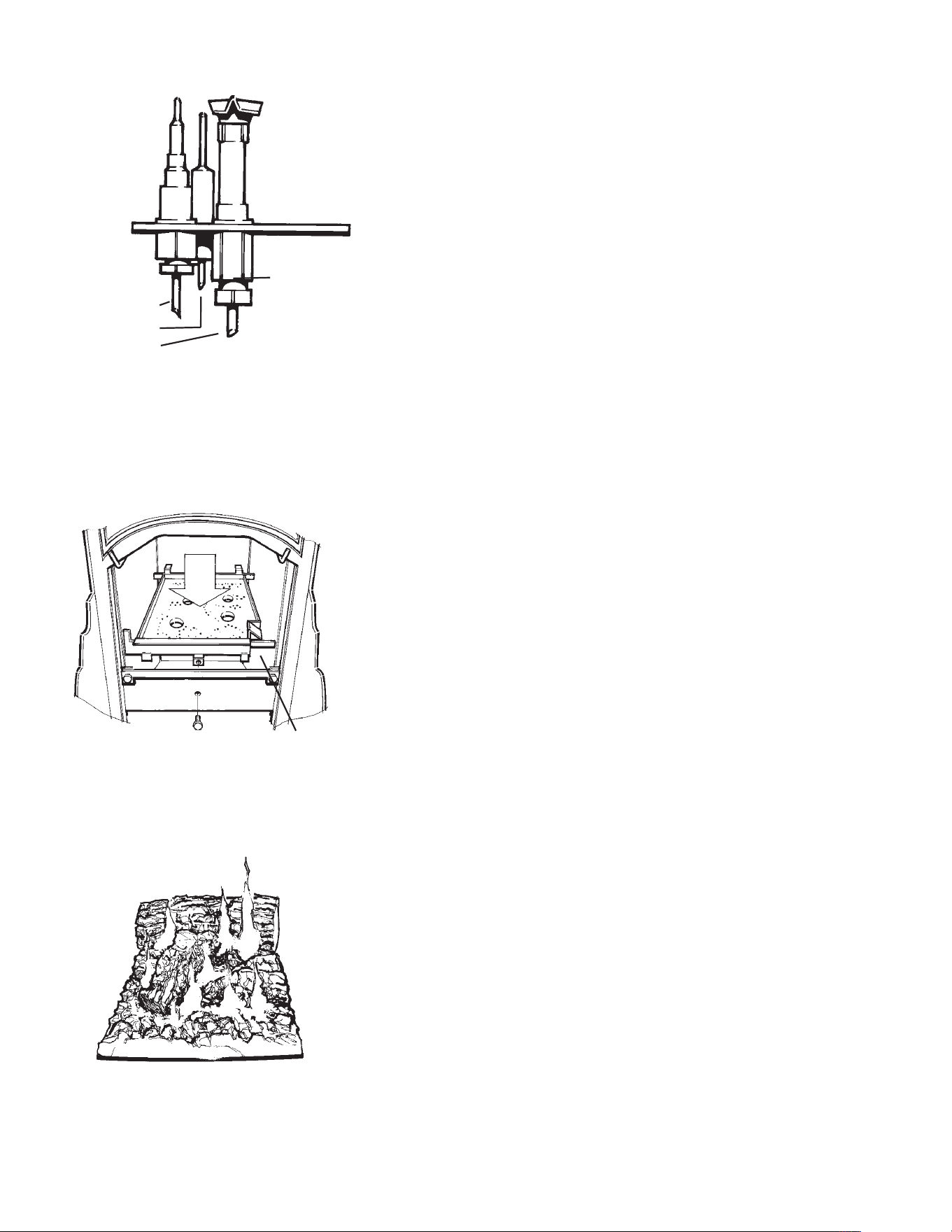
Illustration 15.4 The pilot assembly
is located on the right side of the
firebox.
Thermocouple
Spark Electrode
Pilot
Illustration 15.5 When the pilot is
lit, the flame will be clearly visible
at the right side of the firebox,
beneath the right side of the
burner pan.
Illustration 15.6 After the fire has
burned for 15 minutes the flames
should be evenly distributed and
have a mostly yellow appearance.
Pilot
------------------------------------------------------------------------------------------------------------------------------------------------------------------------------------------------------ 22
--------------------------------------------------------------------------------------------------------------------------------------------------------------------------Safety Instructions
WARNING: If you do not follow these instructions exactly, a fire or explosion may result causing
property damage, personal injury, or loss of life.
16. SAFETY INSTRUCTIONS
FOR YOUR SAFETY READ BEFORE OPERATING
A. This appliance has a pilot. When
lighting the pilot, follow these
instructions exactly.
B.
BEFORE OPERATING
smell all
around the appliance area for gas.
Be sure to smell next to the floor
because some gas is heavier than
air and will settle on the floor.
WHAT TO DO IF YOU SMELL GAS
• Do not try to light any gas appliance.
• Do not touch any electric switch; do
not use any phone in your building.
• Immediately call your gas supplier
from a neighbor’s phone. Follow the
gas supplier’s instructions.
• If you cannot reach your gas
supplier. Call the fire department.
C. Use only your hand to push in or
turn the gas control knob. Never use
tools. If the knob will not push in or
turn by hand, don’t try to repair it.
Call a qualified service technician.
Force or attempted repair may result
in a fire or explosion.
D. Do not use this appliance if any part
has been under water. Immediately
call a qualified service technician to
inspect the appliance and to replace
any part of the control system and
any gas control that has been under
water.
1. STOP! Read the safety information
on the panel above.
2. Push in gas control knob slightly
and turn clockwise to “OFF”.
NOTE: Knob cannot be turned from
“PILOT” to “OFF” unless knob is
pushed in slightly. Do not force.
3. Wait five (5) minutes to clear out
any gas. If you then smell gas.
STOP! Follow “B” in the safety
information above on this label. If
you don’t smell gas, go to the next
step.
4. Push gas control knob in
completely and turn
counterclockwise repeatedly
from “IGN” to “PILOT”. (audible
click)
5. Find pilot. The pilot is located
below the logset in the forward
right corner area of the firebox.
6. Continue to hold the control knob
in for about 10 seconds after the
pilot is lit. Release knob and it will
pop back up. Pilot should remain
lit. If it goes out, repeat steps 4
and 5.
* If knob does not pop up when
released, stop and immediately
call your service technician or gas
supplier.
* If the pilot will not stay lit after
several tries, turn the gas control
knob to “OFF” and call your
service technician or gas supplier.
7. Turn gas control knob counter
clockwise to ON, turn flame
adjustment knob counter
clockwise until flames appear.
TO TURN OFF GAS TO APPLIANCE
Push in gas control knob slightly
and turn clockwise to
“OFF.”
NOTE: Knob cannot be turned from
“PILOT” to ‘OFF” unless knob is
pushed in slightly. Do not force.
Turn manual gas supply valve off if
stove will not be used for an
extended length of time.
Pilot
Burner
Assembly
Pilot
Gas control knob
Gas control
knob
Flame adjustment
knob
Flame adjustment knob
LIGHTING INSTRUCTIONS
------------------------------------------------------------------------------------------------------------------------------------------------------------------------------------------------------ 23
-------------------------------------------------------------------------------------------------------------------------------------------------------------------------- Optional Controls
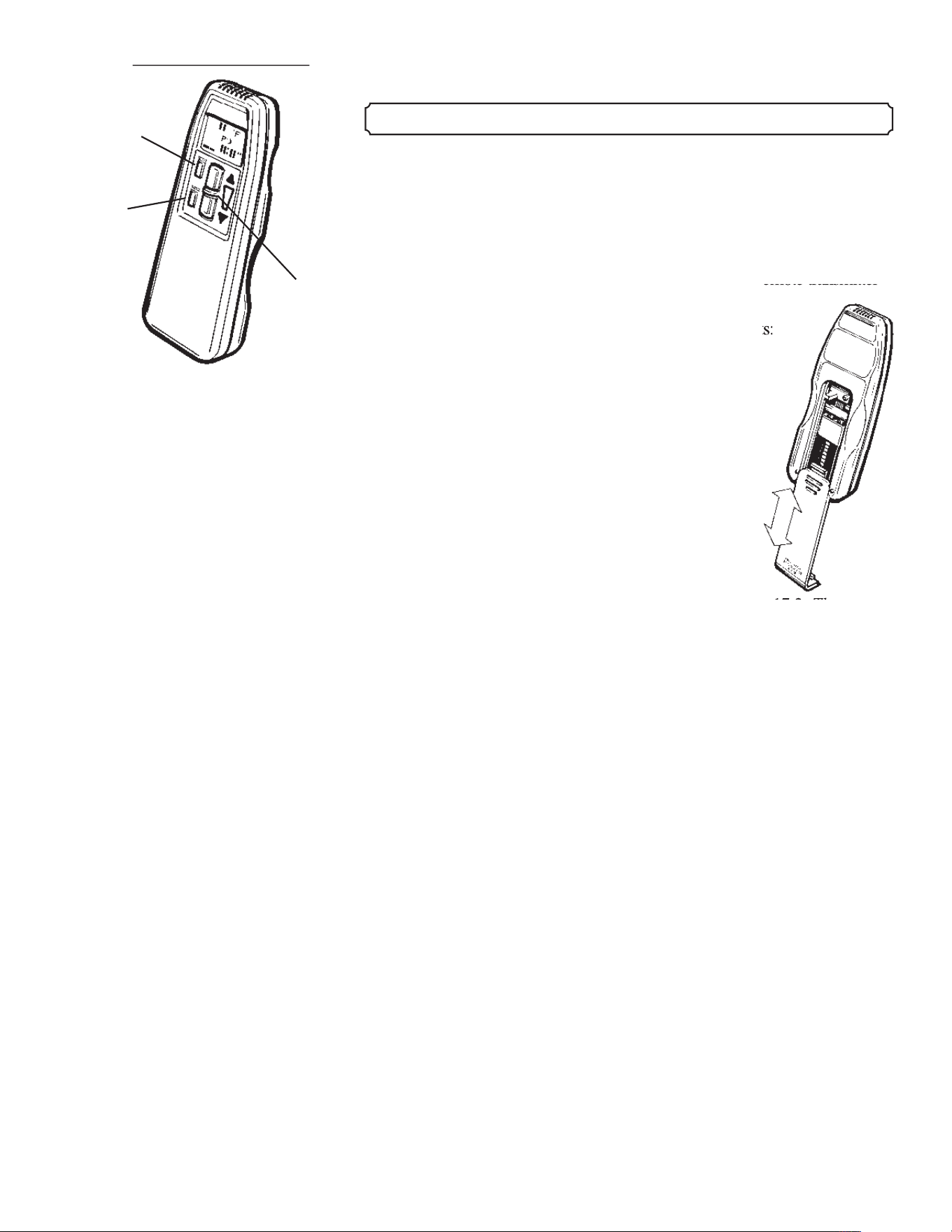
THE REMOTE TRANSMITTER HAS THE FOLLOWING FEATURES:
Main Control Pad
“ON-OFF” “HI-LO” buttons
Mode indicators
Ambient temperature read out
Thermostat temperature setting
Clock
Timer
Battery condition
Detailed instructions for setting and operating the remote control unit are located under the sliding cover on the
back of the transmitter. The 9V battery is also located under the cover. Further instructions are included from
the manufacturer.
A wiring diagram for installation can be found on page 36 in
this manual. (See Appendix B, page 36)
The Remote Receiver must be installed in order to operate the Fireplace using a Remote Transmitter.
Once the remote control receiver has been wired into the control valve, and the transmitter has been
properly set it can be used to control the stove in several ways.
-Flame adjustment - the height of the flames can be adjusted up and down using the large buttons on the
transmitter. This will regulate the heat output of the stove. If the flame is adjusted to the minimum the
main burner flame will be extinguished. The burner will re-ignite when the flame adjustment is increased.
- As a thermostat - A specific temperature can be maintained automatically using the remote control unit.
Once a desired temperature has been set in the transmitter the stove will automatically cycle on and off
and/or adjust flame height to maintain it.
-As a timer - specific on and off times can be pre-set in the transmitter and will be maintained in this mode.
NOTE: If either set of batteries fail in the Transmitter or Receiver the Remote Transmitter will
not function.
17. REMOTE CONTROL
Illustration 17.1 The remote
transmitter controls flame height,
and acts as a thermostat.
ON/OFF
Switch
UP/DOWN
Thermostat
Control
Buttons
Auto
Timer
Illustration 17.2 The
transmitter battery (9V) and
programming instructions are
under the sliding cover.
REMOTE CONTROL UNIT
The Cottage Franklin gas stove is available with an optional remote
control. The remote can adjust flame height, turn the main burner on and
off when pilot is lit, as well as function as a timer or thermostat for your
stove.
The remote control unit has two main components, a remote transmitter
(see diagram 17.1) and a receiver.
The battery operated remote control has two main parts:
1. The Remote Transmitter
(1- 9 volt battery)
2. The Remote Receiver
(4 AA batteries)
To light the main burner with the optional remote:
Confirm the pilot is lit. If not lit, follow
instructions for lighting pilot on page 19.
Turn the right gas control knob counter
clockwise to the ON position.
Use the flame adjustment button on the
remote to increase gas flow until flames
appear. If flames appear immediately
when the gas control knob is turned to
the ON position the remote can then be
used to control the flame height and turn
the burner On or OFF with the large
flame adjustment buttons.
Check that the flames are evenly
distributed. They will be mostly blue
for the first 15 minutes and then will
change to yellow/orange. There may
be a slight amount of condensation on
the glass. This will disappear when the
fireplace heats up.
Flame height can be controlled manually at
the control panel using the left knob; or on
with the optional remote control.
If this is the first time you have burned
your new fireplace for any length of time,
you may smell the fireplace paint curing. This is normal and will go away within a few hours.
SHUTTING THE FIRE OFF FOR REMOTE CONTROL OWNERS
You may use any one of the following methods to shut the fire off:
To turn the burner off using the remote simply adjust the flame to the minimum until it is
extinguished. To turn off the pilot as well as the main burner, the gas control knob must be
pushed in and turned from the ON position through PILOT to OFF. If the stove will not be used
for any length of time, it is a good idea to shut off the valve on the gas supply line. This turns off
the burner, pilot, and gas supply.
-------------------------------------------------------------------------------------------------------------------------------------------------------------------------------------------------------24
-------------------------------------------------------------------------------------------------------------------------------------------------------------------------- Optional Controls
Remote receiver
Gas control
valve
CAUTION: If the batteries fail in either your Remote Transmitter or the Remote Receiver, the
Fireplace will continue doing whatever it was doing when the batteries failed. If it was burning, it will
continue burning until you manually turn it off. If it was off, it will remain off. There is no immediate
danger in this situation. You could come home to either a very warm house or, if the Fireplace is your
sole source of heat, a very cold house which offers the eventual danger of frozen water pipes.
Illustration 17.3 Remote
Receiver Wiring
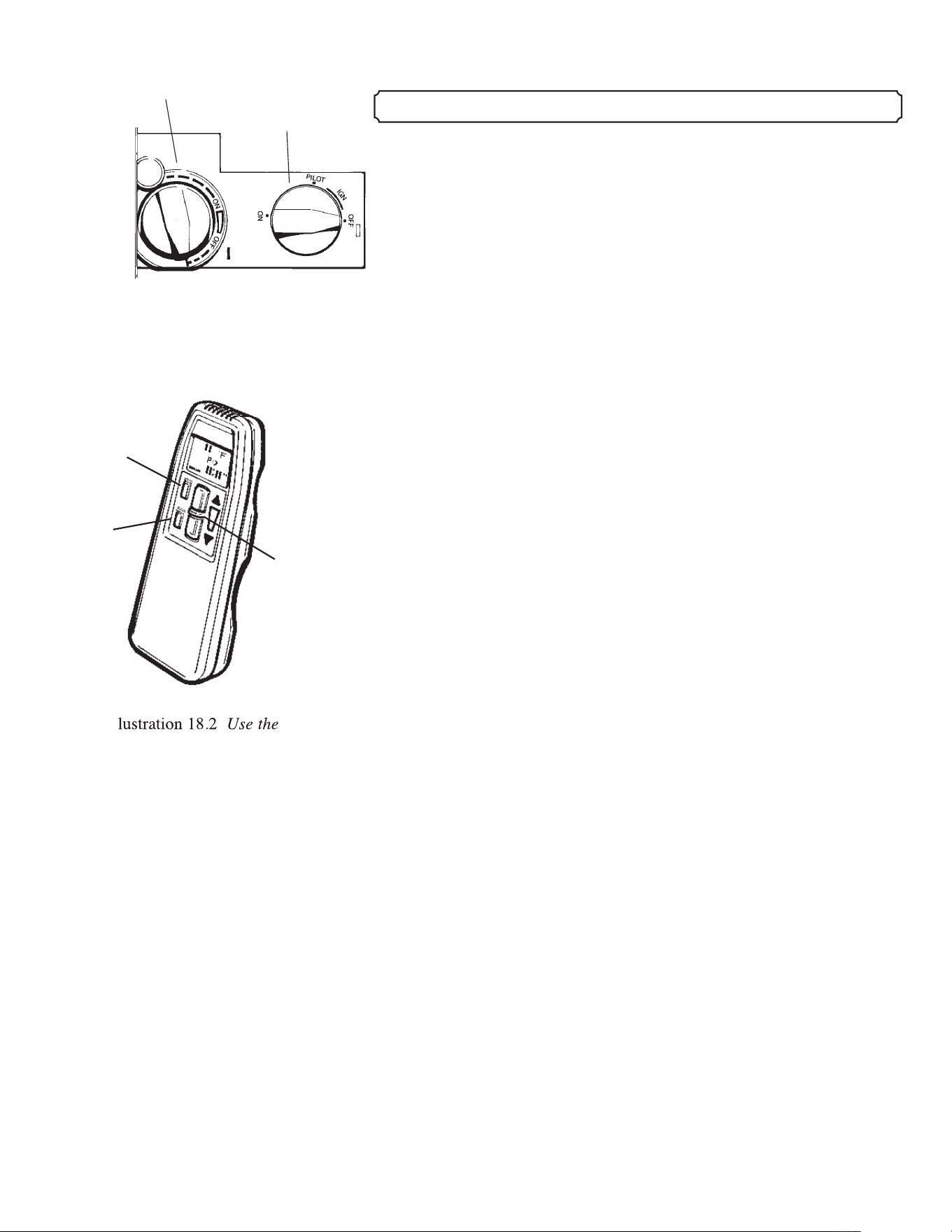
Illustration 18.1 To light
the main burner with the
remote the pilot must be lit
and the gas control knob
turned to ON.
Illustration 18.2 Use the
large buttons to turn the
main burner ON or OFF
and control flame height.
--------------------------------------------------------------------------------------------------------------------------- Lighting the Fire for Remote Control Owners
Before performing any maintenance, turn the gas control knob to
the “off” position. This will extinguish both the fire and the pilot
flame. Wait until the Fireplace is cold before cleaning.
CLEANING THE EXTERIOR CAST IRON OR SOAPSTONE
The metal and soapstone exterior of the Cottage Franklin Gas
Stove may be cleaned with a damp cloth. Any scratches on the
soapstone surface may be removed with number 000 or 0000 steel
wool. If you polish the surface of the soapstone, remove the dust
with a vacuum cleaner rather than a damp cloth.
CHECK THE PILOT FLAME AND GAS LOG FLAMES
PERIODICALLY
The flame pattern should resemble the pattern in diagram 19.1.
One of the pilot flames should hit the thermocouple and the middle
flame should angle up toward the main burner pan at the right front
corner. Black carbon deposits on the logset are common, especially
in LP burning stoves. Excessive loose build-up may have an impact
on flame appearance. See “Cleaning the inside of the firebox” for
cleaning instructions.
CLEANING THE GLASS
Do not clean the glass when it is hot. Always allow it to cool to
room temperature.
It will be necessary to clean the ceramic glass occasionally. It is
normal for condensation to form on the inside of the glass during a
cold start-up. Sometimes dust or lint clings to the condensation.
Residue from the initial paint curing inside the firebox can also
leave a residue on the inside of the glass.
We recommend that you clean the glass after the first couple
weeks of use. After the initial cleaning, the inside of the glass
should require cleaning no more than once or twice a year.
To clean the glass, use a mild glass cleaner and a soft cloth. Do
not use abrasive cleaners. Lift the front casting up, and pull the
bottom of the casting out from the Fireplace. Remove the glass front
by rotating the two spring loaded clips that hold the frame in place.
WARNING: Do not strike the glass front. Do not operate
the Cottage Franklin Gas Stove with the glass front removed,
cracked, or broken. Replacement of the glass front should be
done by a licensed or qualified person. Do not use substitute
------------------------------------------------------------------------------------------------------------------------------------------------------------------------------------------------------ 25
18. LIGHTING THE FIRE FOR REMOTE CONTROL OWNERS
ON/OFF
Switch
Flame control
Auto
Timer
Gas control
knob
Flame adjustment
knob
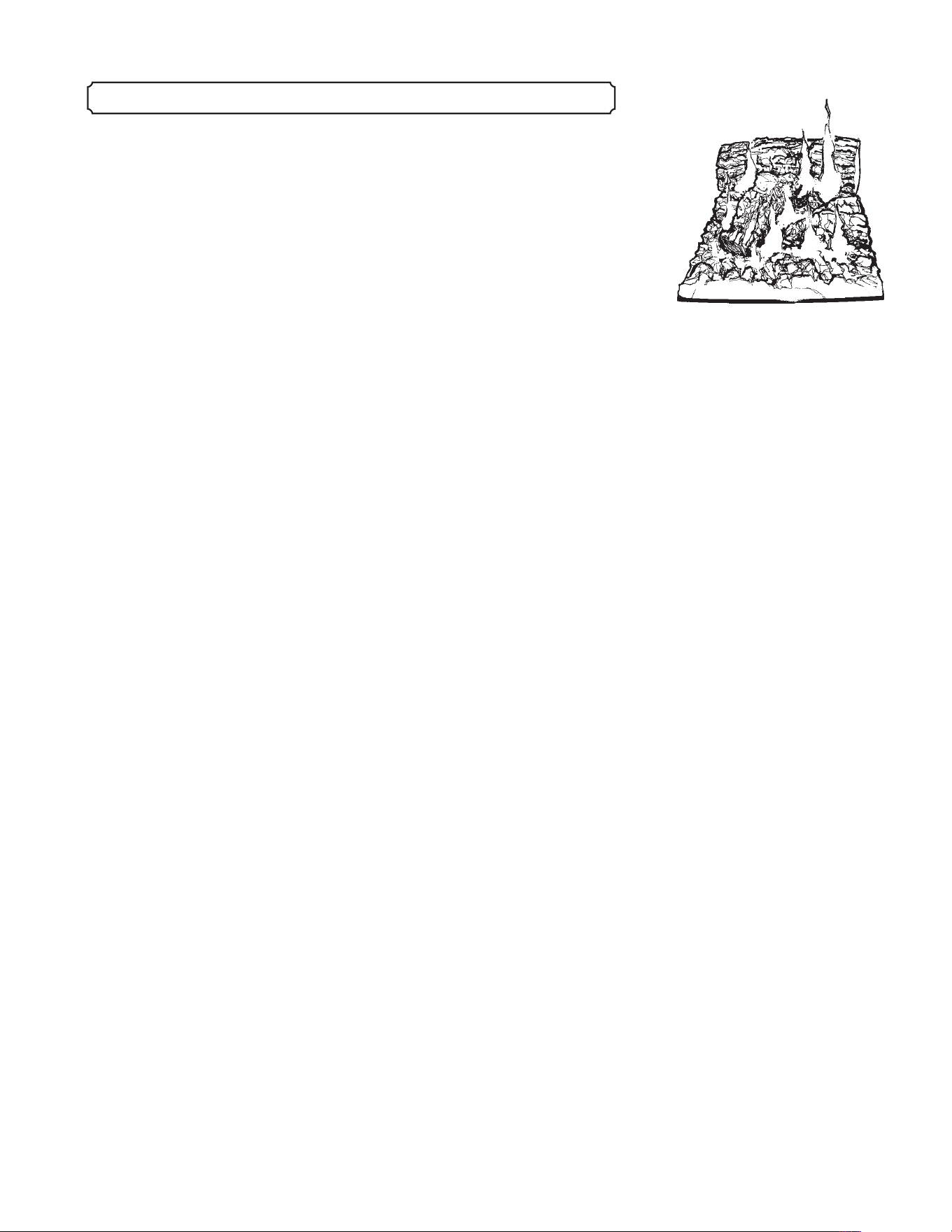
materials when replacing the front glass and frame assembly.
Use only the correct Woodstock Soapstone Company part
#G-140E Robax Ceramic Glass/Frame Assembly.
If the ceramic front glass becomes cracked or damaged, follow
the instructions below to remove the frame and damaged glass
INSTRUCTIONS TO REMOVE OR REPLACE GLASS FRONT:
The glass front on the Franklin Gas Stove consists of a fully gasketed
piece of ceramic glass, fastened with refractory adhesive to a steel
frame. To replace the glass front and frame:
(1)Remove the front casting. Lift up the front casting, and swing the
bottom out. (See illustration 19.2.)
(2)Pull and twist 2 spring-loaded clips to release pressure on glass
frame. (See illustration 19.3.)
(3) Lift frame and glass out of Glass Window Retainer.
(4) Insert new or replacement frame and glass into Glass Window
retainer. The Glass Frame will line up with the edge of the Firebox
Frame. Keep the edges properly aligned to achieve the best seal.
(5) Pull and twist 2 spring-loaded clips to clamp glass frame in place.
This will compress the gasketing all the way around the glass,
making a tight seal between the glass front and the firebox.
(6) Replace front casting. Slide top tab up under the top frame, and then
swing the bottom in behind the arched retaining rail.
CLEANING THE INSIDE OF THE FIREBOX
The firebox should be cleaned annually. Follow these steps:
1. Turn off gas supply.
2. Remove glass front (See illustration 19.2.).
3. The logset and ceramic tile are extremely fragile and must be
handled with care. A soft bristle brush may be used delicately
to remove any dust or lint or loose black carbon deposits which
may accumulate. Do not use a vacuum on the logset or tile.
Remove both, then use a vacuum to clean the burner pan. (See
illustration 19.4.)
4. Vacuum the inside of the firebox thoroughly.
5. Check that all gas ports are clear.
6. If glass needs cleaning, use regular glass cleaner or, for
stubborn film, oven cleaner. Do not use abrasive cleaners.
Never clean the glass when the glass is hot.
7. Replace log set and glass.
------------------------------------------------------------------------------------------------------------------------------------------------------------------------------------------------------ 26
-------------------------------------------------------------------------------------------------------------------------------------------------------------------- Routine Maintenance
19. ROUTINE MAINTENANCE
Illustration 19.1 When the burner
is clean and the Fireplace is
operating properly, the flame
pattern will look approximately
like the drawing above.
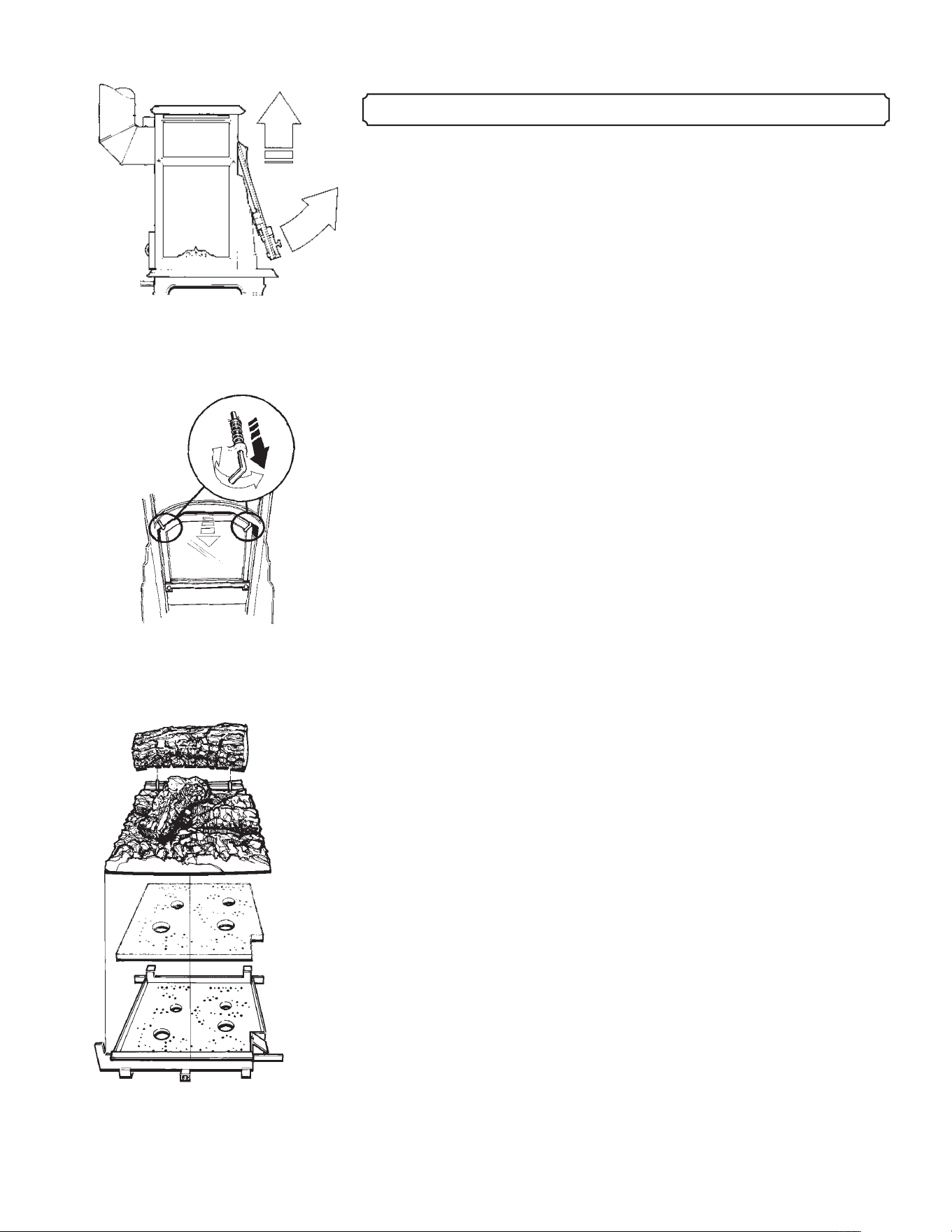
------------------------------------------------------------------------------------------------------------------------------------------------------------------------------------------------------ 27
Illustration 19.2 To remove the
front casting, lift straight up under
the lip that extends over the top of
the glass. This assembly includes
the swinging door.
Illustration 19.3 The glass front is
held in place by two spring-loaded
clips. To release the clips, pull and
twist.
Illustration 19.4 .
Ceramic tile and Logset are
fragile. Please handle with care
while installing and cleaning.
Log
Base
Tile
Burner Pan
--------------------------------------------------------------------------------------------------------------------------------------------------------------- Routine Maintenance
ANNUAL INSPECTION
The Cottage Franklin Gas Stove and venting system should be
inspected before use, and at least annually by a qualified field
service person to ensure that the flow of combustion and ventilation
air is not obstructed, the venting components are in good condition,
and that the appliance is working properly.
The technician should inspect and ensure that the lighting of the
main burner occurs within 4 seconds of the main gas valve opening.
Visual inspection should match that outlined in Illustration 20.1.
The technician should also check all gas tubes, connections, pipes
and other components for leaks.
Annual Burner and Pilot Inspection and Cleaning
A qualified service technician should clean the burner and pilot
annually. In order to properly clean the burner and pilot assembly,
you will have to turn off the gas supply to the appliance, and remove
the front casting, the glass front, the log set and ceramic tile to
expose the burner and pilot assembly.
Clean all foreign materials from the top of the burner and from the
pilot assembly with a soft brush or vacuum cleaner. Remove any
dust or lint. Check to be sure the burner and burner orifice are clean.
If the pilot orifice becomes plugged, disassembly may be required.
The technician should check to be sure that the flame safety
system works, and that the safety shutoff occurs within 30 seconds of
flame failure.
Annual Vent System Inspection
During the annual servicing, a qualified technician should inspect
the vent pipe to be sure that both the inside exhaust channel and the
outside air intake channel are clean and free of obstructions. All
parts should be checked for wear, corrosion, or deterioration. At the
end of inspection the venting components should be reassembled and
re-sealed according the the Simpson Dura-Vent instructions.
Annual Pressure Relief Lid Inspection
Visually inspect that the pressure relief lid located over the
firebox. Physically lift upward on the pressure relief lid found at the
top of the firebox to insure that it can move freely. Make sure it
reseats properly when you release it.
Annual Glass Cleaning
Clean the glass window with a suitable fireplace glass cleaner.
Abrasive cleaners must not be used. Be careful not to scratch the
glass when cleaning.
20. ANNUAL INSPECTION

------------------------------------------------------------------------------------------------------------------------------------------------------------------------------------------------------ 28
---------------------------------------------------------------------------------------------------------------------------------------------------------------------------------------- Warranty
Your Woodstock Soapstone Gas Fireplace has been carefully tested
and inspected prior to shipment to you. We take pride in every
Fireplace we build but our greatest satisfaction comes from our
customers' continued happiness with their Woodstock Soapstone
Stoves. In addition to this limited warranty, you have our assurance that
we will be here to assist you in the installation, operation and
maintenance of your Woodstock Soapstone Stove for the life of the
Fireplace. Our customer service team is always happy to answer your
questions.
Should you discover a defect, please call us for instruction about
return and replacement of the defective part. We will replace free of
cost any part that is defective in material or workmanship for one year
from date of shipment. If you take delivery during the late spring or
summer, we will extend the warranty start date to Thanksgiving of that
year. If you find that you will be starting up your Fireplace later than
Thanksgiving, please let us know by calling or writing us and giving us
your projected installation and start up date. We will then confirm to
you, in writing, an extended warranty expiration date.
We further warrant that each Fireplace is exactly as we have
represented
it. If you are not completely satisfied with the appearance,
quality or performance of your Fireplace, you may return it within 6
months of delivery.
If your Fireplace is shipped by common carrier, it is insured against
damage in transit. We will repair or replace any Fireplace damaged in
transit. Please inspect your Fireplace carefully on receipt and report any
damage to us within three days of receipt.
This Warranty does not cover damage caused by abuse or neglect or
if your Fireplace was installed or used contrary to the instructions in
your owner's manual.
Woodstock Soapstone Company employees have no authority to
offer any warranty or remedy that varies from those covered here. This
Warranty is not transferable.
Woodstock Soapstone Company will not be liable for incidental and
consequential damages. (This may not apply to you if you live in a
state that does not allow the exclusion of incidental and consequential
damages).
This warranty gives you specific legal rights. You may have other
rights which vary from state to state.
This limited warranty is in strict accordance with the Moss-
Magnuson Warranty Act
22. WARRANTY

------------------------------------------------------------------------------------------------------------------------------------------------------------------------------------------------------ 29
21. TROUBLESHOOTING – OWNER
These are troubleshooting problems you could check before calling a technician. If these do not work,
you must call in a qualified gas technician
PROBLEM SOLUTION
• Pilot will not light even though gas
control knob has been depressed and
turned repeatedly. Wait five minutes
for gas to dissipate, then do the
following before retrying
• Pilot will not stay lit when first trying
to light it
• Burner refuses to light, pilot is
working
• Burner flame too low
• Glass has white residue on inside
1. Confirm that you are following the pilot lighting
instructions on page 21.
2. Make certain that gas supply is turned on.
3. If you are using propane, make sure tank is not too low.
(Under 20%)
4. Verify the ignitor wire is properly connected and
undamaged.
5. The ignitor spark may be checked visually at the right
front of the firebox with the logset removed.
1. Gas control knob not held down long enough for
thermocouple to heat up to keep pilot gas valve
turned on. (About 10 seconds after being lit)
2. Pilot gas knob not fully depressed
1. Turn left flame adjustment knob counterclockwise until
flames appear.
2. Be sure temperature set in remote control is higher than
room temperature; adjust flame height with remote or
flame adjustment knob.
3. If options 1 and 2 have been checked turn off the pilot
immediately. Orifice or manifold may be obstructed. Turn
the left flame adjustment knob to “off” and call a
qualified technician to remove either part and clear
obstruction.
1. Flame adjustment knob set at “LO”, Turn knob counter
clockwise to increase.
2. Check vent pipe for possible blockage or loose
connections.
3. Call a qualified technician to check gas pressures.
1. Usual causes are contaminants in the combustion air.
Contaminants (called aldehydes) could be from garden
fertilizers or sprays, paint, any dust that is combustible.
-------------------------------------------------------------------------------------------------------------------------------------------------------------- Troubleshooting - Owner

------------------------------------------------------------------------------------------------------------------------------------------------------------------------------------------------------ 30
-------------------------------------------------------------------------------------------------------------------------------------------------------------- Troubleshooting - Owner
PROBLEM SOLUTION
• Glass has white residue on inside
(continued)
• Glass has brown residue inside
• Pungent odor
• Soot accumulating up on walls or
furniture
• If you have a Carbon Monoxide (CO)
sensor alarm, and it sounds
2. Contaminants from paints or sealants used in
manufacturing the Fireplace.
1. Over long periods of time (months), this may occur if
you are burning LP gas because it has more impurities
than natural gas. You will need to clean the glass more
often.
2. This can result rapidly if the flame is not properly
adjusted or there are other conditions that generate soot.
Adjustments should be made by a service technician.
1. Confirm pressure relief lids on top of and at the rear of
firebox are properly seated.
2. Partial burning of aldehydes (See “Glass has white
residue...” immediately above).
3. This condition means that carbon monoxide is present.
4. Call gas technician to check gas connection and
installation.
Note: During the first few days of operation, there will be
an odor generated by the curing process. This is normal
and will abate.
1. Your gas Fireplace and venting system are sealed so
that it is virtually impossible for soot to come from
them. The most common source for this complaint turns
out to be from burning candles.
2. If you do not ever burn candles or do not have other
open flames, check for the presence of soot in your
Fireplace's firebox. If there is, look for a gasket leak
around the glass or where the vent pipe exits the
Fireplace. If there is a leak, there would likely be soot
evident in the area of the leak.
1. Incomplete or interrupted combustion of aldehydes
a.Ventilate room until aldehydes are all burned off, that
is, until the pungent odor is gone.
b. A gas technician should check gas connection and
installation.
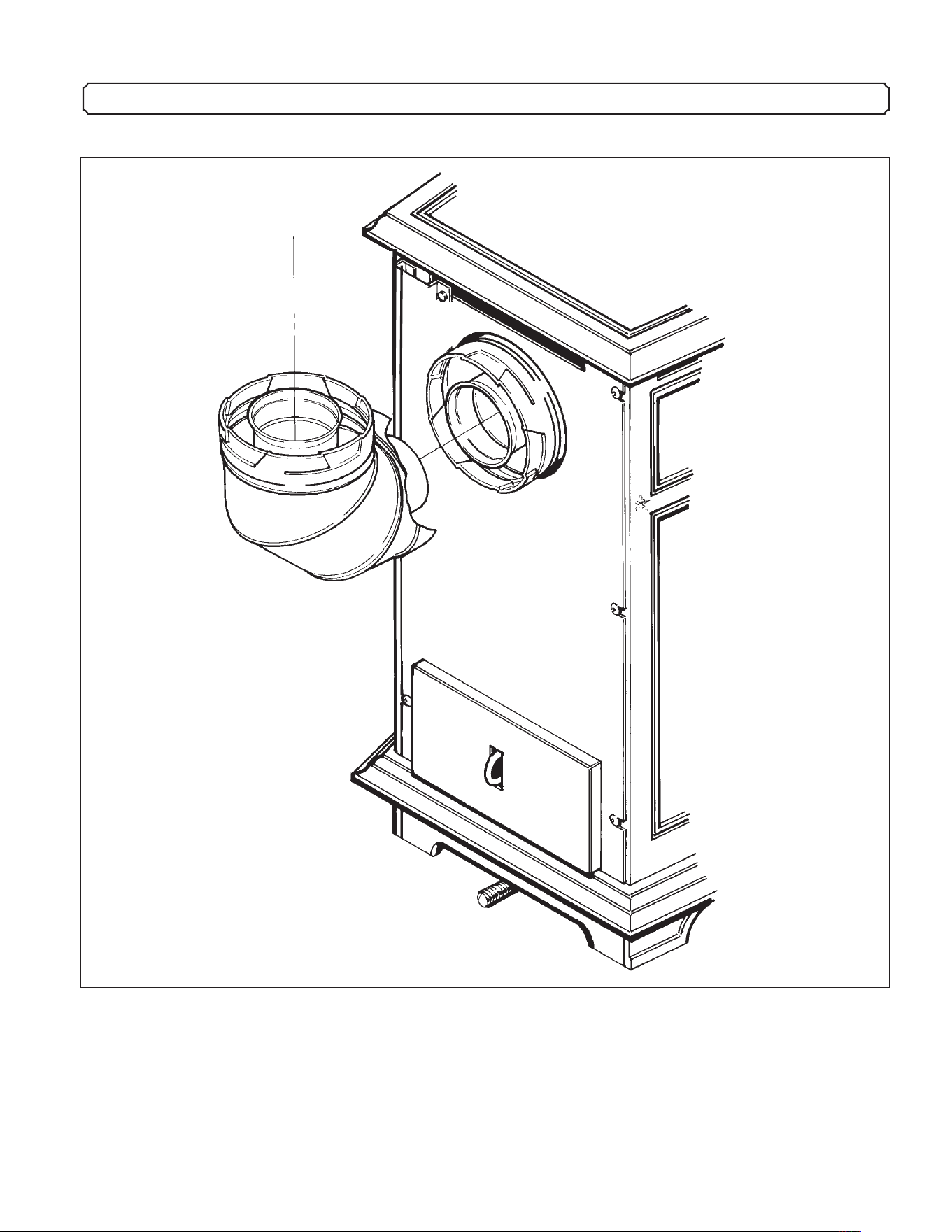
-------------------------------------------------------------------------------------------------------------------------------------------------------------------------------------- Appendix A
APPENDIX A. PARTS LIST AND REAR EXPLODED VIEW DIAGRAM
------------------------------------------------------------------------------------------------------------------------------------------------------------------------------------------------------ 33

STONE
G-230 Top Stone
G-231a Front Top Stone
G-231b Front Bottom Stone
G-232a Side Top Stone
G-232b Side Bottom Stone
CAST IRON
G-101 Right Side Wall
G-102 Left Side Wall
G-103 Front Top
G-104 Top
G-105 Base
G-106 Front Skirt
G-107 Left Skirt
G-108 Right Skirt
G-109 Front Frame
G-110 Door
G-111 Firebox Front
G-112 Exhaust Baffle
G-113 Heat Baffle
G-114 Baffle Rail - 1
G-115 Baffle Rail – 2
G-116 Exhaust Baffle Wing
G-117 Left Firebox Support
G-120 Right Firebox Support
W-221 Door Knob
SHEET METAL
G-118 Top Relief Cover
G-119 Back Relief Cover
G-241 Firebox
G-242 Control Valve Support Bracket (Maxitrol)
G-243 Control Valve Name Plate (Maxitrol)
G-246 Window Frame
G-247 Bottom Window Rail
G-248 Top Window Clip
G-249 Front Retainer
G-250 Rear Wall
G-251 Switch Mount Box
G-252 Bottom-Side Stone Strap
G-253 Front-Top Stone Strap
G-254 Front-Top Heat Shield
G-255 Front-Bottom Heat Shield
G-256 Side Heat Shield
G-257 Top Heat Shield
G-258 Firebox Bottom Heat Shield
G-260 Burner (w/Venturi Tube)
G-263 Manifold Tube (Maxitrol)
G-269a LP Bulkhead Orifice
G-269b NG Bulkhead Orifice
W-2408 Stainless Steel Hinge
MISCELLANEOUS
G-262 Protective Screen
G-67a 3/8 Compression Nut w/ Ferrule
G-98 1/2 SS Appliance Connector 12” Long
G-90 6.63” Flue Adapter
G-91 Tile for Burner
G-140 Glass
G-270 LP Controller w/ Ignitor Wire
G-271 NG Controller w/ Ignitor Wire
G-272 LP Pilot (PSE)
G-273 NG Pilot (PSE)
G-275 Black Cover for Controller w/ Micro-Switch
G-277 Connection Cable
G-279 Battery Holder
G-294 Oval Plate
W-2406 Door Magnet
GASKET
W-1602 Window Gasket
W-1607a 3/16” Gasket
W-1608a 1/4” Gasket
W-1609a 5/16” Gasket
W-1603 KWAL Gasket
ACCESSORIES
G-475 Remote Control (Maxitrol)
G-476 Connecting Cable for Remote
Parts List
Cottage Franklin Direct Vent Fireplace WARNING: DO NOT use substitute materials.
---------------------------------------------------------------------------------------------------------------------------------------------------------------------------------------- Parts List
To order parts, or for
information about parts or
service, please contact:
Woodstock Soapstone Company, Inc.
66 Airpark Road
West Lebanon, NH 03784
Tel: 800-866-4344
Fax: 603-298-5958
------------------------------------------------------------------------------------------------------------------------------------------------------------------------------------------------------ 34
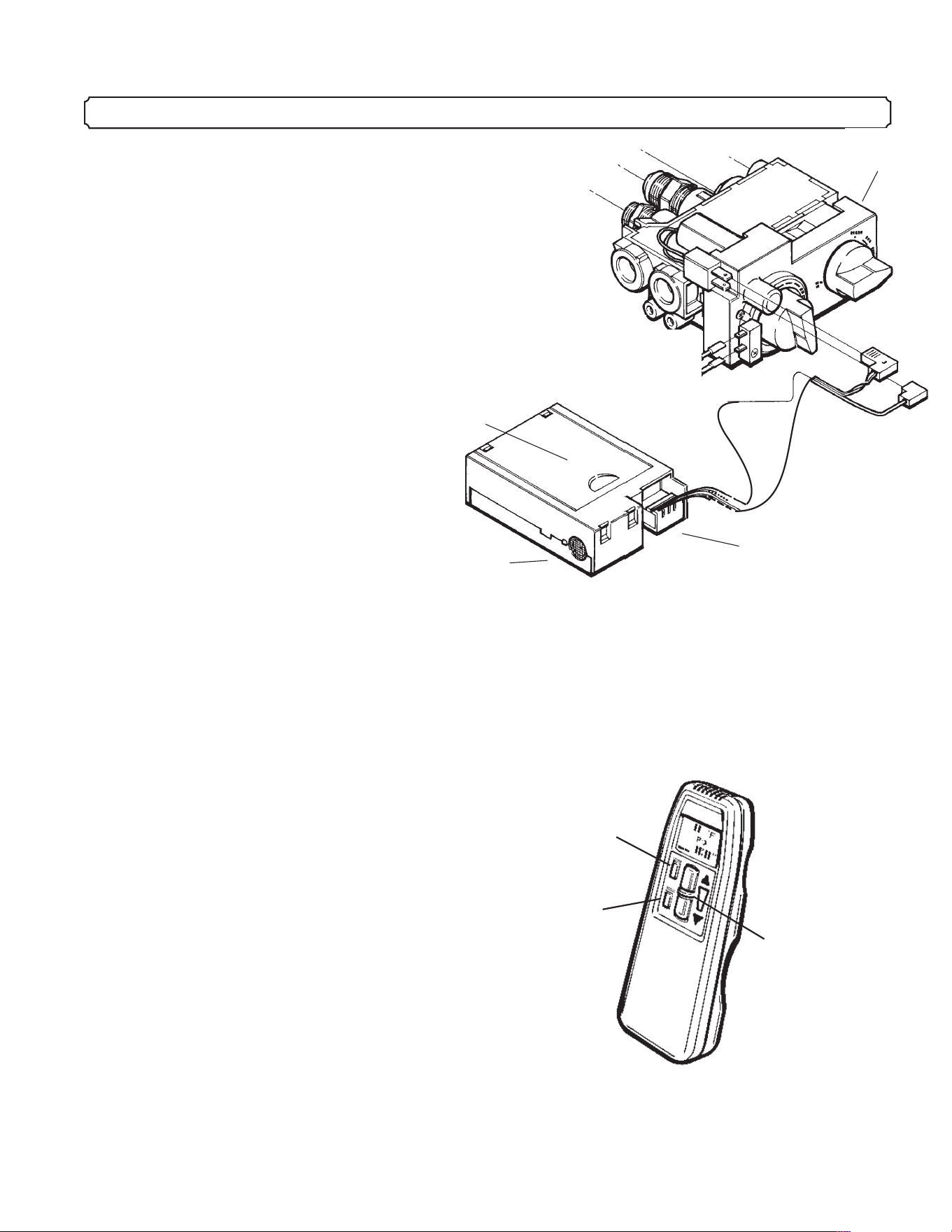
------------------------------------------------------------------------------------------------------------------------------------------------------------------------------------ Appendix B
INSTALLATION INSTRUCTIONS
FOR OPTIONAL REMOTE CONTROL
RECEIVER
If you choose the optional remote control unit,
installation is as easy as connecting the remote
receiver and installing batteries in the
transmitter and receiver. Note: Removal of
front casting will make installation easier.
Connecting the Remote Receiver:
The remote control unit consists of two
components: A) the remote transmitter
(requires one 9V battery); B) the remote
receiver (required four AA batteries).
Connection to the stove is made with a
wiring harness also included.
1) Remove the cover plate. To access the control
valve the metal plate covering the control
valve must be removed. Remove the two
bolts on either side of the gas control knobs.
Remove the plate and set aside. Consider
where you would like to place your receiver.
You will need to disconnect the large plug
from the receiver. Pass it through the front of
the stove, under it, and out to where the
receiver will be placed.
2) Connect the loose end of the wiring harness to
the control valve.
3) Connect the wiring harness to the receiver. The
wiring harness used to connect the receiver has
a large plastic plug on one end, and four
smaller connectors at the other. With the
sensor opening facing toward you at the right
end of the receiver, slide the large plastic plug
(wire side pointing up) firmly over the green
tab on the right side of the receiver. Note: Plug
will fit securely in only one position.
4) Install required batteries after all wire
connections have been made. The 9V battery
for the transmitter is placed under the sliding
cover on the back. There is also a battery
compartment under the sliding cover on the
receiver for the four AA batteries. Alkaline
batteries are recommended.
5) Test your remote. The green LED on the receiver
should light when a signal is received from the
transmitter. Try pressing the large flame
adjustment buttons on the transmitter. The left
flame adjustment knob on the control valve
should turn up or down as the buttons are
pressed.
If the LED does not light or the flame adjustment
knob does not turn when buttons are pressed
check all connections and/or battery strength.
The receiver sensor opening must be able to
receive sound waves, be sure it is not
obstructed.
6) Replace the control valve cover plate and front
casting.
APPENDIX B. WIRING DIAGRAM - REMOTE CONTROL UNIT
Remote receiver
Gas control
valve
Sensor
Battery
Compartment
ON/OFF
Switch
Flame control
Auto
Timer
Illustration 18.2 Use the large buttons to turn the
main burner ON or OFF and control flame height.
------------------------------------------------------------------------------------------------------------------------------------------------------------------------------------------------------- 35