Induction cooktop
Installation instructions
and User guide
CI604DT, CI754DT, and CI905DT models
NZ AU GB IE


1
Contents
Safety and warnings
2
Installation instructions
6
Introduction
12
Choosing the right cookware
14
Using your induction cooktop
15
Using your cooktop’s special features
18
Cooking guidelines
28
Care and cleaning
30
Troubleshooting
31
Warranty and service
33
Important!
SAVE THESE INSTRUCTIONS
The models shown in this user guide may not be available in all markets and are
subject to change at any time. For current details about model and specification
availability in your country, please visit our local website listed on the back cover
or contact your local Fisher & Paykel dealer.
2
Safety and warnings
Your safety is important to us. Please read this information before using your cooktop.
Installation
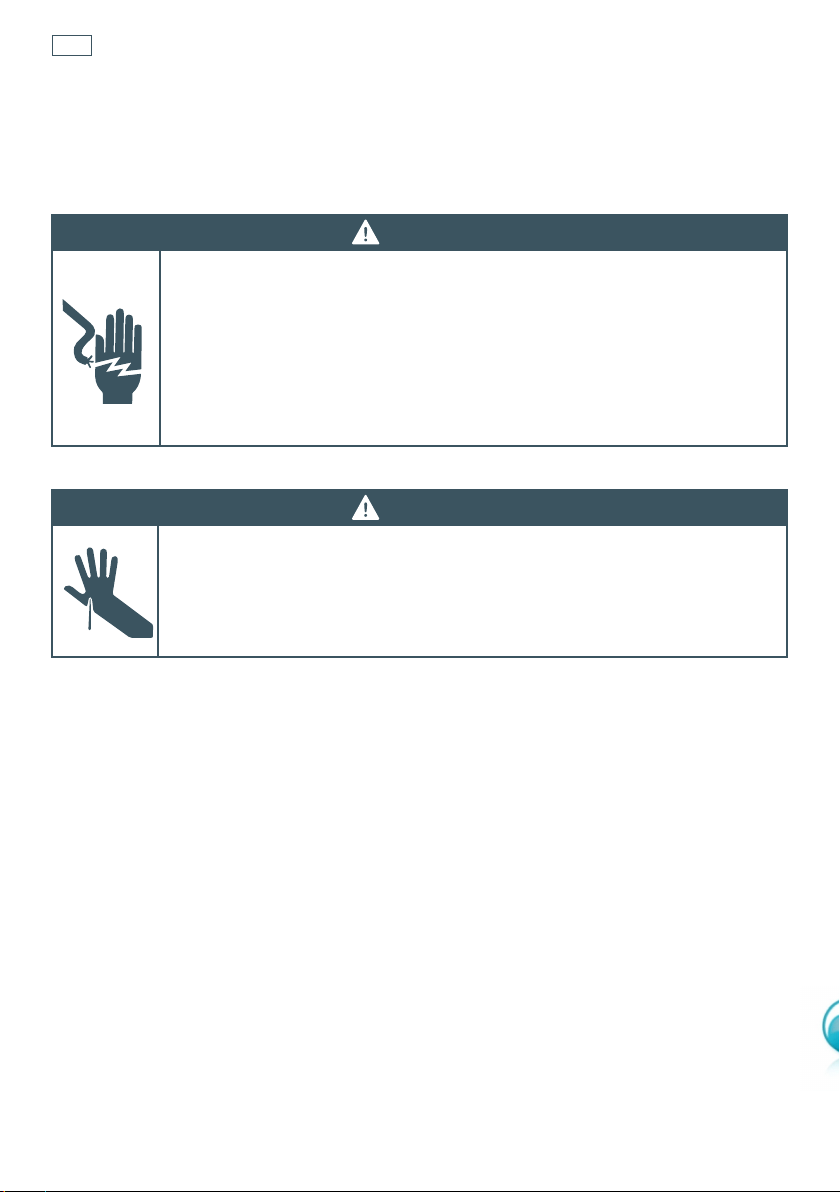
WARNING!
Electrical Shock Hazard
Disconnect the appliance from the mains electricity supply before carrying
out any work or maintenance on it.
Connection to a good earth wiring system is essential and mandatory.
Alterations to the domestic wiring system must only be made by a qualified
electrician.
Failure to follow this advice may result in electrical shock or death.
WARNING!
Cut Hazard
Take care - panel edges are sharp.
Failure to use caution could result in injury or cuts.

3
Safety and warnings
Important safety instructions
Read these instructions carefully before installing or using this appliance.
No combustible material or products should be placed on this appliance at any time.
Please make this information available to the person responsible for installing the appliance as it
could reduce your installation costs.
In order to avoid a hazard, this appliance must be installed according to these instructions for
installation.
This appliance is to be properly installed and earthed only by a suitably qualified person.
This appliance should be connected to a circuit which incorporates an isolating switch providing
full disconnection from the power supply.
Failure to install the appliance correctly could invalidate any warranty or liability claims.
4
Safety and warnings
Operation and maintenance
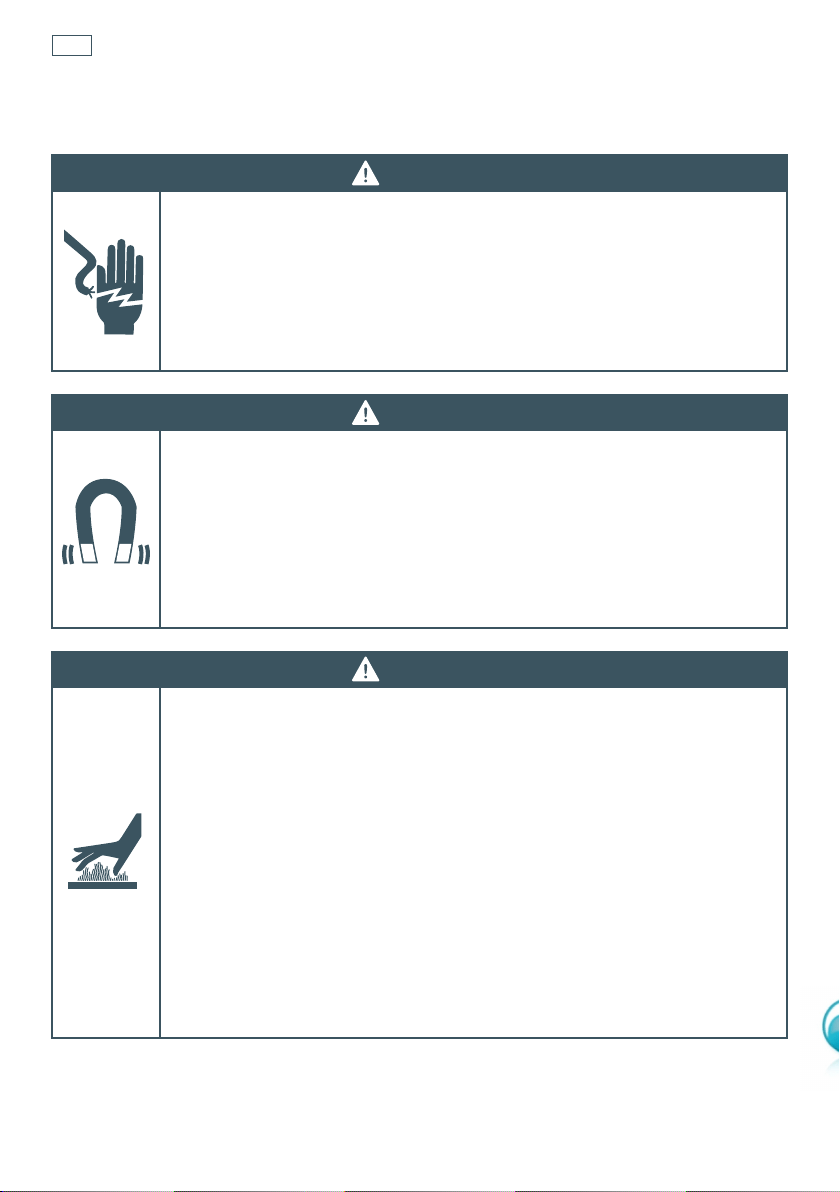
WARNING!
Hot Surface Hazard
During use, accessible parts of this appliance will become hot enough to
cause burns.
Do not let body, clothing or any item other than suitable cookware contact
with the ceramic glass until the surface is cool.
Never leave metal objects (such as kitchen utensils) or empty pans on the
cooktop as they can become hot very quickly.
Beware: magnetisable metal objects worn on the body may become hot in
the vicinity of the cooktop. Gold or silver jewellery will not be affected.
Keep children away.
Handles of saucepans may be hot to touch. Check saucepan handles do not
overhang other cooking zones that are on. Keep handles out of reach of
children.
Failure to follow this advice could result in burns and scalds.
WARNING!
Electrical Shock Hazard
Do not cook on a broken or cracked cooktop. If the cooktop surface should
break or crack, switch the appliance off immediately at the mains power
supply (wall switch) and contact a qualified technician.
Switch the cooktop off at the wall before cleaning or maintenance.
Failure to follow this advice may result in electrical shock or death.
WARNING!
Health Hazard
This appliance complies with electromagnetic safety standards.
However, persons with cardiac pacemakers or other electrical implants (such
as insulin pumps) must consult with their doctor or implant manufacturer
before using this appliance to make sure that their implants will not be
affected by the electromagnetic field.
Failure to follow this advice may result in death.

5
Important safety instructions
Never leave the appliance unattended when in use. Boilover causes smoking and greasy
spillovers that may ignite.
Never use your appliance as a work or storage surface.
Never leave any objects or utensils on the appliance.
Do not place or leave any magnetisable objects (eg credit cards, memory cards) or electronic
devices (eg computers, MP3 players) near the appliance, as they may be affected by its
electromagnetic field.
We recommend using plastic or wooden kitchen utensils for cooking with your induction cooktop.
Never use your appliance for warming or heating the room.
After use, always turn off the cooking zones and the cooktop as described in this manual (ie by
using the touch controls). Do not rely on the pan detection feature to turn off the cooking zones
when you remove the pans.
Do not allow children to play with the appliance or sit, stand, or climb on it.
Do not store items of interest to children in cabinets above the appliance. Children climbing on
the cooktop could be seriously injured.
Do not leave children alone or unattended in the area where the appliance is in use.
Children or persons with a disability which limits their ability to use the appliance should have a
responsible and competent person to instruct them in its use. The instructor should be satisfied
that they can use the appliance without danger to themselves or their surroundings.
Do not repair or replace any part of the appliance unless specifically recommended in the
manual. All other servicing should be done by a qualified technician.
Do not use a steam cleaner to clean your cooktop.
Do not place or drop heavy objects on your cooktop.
Do not stand on your cooktop.
Do not use pans with jagged edges or drag pans across the ceramic glass surface as this can
scratch the glass.
Do not use scourers or any other harsh/abrasive cleaning agents to clean your cooktop, as these
can scratch the ceramic glass.
If the power supply cable is damaged, it must only be replaced by a qualified technician.
Do not operate your cooktop by means of an external timer or separate remote-control system.
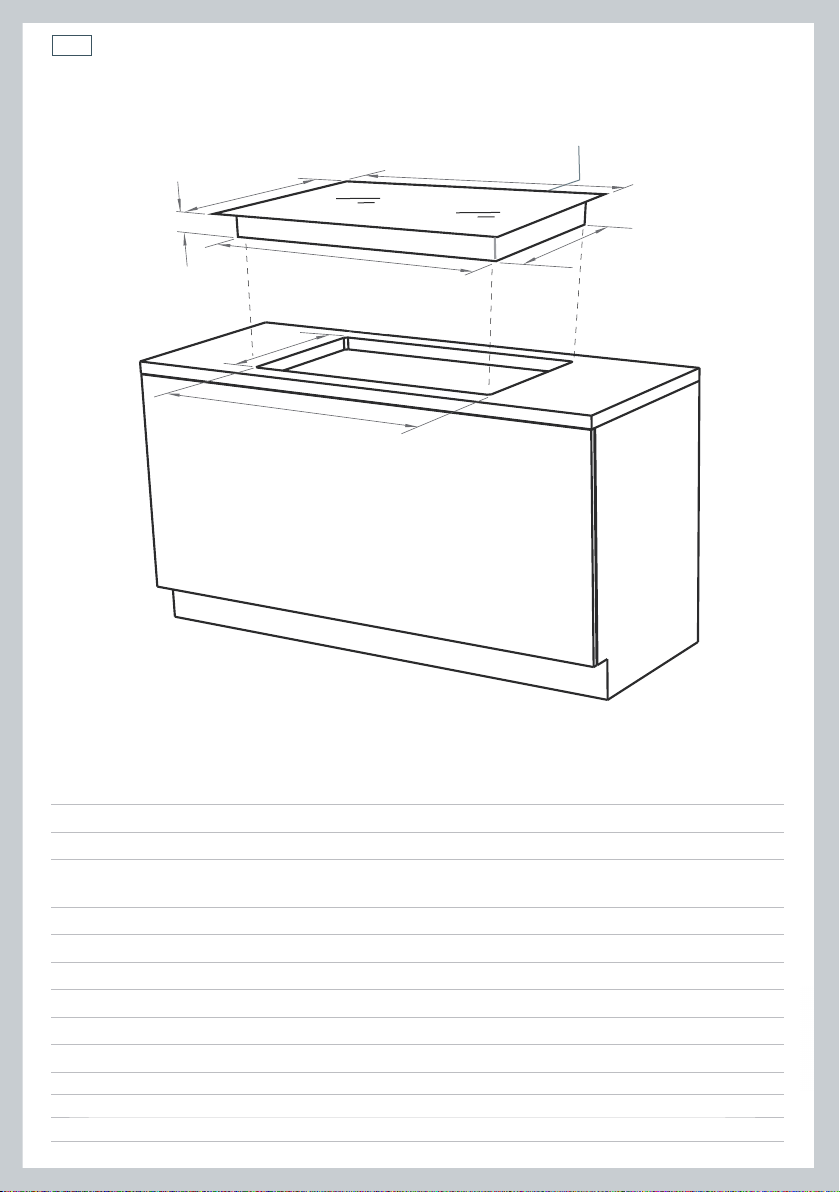
WARNING!
Cut Hazard
The razor-sharp blade of a cooktop scraper is exposed when the safety
cover is retracted. Use with extreme care and always store safely and out
of reach of children.
Failure to use caution could result in injury or cuts.
Safety and warnings
6
Installation instructions
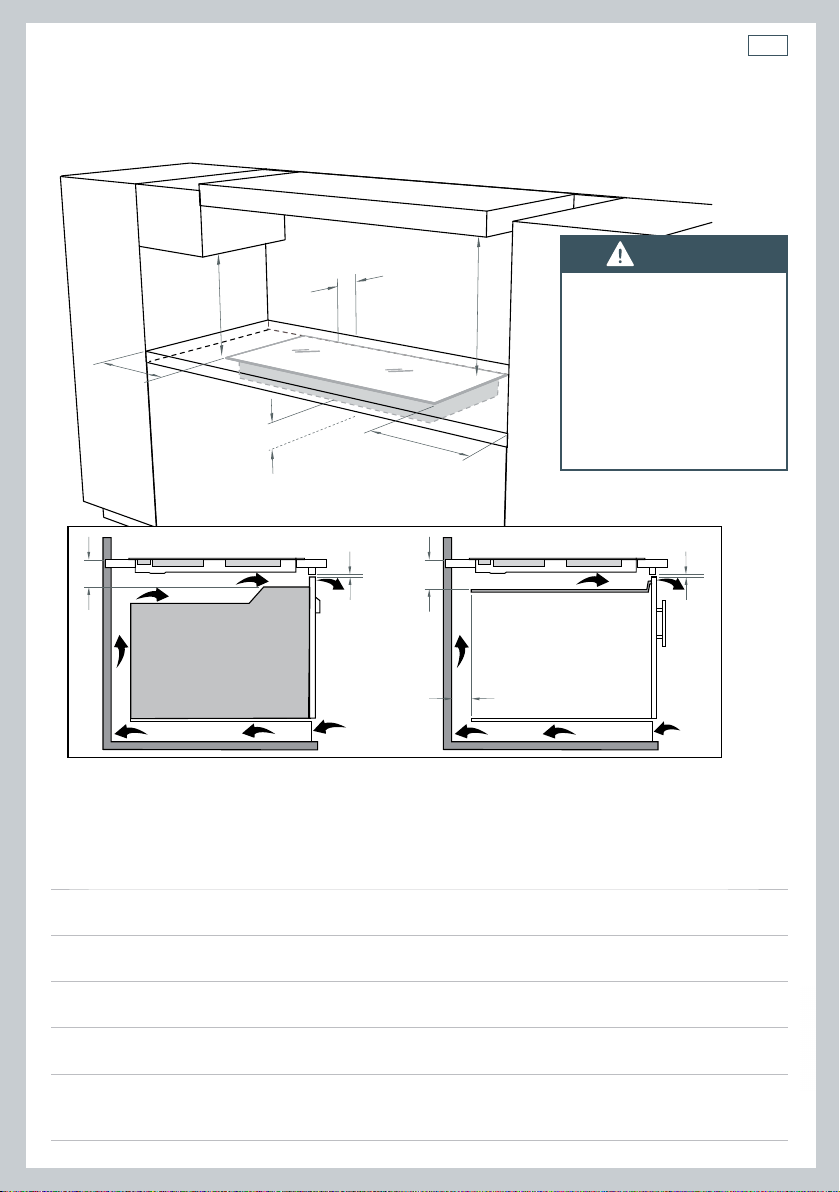
Cooktop and cutout dimensions
A
B
C
D
G
F
E
Cooktop and cutout dimensions (mm)
CI604DT
CI754DT
CI905DT
A
overall width of cooktop
600 750 900
B
overall depth of cooktop
530 530 530
C
height of chassis (plastic housing incl. terminal block)
below top of bench
50 50 50
D
width of chassis (metal frame)
546 716 852
E
depth of chassis (metal frame)
476 476 482
F
overall width of cutout
560 725 870
G
overall depth of cutout
490 490 494
Electrical connection is
made at the right rear
7
Installation instructions
500 x 50 mm
Oven with
cooling fan
500 x 10 mm
4 mm
4 mm
Thermal protection barrier
500 x
10 mm
80 mm
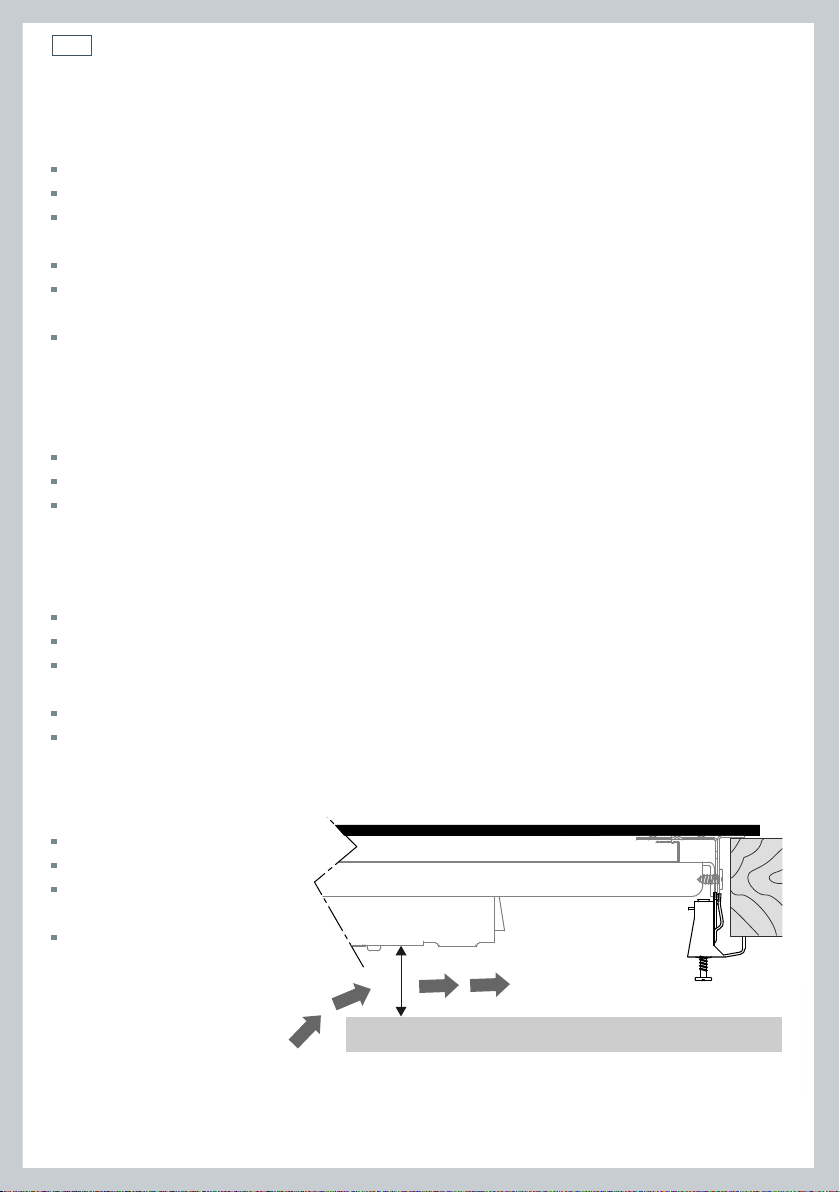
Clearances
A
B
C
C
E
EE
D
Clearances (mm)
CI604DT
CI754DT
CI905DT
A
minimum clearance from rear edge of cutout to:
nearest combustible surface
55 55 53
B
minimum clearance from glass surface to:
rangehood 650 650 650
C
minimum clearance from side edges of cutout to:
nearest combustible surface
85 78 80
D
minimum clearance from benchtop to:
overhead cabinet not directly above the
cooktop 450 450 450
E
minimum clearance below top of benchtop to:
top of oven* installed below cooktop (see Fig.1)
thermal protection barrier (see Fig.2)
90
75
90
75
90
75
WARNING!
This cooktop requires
adequate supply of fresh,
cool air to fully function.
The base of the cooktop
must have direct
unrestricted ventilation to
the room where the
cooktop is installed. Follow
the requirements below.
Fig. 1 Minimum clearances and ventilation
requirements - oven installed below cooktop
* The oven installed below the cooktop MUST have a cooling fan.
Fig. 2 Minimum clearances and ventilation
requirements - cupboard or drawer space below
8
Installation instructions
Before you install the cooktop, make sure that
the benchtop is square and level, and no structural members interfere with space requirements
the benchtop is made of a heat-resistant material
the cooktop will not be installed directly above a dishwasher, fridge, freezer, washing machine or
clothes dryer, as the humidity may damage the cooktop electronics
if the cooktop is installed above an oven, the oven has a built-in cooling fan
the installation will comply with all clearance requirements and applicable standards and
regulations
a suitable isolating switch providing full disconnection from the mains power supply is
incorporated in the permanent wiring, mounted and positioned to comply with the local wiring
rules and regulations. The isolating switch must be of an approved type and provide a 3 mm air
gap contact separation in all poles (or in all active [phase] conductors if the local wiring rules
allow for this variation of the requirements)
the isolating switch will be easily accessible to the customer with the cooktop installed
you consult local building authorities and by-laws if in doubt regarding installation
you use heat-resistant and easy-to-clean finishes (such as ceramic tiles) for the wall surfaces
surrounding the cooktop.
When you have installed the cooktop, make sure that
the power supply cable is not accessible through cupboard doors or drawers
there is adequate flow of fresh air from outside the cabinetry to the base of the cooktop
if the cooktop is installed above a drawer or cupboard space, a thermal protection barrier is
installed below the base of the cooktop
the isolating switch is easily accessible by the customer
you complete the ‘Final checklist’ at the end of these installation instructions.
The thermal protection barrier must be:
removable
heat-resistant
made from low thermal
conductivity material
at least 25 mm below the
plastic housing of the
cooktop chassis
25
mm min.
Fig. 3 Thermal protection barrier
Fresh air from
outside the
cabinetry
9
Installation instructions
PE
1
2
3
4
5
N
L
PE
1
2
3
4
5
N
L
1
L
2
PE
1
2
3
4
5
N
L
1
L
3
L
2
PE
1
2
3
4
5
N
L
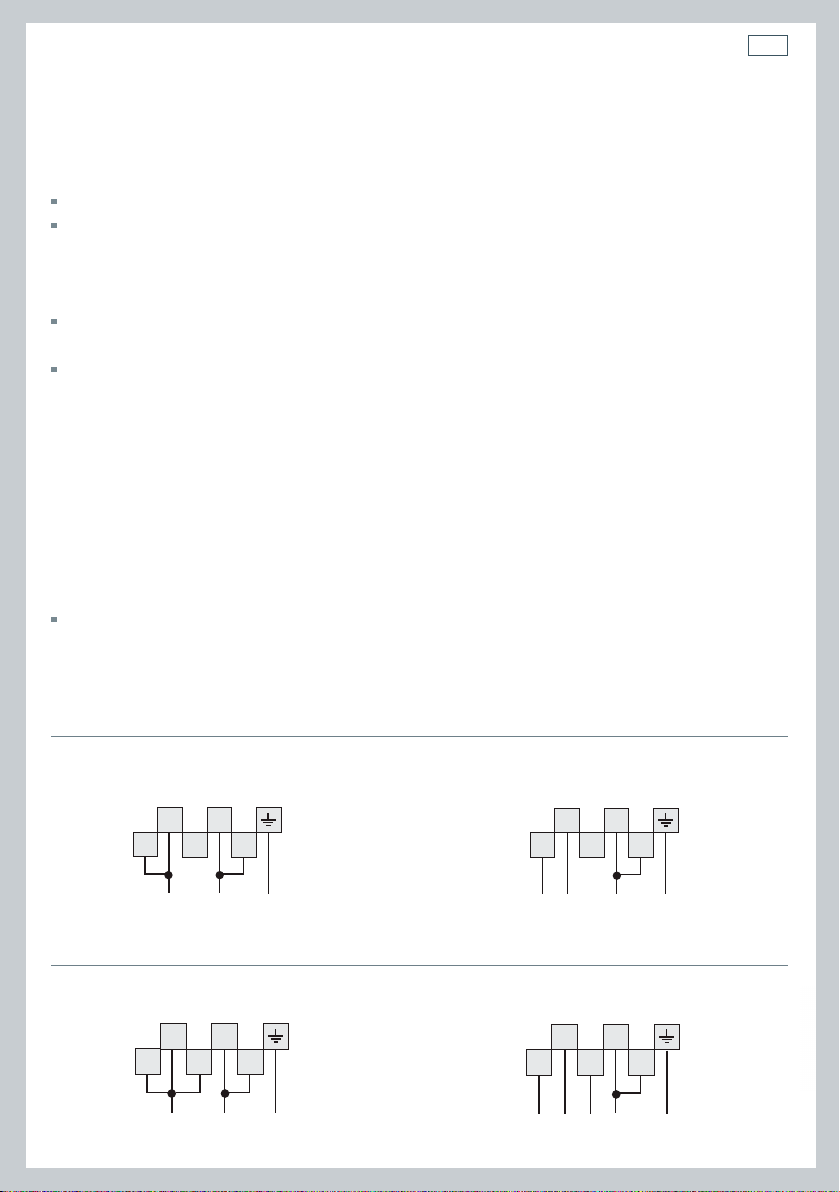
Single-phase connection
220-240V~
Single-phase connection
220-240V~
Two-phase connection
380-415V 2N~
Three-phase connection
380-415V 3N~
Connecting the cooktop to the mains power supply
Important!
This cooktop must be connected to the mains power supply only by a suitably qualified person.
Before connecting the cooktop to the mains power supply, check that:
1
the domestic wiring system is suitable for the power drawn by the cooktop.
2
the voltage corresponds to the value given in the rating plate
3
the power supply cable sections can withstand the load specified on the rating plate.
To connect the cooktop to the mains power supply, do not use adapters, reducers, or branching
devices, as they can cause overheating and fire.
The power supply cable must not touch any hot parts and must be positioned so that its
temperature will not exceed 75
o
C at any point.
Power supply
CI604DT 6950W @220-240/380-415V 2N~ (30A)
CI754DT 7400W @220-240/380-415V 2N~ (32A)
CI905DT 9800W @220-240/380-415V 3N~ (42A)
Important!
Check with an electrician whether the domestic wiring system is suitable without alterations. Any
alterations must only be made by a qualified electrician.
Connection diagrams
CI604DT, CI754DT
CI905DT
10
Applying the supplied foam seal
1
Turn the cooktop upside down and place it carefully on a soft surface.
Important!
To avoid damage to the glass, ensure there is a protective cover underneath it.
2
Apply the foam seal around the glass overhang, 5 mm in from the edge of the glass.
3
Turn the cooktop the right way up and place it into the cutout.
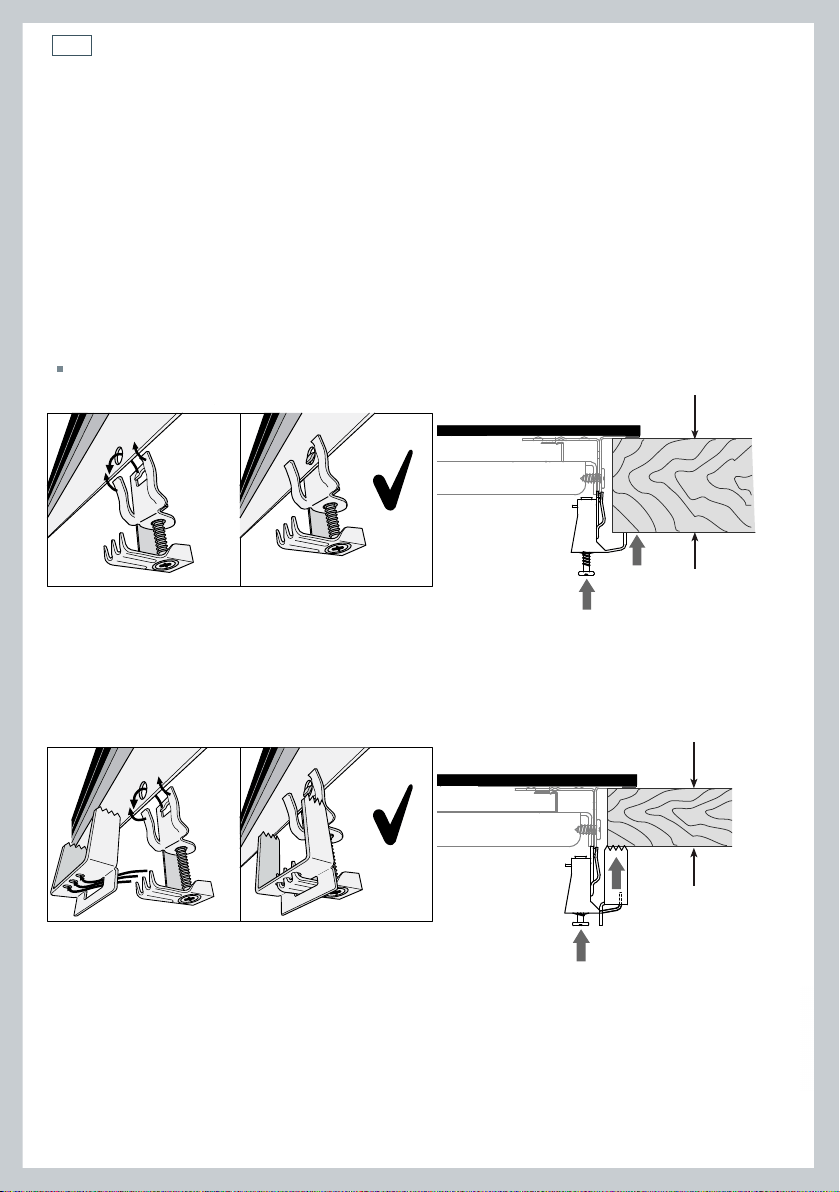
Clamping down the cooktop
Depending on the thickness of the benchtop, secure the supplied clamping brackets as shown.
Installation instructions
48-65 mm
30-48 mm
Important!
Do not overtighten the screws!
Important!
Do not overtighten the screws!
x 4
x 4

11
Final checklist
TO BE COMPLETED BY THE INSTALLER
Is the cooktop earthed?
Check that there is an adequate and constant flow of fresh air from outside the cabinetry to the
base of the cooktop.
Check that the power supply cable is not accessible via cupboard doors or drawers.
Is the cooktop clamped down securely?
Check that the pan detection feature is working correctly. Turn on each cooking zone without
putting any cookware on them. Are all the displays flashing
?
Check that all the cooking zones function correctly. Place suitable pans with water in them on
each zone, then turn all of them on to a high setting. Is the water heating?
Are all touch controls and displays functioning?
To check that the ‘hot surface’ indicators function correctly, turn off all the zones. Is
H
displayed in all the cooking zone displays?
Have you shown the customer how to use the cookop? Make sure you explain to the customer
about:
the importance of taking note of the safety warnings at the beginning of this manual,
especially for persons with cardiac pacemakers or other electrical implants
the ‘hot surface’ indicators (
H)
using induction-suitable cookware only
the pan detection feature (
).
Installer’s name:
Installer’s signature:
Installation company:
Date of installation:
LEAVE THESE INSTRUCTIONS WITH THE CUSTOMER
Installation instructions

12
Introducing your cooktop
Congratulations on your new purchase. Your Fisher & Paykel induction cooktop is the ultimate in
induction cooking, giving you the speed, precision, and simplicity of electronic control, and the
easy-care elegance of a ceramic glass surface. For more information, visit our local website listed
on the back cover.
A word on induction cooking
Induction cooking is a safe, advanced, efficient, and economical cooking technology. It works by
electromagnetic vibrations generating heat directly in the pan, rather than indirectly through
heating the glass surface. The glass becomes hot only because the pan eventually warms it up.
This technology has a number of advantages over traditional radiant energy cooking:
Heat-up times are much faster.
Use is safer as no heating takes place unless a suitable pan is placed on the cooking zone.
As heat is transferred without loss, you save energy.
Before using your new cooktop
Read this guide, taking special note of the ‘Safety and warnings’ section.
Remove any protective film that may still be on your cooktop.
Using the touch controls
The controls respond to touch, so you don’t need to apply any pressure.
Use the ball of your finger, not its tip.
You will hear a beep each time a touch is registered.
Make sure the controls are always clean, dry, and there is no object (eg a utensil or a cloth)
covering them. Even a thin film of water may make the controls difficult to operate.
Introduction
13
7
7
8
8
9
9
11
11
12
12
10
10
6
66
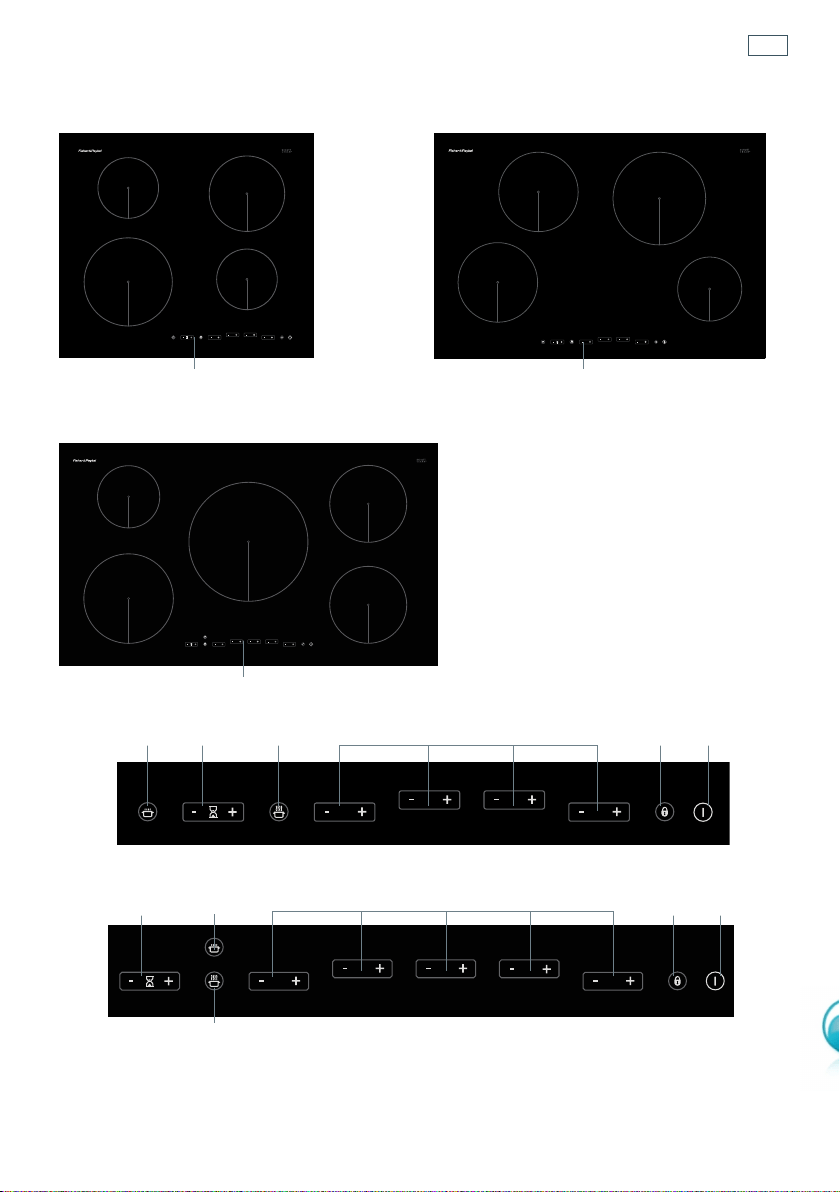
1
1400 W (1800W*) zone
2
1850 W (2500W*) zone
3
2300 W (3700W*) zone
4
2300 W (3200W*) zone
5
2400 W (3700W*) zone
6
Touch controls
* Maximum power output
when set for PowerBoost
See ‘Using your cooktop’s
special features.’
7
GentleHeat control
8
Timer control
9
PowerBoost control
10
Heat setting controls
11
Keylock control
12
ON/OFF control
Fig.4 CI604DT model
Fig.6 CI905DT model
Fig.5 CI754DT model
Fig.7 Touch controls for CI604DT and CI754DT models
Fig.8 Touch controls for CI905DT model
Introduction
1
1
12
2
4
5
1
3
223
2
14
Choosing the right cookware
Important!
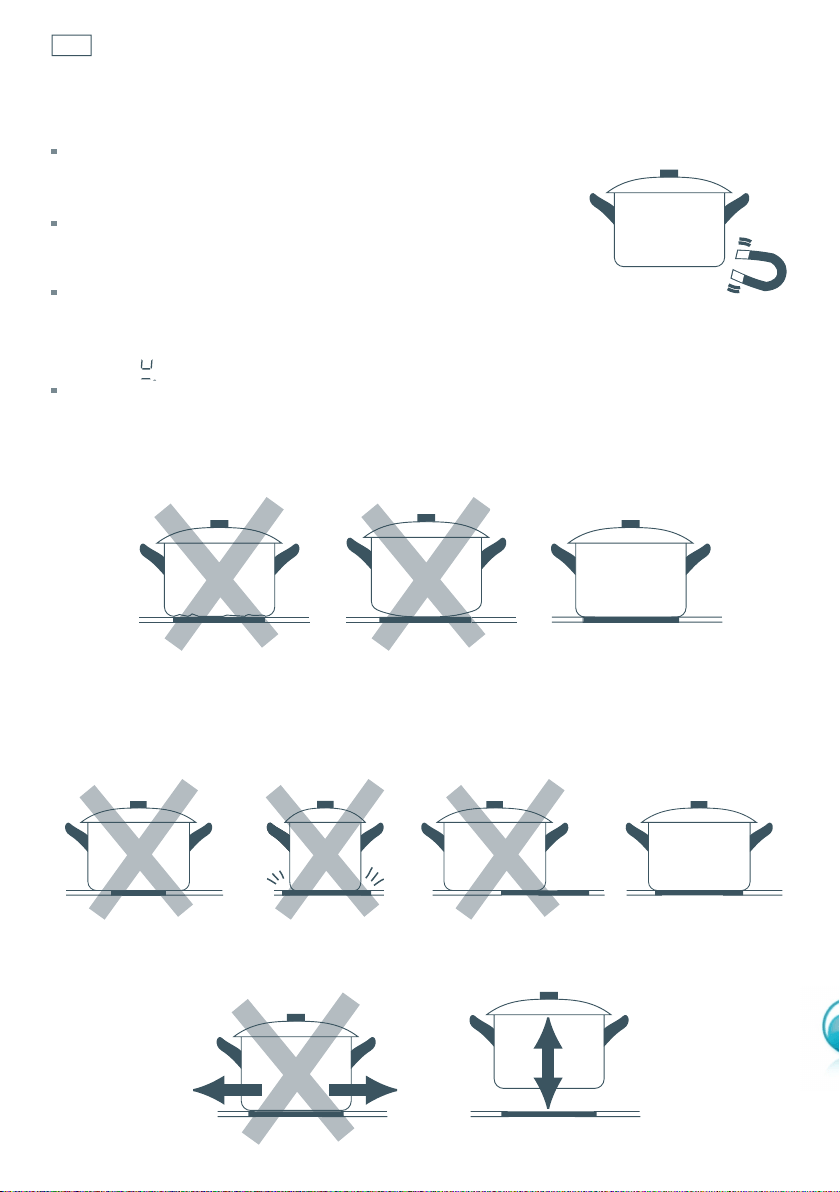
Only use cookware with a base suitable for induction cooking.
Look for the induction symbol on the packaging or the bottom of
the pan.
You can check whether your cookware is suitable by carrying out
a magnet test. Move a magnet towards the base of the pan. If it is
attracted, the pan is suitable for induction.
If you do not have a magnet:
1
Put some water in the pan you want to check.
2
Follow the steps under ‘To start cooking’ opposite.
3
If does not flash in the display and the water is heating, the pan is suitable.
Cookware made from the following materials is not suitable: pure stainless steel, aluminium or
copper without a magnetic base, glass, wood, porcelain, ceramic, earthenware.
Do not use cookware with jagged edges or a curved base.
Make sure that the base of your pan is smooth, sits flat against the glass, and is the same size as
the cooking zone. Always centre your pan on the cooking zone.
Note: for CI905DT models: the large middle cooking zone may also be used successfully with
pans whose base is somewhat smaller than the zone.
Always lift pans off the cooktop– do not slide, or they may scratch the glass.
15
Using your induction cooktop
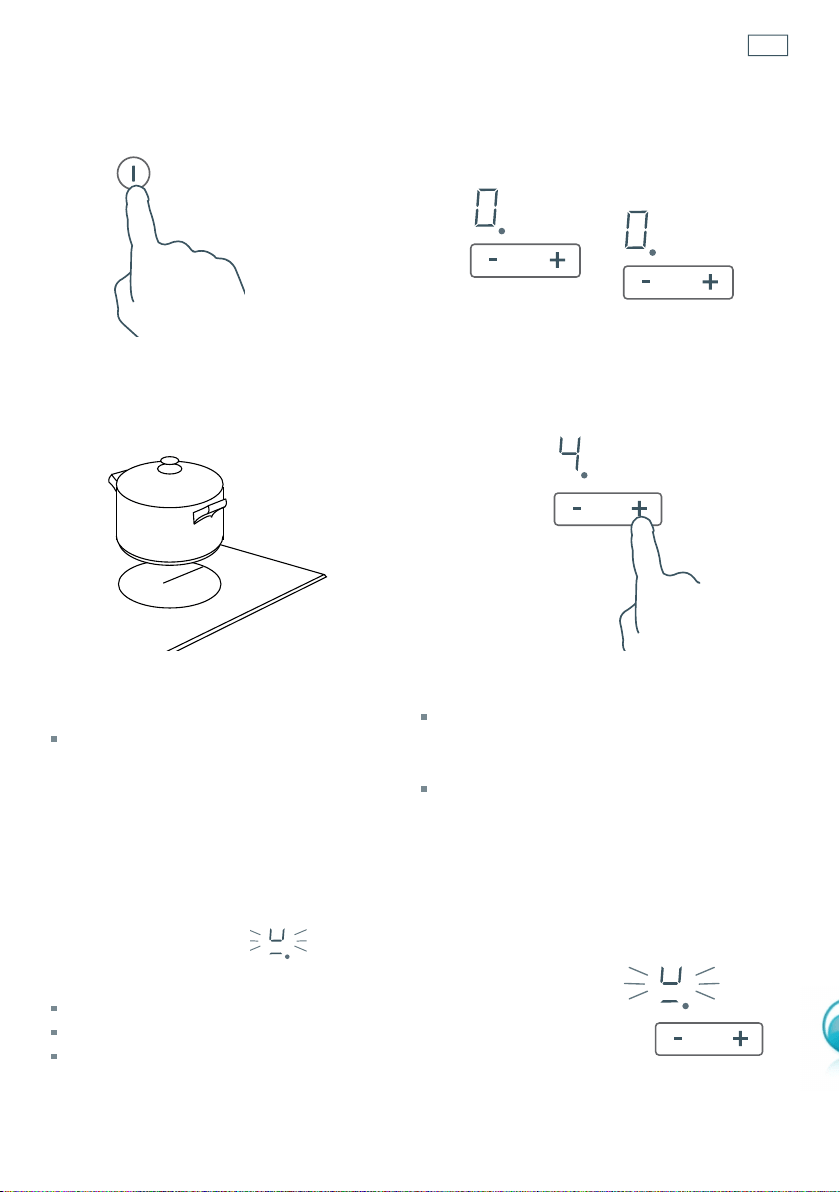
To start cooking
1
Touch and hold the ON/OFF
control for 2 seconds.
3
Place a suitable pan on the
cooking zone you wish to use.
Make sure the bottom of the pan
and the surface of the cooking
zone are clean and dry.
If a display flashes alternately with the heat setting
This means that:
you have not placed a pan on the correct cooking zone or
the pan you’re using is not suitable for induction cooking or
the pan is too small or not properly centred on the cooking zone.
No heating takes place unless there is a suitable pan on the cooking zone.
The cooktop will automatically turn off after 10 minutes if no suitable pan is placed on it.
4
Select a heat setting by touching – or + .
If you don’t choose a heat setting within 10
seconds, the cooktop will automatically
turn off. Start with step 1 again.
You can modify the heat setting at any time
during cooking.
2
0 will appear in the cooking zone displays.
16
Using your induction cooktop
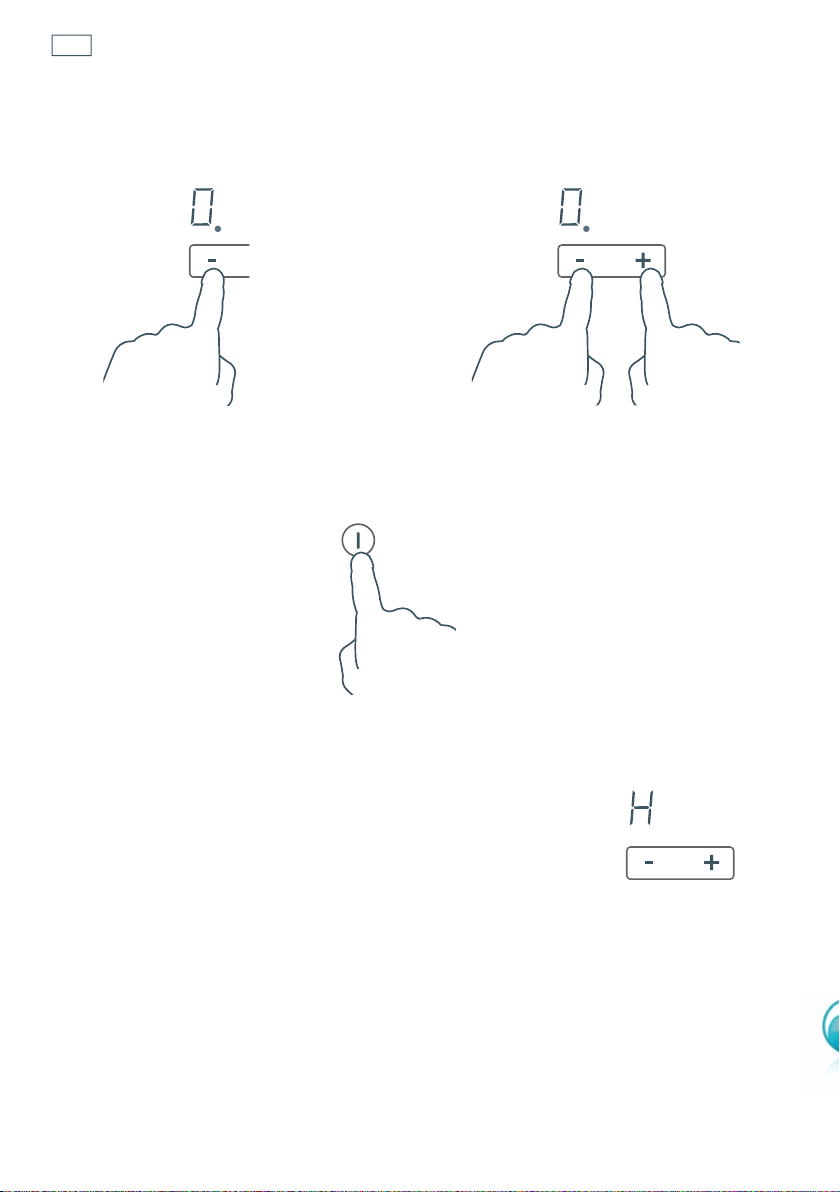
When you have finished cooking
OR
1a
Turn the cooking zone off by scrolling down to 0 or touching – and + together.
Make sure the display shows 0.
1b
Turn the whole cooktop off by touching the ON/OFF control.
2
Beware of hot surfaces
H will show which cooking zone is too hot to touch. It
will disappear when the surface has cooled down to a
safe temperature.

17
Using your induction cooktop
Locking the controls
You can lock the controls to prevent unintended use (for example children accidentally turning
cooking zones on).
When the controls are locked, all controls except the ON/OFF control are disabled.
To lock the controls
1
Make sure that the cooktop is turned on but no cooking zone is in use.
2
Touch and hold the keylock control for 2 seconds. The red light above the control comes on,
indicating that the controls are locked.
Note: the cooktop will automatically turn off after 10 seconds, but the controls will still be locked
when you turn the cooktop on again.
To unlock the controls
1
Make sure the cooktop is turned on.
2
Touch and hold the keylock control for 2 seconds. The red light above the control goes out.
3
You can now start using your cooktop.
Important!
Do not lock the controls while a cooking zone is in use. If you do, you can always turn the cooktop off with
the ON/OFF control in an emergency.
18
Using your cooktop’s special features
Using the PowerBoost feature
This feature enables you to sear meat or bring liquid to the boil very quickly. When a cooking
zone is set for PowerBoost, it uses more than 100% of the power of that particular cooking zone,
resulting in a boost of intense heat.
Important!
PowerBoost heats food and liquids very quickly. Do not leave the cooktop unattended when using this
feature.
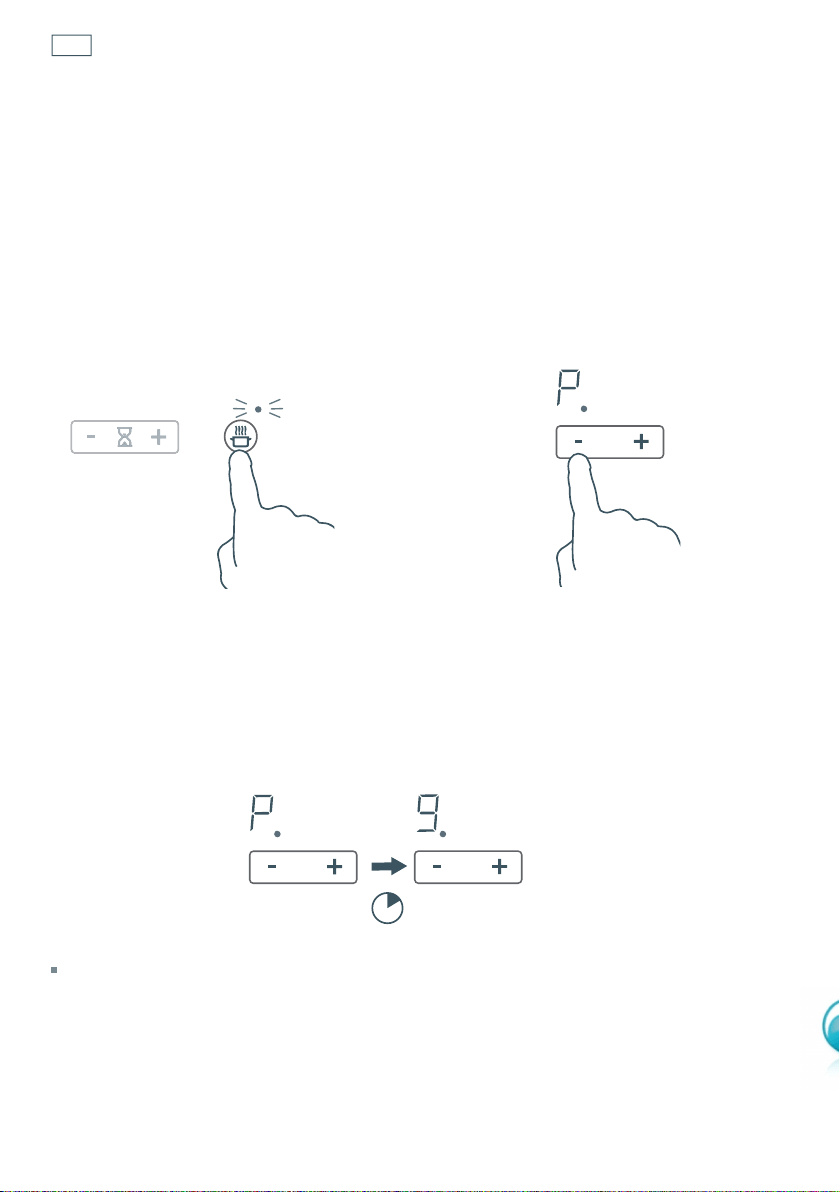
To set a cooking zone for PowerBoost
When PowerBoost is set
The cooking zone will be on PowerBoost (more than 100%) for 10 minutes, and then
automatically reduce the heat to setting
9 (100%).
To quit the PowerBoost setting
Touch the – control of the cooking zone at any time and select a new setting or turn the cooking
zone off.
1
With the cooktop turned on, touch the
PowerBoost control . The flashing red
light indicates that PowerBoost is ready
to be set.
2
Within 5 seconds, touch the – or + control
of a cooking zone once. Its display will
show
P.
10 mins
19
Note:
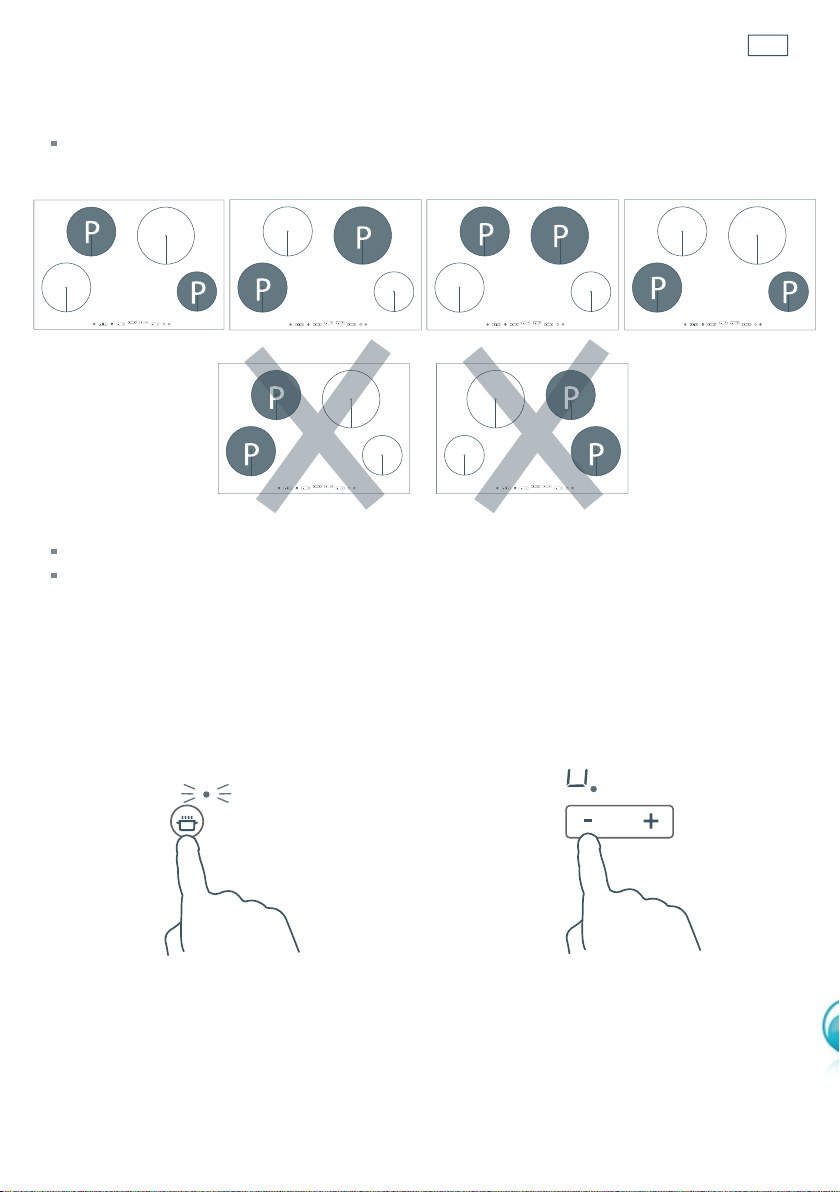
You can set two (CI604DT and CI754DT) or three (CI905DT) cooking zones for PowerBoost, as
long as one is not behind the other. For example:
If you wish to set more than one cooking zone for PowerBoost, you need to set them separately.
When a cooking zone is set for PowerBoost, the cooking zone immediately in front of or behind
it may have to reduce its power level.
Using the GentleHeat feature
This feature is ideal for the most delicate cooking tasks (such as melting chocolate), as the
cooking zone will provide continuous gentle heat (between heat setting levels
0 and 1).
To set a cooking zone for GentleHeat
To quit the GentleHeat setting
Touch the + control of the cooking zone at any time and select a new setting or turn the cooking
zone off.
Using your cooktop’s special features
1
With the cooktop turned on, touch the
GentleHeat control . The flashing red
light indicates that GentleHeat is ready
to be set.
2
Within 5 seconds, touch the – or + control
of a cooking zone. Its display will show U...

20
Using your cooktop’s special features
Using the Auto Heat-reduce feature
Cooking zones set for this feature will:
first quickly heat up food or liquid at the highest setting
then automatically reduce the heat to a pre-selected lower setting to cook the food through.
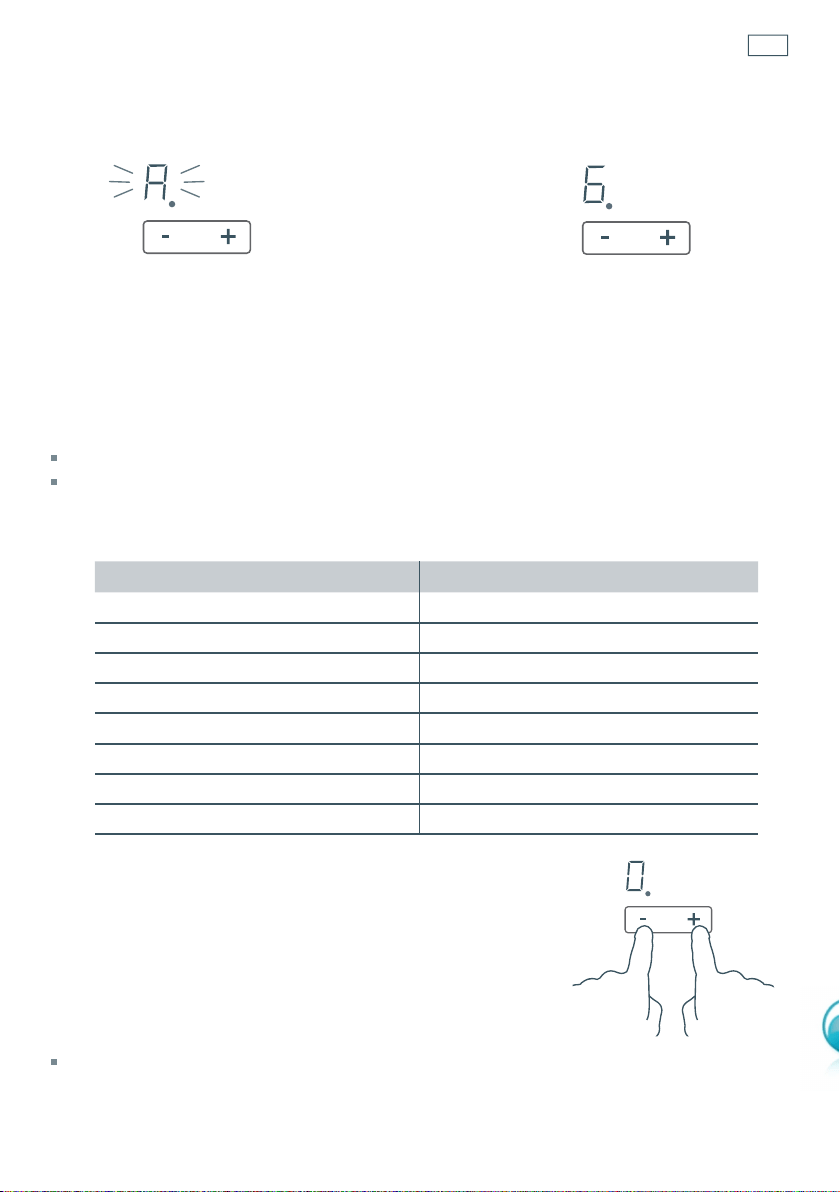
To set a cooking zone for Auto Heat-reduce
1
With the cooktop turned on, touch the
– control of a cooking zone. The display
will show
9.
3
Touch – briefly and then select the heat setting you want the cooking zone to automatically
reduce to (
1-8).
2
Touch +. The letter Awill start flashing
alternately with
9.
21
Using your cooktop’s special features
When Auto Heat-reduce is set
To increase the lower heat setting while A is flashing, simply touch + .
If you would like a lower or higher heat setting than you originally selected, touch – and +
together and set the cooking zone for Auto Heat-reduce again. Alternatively, wait until A stops
flashing and then modify the heat setting.
To quit the Auto Heat-reduce setting while A is flashing
Touch the – and + controls of the corresponding
cooking zone together.
Note:
The Auto Heat-reduce and PowerBoost features cannot be used together. If you turn
PowerBoost on when Auto Heat-reduce is already set, the latter will be immediately
cancelled and PowerBoost will be activated instead.
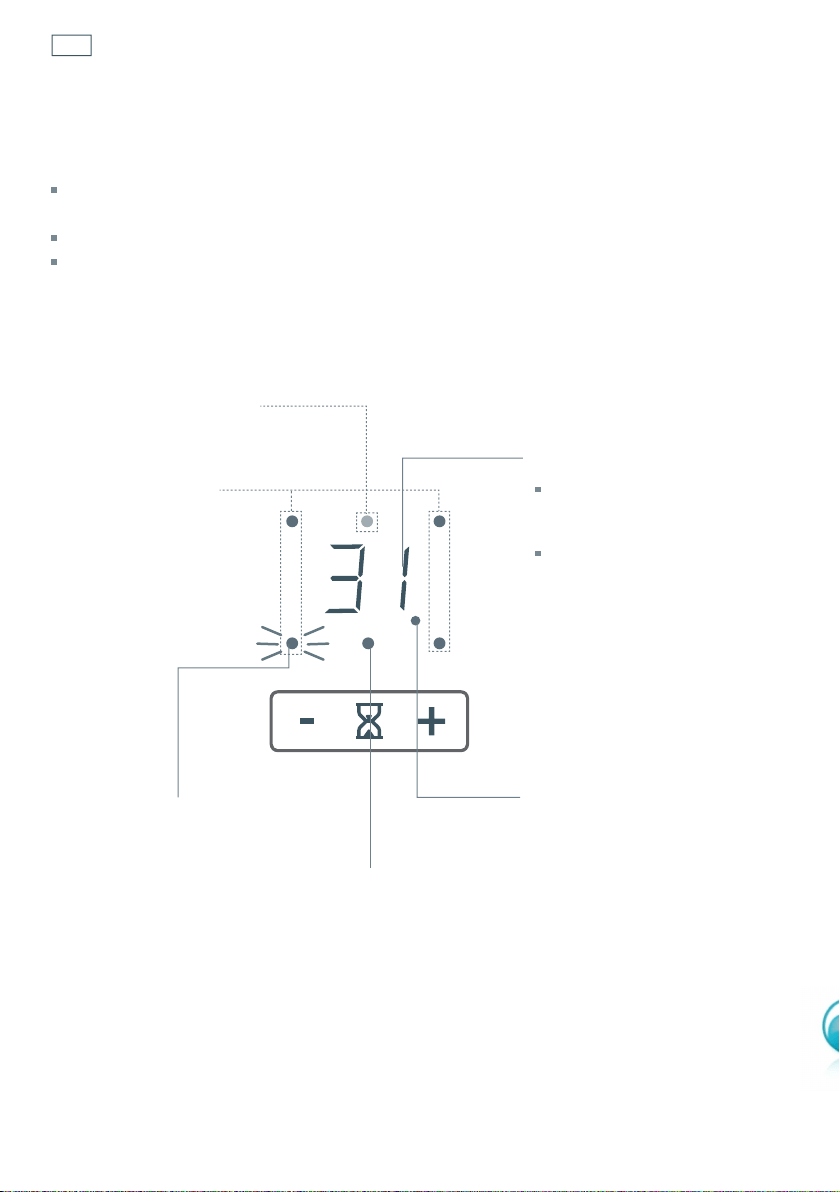
Initially, while the cooking zone is
at the highest setting, A will flash
alternately with your selected lower
setting. The length of time at the
highest setting depends on the lower
heat setting selected. See chart below.
Then, when the period of highest setting
is over, A will stop flashing and the
cooking zone will automatically reduce
the heat to your pre-selected lower
setting.
Pre-selected lower heat setting
Length of time at highest setting
1 40 seconds
2 1 minute
3 2 minutes
4 3 minutes
5 4 minutes
6 7 minutes
7 2 minutes
8 3 minutes
22
Using your cooktop’s special features
Using the timer
You may use the timer in two different ways:
You can use it as a minute minder. In this case, the timer will not turn any cooking zone off when
the set time is up.
You can set it to turn one or more cooking zones off after the set time is up.
You can set the timer for up to 99 minutes.
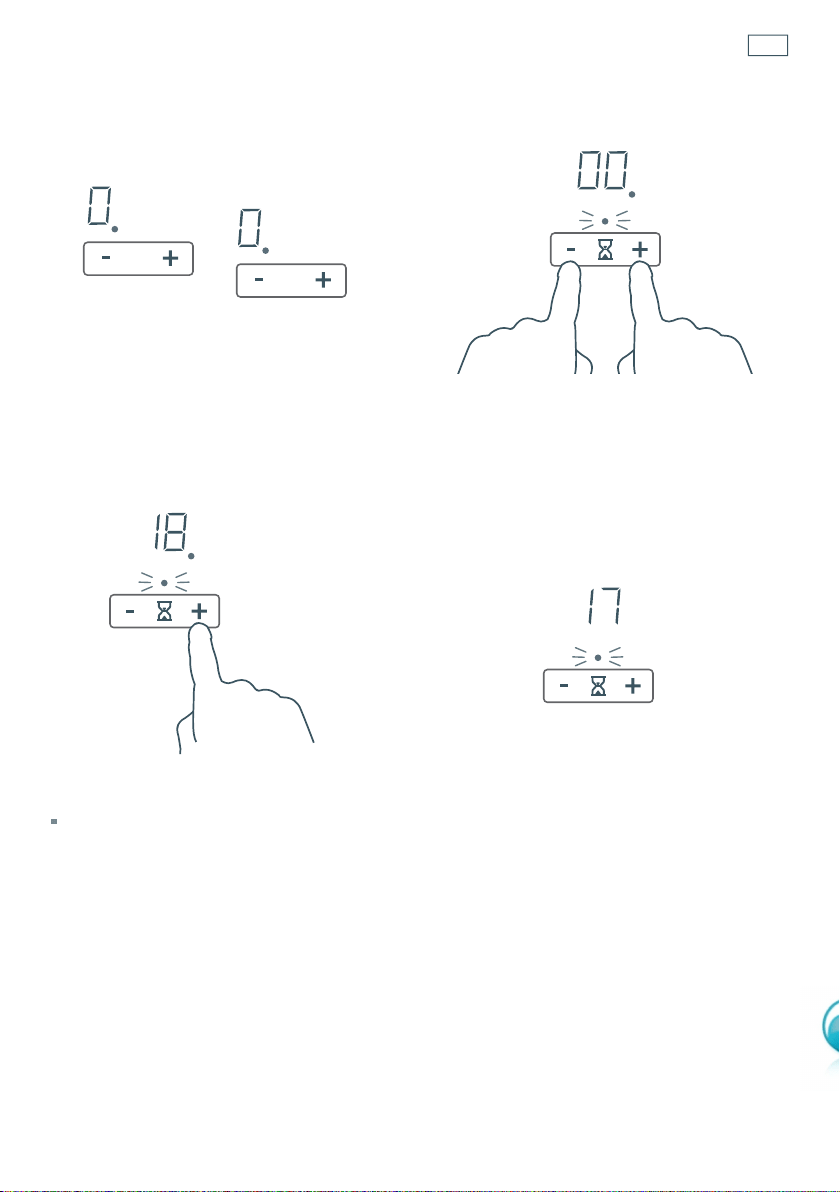
Timer overview
Minute minder indicator
shows if the minute
minder is set. It operates
independently of any
cooking zone.
You can set or modify
the number of minutes
while this light is on.
Cooking zone indicator
for middle zone
(CI905DT models only)
Minute display
shows the number of minutes
set/remaining for:
the cooking zone whose
indicator is flashing
OR
the minute minder, if its
indicator is flashing.
If you set different times for
multiple cooking zones, the minute
display will revert to showing the
shortest remaining time (with
the corresponding indicator light
flashing).
A flashing indicator
shows you what
setting is being
shown in the
minute display. In
this illustration, the
remaining time set
for the left front
cooking zone is 31
minutes.
Cooking zone
indicators
show you which
cooking zone(s) the
timer is set for. In
this illustration, the
timer is set for all
the cooking zones.
23
Using your cooktop’s special features
Using the timer as a minute minder
If you are not using any cooking zones
You can use the timer as a minute minder even if you are not using any cooking zones. In this
case, the cooktop will turn itself off 10 seconds after you have set the time, but the time will
continue to count down. To change or cancel the minute minder setting, you will have to turn
the cooktop back on first. See ‘To change or cancel a timer setting’.
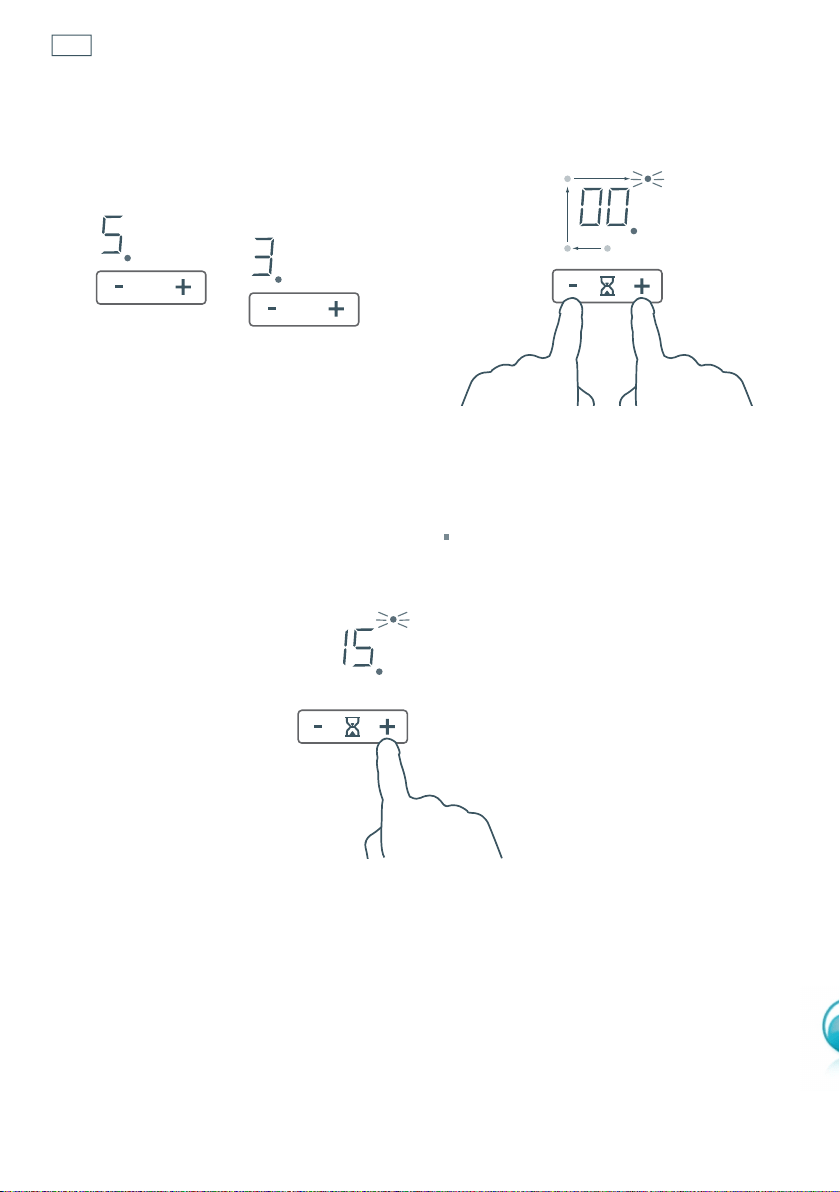
When the set time is up
00 will flash and the timer will beep. Touch any control to stop the beeping.
Remember, touching the ON/OFF control will turn the whole cooktop off!
2
Touch the – and + controls of the timer
together. The minute minder indicator
will start flashing and 00 will show in the
minute display.
1
Make sure the cooktop is turned ON.
Note: you can use the minute minder
even if you’re not using any cooking
zones.
3
Set the time while the small red light in the
bottom corner of the minute display is on.
Hint: the minutes will scroll faster if you
touch and hold
– or + continuously.
4
When the time is set, it will begin to count
down immediately. The display will show
the remaining time and the minute minder
indicator will keep flashing.
24
Using your cooktop’s special features
Setting the timer to turn one or more cooking zones off
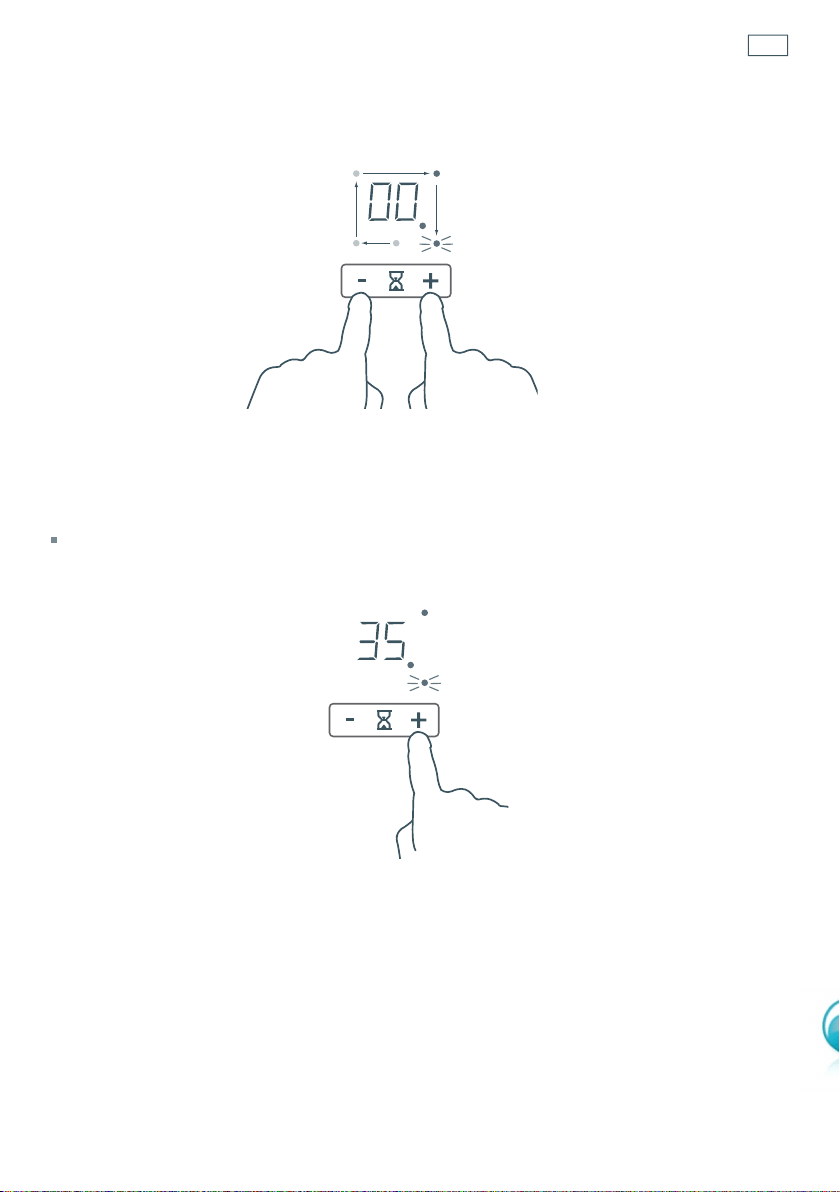
1
Make sure the cooking zone(s) you want to
set the timer for are in use.
3
Set the time while the small red light in the bottom corner of the minute display is on.
The timer is now set for the right rear cooking zone.
2
Touch the – and + controls of the timer
together. Repeat until the indicator of the
desired cooking zone comes on flashing.
Note: only indicators of cooking zones in
use will show as you scroll through.
25
Using your cooktop’s special features
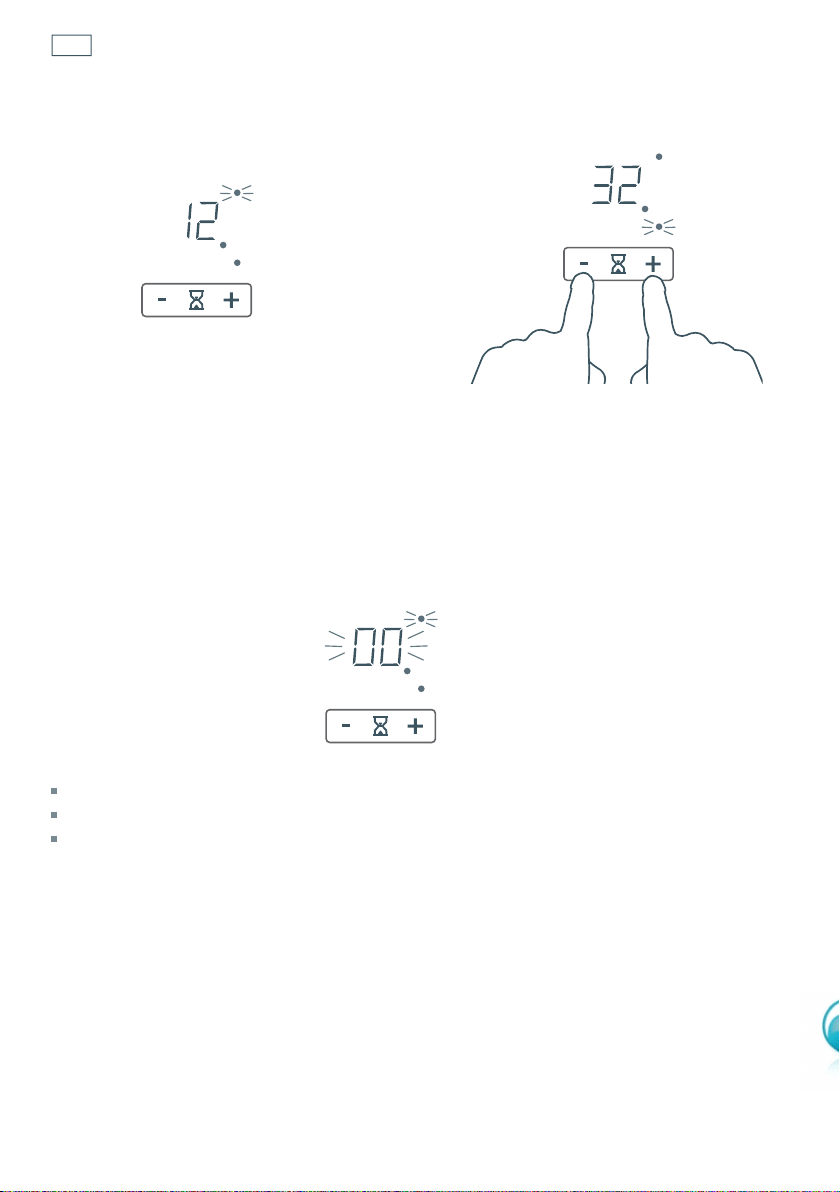
Setting the timer to turn one or more cooking zones off
5
Set the time while the small red light in the bottom corner of the minute display is on.
You can set different times for each of the cooking zones.
You may now continue to set the timer for additional cooking zones:
4
Touch the – and + controls of the timer together. Repeat until the indicator of the desired
cooking zone comes on flashing.
Note: the indicator of the cooking zone previously set will be steadily lit, showing you that the
timer is set and counting down for that cooking zone.
26
Using your cooktop’s special features
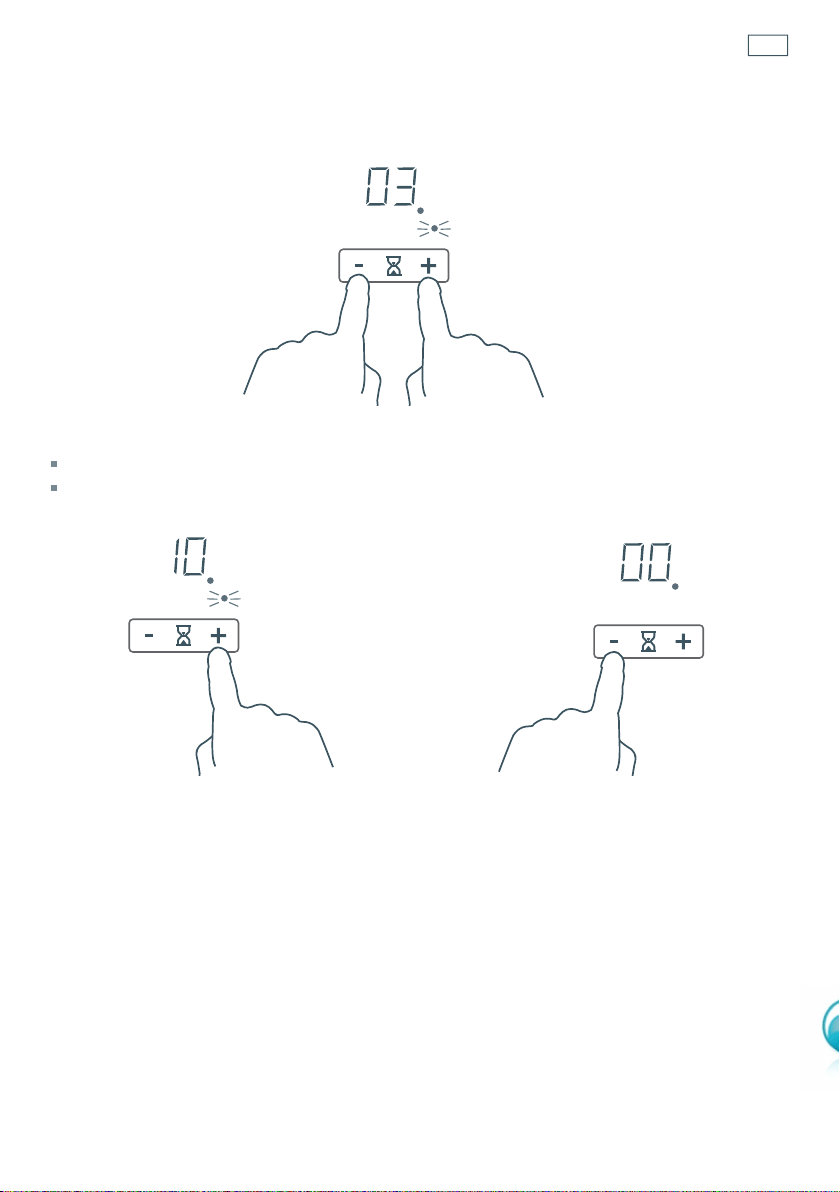
When the timer is set
When the set time is up
If the timer is set for more than one
cooking zone, only the indicator belonging
to the cooking zone with the shortest
remaining time setting will flash.
The cooking zone whose set time is up will automatically turn off.
00 will flash in the minute display.
The timer will beep.
Touch any control to stop the beeping.
The indicator of the relevant cooking zone will go out.
If the timer is still set and counting down for another cooking zone
The indicator belonging to the cooking zone with the shortest remaining time setting will flash.
To check the remaining time for another
cooking zone:
Touch the
– and + controls of the timer
together and repeat until the indicator of
the desired cooking zone is flashing.
27
Using your cooktop’s special features
To change or cancel a timer setting
1
With the cooktop turned on, touch the – and + controls of the timer together and repeat until:
the indicator of the desired cooking zone or the minute minder indicator is flashing and
the small red light in the bottom corner of the minute display is on.
2
To change:
Set the new time while the small red light
at the bottom of the minute display is on.
OR
2
To cancel:
Touch the
– control of the timer and repeat
until the minute display shows
00.

28
Important!
Take care when frying: oil and fat heat up very quickly, particularly if you’re using PowerBoost. At
extremely high termperatures oil and fat will ignite spontaneously and this presents a serious fire
risk.
Cooking tips
When food comes to the boil, reduce the temperature setting.
Using a lid will reduce cooking times and save energy by retaining the heat.
Minimise the amount of liquid or fat to reduce cooking times.
Start cooking on a high setting and reduce the setting when the food has heated through.
Simmering, cooking rice
Simmering occurs below boiling point, at around 85
O
C, when bubbles are just rising occasionally
to the surface of the cooking liquid. It is the key to delicious soups and tender stews because
the flavours develop without overcooking the food. You should also cook egg-based and flour-
thickened sauces below boiling point.
Some tasks, including cooking rice by the absorption method, may require a setting higher than
the lowest setting to ensure the food is cooked properly in the time recommended.
Searing steak
To cook juicy flavoursome steaks:
1
Stand the meat at room temperature for about 20 minutes before cooking.
2
Heat up a heavy-based frying pan.
3
Brush both sides of the steak with oil. Drizzle a small amount of oil into the hot pan and then
lower the meat onto the hot pan.
4
Turn the steak only once during cooking. The exact cooking time will depend on the thickness of
the steak and how cooked you want it. Times may vary from about 2 – 8 minutes per side. Press
the steak to gauge how cooked it is – the firmer it feels the more ‘well done’ it will be.
5
Leave the steak to rest on a warm plate for a few minutes to allow it to relax and become tender
before serving.
For stir-frying
1
Choose an induction compatible flat-based wok or a large frying pan.
2
Have all the ingredients and equipment ready. Stir-frying should be quick. If cooking large
quantities, cook the food in several smaller batches.
3
Preheat the pan briefly and add two tablespoons of oil.
4
Cook any meat first, put it aside and keep warm.
5
Stir-fry the vegetables. When they are hot but still crisp, turn the cooking zone to a lower setting,
return the meat to the pan and add your sauce.
6
Stir the ingredients gently to make sure they are heated through.
7
Serve immediately.
Cooking guidelines
29
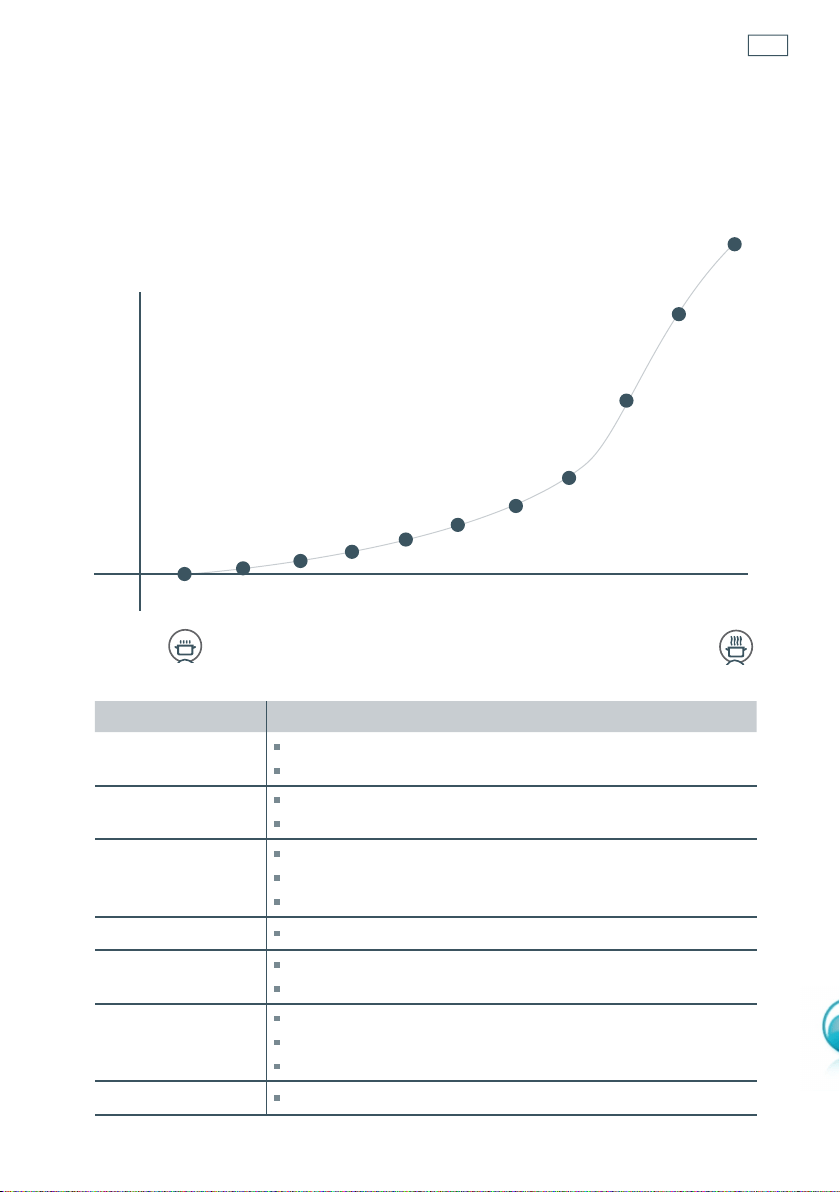
Heat settings
The settings below are guidelines only. The exact setting will depend on several factors,
including your cookware and the amount you are cooking. Experiment with the cooktop to find
the settings that best suit you.
Cooking guidelines
Percentage of power %
100
80
60
40
20
0
u123456789P
Heat setting
(A)
Heat setting
Suitability
u
delicate warming for small amounts of food
melting chocolate, butter, and foods that burn quickly
1
-
2
gentle simmering
slow warming
3
-
4
reheating
rapid simmering
cooking rice
5
-
6
pancakes
7
-
8
sautéing
cooking pasta
9
stir-frying
searing
bringing soup to the boil
P
boiling water

30
Care and cleaning
What? How? Important!
Everyday soiling
on glass
(fingerprints, marks,
stains left by food or
non-sugary spillovers
on the glass)
1 Switch the power to the
cooktop off at the wall.
2 Apply cooktop cleaner while
the glass is still warm (but not
hot!)
3 Rinse and wipe dry with a
clean cloth or paper towel.
4 Switch the power to the
cooktop back on at the wall.
When the power to the cooktop
is switched off, there will be no
‘hot surface’ indication but the
cooking zone may still be hot!
Take extreme care.
Heavy-duty scourers, some nylon
scourers and harsh/abrasive
cleaning agents may scratch the
glass. Always read the label to
check if your cleaner or scourer is
suitable.
Never leave cleaning residue
on the cooktop: the glass may
become stained.
Boilovers, melts, and
hot sugary spills on
the glass
Remove these immediately
with a fish slice, palette knife
or razor blade scraper suitable
for ceramic glass cooktops, but
beware of hot cooking zone
surfaces:
1 Switch the power to the
cooktop off at the wall.
2 Hold the blade or utensil at
a 30
o
angle and scrape the
soiling or spill to a cool area of
the cooktop.
3 Clean the soiling or spill up
with a dish cloth or paper
towel.
4 Follow steps 2 to 4 for
‘Everyday soiling on glass’
above.
Remove stains left by melts and
sugary food or spillovers as soon
as possible. If left to cool on the
glass, they may be difficult to
remove or even permanently
damage the glass surface.
Cut hazard: when the safety
cover is retracted, the blade in
a scraper is razor-sharp. Use
with extreme care and always
store safely and out of reach of
children.
Spillover on the touch
controls
1 Switch the power to the
cooktop off at the wall.
2 Soak up the spill
3 Wipe the touch control area
with a clean damp sponge or
cloth.
4 Wipe the area completely dry
with a paper towel.
5 Switch the power to the
cooktop back on at the wall.
The cooktop may beep and turn
itself off, and the touch controls
may not function while there is
liquid on them. Make sure you
wipe the touch control area dry
before turning the cooktop back
on.

31
Troubleshooting
Troubleshooting chart
Problem Possible causes What to do
The cooktop cannot be
turned on.
No power. Make sure the cooktop is
connected to the power supply
and that it is switched on at the
wall. Check whether there is
a power outage in your home
or area. If you’ve checked
everything and the problem
persists, call your Authorised
Service Centre or Customer
Care.
The touch controls are
unresponsive.
The controls are locked. Unlock the controls. See section
‘Using your induction cooktop’
for instructions.
The touch controls are
difficult to operate.
There may be a slight film of water
over the controls or you may be
using the tip of your finger when
touching the controls.
Make sure the touch control
area is dry and use the ball of
your finger when touching the
controls.
The glass is being
scratched.
Rough-edged cookware.
Unsuitable, abrasive scourer or
cleaning products being used.
Use cookware with flat and
smooth bases. See ‘Choosing
the right cookware’.
See ‘Care and cleaning’.
Some or all displays flash
and there is a
continuous beep.
Liquid has spilled onto the touch
control area.
There are objects (eg utensils) on
the touch control area.
Several touch controls are
registering continuous contact
(eg due to someone resting their
hand or arm on the touch control
area).
Switch the power to the
cooktop off at the wall and
see ‘Care and cleaning’ for
instructions.
Remove the objects from the
touch control area.
Remove the cause of
continuous contact.

32
Troubleshooting
Troubleshooting chart
Problem Possible causes What to do
Some pans make
crackling or clicking
noises.
This may be caused by the
construction of your cookware
(layers of different metals
vibrating differently).
This is normal for induction
cookware and does not indicate
a fault.
The cooktop makes a low
humming noise when
used on a high heat
setting (especially
PowerBoost).
This is caused by the technology
of induction cooking.
This is normal, but the
noise should quieten down
or disappear completely
when you decrease the
heat setting.
Fan noise coming from
the cooktop.
A cooling fan built into
your cooktop has come on
to prevent the electronics
from overheating. It may
continue to run even after
you’ve turned the cooktop
off.
This is normal and needs
no action. Do not switch
the power to the cooktop
off at the wall while the
fan is running.
Pans do not become hot
and
appears in the
display.
The cooktop cannot detect the
pan because it is not suitable for
induction cooking.
The cooktop cannot detect the
pan because it
is too small for
the cooking zone or not
properly centred on it.
Use cookware suitable for
induction cooking. See
section ‘Choosing the right
cookware’.
Centre the pan and make
sure that its base matches
the size of the cooking
zone.
P flashes in the display
when you are tyring to
set PowerBoost.
PowerBoost is temporarily
unavailable because the
cooktop needs to protect
itself from overheating.
Allow the cooktop to cool
down.
The cooktop or a cooking
zone has turned itself off
unexpectedly, a tone
sounds and an error code
is displayed (typically
E or Er alternating with
one or two digits in the
cooking zone displays).
Technical fault. Please note down the error
letters and numbers, switch
the power to the cooktop off
at the wall, and contact your
Authorised Service Centre or
Customer Care with the
error code information.

33
Warranty and service
Before you call for service or assistance ...
Check the things you can do yourself. Refer to the installation instructions and your user guide
and check that:
1
your product is correctly installed
2
you are familiar with its normal operation.
If after checking these points you still need assistance, please refer to the Service & Warranty
book for warranty details and your nearest Authorised Service Centre, or contact us through our
local website listed on the back cover.

34
This cooktop has been designed and constructed in accordance with the following
codes and specifications:
In New Zealand and Australia:
AS/NZS 60335-1 General Requirements for Domestic electrical appliances
AS/NZS 60335-2-6 Particular Requirements for Domestic electrical cooking appliances
AS/NZS 1044 Electromagnetic Compatibility Requirements.
In Europe:
Safety requirements of EEC Directive “Low voltage” 2006/95:
- EN 60335-1 General Requirements for Domestic electrical appliances
- EN 60335-2-6 Particular Requirements for Domestic electrical cooking appliances
Safety requirements of EEC Directive “EMC” 89/336:
- EN 55014-1, EN 55014-2, EN 61000-3-2, EN 61000-3-3 Electromagnetic Compatibility
Requirements
Requirements of EEC Directive 93/68.
European directive 2002/96/EC on Waste Electrical and Electronic Equipment (WEEE)
(for European Union countries only)
GB This appliance is marked according to the European directive 2002/96/EC on Waste Electrical
and Electronic Equipment (WEEE). By ensuring this product is disposed of correctly, you will help
prevent potential negative consequences for the environment and human health, which could
otherwise be caused by inappropriate waste handling of this product.
The symbol
on the product, or on the documents accompanying the product, indicates that
this appliance may not be treated as household waste. Instead it shall be handed over to the
applicable collection point for the recycling of electrical and electronic equipment. Disposal
must be carried out in accordance with local environmental regulations for waste disposal.
For more detailed information about treatment, recovery and recycling of this product, please
contact your local city office, your household waste disposal service or the shop where you
purchased the product.
Product details
Fisher & Paykel Ltd
Model Serial No.
Date of Purchase Purchaser
Dealer Suburb
Town Country
Warranty and service




Copyright © Fisher & Paykel 2009. All rights reserved.
The product specifications in this booklet apply to
the specific products and models described at the
date of issue. Under our policy of continuous product
improvement, these specifications may change at any
time. You should therefore check with your Dealer to
ensure this booklet correctly describes the product
currently available.
www.fisherpaykel.co.nz
www.fisherpaykel.com.au
www.fisherpaykel.co.uk
www.fisherpaykel.ie
NZ AU GB IE
Induction cooktop user guide
Published: 02/2009
Part No. 599569 B
F&P Italy Part No. 1103222-ß2