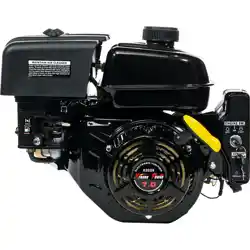
Gasoline Engine
Owner's Manual
SKU: 62039
IMPORTANT:
Keep this manual for safety warnings and precautions, assembly, operating,
inspection and maintenance procedures.
Read all precautions and instructions carefully before operating this engine.
This manual should be considered a permanent part of this engine and should
remain with the engine if resold.
Chongqing Rato reserves the right to discontinue, change and improve its products
at any time without notice or obligation to the purchaser.


Thank you for choosing our general-purpose gasoline
engine.
The manual gives information with respect to operation and
maintenance of the 62039, general-purpose gasoline
engines, and be sure to read it carefully first before opera-
tion. Only operate as the manual tells, can insure user’s
safety and get the best results of the engine operation.
All information and diagrams of this manual are in accor-
dance with the newest products at the publishing time. If
revision and other change the information descried in this
manual are a little different from the actual status, our
company will explain it. Our company reserves the right to
make change at any time without notice and without incur-
ring any obligation. No part of this publication may be
reproduced without written permission.
This manual should be considered a permanent part of the
engine and should remain with the engine if it is resold!
1
PREFACE

SAFETY MESSAGES
Y
our safety and the safety of others are very important. We have provided
important safety messages in this manual and on the gasoline engine.
Please read these messages carefully.
A safety message alerts you to potential hazards that could hurt you
. lobmys trela ytefas a yb dedecerp si egassem ytefas hcaE .srehto ro
Symbol is as following:
You CAN be KILLED or SERIOUSLY HURT if you
don’t follow instructions.
Y
ou CAN be HURT if you don’t follow instructions.
Your generator or other property could be damaged if
you don’t follow instructions.
Give you helpful information.
2
SAFETY MESSAGES

CONTENTS
PREF
ACE
…………………………………………………………… 1
SAFETY
MESSAGES
……………………………………………… 2
CONTENTS ………………………………………………………… 3
I. SAFETY
PRECAUTIONS
………………………………………… 4
I
I. PARTS DESCRIPTION
…………………………………………… 6
I
II. BATTERY CONNECTION
……………………………………… 9
IV
. PRE-OPERATE INSPECTION
……………………………… 11
V
. STARTING THE ENGINE
…………………………………… 15
VI. RUNNING
THE ENGINE
…………………………………… 18
VII. ST
OPPING THE ENGINE
…………………………………… 21
VIII. EXHAUST
CONTROL SYSTEM…………………………… 22
IX. MAINTENANCE
……………………………………………… 23
X. RANSPOR
T AND STORAGE
………………………………… 27
XI. TROUBLESHOOTING ……………………………………… 29
XII. SPECIFICA
TIONS
…………………………………………… 34
XIII. ELECTRIC DIAGRAM …………………………………… 37
XIV
. EASY WORN PARTS AND ACCESSORIES LIST
………… 39
3
CONTENTS
I. SAFETY PRECAUTIONS
Indicate a possibility of invalid warranty and personal
or equipment damage if instructions are not followed.
Please pay special attention to the following:
1. Strictly set the engine according to the regulated power on the owner's
manual. Do not overload, overrun the engine or run it with low load
and at low speed in a long time.
2. Use regulated brand of gas and diesel. The fuel should be fully
the oil periodically.
3. Periodically check the installation, connection and the degree of
4. Periodically clean the element of the air cleaner, change it when
necessary.
5. The gasoline engine is air-cooled, so clean the radiator, wind cover
and fan in time in order to make the engine cool normally.
6. The operator should be familiar with the working principle and
structure of the gasoline engine, knowing how to make an emergent
stop and the operation of all controlling parts. Any one without
maintenance. Solve problems in time. Do not run the engine in spite
of malfunction.
7. Running the engine in a well-ventilated place, keep it at least one
meter away from building walls or other equipments, keep away from
8. Refuel in a well-ventilated area with the engine stopped, do not smoke
4
SAFETY PRECAUTIONS
9.
D
o not overfill the fuel tank to avoid fuel’s spilling out. If there is
spilled fuel around, be sure to clean it thoroughly before starting.
10. The exhaust from the engine may contain poisonous carbon
monoxide. To avoid inhalation of CO, never run your engine in a
pooly ventilated area.
11.
the
engine
stops. Never touch it, or you may get burns. Transport or
store the engine with it cooling down entirely.
12.Do not allow children to use this engine. Keep children and pets away
from the operating area.
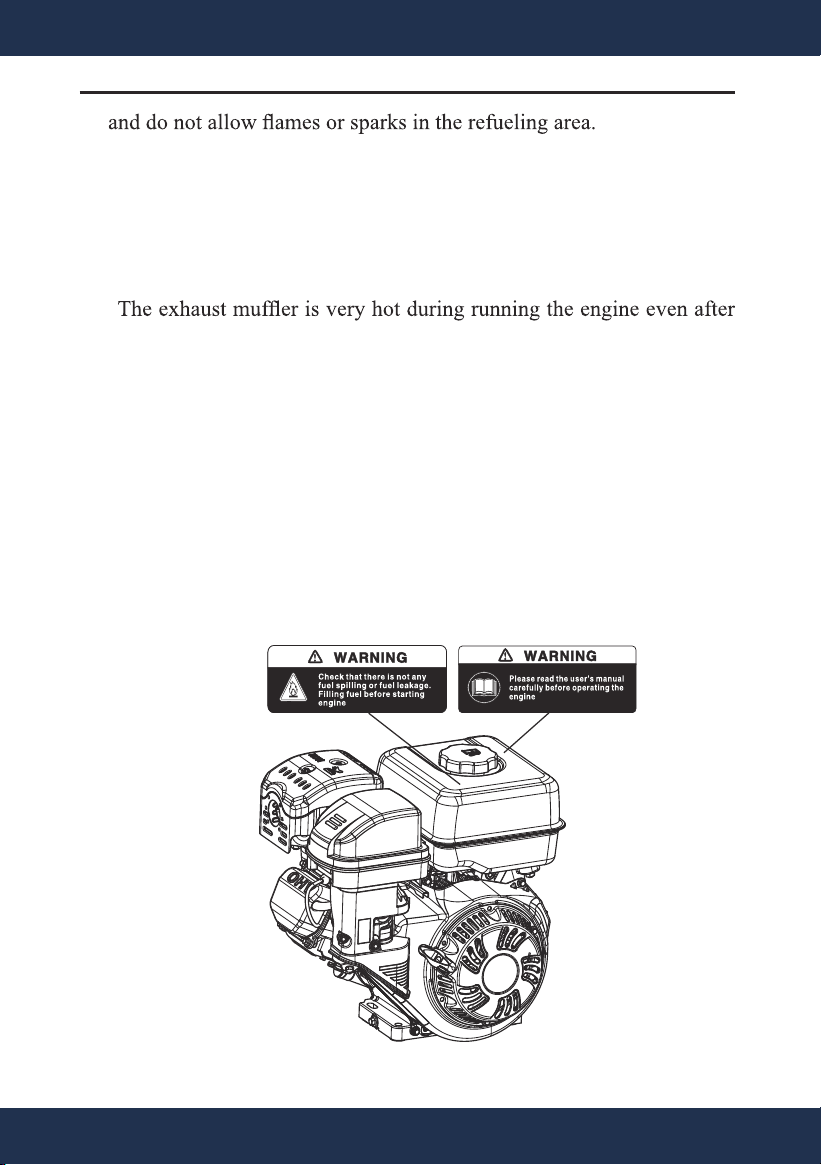
13. Safe warning label:
Please carefully read warning label before operating. Our company
will not accept any responsibility for person hurt, or equipment
damaged caused by disregarding this warning label.
5
SAFETY PRECAUTIONS
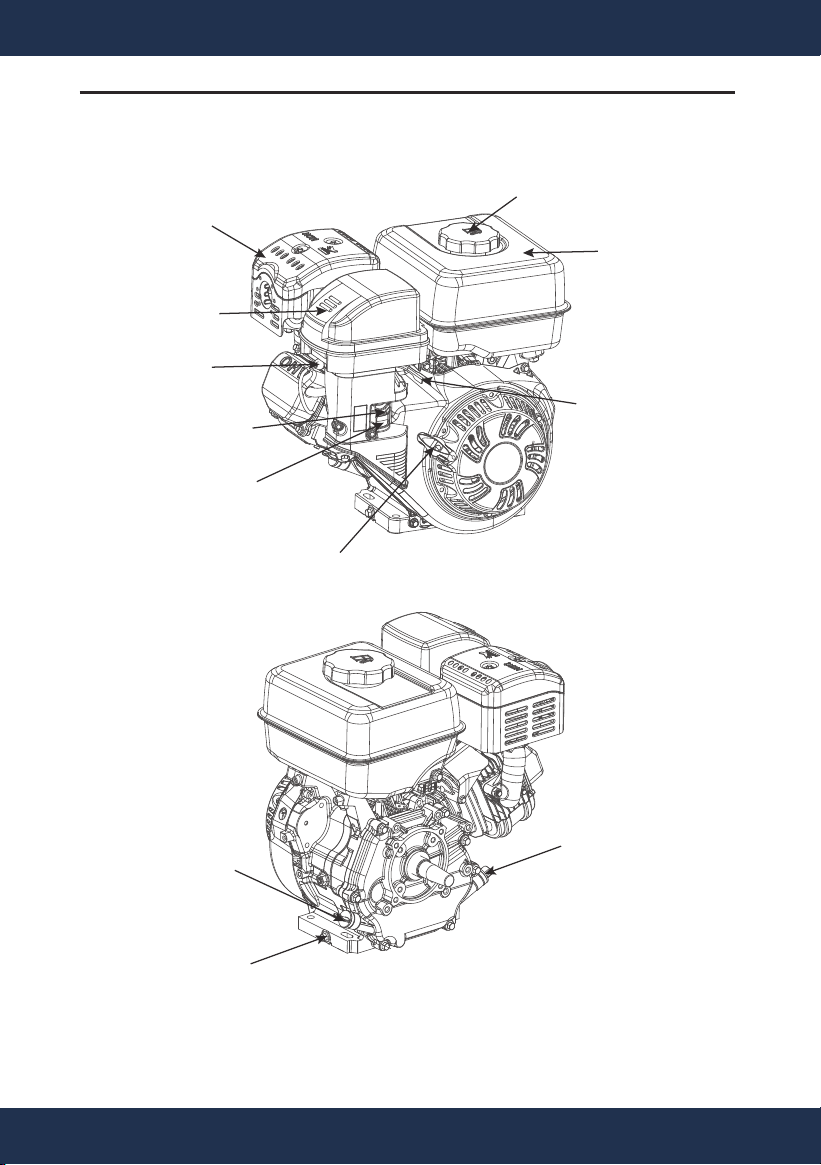
II. PARTS DESCRIPTION
MUFFLER
THROTTLE LEVER
FUEL COCK
FUEL CAP
STARTER HANDLE
OIL DIPSTICK
OIL DRAIN PLUG
OIL PLUG
AIR CLEANER
SPARK PLUG
CHOKE LEVER
6
PARTS DESCRIPTION
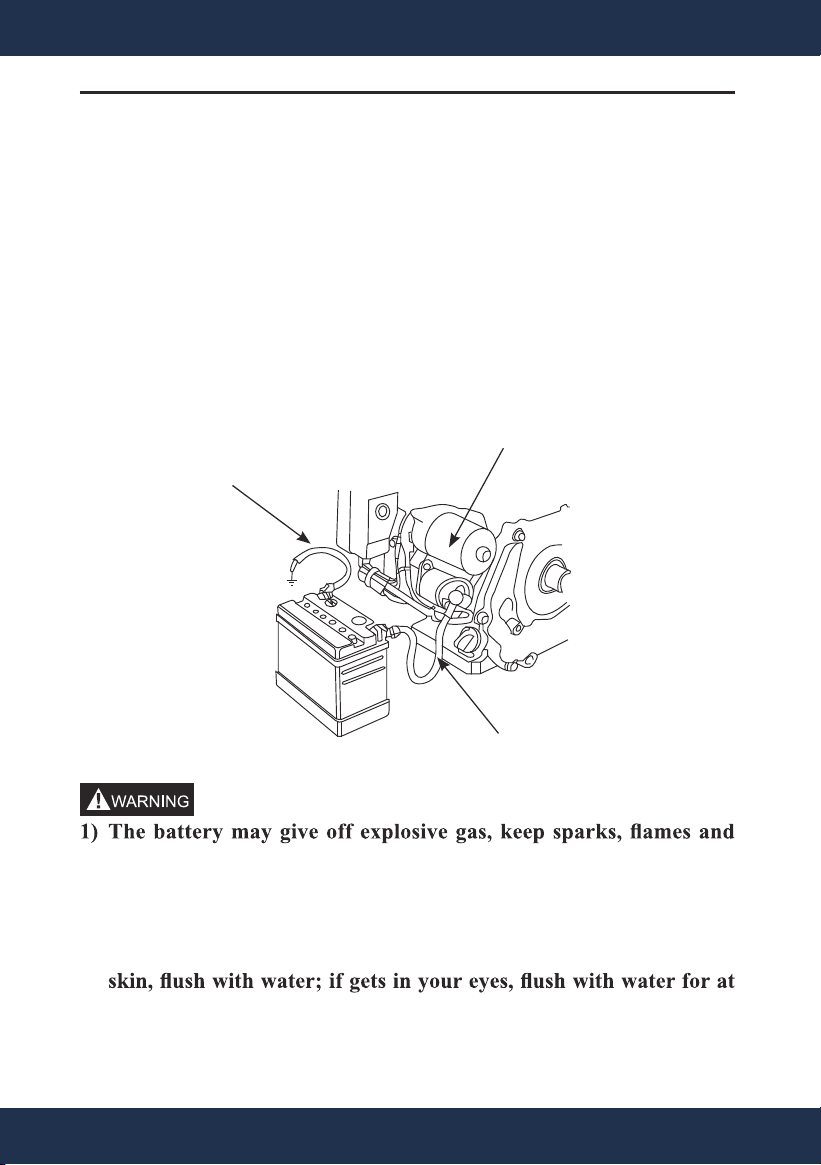
III. BATTERY CONNECTION
Use 12V
and more than 18AH battery, connect its positive lead to start
relay terminal while connect its negative lead to engine mounting screw,
base screw or other grounding point with the engine.(See the following
picture)
Check the battery's connecting point; make sure that it is tight and not
rusted. If rusted, clean and connect.
cigarettes away. Charge or use it indoors with good ventilation.
2) The battery contains sulphuric acid (electrolyte). If contact with
skin or eyes may cause severe burns. If electrolyte gets in your
least 15 minutes and call a physician at once.
3) Electrolyte is poisonous. If swallowed, drink large quantities of
CATHODE WIRE(-)
START RELAY
ANODE WIRE(+)
7
BATTERY CONNECTION

water
or milk, and follow with milk of magnesia or vegetable oil
and call a physician.
4)
Keep out of r
each of children.
1
)
Do not add tap water
to the battery instead of distilled water,
otherwise the battery service life will be shortened.
2)
Do not add distilled
water over the electrolyte upper level mark, if
not, electrolyte will spill out and corrupt the engine part. If so, be
sure to wash them away with water.
3)
M
ake sure not to connect the battery leads in reverse order,
otherwise short-circuit or breaker’s trip may be result in.
8
BATTERY CONNECTION
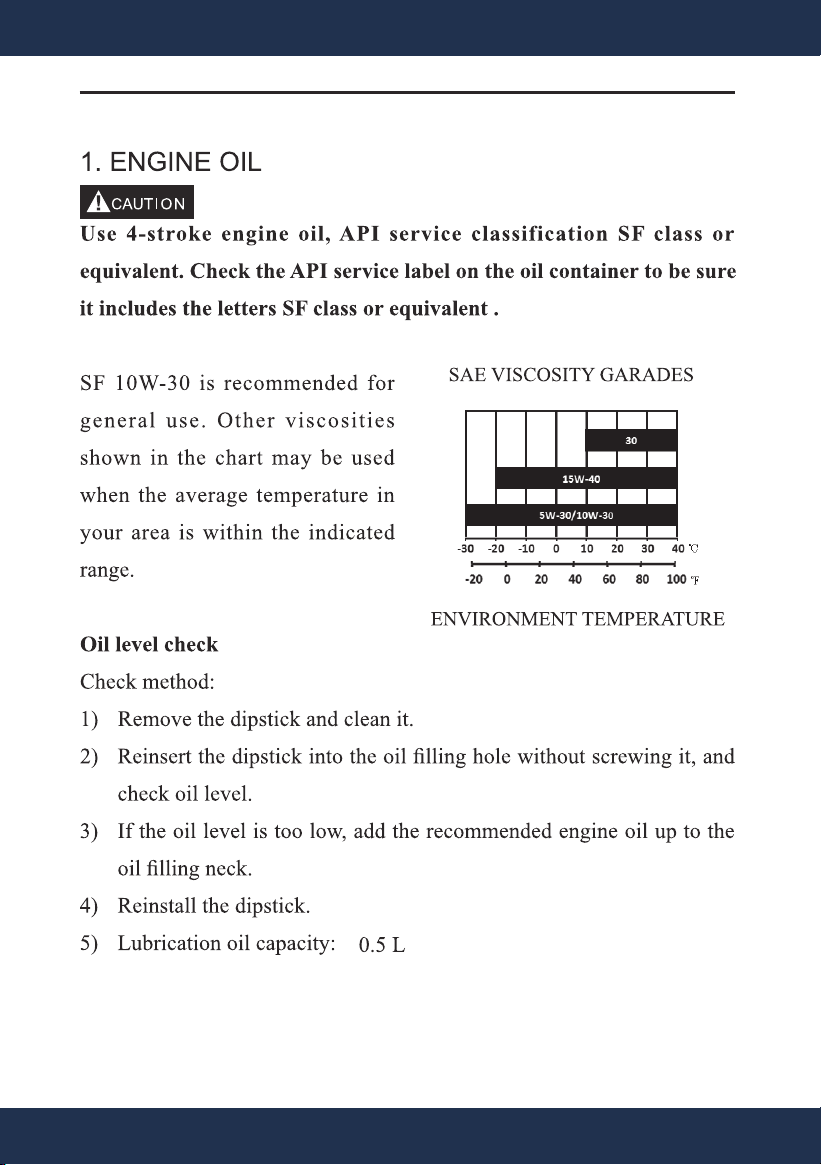
IV. PRE-OPERATE INSPECTION
9
PRE-OPERATE INSPECTION
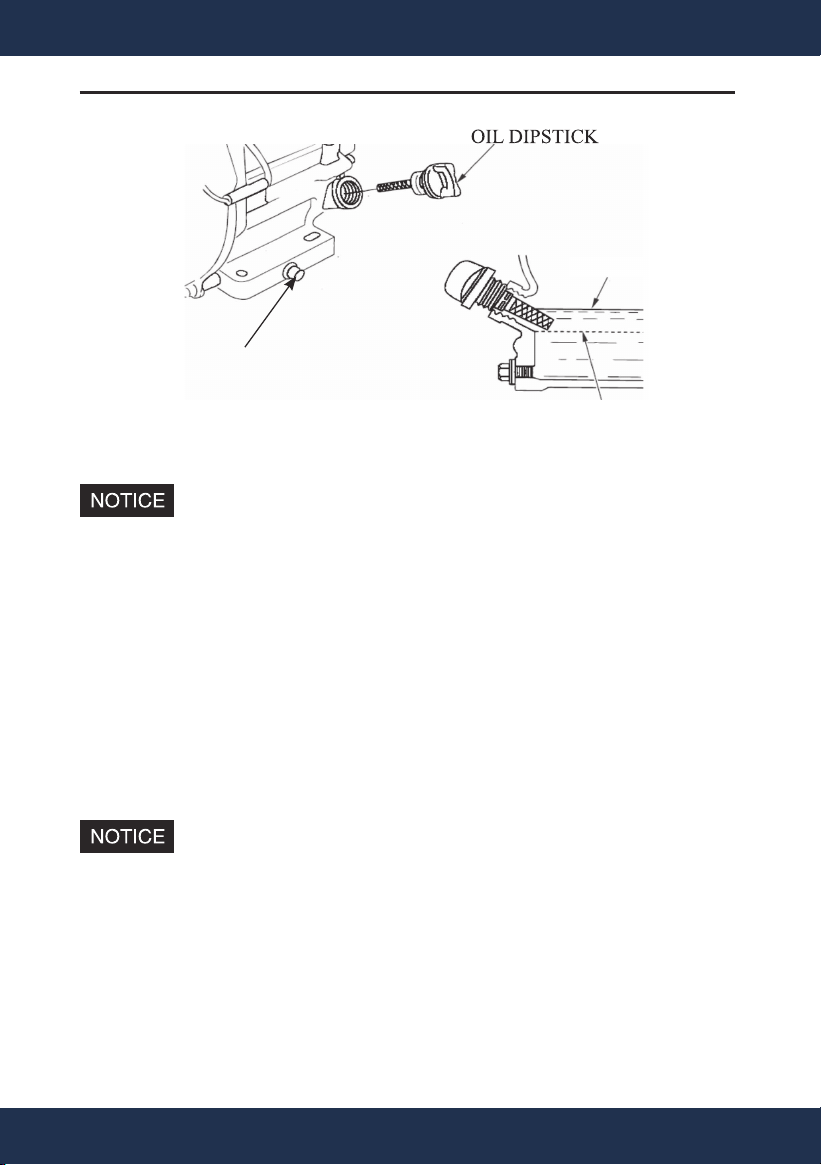
Run with
insufficient engine oil may damage the gasoline engine
severely and that is not within valid warranty.
2. AIR CLEANER
Dismantle the air cleaner cover and check its element to make sure
it clean and complete. Clean or replace it as necessary( see page 25:
maintenance of air cleaner ).
Never
run the engine without an air cleaner, or severe wear of the
engine may be resulted in. That is not within the valid warranty.
3. CHECK THE OIL
1) Remove the fuel tank cap and check fuel level.
2) If the level is too low, refuel the tank. Remember adding fuel not
OIL UPPER LEVEL
DRAIN PLUG
OIL LOWER LEVEL
10
PRE-OPERATE INSPECTION
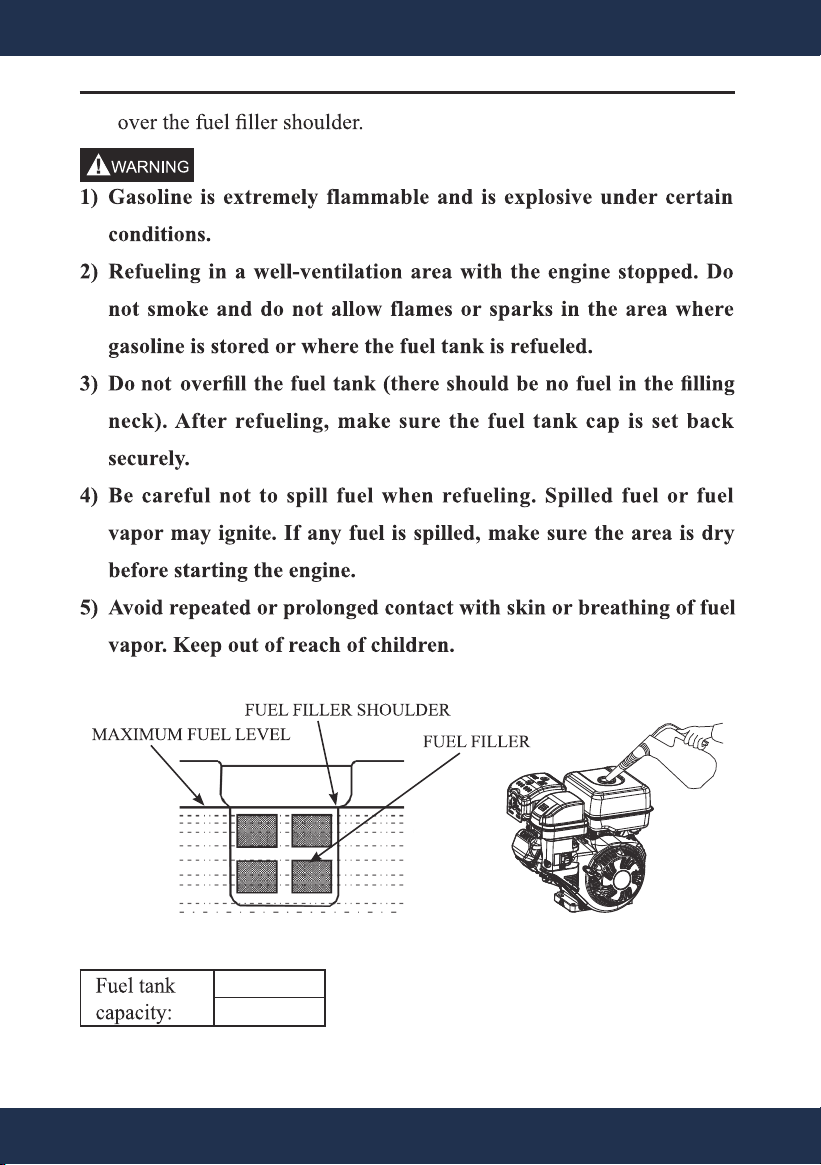
62039
3.6L
11
PRE-OPERATE INSPECTION

Fuel may damage the oil paint and plastic. Be car
eful not to spill fuel
when refueling. Any damage due to oil spilling is not within valid
warranty.
"Light knocking" or "spark exploding" sound can be hear when the
engine overloading. It is normal. Do not be worry about that.
If " knocking" or "spark exploding" sound occur at a steady speed
happen, consult your
dealer for help, otherwise the engine may be
damaged.
When
the engine is running, continuously "Knocking" or "spark
exploding" sound occurring will damage engine.
"Knocking" or "spark exploding" sound from misusing will not be
within the valid warranty.
12
PRE-OPERATE INSPECTION
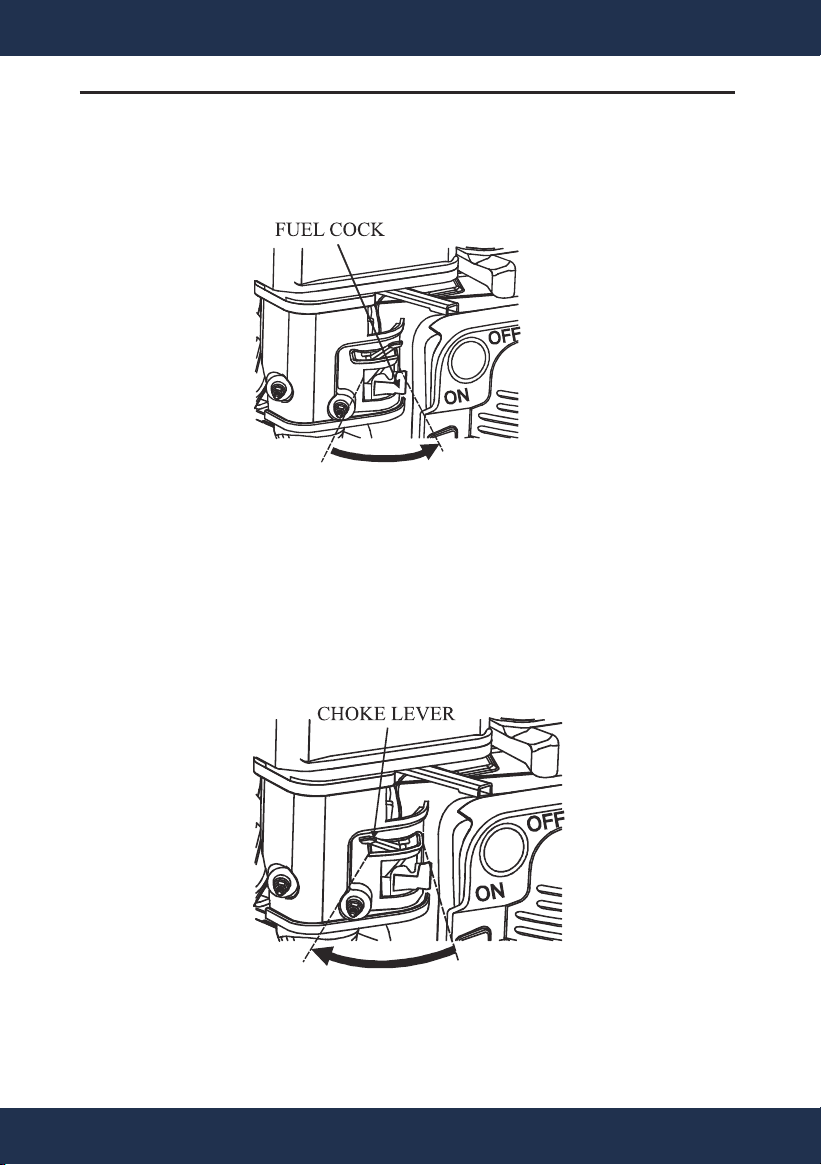
V. STARTING THE ENGINE
1.
T
urn the fuel cock to the “ON” position.
2. Turn the choke lever to the "START" position.
If the gasoline engine is hot, turn the choke lever to the "RUN"position.
OFF
ON
START RUN
13
STARTING THE ENGINE
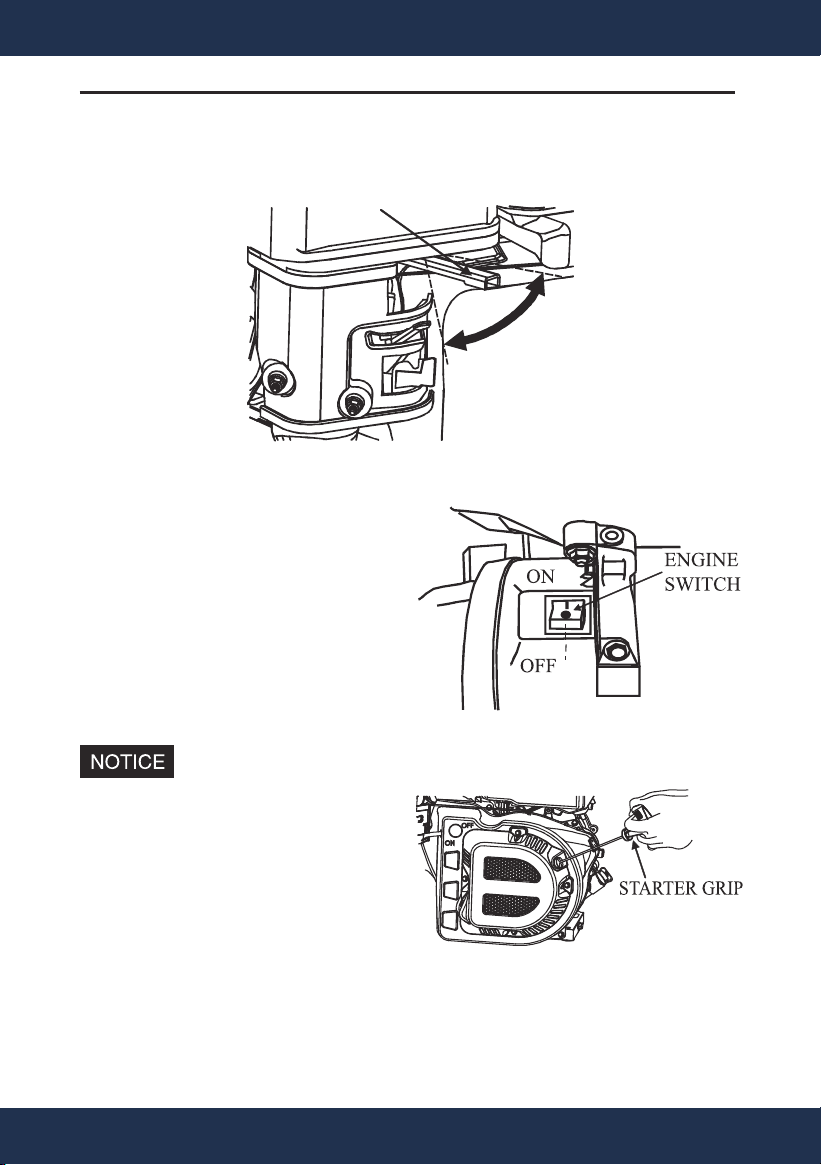
3. Move governor lever to left a little.
4. Start the engine
1) Recoil starter:
Turn the engine switch to the “ON”
(OPEN) position.
Pull the starter grip lightly until
resistance is felt, then briskly.
Don’
t al
low the starter grip to
snap back against the engine.
Return it gently to prevent
damage to the starter
THROTTLE HANDLE
HIGH SPEED
LOW SPEED
14
STARTING THE ENGINE
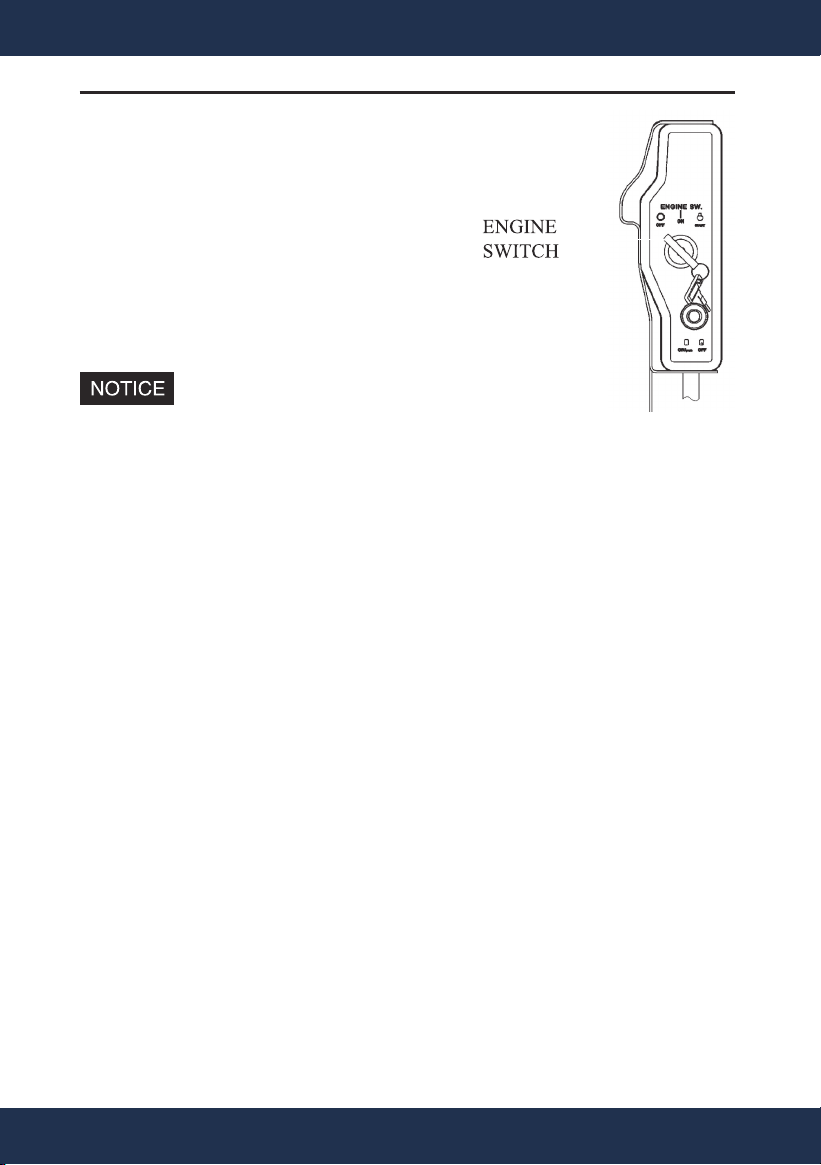
2) Electric start
T
urn the engine switch to the
“START” position, and hold it there
until the gasoline engine starts. When
the engine starts, allow the engine
switch to return to the “ON” position.
Do not use the starter
for more
than 5 seconds or starter motor damage may occur. If the engine fails
to start, release the switch and wait 10 seconds before operating the
starter again.
15
STARTING THE ENGINE
VI. RUNNING THE ENGINE
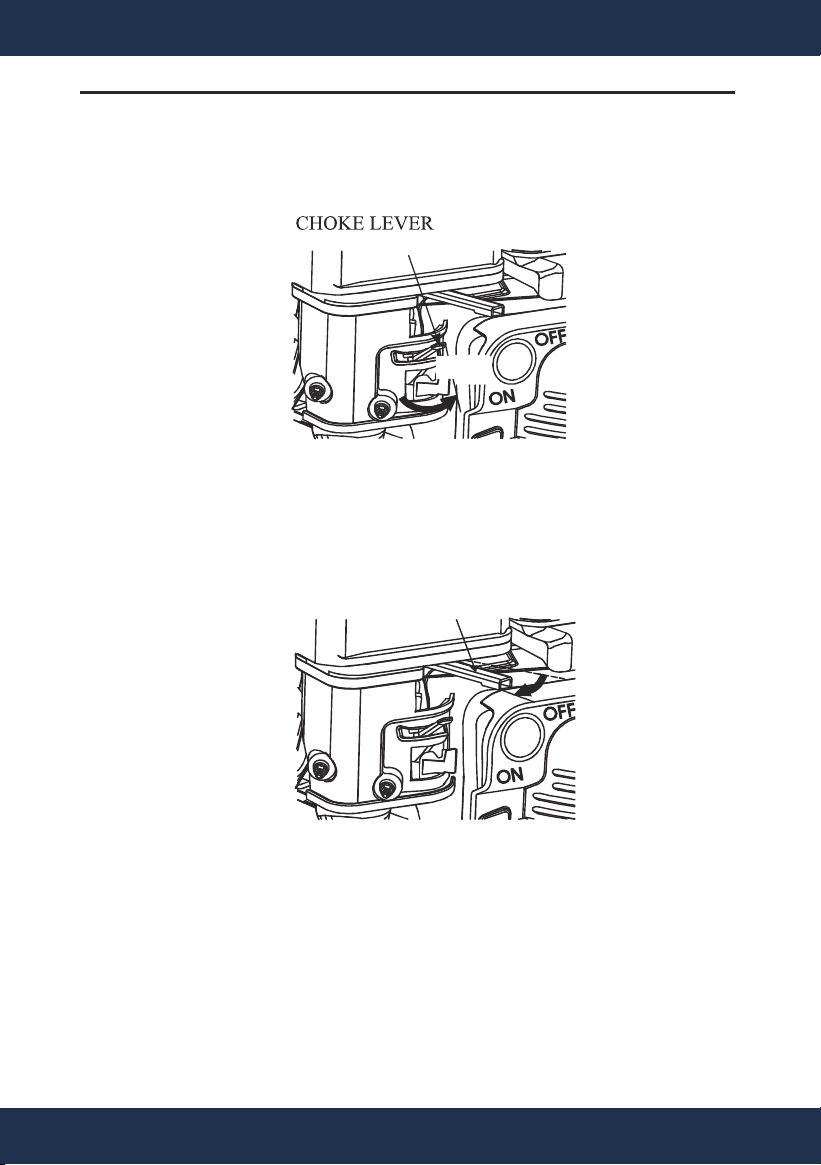
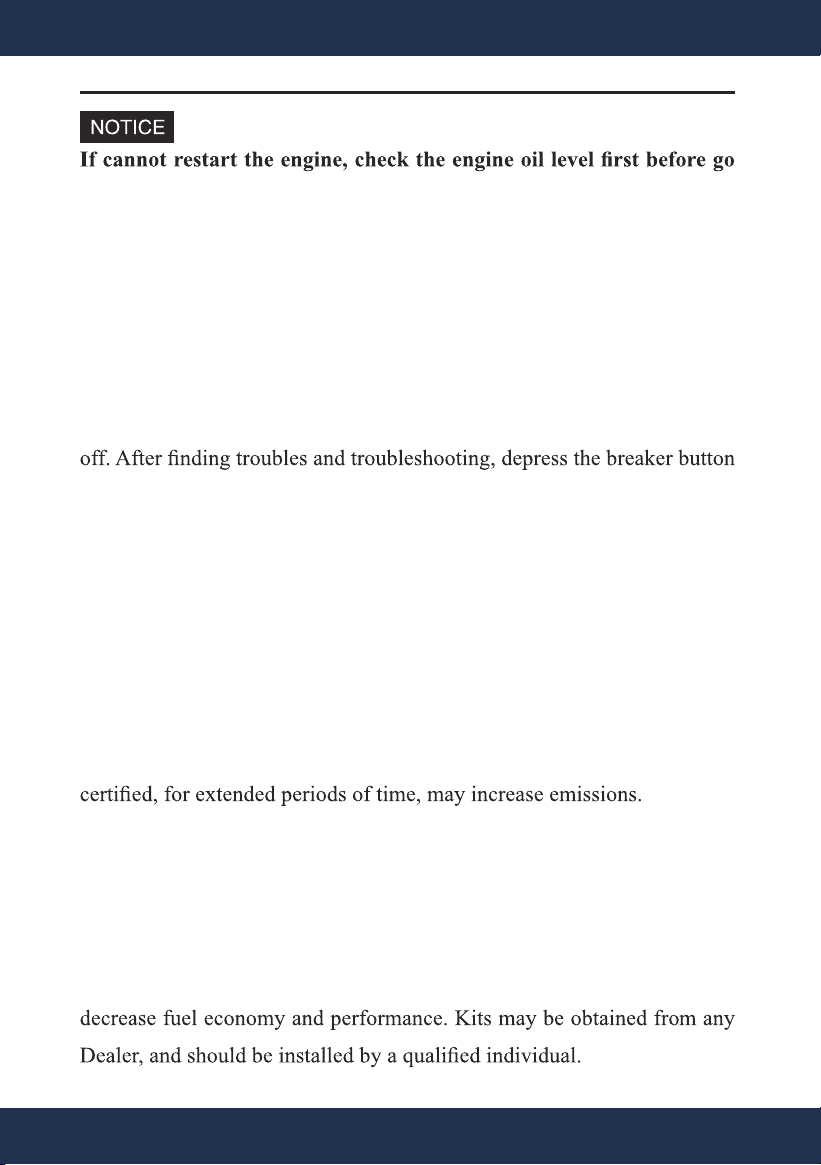
1. Pre
heat the engine and push back the choke lever to the "RUN"
position.
2. Move the throttle lever to proper position to make the gasoline engine
run at required velocity.
ENGINE OIL ALARM
The engine oil alarm is specially designed to protect engine when the
engine oil in the crankcase is insufficient. Once the engine oil level
gets lower than the limit line, the alarm system will stall the engine
automatically while the engine switch is still at ON position.
THROTTLE LEVER
RUN
16
RUNNING THE ENGINE
to other
check items.
BREAKER (Electric-start type)
The breaker will cut off automatically to protect the charging circuit of
the battery in the case that short circuit or incorrect connection of the
battery poles occurs.
The green indicator in the breaker will jump out with the circuit cutting
to turn the breaker on.
KIT HIGH ALTITUDE REPLACEMENT FOR EPAIII ENGINES
3000ft to 6000ft or 6000ft to 8000ft of elevation
* At high altitude, the standard carburetor air-fuel mixture will be too
rich. Performance will decrease and fuel consumption will increase. A
very rich mixture will also foul the spark plug and cause hard starting.
Operation at an altitude that differs from that at which this engine was
* The fuel system on this Engine or Equipment may be influenced
by operation at higher altitudes. Proper operation can be ensured by
installing an altitude kit when required. See the table below to determine
when an altitude kit is required. Operating this generator without the
proper altitude kit installed may increase the engine’s emissions and
17
RUNNING THE ENGINE
Fuel Altitude Range**
Gasoline
0 – 3000 ft Not Required
3000 – 6000 ft Altitude kit 1#
6000 – 8000 ft Altitude kit 2#
* Engine, Generator Set, Pressure Washer, Walk-Behind Lawnmower,
Compressor, Pump, Tiller etc.
** Elevation above sea level.
* This high altitude jet is to be used at elevations above 3000 feet.
* At elevations above 8000 feet, the engine may experience decreased
performance, even with the high altitude kit.
If a carburetor is replaced, the proper high altitude kit jet will need to be
installed into the replacement carburetor.
the kit procedures in a well-ventilated area away from
ignition sources. If the engine is hot from use, shut the
engine off and wait for it to cool before proceeding.
adjustments are not made for high altitude use. To install
a high altitude kit.
18
RUNNING THE ENGINE
ENGINE SWITCH
VII. STOPPING THE ENGINE
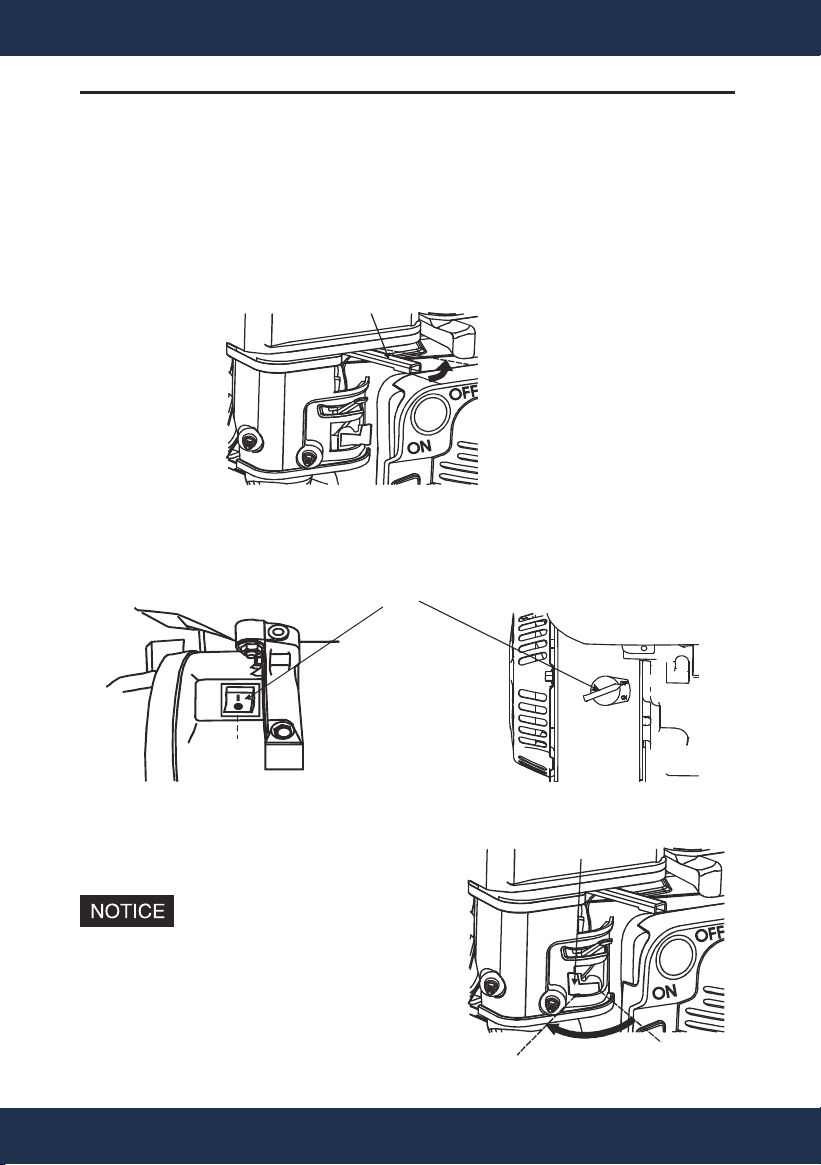
In emer
gency, push the engine switch to the OFF”.
In normal, please do as following:
1. Push right the throttle lever to low speed position.
2. Push the engine switch to the “OFF” position.
3. Set the fuel cock to “OFF” position.
Sudden stopping at high speed under
heavy load is forbidden, otherwise
damage will result.
THROTTLE LEVER
FUEL COCK
OFF
OFF
ON
19
STOPPING THE ENGINE
VIII. EXHAUST CONTROL SYSTEM
W
ith the engine running, carbon monoxide, oxide of nitrogen and
hydrocarbon will produce, and in certain conditions, oxide of nitrogen
and hydrocarbon will react chemically each other to make smoke while
carbon monoxide is toxic, so exhaust control of them is very important.
To keep the exhaust of your engine with in the standard exhaust emission,
pay attention to the following:
1. Maintenance
Ma
intain the engine periodically in accordance with the maintenance
schedule in the manual. The maintenance schedule is made out on the
base of normal use in normal conditions, if using under heavy load, dusty
or wet circumstances or in high temperature, service of the engine should
be done more often.
2. Problems affecting exhaust emissions
2) Unstable idling speed.
3) Give of
f black smoke or consume fuel too much
5) Too early ignition.
20
EXHAUST CONTROL SYSTEM
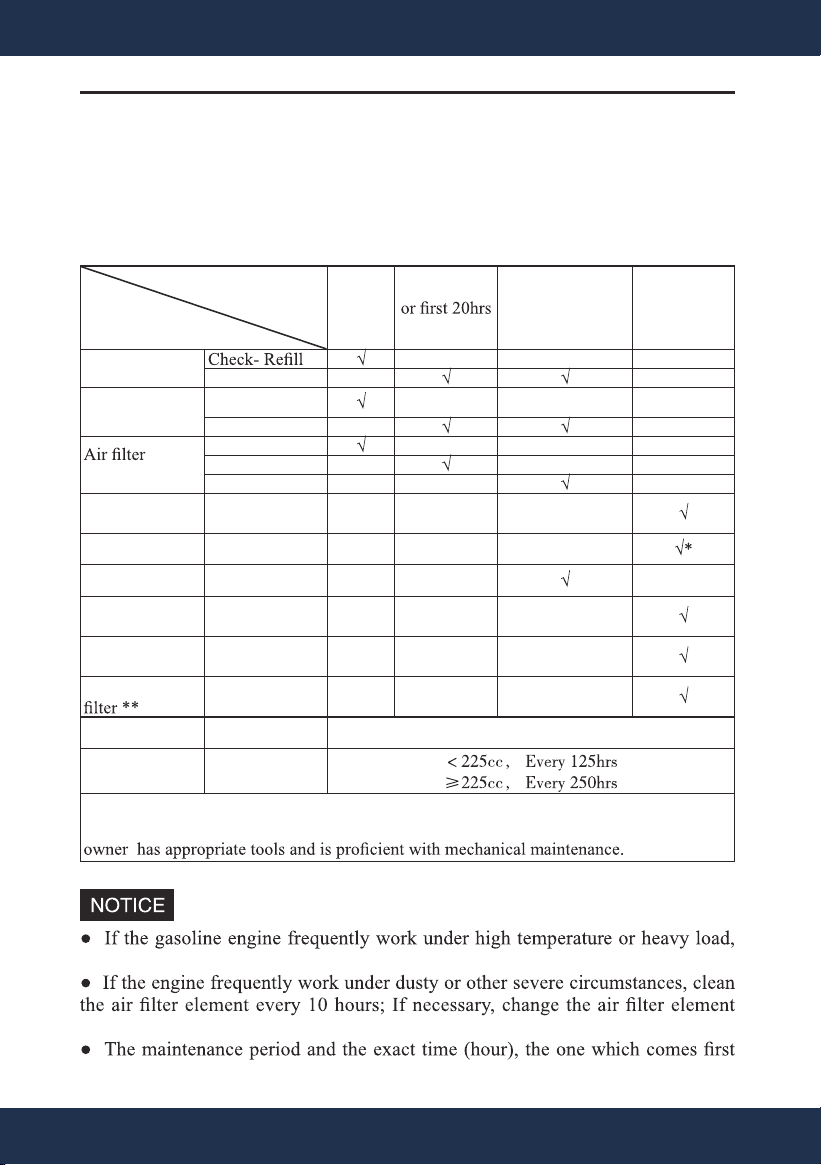
IX. MAINTENANCE
The
engine must be properly maintained to ensure its operation be safe,
economy and trouble-free, as well as eco-friendly.
In order to keep your gasoline engine in good working condition, it must
be periodically serviced. The following maintenance schedule and routine
inspection procedures must be carefully followed
Frequency
Items
Each
time
First 1 month
of operation
Thereafter, every
3 months or every
50hrs of opera-
tion
Every year or
every 100 hrs
of operation
Engine oil
Replace
Reduction gear
oil(if equipped)
Oil level check
Replace
element
Check
Clean
Replace
Deposit Cup( if
equipped)
Clean
Spark Plug Check - adjust
Spark arrester Clean
Idling ( if
equipped)**
Check - adjust
Valve clearance
**
Check-adjust
Fuel tank & fuel
Clean
Fuel line Check Every 2 years( change if necessary)
Cylinder head,
piston
Clean up carbon
**
* These items should be replaced if replacement needed.
** These items should be maintained and repaired by our authorized dealer, unless the
change the oil every 25 hours.
every 25 hours.
should govern.
21
MAINTENANCE
possible.
St
op the engine before servicing. Put the engine on a level surface
and remove the spark plug cap to prevent the engine from starting.
Never run your engine in a poorly ventilated room or other enclosed
area, be sure to keep good ventilation in working area. The exhaust
from the engine may contain poisonous CO, inhalation can cause
shock, unconsciousness and even death.
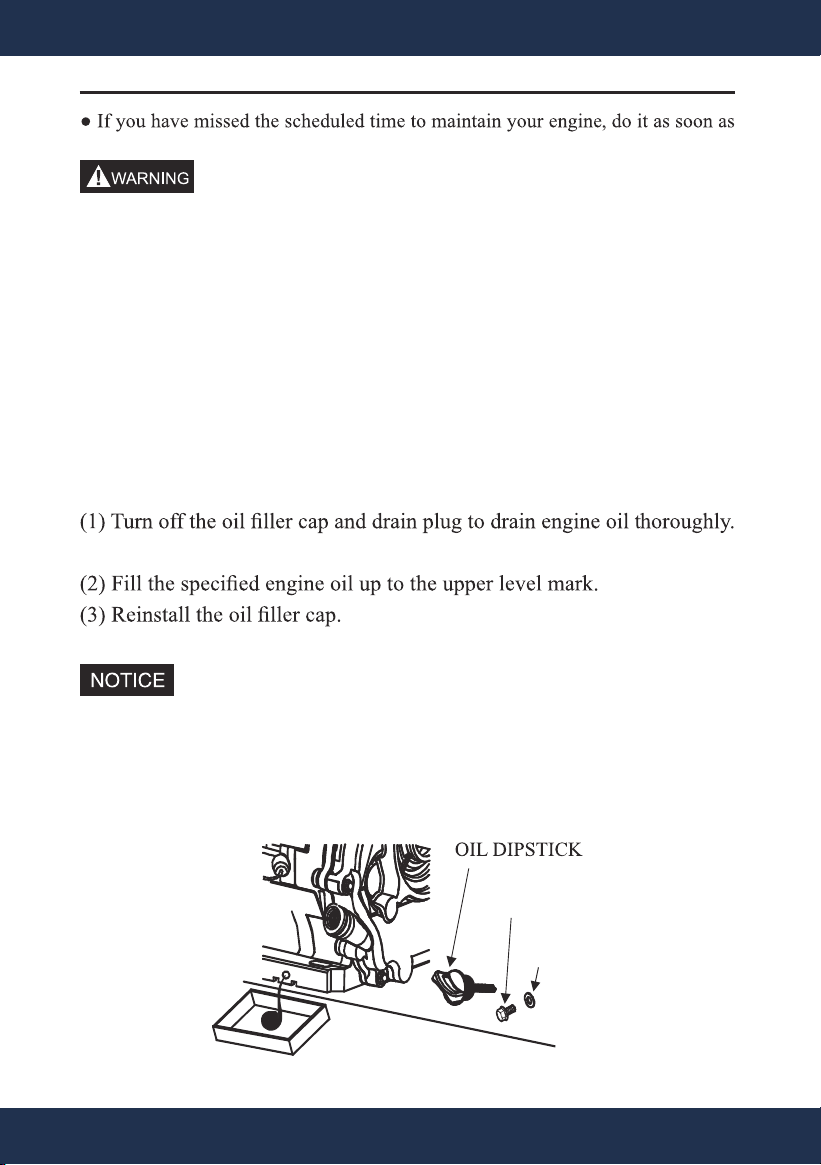
2. MAINTENANCE METHOD
1) Replacement of engine oil (see page 1
1 to check method)
Drain the engine oil rapidly and completely out when the engine is hot.
Reinstall the drain plug and screw in securely.
Do not dump oil containers
or discarded engine oil into rubbish
boxes or onto the ground. For the sake of environmental protection,
we suggest you take in discarded engine oil with a closed container
and bring to local recycling station.
DRAIN PLUG
WASHER
22
MAINTENANCE
2) Maintenance of air cleaner
A
dirty air cleaner can restrict air flowing into the carburetor. To keep
the carburetor in good working conditions, please service the air cleaner
periodically(clean air cleaner element after engine running 20h).If
operating the engine in extremely dusty area, the job should be done
more often.
detergents, or
explosion may happen.
Never
run the engine without an air cleaner, because air with dirt
and dust entering the engine can speed up the engine wear.
(
1)
Remove the air cleaner cover of
f and take the element out.
(2)
Pa
per element: Wash the element with home detergents and warm
dry up.
Foam element:
Soak in clean engine oil until saturated. Squeeze out
excess oil, otherwise, the engine will smoke in starting stage.
(3)
Clean the air cleaner cover and inner surface with wet cloth, be
careful not to allow the dust entering into the carburetor.
(4)
Reinstall the element and put the air cleaner cover on.
3) Spark plug
In order to ensure the engine normal running, gap of the spark plug must
be correct and no deposit around the spark plug.
(1)
Remove the spark plug cap.
23
MAINTENANCE
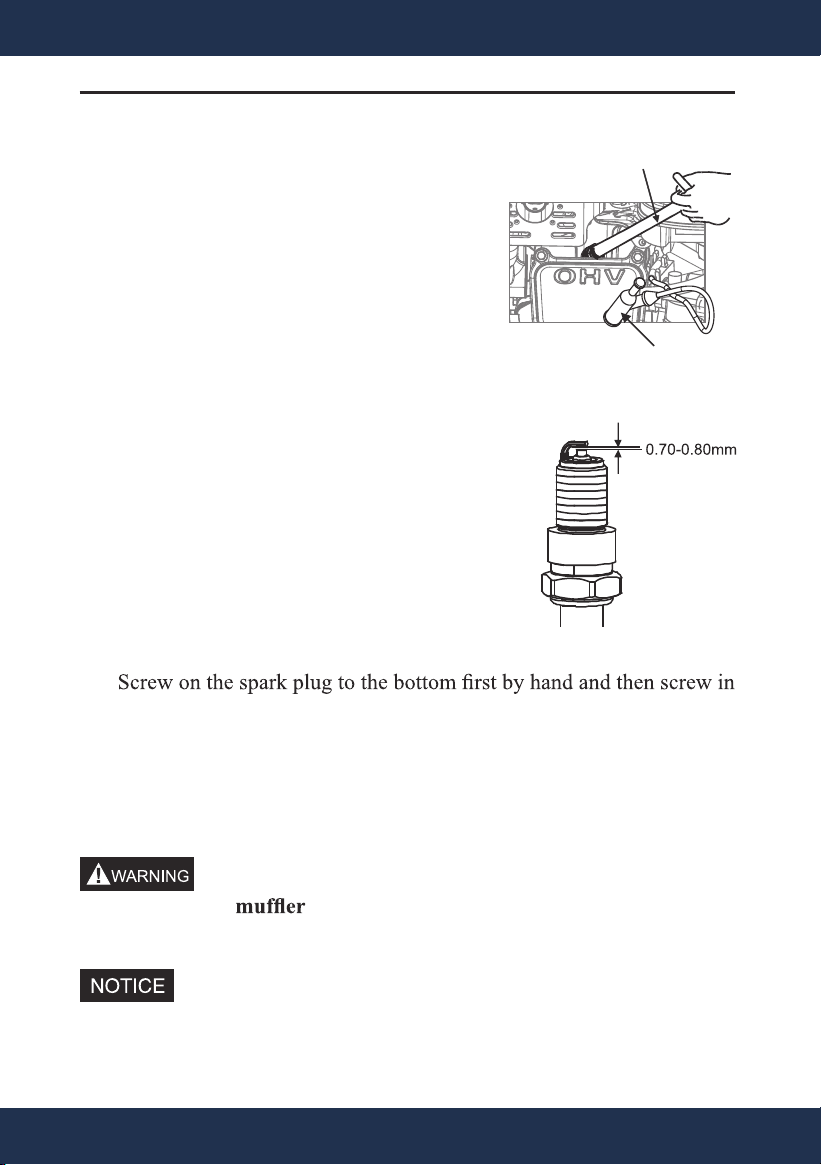
(2) Clear
away dirt around the spark plug
base.
(3) Dismantle the spark plug with a spark
plug wrench.
(4) Visually check the spark plug. Clean
with a steel brush. If the insulator
is damaged, replace the spark plug
Spark Plug Cap
Spark Plug Wrench
instead.
(5) Measure the spark plug clearance with a
feeler. The clearance should be 0.7~0.8mm.
If adjustment is necessary, bend the side
electrode carefully.
(6) Check if the spark plug gasket is in good
conditions. In order to screw thread
misplace, screw in by hand.
(7)
by a spark plug wrench and compress the gasket.
-- If
a new spark plug is used, more twist 1/2 turns after compressing
the gasket.
-- If reinstalling the used spark plug, just more twist 1/8-1/4 turns.
Don’t
touch the
in running and just gasoline engine stopping
stage to avoid burn.
T
he spark plug must be tightened securely, or it may become very
hot to damage the engine.
24
MAINTENANCE
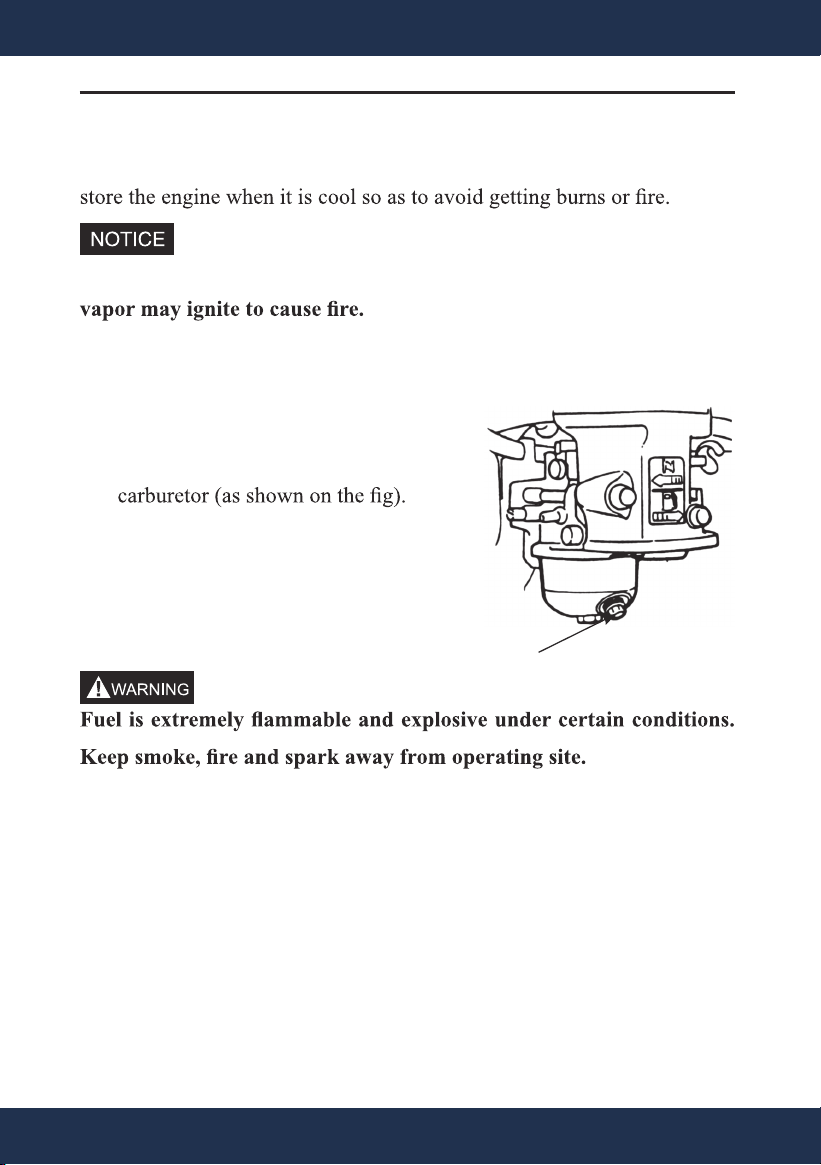
X. RANSPORT AND STORAGE
T
ransport with the fuel cock turned the “OFF” position. Transport or
Do
not incline the engine so as to avoid fuel’s spill. Spilled fuel or fuel
If the engine is not kept in use for a long time, be sure to store it properly.
1.
Make sure the storage area is dry and free of dust.
2. T
urn the fuel cock to “OFF” position,
set a proper container under the
3.
Open the fuel cock to completely train
gasoline out of the fuel tank.
4. Reinstall the oil drain plug back and
tighten it.
5. Drain the oil out of the gasoline engine.
6
.
Remove the spark plug. Fill about a spoon of fresh engine oil onto
the cylinder. Crank the engine up to distribute engine oil evenly.
Reinstall the spark plug.
7.
Electric starter: Remove the battery and store in dry and cool area.
Charge one every month.
8.
Cover the engine to protect dust entering.
CARBURETOR OIL DRAIN PLUG
25
TRANSPORT AND STORAGE
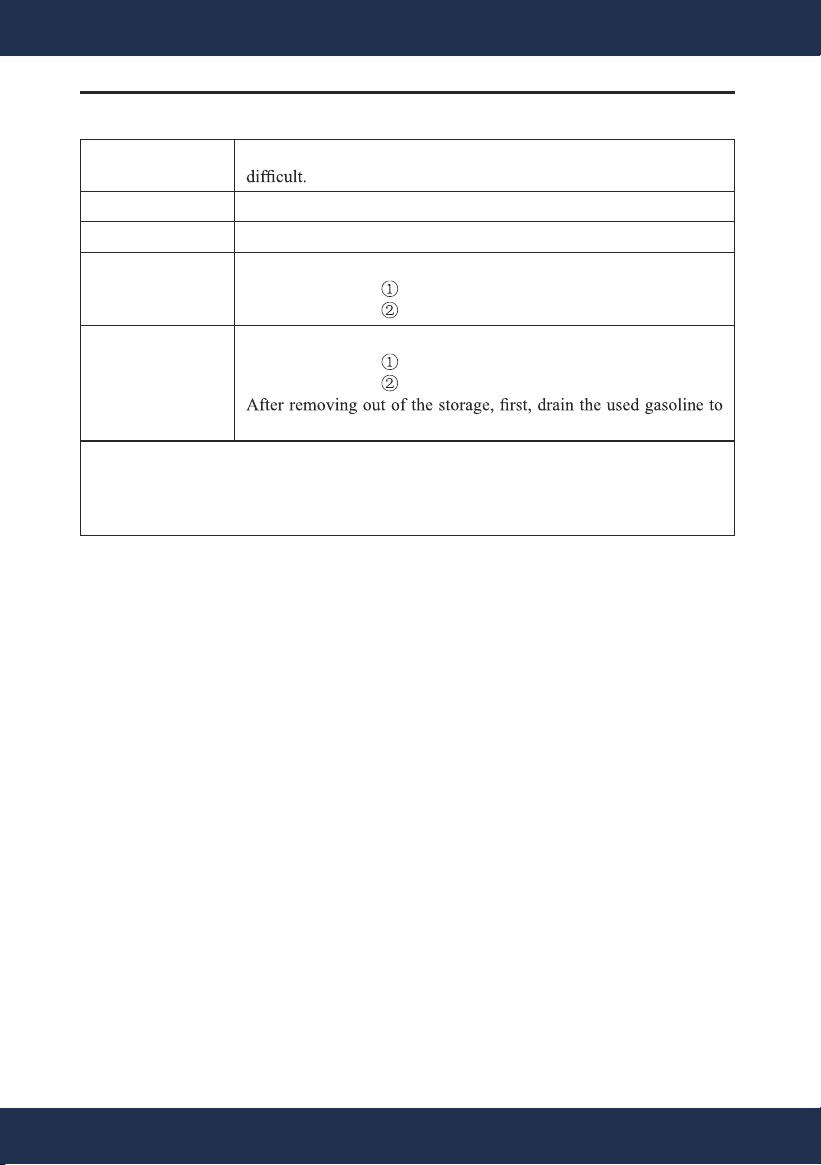
Please maintain according to following table when reuse after storing.
Storing time
Maintaining procedure is commended in order to prevent starting
1 month Don’t need to prepare.
1-2 month Drain the used gasoline out and add the fresh gasoline
2 months to 1 year
Drain the used gasoline out and add the fresh gasoline
Drain the gasoline
out of the carburetor cup.
Drain the gasoline
out of the sediment bowl.
1 year over
Drain the used gasoline out and add the fresh gasoline
Drain the gasoline
out of the carburetor cup.
Drain the gasoline
out of the sediment bowl.
proper container, and don’t start before adding fresh gasoline.
Loosen the oil drain bolt and completely drain the gasoline out of the carburetor to prop-
er container and screw the oil drain bolt down. Remove the sediment bowl after closing
fuel cock, and completely pour the gasoline out the sediment bowl. Finally reinstall the
sediment bowl back and screw it down.
26
TRANSPORT AND STORAGE
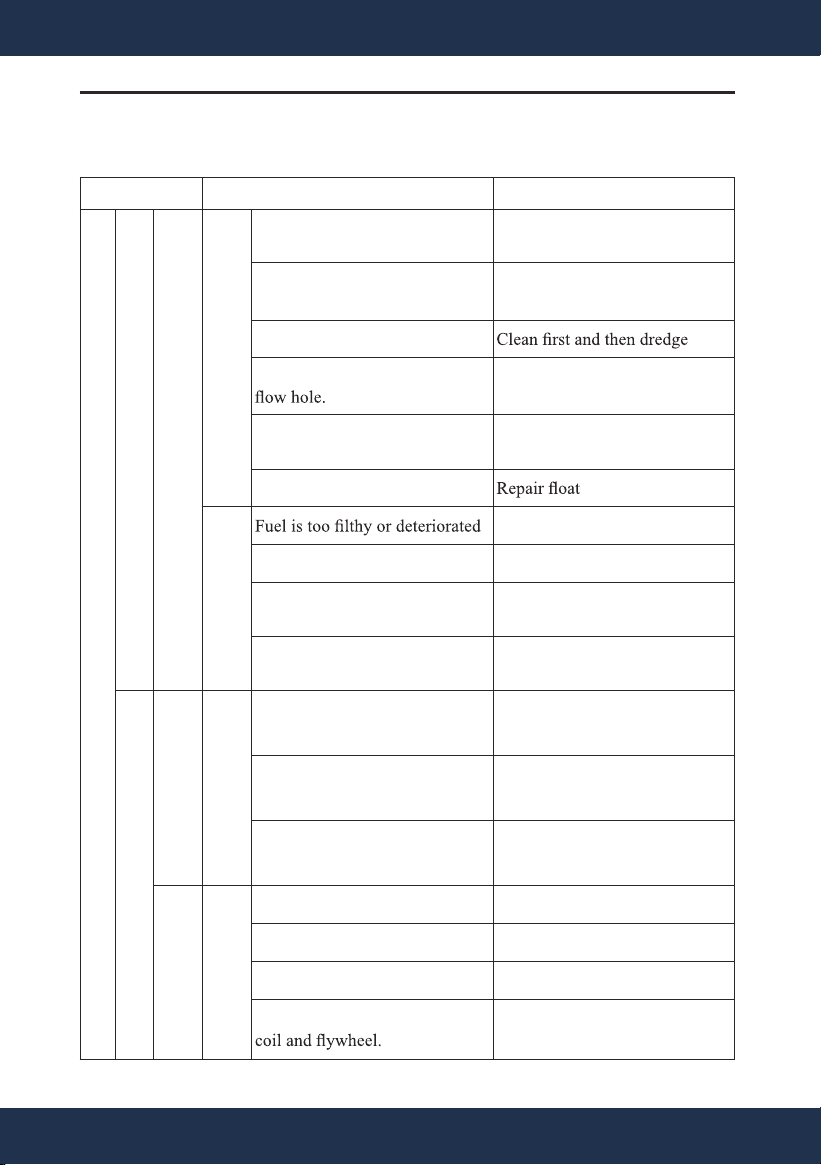
XI. TROUBLESHOOTING
1. ST
ART ENGINE DIFFICULTLY (By using recoil starter):
YDEMERESUACELBUORT
Normal cylinder compression
Normal spark plug spark
Something wrong with the fuel system.
Fuel supply is not smooth or no fuel sup-
ply.
There is no enough fuel in fuel
tank and fuel cock is closed.
Fill fuel, open fuel cock.
Air vent in the fuel filler cap is
clogged
Dredge air vent.
Fuel cock is clogged
Improper or clogged main oil Readjust or clean, blow to get
through.
Needle valve is not closed prop-
erly or start hole is clogged.
Dismantle needle valve and re-
pair, clean, blow to get through.
Float is damaged or sticking.
Fuel supply is normal.
Replace
There is water in fuel. Replace
Too much fuel in engine
Drain extra fuel, dry up spark
plug electrodes.
Wrong fuel brand
Select proper fuel brand corre-
sponding with the requirements.
Normal fuel supply system.
Normal high –tension line
spark.
Normal high-tension line
spark
Too much carbon deposit and
dirt around electrodes.
Clear away.
Electrodes are burn damaged
seriously or insulators damaged.
Replace spark plug.
Improper electrodes gap. Adjust to proper value.
High-tension line no
spark
Normal spark plug
High–tension line is damaged. Replace
Ignition coil is damaged. Replace
Magneto loses magnetism. Replace
Ab
normal gap between ignition
Adjust gap
27
TROUBLESHOOTING
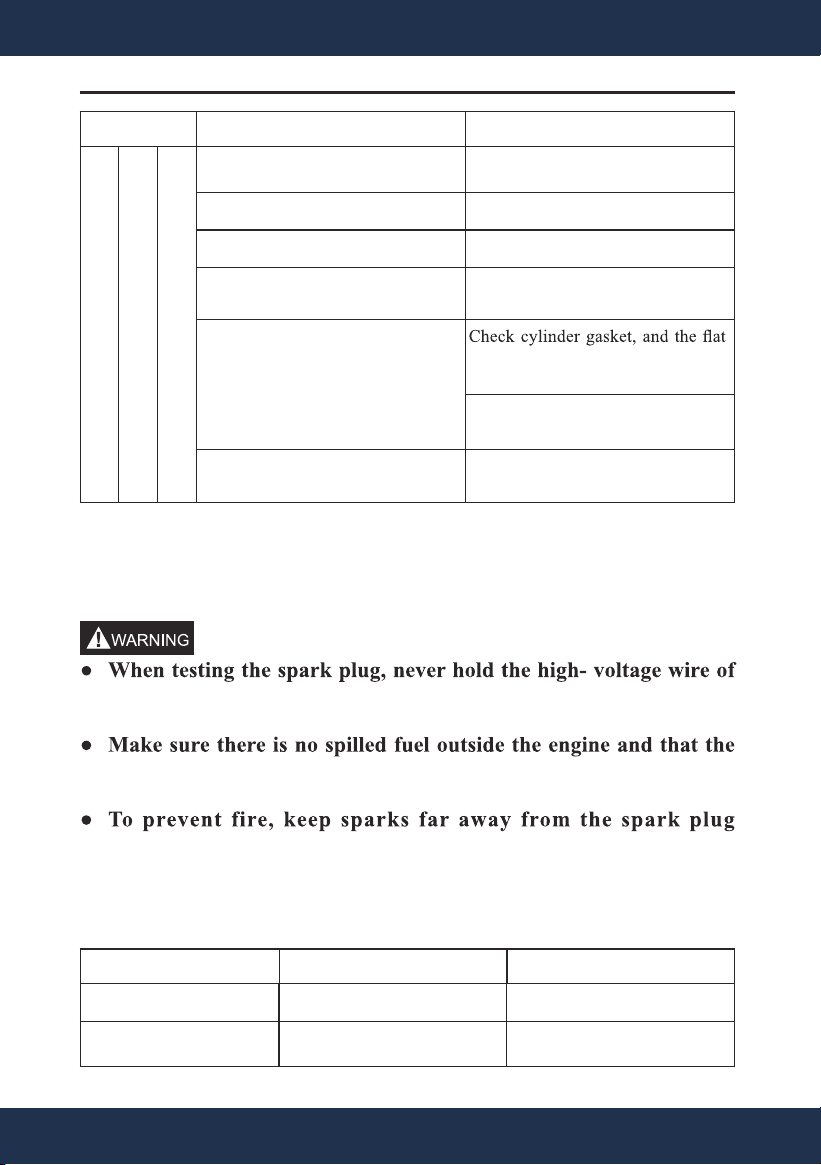
YDEMERESUACELBUORT
Abnormal cylinder compression.
Normal fuel supply system.
Normal spark plug.
Piston ring is worn to or even over
its wear limit
Replace
Piston ring is broken. Replace
Piston ring is sticking. Clear up carbon fouling.
Spark plug is not installed tighten or
without a gasket.
Tighten with a gasket in.
Air leakage between cylinder block
and cylinder head.
-
ness of the surface by which cylinder
block contacting with cylinder head
Tighten cylinder head bolts in stipu-
lated order to stipulated torque.
Air leakage in the valves
Check valve. Clearance and tight-
ness, repair if necessary.
If still can’t starting, have the gasoline engine to our authorized dealer for
repairing.
the spark plug with wet hand.
spark plug isn’t dipped with fuel.
mounting hole.
START ENGINE DIFFICULTLY (By using starting motor):
ITMES CAUSE REMEDY
Check battery connection Incorrect connection Correct
Check battery
No charge or under charge,
corrosion
Check the breaker, charge up
the battery or replace it.
28
TROUBLESHOOTING
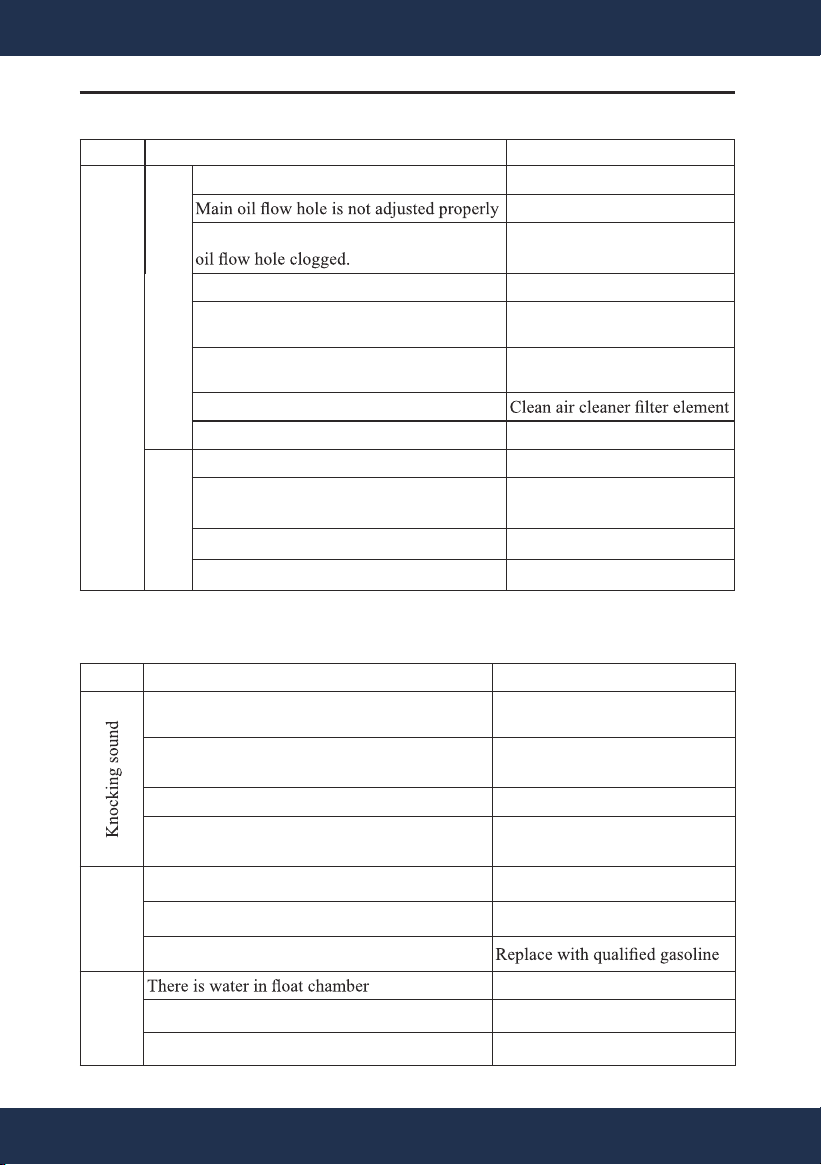
2. GASOLING ENGINE POWER OUTPUT
INSUFFICIENCY:
TROUBLE
YDEMERESUAC
When increasing throttle, speed increase slow or even
decrease and stop running
Fuel supply system
Air in fuel line or fuel line clogged Exhaust air or dredge fuel line
Readjust
In carburetor, needle valve hole and main
Clean and blow to get through
Fuel cock is clogged up. Clean, replace damaged part
Too much carbon deposit in combusting
chamber.
Clear away
Too much car bon fouling in muffler and
exhaust pipe.
Clear away
Air cleaner is clogged up.
Intake pipe is leaking Repair or replace
Poor compression
Piston or cylinder or piston ring is worn Replace the worn
Air leakage from the surface by which cyl-
inder block contacting with cylinder head.
Replace cylinder gasket
Too big or too small valve clearance. Readjust
Valve tightness is poor. Repair
3. GASOLINE ENGINE RUNNING UNSMOOTHL
Y:
TROUBLE
YDEMERESUAC
Piston, cylinder or
piston ring is worn exces-
sively.
Replace the worn
Piston pin and piston pin hole are worn exces-
sively.
Replace piston or piston pin
Tie rod small head is worn excessively. Replace tie rod
Roller bearing for crankshaft main shaft is
worn.
Replace roller bearing
Abnormal
combustion
elbuort toohStoh oot si enignE
Too much carbon deposit in combustion chamber
Clear away
Improper gasoline brand or low gasoline quality
Spark
lacking
Clean
improper spark plug electrodes clearance Adjust
Something wrong with induced coil, and so on Check and replace damaged parts
29
TROUBLESHOOTING
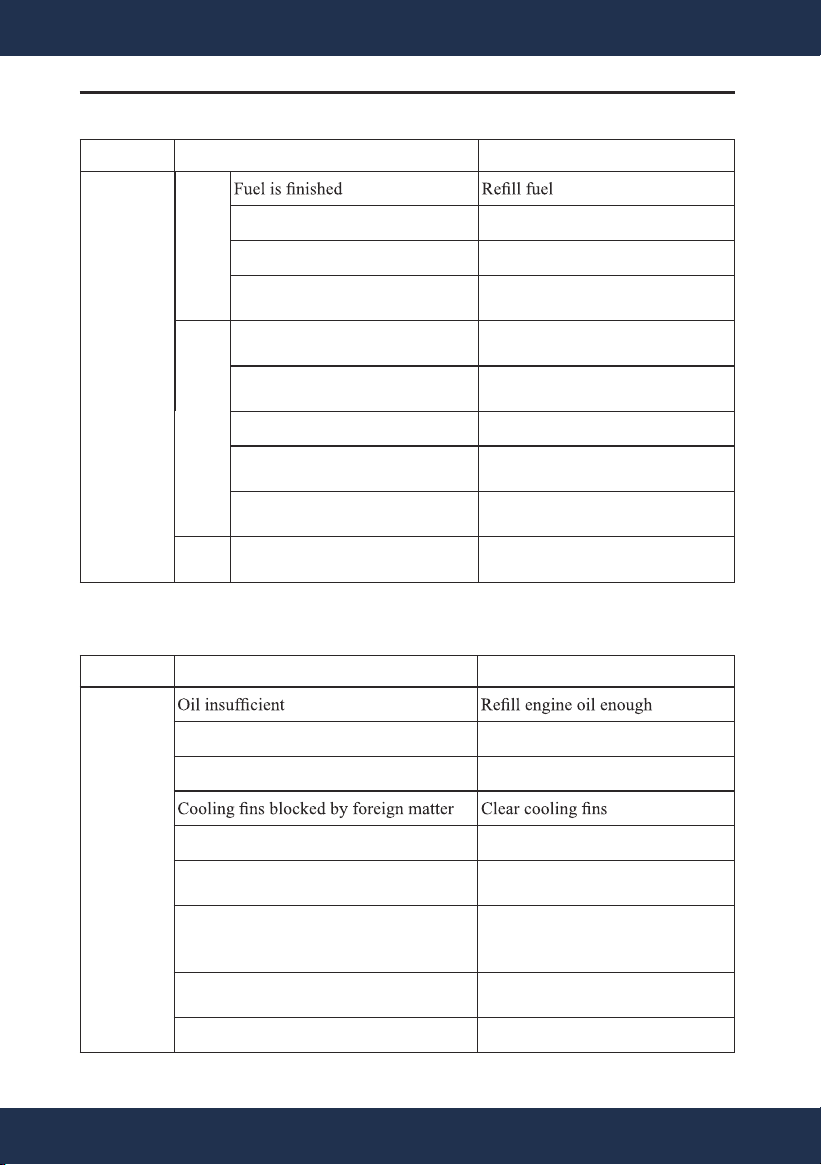
4. ST
OP SUDDENLY WHEN RUNNING:
YDEMERESUACELBUORT
Stop suddenly when running.
Fuel supply system
Carburetor is clogged Check fuel line and dredge
Float is leaking Repair
Needle valve is sticked
Dismantle float chamber and
eliminate it
Ignition system
Spark plug is punctured, or short-
circuited by carbon deposit
Replace spark plug
Side electrode of spark plug is
dropped out
Replace spark plug
High-tension wire is dropped out Weld on
Ignition coil is punctured or
short-circuited
Replace ignition coil
Parking wire is located on engine
body
Find out meeting and insulate
The
other
Cylinder is seriously scored and
valve dropped out
Repair or replace damaged parts
5. GASOLINE ENGINE IS OVERHEAT
YDEMERESUACELBUORT
Gasoline Engine Is Overheat.
Exhaust pipe blocked up Clean exhaust pipe
trap degamad riapeRgnikael duorhS
Cooling fan loosen and misfunction Reinstall well
Connection
rod deformation to make pis-
ton and cylinder bushing side wear
Replace connection rod
Cylinder or piston or piston ring is worn
to make hunting between cylinder and
crankcase
Replace the worn parts
Improper adjustment of engine governor
to produce speed high.
Readjust engine governor
Crankshaft main bearing burnt out Replace main bearing
30
TROUBLESHOOTING

6.
THERE EXISTS ABNORMAL NOISE WHEN ENGINE RUNNING
YDEMERESUACELBUORT
Beating sound
Piston, piston ring or cylinder is worn Replace the worn part
Connection rod or piston pin and piston pin
hole are worn
Replace the worn part
Crankshaft main neck is worn Replace bearing
Piston ring is broken Replace piston ring
Metal beating sound when
abnormal combustion occurs
Too much carbon deposit in combusting
chamber
Clear away carbon deposit
Too small electrode clearance of spark plug
Adjust electrode clearance prop-
erly
Engine fuel is too much
Check relative parts such as car-
buretor
leuf ecalpeRdnarb leuf reporpmI
ti etanimile dna esuac a dniFtaehrevo si enignE
The other
Improper valve clearance
Readjust valve clearance prop-
erly
Fly wheel is not connected with crankshaft
tightly
Connect tightly
31
TROUBLESHOOTING
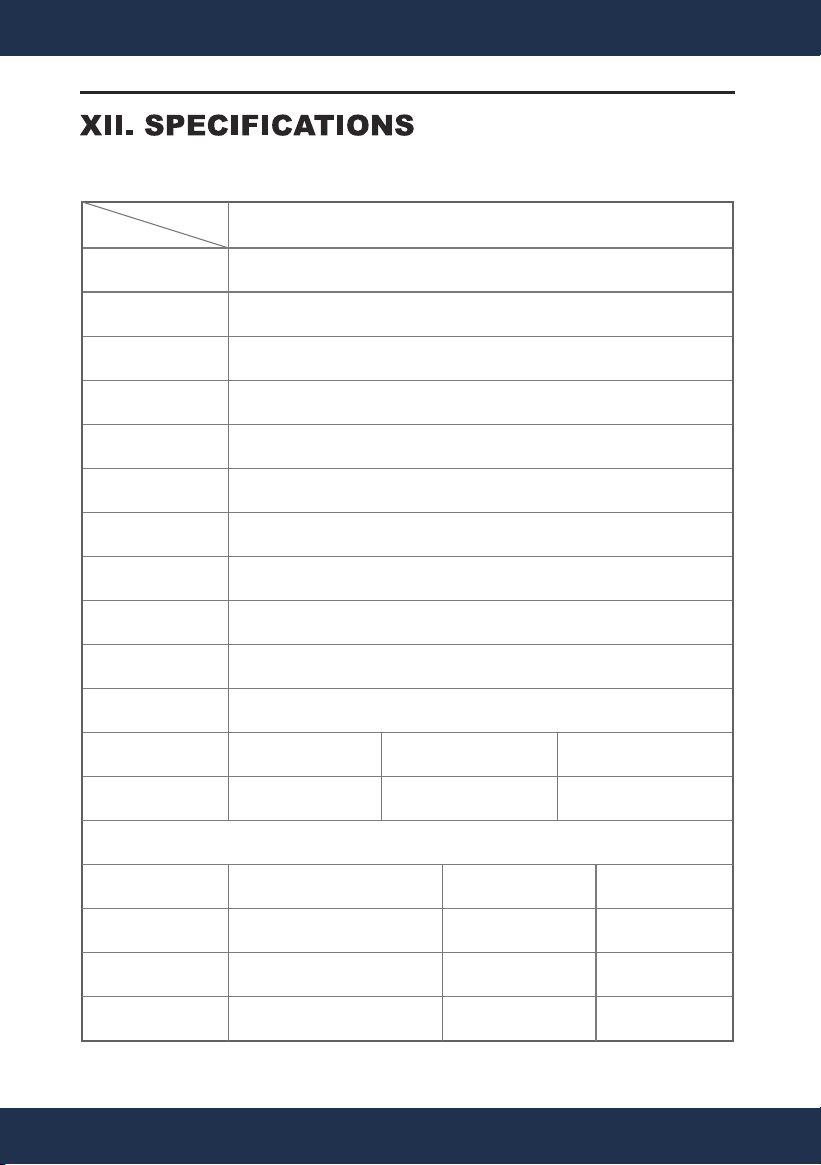
1) MAIN SPECIFICATION
Specs
Model
62039
L x W H
Dry Weight
Gasline Engine
Displacement
Compression
Bore x Stroke
Maximum Output
Power
Maximum Torque
Cooling System
Ignition System
Spark Plug
Lubrication System PTO Shaft Rotation
Spark Plug
Clearance
Connection-Rod
Cylinder Head Bolt
Flywheel Nut
Crankcase Bolt
Valve Clearance
(Cold Engine)
Specifications
Torque
N • m
Kg • m
M6 x 1.25 (Special)
M10 x 1.25
M14 x 1.5 (Special)
M8 x 1.25
13
35
85
28
13
35
85
28
390 x 290 x 300mm
15.5kg
4-Stroke, OHV, Single, Cylinder
212ml
9.0:1
70 x 55mm
5.0kw / 3600rpm
13.0N•m / 2500 rpm
Forced Air-cooled
Transistorized Magneto Ignition (TCI)
F6RTC / F6TC / F7TC / F7RTC
Force Splash
0.7 - 0.8mm
Counterclockwise
0.05 - 0.10mm
32
SPECIFICATIONS
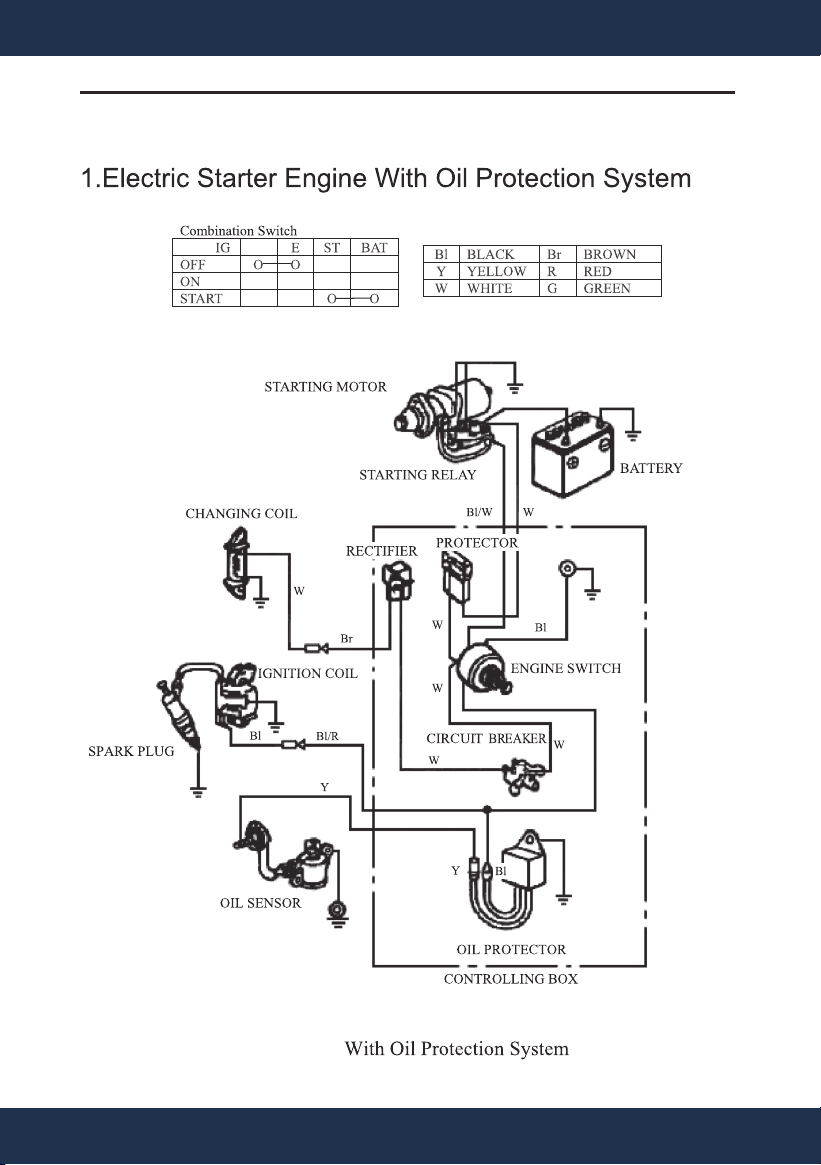
XIII. ELECTRIC DIAGRAM
33
ELECTRIC DIAGRAM
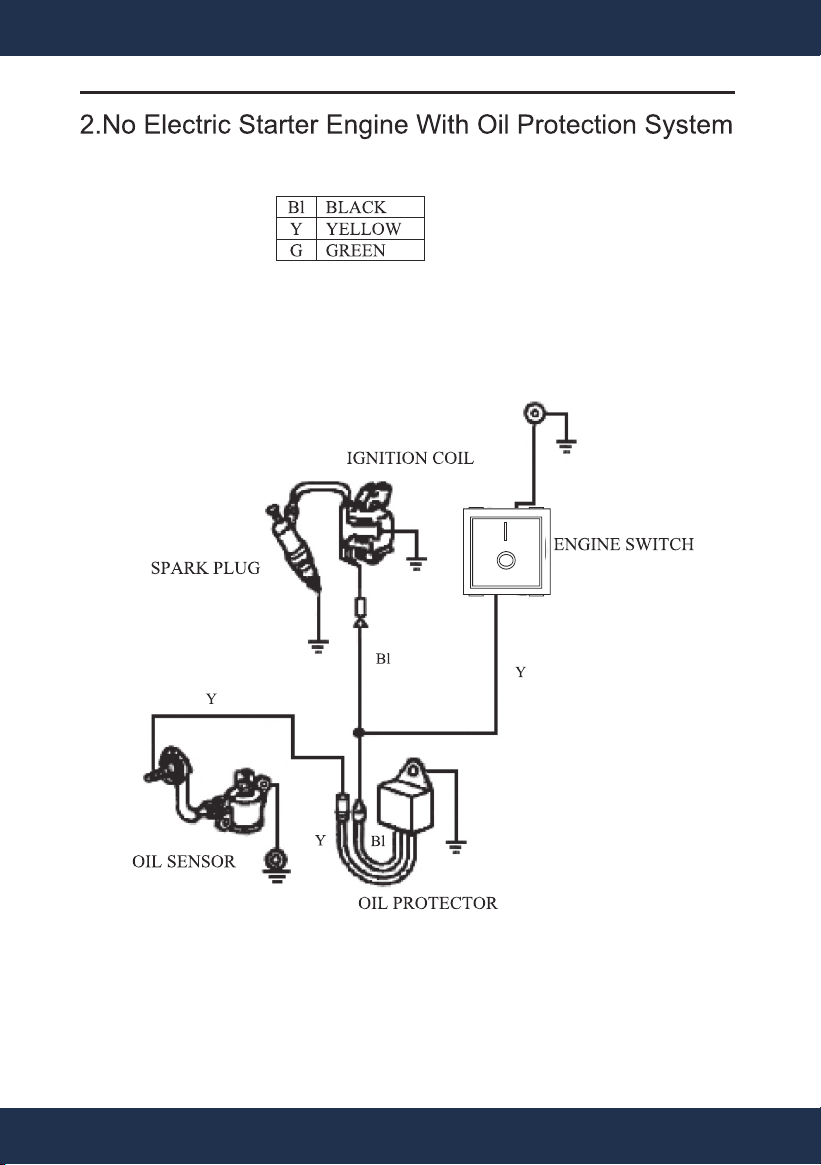
34
ELECTRIC DIAGRAM
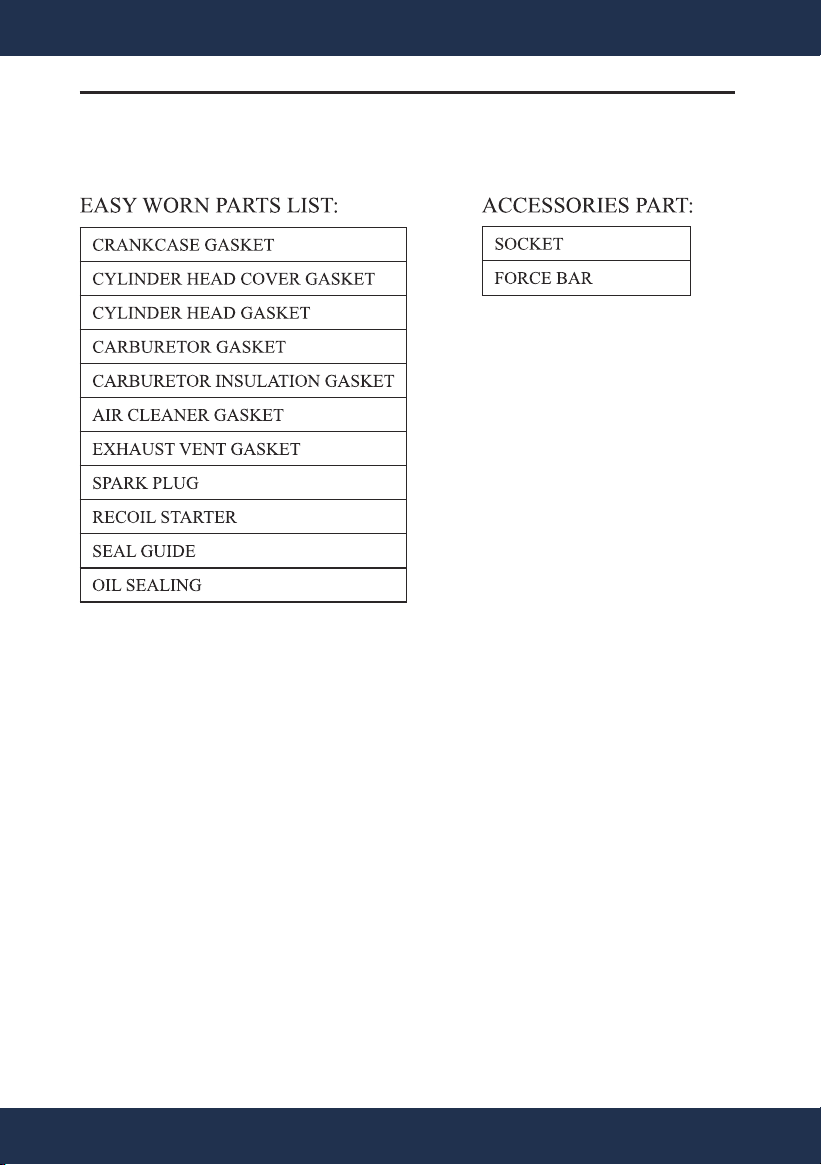
XIV. EASY WORN PARTS AND ACCESSORIES LIST
35
EASY WORN PARTS AND ACCESSORIES LIST

CUSTOMER SERVICE
If you have any questions about ordering our outdoor furnitures and replacement parts or other furniture
products, please feel free to contact us using the following contact information:
Customer Service and Technical Support
Phone: (909) 628-0880
Email: [email protected]
Hours of Operation: Monday – Friday, 9AM – 4PM (CST)
DISCLAIMER
PLEASE READ THE FOLLOWING CAREFULLY
The manufacturer and/or distributor have provided the parts list and assembly diagram in this manual for
reference purposes only. They do not make any representation or warranty to the buyer that they are qualified
to make repairs to the product or replace any parts of the product. In fact, the manufacturer and/or distributor
expressly state that all repairs and parts replacements should be undertaken by certified and licensed
technicians, and not by the buyer.
The buyer assumes all risk and liability arising from their repairs to the original product or replacement parts
or arising from their installation of replacement parts. It is strongly advised that qualified professionals handle
any repairs or replacements to ensure safety and proper functioning of the product. Improper installation and
operation may result in injury, property damage, or voiding of warranty. The manufacturer and/or distributor
shall not be held responsible for any accidents, damages, or malfunctions resulting from the buyer's
installation and operation of the product. It is essential to follow all safety guidelines and recommendations
provided in this manual and to seek professional assistance if unsure about the installation or operation
procedures.
