
Operating Instructions
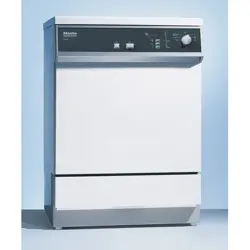
Dental Thermal Disinfector
G 7881
To prevent accidents
and machine damage
read these instructions
before
installation or use.
UV
M.-Nr. 05 970 440

2

IMPORTANT SAFETY INSTRUCTIONS. . . . . . . . . . . . . . . . . . . . . . . . . . . . . . . . . 4
IMPORTANT SAFETY INSTRUCTIONS. . . . . . . . . . . . . . . . . . . . . . . Center pages
Description of the machine. . . . . . . . . . . . . . . . . . . . . . . . . . . . . . . . . . . . . . . . . . 8
Guide to the machine. . . . . . . . . . . . . . . . . . . . . . . . . . . . . . . . . . . . . . . . . . . . . . 10
Before using for the first time. . . . . . . . . . . . . . . . . . . . . . . . . . . . . . . . . . . . . . . 12
Opening and closing the door . . . . . . . . . . . . . . . . . . . . . . . . . . . . . . . . . . . . . . 13
Water softener . . . . . . . . . . . . . . . . . . . . . . . . . . . . . . . . . . . . . . . . . . . . . . . . . . . 15
Setting the water softener . . . . . . . . . . . . . . . . . . . . . . . . . . . . . . . . . . . . . . . . . . . 17
Filling the salt reservoir . . . . . . . . . . . . . . . . . . . . . . . . . . . . . . . . . . . . . . . . . . . . . 18
Salt indicator . . . . . . . . . . . . . . . . . . . . . . . . . . . . . . . . . . . . . . . . . . . . . . . . . . . . . 19
Rinse aid . . . . . . . . . . . . . . . . . . . . . . . . . . . . . . . . . . . . . . . . . . . . . . . . . . . . . . . . 20
Setting the dosage. . . . . . . . . . . . . . . . . . . . . . . . . . . . . . . . . . . . . . . . . . . . . . . . . 21
Adding neutralizing agent. . . . . . . . . . . . . . . . . . . . . . . . . . . . . . . . . . . . . . . . . . 22
Adding detergent . . . . . . . . . . . . . . . . . . . . . . . . . . . . . . . . . . . . . . . . . . . . . . . . . 24
Loading the machine . . . . . . . . . . . . . . . . . . . . . . . . . . . . . . . . . . . . . . . . . . . . . . 29
Adjusting the top basket . . . . . . . . . . . . . . . . . . . . . . . . . . . . . . . . . . . . . . . . . . . . 31
Program selection . . . . . . . . . . . . . . . . . . . . . . . . . . . . . . . . . . . . . . . . . . . . . . . . 32
Operation . . . . . . . . . . . . . . . . . . . . . . . . . . . . . . . . . . . . . . . . . . . . . . . . . . . . . . . 34
Turning on . . . . . . . . . . . . . . . . . . . . . . . . . . . . . . . . . . . . . . . . . . . . . . . . . . . . . . . 34
Starting a program. . . . . . . . . . . . . . . . . . . . . . . . . . . . . . . . . . . . . . . . . . . . . . . . . 34
Drying . . . . . . . . . . . . . . . . . . . . . . . . . . . . . . . . . . . . . . . . . . . . . . . . . . . . . . . . . . 35
Changing a program . . . . . . . . . . . . . . . . . . . . . . . . . . . . . . . . . . . . . . . . . . . . . . . 35
At the end of a program. . . . . . . . . . . . . . . . . . . . . . . . . . . . . . . . . . . . . . . . . . . . . 35
Turning off . . . . . . . . . . . . . . . . . . . . . . . . . . . . . . . . . . . . . . . . . . . . . . . . . . . . . . . 35
Cancelling a program . . . . . . . . . . . . . . . . . . . . . . . . . . . . . . . . . . . . . . . . . . . . . . 36
Programming special functions . . . . . . . . . . . . . . . . . . . . . . . . . . . . . . . . . . . . . 37
Machine care . . . . . . . . . . . . . . . . . . . . . . . . . . . . . . . . . . . . . . . . . . . . . . . . . . . . 40
Correcting minor faults . . . . . . . . . . . . . . . . . . . . . . . . . . . . . . . . . . . . . . . . . . . . 44
After sales service . . . . . . . . . . . . . . . . . . . . . . . . . . . . . . . . . . . . . . . . . . . . . . . . 46
Caring for the environment . . . . . . . . . . . . . . . . . . . . . . . . . . . . . . . . . . . . . . . . . 48
Installation . . . . . . . . . . . . . . . . . . . . . . . . . . . . . . . . . . . . . . . . . . . . . . . . . . . . . . 49
Electrical connection. . . . . . . . . . . . . . . . . . . . . . . . . . . . . . . . . . . . . . . . . . . . . . 51
Plumbing. . . . . . . . . . . . . . . . . . . . . . . . . . . . . . . . . . . . . . . . . . . . . . . . . . . . . . . . 53
Technical data . . . . . . . . . . . . . . . . . . . . . . . . . . . . . . . . . . . . . . . . . . . . . . . . . . . 56
Contents
3
This machine complies with all
relevant legal safety requirements.
Incorrect use however, can lead to
personal injury and damage to
property.
Read the operating instructions
carefully before starting to use this
machine. This way you will avoid the
risk of accidents and damage to the
machine.
Keep these instructions in a safe
place for reference, and pass them
on to any future user.
Correct use
This machine is designed for
commercial use and for
specialized applications only, as
described in these Operating
Instructions. Alterations to the machine
or using it for purposes other than those
for which it was designed would be
unauthorized and could cause harm.
Only clean and/or disinfect instruments
and utensils (dental) in this machine if
the manufacturer has stated that they
are suitable for machine processing.
Follow the instrument manufacturer’s
instructions. The manufacturer cannot
be held liable for damage caused by
improper or incorrect use of the
machine.
Please pay attention to the following
notes, to maintain safe procedures.
The machine should only be
installed by a qualified and
competent contractor. Before
connecting the machine, the installer
should check that the voltage and
frequency of the electrical supply
correspond with the details on the data
plate of the machine.
Do not install the machine in an
area where a danger of explosion
or of freezing conditions may be
present.
The electrical safety of this
machine can only be guaranteed if
connected to an electrical system that
complies with all local and national
regulations. It should be checked by an
expert if necessary. The manufacturer
cannot be held responsible for damage
caused by incorrect wiring.
A damaged machine could be
dangerous. Turn off at the main
power immediately and call the Miele
Service Department or an authorized
and trained Miele Service Dealer.
IMPORTANT SAFETY INSTRUCTIONS
4

Personnel operating the machine
should be trained regularly.
Children and untrained personnel must
not be allowed access to the machine
or its controls.
Take care when handling liquid
agents and additives. These may
contain irritant or corrosive ingredients.
Do not use organic solvents as these
could cause an explosion. Wear
protective gloves and goggles. With all
chemical agents the manufacturer’s
safety conditions must be observed.
Avoid inhalation of powder
cleaners.
They can cause burning in the mouth
and throat if swallowed, or inhibit
breathing.
The water in the machine must not
be used as drinking water.
Do not sit or lean on an open door.
The machine could tip up and be
damaged or cause an injury.
Be careful when loading items with
sharp pointed ends. Position them
in the machine so that you do not hurt
yourself or create a danger when the
items are unloaded.
When using this machine in the
higher temperature ranges be
especially careful not to scald or burn
yourself when opening the door!
Baskets and inserts must be allowed to
cool down before they are unloaded.
Any water remaining in containers
could still be very hot. Empty them into
the wash cabinet before taking them
out.
Do not touch the heating elements
if you open the door during or
directly after the end of a program, you
could burn yourself. They remain hot for
some time after the end of the program.
Never clean the machine with a
water hose or a high pressure
hose.
Before any maintenance or repair
work is undertaken, the machine
must be disconnected from the main
power supply.
IMPORTANT SAFETY INSTRUCTIONS
5

Disinfection programs must not be
interrupted, this can have a limiting
effect on the disinfection result.
However, should this be necessary, the
complete program must be repeated.
Only use Miele approved cleaning
agents formulated for use in
washer disinfectors in this machine.
Using unsuitable cleaning agents could
adversely affect items being cleaned as
well as components in the machine.
Pre-treatments with cleaning or
disinfecting agents can create
foam, as can certain types of soiling
and rinsing agents. Foam can have an
adverse effect on the disinfection and
cleaning process. Manual pre-rinsing
may be necessary.
The performance of the cycles was
tested using Neodisher products.
The use of other products is not
discouraged but may not yield identical
results. Please be aware that changes
in formulation, storage conditions, etc.
which may not be publicized by the
chemical manufacturer can have a
negative effect on cleaning results.
When using cleaning agents and
specialized products, it is essential
that the manufacturer’s instructions are
followed. Chemicals must only be used
for the purpose they are designed for
and in the situation specified, to the
exclusion of other chemicals. This will
avoid such dangers as chemical
reactions and material damage.
The machine is designed only for
operation with water and additive
cleaning agents. Organic solvents must
not be used in the machine.
An explosion or machine corrosion
could result.
IMPORTANT SAFETY INSTRUCTIONS
6
In critical applications where very
stringent requirements have to be
met, it is strongly recommended that all
the relevant factors for the process,
such as cleaning agent, quality of water
etc. are discussed with the Miele
Technical Application specialists.
If the cleaning result is subject to
particularly stringent requirements,
a regular quality control test should be
carried out by the user to ensure that
required standards of cleanliness are
being achieved.
The mobile units and special
inserts should only be used for
their specific application.
Empty any containers or utensils
before arranging them in the
machine.
Do not allow any remains of acids
or solvents, and in particular
hydrochloric acid or chloride solutions
to get into the wash cabinet. Similarly
avoid any materials with a corrosive
effect. The presence in compounds of
any solvents should be minimal,
(especially those in hazard class A1).
Ensure that solutions or steam
containing hydrochloric acid do not
come into contact with the steel outer
casing of the machine, to avoid any
corrosion damage.
Please follow the advice on
installation in these instructions
and the separate "Installation
Instructions".
Using accessories
Only use genuine Miele
accessories with this machine.
Consult Miele on the type and
application of such equipment.
Disposal of your old machine
Before disposing of your old
machine, first make it unusable.
Disconnect, cut off the cable and any
plug from the cable.
For environmental and safety reasons,
ensure the machine is completely
drained of any residual water and
cleaning agent. (Observe safety
regulations and wear safety goggles
and gloves).
Make the door lock inoperative, so that
children cannot accidentally shut
themselves in. Then make appropriate
arrangements for the safe disposal of
the machine.
The manufacturer cannot be held
liable for damage caused by
non-compliance with these Warning
and Safety instructions.
IMPORTANT SAFETY INSTRUCTIONS
7

High-level disinfection
The G 7881 Dental Thermal Disinfector
is suitable for automatic treatment of
dental instruments and accesories. It
cleans and in the disinfection program
simultaneously thermally disinfects, at
200°F/93°C, instruments and
accessories.
Areas of effectiveness are physical
removal or thermal inactivation of
vegetative bacteria including
mycobacteria, fungi, fungal spores, and
viruses. These categories include the
Mycobacterium tuberculosis and the
Enterococcus faecium.
Important: Only the programs labeled
"Disinfection" disinfect! Only use this
program when handling contaminated
items. All other programs are designed
to clean items without disinfecting
them!
All relevant safety procedures should
be obeyed. Relevant safety procedures
include, but are not limited to, the
Centers for Disease Control’s
Recommended Infection Control
Practices for Dentistry and the OSHA
Bloodborne Pathogens Standard.
The G 7881 Dental Thermal Disinfector
achieves high-level disinfection as
defined by the Spaulding
categorization.
The Spaulding category high-level
disinfection is the same type of means
as in the sterilant category except that
the use pattern is different. The sterilant
is used as a high-level disinfectant by
e.g. reducing the exposure time within
its effective range of tuberculocidal,
virucidal, and bactericidal action.
According to the Centers for Disease
Control’s Recommended Infection
Control Practices for Dentistry,
instruments should be classified in one
of the following categories and be
treated accordingly:
All critical instrments must be
sterilized after treatment in the G 7881
Dental Thermal Disinfector. Critical
instruments are used to penetrate soft
tissue or bone, e.g. forceps, scalpels,
bone chisels or scales.
Semicritical instruments should be
sterilized after treatment in the G 7881
Dental Thermal Disinfector, If, however,
sterilization is not feasible because the
instrument will be damaged by higher
heat exposure, the instruments may be
treated terminally in the G 7881 Dental
Thermal Disinfector. Semicritical
instruments do not penetrate soft
tissues or bone but contact oral tissues,
e.g. mirrors and amalgam placement
instruments.
Noncritical instuments may be treated
terminally in the G 7881 Dental Thermal
Disinfector. Noncritical instruments or
devices come into contact only with
intact skin, e.g. external components of
x-ray heads.
Description of the machine
8

Instruments suitable for processing
in the thermal disinfector
In general, only high quality stainless
steel instruments are suitable for
processing in the G 7881. All
instruments, accessories and other
items to be cleaned and disinfected in
the machine should have the following
properties:
–
heat resistance to a temperature of
up to 95°C / 203°F.
–
corrosion resistance in the presence
of heat and alkalinity.
The heat retention capacity of stainless
steel allows for fast drying. Plastic has a
lower heat retention capacity, thus
requiring a longer drying time. In this
case, a slightly extended waiting period
of 5-15 minutes may be necessary after
the disinfection cycle.
Aluminum instruments may discolor
during the cleaning process. Aluminum
has only a limited suitability for
processing in this system.
Carbon steel and chrome-plated
instruments may corrode during the
cleaning process. Processing these
types of instruments in the G 7881 is
not recommended.
Handpieces, drill bits, grinders, root
canal instruments or other rotating
instruments are not suitable for the
thermal disinfector. Do not process
them in the thermal disinfector.
Do not clean fiberoptics or electrical
equipment or components in the
thermal disinfector.
Rhodium coated mirrors must be
arranged so that their surfaces do not
suffer any mechanical damage. Not all
specula with glass are suitable for
machine treatment.
If you have questions regarding
whether an instrument is suitable for
processing in the G 7881 Dental
Disinfector, please seek the advice of
the instrument manufacturer.
Water quality
Good water quality is essential for
processing instruments in the dental
washer disinfector. Otherwise,
instrument corrosion may result.
Poor water quality consists of, but is not
limited to, high concentrations of
chlorides (over 50 ppm). High chloride
levels will cause even high quality
stainless steel instruments to rust when
processed in the machine. Other
effects that may be noticed are
tarnishing or "blueing" of instruments
due to dissolved minerals in the water.
If you notice any of the above
symptoms in your instruments, please
contact a Miele Applications
Specialist at:
(800) 991-9380 Extension 2426
Description of the machine
9
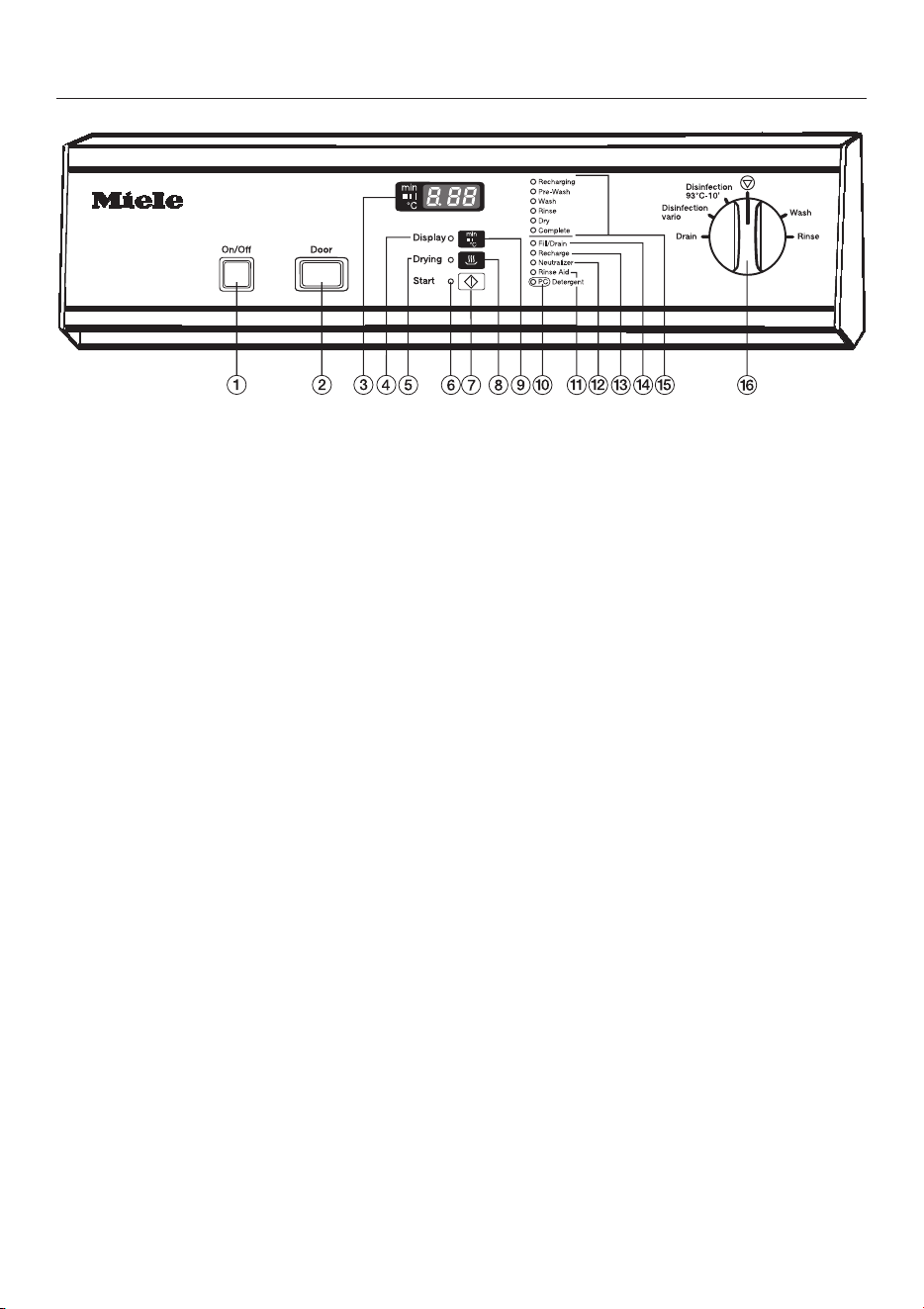
a "On/Off" button
b "Door" button
c Display
d "Display" indicator
e "Drying" indicator
f "Start" indicator
g "Start" button
h "Drying" button
i "Display" button
(toggles between the elapsed time,
active wash blocks and actual
temperature displays)
j "Detergent" (liquid) indicator*
Optical interface for service
technician
k "Rinse Aid" indicator
l "Neutralizer" indicator
m "Recharge" indicator
n "Fill / Drain" indicator
o Program sequence display
p Program selector
* (only applies to machine fitted with
optional external DOS-Module)
Guide to the machine
10
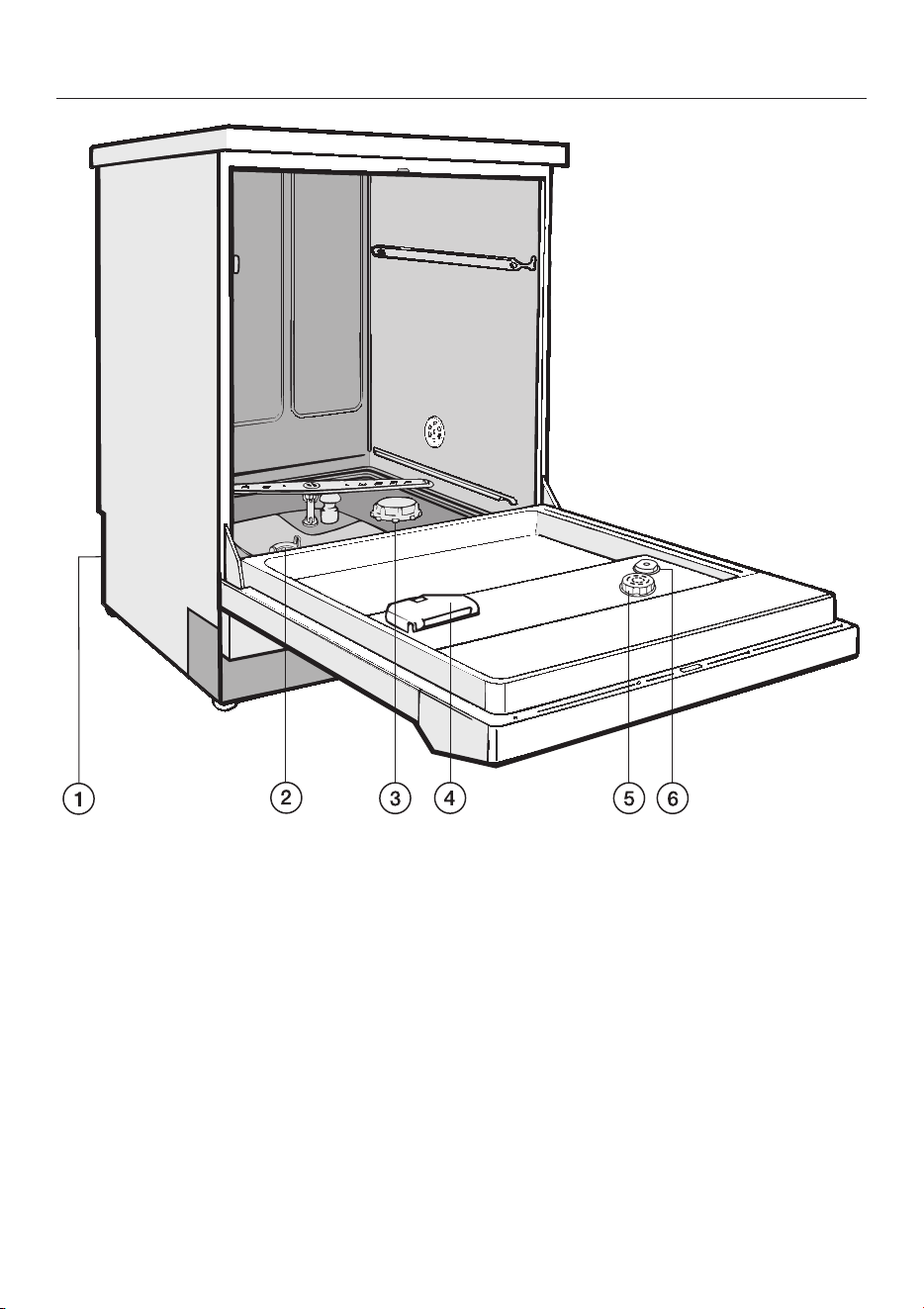
a Connection for DOS module G 60
(Optional dispenser pump for
liquid detergent)
b Filter combination
c Salt container
(for the water softener)
d Dispenser for powder detergent
e Rinse aid reservoir
(with dosage selector)
f Rinse aid level indicator
Guide to the machine
11
Before using for the first time please
pay special attention to the following
points:
Detailed information on these points
can be found in the relevant section
of the Operating Instructions.
Set the water softener unit
The water softener unit must be set to
the water hardness level in your area.
Contact your local water authority to
find your hardness level, in parts per
million (ppm) or grains per gallon
(gr/gal).
The salt reservoir also has to be filled
first with water and then with
reactivation salt.
Filling the salt reservoir with cleaning
agent by mistake will cause serious
damage to the water softener.
Please check every time before
refilling that the package contains
reactivation salt.
Add rinsing agent
Inadvertently filling the rinsing agent
reservoir with cleaning agent
(including liquid cleaning agents
and dishwashing soap) will cause
serious damage to the reservoir.
Only use detergents suitable for use
in disinfecting washers.
Do not use detergents formulated for
use in domestic dishwashers.
Load the machine carefully
Arrange the load so that water will
come into contact with all the surfaces.
Concealed surfaces will not be
cleaned.
The spray arms must not be blocked by
any items.
Adding detergent
Follow the dosage recommendations
from the cleaning agent manufacturer.
The filter combination at the base of
the wash cabinet and the spray arms
must be clean.
Regular checking and cleaning is
essential.
Before using for the first time
12
Electric door lock
The machine is equipped with an
electric door lock. The door can only be
opened when the electrical supply to
the machine is turned on, and the
"On/Off" button is pressed.
To open the door
^
Press the "Door" button in as far as it
will go. At the same time, grip the
handle and open the door.
After the first intake of water, the door
remains locked and cannot be opened
until the end of the program (except
during the "Rinse" and "Drain"
programs). The machine can be
programmed to open during the
"Drying" program, if desired.
Do not touch the heating elements.
They remain hot for some time after
the end of the program and can
cause burns.
To close the door
^
Lift the door upwards and push it
until it clicks shut. Do not press the
release catch while shutting the door.
To cancel a program
If a program has to be canceled in an
emergency, e.g. the program has been
interrupted due to a fault, the door will
have to be opened manually.
^
Turn the program selector to the
"Stop" f position. The program is
canceled after approximately
2 seconds.
Opening and closing the door
13
To open the door with the
emergency release
The emergency release should only be
used when the door cannot be opened
normally, e.g. in the event of a power
failure.
^
Turn the program selector to "Stop"
f.
^
Press the "On/Off" button to turn the
machine off.
^
Take precaution against pressure
wave release (rapid opening of the
door).
^
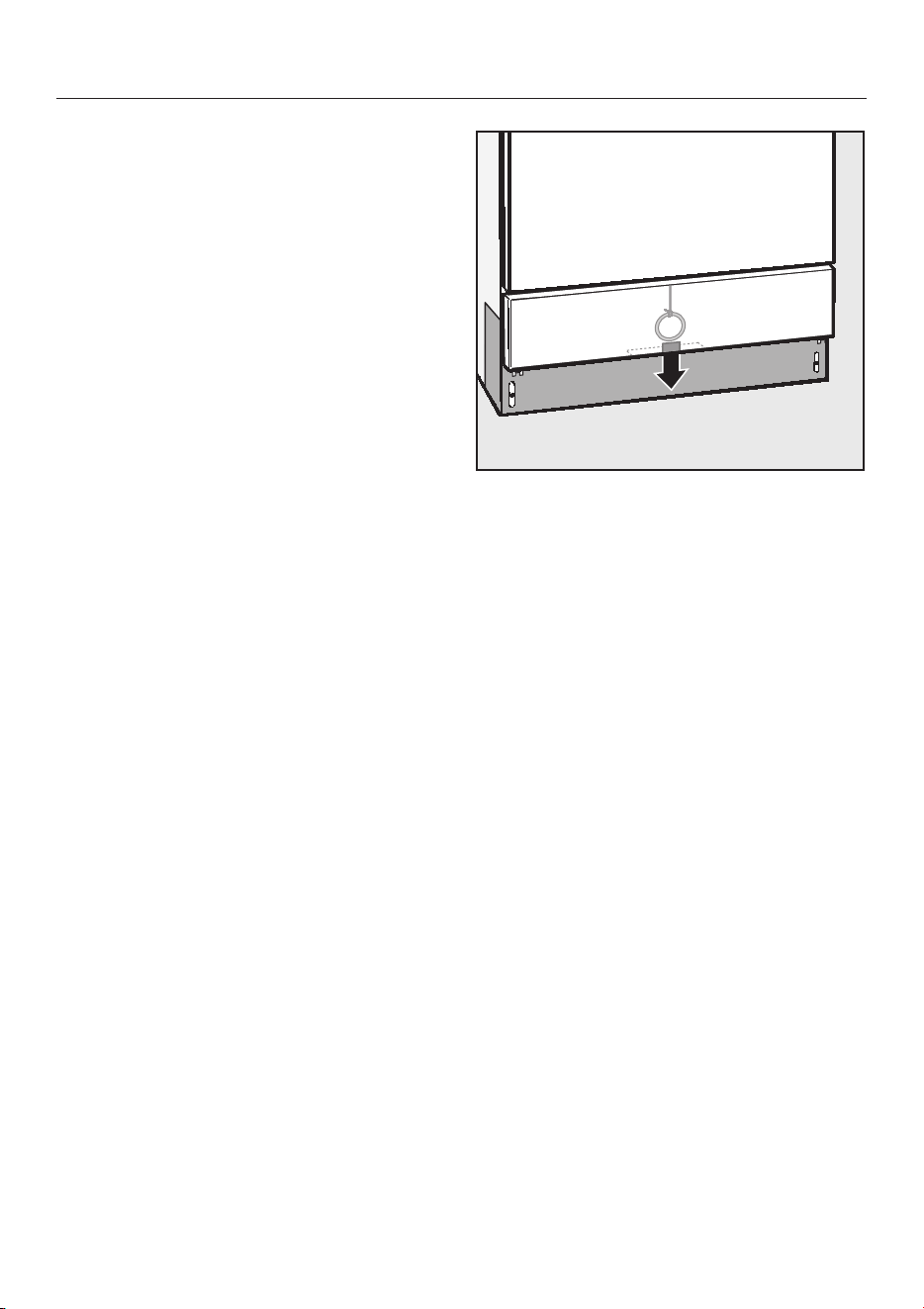
Pull the emergency release cable
(located at the bottom of the machine
behind the service panel) downwards
to open the door.
The door latch will reset after the
emergency cable has been activated.
Opening and closing the door
14

Before using the machine for the first
time, the water softener should be
programmed. The water needs to be
softened to avoid calcium deposit
buildup on instruments and in the
machine itself.
To ensure a steady supply of soft water:
1. Make sure the water softener is
programmed correctly.
The softener contains settings from
1 - 60 gr/gal or 20 - 1080 ppm.
2. The salt reservoir must be filled with
reactivation salt.
(If the water hardness level is below
4 gr/gal [70 ppm]), the reservoir
does not need to be filled.)
The machine is set at the factory for a
water hardness level of 19 gr/gal
(340 ppm).
Your local water authority will advise
you on the water hardness in your
area. If the water supply is harder or
softer than the factory setting
(including below 4 gr/gal or
70 ppm), the setting will need to be
changed. See "Setting the water
softener".
Water softener
15

Settings
Settings
1 - 30
gr/gal
1 - 30
ppm
CaCO
3
Settings
31 - 60
gr/gal
31 - 60
ppm
CaCO
3
1
2
3
4
5
6
7
8
9
10
11
12
13
14
15
16
17
18
19
20
21
22
23
24
25
26
27
28
29
30
1
2
3
4
5
6
7
8
9
10
11
12
13
14
15
16
17
18
19 *)
20
21
22
23
24
25
26
27
28
29
30
20
40
50
70
90
110
130
140
160
180
200
220
230
250
270
290
310
320
340
360
380
400
410
430
450
470
490
500
520
540
31
32
33
34
35
36
37
38
39
40
41
42
43
44
45
46
47
48
49
50
51
52
53
54
55
56
57
58
59
60
31
32
33
34
35
36
37
38
39
40
41
42
43
44
45
46
47
48
49
50
51
52
53
54
55
56
57
58
59
60
560
580
590
610
630
650
670
680
700
720
740
760
770
790
810
830
850
860
880
900
920
940
950
970
990
1010
1030
1040
1060
1080
*) factory setting
Water softener
16

Setting the water softener
^
Turn off the machine with the "On/Off"
button.
^
Turn the program selector to the
"Stop" f position.
^
Press and hold the "Start" 6 and
"Display" ß buttons at the same
time. Turn the machine on with the
"On/Off" button.
The current program status "P..." will
appear in the display and the
"Fill/Drain" indicator will illuminate.
^ Press the "Drying" 0 button once.
"E01" (programming level 1) will
appear in the display.
^ Turn the program selector one switch
position clockwise (1 o’clock
position).
The number "19" will appear in the
display (this indicates the factory
water hardness setting in gr/gal,
equivalent to 340 ppm).
^
Press the "Display" ß button as
many times as necessary, or hold it in
until the required value (hardness
level in gr/gal) appears in the display.
Once the number "60" has been
reached, the counter will begin again
at "0".
^
Press the "Start" 6 button. "SP" will
appear in the display.
^
Press the "Start" 6 button again.
The setting will now be stored in
memory. The display will go out.
For future servicing, it is useful to make
a note of your water hardness level.
^
Enter your water hardness level here:
gr/gal
or
ppm
Water softener
17
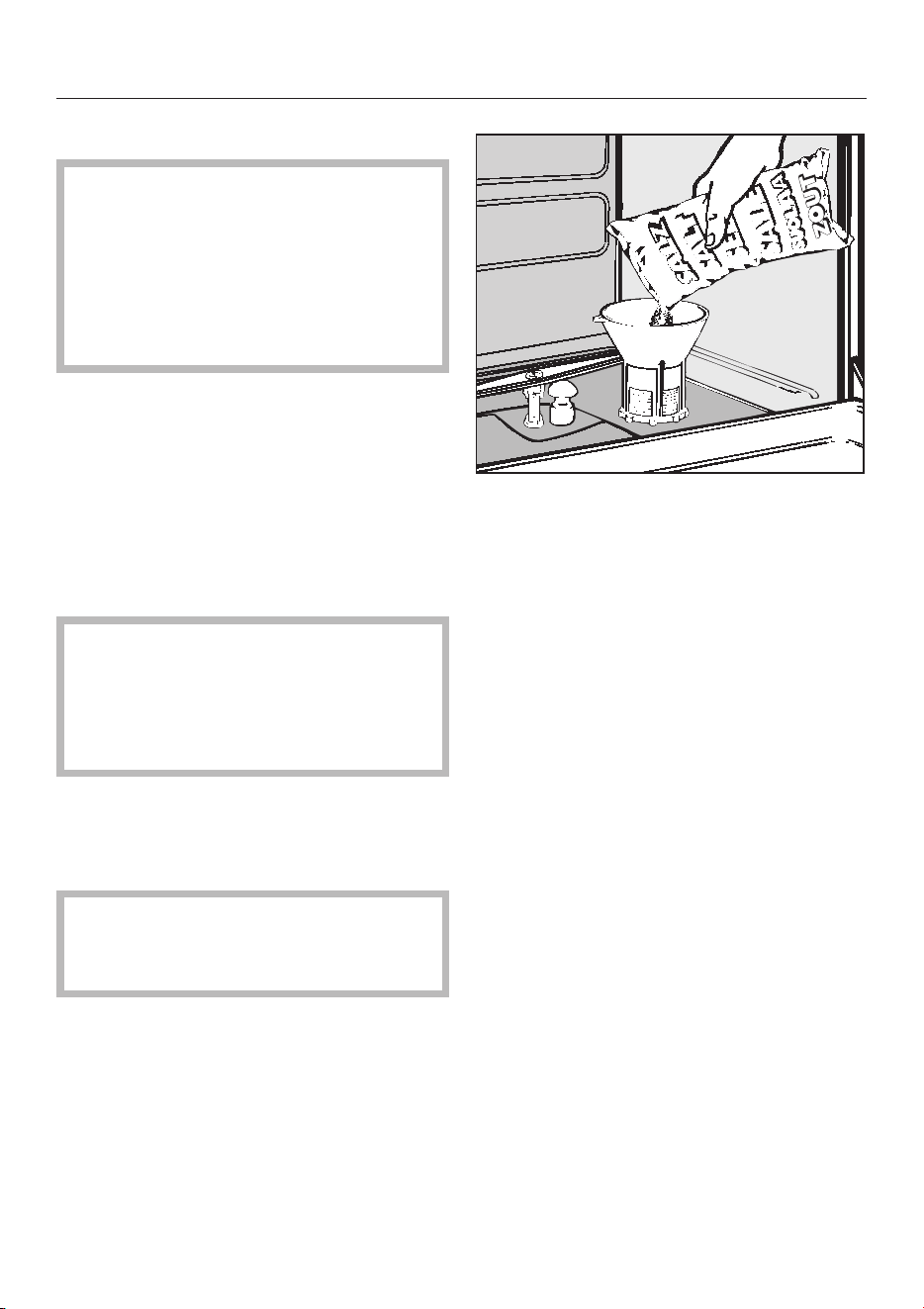
Filling the salt reservoir
Only special, coarse-grained
reactivation salt* should be used in
this machine.
*Available from Miele’s distributor.
Please see back page for more
information.
Do not use other types of salt, e.g. table
salt, agricultural or gritting salt. These
could contain components which are
insoluble in water and could damage
the water softener. If in doubt, consult
Miele’s Professional Department.
The salt reservoir holds approx. 2.5 kg
of salt.
,Inadvertently filling the salt
reservoir with cleaning agent will
damage the water softener.
Before filling, make sure that you are
using reactivation salt.
^
Remove the bottom basket from the
machine.
^
Unscrew the salt reservoir cap.
Before filling the salt reservoir with
reactivation salt for the first time, fill it
with approx. 2.5 liters of water.
^
Place the funnel provided in place.
^ Carefully fill the reservoir with salt.
Displaced water will run out as it is
being filled.
^ Wipe any residual salt off the screw
threads on the socket.
^ Screw the cap on firmly.
^ Immediately after this step: Run the
"Rinse" program to remove any traces
of salt from the cabinet.
Note: There may be a delay before the
"Rinse" program starts due to the
reactivation of the water softener.
Water softener
18
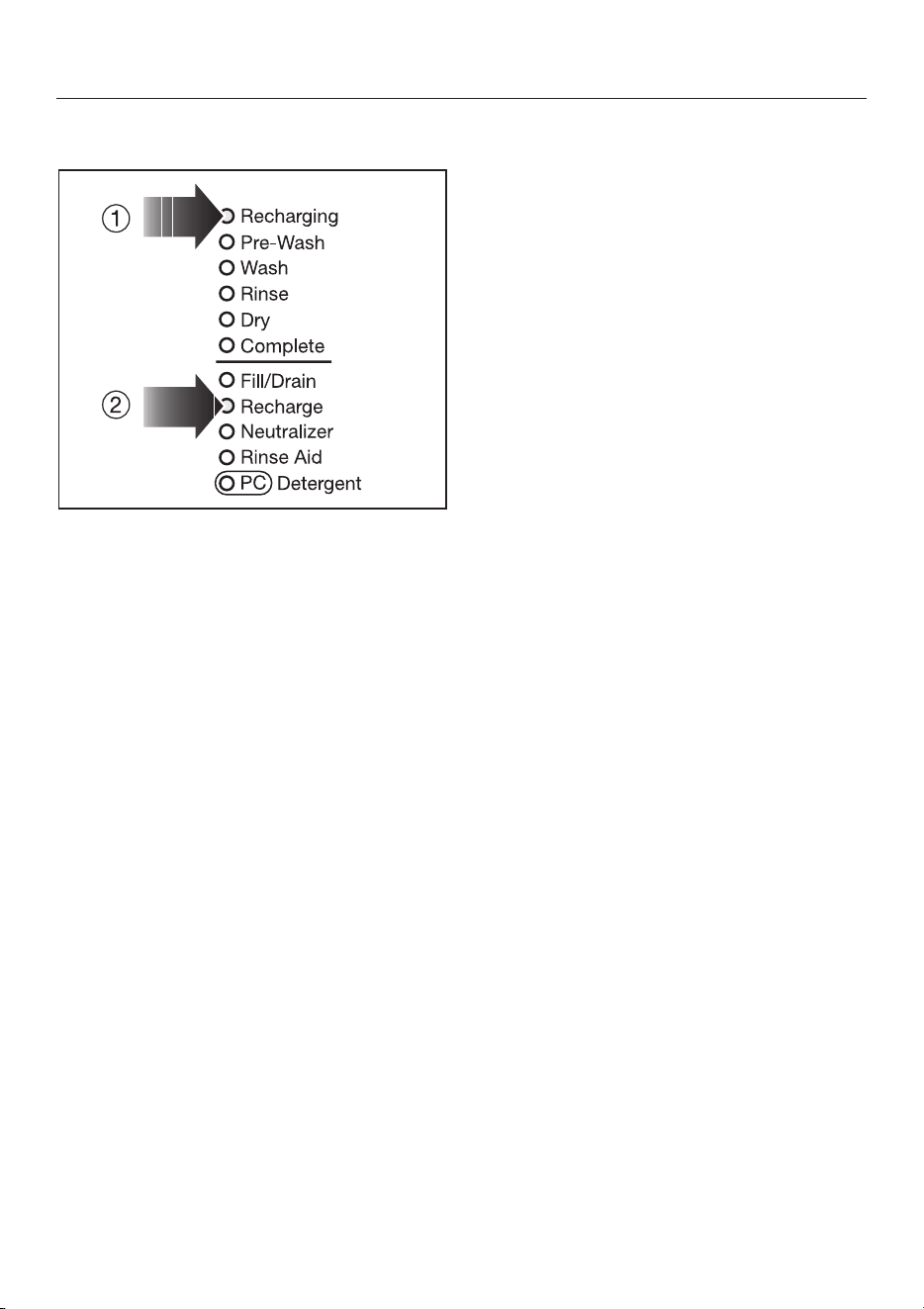
Salt indicator
When the salt reservoir is empty, the
"Recharge" indicator, b, illuminates to
remind you to fill the reservoir.
Reactivation takes place automatically
during a program. The "Recharging"
indicator, a, illuminates while this is
occurring.
Water softener
19
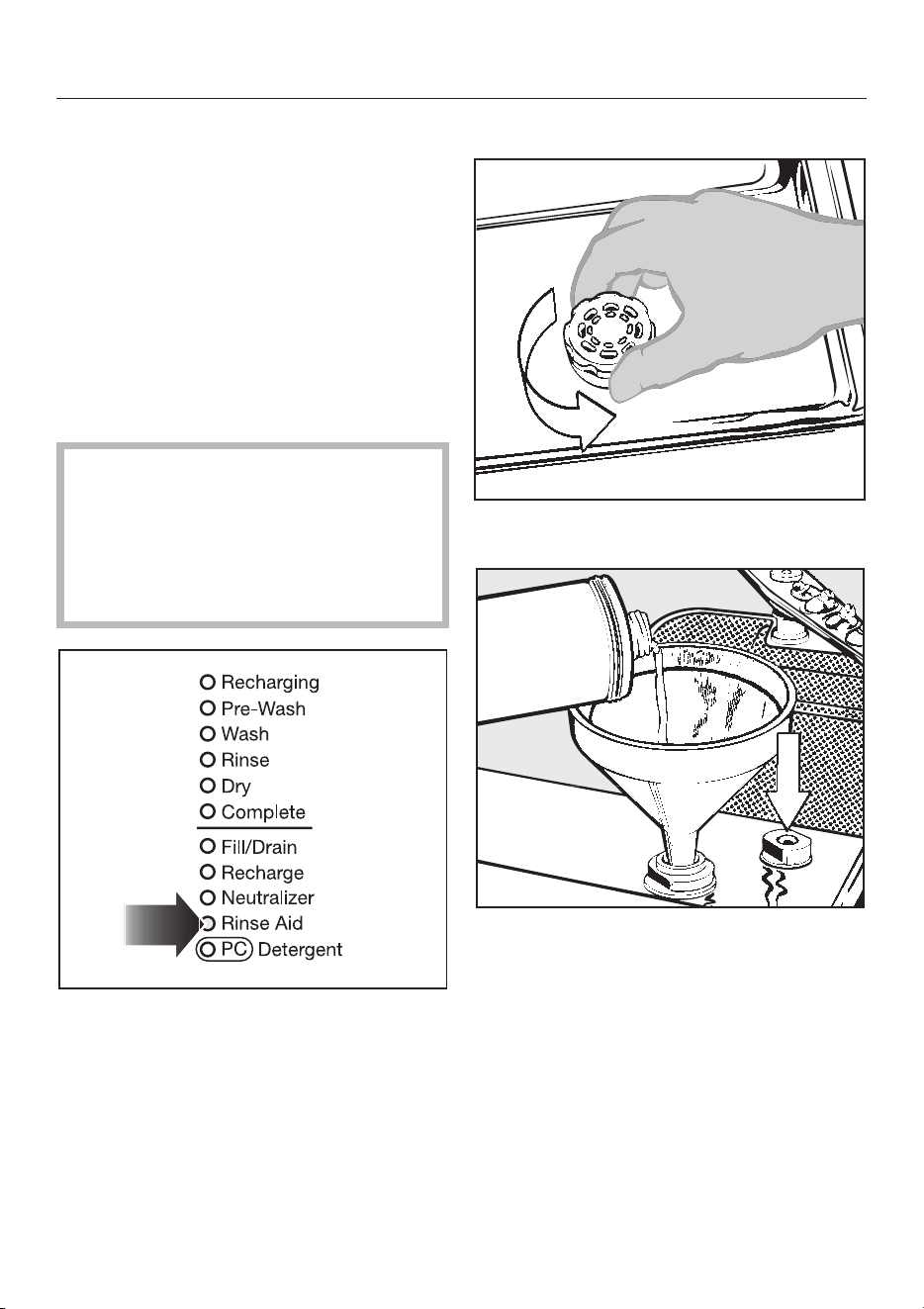
Rinse aid is necessary to ensure water
does not cling to and leave marks on
items during the drying phase. It also
enables items to dry faster after they
have been washed.
Rinse aid is poured into the storage
reservoir, and a pre-set amount is
dispensed automatically.
The rinse aid reservoir holds
approximately 180 ml.
Inadvertently filling the rinse aid
reservoir with detergent (including
liquid detergent) will damage the
reservoir. Be sure to use a rinse aid
which is suitable for use in
disinfecting washers.
^
The reservoir must be filled with rinse
aid when the "Rinse aid" indicator
illuminates.
There is also a level indicator for the
rinse aid reservoir on the inside of the
door (see illustration on the right).
^
Open the door fully.
^ Unscrew the cap.
^
Pour rinse aid into the storage
container until the level indicator is
dark (see arrow in the illustration).
Use a funnel if necessary.
^
Screw the cap back on and wipe up
any spilled rinse aid. This prevents
over-foaming from occuring during
the next program.
^
Wait until the "Rinse aid" indicator on
the control panel illuminates before
adding more rinse agent.
Rinse aid
20
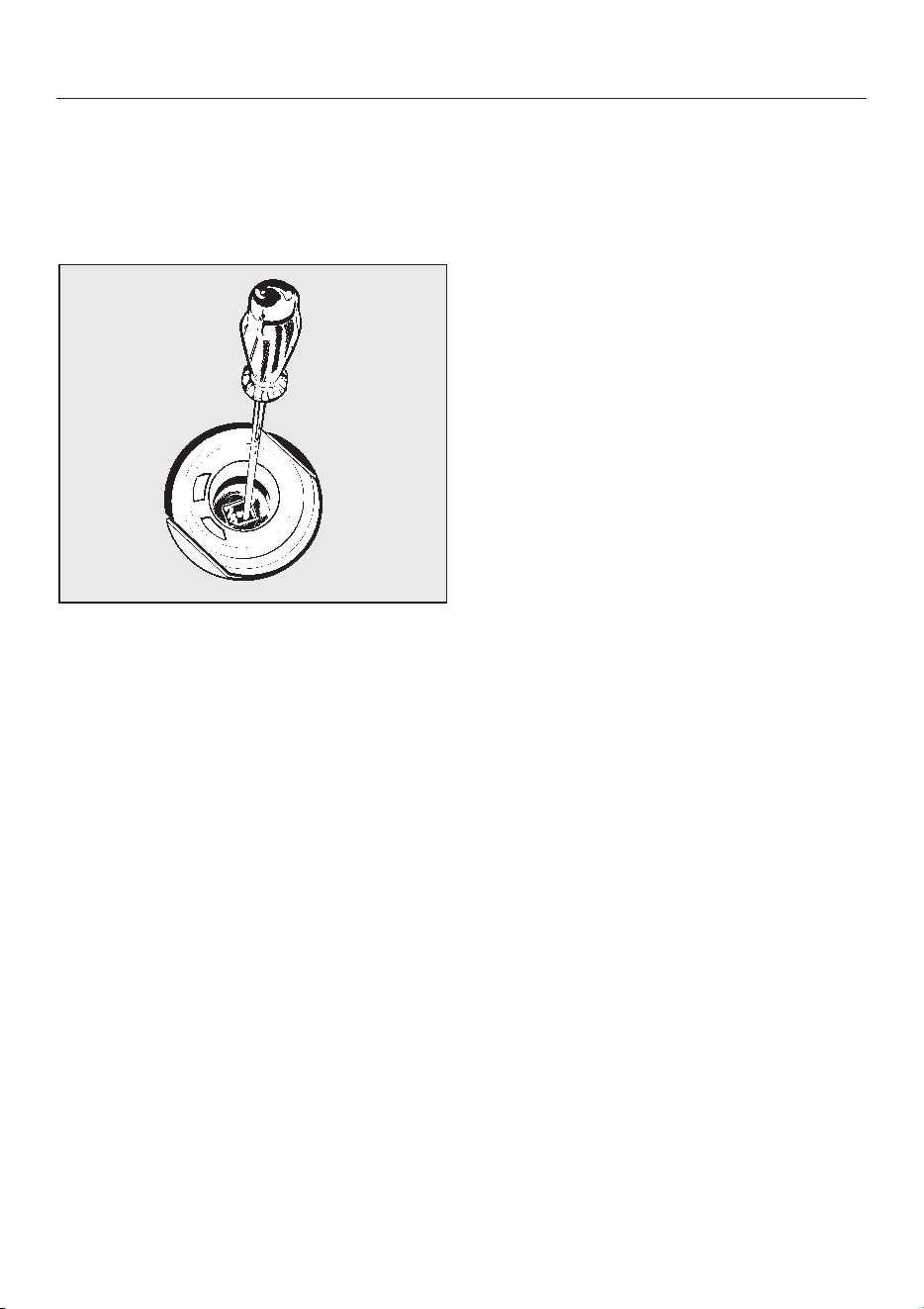
Setting the dosage
The dosage adjuster in the opening has
settings from 1 to 6 (1-6 ml). It is
factory-set to 3 (3 ml).
^ Use a higher setting if spots are left
after drying.
^ If surfaces become cloudy and/or
streaky, use a lower setting.
Rinse aid
21
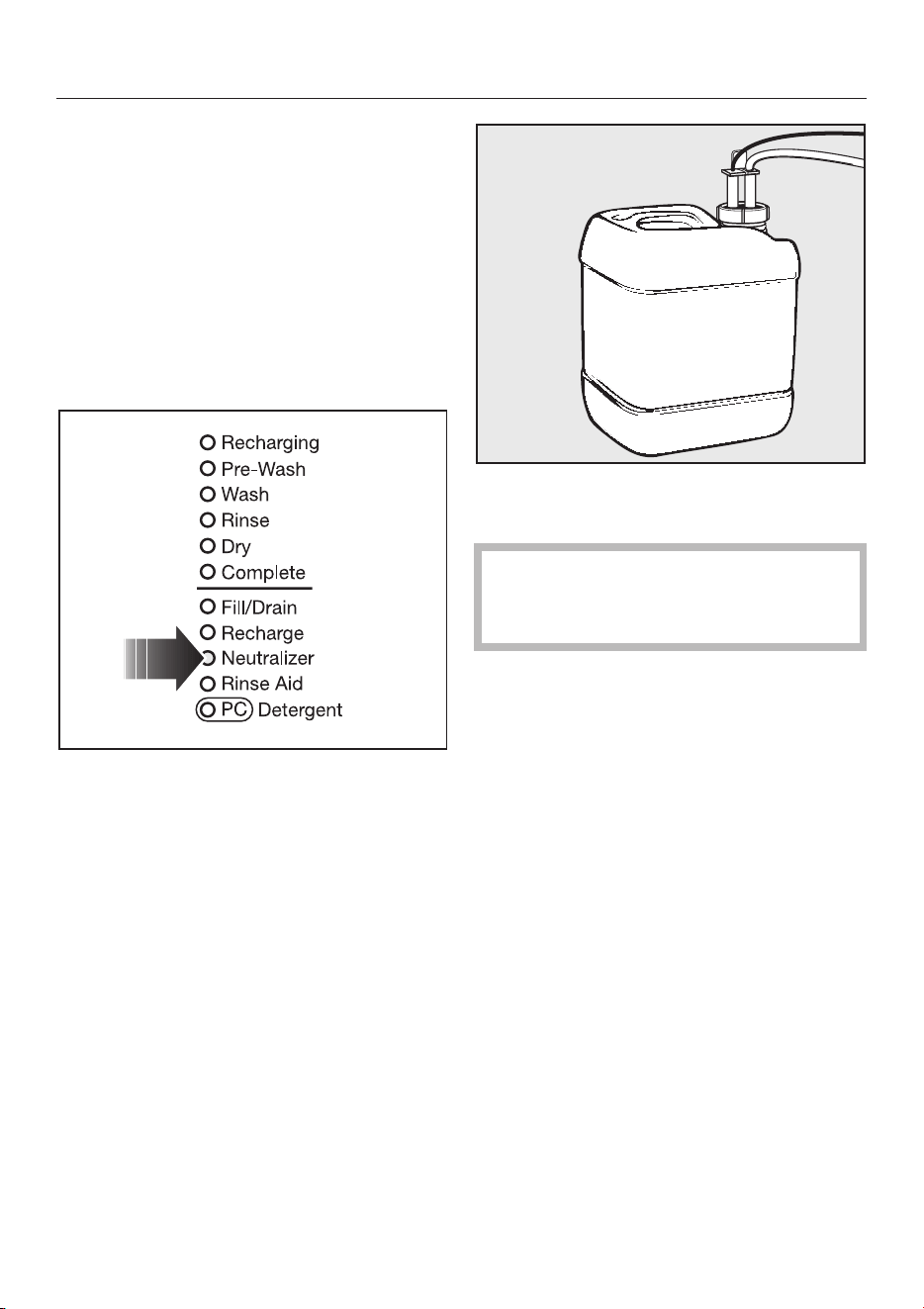
Neutralizer (pH-level: acidic)
neutralizes detergent residue on the
surface of instruments being cleaned.
It is automatically dispensed in the
rinse following the wash step of a
program.
To set up the Neutralizer
^
Place the container of neutralizer next
to the machine.
^
Insert the siphon tube into the
container.
Important:
Neutralizer lines must be primed
before any programs can be run.
Adding neutralizing agent
22
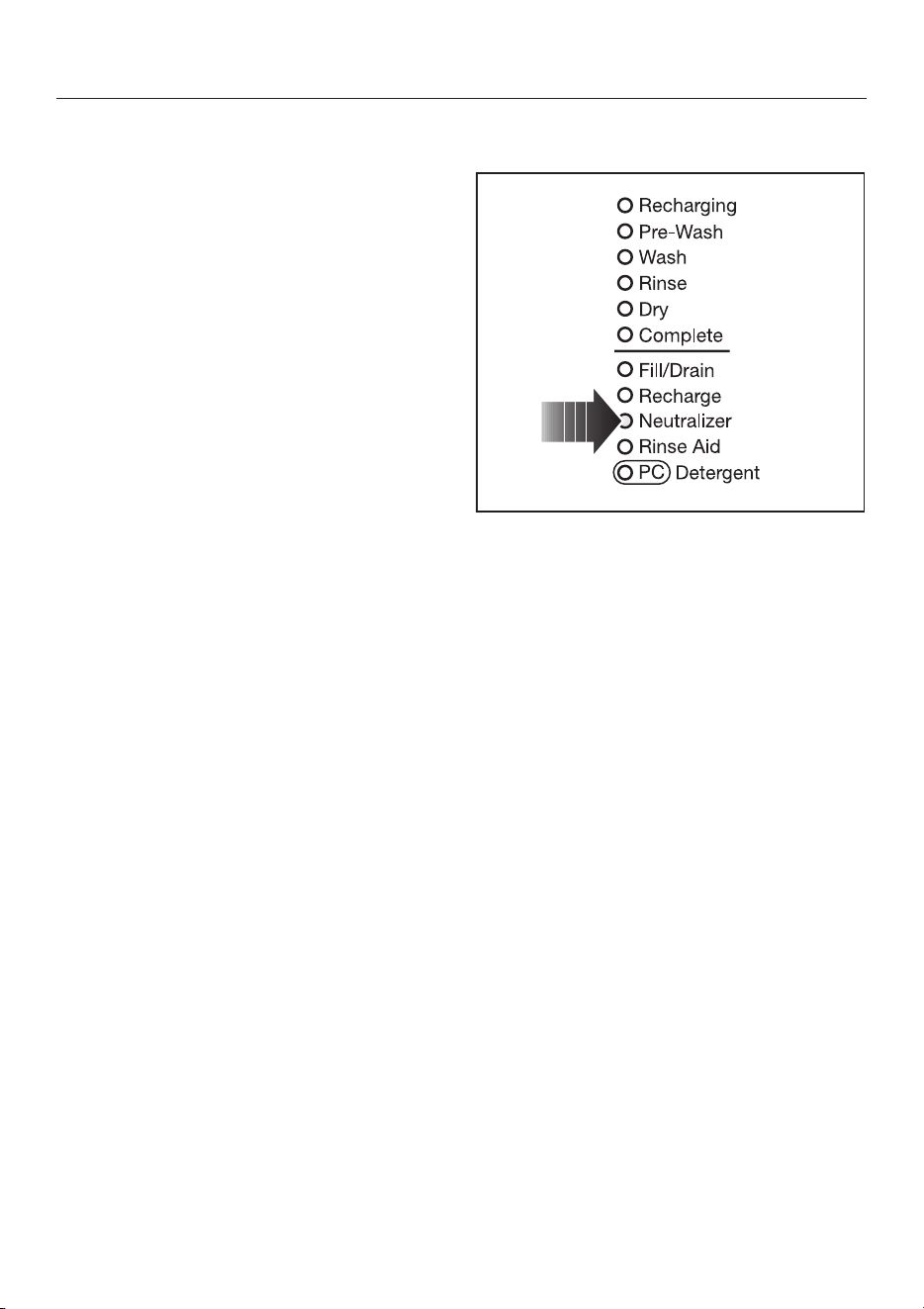
Priming the neutralizer
dispensing system
^
Turn the program selector to the
"STOP" f position.
^
Turn off the machine.
^
Press and hold the "Display" ß and
"Start" 6 buttons at the same time.
Simultaneously turn the machine on
with the "On/Off" button.
The current program status "P..." will
appear in the display and the
"Fill/Drain" indicator will illuminate.
^ Press the "Drying" 0 button twice,
"E02" (programming level) will appear
in the display.
^ Turn the program selector to the
5 o’clock position.
"do3" appears in the display.
^ Press "Display" ß .
The dispensing system will be
primed automatically. "do3" will
appear in the display when priming is
finished.
Every time the dispensing system has
been primed:
^
Run the "Rinse" program to dilute and
drain away any agents that may
remain in the wash cabinet.
Refilling the neutralizing agent
When the "Neutralizer" indicator
illuminates:
^ Replace the current neutralizer
container with a full one.
^ The indicator light should go out.
^ If the container has been allowed to
run dry, the light will not go out until
the priming process is performed.
Adding neutralizing agent
23
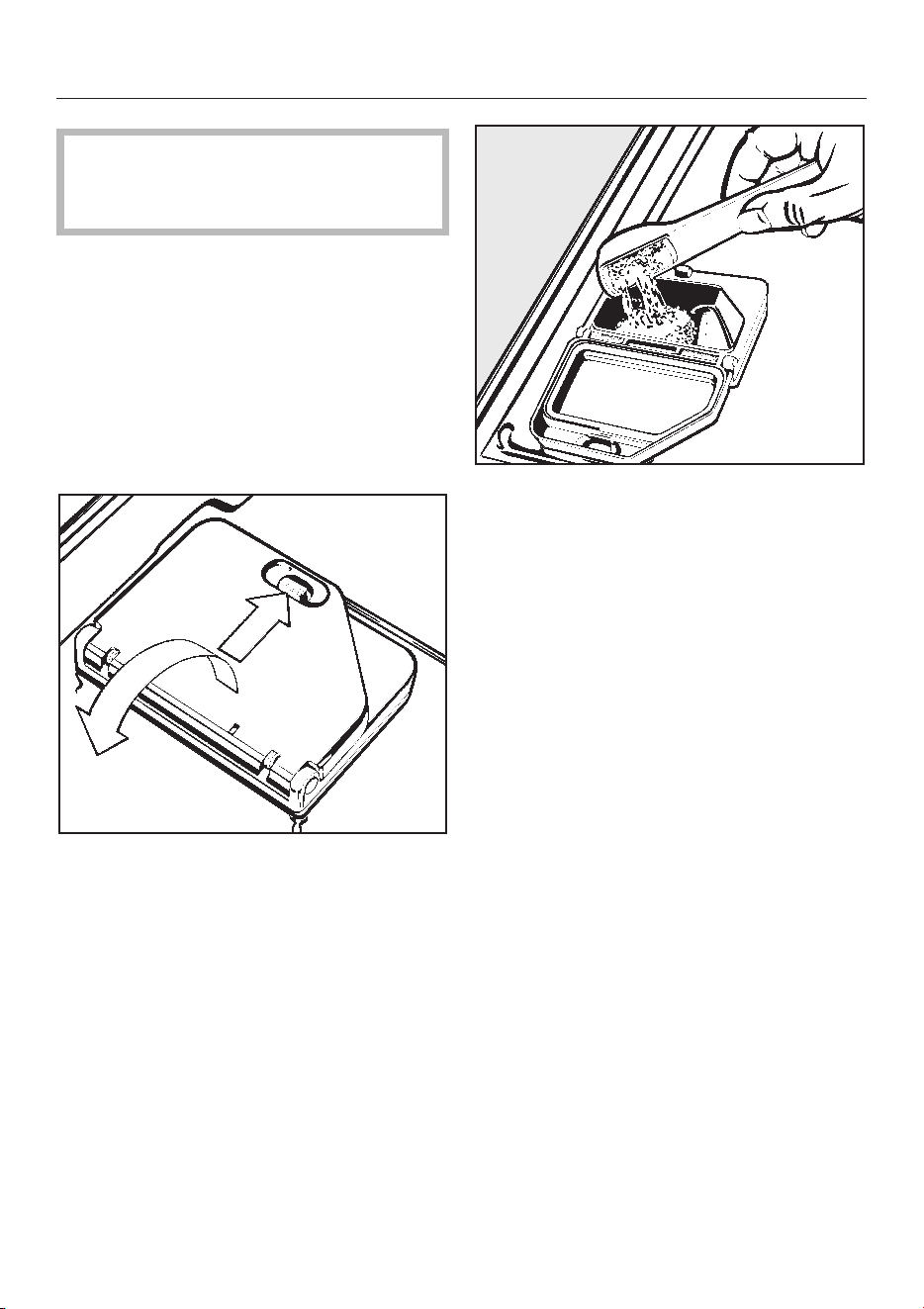
Only use detergents recommended
and sold by Miele for the dental
disinfector.
Detergent comes in two forms –
a powder or a liquid option.
Powder Option
Powder detergent must be placed in
the detergent dispenser before every
program (except for the "Rinse" and
"Drain" programs).
^
Press the opening catch on the
container (see arrow) forwards. The
flap will spring open. The flap will
always be open at the end of a
program.
^
Add powder detergent to the
compartment.
Dosage
Approx. 3 g/l, or 30 g per batch
(approximately
3
/
4
of a scoop).
Approximately 10.5 liters of water are
used in the wash program.
^ Close the dispenser lid.
Adding detergent
24
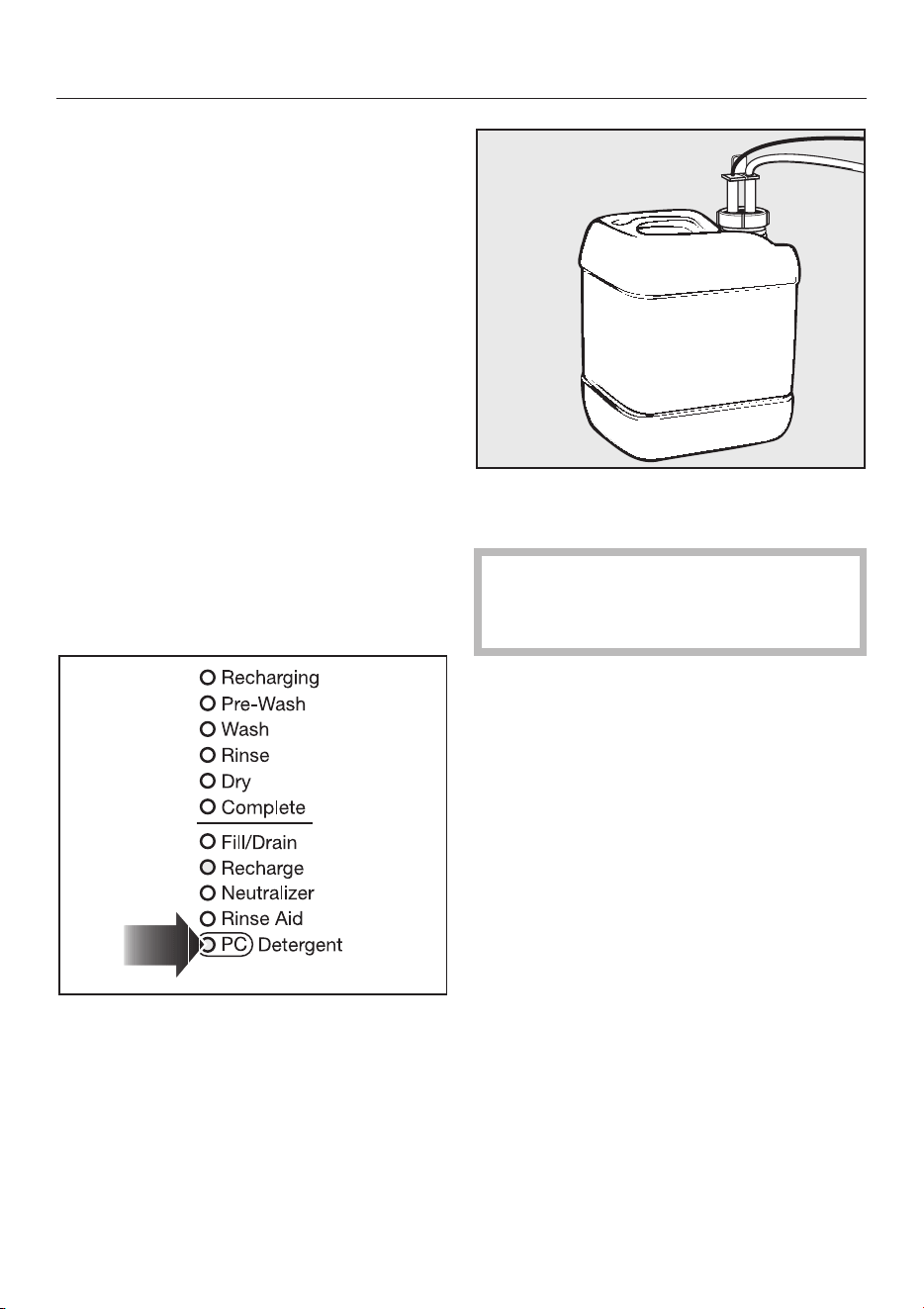
Liquid Option
As a separate option, this machine can
also be fitted with a dispenser pump for
automatic liquid detergent dispensing
(DOS-Module G 60). This is connected
externally. Contact Miele or your
authorized Miele distributor for details.
The optional DOS Module G 60 is
supplied with its own installation and
connection instructions.
The liquid detergent is automatically
dispensed in the wash step of a
program.
^ Place the container of detergent next
to the machine.
When the "Detergent" indicator
illuminates:
^
Insert the siphon tube into the
container.
Important:
Detergent lines must be primed
before any programs can be run.
Refilling the liquid detergent
^ Replace the current detergent
container with full one.
^
The indicator light should go out.
^
If the container has been allowed to
run dry, the light will not go out until
the priming process has been
performed.
Adding detergent
25
Setting the dosage and
priming the dispensing system
Selecting the programming level
^
Turn the program selector to the
"STOP" f position.
^
Turn off the machine.
^
Press and hold the "Display" ß and
"Start" 6 buttons at the same time.
Simultaneously turn the machine on
with the "On/Off" button.
The current program status "P..." will
appear in the display and the
"Fill/Drain" indicator will illuminate.
^ Press the "Drying" 0 button twice,
"E02" (programming level) will appear
in the display.
Value set:
DOS 1 (liquid detergent) via the
optional DOS-Module G 60
Setting the dosage
Follow the dosage recommedation
of the cleaning agents manufacturer.
^
Turn the program selector to "Wash".
The display will show either of the
following:
Display Dosing
10 Powdered detergent
from cup
0.10 - 1.00 Liquid detergent from
DOS-Module G60
^ To change the amount of liquid
detergent dispensed, press "Display"
ß as many times as necessary to
achieve the desired result (see chart
below):
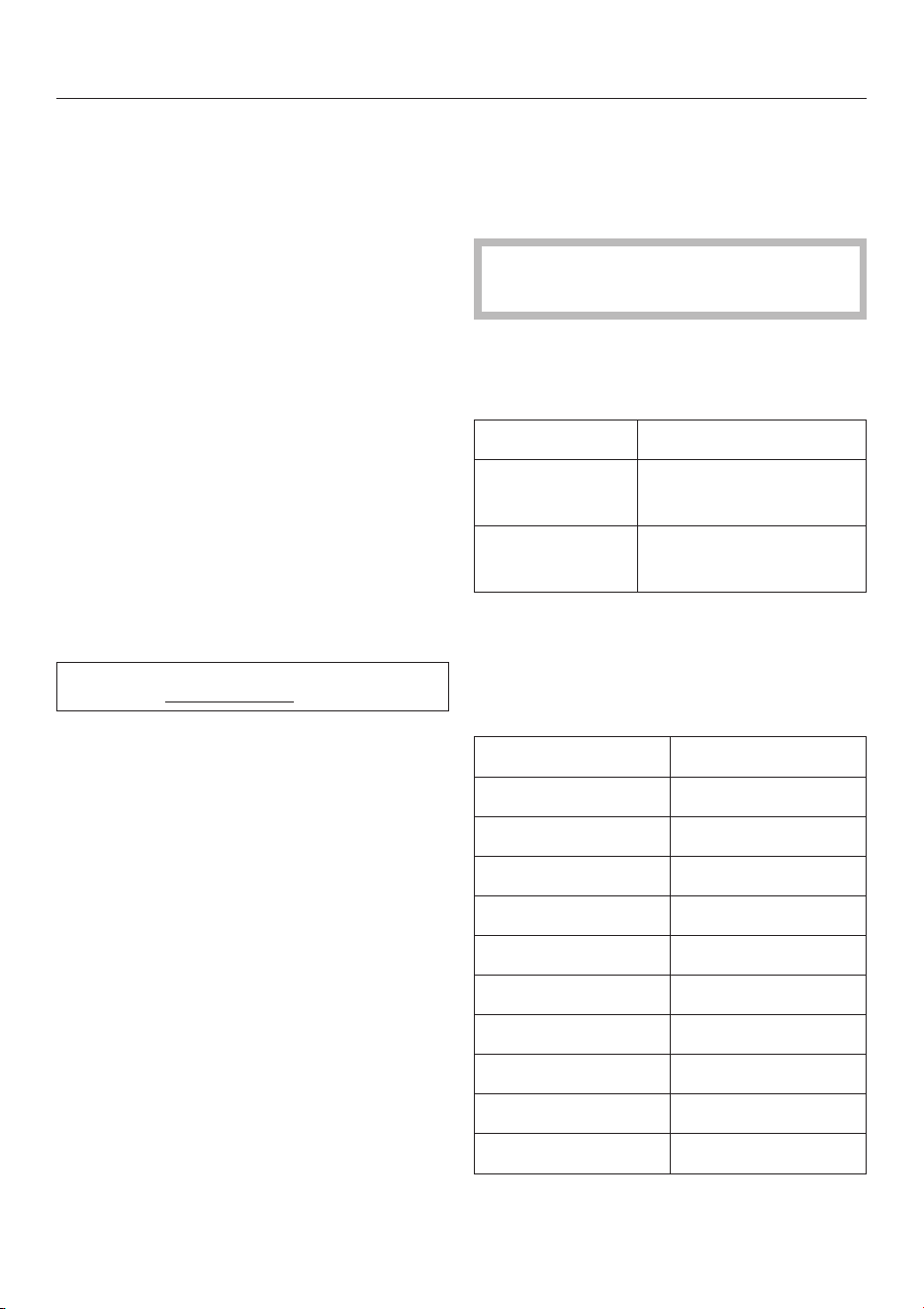
Setting Dosage
.10 20 ml
.20 30 ml
.30 40 ml
.40 50 ml*
.50 60 ml
.60 70 ml
.70 80 ml
.80 90 ml
.90 100 ml
1.0 110 ml
* Recommended dosage for neodisher
TM
FA
Adding detergent
26

Priming the dispensing system
a) After setting the detergent dosage:
^
Turn the program selector to the
1 o’clock position. "do1" appears in
the display.
^
Press "Display" ß.
The dispensing system will be
primed automatically. "do1" will
appear in the display when priming is
finished.
^
Press the "Start" 6 button. "SP"
appears in the display.
^ Press "Start" 6 again. The change
has been recorded.
b) If only priming is required (e.g. the
dispensing system has been allowed to
become empty by mistake):
^
Select programming level 2
(see "Setting the dosage -
Selecting...").
Proceed as follows:
^
Turn the program selector to the
1 o’clock position. "do1" appears in
the display.
^
Press "Display" ß.
The dispensing system will be
primed automatically. "do1" will
appear in the display when priming is
finished.
^ Turn the machine off with the "On/Off"
button.
Every time the dispensing system has
been primed:
^ Run the "Rinse" program to dilute and
drain away any agents that may
remain in the wash cabinet.
Adding detergent
27

Maintenance of the dispensing
system
To ensure trouble-free operation, the
following regular maintenance should
be carried out by a Miele approved
service technician.
^
Replace the dispensing hoses in the
DOS modules every 12-18 months.
Take care when handling liquid
agents and additives. These may
contain irritant or corrosive
ingredients.
Follow the manufacturer’s safety
instructions and relevant Health and
Safety procedures carefully.
Wear protective gloves and goggles.
Adding detergent
28
This disinfecting washer normally
requires a top and bottom basket.
Various inserts and special baskets are
also available for a wide variety of
instruments.
Loading the machine
Preparation
^
Empty all containers before loading
into the machine.
Ensure that no acid or solvent
residue, especially hydrochloric acid
or chlorides, gets into the wash
cabinet.
Note
^ Load items so that water will come
into contact with all surfaces. This
ensures proper cleaning.
^ Do not place items to be cleaned
inside other pieces where they may
be concealed.
^
Hollow items should be inverted and
placed in the correct inserts. The
water must have unobstructed
access to them.
^
Deep-based items should be placed
at an angle to ensure water
coverage.
^
Tall, narrow pieces should be placed
in the center of the baskets to ensure
water coverage.
^
The spray arms must not be blocked
by items which are too tall or hang
down in their path. If necessary,
manually rotate the arms to test.
^
In order to avoid corrosion, it is
recommended that only high-quality
stainless steel instruments are
cleaned in the machine.
^
Nickel plated instruments and
anodized aluminum instruments are
not suitable for machine processing.
^ Plastic items must be thermally
stable.
^ Single-use instruments must not be
put into the machine for processing.
^ As soon as the program finishes,
partially open the door of the
machine (by about 10 cm) for about
5 minutes before unloading. The
residual heat in the machine will help
achieve a good drying result and
prevent instruments from corroding.
^
As little dental cement or amalgam
remains should be on the instruments
as possible. If necessary, wipe off
excess with a swab. Otherwise,
manual cleaning is required after
thermal disinfection.
^
When loading cassettes, be sure to
angle them toward the rear of the
chamber, so as not to block the
powder detergent cup from opening.
Loading the machine
29
Important
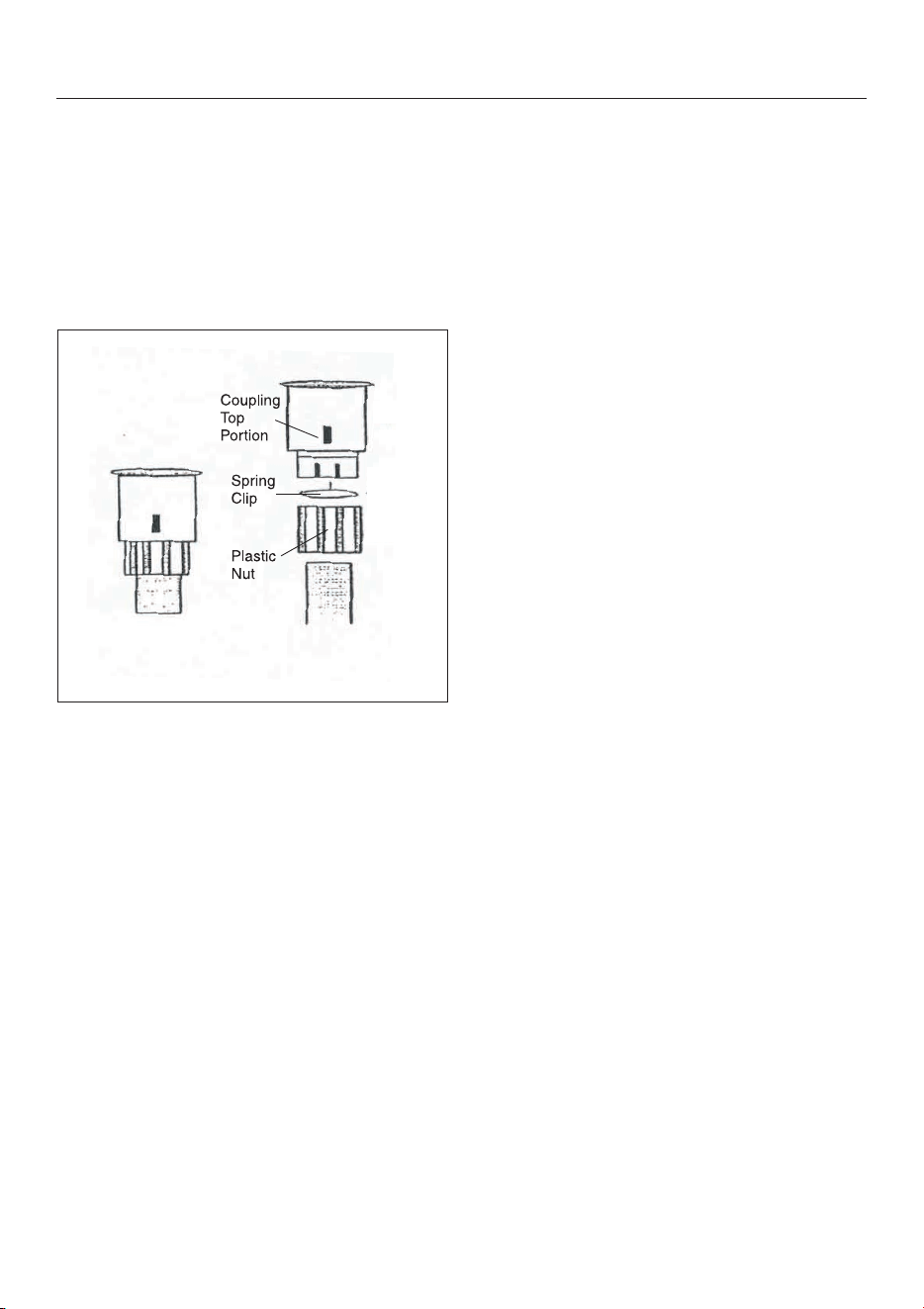
Make sure that the water connection
spring adapter engages correctly when
a basket or injector unit is inserted in
the machine. It must be 4-5 mm higher
than the water connection inlet. If it is
not:
^ Loosen the plastic nut.
^ Push up the adapter (4-5 mm higher
than the water connection inlet) and
tighten the plastic nut.
Loading the machine
30

Attention:
^
These pages should be pulled out and placed near the machine, where they
can be seen by all users.
^
Ensure that all users are trained in the use of the machine and are familiar with
the Warning and Safety instructions.
This machine complies with all
relevant legal safety requirements.
Incorrect use however, can lead to
personal injury and damage to
property.
Read the operating instructions
carefully before starting to use this
machine. This way you will avoid the
risk of accidents and damage to the
machine.
Keep these instructions in a safe
place for reference, and pass them
on to any future user.
Correct use
This machine is designed for
commercial use and for
specialized applications only, as
described in these Operating
Instructions. Alterations to the machine
or using it for purposes other than those
for which it was designed would be
unauthorized and could cause harm.
Only clean and/or disinfect instruments
and utensils (dental) in this machine if
the manufacturer has stated that they
are suitable for machine processing.
Follow the instrument manufacturer’s
instructions. The manufacturer cannot
be held liable for damage caused by
improper or incorrect use of the
machine.
Please pay attention to the following
notes, to maintain safe procedures.
The machine should only be
installed by a qualified and
competent contractor. Before
connecting the machine, the installer
should check that the voltage and
frequency of the electrical supply
correspond with the details on the data
plate of the machine.
Do not install the machine in an
area where a danger of explosion
or of freezing conditions may be
present.
The electrical safety of this
machine can only be guaranteed if
connected to an electrical system that
complies with all local and national
regulations. It should be checked by an
expert if necessary. The manufacturer
cannot be held responsible for damage
caused by incorrect wiring.
A damaged machine could be
dangerous. Turn off at the main
power immediately and call the Miele
Service Department or an authorized
and trained Miele Service Dealer.
G 7881 IMPORTANT SAFETY INSTRUCTIONS

Personnel operating the machine
should be trained regularly.
Children and untrained personnel must
not be allowed access to the machine
or its controls.
Take care when handling liquid
agents and additives. These may
contain irritant or corrosive ingredients.
Do not use organic solvents as these
could cause an explosion. Wear
protective gloves and goggles. With all
chemical agents the manufacturer’s
safety conditions must be observed.
Avoid inhalation of powder
cleaners.
They can cause burning in the mouth
and throat if swallowed, or inhibit
breathing.
The water in the machine must not
be used as drinking water.
Do not sit or lean on an open door.
The machine could tip up and be
damaged or cause an injury.
Be careful when loading items with
sharp pointed ends. Position them
in the machine so that you do not hurt
yourself or create a danger when the
items are unloaded.
When using this machine in the
higher temperature ranges be
especially careful not to scald or burn
yourself when opening the door!
Baskets and inserts must be allowed to
cool down before they are unloaded.
Any water remaining in containers
could still be very hot. Empty them into
the wash cabinet before taking them
out.
Do not touch the heating elements
if you open the door during or
directly after the end of a program, you
could burn yourself. They remain hot for
some time after the end of the program.
Never clean the machine with a
water hose or a high pressure
hose.
Before any maintenance or repair
work is undertaken, the machine
must be disconnected from the main
power supply.
G 7881 IMPORTANT SAFETY INSTRUCTIONS

Disinfection programs must not be
interrupted, this can have a limiting
effect on the disinfection result.
However, should this be necessary, the
complete program must be repeated.
Only use Miele approved cleaning
agents formulated for use in
washer disinfectors in this machine.
Using unsuitable cleaning agents could
adversely affect items being cleaned as
well as components in the machine.
Pre-treatments with cleaning or
disinfecting agents can create
foam, as can certain types of soiling
and rinsing agents. Foam can have an
adverse effect on the disinfection and
cleaning process. Manual pre-rinsing
may be necessary.
The performance of the cycles was
tested using Neodisher products.
The use of other products is not
discouraged but may not yield identical
results. Please be aware that changes
in formulation, storage conditions, etc.
which may not be publicized by the
chemical manufacturer can have a
negative effect on cleaning results.
When using cleaning agents and
specialized products, it is essential
that the manufacturer’s instructions are
followed. Chemicals must only be used
for the purpose they are designed for
and in the situation specified, to the
exclusion of other chemicals. This will
avoid such dangers as chemical
reactions and material damage.
The machine is designed only for
operation with water and additive
cleaning agents. Organic solvents must
not be used in the machine.
An explosion or machine corrosion
could result.
G 7881 IMPORTANT SAFETY INSTRUCTIONS

In critical applications where very
stringent requirements have to be
met, it is strongly recommended that all
the relevant factors for the process,
such as cleaning agent, quality of water
etc. are discussed with the Miele
Technical Application specialists.
If the cleaning result is subject to
particularly stringent requirements,
a regular quality control test should be
carried out by the user to ensure that
required standards of cleanliness are
being achieved.
The mobile units and special
inserts should only be used for
their specific application.
Empty any containers or utensils
before arranging them in the
machine.
Do not allow any remains of acids
or solvents, and in particular
hydrochloric acid or chloride solutions
to get into the wash cabinet. Similarly
avoid any materials with a corrosive
effect. The presence in compounds of
any solvents should be minimal,
(especially those in hazard class A1).
Ensure that solutions or steam
containing hydrochloric acid do not
come into contact with the steel outer
casing of the machine, to avoid any
corrosion damage.
Please follow the advice on
installation in these instructions
and the separate "Installation
Instructions".
Using accessories
Only use genuine Miele
accessories with this machine.
Consult Miele on the type and
application of such equipment.
Disposal of your old machine
Before disposing of your old
machine, first make it unusable.
Disconnect, cut off the cable and any
plug from the cable.
For environmental and safety reasons,
ensure the machine is completely
drained of any residual water and
cleaning agent. (Observe safety
regulations and wear safety goggles
and gloves).
Make the door lock inoperative, so that
children cannot accidentally shut
themselves in. Then make appropriate
arrangements for the safe disposal of
the machine.
The manufacturer cannot be held
liable for damage caused by
non-compliance with these Warning
and Safety instructions.
G 7881 IMPORTANT SAFETY INSTRUCTIONS
Adjusting the top basket
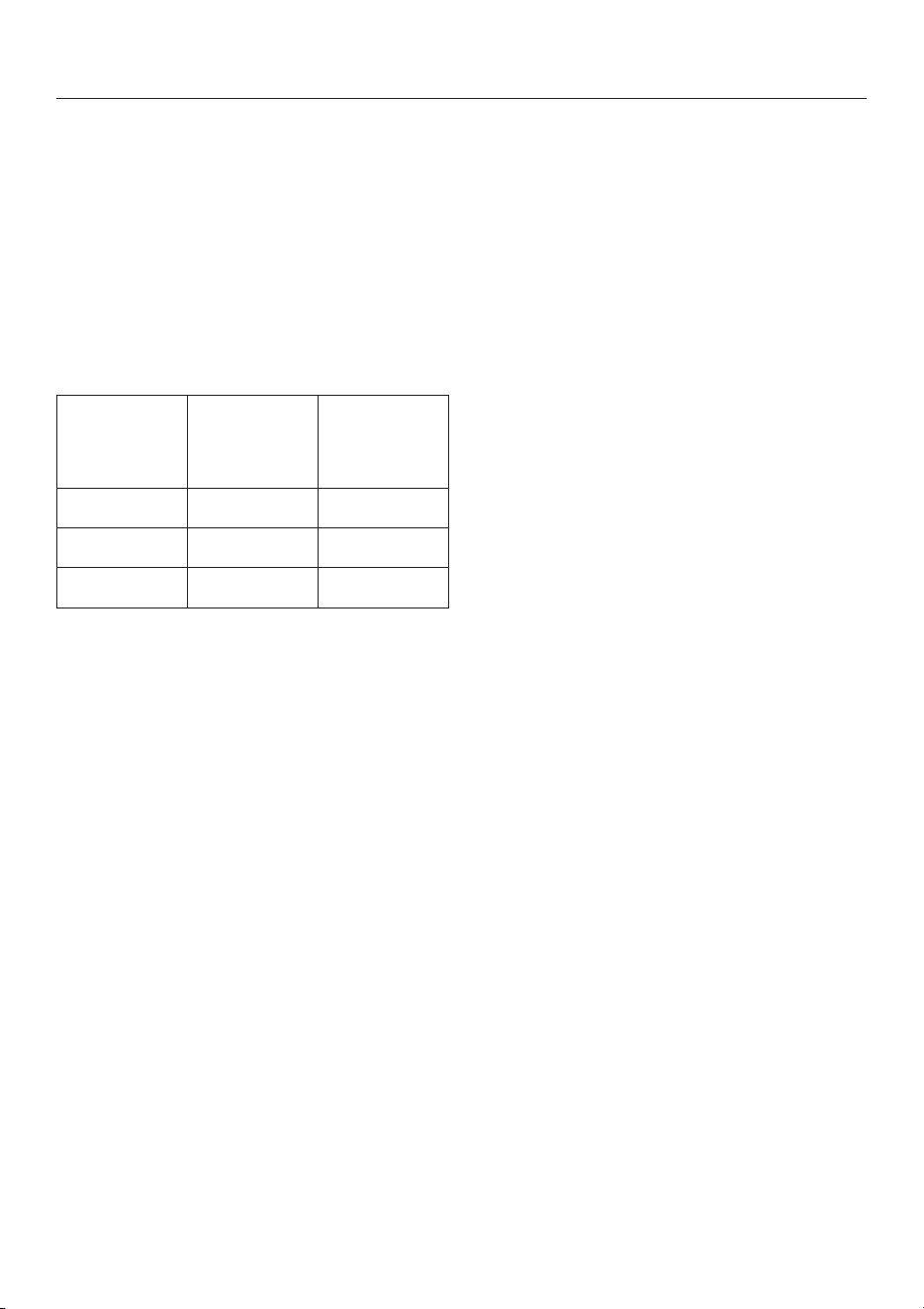
The top basket can be adjusted above
and below the middle position by 2 cm.
Depending on the position of the top
basket, the baskets can accommodate
instruments of the following heights:
Example: Top basket O 190 and
bottom basket U 874
Top basket
position
Top basket
height (cm)
Bottom
basket
height (cm)
Top max. 20 max. 24
Middle max. 22 max. 22
Bottom max. 24 max. 20
Note:
All dimensions given without inserts.
Adjusting the top basket
^
Pull out the top basket until a
resistance is felt; lift from the runners
and remove.
^
Unscrew the protruding nuts (roller
bearings) on both sides of the basket
with a suitable wrench and reposition
as required.
Loading the machine
31
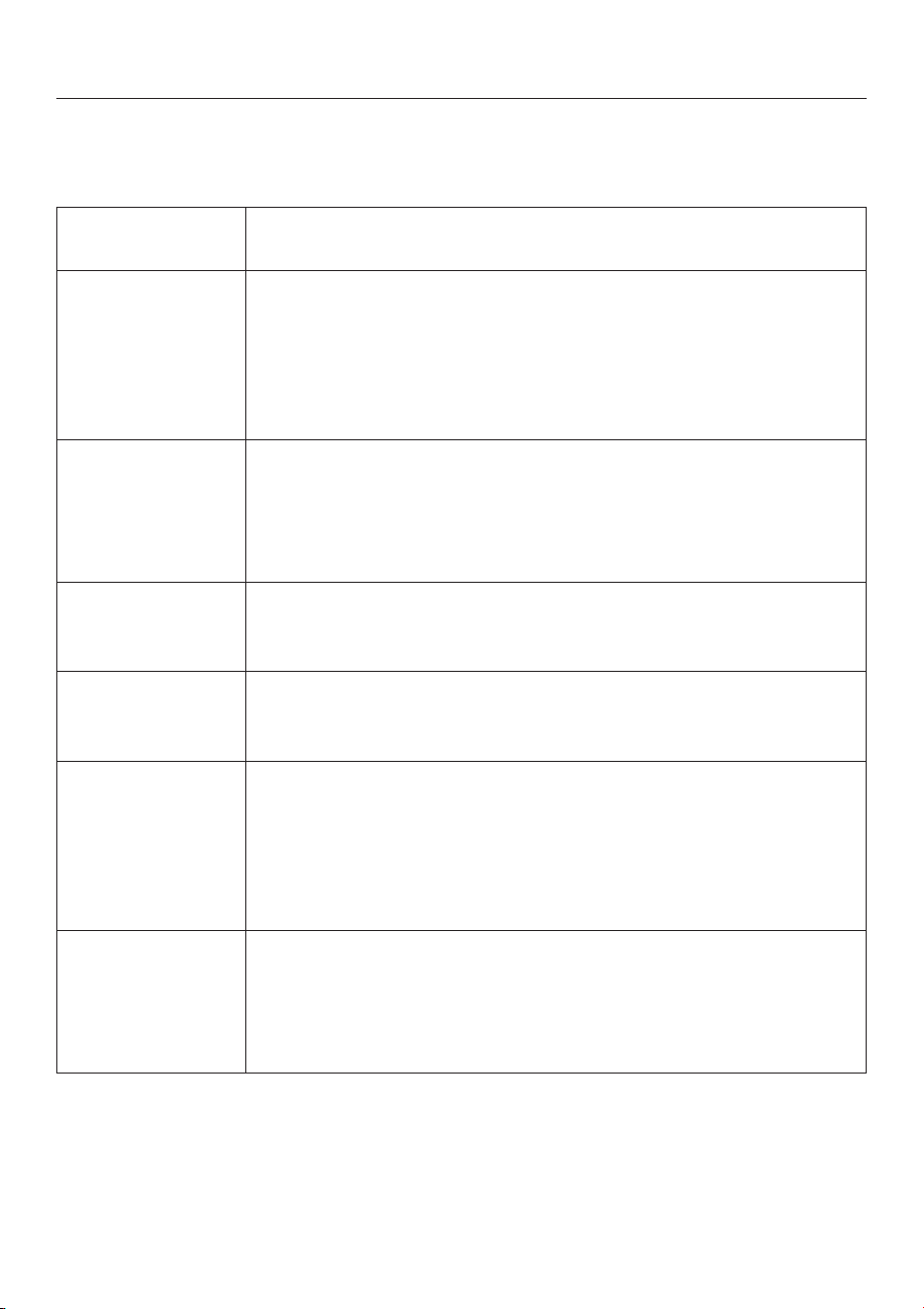
Choose your program according to the types of instruments or utensils being
cleaned and the degree of soiling.
Programs (fixed) Program Description
Wash Wash program without disinfection.
Rinse (cold) Rinse only.
To rinse items before a wash program, to avoid excessive
foam.
Drain For draining water out of the machine, e.g. when a program
has been interrupted or the "Drain/Fill" indicator illuminates.
(Turn the program selector to the "Stop" f position first).
Disinfection
vario
Recommended program for protein soils such as blood and
tissue. For cleaning and thermal disinfection at 93°C with 10
minutes holding time for stainless steel instruments.
Disinfection
93°C-10’
For thermal disinfection and cleaning of stainless steel
instruments at 93°C with 10 minutes holding time.
Program selection
32
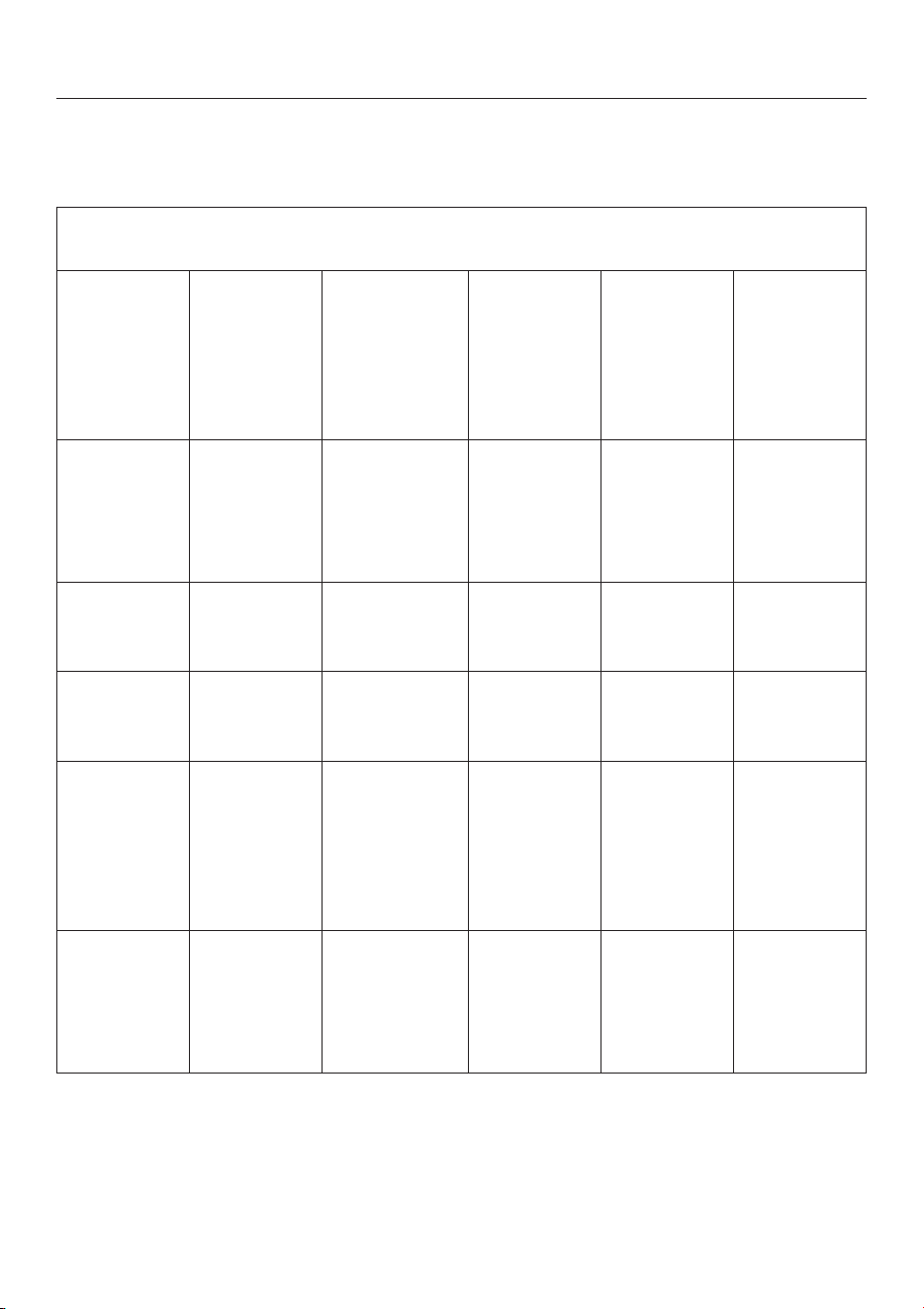
Program Sequence
1. Pre-wash 2. Cleaning
and/or
thermal
disinfection
and/or
cleaning
1)
3. Interim
rinse I
with
Neutralization
4. Interim
rinse II
5. Final
rinse
1)
and/or
disinfection
6. Drying
(extra
program)
XX
Cleaning
60°C/3’
XX
Rinse
65°C/1’
(DI)
DOS 2
(X)
X
XX
Cleaning
55°C/5’
X
DOS 3
XX
Rinse and
Disinfection
93°C/10’
(DI)
DOS 2
(X)
X
Disinfection
93°C/10’
X
DOS 3
X
Rinse
75°C/3’
(DI)
DOS 2
(X)
X = Sections included in a program (with temperature/temperature holding time)
1)
To change a temperature or temperature holding time, see "Programming special functions".
DOS 2 = For dispensing rinse aid
DOS 3 = For dispensing neutralizer
DI = Deionized water.
Program selection
33
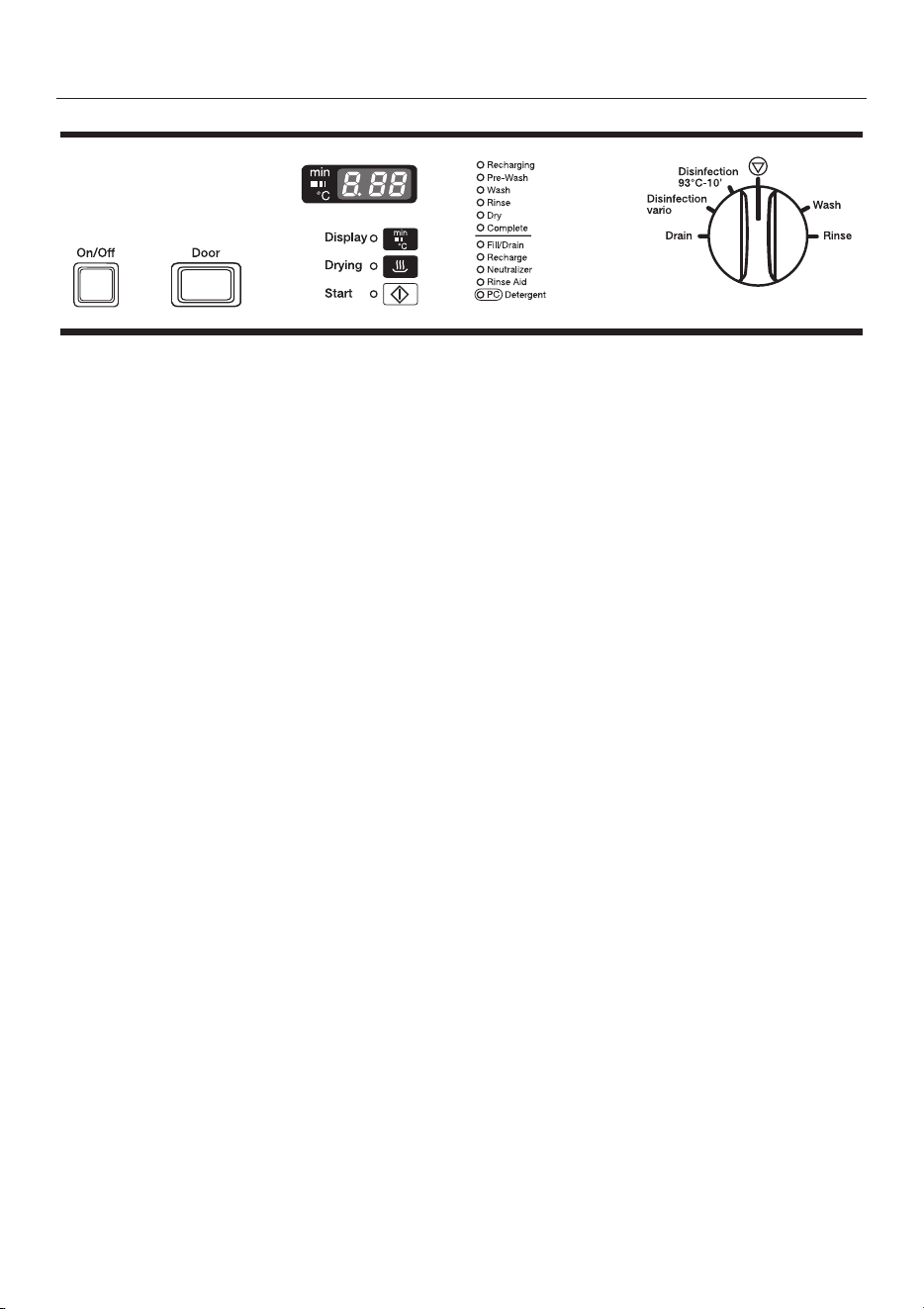
Turning on
^
Close the door.
^
Press the "On/Off" button.
When the program selector is in the
"Stop" f position, a point lights up in
the display.
Starting a program
^ Turn the program selector clockwise
or counterclockwise to the required
program.
The temperature of the first rinse of
the program selected (except for
"Pre-Wash" and "Drain") is shown in
the display. The "Start" indicator will
flash.
^
Select the "Drying" 0 function if
required (see "Drying").
^
Press the "Start" 6 button. The actual
temperature will appear in the
display.
The "Start" indicator will remain lit.
Once the program has started, all other
programs are blocked. If the program
selector is turned to another program,
the values shown in the display will go
out. The values can be seen again if the
program selector is turned back to the
position of the program currently in
operation.
^ During a program, the "Display" ß
button can be used to toggle
between the elapsed time, the active
wash block and the actual
temperature.
Wash block codes
1 = Wash
2 = Rinse
3 = Drain
4 = Disinfection vario
5 = Disinfection 93 °C-10’
Operation
34

Drying
"Drying" 0 may be selected as an
additional feature once a program has
been selected (except in the "Rinse"
and "Drain" programs).
Drying is phased over 10 minutes. If
selected, the total running time of the
program lengthens accordingly.
Changing a program
A wrongly selected program may be
changed as described below.
If the "Start" 6 button has not yet
been pressed
^ Turn the program selector to the
required program.
^ Select the "Drying" 0 function if
required (see "Drying").
^ Press the "Start" 6 button.
If "Start" 6 has already been
pressed, see "Cancelling a program".
At the end of a program
^
The "Complete" indicator in the
program sequence display
illuminates, and the "Start" 6
indicator will go out.
^
A "0" will appear in the middle of the
display. All indicators will come on
and go out in sequence.
^
Simultaneously, a buzzer will sound
for approximately 30 seconds
(standard setting). The buzzer
function can be changed (see
"Programming special functions").
Use the "Display" ß button to view the
total running time or temperature of a
program.
Turning off
^ Press and release the "On/Off" button.
Note:
The machine is fitted with an electric
door lock. The door can only be
opened if the "On/Off" button is pressed
(see "Opening and closing the door").
Operation
35
Cancelling a program
^
Turn the program selector to the
"Stop" f position (the program will
stop after approximately 2 seconds).
^
Open the door.
,
Caution: Water and items in the
machine may be hot. Danger of
burning or scalding.
^
Arrange the load securely. Wear
protective gloves when necessary,
and observe appropriate health and
safety regulations relating to
infectious diseases.
^ Replenish powder detergent, if
necessary.
^ Close the door.
^ Select and start the "Drain" program.
^ When finished with "Drain", select and
restart the desired program.
Operation
36
For future servicing, please
document any alterations to the
standard factory settings.
Enter any alterations in the field
Value set:________.
General notes
Program selector positions that have
not been allocated a function are
indicated in the middle part of the
display by a bar (-).
The programming level is called up via
the "Stop" f position.
To program special functions
Enter the programming level of the
controls first before performing special
functions as follows:
1. Setting the liquid detergent
dosage and priming the
dispensing system
^
Turn the program selector to the
"Stop" f position.
^
Turn off the machine.
^
Press and hold "Display" ß and
"Start" 6 at the same time.
Simultaneously, turn the machine on
with the "On/Off" button.
The current program status "P..." will
appear in the display and the
"Fill/Drain" indicator will illuminate.
^
Press "Drying" 0 twice.
"E02" (programming level) wil appear
in the display.
Value set:
1.1 DOS 1 (liquid detergent) via the
optional DOS-Module G 60
1.1.1 Setting the dosage
Follow the dosage recommedation
of the cleaning agents manufacturer.
^
Turn the program selector to "Wash".
The display will show either of the
following:
Display Dosing
10 Powdered detergent
from cup
0.10 - 1.00 Liquid detergent from
DOS-Module G60
^ To change the amount of liquid
detergent dispensed, press "Display"
ß as many times as necessary to
achieve the desired result (see chart
below):
Setting Dosage
.10 20 ml
.20 30 ml
.30 40 ml
.40 50 ml*
.50 60 ml
.60 70 ml
.70 80 ml
.80 90 ml
.90 100 ml
1.0 110 ml
* Recommended dosage for neodisher
TM
FA
Programming special functions
37

1.1.2 Priming the dispensing system
a) After setting the detergent dosage:
^
Turn the program selector to the
1 o’clock position. "do1" appears in
the display.
^
Press "Display" ß.
The dispensing system will be
primed automatically. "do1" will
appear in the display when priming is
finished.
^
Press the "Start" 6 button. "SP"
appears in the display.
^ Press "Start" 6 again. The change
has been recorded.
b) If only priming is required (e.g. the
dispensing system has been allowed to
become empty by mistake):
^
Select programming level 2
(see 1.).
Proceed as follows:
^
Turn the program selector to the
1 o’clock position. "do1" appears in
the display.
^
Press "Display" ß.
The dispensing system will be
primed automatically. "do1" will
appear in the display when priming is
finished.
^ Turn the machine off with the "On/Off"
button.
Every time the dispensing system has
been primed:
^ Run the "Rinse" program to dilute and
drain away any agents that may
remain in the wash cabinet.
Programming special functions
38

2. Buzzer
This special function allows you to
program a buzzer (lasting up to a
maximum of 30 seconds) for the
following functions:
–
Program end = Constant buzzer
–
Fault warning = Buzzer at one
second intervals
^
Turn the program selector to the
"Stop" f position.
^
Turn off the machine.
^
Press and hold "Display" ß and
"Start" 6 at the same time.
Simultaneously, turn the machine on
with the "On/Off" button.
The current program status "P..." will
appear in the display and the
"Fill/Drain" indicator will illuminate.
^ Press "Drying" 0 four times. "E04"
(programming level 4) appears in the
display.
^
Turn the program selector to "Rinse".
A number from 20 to 27 will appear in
the display:
20 = Buzzer switched off
21 = Buzzer at end of program
(standard setting)
22 = Fault indication
23 = Fault indication and buzzer at
end of program
^
Press the "Display" ß button as
many times as necessary, or hold it
pressed in, until the desired value
appears in the display.
^ Press the "Start" 6 button. "SP"
appears in the display.
^ Press "Start" 6 again. The change
has been recorded.
Value set:________.
Turning the buzzer off
The buzzer can be turned off early by:
–
Turning the program selector to the
"Stop" f position.
–
Pressing the "Display" ß button.
–
Interrupting the power supply (e.g.
by opening and closing the door).
Programming special functions
39
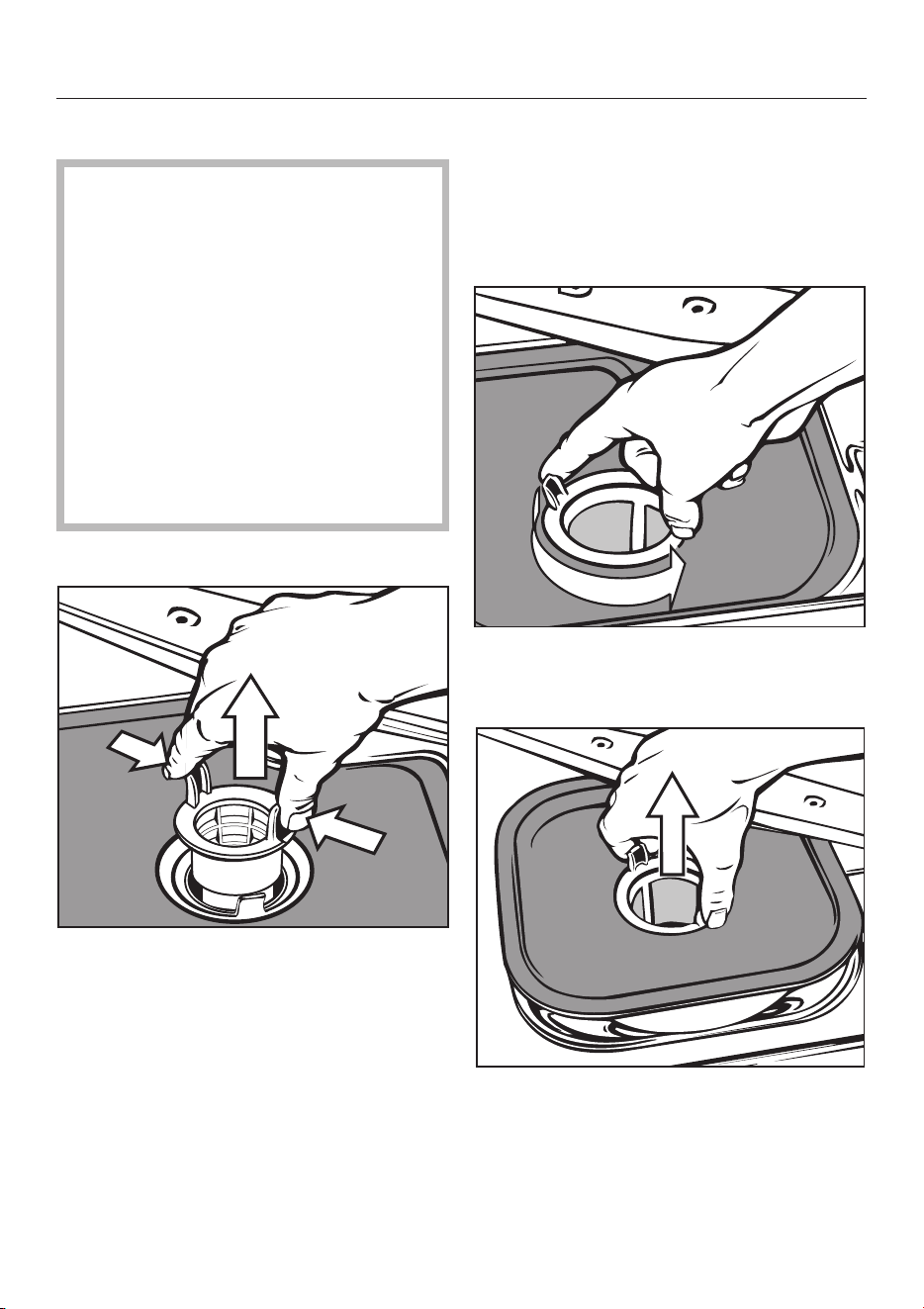
Filter combination
,
The machine must not be used
without all the filters in place. The
filters protect the circulation pump
from damage caused by foreign
objects.
The filter combination in the base of
the wash cabinet should be
inspected regularly and cleaned, if
necessary.
Caution!
Watch out for sharp objects which
could cause injury.
Cleaning the coarse filter
^
Press the two tabs together. Remove
and clean the coarse filter.
^
Put the clean filter back in position
and press until it clicks in place.
Cleaning the fine, flat and micro-fine
filters
^
Remove the coarse filter.
^
Remove the fine filter (if fitted) from be-
tween the flat and the micro-fine filters.
^ To unscrew the micro-fine filter, grasp
the two tabs and turn counter-
clockwise twice.
^
Remove both filters together.
^
Clean the filters.
^
Replace the filter combination in
reverse order. The flat filter must lie
flat in the base of the wash cabinet.
Machine care
40
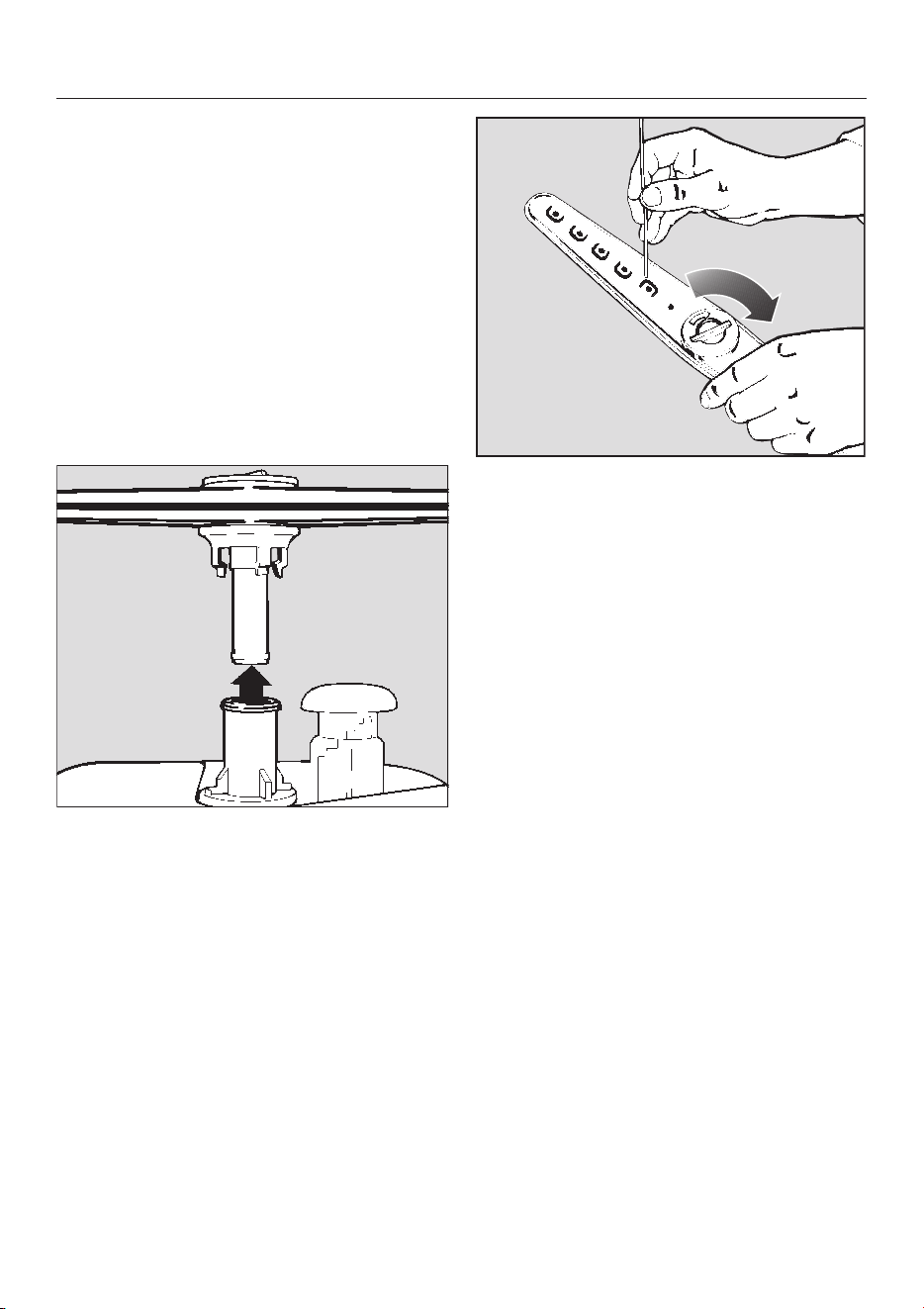
Cleaning the spray arms
From time to time, particles may
become trapped in the spray arm jets.
The spray arms should be inspected
and cleaned every 4 - 6 months.
Remove the spray arms as follows:
^
Unscrew the upper spray arm.
^
Unscrew the middle spray arm
(under the upper basket) clockwise
at the protruding nut.
^
Remove the lower basket. Pull the
lower spray arm firmly upwards to
remove.
^
Use a sharp pointed object to push
particles into the spray arm jets and
rinse thoroughly under running water.
^
Open the cap of the lower spray
arm, by turning it clockwise, to rinse
out particles.
^ After cleaning, close the cap tightly.
^ After replacing the spray arms, check
that they rotate freely.
Machine care
41
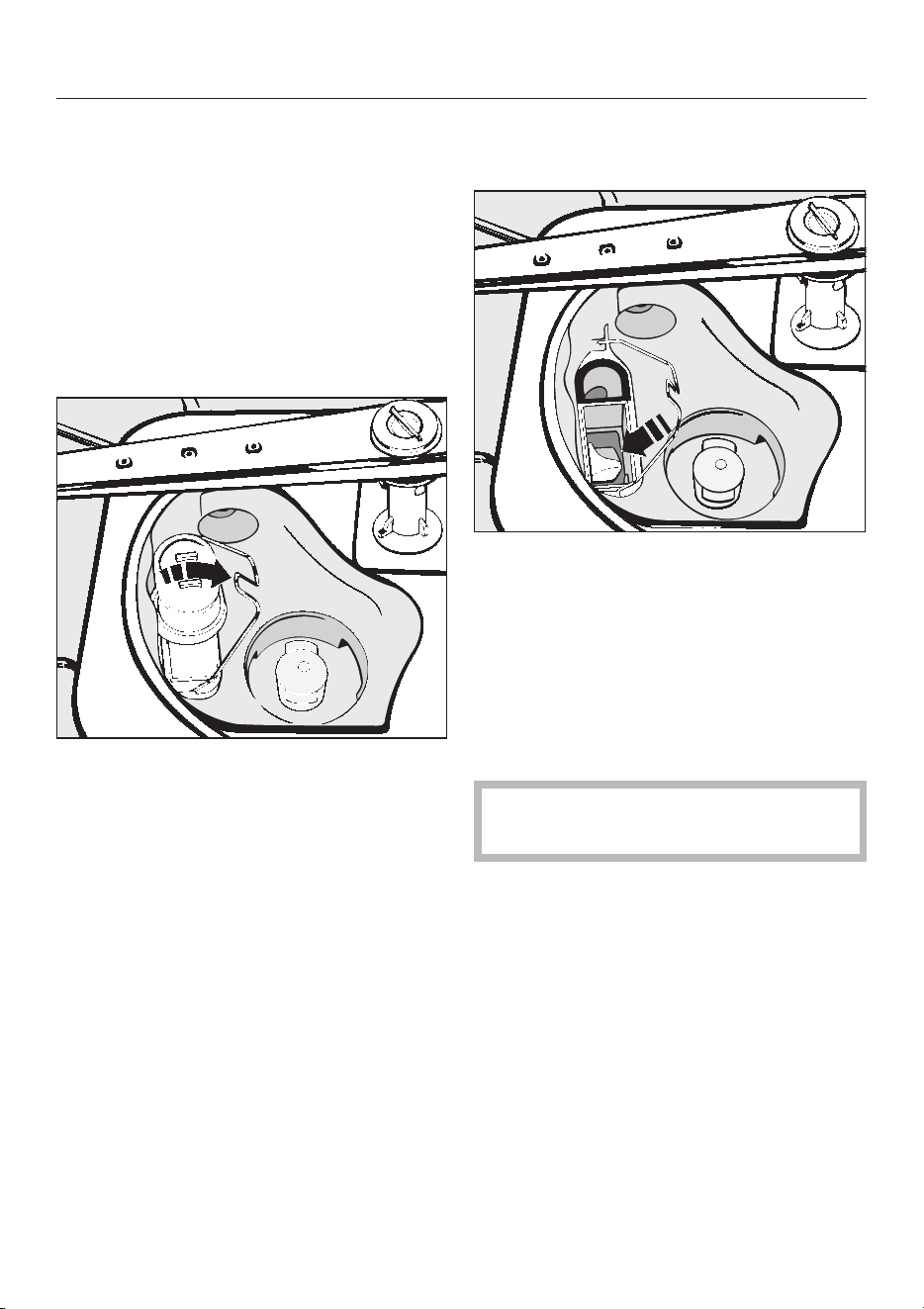
Cleaning the non-return valve
and drain pump
If water has not been pumped away at
the end of a program, the drain pump
or the non-return valve may be blocked.
^
Turn off the washer.
^
Remove the filter combination from
the wash cabinet.
^ Tilt the locking clamp to the side.
^
Pull out the non-return valve and
rinse under running water.
The drain pump is located beneath the
non-return valve (see arrow).
^ Before returning the non-return valve,
check that the drain pump is not
blocked. Spin the propeller several
times in both directions to check for
obstructions.
^ Carefully refit the non-return valve
and secure it with the locking clamp.
Refit and lock the filter in place.
For safety reasons the load should
be washed again.
Machine care
42
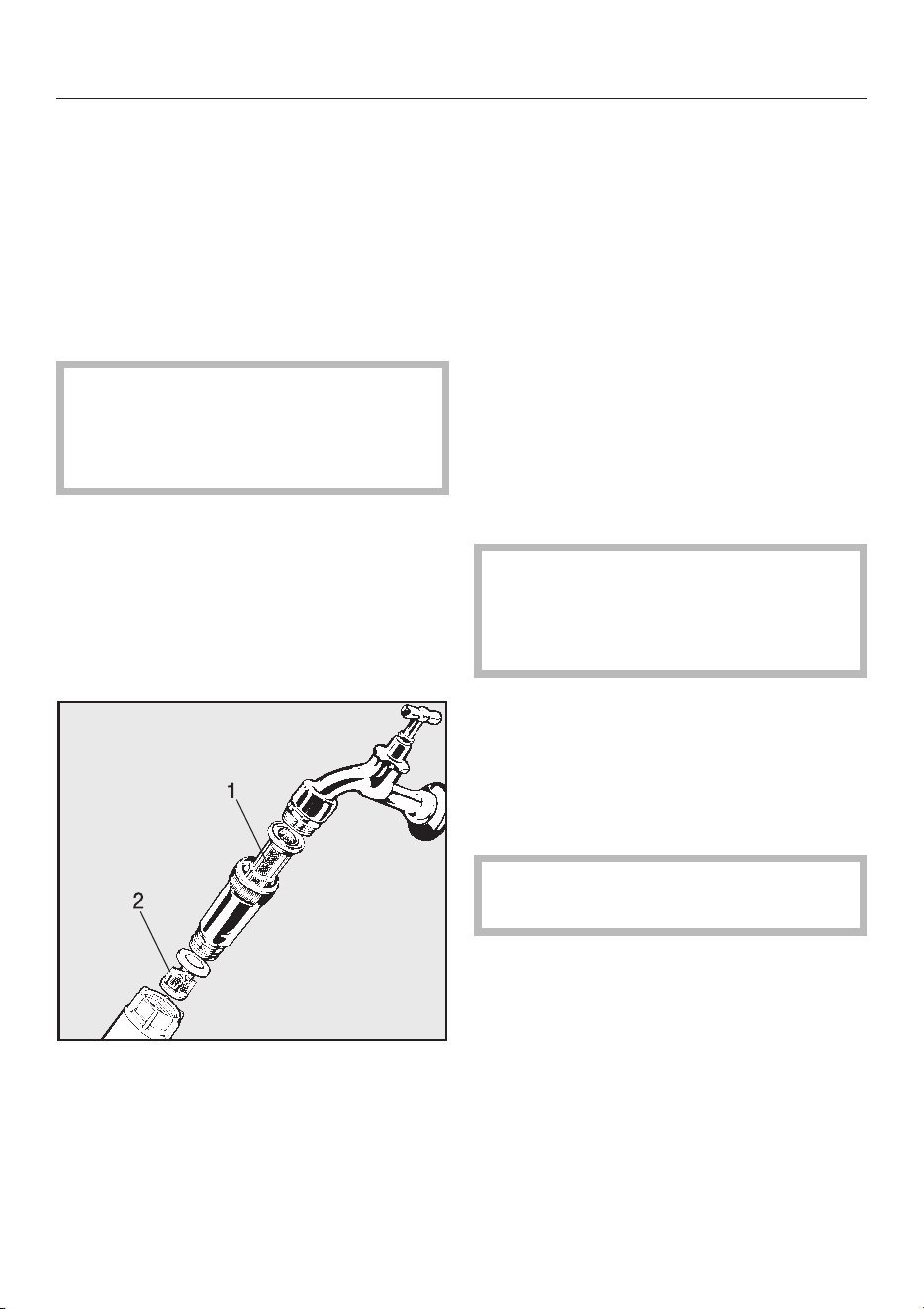
Cleaning the filters in the water
inlet
Filters are incorporated in the screw
connection of the water inlet hose to
protect the water inlet valve. If these
filters become dirty, they need to be
cleaned, otherwise insufficient water
flows into the wash cabinet.
,
The plastic housing of the water
connection contains an electrical
component. It must not be
submerged in water.
To clean the filters
^ Disconnect the machine from the
main electrical supply.
^ Turn off the water supply.
^ Unscrew the water inlet hose.
^
Clean the large area filter, 1, and fine
filter, 2, replace with new filters, if
necessary.
^
Replace filters and the seal. Make
sure they are sitting correctly.
^
Reconnect the hose to the water inlet,
making sure that it goes back on
straight.
^
Open the water tap carefully.
If there is a leak, tighten the
connections.
Cleaning the control panel
^
The control panel should only be
cleaned with a damp cloth or a
suitable cleaner for use on plastic
materials.
,
Do not use abrasive cleaners,
glass cleaners or all-purpose
cleaners! They will damage the
control panel.
Cleaning the front of the
machine
^ Use a cleaner suitable for the type of
material the machine front is fitted
with.
,
Do not use cleaning agents
containing ammonia or thinners.
Machine care
43
Before contacting the Miele service
department, please read the following
troubleshooting steps.
Any work on the electrical
components of the machine should
only be carried out by a qualified
technician in accordance with local
and national safety regulations.
Unauthorized repairs could be
dangerous.
Faults / possible causes
The machine does not start
– The door is not properly closed.
– The plug is not properly inserted into
the socket.
– The fuse is defective or has blown.
A few minutes after turning on, the
"Fill/Drain" indicator flashes (fault
code "F..E" appears in the display)
^
Turn the program selector to the
"Stop" f position (the fault code
goes out).
^
Turn the machine off (press "On/Off").
–
The water supply may be interrupted.
Check to see that the water supply is
turned on and flowing.
–
The filters in the water inlet hose are
dirty. Check and clean, if necessary.
–
The water pressure is too low.
Contact the Miele Service
Department.
The wash cycle finishes too early and
the "Fill/Drain" indicator flashes
(fault code "F A" appears in the
display)
^
Turn the program selector to the
"Stop" f position (the fault code
goes out).
^
Turn the machine off (press "On/Off").
–
The drain hose is kinked.
Straighten the hose and check /
clean the drain pump.
–
The drain pump is blocked.
Turn the machine on again, drain the
water and restart the program.
The "PC/Detergent" indicator is
illuminated
– The optional DOS- Module G60 is
being used. The liquid detergent
container must be refilled.
The "Neutralizer" indicator is
illuminated
–
The neutralizer container must be
refilled.
The display shows two dashes
–
Call for technical assistance. The
machine is stalled and cannot be
operated until it is reset by a
technician.
Correcting minor faults
44

Unsatisfactory cleaning results
Unsatisfactory cleaning results may
occur as drying spots, or as spots that
look like corrosion. Presumably,
corrosion spots are often bio-debris.
They have the shape of drying spots,
blurry edges and a rust color.
Bio-debris may also appear on
surfaces that were not contaminated
before processing. To remedy this
problem:
^
Run the machine within six hours of
loading, even if it is partially loaded.
^ Check the dosage of the detergent
and adjust. Too little or too much
detergent may deteriorate cleaning
results.
^ Rearrange the load to be cleaned so
that the spray arms can rotate freely.
^ Check if anything obstructs the
powdered detergent dispenser flap.
The water in the wash cabinet is not
heated or the program sequence
lasts too long (fault code "F01-F03,
F18, F19" appears in the display)
The machine has a resettable
temperature limiter which will shut off
the heating elements in the case of
overheating. This could be caused if
large articles cover the heating
elements or if the filters in the wash
cabinet are blocked.
^
Remove the cause of overheating.
^
Remove the service panel.
^ Press the blue "Reset" button on the
temperature limiter.
If this switch trips repeatedly, contact
the Miele Technical Service
Department.
Correcting minor faults
45

Important
When a fault occurs, please check that
the fault has not been caused by
incorrect operation. This will help avoid
an unnecessary service call.
^
Turn the program selector to the
"Stop" f position (the fault code will
go out).
^
Turn the machine off.
^
Restart the machine and reselect the
program.
If you still have difficulty or if a fault
code "F..." appears in the display,
please contact your authorized Service
Dealer or the Miele Service
Department. See back cover for
addresses.
Please quote the fault code as well as
the model type and serial number of
your machine, which is given on the
data plate inside the door (see
"Electrical connection").
After sales service
46
INSTALLATION INSTRUCTIONS

Disposal of the packing
material
The protective packing materials are
environmentally safe and can be
recycled.
Ensure that any plastic wrappings,
bags, etc. are disposed of safely and
kept out of the reach of children.
Danger of suffocation!
Disposal of the appliance
Appliances contain materials which can
be recycled. Please contact your local
authorities about recycling in your area.
Ensure that the machine presents no
danger to children while being stored
for disposal. See Important Safety
Instructions.
Caring for the environment
48
Please refer to the installation
diagram supplied with the machine.
,
Furniture and fittings installed
near the machine must be of a
commercial standard (able to
withstand the effects of steam).
Installation options
–
Free-standing
–
Undercounter
The machine can be installed under a
continuous counter or sink drain. The
recess must be at least 60 cm wide,
60 cm deep and 82 cm high.
Positioning and securing the
machine
To ensure stability, the machine must be
aligned and screwed to the counter.
^
Open the door.
^
Secure the machine to the front edge
of the worktop using the screws to
the left and right of the front trim.
^
When not mounted undercounter,
floor mounting brackets must be
used.
Do not use silicone sealant to seal
the gaps between the machine and
any neighboring units. This will
hinder ventilation to the circulation
pump.
Steam Deflector (protects the
countertop)
Depending on the requirements for an
undercounter installation, a steam
deflector can be ordered from the Miele
Technical Service Department.
The underside of the Countertop is
protected from steam damage by a
stainless steel plate.
Installation
49
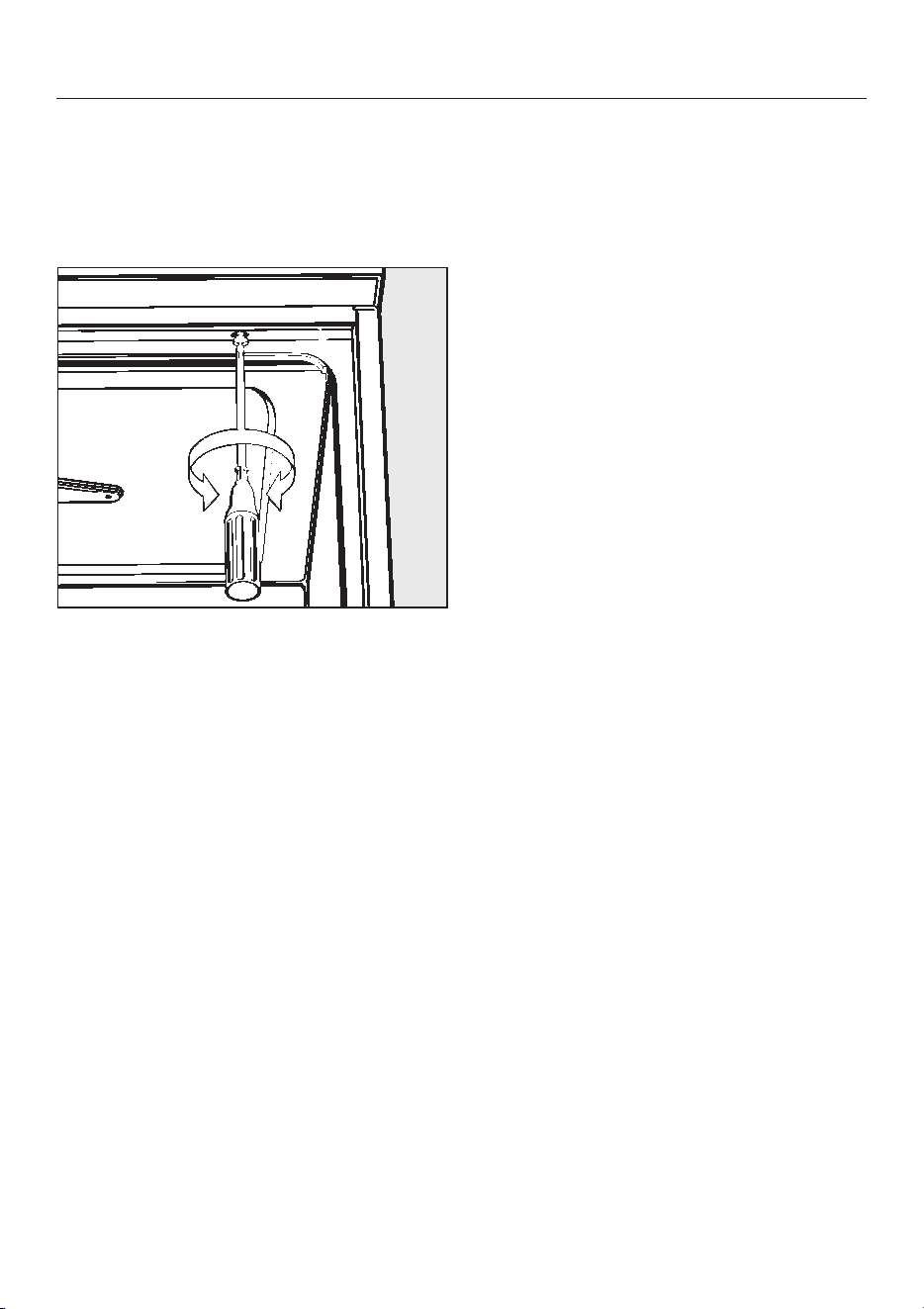
Removing the lid (if necessary)
If necessary, remove the lid from the
machine to make installation possible.
^
Open the door.
^ Remove the fixing screws on the left
and right sides using a phillipshead
screwdriver.
^ Pull the machine lid approx. 5 mm
forwards, lift it upwards and remove.
Important for machines with steam
condenser (depending on model)
^
To prevent countertop damage by
steam, the supplied self adhesive
protective foil (25 x 58 cm) must be
placed underneath the countertop
near the steam condenser.
Installation
50

,
All electrical work must be
performed by a qualified person in
accordance with local and national
safety regulations.
The machine comes equipped for
connection to a 208 V, 60 Hz, 1 phase
power supply. It is equipped with a 6 ft.
long, 10/3 AWG power cord, without a
plug. It must be hardwired into an
electrical junction box that has been
installed on the wall or in a cabinet
adjacent to the machine. It should be
connected to the main power supply.
Voltage: 208 V, 1 phase
Frequency: 60 Hz
Rated Load: 6 kW
Circuit breaker: 2 x 30 A
Black: connect to L1 (hot)
White: connect to L2 (hot)
Green: connect to GND (ground)
^
Connection should be made via a
suitable isolator, with an "On/Off"
button easily accessible for service
work.
^
A damaged power cord must only be
replaced with a genuine Miele cord
by a Miele service technician.
WARNING
THIS APPLIANCE MUST BE
GROUNDED
Grounding connection
^ The ground lead must be connected
to the screw connection point
(marked with the ground symbol 8) at
the back of the machine.
The machine must only be operated
with the voltage, frequency and
fusing shown on the data plate
located on the rear of the machine,
and on the plinth (behind the service
panel).
The conversion diagram and the
wiring diagram is secured to the inner
side of the service panel.
Electrical connection
51
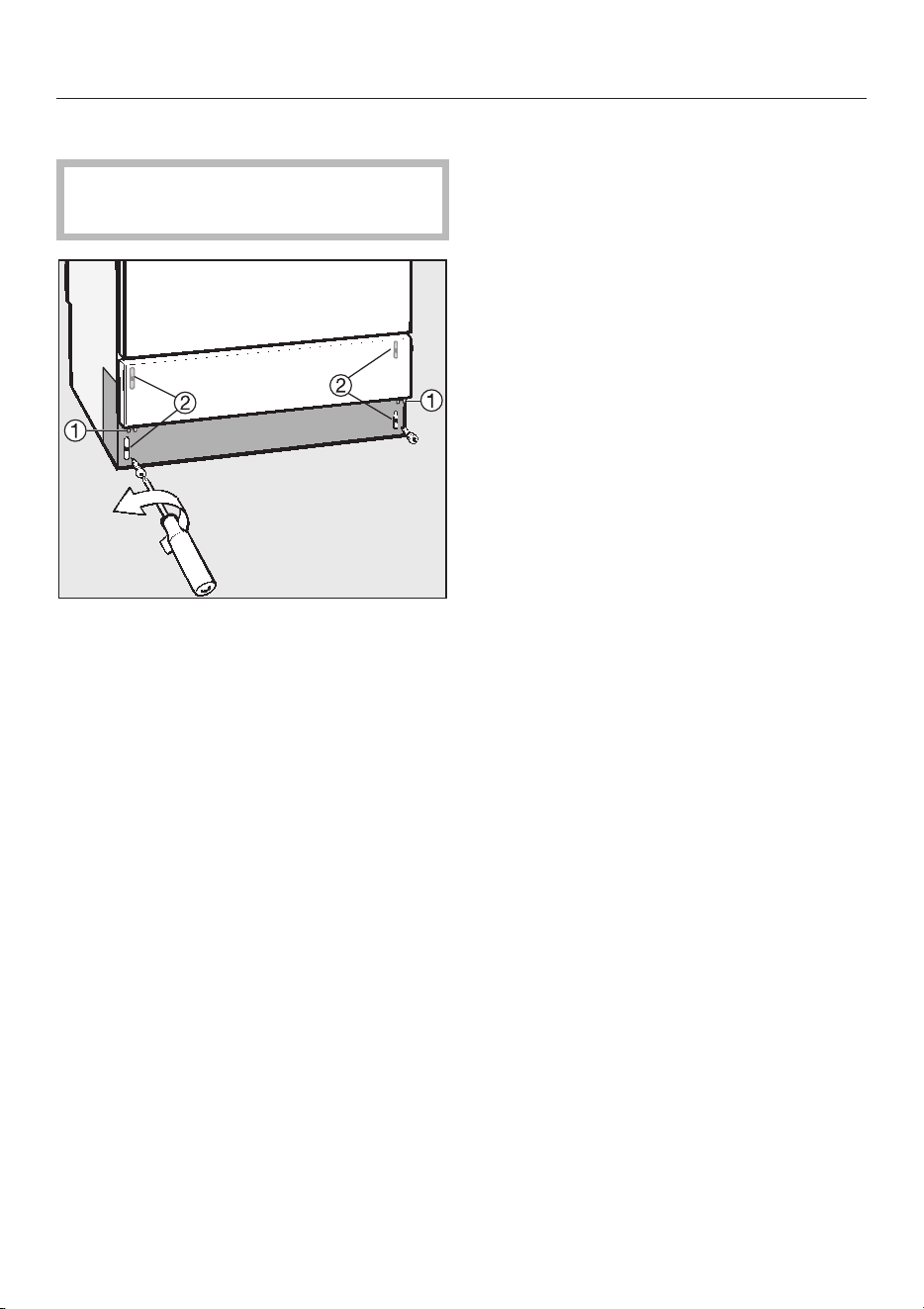
Removing the service panel
Disconnect the machine from the
main electrical supply.
^ Remove the fixing screws, a, from
the service panel.
^ Hold the service panel at both sides
and pull upwards.
^ Unscrew the facing, b. Remove the
plastic protective cap.
^
See the supplied installation diagram.
Re-assembling the service
panel
^
Refit the plastic protective cap,
facing and service panel in the
reverse order to which they were
removed.
Electrical connection
52
Connection to the water inlet
,
Water in the machine is not
suitable for drinking.
^
For technical application reasons, the
machine is supplied as standard for
connection to cold water only.
The inlet hoses (water inlet and
steam condenser) must only be
connected to the cold water inlets.
See also "DI water connection" (hose
marked H
2
O pur).
^
The machine must be connected to
the water supply in accordance with
local and national regulations.
^ Acceptable water pressure
(flow rate): 10 - 147 psi
Recommended water pressure
(flow rate): 25-60 psi
^ If the water pressure is not in the
range listed above, the "Fill/Drain"
indicator may come on and the fault
code "F..E" will appear in the display.
If this occurs, contact the Miele
Technical Service Department for
advice.
^
Connections with a
3
/
4
" GHT male
thread are to be provided on site.
They should be easily accessible so
that the water supply can be turned
off when the machine is not in use.
^
All inlet hoses are approx. 5 ft.
(1.5 m) long, ending with a
3
/
4
inch
GHT female thread. Under no
circumstances should the inlet filters
be removed.
^
Large surface area filters are
enclosed with the machine for
installing between the inlet and the
inlet hose.
(see "Machine care - Cleaning the
filters in the water inlet").
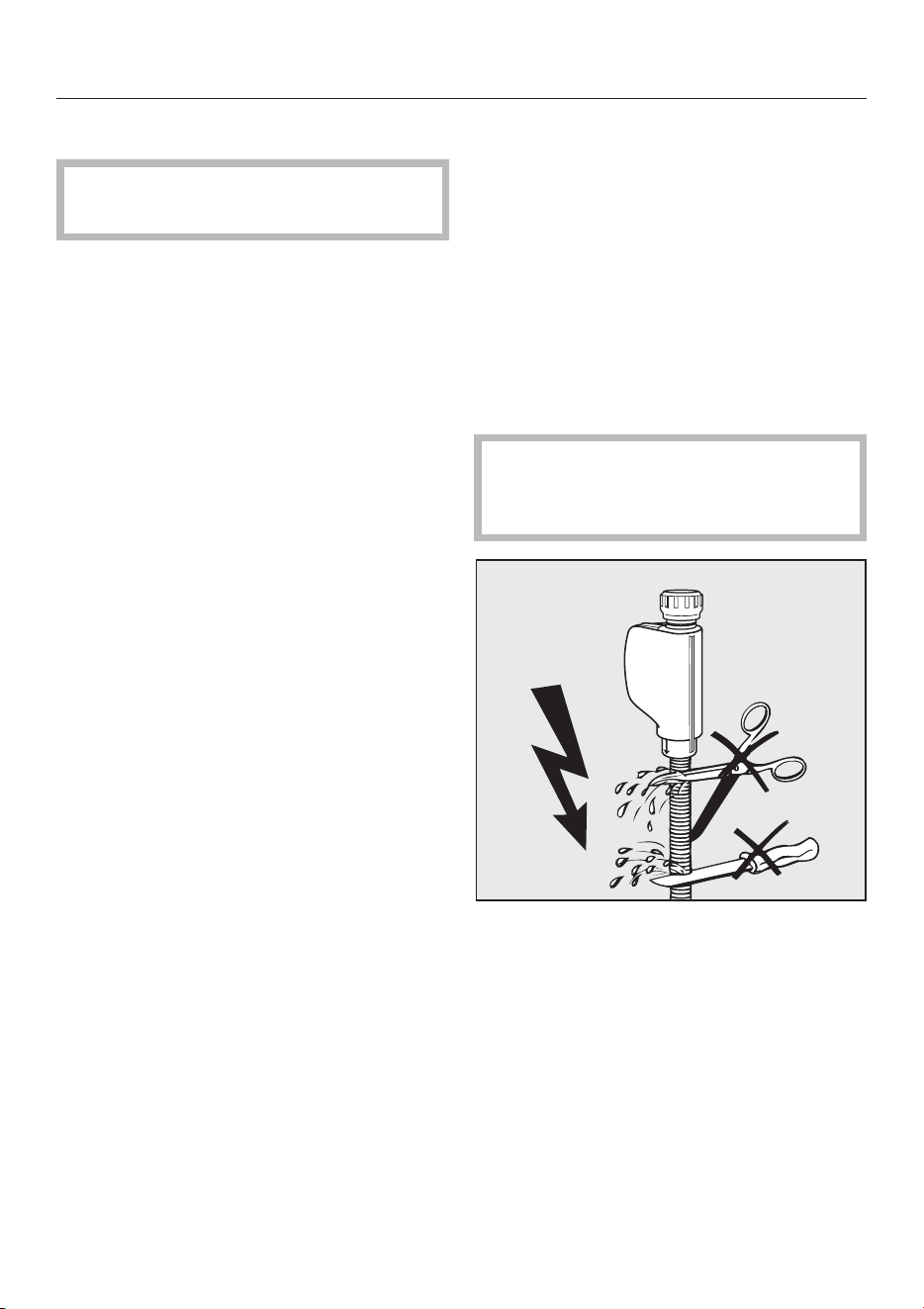
,
The inlet hose must not be
shortened or damaged in any way
(see illustration).
^
See the supplied installation diagram.
Plumbing
53

DI water connection
(available as an optional accessory)
As an option the machine can be
supplied for connection to a DI water
supply of:
Acceptable water pressure
(flow rate): 10 - 147 psi
Recommended water pressure
(flow rate): 25-60 psi
^
The DI pressure-tested hose (marked
"H
2
O pur") with a
3
/
4
" (19 mm) GHT
female hose thread must be
connected onsite to the DI inlet for
purified water.
If the machine has a DI water
connection which is not going to be
used, the electronics will need to be
reprogrammed by a Miele technician.
The inlet hose will remain on the rear
of the machine.
Plumbing
54

Drainage
^
The drainage system is fitted with a
non-return valve which prevents dirty
water from flowing back into the
machine via the drain hose.
^
The machine should preferably be
connected to a separate drainage
system onsite.
If separate drainage is not available
contact your Miele application
specialist for advice.
The onsite drain connection point
should be located between 1 ft.
(0.3 m) and 3 ft. (1 m) above the
lower edge of the machine.
If it is lower than 1 ft. (0.3 m), lay the
hose in a curve at a height of at least
1 ft. (0.3 m).
The drainage system must be able to
take a minimum drainage flow of
16 l/min.
^ The drain hose is approx. 5 ft. (1.4 m)
long, is flexible and has an internal
diameter of
7
/
8
in. (22 mm). It must
not be shortened. Hose clamps are
supplied for securing it in position.
^
A longer drain hose (up to 12 ft. [4 m]
long) is available to order from the
Miele Technical Service Department.
^
The drainage system must not
exceed 12 ft. (4 meters).
^
See the supplied installation diagram.
Plumbing
55

English Metric
Height: 33
7
/
16
" (32
5
/
16
") 85 (82) cm
Width: 23
5
/
8
" 60 cm
Depth: 23
5
/
8
" 60 cm
Voltage: 208 V 60 HZ 1 Phase
Rated load: 6 KW
Power cord approx. 5’ 11" 1.8 m
Cold Water Connection:
Acceptable water pressure
(flow rate) 10 - 147 psi .7 - 10 bar
Recommended water pressure
(flow rate) 25 - 60 psi 1.72 - 4.13 bar
DI Water Connection:
Acceptable water pressure
(flow rate) 10 - 147 psi .7 - 10 bar
Recommended water pressure
(flow rate) 25 - 60 psi 1.72 - 4.13 bar
Delivery head: min. 12" 0.3 m
max. 39
3
/
8
"1 m
Drainage length: max. 13’ 1" 4 m
Water intake hose approx. 5’ 7" 1.7 m
Drain hose: approx. 4’ 7" 1.4 m
Noise level in dB (A):
Sound pressure level LpA
Free stand unit <70
Built under: <70
Test marks: CSA
! mark: MPG-Guidelines 93/42/EWG, Class IIa
Technical data
56

57

58

59
All rights reserved / 5003
This paper has been bleached without the use of chlorine.
M.-Nr. 05 970 440 / 00
