Operating and installation
instructions
Steam combination oven
It is essential to read these operating and installation instructions
before installing and using the appliance. This prevents both personal
injury and damage to the appliance.
en-AU, NZ M.-Nr. 12 200 950

Contents
2
Warning and Safety instructions ............................................................................... 8
Caring for the environment......................................................................................... 16
Overview......................................................................................................................... 17
Steam combination oven ..............................................................................................
17
Data plate ........................................................................................................................
19
Accessories supplied.....................................................................................................
19
Controls........................................................................................................................... 22
On/Off sensor.................................................................................................................
23
Proximity sensor .............................................................................................................
23
Sensor controls...............................................................................................................
24
Touch display...................................................................................................................
25
Symbols ...........................................................................................................................
26
Operating principles..................................................................................................... 27
Selecting a menu option ...............................................................................................
27
Scrolling through menus ...............................................................................................
27
Exiting a menu.................................................................................................................
27
Changing a value or setting...........................................................................................
27
Changing a setting in a list ...................................................................................... 27
Entering numbers with the roller ............................................................................ 27
Entering numbers using the numerical keypad .................................................... 27
Changing the setting with a segment bar ............................................................. 28
Entering letters ...............................................................................................................
28
Displaying the context menu........................................................................................
28
Moving entries................................................................................................................
28
Displaying the pull-down menu....................................................................................
29
DisplayingHelp...............................................................................................................
29
Activating MobileStart...................................................................................................
29
Description of the functions....................................................................................... 30
Control panel...................................................................................................................
30
Water container..............................................................................................................
30
Food probe ......................................................................................................................
30
Temperature/Core temperature ...................................................................................
30
Moisture ..........................................................................................................................
30
Cooking duration ............................................................................................................
31
Noises ..............................................................................................................................
31
Heating-up phase...........................................................................................................
31
Cooking phase ................................................................................................................
31
Steam reduction .............................................................................................................
31
Oven interior lighting......................................................................................................
31

Contents
3
Before using for the first time..................................................................................... 32
Miele@home ..................................................................................................................
32
Standard settings ...........................................................................................................
33
Cleaning the steam combination oven for the first time ..........................................
34
Setting the correct boiling point for water..................................................................
35
Heating up the steam combination oven....................................................................
35
Settings ........................................................................................................................... 36
Settings overview...........................................................................................................
36
Opening the "Settings" menu......................................................................................
39
Language......................................................................................................................
39
Time..................................................................................................................................
39
Date..................................................................................................................................
40
Lighting.............................................................................................................................
40
Start screen.....................................................................................................................
40
Display .............................................................................................................................
41
Volume .............................................................................................................................
41
Units.................................................................................................................................
42
Keeping warm .................................................................................................................
42
Steam reduction .............................................................................................................
42
Recommended temperatures.......................................................................................
42
Booster ............................................................................................................................
43
Automatic rinsing ...........................................................................................................
43
Water hardness...............................................................................................................
44
Proximity sensor ............................................................................................................
46
Safety ...............................................................................................................................
47
Furniture front recognition ............................................................................................
47
Miele@home ..................................................................................................................
48
Performing Scan & Connect................................................................................... 48
Remote control ...............................................................................................................
49
Activating MobileStart............................................................................................. 49
SuperVision .....................................................................................................................
49
RemoteUpdate ...............................................................................................................
50
Software version.............................................................................................................
51
Legal information............................................................................................................
51
Showroom programme..................................................................................................
51
Factory default settings.................................................................................................
51
Operating hours (total) ..................................................................................................
51
Alarm + minute minder ................................................................................................ 52
Using the Alarmfunction...............................................................................................
52
Using the Minute minderfunction...............................................................................
53
Main and sub-menus ................................................................................................... 54

Contents
4
Energy saving tips......................................................................................................... 56
Operation........................................................................................................................ 57
Changing values and settings for a cooking programme..........................................
58
Changing the temperature and core temperature ............................................... 58
Changing the moisture level.................................................................................... 58
Setting cooking durations........................................................................................ 59
Changing the set cooking durations ...................................................................... 59
Deleting the set cooking durations ........................................................................ 59
Cancelling cooking .........................................................................................................
60
Interrupting a cooking programme ..............................................................................
60
Pre-heating the oven......................................................................................................
61
Booster....................................................................................................................... 61
Pre-heat...................................................................................................................... 62
Crisp function..................................................................................................................
62
Injecting bursts of steam ..............................................................................................
63
Changing the function ...................................................................................................
63
General notes................................................................................................................. 64
The advantages of cooking with steam.......................................................................
64
Suitable containers ........................................................................................................
64
Shelf level ........................................................................................................................
64
Frozen...............................................................................................................................
65
Temperature ....................................................................................................................
65
Duration ...........................................................................................................................
65
Cooking with liquid.........................................................................................................
65
Your own recipes – steam cooking ..............................................................................
65
Universal tray and combi rack ......................................................................................
65
Steam cooking............................................................................................................... 66
Eco Steam cooking.........................................................................................................
66
Notes on the cooking charts ........................................................................................
66
Vegetables.......................................................................................................................
67
Fish ...................................................................................................................................
70
Meat .................................................................................................................................
73
Rice...................................................................................................................................
75
Grains...............................................................................................................................
76
Pasta/Noodles................................................................................................................
77
European dumplings ......................................................................................................
78
Dried pulses ....................................................................................................................
79
Hen's eggs ......................................................................................................................
81
Fruit ..................................................................................................................................
82
Sausages .........................................................................................................................
82
Shellfish ...........................................................................................................................
83
Mussels............................................................................................................................
84

Contents
5
Menu cooking - manual.................................................................................................
85
Sous-vide (vacuum) cooking...................................................................................... 86
Special applications ..................................................................................................... 93
Reheat..............................................................................................................................
93
Defrost .............................................................................................................................
95
Mix & Match ...................................................................................................................
98
Menu cooking – automatic ...........................................................................................
106
Bottling.............................................................................................................................
107
Bottling cakes .................................................................................................................
109
Drying...............................................................................................................................
110
Extracting juice ...............................................................................................................
111
Blanch ..............................................................................................................................
112
Disinfect items ...............................................................................................................
112
Heat crockery..................................................................................................................
113
Keeping warm .................................................................................................................
113
Prove yeast dough..........................................................................................................
114
Heat damp towels..........................................................................................................
114
Dissolve gelatine.............................................................................................................
114
Decrystallise honey........................................................................................................
115
Melt chocolate................................................................................................................
115
Render fat........................................................................................................................
116
Sweat onions ..................................................................................................................
116
Preserving apples ..........................................................................................................
116
Preparing custard royale................................................................................................
116
Fruit jam...........................................................................................................................
117
Skinning fruit and vegetables........................................................................................
118
Make yoghurt ..................................................................................................................
119
Automatic programmes............................................................................................... 120
Categories .......................................................................................................................
120
Using Automatic programmes......................................................................................
120
Usage notes ....................................................................................................................
120
Search ..............................................................................................................................
121
MyMiele .......................................................................................................................... 122
User programmes ......................................................................................................... 123
Baking.............................................................................................................................. 126
Baking guidelines............................................................................................................
126
Tips on baking .................................................................................................................
127
Notes on the oven functions ........................................................................................
127
Roasting .......................................................................................................................... 129
Roasting tips ...................................................................................................................
129

Contents
6
Notes on the oven functions ........................................................................................
129
Food probe ......................................................................................................................
131
Grilling ............................................................................................................................. 135
Grilling tips ......................................................................................................................
135
Tips for grilling.................................................................................................................
135
Notes on the oven functions ........................................................................................
136
Cleaning and care ......................................................................................................... 138
Notes on cleaning and care ..........................................................................................
138
Unsuitable cleaning agents...........................................................................................
139
Cleaning the front...........................................................................................................
139
PerfectClean ...................................................................................................................
140
Oven compartment........................................................................................................
141
Cleaning the water container........................................................................................
142
Accessories.....................................................................................................................
143
Cleaning the shelf runners ............................................................................................
144
Lowering the top heat/grill element.............................................................................
145
Maintenance ...................................................................................................................
146
Soaking....................................................................................................................... 146
Drying ......................................................................................................................... 146
Rinsing........................................................................................................................ 146
Descaling ................................................................................................................... 146
HydroClean................................................................................................................ 148
Removing the door.........................................................................................................
151
Fitting the door ...............................................................................................................
152
Problem solving guide.................................................................................................. 153
Messages in the display................................................................................................
153
Unexpected behaviour...................................................................................................
156
Noises ..............................................................................................................................
158
Unsatisfactory results....................................................................................................
158
General problems or technical faults ..........................................................................
159
Optional accessories.................................................................................................... 163
Cooking containers ........................................................................................................
163
Other ................................................................................................................................
163
Cleaning and care products ..........................................................................................
163
Service............................................................................................................................. 164
Contact in case of fault..................................................................................................
164
Warranty ..........................................................................................................................
164
Installation...................................................................................................................... 165
Safety instructions for installation ...............................................................................
165
Installation notes............................................................................................................
166

Contents
7
Installation dimensions .................................................................................................
167
Installation in a tall unit............................................................................................ 167
Installation in a base unit......................................................................................... 168
Side view.................................................................................................................... 169
Opening range for the control panel ...................................................................... 170
Connections and ventilation ................................................................................... 171
Installing the steam combination oven .......................................................................
172
Mains water connection................................................................................................
173
Drainage...........................................................................................................................
175
Electrical connection ....................................................................................................
176
Technical data................................................................................................................ 177
Copyright and licences for the communication module...........................................
177
Copyright and licences ..................................................................................................
178

Warning and Safety instructions
8
This steam combination oven complies with all current local and
national safety requirements. However, inappropriate use can lead
to personal injury and damage to property.
Read the operating and installation instructions carefully before
using the steam combination oven. They contain important
information on safety, installation, use and maintenance of the
appliance. This prevents both personal injury and damage to the
steam combination oven.
In accordance with standard IEC 60335-1, Miele expressly and
strongly advises that you read and follow the instructions in
“Installation”, as well as in the “Warning and Safety instructions”.
Miele cannot be held liable for injury or damage caused by non-
compliance with these instructions.
Keep these instructions in a safe place and pass them on to any
future owner.
Correct application
This steam combination oven is designed for domestic use and for
use in similar environments by guests in hotel or motel rooms, bed &
breakfasts and other typical living quarters. This does not include
common/shared facilities or commercial facilities within hotels,
motels or bed & breakfasts.
This steam combination oven is not intended for outdoor use.
The steam combination oven is intended only to steam, bake,
roast, grill, defrost and reheat food.
Any other use is not permitted.
This steam combination oven is not intended for use by persons
with reduced physical, sensory or mental capabilities, or lack of
experience and knowledge, unless they are supervised whilst using it.
They may only use the steam combination oven unsupervised if they
have been shown how to use it in a safe manner. They must be able
to recognise and understand the dangers of misuse.
The oven compartment is equipped with special lamps to cope
with particular conditions (e.g. temperature, moisture, chemical
resistance, abrasion resistance and vibration). These special lamps
must only be used for the purpose for which they are intended. They
are not suitable for room lighting. Replacement lamps may only be
fitted by a Miele authorised technician or by Miele.

Warning and Safety instructions
9
Safety with children
Activate the system lock to ensure that children cannot switch on
the steam combination oven inadvertently.
Young children must not be allowed to use this appliance.
Older children may only use the steam combination oven if its
operation has been clearly explained to them and they are able to use
it safely. They must be able to understand and recognise the possible
dangers of misuse.
Cleaning work may only be carried out by older children under the
supervision of an adult.
Children should be supervised in the vicinity of the steam
combination oven. Never allow children to play with the steam
combination oven.
Risk of suffocation from packaging material. Whilst playing,
children may become entangled in packaging material (such as
plastic wrapping) or pull it over their head with the risk of suffocation.
Keep packaging material away from children.
Risk of injury caused by hot surfaces and steam. Children's skin is
far more sensitive to high temperatures than that of adults. External
parts of the steam combination oven such as the door glass, control
panel and the vent become quite hot. Do not let children touch the
steam combination oven when it is in operation.
Keep children well away from the steam combination oven until it has
cooled down and there is no danger of injury.
Risk of injury from the open door. The oven door can support a
maximum weight of 10kg. Children could injure themselves on an
open door.
Do not let children sit on the open door, lean against it or swing on it.
If you touch the sensor, the door will fully open automatically. In
doing so, it can knock against small children or animals, for example.
If the buzzers are switched on, a buzzer will sound on the steam
combination oven when you open the door remotely using a voice-
based service. Ensure that no person or object is located within the
opening range of the door when it is opened. Make sure that you
keep the buzzers switched on.

Warning and Safety instructions
10
Technical safety
Unauthorised installation, maintenance and repairs (including
removal of any cover) can cause considerable danger for the user.
Installation must be performed by a suitably qualified and competent
person. Maintenance and repairs must only be carried out by a Miele
authorised technician.
Damage to the steam combination oven can compromise your
safety. Check the steam combination oven for visible signs of
damage. Never use a damaged steam combination oven.
Temporary or permanent operation with a self-sufficient or non-
mains synchronous energy supply system (e.g. isolated networks,
back-up systems) is possible. A requirement for the operation is that
the energy supply system complies with all current local and national
requirements that apply to stand-alone, solar and/or battery systems.
The protective measures provided in the installation and in this Miele
product must also be assured in their function and operation in
isolated operation or in non-mains synchronous operation, or
replaced with equivalent measures in the installation.
The electrical safety of the steam combination oven can only be
guaranteed when continuity is complete between it and an effective
earthing system. It is essential that this basic safety requirement is
present and tested regularly. If in doubt, the electrical installation
should be checked by a qualified electrician.
The connection data (voltage and frequency) on the data plate of
the steam combination oven must match the mains electricity supply
in order to avoid the risk of damage to the steam combination oven.
Compare this before connecting the appliance to the mains
electricity supply. If in any doubt, consult a qualified electrician.
Multi-socket adapters and extension leads do not guarantee the
required safety of the appliance (e.g. danger of overheating). Do not
use these to connect the steam combination oven to the mains
electrical supply.
For safety reasons, this steam combination oven must only be
used after it has been built in.
This steam combination oven must not be installed and operated
in mobile installations (e.g. on a ship).

Warning and Safety instructions
11
Risk of injury due to electric shock. Any contact with live
connections or tampering with the electrical or mechanical
components of the steam combination oven will endanger your
safety and may lead to appliance malfunctions.
Do not open the steam combination oven housing under any
circumstances.
The manufacturer's warranty may be invalidated if the steam
combination oven is not repaired by a Miele approved service
technician.
Faulty components must only be replaced by genuine Miele spare
parts. The manufacturer can only guarantee the safety of the
appliance when Miele replacement parts are used.
If the electrical plug is removed from the mains connection cable
or if the mains connection cable is supplied without a power plug, the
steam combination oven must be connected to the electrical supply
by a qualified electrician.
If the mains connection cable is damaged, it must be replaced
with a special mains connection cable by a qualified and competent
electrician in order to avoid a hazard (see “Installation - Electrical
connection”).
During installation, maintenance and repair work, the steam
combination oven must be completely disconnected from the mains
electricity supply. To ensure this:
- Switch off the mains circuit breaker, or
- remove the screw-out fuse (in countries where this is applicable),
or
- switch off at the wall socket and withdraw the plug. To do this, pull
the plug and not the mains connection cable.
If the steam combination oven is installed behind a furniture door,
do not close the door while the steam combination oven is in
operation. Heat and moisture can build up behind a closed furniture
door. This can potentially cause damage to the steam combination
oven, the furniture unit and the flooring. Leave the furniture door open
until the steam combination oven has cooled down completely.
Connection to the mains water supply should only be carried out
by a qualified and competent specialist.
Miele cannot be held liable for damage caused by incorrect
installation or connection.

Warning and Safety instructions
12
The steam combination oven must be connected to the cold water
supply only.
The tap for the water inlet must be easily accessible after the
steam combination oven has been installed.
Before connection, check the inlet and drain hoses for visible signs
of damage. The steam combination oven may only be connected to
the water supply with the new hose set supplied with the machine.
Old hoses must not be reused. The water flow pressure must be at
least 100 kPa and must not exceed 600 kPa.
The integrated water protection system offers protection from
water damage, provided the following conditions are met:
- The steam combination oven is correctly installed (electrical and
water connections).
- The steam combination oven is repaired if any damage is
identified.
- The tap has been turned off when the appliance is not going to be
used for a longer period of time (e.g. during holidays).
Warning: If the lamps need to be replaced, ensure they are
replaced by a Miele approved service technician and that the
appliance is switched off beforehand to avoid the possibility of an
electric shock.
In areas which may be subject to infestation by cockroaches or
other vermin, pay particular attention to keeping the appliance and its
surroundings clean at all times. Any damage caused by cockroaches
or other vermin will not be covered by the warranty.
Correct use
Risk of injury caused by hot surfaces and steam. The steam
combination oven gets hot during operation. You could burn yourself
on the heating elements, oven compartment, accessories, door glass,
food or steam.
Wear oven gloves when placing hot food in the oven or removing it,
when adjusting oven shelves etc. in a hot oven compartment and
when closing the door.

Warning and Safety instructions
13
Risk of injury caused by hot food.
Food may spill or splash around when placing it into the oven or
removing it. The food can cause burns.
When placing cooking containers in the oven or removing them, make
sure that the hot food does not spill.
Preserving and heating food in sealed tins will result in an increase
in pressure, which can cause them to explode. Do not use tins for
preserving or heating food.
Plastic dishes that are not suitable for use in an oven will melt and
may ignite at high temperatures and damage the steam combination
oven.
Use only plastic containers that are suitable for use in an oven. Follow
the manufacturer’s instructions.
If you wish to use plastic containers for steam cooking, make sure
that these are heat-resistant to 100°C and able to withstand hot
steam. Other plastic containers can melt or become fragile and
brittle.
Food which is stored in the oven compartment can dry out and the
moisture released can lead to corrosion damage in the steam
combination oven. Do not leave food in the oven compartment and
do not use any cooking containers which are susceptible to
corrosion.
Risk of injury from the open door. You could bang into the open
door or trip over it. Avoid leaving the door open unnecessarily.
The door can support a maximum load of 10kg. Do not lean or sit
on an open door, or place heavy items on it. Make sure that nothing
gets trapped between the door and the oven compartment. The
steam combination oven may get damaged.
Oils and fats can ignite if allowed to overheat. Never leave the
steam combination oven unattended when cooking with oil or fats.
Never attempt to put out oil or fat fires with water. Switch the steam
combination oven off and extinguish the flames by leaving the door
closed.
Due to the high temperatures radiated, objects left near the steam
combination oven could catch fire. Do not use the steam
combination oven to heat up the room.
Grilling food for excessively long cooking durations can cause it to
dry out with the risk of catching fire. Do not exceed the
recommended cooking durations.

Warning and Safety instructions
14
Some foods dry out very quickly and can be ignited by high grilling
temperatures.
Do not use grilling functions for crisping rolls or bread or to dry
flowers or herbs. Instead use Fan Plus or Conventional Heat.
To avoid fuelling any flames, do not open the door of the steam
combination oven if smoke occurs inside the appliance. Interrupt the
programme by switching the steam combination oven off and
disconnect it from the mains electricity supply. Do not open the door
until the smoke has dispersed.
If using alcohol in your recipes, please be aware that high
temperatures can cause the alcohol to vaporise and even to ignite on
the hot heating elements.
Never line the floor of the oven compartment with aluminium foil
or oven liners. Do not place any crockery or any pans, pots or baking
trays directly on the floor of the oven compartment.
If you want to use the floor of the oven compartment as an extra
surface, place the rack on the floor of the oven compartment with the
rack surface facing up and the cooking container on top. In doing so,
ensure that the filter in the floor of the oven is not moved.
The oven compartment floor can become damaged by the rack
being pushed around on it.
Do not push the rack around on the oven compartment floor.
Larger deposits of food can block the drain and pump. Always
make sure that the filter in the floor of the oven is inserted.
To prevent the risk of damage, do not leave the food probe in the
steam combination oven when it is not being used.
When using a small electrical appliance, e.g. a hand-held blender,
near the steam combination oven, care should be taken that the
cable of the appliance cannot get trapped by the steam combination
oven door. The insulation on the cable could become damaged, giving
rise to an electric shock hazard.
The steam could reach live electrical components and cause a
short circuit. This could also destroy the electrical components. Do
not operate the steam combination oven without the lamp cover.

Warning and Safety instructions
15
Cleaning and care
Risk of injury due to electric shock. The steam from a steam
cleaning appliance could reach electrical components and cause a
short circuit. Never use a steam cleaner for cleaning.
Scratches on the door glass can result in the glass breaking.
Do not use abrasive cleaners, hard sponges, brushes or sharp metal
tools to clean the door glass.
The shelf runners can be removed (see “Cleaning and care –
Cleaning the shelf runners”).
Refit the shelf runners correctly.
Try to avoid the interior walls being splashed with food or liquids
containing salt. If it does happen, wipe these away thoroughly to
avoid corrosion on the stainless steel surface.
Accessories
Use only genuine original Miele spare parts. If spare parts or
accessories from other manufacturers are used, the warranty will be
invalidated, and Miele cannot accept liability.
Miele will guarantee to supply functional spare parts for a
minimum of 10years and up to 15years following the discontinuation
of your steam combination oven.
Only use the Miele food probe supplied with this oven. If it is
faulty, it must only be replaced with a suitable original Miele food
probe.
The plastic on the food probe can melt at very high temperatures.
Do not use the food probe when grilling (exception: Fan Grill). If
you are not using the food probe, do not store it in the oven.

Caring for the environment
16
Disposal of the packing material
The transport and protective packaging
has been selected from materials which
are environmentally friendly for disposal,
and can normally be recycled.
Recycling the packaging reduces the
use of raw materials in the
manufacturing process and also reduces
the amount of waste in landfill sites.
Ensure that any plastic wrappings, bags
etc. are disposed of safely and kept out
of the reach of babies and young
children. Danger of suffocation.
Only for Australia: Note for installer:
Expanded polystyrene (EPS) packaging
included. Please retain and dispose of
EPS packaging responsibly. For further
information, please contact Miele.
Disposing of your old appliance
Electrical and electronic appliances
often contain valuable materials. They
also contain specific materials,
compounds and components, which
were essential for their correct function
and safety. These could be hazardous to
human health and to the environment if
disposed of with your domestic waste
or if handled incorrectly. Please do not,
therefore, dispose of your old appliance
with your household waste.
Please dispose of it at your local
community waste collection / recycling
centre for electrical and electronic
appliances. You are also responsible for
deleting any personal data that may be
stored on the appliance prior to
disposal. Please ensure that your old
appliance poses no risk to children while
being stored prior to disposal.
Overview
17
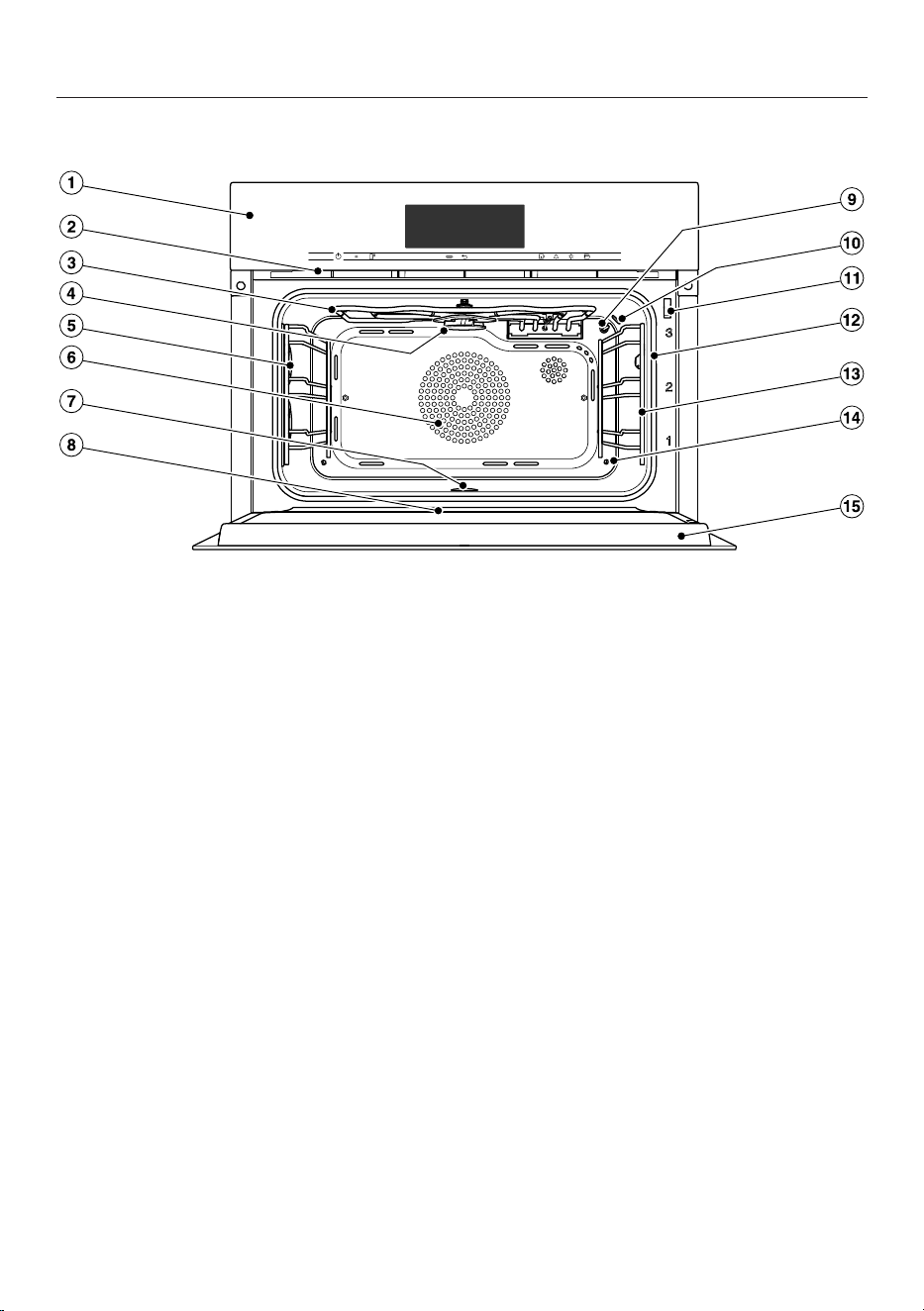
Steam combination oven
a
Control panel
b
Ventilation outlet
c
Top heat/grill element with wireless food probe antenna
d
Distribution fan for HydroClean cleaning
e
Oven interior lighting
f
Air inlet for the fan with ring heating element behind it
g
Oven floor with bottom heating element and floor filter underneath it
h
Drip channel
i
Temperature sensor
j
Moisture sensor
k
Door lock
l
Door seal
m
Shelf runners with 3 shelf levels
n
Steam outlet
o
Door
Overview
18
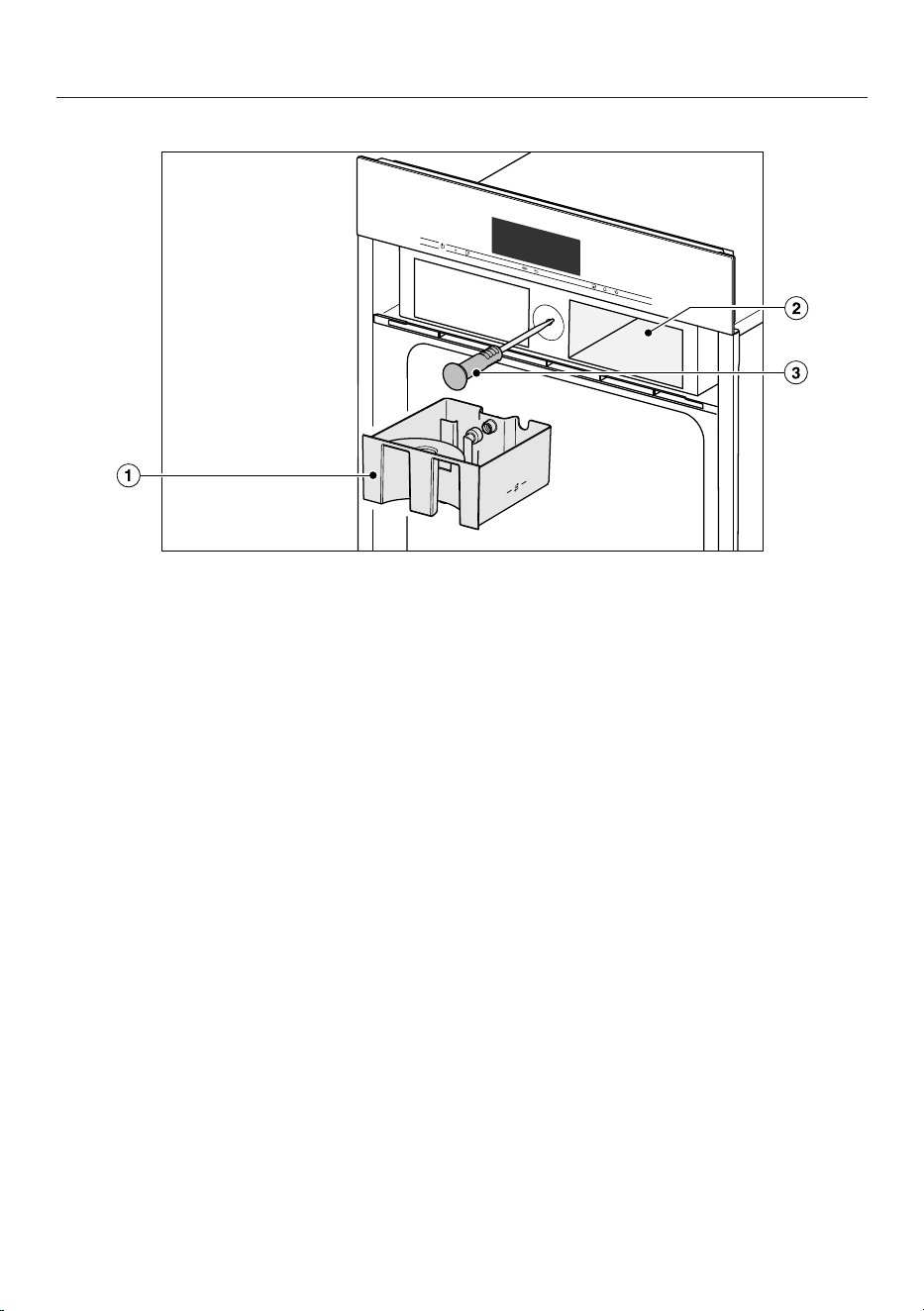
a
Water container
b
Compartment for water container
c
Food probe holder and wireless food probe
Overview
19
A list of the models described in these
operating and installation instructions
can be found on the back page.
Data plate
The data plate is located on the top of
the housing.
The data plate states the model number,
the serial number as well as connection
data (mains voltage, frequency and
maximum rated load).
The model identifier and the serial
number (SN) can also be found on the
small plate at the top on the opened
control panel.
Please have this information to hand
should you need to contact Miele
regarding any questions or problems.
Accessories supplied
The accessories supplied with your
appliance, as well as a range of optional
ones, are available to order from Miele
(see “Optional accessories”).
Further accessories may be included
depending on the country and model
in question.
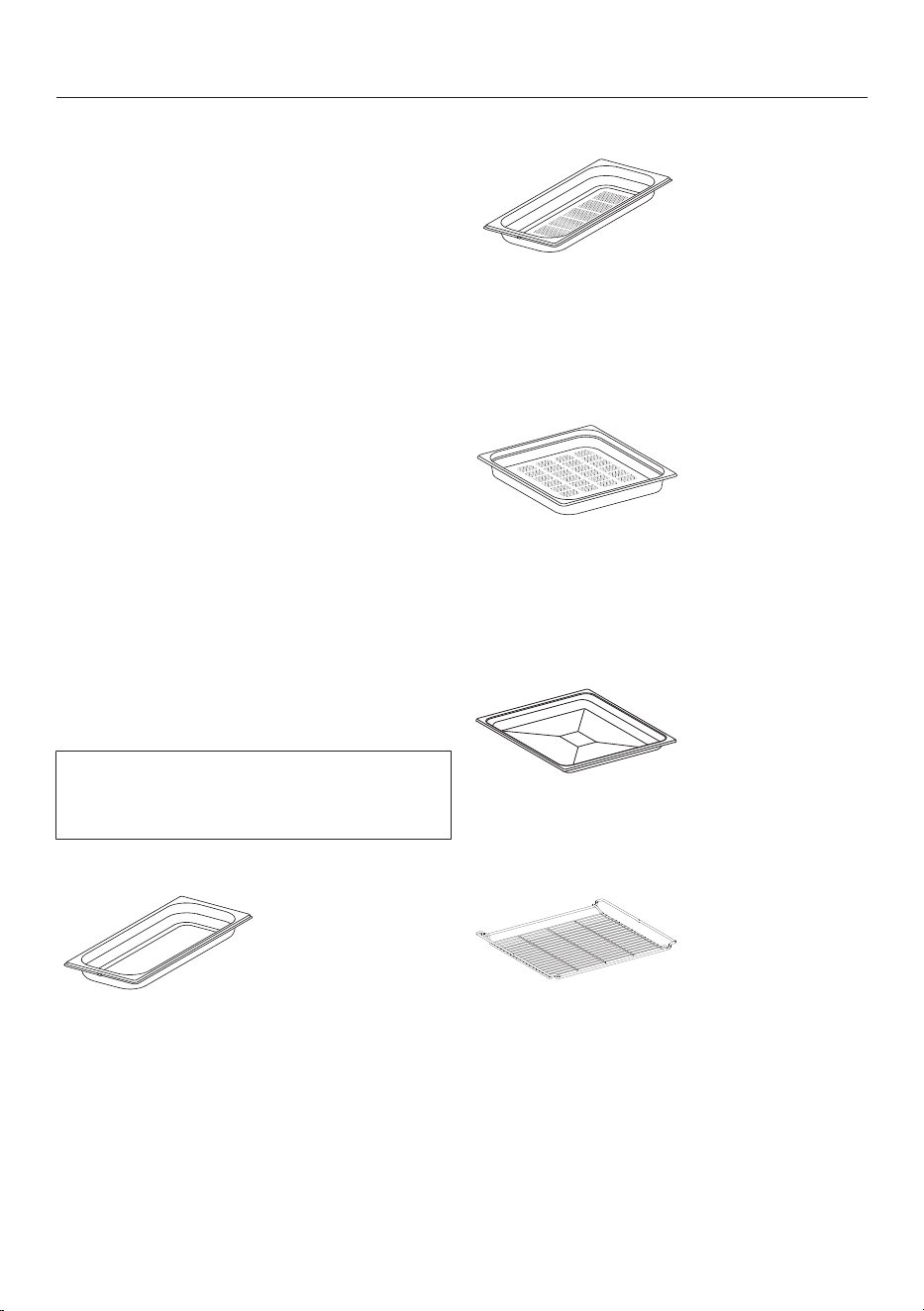
DGG 20
1 solid cooking container
Gross capacity 2.4litres / Useable
capacity 1.8litres
450x190x40mm (W x D x H)
DGGL 20
1 perforated cooking container
Gross capacity 2.4 litres / Useable
capacity 1.8 litres
450x190x40mm (W x D x H)
DGGL 12
1 perforated cooking container
Gross capacity 4.9 litres / Useable
capacity 3.3 litres
450 x 390 x 40 mm (W x D x H)
Universal tray
1 universal tray for baking, roasting and
grilling
Combi rack
1 combi rack for baking, roasting and
grilling
Insert these accessories into the shelf
runners between the two rails of a shelf
level.
The rack has a rail at the back to prevent
dishes sliding off. Ensure the rack is
inserted so that the rail is facing
upwards.
Overview
20
Non-tip safety notches are located on
accessories to prevent the trays being
pulled out completely when you only
wish to pull them out partially. They also
prevent trays from tipping.
- The non-tip safety notches are located
in the middle of the short sides of the
baking tray and universal tray.
- The non-tip safety notches are located
towards the back of the short sides of
the rack.
Food probe
1 food probe for precise temperature
controlled cooking. The food probe
monitors the inner temperature of the
meat (core temperature).
Opener
For manually opening the door
HydroCleaner
1 special cleaner for cleaning the oven
compartment with the HydroClean
maintenance programme. Particularly
suitable for removing heavy, stubborn
soiling.
Descaling tablets
For descaling the steam combination
oven.
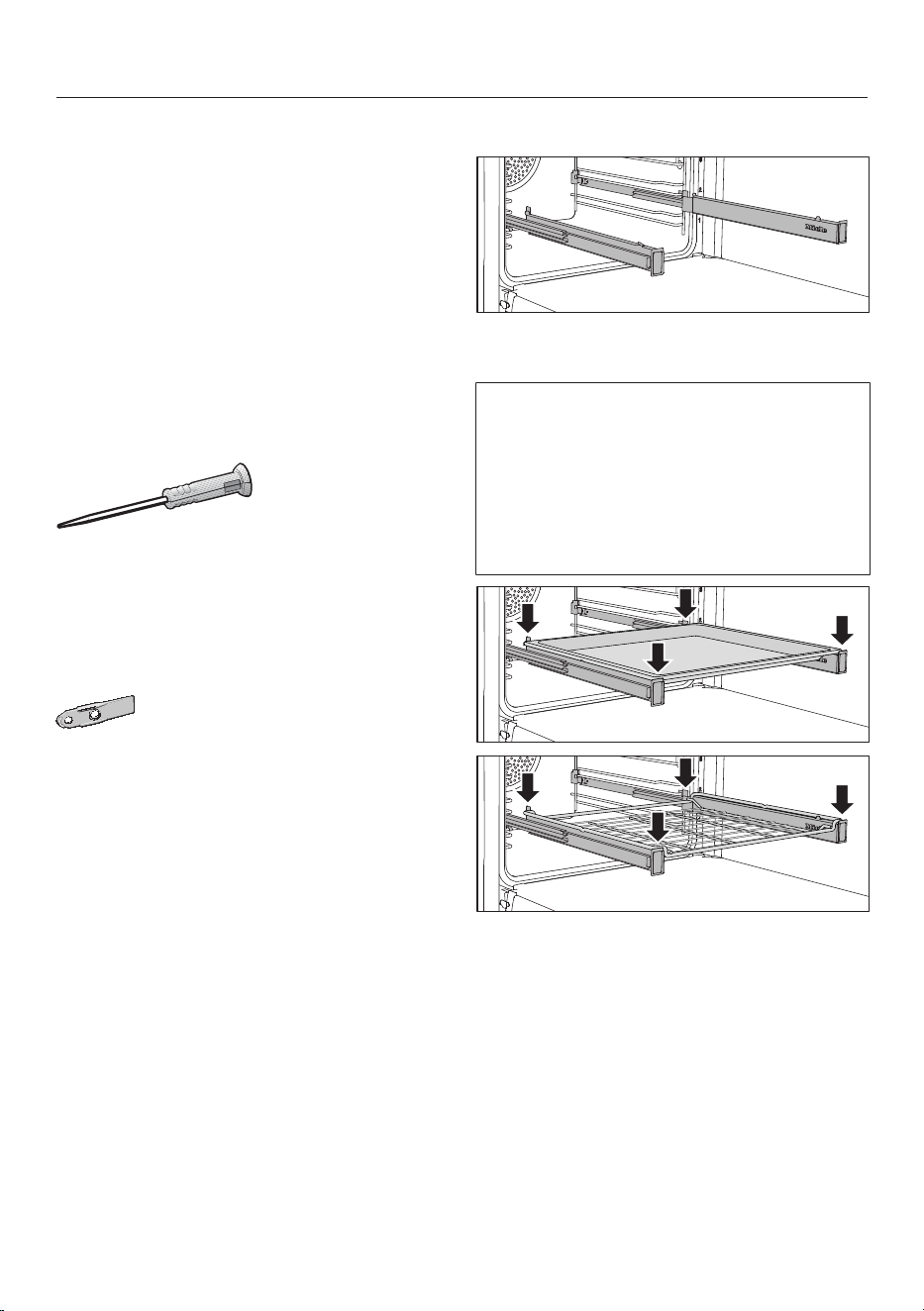
FlexiClip telescopic runners HFC71
The FlexiClip telescopic runners can be
attached to any shelf level.
Push the FlexiClip telescopic runners
right into the oven cavity before
placing accessories on them.
The accessories will then
automatically sit securely between the
stoppers at either end of each runner
and be prevented from sliding off.
The FlexiClip telescopic runners can
support a maximum load of 15kg.
Overview
21
Fitting and removing the FlexiClip
telescopic runners
Risk of injury caused by hot
surfaces.
The steam combination oven gets
hot during operation. You could burn
yourself on the heating elements, the
oven compartment, or accessories.
Allow the heating elements, oven
compartment and the accessories to
cool down before fitting or removing
the FlexiClip telescopic runners.
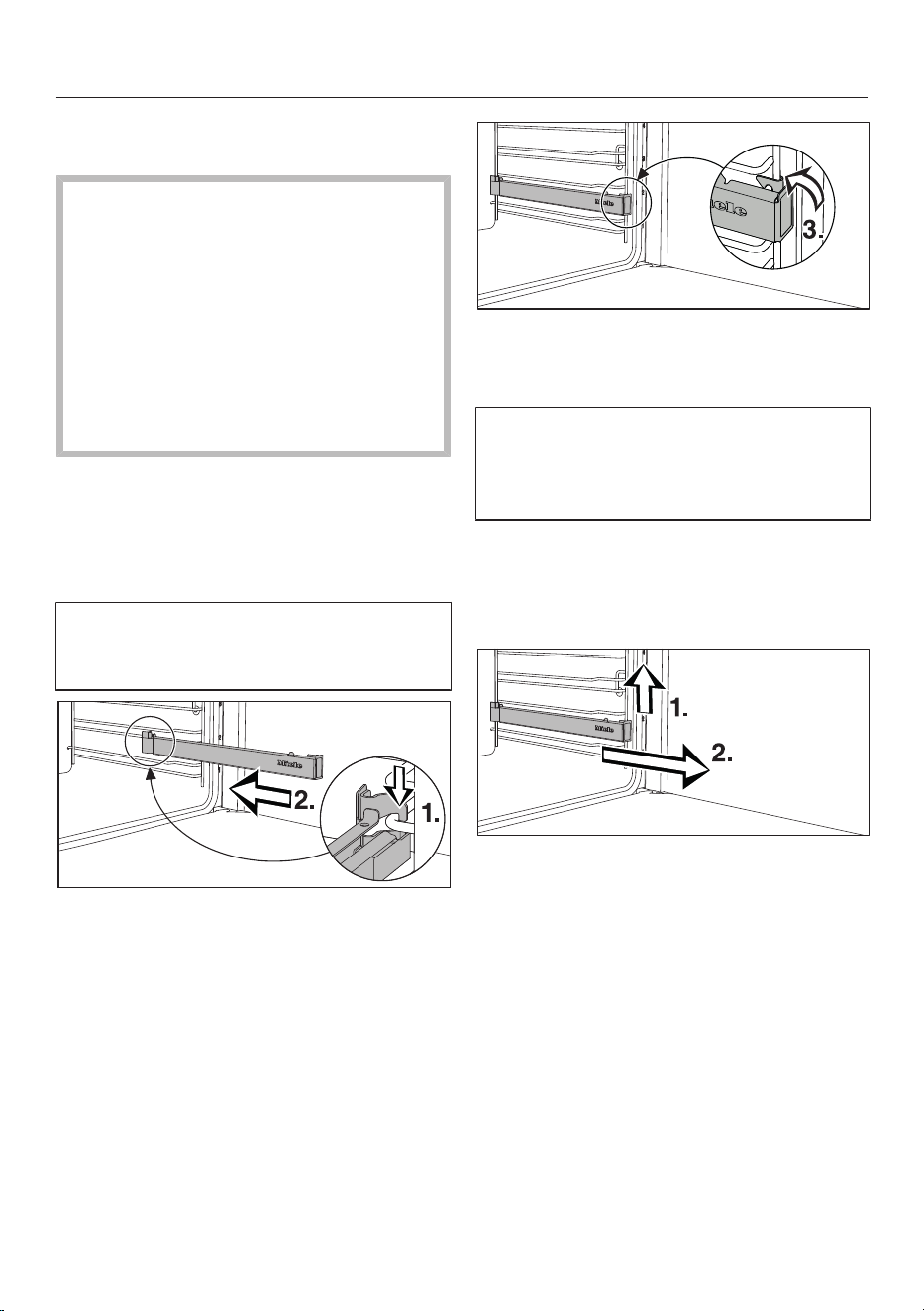
The FlexiClip telescopic runners are
fitted in between the two rails that make
up a shelf level.
The FlexiClip telescopic runner with the
Miele logo is fitted on the right.
When fitting or removing the FlexiClip
telescopic runners, do not extend
them.
Hook the FlexiClip telescopic runner
onto the lower rail of a shelf level at
the front (1.) and push it along the rail
into the oven interior (2.).
Then secure the FlexiClip telescopic
runner to the lower rail of the shelf
level as illustrated (3.).
If the FlexiClip telescopic runners are
difficult to pull out after fitting, you
may need to pull firmly on them once
to release them.
To remove a FlexiClip telescopic runner,
proceed as follows:
Push the FlexiClip telescopic runner
in all the way.
Remove the FlexiClip telescopic
runner by raising it at the front (1.) and
then pulling it forwards along the rail
of the shelf level and out (2.).
Controls
22
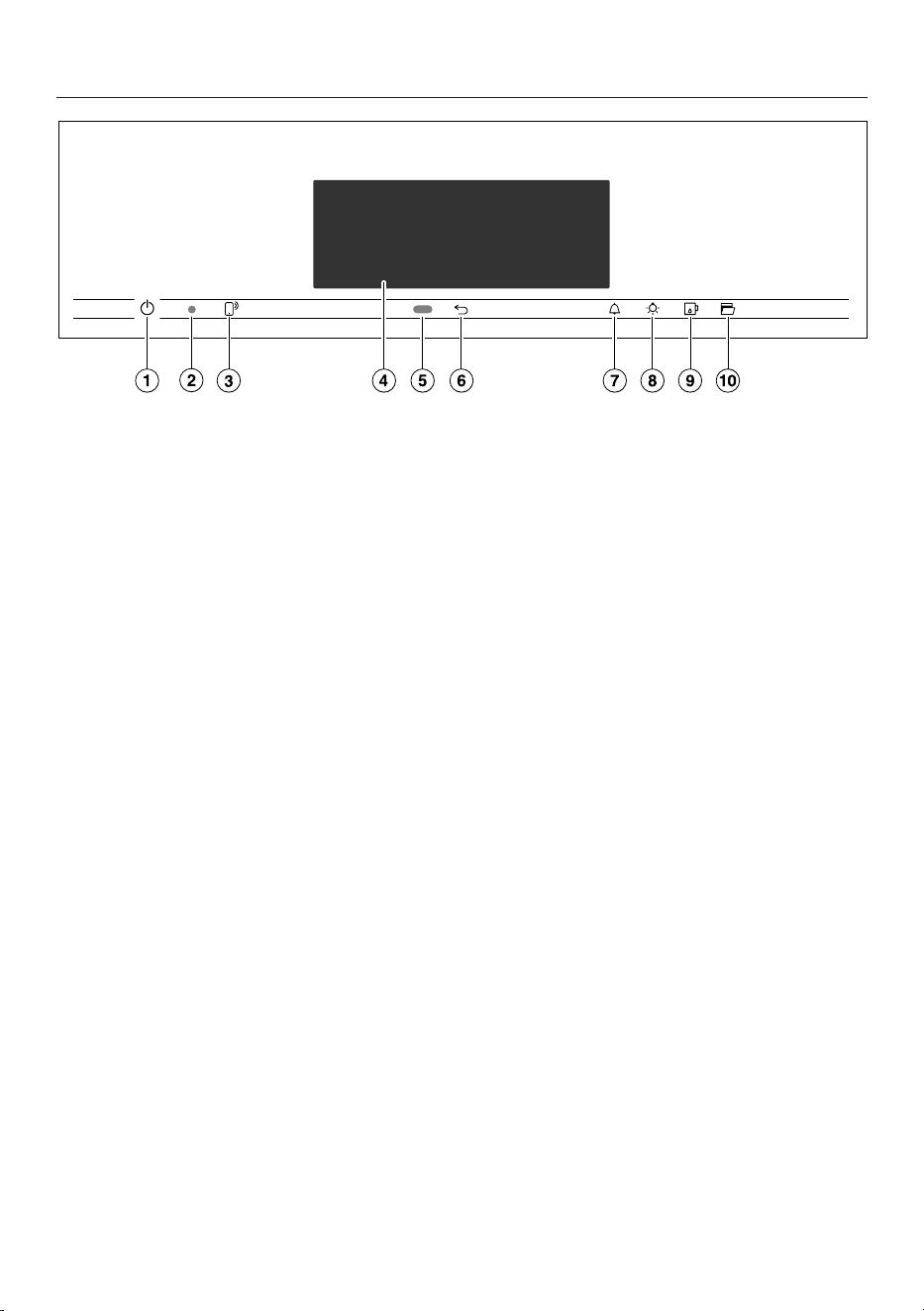
a
Recessed On/Off sensor
For switching the steam combination
oven on and off
b
Optical interface
(for Miele service technicians only)
c
sensor
For controlling the steam
combination oven via your mobile
device
d
Touch display
For displaying information and for
operation
e
Proximity sensor
For switching on the oven interior
lighting and the display when
approached, and to dismiss the
buzzer when movement is detected
f
sensor
To go back a step
g
sensor
For setting the minute minder or
alarms
h
sensor
For switching the oven interior
lighting on and off
i
sensor
For opening and closing the control
panel
j
sensor
For opening the door

Controls
23
On/Off sensor
The On/Off sensor is recessed and
reacts to touch.
Use this sensor to switch the steam
combination oven on and off.
Proximity sensor
The proximity sensor is located under
the touch display next to the sensor.
The proximity sensor detects when you
approach the touch display, e.g. with
your hand or body.
If you have activated the corresponding
settings, you can switch on the oven
interior lighting, switch on the steam
combination oven or acknowledge the
buzzers (see "Settings – Proximity
sensor").

Controls
24
Sensor controls
The sensors react to touch. Every touch on the sensors is confirmed by a keypad
tone. This keyapd tone can be switched off by selecting theVolume| Keypad tone|
Offsetting.
If you want the sensors to respond even when the steam combination oven is
switched off, select the Display| QuickTouch| Onsetting.
Sensor Function
If you want to control the steam combination oven from your
mobile device, you must have the Miele@home system, switch
on the Remote controlsetting and touch this sensor. The sensor
then lights up orange and the MobileStart function is available.
As long as this sensor is illuminated, you can control the steam
combination oven via your mobile device (see “Settings –
Miele@home”).
Depending on which menu you are in, this will take you back a
level or back to the main menu.
If a menu appears in the display or if a cooking programme is in
progress, you can use this sensor to set a minute minder (e.g.
when boiling eggs on the cooktop) or an alarm (a specific time) at
any point (see “Alarm + minute minder”).
Select this sensor to switch the oven interior lighting on and off.
Depending on the setting selected, the oven interior lighting
switches off after 15seconds or remains constantly switched on
or off.
Use this sensor to open and close the control panel (see
“Functional description - Control panel”).
Use this sensor to open the door automatically. To close it, press
against the door frame with your hand or with a suitable pot
holder or oven glove until the door shuts.

Controls
25
Touch display
The sensitive surface of the touch display can be scratched by pointed or sharp
objects, e.g. pens.
Only touch the display with your fingers.
Make sure that water cannot get behind the touch display.
The touch display is split into multiple areas.
Oven functions
12:00
Automatic
programmes
Special
applications
MyMiele
The menu path appears on the left of the header. The individual menu options are
separated by a vertical line. … indicates that there are more options available,
which are not visible because there is not enough space in the display.
If you touch a menu name in the header, the display will switch to that menu. To
switch to the start screen, touch.
The time of day is shown on the right of the header. You can set the time of day by
touching the display.
Additional symbols may also appear, e.g. SuperVision.
At the top of the header there is an orange line where you can drag down the pull-
down menu. This allows you to switch settings on or off during a cooking
programme.
The current menu and menu options are shown in the centre. You can scroll to the
right or left by swiping your finger across the display to the right or left. Touch a
menu option to select it (see “Operating principles”).
The operation fields that appear in the footer vary according to the menu that is
selected; e.g.Timer, Save or OK.

Controls
26
Symbols
The following symbols may appear in the display:
Symbol Meaning
This symbol indicates that there is additional information and
advice about using the appliance. Select OK to confirm the
information.
… This indicates that there are more options available, which are not
visible because there is not enough space in the display.
Alarm
Minute minder
Some settings, e.g. display brightness and signal tone volume, are
selected using a segment bar.
The system lock or sensor lock is on (see “Settings – Safety”).
The controls are locked.
Core temperature when using the food probe
Remote control (only appears if you are in the Miele@home
system and have selected the Remote control| On setting).
SuperVision (only appears if you are in the Miele@home system
and have selected the SuperVision| SuperVision display| On setting)

Operating principles
27
You operate the steam combination
oven via the touch display by touching
the desired menu option.
Each time you touch a possible option
the relevant characters (word and/or
symbol) light up orange.
Fields for confirming an operating step
are highlighted in green (e.g. OK).
Selecting a menu option
Touch the desired field or value in the
touch display.
Scrolling through menus
You can scroll left or right.
Swipe across the screen. To do this,
place your finger on the touch display
and swipe it in the direction you want.
The bar at the bottom shows you where
you are in the current menu.
Exiting a menu
Touch the sensor or touch the …
symbol in the menu path.
Touch the symbol to switch to the
status display.
Entries made before this which have not
been confirmed withOK will not be
saved.
Changing a value or setting
Changing a setting in a list
The current setting is highlighted in
orange.
Touch the desired setting.
The setting is now saved. This will take
you back to the previous menu.
Entering numbers with the roller
Swipe the roller up or down until the
value you want is displayed in the
centre.
Confirm with OK.
The changed number is now saved.
Entering numbers using the numerical
keypad
Tap on the value that is in the middle
of the numerical keypad.
The numerical keypad will appear.
Touch the required numbers.
As soon as you enter a valid value, OK
turns green.
Use the arrow to delete the last entered
number.
Confirm with OK.
The changed number is now saved.

Operating principles
28
Changing the setting with a segment
bar
Some settings are represented by a
bar with seven segments. If
all of the segments are illuminated, the
maximum value is selected.
If none of the segments is illuminated or
if only one is, the minimum value is
selected or the setting is switched off
altogether (e.g. buzzers).
Touch the corresponding segment on
the segment bar to change the
setting.
Select On or Off to switch the setting
on or off.
Confirm your selection withOK.
The setting is now saved. This will take
you back to the previous menu.
Entering letters
Letters are entered using a display
keyboard. It is best to select short,
memorable names.
Touch the letters or characters you
want.
Useful tip: You can add a line break for
longer programme names using the
symbol.
Touch Save.
The name is now saved.
Displaying the context menu
In some menus you can display a
context menu, e.g. to rename User
programmes or to move entries
underMyMiele.
For example, touch a User
programme and keep your finger on it
until the context menu opens.
Touch the touch display outside of the
menu window to close the context
menu.
Moving entries
You can change the order of User
programmes or entries underMyMiele.
For example, touch a User
programme and keep your finger on it
until the context menu opens.
Select Move.
Keep your finger on the highlighted
field and drag it to the desired
location.

Operating principles
29
Displaying the pull-down menu
During a cooking programme, you can
switch settings such asBooster orPre-
heat and the Wi-Fi function on or off.
Use the orange line under the header
to drag the pull-down menu down.
Select the setting you want to
change.
Active settings are highlighted in
orange. Depending on the selected
colour scheme, inactive settings are
highlighted either in black or white
(see “Settings – Display”).
To close the pull-down menu, drag it
back up to the top or touch an area of
the display located outside of the
menu window.
DisplayingHelp
Context-sensitive help is available for
certain functions. Help appears on the
bottom line.
Touch Help to display information in
text and pictures.
Touch Close to return to the previous
menu.
Activating MobileStart
Select the sensor to activate
MobileStart.
The sensor lights up. You can operate
your steam combination oven remotely
with the Miele App.
Directly operating the steam
combination oven takes priority over
operating it via the remote control
function on the App.
You can use MobileStart as long as the
sensor is lit up.

Description of the functions
30
Control panel
The water container and food probe are
located behind the control panel. The
control panel is opened and closed by
touching the sensor. It is fitted with
anti-trapping protection. If the control
panel senses resistance when opening/
closing, the process is cancelled.
Despite this, do not touch the upper
edge of the door when the control panel
is opening and closing.
Water container
Water is pumped into the water
container and then into the steam
generator.
A malfunction can occur if the
aperture to the water container is
blocked.
The aperture on the front of the water
container must not be blocked as
otherwise water cannot be pumped
into the steam generator.
Food probe
The food probe measures the core
temperature in the food, enabling the
temperature during the cooking process
to be monitored simply and accurately.
Temperature/Core temperature
Some functions are allocated with a
recommended temperature. The
recommended temperature can be
altered within the given range for an
individual cooking programme, a
programme stage or for every time that
programme is used (see “Settings -
Recommended temperatures”).
The core temperature can also be
altered within the given range for an
individual programme or a specific
programme stage.
Moisture
The Combi modefunction and
ReheatSpecial application use a
combination of oven heat and moisture.
The moisture level can be selected
within the given range for an individual
programme or a specific programme
stage.
Depending on the moisture setting,
moisture or fresh air is supplied to the
oven compartment. With the moisture
setting=0%, the maximum fresh air
supply is implemented and no moisture
is supplied. With the moisture
setting=100%, there is no fresh air
supply and the moisture content is at its
maximum.
Some food gives off moisture during the
cooking process. This moisture from the
food affects the amount of additional
moisture needed. If the required amount
of moisture is low, the steam generator
may not be activated at all.

Description of the functions
31
Cooking duration
Depending on the function, you can set
a cooking duration of between 1minute
and 6, 10 or 12hours.
The cooking durations of the Automatic,
Maintenance and Menu
cookingprogrammes are set at the
factory and cannot be altered.
When cooking with steam, as well as for
programmes and applications with pure
steam operation, the cooking duration
does not begin until the set temperature
is reached. It starts immediately for all
other functions, programmes and
applications.
Noises
A humming sound can be heard during
operation and after switching off the
steam combination oven. This noise
does not indicate incorrect operation or
an appliance fault. The noise is made by
water being pumped through the
system.
When the steam combination oven is in
use, you will hear a fan noise.
Heating-up phase
The display shows the temperature in
the oven compartment as it rises during
the heating-up phase in all functions
(exceptions: Full Grill, Economy
Grill).
The duration of the heating-up phase
with steam cooking will depend on the
quantity and temperature of the food. In
general, the heating-up phase will take
approx. 7minutes. It will be longer if you
are cooking refrigerated or frozen food.
The heating-up phase may also take
longer when cooking at lower
temperatures and when cooking with
the Sous-vide function.
Cooking phase
The elapsing remaining time is shown in
the display during the cooking phase.
When cooking with steam, the cooking
phase begins once the set temperature
is reached. It starts immediately for all
other functions, programmes and
applications.
Steam reduction
With steam cooking and Combi mode,
the steam reduction function will switch
on automatically at the end of a cooking
programme which uses a temperature
within a certain temperature range. This
is to prevent a large amount of steam
escaping when the door is opened.
Steam reduction appears in the display.
Steam reduction can be switched off
(see “Settings - Steam reduction”).
When steam reduction is switched off, a
large amount of steam will escape when
the door is opened.
Oven interior lighting
For energy saving reasons, the oven
interior lighting has been set at the
factory to go out after the programme
has begun.
If you want the lighting to remain on
during cooking, the relevant factory
default setting needs to be changed
(see “Settings – Lighting”).
If the door is left open at the end of a
cooking programme, the oven lighting
will switch off automatically after
5minutes.
The lighting can be switched on for
15seconds by touching the sensor
on the control panel.
Before using for the first time
32
Miele@home
Your steam combination oven is
equipped with an integrated Wi-Fi
module.
To use this feature, you will need:
- a Wi-Fi network
- the Miele App
- a Miele user account. You can create a
user account via the Miele App.
The Miele App will guide you as you
connect your steam combination oven
to your home Wi-Fi network.
Once your steam combination oven is
connected to your Wi-Fi network, you
can use the App for a number of
actions, including the following:
- Call up information on the operating
status of your steam combination
oven
- Retrieve information on cooking
processes that are in progress
- End cooking programmes that are in
progress
Connecting your steam combination
oven to your Wi-Fi network will increase
energy consumption, even when it is
switched off.
Make sure there is sufficient signal
strength for your Wi-Fi network
where the steam combination oven is
installed.
Availability of the Wi-Fi connection
The Wi-Fi connection shares a
frequency range with other appliances
(including microwave ovens and remote
control toys). This may result in sporadic
or even complete connection failures.
Therefore, a constant availability of
featured functions cannot be
guaranteed.
Miele@home availability
The ability to use the Miele App
depends on the availability of the
Miele@home service in your country.
The Miele@home service is not
available in every country.
For information about availability, please
visit www.miele.com.
Miele App
You can download the Miele App from
the Apple App Store
®
or the Google Play
Store™ free of charge (only functional in
selected countries).

Before using for the first time
33
Standard settings
The following settings must be made
before starting up for the first time. You
can change these settings again at a
later time (see “Settings”).
Risk of injury caused by hot
surfaces.
The steam combination oven gets
hot during operation.
For safety reasons, this steam
combination oven must only be used
after it has been built in.
The steam combination oven will
switch on automatically when it is
connected to the electricity supply.
Setting the language
Select the language you want.
If you have accidentally selected a
language that you don't understand,
proceed as described in “Settings –
Language”.
Setting the location
Select the required location.
Setting up Miele@home
Set up Miele@home? appears in the
display.
To set up Miele@home immediately,
selectContinue.
To set it up at a later date, selectSkip.
See “Settings – Miele@home” for
information on setting up at a later
date.
To set up Miele@home immediately,
select the desired connection
method.
You will then be guided by the display
and the Miele App.
Setting the date
Set the day, month and year.
Confirm with OK.
Setting the time of day
Set the time of day in hours and
minutes.
Confirm with OK.
Setting the water hardness level
Contact your local water supplier to
find out your local water hardness
range if necessary.
See the “Settings - Water hardness”
for more information.
Set the water hardness level for your
area.
Confirm with OK.
Completing the commissioning
process
Follow any further instructions in the
display.
The appliance is now ready for use.
Switching on furniture front detection
If the steam combination oven was built
in behind a furniture front (e.g. a door),
furniture front detection must be
switched on.
Select Settings| Furniture front
recognition| On.

Before using for the first time
34
Cleaning the steam
combination oven for the first
time
Remove any protective foil and
stickers, with the exception of the
data plate and the small plate on the
opened control panel, from the steam
combination oven and accessories.
The steam combination oven is
subjected to a functional test at the
factory, which means that residual
water from the pipes can run back into
the oven compartment during
transportation under some
circumstances.
Cleaning the water container
Risk of injury caused by control
panel.
You could get caught in the control
panel as it opens or closes.
Do not touch the upper edge of the
door when the control panel is
opening and closing.
Switch the steam combination oven
on with the On/Off sensor.
Select the sensor to open the
control panel.
Remove the water container. To do
this, push it upwards slightly as you
take it out of the appliance.
Rinse the water container by hand or
in the dishwasher.
Cleaning the accessories/oven
compartment
Take all accessories out of the oven
compartment.
Wash the cooking containers by hand
using hot water and a little washing-
up liquid or in the dishwasher.
The universal tray and combi rack
surfaces are treated with
PerfectClean enamel and must only
be washed by hand.
See “Cleaning and care -
PerfectClean”.
Clean the universal tray and combi
rack with a solution of warm water
and a little washing-up liquid applied
with a soft sponge.
The interior of the steam combination
oven has been treated at the factory
with a conditioning agent.
To remove this, clean the oven interior
with a mild solution of washing-up
liquid and warm water applied with a
soft sponge, and then dry thoroughly
with a soft cloth.

Before using for the first time
35
Setting the correct boiling point
for water
Before cooking food for the first time,
you must adjust the boiling temperature
of the water, which varies depending on
the altitude of where the steam
combination oven is located. This
procedure also flushes out the
waterways.
This procedure must be carried out
to ensure trouble-free functioning of
your appliance.
Then run the steam combination oven
for 15minutes using the Steam
cooking function (100°C).
Proceed as described in “Operation”.
Setting the correct boiling point for
water following a house move
If you move house, the boiling point for
the water in the steam combination
oven will need to be reset for the new
altitude if this differs from the old one
by 300m or more. To do this, descale
the appliance (see “Cleaning and care -
Maintenance”).
Heating up the steam
combination oven
Take all accessories out of the oven
compartment if applicable.
To remove the grease from the ring
heating element, heat up the steam
combination oven using the Fan
Plus at 200°C function for
30minutes.
Proceed as described in “Operation”.
Risk of injury caused by hot
surfaces.
The steam combination oven gets
hot during operation. You could burn
yourself on the heating elements,
oven compartment, shelf runners or
door glass.
Wear oven gloves when adjusting
oven shelves etc. in a hot oven
compartment and when closing the
hot door.
The heating element will give off a
slight smell when it is heated up for
the first time. The smell and any
vapours given off will dissipate after a
while and do not indicate a faulty
connection or appliance.
It is important to ensure that the
kitchen is well ventilated during this
operation.

Settings
36
Settings overview
Menu option Available settings
Language ...| deutsch| english| ...
Location
Time Display
On*| Off| Night dimming
Clock type
Analogue*| Digital
Clock format
24 h*| 12 h (am/pm)
Set
Date
Lighting On
“On” for 15 seconds*
Off
Start screen Main menu*
Oven functions
Automatic programmes
Special applications
User programmes
MyMiele
Display Brightness
*
Colour scheme
Bright| Dark*
QuickTouch
On| Off*
Volume Buzzer tones
Keypad tone
Welcome melody
On*| Off
Units Weight
g*| lb| lb/oz
Temperature
°C*| °F
* Factory settings

Settings
37
Menu option Available settings
Keeping warm On
Off*
Steam reduction On*
Off
Recommended temperatures
Booster On*
Off
Automatic rinsing On*
Off
Water hardness 1 °dH| ...| 21 °dH*| ...| 70 °dH
Proximity sensor Switch the light on
during cooking process*| Always on| Off
Switch the appliance on
On| Off*
Acknowledge buzzer
On*| Off
Safety System lock
On| Off*
Sensor lock
On| Off*
Furniture front recognition On
Off*
Miele@home Activate
Deactivate
Connection status
Set up again
Reset
Set up
Remote control On*
Off
SuperVision SuperVision display
On| Off*
Display standby
On| Only if there is a fault*
Appliance list
Display this appliance| Buzzer tones
* Factory settings

Settings
38
Menu option Available settings
RemoteUpdate On*
Off
Software version
Legal information Open source licences
Showroom programme Demo mode
On| Off*
Factory default settings Appliance settings
User programmes
MyMiele
Recommended temperatures
Operating hours (total)
* Factory settings

Settings
39
Opening the "Settings" menu
In the Settings menu, you can
personalise your steam combination
oven by adapting the factory default
settings to suit your requirements.
From the main menu:
Select Settings.
Select the desired setting.
You can check settings or change them.
Settings cannot be altered while a
cooking programme is in progress.
Language
You can set your language and location.
After selecting and confirming your
choice, the language you have selected
will appear in the display.
Useful tip: If you have selected the
wrong language by mistake, select in
the main menu. Follow the symbol to
get back to the Language sub-menu.
Time
Display
Select how you want the time of day to
appear in the display when the steam
combination oven is switched off:
- On
The time always appears in the
display.
If you also select the Display|
QuickTouch| On setting, all sensor
controls react to touch straight away
and the proximity sensor
automatically detects when you
approach the display.
If you also select the Display|
QuickTouch| Off setting, the steam
combination oven has to be switched
on before it can be used.
- Off
The display switches off and goes dark
to save energy. The steam
combination oven has to be switched
on before you can use it.
- Night dimming
To save energy, the time is only visible
in the display between 5:00am and
11:00pm. The display remains dark at
all other times.

Settings
40
Clock type
The time of day can be displayed in an
Analogue (with a clock face) or Digital
(h:min) format.
With the digital display, the date is also
shown.
Clock format
The time of day can be displayed in the
24 or 12-hour format (24 hor12 h (am/
pm)).
Set
Set the hours and then the minutes.
Useful tip: If no cooking programme is
in progress, touch the time in the header
to change it.
If there is a power cut, the current time
of day will reappear once power has
been restored. The time of day is saved
for approx. 150hours.
If the steam combination oven has
been connected to a Wi-Fi network
and signed into the Miele App, the
time will be synchronised based on the
location setting in the Miele App.
Date
Set the date.
When the steam combination oven is
switched off, the date will only appear
in the display if the Time| Clock type|
Digital setting has been selected.
Lighting
- On
The oven interior lighting is switched
on during the entire cooking period.
- “On” for 15 seconds
The oven interior lighting switches off
15seconds after a cooking
programme has begun. Press the
sensor to switch the oven interior
lighting on again for 15seconds.
- Off
The oven interior lighting is switched
off. Press the sensor to switch on
the oven interior lighting for
15seconds.
Start screen
The steam combination oven is set at
the factory for the main menu to appear
when it is switched on. You can change
this default setting so that, for instance,
the oven functions or MyMiele settings
appear in the display (see “MyMiele”).
This new start screen will then appear
when the steam combination oven is
next switched on.
Select the sensor or follow the path
in the header to get to the main menu.

Settings
41
Display
Brightness
The display brightness is represented by
a segment bar.
-
Maximum brightness
-
Minimum brightness
Colour scheme
Choose between a light or dark colour
scheme for the display.
- Bright
The display has a light background
with dark characters.
- Dark
The display has a dark background
with light characters.
QuickTouch
Select how the sensors and the
proximity sensor should respond when
the steam combination oven is switched
off:
- On
If you have also selected the Time|
Display| On or Night dimming setting,
the sensors and the proximity sensor
will also respond when the steam
combination oven is switched off.
- Off
Independently of the Time| Display
setting, the sensors and proximity
sensor only respond when the steam
combination oven is switched on, as
well as for a certain amount of time
after switching it off.
Volume
Buzzer tones
If buzzers are switched on, a buzzer will
sound when the set temperature is
reached and at the end of a set time.
If you want to open the door remotely
using a voice-based service, make sure
that nobody is in the area around the
door when opening it. Make sure that
you keep the buzzers switched on.
The volume of the buzzers is
represented by a segment bar.
-
Maximum volume
-
Buzzers are switched off
Keypad tone
The volume of the tone that sounds
each time you touch a sensor is
represented by a segment bar.
-
Maximum volume
-
Keypad tone is switched off
Welcome melody
The melody that sounds when you
touch the On/Off sensor can be
switched on or off.

Settings
42
Units
Weight
For Automatic programmes, you can set
the weight of food in grams (g), pounds
(lb) or pounds/ounces (lb/oz).
Temperature
You can set the temperature in degrees
Celsius (°C) or degrees Fahrenheit (°F).
Keeping warm
Using the Keeping warmfunction, you
can keep food warm at the end of a
steam cooking programme. Food is kept
warm at a preset temperature for a
maximum of 15minutes. You can cancel
the keeping warm process by opening
the door.
Please note that delicate food,
especially fish, can continue cooking
whilst being kept warm.
- On
The Keeping warmfunction is switched
on. If a temperature of at least 80°C
is selected, this function will switch
on after approx. 5minutes. The food is
kept warm using a temperature of
70°C.
- Off
The Keeping warmfunction is switched
off.
Steam reduction
The Steam reductionfunction stops
excessive steam escaping when the
door is opened.
- On
The steam reduction function will
switch on automatically at the end of
a cooking programme which uses a
temperature of over approx. 80°C
(steam cooking) or 80–100°C and
100% moisture (Combi mode). Steam
reduction appears in the display.
- Off
If steam reduction is switched off, the
Keeping warm function is also
automatically switched off. When
steam reduction is switched off, a
large amount of steam will escape
when the door is opened.
Recommended temperatures
If you frequently cook with different
temperatures, it makes sense to change
the recommended temperatures.
After selecting this option, a list of oven
functions will appear in the display.
Select the function you want.
The recommended temperature will
appear together with the range within
which it can be changed.
Change the recommended
temperature.
Confirm with OK.

Settings
43
Booster
The Boosterfunction is used to quickly
pre-heat the oven.
- On
The Booster function is automatically
switched on during the heating-up
phase of a cooking programme. The
top heat/grill element, ring heating
element and hot air fan pre-heat the
oven compartment to the desired
temperature at the same time.
- Off
The Booster function is switched off
during the heating-up phase of a
cooking programme. Only the heating
elements for the selected oven
function are used to pre-heat the oven
compartment.
You can also use the pull-down menu
to switch the Boosterfunction on or off
for a cooking programme.
Automatic rinsing
Following a cooking programme with
steam, Appliance rinsing will appear in the
display after the steam combination
oven has been switched off.
This process flushes any remaining food
deposits out of the system.
You can activate or deactivate the
automatic rinsing process.
Settings
44
Water hardness
To ensure that the steam combination oven works correctly and to ensure that
descaling is carried out at the correct interval, it must be set to the local water
hardness level. The harder the water is, the more frequently the steam combination
oven needs to be descaled. Contact your local water supplier to find out your local
water hardness range if necessary.
If you are using an on-site water softener, match the setting on the steam
combination oven to the value set on the water softener.
If you are using an on-site system to fully demineralise the water (e.g. a reverse
osmosis system), the system must be set so the conductivity of the treated water
is at least 100μS/cm. In the case of most water qualities, this can be achieved by
setting a water hardness of at least 0.54 mmol/l (3°dH) rather than fully
demineralising the water. The conductivity is required for the fill level detection in
the steam generator. Match the setting on the steam combination oven to the value
set on the full demineralisation system.
If you are using bottled water, it must comply with the relevant national
regulations for drinking water quality. Do not use mineral water or carbonated
water. Adjust the setting on the steam combination oven depending on the
calcium content. The calcium content is specified on the label of the bottle in
mg/l Ca
2+
or ppm (mg/lCaCO
3
).
Water hardness Calcium content
mg/lCa
2+
Calcium
carbonate
content
ppm (mg/lCaCO
3
)
Setting on steam
combination oven
°dH °fH mmol/l
1 1.8 0.18 7 18 1
2 3.6 0.36 14 36 2
3 5.4 0.54 21 54 3
4 7.1 0.72 29 71 4
5 8.9 0.90 36 89 5
6 10.7 1.07 43 107 6
7 12.5 1.25 50 125 7
8 14.3 1.43 57 143 8
9 16.0 1.61 64 161 9
10 17.9 1.79 71 179 10
11 19.6 1.97 79 196 11
12 21.4 2.15 86 214 12
13 23.2 2.33 93 232 13
14 25.0 2.51 100 250 14

Settings
45
Water hardness Calcium content
mg/lCa
2+
Calcium
carbonate
content
ppm (mg/lCaCO
3
)
Setting on steam
combination oven
°dH °fH mmol/l
15 26.8 2.69 107 268 15
16 28.6 2.86 114 286 16
17 30.4 3.04 121 304 17
18 32.1 3.22 129 321 18
19 33.9 3.40 136 339 19
20 35.7 3.58 143 357 20
21 37.5 3.76 150 375 21
22 39.3 3.94 157 393 22
23 41.1 4.12 164 411 23
24 42.9 4.30 171 429 24
25 44.6 4.47 179 446 25
26 46.4 4.65 186 464 26
27 48.2 4.83 193 482 27
28 50.0 5.01 200 500 28
29 51.8 5.19 207 518 29
30 53.6 5.37 214 536 30
31 55.4 5.55 221 554 31
32 57.1 5.73 228 571 32
33 58.9 5.91 236 589 33
34 60.7 6.09 243 607 34
35 62.5 6.27 250 625 35
36 64.3 6.44 257 643 36
37–45 66–80 6.62–8.06 264–321 661–804 37–45
46–60 82–107 8.23–10.74 328–428 821–1071 46–60
61–70 109–125 10.92–12.53 436–500 1089–1250 61–70

Settings
46
Proximity sensor
The proximity sensor detects when you
approach the touch display, e.g. with
your hand or body.
If you want the proximity sensor to
respond even when the steam
combination oven is switched off,
select the Display| QuickTouch| On
setting.
Switch the light on
- during cooking process
As soon as you approach the touch
display during a cooking programme,
the oven interior lighting switches on.
The oven interior lighting
automatically switches off again after
15seconds.
- Always on
As soon as you approach the touch
display, the oven interior lighting
switches on. The oven interior lighting
automatically switches off again after
15seconds.
- Off
The proximity sensor does not
respond when you approach the touch
display. Select the sensor to switch
on the oven interior lighting for
15seconds.
Switch the appliance on
- On
If the time is displayed, the steam
combination oven switches on and
the main menu appears as you
approach the touch display.
- Off
The proximity sensor does not
respond when you approach the touch
display. Switch the steam
combination oven on with the On/
Off sensor.
Acknowledge buzzer
- On
As soon as you approach the touch
display, the buzzers switch off.
- Off
The proximity sensor does not
respond when you approach the touch
display. Switch the buzzers off
manually.

Settings
47
Safety
System lock
The system lock prevents the steam
combination oven being switched on by
mistake.
You can still set an alarm and a minute
minder as well as use the MobileStart
function when the system lock is active.
The system lock will remain activated
even after a power failure.
- On
The system lock is switched on. If you
want to use the steam combination
oven, switch it on and touch the
symbol for at least 6seconds.
- Off
The system lock is deactivated. You
can use the steam combination oven
as usual.
Sensor lock
The sensor lock prevents the cooking
programme being switched off by mistake
or settings being changed. Apart from the
On/Off sensor, the activated sensor
lock prevents the sensors and fields in the
display from working a few seconds after
a programme has been started.
- On
The sensor lock is switched on.
TouchOK for at least 6seconds to
deactivate the sensor lock for a short
period of time.
-
Off
The sensor lock is deactivated. All
sensor controls react to touch as normal.
If you want to switch off the appliance
with the sensor lock activated, touch
the On/Off sensor until the
appliance switches off.
Furniture front recognition
- On
Furniture front recognition is
activated. Using the proximity sensor,
the steam combination oven
automatically detects whether the
furniture door is closed.
If the furniture door is closed, the
steam combination oven switches off
automatically after a certain period.
- Off
Furniture front recognition is
deactivated. The steam combination
oven does not detect whether the
furniture door is closed.
If the steam combination oven is
installed behind a furniture front (e.g.
a door), the steam combination oven,
housing unit and the floor can be
damaged by the build-up of heat and
moisture behind the closed furniture
front.
Always leave the furniture door open
when you are using the steam
combination oven.
Leave the furniture door open until
the steam combination oven has
cooled down completely.

Settings
48
Miele@home
The steam combination oven is a
Miele@home compatible appliance
with SuperVision functionality.
Your steam combination oven is fitted
ex-works with a Wi-Fi communication
module and is suitable for wireless
communication.
There are a number of ways of
connecting your steam combination
oven to your Wi-Fi network. We
recommend connecting your steam
combination oven to your Wi-Fi network
with the help of the Miele App or via
WPS.
- Activate
This setting is only visible if
Miele@home is deactivated. The Wi-
Fi function is reactivated.
- Deactivate
This setting is only visible if
Miele@home is activated.
Miele@home remains set up, the Wi-
Fi function is switched off.
- Connection status
This setting is only visible if
Miele@home is activated. The display
shows information such as the Wi-Fi
reception quality, network name and
IP address.
- Set up again
This setting is only visible if a Wi-Fi
network has already been set up.
Reset the network settings and
immediately set up a new network
connection.
- Reset
This setting is only visible if a Wi-Fi
network has already been set up. The
Wi-Fi function is deactivated and the
Wi-Fi network will be reset to the
factory default. You must set up a new
connection to the Wi-Fi network to be
able to use Miele@home.
The network settings should be reset
whenever the steam combination
oven is being disposed of or sold, or if
a used steam combination oven is
being put into operation. This is the
only way to ensure that all personal
data has been removed and, in the
case of the latter, the previous owner
will no longer be able to access the
steam combination oven.
- Set up
This setting is only visible if no
connection to the Wi-Fi network has
been set up yet. You must set up a
new connection to the Wi-Fi network
to be able to use Miele@home.
Performing Scan & Connect
Initial commissioning has been carried
out without Miele@home having been
set up.
Scan the QR code.
If you have installed the Miele App and
have a user account, you will be taken
directly to the networking steps.
If you have not yet installed the Miele
App, you will be taken to the Apple App
Store
®
or the Google Play Store™.
Install the Miele App and set up a
user account.
Scan the QR code again.
The Miele App will guide you through
the set-up process.

Settings
49
Remote control
If you have installed the Miele App on
your mobile device, have access to the
Miele@home system and have activated
the remote control function (On), you
can use the MobileStart function and,
for example, retrieve information on
steam combination oven cooking
programmes currently in progress or to
end a programme in progress.
The steam combination oven requires
max. 2W in networked standby.
Activating MobileStart
Select the sensor to activate
MobileStart.
The sensor lights up. You can operate
your steam combination oven remotely
with the Miele App.
Directly operating the steam
combination oven takes priority over
operating it via the remote control
function on the App.
You can use MobileStart as long as the
sensor is lit up.
SuperVision
The steam combination oven is a
Miele@home compatible appliance
with SuperVisionfunctionality for
monitoring other household appliances
in the Miele@home system.
The SuperVisionfunction cannot be
activated until the Miele@home system
has been set up.
SuperVision display
-
On
The SuperVisionfunction is switched on.
The symbol will appear in the top
right-hand corner of the display.
- Off
The SuperVisionfunction is switched
off.
Display standby
The SuperVisionfunction is also
available when the oven is in standby.
However, the time of day display must
be switched on (Settings| Time|
Display| On).
- On
Active domestic appliances that are
signed on to the Miele@home system
are always displayed.
- Only if there is a fault
Only faults on active domestic
appliances are displayed.
Appliance list
All household appliances signed on to
the Miele@home system are displayed.
Once you have selected an appliance,
you can access further settings:
- Display this appliance
– On
The SuperVisionfunction for this
appliance is switched on.
– Off
The SuperVisionfunction for this
appliance is switched off. The
appliance is still signed on to the
Miele@home system. Faults are
displayed, even if the
SuperVisionfunction for the
appliance has been switched off.
- Buzzer tones
You can select whether the buzzers
are switched on (On) or switched off
(Off) for this appliance.

Settings
50
RemoteUpdate
The RemoteUpdatemenu option is only
displayed and can only be selected if
the requirements for using
Miele@home have been met (see
“Before using for the first time –
Miele@home” or “Settings –
Miele@home”).
The RemoteUpdate function is used for
updating the software in your steam
combination oven. If an update is
available for your steam combination
oven, it will be downloaded
automatically by your steam
combination oven. Updates will not be
installed automatically. They must be
initiated manually.
If you do not install an update, you can
continue to use your steam combination
oven as usual. However, Miele
recommends installing updates.
Switching on/Switching off
RemoteUpdate is switched on as
standard. Available updates will be
downloaded automatically and will only
be installed if you initiate it.
Switch off RemoteUpdate if you do not
wish any updates to be downloaded.
Running a RemoteUpdate
Information about the content and
scope of an update is provided in the
Miele App.
A message will appear in your steam
combination oven display if a software
update is available.
You can install the update immediately
or postpone this until later. When the
steam combination oven is switched on
again, you will be reminded about the
update.
Deactivate RemoteUpdate if you do not
want to install the update.
The update may take several minutes.
Please note the following information
about the RemoteUpdate function:
- You will only receive a message when
an update is available.
- Once an update has been installed, it
cannot be undone.
- Do not switch the steam combination
oven off during the update. Otherwise,
the update will be aborted and will not
be installed.
- Some software updates can only be
carried out by a Miele service
technician.

Settings
51
Software version
The software version menu option is for
use by Miele service technicians. You do
not need this information for domestic
use.
Confirm with OK.
Legal information
You can find an overview of the
integrated Open Source components
under Open source licences.
Confirm with OK.
Showroom programme
This function enables the steam
combination oven to be demonstrated
in showrooms without heating up. Do
not activate this setting for domestic
use.
Demo mode
If you switch on the steam
combination oven whilst it is in Demo
mode, the following message will
appear in the display: Demo mode is
switched on. The appliance will not heat
up.
- On
Touch OK for at least 4seconds to
activate Demo mode.
- Off
Touch OK for at least 4seconds to
deactivate Demo mode. You can use
the steam combination oven as usual.
Factory default settings
- Appliance settings
Any settings that have been altered
will be reset to the factory default
settings.
- User programmes
All User programmes will be deleted.
- MyMiele
All MyMiele entries will be deleted.
- Recommended temperatures
Any recommended temperatures that
have been changed will be reset to the
factory default settings.
Operating hours (total)
Select Operating hours (total) to query the
total number of operating hours of your
steam combination oven.

Alarm + minute minder
52
Using the sensor, you can set a
minute minder duration to time any
activity in the kitchen, e.g. boiling eggs
on the cooktop, or an alarm for a
specific time.
Two alarms can be set simultaneously,
two minute minder durations or an
alarm and a minute minder duration.
Using the Alarmfunction
The alarm can be used to specify a
particular time for a buzzer to sound.
Setting the alarm
If you have selected the Display|
QuickTouch| Offsetting, you will need
to switch the steam combination oven
on before setting the alarm. The alarm
time will then appear in the display
when the steam combination oven is
switched off.
Select the sensor.
Select Alarm.
Set the time for the alarm.
Touch Close to confirm.
When the steam combination oven is
switched off, the alarm time and will
appear instead of the time of day.
If you are cooking at the same time or if
you are in a different menu, the alarm
time and will appear in the top right-
hand corner of the display.
At the specified time for the alarm,
will flash in the display next to the
time and a buzzer will sound.
Select the sensor or the set alarm
time in the display.
The buzzer will stop and the symbols in
the display will go out.
Changing an alarm
Select the alarm in the display or
select the sensor and the desired
alarm.
The set alarm time appears in the
display.
Set the new time for the alarm.
Touch Close to confirm.
The adjusted alarm time is now saved
and will appear in the display.
Deleting an alarm
Select the alarm in the display or
select the sensor and the desired
alarm.
The set alarm time appears in the
display.
Select Delete.
Touch Close to confirm.
The alarm will be deleted.

Alarm + minute minder
53
Using the Minute
minderfunction
The minute minder can be used to
time other activities in the kitchen,
e.g.boiling eggs on the cooktop.
The minute minder can also be used at
the same time as a cooking programme
for which the cooking duration start and
finish times have been set (e.g. as a
reminder to stir the food or add
seasoning, etc.).
The maximum minute minder time
that can be set is 59minutes and
59seconds.
Setting the minute minder
If you have selected the Display|
QuickTouch| Offsetting, you will need
to switch the steam combination oven
on before setting the minute minder.
The minute minder can then be seen
counting down in the display when the
steam combination oven is switched
off.
Example: You want to boil some eggs
and set a minute minder time of 6
minutes and 20 seconds.
Select the sensor.
Select Minute minder.
Set the minute minder time.
Touch Close to confirm.
When the steam combination oven is
switched off, the minute minder time
counts down in the display and
appears instead of the time of day.
If you are cooking at the same time or if
you are in a different menu, the minute
minder time and will appear in the
top right-hand corner of the display.
At the end of the minute minder time
will flash, the time will start counting
up and a buzzer will sound.
Select the sensor or the required
minute minder in the display.
The buzzer will stop and the symbols in
the display will go out.
Changing the time set for the minute
minder
Select the minute minder in the
display or select the sensor and
then the required minute minder
duration.
The minute minder time selected
appears.
Set a new minute minder duration.
Touch Close to confirm.
The changed minute minder duration is
now saved and will count down in
minutes. Minute minder durations under
10minutes will count down in seconds.
Cancelling the minute minder
Select the minute minder in the
display or select the sensor and
then the required minute minder
duration.
The minute minder time selected
appears.
Select Delete.
Touch Close to confirm.
The minute minder is now cancelled.
Main and sub-menus
54
Menu Recommen-
ded value
Range
Oven functions
Fan Plus 160 °C 30–230 °C
Conventional Heat 180 °C 30–230 °C
Combi mode
Combi Fan Plus 170 °C 30–230 °C
Combi Conventional 180 °C 30–230 °C
Combi Grill Setting3 Setting1–3
Steam cooking 100 °C 40–100 °C
Sous-vide 65 °C 45–90 °C
Intensive Bake 180 °C 50–230 °C
Bottom Heat 190 °C 100–200 °C
Top Heat 190 °C 100–230 °C
Full Grill Setting3 Setting1–3
Economy Grill Setting3 Setting1–3
Fan Grill 200 °C 50–230 °C
Cake Plus 160 °C 30–230 °C
Eco Fan Heat 180 °C 30–230 °C
Eco Steam cooking 100 °C 40–100 °C
Automatic programmes
Special applications
Reheat 130 °C 120–140 °C
Defrost 60 °C 50–60 °C
Main and sub-menus
55
Menu Recommen-
ded value
Range
Special applications
Mix & Match
Crispy cooking – –
Gentle cooking – –
Crispy reheating – –
Gentle reheating – –
Blanch – –
Bottling 90 °C 80–100 °C
Drying 50 °C 30–70 °C
Prove yeast dough – –
Menu cooking – –
Disinfect items – –
Heat crockery 50 °C 50–80 °C
Keeping warm 65 °C 40–100 °C
MyMiele
User programmes
Settings
Maintenance
Descale
HydroClean
Soak
Drying
Rinse

Energy saving tips
56
Cooking programmes
- Remove any accessories from the
oven that are not required for a
cooking process.
- In general, if a range of temperatures
is given in a recipe or chart, it is best
to select the lower temperature and to
check the food after the shortest
duration.
- Pre-heat the oven only if instructed to
do so in the recipe or the cooking
chart.
- Avoid opening the door during a
cooking process.
- Dark, matt tins are best for baking.
They absorb the heat more effectively
and transmit it to the mixture more
quickly. Shiny materials such as
stainless steel or aluminium reflect
the heat, preventing it from reaching
the food efficiently. Do not cover the
oven floor or the rack with heat-
reflective aluminium foil.
- Monitor cooking durations to avoid
wasting energy when cooking food.
Set the cooking duration, or use a
food probe if you have one.
- The Fan Plus function can be used
for cooking many types of food.
Because the fan distributes the heat
in the oven compartment straight
away, it allows you to use a lower
temperature than you would with
Conventional Heat. It also enables
you to cook on several shelf levels at
the same time.
- Fan Grill is the best function for
grilled dishes. With Fan Grill you can
use lower temperatures than with
other grill functions which use the
maximum temperature setting.
- The Eco Fan Heat function ensures
energy-efficient cooking thanks to
optimal utilisation of heat. Use this
function for preparing small quantities
such as frozen pizza or cookie cutter
cookies. Do not open the door during
the cooking programme.
- You can use the Eco Steam cooking
function to save energy during steam
cooking. This function is suitable
mainly for cooking fish and
vegetables.
- Whenever possible, you should cook
several dishes at the same time. Place
them next to each other in the oven or
on different shelf levels.
- Dishes which you are unable to
prepare at the same time should, if
possible, be cooked one after the
other in order to make use of existing
heat in the oven.
Settings
- Select the setting Display|
QuickTouch| Off for the control
elements in order to reduce energy
consumption.
- Select the Lighting| Off or “On” for 15
seconds setting for the oven interior
lighting. The oven interior lighting can
be switched on again at any time by
touching thesensor.
Energy saving mode
The steam combination oven will switch
itself off automatically to save energy if
a programme is not being run and
controls have not been operated. The
time of day will appear in the display or
the display will remain dark (see
“Settings”).

Operation
57
Malfunction due to missing floor
filter.
If the floor filter is missing, food
deposits can get into the drain. The
water cannot be pumped away.
Before each cooking programme,
check that the filter in the floor of the
oven compartment is correctly fitted.
Switch the steam combination oven
on.
The main menu will appear.
Place the food in the oven.
Select Oven functions.
Select the function you want.
The function and recommended values
for temperature and moisture (if
applicable) appear.
Change the recommended settings if
necessary.
The recommended values will be
automatically accepted within a few
seconds. You can change the
temperature and moisture level later
by selecting the temperature or
moisture indicator.
Confirm with OK.
The required and the actual temperature
are displayed and the heating-up phase
will begin.
You will see the temperature rising in
the display. A buzzer will sound when
the selected temperature is reached for
the first time.
After the cooking programme, select
Finish.
Risk of injury due to hot steam.
When using a cooking programme
involving steam, a lot of hot steam
can escape if the door is opened. The
steam can cause burns.
Step back and wait until the hot
steam has dissipated.
Take the food out of the oven.
Risk of injury caused by hot
surfaces.
The steam combination oven gets
hot during operation. You can burn
yourself on the door glass.
Wear oven gloves when closing the
hot door.

Operation
58
Cleaning the steam combination oven
after cooking
Remove the water container and
empty it as required.
Switch the steam combination oven
off.
Appliance rinsing appears after a cooking
programme involving steam.
Follow the instructions in the display.
The rinsing process should be carried
out every time to flush any remaining
food deposits out of the system.
If you have selected Display|
QuickTouch| Off in the settings menu,
you will have to switch the steam
combination oven on in order to open
the door.
After each use, clean and dry the
whole steam combination oven as
described in "Cleaning and care".
Leave the appliance door open until
the oven interior is completely dry.
Changing values and settings
for a cooking programme
Depending on the function, as soon as a
cooking programme is in progress, you
can change the values or settings for
this programme.
Depending on the function, you can
change the following settings:
- Temperature
- Moisture
- Duration
- Booster
- Pre-heat
- Crisp function
Changing the temperature and core
temperature
Via Settings| Recommended
temperatures, you can permanently
adjust the recommended temperature
to suit your cooking preferences.
The core temperature only appears
if you are using the food probe (see
“Roasting – Food probe”).
Touch the temperature display.
Change the temperature and the
core temperature as required.
Confirm with OK.
The cooking programme will resume
with the new target temperatures.
Changing the moisture level
Touch the moisture indicator.
Change the moisture level.
Confirm with OK.
The programme will continue to run at
the new moisture level.

Operation
59
Setting cooking durations
Cooking results can be adversely
affected if there is a long delay
between the food being placed in the
oven and the start of cooking. Fresh
food can change colour and even
spoil.
When baking, the cake mixture or
dough can dry out, and the raising
agents can lose their effectiveness.
Select as short a time as possible
until the start of the cooking process.
Example: You have placed the food in
the oven compartment, selected a
function and the required settings such
as the temperature.
By entering Duration, Finish at or Start at,
you can automatically switch the
cooking programme off or on and off.
- Duration
Enter the required cooking duration for
the food. The heating will switch off
automatically once this duration has
elapsed. The maximum cooking
duration that can be set depends on
the function that you have selected.
- Finish at
Specify when you want the cooking
programme to finish. The oven heating
will switch off automatically at the
time you have set.
- Start at
This function will only appear in the
menu if you have set aDuration or
Finish attime. WithStart at, you have to
specify when you want the cooking
programme to start. The oven heating
will switch on automatically at the
time you have set.
Select orTimer.
Set the required times.
Confirm with OK.
When cooking with steam, the cooking
duration does not begin until the set
required temperature is reached.
The steam reduction function will
switch on at the end of a cooking
programme which used a temperature
of over approx. 80°C (steam cooking)
or 80–100°C and 100% moisture
(Combi mode).
Wait until Steam reduction goes out in
the display before opening the door
and removing the food from the oven.
Changing the set cooking durations
Select, the duration or Timer.
Select the desired time and change it.
Confirm with OK.
These settings will be deleted in the
event of a power failure.
Deleting the set cooking durations
Select, the duration or Timer.
Select the time you want.
Select Delete.
Confirm with OK.
If you delete Duration, the set times for
Finish at and Start at are also deleted.
If you delete Finish atorStart at, the
cooking programme will start using the
cooking duration set.

Operation
60
Cancelling cooking
If you cancel a cooking programme, the
oven heating and lighting will switch off.
Any cooking durations set will be
deleted.
Cancelling a cooking programme
without a set cooking duration
Select Finish.
The main menu will appear.
Cancelling a cooking programme with
a set cooking duration
Select Cancel.
Cancel process? appears in the display.
Select Yes.
The main menu will appear.
Interrupting a cooking
programme
A cooking programme is interrupted as
soon as the door is opened. The oven
heating switches off.
The set cooking duration is saved when
cooking with steam as well as for
programmes and applications with pure
steam operation.
Risk of injury due to hot steam.
When using a cooking programme
involving steam, a lot of hot steam
can escape if the door is opened. The
steam can cause burns.
Step back and wait until the hot
steam has dissipated.
Risk of injury caused by hot
surfaces and food.
The steam combination oven gets
hot during operation. You could burn
yourself on the heating elements,
oven compartment, shelf runners,
accessories, food or door glass.
Wear oven gloves when placing hot
food in the oven or removing it, when
adjusting oven shelves etc. in the hot
oven compartment and when closing
the hot door.
When placing cooking containers in
the oven or removing them, make
sure that the hot food does not spill.
The cooking programme will resume
when the door is closed.
The steam combination oven will heat
up again and the display will show the
temperature in the cooking
compartment as it rises.
When cooking with steam as well as for
programmes and applications with pure
steam operation, the remaining time
only continues to count down once the
set temperature has been reached.
In programmes using 100% moisture
and temperatures up to 100°C: the
cooking programme will finish early if
the door is opened in the last minute
of cooking (55seconds remaining).

Operation
61
Pre-heating the oven
The Boosterfunction is used to quickly
pre-heat the oven compartment in
some functions.
The Pre-heatfunction can be used with
any oven function (except Eco Fan
Heat) and has to be switched on
separately for each cooking programme.
It is only necessary to pre-heat the oven
in a few instances.
Pre-heat the oven compartment
when cooking the following food:
- Cakes and pastries with a short
cooking duration (up to approx.
30minutes) and delicate items (e.g.
sponge) with the Conventional
Heatfunction
Booster
The Boosterfunction is switched on as
the factory default setting for the
following functions (Settings| Booster|
On):
- Fan Plus
- Conventional Heat
If you set a temperature above 100°C
and the Boosterfunction is switched on,
a rapid heating-up phase heats the oven
compartment to the set temperature.
The top heat/grill element and the ring
heating element come on together with
the hot air fan.
Delicate items (e.g. sponge or
biscuits) will brown too quickly on
the top if the Boosterfunction is used.
Switch off the Boosterfunction for
these items.
Switching Booster on or off for a
cooking programme
If you have selected the Booster| On
setting, you can switch off the function
separately for a cooking programme.
On the other hand, you can also switch
on the function separately for a cooking
programme if you have selected the
Booster| Off setting.
Example: You have selected a function
and the required settings such as the
temperature.
You want to switch off the
Boosterfunction for this cooking
programme.
Drag down the pull-down menu.
Booster is highlighted in orange.
Select Booster.
Depending on the colour scheme,
Booster is highlighted in either black or
white.
Close the pull-down menu.
The Boosterfunction is switched off
during the heating-up phase. Only the
heating elements for the selected oven
function are used to pre-heat the oven
compartment.

Operation
62
Pre-heat
You can place most dishes in the cold
oven compartment to make use of the
heat produced during the heating-up
phase.
If you have set a cooking duration, it
will only start to count down when the
target temperature is reached and you
have placed the food in the oven.
Start the cooking programme
immediately without delaying the start
time.
Switching onPre-heat
The Pre-heatfunction has to be
switched on separately for each cooking
programme.
Example: You have selected a function
and the required settings such as the
temperature.
You want to switch on the Pre-heat
function for this cooking programme.
Drag down the pull-down menu.
Depending on the colour scheme, Pre-
heat is highlighted in either black or
white.
Select Pre-heat.
Pre-heat is highlighted in orange.
Close the pull-down menu.
The following message is displayed with
a time: Place food in the oven at .... The
oven compartment is heated to the set
temperature.
As soon as you are prompted to do
so, place the food in the oven
compartment.
Confirm with OK.
Crisp function
The Crisp function (moisture reduction)
allows moisture to be removed from the
oven as required during the entire
cooking process or at times during the
process.
It is a good idea to use this function
when cooking items which have a moist
topping, e.g. quiche, pizza, tray bakes
with fresh fruit toppings or muffins.
Poultry in particular gets a good crisp
skin with this function.
The Crisp function can be used in the
following functions:
- Fan Plus
- Conventional Heat
- Intensive Bake
- Bottom Heat
- Top Heat
- Fan Grill
- Cake Plus

Operation
63
Switching on the Crisp function
The Crisp function has to be switched on
separately for each cooking programme.
Example: You have selected a function
and the required settings such as the
temperature.
You want to switch on the Crisp function
for this cooking programme.
Drag down the pull-down menu.
Depending on the colour scheme, Crisp
function is highlighted in either black or
white.
Select Crisp function.
Crisp function is highlighted in orange.
Close the pull-down menu.
The Crisp function is switched on.
The Crisp function can be switched off
again at any time via the pull-down
menu.
Injecting bursts of steam
You can inject bursts of steam during
the cooking process in all oven
functions (except Eco Fan Heat). The
number of bursts of steam is unlimited.
You can release a burst of steam as
soon as Burst of steam appears and Start
is shown in green.
Please wait until the heating-up phase
is completed to allow the steam to be
distributed evenly in the warm air in
the oven.
Select Start.
The burst of steam will be released. This
will take approximately 1minute.
Proceed as described to release
further bursts of steam once Start is
shown in green again.
Changing the function
You can change to another function
during a cooking programme.
Touch the symbol for the selected
function.
If you have set a cooking duration,
confirm the Cancel process?message
with Yes.
Select the new function.
The new function appears in the display
with its corresponding recommended
values.
Set the values for the cooking
programme and confirm with OK.

General notes
64
This section contains general
information. You will find more detailed
information about particular foods and
how to cook them in the other sections.
The advantages of cooking with
steam
Almost all vitamins and minerals are
retained as the food is not immersed in
water.
Cooking with steam also retains the true
taste of the food better than
conventional cooking. We therefore
recommend seasoning the food after it
has been cooked. Food also retains its
fresh, original colour.
Suitable containers
Cooking container
This steam combination oven is
supplied with stainless steel cooking
containers. Other containers, in a
variety of sizes, both perforated and
solid, are available as optional extras
(see "Optional accessories"). This
enables you to choose the most suitable
container for the meal you are preparing.
Use perforated cooking containers for
steam cooking if possible. The steam
can reach the food from all sides and
the food is cooked evenly.
Your own containers
You can also use your own containers.
However, please note the following:
- Containers must be suitable for use in
an oven and able to withstand steam.
With plastic containers, please check
with the manufacturer that they are
suitable for use in a steam
combination oven.
- Thick-sided containers made from
porcelain, ceramic, or stoneware are
not very suitable for using with steam.
Due to their thick sides, they do not
conduct heat well and as a result
cooking durations will be considerably
longer than those given in the charts.
- Place the containers on the rack or on
a suitable tray. Depending on the size
of the container, you can also place
the rack on the floor of the oven
compartment with the rack surface
facing up and the cooking container
on top. You can also take the shelf
runners out to make more room (see
“Cleaning and care - Cleaning the
shelf runners”).
- Ensure that there is a gap between
the upper rim of the container and the
top of the cooking compartment to
allow sufficient steam into the
container.
Shelf level
You can select any shelf level. You can
also cook on several levels at the same
time. This will not alter the cooking
duration.
When cooking with more than one deep
cooking container at the same time,
offset them to allow steam to circulate
properly. If possible, leave a shelf level
between the containers.
Always insert cooking containers, the
rack and the tray between the rails of
the shelf runners so that they cannot
tip.

General notes
65
Frozen
The heating-up phase for frozen food is
longer than for fresh food. The greater
the quantity of frozen food, the longer
the heating-up phase.
Temperature
During steam cooking, the temperature
does not exceed 100°C. Almost all
foods can be cooked at this
temperature. Some types of food, such
as berries, need to be cooked at lower
temperatures to prevent them from
bursting. See the relevant sections in
these operating instructions for more
details.
Duration
During steam cooking, the cooking
duration does not begin until the set
temperature is reached.
In general, the cooking durations for
cooking with steam are the same as for
cooking food in a saucepan. More
information about any factors which
may affect the cooking duration is given
in the relevant sections.
The quantity of food does not affect the
cooking duration. 1kg of potatoes will
take the same time to cook as 500g of
potatoes.
Cooking with liquid
When cooking with liquid, only fill the
cooking container ²/₃ full to prevent the
liquid spilling when the cooking
container is removed from the oven.
Your own recipes – steam
cooking
Food which is cooked in a pot or a pan
can also be cooked in the steam
combination oven. The cooking
durations in the steam combination
oven will be the same. Please note that
food will not be brown or crisp when
cooking with steam.
Universal tray and combi rack
Use the universal tray with the combi
rack placed on top of it, e.g. for roasting
and grilling. During roasting, you can use
the meat juices collected in the tray to
make a gravy or sauce.
If you are using the universal tray with
the combi rack on top, insert the
universal tray between the rails of a
shelf level and the combi rack will
automatically sit on top. When removing
them from the oven, pull both out
together.
Non-tip safety notches
The combi rack and universal tray have
non-tip safety notches which prevent
them being pulled right out when they
only need to be partially pulled out. The
tray and rack can then only be taken out
of the oven by raising them upwards
and then pulling them out.

Steam cooking
66
Eco Steam cooking
You can use the Eco Steam cooking
function to save energy during steam
cooking. This function is suitable mainly
for cooking fish and vegetables.
We recommend using the cooking
durations and temperatures given in the
chart under “Steam cooking”.
You can cook for longer if necessary.
When cooking starchy foods such as
potatoes, rice and pasta, the best
function to use is Steam cooking.
Setting
Oven functions | Eco Steam
cooking
Notes on the cooking charts
Follow the instructions on cooking
durations, temperatures and cooking
notes.
Selecting the cooking duration
The cooking durations given are
guidelines only.
We recommend selecting the shorter
duration initially. You can cook for
longer if necessary.

Steam cooking
67
Vegetables
Fresh
Prepare fresh vegetables in the usual
way, i.e. wash, clean and cut them up.
Frozen food
Frozen vegetables do not need to be
defrosted beforehand. Exception: the
vegetables have been frozen together in
a block.
Frozen and fresh vegetables which take
the same length of time to cook can be
cooked together.
If vegetables have frozen together in
clumps, break these up before cooking
with steam. Follow the manufacturer’s
instructions on the packaging regarding
cooking duration.
Cooking containers
Food such as peas or asparagus spears,
which have little or no space between
them, will take longer to cook because
the steam has less space to work in. For
an even result, it is best to use a shallow
container for these types of food, and
only fill it about 3 - 5cm deep. When
cooking large quantities, divide the food
between 2 or 3 shallow containers
rather than using one deep one.
Different types of vegetables which take
the same length of time to cook can be
cooked together in one cooking
container.
Use solid containers for vegetables
which are cooked in liquid, e.g. cabbage.
Shelf level
When cooking vegetables with a
distinctive colour (e.g. beetroot) in a
perforated container at the same time
as cooking other foods in other
containers, place the solid tray directly
underneath the perforated container to
catch any drips and therefore avoid any
colour transfer.
Duration
The cooking duration depends on the
size of the food and how well cooked
you want it, just as it does with
conventional cooking methods.
Example:
Firm potatoes, cut into quarters:
approx. 12minutes
Firm potatoes, cut in half:
approx. 17minutes
Settings
Automatic programmes|
Vegetables| ...|
or
Oven functions | Steam cooking
Temperature: 100°C
Duration: see chart

Steam cooking
68
Vegetables [min.]
Artichokes 32–38
Cauliflower, whole 27–28
Cauliflower, florets 8
Beans, green 6–8
Broccoli, florets 2–4
Chantenay carrots, whole 7–8
Chantenay carrots, halved 5–6
Chantenay carrots, chopped 4
Chicory, halved 4–5
Chinese cabbage, chopped 3
Peas 2
Fennel, halved 10–12
Fennel, sliced 4–5
Kale, chopped 23–26
Firm potatoes, peeled
whole
halved
quartered
20–25
15–20
10–15
Fairly firm potatoes, peeled
whole
halved
quartered
23–28
18–23
14–18
Soft potatoes, peeled
whole
halved
quartered
25–30
20–25
15–20
Kohlrabi, cut into batons 6–7
Pumpkin, diced 4–8
Corn on the cob 10–15
Silverbeet, chopped 2–3
Capsicum, diced or sliced 2

Steam cooking
69
Vegetables [min.]
New potatoes, firm 20–25
Mushrooms 2
Leeks, sliced 2–4
Leeks, halved lengthways 4–6
Romanesco, whole 22–25
Romanesco, florets 5–7
Brussels sprouts 10–12
Beetroot, whole 50–60
Red cabbage, chopped 15–20
Black salsify, whole 9–10
Celeriac, cut into batons 6–7
Asparagus, green 2–4
Asparagus, white 5–10
Carrots, chopped 6
Spinach 1–2
Spring cabbage, chopped 10–11
Celery, chopped 2–5
Turnips, chopped 6–7
White cabbage, chopped 12
Savoy cabbage, chopped 10–11
Zucchini, sliced 2–3
Sugar snap peas 2–3
Duration

Steam cooking
70
Fish
Fresh
Prepare fresh fish in the usual way, i.e.
clean, gut and fillet.
Frozen
Fish does not need to be fully defrosted
before cooking. Defrost so that the
surface is sufficiently thawed to take
herbs and seasoning. Depending on the
thickness of the fish, 2–5 minutes
should be enough.
Preparation
Add some lemon or lime juice to fish
before cooking. The citric acid helps the
flesh stay firm.
It is not necessary to season fish when
cooking with steam as this method
retains the minerals which give the fish
its unique flavour.
Cooking containers
If using a perforated container, grease it
first or line it with baking paper.
Shelf level
When cooking fish in a perforated
container at the same time as cooking
other types of food in other containers,
place the container with the fish directly
above the universal tray to catch any
liquid and so avoid any transfer of tastes
to other food.
Temperature
85°C – 90°C
For gently cooking delicate types of fish,
such as flounder.
100°C
For cooking firmer types of fish, e.g.
salmon.
Also for cooking fish in sauce or stock.
Duration
The cooking duration depends on the
thickness and the texture of the fish,
and not on the weight. The thicker the
fish, the longer the cooking duration. A
3cm thick piece of fish weighing 500g
will take longer to cook than a 2 cm
thick piece of fish weighing 500g.
The longer fish cooks, the firmer its flesh
will become. Use the cooking durations
given in the chart. If you find that the
fish is not cooked sufficiently, only cook
it for a few minutes more.
When cooking fish in sauce or stock, we
recommend that you increase the
cooking duration quoted by a few
minutes.

Steam cooking
71
Useful tips
- Adding herbs and spices, such as dill,
will help bring out the full flavour of
the fish.
- Cook large fish in the swimming
position. To help maintain the
structure of the fish, place a small cup
or similar upside down in the cooking
container. Arrange the fish bellyside
down over the cup.
- You can use any fish scraps, e.g. fish
heads, bones, tails etc. to make a fish
stock. Place the fish scraps together
with some mixed vegetables in a solid
cooking container and add cold water.
Cook at 100°C for 60 to 90minutes.
The longer the cooking duration, the
stronger the stock.
- Preparing fish au bleu is a method
involving cooking the fish in water
with vinegar, at different proportions
depending on the recipe. It is
important not to damage the skin of
the fish. This method is suitable for
cooking trout, tench, eel and salmon.
Settings
Automatic programmes | Fish | ... |
Steam cooking
or
Oven functions | Steam cooking
Temperature: see chart
Cooking duration: see chart

Steam cooking
72
Fish [°C] [min.]
Eel 100 5–7
Perch fillet 100 3–5
Bream/Snapper fillet 85 3–5
Trout, 250g 90 8–12
Halibut/Trumpeter fillet 85 4–6
Blue eye trevalla/Ling fillet 100 6
Salmon fillet 100 4–8
Salmon steak 100 8–10
Australian salmon 90 8–10
Basa fillet 85 3
Rosefish fillet 100 6–8
Jackass morwong/Terakihi fillet 100 4–6
Flounder fillet 85 4–5
Stargazer/Monkfish fillet 85 6–8
Sole fillet 85 3
Turbot fillet 85 5–8
Tuna fillet 85 4–8
Temperature, duration

Steam cooking
73
Meat
Fresh
Prepare the meat in the usual way.
Frozen food
Meat should be thoroughly defrosted
before cooking (see “Special
applications” – “Defrost”).
Preparation
Meat which needs to be seared before
being cooked, e.g. stewing steak, should
be seared in a pan on the cooktop.
Duration
The cooking duration depends on the
thickness and the texture of the meat,
and not on the weight. The thicker the
piece of meat, the longer the cooking
duration. A piece of meat weighing
500g which is 10 cm thick will take
longer to cook than a piece of meat
weighing 500 g which is 5 cm thick.
Useful tips
- To retain the flavourings, use a
perforated cooking container. Place a
solid cooking container or the
universal tray underneath in order to
collect the concentrate. You can use
the concentrate to enhance your
sauces or freeze it for later use.
- Boiling chicken, back or top rib and
meat bones can be used to make
stock. Place the meat together with
the bones and some mixed
vegetables in a cooking container and
add cold water. The longer the
cooking duration, the stronger the
stock.
Settings
Automatic programmes | Meat | ... |
Steam cooking
or
Oven functions | Steam cooking
Temperature: 100°C
Duration: see chart

Steam cooking
74
Meat [min.]
Beef shin, covered with water 110–120
Pork knuckle 135–140
Chicken breast fillet 8–10
Knuckle 105–115
Beef soup bones 110–120
Veal for stewing 3–4
Gammon steaks 6–8
Lamb stew 12–16
Turkey roulade 12–15
Turkey schnitzel 4–6
Rib of beef, covered with water 130–140
Beef stew 105–115
Boiling chicken, covered with water 80–90
Silverside 110–120
Duration

Steam cooking
75
Rice
Rice swells when cooked and needs to
be cooked in liquid. The proportion of
rice to liquid will vary depending on the
type of rice.
The rice absorbs all the liquid during the
cooking process so that none of the
nutrients are lost.
Cooking container
Use a solid cooking container. Smaller
quantities of rice (up to one cup, approx.
50-150 g) can alternatively be cooked in
a suitable stainless steel bowl on the
rack.
Preparation
Wash the rice before cooking. If you
wash the rice in the cooking container,
drain the water off carefully afterwards.
Useful tip: The required volume of liquid
can be determined using scales or the
"cup" method.
For the "cup method", first fill the
desired amount of rice into a cup and
then put the rice into the cooking
container. Then measure the required
volume of liquid (see chart) with the cup
and add it to the rice.
Make sure that the rice is evenly
distributed in the cooking container.
Settings
Automatic programmes | Rice | ... |
or
Oven functions | Steam cooking
Temperature: 100°C
Duration: see chart
:
[min]
Long-grain rice
Basmati rice 1:1.5 15
Parboiled rice 1:1.5 23–25
Brown rice 1:1.5 26–29
Wild rice 1:1.5 26–29
Round grain rice
Milk rice 1:2.5 30
Risotto 1:2.5 18–19
: Ratio of rice to liquid, duration
Steam cooking
76
Grains
Grains swell when cooked and need to be cooked in liquid. The proportion of grains
to liquid depends on the type of grain.
Grains can be cooked whole or cracked.
Settings
Automatic programmes | Grains | ... |
or
Oven functions | Steam cooking
Temperature: 100°C
Duration: see chart
Ratio
Grain : Liquid
[min.]
Amaranth 1:1.5 15–17
Bulgur 1:1.5 9
Green spelt, whole 1:1 18–20
Green spelt, cracked 1:1 7
Oats, whole 1:1 18
Oats, cracked 1:1 7
Millet 1:1.5 10
Polenta 1:3 10
Quinoa 1:1.5 15
Rye, whole 1:1 35
Rye, cracked 1:1 10
Wheat, whole 1:1 30
Wheat, cracked 1:1 8
Duration
Steam cooking
77
Pasta/Noodles
Dry pasta and noodles
Dry pasta and noodles swell when they are cooked and need to be cooked in liquid.
The liquid must cover the pasta or noodles. Using hot liquid gives better results.
Increase the cooking time stated by the manufacturer by approx. 1/3.
Fresh food
Fresh pasta and noodles, such as those you can buy from the supermarket chilled
counter, do not need to absorb water. Cook in a greased, perforated container.
Separate any pieces of pasta or noodles which have stuck together and spread
them out in the cooking container.
Settings
Automatic programmes | Pasta | ... |
or
Oven functions | Steam cooking
Temperature: 100°C
Duration: see chart
Fresh pasta / noodles [min.]
Gnocchi 2
Knöpfli 1
Ravioli 2
Spätzle 1
Tortellini 2
Dry pasta / noodles,
covered with water
Flat noodles / Fettuccine 14
Vermicelli 8
Duration
Steam cooking
78
European dumplings
Ready-made dumplings in wrappers need to be covered completely with water.
Otherwise they will not absorb enough water and will fall apart, even if steeped in
water prior to cooking.
Cook fresh dumplings in a greased, perforated container.
Settings
Automatic programmes | Pasta | ... |
or
Oven functions | Steam cooking
Temperature: 100°C
Duration: see chart
[min.]
Steamed dumplings 30
Yeast dumplings 20
Boil-in-the-bag potato dumplings 20
Boil-in-the-bag bread dumplings 18–20
Duration
Steam cooking
79
Dried pulses
Soak pulses for at least 10 hours in cold water before cooking. Soaking makes the
pulses more digestible and shortens the cooking duration required. Soaked pulses
must be covered with liquid during cooking.
Lentils do not need to be soaked before cooking.
With unsoaked pulses a certain ratio of pulses to liquid is required.
Settings
Automatic programmes | Pulses | ... |
or
Oven functions | Steam cooking
Temperature: 100°C
Duration: see chart
Soaked
[min.]
Beans
Kidney beans 55–65
Adzuki beans 20–25
Black beans 55–60
Borlotti beans 55–65
Haricot beans 34–36
Peas
Yellow split peas 40–50
Green peas, shelled 27
Duration
Steam cooking
80
Unsoaked
Ratio
Pulses : Liquid
[min.]
Beans
Kidney beans 1:3 130–140
Adzuki beans 1:3 95–105
Black beans 1:3 100–120
Borlotti beans 1:3 115–135
Haricot beans 1:3 80–90
Lentils
Brown lentils 1:2 13–14
Red lentils 1:2 7
Peas
Yellow split peas 1:3 110–130
Green peas, shelled 1:3 60–70
Duration

Steam cooking
81
Hen's eggs
Use a perforated container to prepare boiled eggs.
The eggs do not need to be pierced before cooking as they are gradually warmed
during the heating-up phase and so do not burst when they are cooked with steam.
When using a solid container for preparing egg dishes, remember to grease it first.
Settings
Automatic programmes | Hen's eggs | ... |
or
Oven functions | Steam cooking
Temperature: 100°C
Duration: see chart
[min.]
Small (S)
soft
medium
hard
3
5
9
Medium (M)
soft
medium
hard
4
6
10
Large (L)
soft
medium
hard
5
6–7
12
Extra large (XL)
soft
medium
hard
6
8
13
Duration
Steam cooking
82
Fruit
Cook fruit in a solid container so that
none of the juice is lost. If you wish to
cook fruit in a perforated container,
place a solid container directly
underneath it to collect the juice.
Useful tip: You can use the collected
juice to prepare a glaze for a fruit flan.
Settings
Automatic programmes | Fruit | ... |
or
Oven functions | Steam cooking
Temperature: 100°C
Duration: see chart
[min.]
Apple chunks 1–3
Pear chunks 1–3
Cherries 2–4
Mirabelle plums 1–2
Nectarine/Peach chunks 1–2
Plums 1–3
Quinces, diced 6–8
Rhubarb chunks 1–2
Gooseberries 2–3
Duration
Sausages
Settings
Automatic programmes|
Sausages| ...|
or
Oven functions | Steam cooking
Temperature: 90°C
Duration: see chart
Sausages [min.]
Frankfurters 6–8
Sausages 6–8
White sausages 6–8
Duration
Steam cooking
83
Shellfish
Preparation
Defrost frozen shellfish before cooking with steam.
Peel, remove and discard the intestines, and then wash the shellfish.
Cooking containers
If using a perforated container, grease it first or line it with baking paper.
Duration
The longer shellfish are cooked, the tougher they become. Use the cooking
durations given in the chart.
When cooking shellfish in sauce or stock, we recommend that you increase the
cooking duration quoted by a few minutes.
Settings
Automatic programmes | Shellfish | ... |
or
Oven functions | Steam cooking
Temperature: see chart
Cooking duration: see chart
[°C] [min.]
Crevettes 90 3
Prawns 90 3
King prawns 90 4
Small shrimps 90 3
Crayfish 95 10–15
Large shrimps 90 3
Temperature, duration
Steam cooking
84
Mussels
Fresh food
Danger of food poisoning from spoiled mussels.
Spoiled mussels can cause food poisoning.
Only cook mussels which are closed.
Do not eat mussels which have not opened after being cooked.
Steep fresh mussels in water for a few hours before cooking to rinse out any sand.
Then scrub the mussels thoroughly to clean them.
Frozen
Defrost frozen mussels before cooking.
Duration
The longer mussels are cooked, the harder they become. Use the cooking durations
given in the chart.
Settings
Automatic programmes | Mussels and clams | ... |
or
Oven functions | Steam cooking
Temperature: see chart
Cooking duration: see chart
[°C] [min.]
Goose barnacles 100 2
Cockles 100 2
Blue mussels 90 12
Scallops 90 3
Razor clams 100 2–4
Vongole 90 2–4
Temperature, duration
Steam cooking
85
Menu cooking - manual
Before cooking meals with the
manual Menu cooking function,
switch off steam reduction (see
“Settings – Steam reduction”).
Menu cooking involves cooking various
foods with different cooking times in
order to serve them all together in one
meal, e.g. rosefish fillet with rice and
broccoli. Foods are placed in the oven
compartment at different times so that
they are all ready at the same time.
Shelf level
Place foods that produce a lot of liquid
(e.g. fish) or have a distinctive colour
(e.g. beetroot) directly above the
universal tray. This avoids any transfer of
flavour or colour to other food by
preventing liquid dripping onto food
below it.
Temperature
Whole meals should be cooked at a
temperature of 100°C as this is the
temperature required to cook the
majority of foods. Do not cook a whole
meal at the lowest temperature when
different temperatures are required for
different types of food, e.g. 85°C for
seabream and 100°C for potatoes.
If the recommended cooking
temperature for the food is 85°C for
example, try cooking it at 100°C and
testing the result. Some delicate types
of fish with a soft structure, e.g. flounder
will become very firm when cooked at
100°C.
Duration
If you increase the recommended
temperature, shorten the cooking
duration by approx. ¹/₃.
Example:
Food cooking durations
(see cooking charts in “Steam cooking”)
Parboiled rice 24 minutes
Rosefish fillet 6 minutes
Broccoli 4 minutes
Calculation of set cooking durations:
24minutes minus
6minutes=18minutes (1stcooking
duration: rice)
6minutes minus 4minutes=2minutes
(2ndcooking duration: rosefish fillet)
Remaining time=4 minutes
(3rdcooking duration: broccoli
Duration 24min. – rice
6 min. - rosefish
fillet
4 min. -
broccoli
Setting 18 min. 2 min. 4 min.
Cooking a whole menu
Place the rice in the oven first.
Set the first cooking duration:
18minutes.
After the 18minutes, place the fish in
the oven.
Set the second cooking duration:
2minutes.
After the 2minutes, place the
broccoli in the oven.
Set the third cooking duration:
4minutes.

Sous-vide (vacuum) cooking
86
With this gentle cooking method, food
is cooked slowly and at a low, constant
temperature in vacuum packaging.
With vacuum cooking, no moisture
evaporates during cooking and all
nutrients and flavours are retained.
The cooking result has an intensive
taste and food is cooked evenly.
Use only fresh food which is in a
good condition.
Ensure hygienic conditions and that
food has not been out of the
refrigerator too long, e.g. during
transportation.
Use only heat-stable, boiling-
resistant vacuum bags.
Do not cook food in the sales
packaging, such as vacuum-packed
frozen food as it is possible that the
packaging used is not suitable for
vacuum cooking.
Do not use the vacuum bag more
than once.
Vacuum-seal the food in a chamber
system vacuum sealer only.
Important notes on use
For an optimum cooking result:
- Use herbs and spices more sparingly
than with conventional methods
because the impact on the taste of
the food will be stronger.
You can also cook the food
unseasoned and add seasoning after
cooking.
- The cooking duration is reduced when
salt, sugar, and liquids are added.
- The food becomes firmer if acidic
foods, such as lemon or vinegar are
added.
- Do not use alcohol or garlic as this
can cause an unpleasant taste.
- Only use vacuum sealing bags that
match the size of the food. If the
vacuum bag is too big, too much air
can remain inside.
- If you want to cook several pieces of
food in one vacuum bag, put them
side by side in the bag.
- If you want to cook food in several
vacuum sealing bags at once, put the
bags side by side on the rack.
- The cooking durations depend on the
thickness of the food.
- Keep the door closed during the
cooking process. Opening the door
extends the cooking process and can
change the cooking result.
- Temperatures and cooking durations
from sous-vide recipes cannot always
be emulated exactly. Alter the settings
to achieve the degree of cooking you
want.

Sous-vide (vacuum) cooking
87
Useful tips
- In order to reduce cooking times, you
can vacuum seal food items 1–2 days
before the cooking programme. Store
the vacuum-sealed food in the
refrigerator at no more than 5°C. In
order to preserve quality and flavour,
the food should be cooked no later
than 2 days afterwards.
- Freeze liquids such as marinades
before vacuum sealing to prevent
them from escaping from the bag.
- Fold the edges of the vacuum sealing
bag outwards for filling. This will give
you clean, perfect weld seams.
- If you do not want to eat the food
straight after cooking, put it in iced
water immediately and allow it to cool
down completely. After this, store the
food at temperatures no greater than
5°C.
This way, you can retain the food’s
quality and flavour while keeping it
fresh for longer.
Exception: Poultry must be eaten
straight after the cooking programme.
- After cooking, cut the vacuum bag on
all sides for easier access to the food.
- Briefly fry meat and firm types of fish
(such as salmon) before serving. This
will help to develop a roasted aroma.
- Use the brine or marinade of
vegetables, fish, or meat to make a
sauce.
- Serve the food on pre-warmed plates.
Using the Sous-videfunction
Rinse the food with cold water and
dry it.
Place the food in a vacuum bag and
add spices or liquid if desired.
Vacuum seal the food in a chamber
system vacuum sealer.
For the best cooking results, place the
rack on shelf level2.
Place the vacuum-sealed food on the
rack (next to each other if there are
several bags).
Select Oven functions.
Select Sous-vide.
Change the recommended
temperature if necessary.
Confirm with OK.
Set further settings as necessary (see
“Operation”).

Sous-vide (vacuum) cooking
88
Possible causes for poor results
The vacuum bag has opened:
- The weld seam was not clean or
stable enough and came undone.
- The bag was damaged by a sharp
bone.
The food has an unpleasant or strange
taste:
- Incorrect storage of the food; the food
was kept out of the refrigerator for too
long.
- The food was contaminated with
bacteria before it was vacuum sealed.
- Too much of ingredients such as
spices were added.
- The bag or weld seam were not in
perfect order.
- The vacuum was insufficient.
- The food was not eaten or chilled
immediately after cooking.
Sous-vide (vacuum) cooking
89
The cooking durations given in the tables are guidelines only. We recommend
selecting the shorter duration initially. You can cook for longer if necessary. The
cooking duration only begins when the set temperature is reached.
Food Added in advance [°C] [min.]
Sugar Salt
Fish
Blue eye trevalla/Ling fillet, 2.5 cm thick x 54 35
Salmon fillet, 2–3cm thick x 52 30
Stargazer/Monkfish fillet x 62 18
Vegetables
Cauliflower florets, medium to large x 85 40
Kohlrabi, sliced x 85 30
White asparagus, whole x x 85 22–27
Sweet potato, sliced x 85 18
Fruit
Pineapple, sliced x 85 75
Apples, sliced x 80 20
Baby bananas, whole 62 10
Peaches, halved x 62 25–30
Rhubarb chunks 75 13
Plums, halved x 70 10–12
Other
Beans, white, soaked at a 1:2 ratio
(beans to liquid)
x 90 240
Prawns, peeled and deveined x 56 19–21
Hen's egg, whole 65–66 60
Scallops, removed from shell 52 25
Shallots, whole x x 85 45–60
Temperature, duration
Sous-vide (vacuum) cooking
90
Food Added in
advance
[°C] [min.]
Sugar Salt Medium* Well-
done*
Meat
Duck breast, whole x 66 72 35
Saddle of lamb (on the bone) 58 62 50
Beef tenderloin, 4cm thick 56 61 120
Beef rump steak, 2.5cm thick 56 – 120
Pork fillet, whole x 63 67 60
Temperature, duration
* Degree of doneness
The “Well-done” degree of doneness has a higher core temperature than “Medium,” but is not
cooked through in the classical sense.

Sous-vide (vacuum) cooking
91
Reheating
Only reheat brassicas, such as kohlrabi
and cauliflower, in combination with a
sauce. Without sauce, an unpleasant
cabbage-like taste and grey-brown
colour may develop.
Foods with a short cooking time and
those which have a different degree of
doneness when reheated, e.g. fish, are
not suited to being reheated.
Preparation
Immediately after cooking, place the
food in ice cold water and leave for
approximately one hour. The rapid
cooling inhibits continued cooking of the
food. This means the ideal degree of
doneness of the food remains as it is.
Store the food afterwards in the
refrigerator at max. 3°C.
Please note that the quality of food
deteriorates the longer it is stored.
We recommend storing food in the
refrigerator for no longer than five
days before reheating it.
Settings
Oven functions|Sous-vide
Temperature: see chart
Time: see chart
Sous-vide (vacuum) cooking
92
Reheating in the Sous-vide function
The durations specified in the chart are guidelines only. You can make the duration
longer if necessary. The cooking duration only begins when the set temperature is
reached.
Food [°C]
2
[min.]
Medium
1
Well-
done
1
Meat
Saddle of lamb (on the bone) 58 62 30
Beef tenderloin, 4cm thick 56 61 30
Beef rump steak, 2.5cm thick 56 – 30
Pork fillet, whole 63 67 30
Vegetables
Cauliflower florets, medium to large
3
85 15
Kohlrabi, sliced
3
85 10
Fruit
Pineapple, sliced 85 10
Other
Beans, white, soaked at a 1:2 ratio (beans to liquid) 90 10
Shallots, whole 85 10
Temperature, duration
1
Degree of doneness
The “Well-done” degree of doneness has a higher core temperature than “Medium,” but is not
cooked through in the classical sense.
2
The durations apply to vacuum-sealed food with an initial temperature of approx. 5°C
(refrigerator temperature).
3
Reheat only in sauce.

Special applications
93
Reheat
To reheat food which was cooked
using the sous-vide method, use the
Sous-vide function (see “Sous-vide
– Reheating”).
The steam combination oven is very
effective at reheating food gently,
without drying it out or cooking it
further. The food will reheat evenly and
does not need to be stirred during the
reheating process.
You can reheat individual dishes or
plated meals which have been prepared
previously (e.g. meat, vegetables, and
potatoes).
Suitable containers
Small quantities can be reheated on a
plate, larger quantities should be placed
in a cooking container.
Duration
10–12minutes are usually sufficient for
one plate of food. More than one plate
will need a little longer.
If you are reheating several plated meals
one after the other, the reheating time
can be reduced by around 5minutes for
the second and subsequent plates as
the oven compartment will still be hot.
Moisture content
The more moist the food, the less
moisture that needs to be added.
Useful tips
- Do not reheat large items, such as a
joint of roast meat, whole. Divide it
into portions and reheat these as
plated meals.
- Compact items, such as stuffed
capsicum or roulades, should be cut
in half.
- Reheat sauces separately. Exceptions
are dishes such as goulash, which is
cooked in sauce.
- Please note that breaded items, such
as schnitzel, will not retain their
crispness when they are reheated.
Food does not need to be covered
before it is reheated.
Settings
Special applications | Reheat
or
Oven functions | Combi mode |
Combi Fan Plus
Temperature: see chart
Moisture: see chart
Duration: see chart
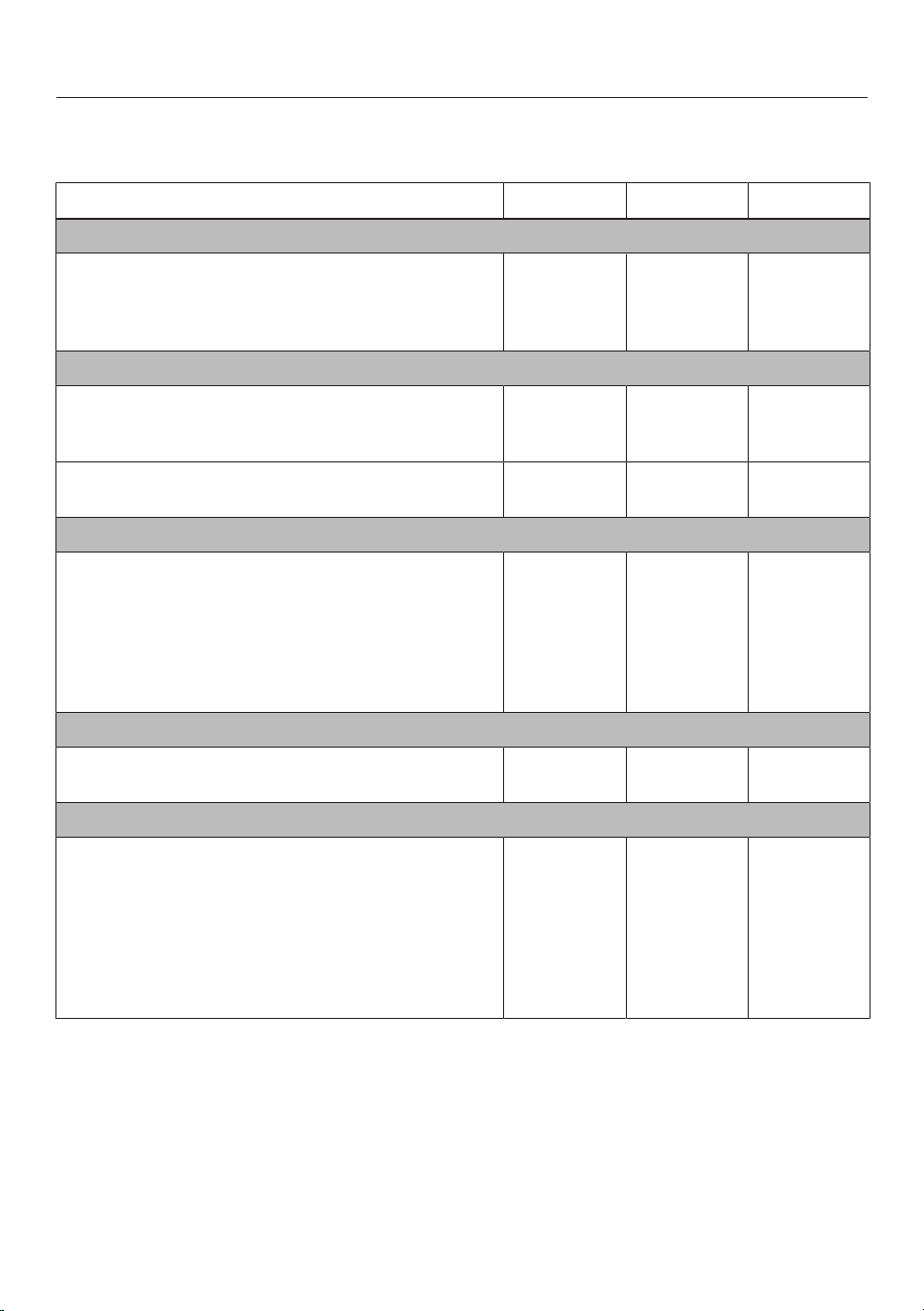
Special applications
94
The durations specified in the chart are guidelines only. We recommend selecting
the shorter duration initially. You can make the duration longer if necessary.
Food [°C] [%] * [min.]
Vegetables
Carrots
Cauliflower
Kohlrabi
Beans
120 70 8–10
Side dishes
Pasta
Rice
Potatoes, halved lengthways
120 70 8–10
Dumplings
Mashed potato
140 70 18–20
Meat and poultry
Sliced meat, 1.5cm thick
Roulades, sliced
Goulash
Lamb stew
Meatballs
Chicken schnitzel
Turkey schnitzel, sliced
140 70 11–13
Fish
Fish fillet
Fish roulade, halved
140 70 10–12
Plated meals
Spaghetti, Napoli sauce
Roast pork, potatoes and vegetables
Stuffed capsicum (halved), rice
Chicken fricassee, rice
Vegetable soup
Creamy soup
Clear soup
Casserole
120 70 10–12
Temperature, Moisture, Duration
* These times apply to food heated on a plate.

Special applications
95
Defrost
It is much quicker to defrost items in the
steam combination oven than at room
temperature.
Risk of infection from bacteria.
Bacteria such as salmonella can
cause life-threatening food poisoning.
It is particularly important to observe
food hygiene rules when defrosting
fish and meat, and in particular when
defrosting poultry.
Do not use the liquid produced
during defrosting.
Process the food as required as soon
as it has been defrosted.
Temperature
60°C is the best temperature for
defrosting.
Exceptions: 50°C for minced meat and
game.
Before and after defrosting
Remove any packaging before
defrosting.
Exceptions: Leave bread, biscuits and
cakes in their packaging as otherwise
they will absorb moisture and become
soft.
Allow food to stand at room
temperature for a few minutes after
defrosting. The standing time is
necessary to allow the even distribution
of heat from the outside to the inside.
Cooking containers
Use a perforated container with the
universal tray underneath when
defrosting food which will drip, such as
poultry. This way food will not be lying in
defrosted liquid.
Foods which do not drip can be
defrosted in a solid cooking container.
Useful tips
- Fish does not need to be fully
defrosted before cooking. Defrost so
that the surface is sufficiently thawed
to take herbs and seasoning.
Depending on the thickness of the
fish, 2–5 minutes is generally enough.
- When defrosting food which has
frozen together, e.g. berries and meat
portions, separate them half-way
through the defrosting time.
- Do not refreeze food once it has
thawed.
- Defrost frozen ready meals according
to the instructions on the packaging.
Settings
Special applications | Defrost
or
Oven functions | Steam cooking
Temperature: see chart
Defrosting duration: see chart
Standing time: see chart
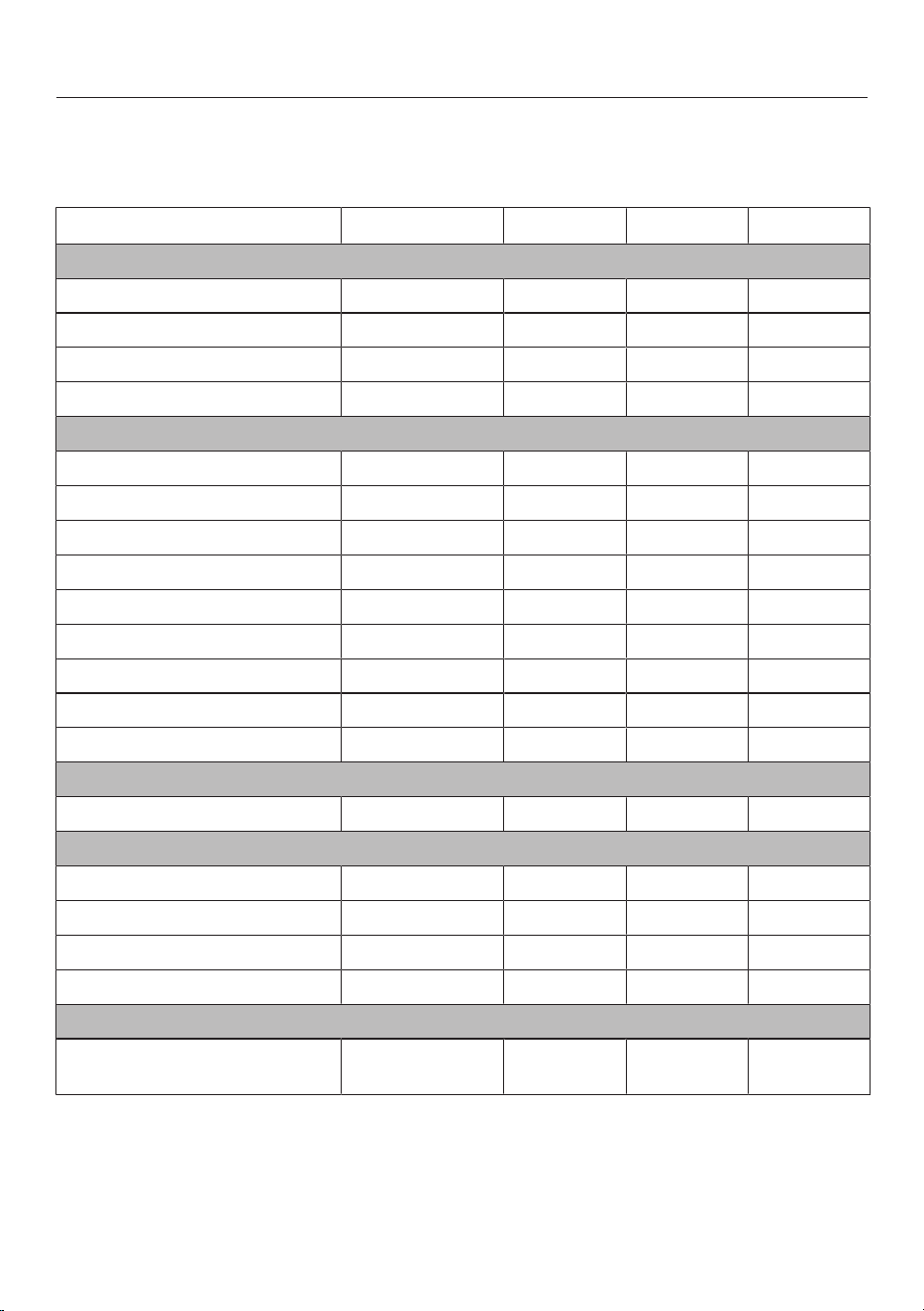
Special applications
96
The durations specified in the chart are guidelines only. We recommend selecting
the shorter defrosting duration initially. You can make the defrosting duration longer
if necessary.
Frozen food Quantity [°C] [min.] [min.]
Dairy products
Sliced cheese 125 g 60 15 10
Quark 250 g 60 20–25 10–15
Cream 250 g 60 20–25 10–15
Soft cheese 100 g 60 15 10–15
Fruit
Apple sauce 250 g 60 20–25 10–15
Apple pieces 250 g 60 20–25 10–15
Apricots 500 g 60 25–28 15–20
Strawberries 300 g 60 8–10 10–12
Raspberries/Red/Blackcurrants 300 g 60 8 10–12
Cherries 150 g 60 15 10–15
Peaches 500 g 60 25–28 15–20
Plums 250 g 60 20–25 10–15
Gooseberries 250 g 60 20–22 10–15
Vegetables
Frozen in a block 300 g 60 20–25 10–15
Fish
Fish fillets 400 g 60 15 10–15
Trout 500 g 60 15–18 10–15
Lobster 300 g 60 25–30 10–15
Small shrimps 300 g 60 4–6 5
Ready meals
Meat, vegetables, sides /
Casserole / Soup
480 g 60 20–25 10–15
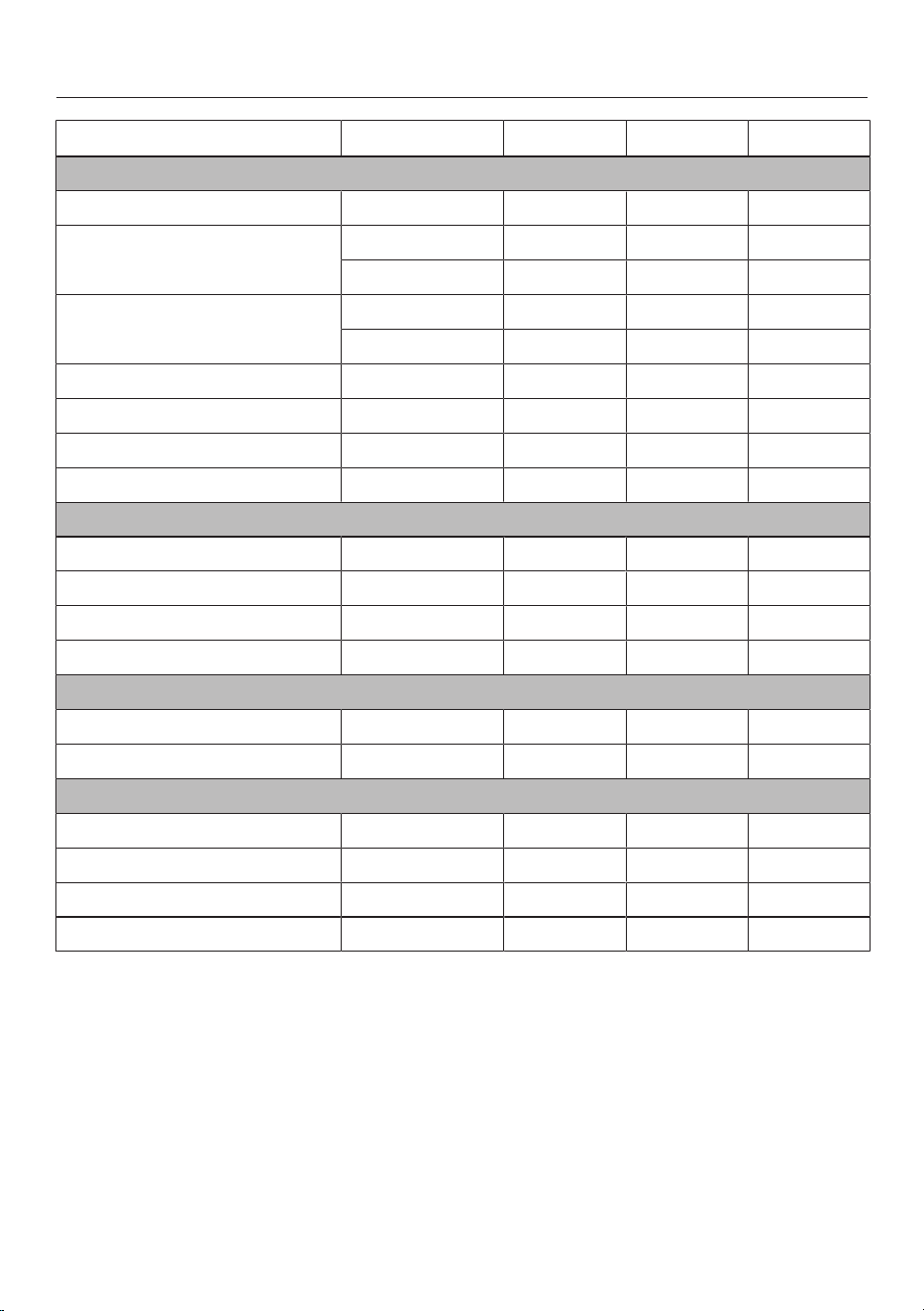
Special applications
97
Frozen food Quantity [°C] [min.] [min.]
Meat
Roast meat slices 125–150g each 60 8–10 15–20
Minced meat
250 g 50 15–20 10–15
500 g 50 20–30 10–15
Stew
500 g 60 30–40 10–15
1000 g 60 50–60 10–15
Liver 250 g 60 20–25 10–15
Saddle of hare 500 g 50 30–40 10–15
Roebuck saddle 1000 g 50 40–50 10–15
Schnitzel/Chops/Sausages 800 g 60 25–35 15–20
Poultry
Chicken 1000 g 60 40 15–20
Chicken thighs 150 g 60 20–25 10–15
Chicken fillet 500 g 60 25–30 10–15
Turkey drumsticks 500 g 60 40–45 10–15
Baked goods
Puff pastries/Yeast buns – 60 10–12 10–15
Creamed mixture cakes/biscuits 400 g 60 15 10–15
Bread/Rolls
Bread rolls – 60 30 2
Rye bread, sliced 250 g 60 40 15
Whole grain bread, sliced 250 g 60 65 15
White bread, sliced 150 g 60 30 20
Temperature Defrosting duration Standing time

Special applications
98
Mix & Match
The Mix & MatchSpecial application is
available to help with simple and
uncomplicated preparation of plated
meals. With this application, you can
reheat food that has already been
cooked (convenience food) or assemble
a portioned-out meal using fresh food
and cook it on a plate.
During cooking, you have the choice
between a crispy, browned result or
gently cooked food with a succulent
surface without additional browning.
Only use food that is completely
hygienic. If you have any concerns,
dispose of the food.
Useful tip: We recommend using the
Miele App with the Mix & Match Special
application. You can use the Miele App
to interactively assemble your plated
meal from the widest range of
ingredients and transfer the programme
settings to your steam combination
oven.
To use this function, you need to
connect your steam combination oven
to your Wi-Fi network. To do this,
please refer to the instructions in
"Before using for the first time -
Miele@home".
If you are not using the Miele App, take
note of the following instructions and
assemble your plated meal with the help
of the cooking charts.
Cooking containers
Use:
- a flat plate or a small ovenproof dish
- a deep bowl or a cup for food that
requires liquid to be added
Baked goods, pizza, tarte flambée, etc.
can be placed directly on the rack (with
baking paper if necessary).
The plastic containers for ready
meals are not sufficiently heat-
resistant.
Transfer ready meals into suitable
cooking containers.
Tips for reheating plated meals
- For fried or gratin dishes, useCrispy
reheating and for baked or boiled
dishes, useGentle reheating.
- UsingCrispy reheating ensures that
only food that was crispy before
reheating stays crispy.
- The food should not exceed a height
of 2–2.5cm. Transfer taller food into
flat containers (e.g. casserole) or slice
it into smaller pieces (e.g. roulades,
bakes).
- Only reheat pasta mixed into a sauce.
- Droplets of water may have
accumulated underneath the crockery.
Dry the droplets of water before
serving.

Special applications
99
Tips for cooking plated meals
- You can easily make a sauce from the
meat and fish stock: add 1tsp. of
cornflour to the raw meat or fish
before cooking. Stir the sauce with a
fork until smooth before serving. You
can also use 1tsp. of mashed potato
powder (instant) or a pinch of guar
gum instead of cornflour.
- If cooking durations for different foods
are not the same, you can
compensate for this by changing the
size of the food: if the cooking
duration is shorter, make the pieces
larger (e.g. large cauliflower florets). If
the cooking duration is longer, make
the pieces smaller (e.g. diced
potatoes).
- You can also compensate for differing
cooking durations with layering: place
food with a short cooking duration
under a food with a long cooking
duration or put them together as a
small bake.
- To prevent the food from drying out,
prepare your dish with a sauce or
marinade. You can also use cheese or
bacon.
Assembling a plated meal using
various components
For a good cooking result, you must put
together the individual components of
the dish – such as meat, side dishes
and vegetables – so that a common
setting can be selected for browning.
This setting must be suitable for all
elements of the meal, or at least
conditionally suitable.
We recommend using the following
procedure:
Select a main ingredient based on the
cooking charts, e.g. steak.
Select other ingredients which have
the corresponding settings for
browning, e.g. green beans and rice.

Special applications
100
Notes on the cooking charts
As well as information on portion sizes
or the way the food needs to be
processed prior to cooking, the cooking
charts also provide tips on preparation.
The degree of browning is represented
in the display by a bar with seven
segments. Basically, the more segments
that are filled, the longer the cooking
duration.
You can use the icons to determine
which setting is appropriate to brown
the food:
Symbol Meaning
Unsuitable
Conditionally suitable
Suitable
Using the Mix & MatchSpecial
application
Food does not need to be covered
while it is being cooked.
Prepare the food as required.
Select Special applications | Mix &
Match.
If you are preparing food that is
already cooked, select Gentle reheating
or Crispy reheating.
If you are preparing food that is fresh
or just partially cooked, select Gentle
cooking or Crispy cooking.
Change the setting for browning if
necessary.
Confirm with OK.
Place the food on the rack on shelf
level2.
Confirm with OK.
You can start the cooking programme
immediately or delay the start.
If by the end of a cooking programme,
the plated meal is not cooked enough
for your taste, select Continue cooking.

Special applications
101
Reheating food with the “Crispy reheating”Special application
Food Browning segment bar
setting
Apple strudel, 4cm thick, baked
Baked camembert, 75g, baked
Baguette, baked
Puff pastry canapés, baked
Tofu patty
1
, cooked
Bread roll, pre-baked or baked, stored
Cheeseburger, cooked
Chili con carne
1
, 2cm thick, cooked
Ciabatta rolls, pre-baked or baked, stored
Tarte flambée, baked
Meat strips
1
, pre-cooked or cooked
Rissole
1
(pork), 60g, cooked
Spring roll, 100g, cooked
Kaiserschmarrn pancake
1
, frozen, thawed
Potatoes, fairly firm, sliced, cooked
Potato pockets, baked
Lasagne
1
, 3cm thick, cooked
Pasta bake
1
, 4.5cm thick, cooked
Pancakes
1
Pizza, baked
Quiche, 3.5cm thick, baked
Potato pancakes
1
, cooked
Röstis, baked
Schnitzel, cooked
1
Is not crispy, only needs to be sufficiently heated (>65°C).

Special applications
102
Cooking food with the “Crispy cooking”Special application
Food Cooking tips Browning segment bar
setting
Meat
1
Bratwurst, 100g, boiled Slashed
Rissole, 60g, 2.5cm thick Minced meat, seasoned
Chicken breast, 3cm thick, raw On its own, seasoned
Chicken drumstick, raw Marinated
Veal tenderloin, 2.5cm thick, raw Marinated, with sauce
Smoked pork chop, 3.5cm thick, raw –
Lamb chop, 2cm thick, raw Marinated
Steak, 3cm thick, raw Marinated
Pork tenderloin, 4cm thick, raw Wrapped in bacon, with salt and
pepper
Pork chop, 1.5cm thick, raw Coated in breadcrumbs, drizzled
with a little oil
Fish
1
Halibut cutlet, 3cm thick, raw Marinated
Blue eye trevalla fillet, 3.5cm thick, raw Marinated
Salmon filet, 3cm thick, raw Seasoned
Blue grenadier fillet, 3cm thick, raw Seasoned, topping: spinach, feta
Tuna fillet, 3cm thick, raw Marinated
Vegetables
Eggplant, 2cm thick, raw Marinated
Cauliflower, large florets, raw Salt, pepper, buttered
breadcrumbs
Broccoli, large florets, raw Cheese sauce
Bacon-wrapped string beans, raw Wrapped in bacon, raw
Potatoes, firm, 3mm sliced, raw Butter, salt or cheese
Kohlrabi, 2cm slices, raw Salt, pepper, nutmeg
Pumpkin, 2cm cubes, raw Salt, pepper, pumpkin seed oil
Corn on the cob, raw Salt, butter
Carrots, 2cm sliced, raw Salt, pepper, butter
Capsicum, large chunks, raw Marinated
Zucchini, 2cm slices, raw Marinated
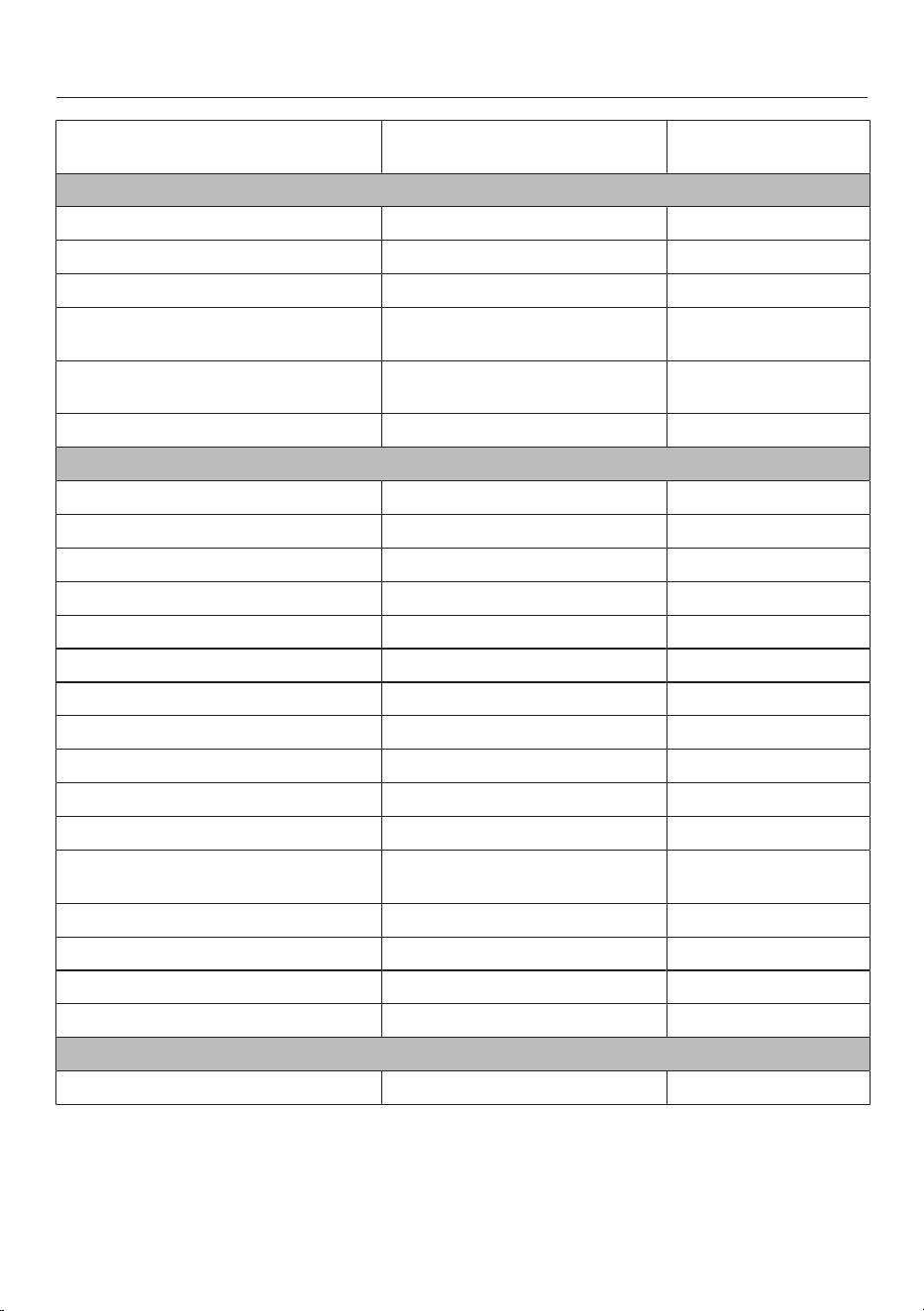
Special applications
103
Food Cooking tips Browning segment bar
setting
Pasta/Rice
Fresh pasta, tortellini, pre-cooked –
Lasagne, 3cm thick, pre-cooked –
Pasta bake, 2cm thick, pre-cooked –
Rice, brown rice, cooking duration
8minutes, uncooked
Salt, 1:2 (rice:liquid)
Rice, parboiled rice, cooking duration
8–12minutes, uncooked
Salt, 1:1.5 (rice:liquid)
Rice, pre-cooked –
Pizza & Co.
Baked Camembert, 25g, frozen Partially defrosted
Baguettes, frozen or pre-baked Partially defrosted
Bread rolls, frozen or pre-baked
Partially defrosted
Cheeseburger, pre-baked –
Dates in bacon, raw –
Tarte flambée, uncooked Top chilled pastry.
Spring roll, 100g, frozen Partially defrosted
Grilled cheese, 90g, pre-cooked –
Potato pockets, frozen Partially defrosted
Gnocchi, pre-cooked Butter, salt, cheese
Potato pancakes, uncooked Drizzled with a little oil
Schupfnudeln (potato dumplings), pre-
cooked
–
Tofu patty, 80g, cooked –
Pizza, baked
–
Röstis, frozen
Partially defrosted
Onion tart, 2.5cm thick Pre-baked
Desserts
Kaiserschmarrn pancake, cooked –
1
Add 1tsp. cornflour to raw meat/fish.

Special applications
104
Food suitable for the “Gentle cooking”Special application
Food Cooking tip
Meat
1
Large bockwurst/frankfurter sausage (pork),
100g, cooked
–
Beef fillet skewer, 50g chunks, raw Marinated, with bacon
Pork skewer, 50g chunks, raw Marinated, with capsicum and onion
Chicken breast, 3cm thick, raw On its own, seasoned
Veal tenderloin, 2.5cm thick, raw Marinated, in sauce
Smoked pork, 3.5cm thick, raw –
Fish
1
Trout, whole, 350g, raw Seasoned, filling: butter, herbs
Halibut cutlet, 3cm thick, raw Marinated
Blue eye trevalla fillet, 3.5cm thick, raw Marinated
Salmon filet, 3cm thick, raw Seasoned
Blue grenadier fillet, 180g Topping: spinach and crème fraîche
Tuna fillet, 3cm thick, raw Marinated
Vegetables
Cauliflower, large florets, raw Seasoned
Broccoli, large florets, raw Seasoned, with/without cheese sauce
Potatoes, firm, quartered/wedges, raw Salt
Kohlrabi, 2cm slices, raw Salt, pepper, nutmeg
Pumpkin, 1.5cm cubes, raw Salt, pepper, pumpkin seed oil
Corn on the cob, raw Salt, butter
Carrots, 2cm sliced, raw Salt, pepper, butter
Capsicum, large chunks, raw Marinated
Brussels sprouts, whole, raw Salt, pepper, nutmeg
Asparagus, spears, whole, raw Salt, butter
Sweet potato, 1.5cm chunks/wedges, raw Salt
Zucchini, 2cm slices, raw Marinated

Special applications
105
Food Cooking tip
Pasta/Rice
Fresh pasta, tortellini, pre-cooked Sauce
Macaroni, short, uncooked Salt, 1 : 3 (pasta : water)
Rice, basmati rice, cooking duration 10minutes,
uncooked
Salt, 1:2.5 (rice:liquid)
Rice, brown rice, cooking duration 8minutes,
uncooked
Salt, 1:2 (rice:liquid)
Rice, parboiled rice, cooking duration 8–
12minutes, uncooked
Salt, 1:2 (rice:liquid)
Rice, short-grain rice, cooked –
Vermicelli, uncooked Covered with stock
Pizza & Co.
Gnocchi, pre-cooked Salt, butter
Mashed potato, cooked –
Schupfnudeln (potato dumplings), pre-cooked Salt, butter
1
Add 1tsp. cornflour to raw meat/fish.

Special applications
106
Menu cooking – automatic
When cooking a menu automatically,
you can combine up to 3different foods
in a single menu, e.g. fish fillet with rice
and vegetables.
With menu cooking, the food is placed
in the steam combination oven at
different times so that each item is
ready at the same time.
You can select items of food in any
order, because the steam combination
oven sorts them according to cooking
duration and indicates when each item
has to be placed in the oven.
The Finish at and Start at functions are
not available with menu cooking.
Using the Menu cookingSpecial
application
Select Special applications | Menu
cooking.
Select the food you want.
Depending on the type of food selected,
you will be asked about the size, weight
and how well you want it cooked.
Select the values required and then
confirm with OK.
Select Add food.
Select the next food you want and
proceed as described for the first type
of food.
Repeat for the third type of food if
necessary.
After confirming Start menu cooking, you
will be prompted to place the food with
the longest cooking duration in the
oven.
When using perforated containers to
cook foods that produce a lot of liquid
or have a distinctive colour, be sure to
place them over the universal tray.
This avoids any transfer of flavour or
colour to other food by preventing
liquid dripping onto food below it.
At the end of the heating-up phase, the
steam combination oven will indicate
when the next item of food has to be
placed inside. Once this time has been
reached, a buzzer will sound.
This process is repeated once again if
there is a third food item.
You can still cook food types not listed
in the display together to prepare a
menu. Please refer to "Steam cooking
– Menu cooking – manual" for more
information.

Special applications
107
Bottling
Only use unblemished, fresh produce
which is in good condition.
Glass jars
Use clean glass jars and accessories
and check them for any defects. Glass
jars with twist off lids or glass lids with a
rubber seal are suitable.
Make sure that all the glass jars are the
same size so that bottling is carried out
evenly.
After you have filled the jars with the
bottled produce, clean the glass rims
with a clean cloth and hot water and
then seal the jars.
Fruit
Sort fruit carefully, rinse it briefly but
thoroughly and allow it to drain. Take
great care when cleaning soft fruit as it
is very delicate and squashes easily.
Remove any peel, stalks, cores or
stones. Cut up large fruit. For example,
cut apples into slices.
If you are bottling fruit with stones (e.g.
plums, apricots) without removing the
stones, pierce the fruit several times
with a fork or wooden skewer as
otherwise it will burst.
Vegetables
Rinse, clean and cut up vegetables.
Vegetables should be blanched before
bottling to help them retain their colour
(see “Special applications – Blanch”).
Fill volume
Fill the glass jars with produce up to no
more than 3cm below the rim. Do not
pack it down as this will damage the cell
walls of the produce. Tap the jar gently
onto a cloth to help distribute the
contents evenly. Fill the jars with liquid.
The produce must be completely
covered.
Use a sugar solution for fruit and a salt
or vinegar solution for vegetables.
Meat and sausages
Briefly fry or cook the meat before
bottling. Use the juices with some
added water, or the broth in which the
meat was cooked, as the liquid content
of the jars. Make sure there is no grease
on the rim of the jars.
When bottling sausages, only fill the jars
to halfway as the meat will rise during
the bottling process.
Useful tips
- Make use of residual heat by leaving
the jars in the oven for 30minutes
after it has switched off.
- Then cover the jars with a cloth and
allow to cool for approx. 24hours.
Bottling food
Place a perforated container or the
rack on level1.
Place the closed jars in the perforated
container or on the rack. The jars
must not touch each other.
Settings
Special applications | Bottling
or
Oven functions | Steam cooking
Temperature: see chart
Bottling duration: see chart
Special applications
108
The durations specified in the chart are guidelines only.
Food [°C] * [min.]
Berries
Red / Blackcurrants 80 50
Gooseberries 80 55
Cranberries 80 55
Fruit with stones
Cherries 85 55
Mirabelle plums 85 55
Plums 85 55
Peaches 85 55
Greengage plums 85 55
Fruit with pips
Apples 90 50
Apple sauce 90 65
Quinces 90 65
Vegetables
Beans 100 120
Broad beans 100 120
Gherkins 90 55
Beetroot 100 60
Meat
Pre-cooked 90 90
Roasted 90 90
Temperature, Duration
* Bottling durations apply to 1.0l jars. If using 0.5l jars, reduce the duration by 15minutes. If
using 0.25l jars, reduce the duration by 20 minutes.

Special applications
109
Bottling cakes
Creamed, sponge and yeast dough mixtures are all suitable for bottling. Cakes will
keep for approx. 6 months.
Cakes made with fresh fruit are not suitable for long term storage, and must be
consumed within 2 days of being made.
Only use sterilised jars and accessories. The jars must be narrower at the bottom
than at the top (mason jars). 0.25l jars are the best for this purpose.
The jars need to have a bottling ring, glass lid and a spring lock clip to be sealed.
Make sure that all the jars are the same size so that the bottling process is carried
out evenly.
Grease the inside of the jars with butter up to 1cm below the rim.
Sprinkle inside the jars with fine breadcrumbs.
Fill the jars ¹/₂ to ²/₃ full with mixture (depending on recipe). Make sure the rim
stays clean.
Place the rack on shelf level1.
Place the open jars (all the same size) on the rack. The jars must not touch each
other.
Close the jars immediately after bottling by clamping the glass lid down securely.
Do not let the cakes cool down. If the mixture has risen above the rim, it can be
pushed back down into the jar with the glass lid.
The durations specified in the chart are guidelines only. We recommend selecting
the shorter duration initially. You can extend the duration if necessary.
Type of
mixture
Oven
function
Stage [°C] [%] [min.]
Creamed
mixture
– 160 – 35–45
Sponge – 160 – 50–55
Yeast
dough
1
2
30
160
100
30
10
30–35
Temperature, Moisture, Duration
Conventional Heat, Combi mode Conventional

Special applications
110
Drying
Only use the DryingSpecial application
or the Combi Fan Plus function to dry
food so that moisture can be dissipated.
Bananas, pineapple and some types
of mushrooms are not suitable for
drying.
Cut the food for drying into equally
sized pieces.
Line the rack with baking paper and
distribute the food for drying evenly in
a single layer if possible.
Allow the fruit or vegetables to cool
down after drying.
Store dried food in sealed glass jars or
tins.
To prevent mould from forming and
the food from decomposing, make
sure that no moisture gets into the
storage container.
Settings
Special applications | Drying
Temperature: see chart
Drying time: see chart
or
Oven functions | Combi mode |
Combi Fan Plus
Temperature: see chart
Moisture: 0%
Drying time: see chart
The drying times specified in the chart
are guidelines only. We recommend
selecting the shorter drying time initially.
You can make the duration longer if
necessary.
Food
[°C]
[h]
Apple, rings 70 6–8
Apricots, halved,
stones removed
60–
70
10–12
Pears, sliced 70 7–9
Herbs 40 1.5–
2.5
Mushrooms* 50 5–7
Tomatoes, sliced 70 7–9
Citrus fruit, sliced 70 8–9
Damsons, stones
removed
60–
70
10–12
Temperature, Drying time (hours)
* Porcini, shiitake, morels, wood ear and bay
bolete are suitable for drying. The
mushrooms are sufficiently dried when they
are “cracker dry”.

Special applications
111
Extracting juice
The steam combination oven is ideal for
extracting juice from soft and firm fruit.
It is best to use overripe fruit, as the
riper the fruit, the greater the quantity of
juice produced. Very ripe fruit will also
produce a more intense flavour.
Preparation
Sort and rinse the fruit, and cut out any
blemishes.
Remove the stalks from grapes and
morello cherries as these are bitter.
Berries do not need to have their stalks
removed.
Dice larger fruit such as apples into
approximately 2cm cubes. The harder
the fruit, the smaller the pieces should
be.
Useful tips
- Try experimenting with mild and tart
flavours. For example, mix apples with
elderberries.
- Adding sugar will increase the
quantity of juice produced and
improve the flavour. Sprinkle the fruit
with sugar and leave to absorb for a
few hours before juicing. For 1kg of
sweet fruit add 50–100g of sugar,
and for 1kg of tart fruit add 100–
150g of sugar.
- If you wish to bottle the juice rather
than consume it straight away, pour it
whilst hot into hot, sterilised bottles
up to the rim, and then seal
immediately with sterilised rubber
tops.
Extracting juice from fruit
Put the prepared fruit (cleaned,
washed, chopped etc.) into a
perforated cooking container.
Place a solid cooking container or the
universal tray underneath in order to
collect the juice.
Settings
Oven functions | Steam cooking
Temperature: 100°C
Duration: 40–70minutes

Special applications
112
Blanch
Blanch fruit and vegetables before
freezing them. Blanching helps maintain
the quality of the produce when it is
frozen.
Blanching vegetables also helps them
retain their original colour.
Put the prepared vegetables (cleaned,
washed, chopped etc.) into a
perforated cooking container and
place in the oven compartment.
Once blanched, plunge the
vegetables into ice cold water to cool
them down quickly. Drain them well.
Settings
Special applications | Blanch
or
Oven functions | Steam cooking
Temperature: 100°C
Blanching time: 1minute
Disinfect items
By the end of this programme, crockery
and baby bottles disinfected in the
steam combination oven are as free
from germs as they would have been
had they been boiled. Check beforehand
that all parts, teats, etc. are declared by
the manufacturer to be heat resistant to
100°C and also that they can withstand
hot steam.
Dismantle baby bottles into their
individual parts. Do not reassemble the
bottles until they are completely dry.
This is the only way to prevent them
from getting reinfected.
Place the individual items on the rack
or in a perforated container (on their
sides or with the opening facing
downwards) ensuring that they do not
touch one another. This will allow hot
steam to reach them from all sides.
Settings
Special applications | Disinfect items
Duration: 1minute to 10hours
or
Oven functions | Steam cooking
Temperature: 100°C
Duration: 15 minutes

Special applications
113
Heat crockery
By pre-heating the crockery, the food
does not cool down as quickly.
Use heat-resistant crockery.
Place the rack on shelf level2 and
place the crockery to be pre-heated
on it. Depending on the size of the
crockery, you can also place the rack
on the floor of the oven compartment
with the rack surface facing up and
the crockery on top. If necessary, you
can also remove the shelf runners.
Select Special applications.
Select Heat crockery.
Alter the recommended temperature
if necessary and then set the
duration.
Risk of injury caused by hot
surfaces.
The steam combination oven gets
hot during operation. You could burn
yourself on the heating elements,
oven compartment, shelf runners or
accessories. Droplets of water may
have accumulated underneath the
crockery.
Wear oven gloves when removing
dishes from the oven.
Keeping warm
You can keep food warm in the oven
compartment for up to 2hours.
In order to maintain the quality of food,
select the shortest possible time.
Select Special applications.
Select Keeping warm.
Place the food to be kept warm in the
oven and confirm withOK.
Alter the recommended temperature
if necessary and then set the
duration.

Special applications
114
Prove yeast dough
Prepare the dough according to the
recipe.
Place the dough in an uncovered bowl
in a perforated container or on the
inserted rack.
Depending on the size of the bowl,
you can also place the rack on the
floor of the oven compartment with
the rack surface facing up and place
the bowl on top. If necessary, you can
also remove the shelf runners.
Settings
Special applications | Prove yeast
dough
or
Oven functions | Combi mode |
Combi Fan Plus
Temperature: 30°C
Moisture: 100%
Duration: as per recipe instructions
Heat damp towels
Moisten towels and then roll them up.
Place them beside one another in a
perforated cooking container.
Settings
Automatic programmes | Special | Heat
damp towels
or
Oven functions | Steam cooking
Temperature: 70°C
Duration: 2minutes
Dissolve gelatine
Soften gelatine leaves by leaving
them in a bowl of cold water for
5minutes. The gelatine leaves have to
be fully covered with water. Remove
the gelatine leaves from the bowl and
squeeze them out. Empty the bowl.
Place the squeezed gelatine leaves
back in the bowl.
Gelatine powder: Place the gelatine
powder in a bowl and add water
according to the instructions on the
packaging.
Cover the bowl and place it in a
perforated cooking container.
Settings
Automatic programmes | Special |
Dissolve gelatine
or
Oven functions | Steam cooking
Temperature: 90°C
Duration: 1minute

Special applications
115
Decrystallise honey
Loosen the lid and place the jar of
honey in a perforated cooking
container.
Stir the honey once during the
process.
When liquefying (decrystallising)
honey at a temperature of 60 °C, the
main focus is on obtaining a
spreadable food product again.
Settings
Automatic programmes | Special |
Decrystallise honey
or
Oven functions | Steam cooking
Temperature: 60°C
Duration: 90 minutes (irrespective of
the size of jar or the amount of honey in
the jar)
To preserve the nutrients and aroma of
honey, you can choose the following
settings:
Oven functions | Combi mode |
Combi Conventional
Temperature: 37°C
Humidity: 100%
Time: until the honey appears visually
homogeneous
Melt chocolate
You can use the steam combination
oven for melting any type of chocolate.
When using a cake glaze, place it in a
perforated cooking container, leaving it
in its packaging.
Break the chocolate into small pieces.
Place large quantities in a solid
container and small quantities in a
cup or a bowl.
Cover the container or the dish with a
lid or with foil that is resistant to
temperatures up to 100°C and to hot
steam.
Stir large quantities once during
cooking.
Settings
Automatic programmes | Special | Melt
chocolate
or
Oven functions | Steam cooking
Temperature: 65°C
Duration: 20minutes

Special applications
116
Render fat
The bacon will not become brown.
Place the bacon (diced or rashers) in
a solid cooking container.
Cover the container with foil that is
temperature-resistant up to 100°C
and resistant to steam.
Settings
Automatic programmes | Special |
Render fat
or
Oven functions | Steam cooking
Temperature: 100°C
Duration: 4minutes
Sweat onions
Sweating means cooking the onions in
their own juices, with the addition of a
little fat if necessary.
Cut the onions up into small pieces
and place them in a solid cooking
container with a little butter.
Cover the container with foil that is
temperature-resistant up to 100°C
and resistant to steam.
Settings
Automatic programmes | Special |
Sweat onions
or
Oven functions | Steam cooking
Temperature: 100°C
Duration: 4minutes
Preserving apples
You can treat homegrown apples to
increase the length of time for which
you can store them. Once treated, the
apples will keep for 5 to 6 months when
stored in a dry, cool and well-ventilated
place. This method is only suitable for
apples and not for other types of fruit.
Settings
Automatic programmes | Fruit | Apples |
Whole
or
Oven functions | Steam cooking
Temperature: 50°C
Preserving time: 5minutes
Preparing custard royale
Stir 6eggs into 375ml milk (do not
beat into a foam).
Season the egg/milk mixture and pour
into a solid cooking container greased
with butter.
Settings
Oven functions | Steam cooking
Temperature: 100°C
Duration: 4minutes

Special applications
117
Fruit jam
Only use unblemished, fresh produce
which is in good condition.
Glass jars
Only use sterilised jars with twist-off
lids up to a maximum capacity of
250ml.
After pouring in the jam, clean the
outside of the rim of the jar with a cloth
and hot water.
Preparation
Sort fruit carefully, rinse it briefly but
thoroughly and allow it to drain. Take
great care when cleaning soft fruit as it
is very delicate and squashes easily.
Remove any stalks, cores or stones.
Purée the fruit as otherwise the
preserve will not set. Add jam sugar to
the fruit (according to packet
instructions) and stir well.
For sweet fruit and berries you should
also add some citric acid.
Making jam
Fill jars to maximum 2/3 full.
Place the open jars in a perforated
cooking container or on the rack.
Leave the jars to stand for 1–
2minutes after the end of the
process.
Afterwards, seal the jars with a lid and
allow the jars to cool down.
Settings
Oven functions | Combi mode |
Combi Fan Plus
Temperature: 150°C
Moisture: 0%
Duration: 35–45minutes
Special applications
118
Skinning fruit and vegetables
Cut a cross in the top of tomatoes,
nectarines etc. This will allow the skin
to be removed more easily.
Place the food in a perforated
container if cooking with steam, or a
universal tray if using the grill.
To blanch almonds, it is important to
plunge them into cold water as soon
as they are taken out of the oven as
otherwise the skin cannot be
removed.
Settings
Oven functions | Full Grill
Setting: 3
Duration: see chart
Food [min.]
Capsicum 10
Tomatoes 7
Duration
Settings
Oven functions | Steam cooking
Temperature: 100°C
Duration: see chart
Produce [min.]
Apricots 1
Almonds 1
Nectarines 1
Capsicum 4
Peaches 1
Tomatoes 1
Duration

Special applications
119
Make yoghurt
To prepare yoghurt, you will need milk
and live culture or yoghurt starter
powder, e.g. from a health food store.
Use natural yogurt with live culture and
without additives. Do not use heat-
treated yogurt.
The yoghurt must be fresh (short
storage time).
You can use either unchilled long-life
milk or fresh milk.
Long-life milk can be used as it is – no
further preparation is required. Fresh
milk must first be heated to 90°C (do
not boil it) and then cooled down to
35°C. Fresh milk will give a better set
than long-life milk.
The yoghurt and milk should have the
same percentage fat.
Do not move or shake the jars while the
yoghurt is fermenting.
Immediately after preparation, leave the
yoghurt to cool in the fridge.
The firmness, fat content and cultures
used in the yoghurt starter all affect the
consistency of homemade yoghurt. Not
all yoghurts are equally suitable as
yoghurt starters.
Useful tip: If you are using yoghurt
starter powder, you can prepare the
yoghurt from a mixture of milk and
cream. For that, mix ³/₄ litre milk with ¹/
₄ litre cream.
Mix 100 g yoghurt with 1litre of milk
or make up the mixture with yoghurt
enzyme, following the instructions on
the packaging.
Pour the mixture into glass jars and
seal the jars.
Place the sealed jars in a perforated
cooking container and place in the
oven. The jars must not touch each
other.
Straight after the cooking duration
has finished, place the jars in the
refrigerator. Take care not to shake the
jars unnecessarily.
Settings
Automatic programmes | Special | Make
yoghurt
or
Oven functions | Steam cooking
Temperature: 40°C
Duration: 5:00hours
Possible causes for poor results
Yoghurt is not set:
Incorrect storage of the yoghurt starter,
too much time out of the refrigerator,
packaging was damaged, milk was
insufficiently heated.
Liquid has not been removed:
Jars were moved, the yoghurt cooled
down too slowly.
Yoghurt is grainy:
The milk was heated too high, it was not
free of imperfections, the milk and
yoghurt starter were not stirred evenly.

Automatic programmes
120
The wide range of Automatic
programmes enable you to achieve
excellent results with ease.
Categories
The Automatic programmes are
sorted into categories to provide a
better overview. Simply select the
appropriate Automatic programme for
the type of food you are cooking and
follow the instructions in the display.
Using Automatic programmes
Select Automatic programmes.
A list will appear.
Select the desired food category.
The Automatic programmes available for
the food type selected will then appear.
Select the Automatic programme that
you want to use.
Follow the instructions in the display.
Some Automatic programmes will
prompt you to use the food probe.
Read the information under “Roasting
– Food probe”.
The core temperature cannot be
changed for the Automatic
programmes.
Useful tip: Use Info to display
information such as how to place or turn
the food depending on the cooking
programme.
Usage notes
- After cooking, allow the oven
compartment to cool down to room
temperature again before starting an
Automatic programme.
- The weights specified in the
Automatic programmes refer to the
weight per piece. For example, you
can cook just one piece of salmon
weighing 250g or 10 pieces of
salmon, each weighing 250g, at the
same time.
- The degree of cooking and browning
are represented by a bar with seven
segments. You can set how well you
want the food cooked or how brown
you want it to be by touching the
relevant segment.
- Some roasting programmes also offer
the Roast with moistureoption. Meat
cooked at a low temperature over a
long cooking duration will be tender
and succulent. The additional
moisture helps to achieve the best
cooking and browning result: the meat
is very succulent and tender. The cut
is cooked evenly and has a thin brown
outer layer that forms during the
roasting programme. There is
therefore no need to sear the meat
beforehand. In contrast to the
Roastoption, there is no need to use
the food probe in this case and you
can set a start or finish time
depending on your menu planning.
- Please refer to recipes for information
on suitable baking containers.
- In the Rice category, you can select
General in addition to the long-grain
and short-grain rice programmes. Use
this Automatic programme if you want

Automatic programmes
121
to prepare long-grain or short-grain
rice varieties that are not available as
a specific Automatic programme.
- For some Automatic programmes, the
start or end time can be delayed using
Start at or Finish at.
- The individual cooking stages of the
Automatic programme are listed
under the Display cooking stagesmenu
option. The Display actions menu
option is also available for some
Automatic programmes. You can call
up required actions, e.g. placing food
in the oven or adding ingredients, via
this menu option. During the cooking
process, you can view the actions via
Info.
- When you place food in the hot oven
compartment, be careful when
opening the door. Hot steam may
escape. Step back and wait until the
steam has dissipated. Avoid contact
with hot steam, and do not touch the
hot oven compartment walls. Danger
of burning and scalding.
- If by the end of an Automatic
programme the food is not cooked
enough, selectContinue cooking
orContinue baking.
- Automatic programmes can also be
saved as User programmes.
Search
(Depending on language)
Under Automatic programmes, you can
search by the name of the categories
and the Automatic programmes.
There is a full text search which can also
be used to search for parts of words.
From the main menu:
Select Automatic programmes.
The category list will appear in the
display.
Select Search.
Use the keyboard to type in the
search text, e.g. “Bread”.
The number of hits will be shown in the
footer.
If no match is found, or if there are
more than 40 matches, the hits field
will be deactivated and you will need
to change the search text.
Select XX hits.
The categories and Automatic
programmes found will then appear.
Select the desired Automatic
programme, or the category and then
the Automatic programme.
The Automatic programme will start.
Follow the instructions in the display.

MyMiele
122
Under MyMiele, you can save
frequently used applications.
It is particularly useful with Automatic
programmes as you do not need to work
through every screen in order to start
your programme.
Useful tip: You can also set menu
options that you have entered into
MyMiele to appear on the start screen
(see “Settings – Start screen”).
Adding entries
You can add up to 20entries.
Select MyMiele.
Select Add entry.
You can select options listed in the
following categories:
- Oven functions
- Automatic programmes
- Special applications
- User programmes
- Maintenance
Confirm with OK.
The selected item and its respective
symbol will appear in the list.
Proceed as above for further entries.
Only options that have not yet been
selected are available for selection.
Deleting entries
Select MyMiele.
Touch the entry you want to delete
and keep your finger on it until the
context menu appears.
Select Delete.
The entry will then be removed from the
list.
Moving entries
Select MyMiele.
Touch the entry you want to move and
keep your finger on it until the context
menu appears.
Select Move.
An orange border appears around the
entry.
Move the entry.
The entry appears in the desired
position.

User programmes
123
You can create and save up to 20 of
your own programmes.
- You can combine up to 9cooking
stages to accurately programme your
favourite or most frequently used
recipes. In each cooking stage, you
can select settings such as the
function, temperature and cooking
duration.
- You can enter the name of the
programme for your recipe.
When you call up and start your
programme the next time, it will run
automatically.
There are different ways of creating a
User programme:
- At the end of an Automatic
programme or Special application,
save it as a User programme.
- After running a programme with a set
duration, save it.
Then name the programme.
Creating a User programme
Select User programmes.
Select Create programme.
You can now specify the settings for the
first cooking stage.
Follow the instructions in the display:
Select and confirm the desired
settings.
If you select the Pre-heatfunction, use
Add to add another cooking stage
where you set a cooking duration. Only
then can you save or start the
programme.
All settings for the first cooking stage
have now been set.
You can add more cooking stages, for
example, if you want to add another
cooking function to follow on from the
first.
If additional cooking stages are
required, selectAdd and proceed as
for the first cooking stage.
If you want to check the settings or to
change them at a later stage, touch the
cooking stage in question.
When you have finished setting all the
cooking stages, select Save.
Enter the programme name using the
keyboard.
You can add a line break for longer
programme names using the symbol.
Once you have entered the
programme name, select Save.
A message will appear in the display
confirming that the new name has been
saved.
Confirm with OK.
You can start the saved programme
immediately, delay the start or change
the cooking stages.

User programmes
124
Starting a User programme
Place the food in the oven.
Select User programmes.
Select the required programme.
Depending on the programme settings,
the following menu options will appear
in the display:
- Start now
The programme will start immediately.
The oven heating will switch on
immediately.
- Finish at
Specify the time at which the
programme should finish. The oven
heating will switch off automatically at
the time you have set.
- Start at
Specify the time at which you want
the programme to start. The oven
heating will switch on automatically at
the time you have set.
- Display cooking stages
A summary of your settings will
appear in the display.
- Display actions
The required actions, e.g. placing the
food in the oven, will appear in the
display.
Select the required menu option.
The programme selected will begin
straight away or at the time set.
Use Info to display information such
as how to place or turn the food
depending on the cooking programme.
At the end of the programme, select
Close.
Changing cooking stages
Cooking stages in an Automatic
programme that you have renamed as
a User programme cannot be changed.
Select User programmes.
Touch the programme you want to
change and keep your finger on it until
the context menu appears.
Select Change.
Select the cooking stage that you
want to change orAdd to add another
cooking stage.
Select and confirm the desired
settings.
If you want to start the modified
programme without changing it,
selectStart.
SelectSave when you have changed
all the settings.
A message will appear in the display
confirming that the new name has been
saved.
Confirm with OK.
The saved programme has been
changed and you can start it
immediately or delay the start.

User programmes
125
Renaming User programmes
Select User programmes.
Touch the programme you want to
change and keep your finger on it until
the context menu appears.
Select Rename.
Change the programme name using
the keyboard.
You can add a line break for longer
programme names using the symbol.
Once you have changed the
programme name, selectSave.
A message will appear in the display
confirming that the new name has been
saved.
Confirm with OK.
The programme has now been renamed.
Deleting User programmes
Select User programmes.
Touch the programme you want to
delete and keep your finger on it until
the context menu appears.
Select Delete.
Confirm the query with Yes.
The programme will be deleted.
Go to Settings| Factory default settings|
User programmes to delete all User
programmes at the same time.
Moving User programmes
Select User programmes.
Touch the programme you want to
move and keep your finger on it until
the context menu appears.
Select Move.
An orange border appears around the
entry.
Move the programme.
The programme appears in the desired
position.

Baking
126
Handling food carefully will help
protect your health.
Cakes, pizzas and chips should be
cooked until golden, not dark brown.
Baking guidelines
- Set a cooking duration. When baking,
the oven should not be set to start a
long time off. Otherwise the cake
mixture or dough will dry out, and the
raising agents will lose their
effectiveness.
- Generally, you can use the rack,
universal tray and any type of baking
tray made of heat-resistant material.
- Always place bakeware on the rack.
- Always cook frozen goods such as
cakes, pizza or baguettes on the rack.
Very high temperatures can cause
the universal tray to distort to such
an extent that the tray cannot be
taken out of the oven compartment.
- Small items of frozen food such as
oven chips or potato croquettes can
be cooked on the universal tray. Turn
these frozen food items several times
during cooking.
- Bake on a maximum of 2 levels at
once. When baking cakes with a moist
topping, only bake on one level.
Using baking paper
Miele accessories, e.g. the universal
tray, are treated with PerfectClean
enamel (see “Cleaning and care”).
Surfaces treated with PerfectClean
enamel generally do not need to be
greased or covered with baking paper.
Use baking paper when cooking:
- lye mixtures because anything
prepared using a lye containing
sodium hydroxide can damage the
PerfectClean surface
- mixtures with a high egg white
content, such as sponge, meringue
and macaroons, as these can easily
stick
- puff pastry or strudel dough
- frozen food on the rack
- small items of frozen food such as
oven chips or potato croquettes on
the universal tray

Baking
127
Tips on baking
- Dark, matt tins are best for baking.
Avoid using bright, thin-walled tins as
they give an uneven or poor browning
result. In certain unfavourable
conditions, the food will not cook
properly.
- Place cakes in rectangular tins on the
rack with the longer side across the
width of the oven for optimum heat
distribution and even results.
- When cooking frozen food such as
chips, croquettes, cakes, pizza and
baguettes, select the medium
temperature quoted on the
manufacturer's packaging.
- If a range is specified for the cooking
duration, check whether the food is
cooked after the shortest duration.
Stick a wooden skewer into the food.
If it comes out clean without any
batter/dough on it, the food is done.
Notes on the oven functions
You can find an overview of all the
functions with their recommended
values in “Main and sub-menus”.
Combi mode
This function uses a combination of
oven heat and moisture. The addition of
steam prevents the surface of the food
from drying out. Bread, bread rolls and
puff pastry have a shiny and crispy
crust.
You can choose between different types
of heating:
- Combi Fan Plus
- Combi Conventional
- Combi Grill
We recommend baking bread and bread
rolls in several cooking stages: the shine
is created during the first cooking stage
thanks to the injection of steam
(maximum moisture, low temperature).
Browning takes place in the next
cooking stage with high moisture and a
high temperature. It is then dried with
reduced moisture and a medium to high
temperature.
Useful tip: Recipes and comprehensive
cooking charts with information on
functions, temperatures, moisture and
cooking durations can be found in the
Miele cookbook/recipe booklet
“Bake, roast, steam”.

Baking
128
Automatic programmes
Follow the instructions in the display.
Fan Plus
Use this function if you are baking on
multiple shelf levels at the same time.
You can use any type of baking tray
made of heat-resistant material.
Because the fan distributes the heat
around the oven compartment straight
away, you can use a lower temperature
than you would with the Conventional
Heatfunction.
Conventional Heat
Use this function for cooking traditional
recipes. If using an older recipe or
cookbook, set the oven temperature
10°C lower than that recommended.
This will not change the cooking
duration.
Only bake on one level. If you are
making a tray bake, use shelf level2.
Intensive Bake
This function is suitable for baking cakes
with moist toppings, pizza, quiche, etc.
Place the food on shelf level1.
Bottom Heat
Use this function towards the end of
cooking to brown the base of the food.
Top Heat
Use this function towards the end of
cooking to brown the top of food.
This function is suitable for gratins and
for browning bakes.
Cake Plus
Use this function for baking creamed
and frozen lye mixtures.
Eco Fan Heat
Use this function for cooking small
amounts of food, e.g. frozen pizzas or
biscuits, while saving energy.
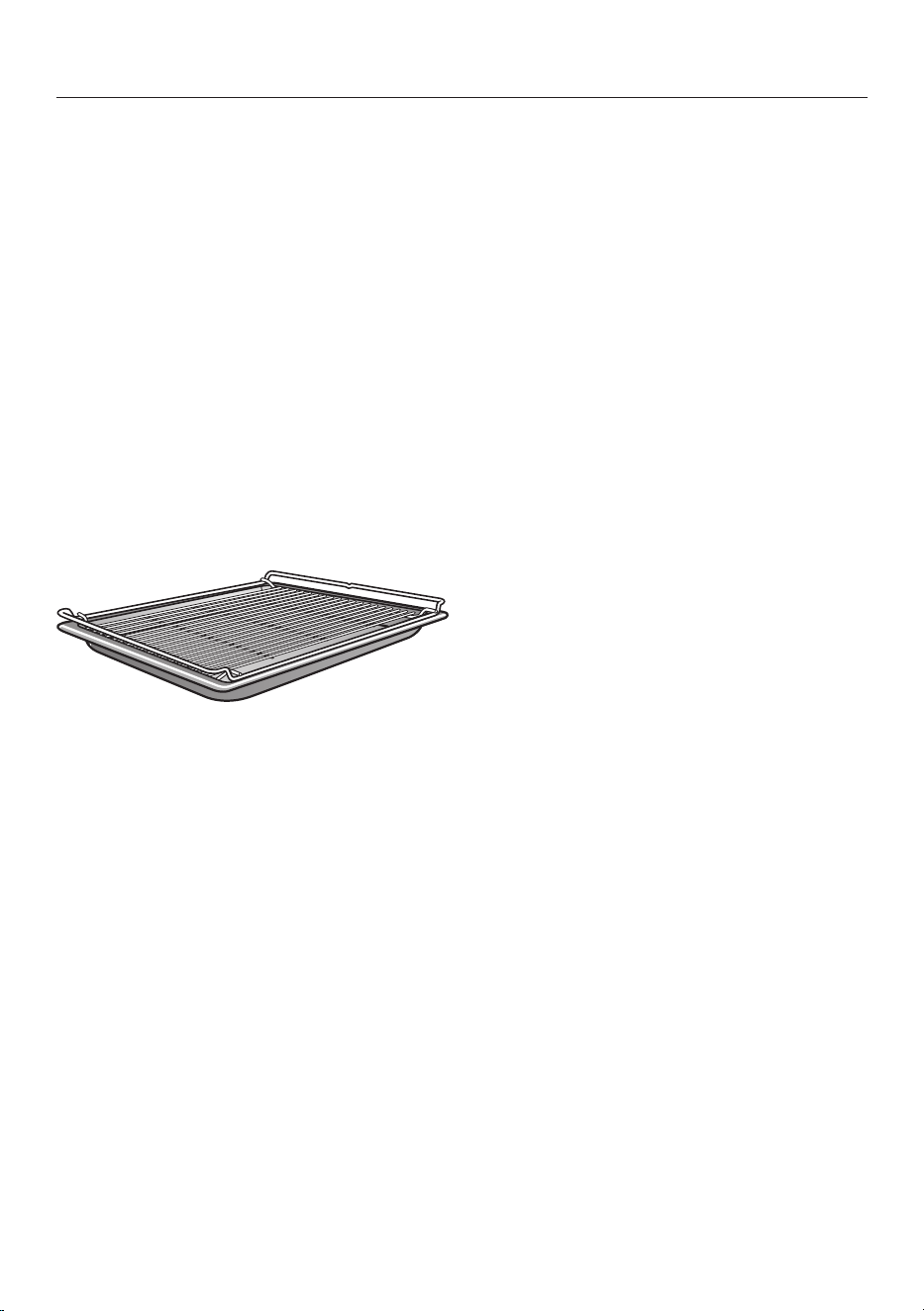
Roasting
129
Roasting tips
- Never roast frozen meat as it will dry
out. Always defrost meat before
roasting.
- Remove skin and sinew before
roasting.
- Marinate and season the meat to
taste.
- If you are roasting several pieces of
meat together, select pieces that have
a similar thickness.
- Use the universal tray with the rack
placed on top of it. The oven
compartment stays cleaner and you
can then use the meat juices collected
to make a gravy or sauce.
- Allow a standing time of approx.
10minutes before carving meat. This
resting time ensures the meat juices
are distributed evenly.
Notes on the oven functions
You can find an overview of all the
functions with their recommended
values in “Main and sub-menus”.
Combi mode
This function uses a combination of
oven heat and moisture. The addition of
steam prevents the surface of the food
from drying out. The results are
particularly tender and succulent meat
with a well-browned outside. Use the
Combi mode function for cooking
meat, fish and poultry dishes.
You can choose between different types
of heating:
- Combi Fan Plus
- Combi Conventional
- Combi Grill
We recommend cooking meat slowly
and gently in several cooking stages: at
a high temperature during the first
cooking stage to brown the surface. The
second cooking stage requires
increased moisture and a reduced
temperature. The meat cooks evenly
and the muscle protein is macerated,
making the meat particularly tender.
Useful tip: Recipes and comprehensive
cooking charts with information on
functions, temperatures, moisture and
cooking durations can be found in the
Miele cookbook/recipe booklet
“Bake, roast, steam”.

Roasting
130
Automatic programmes
Follow the instructions in the display.
Fan Plus
This function is suitable for roasting
meat and poultry that needs to be well
browned.
Because the fan distributes the heat
around the oven compartment straight
away, you can use a lower temperature
than you would with the Conventional
Heatfunction.
Conventional Heat
Use this function for cooking traditional
recipes. If using an older recipe or
cookbook, set the oven temperature
10°C lower than that recommended.
This will not change the cooking
duration.
Use the Bottom Heatfunction
towards the end of the cooking
duration to brown the base of the food.
Do not use the Intensive
Bakefunction for roasting as the
juices will become too dark.
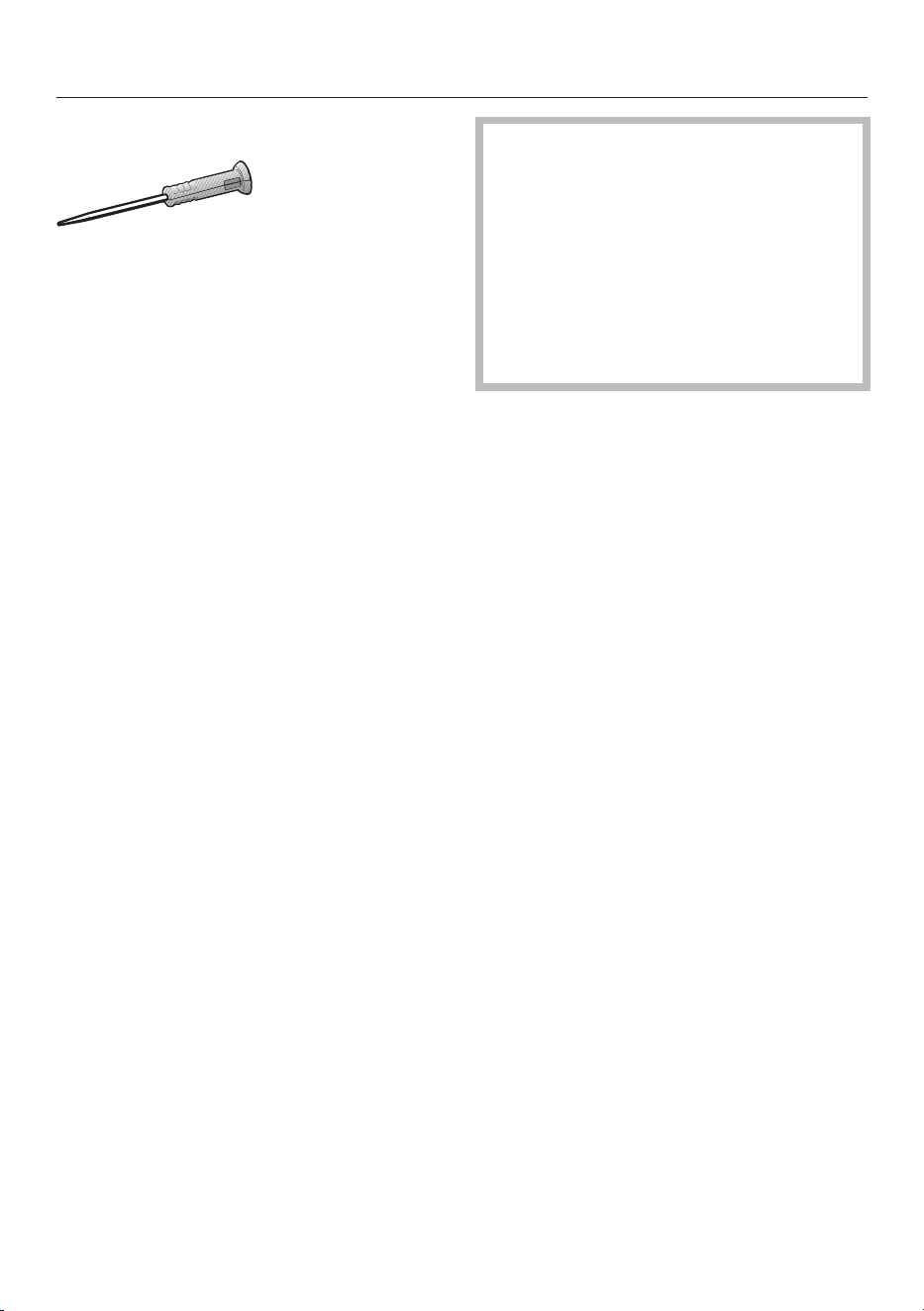
Roasting
131
Food probe
The food probe enables you to monitor
the temperature precisely during a
cooking programme.
How it works
The metal tip of the food probe must be
inserted into the centre of the food all
the way to the handle. There is a
temperature sensor in the metal tip
which measures the core temperature
of the food during cooking.
The core temperature set will depend
on how well cooked you want your meat
to be and on the type of meat. The
temperature can be set between 30and
99°C.
The cooking duration will depend on a
number of different factors: the higher
the temperature in the oven
compartment and the moisture, where
applicable, and the thinner the food, the
quicker the set core temperature will be
reached.
The core temperature values are sent
via a signal from the transmitter in the
handle of the food probe via the antenna
to the steam combination oven's
electronic unit as soon as the food with
the food probe is placed in the oven
compartment.
Accurate radio transmission is only
guaranteed if the oven door is closed. If
the door is opened during a cooking
programme, e.g. to baste the food, radio
signal transmission is interrupted.
It will only resume when the door is
closed. It will take a few seconds before
the current core temperature appears
again in the display.
The temperature sensor will be
damaged at temperatures over
100°C.s However, there is no danger
of damage occurring if it is inserted
into food as the maximum core
temperature that can be set is 99°C.
If you are not using the food probe,
do not leave it in the oven
compartment during cooking. Always
put it back into the storage sleeve.
Options for use
Some Automatic programmes and
Special applications will prompt you to
use the food probe.
You can also use the food probe with
User programmes and with the
following functions:
- Fan Plus
- Conventional Heat
- Combi Fan Plus
- Combi Conventional
- Steam cooking
- Intensive Bake
- Fan Grill
- Cake Plus

Roasting
132
Important notes on use
To ensure the food probe works
correctly, please observe the following
instructions.
The metal tip of the food probe can
break.
Do not use the wireless food probe
to lift or carry the food.
- Do not use deep, narrow, metal
cooking containers, as these will
weaken the radio signal.
- For wireless food probes, avoid
placing metal objects above them,
such as a lid, aluminium foil or the
rack or the universal tray on the shelf
levels above. Glass lids may be used.
- Do not use another standard metal
cooking thermometer at the same
time.
- Do not allow the handle of the food
probe to sit in any sauce or cooking
liquid, or to rest on the food or on the
edge of the cooking container.
- You can place the meat in a pot or on
the rack.
- The metal tip of the food probe must
be fully inserted into the centre of the
food so that the temperature sensor
reaches more or less to the core. The
handle should point diagonally
upwards and not horizontally towards
the corners of the oven or the door.
- When cooking poultry, insert the
metal tip into the thickest part of the
breast. You can find the thickest part
of the breast by pressing the area
with your thumb and index finger.
- The metal tip must not touch any
bone or be inserted in areas with a lot
of fat. Heavily marbled areas and
bones can cause cooking to end
prematurely.
- If the meat is very heavily marbled
with fat, select the highest core
temperature given in the cooking
charts.
- When using aluminium foil or roasting
bags, insert the food probe through
the foil/bag into the centre of the
food. You can also place meat inside
the bag or foil with the food probe
already inserted. Follow the roasting
bag manufacturer's instructions.
- The food probe can only be inserted
horizontally into flat food, e.g. fish.
Therefore place flat food in a glass or
ceramic cooking container, as the
walls of a metal container would
interfere with the radio signals.
If the food probe is no longer
recognised during cooking, a message
will appear in the display. Reposition
the food probe in the food.

Roasting
133
Using the food probe
Remove the food probe from its
storage sleeve behind the control
panel.
Fully insert the metal tip of the food
probe into the centre of the meat.
If you are cooking several pieces of
meat at the same time, insert the food
probe into the largest piece of meat.
The handle should be pointing
diagonally upwards.
Place the food in the oven.
Close the door.
Select an oven function or Automatic
programme.
Set the temperature and the core
temperature if necessary.
Core temperatures cannot be changed
for the Automatic programmes.
Follow the instructions in the display.
The cooking programme finishes as
soon as the core temperature is
reached.
Risk of injury caused by hot
surfaces.
The handle of the food probe can get
hot. You can burn yourself on the
handle.
Wear oven gloves when removing the
food probe.
Useful tip: If the food is not cooked
sufficiently when the core temperature
is reached, insert the food probe into
another place or increase the core
temperature and repeat the programme.
Delaying the start of a cooking
programme with food probe
You can also delay the start of the
cooking programme to a later time.
Select Start at.
You can estimate approximately when
the food will be ready as the duration of
the cooking programme is about the
same as if you were cooking food
without using the food probe.
You cannot set Duration and Finish at
because the total cooking duration is
determined by when the set core
temperature is reached.

Roasting
134
Chart with core temperatures
Meat [°C]
Veal
rare
medium
well-done
53–55
60–65
70–75
Gammon 75–80
Leg of lamb
rare
medium
well-done
53–55
60–65
70–75
Saddle of lamb
rare
medium
well-done
53–55
60–65
70–75
Saddle of venison
rare
medium rare
well-done
54
57
81
Topside of beef 65–75
Fillet of beef/
Sirloin joint
rare
medium
well-done
53–55
60–65
70–75
Roast ham/pork 70–85
Pork fillet
rare
medium
well-done
60
66
75
Game/leg cut 75
Core temperature
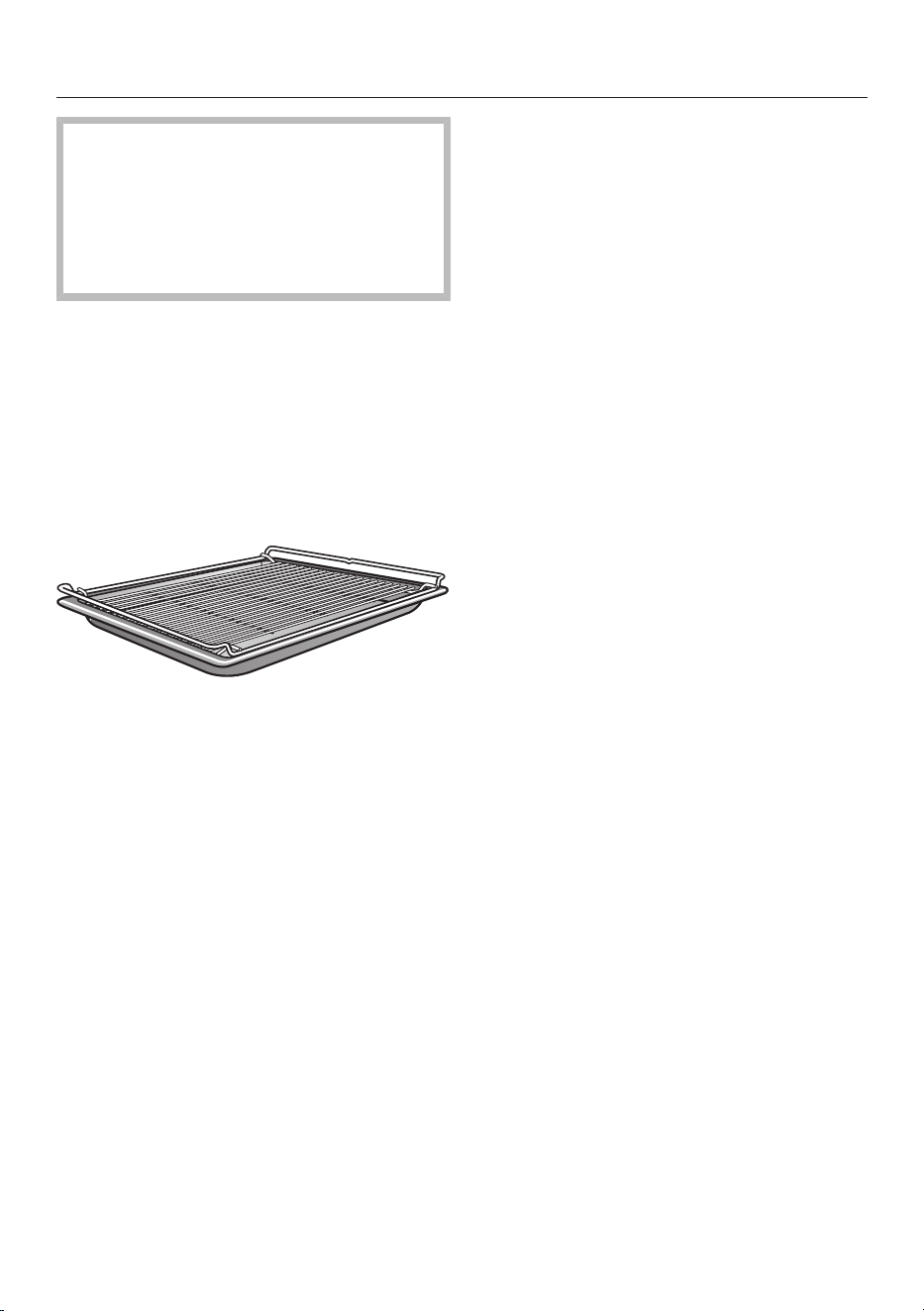
Grilling
135
Risk of injury caused by hot
surfaces.
If you open the appliance door during
grilling, the controls will get very hot.
Keep the door closed during the
grilling programme.
Grilling tips
- Always pre-heat for at least 5minutes
before grilling.
- Use the universal tray with the rack
placed on top of it. Exception: If you
are grilling on shelf level3, insert the
universal tray one level down from the
rack.
- When grilling fish, place the fish on a
piece of baking paper cut to size.
- Grill thick food, e.g. half a chicken, on
shelf level2 and thin food, e.g. steaks,
on shelf level3.
- Turn the food ²/₃ of the way through
the cooking duration. Exception: It is
not necessary to turn food when using
Fan Grill or grilling fish.
Tips for grilling
- Marinate lean meat or brush it with
oil. Do not use other types of fat as
they can burn and cause smoke.
- Pierce sausages before grilling.
- It is best to grill food of a similar
thickness at the same time so that the
grilling time for each item does not
vary too greatly.
- To test the food, press down on the
meat with a spoon. This lets you
determine how well the meat has
been cooked.
– Rare
If the meat gives easily to the
pressure of the spoon, it will still
be red on the inside.
– Medium
If there is some resistance, the
inside will be pink.
– Well-done
If there is great resistance, it is
cooked through.
- To grill thicker pieces of food more
gradually after an initial high
temperature, continue grilling at a
lower temperature setting or use a
lower shelf level to allow the food to
cook through to the centre.

Grilling
136
Notes on the oven functions
You can find an overview of all the
functions with their recommended
values in “Main and sub-menus”.
The plastic on the food probe can
melt at very high temperatures.
Do not use the food probe when
using the Grill functions.
Do not store the food probe in the
oven compartment when it is not
being used.
Combi Grill
This function is suitable for grilling food
that should be brown on the outside,
but not dry, e.g. corn on the cob.
Full Grill
Use this function to grill flat thin cuts in
large quantities and for browning large
baked dishes.
Economy Grill
Use this function to grill flat thin cuts in
smaller quantities and for browning
small baked dishes.
Fan Grill
This function is suitable for grilling
thicker food such as poultry or rolled
meat.
Grilling
137
Grilling chart
Settings
Oven functions | Fan Grill
Temperature: see chart
Duration: see chart
The chart below is a suggested guide only. Temperatures are approximations and
must be varied according to the thickness and preparation of the meat. Personal
taste and size of serves will vary times and temperatures. We recommend you
monitor cooking results for best outcomes.
Food [°C] [min.]
Meat
Chicken breast fillet 200 2–3 14–18
Chicken satays 200 3 12–15
Whole butterflied chicken 200 1 35–40
Kebabs and satays (red meat) 200 3 12–15
Lamb back straps 220 3 8–10
Lamb loin chops 190 3 12–16
Lean beef fillet steak 220 3 6–12
Lean thin sausages 180 3 8–10
Thick sausages 180 3 15–20
Fish
Oily fish 200 3 8–12
Thick fish fillets, cutlets or steaks 200 3 10–15
Thin white fish fillets 220 3 6–10
Vegetables
Potato wedges or small roast potatoes 220 2 20–25
Vegetables, capsicum, zucchini, sweet
potato, eggplant
200 3 12–15
Temperature, Shelf level, Duration

Cleaning and care
138
Notes on cleaning and care
Risk of injury caused by hot
surfaces.
The steam combination oven gets
hot during operation. You could burn
yourself on the heating elements,
oven compartment, shelf runners or
accessories.
Allow the heating elements, oven
compartment, shelf runners and the
accessories to cool down before
manual cleaning.
Risk of injury due to electric
shock.
The steam from a steam cleaning
appliance could reach electrical
components and cause a short
circuit.
Do not use a steam cleaner to clean
the steam combination oven.
All surfaces could be discoloured or
damaged if unsuitable cleaning
agents are used. The front of the
steam combination oven is
particularly susceptible to damage
from oven cleaners or descaling
agents.
All surfaces of this appliance are
susceptible to scratching. Scratches
on glass surfaces could cause a
breakage in certain circumstances.
Remove any residual cleaning agent
immediately.
Stubborn soiling could damage the
steam combination oven in certain
circumstances.
Once the oven has cooled, clean the
oven compartment, the inside of the
door and the door seal. Waiting too
long can make cleaning unnecessarily
difficult and in some cases
impossible.
Do not use commercial cleaning
agents. Only use cleaning agents
designed for domestic use.
Do not use cleaning agents or
washing-up liquids containing
aliphatic hydrocarbons as these
could cause the seals to swell.
The steam combination oven and
accessories should be cleaned and
dried thoroughly after each use.
Leave the appliance door open until
the oven interior is completely dry.
If you use mostly steam cooking
programmes and do not use the
HydroClean maintenance programme,
you should carry out a cooking
process at least once a year at a
temperature of 225°C to remove any
moisture from inaccessible areas of
the steam combination oven.
If the steam combination oven is not
going to be used for a longer period of
time, it should be thoroughly cleaned
and dried beforehand to prevent the
build-up of odours and so on. Leave
the door open afterwards.

Cleaning and care
139
Unsuitable cleaning agents
To avoid damaging the surfaces of your
appliance, do not use:
- cleaning agents containing soda,
alkalines, ammonia, acids or chlorides
- cleaning agents containing descaling
agents
- abrasive cleaning agents, e.g. powder
cleaners and cream cleaners
- solvent-based cleaning agents
- dishwasher cleaners
- glass cleaning agents
- cleaning agents for ceramic cooktops
- hard, abrasive brushes or sponges,
e.g. pot scourers, brushes or sponges
which have been previously used with
abrasive cleaning agents
- dirt eraser sponges
- sharp metal scrapers
- steel wool
- stainless steel spiral pads
- spot cleaning with mechanical
cleaning agents
- oven cleaners and sprays
Cleaning the front
Clean the appliance front with a
clean, soft sponge and a solution of
warm water and washing-up liquid.
After cleaning, wipe the surfaces dry
using a soft cloth.
Useful tip: A clean, damp microfibre
cloth without cleaning agent can also be
used.

Cleaning and care
140
PerfectClean
The surfaces of the universal tray, the
combi rack and the FlexiClip telescopic
runners HFC71 have been treated with
PerfectClean. This finish has an
iridescent appearance. PerfectClean
surfaces have very good non-stick
properties and are easy to clean.
However, it is important to clean the
surfaces each time the oven is used.
The non-stick properties will deteriorate
if soiling is not removed from
PerfectClean surfaces after each use. If
used frequently without being cleaned,
cleaning may become very difficult.
Spilt fruit juices may cause
discolouration to the surfaces that
cannot be removed. However, this does
not affect the properties of the
PerfectClean finish.
Always remove all cleaning agent
residues to protect the non-stick
properties.
To protect the non-stick effect of
PerfectClean surfaces, please avoid:
- abrasive cleaning agents, e.g. powder
cleaners and cream cleaners
- cleaning agents for ceramic cooktops
- ceramic glass and stainless steel
cleaners
- steel wool or metal scourers
- abrasive sponges, e.g. pot scourers or
sponges which have been previously
used with abrasive cleaning agents
- oven sprays
- spot cleaning with mechanical
cleaning agents
Do not clean PerfectClean
accessories in the dishwasher.

Cleaning and care
141
Oven compartment
It is normal for the oven compartment
to take on a yellowish discolouration
after extensive use. This will not affect
functionality in any way.
Ensure that no cleaning agent gets
into the openings on the oven
compartment rear panel.
To make cleaning the oven
compartment easier, you can remove
the oven door, dismantle the shelf
runners and lower the top heat/grill
element.
Cleaning after a programme using
steam
Remove:
- condensate using a sponge or
absorbent cloth,
- light, greasy soiling with a sponge and
a solution of washing-up liquid and
hot water.
After cleaning, wipe the surface with
clean water to remove any cleaning
agent residues.
Then dry the oven compartment and
the inside of the door with a cloth.
Useful tip: You can then dry the oven
compartment automatically using the
Drying maintenance programme (see
"Maintenance").
Cleaning after a roasting, grilling or
baking programme
Clean the oven compartment
thoroughly after roasting, grilling and
baking as otherwise soiling can burn
on and become impossible to
remove.
Clean the oven compartment and
inside of the door with a clean
washing-up sponge, hot water and a
little washing-up liquid. You can use
the hard surface of a washing-up
sponge to clean the oven
compartment if necessary.
After cleaning, wipe the surface with
clean water to remove any cleaning
agent residues.
Then dry the oven compartment and
the inside of the door with a cloth.
Useful tip: Soaking the soiling for a few
minutes with a solution of washing-up
liquid and hot water can make cleaning
easier. Alternatively, run the
Maintenance |Soak programme (see
“Cleaning and care - Maintenance”).

Cleaning and care
142
Cleaning the floor filter
The filter in the floor of the oven
should be cleaned and dried after
every use.
Vinegar can be used to remove
discolouration and limescale deposits
from the filter in the floor of the oven.
Rinse thoroughly with clean water
afterwards.
Cleaning the door seal
The door seal may become brittle
and tear on account of contact with
grease residues.
Clean the door seal after every
roasting, grilling or baking
programme.
Clean the door seal using a clean,
damp microfibre cloth without any
cleaning agent. You can also use a
clean sponge and warm water with a
little washing-up liquid.
After cleaning, dry the seal with a soft
cloth.
Check whether the door seal is
correctly installed.
If necessary, press it in all the way
round the door to make sure it is
smooth and even.
If the door seal shows signs of
damage, e.g. cracks, the seal will
need to be replaced. Call Miele.
Do not carry out cooking
programmes using steam or cleaning
with the HydroClean maintenance
programme.
Cleaning the water container
The water container is suitable for
cleaning in a dishwasher.
Remove the water container after
each use. To do this, push it upwards
slightly as you take it out of the
appliance.
Empty the water container.
Water can drip into the container
compartment when the water
container is removed.
Dry the compartment if necessary.
Rinse the water container by hand or
in the dishwasher.
Dry the water container with a soft
cloth to prevent limescale.

Cleaning and care
143
Accessories
Cleaning the universal tray and combi
rack
The surfaces of the universal tray and
the combi rack have been treated
with PerfectClean.
Please see “Cleaning and care -
PerfectClean” for instructions on
cleaning.
Remove:
- light soiling with a clean sponge and a
solution of washing-up liquid and
warm water.
- stubborn soiling with a clean washing-
up sponge, hot water and a little
washing-up liquid. If necessary, you
can also use the rough side of the
sponge.
After cleaning, wipe the surface with
clean water to remove any cleaning
agent residues.
Then wipe the surfaces dry using a
cloth.
Cleaning cooking containers and the
food probe
The cooking containers and food probe
are suitable for cleaning in a
dishwasher.
Wash and dry the cooking containers
and food probe after each use.
Any bluish discolouration on the
cooking containers can be removed
with vinegar. Rinse afterwards with
clean water.
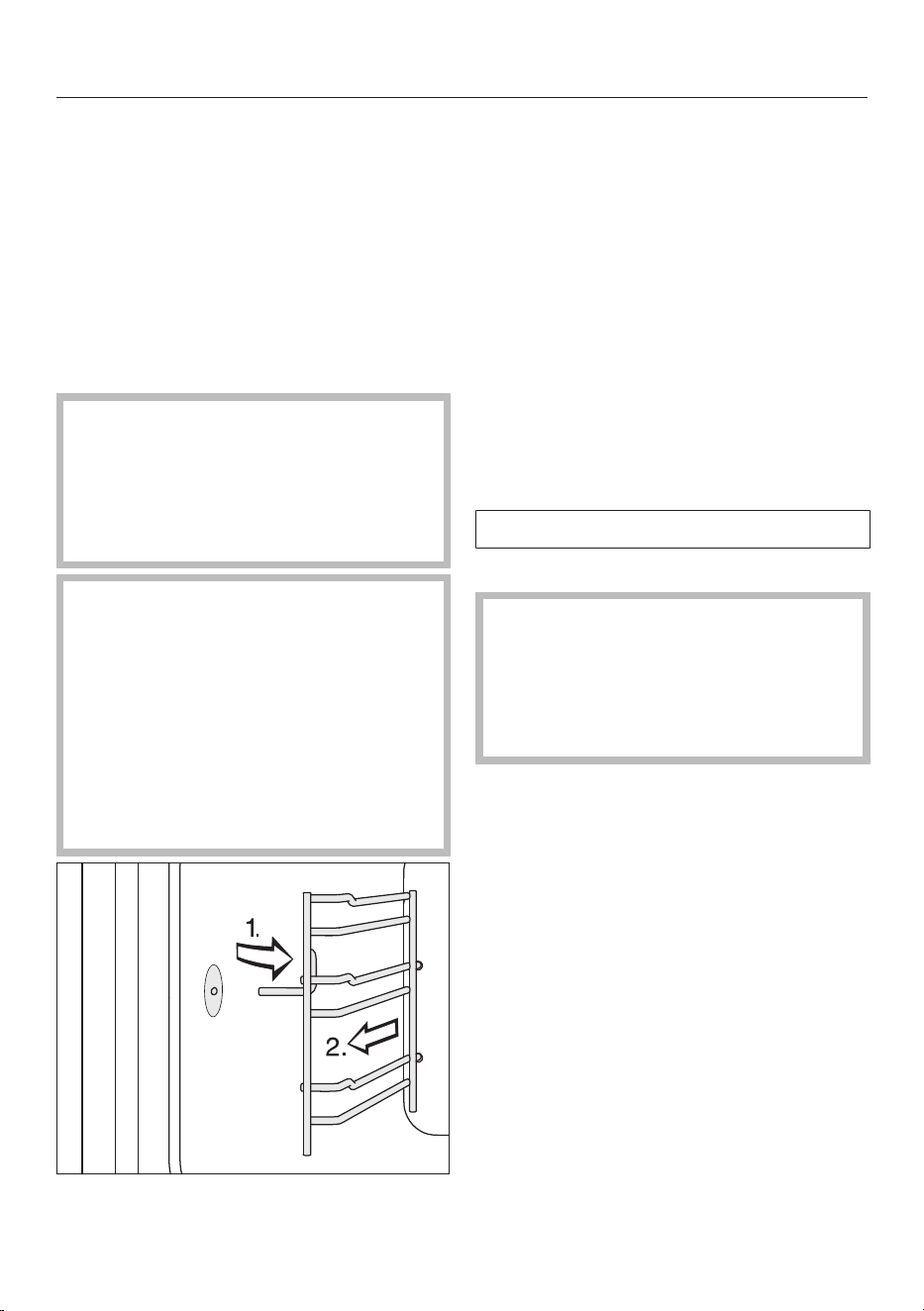
Cleaning and care
144
Cleaning the shelf runners
You can remove the shelf runners
together with the FlexiClip telescopic
runners (if present).
If you want to remove the FlexiClip
telescopic runners separately
beforehand, please follow the
instructions in “Overview - Fitting and
removing the FlexiClip telescopic
runners”.
The surfaces of the FlexiClip
telescopic runners HFC71 have been
treated with PerfectClean.
Please see “Cleaning and care -
PerfectClean” for instructions on
cleaning.
Risk of injury caused by hot
surfaces.
The steam combination oven gets
hot during operation. You could burn
yourself on the heating elements, the
oven compartment, or accessories.
Allow the heating elements, oven
compartment and the accessories to
cool before removing the shelf
runners.
Pull the shelf runners out of the
holder (1.) and remove them (2.).
Remove:
- light soiling with a clean sponge and a
solution of washing-up liquid and
warm water.
- stubborn soiling with a clean washing-
up sponge, hot water and a little
washing-up liquid. If necessary, you
can also use the rough side of the
sponge.
After cleaning, wipe the surface with
clean water to remove any cleaning
agent residues.
Then dry the shelf runners with a
cloth.
Refit in the reverse order.
Refit the shelf runners carefully.
If the shelf runners are not correctly
inserted, there is no anti-tip
protection. The temperature sensor
could also be damaged when cooking
containers are placed in the steam
combination oven.
Cleaning and care
145
Lowering the top heat/grill
element
If the oven compartment roof is badly
soiled, the top heat/grill element can be
lowered by approx. 5cm to make
cleaning easier.
Risk of injury caused by hot
surfaces.
The steam combination oven gets
hot during operation. You could burn
yourself on the heating elements,
oven compartment, shelf runners or
accessories.
Allow the heating element, oven
compartment, shelf runners and the
accessories to cool before cleaning.
Use caution not to damage the top
heat/grill element.
Never use force when pulling down
the top heat/grill element.
Carefully pull down the pressure cap.
The top heat/grill element then lowers
automatically.
Clean the oven compartment roof
with a sponge cloth or a washing-up
sponge (see “Cleaning and care -
Oven compartment”).
After cleaning, push the top heat/grill
element back up using the outer ring
of the pressure cap.
Make sure the pressure cap engages
correctly.

Cleaning and care
146
Maintenance
The Finish at and Start at functions are
not available in maintenance
programmes.
Soaking
Stubborn soiling can be soaked using
this maintenance programme.
Let the oven compartment cool down.
Take all accessories out of the oven
compartment.
Remove coarse soiling with a cloth.
Select Maintenance | Soak.
The soaking process takes approx.
10minutes.
Drying
This maintenance programme can be
used to dry any residual moisture in the
oven compartment, including in
inaccessible areas.
Dry the oven compartment with a soft
cloth first.
Select Maintenance| Drying.
The drying process takes approx.
20minutes.
Rinsing
The water-carrying system is rinsed out
during this maintenance programme.
Any remaining food deposits are rinsed
away.
Select Maintenance| Rinse.
Follow the instructions in the display.
The rinsing process takes approx. 10
minutes.
Descaling
We recommend using Miele descaling
tablets (see “Optional accessories”) to
descale the appliance. These have
been specially developed for use with
Miele appliances to optimise the
descaling process. Other descaling
agents, which contain other acids
besides citric acid and/or other
undesirable substances, such as
chlorides, could cause damage to the
product. Moreover, the descaling
result required could not be
guaranteed if the descaling solution
was not of the appropriate
concentration.
Do not spill descaling agent onto
metal surfaces. This can cause marks
to appear.
However, should any descaling agent
get onto these surfaces, wipe it away
immediately.
The steam combination oven has to be
descaled after a certain number of
operating hours. When the time comes
to descale it, the number of uses
remaining lights up in the display. Only
cooking processes that use steam are
counted. The steam combination oven
will lock after the last remaining cooking
process.
We recommend descaling the steam
combination oven before it is disabled.
Descaling takes approx. 41minutes.
The water container must be emptied
and rinsed out during the descaling
process.

Cleaning and care
147
Starting the descaling process
Take all accessories out of the oven
compartment.
Select Maintenance|Descale.
The message Please wait will appear in
the display. The descaling process is
being prepared. This may take several
minutes. As soon as the appliance is
ready, you will be prompted to add
descaling agent to the water container.
Fill the water container with lukewarm
fresh tap water up to the level
marker and drop 2Miele descaling
tablets in it.
Wait until the descaling tablets have
dissolved.
Push the water container into the
appliance.
Confirm with OK.
The time remaining will appear in the
display. The descaling process will now
begin.
Do not switch the steam combination
oven off during the descaling process,
otherwise the whole process will have
to be started from the beginning again.
The water container must be rinsed out
and reinserted empty during the
descaling process.
Follow the instructions in the display.
Once the remaining time has counted
down, Finished appears in the display
and a tone sounds.
Finishing the descaling process
Select Close.
Remove the water container and
empty it.
Clean and dry the water container.
Open the door and let the oven
compartment cool down.
Then dry the oven compartment.
Leave the appliance door open until
the oven interior is completely dry.
Switch the steam combination oven
off.

Cleaning and care
148
HydroClean
Instead of cleaning the oven by hand,
you can run the HydroClean maintenance
programme.
Odours after cooking fish, and also
heavy, stubborn soiling, e.g. from
roasting and grilling, can be easily
removed using this programme.
We recommend cleaning the steam
combination oven four times per year
with HydroClean. If necessary, this
cleaning can be carried out more
frequently.
Only the Miele HydroCleaner can be
used for cleaning with HydroClean.
This cleaning agent has been
specially developed for your steam
combination oven.
Other cleaning products can damage
the steam combination oven.
One bottle of Miele HydroCleaner is
supplied with your steam combination
oven. Subsequent bottles of Hydro-
Cleaner are available to order from the
Miele online shop or directly from Miele
(see back cover for contact details).
Risk of injury caused by cleaning
agent.
The HydroCleaner causes skin and
eye irritation.
Avoid contact with skin and eyes.
Rinse the affected area thoroughly
with water and seek medical
attention in the case of continued
eye irritation.
Keep the HydroCleaner out of the
reach of children.
Always use the complete contents of
one bottle of HydroCleaner (125ml),
regardless of the degree of soiling.
The amount of cleaning agent
(125ml) is intended for the entire
cleaning process and must not be
altered.
You can choose between 3 cleaning
levels with different durations:
- Degree of soiling 1 for light, barely
visible soiling and odours, e.g. after
cooking fish or cabbage
Duration: approx. 1:57hours
- Degree of soiling 2 for visible, but not
heavily burnt on soiling, e.g. melted
pizza cheese, leaked fruit pie
Duration: approx. 3:17hours
- Degree of soiling 3 for heavy, burnt
on soiling from different types of food
that has built up over a long period of
time, e.g. after roasting chicken
Duration: approx. 4:17hours

Cleaning and care
149
Cleaning process sequence
HydroClean proceeds in several phases:
1. Preparation
2. Cleaning phase
3. Rinsing phase
4. Subsequent manual cleaning
5. Drying phase
The steam combination oven will guide
you through the entire cleaning process.
As preparation, for example, you will be
prompted to remove accessories from
the oven compartment and to pour the
cleaner through the floor filter.
When all preparations are finished, the
cleaning phase will start. The door will
lock automatically. The cleaner is mixed
with fresh water and sprayed
throughout the entire oven
compartment by the distribution fan on
the oven ceiling. This procedure is
repeated several times.
The rinsing phase begins when the time
remaining is 1:20 hours. Soiling and
cleaning agent residues are flushed out
of the oven compartment.
The last phase is the drying phase. It
begins with a remaining time of approx.
30minutes. In order to remove coarse
soiling residues, the oven compartment
needs to be wiped out with a soft cloth
before the start of the drying phase.
If you switch off the steam
combination oven, the cleaning
process will be cancelled. After
switching the steam combination oven
back on again, the rinsing and drying
phases are carried out automatically to
remove any potential cleaning agent
residues. Normal operation is only
possible again upon completion (see
"Problem solving guide - Messages in
the display").
Preparing and starting the cleaning
process
Select Maintenance.
Select HydroClean.
Select the cleaning level based on the
degree of soiling.
Confirm with OK.
The message Please wait will appear.
Cleaning will be prepared. This may take
several minutes. As soon as preparation
has finished, you will be prompted to
remove the accessories and the shelf
runners.
Take all accessories out of the oven
compartment.
Remove the shelf runners together
with the FlexiClip telescopic runners
(if present) (see "Cleaning the shelf
runners").
Confirm with OK.
Lower the top heat/grill element (see
"Lowering the top heat/grill
element").
Remove any coarse soiling from the
oven compartment and from
underneath the floor filter.
Ensure that soiling does not get into
the drainage system.
Confirm with OK.
Check that the filter in the floor of the
oven compartment is correctly fitted.
Pour the entire contents of one bottle
of HydroCleaner into the floor filter.
Ensure that the cleaning agent does
not come into contact with the door
glass or door seal.
Confirm with OK.
Close the door.
The cleaning process starts.
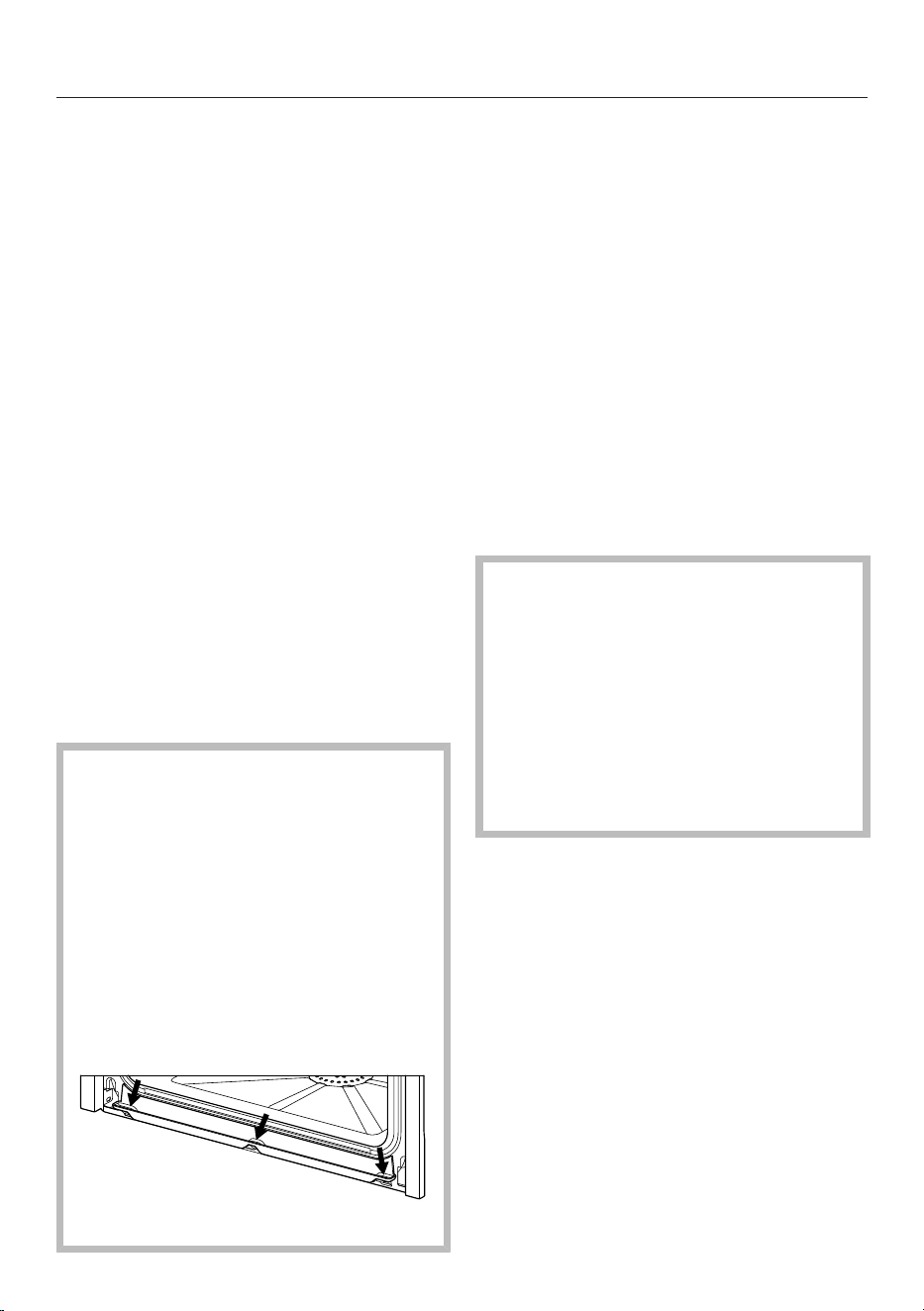
Cleaning and care
150
The time remaining appears in the
display.
The door will lock automatically a few
seconds after the process starts.
Useful tip: The approximate time for the
next tasks, e.g. wiping out the oven
compartment with a damp cloth, can be
viewed via Info.
Before the start of the drying phase, the
door is unlocked and you will be
prompted to wipe out the oven
compartment and the inside of the door
with a damp cloth.
Wipe out the oven compartment (and
also underneath the floor filter) and
the inside of the door thoroughly with
a clean, damp microfibre cloth or
sponge.
Confirm with OK.
To ensure optimal functioning of the
steam combination oven, check the
drip channel and remove any water if
present.
Damage due to leaking water.
Leaking water can damage the
cabinetry and flooring.
If there are any drops of water in the
drip channel, check whether the door
seal is correctly fitted.
If necessary, press it in all the way
round the door to make sure it is
smooth and even.
In some circumstances water can
collect up to the very top of the drip
channel:
If this happens, contact Miele.
Raise the top heat/grill element (see
"Lowering the top heat/grill element").
Fit the shelf runners (see "Cleaning
the shelf runners").
Place the accessories in the oven.
Confirm with OK.
Close the door.
Once the remaining time has counted
down, Finished appears in the display
and a tone sounds.
Completing the cleaning process
Select Close.
Switch the steam combination oven
off.
Risk of injury caused by hot
surfaces.
The steam combination oven gets
hot during operation. You could burn
yourself on the heating elements, the
oven compartment, or accessories.
Allow the heating elements, oven
compartment and accessories to
cool down before removing any
residue and limescale.
Once the oven compartment has
cooled down, remove any residue from
the inside of the door, the drip channel
and the door seal with a clean, damp
microfibre or absorbent cloth.
Useful tip: You can remove any
discolourations and limescale residues
in the oven compartment with a diluted
vinegar solution or with the DGClean
(see "Optional accessories"). Wipe with
clean water afterwards.
Then dry the oven compartment and
the inside of the door with a cloth.
Leave the appliance door open until
the oven interior is completely dry.
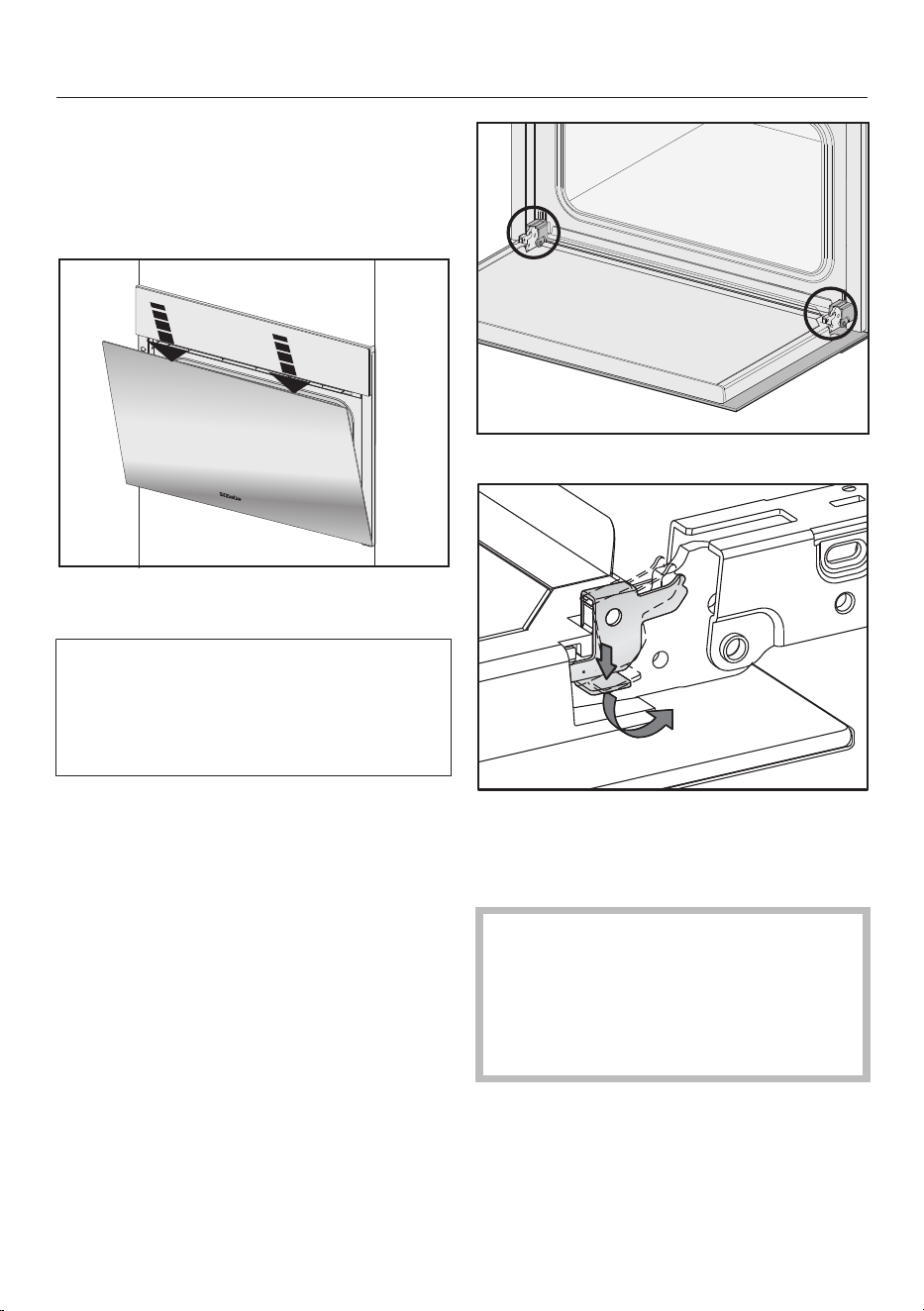
Cleaning and care
151
Removing the door
Prepare a suitable underlay for the
door, such as a soft cloth.
Open the door a fraction.
Using both hands, press down on the
top edge of the door briefly.
The oven door is connected to the
hinges by retainers. Before removing
the door from the retainers, the locking
clamps on both door hinges have to be
released.
Open the door fully.
Release the locking clamps on the
hinges by pushing them down as far
as they will go until they are at an
angle.
The steam combination oven could
become damaged if you incorrectly
remove the door.
Never pull the door horizontally off its
retainers, as they will spring back
against the steam combination oven.
Raise the door up until it rests
partially open.
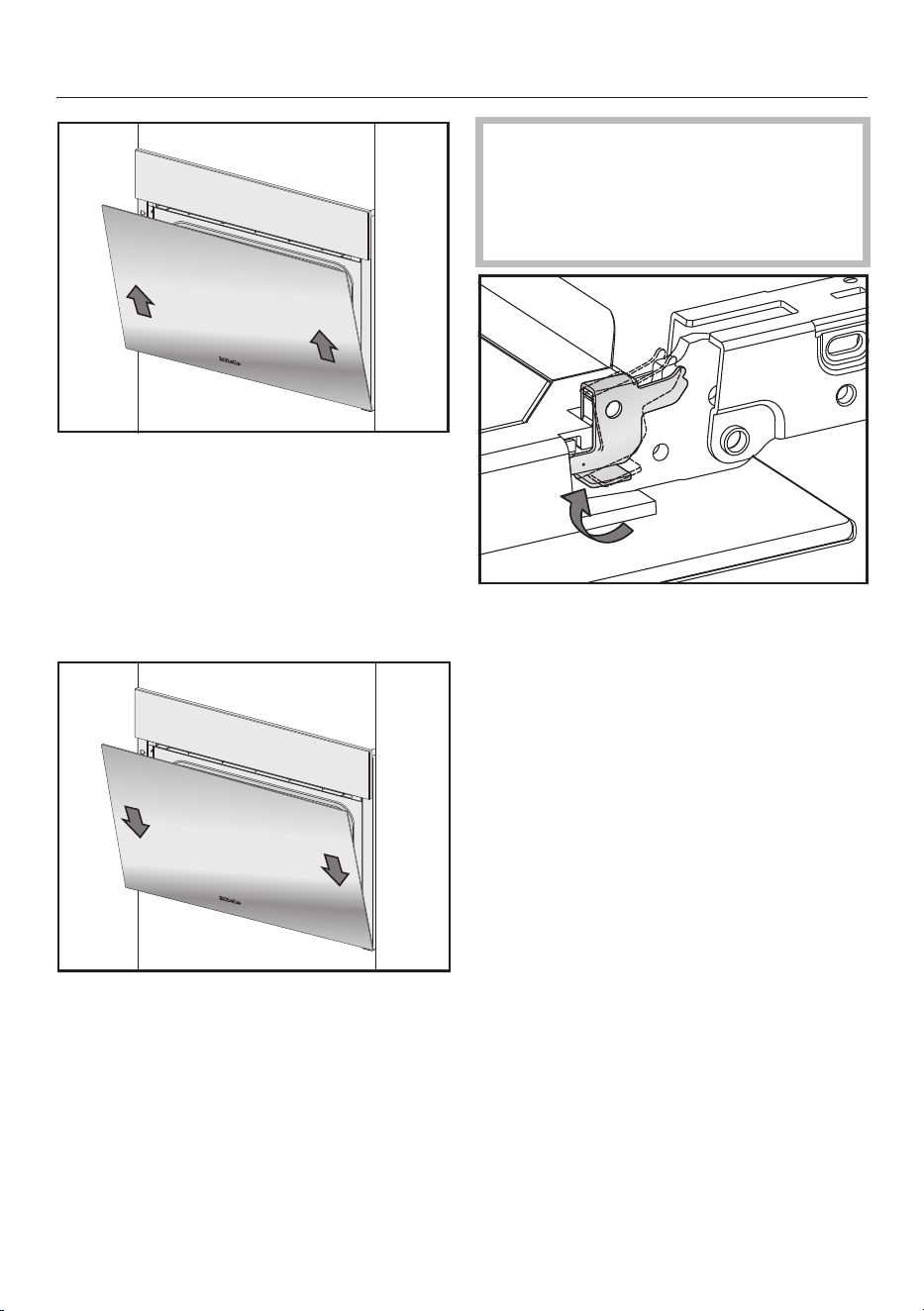
Cleaning and care
152
Hold the door on either side and
evenly pull diagonally upwards from
the hinge retainers.
Make sure that the door is straight.
Place the door on the previously
prepared surface.
Fitting the door
Hold the door securely on both sides
and carefully fit it back onto the door
hinge retainers.
Make sure that you put the door back
on straight.
Open the door fully.
If the locking clamps are not locked,
the door could work loose, resulting
in damage.
Ensure that the locking clamps are
locked after refitting the door.
To relock the locking clamps, flip them
back up to the horizontal position as
far as they will go.
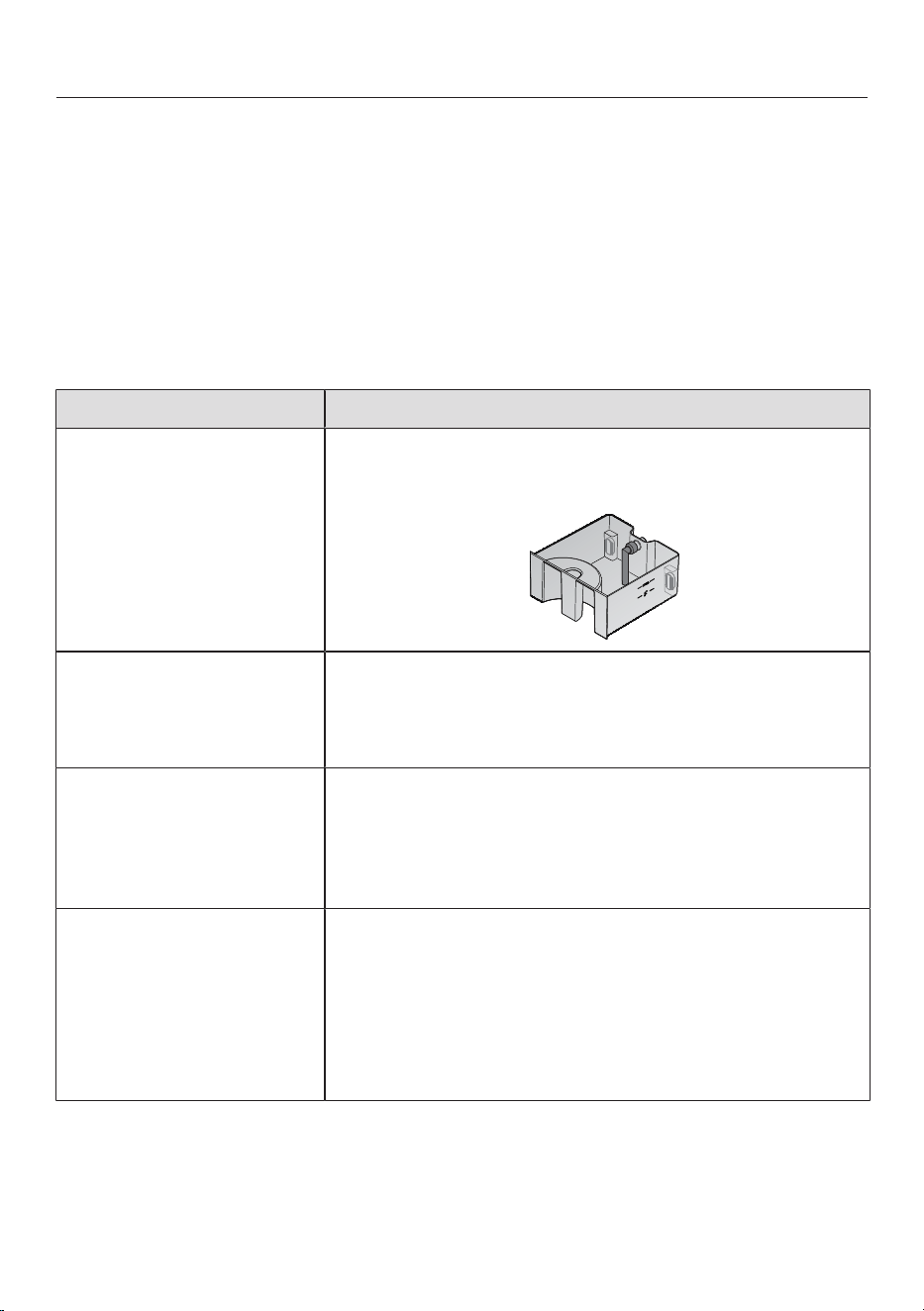
Problem solving guide
153
Many malfunctions and minor faults that can occur in daily operation can be
corrected without contacting Miele. This will save you time and money because
you will not need a service call.
You can find information on how to remedy faults yourself at
www.miele.com.au/service or www.miele.co.nz/service and on the Miele website.
Please note, however, that a call-out charge will be applied to unnecessary service
visits where the problem could have been rectified as described in these operating
instructions.
Messages in the display
Problem Possible cause and remedy
F10 The suction hose in the water container is not inserted
correctly, or is not vertical.
Correct the position of the suction hose:
F11
F20
The drain hoses are blocked.
Descale the steam combination oven (see “Cleaning
and care - Maintenance”).
If the fault message appears again, contact Miele.
F32 The door lock for cleaning with HydroClean is not
locking.
Switch the steam combination oven off and back on
again.
If the fault message appears again, contact Miele.
F55 The maximum operating time for an operating mode
has been exceeded and the safety switch-off has
triggered.
Switch the steam combination oven off and back on
again.
The steam combination oven is now ready to use
again.
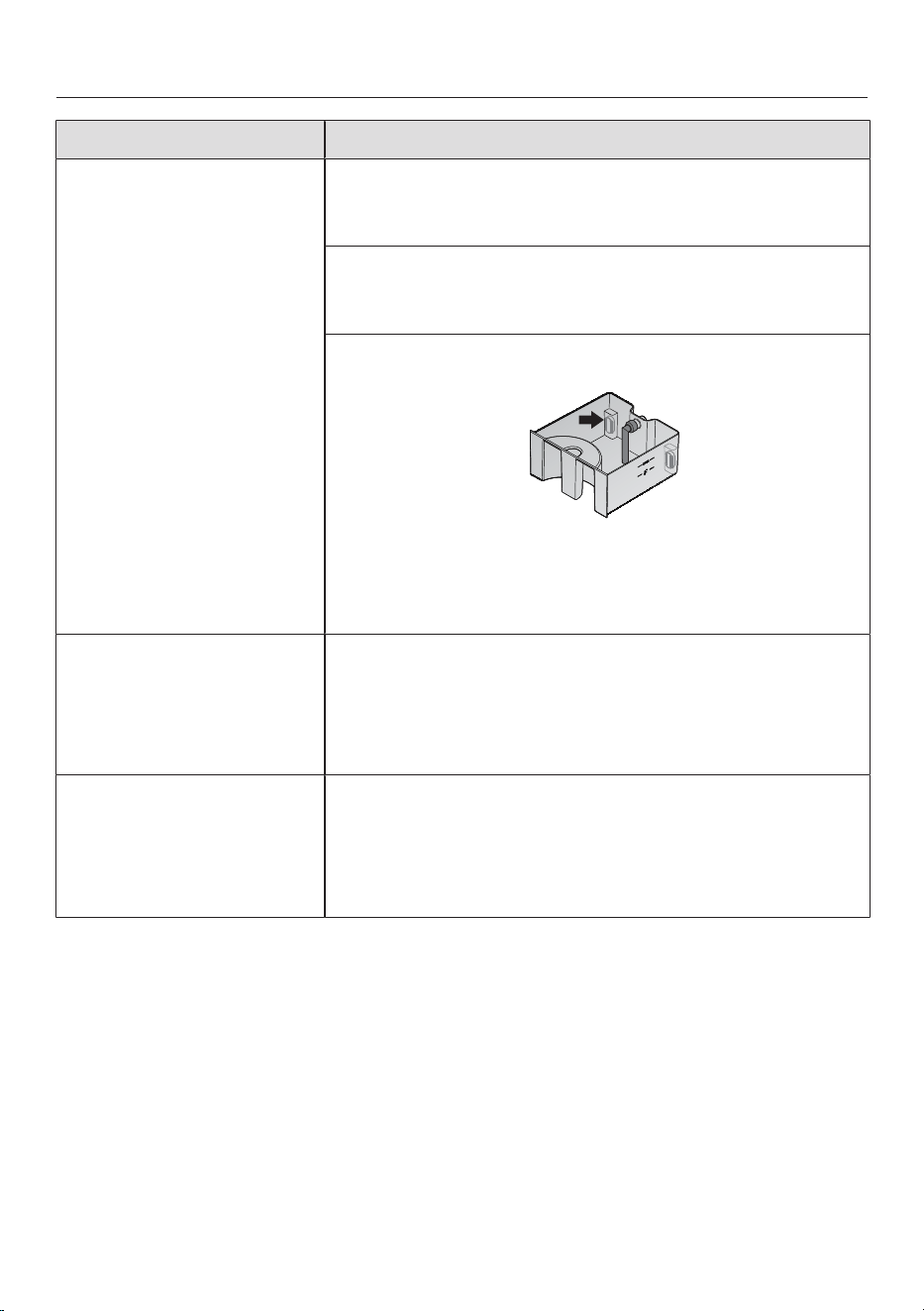
Problem solving guide
154
Problem Possible cause and remedy
F94 The water inlet hose is trapped or kinked.
Rectify the cause of the problem and start the
appliance again.
The water intake valve has not been opened.
Open the water supply valve and start the appliance
again.
One or both float switches in the water container are
stuck.
Release the float switch or switches so that it
moves freely.
If the fault message appears again after rectifying
the problem(s), call Miele.
F138 The steam combination oven is leaking. Water has run
into the floor tray.
Switch the steam combination oven off and back on
again.
If the fault message appears again, contact Miele.
F190 There is a fault with the water inlet valve.
This fault can occur if the control panel is opened or
closed during the water inlet.
Confirm with OK and continue operation.
If the fault message appears again, contact Miele.

Problem solving guide
155
Problem Possible cause and remedy
F196 There is a fault.
Switch the steam combination oven off and back on
again.
The floor filter is not fitted correctly.
Switch the steam combination oven off.
Fit the floor filter.
Switch the steam combination oven back on again.
The water drain hose is kinked, rolled up or looped.
Switch the steam combination oven off.
Check the installation of the water drain hose and
correct it if necessary. The water drain hose must
not be kinked, rolled up or looped. It must be laid
out on the floor in the plinth area.
If the fault message appears again after switching
on, contact Miele.
The message “Hydro-
Clean” continued appears
after switching on.
The cleaning process was interrupted by a power
failure or by the appliance being switched off.
After switching the steam combination oven back on
again, the rinsing and drying phases are carried out
automatically to remove any potential cleaning agent
residues. This process takes approx. 1:30 hours. If
there is an interruption during the drying phase, the
process takes approx. 30minutes.
Normal operation of the steam combination oven is
only possible again upon completion.
Follow the instructions in the display.
Please note that the cleaning result will not be
optimal.
The display shows a
message not listed in
this table.
There is an electronic unit fault.
Interrupt the power supply to the steam
combination oven for approx. 1minute.
If the problem persists after power is restored,
please contact Miele.

Problem solving guide
156
Unexpected behaviour
Problem Possible cause and remedy
The oven compartment
does not heat up.
Demo mode is active.
The steam combination oven can be operated,
however the heating elements will not work.
Deactivate Demo mode (see "Settings - Showroom
programme").
The oven compartment has been warmed up by a
warming drawer in operation underneath it.
Open the door and let the oven compartment cool
down.
After moving house, the
steam combination oven
no longer switches from
the heating-up phase to
the cooking phase.
Altitude affects the boiling point of water. If you move
house, the appliance will need to be reset for the new
altitude if this differs from the old one by more than
300m.
To adjust the boiling temperature, you need to
descale the appliance (see “Cleaning and care –
Maintenance”).
During operation, an
unusually high amount
of steam leaks out or
steam leaks out from
different places to usual.
The door is not closed properly.
Close the door.
The door seal is not correctly installed.
If necessary, press it in all the way round the door to
make sure it is installed smoothly and evenly.
The door seal is damaged, e.g. cracked.
Contact Miele to have the door seal replaced.
Do not carry out cooking programmes using steam
or cleaning with HydroClean.
During cleaning with
HydroClean water has
collected up to the very
top of the drip channel.
The steam combination oven is leaking.
Remove the water and finish the cleaning process if
necessary.
Call Miele.
The Start at and Finish at
functions are not
available.
The temperature in the oven compartment is too
high, e.g. after a programme has finished.
Open the door and let the oven cool down.
These functions are not generally available in
maintenance programmes.

Problem solving guide
157
Problem Possible cause and remedy
The sensors or the
proximity sensor do not
respond.
You have selected the Display| QuickTouch| Off setting.
When this is activated, the sensors and proximity
sensor do not respond when the steam combination
oven is switched off.
As soon as the steam combination oven is switched
on, the sensors and the proximity sensor will
respond. If you want the sensors and the proximity
sensor to respond even when the steam
combination oven is switched off, select the Display|
QuickTouch| On setting.
The settings for the proximity sensor are switched off.
Change the settings for the proximity sensor by
selecting Settings| Proximity sensor.
The proximity sensor is defective.
Call Miele.
The steam combination oven is not connected to the
power supply.
Check that the steam combination oven plug is
correctly inserted into the socket and switched on.
Check if the circuit breaker has tripped. Contact a
qualified electrician or Miele.
If the display does not respond, there is a fault with
the controls.
Touch and hold the On/Off sensor until the
display switches off and the steam combination
oven restarts.

Problem solving guide
158
Noises
Problem Possible cause and remedy
A humming sound can
be heard during
operation and after
switching off the steam
combination oven.
This noise does not indicate incorrect operation or an
appliance fault. The noise is made by water being
pumped through the system.
The fan can still be heard
after the appliance has
been turned off.
The fan continues to run.
The steam combination oven is equipped with a fan
that diverts vapours from the oven compartment
outside. The fan continues to run after the steam
combination oven has been switched off. The fan will
switch off automatically after a short while.
Unsatisfactory results
Problem Possible cause and remedy
Cakes and biscuits are
not cooked properly
after following the
durations given in the
recipe.
The temperature set is not the same as the one given
in the recipe.
Change the temperature.
The recipe has been altered. For example, adding
more liquid or eggs can increase the cooking duration
required.
Adapt the temperature and/or cooking duration to
the altered recipe.
Cakes or biscuits are
unevenly browned.
The temperature was set too high.
More than two shelf levels were used for baking.
Bake on a maximum of two levels.
There is still soiling in
the oven compartment
after cleaning with
HydroClean.
The cleaning level set was too low.
Start HydroClean again at a higher cleaning level if
necessary.
The oven compartment was not wiped out before the
drying phase, or only partially wiped out.
Start HydroClean again if necessary.
When the relevant prompt appears in the display,
wipe out the oven compartment thoroughly with a
damp cloth.

Problem solving guide
159
General problems or technical faults
Problem Possible cause and remedy
You cannot switch on
steam combination
oven.
The circuit breaker has tripped.
Reset the circuit breaker in the mains fuse box (see
data plate for minimum fuse rating).
There may be a technical fault.
Disconnect the steam combination oven from the
mains connection for approximately 1minute by:
– switching off at the wall socket and withdrawing
the plug, or
– switching off the mains circuit breaker or residual
current device.
If, after switching the circuit breaker or residual
current device back on, the steam combination oven
will still not switch on, contact a qualified electrician
or Miele.
The oven lighting
doesn't come on.
The lamps need to be replaced.
Call Miele to have the lamps replaced.
The control panel will
not open or close
automatically despite
the sensor being
touched several times.
Something is obstructing the control panel.
Remove the obstruction.
The obstruction sensor is very sensitive, which means
the control panel sometimes does not open or close.
Open/close the control panel manually (see end of
this section).
If the problem occurs frequently, contact Miele.
You cannot open the
door with the sensor.
You have selected the Display| QuickTouch| Off setting.
The sensor does not respond when the steam
combination oven is switched off.
As soon as the steam combination oven is switched
on, the sensors will respond. If you want the sensors
to always respond even when the steam
combination oven is switched off, select the Display|
QuickTouch| Onsetting.
There may be a technical fault.
If you need to open the door, e.g. because there is
still food in the oven, you will need to open the door
manually (see end of this section).
If the problem occurs again, contact Miele.

Problem solving guide
160
Problem Possible cause and remedy
The HydroCleaner
(cleaning agent) was
added to the water
container.
The instructions in the display were not followed.
To achieve an optimum cleaning result, the individual
steps of the cleaning process are coordinated with
each other. Always follow the instructions in the
display (see “Cleaning and care – Maintenance”).
If the cleaning process with HydroClean has not yet
started:
Switch off the steam combination oven in order to
cancel the cleaning process.
Empty the water container and rinse it thoroughly.
Restart HydroClean.
If the cleaning process has already been performed
with HydroClean:
In the rinsing phase, the entire system is rinsed
several times with fresh water. After the cleaning
process is complete, all cleaning agent residue is
removed.
Start HydroClean again if necessary.
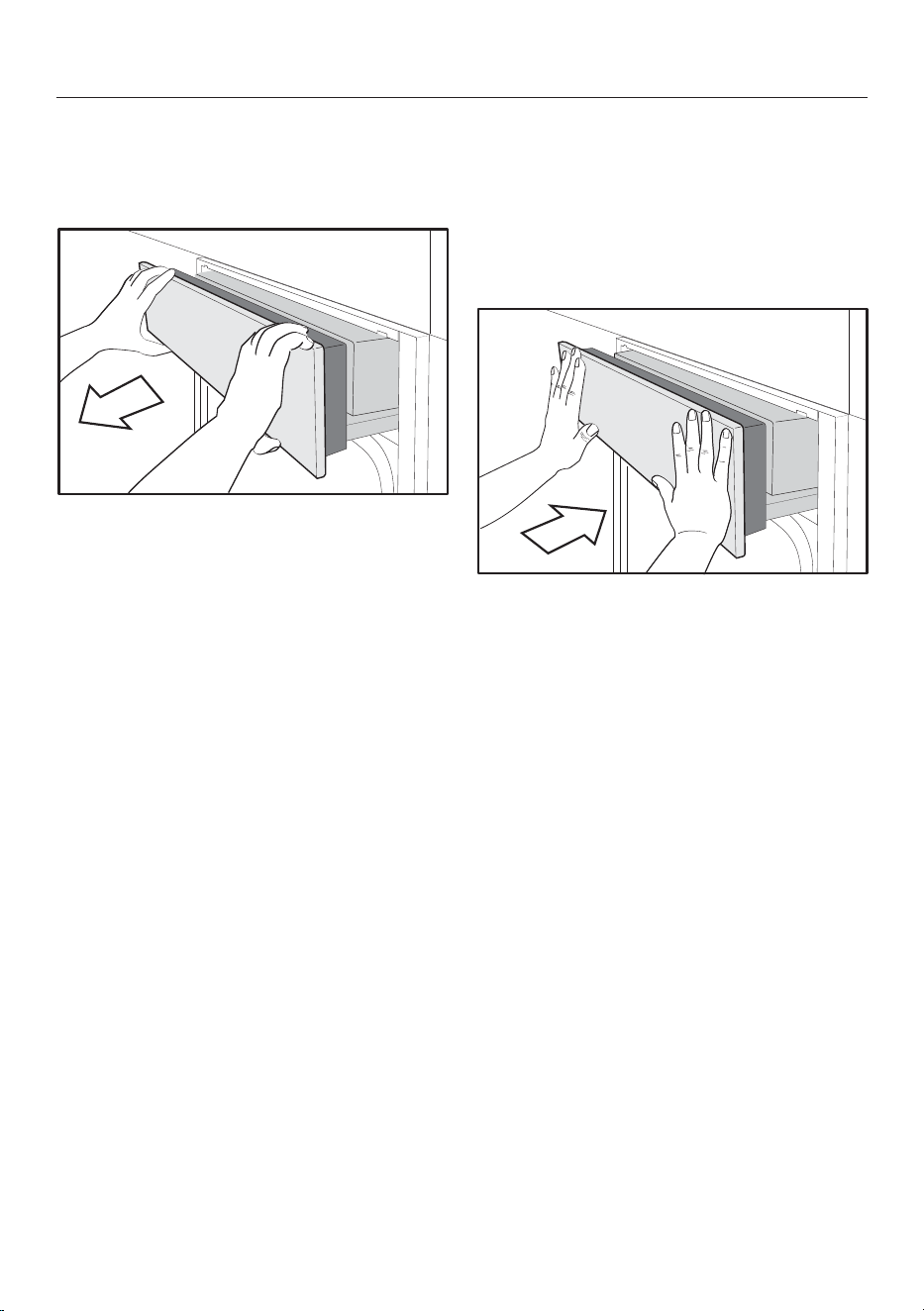
Problem solving guide
161
Opening the control panel
manually
Carefully open the door.
Take hold of the control panel at the
top and bottom.
Pull the control panel forwards and
out first.
Carefully push the control panel
upwards.
Closing the control panel
manually
Take hold of the control panel at the
top and bottom.
Carefully push the control panel
downwards.
Push the control panel in.
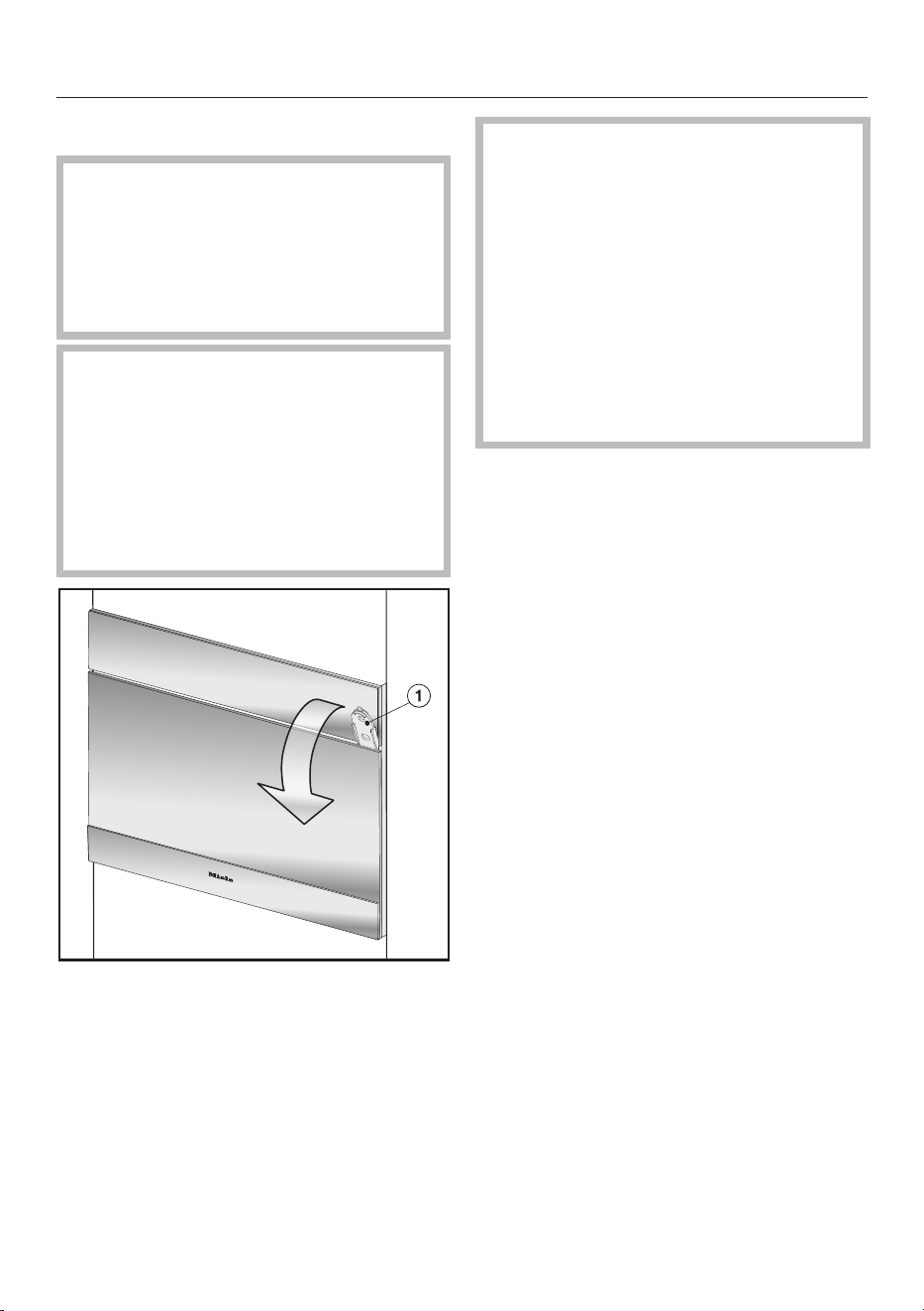
Problem solving guide
162
Opening the door manually
Risk of injury caused by hot
surfaces.
The door glass may be hot. You can
burn yourself on the door glass.
Wear oven gloves when opening the
hot door.
Risk of injury caused by steam.
When using a cooking programme
involving steam, a lot of steam can
escape if the door is opened. The
steam can cause burns.
Step back and wait until the steam
has dissipated before taking the food
out of the oven.
Insert the opener included with the
appliance about 3cm into the gap
between the door and the control
panel on the right-hand side and then
pull the door open.
Risk of injury caused by hot
surfaces and food.
The steam combination oven gets
hot during operation. You could burn
yourself on the heating elements,
oven compartment, shelf runners,
accessories, food or door glass.
Wear oven gloves when taking hot
food out of the oven, when adjusting
oven shelves etc. in a hot oven
compartment and when closing the
hot door.

Optional accessories
163
Miele offers a range of useful
accessories, as well as cleaning and
conditioning products for your
appliance.
These products can be ordered from the
Miele online shop.
They can also be ordered directly from
Miele (see end of this booklet for
contact details).
Cooking containers
Miele offers a wide range of cooking
containers. These have all been
optimised in terms of functionality and
dimensions for Miele appliances.
Detailed information on each of our
products can be found on the Miele
website.
- Perforated cooking containers in
various sizes
- Solid cooking containers in various
sizes
- Gourmet oven dishes in various sizes
- Lids for Gourmet oven dishes
Other
- Baking trays
- Round baking tray
- FlexiClip telescopic runners HFC71
- Container rack for cooking containers
with a width of 325mm
Cleaning and care products
- HydroCleaner
Special cleaner for cleaning the oven
compartment with the HydroClean
maintenance programme. Particularly
suitable for removing heavy, stubborn
soiling.
- DGClean
Special cleaning agent for manually
removing stubborn soiling from the
oven compartment, particularly after
roasting
- Descaling tablets (6)
- All purpose microfibre cloth
for removing finger marks and light
soiling

Service
164
You can find information on how to
remedy faults yourself and about Miele
spare parts at www.miele.com.au/
service or www.miele.co.nz/service.
Contact in case of fault
In the event of any faults which you
cannot remedy yourself, please contact
Miele.
You can book a Miele customer service
call-out online at www.miele.com.au/
service or www.miele.co.nz/service.
Contact information for Miele can be
found at the end of this booklet.
Please quote the model and serial
number of your appliance when
contacting Miele. This information can
be found on the data plate.
When the appliance is installed, the
model identifier and the serial number
can be found on the small plate at the
top on the opened control panel.
Warranty
The manufacturer's warranty for this
appliance is 2years.
For further information, please refer to
your warranty booklet.

Installation
*INSTALLATION*
165
Safety instructions for installation
Risk of damage from incorrect installation.
Incorrect installation can cause damage to the steam combination
oven.
The steam combination oven must only be installed by a qualified
person.
The connection data (voltage and frequency) on the data plate of
the steam combination oven must match the mains electricity supply
in order to avoid the risk of damage to the steam combination oven.
Compare this data before connecting the appliance. If in any doubt,
consult a qualified electrician.
Multi-socket adapters and extension leads do not guarantee the
required safety of the appliance (e.g. danger of overheating). Do not
use these to connect the steam combination oven to the mains
electrical supply.
The socket and on-off switch should be easily accessible after the
steam combination oven has been installed.
The steam combination oven must be positioned so that you can
see the contents of a cooking container placed on the top shelf level.
Otherwise there is a risk of injuries or spillages of hot food.
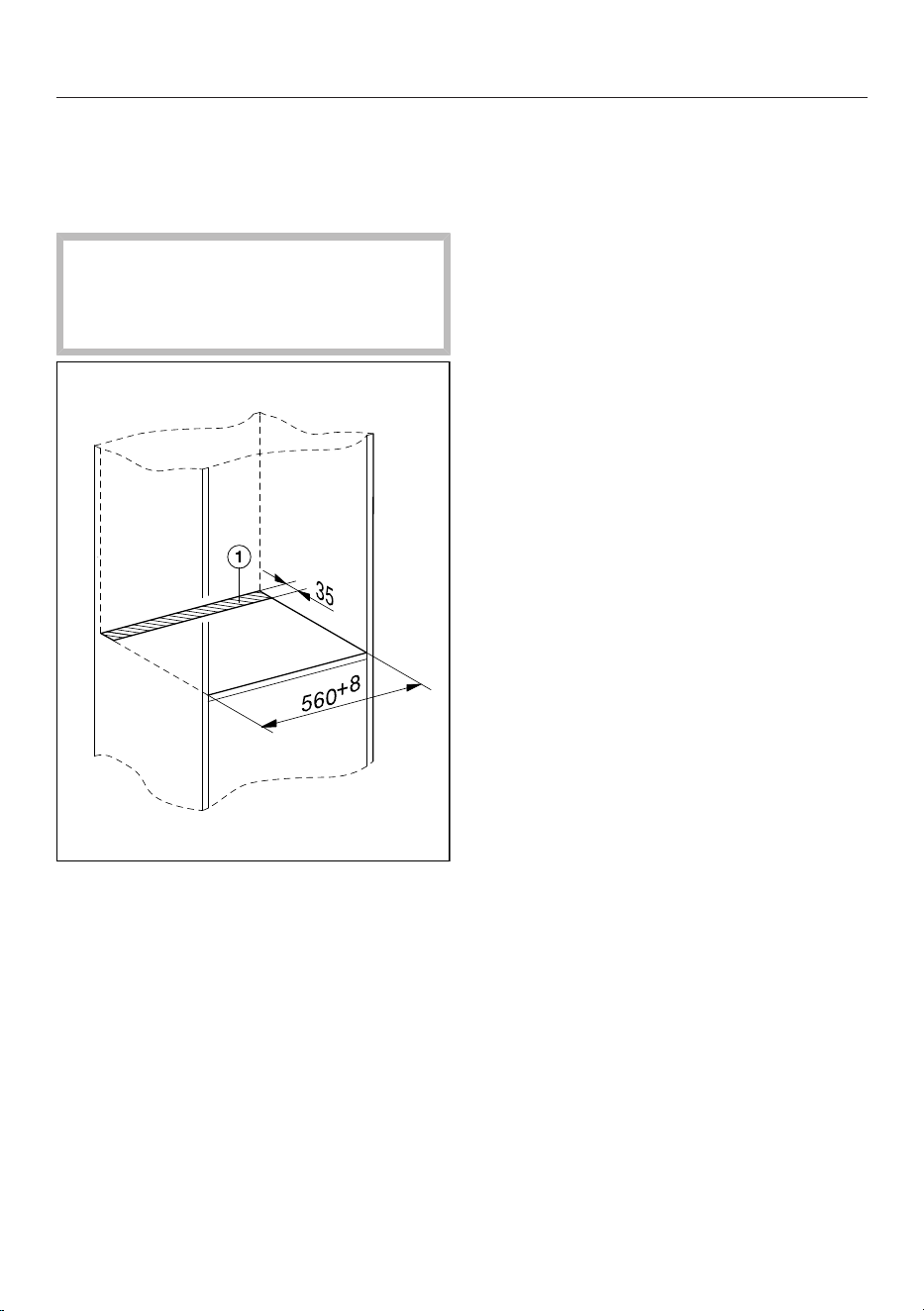
Installation
*INSTALLATION*
166
Installation notes
All dimensions are given in mm.
Cut-out for installing the water hoses
In order to prevent water damage
due to damaged connection hoses, a
cut-out must be made in the interim
shelf of the housing unit.
Create a cut-out in the
intermediate shelf where the steam
combination oven is to be placed.
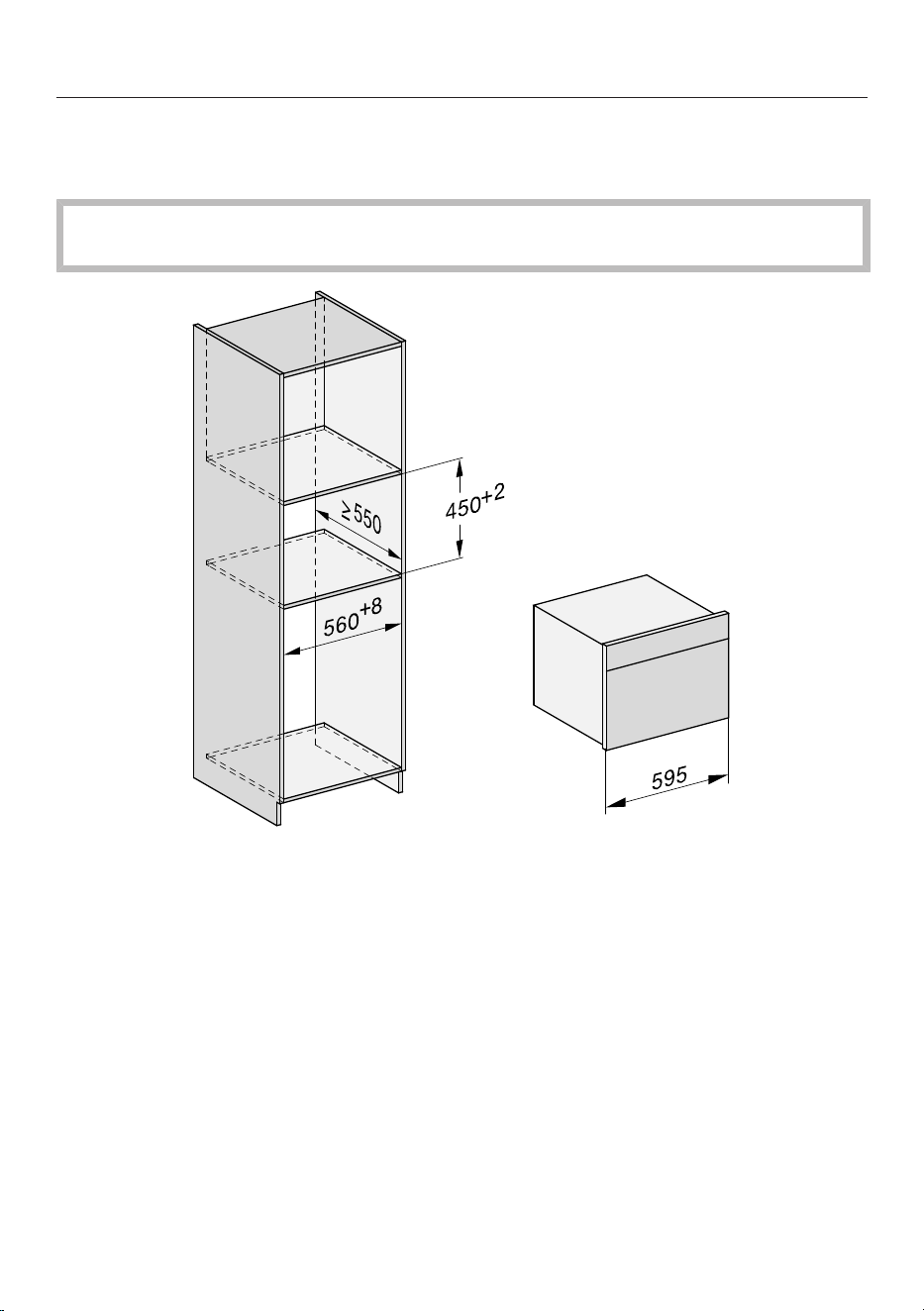
Installation
*INSTALLATION*
167
Installation dimensions
Installation in a tall unit
The furniture housing unit must not have a back panel fitted behind the building-
in niche.
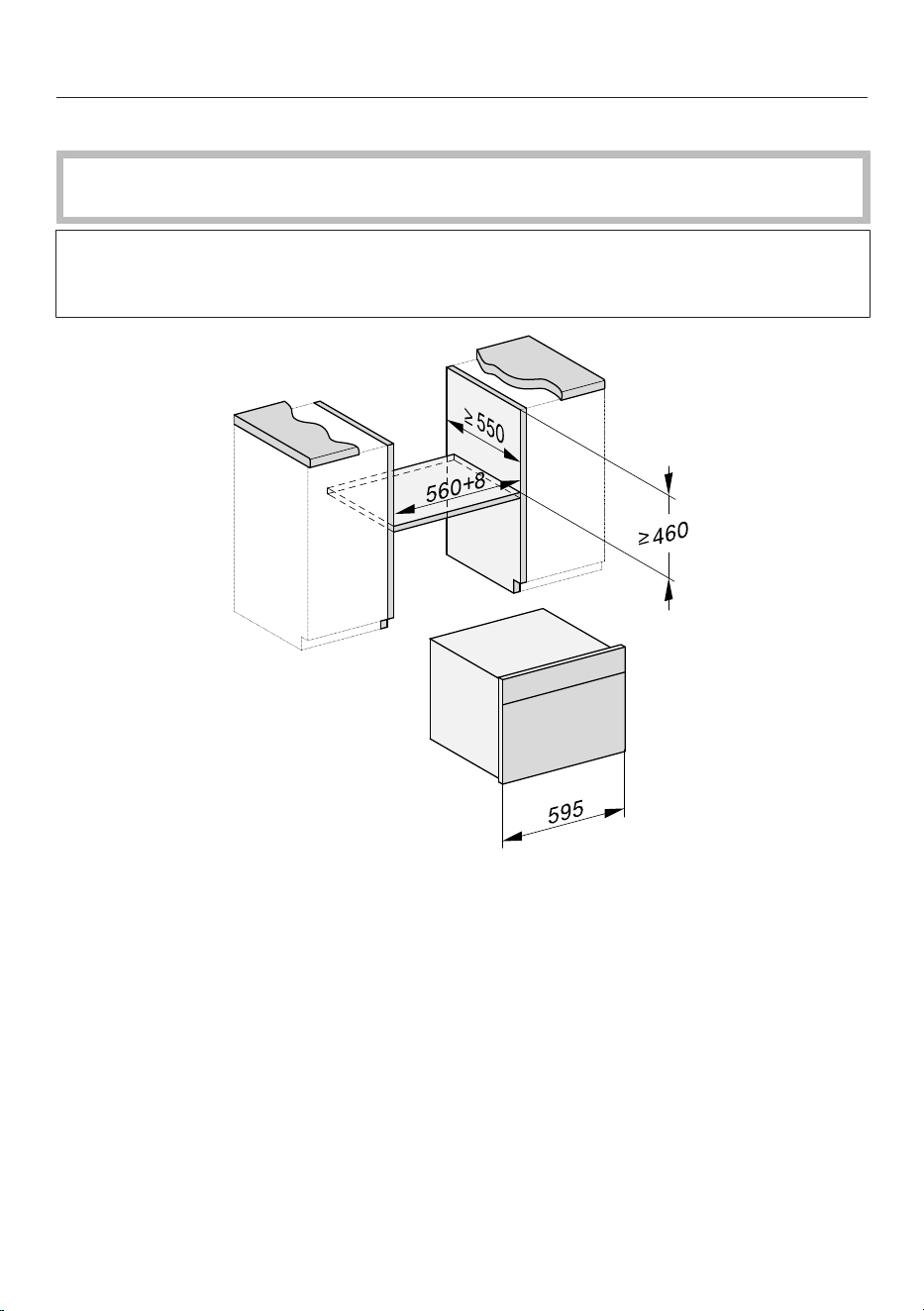
Installation
*INSTALLATION*
168
Installation in a base unit
The furniture housing unit must not have a back panel fitted behind the building-
in niche.
When building the oven into a base unit underneath a cooktop, please also
observe the installation instructions for the cooktop as well as the building-in
height required for the cooktop.
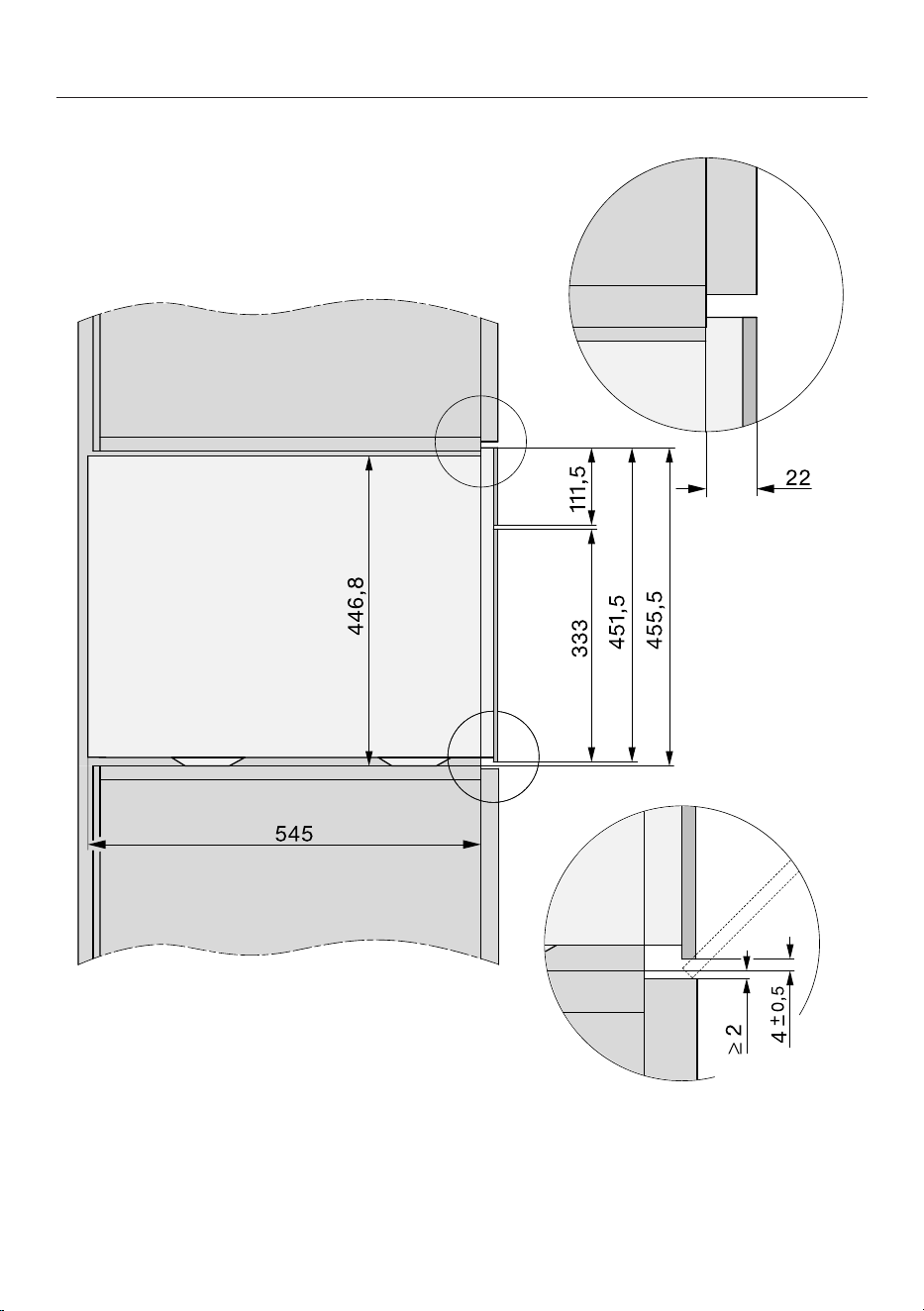
Installation
*INSTALLATION*
169
Side view
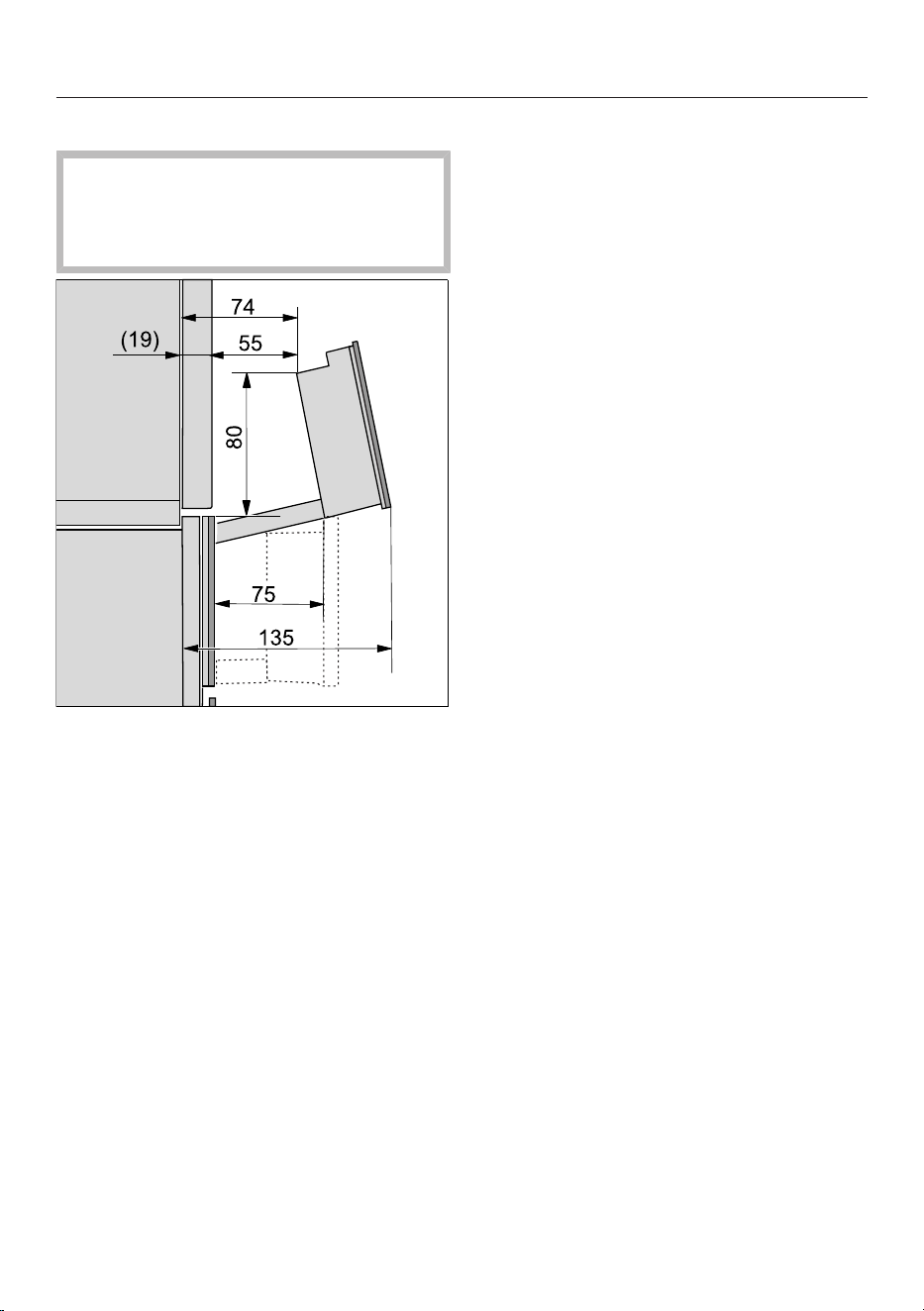
Installation
*INSTALLATION*
170
Opening range for the control panel
The area in front of the control panel
must not be blocked by anything
(such as a door handle) that would
hinder it from opening and closing.
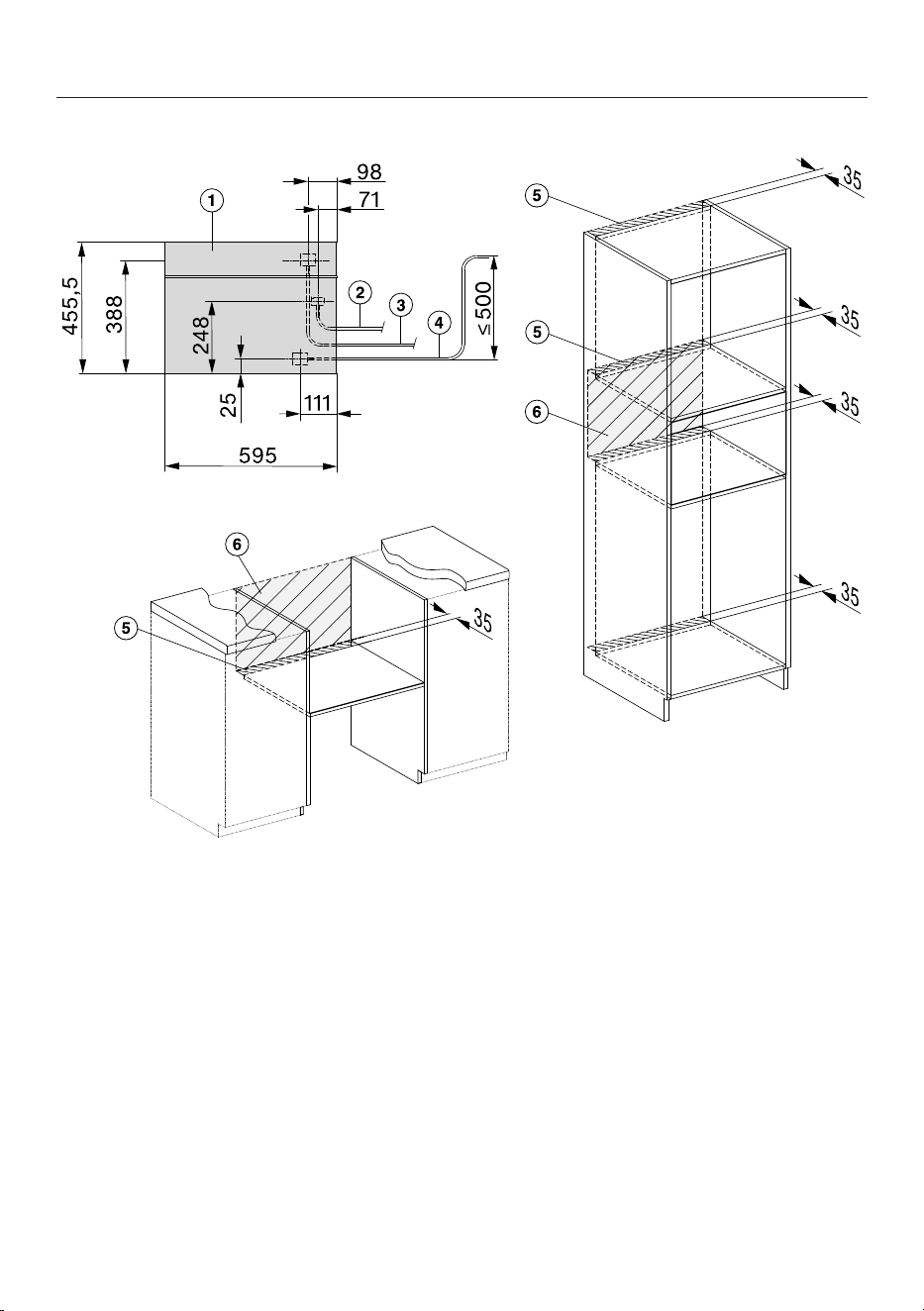
Installation
*INSTALLATION*
171
Connections and ventilation
a
Front view
b
Mains connection cable, L=2000mm
c
Stainless steel water inlet hose, L=2000mm
d
Plastic water drain hose, L=3000mm
The top end of the drain hose where it discharges to the drainage system must
not be higher than 500mm from the hose connection on the appliance.
e
Ventilation cut-out, min.180cm
2
f
No connections permitted in this area
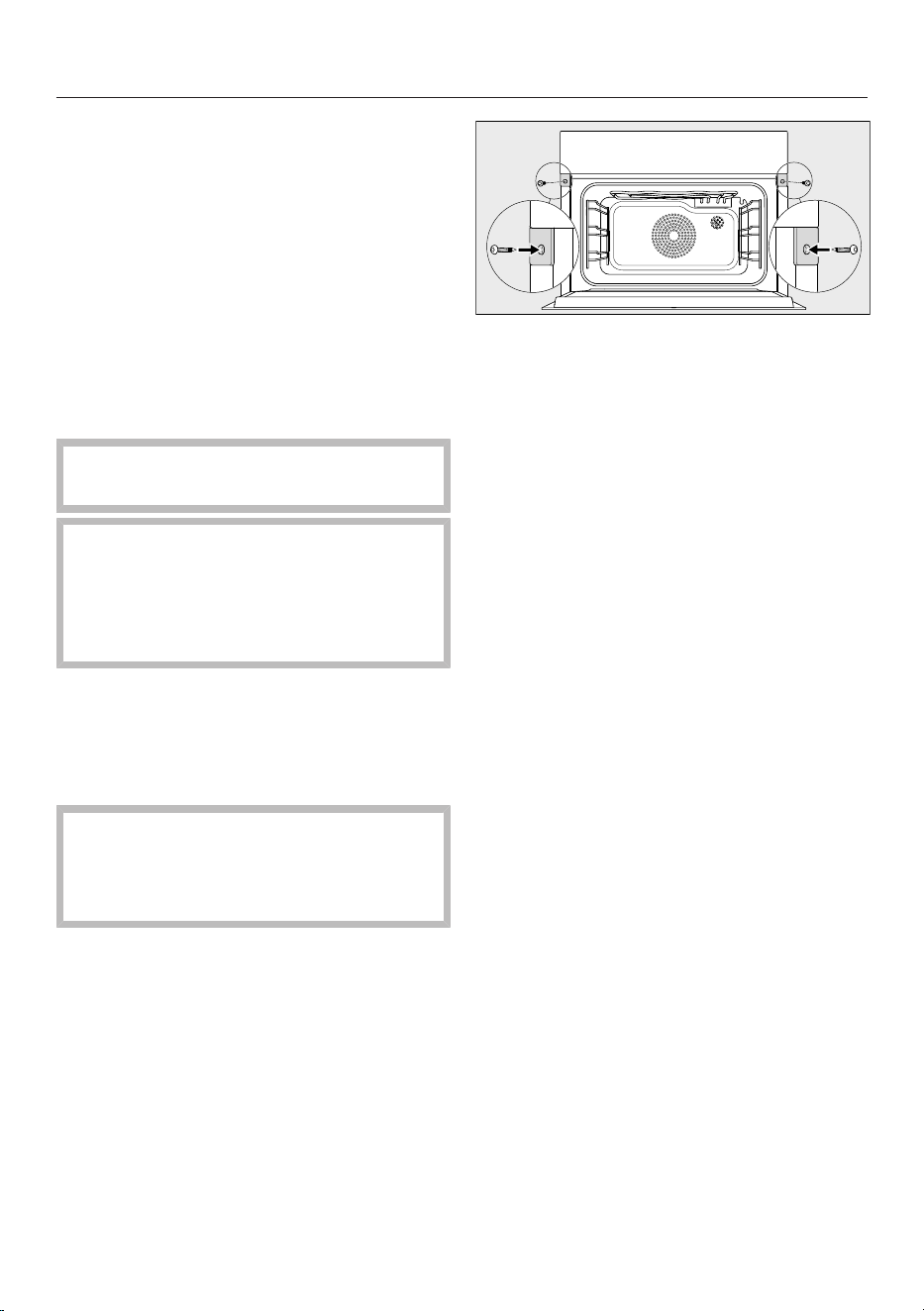
Installation
*INSTALLATION*
172
Installing the steam
combination oven
Before installing and connecting the
steam combination oven, please read
the instructions in “Installation – Mains
water connection” and “Drainage”.
Connect the mains connection cable
to the steam combination oven.
Feed the water inlet hose and the
drain hose through the cut-out in the
base of the building-in niche.
Use the handle cut-outs on the side
of the casing to lift the appliance.
The steam generator may
malfunction if the steam combination
oven is not on a level surface.
The maximum deviation from the
horizontal that can be tolerated is 2°.
Push the steam combination oven
into the installation niche and align.
When doing so, make sure that the
mains connection cable and water
hoses do not get trapped or damaged.
If the water drain hose is too long, it
must not be kinked, rolled up or
looped. It must be laid out on the
floor in the plinth area.
Open the door.
Secure the steam combination oven
to the side walls of the unit using the
wood screws supplied (3.5x25mm).
Connect the steam combination oven
to the water inlet and drainage points
(see “Installation – Mains water
connection” and “Drainage”).
Connect the steam combination oven
to the mains electricity supply.
Check the steam combination oven
for correct function in accordance
with the operating instructions.

Installation
*INSTALLATION*
173
Mains water connection
Risk of injury and damage due to
incorrect connection.
Failing to connect the appliance
correctly can result in personal injury
and/or material damage.
The appliance may only be
connected to the water supply by a
suitably qualified technician.
Danger to health and property
due to contaminated water.
The quality of the incoming water
must conform to the requirements
for drinking water in the country
where the steam combination oven is
being used.
Connect the steam combination
oven to the drinking water supply.
Connection to the water supply must
comply with the applicable
regulations in the country where the
appliance is being installed. All units
and systems used to supply water to
the steam combination oven must
also comply with the applicable
regulations in the respective country.
This appliance must be installed
according to AS/NZS 3500.1. Back flow
prevention is already integrated in the
appliance.
The steam combination oven complies
with local and national regulations.
The steam combination oven may
only be connected to a cold water
supply.
If you are using an on-site system to
fully demineralise the water (e.g. a
reverse osmosis system), make sure
that the electrical conductivity of the
water does not drop below 100µS/
cm.
Water damage due to
contamination.
Contamination in the water supply
may accumulate in the valve of the
steam combination oven. The valve
can no longer close and water is
streaming out.
Flush the water lines before
connecting the steam combination
oven or when working on the water
supply line.
The water connection pressure needs to
be between 100kPa (1bar) and
600kPa (6bar). If the pressure is
higher than 600kPa, a pressure
reducing valve must be installed.
A tap must be provided between the
stainless steel hose and the household
water supply to ensure that the water
supply can be cut off if necessary. The
tap must be easily accessible after the
steam combination oven has been built
in.
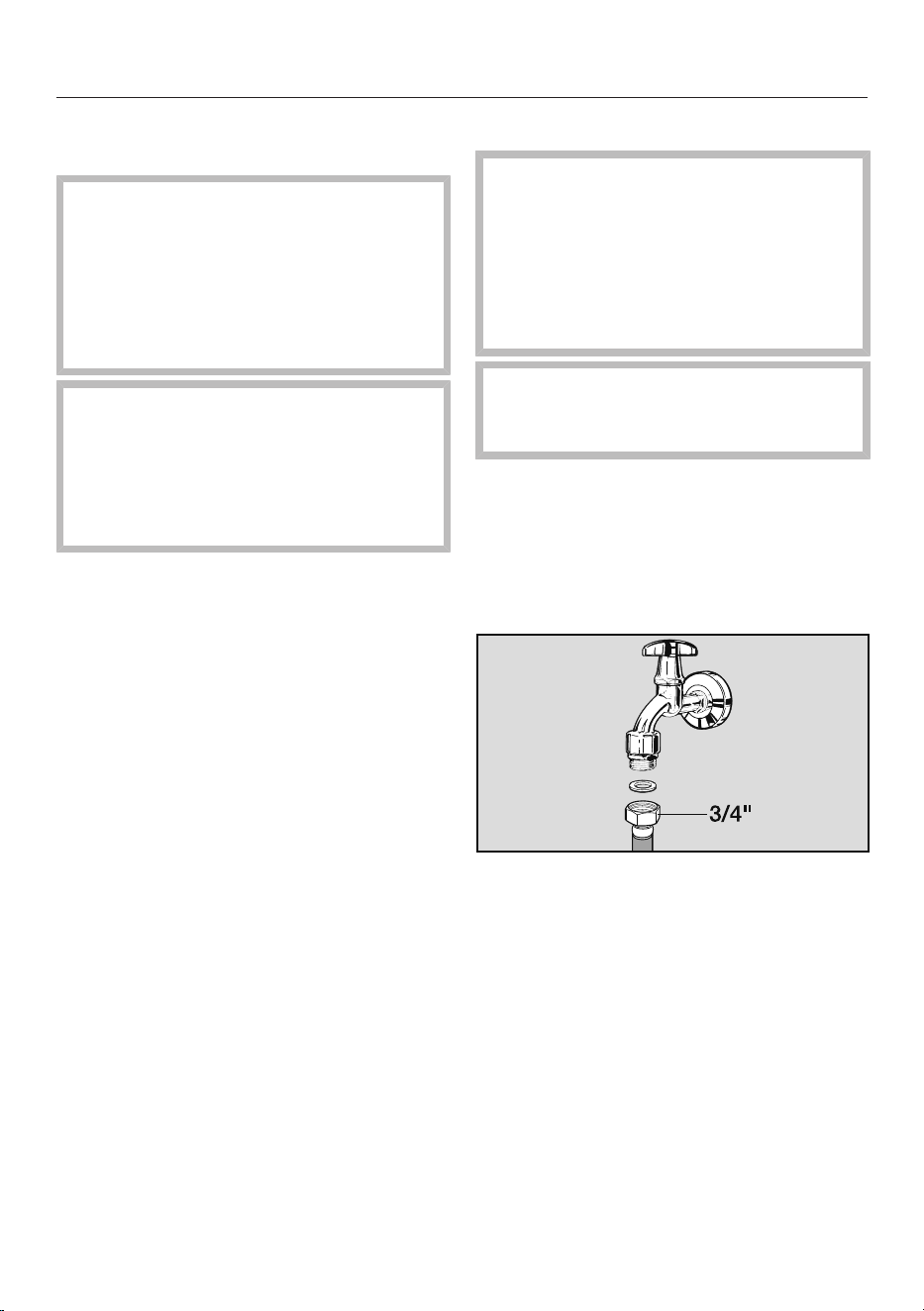
Installation
*INSTALLATION*
174
Attaching the stainless steel hose to
the steam combination oven
Only use the stainless steel hose
supplied. The stainless steel hose
must not be shortened, extended or
replaced by another hose.
Old or previously used hoses must
not be connected to the steam
combination oven.
The stainless steel hose must only be
replaced by an original Miele spare
part. A stainless steel hose which is
suitable for use with drinking water is
available to order from Miele (see
back cover for contact details).
The stainless steel hose included is
2.0m long.
Remove the cover cap from the mains
water connection at the back of the
steam combination oven.
Take the angled end of the stainless
steel hose and check whether there is
a washer. If there is no washer, attach
one.
Screw the stainless steel hose
coupling onto the thread of the mains
water connection.
Ensure that it is screwed into position
correctly and watertight.
Connecting the water supply
Disconnect the steam
combination oven from the electrical
supply before connecting it to the
water supply.
Turn off the water supply before
connecting the steam combination
oven to the water supply.
The tap must be easily accessible
after the steam combination oven
has been built in.
A tap with 3/4" thread must be
incorporated when connecting the
steam combination oven to the water
supply.
Check that a washer is present. Fit
one if necessary.
Connect the stainless steel hose to
the tap.
Ensure that it is screwed into position
correctly.
Turn on the tap slowly and check for
leaks.
Correct the position of the seal and
union if necessary.

Installation
*INSTALLATION*
175
Drainage
Only use the water drain hose
included. The water drain hose must
not be shortened, extended or
replaced by a different hose.
Old or previously used hoses must
not be connected to the steam
combination oven.
The water drain hose must only be
replaced by an original Miele spare
part. You can purchase a water drain
hose from the Miele online shop, or
directly from Miele (see back cover
for contact details).
The drainage siphon must not be
located higher than the drain hose
connection point on the steam
combination oven. This is to ensure
that water can drain out completely
after a programme.
The top end of the drain hose to
where it connects to the siphon must
not be higher than 500mm.
The water drain hose supplied has a
length of 3.0m.
A water drain hose with a different
length can be obtained from Miele.
The drain hose on the steam
combination oven must be discharged
into the drainage system in accordance
with AS/NZS 3500.2.
The temperature of the drainage water
is 70°C.

Installation
*INSTALLATION*
176
Electrical connection
The steam combination oven is supplied
with a mains connection cable with
moulded plug ready for connection to a
suitable earthed socket.
The socket should be easily accessible
after the steam combination oven has
been installed. If the socket is not easily
accessible, ensure that a suitable
means of disconnection is provided on
the installation side for each pole.
Risk of fire from overheating.
Connecting the steam combination
oven to a multi-socket adapter or to
an extension cable can overload the
cables.
For safety reasons, do not use an
extension cable or multi-socket
adapter.
All electrical work must be carried out
by a suitably qualified and competent
person in strict accordance with
national and local safety regulations.
For safety reasons, we recommend
using a suitable residual current
device (RCD) in the relevant electrical
installation for connecting the steam
combination oven.
If the mains connection cable is
damaged, it must only be replaced with
a specific mains connection cable of the
same type (available from Miele). For
safety reasons, such replacement may
only be carried out by a suitably
qualified and competent electrician or a
Miele authorised service technician, in
order to avoid a hazard.
The data plate indicates the nominal
power consumption and the connection
data. Compare this information with the
data of the on-site electrical connection.
If in any doubt, consult a qualified
electrician.
Temporary or permanent operation with
a self-sufficient or non-mains
synchronous energy supply system (e.g.
isolated networks, back-up systems) is
possible. A requirement for the
operation is that the energy supply
system complies with all current local
and national requirements that apply to
stand-alone, solar and/or battery
systems.
The protective measures provided in the
domestic installation and in this Miele
product must also be assured in their
function and operation in isolated
operation or in non-mains synchronous
operation, or replaced with equivalent
measures in the installation.

Technical data
177
Copyright and licences for the communication module
For the purpose of operating and controlling the communication module, Miele
uses proprietary or third-party software that is not covered by open source
licensing terms. These items of software/software components are protected by
copyright. The copyright powers of Miele and third parties must be respected.
In addition, the communication module contains software components which are
distributed under open source licensing terms. The open source components
contained in the appliance along with the corresponding copyright notices, copies
of the licensing terms valid at the time, and any further information can be
accessed locally via IP using a web browser (http://<IP address>/Licenses), where
<IP address> is the IP address of the appliance. The liability and warranty
arrangements for the open source licences displayed in this location only apply in
relation to the respective rights holders.

Technical data
178
Copyright and licences
For the purpose of operating and controlling the appliance, Miele uses proprietary
or third-party software that is not covered by open source licensing terms. These
items of software/software components are protected by copyright. The copyright
powers of Miele and third parties must be respected.
In addition, the appliance contains software components which are distributed
under open source licensing terms. You can access these open source components
along with the associated copyright notices, copies of the valid licensing terms and
any further information in the appliance under Settings| Legal information| Open
source licences. The liability and warranty arrangements for the open source licences
displayed at this location only apply in relation to the respective rights holders.
The appliance contains, in particular, software components which are licensed by
the rights holders under the GNU General Public License, version2, or the GNU
Lesser General Public License, version2.1. For a period of at least 3years following
the purchase or delivery of the appliance, Miele shall provide you or third parties
with a machine-readable copy of the source code for the open source components
contained in the appliance, which are licensed under the terms of the GNU General
Public License, version2, or the GNU Lesser General Public License, version2.1.
The source code shall be made available on a data carrier (CD-ROM, DVD or USB
stick). To obtain this source code, please contact us, specifying the product name,
serial number and purchase date, by sending us an e-mail ([email protected]) or
writing to the following address:
Miele & Cie. KG
Open Source
GTZ/TIM
Carl-Miele-Straße 29
33332 Gütersloh, Germany
We wish to draw your attention to the limited warranty for the benefit of rights
owners under the terms of the GNU General Public License, version2, and the
GNU Lesser General Public License, version2.1:
This program is distributed in the hope that it will be useful, but WITHOUT ANY
WARRANTY, without even the implied warranty of MERCHANTABILITY of
FITNESS FOR A PARTICULAR PURPOSE. See the GNU General Public License
and GNU Lesser General Public License for more details.

Miele Australia Pty. Ltd.
Miele New Zealand Limited
Miele Global Headquarters
Germany
Miele & Cie. KG
Carl-Miele-Straße 29
33332 Gütersloh
Federal Republic of Germany
IRD 98 463 631
8 College Hill
Freemans Bay, Auckland 1011
ACN 005 635 398
ABN 96 005 635 398
Level 4, 141 Camberwell Road
Hawthorn East, VIC 3123
0800 464 353 (0800 4 MIELE)
www.miele.co.nz
1300 464 353 (1300 4 MIELE)
www.miele.com.au

M.-Nr. 12 200 950 / 03en-AU, NZ
DGC7845HCXPro