Location Requirements ..........................................................................7
Water Supply Requirements ................................................................7
Filter System ..............................................................................................9
Smart Wash System ................................................................................9
Adjustable Upper Rack ........................................................................10
How your Dishwasher Cleans ............................................................. 11
Before Using Your Dishwasher ........................................................... 11
Using Your New Dishwasher ............................................................... 11
Cycle and Option Charts ...................................................................... 15
Loading Suggestions ............................................................................. 16
Upper Rack ...............................................................................................17
Load Upper Rack .................................................................................... 18
Lower Rack ............................................................................................... 19
Loading Silverware ................................................................................ 21
Recommended Load Patterns ........................................................... 22
for choosing SPT dishwasher. Please read this user
manual carefully before use and save it for future reference.
24
Proper Use of Rinse Aid .....................................................................
Washing Special Items ........................................................................27
Storing .......................................................................................................30
31
Error Codes .............................................................................................. 36
37
YOUR SAFETY AND THE SAFETY OF OTHERS ARE VERY
IMPORTANT
To prevent injury to the user or other people and property damage, the
instructions shown here must be followed. Incorrect operation due to
ignoring of instructions may cause harm or damage, including death.
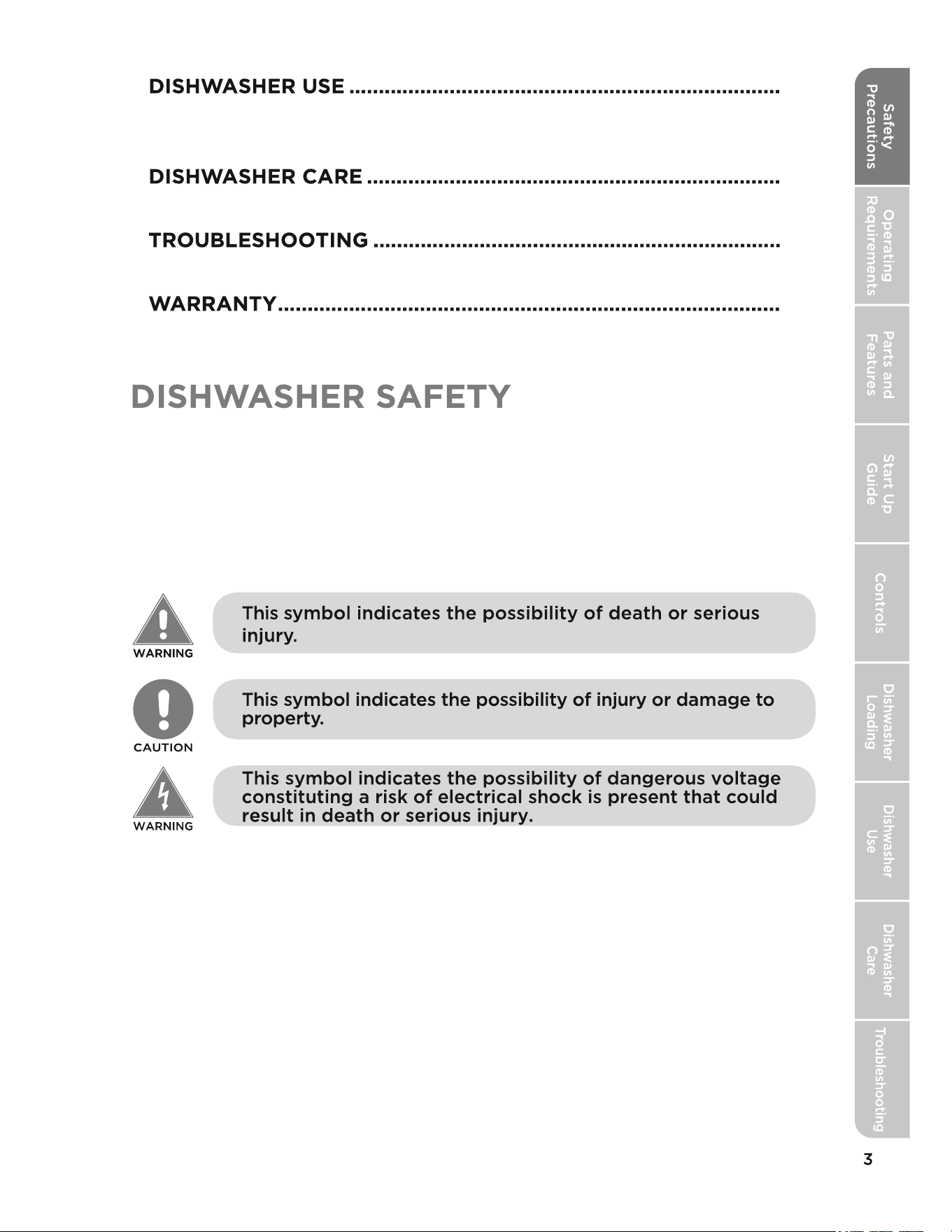
The level of risk is shown by the following indications.
28
25
This appliance must be grounded. In the event of a malfunction or
breakdown, grounding will reduce the risk of electric shock by providing
a path of least resistance for electric current. If this appliance is equipped
with a cord having an equipment-grounding conductor and a grounding
plug, the plug must be plugged into an appropriate outlet that is installed
and grounded in accordance with all local codes and ordinances.
This appliance must be connected to a grounded metal, permanent wiring
system, or an equipment-grounding conductor must be run with the
circuit conductors and connected to the equipment-grounding terminal or
lead on the appliance.
IMPORTANT SAFETY INSTRUCTIONS
When using your dishwasher, follow basic precautions, including the
following:
Read all instructions before using the dishwasher.
Use the dishwasher only for its intended function.
Use only detergents or rinse/wetting agents recommended for use in
a dishwasher and keep them out of the reach of children.
When loading items to be washed:
Locate sharp items so that they are not likely to damage the door
seal.
Load sharp knives with the handles up to reduce the risk of cut-
type injuries.
Do not wash plastic items unless they are marked “Dishwasher
Safe” or the equivalent. For plastic items not so marked, check the
manufacturer’s recommendations.
Items that are not dishwasher safe may melt and create a potential
re hazard.
Do not touch the heating element during or immediately after use.
Do not operate your dishwasher unless all enclosure panels are
properly in place.
Do not tamper with controls.
Do not abuse, sit on, or stand on the dishwasher door, or dish racks.
To reduce the risk of injury, do not allow children to play in or on a
dishwasher.
Under certain conditions, hydrogen gas may be produced in a
hot-water system that has not been used for two weeks or more.
HYDROGEN GAS IS EXPLOSIVE. If the hot-water system has not
been used for such a period, before using the dishwasher turn on
all hot-water faucets and let the wat ow from each for several
minutes. This will release any accumulated hydrogen gas. As the gas
e, do not smok e.
Severe product damage and/or injury could result from the use of
ce technicians or non-original replacement parts.
All repairs must be performed b ce technician using
only original equipment factory replacement parts.
Do not store or use combustible materials, gasoline or other
vapors and liquids in the vicinity of this or any other
appliance.
Keep young children and infants away from dishwasher when it is
operating.
Do not use the dishwasher if it has a damaged power line or plug,
and do not plug the dishwasher into a damaged outlet. Failure to
observe these instructions may result in electrical shock.
This manual does not cover every possible condition or situation that
may occur.
Remove the door to the washing compartment when removing an
old dishwasher from service or discarding it.
SAVE THESE INSTRUCTIONS
Do not use dishwasher until completely installed.
Do not push down on open door.
Doing so can result in serious injury or cuts.
Cancer and Reproductive Harm
-www.P65Warnings.ca.gov.
Before you throw away your old appliance, remove the door or lid so
that children cannot hide or get trapped inside your old appliance.
Failure to follow these instructions can result in death or brain
damage.
Never use harsh chemicals to clean your dishwasher. Some chloride-
containing products can damage your dishwasher and may present
health hazards!
Never use steam cleaning products to clean your dishwasher. The
manufacturer will not be responsible for the possible damages or
consequences.
To avoid possible dishwasher damage, do not use harsh chemicals,
abrasive cleaners, scouring pads (metal or plastic), or abrasive
cloths/paper towels to clean your dishwasher’s exterior door panel.
Your dishwasher’s exterior door panel can be damaged by doing so.
It is highly recommended that the user become familiar with the
procedure to shut off the incoming water supply and the procedure
to shut off the incoming power supply. See the Installation
Instructions or contact your installer for more information.
If the dishwasher drains into a food disposer, make sure disposer is
completely empty before running dishwasher.
NSF/ANSI 184 C residential dishwashers are not intended for
licensed food establishments.
Protect your dishwasher from the elements. Protect against freezing
to avoid possible damage t valve. Damage caused by
freezing is not covered by the warranty.
Not for outdoor use.
Electrically ground dishwasher.
Connect ground wire to green ground connector in terminal box.
Do not use an extension cord.
Failure to follow these instructions can result in dea re, or
electrical shock.
This dishwasher is designed for operation on an adequately wired
individual 120 V, 60 Hz, 15- or 20-amp fused electrical supply with copper
wire only. It is recommended that a time-delay fuse or circuit breaker is
used, and that a separate circuit serving only this appliance is provided. If
an outlet is used, the outlet should be placed in adjacent cabinet.
Install where dishwasher is protected from the elements. Protect
against freezing to avoid possible ruptur valve. Such ruptures
are not covered by the warranty. For winter storage information, see
“Storing” in the “Dishwasher Care” section.
Install and level dishw at will hold the weight and in
an area suitable for its size and use.
The water supply temperature should be 120°F to 150°F (49°C to
66°C).
The water supply must maintain water pressure between 20 and 80 psi
f ow.
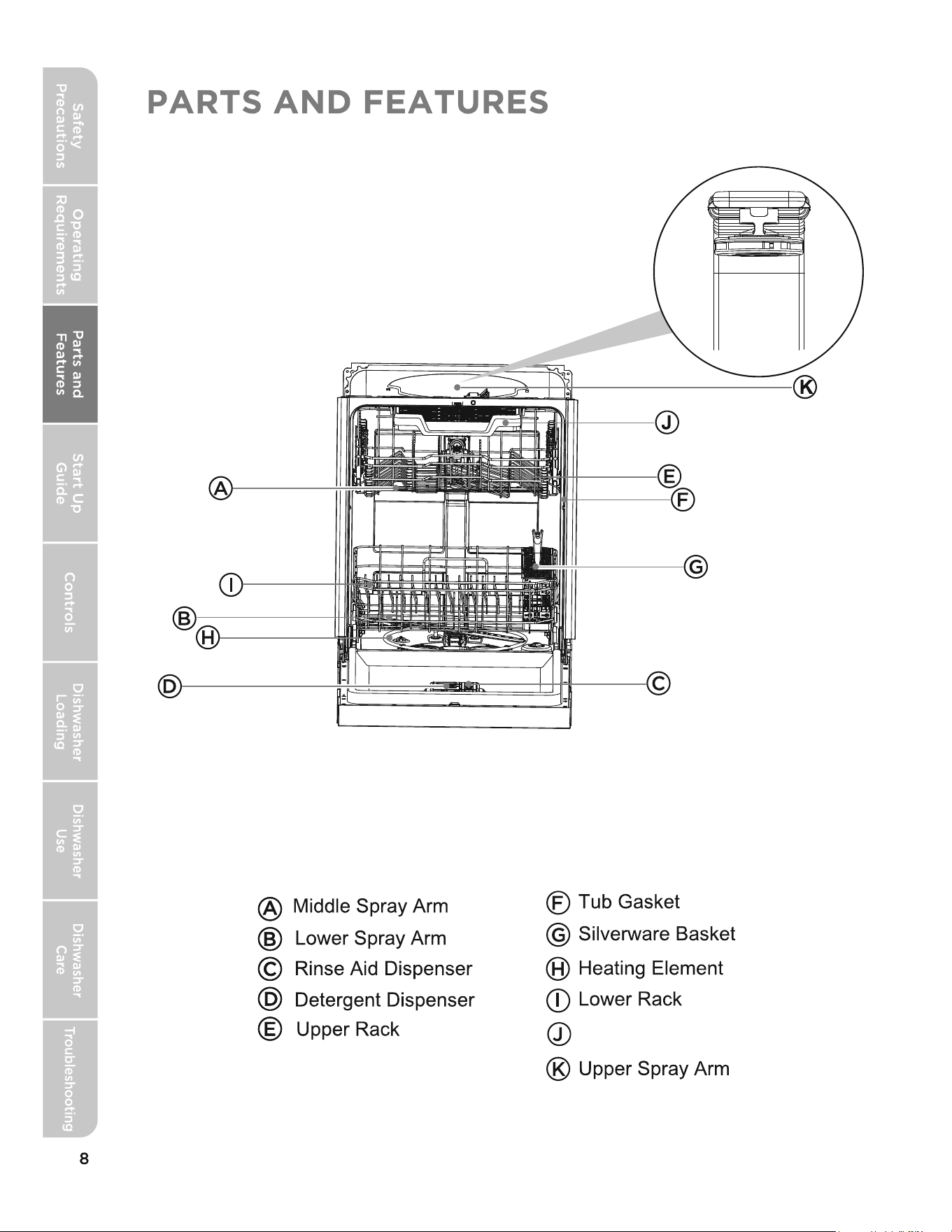
Cutlery Rack
Capacity: 12 Place Settings
Dimensions (WxDxH):
Weight Unpacked:
Power Supply: 120 volts, 60 Hz
Rated Power Usage: Wash motor 0 W Heater 840 W
Water Feed Pressure: 20 - 80 psi (138 - 552 kP )
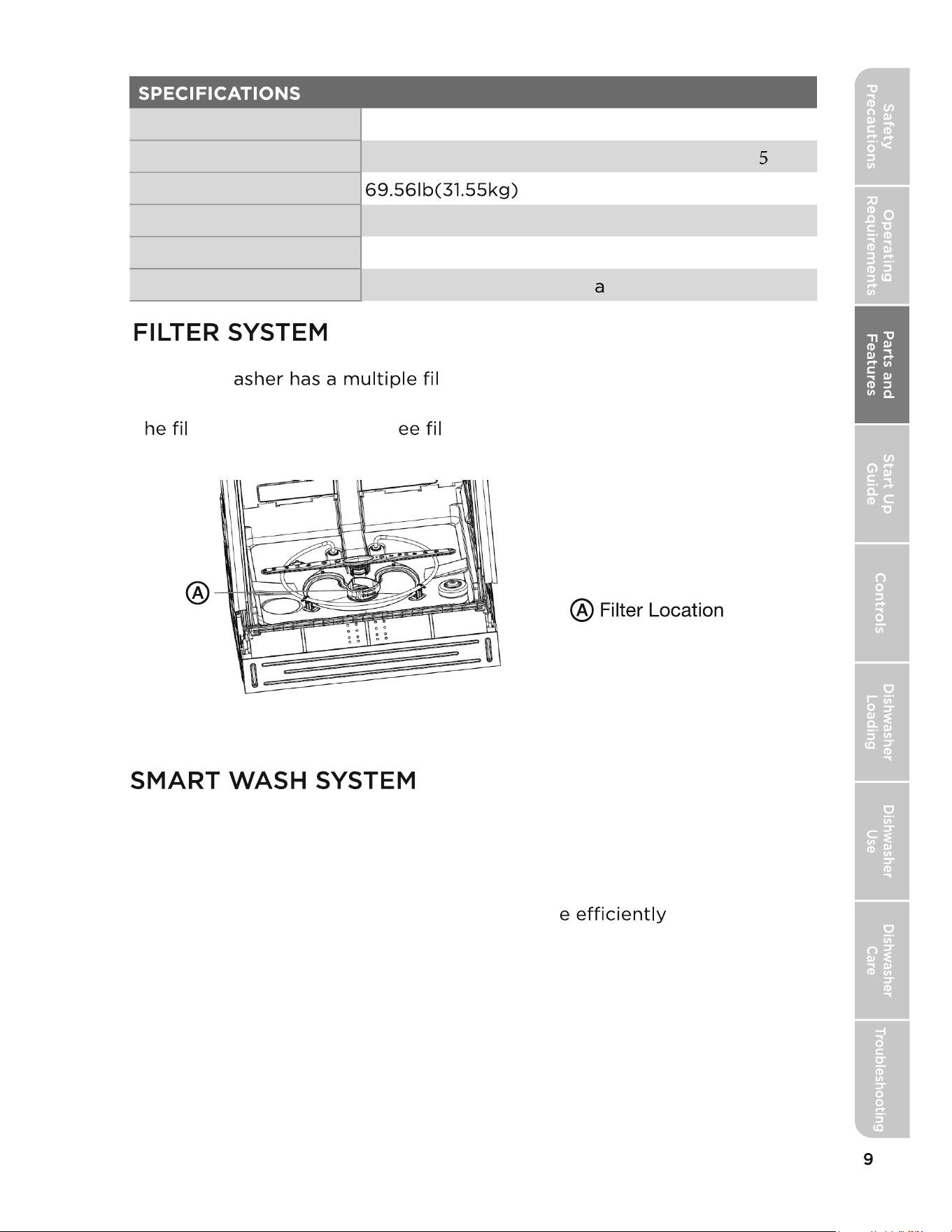
Your dishw ter system, which helps your dishwasher
perform better using less water and less energy.
T ter system includes thr ters that work in combination to
separate dirty and clean water into different chambers.
Your dishwasher has a Smart Wash system which can be used by selecting
the Auto cycle.
The Smart Wash system senses the soil level of the load and adjusts the
wash cycle accordingly. Your dishwasher can determine the type of cycle
required to clean the dishes and will clean mor every time.
23 3/5" x 22 7/10" x 33 3/4" (600x576x85 mm)
7 max
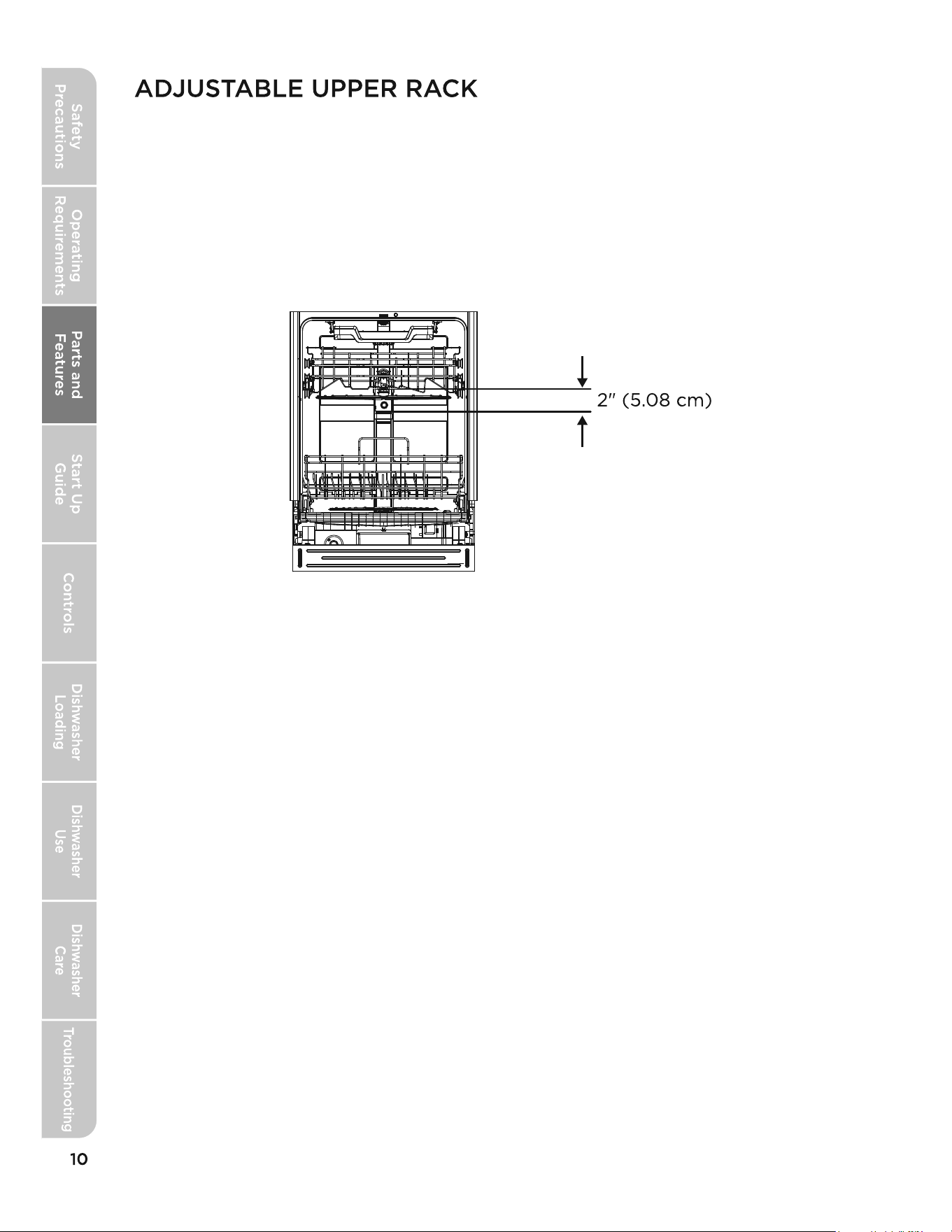
The Adjustable Upper Rack feature allows you to load taller items in either
the upper or lower rack.
The upper rack of your dishwasher can be adjusted 2" (5.08 cm).
Adjusting the clearance of the Upper Rack increases or decreases the
clearance of the lower rack, as shown.
For instructions, see the “Adjustable Upper Rack” section.
Properly dispose of/recycle all packing material.
Read this entire User Manual. Y fety information
and useful operating tips.
Your dishwasher cleans by spraying a mixture of hot water and detergent
through the spray arms against soiled surfaces.
The dishw water cov ter area. Water is then
pumped thr ters and spray arms. Soil particles are
separated from the water and go down the drain as the water is pumped
out and replaced with clean water.
The number of wat vary depending on the cycle selected.
ters for debris that may have been introduced from the
packaging or during installation. See the “Clean Filters” section.
Add Rinse Aid. See “Proper Use of Rinse Aid.”
To decrease cycle time and possibly improve performance, turn on
the hot water faucet nearest to the dishwasher until the water runs hot.
Turn off the water.
Load dishwasher. See “Dishwasher Loading.”
Add detergent. See “Proper Use of Detergent.”
Close the door firmly to latch.
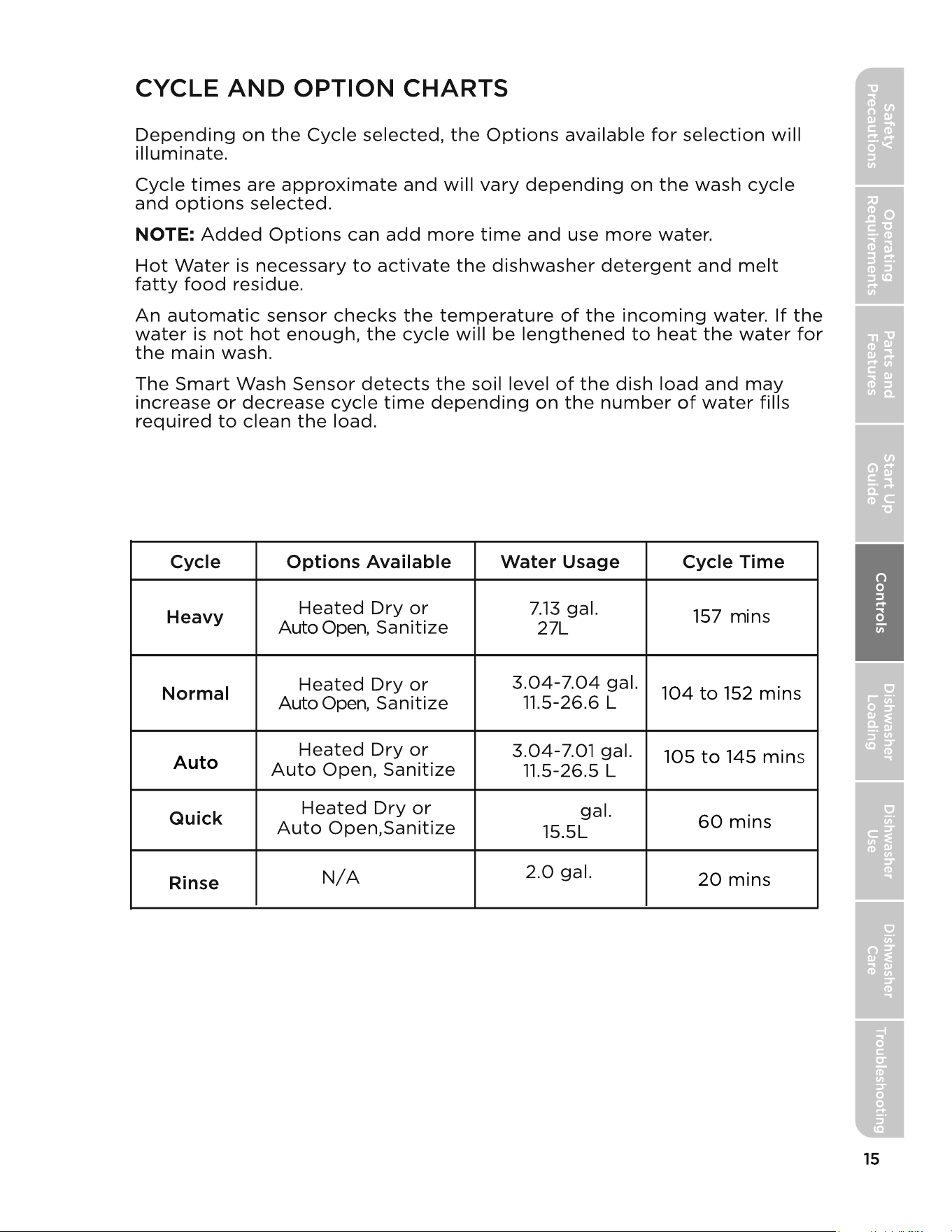
Select desired CYCLE and OPTIONS. See “Cycle and Option Charts.”
Only the Options available for the Cycle selected will illuminate.
The controls of the selected Cycle and Options will glow to indicate
they are selected.
Press START.
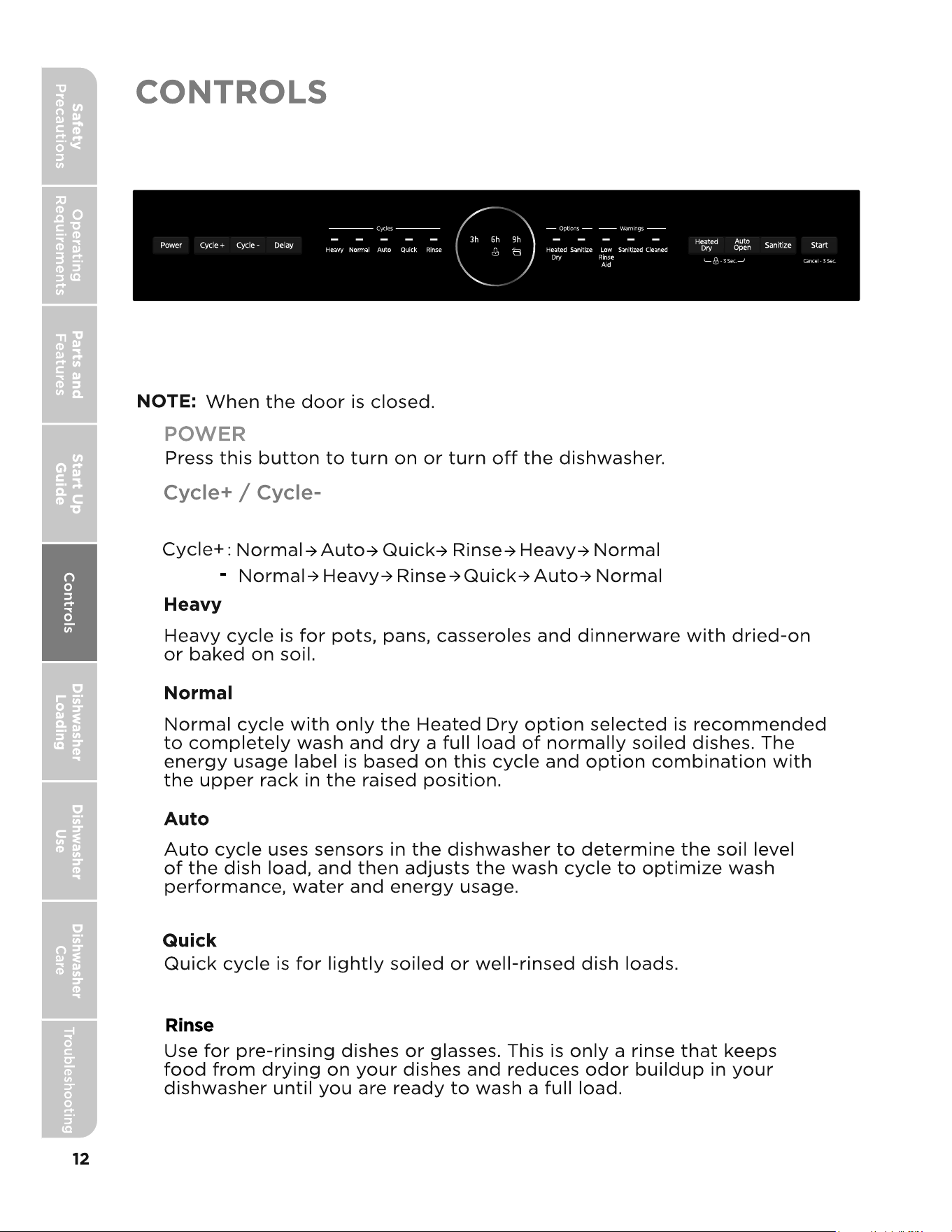
Press this button to select corresponding washing program code.
Cycle :
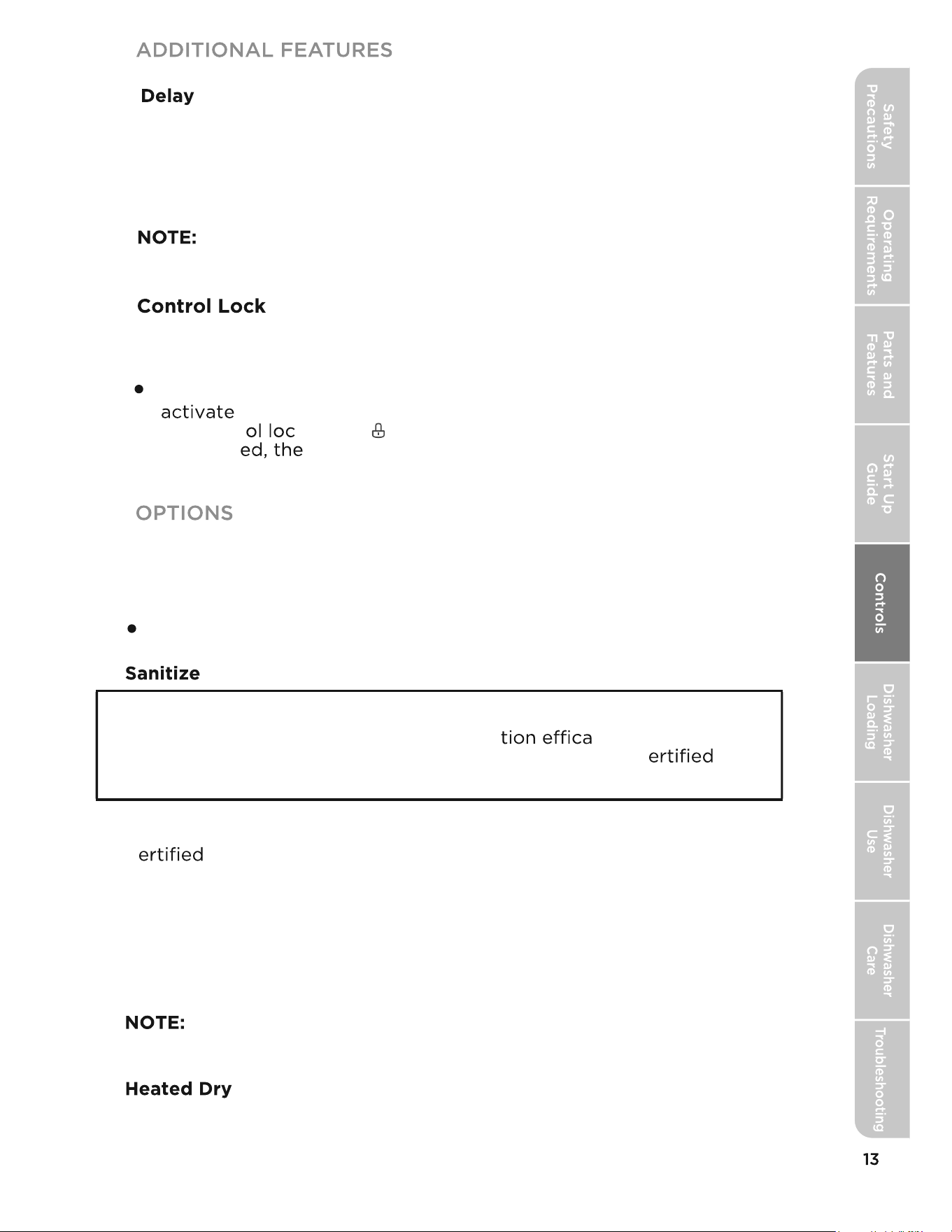
Options enhance the wash cycle. Some Options are available with only
certain Wash Cycles. Refer to the “Cycle and Options Charts” to see
which Options are available for the wash cycle you selected.
Press the desired Option control(s). The Option control(s)
illuminates to indicate which option(s) have been selected.
WARNING: Only sanitizing cycles have been designed to meet the
requirements for soil removal and sanitiza cy. There is no
intention, either directly or indirectly, that all cycles on a c
machine have passed the sanitization performance test.
The sanitize option sanitizes dishes and glassware in accordance with
NSF International NSF/ANSI Standard 184 for Residential Dishwashers.
C residential dishwashers are not intended for use in licensed
food establishments.
When the Sanitize option is selected, the water temperature will reach
156.2°F (69°C) maximum.
The Sanitize Control illuminates to indicate when the Wash cycle with
the Sanitize option is completed. The light will turn off after the door
has been opened for 30 seconds.
It is possible that the water will not reach 156°F (69°C) in the
Sanitize mode, if the temperature of the incoming hot water does not
meet the minimum requirement of 120°F (49°C).
When the Heated Dry option is selected, the heater will work during
the drying process.
Press and hold Heated Dry and Auto Open for 3 seconds open to either
or cancel the Control Lock
option.
After the function is selected
the contr k icon ' ' in the screen will illuminate. If the the function
is cancel control lock icon will turn off.
The Delay Time feature allows you to program the dishwasher to
begin the selected wash cycle 3, 6 or 9 hours later.
Press the DELAY control repeatedly to toggle between ( 3h/6h/9h ).
The LED next to the selected time will illuminate.
To cancel the Delay feature, press and hold the START control
for 3 seconds to Cancel. To begin the wash cycle immediately, press
START again.
Use to lock all controls to prevent children from accidently changing the
dishwasher cycle or starting the dishwasher.
Open the door slightly and wait a few seconds until the wash
action stops.
Open the door to add or remove items.
Close the door and then Press START to resume the wash cycle.
The cycle will begin. - Close the door and press Start.
- To cancel a cycle when the dishwasher is running, press
and hold Start for 3 seconds.
turn off.
To pause the wash cycle to add or remove items, please
follow the steps below. Doing this will help keep you from
being splashed with hot water.
7.6 L
4.09
Empty liquids from glasses and cups.
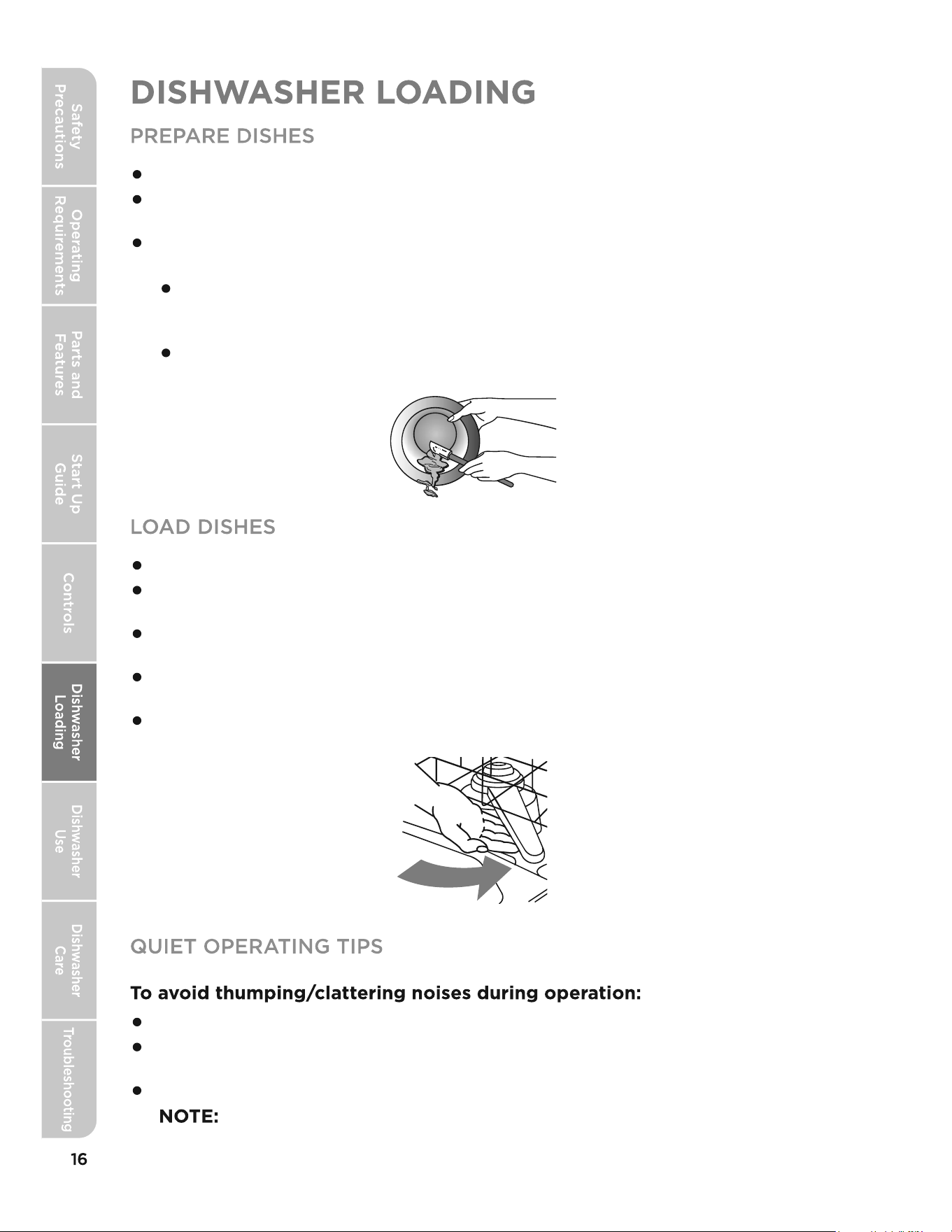
Remove leftover food, bones, toothpicks and other hard items from the
dishes and discard.
It is not necessary to hand-rinse dishes before loading them into the
dishwasher with the following exceptions:
Foods such as mayonnaise, mustard, vinegar, lemon juice and
tomato-based products may discolor stainless steel and plastics if
allowed to remain on them for any length of time.
Burned-on foods should be loosened before loading the cookware
into the dishwasher.
It is IMPORTANT for the water spray to reach all soiled surfaces.
Load dishes so they are not stacked or overlapping if possible. For best
drying results, water must be able to drain from all surfaces.
Load heavy pots and pans carefully. Heavy items can dent the stainless
steel interior of the door if they are dropped or bumped.
Make sure pot lids and handles, pizza pans, cookie sheets, etc., do not
interfere with the spray arm rotation.
Make sure both the upper and lower spray arms are not blocked and
move freely.
Make sure lightweight items are secured in the racks.
Make sure pot lids and handles, pizza pans, cookie sheets, etc., do not
touch interior walls or interfere with the rotation of the spray arm.
Load dishes so they do not touch one another.
For built-in models, keep sink drain plugs closed during
dishwasher operation to prevent noise transfer through drains.
The upper dishwasher rack is designed for cups, glasses, small plates,
bowls and plastic items marked dishwasher safe.
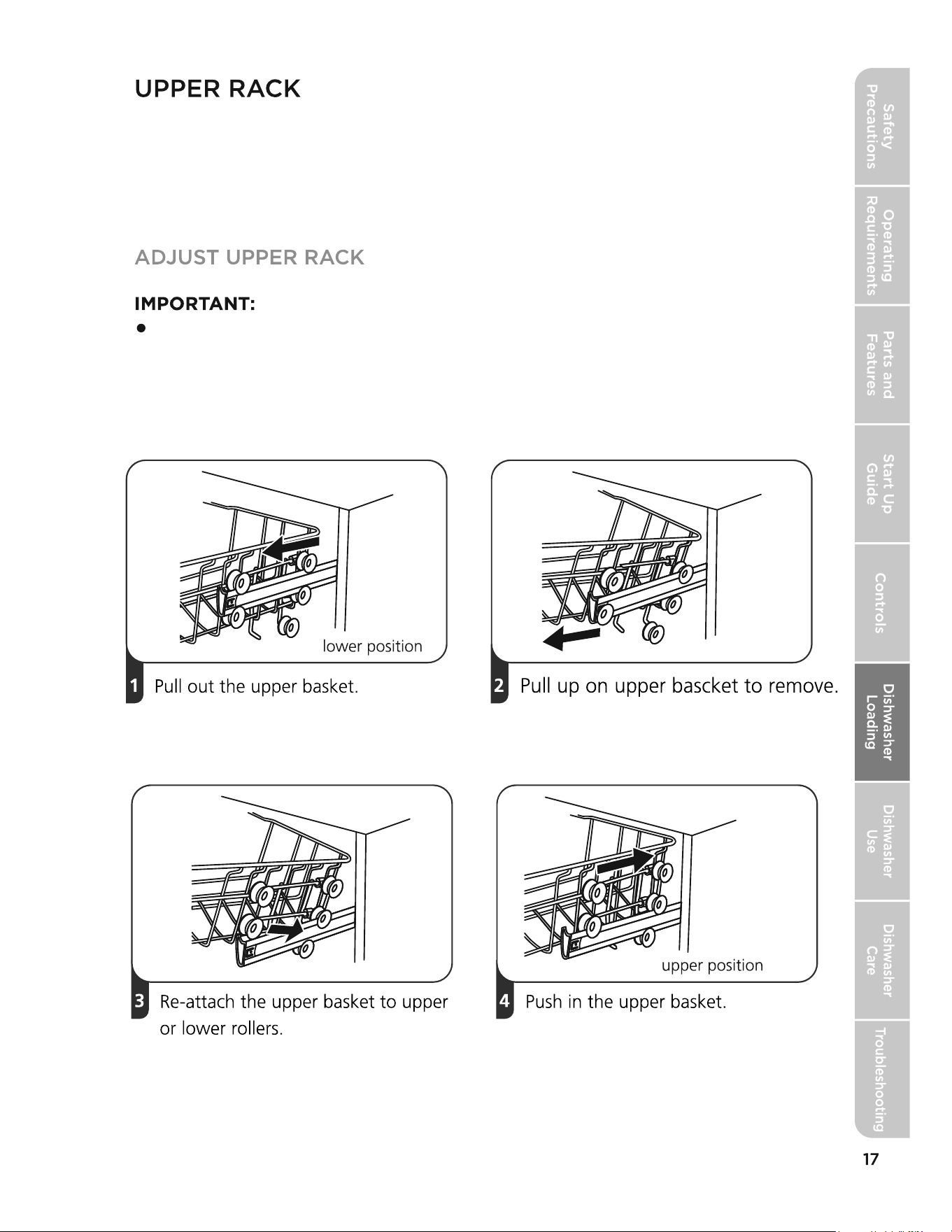
The upper rack can be easily adjusted 2" (5 cm) up or down to
accommodate taller items in either in the top or bottom rack.
Remove all items before adjusting the rack. The rack must be empty.
To adjust the height of the upper rack, follow these steps:
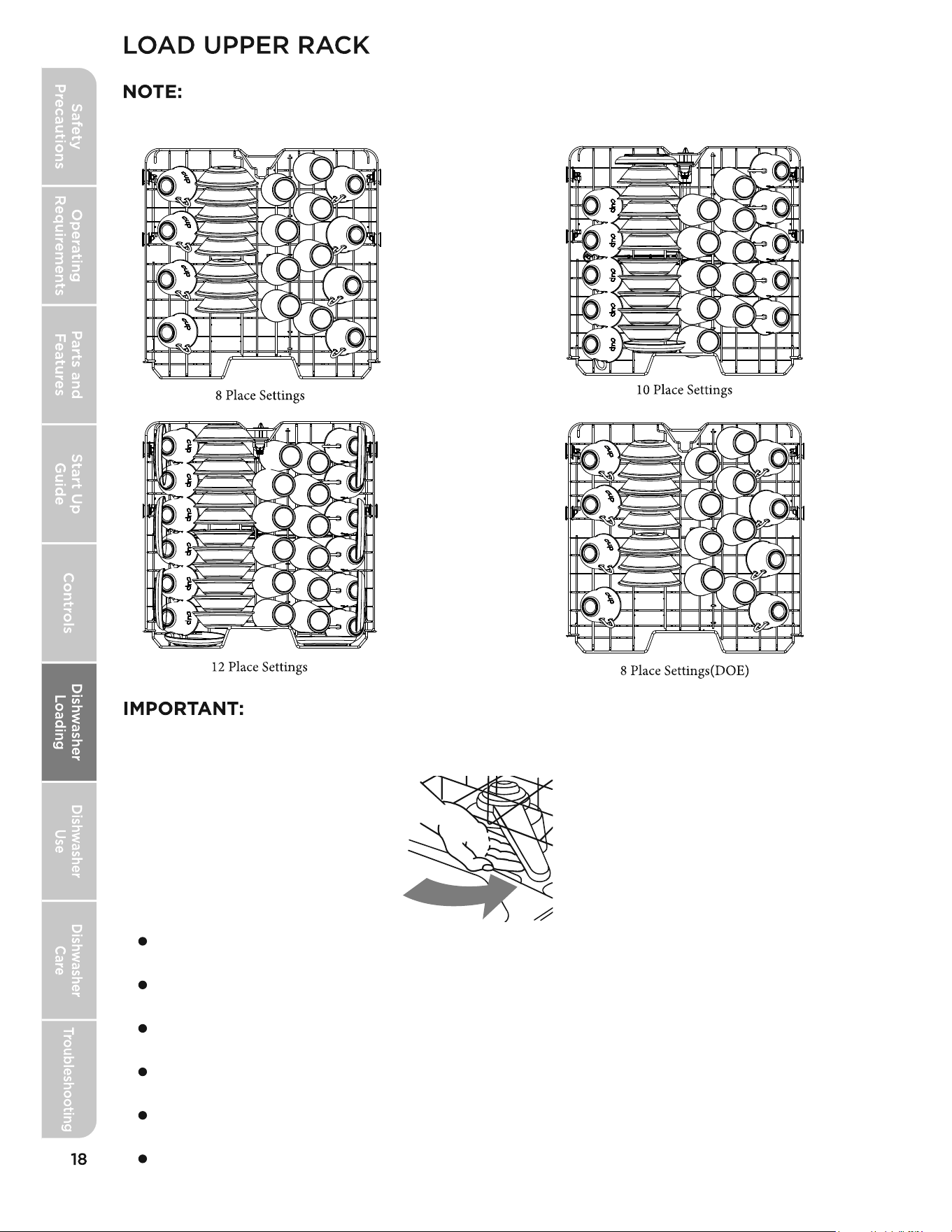
The features on your dishwasher rack may vary from the drawings
shown.
Place items so that the open ends face downward for cleaning and
draining.
Load glasses and cups in upper rack only. The lower rack is not
designed for glasses and cups. Damage can occur.
Place cups and glasses in the rows between tines. Placing them over
the tines can lead to breakage, water spots, and poor cleaning.
Small bowls, pans and other utensils can be placed in the top rack.
Load bowls in the center section for best stability.
China, crystal and other delicate items must not touch each other
during dishwasher operation. Damage may occur.
Load plastic items so the force of the spray does not move them
during the cycle.
Make sure the items loaded in the upper rack do not
interfere with the rotation of the middle spray arm located beneath
the upper rack. Check for interference by turning spray arm by hand.
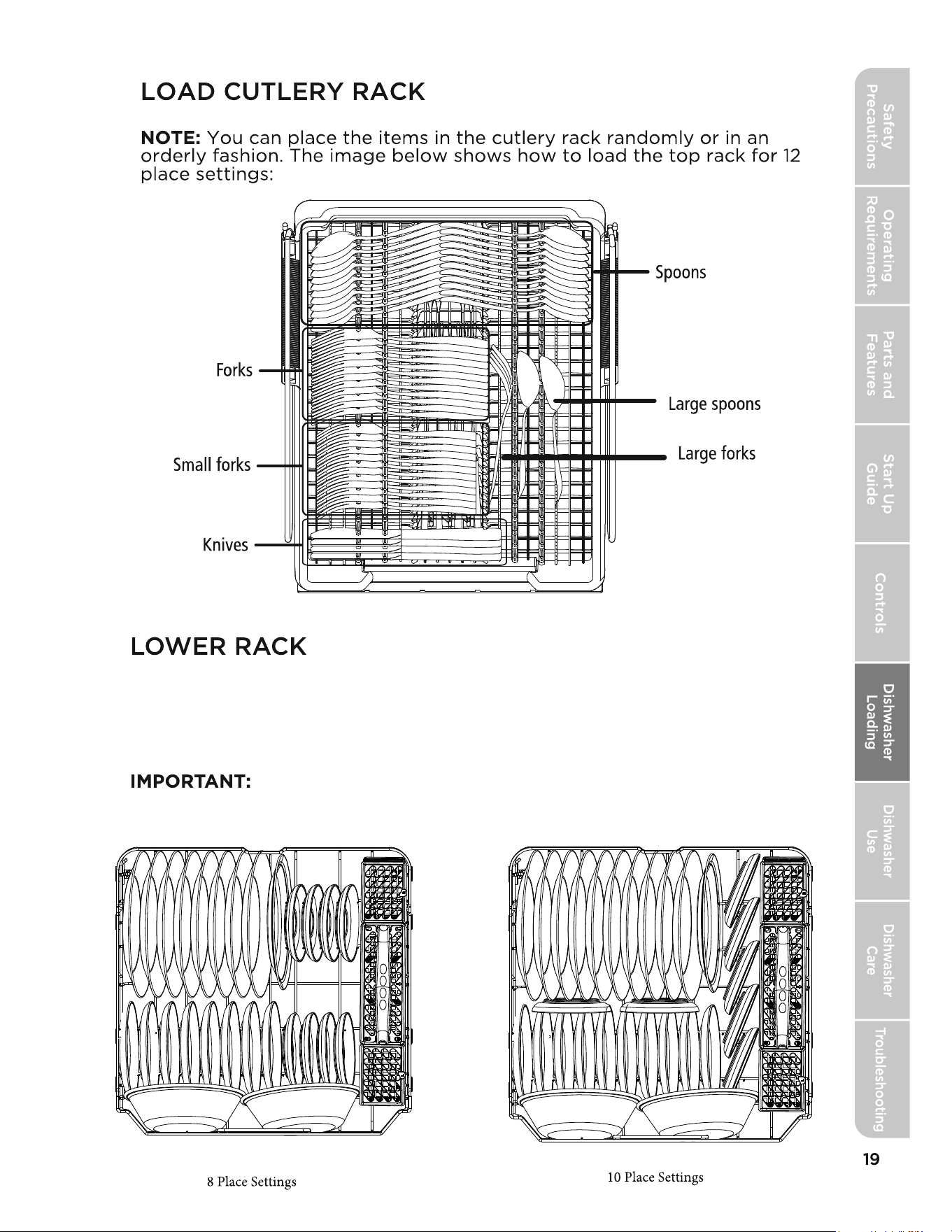
The lower rack is designed for plates, soup bowls, cookware and
bakeware.
The adjustable upper rack allows you to load items up to 12.6” in height in
the lower rack.
Items in the lower rack must be placed so that they do not
interfere with the rotation of the spray arms, block the water inlet, or keep
the water spray from reaching the detergent dispenser.
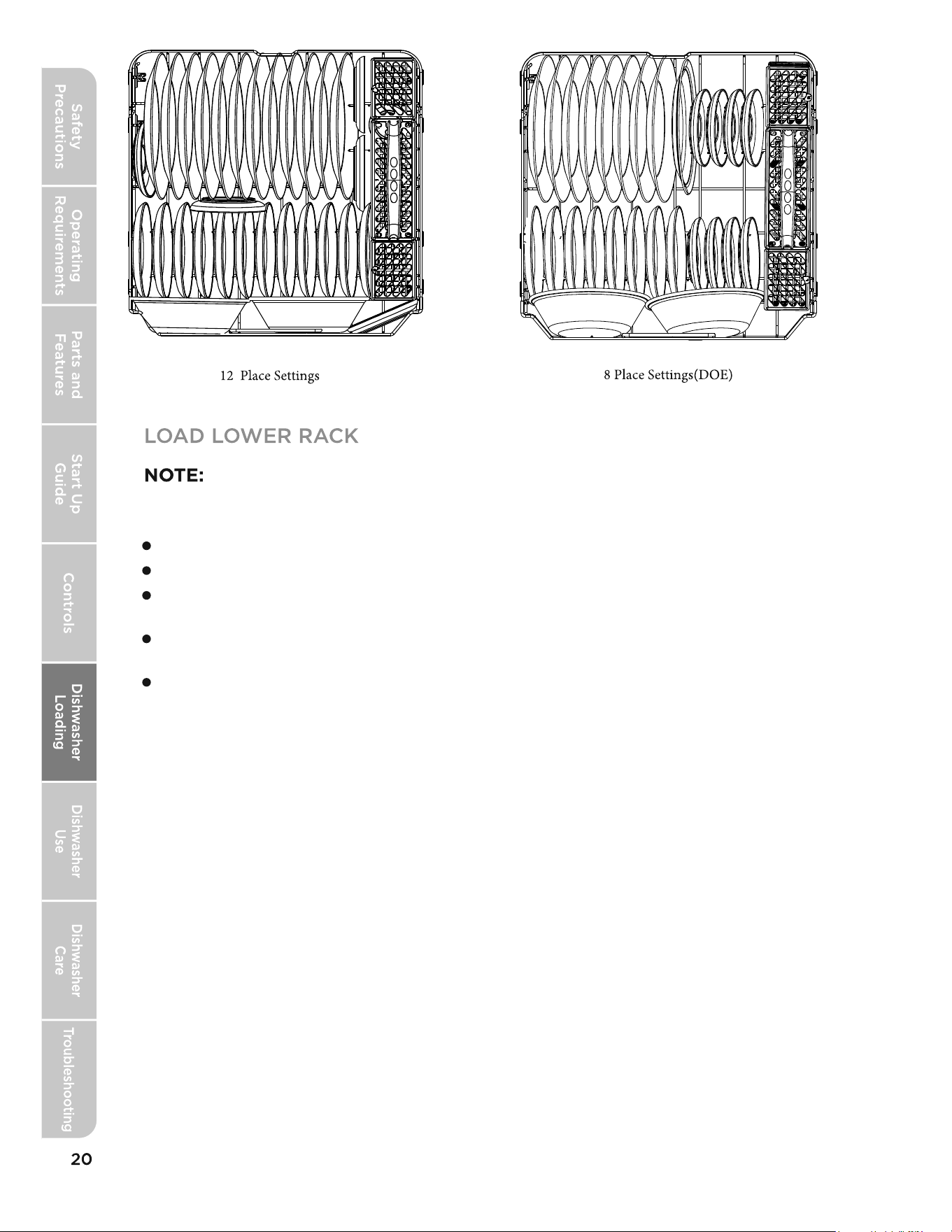
The features on your dishwasher rack may vary from the drawings
shown.
Do not load glasses, cups, or plastic items in the lower rack.
Load small items in the lower rack only if they are secured in place.
Load plates, soup bowls, etc. between tines. Do not nest bowls
because the spray will not reach all surfaces.
Do not load items between the bottom rack and the side of the
dishwasher tub.
Place heavily soiled cookware face down in the rack.
Do not load silver or silver-plated silverware with stainless steel. These
metals can be damaged by contact with each other during washing.
Some foods (such as salt, vinegar, milk products, fruit juices, etc.), can
pit or corrode silverware. DO NOT WASH ALUMINUM COOKWARE IN
YOUR DISHWASHER.
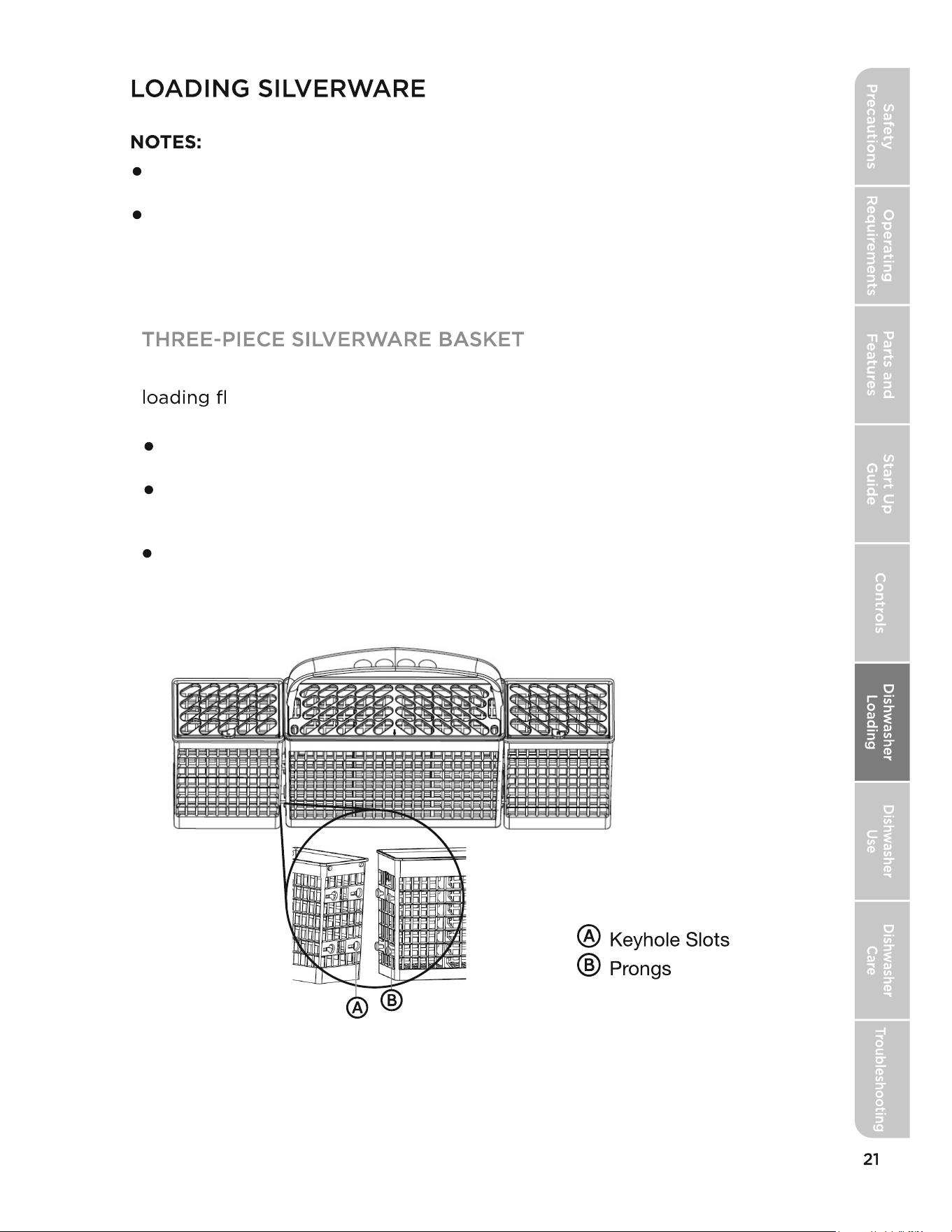
The silverware basket consists of three separate sections. For optimum
exibility, the center section of the basket can be used
individually, joined with one or both side sections or removed.
Lift handle to remove the silverware basket and set the basket on a
counter or table top.
Lift up on each side section to disengage the center section from the
keyhole slots in the side sections.
Either replace the section(s) in the bottom rack and load the
silverware, OR load the silverware while the section(s) are on the
countertop and then replace the basket in the bottom rack.
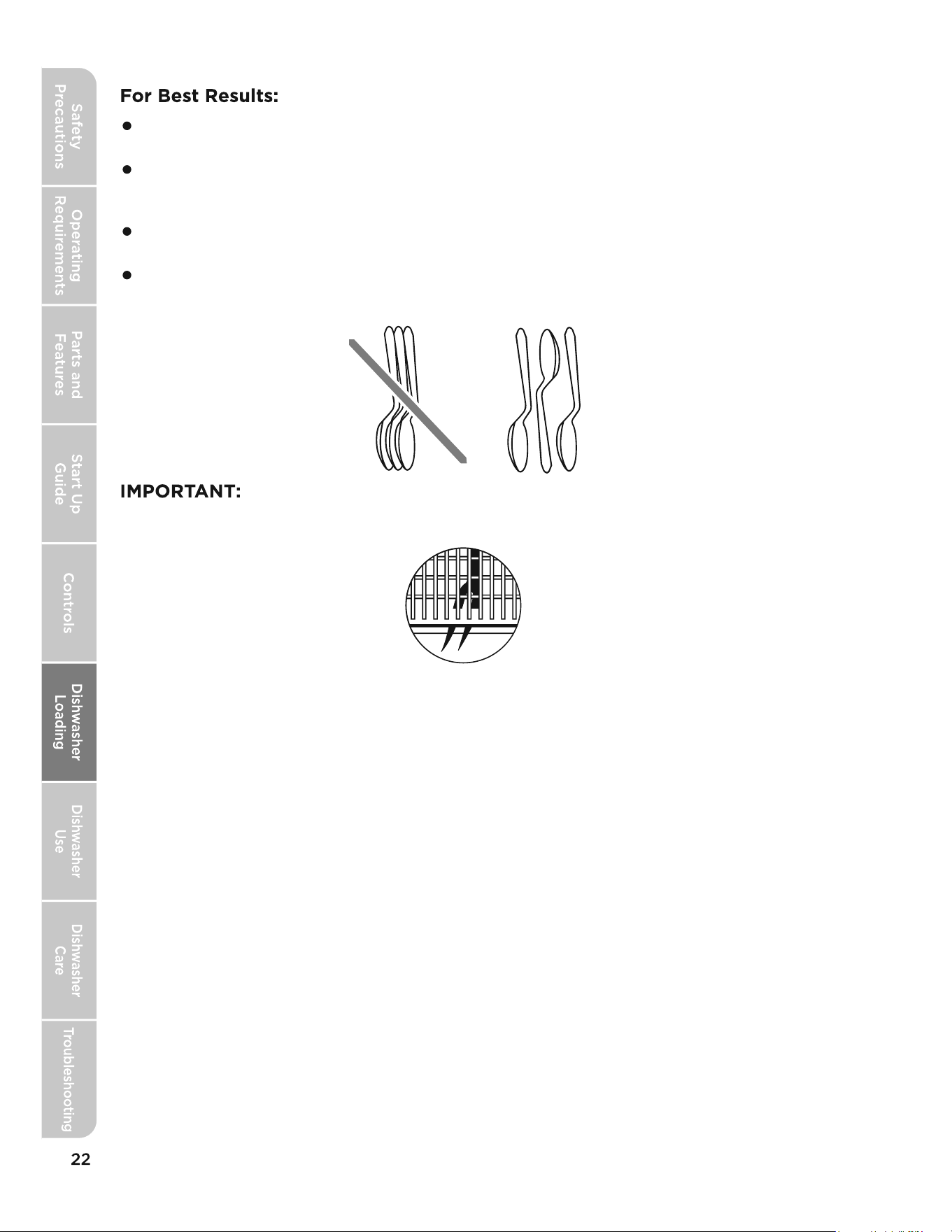
Load items with handles down, using the separators to prevent
silverware from nesting.
Place small items such as baby bottle caps, jar lids, corncob holders,
etc. in the section(s) with hinged cover(s). Close the cover to hold
small items in place.
Unload or remove the basket before unloading the racks to avoid water
drops from falling on the silverware.
When handles are up, mix items in each section of the basket with
some pointing up and some down to avoid nesting. Spray cannot reach
nested items.
Always load sharp items (knives, skewers, etc.) pointing
down. Be sure that nothing protrudes through bottom of the basket or
rack that may block the wash arm.
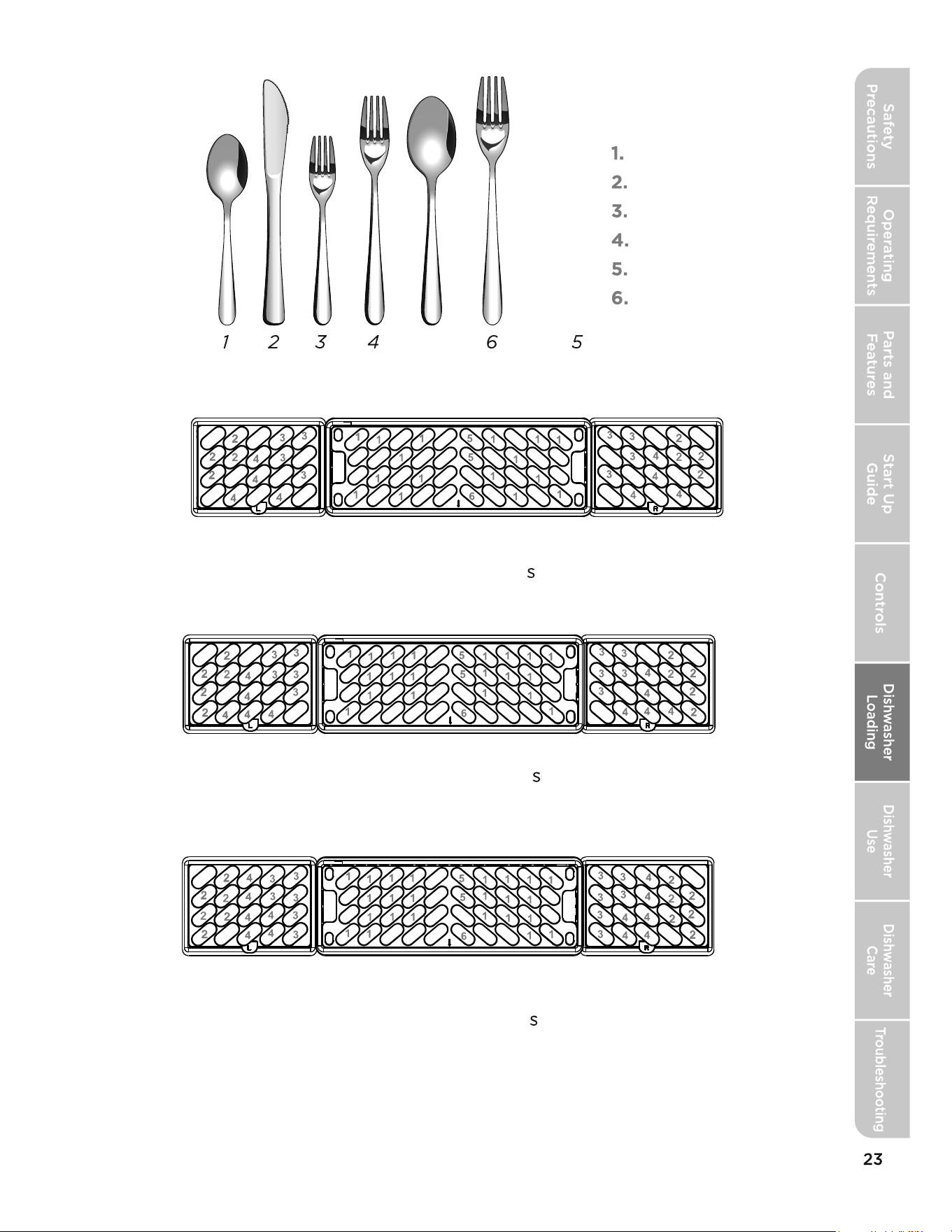
Spoons
Knives
Salad Forks
Forks
Large Spoons
Large Forks
8 Place Setting
10 Place Setting
12 Place Setting
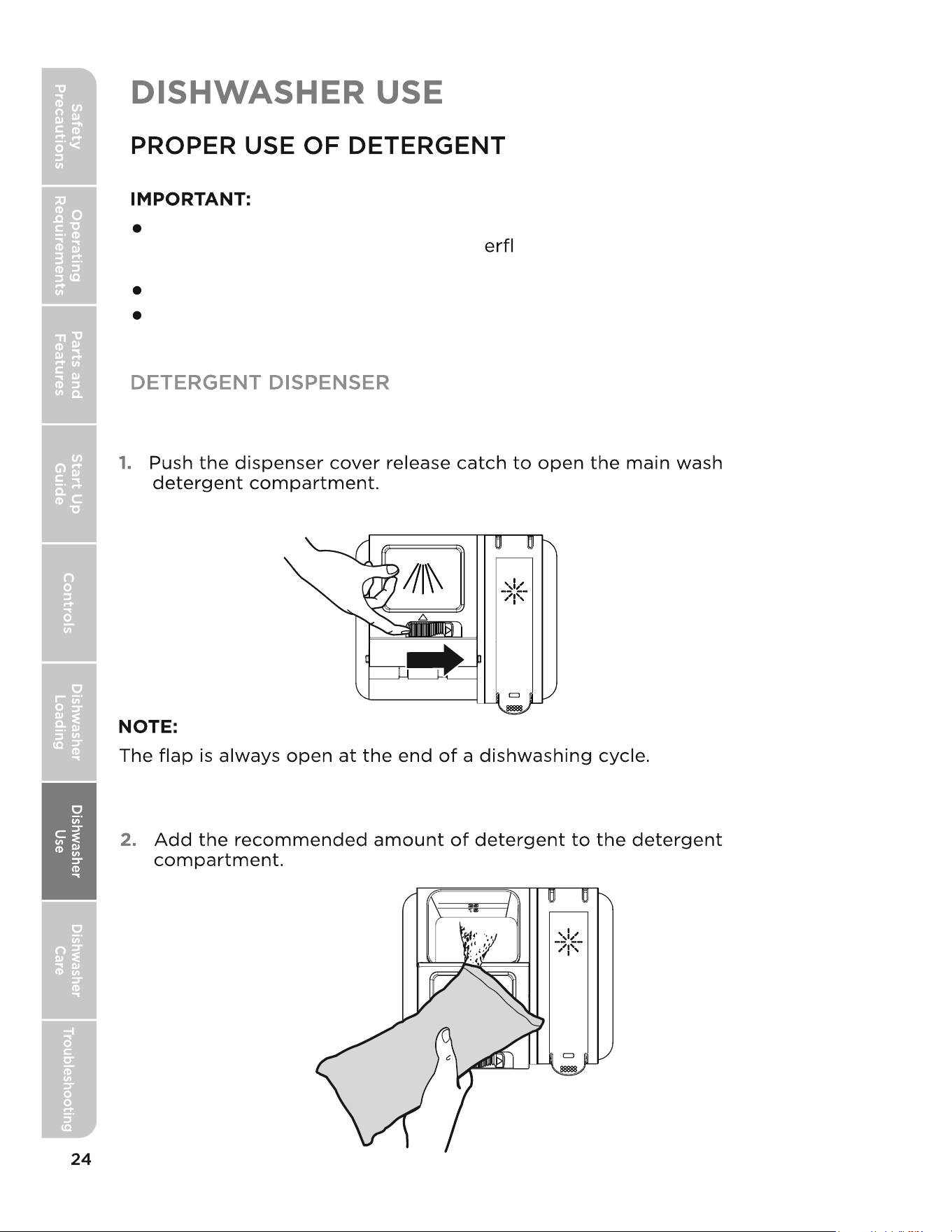
Use automatic dish washing detergent only. Other detergents can
produce excessive suds that can ov ow out of the dishwasher and
reduce washing performance.
Add detergent just before starting a cycle.
Store detergent tightly closed in a cool, dry place. Fresh automatic
dishwasher detergent results in better cleaning.
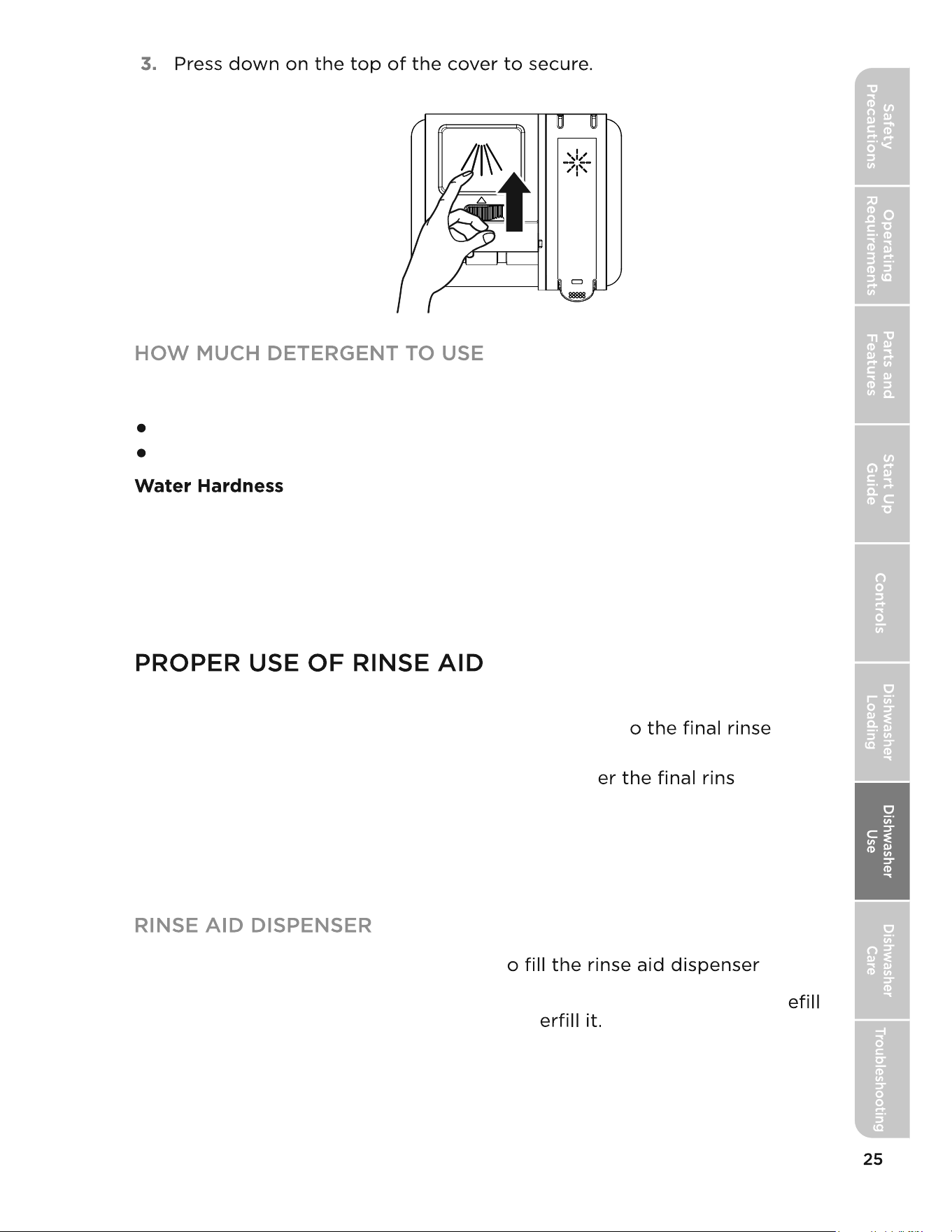
The amount of detergent to use depends on the soil level of your load, the
type of detergent used and the hardness of your water.
If you use too little detergent, dishes won’t be clean.
If you have soft water and use too much detergent, glassware will etch.
Water hardness varies depending on your water source. For the best
results, your dishwasher is designed to operate with water that has a
hardness of no more than 7 grains per gallon. Test kits are available from
all major appliance parts retail outlets. If your water has a hardness over 8
grains per gallon, you may consider installing a water softener or regularly
use an additive to enhance the performance of your detergent.
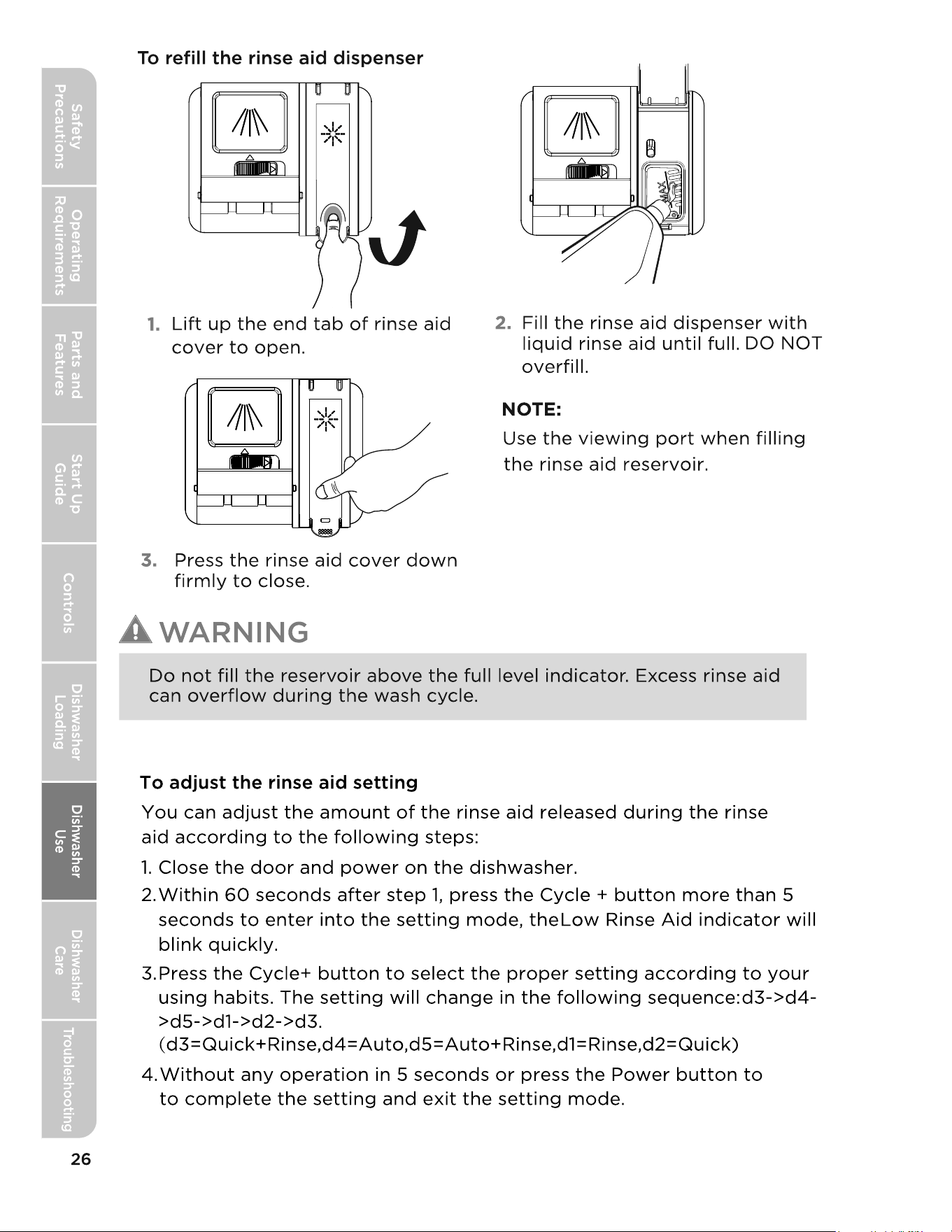
Rinse aid prevents water from forming droplets that can dry as spots or
streaks. A small amount of the rinse aid is released int
water, which allows water to drain from the dishes.
Rinse aid greatly improves drying performance aft e.
Your dishwasher is designed to use a LIQUID rinse aid. Do not use a solid
or bar-type rinse aid.
Under normal conditions, you will need t
approximately once a month. Rinse aid is released through an opening in
the dispenser. You do not need to wait until the dispenser is empty to r
it. Try to keep it full, but be careful not to ov
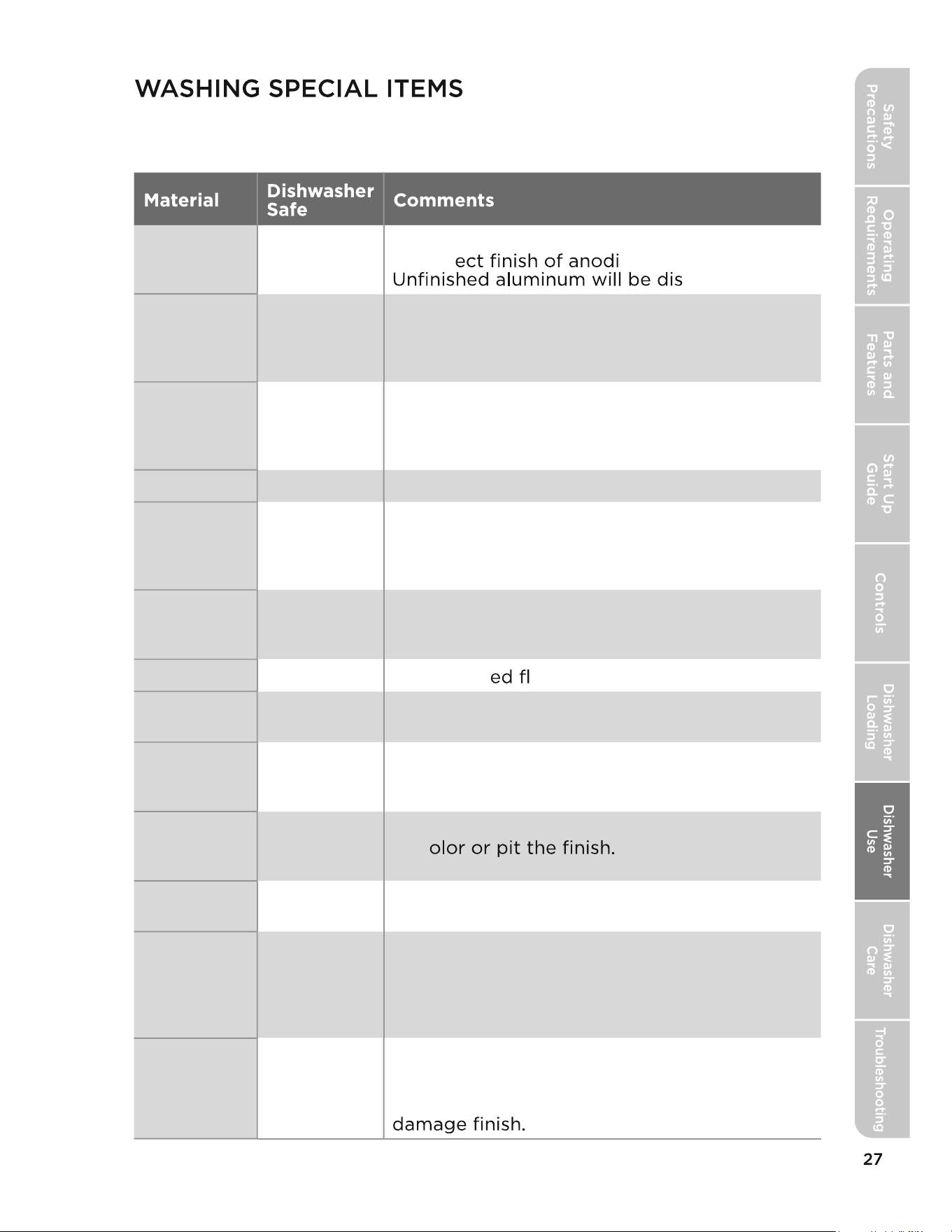
If you have doubts about washing a particular item, check with the
dishware manufacturer to make sure it is dishwasher safe.
Aluminum Possible High water temperature and detergents
can aff zed aluminum.
colored.
Disposable
Aluminum
No Do not wash disposable aluminum pans in
the dishwasher These might shift during
washing and transfer black marks to dishes
and other items.
Bottles and
cans
No Wash bottles and cans by hand. Labels
attached with glue can loosen and clog the
spray arms or pump and reduce washing
performance.
Cast Iron No Seasoning will be removed and iron will rust.
China /
Stoneware
Yes Always check manufacturer’s
recommendations before washing. Antique,
hand-painted, or over-the-glaze patterns
may fade, gold leaf can discolor or fade.
Crystal Yes Check manufacturer’s recommendations
before washing. Some types of leaded crystal
can etch with repeated washing.
Gold No Gold-color atware will discolor.
Glass Yes Milk glass yellows with repeated dishwasher
washing.
Hollow-
Handle
Knives
No Handles of some knives are attached to
the blade with adhesive that can loosen if
washed in the dishwasher.
Pewter
Brass,
Bronze
No High water temperatures and detergent can
disc
Disposable
Plastics
No Cannot withstand high water temperatures
and detergents.
Plastics Yes Always check manufacturer’s
recommendations before washing. Plastics
vary in their capacity to withstand high
temperatures and detergents. Load plastics
in top rack only.
Stainless
Steel
Yes Run a rinse cycle if not washing immediately.
Prolonged contact with food containing
salt, vinegar, milk products, or fruit juice can
Sterling
Silver or
Silver Plate
Yes Run a rinse cycle if not washing immediately.
Prolonged contact with food containing
(eggs, mayonnaise, and
seaf
Tin No Can rust.
Wooden
Ware
No Wash by hand. Always check manufacturer’s
instructions before washing. Untreated wood
can warp, cr
In most cases, regular use of a soft, damp cloth or sponge and a mild
detergent is all that is necessary to clean outside of your dishwasher.
Clean the stainless steel door and handle regularly with a clean, soft cloth
to remove debris.
Do not use appliance wax, polish, bleach, or products
containing chlorine to clean the stainless steel door.
Gently clean the control panel with a clean, soft cloth.
The tub is made of stainless steel designed to resist rust and corrosion if
the dishwasher is scratched or dented.
Hard water minerals can cause a whit to build up on the inside
surfaces, especially just beneath the door area.
Do not clean the dishwasher interior until it has cooled. Wear rubber
gloves. Do not use any type of cleanser other than dishwasher detergent
because it may cause foaming or create suds.
Clean the steel inner door and tub with a clean, soft damp cloth.
Using a damp cloth, clean around the door gasket regularly to remove
food particles.
Clean the Control Panel gently with a lightly dampened cloth.
ters regularly for best performance.
Remove the lower dishwasher rack.
Rotate the C ter counterclockwise a quarter turn and lift up to
remove.
Empty the C ter and rinse it under running water.
Remov ter.
Remove the Micr ter from the bottom of the tub.
ter and the Micr ter for debris, and then
clean them b ters under slow running water.
A stiff, plastic bristle brush may be needed to remove some
debris.
Reins ters in reverse order making sure the C ter locks
into place.
Check the drain air gap anytime your dishwasher isn’t draining well.
Some state or local plumbing codes require the addition of a drain air
gap between a built-in dishwasher and the home drain system. If a drain
is clogged, a drain air gap prevents water from backing up into the
dishwasher.
The drain air gap is usually located on top of the sink or countertop near
the dishwasher.
The drain air gap is an external plumbing device that is not part of
your dishwasher. The warranty provided with your dishwasher does not
cover service costs directly associated with the cleaning or repair of the
external drain air gap.
Clean the drain air gap periodically to ensure proper drainage of
your dishwasher. Follow the cleaning instructions provided by the
manufacturer.
Turn off the dishwasher.
Lift off the metal cover, and then unscrew the plastic cap.
Clean the plastic cap with a toothpick.
Protect your dishwasher and home against water damage caused by
freezing water lines. If your dishwasher is left in a seasonal dwelling or
could be exposed to near freezing temperatures, have your dishwasher
winterized by authorized service personnel.
Turn off electrical power to the dishwasher.
Turn off the water supply.
Place a pan under the inlet valve, and then disconnect the water line
from the inlet valve.
Disconnect the drain line from the pump and drain water into the pan.
Reduce risk of property damage and protect your dishwasher during the summer
months by turning off the water supply and power supply to the dishwasher.
Reconnect the water, drain and electrical power supply.
Turn on water and electrical power supply.
Fill detergent cup and run the dishwasher through a heated wash
cycle.
Check the connections for leaks.
There is no power to the
dishwasher.
Replace fuse or reset
circuit breaker.
The door is not closed
tightly and latched.
Close and latch the door.
Most cycles pause for
5 minutes near the start
of a cycle to let the dishes
soak.
This is normal, and reduces
the energy required to
clean the dishes.
Certain cycles repeatedly
pause for 15 to 65 seconds
during the main wash.
This is normal.
The Delay feature is
selected.
To reset, see “Options” in
the Controls section.
Control Lock feature is
activated.
Deactivate Control Lock.
See “Additional Features”
in the Controls section.
The water shutoff valve is
not turned on.
Turn on the water valve.
The door is not closed
tightly and latched.
Close and latch the door.
Water pressure is too low. Verify a minimum of
20 psi water pressure is
maintained during the
ration.
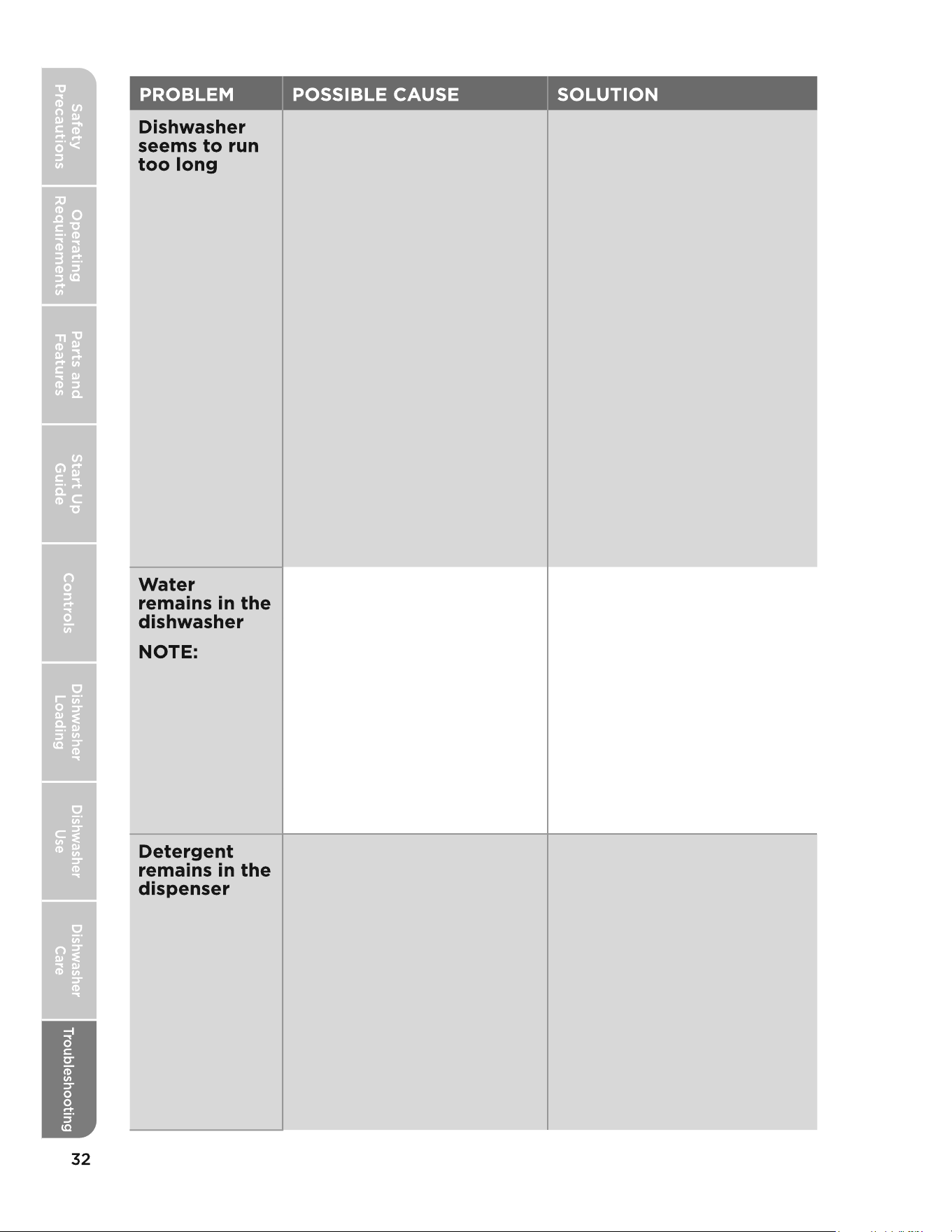
The water supplied to
the dishwasher is not hot
enough.
The dishwasher runs
longer while heating water,
and a delay automatically
occurs in some wash
and rinse cycles until the
water reaches the proper
temperature.
Run the water in the
adjacent sink until it gets
hot before turning on the
dishwasher.
The Sanitize option is
selected.
The cycle time increases
to heat the water to the
correct temperature for
sanitizing.
The cycle time will vary
depending on soil level.
When heavy soil is
detected, the Normal cycle
will automatically increase
the cycle time.
Dishwasher is connected
to the Cold water supply.
Verify the dishwasher is
connected correctly to the
Hot water supply.
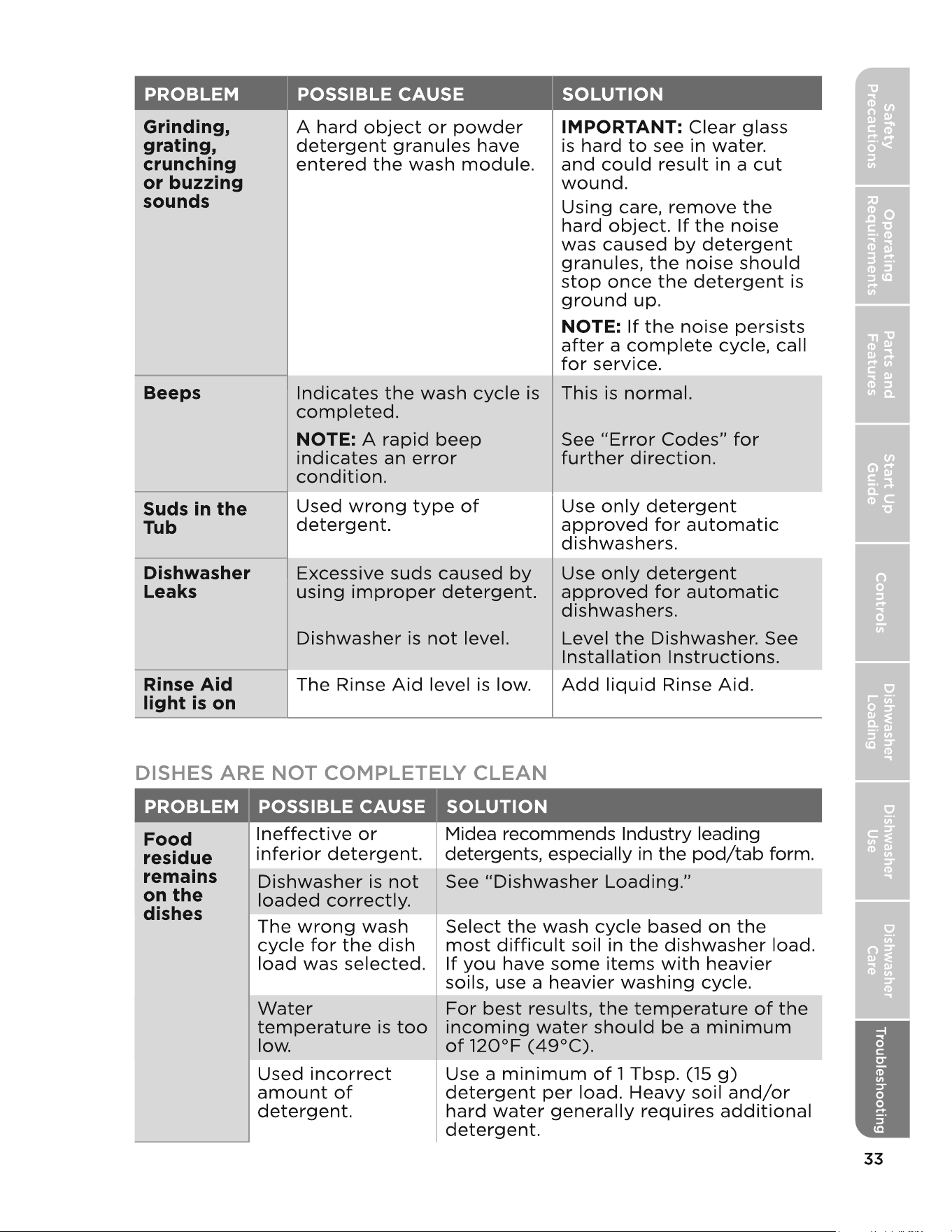
A small
amount of
clean water
around the
outlet in the
bottom of
the tub is
normal. It
keeps the seal
lubricated.
The cycle is not complete
or it is in a pause.
The water will drain when
the cycle is completed.
The drain hose is kinked. Straighten the drain hose.
The knockout plug is still
in the garbage disposal.
Remove the knockout plug.
Drain hose is connected to
the garbage disposal, and
the garbage disposal is
not empty.
Run the garbage disposal
until it is empty.
Drain is clogged. Check the air gap.
The cycle has not
completed.
Close the door and press
START to complete cycle.
The detergent is damp or
has clumped.
Remove detergent and
replace with fresh dry
dishwasher detergent.
An item was blocking the
dispenser.
Remove item. Remove
detergent and replace
with fresh dry dishwasher
detergent.
The spray arm is blocked. Load the dishes in a
manner that does not
block the spray arm from
rotating freely.
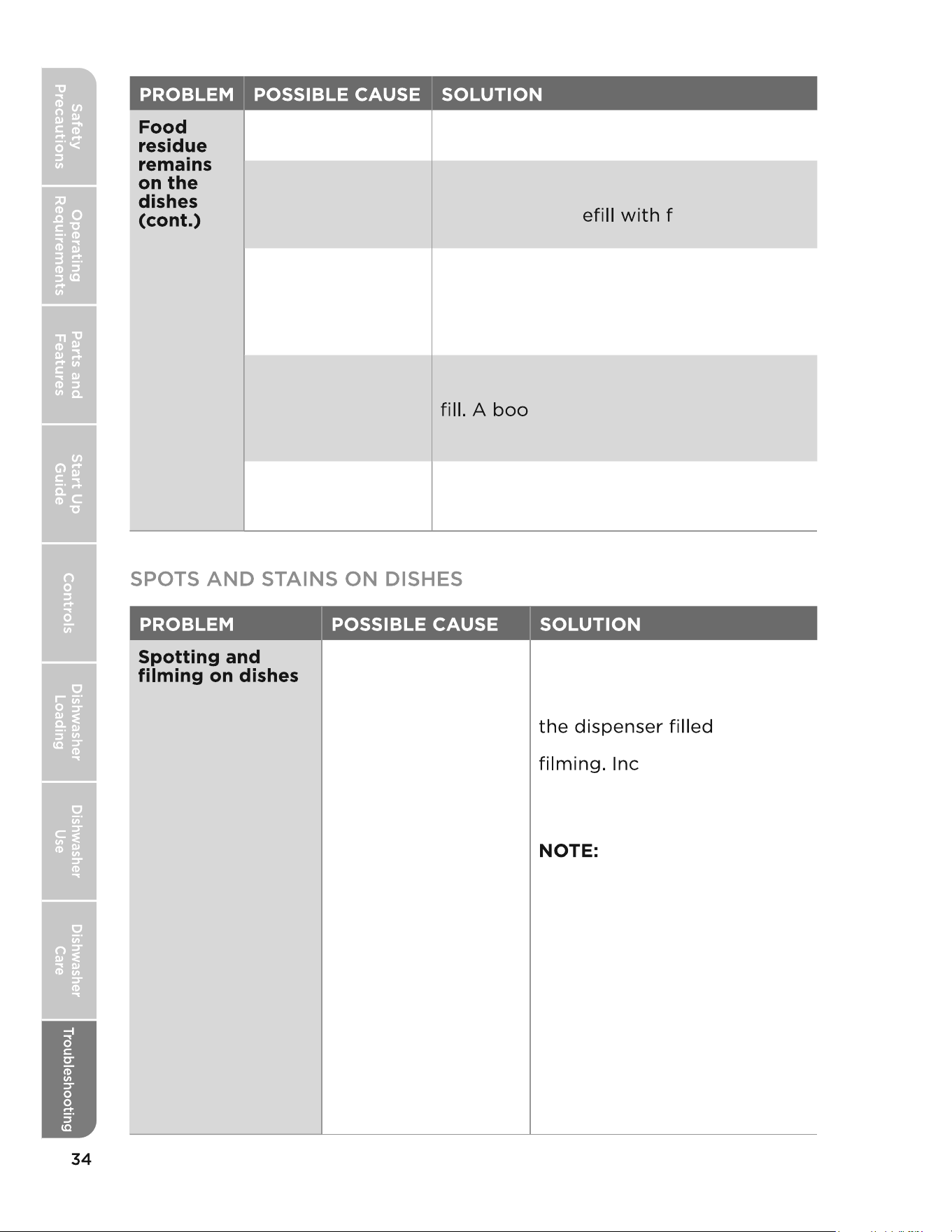
Detergent is too
old.
Detergent must be fresh to be effective.
Store detergent in a cool, dry area.
Detergent is
caked in the
dispenser.
Do not allow detergent to sit for
several hours in a wet dispenser. Clean
dispenser and r resh, dry
detergent.
The pump or
spray arm is
clogged with
labels from
bottles and cans.
Check pump and spray arm for labels
and remove the labels.
The pressure of
the water coming
into the home is
too low.
Water pressure should be 20 to 80 psi
(138 to 552 kPa) for proper dishwasher
ster pump on the water
supply can be added if pressure is too
low.
High suds are
slowing the wash
arm.
Use only detergent recommended for
the dishwasher. Do not use soap or
laundry detergents.
Rinse Aid dispenser
is empty.
Add a liquid rinse aid to the
dispenser.
Hard water. High
mineral content in
your water
Use a rinse aid and keep
to help
eliminate spotting and
rease setting on
Rinse aid dispenser 1 number
per cycle until spotting is
eliminated.
If your water hardness
is 13 grains (223 ppm)
or above, it is strongly
recommended that you
install a home water softener.
Water temperature
is too low.
For best results, water
should be a minimum 120°F
(49°C) as it enters the
dishwasher.
Did not use enough
detergent.
Use a minimum of 1 Tbsp.
(15 g) of detergent per
load. Heavy soil and/or hard
water generally require extra
detergent.
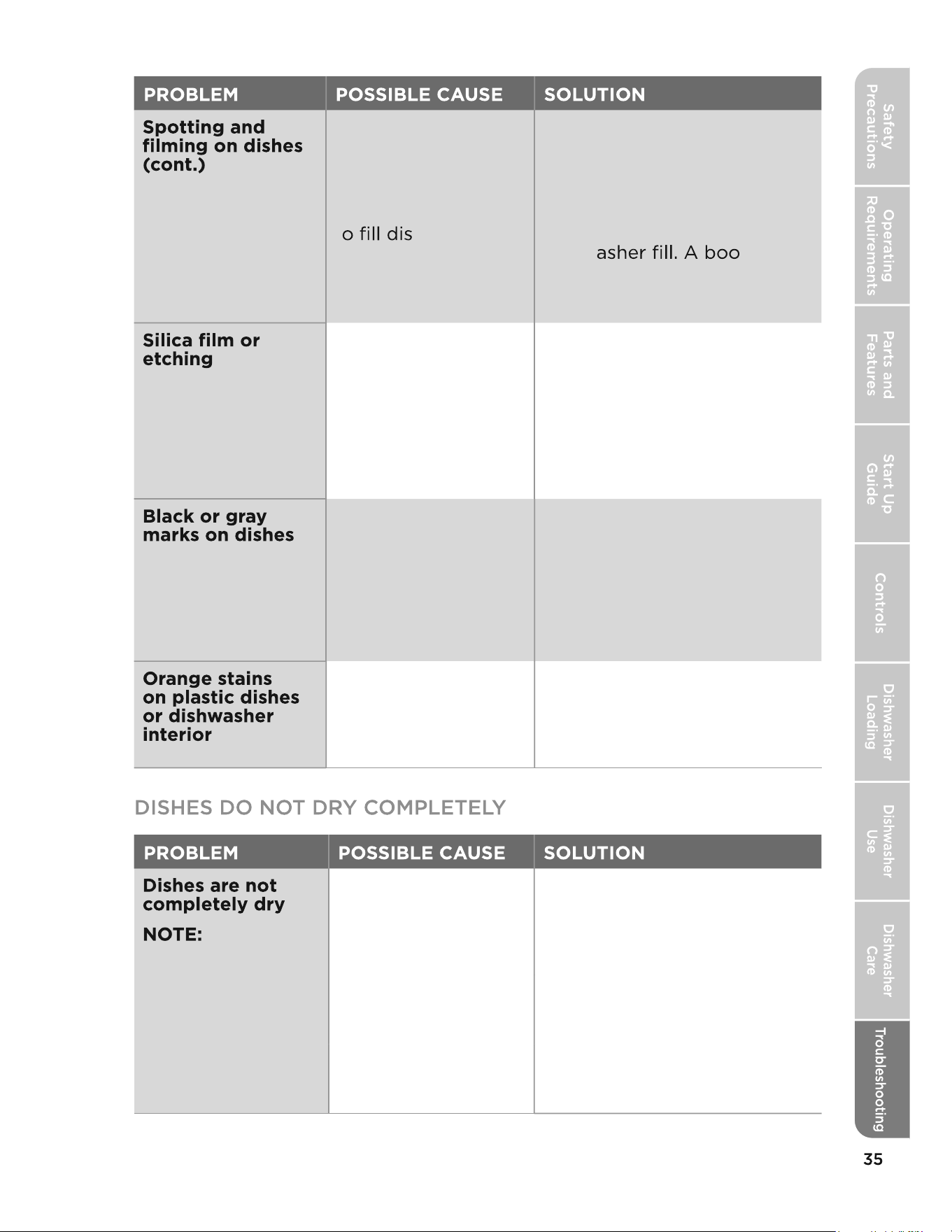
Detergent is too old. Detergent must be fresh and
dry to be effective. Store
detergent in a cool, dry area.
Home water
pressure is too low
t hwasher
properly.
Water pressure to the home
should be 20 to 80 psi
(138 to 552 kPa) for proper
dishw ster
pump on the water supply
can be added if pressure is
too low.
Using too much
detergent
If you have soft water use
less detergent, but do not
use less than 1 Tbsp. (15 g)
per load.
The inlet water
temperature
exceeds 150°F
(65°”C).
Lower the incoming water
temperature.
Aluminum items
rubbing dishes
during washing.
Disposable
aluminum items
can break down in
the dishwasher and
cause marking.
Hand wash aluminum items.
Remove aluminum markings
by using a mild abrasive
cleaner.
Large amounts of
tomato-based foods
on dishes placed in
the dishwasher.
Use a stain removal product
to remove stains from
your dishwasher. Stains
will not affect dishwasher
performance.
Plastics
often need towel
drying.
Dishes are not
loaded properly
to allow water
drainage.
Do not overload dishwasher.
Place glasses and cups in
the rack so that the bottom
surface is slanted to allow
water to run off.
Rinse Aid not used
or dispenser is
empty.
Use a liquid rinse aid to
speed drying and keep the
dispenser full.
Used an air dry
or energy-saving
option.
For dryer dishes, select a
Cycle that allows a Heated
Dry option.
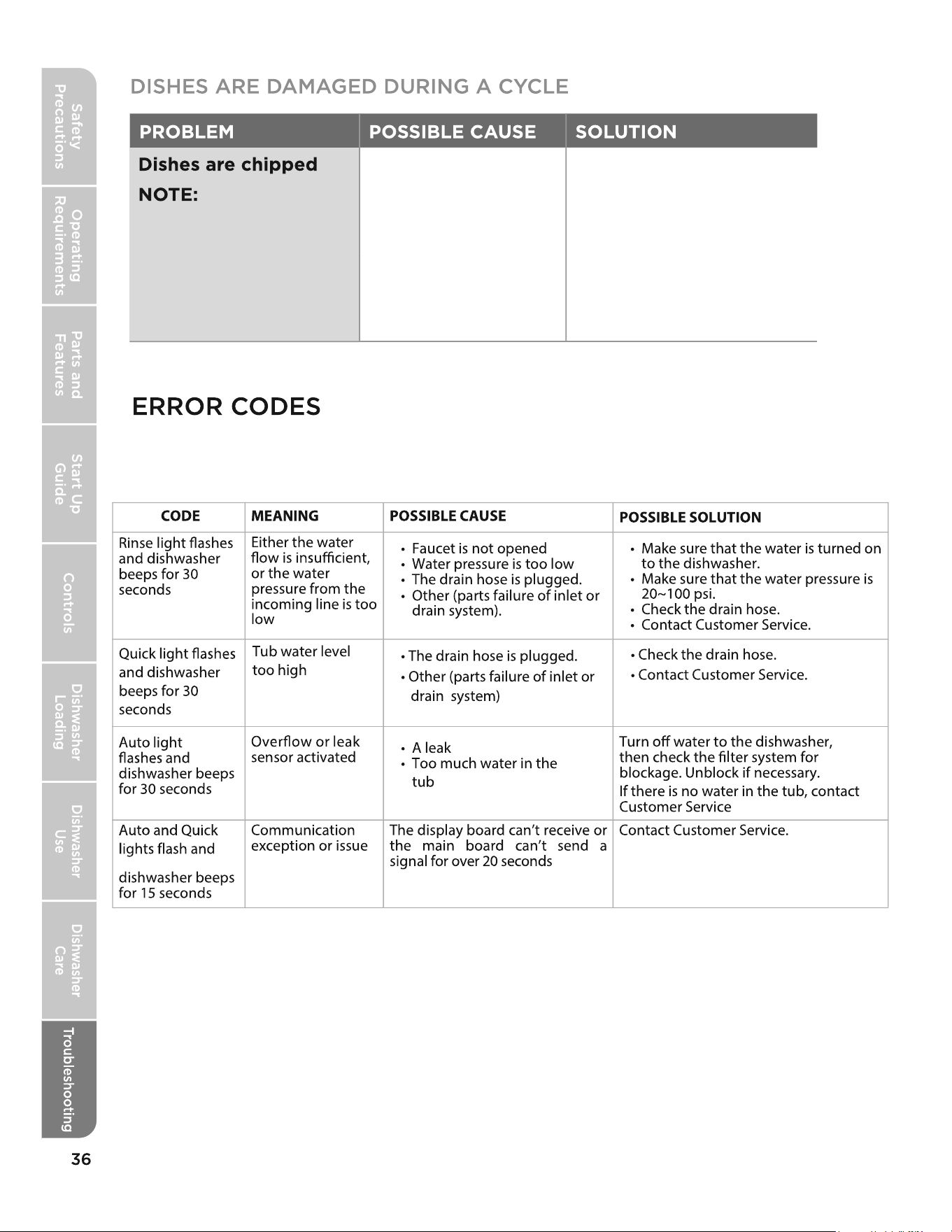
Some types of
china and glassware
might be too delicate
for automatic dish
washing. Wash by
hand.
Dishes not loaded
properly.
Load the dishes and
glasses so they are
stable and will not strike
together from washing
action.
Moving the rack
in or out of the
dishwasher too
quickly.
Minimize chipping by
moving the rack in and
out slowly.
Your Guarantee
