
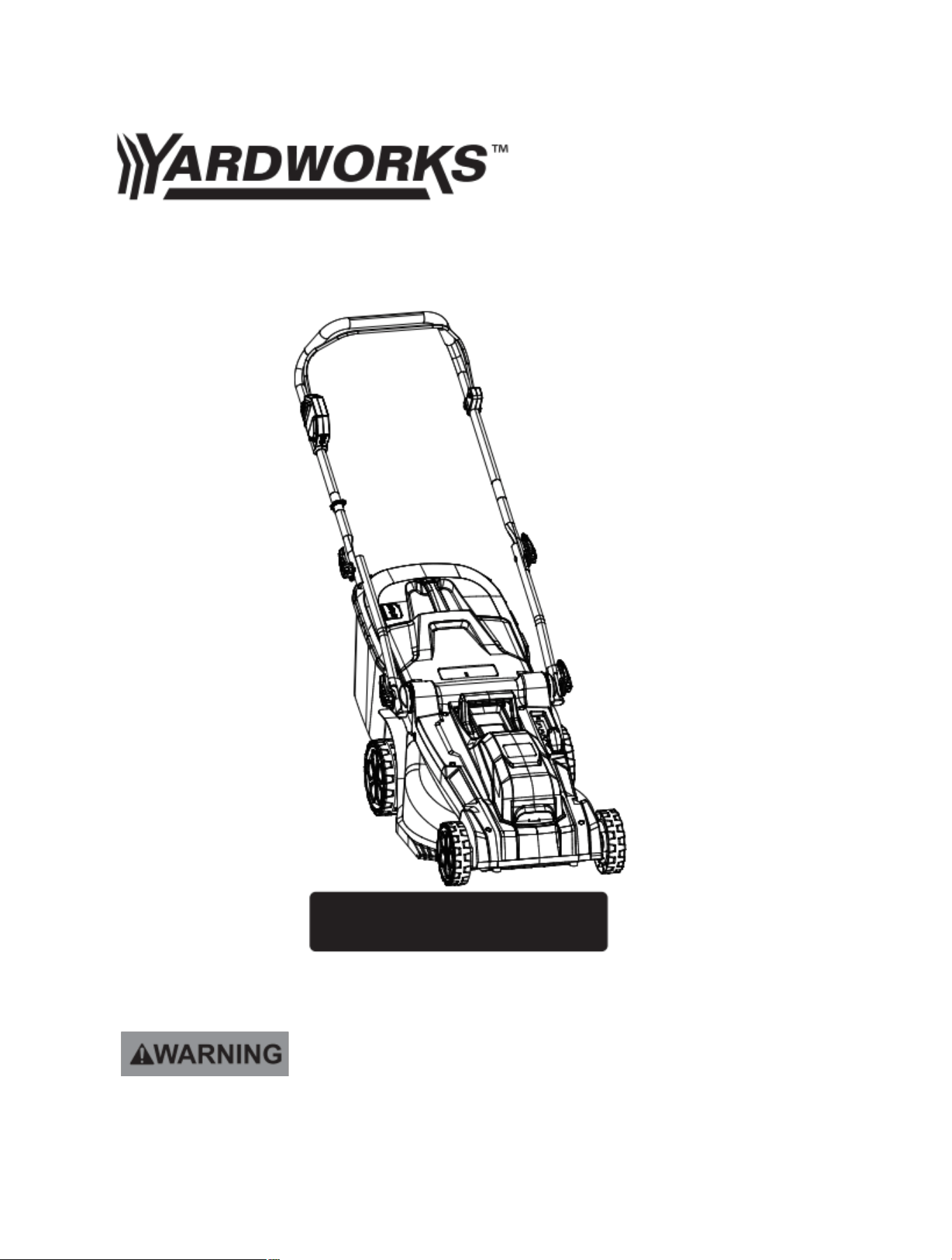
2x20V 18'' Cordless Poly Deck Lawn Mower
270- 1154
OPERATOR’S MANUAL
TOLL-FREE HELPLINE: 1-888-930-8528
Read this operator manual before using this product. Failure to do so can
result in serious injury. SAVE THIS MANUAL
1
TABLE OF CONTENTS
Safety Symbols ............................................................................................................................. Page 1
Important Safety Instructions ........................................................................................................ Page 4
Know Your Tools ............................................................................................................................ Page 8
Charging Your Battery ................................................................................................................. Page 10
Assembly ....................................................................................................................................... Page 12
Operation ...................................................................................................................................... Page 13
Maintenance ................................................................................................................................. Page 18
Troubleshooting ............................................................................................................................ Page 21
Warranty ....................................................................................................................................... Page 22
READ ALL INSTRUCTIONS!
READ & UNDERSTAND
INSTRUCTION MANUAL
WARNING:
Some dust created by power sanding, sawing, grinding, drilling and other construction
activities may contains chemicals known to the state of California to cause cancer, birth
defects or other reproductive harm. Some examples of these chemicals are:
Lead from lead-based paints,
Crystalline silica from bricks and cement and other masonry products, and
Arsenic and chromium from chemically - treated lumber.
Your risk from these exposures varies, depending on how often you do this type of work. To reduce your
exposure to these chemicals: work in a well-ventilated area, and work with approved safety equipment, such
as those dust masks that are specially designed to filter out microscopic particles.
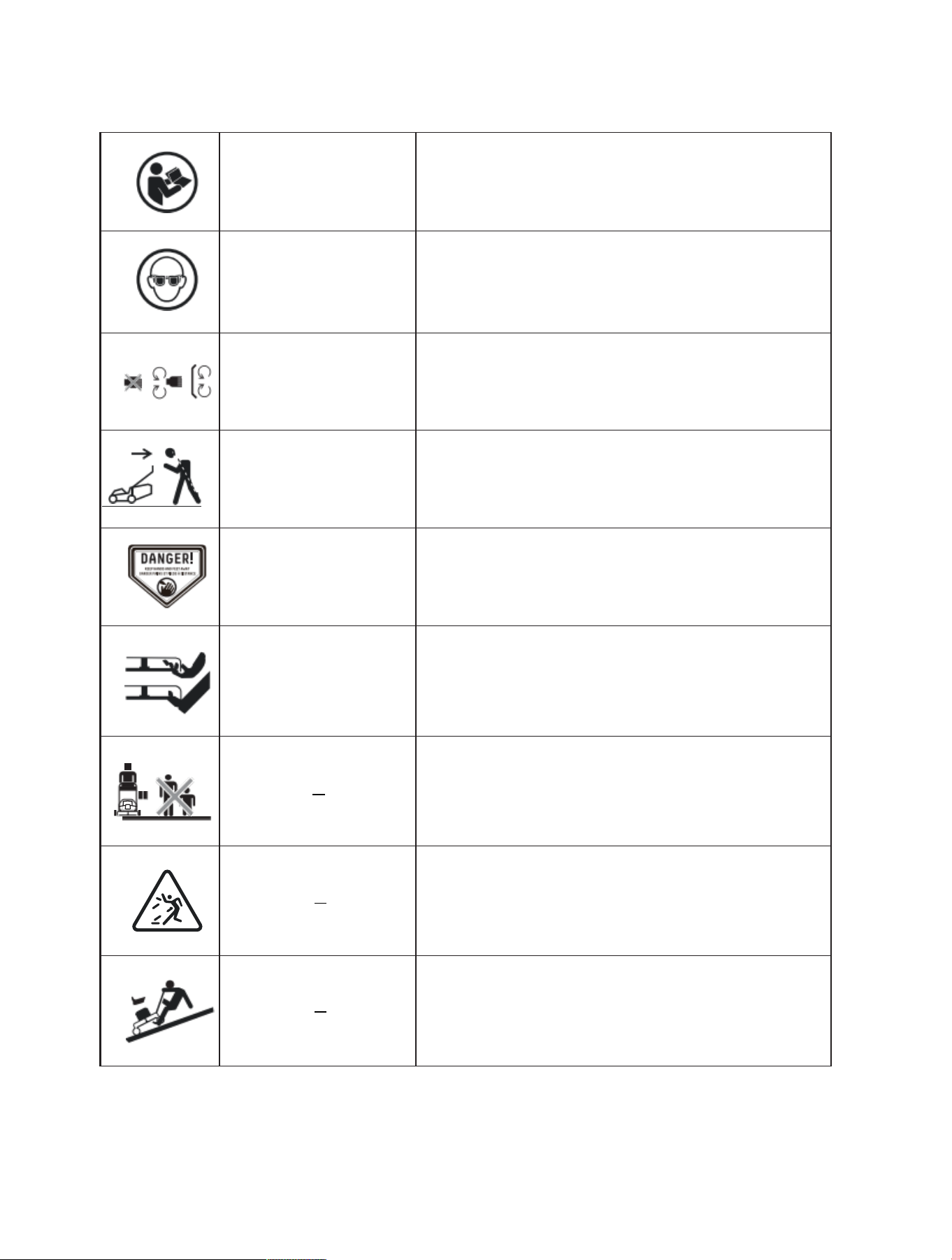
SAFETY SYMBOLS
This page depicts and describes safety symbols that may appear on this product. Read, understand, and
follow all instructions on the machine before attempting to assemble and operate it.
2
Read the operator’s manual
To reduce the risk of injury,user must read and understand
the operator’s manual before using this product.
Wear Eye Protection
Always wear safety goggles or safety glasses with
side shields and a full face shield when operating
this product.
Maintain Safety Devices
Do not open or remove safety shields while the tool is running.
Look Behind While Backing
Look down and behind first to avoid tripping when pulling back.
DANGER!
DANGER! Rotating blades. Keep hands and feet away.
No Reach
Do not reach hands or feet under mower deck. To reduce
the risk of injury, do not operate unless discharge cover or
grass bag is in its proper place. If damaged,replace
immediately.
DANGER
Keep Bystanders Away
Do not mow when children or others are nearby.
DANGER
Thrown Debris
Remove objects that can be thrown by the blade in any
direction.Wear safety glasses.
DANGER
Steep Slope Hazard
Use extra caution on slopes. Do not mow slopes
greater than 15 degress.
3
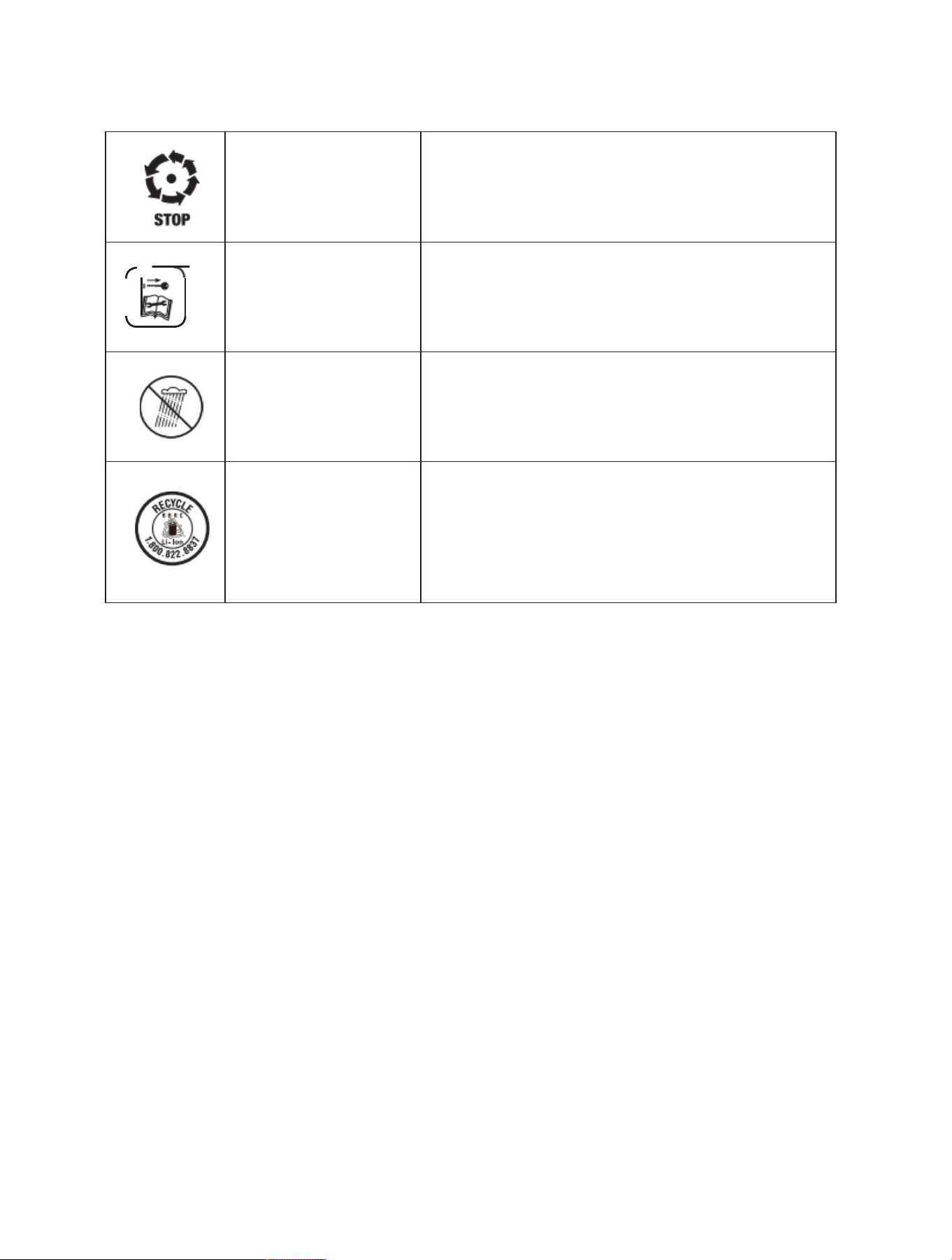
Blade Keeps Running.
Blade continues to rotate after machine is switched off.
Remove Battery Pack
and Safety Key.
WARNING! Always turn the manchine OFF and remove the
batteries and safety key before conducting
inspection,cleaning and maintenance.
Wet Conditions Alert
WARNING! Do not expose the unit to ain or wet conditions.
Recycle Symbol
This product uses lithium-ion (Li-ion) battries.
Local,state,or federal laws may prohibit disposa of batteries
in ordinary trash.Consult your local waste authority for
information regarding available recycling and/or disposal
options.

4
IMPORTANT SAFETY INSTRUCTIONS
DANGER: This machine was built to be operated according to the rules for safe
operation included in this manual. As with any type of power equipment, carelessness or
error on the part of the operator can result in serious injury. This machine is capable of
amputating hands and feet and throwing objects. Failure to observe all safety instructions
could result in serious injury or death.
WARNING: When using electric gardening appliances, basic safety precautions should
always be followed to reduce the risk of fire, electric shock, or injury to persons, includes
the following:
FOR ALL LAWN MOWERS
1. Avoid Dangerous Environment – Do not use lawn mowers in damp or wet locations.
2. Do not Use in Rain.
3. Keep Children Away - All bystanders should be kept at a safe distance from work area.
4. Dress Properly - Do not wear loose clothing or jewelry. They can be caught in moving parts. Use of
protective gloves and substantial footwear is recommended when working outdoors.
5. Use Safety Glasses - Always use face or dust mask if operation is dusty.
6. Use Tool Correctly - Do not use lawn mower for any job except that for which it is intended. Your lawn
mower has been designed to perform only one job: to mow grass.
7. Do not Force lawn mower - It will do the job better and safer at the rate for which it was designed.
8. Do not Overreach – Keep proper footing and balance at all times.
9. Stay Alert - Watch what you are doing. Use common sense. Do not operate appliance when you are tired.
10. Store Idle lawn mower Indoors - When not in use, lawn mower should be stored indoors in dry, and
high-up or locked place - out of reach of children.
11. Maintain lawn mower with Care - Keep cutting edge sharp and clean for best and safest performance.
Follow instructions for lubricating and changing accessories. Keep handles dry, clean, and free from oil
and grease.
12. Keep blades sharp.
13. Keep hands and feet away from cutting area.
14. Objects struck by the lawn mower blade can cause severe injuries to persons. The lawn mower should
always be carefully examined and cleared of all objects prior to each mowing.
15. If lawn mower strikes a foreign object, follow these steps:
a. Stop lawn mower. Release the switch.
b. Remove battery pack.
c. Inspect for damage.
d. Repair any damage before restarting and operating the lawn mower.
16. Use identical replacement blades only.

5
SAFETY INSTRUCTIONS FOR WALK-BEHIND LAWN MOWERS
WARNING: Grass bag components, the discharge cover, side discharge chute,
mulching plug and trailing shield are subject to wear and damage, which could expose
moving parts or allow objects to be thrown and could increase the risk of injury. For
safety protection, frequently check all components and replace damaged components
immediately with identical replacement parts, listed in this manual.
1. Read this operator’s manual carefully in its entirety before attempting to assemble this machine. Read,
understand, and follow all instructions on the machine and in the manual operation. Be completely familiar
with the controls and proper use of this machine before operating it. Keep this manual in a safe place for
future and regular reference and for ordering replacement parts.
2. Objects struck by the lawn mower blade can cause severe injuries to persons. The lawn should always
be carefully examined and cleared of all objects prior to each mowing.
3. Keep the area of operation clear of all persons, particularly small children, and pets.
4. Before and while moving backwards with the mower, look behind and down for small children and other
people.
5. Keep clear of the discharge opening at all times.
6. This machine is a precise piece of power equipment, not a plaything. Therefore, exercise extreme caution
at all times. Your unit has been designed to perform one job: to mow grass. Do not use it for any other purpose.
7. Thoroughly inspect the area where the equipment is to be used. Remove all stones, sticks, wire, toys and
other foreign objects that could be tripped over or picked up and thrown by the blade. Thrown objects can
cause serious personal injury.
8. Plan your mowing pattern to avoid discharge of material toward roads, sidewalks, bystanders and the like.
Also, avoid discharging material against walls or obstructions, which may cause discharged material to
ricochet back toward the operator.
9. To help avoid blade contact or an injury from thrown objects, stay in the operator zone behind the handles
and keep children, bystanders, helpers and pets at least 100 feet (30m) from the mower while it is in
operation. Stop the machine if anyone enters the area.
10. Always wear safety glasses or safety goggles during operation and while performing an adjustment or
repair to protect your eyes. Thrown objects that ricochet can cause serious injury to the eyes. Always
use a face or dust mask if the operation is dusty.
11. Do not put hands or feet near rotating parts or under the cutting deck. Contact with the blade can
amputate hands and feet.
12. A missing or damaged discharge cover can cause blade contact or injuries from thrown objects.
13. Many injuries occur as a result of the mower being pulled over the foot during a fall caused by slipping
or tripping. Do not hold onto the mower if you are falling; immediately release the handle.
14. Never pull the mower back toward you while you are walking. If you must back the mower away from a
wall or obstruction, first look down and behind you to avoid tripping, and then follow these steps:
a. Step back from mower to fully extend your arms.
b. Be sure you are well balanced with sure footing.
c. Pull the mower back slowly, no more than half way toward you.
d. Repeat these steps as needed.

6
15. The motor/blade control handle is a safety device. Never attempt to bypass its operation. Doing so
makes the safety device inoperative and may result in personal injury through contact with the rotating
blade. The motor/blade control handle must operate easily in both directions and automatically return to
the disengaged position when released.
16. Always be sure of your footing. A slip and fall can cause serious personal injury. If you feel you are
losing your footing, release the motor/blade control handle immediately and the blade will stop rotating
within three seconds.
17. Mow only in daylight or good artificial light. Walk, never run while operating.
18. Stop the blade when crossing gravel drives, walks or roads.
19. If the equipment should start to vibrate abnormally, immediately stop the motor, remove the battery and
check for the cause. Vibration is generally a warning of trouble.
20. Before cleaning the machine, unclogging the chute or removing or replacing the grass bag, mulching
insert, or side discharge chute, turn the motor off and wait until the blade comes to a complete stop,
then remove the battery pack. The cutting blade continues to rotate for a few seconds after the motor is
shut off. Never place any part of the body in the blade area until you are sure the blade has stopped
rotating.
21. Never operate the mower without the proper trailing shield, discharge cover, grass bag, mulching insert,
side discharge chute, motor/blade control handle or other safety protective devices in place and working.
Never operate the mower with damaged safety devices. Failure to do so can result in personal injury.
22. If the mower’s built-in overload protection switch frequently trips, contact Customer Service.
23. Do not wash the mower with a hose; avoid getting water in the motor and electrical connections.
24. Remove the battery and store the idle lawn mower in a covered area when not in use. Allow the motor
to cool before storing it in any enclosure. The lawn mower should be stored in a dry, high-up, or locked
enclosure, out of reach of children.
25. When servicing, use only identical replacement parts listed in this manual. Use of parts that do not meet
the original equipment specifications may lead to improper performance and compromised safety.
26. To reduce a fire hazard, keep the motor cover free of grass, leaves and debris build-up.
27. Check the blade and motor mounting bolts at frequent intervals for proper tightness. Also, visually
inspect the blade for damage (e.g., bending, cracking and wear.). Replace the blade only with the
identical replacement blade, as listed in this manual.
28. Keep all nuts, bolts, and screws tight to be sure the equipment is in safe working condition.
29. Never remove or tamper with safety devices. Regularly check their proper operation. Never do anything
to interfere with the intended function of a safety device or to reduce the protection provided by a safety
device.
30. Always stop the motor before adjusting a wheel or cutting-height.
31. After striking a foreign object, stop the motor, remove the battery pack, allow the blade to stop rotating,
and thoroughly inspect the mower for any damage. Repair the damage before operating the mower.
32. Maintain or replace safety and instruction labels, as necessary.
33. If situations occur that are not covered in this manual, use care and good judgment. Contact the
Customer Service for assistance.

7
SAFETY WARNINGS FOR BATTERY PACK AND CHARGER
1. Do not dismantle, open or shred battery pack.
2. Do not expose battery pack to heat or fire. Avoid storage in direct sunlight. The cells may
explode. Check with local codes for possible special disposal instructions.
3. Do not short-circuit a battery pack. Do not store battery packs haphazardly in a box or drawer
where they may short- circuit each other or be short-circuited by other metal objects. When
battery pack is not in use, keep it away from other metal objects, like paper clips, coins, keys,
nails, screws or other small metal objects, that can make a connection from one terminal to
another. Shorting the battery terminals together may cause burns or fire.
4 . Do not subject battery pack to mechanical shock.
5. Observe the plus (+) and minus (– ) marks on the battery back and equipment and ensure
correct use.
6 . Keep battery pack out of the reach of children.
7. Always purchase the battery pack recommended by the device manufacturer for the equipment.
8 . Keep battery pack clean and dry.
9 . Wipe the battery pack terminals with a clean dry cloth if they become dirty.
1 0. Battery pack need to be charged before use. Always use the correct charger and refer to the
manufacturer’ s instructions or equipment manual for proper charging instructions.
11. Do not leave battery pack on prolonged charge when not in use.
12. After extended periods of storage, it may be necessary to charge and discharge the battery
pack several times to obtain maximum performance.
1 3. Battery pack gives its best performance when it is operated at normal room temperature
(68 °F ± 41 °F).
1 4. Use only the battery pack in the application for which it was intended.
1 5. Remove the battery pack from the equipment when not in use.
16. Dispose of properly.
1 7. Do not handle the charger, including charger plug, or charger terminals with wet hands.
1 8. Do not charge the battery pack outdoors, in rain, or in wet locations.
19. Recharge only with the charger specified by the manufacturer. A charger that is suitable for
one type of battery pack may create a risk of fire when used with another battery pack.
2 0. Use power tools only with specifically designated battery packs. Use of any other battery
packs may create a risk of injury and fire.
21. Under abusive conditions, liquid may be ejected from the battery; avoid contact. If contact
accidentally occurs, flush with water. If liquid contacts eyes, additionally seek medical help.
Liquid ejected from the battery may cause irritation or burns.
Save these instructions. Refer to them frequently and use them to instruct others
who may use this tool. If you lend this tool to someone else, also lend these
instructions to them to prevent misuse of the product and possible injury.
8
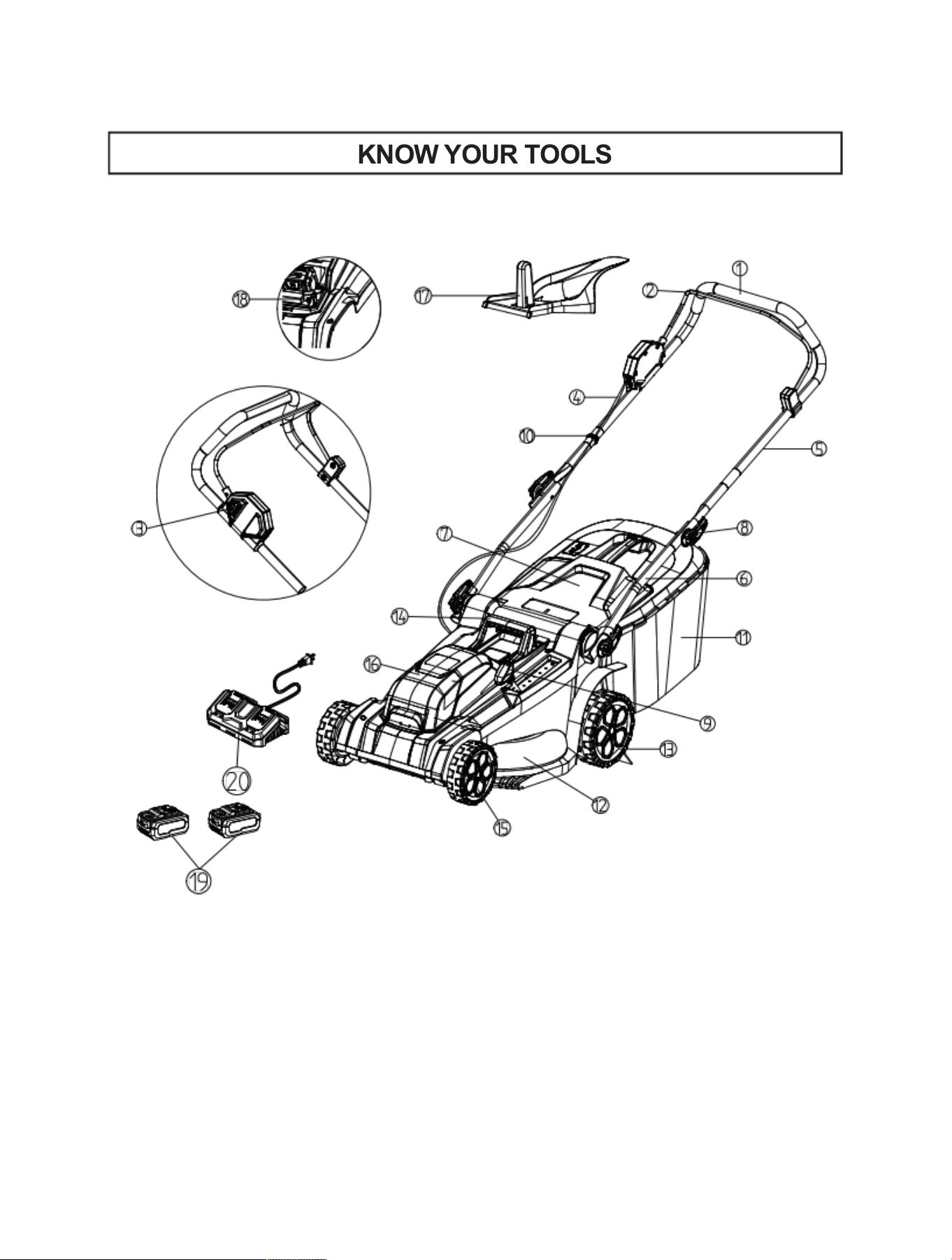
KNOW YOUR TOOLS
1.Push Handlebar
2.Bail Control Bar
3.Lock Off Button
4.Electrical Cable
5.Upper Handlebar
6.Lower Handlebar
7. Rear Discharge Cover
8. Quick-Assembly Set
9.Height Adjustment Lever
10.Cable Clamp
11.Grass Bag
12.Mower Deck
13.Rear Wheel
14.Carrying Handle
15.Front Wheel
16.Battery Compartment Cover
17.Mulching Plug
18.Safety Key
19.Battery Pack
20.Dual Port Charger

9
Technical Data
Item No.
270-1154
Voltage
40V (2X20V)
Deck Width
18"(455mm)
Cutting Width
17"(430mm)
No-Load Speed
3700RPM
Front Wheel Diameter
6"(150mm)
Rear Wheel Diameter
7"(180mm)
Cutting Height
1"-3"(25-75mm)
Cutting Height Positions
6
Grass Catcher Volume
10.6 gal.(40L)
Battery Pack
4.0Ah Li-ion (D01204200)
Charger
2.4A Dual-port Charger (D02203800)
Charger Rating
Input: 120V~60Hz, 140W
Output 1&2: 20VDC, 2.4A
Charging Time (Approx.)
120mins
Packing List
Part Name
Quantity
Lawn Trimmer
1
Grass Bag
1
Mulching Plug
1
Quick- Assembly Set
4
4.0Ah Battery Pack
2
2.4Ah Dual-port Charger
1
Operator’s Manual
1
10
CHARGING YOUR BATTERY
BATTERY INDICATOR
The battery pack is equipped with a push button for checking the charge level. Simply press the
push button to read off the battery charge level from the LEDs of the battery indicator.
LED Indicator
Battery Charge Level/Working
Conditions
3 lights on
70%<Charge Level≤100%
2 lights on
40%<Charge Level≤70%
1 light on
10%<Charge Level≤40%
1 light flashing
Charge level ≤10%
CHARGING YO UR BATTERY
WARNING:
Do not use the charger outdoors or expose it to wet or damp conditions. Water entering the charger
will increase the risk of electric shock.
NOTICE: Lithium-Ion battery packs are shipped partially charged. Before using it the first time, fully charge
the battery pack.
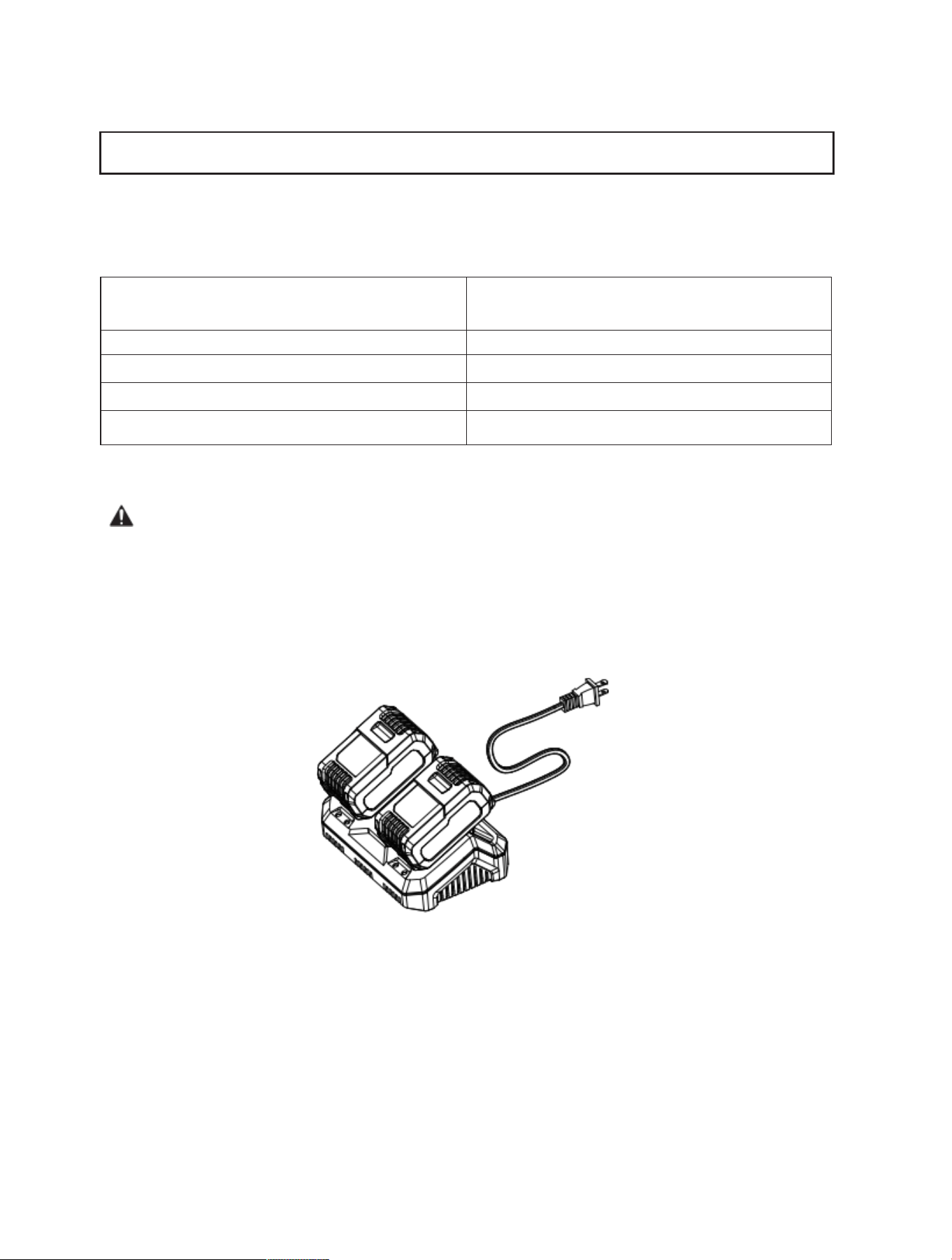
NOTICE: You can charge two batteries at the same time with the charger provided.
a.Connect the charger to the power supply (120V~60Hz). The red charging indication LED will shine,
indicating that the charger is working correctly.
b.Align the raised ribs of the battery pack with the battery-mounting slots in the charger; slide the battery
pack down onto the charger.
c.When the battery is inserted properly, the green light will slowly flash to indicate that the battery is
charging. The red light will turn off.
d.When the green light stays on, the battery is fully charged.

11
NOTICE:
The battery pack will fully charge if left on the charger, but it will not overcharge. If the battery
pack remains on the charger for one month or more, it will drop to lower charge capacity. If this
occurs, re-install the battery pack on the charger to recharge it fully.
A significantly reduced run time after fully charging the battery pack indicates that the batteries
are near the end of their usable life and must be replaced.
The charger may warm during charging. This is part of the normal operation of the charger.
Charge in a well-ventilated area.
CHARGER LED INDICATOR TABLE
Use the table below to determine charger light patterns and possible causes.
Indication
Possible Reason
• Red Light – Off
• Green Light – On
• No load charging –There's no battery inserted in the charger.
• Fully charged – The battery is fully charged and the
charging process is finished.
• Red Light – On
• Green Light – Off
• Normal charging – The battery is being charged.
WARNING:
To prevent accidental starting that may could cau se serious personal injury, always remove the
battery pack from the tool when assembling parts.
WARNING:
Do not attempt to modify this tool or create accessories not recommende d for use with this tool.
Any such alteration or modification is misuse and could result in a hazardous condition leading to
serious injury.
UNPACKING
This product requires assembly.
First remove all the accessories from the carton, then grasp both the front part of the deck cover and
the rear handle at the same time to carefully lift the mower up and out of the carton. Make sure that all
items listed in the parts list are included.
Inspect the product carefully to make sure that no breakage or damage occurred during shipping.
Do not discard the packing material until you have carefully inspected and satisfactorily operated the mower.
If any parts are damaged or missing, please return the mower to the place of purchase.
ASSEMBLY AND OPERATION
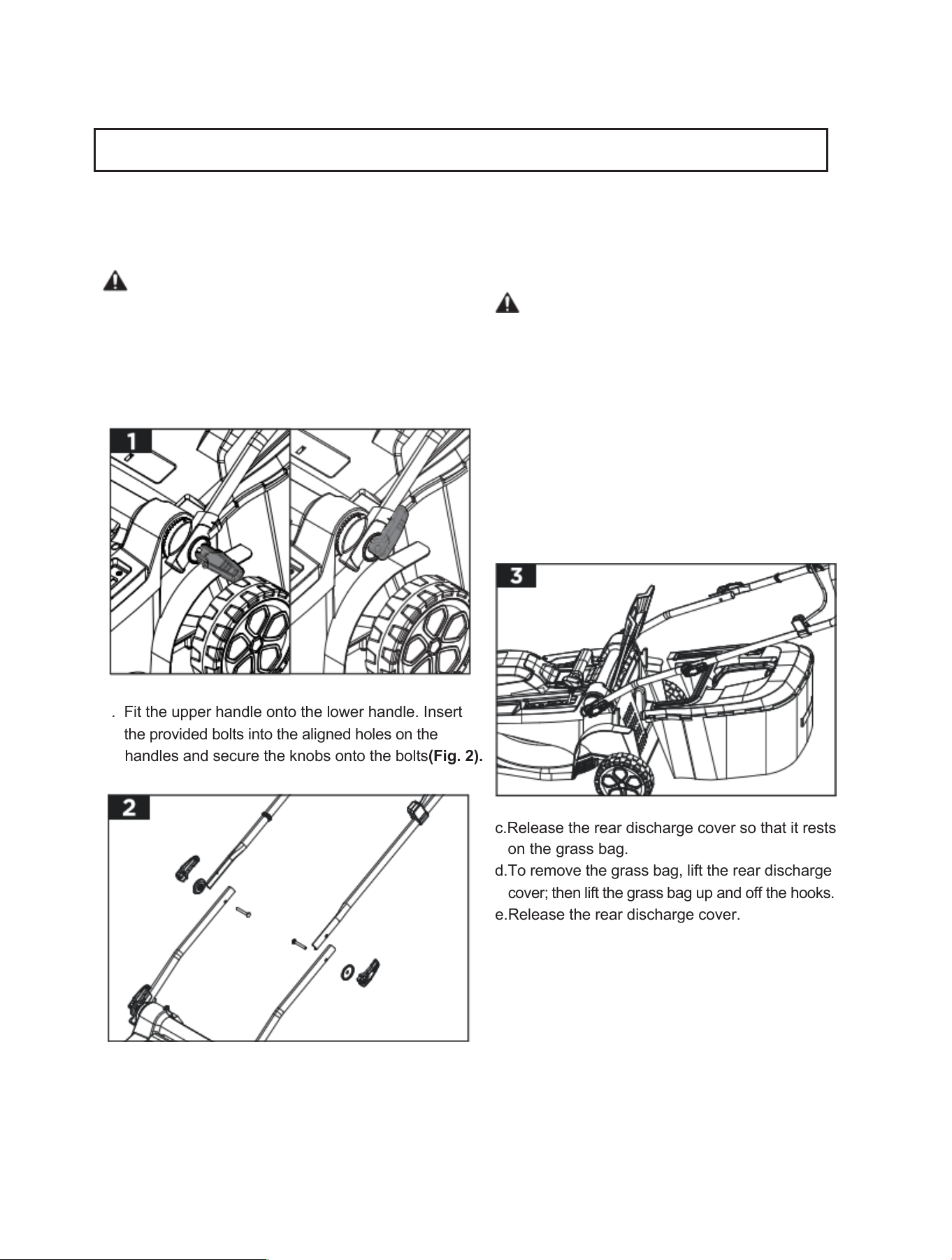
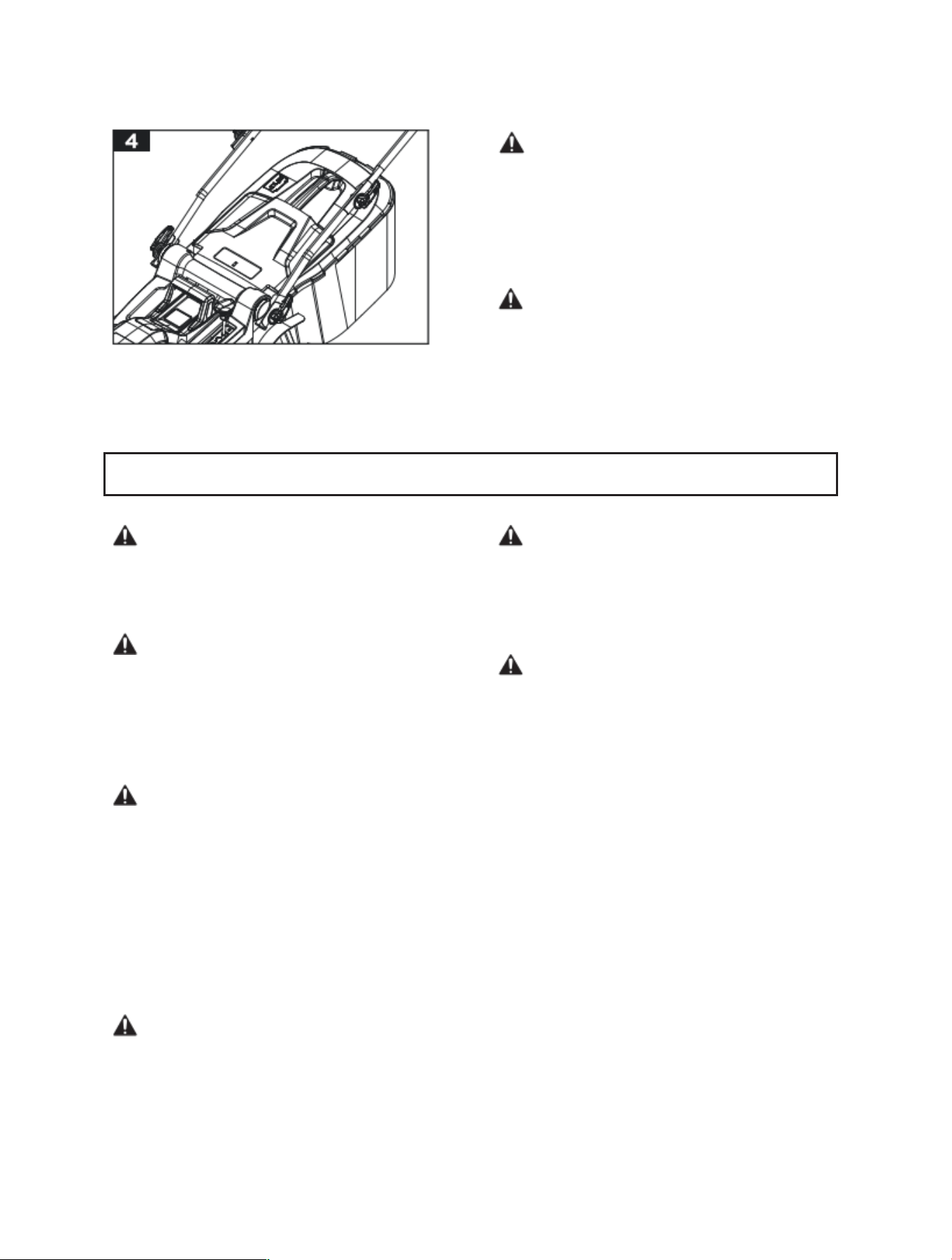
ATTACHING/REMOVING THE
GRASS BAG(Fi g . 3 & 4)
WARNING: Do not at any time make
any adjustment to the lawn mower without
first stopping the motor; removing the
battery pack and waiting for the blade to
stop rotating.
a.Lift the rear discharge cover up, and remove the
mulching plug inserted in the rear discharge
opening.
b.With the rear discharge cover lifted up, hold the
grass bag by the handle and hook it in from
above onto the hooks on both sides.
c. Fit the upper handle onto the lower handle. Insert
the provided bolts into the aligned holes on the
handles and secure the knobs onto the bolts(Fig. 2).
c.Release the rear discharge cover so that it rests
on the grass bag.
d.To remove the grass bag, lift the rear discharge
cover; then lift the grass bag up and off the hooks.
e.Release the rear discharge cover.
12
a.Lift the lower handle up and set it to the fixed height.
The lower handle can only be set in one fixed height.
(Fig. 1)
b.Tighten the quick-assembly set. (Fig. 1)
WARNING: Do not attempt to start the
mower before it has been completely assembled.
HANDLE ASSEMBLY
13
WARNING: When using the grass bag,
never start or operate the mower unless
the grass bag has been firmly hooked and
secured onto the mower and the rear
discharge cover rests snug ly on the top of
the grass bag.
WARNING: Under normal usage, bag
material is subject to wear . To reduce the
risk of injury; frequently insp ect the bag
assembly and replace if there are any signs
of wear or deterioration. Use grass bags
manufactured only for this mower.
OPERAT ION
WARNING: Do not allow familiarity
with this product to make you careless.
Remember that a careless fraction of a
second is sufficient to inflict serious injury.
WARNING: Always wear eye protection
with side shields marked to comply with
ANSI Z87.1, along with hearing protection.
Failure to do so cou ld res u lt in objects
being thrown into your eyes and other
possible serious injuries
WARNING: Do not use any attachments
or accessories not recommended by the
manufacturer of th is product. The use of
attachments or accessories not rec om-
mended can result in serious personal
injury.
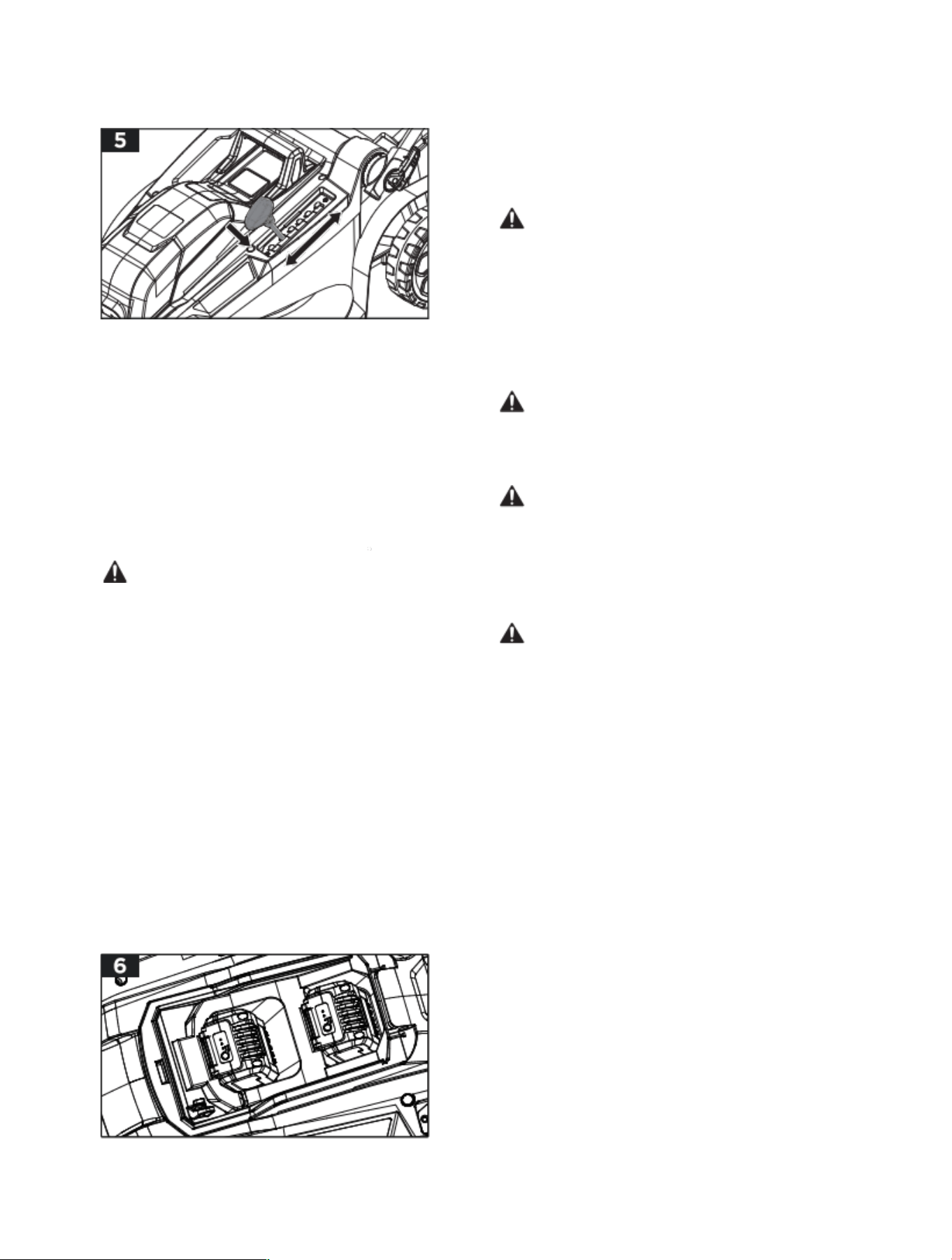
ADJUSTING THE
CUTTING-HEIGHT(Fig.5)
WARNING: Do not at any time make
any adjustment to the lawn mower without
first stopping the motor, removing the
battery pack and waiting for the blade to
stop rotatin g.
WARNING: Do not at any time make
any adjustment to the lawn mower without
first stopping the motor, removing the
battery pack and waiting for the blade to
stop rotating.
WARNING: Keep your feet away from
the deck when adjusting its height. The
mower can be set to 6 cutting heights
between T' (25mm) and 3” (7 5m m). Choose
the proper cutting height according to the
type and condition of the grass.
a. Use one hand to hold the carrying handle for
stability, and use the other a.hand to move the
height adjustment lever outwards from the slots
in the height indication plate.
b.Move the cutting-height adjustment lever toward
the back of the mower for a higher cutting height;
move it toward the front of the mower for a lower
cutting height.
c.Once arriving at the desired height position,
engage the cutting-height adjustment lever back
into the slot.
STARTING/STOPPING
THE LAWN MOWER
WARNING: The operation of any lawn
mower can result in foreign objects being
thrown in to your or others’ eyes, which can
damage eyes severely. Always wear safety
glasses while operating the mower or while
performing any adjustments or re p airs on
the mower.
WARNING: Ensure tha t other people
and pets remain at least 100’ (30m) away
from the mower when it is in use.
WARNING: The blade will continue to
rotate for a few secon ds after the mower is
turned off. Allow the motor/blade to stop
rotating before starting it again. Do not
rapidly turn the mower off and on.
CAUTION: Do not attempt to override
the operation of the safety button and bail
switch.
NOTICE: When attaching, make sure th e
discharge chute fully seated into position.
After assembly, gently pulling it outwards to
make sure it is locked into position securely.
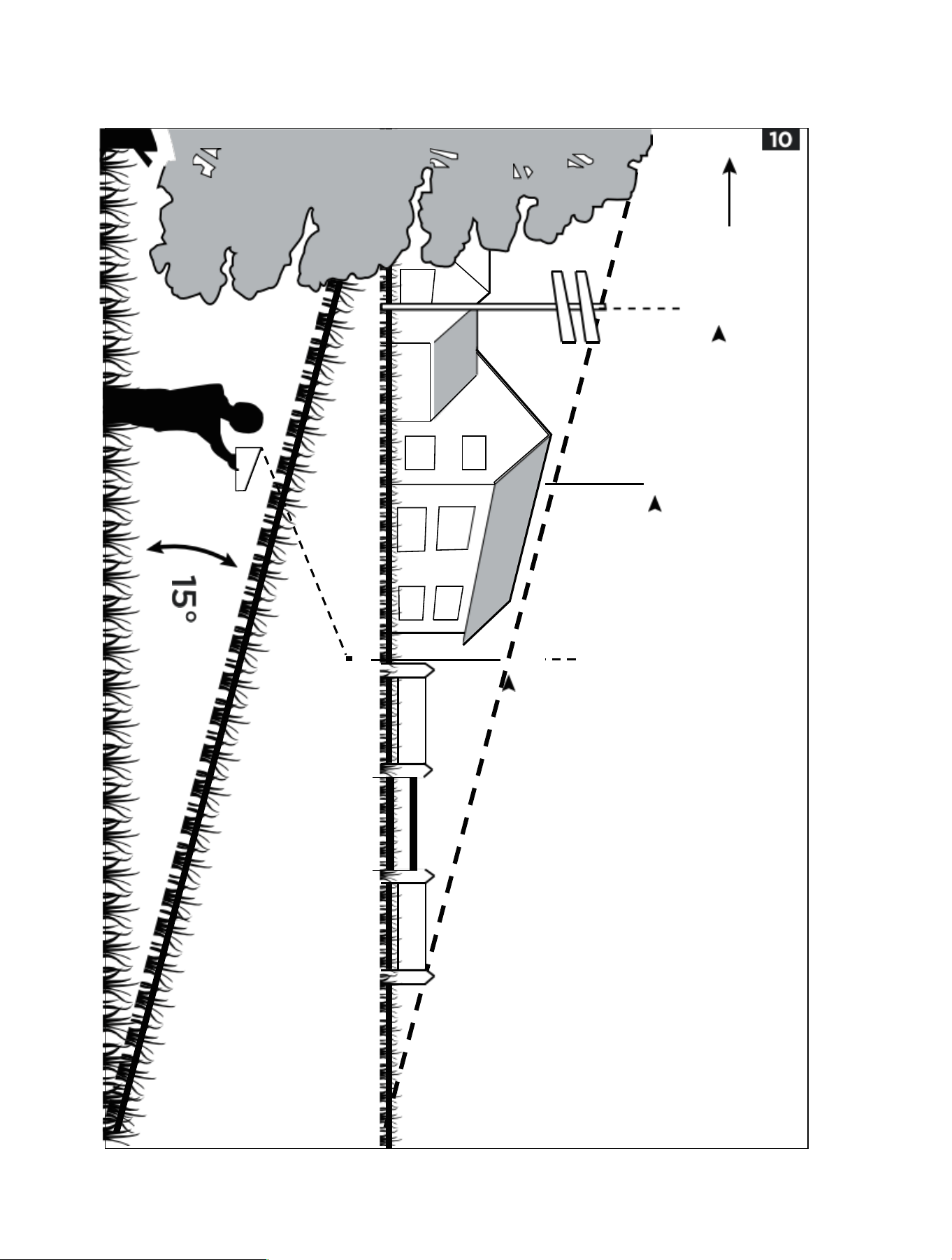
TO START THE MOWER(Fig. 7, 8)
a. Insert the safety key into the key slot as shown
in Fig. 7.
14
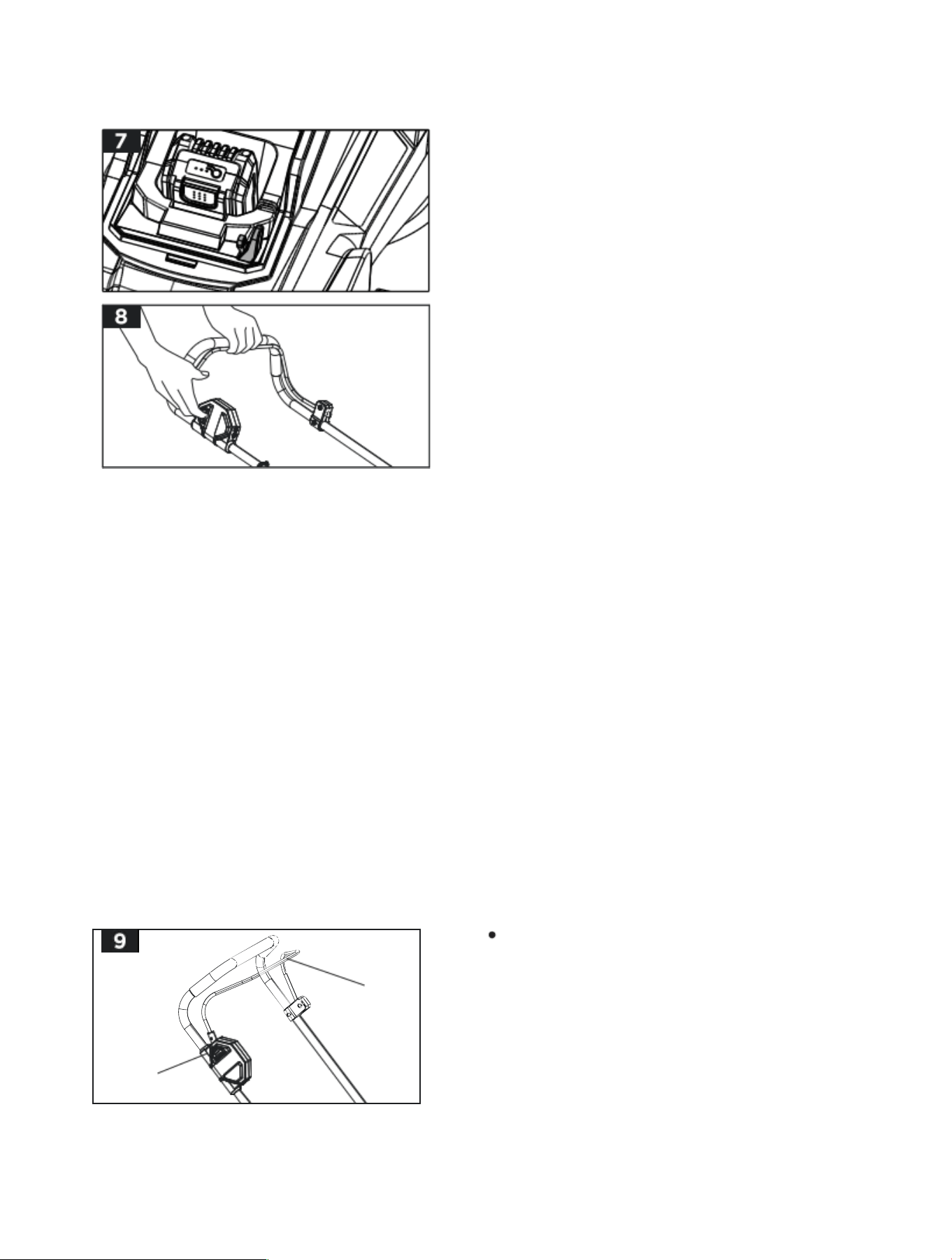
a.The battery cover is hinged. Raise the battery cover
by lifting the front of the cover.
b.Align the grooves in the battery packs with the raised
ribs in the battery compartment, and then insert the
battery packs into the compartment.
c.Push the battery packs downwards until you hear
a "click5', The battery release button will spring up
when the battery packs are securely attached.
d.To detach the battery packs, depress the battery
release button, then lift them out of the compartment.
e.Close the battery cover.
NOTICE: CHARGE BEFORE FIRST USE.
NOTICE: This mower will only run with 2 battery
packs installed. It is recommended to use 2 same
battery packs and charge the 2 battery packs at
the same time.
WARNING: If any parts are broken or
missing, do not attempt to attach the battery
pack to the mower or operate the mower until
the broken or missing parts are replaced.
Failure to do so could result in serious injury.
TO INSTALL/REMOVE
BATTERY PACK(Fig. 6)
15
MOWER OVERLOAD
PROTECTION
To prevent overload conditions, do not try to
remove too much grass at one time. Slow down
your cutting pace or raise the cut height. Your
mower has built-in overload circuit protection.
When the mower is overloaded, the motor will
stop and the power indicator on the mower will
flash orange. Remove the battery pack from the
mower. Check to see if grass has collected
beneath the deck and clear it if necessary, then
install the battery and restart the mower.
BATTERY HIGH TEMPERATURE
PROTECTION
The battery pack will generate heat during
operation. The heat dissipates more slowly in hot
weather. If the battery temperature exceeds
158°F (70°C) during operation, the protection
circuit will immediately turn off the mower to
protect the battery pack from heat damage. The
power indicator on the mower will shine orange
and the LED on the battery will flash orange.
Release the bail handle, wait until the battery pack
cools down to approximately 152°F (67°C), then
restart the mower.
MOWING TIPS
NOTICE: A sharp blade will greatly enhance
the performance of the mower, especially
when cutting tall grass. Make sure to check
the sharpness of the blade before mowing.
Verify that the lawn is free of stones, sticks, wires,
and other objects which could damage the lawn
mower or motor. Such objects could be
accidentally thrown by the mower in any direction
and could cause serious personal injury to the
operator and to others.
NOTICE: Make sure that the safety key is
inserted fully into place and th a t the battery
packs are secured before operating the mower
b. Install the battery packs and close the battery
compartment cover.
c. Press the lock off button and hold it, grip and pull
the bail control bar backwards to meet the handle.
Now the mower starts. And then you can release
the lock off button.
NOTICE: While operating the mower; always pull
the bail control bar to the handle.
TO STOP THE MOWER( Fig . 9)
a.Fully release the bail control bar.
b.The electric brake in the Automatic Braking
Mechanism will stop the blade rotation within 3
seconds after the bail control bar is released.
Bail Control Bar
Off Button
Lock

16
WARNING: If you strike a foreign object,
stop the motor and rem ove the battery.
Thoroughly inspect the mower for any
damage, and repair the damage before
restarting and operating the mower.
Excessive vibration of the mower during
operation is an indica tion of damage. The
unit should be promptly inspected and
repaired.
For best results, do not mow in circles. Travel
back and forth across the lawn.
When cutting thick grass, reduce your walking
speed in order to allow for a more effective cut
and a proper discharge of the clippings.
To maintain a healthy lawn, cut off only one-third
or less of the total length of the grass. The
average lawn should be approximately 1-1/2 to
2 inches long during cool months, and between
2 to 3-1/4 inches long during hot months.
KEEP CHIL DREN AWAY
Tragic accidents can occur if the operator is not
alert to the presence of children. Children are
often attracted to the mower and mowing activity.
They do not understand the dangers. Never assume
that children will remain where you last saw them.
Keep children out of the mowing area and under
the watchful care of a responsible adult other than
the operator.
Be alert and turn the mower off if a child enters
the area.
Use extreme care when approaching blind
corners, doorways, shrubs, trees, or other
objects that may obscure your vision of a child
who may run into the mower.
Never allow children under 14 years old to
operate a power mower. Children 14 years old
and over should read and understand the
operation instructions and safety rules in this
manual and should be trained and supervised
by a parent. Only responsible individuals who
are familiar with these rules of safe operation
should be allowed to use this machine.
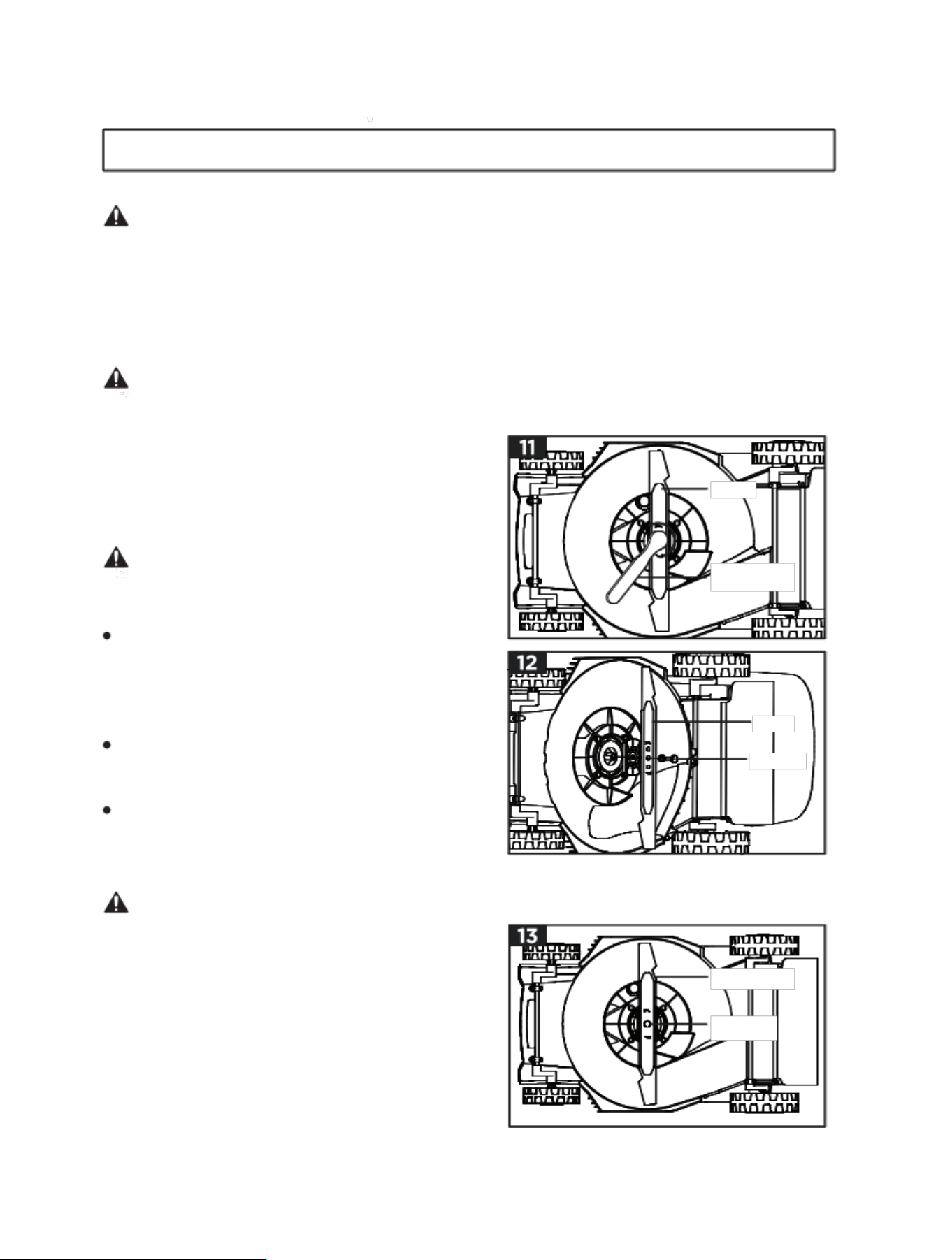
MOWING ON SLOPE
Slopes are a major factor related to slip-and-fall
accidents, which can result in severe injury.
Operation on slopes requires extra caution. If
you feel uneasy on a slope, do not mow it. For
your safety, use the slope gauge (Fig. 10) to
measure slopes before operating this unit on a
sloped or hilly area. If the slope is greater than
15 degrees, do not mow it.
Do:
Mow across the face of slopes; never mow up
and down. Exercise extreme caution when
changing direction on slopes
Watch for holes, ruts, rocks, hidden objects, or
bumps which can cause you to slip or trip. Tall
grass can hide obstacles.
Do not:
Do not mow near drop-offs, ditches or
embankments; you could lose your footing or
balance.
Do not mow slopes greater than 15 degrees
(a rise of approximately 2-1/2' (0.75m) every
10' (3m)), as shown on the slope gauge.
Do not mow on wet grass. Unstable footing
could cause slipping.
17
Sight
and
hold
the
line
level
with
a
vertical
tree
Sightandhol dthel ine
level
with
a
pole
or
a
corner
of
building
or
a
fence
post
line
(r
epressent
a
15°
Slope
)
Fold
along
dot
ted
18
MAINTENANCE
WARNING: When servicing, use only
identical replacemen t parts. Use of any
other parts may create a hazard or cause
product damage. To ensure safety and
reliability, all repairs should be performed
by a qualified service techn ic ian.
WARNING: To prevent serious personal
injury, remove th e battery pack from the
tool before servicing, cleaning, changing
add-on attachments or re moving material
from the unit.
Bla de
CLEANING THE MOWER
WARNING: Always remove the battery
pack when servicing or trans porting the
mower.
The underside of mower deck should be cleaned
after each use, as grass clippings, leaves, dirt
and other debris will accumulate. This accum-
ulation is undesirable, as it will promote rust and
corrosion.
Remove any build-up of grass and leaves on or
around the drive shaft (LM2020SP only) and
motor fan (do not use water).
Wipe the mower clean with a damp cloth.
BLADE REPLACEMENT
WARNING: Always protect your hands
by wearing heavy gloves or wrapping the
cutting edges with rags or other materials
when performing any maintenance on the
mower blade. Always remove the battery
pack when servicing or trans porting the
mower.
a.Remove the battery packs and the safety key
from the mower.
b.Turn the mower over on its side to expose the
underside of the blade housing.
c.Use a cloth to grip the blade or wear heavy-
duty gloves.
d.Using a 16 mm lug wrench (not provided),
remove the lug nut securing the blade by
turning the lug nut counterclockwise, then
carefully remove the blade(Fig. 11 & 12).
e.Fit the new blade on the same position and
secure with the original lug nut(Fig. 13).
New blade
Lug nut
Bla de
Lug nut
16 mm lug
wrench
19
SHARPENING THE BLADE
WARNING: Always protect your hands
by wearing heavy gloves or wrapping the
cutting edges with rags or other materials
when performing any maintenance on the
mower blade. Always remove the battery
packs when servicing or transporting the
mower.
WARNING:
Use
proper eye
protection
while removing, sharpening, and installing
the blade.
WARNING: A worn, cracked, or dam-
aged blade can break and pieces of the
damaged blade can become dangerous
projectiles. Thrown objects can cau se
serious injury. Ins pe ct the blade regularly
and do not operate the mower with a worn
or damaged blade.
NOTICE: Keep the blade sharp for best mower
performance. A dull blade does not cut grass
cleanly or mulch properly.
A dull blade can be sharpened, but a blade that
is excessively worn, bent, cracked, or otherwise
damaged must be replaced. A worn or damaged
blade can break, causing blade pieces to be
thrown from the mower.
SHARPING FREQUENCY
Sharpening the blade twice during a mowing season
is usually sufficient under normal circumstances.
Sand causes the blade to dull quickly; if your lawn
has sandy soil, more frequent sharpening may be
required.
WHEN SHARPENING THE BLADE:
Make sure that the blade remains balanced.
Sharpen the blade at the original cutting angle.
Sharpen the cutting edges on both ends of the
blade, removing an equal amount of material
from each end.
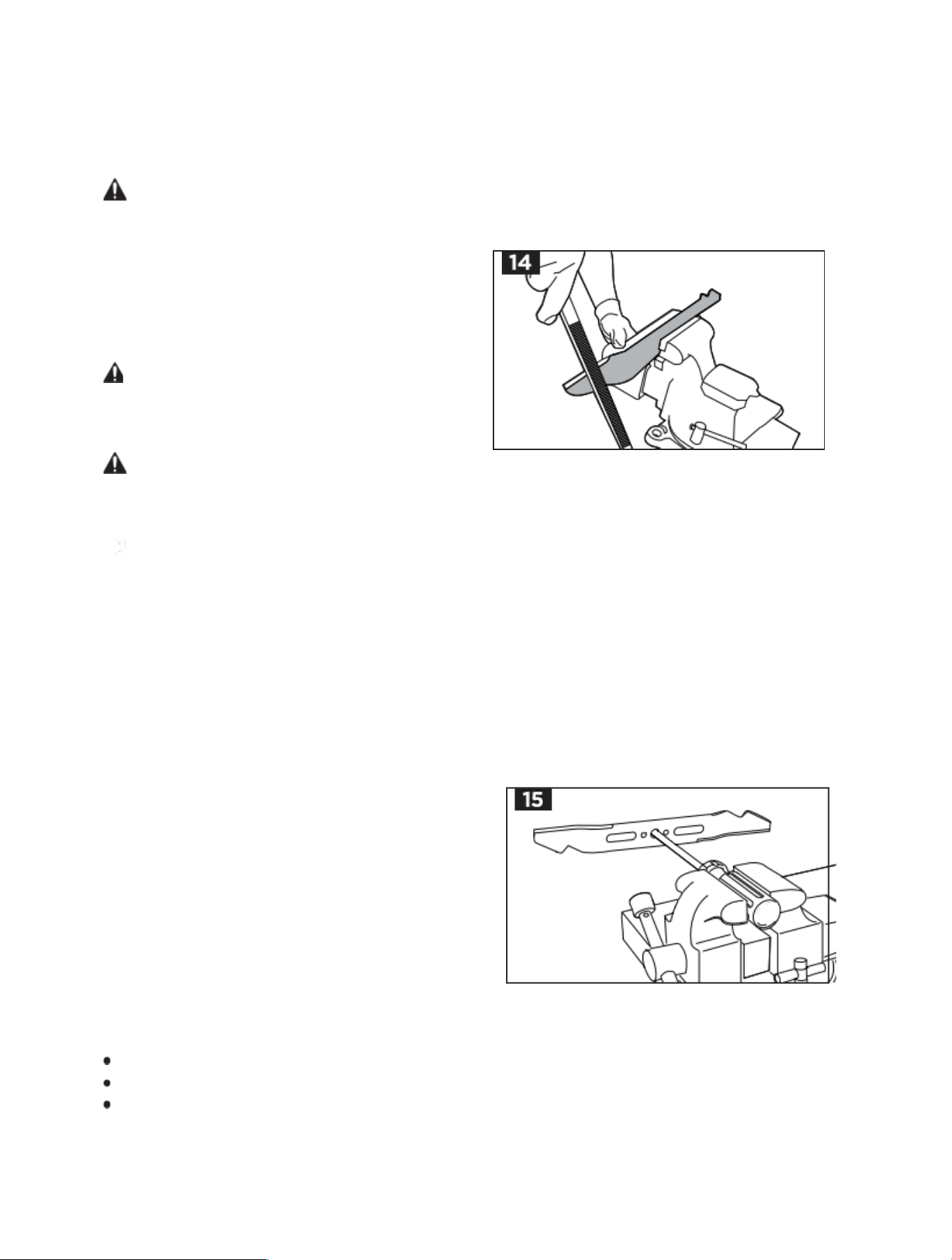
TO SHARPEN BLADE IN A VISE:
a.Remove the blade from the mower (please see
BLADE REPLACEMENT).
b.Secure the blade in a vise(Fig. 14).
c.Wear proper eye protection and gloves and be
careful not to cut yourself.
d.Carefully file the cutting edges of the blade with
a fine tooth file or sharpening stone, maintaining
the original cutting edge angle.
e.To check the blade balance: clamp a nail or a
screw driver with a round shank in the horizontal
position. Position the blade so that the nail or
round shank of the screwdriver supports the
blade through its center hole. Balance the blade
horizontally. If either end of the blade rotates
downward, remove some metal from the heavy
or lower end until the blade is balanced. It is
balanced when neither end drops.
f. Replace the blade on the mower and tighten it
securely (please see BLADE REPLACEMENT).
WARNING: An unbalanced blade will
cause excessive vibration when ro ta tin g
at high speeds. It may cause damage to
the mower and could break, causing
personal injury.
LUBRICATION
WARNING: Remove the battery packs
before any lubrication work.
It is recommended to have this machine lubricated
by qualified engineer or authorized service center.
KEEP CHIL DREN AWAY
WARNING: Remove the battery packs
before any servicing work.
To replace the wheels, it is recommended to have
the machine serviced by qualified engineer or
authorized service center.
STORING THE MOWER
The following steps should be taken in order to
prepare the lawn mower for storage.
a.Remove the battery packs and the safety key
from the battery compartment.
b.Remove the grass bag. Engage the height
adjustment lever in the lowest cutting height slot.
c.Clean the mower with a dry cloth or hand brush.
d.Inspect the mower carefully for worn, loose or
damaged parts. Check connections and screws
and tighten if necessary. Pay special attention to
the mower blade and replace/sharpen if it shows
signs of wear. Refer to the Maintenance section.
e.Store the mower indoors in a dry, clean and cool
area out of the reach of children. Do not store the
unit next to corrosive materials, such as fertilizer
and rock salt.
f. Do not cover the lawn mower with a solid plastic
sheet. Plastic coverings trap moisture around the
mower; which can damage the unit.
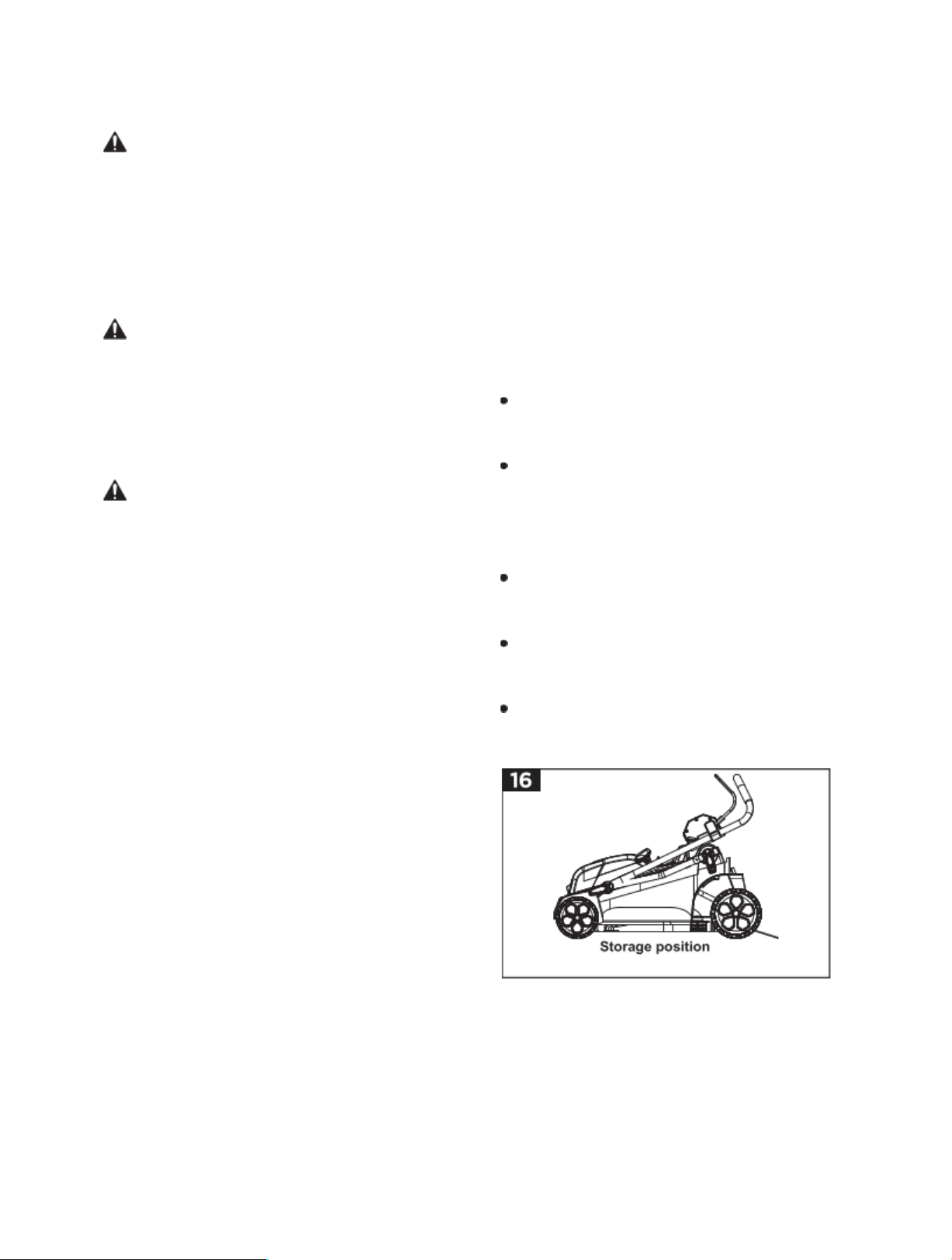
g.The handle on your lawn mower can be folded for
compact storage. Start by loosening all of the
handle locking knobs of the upper handle and fold
down the upper handle. Then lower the lower
handle(Fig. 16)
20
MOWING ON SLOPE
Slopes are a major factor related to slip-and-fall
accidents, which can result in severe injury.
Operation on slopes requires extra caution. If
you feel uneasy on a slope, do not mow it. For
your safety, use the slope gauge (Fig. 10) to
measure slopes before operating this unit on a
sloped or hilly area. If the slope is greater than
15 degrees, do not mow it.
Do:
Mow across the face of slopes; never mow up
and down. Exercise extreme caution when
changing direction on slopes
Watch for holes, ruts, rocks, hidden objects, or
bumps which can cause you to slip or trip. Tall
grass can hide obstacles.
Do not:
Do not mow near drop-offs, ditches or
embankments; you could lose your footing or
balance.
Do not mow slopes greater than 15 degrees
(a rise of approximately 2-1/2' (0.75m) every
10' (3m)), as shown on the slope gauge.
Do not mow on wet grass. Unstable footing
could cause slipping.
21
STORING THE BATTERY PACK
a.Protect the battery against moisture and water.
b.Store the battery only within a temperature
range from 41°F(5°C) to 1O4°F(40°C). As an
example, do not leave the battery in a vehicle
or in the hedge trimmer in direct sunlight.
c.Clean the ventilation slots of the battery
occasionally with a soft, clean and dry brush.
A considerably shortened operating time after
charging is an indication that the battery is
exhausted and must be replaced.
d.If you do not use the product for a long time,
please charge and discharge the battery pack
once every month.
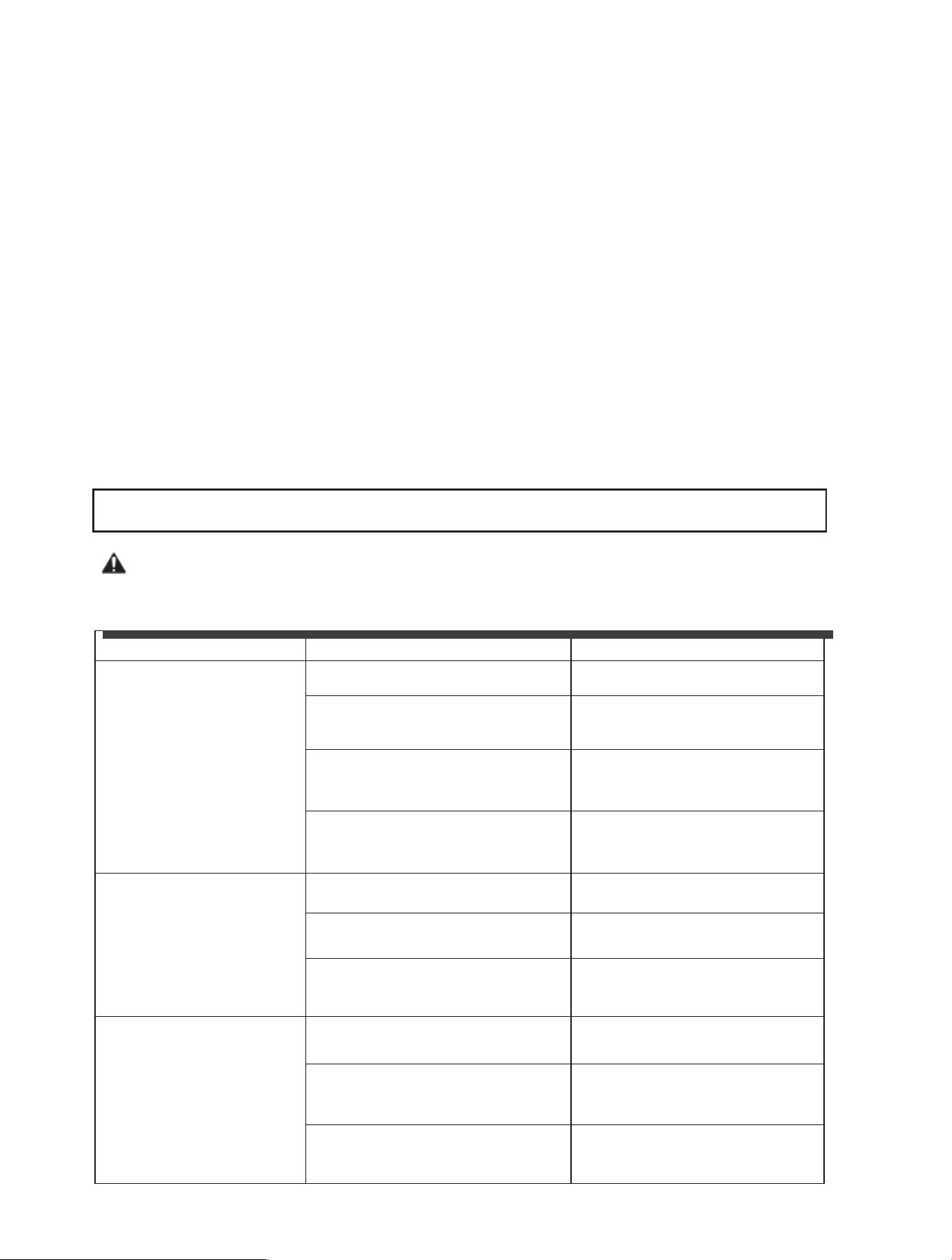
TROUBLESHOOTING
WARNING: Always remove the battery pack when servicing or transporting the mower.
Always protect your hands by wearing heavy gloves or wrapping the cutting edges with rags
or other materials when performing any maintenance on the mower blade.
PROBLEM
POSSIBLE CAUSE
SOLUTION
The mower fails to start
The battery pack is depleted.
Charge the battery pack.
The battery pack is not mounted in
place in the battery compartment.
Attach the battery pack to the
mower, press it until you hear a
click.
The battery or mower circuitry is too hot.
Allow the battery pack or mower to
cool until the temperature drops
below 152°F (67°C).
The mower deck is clogged with grass
and debris.
Clean the mower deck and make
certain that the blade has freedom of
movement.
The mower cuts unevenly
The blade is dull.
Sharpen or replace the blade.
The cutting height is not set properly.
Adjust the deck height to a higher
setting.
The blade is assembled incorrectly
Reassemble the blade, following
the section “BLADE
REPLACEMENT” in this manual.
The mower stops while mowing.
Mower is in overload condition.
Raise the cutting height or slow
down the mowing
Mower deck is clogged with grass and
debris.
Unclog the mower deck. Make sure
there is no disturbing objects on the
grass to be mowed.
The battery or mower circuitry is too hot.
Allow the battery pack or mower to
cool until the temperature drops
below 152°F (67°C).

21

22
PROBLEM
POSSIBLE CAUSE
SOLUTION
There is excessive vibration.
The cutting blade is loose.
Tighten the blade bolt.
The cutting blade is unbalanced.
Balance the blade following the
instructions.
The cutting blade is bent.
Replace the blade.
The motor works but the
blade doesn’t cut the
grass.
The blade is not tightened to the
required torque.
Re-tighten the blade. The
recommended torque for the blade
bolt is 36-43 ft-lb (49-59Nm).
Short running time of the
mower with included battery.
Grass conditions and cutting height
setting will greatly affect the battery run
time. The claimed run time is based on
a light load condition.
Raise the blade height and slow your
pace to reduce the cutting load.
LIMITED WARRANTY SERVICE
2-Year Tool, Battery and Charger Warranty
Against Defects in Materials, Parts or Workmanship.
All Units Must Be Used and Maintained in Accordance with The Directions and Regulations in The
Operator's Manual.
For assistance, please call the TOLL-FREE HELPLINE: 1-888-930-8528
