
1. SAFETY
1.1. GENERAL POWER TOOL SAFETY WARNINGS
WARNING! Read all safety warnings, instructions, illustrations and specications provided with this power tool. Failure to follow all
instructions listed below may result in electric shock, re and/or serious injury.
9 Save all warning and instructions for future reference.
1.2. WORK AREA SAFETY
9 Keep work area clean and well lit. Cluttered or dark area invites accidents.
8 DO NOT operate power tools in explosive atmospheres, such as in the presence of ammable liquids, gases or dust. Power tools
create sparks which may ignite the dust or fumes.
9 Keep children and bystanders away whilst operating a power tool. Distractions can cause you to lose control.
9 The concentration of processed gases that can displace breathing air shall be kept within acceptable levels.
1.3. ELECTRICAL SAFETY
WARNING! It is the responsibility of the owner and the operator to read, understand and comply with the following: You must check all
electrical products before use to ensure that they are safe. You must inspect power cables, plugs, sockets and any other connectors for
wear or damage. You must ensure that the risk of electric shock is minimised by the installation of appropriate safety devices. A Residual
Current Circuit Breaker (RCCB) should be incorporated in the main distribution board. We also recommend that a Residual Current Device
(RCD) is used. It is particularly important to use an RCD with portable products that are plugged into a supply which is not protected by an
RCCB. If in any doubt consult a qualified electrician. You must also read and understand the following instructions concerning electrical
safety:
1.3.1. The Health & Safety at Work Act 1974 makes owners of electrical appliances responsible for the safe condition of those appliances and
the safety of the appliance operators. If in any doubt about electrical safety, contact a qualified electrician.
9 Ensure that the insulation on all cables and on the appliance is safe before connecting it to the power supply.
9 Ensure that cables are always protected against short circuit and overload.
9 Regularly inspect power supply cables and plugs for wear or damage and check all connections to ensure that none are loose.
Important: Ensure that the voltage marked on the appliance matches the power supply to be used and that the plug is fitted with the
correct fuse.
▲ DANGER! If the power cable for this equipment is damaged, it must be replaced by the manufacturer or its after-sales service or similarly
trained personnel.
8 DO NOT pull or carry the appliance by the power cable.
8 DO NOT pull the plug from the socket by the cable.
8 DO NOT use worn or damaged cables, plugs or connectors. Immediately have any faulty item repaired or replaced by a qualified electrician.
1.3.2. Over/current Protection: The user has to make provision for the installation of the over-current protection of the power circuit.
1.4. Electrical disconnecting device: The user has to make provisions for the installation of the electrical disconnecting device of the power
circuit. The supply disconnection device is to be in accordance with EN 60204-1:2006.
NOTE: If using a transformer to supply the compressor, it must be rated at a minimum of 2kVA to allow the compressor to run efficiently.
9 Power tool plugs must match the outlet. Never modify the plug in any way. DO NOT use any adaptor plugs with earthed (grounded) power
tools. Unmodified plugs and matching outlets will reduce risk of electric shock.
9 Avoid body contact with earthed or grounded surfaces, such as pipes, radiators, ranges and refrigerators. There is an increased risk of
electric shock if your body is earthed or grounded.
8 DO NOT expose power tools to rain or wet conditions. Water entering a power tool will increase the risk of electric shock.
8 DO NOT abuse the cord. Never use the cord for carrying, pulling, or unplugging the power tool. Keep cord away from the heat, oil, sharp
edges or moving parts. Damaged or entangled cords increase the risk of electric shock.
9 When operating a power tool outdoors, use an extension cord suitable for outdoor use. Use of a cord suitable for outdoor use reduces the
risk of electric shock.
9 If operating a power tool in a damp location is unavoidable, use a residual current device (RCD) protected supply. Use of an RCD reduces
the risk of electric shock.
1.5. PERSONAL SAFETY
9 Stay alert, watch what you are doing and use common sense when operating a power tool. DO NOT use a power tool whilst you are tired
or under the inuence of drugs, alcohol, or medication. A moment inattention whilst operating power tools may result in serious injury.
9 Use personal protective equipment. Always wear eye protection. Protective equipment such as dust mask, non-skid safety shoes, hard
hat or hearing protection use for appropriate conditions will reduce personal injuries.
9 Prevent unintentional starting. Ensure the switch is in the o position before connecting to power source and/or battery pack, picking up or
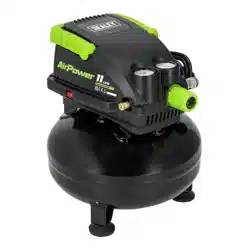
11L OIL FREE DIRECT DRIVE AIR
COMPRESSOR 0.5HP
MODEL NO: SAC1100
Thank you for purchasing a Sealey product. Manufactured to a high standard, this product will, if used according to these instructions,
and properly maintained, give you years of trouble free performance.
IMPORTANT: PLEASE READ THESE INSTRUCTIONS CAREFULLY. NOTE THE SAFE OPERATIONAL REQUIREMENTS, WARNINGS & CAUTIONS.
USE THE PRODUCT CORRECTLY AND WITH CARE FOR THE PURPOSE FOR WHICH IT IS INTENDED. FAILURE TO DO SO MAY CAUSE
DAMAGE AND/OR PERSONAL INJURY AND WILL INVALIDATE THE WARRANTY. KEEP THESE INSTRUCTIONS SAFE FOR FUTURE USE.
Refer to
instructions
Wear eye
protection
Wear ear
protection
WARNING:
High Voltage
WARNING:
Hot surface
WARNING:
Automatic
start up
Indoor use only
DO NOT open
the air cock
before an air
hose is attached
Original Language Version
© Jack Sealey Limited
SAC1100 Issue 2 (3) 03/04/24

carrying the tool. Carrying power tools with your ngers on the switch or energising power tools that have the switch on invites accidents.
8 DO NOT overreach. Keep proper footing and balance at all times. This enables better control of the power tool in unexpected situations.
9 Dress properly. DO NOT wear loose clothing or jewellery. Keep your hair and clothing away from moving parts. Loose clothes, jewellery
or long hair can be caught in moving parts.
8 DO NOT let familiarity gained from frequent use of tools allow you to become complacent and ignore tool safety principles. A careless
action can cause severe injury within a fraction of a second.
1.6. SERVICE
9 Have your power tool services by a qualied repair person using only identical replacement parts. This will ensure that the safety of the
power tool is maintained.
9 If the replacement of the supply cord is necessary, this has to be done by the manufacturer or his agent in order to avoid a safety hazard.
9 Disconnect from all energy supplies before servicing.
1.7. GENERAL COMPRESSOR SAFETY
9 Before you connect the equipment to the mains supply make sure that the data on the rating plate are identical to the mains data .
9 Familiarise yourself with the application and limitations of the compressor.
9 Ensure the compressor is in good order and condition before use. If in any doubt DO NOT use the unit and contact your Sealey
Stockist.
9 Operation must be with all guards, covers, lids and enclosures correctly in place.
9 Fully assemble the compressor before using for the first time.
9 The concentration of processed gases that can displace breathing air shall be kept within acceptable levels. Reference EN 12021 for
acceptable levels of contaminants in breathing air.
9 Remove from mains supply when performing maintenance or inspections.
WARNING! Item must be serviced by an authorised agent. DO NOT tamper with or attempt to adjust pressure switch or safety valve.
8 DO NOT carry out any welding operations on any pressurised part of the vessel.
9 Before moving, or maintaining the compressor ensure it is unplugged from the mains supply and that the air tank pressure has been vented.
9 Maintain the compressor in good condition and replace any damaged or worn parts. Use genuine parts only. Unauthorised parts may
be dangerous and will invalidate your warranty.
9 Delivery hoses should be fitted with a safety cord.
9 It is essential to use separators, water traps and drains which process the liquids produced by the compressor system is put into operation.
9 The compressor may only be used in suitable rooms (with good ventilation and an ambient temperature from +5°C to +40°C). Ensure there is
no dust, acids, vapours, explosive gases, or inflammable gases in the room. The air intake should be from a clean, outside air source.
9 Read the instructions relating to any accessory to be used with this compressor. Ensure the safe working pressure of any air appliance
used exceeds compressors output pressure.
9 Ensure the safe working pressure of any air appliance used exceeds compressors output pressure. If using a spray gun, check that the
area selected for spraying is provided with an air change system/ventilation.
9 Ensure the air supply valve is turned o before disconnecting the air supply hose.
9 To move a transportable compressor, use the handle only. DO NOT attempt to lift or move the compressor by any other means.
9 Use the compressor in a well ventilated area and ensure it is placed on a at, rm surface.
9 The safety regulations allow a maximum of 10°inclination.
9 Keep tools and other items away from the compressor when it is in use, and keep area clean and clear of unnecessary items.
9 Ensure the air hose is not tangled, twisted or pinched.
9 All hoses and tting shall be suitable for the site use at the maximum allowable pressure of the portable compressor.
9 Keep children and unauthorised persons away from the working area.
9 Only move the compressor by the handle (if portable).
8 DO NOT dis-assemble compressor for any reason. The unit must be checked by qualied personnel only.
8 DO NOT use the compressor outdoors, or in damp, or wet, locations.
8 DO NOT operate within the vicinity of ammable liquids, gases or solids.
8 DO NOT touch compressor cylinder, cylinder head or pipe from head to tank as these may be hot.
8 DO NOT use this product to perform a task for which it has not been designed.
8 DO NOT deface the certication plate attached to the compressor tank.
8 DO NOT cover the compressor or restrict air ow around the unit whilst operating.
9 DANGER! DO NOT direct the output jet of air towards people or animals.
8 DO NOT operate the compressor without an air lter.
8 DO NOT allow anyone to operate the compressor unless they have received full instructions.
WARNING! The air tank is a pressure vessel and the following safety measures apply:
8 DO NOT tamper with the safety valve, DO NOT modify or alter the tank in any way and DO NOT strap anything to the tank.
8 DO NOT subject the tank to impact, vibration or to heat and DO NOT allow contact with abrasives or corrosives.
9 Drain condensation from tank daily and inspect inside walls for corrosion every three months and have a detailed tank inspection
carried out annually. The tank shell must not fall below the certied thickness at any point.
WARNING! If an electrical fuse blows, ensure it is replaced with an identical fuse type and rating.
9 When not in use, store the compressor carefully in a safe, dry, childproof location.
9 When the compressor is not in use, it should be switched o, disconnected from the mains supply and the air drained from the tank.
9 Under the PRESSURE SYSTEMS SAFETY REGULATIONS 2000 it is the responsibility of the owner of the compressor to initiate
a system of inspection that both denes the frequency of the inspection and appoints a a person who has specic responsibility for
carrying out the inspection.
9 The declared noise emission value(s) have been measured in accordance with a standard test method and may be used for comparing
one tool with another.
9 The declared noise emission values may also be used in a preliminary assessment of exposure.
9 The noise emission exposure actual use of the power tool can dier from the declared values depending on the ways in which the tool
is used, especially what kind of workpiece is processed.
9 There is a need to identify safety measures to protect the operator, based on an estimation of exposure in the actual condition of use.
Original Language Version
© Jack Sealey Limited
SAC1100 Issue 2 (3) 03/04/24
2. INTRODUCTION
Aluminium cylinder head with cast iron cylinder gives added resistance to wear. Fitted with fully automatic pressure cut-out switch
and twin gauges displaying tank and working pressures. Pump head directly coupled to heavy-duty universal motor for reliable and
quiet operation. Precision welded receiver tank manufactured to meet Pressure Vessel Directive. The benets of oil free compressors
include: easy maintenance, reduced noise levels, better eciency, quieter when running and no oil contamination in the air supply.
Lightweight unit with carry handle and built-in cable tidy for easy manoeuvrability
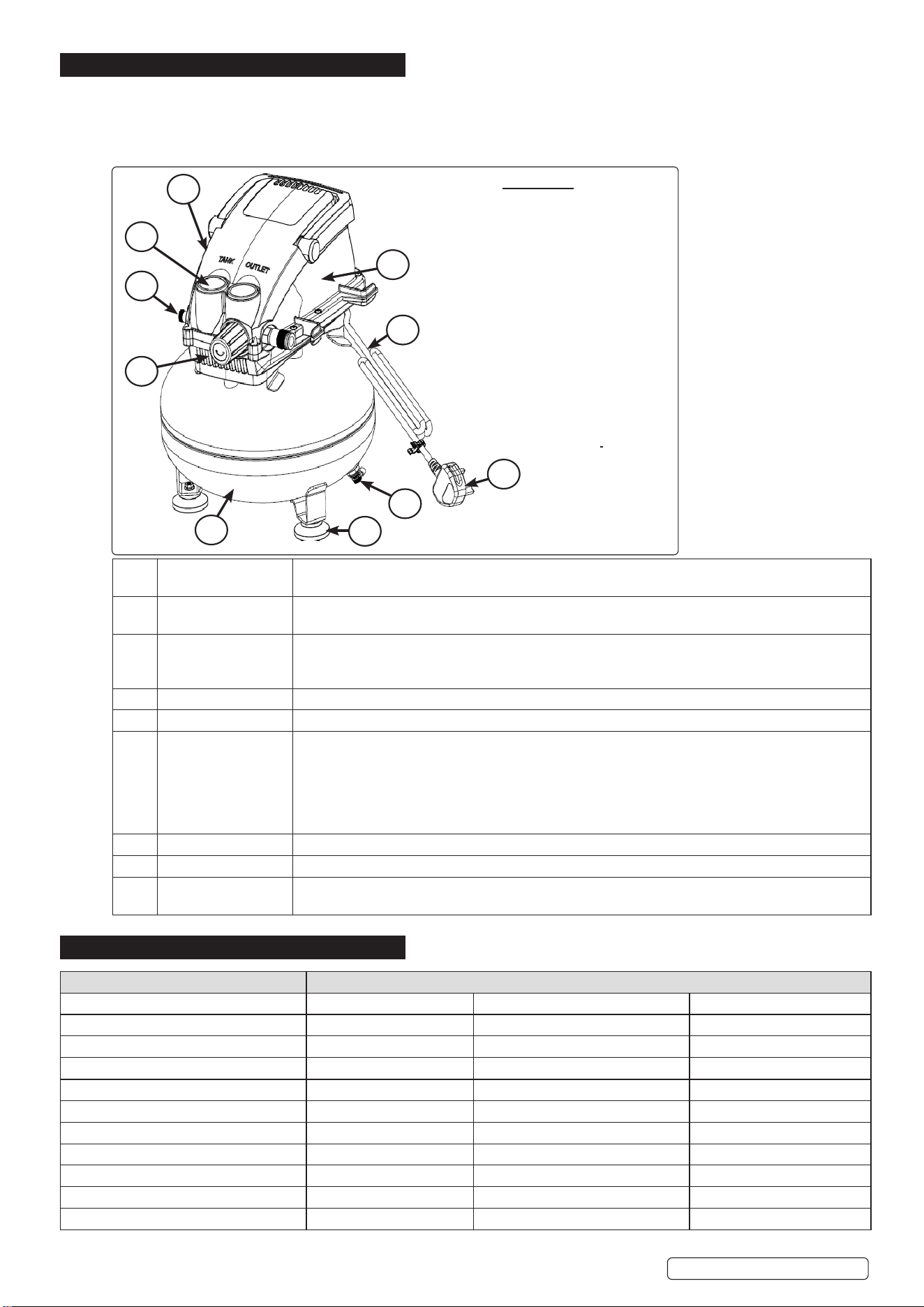
1 Air Pressure
Regulator
The regulator is used to adjust line pressure to the tool you are using. Turn the knob clockwise to
increase pressure and counter-clockwise to decrease pressure.
2 Pressure Gauge The gauge is used to measure the store air pressure level of the tank. It is not adjustable by the
operator and doers not indicate line pressure.
3 ON/OFF Switch This switch turns on the compressor and is operated manually. When in the “-” position, it allows the
compressor to start up or shut down automatically, without warning, upon air demand. ALWAYS set
this switch to “o” when the compressor is not being used, and before unplugging the compressor.
4 Electric motor The motor is used to power the pump.
5 Quick Coupler The quick coupler is connected to a quick connector which is connecting to air hose.
6 Power cord This compressor should be used on a nominal 230V grounded circuit. Use a power cord that is
equipped with a grounding plug. Verify that the compressor is plugged into an outlet that has the
same conguration as the plug. DO NOT use an adapter with this compressor. Check with a licensed
electrician if the grounding instructions are not understood or there is doubt as to whether the
product is properly grounded. DO NOT modify the provided. If it will not t the outlet have the proper
outlet installed by a licensed electrician.
7 Drain Valve The drain valve is used to remove moisture from the air tank after the compressor is shut o.
8 Air Tank The tank is used to store the compressed air.
10 Safety Valve The working pressure of the air tank reaches the working pressure of the safety valve, and the safety
valve will open automatically.
3. SPECIFICATION
MODEL NO: SAC1100
Air Displacement cfm(L/min): 1.7(50.4) Noise Level: 97/85dB(A)
Flow Rate 19L/[email protected] Noise Test Code: EN ISO 2151:2008
Full Load Current 1.6A Outlet: Quick Release Coupling
Fuse Rating: 5A Phase: 1ph
Inlet Intermediate Pressure/Temperature Normal environment Plug Type: 3-Pin BS
Inlet Discharge Pressure 6-8bar Power Supply Cable Length: 1.8m
Intended Media Air Pressure 6-8bar
Max. Free Air Delivery cfm(L/min): 0.81(23) Receiver Capacity: 11L
Maximum Pressure: 116psi(8bar) Size (W x D x H): 305mm x 305mm x 365mm
Motor Output: 0.5hp Supply: 230V/13A
Nett Weight: 8.9kg Type of distribution system N/A
Original Language Version
© Jack Sealey Limited
SAC1100 Issue 2 (3) 03/04/24
OVERVIEW
1 - Air Pressure Regulator
2 - Pressure Gauge (x2)
3 - ON/OFF Switch
4 - Electric Motor
5 - Quick Coupler
6 - Power Cord
7 - Drain Valve
8 - Air Tank
9 - Rubber Foot (x3)
10 - Safety Valve
1
3
5
6
7
8
9
4
2
10
4. ASSEMBLY
4.1. UNPACKING THE COMPRESSOR
4.1.1. Unpack the air compressor unit. Inspect the unit for damaged. If the unit has been damaged, contact the retailer immediately.
4.1.2. Check the air compressor’s identication label to ensure that you have purchased the intended model and that it has the required
pressure rating for its intended use.
4.1.3. The carton should contain: (1) air compressor (2) owner’s manual.
4.2. POSITIONING THE COMPRESSOR
4.2.1. Locate the compressor in a clean, dry and well-ventilated area, on a rm level surface. It should be located 12” to 18” (30 to 45 cm)
from a wall or any other obstruction that would interfere with the air ow.
4.2.2. The compressor is equipped with heat dissipation vanes that allow for proper cooling. Keep them and other parts free of dust or dirt that could
interfere with cooling. A clean compressor runs cooler and provides longer service. DO NOT place anything on top of the compressor.
WARNING! DO NOT use lead-tin solder to join pipes and ttings. It can melt at the temperatures of the compressor’s air discharge and
cause the piping to burst.
5. OPERATION
WARNING! Ensure that you have read, understood and apply Section 1 safety instructions.
IMPORTANT! Use of extension leads to connect these compressors to the the mains is not recommended as the
resulting voltage drop reduces motor and therefore pump performance, and could damage the compressor.
NOTE: Take care when selecting tools for use with the compressor. Air tool manufacturers normally express the volume
of air required to operate a tool in cubic feet per minute(cfm).This refers to free air delivered by the compressor (‘air
out’) which varies according to the pressure setting.
8 DO NOT confuse this with the compressor displacement which is the air taken in by the compressor (‘air in’). ‘Air out’ is always less
than ‘air in’ due to losses within the compressor.
5.1. BEFORE EACH START UP
5.1.1. Set the ON/OFF switch (3) to the “o” position.
5.1.2. Turn the air pressure regulator (1) counterclockwise until it stops.
5.1.3. Attach air hose / accessories or air tools to the quick coupler (5).
WARNING! Risk of bursting: Too much air pressure causes a hazardous risk of bursting. Check the manufacturer’s maximum air
pressure rating for air tools and accessories. The regulator outlet pressure must never exceed the maximum pressure rating.
5.2. HOW TO START UP
5.2.1. Close the drain valve (7) by turning clockwise.
5.2.2. Plug in the power cord (6).
5.2.3. Set the ON/OFF switch (3) to the “-” position and allow tank pressure to build. The motor will stop when tank pressure reaches “cut-out”
pressure.
5.2.4. Turn the air pressure regulator (1) clockwise until desired pressure is reached.
5.2.5. The compressor is ready for use.
WARNING! High temperatures are generated by the electric motor and the pump. To prevent burns or other injuries DO NOT touch the
compressor while it is running. Allow it to cool before handling or servicing.
5.3. HOW TO SHUT DOWN
5.3.1. Set the ON/OFF switch (3) to the “o” position.
5.3.2. Unplug the power cord (6).
5.3.3. Reduce the pressure in the tank through the outlet hose. Pulling the pressure relief and keeping it open will also reduce the pressure in the tank.
5.3.4. Tip the compressor so the drain valve (7) is at the bottom of the tank, then open the drain valve (7) counter-clockwise to allow moisture
to drain from the tank.
CAUTION: escaping air and moisture can propel debris that may cause eye injury. Wear safety glasses when opening the drain valve.
WARNING! To avoid personal injury, always shut o and unplug the unit and relieve all air pressure from the system before
performing any service on the air compressor. Risk of unsafe operation. Unit cycles automatically when power is on. When performing
maintenance, you may be exposed to voltage sources, compressed air or moving parts. Personal injuries can occur. Before performing
any maintenance or repair, disconnect power source from the compressor and bleed o all air pressure.
6. MAINTENANCE
WARNING! Disconnect from all energy supplies before servicing.
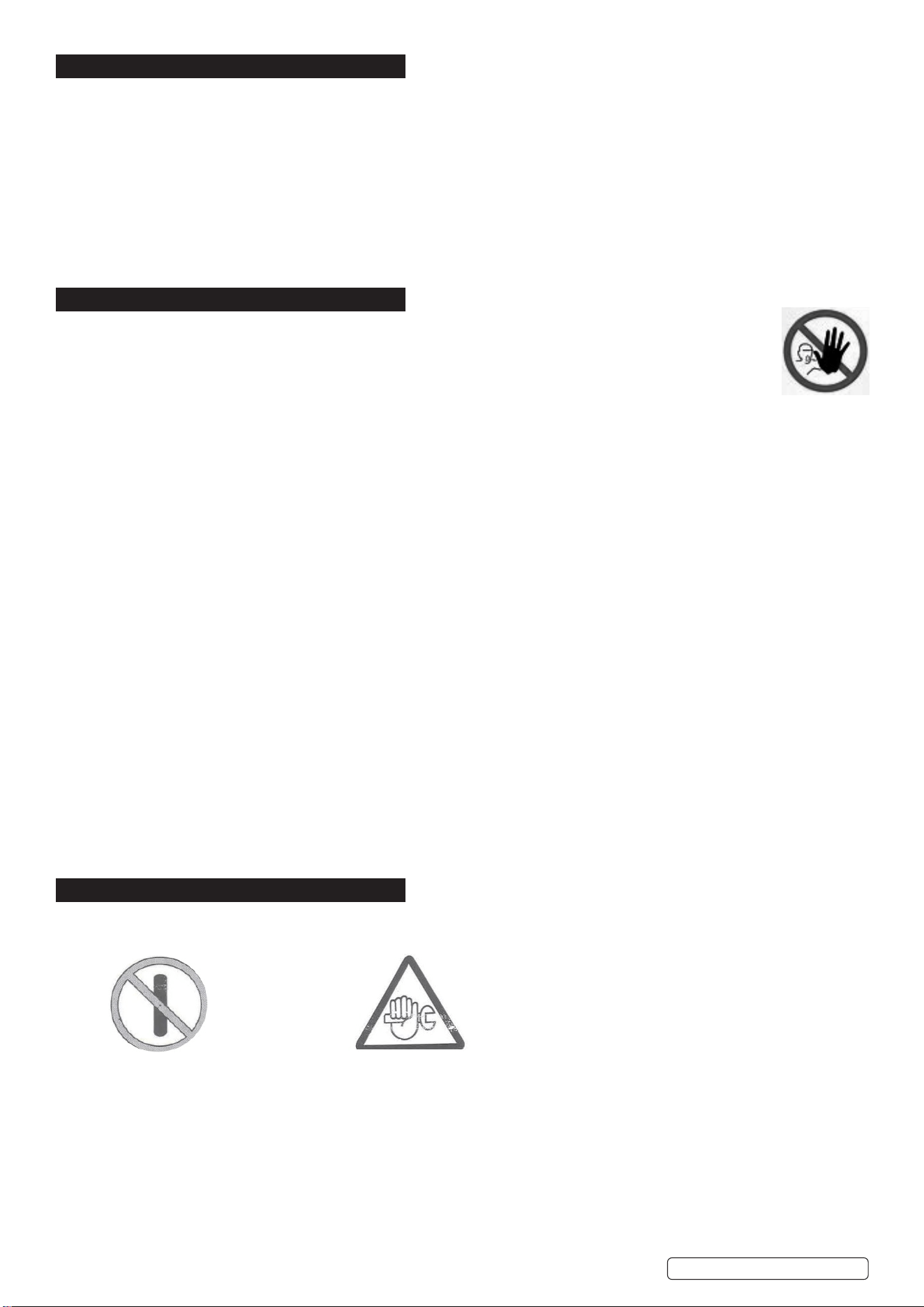
WARNING! Display warning signs against reconnection whilst the compressor is being repaired such as:
DO NOT START
MAINTENANCE WORK
IN PROGRESS
WARNING! Air contaminants taken into the compressor will aect optimum performance. Example: Body ller dust or paint overspray
will clog the pump intake lter and may cause internal damage to pump/motor components. Please note that any parts damaged by any
type of contamination will not be covered by warranty.
6.1. DAILY MAINTENANCE
6.1.1. Check all nuts and bolts are tight
6.1.2. Check for any unusual noise or vibration.
6.1.3. After use: open the air tank petcock to drain condensation from tank.
6.1.4. Pressure relief valve: loosen the knob at the top of the safety valve to ensure normal exhaust. Tighten it again and remove any debris.
6.2. WEEKLY MAINTENANCE
6.2.1. Clean air lter by opening air lter cap. Remove the lter element and clean thoroughly.
6.2.2. Rinse thoroughly with soap and water, and allow to dry completely before assembly.
Original Language Version
© Jack Sealey Limited
SAC1100 Issue 2 (3) 03/04/24
6.3. MONTHLY MAINTENANCE
6.3.1. Inspect air system for leaks by applying soapy water to all joints.
6.3.2. Tighten those joints if leakage is observed.
6.3.3. Check that all nuts and bolts stay tight.
CAUTION: All air line components (including hoses, pipe, connectors, lters, & regulators, etc.) must be rated for a minimum working
pressure of 150 PSI or 150% of the maximum system pressure, whichever is greater. Disconnect any tools from the air supply before
performing maintenance, clearing a jammed fastener, leaving the work area, moving the tool to another location, or handing it to
another person.
When cleaning air lter, or any parts in direct contact with the air production, do not use any ammable or toxic cleaner or solvent
During the break-in period, nuts and bolts have a tendency to loosen up.
After two weeks, tighten all nuts and bolts including head bolts.
Keep the vents and cooling vanes clear of dust and debris. This will help prevent possible electrical shorts and ensure proper cooling
Inspect the cord regularly and have it replaced by an authorized repair facility if it is damaged.
Check the tanks regularly for dents, cracks and other damage. Do not use if any part of the pressurized system is damaged.
An authorized repair centre should do any repairs, modication, or maintenance that involve disassembling the compressor.
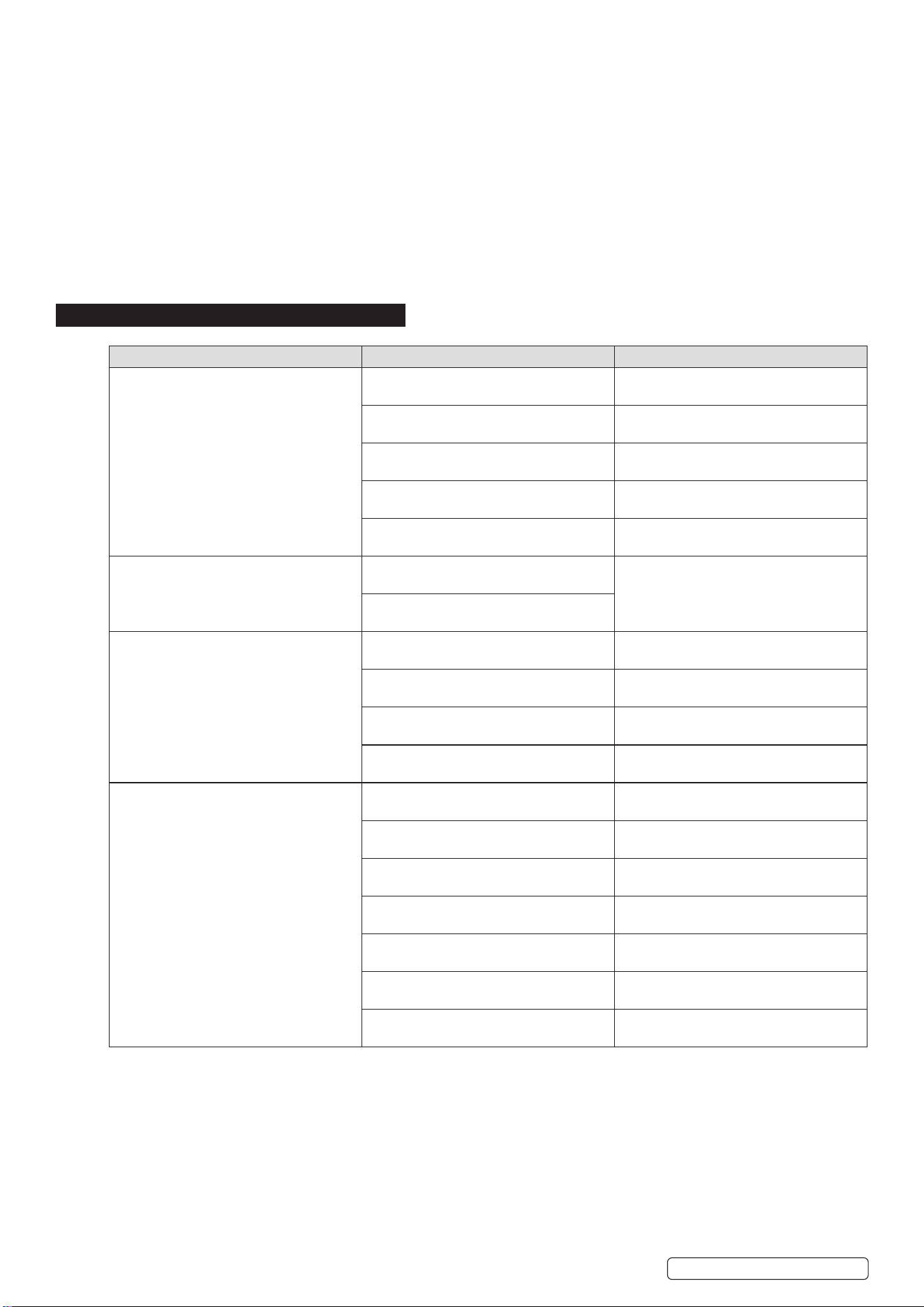
7. TROUBLESHOOTING
FAILURE POSSIBLE CAUSE REMEDY
Motor does not start, runs too slowly, or
gets extremely hot.
Fault in electric current or mains voltage
too low.
Check mains voltage.
Electric cable too long or too thin. Get a new cable from your dealer.
Faulty pressure switch. Have it repaired or replaced by your
dealer.
Faulty motor. Have it repaired or replaced by your
dealer.
Main compressor does not run smoothly,
got stuck.
Have it repaired or defective parts
replaced by your dealer.
Main compressor does not run smoothly /
got stuck.
Moving parts damaged by heat due to
insucient lubrication.
Crank shaft, bearing, connecting rod,
piston rings etc. to be checked by your
dealer and replaced, if needed
Moving parts damaged or blocked by
foreign bodies.
Vibrations or strange noise. Loose parts. Have checked by your dealer and
repaired, if needed.
Foreign body in compressor. Have checked by your dealer and
repaired, if needed.
Piston rod with valve seat. Have the gasket enlarged by your dealer.
Moving parts too hot. Have repaired by your dealer or replaced.
Insucient pressure or drop in output
capacity.
Motor runs too slowly. Have checked by your dealer and
repaired, if needed.
Dirty lter cartridge. Clean or replace lter cartridge.
Leakage in safety valve. Have switch repaired or replaced by your
dealer.
Leakage in tube. Have checked by your dealer and
repaired, if needed.
Gasket damaged. Have checked by your dealer and
repaired, if needed.
Valve seat damaged or covered with
carbon layer.
Have checked by your dealer and
repaired, if needed.
Piston ring or cylinder damaged. Have checked by your dealer and
repaired, if needed.
Original Language Version
© Jack Sealey Limited
SAC1100 Issue 2 (3) 03/04/24

Original Language Version
© Jack Sealey Limited
Sealey Group, Kempson Way, Suffolk Business Park, Bury St Edmunds, Suffolk. IP32 7AR
01284 757500 sales@sealey.co.uk www.sealey.co.uk
Note: It is our policy to continually improve products and as such we reserve the right to alter data, specications and component parts without prior notice.
Important: No Liability is accepted for incorrect use of this product.
Warranty: Guarantee is 12 months from purchase date, proof of which is required for any claim.
ENVIRONMENT PROTECTION
Recycle unwanted materials instead of disposing of them as waste. All tools, accessories and packaging should be
sorted, taken to a recycling centre and disposed of in a manner which is compatible with the environment. When
the product becomes completely unserviceable and requires disposal, drain any uids (if applicable) into approved
containers and dispose of the product and uids according to local regulations.
REGISTER YOUR
PURCHASE HERE
WEEE REGULATIONS
Dispose of this product at the end of its working life in compliance with the EU Directive on Waste Electrical and Electronic
Equipment (WEEE). When the product is no longer required, it must be disposed of in an environmentally protective way. Contact
your local solid waste authority for recycling information.
SAC1100 Issue 2 (3) 03/04/24
