Please give us a chance to make it right and do better !
Contact our friendly customer service department for help first.
Replacements for missing or damaged parts will be shipped ASAP !
Contact Us!
Do NOT return this item.
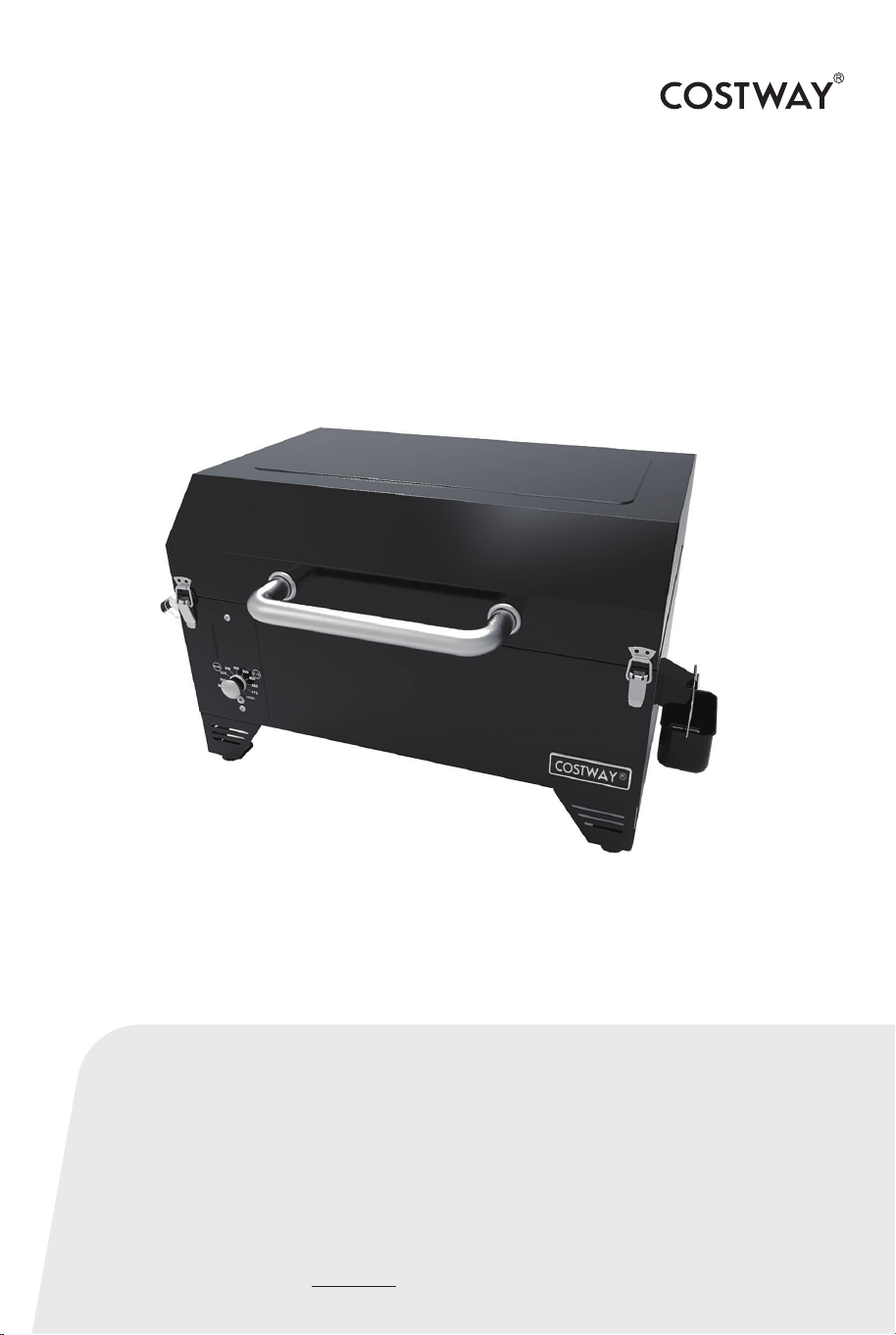
Portable Pellet Grill
FP10073US
USER’S MANUAL
THIS INSTRUCTION BOOKLET CONTAINS IMPORTANT SAFETY INFORMATION. PLEASE READ AND KEEP FOR FUTURE REFERENCE.
US office: Fontana UK office: Ipswich AU office: Truganina
DE office: Hamburg
FR office: Saint Vigor d'Ymonville
PL office: Gdańsk
US:cs.us@costway.com
UK:cs.uk@costway.com
Before You Start
Please read all instructions carefully.
Retain instructions for future reference.
Separate and count all parts and hardware.
Read through each step carefully and follow the proper order.
We recommend that, where possible, all items are assembled
near to the area in which they will be placed in use, to avoid
moving the product unnecessarily once assembled.
Always place the product on a flat, steady and stable surface.
Keep all small parts and packaging materials for this product
away from babies and children as they potentially pose a serious
choking hazard.
02 03
SAFETY INFORMATION
DANGERS AND WARNINGS
MAJOR CAUSES OF APPLIANCE FIRES ARE A RESULT OF POOR
MAINTENANCE AND A FAILURE TO MAINTAIN REQUIRED CLEARANCE
TO COMBUSTIBLE MATERIALS. IT IS OF UTMOST IMPORTANCE THAT
THIS PRODUCT SHOULD BE USED ONLY IN ACCORDANCE TO THE
FOLLOWING INSTRUCTIONS
Please read and understand this entire manual before attempting to
assemble, operate or install the product. This will ensure you receive
the most enjoyable and trouble-free operation of your new wood pellet
grill. We also advise you to retain this manual for future reference.
You must contact your local home association, building or fire officials,
or authority having jurisdiction, to obtain the necessary permits,
mission or information on any installation restrictions, such as any grill
being installed on a combustible surface, inspection requirements or
even ability to use, in your area.
Should a grease fire occur, turn the grill OFF and leave the lid closed
until the fire is out. Unplug the power cord from the connected outlet.
Do not throw water on the unit. Do not try to smother the fire. Use of
an all-class (class ABC) approved fire extinguisher is valuable to keep on
site. If an uncontrolled fire does occur, call the Fire Department.
A minimum clearance of 915mm (36 inches) from combustible
constructions to the sides of the grill, and 915mm (36 inches) from the
back of the grill to combustible constructions must be maintained. Do
not install appliance on combustible floors, or floors protected with
combustible surfaces unless proper permits and permissions are
obtained by authorities having jurisdiction. Do not use this appliance
indoors or in an enclos
ed, unventilated area. This wood pellet appliance
must not be placed under overhead combustible ceiling or overhang. Keep
your grill in an area clear and free from combustible materials, gasoline
and other flammable vapors and liquids.
1.
Keep electrical supply cords and the fuel away from heated surfaces. Do
not use your grill in the rain or around any water source.
2.
Before You Start
Please read all instructions carefully.
Retain instructions for future reference.
Separate and count all parts and hardware.
Read through each step carefully and follow the proper order.
We recommend that, where possible, all items are assembled
near to the area in which they will be placed in use, to avoid
moving the product unnecessarily once assembled.
Always place the product on a flat, steady and stable surface.
Keep all small parts and packaging materials for this product
away from babies and children as they potentially pose a serious
choking hazard.
02 03
SAFETY INFORMATION
DANGERS AND WARNINGS
MAJOR CAUSES OF APPLIANCE FIRES ARE A RESULT OF POOR
MAINTENANCE AND A FAILURE TO MAINTAIN REQUIRED CLEARANCE
TO COMBUSTIBLE MATERIALS. IT IS OF UTMOST IMPORTANCE THAT
THIS PRODUCT SHOULD BE USED ONLY IN ACCORDANCE TO THE
FOLLOWING INSTRUCTIONS
Please read and understand this entire manual before attempting to
assemble, operate or install the product. This will ensure you receive
the most enjoyable and trouble-free operation of your new wood pellet
grill. We also advise you to retain this manual for future reference.
You must contact your local home association, building or fire officials,
or authority having jurisdiction, to obtain the necessary permits,
mission or information on any installation restrictions, such as any grill
being installed on a combustible surface, inspection requirements or
even ability to use, in your area.
Should a grease fire occur, turn the grill OFF and leave the lid closed
until the fire is out. Unplug the power cord from the connected outlet.
Do not throw water on the unit. Do not try to smother the fire. Use of
an all-class (class ABC) approved fire extinguisher is valuable to keep on
site. If an uncontrolled fire does occur, call the Fire Department.
A minimum clearance of 915mm (36 inches) from combustible
constructions to the sides of the grill, and 915mm (36 inches) from the
back of the grill to combustible constructions must be maintained. Do
not install appliance on combustible floors, or floors protected with
combustible surfaces unless proper permits and permissions are
obtained by authorities having jurisdiction. Do not use this appliance
indoors or in an enclos
ed, unventilated area. This wood pellet appliance
must not be placed under overhead combustible ceiling or overhang. Keep
your grill in an area clear and free from combustible materials, gasoline
and other flammable vapors and liquids.
1.
Keep electrical supply cords and the fuel away from heated surfaces. Do
not use your grill in the rain or around any water source.
2.
04 05
Do not transport your grill while in use or while the grill is hot. Ensure
the fire is completely out and that the grill is completely cool to the
touch before moving.
Do not use spirit, petrol, gasoline, lighter-fluid or kerosene for lighting
or refreshing a fire in your grill. Keep all such liquids well away from
the appliance when in use.
This appliance is not recommended for children, persons with
reduced physical, sensory or mental capabilities, or lack of experience
and knowledge, unless they are under direct supervision or instruction
by a person responsible for their safety.
After a period of storage, or non-use, check the burn grate for
obstructions, the hopper for foreign objects, and any air blockage around
the fan intake, chimney, or rear barrel exhaust holes. Clean before use.
Regular care and maintenance is required to prolong the lifespan of your
unit. If the grill is stored outside during the rainy season or seasons of high
humidity, care should be taken to ensure that water does not get into the
hopper. When wet or exposed to high humidity, wood pelle
ts will expand
greatly, decompose, and may jam the feed system. Always disconnect the
power, before performing any service or maintenance.
3.
Ashes should be placed in a metal container with a tight-fitting lid. The
closed container of ashes should be placed on a noncombustible floor or on
the ground, well away from all combustible materials, pending final disposal.
When ashes are disposed by burial in soil, or otherwise locally dispersed, they
should be retained in a closed container until all cinders have thoroughly
cooled.
This pellet cooking appliance is designed and approved for pelletized, all
natural, wood fuel only. Any other type of fuel burned in this appliance will void
the warranty and safety listing. You must only use all natural wood pellets,
designed for burning in pell
et barbecue grills. Do not use fuel with additives.
Wood pellets are highly susceptible to moisture and should always be stored in
an airtight container. If you are storing your grill, without use for an extended
period, we recommend clearing all pellets from your grill's hopper and auger to
prevent jams.
Creosote, or soot, is a tar-like substance. When burning, it produces black
smoke with a residue which is also black in color. Soot or creosote is formed
when the appliance is operated incorrectly, such as: blockage of the
combustion fan, failure to clean and maintain the burn area, moisture affected
pellets, or poor air-to-fuel combustion.
It is dangerous to operate this appliance should the flame become dark, sooty,
or if the burn pot is overfilled with pell
ets. When ignited, this creosote makes
an extremely hot and uncontrolled fire, similar to a grease fire. Should this
happen, turn the unit OFF, let it cool completely, then inspect for maintenance
and cleaning. It commonly accumulates along exhaust areas.
If creosote has formed within the unit, allow the unit to warm up at a low
temperature, turn off the appliance, then wipe away any formation with a hand
towel. Similar to tar, it is much easier to clean when warm, as it becomes liquid.
At time of printing, there is no industry standard for barbecue wood pellets,
although most pellet mills use the same standards to make wood pellets for
domestic use. Further information can be found at
www.pelletheat.org or the
Pellet Fuel Institute.
It is recommended to use heat-resistant barbecue mitts or gloves when
operating the grill. Do not use accessories not specified for use with this
appliance. Do not put a barbecue cover or anything flammable in the
storage space area under the barbecue.
4.
Parts of the barbecue may be very hot and serious injury may occur. Keep
young children and pets away while in use.
6.
Do not enlarge igniter holes or burn pots. Failure to follow this warning
could lead to a fire hazard and bodily harm.
7.
Product may have sharp edges or points. Contact may result in injury.
Handle with care.
8.
To prevent fingers, clothing or other objects from coming in contact with
the auger feed system, the appliance is equipped with a metal safety
screen, mounted to the interior of the hopper. This screen must not be
removed unless directed by Customer Service.
5.
DISPOSAL OF ASHES
WOOD PELLET FUEL
CREOSOTE
04 05
Do not transport your grill while in use or while the grill is hot. Ensure
the fire is completely out and that the grill is completely cool to the
touch before moving.
Do not use spirit, petrol, gasoline, lighter-fluid or kerosene for lighting
or refreshing a fire in your grill. Keep all such liquids well away from
the appliance when in use.
This appliance is not recommended for children, persons with
reduced physical, sensory or mental capabilities, or lack of experience
and knowledge, unless they are under direct supervision or instruction
by a person responsible for their safety.
After a period of storage, or non-use, check the burn grate for
obstructions, the hopper for foreign objects, and any air blockage around
the fan intake, chimney, or rear barrel exhaust holes. Clean before use.
Regular care and maintenance is required to prolong the lifespan of your
unit. If the grill is stored outside during the rainy season or seasons of high
humidity, care should be taken to ensure that water does not get into the
hopper. When wet or exposed to high humidity, wood pelle
ts will expand
greatly, decompose, and may jam the feed system. Always disconnect the
power, before performing any service or maintenance.
3.
Ashes should be placed in a metal container with a tight-fitting lid. The
closed container of ashes should be placed on a noncombustible floor or on
the ground, well away from all combustible materials, pending final disposal.
When ashes are disposed by burial in soil, or otherwise locally dispersed, they
should be retained in a closed container until all cinders have thoroughly
cooled.
This pellet cooking appliance is designed and approved for pelletized, all
natural, wood fuel only. Any other type of fuel burned in this appliance will void
the warranty and safety listing. You must only use all natural wood pellets,
designed for burning in pell
et barbecue grills. Do not use fuel with additives.
Wood pellets are highly susceptible to moisture and should always be stored in
an airtight container. If you are storing your grill, without use for an extended
period, we recommend clearing all pellets from your grill's hopper and auger to
prevent jams.
Creosote, or soot, is a tar-like substance. When burning, it produces black
smoke with a residue which is also black in color. Soot or creosote is formed
when the appliance is operated incorrectly, such as: blockage of the
combustion fan, failure to clean and maintain the burn area, moisture affected
pellets, or poor air-to-fuel combustion.
It is dangerous to operate this appliance should the flame become dark, sooty,
or if the burn pot is overfilled with pell
ets. When ignited, this creosote makes
an extremely hot and uncontrolled fire, similar to a grease fire. Should this
happen, turn the unit OFF, let it cool completely, then inspect for maintenance
and cleaning. It commonly accumulates along exhaust areas.
If creosote has formed within the unit, allow the unit to warm up at a low
temperature, turn off the appliance, then wipe away any formation with a hand
towel. Similar to tar, it is much easier to clean when warm, as it becomes liquid.
At time of printing, there is no industry standard for barbecue wood pellets,
although most pellet mills use the same standards to make wood pellets for
domestic use. Further information can be found at
www.pelletheat.org or the
Pellet Fuel Institute.
It is recommended to use heat-resistant barbecue mitts or gloves when
operating the grill. Do not use accessories not specified for use with this
appliance. Do not put a barbecue cover or anything flammable in the
storage space area under the barbecue.
4.
Parts of the barbecue may be very hot and serious injury may occur. Keep
young children and pets away while in use.
6.
Do not enlarge igniter holes or burn pots. Failure to follow this warning
could lead to a fire hazard and bodily harm.
7.
Product may have sharp edges or points. Contact may result in injury.
Handle with care.
8.
To prevent fingers, clothing or other objects from coming in contact with
the auger feed system, the appliance is equipped with a metal safety
screen, mounted to the interior of the hopper. This screen must not be
removed unless directed by Customer Service.
5.
DISPOSAL OF ASHES
WOOD PELLET FUEL
CREOSOTE

06 07
Carbon monoxide is a colorless, odorless, tasteless gas produced by burning
gas, wood, propane, charcoal or other fuel. Carbon monoxide reduces the
blood’s ability to carry oxygen. Low blood oxygen levels can result in
headaches, dizziness, weakness, nausea, vomiting, sleepiness, confusion, loss
of consciousness or death. Follow these guidelines to prevent this colorless,
odorless gas from poisoning you, your family, or others:
Carbon monoxide is especially toxic to mother and child during pregnancy,
infants, the elderly, smokers, and people with blood or circulatory system
problems, such as anemia, or heart disease.
CAS/UL 60335-1&IEC 60335-2-102
See a doctor if you or others develop cold or flu-like symptoms while
cooking or in the vicinity of the appliance. Carbon monoxide poisoning,
which can easily be mistaken for a cold or flu, is often detected too late.
CARBON MONOXIDE
SAFETY LISTING
•
Alcohol consumption and drug use increase the effects of carbon monoxide
poisoning.
•
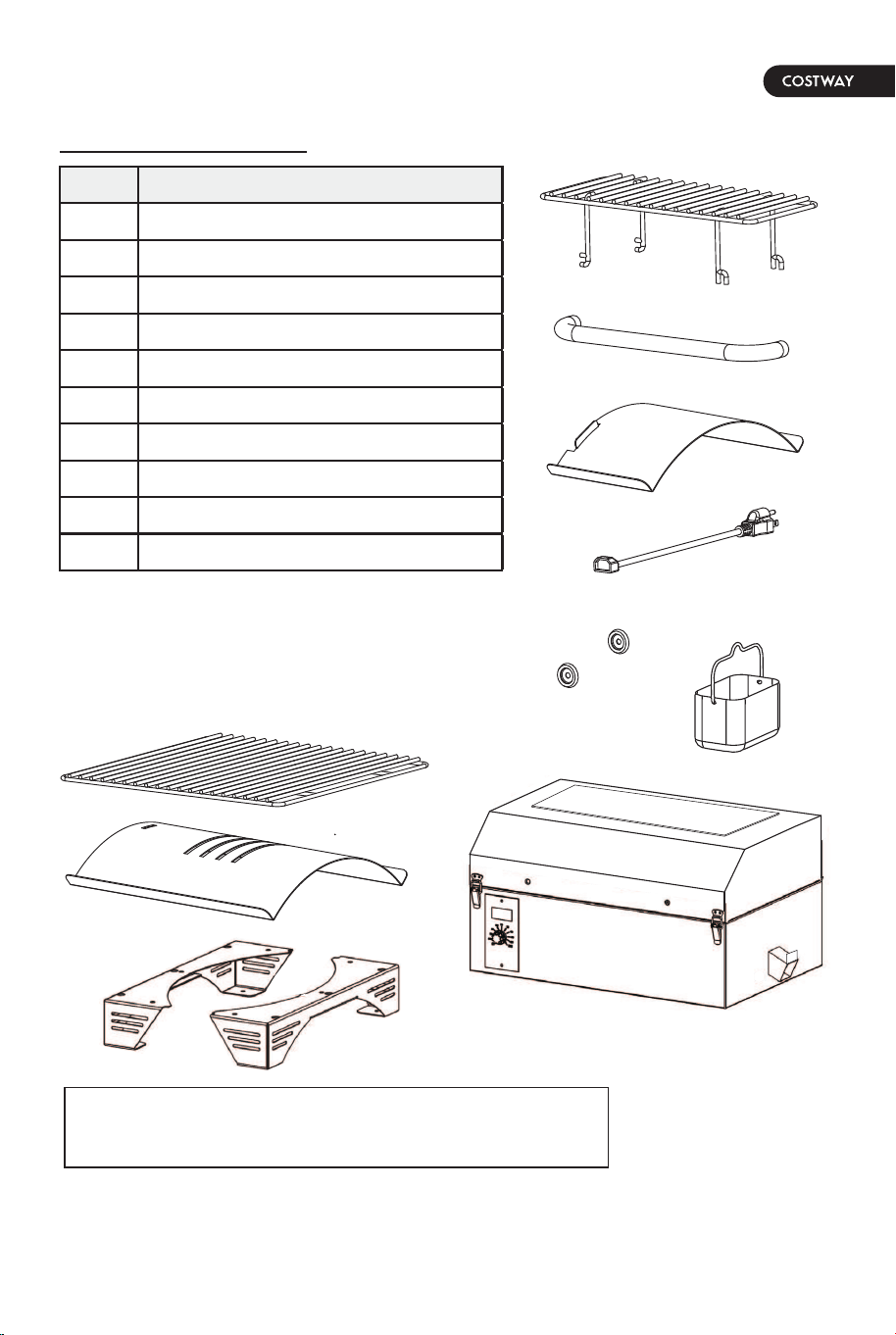
PARTS & SPECS
NOTE: Due to ongoing product development,
parts are subject to change without notice.
Contact Customer Service if parts are missing
when assembling the unit.
Part# Description
1
Upper Cooking Rack (x1)
2
Cooking Grid (x1)
3
Flame Broiler Slider (x1)
4
Flame Broiler Main Plate (x1)
5
Lid Handle Bezel (x2)
6
Lid Handle (x1)
7
Main Barrel/ Hopper Assembly (x1)
8
Power Cord (x1)
9
Grease Tray Assembly (x1)
10
Foot Assembly (x2)
110-120V, 60Hz, 230W, 3-PRONG GROUNDED PLUG
ELECTRIC REQUIREMENTS
1
2
8
9
3
5
4
6
7
10
06 07
Carbon monoxide is a colorless, odorless, tasteless gas produced by burning
gas, wood, propane, charcoal or other fuel. Carbon monoxide reduces the
blood’s ability to carry oxygen. Low blood oxygen levels can result in
headaches, dizziness, weakness, nausea, vomiting, sleepiness, confusion, loss
of consciousness or death. Follow these guidelines to prevent this colorless,
odorless gas from poisoning you, your family, or others:
Carbon monoxide is especially toxic to mother and child during pregnancy,
infants, the elderly, smokers, and people with blood or circulatory system
problems, such as anemia, or heart disease.
CAS/UL 60335-1&IEC 60335-2-102
See a doctor if you or others develop cold or flu-like symptoms while
cooking or in the vicinity of the appliance. Carbon monoxide poisoning,
which can easily be mistaken for a cold or flu, is often detected too late.
CARBON MONOXIDE
SAFETY LISTING
•
Alcohol consumption and drug use increase the effects of carbon monoxide
poisoning.
•
PARTS & SPECS
NOTE: Due to ongoing product development,
parts are subject to change without notice.
Contact Customer Service if parts are missing
when assembling the unit.
Part# Description
1
Upper Cooking Rack (x1)
2
Cooking Grid (x1)
3
Flame Broiler Slider (x1)
4
Flame Broiler Main Plate (x1)
5
Lid Handle Bezel (x2)
6
Lid Handle (x1)
7
Main Barrel/ Hopper Assembly (x1)
8
Power Cord (x1)
9
Grease Tray Assembly (x1)
10
Foot Assembly (x2)
110-120V, 60Hz, 230W, 3-PRONG GROUNDED PLUG
ELECTRIC REQUIREMENTS
1
2
8
9
3
5
4
6
7
10
08 09
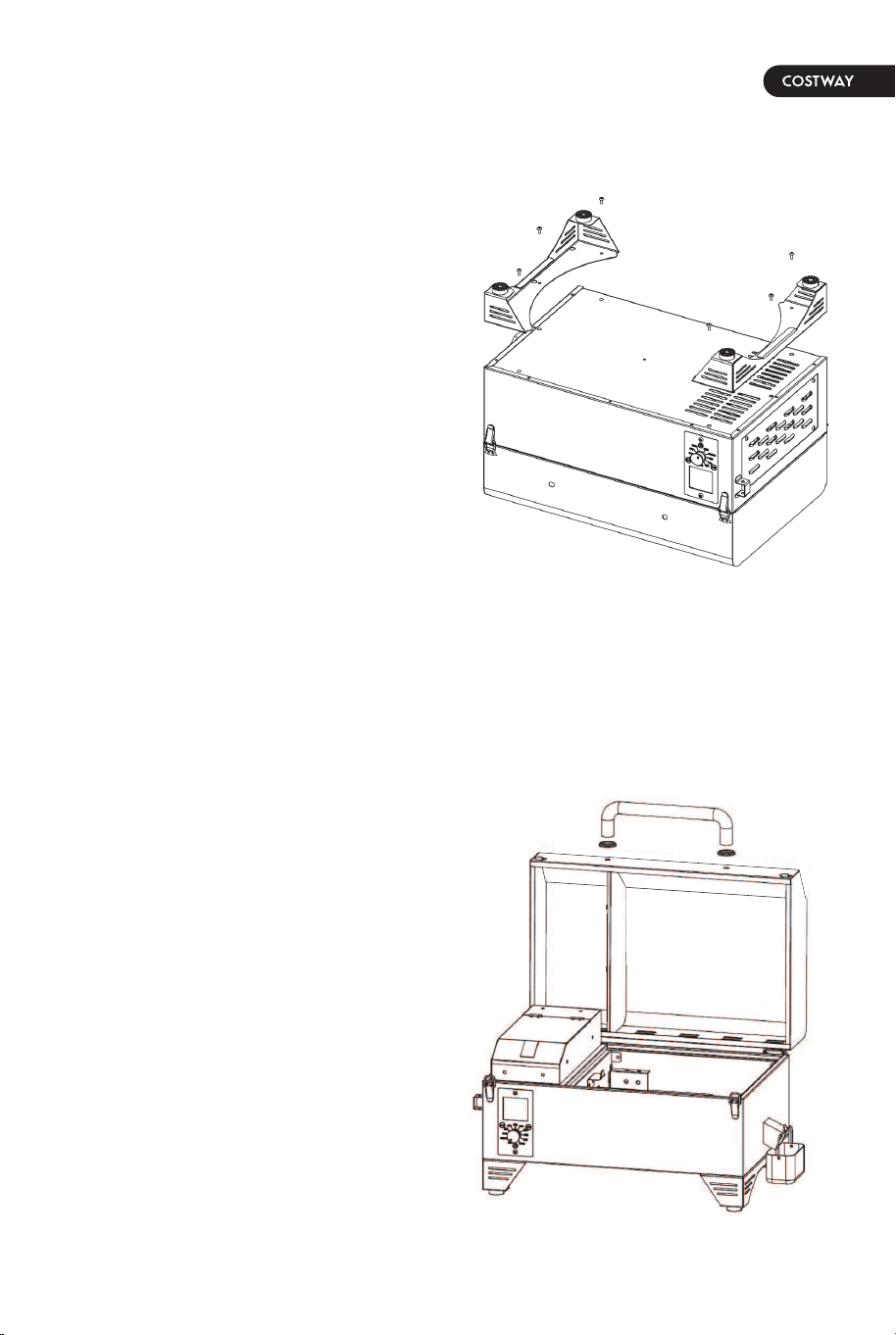
1. MOUNTING THE LEGS TO THE GRILL
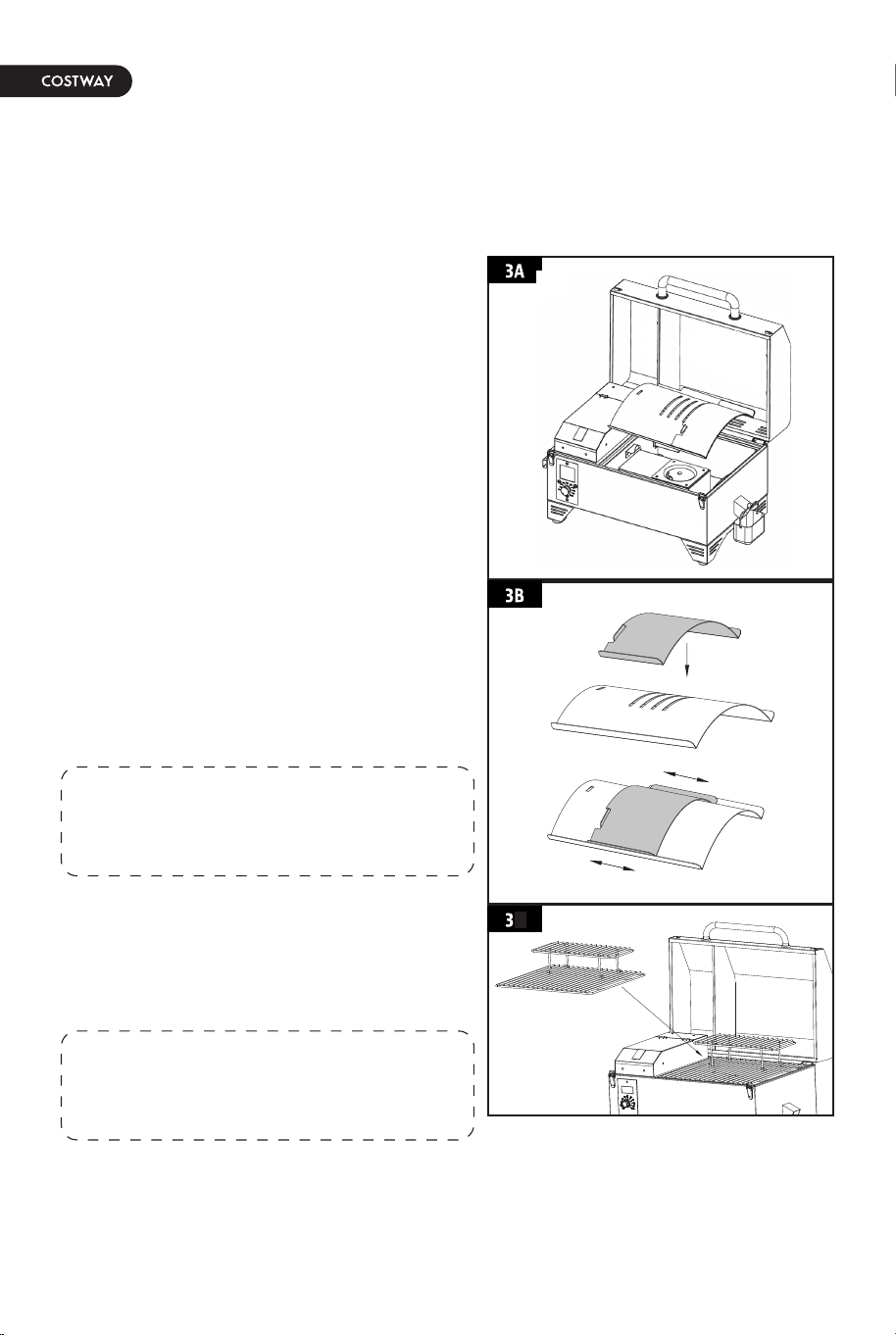
2. ASSEMBLING THE LID HANDLE
ASSEMBLY PREPARATION
ASSEMBLY INSTRUCTIONS
Parts are located throughout the shipping carton, including underneath the
grill. Inspect the grill, parts, and hardware blister pack after removing from
the protective shipping carton. Discard all packaging materials from inside
and outside of the grill before assembly, then review and inspect all parts by
referencing the parts list. If any part is missing or damaged, do not attempt
to assemble. Please contact us for parts.
Remove the pre-installed
screws from the lid handle.
From inside the barrel lid, insert
one screw to protrude to the
outside. Add bezel on the
screw, then hand-tighten the
screw into the lid handle.
NOTE: For all of the following steps, do not tighten any screws completely until all screws
for that step have been installed. Once all screws have been installed, then tighten them
securely.
Parts Required:
x1
Main Barrel
/ Hopper Assembly
(#7)
x2
Foot Assembly
(#10)
Installation:
• Remove the pre-installed screws
from the bottom shelf. Secure the
bottom shelf to two legs using six
screws.
Parts Required:
x1
x2
Lid Handle (#6)
Lid Handle Bezel (#5)
Installation:
•
• Repeat for other side.
MODEL
UNIT ASSEMBLED
(WxHxD)
UNIT
WEIGHT
COOKING AREA
TEMP. RANGE
DIGITAL FEATURES
FP10073US
619mm*368mm
*460mm/24.3”*
14.5”*18.1”
18.7KG
/41.1LBS
Main - 1,235 cm
2
/191 sq. in.
Upper Rack - 417 cm
2
/65 sq. in.
TOTAL - 1,652 cm
2
/256 sq. in.
82-260°C
/ 180-500°F
Eight temperature presets,
start-up and cool-down cycles,
electric igniter
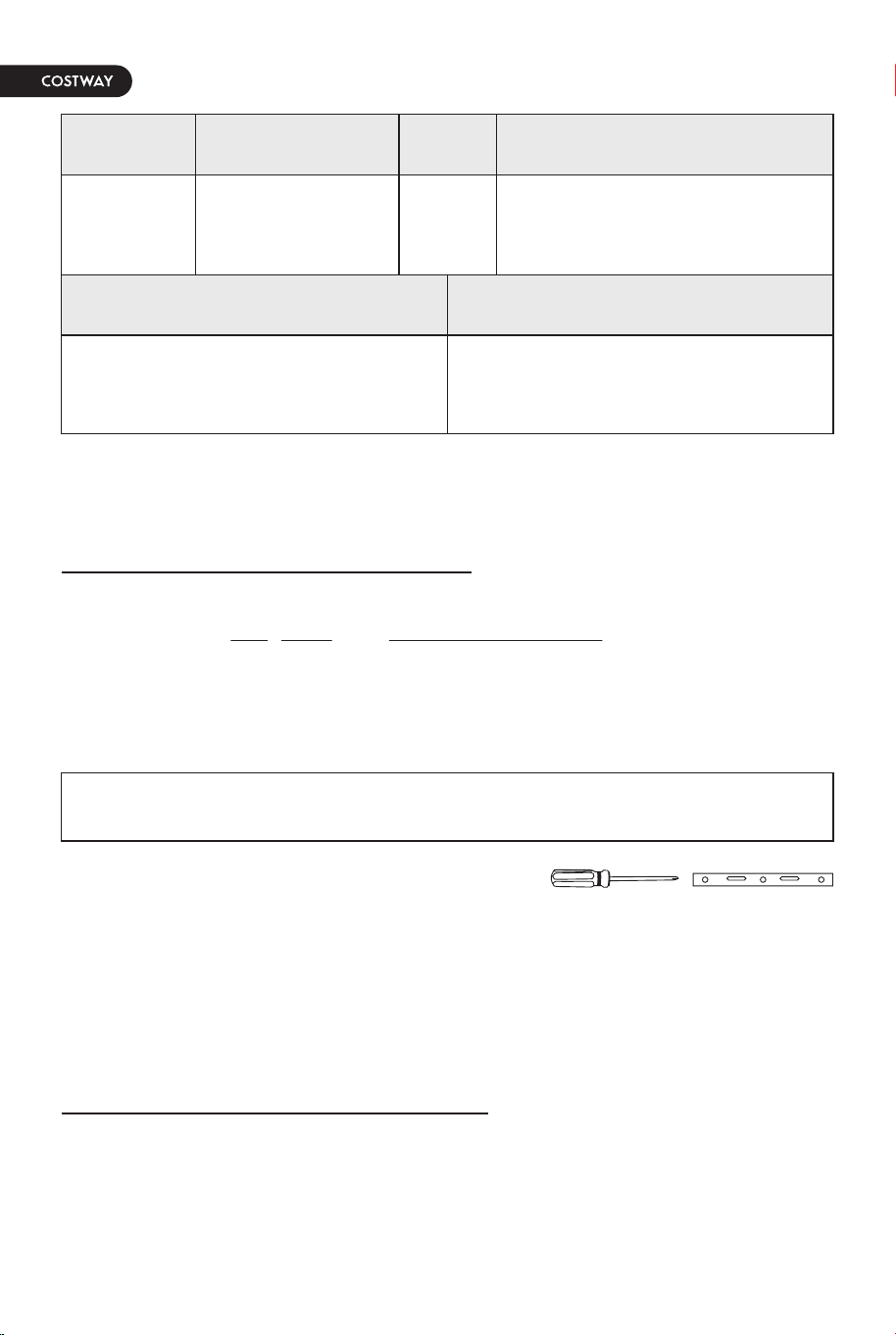
IMPORTANT: To ease installation, two people is helpful (but not necessary)
when assembling this unit.
Tools required for assembly: screwdriver and level.
Tools not included.
08 09
1. MOUNTING THE LEGS TO THE GRILL
2. ASSEMBLING THE LID HANDLE
ASSEMBLY PREPARATION
ASSEMBLY INSTRUCTIONS
Parts are located throughout the shipping carton, including underneath the
grill. Inspect the grill, parts, and hardware blister pack after removing from
the protective shipping carton. Discard all packaging materials from inside
and outside of the grill before assembly, then review and inspect all parts by
referencing the parts list. If any part is missing or damaged, do not attempt
to assemble. Please contact us for parts.
Remove the pre-installed
screws from the lid handle.
From inside the barrel lid, insert
one screw to protrude to the
outside. Add bezel on the
screw, then hand-tighten the
screw into the lid handle.
NOTE: For all of the following steps, do not tighten any screws completely until all screws
for that step have been installed. Once all screws have been installed, then tighten them
securely.
Parts Required:
x1
Main Barrel
/ Hopper Assembly
(#7)
x2
Foot Assembly
(#10)
Installation:
• Remove the pre-installed screws
from the bottom shelf. Secure the
bottom shelf to two legs using six
screws.
Parts Required:
x1
x2
Lid Handle (#6)
Lid Handle Bezel (#5)
Installation:
•
• Repeat for other side.
MODEL
UNIT ASSEMBLED
(WxHxD)
UNIT
WEIGHT
COOKING AREA
TEMP. RANGE
DIGITAL FEATURES
FP10073US
619mm*368mm
*460mm/24.3”*
14.5”*18.1”
18.7KG
/41.1LBS
Main - 1,235 cm
2
/191 sq. in.
Upper Rack - 417 cm
2
/65 sq. in.
TOTAL - 1,652 cm
2
/256 sq. in.
82-260°C
/ 180-500°F
Eight temperature presets,
start-up and cool-down cycles,
electric igniter
IMPORTANT: To ease installation, two people is helpful (but not necessary)
when assembling this unit.
Tools required for assembly: screwdriver and level.
Tools not included.
10 11
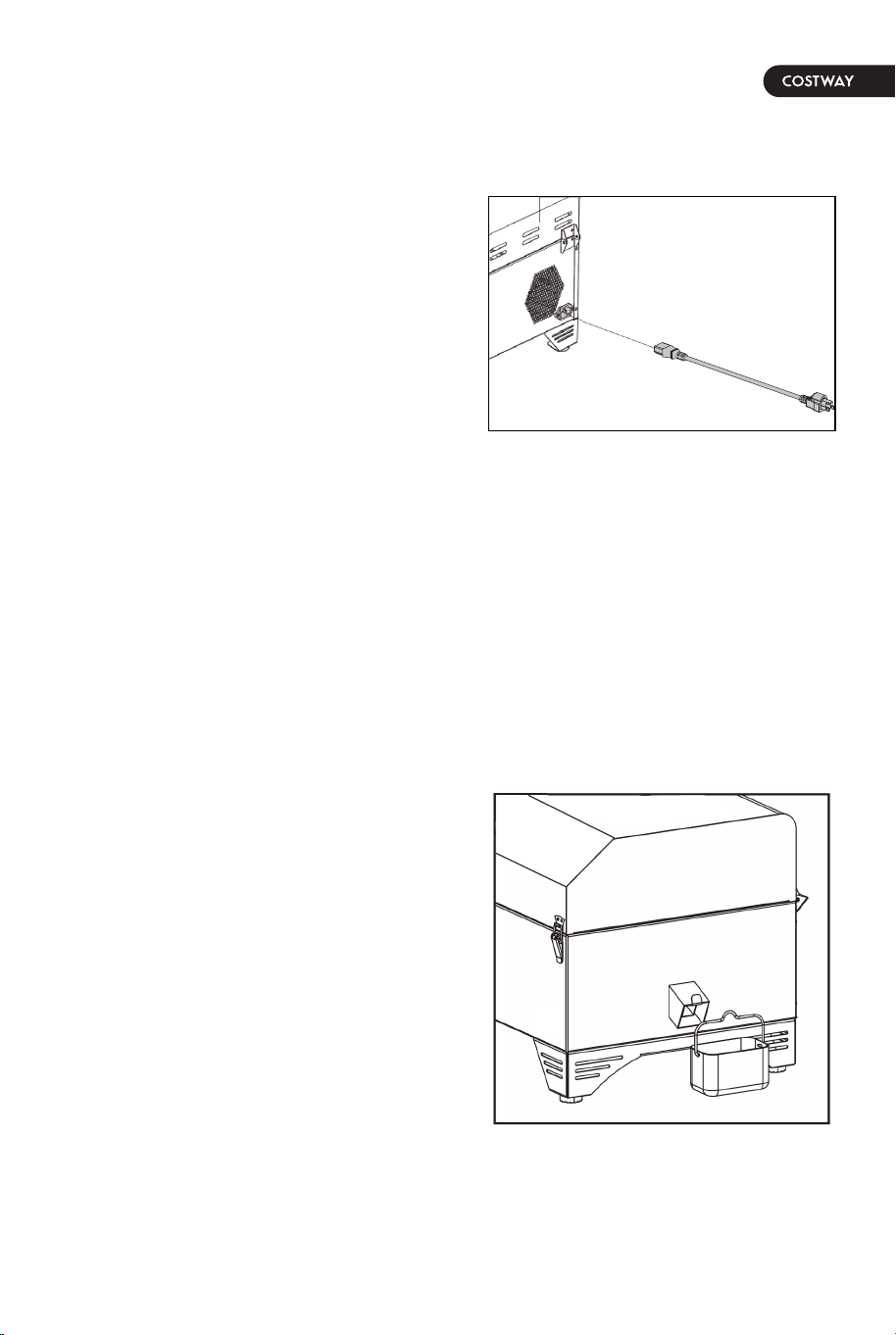
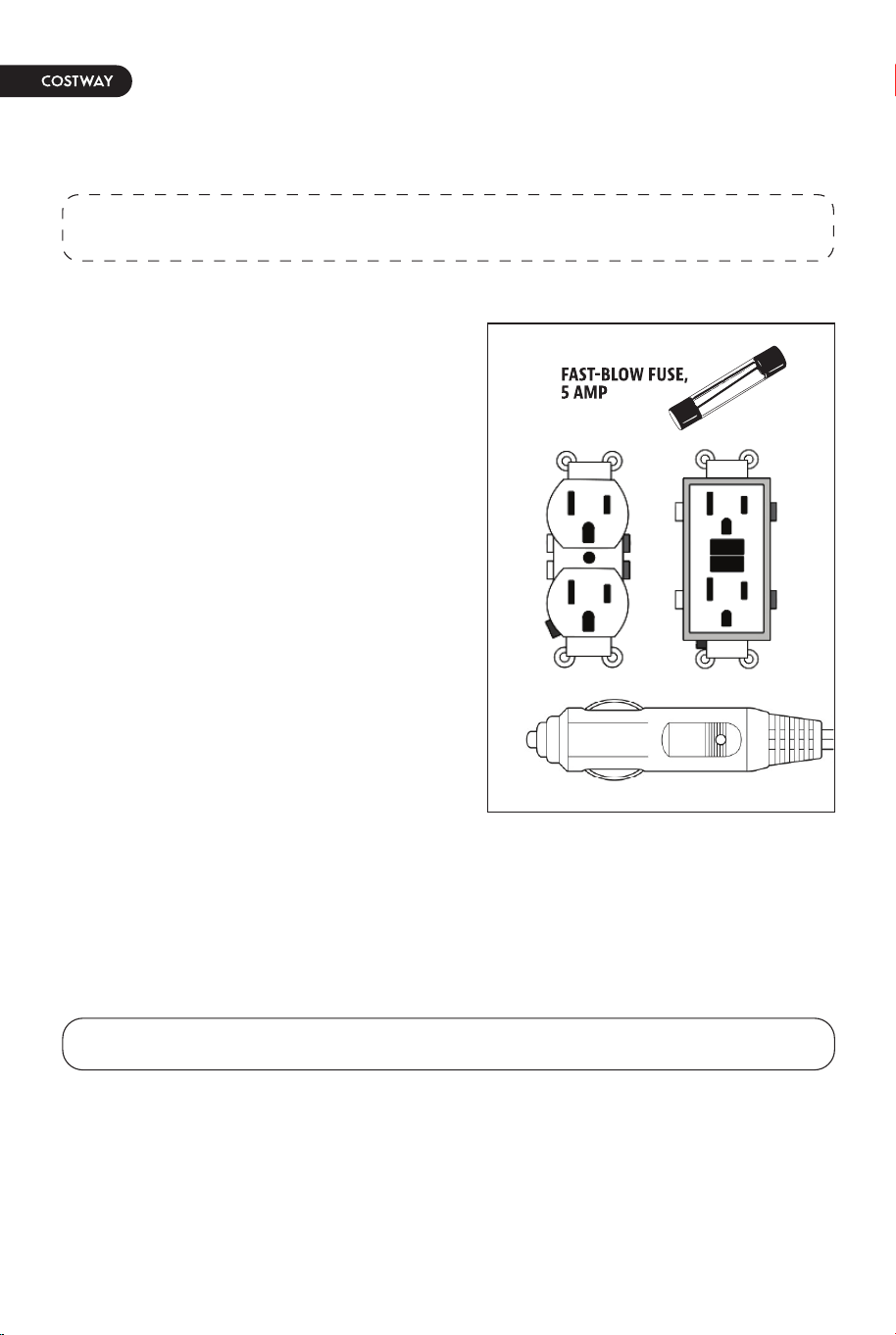
3. INSTALLING THE COOKING COMPONENTS 4. CONNECTING THE POWER CORD
Insert the flame broiler main plate
into the main grill, right side first.
Rest the flame broiler main plate on
the built-in ledge (on the inside
right) of the main grill that directs
grease towards the grease bucket.
Slide the entire piece to the left
side, and the two slots on the flame
broiler main plate will fit into the
rounded ledge above the fire pot. It
will sit slightly at a downward
angle. Note illustration 3A.
Place the flame broiler slider on top
of the flame broiler main plate,
covering the slotted openings. Ensure
the raised tab is on the left, to easily
adjust for direct or indirect flame
when cooking. Note illustration 3B.
NOTE: When the flame broiler slider is
open, and direct flame is used while
cooking, do not leave the grill
unattended for any period of time.
NOTE: To maintain the searing and
grilling performance of your cooking
grids, regular care and maintenance Is
required.
Parts Required:
x1
Flame Broiler Main Plate (#4)
x1Flame Broiler Slider (#3)
Parts Required:
x1
Main Barrel/Hopper Assembly (#7)
x1Power Cord (#8)
Installation:
•
Insert the end of the power cord
through the hole in the back panel
of the grill.
Installation:
•
5. ATTACHING THE GREASE TRAY
Parts Required:
x1Grease Bucket (#15)
Place the grease tray on the two
screws of the main barrel. Ensure it
is level to avoid grease spills.
Installation:
•
The unit is now completely assembled.
•
•
Place the cooking grids, side-by-side,
on the grid ledge inside the main
grill. Place the upper cooking rack on
the upper ledge inside the main grill.
The cooking rack will lock into place.
Note illustration 3C.
•
C
10 11
3. INSTALLING THE COOKING COMPONENTS 4. CONNECTING THE POWER CORD
Insert the flame broiler main plate
into the main grill, right side first.
Rest the flame broiler main plate on
the built-in ledge (on the inside
right) of the main grill that directs
grease towards the grease bucket.
Slide the entire piece to the left
side, and the two slots on the flame
broiler main plate will fit into the
rounded ledge above the fire pot. It
will sit slightly at a downward
angle. Note illustration 3A.
Place the flame broiler slider on top
of the flame broiler main plate,
covering the slotted openings. Ensure
the raised tab is on the left, to easily
adjust for direct or indirect flame
when cooking. Note illustration 3B.
NOTE: When the flame broiler slider is
open, and direct flame is used while
cooking, do not leave the grill
unattended for any period of time.
NOTE: To maintain the searing and
grilling performance of your cooking
grids, regular care and maintenance Is
required.
Parts Required:
x1
Flame Broiler Main Plate (#4)
x1Flame Broiler Slider (#3)
Parts Required:
x1
Main Barrel/Hopper Assembly (#7)
x1Power Cord (#8)
Installation:
•
Insert the end of the power cord
through the hole in the back panel
of the grill.
Installation:
•
5. ATTACHING THE GREASE TRAY
Parts Required:
x1Grease Bucket (#15)
Place the grease tray on the two
screws of the main barrel. Ensure it
is level to avoid grease spills.
Installation:
•
The unit is now completely assembled.
•
•
Place the cooking grids, side-by-side,
on the grid ledge inside the main
grill. Place the upper cooking rack on
the upper ledge inside the main grill.
The cooking rack will lock into place.
Note illustration 3C.
•
C
12 13
6. CONNECTING THE POWER CORD
OPERATING INSTRUCTIONS
IMPORTANT: Disconnect unit from power source when not in use.
With today’s lifestyle of striving to eat healthy and nutritious foods, one factor
to consider is the importance of reducing fat intake. One of the best ways to
cut down on fat in your diet is to use a low fat method of cooking, such as
grilling. As a pellet grill uses natural wood pellets, the savory wood flavor is
cooked into the meats, reducing the need for high sugar content sauces.
Throughout this manual, you will notice the emphasis on grilling food slowly at
LOW or MEDIUM temperature settings.
With all outdoor appliances, outside weather conditions play a big part in the
performance of your grill and the cooking time needed to perfect your meals.
The product should keep a minimum clearance of 915mm (36 inches) from
combustible constructions, and this clearance must be maintained while the
grill is operational. This appliance must not be placed under overhead
combustible ceiling or overhang. Keep your grill in an area clear from
combustible materials, gasoline and other flammable vapors and liquids.
As it becomes cooler outside, that does not mean that grilling season is over!
The crisp cool air and heavenly aroma of smoked foods will help cure your
winter blues.
Follow these suggestions on how to enjoy your grill throughout the cooler
months:
GRILL ENVIRONMENT
This appliance requires 110 volt,
60hz, 230w, 5 amp service. It must
be a 3-prong grounded plug.
Ensure grounded end is not broken
off before use. The control uses a 5
amp, 120 volt, fast-blow fuse to
protect the board from the igniter.
STANDARD OUTLET
1. WHERE TO SET-UP THE GRILL
2. COLD WEATHER COOKING
•
This appliance will work on most
GFCI outlets, with a recommended
size of 15 amp service. If your GFCI
outlet is highly sensitive to power
surges, it will likely trip during the
start-up phase of operation. During
the start-up phase, the igniter draws
200-700 watts of electricity which
can be too much power for a GFCI
outlet to handle. Each time it trips, it
increases in sensitivity. If the GFCI
keeps tripping, replace the outlet or
change to a non-GFCI outlet.
GFCI OUTLETS•
Disconnect the igniter from the main wiring harness. Use the manual
start-up procedure. The product can operate using a 12 volt, 100 watt
inverter plugged into your automobile outlet. To use the automatic igniter,
it is recommended to use a minimum of a 1000 watt inverter.
ON THE ROAD•
If smoking at low temperatures fails, increase the temperature slightly to
achieve the same results.
•
In very cold weather, increase your preheating time by at least 20
minutes.
•
Organize – Get everything you require ready in the kitchen before you
head outdoors. During the winter, move your grill to an area that is out of
the wind and direct cold. Check local bylaws regarding the proximity of
your grill in relation to your home and/or other structures. Put everything
you need on a tray, bundle up tight, and get it done!
•
To help keep track of the outside temperature, place an outdoor
thermometer close to your cooking area. Keep a log or history of what
you cooked, the outdoor temperature, and the cooking time. This will
help later down the road to help you determine what to cook and how
long it will take.
•
NOTE: Before plugging your product into any electrical outlet, ensure the
temperature dial is in the OFF position.

12 13
6. CONNECTING THE POWER CORD
OPERATING INSTRUCTIONS
IMPORTANT: Disconnect unit from power source when not in use.
With today’s lifestyle of striving to eat healthy and nutritious foods, one factor
to consider is the importance of reducing fat intake. One of the best ways to
cut down on fat in your diet is to use a low fat method of cooking, such as
grilling. As a pellet grill uses natural wood pellets, the savory wood flavor is
cooked into the meats, reducing the need for high sugar content sauces.
Throughout this manual, you will notice the emphasis on grilling food slowly at
LOW or MEDIUM temperature settings.
With all outdoor appliances, outside weather conditions play a big part in the
performance of your grill and the cooking time needed to perfect your meals.
The product should keep a minimum clearance of 915mm (36 inches) from
combustible constructions, and this clearance must be maintained while the
grill is operational. This appliance must not be placed under overhead
combustible ceiling or overhang. Keep your grill in an area clear from
combustible materials, gasoline and other flammable vapors and liquids.
As it becomes cooler outside, that does not mean that grilling season is over!
The crisp cool air and heavenly aroma of smoked foods will help cure your
winter blues.
Follow these suggestions on how to enjoy your grill throughout the cooler
months:
GRILL ENVIRONMENT
This appliance requires 110 volt,
60hz, 230w, 5 amp service. It must
be a 3-prong grounded plug.
Ensure grounded end is not broken
off before use. The control uses a 5
amp, 120 volt, fast-blow fuse to
protect the board from the igniter.
STANDARD OUTLET
1. WHERE TO SET-UP THE GRILL
2. COLD WEATHER COOKING
•
This appliance will work on most
GFCI outlets, with a recommended
size of 15 amp service. If your GFCI
outlet is highly sensitive to power
surges, it will likely trip during the
start-up phase of operation. During
the start-up phase, the igniter draws
200-700 watts of electricity which
can be too much power for a GFCI
outlet to handle. Each time it trips, it
increases in sensitivity. If the GFCI
keeps tripping, replace the outlet or
change to a non-GFCI outlet.
GFCI OUTLETS•
Disconnect the igniter from the main wiring harness. Use the manual
start-up procedure. The product can operate using a 12 volt, 100 watt
inverter plugged into your automobile outlet. To use the automatic igniter,
it is recommended to use a minimum of a 1000 watt inverter.
ON THE ROAD•
If smoking at low temperatures fails, increase the temperature slightly to
achieve the same results.
•
In very cold weather, increase your preheating time by at least 20
minutes.
•
Organize – Get everything you require ready in the kitchen before you
head outdoors. During the winter, move your grill to an area that is out of
the wind and direct cold. Check local bylaws regarding the proximity of
your grill in relation to your home and/or other structures. Put everything
you need on a tray, bundle up tight, and get it done!
•
To help keep track of the outside temperature, place an outdoor
thermometer close to your cooking area. Keep a log or history of what
you cooked, the outdoor temperature, and the cooking time. This will
help later down the road to help you determine what to cook and how
long it will take.
•
NOTE: Before plugging your product into any electrical outlet, ensure the
temperature dial is in the OFF position.

14 15
Temperature readouts on the control board may not exactly match the
thermometer. All temperatures listed below are approximate and are affected
by the following factors: outside ambient temperature, the amount and
direction of wind, the quality of pellet fuel being used, the lid being opened,
and the quantity of food being cooked.
As it becomes warmer outdoors, the cooking time will decrease.
Follow these few suggestions on how to enjoy your grill throughout the hot
months:
GRILL TEMPERATURE RANGES
3. HOT WEATHER COOKING
This range is best used to sear and grill at a high heat. Use in tandem
with the flame broiler (slide plate) for indirect or direct flame cooking.
With the flame broiler open, direct flame is used to create those “blue”
steaks, as well as flamekissed vegetables, garlic toast or s’mores! When
the flame broiler is closed, the air circulates around the barrel,
resulting in convection heat. High temperature is also used to preheat
your grill, burn-off the cooking grids, and to achieve high heat in extreme
cold weather conditions.
HIGH TEMPERATURE (205-260°C / 401-500°F)•
Avoid lifting the lid any more than necessary. Cold gusts of wind can
completely cool your grill temperature. Be flexible with your serving time;
add extra cooking time each time you open the lid.
•
Adjust your cooking temperatures downward. This helps to avoid unwanted
flare-ups.
•
Use a meat thermometer to determine the internal temperature of your
foods. This helps in preventing your meat from overcooking and drying out.
•
You can keep foods hot by wrapping them in foil, and placing them in an
insulated cooler. Stuff crumpled up newspaper around the foil and this will
keep food hot for 3 to 4 hours.
•
Even in hot weather, it is still better to cook with the lid of your grill down.
•
Have a heated platter or a dish cover ready to keep your food warm while
making the trip back inside.
•
Ideal foods for winter cooking are those that require little attention, such
as roasts, whole chickens, ribs, and turkey. Make your meal preparation
even easier by adding simple items such as vegetables and potatoes.
•
Located inside the main barrel is the temperature probe. It is a small, vertical
piece of stainless steel. The temperature probe measures the internal
temperature of the unit. When the temperature is adjusted on the Control
Board, the temperature probe will read the actual temperature inside the unit
and adjust to the desired temperature.
UNDERSTANDING THE TEMPERATURE PROBE
This range is best for baking, roasting, and finishing off that slow smoked
creation. Cooking at these temperatures will greatly reduce the chances
of a grease flare-up. Ensure that the flame broiler slider in the closed
position, covering the slotted openings. Great range for cooking anything
wrapped in bacon, or where you want versatility with control.
MEDIUM TEMPERATURE (135-180°C / 275-356°F)•
This range is used to slow roast, increase smoky flavor, and to keep foods
warm. Infuse more smoke flavor and keep your meats juicy by cooking
longer at a lower temperature (also known as low and slow).
Recommended for the big turkey on Thanksgiving, juicy ham at Easter, or
the huge holiday feast.
Smoking is a variation on true barbecuing and is truly the main advantage
of grilling on a wood pellet grill. Hot smoking, another name for low and
slow cooking, is generally done between 80-125°C / 176-257°F. Hot
smoking works best when longer cooking time is required, such as large
cuts of meats, fish, or poultry.
The key is to experiment with the length of time you allow for smoking,
before the meal is finished cooking. Some outdoor chefs prefer to smoke
at the end of a cooking, allowing the food to keep warm until ready to
serve. Practice makes perfect!
LOW TEMPERATURE (80-125°C / 176-257°F)•
IMPORTANT: The temperature of your unit is highly affected by ambient outdoor
weather, quality of pellets used, flavor of pellets, and the quantity of food being cooked.
TIP: To intensify that savory flavor, switch to SMOKE (low) temperature
range immediately after putting your food on the grill. This allows the
smoke to penetrate the meats.
14 15
Temperature readouts on the control board may not exactly match the
thermometer. All temperatures listed below are approximate and are affected
by the following factors: outside ambient temperature, the amount and
direction of wind, the quality of pellet fuel being used, the lid being opened,
and the quantity of food being cooked.
As it becomes warmer outdoors, the cooking time will decrease.
Follow these few suggestions on how to enjoy your grill throughout the hot
months:
GRILL TEMPERATURE RANGES
3. HOT WEATHER COOKING
This range is best used to sear and grill at a high heat. Use in tandem
with the flame broiler (slide plate) for indirect or direct flame cooking.
With the flame broiler open, direct flame is used to create those “blue”
steaks, as well as flamekissed vegetables, garlic toast or s’mores! When
the flame broiler is closed, the air circulates around the barrel,
resulting in convection heat. High temperature is also used to preheat
your grill, burn-off the cooking grids, and to achieve high heat in extreme
cold weather conditions.
HIGH TEMPERATURE (205-260°C / 401-500°F)•
Avoid lifting the lid any more than necessary. Cold gusts of wind can
completely cool your grill temperature. Be flexible with your serving time;
add extra cooking time each time you open the lid.
•
Adjust your cooking temperatures downward. This helps to avoid unwanted
flare-ups.
•
Use a meat thermometer to determine the internal temperature of your
foods. This helps in preventing your meat from overcooking and drying out.
•
You can keep foods hot by wrapping them in foil, and placing them in an
insulated cooler. Stuff crumpled up newspaper around the foil and this will
keep food hot for 3 to 4 hours.
•
Even in hot weather, it is still better to cook with the lid of your grill down.
•
Have a heated platter or a dish cover ready to keep your food warm while
making the trip back inside.
•
Ideal foods for winter cooking are those that require little attention, such
as roasts, whole chickens, ribs, and turkey. Make your meal preparation
even easier by adding simple items such as vegetables and potatoes.
•
Located inside the main barrel is the temperature probe. It is a small, vertical
piece of stainless steel. The temperature probe measures the internal
temperature of the unit. When the temperature is adjusted on the Control
Board, the temperature probe will read the actual temperature inside the unit
and adjust to the desired temperature.
UNDERSTANDING THE TEMPERATURE PROBE
This range is best for baking, roasting, and finishing off that slow smoked
creation. Cooking at these temperatures will greatly reduce the chances
of a grease flare-up. Ensure that the flame broiler slider in the closed
position, covering the slotted openings. Great range for cooking anything
wrapped in bacon, or where you want versatility with control.
MEDIUM TEMPERATURE (135-180°C / 275-356°F)•
This range is used to slow roast, increase smoky flavor, and to keep foods
warm. Infuse more smoke flavor and keep your meats juicy by cooking
longer at a lower temperature (also known as low and slow).
Recommended for the big turkey on Thanksgiving, juicy ham at Easter, or
the huge holiday feast.
Smoking is a variation on true barbecuing and is truly the main advantage
of grilling on a wood pellet grill. Hot smoking, another name for low and
slow cooking, is generally done between 80-125°C / 176-257°F. Hot
smoking works best when longer cooking time is required, such as large
cuts of meats, fish, or poultry.
The key is to experiment with the length of time you allow for smoking,
before the meal is finished cooking. Some outdoor chefs prefer to smoke
at the end of a cooking, allowing the food to keep warm until ready to
serve. Practice makes perfect!
LOW TEMPERATURE (80-125°C / 176-257°F)•
IMPORTANT: The temperature of your unit is highly affected by ambient outdoor
weather, quality of pellets used, flavor of pellets, and the quantity of food being cooked.
TIP: To intensify that savory flavor, switch to SMOKE (low) temperature
range immediately after putting your food on the grill. This allows the
smoke to penetrate the meats.
16 17
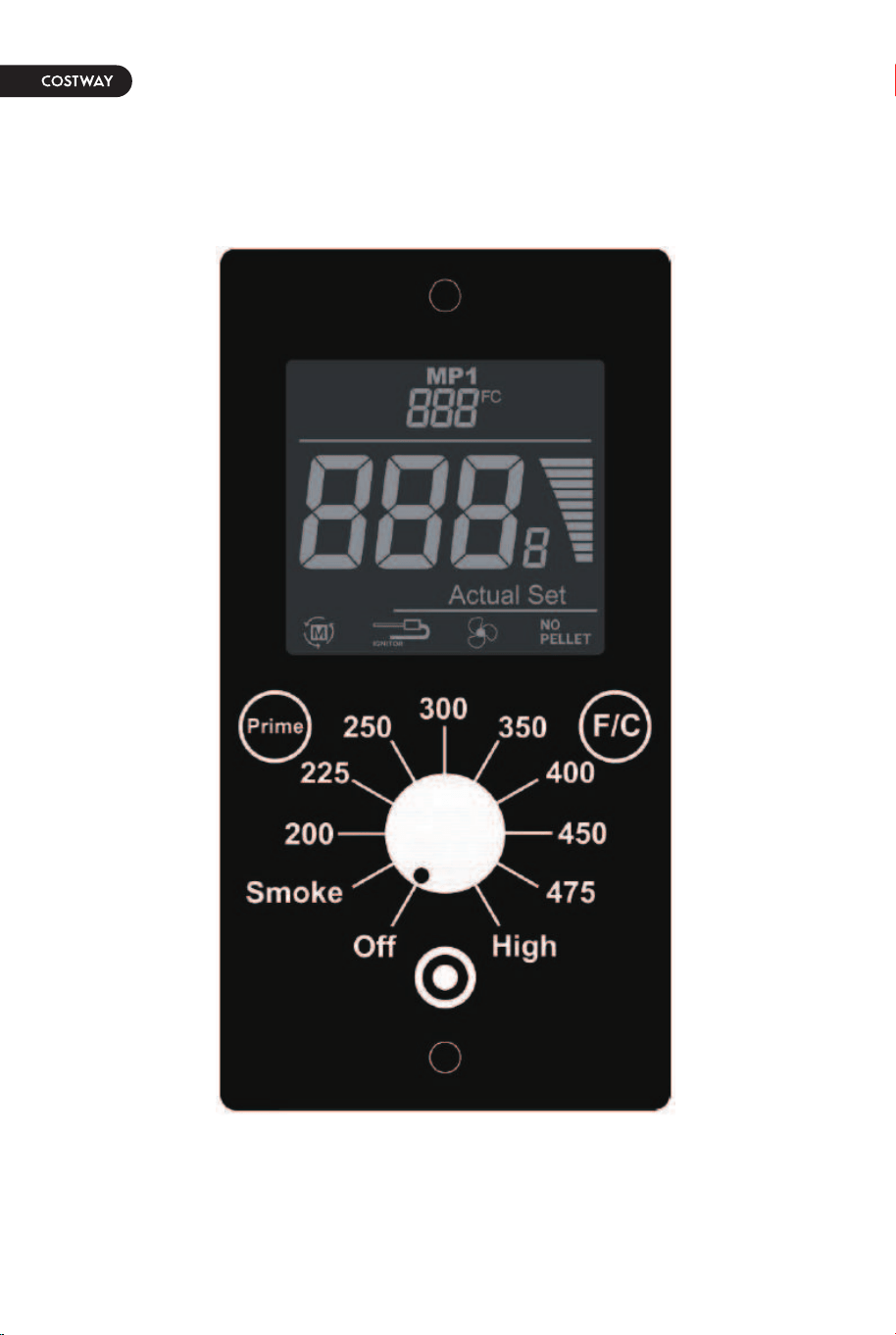
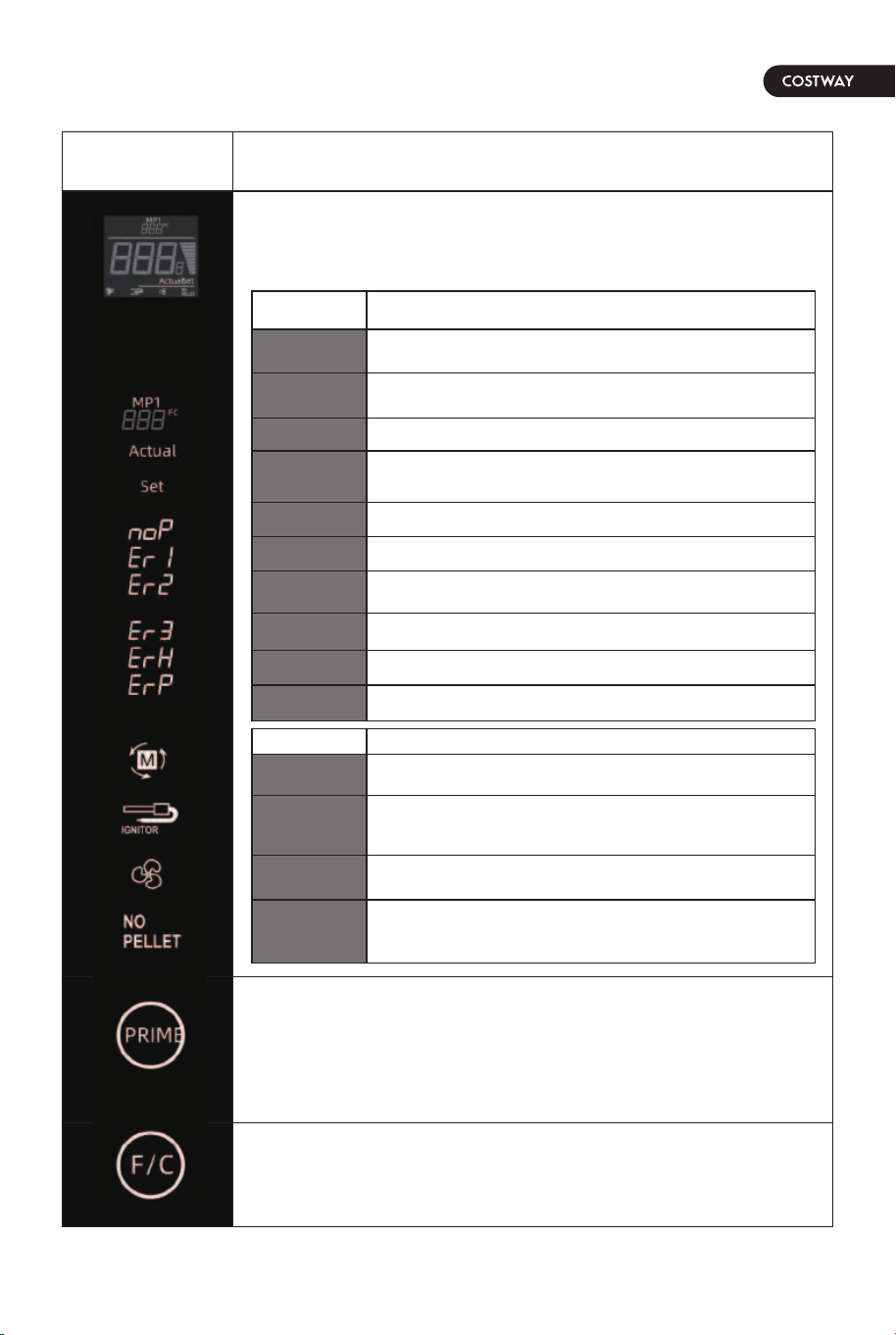
The LCD Screenis used as the information center for your unit.
The LCD screen will display the current grill temperature
(ACTUAL) and meat probe temperature (MP1).
SeeTroubleshooting for more information on error codes.
Press and hold the Prime Button to activate an extra feed of
pellets to the fire pot. This can be used to add more fuel to the
fire just before opening the barrel lid, resulting in a quicker heat
recovery time. It can also be used to add more fuel while
smoking,to increase the intensity of clean smoke flavor.
Overfeeding the fire pot may damage to grill barrel paint.
The Temperature Switch Button is used to change the
temperature readout on the LED Screen.Press the button to
switch to Fahrenheit (°F) or to Celsius (°C),as preferred.
Default is set to Fahrenheit.
UNDERSTANDING THE CONTROL BOARD
FEATURE DESCRIPTION
Flashing
Screen
Indicates the unit was just connected to AC power.
Screen flashes three times, then turns off.
MP1
Indicates the meat probe temperature when
probe is connected.
Indicates the auger motor is turning and
feeding pellets to the fire pot.
Indicates the igniter is on. When first starting
your unit, the igniter runs continuously for the
start-up cycle.
Indicates the fan is running. If the grill is in
operation, the fan is on.
Indicates the auger motor is no longer able to
feed pellets to the fire pot. Likely, the hopper is
empty and requires refiling.probe is connected.
Actual Indicates the current temperature of unit.
Indicates the desired temperature that has
been selected.
Indicated that no meat probe is connected.
Er1
Er2
Er3
Set
noP
Temperature probe wire not connecting.
ErH
Failure to reach minimum temperat of 130F
during start-up cycle.
ErP
Motor
Ignitor
Fan
No Pellet
Fire has gone out due to lack of fuel.
Grill has overheated.
Power loss during operation.
READOUT DESCRIPTION
ID DESCRIPTION
16 17
The LCD Screenis used as the information center for your unit.
The LCD screen will display the current grill temperature
(ACTUAL) and meat probe temperature (MP1).
SeeTroubleshooting for more information on error codes.
Press and hold the Prime Button to activate an extra feed of
pellets to the fire pot. This can be used to add more fuel to the
fire just before opening the barrel lid, resulting in a quicker heat
recovery time. It can also be used to add more fuel while
smoking,to increase the intensity of clean smoke flavor.
Overfeeding the fire pot may damage to grill barrel paint.
The Temperature Switch Button is used to change the
temperature readout on the LED Screen.Press the button to
switch to Fahrenheit (°F) or to Celsius (°C),as preferred.
Default is set to Fahrenheit.
UNDERSTANDING THE CONTROL BOARD
FEATURE DESCRIPTION
Flashing
Screen
Indicates the unit was just connected to AC power.
Screen flashes three times, then turns off.
MP1
Indicates the meat probe temperature when
probe is connected.
Indicates the auger motor is turning and
feeding pellets to the fire pot.
Indicates the igniter is on. When first starting
your unit, the igniter runs continuously for the
start-up cycle.
Indicates the fan is running. If the grill is in
operation, the fan is on.
Indicates the auger motor is no longer able to
feed pellets to the fire pot. Likely, the hopper is
empty and requires refiling.probe is connected.
Actual Indicates the current temperature of unit.
Indicates the desired temperature that has
been selected.
Indicated that no meat probe is connected.
Er1
Er2
Er3
Set
noP
Temperature probe wire not connecting.
ErH
Failure to reach minimum temperat of 130F
during start-up cycle.
ErP
Motor
Ignitor
Fan
No Pellet
Fire has gone out due to lack of fuel.
Grill has overheated.
Power loss during operation.
READOUT DESCRIPTION
ID DESCRIPTION
18 19
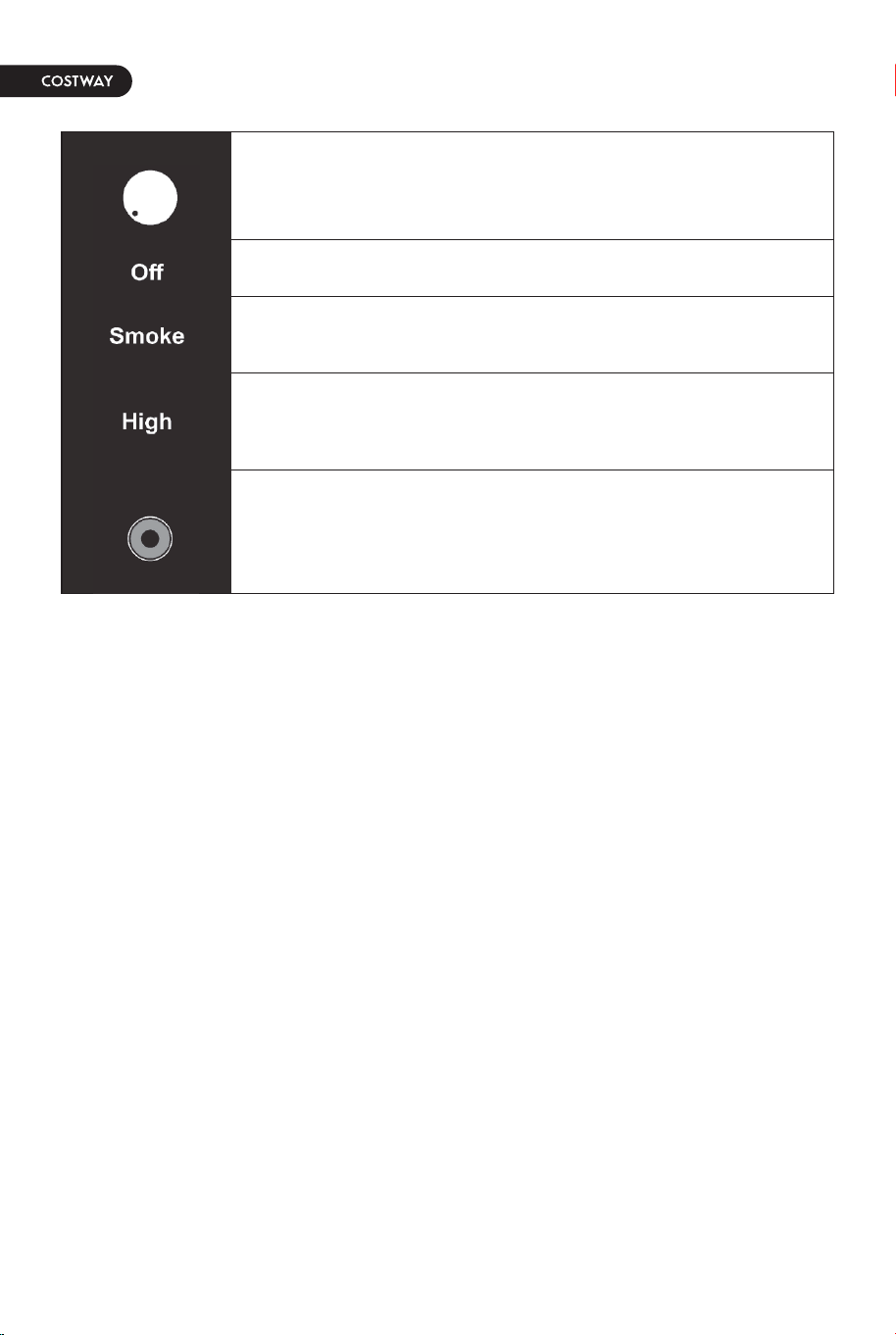
TheTemperature Control Dial allows you to set your desired
temperature. Rotate the knob marker to select from Smoke,
any of the eight temperature presets, or High. Once rotating
the dial, the SET Temperature on the LCD Screen will adjust.
The plug-in connection port on the front of the Control Board is
for the Meat Probe . When the meat probe is connected, the
temperature is displayed on the LCD Screen. When the meat
probe is not in use, disconnect the adapter from the connection
port.
The Off Setting on the Temperature Control Dial is the OFF
mode for the unit. The unit will not function on this setting.
The Smoke Setting on the Temperature Control Dial is the
lowest smoking mode for the unit. The grill operates at the
lowest temperature, without the fire going out.
The High Setting on the Temperature Control Dial is the highest
heat level for the unit. The grill operates at the highest
temperature. When the lid is open, the grill will run at this
speed to compensate for the loss of heat in the barrel.
HOPPER PRIMING PROCEDURE
FIRST USE – GRILL BURN-OFF
AUTOMATIC START-UP PROCEDURE
These instructions should be followed the first time the grill is ignited, and
each time the grill runs out of pellets in the hopper. The auger must be
primed to allow pellets to travel through the length of the auger, and fill the
fire pot. If not primed, the igniter will timeout before the pellets are ignited,
and no fire will start. Follow these steps to prime the hopper:
Once your hopper has been primed and before cooking on your grill for the
first time, it is important to complete a grill burn-off. Start the grill and
operate at any temperature over 176°C / 350°F (with the lid down) for 30 to
40 minutes to burn-off the grill and rid it of any foreign matter.
1.
2.
3.
4.
Open the hopper lid. Make sure there are no foreign objects in the hopper
or blocking the auger feed system at the bottom.
Remove all cooking components from the interior of the grill. Locate the
fire pot in the bottom of the main barrel.
With the Temperature Control Dial to the Off position, plug the power cord
into a power source.
Turn the Temperature Control Dial to the Smoke position. Check the
following items:
Once verified that all electric components are working correctly, turn the
Temperature Control Dial to Off.
Fill the hopper with all natural barbecue wood pellets.
Turn the Temperature Control Dial to Smoke. Wait approximately 3
minutes for the pellets to start dropping into the fire pot from the auger
tube. Once pellets begin to drop into the fire pot, turn the Temperature
Control Dial to Off.
Re-install the cooking components into the main barrel. The grill is now
ready to use. (See Assembly Instructions to ensure proper installation of
cooking components.)
That you can hear the auger turning. Place your hand above the fire pot
and feel for air movement. Do not place your hand or fingers inside the
fire pot. This can cause injury.
•
After approximately a minute, you should smell the igniter burning and
begin to feel the air getting warmer in the fire pot. The igniter tip does
not glow red, but gets extremely hot and will burn. Do not touch the
igniter.
•
5.
Open the main barrel lid. Check the fire pot to ensure there is no
obstruction for proper ignition. Open the hopper lid. Ensure there are no
foreign objects in the hopper or auger feed system. Fill the hopper with
dry, all natural barbecue hardwood pellets. Ensure the Temperature
Control Dial is in the Off position. Plug the power cord into a grounded
power source.
1.
Turn the Temperature Control Dial to Smoke. This will activate the start-up
cycle. The auger feed system will begin to turn, the igniter will begin to
glow and the fan will supply air to the fire pot. The grill will begin to
produce smoke while the start-up cycle is taking place. The barrel lid must
remain open during the start-up cycle. To confirm the start-up cycle has
begun properly, listen for a torchy roar, and notice some heat being
produced.
2.
Once the heavy, white smoke has dissipated, the start-up cycle is complete
and you are ready to enjoy your grill at your desired temperature!
3.
6.
7.
8.

18 19
TheTemperature Control Dial allows you to set your desired
temperature. Rotate the knob marker to select from Smoke,
any of the eight temperature presets, or High. Once rotating
the dial, the SET Temperature on the LCD Screen will adjust.
The plug-in connection port on the front of the Control Board is
for the Meat Probe . When the meat probe is connected, the
temperature is displayed on the LCD Screen. When the meat
probe is not in use, disconnect the adapter from the connection
port.
The Off Setting on the Temperature Control Dial is the OFF
mode for the unit. The unit will not function on this setting.
The Smoke Setting on the Temperature Control Dial is the
lowest smoking mode for the unit. The grill operates at the
lowest temperature, without the fire going out.
The High Setting on the Temperature Control Dial is the highest
heat level for the unit. The grill operates at the highest
temperature. When the lid is open, the grill will run at this
speed to compensate for the loss of heat in the barrel.
HOPPER PRIMING PROCEDURE
FIRST USE – GRILL BURN-OFF
AUTOMATIC START-UP PROCEDURE
These instructions should be followed the first time the grill is ignited, and
each time the grill runs out of pellets in the hopper. The auger must be
primed to allow pellets to travel through the length of the auger, and fill the
fire pot. If not primed, the igniter will timeout before the pellets are ignited,
and no fire will start. Follow these steps to prime the hopper:
Once your hopper has been primed and before cooking on your grill for the
first time, it is important to complete a grill burn-off. Start the grill and
operate at any temperature over 176°C / 350°F (with the lid down) for 30 to
40 minutes to burn-off the grill and rid it of any foreign matter.
1.
2.
3.
4.
Open the hopper lid. Make sure there are no foreign objects in the hopper
or blocking the auger feed system at the bottom.
Remove all cooking components from the interior of the grill. Locate the
fire pot in the bottom of the main barrel.
With the Temperature Control Dial to the Off position, plug the power cord
into a power source.
Turn the Temperature Control Dial to the Smoke position. Check the
following items:
Once verified that all electric components are working correctly, turn the
Temperature Control Dial to Off.
Fill the hopper with all natural barbecue wood pellets.
Turn the Temperature Control Dial to Smoke. Wait approximately 3
minutes for the pellets to start dropping into the fire pot from the auger
tube. Once pellets begin to drop into the fire pot, turn the Temperature
Control Dial to Off.
Re-install the cooking components into the main barrel. The grill is now
ready to use. (See Assembly Instructions to ensure proper installation of
cooking components.)
That you can hear the auger turning. Place your hand above the fire pot
and feel for air movement. Do not place your hand or fingers inside the
fire pot. This can cause injury.
•
After approximately a minute, you should smell the igniter burning and
begin to feel the air getting warmer in the fire pot. The igniter tip does
not glow red, but gets extremely hot and will burn. Do not touch the
igniter.
•
5.
Open the main barrel lid. Check the fire pot to ensure there is no
obstruction for proper ignition. Open the hopper lid. Ensure there are no
foreign objects in the hopper or auger feed system. Fill the hopper with
dry, all natural barbecue hardwood pellets. Ensure the Temperature
Control Dial is in the Off position. Plug the power cord into a grounded
power source.
1.
Turn the Temperature Control Dial to Smoke. This will activate the start-up
cycle. The auger feed system will begin to turn, the igniter will begin to
glow and the fan will supply air to the fire pot. The grill will begin to
produce smoke while the start-up cycle is taking place. The barrel lid must
remain open during the start-up cycle. To confirm the start-up cycle has
begun properly, listen for a torchy roar, and notice some heat being
produced.
2.
Once the heavy, white smoke has dissipated, the start-up cycle is complete
and you are ready to enjoy your grill at your desired temperature!
3.
6.
7.
8.

20 21
IMPORTANT: Due to high heat, do not cover the flame broiler or
probes with aluminum foil.
The product will give you many years of flavorful service with minimum
cleaning. An important step is allowing the grill and cooking grids to self-clean
by running the grill at a high temperature for 5 to 10 minutes after each use.
Follow these cleaning and maintenance tips to service your grill:
IGNITER FAILURE PROCEDURE
MANUAL START-UP PROCEDURE
SHUTTING OFF YOUR GRILL
1. HOPPER ASSEMBLY
2. PROBES
3. INSIDE SURFACES
Visually confirm that the igniter is working by placing your hand above
the fire pot and feeling for heat.
Visually confirm that the igniter is protruding approximately 13mm / 0.5
inches in the fire pot.
Visually confirm that the auger is dropping pellets into the fire pot.
Confirm that the combustion fan is working by listening for a torchy roar.
•
•
•
•
In instances of long periods between use, it is suggested to run all pellets
through your hopper and auger, to prevent jams.
•
Kinks or folds in the probe wires may cause damage to the part. Wires
should be rolled up in a large, loose coil.
•
Check your grease tray often, and clean out as necessary. Keep in mind
the type of cooking you do.
•
It is recommended to clean your burn pot after every few uses. This will
ensure proper ignition and avoid any hard build-up of debris or ash in the
burn pot.
•
Check and clean off any debris from the fan air intake vent, found on the
bottom of the hopper. Once the hopper access panel is removed (see
Electric Wire Diagram ), carefully wipe off any grease build-up directly on
the fan blades. This ensures airflow is sufficient to the feed system.
•
Although the probes are stainless steel, do not place in the dishwasher or
submerge in water. Water damage to the internal wires will cause the
probe to short-out, causing false readings. If a probe is damaged, it
should be replaced.
•
Use a long-handled grill cleaning brush, remove any food or build-up from
the cooking grids. Best practice is to do this while they are still warm
from a previous cook. Grease fires are caused by too much fallen debris
on the cooking components of the grill. Clean the inside of your grill on a
consistent basis. In the event you experience a grease fire, keep the grill
lid closed to choke out the fire. If the fire does not go out quickly,
carefully remove the food, turn the grill off, and shut the lid until the fire
is completely out. Lightly sprinkle baking soda, if available.
•
NOTE: Do not use spirit, petrol, gasoline, lighter-fluid or kerosene for
lighting or refreshing a fire in your grill.
NOTE: Use a long handled brush or shop-vac to remove excess pellets,
sawdust, and debris for a complete clean-out through the hopper screen.
Turn the Temperature Control Dial to the Off position. Open the barrel lid.
Remove the cooking components from inside. Remove all unburnt pellets
and ash from the fire pot. Avoid touching the igniter to avoid injury, as it
may be extremely hot.
1.
Ensure the Temperature Control Dial to the Off position. Plug the power
cord into a grounded power source.
1.
When finished cooking, with the main barrel lid remaining closed, turn the
Temperature Control Dial to OFF.
1.
Allow the grill to the plugged in on 'off' mode for another 10 minutes as the
internal fan will remain on to complete the unit's cooldown cycle.
2.
Check fire pot to ensure there is no obstruction for proper ignition. Open
the hopper lid. Ensure there are no foreign objects in the hopper or auger
feed system. Fill hopper with dry, all natural hardwood barbecue pellets.
2.
Open the barrel lid. Remove the cooking components to expose the fire
pot. Place a generous handful of pellets into the fire pot. Squirt a gelled fire
starter, or other appropriate pellet starter, over the top of the pellets. A
small amount of solid fuel fire starter, such as one composed of sawdust
and wax, or wood shavings, is also appropriate. Add another small amount
of pellets in the fire pot.
3.
Light the contents of the fire pot using a long match or long-nosed lighter.
Allow the starter to burn for 3 to 5 minutes. Do not attempt to add more
starter into the fire pot. This can cause injury.
4.
Quickly and carefully replace the cooking components to the inside of the
main barrel. Continue start-up at step two of Automatic Start-Up Procedure.
5.
Once all parts are removed and cleaned, turn the Temperature Control Dial
to Smoke. Check the following:
2.
If any of the above points are not working, follow Troubleshooting
instructions.
3.
If for any reason your electric igniter fails or your grill's flame dies out during
a cook, check the following steps, or start your grill using the manual method.
CARE AND MAINTENANCE
20 21
IMPORTANT: Due to high heat, do not cover the flame broiler or
probes with aluminum foil.
The product will give you many years of flavorful service with minimum
cleaning. An important step is allowing the grill and cooking grids to self-clean
by running the grill at a high temperature for 5 to 10 minutes after each use.
Follow these cleaning and maintenance tips to service your grill:
IGNITER FAILURE PROCEDURE
MANUAL START-UP PROCEDURE
SHUTTING OFF YOUR GRILL
1. HOPPER ASSEMBLY
2. PROBES
3. INSIDE SURFACES
Visually confirm that the igniter is working by placing your hand above
the fire pot and feeling for heat.
Visually confirm that the igniter is protruding approximately 13mm / 0.5
inches in the fire pot.
Visually confirm that the auger is dropping pellets into the fire pot.
Confirm that the combustion fan is working by listening for a torchy roar.
•
•
•
•
In instances of long periods between use, it is suggested to run all pellets
through your hopper and auger, to prevent jams.
•
Kinks or folds in the probe wires may cause damage to the part. Wires
should be rolled up in a large, loose coil.
•
Check your grease tray often, and clean out as necessary. Keep in mind
the type of cooking you do.
•
It is recommended to clean your burn pot after every few uses. This will
ensure proper ignition and avoid any hard build-up of debris or ash in the
burn pot.
•
Check and clean off any debris from the fan air intake vent, found on the
bottom of the hopper. Once the hopper access panel is removed (see
Electric Wire Diagram ), carefully wipe off any grease build-up directly on
the fan blades. This ensures airflow is sufficient to the feed system.
•
Although the probes are stainless steel, do not place in the dishwasher or
submerge in water. Water damage to the internal wires will cause the
probe to short-out, causing false readings. If a probe is damaged, it
should be replaced.
•
Use a long-handled grill cleaning brush, remove any food or build-up from
the cooking grids. Best practice is to do this while they are still warm
from a previous cook. Grease fires are caused by too much fallen debris
on the cooking components of the grill. Clean the inside of your grill on a
consistent basis. In the event you experience a grease fire, keep the grill
lid closed to choke out the fire. If the fire does not go out quickly,
carefully remove the food, turn the grill off, and shut the lid until the fire
is completely out. Lightly sprinkle baking soda, if available.
•
NOTE: Do not use spirit, petrol, gasoline, lighter-fluid or kerosene for
lighting or refreshing a fire in your grill.
NOTE: Use a long handled brush or shop-vac to remove excess pellets,
sawdust, and debris for a complete clean-out through the hopper screen.
Turn the Temperature Control Dial to the Off position. Open the barrel lid.
Remove the cooking components from inside. Remove all unburnt pellets
and ash from the fire pot. Avoid touching the igniter to avoid injury, as it
may be extremely hot.
1.
Ensure the Temperature Control Dial to the Off position. Plug the power
cord into a grounded power source.
1.
When finished cooking, with the main barrel lid remaining closed, turn the
Temperature Control Dial to OFF.
1.
Allow the grill to the plugged in on 'off' mode for another 10 minutes as the
internal fan will remain on to complete the unit's cooldown cycle.
2.
Check fire pot to ensure there is no obstruction for proper ignition. Open
the hopper lid. Ensure there are no foreign objects in the hopper or auger
feed system. Fill hopper with dry, all natural hardwood barbecue pellets.
2.
Open the barrel lid. Remove the cooking components to expose the fire
pot. Place a generous handful of pellets into the fire pot. Squirt a gelled fire
starter, or other appropriate pellet starter, over the top of the pellets. A
small amount of solid fuel fire starter, such as one composed of sawdust
and wax, or wood shavings, is also appropriate. Add another small amount
of pellets in the fire pot.
3.
Light the contents of the fire pot using a long match or long-nosed lighter.
Allow the starter to burn for 3 to 5 minutes. Do not attempt to add more
starter into the fire pot. This can cause injury.
4.
Quickly and carefully replace the cooking components to the inside of the
main barrel. Continue start-up at step two of Automatic Start-Up Procedure.
5.
Once all parts are removed and cleaned, turn the Temperature Control Dial
to Smoke. Check the following:
2.
If any of the above points are not working, follow Troubleshooting
instructions.
3.
If for any reason your electric igniter fails or your grill's flame dies out during
a cook, check the following steps, or start your grill using the manual method.
CARE AND MAINTENANCE
22 23
4. OUTSIDE SURFACES
Use a grill cover to protect your grill for complete protection! A cover is your
best protection against weather and outside pollutants. When not in use or
for long-term storage, keep the unit under a cover in a garage or shed.
•
Wipe your grill down after each use. Use warm soapy water to cut the
grease. Do not use oven cleaner, abrasive cleansers or abrasive cleaning
pads on the outside grill surfaces. For paint scratches, wearing, or flaking
of the finish, all painted surfaces can be touched up using high heat BBQ
paint.
•
Flank
Steak
Medium
Medium
Medium
Medium
Medium
High
/ Medium
High
/ Medium
High
/ Medium
Hot Smoke
0.45-0.86 kg
/1-11⁄2% lbs.,
1.9 cm / ¾'
LAMB Rare-54°C
/130°F
Medium-
60°C /140°F
Well Done-
71°C /160°F
Size
Roast (fresh)
2.26-2.72 kg
/ 5-6 lbs
1-2 hours
Rib Crown
Roast
1.36-2.26 kg
/ 3-5 lbs
1-11⁄2 hours 11⁄2 hours
Sear 4 minutes, 8-10 minutes
Grill 10 - 12 minutes
Sear 10 minutes, grill 15-20
minutes
Sear 4 minutes, grill 4-6 minutes
Grill 11⁄2 - 2 hours
Sear 10 minutes, grill 20-30
minutes
21⁄2 - 23⁄4 hours
10-12 minutes direct
Cook until internal temperature
reaches 91°C / 195°F
Kabob 2.5-3.8cm
/1-11⁄2"cubes
Tenderloin,
whole
158-1.81kg
/31⁄2-4lbs.
Ground
Beef Patty
1.9 cm / ¾"
Rib-eye
Roast
(boneless)
2.26-2.72 kg
/ 5-6 lbs
Tri-tip
Roast
0.9-1.13 kg
/ 2-21⁄2 lbs
Rib Roast 5.44-6.35 kg
/ 12-14 lbs
Veal Loin
Chop
2.5 cm / 1"
Brisket 7.25-3.62 kg
/ 16-18 lbs
WILD GAME Rare-60°C
/140°F
Medium-
71°C /160°F
Well Done-
77°C /170°F
Size
Large Cuts
(fresh)
2.26-2.72 kg
/ 5-6 lbs.
1 hours
Roast (fresh)
3.62-4.53 kg
/ 8-10 lbs.
1-11⁄2 hours 11⁄2-2 hours
11⁄2 hours
SEAFOOD Rare-54°C
/130°F
Medium-
60°C /140°F
Well Done-
82°C /180°F
Size
Fish (whole)
0.5 kg / 1 lb.
0.9-1.1 kg
/ 2-21⁄2 lbs.
1.4 kg /3 lbs.
Grill 10 - 20
minutes
Grill 20 - 30
minutes
Grill 30 - 45
minutes
Grill 5 - 6
minutes
Grill 10 - 12
minutes
Fish (filets)
Lobster Tail
0.6-1.3 cm
/1⁄4"-1⁄2"
0.15 kg / 5 oz.
0.3 kg / 10 oz.
Grill 3 - 5
minutes,
until flaky
22 23
4. OUTSIDE SURFACES
Use a grill cover to protect your grill for complete protection! A cover is your
best protection against weather and outside pollutants. When not in use or
for long-term storage, keep the unit under a cover in a garage or shed.
•
Wipe your grill down after each use. Use warm soapy water to cut the
grease. Do not use oven cleaner, abrasive cleansers or abrasive cleaning
pads on the outside grill surfaces. For paint scratches, wearing, or flaking
of the finish, all painted surfaces can be touched up using high heat BBQ
paint.
•
Flank
Steak
Medium
Medium
Medium
Medium
Medium
High
/ Medium
High
/ Medium
High
/ Medium
Hot Smoke
0.45-0.86 kg
/1-11⁄2% lbs.,
1.9 cm / ¾'
LAMB Rare-54°C
/130°F
Medium-
60°C /140°F
Well Done-
71°C /160°F
Size
Roast (fresh)
2.26-2.72 kg
/ 5-6 lbs
1-2 hours
Rib Crown
Roast
1.36-2.26 kg
/ 3-5 lbs
1-11⁄2 hours 11⁄2 hours
Sear 4 minutes, 8-10 minutes
Grill 10 - 12 minutes
Sear 10 minutes, grill 15-20
minutes
Sear 4 minutes, grill 4-6 minutes
Grill 11⁄2 - 2 hours
Sear 10 minutes, grill 20-30
minutes
21⁄2 - 23⁄4 hours
10-12 minutes direct
Cook until internal temperature
reaches 91°C / 195°F
Kabob 2.5-3.8cm
/1-11⁄2"cubes
Tenderloin,
whole
158-1.81kg
/31⁄2-4lbs.
Ground
Beef Patty
1.9 cm / ¾"
Rib-eye
Roast
(boneless)
2.26-2.72 kg
/ 5-6 lbs
Tri-tip
Roast
0.9-1.13 kg
/ 2-21⁄2 lbs
Rib Roast 5.44-6.35 kg
/ 12-14 lbs
Veal Loin
Chop
2.5 cm / 1"
Brisket 7.25-3.62 kg
/ 16-18 lbs
WILD GAME Rare-60°C
/140°F
Medium-
71°C /160°F
Well Done-
77°C /170°F
Size
Large Cuts
(fresh)
2.26-2.72 kg
/ 5-6 lbs.
1 hours
Roast (fresh)
3.62-4.53 kg
/ 8-10 lbs.
1-11⁄2 hours 11⁄2-2 hours
11⁄2 hours
SEAFOOD Rare-54°C
/130°F
Medium-
60°C /140°F
Well Done-
82°C /180°F
Size
Fish (whole)
0.5 kg / 1 lb.
0.9-1.1 kg
/ 2-21⁄2 lbs.
1.4 kg /3 lbs.
Grill 10 - 20
minutes
Grill 20 - 30
minutes
Grill 30 - 45
minutes
Grill 5 - 6
minutes
Grill 10 - 12
minutes
Fish (filets)
Lobster Tail
0.6-1.3 cm
/1⁄4"-1⁄2"
0.15 kg / 5 oz.
0.3 kg / 10 oz.
Grill 3 - 5
minutes,
until flaky
2. COOKING PREPARATION
Be prepared, or Mise en Place. This refers to preparing the cooking
recipe, fuel, accessories, utensils, and all ingredients you require at grill
side before you start cooking. Also, read the entire recipe, start to finish,
before lighting the grill.
•
3. GRILLING TIPS AND TECHNIQUES
To infuse more smoke flavor into your meats, cook longer and at lower
temperatures (also known as low and slow). Meat will close its fibers after
it reaches an internal temperature of 49ºC / 120ºF. Misting, or mopping,
are great ways to keep meat from drying out.
•
While searing your meats, cook with the lid down. Always use a meat
thermometer to determine the internal temperature of the foods you are
cooking. Smoking foods with hardwood pellets will turn meats and poultry
pink. The band of pink (after cooking) is referred to as a smoke ring and
is highly prized by outdoor chefs.
•
Sugar-based sauces are best applied near the end of cooking to prevent
burning and flare-ups.
•
Leave open space between the foods and the extremities of the barrel for
proper heat flow. Food on a crowded grill will require more cooking time.
•
Use a set of long-handled tongs for turning meats, and a spatula for
turning burgers and fish. Using a piercing utensil, such as a fork, will
prick the meat and allow the juices to escape.
•
Foods in deep casserole dishes will require more time to cook than a
shallow baking pan.
•
It’s a good idea to put cooked food onto a heated platter, keeping the
food warm. Red meats, such as steak and roasts, benefit from resting for
several minutes before serving. It allows the juices that were driven to
the surface by heat to ease back to the center of the meat, adding more
flavor.
•
A BBQ floor mat is very useful. Due to food handling accidents and
cooking spatter, a BBQ floor mat would protect a deck, patio, or stone
platform from the possibility of grease stains or accidental spills.
•
Defrost and marinade meats by refrigeration. Do not thaw meat at room
temperature or on a counter top. Bacteria can grow and multiply rapidly
in warm, moist foods. Wash hands thoroughly with hot, soapy water
before starting any meal preparation and after handling fresh meat, fish
and poultry.
•
Cooked foods should not be left out in the heat for more than an hour. Do
not leave hot foods out of refrigeration for more than two hours.
•
A marinade should never be saved to use at a later time. If you are going
to use it to serve with your meat, be sure to bring it to a boil before
serving.
•
24 25
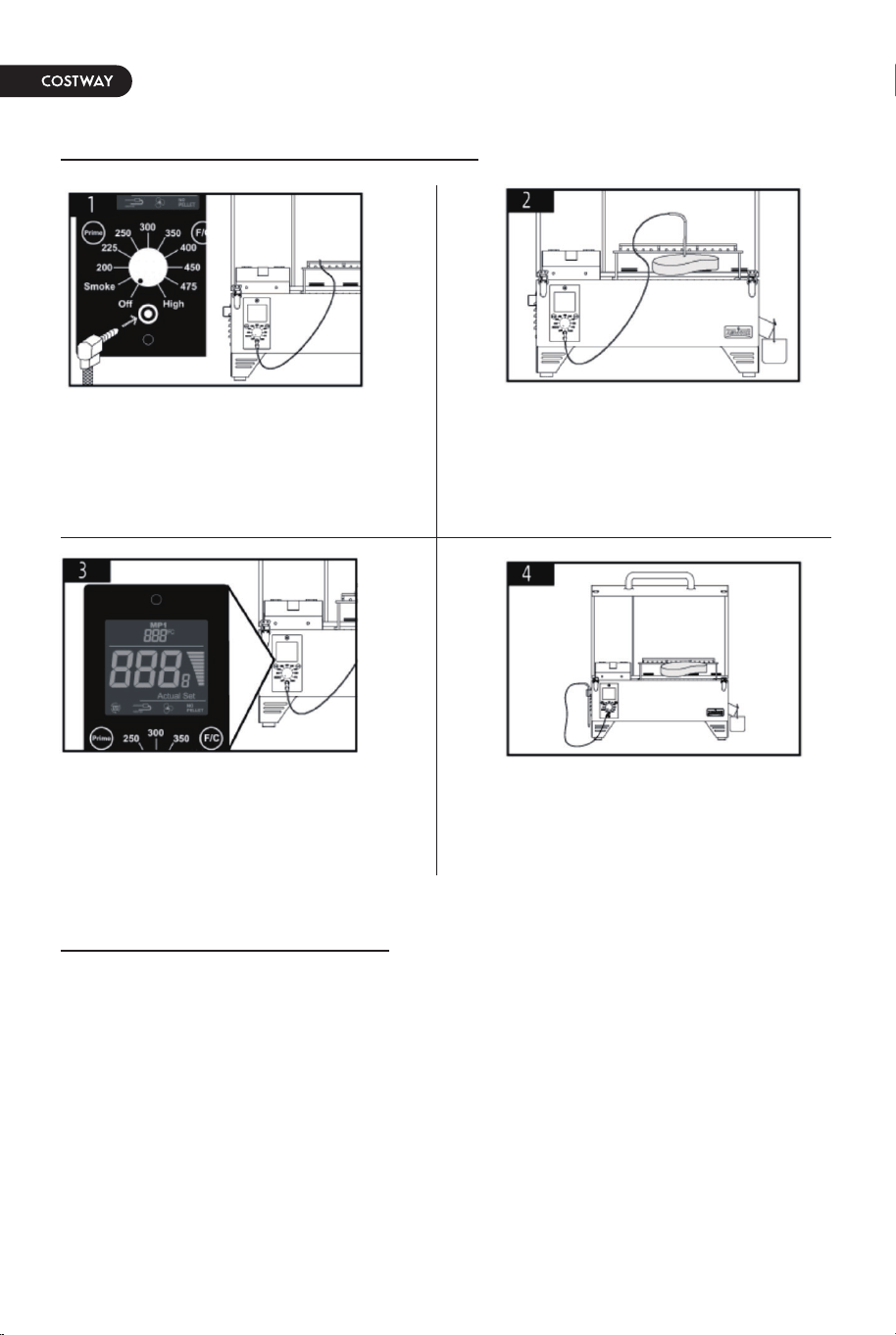
Insert the meat probe's plug into
the socket on the lower left
corner of the controller, then
route the probe cable through the
notch in the grill front, as shown.
Insert probe tip into meat.Make
sure it is not in the fatty portion
or touching bone, but is halfway
into the thickest part of the meat.
Reading the temperature :Both
probe temperature and griil
temperature will display on
controller.
Left top side have a small shelf
for you holding meat probe after
ryou using.
1. FOOD SAFETY
Keep everything in the kitchen and cooking area clean. Use different
platters and utensils for the cooked meat than the ones you used to
prepare or transport the raw meat out to the grill. This will prevent cross
contamination of bacteria. Each marinade or basting sauce should have
its own utensil.
•
Keep hot foods hot (above 60ºC / 140ºF), and keep cold foods cold
(below 3ºC / 37ºF).
•
Follow these helpful tips and techniques, passed on from our staff and
customers just like you, to become more familiar with your grill:
TIPS & TECHNIQUES
HOW TO USE MEAT PROBE

2. COOKING PREPARATION
Be prepared, or Mise en Place. This refers to preparing the cooking
recipe, fuel, accessories, utensils, and all ingredients you require at grill
side before you start cooking. Also, read the entire recipe, start to finish,
before lighting the grill.
•
3. GRILLING TIPS AND TECHNIQUES
To infuse more smoke flavor into your meats, cook longer and at lower
temperatures (also known as low and slow). Meat will close its fibers after
it reaches an internal temperature of 49ºC / 120ºF. Misting, or mopping,
are great ways to keep meat from drying out.
•
While searing your meats, cook with the lid down. Always use a meat
thermometer to determine the internal temperature of the foods you are
cooking. Smoking foods with hardwood pellets will turn meats and poultry
pink. The band of pink (after cooking) is referred to as a smoke ring and
is highly prized by outdoor chefs.
•
Sugar-based sauces are best applied near the end of cooking to prevent
burning and flare-ups.
•
Leave open space between the foods and the extremities of the barrel for
proper heat flow. Food on a crowded grill will require more cooking time.
•
Use a set of long-handled tongs for turning meats, and a spatula for
turning burgers and fish. Using a piercing utensil, such as a fork, will
prick the meat and allow the juices to escape.
•
Foods in deep casserole dishes will require more time to cook than a
shallow baking pan.
•
It’s a good idea to put cooked food onto a heated platter, keeping the
food warm. Red meats, such as steak and roasts, benefit from resting for
several minutes before serving. It allows the juices that were driven to
the surface by heat to ease back to the center of the meat, adding more
flavor.
•
A BBQ floor mat is very useful. Due to food handling accidents and
cooking spatter, a BBQ floor mat would protect a deck, patio, or stone
platform from the possibility of grease stains or accidental spills.
•
Defrost and marinade meats by refrigeration. Do not thaw meat at room
temperature or on a counter top. Bacteria can grow and multiply rapidly
in warm, moist foods. Wash hands thoroughly with hot, soapy water
before starting any meal preparation and after handling fresh meat, fish
and poultry.
•
Cooked foods should not be left out in the heat for more than an hour. Do
not leave hot foods out of refrigeration for more than two hours.
•
A marinade should never be saved to use at a later time. If you are going
to use it to serve with your meat, be sure to bring it to a boil before
serving.
•
24 25
Insert the meat probe's plug into
the socket on the lower left
corner of the controller, then
route the probe cable through the
notch in the grill front, as shown.
Insert probe tip into meat.Make
sure it is not in the fatty portion
or touching bone, but is halfway
into the thickest part of the meat.
Reading the temperature :Both
probe temperature and griil
temperature will display on
controller.
Left top side have a small shelf
for you holding meat probe after
ryou using.
1. FOOD SAFETY
Keep everything in the kitchen and cooking area clean. Use different
platters and utensils for the cooked meat than the ones you used to
prepare or transport the raw meat out to the grill. This will prevent cross
contamination of bacteria. Each marinade or basting sauce should have
its own utensil.
•
Keep hot foods hot (above 60ºC / 140ºF), and keep cold foods cold
(below 3ºC / 37ºF).
•
Follow these helpful tips and techniques, passed on from our staff and
customers just like you, to become more familiar with your grill:
TIPS & TECHNIQUES
HOW TO USE MEAT PROBE
WARNING: Always disconnect the electrical cord prior to opening the
grill for any inspection, cleaning, maintenance or service work. Ensure
the grill is completely cooled to avoid injury.
Proper cleaning, maintenance and the use of clean, dry, quality fuel will
prevent common operational problems. When your product is operating poorly,
or on a less frequent basis, the following troubleshooting tips may be helpful.
For FAQ or other assistance, please contact us.
No Power
Lights On The
Control Board
Fire in Fire
pot Will Not
Light
Temperature
Control Dial
is still off.
Not
Connected To
Power Source
Fuse Blown
On The
Control Board
The GFCI
outlet has
been tripped.
Faulty
Control Board
Auger Not
Primed
Auger Motor
Is Jammed
Igniter
Failure
Insufficient
Air Flow
Through Fire
Pot
The Igniter Is
On
Turn the Temperature Control Dial to a temperature
setting.
Ensure GFCI is a minimum 10 Amp service.
Control Board needs to be replaced. Contact
Customer Service for a replacement part.
Ensure unit is plugged into a working power source.
Reset breaker. Ensure GFCI is a minimum 10 Amp
service (see Electric Wire Diagram for access to
electric components) Ensure all wire connections
are firmly connected and dry.
Remove hopper access panel (see Electric Wire
Diagram for diagram), press in plastic tabs holding
the control board in place and carefully pull
controller inside the hopper to release controller.
Check the fuse for a broken wire or if the wire has
turned black. If yes, fuse needs to be manually
replaced.
Before the unit is used for the first time or anytime
the hopper is completely emptied out, the auger
must be primed to allow pellets to fill the auger
tube. If not primed, the igniter will timeout before
the pellets reach the fire pot. Follow Hopper
Priming Procedure.
Remove cooking components from the main barrel.
Press the Power Button to turn the unit on, turn
Temperature Control Dial to SMOKE, and inspect
the auger feed system. Visually confirm that the
auger is dropping pellets into the fire pot. If not
operating properly, call Customer Service for
assistance.
Check fire pot for ash build-up or obstructions.
Follow Care and Maintenance instructions for ash
build-up. Check fan. Ensure it is working properly
and air intake is not blocked. Follow Care and
Maintenance instructions if dirty.
This is not an error that effects the grill. It is used
to show that the unit has power and is in Start-Up
mode (igniter is on). The igniter will turn off after
five minutes. Once the flashing dots disappear, the
grill will begin to adjust to the desired temperature
selected.
Remove cooking components from the main barrel.
Press the Power Button to turn the unit on, turn
Temperature Control Dial to SMOKE, and inspect
the igniter. Visually confirm that the igniter is
working by placing your hand above the fire pot and
feeling for heat. Visually confirm that the igniter is
protruding approximately 13mm / 0.5 inches in the
fire pot. If not operating properly, follow Manual
Start-up Procedure to continue use of grill;
however, call Customer Service for assistance or a
replacement part.
TROUBLESHOOTING
26 27
PROBLEM CAUSE SOLUTION
Fire in Fire
pot Will Not
Light
Flashing Dots
On LCD
Screen
Grill
Temperature
Is Below
65°C /150°F
This is not an error that effects the unit; however, it
is used to show that there is some risk that the fire
could go out. Check hopper for sufficient fuel or if
there is an obstruction in the feed system. Remove
pellets and follow Care and Maintenance
instructions. Check grill temperature probe and
follow Care and Maintenance instructions if dirty.
Check fire pot for ash build-up or obstructions, and
follow Care and Maintenance instructions for ash
build-up. Check fan. Ensure it is working properly
and air intake is not blocked. Follow Care and
Maintenance instructions if dirty. Check auger
motor to confirm operation (rotation), and ensure
there is no blockage in the auger tube.
Flashing
Temperature
On LCD
Screen
PROBLEM CAUSE SOLUTION
WARNING: Always disconnect the electrical cord prior to opening the
grill for any inspection, cleaning, maintenance or service work. Ensure
the grill is completely cooled to avoid injury.
Proper cleaning, maintenance and the use of clean, dry, quality fuel will
prevent common operational problems. When your product is operating poorly,
or on a less frequent basis, the following troubleshooting tips may be helpful.
For FAQ or other assistance, please contact us.
No Power
Lights On The
Control Board
Fire in Fire
pot Will Not
Light
Temperature
Control Dial
is still off.
Not
Connected To
Power Source
Fuse Blown
On The
Control Board
The GFCI
outlet has
been tripped.
Faulty
Control Board
Auger Not
Primed
Auger Motor
Is Jammed
Igniter
Failure
Insufficient
Air Flow
Through Fire
Pot
The Igniter Is
On
Turn the Temperature Control Dial to a temperature
setting.
Ensure GFCI is a minimum 10 Amp service.
Control Board needs to be replaced. Contact
Customer Service for a replacement part.
Ensure unit is plugged into a working power source.
Reset breaker. Ensure GFCI is a minimum 10 Amp
service (see Electric Wire Diagram for access to
electric components) Ensure all wire connections
are firmly connected and dry.
Remove hopper access panel (see Electric Wire
Diagram for diagram), press in plastic tabs holding
the control board in place and carefully pull
controller inside the hopper to release controller.
Check the fuse for a broken wire or if the wire has
turned black. If yes, fuse needs to be manually
replaced.
Before the unit is used for the first time or anytime
the hopper is completely emptied out, the auger
must be primed to allow pellets to fill the auger
tube. If not primed, the igniter will timeout before
the pellets reach the fire pot. Follow Hopper
Priming Procedure.
Remove cooking components from the main barrel.
Press the Power Button to turn the unit on, turn
Temperature Control Dial to SMOKE, and inspect
the auger feed system. Visually confirm that the
auger is dropping pellets into the fire pot. If not
operating properly, call Customer Service for
assistance.
Check fire pot for ash build-up or obstructions.
Follow Care and Maintenance instructions for ash
build-up. Check fan. Ensure it is working properly
and air intake is not blocked. Follow Care and
Maintenance instructions if dirty.
This is not an error that effects the grill. It is used
to show that the unit has power and is in Start-Up
mode (igniter is on). The igniter will turn off after
five minutes. Once the flashing dots disappear, the
grill will begin to adjust to the desired temperature
selected.
Remove cooking components from the main barrel.
Press the Power Button to turn the unit on, turn
Temperature Control Dial to SMOKE, and inspect
the igniter. Visually confirm that the igniter is
working by placing your hand above the fire pot and
feeling for heat. Visually confirm that the igniter is
protruding approximately 13mm / 0.5 inches in the
fire pot. If not operating properly, follow Manual
Start-up Procedure to continue use of grill;
however, call Customer Service for assistance or a
replacement part.
TROUBLESHOOTING
26 27
PROBLEM CAUSE SOLUTION
Fire in Fire
pot Will Not
Light
Flashing Dots
On LCD
Screen
Grill
Temperature
Is Below
65°C /150°F
This is not an error that effects the unit; however, it
is used to show that there is some risk that the fire
could go out. Check hopper for sufficient fuel or if
there is an obstruction in the feed system. Remove
pellets and follow Care and Maintenance
instructions. Check grill temperature probe and
follow Care and Maintenance instructions if dirty.
Check fire pot for ash build-up or obstructions, and
follow Care and Maintenance instructions for ash
build-up. Check fan. Ensure it is working properly
and air intake is not blocked. Follow Care and
Maintenance instructions if dirty. Check auger
motor to confirm operation (rotation), and ensure
there is no blockage in the auger tube.
Flashing
Temperature
On LCD
Screen
PROBLEM CAUSE SOLUTION
28 29
Check fire pot for ash build-up or obstructions.
Follow Care and Maintenance instructions for ash
build-up. Check fan. Ensure it is working properly
and air intake is not blocked. Follow Care and
Maintenance instructions if dirty. Check auger
motor to confirm operation, and ensure there is no
blockage in the auger tube. Once all the above
steps have been done, start the grill, set
temperature to SMOKE and wait for 10 minutes.
Check that the flame produced is bright and
vibrant.
Insufficient
Air Flow
Through Fire
Pot
Check hopper to check that fuel level is sufficient,
and replenish if low. Should the quality of wood
pellets is poor, or the length of the pellets is long,
this may cause an obstruction in the feed system.
Remove pellets and follow Care and Maintenance
instructions.
Lack Of Fuel,
Poor Fuel
Quality,
Obstruction
In Feed
System
Check status of temperature probe. Follow Care and
Maintenance instructions if dirty. Contact Customer
Service for a replacement part if damaged.
Temperature
Probe
Grill Will Not
Achieve Or
Maintain
Stable
Temperature
Follow Care and Maintenance instructions.Grease
Build-Up
Remove moist wood pellets from hopper. Follow
Care and Maintenance instructions to clean out.
Replace with dry wood pellets.
Wood Pellet
Quality
Check fan. Ensure it is working properly and air
intake is not blocked. Follow Care and Maintenance
instructions if dirty.
Insufficient
Air Intake For
Fan
Follow Care and Maintenance instructions.Grease
Build-Up On
Cooking
Components
Clear fire pot for ash and other debris. Follow
Hopper Priming Procedure.
Fire pot Is
Blocked
Grill Produces
Excess Or
Discolored
Smoke
Attempt cooking at a lower temperature. Grease
does have a flash point. Keep the temperature
under 176°C / 350°F when cooking highly greasy
food.
Cooking
Temperature
Frequent
Flare-Ups
PROBLEM CAUSE SOLUTION
The Unit Has
Overheated,
Possibly Due
To Grease
Fire Or
Excess Fuel.
Temperature
probe wire
not making
connection.
Press the Power Button to turn the unit off, and
allow grill to cool. Follow Care and Maintenance
instructions. After maintenance, remove pellets,
and confirm positioning of all component parts.
Once cooled, press the Power Button to turn the
unit on, then select desired temperature. If error
code still displayed, contact Customer Service.
Remove hopper access panel (see Electric Wire
Diagram), and check for any damage to the
Temperature Probe wires. Ensure Temperature
Probe connectors are firmly connected, and
connected correctly, to the Control Board.
"ErH" Error
Code
"ErR" Error
Code
Unit Not
Turned Off
Properly
When Last
Connected To
Power.
Power
Outage While
Unit In
Operation.
Safety feature prevents an automatic restart. Press
the Power Button to turn the unit off, wait two
minutes, then press the Power Button to turn the
unit on again. Turn Temperature Control Dial to
SMOKE or desired temperature. If error code still
displayed, contact Customer Service.
"ErP" Error
Code
Bad
Connection At
Connection
Port
Disconnect meat probe from connection port on the
Control Board, and reconnect. Ensure the meat
probe adapter is firmly connected. Check for signs
of damage to the adapter end. If it still fails, call
Customer Service for replacement part.
Meat Probe
Damaged
Check for signs of damage to the wires of the meat
probe. If damaged, call Customer Service for
replacement part.
Faulty Control
Board
Control Board needs to be replaced. Contact
Customer Service for a replacement part.
"noP" Error
Code
"P" Setting is
too LOW
Push the "P" SET button, and increase the "P"
setting.
Grill
Temperature
on SMOKE is
too high
PROBLEM CAUSE SOLUTION
28 29
Check fire pot for ash build-up or obstructions.
Follow Care and Maintenance instructions for ash
build-up. Check fan. Ensure it is working properly
and air intake is not blocked. Follow Care and
Maintenance instructions if dirty. Check auger
motor to confirm operation, and ensure there is no
blockage in the auger tube. Once all the above
steps have been done, start the grill, set
temperature to SMOKE and wait for 10 minutes.
Check that the flame produced is bright and
vibrant.
Insufficient
Air Flow
Through Fire
Pot
Check hopper to check that fuel level is sufficient,
and replenish if low. Should the quality of wood
pellets is poor, or the length of the pellets is long,
this may cause an obstruction in the feed system.
Remove pellets and follow Care and Maintenance
instructions.
Lack Of Fuel,
Poor Fuel
Quality,
Obstruction
In Feed
System
Check status of temperature probe. Follow Care and
Maintenance instructions if dirty. Contact Customer
Service for a replacement part if damaged.
Temperature
Probe
Grill Will Not
Achieve Or
Maintain
Stable
Temperature
Follow Care and Maintenance instructions.Grease
Build-Up
Remove moist wood pellets from hopper. Follow
Care and Maintenance instructions to clean out.
Replace with dry wood pellets.
Wood Pellet
Quality
Check fan. Ensure it is working properly and air
intake is not blocked. Follow Care and Maintenance
instructions if dirty.
Insufficient
Air Intake For
Fan
Follow Care and Maintenance instructions.Grease
Build-Up On
Cooking
Components
Clear fire pot for ash and other debris. Follow
Hopper Priming Procedure.
Fire pot Is
Blocked
Grill Produces
Excess Or
Discolored
Smoke
Attempt cooking at a lower temperature. Grease
does have a flash point. Keep the temperature
under 176°C / 350°F when cooking highly greasy
food.
Cooking
Temperature
Frequent
Flare-Ups
PROBLEM CAUSE SOLUTION
The Unit Has
Overheated,
Possibly Due
To Grease
Fire Or
Excess Fuel.
Temperature
probe wire
not making
connection.
Press the Power Button to turn the unit off, and
allow grill to cool. Follow Care and Maintenance
instructions. After maintenance, remove pellets,
and confirm positioning of all component parts.
Once cooled, press the Power Button to turn the
unit on, then select desired temperature. If error
code still displayed, contact Customer Service.
Remove hopper access panel (see Electric Wire
Diagram), and check for any damage to the
Temperature Probe wires. Ensure Temperature
Probe connectors are firmly connected, and
connected correctly, to the Control Board.
"ErH" Error
Code
"ErR" Error
Code
Unit Not
Turned Off
Properly
When Last
Connected To
Power.
Power
Outage While
Unit In
Operation.
Safety feature prevents an automatic restart. Press
the Power Button to turn the unit off, wait two
minutes, then press the Power Button to turn the
unit on again. Turn Temperature Control Dial to
SMOKE or desired temperature. If error code still
displayed, contact Customer Service.
"ErP" Error
Code
Bad
Connection At
Connection
Port
Disconnect meat probe from connection port on the
Control Board, and reconnect. Ensure the meat
probe adapter is firmly connected. Check for signs
of damage to the adapter end. If it still fails, call
Customer Service for replacement part.
Meat Probe
Damaged
Check for signs of damage to the wires of the meat
probe. If damaged, call Customer Service for
replacement part.
Faulty Control
Board
Control Board needs to be replaced. Contact
Customer Service for a replacement part.
"noP" Error
Code
"P" Setting is
too LOW
Push the "P" SET button, and increase the "P"
setting.
Grill
Temperature
on SMOKE is
too high
PROBLEM CAUSE SOLUTION
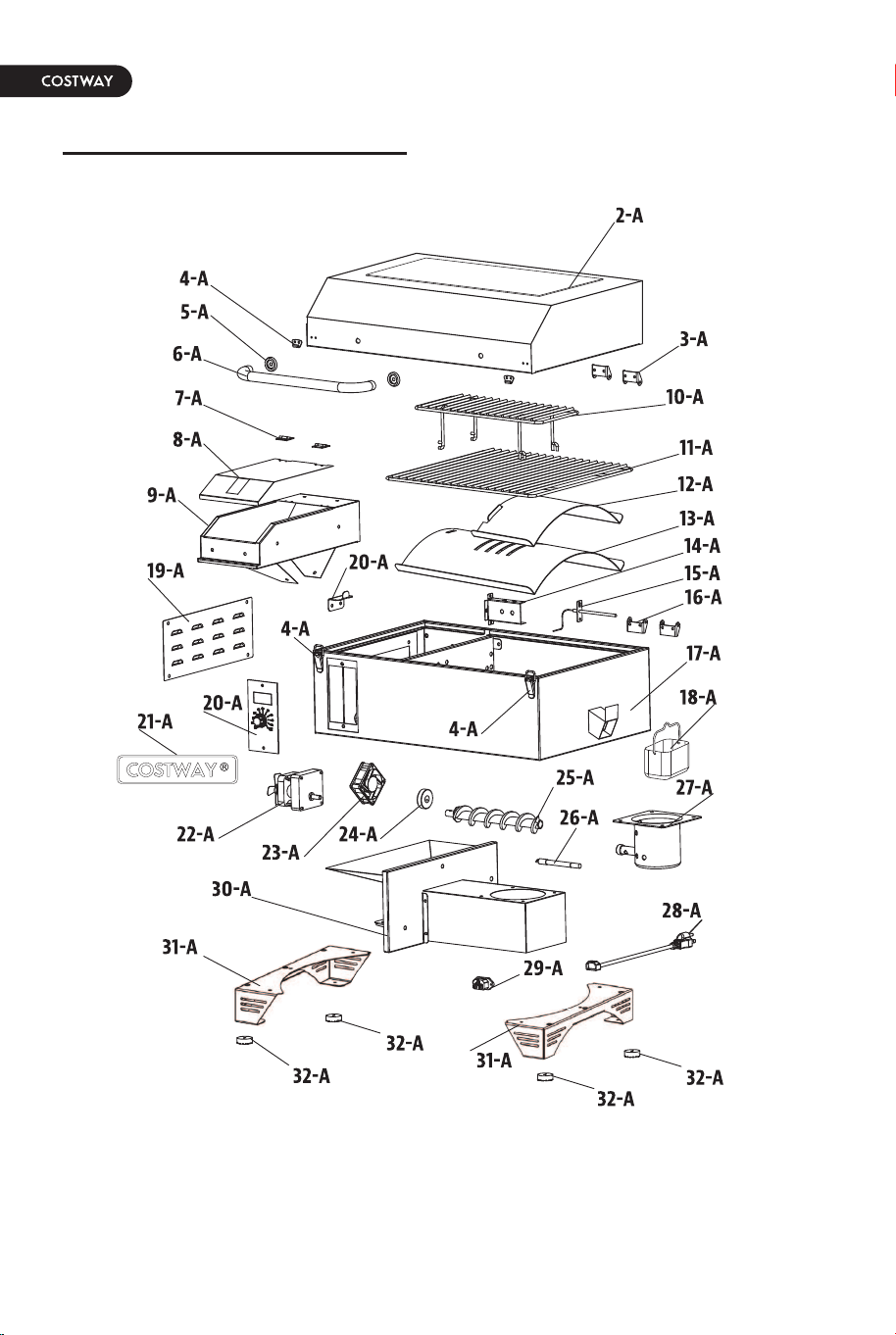
30 31
NOTE: Due to ongoing product development, parts are subject to
change without notice.
REPLACEMENT PARTS
Part# Description
Lid (x1) x1)
Lid Hinge (x2)
Hasp (x2)
Bezel With bolt (x2)
Lid Handle (x1)
Hopper Lid Hinge (x2)
Hopper Lid (x1)
Hopper Box Housing (x1)
Upper Cooking Rack (x1)
Cooking Grid (x1)
Flame Broiler Slider (x1)
Flame Broiler Main Plate (x1)
Probe Bracket / Shield (x1)
Probe (x1)
Body Hinge (x2)
Firebox / Body (x1)
Grease Tray Assembly (x1)
Service Door (x1)
Control Board (x1)
21-A
10-A
11-A
12-A
13-A
14-A
15-A
16-A
17-A
18-A
19-A
20-A
2-A
3-A
4-A
5-A
6-A
7-A
8-A
9-A
Logo Plate (x1)
22-A Auger Motor (x1)
23-A Combustion Fan (x1)
24-A Nylon Bushing (x1)
25-A Auger Fighting Assembly (x1)
26-A Igniter (x1)
27-A Fire Pot (x1)
28-A Power Cord (x1)
29-A Power Cord Socket (x1)
30-A Auger Box Housing (x1)
31-A Foot Assembly (x2)
32-A Foot Gasket (x4)
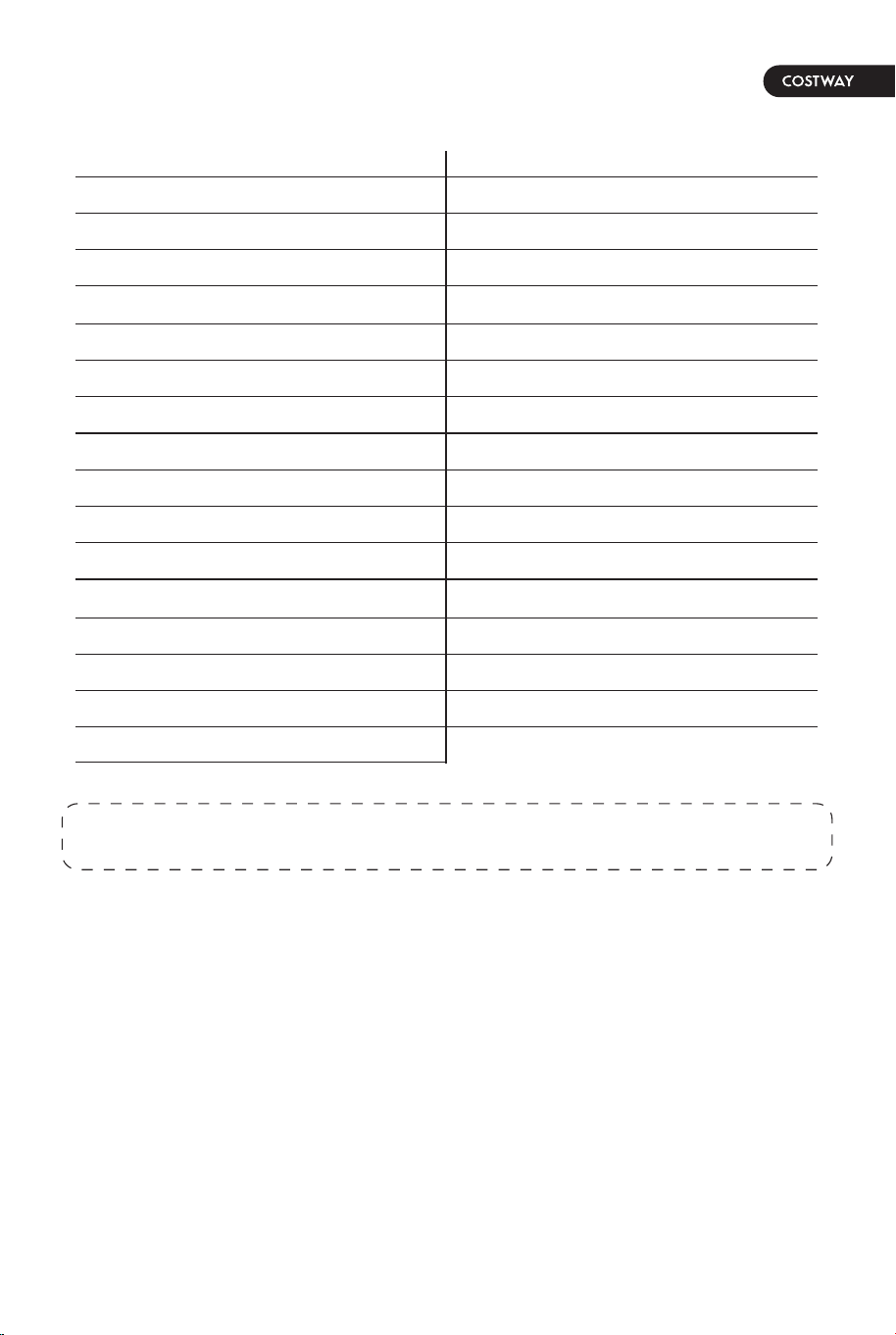
30 31
NOTE: Due to ongoing product development, parts are subject to
change without notice.
REPLACEMENT PARTS
Part# Description
Lid (x1) x1)
Lid Hinge (x2)
Hasp (x2)
Bezel With bolt (x2)
Lid Handle (x1)
Hopper Lid Hinge (x2)
Hopper Lid (x1)
Hopper Box Housing (x1)
Upper Cooking Rack (x1)
Cooking Grid (x1)
Flame Broiler Slider (x1)
Flame Broiler Main Plate (x1)
Probe Bracket / Shield (x1)
Probe (x1)
Body Hinge (x2)
Firebox / Body (x1)
Grease Tray Assembly (x1)
Service Door (x1)
Control Board (x1)
21-A
10-A
11-A
12-A
13-A
14-A
15-A
16-A
17-A
18-A
19-A
20-A
2-A
3-A
4-A
5-A
6-A
7-A
8-A
9-A
Logo Plate (x1)
22-A Auger Motor (x1)
23-A Combustion Fan (x1)
24-A Nylon Bushing (x1)
25-A Auger Fighting Assembly (x1)
26-A Igniter (x1)
27-A Fire Pot (x1)
28-A Power Cord (x1)
29-A Power Cord Socket (x1)
30-A Auger Box Housing (x1)
31-A Foot Assembly (x2)
32-A Foot Gasket (x4)
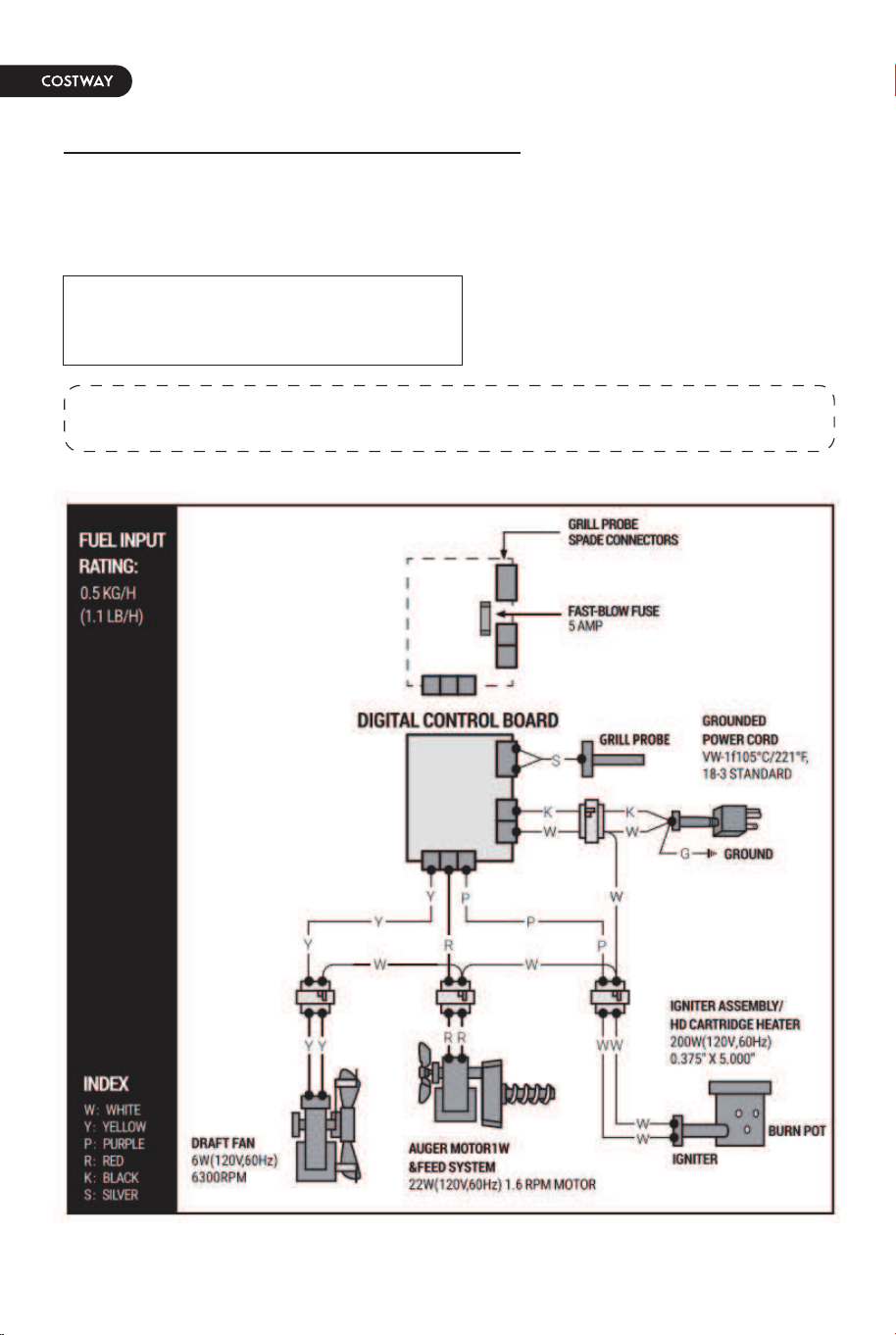
ELECTRIC REQUIREMENTS
110-120V, 60Hz, 230W, 3-PRONG
GROUNDED PLUG
32
The Digital Control Board system is an intricate and valuable piece of
technology. For protection from power surges and electrical shorts, consult the
wire diagram below to ensure your power source is sufficient for the operation
of the unit.
NOTE: Electrical components, passed by product safety testing and
certification services, comply with a testing tolerance of ± 5-10 percent.
ELECTRICAL WIRE DIAGRAM

ELECTRIC REQUIREMENTS
110-120V, 60Hz, 230W, 3-PRONG
GROUNDED PLUG
32
The Digital Control Board system is an intricate and valuable piece of
technology. For protection from power surges and electrical shorts, consult the
wire diagram below to ensure your power source is sufficient for the operation
of the unit.
NOTE: Electrical components, passed by product safety testing and
certification services, comply with a testing tolerance of ± 5-10 percent.
ELECTRICAL WIRE DIAGRAM

Please give us a chance to make it right and do better !
Contact our friendly customer service department for help first.
Replacements for missing or damaged parts will be shipped ASAP !
Contact Us!
Do NOT return this item.
Portable Pellet Grill
FP10073US
USER’S MANUAL
THIS INSTRUCTION BOOKLET CONTAINS IMPORTANT SAFETY INFORMATION. PLEASE READ AND KEEP FOR FUTURE REFERENCE.
US office: Fontana UK office: Ipswich AU office: Truganina
DE office: Hamburg
FR office: Saint Vigor d'Ymonville
PL office: Gdańsk
US:cs.us@costway.com
UK:cs.uk@costway.com
