
P0802378-01
P0802378-01
技术要求:
2.28P,内容见电子档;
3.单色印刷,要求无色差、无污点;
4.骑马钉,裁切均匀、无连页;
5.以封样为准。
6.料件需符合格力博HSF文件(编号:GLB-CGR146-) 里关于环保和有害物质的具体要求。
1.材质要求:60g双胶纸
常州格力博集团
说明书
杨媛
张君
周艳
王小妮
李海平
20.4.18
版本号
描 复
B
BA
日 期
工艺
审核
校对
设计
标记
处数
签名
日期
阶段标记
视角标记
重量 比例
批准
审定
标准化
日期
更改文件号
SCALE: A5
210mm
145mm
GWK 4A String Trimmer
21212
STA805
21212
EN OPERATOR MANUALSTRING TRIMMER
ES MANUAL DEL OPERADORCORTABORDES
www.greenworkst ools.com

STA805
21212
EN OPERATOR MANUALSTRING TRIMMER
ES MANUAL DEL OPERADORCORTABORDES
www.greenworkst ools.com


1 Description.........................................4
1.1 Purpose.............................................................. 4
1.2 Overview........................................................... 4
2 Important safety instructions...........4
3 Symbols on the machine................... 5
4 Risk levels...........................................5
5 Service................................................ 6
6 Double insulated................................6
7 Extention cords..................................6
8 Proposition 65....................................7
9 Installation......................................... 7
9.1 Unpack the machine.......................................... 7
9.2 Attach the guard.................................................7
9.3 Attach the auxiliary handle................................7
10 Operation........................................... 8
10.1 Start the machine............................................... 8
10.2 Stop the machine............................................... 8
10.3 Adjust the length of the cutting line.................. 8
10.4 Adjust the length of the cutting line
manually............................................................ 8
10.5 Operation tips.................................................... 8
10.6 Cutting tips........................................................ 9
10.7 Change to the edging mode............................... 9
10.8 Adjust the length of the shaft.............................9
11 Maintenance.....................................10
11.1 General information.........................................10
11.2 Clean the machine........................................... 10
11.3 Replace the spool.............................................10
11.4 Replace the cutting line....................................11
12 Transportation and storage............ 11
12.1 Store the machine.............................................11
13 Troubleshooting...............................12
14 Technical data..................................12
15 Limited warranty............................ 13
16 Exploded view..................................13
3
English
EN
1 DESCRIPTION
1.1 PURPOSE
This machine is used to cut grass, light weeds, and other
similar vegetation at or around ground level. The cutting
plane must be approximately parallel to the ground surface.
You cannot use the machine to cut or chop hedges, shrubs,
bushes, flowers and compost.
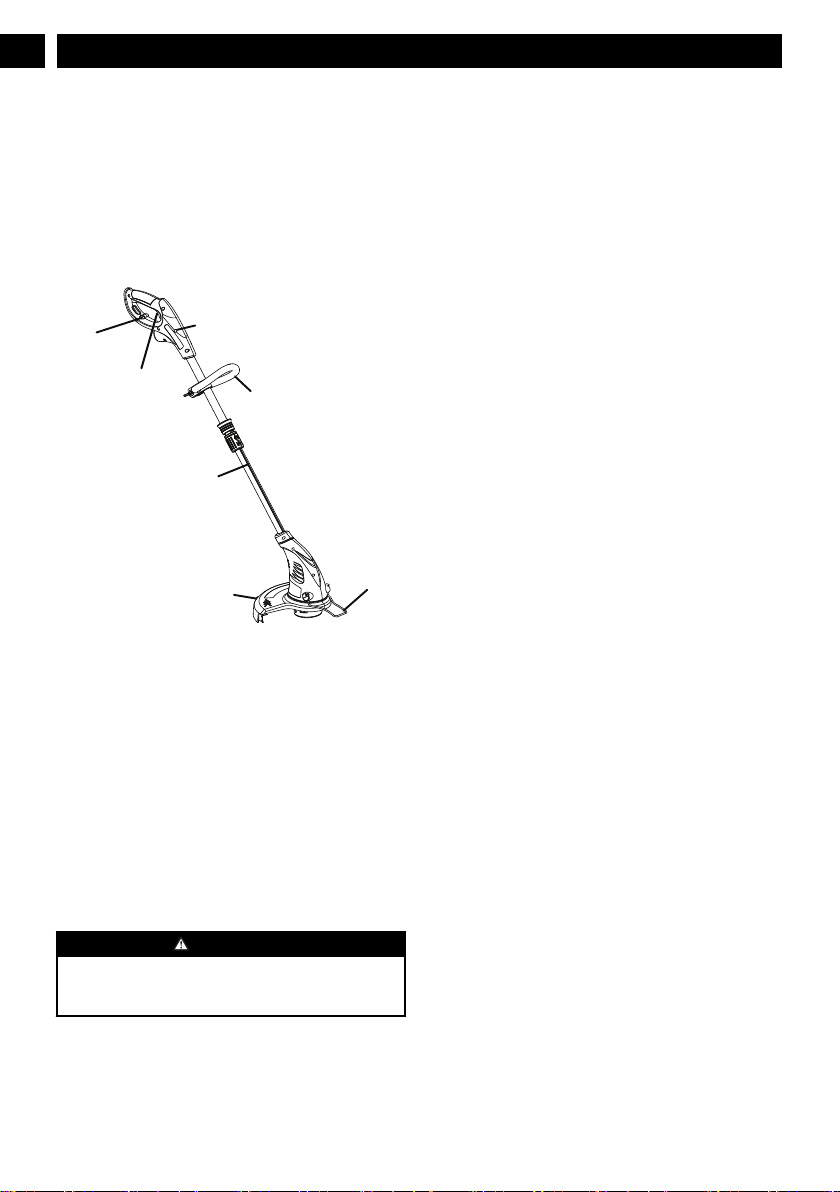
1.2 OVERVIEW
1
2
3
4
5
6
7
1
Cord retainer
2
Trigger
3
Rear handle
4
Auxiliary handle
5
Lower shaft
6
Guard
4
Speed switch
6
Upper shaft
7
Edge guide
2 IMPORTANT SAFETY
INSTRUCTIONS
READ ALL INSTRUCTIONS BEFORE USING (THIS
POWER TOOL)
WARNING
Read and understand all instructions before using this
product. Failure to follow all instructions listed below may
result in electric shock, fire, and/or serious personal injury.
• Use only identical manufacturer’s replacement parts and
accessories. Use of any other parts may create a hazard or
cause product damage.
• Always wear safety glasses with side shields marked to
comply with ANSI Z87.1. Everyday glasses have only
impact resistant lenses. They are NOT safety glasses.
Following this rule will reduce the risk of eye injury. Use
face mask if operating in dusty work spaces.
• Avoid Dangerous Environment – Don’t expose power
tools to damp or wet conditions. Water entering a power
tool will increase the risk of electric shock.
• Don’t use in rain.
• Keep all bystanders, children, and pets at least 50 ft.
away.
• Dress Properly – Do not wear loose clothing or jewelry.
They can be caught in moving parts. Use of rubber gloves
and substantial footwear is recommended when working
outdoors. Wear protective hair covering to contain long
hair.
• Do not operate the equipment while barefoot or when
wearing sandals or similar lightweight footwear. Wear
protective footwear that will protect your feet and
improve your footing on slippery surfaces.
• Use right Appliance. Do not use appliance for any job
except that for which it is intended.
• Avoid Unintentional Starting – Don’t carry appliance
with finger on switch. Be sure switch is off when battery
plugging in.
• Don’t Force Appliance – It will do the job better and with
less likelihood of a risk of injury at the rate for which it
was designed.
• Don’t overreach – Keep proper footing and balance at all
times.
• Stay alert – Watch what you are doing. Use common
sense. Do not operate this unit when you are tired, ill or
under the influence of alcohol, drugs or medication.
• Always store idle power tools indoors – When not in use,
power tools should be stored indoors in a dry and high or
locked-up place, out of reach of children.
• Maintain Appliance With Care – Replace string head if
cracked, chipped, or damaged in any way. Be sure the
string head is properly installed and securely fastened.
Keep cutting edge sharp and clean for best performance
and to reduce the risk of injury. Follow instructions for
lubricating and changing accessories. Inspect appliance
cord periodically, and if damaged, have it repaired by an
authorized service facility. Inspect extension cords
periodically and replace if damaged. Keep handles dry,
clean, and free from oil and grease. Failure to do so can
cause serious injury.
• Check damaged parts before using the appliance, a guard
or other part that is damaged should be carefully checked
to determine that it will operate properly and perform its
intended function. Check for alignment of moving parts,
binding of moving parts, breakage of parts, damaged
mountings, and any other condition that may affect its
operation. A guard or other part that is damaged should
be properly repaired or replaced by an authorized service
center unless indicated elsewhere in this manual.
4
English
EN
• Do not operate cordless tools in damp or wet locations or
in the rain. Following this rule will reduce the risk of
electric shock.
• When servicing use only identical replacement part.
• To reduce the risk of electric shock, this tool has a
polarized plug (one blade is wider than the other) and will
require the use of a polarized extension cord. The plug
will fit into a polarized extension cord only one way. If
the plug does not fit fully into the extension cord, reverse
the plug. If the plug still does not fit, obtain a correct
polarized extension cord. A polarized extension cord will
require the use of a polarized wall outlet. This plug will
fit into the polarized wall outlet only one way. If the plug
does not fit fully into the wall outlet, reverse the plug. If
the plug still does not fit, contact a qualified electrician to
install the proper wall outlet. Do not change the
equipment plug, extension cord receptacle, or extension
cord plug in any way.
• Ground Fault Circuit Interrupter (GFCI) protection
should be provided on the circuit(s) or outlet(s) to be used
for the gardening appliance. Receptacles are available
having built-in GFCI protection and may be used for this
measure of safety.
• Warning – To reduce the risk of electric shock, use only
with an extension cord intended for outdoor use, such as
an extension cord of cord type SW-A, SOW-A, STW-A,
STOW-A, SJW-A, SJOW-A, SJTW-A, or SJTOW-A.
• Disconnect Appliance – Remove appliance from power
source before storing, servicing, changing accessories
such as cutting line. Such preventive safety measures
reduce the risk of starting the tool accidentally.
• Do not abuse the cord – Never carry the unit by the
extension cord or yank extension cord to disconnect unit.
Keep the cord clear of operator and obstacles at all times.
Do not expose cords to heat, oil, water, or sharp edges.
Do not handle plug with wet hands.
SAVE THESE INSTRUCTIONS
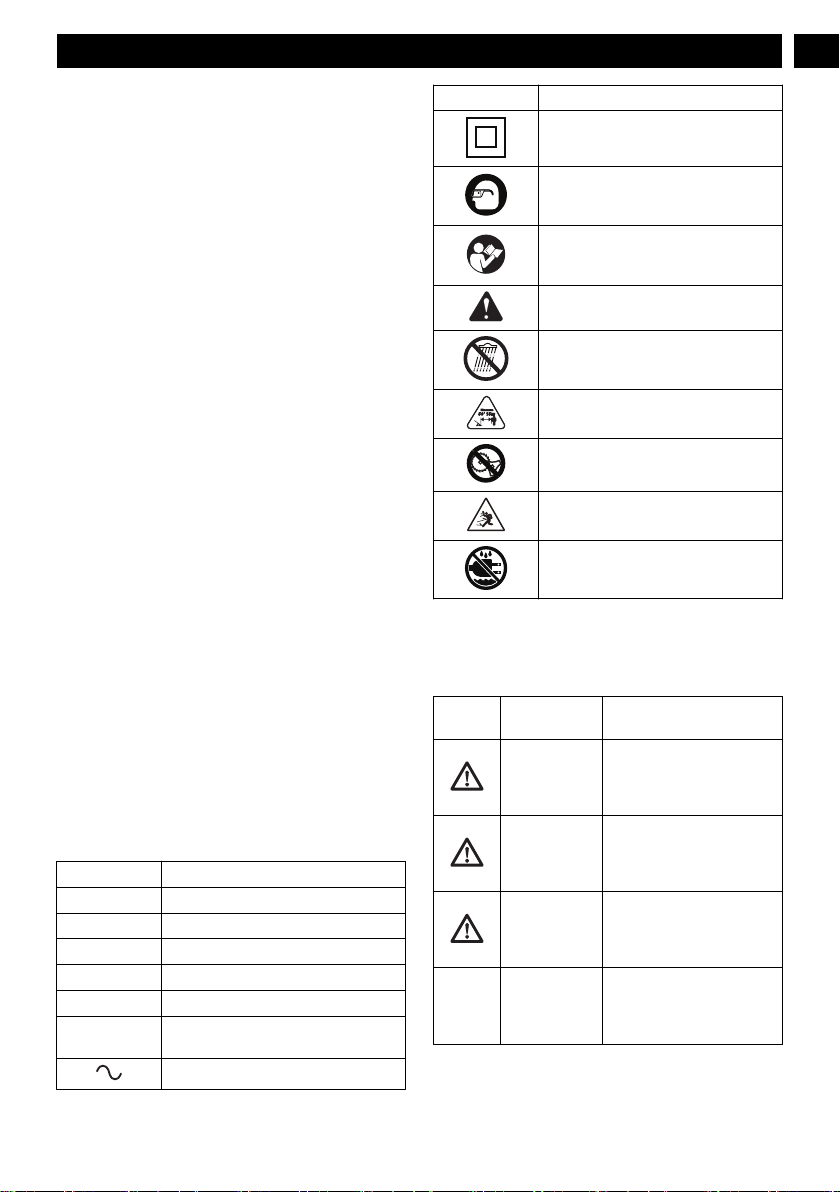
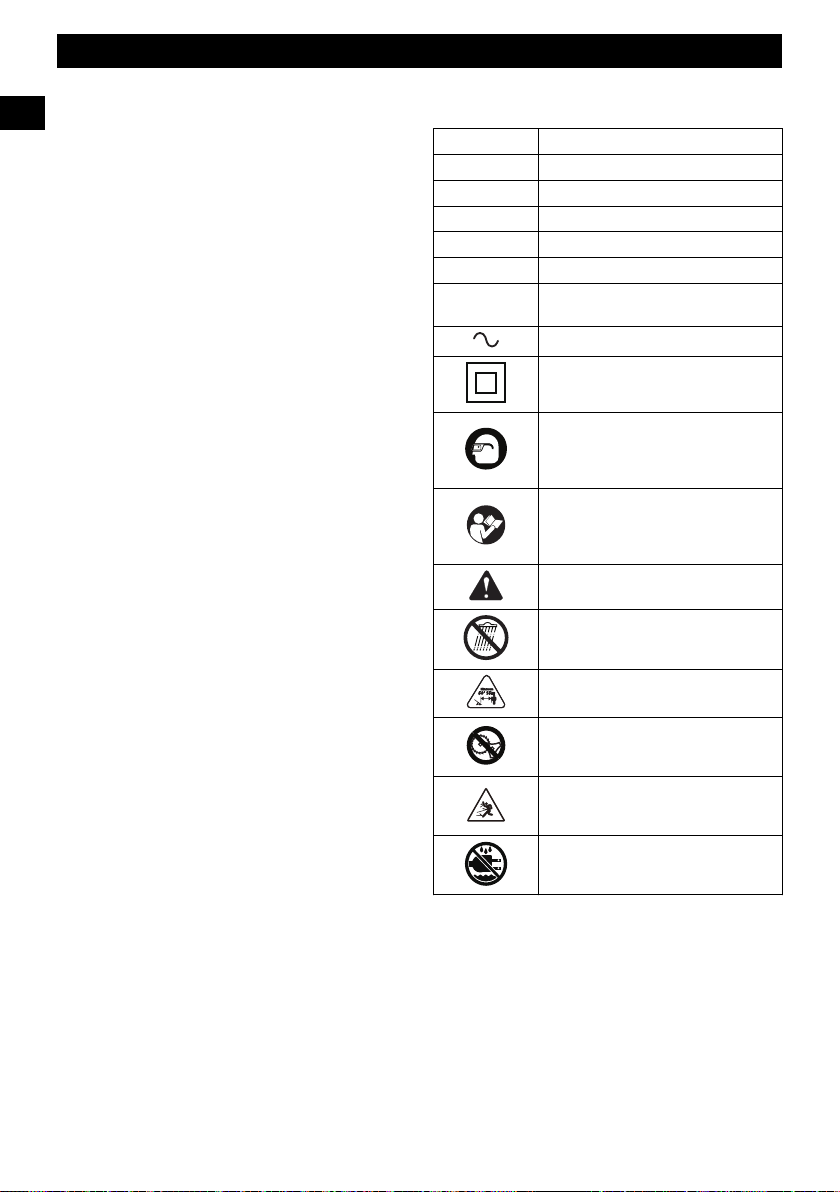
3 SYMBOLS ON THE MACHINE
Some of the following symbols can be used on this machine.
Please study them and learn their definition. Proper
interpretation of these symbols will let you operate the
machine better and safer.
Symbol
Explanation
V Voltage
A Current
Hz Frequency (cycles per second)
W Power
min Time
/min
Revolutions, strokes, surface speed, or-
bits etc., per minute
Alternating Current
Symbol Explanation
Double-insulated construction
Always wear safety glasses with side
shields marked to comply with ANSI
Z87.1 when you operate this machine.
Read and understand all instructions be-
fore you operate the machine, and follow
all warnings and safety instructions.
Precautions that involve your safety.
Do not expose the machine to rain or
moist conditions.
Keep all bystanders at least 15m away.
Do not install or use any type of blade on
the machine or displaying this symbol.
Thrown objects can ricochet and result in
personal injury or property damage.
Do not expose to rain or use in damp lo-
cations.
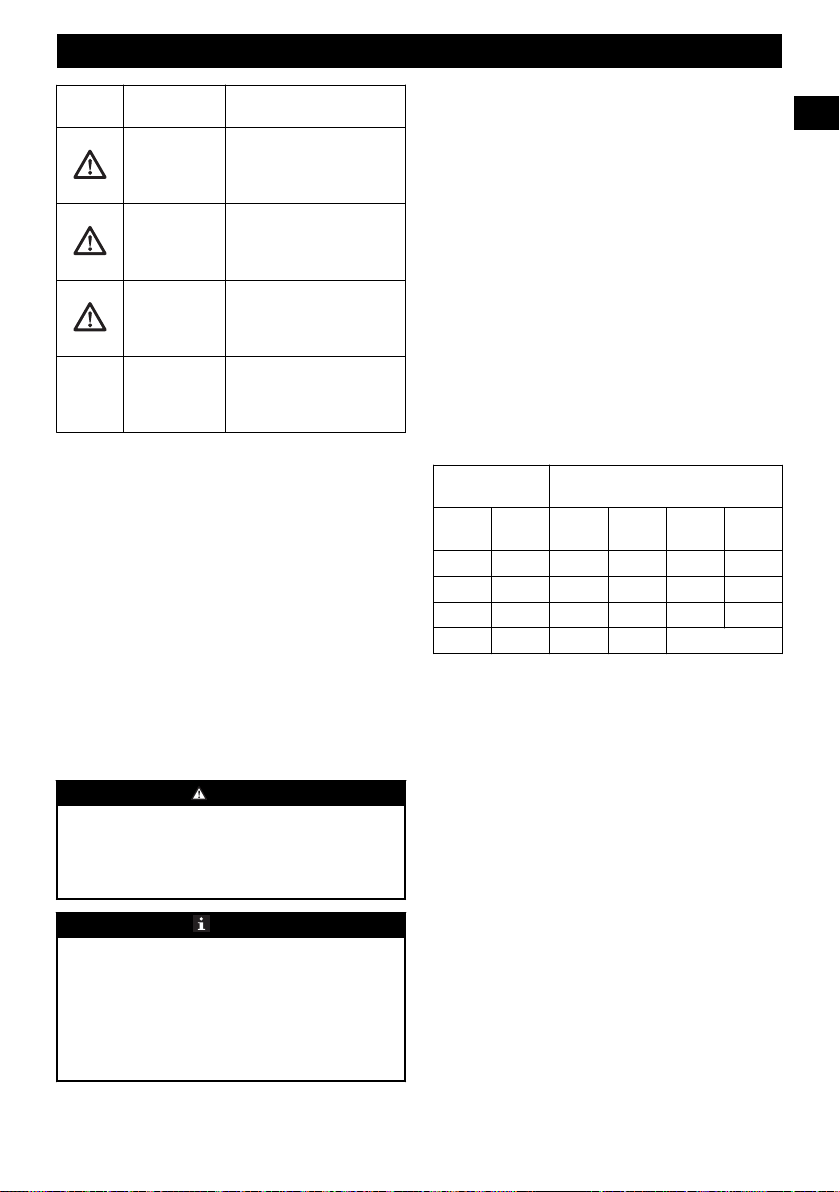
4 RISK LEVELS
The following signal words and meanings are intended to
explain the levels of risk associated with this product.
SYM-
BOL
SIGNAL MEANING
DANGER Indicates an imminently haz-
ardous situation,which, if not
avoided, will result in death
or serious injury.
WARNING Indicates a potentially hazard-
ous situation,which, if not
avoided, could result in death
or serious injury.
CAUTION Indicates a potentially hazard-
ous situation, which, if not
avoided, may result in minor
or moderate injury.
CAUTION (Without Safety Alert Sym-
bol) Indicates a situation that
may result in property dam-
age.
5
English
EN
5 SERVICE
Servicing requires extreme care and knowledge and must be
performed only by a qualified service technician. For service
we suggest you return the machine to your nearest
AUTHORIZED SERVICE CENTER for repair. Use only
identical manufacturer’s replacement parts and accessories.
6 DOUBLE INSULATED
Double insulation is a concept in safety in electric power
tools, which eliminates the need for the usual threewire
grounded power cord. All exposed metal parts are isolated
from the internal metal motor components with protecting
insulation. Double insulated tools do not need to be grounded.
WARNING
The double insulated system is intended to protect the user
from shock resulting from a break in the tool’s internal
insulation. Observe all normal safety precautions to avoid
electrical shock.
NOTE
Servicing of a product with double insulation requires
extreme care and knowledge of the system and should be
performed only by a qualified service technician. For
service, we suggest you return the tool to your nearest
authorized service center for repair. Always use original
factory replacement parts when servicing.
7 EXTENTION CORDS
When using a power tool at a considerable distance from a
power source, be sure to use an extension cord that has the
capacity to handle the current the product will draw. An
undersized cord will cause a drop in line voltage, resulting in
overheating and loss of power. Use the chart to determine the
minimum wire size required in an extension cord. Only round
jacketed cords listed by Underwriter’s Laboratories (UL)
should be used.
When working outdoors with a product , use an extension
cord that is designed for outside use. This type of cord is
designated with “W-A” or “W” on the cord’s jacket. Before
using any extension cord, inspect it for loose or exposed
wires and cut or worn insulation.
MINIMUM GAUGE FOR EXTENSION CORDS (AWG)
(WHEN USING 120 V ONLY)
Ampere Rating
Total Length of Cord in Feet (meters)
More
Than
Not
More
Than
25' (7.6
m)
50' (15
m)
100'
(30.4 m)
150'
(45.7 m)
0 6 18 16 16 14
6 10 18 16 14 12
10 12 16 16 14 12
12 16 14 12
Not Recommen-
ded
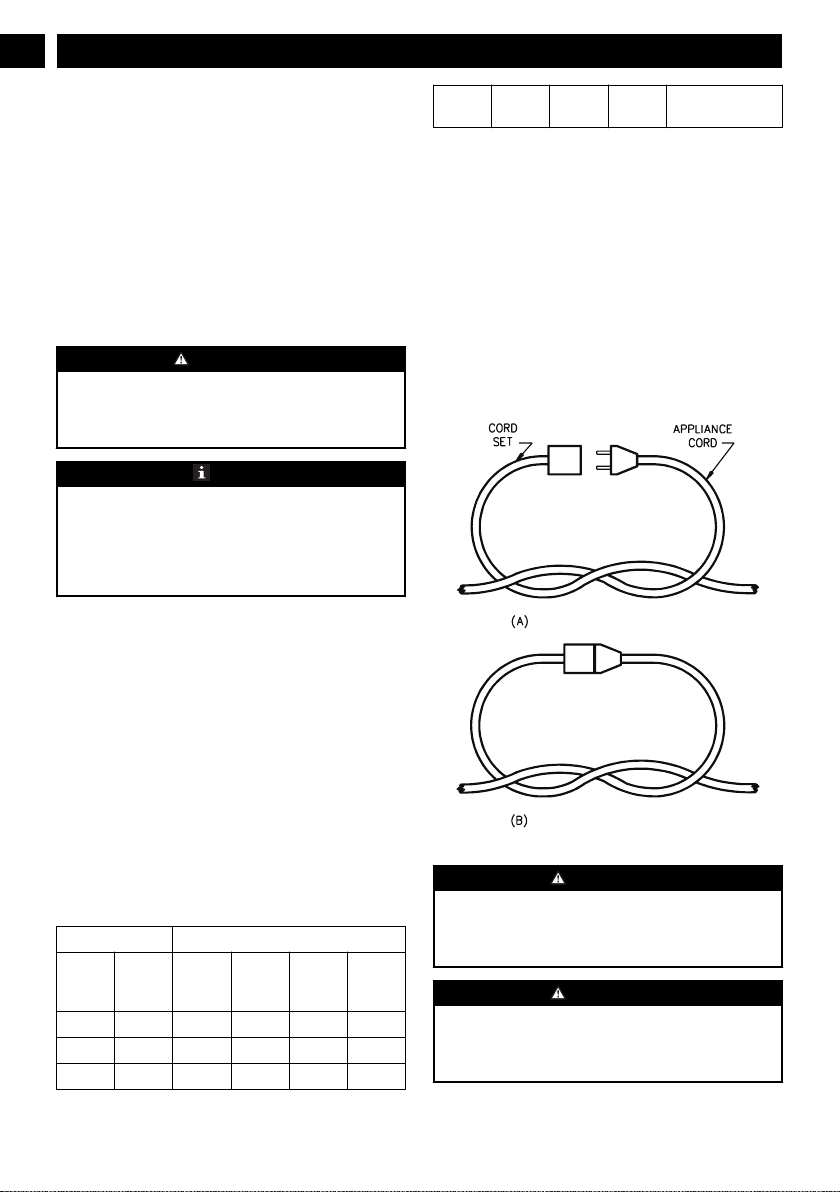
Extension Cord – Make sure your extension cord is in good
condition. When using an extension cord, be sure to use one
heavy enough to carry the current your product will draw. An
undersized extension cord will cause a drop in voltage
resulting in loss of power and overheating. The table shows
the correct size to use depending on cord length and name
plate ampere rating. If in doubt, use the next heavier gauge.
The smaller the gauge number, the heavier the cord. To
reduce the risk of disconnection of appliance cord from the
extension cord during operating:
1. Make a knot as shown in Figure A. or
2. Use one of the plug-receptacle retaining straps or
connectors.
METHOD OF SECURING EXTENSION CORD
THE CORD AS SHOWN
CONNECT PLUG AND RECEPTACLE
WARNING
Keep the extension cord clear of the working area.Position
the cord so that it will not get caught on lumber, tools, or
other obstructions while you are working with a power tool.
Failure to do so can result in serious personal injury.
WARNING
Check extension cords before each use. If damaged replace
immediately. Never use the product with a damaged cord
since touching the damaged area could cause electrical
shock resulting in serious injury.
6
English
EN
8 PROPOSITION 65
WARNING
This product contains a chemical known to the state of
California to cause cancer, birth defects or other
reproductive harm. Some dust created by power sanding,
sawing, grinding, drilling, and other construction activities
contains chemicals known to cause cancer, birth defects or
other reproductive harm. Some examples of these chemicals
are:
• Lead from lead-based paints;
• Crystalline silica from bricks and cement and other
masonry products;
• Arsenic and chromium from chemically treated lumber.
Your risk of exposure to these chemicals varies depending
on how often you do this type of work. To reduce your
exposure to these chemicals, work in a well-ventilated area,
and work with approved safety equipment, such as dust
masks that are specially designed to filter out microscopic
particles.
Save these instructions.
9 INSTALLATION
9.1 UNPACK THE MACHINE
WARNING
Make sure that you correctly assemble the machine before
use.
WARNING
• If the parts are damaged, do not use the machine.
• If you do not have all the parts, do not operate the
machine.
• If the parts are damaged or missing, speak to the service
center.
1. Open the package.
2. Read the documentation in the box.
3. Remove all the unassembled parts from the box.
4. Remove the machine from the box.
5. Discard the box and package in compliance with local
regulations.
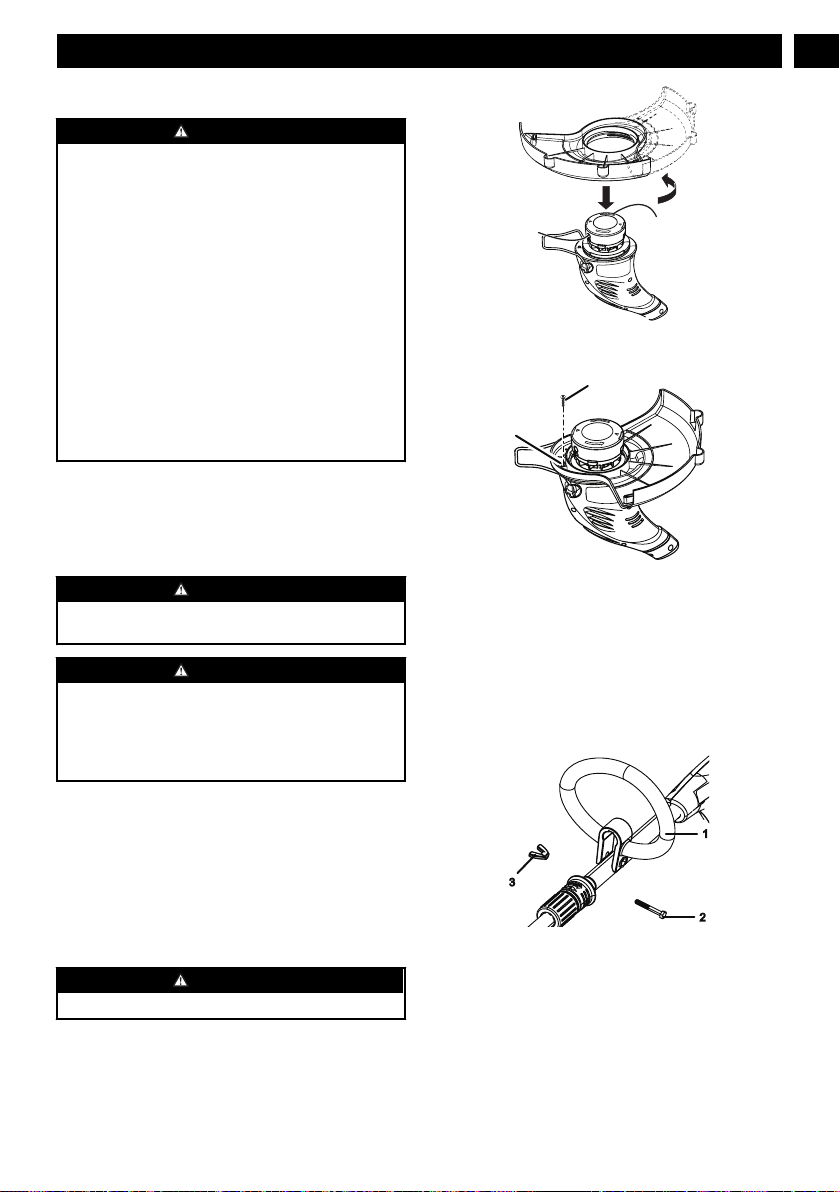
9.2 ATTACH THE GUARD
WARNING
Do not touch the cut-off blade.
1. Remove the screws from the trimmer head with a Phillips
head screwdriver (not included).
2. Install the guard into the slots on trimmer head.
3. Turn the guard counterclockwise to lock it into place.
4. Align the screw holes (1) on the guard with the screw
holes (2) on the trimmer head.
2
1
5. Tighten the screws.
9.3 ATTACH THE AUXILIARY
HANDLE
1. Remove the knob from the handle.
2. Attach the auxiliary handle (1) on the shaft.
3. Set the auxiliary handle in the comfortable position.
4. Put the bolt (2) through the holes.
5. Tighten the auxiliary handle with the knob (3).
7
English
EN
10 OPERATION
IMPORTANT
Before you operate the machine, read and understand the
safety regulations and the operation instructions.
WARNING
Be careful when you operate the machine.
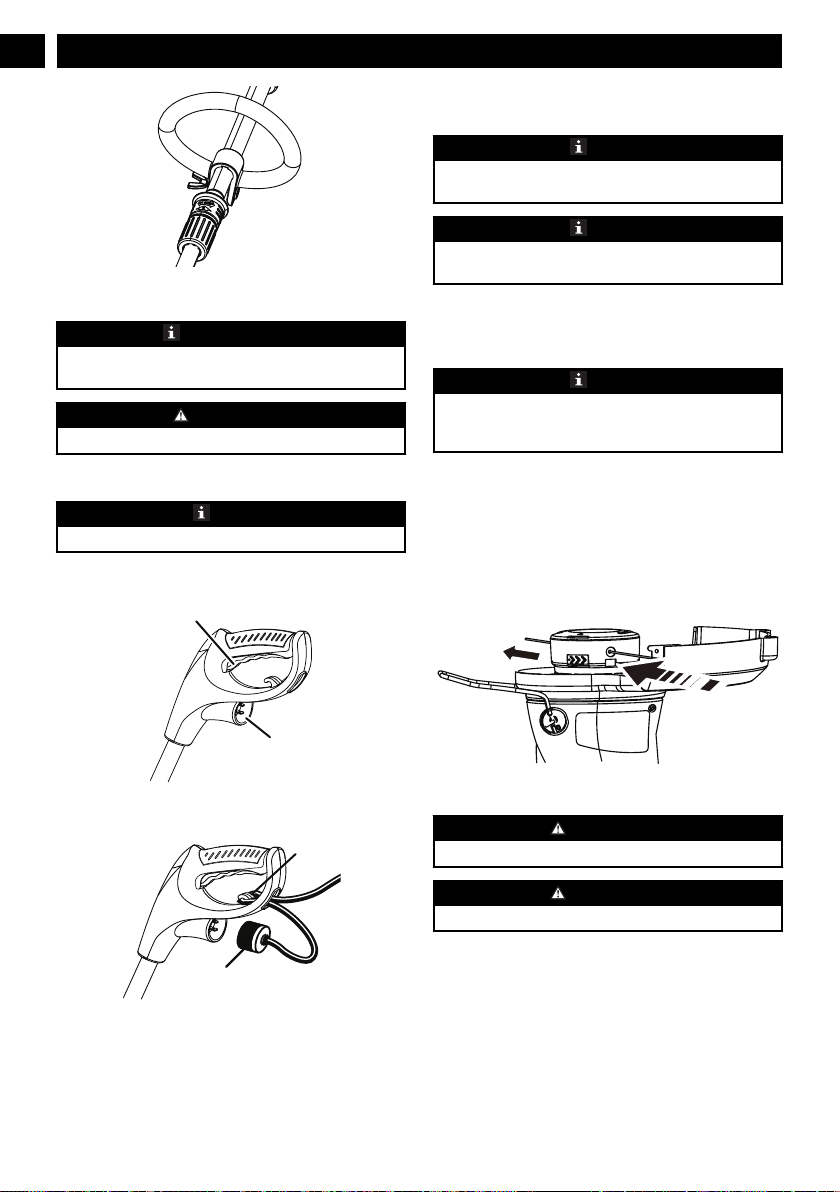
10.1 START THE MACHINE
NOTE
Use only approved outdoor extension cords.
1. Put the extension cord through the slot on the rear handle
and put it underneath the cord retainer (3).
1
2
2. Attach the outlet end (4) of an extension cord to the plug
(2) on the rear of the machine.
3
4
3. Push the trigger (1) to start the machine.
10.2 STOP THE MACHINE
1. Release the trigger to stop the machine.
10.3 ADJUST THE LENGTH OF THE
CUTTING LINE
NOTE
The machine has an auto-feed head. It will damage the
machine if you hit the head to try to advance the line.
NOTE
If the cutting line does not automatically advance, it can be
tangled or empty.
1. When the machine is on, release the trigger.
2. Wait two seconds, push the trigger again.
3. Resume trimming.
NOTE
The line will extend approximately 0.4 in. with each stop
and start of the switch trigger until the line reaches the cut-
off blade and the cut-off blade cuts the excess length.
10.4 ADJUST THE LENGTH OF THE
CUTTING LINE MANUALLY
1. Stop the machine. Remove the battery from the unit.
2. Push the spool retainer button and pull on cutting line to
manually advance the cutting line.
3. After you extend new cutter line, always return the
machine to its normal position before you start it again.
10.5 OPERATION TIPS
WARNING
Keep clearance between the body and the machine.
WARNING
Do not operate the machine without guard in place.
Do these tips when you use the machine
• Keep a firm hold with the two hands on the machine
while you operate the machine.
• Cut tall grass from the top down.
If grass winds around the trimmer head:
• Stop the machine.
• Unplug the machine.
8
English
EN
• Remove the grass.
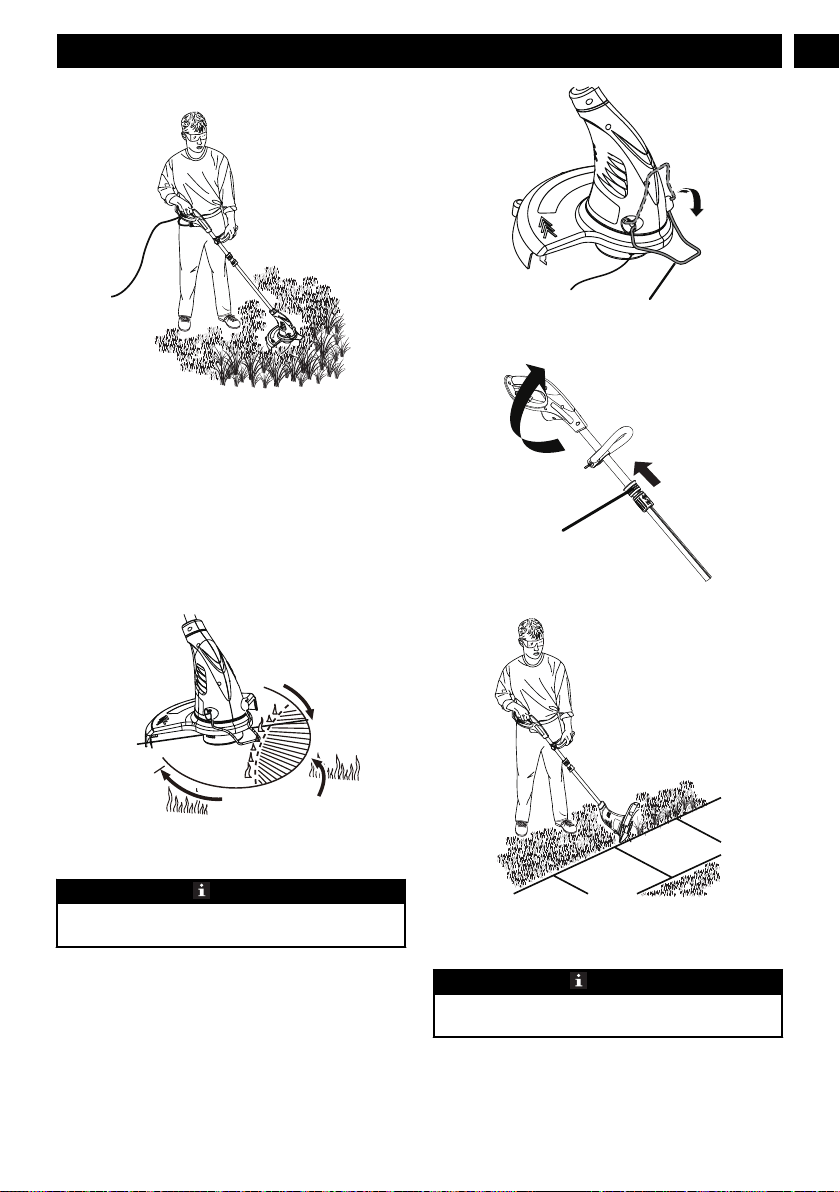
10.6 CUTTING TIPS
• Tilt the machine toward the area to be cut. Use the tip of
the cutting line to cut grass.
• Move the machine from right to left to prevent thrown
debris from hitting the operator.
• Do not cut in the danger area.
• Do not force the trimmer head into uncut grass.
• Wire and picket fences cause cutting line wear and
breakage. Stone and brick walls, curbs, and wood can
wear the cutting line quickly.
DANGER
AREA
DIRECTION OF
ROTATION
BEST CUTTING AREA
10.7 CHANGE TO THE EDGING MODE
NOTE
The machine can be used in combination with the edge
guide for edging sidewalks and walkways.
1. Stop the machine and flip down the edge guide (2) from
stored position.
2
2. Pull the edging coupler (1) and turn the trimmer head 180
degrees until the trimmer head locks into position.
1
3. Release the edging coupler.
10.8 ADJUST THE LENGTH OF THE
SHAFT
NOTE
You can adjust the length of the shaft to operate the
machine easily.
1. Stop the machine.
9
English
EN
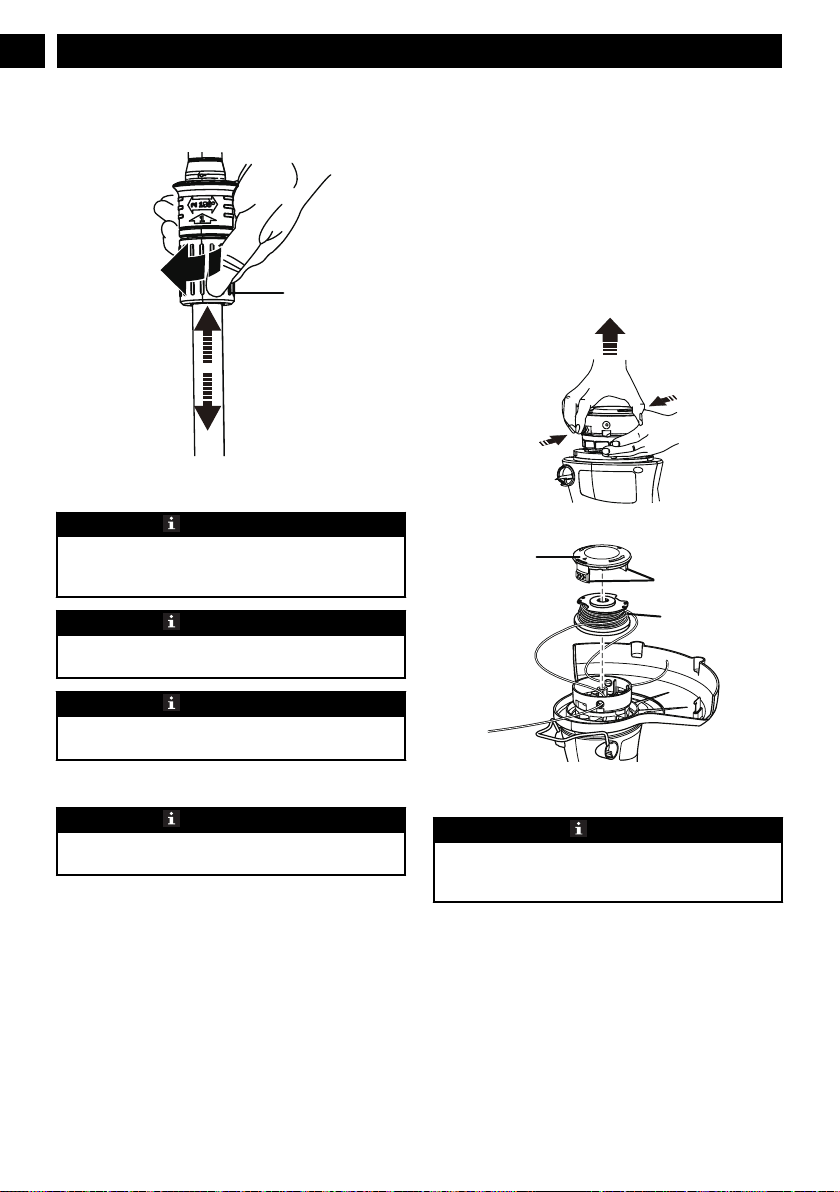
2. Loosen the telescoping boom coupler (1) and move the
shaft to the desired position.
3. Tighten the coupler.
1
11 MAINTENANCE
IMPORTANT
Read and understand the safety regulations and the
maintenance instructions before you clean, repair or do the
maintenance work on the machine.
IMPORTANT
Make sure that all nuts, bolts and screws are tight. Examine
regularly that you install the handles tightly.
IMPORTANT
Use only the replacement parts and accessories of the initial
manufacturer.
11.1 GENERAL INFORMATION
IMPORTANT
Only your dealer or approved service center can do the
maintenance that is not given in this manual.
Before the maintenance operations:
• Stop the machine.
• Remove the battery pack.
• Cool the motor.
• Store the machine in cool and dry place.
• Use correct clothing, protective gloves and safety glasses.
11.2 CLEAN THE MACHINE
• Clean the machine after use with a moist cloth dipped in
neutral detergent.
• Do not use aggressive detergents or solvents to clean the
plastic parts or handles.
• Keep the trimmer head free of grass, leaves, or excessive
grease.
• Keep the air vents clean and free of debris to avoid
overheating and damage to the motor or the battery.
• Do not spray water onto the motor and electrical
components.
11.3 REPLACE THE SPOOL
1. Push the tabs on the sides of the trimmer head at the same
time.
2. Pull and remove the spool cover.
SPOOL
COVER
SPOOL
TABS
3. Remove the remaining spool.
4. Put the spool in the spool housing.
NOTE
Make sure that you put the cutting line in the slot on the
new spool and extend the line approximately 15 cm before
you install the new spool.
10
English
EN
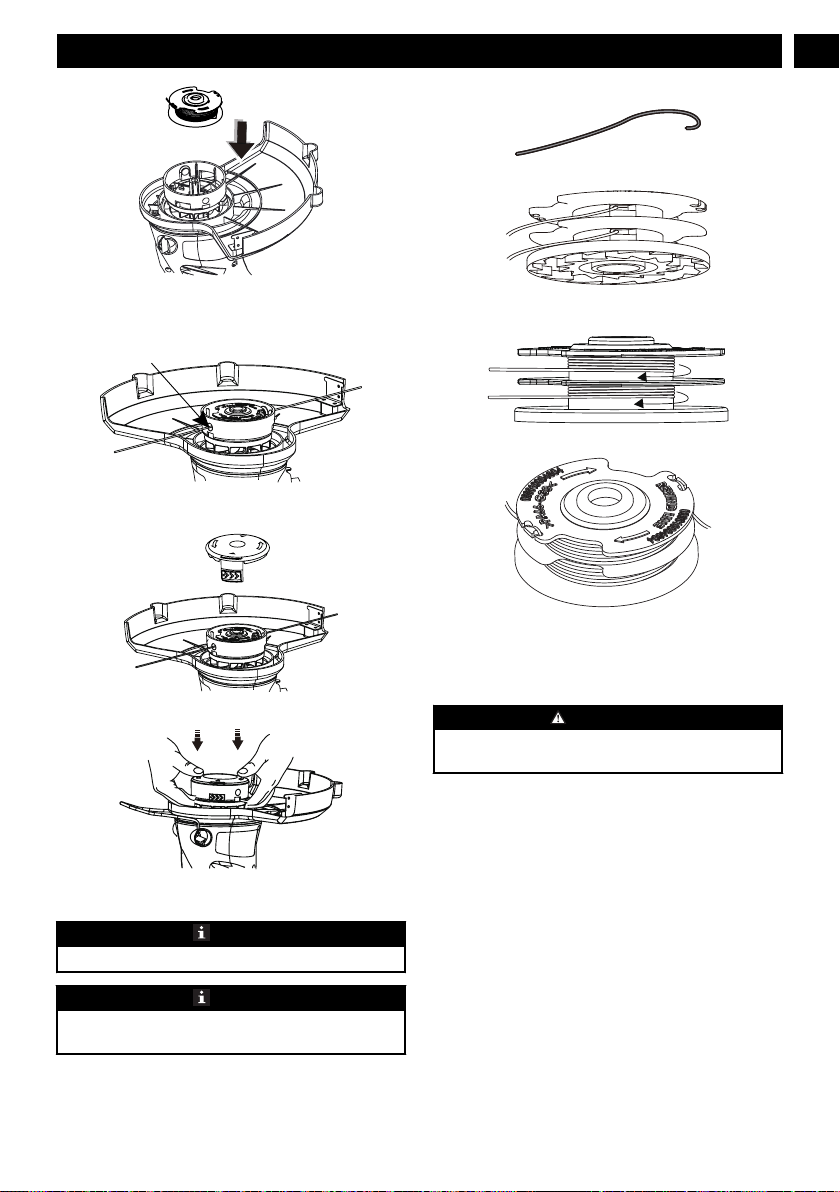
5. Put the ends of the cutting lines through the holes.
6. Extend the cutting line to release it from the guide slot in
the spool.
Line exit hole
7. Push the tabs and install the spool cover onto the spool
housing.
8. Push the spool cover until it clicks into position.
11.4 REPLACE THE CUTTING LINE
NOTE
Remove the remaining cutting line on the spool.
NOTE
Use only with the nylon cutting line of 0.065" (1.65 mm)
diameter.
1. Cut two pieces of cutting line approximately 3m long of
each.
2. Bend one end of the line 1/4 of an inch (6.35mm) .
3. Put the lines into the anchor holes of the spool.
4. Wind the cutting lines around the spool tightly in the
indicated direction.
5. Put the cutting lines in the guide slots.
6. Do not wind the cutting line beyond the edge of the spool.
12 TRANSPORTATION AND
STORAGE
WARNING
Remove the battery pack from the machine before
tranportation and storage.
12.1 STORE THE MACHINE
• Remove the battery pack from the machine.
• Make sure that children cannot come near the machine.
• Keep the machine away from corrosive agents such as
garden chemicals and de-icing salts.
• Secure the machine during transportion to prevent
damage or injury. Clean and examine the machine for any
damage.
11
English
EN
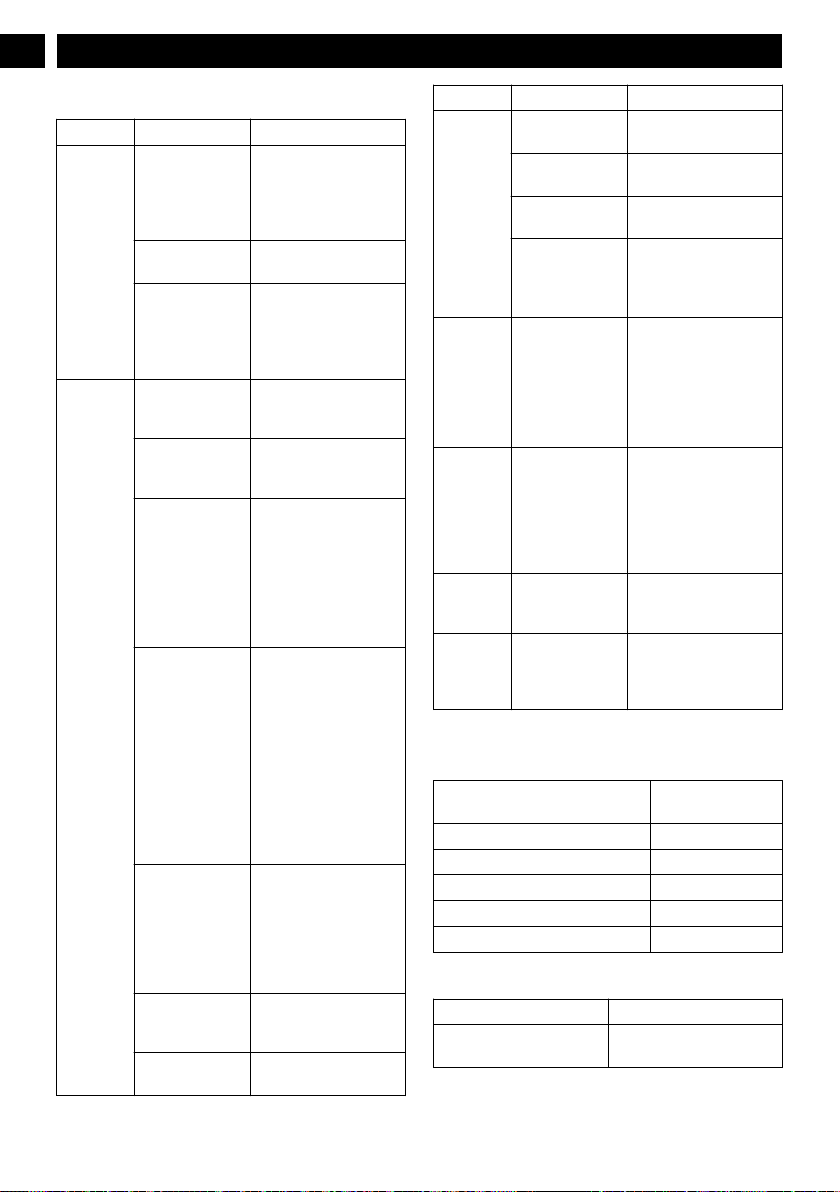
13 TROUBLESHOOTING
Problem Possible Cause Solution
The ma-
chine does
not start
when you
push the
trigger.
No electrical con-
tact between the
machine and the
battery pack.
1. Remove battery pack.
2. Check contact and in-
stall the battery pack
again.
The battery pack is
depleted.
Charge the battery pack.
The lock-out but-
ton and trigger are
not pushed at the
same time.
1. Pull the lock-out but-
ton and hold it.
2. Pull the trigger to start
the machine.
The ma-
chine stops
when you
cut.
The guard is not
attached to the ma-
chine.
Remove the battery pack
and attach the guard to
the machine.
Heavy cutting line
is used.
Use only with the nylon
cutting line of 0.065"
(1.65 mm) diameter.
The grass winds
around the motor
shaft or the trim-
mer head.
1. Stop the machine.
2. Remove the battery
pack.
3. Remove the grass from
the motor shaft and trim-
mer head.
The motor is over-
loaded.
1. Remove the trimmer
head from the grass.
2. The motor will recover
to work as soon as the
load is removed.
3. When you cut, move
the trimmer head in and
out of the grass to be cut
and remove no more than
8" in pass.
The battery pack
or machine is too
hot.
1. Cool the battery pack
until its function returns
to normal.
2. Cool the machine for
approximately 10 mi-
nutes.
The battery pack is
disconnected from
the tool.
Install the battery pack
again.
The battery pack is
depleted.
Charge the battery pack.
Problem Possible Cause Solution
The line
does not ad-
vance.
Lines are welded
to themselves.
Lubricate with silicone
spray.
Not enough line
on spool.
Install more line.
Lines are worn too
short.
Advance the cutting line.
Lines are tangled
on spool.
1. Remove the lines from
the spool.
2. Wind the lines.
The line
keeps
breaking.
The machine is
used incorrectly.
1. Cut with the tip of the
line, avoid stones, walls
and other hard objects.
2. Advance the cutting
line regularly to keep full
cutting width.
The grass
winds
around the
trimmer
head and
motor hous-
ing.
Cut tall grass at
ground level.
1. Cut tall grass from the
top down.
2. Remove no more than
8" in each pass to prevent
wrapping.
The line
does not cut
well.
The cut-off blade
becomes dull.
Sharpen the cut-off blade
with a file or replace it.
Vibration
increases
obviously.
The line is worn
down at one side
and not advanced
in time.
Make sure that the line on
both sides is normal. Ad-
vance the line.
14 TECHNICAL DATA
Input 120V/60Hz, AC on-
ly, 4 Amps
No load speed 9000 (± 10%) RPM
Cutting line diameter 0.065" (1.65 mm)
Cutting path diameter 13 in. (330 cm)
Feed Type Auto Feed
Weight 5.2 lb (2.3 kg)
The recommended ambient temperature range:
Item
Temperature
String trimmer storage tem-
perature range
-4°F (-20°C) - 158°F (70°C)
12
English
EN
Item Temperature
String trimmer operation
temperature range
32°F (0°C) - 104°F (40°C)
15 LIMITED WARRANTY
YEAR
AÑOS
LIMITED WARRANTY
GARANTÍA
LIMITADA
3
Greenworks hereby warranties this product, to the original
purchaser with proof of purchase, for a period of three (3)
years against defects in materials, parts or workmanship.
Greenworks, at its own discretion will repair or replace any
and all parts found to be defective, through normal use, free
of charge to the customer. This warranty is valid only for
units which have been used for personal use that have not
been hired or rented for industrial/commercial use, and that
have been maintained in accordance with the instructions in
the owners’ manual supplied with the product from new.
ITEMS NOT COVERED BY WARRANTY:
1. Any part that has become inoperative due to misuse,
commercial use, abuse, neglect, accident, improper
maintenance, or alteration; or
2. The unit, if it has not been operated and/or maintained in
accordance with the owner's manual; or
3. Normal wear, except as noted below;
4. Routine maintenance items such as lubricants, blade
sharpening;
5. Normal deterioration of the exterior finish due to use or
exposure.
HELPLINE:
Warranty service is available by calling our toll-free helpline,
at 1-888-909-6757.
TRANSPORTATION CHARGES:
Transportation charges for the movement of any power
equipment unit or attachment are the responsibility of the
purchaser. It is the purchaser’s responsibility to pay
transportation charges for any part submitted for replacement
under this warranty unless such return is requested in writing
by Greenworks.
USA ADDRESS:
Greenworks Tools
P.O. Box 1238
Mooresville, NC 28115
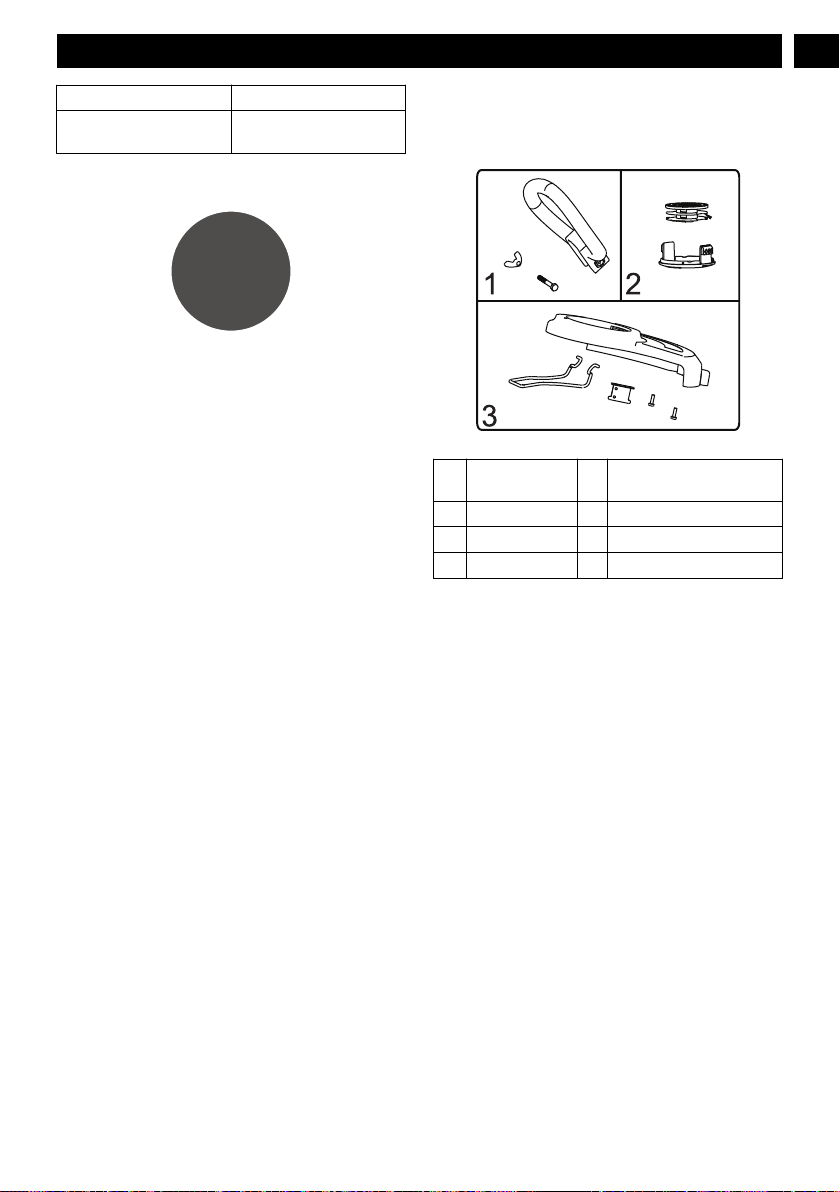
16 EXPLODED VIEW
No. Part No. Qt
y
Description
1 R0201581-00 1 Auxiliary handle assembly
2 R0201582-00 1 Spool & Spool cover
3 R0201583-00 1 Guard assembly
13
English
EN

1 Descripción.......................................15
1.1 Finalidad.......................................................... 15
1.2 Perspectiva general..........................................15
2 Instrucciones importantes de
seguridad..........................................15
3 Símbolos en la máquina..................16
4 Niveles de riesgo.............................. 16
5 Servicio.............................................17
6 Doble aislamiento............................ 17
7 Cables alargadores..........................17
8 Propuesta 65.....................................18
9 Instalación........................................18
9.1 Desembalaje de la máquina............................. 18
9.2 Fijación de la protección..................................18
9.3 Fijación del asa auxiliar...................................19
10 Funcionamiento...............................19
10.1 Puesta en marcha de la máquina......................19
10.2 Detención de la máquina................................. 20
10.3 Ajuste de la longitud del hilo de corte.............20
10.4 Ajuste manual de la longitud del hilo de
corte................................................................. 20
10.5 Consejos de funcionamiento............................20
10.6 Consejos de corte.............................................20
10.7 Cambio al modo de bordeado..........................20
10.8 Ajuste de la longitud del eje............................ 21
11 Mantenimiento.................................21
11.1 Información general.........................................21
11.2 Limpieza de la máquina...................................22
11.3 Sustitución del carrete..................................... 22
11.4 Sustitución del hilo de corte............................ 22
12 Transporte y almacenamiento........23
12.1 Almacenamiento de la máquina...................... 23
13 Solución de problemas.................... 23
14 Datos técnicos.................................. 24
15 Garantía limitada............................25
16 Vista despiezada.............................. 25
14
Español
ES
1 DESCRIPCIÓN
1.1 FINALIDAD
Esta máquina se utiliza para cortar hierba, maleza ligera y
otra vegetación similar a nivel del suelo. El plano de corte
debe estar aproximadamente paralelo a la superficie del suelo.
No puede utilizar la máquina para cortar o podar setos,
arbustos, matorrales, flores y compost.
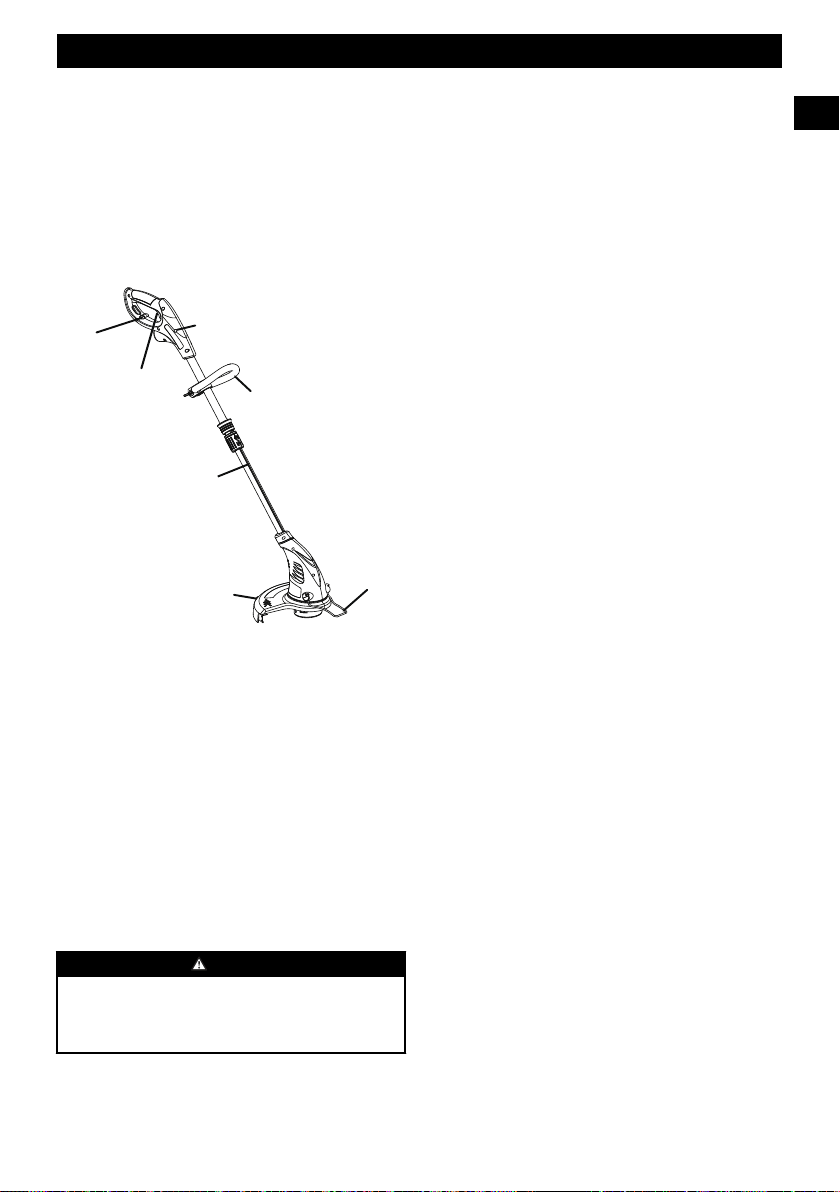
1.2 PERSPECTIVA GENERAL
1
2
3
4
5
6
7
1
Retención del cable
2
Gatillo
3
Asa posterior
4
Asa auxiliar
5
Eje inferior
6
Protección
4
Interruptor de velocidad
6
Eje superior
7
Guía de borde
2 INSTRUCCIONES
IMPORTANTES DE
SEGURIDAD
LEA TODAS LAS INSTRUCCIONES ANTES DEL USO
(DE ESTA HERRAMIENTA ELÉCTRICA)
AVISO
Debe leer y entender todas las instrucciones antes de
utilizar este producto. El incumplimiento de las
instrucciones indicadas a continuación puede provocar
descargas eléctricas, incendios o lesiones personales graves.
• Utilice únicamente accesorios y piezas de repuesto
idénticos del fabricante. El uso de cualquier otra pieza
puede generar un riesgo o producir daños en el producto.
• Lleve siempre gafas de seguridad con protectores
laterales marcadas para cumplir la ANSI Z87.1. Las gafas
normales solo tienen lentes resistentes a impactos. NO
son gafas de seguridad. Si sigue esta regla reducirá el
riesgo de lesiones oculares. Utilice máscara facial si
trabaja en espacios de trabajo con polvo.
• Evite los entornos peligrosos – No exponga las
herramientas eléctricas a condiciones de humedad. Si
penetra agua en una herramienta eléctrica, aumentará el
riesgo de descarga eléctrica.
• No utilice bajo la lluvia.
• Mantenga a todos los transeúntes, niños y mascotas al
menos a 15 m.
• Lleve indumentaria adecuada – No lleve ropa o joyas
sueltas. Pueden quedar atrapadas en las piezas móviles.
Se recomienda el uso de guantes de goma y calzado
resistente cuando se trabaje en el exterior. Lleve una
protección capilar para sujetar el cabello largo.
• No utilice el equipo si está descalzo o lleva sandalias o un
calzado ligero similar. Lleve calzado de protección que
proteja los pies y mejore el agarre en superficies
resbaladizas.
• Utilice el aparato adecuado. No utilice el aparato para
trabajos distintos del previsto.
• Evite la puesta en marcha accidental – No transporte el
aparato con el dedo sobre el interruptor. Asegúrese de que
el interruptor esté desactivado al conectar la batería.
• No fuerce el aparato – Hará el trabajo mejor y con menos
probabilidades de sufrir lesiones a la velocidad para la
que se diseñó.
• No se estire – Mantenga en todo momento una postura
adecuada y el equilibrio.
• Permanezca alerta – Observe lo que está haciendo. Utilice
el sentido común. No utilice esta unidad cuando esté
cansado, enfermo o bajo la influencia de alcohol, drogas
o medicamentos.
• Almacene siempre las herramientas eléctricas inactivas en
interiores – Cuando no estén en uso, las herramientas
eléctricas deben almacenarse en interiores, en un lugar
seco y alto o cerrado, fuera del alcance de los niños.
• Cuide el mantenimiento del aparato – Sustituya el cabezal
de hilo si está agrietado, astillado o dañado de alguna
manera. Asegúrese de que el cabezal de hilo esté
correctamente instalado y bien fijado. Mantenga el filo
afilado y limpio para un mejor rendimiento y para reducir
el riesgo de lesiones. Siga las instrucciones para la
lubricación y el cambio de accesorios. Inspeccione
periódicamente el cable del aparato, y si está dañado,
haga que lo repare un centro de servicio técnico
autorizado. Inspeccione periódicamente los cables
alargadores y sustitúyalos si están dañados. Mantenga las
asas secas, limpias y sin restos de aceite y grasa. De no
hacerlo podrían producirse lesiones graves.
• Compruebe las piezas dañadas antes de utilizar el aparato,
una protección u otra pieza dañada debe comprobarse
15
Español
ES
detenidamente para determinar si funcionará
correctamente y cumplirá su función prevista. Compruebe
la alineación de las piezas móviles, la unión de las partes
móviles, la rotura de piezas, los montajes dañados y
cualquier otra condición que pueda afectar a su
funcionamiento. Una protección u otra pieza que esté
dañada debe ser reparada o sustituida debidamente por un
centro de servicio autorizado, a menos que se indique lo
contrario en este manual.
• No utilice herramientas inalámbricas en lugares húmedos,
mojados o bajo la lluvia. Si sigue esta regla reducirá el
riesgo de descarga eléctrica.
• Cuando realice tareas de servicio, utilice únicamente
piezas de repuesto idénticas.
• Para reducir el riesgo de descarga eléctrica, esta
herramienta tiene un enchufe polarizado (una clavija es
más ancha que la otra) y debe utilizarse con un cable
alargador polarizado. El enchufe solo encajará en un
cable alargador polarizado de una manera. Si el enchufe
no encaja completamente en el cable alargador, invierta el
enchufe. Si el enchufe sigue sin encajar, obtenga un cable
alargador polarizado correcto. Un cable alargador
polarizado debe enchufarse en una toma de pared
polarizada. Este enchufe solo encajará en la toma de
pared polarizada de una manera. Si el enchufe no encaja
completamente en la toma de pared, invierta el enchufe.
Si el enchufe sigue sin encajar, contacte con un
electricista cualificado para instalar una toma de pared
adecuada. No cambie en modo alguno el enchufe del
equipo, el receptáculo del cable alargador ni el enchufe
del cable alargador.
• Debe proporcionarse protección mediante un interruptor
del circuito de fallo a tierra (GFCI) en los circuitos o las
tomas que se utilizarán para el aparato de jardinería. Hay
receptáculos que tiene protección GFCI incorporada y
pueden utilizarse para esta medida de seguridad.
• Advertencia – Para reducir el riesgo de descarga eléctrica,
utilice únicamente con un cable alargador diseñado para
uso en exteriores, como un cable alargador tipo SW-A,
SOW-A, STW-A, STOW-A, SJW-A, SJOW-A, SJTW-A,
o SJTOW-A.
• Desconexión del aparato – Retire el aparato de la fuente
de alimentación antes de almacenar, realizar tareas de
servicio, cambiar accesorios como el hilo de corte. Estas
medidas de seguridad preventivas reducen el riesgo de
que la herramienta se ponga en marcha accidentalmente.
• No abuse del cable - Nunca transporte la unidad por el
cable alargador ni tire del cable alargador para
desconectar la unidad. Mantenga el cable alejado del
operario y los obstáculos en todo momento. No exponga
los cables al calor, aceite, agua o bordes afilados. No
maneje el enchufe con las manos mojadas.
CONSERVE ESTAS INSTRUCCIONES
3 SÍMBOLOS EN LA MÁQUINA
En esta máquina pueden utilizarse algunos de los siguientes
símbolos. Le rogamos que los estudie y aprenda sus
definiciones. La interpretación correcta de estos símbolos le
permitirá manejar la máquina mejor y de manera más segura.
Símbolo Explicación
V Tensión
A Corriente
Hz Frecuencia (ciclos por segundo)
W Potencia
min Tiempo
/min
Revoluciones, carreras, velocidad de su-
perficie, órbitas, etc., por minuto
Corriente alterna
Estructura con doble aislamiento
Lleve siempre gafas de seguridad con
protectores laterales marcada para cum-
plir la ANSI Z87.1 cuando utilice esta
máquina.
Debe leer y entender todas las instruc-
ciones antes de manejar la máquina, así
como seguir todas las advertencias e in-
strucciones de seguridad.
Precauciones que afectan a su seguridad.
No exponga la máquina a la lluvia o a
condiciones de humedad.
Mantenga a los transeúntes al menos a
15 m.
No instale ni utilice ningún tipo de cu-
chilla en la máquina o que muestre este
símbolo.
Los objetos proyectados pueden rebotar y
provocar lesiones personales o daños ma-
teriales.
No exponga a la lluvia ni a lugares húme-
dos.
4 NIVELES DE RIESGO
Las siguientes indicaciones y significados tienen como fin
explicar los niveles de riesgo asociados a este producto.
16
Español
ES
SÍMBO-
LO
INDICACIÓN SIGNIFICADO
PELIGRO Indica una situación de peli-
gro inminente que, de no evi-
tarse, provocará lesiones
graves o incluso la muerte.
ADVERTEN-
CIA
Indica una situación de peli-
gro potencial que, de no evita-
rse, podría provocar lesiones
graves o incluso la muerte.
PRECAUCIÓN Indica una situación de peli-
gro potencial que, de no evita-
rse, puede provocar lesiones
leves o moderadas.
PRECAUCIÓN (Sin símbolo de alerta sobre
seguridad) Indica una situa-
ción que puede provocar da-
ños materiales.
5 SERVICIO
Las tareas de servicio exigen un cuidado extremo así como
conocimientos y deben ser realizadas únicamente por un
técnico de servicio cualificado. Para cuestiones de servicio, le
recomendamos que devuelva la máquina al CENTRO DE
SERVICIO AUTORIZADO más cercano para su reparación.
Utilice únicamente accesorios y piezas de repuesto idénticos
del fabricante.
6 DOBLE AISLAMIENTO
El doble aislamiento es un concepto de seguridad en
herramientas eléctricas, que elimina la necesidad del cable de
alimentación trifilar habitual con tierra. Todas las piezas
metálicas expuestas están aisladas de los componentes
metálicos internos del motor mediante aislamiento protector.
Las herramientas con doble aislamiento no necesitan
conectarse a tierra.
AVISO
El sistema de doble aislamiento se ha diseñado para
proteger al usuario de descargas que resulten de una ruptura
en el aislamiento interno de la herramienta. Respete todas
las precauciones de seguridad habituales para evitar
descargas eléctricas.
NOTA
Las tareas de servicio en un producto con doble aislamiento
exigen un cuidado extremo y un buen conocimiento del
sistema y únicamente debe realizarlas un técnico de servicio
cualificado. Para cuestiones de servicio, le recomendamos
que devuelva la herramienta al centro de servicio autorizado
más cercano para su reparación. Utilice siempre piezas de
repuesto originales de fábrica cuando realice tareas de
servicio.
7 CABLES ALARGADORES
Cuando utilice una herramienta eléctrica a una distancia
considerable de una fuente de alimentación, asegúrese de
utilizar un cable alargador que tenga la capacidad de manejar
la corriente que utilizará el producto. Un cable de tamaño
insuficiente producirá una caída en la tensión de la línea, lo
que a su vez generará sobrecalentamiento y pérdida de
energía. Utilice el gráfico para determinar el tamaño mínimo
de cable necesario en un cable alargador. Únicamente deben
utilizarse cables redondos revestidos con certificación de
Underwriter's Laboratories (UL).
Cuando trabaje en el exterior con un producto, utilice un
cable alargador que se haya diseñado para uso en exterior.
Este tipo de cable está designado "W-A" o "W" en el
revestimiento del cable. Antes de utilizar cualquier cable
alargador, inspeccione si hay hilos sueltos o expuestos y si el
aislamiento está cortado o desgastado.
CALIBRE MÍNIMO PARA LOS CABLES ALARGA-
DORES (AWG) (CUANDO SE UTILIZAN SOLA-
MENTE 120 V)
Amperaje nominal
Longitud total del cable en pies (met-
ros)
Más de
No más
de
25' (7,6
m)
50' (15
m)
100'
(30,4 m)
150'
(45,7 m)
0 6 18 16 16 14
6 10 18 16 14 12
10 12 16 16 14 12
12 16 14 12 No se recomienda
Cable alargador – Asegúrese de que su cable alargador esté en
buenas condiciones. Cuando utilice un cable alargador,
asegúrese de utilizar uno lo suficientemente pesado como
para transportar la corriente que su producto consumirá. Un
cable alargador de tamaño insuficiente producirá una caída en
la tensión, lo que a su vez generará pérdida de energía y
sobrecalentamiento. La tabla muestra el tamaño correcto a
utilizar según la longitud del cable y el amperaje nominal de
la placa de identificación. En caso de duda, utilice el siguiente
calibre más pesado. Cuanto menor sea el número de calibre,
más pesado es el cable. Para reducir el riesgo de desconexión
del cable del aparato del cable alargador durante el
funcionamiento:
1. Haga un nudo como se muestra en la Figura A. o
2. Utilice una de las correas o conectores de retención del
receptáculo del enchufe.
MÉTODO PARA FIJAR EL CABLE ALARGADOR
17
Español
ES
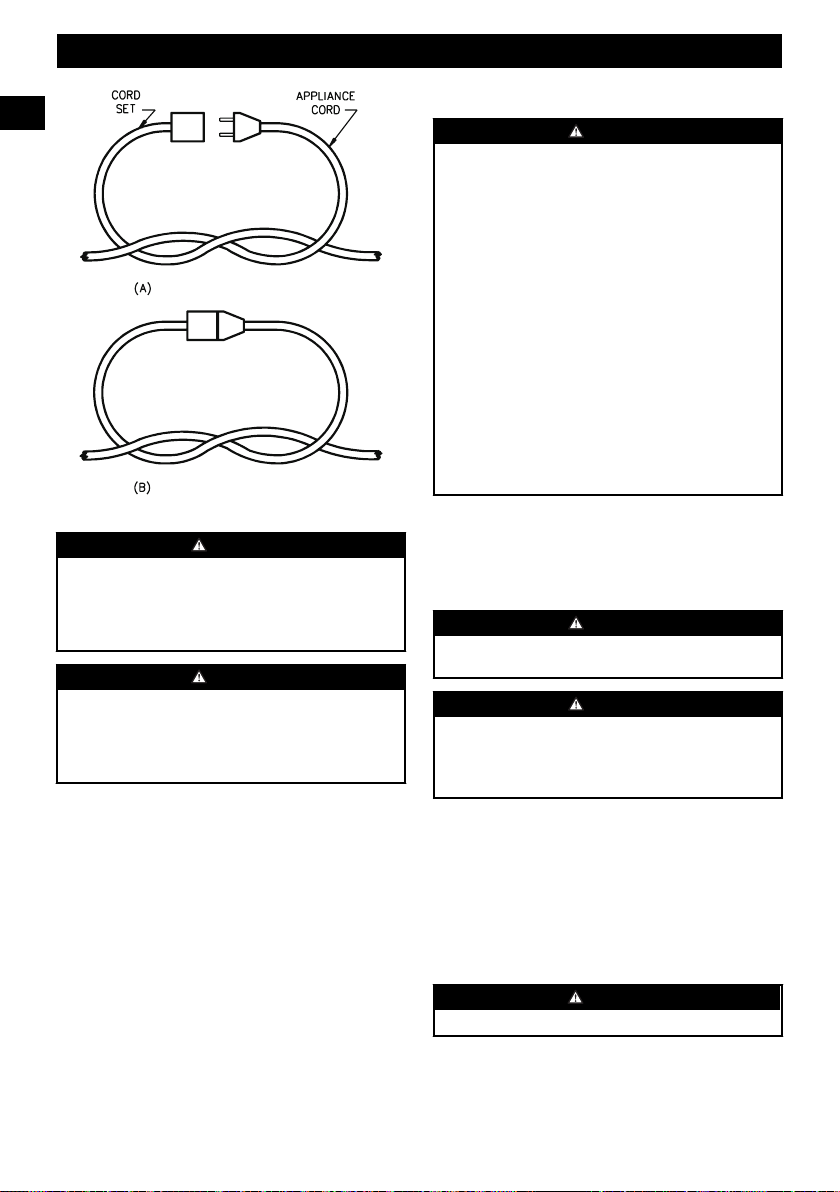
THE CORD AS SHOWN
CONNECT PLUG AND RECEPTACLE
AVISO
Mantenga el cable alargador alejado de la superficie de
trabajo. Coloque el cable de manera que no quede atrapado
en madera, herramientas u otras obstrucciones mientras
trabaja con una herramienta eléctrica. De no hacerlo podrían
producirse lesiones personales graves.
AVISO
Compruebe los cables alargadores antes de cada uso. En
caso de daños sustituya inmediatamente. Nunca utilice el
producto con un cable dañado, ya que si toca la zona dañada
podría producirse una descarga eléctrica con las
consiguientes lesiones graves.
8 PROPUESTA 65
AVISO
Este producto contiene una sustancia química conocida en
el estado de California como causante de cáncer, defectos
de nacimiento u otros daños reproductivos. El polvo
generado por el lijado eléctrico, el serrado, el esmerilado, la
perforación y otras actividades de construcción contiene
sustancias químicas que se sabe que son causantes de
cáncer, defectos de nacimiento u otros daños reproductivos.
Algunos ejemplos de estas sustancias químicas son:
• Plomo de pinturas con base de plomo;
• Sílice cristalina de ladrillos y cemento y otros productos
de albañilería;
• Arsénico y cromo de la madera tratada químicamente.
El riesgo de exposición a estas sustancias químicas varía
según la frecuencia con la que realice este tipo de trabajo.
Para reducir su exposición a estas sustancias químicas,
trabaje en una zona bien ventilada y trabaje con equipos de
seguridad aprobados, como máscaras antipolvo, que estén
especialmente diseñadas para filtrar partículas
microscópicas.
Conserve estas instrucciones.
9 INSTALACIÓN
9.1 DESEMBALAJE DE LA MÁQUINA
AVISO
Asegúrese de montar correctamente la máquina antes del
uso.
AVISO
• Si las piezas presentan daños, no utilice la máquina.
• Si no tiene todas las piezas, no utilice la máquina.
• Si faltan piezas o hay piezas dañadas, hable con el
centro de servicio.
1. Abra el embalaje.
2. Lea la documentación que se encuentra en la caja.
3. Retire todas las piezas sin montar de la caja.
4. Retire la máquina de la caja.
5. Deseche la caja y el embalaje de conformidad con los
reglamentos locales.
9.2 FIJACIÓN DE LA PROTECCIÓN
AVISO
No toque la cuchilla de corte.
1. Retire los tornillos del cabezal de corte con un
destornillador Phillips (no incluido).
18
Español
ES
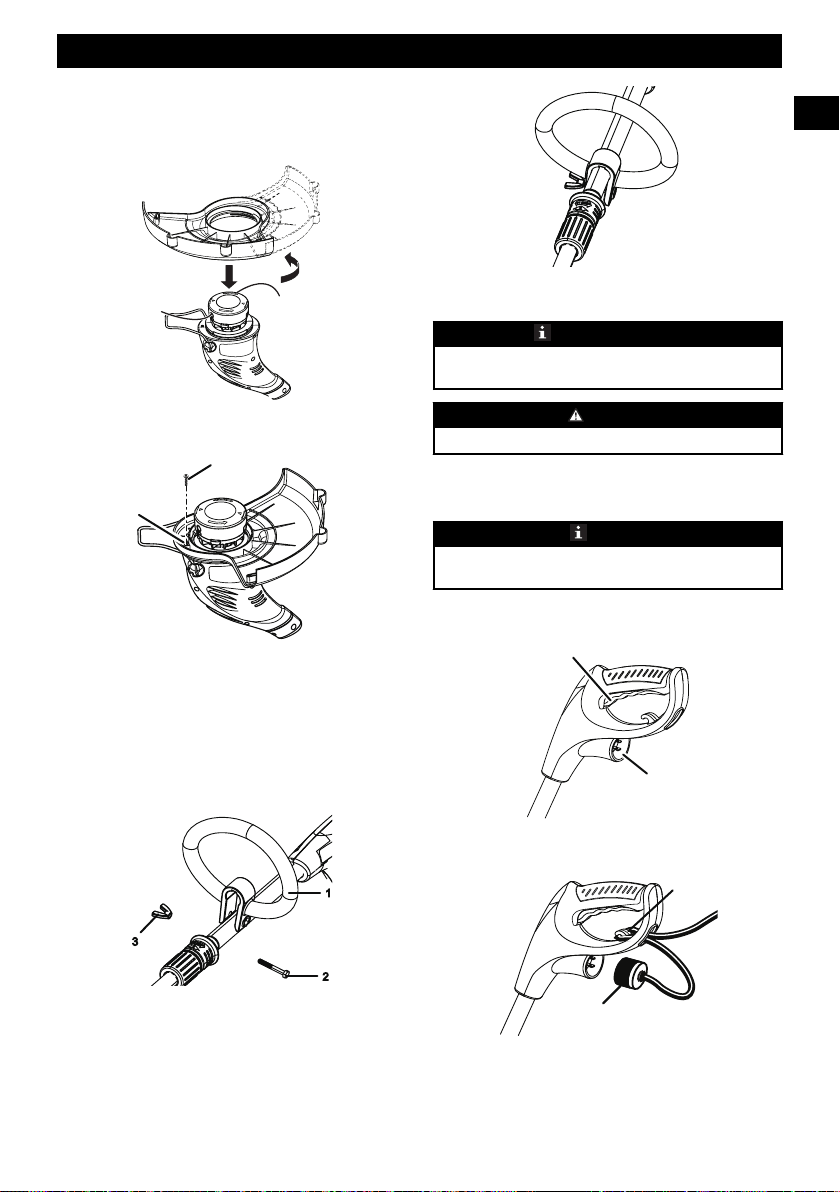
2. Instale la protección en las ranuras sobre el cabezal de
corte.
3. Gire la protección en sentido antihorario para bloquearla
en su posición.
4. Alinee los orificios de tornillo (1) de la protección con los
orificios de tornillo (2) del cabezal de corte.
2
1
5. Apriete los tornillos.
9.3 FIJACIÓN DEL ASA AUXILIAR
1. Retire el mando del asa.
2. Fije el asa auxiliar (1) en el eje.
3. Sitúe el asa auxiliar en una posición cómoda.
4. Introduzca el perno (2) por el orificio.
5. Apriete el asa auxiliar con el mando (3).
10 FUNCIONAMIENTO
IMPORTANTE
Antes de utilizar la máquina, debe leer y entender las
normas de seguridad y las instrucciones de funcionamiento.
AVISO
Tenga cuidado cuando utilice la máquina.
10.1 PUESTA EN MARCHA DE LA
MÁQUINA
NOTA
Utilice únicamente cables alargadores aprobados para uso
en exterior.
1. Pase el cable alargador por la ranura en el asa posterior y
colóquelo debajo de la sujeción del cable (3).
1
2
2. Conecte el extremo de salida (4) de un cable alargador al
enchufe (2) en la parte posterior de la máquina.
3
4
3. Apriete el gatillo (1) para arrancar la máquina.
19
Español
ES
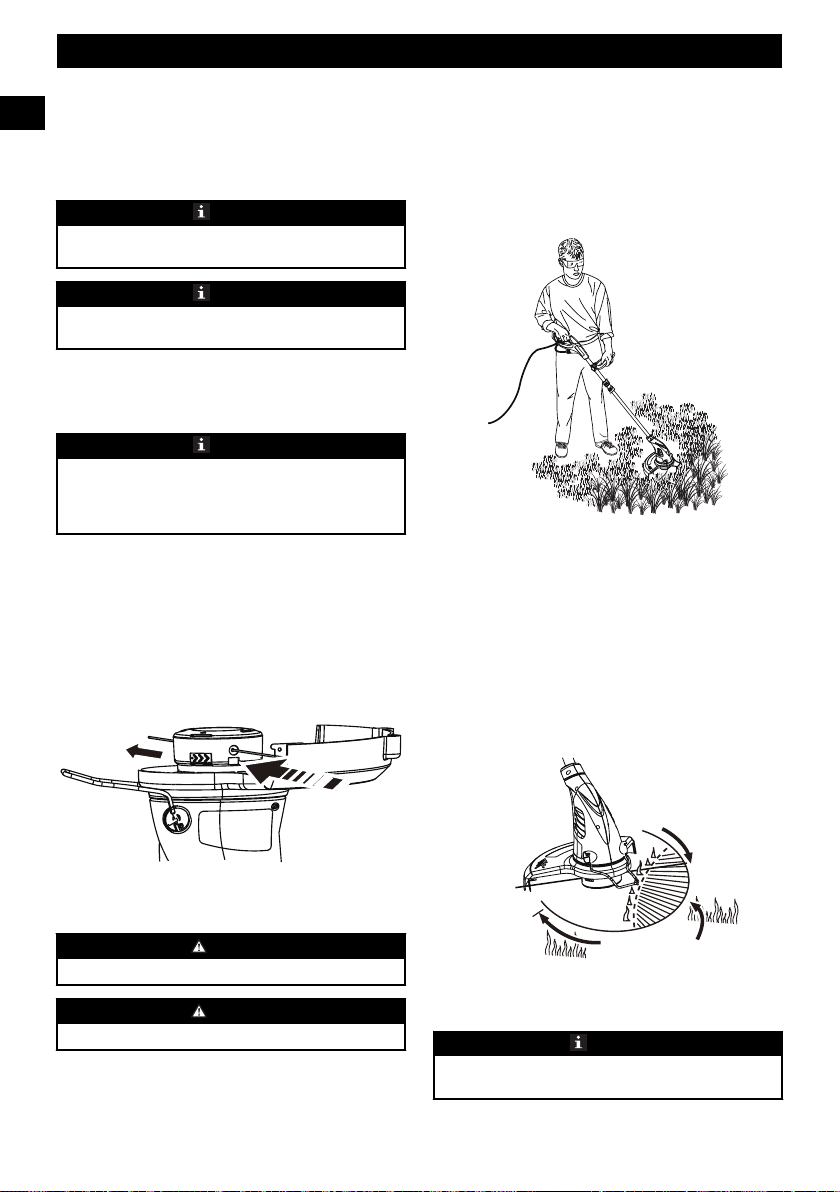
10.2 DETENCIÓN DE LA MÁQUINA
1. Suelte el gatillo para detener la máquina.
10.3 AJUSTE DE LA LONGITUD DEL
HILO DE CORTE
NOTA
La máquina tiene un cabezal con autoalimentación. Dañará
la máquina si golpea el cabezal para intentar avanzar el hilo.
NOTA
Si el hilo de corte no avanza automáticamente, puede estar
enredado o haberse terminado.
1. Cuando la máquina esté encendida, suelte el gatillo.
2. Espere dos segundos, vuelva a apretar el gatillo.
3. Reanude el corte.
NOTA
El hilo se extenderá aproximadamente 1 cm (0,4") con cada
parada y puesta en marcha del gatillo hasta que el hilo
alcanza la cuchilla de corte y esta corta el exceso de
longitud.
10.4 AJUSTE MANUAL DE LA
LONGITUD DEL HILO DE CORTE
1. Detenga la máquina. Retire la batería de la unidad.
2. Presione el botón de retención del carrete y tire del hilo
de corte para avanzarlo manualmente.
3. Después de extender el nuevo hilo de corte, devuelva
siempre la máquina a su posición normal antes de volver
a ponerla en marcha.
10.5 CONSEJOS DE
FUNCIONAMIENTO
AVISO
Mantenga un espacio entre el cuerpo y la máquina.
AVISO
No utilice la máquina sin la protección en su posición.
Le sugerimos lo siguiente cuando utilice la máquina
• Mantenga una posición firme con las dos manos en la
máquina mientras la utiliza.
• Corte la hierba alta de arriba a abajo.
Si se enrolla hierba alrededor del cabezal de corte:
• Detenga la máquina.
• Desenchufe la máquina.
• Quite la hierba.
10.6 CONSEJOS DE CORTE
• Incline la máquina hacia la zona que va a cortar. Utilice la
punta del hilo de corte para cortar hierba.
• Mueva la máquina de derecha a izquierda para evitar que
los residuos despedidos golpeen al operario.
• No corte en la zona peligrosa.
• No fuerce el cabezal de corte en hierba sin cortar.
• Las cercas de alambres y estacas provocan el desgaste y
la rotura del hilo de corte. Las paredes de piedra y de
ladrillo, los bordillos y la madera pueden desgastar
rápidamente el hilo de corte.
Zona
peligrosa
Dirección de
rotación
Mejor zona de corte
10.7 CAMBIO AL MODO DE
BORDEADO
NOTA
La máquina puede utilizarse en combinación con la guía de
borde para bordear aceras y caminos.
20
Español
ES
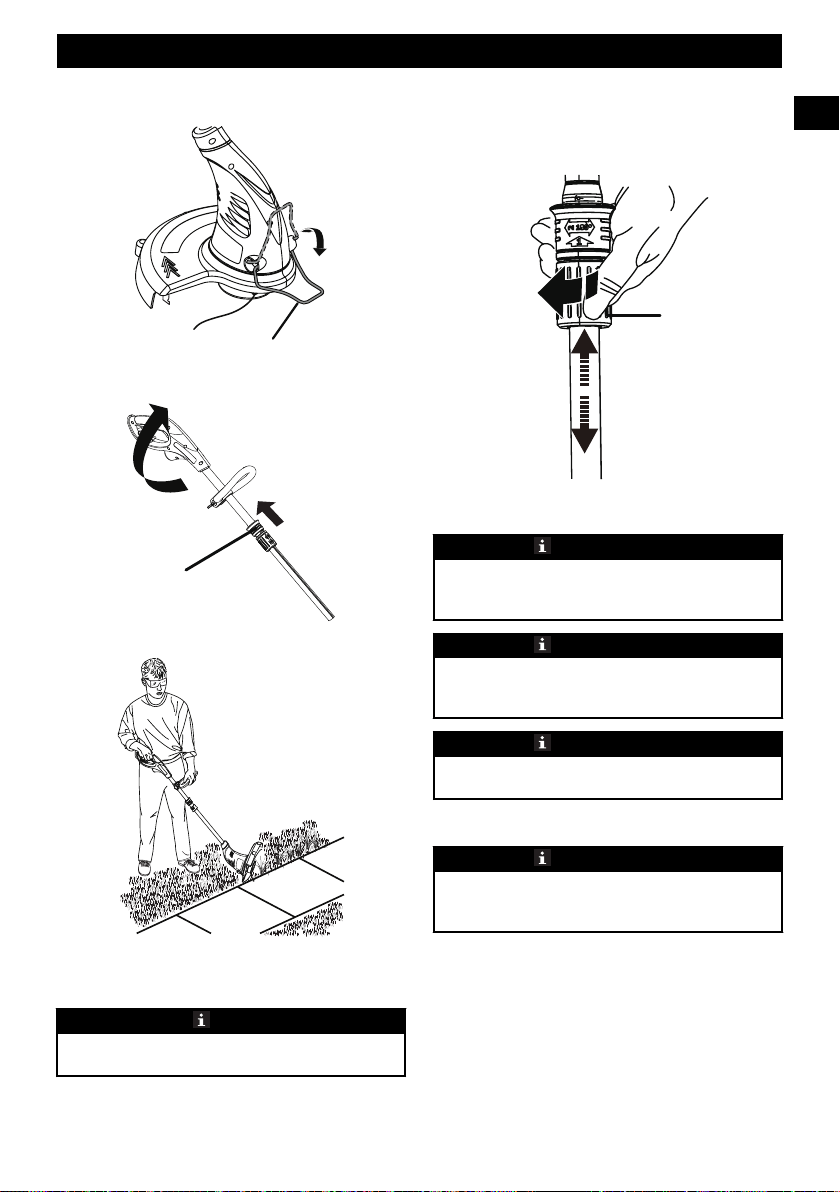
1. Detenga la máquina y baje la guía de borde (2) desde la
posición de almacenamiento.
2
2. Tire del acoplamiento de bordeado (1) y gire el cabezal
de corte 180 grados hasta que se bloquee en su posición.
1
3. Suelte el acoplamiento de bordeado.
10.8 AJUSTE DE LA LONGITUD DEL
EJE
NOTA
Puede ajustar la longitud del eje para manejar la máquina
fácilmente.
1. Detenga la máquina.
2. Afloje el acoplamiento del brazo telescópico (1) y mueva
el eje a la posición deseada.
3. Apriete el acoplamiento.
1
11 MANTENIMIENTO
IMPORTANTE
Debe leer y entender los reglamentos de seguridad y las
instrucciones de mantenimiento antes de limpiar, reparar o
realizar tareas de mantenimiento en la máquina.
IMPORTANTE
Asegúrese de que todas las tuercas, los pernos y los tornillos
estén apretados. Examine periódicamente que las asas estén
bien instaladas.
IMPORTANTE
Utilice únicamente las piezas de repuesto y los accesorios
del fabricante original.
11.1 INFORMACIÓN GENERAL
IMPORTANTE
Únicamente un distribuidor o un centro de servicio
autorizado puede realizar el mantenimiento que no se indica
en este manual.
Antes de las operaciones de mantenimiento:
• Detenga la máquina.
• Retire la batería.
• Deje que se enfríe el motor.
• Almacene la máquina en un lugar fresco y seco.
• Utilice ropa adecuada, guantes protectores y gafas de
seguridad.
21
Español
ES
11.2 LIMPIEZA DE LA MÁQUINA
• Limpie la máquina después de utilizarla con un paño
húmedo humedecido en detergente neutro.
• No utilice detergentes o disolventes agresivos para
limpiar las piezas de plástico o las asas.
• Mantenga el cabezal de corte libre de hierba, hojas o
grasa excesiva.
• Mantenga los respiraderos limpios y libres de residuos
para evitar el sobrecalentamiento y daños al motor o la
batería.
• No pulverice agua sobre el motor ni los componentes
eléctricos.
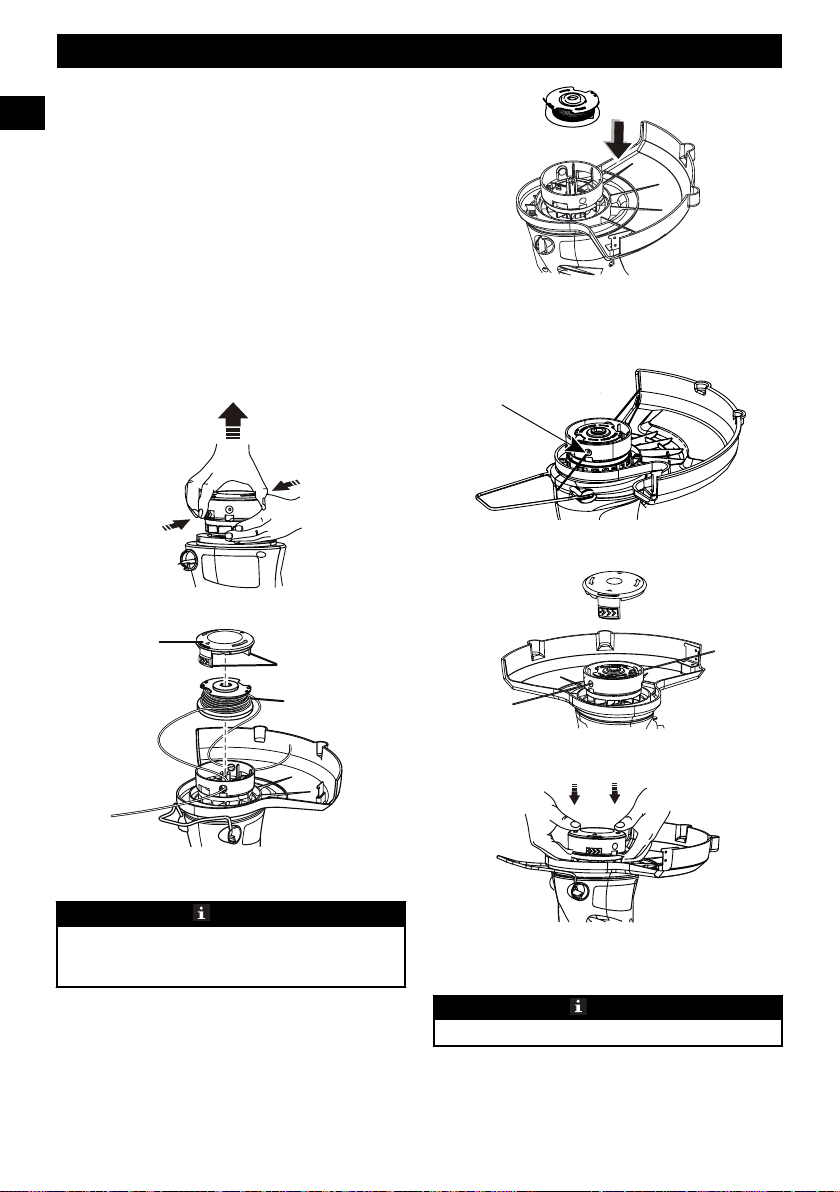
11.3 SUSTITUCIÓN DEL CARRETE
1. Presione las pestañas de los laterales del cabezal de corte
al mismo tiempo.
2. Tire para retirar la cubierta del carrete.
Cubierta
de carrete
Carrete
Pestañas
3. Retire el carrete restante.
4. Ponga el carrete en la carcasa del carrete.
NOTA
Asegúrese de poner el hilo de corte en la ranura sobre el
carrete nuevo y de extender el hilo aproximadamente 15 cm
antes de instalar el carrete nuevo.
5. Introduzca los extremos de los hilos de corte por los
orificios.
6. Extienda el hilo de corte para soltarlo de la ranura de guía
en el carrete.
Orificio de salida de hilo
7. Presione las pestañas e instale la cubierta del carrete en la
carcasa del carrete.
8. Introduzca la cubierta del carrete hasta que encaje en su
posición.
11.4 SUSTITUCIÓN DEL HILO DE
CORTE
NOTA
Retire el hilo de corte restante del carrete.
22
Español
ES
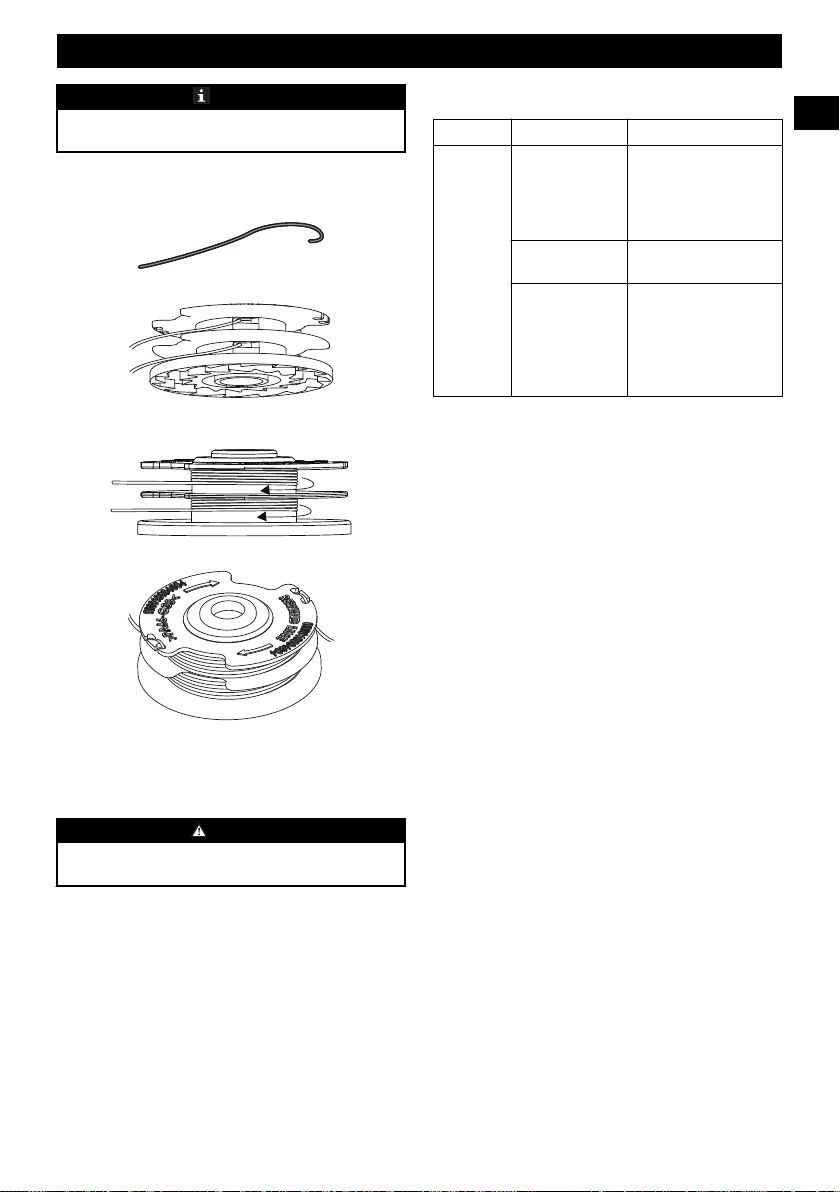
NOTA
Utilice únicamente con el hilo de corte de nylon de 0.065"
(1.65 mm) de diámetro.
1. Corte dos trozos de hilo de corte de aproximadamente 3m
de longitud cada uno.
2. Doble un extremo del hilo 6,35 mm (1/4").
3. Coloque los hilos en los orificios de anclaje del carrete.
4. Enrolle los hilos de corte alrededor del carrete
firmemente en la dirección indicada.
5. Introduzca los hilos de corte en las ranuras de guía.
6. No enrolle el hilo de corte más allá del borde del carrete.
12 TRANSPORTE Y
ALMACENAMIENTO
AVISO
Retire la batería de la máquina antes del transporte y el
almacenamiento.
12.1 ALMACENAMIENTO DE LA
MÁQUINA
• Retire la batería de la máquina.
• Asegúrese de que los niños no puedan acercarse a la
máquina.
• Mantenga la máquina alejada de agentes corrosivos,
como sustancias químicas para jardín y sales para
descongelación.
• Fije la máquina durante el transporte para evitar daños o
lesiones. Limpie y examine si hay daños en la máquina.
13 SOLUCIÓN DE PROBLEMAS
Problema Posible causa Solución
La máquina
no se pone
en marcha
cuando
aprieta el
gatillo.
No hay contacto
eléctrico entre la
máquina y la bate-
ría.
1. Retire la batería.
2. Compruebe el contacto
e instale de nuevo la bate-
ría.
La batería se ha
agotado.
Cargue la batería.
El botón de des-
bloqueo y el gatil-
lo no se presionan
al mismo tiempo.
1. Apriete el botón de
desbloqueo y sujételo.
2. Apriete el gatillo para
poner en marcha la má-
quina.
23
Español
ES
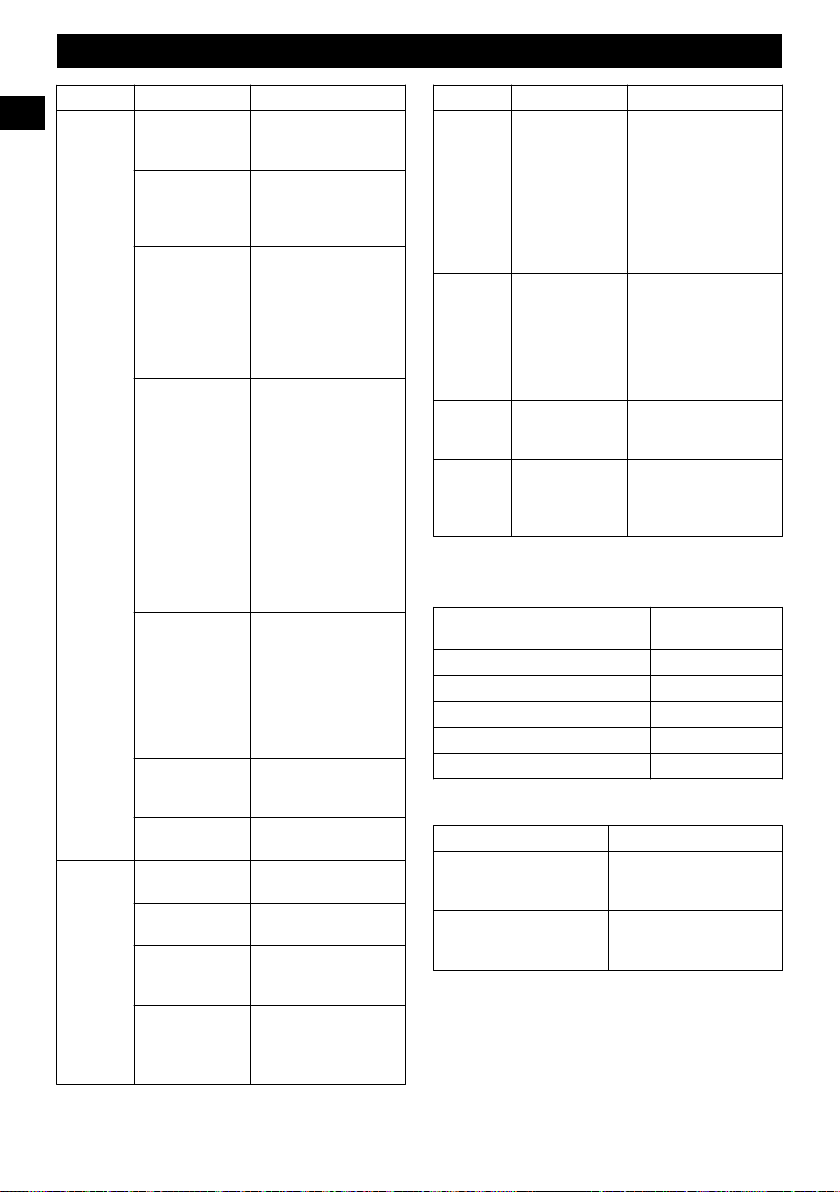
Problema Posible causa Solución
La máquina
se detiene
cuando cor-
ta.
La protección no
está fijada a la má-
quina.
Retire la batería y fije la
protección a la máquina.
Se utiliza un hilo
de corte pesado.
Utilice únicamente con el
hilo de corte de nylon de
0.065" (1.65 mm) de diá-
metro.
La hierba se enrol-
la alrededor del eje
del motor o del ca-
bezal de corte.
1. Detenga la máquina.
2. Retire la batería.
3. Retire la hierba del eje
del motor y del cabezal
de corte.
El motor se ha so-
brecargado.
1. Retire el cabezal de
corte de la hierba.
2. El motor se recuperará
para funcionar en cuanto
se retire la carga.
3. Cuando corte, mueva
el cabezal de corte hacia
dentro y fuera de la hier-
ba que va a cortar y quite
no más de 8" (20 cm) en
cada pasada.
La batería o la má-
quina está dema-
siado caliente.
1. Deje enfriar la batería
hasta que el funciona-
miento vuelva a la nor-
malidad.
2. Deje enfriar la máqui-
na durante aproximada-
mente 10 minutos.
La batería se ha
desconectado de la
herramienta.
Instale de nuevo la bate-
ría.
La batería se ha
agotado.
Cargue la batería.
El hilo no
avanza.
Los hilos se han
quedado soldados.
Lubrique con espray de
silicona.
No ha suficiente
hilo en el carrete.
Instale más hilo.
Los hilos se desga-
stan y son dema-
siado cortos.
Avance el hilo de corte.
Los hilos están en-
redados en el car-
rete.
1. Retire los hilos del car-
rete.
2. Enrolle los hilos.
Problema Posible causa Solución
El hilo se
rompe con-
tinuamente.
La máquina se está
utilizando incor-
rectamente.
1. Corte con la punta del
hilo, evite piedras, par-
edes y otros objetos
duros.
2. Avance el hilo de corte
periódicamente para
mantener el ancho de
corte completo.
La hierba se
enrolla alre-
dedor del
cabezal de
corte y de
la carcasa
del motor.
Corte la hierba alta
al nivel del suelo.
1. Corte la hierba alta de
arriba a abajo.
2. No quite más de 8" (20
cm) en cada pasada para
evitar que se enrolle.
El hilo no
corta bien.
La cuchilla de
corte se ha desafi-
lado.
Afile la cuchilla de corte
con una lima o sustitúya-
la.
Las vibra-
ciones au-
mentan no-
tablemente.
El hilo está gasta-
do en un lado y no
se ha avanzado a
tiempo.
Asegúrese de que el hilo
a ambos lados esté nor-
mal. Avance el hilo.
14 DATOS TÉCNICOS
Entrada 120V/60Hz, AC on-
ly, 4 Amps
Velocidad sin carga 9000 (± 10%) RPM
Diámetro de hilo de corte 0.065" (1.65 mm)
Diámetro de recorrido de corte 13 in. (330 cm)
Tipo de alimentación Autoalimentación
Peso 5.2 lb (2.3 kg)
El intervalo de temperatura ambiente recomendado:
Elemento
Temperatura
Intervalo de temperatura de
almacenamiento del corta-
bordes
-4°F (-20°C) - 158°F (70°C)
Intervalo de temperatura de
funcionamiento del corta-
bordes
32°F (0°C) - 104°F (40°C)
24
Español
ES
15 GARANTÍA LIMITADA
YEAR
AÑOS
LIMITED WARRANTY
GARANTÍA
LIMITADA
3
Greenworks Por la presente, se garantiza este producto al
comprador original en posesión de la prueba de compra por
un periodo de tres (3) años contra defectos de material, piezas
o mano de obra. Greenworks, a su propia discreción, reparará
o reemplazará todas y cada una de las piezas que se
encuentren defectuosas, en base a un uso normal, sin costo
alguno para el cliente. Esta garantía es válida para aparatos de
los que se ha realizado un uso personal y no han sido
alquilados para aplicaciones comerciales/industriales, y que
han sido sometidos a un mantenimiento tal y como se indica
en las instrucciones del manual del usuario suministrado con
el producto nuevo.
LO QUE NO CUBRE LA GARANTÍA:
1. Cualquier pieza que no funcione debido al uso incorrecto,
uso comercial, abusivo, negligencia, accidente,
mantenimiento inadecuado, o alteración; o
2. La unidad, si no ha sido utilizada y/o mantenida
siguiendo el manual del propietario; o
3. El desgaste normal, excepto según se indica a
continuación.
4. Piezas que requieren un mantenimiento rutinario como
lubricantes, afilar la cuchilla;
5. El deterioro normal del acabado exterior debido al uso o
exposición.
ASISTENCIA AL USUARIO:
El servicio de garantía está disponible llamando a nuestra
línea de asistencia gratuita al 1-888-909-6757.
GASTOS DE TRANSPORTE:
Los gastos de transporte del traslado de cualquier herramienta
eléctrica o accesorio será responsabilidad del comprado. Es
responsabilidad del comprador pagar los gastos de transporte
de cualquier pieza enviada para su reemplazo bajo esta
garantía, salvo que dicha devolución sea solicitada por escrito
por Greenworks.
DIRECCIÓN EN EE.UU.:
Greenworks Tools
P.O. Box 1238
Mooresville, NC 28115
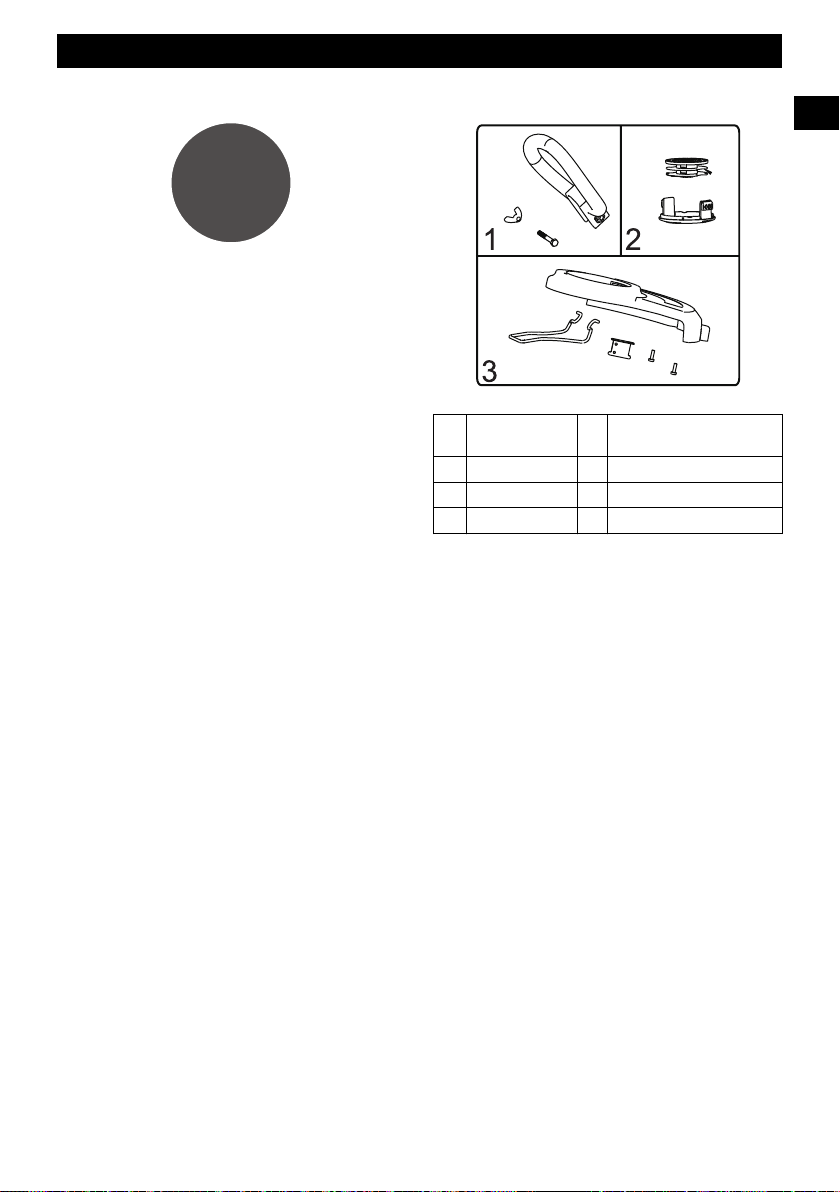
16 VISTA DESPIEZADA
Nº Nº pieza Ca
nt.
Descripción
1 34115178-5 1 Conjunto de asa auxiliar
2 31300178-6 1 Carrete & Cubierta de carrete
3 33301176A 1 Conjunto de protección
25
Español
ES