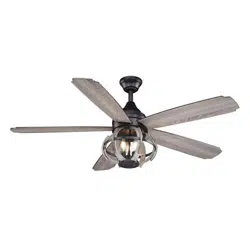
Model No.: # 355-0707
PAGE: 1 / 11
191227
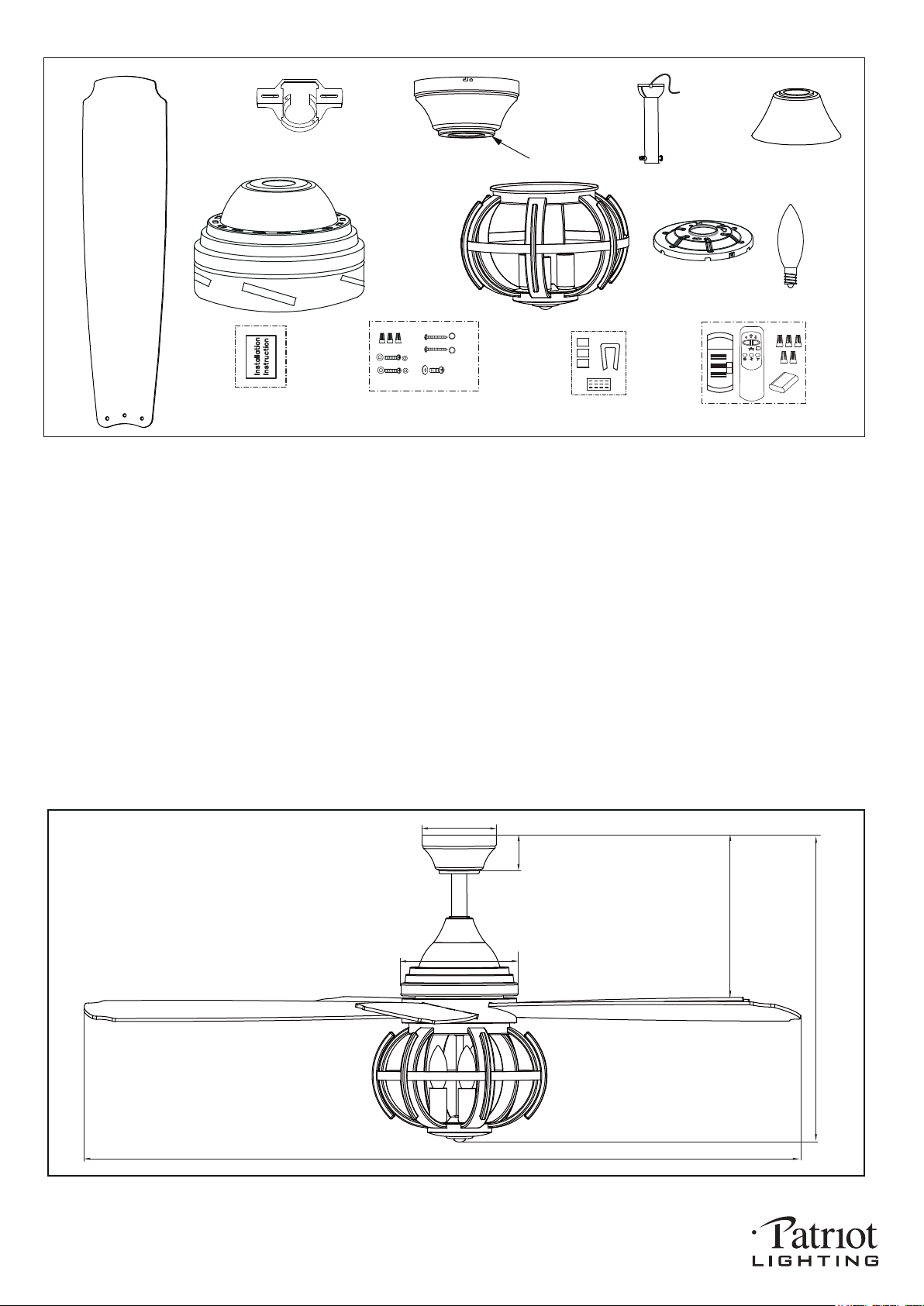
Unpack your fan and check the contents.
Y
ou should have the following items.
1.) Hanger Bracket
2.) Canopy
3.) Canopy Cover (Preassembled to Canopy)
4.) Downrod Set (Included Hanger Ball, 6” Downrod, Hanger Pin & Lock Pin)
5.) Downrod Stand Cover
6.) Fan Blade (5 PCS)
7.) Fan Motor Assembly
8.)
9.)
Fan Light
10.)
11.) Installation Instructions
12.) Assembly Kit
4W E12 (C) Base B10 Type LED Bulb (3PCS)
13.) Blade Balancing Kit
14.) Remote Control Set (Includes Transmitter & Receiver & Wire Connector & Battery)
Connect Plate of Fan Light
Package Contents:
Dimension Reference (Installed with 6” Downrod)
A. 12” B. 21” C. 2-2/5” D. 8” E. 5” F.52”
PAGE: 2 / 11
1
2
4
3
5
6
11
109
7
8
191227
12
13
14
9V
X16
C
E
D
A
B
F
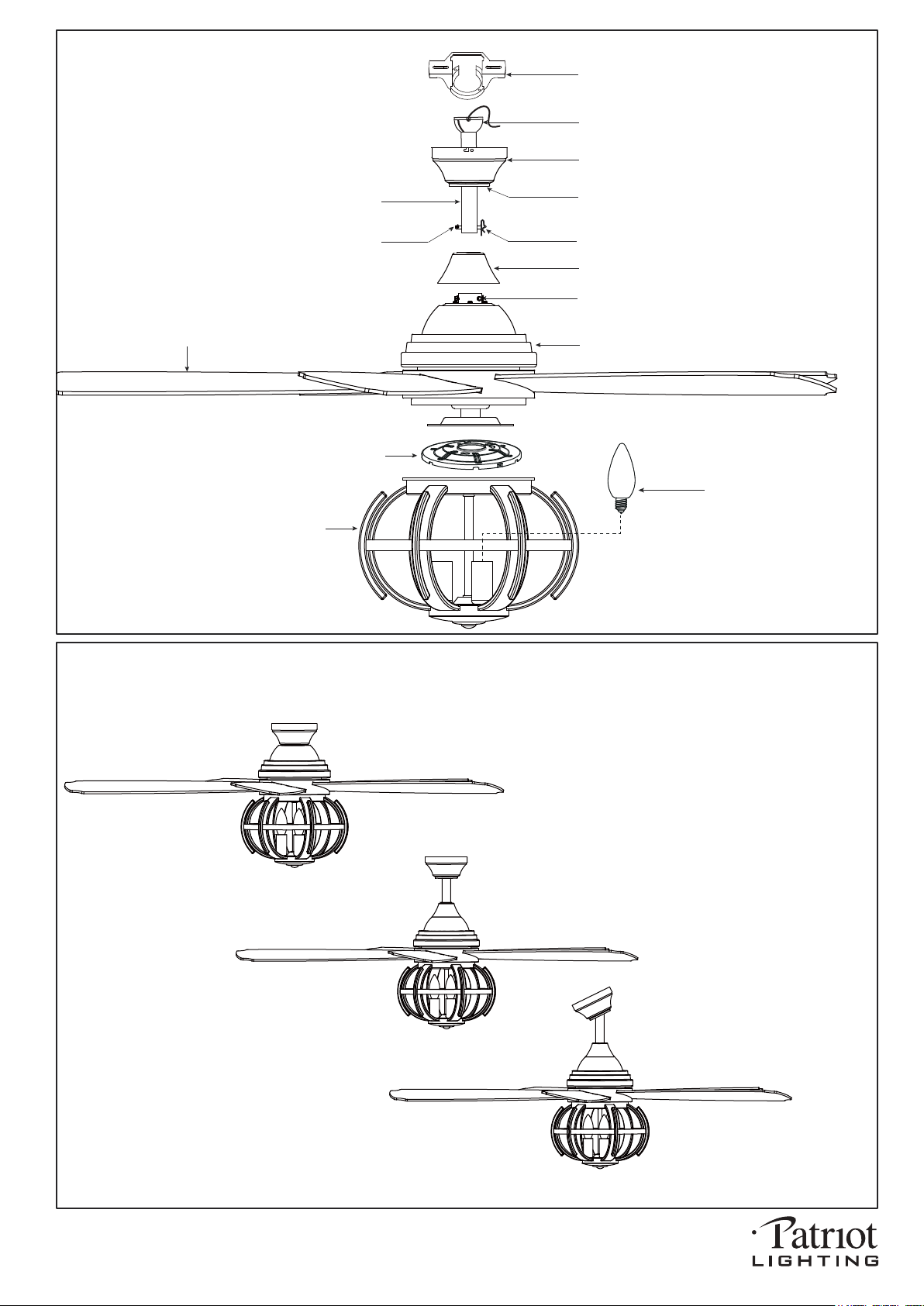
Exploded View Detail
PAGE: 3 / 11
191227
Hanger Bracket
Hanger Ball
Canopy
Canopy Cover
Downrod Stand Cover
Collar
Housing
Blade
LED Bulb
Fan Light
Connect Plate of Fan Light
Downrod
Hanger Pin
Lock Pin
Triple Mount Options
Ceiling Mount
Downrod Mount
Slope Ceiling Mount ( Up to 23 degrees)
PAGE: 4 / 11
Safety Instructions
READ ALL SAFETY INFORMATION AND INSTALLATION INSTRUCTIONS BEFORE YOU BEGIN TO
INSTALL THE FAN AND SAVE INSTRUCTIONS.
All set screws of the fan must be checked and retightened where necessary before installation.
To reduce the risk of personal injury, do not bend the blade brackets when installing the brackets,
balancing the blades or cleaning the fan. Do not insert foreign objects between rotating fan blades.
Before changing the fan direction, turn off the fan and wait for the fan blades to stop completely.
The safeguards provided by these safety instructions and by the separate installation
instructions are not meant to cover all possible conditions and situations that may occur. It must be
understood that common sense, caution and care are factors which can not be built into this product.
These factors must be supplied by the person(s) installing, caring for and operating the fan.
TO AVOID RISK OF ELECTRIC SHOCK, BE SURE TO SHUT OFF POWER AT THE MAIN
FUSE OR CIRCUIT BREAKER BOX BEFORE INSTALLING OR SERVICING THIS
FIXTURE. TURNING OFF THE ELECTRICAL POWER BY USING THE LIGHT SWITCH
IS NOT SUFFICIENT TO PREVENT ELECTRICAL SHOCK.
TO REDUCE THE RISK OF INJURY, INSTALL THE FAN SO THAT THE BLADES ARE
AT LEAST 7 FEET (2.1 METERS) ABOVE THE FLOOR AND AT LEAST 18 INCHES
(0.5 METERS) FROM THE TIP OF THE BLADES TO THE WALL.
TO REDUCE THE RISK OF FIRE, ELECTRIC SHOCK, OR PERSONAL INJURY, MOUNT
TO OUTLET BOX MARKED "ACCEPTABLE FOR FAN SUPPORT" AND USE MOUNTING
SCREWS PROVIDED WITH THE OUTLET BOX.
THE INSTALLATION HAS TO BE IN ACCORDANCE WITH THE NATIONAL ELECTRICAL
CODE, ANSI/NFPA 70-1999 AND LOCAL CODES. IF YOU ARE UNFAMILIAR WITH THE
METHODS OF INSTALLING ELECTRICAL WIRING, SEEK THE SERVICES OF A
QUALIFIED LICENSED ELECTRICIAN.
WARNING
191227
INSTALLATION INSTRUCTIONS
IMPORTANT:
BEFORE YOU BEGIN INSTALLATION, CAREFULLY READ ALL INFORMATION PROVIDED IN THE SAFETY
INSTRUCTIONS AND INSTALLATION INSTRUCTIONS. IF IN DOUBT, CONSULT A QUALIFIED
ELECTRICIAN.
SAVE ALL INSTRUCTIONS.
NOTE: The fan weight is 18.74 lbs (8.5 kgs). Be sure the outlet box you are using is securely attached to the
building structure and can support the full weight of the fan. Failing to do so can result in serious injury.
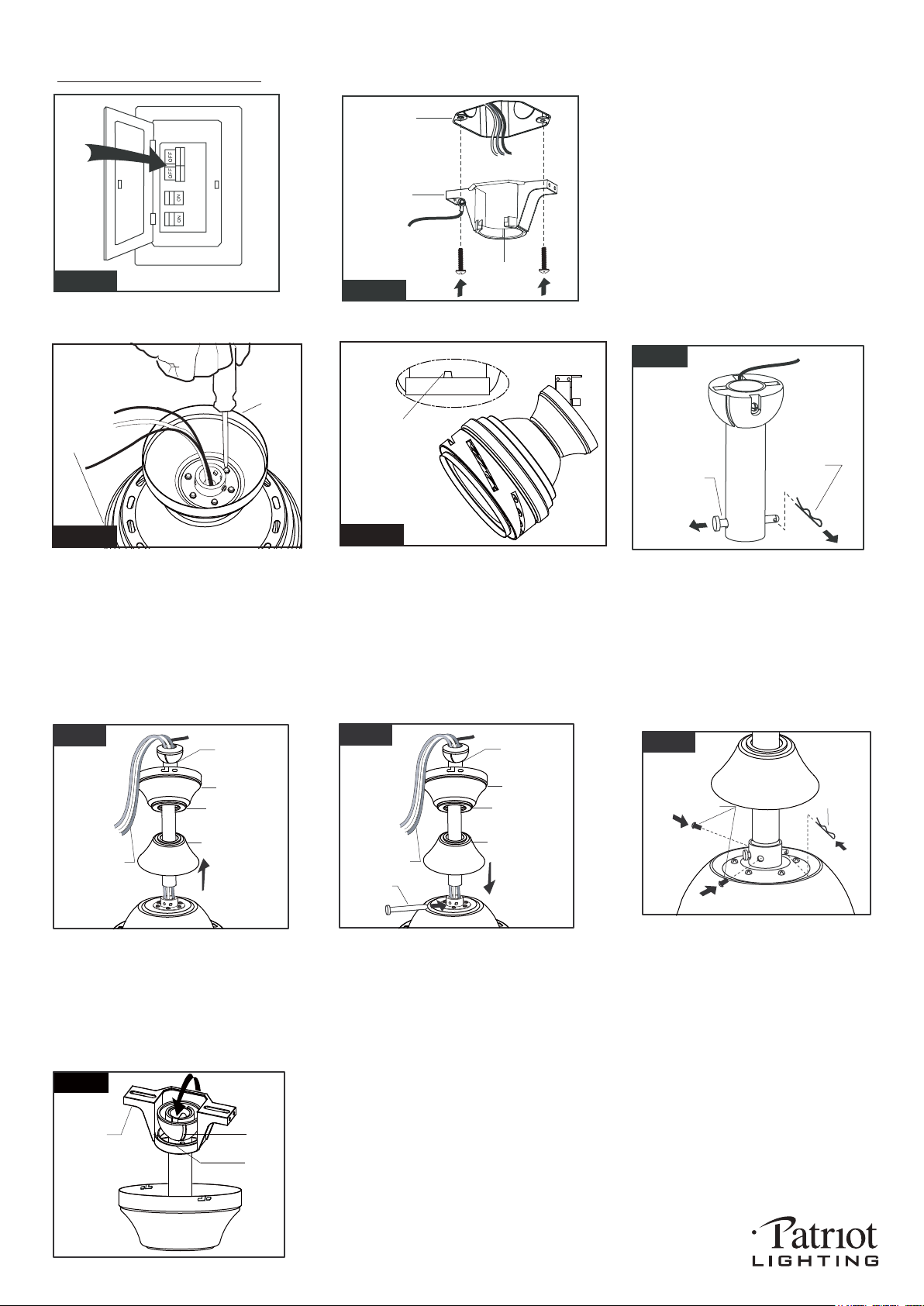
(For ceiling mount only):
Remove the canopy cover from the
canopy.
Remove downrod stand cover and
three of six screws (every other one)
securing the motor collar to the top
of the fan motor housing. Attach the
canopy to the housing with three screws.
PAGE: 5 / 11
(
For downrod mount only):
191227
Hang the fan on hanger bracket, and make sure the slot of hanger ball is
snapped into the chip of hanger bracket exactly.
Note: For slope ceiling installation, make sure the slot of hanger ball
and the chip of hanger bracket face down.
(
For downrod mount only):
Tighten the two Collar Screws.
Slide Lock Pin into Hanger
Pin until it is locked into position.
(
For downrod mount only):
Slide canopy, canopy cover and
downrod stand cover onto downrod,
as shown; then thread motor wires
through downrod.
(
For downrod mount only):
Loosen the collar screws out part way.
Insert the Downrod into the Collar.
Slide Hanger Pin through holes of Collar
and Downrod.
Fig.5
Hanger Pin
Lock Pin
Slot
Hanger Bracket
Fig.9
Chip
Canopy
Housing
Fig.3.
Downrod
Canopy
Motor Wires
Downrod Stand
Canopy Cover
Cover
Fig.6
Downrod
Canopy
Motor Wires
Downrod Stand
Canopy Cover
Cover
Fig.7
Hang Pin
Fig.8
Lock Pin
Collar Screws
(
For ceiling mount only):
Raise the fan and place the canopy
on the hanger bracket hook for wiring.
Go to Fig.10 for the next steps.
(
For downrod mount only):
Remove the Lock Pin and take
off the Hanger Pin.
Fig.4.
Hanger Bracket
Hook
Installation Steps :
Tighten the hanger bracket to the outlet
box with 2 mounting screws. (To reduce
the risk of fire, electric shock, or personal
injury, mount to the outlet box marked
"Acceptable for fan support" and use
mounting screws provided with the outlet
box.)
Note: For slope ceiling installation, make
sure that the chip of the hanger bracket
is toward the floor.
Fig.1
Turn OFF the electric circuit at the
main fuse or circuit breaker box.
Hanger
Bracket
Chip
Fig.2
Outlet Box
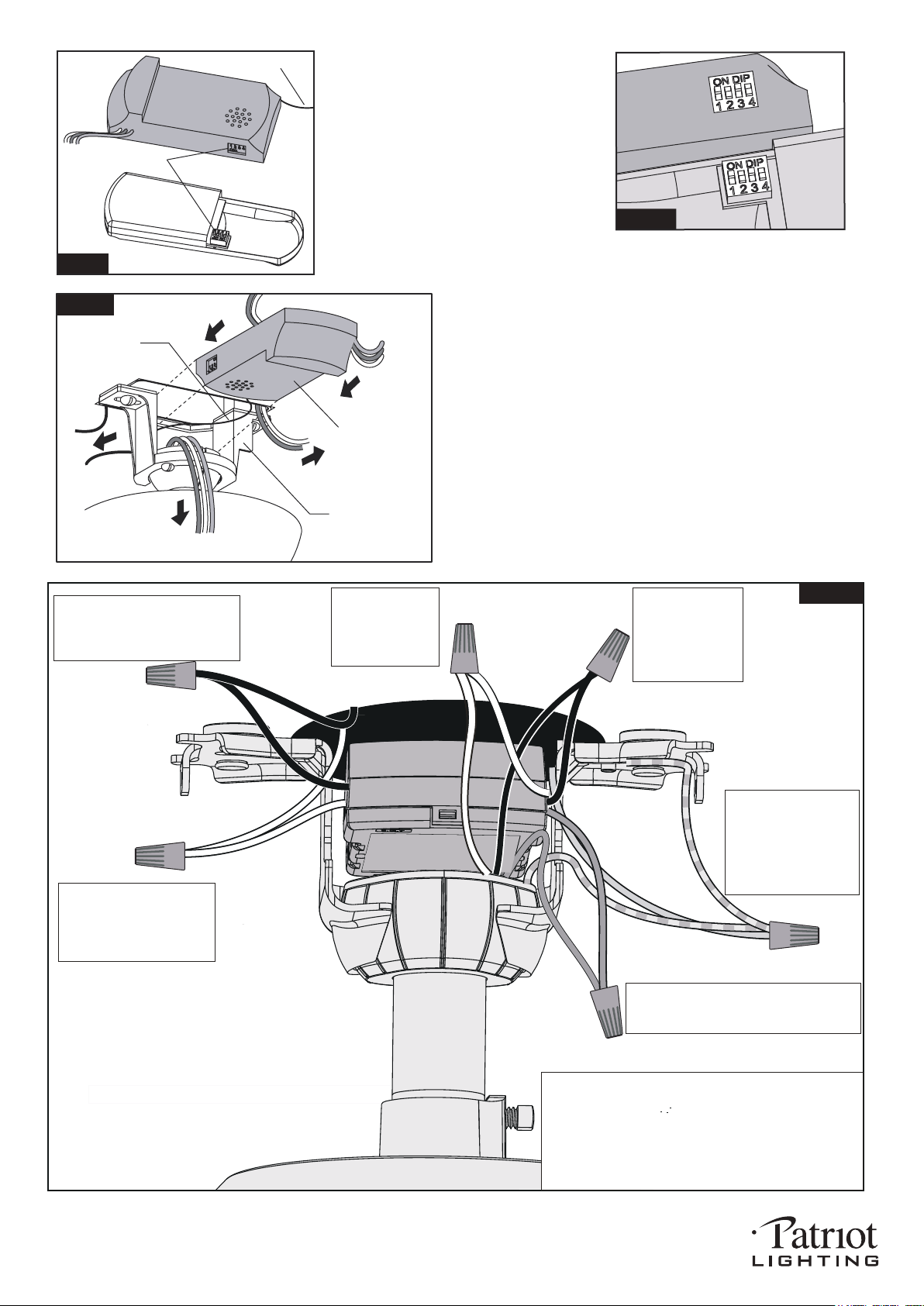
Fig.11
Move Ground Wires (a), Outlet Box wires (b), and
Motor Wires (c) away from the center of the Hanger
Bracket. Then slide Receiver through Hanger
Bracket as shown, Antenna end first, until it is
centered. Finally, cut Motor Wires (c) to length
needed for connections.
Antenna
Receiver
Hanger Bracket
a.
b.
c.
PAGE: 6 / 11
Code example:
1-ON 2-OFF 3-ON 4-OFF on both DIP
Switches.
Note: If you have two ceiling fans
with 2 remote control units, set 2
different codes for each set of
transmitter / receivers.
Fig.10a
Fig.10
Antenna
DIP Switch
Transmitter
Receiver
There is a code switch in the transmitter
and receiver. This "DIP Switch" is a 4 key
unit (Fig.10). All keys were set at "ON"
position in the beginning. Set the keys to
a different code. Make sure the same
numbered keys are switched "ON" for
both DIP Switches (Fig.10a). Take note
that the "ON" position may have different
orientation in each.
Grounding
Green
Green
Black
Black
Black
Black
Connect the white
wire from Receiver
to the white wire
from motor with a
wire connector.
Connect the black
wire from Receiver
to the black wire
from motor (This is
for fan control) with
a wire connector.
White
White
White
White
Blue
Blue
Connect the blue wire from receiver to the
blue wire from motor (This is for light
control) with a wire connector.
Connect three
ground wires (green,
or bare copper) coming
from outlet box,
downrod and hanging
bracket with a wire
connector.
Connect the white (neutral)
wire from receiver to the
white (neutral) wire from the
outlet box with a wire
connector.
Connect the black (hot) wire
from receiver to the black (hot)
wire from outlet box with a wire
connector.
*** The wire connection points should be turned upward
and pushed carefully up into outlet box.
*** After making the wire connections, the wires should
be spread apart. The white (neutral) conductor and
green (grounding) conductor on one side and the
black (hot) conductor and blue (light) conductor on
the other side of the outlet box.
Fig.12
191227

PAGE: 7 / 11
191227
Remove screws from connect plate
of fan light first, then connect the
white (neutral) wire from the fan
light to white (neutral) wire from
connect plate of fan light with a wire
connector, connect the black (hot)
wire from fan light to blue (hot) wire
from connect plate of fan light with
a wire connector.
Carefully put the wires into the
connect plate of fan light , then
attach the fan light onto the connect
plate of fan light with the connect
plate screws.
Install LED bulbs (included).
See relamping label at socke area or
packaging for maximum allowed wattage.
Fig.20
Turn on the electric power at the main
fuse or circuit breaker box.
The slide switch on fan motor assembly sets direction of
fan rotation. Select the desired direction of fan rotation.
Push the slide switch left for " Forward" and right for "Reverse".
Note: Wait for fan to stop before reversing the direction
of blade rotation.
Attach the canopy to the hanger
bracket, and then secure it with
four screws and washers.
Washer
Canopy
Fig.13
Hanger
Bracket
Screw
Blade Screw
Washer
Fig.14
Blade
Slot
Insert the Blade through the slot on
the Center Band. Align holes and
fasten Blade to the motor with
Blade Screws and washers.
Repeat for remaining Blades.
Fig.18
3-4W E12 (C)
Base B10 Type
LED Bulbs
(included)
E12 B10 bulb Max. 40W
Fig.19
Slide Switch
Reverse
Forward
Fan Motor
Assembly
Connect Plate of Fan Light
Fan Motor
Assembly
Screw
Fig.15
Remove one screw from fan motor assembly
first, push the connect plate of fan light
upwards until the fan motor assembly screws
insert into the key hole slot of connect plate
of fan light then rotate the connect plate of fan
light till it fixed on the motor bottom. Finally,
secure the connect plate of fan light to motor
bottom with previous screw which we removed
and tighten the other two fan motor assembly
screws.
Fan Light
Connect
Plate of
Fan Light
Fig.16
Fig.17
Connect
Plate Screws
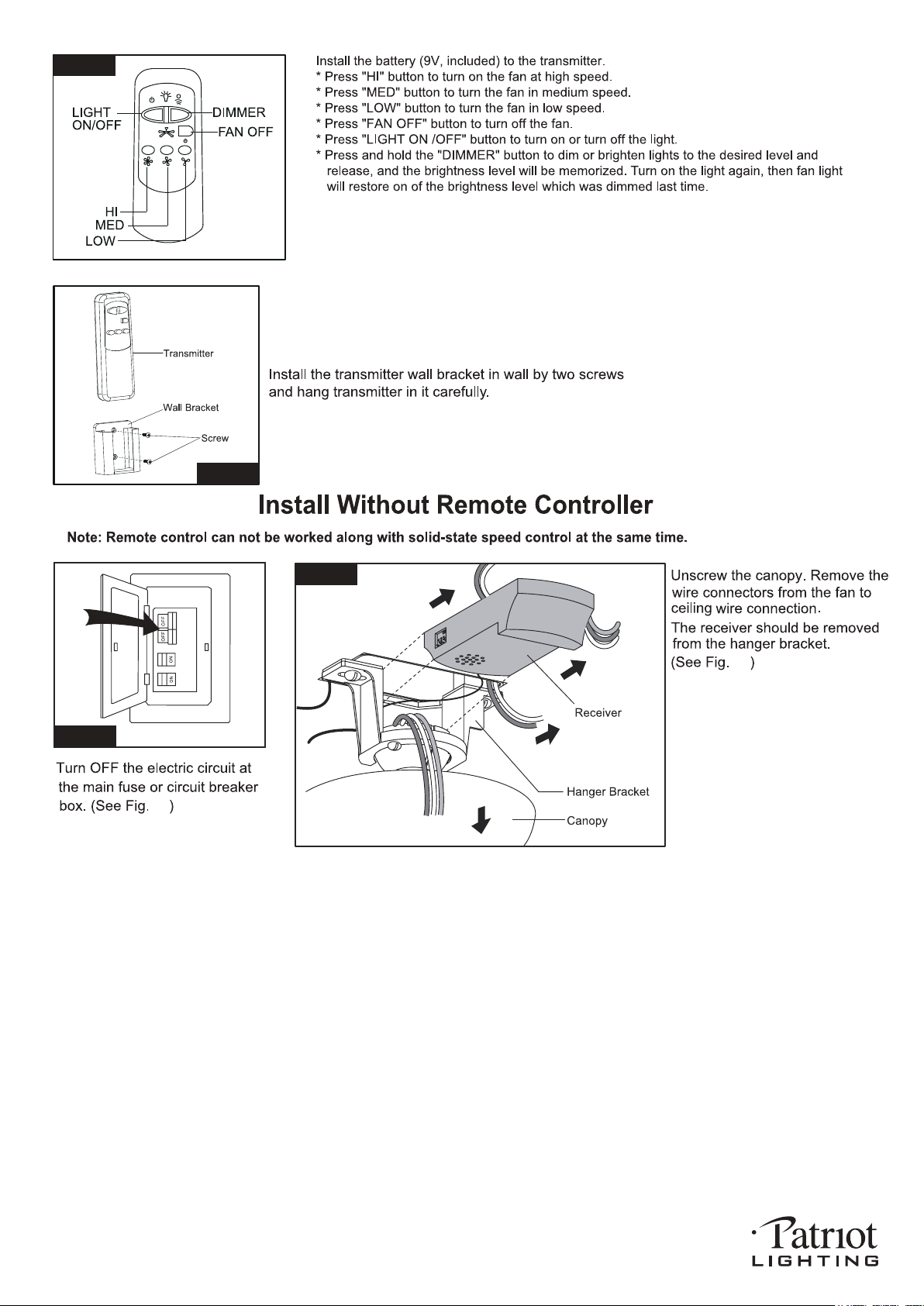
PAGE: 8 / 11
191227
Fig.22
Fig.21
Fig.23
23
Fig.24
24
Note:
1. This remote controller has memory function setting. The fan will operate at the same
speed and the fan light will stay at the same brightness as the last time the power
supply was turned off.
2. Compatible wall switch model No.: Menards SKU# 3632615 / 3635815.
3. Compatible with E12 (C) base dimmable LED bulbs model No.: Menards SKU#
3533501 / 3538602.
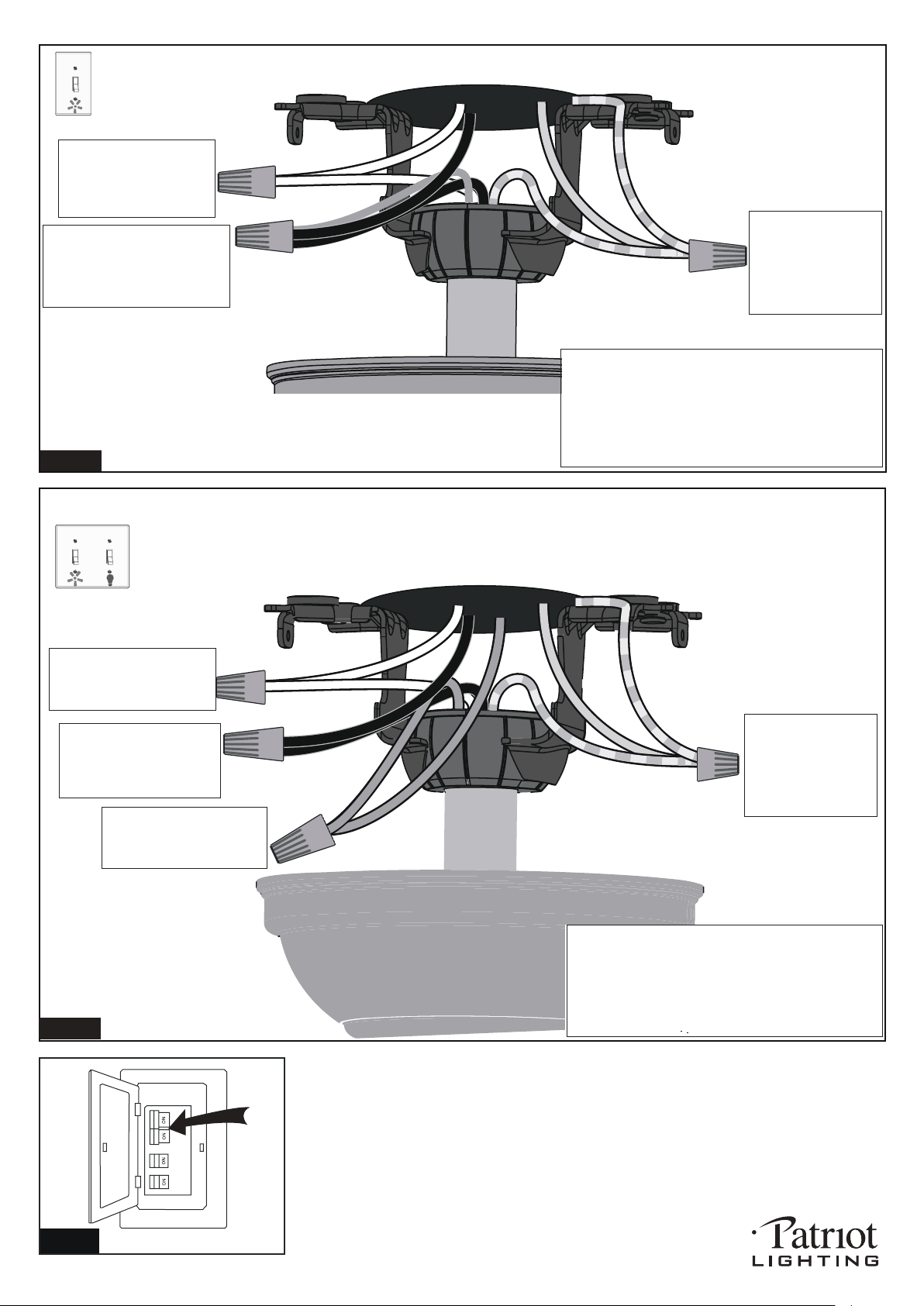
Fig.25
Connect the white (neutral)
wire from motor to the white
(neutral) wire from the
outlet box with a wire
connector.
Connect the black (hot) wire
(This is for fan control) and blue
wire (This is for light control) from
motor to the black (hot) wire from
outlet box with a wire connector.
Bla
Black
ck
Blue
Green
White
White
Grounding
Green
*** After making the wire connections, the wires should
be spread apart. The white (neutral) conductor and
green (grounding) conductor on one side and the
black (hot) conductor and blue (light) conductor on
the other side of the outlet box.
*** The wire connection points should be turned upward
and pushed carefully up into outlet box.
Connect three
ground wires (Green
or bare copper) coming
from outlet box,
downrod and hanging
bracket with a wire
connector.
For a single switch
Follow these steps:
Connect three
ground wires (Green
or bare copper) coming
from outlet box,
downrod and hanging
bracket with a wire
connector.
Connect the black (hot) wire
from motor (This is for fan
control) to the black (hot)
wire from outlet box with a
wire connector.
Green
Black
Blue
Green
White
Black
Blue
(light)
White
Grounding
Connect the white (neutral)
wire from motor to the white
(neutral) wire from outlet box
with a wire connector.
Connect the blue wire (This
is for light control) from motor
to the blue wire from outlet
box with a wire connector.
*** The wire connection points should be turned
upward and pushed carefully up into outlet box.
Fig.27
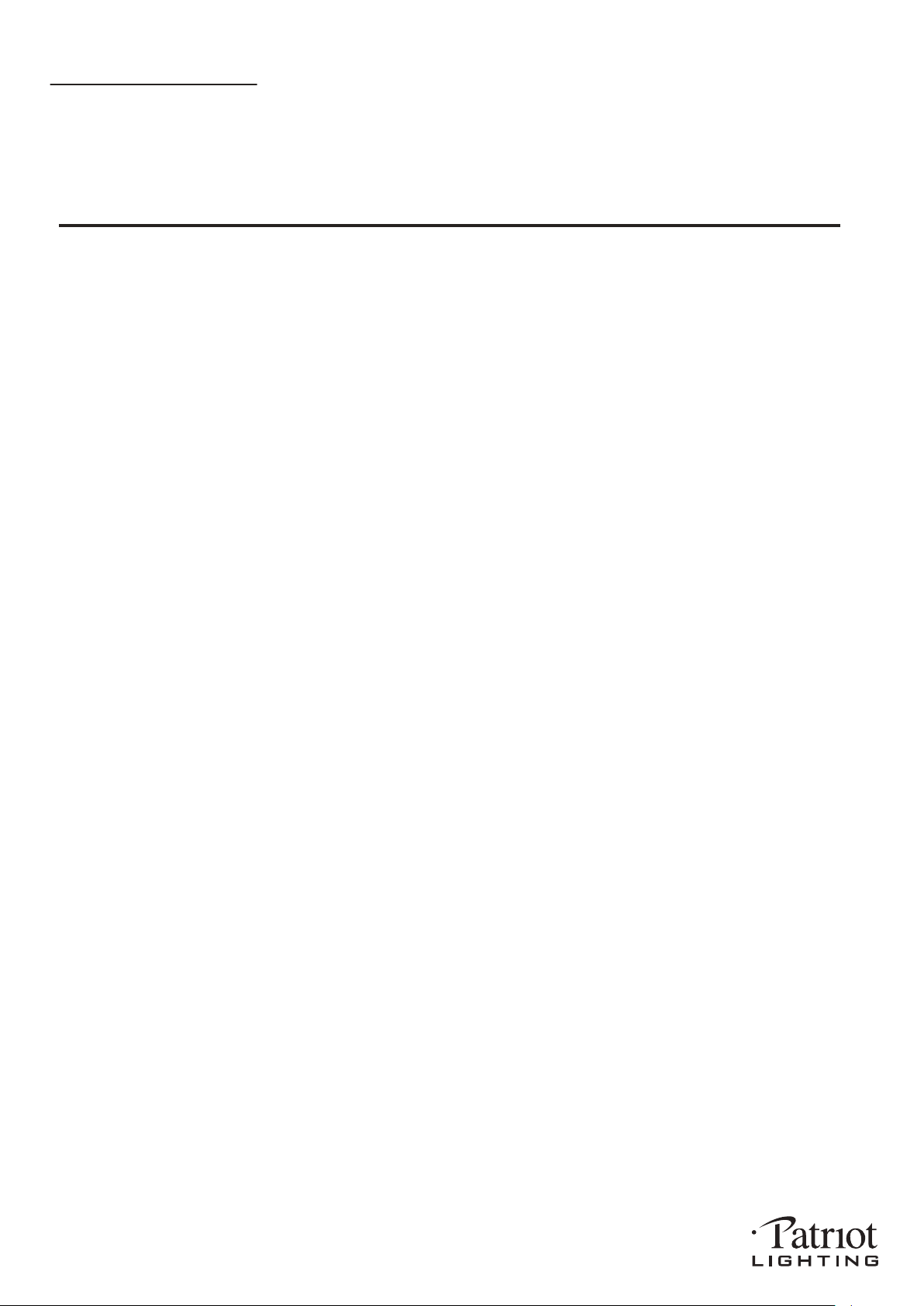
Turn ON the electric circuit at the main fuse or circuit breaker box.
For dual switches
Follow these steps:
*** After making the wire connections, the wires should
be spread apart. The white (neutral) conductor and
green (grounding) conductor on one side and the
black (hot) conductor and blue (light) conductor on
the other side of the outlet box.
PAGE: 9 / 11
Fig.26
191227
PAGE: 10 / 11
191227
Troubleshooting Guide
If you have difficulty operating your new ceiling fan, it may be the result of incorrect assembly, installation
or wiring. If you experience any faults, please check this Troubleshooting Guide. If a problem cannot be
remedied or you are experiencing difficulty in installation, please call our Customer Service Department
(1-800-887-6326).
PROBLEM
1. If fan does not start:
2. If fan sounds noisy:
3. If fan wobbles:
4. If light does not work:
1. Check main and branch circuit fuses or circuit breakers.
2. Make sure forward/reverse switch is firmly in left or right position. Fan will not
operate when switch is in the middle.
3. Make sure that the wall control is turned "ON".
4. Check line wire connections to fan and switch wire connections in switch housing.
CAUTION: Make sure main power is turned off.
1. Make sure all screws in motor housing are snug. (not over tightened)
2. Make sure the screws which attach the fan blade bracket to the motor are tight.
3. Make sure wire connectors in switch housing are not rattling against each
other or against the interior wall of the switch housing.
CAUTION: Make sure main power is turned off before accessing switch housing.
4. If using an optional ceiling fan light kit, make sure the screws securing
the glassware are finger tight. Make sure light bulb is tight in socket and
not touching glass shade(s). If vibration persists from glass, remove glass and
install a 1/4 in. wide rubber band on glass neck to act as an insulator. Replace
glass and tighten screws against rubber band.
5. Some fan motors are sensitive to signals from Solid State variable speed
controls. DO NOT USE a Solid State variable speed control.
6. Allow "break-in" period of 24 hours. Most noises associated with a new fan will
disappear after this period.
All blades are weighed and grouped by weight. Natural woods vary in density
which could cause the fan to wobble even though all blades are weight-matched.
The following procedures should eliminate most of the wobble. Check for wobble
after each step.
1. Check that all blades are screwed firmly into blade brackets.
2. Check that all blade brackets are tightened securely to motor.
3. Make sure that canopy and hanger bracket are tightened securely to ceiling
junction box and junction box is mounted firmly to ceiling joist.
4. Most wobble problems of fan are caused when blades are not in equal level. To
check the blade levels, select a point on the ceiling above the tip of any blade.
Measure the distance from the ceiling to the blade tip, to an accuracy of 1/8
inch. Rotate the blades until the next blade is in the measuring position. Repeat
measurement for each blade. If all blade levels are not equal, you can adjust
blade levels by the following procedure. To adjust a blade tip down, insert a
washer (not supplied) between the blade and blade bracket at the screw
closest to the motor. To adjust a blade tip up, insert washer (not supplied)
between the blade and blade bracket at the two screws farthest from the motor.
5. Interchanging two adjacent blades could redistribute the weight and possibly result
in smoother operation.
1. Check blue wire from fan to make sure it is connected to hot wire from supply wire
coming out of the ceiling.
2. Check for loose or disconnected wires in fan switch housing.
3. Check for loose or disconnected wires in light kit.
4. Check for faulty light bulbs.
CAUTION: Make sure main circuit is turned off before entering switch housing.
SUGGESTED REMEDY
PAGE: 11 / 11
191227
DYNAMIC BLADE BALANCING KIT
PREFACE
Your ceiling fan may sometimes have wobbling problems when operating due to irregularity in the
blades or the blade brackets. Improper assembly in the mounting system may cause some additional
problems. This balancing kit can be used to fix wobbling problems.
DYNAMIC BLADE BALANCING KIT FOR CEILING FANS
1. Make sure that all blades are firmly screwed into the blade brackets.
2. Make sure that all blade brackets are firmly secured to the motor housing.
3. By looking up at the fan from below, check and be certain that none of the blade brackets are bent
and that none of the blades are out of position.
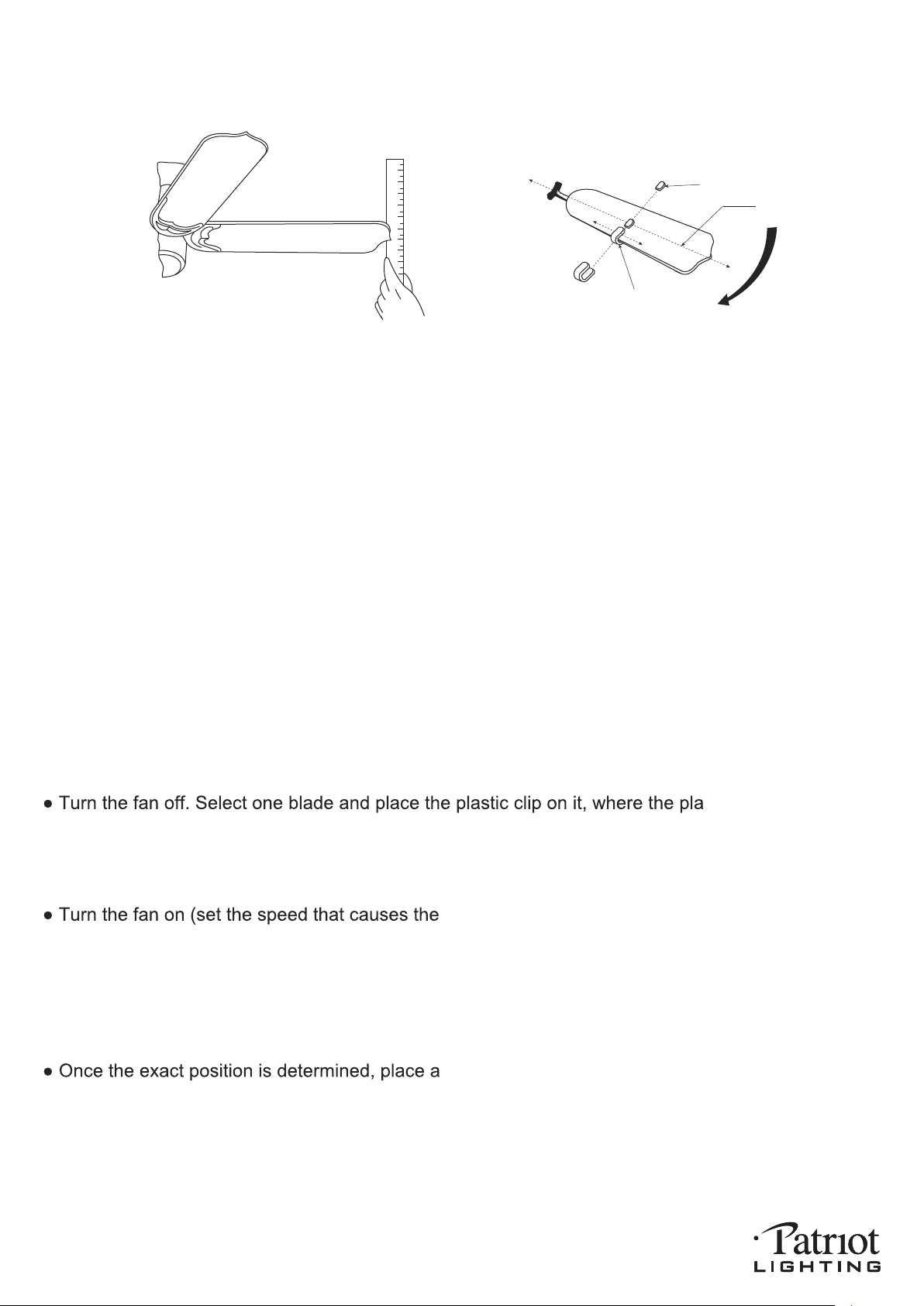
4. Use a yardstick to check the blade tracking. Put the yardstick up against the ceiling vertically and
against the outside leading edge of a blade. Note the distance of the edge of blade to the ceiling.
Carefully turn the blades slowly by hand to check the remaining blades. All distances should be
the same.
Operate the fan ten minutes. After following all the steps and if the wobbling problem is not solved, a
dynamic balancing needs to be done with balancing kit. Follow the procedure listed below:
stic clip locates is
halfway between the blade bracket and the blade tip on the edge of the blade.
Caution: The plastic clip should be placed on the windward edge of the blade for fear of
clip flying off.
wobble most). Observe if the wobble is better or
worse. Turn the fan off and move the clip to the next blade. Do the same for all blades and note
on which blade the clip reduces the wobble most. Place the clip on the blade which showed the
most improvement. Move the clip inward and outward on this blade and operate the fan to find
the position where the clip gives the most improvement.
Caution: Stay clear of the blades. If the clip, for any reason, is not secure, injury could result .
weight on the top of the blade, on its centerline and
as close as possible to the clip. Peel the paper off of the back of the weight and press firmly to
ensure that it is securely attached to the blade. Remove the clip.
Caution: Clean the surface of fan blade before placing the balancing weight so that the
balancing weight can be firmly attached on it.
BALANCING WEIGHT
MEASURING
POINT
YARDSTICK
PLASTIC CLIP
CENTERLINE
COUNTER-
CLOCKWISE
1
2
3
4
5
6
7
8
9
