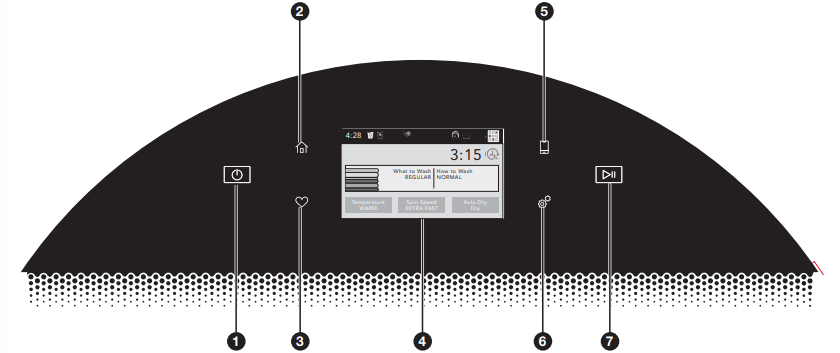
Touch this button and the LCD screen will show the home screen, where you can select your cycle, settings, and options.
FAVORITES BUTTON
Stores and accesses your favorite cycles.
LCD SCREEN
Use this screen to select cycle, settings, options, etc.
REMOTE ENABLE BUTTON
Touch this button to be able to use the Whirlpool™ app to control the washer/dryer. Download the Whirlpool™ app and follow the instructions to connect your washer/dryer to your home Wi-Fi network.
TOOLS BUTTON
Touch this button to access the tools screen. For more information, see page 13.
START/PAUSE BUTTON
Touch to start, or touch to pause a cycle. When you start a cycle, the door will lock, the washer/dryer will sense the load size, and the wash or dry cycle will begin.
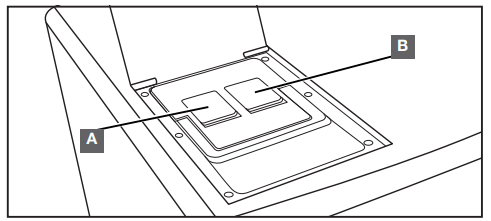
Load & Go™ Bulk Dispenser
The Load & Go™ bulk dispenser holds up to 33.8 oz. (1000 mL) of liquid HE detergent (Dispenser 1) and 16.9 oz. (500 mL) of liquid fabric softener or liquid HE detergent (Dispenser 2), enough for multiple loads of laundry. It adds the appropriate quantity of HE detergent and liquid fabric softener to the wash load at the proper time.
Dispenser 1
This dispenser holds 33.8 oz (1000 mL) of liquid HE detergent for your main wash cycle, and automatically dispenses liquid detergent at the optimum time in the cycle.
Dispenser 2
This dispenser holds 16.9 oz (500 mL) of liquid fabric softener. It automatically dispenses liquid fabric softener at the optimum time in the cycle. This dispenser may instead be used as a second liquid HE detergent dispenser. See Step 11 on page 13 for information.
IMPORTANT: Do not use chlorine bleach in this washer/dryer, and do not use powdered detergent in the Load & Go™ bulk dispenser. Powdered detergent must be added to the drum prior to adding laundry. See “Using the All-In-One Washer/Dryer.”
Using the Load & Go™ Bulk Dispenser
Follow the steps below to fill the Load & Go™ bulk dispenser when using the washer for the first time, or when the low detergent icon or low fabric softener icon on the display indicate that the detergent or fabric softener level is running low.
1. Open the bulk container lid on the top of the washer/dryer
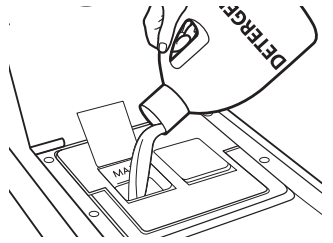
2. Lift the fill door on the Liquid Detergent dispenser (Dispenser 1). Add liquid HE detergent up to the “MAX” line. Do not overfill. Close the fill door. It will click into place. NOTE: If Dispenser 1 is empty, you may choose to add only enough liquid HE detergent for one load.
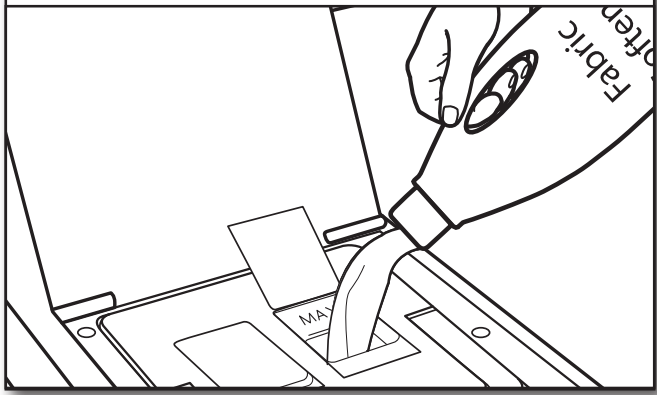
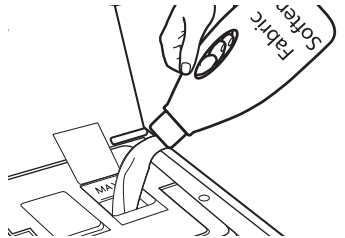
3. Lift the fill door on the Liquid Fabric Softener dispenser (Dispenser 2). Add liquid fabric softener up to the “MAX” line. Do not overfill. Close the fill door. It will click into place. NOTE: If Dispenser 2 is empty, you may choose to add only enough liquid fabric softener for one load.
4. Slowly close the bulk container lid. Make sure it is completely closed.
5. Make sure that the bulk dispenser is active. Use the Tools button to make sure that both Dispenser 1 and Dispenser 2 are active and that the detergent concentration is correct.
Use only High Efficiency (HE) detergent.
NOTES:
Dispenser 2 may be used as a second Liquid HE Detergent dispenser. Use the Tools button (go to “Load & Go™ Dispenser to change the content in Dispenser 2 and set the detergent concentration. Make sure that the other dispenser is disabled.
The entire Load & Go™ bulk container can be easily removed for ease of cleaning.
Thoroughly clean the Liquid Detergent dispenser (Dispenser 1) before switching to a different brand of detergent.
Thoroughly clean the Liquid Fabric Softener dispenser Dispenser 2) before switching from liquid fabric softener to liquid detergent, before switching back from liquid detergent to liquid fabric softener, or before switching to a different brand of detergent.
IMPORTANT:
Do not use chlorine bleach in this washer/dryer. Chlorine bleach will damage it.
Do not add a single-dose laundry packet to the bulk dispenser.
Do not use powdered HE detergent in the bulk dispenser.
Using the All-In-One Washer/Dryer
First wash cycle without laundry
Before washing clothes for the first time, set up the Load & Go™ bulk dispenser (see page 9). Choose the Regular (What to Wash) and Quick (How to Wash) cycle and run it without clothes. Use only HE detergent. This initial cycle serves to ensure the interior is clean and the bulk dispenser is primed and ready for use before washing clothes.
If using liquid HE detergent in both Dispenser 1 and Dispenser 2, you will need to run a second cycle without laundry as indicated above to prime Dispenser 2 and clean the interior. Using the Tools button, make sure that Dispenser 1 is disabled when priming Dispenser 2 for detergent.
1. Sort and prepare your laundry
Sort items by recommended cycle, water temperature, and colorfastness. Separate heavily soiled items from lightly soiled. Separate delicate items from sturdy fabrics. Treat stains promptly and check for colorfastness by testing stain remover products on an inside seam.
IMPORTANT:
Empty pockets. Loose change, buttons, or any small object can plug pumps and may require a service call.
Close zippers, fasten hooks, tie strings and sashes, and remove non-washable trim and ornaments.
Mend rips and tears to avoid further damage to items during washing.
Turn knits inside out to prevent pilling. Separate lint-takers from lint-givers. Synthetics, knits, and corduroy fabrics will pick up lint from towels, rugs, and chenille fabrics.
Do not dry garments if stains remain after washing, because heat can set stains into fabric.
Always read and follow fabric care labels and laundry product instructions. Improper usage may cause damage to your garments.
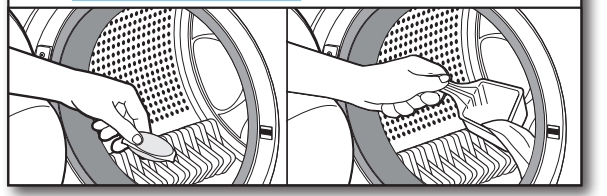
2. If desired, instead of liquid detergent, add powdered HE detergent and/or laundry products
Powdered HE detergent, single-dose laundry packets, Oxi-type boosters, or scented crystals can be added to the drum prior to adding laundry. Make sure that the Load & Go™ bulk dispenser is disabled or off, and skip Step 4 when using powdered HE detergent or single-dose laundry packets.
NOTES:
Always follow manufacturer’s instructions.
Do not use chlorine bleach.
3. Load laundry into washer/dryer
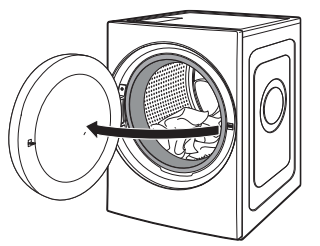
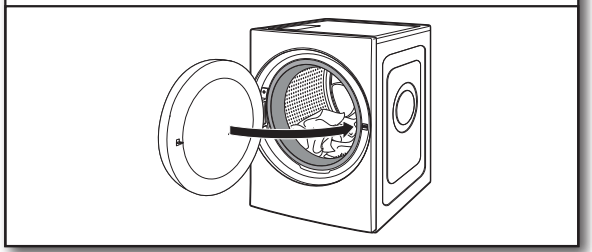
Place a load of sorted items loosely in the washer/dryer. Items need to move freely for best cleaning and to reduce wrinkling and tangling. If using the drying option, loading the drum half full or less and not interrupting the drying cycle by opening the door will improve drying performance and cycle time. Close the washer/dryer door by pushing it firmly until the latch clicks.
Mix large and small items and avoid washing single items. Load evenly.
Wash small items in mesh garment bags. For multiple items, use more than one bag and fill bags equally
4. Add liquid HE detergent to Load & Go™ bulk dispenser (if bulk dispenser is not already loaded or if low detergent icon on display is lit), if desired
5. Add liquid fabric softener to Load & Go™ bulk dispenser (if bulk dispenser is not already loaded or if low fabric softener icon on display is lit), if desired
Press the TOOLS button and make sure that the bulk dispenser is active.
IMPORTANT:
Do not overfill or dilute fabric softener.
Do not spill or drip any fabric softener onto the clothes.
Do not use scented crystals in the bulk dispenser.
They will not dispense correctly.
Do not mix fabric softener and detergent in Dispenser 2 at the same time.
6. Touch POWER button to turn on washer/dryer. Touch until the indicators turn on.
7. Select wash program/cycle
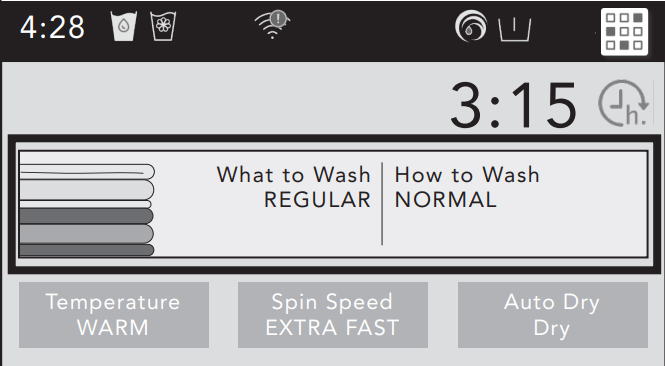
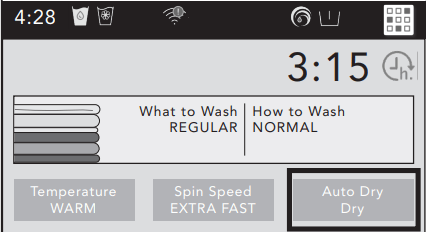
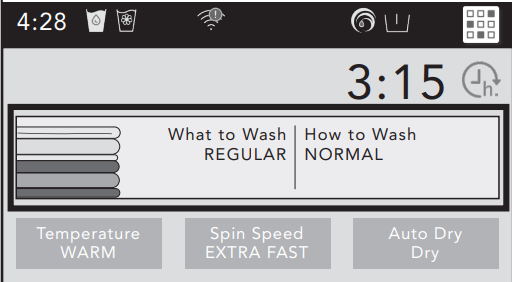
From the home screen, touch the “What to Wash” area of the screen to select the program that best matches the items you want to wash. You may need to scroll down with your finger to see all of the selections. Touch the desired program to return to the home screen.
Touch the “How to Wash” area of the screen to select the program that best matches the method that you would like to wash those items. You may need to scroll down with your finger to see all of the selections. Touch the desired program to return to the home screen.
8. Select temperature and spin speed
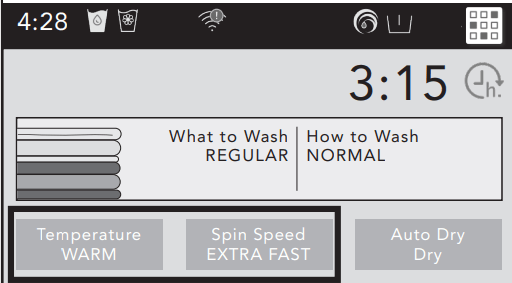
From the home screen, touch the “Temperature” area of the screen to show the Temperature settings available for the cycle/program chosen in Step 7. Touch the desired setting and touch OKAY to confirm that setting.
The recommended wash temperature is preset for each cycle. Some preset temperatures can be changed. You may select a different wash temperature based on the level of soil and type of fabric being washed. For best results, use the warmest wash water safe for your fabric, following the garment label instructions. All wash temperatures feature a cold rinse.
Touch the “Spin Speed” area of the screen to show the Spin Speed settings available for the cycle/program chosen in Step 7. Touch the desired setting and touch OKAY to confirm that setting.
The recommended spin speed is preset for each cycle. Some preset speeds can be changed.
Faster spin speeds mean shorter dry times, but may increase wrinkling in your load.
Slower spin speeds reduce wrinkling, but will leave your load more damp.
Drying Function (Step 9)
9. Select drying function, if desired
From the home screen, touch the “Drying Mode” area of the screen to show the available Drying Mode settings.
From the Drying Mode screen, choose between Auto-Drying and Timed-Drying. For Auto-Drying, touch Auto-Drying and then touch the screen to choose between Damp Dry, Dry, and Extra Dry. For Timed-Drying, touch Timed-Drying and then touch the screen to choose between :30 HR, 1:00 HR, 1:30 HR, 2:00 HR, 3:00 HR, and 4:00 HR. Expect longer drying times than with traditional vented dryers.
To run a dry cycle only:
Load the drum half full or less for optimal drying performance and cycle time. From the home screen, touch the “Drying Mode” area of the screen to show the available Drying Mode settings, and from the Drying Mode screen, after making the Auto-Drying or Timed-Drying choices as mentioned above, touch “DRYING ONLY ON.” Do not open the door during the drying cycle.
NOTE: If items to dry are highly saturated, run a high speed Spin cycle prior to running the Dry cycle.
IMPORTANT:
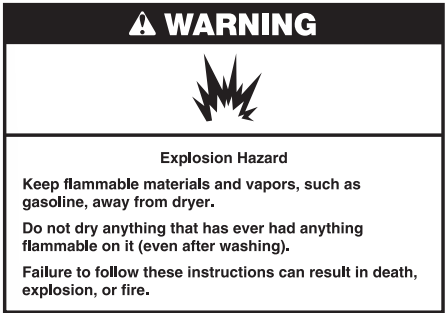
Do not use dryer sheets.
Do not dry comforters or large blankets.
10. Select options, if desired
From the home screen, touch the Options icon (at upper right of screen) and the Options screen will show Soil Level, Extra Rinses, Pre-Soak, Tumble Fresh,™ and Wrinkle Shield™ selections. Previously selected “What to Wash” and “How to Wash” options will be shown on the screen. Touch the screen for each option to change its setting.
Soil Level Option
The Soil Level option allows you to select a Light, Normal, or
Heavy soil level setting. The recommended soil level is preset for each cycle. Some preset soil levels can be changed. For heavily soiled and sturdy fabrics, select the Heavy soil level setting. For lightly soiled and delicate fabrics, select the Light soil level setting. Lower soil level settings will help reduce tangling and wrinkling.
Extra Rinses Option
The Extra Rinses option provides one or more additional rinses to the selected cycle. The extra rinses can be canceled at any time by touching the “X” on the touch screen to the right of the estimated time remaining.
Pre-Soak Option
The Pre-Soak option can be set either on or off. Pre-Soak may be ended at any time by touching the “X” on the touch screen to the right of the estimated time remaining.
Tumble Fresh™ Option
The Tumble Fresh™ option will periodically tumble the load after the end of the cycle for up to 12 hours. Touch TUMBLE FRESH to activate this option. This option is not available when a drying mode is selected. Tumble Fresh™ may be ended at any time by touching the “X” on the touch screen to the right of the estimated time remaining.
Wrinkle Shield™ Option
The Wrinkle Shield™ option is only available when a drying mode is selected, and will periodically tumble the load after the end of the cycle for up to 12 hours. Wrinkle Shield™ may be ended at any time by touching the “X” on the touch screen to the right of the estimated time remaining.
11. Use Tools button to change other settings, if desired
The Tools button gives access to many other settings, utility cycles, preferences, and information. Touch the TOOLS button to access the Tools screen, which contains the following (you will need to scroll down with your finger to access all of the selections).
12. Touch START/PAUSE button to begin cycle
Touch the START/PAUSE button to start the cycle. To pause a cycle in progress, touch the START/PAUSE button once, then touch again to continue the cycle. To cancel a cycle, touch the “X” on the touch screen to the right of the estimated time remaining. Once you touch the START/PAUSE button, you will hear the door lock. The washer/dryer door will remain locked during a wash cycle.
13. Touch POWER button to turn off washer/dryer after cycle ends
Touch the POWER button to turn off the washer/dryer at the end of a cycle. The Power button is also used to turn on the washer/dryer before use.
14. Remove garments promptly after cycle is finished
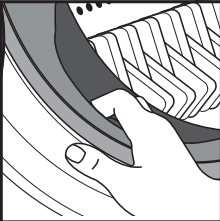
After a wash-only cycle, promptly remove garments after cycle has completed to avoid odor and rusting of metal objects on garments. When unloading garments, pull back the door seal and check for small items between the tub and the washer/dryer drum.
If you will be unable to remove the load promptly after a washonly cycle, use the Tumble Fresh™ option.
After a wash and dry cycle or a dry-only cycle, promptly remove garments after cycle has completed to reduce wrinkling.
NOTES:
The door will remain locked while the Tumble Fresh™ option is active after a wash-only cycle. To cancel the Tumble Fresh™ option and unlock the door, touch the “X” on the touch screen to the right of the estimated time remaining.
This washer/dryer has a tight seal to avoid water leaks. To avoid odors, leave the door open to allow the washer/dryer to dry between uses.
If a dry cycle is interrupted and the load removed before the cool-down period at the end of the cycle, the load will be very hot.
Setting a delayed start
Touch POWER until the indicators turn on. From the home screen, make sure the washer/dryer is set to the correct time and date (if it is not, see Step 11 on page 13 for instructions on how to set the time and date).
Touch the clock icon on the far right portion of the touch screen. The “Select a start time” screen will show on the display. Scroll horizontally to select a preferred start time for your wash or dry cycle. The times will display in 15-minute increments. Press OKAY to set the start time. The display will return to the home screen and the clock icon will turn brown.
To delete or modify the delayed start, press the clock icon again and follow the screen prompts.
MAINTENANCE
CLEANING THE WASHER/DRYER LOCATION
Keep washer/dryer area clear and free from items that would block the airflow for proper dryer operation. This includes clearing piles of laundry in front of the washer/dryer.
WASHER/DRYER CARE
Recommendations to Help Keep Your Washer/Dryer Clean and Performing at its Best
1. Always use High Efficiency (HE) detergents and follow the HE detergent manufacturer’s instructions regarding the amount of HE detergent to use. Never use more than the recommended amount because that may increase the rate at which detergent and soil residue accumulate inside your washer, which in turn may result in undesirable odor.
2. Use warm or hot water washes sometimes (not exclusively cold water washes), because they do a better job of controlling the rate at which soils and detergent accumulate.
3. Always leave the washer/dryer door slightly ajar between uses to help dry out the washer/dryer and avoid the buildup of odor-causing residue.
4. Periodically clean residue from all interior surfaces of the glass window. For better care, wipe the entire inside of the glass door with a damp cloth.
Cleaning Your Front-Loading Washer/Dryer
Read these instructions completely before beginning the routine cleaning processes recommended below. This Washer Maintenance Procedure should be performed, at a minimum, once per month or every 30 wash cycles, whichever occurs sooner, to control the rate at which soils and detergent may otherwise accumulate in your washer/dryer.
Cleaning the Door Seal
Open the washer/dryer door and remove any clothing or items from the washer/dryer.
Inspect the seal between the door opening and the drum for stained areas or soil buildup. Pull back the seal to inspect all areas under the seal and to check for foreign objects.
If stained areas or soil buildup are found, wipe down these areas of the seal using the following procedure: When the cycle is complete, gently pull back the rubber door seal and clean the entire surface with the textured side of an affresh® Machine Cleaning Wipe.
Cleaning the Inside of the Washer/Dryer
This washer/dryer has a special cycle that uses higher water volumes in combination with affresh® Washer Cleaner to thoroughly clean the inside of the washer/dryer.
NOTE: Read these instructions completely before beginning the cleaning process.
Begin procedure
Clean Washer with affresh® Cycle Procedure Recommended for Best Performance):
a. Open the washer/dryer door and remove any clothing or items.
b. Use an affresh® Machine Cleaning Wipe or a soft, damp cloth or sponge to clean the inside door glass.
c. Add an affresh® Washer Cleaner tablet to the washer drum.
d. Do not add the affresh® Washer Cleaner tablet to the bulk dispenser.
e. Do not add any detergent or other chemical to the washer/dryer when following this procedure.
f. Close the washer/dryer door.
g. Select the Clean Washer with affresh® cycle.
h. Select the Tumble Fresh™ option to help dry the washer/dryer interior after the cycle is complete.
NOTE: The washer/dryer remembers your last option selection and will use it for future wash cycles until you deselect that option.
i. Touch the START/PAUSE button to begin the cycle. The Clean Washer with affresh® cycle operation is described below.
Description of Clean Washer with affresh® Cycle Operation:
Do not run this cycle with a load. Doing so could damage the items.
After the cycle is complete, leave the door open slightly to allow for better ventilation and drying of the washer/ dryer interior.
Cleaning the Load & Go™ Bulk Dispenser
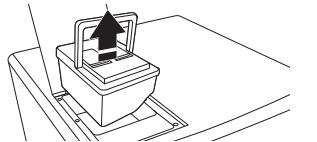
After a period of using your washer/dryer, you may find some residue buildup in the Load & Go™ bulk dispenser. To remove residue from the dispensers, lift the handle on the dispenser container housing to remove it from the washer/ dryer cabinet, then rinse the two dispensers thoroughly with running water. Wipe the outside dispenser container surfaces with an affresh® Machine Cleaning Wipe or a damp cloth and towel dry. Use an all-purpose surface cleaner, if needed.
Replace the dispenser container in the washer/dryer cabinet and make sure that it is seated.
IMPORTANT: Load & Go™ bulk dispenser container is not dishwasher-safe.
Cleaning the Outside of the Washer/Dryer
Use an affresh® Machine Cleaning Wipe or a soft, damp cloth or sponge to wipe up any spills. Occasionally wipe the outside of your washer/dryer to help keep it looking new. Use an affresh® Machine Cleaning Wipe or mild soap and water.
IMPORTANT: To avoid damaging the washer/dryer finish, do not use abrasive products.
CLEAN WASHER CYCLE REMINDER
The Clean Washer with affresh® message will flash at the end of a wash cycle when the washer has run 30 wash cycles. This is a reminder to run the Clean Washer with affresh® cycle.
If the Clean Washer with affresh® cycle is not run, the message will stop flashing at the end of a wash cycle after running three more regular wash cycles. After 30 more wash cycles are completed, the Clean Washer with affresh® message will again flash at the end of a wash cycle as a reminder.
REMOVING THE LOAD & GO™ BULK CONTAINER
To remove:
1. Lift the bulk container lid on the top of the washer/dryer.
2. Lift up on the bulk container handle and pull straight up and out of the washer/dryer
To replace:
1. Place the bulk container back into the bulk container cavity on the top of the washer/dryer and make sure that it is seated.
2. Close the bulk container lid.
WATER INLET HOSE
Replace inlet hose after 5 years of use to reduce the risk of hose failure. Periodically inspect and replace inlet hose if bulges, kinks, cuts, wear, or leaks are found.
When replacing your inlet hose:
■ Mark the date of replacement on the label with a permanent marker.
■ Check that the old washer is not stuck on the washer inlet valve.
■ Use a new washer in the new inlet hose to ensure a proper seal.
NON-USE AND VACATION CARE
If moving, or not using your washer/dryer for a period of time, follow these steps:
1. Unplug or disconnect power to washer/dryer.
2. Turn off water supply to washer/dryer to avoid flooding due to water pressure surges. HELPFUL TIP: Attach a reminder note to the washer/ dryer to turn the water back on before washer’s next use.
3. Clean the bulk dispenser. See “Cleaning the Load & Go™ Bulk Dispenser.
WINTER STORAGE CARE
IMPORTANT: To avoid damage, install and store washer/ dryer where it will not freeze. Because some water may stay in hoses, freezing can damage washer/dryer. If storing or moving during freezing weather, winterize your washer/dryer.
To winterize washer/dryer:
1. Shut off water faucet, disconnect and drain water inlet hose.
HELPFUL TIP: Attach a reminder note to the washer/ dryer to turn the water back on before washer’s next use.
2. Remove drain pump filter.
3. Put 1 qt. (1 L) of R.V.-type antifreeze in drum and run washer on Normal cycle for about 2 minutes to mix antifreeze and remaining water.
4. Unplug washer/dryer or disconnect power
CLEANING THE DRAIN PUMP FILTER/ DRAINING RESIDUAL WATER
NOTE: Perform the following procedure every 6 months.
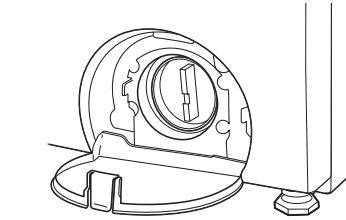
1. Open the drain pump filter access door at the bottom right corner at the front of the washer/dryer.
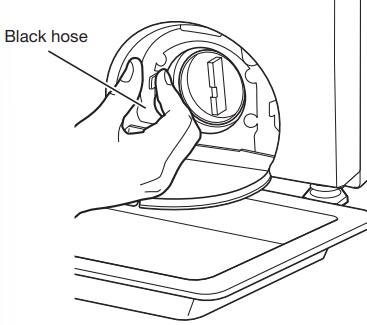
2. Place a broad, flat pan beneath the drain pump filter to collect the drain water. Pull out the black hose, remove the plug, and drain the hose into the pan. Empty the pan. Replace the drain hose plug and put the hose back into place. Repeat this procedure if necessary until all the water has drained. Make sure that the black hose is completely dry
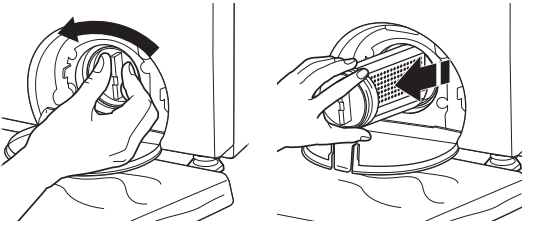
3. Lay a cotton cloth beneath the drain pump filter to absorb any water still in it. Then remove the drain pump filter by turning it counterclockwise.
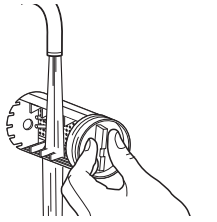
4. Remove large clumps of lint by hand from the filter and place lint in a suitable waste container. Remove remaining residue from the filter by rinsing with water.
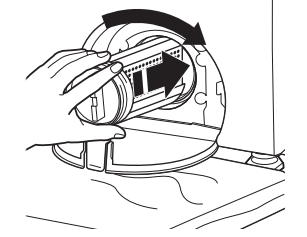
5. Reinsert the drain pump filter by turning it clockwise. Make sure to turn it in as far as it will go, with the filter handle left in a vertical position.
TRANSPORTING YOUR WASHER/DRYER
Shut off water faucet. Disconnect and drain water inlet hose.
If washer/dryer will be moved during freezing weather, follow “Winter Storage Care” directions before moving.
Disconnect drain hose from drain system and from back of washer/dryer.
Unplug power cord.
Place inlet hose and drain hose inside drum.
Bundle power cord with a rubber band or cable tie to keep it from hanging onto the ground.
IMPORTANT: Call for service to install new transport bolts. Do not reuse transport bolts. Washer/dryer must be transported in the upright position. To avoid structural damage to your washer/dryer, it must be properly set up for relocation by a certified technician.
USING WASHER/DRYER AGAIN
To use washer/dryer again:
Flush water pipes and hose. Reconnect water inlet hose. Turn on water faucet.
Plug in washer/dryer or reconnect power.
Run washer/dryer through Heavy Duty wash cycle to clean washer/dryer and remove antifreeze, if used. Use only HE detergent. Use half the manufacturer’s recommended amount for a medium-size load.
TROUBLESHOOTING
If you experience
Possible Causes
Solution
Vibration or Off-Balance
Vibration, rocking, or “walking”
Feet may not be in contact with the floor and locked.
Front and rear feet must be in firm contact with floor, and washer/dryer must be level to operate properly. Jam nuts must be tight against the bottom of the cabinet.
Washer/dryer may not be level.
Check floor for flexing or sagging. Do not install washer/dryer on a raised wooden platform.
See “Level Washer/Dryer” in “Installation Instructions.”
Load could be unbalanced or too large.
Avoid tightly packing the load. Avoid washing single items. Balance a single item such as a rug or jean jacket with a few extra items.
Item or load not suitable for selected cycle. See “Cycle Guides” and “Using the All-In-One Washer/Dryer.”
The shipping bolts are still in the back of the washer/dryer.
See “Unpacking Washer/Dryer” in “Installation Instructions.”
Noises
Clicking or metallic noises
Door locking or unlocking.
The door will lock, unlock, and lock again. You will hear four clicks after touching the Start/Pause button. This is normal.
Objects caught in wash drain system.
Empty pockets before washing. Loose items such as coins could fall between washer/dryer drum and tub or may block pump. It may be necessary to call for service to remove items.
It is normal to hear metal items on clothing such as metal snaps, buckles, or zippers touch against the stainless steel drum.
Gurgling or humming
Washer/dryer may be draining water.
The pump may make a humming sound with periodic gurgling or surging as final amounts of water are removed during the spin/drain cycles. This is normal at certain stages of the cycle.
Water Leaks
Check the following for proper installation
Fill hose not attached tightly.
Tighten fill hose connection.
Fill hose washer.
Properly seat cold fill hose flat washer.
Drain hose connection.
Check that the drain hose is properly secured to drain pipe or laundry tub.
Drain pump filter is not properly seated.
Make sure filter is correctly placed in the housing. See “Cleaning the Drain Pump Filter/Draining Residual Water.”
Drain pump filter is clogged/drain pump filter hose plug is off or loose.
Clean the drain pump filter (see “Cleaning the Drain Pump Filter/Draining Residual Water”). Make sure drain pump filter hose plug is fully seated. If loose, order a replacement plug (see “Assistance or Service”).
Check household plumbing for leaks or clogged sink or drain.
Water can back up out of a clogged sink or drain pipe. Check all household plumbing for leaks (laundry tubs, drain pipe, water pipes, and faucet.)
Strainer (or nylon stocking) on end of drain hose is clogged.
Remove strainer/stocking from drain hose.
Water or suds leaking from door or rear of cabinet
Not using HE detergent or using too much HE detergent.
Only use HE detergent. Suds from regular detergents can cause leaking from the door or rear of cabinet. Always measure detergent and follow manufacturer’s directions based on your load requirements.
Leaking around door
Hair, lint, or other debris on inner door glass preventing proper seal with rubber door seal.
Clean inner door glass and seal. See “Cleaning the Door Seal” in the “All-In-One Washer/Dryer Maintenance” section.
Wash cycle not performing as expected
Load not completely covered in water
Water level not visible on door or does not cover clothes.
This is normal for the all-in-one washer/dryer. The washer/dryer senses load sizes and adds the correct amount of water for optimal cleaning.
Washer/dryer won’t run or fill; washer/dryer stops working
Check for proper water supply.
Hose must be attached and have water flowing to the inlet valve.
Water faucet must be turned on.
Check that inlet valve screen has not become clogged.
Check for any kinks in inlet hose, which can restrict water flow.
Check proper electrical supply.
Plug power cord into a grounded 3 or 4 prong outlet.
Do not use an extension cord.
Ensure there is power to outlet.
Do not plug into a GFI (Ground Fault Circuit Interrupter).
Check electrical source or call an electrician to check if voltage is low.
Reset a tripped circuit breaker. Replace any blown fuses. NOTE: If problems continue, contact an electrician.
WARNING Electrical Shock Hazard
Plug into a grounded 3 or 4 prong outlet.
Do not remove ground prong.
Do not use an adapter.
Do not use an extension cord.
Failure to follow these instructions can result in death, fire, or electrical shock.
Washer/dryer won’t run or fill; washer/dryer stops working (cont.)
Normal washer/dryer operation.
Washer/dryer will pause during certain phases of cycle. Do not interrupt cycle.
The washer/dryer pauses for about 2 minutes during certain cycles. Allow the cycle to continue. Some cycles feature periods of tumbling and soak.
Washer/dryer may be stopped to reduce suds. Use only a proper amount of HE detergent.
The washer/dryer door is not firmly shut.
The door must be closed during operation.
The Load & Go™ bulk container is not fully seated in the washer/dryer.
Make sure that the Load & Go™ bulk container is fully seated in the washer/dryer, and that the lid on the bulk container is firmly closed.
Washer/dryer not loaded as recommended.
Remove several items, rearrange load evenly in washer/dryer drum. Close door and touch the START/PAUSE button.
Do not add more than one or two additional items after cycle has started to avoid tightly packing or unbalancing. Adding items is only allowed up to a certain point in the cycle.
Do not add more water to the washer/dryer.
Not using HE detergent or using too much HE detergent.
Only use HE detergent. Suds from regular detergents can slow or stop the washer/dryer. Always measure detergent, following manufacturer’s directions based on your load requirements.
To remove suds, cancel cycle. Select Rinse & Spin. Touch the START/PAUSE button. Do not add more detergent.
Washer/dryer stops during the program/cycle and a message appears on the screen
The program/cycle was interrupted (for example by the door being opened).
Make sure the door is closed. Touch the START/PAUSE button to continue with the program/cycle.
The safety system has been activated. A failure indicator will light up and/or the display will show a failure code.
Refer to error codes at the end of “Troubleshooting."
Cold water faucet is closed.
Make sure the water faucet is open and that there are no kinks in the inlet hose.
Washer/dryer not draining/ spinning; loads are still wet
Drain hose extends into standpipe further than 4.5" (114 mm).
Check drain hose for proper installation. Use drain hose form and securely attach to drain pipe or tub. Do not tape over drain opening.
The drain hose is clogged, or the end of the drain hose is more than 49" (1.3 m) above the floor.
Lower drain hose if the end is higher than 49" (1.3 m) above the floor. Remove any clogs from drain hose. See “Installation Requirements” in “Installation Instructions.”
Strainer/stocking on end of drain hose.
Remove strainer/stocking from drain hose.
The drain hose fits too tightly in the standpipe or is taped to the standpipe.
The drain hose should be loose, yet fit securely. Do not seal the drain hose with tape. The hose needs an air gap. See “Route Drain Hose” in “Installation Instructions.”
Washer/dryer not draining/spinning; loads are still wet
Using cycles with a lower spin speed.
Cycles with lower spin speeds remove less water than cycles with high spin speeds. Use the recommended cycle/ spin speed for your garment.
Washer/dryer not loaded as recommended.
A tightly packed or unbalanced load may not allow the washer/dryer to spin correctly, leaving the load wetter than normal. See “Cycle Guides” for load size recommendation for each cycle.
An unbalanced load prevented the Spin cycle from activating to avoid damage to the washer/dryer.
To spin wet laundry, add more laundry items of different sizes and start the Rinse & Spin program. Avoid small laundry loads consisting of a few large, absorbent items and wash different-sized items in one load. Avoid washing single items.
Not using HE detergent or using too much HE detergent.
Use only HE detergent. Suds from regular detergent or using too much detergent can slow or stop draining or spinning. Always measure and follow manufacturer’s directions for your load. To remove extra suds, select Rinse & Spin. Do not add detergent.
Small items may have been caught in the pump or stuck between the washer/dryer drum and the outer tub.
Check the drum for any items sticking through the drum holes. Empty pockets and use garment bags when washing small items.
Drain pump filter is dirty.
Clean drain pump filter. See “Cleaning the Drain Pump Filter/Draining Residual Water.”
Door locked at end of wash cycle
Water remaining in washer/dryer after cycle.
Select Drain to remove any water remaining in the washer/ dryer. The door will unlock at the end of the drain.
Tumble Fresh™ option is on.
While this option is on, the load is tumbled periodically for up to 12 hours. The door remains locked during this time. To unlock the door, cancel the Tumble Fresh™ option by touching the “X” on the touch screen to the right of the estimated time remaining.
Door will not unlock
Error code is displayed.
Failure mode will lock the door. Touch the START/PAUSE button to exit, then wait for the door to unlock.
Water temperature is hotter than 104°F (40°C).
Wait for the water temperature to drop.
Door lock mechanism malfunction.
Perform procedure in “How to Manually Open Door,” page 44.
Incorrect or wrong wash temperatures
Improper water supply connection. Inlet hose connected to hot water supply.
Inlet hose must be attached to both washer/dryer and cold water supply faucet, and have water flowing to inlet valve.
Check that inlet valve screen is not clogged.
Remove any kinks in hose.
Load not rinsed
Improper water supply connection.
Inlet hose must be attached to both washer/dryer and cold water supply faucet and have water flowing to inlet valve.
Cold water faucet must be on.
Inlet valve screen on washer/dryer may be clogged.
Remove any kinks in the inlet hose.
Not using HE detergent or using too much HE detergent.
The suds from non-HE detergent can cause the washer/dryer to operate incorrectly.
Use only HE detergent. Always measure detergent and follow manufacturer’s directions based on load size and soil level.
Washer/dryer not loaded as recommended.
Avoid tightly packing the washer/dryer. The washer/dryer will not rinse well if tightly packed. Load with dry items only. See “Cycle Guides” for load size recommendations for each cycle.
Use cycle designed for the fabrics being washed.
Add only one or two garments after washer/dryer has started.
The load may be out of balance.
When load unbalance occurs, a washing process will start to redistribute the load. This may lengthen the cycle time. Avoid washing single items. Balance a single item such as a rug or jean jacket with a few extra items.
The load needs additional rinses.
Most cycles allow for the option of additional rinses. See “Cycle Guides” and Step 10 on page 13 for additional rinse options.
Load is wrinkled, twisted, or tangled
Washer/dryer not loaded as recommended.
Add load loosely. Items need to move freely to reduce wrinkling and tangling. See “Cycle Guides” for load size recommendations for each cycle.
Reduce tangling by mixing types of load items. Use the recommended cycle for the type of garments being washed.
Spin speed too high for load.
Select a lower spin speed. Note that items will be wetter than when using a higher spin speed.
The washer/dryer is not unloaded promptly.
Unload the washer/dryer as soon as it stops or use the Tumble Fresh™ option if you will not be able to unload the washer/dryer at the end of the cycle.
Not choosing the right cycle for the load being washed.
Choose the “Delicates” What to Wash cycle selection or another cycle selection with a low spin speed to reduce wrinkling.
Not cleaning or removing stains
Washer/dryer not loaded as recommended.
Add load loosely. Items need to move freely for best cleaning.
See “Cycle Guides” for load size recommendations for each cycle.
Add only one or two garments after washer/dryer has started.
Not using HE detergent or using too much HE detergent.
Use only HE detergent. Always measure detergent and follow manufacturer’s directions based on load size and soil level.
Hard water or high level of iron (rust) in water.
You may need to install a water softener and/or iron filter.
Fabric softener dispensing ball used.
Dispensing balls will not operate correctly with this washer/dryer. Add liquid fabric softener to the Load & Go™ bulk dispenser (Dispenser 2).
Powdered detergent used for low-speed cycle.
Consider using liquid detergent.
Not cleaning or removing stains (cont.)
Not using correct cycle for fabric type.
Use a warmer wash temperature to improve cleaning.
If using a What to Wash cycle selection paired with the “Quick” How to Wash cycle selection, wash only a few items.
Use the “Heavy Duty” How to Wash cycle selection for tough cleaning.
Add an extra rinse for heavily soiled loads.
Not using dispensers/ dispensers not loaded properly.
Use dispensers to avoid fabric softener staining.
Make sure that the Load & Go™ bulk dispenser liquid detergent dispenser is not empty.
Avoid overfilling.
Do not add products other than those specified directly to load.
Not washing like colors together.
Wash like colors together and remove promptly after the cycle is complete to avoid dye transfer.
Odors
Monthly maintenance not done as recommended.
Run the Clean Washer with affresh® cycle monthly or every 30 wash cycles. See “Washer Care” in “All-In-One Washer/Dryer Maintenance.”
Unload washer/dryer as soon as cycle is complete. Use the Tumble Fresh™ option if load cannot be removed immediately after the wash is complete.
Not using HE detergent or using too much HE detergent.
Use only HE detergent. Be sure to measure correctly. Always follow the manufacturer’s directions.
See the “Using the All-In-One Washer/Dryer” section.
Door not left open after use.
This washer/dryer has a tight seal to avoid water leaks. To avoid odors, leave the door open to allow the washer/dryer to dry between uses.
Fabric damage
Sharp items were in pockets during wash cycle.
Empty pockets, zip zippers, and snap or hook fasteners before washing to avoid snags and tears.
Strings and straps could have tangled.
Tie all strings and straps before starting wash load.
Items may have been damaged before washing.
Mend rips and broken threads in seams before washing.
Fabric damage can occur if washer/ dryer is tightly packed.
Avoid tightly packing the washer/dryer. Load with dry items only.
Use cycle designed for the fabrics being washed.
Add only one or two garments after washer/dryer has started.
Fabric damage can occur if washer/ dryer door is closed on an item, trapping it between the door glass and the rubber seal.
Do not overfill the washer/dryer.
Push wash load fully into the washer/dryer.
Gray whites, dingy colors
Load not sorted properly.
The transfer of dye can occur when mixing whites and colors in a load. Sort dark clothes from whites and lights.
Wash temperatures too low.
Use hot or warm temperatures if safe for the load.
Not enough detergent used, or hard water.
Use more detergent for washing heavy soils in cold or hard water.
Incorrect dispenser operation
Clogged dispensers or laundry
Do not overfill dispenser.
products dispensing too soon.
Check Load & Go™ bulk dispenser before starting a cycle.
Single-dose laundry packet not dissolving
Adding laundry packet incorrectly.
Be sure laundry packet is added to washer/dryer drum before adding clothes. Follow the manufacturer’s instructions to avoid damage to your garments.
Washer/dryer not loaded as recommended (washer/dryer is tightly packed).
Reduce load size to allow single-dose laundry packet to dissolve.
Cycle time changes or cycle time too long
Normal washer/dryer operation.
The cycle times vary automatically based on your water pressure, water temperature, detergent, and clothes load. The options you select will also affect the cycle times.
Excessive suds in washer/dryer.
When excessive suds are detected, a special suds routine automatically starts to remove extra suds and ensure proper rinsing of your garments. This routine will add time to the original cycle.
Load may be out of balance.
When load unbalance occurs, a washing process will start to redistribute the load. This extends the cycle time. Avoid washing single items. Balance a single item such as a rug or jean jacket with a few extra items.
Not using correct cycle for load type.
A What to Wash cycle selection paired with a “Quick” How to Wash cycle selection is designed for smaller load sizes (2-4 items) of lightly soiled garments.
When using a What to Wash cycle selection paired with the “Quick” or “Delicates” How to Wash cycle selections, you should wash small loads. This ensures a gentle wash for your garments without increasing cycle times.
Drying Operation
Drying cycle will not run
Door not closed completely.
Make sure the washer/dryer door is closed completely.
Start/Pause button not touched firmly.
Touch the START/PAUSE button firmly.
Drain pump filter not in place or clogged.
Clean the drain pump filter. See “Cleaning the Drain Pump Filter/ Draining Residual Water.” Place drain pump filter back in washer/ dryer and make sure it is properly seated.
Household fuse is blown or circuit breaker has tripped.
There may be two household fuses or circuit breakers for the washer/dryer. Check that both fuses are intact and tight, or that both circuit breakers have not tripped. Replace the fuses or reset the circuit breaker. If the problem continues, call an electrician.
Incorrect power supply.
Electric dryers require 240 volt power supply. Check with a qualified electrician.
Wrong type of fuse.
Use a time-delay fuse.
Water supply to washer/dryer not connected and turned on.
Connect the water supply to the washer/dryer and turn it on. The drying cycle will not run unless the water supply is connected and turned on.
Dry cycle not selected.
Select drying function (see Step 9 on page 12).
Unusual Noise
Rattling or vibrating noise
A small object caught between the edges of drum.
Check the front and rear edges of the drum for small objects. Clean out pockets before laundering.
Washer/dryer isn’t properly leveled.
The washer/dryer may vibrate if not properly installed. See “Installation Instructions.” All four washer/dryer feet should be in firm contact with the floor.
Clothing is balled up in washer/dryer.
When balled up, the load will bounce, causing the washer/dryer to vibrate. Separate the load items and restart the washer/dryer.
Loud humming or increased noise during cycle
Load is packed tightly.
Loading drum half full or less will improve drying performance.
Drying Results
Clothes are not drying satisfactorily or drying times are too long
The load is too large and heavy to dry quickly.
Separate the load to tumble freely. Loading drum half full or less will improve drying performance and cycle time. Run a high speed spin cycle.
The washer/dryer is located in a closet.
Closet doors must have ventilation openings at the top and bottom of the door. The front of the washer/dryer requires a minimum of 3" (76 mm) of airspace, 1" (25 mm) on the sides, and, for most installations, the rear of the washer/dryer requires 4" (102 mm). See “Installation Instructions.”
Lint on load
Drain pump filter is clogged with lint.
Clean the drain pump filter. See “Cleaning the Drain Pump Filter/ Draining Residual Water.” This procedure should be performed every 6 months.
Dried loads are wrinkled
The load was not removed from washer/dryer at the end of the drying cycle.
Remove garments promptly at the end of the drying cycle, or use the Wrinkle Shield™ option (see “Using the All-In-One Washer/Dryer").
The washer/dryer was tightly packed.
Dry smaller loads that can tumble freely. Loading drum half full or less will improve drying performance and cycle time. Results may also vary depending on fabric type.
Load too hot
Load removed before cool-down portion of cycle complete.
Allow the drying cycle to complete the cool-down portion of the cycle before removing the load. If you cancel the cycle before the cool-down portion of the cycle and immediately remove the load, it will be very hot.
If you experience
Possible Causes
Solution
Error Code Appears in Display
Once any possible issues are corrected, touch the POWER button once to clear the code. Re-select and restart the cycle.
F0E1
Load detected in Clean Washer with affresh® cycle
Items detected in the washer/dryer when running a Clean Washer with affresh® cycle.
Remove load and restart the Clean Washer with affresh® cycle.
F0E2
Oversuds detection
Excessive suds in washer/dryer. Washer/dryer is running a suds reduction routine. Allow the wash cycle to continue.
Use only HE detergent.
F0E3
Over temperature on dry cycle
Dryer fan not functioning properly.
Try resetting the washer/dryer by unplugging it from the outlet and then plugging it back in. If unsuccessful, call for service.
F0E4
Over temperature on wash cycle
Wash water is too hot. Washer/dryer may be connected incorrectly to the home water supply.
Make sure that the washer/dryer is connected to the cold water supply only.
F0E5
Off balance load detected
Load could be unbalanced or too large.
Avoid tightly packing the washer/dryer. Avoid washing single items. Balance a single item with such as a rug or jeans with a few extra items.
F1E4
Main relay error
Problem detected with the main relay.
Try resetting the washer/dryer by unplugging it from the outlet and then plugging it back in. If unsuccessful, call for service.
F3E1
Pressure sensor problem
Problem detected with the pressure sensor.
Try resetting the washer/dryer by unplugging it from the outlet and then plugging it back in. If unsuccessful, call for service.
F3E2
Wash NTC failure
Problem detected with the wash NTC.
Call for service.
F3E3
Air inlet NTC failure
Problem detected with the air inlet NTC. The wash function is still operable, but the dry function will not operate.
Call for service.
F3E4
ADS error - sensors
Detergent level sensor error.
Clean the Load & Go™ bulk detergent dispenser, or add detergent manually until dispenser is cleaned.
F4E2
Dryer heater circuit failure
Problem detected with the dryer heater circuit. The wash function is still operable, but the dry function will not operate.
Call for service.
F4E3
Dryer blower motor failure
Problem detected with the dryer blower motor. The wash function is still operable, but the dry function will not operate.
Call for service.
F5E1
Door lock/door switch problem
Problem detected with the door switch/door lock. Door is unlocked during a cycle when it should be locked.
Try resetting the washer/dryer by unplugging it from the outlet and then plugging it back in. If unsuccessful, call for service.
F5E2
Door lock will not lock
Problem detected with the door lock.
Try resetting the washer/dryer by unplugging it from the outlet and then plugging it back in. If unsuccessful, call for service.
F5E3
Door lock will not unlock
Problem detected with the door lock.
Try resetting the washer/dryer by unplugging it from the outlet and then plugging it back in. If unsuccessful, call for service.
If you experience
Possible Causes
Solution
Error Code Appears in Display (cont.)
Once any possible issues are corrected, touch the POWER button once to clear the code. Re-select and restart the cycle.
F5E4
Door not opened between cycles
Three consecutive cycles were run without the door being opened. The washer/dryer will generate an invalid key beep when START is pressed.
Open and close the door. Check for obstructed door switch. Verify functionality of door switch.
F6E1
Communication failure between electronics in washer/dryer
Problem detected with the washer/ dryer electronics.
Try resetting the washer/dryer by unplugging it from the outlet and then plugging it back in. If unsuccessful, call for service.
F6E2
Communication failure between electronics in washer/dryer
Problem detected with the washer/ dryer electronics.
Try resetting the washer/dryer by unplugging it from the outlet and then plugging it back in. If unsuccessful, call for service.
F8E1
No water flow detected/ fill timeout
Washer/dryer may not be connected to the home water supply. Home water supply valve may not be turned on. Inlet hose to washer/dryer may be kinked. Inlet valve on washer/dryer may have failed.
Make sure that the washer/dryer is connected to the home cold water supply and that the home water supply valve is turned on. Verify that the inlet hose to the washer/dryer is not kinked. If problem persists, call for service.
F8E3
Overflow of water detected
Inlet valve on washer/dryer is leaking internally.
Call for service.
F9E1
Drain timeout/ drain pump failure
Drain pump filter on washer/dryer may need to be cleaned. Bellow drain holes in washer/dryer may be obstructed. Washer/dryer drain hose or home drain system may be obstructed. Drain pump on washer/ dryer may have failed.
Clean drain pump filter on washer/dryer. Check bellow drain holes in washer/dryer for obstructions. Check washer/dryer drain hose and home drain system for obstructions. If problem persists, call for service.
 on display is lit), if desired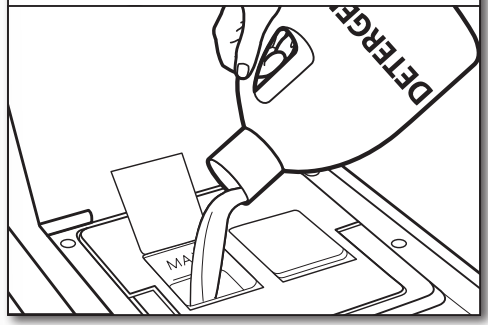
 on display is lit), if desired