
User guide
HW-S60D / HW-S61D
© 2024 Samsung Electronics Co., Ltd. All rights reserved.
Thank you for purchasing this Samsung product.
To receive more complete service, please register your product at www.samsung.com
Figures and illustrations in this User Manual are provided for reference only and may differ from actual product appearance.

ENG - 2
CONTENTS
01 Checking the Components 4
02 Product Overview 5
Front Panel / Top Panel of the Soundbar ------------------------- 5
Bottom Panel of the Soundbar ------------------------- 7
03 Using the Remote Control 8
Inserting Batteries before using the Remote Control (AAA batteries X 2) ------------------------- 8
How to Use the Remote Control
-------------------------
8
Setting the (Sound Control)
-------------------------
11
Using the Hidden Buttons (Buttons with more than one function)
-------------------------
12
Output specications for the different sound effect modes
-------------------------
13
Adjusting the Soundbar volume with a TV remote control ------------------------- 14
04 Connecting the Soundbar 15
Connecting Electrical Power
-------------------------
15
Connecting the Samsung Wireless Rear Kit and Subwoofer to your
Soundbar
-------------------------
15
05 Connecting to a TV 16
Connecting the TV that supports HDMI ARC (Audio Return Channel)
-------------------------
16
Connecting using an Optical Cable
-------------------------
18
Connecting via Bluetooth
-------------------------
19
Connecting via Wi-Fi
-------------------------
21
Connecting to a TV that supports Dolby Atmos®
-------------------------
22
Using the Q-Symphony Function
-------------------------
24
Using the SpaceFit Sound
-------------------------
25

ENG - 3
06 Connecting an External Device 26
Connecting using an Optical Cable
-------------------------
26
07 Connecting a Mobile Device 27
Method 1. Connecting via Bluetooth
-------------------------
27
Method 2. Connecting via Wi-Fi (Wireless Network)
-------------------------
30
Using Group Play
-------------------------
31
Connecting via Apple AirPlay
-------------------------
32
Using the Tap Sound
-------------------------
33
08 Installing the Wall Mount 34
Installation Precautions
-------------------------
34
Wallmount Components
-------------------------
34
09 Installing the Soundbar in front of TV 36
10 Software Update 37
Auto Update
-------------------------
37
USB Update
-------------------------
37
Reset
-------------------------
38
Security updates information
-------------------------
38
11 Troubleshooting 39
12 License 41
ENG - 4
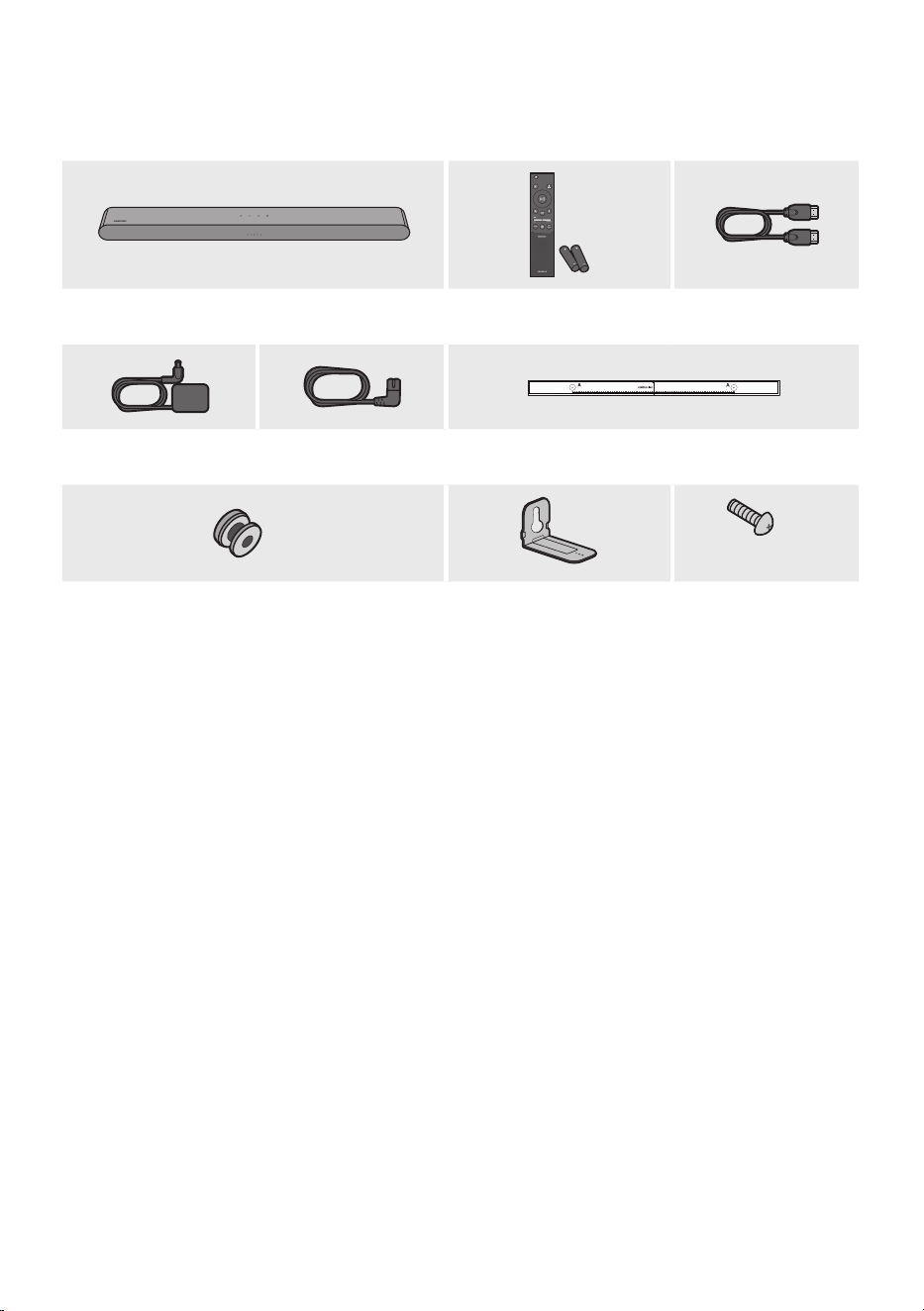
01 CHECKING THE COMPONENTS
SOUND
MODE
WOOFER
TONE
CONTROL
CH LEVEL
Soundbar Main Unit Soundbar Remote Control
/
Batteries
HDMI Cable
A TYPE : 450mm
AC/DC Adapter
(Soundbar)
Power Cord
(Soundbar)
Wall Mount Guide
x 2
x 2
(M4 x L10)
x 2
Holder-Screw Bracket-Wall Mount Screw
• For more information about the power supply and power consumption, refer to the label attached
to the product. (Label: Bottom of the Soundbar Main Unit)
• To purchase additional components or optional cables, contact a Samsung Service Center or
Samsung Customer Care.
• For more information about the wallmount see page 34.
• Design, specications, and App screen are subject to change without prior notice.
• The appearance of the accessories may differ slightly from the illustrations above.
ENG - 5
02 PRODUCT OVERVIEW
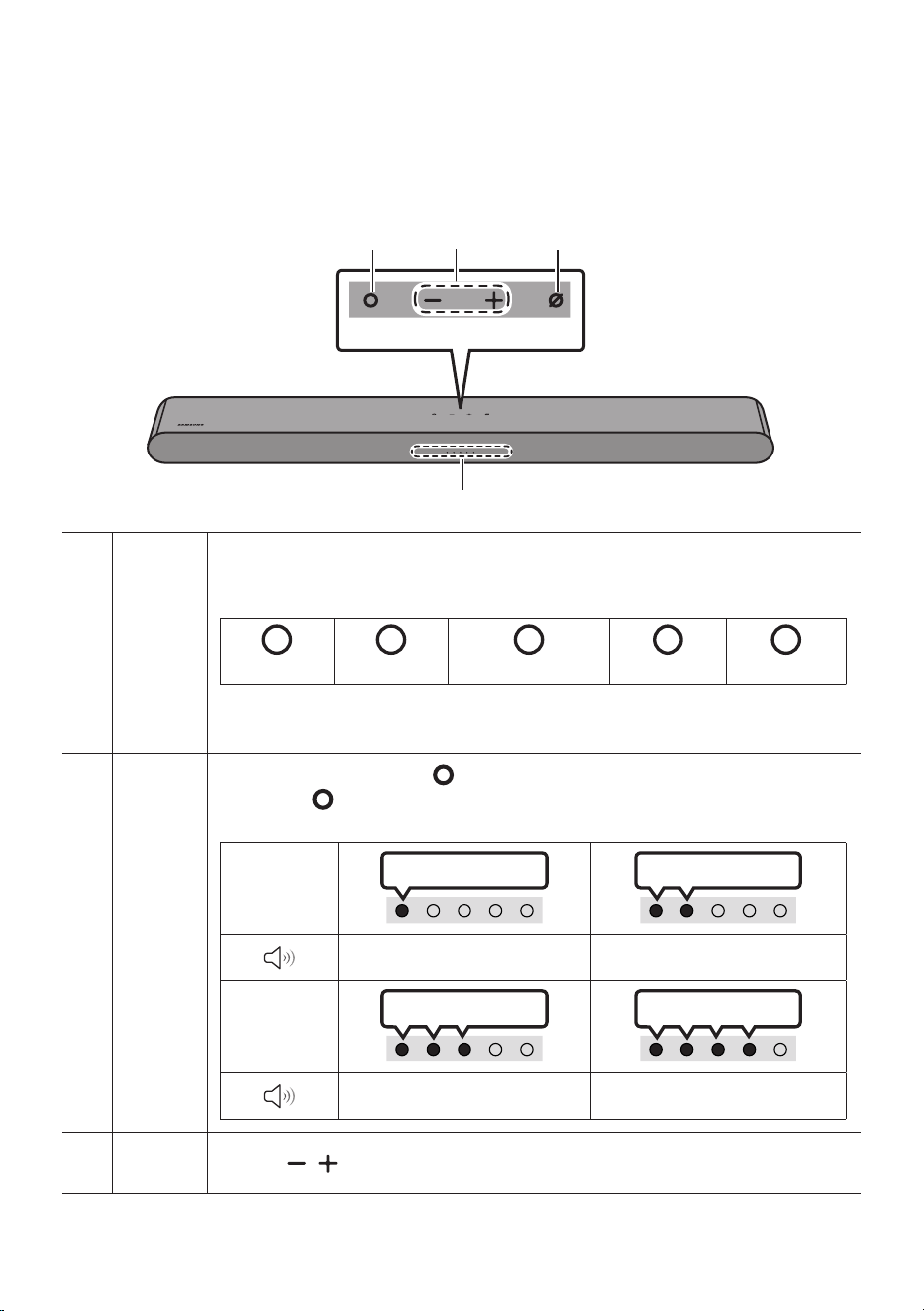
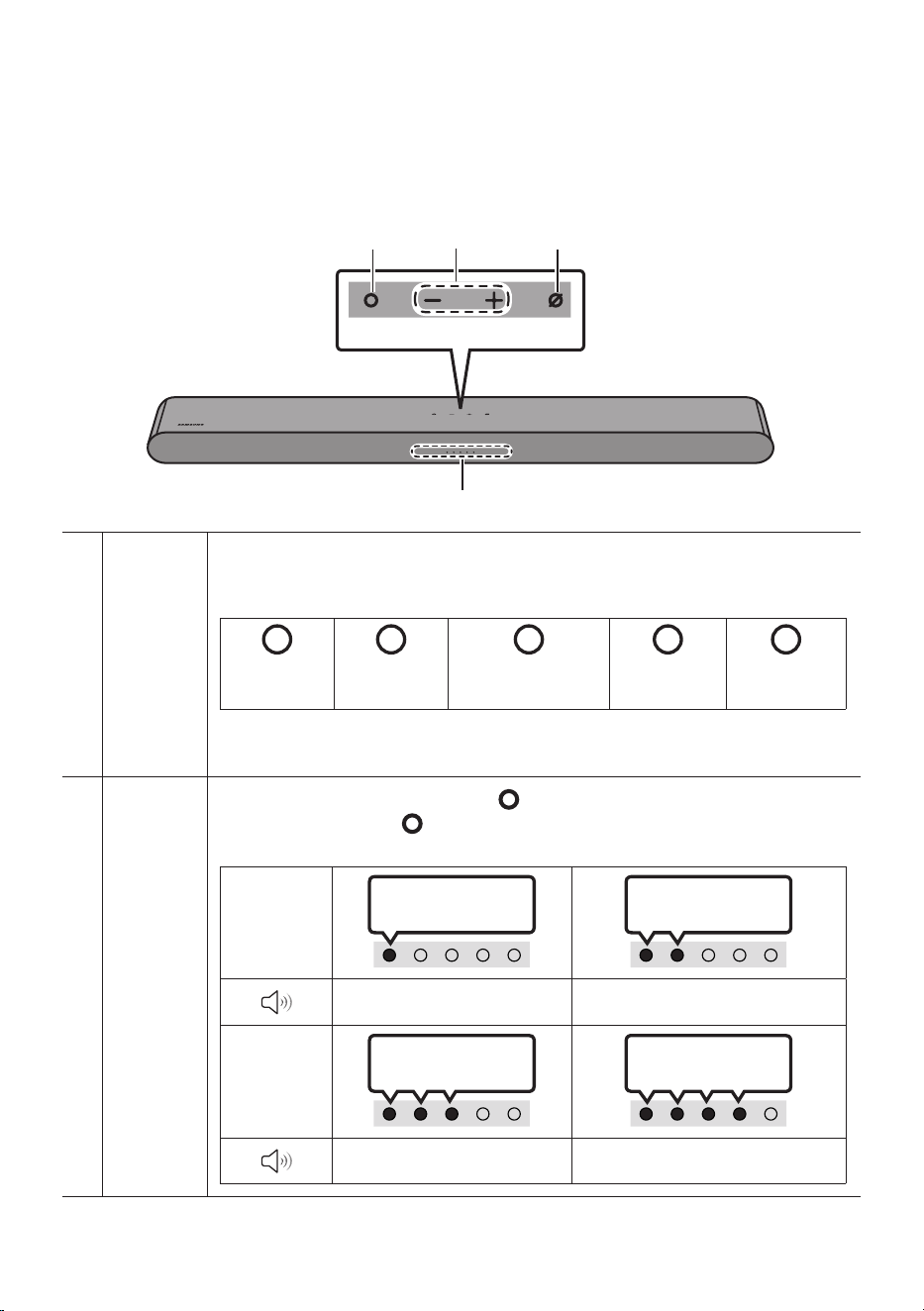
Front Panel / Top Panel of the Soundbar
Top Panel
LED
indicator
The LED Indicator ashes, glows, or changes color depending on the Soundbar's current
mode or status. The color of the LED indicator and the number of lights indicate the active
mode as described below.
W
White LED
W
White LED
M
Multicolor LED
W
White LED
W
White LED
• The Multicolor LED changes to White, Cyan, Green, Red, and Blue depending on the
mode or status.
Multi
Function
Button
• In standby mode, press the (Multi Function) button to turn on the Soundbar.
• Press the (Multi Function) button to change the mode. Each time you change the
mode, the LED lights in white and then turns off.
LED Indicator
White On -> Off White On -> Off
“TV ARC” or “eARC” “Wi-Fi”
LED Indicator
White On -> Off White On -> Off
“Bluetooth” “Digital Audio In”
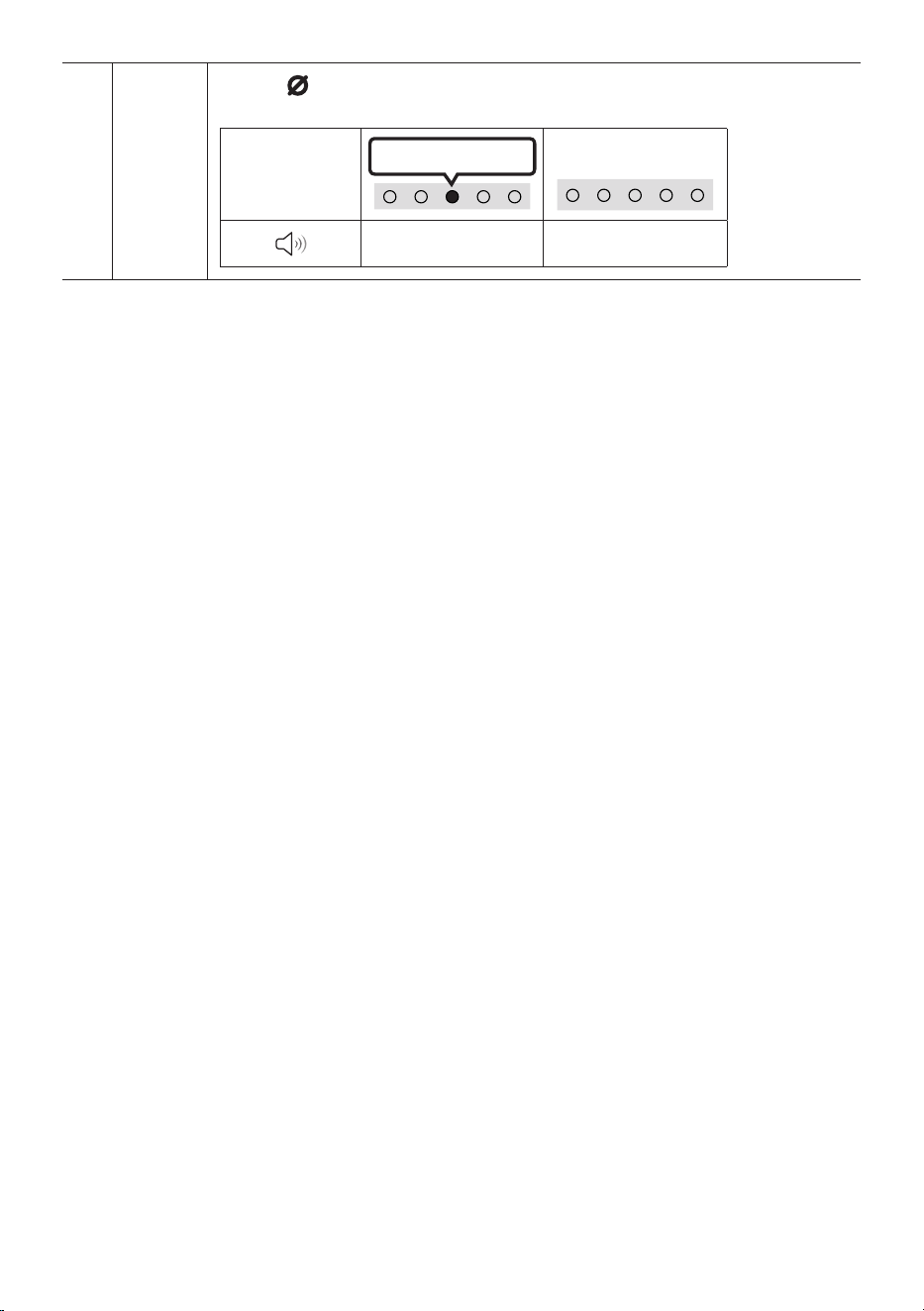
Volume
Button
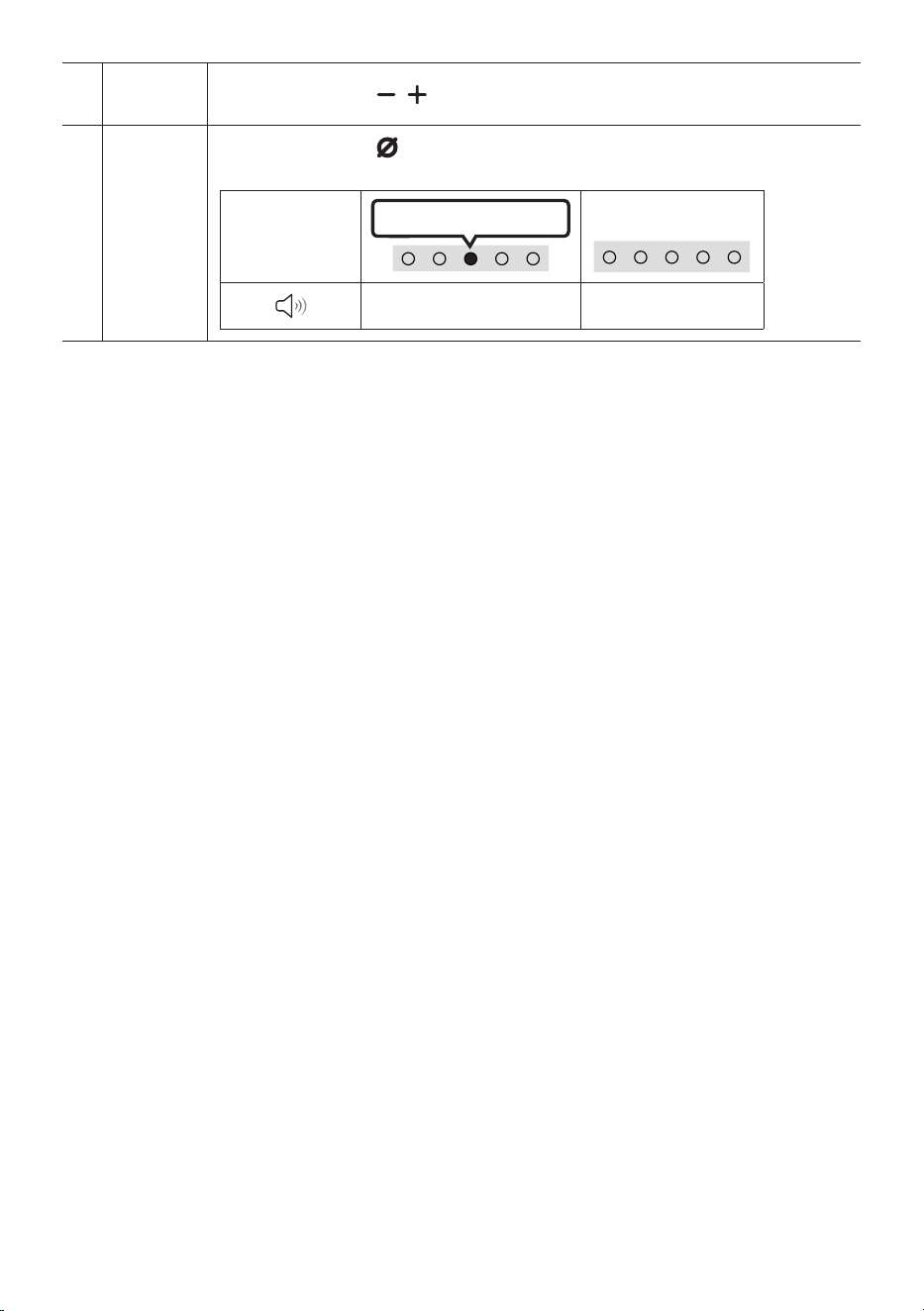
Press the (Volume) button to adjust the volume.
ENG - 6
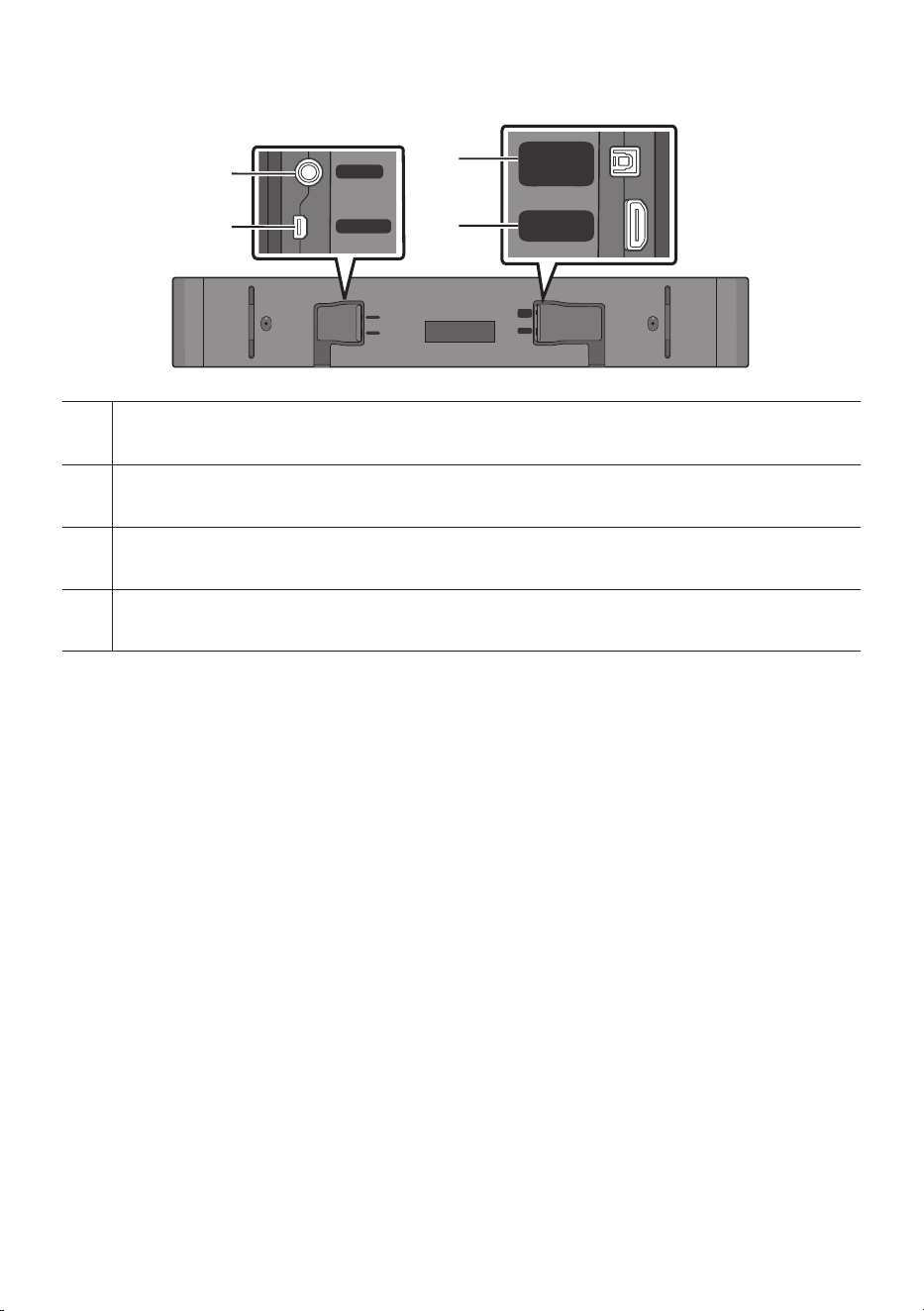
Mic
On/Off
Button
Press the (Mic On/Off) button to turn the microphone on or off.
When the microphone is off, the LED Indicator will light red.
LED Indicator
Red On
“Mic Off” “Mic On”
• When you plug in the AC cord, the power button will begin working in 4 to 6 seconds.
• When you turn on this unit, there will be a 4 to 5 second delay before it produces sound.
• If you hear sounds from both the TV and Soundbar, go to the Settings menu for the TV audio and
change the TV speaker to External Speaker.
• You can turn on and off audio feedback by using SmartThings app. To learn about using the
SmartThings app, refer to “Method 2. Connecting via Wi-Fi (Wireless Network)”.
ENG - 7
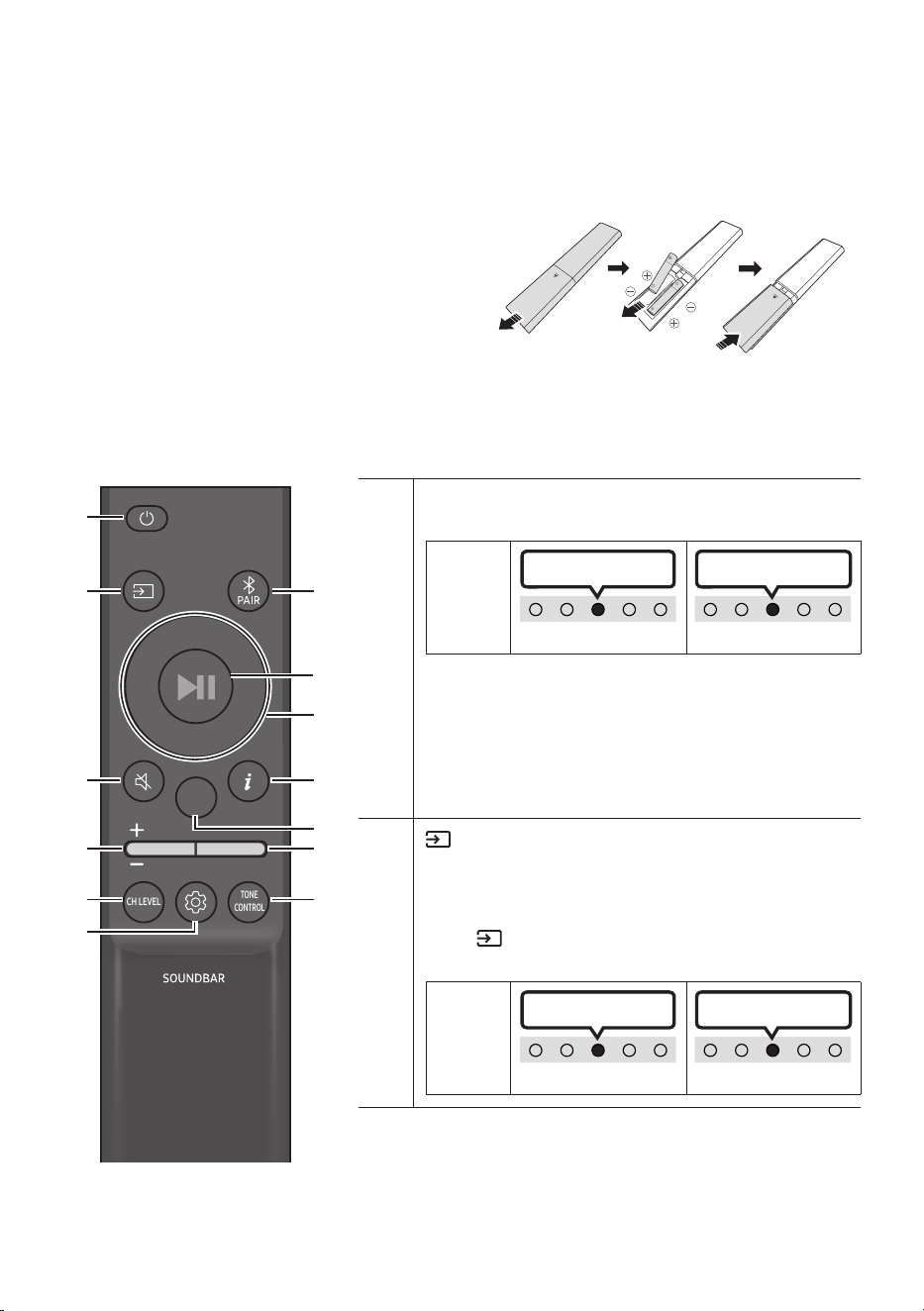
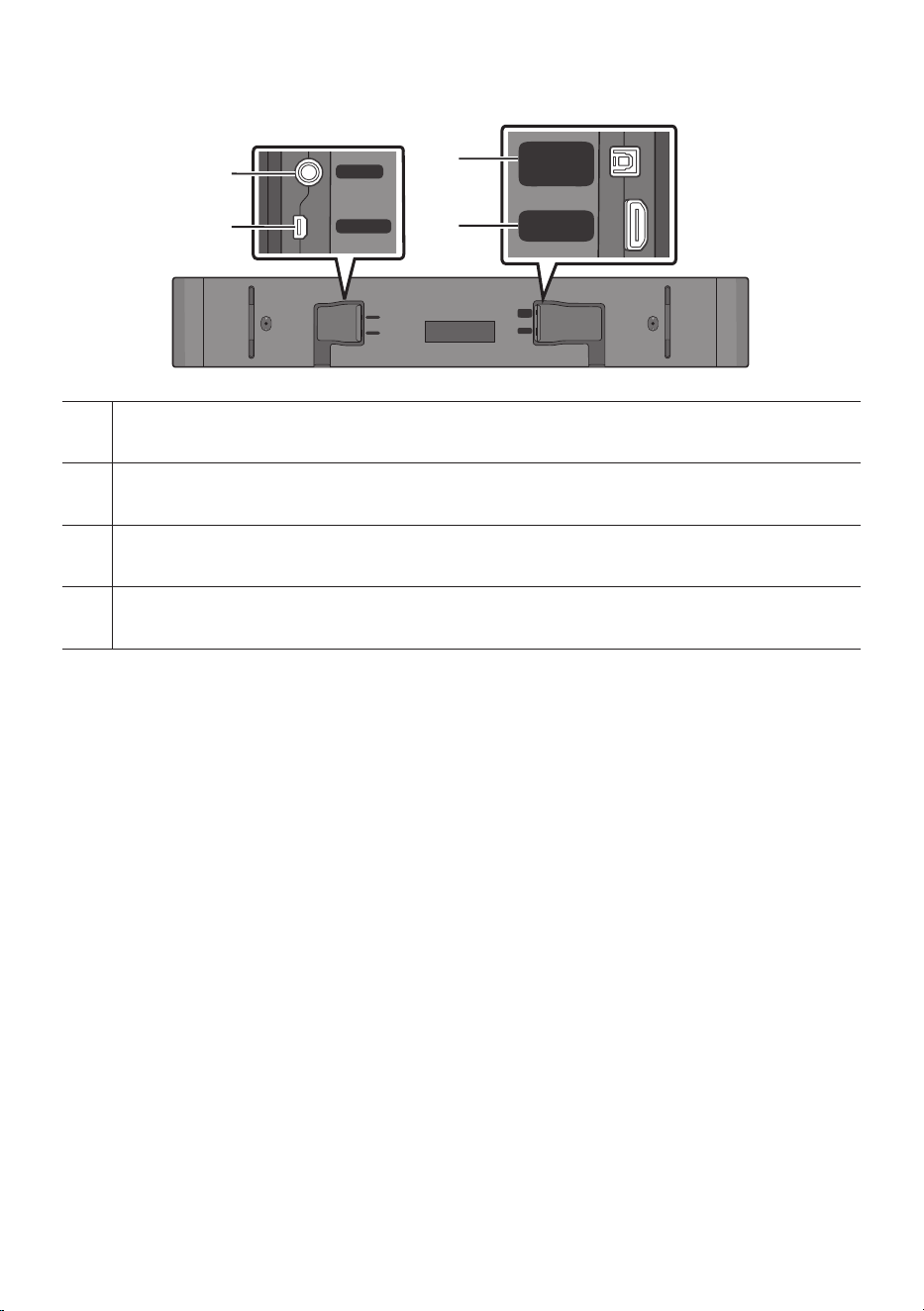
Bottom Panel of the Soundbar
SERVICE
DC 19V
DIGITAL
AUDIO IN
(OPTICAL)
HDMI
(eARC)
SERVICE
DC 19V
DIGITAL
AUDIO IN
(OPTICAL)
HDMI
(eARC)
SERVICE
DC 19V
DIGITAL
AUDIO IN
(OPTICAL)
HDMI
(eARC)
DC 19V (Power Supply In)
Connect the AC/DC power adapter. (See page 15)
SERVICE
Connect a USB storage device to upgrade the product's software.
DIGITAL AUDIO IN (OPTICAL)
Connect to the digital (optical) output of an external device. (See page 26)
HDMI (eARC)
Connect to the HDMI (eARC) port on a TV. (See page 16)
• When disconnecting the power cable of the AC/DC power adapter from a wall outlet, pull the plug.
Do not pull the cable.
• Do not connect this unit or other components to an AC outlet until all connections between
components are complete.
ENG - 8
03 USING THE REMOTE CONTROL
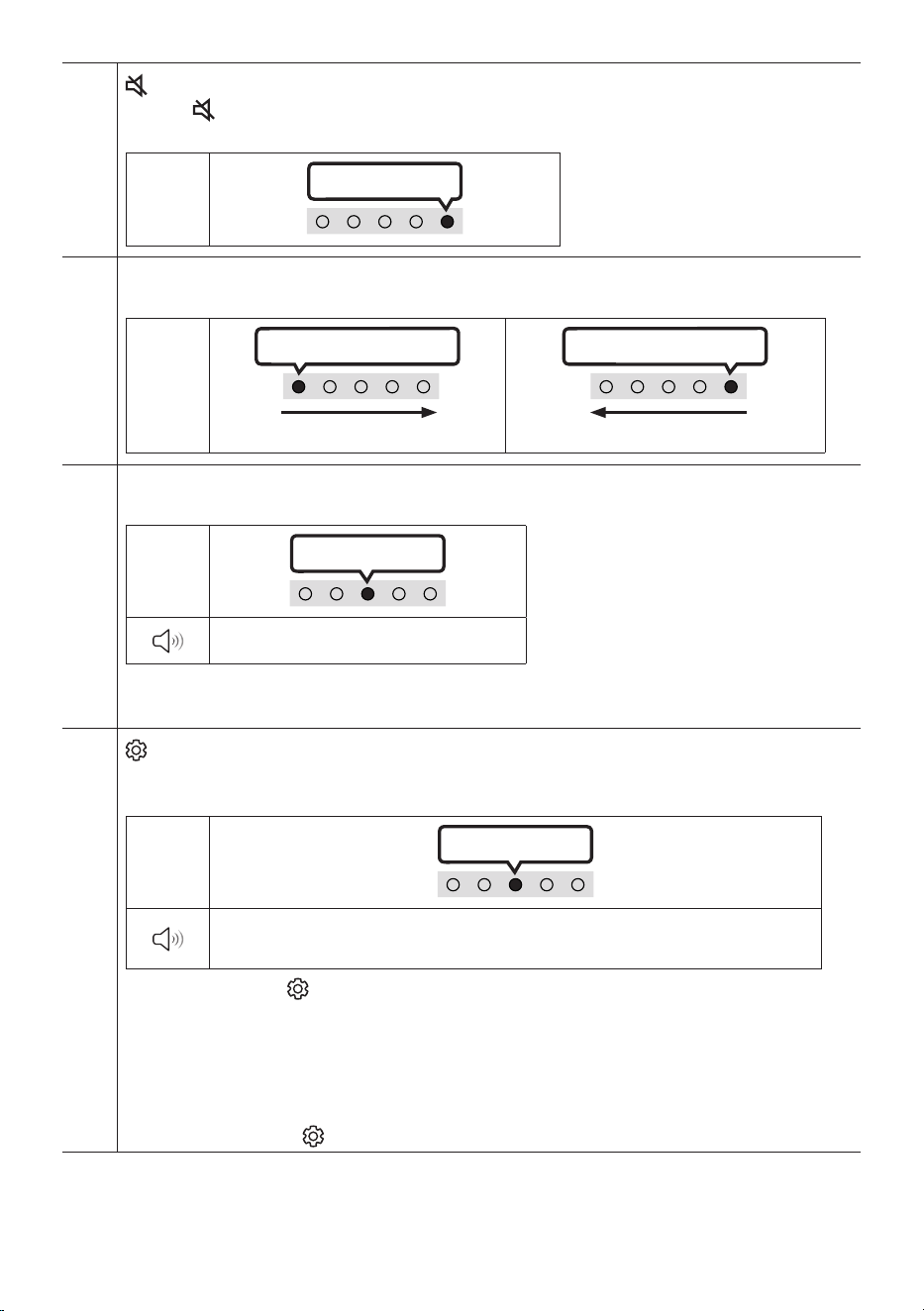
Inserting Batteries before using the Remote Control (AAA batteries X 2)
Slide the back cover in the direction of the arrow
until it is completely removed.
Insert 2 AAA batteries (1.5V) oriented so that their
polarity is correct. Slide the back cover back into
position.
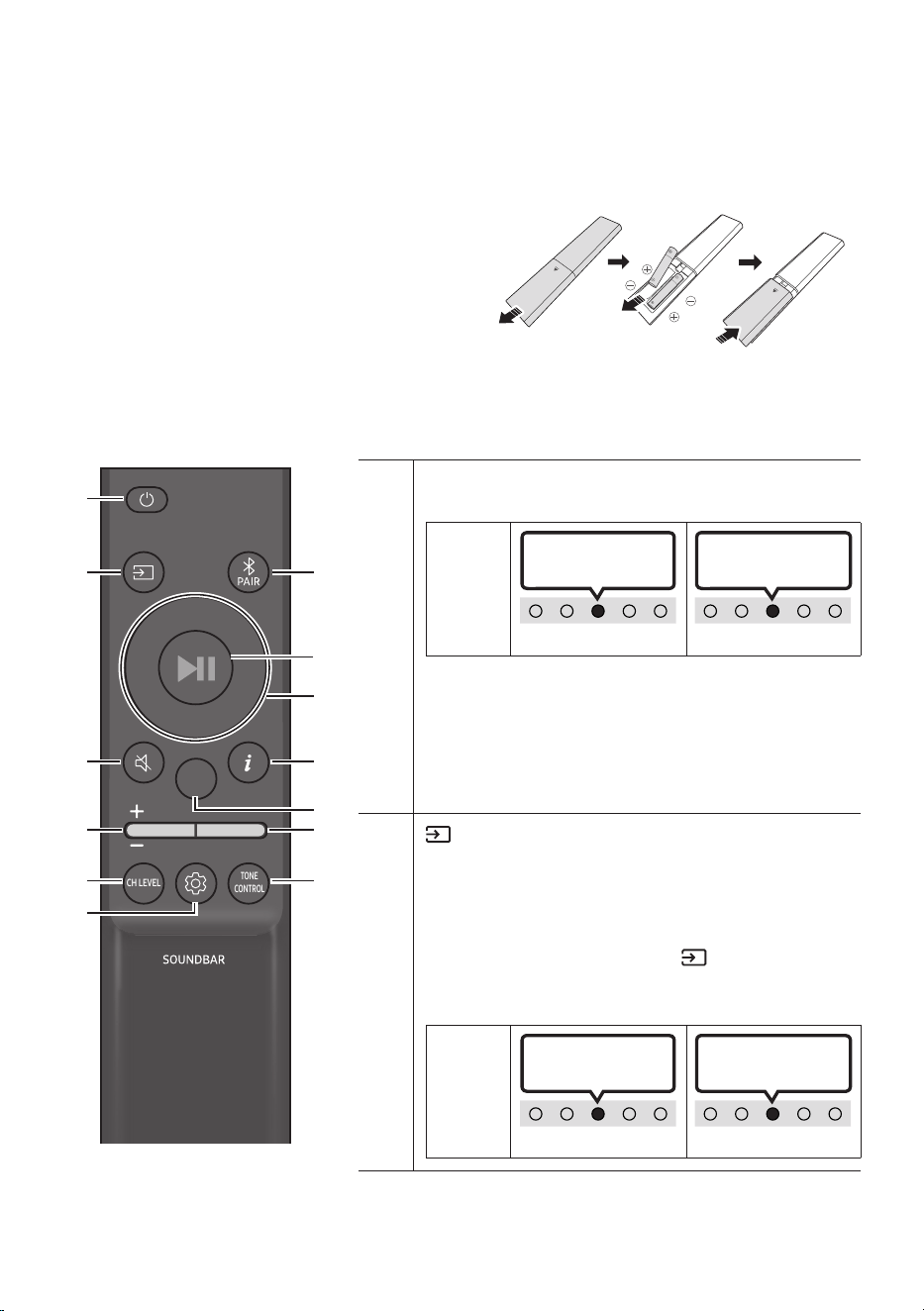
How to Use the Remote Control
SOUND
MODE
WOOFER
TONE
CONTROL
CH LEVEL
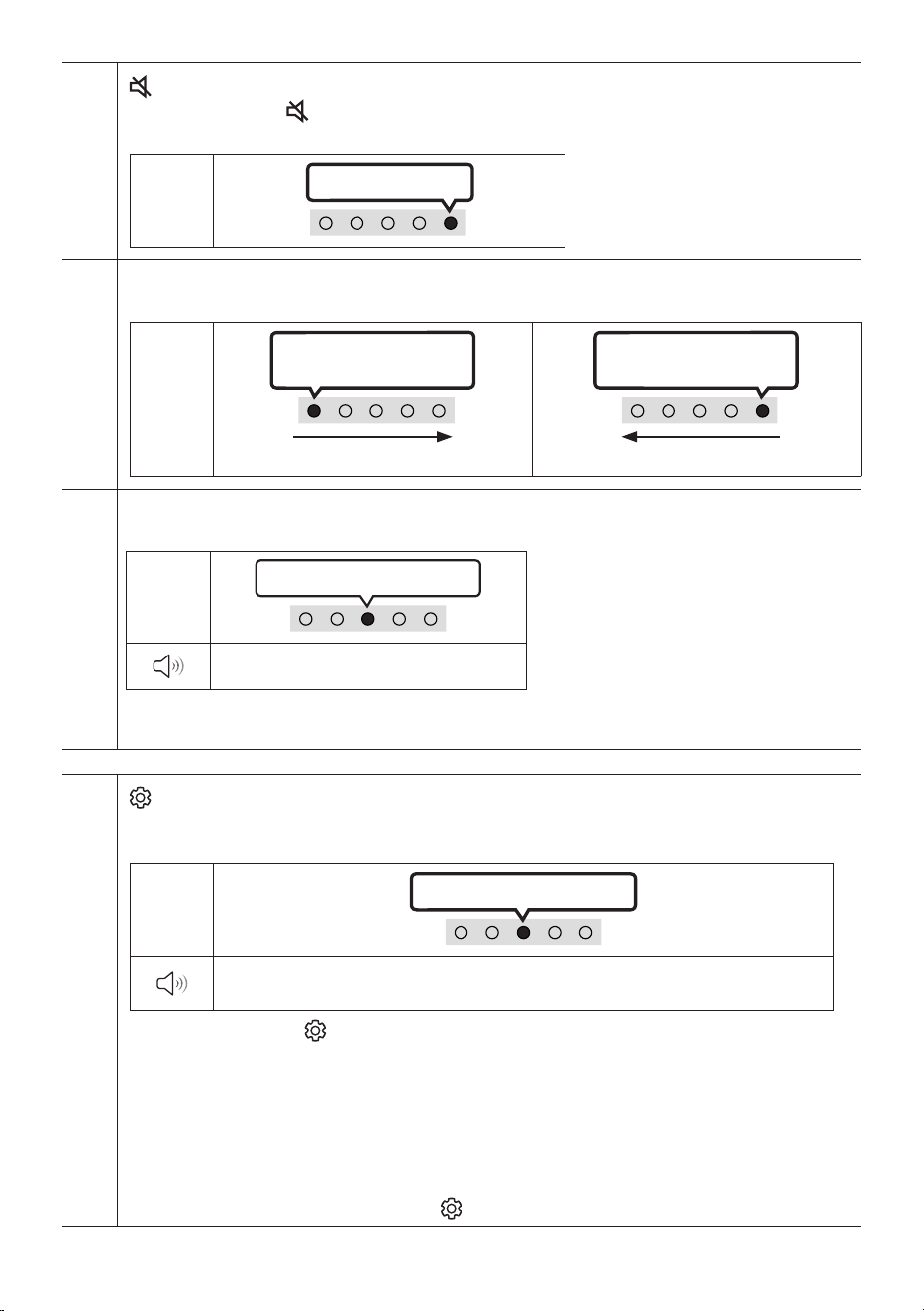
Power
Turns the Soundbar on and off.
LED
Indicator
Cyan Blinks X1
On
Off
Red Blinks X3
• Auto Power Down Function
The unit turns off automatically in the following
situations:
– In “TV ARC” or “eARC” / “Wi-Fi” / “Bluetooth” /
“Digital Audio In” mode if there is no audio signal for
18 minutes.
(Source)
Press to select a source connected to the Soundbar.
• Audio Feedback On/Off
You can turn the Audio Feedback on or off. Press and hold
the (Source) button on the remote control for
5 seconds while the Soundbar is off (Standby mode).
LED
Indicator
Cyan Blinks X1
On
Off
Red Blinks X1
ENG - 9
(Mute)
Press the (Mute) button to mute the sound.
Press it again to unmute the sound.
LED
Indicator
Blinks X Repeatly
Volume
Push the button up or down to adjust the volume.
LED
Indicator
White moves to right X1
Volume Up
White moves to left X1
Volume Down
CH LEVEL
By pressing the button, you can adjust the volume of each speaker.
LED
Indicator
White Blinks X1
“Center Level” “Side Level”
– If the Rear Speakers (sold separately) are connected, the setting “Rear Level” is supported. Use the
Up/Down button to adjust the volume of the “Rear Level” between -6 to +6.
(Sound Control)
By pressing the button, you can set the audio function. The desired item can be adjusted using the Up/
Down buttons. Each time the mode changes, the Multicolor LED blinks in white.
LED
Indicator
White Blinks X1
“SpaceFit Sound” “ Active Voice Amplier” “Voice enhancement” “Night
mode” “Sync” “Virtual”
– Press and hold the (Sound Control) button for about 5 seconds to adjust the sound for each
frequency band. 150Hz, 300Hz, 600Hz, 1.2kHz, 2.5kHz, 5kHz, and 10kHz are selectable using the Left/
Right buttons and each can be adjusted to a setting between -6 to +6 using the Up/Down buttons.
(Make sure the Sound mode is set to "Standard".)
– If the Rear Speakers (sold separately) are connected, the setting “Sound Grouping” and “Private Rear
Sound” are supported.
– Refer to “Setting the (Sound Control)” on page 11.
ENG - 10
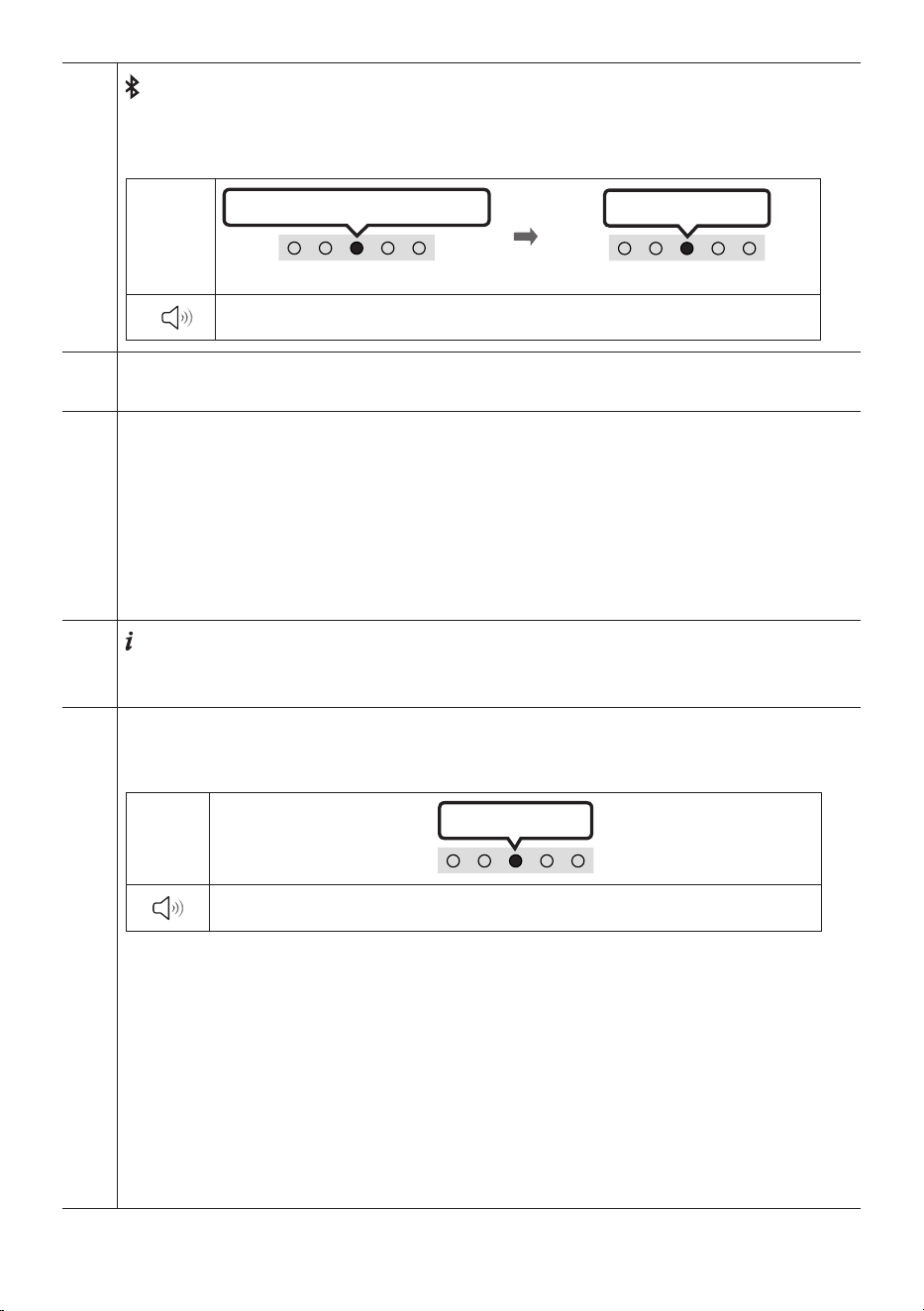
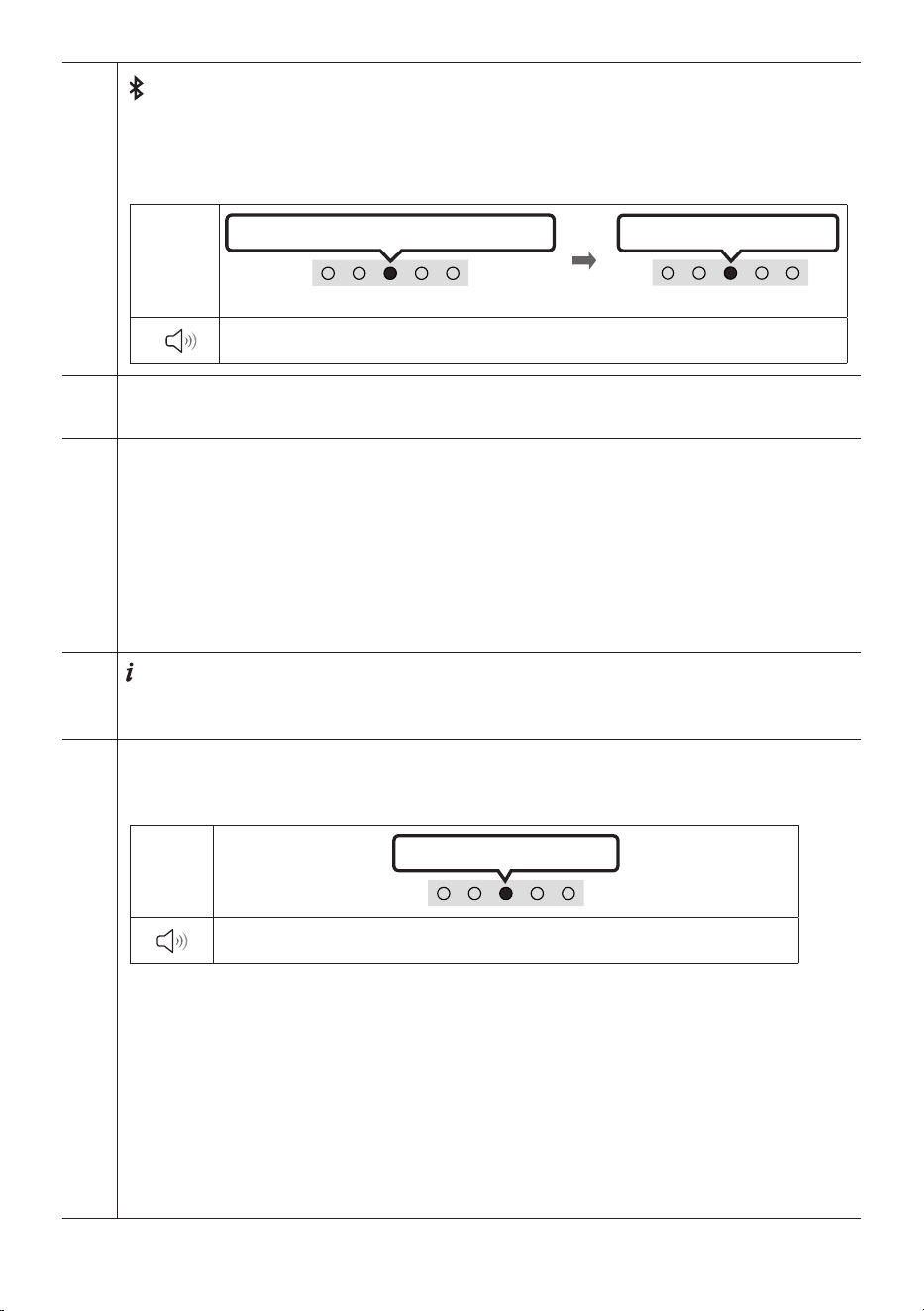
Bluetooth PAIR
Switch the Soundbar to Bluetooth pairing mode.
When you press the button, the LED display changes as shown below.
• Until pairing is complete, the Multicolor LED changes as Red → Green → Blue in turn.
LED
Indicator
Red → Green → Blue Blinks
Pairing
Connection is complete
Cyan Blinks X3
“Ready to connect via Bluetooth.”
p (Play / Pause)
You can also play or pause music by pressing the button.
Up/Down/Left/Right
Press Up/Down/Left/Right on the button to select or set functions.
• Music Skip
Press the Right button to select the next music le. Press the Left button to select the previous music
le.
• ID SET
Press and hold the Up button for 5 seconds to complete ID SET (when connecting to a wireless
subwoofer or wireless rear speakers).
(Info)
Press the button to display information about the current function. (See page 5.)
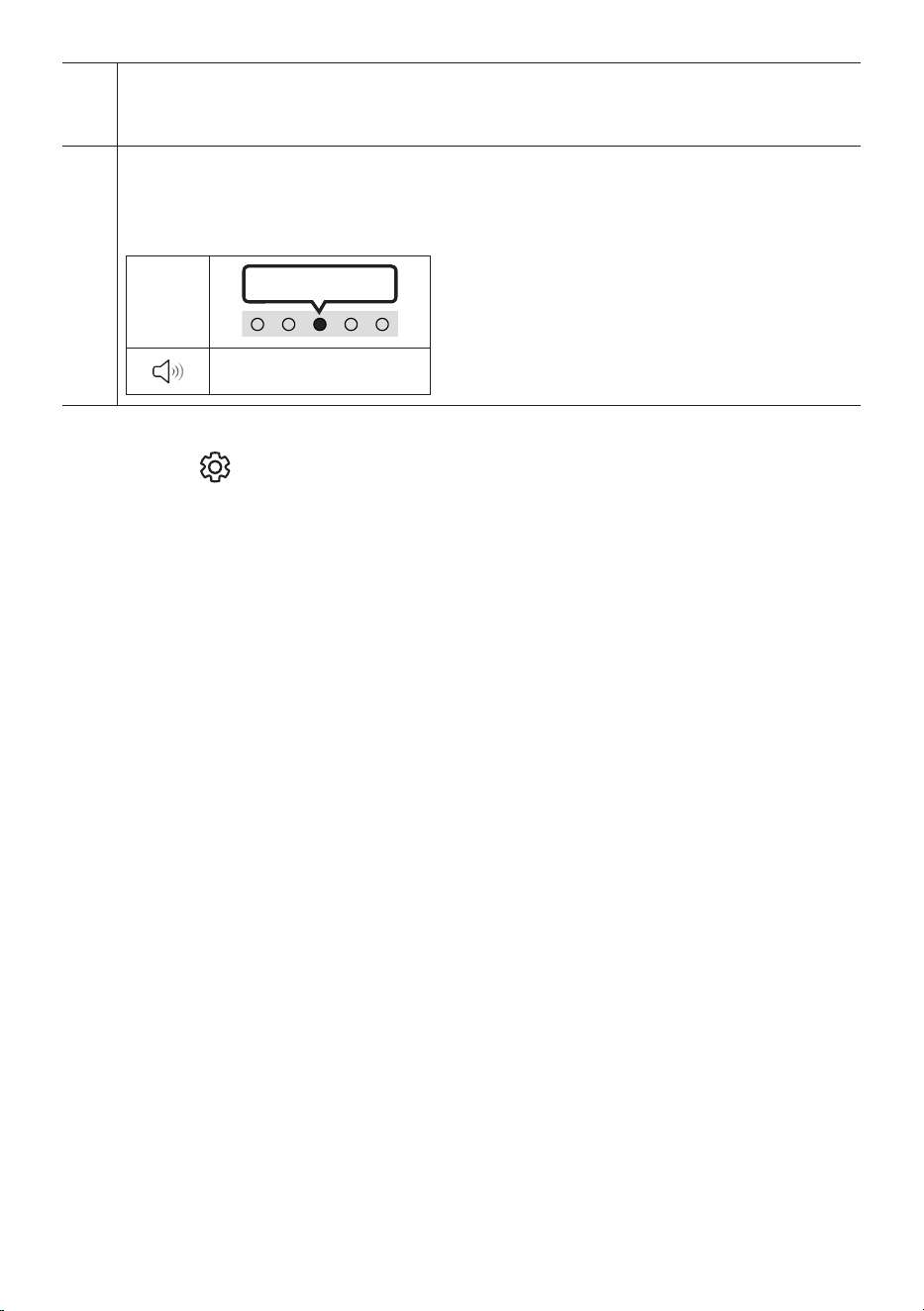
When connected to Dolby Atmos®, the LED indicator blinks cyan 3 times.
SOUND MODE
By pressing the button, you can select the desired audio mode. Each time the mode changes, the
Multicolor LED blinks in white.
LED
Indicator
White Blinks X1
“Adaptive Sound” “DTS Virtual:X” “Music” “Game” “Standard”
• Adaptive Sound
Analyzes the content in real time and automatically provides the optimal sound eld based on the
characteristics of the content.
• DTS Virtual:X
Immersive 3D sound from any content.
• Music
Provides more natural and room lling sound for music content.
• Game
Provides stereoscopic sound to immerse you in the action while gaming.
• Standard
Outputs the original sound.
ENG - 11
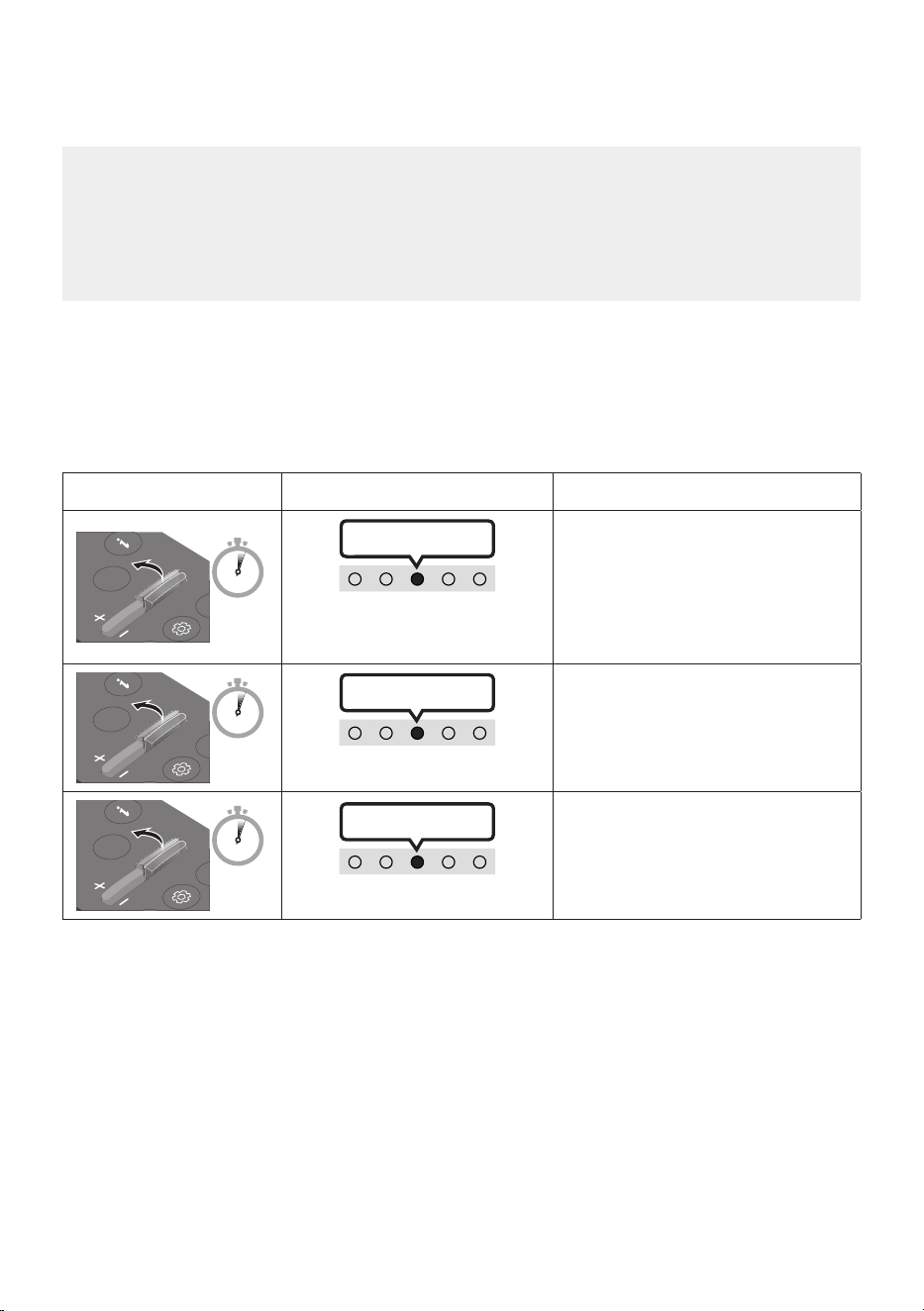
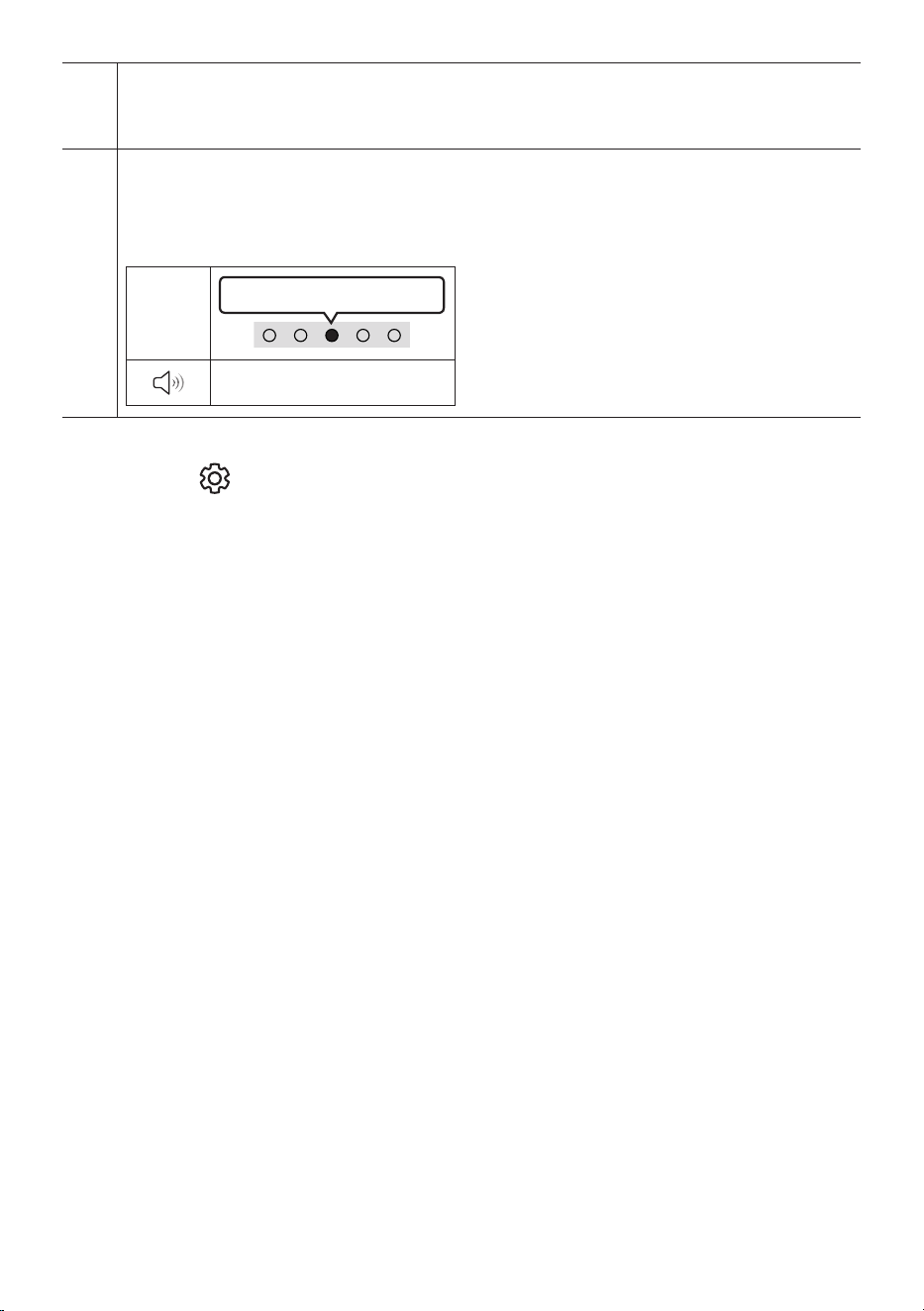
WOOFER (BASS) LEVEL
Push the button up or down to adjust the level of the woofer (bass) to -12 or between -6 to +6. To set the
woofer (bass) volume level to 0 (Default), press the button.
TONE CONTROL
By pressing the button, you can adjust the volume of the treble or bass sound. The desired item can be
adjusted using the Up/Down buttons. (This feature is available in all sound modes except “Standard”
mode.)
LED
Indicator
White Blinks X1
“Treble” “Bass”
Setting the (Sound Control)
• SpaceFit Sound : This function analyzes the user’s listening space with the Soundbar’s microphone
and provides optimal sound for the space. (Refer to “Using the SpaceFit Sound” on page 25.)
• Active Voice Amplier : Analyzes external noise in real time while Soundbar is playing so that voice
audio can always be heard clearly.
– No data is saved during the analysis.
• Voice enhancement makes it easier to hear spoken dialog in movies and TV.
• Night mode is optimized for night time viewing with the settings adjusted to bring the volume down
but keep the dialog clear.
• Sound Grouping: The Soundbar main unit and the Surround Speakers play the entire sound instead
of surround sound, making it ideal for large groups of people listening to music in a large space.
– This menu is initially activated when the Surround Speakers are connected, and then the menu
remains activated regardless of the connection of the Surround Speakers.
– If you enable this mode, there are no differences in sounds between the Sound modes.
– Sound does not come out from all speaker units of the Soundbar main unit and the Surround
speakers, but only from certain predetermined units, which varies by model.
• Private Rear Sound : This mode sets the sound to come out from the Surround Speakers only,
allowing you to listen without being disturbed by others.
– If you enable this mode, sound does not come out from the Soundbar main unit and the
subwoofer. Sound only comes out from the front channel of the Surround Speakers.
– If you enable this mode, there are no differences in sounds between the Sound modes.

ENG - 12
– The function turns off when the power turns off or the Surround Speakers connection is lost.
– The menu is activated only when the Surround Speakers are connected.
– This mode is automatically turned off and becomes unavailable when the Q-Symphony
function turns on.
• If the video on the TV and audio from the Soundbar are not synchronized, select Sync in Sound
Control, and then set the audio delay between 0~300 milliseconds by using the Up/Down buttons.
– Sync is only supported for some functions.
• The Virtual function can be turned On/Off by using the Up/Down buttons.
Using the Hidden Buttons (Buttons with more than one function)
Hidden Button
Reference page
Remote Control Button Function
WOOFER (Up) TV remote control On/Off (Standby) page 14
Up ID SET page 10
(Sound Control)
7 Band EQ page 9
(Source)
Audio Feedback On/Off (Standby) page 8

ENG - 13
Output specications for the different sound effect modes
Effect Input
Output
With Subwoofer Only
With Subwoofer & Wireless
Rear Speaker Kit
Adaptive Sound
2.0 ch 5.1 ch 7.1 ch
5.1 ch 5.1 ch 7.1 ch
Dolby Atmos® 5.1 ch 7.1 ch
DTS Virtual:X
2.0 ch 5.1 ch 7.1 ch
5.1 ch 5.1 ch 7.1 ch
Dolby Atmos® 5.1 ch 7.1 ch
Music
2.0 ch 5.1 ch 7.1 ch
5.1 ch 5.1 ch 7.1 ch
Dolby Atmos® 5.1 ch 7.1 ch
Game
2.0 ch 5.1 ch 7.1 ch
5.1 ch 5.1 ch 7.1 ch
Dolby Atmos® 5.1 ch 7.1 ch
Standard
2.0 ch 2.1 ch 2.1 ch
5.1 ch 5.1 ch 5.1ch
Dolby Atmos® 5.1 ch 7.1 ch
• The Samsung Wireless Rear Speaker Kit, and Subwoofer can be purchased separately.
To purchase a Kit or the Subwoofer, contact the vendor you purchased the Soundbar from.
• When the input source is Dolby Atmos® the Subwoofer-only setup provides 5.1 channel audio,
while the Subwoofer & Wireless Rear Speaker Kit setup provides 7.1 channel audio.
ENG - 14
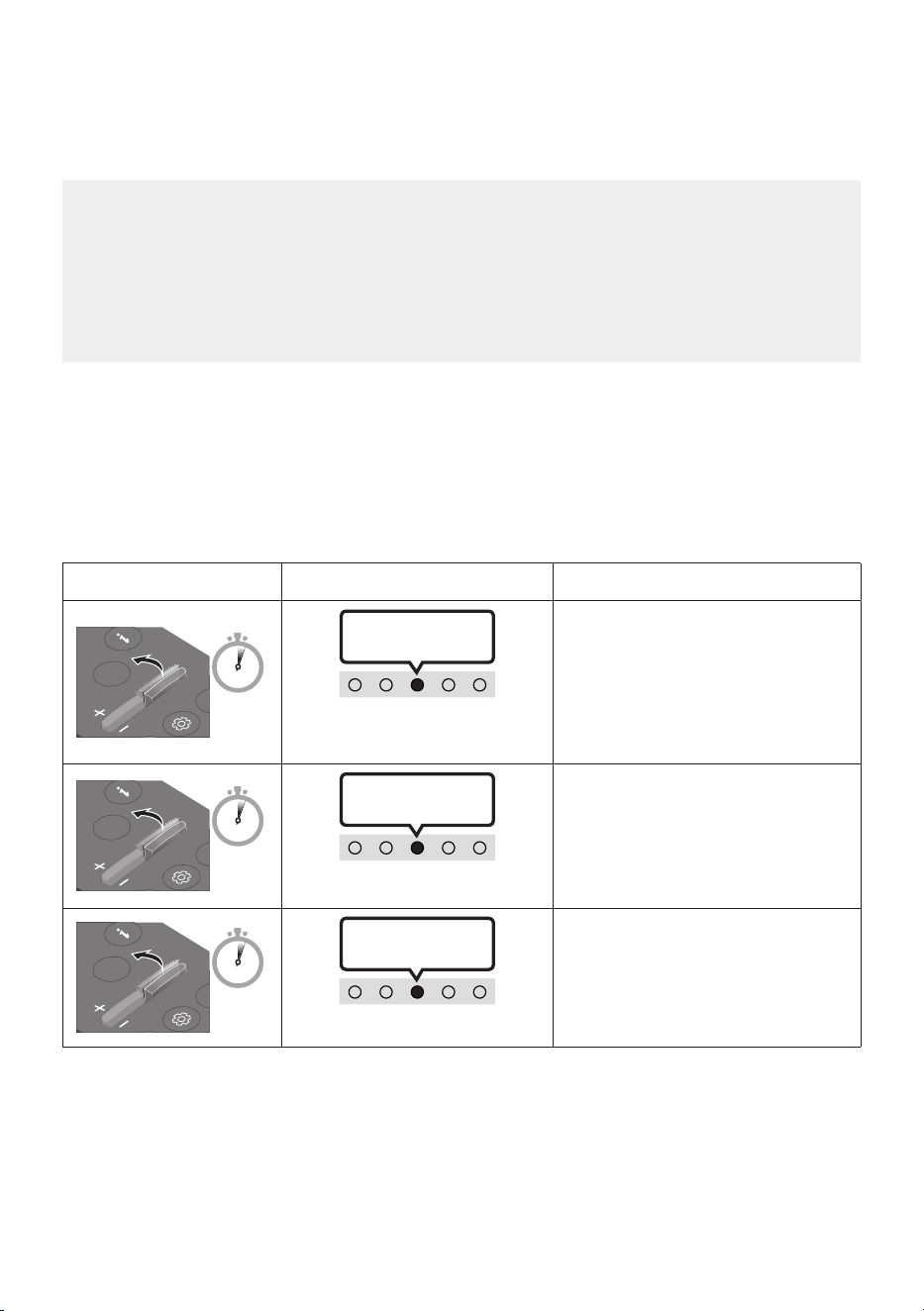
Adjusting the Soundbar volume with a TV remote control
Adjust the Soundbar volume using the TV’s remote control.
• This function can be used with IR remote controls only. Bluetooth remote controls (remote
controls that require pairing) are not supported.
• Set the TV speaker to External Speaker to use this function.
• Manufacturers supporting this function:
Samsung, VIZIO, LG, Sony, Sharp, PHILIPS, PANASONIC, TOSHIBA, Hisense, RCA
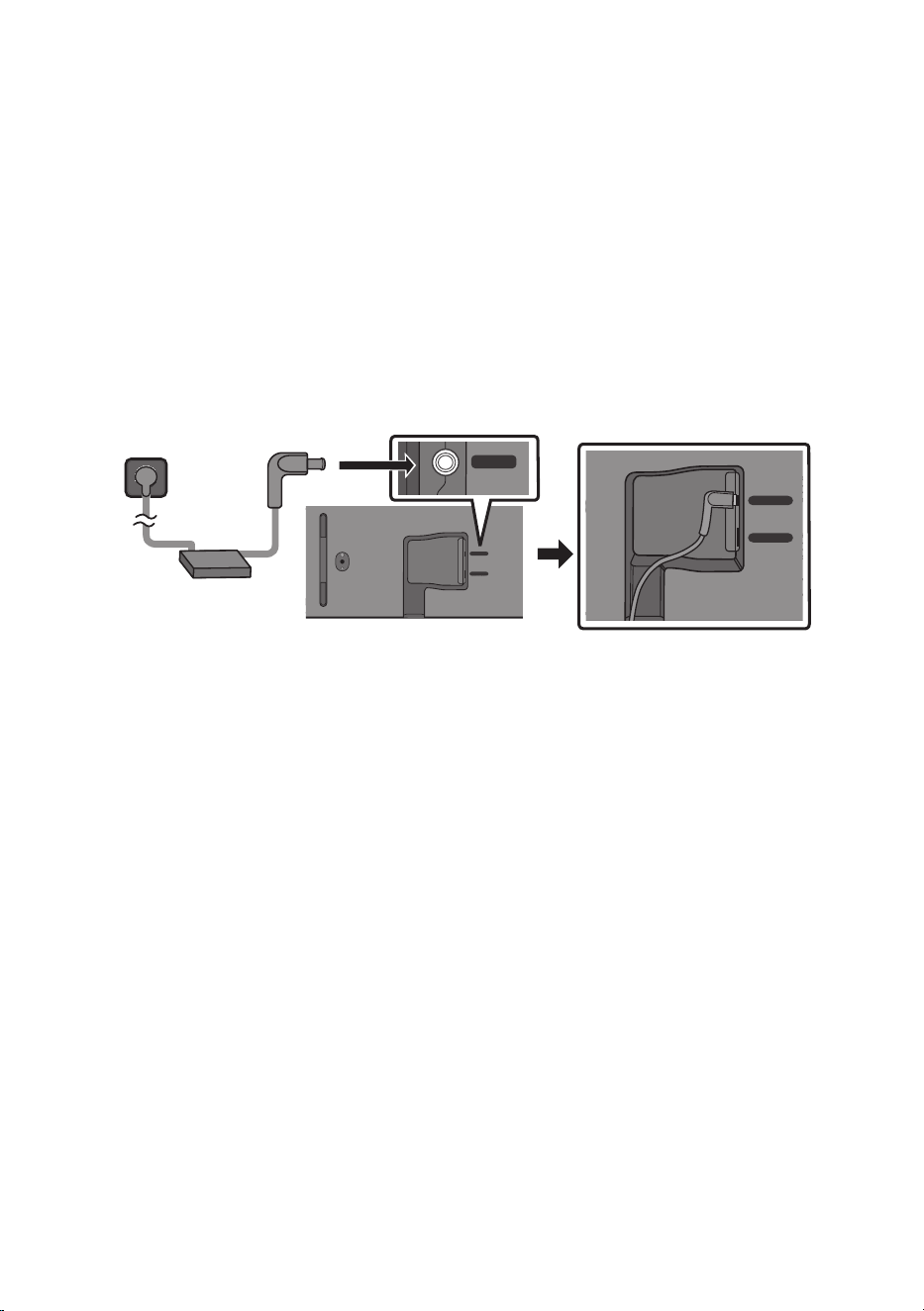
1. Turn Off the Soundbar.
2. Push up and hold the WOOFER button for 5 seconds.
Each time you push the WOOFER button up and hold it for 5 seconds, the mode switches in the
following order: “Off-TV Remote” (Default mode), “Samsung-TV Remote”, “All-TV Remote”.
The LED indicator status changes each time the mode is changed, as shown below.
Remote Control Button LED Indicator Status
SOUND
MODE
WOOFER
CH LEVEL
TONE
CONTROL
5 Sec
"Off-TV Remote"
(Default mode)
Red Blinks X1
Disable the TV remote control.
SOUND
MODE
WOOFER
CH LEVEL
TONE
CONTROL
5 Sec
"Samsung-TV Remote"
Cyan Blinks X1
Enable a Samsung TV’s IR remote
control.
SOUND
MODE
WOOFER
CH LEVEL
TONE
CONTROL
5 Sec
"All-TV Remote"
Blue Blinks X1
Enable a third-party TV’s IR remote
control.
ENG - 15
04 CONNECTING THE SOUNDBAR
Connecting Electrical Power
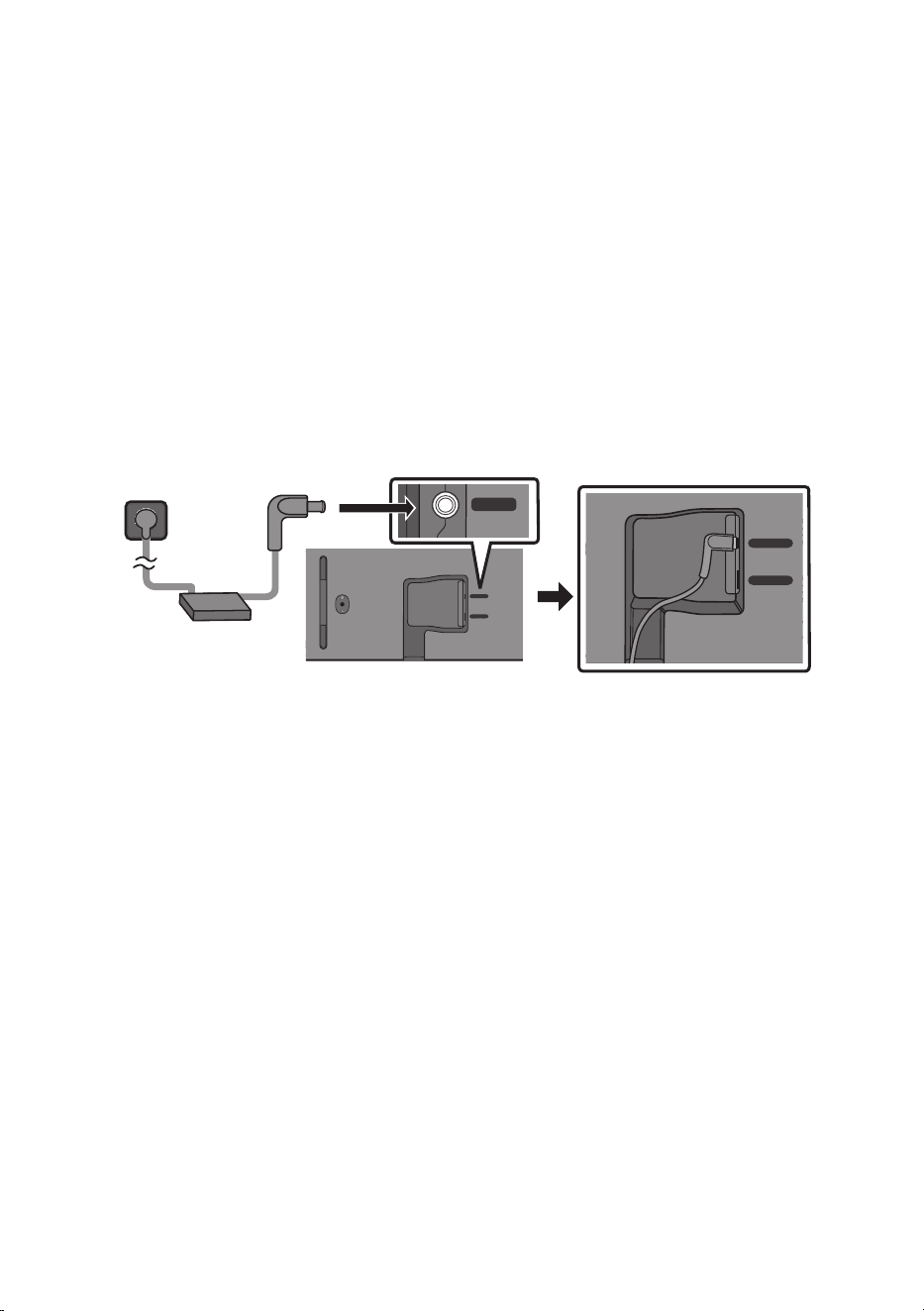
Use the power components to connect the Soundbar to an electrical outlet in the following order:
• For more information about the required electrical power and power consumption, refer to the
label attached to the product. (Label: Bottom of the Soundbar Main Unit)
1. First connect the power cable to the AC/DC adapter.
Connect the AC/DC adapter (with the power cable) to the Soundbar.
2. Connect the power cord to a wall socket.
Bottom of the Soundbar Main Unit
SERVICE
DC 19V
DIGITAL
AUDIO IN
(OPTICAL)
HDMI
(ARC)
SERVICE
DC 19V
DIGITAL
AUDIO IN
(OPTICAL)
HDMI
(eARC)
Power Cord
AC/DC Adapter
SERVICE
DC 19V
NOTES
• If you unplug and reconnect the power cord when the product is turned on, the Soundbar turns on
automatically.
• Make sure to rest the AC/DC Adapter at on a table or the oor. If you place the AC/DC Adapter so
that it is hanging with the AC cord input facing upwards, water or other foreign substances could
enter the Adapter and cause the Adapter to malfunction.
Connecting the Samsung Wireless Rear Kit and Subwoofer to your
Soundbar
Expand to true wireless surround sound by connecting the Samsung Wireless Rear Speaker Kit
(SWA-9200S, sold separately) and Wireless Subwoofer (SWA-W510, sold separately) to your Soundbar.
For detailed information on connections, see the Samsung Wireless Rear Speaker Kit and Wireless
Subwoofer manual.
ENG - 16
05 CONNECTING TO A TV
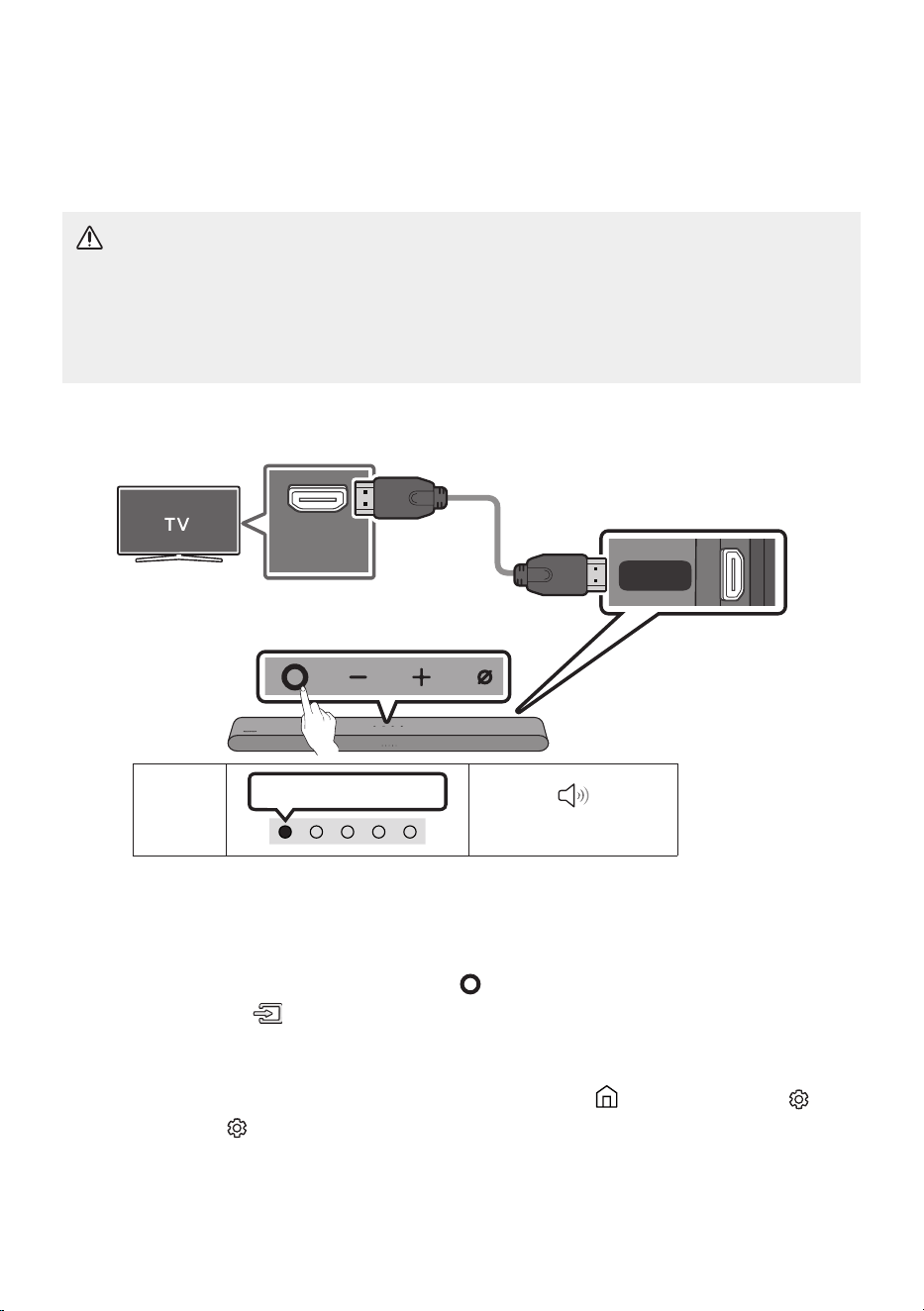
Connecting the TV that supports HDMI ARC (Audio Return Channel)
CAUTION
• When both the HDMI cable and optical cable are connected, the HDMI signal is received rst.
• To connect the HDMI cable between the TV and Soundbar, be sure to connect the terminals
marked ARC. Otherwise, the TV sound may not be output.
• The recommended cable is an HDMI cable certied by HDMI.org.
HDMI IN
(eARC)
DIGITAL
AUDIO IN
(OPTICAL)
HDMI
(eARC)
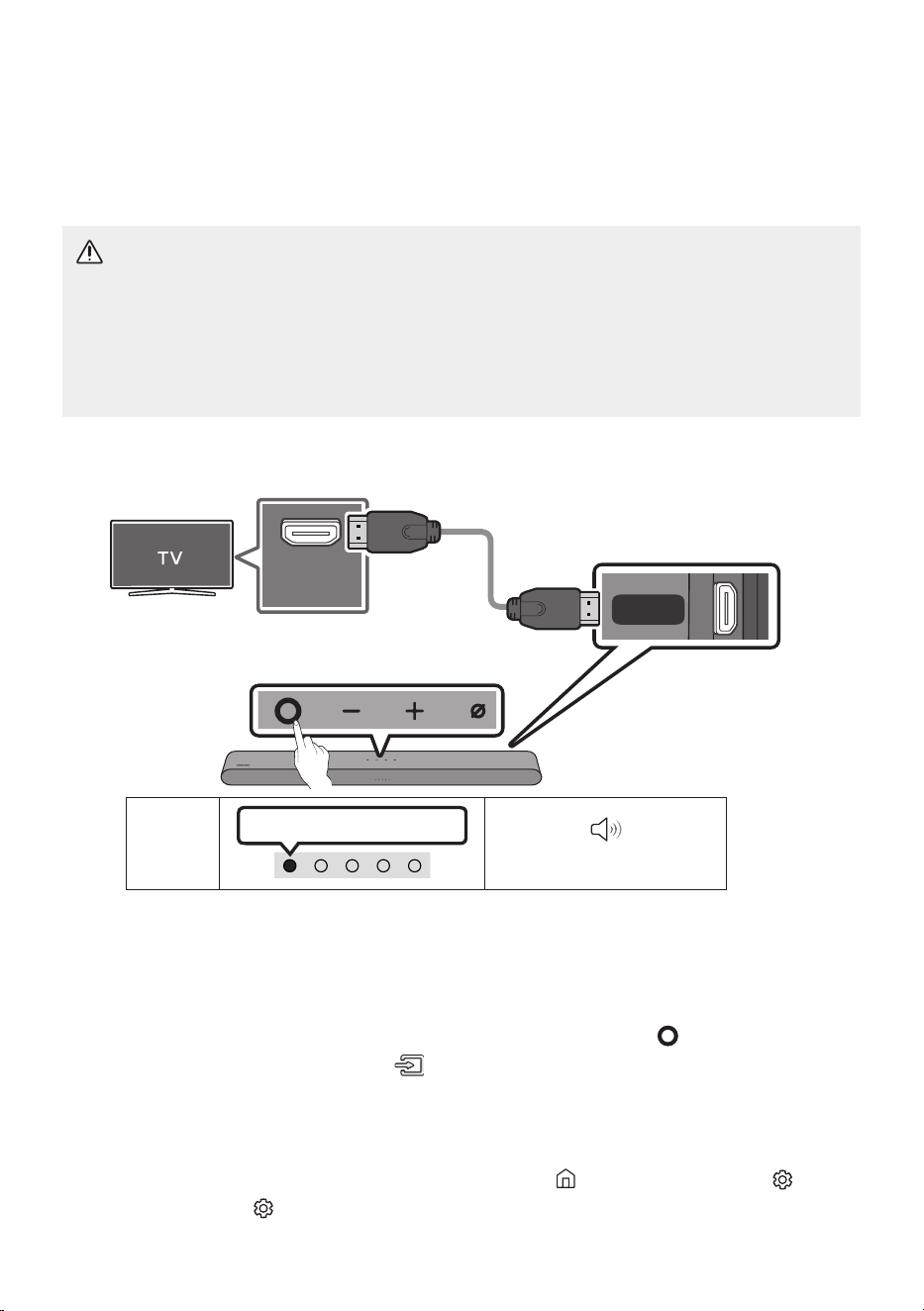
Connect to the HDMI IN (ARC) or
(eARC) port of your TV.
HDMI Cable
Bottom of the
Soundbar
Connect to the HDMI (eARC) port of
the Soundbar main unit.
Top of the Soundbar
LED
Indicator
White On -> Off
“TV ARC” or “eARC”
1. With the Soundbar and TV turned off, connect the HDMI cable as shown in the gure.
2. Turn on the Soundbar and TV.
3. TV sound is output from the Soundbar.
• When the TV sound is not output, press the (Multi Function) button at the top of the
Soundbar or the (Source) button on the remote control to select the “TV ARC” or “eARC”
mode.
• To connect with eARC, the eARC function in the TV menu should be set to On. Refer to the TV
user manual for details on setting. (e.g. Samsung TV : Home ( ) → Menu → Settings ( ) →
All Settings ( )
→ Sound → Expert Settings → HDMI-eARC Mode (Auto))
• When the sound is not output, check the HDMI Cable connection again.
• Use the volume buttons on the TV’s remote control to change the volume on the Soundbar.

ENG - 17
NOTES
• When you connect the TV that supports the HDMI ARC (Audio Return Channel) to the Soundbar
with an HDMI cable, you can transmit the digital video and audio data without connecting a
separate optical cable.
• We recommend you use a coreless HDMI cable if possible. If you use a cored HDMI cable, use one
whose diameter is less than 0.55 inches (14 mm).
• This function is not available if the HDMI cable does not support ARC.
• When the audio in a broadcast is encoded in Dolby Digital and the “Digital Output Audio Format” on
your TV is set to PCM, we recommend that you change the setting to Dolby Digital. When the
setting on the TV is changed, you will experience better sound quality. (The TV menu may use
different words for Dolby Digital and PCM depending on the TV manufacturer.)
ENG - 18
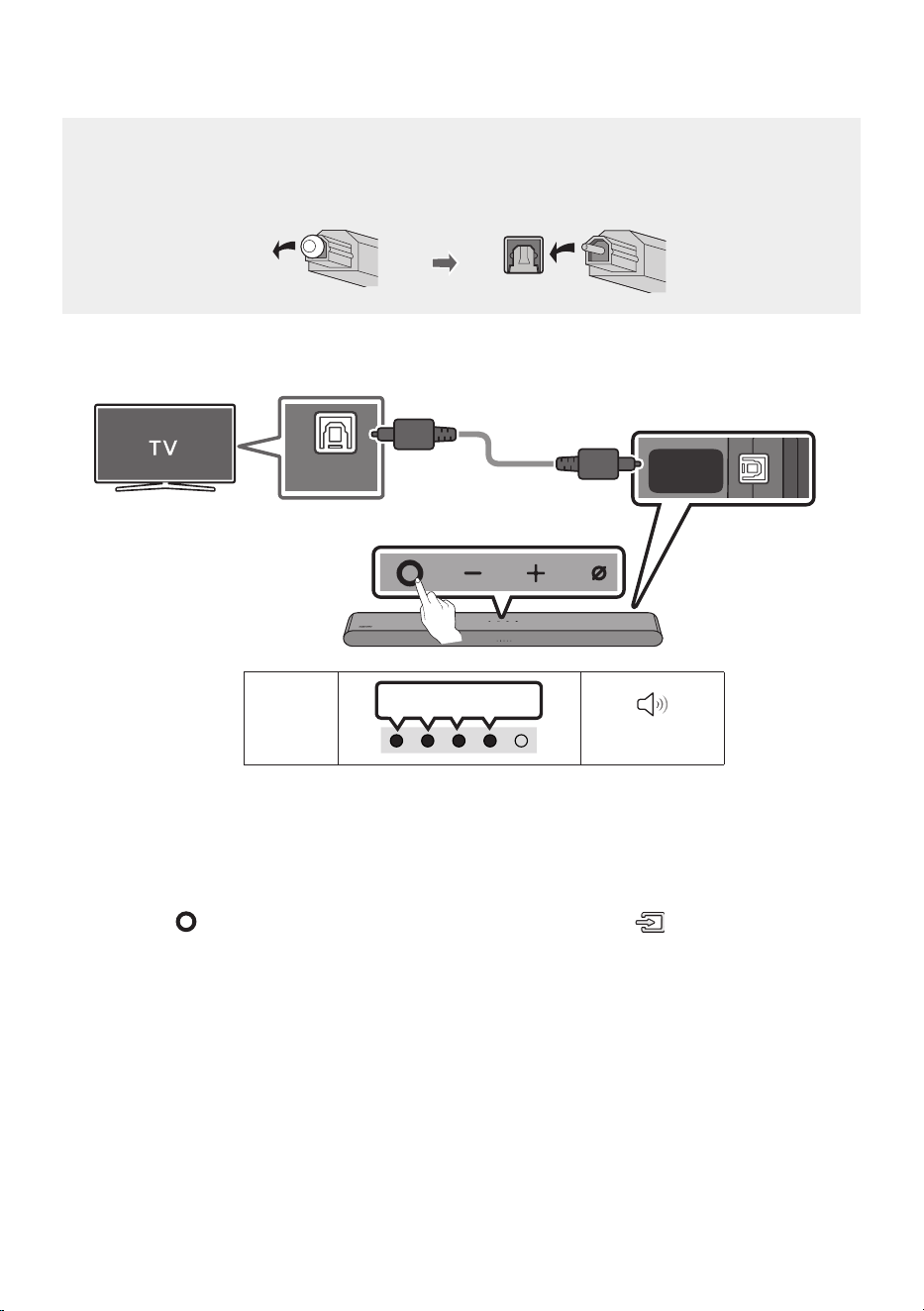
Connecting using an Optical Cable
Pre-connection Checklist
• When both the HDMI cable and optical cable are connected, the HDMI signal is received rst.
• When you use an optical cable and the terminals have covers, be sure to remove the covers.
LED
Indicator
White On -> Off
“Digital Audio In”
OPTICAL OUT
DIGITAL
AUDIO IN
(OPTICAL)
HDMI
(eARC)
Bottom of the
Soundbar
Optical Cable (not supplied)
Top of the Soundbar
1. With the TV and Soundbar turned off, connect the DIGITAL AUDIO IN (OPTICAL) port on the
Soundbar and the OPTICAL output port on the TV with the optical cable (not supplied), as shown in
the gure.
2. Turn on the Soundbar and TV.
3. Press the (Multi Function) button at the top of the Soundbar or the (Source) button on the
remote control and then select the “Digital Audio In” mode. Then the announcement, “Digital
Audio In” is output.
4. The TV sound is output from the Soundbar.
ENG - 19
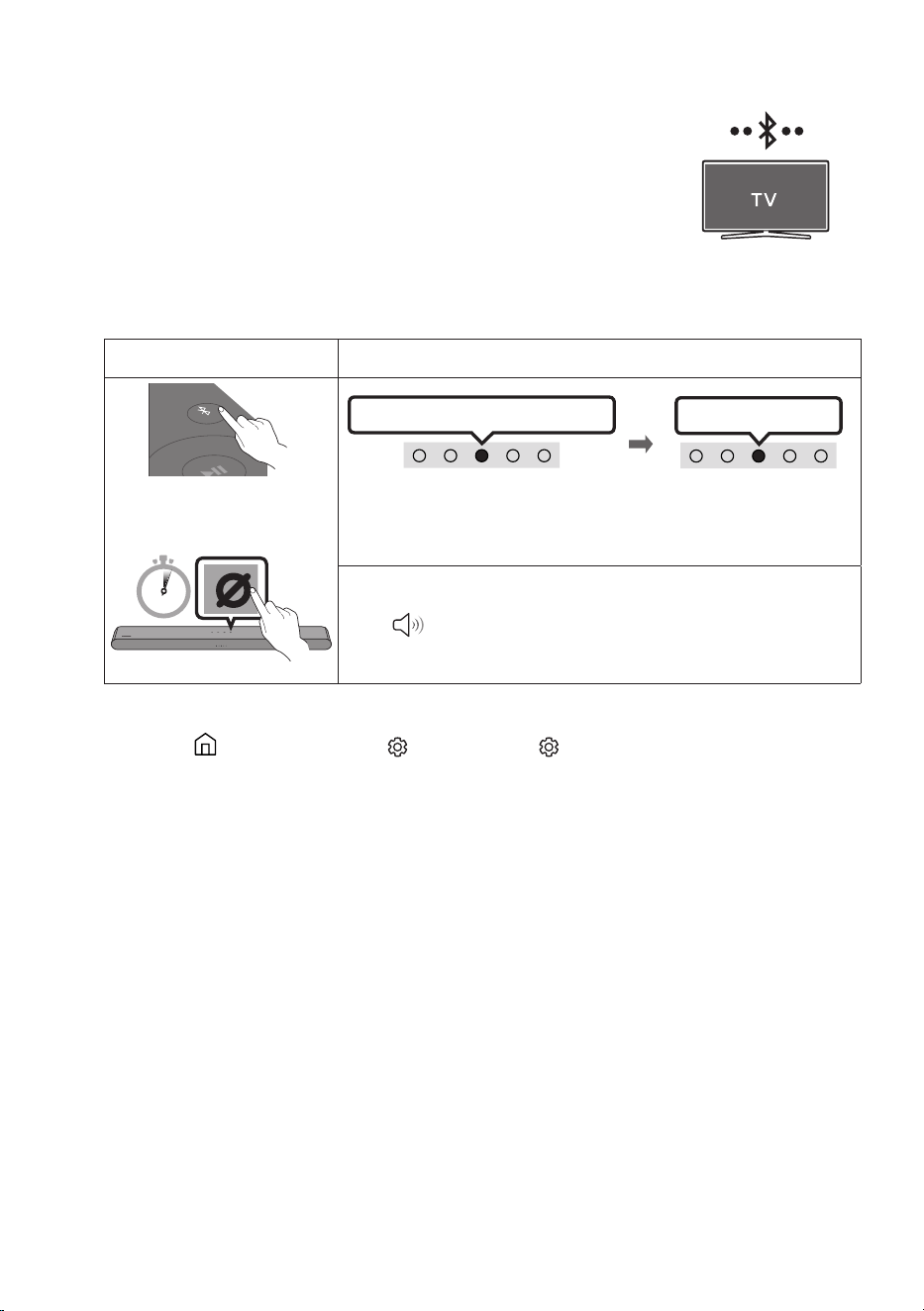
Connecting via Bluetooth
When a Samsung TV is connected using Bluetooth, you can hear stereo
sound without the hassle of cable.
• Only one Samsung TV can be connected at a time.
• Samsung TV that supports Bluetooth can be connected. Check the
specications of your TV.
The initial connection
1.
Bluetooth Pairing button LED Indicator
SOUND
MODE
PAIR
OR
Red → Green → Blue Blinks
Pairing
Connection is complete
Cyan Blinks X3
When in “Bluetooth” mode
5 Sec
• Until pairing is complete, the Multicolor LED changes as Red → Green
→ Blue in turn.
“Ready to connect via Bluetooth.”
2. Select Bluetooth mode on the Samsung TV.
(e.g. Home ( ) → Menu → Settings ( ) → All Settings ( ) Sound Sound Output
Bluetooth Speaker List S-Series Soundbar (Bluetooth))
3. Select “S-Series Soundbar” from the list on TV’s screen.
An available Soundbar is indicated with “Need Pairing” or “Paired” on the TV’s Bluetooth device
list. To connect the Samsung TV to the Soundbar, select the message, and then establish a
connection.
4. You can now hear Samsung TV sound from the Soundbar.
• If there is a connection log between the Soundbar and Samsung TV, the Soundbar is
automatically connected by changing its mode to “Bluetooth”

ENG - 20
If the device fails to connect
• If you have an existing Soundbar (e.g., S-Series Soundbar) on the list of speakers on the
Samsung TV, delete it.
• Then repeat steps 1 through 3.
Disconnecting the Soundbar from the Samsung TV
Press the (Multi Function) button at the top of the Soundbar or the (Source) button on the
remote control to select the mode other than “Bluetooth”.
• Disconnecting takes time because the Samsung TV must receive a response from the Soundbar.
(The time required may differ, depending on the Samsung TV model.)
Notes on Bluetooth connection
• Locate a new device within 3.28 ft (1 m) to connect via Bluetooth communication.
• If asked for a PIN code when connecting a Bluetooth device, enter <0000>.
• The Soundbar automatically turns off after 18 minutes in the Ready state.
• The Soundbar may not perform Bluetooth search or connection correctly under the following
circumstances:
– If there is an electronic equipment or electric apparatus that can cause wireless interference
around the Soundbar.
– If several Bluetooth devices are simultaneously paired with the Soundbar.
– If the Bluetooth device is turned off, not in place, or malfunctions.
• Electronic devices may cause radio interference. Devices that generate electromagnetic waves
must be kept away from the Soundbar main unit - e.g., microwaves, wireless LAN devices, etc.
• Precaution : The Soundbar will restart automatically if you turn on/turn off Bluetooth.
– Bluetooth Port deactivation method : Press the TONE CONTROL button on the remote control
of the Soundbar for 30 seconds to turn Bluetooth On/Off.

ENG - 21
Connecting via Wi-Fi
Pre-connection Checklist
• Wi-Fi connection is available only on Samsung TV.
• Check whether the wireless router (Wi-Fi) is turned on and the TV is connected to the router.
• The TV and Soundbar must be connected to the same wireless network (Wi-Fi).
• If your wireless router (Wi-Fi) uses a DFS channel, you will not be able to establish a Wi-Fi
connection between the TV and Soundbar. Contact your Internet service provider for details.
• Because the menus may differ depending on the year of manufacture, refer to your TV manual.
• To connect the TV to the Soundbar via Wi-Fi, connect the Soundbar to the wireless router rst.
See page 30, for details on how to establish a Wi-Fi connection.
1. For more information about Wi-Fi connection to the Soundbar, see page 30, “Method 2.
Connecting via Wi-Fi (Wireless Network)”.
2. Change the input source of the TV by using the Audio menu to Soundbar.
• Samsung TVs released in 2017 or later
Home ( ) → Menu → Settings ( ) → All Settings ( ) Sound Sound Output S-Series
Soundbar (Wi-Fi)
NOTE
• Precaution : The Soundbar will restart automatically if you turn on/turn off Wi-Fi.
– Wi-Fi Port deactivation method : Press the CH LEVEL button on the remote control of the
Soundbar for 30 seconds to turn Wi-Fi On/Off.
ENG - 22
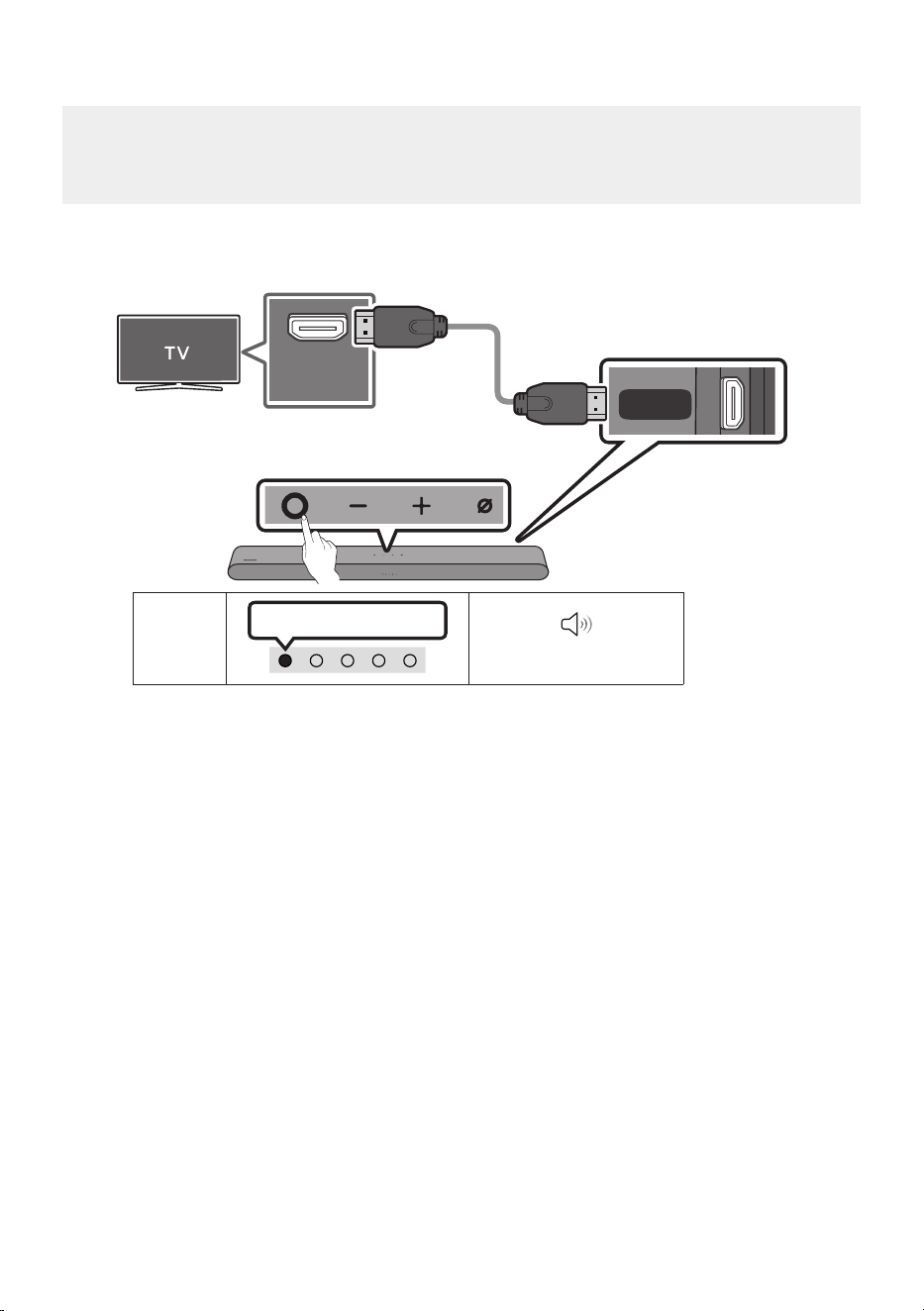
Connecting to a TV that supports Dolby Atmos®
Pre-connection Checklist
• Dolby Atmos® is supported in “TV ARC” or “eARC” or “Wi-Fi” mode.
• Make sure that the content supports Dolby Atmos®.
HDMI IN
(eARC)
DIGITAL
AUDIO IN
(OPTICAL)
HDMI
(eARC)
Connect to the HDMI IN (ARC)
or (eARC) port of your TV.
HDMI Cable
Bottom of the
Soundbar
Connect to the HDMI (eARC) port of
the Soundbar main unit.
Top of the Soundbar
LED
Indicator
White On -> Off
“TV ARC” or “eARC”
1. With the Soundbar and TV turned off, connect the HDMI cable as shown in the gure.
2. Turn on the Soundbar and TV.
3. TV sound is output from the Soundbar.

ENG - 23
LED
Indicator
White On -> Off
“Wi-Fi”
TV menu
Wi-Fi
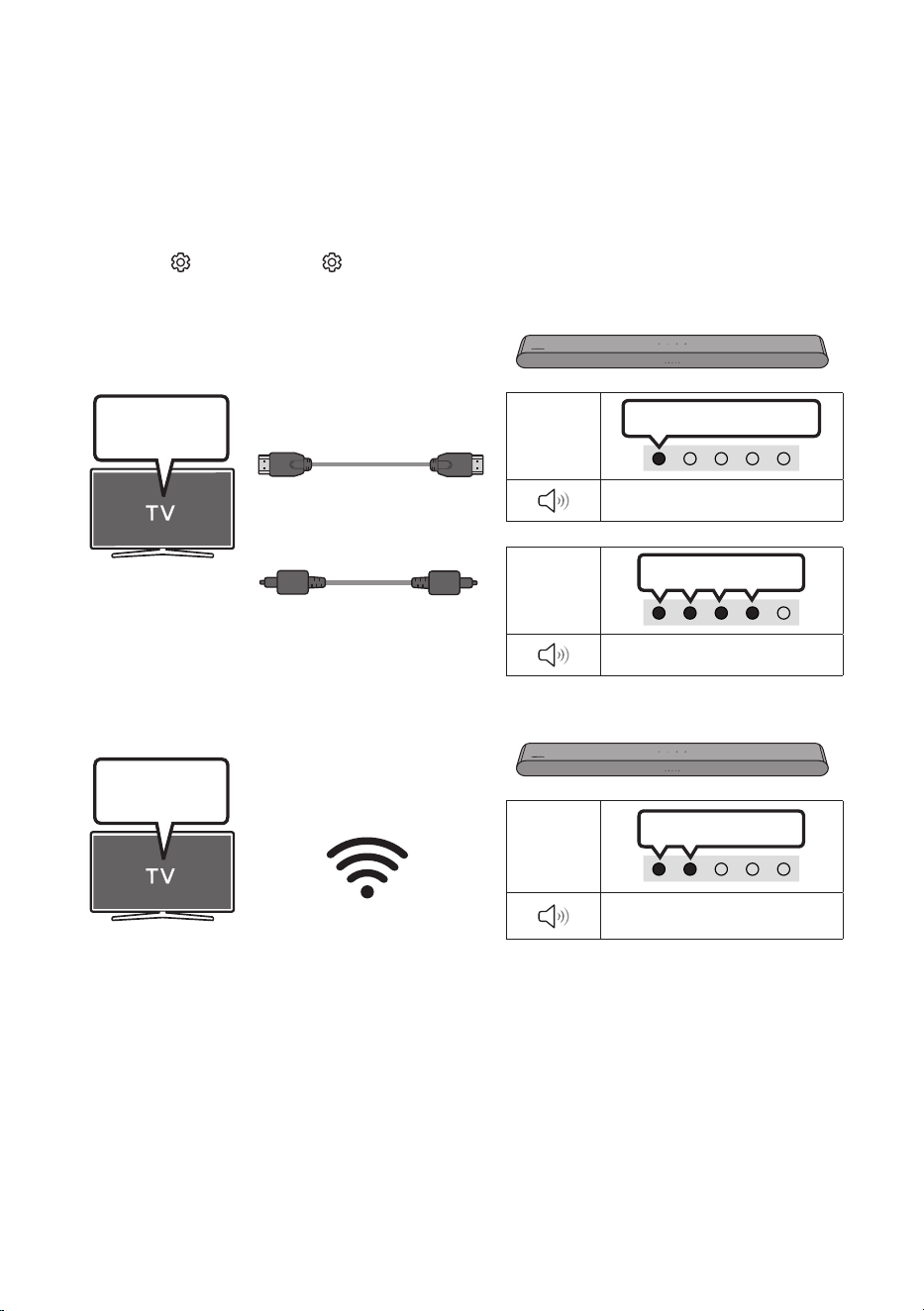
1. Connect the Soundbar and TV to the same wireless network (Wi-Fi).
2. For sound output of the TV, select Soundbar.
3. TV sound is output from the Soundbar.
NOTES
• Conguring Dolby Atmos® on a BD player or other device connected to the TV.
Open the audio output options on the settings menu of your BD player or other device and make
sure that “No Encoding” is selected for Bitstream. For example, on a Samsung BD Player, go to
Home Menu → Sound → Digital Output and then select Bitstream (unprocessed).
• This function is available in some Samsung TVs and some Soundbar models.
ENG - 24
Using the Q-Symphony Function
• When the Soundbar connects to a Samsung TV that supports the Q-Symphony function, you can
play the sound simultaneously through the Soundbar and the TV. If you use the Q-Symphony
function, the surround sound played on the TV allows you to enjoy a richer, more three-dimensional
surround sound effect.
• When the Soundbar is connected, “Q-Symphony” menu appears on the TV.
Settings ( ) → All Settings ( ) → Sound → Sound Output
• TV menu example: Q-Symphony
LED
Indicator
White On -> Off
“TV ARC” or “eARC”
LED
Indicator
White On -> Off
“Digital Audio In”
TV menu
Optical Cable (not supplied)
HDMI Cable
OR
LED
Indicator
White On -> Off
“Wi-Fi”
TV menu
Wi-Fi
NOTES
• This function can be operated by the Codec supported by TV.
• This function is supported only when the HDMI Cable or Optical Cable (not supplied) or Wi-Fi is
connected.
• The message displayed may differ with the TV model.
• Ensure that your TV and Soundbar are connected to the same wireless router/frequency.
• This function is available in some Samsung TVs and some Soundbar models.

ENG - 25
Using the SpaceFit Sound
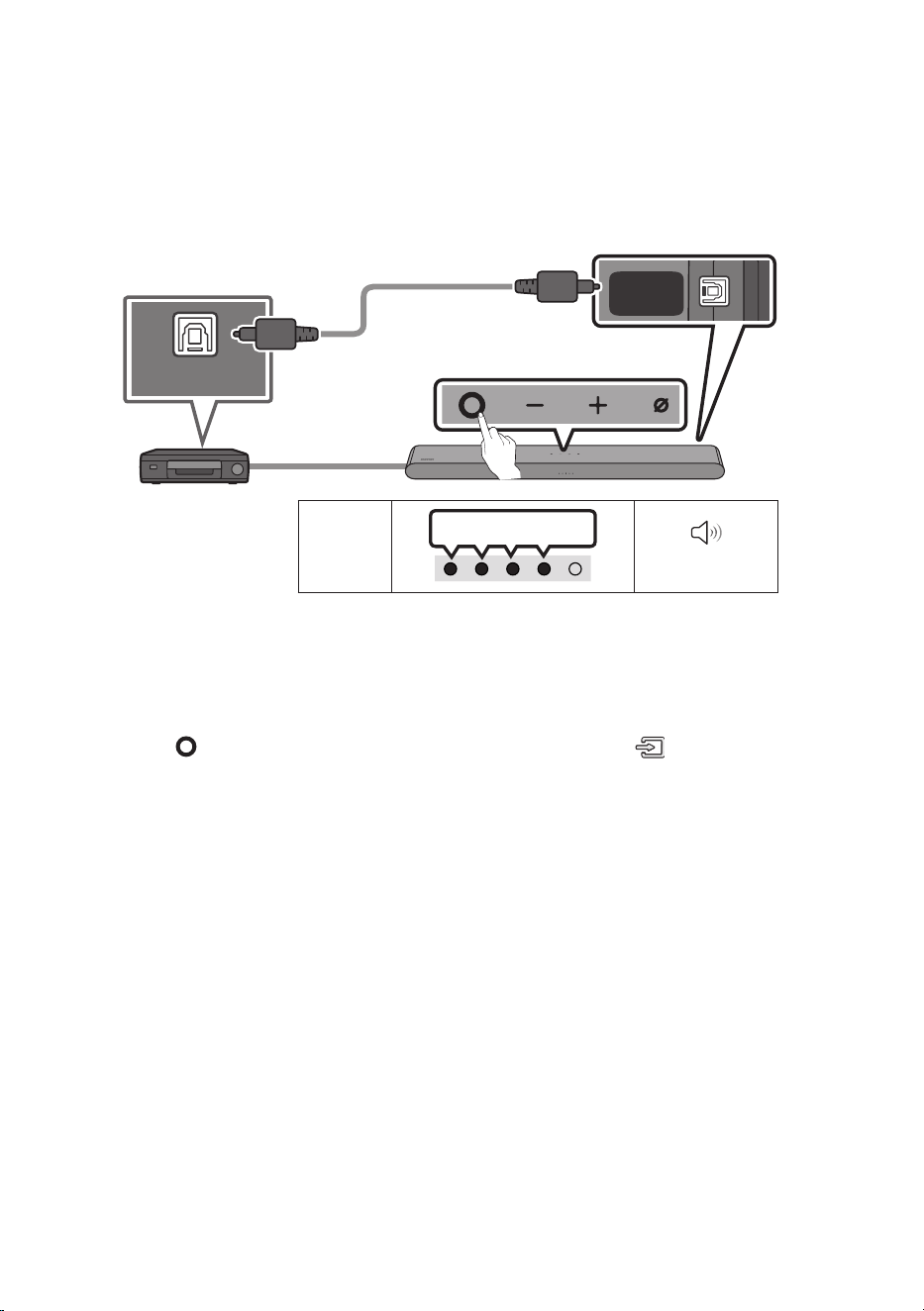
Provides optimized sound quality by analyzing the listening spaces.
Method 1. Connecting via Soundbar
To enable this function, turn on the SpaceFit Sound mode with the remote control of the Soundbar.
( (Sound Control) → "SpaceFit Sound Off" → ▲ ( Up ) → "SpaceFit Sound On")
• This is available in all Sound modes.
Method 2. Connecting via TV
To enable this function, turn on the Adaptive Sound+ mode on your Samsung TV menu.
(Home ( ) → Menu → Settings ( ) → All Settings ( ) General Intelligent Mode Settings
Adaptive Sound+)
• The sound mode on your Soundbar will automatically change to Adaptive Sound+ if you enable the
Adaptive Sound+ mode on your TV.
NOTE
• This function works when the Soundbar connects to some of the Samsung TVs.
ENG - 26
06 CONNECTING AN EXTERNAL DEVICE
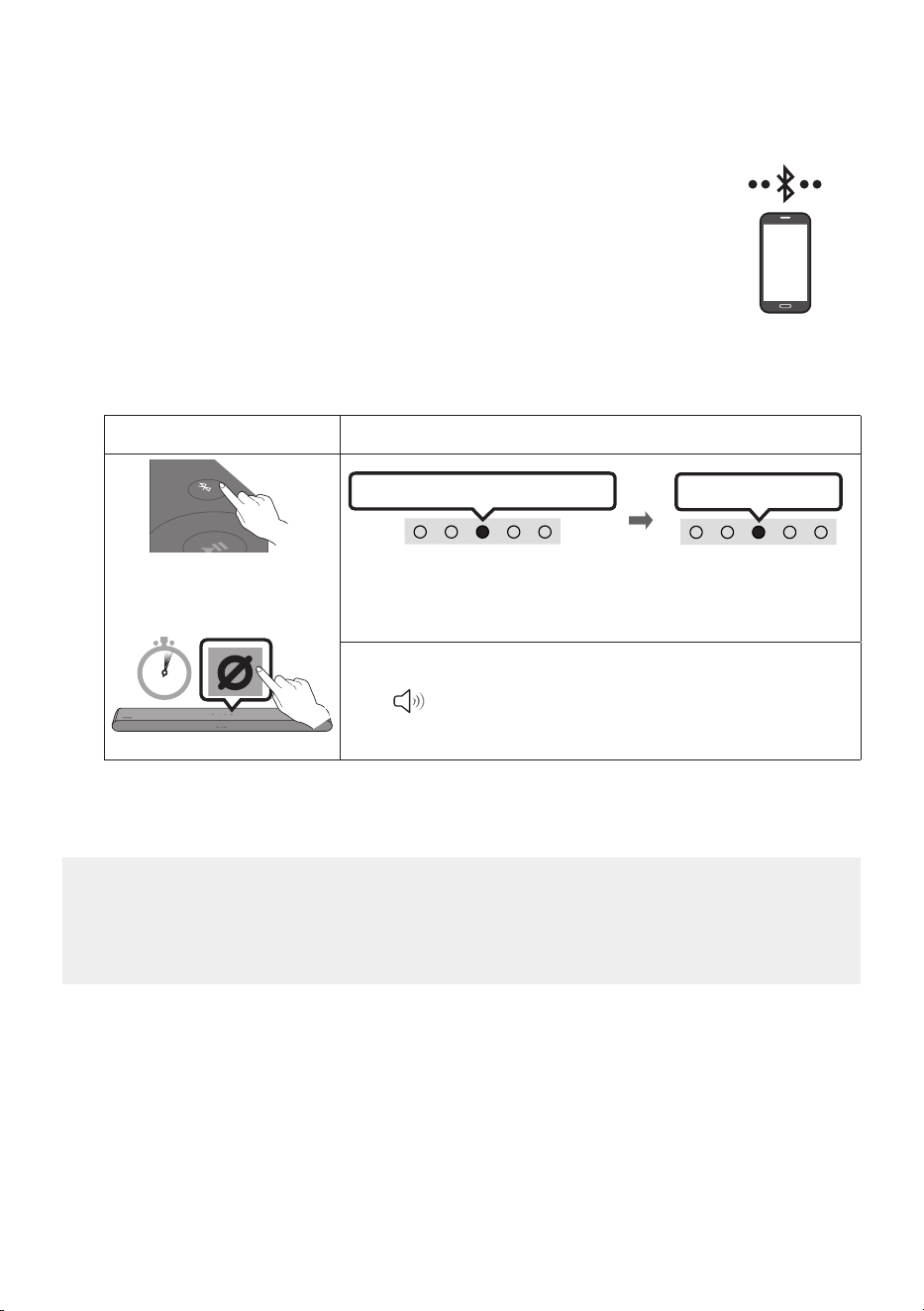
Connecting using an Optical Cable
LED
Indicator
White On -> Off
“Digital Audio In”
- AUDIO -
R L
OPTICAL OUT
DIGITAL
AUDIO IN
(OPTICAL)
HDMI
(eARC)
Bottom of the Soundbar
Optical Cable
(not supplied)
Top of the Soundbar
BD / DVD player / Set-top
box / Game console
1. With the external device and Soundbar turned off, connect the DIGITAL AUDIO IN (OPTICAL) port
on the Soundbar and the OPTICAL output port on the external device with the optical cable (not
supplied), as shown in the gure.
2. Turn on the Soundbar and external device.
3. Press the (Multi Function) button at the top of the Soundbar or the (Source) button on the
remote control and then select the “Digital Audio In” mode. Then the announcement, “Digital
Audio In” is output.
4. The external device sound is output from the Soundbar.
ENG - 27
07 CONNECTING A MOBILE DEVICE
Method 1. Connecting via Bluetooth
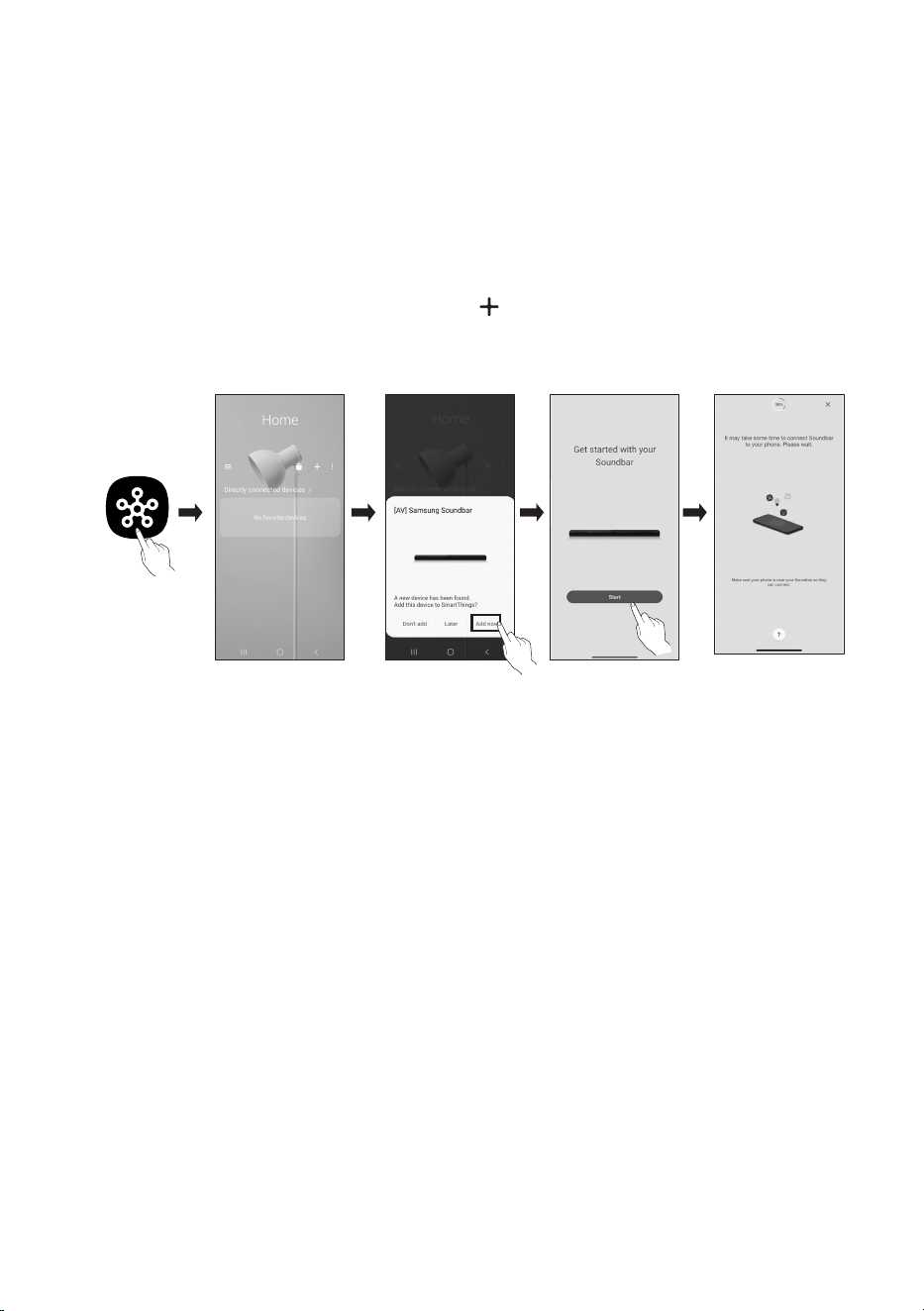
When a mobile device is connected using Bluetooth, you can hear stereo sound
without the hassle of cable.
• When you connect a paired Bluetooth device with the Soundbar off, the
Soundbar automatically turns on.
The initial connection
• When connecting to a new Bluetooth device, make sure the device is within 3.28 ft (1 m) distance.
1.
Bluetooth Pairing button LED Indicator
SOUND
MODE
PAIR
OR
Red → Green → Blue Blinks
Pairing
Connection is complete
Cyan Blinks X3
When in “Bluetooth” mode
5 Sec
• Until pairing is complete, the Multicolor LED changes as Red → Green
→ Blue in turn.
“Ready to connect via Bluetooth.”
2. On your device, select “S-Series Soundbar” from the list that appears.
3. Play music les from the device connected via Bluetooth through the Soundbar.
If the device fails to connect
• If you have an existing Soundbar (e.g., S-Series Soundbar) on the list of speakers on the Mobile
device, delete it.
• Then repeat steps 1 and 2.
mobile device

ENG - 28
Notes on Bluetooth connection
• Locate a new device within 3.28 ft (1 m) to connect via Bluetooth communication.
• If asked for a PIN code when connecting a Bluetooth device, enter <0000>.
• The Soundbar automatically turns off after 18 minutes in the Ready state.
• The Soundbar may not perform Bluetooth search or connection correctly under the following
circumstances:
– If there is a strong electrical eld around the Soundbar.
– If several Bluetooth devices are simultaneously paired with the Soundbar.
– If the Bluetooth device is turned off, not in place, or malfunctions.
• Electronic devices may cause radio interference. Devices that generate electromagnetic waves
must be kept away from the Soundbar main unit - e.g., microwaves, wireless LAN devices, etc.
• The Soundbar supports SBC data (44.1kHz, 48kHz).
• Connect only to a Bluetooth device that supports the A2DP (AV) function.
• When connecting the Soundbar to a Bluetooth device, place them as close to each other as possible.
• The farther the Soundbar and Bluetooth device are from each other, the lower the sound quality
will become.
The Bluetooth connection may break when the devices are out of the effective range.
• The Bluetooth connection may not function as intended in areas with poor reception.
• A Bluetooth device may experience noise or malfunction under in the following conditions:
– When the body is in contact with the signal transceiver on the Bluetooth device or Soundbar
– In corners or when there is an obstacle in proximity, such as a wall or partition, where electrical
changes may occur.
– When exposed to radio interferences by other products operating on the same frequency
ranges, such as medical equipment, microwave ovens, and wireless LAN devices.
– Obstacles such as doors and walls may still impact the sound quality even when the devices
are within the effective range.
• Note that your Soundbar cannot be paired with other Bluetooth devices while using the Bluetooth
option.
• This wireless device may cause electrical interference during operation.

ENG - 29
Disconnecting the Bluetooth device from a Soundbar
You can disconnect a Bluetooth device from the Soundbar. For instructions, see the Bluetooth device’s
user manual.
• The Soundbar will be disconnected.
• If the Soundbar is disconnected from the Bluetooth device, the multicolor LED indicator on the
Soundbar blinks "Red” three times.
Disconnecting the Soundbar from the Bluetooth device
Press the (Multi Function) button at the top of the Soundbar or the (Source) button on the
remote control to select the mode other than “Bluetooth”.
• Disconnecting takes time because the Bluetooth device must receive a response from the
Soundbar. (Disconnection time may differ, depending on the Bluetooth device)
ENG - 30
Method 2. Connecting via Wi-Fi (Wireless Network)
To connect a Soundbar to a mobile device via a wireless network (Wi-Fi), the SmartThings app is
required.
The initial connection
1. Install and launch the SmartThings app from your mobile device (smartphone or tablet).
2. On the app, follow the screen instructions to add the Soundbar.
• The automatic pop-up (the second screenshot below) may not show on some devices.
If the pop-up window does not appear, press “ ” on the Home screen. The Soundbar is added
to the app.
• The illustration below may differ according to the app version.
Launch App Add deviceAuto pop-up
SmartThings
App
To change your Wi-Fi connection
1. Launch the SmartThings app from your mobile device (smartphone or tablet).
2. On the app, delete the registered Soundbar, and then add it again.

ENG - 31
Using Group Play
• To benet from this feature, add your Soundbar to the SmartThings app.
• To enable this, connect at least two audio devices to the same Wi-Fi network at 5 GHz.
• This is available on Samsung Sound devices that support Wi-Fi released year 2024 or later.
• This feature does not support TV sound.
Conguring Group Play
1. Run the SmartThings app on your mobile device.
2. Add the Soundbar in the SmartThings app according to the instructions in the “Method 2.
Connecting via Wi-Fi (Wireless Network)” “Steps 2 (Device registration)” section.
3. Tap the Soundbar’s card.
4. On your mobile device, tap Create Group under the audio device icon.
• Create Group button appears only when Soundbar is in Wi-Fi mode.
• If the Soundbar is playing the TV sound, the connection to the TV is disconnected when creating
a group.
5. Enable Group Play.
6. Select a desired device in the list, and tap Apply.
• You can add a maximum of 4 devices.
• With Group Play, the audio will be output through the host device alone.
• When a device connected to the host device switches to a different source, the device will be
deleted from the group automatically.
• When the host device is connected to a TV, the generated group will be deleted automatically.
Disabling Group Play
1. Tap the audio device’s card.
2. On your mobile device, tap Edit Group under the audio device icon.
3. Disable Group Play.
• To disable an individual device, uncheck the device from the list and tap Apply.

ENG - 32
Connecting via Apple AirPlay
• This feature may not be available in some countries.
• This Samsung Soundbar supports AirPlay and requires iOS 13.4 or later.
• To enable AirPlay in your Soundbar, you must rst register the device with the Samsung
SmartThings app by agreeing with the app’s terms and conditions.
• Make sure the Soundbar is powered on and connected to the same Wi-Fi network as your Apple
device.
With AirPlay, you can stream music, podcasts, and other audio from your Apple devices to the Samsung
Soundbar.
• Select from an AirPlay-supported app or Control Center on your iPhone, iPad, or Mac.
• Select the Soundbar from the list of available devices to play the current audio to.
ENG - 33
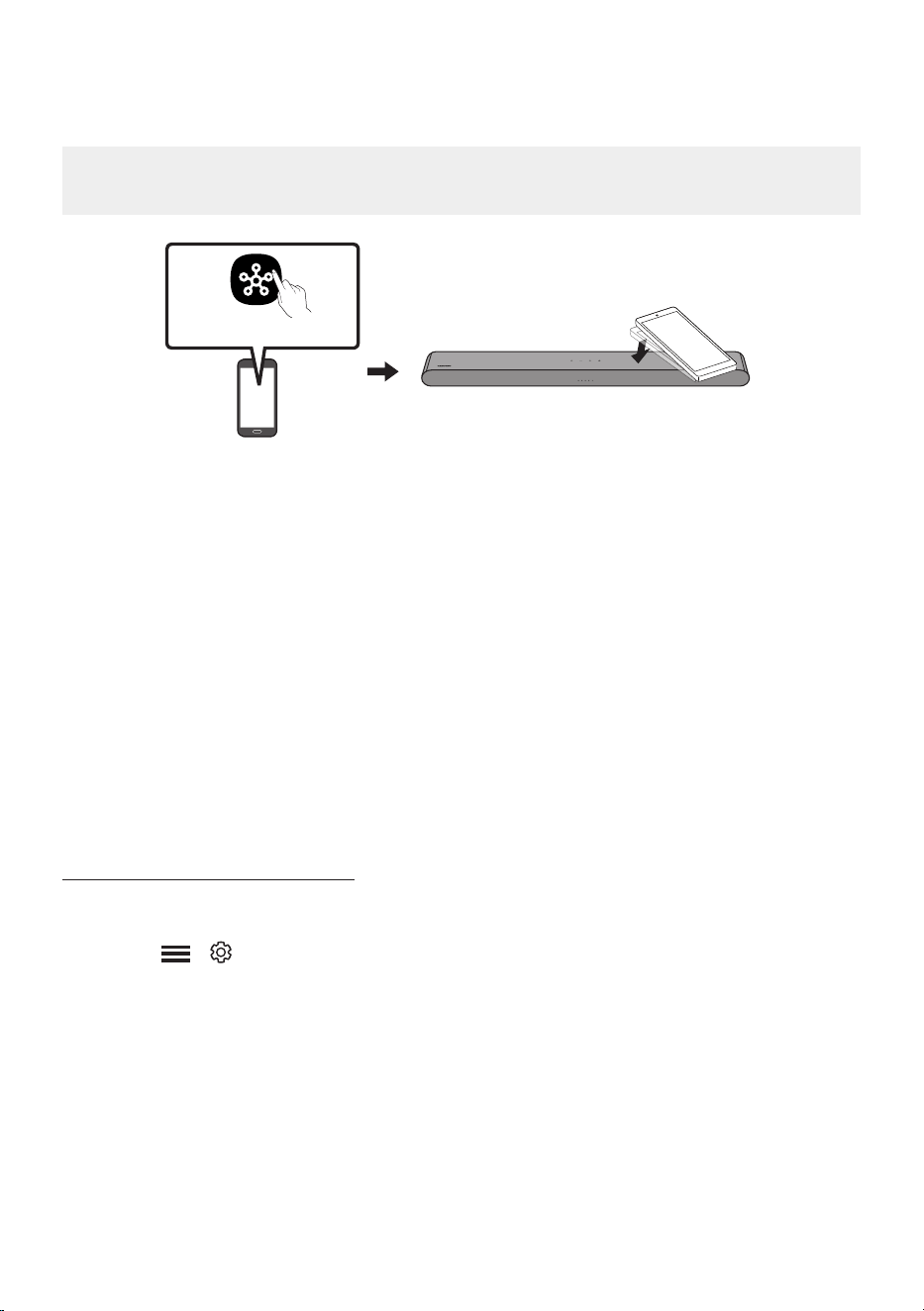
Using the Tap Sound
Tap the Soundbar with your mobile device to play audio from the mobile device through the Soundbar.
• This function may not be supported depending on the mobile device.
• This function is only compatible with Samsung mobile devices with Android 8.1 or later.
Mobile device
SmartThings App
Top of the Soundbar
1. Turn on the Tap Sound function on your mobile device.
• For details on how to turn on the function, refer to “Enable the Tap Sound function” below.
2. Tap the Soundbar with the mobile device. Select “Start now” in the displayed message window.
A connection is established between the mobile device and Soundbar via Bluetooth.
3. Play audio from the mobile device through the Soundbar.
• This function connects a mobile device to the Soundbar via Bluetooth by detecting vibration
that occurs when the device touches the Soundbar.
• Make sure the mobile device does not tap a sharp corner of the Soundbar. The Soundbar or
mobile device may become scratched or damaged.
• It is recommended that the mobile device be covered with a case. Lightly tap the wide area in
the upper portion of the Soundbar, without using excessive force.
• To use this function, update the SmartThings app to the latest version.
The function may not be supported, depending on the app version.
Enable the Tap Sound function
Use the SmartThings app to turn on the Tap View, Tap Sound function.
1. On the mobile device, run the SmartThings app.
2. Select ( → ) in the SmartThings app screen displayed on the mobile device.
3. Set “Tap View, Tap Sound” to On to allow the function to work when a mobile device moves close to
the Soundbar.
NOTES
• When the mobile device is in power-saving mode, the Tap Sound function does not work.
• The Tap Sound function may not work if there are devices near the Soundbar that cause radio
interference such as electric devices. Make sure devices that may cause radio interference are
placed at a sufcient distance away from the Soundbar.
ENG - 34
08 INSTALLING THE
WALL MOUNT
Installation Precautions
• Install on a vertical wall only.
• Do not install in a place with high
temperature or humidity.
• Verify whether the wall is strong enough to
support the product’s weight. If not, reinforce
the wall or choose another installation point.
• Purchase and use the xing screws or
anchors appropriate for the kind of wall you
have (plaster board, iron board, wood, etc.). If
possible, x the support screws into wall
studs.
• Purchase wall mounting screws according to
the type and thickness of the wall you want to
mount the Soundbar on.
– Diameter: M5
– Length: 1 3/8 inches (35 mm) or longer
recommended.
• Connect cables from the unit to external
devices before you install the Soundbar on
the wall.
• Make sure the unit is turned off and
unplugged from the power source before you
install it. Otherwise, it may cause an electric
shock.
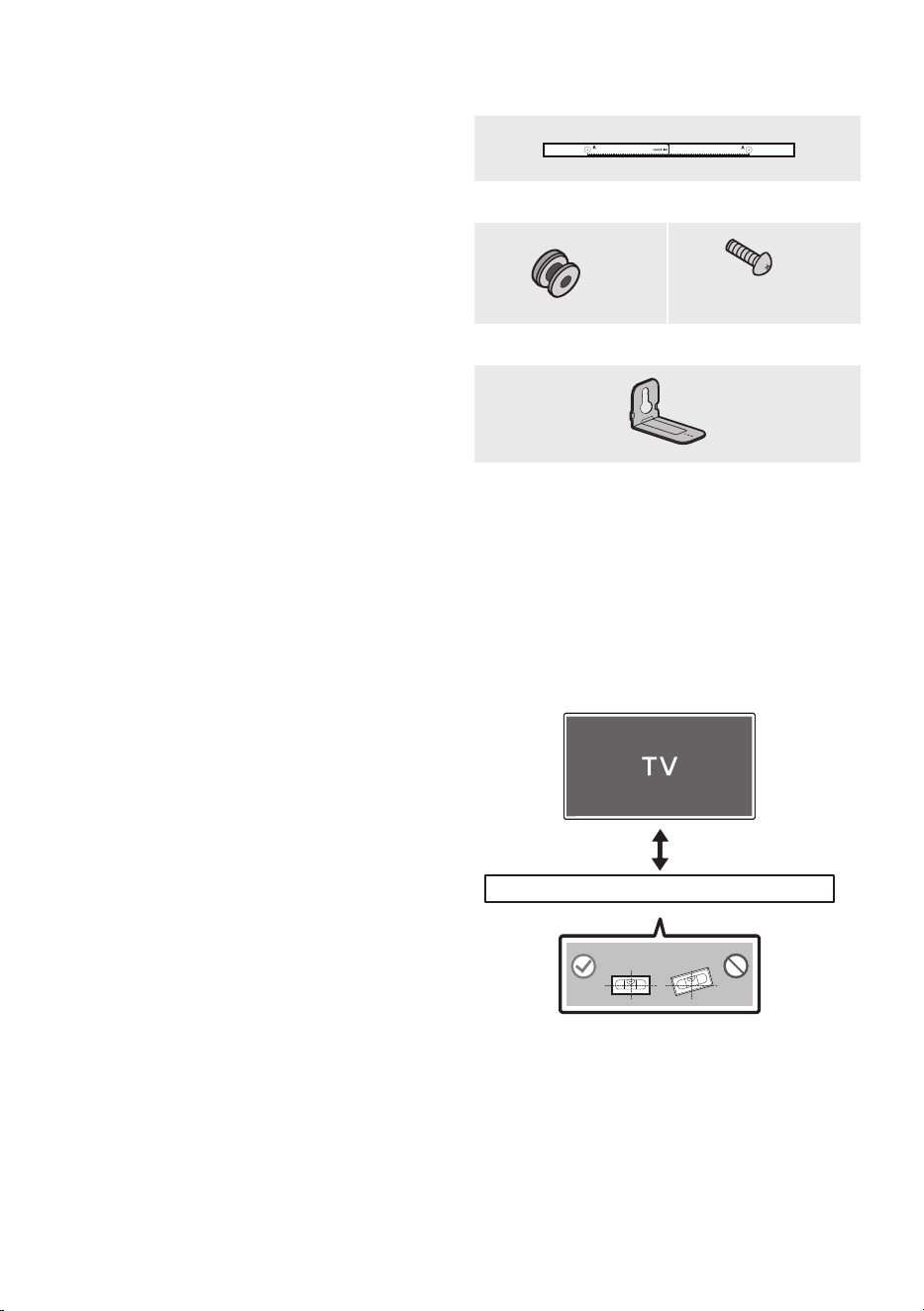
Wallmount Components
A TYPE : 450mm
Wall Mount Guide
x 2
(M4 x L10)
x 2
Holder-Screw Screw
x 2
Bracket-Wall Mount
1. Place the Wall Mount Guide against the wall
surface.
• The Wall Mount Guide must be leveled.
• If your TV is mounted on the wall, install
the Soundbar at least 2 inches (5 cm)
below the TV.
2 inches (5 cm) or more
ENG - 35
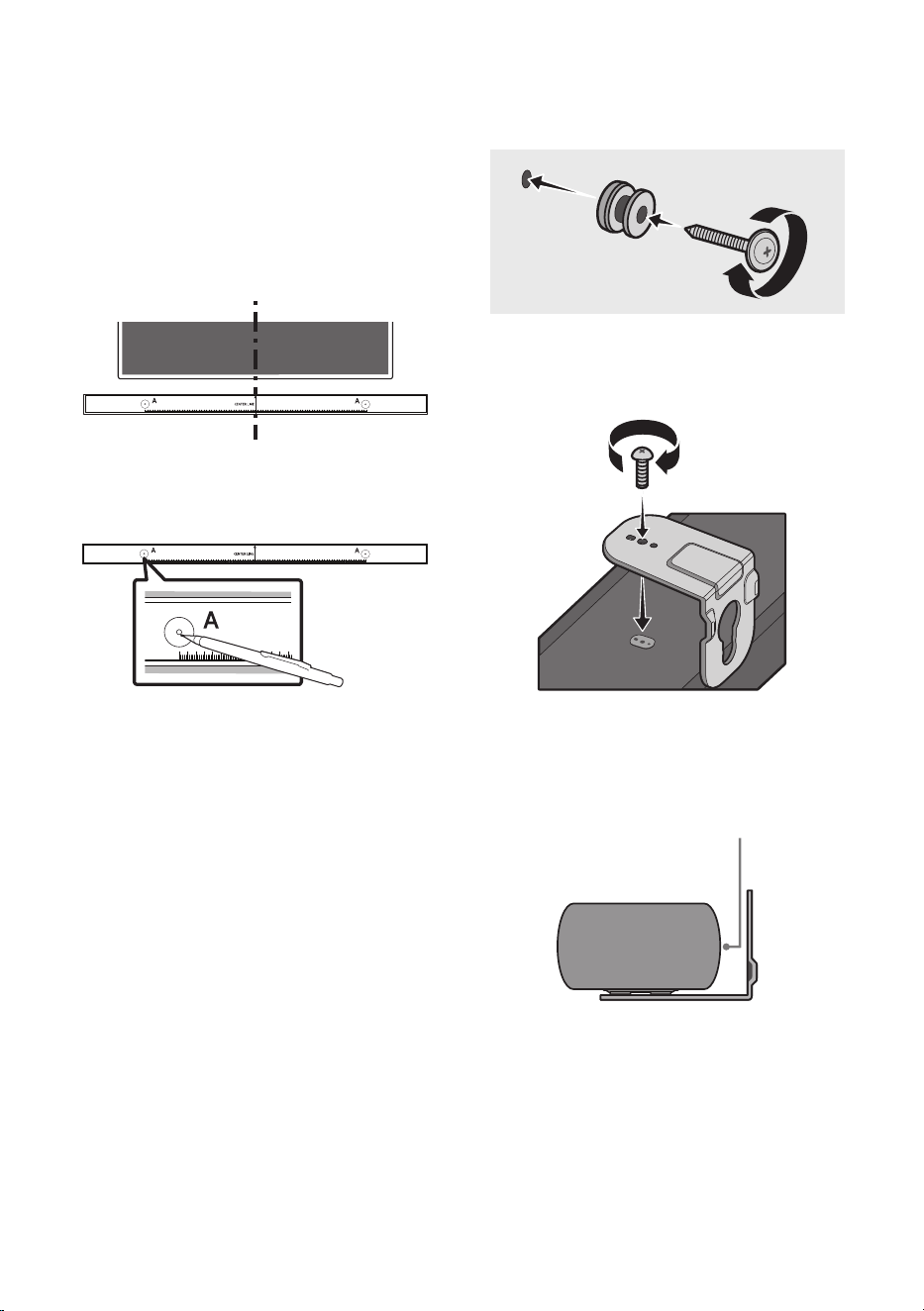
2. Align the Wall Mount Guide’s Center Line
with the center of your TV (if you are
mounting the Soundbar below your TV), and
then x the Wall Mount Guide to the wall
using tape.
• If you are not mounting below a TV, place
the Center Line in the center of the
installation area.
Center Line
A TYPE : 450mm
3. Use a pen to mark the positions of the holes
and remove the Wall Mount Guide.
A TYPE : 450mm
4. Using an appropriately sized drill bit, drill a
hole in the wall at each marking.
• If the markings do not correspond to the
positions of studs, make sure you insert
appropriate anchors into the holes before
you insert the support screws. If you use
anchors, make sure the holes you drill are
large enough for the anchors you use.
5. Push a screw (not supplied) through each
Holder-Screw, and then screw each screw
rmly into a support screw hole.
(Not supplied)
6. Install the 2 Bracket-Wall Mounts in the
correct orientation on the bottom of the
Soundbar using 2 Screws.
• When assembling, make sure the hanger
part of the Bracket-Wall Mounts are
located behind the rear of the Soundbar.
Rear of Soundbar
Right end of Soundbar
• The actual product may look different
from the above image, depending on
the model.
ENG - 36
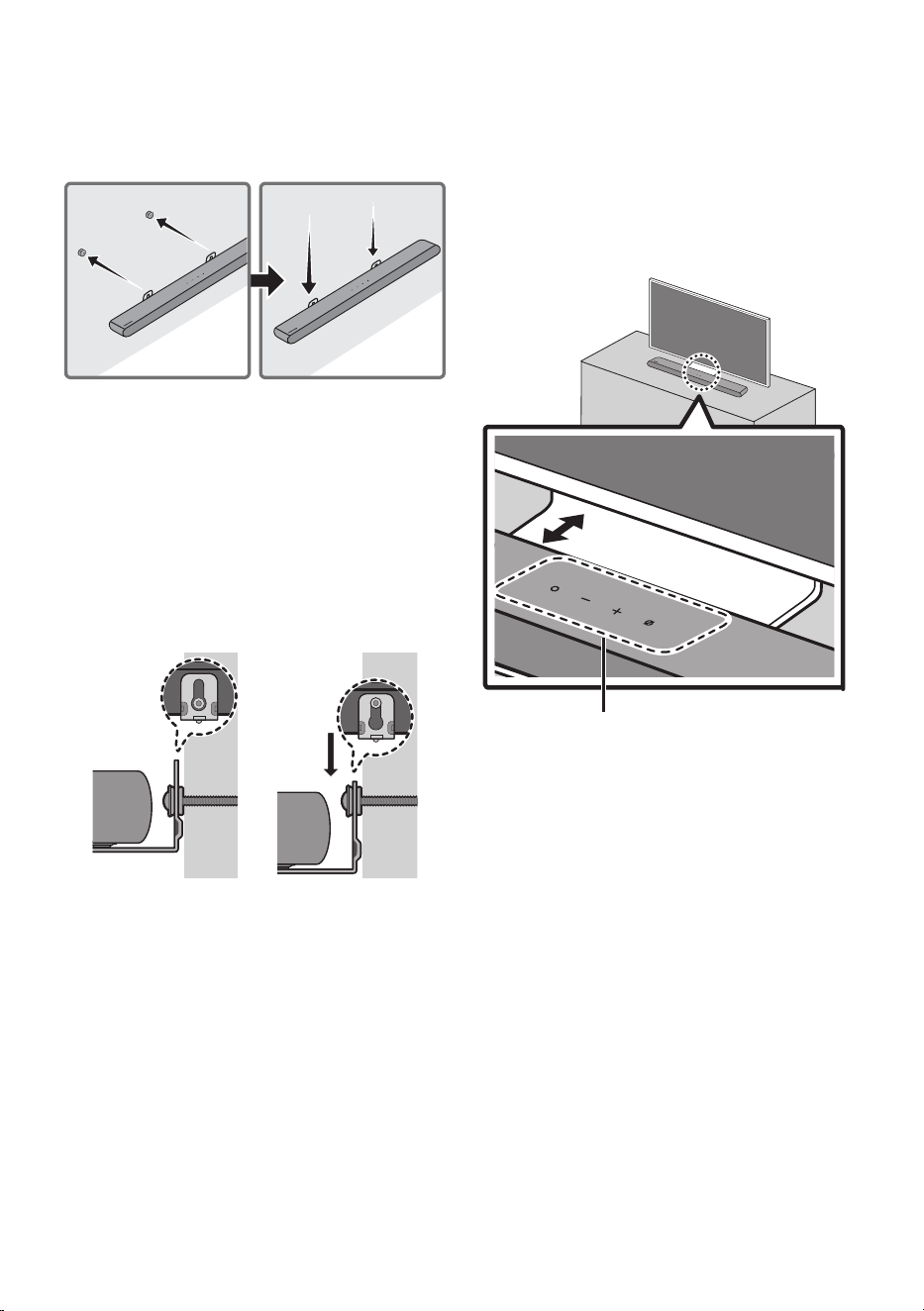
7. Install the Soundbar with the attached
Bracket-Wall Mounts by hanging the
Bracket-Wall Mounts on the Holder-Screws
on the wall.
8. Slide the Soundbar down as shown below so
that the Bracket-Wall Mounts rest securely
on the Holder-Screws.
• Insert the Holder-Screws into the wide
(bottom) part of the Bracket-Wall
Mounts, and then slide the Bracket-Wall
Mounts down so that the Bracket-Wall
Mounts rest securely on the
Holder-Screws.
09 INSTALLING THE
SOUNDBAR IN
FRONT OF TV
1.2 inches (3cm) or more
Microphones
Align the center of the Soundbar to the center of
the TV as illustrated in the image.
At the same time, place the Soundbar at least
1.2 inches (3cm) away from the TV so that there is
no interference with voice recognition.
NOTES
• Make sure the Soundbar is placed on a at
and solid surface.
• Insufcient gap between the TV and
Soundbar may cause voice recognition and
acoustic problems.
ENG - 37
10 SOFTWARE
UPDATE
Auto Update
When the Soundbar is connected to the Internet,
software updates automatically occur even when
the Soundbar is turned off.
• To use the Auto Update function, the
Soundbar must be connected to the Internet.
The Wi-Fi connection to the Soundbar will be
terminated if the Soundbar’s power cord is
disconnected or the power is cut off. If the
power is cut off, when the power comes back
on or you reconnect the power cord, turn on
the Soundbar, and then reconnect it to the
Internet.
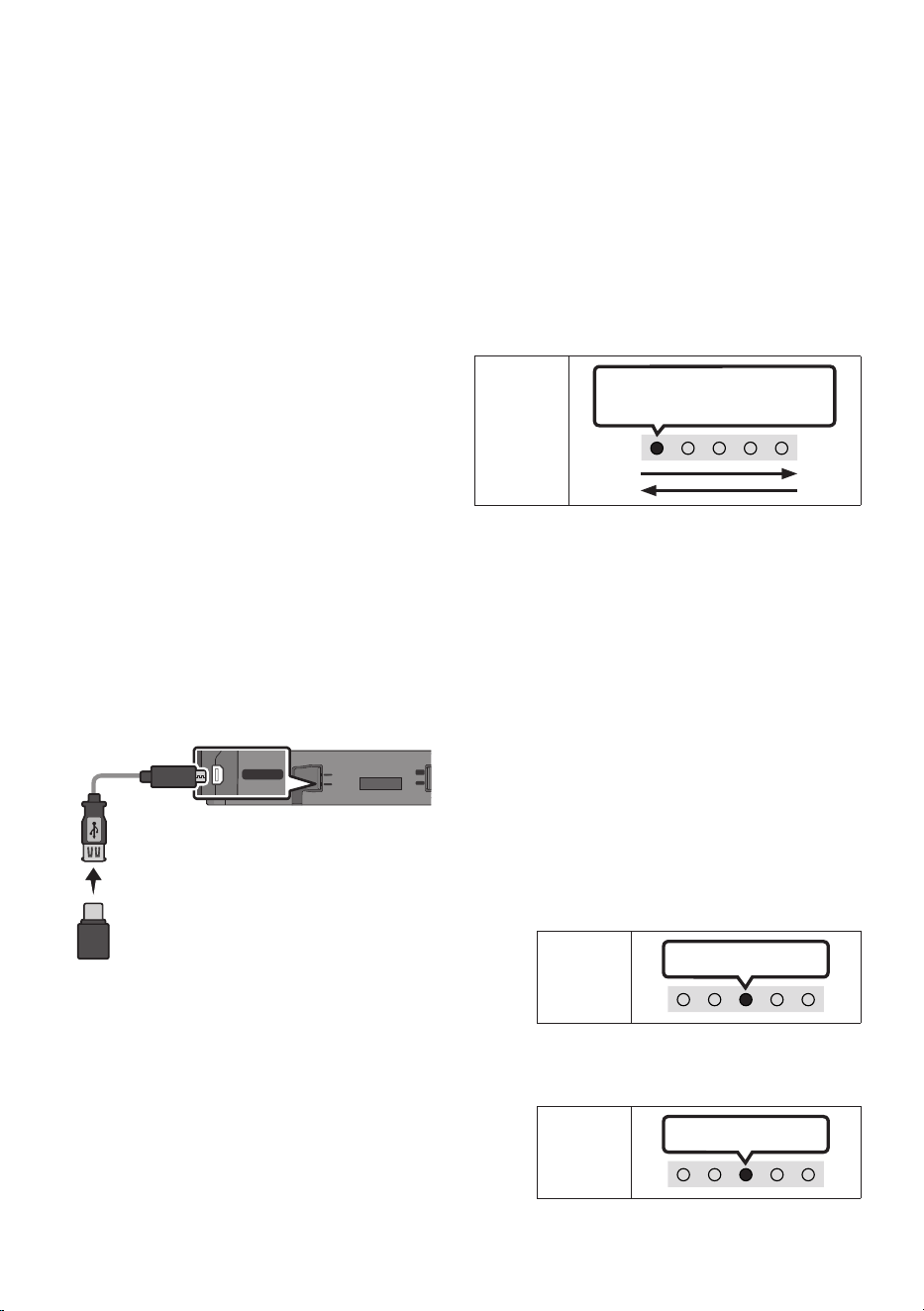
USB Update
SERVICE
DC 19V
DIGITAL
AUDIO IN
(OPTICAL)
HDMI
(eARC)
SERVICE
DC 19V
Micro USB to
USB adapter Cable
(not supplied)
Bottom of the Soundbar
Samsung may offer updates for the Soundbar’s
system rmware in the future.
When an update is available, you can update the
Soundbar by connecting the USB drive that
contains the update rmware to the SERVICE
port of the Soundbar.
1. Go to (www.samsung.com) → search for the
model name from the customer support
menu option.
• For more information about update, refer
to Upgrade Guide.
2. Download the upgrade le (USB type).
3. Unzip the le to create a folder with the le
name.
4. Store the created folder in a USB and then
connect it to the Soundbar.
5. Turn on the Soundbar. Then the product is
updated within 3 minutes.
LED
Indicator
White moves from left to right
and right to left
• During update, do not turn it off or
remove the USB.
• If the yellow LED is on after the software
update is completed, this means that an
additional update is in progress. When
this happens, don't turn off the power or
remove the USB.
• If update does not proceed, reconnect the
Soundbar power cord.
• When the latest version is installed, no
update is performed.
• Depending on the USB type, update may
not be supported.
• If there is no update le available
LED
Indicator
Red Blinks X3
• If the update le is for the same version
or lower
LED
Indicator
Cyan Blinks X3
ENG - 38
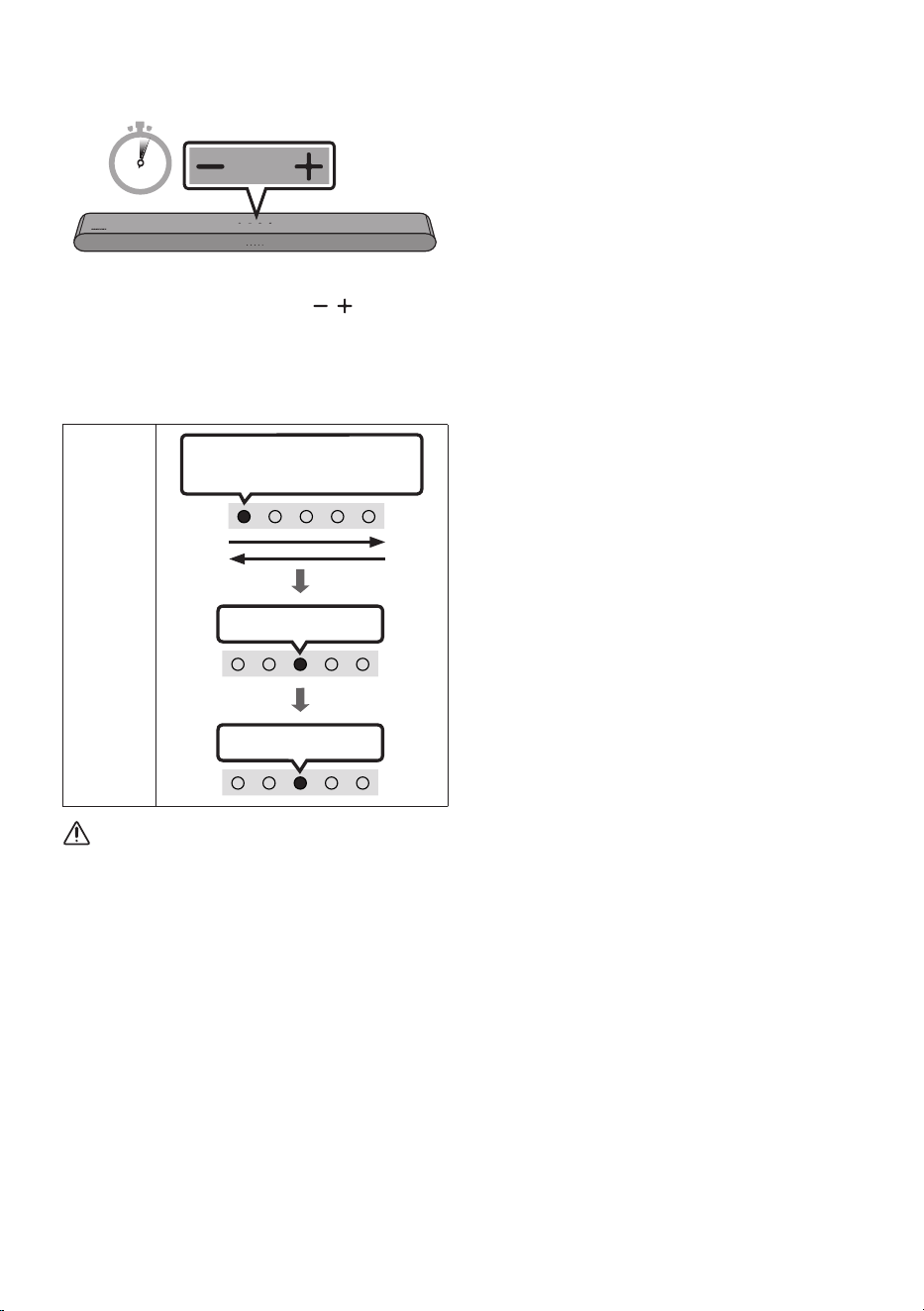
Reset
5 Sec
With the Soundbar on, press the (Volume)
buttons on the body at the same time for at least
5 seconds. The LED display changes as shown
below and then the Soundbar is reset.
LED
Indicator
Cyan Blinks X3
Red Blinks → Off
White moves from left to right
and right to left
CAUTION
• All the settings of the Soundbar are reset.
Be sure to perform this only when a reset is
required.
Security updates information
Security updates are provided to strengthen the
security of your device and protect your personal
information. For more information on security
updates, visit https://security.samsungtv.com.
• The website supports only some languages.

ENG - 39
11 TROUBLESHOOTING
Before seeking assistance, check the following.
Soundbar does not turn on.
; Check whether the power cord of the
Soundbar is correctly inserted into the
outlet.
Soundbar works erratically.
; After removing the power cord, insert it
again.
; Power cycle the external device and try
again.
; If there is no signal, the Soundbar
automatically turns off after a certain
period of time. Turn on the power. (See
page 8.)
Remote control does not work.
; Point the remote directly at the Soundbar.
; Replace the batteries with new ones.
The red LED indicator light on the soundbar
stays on.
; The microphone is turned off. Turn on the
microphone. (See page 6.)
The Soundbar does not output any sound.
; The volume of the Soundbar is too low or
muted. Adjust the volume.
; When any external device (STB, Bluetooth
device, mobile device, etc.) is connected,
adjust the volume of the external device.
; For sound output of the TV, select
Soundbar. (Samsung TV: Home ( ) →
Menu → Settings ( ) → All Settings ( )
→ Sound → Sound Output → Select
Soundbar)
; The cable connection to the Soundbar may
not be loose. Remove the cable and
connect again.
; Remove the power cord completely,
reconnect, and turn the power on.
; Reset the product and try again.
(See page 38.)
If the TV is not connected via HDMI (eARC).
; Check whether the HDMI cable is correctly
connected to the eARC terminal.
(See page16)
; Connection may not be possible due to the
connected external device (set-top box,
game console, etc.). Directly connect the
Soundbar.
; HDMI-CEC may not be activated on the TV.
Turn on the CEC on the TV menu. (Samsung
TV: Home ( ) → Menu → Settings ( ) →
All Settings ( ) → Connection → External
Device Manager → Anynet+ (HDMI-CEC)
ON)

ENG - 40
There is no sound in when connecting to the
TV in HDMI (eARC) mode.
; Your device is unable to play the input
signal. Change the TV’s audio output to
PCM or Dolby Digital.
(For a Samsung TV: Home ( ) → Menu →
Settings ( ) → All Settings ( ) → Sound
→ Expert Settings → Digital Output Audio
Format)
The Soundbar will not connect via Bluetooth.
; When connecting a new device, switch to
Bluetooth Pairing for connection. (Press the
PAIR button on the remote control or
press the (Mic On/Off) button on the
body for at least 5 seconds.)
; If the Soundbar is connected to another
device, disconnect that device rst to
switch the device.
; Reconnect it after removing the Bluetooth
speaker list on the device to connect.
(Samsung TV: Home ( ) → Menu →
Settings ( ) → All Settings ( ) → Sound
→ Sound Output → Bluetooth Speaker List)
; Remove and reconnect the power plug,
then try again.
; Reset the product and try again.
(See page 38.)
The sound drops out when connected via
Bluetooth.
; Some devices can cause radio interference
if they are located too close to the
Soundbar. e. g. microwaves, wireless
routers, etc.
; If your device that is connected via
Bluetooth moves too far away from the
Soundbar, it may cause the sound to drop
out. Move the device closer to the
Soundbar.
; If a part of your body is in contact with the
Bluetooth transceiver or the product is
installed on metal furniture, the sound may
drop out. Check the installation
environment and conditions for use.
Unable to connect to Wi-Fi.
; Check whether your wireless router is on.
; Turn off the router, turn it back on, and then
try again.
; The Soundbar will not connect if the
wireless signal is too weak. Try moving the
router closer to the Soundbar, or
eliminating any obstacles that are between
the Soundbar and the router, if possible.
; If your wireless router is new, you will need
to recongure the speaker’s network
settings.
; Soundbar does not support Wi-Fi 6.
The Soundbar does not turn on automatically
with the TV.
; When you turn off the Soundbar while
watching TV, power synchronization with
the TV is disabled. First turn off the TV.
The AVA function is not available in the
following cases.
; The AVA function will not be available using
Q-Symphony function.
; The AVA function will not be available
when the microphone is turned off.
ENG - 41
After connecting the TV to the Soundbar, I
switched the Soundbar mode. Then no sound
is output from the TV.
; If you connect your Soundbar to a mobile
device while the Soundbar is connected to
the TV, the Soundbar outputs sound from
the mobile device while keeping the TV
connection. So the TV sound will not be
delivered anywhere.
; Disconnect the mobile device, and the TV
sound will be output from the Soundbar
again.
The Soundbar does not appear in AirPlay.
; To enable AirPlay in your Soundbar, you
must rst register the device with the
Samsung SmartThings app by agreeing
with the app’s terms and conditions.
(See page 32.)
; AirPlay does not operate if you delete the
Soundbar from the Samsung SmartThings
app.
; Make sure that the Soundbar and the Apple
device are connected to the same Wi-Fi
network.
; The Soundbar is compatible with AirPlay
installed on iOS 13.4 or later.
Group Play is not enabled.
; Check if the audio devices are newer
models released year 2024 or later.
; Check if the host device is connected to a
Wi-Fi network as source.
; Make sure that all audio devices are
connected to the same Wi-Fi network
(at 5 GHz).
12 LICENSE
Dolby, Dolby Atmos, and the double-D symbol
are registered trademarks of Dolby
Laboratories Licensing Corporation.
Manufactured under license from Dolby
Laboratories. Condential unpublished works.
Copyright © 2012-2021 Dolby Laboratories.
All rights reserved.
For DTS patents, see http://patents.dts.com.
Manufactured under license from DTS, Inc. or
DTS Licensing Limited. DTS, Digital Surround,
Virtual:X, and the DTS logo are registered
trademarks or trademarks of DTS, Inc. in the
United States and other countries. © 2021 DTS,
Inc. ALL RIGHTS RESERVED.
The terms HDMI, HDMI High-Denition
Multimedia Interface, HDMI Trade dress and the
HDMI Logos are trademarks or registered
trademarks of HDMI Licensing Administrator,
Inc.
ENG - 42
• Use your phone, tablet or computer as a
remote control for Spotify. Go to spotify.
com/connect to learn how
• The Spotify Software is subject to third
party licenses found here :
https://www.spotify.com/connect/third-
party-licenses.
Apple, AirPlay, iPad, iPhone, and Mac are
trademarks of Apple Inc., registered in the U.S.
and other countries and regions.
Being Roon Tested means that Samsung and
Roon have collaborated to ensure you have the
best experience using Roon software and
Samsung equipment together, so you can just
enjoy the music.
Open Source License Notice
Open Source used in this product can be found
on the following webpage (http://opensource.
samsung.com).

Guide d'utilisation
HW-S60D / HW-S61D
© 2024 Samsung Electronics Co., Ltd. Tous droits réservés.
Merci d’avoir choisi un appareil Samsung.
Pour recevoir une assistance plus complète, veuillez enregistrer votre produit sur
www.samsung.com
Les chiffres et les illustrations contenus dans ce Guide d’utilisation sont fournis à titre de référence uniquement et
pourraient ne pas représenter exactement le produit.

FRA - 2
SOMMAIRE
01 Véricationdescomposants 4
02 Présentationduproduit 5
Panneau avant/Panneau supérieur du Soundbar
-------------------------
5
Panneau dessous du Soundbar ------------------------- 7
03 Utilisationdelatélécommande 8
Insertion des piles avant d'utiliser la télécommande (2piles AAA) ------------------------- 8
Comment utiliser la télécommande
-------------------------
8
Réglage de (Réglages sonores)
-------------------------
11
Utilisation des boutons masqués (boutons ayant plusieurs fonctions)
-------------------------
12
Caractéristiques de sortie pour les différents modes d’effets sonores
-------------------------
13
Réglage du volume du Soundbar avec une télécommande du téléviseur ------------------------- 14
04 ConnexionduSoundbar 15
Connexion de l'alimentation électrique
-------------------------
15
Connexion du kit haut-parleur arrière sans l Samsung et du caisson de
basse à votre Soundbar
-------------------------
15
05 ConnexionàunTéléviseur 16
Connexion du téléviseur prenant en charge HDMI ARC
(Audio Return Channel)
-------------------------
16
Connexion à l'aide d'un câble optique
-------------------------
18
Connexion par Bluetooth
-------------------------
19
Connexion en Wi-Fi
-------------------------
21
Connexion à un téléviseur qui prend en charge Dolby Atmos®
-------------------------
22
Utilisation de la fonction Q-Symphony
-------------------------
24
Utilisation du SpaceFit Sound
-------------------------
25

FRA - 3
06 Connexiond'unappareilexterne 26
Connexion à l'aide d'un câble optique
-------------------------
26
07 Connexiond'unappareilmobile 27
Méthode 1. Connexion par Bluetooth
-------------------------
27
Méthode2. Connexion par Wi-Fi (réseau sans l)
-------------------------
30
Utilisation du Jeu de groupe
-------------------------
31
Connexion par Apple AirPlay
-------------------------
32
Utilisation de la fonction Tap Sound
-------------------------
33
08 Installationdusupportmural 34
Précautions d’installation
-------------------------
34
Composants de montage mural
-------------------------
34
09 InstallationduSoundbardevantletéléviseur 36
10 Miseàjourlogicielle 37
Mise à jour automatique
-------------------------
37
Mise à jour USB
-------------------------
37
Réinitialisation
-------------------------
38
Information concernant les mises à jour sur la sécurité
-------------------------
38
11 Dépannage 39
12 Licence 41

FRA - 4
01 VÉRIFICATIONDESCOMPOSANTS
SOUND
MODE
WOOFER
TONE
CONTROL
CH LEVEL
UnitéprincipaleduSoundbar Télécommande/
pilesduSoundbar
CâbleHDMI
A TYPE : 450mm
AdaptateurCA/CC
(Soundbar)
Cordond’alimentation
(Soundbar)
Guidedemontagemural
x 2
x 2
(M4 x L10)
x 2
Visdexation Supportdemontagemural Vis
• Pour plus d'informations sur l'alimentation et la consommation électriques, reportez-vous à
l'étiquette apposée sur le produit (Étiquette : Partie inférieure de l’unité principale du Soundbar)
• Pour acheter des composants supplémentaires ou des câbles en option, contactez un centre de
service Samsung ou le service clientèle Samsung.
• Pour plus d'informations sur le support mural, consultez la page 34.
• La conception, les spécications et l'écran de l'application peuvent faire l'objet d'une modication
sans préavis.
• L’apparence des accessoires peut différer légèrement des illustrations ci-dessus.
FRA - 5
02 PRÉSENTATIONDUPRODUIT
Panneauavant/PanneausupérieurduSoundbar
Panneausupérieur
VoyantDEL
Le voyant DEL clignote, s'allume ou change de couleur en fonction du statut ou du mode en
cours du Soundbar. La couleur du voyant DEL et le nombre de lumières indiquent le mode
actif tel que décrit ci-dessous.
W
Voyant DEL
blanc
W
Voyant DEL
blanc
M
Voyant DEL
multicolore
W
Voyant DEL
blanc
W
Voyant DEL
blanc
• Le voyant DEL multicolore devient Blanc, Cyan, Vert, Rouge et Bleu selon le mode ou le
statut.
Bouton
multifonction
• En mode veille, appuyez sur le bouton (Multifonction) pour allumer le Soundbar.
• Appuyez sur le bouton
(Multifonction)
pour changer le mode. Chaque fois que vous
changez de mode, le voyant DEL s'allume en blanc puis s'éteint.
Voyant DEL
Voyantblancallumé
->éteint
Voyantblancallumé
->éteint
«TVARC» ou «eARC» «Wi-Fi»
Voyant DEL
Voyantblancallumé
->éteint
Voyantblancallumé
->éteint
«Bluetooth» «DigitalAudioIn»
FRA - 6
Bouton
Volume
Appuyez sur le bouton (Volume) pour régler le volume.
Bouton
Marche/Arrêt
microphone
Appuyez sur le bouton (Marche/Arrêtmicrophone) pour activer ou désactiver le
microphone. Lorsque le microphone est éteint, le voyant DEL passe au rouge.
Voyant DEL
Voyantrougeallumé
«MicOff» «MicOn»
• Lorsque vous branchez le câble d’alimentation CA, le bouton d’alimentation se met à fonctionner au
bout de 4 à 6 secondes.
• Lorsque vous allumez cet appareil, vous devrez patienter 4 à 5 secondes avant qu’il ne produise du
son.
• Si le son provient à la fois du téléviseur et du Soundbar, accédez au menu Paramètres
correspondant au son du téléviseur et dénissez le haut-parleur du téléviseur sur Haut-p.externe.
• Vous pouvez activer et désactiver la réaction acoustique en utilisant l’application SmartThings.
Pour plus de détails sur l’utilisation de l’application SmartThings, consultez « Méthode2.
ConnexionparWi-Fi(réseausansl) ».
FRA - 7
PanneaudessousduSoundbar
SERVICE
DC 19V
DIGITAL
AUDIO IN
(OPTICAL)
HDMI
(eARC)
SERVICE
DC 19V
DIGITAL
AUDIO IN
(OPTICAL)
HDMI
(eARC)
SERVICE
DC 19V
DIGITAL
AUDIO IN
(OPTICAL)
HDMI
(eARC)
DC19V(Entréedel'alimentation)
Connectez l'adaptateur secteur CA/CC. (Voir la page 15)
SERVICE
Connectez un périphérique de stockage USB pour mettre à niveau le logiciel du produit.
DIGITALAUDIOIN(OPTICAL)
Permet de connecter la sortie numérique (optique) d'un appareil externe. (Voir la page 26)
HDMI(eARC)
Permet de connecter la prise HDMI (eARC) d'un téléviseur. (Voir la page 16)
• Lorsque vous déconnectez le câble d’alimentation de l’adaptateur CA/CC de la prise murale, tirez
sur la prise. Ne tirez pas sur le câble.
• Ne connectez pas cet appareil ou d’autres composants à une prise CA tant que toutes les connexions
entre les composants ne sont pas établies.
FRA - 8
03 UTILISATIONDELATÉLÉCOMMANDE
Insertiondespilesavantd'utiliserlatélécommande(2pilesAAA)
Faites glisser le panneau arrière dans le sens de la
èche jusqu’à ce qu’il soit complètement retiré.
Insérez 2 piles AAA (1,5V) dans le bon sens (polarité
correcte). Refaites glisser le panneau arrière dans
sa position initiale.
Commentutiliserlatélécommande
SOUND
MODE
WOOFER
TONE
CONTROL
CH LEVEL
Alimentation
Permet d'allumer et d'éteindre le Soundbar.
Voyant
DEL
Levoyantcyan
clignote1fois
Allumé
Éteint
Levoyantrouge
clignote3fois
• FonctionAutoPowerDown
L'appareil s'éteint automatiquement dans les situations
suivantes :
– En mode «TVARC» ou «eARC» / «Wi-Fi» /
«Bluetooth» / «DigitalAudioIn» en l'absence de
signal audio pendant 18 minutes.
(Source)
Appuyez sur ce bouton pour sélectionner une source
connectée au Soundbar.
• Activation/désactivationdelafonctionAudioFeedback
Vous pouvez activer ou désactiver la fonction Audio
Feedback. Appuyez sur le bouton (Source)de la
télécommande pendant 5secondes lorsque le Soundbar
est éteint (mode veille).
Voyant
DEL
Levoyantcyan
clignote1fois
Allumé
Éteint
Levoyantrouge
clignote1fois
FRA - 9
(Silence)
Appuyez sur le bouton (Silence) pour désactiver le son.
Appuyez de nouveau sur ce bouton pour activer le son.
Voyant
DEL
Clignotementrépété
Volume
Faites basculer ce bouton vers le haut ou vers le bas pour régler le volume.
Voyant
DEL
Levoyantblancsedéplace
versladroite1fois
Augmentation du volume
Levoyantblancsedéplace
verslagauche1fois
Diminution du volume
CHLEVEL
En appuyant sur le bouton, vous pouvez ajuster le volume de chaque haut-parleur.
Voyant
DEL
Levoyantblancclignote1fois
«CenterLevel»«SideLevel»
– Si les haut-parleurs arrière (vendus séparément) sont connectés, le réglage «RearLevel» est
disponible. Pour régler le volume «RearLevel» entre -6 et +6 en utilisant les boutons Haut/Bas.
(Réglagessonores)
En appuyant sur le bouton, vous pouvez régler la fonction audio. L'élément souhaité peut être ajusté à l'aide
des boutons Haut/Bas. Chaque fois que vous changez de mode, le voyant DEL multicolore clignote en blanc.
Voyant
DEL
Levoyantblancclignote1fois
«SpaceFitSound»«ActiveVoiceAmplier»«Voiceenhancement»«Night
mode»«Sync»»«Virtual»
– Maintenez le bouton (Réglagessonores) enfoncé pendant environ 5 secondes pour régler le son
pour chaque bande de fréquence. Vous pouvez utiliser les boutons Gauche/Droite pour sélectionner
les fréquences suivantes : 150 Hz, 300 Hz, 600 Hz, 1,2 kHz, 2,5 kHz, 5 kHz et 10 kHz. Vous pouvez
également dénir chaque fréquence sur une valeur allant de -6 à +6 à l’aide des boutons Haut/Bas.
(Veillez à ce que le mode son soit déni sur « Standard ».)
– Si les haut-parleurs arrière (vendus séparément) sont connectés, les paramètres «SoundGrouping»
et «PrivateRearSound» sont disponibles.
– Reportez-vous à la section «Réglagede (Réglagessonores)» à la page11.
FRA - 10
BluetoothPAIR
Basculez le Soundbar en mode association Bluetooth.
Lorsque vous appuyez sur le bouton, l'afchage des voyants DEL change comme indiqué ci-dessous.
• Jusqu'à ce que l'appairage soit terminé, les voyants DEL multicolores s'allument successivement :
Rouge → Vert → Bleu.
Voyant
DEL
Appairage
LesvoyantsRouge→ Vert→ Bleuclignotent
Connexion établie
Levoyantcyanclignote3fois
«ReadytoconnectviaBluetooth.»
p(Lecture/Pause)
Vous pouvez également lire ou mettre en pause la musique en appuyant sur ce bouton.
Haut/Bas/Gauche/Droite
Appuyez sur Haut/Bas/Gauche/Droite sur le bouton pour sélectionner ou dénir des fonctions.
• Passerunmorceau
Appuyez sur le bouton de Droite pour sélectionner le prochain morceau. Appuyez sur le bouton de
Gauche pour sélectionner le morceau précédent.
• IDSET
Maintenez le bouton Haut enfoncé pendant 5 secondes pour terminer IDSET (lors de la connexion
d’un caisson de basses sans l ou de haut-parleurs arrière sans l).
(Info)
Appuyez sur le bouton pour afcher l'information sur la fonction actuelle. (Voir page5.)
Lorsque connecté à Dolby Atmos®, le voyant cyan clignote 3fois.
SOUNDMODE
En appuyant sur le bouton, vous pouvez sélectionner le mode audio souhaité. Chaque fois que vous
changez de mode, le voyant DEL multicolore clignote en blanc.
Voyant
DEL
Levoyantblancclignote1fois
«AdaptiveSound»«DTSVirtual:X»«Music»«Game»«Standard»
• AdaptiveSound
Analyse le contenu en temps réel et fournit automatiquement le champ sonore optimal en fonction
des caractéristiques du contenu.
• DTSVirtual:X
Son 3D immersif à partir de n’importe quel contenu.
• Music
Fournit un son plus naturel et plus enveloppant pour le contenu musical.
• Game
Émet un son stéréoscopique an de vous plonger dans le feu de l’action lorsque vous jouez.
• Standard
Émet le son d’origine.
FRA - 11
NIVEAUDUWOOFER(BASSES)
Faites basculer ce bouton vers le haut ou vers le bas pour régler le niveau du haut-parleur (basses) sur -12 ou entre
-6 et +6. Pour régler le niveau de volume du haut-parleur (basses) sur 0 (par défaut), appuyez sur ce bouton.
TONECONTROL
En appuyant sur le bouton, vous pouvez ajuster le volume des aigus ou des basses. L'élément
souhaité peut être ajusté à l'aide des boutons Haut/Bas. (Cette fonction est offerte dans tous les
modes audio, sauf le mode «Standard».)
Voyant
DEL
Levoyantblancclignote1fois
«Treble»«Bass»
Réglagede (Réglagessonores)
• SpaceFitSound : Cette fonction analyse l’espace d’écoute de l’utilisateur avec le microphone du
Soundbar et offre le son optimal pour cet espace. (Reportez-vous à la section «Utilisationdu
SpaceFitSound» à la page25.)
• ActiveVoiceAmplier : Analyse le bruit externe en temps réel pendant que le Soundbar est actif,
de sorte que la voix puisse toujours être entendue clairement.
– Aucune donnée n’est enregistrée pendant l’analyse.
• Voiceenhancement vous permet de mieux entendre les dialogues dans les lms et à la télévision.
• Nightmode est optimisé pour un visionnement nocturne lorsque les paramètres sont réglés de
façon à baisser le volume tout en préservant la clarté des dialogues.
• SoundGrouping: L’unité principale du Soundbar et les haut-parleurs ambiophoniques émettent
l’ensemble des sons, pas seulement le son ambiophonique, ce qui est idéal pour les grands groupes
de personnes écoutant de la musique dans un grand espace.
– Ce menu est activé initialement lorsque les haut-parleurs ambiophoniques sont connectés,
puis il le reste que ces haut-parleurs soient toujours connectés ou non.
– Si vous activez ce mode, les modes audio ne produisent aucune différence dans le rendu
sonore.
– Le son n'est pas émis de tous les haut-parleurs de l’unité principale du Soundbar et des haut-
parleurs ambiophoniques, mais seulement de certaines unités prédénies, qui varient selon le
modèle.
• PrivateRearSound : Avec ce mode, le son est émis uniquement des haut-parleurs ambiophoniques,
ce qui vous offre une écoute sans être dérangé par les autres.
– Si vous activez ce mode, le son n’est émis ni par l’unité principale du Soundbar, ni par le caisson
de basse. Le son n’est émis que via le canal avant des haut-parleurs ambiophoniques.
– Si vous activez ce mode, les modes audio ne produisent aucune différence dans le rendu
sonore.

FRA - 12
– La fonction se désactive si l’alimentation est coupée ou si la connexion des haut-parleurs
ambiophoniques est perdue.
– Le menu est activé uniquement si les haut-parleurs ambiophoniques sont connectés.
– Ce mode est automatiquement désactivé et n’est plus disponible si la fonction Q-Symphony est
activée.
• Si la vidéo de la télévision et l’audio du Soundbar ne sont pas synchronisés, sélectionnez Sync dans
les réglages sonores, puis réglez le retard de l’audio entre 0 et 300millisecondes à l’aide des boutons
Haut/Bas.
– Sync n’est prise en charge que pour certaines fonctions.
• La fonction Virtual peut être activée/désactivée à l’aide des boutons Haut/Bas.
Utilisationdesboutonsmasqués(boutonsayantplusieurs
fonctions)
Boutonmasqué
Pagederéférence
Boutondelatélécommande Fonction
WOOFER (Haut)
Activation/désactivation la fonction
Télécommande de votre téléviseur (mode veille)
page 14
Haut ID SET page 10
(Contrôle du son)
EQ 7 bandes page 9
(Source)
Activation/désactivation de la fonction Audio
Feedback (mode veille)
page 8

FRA - 13
Caractéristiquesdesortiepourlesdifférentsmodesd’effetssonores
Effet Entrée
Sortie
Aveclecaissondebasses
uniquement
Aveccaissondesbasseset
haut-parleurarrièresansl
Adaptive Sound
2.0 canaux 5.1 canaux 7.1 canaux
5.1 canaux 5.1 canaux 7.1 canaux
Dolby Atmos® 5.1 canaux 7.1 canaux
DTS Virtual:X
2.0 canaux 5.1 canaux 7.1 canaux
5.1 canaux 5.1 canaux 7.1 canaux
Dolby Atmos® 5.1 canaux 7.1 canaux
Music
2.0 canaux 5.1 canaux 7.1 canaux
5.1 canaux 5.1 canaux 7.1 canaux
Dolby Atmos® 5.1 canaux 7.1 canaux
Game
2.0 canaux 5.1 canaux 7.1 canaux
5.1 canaux 5.1 canaux 7.1 canaux
Dolby Atmos® 5.1 canaux 7.1 canaux
Standard
2.0 canaux 2.1 canaux 2.1 canaux
5.1 canaux 5.1 canaux 5.1canaux
Dolby Atmos® 5.1 canaux 7.1 canaux
• Le haut-parleur arrière sans l Samsung et le caisson des basses peuvent être achetés
séparément. Pour acheter le haut-parleur ou le caisson des basses, communiquez avec le
vendeur auprès duquel vous avez acheté le Soundbar.
• Lorsque la source d’entrée est Dolby Atmos®, la conguration Caisson des basses uniquement
fournit le son du canal5.1, tandis que la conguration Caisson des basses et haut-parleur arrière
sans l uniquement fournit le son du canal7.1.
FRA - 14
RéglageduvolumeduSoundbaravecunetélécommandedu
téléviseur
Contrôlez le volume du Soundbar à l’aide de la télécommande du téléviseur.
• Cette fonction ne peut être utilisée qu’avec des télécommandes infrarouges. Les
télécommandes Bluetooth (télécommandes qui nécessitent un appairage) ne sont pas prises en
charge.
• Réglez le haut-parleur du téléviseur sur Haut-p.externe pour utiliser cette fonction.
• Fabricants qui utilisent cette fonction :
Samsung, VIZIO, LG, Sony, Sharp, PHILIPS, PANASONIC, TOSHIBA, Hisense, RCA
1. Éteignez le Soundbar.
2. Appuyez sur le bouton WOOFER et maintenez-le enfoncé pendant 5 secondes.
À chaque fois que vous faites basculer le bouton WOOFER vers le haut et le maintenez enfoncé
pendant 5 secondes, le mode change, dans l’ordre suivant : « Off-TVRemote » (Mode par défaut),
« Samsung-TVRemote », « All-TVRemote ».
L'état du voyant DEL change à chaque changement de mode, comme illustré ci-dessous.
Boutondelatélécommande VoyantDEL État
SOUND
MODE
WOOFER
CH LEVEL
TONE
CONTROL
5 Sec
« Off-TV Remote »
(Mode par défaut)
Levoyantclignote
enrouge1fois
Télécommande du téléviseur
désactivée.
SOUND
MODE
WOOFER
CH LEVEL
TONE
CONTROL
5 Sec
« Samsung-TV Remote »
Levoyantcyan
clignote1fois
Télécommande infrarouge du
téléviseur Samsung activée.
SOUND
MODE
WOOFER
CH LEVEL
TONE
CONTROL
5 Sec
« All-TV Remote »
Levoyantclignote
enbleu1fois
Télécommande infrarouge du
téléviseur tiers activée.
FRA - 15
04 CONNEXIONDUSOUNDBAR
Connexiondel'alimentationélectrique
An de brancher le Soundbar à une prise électrique, utilisez les composants d’alimentation dans l’ordre
suivant :
• Pour plus d'informations sur les exigences en matière d'alimentation électrique et de
consommation d'énergie, reportez-vous à l'étiquette apposée sur le produit. (Étiquette : Partie
inférieure de l’unité principale du Soundbar)
1. Tout d’abord, raccordez le câble d’alimentation à l’adaptateur CA/CC.
Connectez l’adaptateur CA/CC (avec le câble d’alimentation) au Soundbar.
2. Raccordez le cordon d'alimentation à une prise murale.
Dessousdel'unitéprincipaledu
Soundbar
SERVICE
DC 19V
DIGITAL
AUDIO IN
(OPTICAL)
HDMI
(ARC)
SERVICE
DC 19V
DIGITAL
AUDIO IN
(OPTICAL)
HDMI
(eARC)
Cordond'alimentation
AdaptateurCA/CC
SERVICE
DC 19V
REMARQUES
• Si vous débranchez et rebranchez le cordon d'alimentation lorsque le produit est sous tension, le
Soundbar s'allume automatiquement.
• Veillez à bien poser à plat l'adaptateur CA/CC sur une table ou au sol. Si l'adaptateur CA/CC est
suspendu, avec l'entrée du câble d'alimentation CA vers le haut, de l'eau ou d'autres substances
étrangères peuvent pénétrer dans l'adaptateur et provoquer son dysfonctionnement.
Connexiondukithaut-parleurarrièresanslSamsungetdu
caissondebasseàvotreSoundbar
Obtenez un véritable son ambiophonique sans l en connectant le haut-parleur arrière sans l
Samsung (SWA-9200S, vendu séparément) et le caisson de basses sans l (SWA-W510, vendu
séparément) à votre Soundbar.
Pour plus d'informations sur les connexions, veuillez consulter le manuel d'utilisation du haut-parleur
arrière sans l et du caisson de basses sans l Samsung.
FRA - 16
05 CONNEXIONÀUNTÉLÉVISEUR
ConnexiondutéléviseurprenantenchargeHDMIARC(Audio
ReturnChannel)
MISEENGARDE
• Lorsque le câble HDMI et le câble optique sont tous les deux connectés, le signal HDMI est reçu
en premier.
• Pour connecter le câble HDMI entre le téléviseur et le Soundbar, assurez-vous de connecter les
bornes marquées ARC. Sinon, le son du téléviseur risque de ne pas être émis.
• Le câble recommandé est un câble HDMI certié par HDMI.org.
HDMI IN
(eARC)
DIGITAL
AUDIO IN
(OPTICAL)
HDMI
(eARC)
Connectezlecâbleauport
HDMIIN
(ARC)ou(eARC)
devotretéléviseur.
CâbleHDMI
Panneaudessous
duSoundbar
ConnectezlecâbleauportHDMI(eARC)
del'unitéprincipaleduSoundbar.
DessusduSoundbar
Voyant
DEL
Voyantblancallumé->éteint
«TVARC» ou «eARC»
1. Connectez le câble HDMI comme indiqué sur la gure en vous assurant que le Soundbar et le
téléviseur sont éteints.
2. Allumez le Soundbar et le téléviseur.
3. Le son du téléviseur est émis par le Soundbar.
• Lorsque le son du téléviseur n'est pas restitué, appuyez sur le bouton (Multifonction) en
haut du Soundbar ou sur le bouton (Source) de la télécommande pour sélectionner le
mode «TVARC» ou «eARC».
• Pour la connexion à eARC, la fonction eARC dans le menu du téléviseur devrait être activée.
Reportez-vous au manuel de l’utilisateur du téléviseur pour de plus amples renseignements sur
ce réglage. (Par exemple, Téléviseur Samsung : Accueil ( ) → Menu → Paramètres ( ) → Tous
les paramètres ( ) → Son → Paramètres avancés → Mode HDMI-eARC (Auto))

FRA - 17
• Si aucun son ne sort, vériez à nouveau la connexion du câble HDMI.
• Utilisez les boutons de volume de la télécommande du téléviseur pour modier le volume du
Soundbar.
REMARQUES
• Lorsque vous connectez le téléviseur prenant en charge HDMI ARC (Audio Return Channel) au
Soundbar avec un câble HDMI, vous pouvez transmettre les données vidéo et audio numériques
sans connecter de câble optique séparé.
• Nous vous recommandons d'utiliser si possible un câble HDMI sans noyau. Si vous utilisez un câble
HDMI à noyau, utilisez-en un dont le diamètre est inférieur à 0,55 po (14 mm).
• Cette fonction n'est pas disponible si le câble HDMI ne prend pas en charge ARC.
• Lorsque le son d'une diffusion est encodé en Dolby Digital et que le paramètre «Format de sortie
audio numérique» est déni sur PCM sur votre téléviseur, nous recommandons de changer ce
paramètre en le dénissant sur Dolby Digital. Une fois que vous aurez modié ce paramètre sur le
téléviseur, vous pourrez proter d'une meilleure qualité sonore. (Le menu du téléviseur peut utiliser
des mots différents pour Dolby Digital et PCM selon le fabricant du téléviseur.)
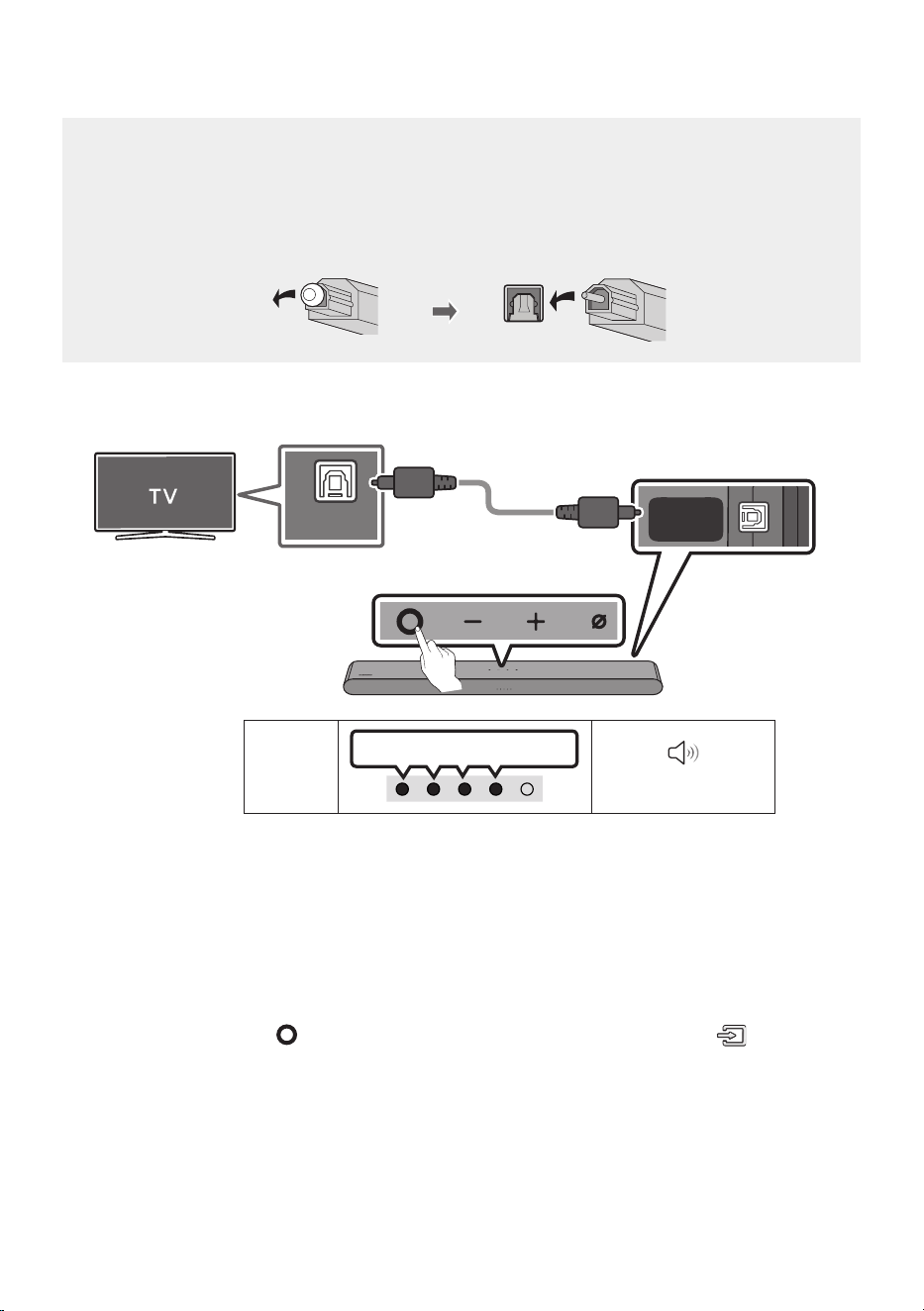
FRA - 18
Connexionàl'aided'uncâbleoptique
Listedecontrôledepré-connexion
• Lorsque le câble HDMI et le câble optique sont tous les deux connectés, le signal HDMI est reçu
en premier.
• Lorsque vous utilisez un câble optique et que les bornes ont leurs caches, assurez-vous de
retirer les caches.
Voyant
DEL
Voyantblancallumé->éteint
«DigitalAudioIn»
OPTICAL OUT
DIGITAL
AUDIO IN
(OPTICAL)
HDMI
(eARC)
Panneaudessous
duSoundbar
Câbleoptique(nonfourni)
DessusduSoundbar
1. Le téléviseur et le Soundbar étant éteints, connectez le port DIGITALAUDIOIN(OPTICAL)du
Soundbar et le port de sortie OPTICAL du téléviseur à l'aide du câble optique (non fourni), comme
indiqué sur la gure.
2. Allumez le Soundbar et le téléviseur.
3. Appuyez sur le bouton (Multifonction)en haut du Soundbar ou sur le bouton (Source) de la
télécommande, puis sélectionnez le mode «DigitalAudioIn». Ensuite, l'annonce, «DigitalAudio
In» est émise.
4. Le son du téléviseur est émis par le Soundbar.
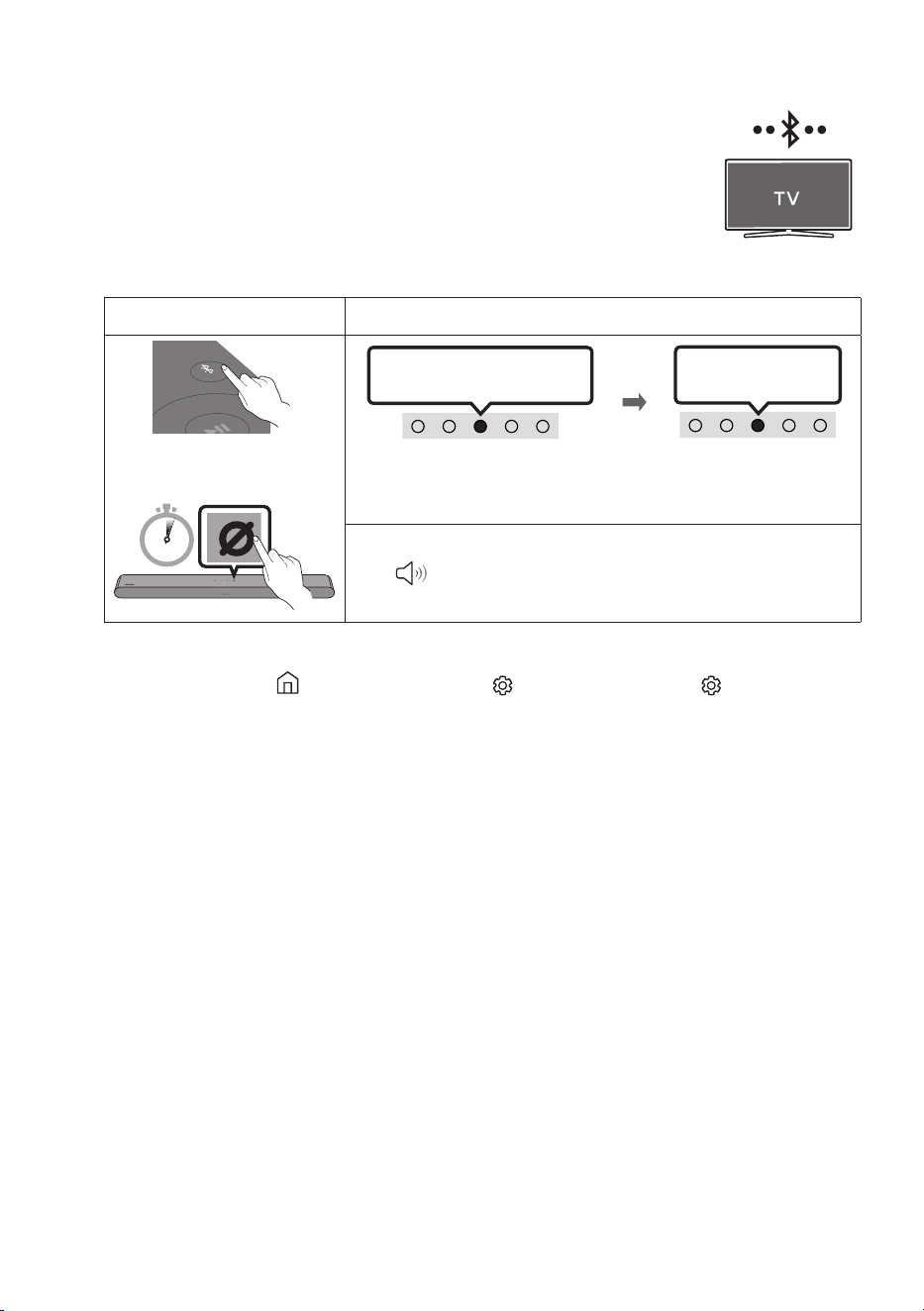
FRA - 19
ConnexionparBluetooth
Lorsqu'un téléviseur Samsung est connecté via Bluetooth, vous pouvez entendre le
son stéréo sans les tracas du câblage.
• Un seul téléviseur Samsung peut être connecté à la fois.
• Un téléviseur Samsung prenant en charge Bluetooth peut être connecté.
Vériez les spécications de votre téléviseur.
Connexioninitiale
1.
BoutonAppairageBluetooth VoyantDEL
SOUND
MODE
PAIR
OU
Appairage
LesvoyantsRouge→ Vert→
Bleuclignotent
Levoyantcyan
clignote3fois
Connexion établie
En mode « Bluetooth »
5 Sec
• Jusqu'à ce que l'appairage soit terminé, les voyants DEL multicolores
s'allument successivement : Rouge → Vert → Bleu.
«ReadytoconnectviaBluetooth.»
2. Sélectionnez le mode Bluetooth sur le téléviseur Samsung.
(Par exemple, Accueil ( ) →
Menu
→ Paramètres ( ) →
Tous les paramètres
( ) Son Sortie
audio Liste des haut-parleurs Bluetooth S-Series Soundbar (Bluetooth))
3. Sélectionnez «S-SeriesSoundbar» dans la liste sur l'écran du téléviseur.
Un Soundbar disponible est indiquée par «Associationrequise» ou «Associé» sur la liste des
appareils Bluetooth du téléviseur. Pour connecter le téléviseur Samsung au Soundbar, sélectionnez
le message, puis établissez une connexion.
4. Vous pouvez maintenant entendre le son du téléviseur Samsung à partir du Soundbar.
• S'il existe un historique de connexion entre le Soundbar et le téléviseur Samsung, le Soundbar
est automatiquement connecté lorsque vous passez au mode «Bluetooth».

FRA - 20
Encasd'échecdelaconnexiondel'équipement
• Si vous avez un Soundbar existant (par exemple, S-SeriesSoundbar) dans la liste des haut-
parleurs du téléviseur Samsung, supprimez-le.
• Répétez ensuite les étapes 1à3.
DéconnexionduSoundbardutéléviseurSamsung
Appuyez sur le bouton (Multifonction) en haut du Soundbar ou sur le bouton (Source) de la
télécommande pour sélectionner un mode autre que «Bluetooth».
• La déconnexion prend du temps car le téléviseur Samsung doit recevoir une réponse du Soundbar.
(Le temps requis peut varier en fonction du modèle de téléviseur Samsung.)
RemarquessurlaconnexionBluetooth
• Localisez un nouvel appareil à moins d’3,28 pi (1 m) pour vous connecter via la communication
Bluetooth.
• Si un code PIN vous est demandé lors de la connexion d'un appareil Bluetooth, entrez <0000>.
• Le Soundbar s'éteint automatiquement au bout de 18minutes à l'état Prêt.
• Le Soundbar peut ne pas effectuer correctement la recherche ou la connexion Bluetooth dans les
circonstances suivantes:
– En présence d’un équipement électronique ou d’un appareil électrique pouvant provoquer des
interférences radio autour du Soundbar.
– Si plusieurs appareils Bluetooth sont associés simultanément au Soundbar.
– Si l'appareil Bluetooth est éteint, pas en place ou fonctionne mal.
• Les appareils électroniques peuvent créer des interférences radio. Les appareils produisant des
ondes électromagnétiques doivent être gardés à distance de l'unité principale du Soundbar, par
exemple les micro-ondes, les appareils de réseau sans l, etc.
• Précaution:LeSoundbarredémarreraautomatiquementsivousactivez/désactivezleBluetooth.
– Méthode de désactivation du port Bluetooth : Appuyez sur le bouton TONECONTROL de la
télécommande du Soundbar pendant 30secondes pour activer/désactiver le Wi-Bluetooth.

FRA - 21
ConnexionenWi-Fi
Listedecontrôledepré-connexion
• La connexion Wi-Fi est disponible uniquement sur les téléviseurs Samsung.
• Vériez que lerouteursansl(Wi-Fi)est activé et que le téléviseurestconnectéaurouteur.
• Le téléviseur et le Soundbar doivent être connectés au même réseau sans l (Wi-Fi).
• Si votre routeur sans l (Wi-Fi) utilise un canal DFS, vous ne pourrez pas établir de connexion
Wi-Fi entre le téléviseur et le Soundbar. Communiquez avec votre fournisseur de service Internet
pour plus de détails.
• Étant donné que les menus peuvent varier selon l’année de fabrication, consultez le manuel de
votre téléviseur
• Pour brancher le téléviseur à la Soundbar par Wi-Fi, branchez d’abord la Soundbar au routeur
sans l. Reportez-vous à la page30 pour voir comment établir une connexion Wi-Fi.
1. Pour plus d’informations sur la connexion Wi-Fi à la Soundbar, voir la page 30, «Méthode2.
ConnexionparWi-Fi(réseausansl)».
2. Modiez la source d’entrée du téléviseur en utilisant le menu Audio sur le Soundbar.
• TéléviseursSamsungsortisen2017ouaprès
Accueil ( ) →
Menu
→ Paramètres ( ) →
Tous les paramètres
( ) Son Sortie audio
S-Series Soundbar (Wi-Fi)
REMARQUE
• Précaution:LeSoundbarredémarreautomatiquementsivousactivez/désactivezleWi-Fi.
– Méthode de désactivation du port Wi-Fi : Appuyez sur le bouton CHLEVEL de la
télécommande du Soundbar pendant 30secondes pour activer/désactiver le Wi-Fi.
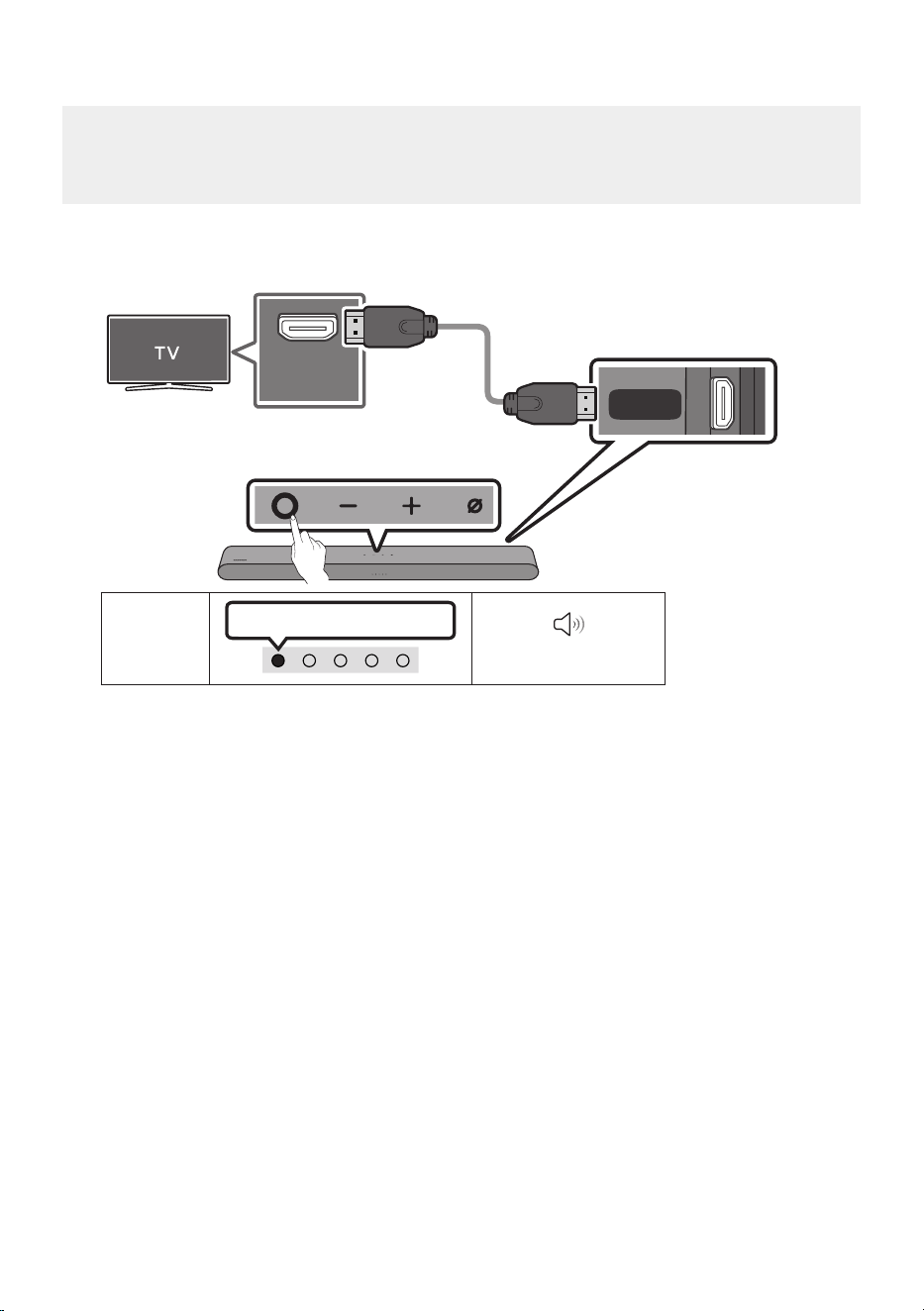
FRA - 22
ConnexionàuntéléviseurquiprendenchargeDolbyAtmos®
Listedecontrôledepré-connexion
• Dolby Atmos® est pris en charge par le mode «TVARC» ou «eARC» ou «Wi-Fi».
• Vériez que le contenu prend en charge Dolby Atmos®.
HDMI IN
(eARC)
DIGITAL
AUDIO IN
(OPTICAL)
HDMI
(eARC)
Connectezlecâbleauport
HDMIIN
(ARC)ou(eARC)
devotretéléviseur.
CâbleHDMI
Panneaudessous
duSoundbar
ConnectezlecâbleauportHDMI(eARC)
del'unitéprincipaleduSoundbar.
DessusduSoundbar
Voyant DEL
Voyantblancallumé->éteint
«TVARC» ou «eARC»
1. Connectez le câble HDMI comme indiqué sur la gure en vous assurant que le Soundbar et le
téléviseur sont éteints.
2. Allumez le Soundbar et le téléviseur.
3. Le son du téléviseur est émis par le Soundbar.

FRA - 23
Voyant
DEL
Voyantblancallumé
->éteint
«Wi-Fi»
Menudu
téléviseur
Wi-Fi
1. Connectez le Soundbar et le téléviseur au même réseau sans l (Wi-Fi).
2. Pour la sortie audio du téléviseur, sélectionnez Soundbar.
3. Le son du téléviseur est émis par le Soundbar.
REMARQUES
• CongurationdeDolbyAtmos®surunlecteurBlu-rayouunautreappareilconnectéau
téléviseur.
Ouvrez les options de sortie audio dans le menu des paramètres de votre lecteur Blu-ray ou d’un
autre appareil et vériez que « Aucun encodage » est sélectionné pour le Bitstream. Par exemple,
sur un lecteur Blu-ray Samsung, accédez à Menu Accueil → Son → Sortie numérique et sélectionnez
Bitstream (non traité).
• CettefonctionestdisponiblesurcertainstéléviseursSamsungetsurcertainsmodèlesde
Soundbar.
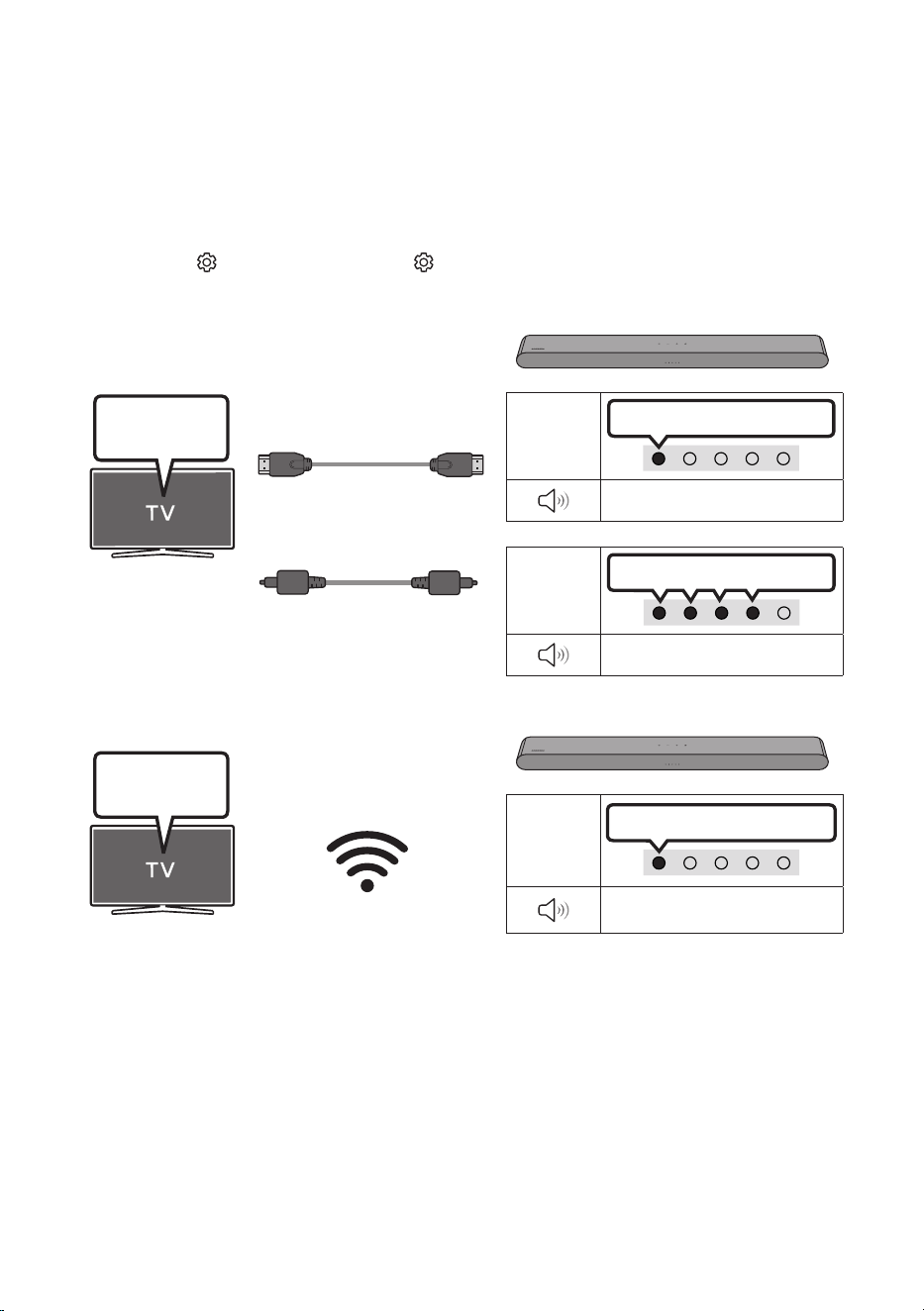
FRA - 24
UtilisationdelafonctionQ-Symphony
• Quand le Soundbar se connecte à un téléviseur Samsung qui prend en charge la fonction
Q-Symphony, vous pouvez lire le son simultanément via le Soundbar et le téléviseur. Si vous utilisez
la fonction Q-Symphony, le son ambiophonique émis par le téléviseur vous permet de proter d’un
effet de son tridimensionnel ambiophonique plus puissant et plus riche.
• Quand le Soundbar est connecté, le menu «Q-Symphony» s’afche sur le téléviseur.
Paramètres ( ) → Tous les paramètres ( ) → Son → Sortie audio
• Exemple de menu du téléviseur: Q-Symphony
Voyant
DEL
Voyantblancallumé->éteint
«TVARC» ou «eARC»
Voyant
DEL
Voyantblancallumé->éteint
«DigitalAudioIn»
Menudu
téléviseur
Câbleoptique(nonfourni)
CâbleHDMI
OU
Voyant
DEL
Voyantblancallumé->éteint
«Wi-Fi»
Menudu
téléviseur
Wi-Fi
REMARQUES
• Cette fonction peut être activée par le codec pris en charge par le téléviseur.
• Cette fonction est prise en charge uniquement lorsque le câble HDMI ou le câble optique (non
fourni) ou le Wi-Fi est connecté.
• Le message qui s’afche peut varier selon le modèle de TV.
• Assurez-vous que votre téléviseur et le Soundbar sont connectés au même routeur sans l et à la
même fréquence.
• Cette fonction est disponible sur certains téléviseurs Samsung et sur certains modèles de
Soundbar.

FRA - 25
UtilisationduSpaceFitSound
Offre une qualité sonore optimisée en analysant les espaces d’écoute.
Méthode1.ConnexionparleSoundbar
Pour activer cette fonction, activez le mode SpaceFit Sound à l’aide de la télécommande du Soundbar.
( (Réglagessonores)→"SpaceFitSoundOff" → ▲ (Haut) → "SpaceFitSoundOn")
• Cette fonction est offerte par tous les modes audio.
Méthode2.Connexionparletéléviseur
Pour activer cette fonction, activez le mode Sonadaptatif+ sur le menu de votre téléviseur Samsung.
(Accueil ( ) → Menu → Paramètres ( ) → Tous les paramètres ( ) → Général Paramètres du
mode intelligent Son adaptatif+)
• Le mode son de votre Soundbar passera automatiquement à Sonadaptatif+ si vous activez le
mode Sonadaptatif+ sur votre téléviseur.
REMARQUE
• Cette fonction est active lorsque le Soundbar se connecte à certains téléviseurs Samsung.
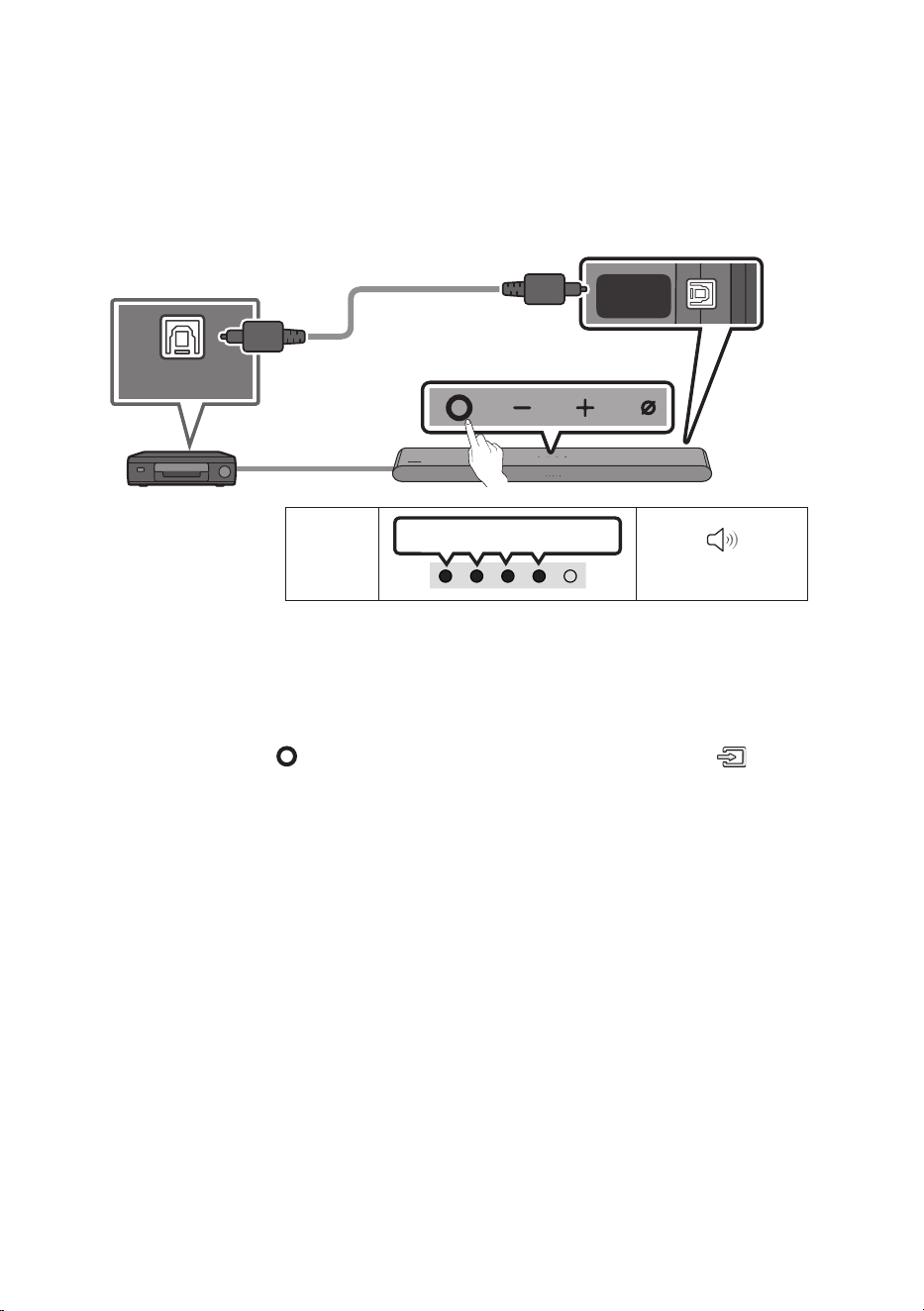
FRA - 26
06 CONNEXIOND'UNAPPAREILEXTERNE
Connexionàl'aided'uncâbleoptique
Voyant
DEL
Voyantblancallumé->éteint
«DigitalAudioIn»
- AUDIO -
R L
OPTICAL OUT
DIGITAL
AUDIO IN
(OPTICAL)
HDMI
(eARC)
PanneaudessousduSoundbar
Câbleoptique
(nonfourni)
DessusduSoundbar
LecteurBD/DVD/
Décodeur/Consoledejeu
1. Éteignez l'appareil externe et le Soundbar, puis connectez le port DIGITALAUDIOIN(OPTICAL) du
Soundbar et le port de sortie OPTICAL de l'appareil externe à l'aide du câble optique (non fourni),
comme indiqué sur la gure.
2. Allumez le Soundbar et l'appareil externe.
3. Appuyez sur le bouton (Multifonction)en haut du Soundbar ou sur le bouton (Source) de la
télécommande, puis sélectionnez le mode «DigitalAudioIn». Ensuite, l'annonce, «DigitalAudio
In» est émise.
4. Le son de l'appareil externe est émis par le Soundbar.
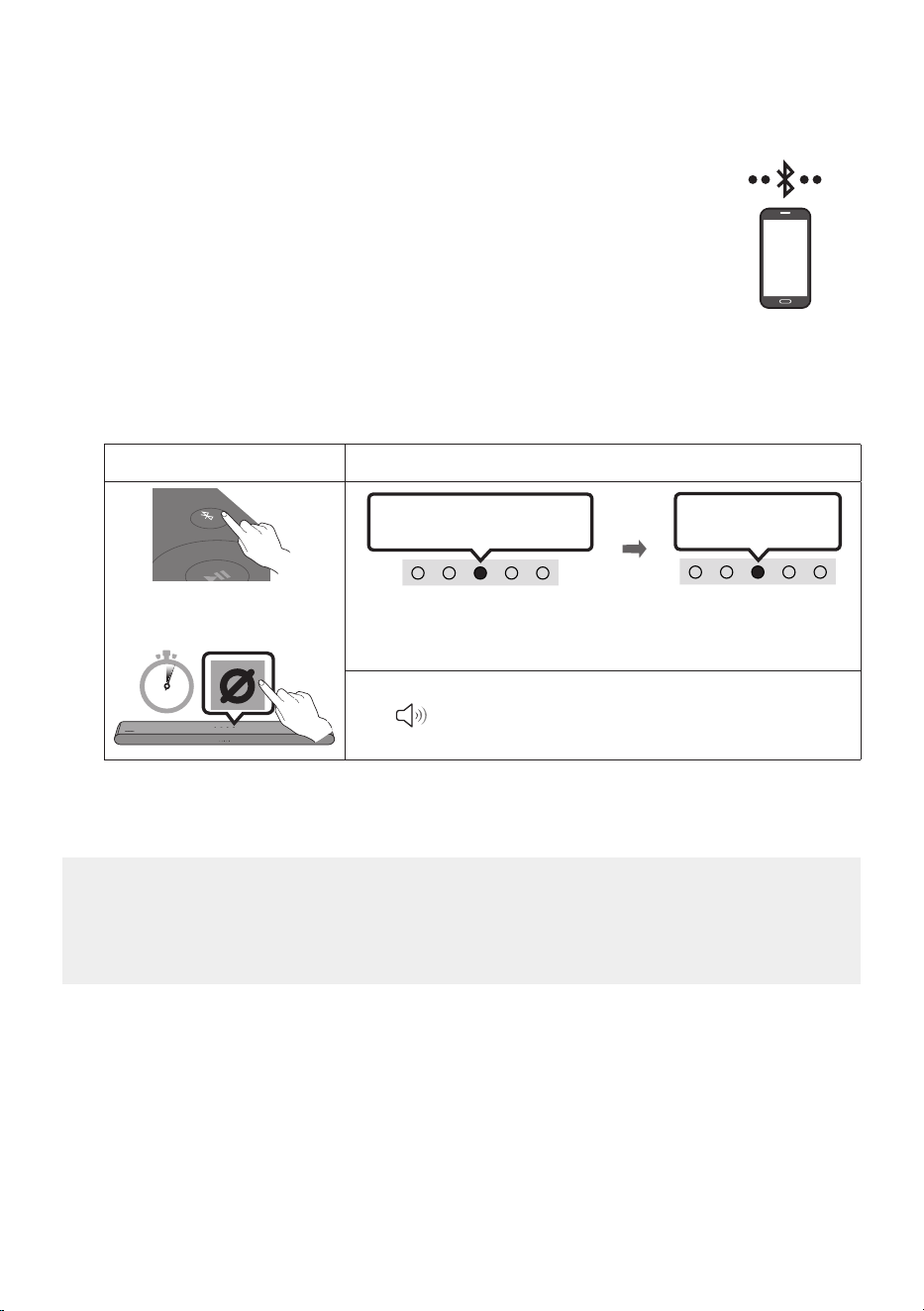
FRA - 27
07 CONNEXIOND'UNAPPAREILMOBILE
Méthode1.ConnexionparBluetooth
Lorsqu'un appareil mobile est connecté par Bluetooth, vous pouvez entendre le
son stéréo sans les tracas du câblage.
• Lorsque vous connectez un appareil Bluetooth associé alors que le Soundbar
est éteint, le Soundbar s'allume automatiquement.
Laconnexioninitiale
• Lors de la connexion à un nouvel appareil Bluetooth, assurez-vous que l'appareil est à moins d’3,28 pi
(1 m) de distance.
1.
BoutonAppairageBluetooth VoyantDEL
SOUND
MODE
PAIR
OU
Appairage
LesvoyantsRouge→ Vert→
Bleuclignotent
Levoyantcyan
clignote3fois
Connexion établie
En mode « Bluetooth »
5 Sec
• Jusqu'à ce que l'appairage soit terminé, les voyants DEL multicolores
s'allument successivement : Rouge → Vert → Bleu.
«ReadytoconnectviaBluetooth.»
2. Sur votre appareil, sélectionnez «S-SeriesSoundbar» dans la liste qui apparaît.
3. Lisez les chiers musicaux de l'appareil connecté par Bluetooth via le Soundbar.
Encasd’échecdelaconnexiondel’équipement
• Si un Soundbar (par exemple, S-SeriesSoundbar) gure déjà dans la liste des haut-parleurs de
l’appareil mobile, supprimez-le.
• Répétez les étapes 1 et 2.
Appareilmobile

FRA - 28
RemarquessurlaconnexionBluetooth
• Localisez un nouvel appareil à moins d’3,28 pi (1 m) pour vous connecter via la communication
Bluetooth.
• Si un code PIN vous est demandé lors de la connexion d’un appareil Bluetooth, entrez <0000>.
• Le Soundbar s’éteint automatiquement au bout de 18minutes à l’état Prêt.
• Le Soundbar peut ne pas effectuer correctement la recherche ou la connexion Bluetooth dans les
circonstances suivantes:
– S’il y a un fort champ électrique autour du Soundbar.
– Si plusieurs appareils Bluetooth sont associés simultanément au Soundbar.
– Si l’appareil Bluetooth est éteint, pas en place ou fonctionne mal.
• Les appareils électroniques peuvent créer des interférences radio. Les appareils produisant des
ondes électromagnétiques doivent être gardés à distance de l’unité principale du Soundbar, par
exemple les micro-ondes, les appareils de réseau sans l, etc.
• Le Soundbar prend en charge les données SBC (44,1 kHz, 48 kHz).
• Connectez-vous uniquement à un périphérique Bluetooth prenant en charge la fonction A2DP (AV).
• Lorsque vous connectez le Soundbar à un périphérique Bluetooth, placez-les aussi près que
possible l’un de l’autre.
• Plus le Soundbar et le périphérique Bluetooth sont éloignés l’un de l’autre, plus la qualité sonore
diminue. La connexion Bluetooth peut se rompre lorsque les appareils sont hors de portée
effective.
• La connexion Bluetooth peut ne pas fonctionner comme prévu dans les zones où la réception est
mauvaise.
• Un périphérique Bluetooth peut émettre du bruit ou devenir défaillant dans les conditions suivantes :
– Lorsque le corps est en contact avec l’émetteur-récepteur de signal sur l’appareil Bluetooth ou
le Soundbar
– Dans les coins ou lorsqu’il y a un obstacle à proximité, tel qu’un mur ou une cloison, où des
changements électriques peuvent se produire.
– Lorsqu’il est exposé à des interférences radio par d’autres produits fonctionnant sur les mêmes
gammes de fréquences, comme des équipements médicaux, des fours à micro-ondes et des
périphériques LAN sans l.
– Les obstacles tels que les portes et les murs peuvent avoir un impact sur la qualité sonore,
même lorsque les appareils sont dans le champ de portée effective.
• Notez que votre Soundbar ne peut pas être appairé avec d’autres périphériques Bluetooth lorsque
vous utilisez l’option Bluetooth.
• Cet appareil sans l peut provoquer des interférences électriques lorsqu’il est en marche.

FRA - 29
Déconnexiond’unpériphériqueBluetoothd’unSoundbar
Vous pouvez déconnecter le périphérique Bluetooth à partir du système Soundbar. Pour des directives,
consultez le manuel d’utilisation du périphérique Bluetooth.
• Le système Soundbar sera déconnecté.
• Si le Soundbar est déconnecté de l'appareil Bluetooth, le voyant DEL multicolore du Soundbar
clignote « Rouge » trois fois.
DéconnexionduSoundbardupériphériqueBluetooth
Appuyez sur le bouton (Multifonction) en haut du Soundbar ou sur le bouton (Source) de la
télécommande pour sélectionner un mode autre que «Bluetooth».
• La déconnexion prend du temps car le périphérique Bluetooth doit recevoir une réponse du
Soundbar. (Le temps de déconnexion requis peut différer en fonction du périphérique Bluetooth.)
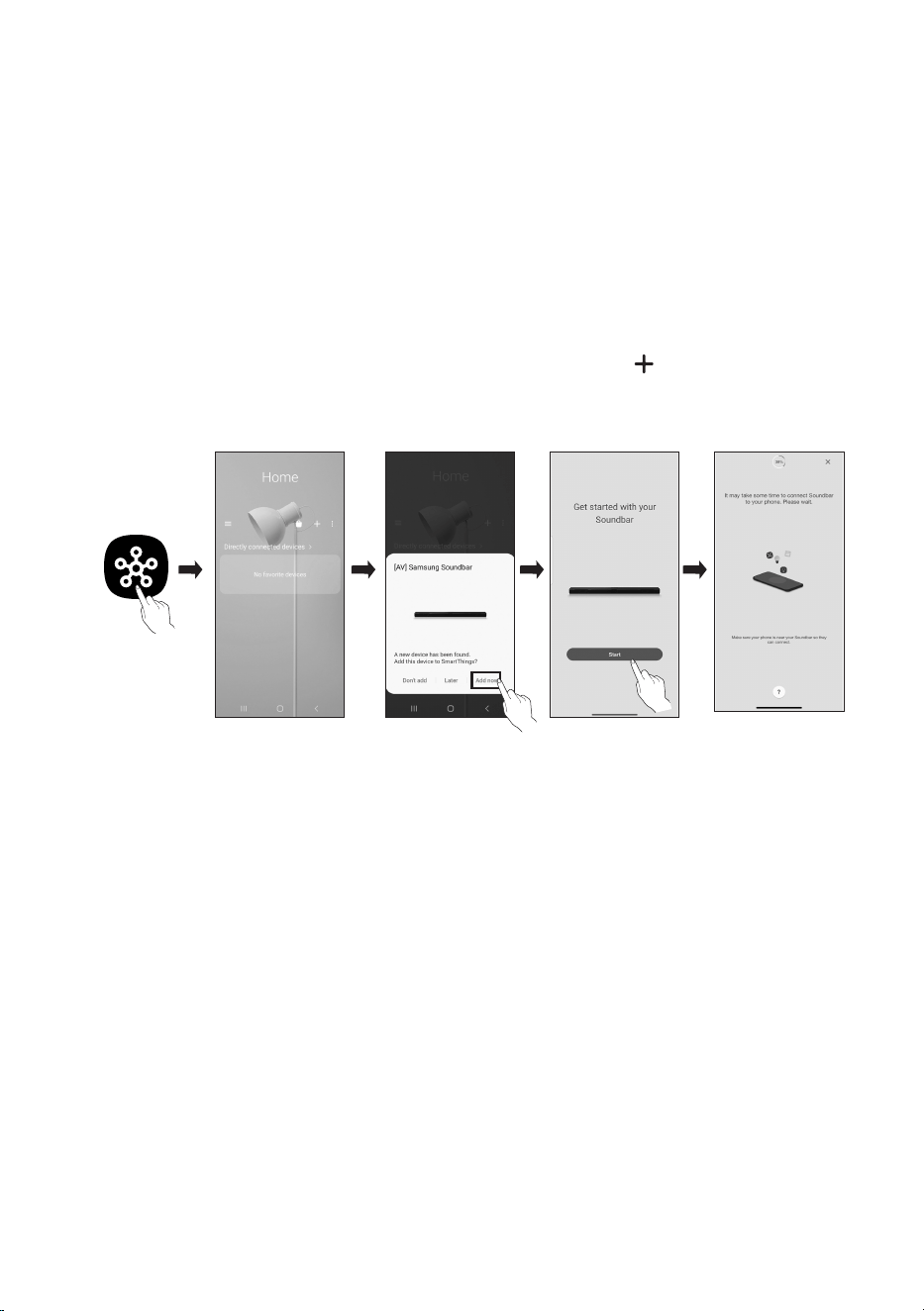
FRA - 30
Méthode2.ConnexionparWi-Fi(réseausansl)
Pour connecter un Soundbar à un appareil mobile via un réseau sans l (Wi-Fi), l’application
SmartThings est requise.
Connexioninitiale
1. Installez et lancez l’application SmartThings sur votre appareil mobile (téléphone intelligent ou
tablette).
2. Dans l’application, suivez les instructions à l’écran pour ajouter le Soundbar.
• La fenêtre contextuelle automatique (deuxième illustration ci-dessous) peut ne pas s’afcher
sur certains appareils.
Si la fenêtre contextuelle ne s’afche pas, appuyez sur le bouton « » sur l’écran Home.
Le Soundbar a été ajouté à l’application.
• L’illustration ci-dessous peut varier selon la version de l’application.
Lancez
l’application
Ajouter un appareil
Notication
automatique
Application
SmartThings
PourchangervotreconnexionWi-Fi
1. Lancez l’application SmartThings sur votre appareil mobile (téléphone intelligent ou tablette).
2. Sur l’application, supprimez le Soundbar enregistré et rajoutez-le.

FRA - 31
UtilisationduJeudegroupe
• Pour bénécier de cette fonctionnalité, ajoutez votre Soundbar à l’application SmartThings.
• Pour l’activer, connectez au moins deux appareils audio au même réseau Wi-Fi à 5GHz.
• Cette fonction est disponible sur les appareils de son Samsung prenant en charge le Wi-Fi
commercialisés à partir de 2024.
• Cette fonctionnalité ne prend pas en charge le son du téléviseur.
CongurationduJeudegroupe
1. Lancez l’application SmartThings sur votre appareil mobile.
2. Ajoutez le Soundbar dans l’application SmartThings en suivant les instructions de la section
« Méthode2.ConnexionparWi-Fi(réseausansl) » → «Étapes2 (Enregistrement de l’appareil)».
3. Appuyez sur la carte du Soundbar.
4. Sur votre appareil mobile, appuyez sur Créerungroupe sous l’icône d'appareil audio.
• Le bouton Créerungroupe s’afche uniquement lorsque le Soundbar est en mode Wi-Fi.
• Si le Soundbar diffuse le son du téléviseur, la connexion au téléviseur est débranchée lors de la
création d’un groupe.
5. Activez le Jeudegroupe.
6. Sélectionnez l’appareil de votre choix dans la liste et appuyez sur Appliquer.
• Vous pouvez ajouter jusqu’à 4appareils.
• Avec le Jeudegroupe, l’audio sera diffusé au moyen de l’appareil hôte seulement.
• Lorsqu’un appareil connecté à l’appareil hôte passe sur une source différente, l’appareil sera
supprimé automatiquement du groupe.
• Lorsque l’appareil hôte est connecté à un téléviseur, le groupe généré sera supprimé
automatiquement.
DésactivationduJeudegroupe
1. Appuyez sur la carte de l’appareil audio.
2. Sur votre appareil mobile, appuyez sur Modierlegroupe sous l’icône d'appareil audio.
3. Désactivez le Jeudegroupe.
• Pour désactiver un appareil individuel, décochez la case de l’appareil de la liste et appuyez sur
Appliquer.

FRA - 32
ConnexionparAppleAirPlay
• Cette fonction peut ne pas être disponible dans certains pays.
• Ce Soundbar Samsung prend en charge AirPlay et nécessite iOS13.4 ou version ultérieure.
• Pour activer AirPlay dans votre Soundbar, vous devez d’abord enregistrer l’appareil avec
l’application Samsung SmartThings en acceptant les conditions générales de l’application.
• Assurez-vous que le Soundbar est sous tension et qu’il est connecté au même réseau Wi-Fi que
votre appareil Apple.
Avec AirPlay, vous pouvez diffuser en ux de la musique, des balados et d’autres sons à partir de votre
appareil Apple sur le Soundbar Samsung.
• Sélectionnez à partir d’une application prise en charge par AirPlay ou du centre de contrôle sur
votre iPhone, iPad ou Mac.
• Dans la liste d’appareils disponibles, sélectionnez le Soundbar sur lequel jouer le son actuel.
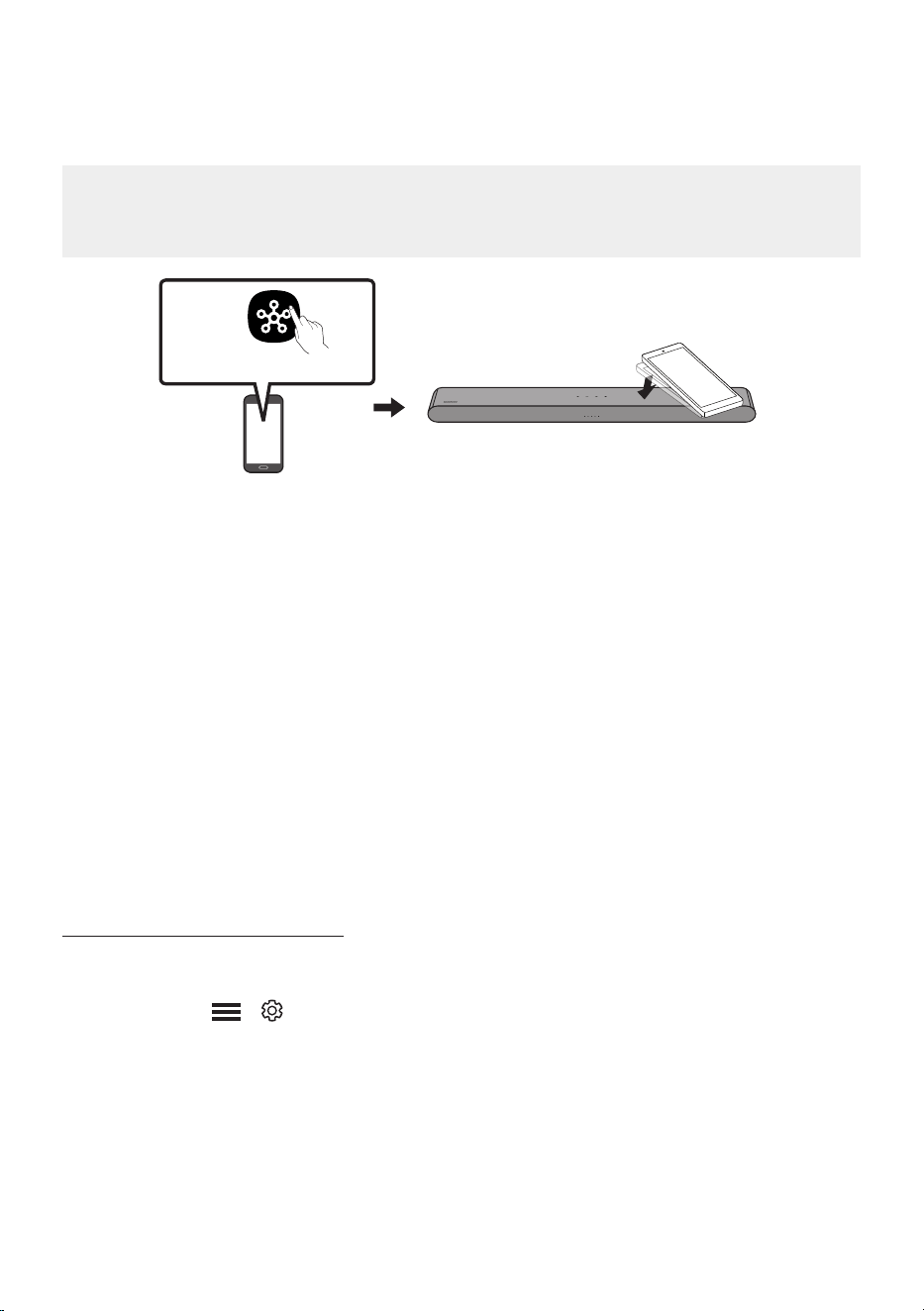
FRA - 33
UtilisationdelafonctionTapSound
Appuyez sur le Soundbar avec votre appareil mobile pour écouter le son de l’appareil mobile au moyen
du Soundbar.
• Cette fonction peut ne pas être prise en charge en fonction de l’appareil mobile.
• Cette fonction n’est compatible qu’avec les appareils mobiles Samsung fonctionnant sous
Android 8.1 ou une version ultérieure.
Appareilmobile
ApplicationSmartThings
DessusduSoundbar
1. Activez la fonction TapSound sur votre appareil mobile.
• Pour plus d’informations sur la façon d’activer cette fonction, reportez-vous à la section
«ActiverlafonctionTapSound » ci-dessous.
2. Appuyez sur le Soundbar avec l’appareil mobile. Sélectionnez « Démarrer » dans la boîte de
dialogue afchée. La connexion est établie entre l’appareil mobile et le Soundbar via Bluetooth.
3. Lisez le son de l’appareil mobile au moyen du Soundbar.
• Cette fonction connecte un appareil mobile au Soundbar via Bluetooth en détectant les
vibrations produites lorsque l’appareil touche le Soundbar.
• Veillez à ne pas appuyer l’appareil mobile sur un coin pointu du Soundbar. Cela pourrait rayer ou
endommager le Soundbar ou l’appareil mobile.
• Il est recommandé de placer l’appareil mobile dans un étui. Appuyez légèrement sur la zone
large de la partie supérieure du Soundbar, sans exercer de force excessive.
• Pour utiliser cette fonction, mettez à jour l’application SmartThings vers la dernière version.
Cette fonction peut ne pas être prise en charge en fonction de la version de l’application.
ActiverlafonctionTapSound
Utilisez l’application SmartThings pour activer la fonction TapView, TapSound.
1. Sur l’appareil mobile, lancez l’application SmartThings.
2. Sélectionnez ( → ) sur l’écran de l’application SmartThings qui apparaît sur l’appareil mobile.
3. Dénissez « TapView, TapSound » sur Activé pour permettre à la fonction de se lancer lorsqu’un
appareil mobile se rapproche du Soundbar.
REMARQUES
• Lorsque l’appareil mobile est en mode d’économie d’énergie, la fonction TapSound ne fonctionne pas.
• La fonction TapSound peut ne pas fonctionner si des appareils à proximité du Soundbar, par exemple
des appareils électriques, provoquent des interférences radio. Assurez-vous que les appareils
susceptibles de provoquer des interférences radio sont placés à une distance sufsante du Soundbar.
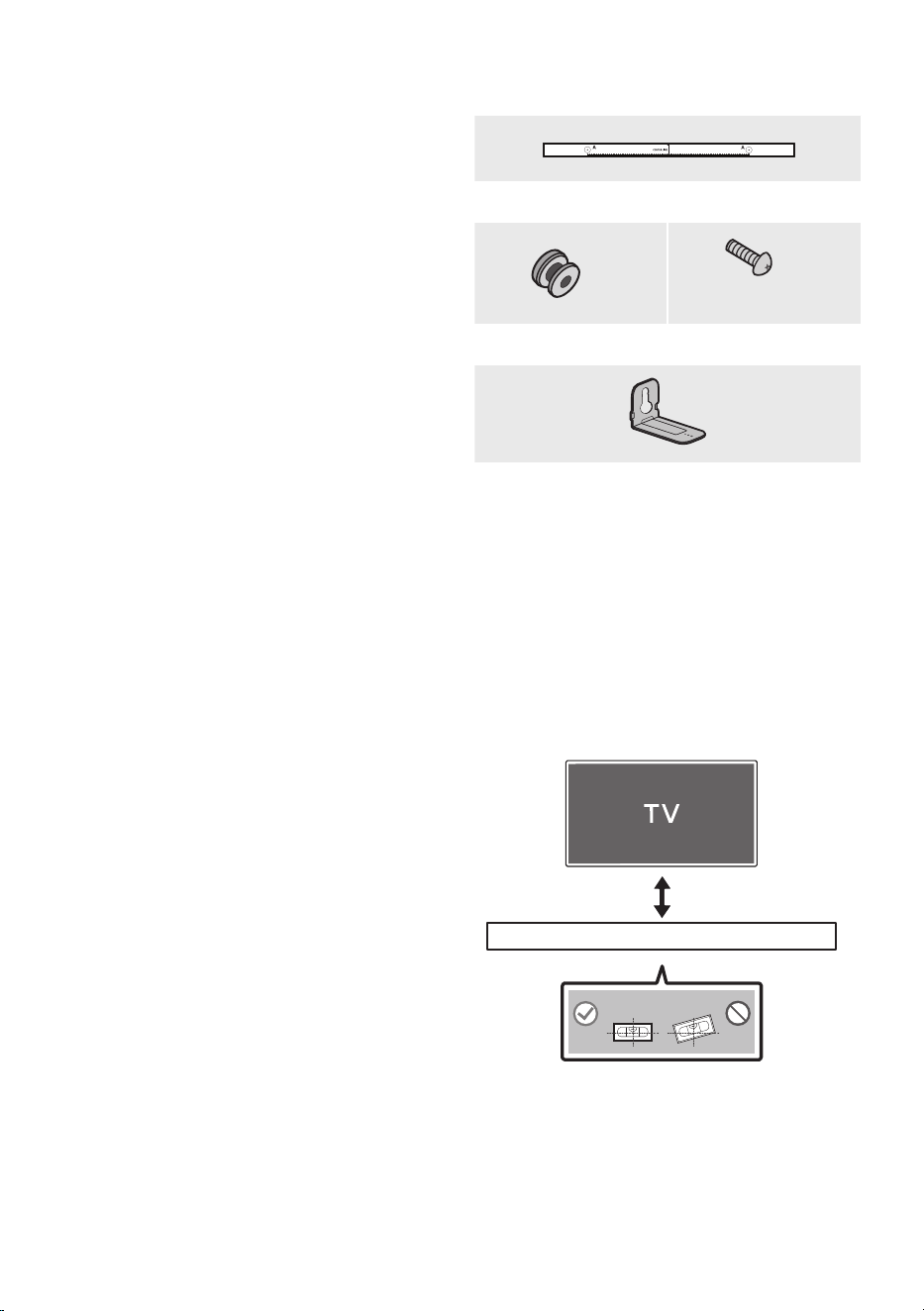
FRA - 34
08 INSTALLATION
DUSUPPORT
MURAL
Précautionsd’installation
• Procédez à l’installation sur un mur vertical
uniquement.
• N’installez pas le produit dans un endroit où
la température ou le taux d’humidité est
élevé.
• Vériez que le mur est sufsamment solide
pour supporter le poids du produit. Sinon,
renforcez le mur ou choisissez un autre point
d’installation.
• Achetez et utilisez les vis de xation ou les
chevilles adaptées au type de mur que vous
possédez (plaque de plâtre, plaque de fer,
bois, etc.). Si possible, xez les vis de support
dans les poteaux muraux.
• Achetez des vis de montage mural en
fonction du type et de l’épaisseur du mur sur
lequel vous souhaitez monter le Soundbar.
– Diamètre: M5
– Longueur: 1 3/8 pouces (35 mm) ou plus
recommandé.
• Connectez les câbles de l’unité aux appareils
externes avant d’installer le Soundbar sur le
mur.
• Assurez-vous que l’unité est éteinte et
débranchée de la source d’alimentation avant
de l’installer. Sinon, cela pourrait provoquer
un choc électrique.
Composantsdemontagemural
A TYPE : 450mm
Guidedemontagemural
x 2
(M4 x L10)
x 2
Visdexation Vis
x 2
Supportdemontagemural
1. Placez le Guidedemontagemural contre la
surface du mur.
• Le Guidedemontagemural doit être à
niveau.
• Si votre téléviseur est xé au mur,
installez le Soundbar au moins 2 pouces
(5 cm) en dessous du téléviseur.
2pouces(5cm)ouplus
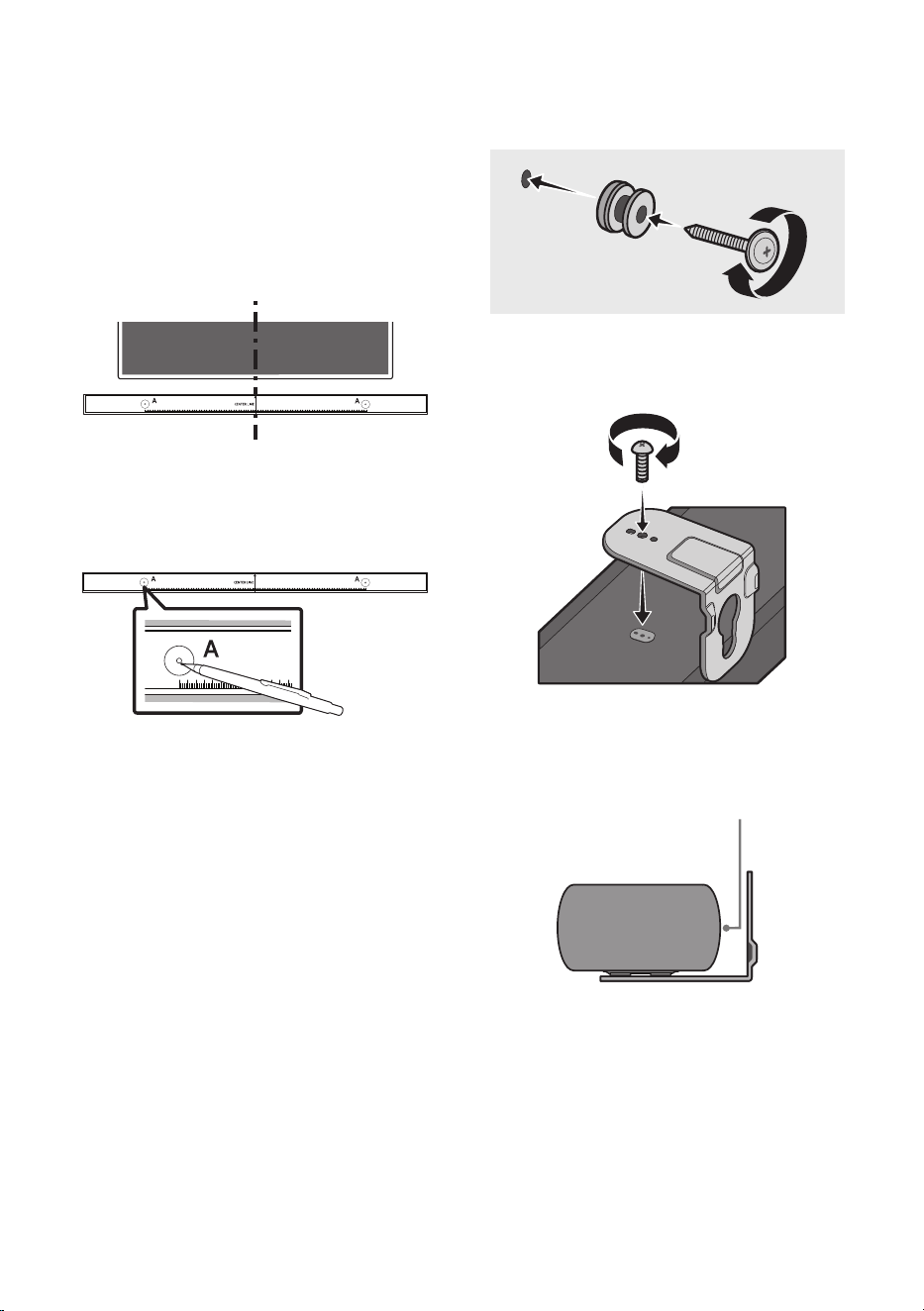
FRA - 35
2. Alignez la LigneCentrale du Guidede
montagemural sur le centre de votre
téléviseur (si vous montez le Soundbar sous
ce dernier), puis xez le Guidedemontage
mural au mur avec du ruban adhésif.
• Si vous ne l’installez pas sous un
téléviseur, placez la LigneCentrale au
centre de la zone d’installation.
Lignecentrale
A TYPE : 450mm
3. Utilisez un crayon pour marquer la position
des trous et retirez le Guidedemontage
mural.
A TYPE : 450mm
4. À l’aide d’un foret de taille appropriée, percez
un trou dans le mur à chaque marque.
• Si les marques ne correspondent pas à la
position des montants de la cloison, veillez
à insérer les ancrages appropriés dans les
trous avant d’insérer les vis de support. Si
vous utilisez des ancrages, assurez-vous
que les trous que vous percez sont assez
grands pour les accommoder.
5. Poussez une vis (non fournie) dans chaque
Visdexation, puis vissez fermement
chaque vis dans un trou de vis de support.
(Nonfournie)
6. Installez les 2 Supportdemontagemural
selon l’orientation correcte en bas de la
Soundbar, à l’aide de 2 Vis.
• Lors du montage, assurez-vous que
l’étrier des Supportdemontagemural
est situé à l’arrière du Soundbar.
ArrièreduSoundbar
ExtrémitédroiteduSoundbar
• Le produit réel pourrait différer de
l’image ci-dessus, selon le modèle.
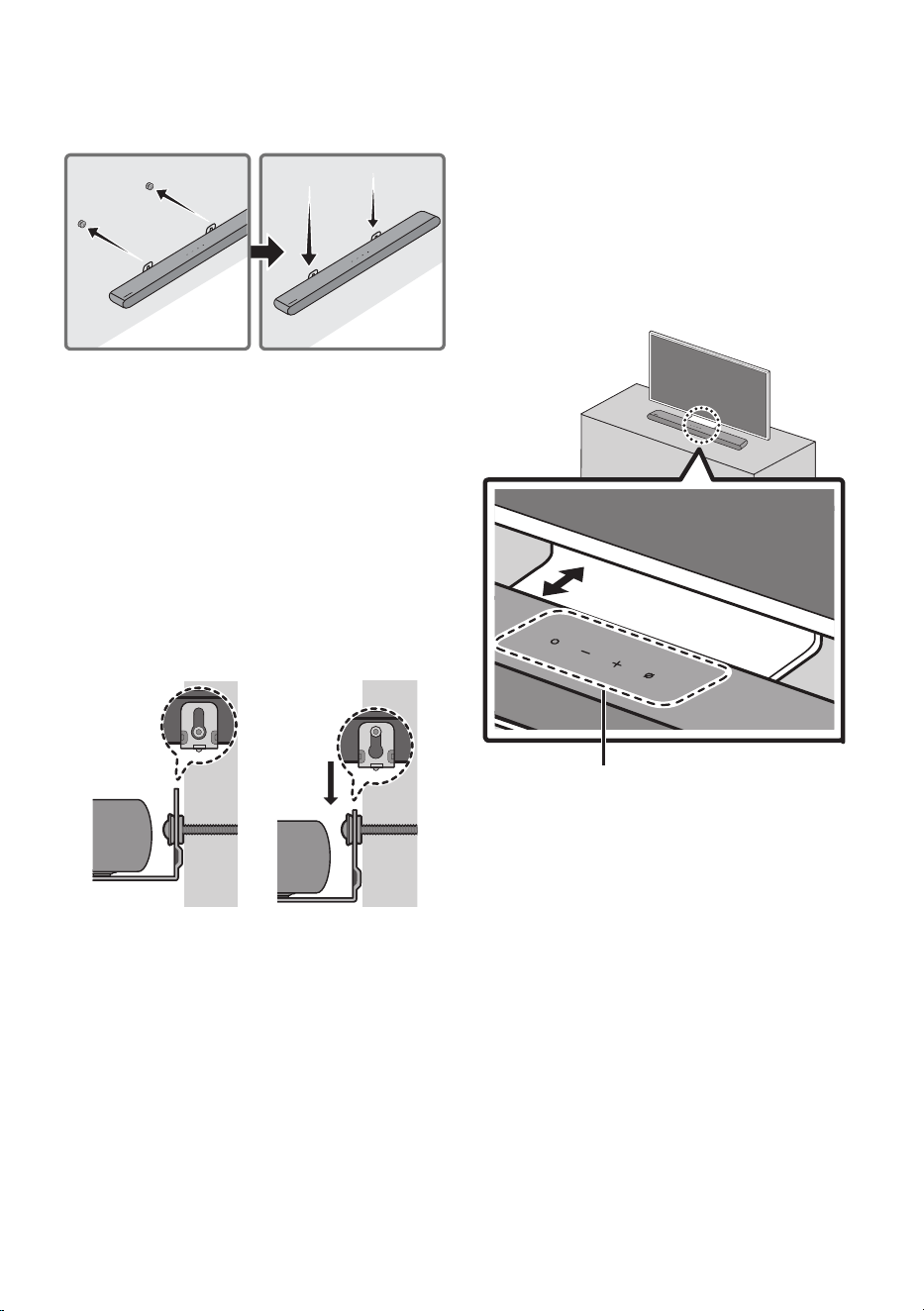
FRA - 36
7. Installez le Soundbar à l’aide des Supportde
montagemural en accrochant ces derniers
sur les Visdexation xées au mur.
8. Faites glisser la Soundbar vers le bas, comme
illustré ci-dessous, an que les Supportde
montagemural reposent fermement sur les
Visdexation.
• Insérez les Visdexation dans la partie
large (inférieure) des Supportde
montagemural, puis faites glisser les
Supportdemontagemural vers le bas
an que les Supportdemontagemural
reposent fermement sur les Visde
xation.
09 INSTALLATION
DUSOUNDBAR
DEVANTLE
TÉLÉVISEUR
3cm(1,2pouce)ouplus
Microphones
Alignez le centre du Soundbar au centre du
téléviseur comme illustré sur l’image.
À ce stade, placez le Soundbar à au moins 3 cm
(1,2 pouce) du téléviseur an qu'il n'y ait aucune
interférence avec la reconnaissance vocale.
REMARQUES
• Assurez-vous que le Soundbar est placé sur
une surface plane et solide.
• Un espace insufsant entre le téléviseur et le
Soundbar peut entraîner des problèmes
acoustiques et de reconnaissance vocale.
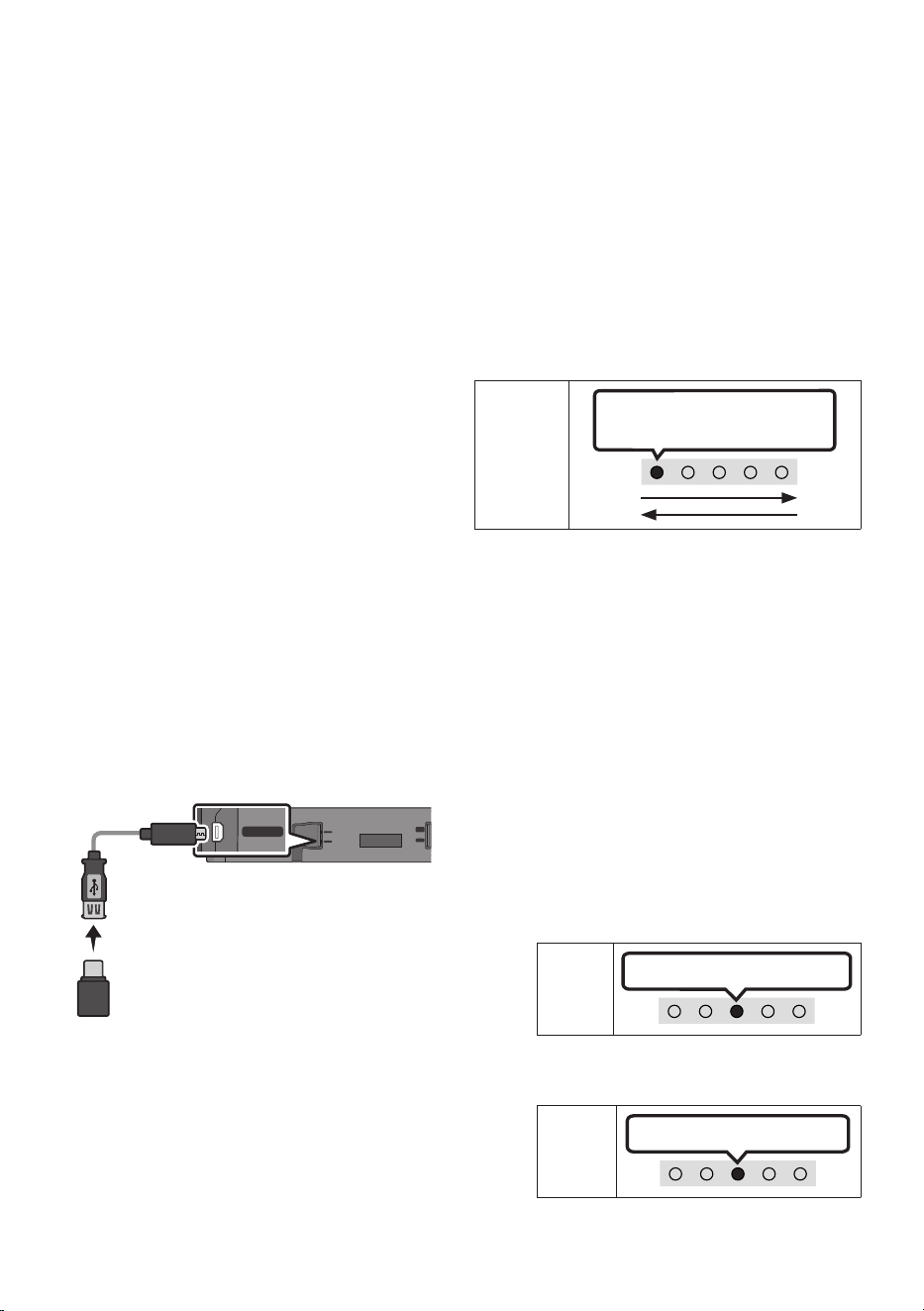
FRA - 37
10 MISEÀJOUR
LOGICIELLE
Miseàjourautomatique
Lorsque le Soundbar est connecté à Internet, les
mises à jour logicielles s'installent
automatiquement, même lorsque le Soundbar est
éteint.
• Pour utiliser la fonction de mise à jour
automatique, le Soundbar doit être connecté
à Internet.
La connexion Wi-Fi au Soundbar sera
interrompue si le cordon d'alimentation du
Soundbar est débranché ou si l'alimentation
est coupée. En cas de coupure, à la remise
sous tension ou lorsque vous rebranchez le
cordon d'alimentation, allumez le Soundbar,
puis reconnectez-le à Internet.
MiseàjourUSB
SERVICE
DC 19V
DIGITAL
AUDIO IN
(OPTICAL)
HDMI
(eARC)
SERVICE
DC 19V
Câbleadaptateur
MicroUSBàUSB
(nonfourni)
PanneaudessousduSoundbar
IlsepeutqueSamsungproposedesmisesàjour
dumicrologicieldusystèmeSoundbaràl'avenir.
Lorsqu'une mise à jour est disponible, vous
pouvez mettre à jour le Soundbar en connectant
le lecteur USB qui contient le micrologiciel de
mise à jour au port SERVICE du Soundbar.
1. Accédez au site (www.samsung.com) →
recherchez le nom du modèle au moyen de
l'option de menu d'assistance à la clientèle.
• Pour plus d’informations sur la mise à jour,
reportez-vous au Guide de mise à niveau.
2. Téléchargez le chier de mise à niveau (type
USB).
3. Décompressez le chier pour créer un
dossier avec le nom du chier.
4. Stockez le dossier créé sur une clé USB, puis
connectez-le au Soundbar.
5. Allumez le Soundbar. Le produit est alors mis
à jour en moins de trois minutes.
Voyant
DEL
Leblancsedéplacedegaucheà
droiteetdedroiteàgauche
• Pendant la mise à jour, n’éteignez pas le
produit et ne retirez pas le câble USB.
• Si le voyant jaune est allumé après la
mise à jour du logiciel, cela signie qu’une
mise à jour supplémentaire est en cours.
En pareil cas, ne coupez pas l’alimentation
et ne retirez pas le dispositif USB.
• Si la mise à jour ne sexécute pas, rebranchez
le cordon d'alimentation du Soundbar.
• Si la dernière version est installée, aucune
mise à jour n’est effectuée.
• Selon le type d’USB, la mise à jour peut ne
pas être prise en charge.
• Si aucun chier de mise à jour n’est disponible
Voyant
DEL
Levoyantrougeclignote3fois
• Si le chier de mise à jour est pour la même
version ou pour une version antérieure
Voyant
DEL
Levoyantcyanclignote3fois
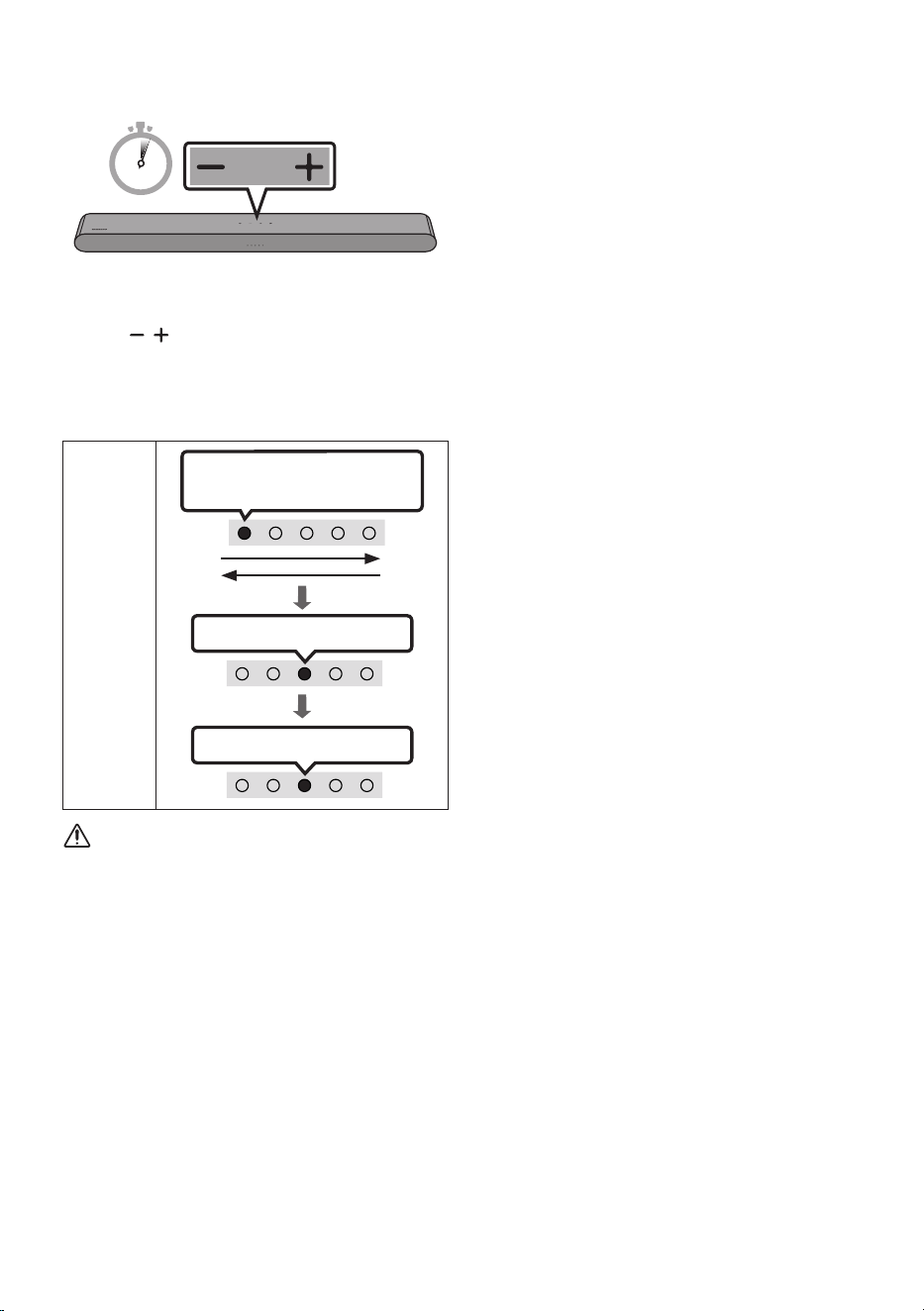
FRA - 38
Réinitialisation
5 Sec
Alors que le Soundbar est allumé, appuyez sur les
boutons (Volume) de l'unité pendant au
moins 5secondes. L'afchage des voyantschange
comme indiqué ci-dessous, et le Soundbar est
réinitialisé.
Voyant
DEL
Leblancsedéplacedegaucheà
droiteetdedroiteàgauche
Levoyantcyanclignote3fois
Clignoteenrouge→ Éteint
MISEENGARDE
• Tous les paramètres du Soundbar sont
réinitialisés.
Veillez à effectuer cette opération
uniquement lorsqu’une réinitialisation est
requise.
Informationconcernantles
misesàjoursurlasécurité
Des mises à jour sur la sécurité sont fournies pour
renforcer la sécurité de votre appareil et protéger
vos données personnelles. Pour en savoir plus sur
les mises à jour sur la sécurité, visitez la page
https://security.samsungtv.com.
• Le site Web ne prend en charge que certaines
langues.

FRA - 39
11 DÉPANNAGE
Avant de contacter l’assistance, effectuez les vérications suivantes.
LeSoundbarnes’allumepas.
; Vériez si le cordon d'alimentation du Soundbar
est correctement inséré dans la prise.
LeSoundbarfonctionneparintermittence.
; Après avoir retiré le cordon d’alimentation,
réinsérez-le.
; Mettez l’appareil externe sous tension et
réessayez.
; S’il n’y a pas de signal, le Soundbar s’éteint
automatiquement après un certain temps.
Allumez le produit. (Voir la page 8.)
Latélécommandenefonctionnepas.
; Pointez la télécommande directement sur
le Soundbar.
; Remplacez les piles.
LevoyantDELrougeduSoundbarreste
allumé.
; Le microphone est éteint. Allumez le
microphone. (Voir la page 6.)
LeSoundbarn’émetaucunson.
; Le volume du Soundbar est trop faible ou
coupé. Réglez le volume.
; Lorsqu’un appareil externe (STB, appareil
Bluetooth, appareil mobile, etc.) est connecté,
réglez le volume de l’appareil externe.
; Pour la sortie audio du téléviseur,
sélectionnez Soundbar. (Téléviseur Samsung:
Accueil ( ) → Menu → Paramètres ( ) →
Tous les paramètres ( ) → Son → Sortie
audio → Sélectionnez le Soundbar)
; La connexion du câble au Soundbar ne doit
pas être lâche. Débranchez le câble et
rebranchez-le.
; Retirez complètement le cordon
d’alimentation, rebranchez-le et mettez
l’appareil sous tension.
; Initialisez le produit et réessayez.
(Voir page 38.)
Siletéléviseurn’estpasconnectéparHDMI
(
eARC
).
; Vériez que le câble HDMI est
correctement connecté à la borne eARC.
(Voir la page16.)
; La connexion peut ne pas être possible en
raison de l’appareil externe connecté
(décodeur, machine de jeux, etc.).
Connectez directement le Soundbar.
; HDMI-CEC peut ne pas être activé sur le
téléviseur. Activez le CEC dans le menu du
téléviseur. (Téléviseur Samsung: Accueil
( ) → Menu → Paramètres ( ) → Tous
les paramètres ( ) → Connexion →
Gestionnaire de périphérique externe →
Anynet+ (HDMI-CEC) ACTIVÉ)

FRA - 40
Aucunsonn’estémislorsdelaconnexionau
téléviseurenmodeHDMI(eARC).
; Votre appareil ne peut pas lire le signal
d’entrée. Changez la sortie audio du
téléviseur et réglez-la sur PCM ou sur
Dolby Digital.
(Pour un téléviseur Samsung : Accueil ( ) →
Menu → Paramètres ( ) → Tous les
paramètres ( ) → Son → Paramètres
avancés → Format de sortie audio numérique)
LeSoundbarneseconnectepaspar
Bluetooth.
; Lors de la connexion d'un nouvel appareil,
passez à l'appairage Bluetooth pour la
connexion. (Appuyez sur le bouton PAIR
de la télécommande ou sur le bouton
(Marche/Arrêtmicrophone) de l'unité
pendant au moins 5secondes.)
; Si le Soundbar est connecté à un autre
appareil, débranchez d’abord cet appareil
pour commuter l’appareil.
; Reconnectez l’appareil après avoir supprimé
la liste des haut-parleurs Bluetooth sur
l’appareil à connecter. (Téléviseur Samsung:
Accueil ( ) → Menu → Paramètres ( ) →
Tous les paramètres ( ) → Son → Sortie
audio → Liste des haut-parleurs Bluetooth)
; Retirez et rebranchez la che
d’alimentation, puis réessayez.
; Initialisez le produit et réessayez.
(Voir page 38.)
Lesonsecoupelorsd’uneconnexionpar
Bluetooth.
; Certains appareils peuvent créer des
interférences radio s’ils sont trop proches
du Soundbar (p. ex. fours à micro-ondes,
routeurs sans l, etc.).
; Si votre appareil connecté par Bluetooth
est trop éloigné du Soundbar, il est possible
que le son soit coupé. Rapprochez l’appareil
du Soundbar.
; Si une partie de votre corps est en contact
avec l’émetteur-récepteur Bluetooth ou
que le produit est installé sur un meuble en
métal, une coupure du son peut se
produire. Vériez l’environnement
d’installation et les conditions d’utilisation.
ConnexionimpossibleauWi-Fi.
; Vériez si votre routeur sans l est allumé.
; Éteignez le routeur, rallumez-le, puis
réessayez.
; Le Soundbar ne peut pas se connecter si le
signal sans l est trop faible. Placez le
routeur plus près du Soundbar ou éliminez
tout obstacle entre le Soundbar et le routeur,
dans la mesure du possible.
; Si votre routeur sans l est nouveau, vous
devrez recongurer les paramètres réseau
du haut-parleur.
; Le Soundbar ne prend pas en charge le
Wi-Fi6.
LeSoundbarnes’allumepas
automatiquementavecletéléviseur.
; Lorsque vous éteignez le Soundbar tout en
regardant la télévision, la synchronisation
de l'alimentation avec le téléviseur est
désactivée. Éteignez d'abord le téléviseur.
FRA - 41
LafonctionAVAn’estpasdisponibledansles
cassuivants.
; La fonction AVA n’est pas disponible en
utilisant la fonction Q-Symphony.
; La fonction AVA n’est pas disponible
lorsque le microphone est éteint.
Aprèsavoirconnectéletéléviseurau
Soundbar,j’aimodiélemodeduSoundbar.
Aucunsonn’estémisdutéléviseur.
; Si vous connectez votre Soundbar à un
appareil mobile pendant que le Soundbar
est connecté au téléviseur, le Soundbar
diffuse du son à partir de l’appareil mobile
tout en préservant la connexion au
téléviseur. Le son du téléviseur ne sera
donc pas diffusé à nulle part.
; Déconnectez l’appareil mobile, et le son du
téléviseur sera de nouveau diffusé à partir
du Soundbar.
LeSoundbarn’apparaîtpasdansAirPlay.
; Pour activer AirPlay dans votre Soundbar,
vous devez d’abord enregistrer l’appareil
avec l’application Samsung SmartThings
en acceptant les conditions générales de
l’application. (Voir page32.)
; AirPlay ne fonctionne pas si vous
supprimez le Soundbar de l’application
Samsung SmartThings.
; Vériez que le Soundbar et l’appareil Apple
sont connectés au même réseau Wi-Fi.
; Le Soundbar est compatible avec AirPlay
installé sur iOS 13.4 ou version ultérieure.
LeJeudegroupen’estpasactivé.
; Vériez si les appareils audio sont des
modèles plus récents commercialisés à
partir de 2024.
; Vériez si l’appareil hôte est connecté à un
réseau Wi-Fi en tant que source.
; Assurez-vous que tous les appareils audio
sont connectés au même réseau Wi-Fi (à
5GHz).
12 LICENCE
Dolby, Dolby Atmos, and the double-D symbol
are registered trademarks of Dolby Laboratories
Licensing Corporation. Manufactured under
license from Dolby Laboratories. Condential
unpublished works. Copyright © 2012-2021
Dolby Laboratories. All rights reserved.
For DTS patents, see http://patents.dts.com.
Manufactured under license from DTS, Inc. or
DTS Licensing Limited. DTS, Digital Surround,
Virtual:X, and the DTS logo are registered
trademarks or trademarks of DTS, Inc. in the
United States and other countries. © 2021 DTS,
Inc. ALL RIGHTS RESERVED.
Les termes HDMI, HDMI High-Denition
Multimedia Interface, la présentation
commerciale HDMI et les logos HDMI sont des
marques ou des marques déposées de HDMI
Licensing Administrator, Inc.
FRA - 42
• Utilisez votre téléphone, tablette ou
ordinateur comme une télécommande pour
Spotify. Accédez à spotify.com/connect
pour savoir comment faire
• Le logiciel Spotify est soumis à des licences
tierces disponibles ici : https://www.spotify.
com/connect/third-party-licenses.
Apple, AirPlay, iPad, iPhone, and Mac are
trademarks of Apple Inc., registered in the U.S.
and other countries and regions.
Being Roon Tested means that Samsung and
Roon have collaborated to ensure you have the
best experience using Roon software and
Samsung equipment together, so you can just
enjoy the music.
AvisdeLicencesLibres
Le code source libre utilisé dans ce produit peut
être consulté à la page Web indiquée ci-après
(https://opensource.samsung.com).