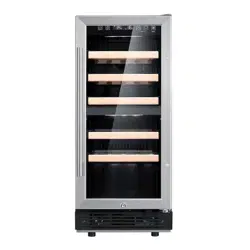
WINE COOLER
WINE COOLER
Item #
Model # MDWC27SSB
XXXXXXXXX
We appreciate the trust and confidence you have placed in Vissani through the purchase of this wine cooler. We strive to continually create
quality products designed to enhance your home. Visit us online to see our full line of products available for your
home improvement needs.

2
1.Safety Warnings ................................................................................3
1.1 Warning ..........................................................................................3
1.2 Electricity related warnings ............................................................. 5
1.3 Related warnings for use ................................................................ 6
1.4 Warnings related to placing items ..................................................7
1.5 Warnings for energy .......................................................................7
1.6 Warnings related to disposal ..........................................................8
2.Proper use of cooler ..........................................................................9
2.1 Names of components....................................................................9
2.2 Temperature Control ..................................................................... 10
2.3 Placement.....................................................................................12
2.4 Start to use ...................................................................................13
2.5 Handle Installation ........................................................................13
2.6 Reversing the door swing .............................................................14
2.7 The arrangement of bottle ............................................................15
2.8 Practical skills for grape wine’s storage ........................................15
2.9 Energy temper ate ........................................................................15
2.10 Energy saving tips ......................................................................15
3.Maintenance of cooler .....................................................................16
3.1 Disconnect the cooler ...................................................................16
3.2 Stop using the cooler .................................................................... 16
3.3 Clean the cooler ...........................................................................16
4.Trouble shooting ..............................................................................17
3
1.Safety Warnings
1.1 Warning
THIS
appliance is intended to
be used in household and similar
applications such as staff kitchen
areas in shops, offices and other
work ing environmen ts; f a r m
houses and by clients in hotels,
motels and other residential type
environments; bed and breakfast
type environments; catering and
similar non-retail applications
THIS
appliance is not intended for use by persons (including children)
with reduced physical, sensory or mental capabilities, or lack of experience
and knowledge, unless they have been given supervision or instruction
concerning use of the appliance by a person responsible for their safety.
Children should be supervised to ensure that they do not play with the
appliance.
IF
the supply cord is damaged, it must be replaced by the manufacturer, its
Do
propellant in this appliance
.
The
appliance has to be unplugged after use and before carrying out user
maintenance on the appliance.
WARNING:
Keep ventilation openings, in the appliance enclosure or in
the built-in structure, clear of obstruction.
WARNING:
Do not use mechanical devices or other means to accelerate
the defrosting process, other than those recommended by the manufacturer.
WARNING:
Do not damage the refrigerant circuit.
WARNING:
Do not use electrical appliances inside the food storage
compartments of the appliance, unless they are of the type recommended
by the manufacturer.
WARNING:
Please abandon the refrigerator according to local regulators
WARNING:
When positioning the appliance, ensure the supply cord is
not trapped or damaged.
WARNING:
Do not locate multiple portable socket-outlets or portable
4
power supplies at the rear of the appliance.
Do
not use extension cords or ungrounded
(
two prong
)
adapters.
WARNING:
Risk of child entrapment. Before you throw away your old
refrigerator or freezer:
-Take o the doors.
-Leave the shelves in place so that children may not easily climb inside.
The
refrigerator must be disconnected from the source of electrical supply
before attempting the installation of accessory.
Refrigerant
and cyclopentane foaming material used for the appliance
are flammable. Therefore, when the appliance is scrapped, it shall be
kept away from any re source and be recovered by a special recovering
company with corresponding qualification other than be disposed by
combustion, so as to prevent damage to the environment or any other
harm.
The
necessity that, for doors or lids tted with locks and keys, the keys be
kept out of the reach of children and not in the vicinity of the refrigerating
appliance, in order to prevent children from being locked inside .
Warning:
To avoid a hazard due to instability of the appliance, it must be
xed in accordance with the instructions.
Warning:
Connect to potable water supply only. (Suitable for ice making
machine)
To
Prevent A Child From Being Entrapped, Keep Out Of Reach Of Children
And Not In The Vicinity Of Freezer (Or Refrigerator).(Suitable for products
with locks)
WARNING
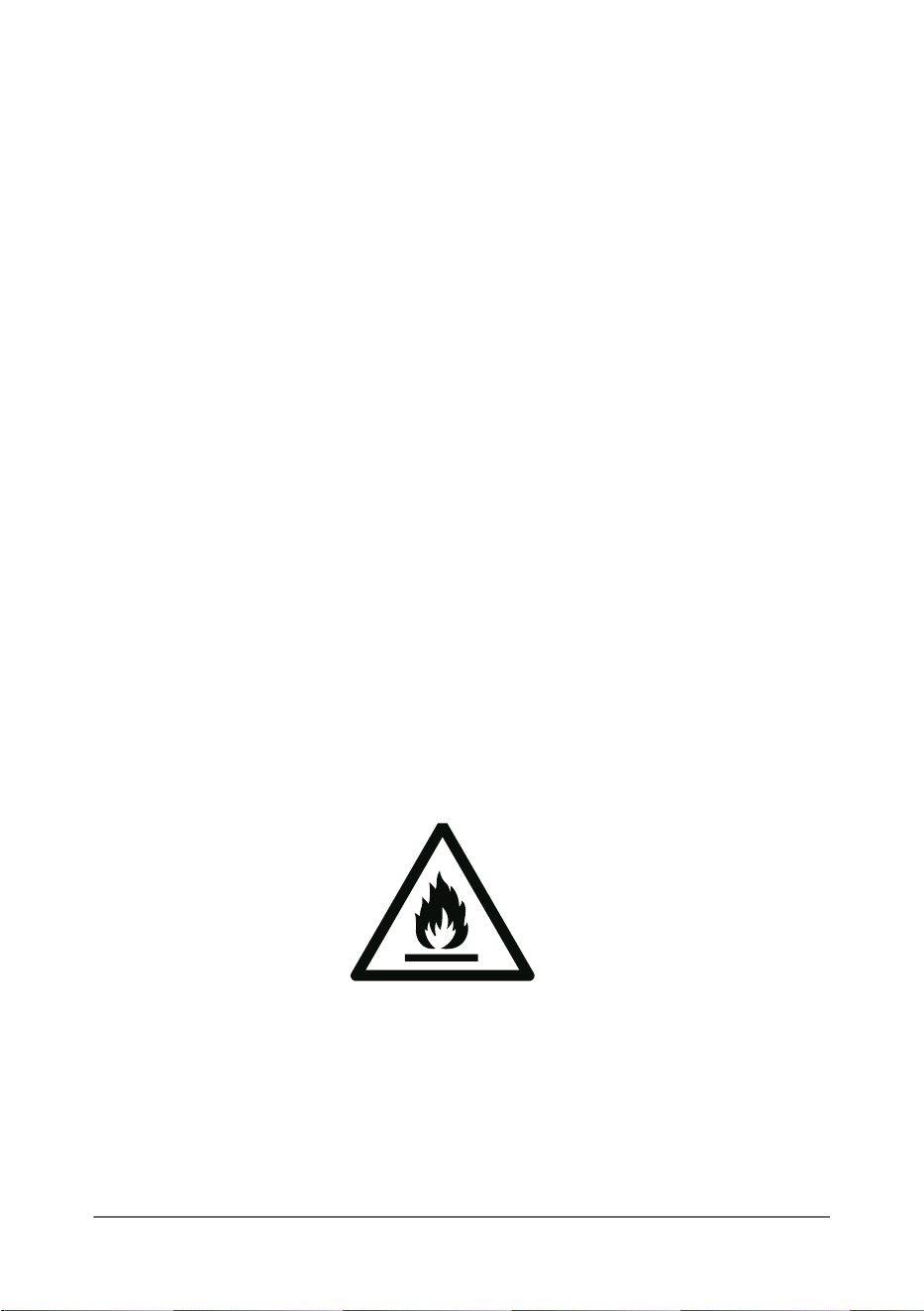
: Risk of fire / flammable materials
5
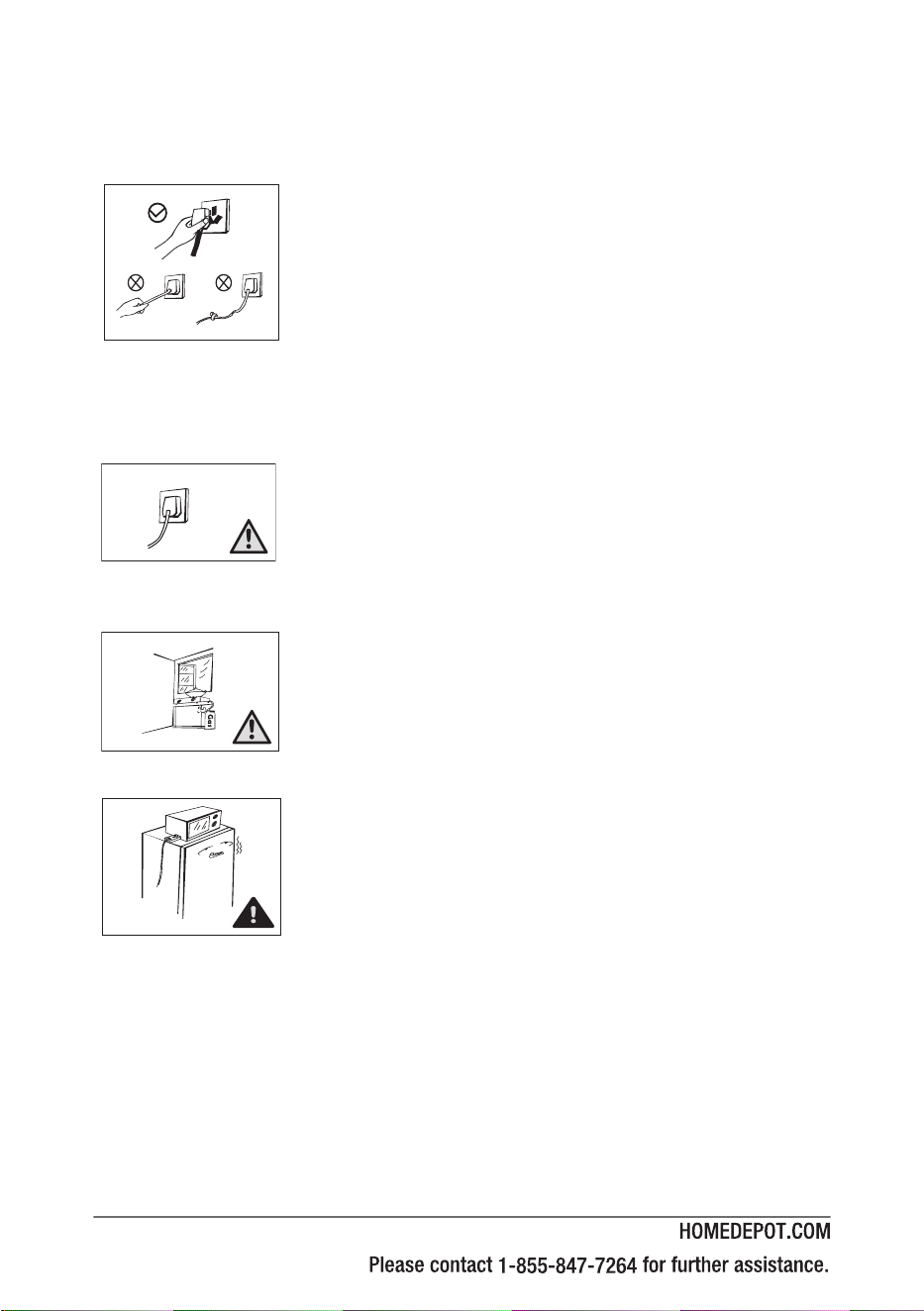
1.2 Electricity related warnings
Do not pull the power cord when pulling the power
plug of the cooler.
Please firmly grasp the plug and pull out it from
the socket directly.
Do not damage the power cord under any
condition so as to ensure
safety use, do not use when the power cord is
damaged or the plug
is worn.
Worn or damaged power cord shall be replaced in
manufacture-authorized maintenance stations.
The power cord should be firmly contacted with
the socket or else
fires might be caused. Please ensure that the
grounding electrode
of the power socket is equipped with a reliable
grounding line.
Please turn off the valve of the leaking gas and
then open the doors
and windows in case of leakage of gas and other
ammable gases.
Do not unplug the cooler and other electrical
appliances considering
that spark may cause a re.
To ensure safety, it is not recommended that to
place socket,
regulators, rice cookers, microwave ovens and
other appliances
at the top of the cooler, those recommended by
the manufacture
are not included. Do not use electrical appliances
in the food pantry.
6
1.3 Related warnings for use
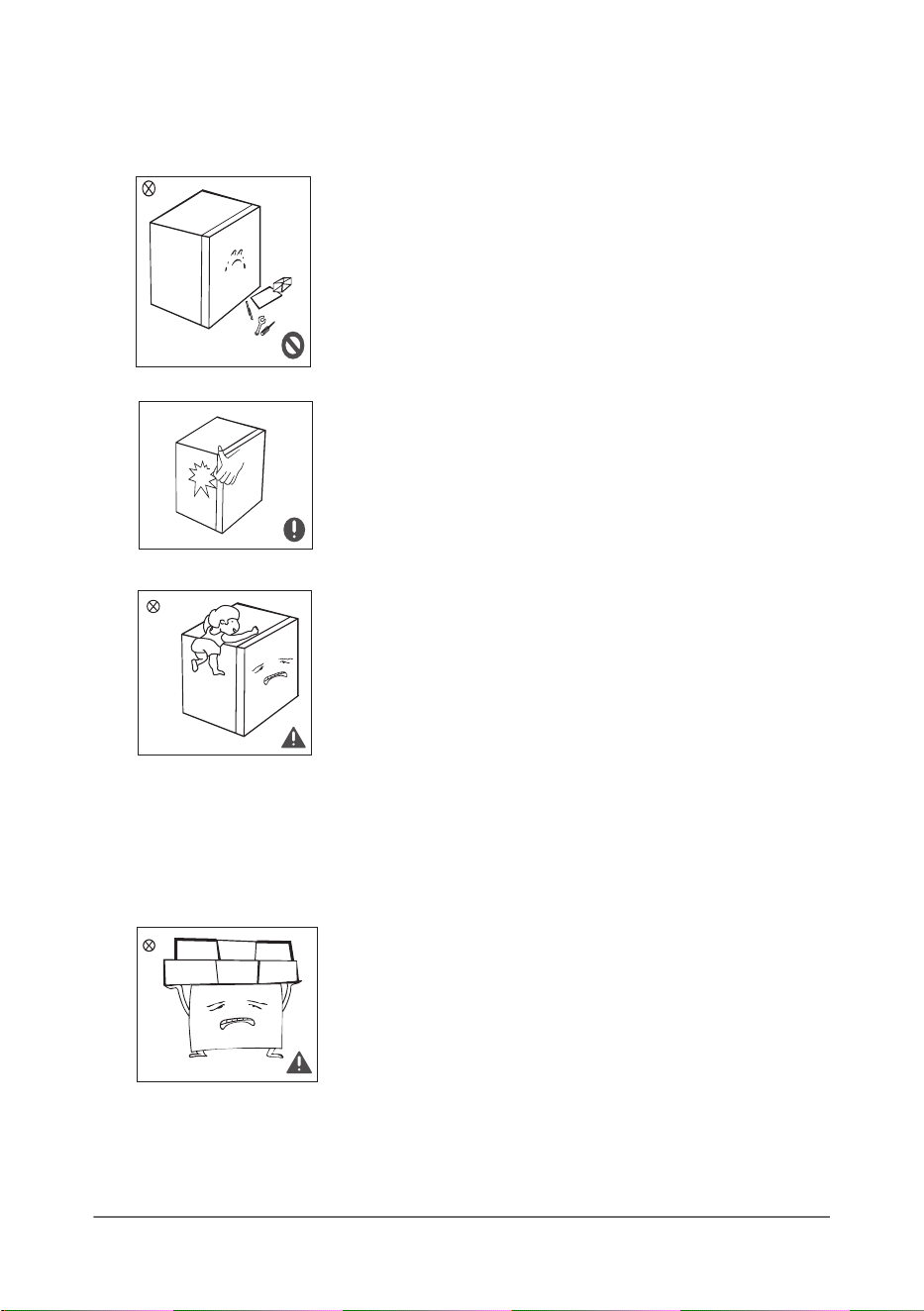
Do not arbitrarily disassemble or
reconstruct the cooler , nor damage
the refrigerant circuit; maintenance of
the appliance must beconducted by a
specialist.
Damaged power cord must be replaced
by the manufacturer, its maintenance
department or related professionals in
order to avoid danger.
The gaps between cooler door and cooler
body are small, be noted not to put your
hand in these areas to prevent from
squeezing the finger. Please be gentle
when close or open the cooler door to
avoid falling articles.
Do not give package and other
components to children to play. The
bending board and plastic lm may lead to
suocation! Do not allow children to enter
or climb the cooler to prevent that children
are sealed in the cooler or children are
injured by the falling cooler.
Do not spray or wash the cooler; do not
put the cooler in moist places easy to be
splashed with water so as not to affect
the electrical insulation properties of the
cooler.
Do not use cooler body, cooler door, etc.
as pedal or support.
Do not place heavy objects on the top of
the cooler considering that
objects may fall when open or close the
door, and accidental injuries
might be caused.
7
1.4 Warnings related to placing items
Do not put flammable, explosive, volatile and
highly corrosive items in the cooler to prevent
damages to the product or re accidents.
Do not place ammable items near the cooler to
avoid res.
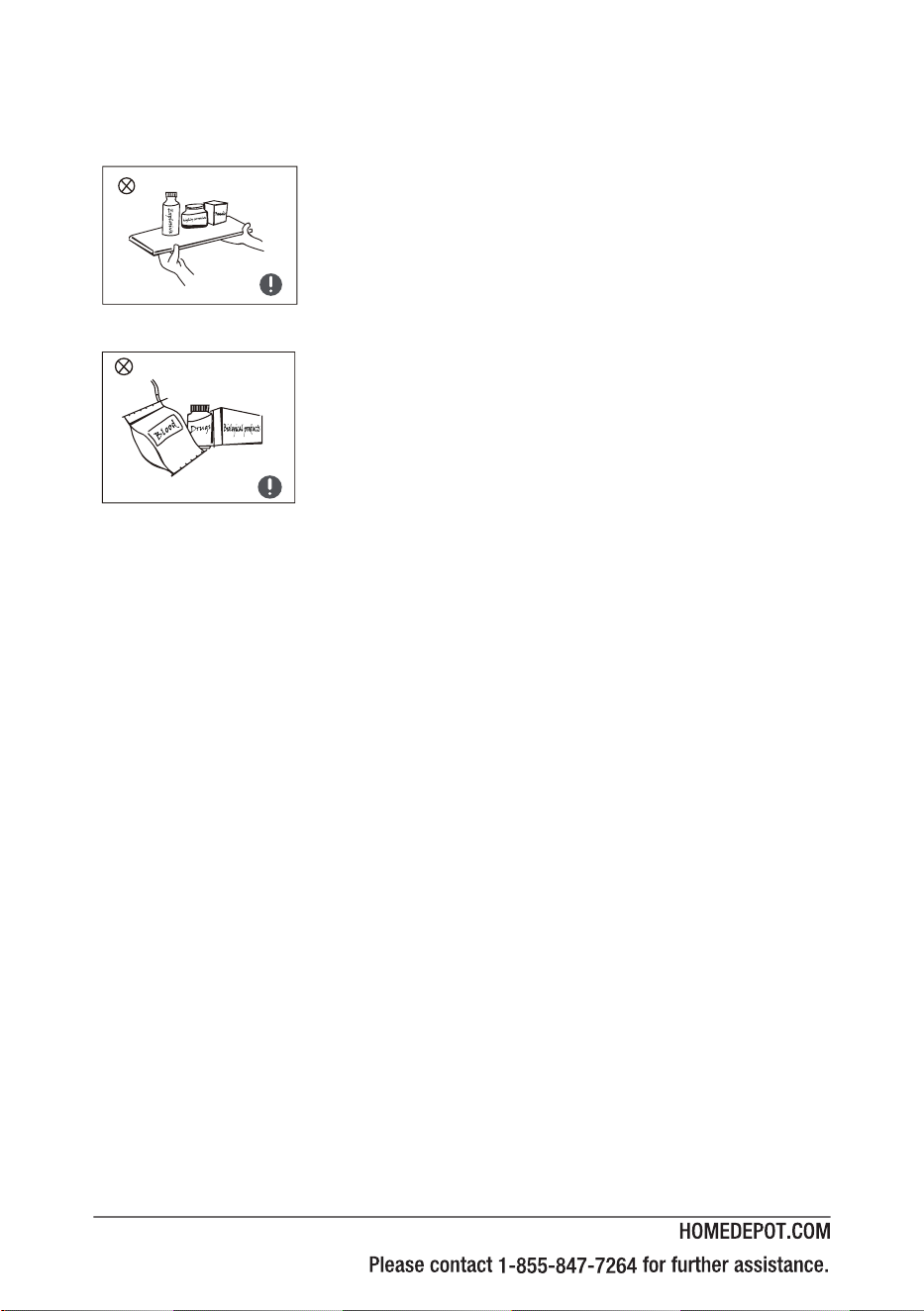
This product is household cooler and this
equipment can only be
used for the storage of wine. According to the
standard requirements,
household cooler shall not be used for other
purposes, such as
storage of blood, drugs or biological products.
1.5 Warnings for energy
1)cooler might not operate consistently when sited for an extended period
of time below the cold end of the range of temperatures for which the cooler
appliance is designed.
2)The need to not exceed the storage time(s) recommended by the wine
manufacturers for any kind of wine.
3)The precautions necessary to prevent an undue rise in the temperature of
the wine while defrosting the cooler.
4)The fact that a rise in temperature of the wine during manual defrosting,
maintenance or cleaning could shorten the storage life.
5)The necessity that, for doors or lids tted with locks and keys, the keys
be kept out of the reach of children and not in the vicinity of the cooler
appliance, in order to prevent children from being locking inside.
8
1.6 Warnings related to disposal
Refrigerant and cyclopentane foaming material used for the
cooler are ammable. Therefore,
when the cooler is scrapped, it shall be kept away from any
re source and be recovered by
a special recovering company with corresponding qualication
other than be disposed by
combustion, so as to prevent damage to the environment or
any other harm.
When the cooler is abandoned, please remove the door of
the cooler, when removing the door
body, pay attention to prevent pinching hands, and remove
the door seal and shelves, put the
door and shelves in a suitable position, so that children will
not enter to play and have an
accident.
Correct Disposal of this product
This marking indicates that this product
should not be disposed with other household
wastes throughout the EU. To prevent
possible harm to the environment or human
health
from uncontrolled waste disposal, recycle it
responsibly to promote the sustainable reuse
of material resources. To return your used
device, please use the return and collection
systems or contact the retailer where the
product was purchased. They can take this
product for environmental safe recycling.
9
2.Proper use of cooler
2.1 Names of components
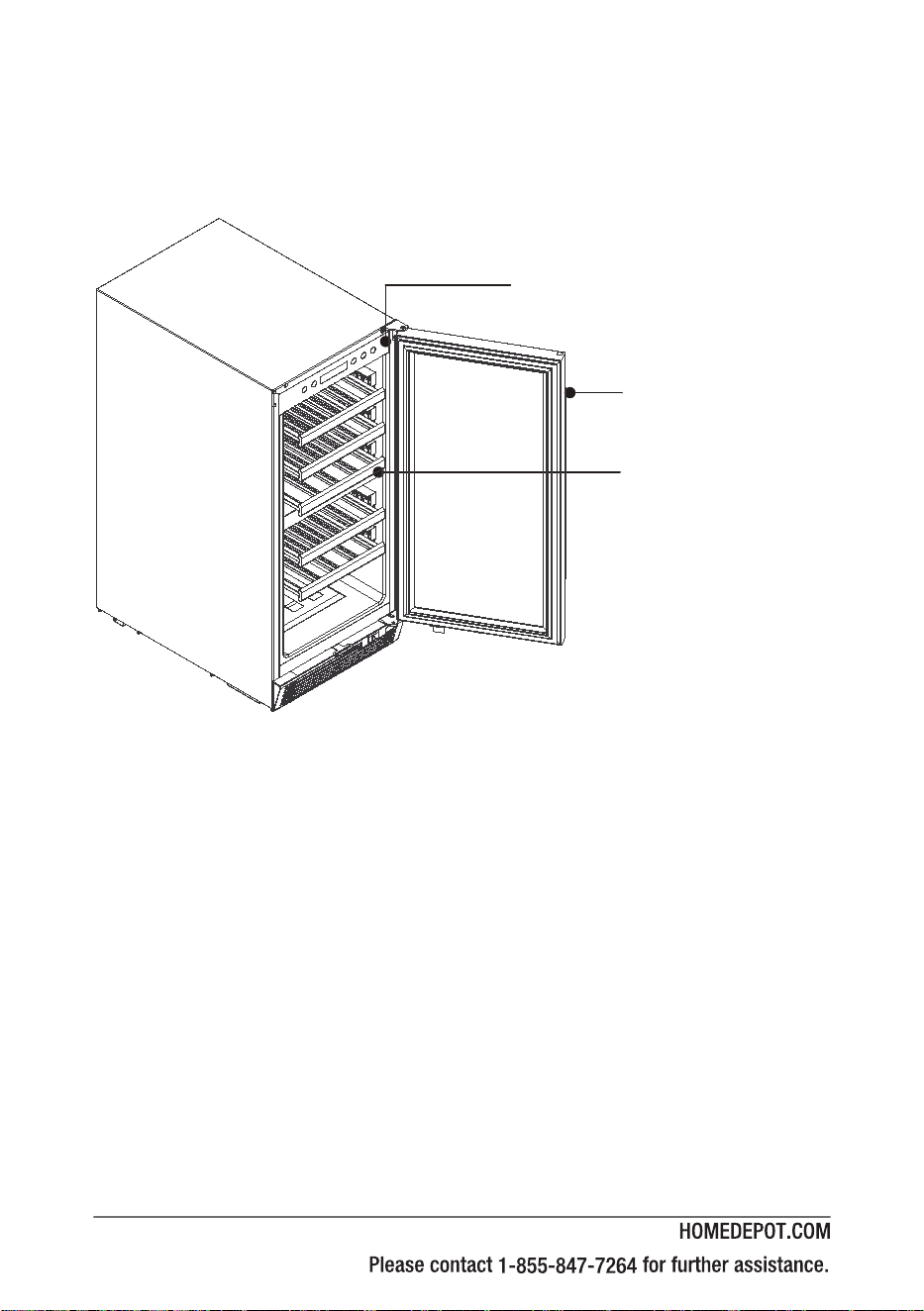
Shelf
Glass door
Temperature cont rol panel
( The picture above is only for reference. The actual configuration will
depend on the physical product or statement by the distributor.)
The temperature in the cooler is 5-18
℃
, only used to store unopened
bottled wine (red wine, white wine, rose wine).
Do not place food in the cooler to prevent bacterial contamination.
Please keep the interior of the wine cabinet dry, please drink bottled wine
during the validity period.
10
2.2 Temperature Control
(The picture above is only for reference. The actual configuration will
depend on the physical product or statement by the distributor.)
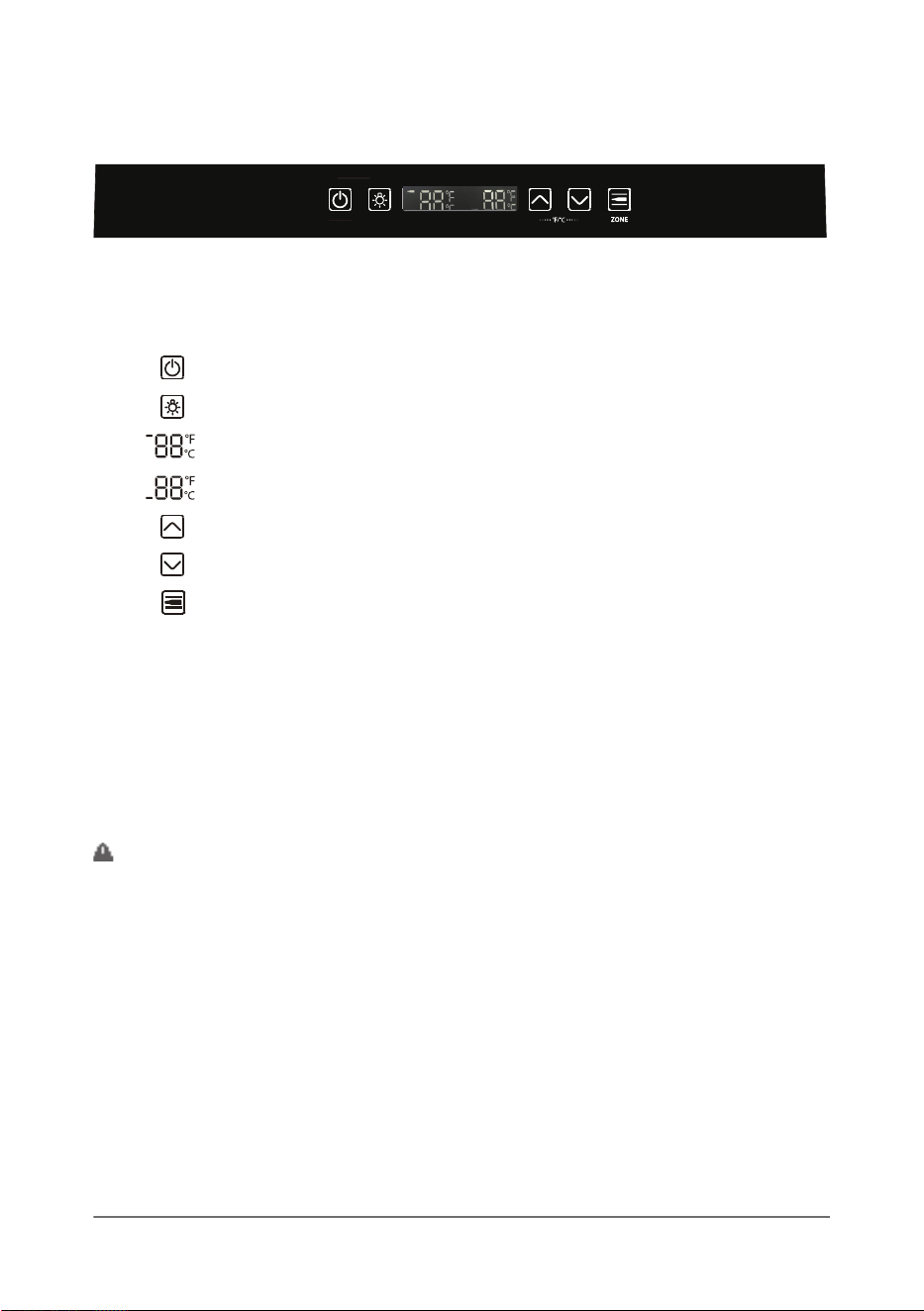
Sta ndby b utton
Light b utton
Temp erature d isp lay a rea of u pper r oom
Temp erature i ncr ease button
Temp erature d ecr ease button
Temp erature d isp lay a rea of l owe r ro om
Conversi on button of f uncti on o f uppe r room a nd lower r oom
Display control
In the case of initial power-up, the whole screen will display relevant
information for 3s, and the start-up tone will be uttered, followed by enabling
of normal operation display.
Digital display area: display the fault code in the case of failure and the set
temperature of the corresponding refrigeration chamber in the case of no
failure.
This cooler can be controlled by gently touching buttons on the glass touch screen. The display panel
should be prevented from scratching by sharp objects and kept away fromhigh-intensity magnetic eld and
high-humidity environment; otherwise, normal setting andoperation of the cooler may be aected.
Standby function
Press the standby button for 5s to enter/exit the standby mode.
Light
The internal lamp will be on when open the cooler door, and will be o when
close the cooler door.
Consumers also can turn on/o the internal lamp by pressing Light button,
once Light button is activated, the internal lamp will not be controlled by
actions of door opened/closed.
Temperature setting
Temperature Adjustment:
11
Pressing the button once, the set temperature increases 1
℃
(
℉
), Pressing
the button once, the set temperature drops 1
℃
(
℉
), the temperature
setting rangeof upper room is 5 ~14
℃
(41 ~ 57
℉
); the temperature setting
range of lower room is 10 ~18
℃
(50 ~ 64
℉
), all temperature settings take
eect automatically after 30 seconds.
Conversation of Centigrade and Fahrenheit:
Long press and at same time last for 5 second to switch between
Centigrade and Fahrenheit.
Limitation to temperature setting range of lower room:
The set temperature of upper room has limitation to temperature setting of
lower room.
The set temperature of upper room should be lower than set temperature
of lower room always, and the dierence between them should be in the
scope of 2~8
℃
.
If the set temperature of upper room is 10
℃
, the temperature setting range
of lower room should be 12~18
℃
;
if the set temperature of upper room is 11
℃
, the temperature setting range
of lower room should be 13~18
℃
;
if the set temperature of lower room is 12
℃
when the consumer adjusts the
set temperature ofupper room from 10
℃
to 11
℃
, the set temperature of
lower room will change into 13
℃
automatically.
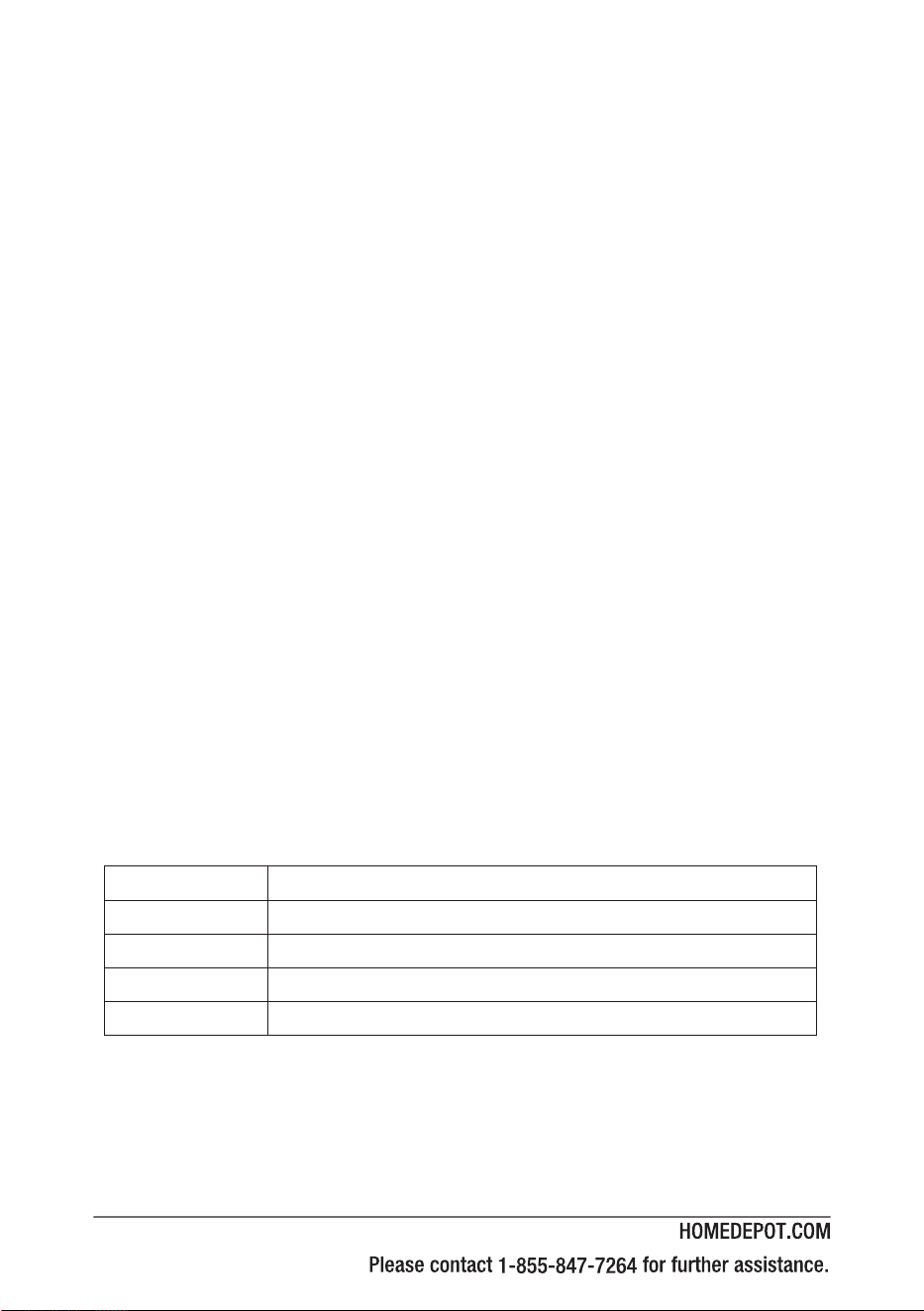
Error code:
If the failure happens, the display area will show corresponding error
codes as shown as below table, the user shall contact a specialist for
maintenance, so as to make sure the normal use of cooler.
Er ror code
E1
E
2 Temperat ur e sensor error of l ower room
Communi cation fault
H igh temperature a larm E9
E6
Des cri ption
Temperature sensor err or of u pper room
12
2.3 Placement
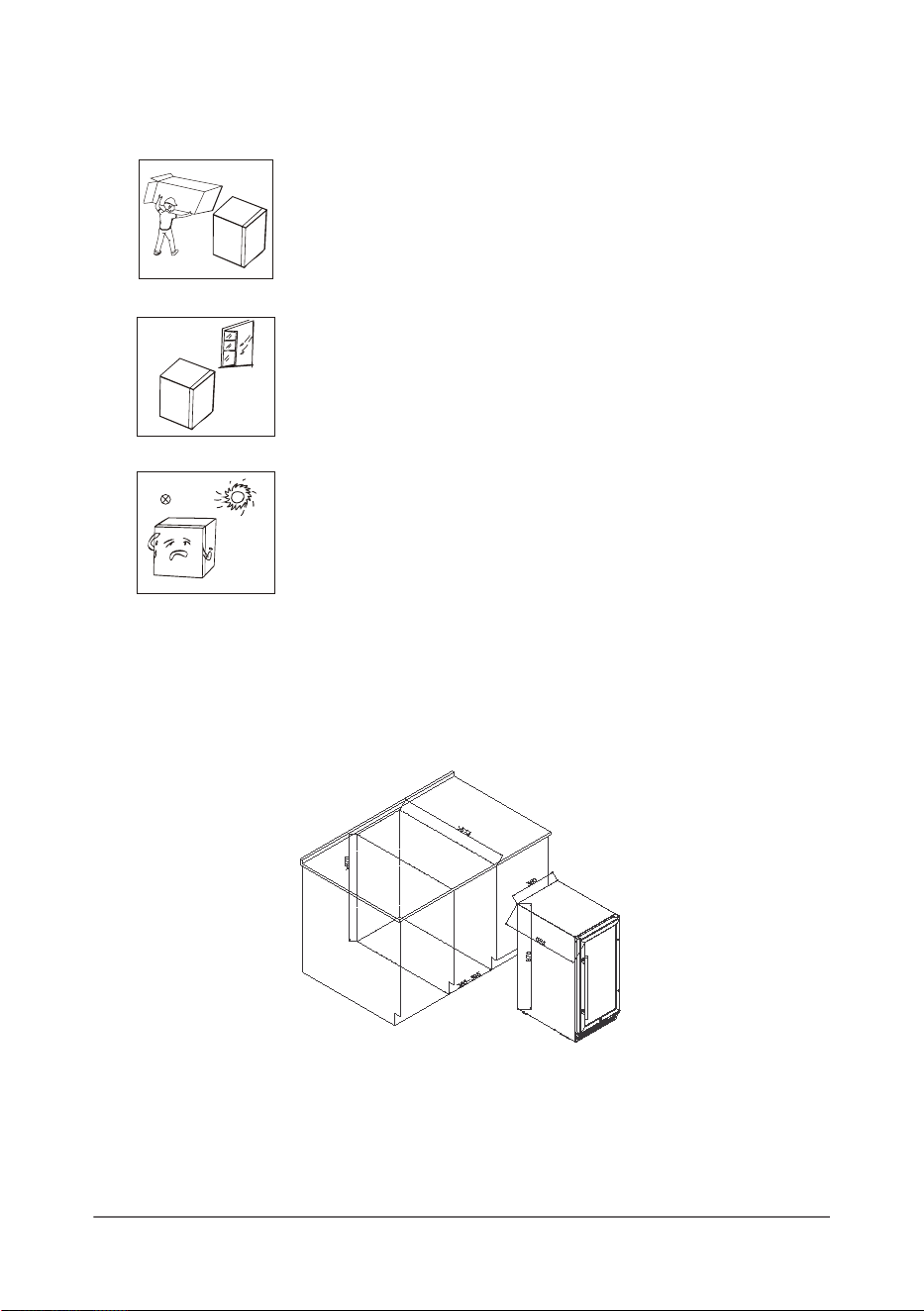
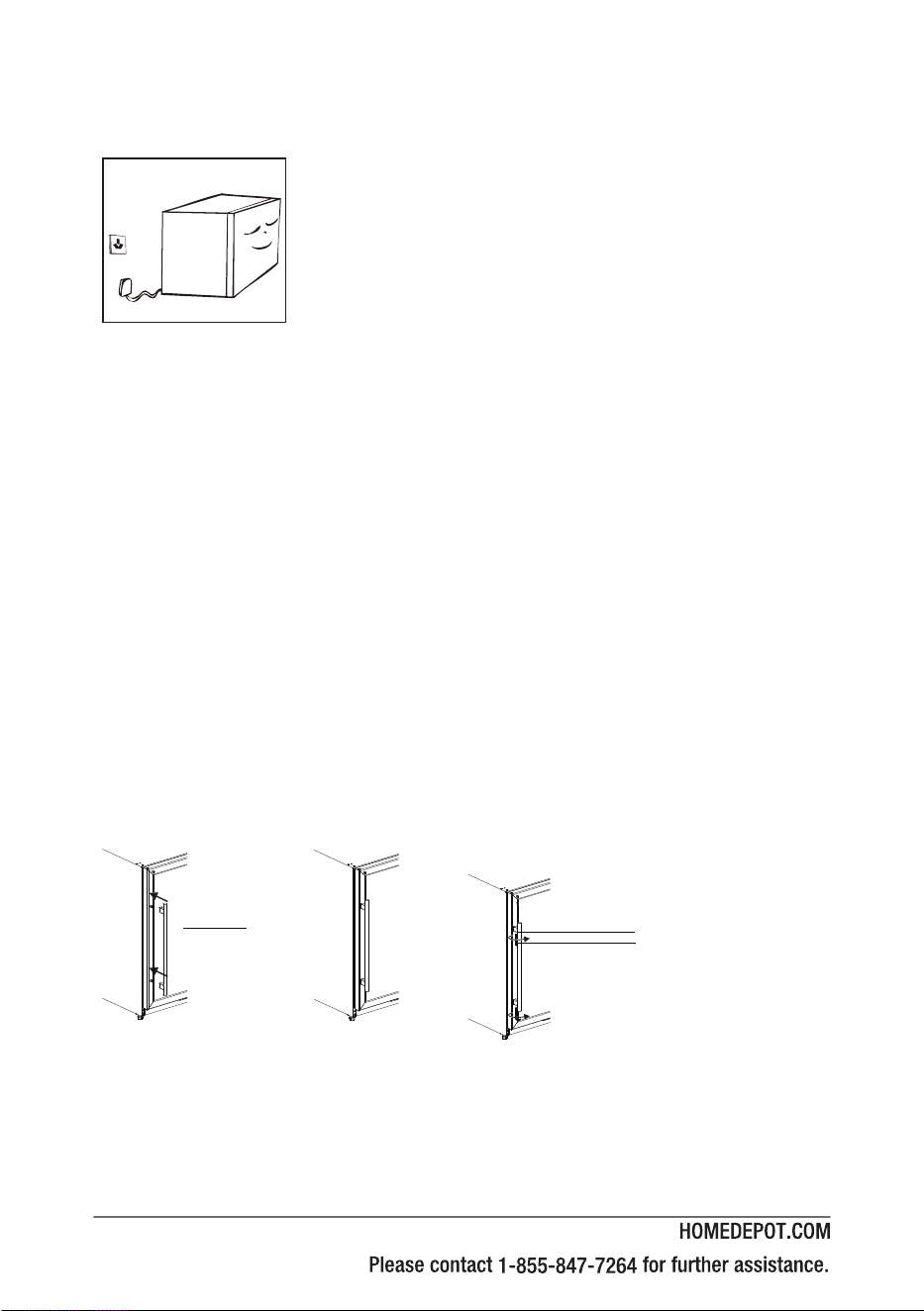
Before using the cooler,remove all packaging
materials including bottom cushions and
foam pads and tapes inside the cooler, tear
o the protective lm on the door and the cooler
body.
The cooler is placed in a well-ventilated indoor
place; the ground shall be at, and sturdy (rotate
left or right to adjust the feet for levelling
if unstable).
Avoid direct sunlight and heat sources such as
stove, heating radiator, etc.
It is built-in type the cooler, it is recommended to keep 40 mm distance at
least from the back of the cooler to the interior back of outer cabinet, and
keep no obstruction in front of air outlet.
It is recommended that the front leveling feet are 3mm higher than the rear
leveling feet.
(The usage method above is only for reference. The actual method will
depend on the physical product or statement by the distributor.)
13
2.4 Start to use
After transportation, please let the cooler stay for
more than 2 hours before turning on the power,
otherwise it will lead to a decrease in cooling capacity
or a damage to the cooler.
The cooler shall stay for half an hour before
connecting power when it is rstly started.
Clean up the inner chamber before put into use for
rst time .
Please pull out plug in case of power failure or
cleaning. Do not connect the cooler to power supply
within five minutes to prevent damages to the
compressor due to successive starts.
In the process of compressor work, water droplets
or frost will be formed on the back wall of the
refrigerated compartment, which is a normal
phenomenon. After a period of time, the frost will melt
into water and flow into the water tray to evaporate
away.
Do not connect cooler to electronic energy saving
plug and converter that can convert DC
into AC (E.g.: solar energy system, ship grid).
2.5 Handle Installation
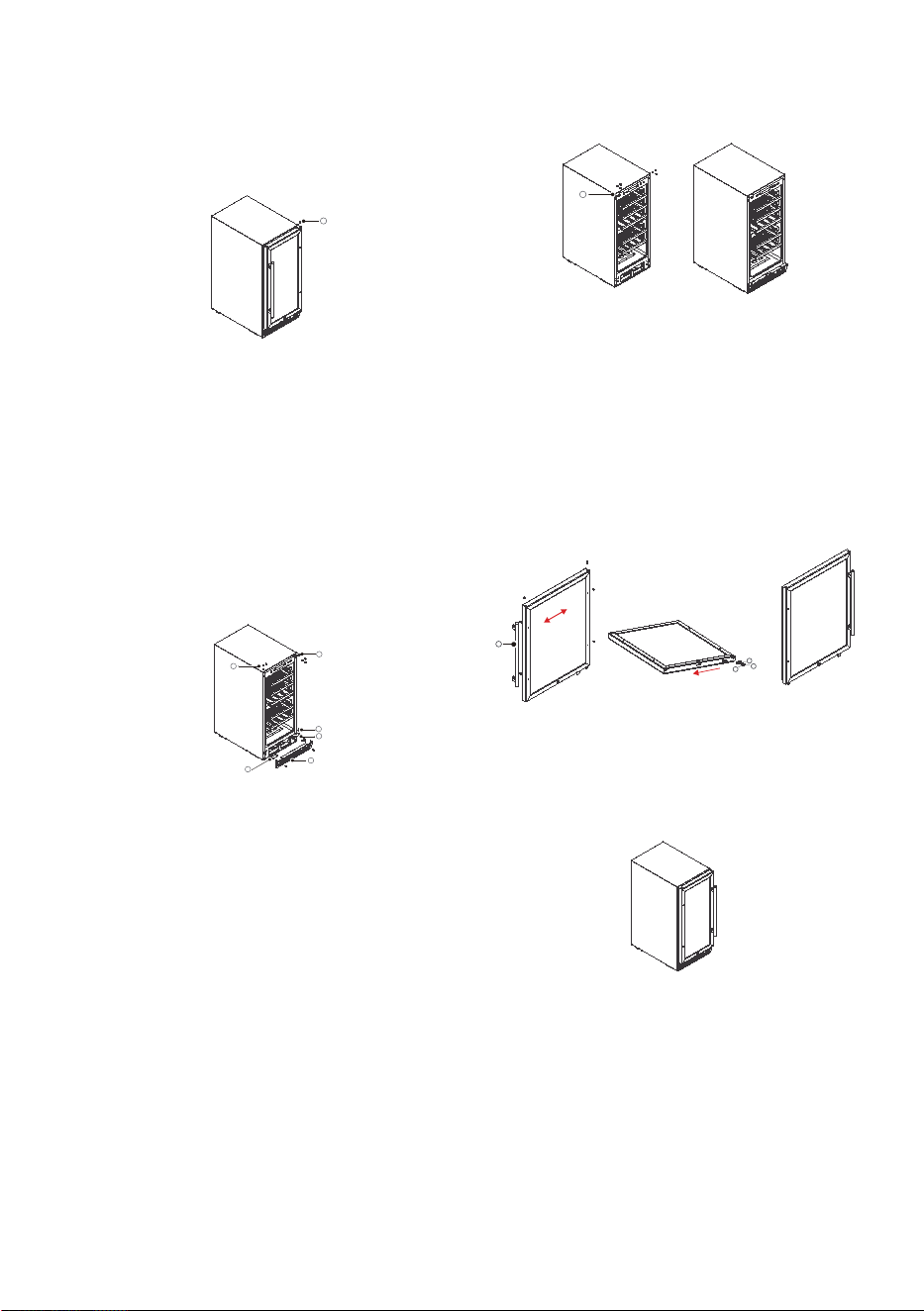
Please choose the following handle installation instruction according to your
1) Put the handle on glass
door through the two bolts
Handle
2) Use allen wrench to fix the
handle,make sure the screw hole is
downward.
Han dle scr ew
A llen wre nch
(The picture above is only for
reference. The actual configuration
will depend on the physical product
or statement by the distributor .)
2.6 Reversing the door swing
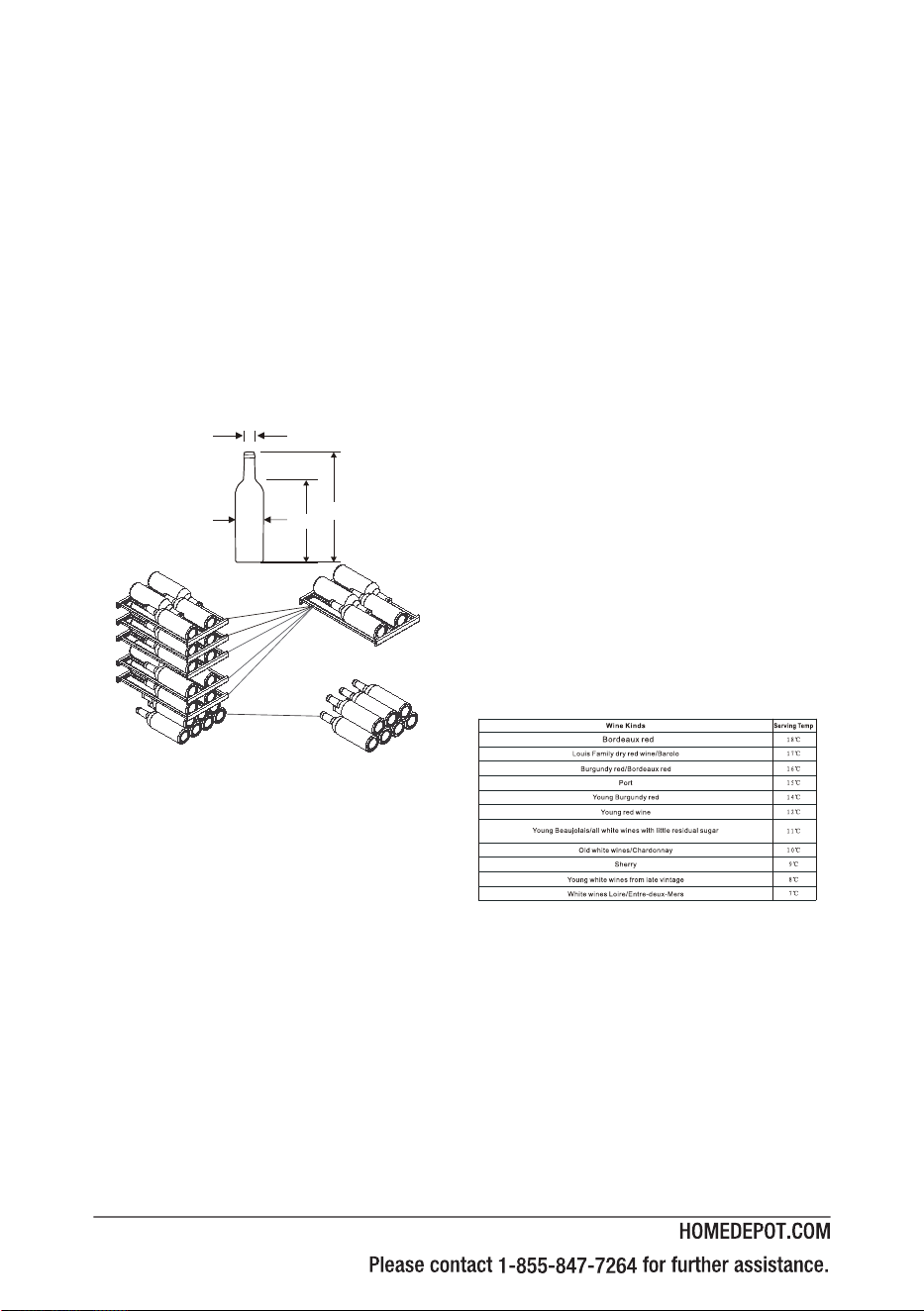
1. Remove the upper right hinge
shaft (1) and remove the door body.
1
2. Remove the upper right hinge (2)
and gently lift the door.
Remove the lower hinge (3) and
the lowerhinge shaft (4), the air
shield (5) andits insert (6) by
removing the corresponding screws
as below gure shows.
Also remove the three plastic
caps (7) on the left upper corner
of the cabinet.
2
5
7
3
4
6
(The picture above is only for
reference. The actual conguration
will depend on the physical product
or statement by the distributor.)
3. Take out the left upper hinge (8)
from the package box and install
it to the upper left corner of the
cabinet. Install the left lower hinge
shaft to the left hole of the left lower
hinge. Install the left lower hinge to
the cabinet. Install the air shield and
its insert. Then install the three
plastic caps removed from the left
upper corner to the upper right
corner.
8
4. Use a wrench to remove the door
handle (9) from the left side and x it
to the right side. Fix the shaft hole cap
to the left handle position. Remove the
bottom support bracket (10) and install
it to the other side. Install the lower
hinge shaft (11), pay attention that the
plastic anchor (12) should be inserted
into the bottom support bracket rst.
9
10
11
12
(The picture above is only for reference. The
actual conguration will depend on the physical
product or statement by the distributor
.)
5. Install the door and x the upper left
hinge shaft (1).
6. Complete the door change and
store the unused upper right hinge.
( The picture above is only for reference. The
actual conguration will depend on the physical
product or statement by the distributor. )
15
2.7 The arrangement
of bottle
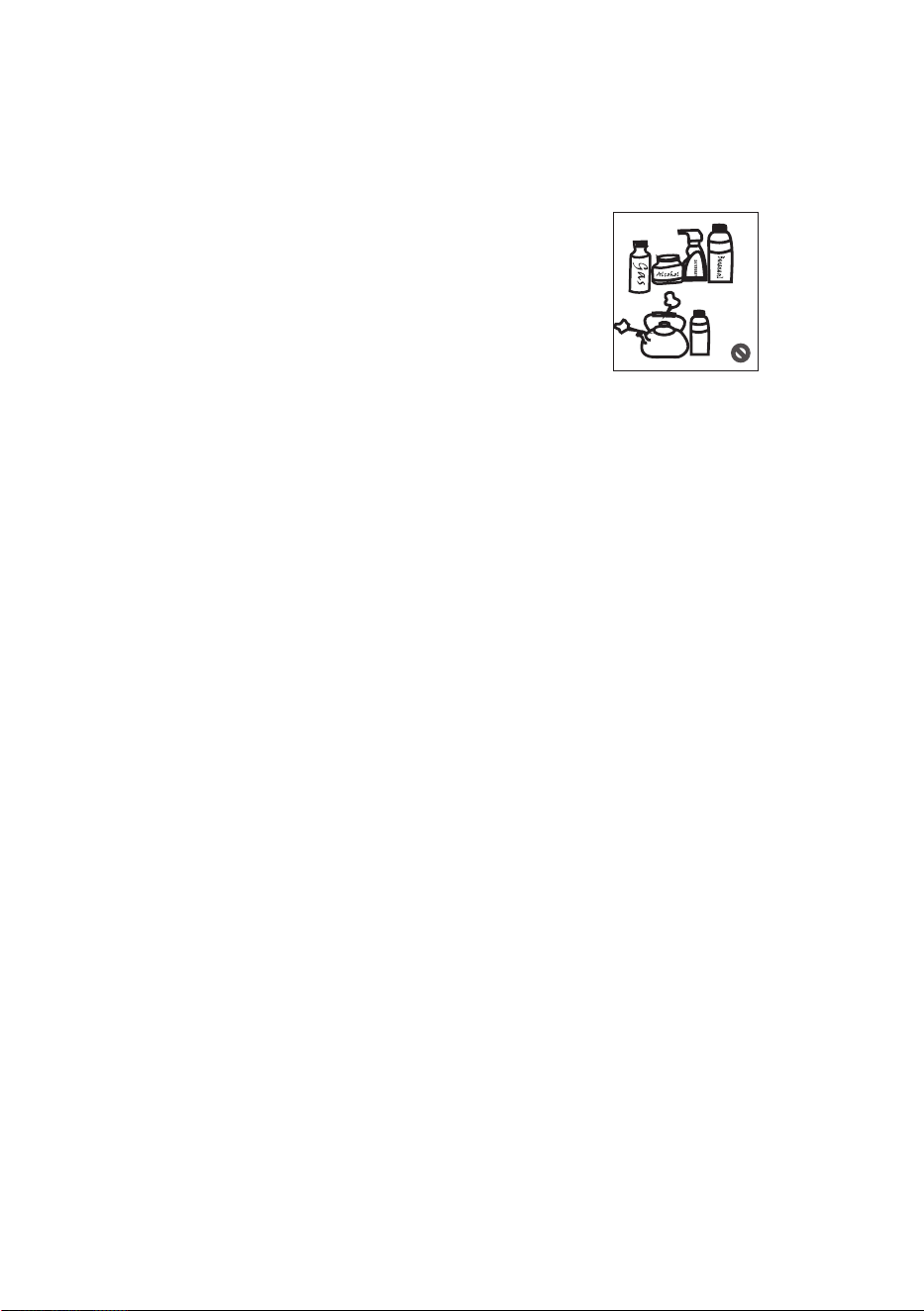
Do not let bottle touch the back side
of cooler in order to maintain good
air circulation in the cooler.The
capacity for bottle storage in the
wine cabinet is based on the
following marked bottle size.
Oversized bottle may have
impact on the number of bottle
storage in the wine cabinet.
Φ30mm
Φ75mm
215mm
300mm
( The picture above is only for reference.
The actual conguration will depend on the
physical product or statement by the
distributor. )
2.8 Practical skills for
grape wine’s storage
Do not store bottled wine by box or
case in refrigerator.
The cork of the old bottle shall
always be soaked in the wine when
putting into cooler.Air space is not
allowed between wine and cork.
Open-type bottleshels helpfu. as it
does not cut o air circulation.
The air moisture that condensed on
bottle can be driec out swiftly.
The wine shall before drinking:
Such as put pink red wine onto the
table 2-5 hours before drinking and
red wine 4-5 hours, then can reach
suitable servingtemp.White wine, on
the contrary, can be served right on
the table Champagneshallalways be
stored in cooler and taken out only
before drinking.
Please notice that wine's
temperature is always lower
than ideal serving temp, as the
temperature will immediately rise 1
to 2 when pouring into tumbler.
2.9 Energy temper
ate
The wine's taste depends on right
pouring temperature; therefore it
determines its avor.
Wesuggests the wine's temperature
reaches the following degree when
pouring:
2.10 Energy saving
tips
The Coolershall beplaced inroom
dry andventilated.The cooler
cannot be put under direct sunlight
or nextto hearsource(Such as
radiator,stove,etc.),and a suitable
insulation board shall be applied if
necessary.DTry to shorten opening
time of cooler's door.
3.Maintenance of cooler
3.1 Disconnect the cooler
Unplug power plug to disconnect the cooler.
3.2 Stop using the cooler
If the cooler left unused for a long time, please:
1.Unplug the cooler;
2.Clean the cooler;
3.Keep the cooler door open.
3.3 Clean the cooler
Dusts behind the cooler and on the ground shall be timely cleaned to
improve the cooling eect and energy saving.
Check the door gasket regularly to make sure there are no debris.
Clean the door gasket with a soft cloth dampened with soapy wateror
diluted detergent.
The interior of the cooler should be cleaned regularly to avoidodor.
Please turn o the power before cleaning, remove drinks ,shelves, etc.
Use a soft cloth or sponge to clean the inside of the cooler, with two
tablespoons of baking soda and a quart of warm water. Then rinse with
water and dry with a soft cloth. After cleaning, open the door and let it dry
naturally before turning on the power.
For areas that are difficult to clean in the cooler (such as narrow
sandwiches, gaps or corners), it is recommended to wipe them regularly
with a soft rag, soft brush, etc. and when necessary, combined with some
auxiliary tools (such as thin sticks) to ensure no contaminants or bacterials
accumulation in these areas.
Do not use soaps, detergents, spray cleaners, etc. to clean the inside of
your cooler as these may create odors or contamination.
Clean the shelves with a soft cloth dampened with soapy water or diluted
detergent. Then rinse with water and dry with a soft cloth or dry naturally.
The wooden wine rack should not be directly immersed in liquid to
prevent cracking or mold after moisture. The wooden wine rack is cleaned
with a dry soft cloth. The heavily contaminated wooden wine rack should be
cleaned with a soft cloth that has been wrung out, and dry naturally.
Wipe the outer surface of the cooler with a soft cloth dampened with soap
water, detergent, etc., and then wipe dry. Do not rub or scratch the surface
of the glass door to prevent the door from being broken or scratched.
Do not use hard brushes, clean steel balls, wire brushes, abrasives(such
as toothpastes), organic solvents (such as alcohol, acetone, banana oil,
etc.), boiling water, acid or alkaline items, which may damage the cooler
17
surface and interior. Boiling water and organic solvents such as benzene
may deform or damage plastic parts.
Notice:Do not rinse directly with water or other liquids during cleaning to
avoid short circuits or affect electrical insulation after immersion. Water
should not soak the operating control elements and lighting system in the
glass door.
4.Trouble shooting
Not work
Whether the cooler is plugged and connected to
power;
Low voltage;
Whether temperature control knob is in the work
area;Failure power or tripping circuit.
Long-term operation
of compressor
It is normal that cooler operates for longer time in
summer when the ambient temperature is higher;
Do not put too much beverage s in the cooler at one
time;Frequent opening of cooler door.
Light not work
Whether the cooler is connected to power, whether
the indicator light is damaged.
Loud noises
Whether the floor is flat, whether the placement of
cooler is stable;
Whether the cooler accessories are properly placed.
Over heat on sidewall
The cooler enclosure may emit heat during
runningspecially in summer, this is caused by
the radiation of the condenser, and it is a normal
phenomenon.
Condensation: condensation phenomenon will be
detected on the exterior surface and door seals of
the cooler when the ambient humidity is high, this is
a normal phenomenon, and after wiping with towel,
turns up the set temperature of
the appliance properly.
Airow sound
Buzz
Clatter
Refrigerants circulating in the refrigerant lines will
produce eruption of sound and grunts which is normal
does not aect
the cooling eect.
Buzz will be generated by running compressor
specially when starting up or shutting down.
The solenoid valve or electric switch valve will clatter
whichis a normal phenomenon and does not affect
the operation.
