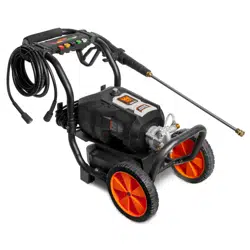
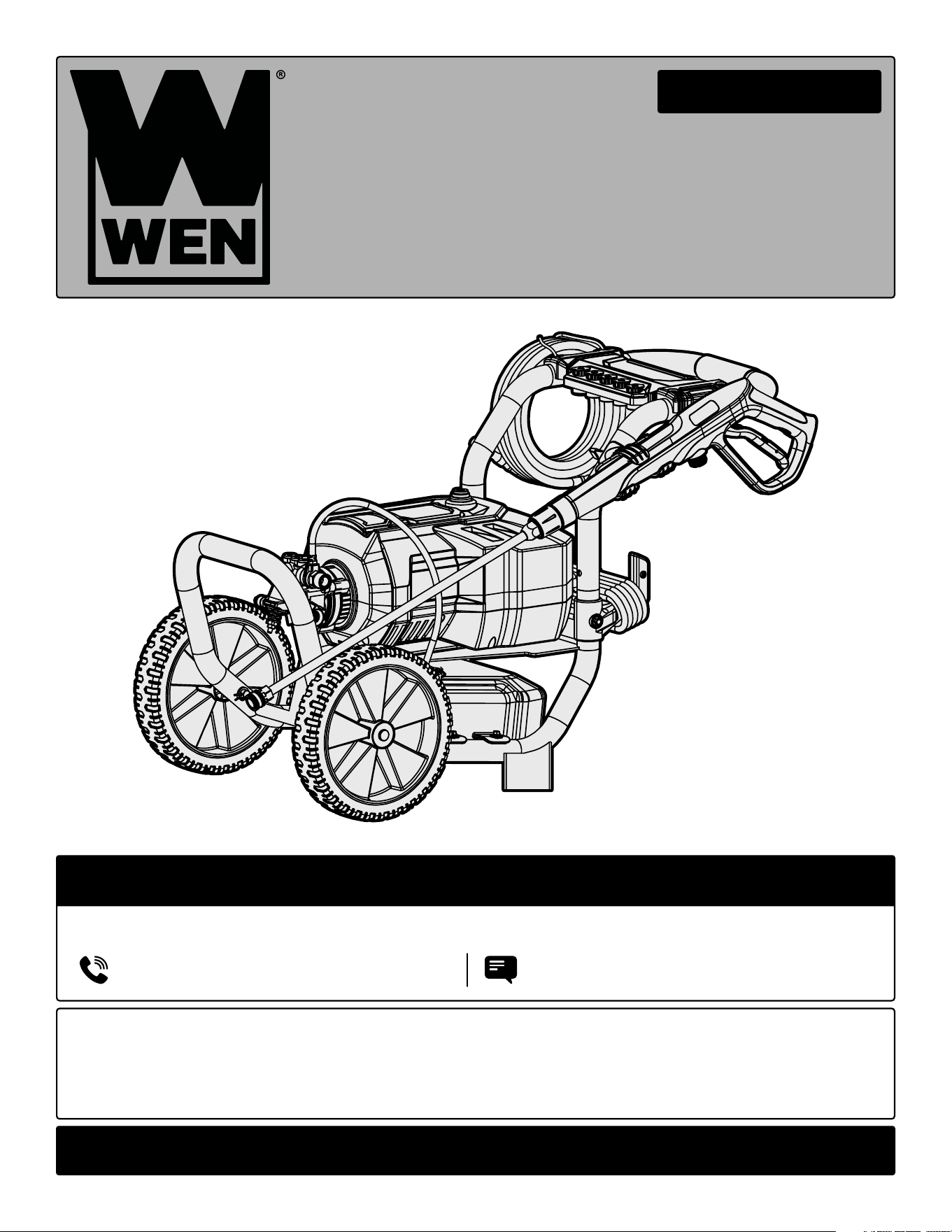
3000 PSI ELECTRIC
PRESSURE WASHER
Instruction Manual
MODEL PW3000E
IMPORTANT: Your new tool has been engineered and manufactured to WEN’s highest standards for dependability,
ease of operation, and operator safety. When properly cared for, this product will supply you years of rugged,
trouble-free performance. Pay close attention to the rules for safe operation, warnings, and cautions. If you use
your tool properly and for its intended purpose, you will enjoy years of safe, reliable service.
NEED HELP? CONTACT US!
Have product questions? Need technical support? Please feel free to contact us:
TECHSUPPOR[email protected]1-847-429-9263 (M-F 8AM-5PM CST)
For replacement parts and the most up-to-date instruction manuals, visit WENPRODUCTS.COM

CONTENTS
WELCOME 3
Introduction ......................................................................................................3
Specifications ....................................................................................................3
SAFETY 4
General Safety Rules .........................................................................................4
Pressure Washer Safety Warnings ....................................................................6
Electrical Information ........................................................................................8
BEFORE OPERATING 9
Unpacking & Packing List .................................................................................9
Know Your Pressure Washer ..........................................................................10
Assembly & Adjustments ................................................................................11
OPERATION & MAINTENANCE 14
Operation ........................................................................................................14
Storage ...........................................................................................................17
Cleaning & Maintenance .................................................................................18
Troubleshooting Guide ....................................................................................19
Exploded View & Parts List .............................................................................20
Warranty Statement ........................................................................................22
To purchase accessories and replacement parts for your tool, visit WENPRODUCTS.COM
2
SPECIFICATIONS
INTRODUCTION
Thanks for purchasing the WEN Electric Pressure Washer. We know you are excited to put your tool to work, but
first, please take a moment to read through the manual. Safe operation of this tool requires that you read and un-
derstand this operator’s manual and all the labels affixed to the tool. This manual provides information regarding
potential safety concerns, as well as helpful assembly and operating instructions for your tool.
NOTE: The following safety information is not meant to cover all possible conditions and situations that may occur.
WEN reserves the right to change this product and specifications at any time without prior notice.
At WEN, we are continuously improving our products. If you find that your tool does not exactly match this manual,
please visit wenproducts.com for the most up-to-date manual or contact our customer service at 1-847-429-9263.
Keep this manual available to all users during the entire life of the tool and review it frequently to maximize
safety for both yourself and others.
Indicates danger, warning, or caution. The safety symbols and the explanations with them deserve your
careful attention and understanding. Always follow the safety precautions to reduce the risk of fire, electric shock
or personal injury. However, please note that these instructions and warnings are not substitutes for proper ac-
cident prevention measures.
Model Number PW3000E
Motor AC 120V, 60 Hz, 14.8A, 1800W
Rated Pressure 2450 PSI
Maximum Pressure 3000 PSI
Rated Flow Rate 1.1 GPM
Maximum Flow Rate 2.0 GPM
Nozzles 0º, 15º, 25º, 40º, Soap
Maximum Inlet Pressure 101 PSI
High Pressure Hose Length 25 Feet (7.6m)
Power Cord Length 34.77 Feet (10.6m)
Minimum Garden Hose Inner Diameter 5/8 in.
Detergent Tank Capacity 202.91 fl. oz. (6L)
Product Dimensions 35.7 in. x 17.9 in. x 21.9 in.
Product Weight 47.4 Pounds
3
4
GENERAL SAFETY RULES
WORK AREA SAFETY
1. Keep work area clean and well lit. Cluttered or dark
areas invite accidents.
2. Do not operate power tools in explosive atmo-
spheres, such as in the presence of flammable liquids,
gases or dust. Power tools create sparks which may ig-
nite the dust or fumes.
3. Keep children and bystanders away while operating
a power tool. Distractions can cause you to lose control.
ELECTRICAL SAFETY
1. Power tool plugs must match the outlet. Never mod-
ify the plug in any way. Do not use any adapter plugs
with earthed (grounded) power tools. Unmodified plugs
and matching outlets will reduce risk of electric shock.
2. Avoid body contact with earthed or grounded surfac-
es such as pipes, radiators, ranges and refrigerators.
There is an increased risk of electric shock if your body
is earthed or grounded.
3. Do not expose power tools to rain or wet conditions.
Water entering a power tool will increase the risk of elec-
tric shock.
4. Do not abuse the cord. Never use the cord for car-
rying, pulling or unplugging the power tool. Keep cord
away from heat, oil, sharp edges or moving parts.
Damaged or entangled cords increase the risk of electric
shock.
5. When operating a power tool outdoors, use an ex-
tension cord suitable for outdoor use. Use of a cord
suitable for outdoor use reduces the risk of electric
shock.
6. If operating a power tool in a damp location is un-
avoidable, use a ground fault circuit interrupter (GFCI)
protected supply. Use of a GFCI reduces the risk of elec-
tric shock.
PERSONAL SAFETY
1. Stay alert, watch what you are doing and use com-
mon sense when operating a power tool. Do not use a
power tool while you are tired or under the influence
of drugs, alcohol or medication. A moment of inatten-
tion while operating power tools may result in serious
personal injury.
2. Use personal protective equipment. Always wear
eye protection. Protective equipment such as a respira-
tory mask, non-skid safety shoes and hearing protection
used for appropriate conditions will reduce the risk of
personal injury.
3. Prevent unintentional starting. Ensure the switch is
in the off-position before connecting to power source
and/or battery pack, picking up or carrying the tool.
Carrying power tools with your finger on the switch or
energizing power tools that have the switch on invites
accidents.
4. Remove any adjusting key or wrench before turning
the power tool on. A wrench or a key left attached to a
rotating part of the power tool may result in personal
injury.
5. Do not overreach. Keep proper footing and balance
at all times. This enables better control of the power
tool in unexpected situations.
6. Dress properly. Do not wear loose clothing or jew-
elry. Keep your hair and clothing away from moving
parts. Loose clothes, jewelry or long hair can be caught
in moving parts.
Safety is a combination of common sense, staying alert and knowing how your item works. The term “power tool”
in the warnings refers to your mains-operated (corded) power tool or battery-operated (cordless) power tool.
IMPORTANT SAFETY INSTRUCTIONS. SAVE THESE SAFETY INSTRUCTIONS.
WARNING! Read all safety warnings and all instructions. Failure to follow the warnings and instructions may
result in electric shock, fire and/or serious injury.
5
GENERAL SAFETY RULES
7. If devices are provided for the connection of dust
extraction and collection facilities, ensure these are
connected and properly used. Use of dust collection
can reduce dust-related hazards.
POWER TOOL USE AND CARE
1. Do not force the power tool. Use the correct power
tool for your application. The correct power tool will
do the job better and safer at the rate for which it was
designed.
2. Do not use the power tool if the switch does not turn
it on and off. Any power tool that cannot be controlled
with the switch is dangerous and must be repaired.
3. Disconnect the plug from the power source and/or
the battery pack from the power tool before making
any adjustments, changing accessories, or storing
power tools. Such preventive safety measures reduce
the risk of starting the power tool accidentally.
4. Store idle power tools out of the reach of children
and do not allow persons unfamiliar with the power
tool or these instructions to operate the power tool.
Power tools are dangerous in the hands of untrained us-
ers.
5. Maintain power tools. Check for misalignment or
binding of moving parts, breakage of parts and any
other condition that may affect the power tool’s opera-
tion. If damaged, have the power tool repaired before
use. Many accidents are caused by poorly maintained
power tools.
6. Keep cutting tools sharp and clean. Properly main-
tained cutting tools with sharp cutting edges are less
likely to bind and are easier to control.
7. Use the power tool, accessories and tool bits, etc.
in accordance with these instructions, taking into ac-
count the working conditions and the work to be per-
formed. Use of the power tool for operations different
from those intended could result in a hazardous situa-
tion.
8. Use clamps to secure your workpiece to a stable
surface. Holding a workpiece by hand or using your
body to support it may lead to loss of control.
9. KEEP GUARDS IN PLACE and in working order.
SERVICE
1. Have your power tool serviced by a qualified repair
person using only identical replacement parts. This
will ensure that the safety of the power tool is main-
tained.
CALIFORNIA PROPOSITION 65 WARNING
Some dust created by power sanding, sawing, grinding,
drilling, and other construction activities may contain
chemicals, including lead, known to the State of Califor-
nia to cause cancer, birth defects, or other reproductive
harm. Wash hands after handling. Some examples of
these chemicals are:
• Lead from lead-based paints.
• Crystalline silica from bricks, cement, and other
masonry products.
• Arsenic and chromium from chemically treated
lumber.
Your risk from these exposures varies depending on
how often you do this type of work. To reduce your ex-
posure to these chemicals, work in a well-ventilated area
with approved safety equipment such as dust masks
specially designed to filter out microscopic particles.
Safety is a combination of common sense, staying alert and knowing how your item works. The term “power tool”
in the warnings refers to your mains-operated (corded) power tool or battery-operated (cordless) power tool.
IMPORTANT SAFETY INSTRUCTIONS. SAVE THESE SAFETY INSTRUCTIONS.
WARNING! Read all safety warnings and all instructions. Failure to follow the warnings and instructions may
result in electric shock, fire and/or serious injury.

6
PRESSURE WASHER SAFETY WARNINGS
WARNING! Do not operate the power station until you have read and understood the following instructions
and the warning labels.
IMPORTANT SAFETY INSTRUCTIONS
SAVE THESE INSTRUCTIONS
BEFORE OPERATION
1. Know Your Tool. Be thoroughly familiar with the con-
trols of your pressure washer. Know how to stop the wa-
ter pressure quickly by releasing the trigger, shutting off
the unit, and turning off the water supply.
2. Use Suitable Components. This system is capable
of producing pressure up to 3000 PSI. To avoid rupture
and injury, do not operate this pressure washer with
components rated less than 3000 PSI working pres-
sure (including but not limited to spray guns, hoses, and
hose connections).
3. Operating Environment. Keep bystanders, children,
and animals at a safe distance away from the work area.
To reduce the risk of injury, close supervision is neces-
sary when the pressure washer is used near children.
Do not operate near flammable materials or explosive
vapors. Never point the spray gun at any people or ani-
mals.
4. Wear Safety Equipment. For protection against in-
jury, wear safety goggles and ear protection. Wear rub-
ber-soled shoes during operation to reduce the risk of
electric shock.
5. Preliminary Unit Inspection. Thoroughly inspect the
unit and accessories prior to operation. Make sure all
the parts are secured and installed correctly. Do not use
plugs or cords that show signs of damage, such as bro-
ken or cracked insulation. Have damaged items repaired
or replaced as necessary. Always perform a test run the
first time you use the tool or after replacing parts to en-
sure that the unit is functioning properly.
• This product is provided with a ground fault circuit in-
terrupter built into the power cord plug. If replacement
of the plug or cord is needed, use only identical replace-
ment parts.
6. Malfunctioning Switch. Do not use the tool if the
switch does not turn on and off. Any electrical appliance
that cannot be controlled by the switch is not safe to use
and must be repaired.
7. Detergent Safety. Always be aware of the dangers as-
sociated with the detergents and chemicals that you are
working with. Follow the warnings and instructions that
come with your detergent for proper use.
WATER SUPPLY REQUIREMENTS
1. Cold water ONLY. Use the pressure washer with cold
water only. The water supply temperature must not ex-
ceed 104°F/40°C.
2. Potable Water Restrictions. When connecting the
water inlet to the water supply mains, local regulations
of your water company must be observed. In some ar-
eas, the unit must not be connected directly to the pub-
lic drinking water supply. This is to ensure that there is
no feedback of chemicals into the water supply. If con-
nection is made to a potable water system, the system
MUST be protected against backflow. Direct connection
via a receiver tank or backflow preventer, for example, is
permitted.
3. Avoiding Dirt. Always prevent debris from being
drawn into the unit by using a clean water source. Dirt in
the feed water will damage the unit. Your washer is pre-
installed with a water filter inside the water inlet. Inspect
and clean the filter regularly. Never use the pressure
washer to draw in water contaminated with solvents,
e.g. paint thinners, gasoline, oil, etc.
4. Water Flow. The garden hose must be at least 5/8
inch in diameter. Flow rate of water supply must not fall
below 2 GPM (gallons per minute).

7
OPERATING THE PRESSURE WASHER
1. Stay Alert. Watch what you are doing and use com-
mon sense when operating your tool. Do not use the
tool while you are tired or under the influence of drugs,
alcohol, or medication. A moment of inattention during
operation may result in serious bodily injury.
2. Injection Hazard. The high pressure stream of wa-
ter can cut through skin and cause serious injury. Keep
clear of the nozzle. Never direct the discharge stream at
any bystanders, animals, or yourself.
3. Risk of Explosion. Do not operate the pressure wash-
er in explosive atmospheres, such as in the presence of
flammable liquids, gases, or dust. Do not spray flam-
mable liquids.
4. Risk of Electric Shock. Do not spray electrical appa-
ratus and wiring. Do not spray the power source or the
outlet. Don’t pressure wash the pressure washer.
5. Tool Purpose. Learn your pressure washer’s appli-
cations and limitations as well as the specific potential
hazards related to this machine. Only use the pressure
washer for its intended purposes. Otherwise, you may
cause mechanical defects, serious damage or personal
injury.
6. Do not Overreach. Keep proper footing and balance
at all times. This enables better control of the unit in un-
expected situations and will also prevent you from falling
down and embarrassing yourself in front of your cool
neighbor Greg. When stepping backwards, be cautious
of any obstacles beneath your feet or behind you in order
to avoid falling.
7. Avoid Accidental Start-ups. Make sure the power
switch is in the OFF position before connecting the plug
to a power source or carrying the pressure washer. En-
gage the gun safety lock whenever the machine is not in
use.
8. Gun Kicks Back. Hold the gun firmly with both hands.
Kickback from operation can cause the user to fall down.
Always operate the pressure washer on a level and non-
elevated surface to prevent the risk of falling.
9. Shut Down The Unit. Never leave your unit running
while unattended. Unplug the unit before leaving for ex-
tended periods of time.
10. Maintenance. Before cleaning, changing accesso-
ries, or performing any maintenance, shut off and dis-
connect the unit from the electrical supply, then relieve
pressure in the washer by squeezing the trigger to empty
the washer of any residual water.
11. Storage. Store your machine and accessories in-
doors. Never store the pressure washer outdoors. If the
pump freezes, permanent damage may result. Always
keep tools clean and in good working order.
12. Replacement Parts. Use only identical replacement
parts. Use of any other part can cause personal injury
and damage to the tool. Only have your pressure washer
serviced by a qualified repair person.
PRESSURE WASHER SAFETY WARNINGS
WARNING! Do not operate the power station until you have read and understood the following instructions
and the warning labels.
WARNING! To reduce the risk of electrocution, keep all connections dry and off the ground. Do not touch
the plug with wet hands.
CAUTION! To prevent damage to the pressure washer, do not allow it to operate dry. Before starting the
pressure washer, make sure that it has a steady supply of water.
8
AMPERAGE
REQUIRED GAUGE FOR EXTENSION CORDS
25 ft. 50 ft. 100 ft. 150 ft.
14.8A 14 gauge 12 gauge Not Recommended
ELECTRICAL INFORMATION
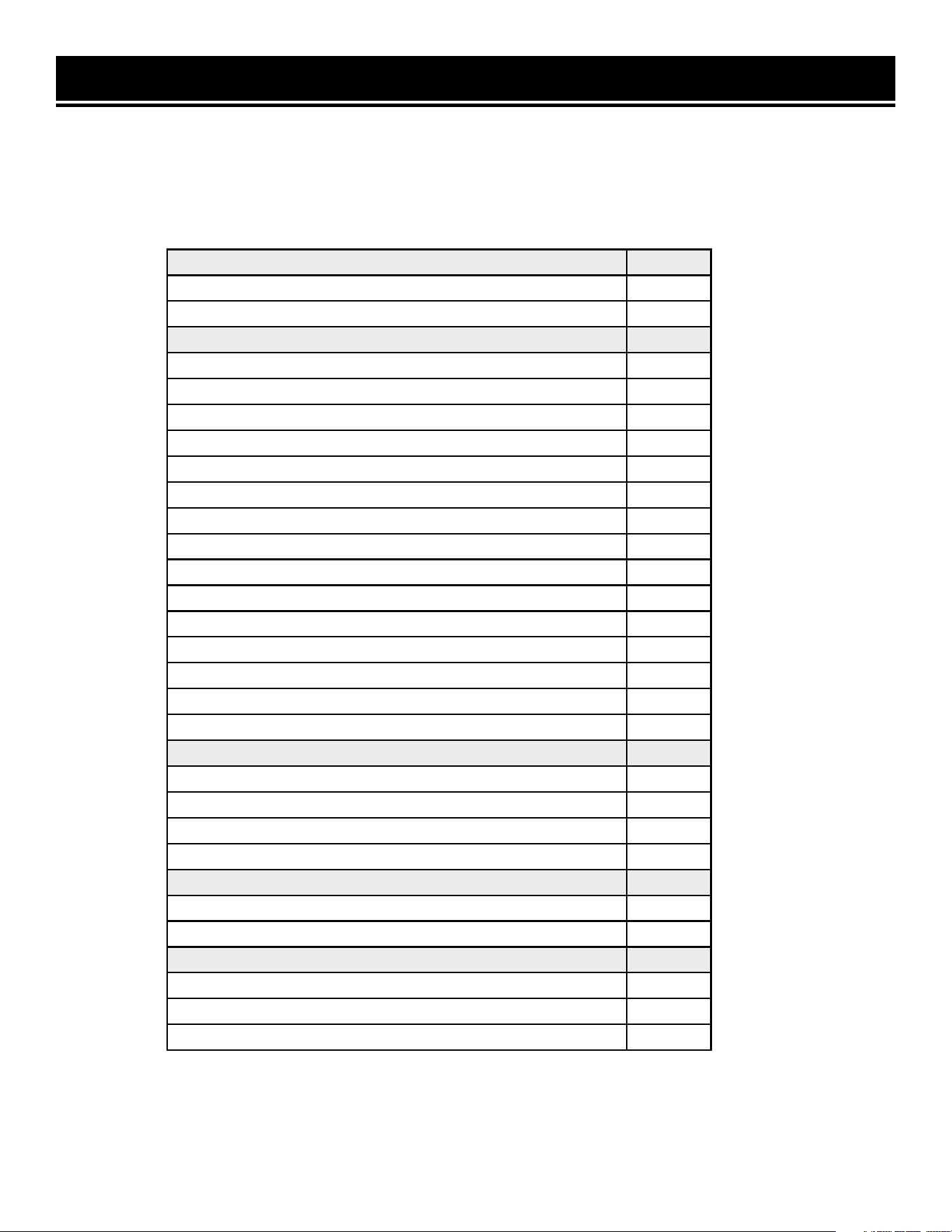
3. Use of an extension cord with this product is NOT RECOMMENDED. If an extension
cord must be used, use only a UL-, CSA-, or ETL-certified extension cord that is certified
for outdoor use, in order to prevent electric shock. These cords are usually identified by
a marking, “Acceptable for use with outdoor appliances; store indoors when not in use.
4. Service and repair. To avoid danger, electrical appliances must only be repaired by a
qualified service technician using original replacement parts.
CAUTION! In all cases, make certain the outlet in question is properly grounded. If you
are not sure, have a licensed electrician check the outlet.
GROUNDING INSTRUCTIONS
In the event of a malfunction or breakdown, grounding provides the path of least resistance for an electric current
and reduces the risk of electric shock. This tool is equipped with an electric cord that has an equipment grounding
conductor and a grounding plug. The plug MUST be plugged into a matching outlet that is properly installed and
grounded in accordance with ALL local codes and ordinances.
1. Do not modify the plug provided. If it will not fit the outlet, have the proper outlet installed by a licensed electri-
cian.
2. GROUND FAULT CIRCUIT INTERRUPTER PROTECTION (GFCI). This pressure washer is provided with a ground-
fault circuit-interrupter (GFCI) built into the plug of the power-supply cord. This device provides additional protec-
tion from the risk of electric shock. Should replacement of the plug or cord become necessary, use only identical
replacement parts that include GFCI protection.
1. Examine extension cord before use. Make sure your extension cord is properly wired and in good condition.
Always replace a damaged extension cord or have it repaired by a qualified person before using it.
2. Do not abuse extension cord. Do not pull on cord to disconnect from receptacle; always disconnect by pulling on
plug. Disconnect the extension cord from the receptacle before disconnecting the product from the extension cord.
Protect your extension cords from sharp objects, excessive heat and damp/wet areas.
3. Use a separate electrical circuit for your tool. This circuit must not be less than a 12-gauge wire and should be
protected with a 15A time-delayed fuse. Before connecting the motor to the power line, make sure the switch is in
the OFF position and the electric current is rated the same as the current stamped on the motor nameplate. Running
at a lower voltage will damage the motor.
GUIDELINES AND RECOMMENDATIONS FOR EXTENSION CORDS
When using an extension cord, be sure to use one heavy enough to carry the current your product will draw. An
undersized cord will cause a drop in line voltage resulting in loss of power and overheating. The table below shows
the correct size to be used according to cord length and ampere rating. When in doubt, use a heavier cord. The
smaller the gauge number, the heavier the cord.
Fig. 1
UNPACKING & PACKING LIST
UNPACKING
Carefully remove the electric pressure washer from the packaging and place it on a sturdy, flat surface. Make sure to
take out all contents and accessories. Do not discard the packaging until everything is removed. Check the packing
list below to make sure you have all of the parts and accessories. If any part is missing or broken, please contact
customer service at 1-847-429-9263 (M-F 8-5 CST), or email [email protected].
Description Qty.
Pressure Washer Handle 1
Pressure Washer Body 1
Accessories
High Pressure Hose 1
Spray Gun 1
Lance 1
0º Nozzle (Red) 1
15º Nozzle (Yellow) 1
25º Nozzle (Green) 1
40º Nozzle (White) 1
Soap Nozzle (Black) 1
Spray Gun Holder 1
Spray Gun Holder Lock Knob 1
Spray Gun Holder Lock Knob Washers 2
High Pressure Hose Holder 1
Frame Extension Tubes 2
Power Cord Hooks 2
Power Cord Hook Hardware (M6x45 Bolts & M6 Nuts) 2
Wheel Assembly
Wheels 2
Washers 2
R-Clips 2
Axle Pins 2
Foot Assembly
Rubber Feet 2
Socket Head Cap Screws, M6x25 2
Tools
Open End Wrench, 8mm / 10mm 2
5mm Hex Wrench 1
Nozzle Cleaning Tool 1
9
KNOW YOUR PRESSURE WASHER
TOOL PURPOSE
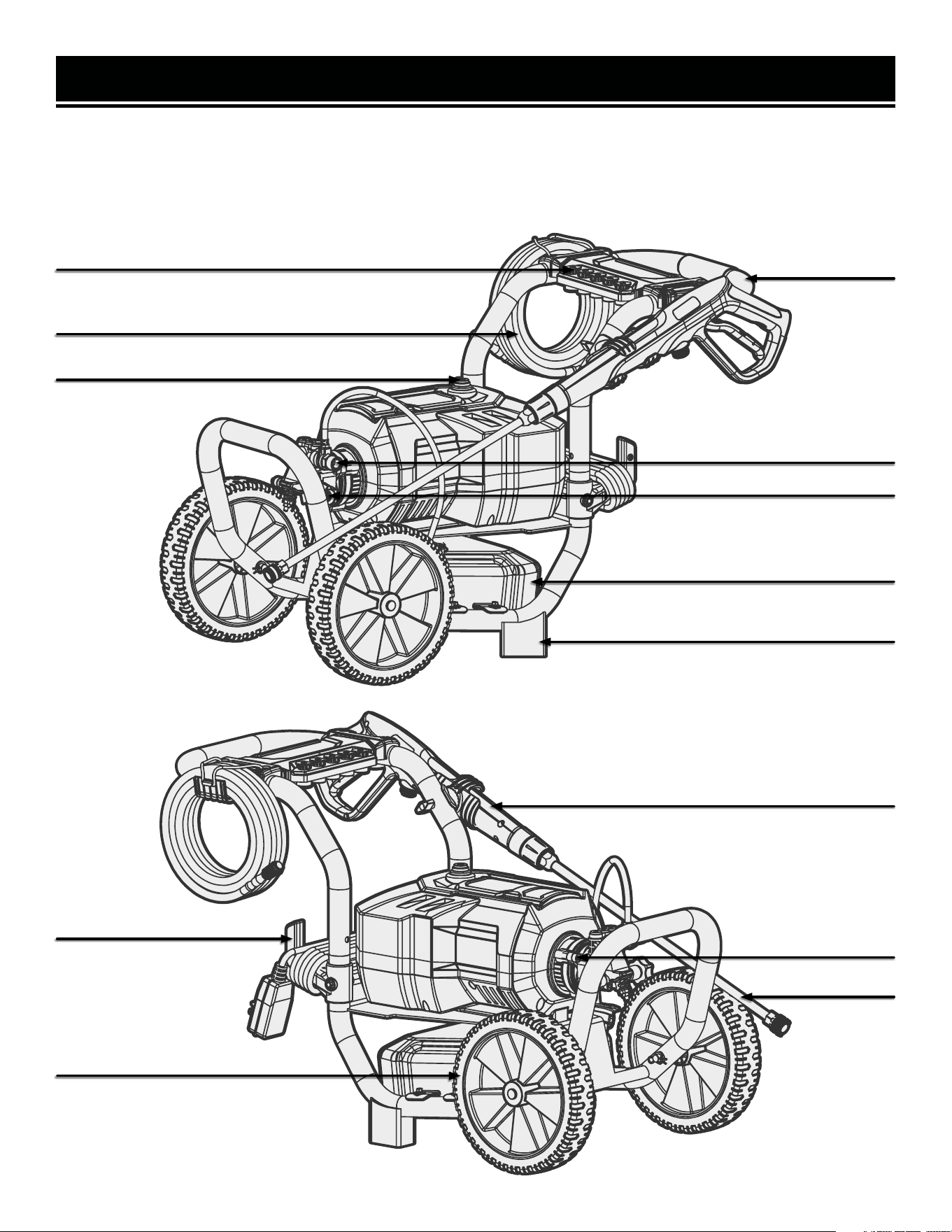
Put the stains and unwanted buildup in your life under pressure with your WEN Electric Pressure Washer. Refer to
the following diagrams to become familiarized with all the parts and controls of your pressure washer. The compo-
nents will be referred to later in the manual for assembly and operation instructions.
Power Switch
Handle
Lance
Spray Gun
High Pressure Hose
Wheels
Power Cord Storage
10
Onboard Nozzle Storage
Water Outlet
Water Inlet
Feet
Soap Tank
Pressure Relief Valve
WARNING! To avoid injury from accidental startups, be sure that the tool is switched OFF and disconnected
from the power supply before performing assembly, inspection or adjustments.
ASSEMBLY & ADJUSTMENTS
INSTALLING THE WHEELS
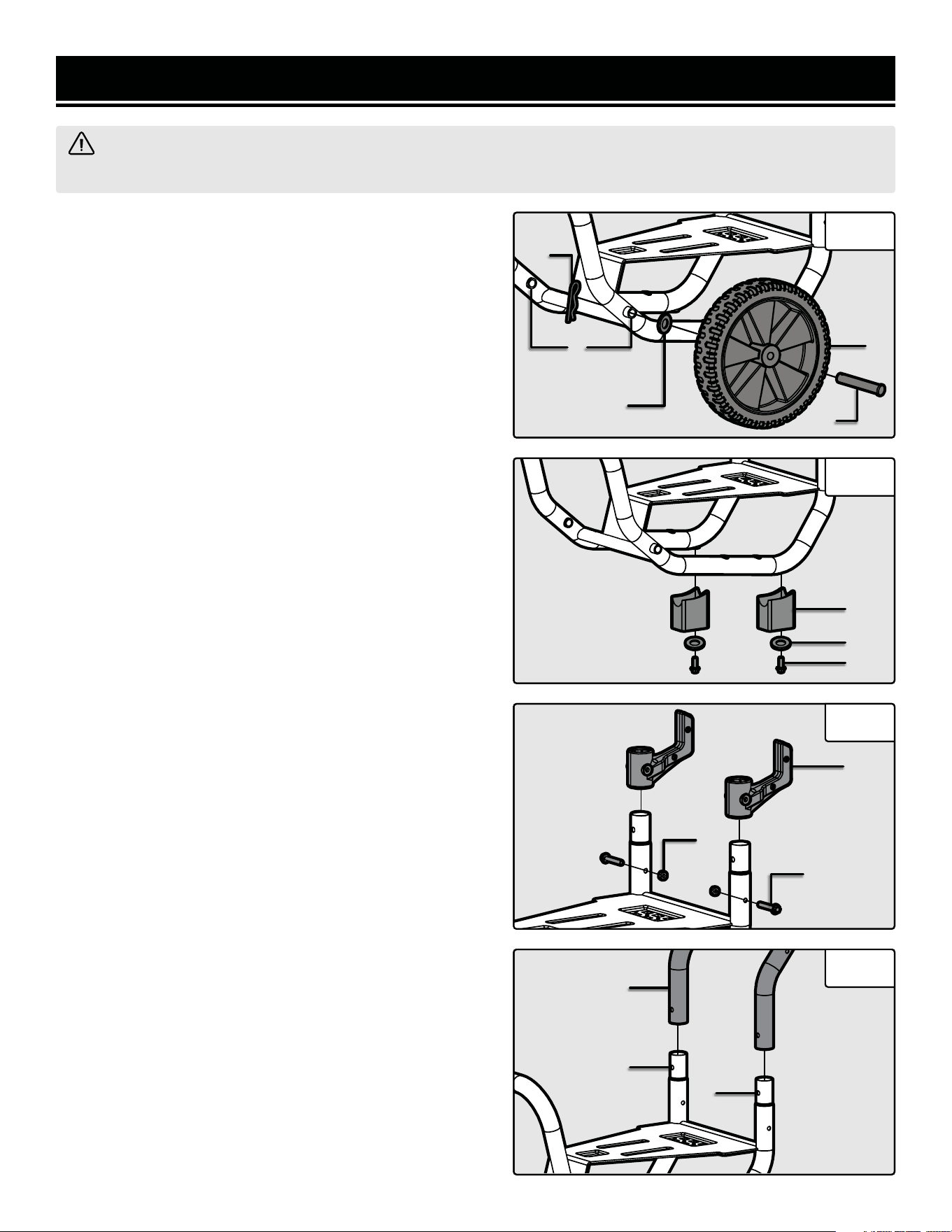
1. Locate the two wheel mounting holes (Fig. 1 - 1) on either
side of the pressure washer frame.
2. Install the wheels using the included wheel mounting
hardware in the order listed below:
a. washers (Fig. 1 - 2)
b. wheels (Fig. 1 - 3)
c. axle pins (Fig. 1 - 4)
3. Secure the wheels in place by sliding the included R-clips
(Fig. 1 - 5) through the holes in the axle pins.
INSTALLING THE FEET
1. Install the two rubber feet (Fig. 2 - 1) to the pressure
washer base using the hex wrench, two washers (Fig. 2 - 2),
and two socket head cap screws (Fig. 2 - 3).
NOTE: The profiles of the feet should rest flush against the
frame of the pressure washer base when installed properly.
INSTALLING THE POWER CORD HOOKS
1. Slide the power cord hooks (Fig. 3 - 1) onto the frame as
shown in Fig. 3. Secure the hooks in place using two M6x45
bolts (Fig. 3 - 2) and two M6 nuts (Fig. 3 - 3).
INSTALLING THE HANDLE
1. To install the pressure washer handle (Fig. 4 - 1), press
the detent pins (Fig. 4 - 2) simultaneously on either side of
the pressure washer base. Slide the handle onto the base.
The detent pins should click once the handle is secure.
INSTALLING THE FRAME EXTENSION TUBES
(OPTIONAL)
Your pressure washer comes with two frame extension
tubes. If you are tall, it may be more comfortable to trans-
port the pressure washer with these tubes installed. Install
them onto the frame in the same way the handle was in-
stalled, then install the handle onto the tubes.
11
Fig. 4
2
2
1
Fig. 1
1
2
4
3
5
Fig. 2
1
2
3
Fig. 3
1
3
2
WARNING! To avoid injury from accidental startups, be sure that the tool is switched OFF and disconnected
from the power supply before performing assembly, inspection or adjustments.
ASSEMBLY & ADJUSTMENTS
Fig. 6
1
Fig. 8
2
1
12
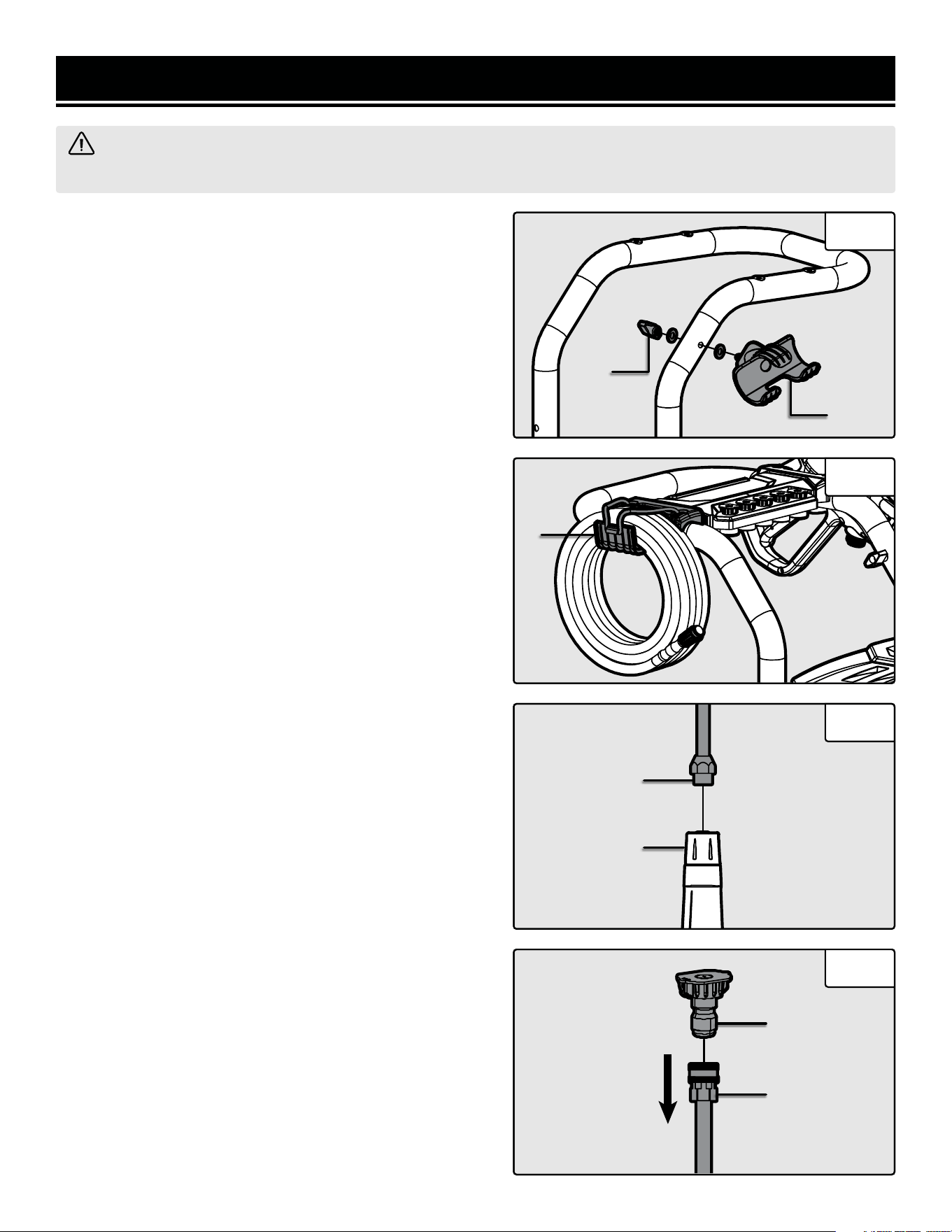
INSTALLING THE SPRAY GUN HOLDER
1. To install the spray gun holder (Fig. 5 - 1), align the bolt of
the holder with the hole on the side of the pressure washer
handle as shown in Fig. 5. Secure the holder to the frame
using the included spay gun holder lock knob (Fig. 5 - 2)
and washers.
INSTALLING THE HOSE HOLDER
1. Slide the hose holder (Fig. 6 - 1) into the groove on the
right side of the pressure washer handle.
2. Place the hose onto the holder. Secure it with the elastic
cord. Pull the end of the cord over the hook on the holder.
ASSEMBLING THE SPRAY GUN
1. Thread the threaded end of the lance (Fig. 7 - 1) into the
spray gun (Fig. 7 - 2) until it is secure.
2. To install one of the included nozzles (Fig. 8 - 1) onto
the lance, pull the quick-connect collar (Fig. 8 - 2) back and
snap the nozzle into place. Push the quick-connect collar
forward to secure the nozzle.
Your pressure washer includes five nozzles:
Red (0º), Yellow (15º), Green (25º), White (40º), and Black
(Soap).
For general cleaning, use the 25º or 40º nozzle. This option
is for cement walkways.
For stripping, spot cleaning, blasting, and hard to reach ar-
eas, use the 15º or 0º nozzle. These options are for remov-
ing paint, rust, mildew, marine growth on boats, or grease
stains. These options can be used for reaching second story
surfaces, or for the removal of paint, rust, oil stains, tar,
gum, and other stubborn substances. Use extreme caution
when using these nozzles.
For light-duty washing or to use detergent, use the black
(soap) nozzle. See p. 15 for more information.
Fig. 5
1
2
Fig. 7
2
1
WARNING! To avoid injury from accidental startups, be sure that the tool is switched OFF and disconnected
from the power supply before performing assembly, inspection or adjustments.
ASSEMBLY & ADJUSTMENTS
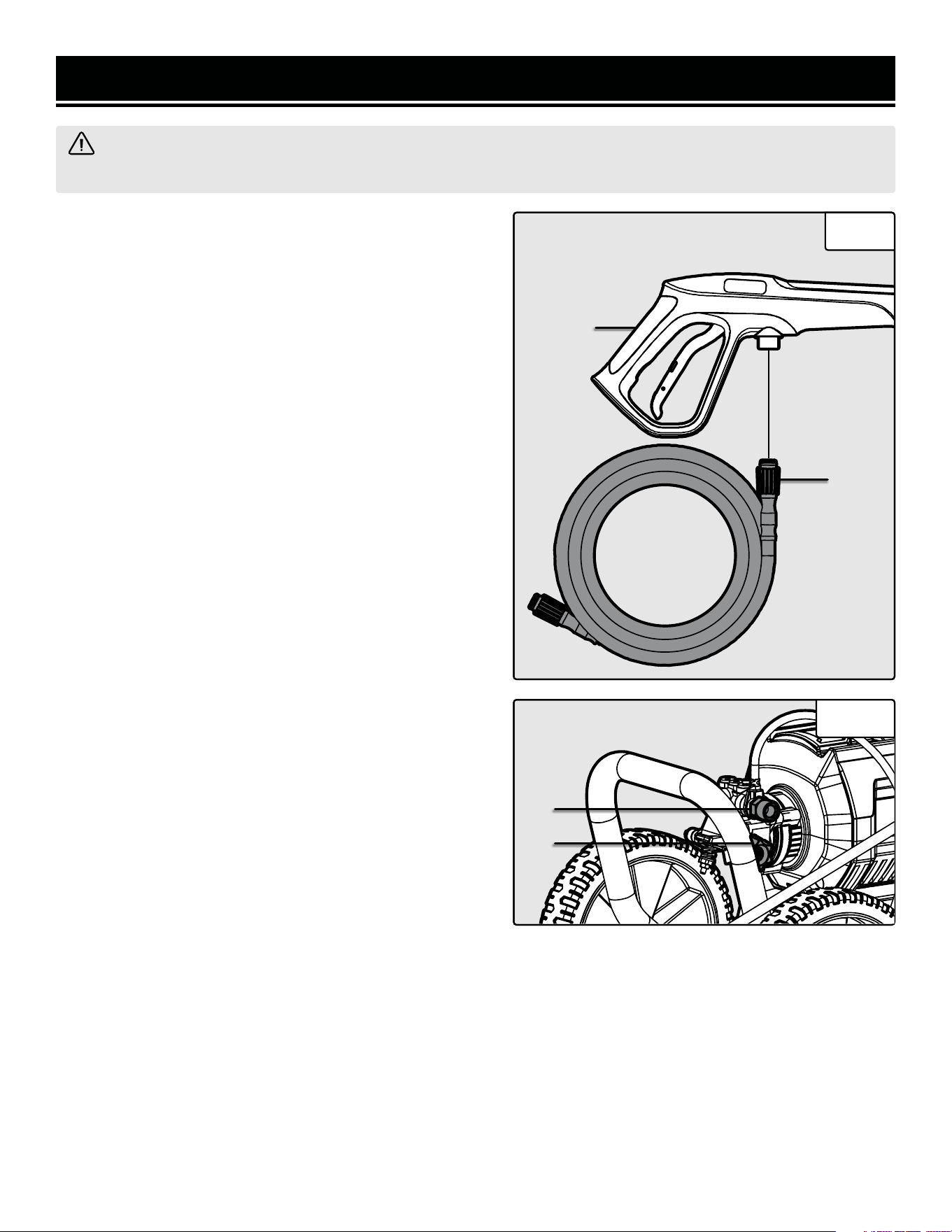
CONNECTING THE HIGH PRESSURE HOSE
1. Thread one end of the high pressure hose (Fig. 9 - 1) into
the spray gun (Fig. 9 - 2).
2. Thread the other end of the high pressure hose into the
water outlet (Fig. 10 - 1) on the pressure washer body.
CONNECTING THE GARDEN HOSE
1. Thread the garden hose into the water inlet (Fig. 10 - 2).
2. Connect the other end of the garden hose to the water
supply.
Fig. 9
2
1
1
2
13
Fig. 10
OPERATION
BEFORE BEGINNING OPERATION
Bleed the device as follows prior to operation:
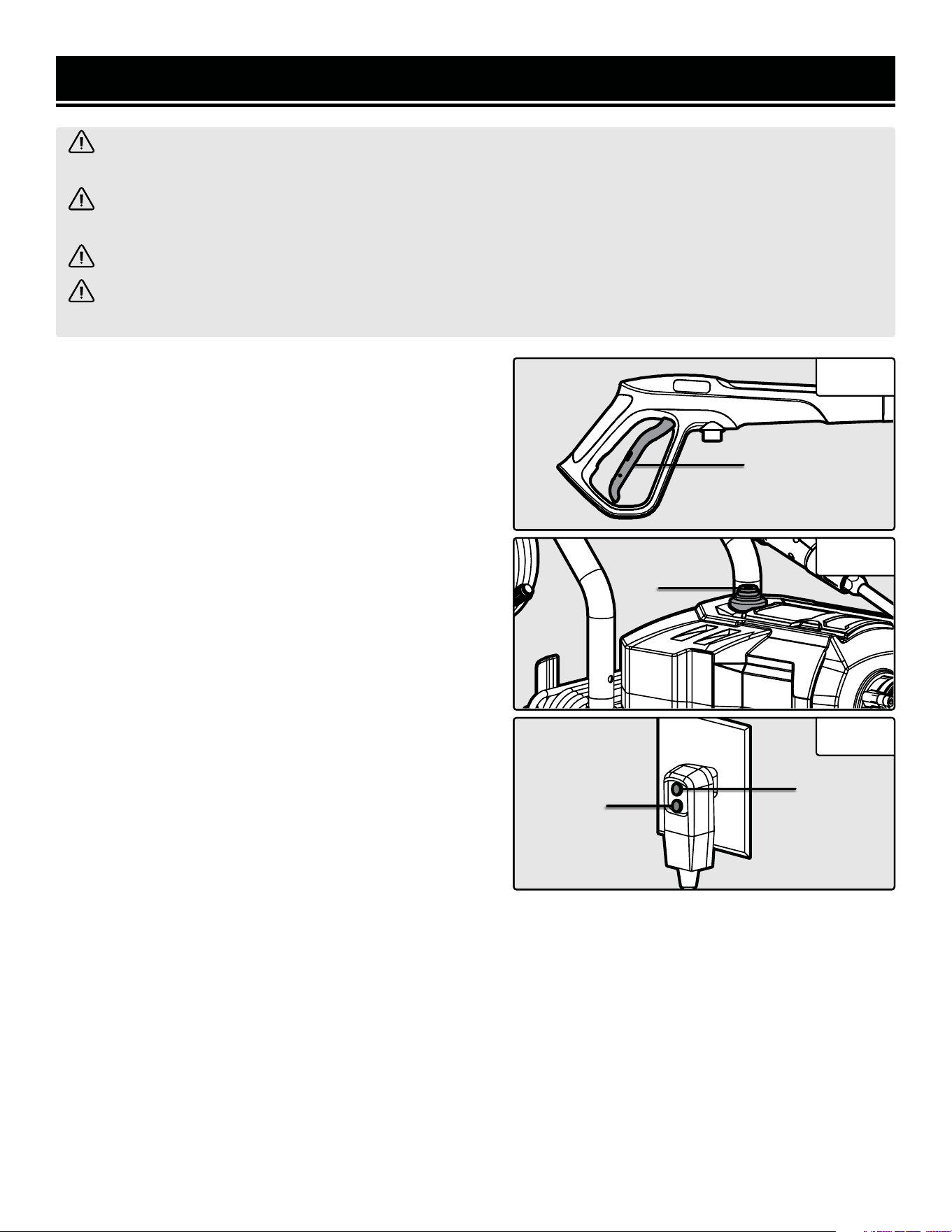
1. Connect the spray gun to the pressure washer. Connect
the garden hose to the pressure washer and turn ON the
water supply.
2. Ensure that no nozzles are installed in the end of the lance.
3. Pull the power trigger (Fig. 11 - 1). Allow the water to
run for approximately 2 minutes until there are no bubbles
present in the water stream, indicating that air has been bled
from the system.
4. Release the power trigger.
OPERATING THE PRESSURE WASHER
Before operating the pressure washer, make sure it is in the
horizontal position.
1. Make sure that the power switch (Fig. 12 - 1) is switched
to the OFF position before plugging the pressure washer into
the power source.
2. Plug the GFCI into a matching receptacle (see p. 8 for im-
portant electrical information). We recommend that you test
the GFCI as part of the startup procedure each time you use
the pressure washer. Press the RESET button (Fig. 13), and
the power indication light should turn ON. Press the TEST
button, and the power indication light should turn OFF. DO
NOT use if the test fails. Press the RESET button again after
completing the test to enable operation.
3. Make sure that the high pressure hose and the garden
hose are securely connected to the pressure washer. See the
“CONNECTING THE HIGH PRESSURE HOSE” and the “CON-
NECTING THE GARDEN HOSE” sections on page 13. Turn on
the water supply.
Fig. 11
WARNING! To prevent serious injury, make sure all the warnings and instructions have been read and
understood before operating this tool.
CAUTION! Do not connect the pressure washer to a potable water system without a backflow prevention
method installed, if required by your local jurisdiction.
CAUTION! The water supply must not exceed 101 PSI.
CAUTION! The washer must only be used with clean water. Using unfiltered water containing corrosive
chemicals will damage the pressure washer.
1
4. Hold the spray gun with two hands and be sure
to point it in a safe direction away from animals, by-
standers, and yourself. Press the power trigger until
a consistent stream of water flows through the lance,
to allow air trapped in the hose to escape. Install the
nozzle of your choice.
5. Turn the power switch (Fig. 12 - 1) ON.
6. Hold the spray gun with both hands and aim it at
the object that you would like to clean.
7. To stop the water, release the power trigger.
Reset
Test
1
Fig. 12
Fig. 13
14
OPERATION
OPERATING WITH DETERGENT
1
WARNING! When using detergents, the material
data safety sheet issued by the detergent manufacturer
must be adhered to, especially the instructions regarding
personal protective equipment.
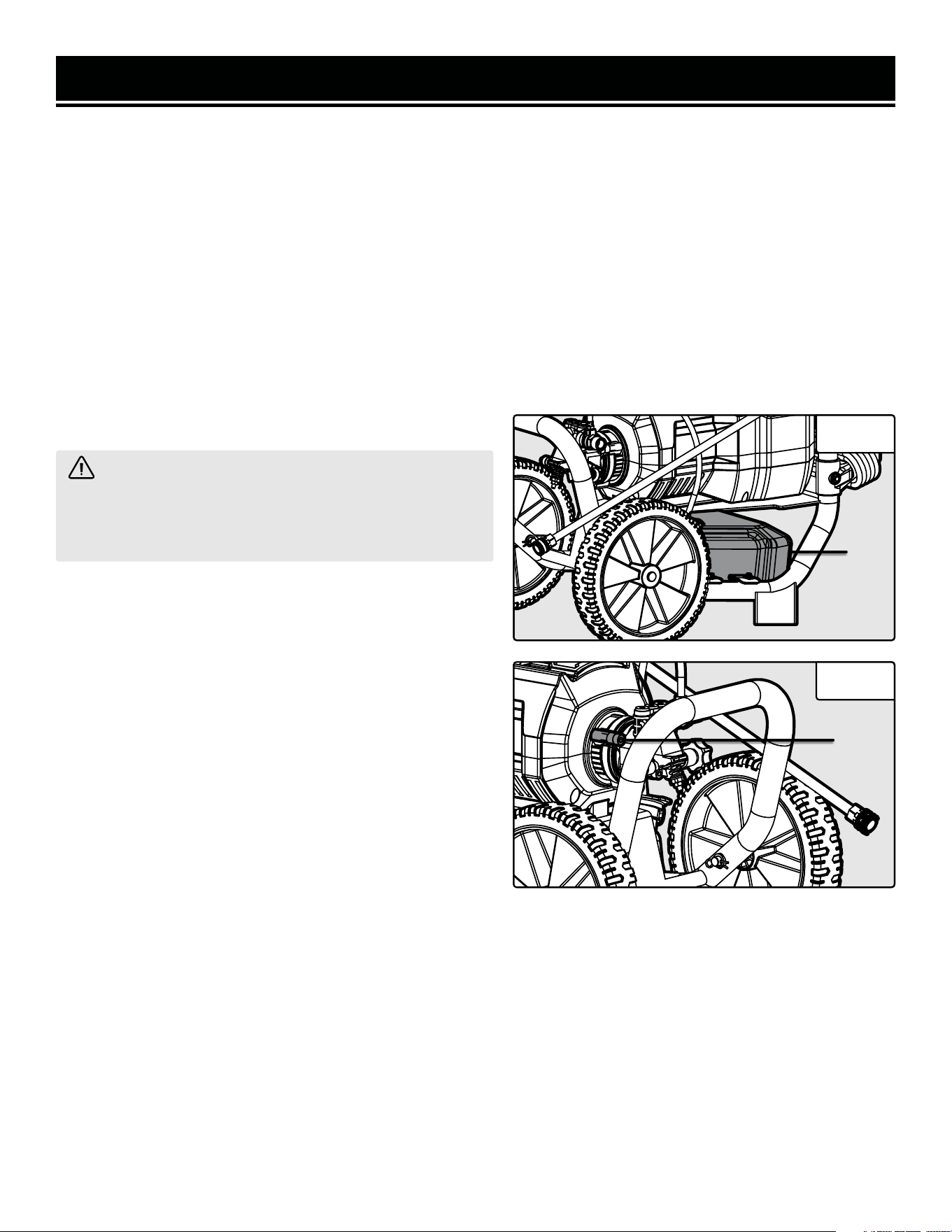
1. Fill the tank (Fig. 14 - 1) with detergent designed specifi-
cally for use with pressure washers. If required, dilute the
detergent according to the manufacturer’s instructions. The
tank fill is located next to the wheel on the left side of the
pressure washer.
2. Follow steps 1 - 3 of the OPERATING THE PRESSURE
WASHER instructions on the previous page
3. Install the black SOAP nozzle onto the spray lance.
4. Once operation is complete, empty the detergent tank.
Spray the spray gun to flush out all of the soap remaining
in the unit.
PRESSURE RELIEF VALVE
If pressure or temperature within the pump exceeds preset
values, excess water will begin to spray out of the pressure
relief valve (Fig. 15 - 1) located next to the water inlet. This is
perfectly normal and acts as a corrective measure to ensure
that the right amount of pressure is being used.
However, if water seems to always be leaking, its time for
your pressure relief valve to be replaced. Please call our cus-
tomer service phone line to order parts and learn about the
replacement process.
AUTOMATIC PUMP SHUTOFF / TSS (TOTAL STOP SYSTEM)
The pressure washer is equipped with an automatic pump shutoff function that senses the water flow in the pump.
The pump will only run when the power switch is in the ON position and the trigger pulled. When the trigger is
released and no water is flowing through the pump, the motor will automatically shut off to protect the pump from
overheating, thus saving energy and prolonging pump life.
So don’t worry if the pump shuts off when the trigger is released. Your pressure washer is still okay. Simply squeeze
the trigger again to resume pressure washing.
THERMAL PROTECTOR
Your pressure washer is equipped with a motor thermal protector. When the motor is experiencing overload and
overheats, the thermal protector will trip to shut down and protect the motor. Wait a few minutes for the motor to
cool down and the thermal protector will reset automatically.
Fig. 14
15
Fig. 15
1

WARNING! Only separate the high pressure hose from the spray gun or the device when there is no pressure
in the system.
CAUTION! When disconnecting the supply or high pressure hose, warm water may leak from the connection
after operation.
5. Turn off the water supply, then detach the pressure washer from the water supply.
OPERATION
PRESSURE WASHING TIPS
1. Before pressure washing any surface, test spray an inconspicuous area. Adjust the spray pattern and spraying
distance to achieve the optimal cleaning result and prevent damaging the surface.
2. Use caution when spraying chipped or peeling paint, as the high pressure may remove the loose paint from the
surface.
3. Pre-rinse the surface with fresh water before applying detergent.
4. When using detergent, follow the instructions that come with your detergent. In general, allow the detergent to
remain on the surface about 1 - 3 minutes. Do not allow detergent to dry on the surface.
5. Keep the spray nozzle approximately 6 inches from the cleaning surface. The spraying distance may vary accord-
ing to the treated surface (be sure to increase the distance when rinsing sensitive or fragile surfaces). Rinse the
surface in a long sweeping motion.
6. Clean from top to bottom. When moving on to a new section of the cleaning surface, overlap the previous section
to eliminate stop marks and ensure a more even cleaning result.
7. When pressure washing surfaces that may come in contact with food, flush surfaces with plenty of drinking water
after pressure washing. However, WEN does not recommend eating off of your driveway.
TURNING OFF THE PRESSURE WASHER
1. Release the power trigger.
2. Turn the power switch OFF.
3. Unplug the pressure washer from the power outlet.
4. Press the trigger gun to release any pressure still in the high pressure hose.
16

STORAGE
STORING THE PRESSURE WASHER
1. Make sure that the pressure washer is stored on secure, level ground. You can store the unit standing upright for
more compact spaces.
2. Drain the detergent tank.
3. Detach the lance from the spray gun. Detach the spray gun from the high pressure hose. Drain the water from all
components. Store both the lance and the spray gun on the spray gun holder.
4. Neatly wrap and store the high pressure hose on the hose holder.
5. Wrap the power cord around the power cord holder.
When storing the pressure washer for extended periods of time:
1. Clean the spray nozzle and water inlet filter before storing the unit. Refer to the “SPRAY NOZZLES” and “WATER
INLET FILTER” sections on the following page.
2. To protect and extend the life of your pressure washer, we recommended running the unit with a pump antifreeze
or pump protector or a pump conditioner before storing the unit for long periods of time. Follow the directions on
your preferred pump protector for proper use.
3. Store your pressure washer and accessories indoors where the temperature will stay above freezing (32°F / 0°C).
Do not store it near the furnace or other sources of heat as it may dry out the pump’s seals.
4. Keep the pressure washer upright on a level surface. Cover the machine to protect it from dust. Do not allow high
pressure hose to become kinked during storage.
17
CLEANING & MAINTENANCE
HIGH PRESSURE HOSE
The high pressure hose can easily be damaged and should
be stored carefully. Do not kink the hose. Do not drive ve-
hicles over the hose. Do not expose the hose to sharp ob-
jects. Inspect the hose for cuts, bulges, or leaks. These can
develop from kinking or wear. If damaged, replace the hose
immediately.
WARNING! To avoid injury from accidental startups, be sure that the tool is switched OFF and disconnected
from the power supply before performing assembly, inspection or adjustments.
WARNING! If the hose is damaged, do not use the
unit or try to repair the hose. Always replace with an
identical part before operation.
SPRAY NOZZLES
Regularly clean the nozzles, preferably after every use, to prevent the nozzles from clogging and to ensure good
performance of the machine.
1. Remove the nozzle from the spray lance.
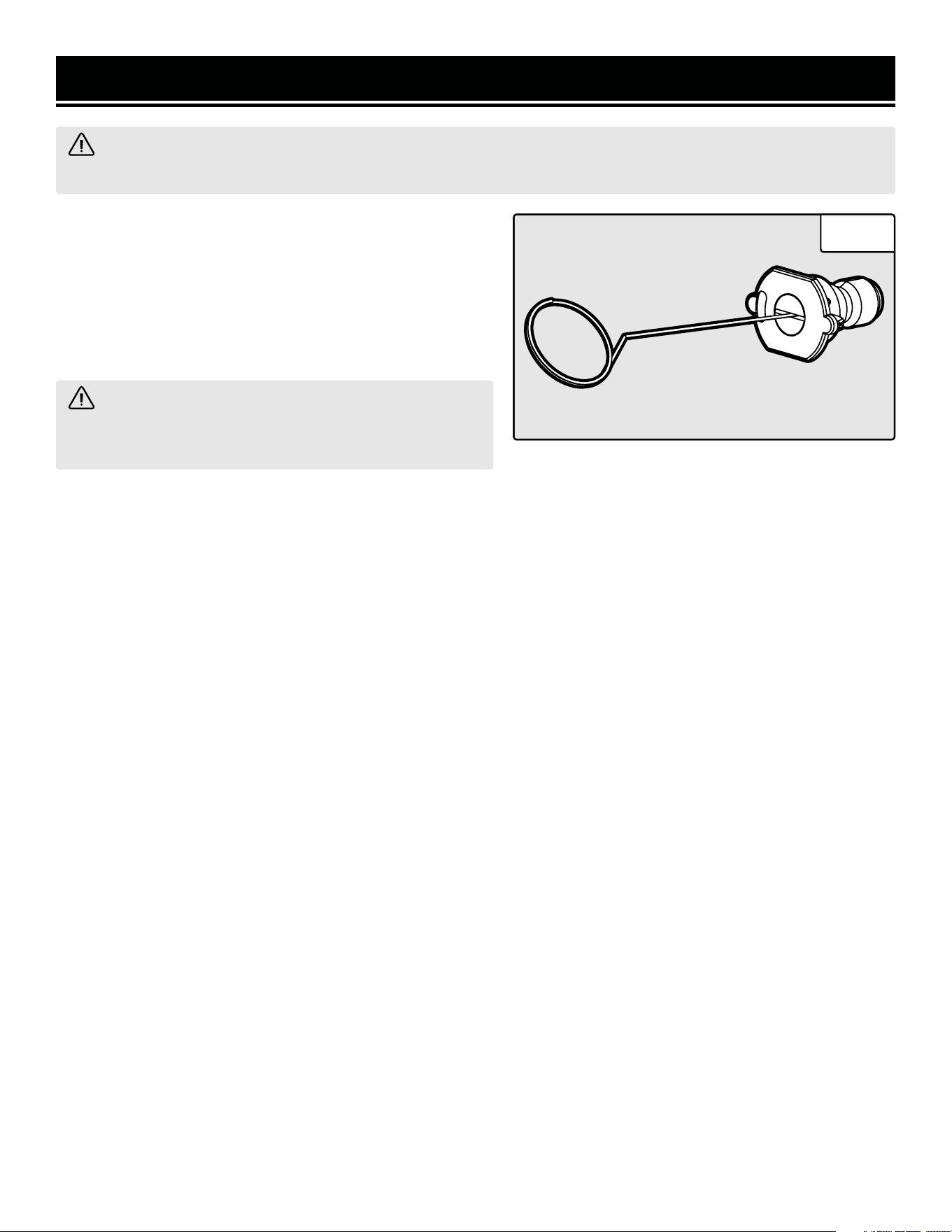
2. Use the included nozzle cleaning tool (Fig. 16), a sturdy pin, or a piece of wire to dislodge any buildup in the spray
tip. Flush water through the back end of the nozzle and spray wand with your garden hose for 30-60 seconds to
remove any buildup.
WATER INLET FILTER
Check the water inlet periodically for deposits. Clean the filter regularly for maximum performance. Use an old
toothbrush or nylon-bristle brush to remove deposits and builup from the inlet filter screen.
PRODUCT DISPOSAL
Used pressure washers should not be disposed of with household waste. This product contains electric compo-
nents that should be recycled. Please take this product to your local recycling facility for responsible disposal and
to minimize its environmental impact.
Fig. 16
18
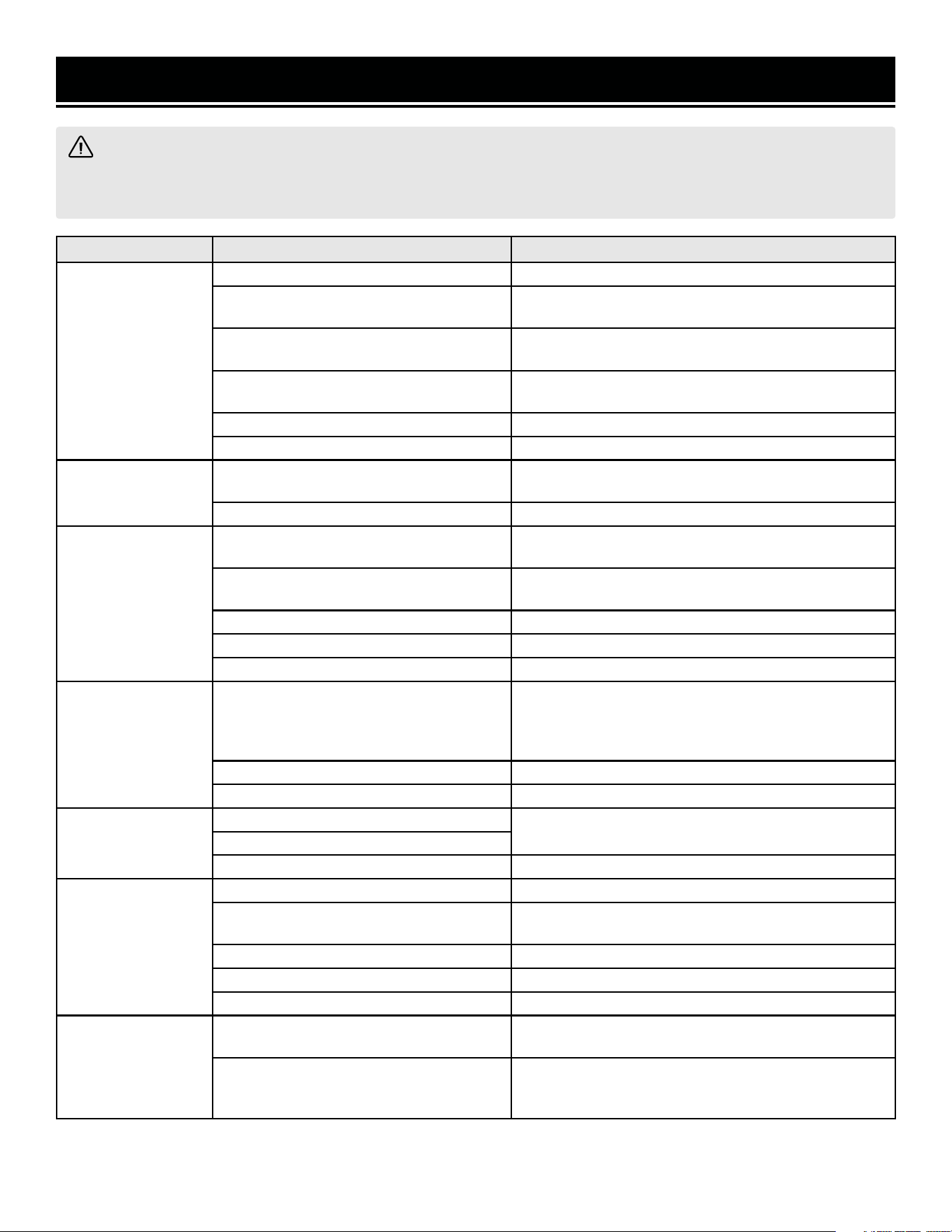
NOTE: This pressure washer is supplied with a closed lubrication system, so no addition of oil is needed.
PROBLEM CAUSE SOLUTION
The machine doesn’t
turn on.
1. The GFCI plug is tripped. 1. Press the “RESET” button on GFCI plug.
2. The thermal protector is tripped.
2. Switch the machine OFF. Wait a few minutes for the motor
to cool down and the protector will reset automatically.
3. The machine is not plugged in or the outlet
does not have adequate power.
3. Plug the machine into a working outlet suitable for the
pressure washer.
4. The power cord or extension cord is dam-
aged.
4. Check the power cord, extension cord, and power plug.
Do not use if cords are damaged.
5. The power switch is defective. 5. Stop using the tool and contact customer service.
6. The circuit fuse is blown. 6. Have the fuse replaced by a certified electrician.
The machine stops
during operation.
1. The thermal protector is tripped.
1. Switch the machine OFF. Wait a few minutes for the motor
to cool down and the protector will reset automatically.
2. The nozzle is partially blocked. 2. Clean the nozzle.
The machine is
pulsating.
1. There is air trapped in the inlet hose.
1. Allow the machine to run while holding the trigger until
adequate pressure returns.
2. The water supply is insufficient.
2. Make sure the water supply is opened as far as possible.
Check for leaks, kinks, or blockages.
3. The nozzle is blocked. 3. Clean the nozzle.
4. The water filter is blocked. 4. Clean the water inlet adapter filter.
5. The hose is kinked. 5. Unkink the hose.
There is fluctuating
pressure.
1. The pump is bringing in air.
1. Tighten the hose connections and make sure they are air
tight. Turn the machine OFF and purge the pump by squeez-
ing the spray gun until a steady flow of water emerges
through the nozzle.
2. The valves are dirty or broken. 2. Clean/replace the valves.
3. The pump seals are worn out. 3. Call 1-847-429-9263 for assistance.
The water stream
starts and stops by
itself.
1. The pump or spray gun is leaking.
1 & 2. Call 1-847-429-9263 for assistance.
2. The trigger on the spray gun is broken.
3. There is a ghost in the machine. 3. Persuade the ghost to leave.
The water pressure
isn’t high enough.
1. The garden hose diameter is too small. 1. Replace with a 5/8 in. or larger garden hose.
2. The water supply is insufficient.
2. Open the water inlet and check the garden hose for leaks,
kinks, or blockages.
3. The pump or hose is frozen. 3. Thaw out the frozen pump / hose.
4. The water inlet filter is clogged. 4. Remove the filter and rinse it out in warm water.
5. The nozzle is blocked. 5. Unblock and clean the nozzle.
There is no detergent
coming out.
1. The detergent tube is clogged. 1. Clean the tube.
2. There is not enough detergent in the tank,
or the detergent tube is not submerged in the
detergent.
2. Add more detergent; ensure tube is submerged.
TROUBLESHOOTING GUIDE
WARNING! Stop using the tool immediately if any of the following problems occur. Repairs and replace-
ments should only be performed by an authorized technician. For any questions, please contact our customer
service at 1-847-429-9263, M-F 8-5 CST or email us at [email protected].
19
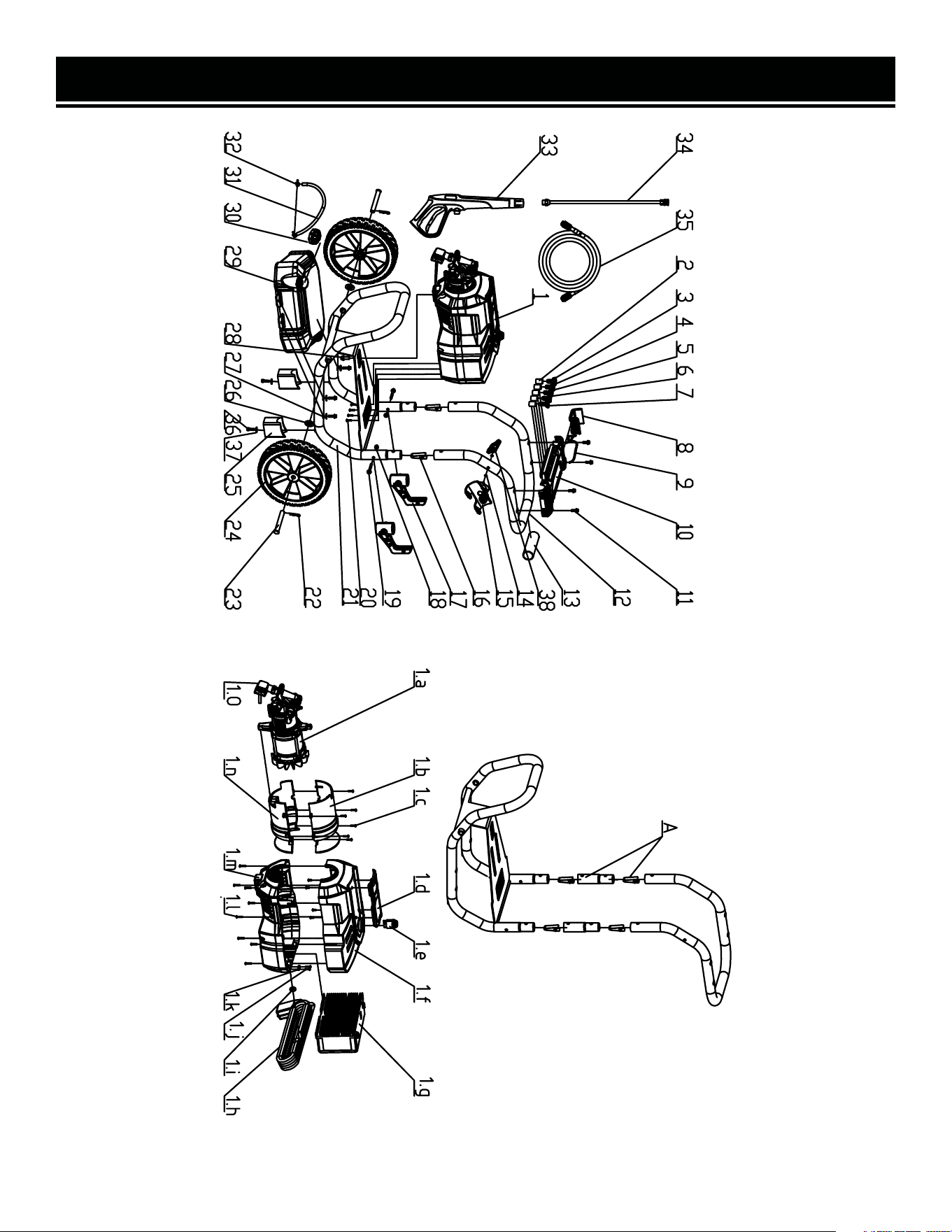
EXPLODED VIEW & PARTS LIST
NOTE: Not all parts may be available for purchase. Parts and accessories that wear
down over the course of normal use are not covered under the warranty.
20
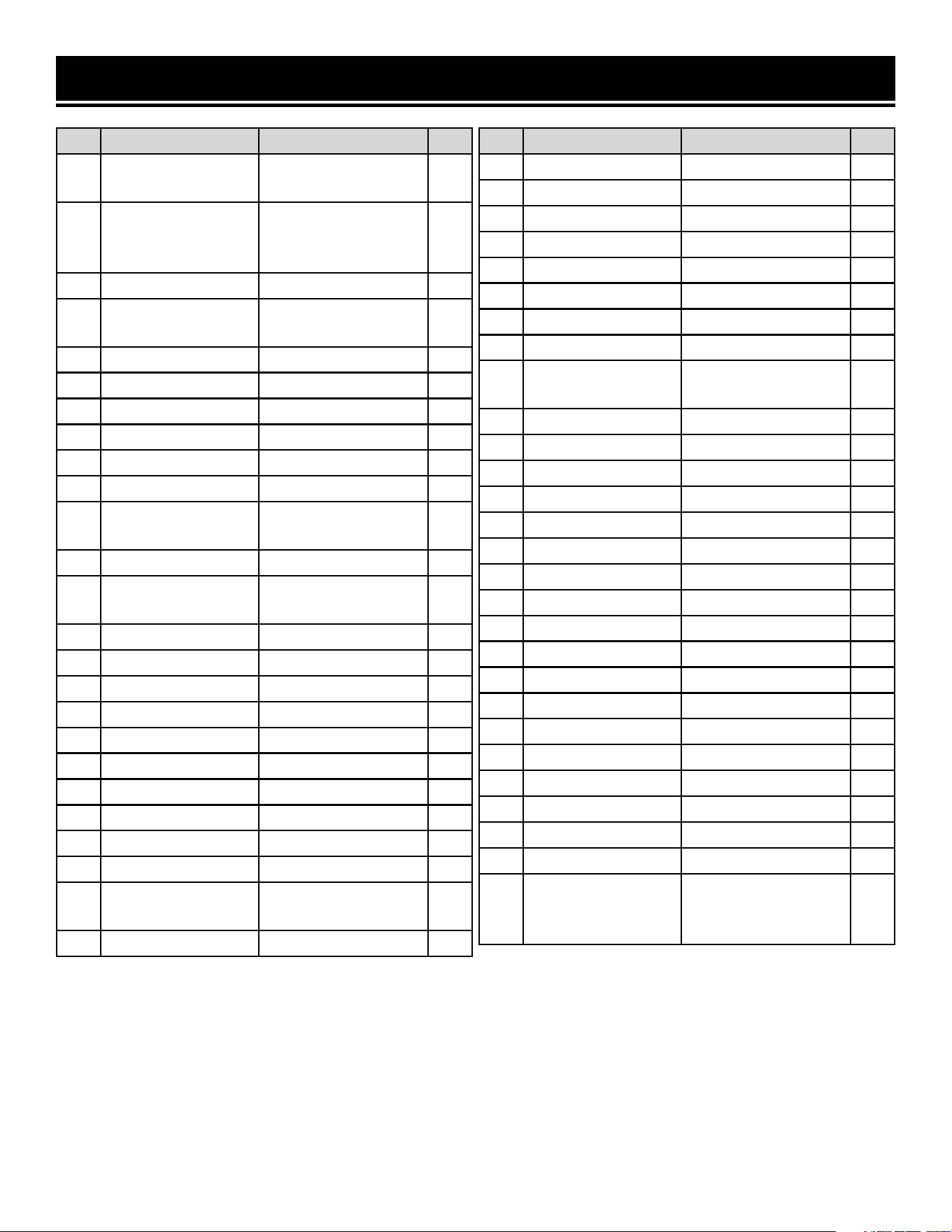
EXPLODED VIEW & PARTS LIST
NOTE: Not all parts may be available for purchase. Parts and accessories that wear
down over the course of normal use are not covered under the warranty.
No. Part No. Description Qty.
1
PW3000E-
001ASMB
Motor Assembly with
Microswitch
1
1.a PW3000E-001.aB
Motor & Pump
Subassembly with
Microswitch
1
1.b PW3000E-001.b Upper Motor Shroud 1
1.c PW3000E-001.c
Self-tapping Screw,
ST4.2x12
10
1.d PW3000E-001.d Cover Plate 1
1.e PW3000E-001.e Power Switch 1
1.f PW3000E-001.f Upper Housing 1
1.g PW3000E-001.gB DC Control Board 1
1.h PW3000E-001.h GFCI Power Cord 1
1.i PW3000E-001.i Rubber Bushing 1
1.j PW3000E-001.j
Self-tapping Screw,
ST3.5x9.5
2
1.k PW3000E-001.k Power Cord Clamp 1
1.l PW3000E-001.l
Self-tapping Screw,
ST3.5x22
8
1.m PW3000E-001.m Lower Housing 1
1.n PW3000E-001.n Lower Motor Shroud 1
2 PW3000E-002 Nozzle Holder 5
3 PW3000E-003 0-degree Nozzle 1
4 PW3000E-004 15-degree Nozzle 1
5 PW3000E-005 Soap Nozzle 1
6 PW3000E-006 25-degree Nozzle 1
7 PW3000E-007 40-degree Nozzle 1
8 PW3000E-008 Hose Rest 1
9 PW3000E-009 Elastic Hose Cord 1
10 PW3000E-010
Nozzle Storage Panel
Assembly
1
11 PW3000E-011 Bolt, M6x20 10
No. Part No. Description Qty.
12 PW3000E-012 Handle 1
13 PW3000E-013 Handle Grip 1
14 PW3000E-014 Washer, 6mm 2
15 PW3000E-015.1 Spray Gun Holder 1
16 PW3000E-016 Spring Clip 2
17 PW3000E-017 Power Cord Hook 2
18 PW3000E-018 Nut, M6 2
19 PW3000E-019 Bolt, M6x45 2
20 PW3000E-020
Self-tapping Screw,
ST3.5x16
4
21 PW3000E-021 Frame 1
22 PW3000E-022 R-clip 2
23 PW3000E-023 Axle Pin 2
24 PW3000E-024 Wheel 2
25 PW3000E-025 Rubber Foot 2
26 PW3000E-026 Washer, 10mm 2
27 PW3000E-027 Washer, 6mm 4
28 PW3000E-028 Bolt, M8x20 1
29 PW3000E-029B Detergent Tank 1
30 PW3000E-030B Detergent Tank Cap 1
31 PW3000E-031 Detergent Hose 1
32 PW3000E-032 Hose Clamp 1
33 PW3000E-033 Spray Gun 1
34 PW3000E-034 Spray Wand 1
35 PW3000E-035 High Pressure Hose 1
36 PW3000E-036 Bolt, M6x25
37 PW3000E-037 Flat Washer, 6mm
38 PW3000E-015.2 Gun Holder Knob
A PW3000E-012-A
Extension Tube &
Spring Clip
Assembly
2
21
WARRANTY STATEMENT
WEN Products is committed to building tools that are dependable for years. Our warranties are consistent with this
commitment and our dedication to qualit
y.
LIMITED WARRANTY OF WEN PRODUCTS FOR HOME USE
GRE
AT LAKES TECHNOLOGIES, LLC (“Seller”) warrants to the original purchaser only, that all WEN
consumer
power tools will be free from defects in material or workmanship during personal use for a period of two (2) years
used
for professional or commercial use. Purchaser has 30 days from the date of purchase to report missing or
damaged parts.
SELLER’S
SOLE OBLIGATION AND YOUR EXCLUSIVE REMEDY under this Limited Warranty and, to the extent per-
mitted
by law, any warranty or condition implied by law, shall be the replacement of parts, without charge, which a
re
defective
in material or workmanship and which have not been subjected to misuse, alteration, careless handling,
misrepair
, abuse, neglect, normal wear and tear,
improper maintenance, or other conditions adversely affecting the
Product
or the component of the Product, whether by accident or intentionally, by persons other than Seller. To
make
a claim under this Limited Warranty, you must make sure to keep a copy of your proof of purchase that
clearly
-
dor
of Great Lakes Technologies, LLC. Purchasing through third party vendors, including but not limited to garage
sales,
pawn shops, resale shops, or any other secondhand merchant, voids the warranty included with this
product.
Contact [email protected] or 1-847-429-9263 with the following information to make arrangements:
your
shipping address, phone number, serial number, required part numbers, and proof of purchase. Damaged
or
defective parts and products may need to be sent to WEN before the replacements can be shipped out.
-
turning
a product for warranty service, the shipping charges must be prepaid by the purchaser. The product
must
be
shipped in its original container (or an equivalent), properly packed to withstand the hazards of shipment. The
product
must be fully insured with a copy of the proof of purchase enclosed. There must also be a description of
the
will be returned and shipped back to the pur
chaser at no charge for addresses within the contiguous United States.
THIS
LIMITED WARRANTY DOES NOT APPLY TO ITEMS THAT WEAR OUT FROM REGULAR USAGE OVER TIME,
INCLUDING
BELTS, BRUSHES, BLADES, BATTERIES, ETC. ANY IMPLIED WARRANTIES SHALL BE LIMITED IN
DUR
ATION TO TWO (2) YEARS FROM DATE OF PURCHASE. SOME STATES IN THE U.S. AND SOME CANADIAN
PROVINCES
DO NOT ALLOW LIMITATIONS ON HOW LONG AN IMPLIED WARRANTY LASTS, SO THE ABOVE LIMI-
TAT
ION MAY NOT APPLY TO YOU.
IN
NO EVENT SHALL SELLER BE LIABLE FOR ANY INCIDENTAL OR CONSEQUENTIAL DAMAGES (INCLUDING
BUT
NOT LIMITED TO LIABILITY FOR LOSS OF PROFITS) ARISING FROM THE SALE OR USE OF THIS PRODUCT.
SOME ST
ATES IN THE U.S. AND SOME CANADIAN PROVINCES DO NOT ALLOW THE EXCLUSION OR LIMITAT
ION
OF
INCIDENTAL OR CONSEQUENTIAL DAMAGES, SO THE ABOVE LIMITATION OR EXCLUSION MAY NOT APPLY
TO YOU.
THIS
LIMITED WARRANTY GIVES YOU SPECIFIC LEGAL RIGHTS, AND YOU MAY ALSO HAVE OTHER RIGHTS
WHICH
VARY FROM STATE TO STATE IN THE U.S., PROVINCE TO PROVINCE IN CANADA AND FROM COUNTRY
TO COUNT
RY.
THIS
LIMITED WARRANTY APPLIES ONLY TO ITEMS SOLD WITHIN THE UNITED STATES OF AMERICA, CANA-
DA
AND THE COMMONWEALTH OF PUERTO RICO. FOR WARRANTY COVERAGE WITHIN OTHER
COUNTRIES,
CONT
ACT THE WEN CUSTOMER SUPPORT LINE. FOR WARRANTY PARTS OR PRODUCTS REPAIRED UNDER
W
ARRANTY SHIPPING TO ADDRESSES OUTSIDE OF THE CONTIGUOUS UNITED STATES, ADDITIONAL
SHIPPING
CHARGES MAY APPLY.
22

NOTES
23

V. 2024.11.08
THANKS FOR
REMEMBERING
