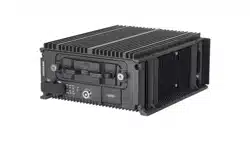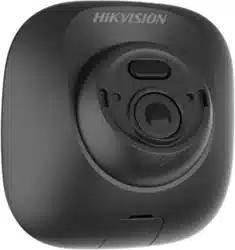

Vehicle-Mounted Came
User Manual
UD02783B-A
1
UserManual
Thank you for purchasing our product. If there are any
questions, or requests, do not hesitate to contact the
dealer.
This manual applies to Vehicle-Mounted Camera.
This manual may contain several technically incorrect
places or printing errors. The content is subject to change
without notice, and the updates will be added to the new
version of this manual. We will readily improve or update
the products or procedures described in the manual.
RegulatoryInformation
FCCInformation
FCCcompliance:Thisequipment has been tested and
found to comply with the limits for a digital device,
pursuant to part 15 of the FCC Rules. These limits are
designed to provide reasonable protection against
harmful interference when the equipment is operated in
a commercial environment. This equipment generates,
uses, and can radiate radio frequency energy and, if not
installed and used in accordance with the instruction
manual, may cause harmful interference to radio
communications. Operation of this equipment in a
residential area is likely to cause harmful interference in
which case the user will be required to correct the
interference at his own expense.
FCCConditions
This device complies with part 15 of the FCCRules.
Operation is subject to the following two conditions:
1. This device may not cause harmful interference.
2. This device must accept any interference received,
including interference that may cause undesired
operation
EUConformity Statement
This product and - if applicable - the
supplied accessories too are marked with
"CE" and comply therefore with the
applicable harmonized European standards listed under
the Low Voltage Directive 2014/35/EC, the EMC Directive
2014/30/EC.
2012/19/EU (WEEE directive): Products
marked with this symbol cannot be
disposed of as unsorted municipal waste in
the European Union. For proper recycling,
return this product to your local supplier
upon the purchase of equivalent new equipment, or
dispose of it at designated collection points. For more
information see: www.recyclethis.info.
2006/66/EC (battery directive): This
product contains a battery that cannot be

2
disposed of as unsorted municipal waste in the European
Union. See the product documentation for specific
battery information. The battery is marked with this
symbol, which may include lettering to indicate cadmium
(Cd), lead (Pb), or mercury (Hg). For proper recycling,
return the battery to your supplier or to a designated
collection point. For more information see:
www.recyclethis.info.
Industry Canada ICES-003Compliance
This device meets the CAN ICES-3 (A)/NMB-3(A)
standards requirements.
Safety Instruction
These instructions are intended to ensure that user can
use the product correctly to avoid danger or property
loss.
The precaution measure is divided into “Warnings” and
“Cautions”
Warnings:Seriousinjury or death may occur if any of the
warnings are neglected.
Cautions:Injuryor equipment damage may occur if any of
the cautions are neglected.
Warnings
In the use of the product, you must be in strict
compliance with the electrical safety regulations of
the nation and region.
Refer to technical specifications for detailed
information.
Input voltage should meet both the SELV (Safety Extra
Low Voltage) and the Limited Power Source with AC
24V or DC 12V according to the IEC60950-1 standard.
Refer to technical specifications for detailed
information.
Do not connect several devices to one power adapter
as adapter overload may cause over-heating or a fire
hazard.
Make sure that the plug is firmly connected to the
power socket.
When the product is mounted on wall or ceiling, the
device shall be firmly fixed.
WarningsFollow
these safeguards to
prevent serious injury
or death.
CautionsFollow these
precautions to prevent
potential injury or
material damage.
3
If smoke, odor or noise rise from the device, turn off
the power at once and unplug the power cable, and
then please contact the service center.
If the product does not work properly, contact your
dealer or the nearest service center. Never attempt to
disassemble the camera by yourself. (We shall not
assume any responsibility for problems caused by
unauthorized repair or maintenance.)
Cautions
Make sure the power supply voltage is correct before
using the camera.
Do not drop the camera or subject it to physical shock.
Do not touch senor modules with fingers. If cleaning is
necessary, use clean cloth with a bit of ethanol and
wipe it gently. If the camera will not be used for an
extended period, replace the lens cap to protect the
sensor from dirt.
Do not aim the camera at the sun or extra bright places.
Blooming or smearing may occur otherwise (which is
not a malfunction), and affect the endurance of sensor
at the same time.
The sensor may be burned out by a laser beam, so
when any laser equipment is in using, make sure that
the surface of sensor will not be exposed to the laser
beam.
Do not place the camera in extremely hot, cold, dusty
or damp locations, and do not expose it to high
electromagnetic radiation.
To avoid heat accumulation, good ventilation is
required for operating environment.
Keep the camera away from liquid while in use.
While in delivery, the camera shall be packed in its
original packing, or packing of the same texture.
Symbol Conventions
The symbols that may be found in this document are
defined as follows.
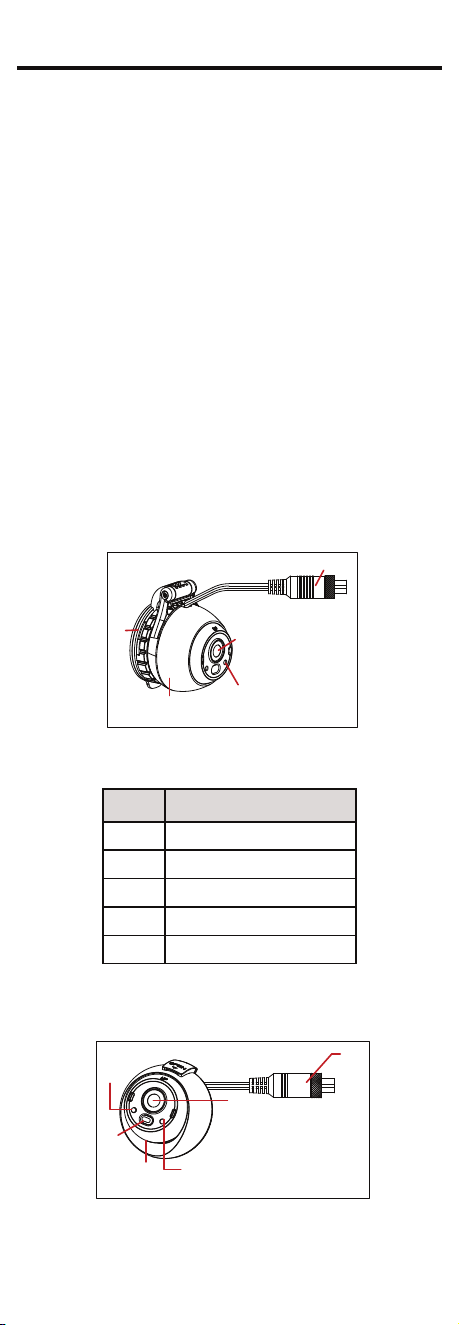
Symbol Description
Provides additional information to
emphasize or supplement important
points of the main text.
Indicates a potentially hazardous
situation, which if not avoided, could
result in equipment damage, data loss,
performance degradation,o r
unexpected results.
Indicates a hazard with a high level of risk,
which if not avoided, will result in death or
serious injury.
4
1 Introduction
1.1 Product Features
This series of camera adopts high performance sensor and
advanced circuit board design technology. It features high
resolution, low distortion, and low noise, etc. It is suitable
for monitoring system and image process system.
The main features are as follows:
Low illumination, 0.1 Lux @ (F1.2, AGC ON), 0 Lux with
IR.
High performance CMOS sensor and high resolution
bring high-quality image.
Build-in microphone.
Aviation plug design.
Advanced 3-axis design meets different installation
requirements.
1.2 Overview
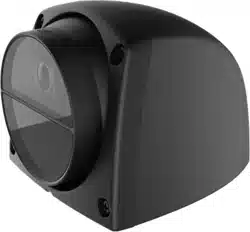
1.2.1 Overview of Type I Camera
The overview of type I camera is shown below.
1
2
3
4
5
Figure 1-1 Overview of Type I Camera
Table 1-1 Description of Type I Camera
NO. Description
1 Suction Mounting Base
2 Main Body
3 Aviation Plug
4 Lens
5 Microphone
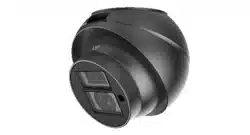
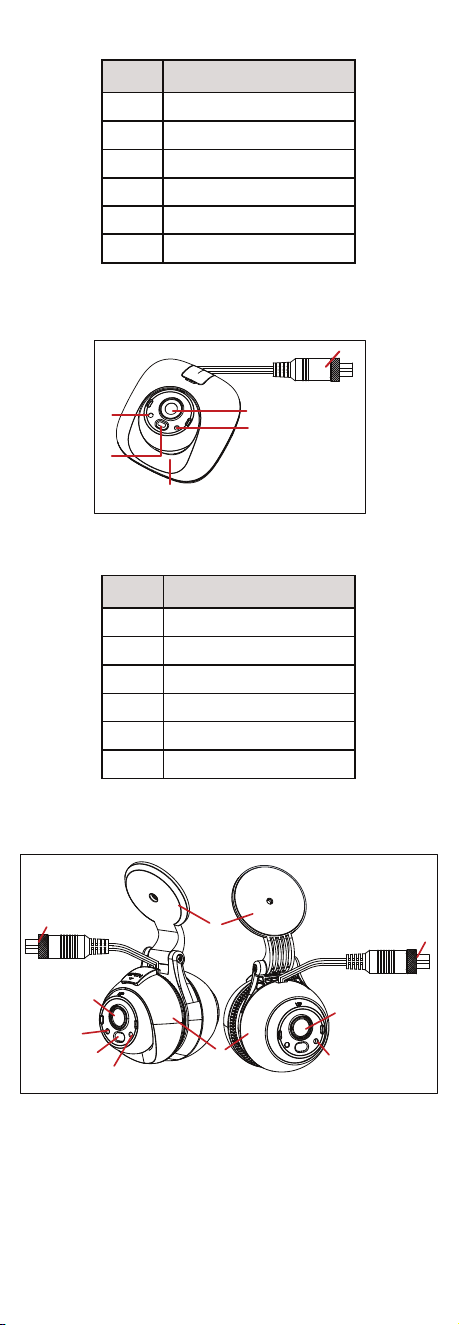
1.2.2 Overview of Type II Camera
The overview of Type II camera is shown below.
1
2
3
4
5
6
Overview of Type II CameraFigure 1-2
5
Description of Type II CameraTable 1-2
NO. Description
1 Photosensitive Resistor
2 IR LED
3 Main Body
4 Microphone
5 Lens
6 Aviation Plug
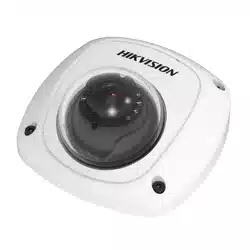
1.2.3 Overview of Type III Camera
The overview of type III camera is shown below.
1
2
3
4
5
6
Figure 1-3 Overview of Type III Camera
Table 1-3 Description of Type IIICamera
NO. Description
1 Photosensitive Resistor
2 IR LED
3 Main Body
4 Lens
5 Microphone
6 Aviation Plug
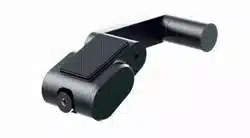
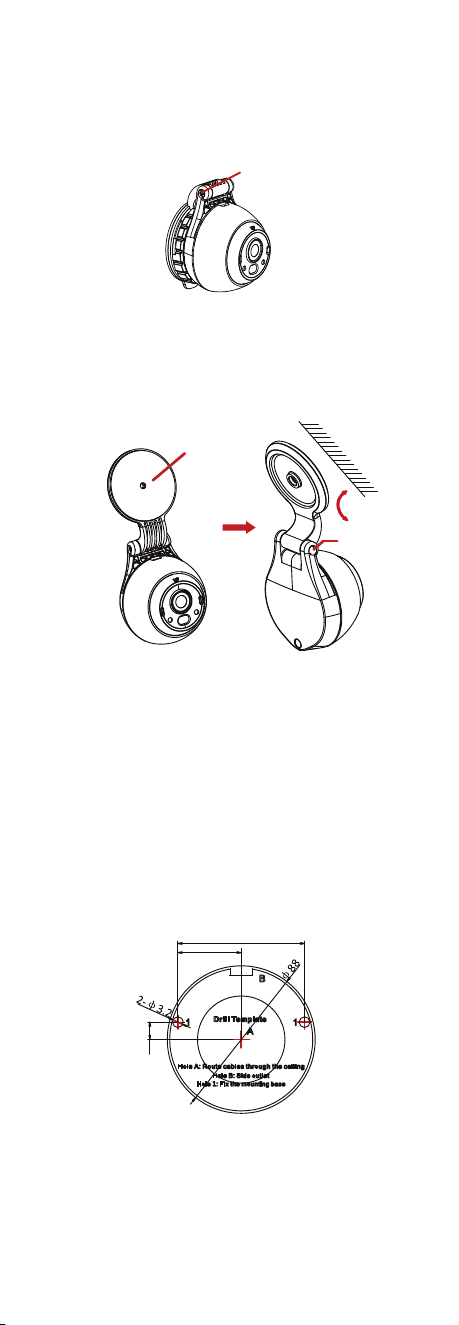
1.2.4 Overview of Type IV Camera
The overview of type IV camera is shown below.
1
2
3
4
5
3
5
4
6
7
Rearview Fore view
Overview of Type IV CameraFigure 1-4

6
Table 1-4 Description of Type IV Camera
NO. Description
1 Sunction Mounting Base
2 Main Body
3 Aviation Plug
4 Lens
5 Microphone
6 Photosensitive Resistor
7 IR LED
The rearview camera of type IV camera has IR LED and it
can monitor the inside of car. The fore view camera can
monitor the outside of car.
1.3 Interfaces of Aviation Plug
Video Interface
Audio Interface Power Supply
GND
Interfaces of Aviation PlugFigure 1-5
2 Installation
Before youstart:
Please make sure that the device in the package is in
good condition and all the assembly parts are included.
Make sure that all the related equipment is power-off
during the installation.
Check the specification of the products for the
installation environment.
Check whether the power supply is matched with your
required output to avoid damage.
Please make sure the wall is strong enough to
withstand four times the weight of the camera and
the mounting.
If the wall is the cement wall, you need to insert
expansion screws before you install the camera. If the
wall is the wooden wall, you can use self-tapping screw
to secure the camera.
If the product does not function properly, please
contact your dealer or the nearest service center. Do
not disassemble the camera for repair or maintenance
by yourself.
7
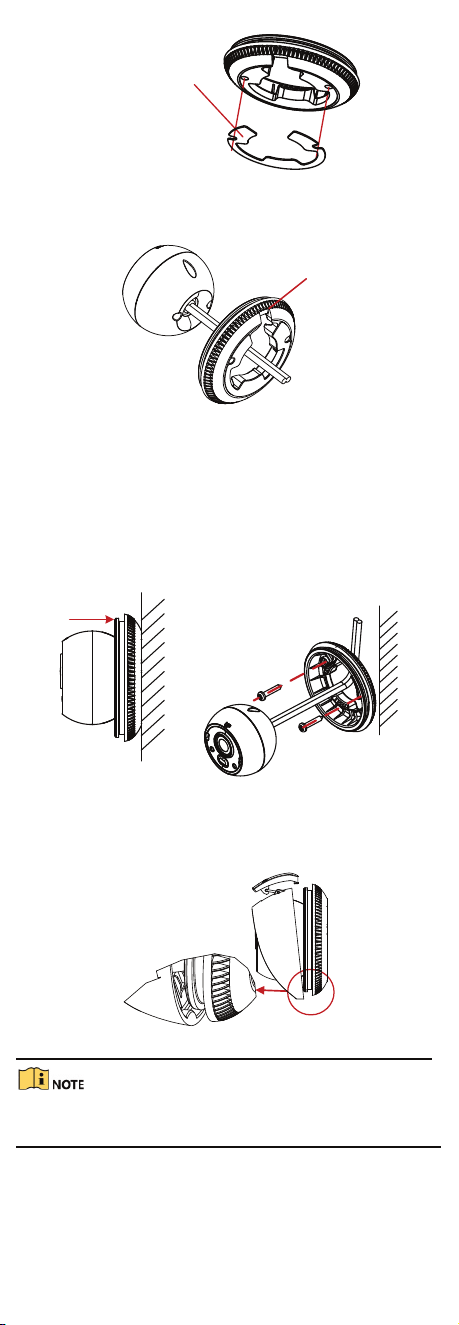
2.1 Installation of Type I Camera
This camera supports windshield mounting with sticker.
The installation steps are as follows.
Step 1 Loosen the secure screw of the camera, as
shown in Figure 2-1.
Secure Screw
Figure 2-1 Secure Screw
Step 2 Adjust the double-side tape sticker base to a
suitable installation angle.
Step 3 Press the double-side tape sticker base to the
windshield.
Secure Screw
180°
Sticker
Step 4 Adjust the camera angle.
Step 5 Secure the camera by tightening the secure
screw.
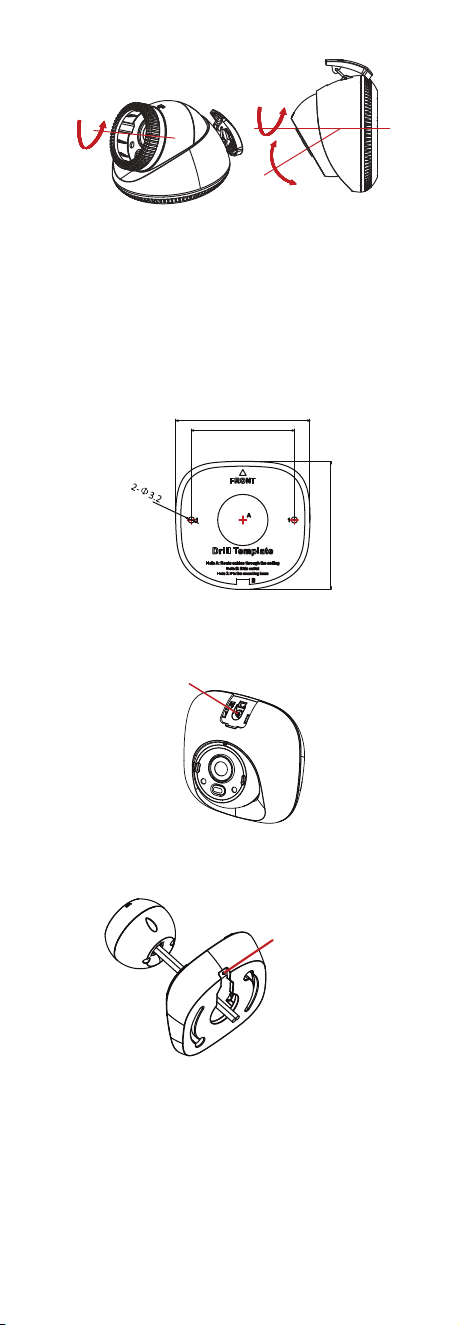
2.2 Installation of Type II Camera
This camera supports wall mounting. Two methods are
available for wall mounting of Type II camera. The
following procedures are the wall mounting application
with screws/sticker.
Step 1 Wall mounting with screws or sticker.
Attach the drill template (supplied) to the
wall.(wall mounting with screws)
37.67
18.84
5
Figure 2-2 Drill Template
Attach the sticker to the base plate and align the
notches of sticker to the screw holes. (wall
mounting with sticker)
8
Sticker
Figure 2-3 Attach the Sticker
Step 2 Route the cable through the cable hole. (in the
cable notch)
Cable Notch
Figure 2-4 Route Cables
Step 3 Fix the base plate onto the wall with screws.(wall
mounting with screws)
Step 4 Install the camera onto the wall. In Figure 2-7,
part A is for wall mounting with sticker and press
the camera to the wall. Part B is for wall
mounting with screws and use screws to install
the camera.
Press
A
B
Figure 2-5 Install the Camera
Step 5 Make sure the enclosure is properly fixed with
the base plate.
EnclosureFigure 2-6
Insert the clips of enclosure into the slot of the base
plate.
Step 6 Insert the adjustment ring into the camera to
perform the 3-axis adjustment.
9
Rotation Position Range
[0°~360°]
Pan Position Range
[0°~360°]
Tilt Position Ran ge
[0°~60°]
Figure 2-7 3-axis Adjustment
Step 7 Secure the camera by locking the lock catch.
2.3 Installation of Type III Camera
This camera supports in-ceiling mounting. The installation
steps are as follows.
Step 1 Attach the drill template (supplied) to the ceiling.
53.2
138.6
130
Figure 2-8 Drill Template
Step 2 Loosen the fixing screw and take apart the
enclosure.
Fixing Screw
Figure 2-9 Take Apart the Enclosure
Step 3 Route the cable through the cable hole. (in the
cable notch)
Cable Outlet
Figure 2-10 Route Cables
Step 4 Fix the base plate onto the wall with screws.
Step 5 Install the camera onto the ceiling.
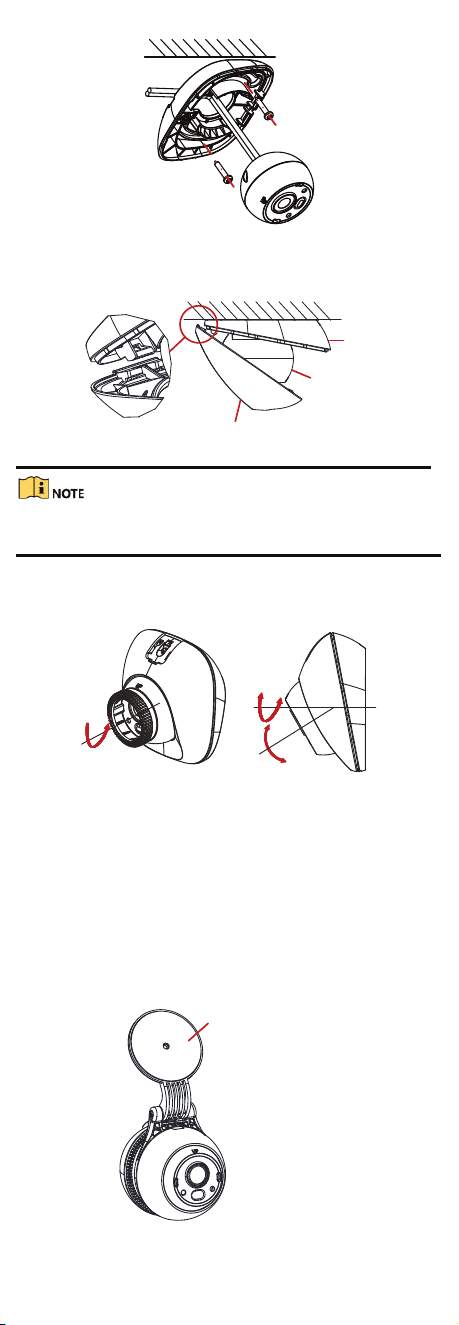
10
Figure 2-11 Install the Camera
Step 6 Make sure the enclosure is properly fixed with
the base plate.
Camera
Main Body
Base
Enclosure
Figure 2-12 Enclosure
Insert the clips of enclosure into the slot of the base
plate.
Step 7 Insert the adjustment ring into the camera to
adjust the angle of bracket position.
Rotation Position Range
[0° to 360°]
Pan Position Range
[-35° to 35°]
Tilt Position Range
[0° to 70°]
Figure 2-13 Adjust the Angle of Bracket Position
Step 8 Secure the camera by install the enclosure and
fix the fixing screw.
2.4 Installation of Type IV Camera
This camera supports suction mounting. The installation
steps are as follows.
Step 1 Tear off the protective film of the camera sticker,
as shown in the figure.
Sticker Protective Film
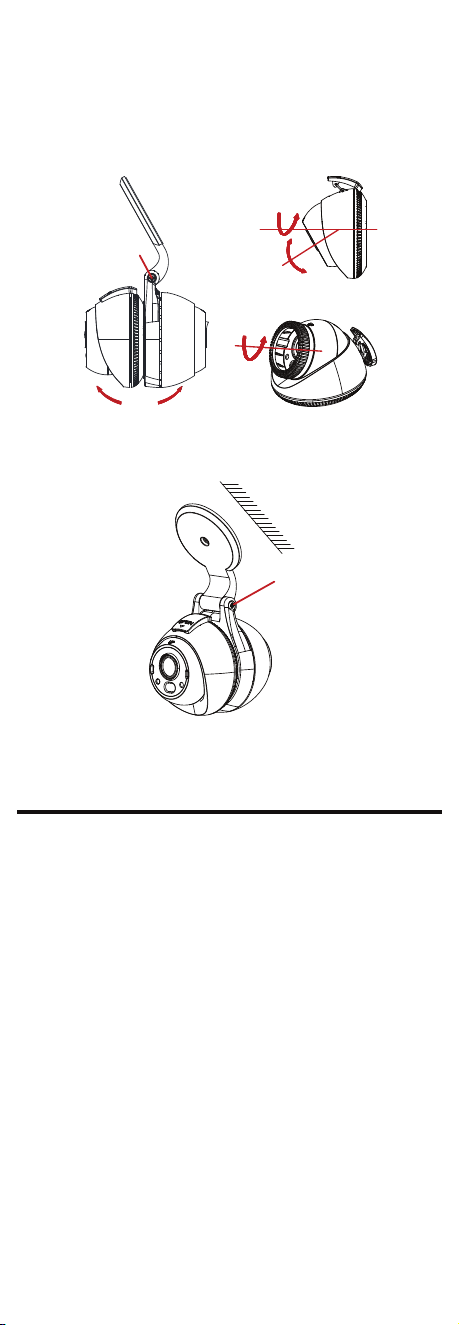
11
Figure 2-14 Sticker Protective Film
Step 2 Clear the front windshield of your vehicle and
stick the camera onto it.
Step 3 Adjust the camera angle.
Step 4 Insert the adjustment ring into the camera to
perform the 3-axis adjustment.
90°
Secure Screw
Rotation Position Range
[0° to 360°]
Pan Position Range
[0° to 360°]
Tilt Position Range
[0° to 60°]
Figure 2-15 3-axis Adjustment
Step 5 Secure the camera by tightening the secure
screw.
Secure Screw
Secure the cameraFigure 2-16
3 PTZ Control
The PTZ function is only supported in vehicle mounted
TVI dome camera, you can realize the related functions by
calling presets. The details show as follows.
3.1 Camera Control
Restart the Camera
You can restart the camera by calling the preset NO.
94.
Restore Default Settings
You can restore default settings by calling the preset
NO. 144
3.2 Day/Night Switch Mode
AGC mode can be realized via AGC judgement and IR
mode can be realized via photosensitive resistor.
Enable AGC Mode
You can enable AGC mode by calling preset No. 125.

12
Enable IR mode
You can enable IR mode by calling preset No. 126.
3.3 IR LED Control
Enable IR LED:
You can enable IR LED by calling preset NO. 130.
Disable IR LED
You can disable IR LED by calling preset NO.131.
3.4 Mirror Mode
Disable Mirror Mode
You can disable mirror mode by calling preset No. 140.
Flip the Image Vertical
You can flip the image vertical by calling preset No.
141.
Flip the Image Horizontal
You can flip the image horizontal by calling preset No.
142.
Flip the Image Vertical and Horizontal
You can flip the image vertical and horizontal by
calling preset No. 143.
3.5 Image Settings
Display Color Image
You can display color image by calling preset NO. 147.
Display Black/White Image
You can display black/white image by calling preset
NO.148.
Auto
You can display the image automatically by calling
preset NO. 149.
Enable Vibration-proof
You can enable vibration-proof by calling preset NO.
150.
Disable Vibration-proof
You can disable vibration-proof by calling preset NO.
151.