User Guide
English ( 2 – 6 )
Guía del usuario
Español ( 7 – 11 )
Guide d'utilisation
Français ( 12 – 16 )
Guida per l'uso
Italiano ( 17 – 21 )
Benutzerhandbuch
Deutsch ( 22 – 25 )
Appendix
English ( 26 – 27 )
2
User Guide (English)
Introduction
Box Contents
M-Track Duo
USB-B–to–USB-A Cable
Software Download Cards
User Guide
Safety & Warranty Manual
Support
For the latest information about this product (system requirements, compatibility information,
etc.) and product registration, visit m-audio.com.
For additional product support, visit m-audio.com/support.
Quick Start
macOS users: No driver installation is needed for class-compliant operation with M-Track
Duo.
iOS users: The power available from an iOS device is not sufficient to power M-Track Duo.
Use the Apple Camera Connection Kit (sold separately), a USB break-out cable (sold
separately), and a USB power adapter (sold separately) which will provide an additional USB
connector to power M-Track Duo.
Windows users: Before connecting M-Track Duo to your computer, install the drivers:
1. Go to m-audio.com/drivers and download the latest M-Track Duo driver for your
operating system.
2. Open the file you downloaded and double-click the driver installer file.
3. Follow the on-screen instructions to install the drivers.
Software: We've included Pro Tools | First M-Audio Edition and MPC Beats with your
M-Track Duo so you can get started making music with professional software right out of the
box. Register your M-Track Duo on m-audio.com/softwaredownload, and follow the install
instructions in your User Account.
Virtual Instruments: Follow the instructions in your user account for installing the included
virtual instrument plugins. After installation, most DAWs will not load virtual instrument plugins
automatically. In order to access the virtual instrument plugins with Pro Tools | First M-Audio
Edition, you will need to choose the plugin folder for the software to scan:
Pro Tools | First M-Audio Edition (AAX) plugin folders:
Windows (32-bit): C:\Program Files (x86)\Common Files\Avid\Audio\Plug-Ins
Windows (64-bit): C:\Program Files\Common Files\Avid\Audio\Plug-Ins
macOS: Macintosh HD/Library/Application Support/Avid/Audio/Plug-Ins
3
To set M-Track Duo as your default playback device, follow the directions below based on
your computer’s operating system.
Windows:
1. Use the included USB cable to connect the M-Track Duo to your computer.
2. In the Taskbar, locate the Volume Control "speaker" icon. Right-click the speaker and
open Sound Settings > Sounds.
Alternatively, go to Start Menu > System > Sound > Sound Control Panel.
3. In the Windows Sound control panel select the Playback tab and select USB Audio
Codec as the default device.
4. Click the Recording tab and select USB Audio Codec as the default device.
5. Click Properties in the lower right-hand corner.
6. In the new window, click the Advanced tab and select 2-channel, 16-bit, 48000 Hz
(Studio Quality) as the default format.
7. Uncheck both boxes under Exclusive Mode.
8. Click OK to close the Properties window.
9. Click OK to close the Sound control panel.
macOS:
1. Use the included USB cable to connect the M-Track Duo to your computer.
2. Go to Applications > Utilities > Audio MIDI Setup.
3. In the Audio Devices window, select USB Audio Codec in the left column.
4. Right-click USB Audio Codec, and select Use this device for sound input.
5. Right-click USB Audio Codec, and select Use this device for sound output.
6. Quit Audio MIDI Setup.
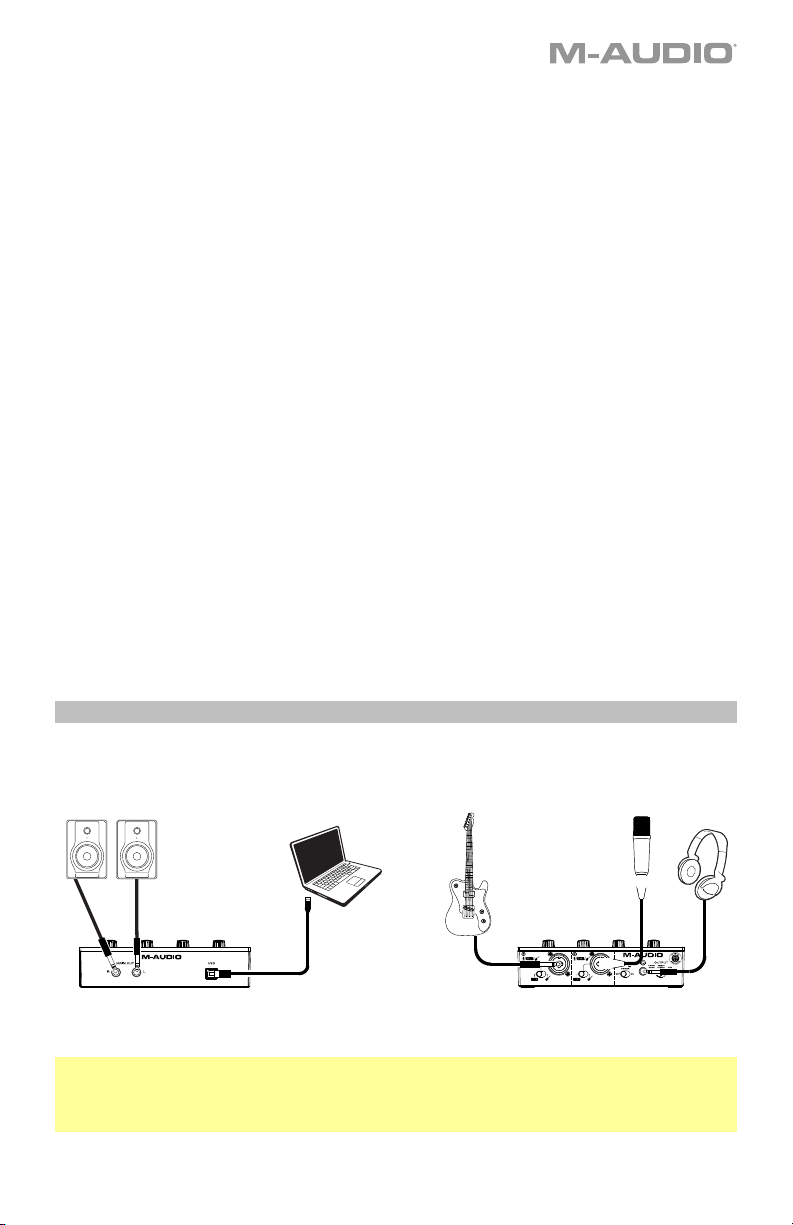
Connection Diagram
Items not listed under Introduction > Box Contents are sold separately.
Note: Use the +48V (Phantom Power) Switch only if a microphone requires phantom power.
Most dynamic microphones and ribbon microphones do not require phantom power, but most
condenser microphones do. Consult your microphone's documentation to find out whether it
needs phantom power.
Front Panel
Rear Panel
Monitors
Headphones
Guitar
Computer
Microphone

4
Setting Up M-Track Duo with Your Software
Setting Up M-Track Duo with Pro Tools | First M-Audio Edition
1. Use the included USB cable to connect the M-Track Duo to your computer.
2. Open Pro Tools | First M-Audio Edition.
3. Go to Setup > Playback Engine….
4. Open the Playback Engine dropdown menu and select USB Audio Codec.
Note: You may need to save and restart your project.
5. Select your Sample Rate and then click OK to close the Setup window.
You can now add tracks to send and receive audio from sources connected to M-Track Duo
inputs and stream recorded audio back through the M-Track Duo outputs.
Setting Up M-Track Duo with MPC Beats
1. Use the included USB cable to connect the M-Track Duo to your computer.
2. Open MPC Beats.
3. Go to Edit > Preferences….
4. For Windows Users: In the Audio window, select ASIO under the Audio Device Type
dropdown menu. In the Device dropdown menu, select M-Track Solo and Duo ASIO.
For MacOS Users: In the Audio window, select USB Audio Codec under the Output
and Input dropdown menus.
Note: You may need to save and restart your project.
5. Select your Sample Rate and then click OK to close the Preferences window.
You can now add tracks to send and receive audio from sources connected to M-Track
Duo inputs and stream recorded audio back through the M-Track Duo outputs.
5
Features
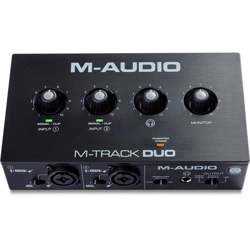
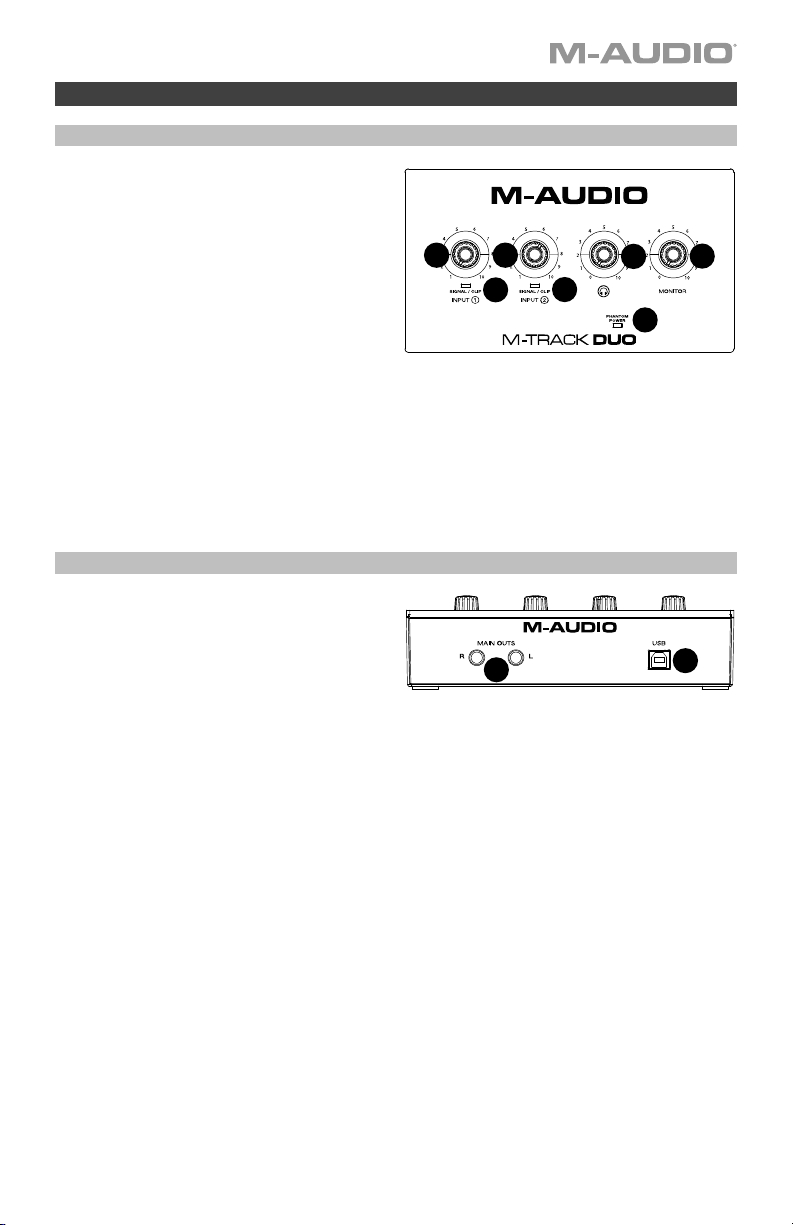
Top Panel
1. Input Gain: Adjusts the input's gain
level. Set this knob so the corresponding
Signal/Clip LED (located below the
knob) displays a "healthy" level during
performance—but not so high that the
LED "clips" or peaks, causing distortion
in the audio.
2. Signal/Clip LED: The LED will light up
green when an input signal is detected.
The LED will light up red if the signal
level is too high which may cause
distortion or “clipping”. If this occurs,
turn down the Input Gain and/or reduce
the output level from your sound source.
3. Headphone Level: Adjusts the output volume of the Headphone Output.
4. Monitor Level: Adjusts the output volume of Main Outputs, which should be connected
to your powered monitors or amplifier system.
5. +48V (Phantom Power) LED: Lights up when phantom power is engaged.
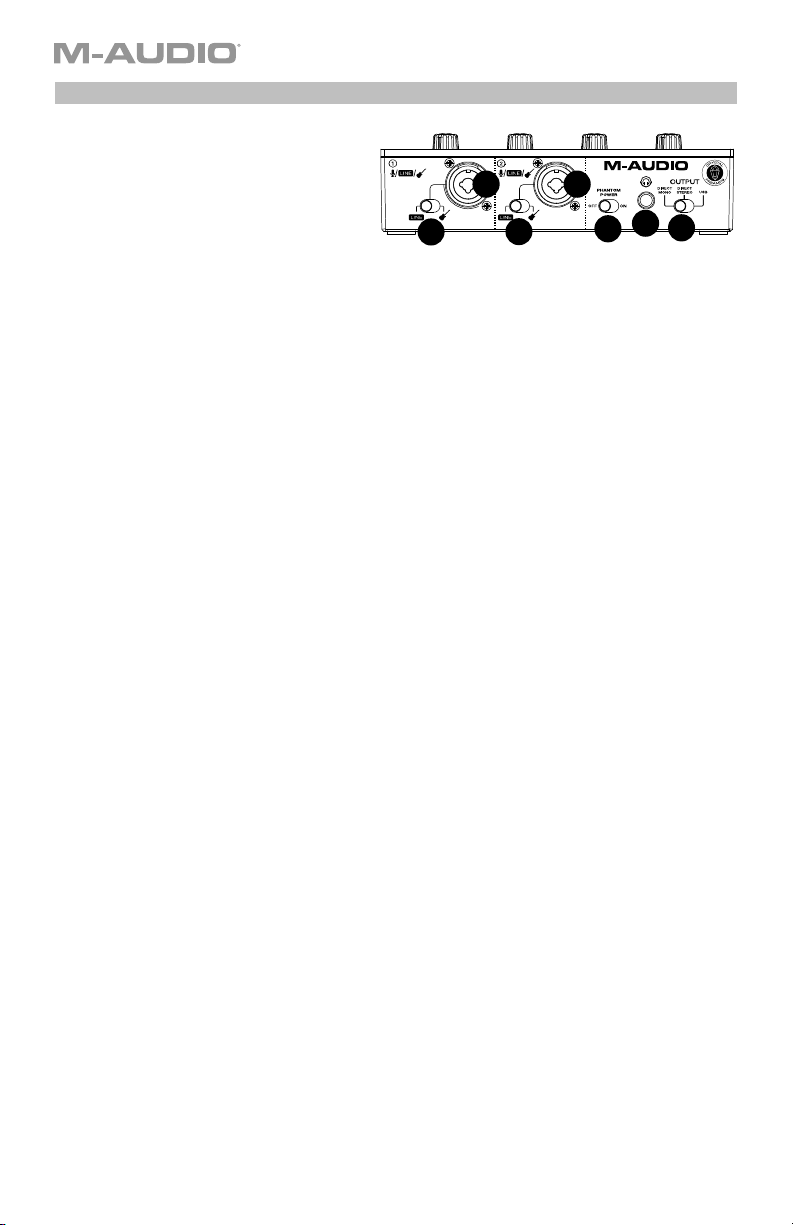
Rear Panel
1. USB Port (Type B): This connection will
allow you to send audio to and from a
computer. Use the included USB-B-to-
USB-A cable to connect the M-Track
Duo to a computer. The M-Track Duo
requires a USB 2.0 connection (or
higher).
2. Main Outputs: Use standard 1/4" (6.35
mm) TRS cables to connect these
outputs to your powered monitors,
amplifier system, etc. The mix you hear
from these outputs will be determined by
the Direct Mono/Direct Stereo/USB
Switch. The level of these outputs is
controlled by the Monitor Level knob.
1
2
1 1
2
2
3
4
5
6
Front Panel
1. Combo Input: Connect a
microphone, a guitar or bass with an
active pickup, or a line-level device
to this input. For microphones, use
an XLR or 1/4” (6.35 mm) TRS cable.
For a guitar or bass with an active
pickup, use a standard 1/4” (6.35
mm) TS cable. For line-level signals,
use a 1/4" (6.35 mm) TRS cable.
2. Line/Instrument Switch: Set the
switch to Line when connecting a microphone, or keyboard. Set the switch to
Instrument when connecting a guitar or bass.
3. +48V (Phantom Power) Switch: This switch activates and deactivates phantom power.
When activated (lit), phantom power supplies +48 volts to the Combo Input. Please note
that most dynamic microphones and ribbon microphones do not require phantom power,
while most condenser microphones do. Consult your microphone's documentation to
find out whether it needs phantom power.
4. Headphone Output: Connect 1/4" (6.35 mm) TRS headphones to this output. The mix
you hear from this output will be determined by the Direct Mono/Direct Stereo/USB
Switch. The level of this output is controlled by the Headphone Level knob.
5. Direct Mono/Direct Stereo/USB Switch: This switch controls whether or not the mono
direct input signal, the stereo direct input signal, or the USB stream return signal is sent
to the Headphone Output and Main Outputs.
• When set to USB, only the USB audio playback from your computer will be heard.
• Set the switch to Direct Mono to monitor the direct input signal with all inputs
summed and heard equally on each side. This is useful for monitoring a guitar or
vocal mic signal. This switch does not affect the DAW playback or how your sound
is recorded into your DAW; it only affects how you hear the input signal in the
Headphone Output and Main Outputs.
• Set the switch to Direct Stereo to monitor the direct input signal with Input 1 in the
left channel and Input 2 in the right channel. This is useful if you want to directly
monitor a stereo mic setup such as a stereo signal from a keyboard, or overhead
drum mics.
11
2
2
3
4
5