@
AV Receiver
"r
Owner's Manual
Read the supplied booklet "Safety Brochure" before using the unit.
English
CONTENTS
Accessories ...................................................... 4
FEATURES 5
What you can do with the unit .................................... 5
Part names and functions ........................................ 7
Front panel ........................................................................................ 7
Front display (indicators) ........................................................................... 8
Rear panel ......................................................................................... g
Remote control ................................................................................... 10
PREPARATIONS 11
General setup procedure ........................................ 11
1 Placing speakers .............................................. 12
2 Connecting speakers .......................................... 15
Input/output jacks and cables ................................... 17
3 Connecting a TV ............................................... 18
4 Connecting playback devices .................................. 23
Connecting video devices (such as BD/DVD players) ............................................... 23
Connecting audio devices (such as CD players) ..................................................... 25
Connecting to the jacks on the front panel ......................................................... 26
5 Connecting the FM/AM antennas ............................... 26
6 Connecting recording devices .................................. 27
7 Connecting the power cable ................................... 27
8 Selecting an on-screen menu language ......................... 28
9 Optimizing the speaker settings automatically (YPAO) .......... 29
Error messages .................................................................................... 31
Warning messages ................................................................................ 32
PLAYBACK 33
Basic playback procedure ....................................... 33
Switching information on the front display ......................................................... 33
Selecting the input source and favorite settings with one touch
(SCENE) ........................................................ 34
Configuring scene assignments .................................................................... 34
Selecting the sound mode ....................................... 35
Enjoying sound field effects (CINEMA DSP) ......................................................... 36
Enjoying unprocessed playback ................................................................... 38
Enjoying compressed music with enhanced sound (Compressed Music Enhancer) ................... 39
Enjoying surround sound with headphones (SILENT CINEMA) ....................................... 39
Listening to FM/AM radio ....................................... 40
Setting the frequency steps ........................................................................ 40
Selecting a frequency for reception ................................................................ 40
Registering favorite radio stations (presets) ........................................................ 41
Radio Data System tuning ......................................................................... 43
Playing back iPod music ......................................... 44
Connecting an iPod ............................................................................... 44
Playback of iPod content .......................................................................... 45
Playing back music stored on a USB storage device ............... 48
Connecting a USB storage device .................................................................. 48
Playback of USB storage device contents ........................................................... 48
Configuring playback settings for different playback sources
(Option menu) .................................................. 51
Option menu items ................................................................................ 51
En 2
CONFIGURATIONS 54
Configuring various functions (Setup menu) ...................... 54
Setup menu items ................................................................................ 55
Speaker ........................................................................................... 57
HDMI ............................................................................................. 59
Sound ............................................................................................ 61
ECO .............................................................................................. 62
Function .......................................................................................... 63
Language ......................................................................................... 64
Configuring the system settings (ADVANCED SETUP menu) ........ 65
ADVANCED SETUP menu items .................................................................... 65
Changing the speaker impedance setting (SP IMP.) ................................................. 65
Selecting the remote control ID (REMOTE ID) ....................................................... 65
Changing the FM/AM tuning frequency setting (TU) ................................................ 66
Switching the video signal type (TV FORMAT) ...................................................... 66
Restoring the default settings (INIT) ................................................................ 66
Updating the firmware (UPDATE) .................................................................. 66
Checking the firmware version (VERSION) .......................................................... 66
APPENDIX 67
Yamaha technologies ............................................................................. 74
Video signal flow .................................................................................. 75
Information on HDMI ........................................... 75
HDMI Control ..................................................................................... 75
HDMI signal compatibility ......................................................................... 76
Reference diagram (rear panel) .................................. 77
Trademarks .................................................... 78
Specifications .................................................. 79
Index .......................................................... 81
Frequently asked questions ..................................... 67
Troubleshooting ................................................ 68
Power, system and remote control ................................................................. 68
Audio ............................................................................................. 69
Video ............................................................................................. 70
FM/AM radio ...................................................................................... 71
USB ............................................................................................... 71
Error indications on the front display ............................. 72
Glossary ........................................................ 73
Audio information ................................................................................ 73
HDMI and video information ...................................................................... 74
En 3
Accessories
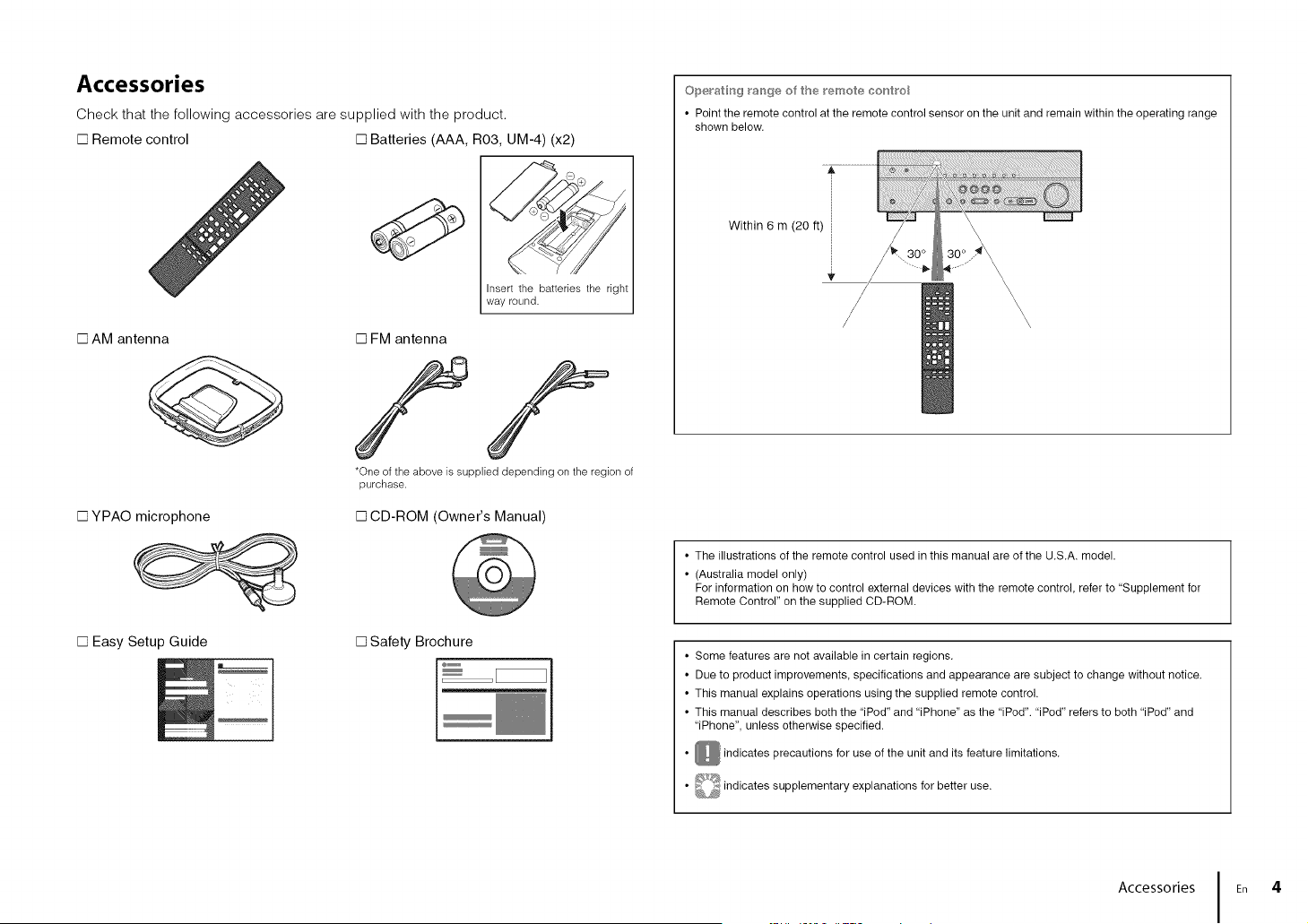
Check that the following accessories are supplied with the product.
[] Remote control [] Batteries (AAA, R03, UM-4) (x2)
Insert the batteries the right
way round.
[] AM antenna
[] YPAO microphone
[] FM antenna
fF
*One of the above is supplied depending on the region of
purchase.
[] CD-ROM (Owner's Manual)
[] Easy Setup Guide [] Safety Brochure
Operathg rar'}ge of the r_mete cor'_t_o_
• Point the remote control at the remote control sensor on the unit and remain within the operating range
shown below.
Within 6 m (20 ft)
• The illustrations of the remote control used in this manual are of the U.S.A. model.
• (Australia model only)
For information on how to control external devices with the remote control, refer to "Supplement for
Remote Control" on the supplied CD-ROM
• Some features are not available in certain regions.
• Due to product improvements, specifications and appearance are subject to change without notice.
• This manual explains operations using the supplied remote control.
• This manual describes both the "iPod" and "iPhone" as the '1Pod". "iPod" refers to both "iPod" and
"iPhone", unless otherwise specified.
• _ indicates precautions for use of the unit and its feature limitations.
• _ indicates supplementary explanations for better use.
Accessories En 4
FEATURES
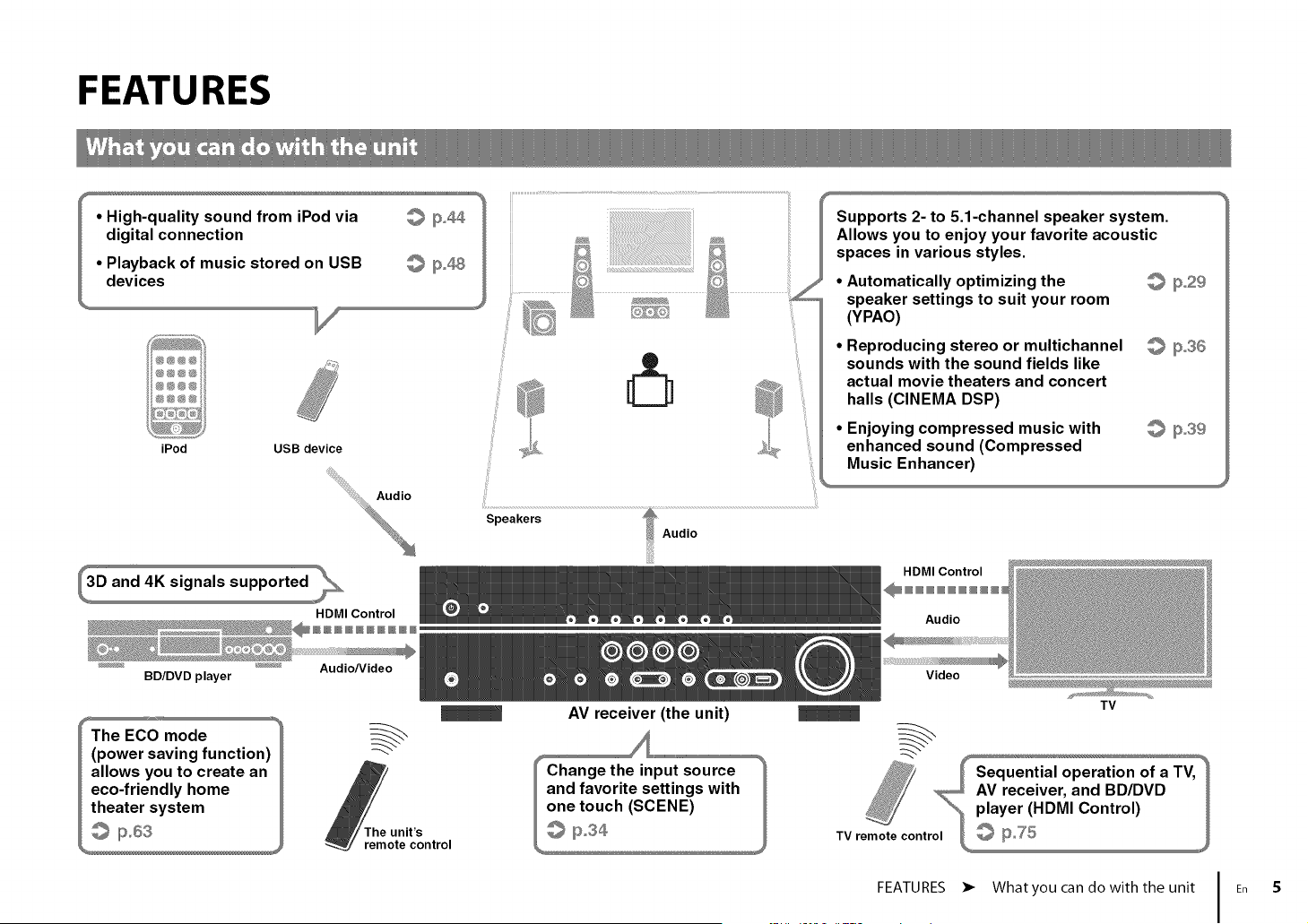
• High-quality sound from iPod via
digital connection
• Playback of music stored on USB
devices
iPod USB device
Audio
and 4K signals supported
HDMI Control
@
_*_ _ Audio/Video
BD/DVD player
The ECO mode
(power saving function)
allows you to create an
eco-friendly home
theater system
© ipo6s
_ unit's
__rT_hme ot e control
Speakers
AV receiver (the unit)
Supports 2- to 5.1-channel speaker system.
Allows you to enjoy your favorite acoustic
spaces in various styles.
• Automatically optimizing the
speaker settings to suit your room
(YPAO)
111929
• Reproducing stereo or multichannel
sounds with the sound fields like
actual movie theaters and concert
halls (CINEMA DSP)
111936
• Enjoying compressed music with _ 111939
enhanced sound (Compressed
Music Enhancer)
HDMI Control
Audio
Video
TV
FEATURES • Whatyou can do with the unit En 5
Full of useful functions! Useful tips
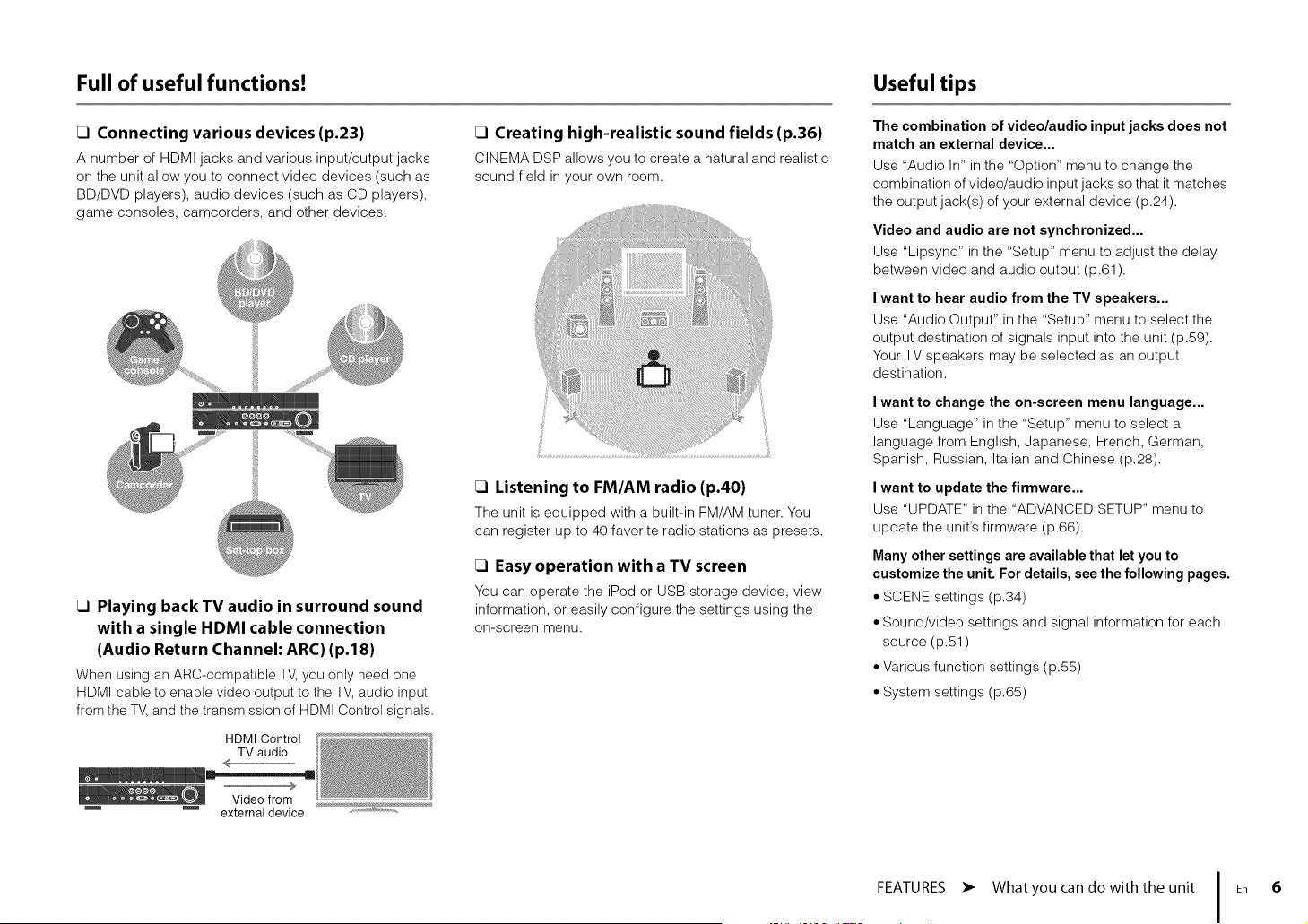
17 Connecting various devices (p.23)
A number of HDMI jacks and various input/output jacks
on the unit allow you to connect video devices (such as
BD/DVD players), audio devices (such as CD players),
game consoles, camcorders, and other devices.
17 Creating high-realistic sound fields (p.36)
CINEMA DSP allows you to create a natural and realistic
sound field in your own room.
17 Playing backTV audio in surround sound
with a single HDMI cable connection
(Audio Return Channel: ARC) (p.18)
When using an ARC-compatible TV,you only need one
HDMI cable to enable video output to the TV,audio input
from theTV,and the transmissionof HDMIControl signals.
HDMI Control
TV audio
17 Listening to FM/AM radio (p.40)
The unit is equipped with a built-in FM/AM tuner. You
can register up to 40 favorite radio stations as presets.
17 Easy operation with a TV screen
You can operate the iPod or USB storage device, view
information, or easily configure the settings using the
on-screen menu.
The combination of video/audio input jacks does not
match an external device...
Use "Audio In" in the "Option" menu to change the
combination of video/audio input jacks so that it matches
the output jack(s) of your external device (p.24).
Video and audio are not synchronized...
Use "Lipsync" in the "Setup" menu to adjust the delay
between video and audio output (p.61).
I want to hear audio from the TV speakers...
Use "Audio Output" in the "Setup" menu to select the
output destination of signals input into the unit (p.59).
Your TV speakers may be selected as an output
destination.
I want to change the on-screen menu language...
Use "Language" in the "Setup" menu to select a
language from English, Japanese, French, German,
Spanish, Russian, Italian and Chinese (p.28).
I want to update the firmware...
Use "UPDATE" in the "ADVANCED SETUP" menu to
update the unit's firmware (p.66).
Many other settings are available that let you to
customize the unit. For details, see the following pages.
• SCENE settings (p.34)
• Sound/video settings and signal information for each
source (p.51)
• Various function settings (p.55)
• System settings (p.65)
FEATURES • Whatyou can do with the unit En 6
Front panel
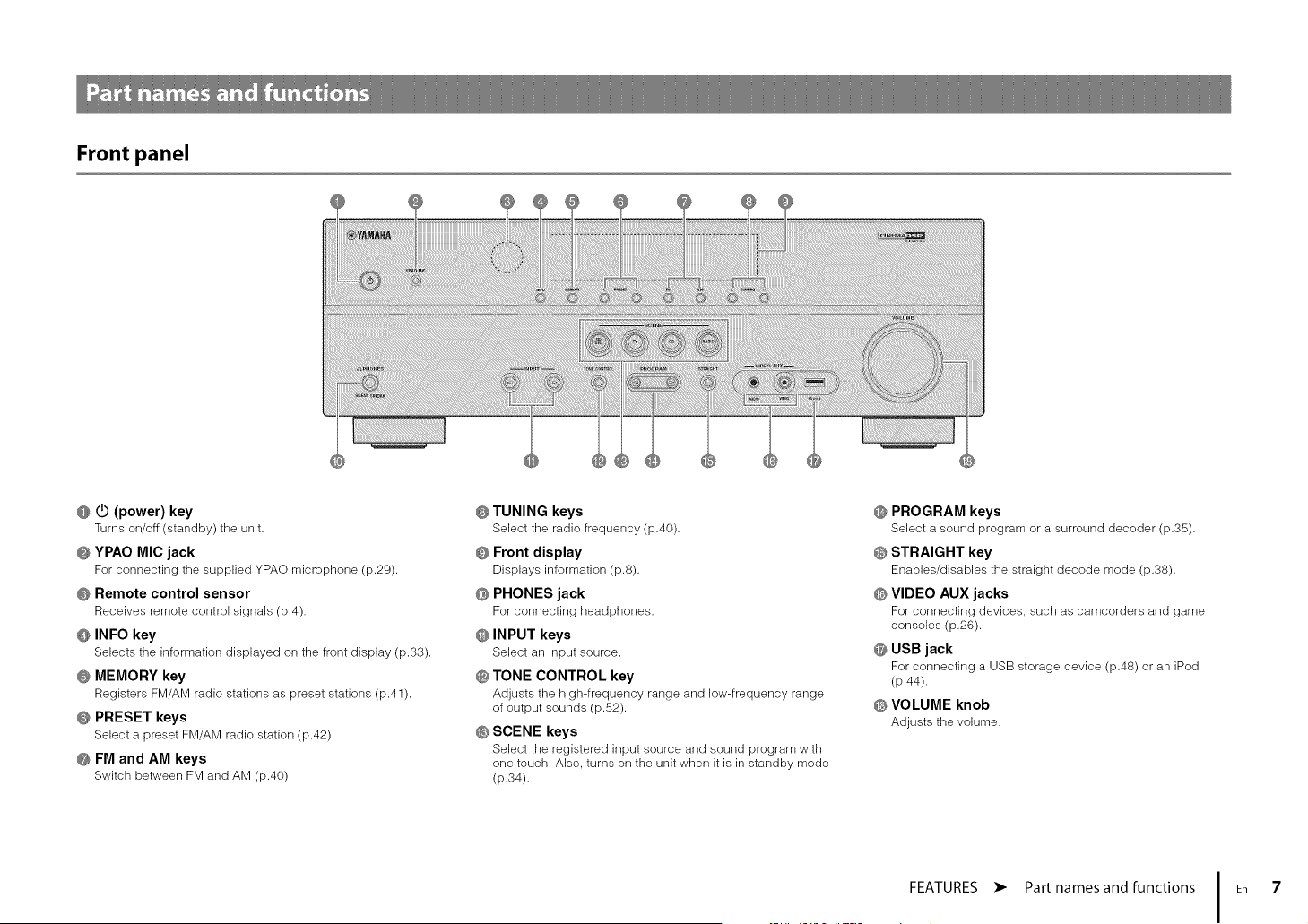
@ @ (power) key
Turns on/off (standby) the unit.
@ YPAO MIC jack
Forconnecting the supplied YPAOmicrophone (p.29).
@ Remote control sensor
Receives remote control signals (p.4).
@ INFO key
Selects tile information displayed on tile front display (p.33).
@ MEMORY key
Registers FM/AM radio stations as preset stations (p.41).
@ PRESET keys
Select a preset FM/AM radio station (p.42).
@ FM and AM keys
Switch between FM and AM (p.40).
@ TUNING keys
Select tile radio frequency (p.40).
@ Front display
Displays information (p.8).
@ PHONES jack
For connecting headphones.
@ INPUT keys
Select an input source.
@ TONE CONTROL key
Adjusts the high-frequency range and low-frequency range
of output sounds (p.52).
@ SCENE keys
Select the registered input source and sound program with
one touch. Also, turns on the unit when it is in standby mode
(p.34).
@ PROGRAM keys
Select a sound program or a surround decoder (p.35).
@ STRAIGHT key
Enables/disables the straight decode mode (p.38).
@ VIDEO AUX jacks
For connecting devices, such as camcorders and game
consoles (p.26).
@ USB jack
For connecting a USB storage device (p.48) or an iPod
(p.44).
@ VOLUME knob
Adjusts the volume.
FEATURES • Part names and functions En 7
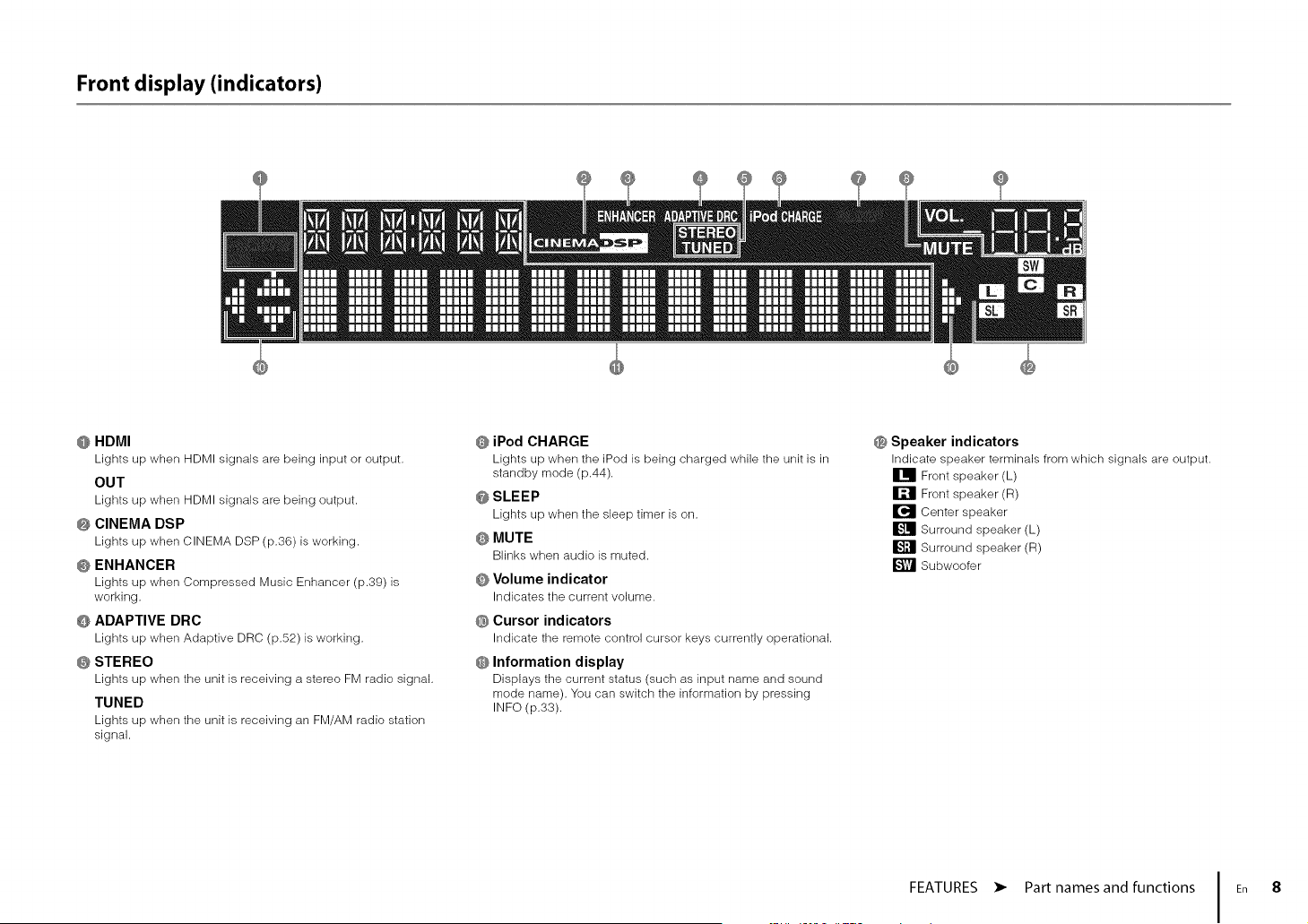
Front display (indicators)
@ HDMI
Lights up when HDMI signals are being input or output.
OUT
Lights up when HDMI signals are being output.
@ CINEMA DSP
Lights up when CINEMA DSP (p.36) is working.
@ ENHANCER
Lights up when Compressed Music Enhancer (p.39) is
working.
@ ADAPTIVE DRC
Lights up when Adaptive DRC (p.52) is working.
@ STEREO
Lights up when the unit is receiving a stereo FM radio signal.
TUNED
Lights up when the unit is receiving an FM/AM radio station
signal.
@ iPod CHARGE
Lights up when the iPod is being charged while the unit is in
standby mode (p.44).
@ SLEEP
Lights up when tile sleep timer is on.
@ MUTE
Blinks when audio is muted.
@ Volume indicator
Indicates tile current volume.
@ Cursor indicators
Indicate tile remote control cursor keys currently operational.
@ Information display
Displays tile current status (such as input name and sound
mode name). You can switch the information by pressing
INFO (p.33).
@ Speaker indicators
Indicate speaker terminals from which signals are output.
Front speaker (L)
Front speaker (R)
Center speaker
Surround speaker (L)
Surround speaker (R)
Subwoofer
FEATURES • Part names and functions En 8
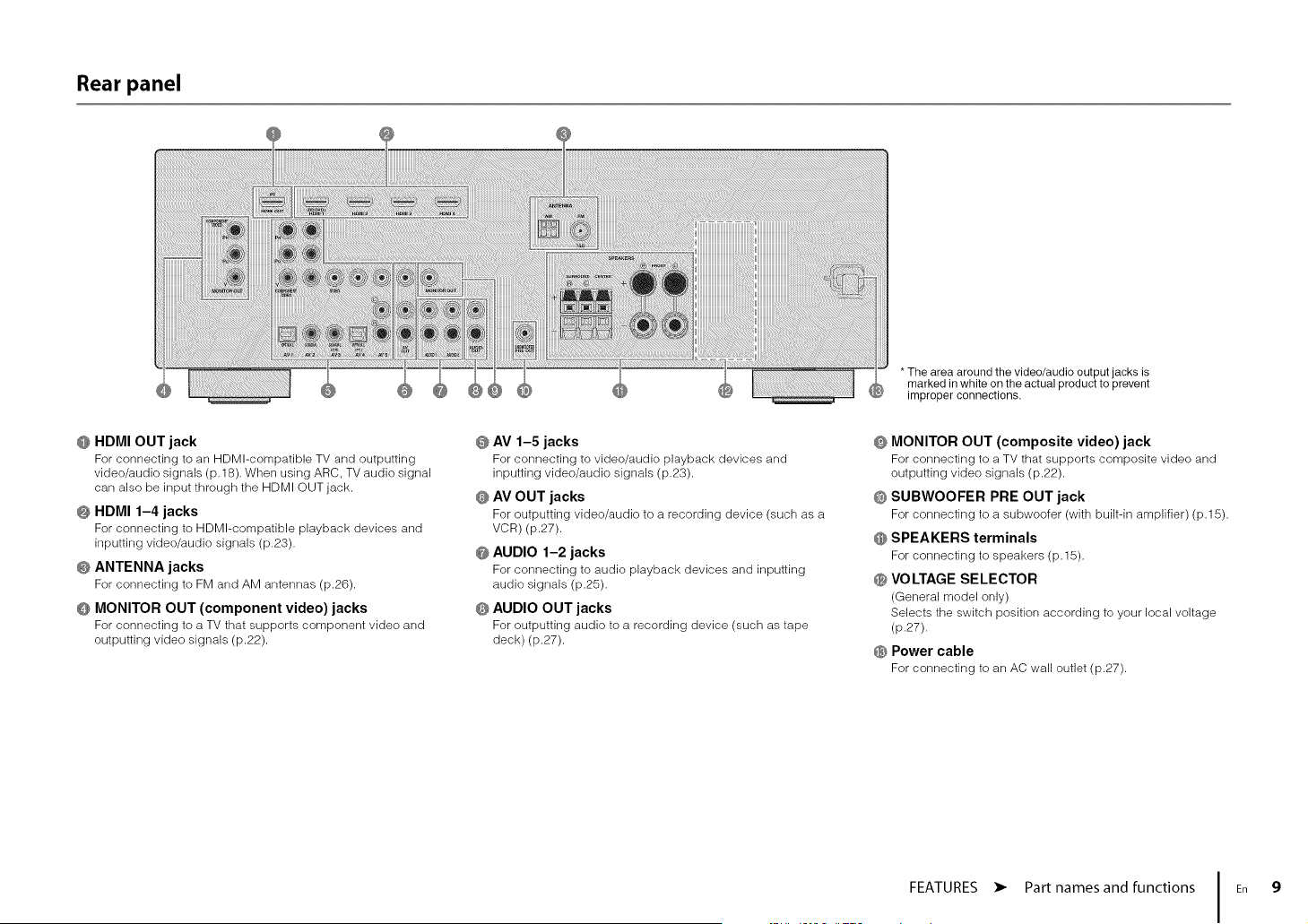
Rear panel
*The area around the video/audio output jacks is
marked in white on the actual product to prevent
improper connections.
@ HDMI OUT jack
For connecting to an HDMI-compatible TV and outputting
video/audio signals (p.18). When using ARC, TV audio signal
can also be input through the HDMI OUT jack.
@ HDMI 1-4 jacks
For connecting to HDMI-compatible playback devices and
inputting video/audio signals (p.23).
@ ANTENNA jacks
For connecting to FM and AM antennas (p.26).
@ MONITOR OUT (component video) jacks
For connecting to a TV that supports component video and
outputting video signals (p.22).
@ AV 1-5 jacks
For connecting to video/audio playback devices and
inputting video/audio signals (p.23).
@ AV OUT jacks
For outputting video/audio to a recording device (such as a
VCR) (p.27).
@ AUDIO 1-2 jacks
For connecting to audio playback devices and inputting
audio signals (p.25).
@ AUDIO OUT jacks
For outputting audio to a recording device (such as tape
deck) (p.27).
@ MONITOR OUT (composite video) jack
For connecting to a TV that supports composite video and
outputting video signals (p.22).
@ SUBWOOFER PRE OUT jack
For connecting to a subwoofer (wkh built-in amplifier) (p.15).
@ SPEAKERS terminals
For connecting to speakers (p.15).
@ VOLTAGE SELECTOR
(General model only)
Selects the switch position according to your local voltage
(p.27).
@ Power cable
For connecting to an AC wall outlet (p.27).
FEATURES • Part names and functions En 9
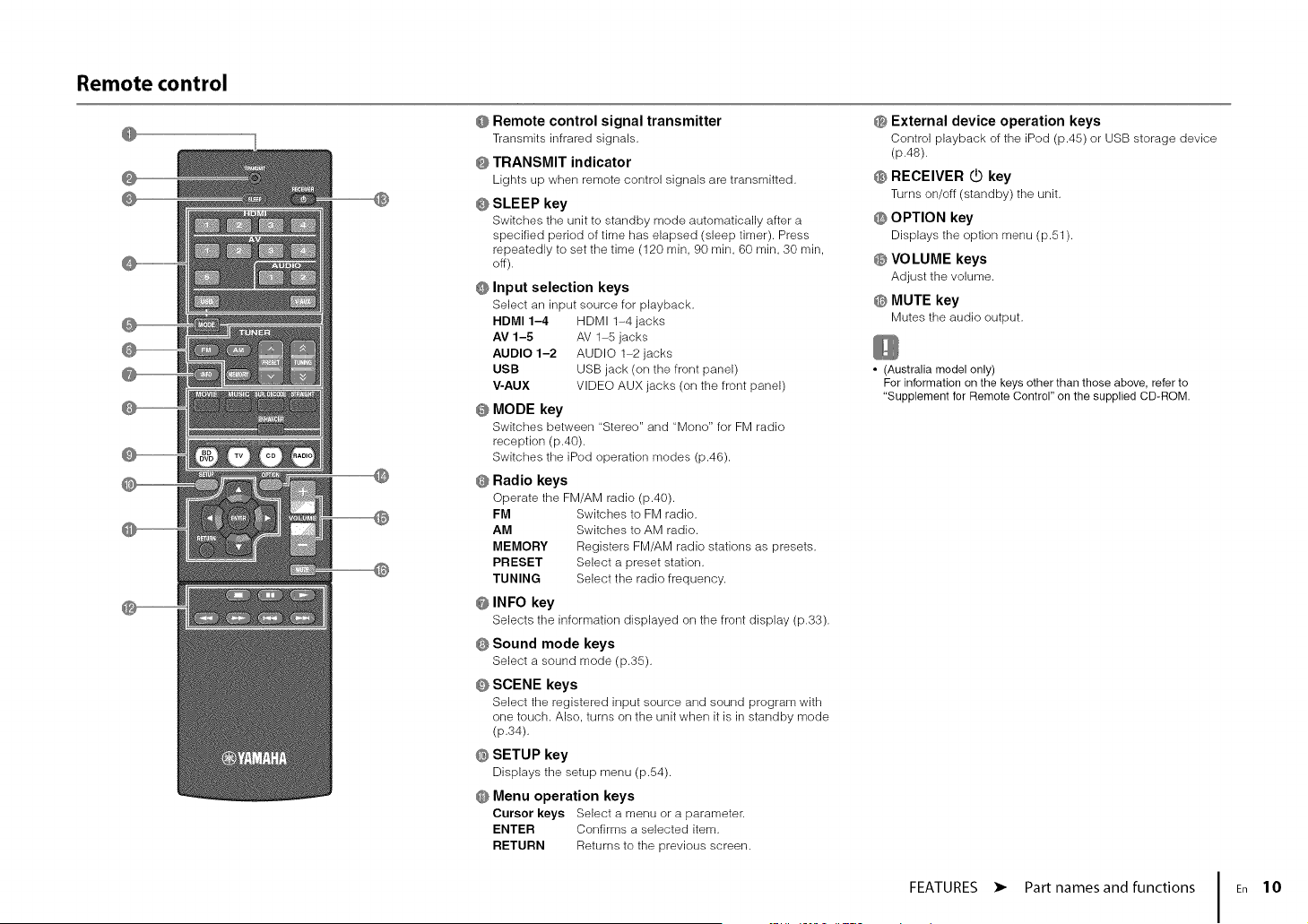
Remote control
@
@
@
@ @
@ Remote control signal transmitter
Transmits infrared signals.
@ TRANSMIT indicator
Lights up when remote control signals are transmitted.
@ SLEEP key
Switches the unit to standby mode automatically after a
specified period of time has elapsed (sleep timer). Press
repeatedly to set the time (120 min, 90 min, 60 min, 30 min,
off).
@ Input selection keys
Select an input source for playback.
HDMI 1-4 HDMI 1-4 jacks
AV 1-5 AV 1-5 jacks
AUDIO 1-2 AUDIO 1-2 jacks
USB USB jack (on the front panel)
V-AUX VIDEO AUX jacks (on the front panel)
@ MODE key
Switches between "Stereo" and "Mono" for FM radio
reception (p.40).
Switches the iPod operation modes (p.46).
Radio keys
Operate the FM/AM radio (p.40).
FM Switches to FM radio.
AM Switches to AM radio.
MEMORY Registers FM/AM radio stations as presets.
PRESET Select a preset station.
TUNING Select the radio frequency.
@ INFO key
Selects the information displayed on the front display (p.33).
@ Sound mode keys
Select a sound mode (p.35).
@ SCENE keys
Select the registered input source and sound program with
one touch. Also, turns on the unit when it is in standby mode
(p.34).
@ SETUP key
Displays tile setup menu (p.54).
@ Menu operation keys
Cursor keys Select a menu or a parameter.
ENTER Confirms a selected item.
RETURN Returns to the previous screen.
@ External device operation keys
Control playback of tile iPod (p.45) or USB storage device
(p.48).
® RECEIVER @ key
Turns on/off (standby) tile unit.
@ OPTION key
Displays tile option menu (p.51).
@ VOLUME keys
Adjust tile volume.
@ MUTE key
Mutes the audio output.
• (Australia model only)
For information on the keys other than those above, refer to
"Supplement for Remote Control" on the supplied CD-ROM
FEATURES • Part names and functions En 10
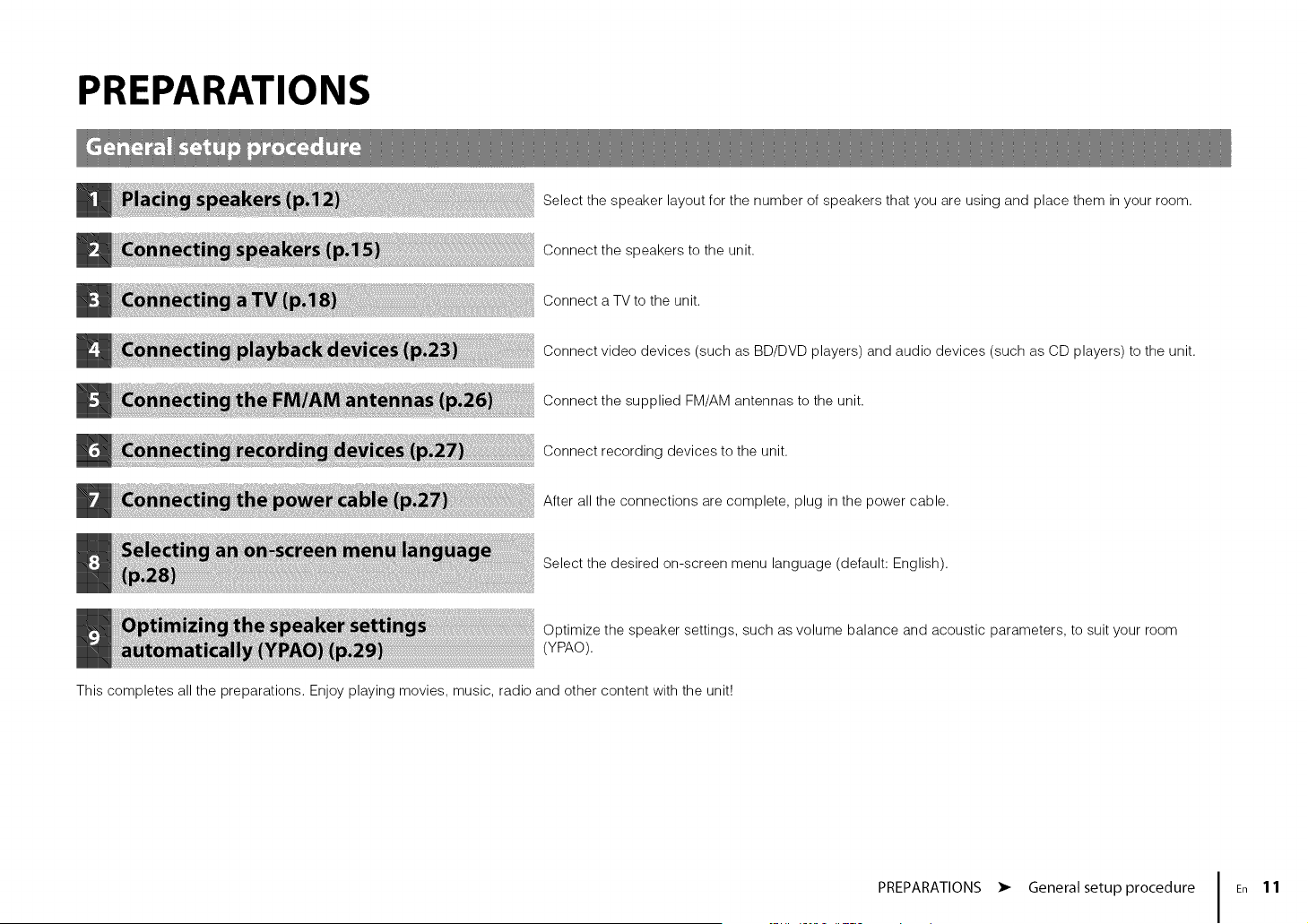
PREPARATIONS
Select the speaker layout for the number of speakers that you are using and place them in your room.
Connect the speakers to the unit.
Connect a TV to the unit.
Connect video devices (such as BD/DVD players) and audio devices (such as CD players) to the unit.
Connect the supplied FM/AM antennas to the unit.
Connect recording devices to the unit.
After all the connections are complete, plug in the power cable.
Select the desired on-screen menu language (default: English).
Optimize the speaker settings, such as volume balance and acoustic parameters, to suit your room
(YPAO).
This completes all the preparations. Enjoy playing movies, music, radio and other content with the unit!
PREPARATIONS • General setup procedure En 1 1
_ Speaker placement __@_
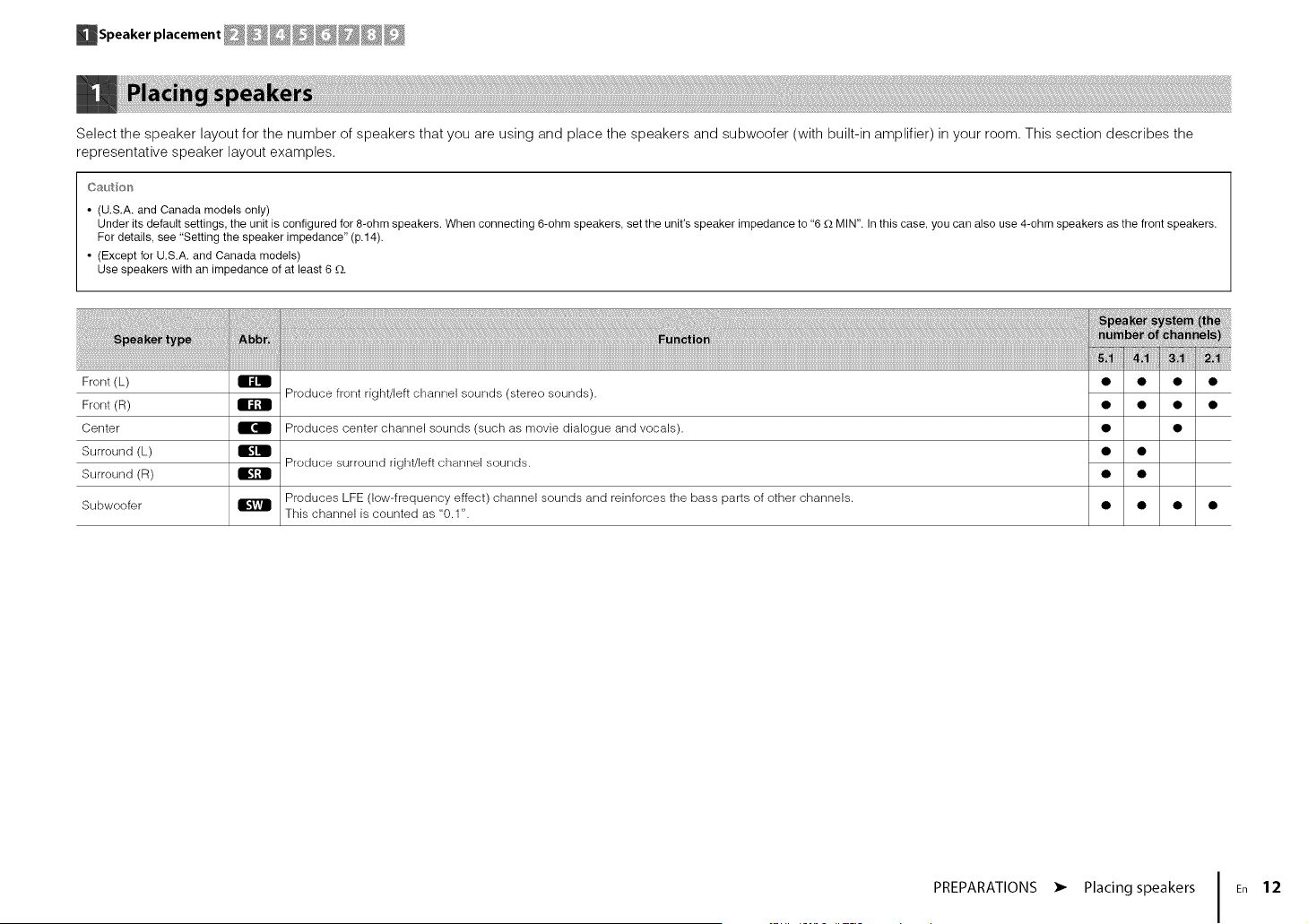
Select the speaker layout for the number of speakers that you are using and place the speakers and subwoofer (with built-in amplifier) in your room. This section describes the
representative speaker layout examples.
C_ution
• (U.S.A. and Canada models only)
Under its default settings, the unit is configured for 8-ohm speakers. When connecting 6-ohm speakers, set the unit's speaker impedance to "6 _ MIN". In this case, you can also use 4-ohm speakers as the front speakers.
For details, see "Setting the speaker impedance" (p.14).
• (Except for U.S.A. and Canada models)
Use speakers with an impedance of at least 6 G.
Front (L) _ • • • •
Produce front right/left channel sounds (stereo sounds).
Front (R) _ • • • •
Center _ Produces center channel sounds (such as movie dialogue and vocals). • •
Surround (L) _ • •
Produce surround right/left ctlannel sounds.
Surround (R) _ • •
Subwoofer _ Produces LFE (low-frequency effect) channel sounds and reinforces the bass parts of other channels. • • • •
This channel is counted as "0.1".
PREPARATIONS • Placing speakers En 12
_ Speaker placement ___
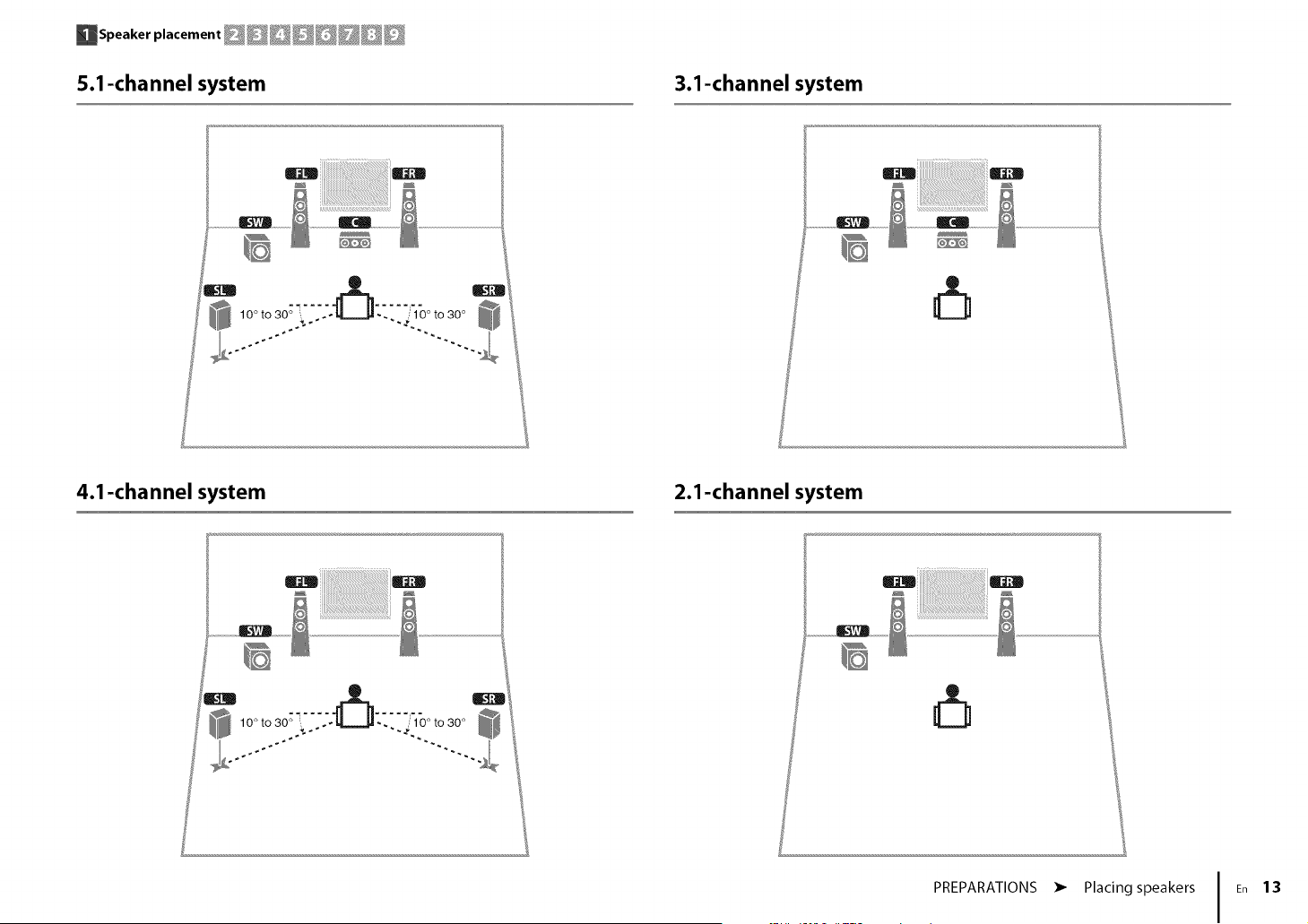
5.1-channel system
4.1-channel system
mi iiii_!_ii_iiiiiiiiiiiiiiiiiiiiiiiiiiiiiiiiiiiiiii_iii_i_i_i_i_ii_ii_ii_i!_!_i!_i!i!i!_im
i!!iiiiiiii!iiiili!!iii!ii!!!i!!!!!i!!i
3.1-channel system
_i_i_Ji!_!_!_!_!_!_!_!_!_!_!_!i!i!_!_i!ii!_!_i_ii_ii_ii_ii_i_i_!_i_ii_
ii_i_i_!i!i_!i_i!_i_i_i_ii_i_ii_ii_ii_ii_ii_ii_ii_ii_ii_ii_ii_iS_ii_i!i_!i_i!_!_i!_i!_i!_i!_i!_i!_i!_iiiiiii_i_ii_ii_ii_ii_ii_i_!_i_ii
2.1-channel system
PREPARATIONS • Placing speakers
En 13
®
_ Speaker placement ___ _,_
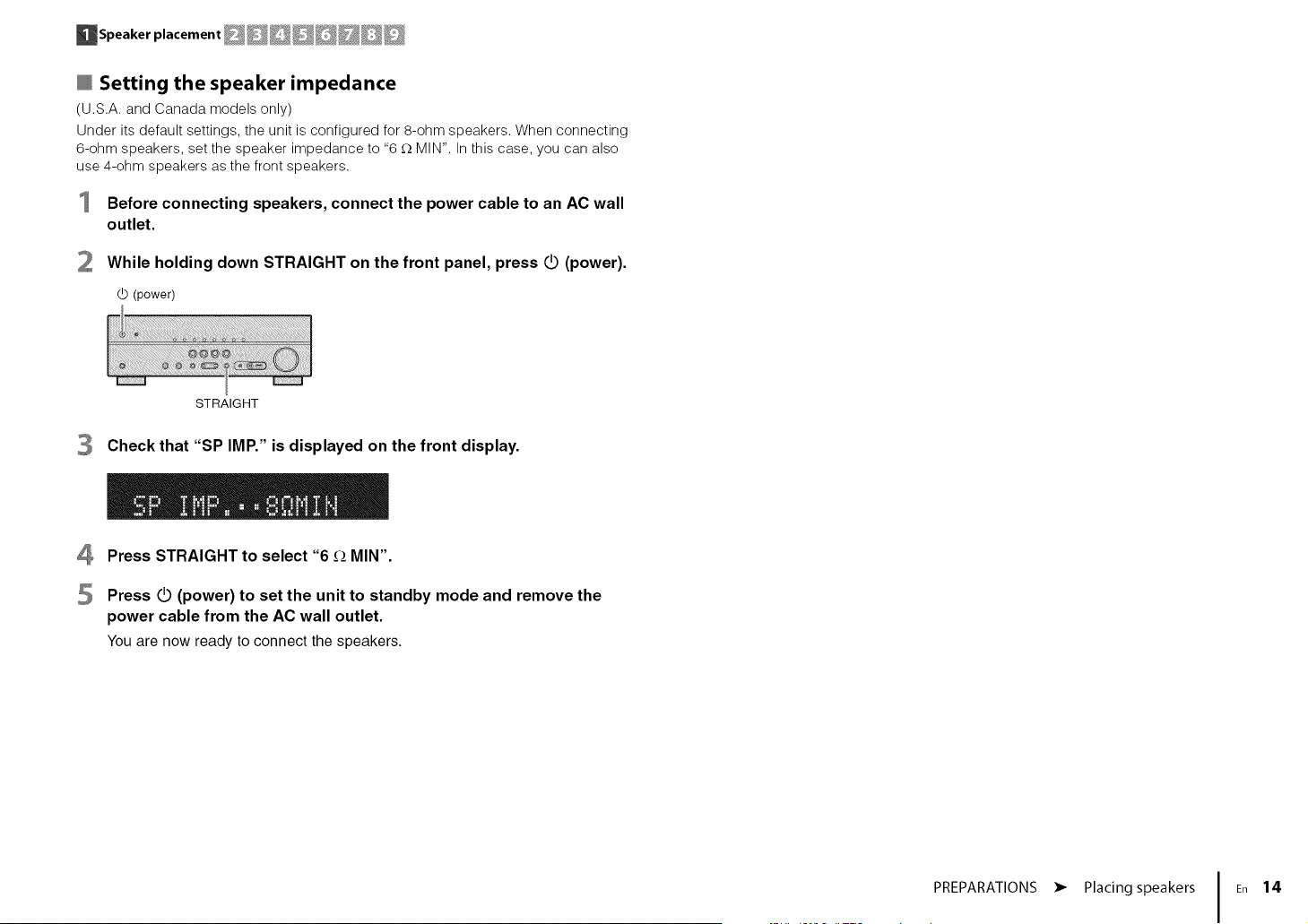
Setting the speaker impedance
(U.S.A. and Canada models only)
Under its default settings, the unit is configured for 8-ohm speakers. When connecting
6-ohm speakers, set the speaker impedance to "6 _-!MIN". In this case, you can also
use 4-ohm speakers as the front speakers.
Before connecting speakers, connect the power cable to an AC wall
outlet.
While holding down STRAIGHT on the front panel, press _ (power).
0 (power)
4
STRAIGHT
Check that "SP IMP." is displayed on the front display.
Press STRAIGHT to select "6 _! MIN".
Press _ (power) to set the unit to standby mode and remove the
power cable from the AC wall outlet.
You are now ready to connect the speakers.
PREPARATIONS • Placing speakers En 14
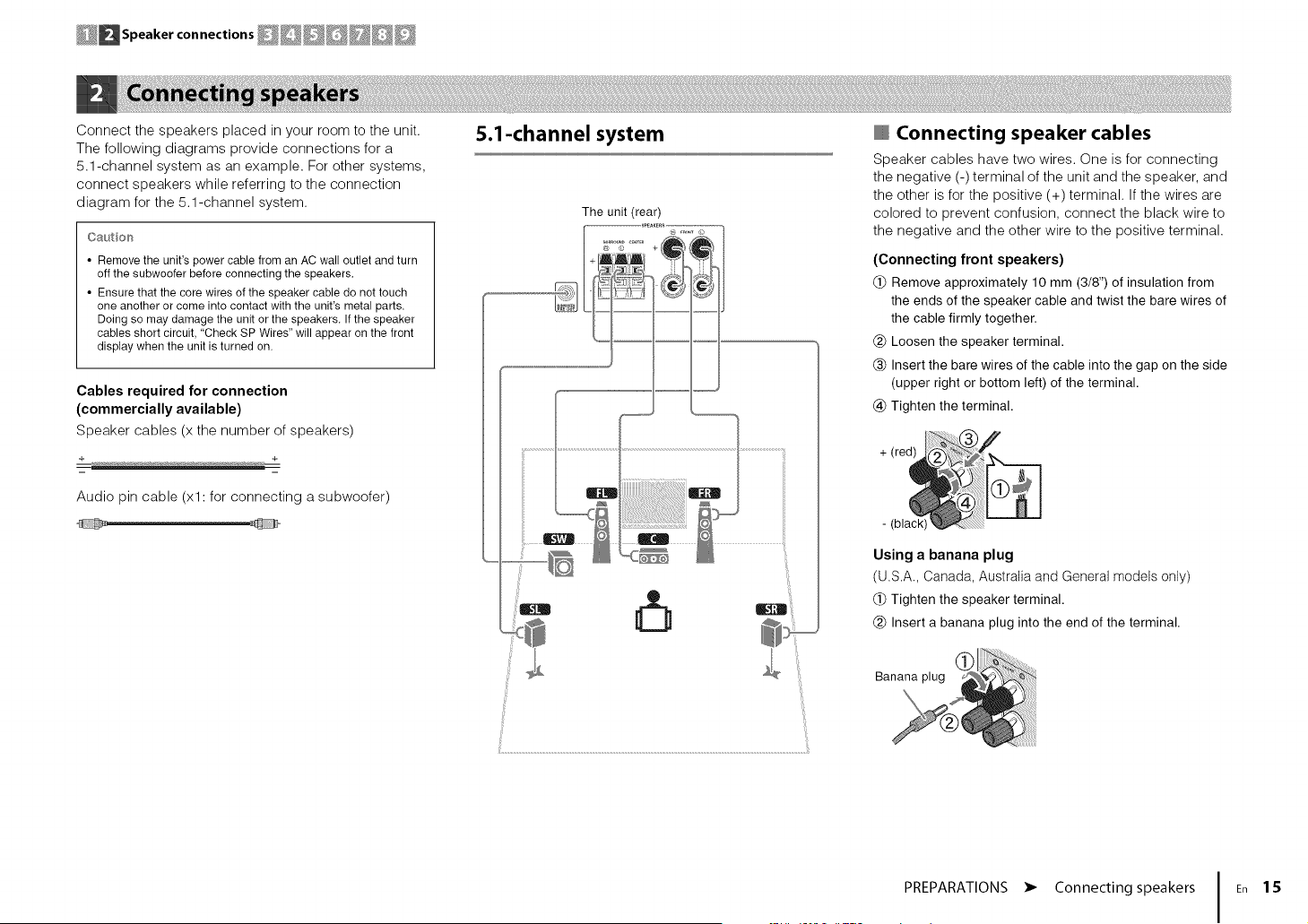
Connectthespeakersplacedinyourroomtotheunit.
Thefollowingdiagramsprovideconnectionsfora
5.1-channelsystemasanexample.Forothersystems,
connectspeakerswhilereferringtotheconnection
diagramforthe5.1-channelsystem.
Oautio_'_
• Remove the unit's power cable from an AC wall outlet and turn
off the subwoofer before connecting the speakers.
• Ensure that the core wires of the speaker cable do not touch
one another or come into contact with the unit's metal parts.
Doing so may damage the unit or the speakers. If the speaker
cables short circuit, "Check SP Wires" will appear on the front
display when the unit is turned on.
Cables required for connection
(commercially available)
Speaker cables (x the number of speakers)
Audio pin cable (xl: for connecting a subwoofer)
5.1-channel system
The unit (rear)
Biiiii
Connecting speaker cables
Speaker cables have two wires. One is for connecting
the negative (-) terminal of the unit and the speaker, and
the other is for the positive (+) terminal. If the wires are
colored to prevent confusion, connect the black wire to
the negative and the other wire to the positive terminal.
(Connecting front speakers)
(_) Remove approximately 10 mm (3/8") of insulation from
the ends of the speaker cable and twist the bare wires of
the cable firmly together.
(_) Loosen the speaker terminal.
(_) Insert the bare wires of the cable into the gap on the side
(upper right or bottom left) of the terminal.
(_) Tighten the terminal.
+ (red)
- (black)
Using a banana plug
(U.S.A., Canada, Australia and General models only)
(_) Tighten the speaker terminal.
(_) Insert a banana plug into the end of the terminal.
PREPARATIONS • Connecting speakers En lS
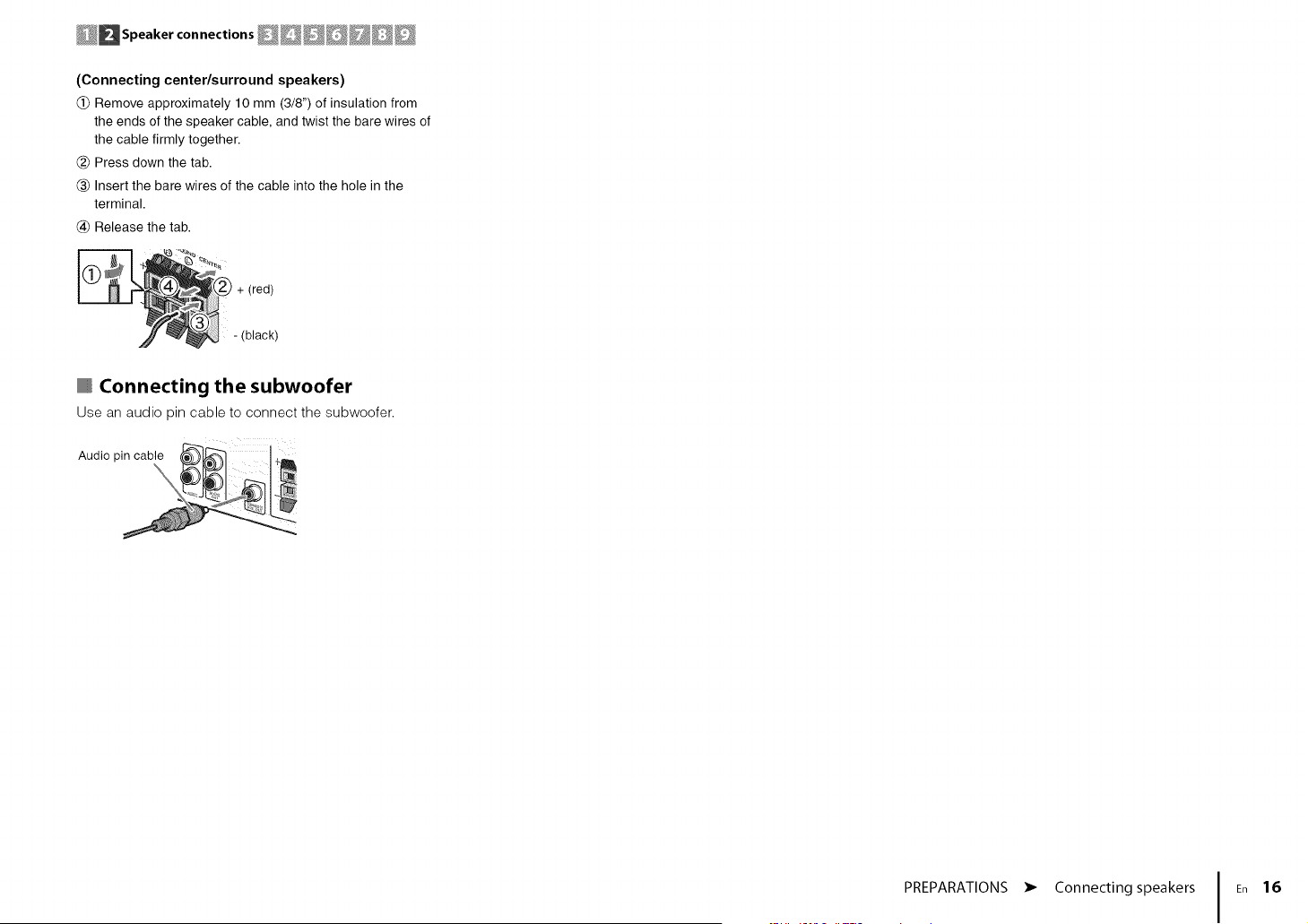
(Connecting center/surround speakers)
(_) Remove approximately 10 mm (3/8") of insulation from
the ends of the speaker cable, and twist the bare wires of
the cable firmly together.
(_) Press down the tab.
(_) Insert the bare wires of the cable into the hole in the
terminal.
(_) Release the tab.
+ (red)
j _ -(black)
Connecting the subwoofer
Use an audio pin cable to connect the subwoofer.
PREPARATIONS • Connecting speakers En 16
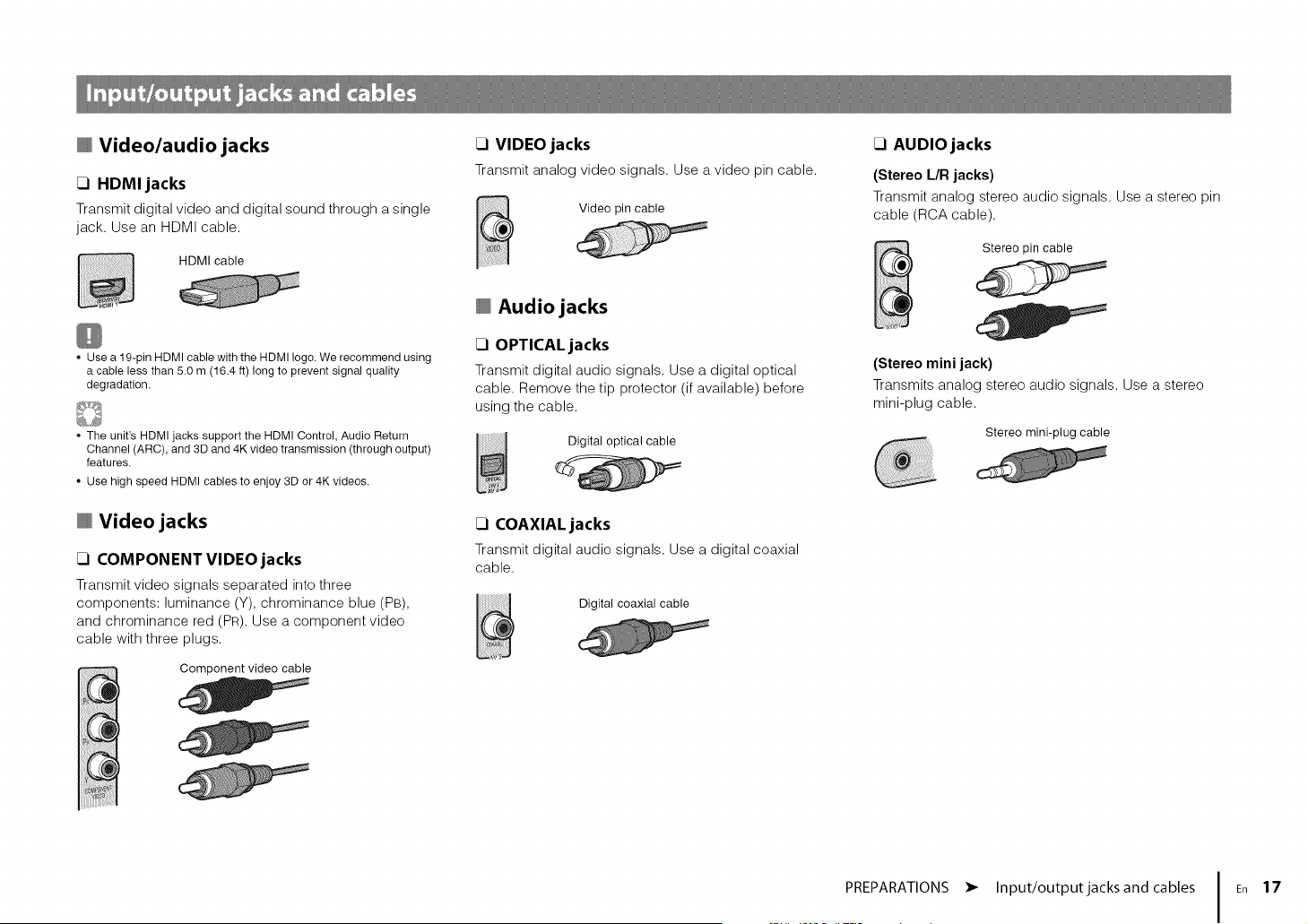
Video/audio jacks
17 HDMI jacks
Transmit digital video and digital sound through a single
jack. Use an HDMI cable.
HDMI cable
17 VIDEO jacks
Transmit analog video signals. Use a video pin cable.
Video pin cable
17 AUDIO jacks
(Stereo L/R jacks)
Transmit analog stereo audio signals. Use a stereo pin
cable (RCA cable).
Stereo pin cable
• Use a 19-pin HDMI cable with the HDMI logo. We recommend using
a cable less than 5.0 m (16.4 ft) long to prevent signal quality
degradation.
• The unit's HDMI jacks support the HDMI Control, Audio Return
Channel (ARC), and 3D and 4K video transmission (through output)
features.
• Use high speed HDMI cables to enjoy 3D or 4K videos.
Video jacks
17 COMPONENT VIDEO jacks
Transmit video signals separated into three
components: luminance (Y), chrominance blue (PB),
and chrominance red (PR). Use a component video
cable with three plugs.
Component video cable
Audio jacks
_1 OPTICAL jacks
Transmit digital audio signals. Use a digital optical
cable. Remove the tip protector (if available) before
using the cable.
Digital optical cable
_1 COAXIAL jacks
Transmit digital audio signals. Use a digital coaxial
cable.
Digital coaxial cable
(Stereo mini jack)
Transmits analog stereo audio signals. Use a stereo
mini-plug cable.
Stereo mini-plugcable
PREPARATIONS • Input/output jacks and cables En 17
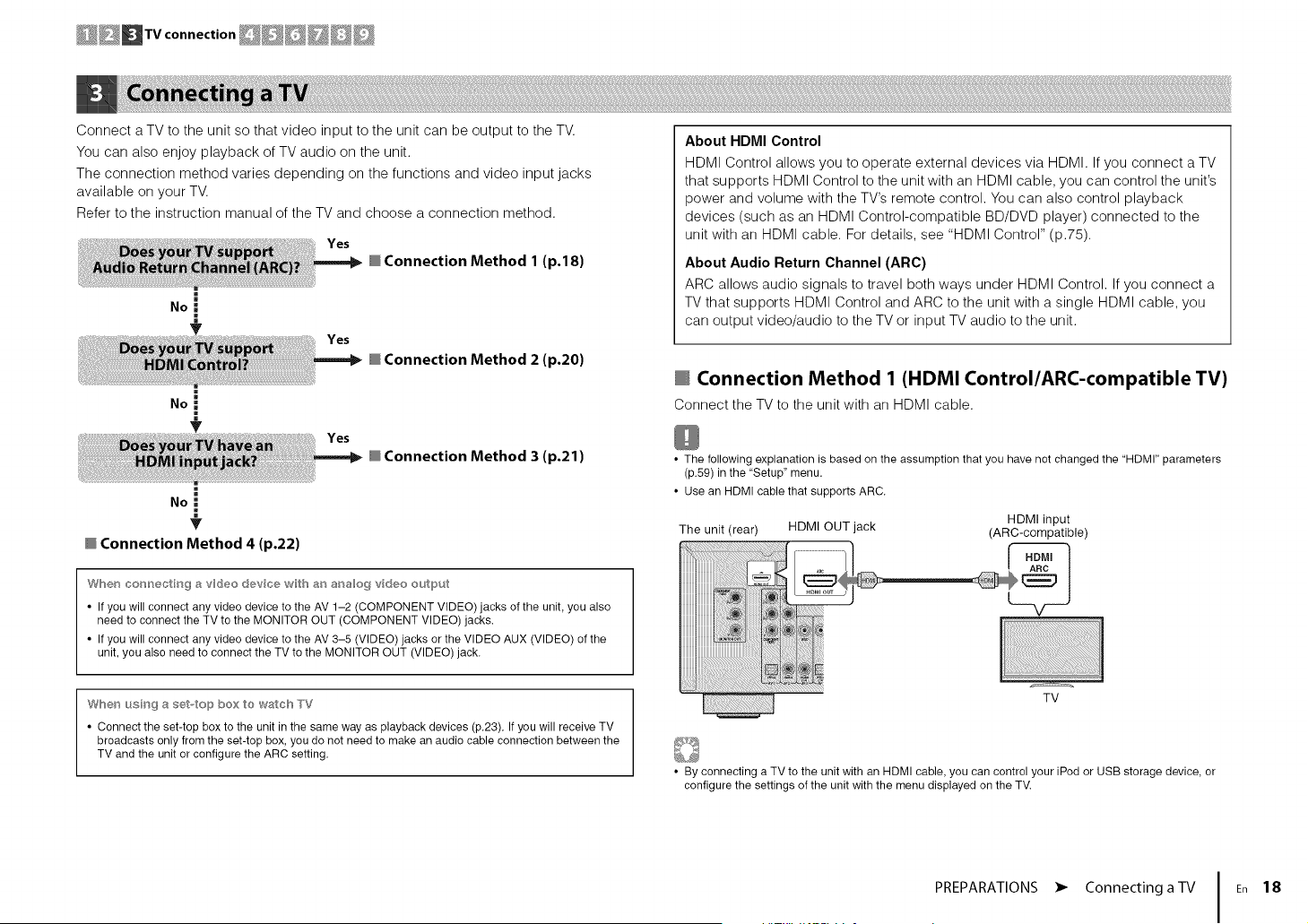
ConnectaTVtotheunitsothatvideoinputtotheunitcanbeoutputtotheTV.
YoucanalsoenjoyplaybackofTVaudioontheunit.
Theconnectionmethodvariesdependingonthefunctionsandvideoinputjacks
availableonyourTV.
RefertotheinstructionmanualoftheTVandchooseaconnectionmethod.
==
No _,
==
==
No =_
Yes
@ Connection Method 1 (p.18)
Yes
@ Connection Method 2 (p.20)
About HDMI Control
HDMI Control allows you to operate external devices via HDMI. If you connect a TV
that supports HDMI Control to the unit with an HDMI cable, you can control the unit's
power and volume with the TV's remote control. You can also control playback
devices (such as an HDMI Control-compatible BD/DVD player) connected to the
unit with an HDMI cable. For details, see "HDMI Control" (p.75).
About Audio Return Channel (ARC)
ARC allows audio signals to travel both ways under HDMI Control. If you connect a
TV that supports HDMI Control and ARC to the unit with a single HDMI cable, you
can output video/audio to the TV or input TV audio to the unit.
Connection Method 1 (HDMI Control/ARC-compatible TV)
Connect the TV to the unit with an HDMI cable.
==
No ==
=
T
@ Connection Method 4 (p.22)
@ Connection Method 3 (p.21)
When connecthg a video device with ar'_analog video outpost
• If you will connect any video device to the AV 1-2 (COMPONENT VIDEO) jacks of the unit, you also
need to connect the TV to the MONITOR OUT (COMPONENT VIDEO) jacks.
• If you will connect any video device to the AV 3-5 (VIDEO) jacks or the VIDEO AUX (VIDEO) of the
unit, you also need to connect the TV to the MONITOR OUT (VIDEO) jack.
Wher'_ ushg a seb top box to watch TV
• Connect the set-top box to the unit in the same way as playback devices (p.23). If you will receive TV
broadcasts only from the set-top box, you do not need to make an audio cable connection between the
TV and the unit or configure the ARC setting.
• The following explanation is based on the assumption that you have not changed the "HDMI" parameters
(p.59) in the "Setup" menu.
• Use an HDMI cable that supports ARC.
HDMI input
The unit (rear) HDMI OUT jack (ARC-compatible)
• By connecting a TV to the unit with an HDMI cable, you can control your iPod or USB storage device, or
configure the settings of the unit with the menu displayed on the TV.
PREPARATIONS • Connecting a TV En 18
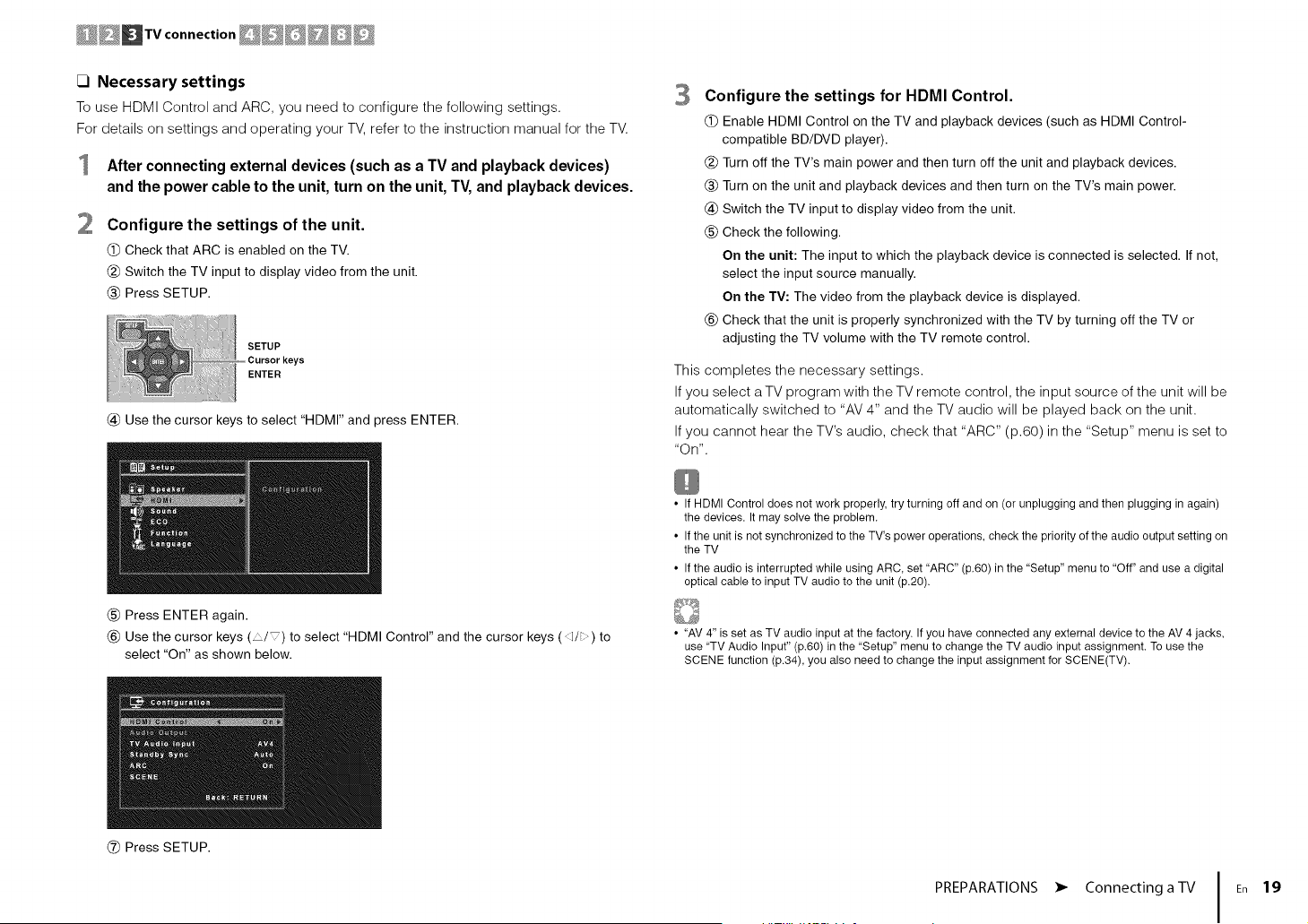
_] Necessary settings
To use HDMI Control and ARC, you need to configure the following settings.
For details on settings and operating your TV, refer to the instruction manual for the TV.
After connecting external devices (such as a TV and playback devices)
and the power cable to the unit, turn on the unit, TV, and playback devices.
Configure the settings of the unit.
(_) Check that ARC is enabled on the TV.
(_) Switch the TV input to display video from the unit.
(_) Press SETUP.
SETUP
ENTER
@ Use the cursor keys to select "HDMr' and press ENTER.
3 Configure the settings for HDMI Control.
(_) Enable HDMI Control on the TV and playback devices (such as HDMI Control-
compatible BD/DVD player).
(_) Turn off the TV's main power and then turn off the unit and playback devices.
(_) Turn on the unit and playback devices and then turn on the TV's main power.
@ Switch the TV input to display video from the unit.
(_) Check the following.
On the unit: The input to which the playback device is connected is selected. If not,
select the input source manually.
On the TV: The video from the playback device is displayed.
_) Check that the unit is properly synchronized with the TV by turning off the TV or
adjusting the TV volume with the TV remote control.
This completes the necessary settings.
If you select a TV program with the TV remote control, the input source of the unit will be
automatically switched to "AV 4" and the TV audio will be played back on the unit.
If you cannot hear the TV's audio, check that "ARC" (p.60) in the "Setup" menu is set to
"On".
(_) Press ENTER again.
_) Use the cursor keys ( / ) to select "HDMI Control" and the cursor keys (<]/b) to
select "On" as shown below.
(_) Press SETUP.
• If HDMI Control does not work properly, try turning off and on (or unplugging and then plugging in again)
the devices. It may solve the problem.
• If the unit is not synchronized to the TV's power operations, check the priority of the audio output setting on
the TV
If the audio is interrupted while using ARC, set "ARC" (p.60) in the "Setup" menu to "Off" and use a digital
optical cable to input TV audio to the unit (p.20).
"AV 4" is set as TV audio input at the factory. If you have connected any external device to the AV 4 jacks,
use "TV Audio Input" (p.60) in the "Setup" menu to change the TV audio input assignment. To use the
SCENE function (p.34), you also need to change the input assignment for SCENE(TV).
PREPARATIONS • Connecting a TV En 19
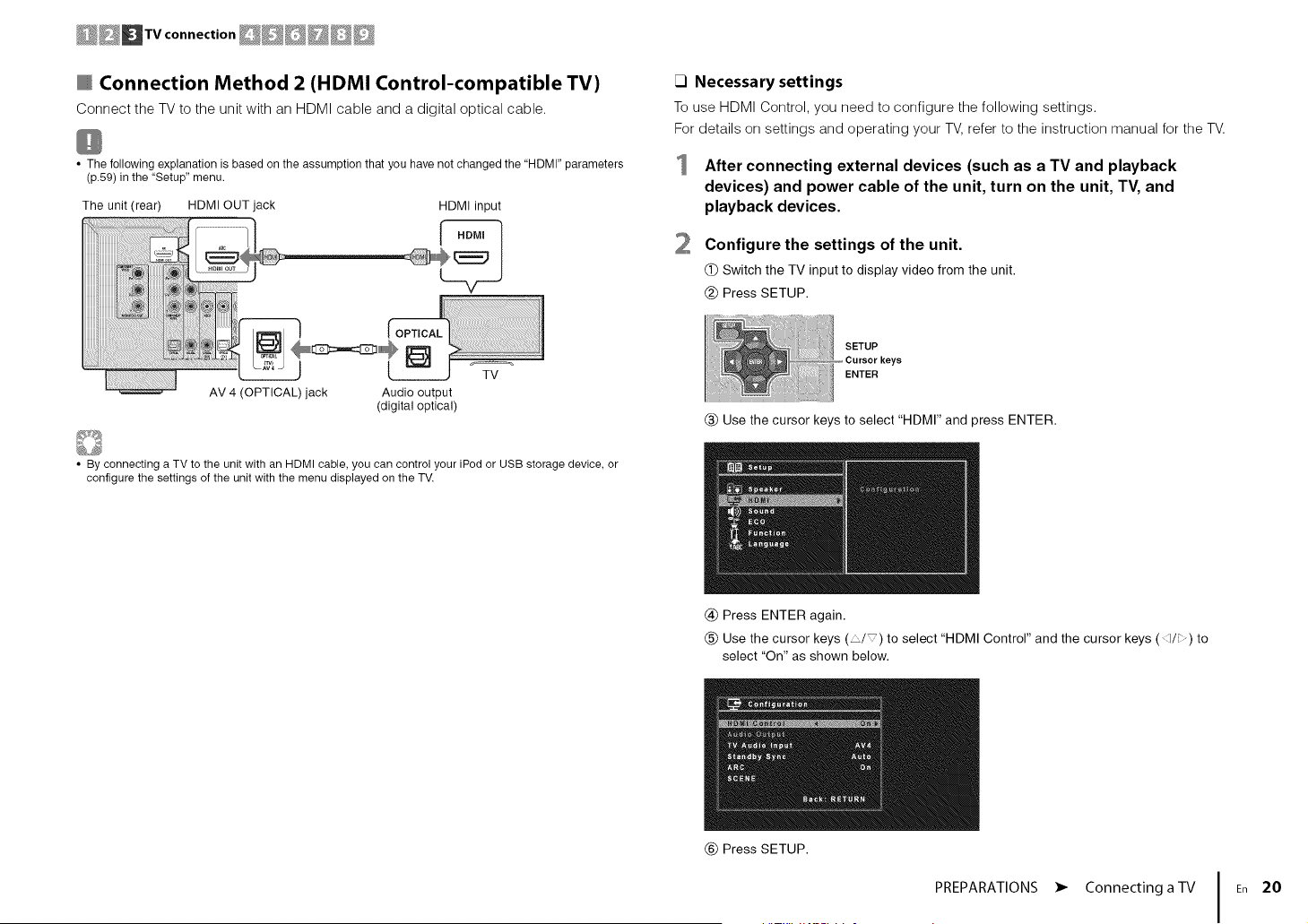
Connection Method 2 (HDMI Control-compatible TV)
Connect the TV to the unit with an HDMI cable and a digital optical cable.
• The following explanation is based on the assumption that you have not changed the "HDMI" parameters
(p.59) in the "Setup" menu.
The unit (rear) HDMI OUT jack HDMI input
_] Necessary settings
To use HDMI Control, you need to configure the following settings.
For details on settings and operating your TV, refer to the instruction manual for the TV.
2
After connecting external devices (such as a TV and playback
devices) and power cable of the unit, turn on the unit, TV, and
playback devices.
Configure the settings of the unit.
(_) Switch the TV input to display video from the unit.
(_ Press SETUP.
(digital optical)
• By connecting a TV to the unit with an HDMI cable, you can control your iPod or USB storage device, or
configure the settings of the unit with the menu displayed on the TV.
SETUP
ENTER
(_) Use the cursor keys to select "HDMI" and press ENTER.
@ Press ENTER again.
(_) Use the cursor keys ( / ) to select "HDMI Control" and the cursor keys ( I/i: ) to
select "On" as shown below.
(_) Press SETUP.
PREPARATIONS • Connecting a TV En 20

Configure the settings for HDMI Control.
(_) Enable HDMI Control on the TV and playback devices (such as a HDMI Control-
compatible BD/DVD player).
(_ Turn off the TV's main power and then turn off the unit and playback devices.
(_ Turn on the unit and playback devices and then turn on the TV.
@ Switch the TV input to display video from the unit.
(_) Check the following.
On the unit: The input to which the playback device is connected is selected. If not,
select the input source manually.
On the TV: The video from the playback device is displayed.
_) Check that the unit is properly synchronized with the TV by turning off the TV or
adjusting the TV volume with the TV remote control.
This completes the necessary settings.
If you select a TV program with the TV remote control, the input source of the unit will be
automatically switched to "AV 4" and the TV audio will be played back on the unit.
• If HDMI Control does not work properly, try turning off and on (or unplugging and then plugging in again)
the devices. It may solve the problem.
• If the unit is not synchronized to the TV's power operations, check the priority of the audio output setting on
the TV
Connection Method 3 (TV with HDMI input jacks)
Connect the TV to the unit with an HDMI cable and a digital optical cable.
The unit (rear) HDMI OUT jack HDMI input
(digital optical)
If you switch the input source of the unit to "AV 4" using the AV 4 or SCENE(TV) keys,
the TV audio will be played back on the unit.
• By connecting a TV to the unit with an HDMI cable, you can control your iPod or USB storage device, or
configure the settings of the unit with the menu displayed on the TV.
• If you have connected any external device to the AV 4 jacks or if you want to use another input jack (other
than OPTICAL) for connecting the TV, connect the TV to one of the AV 1-5 and AUDIO 1-2 jacks. To use
the SCENE function (p.34), you also need to change the input assignment for SCENE(TV).
• "AV 4" is set as TV audio input at the factory. Ifyou have connected any external device to the AV 4 jacks or
if you want to use another input jack (other than OPTICAL) for connecting the TV, use "TV Audio Input"
(p.60) in the "Setup" menu to change the TV audio input assignment. To use the SCENE function (p.34),
you also need to change the input assignment for SCENE(TV).
PREPARATIONS • Connecting a TV En 21
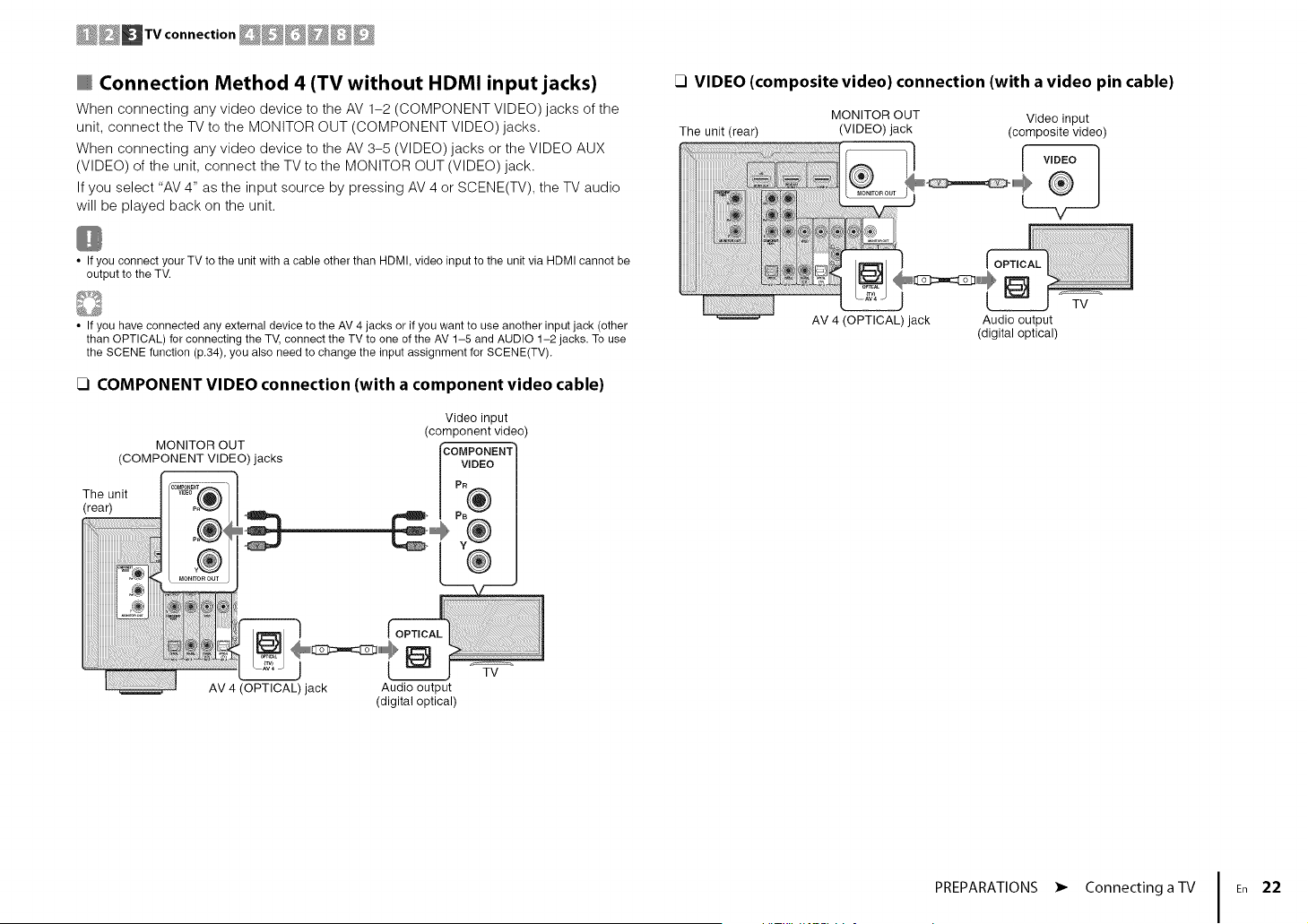
Connection Method 4 (TV without HDMI input jacks)
When connecting any video device to the AV 1-2 (COMPONENT VIDEO) jacks of the
unit, connect the TV to the MONITOR OUT (COMPONENT VIDEO) jacks.
When connecting any video device to the AV 3-5 (VIDEO) jacks or the VIDEO AUX
(VIDEO) of the unit, connect the TV to the MONITOR OUT (VIDEO) jack.
If you select "AV 4" as the input source by pressing AV 4 or SCENE(TV), the TV audio
will be played back on the unit.
FI VIDEO (composite video) connection (with a video pin cable)
The unit (rear)
MONITOR OUT
(VIDEO)jack
I
Video input
(compositevideo)
VIDEOQ ]
V
• If you connect your TV to the unit with a cable other than HDMI, video input to the unit via HDMI cannot be
output to the TV.
• If you have connected any external device to the AV 4 jacks or if you want to use another input jack (other
than OPTICAL) for connecting the TV, connect the TV to one of the AV 1-5 and AUDIO 1-2 jacks. To use
the SCENE function (p.34), you also need to change the input assignment for SCENE(TV).
_] COMPONENT VIDEO connection (with a component video cable)
MONITOR OUT
(COMPONENT VIDEO) jacks
The unit WDEOp
(rear) °
MONnO_our
iiiiiiiiiiii_ i -- _iiiiiiiiiiii_ i _
i i
AV 4 (OPTICAL) jack
Video input
(component video)
COMPONENT
VIDEO
TV
Audio output
(digital optical)
AV 4 (OPTICAL) jack Audio output
(digital optical)
TV
PREPARATIONS • Connecting a-IV En 22
_ _ _ ' _ • __#3 ' _ _ _ _" _ ,_DPlayback device connect,ons ,_
The unit is equipped with a variety of input jacks including HDMI input jacks to allow
you to connect different types of playback devices. For information on how to connect
an iPod or a USB storage device, see the following pages.
• Connecting an iPod (p.44)
• Connecting a USB storage device (p.48)
Connecting video devices (such as BD/DVD players)
Connect video devices such as BD/DVD players, set-top boxes (STBs) and game
consoles to the unit. Depending on the video/audio output jacks available on your video
device, choose one of the following connections. We recommend using an HDMI
connection if the video device has an HDMI output jack.
• If the combination of video/audio input jacks available on the unit does not match your video device, change
its combination according to the output jacks of your device (p.24).
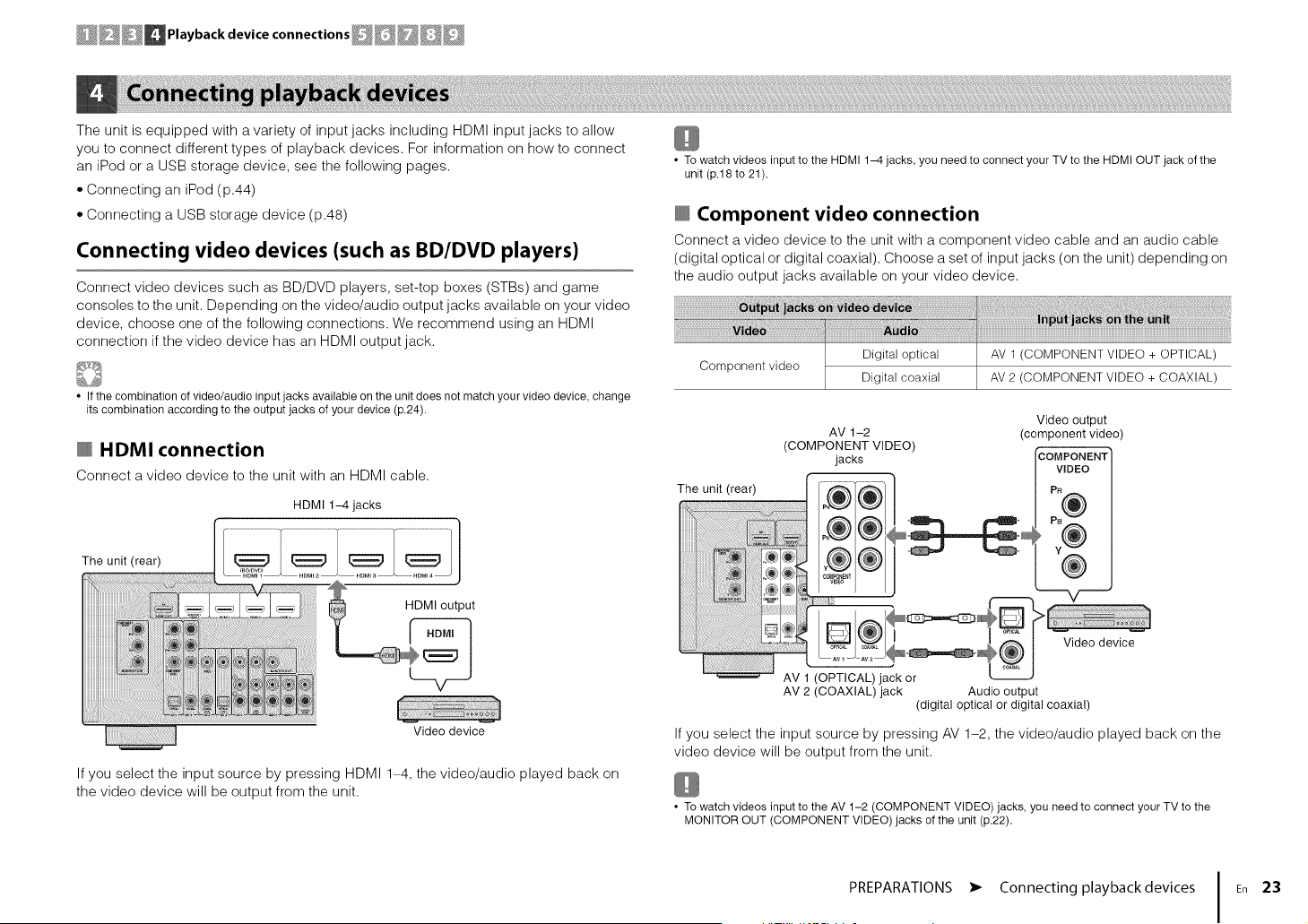
HDMI connection
Connect a video device to the unit with an HDMI cable.
HDMI 1-4 jacks
The unit (rear)
HDMI output
V
Video device
If you select the input source by pressing HDMI 1-4, the video/audio played back on
the video device will be output from the unit.
• To watch videos input to the HDMI 1-4 jacks, you need to connect your TV to the HDMI OUT jack of the
unit (p.18 to 21).
Component video connection
Connect a video device to the unit with a component video cable and an audio cable
(digital optical or digital coaxial). Choose a set of input jacks (on the unit) depending on
the audio output jacks available on your video device.
Component video
Digital optical
Digital coaxial
AV 1 (COMPONENT VIDEO + OPTICAL)
AV 2 (COMPONENT VIDEO + COAXIAL)
The unit (rear)
AV 1-2
(COMPONENT VIDEO)
jacks
Video output
(component video)
COMPONENT
VIDEO
F
((O))
F
((_)}
AV 1 (OPTICAL) jack or
AV 2 (COAXIAL) jack Audio output
(digital optical or digital coaxial)
If you select the input source by pressing AV 1-2, the video/audio played back on the
video device will be output from the unit.
• To watch videos input to the AV 1-2 (COMPONENT VIDEO) jacks, you need to connect your TV to the
MONITOR OUT (COMPONENT VIDEO) jacks of the unit (p.22).
PREPARATIONS • Connecting playback devices En 23
@@DDP oyboc"dov'co onno t°nsDD@D@
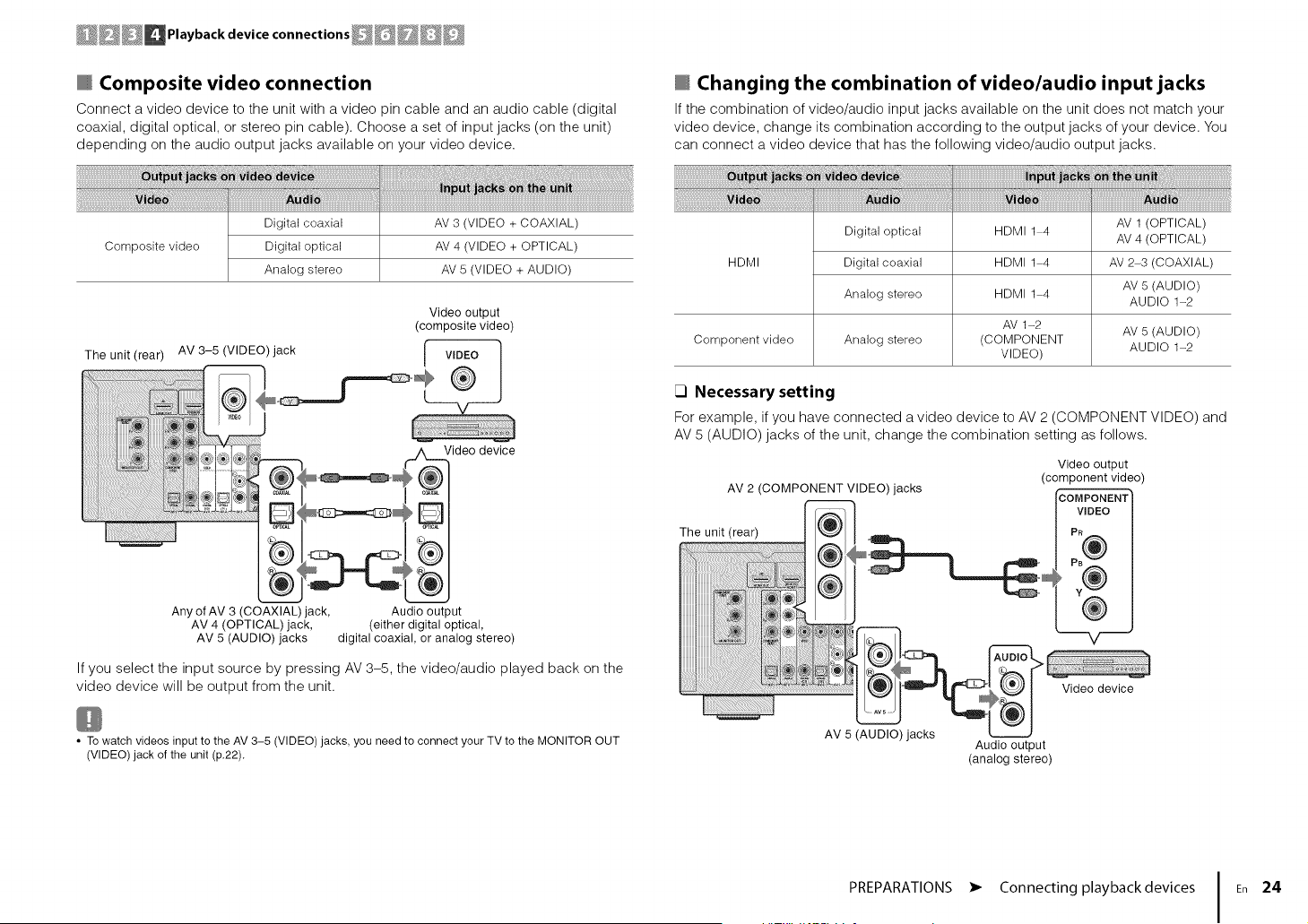
Composite video connection
Connect a video device to the unit with a video pin cable and an audio cable (digital
coaxial, digital optical, or stereo pin cable). Choose a set of input jacks (on the unit)
depending on the audio output jacks available on your video device.
Changing the combination of video/audio input jacks
If the combination of video/audio input jacks available on the unit does not match your
video device, change its combination according to the output jacks of your device. You
can connect a video device that has the following video/audio output jacks.
Digital coaxial AV3 (VIDEO + COAXIAL)
Composite video Digital optical AV4 (VIDEO + OPTICAL)
Analog stereo AV5 (VIDEO + AUDIO)
The unit (rear)
AV 3-5 (VIDEO) jack
Video output
(composite video)
VIDEO
®
Video device
Any of AV 3 (COAXIAL) jack, Audio output
AV 4 (OPTICAL) jack, (either digital optical,
AV 5 (AUDIO) jacks digital coaxial, or analog stereo)
If you select the input source by pressing AV 3-5, the video/audio played back on the
video device will be output from the unit.
Digital optical
Digital coaxial
Analog stereo
HDMI
AV 1 (OPTICAL)
AV 4 (OPTICAL)
AV 2-3 (COAXIAL)
AV 5 (AUDIO)
AUDIO 1-2
HDMI 1 4
HDMI 1 4
HDMI 1 4
AV 1-2
(COMPONENT
VIDEO)
AV 5 (AUDIO)
Component video Analog stereo AUDIO 1-2
CI Necessary setting
For example, if you have connected a video device to AV 2 (COMPONENT VIDEO) and
AV 5 (AUDIO) jacks of the unit, change the combination setting as follows.
The unit (rear)
AV 2 (COMPONENT VIDEO) jacks
®
®
Video output
(component video)
COMPONENT
VIDEO
F
F --
((®;)
V
Video device
• To watch videos input to the AV 3-5 (VIDEO) jacks, you need to connect your TV to the MONITOR OUT
(VIDEO) jack of the unit (p.22).
AV 5 (AUDIO) jacks
Audio output
(analog stereo)
PREPARATIONS • Connecting playback devices En 24
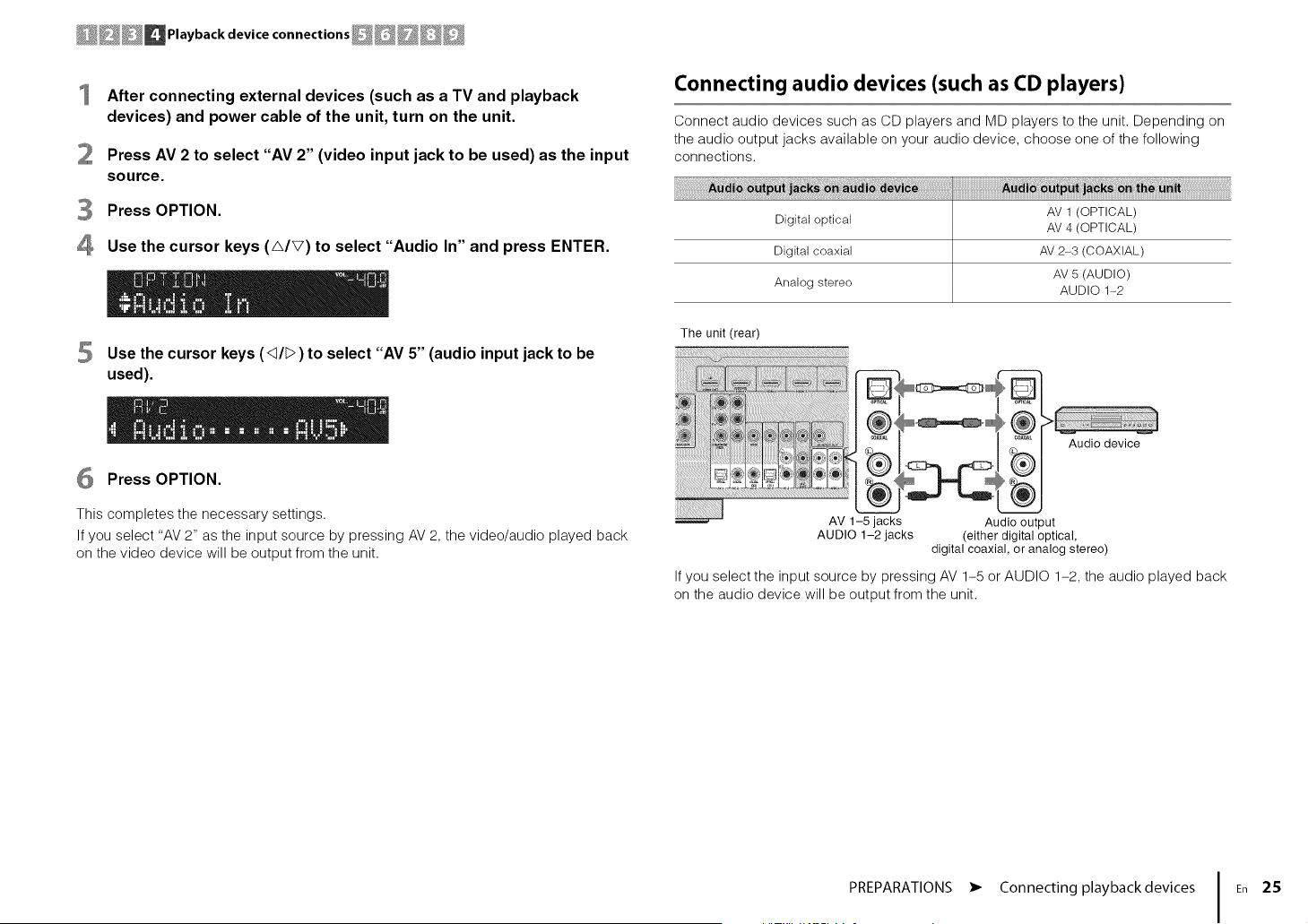
@@@DP oyboc"device onno t°ns@D@D@
4
After connecting external devices (such as a TV and playback
devices) and power cable of the unit, turn on the unit.
Press AV 2 to select "AV 2" (video input jack to be used) as the input
source.
Press OPTION.
Use the cursor keys (A/V) to select "Audio In" and press ENTER.
Use the cursor keys (q/l>) to select "AV 5" (audio input jack to be
used).
Press OPTION.
This completes the necessary settings.
If you select "AV 2" as the input source by pressing AV 2, the video/audio played back
on the video device will be output from the unit.
Connecting audio devices (such as CD players)
Connect audio devices such as CD players and MD players to the unit. Depending on
the audio output jacks available on your audio device, choose one of the following
connections.
AV 1 (OPTICAL)
Digital optical
AV 4 (OPTICAL)
Digital coaxial AV2-3 (COAXIAL)
AV5 (AUDIO)
Analog stereo AUDIO 1-2
The unit (rear)
AV 1-5 jacks
AUDIO 1-2 jacks
Audio output
(either digital optical,
digital coaxial, or analog stereo)
If you select the input source by pressing AV 1-5 or AUDIO 1-2, the audio played back
on the audio device will be output from the unit.
PREPARATIONS • Connecting playback devices En 25
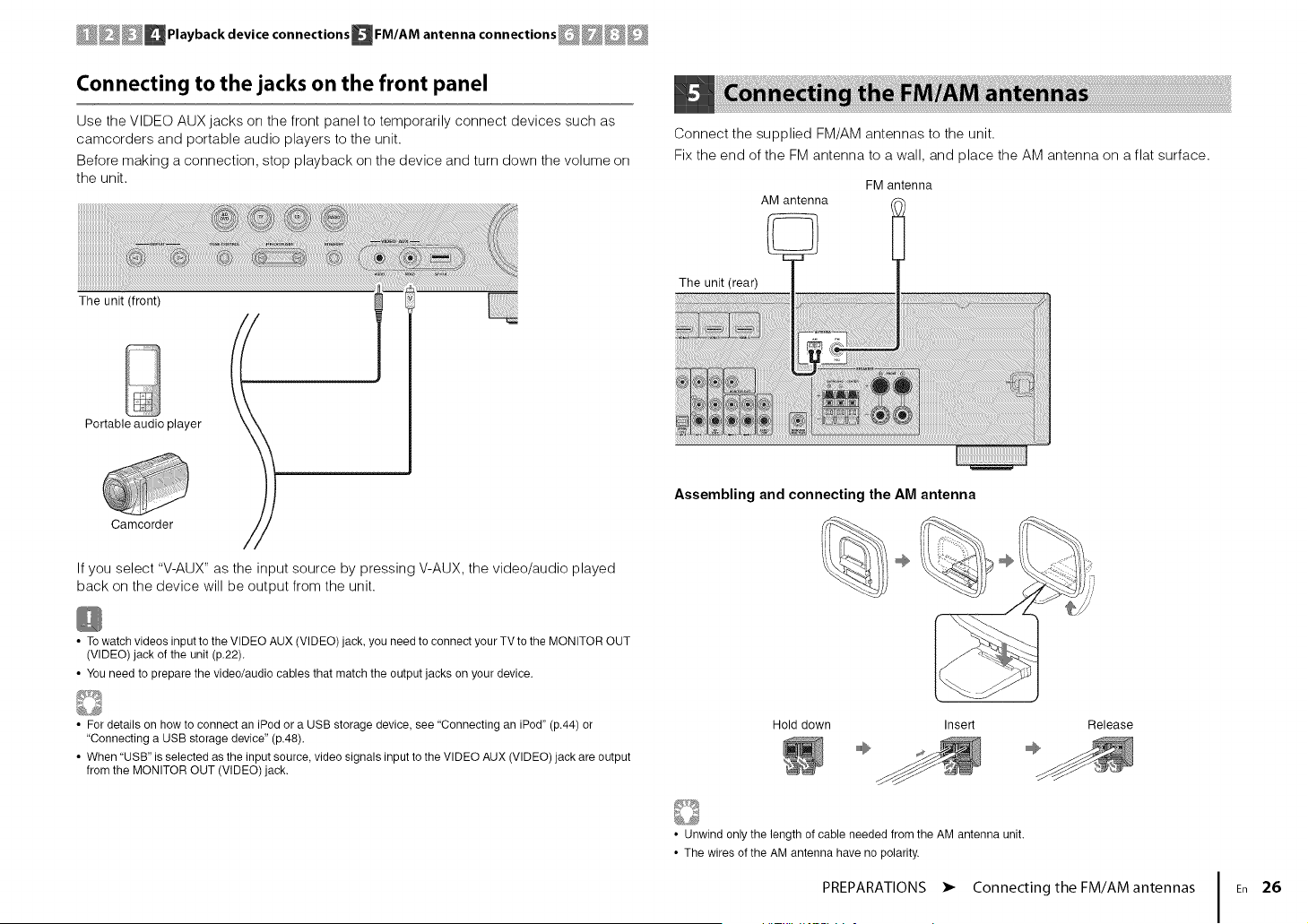
Connecting to the jacks on the front panel
Use the VIDEO AUX jacks on the front panel to temporarily connect devices such as
camcorders and portable audio players to the unit.
Before making a connection, stop playback on the device and turn down the volume on
the unit.
The unit (front)
Portable audio player
Camcorder
If you select "V-AUX" as the input source by pressing V-AUX, the video/audio played
back on the device will be output from the unit.
• To watch videos input to the VIDEO AUX (VIDEO) jack, you need to connect your TV to the MONITOR OUT
(VIDEO) jack of the unit (p.22).
• You need to prepare the video/audio cables that match the output jacks on your device.
Connect the supplied FM/AM antennas to the unit.
Fix the end of the FM antenna to a wall, and place the AM antenna on a flat surface.
FM antenna
AM antenna
The unit (rear)
Assembling and connecting the AM antenna
• For details on how to connect an iPod or a USB storage device, see "Connecting an iPod" (p.44) or
"Connecting a USB storage device" (p.48).
• When "USB" is selected as the input source, video signals input to the VIDEO AUX (VIDEO) jack are output
from the MONITOR OUT (VIDEO) jack.
Hold down Insert Release
• Unwind only the length of cable needed from the AM antenna unit.
• The wires of the AM antenna have no polarity.
PREPARATIONS • Connecting the FM/AM antennas En 26
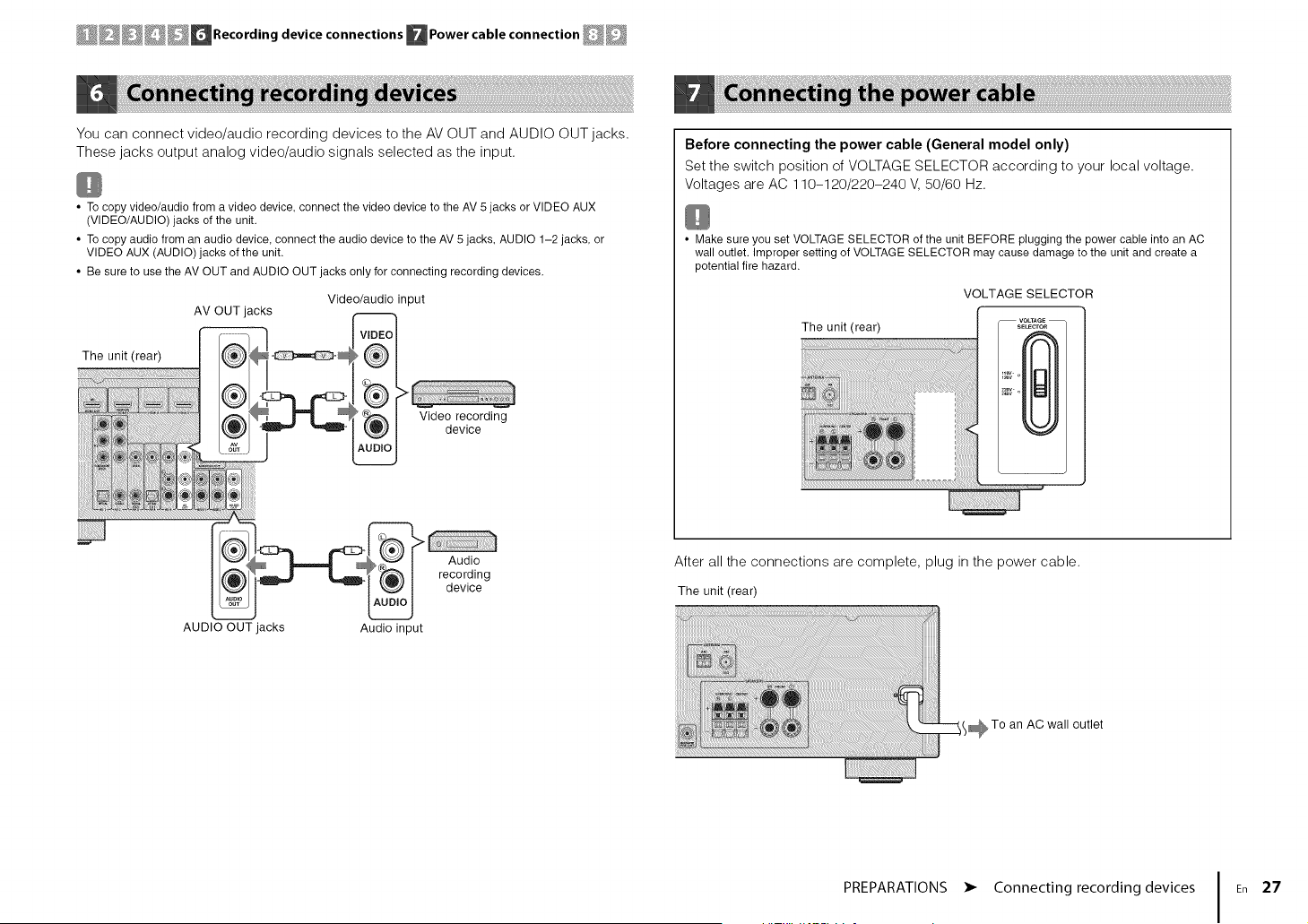
__DRecordmg device connections _ Power cable connection _
You can connect video/audio recording devices to the AV OUT and AUDIO OUT jacks.
These jacks output analog video/audio signals selected as the input.
• To copy video/audio from a video device, connect the video device to the AV 5 jacks or VIDEO AUX
(VIDEO/AUDIO) jacks of the unit.
• To copy audio from an audio device, connect the audio device to the AV 5 jacks, AUDIO 1-2 jacks, or
VIDEO AUX (AUDIO) jacks of the unit.
• Be sure to use the AV OUT and AUDIO OUT jacks only for connecting recording devices.
Video/audio input
AV OUT jacks
The unit (rear)
Video recording
device
Before connecting the power cable (General model only)
Set the switch position of VOLTAGE SELECTOR according to your local voltage.
Voltages are AC 110-120/220-240 V, 50/60 Hz.
• Make sure you set VOLTAGE SELECTOR of the unit BEFORE plugging the power cable into an AC
wall outlet. Improper setting of VOLTAGE SELECTOR may cause damage to the unit and create a
potential fire hazard.
VOLTAGE SELECTOR
The unit (rear)
AUDIO OUT jacks Audio input
Audio
recording
device
After all the connections are complete, plug in the power cable.
The unit (rear)
To an AC wall outlet
PREPARATIONS • Connecting recording devices En 27
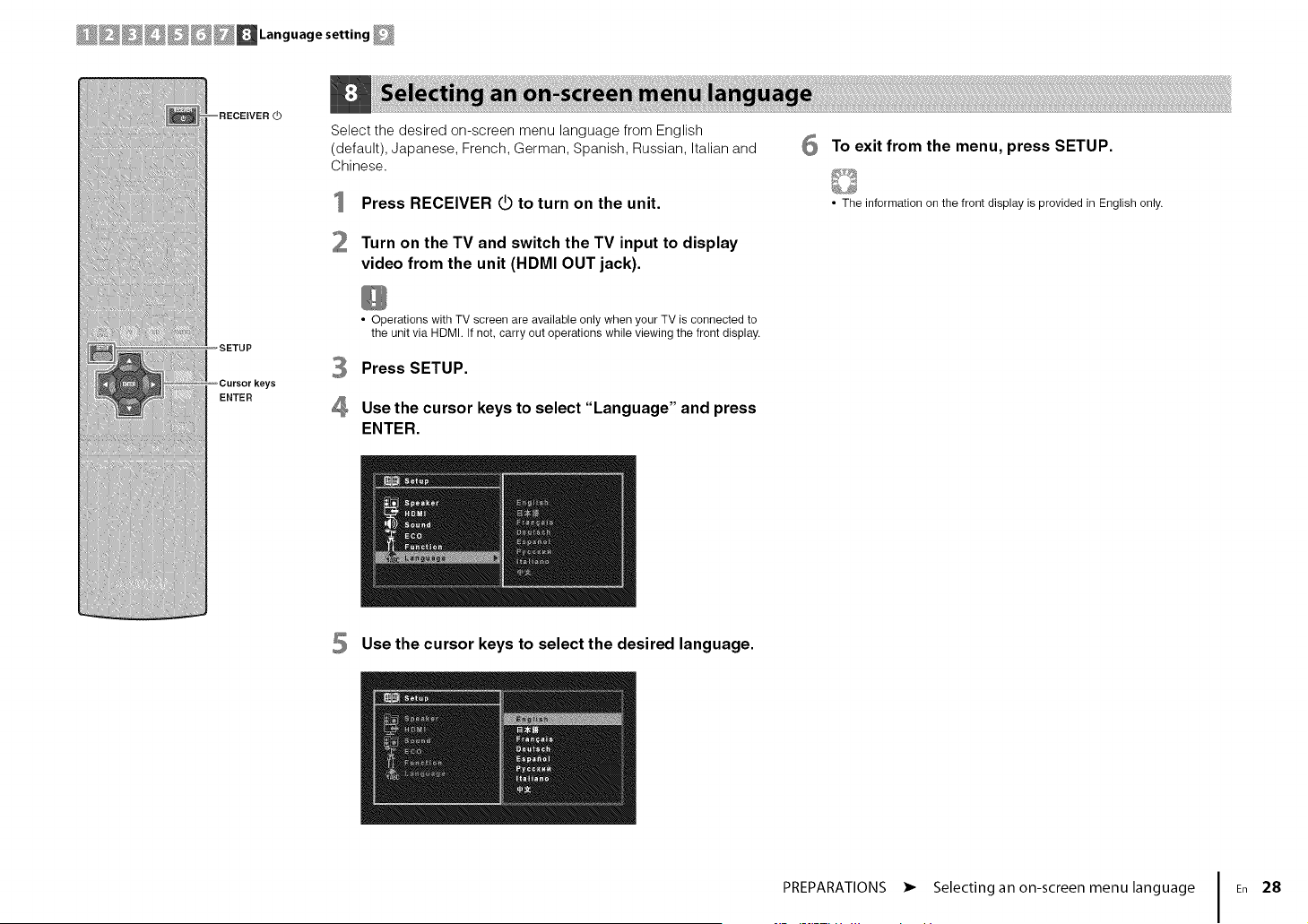
SETUP
ENTER
Select the desired on-screen menu language from English
(default), Japanese, French, German, Spanish, Russian, Italian and
Chinese.
Press RECEIVER _ to turn on the unit.
Turn on the TV and switchthe TV input to display
video from the unit (HDMI OUT jack).
• Operations with TV screen are available only when your TV is connected to
the unit via HDMI. If not, carry out operations while viewing the front display.
Press SETUP.
Use the cursor keys to select "Language" and press
ENTER.
Use the cursor keys to select the desired language.
5 To exit from the menu, press SETUP.
• The information on the front display is provided in English only.
PREPARATIONS • Selecting an on-screen menu language En 28
___Automat c speaker setup
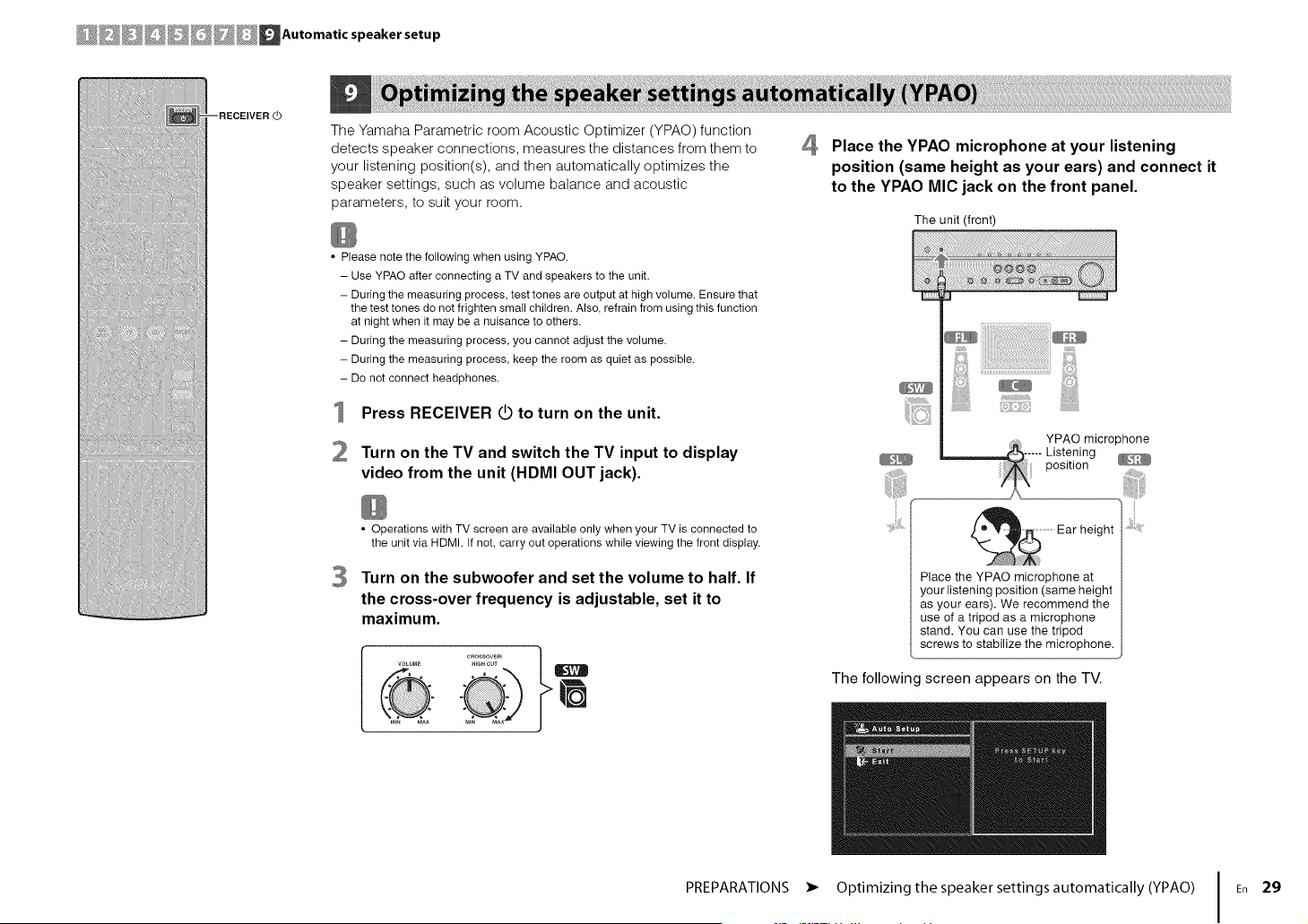
The Yamaha Parametric room Acoustic Optimizer (YPAO) function
detects speaker connections, measures the distances from them to
your listening position(s), and then automatically optimizes the
speaker settings, such as volume balance and acoustic
parameters, to suit your room.
• Please note the following when using YPAO.
- Use YPAO after connecting a TV and speakers to the unit.
- During the measuring process, test tones are output at high volume. Ensure that
the test tones do not frighten small children. Also, refrain from using this function
at night when it may be a nuisance to others.
- During the measuring process, you cannot adjust the volume.
- During the measuring process, keep the room as quiet as possible.
- Do not connect headphones.
Press RECEIVER _ to turn on the unit.
Turn on the TV and switchthe TV input to display
video from the unit (HDMI OUT jack).
• Operations with TV screen are available only when your TV is connected to
the unit via HDMI. If not, carry out operations while viewing the front display.
Turn on the subwoofer and set the volume to half. If
the cross-over frequency is adjustable, set it to
maximum.
CROSSOVEr/
HEG_CUT
4 Place the YPAO microphone at your listening
position (same height as your ears) and connect it
to the YPAO MIC jack on the front panel.
The unit (front)
iiii_,!;ill....
,_ Earheight
Place the YPAO microphone at
your listening position (same height
as your ears). We recommend the
use of a tripod as a microphone
stand. You can use the tripod
screws to stabilize the microphone.
The following screen appears on the TV.
PREPARATIONS • Optimizing the speaker settings automatically (YPAO) En 29
@@@D@D@DQA-tomotc,pooko,-t-p
SETUP
ENTER
RETURN
• To cancel the operation, disconnect the YPAO microphone, or use the
cursor keys to select "Exit" and press ENTER, before starting the
measurement.
• Do not stand between the speakers and the YPAO microphone during the
measurement process (about 3 minutes).
• Move to the corner of the room or leave the room.
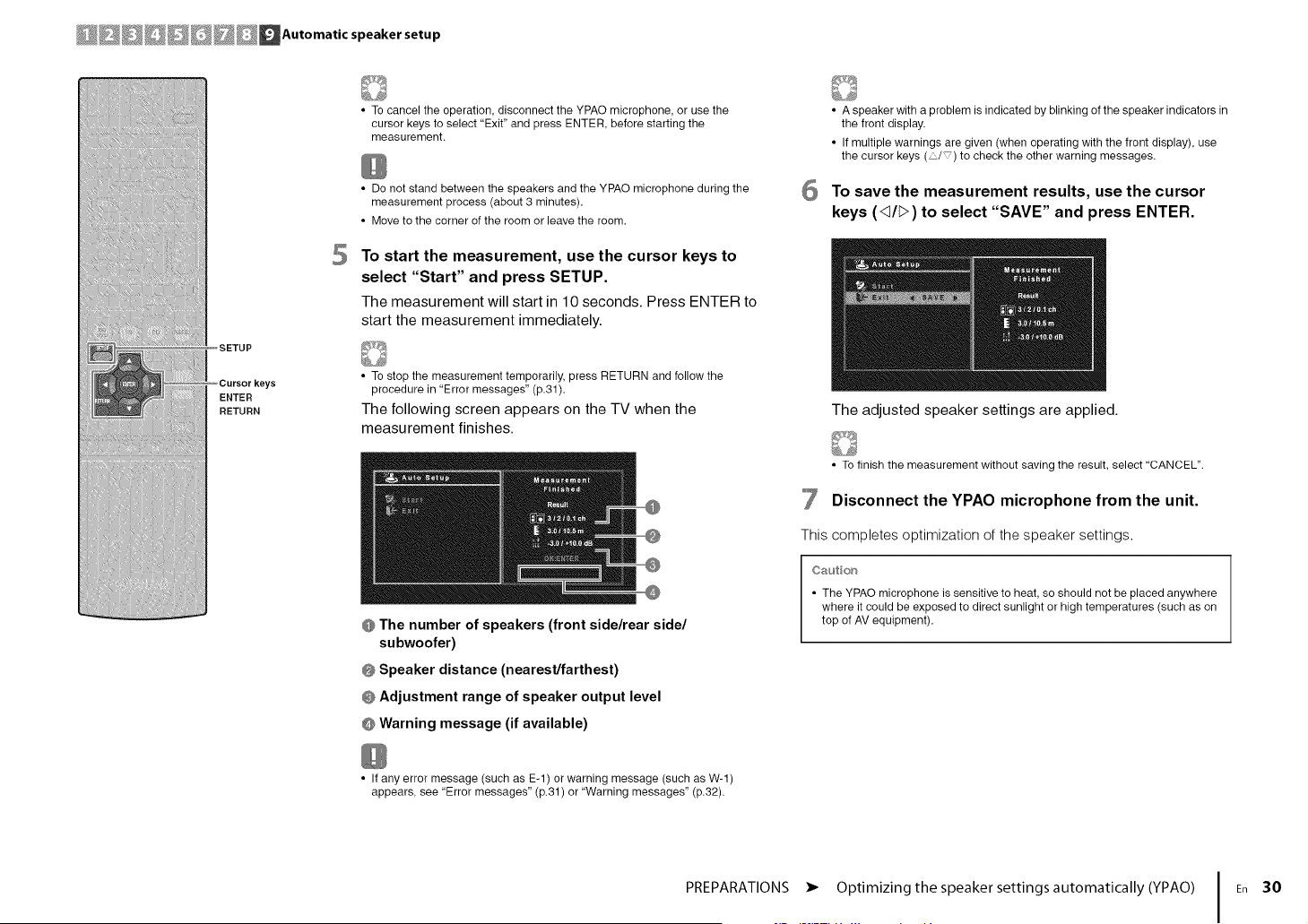
To start the measurement, use the cursor keys to
select "Start" and press SETUP.
The measurement will start in 10 seconds. Press ENTER to
start the measurement immediately.
• To stop the measurement temporarily, press RETURN and follow the
procedure in "Error messages" (p.31).
The following screen appears on the TV when the
measurement finishes.
@
@ The number of speakers (front side/rear side/
subwoofer)
@ Speaker distance (nearest/farthest)
@ Adjustment range of speaker output level
@ Warning message (if available)
6
• A speaker with a problem is indicated by blinking of the speaker indicators in
the front display,
• If multiple warnings are given (when operating with the front display), use
the cursor keys ( / ) to check the other warning messages.
To save the measurement results, use the cursor
keys (<_f>) to select "SAVE" and press ENTER.
The adjusted speaker settings are applied.
• To finish the measurement without saving the result, select "CANCEL".
7 Disconnect the YPAO microphone from the unit.
This completes optimization of the speaker settings.
Cautio_'_
• The YPAO microphone is sensitive to heat, so should not be placed anywhere
where it could be exposed to direct sunlight or high temperatures (such as on
top of AV equipment).
• If any error message (such as E-l) or warning message (such as W-l)
appears, see "Error messages" (p.31) or "Warning messages" (p.32).
PREPARATIONS • Optimizing the speaker settings automatically (YPAO) En _0
___Automat c speaker setup
Error messages
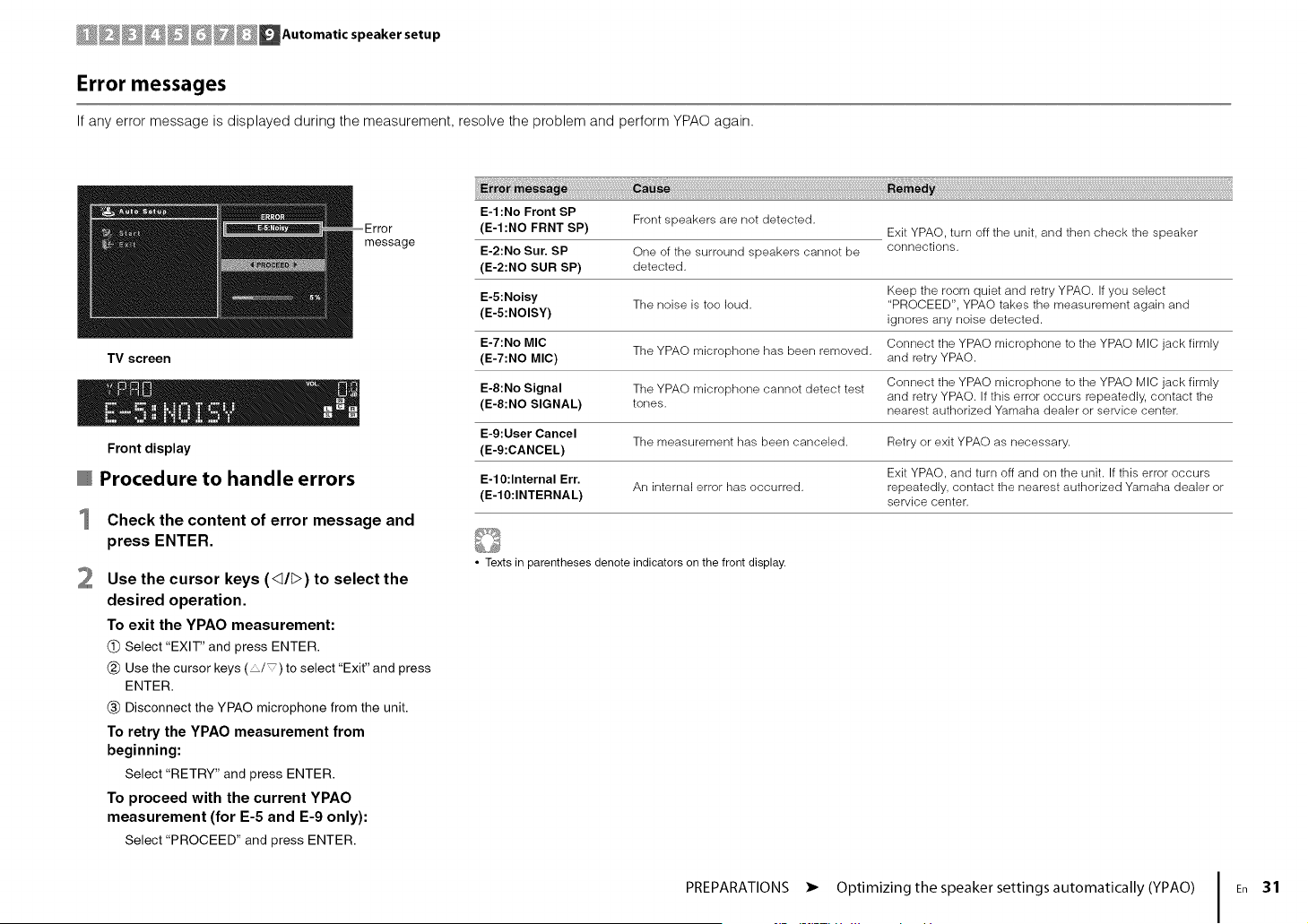
If any error message is displayed during the measurement, resolve the problem and perform YPAO again.
message
TV screen
Front display
Procedure to handle errors
Checkthe content of error message and
press ENTER.
Use the cursor keys (</_>) to select the
desired operation.
To exit the YPAO measurement:
(_) Select "EXIT" and press ENTER.
(_) Use the cursor keys ( / ) to select "Exit" and press
ENTER.
(_) Disconnect the YPAO microphone from the unit.
To retry the YPAO measurement from
beginning:
Select "RETRY" and press ENTER.
To proceed with the current YPAO
measurement (for E-5 and E-9 only):
Select "PROCEED" and press ENTER.
E-I:No Front SP
(E-I:NO FRNT SP)
E-2:No Sur. SP
(E-2:NO sun SP)
Front speakers are not detected.
One of the surround speakers cannot be
detected.
Keep the room quiet and retry YPAO. If you select
E-5:Noisy The noise is too loud. "PROCEED", YPAO takes the measurement again and
(E-5:NOISY) ignores any noise detected.
E-7:No MIC
(E-7:NO MIC) Tile YPAO microphone has been removed, andC°nneCtretryttleyPAo.YPAOmicrophone to the YPAO MIC jack firmly
Connect the YPAO microphone to the YPAO MIC jack firmly
E-8:No Signal The YPAO microphone cannot detect test and retry YPAO. If this error occurs repeatedly, contact the
(E-8:NO SIGNAL) tones, nearest authorized Yamaha dealer or service center.
E-9:User Cancel
Tile measurement has been canceled. Retry or exit YPAO as necessary.
(E-9:CANCEL)
E-10:lnternal Err. Exit YPAO, and turn off and on tile unit. If this error occurs
An internal error has occurred, repeatedly, contact the nearest authorized Yamaha dealer or
(E-10:INTERNAL) service center.
Exit YPAO, turn off the unit, and then check the speaker
connections.
• Texts in parentheses denote indicators on the front display.
PREPARATIONS • Optimizing the speaker settings automatically (YPAO) En 31
___Automat c speaker setup
Warning messages
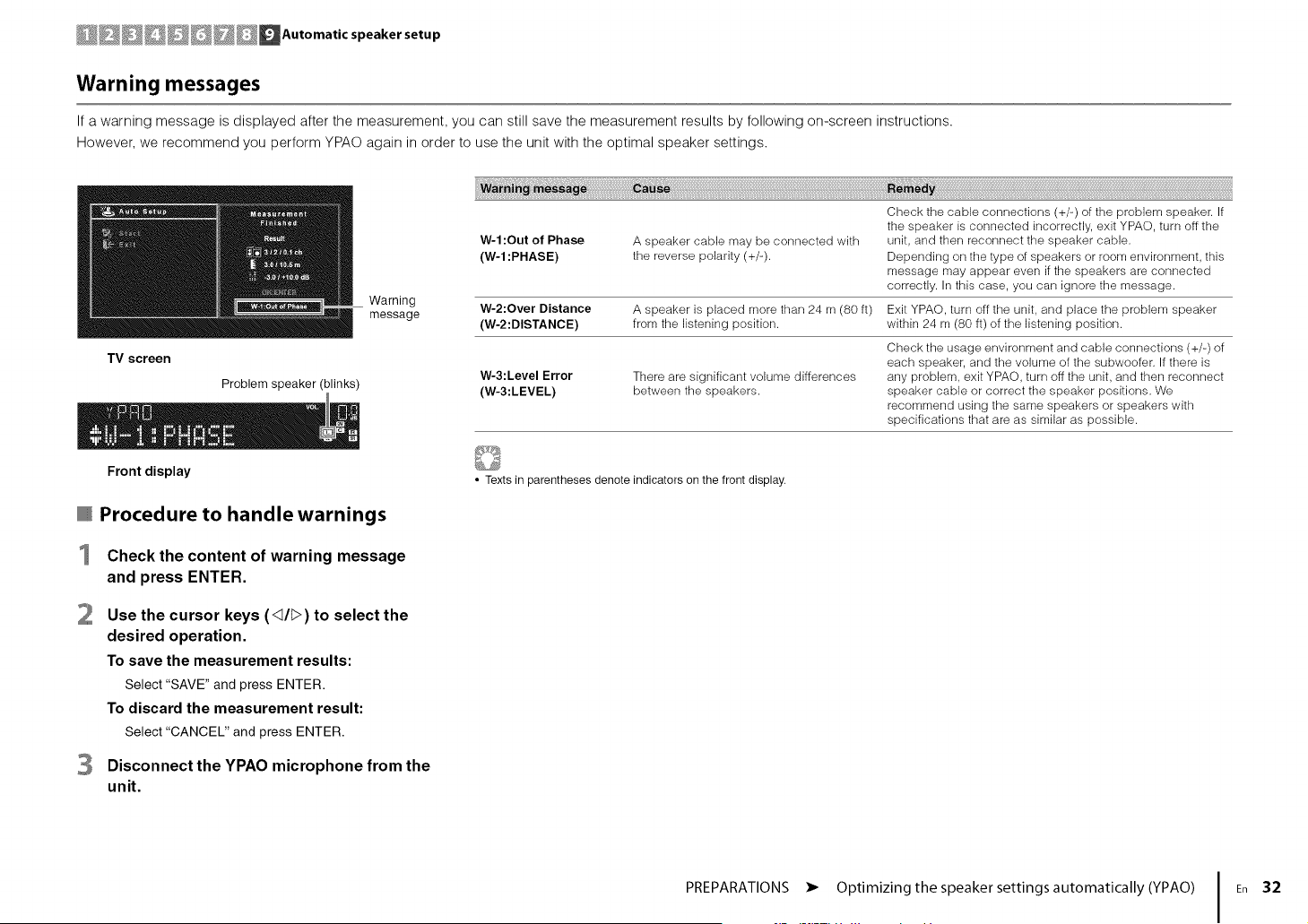
If a warning message is displayed after the measurement, you can still save the measurement results by following on-screen instructions.
However, we recommend you perform YPAO again in order to use the unit with the optimal speaker settings.
W-1 :Out of Phase
(W-1 :PHASE)
__ Warning W-2:Over Distance
message
(W-2:DISTANCE)
TV screen
W-3:Level Error
Problem speaker (blinks) (W-3:LEVEL)
A speaker cable may be connected with
the reverse polarity (+/-).
Check the cable connections (+/-) of the problem speaker. If
the speaker is connected incorrectly, exit YPAO, turn off the
unit, and then reconnect the speaker cable.
Depending on the type of speakers or room environment, this
message may appear even if the speakers are connected
correctly. In this case, you can ignore the message.
A speaker is placed more than 24 m (80 ft) Exit YPAO, turn off the unit, and place the problem speaker
from the listening position, within 24 m (80 ft) of the listening position.
There are significant volume differences
between the speakers.
Check the usage environment and cable connections (+/-) of
each speaker, and the volume of the subwoofer. If there is
any problem, exit YPAO, turn off the unit, and then reconnect
speaker cable or correct the speaker positions. We
recommend using the same speakers or speakers with
specifications that are as similar as possible.
Front display
Procedure to handle warnings
Check the content of warning message
and press ENTER.
Use the cursor keys (<_f>) to select the
desired operation.
To save the measurement results:
Select "SAVE" and press ENTER.
To discard the measurement result:
Select "CANCEL" and press ENTER.
Disconnect the YPAO microphone from the
unit.
• Texts in parentheses denote indicators on the front display.
PREPARATIONS • Optimizing the speaker settings automatically (YPAO) En 32
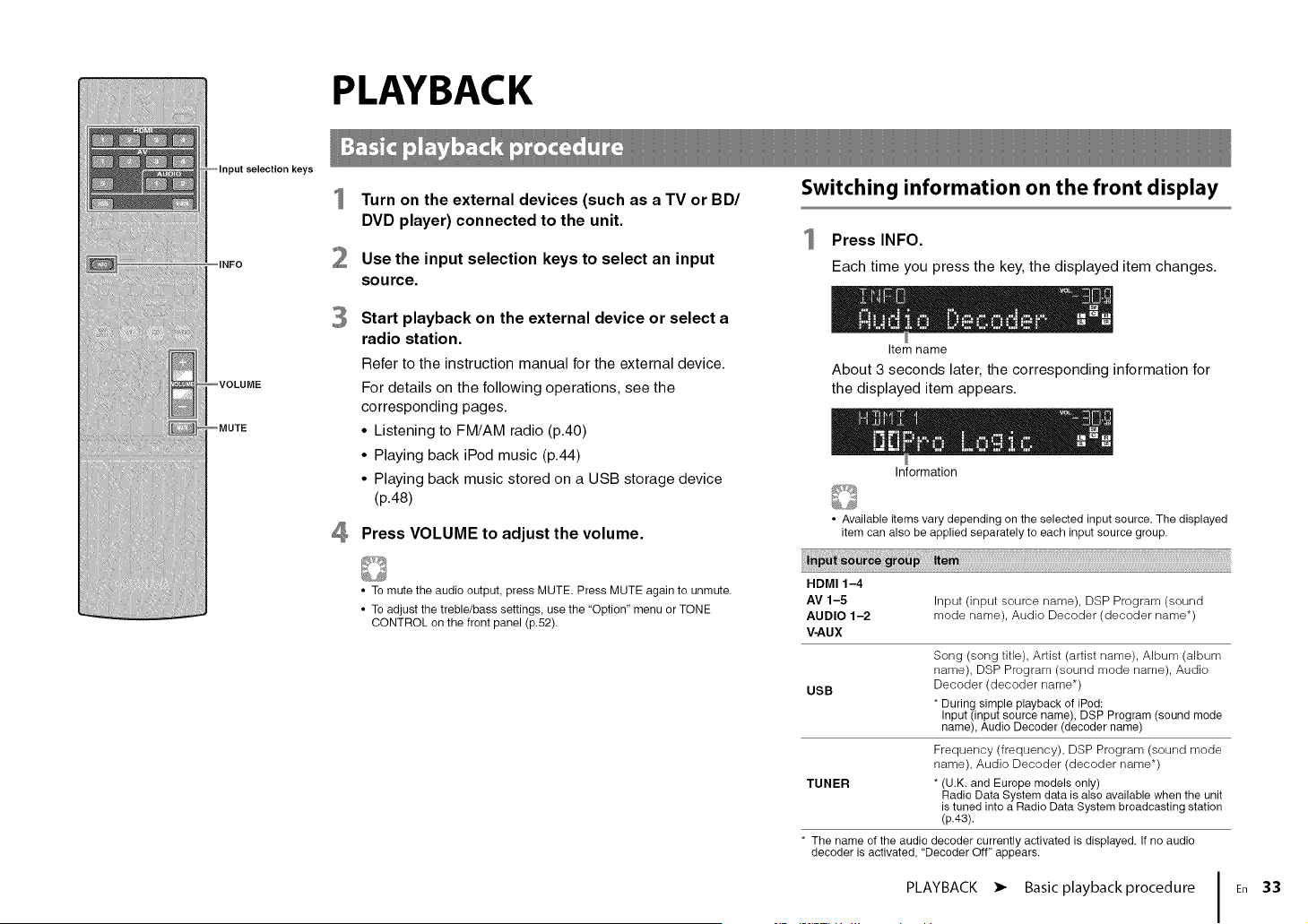
PLAYBACK
)ut selection keys
INFO
Turn on the external devices (such as a TV or BD/
DVD player) connected to the unit.
Use the input selection keys to select an input
source.
Start playback on the external device or select a
radio station.
Refer to the instruction manual for the external device.
For details on the following operations, see the
corresponding pages.
• Listening to FM/AM radio (pA0)
• Playing back iPod music (p.44)
• Playing back music stored on a USB storage device
(p.48)
Press VOLUME to adjust the volume.
Switching information on the front display
Press INFO.
Each time you press the key, the displayed item changes.
Item name
About 3 seconds later, the corresponding information for
the displayed item appears.
Information
• Available items vary depending on the selected input source. The displayed
item can also be applied separately to each input source group.
• To mute the audio output, press MUTE. Press MUTE again to unmute.
• To adjust the treble/bass settings, use the "Option" menu or TONE
CONTROL on the front panel (p.52).
HDMI 1-4
AV 1-5
AUDIO 1-2
V-AUX
Input (input source name), DSP Program (sound
mode name), Audio Decoder (decoder name*)
USB
TUNER
Song (song title), Artist (artist name), Album (album
name), DSP Program (sound mode name), Audio
Decoder (decoder name*)
* During simple playback of iPod:
Input (input source name), DSP Program (sound mode
name), Audio Decoder (decoder name)
Frequency (frequency), DSP Program (sound mode
name), Audio Decoder (decoder name*)
* (U.K. and Europe models only)
Radio Data System data is also available when the unit
is tuned into a Radio Data System broadcasting station
(p.43).
* The name of the audio decoder currently activated is displayed. If no audio
decoder is activated, "Decoder Off" appears.
PLAYBACK • Basic playback procedure En 33
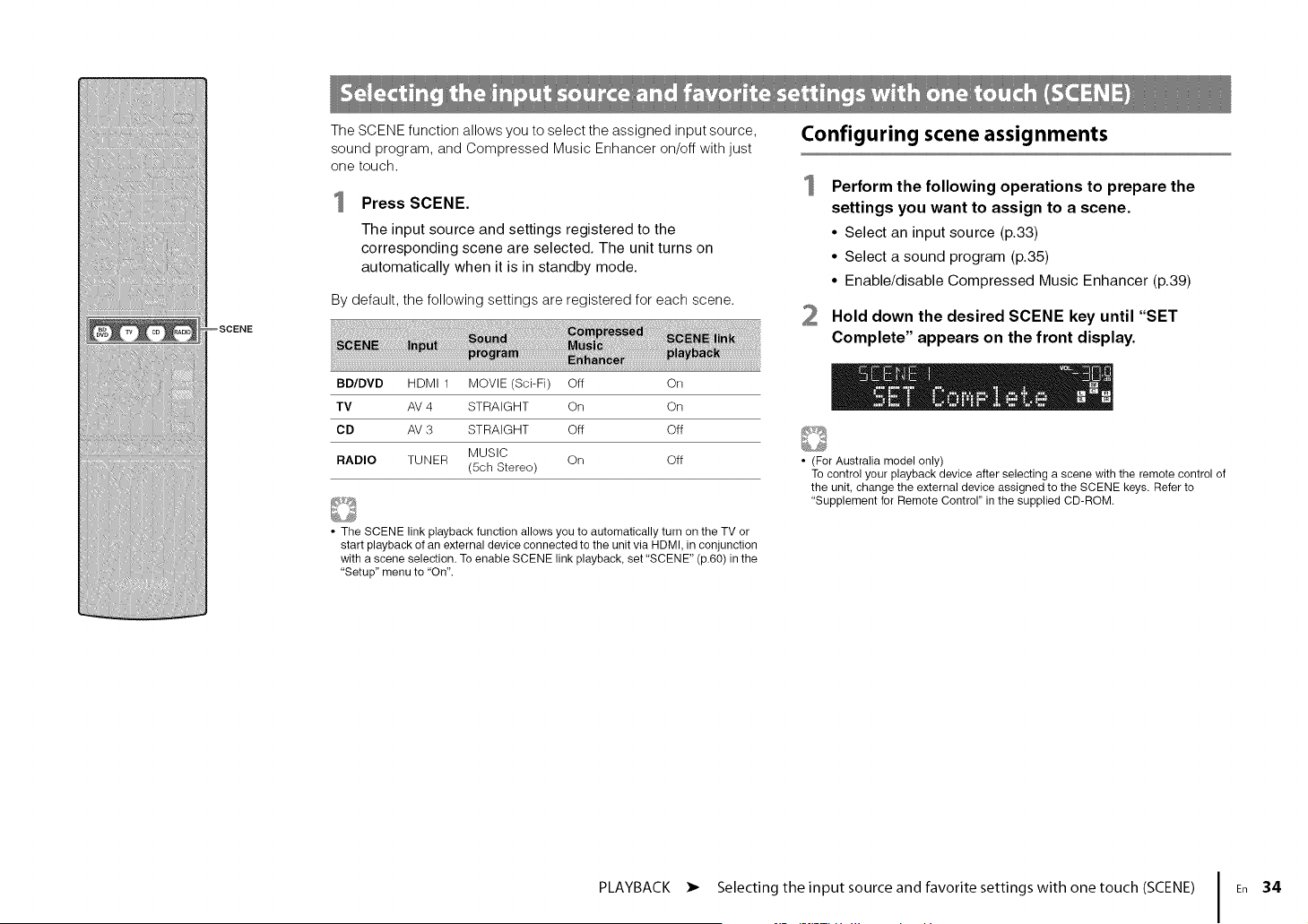
The SCENE function allows you to select the assigned input source,
sound program, and Compressed Music Enhancer on/off with just
one touch.
Press SCENE.
The input source and settings registered to the
corresponding scene are selected. The unit turns on
automatically when it is in standby mode.
By default, the following settings are registered for each scene.
Configuring scene assignments
2
Perform the following operations to prepare the
settings you want to assign to a scene.
• Select an input source (p.33)
• Select a sound program (p.35)
• Enable/disable Compressed Music Enhancer (p.39)
Hold down the desired SCENE key until "SET
Complete" appears on the front display.
BD/DVD HDMI 1 MOVIE (Sci-Fi) Off On
TV AV 4 STRAIGHT On On
CD AV 3 STRAIGHT Off Off
MUSIC
RADIO TUNER On Off
(5ch Stereo)
• The SCENE link playback function allows you to automatically turn on the TV or
start playback of an external device connected to the unit via HDMI, in conjunction
with a scene selection. To enable SCENE link playback, set "SCENE" (p.60) in the
"Setup" menu to "On".
• (For Australia model only)
To control your playback device after selecting a scene with the remote control of
the unit, change the external device assigned to the SCENE keys. Refer to
"Supplement for Remote Control" in the supplied CD-ROM
PLAYBACK • Selecting the input source and favorite settings with one touch (SCENE) En 34
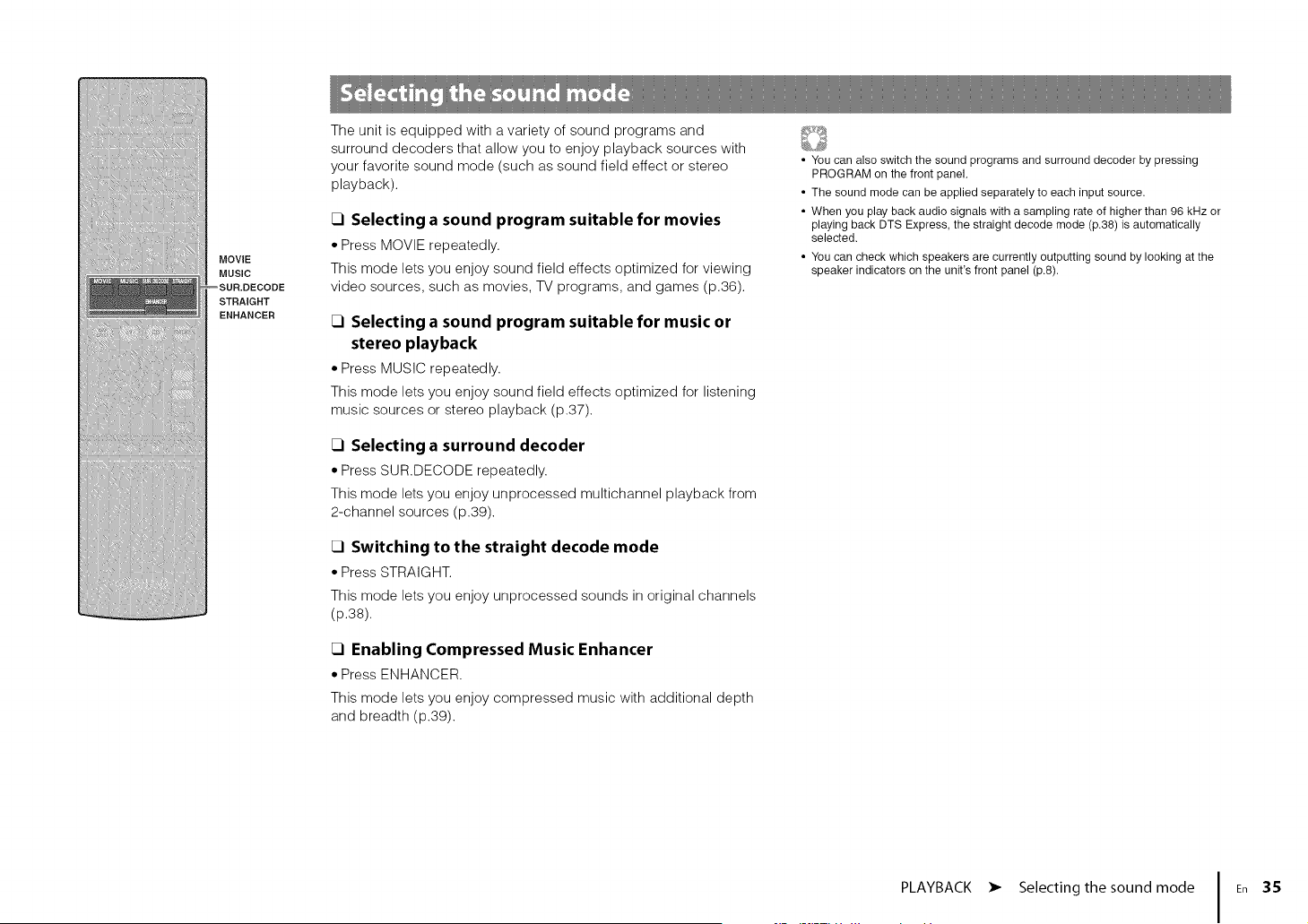
MOVIE
MUSIC
--SUR.DECODE
STRAIGHT
ENHANCER
The unit is equipped with a variety of sound programs and
surround decoders that allow you to enjoy playback sources with
your favorite sound mode (such as sound field effect or stereo
playback).
_1 Selecting a sound program suitable for movies
• Press MOVIE repeatedly.
This mode lets you enjoy sound field effects optimized for viewing
video sources, such as movies, TV programs, and games (p.36).
rl Selecting a sound program suitable for music or
stereo playback
• Press MUSIC repeatedly.
This mode lets you enjoy sound field effects optimized for listening
music sources or stereo playback (p.37).
FI Selecting a surround decoder
• Press SUR.DECODE repeatedly.
This mode lets you enjoy unprocessed multichannel playback from
2-channel sources (p.39).
FI Switching to the straight decode mode
• Press STRAIGHT.
This mode lets you enjoy unprocessed sounds in original channels
(p.38).
FI Enabling Compressed Music Enhancer
• Press ENHANCER.
This mode lets you enjoy compressed music with additional depth
and breadth (p.39).
• You can also switch the sound programs and surround decoder by pressing
PROGRAM on the front panel.
• The sound mode can be applied separately to each input source.
• When you play back audio signals with a sampling rate of higher than 96 kHz or
playing back DTS Express, the straight decode mode (p.38) is automatically
selected.
• You can check which speakers are currently outputting sound by looking at the
speaker indicators on the unit's front panel (p.8).
PLAYBACK • Selecting the sound mode En 35
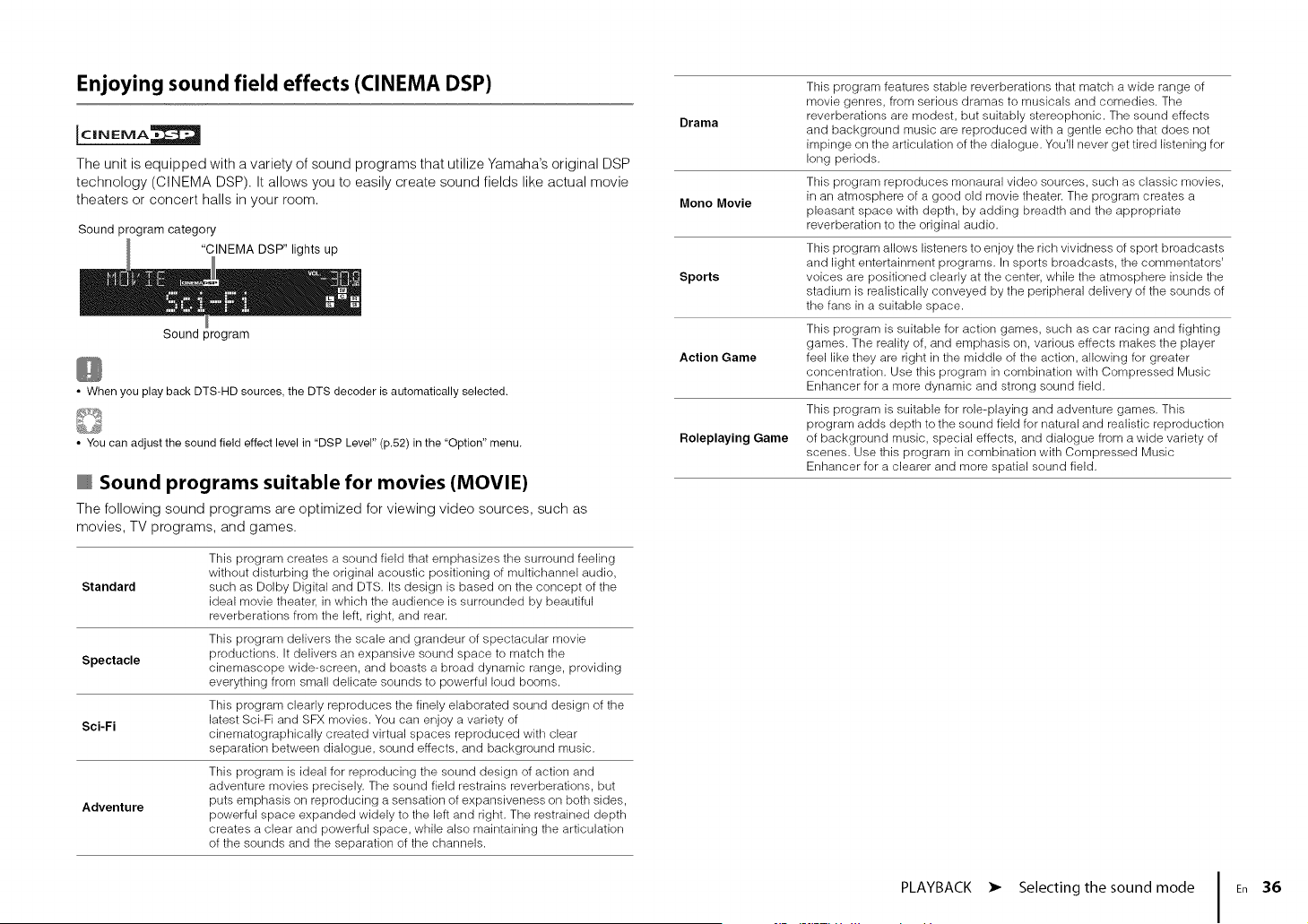
Enjoying sound field effects (CINEMA DSP)
The unit is equipped with a variety of sound programs that utilize Yamaha's original DSP
technology (CINEMA DSP). It allows you to easily create sound fields like actual movie
theaters or concert halls in your room.
Sound program category
"CINEMA DSP" lights up
Sound program
• When you play back DTS-HD sources, the DTS decoder is automatically selected.
• You can adjust the sound field effect level in "DSP Level" (p.52) in the "Option" menu.
Sound programs suitable for movies (MOVIE)
The following sound programs are optimized for viewing video sources, such as
movies, TV programs, and games.
Standard
Spectacle
Sci-Fi
Adventure
This program creates a sound field that emphasizes the surround feeling
without disturbing the original acoustic positioning of multichannel audio,
such as Dolby Digital and DTS. Its design is based on the concept of the
ideal movie theater, in which the audience is surrounded by beautiful
reverberations from the left, right, and rear.
This program delivers the scale and grandeur of spectacular movie
productions. It delivers an expansive sound space to match the
cinemascope wide-screen, and boasts a broad dynamic range, providing
everything from small delicate sounds to powerful loud booms.
This program clearly reproduces the finely elaborated sound design of the
latest Sci-Fi and SFX movies. You can enjoy a variety of
cinematographically created virtual spaces reproduced with clear
separation between dialogue, sound effects, and background music.
This program is ideal for reproducing the sound design of action and
adventure movies precisely. The sound field restrains reverberations, but
puts emphasis on reproducing a sensation of expansiveness on both sides,
powerful space expanded widely to the left and right. The restrained depth
creates a clear and powerful space, while also maintaining the articulation
of the sounds and the separation of the channels.
Drama
This program features stable reverberations that match a wide range of
movie genres, from serious dramas to musicals and comedies. The
reverberations are modest, but suitably stereophonic. The sound effects
and background music are reproduced with a gentle echo that does not
impinge on the articulation of the dialogue. You'll never get tired listening for
long periods.
Mono Movie
This program reproduces monaural video sources, such as classic movies,
in an atmosphere of a good old movie theater. The program creates a
pleasant space with depth, by adding breadth and the appropriate
reverberation to the original audio.
Sports
This program allows listeners to enjoy the rich vividness of sport broadcasts
and light entertainment programs. In sports broadcasts, the commentators'
voices are positioned clearly at the center, while the atmosphere inside the
stadium is realistically conveyed by the peripheral delivery of the sounds of
the fans in a suitable space.
Action Game
This program is suitable for action games, such as car racing and fighting
games. The reality of, and emphasis on, various effects makes the player
feel like they are right in the middle of the action, allowing for greater
concentration. Use this program in combination with Compressed Music
Enhancer for a more dynamic and strong sound field.
Roleplaying Game
This program is suitable for role-playing and adventure games. This
program adds depth to the sound field for natural and realistic reproduction
of background music, special effects, and dialogue from a wide variety of
scenes. Use this program in combination with Compressed Music
Enhancer for a clearer and more spatial sound field.
PLAYBACK • Selecting the sound mode En 36
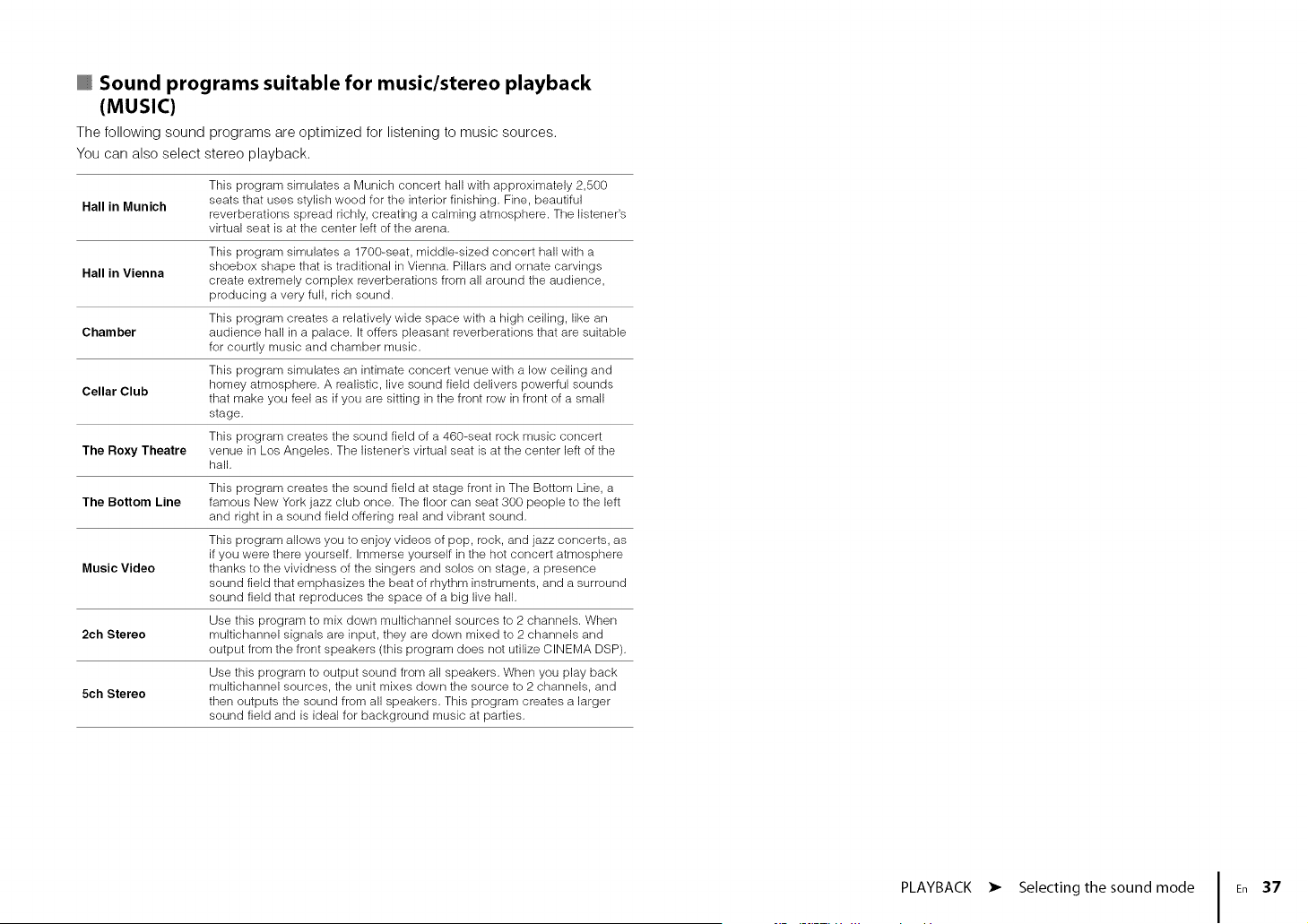
Sound programs suitable for music/stereo playback
(MUSIC)
The following sound programs are optimized for listening to music sources.
You can also select stereo playback.
This program simulates a Munich concert hall with approximately 2,500
seats that uses stylish wood for the interior finishing. Fine, beautiful
Hall in Munich
reverberations spread richly, creating a calming atmosphere. The listener's
virtual seat is at the center left of the arena.
This program simulates a 1700-seat, middle-sized concert hall with a
Hall in Vienna shoebox shape that is traditional in Vienna. Pillars and ornate carvings
create extremely complex reverberations from all around the audience,
producing a very full, rich sound.
This program creates a relatively wide space with a high ceiling, like an
Chamber audience hall in a palace. It offers pleasant reverberations that are suitable
for courtly music and chamber music.
This program simulates an intimate concert venue with a low ceiling and
Cellar Club homey atmosphere. A realistic, live sound field delivers powerful sounds
that make you feel as if you are sitting in the front row in front of a small
stage.
This program creates the sound field of a 460-seat rock music concert
The Roxy Theatre venue in Los Angeles. The listener's virtual seat is at the center left of the
hall.
This program creates the sound field at stage front in The Bottom Line, a
The Bottom Line famous New York jazz club once. The floor can seat 300 people to the left
and right in a sound field offering real and vibrant sound.
This program allows you to enjoy videos of pop, rock, and jazz concerts, as
if you were there yourself. Immerse yourself in the hot concert atmosphere
Music Video thanks to the vividness of the singers and solos on stage, a presence
sound field that emphasizes the beat of rhythm instruments, and a surround
sound field that reproduces the space of a big live hall.
Use this program to mix down mulfichannel sources to 2 channels. When
2ch Stereo multichannel signals are input, they are down mixed to 2 channels and
output from the front speakers (this program does not utilize CINEMA DSP).
Use this program to output sound from all speakers. When you play back
multichannel sources, the unit mixes down the source to 2 channels, and
5ch Stereo
then outputs tile sound from all speakers. This program creates a larger
sound field and is ideal for background music at parties.
PLAYBACK • Selecting the sound mode En 37
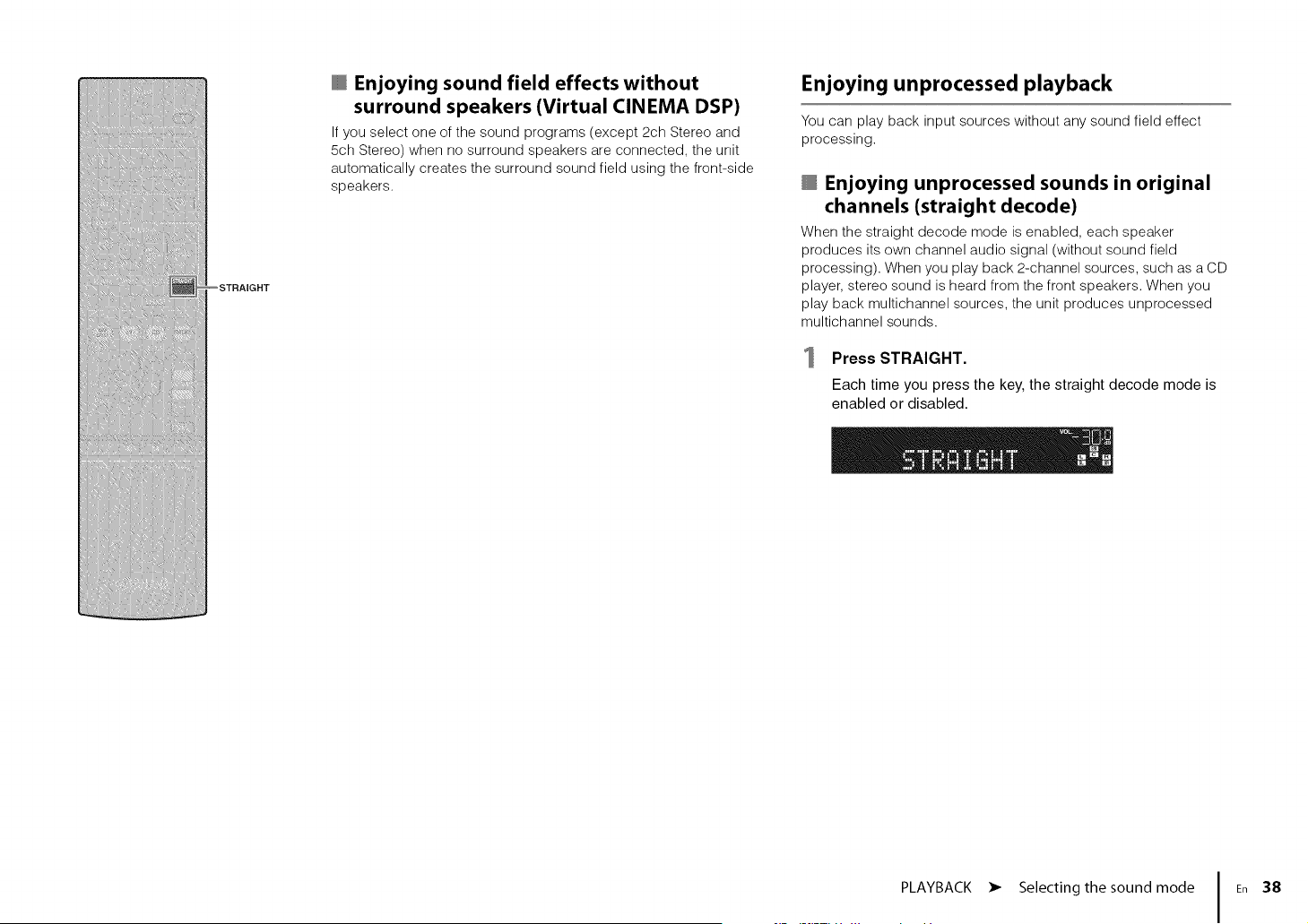
Enjoying sound field effects without
surround speakers (Virtual CINEMA DSP)
If you select one of the sound programs (except 2ch Stereo and
5ch Stereo) when no surround speakers are connected, the unit
automatically creates the surround sound field using the front-side
speakers.
Enjoying unprocessed playback
You can play back input sources without any sound field effect
processing.
Enjoying unprocessed sounds in original
channels (straight decode)
When the straight decode mode is enabled, each speaker
produces its own channel audio signal (without sound field
processing). When you play back 2-channel sources, such as a CD
player, stereo sound is heard from the front speakers. When you
play back multichannel sources, the unit produces unprocessed
multichannel sounds.
Press STRAIGHT.
Each time you press the key, the straight decode mode is
enabled or disabled.
PLAYBACK • Selecting the sound mode En 38
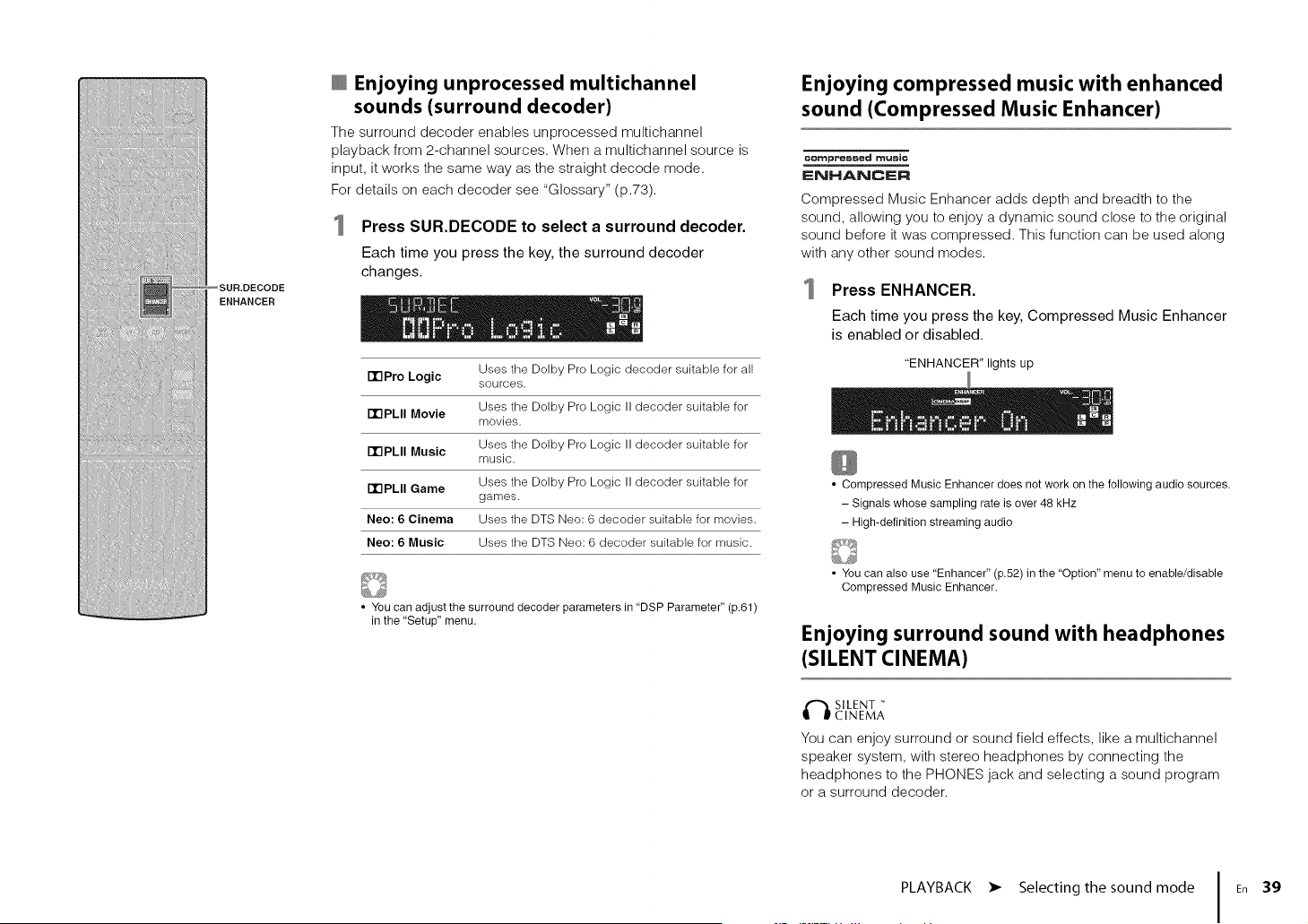
_SUR.DECODE
ENHANCER
Enjoying unprocessed multichannel
sounds (surround decoder)
The surround decoder enables unprocessed multichannel
playback from 2-channel sources. When a multichannel source is
input, it works the same way as the straight decode mode.
For details on each decoder see "Glossary" (p.73).
Press SUR.DECODE to select a surround decoder.
Each time you press the key, the surround decoder
changes.
Uses the Dolby Pro Logic decoder suitable for all
ITIPro Logic sources.
Uses the Dolby Pro Logic II decoder suitable for
rTIPLII Movie
movies.
Uses the Dolby Pro Logic II decoder suitable for
rTIPLII Music
music.
Uses the Dolby Pro Logic II decoder suitable for
ITIPLII Game
games.
Neo: 6 Cinema Uses the DTS Nee: 6 decoder suitable for movies.
Neo: 6 Music Uses the DTS Nee: 6 decoder suitable for music.
• You can adjust the surround decoder parameters in "DSP Parameter" (p.61)
in the "Setup" menu.
Enjoying compressed music with enhanced
sound (Compressed Music Enhancer)
compPessed music
ENHANCER
Compressed Music Enhancer adds depth and breadth to the
sound, allowing you to enjoy a dynamic sound close to the original
sound before it was compressed. This function can be used along
with any other sound modes.
Press ENHANCER.
Each time you press the key, Compressed Music Enhancer
is enabled or disabled.
"ENHANCER" lights up
• Compressed Music Enhancer does not work on the following audio sources.
- Signals whose sampling rate is over 48 kHz
- High-definition streaming audio
• You can also use "Enhancer" (p.52) in the "Option" menu to enable/disable
Compressed Music Enhancer.
Enjoying surround sound with headphones
(SILENT CINEMA)
_'_! SILENT'°
CINEMA
You can enjoy surround or sound field effects, like a multichannel
speaker system, with stereo headphones by connecting the
headphones to the PHONES jack and selecting a sound program
or a surround decoder.
PLAYBACK • Selecting the sound mode En 39
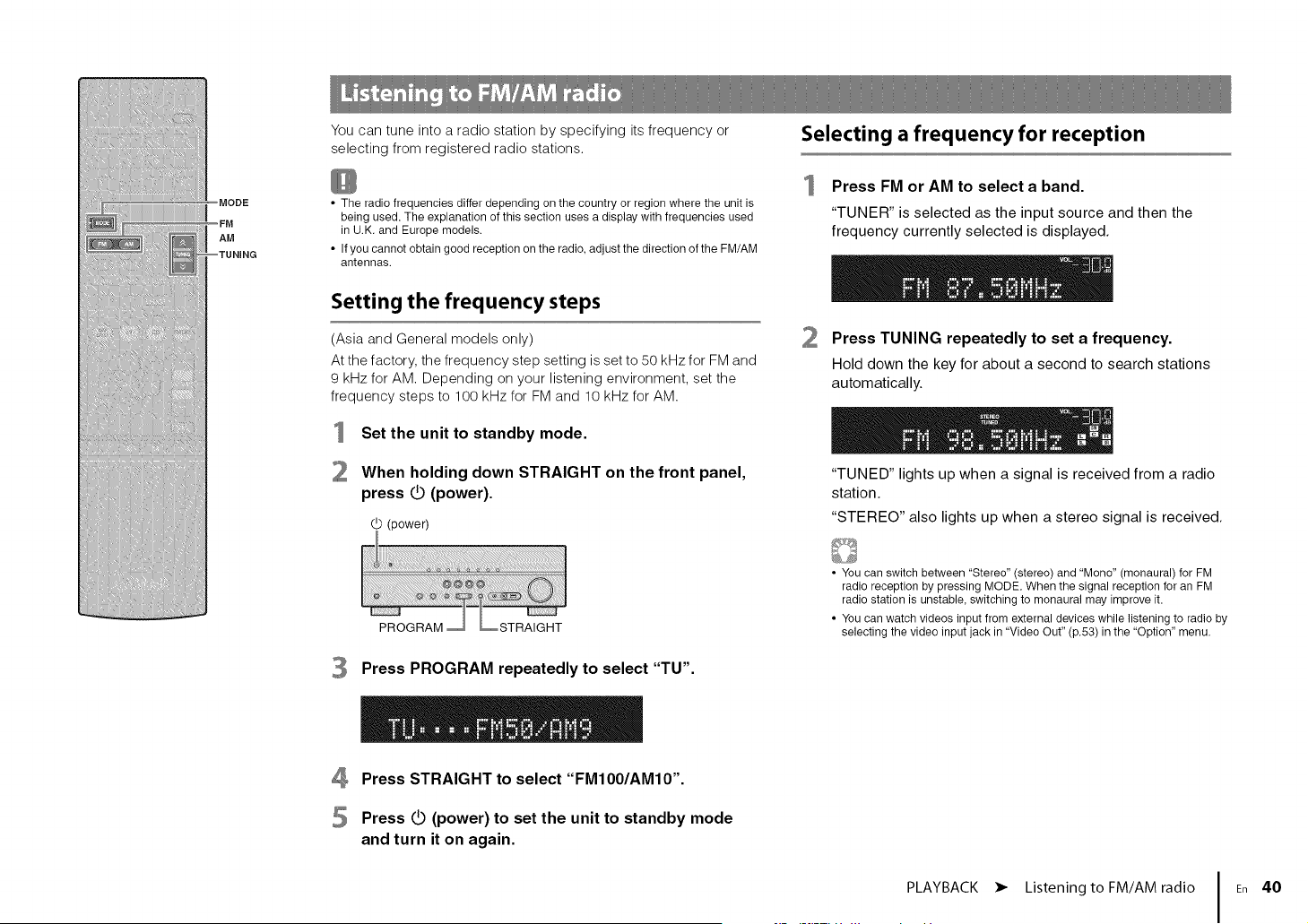
You can tune into a radio station by specifying its frequency or Selecting a frequency for reception
selecting from registered radio stations.
FM
AM
• The radio frequencies differ depending on the country or region where the unit is
being used. The explanation of this section uses a display with frequencies used
in U.K. and Europe models.
• If you cannot obtain good reception on the radio, adjust the direction of the FM/AM
antennas.
Setting the frequency steps
(Asia and General models only)
At the factory, the frequency step setting is set to 50 kHz for FM and
9 kHz for AM. Depending on your listening environment, set the
frequency steps to 100 kHz for FM and 10 kHz for AM.
Set the unit to standby mode.
When holding down STRAIGHT on the front panel,
press _ (power).
dD (power)
Press PROGRAM repeatedly to select "TU".
Press STRAIGHT to select "FM100/AM10".
Press _ (power) to set the unit to standby mode
and turn it on again.
2
Press FM or AM to select a band.
"TUNER" is selected as the input source and then the
frequency currently selected is displayed.
Press TUNING repeatedly to set a frequency.
Hold down the key for about a second to search stations
automatically.
"TUNED" lights up when a signal is received from a radio
station.
"STEREO" also lights up when a stereo signal is received.
• You can switch between "Stereo" (stereo) and "Mono" (monaural) for FM
radio reception by pressing MODE. When the signal reception for an FM
radio station is unstable, switching to monaural may improve it.
• You can watch videos input from external devices while listening to radio by
selecting the video input jack in "Video Out" (p.53) in the "Option" menu.
PLAYBACK • Listening to FM/AM radio En 40
FM
AM
PRESET
ENTER
RETURN
Registering favorite radio stations (presets)
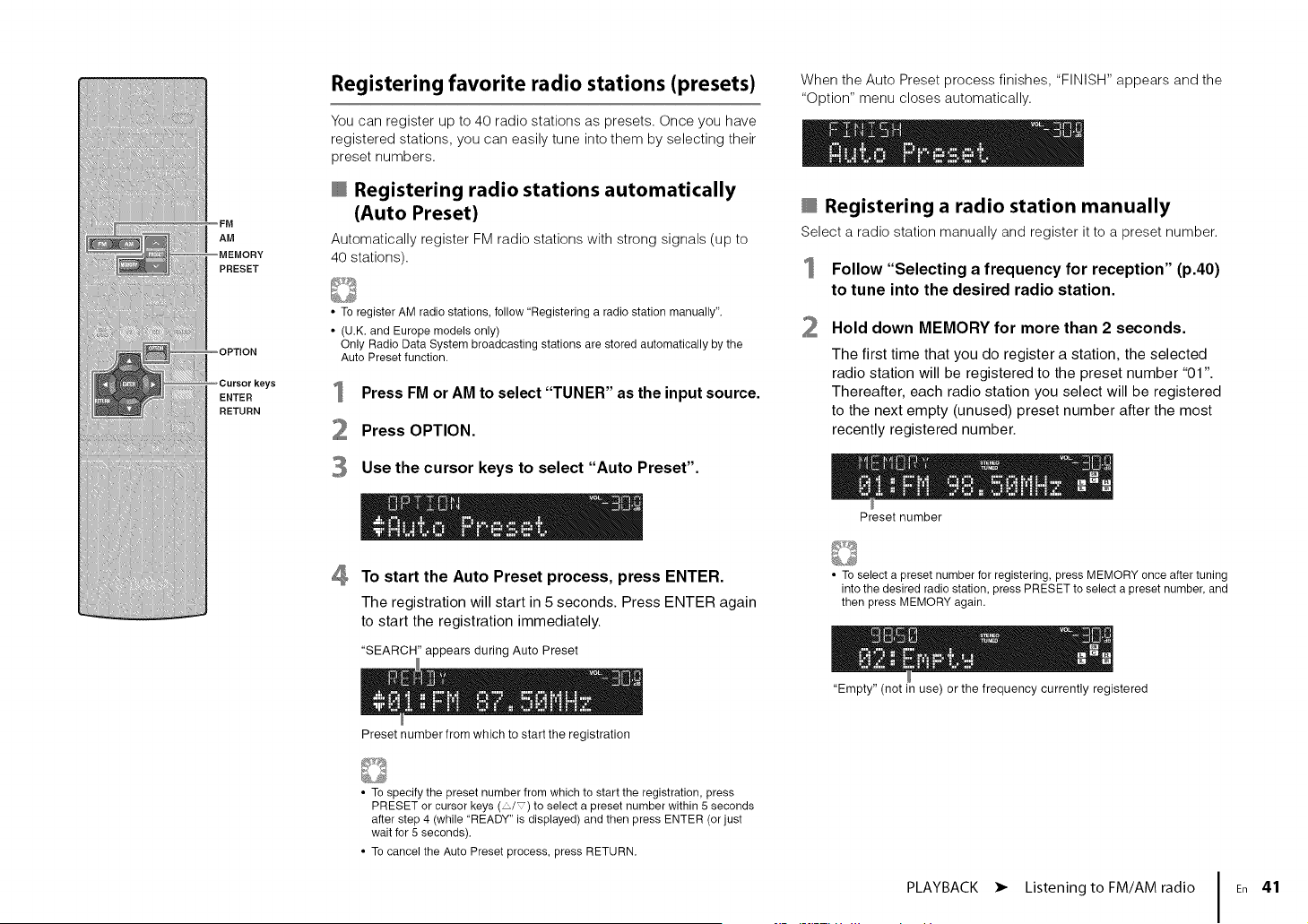
You can register up to 40 radio stations as presets. Once you have
registered stations, you can easily tune into them by selecting their
preset numbers.
@ Registering radio stations automatically
(Auto Preset)
Automatically register FM radio stations with strong signals (up to
40 stations).
• To register AM radio stations, follow "Registering a radio station manually".
• (U.K. and Europe models only)
Only Radio Data System broadcasting stations are stored automatically by the
Auto Preset function.
Press FM or AM to select "TUNER" as the input source.
Press OPTION.
Use the cursor keys to select "Auto Preset".
When the Auto Preset process finishes, "FINISH" appears and the
"Option" menu closes automatically.
Registering a radio station manually
Select a radio station manually and register it to a preset number.
Follow "Selecting a frequency for reception" (p.40)
to tune into the desired radio station.
2 Hold down MEMORY for more than 2 seconds.
The first time that you do register a station, the selected
radio station will be registered to the preset number "01".
Thereafter, each radio station you select will be registered
to the next empty (unused) preset number after the most
recently registered number.
To start the Auto Preset process, press ENTER.
The registration will start in 5 seconds. Press ENTER again
to start the registration immediately.
"SEARCH" appears during Auto Preset
Preset number from which to start the registration
Preset number
• To select a preset number for registering, press MEMORY once after tuning
into the desired radio station, press PRESET to select a preset number, and
then press MEMORY again.
"Empty" (not in use) or the frequency currently registered
• To specify the preset number from which to start the registration, press
PRESET or cursor keys ( / ) to select a preset number within 5 seconds
after step 4 (while "READY" is displayed) and then press ENTER (or just
wait for 5 seconds).
• To cancel the Auto Preset process, press RETURN.
PLAYBACK • Listening to FM/AM radio En 41
FM
AM
ENTER
@ Selecting a preset station
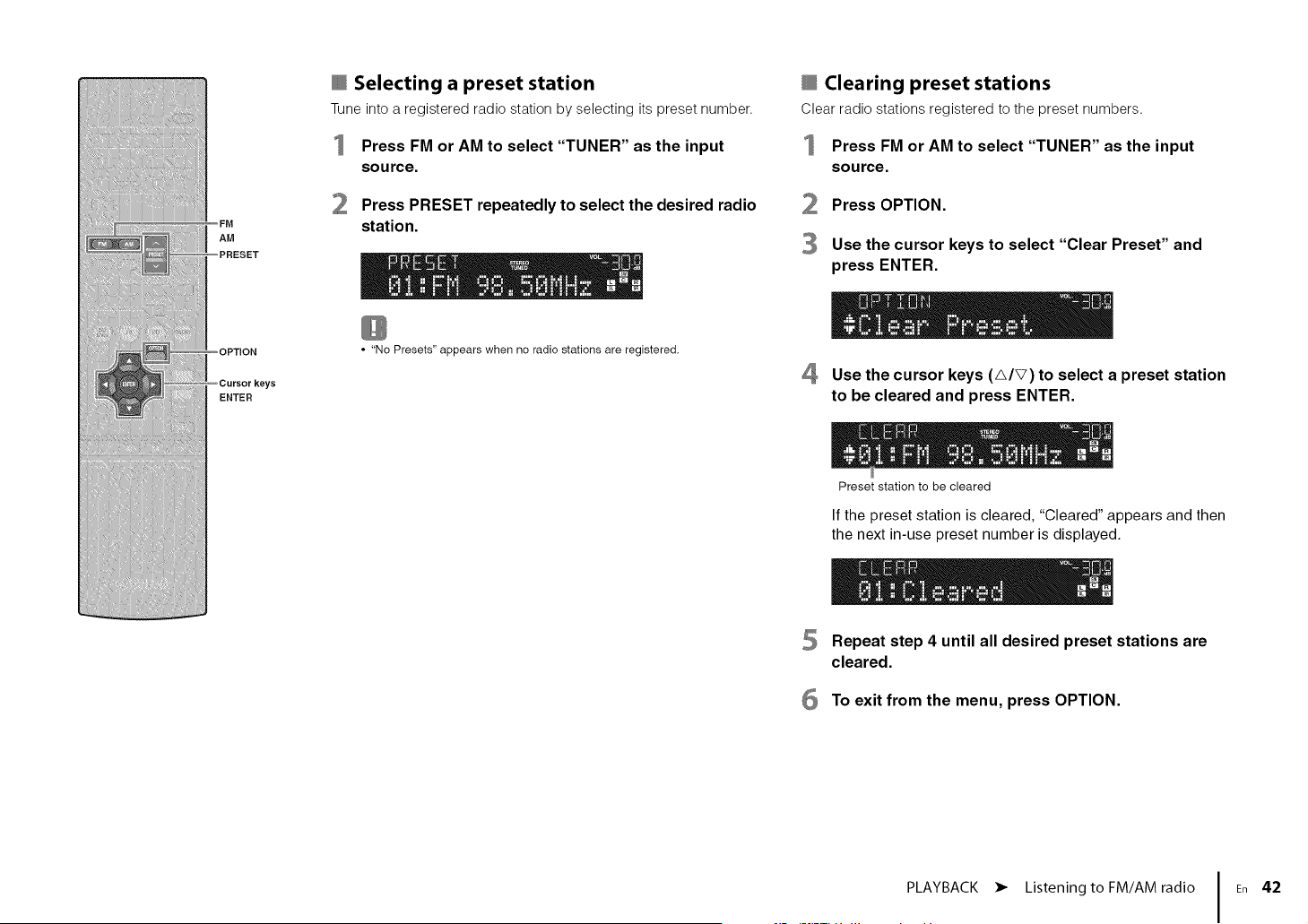
Tune intoa registered radio station by selecting itspreset number.
Press FM or AM to select "TUNER" as the input
source.
Press PRESET repeatedly to select the desired radio
station.
• "No Presets" appears when no radio stations are registered.
Clearing preset stations
Clear radio stations registered to the preset numbers.
Press FM or AM to select "TUNER" as the input
source.
2 Press OPTION.
3 Use the cursor keys to select "Clear Preset" and
press ENTER.
4 Use the cursor keys (A/V) to select a preset station
to be cleared and press ENTER.
Preset station to be cleared
If the preset station is cleared, "Cleared" appears and then
the next in-use preset number is displayed.
5 Repeat step 4 until all desired preset stations are
cleared.
5 To exit from the menu, press OPTION.
PLAYBACK • Listening to FM/AM radio En 42
INFO
ENTER
RETURN
Radio Data System tuning
(U.K. and Europe models only)
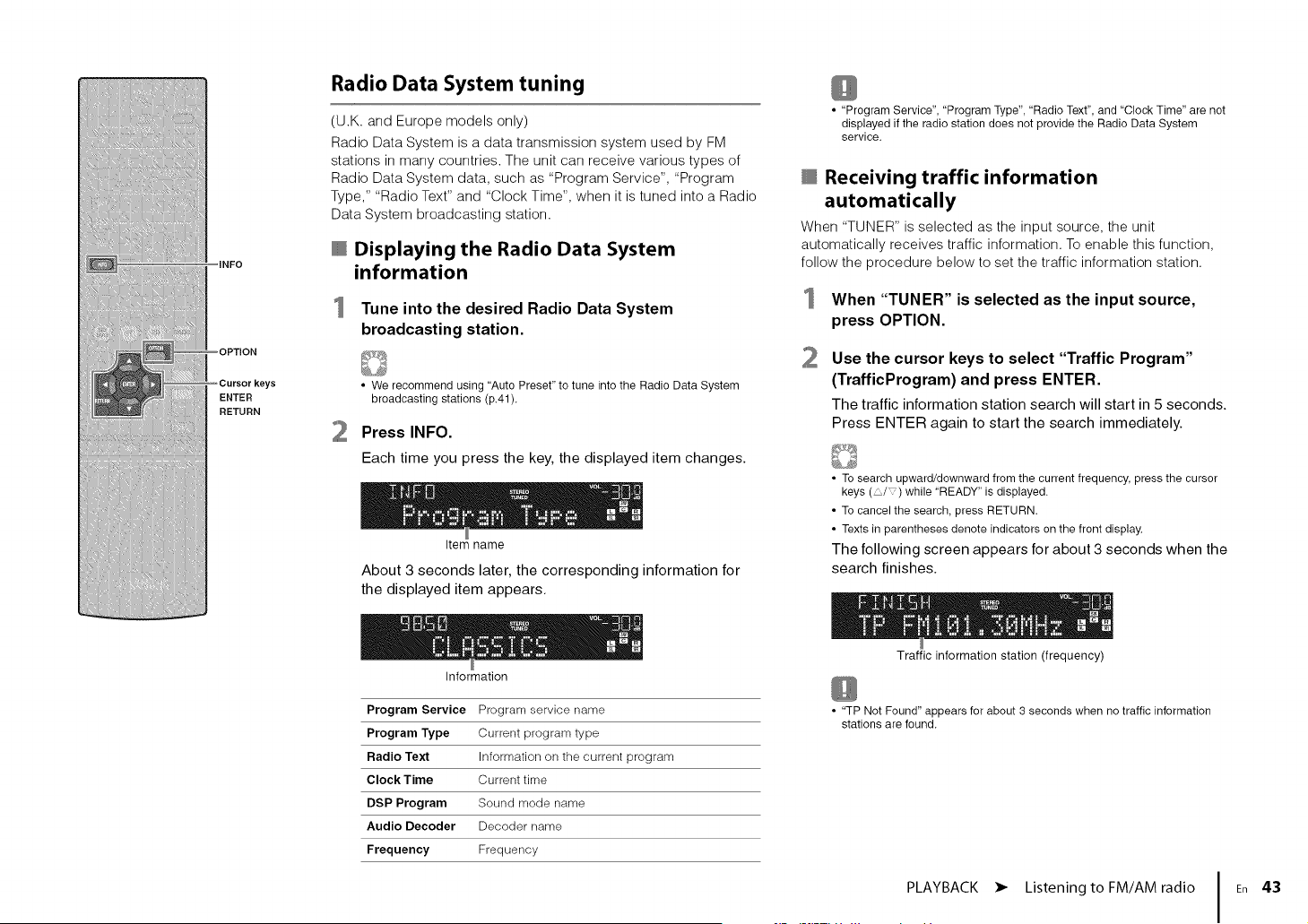
Radio Data System is a data transmission system used by FM
stations in many countries. The unit can receive various types of
Radio Data System data, such as "Program Service", "Program
Type," "Radio Text" and "Clock Time", when it is tuned into a Radio
Data System broadcasting station.
@ Displaying the Radio Data System
information
Tune into the desired Radio Data System
broadcasting station.
• We recommend using "Auto Preset" to tune into the Radio Data System
broadcasting stations (p.41).
Press INFO.
Each time you press the key, the displayed item changes.
Item name
About 3 seconds later, the corresponding information for
the displayed item appears.
Information
Program Service Program service name
Program Type Current program type
Radio Text Information on the current program
Clock Time Current time
DSP Program Sound mode name
Audio Decoder Decoder name
Frequency Frequency
• "Program Service", "Program Type", "Radio Text", and "Clock Time" are not
displayed if the radio station does not provide the Radio Data System
service.
Receiving traffic information
automatically
When "TUNER" is selected as the input source, the unit
automatically receives traffic information. To enable this function,
follow the procedure below to set the traffic information station.
2
When "TUNER" is selected as the input source,
press OPTION.
Use the cursor keys to select "Traffic Program"
(TrafficProgram) and press ENTER.
The traffic information station search will start in 5 seconds.
Press ENTER again to start the search immediately.
• To search upward/downward from the current frequency, press the cursor
keys ( / ) while "READY" is displayed.
• To cancel the search, press RETURN.
• Texts in parentheses denote indicators on the front display.
The following screen appears for about 3 seconds when the
search finishes.
Traffic information station (frequency)
• "TP Not Found" appears for about 3 seconds when no traffic information
stations are found.
PLAYBACK • Listening to FM/AM radio En 43
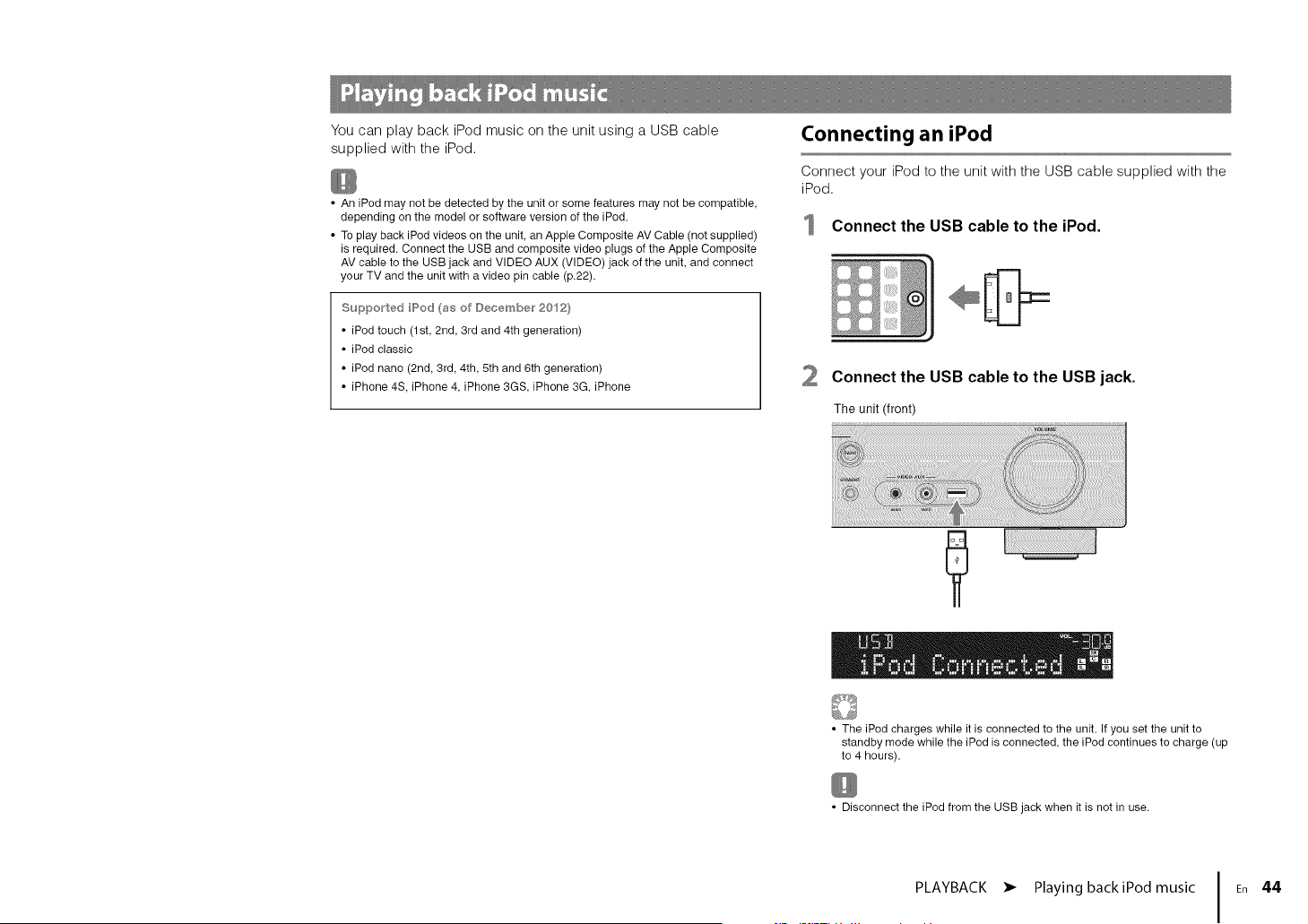
You can play back iPod music on the unit using a USB cable
supplied with the iPod.
• An iPod may not be detected by the unit or some features may not be compatible,
depending on the model or software version of the iPod.
• To play back iPod videos on the unit, an Apple Composite AV Cable (not supplied)
is required. Connect the USB and composite video plugs of the Apple Composite
AV cable to the USB jack and VIDEO AUX (VIDEO) jack of the unit, and connect
your TV and the unit with a video pin cable (p.22).
Supported iPod (as _!= ©÷cemb_*_ _2012}
• iPod touch (1st, 2nd, 3rd and 4th generation)
• iPod classic
• iPod nano (2nd, 3rd, 4th, 5th and 6th generation)
• iPhone 4S, iPhone 4, iPhone 3GS, iPhone 3G, iPhone
Connecting an iPod
Connect your iPod to the unit with the USB cable supplied with the
iPod.
Connect the USB cable to the iPod.
2 Connect the USB cable to the USB jack.
The unit (front)
• The iPod charges while it is connected to the unit. Ifyou set the unit to
standby mode while the iPod is connected, the iPod continues to charge (up
to 4 hours).
• Disconnect the iPod from the USB jack when it is not in use.
PLAYBACK • Playing backiPod music En 44
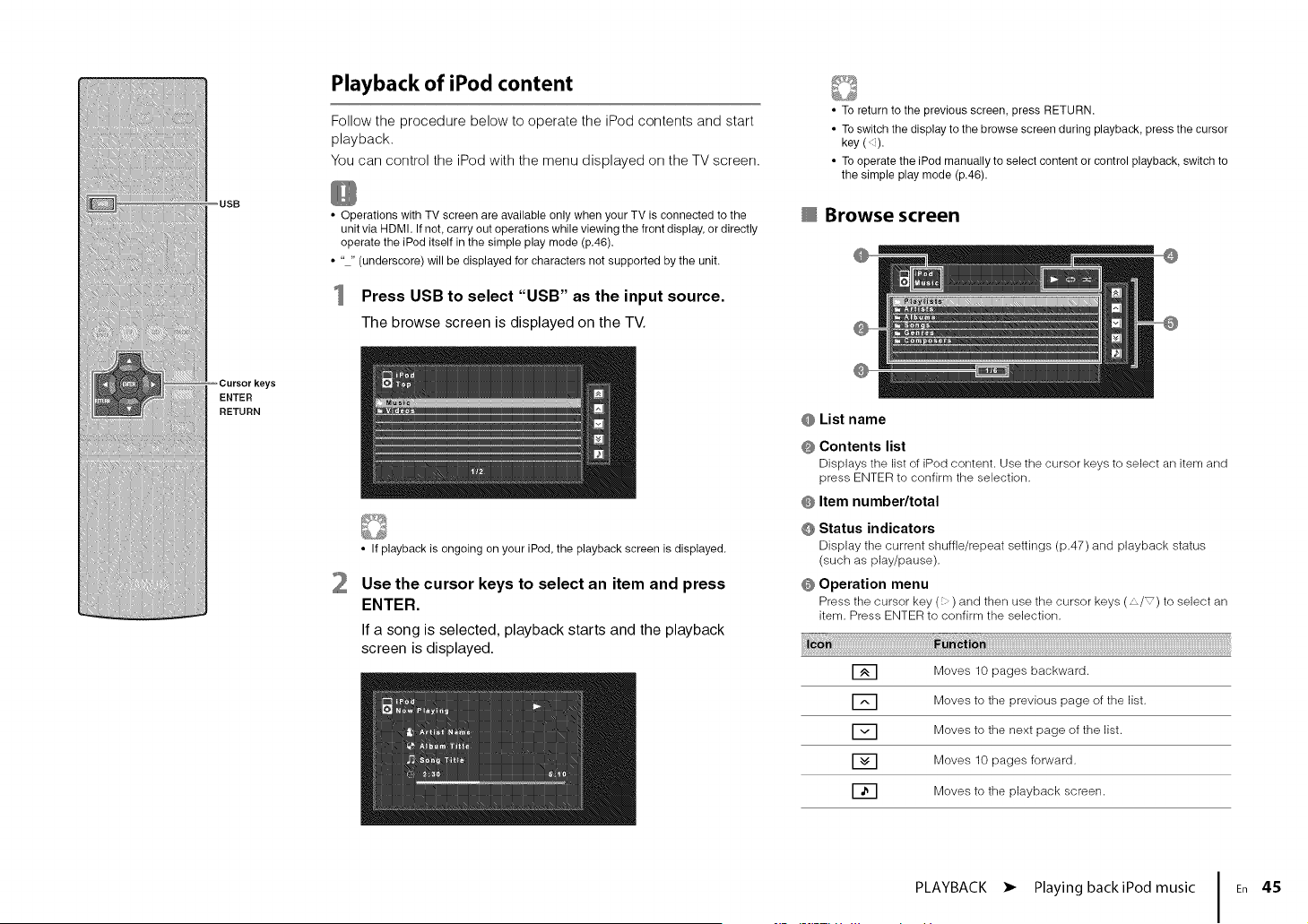
USB
ENTER
RETURN
Playback of iPod content
Follow the procedure below to operate the iPod contents and start
playback.
You can control the iPod with the menu displayed on the TV screen.
• Operations with TV screen are available only when your TV is connected to the
unit via HDMI. If not, carry out operations while viewing the front display, or directly
operate the iPod itself in the simple play mode (pA6).
• " " (underscore) will be displayed for characters not supported by the unit.
Press USB to select "USB" as the input source.
The browse screen is displayed on the TV.
• If playback is ongoing on your iPod, the playback screen is displayed.
Use the cursor keysto select an item and press
ENTER.
If a song is selected, playback starts and the playback
screen is displayed.
• To return to the previous screen, press RETURN.
• To switch the display to the browse screen during playback, press the cursor
key (<).
• To operate the iPod manually to select content or control playback, switch to
the simple play mode (p.46).
Browse screen
@
@ List name
@ Contents list
Displays tile list of iPod content. Use the cursor keys to select an item and
press ENTERto confirm the selection.
@ Item number/total
@ Status indicators
Display the current shuffle/repeat settings (p.47) and playback status
(such as play/pause).
@ Operation menu
Press the cursor key( ) and then use the cursor keys ( /_) to select an
item. Press ENTER to confirm the selection.
E_ Moves 10 pages backward.
F'_ Moves to the previous page of the list.
D Moves to the next page of the list.
E_ Moves 10 pages forward.
[--71 Moves to the playback screen.
PLAYBACK • Playing backiPod music En 45
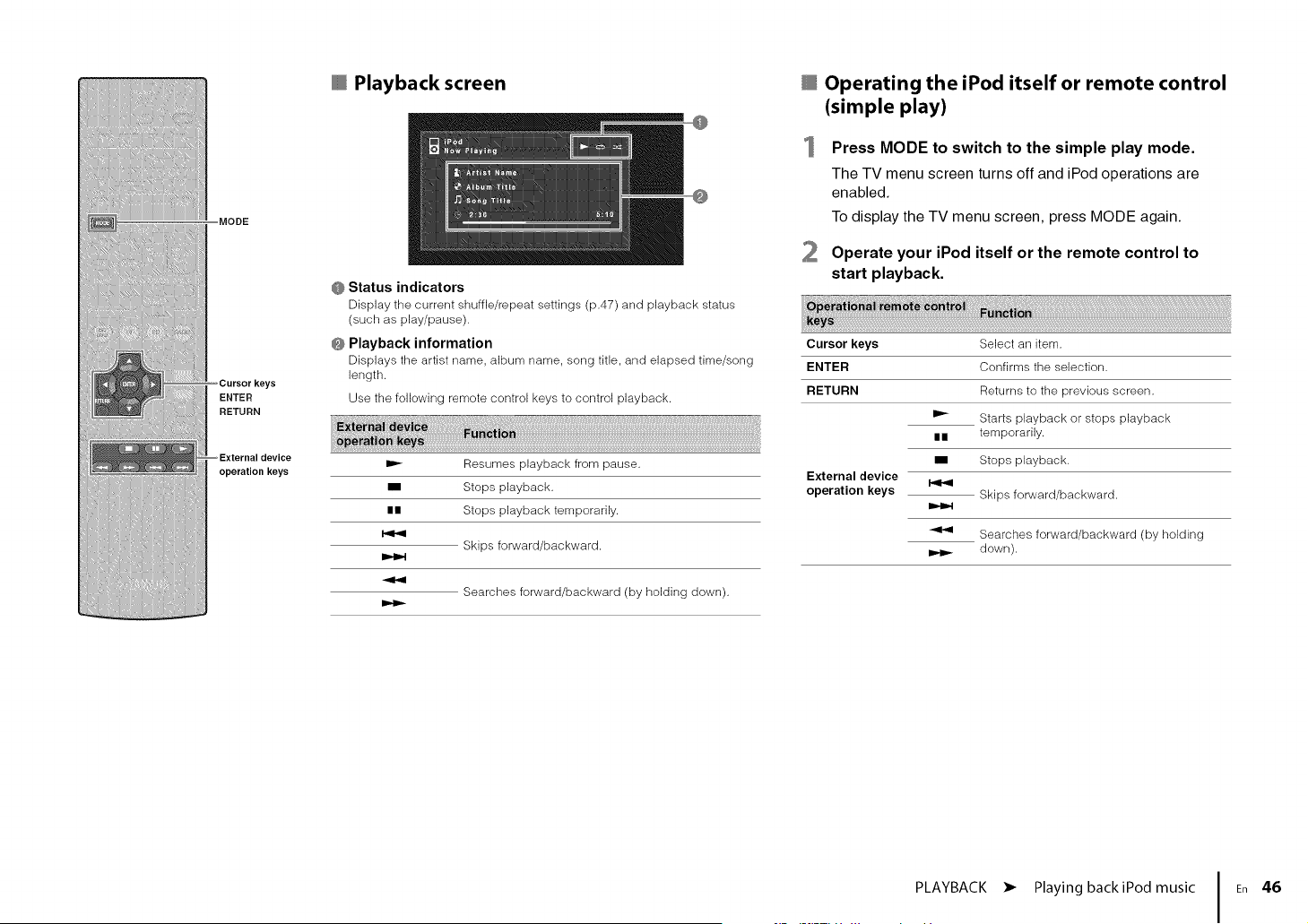
MODE
ENTER
RETURN
operation keys
@ Playback screen
@
@ Status indicators
Display the current shuffle/repeat settings (p.47) and playback status
(such as play/pause).
@ Playback information
Displays tile artist name, album name, song title, and elapsed time/song
length.
Use the following remote control keys to control playback.
I
II
Resumes playback from pause.
Stops playback.
Stops playback temporarily.
Skips forward/backward.
Searches forward/backward (by holding down).
Operating the iPod itself or remote control
(simple play)
2
Press MODE to switch to the simple play mode.
The TV menu screen turns off and iPod operations are
enabled.
To display the TV menu screen, press MODE again.
Operate your iPod itself or the remote control to
start playback.
Cursorkeys
ENTER
RETURN
External device
operation keys
II
I
Select an item.
Confirms the selection.
Returns to the previous screen.
Starts playback or stops playback
temporarily.
Steps playback.
Skips forward/backward.
Searches forward/backward (by holding
down).
PLAYBACK • Playing backiPod music En 46
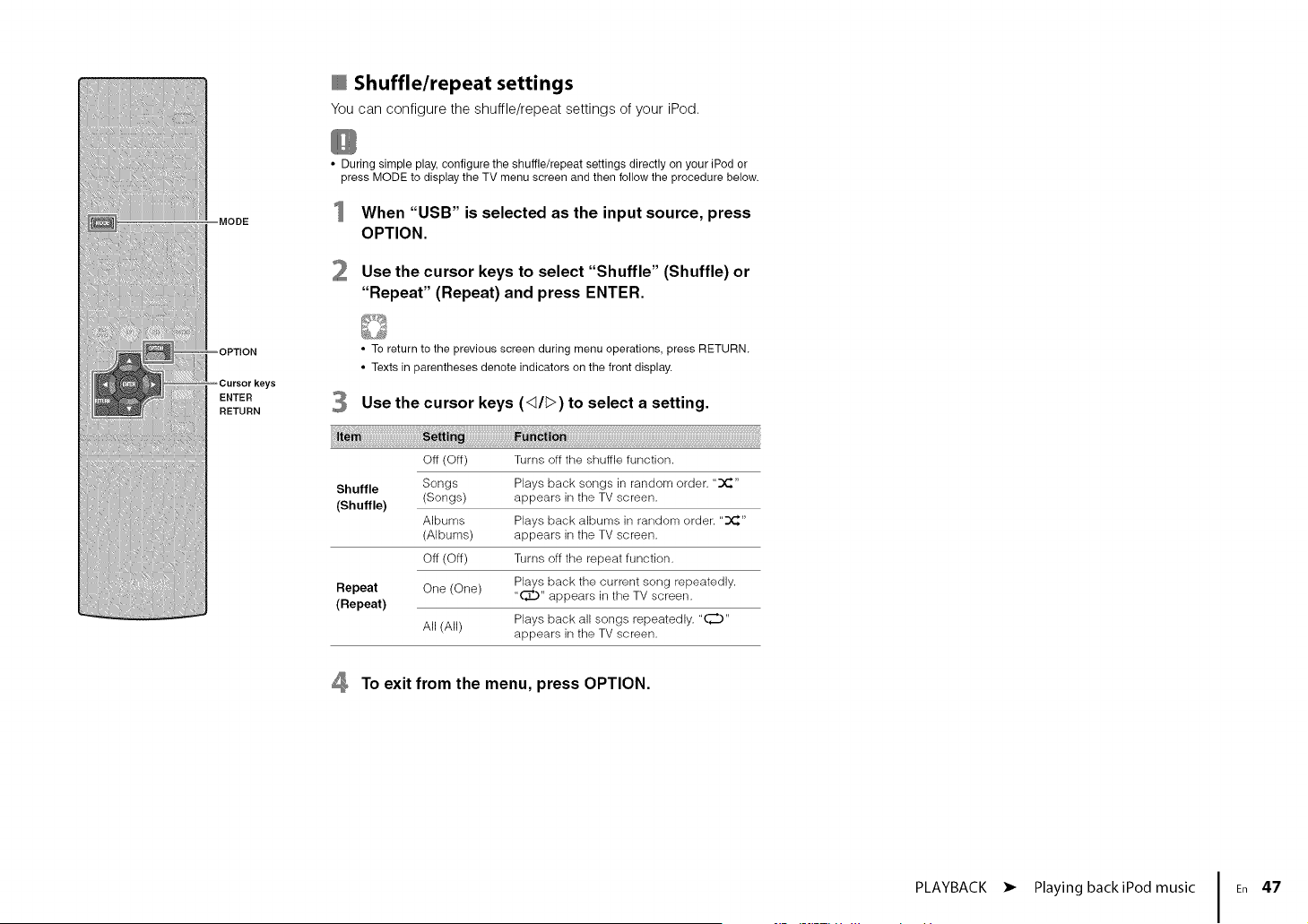
MODE
ENTER
RETURN
Shuffle/repeat settings
You can configure the shuffle/repeat settings of your iPod.
• During simple play, configure the shuffle/repeat settings directly on your iPod or
press MODE to display the TV menu screen and then follow the procedure below.
When "USB" is selected as the input source, press
OPTION.
Use the cursor keys to select "Shuffle" (Shuffle) or
"Repeat" (Repeat) and press ENTER.
• To return to the previous screen during menu operations, press RETURN.
• Texts in parentheses denote indicators on the front display.
Use the cursor keys (<_/I>) to select a setting.
Off (Off) Turns off the shuffle function.
Shuffle Songs Plays back songs in random order. "3C;"
(Songs) appears in the TV screen.
(Shuffle)
Albums Plays back albums in random order. "3C;"
(Albums) appears in the TV screen.
Off (Off) Turns off the repeat function.
Repeat One (One) Plays back the current song repeatedly.
"C_,_)"appears in the TV screen.
(Repeat)
All (All) Plays back all songs repeatedly. "(-'._"
appears in the TV screen.
To exit from the menu, press OPTION.
PLAYBACK • Playing backiPod music En 47
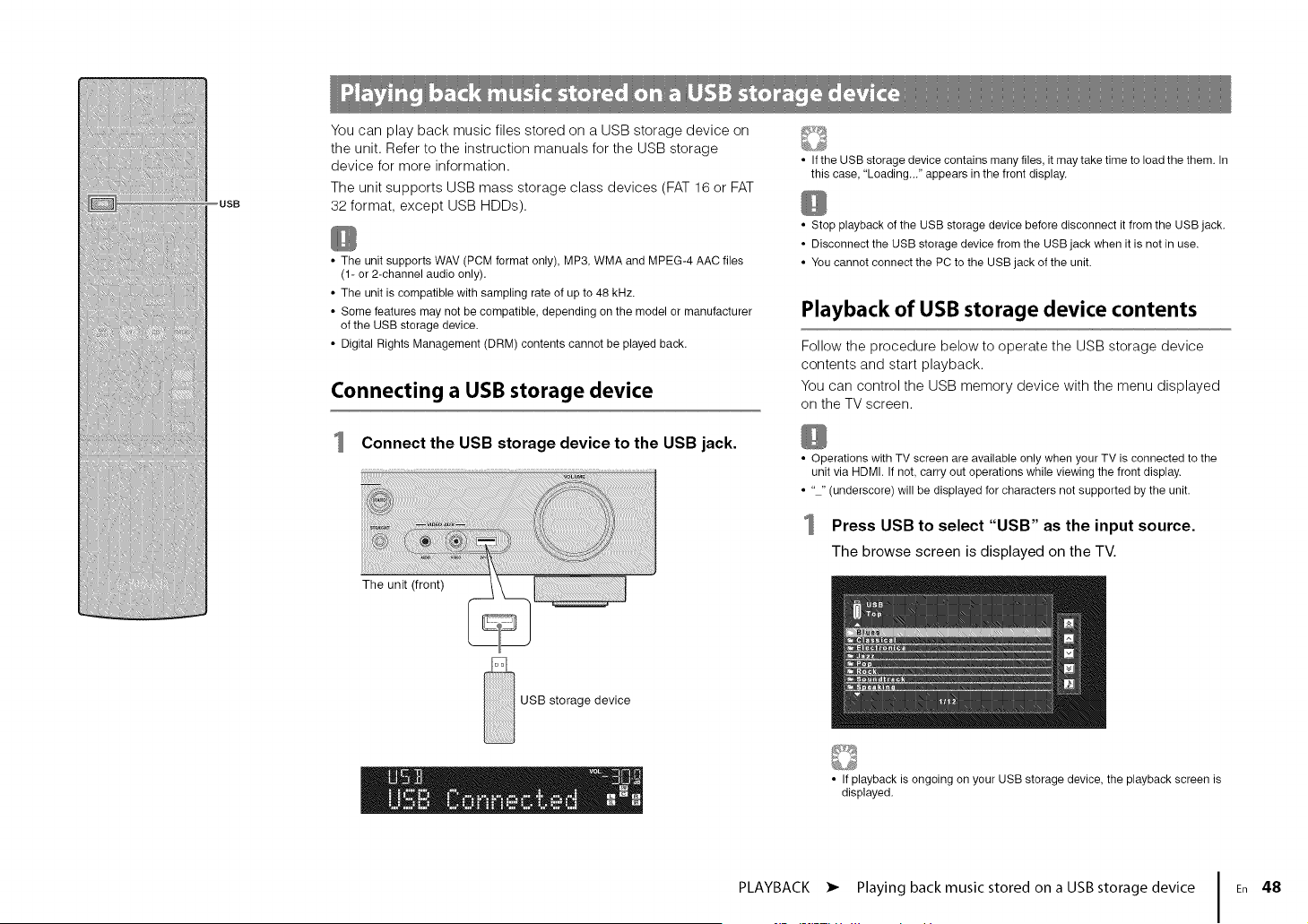
USB
You can play back music files stored on a USB storage device on
the unit. Refer to the instruction manuals for the USB storage
device for more information.
The unit supports USB mass storage class devices (FAT 16 or FAT
32 format, except USB HDDs).
• The unit supports WAV (PCM format only), MP3, WMA and MPEG-4 AAC files
(1- or 2-channel audio only).
• The unit is compatible with sampling rate of up to 48 kHz.
• Some features may not be compatible, depending on the model or manufacturer
of the USB storage device.
• Digital Rights Management (DRM) contents cannot be played back.
Connecting a USB storage device
Connect the USB storage device to the USB jack.
The unit (front)
• If the USB storage device contains many files, it may take time to load the them. In
this case, "Loading..." appears in the front display.
• Stop playback of the USB storage device before disconnect it from the USB jack.
• Disconnect the USB storage device from the USB jack when it is not in use.
• You cannot connect the PC to the USB jack of the unit.
Playback of USB storage device contents
Follow the procedure below to operate the USB storage device
contents and start playback.
You can control the USB memory device with the menu displayed
on the TV screen.
• Operations with TV screen are available only when your TV is connected to the
unit via HDMI. If not, carry out operations while viewing the front display.
• " " (underscore) will be displayed for characters not supported by the unit.
Press USB to select "USB" as the input source.
The browse screen is displayed on the TV.
USB storage device
• If playback is ongoing on your USB storage device, the playback screen is
displayed.
PLAYBACK • Playing back music stored on a USB storage device En 48
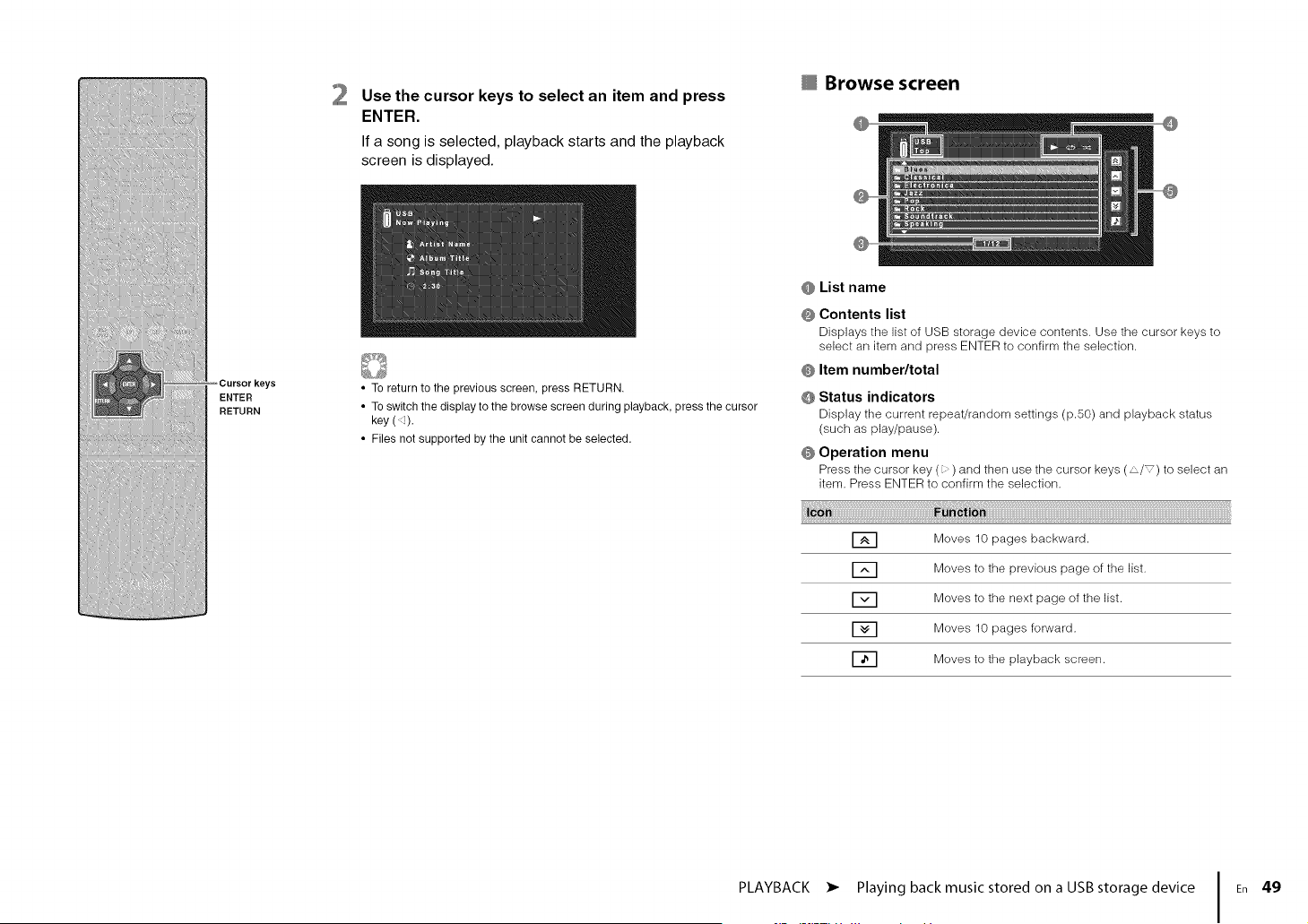
Browse screen
Use the cursor keys to select an item and press
ENTER.
I
r/
ENTER
RETURN
If a song is selected, playback starts and the playback
screen is displayed.
• To return to the previous screen, press RETURN.
• To switch the display to the browse screen during playback, press the cursor
key ().
• Files not supported by the unit cannot be selected.
@
@ List name
@ Contents list
Displays tile list of USB storage device contents. Use the cursor keys to
select an item and press ENTERto confirm the selection.
@ Item number/total
@ Status indicators
Display tile current repeat/random settings (p.50) and playback status
(such as play/pause).
@ Operation menu
Press the cursor key ( : ) and then use the cursor keys ( /_) to select an
item. Press ENTER to confirm the selection.
E_ Moves 10 pages backward.
F'_ Moves to the previous page of the list.
Moves to the next page of the list.
E_ Moves 10 pages forward.
i"--71 Moves to the playback screen.
PLAYBACK • Playing back music stored on a USB storage device En 49
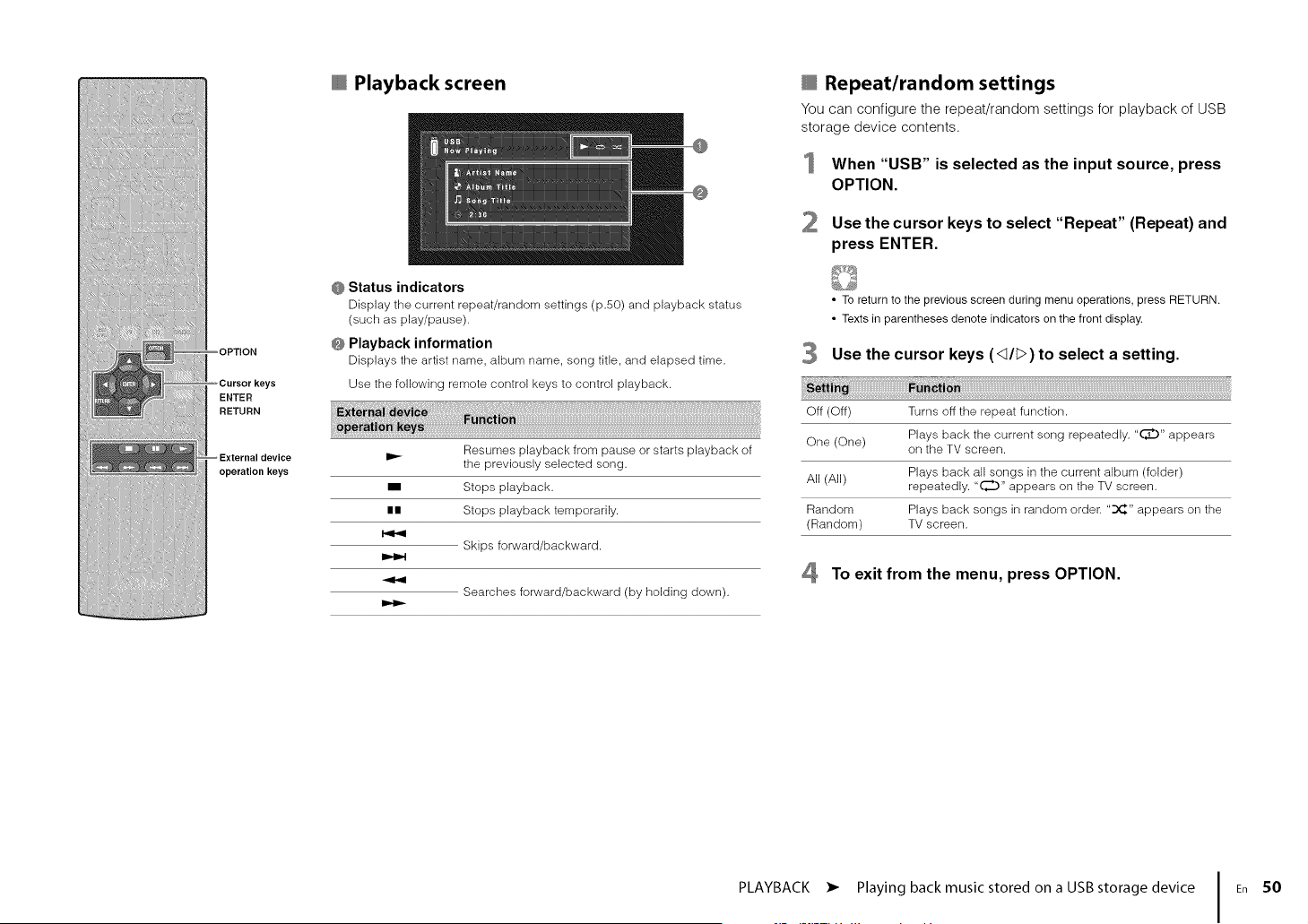
ENTER
RETURN
operation keys
@ Playback screen
@ Status indicators
Display the current repeat/random settings (p.50) and playback status
(such as play/pause).
@ Playback information
Displays tile artist name, album name, song title, and elapsed time.
Use the following remote control keys to control playback.
I
II
Resumes playback from pause or starts playback of
the previously selected song.
Stops playback.
Stops playback temporarily.
Skips forward/backward.
Searches forward/backward (by holding down).
Repeat/random settings
You can configure the repeat/random settings for playback of USB
storage device contents.
When "USB" is selected as the input source, press
OPTION.
2 Use the cursor keys to select "Repeat" (Repeat) and
press ENTER.
3
• To return to the previous screen during menu operations, press RETURN.
• Texts in parentheses denote indicators on the front display.
Use the cursor keys (<_/i>) to select a setting.
Off (Off) Turns off the repeat function.
Plays back the current song repeatedly. "(q",.D"appears
One (One) on the TV screen.
All (All) Plays back all songs in the current album (folder)
repeatedly. "(-_,--)"appears on the TV screen.
Random Plays back songs in random order. ":x:;" appears on the
(Random) TV screen.
4 To exit from the menu, press OPTION.
PLAYBACK • Playing back music stored on a USB storage device En 50
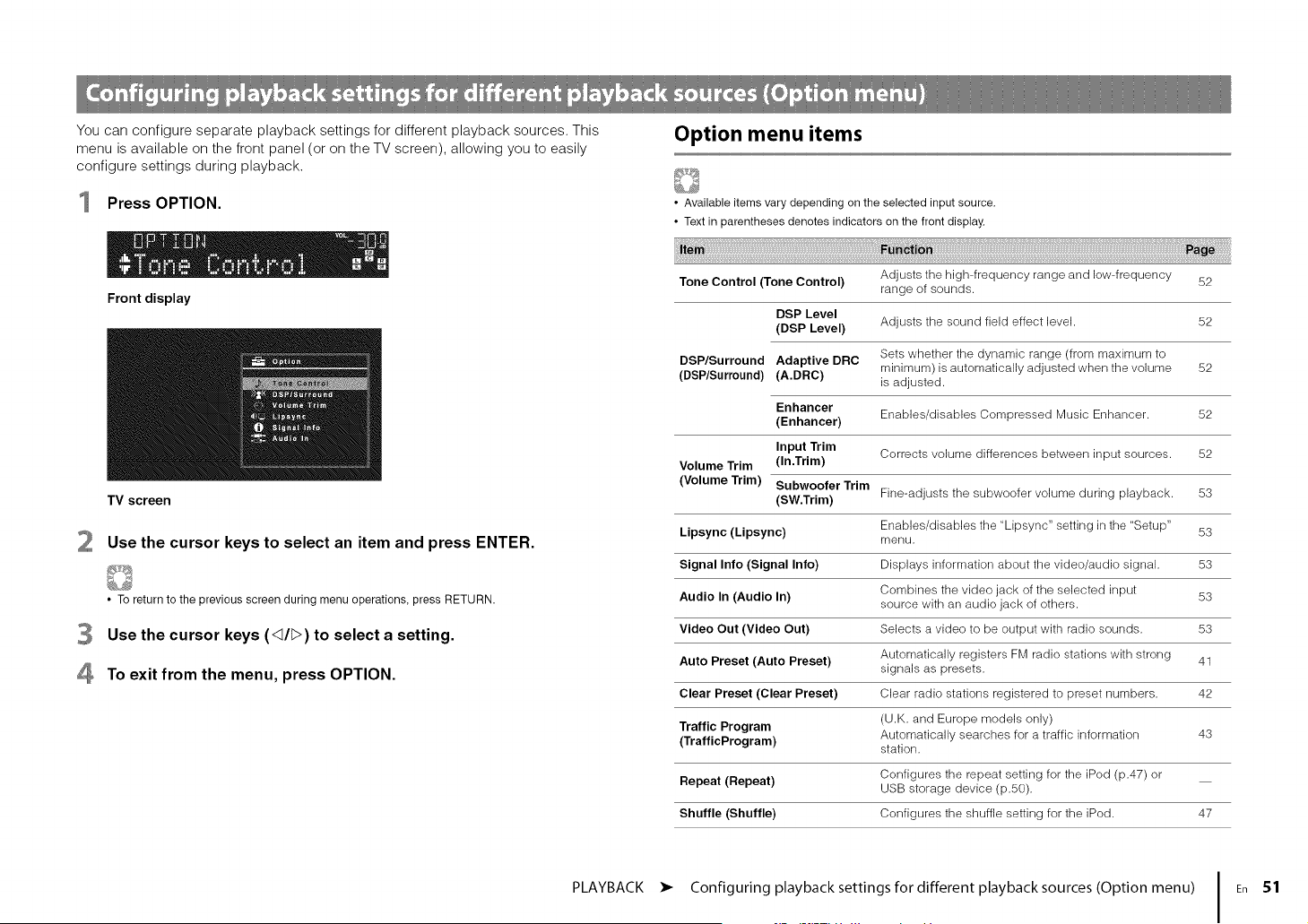
You can configure separate playback settings for different playback sources. This
menu is available on the front panel (or on the TV screen), allowing you to easily
configure settings during playback.
Press OPTION.
Option menu items
• Available items vary depending on the selected input source.
• Text in parentheses denotes indicators on the front display.
4
Front display
TV screen
Use the cursor keys to select an item and press ENTER.
• To return to the previous screen during menu operations, press RETURN.
Use the cursor keys (</[>) to select a setting.
To exit from the menu, press OPTION.
Tone Control (Tone Control) Adjusts the high-frequency range and low-frequency
range of sounds. 52
DSP Level
(DSP Level) Adjusts the sound field effect level. 52
Sets whether the dynamic range (from maximum to
DSP/Surround Adaptive DRC minimum) is automatically adjusted when the volume 52
(DSP/Surround) (A.DRC) is adjusted.
Enhancer
(Enhancer) Enables/disables Compressed Music Enhancer. 52
Input Trim
Corrects volume differences between input sources. 52
Volume Trim (In.Trim)
(Volume Trim) Subwoofer Trim
(SW.Trim) Fine-adjusts tile subwoofer volume during playback. 53
Lipsync (Lipsync) Enables/disables the "Lipsync" setting in the "Setup" 53
menu.
Signal Info (Signal Info) Displays information about the video/audio signal. 53
Combines the video jack of the selected input 53
Audio In (Audio In) source with an audio jack of others.
Video Out (Video Out) Selects a video to be output with radio sounds. 53
Automatically registers FM radio stations with strong 41
Auto Preset (Auto Preset) signals as presets.
Clear Preset (Clear Preset) Clear radio stations registered to preset numbers. 42
Traffic Program (U.K. and Europe models only)
Automatically searches for a traffic information 43
(TrafficProgram) station.
Repeat (Repeat) Configures the repeat setting for the iPod (p.47) or
USB storage device (p.50).
Shuffle (Shuffle) Configures the shuffle setting for the iPod. 47
PLAYBACK • Configuring playback settings for different playback sources (Option menu) En 51
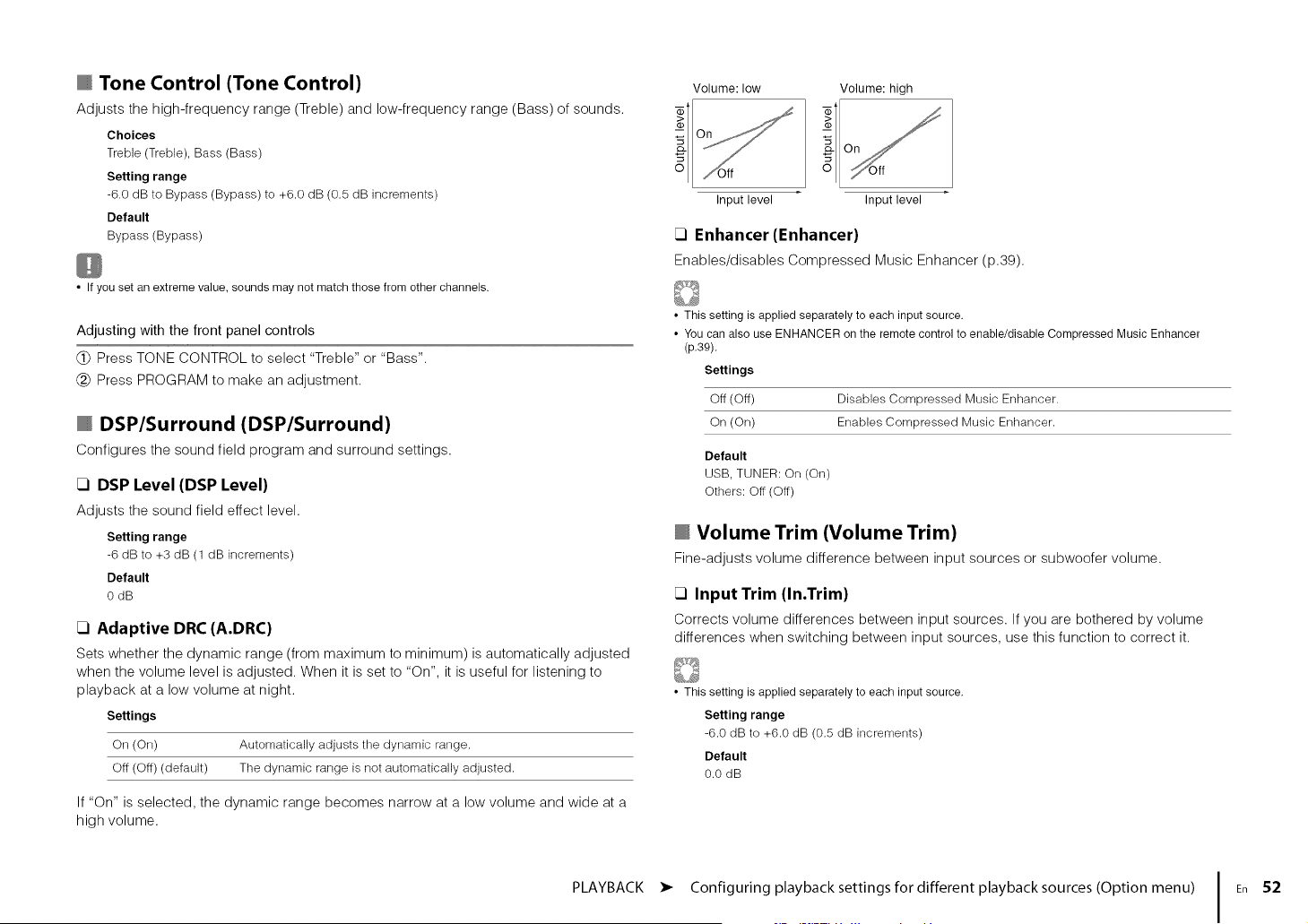
Tone Control (Tone Control)
Adjusts the high-frequency range (Treble) and low-frequency range (Bass) of sounds.
Choices
Treble (Treble), Bass (Bass)
Setting range
-6.0 dB to Bypass (Bypass) to +6.0 dB (0.5 dB increments)
Default
Bypass (Bypass)
• If you set an extreme value, sounds may not match those from other channels.
Adjusting with the front panel controls
(_ Press TONE CONTROL to select "Treble" or "Bass".
(_) Press PROGRAM to make an adjustment.
DSP/Surround (DSP/Surround)
Configures the sound field program and surround settings.
17 DSP Level (DSP Level)
Adjusts the sound field effect level.
Setting range
-6 dB to +3 dB (1 dB increments)
Default
0 dB
17 Adaptive DRC (A.DRC)
Sets whether the dynamic range (from maximum to minimum) is automatically adjusted
when the volume level is adjusted. When it is set to "On", it is useful for listening to
playback at a low volume at night.
Settings
On (On) Automatically adjusts the dynamic range.
Off (Off) (default) The dynamic range is not automatically adjusted.
If "On" is selected, the dynamic range becomes narrow at a low volume and wide at a
high volume.
Volume: low
Input level
Volume: high
Input level
_1 Enhancer (Enhancer)
Enables/disables Compressed Music Enhancer (p.39).
• This settingis appliedseparatelyto each inputsource.
• Youcanalso useENHANCERon the remotecontrolto enable/disableCompressed MusicEnhancer
(p.39).
Settings
off (off)
On (On)
Default
USB, TUNER: On (On)
Others: Off (Off)
Disables Compressed Music Enhancer.
Enables Compressed Music Enhancer.
Volume Trim (Volume Trim)
Fine-adjusts volume difference between input sources or subwoofer volume.
_1 Input Trim (In.Trim)
Corrects volume differences between input sources. If you are bothered by volume
differences when switching between input sources, use this function to correct it.
• This setting is applied separately to each input source.
Setting range
-6.0 dB to +6.0 dB (0.5 dB increments)
Default
0.0 dB
PLAYBACK • Configuring playback settings for different playback sources (Option menu) En 52
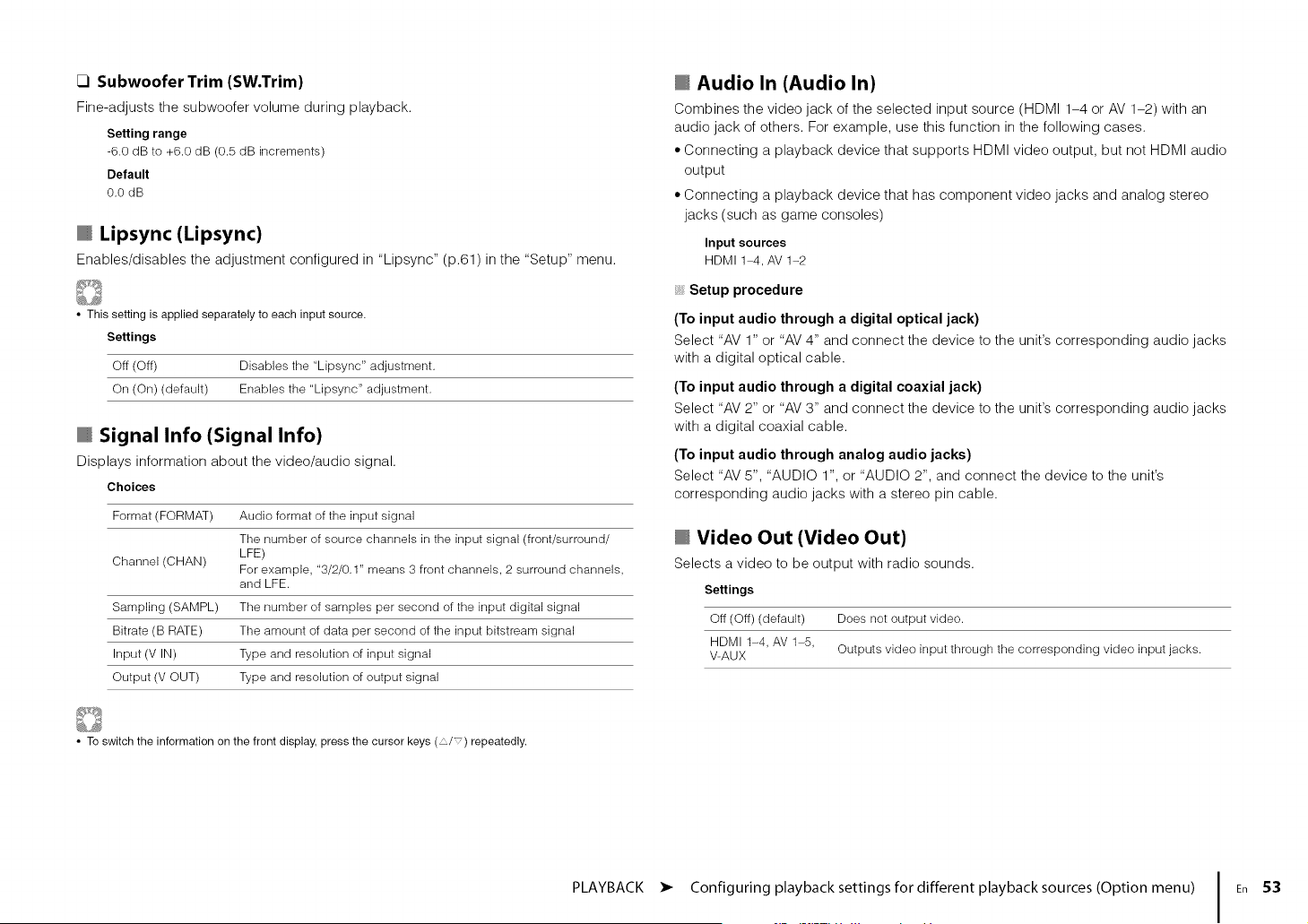
SubwooferTrim(SW.Trim)
Fine-adjusts the subwoofer volume during playback.
Setting range
-6.0 dB to +6.0 dB (0.5 dB increments)
Default
0.0 dB
Lipsync (Lipsync)
Enables/disables the adjustment configured in "Lipsync" (p.61) in the "Setup" menu.
• This setting is applied separately to each input source.
Settings
Off (Off) Disables the "Lipsync" adjustment.
On (On) (default) Enables the "Lipsync" adjustment.
Signal Info (Signal Info)
Displays information about the video/audio signal.
Choices
Format (FORMAT) Audio format of the input signal
The number of source channels in the input signal (front/surround/
LFE)
Channel (CHAN) For example, "3/2/0.1" means 3 front channels, 2 surround channels,
and LFE.
Sampling (SAMPL) The number of samples per second of the input digital signal
Bitrate (B RATE) The amount of data per second of the input bitstream signal
Input (V IN) Type and resolution of input signal
Output (V OUT) Type and resolution of output signal
Audio In (Audio In)
Combines the video jack of the selected input source (HDMI 1-4 or AV 1-2) with an
audio jack of others. For example, use this function in the following cases.
• Connecting a playback device that supports HDMI video output, but not HDMI audio
output
• Connecting a playback device that has component video jacks and analog stereo
jacks (such as game consoles)
Input sources
HDMI1 4, AVl-2
Setup procedure
(To input audio through a digital optical jack)
Select "AV 1" or "AV 4" and connect the device to the unit's corresponding audio jacks
with a digital optical cable.
(To input audio through a digital coaxial jack)
Select "AV 2" or "AV 3" and connect the device to the unit's corresponding audio jacks
with a digital coaxial cable.
(To input audio through analog audio jacks)
Select "AV 5", "AUDIO 1", or "AUDIO 2", and connect the device to the unit's
corresponding audio jacks with a stereo pin cable.
Video Out (Video Out)
Selects a video to be output with radio sounds.
Settings
Off (Off) (default) Does not output video.
HDMI 1-4, AV 1-5,
V-AUX Outputs video input through the corresponding video input jacks.
• To switch the information on the front display, press the cursor keys ( / ) repeatedly.
PLAYBACK • Configuring playback settings for different playback sources (Option menu) En 53
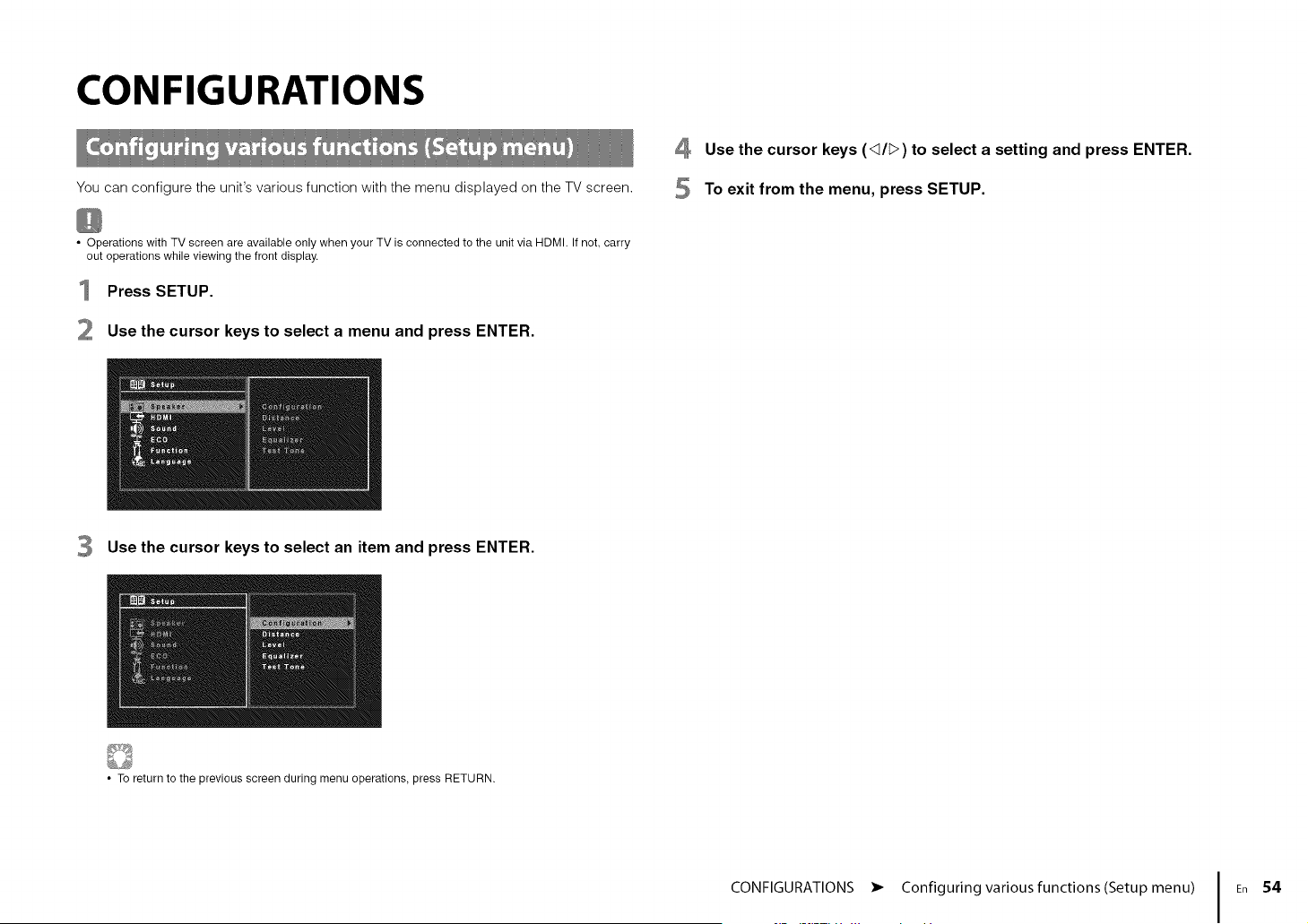
CONFIGURATIONS
You can configure the unit's various function with the menu displayed on the TV screen.
• Operations with TV screen are available only when your TV is connected to the unit via HDMI. If not, carry
out operations while viewing the front display.
Press SETUP.
Use the cursor keys to select a menu and press ENTER.
4 Use the cursor keys (<_/i>) to select a setting and press ENTER.
5 To exit from the menu, press SETUP.
Use the cursor keys to select an item and press ENTER.
• To return to the previous screen during menu operations, press RETURN.
CONFIGURATIONS • Configuring various functions(Setup menu) En 54
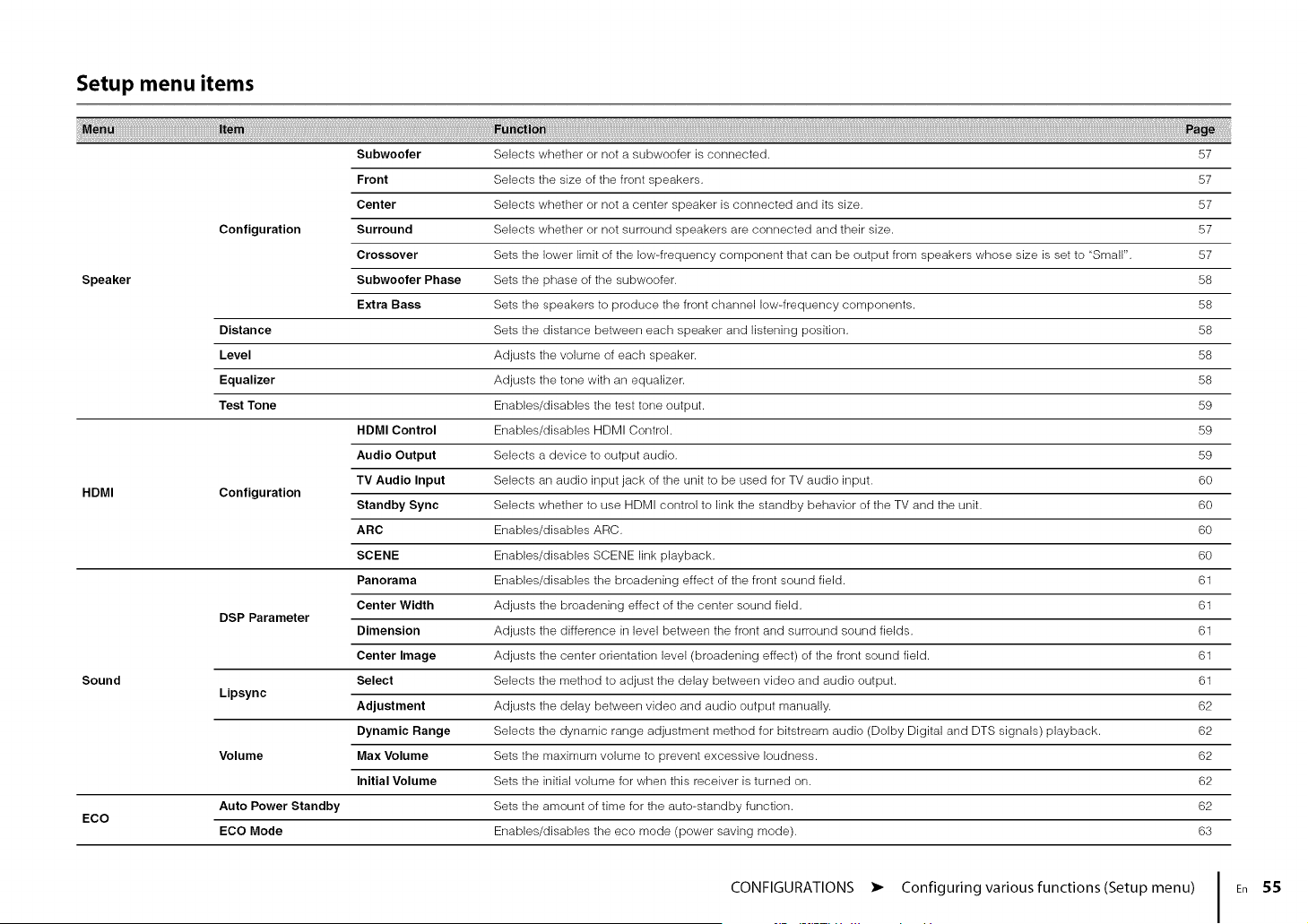
Setup menu items
Subwoofer Selects whether or not a subwoofer is connected. 57
Front Selects the size of the front speakers. 57
Center Selects whether or not a center speaker is connected and its size. 57
Configuration Surround Selects whether or not surround speakers are connected and their size. 57
Crossover Sets the lower limit of the low-frequency component that can be output from speakers whose size is set to "Small". 57
Speaker Subwoofer Phase Sets the phase of the subwoofer. 58
Extra Bass Sets the speakers to produce the front channel low-frequency components. 58
Distance Sets the distance between each speaker and listening position. 58
Level Adjusts the volume of each speaker. 58
Equalizer Adjusts the tone with an equalizer. 58
Test Tone Enables/disables the test tone output. 59
HDMI Control Enables/disables HDMI Control. 59
Audio Output Selects a device to output audio. 59
TV Audio Input Selects an audio input jack of the unit to be used for TV audio input. 60
HDMI Configuration
Standby Sync Selects whether to use HDMI control to link the standby behavior of the TV and the unit. 60
ARC Enables/disables ARC. 60
SCENE Enables/disables SCENE link playback. 60
Panorama Enables/disables the broadening effect of the front sound field. 61
Center Width Adjusts the broadening effect of the center sound field. 61
DSP Parameter
Dimension Adjusts tile difference in level between tile front and surround sound fields. 61
Center Image Adjusts the center orientation level (broadening effect) of the front sound field. 61
Sound Select Selects the method to adjust the delay between video and audio output. 61
Lipsync
Adjustment Adjusts tile delay between video and audio output manually. 62
Dynamic Range Selects the dynamic range adjustment method for bitstream audio (Dolby Digital and DTS signals) playback. 62
Volume Max Volume Sets the maximum volume to prevent excessive loudness. 62
Initial Volume Sets the initial volume for when this receiver is turned on. 62
Auto Power Standby Sets the amount of time for the auto-standby function. 62
ECO
ECO Mode Enables/disables the eco mode (power saving mode). 63
CONFIGURATIONS • Configuring various functions(Setup menu) En SS
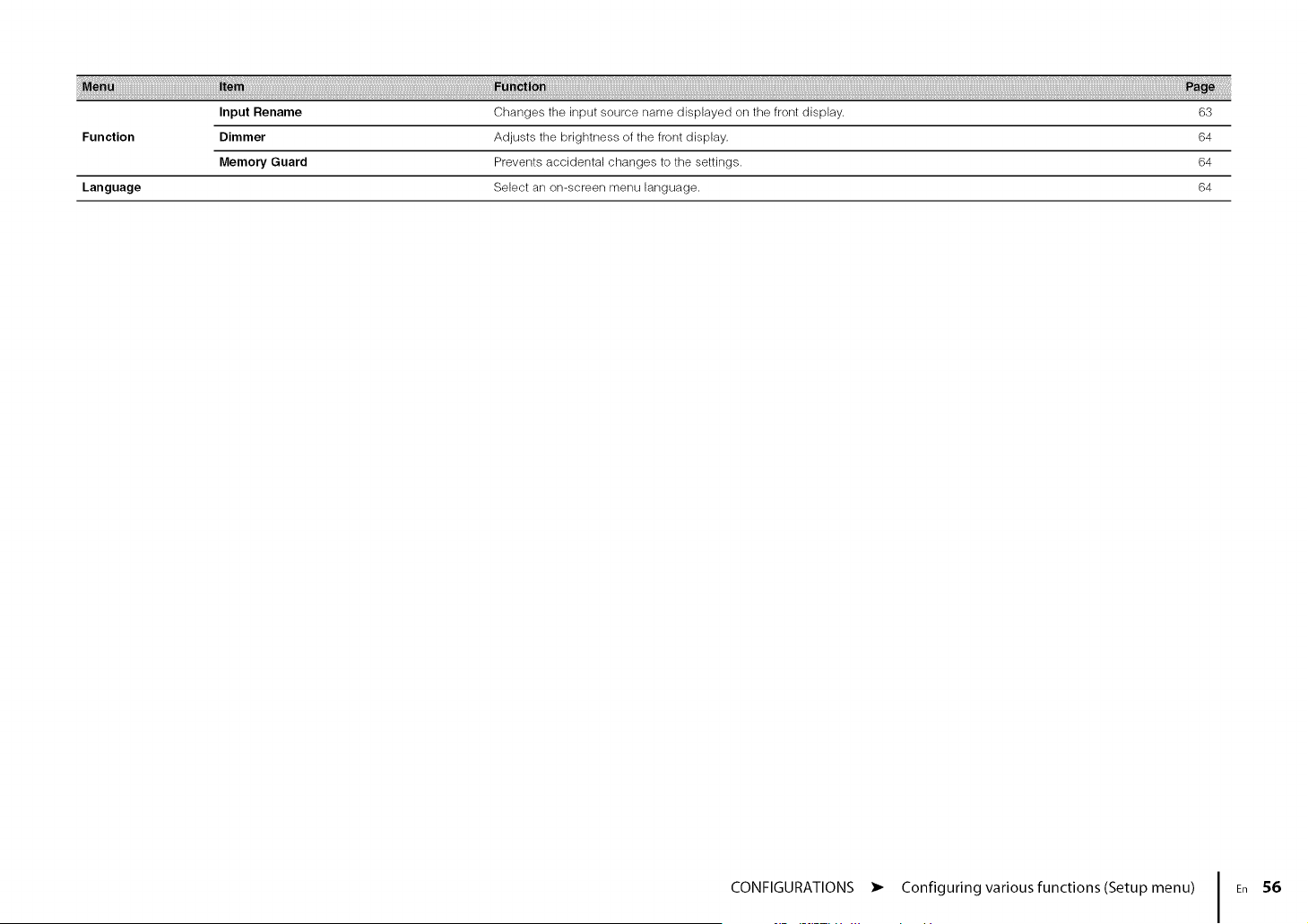
Input Rename Changes the input source name displayed on the front display. 63
Function Dimmer Adjusts the brightness of the front display. 64
Memory Guard Prevents accidental changes to the settings. 64
Language Select an on-screen menu language. 64
CONFIGURATIONS • Configuring various functions(Setup menu) En 56
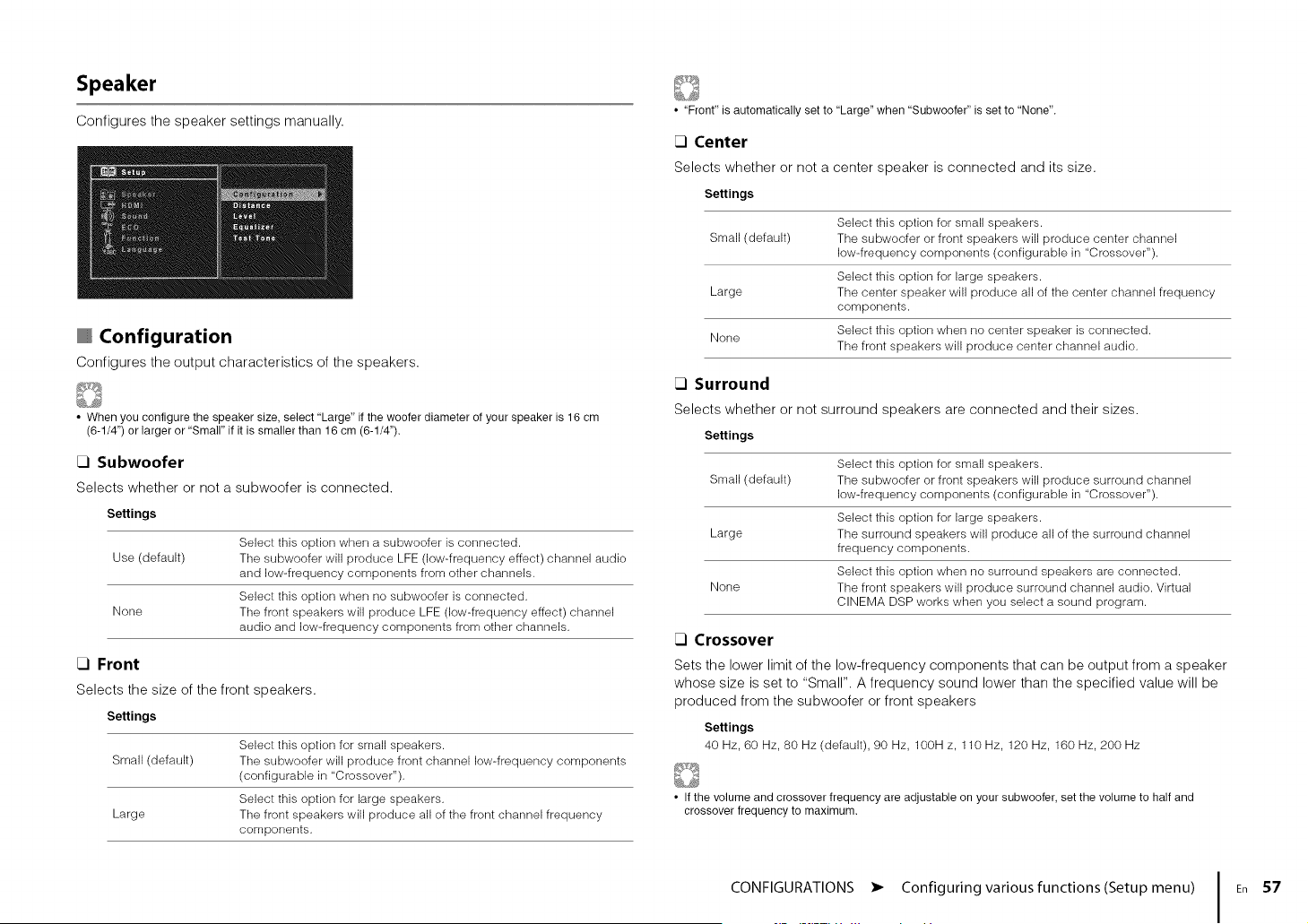
Speaker
Configures the speaker settings manually.
Configuration
Configures the output characteristics of the speakers.
• When you configure the speaker size, select "Large" if the woofer diameter of your speaker is 16 cm
(6-1/4") or larger or "Small" if it is smaller than 16 cm (6-1/4").
Subwoofer
Selects whether or not a subwoofer is connected.
Settings
Select this option when a subwoofer is connected.
Use (default) The subwoofer will produce LFE (low-frequency effect) channel audio
and low-frequency components from other channels.
Select this option when no subwoofer is connected.
None The front speakers will produce LFE (low-frequency effect) channel
audio and low-frequency components from other channels.
_] Front
Selects the size of the front speakers.
Settings
Select this option for small speakers.
Small (default) The subwoofer will produce front channel low-frequency components
(configurable in "Crossover").
Select this option for large speakers.
Large The front speakers will produce all of the front channel frequency
components.
• "Front" is automatically set to "Large" when "Subwoofer" is set to "None".
Center
Selects whether or not a center speaker is connected and its size.
Settings
Select this option for small speakers.
Small (default) The subwoofer or front speakers will produce center channel
low-frequency components (configurable in "Crossover").
Select this option for large speakers.
Large The center speaker will produce all of the center channel frequency
components.
Select this option when no center speaker is connected.
None
The front speakers will produce center channel audio.
Surround
Selects whether or not surround speakers are connected and their sizes.
Settings
Select this option for small speakers.
Small (default) The subwoofer or front speakers will produce surround channel
low-frequency components (configurable in "Crossover").
Select this option for large speakers.
Large The surround speakers will produce all of the surround channel
frequency components.
Select this option when no surround speakers are connected.
None The front speakers will produce surround channel audio. Virtual
CINEMA DSP works when you select a sound program.
Crossover
Sets the lower limit of the low-frequency components that can be output from a speaker
whose size is set to "Small". A frequency sound lower than the specified value will be
produced from the subwoofer or front speakers
Settings
40 Hz, 60 Hz, 80 Hz (default), 90 Hz, 100H z, 110 Hz, 120 Hz, 160 Hz, 200 Hz
• If the volume and crossover frequency are adjustable on your subwoofer, set the volume to half and
crossover frequency to maximum.
CONFIGURATIONS • Configuring various functions(Setup menu) En 57
[_ Subwoofer Phase
Sets the phase of the subwoofer. When the bass sound is lacking or unclear, switch the
subwoofer phase.
Settings
Normal (default) Does not reverse the subwoofer phase.
Reverse Reverses the subwoofer phase.
[_ Extra Bass
Sets the speakers to produce the front channel low-frequency components.
Settings
Off (default) Depending on the size of the front speakers, either the subwoofer or
front speakers produce the front channel low-frequency components.
Both the front speakers and subwoofer produce the front channel low-
On
frequency components.
• This setting is not available when "Subwoofer" is set to "None", or when "Front" is set to "Small".
Distance
Sets the distance between each speaker and listening position so that sounds from the
speakers reach the listening position at the same time. First, select the unit of distance
from "Meter" or "Feet".
Choices
Front L, Front R, Center, Surround L, Surround R, Subwoofer
Setting range
0.30 m to 24.00 m (1.0 ft to 80.0 ft), *0.05 m (0.2 ft) increments
Default
Front L, Front R, Subwoofer: 3.00 m (10.0 ft)
Center: 2.60 m (8.6 ft)
Surround L, Surround R: 2.40 m (8.0 ft)
Level
Adjusts the volume of each speaker.
Choices
Front L, Front R, Center, Surround L, Surround R, Subwoofer
Setting range
-10.0 dB to +10.0 dB (0.5 dB increments)
Default
Front L, Front R, Subwoofer: 0.0 dB
Others: -1.0 dB
Equalizer
Adjusts the tone with an equalizer.
17 EQ Select
Selects the type of equalizer to be used.
Settings
PEQ Applies the parametric equalizer values obtained by the YPAO
measurement (p.29).
Select this option when you want to adjust the equalizer manually.
GEQ (default) For details, see "Manual equalizer adjustment".
Off Does not use the equalizer.
• "PEQ" is available only when the YPAO has been performed (p.29).
Manual equalizer adjustment
Set "EQ Select" to "GEQ".
2 Use the cursor keys (A/V) to select "Channel" and the cursor keys (_/_) to select
the desired speaker channel.
CONFIGURATIONS • Configuring various functions(Setup menu) En 58
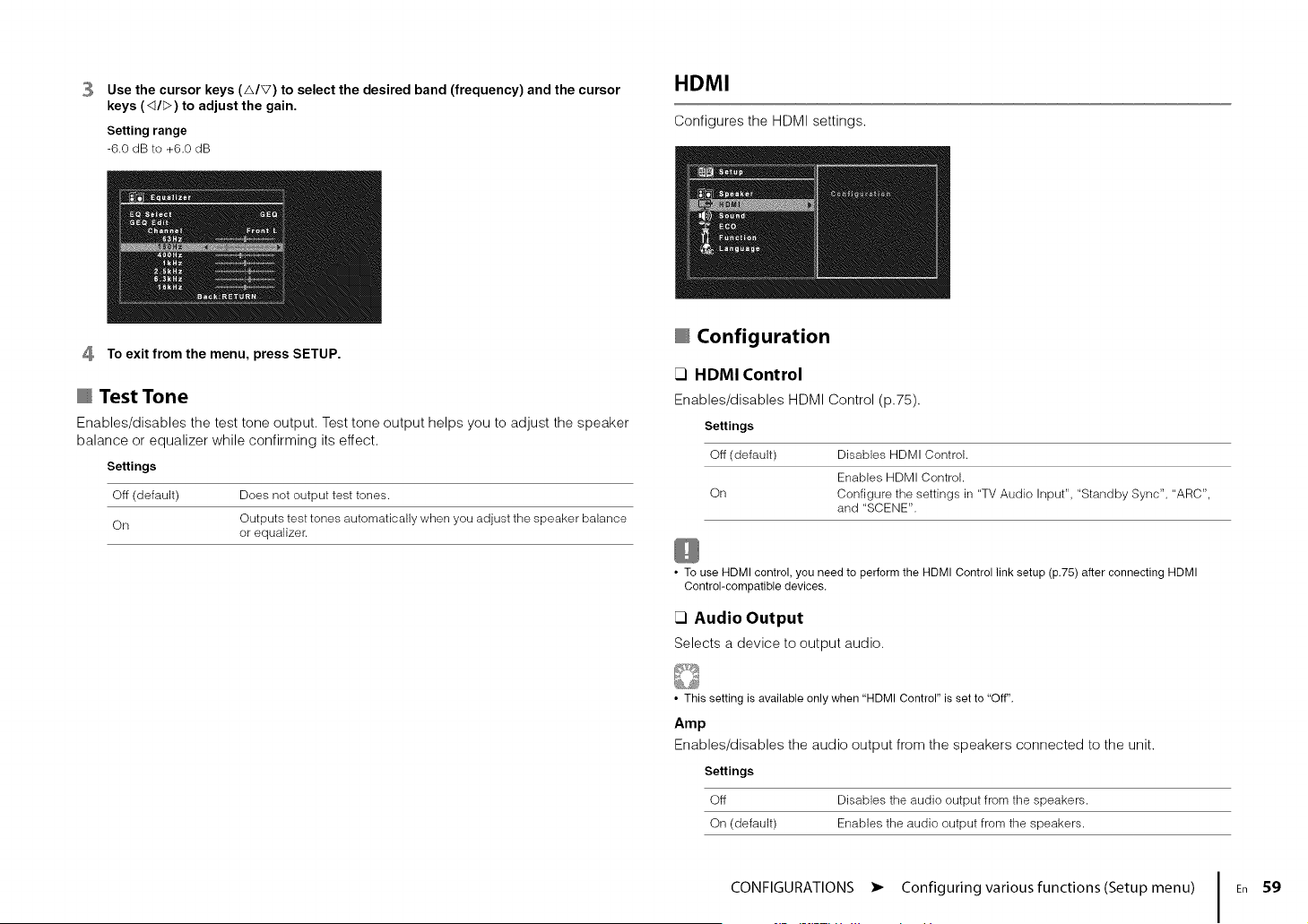
Use the cursor keys (A/V) to select the desired band (frequency) and the cursor
keys (<I/l>) to adjust the gain.
Setting range
-6.0 dB to +6.0 dB
HDMI
Configures the HDMI settings.
4 To exit from the menu, press SETUP.
@ Test Tone
Enables/disables the test tone output. Test tone output helps you to adjust the speaker
balance or equalizer while confirming its effect.
Settings
Off (default) Does not output test tones.
On Outputs test tones automatically when you adjust the speaker balance
or equalizer.
Configuration
HDMI Control
Enables/disables HDMI Control (p.75).
Settings
Off (default) Disables HDMI Control.
Enables HDMI Control.
On Configure the settings in "TV Audio Input", "Standby Sync', "ARC",
and "SCENE".
• To use HDMI control, you need to perform the HDMI Control link setup (p.75) after connecting HDMI
Control-compatible devices.
Audio Output
Selects a device to output audio.
• This setting is available only when "HDMI Control" is set to "Off".
Amp
Enables/disables the audio output from the speakers connected to the unit.
Settings
Off Disables the audio output from the speakers.
On (default) Enables the audio output from the speakers.
CONFIGURATIONS • Configuring various functions(Setup menu) En 59
HDMIOUT(TV)
Enables/disables the audio output from a TV connected to the HDMI OUT jack.
Settings
Off (default) Disables the audio output from the TV.
On Enables the audio output from the TV.
17 TV Audio Input
Selects an audio input jack of the unit to be used for TV audio input when "HDMI
Control" is set to "On". The unit's input source automatically switches to TV audio when
the TV input is switched to its built-in tuner.
Settings
AV 1-5, AUDIO 1-2
Default
AV4
• When using ARC to input TV audio to the unit, you cannot use the input jacks selected here for connecting
an external device because the input will be used for TV audio input.
17 Standby Sync
Select whether to use HDMI control to link the standby behavior of the TV and the unit
when "HDMI Control" is set to "On".
Settings
Off Does not set the unit to standby mode when the TV is turned off.
On Sets the unit to standby mode when the TV is turned off.
Auto (default) Sets the unit to standby mode when the TV is turned off only when the
unit is receiving TV audio or HDMI signals.
_1 ARC
Enables/disables ARC (p.18) when "HDMI Control" is set to "On".
Settings
Off Disables ARC.
On (default) Enables ARC.
17 SCENE
Enables/disable SCENE link playback when "HDMI Control" is set to "On".
When SCENE link playback is enabled, HDMI Control-compatible devices connected
to the unit via HDMI automatically works as follows, with a scene selection.
• TV: turning on and displaying video from the playback device
• Playback device: starting playback
Choices (SCENE keys)
BD/DVD, TV, CD, RADIO
Settings
Off Disables SCENE link playback for the selected SCENE key.
On Enables SCENE link playback for the selected SCENE key.
Default
BD/DVD, TV: On
CD, RADIO: Off
• SCENE link playback may not work properly due to the compatibility between devices. We recommend
using TV and playback devices from the same manufacturer so that HDMI Control works more effectively.
• You do not need to change this setting normally. In case noises are produced from the speakers connected
to the unit because TV audio signals input to the unit via ARC are not supported by the unit, set "ARC" to
"Off" and use the TV's speakers.
CONFIGURATIONS • Configuring various functions(Setup menu) En 60
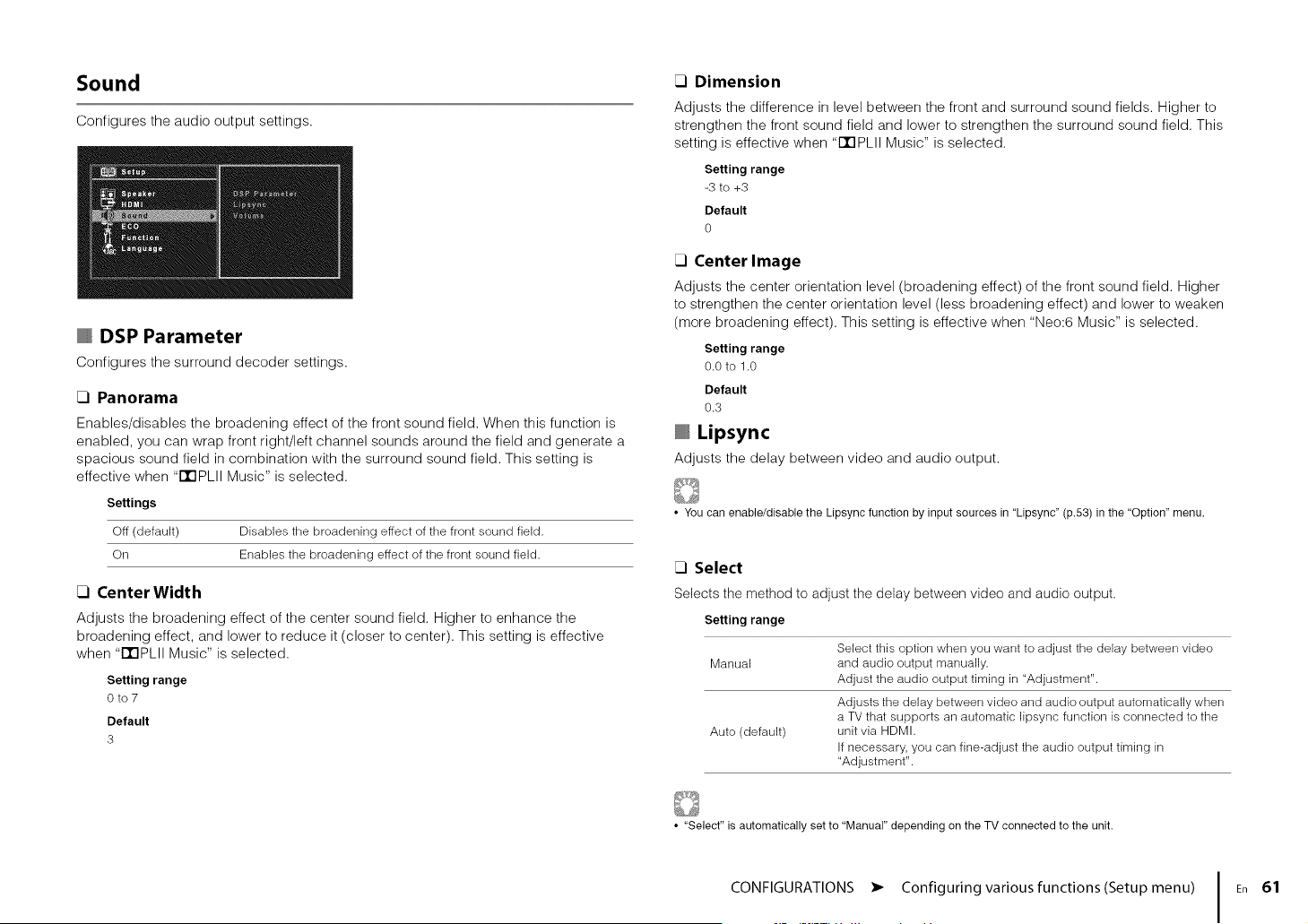
Sound
Configures the audio output settings.
DSP Parameter
Configures the surround decoder settings.
FI Panorama
Enables/disables the broadening effect of the front sound field. When this function is
enabled, you can wrap front right/left channel sounds around the field and generate a
spacious sound field in combination with the surround sound field. This setting is
effective when "IT1PLII Music" is selected.
Settings
Off (default) Disables the broadening effect of the front sound field.
On Enables the broadening effect of the front sound field.
rl Center Width
Adjusts the broadening effect of the center sound field. Higher to enhance the
broadening effect, and lower to reduce it (closer to center). This setting is effective
when "IT1PLII Music" is selected.
Setting range
0to7
Default
3
rl Dimension
Adjusts the difference in level between the front and surround sound fields. Higher to
strengthen the front sound field and lower to strengthen the surround sound field. This
setting is effective when "IT1PLII Music" is selected.
Setting range
-3 to +3
Default
0
FI Center Image
Adjusts the center orientation level (broadening effect) of the front sound field. Higher
to strengthen the center orientation level (less broadening effect) and lower to weaken
(more broadening effect). This setting is effective when "Neo:6 Music" is selected.
Setting range
0.0 to 1.0
Default
0.3
N Lipsync
Adjusts the delay between video and audio output.
• You can enable/disable the Lipsync function by input sources in "Lipsync" (p.53) in the "Option" menu.
_] Select
Selects the method to adjust the delay between video and audio output.
Setting range
Manual
Auto (default)
Select this option when you want to adjust the delay between video
and audio output manually.
Adjust the audio output timing in "Adjustment".
Adjusts the delay between video and audio output automatically when
a TV that supports an automatic lipsync function is connected to the
unit via HDMI.
If necessary, you can fine-adjust the audio output timing in
"Adjustment".
• "Select" is automatically set to "Manual" depending on the TV connected to the unit.
CONFIGURATIONS • Configuring various functions(Setup menu) En 61
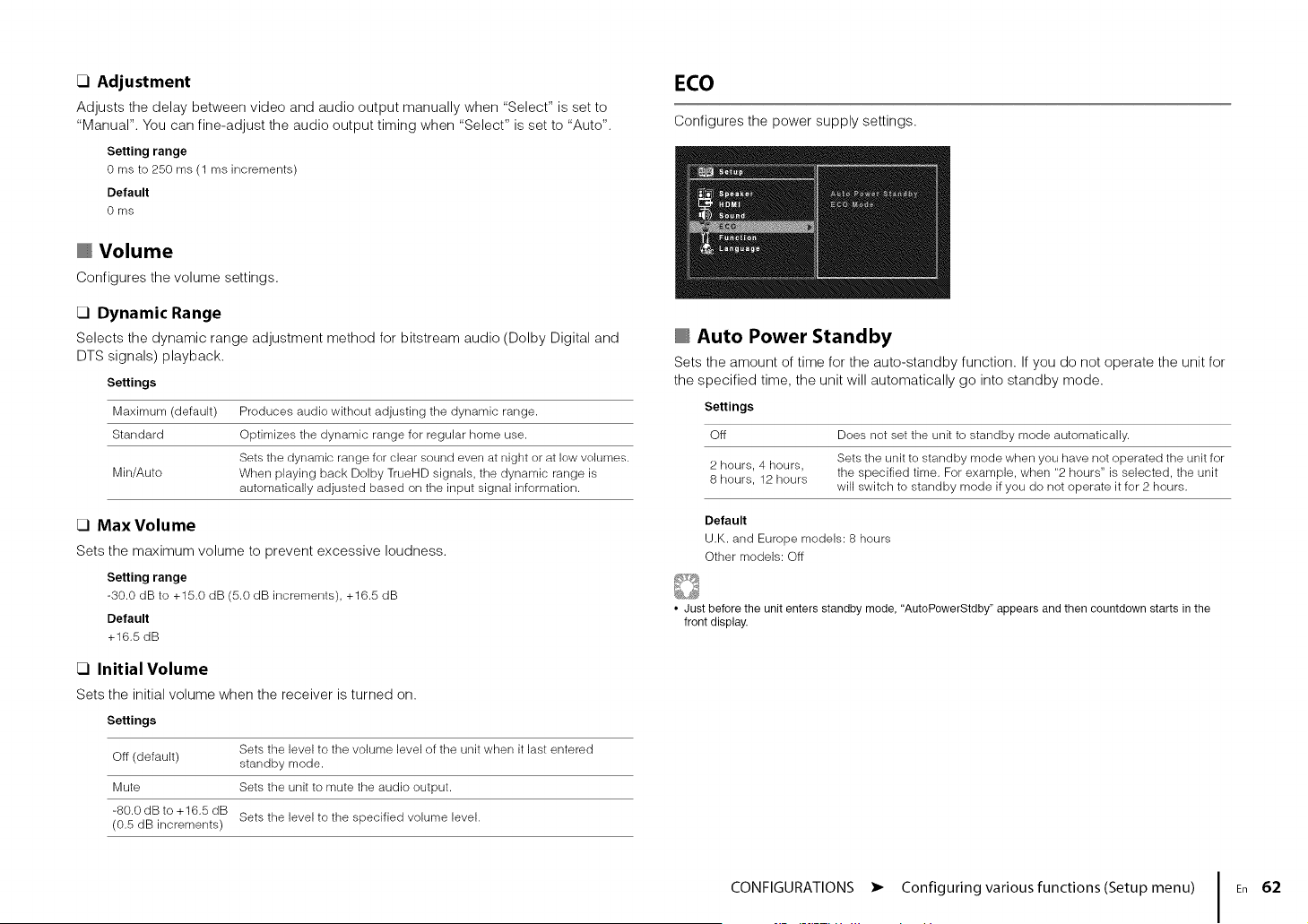
Adjustment
Adjusts the delay between video and audio output manually when "Select" is set to
"Manual". You can fine-adjust the audio output timing when "Select" is set to "Auto".
Setting range
0 ms to 250 ms (1 ms increments)
Default
0 ms
Volume
Configures the volume settings.
17 Dynamic Range
Selects the dynamic range adjustment method for bitstream audio (Dolby Digital and
DTS signals) playback.
Settings
Maximum (default) Produces audio without adjusting the dynamic range.
Standard Optimizes the dynamic range for regular home use.
Sets the dynamic range for clear sound even at night or at low volumes
Min/Auto When playing back Dolby TrueHD signals, the dynamic range is
automatically adjusted based on the input signal information.
17 Max Volume
Sets the maximum volume to prevent excessive loudness.
Setting range
-30.0 dB to +15.0 dB (5.0 dB increments +16.5dB
Default
+16.5 dB
17 Initial Volume
Sets the initial volume when the receiver is turned on.
Settings
Sets the level to the volume level of the unit when it last entered
Off (default) standby mode.
Mute Sets the unit to mute the audio output.
-80.0 dB to +16.5 dB
Sets the level to the specified volume level.
(0.5 dB increments)
ECO
Configures the power supply settings.
Auto Power Standby
Sets the amount of time for the auto-standby function. If you do not operate the unit for
the specified time, the unit will automatically go into standby mode.
Settings
Off Does not set the unit to standby mode automatically.
Sets the unit to standby mode when you have not operated the unit for
2 hours, 4 hours,
8 hours, 12 hours the specified time. For example, when "2 hours" is selected, the unit
will switch to standby mode if you do not operate it for 2 hours.
Default
U.K. and Europe models: 8 hours
Other models: Off
• Just before the unit enters standby mode, "AutoPowerStdby" appears and then countdown starts in the
front display.
CONFIGURATIONS • Configuring various functions(Setup menu) En 62
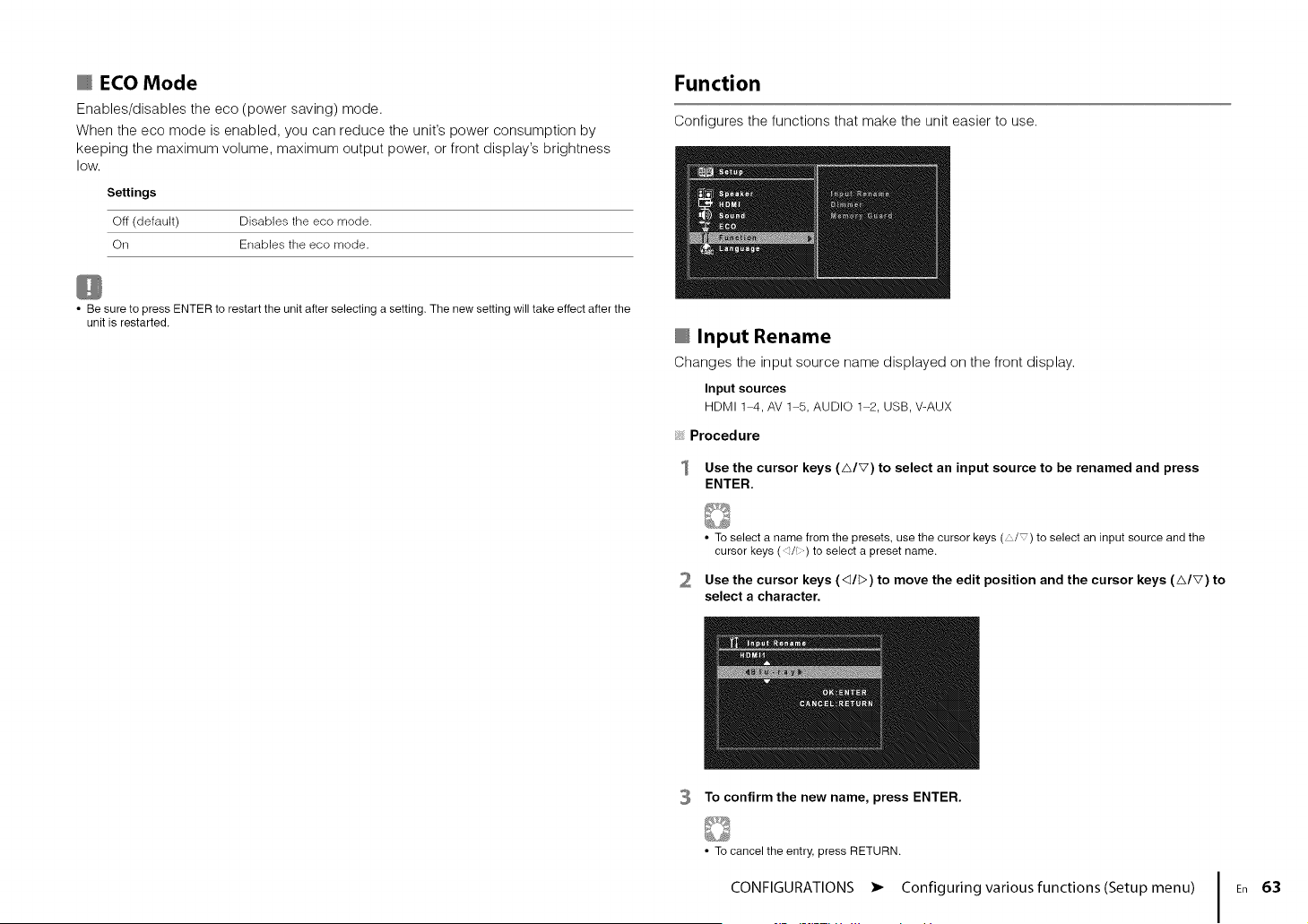
ECO Mode
Enables/disables the eco (power saving) mode.
When the eco mode is enabled, you can reduce the unit's power consumption by
keeping the maximum volume, maximum output power, or front display's brightness
low.
Settings
Off (default) Disables the eco mode.
On Enables the eco mode.
Function
Configures the functions that make the unit easier to use.
• Be sure to press ENTER to restart the unit after selecting a setting. The new setting will take effect after the
unit is restarted.
Input Rename
Changes the input source name displayed on the front display.
Input sources
HDMI 1 4, AV 1-5, AUDIO 1-2, USB, V-AUX
Procedure
1 Usethecursorkeys(A/V)toselectaninputsourcetoberenamedand press
ENTER.
• To select a name from the presets, use the cursor keys ( / ) to select an input source and the
cursor keys (</[) to select a preset name.
2 Use the cursor keys (q/l>) to move the edit position and the cursor keys (A/V) to
select a character.
3 To confirm the new name, press ENTER.
• To cancelthe entry,press RETURN.
CONFIGURATIONS • Configuring various functions(Setup menu)
En 63
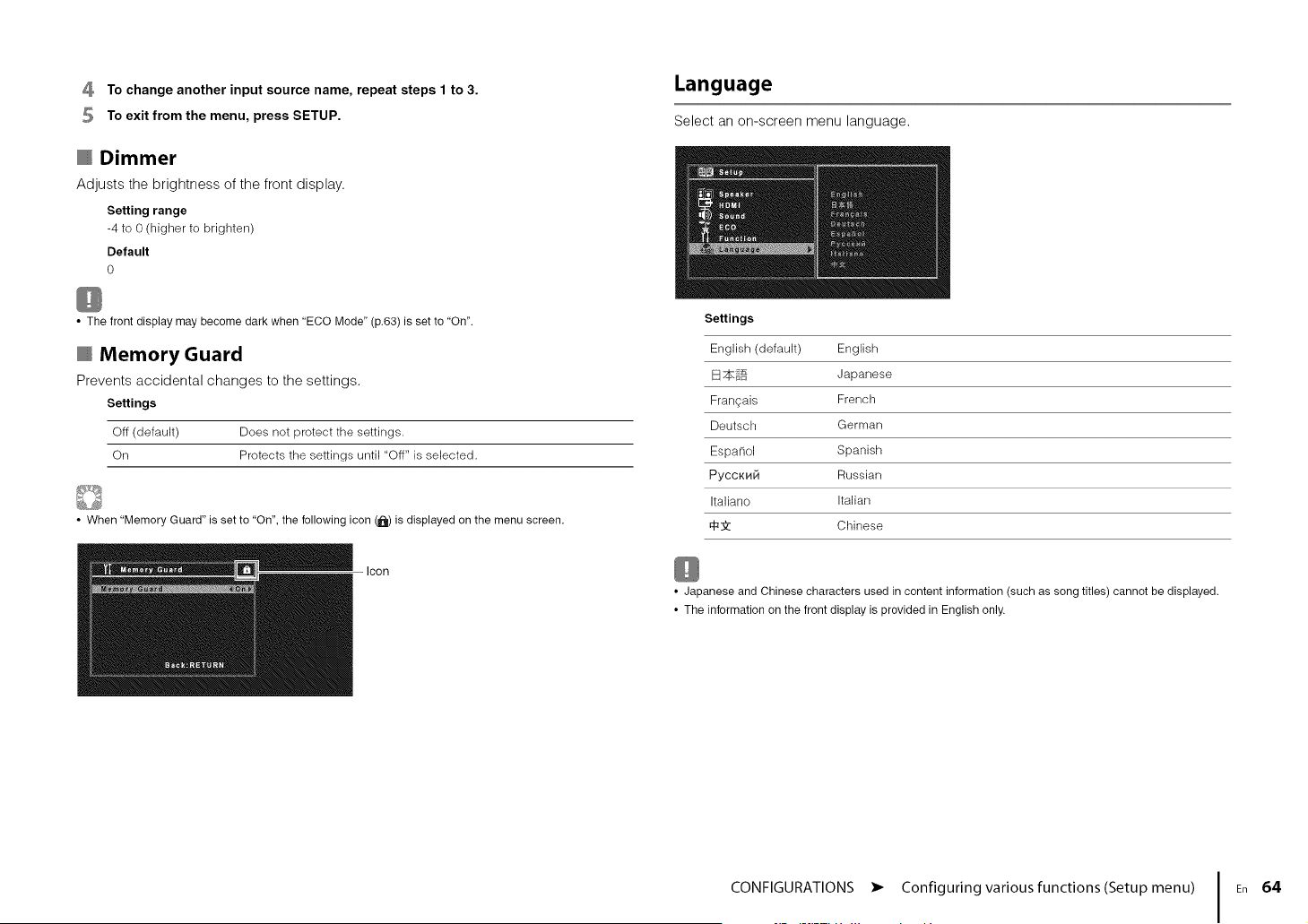
To change another input source name, repeat steps 1 to 3.
To exit from the menu, press SETUP.
Dimmer
Adjusts the brightness of the front display.
Setting range
-4 to 0 (higher to brighten)
Default
0
• The front display may become dark when "ECO Mode" (p.63) is set to "On".
Memory Guard
Prevents accidental changes to the settings.
Settings
Off (default) Does not protect the settings.
On Protects the settings until "Off" is selected.
• When "Memory Guard" is set to "On", the following icon (_) is displayed on the menu screen.
Icon
Language
Select an on-screen menu language.
Settings
English (default) English
[] :7_ Japanese
Francais French
Deutsch German
Espafiol Spanish
PyccKH_ Russian
Italiano Italian
€:_ Chinese
• Japanese and Chinese characters used in content information (such as song titles) cannot be displayed.
• The information on the front display is provided in English only.
CONFIGURATIONS • Configuring various functions(Setup menu) En 64
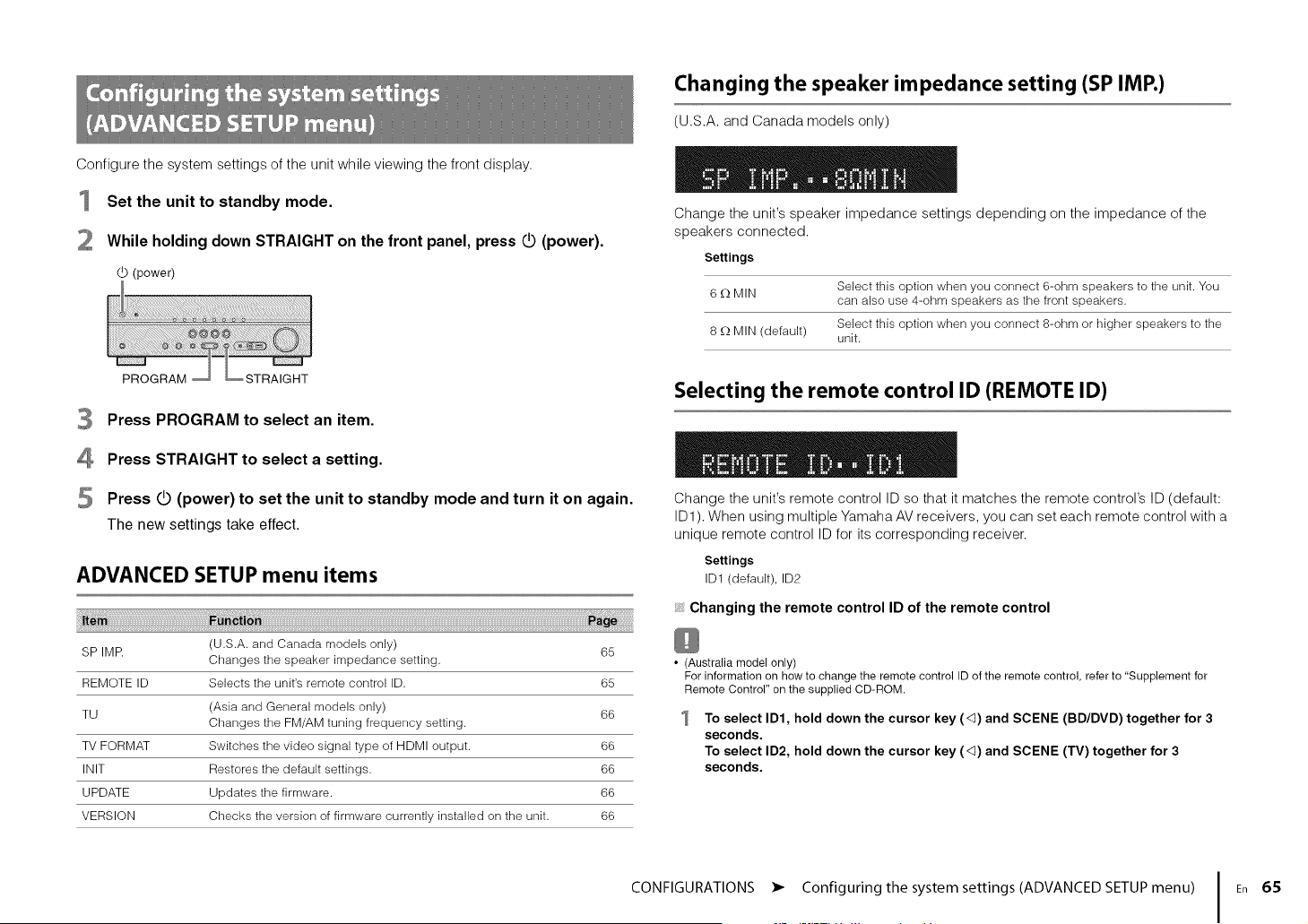
Configurethesystemsettingsoftheunitwhileviewingthefrontdisplay.
Set the unit to standby mode.
While holding down STRAIGHT on the front panel, press 0 (power),
dO(power)
Changing the speaker impedance setting (SP IMP.)
(U.S.A. and Canada models only)
Change the unit's speaker impedance settings depending on the impedance of the
speakers connected.
Settings
Select this option when you connect 6-ohm speakers to the unit. You
6DMIN
can also use 4-ohm speakers as the front speakers.
Select this option when you connect 8-ohm or higher speakers to the
8 £-)MIN (default) unit.
Selecting the remote control ID (REMOTE ID)
PROGRAM
4
Press PROGRAM to select an item.
Press STRAIGHT to select a setting.
Press _ (power) to set the unit to standby mode and turn it on again.
The new settings take effect.
ADVANCED SETUP menu items
i
SP IMP. (U.S.A. and Canada models only) 65
Changes the speaker impedance setting.
REMOTE ID Selects the unit's remote control ID. 65
TU (Asia and General models only) 66
Changes the FM/AM tuning frequency setting.
TV FORMAT Switches the video signal type of HDMI output. 66
INIT Restores the default settings. 66
UPDATE Updates the firmware. 66
VERSION Checks the version of firmware currently installed on the unit. 66
Change the unit's remote control ID so that it matches the remote control's ID (default:
ID1 ). When using multiple Yamaha AV receivers, you can set each remote control with a
unique remote control ID for its corresponding receiver.
Settings
ID1 (default), ID2
Changing the remote control ID of the remote control
• (Australia model only)
For information on how to change the remote control ID of the remote control, refer to "Supplement for
Remote Control" on the supplied CD-ROM
To select ID1, hold down the cursor key (4) and SCENE (BD/DVD) together for 3
seconds.
To select ID2, hold down the cursor key (4) and SCENE (TV) together for 3
seconds.
CONFIGURATIONS • Configuring the system settings (ADVANCED SETUP menu) En 65
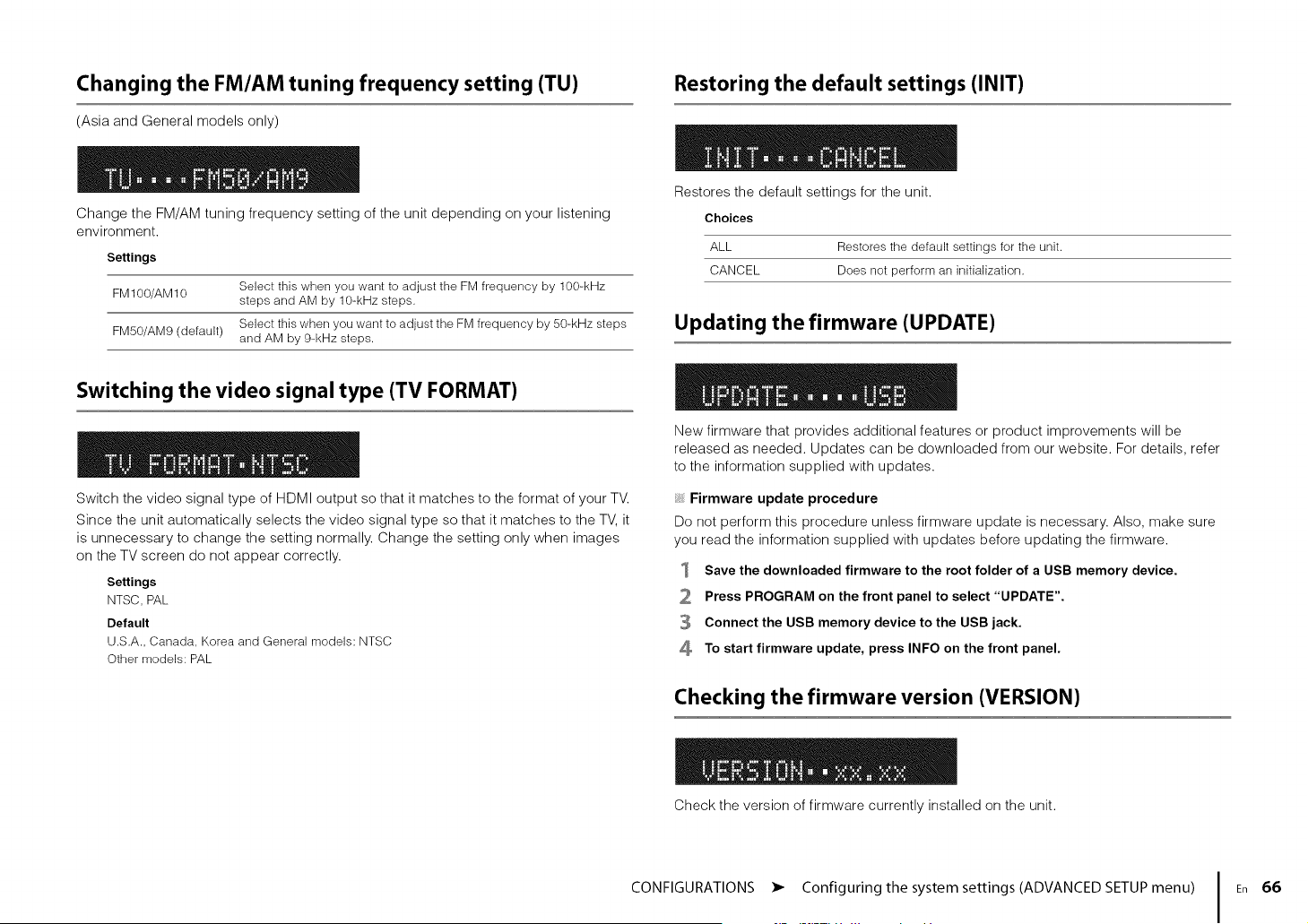
Changing the FM/AM tuning frequency setting (TU)
(Asia and General models only)
Change the FM/AM tuning frequency setting of the unit depending on your listening
environment.
Settings
Select this when you want to adjust the FM frequency by 100-kHz
FM100/AM10 steps and AM by 10-kHzsteps.
Select this when you want to adjust the FM frequency by 50-kHz steps
FM50/AM9(default) and AM by 9-kHz steps.
Switching the video signal type (TV FORMAT)
Switch the video signal type of HDMI output so that it matches to the format of your TV.
Since the unit automatically selects the video signal type so that it matches to the TV, it
is unnecessary to change the setting normally. Change the setting only when images
on the TV screen do not appear correctly.
Settings
NTSC, PAL
Default
U.S.A., Canada, Korea and General models: NTSC
Other models: PAL
Restoring the default settings (INIT)
Restores the default settings for the unit.
Choices
ALL Restores the default settings for the unit.
CANCEL Does not perform an initialization.
Updating the firmware (UPDATE)
New firmware that provides additional features or product improvements will be
released as needed. Updates can be downloaded from our website. For details, refer
to the information supplied with updates.
Firmware update procedure
Do not perform this procedure unless firmware update is necessary. Also, make sure
you read the information supplied with updates before updating the firmware.
Save the downloaded firmware to the root folder of a USB memory device.
2 Press PROGRAM on the front panel to select "UPDATE".
3 Connect the USB memory device to the USB jack.
4 To start firmware update, press INFO on the front panel.
Checking the firmware version (VERSION)
Check the version of firmware currently installed on the unit.
CONFIGURATIONS • Configuring the system settings (ADVANCED SETUP menu) En 66
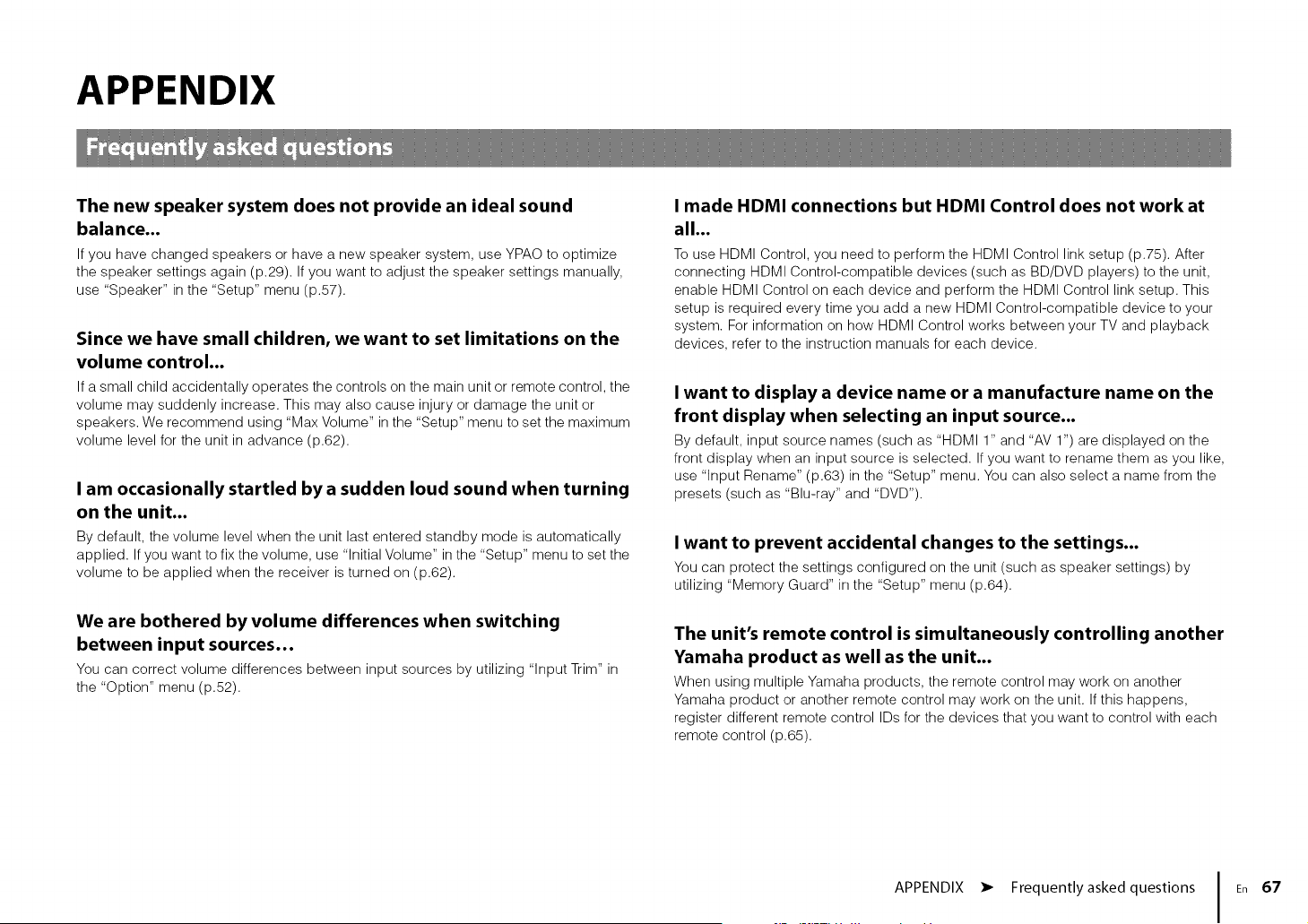
APPENDIX
The new speaker system does not provide an ideal sound
balance...
If you have changed speakers or have a new speaker system, use YPAO to optimize
the speaker settings again (p.29). If you want to adjust the speaker settings manually,
use "Speaker" in the "Setup" menu (p.57).
Since we have small children, we want to set limitations on the
volume control...
If a small child accidentally operates the controls on the main unit or remote control, the
volume may suddenly increase. This may also cause injury or damage the unit or
speakers. We recommend using "Max Volume" in the "Setup" menu to set the maximum
volume level for the unit in advance (p.62).
I am occasionally startled by a sudden loud sound when turning
on the unit...
By default, the volume level when the unit last entered standby mode is automatically
applied. If you want to fix the volume, use "Initial Volume" in the "Setup" menu to set the
volume to be applied when the receiver is turned on (p.62).
We are bothered by volume differences when switching
between input sources...
You can correct volume differences between input sources by utilizing "Input Trim" in
the "Option" menu (p.52).
I made HDMI connections but HDMI Control does not work at
all...
To use HDMI Control, you need to perform the HDMI Control link setup (p.75). After
connecting HDMI Control-compatible devices (such as BD/DVD players) to the unit,
enable HDMI Control on each device and perform the HDMI Control link setup. This
setup is required every time you add a new HDMI Control-compatible device to your
system. For information on how HDMI Control works between your TV and playback
devices, refer to the instruction manuals for each device.
I want to display a device name or a manufacture name on the
front display when selecting an input source...
By default, input source names (such as "HDMI 1" and "AV 1") are displayed on the
front display when an input source is selected. If you want to rename them as you like,
use "Input Rename" (p.63) in the "Setup" menu. You can also select a name from the
presets (such as "Blu-ray" and "DVD").
I want to prevent accidental changes to the settings...
You can protect the settings configured on the unit (such as speaker settings) by
utilizing "Memory Guard" in the "Setup" menu (p.64).
The unit's remote control is simultaneously controlling another
Yamaha product as well as the unit...
When using multiple Yamaha products, the remote control may work on another
Yamaha product or another remote control may work on the unit. If this happens,
register different remote control IDs for the devices that you want to control with each
remote control (p.65).
APPENDIX • Frequently asked questions En 67
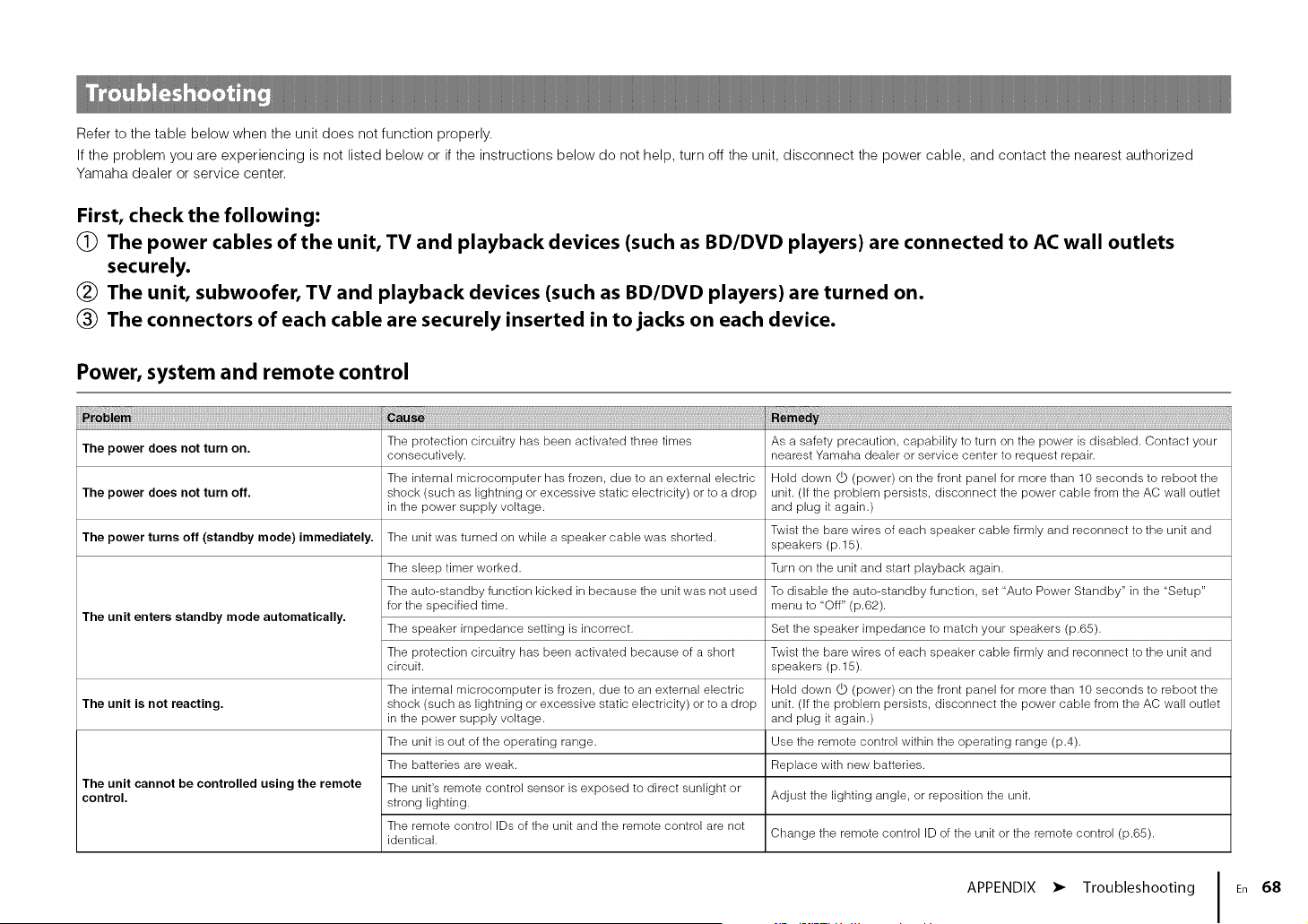
Refer to the table below when the unit does not function properly.
If the problem you are experiencing is not listed below or if the instructions below do not help, turn off the unit, disconnect the power cable, and contact the nearest authorized
Yamaha dealer or service center.
First, check the following:
The power cables of the unit, TV and playback devices (such as BD/DVD players) are connected to AC wall outlets
securely.
The unit, subwoofer, TV and playback devices (such as BD/DVD players) are turned on.
The connectors of each cable are securely inserted in to jacks on each device.
Power, system and remote control
The power does not turn on.
The power does not turn off.
The power turns off (standby mode) immediately.
The unit enters standby mode automatically.
The unit is not reacting.
The unit cannot be controlled using the remote
control.
The protection circuitry has been activated three times
consecutively.
The internal microcomputer has frozen, due to an external electric
shock (such as lightning or excessive static electricity) or to a drop
in the power supply voltage.
The unit was turned on while a speaker cable was shorted.
The sleep timer worked.
The auto-standby function kicked in because the unit was not used
for the specified time.
The speaker impedance setting is incorrect.
The protection circuitry has been activated because of a short
circuit.
The internal microcomputer is frozen, due to an external electric
shock (such as lightning or excessive static electricity) or to a drop
in the power supply voltage.
The unit is out of the operating range.
The batteries are weak.
The unit's remote control sensor is exposed to direct sunlight or
strong lighting.
The remote control IDs of the unit and the remote control are not
identical.
As a safety precaution, capability to turn on the power is disabled. Contact your
nearest Yamaha dealer or service center to request repair.
Hold down d_ (power) on the front panel for more than 10 seconds to reboot the
unit. (If the problem persists, disconnect the power cable from the AC wall outlet
and plug it again.)
Twist the bare wires of each speaker cable firmly and reconnect to the unit and
speakers (p.15).
Turn on the unit and start playback again.
To disable the auto-standby function, set "Auto Power Standby" in the "Setup"
menu to "Off" (p.62).
Set the speaker impedance to match your speakers (p.65).
Twist the bare wires of each speaker cable firmly and reconnect to the unit and
speakers (p.15).
Hold down d_ (power) on the front panel for more than 10 seconds to reboot the
unit. (If the problem persists, disconnect the power cable from the AC wall outlet
and plug it again.)
Use the remote control within the operating range (p.4).
Replace with new batteries.
Adjust the lighting angle, or reposition the unit.
Change the remote control ID of the unit or the remote control (p.65).
APPENDIX • Troubleshooting En 68
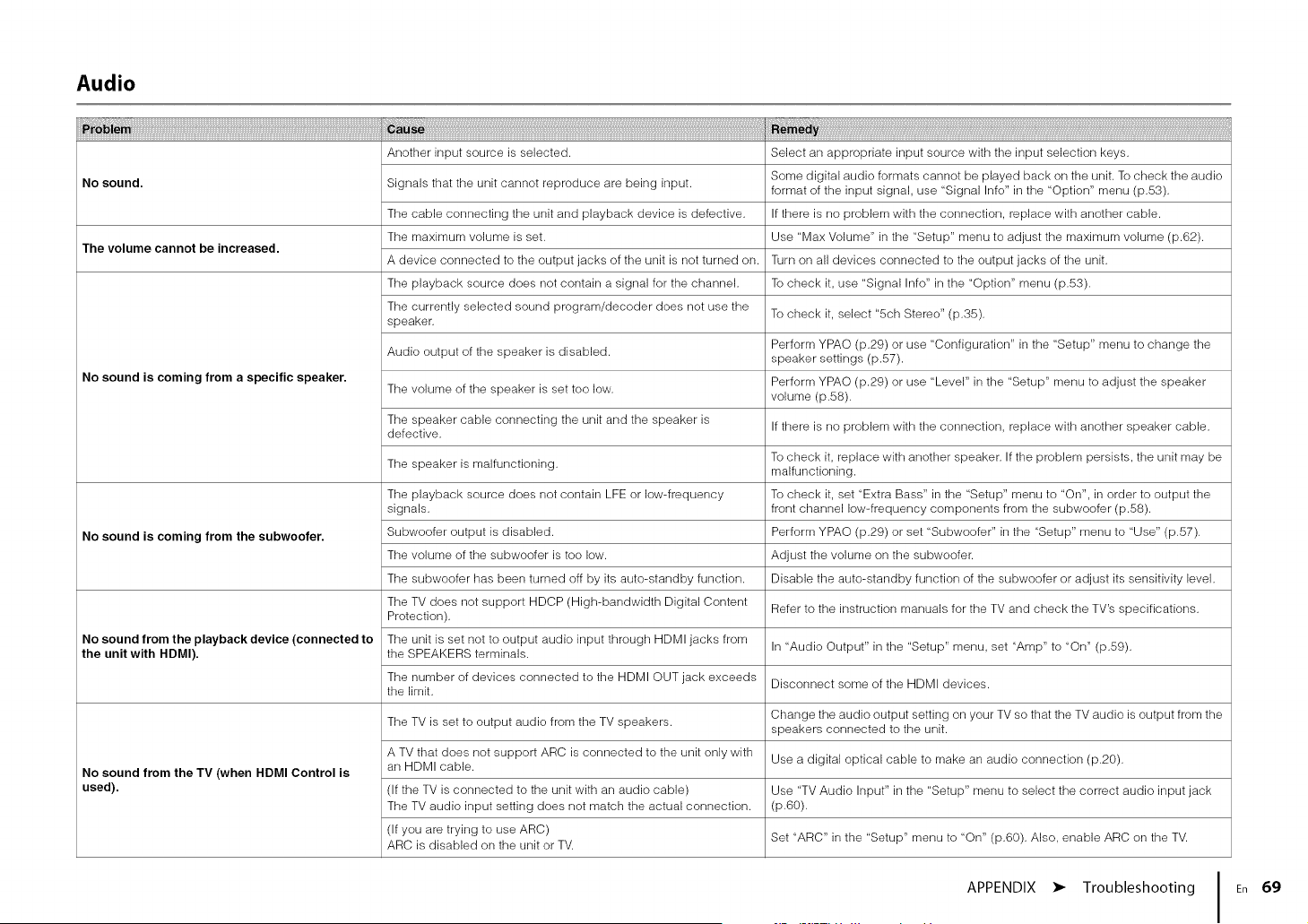
Audio
Another input source is selected. Select an appropriate input source with the input selection keys.
No sound.
The volume cannot be increased.
No sound is coming from a specific speaker.
No sound is coming from the subwoofer.
No sound from the playback device (connected to
the unit with HDMI).
No sound from the TV (when HDMI Control is
used).
Signals that the unit cannot reproduce are being input.
The cable connecting the unit and playback device is defective.
The maximum volume is set.
A device connected to the output jacks of the unit is not turned on.
The playback source does not contain a signal for the channel.
The currently selected sound program/decoder does not use the
speaker.
Audio output of the speaker is disabled.
The volume of the speaker is set too low.
The speaker cable connecting the unit and the speaker is
defective.
The speaker is malfunctioning.
The playback source does not contain LFE or low-frequency
signals.
Subwoofer output is disabled.
The volume of the subwoofer is too low.
The subwoofer has been turned off by its auto-standby function.
The TV does not support HDCP (High-bandwidth Digital Content
Protection).
The unit is set not to output audio input through HDMI jacks from
the SPEAKERS terminals.
The number of devices connected to the HDMI OUT jack exceeds
the limit.
The TV is set to output audio from the TV speakers.
A TV that does not support ARC is connected to the unit only with
an HDMI cable.
(If the TV is connected to the unit with an audio cable)
The TV audio input setting does not match the actual connection.
(If you are trying to use ARC)
ARC is disabled on the unit or TV.
Some digital audio formats cannot be played back on the unit. To check the audio
format of the input signal, use "Signal Info" in the "Option" menu (p.53).
If there is no problem with the connection, replace with another cable.
Use "Max Volume" in the "Setup" menu to adjust the maximum volume (p.62).
Turn on all devices connected to the output jacks of the unit.
To check it, use "Signal Info" in the "Option" menu (p.53).
To check it, select "5ch Stereo" (p.35).
Perform YPAO (p.29) or use "Configuration" in the "Setup" menu to change the
speaker settings (p.57).
Perform YPAO (p.29) or use "Level" in the "Setup" menu to adjust the speaker
volume (p.58).
If there is no problem with the connection, replace with another speaker cable.
To check it, replace with another speaker. If the problem persists, the unit may be
malfunctioning.
To check it, set "Extra Bass" in the "Setup" menu to "On", in order to output the
front channel low-frequency components from the subwoofer (p.58).
Perform YPAO (p.29) or set "Subwoofer" in the "Setup" menu to "Use" (p.57).
Adjust the volume on the subwoofer.
Disable the auto-standby function of the subwoofer or adjust its sensitivity level.
Refer to the instruction manuals for the TV and check the TV's specifications.
In "Audio Output" in the "Setup" menu, set "Amp" to "On" (p.59).
Disconnect some of the HDMI devices.
Change the audio output setting on your TV so that the TV audio is output from the
speakers connected to the unit.
Use a digital optical cable to make an audio connection (p.20).
Use "TV Audio Input" in the "Setup" menu to select the correct audio input jack
(p.60).
Set "ARC" in the "Setup" menu to "On" (p.60). Also, enable ARC on the TV.
APPENDIX • Troubleshooting En 69
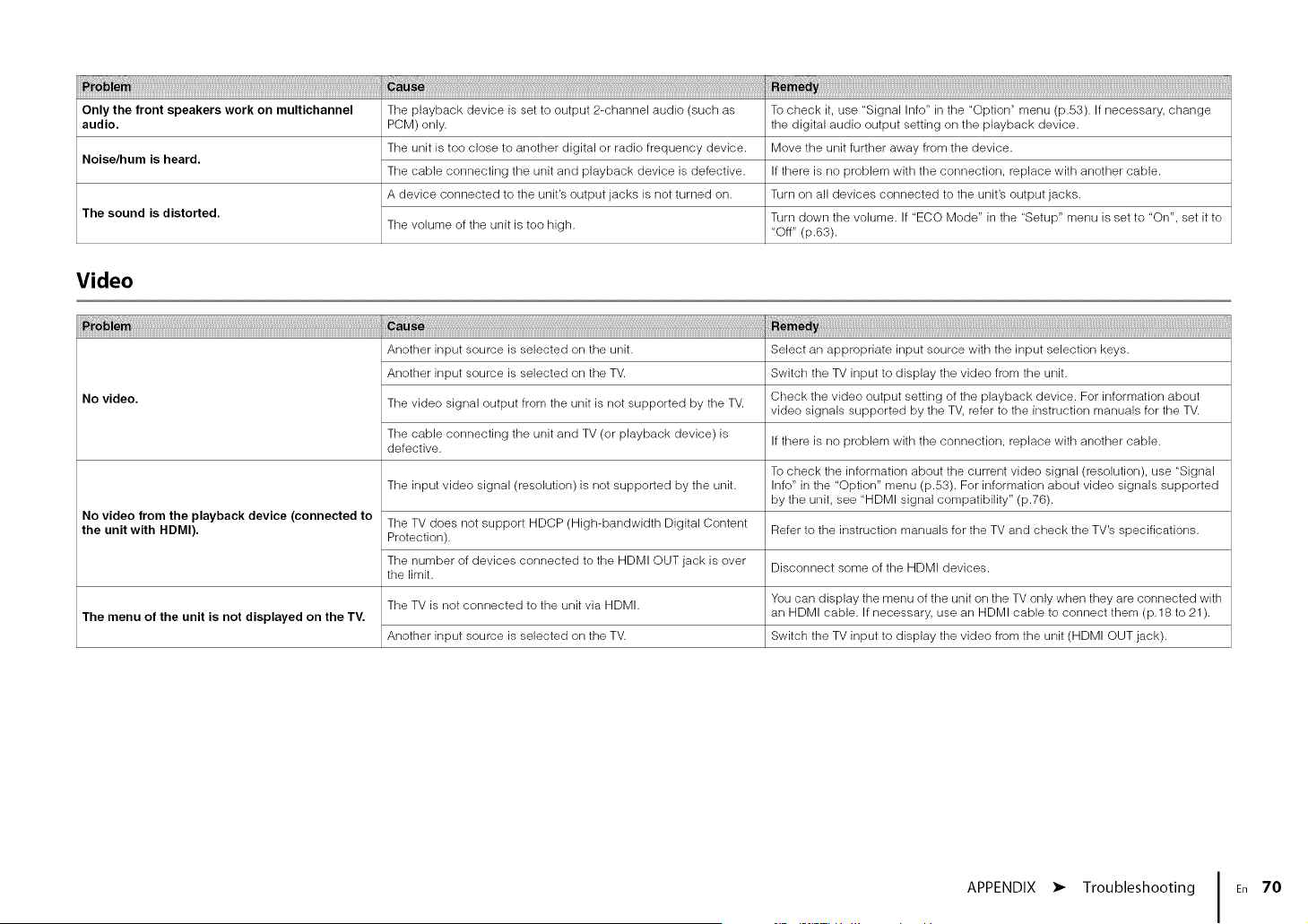
Only the front speakers work on multichannel
audio.
Noise/hum is heard.
The sound is distorted.
The playback device is set to output 2-channel audio (such as
PCM) only.
The unit is too close to another digital or radio frequency device.
The cable connecting the unit and playback device is defective.
A device connected to the unit's output jacks is not turned on.
The volume of the unit is too high.
To check it, use "Signal Info" in the "Option" menu (p.53). If necessary, change
the digital audio output setting on the playback device.
Move the unit further away from the device.
If there is no problem with the connection, replace with another cable.
Turn on all devices connected to the unit's output jacks.
Turn down the volume. If "ECO Mode" in the "Setup" menu is set to "On", set it to
"Off" (p.63).
Video
No video.
No video from the playback device (connected to
the unit with HDMI).
The menu of the unit is not displayed on the TV,
Another input source is selected on the unit.
Another input source is selected on the TV.
The video signal output from the unit is not supported by the TV.
The cable connecting the unit and TV (or playback device) is
defective.
The input video signal (resolution) is not supported by the unit.
Select an appropriate input source with the input selection keys.
Switch the TV input to display the video from the unit.
Check the video output setting of the playback device. For information about
video signals supported by the TV, refer to the instruction manuals for the TV.
The number of devices connected to the HDMI OUT jack is over
the limit.
If there is no problem with the connection, replace with another cable.
To check the information about the current video signal (resolution), use "Signal
Info" in the "Option" menu (p.53). For information about video signals supported
by the unit, see "HDMI signal compatibility" (p.76).
The TV does not support HDCP (High-bandwidth Digital Content
Refer to the instruction manuals for the TV and check the TV's specifications.
Protection).
Disconnect some of the HDMI devices.
The TV is not connected to the unit via HDMI.
Another input source is selected on the TV.
You can display the menu of the unit on the TV only when they are connected with
an HDMI cable. If necessary, use an HDMI cable to connect them (p.18 to 21).
Switch the TV input to display the video from the unit (HDMI OUT jack).
APPENDIX • Troubleshooting En 70
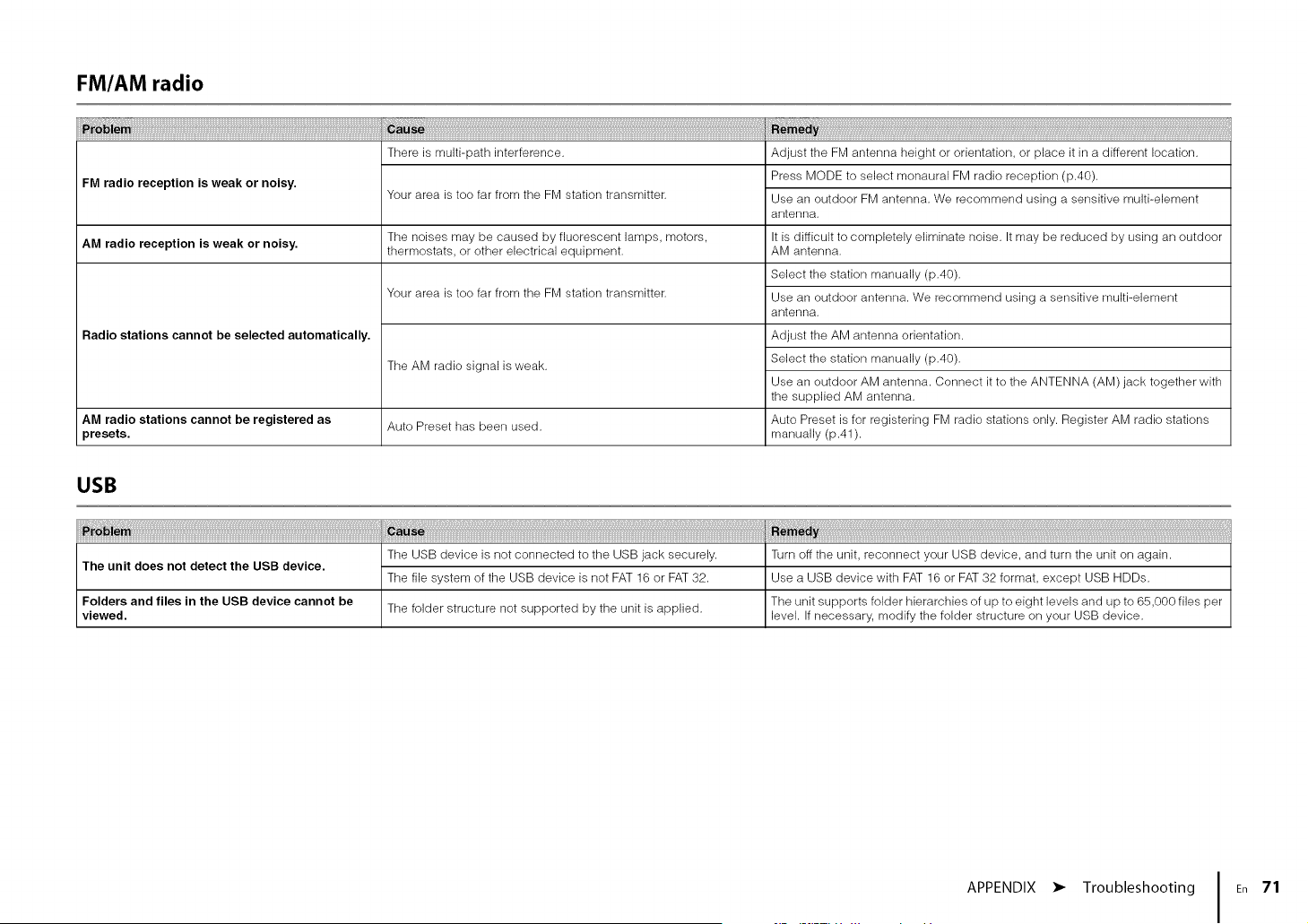
FM/AM radio
FM radio reception is weak or noisy.
AM radio reception is weak or noisy.
Radio stations cannot be selected automatically.
There is muki-path interference.
Your area is too far from the FM station transmitter.
The noises may be caused by fluorescent lamps, motors,
thermostats, or other electrical equipment.
Your area is too far from the FM station transmitter.
The AM radio signal is weak.
Auto Preset has been used.
AM radio stations cannot be registered as
presets.
Adjust the FM antenna height or orientation, or place it in a different location.
Press MODE to select monaural FM radio reception (p.40).
Use an outdoor FM antenna. We recommend using a sensitive muki-element
antenna.
It is difficult to completely eliminate noise. It may be reduced by using an outdoor
AM antenna.
Select the station manually (p.40).
Use an outdoor antenna. We recommend using a sensitive muki-element
antenna.
Adjust the AM antenna orientation.
Select the station manually (p.40).
Use an outdoor AM antenna. Connect it to the ANTENNA (AM) jack together with
the supplied AM antenna.
Auto Preset is for registering FM radio stations only. Register AM radio stations
manually (p.41).
USB
The USB device is not connected to the USB jack securely. Turn off the unit, reconnect your USB device, and turn the unit on again.
The unit does not detect the USB device.
The file system of tile USB device is not FAT 16 or FAT 32. Use a USB device with FAT 16 or FAT 32 format, except USB HDDs.
Folders and files in the USB device cannot be The folder structure not supported by the unit is applied. The unit supports folder hierarchies of up to eight levels and up to 65,000 files per
viewed, level. If necessary, modify the folder structure on your USB device.
APPENDIX • Troubleshooting En 71
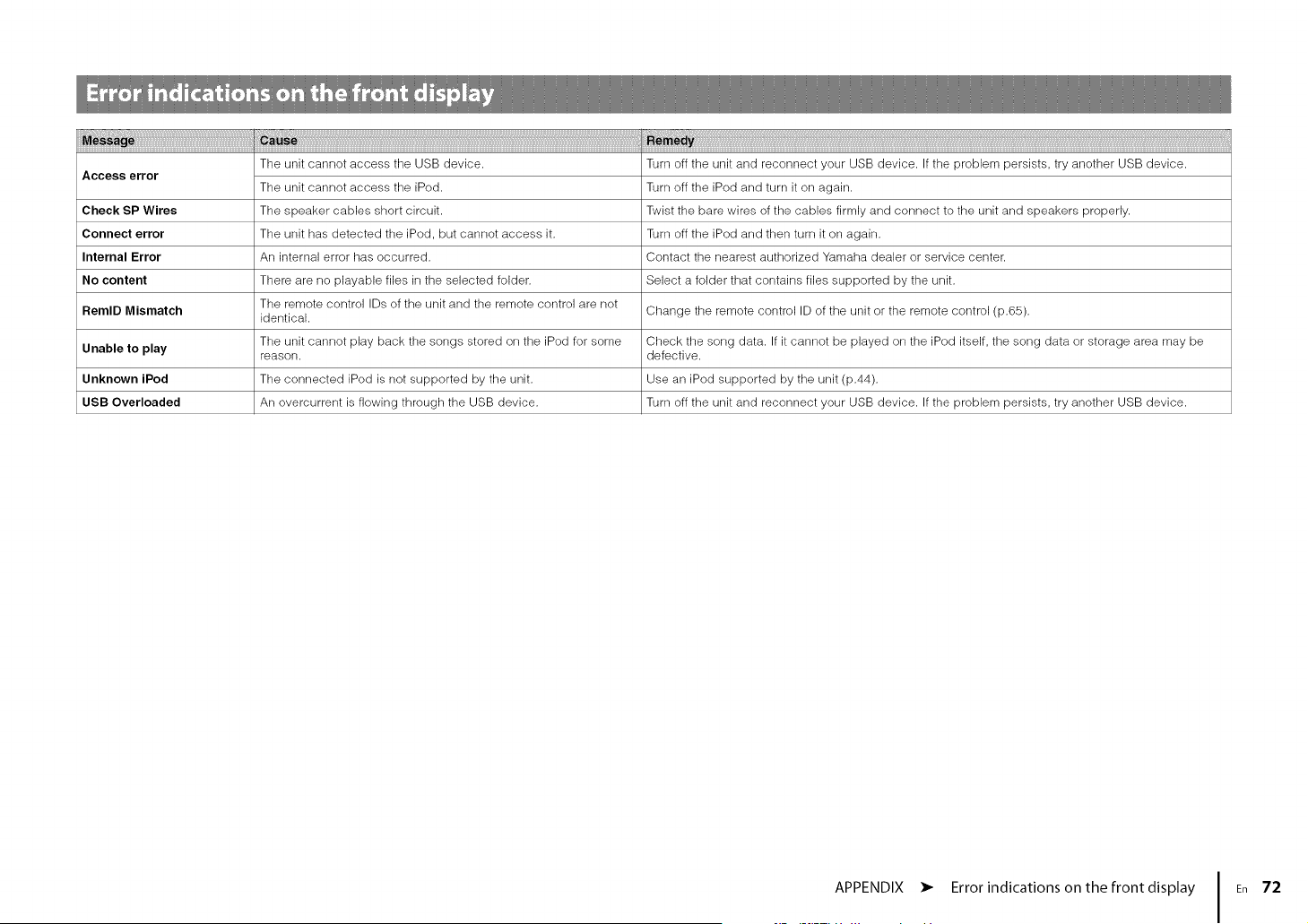
The unit cannot access the USB device. Turn off the unit and reconnect your USB device. If the problem persists, try another USB device.
Access error
Tile unit cannot access tile iPod. Turn off tile iPod and turn it on again.
Check SP Wires The speaker cables short circuit. Twist the bare wires of the cables firmly and connect to the unit and speakers properly.
Connect error The unit has detected the iPod, but cannot access it. Turn off the iPod and then turn it on again.
Internal Error An internal error has occurred. Contact the nearest authorized Yamaha dealer or service center.
No content There are no playable files in the selected folder. Select a folder that contains files supported by the unit.
The remote control IDs of the unit and the remote control are not
RemlD Mismatch identical. Change the remote control ID of the unit or the remote control (p.65).
The unit cannot play back the songs stored on the iPod for some Check the song data. If it cannot be played on the iPod itself, the song data or storage area may be
Unable to play reason, defective.
Unknown iPod The connected iPod is not supported by the unit. Use an iPod supported by the unit (p.44).
USB Overloaded An overcurrent is flowing through the USB device. Turn off the unit and reconnect your USB device. If the problem persists, try another USB device.
APPENDIX • Error indications on the front display En 72
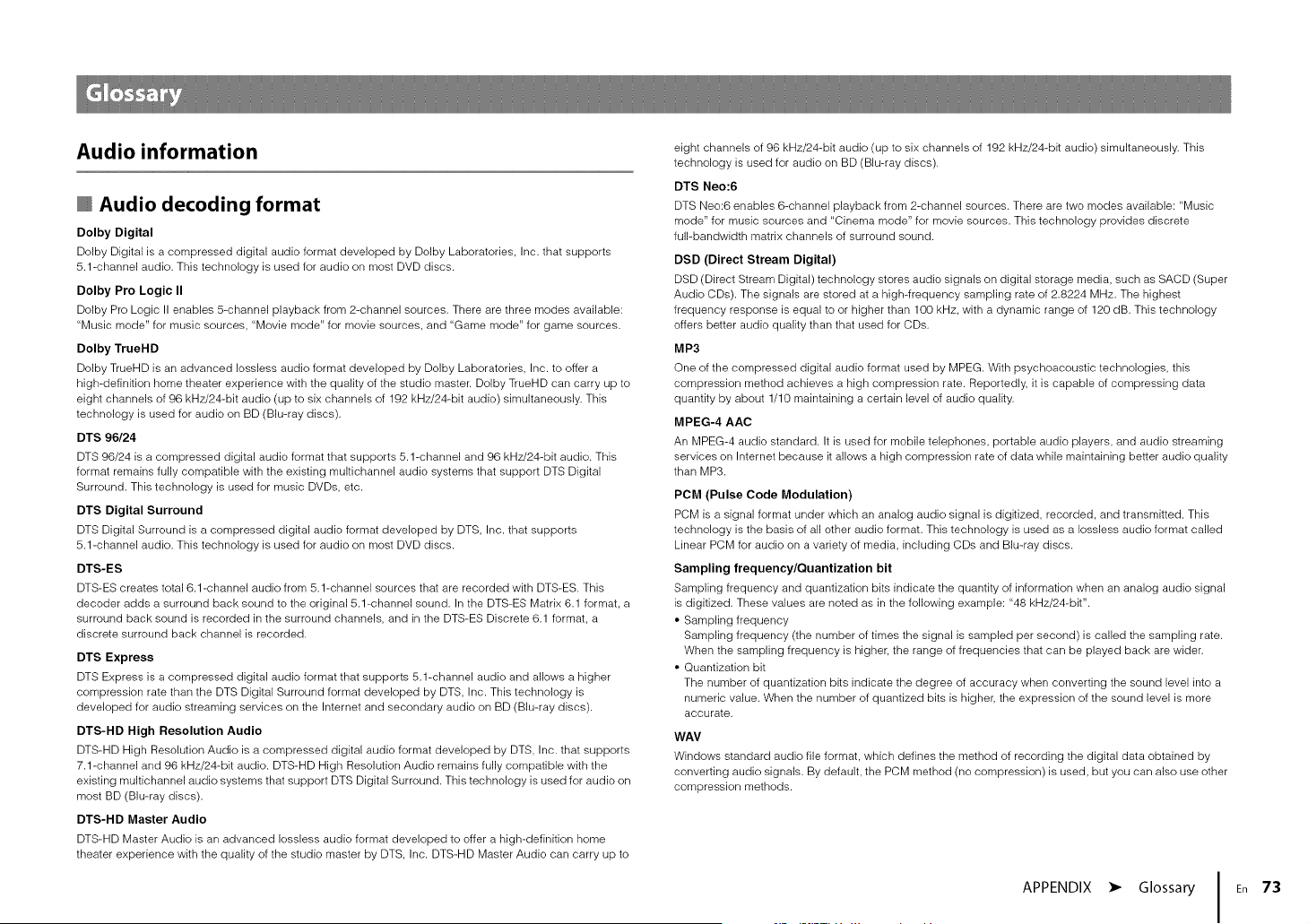
Audio information
Audio decoding format
Dolby Digital
Dolby Digital is a compressed digital audio format developed by Dolby Laboratories, Inc. that supports
5.1-channel audio. This technology is used for audio on most DVD discs.
Dolby Pro Logic II
Dolby Pro Logic II enables 5-channel playback from 2-channel sources. There are three modes available:
"Music mode" for music sources, "Movie mode" for movie sources, and "Game mode" for game sources.
Dolby TrueHD
Dolby TrueHD is an advanced Iossless audio format developed by Dolby Laboratories, Inc. to offer a
high-definition home theater experience with the quality of the studio master. Dolby TrueHD can carry up to
eight channels of 96 kHz/24-bit audio (up to six channels of 192 kHz/24-bit audio) simultaneously. This
technology is used for audio on BD (Blu-ray discs).
DTS 96/24
DTS 96/24 is a compressed digital audio format that supports 5.1-channel and 96 kHz/24-bit audio. This
format remains fully compatible with the existing multichannel audio systems that support DTS Digital
Surround. This technology is used for music DVDs, etc.
DTS Digital Surround
DTS Digital Surround is a compressed digital audio format developed by DTS, Inc. that supports
5.1-channel audio. This technology is used for audio on most DVD discs.
DTS-ES
DTS-ES creates total 6.1-channel audio from 5.1-channel sources that are recorded with DTS-ES. This
decoder adds a surround back sound to the original 5.1-channel sound. In the DTS-ES Matrix 6.1 format, a
surround back sound is recorded in the surround channels, and in the DTS-ES Discrete 6.1 format, a
discrete surround back channel is recorded.
DTS Express
DTS Express is a compressed digital audio format that supports 5.1-channel audio and allows a higher
compression rate than the DTS Digital Surround format developed by DTS, Inc. This technology is
developed for audio streaming services on the Internet and secondary audio on BD (Blu-ray discs).
DTS-HD High Resolution Audio
DTS-HD High Resolution Audio is a compressed digital audio format developed by DTS, Inc. that supports
7.1-channel and 96 kHz/24-bit audio. DTS-HD High Resolution Audio remains fully compatible with the
existing multichannel audio systems that support DTS Digital Surround. This technology is used for audio on
most BD (Blu-ray discs).
DTS-HD Master Audio
DTS-HD Master Audio is an advanced Iossless audio format developed to offer a high-definition home
theater experience with the quality of the studio master by DTS, Inc. DTS-HD Master Audio can carry up to
eight channels of 96 kHz/24-bit audio (up to six channels of 192 kHz/24-bit audio) simultaneously. This
technology is used for audio on BD (Blu-ray discs).
DTS Neo:6
DTS Neo:6 enables 6-channel playback from 2-channel sources. There are two modes available: "Music
mode" for music sources and "Cinema mode" for movie sources. This technology provides discrete
full-bandwidth matrix channels of surround sound.
DSD (Direct Stream Digital)
DSD (Direct Stream Digital) technology stores audio signals on digital storage media, such as SACD (Super
Audio CDs). The signals are stored at a high-frequency sampling rate of 2.8224 MHz. The highest
frequency response is equal to or higher than 100 kHz, with a dynamic range of 120 dB. This technology
offers better audio quality than that used for CDs.
MP3
One of the compressed digital audio format used by MPEG. With psychoacoustic technologies, this
compression method achieves a high compression rate. Reportedly, it is capable of compressing data
quantity by about 1/10 maintaining a certain level of audio quality.
MPEG-4 AAC
An MPEG-4 audio standard. It is used for mobile telephones, portable audio players, and audio streaming
services on Internet because it allows a high compression rate of data while maintaining better audio quality
than MP3.
PCM (Pulse Code Modulation)
PCM is a signal format under which an analog audio signal is digitized, recorded, and transmitted. This
technology is the basis of all other audio format. This technology is used as a Iossless audio format called
Linear PCM for audio on a variety of media, including CDs and Blu-ray discs.
Sampling frequency/Quantization bit
Sampling frequency and quantization bits indicate the quantity of information when an analog audio signal
is digitized. These values are noted as in the following example: "48 kHz/24-bit".
• Sampling frequency
Sampling frequency (the number of times the signal is sampled per second) is called the sampling rate.
When the sampling frequency is higher, the range of frequencies that can be played back are wider.
• Quantization bit
The number of quantization bits indicate the degree of accuracy when converting the sound level into a
numeric value. When the number of quantized bits is higher, the expression of the sound level is more
accurate.
WAV
Windows standard audio file format, which defines the method of recording the digital data obtained by
converting audio signals. By default, the PCM method (no compression) is used, but you can also use other
compression methods.
APPENDIX • Glossary En 73
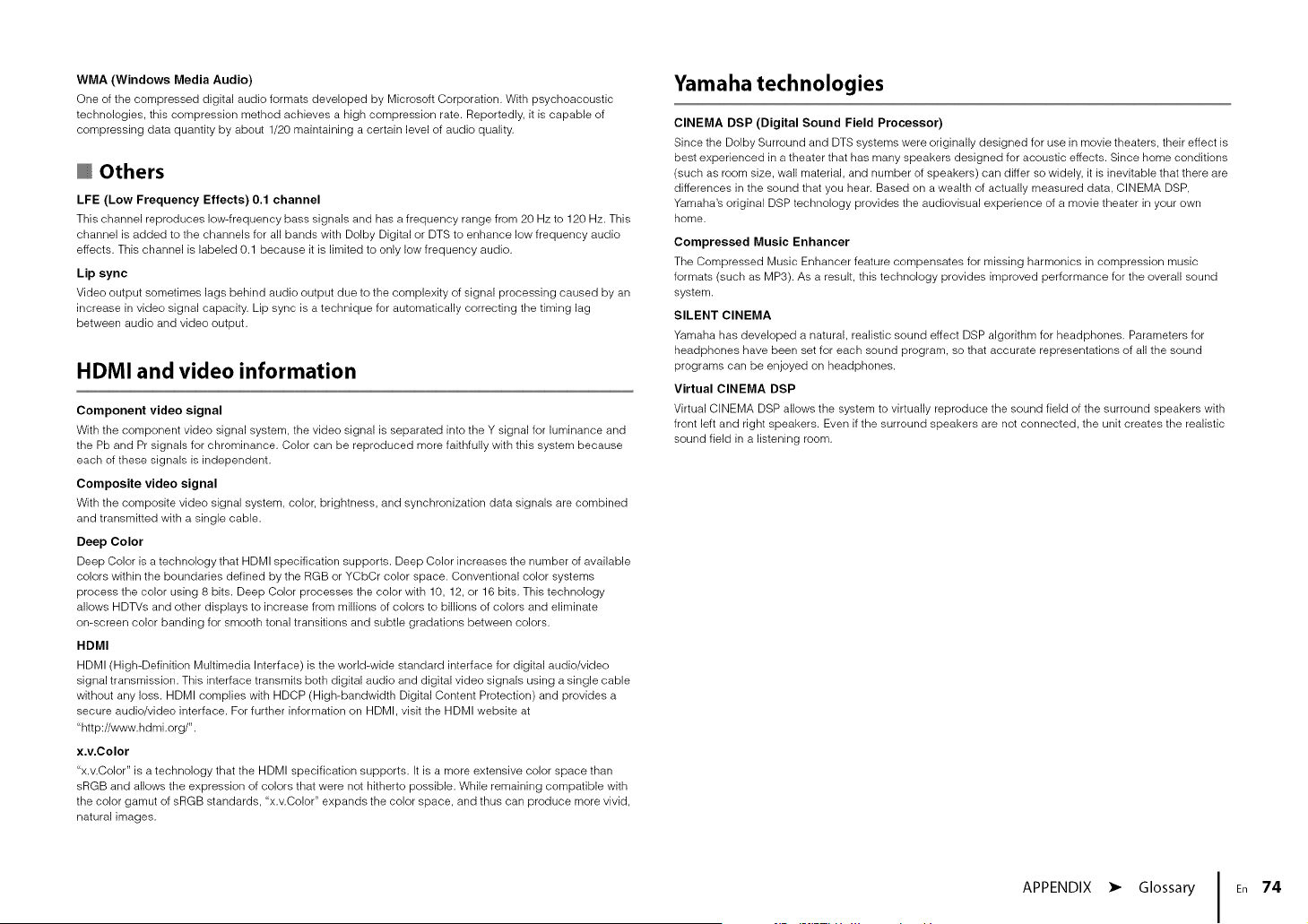
WMA (Windows Media Audio)
One of the compressed digital audio formats developed by Microsoft Corporation. With psychoacoustic
technologies, this compression method achieves a high compression rate. Reportedly, it is capable of
compressing data quantity by about 1/20 maintaining a certain level of audio quality.
Others
LFE (Low Frequency Effects) 0.1 channel
This channel reproduces low-frequency bass signals and has a frequency range from 20 Hz to 120 Hz. This
channel is added to the channels for all bands with Dolby Digital or DTS to enhance low frequency audio
effects. This channel is labeled 0.1 because it is limited to only low frequency audio.
Lip sync
Video output sometimes lags behind audio output due to the complexity of signal processing caused by an
increase in video signal capacity. Lip sync is a technique for automatically correcting the timing lag
between audio and video output.
HDMI and video information
Component video signal
With the component video signal system, the video signal is separated into the Y signal for luminance and
the Pb and Pr signals for chrominance. Color can be reproduced more faithfully with this system because
each of these signals is independent.
Composite video signal
With the composite video signal system, color, brightness, and synchronization data signals are combined
and transmitted with a single cable.
Deep Color
Deep Color is a technology that HDMI specification supports. Deep Color increases the number of available
colors within the boundaries defined by the RGB or YCbCr color space. Conventional color systems
process the color using 8 bits. Deep Color processes the color with 10, 12, or 16 bits. This technology
allows HDTVs and other displays to increase from millions of colors to billions of colors and eliminate
on-screen color banding for smooth tonal transitions and subtle gradations between colors.
HDMI
HDMI (High-Definition Multimedia Interface) is the world-wide standard interface for digital audio/video
signal transmission. This interface transmits both digital audio and digital video signals using a single cable
without any loss. HDMI complies with HDCP (High-bandwidth Digital Content Protection) and provides a
secure audio/video interface. For further information on HDMI, visit the HDMI website at
"http://www.hdmi.org/".
x.v.Color
"x.v.Oolor" is a technology that the HDMI specification supports. It is a more extensive color space than
sRGB and allows the expression of colors that were not hitherto possible. While remaining compatible with
the color gamut of sRGB standards, "x.v.Color" expands the color space, and thus can produce more vivid,
natural images.
Yamaha technologies
CINEMA DSP (Digital Sound Field Processor)
Since the Dolby Surround and DTS systems were originally designed for use in movie theaters, their effect is
best experienced in a theater that has many speakers designed for acoustic effects. Since home conditions
(such as room size, wall material, and number of speakers) can differ so widely, it is inevitable that there are
differences in the sound that you hear. Based on a wealth of actually measured data, CINEMA DSP,
Yamaha's original DSP technology provides the audiovisual experience of a movie theater in _our own
home.
Compressed Music Enhancer
The Compressed Music Enhancer feature compensates for missing harmonics in compression music
formats (such as MP3). As a result, this technology provides improved performance for the overall sound
system.
SILENT CINEMA
Yamaha has developed a natural, realistic sound effect DSP algorithm for headphones. Parameters for
headphones have been set for each sound program, so that accurate representations of all the sound
programs can be enjoyed on headphones.
Virtual CINEMA DSP
Virtual CINEMA DSP allows the system to virtually reproduce the sound field of the surround speakers with
front left and right speakers. Even if the surround speakers are not connected, the unit creates the realistic
sound field in a listening room.
APPENDIX • Glossary En 74
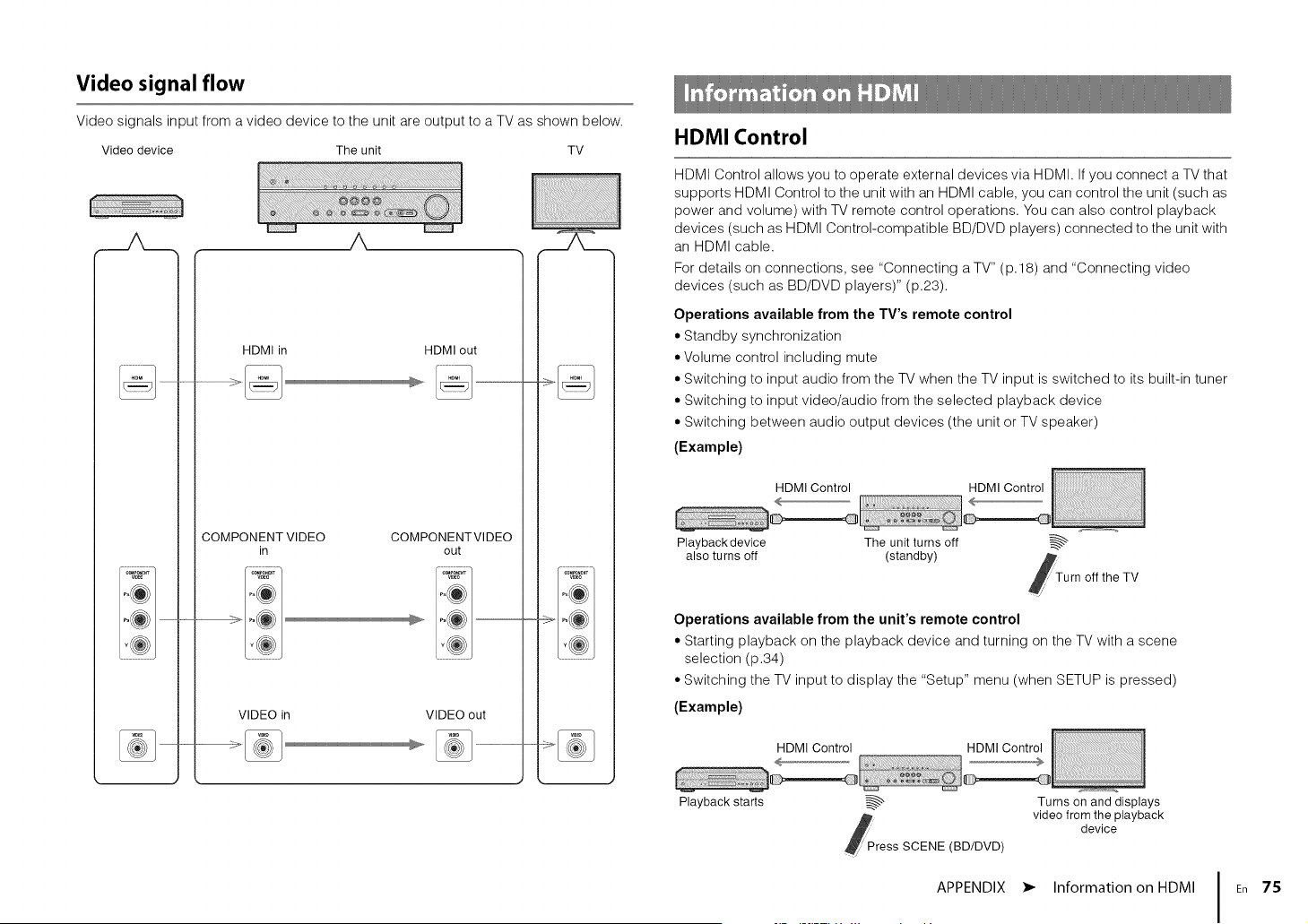
Video signal flow
Video signals input from a video device to the unit are output to a TV as shown below.
Video device The unit TV
A
HDMI in HDMI out
COMPONENT VIDEO COMPONENTVIDEO
in out
....... t_ _,
k®J
VIDEO in VIDEO out
'4(0))
__ = _} Po((®))}
((@))
HDMI Control
HDMI Control allows you to operate external devices via HDMI. If you connect a TV that
supports HDMI Control to the unit with an HDMI cable, you can control the unit (such as
power and volume) with TV remote control operations. You can also control playback
devices (such as HDMI Control-compatible BD/DVD players) connected to the unit with
an HDMI cable.
For details on connections, see "Connecting a TV" (p.18) and "Connecting video
devices (such as BD/DVD players)" (p.23).
Operations available from the TV's remote control
• Standby synchronization
• Volume control including mute
• Switching to input audio from the TV when the TV input is switched to its built-in tuner
• Switching to input video/audio from the selected playback device
• Switching between audio output devices (the unit or TV speaker)
(Example)
HDMI Control HDMI Control
Playback device The unit turns off
also turns off (standby)
off the TV
Operations available from the unit's remote control
• Starting playback on the playback device and turning on the TV with a scene
selection (p.34)
• Switching the TV input to display the "Setup" menu (when SETUP is pressed)
(Example)
Playback starts
HDMI Control HDMI Control
Press SCENE (BD/DVD)
Turns on and displays
video from the playback
device
APPENDIX • Information on HDMI En 75
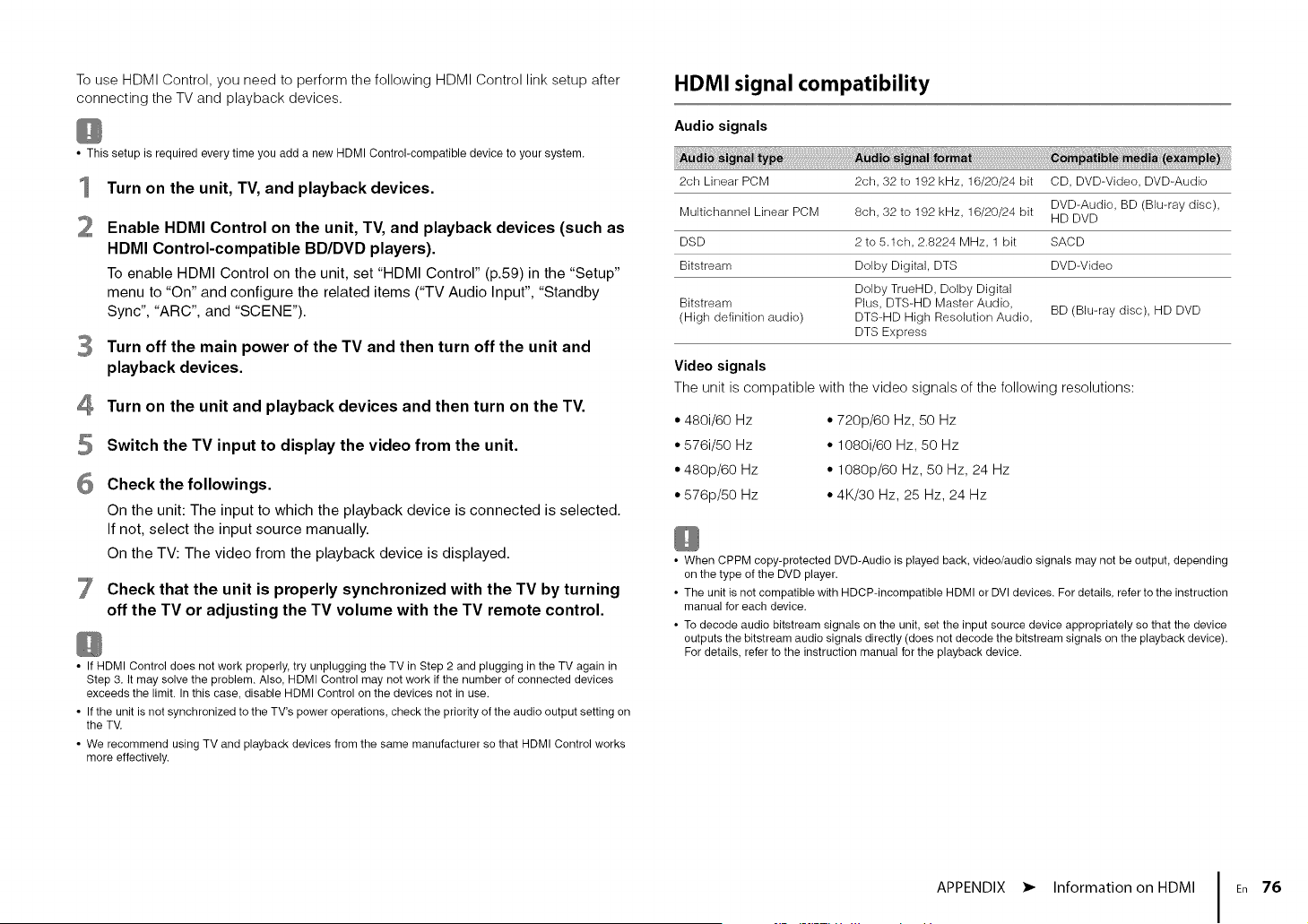
TouseHDMIControl,youneedtoperformthefollowingHDMIControllinksetupafter
connectingtheTVandplaybackdevices.
• This setup is required every time you add a new HDMI Control-compatible device to your system.
Turn on the unit, TV, and playback devices.
Enable HDMI Control on the unit, TV, and playback devices (such as
HDMI Control-compatible BD/DVD players).
To enable HDMI Control on the unit, set "HDMI Control" (p.59) in the "Setup"
menu to "On" and configure the related items ("TV Audio Input", "Standby
Sync", "ARC", and "SCENE").
4
Turn off the main power of the TV and then turn off the unit and
playback devices.
Turn on the unit and playback devices and then turn on the TV.
Switch the TV input to display the video from the unit.
Check the followings.
On the unit: The input to which the playback device is connected is selected.
If not, select the input source manually.
On the TV: The video from the playback device is displayed.
Check that the unit is properly synchronized with the TV by turning
off the TV or adjusting the TV volume with the TV remote control.
• If HDMI Control does not work properly, try unplugging the TV in Step 2 and plugging in the TV again in
Step 3. It may solve the problem. Also, HDMI Control may not work if the number of connected devices
exceeds the limit. In this case, disable HDMI Control on the devices not in use.
• If the unit is not synchronized to the TV's power operations, check the priority of the audio output setting on
the TV.
• We recommend using TV and playback devices from the same manufacturer so that HDMI Control works
more effectively.
HDMI signal compatibility
Audio signals
2ch Linear PCM 2ch, 32 to 192 kHz, 16/20/24 bit CD, DVD-Video, DVD-Audio
DVD-Audio, BD (Blu-ray disc),
Multichannel Linear PCM 8ch, 32 to 192 kHz, 16/20/24 bit
HD DVD
DSD 2 to 5.1ch, 2.8224 MHz, 1 bit SACD
Bitstream Dolby Digital, DTS DVD-Video
Dolby TrueHD, Dolby Digital
Bitstream Plus, DTS-HD Master Audio,
(High definition audio) DTS-HD High Resolution Audio, BD (Blu-ray disc), HD DVD
DTS Express
Video signals
The unit is compatible with the video signals of the following resolutions:
• 480i/60 Hz • 720p/60 Hz, 50 Hz
• 576i/50 Hz • 1080i/60 Hz, 50 Hz
• 480p/60 Hz • 1080p/60 Hz, 50 Hz, 24 Hz
• 576p/50 Hz • 4K/30 Hz, 25 Hz, 24 Hz
• When CPPM copy-protected DVD-Audio is played back, video/audio signals may not be output, depending
on the type of the DVD player.
• The unit is not compatible with HDCP-incompatible HDMI or DVl devices. For details, refer to the instruction
manual for each device.
• To decode audio bitstream signals on the unit, set the input source device appropriately so that the device
outputs the bitstream audio signals directly (does not decode the bitstream signals on the playback device).
For details, refer to the instruction manual for the playback device.
APPENDIX • Information on HDMI En 76
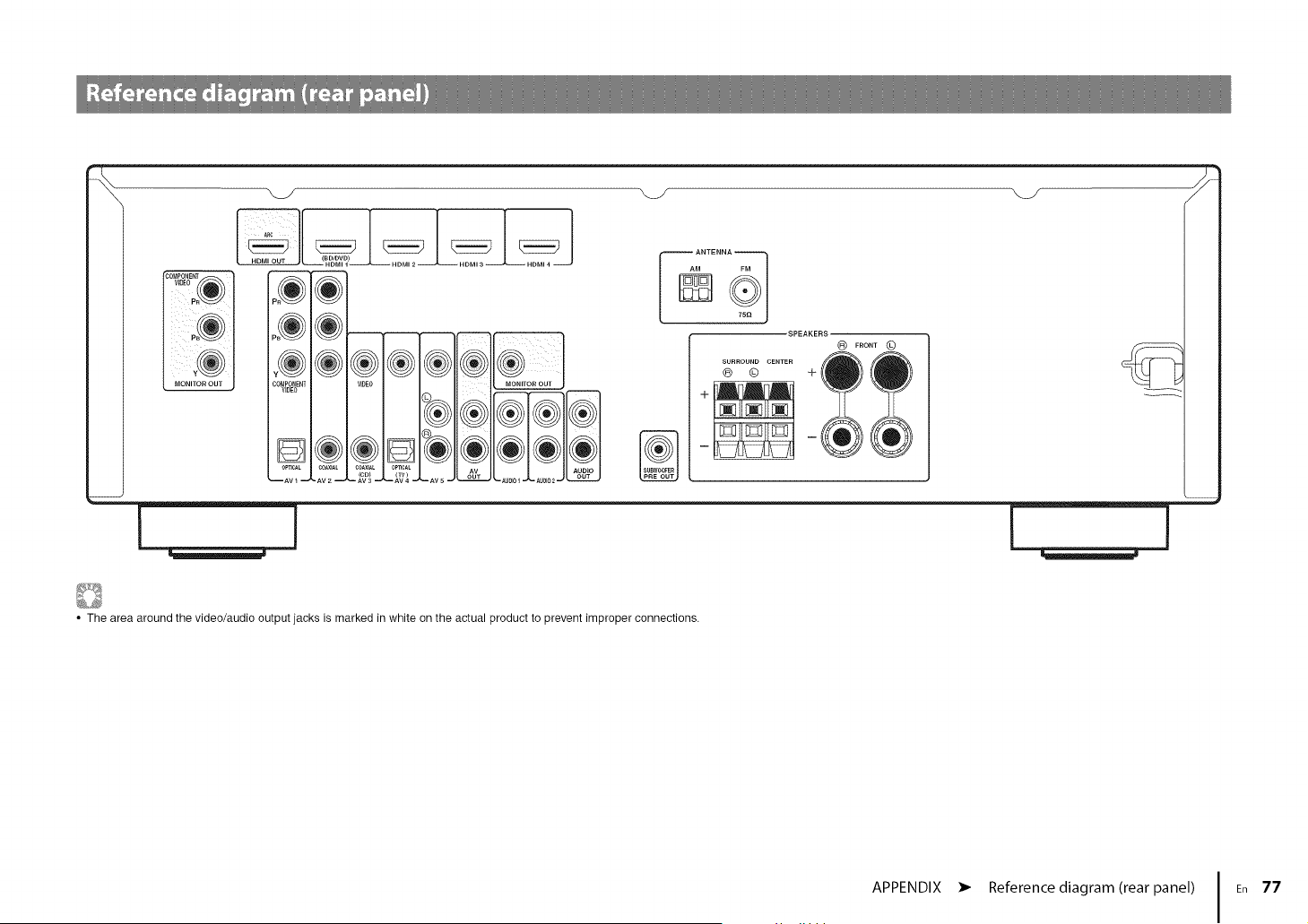
i
\J
P
E
oPrlc_
_AW -AV2 -- IAV3 _AV4 -- _AV5 - --AUDIO1 _AUDI02 _
ANTENNA --
751_
,SPEAKERS
® _ON_ ©
SURROUND CENTER
® ©
I__I
• The area around the video/audio output jacks is marked in white on the actual product to prevent improper connections.
APPENDIX • Reference diagram (rear panel) En 77
r_ DOLBY
TRUEND
Manufactured under license from Dolby Laboratories. Dolby, Pro Logic and the double-D symbol are
trademarks of Dolby Laboratories.
Manufactured under license under U.S. Patent Nos: 5,956,674; 5,974,380; 6,226,616; 6,487,535; 7,212,872;
7,333,929; 7,392,195; 7,272,567 & other U.S. and worldwide patents issued & pending. DTS-HD, the
Symbol, & DTS-HD and the Symbol together are registered trademarks of DTS, Inc. Product includes
software. © DTS, Inc. All Rights Reserved.
[ ,P,one]
"Made for iPod" and "Made for iPhone" mean that an electronic accessory has been designed to connect
specifically to iPod or iPhone, respectively, and has been certified by the developer to meet Apple
performance standards.
Apple is not responsible for the operation of this device or its compliance with safety and regulatory
standards. Please note that the use of this accessory with iPod or iPhone may affect wireless performance.
iPhone, iPod, iPod classic, iPod nano and iPod touch are trademarks of Apple Inc., registered in the U.S.
and other countries.
H.-, mll TM
HDMI, the HDMI Logo, and High-Definition Multimedia Interface are trademarks or registered trademarks of
HDMI Licensing LLC in the United States and other countries.
x.v.Color TM
"x.v.Color" is a trademark of Sony Corporation.
SILENT _
CINEMA
"SILENT CINEMA" is a trademark of Yamaha Corporation.
APPENDIX • Trademarks En 78
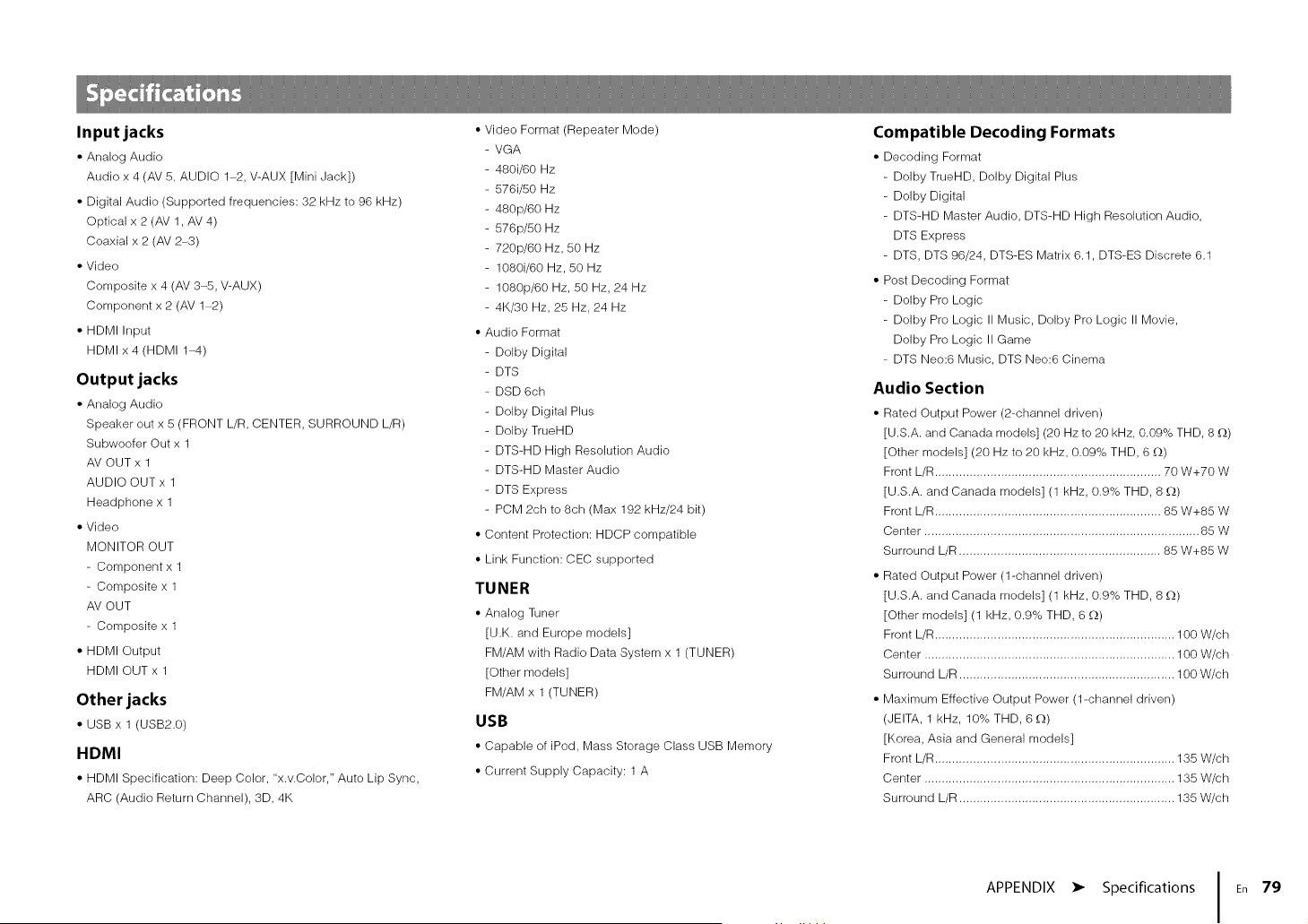
Inputjacks
• Analog Audio
Audio x 4 (AV 5, AUDIO 1-2, V-AUX [Mini Jack])
• Digital Audio (Supported frequencies: 32 kHz to 96 kHz)
Optical x 2 (AV 1, AV 4)
Coaxial x 2 (AV 2-3)
• Video
Composite x 4 (AV 3-5, V-AUX)
Component x 2 (AV 1-2)
• HDMI Input
HDMI x 4 (HDMI 1 4)
Output jacks
• Analog Audio
Speaker out x 5 (FRONT L/R, CENTER, SURROUND L/R)
Subwoofer Out x 1
AV OUT x 1
AUDIO OUT x 1
Headphone x 1
• Video
MONITOR OUT
- Component x 1
- Composite x 1
AV OUT
- Composite x 1
• HDMI Output
HDMI OUT x 1
Other jacks
• USB x 1 (USB2.0)
HDMI
• HDMI Specification: Deep Color, "x.v.Color," Auto Lip Sync,
ARC (Audio Return Channel), 3D, 4K
• Video Format (Repeater Mode)
VGA
480i/60 Hz
576i/50 Hz
480p/60 Hz
576p/50 Hz
720p/60 Hz, 50 Hz
1080i/60 Hz, 50 Hz
1080p/60 Hz, 50 Hz, 24 Hz
4K/30 Hz, 25 Hz, 24 Hz
• Audio Format
Dolby Digital
DTS
DSD 6ch
Dolby Digital Plus
Dolby TrueHD
DTS-HD High Resolution Audio
DTS-HD Master Audio
DTS Express
PCM 2ch to 8ch (Max 192 kHz/24 bit)
• Content Protection: HDCP compatible
• Link Function: CEC supported
TUNER
• Analog Tuner
[U.K. and Europe models]
FM/AM with Radio Data System x 1 (TUNER)
[Other models]
FM/AM x 1 (TUNER)
USB
• Capable of iPod, Mass Storage Class USB Memory
• Current Supply Capacity: 1 A
Compatible Decoding Formats
• Decoding Format
- Dolby TrueHD, Dolby Digital Plus
- Dolby Digital
- DTS-HD Master Audio, DTS-HD High Resolution Audio,
DTS Express
- DTS, DTS 96/24, DTS-ES Matrix 6.1, DTS-ES Discrete 6.1
• Post Decoding Format
- Dolby Pro Logic
- Dolby Pro Logic II Music, Dolby Pro Logic II Movie,
Dolby Pro Logic II Game
- DTS Neo:6 Music, DTS Neo:6 Cinema
Audio Section
• Rated Output Power (2-channel driven)
[U.S.A. and Canada models] (20 Hz to 20 kHz, 0.09% THD, 8 _)
[Other models] (20 Hz to 20 kHz, 0.09% THD, 6 _)
Front L/R ................................................................. 70 W+70 W
[U.S.A. and Canada models] (1 kHz, 0.9% THD, 8 _)
Front L/R ................................................................. 85 W+85 W
Center ............................................................................... 85 W
Surround L/R .......................................................... 85 W+85 W
• Rated Output Power (1-channel driven)
[U.S.A. and Canada models] (1 kHz, 0.9% THD, 8 _-))
[Other models] (1 kHz, 0.9% THD, 6 _)
Front L/R ..................................................................... 100 W/ch
Center ........................................................................ 100 W/ch
Surround L/R .............................................................. 100 W/ch
• Maximum Effective Output Power (1-channel driven)
(JEITA, 1 kHz, 10% THD, 60-)
[Korea, Asia and General models]
Front L/R ..................................................................... 135 W/ch
Center ........................................................................ 135 W/ch
Surround L/R .............................................................. 135 W/ch
APPENDIX • Specifications En 79
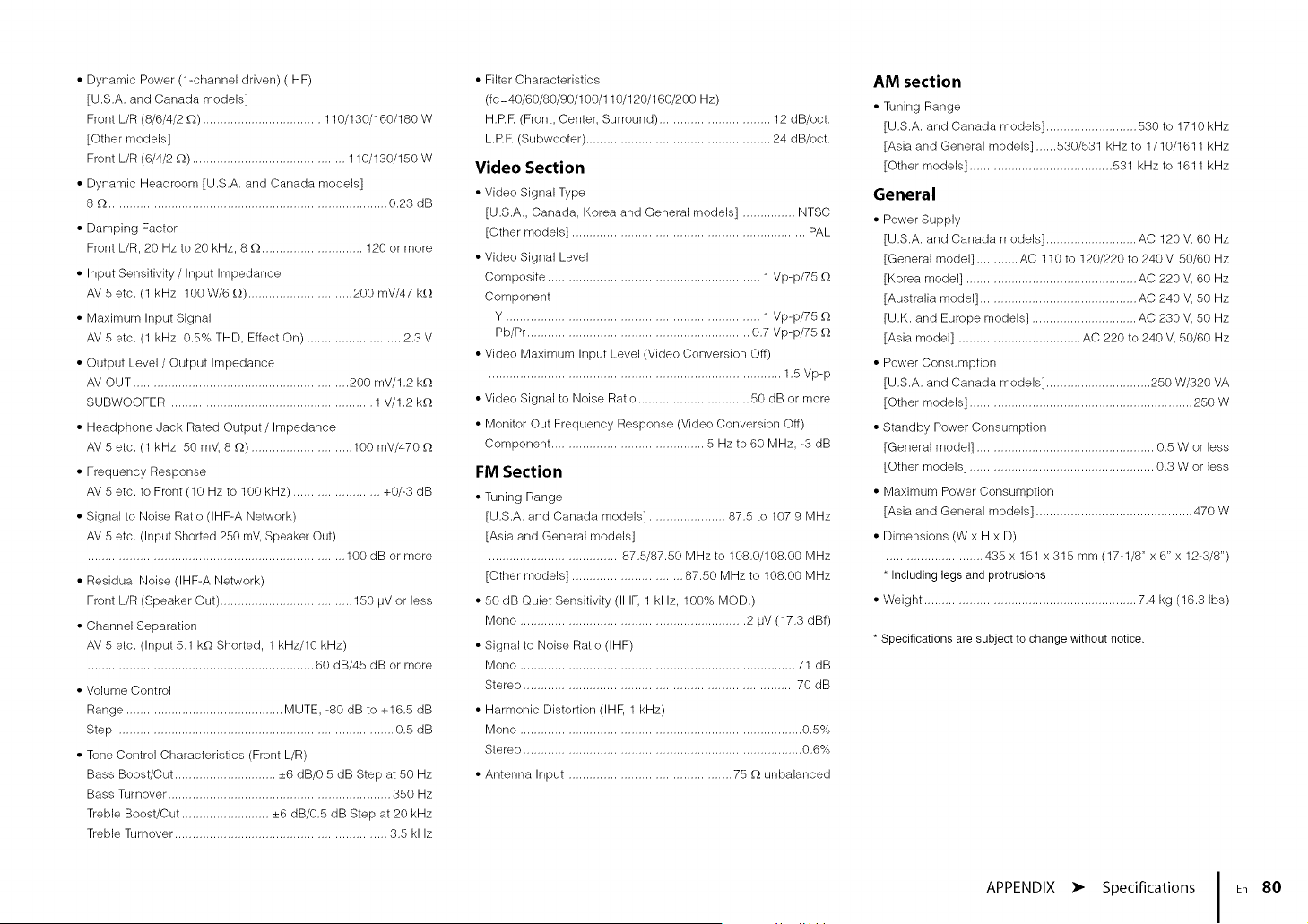
• Dynamic Power (1-channel driven) (IHF)
[U.S.A. and Canada models]
Front L/R (8/6/4/2 _--)).................................. 110/130/160/180 W
[Other models]
Front L/R (6/4/2 _--))............................................ 110/130/150 W
• Dynamic Headroom [U.S.A. and Canada models]
8 _--)................................................................................ 0.23 dB
• Damping Factor
Front L/R, 20 Hz to 20 kHz, 8 _--)............................. 120 or more
• Input Sensitivity / Input Impedance
AV 5 etc. (1 kHz, 100 W/6 _--)).............................. 200 mV/47 k_
• Maximum Input Signal
AV 5 etc. (1 kHz, 0.5% THD, Effect On) ........................... 2.3 V
• Output Level / Output Impedance
AV OUT .............................................................. 200 mV/1.2 k_
SUBWOOFER ........................................................... 1 V/1.2 k_
• Headphone Jack Rated Output / Impedance
AV 5 etc. (1 kHz, 50 mV, 8 _) ............................. 100 mV/470 _
• Frequency Response
AV 5 etc. to Front (10 Hz to 100 kHz) ......................... +0/-3 dB
• Signal to Noise Ratio (IHF-A Network)
AV 5 etc. (Input Shorted 250 mV, Speaker Out)
.......................................................................... 100 dB or more
• Residual Noise (IHF-A Network)
Front L/R (Speaker Out) ...................................... 150 pV or less
• Channel Separation
AV 5 etc. (Input 5.1 k_--)Shorted, 1 kHz/10 kHz)
................................................................. 60 dB/45 dB or more
• Volume Control
Range ............................................. MUTE, -80 dB to +16.5 dB
Step ................................................................................ 0.5 dB
• Tone Control Characteristics (Front L/R)
Bass Boost/Cut ............................. _+6dB/0.5 dB Step at 50 Hz
Bass Turnover ................................................................ 350 Hz
Treble Boost/Cut ......................... _+6 dB/0.5 dB Step at 20 kHz
Treble Turnover ............................................................. 3.5 kHz
• Filter Characteristics
(fc=40/60/80/90/100/110/120/160/200 Hz)
H.RR (Front, Center, Surround) ................................ 12 dB/oct.
ERR (Subwoofer) ..................................................... 24 dB/oct.
Video Section
• Video Signal Type
[U.S.A., Canada, Korea and General models] ................ NTSC
[Other models] ................................................................... PAL
• Video Signal Level
Composite ............................................................. 1 Vp-p/75 _
Component
Y ......................................................................... 1 Vp-p/75 _
Pb/Pr ................................................................ 0.7 Vp-p/75 O
• Video Maximum Input Level (Video Conversion Off)
.................................................................................... 1.5 Vp-p
• Video Signal to Noise Ratio ................................ 50 dB or more
• Monitor Out Frequency Response (Video Conversion Off)
Component ............................................ 5 Hz to 60 MHz, -3 dB
FM Section
• Tuning Range
[U.S.A. and Canada models] ...................... 87.5 to 107.9 MHz
[Asia and General models]
...................................... 87.5/87.50 MHz to 108.0/108.00 MHz
[Other models] ................................ 87.50 MHz to 108.00 MHz
• 50 dB Quiet Sensitivity (IHF, 1 kHz, 100% MOD.)
Mono ................................................................. 2 pV (17.3 dBf)
• Signal to Noise Ratio (IHF)
Mono ............................................................................... 71 dB
Stereo .............................................................................. 70 dB
• Harmonic Distortion (IHF, 1 kHz)
Mono ................................................................................. 0.5%
Stereo ................................................................................ 0.6%
• Antenna Input ................................................ 75 _ unbalanced
AM section
• Tuning Range
[U.S.A. and Canada models] .......................... 530 to 1710 kHz
[Asia and General models] ...... 530/531 kHz to 1710/1611 kHz
[Other models] ......................................... 531 kHz to 1611 kHz
General
• Power Supply
[U.S.A. and Canada models] .......................... AC 120 V, 60 Hz
[General model] ............ AC 110 to 120/220 to 240 V, 50/60 Hz
[Korea model] ................................................. AC 220 V, 60 Hz
[Australia model] ............................................. AC 240 V, 50 Hz
[U.K. and Europe models] .............................. AC 230 V, 50 Hz
[Asia model] .................................... AC 220 to 240 V, 50/60 Hz
• Power Consumption
[U.S.A. and Canada models] .............................. 250 W/320 VA
[Other models] ................................................................ 250 W
• Standby Power Consumption
[General model] ................................................... 0.5 W or less
[Other models] ..................................................... 0.3 W or less
• Maximum Power Consumption
[Asia and General models] ............................................. 470 W
• Dimensions (W x H x D)
............................ 435 x 151 x 315 mm (17-1/8" x 6" x 12-3/8")
* Including legs and protrusions
• Weight ............................................................. 7.4 kg (16.3 Ibs)
* Specifications are subject to change without notice.
APPENDIX • Specifications En 80
Symbols
Lock icon (/iil) 64
Numerics
2.1-channel system 13
2ch Stereo (sound program) 37
3.1-channel system 13
4.1-channel system 13
4K signal (video signal resolution)
5.1-channel system 13, 15
5ch Stereo (sound program) 37
76
A
A.DRC (DSP/Surround, Option menu) 52
Access error (error indication) 72
Action Game (sound program) 36
Adaptive DRC (DSP/Surround, Option menu)
Adjustment (Lipsync, Setup menu) 62
ADVANCED SETUP menu 65
Adventure (sound program) 36
AM antenna connection 26
AM radio listening 40
Amp (Audio Output, Setup menu) 59
ARC (Audio Return Channel) 18
ARC (HDMI, Setup menu) 60
Audio Decoder (front display information) 33
Audio device connection 25
Audio file format (USB storage device) 48
Audio In (Option menu) 53
AUDIO jack 17
AUDIO OUT jack 9
Audio Output (HDMI, Setup menu) 59
Audio Return Channel (ARC) 18
Auto Power Standby (ECO, Setup menu) 62
Auto Preset (FM radio, Option menu) 41
Automatic speaker setting optimization 29
Automatic station preset (FM radio) 41
AutoPowerStdby (ECO, Setup menu) 62
52
AVOUTjack 9
B
B RATE (Signal Info, Option menu) 53
Banana plug 15
Basic playback operation 33
Bass (Tone Control, Option menu) 52
Bitrate (Signal Info, Option menu) 53
Bitstream 76
C
Cellar Club (sound program) 37
Center (Speaker, Setup menu) 57
Center Image (DSP Parameter, Setup menu)
Center Width (DSP Parameter, Setup menu)
Chamber (sound program) 37
CHAN (Signal Info, Option menu) 53
Channel (Signal Info, Option menu) 53
Check SP Wires (error indication) 72
CINEMA DSP 36
Clear Preset (FM/AM radio, Option menu) 42
Clock Time (Radio Data System) 43
COAXIAL jack 17
Component video cable 17
Component video connection (video device)
COMPONENT VIDEO jack 17
Composite video connection (video device)
Compressed Music Enhancer 39
Configuration (HDMI, Setup menu) 59
Configuration (Speaker, Setup menu) 57
Connect error (error indication) 72
Crossover (Speaker, Setup Menu) 57
Crossover frequency setting 57
Crossover frequency setting (subwoofer) 29
D
Decoder Off (front display information) 33
Default setting restoration 66
Digital coaxial cable 17
61
61
23
24
Digital optical cable 17
Dimension (DSP Parameter, Setup menu) 61
Dimmer (Function, Setup menu) 64
Direct Stream Digital (DSD) 73
Distance (Speaker, Setup menu) 58
Dolby Pro Logic (surround decoder) 39
Dolby Pro Logic II Game (surround decoder)
Dolby Pro Logic II Movie (surround decoder)
Dolby Pro Logic II Music (surround decoder)
Drama (sound program) 36
DSD (Direct Stream Digital) 73
DSP Level (DSP/Surround, Option menu) 52
DSP Parameter (Sound, Setup menu) 61
DSP Program (front display information) 33
DSP/Surround (Option menu) 52
DTS Neo:6 Cinema (surround decoder) 39
DTS Neo:6 Music (surround decoder) 39
Dynamic Range (Volume, Setup menu) 62
E
ECO (Setup menu) 62
ECO Mode (ECO, Setup menu) 63
Enhancer (DSP/Surround, Option menu) 52
ENHANCER (sound mode) 39
EQ Select (Equalizer, Setup menu) 58
Equalizer (Speaker, Setup menu) 58
Error indication (front display) 72
Extra Bass (Speaker, Setup menu) 58
F
Firmware update 66
Firmware version check 66
FM antenna connection 26
FM radio listening 40
FM/AM radio tuning 40
FORMAT (Signal Info, Option menu) 53
Format (Signal Info, Option menu) 53
Frequency (FM/AM radio) 40
_,PPENDIX •
39
39
39
Index 81
Frequency step setting 40, 66
Front (Speaker, Setup menu) 57
Front display (part names and functions) 8
Front display brightness 64
Front display information 33
Front panel (part names and functions) 7
Front panel jack connection 26
Function (Setup menu) 63
6
GEQ (Equalizer, Setup menu) 58
H
Hall in Munich (sound program) 37
Hall in Vienna (sound program) 37
HDMI (Setup menu) 59
HDMI cable 17
HDMI connection (video device) 23
HDMI Control (HDMI, Setup menu) 59
HDMI jack 17
HDMI OUT (TV) (Audio Output, Setup menu)
HDMI signal compatibility 76
Headphones 39
High definition audio 76
High speed HDMI cable 17
I
In.Trim (Volume Trim, Option menu) 52
Indicator (part names and functions) 8
INFOkey 7, 10
Information display (front display) 8
Information switching (front display) 33
INIT (ADVANCED SETUP menu) 66
Initial Volume (Volume, Setup menu) 62
Input (front display information) 33
Input (Signal Info, Option menu) 53
Input Rename (Function, Setup menu) 63
Input selection key (remote control) 10
Input Trim (Volume Trim, Option menu) 52
Internal Err. (YPAO error message) 31
Internal Error (error indication) 72
60
iPod charge 44
iPod connection 44
iPod content playback 45
L
Language (Setup menu) 64
Level (Speaker, Setup menu) 58
Level Error (YPAO warning message) 32
LFE (Low Frequency Effects) 74
Lipsync 74
Lipsync (Option menu) 53
Lipsync (Sound, Setup menu) 61
Low Frequency Effects (LFE) 74
M
Manual station preset (FM/AM radio) 41
Max Volume (Volume, Setup menu) 62
Memory Guard (Function, Setup menu) 64
Menu language selection 28
Menu operation key (remote control) 10
MODE key 10
Monaural reception (FM radio) 40
Mono Movie (sound program) 36
MOVIE (sound program category) 36
MUSIC (sound program category) 37
Music Video (sound program) 37
MUTE key 10
Muting 33
N
No content (error indication) 72
No Front SP (YPAO error message) 31
No MIC (YPAO error message) 31
No Signal (YPAO error message) 31
No Sur. SP (YPAO error message) 31
Noisy (YPAO error message) 31
NTSC (TV FORMAT, ADVANCED SETUP menu)
0
OPTICAL jack 17
OPTION key 10
Option menu 51
66
Out of Phase (YPAO warning message) 32
Output (Signal Info, Option menu) 53
Over Distance (YPAO warning message) 32
P
PAL (TV FORMAT, ADVANCED SETUP menu) 66
Panorama (DSP Parameter, Setup menu) 61
PEQ (Equalizer, Setup menu) 58
PHONES jack 7
Playback device connection 23
Power cable connection 27
Power management 62
Preset station selection (FM/AM radio) 42
Program Service (Radio Data System) 43
Program Type (Radio Data System) 43
R
Radio Data System (FM radio) 43
Radio Data System information 43
Radio Data System tuning 43
Radio Text (Radio Data System) 43
Rear panel (part names and functions) 9
Recording device connection 27
RemlD Mismatch (error indication) 72
Remote control (part names and functions) 10
Remote control ID setting 65
Remote control ID setting (remote control) 65
Remote control sensor 7
Remote control signal transmitter (remote control) 10
REMOTE ID (ADVANCED SETUP menu) 65
Rename (input name) 63
Repeat (iPod, Option menu) 47
Repeat (USB storage device, Option menu} 50
Roleplaying Game (sound program) 36
S
SAMPL (Signal Info, Option menu) 53
Sampling (Signal Info, Option menu) 53
SCENE(HDMI, Setup menu) 60
Scene configuration 34
SCENE function 34
APPENDIX • Index _._ 82
SCENElinkplayback34
Sci-Fi(soundprogram)36
Select(Lipsync,Setupmenu)61
SETUPkey 10
Setupmenu54
Shuffle(iPod,Optionmenu)47
SignalInfo(Optionmenu)53
Signalinformation53
SILENTCINEMA39
Simpleplay(iPod)46
SLEEPkey 10
Sleeptimer10
Sound(Setupmenu)61
Soundfieldeffect36
Soundmodeselection35
Soundprogram36
SPIMP.(ADVANCEDSETUPmenu)65
Speaker(Setupmenu)57
Speakercableconnection15
Speakerconnection15
Speakerimpedance12
Speakerimpedancesetting14,65
Speakerindicator(frontdisplay)8
Speakerplacement12
Spectacle(soundprogram)36
Sports(soundprogram)36
Standard(soundprogram)36
StandbySync(HDMI,Setupmenu)60
Stationpreset(FM/AMradio)41
Stereominijack 17
Stereomini-plugcable 17
Stereopincable(RCAcable)17
Stereoreception(FMradio)40
STRAIGHT(soundmode)38
Straightdecode38
Subwoofer(Speaker,Setupmenu)57
Subwooferconnection16
SubwooferPhase(Speaker,Setupmenu)58
SubwooferTrim(VolumeTrim,Optionmenu)53
SUR.DECODE(soundmode)39
Surround(Speaker,Setupmenu)57
Surrounddecoder39
SW.Trim(VolumeTrim,Optionmenu)53
T
Test Tone (Speaker, Setup menu) 59
The Bottom Line (sound program) 37
The RoxyTheatre (sound program) 37
Tone Control (Option menu) 52
TONE CONTROL key 7
TP (Traffic Program) 43
Traffic information (Radio Data System) 43
Traffic Program (FM radio, Option menu) 43
Treble (Tone Control, Option menu) 52
TU (ADVANCED SETUP menu) 66
TVAudio Input(HDMI, Setup menu) 60
TV connection 18
TV connection (ARC-compatible TV) 18
TV connection (HDMI Control-compatible TV)
TV connection (TV with HDMI input jacks) 21
TV connection (TV without HDMI input jacks)
TV FORMAT (ADVANCED SETUP menu) 66
U
Unable to play (error indication) 72
Unknown iPod (error indication) 72
UPDATE (ADVANCED SETUP menu) 66
USB jack 7
USB mass storage class device 48
USB Overloaded (error indication) 72
USB storage device connection 48
USB storage device content playback 48
User Cancel (YPAO error message) 31
V
V IN (Signal Info, Option menu) 53
V OUT (Signal Info, Option menu) 53
VERSION (ADVANCED SETUP menu) 66
VIDEO AUXjack 7
Video device connection 23
VIDEO jack 17
20
22
Video Out (Option menu) 53
Video pin cable 17
Video signal flow 75
Video signal type setting 66
Video/audio input jack combination 24
Virtual CINEMA DSP 38
Voltage selection 27
VOLTAGE SELECTOR 9
Volume (Sound, Setup menu) 62
Volume Trim (Option menu) 52
Y
Yamaha Parametric room
Acoustic Optimizer (YPAO) 29
YPAO
(Yamaha Parametric room Acoustic Optimizer)
YPAO error message 31
YPAO MICjack 7
YPAO microphone 29
YPAO warning message 32
29
APPENDIX • Index E_ 83

OYAMAHA
YAMAHA CORPORATION
© 2018 Yamaha Corporation YF19BA0/EN1
