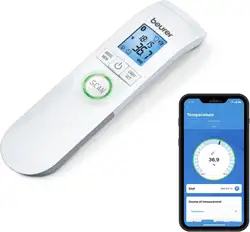
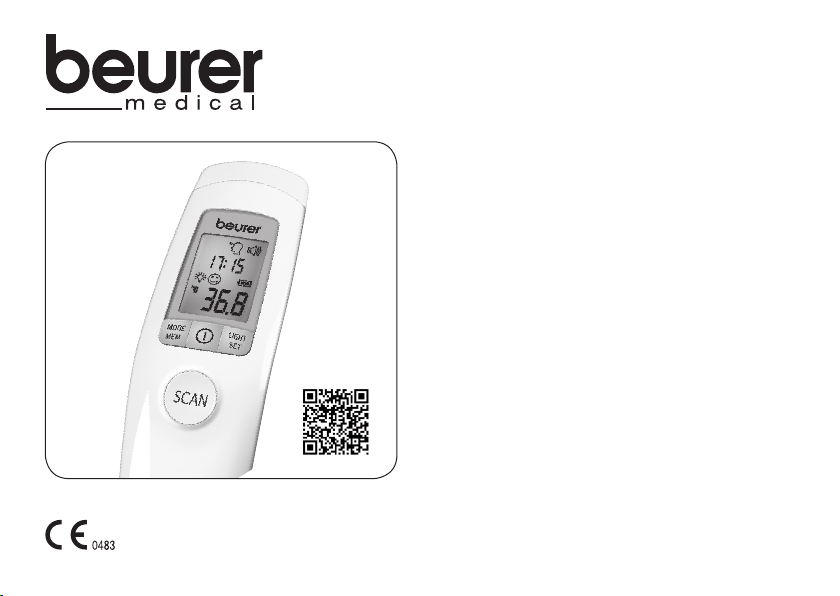
FT 90
D
Kontaktloses Thermometer
Gebrauchsanweisung ..........................2-20
G
Non-contact thermometer
Instructions for use ............................ 21-38
F
Thermomètre sans contact
Mode d’emploi .................................... 39-57
E
Termómetro sin contacto
Instrucciones de uso .......................... 58-76
I
Termometro senza contatto
Istruzioni per l’uso .............................. 77-95
T
Temassız termometre
Kullanım Kılavuzu ............................. 96-112
r
Бесконтактный термометр
Инструкция по применению ....... 113-133
Q
Termometr bezdotykowy
Instrukcja obsługi ........................... 134-152
ELECTROMAGNETIC COMPATIBILITY
INFORMATION ....................................... 153-156

2
DEUTSCH
Inhalt
1. Zeichenerklärung .............................................. 3
2. Bestimmungsgemäßer Gebrauch ....................... 4
3. Warn- und Sicherheitshinweise ......................... 5
3.1 Gefahren für den Anwender ......................... 5
3.2 Gefahren für das Gerät ................................ 5
3.3 Hinweise zum Umgang mit Batterien .......... 6
4. Informationen zu diesem Thermometer.............. 7
5. Gerätebeschreibung ........................................... 9
5.1 Displaybeschreibung .................................. 10
6. Inbetriebnahme ................................................. 10
7. Thermometer einschalten und einstellen ......... 11
7.1 Grundfunktionen einstellen ......................... 11
8. Messen an der Stirn .......................................... 13
8.1 Gespeicherte Messwerte anzeigen ............ 14
9.
Messen der Objekttemperatur / Raumtemperatur .
15
10. Fehleranzeigen .................................................. 15
11. Batterien .......................................................... 16
12. Gerät reinigen ................................................... 17
13. Gerät lagern ..................................................... 17
14. Gerät entsorgen ................................................ 18
15. Technische Daten ............................................. 18
16. Richtlinien ........................................................ 20
17. Garantie ............................................................ 20
Lesen Sie diese Gebrauchsanweisung sorgfältig
durch, bewahren Sie sie für den späteren
Gebrauch auf, machen Sie sie anderen Benutzern
zugänglich und beachten Sie die Hinweise.
Sehr geehrte Kundin, sehr geehrter Kunde,
wir freuen uns, dass Sie sich für ein Produkt unseres
Sortimen tes entschieden haben. Unser Name steht für
hoch wertige und eingehend geprüfte Qualitätsprodukte
aus den Bereichen Wär me, Sanfte Therapie, Blutdruck/
Diagnose, Gewicht, Massage und Luft.
Bitte lesen Sie diese Gebrauchsanweisung aufmerksam
durch, und beachten Sie die Hinweise.
Mit freundlicher Empfehlung
Ihr Beurer-Team
Lieferumfang
Überprüfen Sie den Lieferumfang auf äußere Unver-
sehrtheit der Kartonverpackung und auf die Vollständig-
keit des Inhalts. Vor dem Gebrauch ist sicherzustellen,
dass das Gerät und Zubehör keine sichtbaren Schäden
aufweisen und jegliches Verpackungsmaterial entfernt
wird. Benutzen Sie es im Zweifelsfall nicht und wenden
Sie sich an Ihren Händler oder an die angegebene Kun-
dendienstadresse.
3
• F
ieberthermometer
• 2
x 1,5 V Batterien AAA (LR03)
• A
ufbewahrungsbox
• G
ebrauchsanweisung
1. Zeichenerklärung
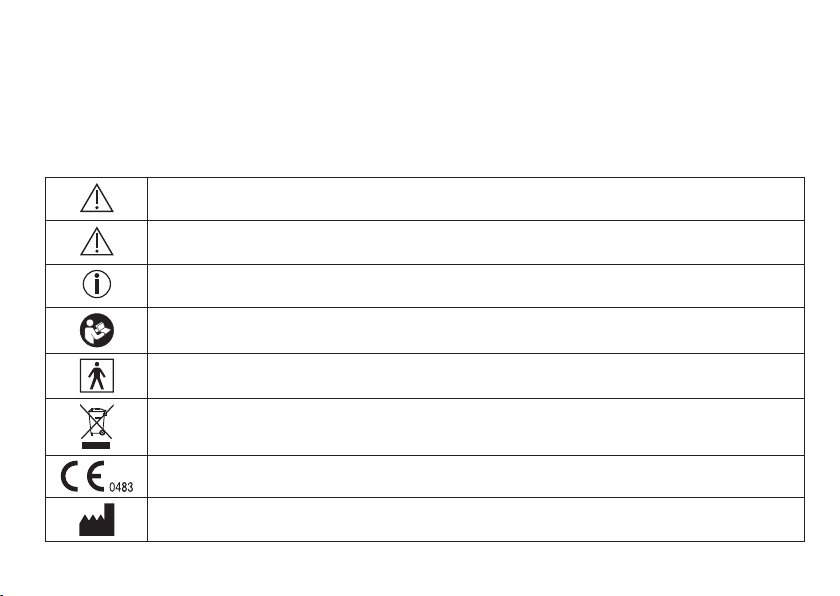
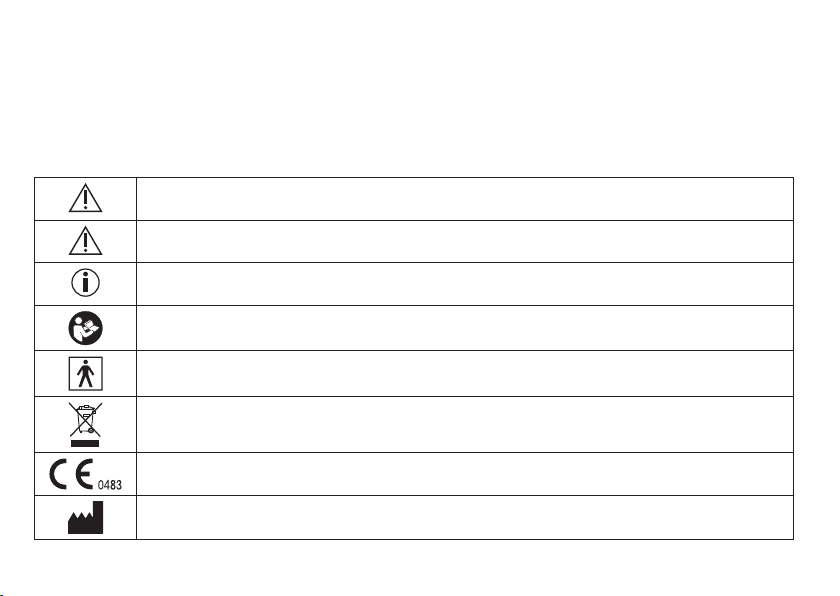
Folgende Symbole werden in dieser Gebrauchsanweisung und auf dem Gerät verwendet:
WARNUNG
Warnhinweis auf Verletzungsgefahren oder Gefahren für Ihre Gesundheit.
ACHTUNG
Sicherheitshinweis auf mögliche Schäden am Gerät/Zubehör.
Hinweis
Hinweis auf wichtige Informationen.
Gebrauchsanweisung beachten
Anwendungsteil Typ BF
Entsorgung gemäß Elektro- und Elektronik-Altgeräte EG-Richtlinie – WEEE (Waste Electrical
and Electronic Equipment)
Die CE-Kennzeichnung bescheinigt die Konformität mit den grundlegenden Anforderungen der
Richtlinie 93/42/EEC für Medizinprodukte.
Hersteller
4
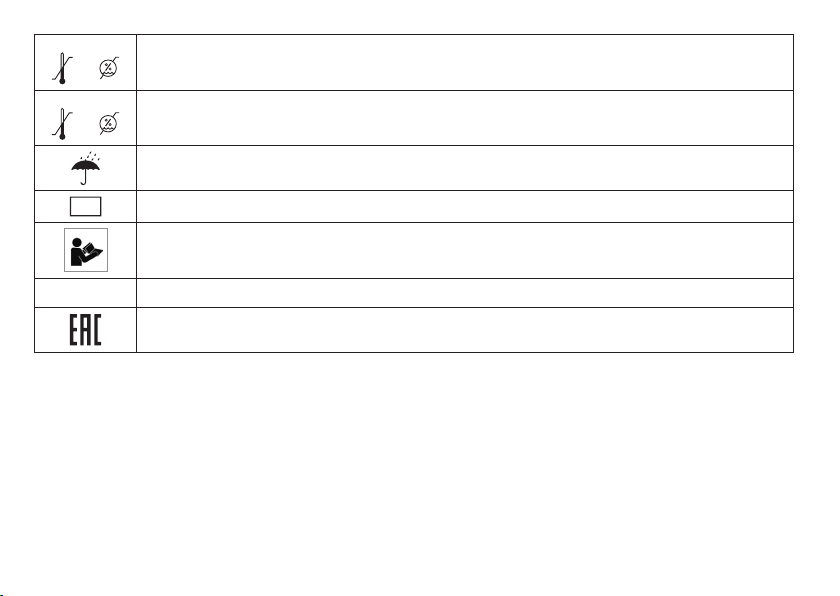
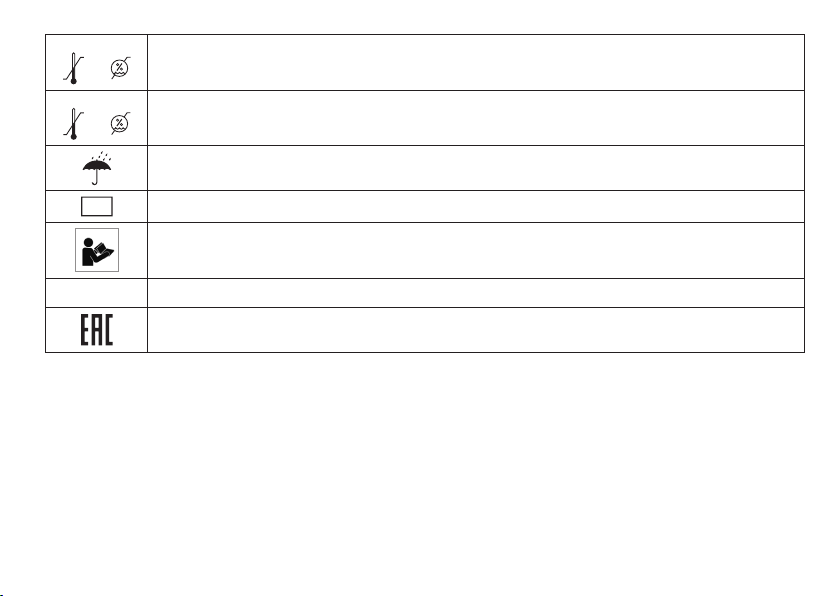
Storage
Zulässige Lagerungstemperatur und -luftfeuchtigkeit
Operating
Zulässige Betriebstemperatur und -luftfeuchtigkeit
Vor Nässe schützen
S
N
Seriennummer
Wichtige Information/Tipp
w
Querverweis auf einen anderen Absatz.
Zertifizierungszeichen für Produkte, die in die Russische Föderation und in die Länder der GUS
exportiert werden.
2. Bestimmungsgemäßer Gebrauch
Dieses Fieberthermometer dient der kontaktlosen Messung der Stirn-, Objekt- und Raumtemperatur. Das Ther-
mometer ist für die Messung zu Hause geeignet. Sie können damit schnell und einfach die Körpertemperatur
ermitteln. Die Werte werden automatisch gespeichert.

5
3. Warn- und Sicherheitshinweise
3.1 Gefahren für den Anwender
• W
enden Sie das Gerät nur an, nachdem Sie diese Gebrauchsanweisung gelesen und verstanden haben.
•
B
ewahren Sie diese Gebrauchsanweisung auf. Die Gebrauchsanweisung muss für alle Benutzer zugänglich
sein. Alle Hinweise müssen befolgt werden.
•
B
ewahren Sie das Gerät mindestens 30 Minuten vor der Messung in dem Raum auf, in dem die Messung
durchgeführt wird.
• D
as FT 90-Thermometer ist nur für den in der Gebrauchsanweisung angegebenen Messort am menschlichen
Körper konzipiert.
• D
as Gerät ist nur für den in dieser Gebrauchsanweisung angegebenen Zweck bestimmt.
• K
inder dürfen das Gerät nicht verwenden. Medizinprodukte sind kein Spielzeug.
• P
rüfen Sie vor jeder Anwendung, ob die Linse intakt ist. Sollte diese beschädigt sein, wenden Sie sich bitte an
die Händler- oder Serviceadresse.
• D
as Gerät wurde für den praktischen Einsatz konstruiert, kann aber nicht den Besuch beim Arzt ersetzen.
•
H
aben Sie noch Fragen zur Anwendung des Geräts, so wenden Sie sich bitte an Ihren Händler oder an den
Kundenservice.
3.2 Gefahren für das Gerät
• S
etzen Sie das Gerät keinen mechanischen Stößen aus.
• S
etzen Sie das Gerät nicht direkter Sonneneinstrahlung aus.
• S
etzen Sie das Gerät keinen Flüssigkeiten aus. Das Gerät ist nicht wasserdicht. Vermeiden Sie jeden direkten
Kontakt mit Wasser oder anderen Flüssigkeiten.
• L
assen Sie das Gerät nur von autorisierten Servicestellen reparieren, sonst erlischt Ihr Garantieanspruch.
•
Tragbare und mobile HF-Kommunikationseinrichtungen können das Gerät beeinflussen. Genauere Angaben können
Sie unter der angegebenen Kundenservice-Adresse anfordern oder am Ende der Gebrauchsanweisung nachlesen.

6
3.3 Hinweise zum Umgang mit Batterien
• W
enn Flüssigkeit aus einer Batteriezelle mit Haut oder Augen in Kontakt kommt, die betroffene Stelle mit Was-
ser auswaschen und ärztliche Hilfe aufsuchen.
•
Verschluckungsgefahr! Kleinkinder könnten Batterien verschlucken und daran ersticken. Daher Batterien
für Kleinkinder unerreichbar aufbewahren!
• A
uf Polaritätskennzeichen Plus (+) und Minus (-) achten.
•
W
enn eine Batterie ausgelaufen ist, Schutzhandschuhe anziehen und das Batteriefach mit einem trockenen
Tuch reinigen.
• S
chützen Sie Batterien vor übermäßiger Wärme.
•
Explosionsgefahr! Keine Batterien ins Feuer werfen.
• B
atterien dürfen nicht geladen oder kurzgeschlossen werden.
• B
ei längerer Nichtbenutzung des Geräts die Batterien aus dem Batteriefach nehmen.
• V
erwenden Sie nur denselben oder einen gleichwertigen Batterietyp.
• I
mmer alle Batterien gleichzeitig auswechseln.
• K
eine Akkus verwenden!
• K
eine Batterien zerlegen, öffnen oder zerkleinern.
7
4. Informationen zu diesem Thermometer
Der gemessene Temperaturwert schwankt, abhängig von der gemessenen Körperstelle. Die Abweichung kann
bei gesunden Menschen an unterschiedlichen Körperstellen zwischen 0,2 °C bis 1 °C (0,4 °F bis 1,8 °F) liegen.
Normaler Temperaturbereich bei unterschiedlichen Thermometern
Messwerte Verwendetes Thermometer
Stirntemperatur 35,8 °C bis 37,6 °C (96,4 °F bis 99,7 °F) Stirnthermometer
Ohrtemperatur 36,0 °C bis 37,8 °C (96,8 °F bis 100,0 °F) Ohrthermometer
Oraltemperatur 36,0 °C bis 37,4 °C 96,8 °F bis 99,3 °F) konventionelles Thermometer
Rektaltemperatur 36,3 °C bis 37,8 °C (97,3 °F bis 100,0 °F) konventionelles Thermometer
Beurer-Tipp
• V
ergleichen Sie nie mit verschiedenen Thermometern gemessene Tempera turen miteinander.
• S
agen Sie Ihrem Arzt, mit welchem Thermometer Sie die Körpertemperatur gemessen haben und an
welcher Körperstelle. Berücksichtigen Sie dies auch bei einer Selbstdiagnose.
Wird das Thermometer vor der Messung zu lange in der Hand gehalten, führt dies zur Erwärmung des
Gerätes. Dadurch kann das Messergebnis verfälscht werden.
8
Einflüsse auf die Körpertemperatur
• I
ndividueller, personenabhängiger Stoffwechsel
• L
ebensalter
Die Körpertemperatur ist bei Säuglingen und Kleinkindern höher als bei Erwachsenen. Bei Kindern treten höhere
Temperaturschwankungen schneller und häufiger auf. Mit zunehmendem Alter sinkt die normale Körpertemperatur.
• K
leidung
• A
ußentemperatur
• T
ageszeit
Die Körpertemperatur ist am Morgen niedriger und steigt im Laufe des Tages zum Abend an.
Aktivitäten
• K
örperlichen Aktivitäten und, mit geringerem Einfluss, mentale Aktivitäten erhöhen die Körper temperatur.
Beurer-Tipp
Die Körpertemperaturmessung liefert den aktuellen Messwert eines Menschen. Wenn Sie sich bei der
Interpretation der Ergebnisse unsicher sind, oder wenn abnorme Werte (z.B. Fieber) auftreten, sollten
Sie sich an Ihren Hausarzt wenden. Dies gilt auch bei geringen Temperaturveränderungen, wenn weitere
Krankheitssymptome hinzutreten, wie z.B. Unruhe, starkes Schwitzen, Hautrötung, hohe Pulsfrequenz,
Kollapsneigung usw.
9
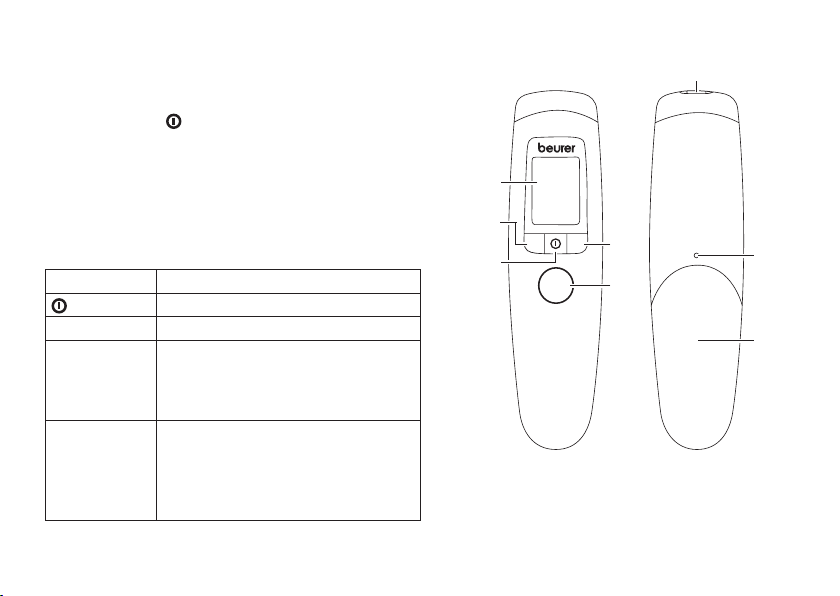
5. Gerätebeschreibung
1
Display
2
MODE/MEM-Taste
3
Ein/Aus-Taste
4
LIGHT/SET-Taste
5
SCAN-Taste
6
Messsensor
7
Batteriefach entriegelung
8
Batteriefachdeckel
Tasten Funktionen
Gerät ein- und ausschalten.
SCAN Temperaturmessung starten.
MODE/MEM
MODE
Einstellung des Messmodus.
MEM
Anzeige gespeicherte Messwerte.
LIGHT/SET
LIGHT
Manuelles Zuschalten der
Displaybeleuchtung.
SET
Einstellung der Grundfunktionen.
SCAN
MODE
ME M
LIGH T
SE T
1
3
2
4
5
6
7
8
10
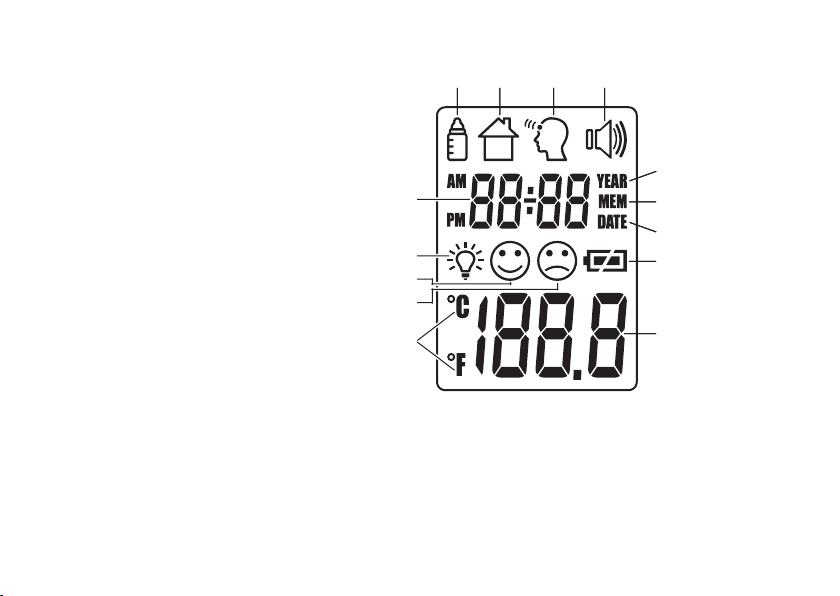
5.1 Displaybeschreibung
1
Modus Objekt temperatur
12 34
5
6
7
8
9
10
11
12
13
14
2
Modus Raumtemperatur
3
Modus Stirntemperatur
4
Signalton-Symbol
5
Jahr
6
Speicherfunktion
7
Datum
8
Batteriestatus
9
Temperaturwert-/Speicher platz nummer-Anzeige
10
Messeinheit Celsius/Fahrenheit
11
Messergebnis ≥ 38,0°C „Fieber“
12
Messergebnis < 38,0°C „kein Fieber“
13
Displaybeleuchtungs-Symbol
14
Jahr-/Datum-/Uhrzeit-Anzeige
6. Inbetriebnahme
Falls vorhanden, ziehen Sie den Batterie-Isolierstreifen am Batteriefachdeckel beziehungsweise entfernen Sie die
Schutzfolie der Batterie und setzen Sie die Batterie gemäß Polung ein.
w
11. Batterien
Nach einem kurzen Selbsttest und zwei kurzen Pieptönen ist das Thermometer zum Messen der Temperatur an
der Stirn bereit.
11
7. Thermometer einschalten und einstellen
Drücken Sie kurz auf die Ein/Aus-Taste .
Nach einem kurzen Selbsttest und zwei kurzen Pieptönen ist das Thermometer zum Messen der Temperatur an
der Stirn bereit.
Das Gerät startet immer im Modus Stirntemperatur
.
7.1 Grundfunktionen einstellen
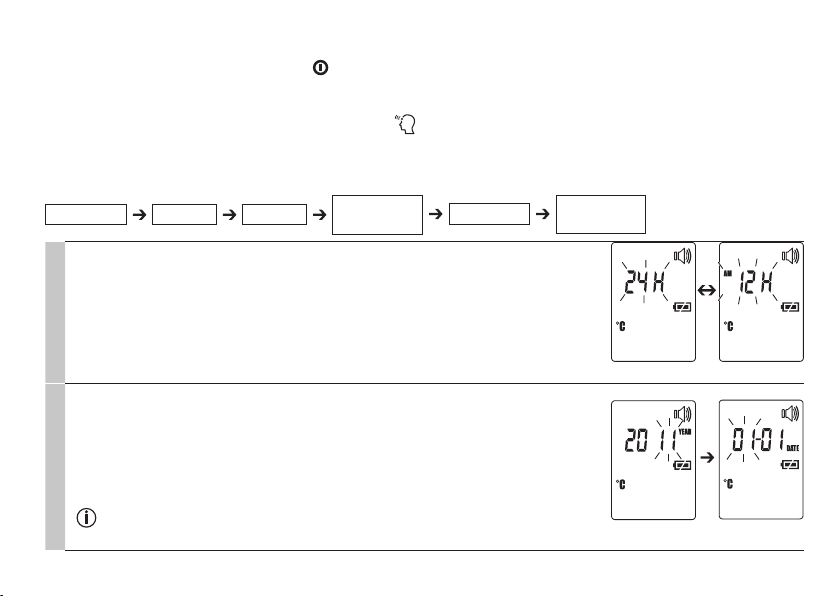
In diesem Menü haben Sie die Möglichkeit, folgende Funktionen nacheinander individuell einzustellen.
Zeitformat
•
Halten Sie die LIGHT/SET-Taste beim eingeschalteten Thermometer 5
Sekunden gedrückt.
Im Display blinkt die Zeitformat-Anzeige (Abb. 1).
•
Stellen Sie mit der MODE/MEM-Taste Ihr gewünschtes Zeitformat ein und
bestätigen Sie mit der LIGHT/SET-Taste.
Abb. 1
Datum
Im Display blinkt die Jahreszahl (Abb. 2).
•
Stellen Sie mit der MODE/MEM-Taste das Jahr ein und bestätigen Sie mit
der LIGHT/SET-Taste.
Im Display blinkt Tag/Monat (Abb. 3).
•
Stellen Sie mit der MODE/MEM-Taste den Tag und den Monat ein und
bestätigen Sie mit der LIGHT/SET-Taste.
Im 24-h-Zeitformat wird das Datum mit Tag/Monat angezeigt. Im 12-h-Zeit-
format mit Monat/Tag.
Abb. 3Abb. 2
Temperatur-
messeinheit
Display-
beleuchtung
Zeitformat Datum Uhrzeit
Signalton
12
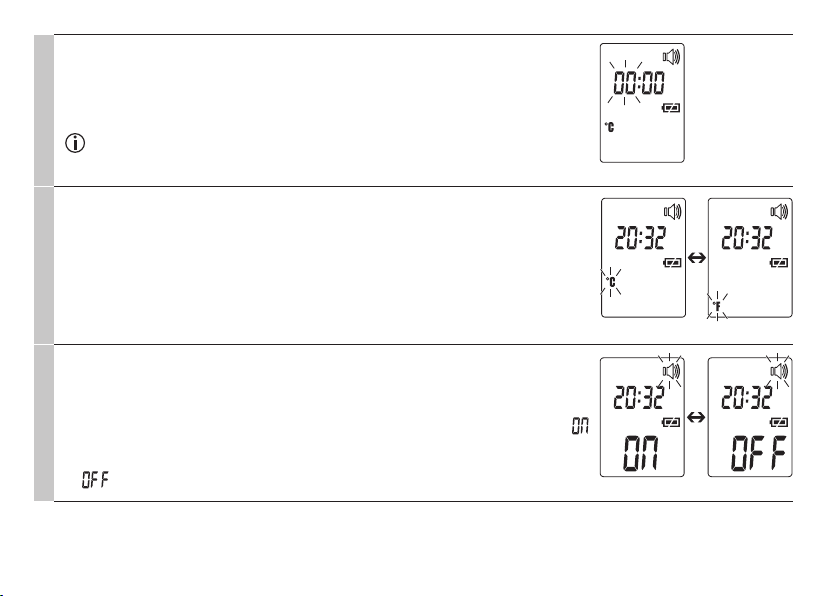
Uhrzeit
Im Display blinkt die Uhrzeit (Abb. 4).
•
Stellen Sie mit der MODE/MEM-Taste die Uhrzeit ein und bestätigen Sie
mit der LIGHT/SET-Taste.
Im 12-h-Zeitformat wird die Uhrzeit mit AM/PM angezeigt.
Abb. 4
Temperaturmesseinheit
Im Display blinkt die Temperaturmesseinheit (Abb. 5).
Sie können sich Ihre Messergebnisse in der Temperaturmesseinheit Grad Cel-
sius (°C) oder Grad Fahrenheit (°F) anzeigen lassen.
•
Um die Messergebnisse in Celsius anzuzeigen, wählen Sie mit der MODE/
MEM-Taste °C und bestätigen Sie mit der LIGHT/SET-Taste.
•
Um die Messergebnisse in Fahrenheit anzuzeigen, wählen Sie mit der MODE/
MEM-Taste °F und bestätigen Sie mit der LIGHT/SET-Taste.
Abb. 5
Signalton
Im Display blinkt das Signalton-Symbol (Abb. 6).
Sie können die Signaltöne (Einschalten des Geräts, während der Messung,
Abschluss der Messung) ein- oder ausschalten.
•
Um die Signaltöne einzuschalten, wählen Sie mit der MODE/MEM-Taste
und bestätigen Sie mit der LIGHT/SET-Taste.
•
Um die Signaltöne auszuschalten, wählen Sie mit der MODE/MEM-Taste
und bestätigen Sie mit der LIGHT/SET-Taste.
Abb. 6
13
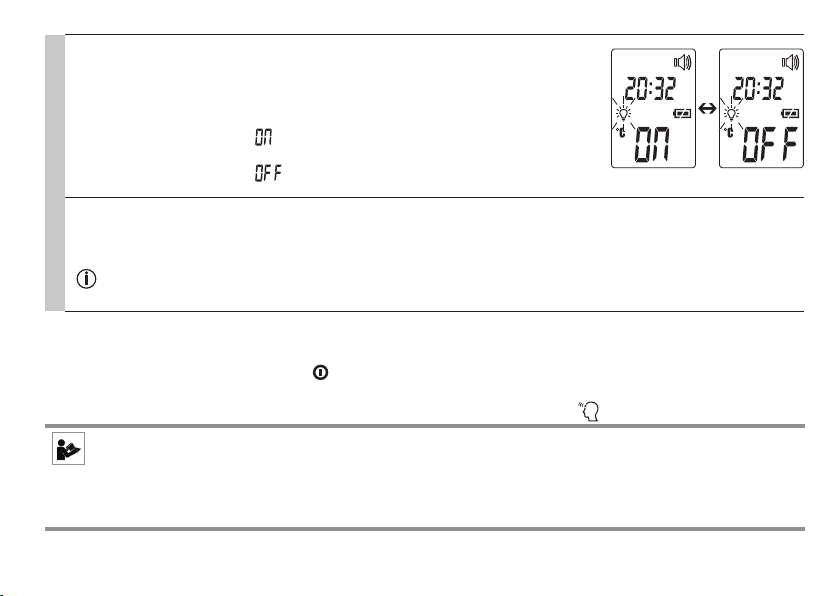
Displaybeleuchtung
Im Display blinkt das Licht-Symbol (Abb. 7).
Sie können die automatische Displaybeleuchtung (erscheint nach Messung
der Stirntemperatur) ein- oder ausschalten.
•
Um die automatische Displaybeleuchtung einzu schalten, wählen Sie mit
der MODE/MEM-Taste und bestätigen Sie mit der LIGHT/SET-Taste.
•
Um die automatische Displaybeleuchtung auszu schalten, wählen Sie mit
der MODE/MEM-Taste und bestätigen Sie mit der LIGHT/SET-Taste.
Abb. 7
Außerdem haben Sie die Möglichkeit die Display beleuchtung manuell einzuschalten, indem Sie die LIGHT/
SET-Taste kurz drücken.
Das Display ist 5 Sekunden beleuchtet.
Die automatische und die manuelle Displaybeleuchtung kann nicht während des Messvorgangs ver-
wendet werden.
8. Messen an der Stirn
Drücken Sie kurz auf die Ein/Aus-Taste .
Nach einem kurzen Selbsttest und zwei kurzen Pieptönen ist das Gerät zum Messen der Temperatur an der Stirn
bereit. Das Gerät befindet sich im Modus Stirntemperatur. Dies ist am Symbol
ersichtlich.
Beurer-Tipp
Berücksichtigen Sie, dass
•
k
örperliche Betätigung, grundsätzlich erhöhte Schweißbildung auf der Stirn, Einnahme von gefäßveren-
genden Medikamenten und Hautirritationen das Messergebnis verfälschen können,
• d
ie Stirn, beziehungsweise Schläfe, frei von Schweiß und Kosmetika sein muss.
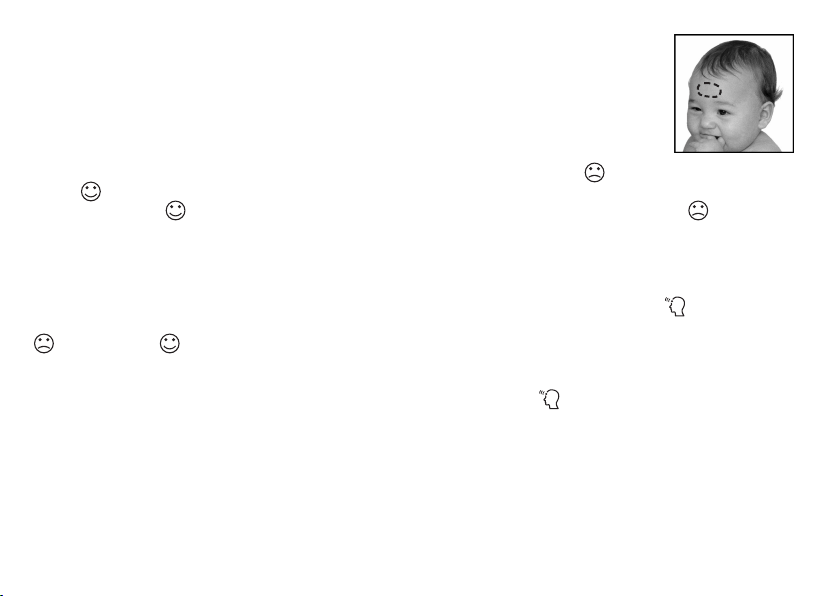
14
Halten Sie das Thermometer 2 bis 3 cm vor die Messstelle. Drücken Sie die SCAN-Taste
und führen Sie das Thermometer über dem Stirn-Gebiet hin und her (Abb. 8).
Während der Messung können Sie kurze Pieptöne hören (nur bei Signalton an), welche signa
-
lisieren, dass das Thermometer einen neuen höchsten Messwert gefunden hat.
Das Ende der Messzeit wird mit einem langen Piepton signalisiert.
Lassen Sie die SCAN-Taste los.
Nun können Sie den gemessenen Wert ablesen.
Zudem zeigt das Display entsprechend dem Messergebnis die Symbole Fieber oder kein
Fieber an:
Symbol kein Fieber zeigt, dass die Körpertemperatur im normalen Bereich liegt, Symbol Fieber einen Mess-
wert über oder gleich 38,0°C, das heisst Fieberalarm.
Bei eingeschaltetem Signalton ertönen nach Messende zusätzlich drei Pieptöne, wenn die Temperatur höher
oder gleich 38,0°C ist.
Die Messzeit beträgt normalerweise 2 Sekunden, kann aber auch bis zu 30 Sekunden dauern.
Das Gerät signalisiert mit zwei kurzen Pieptönen und einem nicht mehr blinkenden Stirnsymbol , dass das Gerät
für eine weitere Messung bereit ist. Der Messwert wird automatisch mit Datum/Uhrzeit und Einstufung „Fieber“
/ „kein Fieber“ gespeichert.
8.1 Gespeicherte Messwerte anzeigen
Das Gerät speichert ausschließlich Messwerte im Modus Stirntemperatur . Das Gerät speichert automatisch
die Messwerte von den letzten 60 Messungen ab.
Werden die 60 Speicher Plätze überschritten, wird der jeweils älteste Wert gelöscht.
• D
er Speicher kann wie folgt abgerufen werden:
•
Halten Sie die MODE/MEM-Taste bei eingeschaltetem Thermometer 5 Sekunden gedrückt.
Der jüngste Messwert wird angezeigt.
•
B
ei jedem weiteren Drücken der MODE/MEM-Taste wird zunächst die Speicherplatznummer angezeigt und
beim Loslassen der Taste der Messwert.
• I
n der oberen Zeile wird abwechselnd Uhrzeit und Datum angezeigt.
Abb. 8
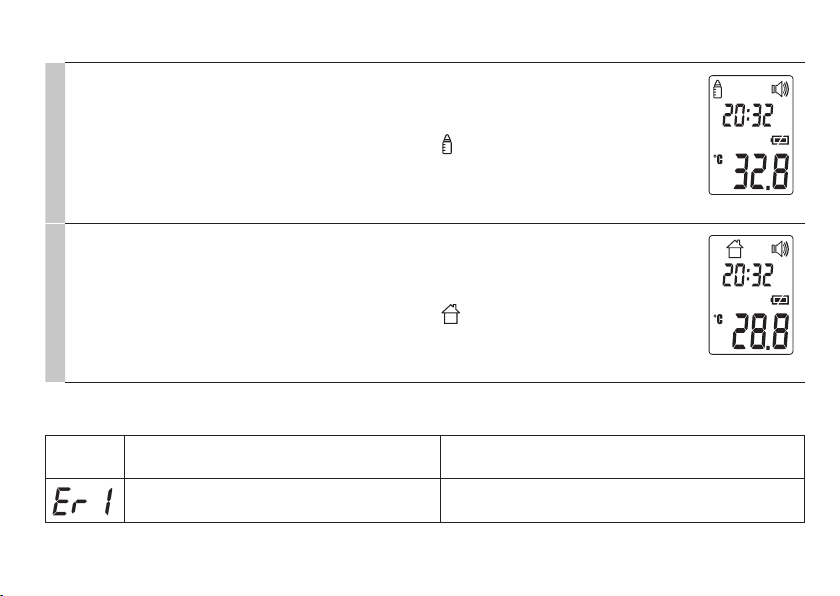
15
9. Messen der Objekttemperatur / Raumtemperatur
Modus Objekttemperatur
Wenn Sie Objekttemperatur mit diesem Thermometer messen wollen, müssen Sie in den
Modus Objekttemperatur wechseln.
•
D
azu drücken Sie kurz beim eingeschalteten Thermometer die MODE/MEM-Taste.
Das Gerät schaltet in den Modus Objekttemperatur .
• H
alten Sie das Thermometer 2 bis 3 cm vor die gewünschte Messstelle. Drücken Sie kurz
auf die SCAN-Taste und lesen Sie die Temperatur vom Display ab (Abb. 9).
Messwerte im Modus Objekttemperatur werden nicht gespeichert.
Abb. 9
Modus Raumtemperatur
Wenn Sie das Thermometer zum Messen der Raumtemperatur nutzen wollen, müssen Sie in
den Modus Raumtemperatur wechseln.
•
D
azu drücken Sie kurz zweimal beim einge schal teten Thermometer die MODE/MEM-Taste.
Das Gerät schaltet in den Modus Raumtemperatur .
• D
ie Raumtemperatur wird direkt angezeigt (Abb. 10).
Messwerte im Modus Raumtemperatur werden nicht gespeichert.
Abb. 10
10. Fehleranzeigen
Fehler-
meldung
Problem Lösung
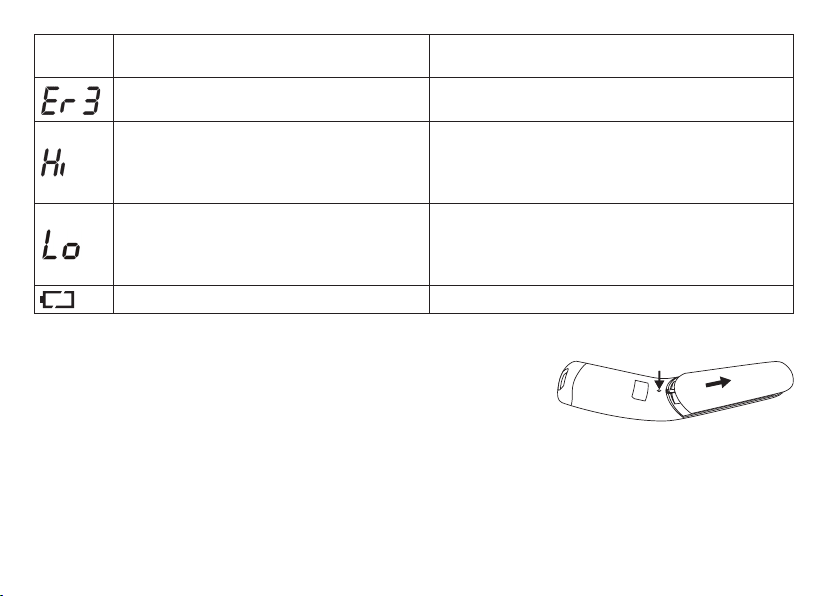
Messung während des Selbst test, Gerät noch
nicht messbereit.
Warten bis das Stirnsymbol nicht mehr blinkt.
16
Fehler-
meldung
Problem Lösung
Raumtemperatur unter 10 °C oder
über 40 °C (<50 °F, >104 °F).
Raumtemperatur muss zwischen 10 °C und 40 °C lie-
gen (50 °F, 104 °F).
(1) Modus Stirntemperatur: Die ermittelte
Temperatur ist höher als 42,2 °C (108 °F).
(2) Modus Objekttemperatur: Die ermit telte
Temperatur ist höher als 80 °C (176 °F).
Betreiben Sie das Thermometer nur innerhalb der
angegebenen Temperaturbereiche. Bei wiederholter
Fehleranzeige an Fachhändler oder Kundenservice
wenden.
(1) Modus Stirntemperatur: Die ermittelte
Temperatur ist geringer als 34 °C (93,2 °F).
(2) Modus Objekttemperatur: Die ermit telte
Temperatur ist niedriger als -22 °C (-7,6 °F).
Betreiben Sie das Thermometer nur innerhalb der
angegebenen Temperaturbereiche. Bei wiederholter
Fehleranzeige an Fachhändler oder Kundenservice
wenden.
Die Batterien sind verbraucht. Erneuern Sie die Batterien.
11. Batterien
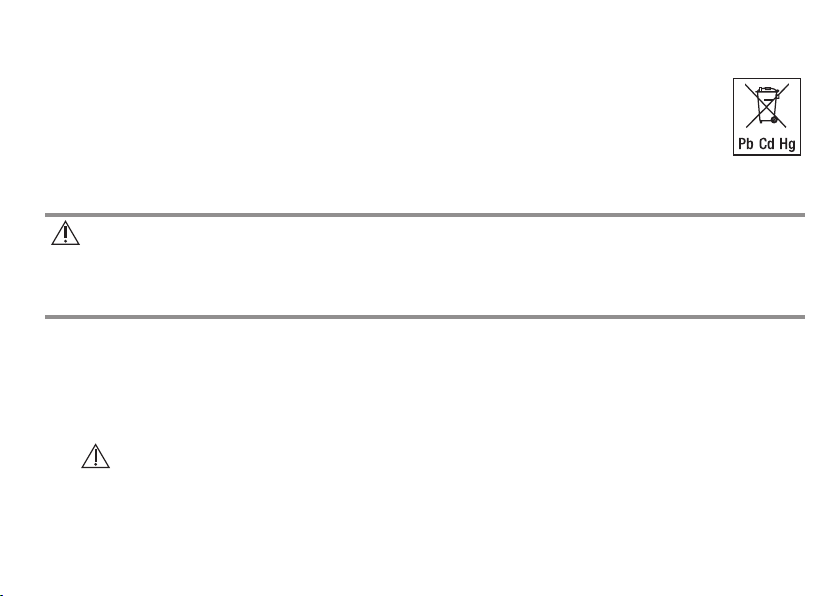
Das Gerät benötigt zwei Batterien, Typ AAA, LR03.
• Ö
ffnen Sie das Batteriefach.
Drücken Sie dazu mit einem spitzen Gegenstand die Bat terie fach ent rie-
ge lung und schieben Sie gleichzeitig das Batteriefach nach unten.
• N
ehmen Sie die verbrauchten Batterien aus dem Batteriefach.
• S
etzen Sie neue Batterien ein.
Achten Sie darauf, dass die Batterien richtig ausgerichtet sind.
• V
erschließen Sie das Batteriefach.
17
• D
ie verbrauchten, vollkommen entladenen Batterien müssen Sie über speziell gekennzeichnete Sammelbehäl-
ter, Sondermüllannahmestellen oder über den Elektrohändleentsorgen. Sie sind gesetzlich dazu verpflichtet,
die Batterien zu entsorgen.
• D
iese Zeichen finden Sie auf schadstoffhaltigen Batterien:
Pb = Batterie enthält Blei,
Cd = Batterie enthält Cadmium,
Hg = Batterie enthält Quecksilber.
12. Gerät reinigen
• D
er Messsensor ist der empfindlichste Teil des Thermometers. Behandeln Sie den Messsensor mit
größter Vorsicht bei der Reinigung.
• V
erwenden Sie keine aggressiven Reinigungsmittel.
• B
efolgen Sie stets alle Sicherheitshinweise für Anwender und Gerät.
w
3. Warn- und Sicherheitshinweise
Reinigen Sie nach jedem Gebrauch den Messsensor. Verwenden Sie dazu ein weiches Tuch oder ein Wattestäb
-
chen, welche mit Desinfektionsmittel oder 70 % Alkohol angefeuchtet werden können.
Zur Reinigung des gesamten Gerätes verwenden Sie bitte ein weiches, leicht mit leichter Seifenlauge angefeuch
-
tetes Tuch. Es darf keinesfalls Wasser in das Gerät eindringen.
Benutzen Sie das Gerät erst wieder, wenn es vollständig trocken ist.
13. Gerät lagern
Das Gerät darf nicht bei zu hoher oder niedriger Temperatur oder Luftfeuchtigkeit (siehe technische Spezifikatio-
nen), im Sonnenlicht, in Verbindung mit elektrischem Strom oder an staubigen Orten gelagert oder benutzt wer-
den. Es kann sonst zu Messungenauigkeiten kommen.
Bei geplanter längerer Lagerung entfernen Sie die Batterien.
18
14. Gerät entsorgen
•
Im Interesse des Umweltschutzes darf das Gerät am Ende seiner Lebensdauer nicht mit dem Hausmüll entsorgt
werden.
Die Entsorgung kann über entsprechende Sammelstellen in Ihrem Land erfolgen. Entsorgen Sie das Gerät gemäß
der Elektro- und Elektronik Altgeräte EG-Richtlinie – WEEE (Waste Electrical and Electronic Equipment).
Bei Rückfragen wenden Sie sich an die für die Entsorgung zuständige kommunale Behörde.
15. Technische Daten
Bei Verwendung des Gerätes außerhalb der Spezifikation ist eine einwandfreie Funktion nicht gewährleistet!
Die Genauigkeit dieses Thermometers wurde sorgfältig geprüft und wurde im Hinblick auf eine lange nutzbare
Lebensdauer entwickelt.
Bei Verwendung des Gerätes in der Heilkunde sind Messtechnische Kontrollen mit geeigneten Mitteln durchzu
-
führen. Genaue Angaben zur Überprüfung der Genauigkeit können unter der Service-Adresse angefragt werden.
Technische Änderungen zur Verbesserung und Weiterentwicklung des Produktes behalten wir uns vor.
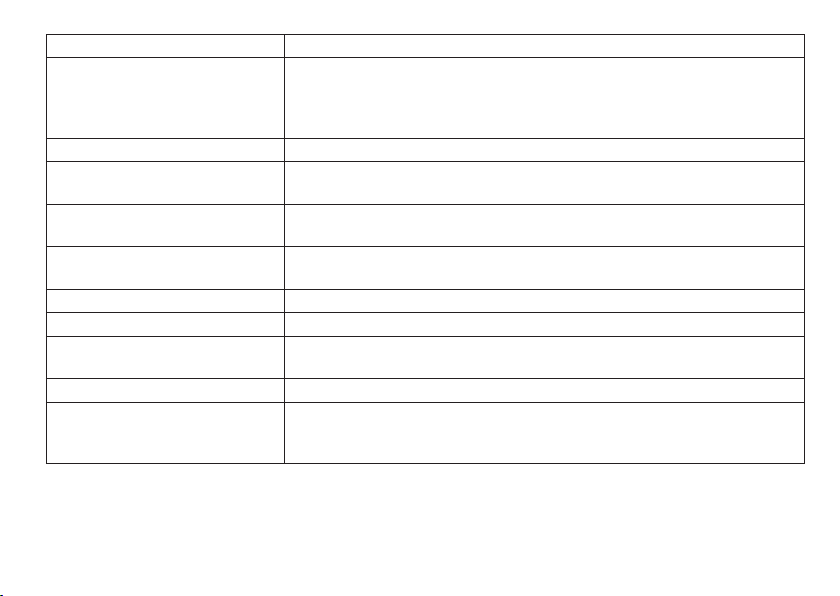
Typ FT 90/1
Messmethode Kontaktlose Infrarot Messung
Basisfunktionen Stirntemperaturmessung
Objekttemperaturmessung
Raumtemperaturmessung
Maßeinheiten Celsius (°C) oder Fahrenheit (°F)
Betriebsbedingungen 10 °C bis 40 °C (50 °F bis 104 °F)
bei einer relativen Luftfeuchtigkeit < 95 %
Aufbewahrungsumgebung -20 °C bis 50 °C (-4 °F bis 122 °F)
bei einer relativen Luftfeuchtigkeit < 85 %
19
Messabstand 2 bis 3 cm Abstand zur Messstelle
Messbereiche und Genauigkeit
Stirntemperaturmessung
Stirntemperaturmessung
34 °C bis 42,2 °C (93,2 °F bis 108 °F)
Messgenauigkeit 36 °C bis 39 °C: ± 0,2 °C (96,8 °F bis 102 °F: ± 0,4 °F)
Im restlichen Messbereich ± 0,3 °C (± 0,5 °F)
Klinische Wiederholpräzision 0,23 °C (0,41 °F)
Messbereiche und Genauigkeit
Objekttemperaturmessung
Objekttemperaturmessung -22 °C bis 80 °C (-7,6 °F bis 176 °F)
Messgenauigkeit ± 4% oder ± 2 °C (± 4 °F)
Speicherfunktion
Körpertemperaturmessung
Speichert automatisch die letzten 60Messwerte.
Signalton Beim Einschalten des Gerätes, während der Messung, beim Abschluss der
Messung (einstellbar).
Anzeige LCD-Display
Energiesparfunktionen Gerät schaltet nach 1 Minute automatisch aus.
Abmessungen
Breite x Tiefe x Höhe
ca. 47,6 mm x 29,0 mm x 188,0 mm
Gewicht 82 g (ohne Batterien)
Batterie 2 x AAA, LR03 Betriebsdauer für ca. 3000 Messungen
Zusätzlich aktivierte Funktionen wie Signalton oder Displaybeleuchtung
verkürzen die Lebensdauer der Batterie.

20
16. Richtlinien
Das Gerät entspricht der EU-Richtlinie für Medizinprodukte 93/42/EEC, dem Medizinproduktegesetz, der ASTM
E 1965 - 98, sowie der europäischen Norm EN60601-1-2 und unterliegt besonderen Vorsichtsmaßnahmen hin
-
sichtlich der elektromagnetischen Verträglichkeit.
17. Garantie
Wir leisten 3 Jahre Garantie ab Kaufdatum für Material- und Fabrikationsfehler des Produktes. Die Garantie gilt nicht:
• Im Falle von Schäden, die auf unsachgemäßer Bedienung beruhen.
• Für Verschleißteile.
• Bei Eigenverschulden des Kunden.
• Sobald das Gerät durch eine nicht autorisierte Werkstatt geöffnet wurde.
Die gesetzlichen Gewährleistungen des Kunden bleiben durch die Garantie unberührt. Für Geltendmachung eines
Garantiefalles innerhalb der Garantiezeit ist durch den Kunden der Nachweis des Kaufes zu führen. Die Garantie
ist innerhalb eines Zeitraumes von 3 Jahren ab Kaufdatum gegenüber der Beurer GmbH, Ulm (Germany) geltend
zu machen.
Bitte wenden Sie sich im Falle von Reklamationen an unseren Service unter folgendem Kontakt:
Service Hotline:
Tel.: +49 (0) 731 / 39 89-144
E-Mail: kd@beurer.de
www.beurer.com
Fordern wir Sie zur Übersendung des defekten Produktes auf, ist das Produkt an folgende Adresse
zu senden:
Beurer GmbH
Servicecenter
Lessingstraße 10 b
89231 Neu-Ulm
Germany
Irrtum und Änderungen vorbehalten

21
Content
1. Signs and symbols ........................................... 22
2. Use .................................................................... 23
3. Warnings and Safety ......................................... 24
3.1 Risks to the user ........................................ 24
3.2 Risks to the device...................................... 24
3.3 Notes on handling batteries ....................... 25
4. Information about this thermometer ................. 25
5. Unit description ................................................ 27
5.1 Display description ..................................... 28
6. Initial use ........................................................... 28
7. Switching on and setting the thermometer ...... 29
7.1 Setting the basic functions ......................... 29
8. Forehead measurement .................................... 31
8.1 Displaying saved measurements ............... 32
9.
Measuring object temperature / room temperature
. 33
10. Error messages ................................................. 34
11. Batteries ............................................................ 35
12. Cleaning the device .......................................... 35
13. Storing the device ............................................ 36
14. Disposing of the device .................................... 36
15. Technical Data .................................................. 36
16. Guidelines ........................................................ 38
ENGLISH
Read these instructions for use carefully and
keep them for later use, be sure to make
them accessible to other users and observe
the information they contain.
Dear customer,
Thank you for choosing one of our products. Our name
stands for high-quality, thoroughly tested products for
applications in the areas of heat, gentle therapy, blood
pressure/diagnosis, weight, massage and air.
Please read these instructions for use carefully and
observe the information they contain.
With kind regards,
Your Beurer team
Included in delivery
Check that the delivery has not been tampered with and
make sure that all components are present. Before use,
ensure that there is no visible damage to the device or
accessories and that all packaging material has been
removed. If you have any doubts, do not use the device
and contact your retailer or the specified Customer Ser-
vices address.
22
• T
hermometer
• 2
x AAA (LR03) batteries
• S
t
orage box
• I
nstructions for use
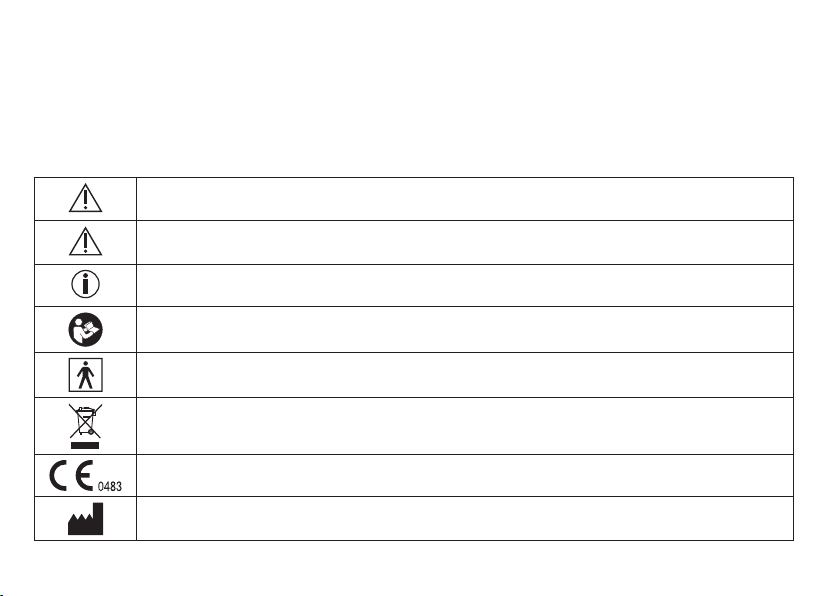
1. Signs and symbols
The following symbols appear in these instructions for use and on the device:
WARNING
Warning notice indicating a risk of injury or damage to health.
IMPORTANT
Safety note indicating possible damage to the unit/accessory.
Note
Note on important information.
Observe the instructions for use
Application part, type BF
Disposal in accordance with the Waste Electrical and Electronic Equipment EC Directive – WEEE
The CE labelling certifies that the product complies with the essential requirements of Directive
93/42/EEC on medical devices.
Manufacturer
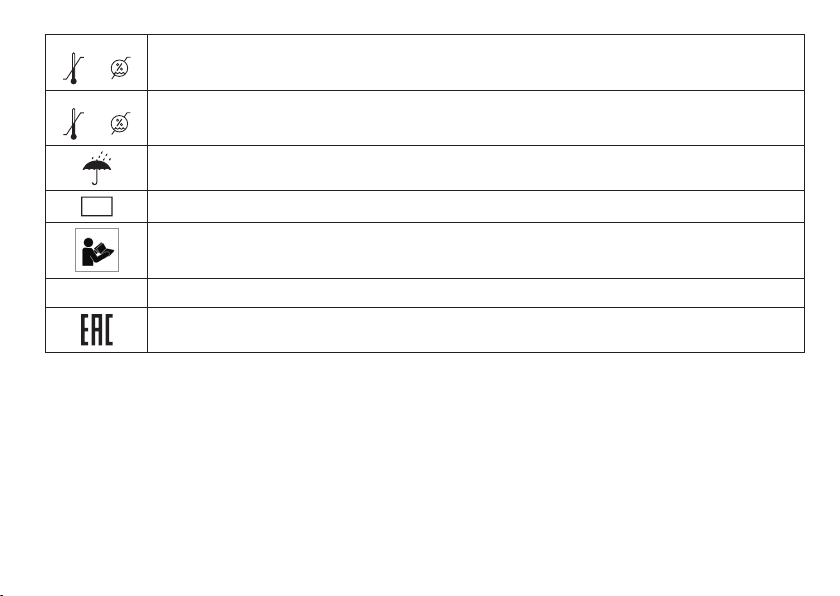
23
Storage
Permissible storage temperature and humidity
Operating
Permissible operating temperature and humidity
Keep dry
S
N
Serial number
Important information/tip
w
Cross-reference to another section.
Certification symbol for products that are exported to the Russian Federation and members of
the CIS
2. Use
This clinical thermometer is intended for non-contact measurement of forehead, object and room temperature.
The thermometer is suitable for domestic use. It allows you to quickly and easily measure body temperature Val
-
ues are saved automatically.

24
3. Warnings and Safety
3.1 Risks to the user
• O
nly use the device once you have read and understood these instructions for use.
• R
etain these instructions for use. The instructions for use must be accessible to all users. All instructions must
be followed.
•
T
he thermometer needs to be in the room in which the measurement is taken for at least 30 minutes before use.
• T
he FT 90 thermometer is only designed for the measuring area on the human body stated in the instructions
for use.
• T
he device is only intended for the purpose stated in these instructions for use.
• C
hildren must not be allowed to use the device. Medical devices are not toys.
•
C
heck before each use that the lens is intact. If it is damaged, please contact your retailer or the service address.
• T
he device has been designed for practical use, but is not a substitute for a visit to the doctor.
•
S
hould you have any questions about using the device, please contact either your retailer or Customer Services.
3.2 Risks to the device
• D
o not subject the device to mechanical impacts.
• D
o not expose the device to direct sunlight.
• D
o not expose the device to liquids. The device is not waterproof. Avoid all direct contact with water or other
liquids.
• H
ave the device repaired by authorised service centres only, otherwise its warranty is invalidated.
•
Portable and mobile HF communication systems may interfere with this device. More details can be requested
from the stated Customer Service address or found at the end of the instructions for use.
25
3.3 Notes on handling batteries
• I
f your skin or eyes come into contact with battery fluid, flush out the affected areas with water and seek medi-
cal assistance.
•
Choking hazard! Small children may swallow and choke on batteries. Store the batteries out of the reach
of small children.
• O
bserve the plus (+) and minus (-) polarity signs.
• I
f a battery has leaked, put on protective gloves and clean the battery compartment with a dry cloth.
• P
rotect the batteries from excessive heat.
•
Risk of explosion! Never throw batteries into a fire.
• D
o not charge or short-circuit batteries.
• I
f the device is not to be used for a long period, take the batteries out of the battery compartment.
• U
se identical or equivalent battery types only .
• A
lways replace all batteries at the same time.
• D
o not use rechargeable batteries.
• D
o not disassemble, split or crush the batteries.
4. Information about this thermometer
The temperature measurement varies depending on the part of the body where the measurement is taken. In
a healthy person, the variance can be between 0.2 °C and 1 °C (0.4 °F and 1.8 °F) in different parts of the body.
Normal temperature range with various thermometers
Measurements Thermometer used
Forehead temperature 35.8 °C to 37.6 °C (96.4 °F to 99.7 °F) Forehead thermometer
Ear temperature 36.0 °C to 37.8 °C (96.8 °F to 100.0 °F) Ear thermometer
26
Measurements Thermometer used
Oral temperature 36.0 °C to 37.4 °C (96.8 °F to 99.3 °F) Conventional thermometer
Rectal temperature 36.3 °C to 37.8 °C (97.3 °F to 100.0 °F) Conventional thermometer
Beurer tip
• T
emperatures measured with different thermometers should never be compared with one another.
• T
ell your doctor what type of thermometer you used to take your temperature and on what part of the
body. Also bear this in mind if you are diagnosing yourself.
Holding the thermometer for too long in the hand before taking a measurement can cause the device to
warm up. This means the measurement could be incorrect.
Influences on body temperature
• A
person’s individual metabolism
• A
ge
Body temperature is higher in babies and toddlers than in adults. Greater temperature fluctuations occur faster and
more often in children. Normal body temperature decreases with age.
• C
lothing
• O
utside temperature
• T
ime of day
Body temperature is lower in the morning and increases throughout the day towards evening.
• A
ctivities
Physical and, to a lesser extent, mental activities increase body temperature.
27
Beurer tip
Taking the body temperature provides a current measurement of a person’s temperature. If you are uncer-
tain about interpreting the results or if the values are abnormal (e.g. fever), please consult your doctor.
This also applies in the case of slight temperature changes if there are other symptoms of illness such as
agitation, severe sweating, flushed skin, fast pulse rate, tendency to collapse, etc.
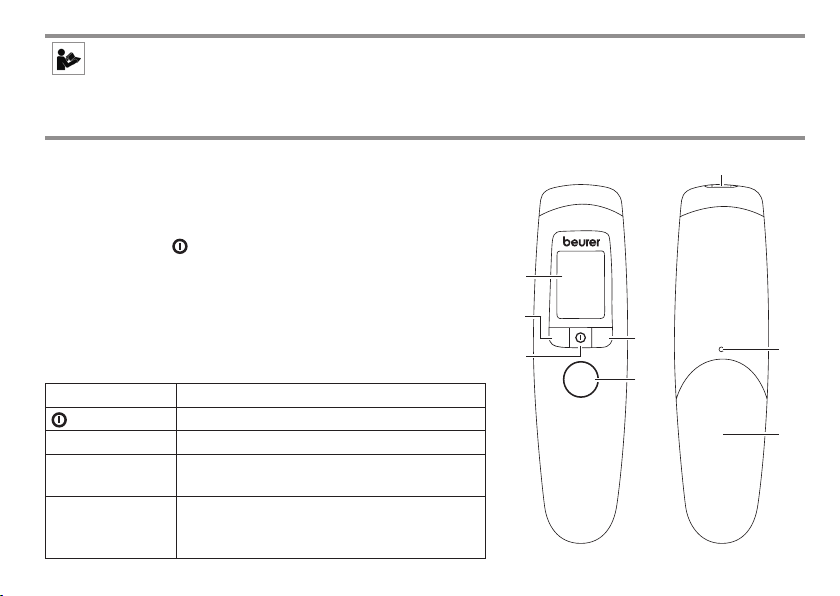
5. Unit description
1
Display
2
MODE/MEM button
3
On/Off button
4
LIGHT/SET button
5
SCAN button
6
Measuring sensor
7
Battery compartment lock
8
Battery compartment lid
Buttons Functions
Turns the device on and off.
SCAN Starts the temperature measurement.
MODE/MEM
MODE Sets the measurement mode.
MEM Displays stored measurements.
LIGHT/SET
LIGHT Manual switch on of the illuminated
display.
SET Sets the basic functions.
SCAN
MODE
ME M
LIGH T
SE T
1
3
2
4
5
6
7
8
28
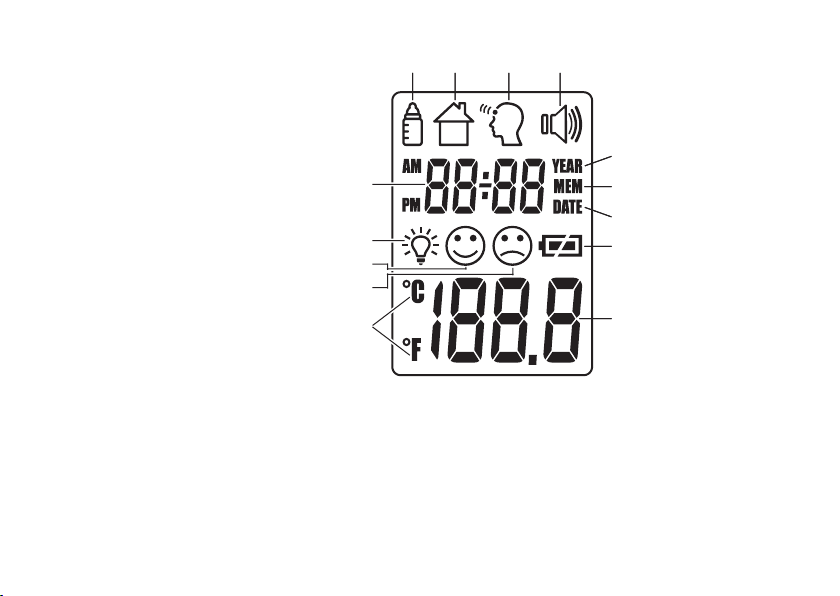
5.1 Display description
1
Object temperature mode
12 34
5
6
7
8
9
10
11
12
13
14
2
Room temperature mode
3
Forehead temperature mode
4
Acoustic signal symbol
5
Year
6
Memory function
7
Date
8
Battery level
9
Temperature/memory space number
display
10
Celsius/Fahrenheit measurement unit
11
Measurement ≥ 38.0°C (≥100.4°F) “fever”
12
Measurement < 38.0°C (<100.4°F)
“no fever”
13
Illuminated display symbol
14
Year/date/time display
6. Initial use
If provided, pull out the battery insulating strip at the battery compartment or remove the protective film from
the battery and insert the battery with the correct polarity.
w
11. Batteries
After a brief self-test and two short beeps the thermometer is ready for forehead measurement.
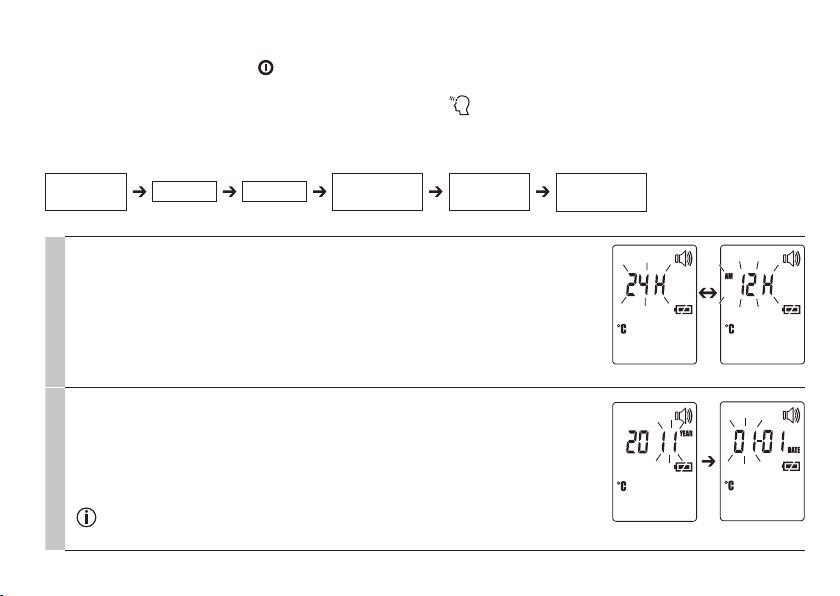
29
7. Switching on and setting the thermometer
Briefly press the On/Off button .
After a brief self-test and two short beeps the thermometer is ready for forehead measurement.
The device always starts up in forehead temperature mode
.
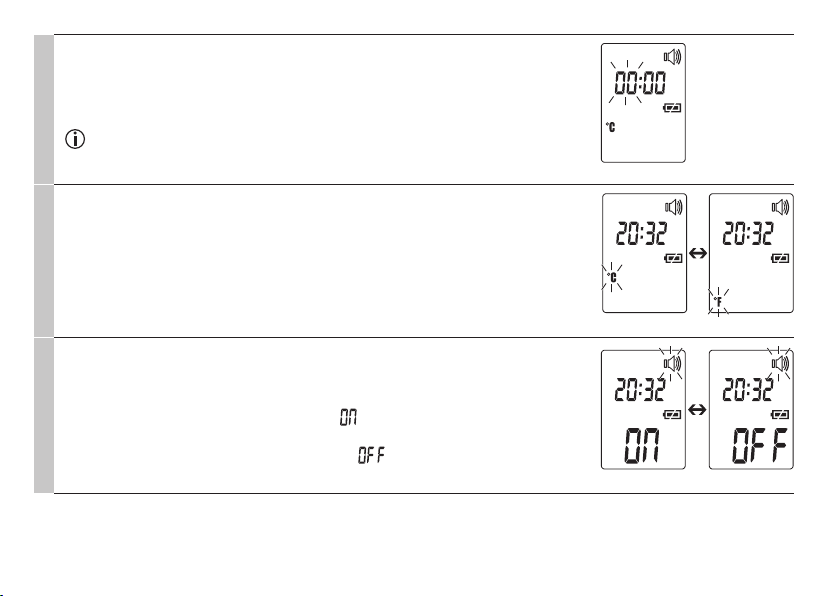
7.1 Setting the basic functions
This menu allows you to set the following functions individually, one after another.
Time format
• W
ith the thermometer switched on, press and hold the LIGHT/SET button
for 5 seconds.
The time format option flashes on the display (fig. 1).
• U
se the MODE/MEM button to set your preferred time format and confirm
with the LIGHT/SET button.
Fig. 1
Date
The year flashes in the display (fig. 2).
•
U
se the MODE/MEM button to set the year and confirm with the LIGHT/
SET button.
Day/month flashes in the display (fig. 3).
•
U
se the MODE/MEM button to set the day and month, and confirm with
the LIGHT/SET button.
In the 24h format, the date is displayed as day/month. In the 12h format, it
is displayed as month/day.
Fig. 3
Fig. 2
Temperature
meas. unit
Illuminated
display
Time format
Date Time
Acoustic
signal
30
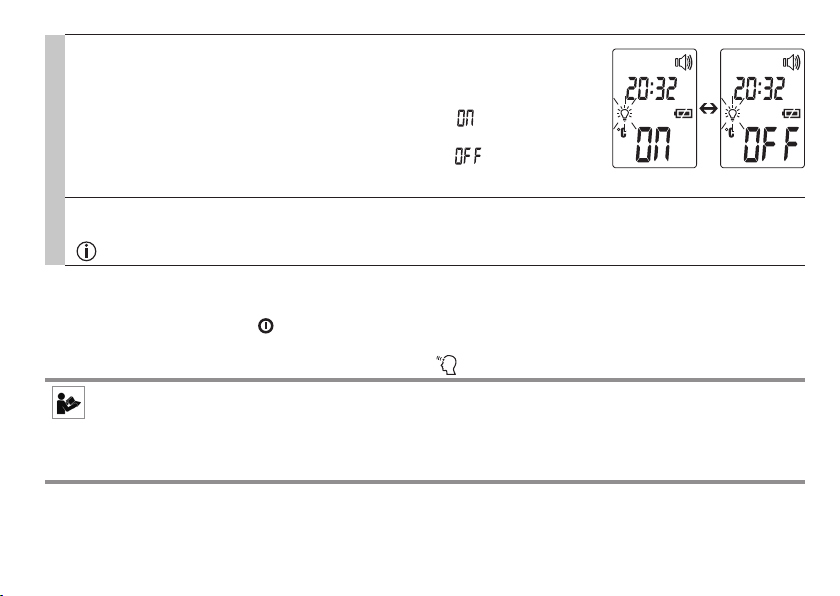
Time
The time flashes in the display (fig. 4).
•
U
se the MODE/MEM button to set the time and confirm with the LIGHT/
SET button.
In the 12h format, the time is displayed as AM/PM.
Fig. 4
Temperature meas. unit
The temperature measurement unit flashes in the display (fig. 5).
You can set the device to display the temperature in degrees Celsius (°C) or
degrees Fahrenheit (°F).
•
T
o display the temperature in Celsius, select °C using the MODE/MEM but-
ton and confirm with the LIGHT/SET button.
• T
o display the temperature in Fahrenheit, select °F using the MODE/MEM
button and confirm with the LIGHT/SET button.
Fig. 5
Acoustic signal
The acoustic signal symbol flashes in the display (fig. 6).
You can activate/deactivate the acoustic signals (device activation, measure-
ment in progress, measurement completion).
•
T
o activate the acoustic signals, select using the MODE/MEM button and
confirm with the LIGHT/SET button.
•
T
o deactivate the acoustic signals, select using the MODE/MEM button
and confirm with the LIGHT/SET button.
Fig. 6
31
Illuminated display
The light symbol flashes in the display (fig. 7).
You can activate or deactivate the automatic illuminated display (appears fol
-
lowing forehead temperature measurement).
•
T
o activate the automatic illuminated display, select using the MODE/
MEM button and confirm with the LIGHT/SET button.
•
T
o deactivate the automatic illuminated display, select using the MODE/
MEM button and confirm with the LIGHT/SET button.
Fig. 7
You can also activate the illuminated display manually by briefly pressing the LIGHT/SET button.
The display lights up for 5 seconds.
The automatic and manual illuminated display cannot be used while measurement is in progress.
8. Forehead measurement
Briefly press the On/Off button .
After a brief self-test and two short beeps the device is ready for forehead temperature measurement. The device
is in forehead temperature mode. This is indicated by the symbol.
Beurer tip
Remember that
• p
hysical activity, increased perspiration on the forehead, taking vasoconstrictive medication and skin
irritations can distort the result,
• t
he forehead, or the temples, must be free from perspiration and cosmetics.
32
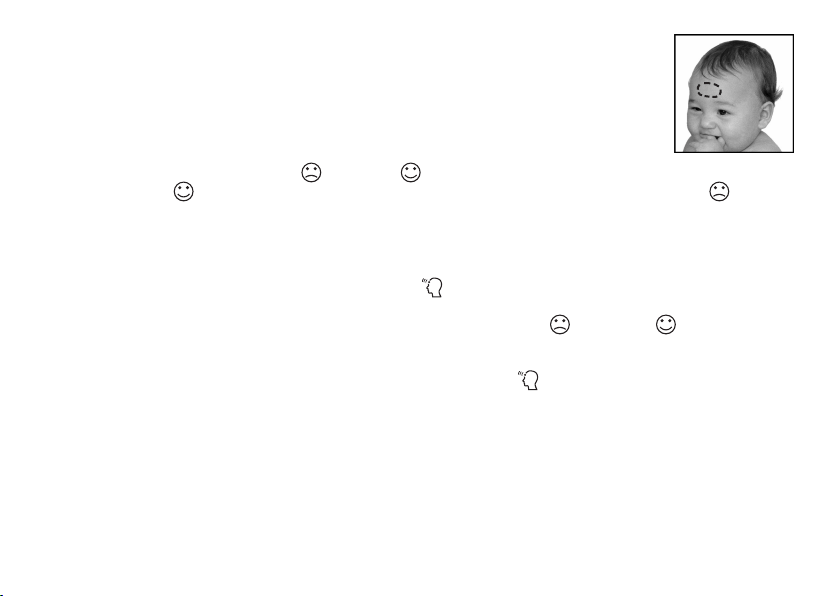
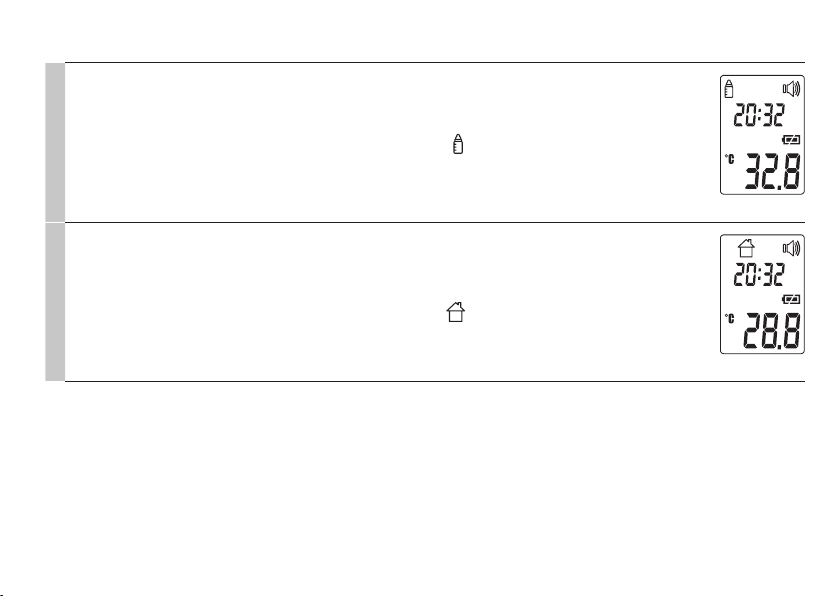
Hold the thermometer 2 to 3 cm from the measuring point. Press the SCAN button and move
the thermometer from side to side over the forehead area (fig. 8).
During measurement you will hear short beeps (only if the acoustic signal is activated), which
signal that the thermometer has found a new highest measurement.
End of measurement is signalled by a long beep.
Release the SCAN button.
You can now read the measured value.
In addition to the temperature, the fever or no fever symbols also appear in the display:
The no fever symbol indicates that the body temperature is within normal range; the fever symbol indicates
a measurement equal to or higher than 38°C (100.4°F), which triggers a temperature alarm.
If the acoustic signal is switched on, three beeps will sound once the measurement is complete if the temperature
is equal to or higher than 38°C (100.4 °F).
The measuring time is usually 2 seconds but may take up to 30 seconds.
When two short beeps sound and the forehead symbol stops flashing, the device is ready to take another
measurement.
The measurement is automatically saved with the date/time and the “fever”
/ “no fever” classification.
8.1 Displaying saved measurements
The device only stores measurements in forehead temperature mode . The device automatically stores the
values from the last 60 measurements.
When 60 storage places are exceeded the oldest value is deleted.
The memory can be called up as follows:
•
With the thermometer switched on, press and hold the MODE/MEM button for 5 seconds.
The most recent measurement is displayed.
•
W
ith each subsequent pressing of the MODE/MEM button, first the storage space number is displayed followed
by the measurement upon release.
• I
n the upper line, the time and date are displayed alternately.
Fig. 8
33
9. Measuring object temperature / room temperature
Object temperature mode
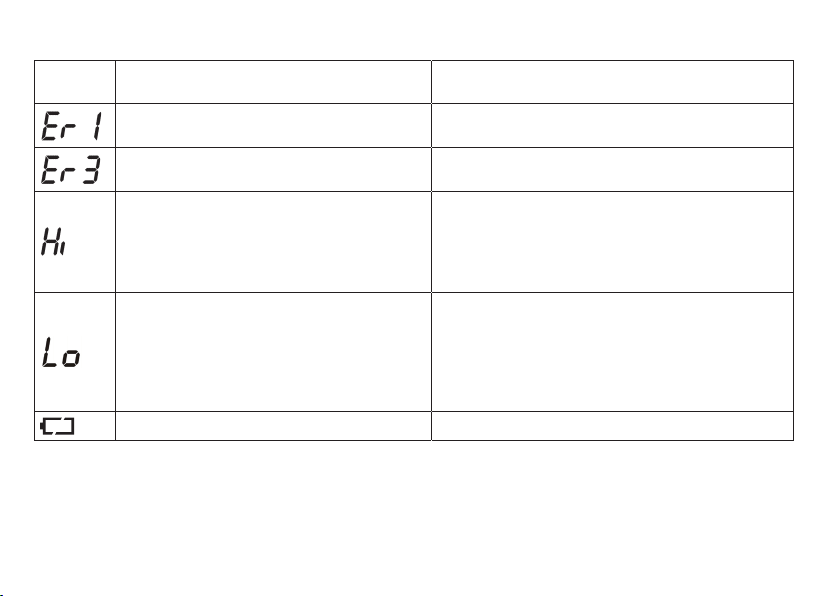
If you want to measure an object temperature with this thermometer, switch to object tem-
perature mode.
• W
ith the thermometer switched on, briefly press the MODE/MEM button.
The device switches to the object temperature mode .
• H
old the thermometer 2 to 3 cm from the measuring point. Briefly press the SCAN button
and read the temperature in the display (fig. 9).
Measurements taken in object temperature mode are not stored.
Fig. 9
Room temperature mode
If you want to use the thermometer to measure the room temperature you need to switch to
room temperature mode.
• W
ith the thermometer switched on, briefly press the MODE/MEM button twice.
The device switches to the room temperature mode .
• T
he room temperature is immediately displayed (fig. 10).
Measurements taken in room temperature mode are not stored.
Fig. 10
34
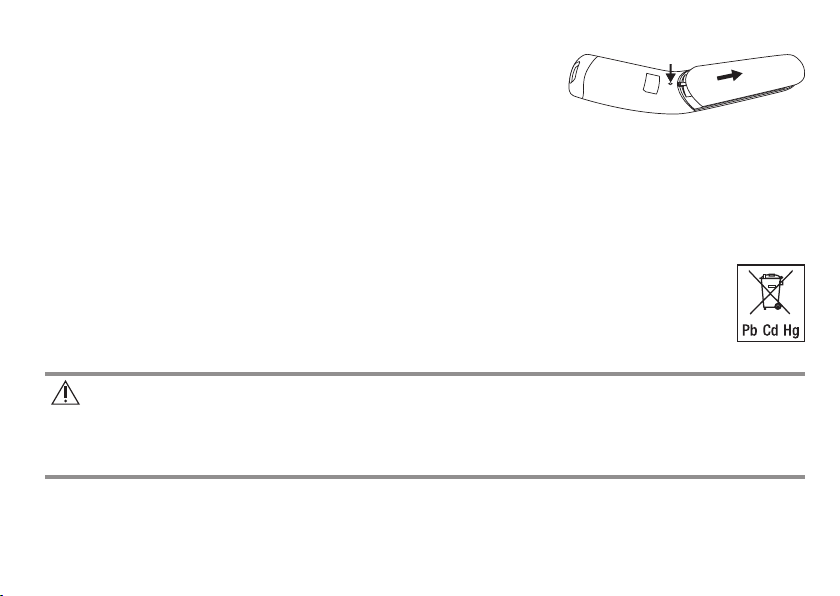
10. Error messages
Error
message
Problem Solution
Measurement during self-test, device not yet
ready for measurement.
Wait until the forehead symbol stops flashing.
Room temperature below 10 °C or
over 40 °C (<50 °F, >104 °F).
Room temperature must be between 10 °C and
40 °C (<50 °F, >104 °F).
(1) Forehead temperature mode: The tem-
perature recorded is higher than 42.2 °C
(108 °F).
(2) Object temperature mode: The tempera
-
ture recorded is higher than 80 °C (176 °F).
Operate the thermometer only between the speci
-
fied temperature ranges. In the event of a repeated
error message, contact your retailer or Customer
Services.
(1) Forehead temperature mode: The tem-
perature recorded is lower than 34 °C
(93.2 °F).
(2) Object temperature mode: The tem
-
perature recorded is lower than -22 °C
(-7.6 °F).
Operate the thermometer only between the speci
-
fied temperature ranges. In the event of a repeated
error message, contact your retailer or Customer
Services.
The batteries are empty. Replace the batteries.
35
11. Batteries
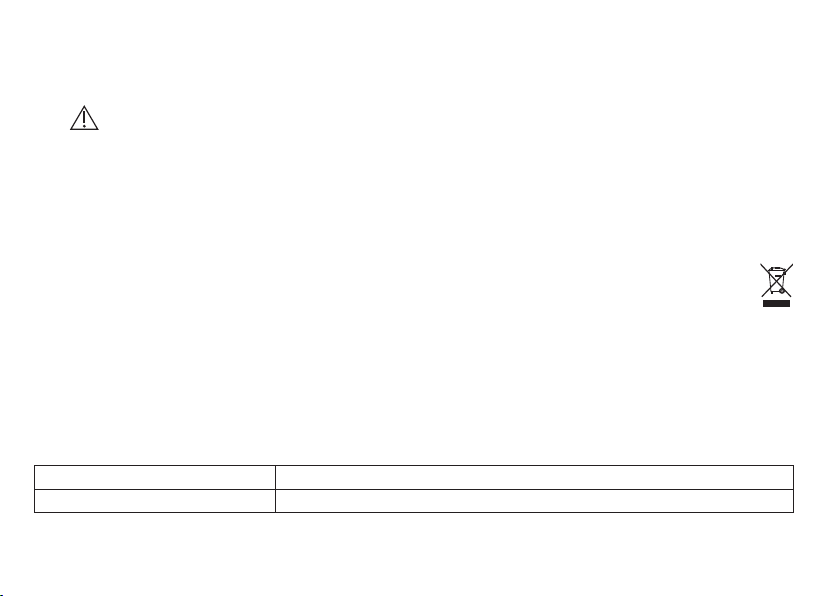
The device requires two AAA (LR03) batteries.
• O
pen the battery compartment.
Use a pointed object to press down on the battery compartment lock
and at the same time slide the battery compartment downwards.
• T
ake the used batteries out of the battery compartment.
• I
nsert new batteries.
Make sure that the batteries are inserted the right way round.
• C
lose the battery compartment.
• T
he empty, completely flat batteries must be disposed of through specially designated collection boxes, recy-
cling points or electronics retailers. You are legally required to dispose of the batteries.
• The codes below are printed on batteries containing harmful substances:
Pb = Battery contains lead,
Cd = Battery contains cadmium,
Hg = Battery contains mercury.
12. Cleaning the device
•
T
he measuring sensor is the most sensitive part of the thermometer. Take great care of the measuring
sensor when cleaning the device.
• D
o not use any harsh cleaning products.
• A
lways observe all safety notes for user and device.
w
3. Warnings and Safety
Clean the measuring sensor after each use. Use a clean cloth or cotton bud that can be moistened with disin
-
fectant or 70 % alcohol.
36
To clean the entire device, please use a soft cloth slightly moistened with a mild soapy solution. Under no circum-
stances may liquid enter the device.
Do not use the device again until it is completely dry.
13. Storing the device
The device must not be stored or used at an excessively high or low temperature or humidity (see technical specifi-
cations), in sunlight, in association with an electrical current or in dusty locations. Otherwise inaccuracies can occur.
If prolonged storage is planned, you should remove the batteries.
14. Disposing of the device
• F
or environmental reasons, do not dispose of the device in the household waste at the end of its useful life.
Dispose of the unit at a suitable local collection or recycling point. Dispose of the device in accordance
with EC Directive – WEEE (Waste Electrical and Electronic Equipment). If you have any questions, please
contact the local authorities responsible for waste disposal.
15. Technical Data
If the device is used other than in accordance with the specifications, perfect functioning cannot be guaranteed!
The accuracy of this thermometer has been carefully checked and developed with regard to a long useful life.
If using the device for commercial medical purposes, it must be regularly tested for accuracy by appropriate means.
Precise instructions for checking accuracy may be requested from the service address.
We reserve the right to make technical changes to improve and develop the product.
Type FT 90/1
Measurement method Non-contact infrared measurement
37
Basic functions Forehead temperature measurement
Object temperature measurement
Room temperature measurement
Measurement units Celsius (°C ) and Fahrenheit (°F)
Operating conditions 10 °C to 40 °C (50 °F to 104 °F) with a relative humidity of < 95 %
Storage conditions -20 °C to 50 °C (-4 °F to 122 °F) with a relative humidity of < 85 %
Measurement distance 2 to 3 cm from the measuring point
Measurement range and accuracy
of forehead temperature measure-
ment
Forehead temperature measurement
34 °C to 42.2 °C (93.2 °F to 108 °F)
Measurement accuracy 36 °C to 39 °C: ± 0.2 °C
(96.8 °F to 102 °F: ± 0.4 °F)
In the remaining measurement range ± 0.3 °C (± 0.5 °F)
Clinical repeat precision 0.23 °C (0.41 °F)
Measurement range and accuracy
Object temperature measurement
Object temperature measurement -22 °C to 80 °C (-7.6 °F to 176 °F)
Measurement accuracy ± 4% or ± 2 °C (± 4 °F)
Memory function
Body temperature measurement
Automatically stores the last 60measurements.
Acoustic signal With device activation, during measurement, when measurement is com
-
plete (can be set).
Display LCD display
Energy saving functions Device automatically switches off after 1 minute.
Dimensions
Width x depth x height
approx. 47.6 mm x 29.0 mm x 188.0 mm
38
Subject to errors and changes
Weight 82 g (without batteries)
2 x AAA (LR03) batteries Batteries last for approx. 3000 measurements
Activated functions such as acoustic signal or illuminated display also
reduce the battery life.
16. Guidelines
This device complies with the EU Directive 93/42/EEC concerning medical devices, the Medizinproduktegesetz,
the ASTM E 1965 - 98 and the European Standard EN60601-1-2 and is subject to particular precautions with
regard to electromagnetic compatibility.

39
Contenu
1. Symboles utilisés .............................................. 40
2. Application ........................................................ 41
3. Mises en garde et sécurité ............................... 42
3.1 Risques pour l’utilisateur ........................... 42
3.2 Risques pour l’appareil .............................. 42
3.3 Remarques relatives aux piles .................... 43
4. Informations concernant ce thermomètre ........ 43
5. Description de l’appareil ................................... 45
5.1 Description de l’affichage ........................... 47
6. Mise en service ................................................. 47
7. Allumer et régler le thermomètre ..................... 48
7.1 Régler les fonctions de base ...................... 48
8. Mesure sur le front ............................................ 50
8.1 Afficher les valeurs de mesure enregistrées 51
9. Mesure de la température d’objet / température
ambiante ........................................................... 52
10. Affichage des erreurs ........................................ 53
11. Piles ................................................................. 53
12. Nettoyer l’appareil ............................................. 54
13. Entreposer l’appareil ........................................ 55
14. Éliminer l’appareil.............................................. 55
15. Données techniques ......................................... 55
16. Directives ......................................................... 57
FRANÇAIS
Lisez attentivement cette notice, conservez-
la pour un usage ultérieur, mettez-la à dis-
position des autres utilisateurs et suivez les
consignes qui y figurent.
Chère cliente, cher client,
Nous vous remercions d’avoir choisi l’un de nos pro-
duits. Notre société est réputée pour l’excellence de ses
produits et les contrôles de qualité approfondis aux-
quels ils sont soumis dans les domaines suivants: cha-
leur, thérapie douce, diagnostic de pression artérielle,
contrôle de poids, massage et purification d’air.
Lisez attentivement ce mode d´emploi et respectez les
instructions d’utilisation.
Sincères salutations,
Votre équipe Beurer
Contenu
Vérifiez si l’emballage carton extérieur du kit est intact et
si tous les éléments sont inclus. Avant l’utilisation, assu-
rez-vous que l’appareil et les accessoires ne présentent
aucun dommage visible et que la totalité de l’emballage
a bien été retirée. En cas de doute, ne l’utilisez pas et
adressez-vous à votre revendeur ou au service client
indiqué.
40
• T
hermomètre médical
• 2
piles AAA, LR03
• B
oîte de rangement
• M
ode d’emploi
1. Symboles utilisés
Les pictogrammes suivants sont employés dans ce mode d’emploi et sur l’appareil:
AVERTISSEMENT
Ce symbole vous avertit des risques de blessures ou des dangers pour votre santé.
ATTENTION
Ce symbole vous avertit des éventuels dommages au niveau de l’appareil ou d’un accessoire.
Remarque
Ce symbole indique des informations importantes.
Respectez les consignes du mode d’emploi
Appareil de type BF
Élimination conformément à la directive européenne WEEE (Waste Electrical and Electronic
Equipment) relative aux déchets d’équipements électriques et électroniques
Le sigle CE atteste de la conformité aux exigences fondamentales de la directive 93/42/EEC
relative aux dispositifs médicaux.
Fabricant
41
Storage
Température et taux d’humidité de stockage admissibles
Operating
Température et taux d’humidité d’utilisation admissibles
Protéger contre l’humidité
S
N
Numéro de série
Informations importantes/conseils
w
Renvoi à un autre paragraphe.
Marque de certification pour les produits, qui sont exportés en Fédération de Russie et dans
les pays de la CEI
2. Application
Ce thermomètre médical permet la mesure de la température du front, d‘objets et d‘air ambiant. Le thermomètre
est adapté aux mesures à domicile. Vous pouvez connaître rapidement et simplement votre température corpo
-
relle. Les valeurs s’enregistrent automatiquement.

42
3. Mises en garde et sécurité
3.1 Risques pour l’utilisateur
• N
’utilisez pas l’appareil avant d’avoir lu et compris le présent mode d’emploi.
•
C
onservez ce mode d’emploi. Tous les utilisateurs doivent avoir accès à ce mode d’emploi. Toutes les remarques
doivent être respectées.
• P
lacez l’appareil au moins 30 minutes avant la mesure dans la pièce dans laquelle la mesure sera effectuée.
•
L
e thermomètre FT 90 est conçu uniquement pour les points de mesure du corps humain décrits dans le mode
d’emploi.
• L
’appareil est conçu exclusivement pour l’utilisation décrite dans ce mode d’emploi.
• L
es enfants ne doivent pas utiliser l’appareil. Un produit médical n’est pas un jouet.
• A
vant chaque utilisation, vérifiez que la lentille est intacte. Si elle est endommagée, veuillez vous adresser au
vendeur ou au service après vente.
• L
’appareil a été conçu pour une utilisation pratique mais ne remplace pas une visite chez le médecin.
• P
our toute question concernant l’utilisation de cet appareil, adressez-vous à votre revendeur ou à notre ser-
vice clients.
3.2 Risques pour l’appareil
• N
e soumettez l’appareil à aucun choc mécanique.
• N
’exposez pas l’appareil à la lumière directe du soleil.
• N
e soumettez l’appareil à aucun liquide. L’appareil n’est pas étanche. Évitez tout contact direct avec l’eau ou
d’autres liquides.
• N
e faites réparer l’appareil que dans un centre de service autorisé, sous peine d’annulation de la garantie.
•
Les dispositifs de communication HF portables et mobiles sont susceptibles d’influer sur cet appareil. Pour des
détails plus précis, veuillez contacter le service après-vente à l’adresse mentionnée ou vous reporter à la fin du
mode d’emploi.
43
3.3 Remarques relatives aux piles
• S
i du liquide de la cellule de pile entre en contact avec la peau ou les yeux, rincez la zone touchée avec de
l’eau et consultez un médecin.
•
Risque d’ingestion ! Les enfants en bas âge pourraient avaler des piles et s’étouffer. Veuillez donc conser-
ver les piles hors de portée des enfants en bas âge !
• R
espectez les signes de polarité plus (+) et moins (-).
• S
i la pile a coulé, enfilez des gants de protection et nettoyez le compartiment à piles avec un chiffon sec.
• P
rotégez les piles d’une chaleur excessive.
•
Risque d’explosion ! Ne jetez pas les piles dans le feu.
• L
es piles ne doivent être ni rechargées, ni court-circuitées.
• E
n cas de non utilisation prolongée de l’appareil, sortez les piles du compartiment à piles.
• U
tilisez uniquement des piles identiques ou équivalentes.
• R
emplacez toujours l’ensemble des piles simultanément.
• N
’utilisez pas d’accumulateur !
• N
e démontez, n’ouvrez ou ne cassez pas les piles.
4. Informations concernant ce thermomètre
La valeur de la température mesurée varie selon l’endroit du corps ou elle est prise. Chez les personnes en bonne
santé, la variation peut être comprise entre 0,2 °C et 1 °C (0,4 °F à 1,8 °F) à divers endroits du corps.
Plages de température normale entre différents thermomètres
Valeurs de température Thermomètre utilisé
Température frontale
35,8 °C à 37,6 °C (96,4 °F à 99,7 °F) Thermomètre frontal
Température auriculaire
36,0 °C à 37,8 °C (96,8 °F à 100,0 °F) Thermomètre auriculaire
44
Valeurs de température Thermomètre utilisé
Température orale
36,0 °C à 37,4 °C (96,8 °F à 99,3 °F) Thermomètre ordinaire
Température rectale
36,3 °C à 37,8 °C (97,3 °F à 100,0 °F) Thermomètre ordinaire
Conseil Beurer
• N
e comparez jamais des températures prises avec des thermomètres différents.
•
I
ndiquez à votre médecin avec quel thermomètre vous avez mesuré la température corporelle et à quel
endroit du corps. Tenez-en également compte lors d’un autodiagnostic.
Le thermomètre peut se réchauffer s’il est gardé trop longtemps en main avant la prise de température.
Cela peut fausser le résultat de l’opération.
Éléments influant la température corporelle
• M
étabolisme individuel propre à chaque personne
• Â
ge
Chez les nourrissons et les enfants en bas âge, la température corporelle est plus élevée que chez les adultes.
Chez les enfants, des variations de température plus importantes se produisent plus rapidement et fréquemment.
Avec l’âge, la température corporelle normale diminue.
• V
êtements
• T
empérature extérieure
• M
oment de la journée
Le matin, la température corporelle est plus basse et monte au cours de la journée jusqu’au soir.
• A
ctivités
Les activités physiques et, dans une moindre mesure, les activités cérébrales augmentent la température corporelle.
45
Conseil Beurer
La mesure de la température corporelle donne une valeur de mesure actuelle pour une personne. Si vous
n’êtes pas certain de l’interprétation des résultats ou obtenez des valeurs anormales (par ex: fièvre),
consultez votre médecin traitant. Ceci s’applique aussi en cas de légères variations de température lorsque
d’autres symptômes de maladie s’y ajoutent, par ex. agitation, forte transpiration, rougeurs, fréquence
cardiaque élevée, collapsus cardio-vasculaire, etc.
5. Description de l’appareil
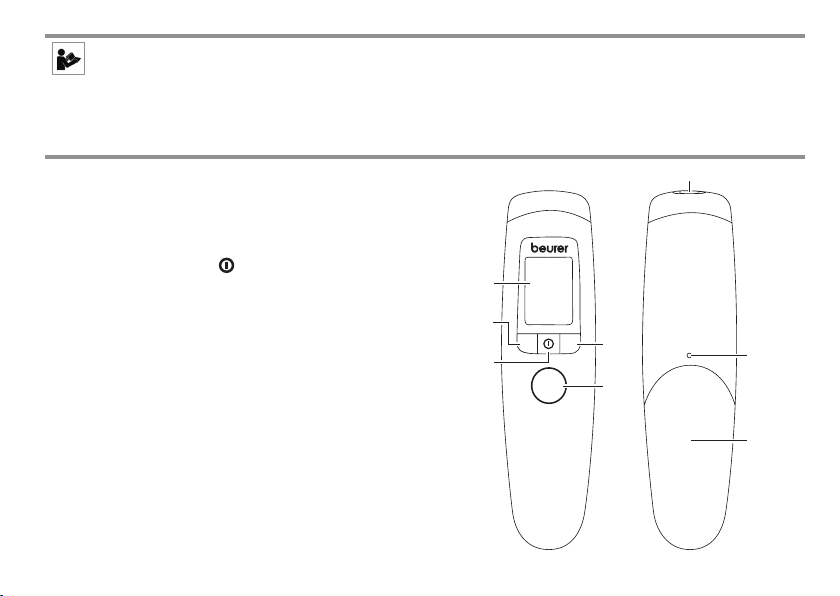
1
Écran
2
Touche MODE/MEM
3
Touche marche/arrêt
4
Touche LIGHT/SET
5
Touche SCAN
6
Capteur de mesure
7
Déverrouillage du compartiment à
piles
8
Couvercle du compartiment à piles
SCAN
MODE
ME M
LIGH T
SE T
1
3
2
4
5
6
7
8
46
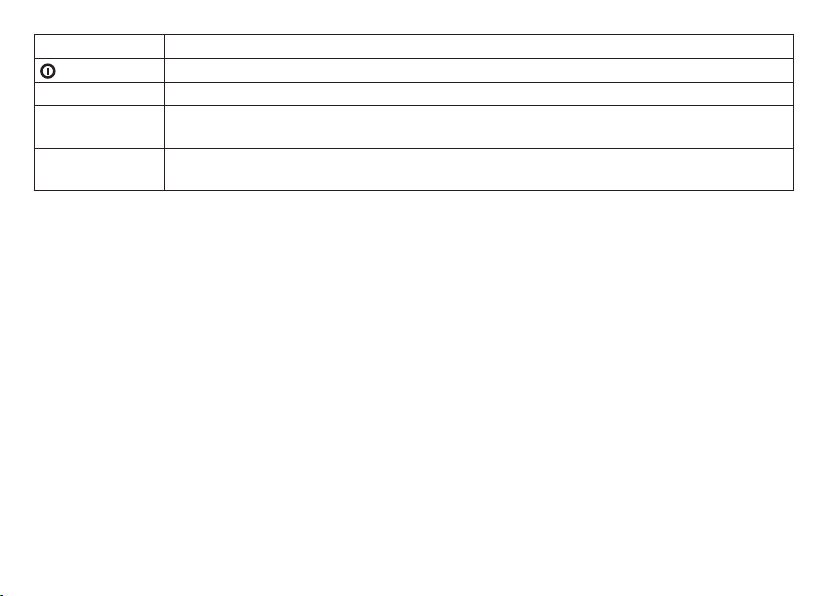
Touches Fonctions
Allumer et éteindre l’appareil.
SCAN Démarrer la mesure de la température.
MODE/MEM
MODE Réglage du mode de mesure.
MEM Affichage des valeurs de mesure enregistrées.
LIGHT/SET
LIGHT Activation manuelle de l’éclairage de l’écran.
SET Réglage des fonctions de base.
47
5.1 Description de l’affichage
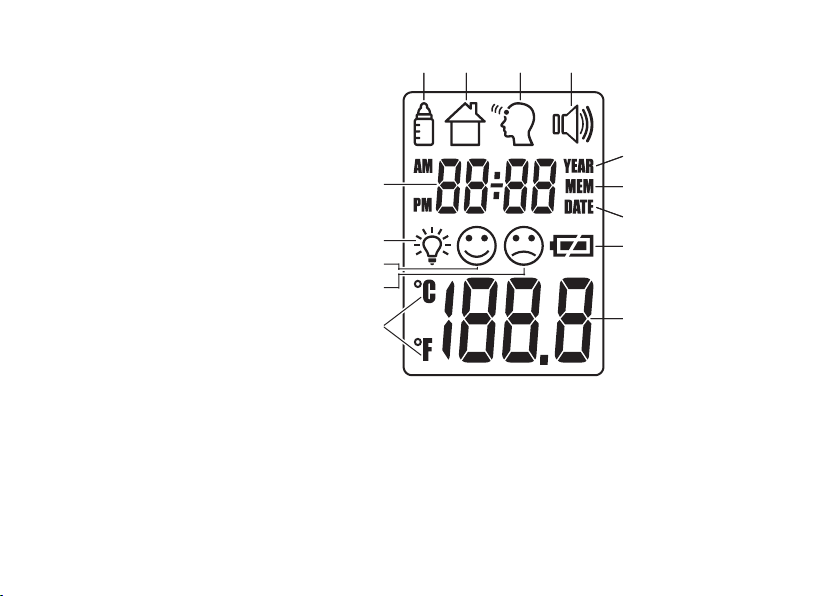
1
Mode température d’objet
12 34
5
6
7
8
9
10
11
12
13
14
2
Mode Température ambiante
3
Mode Température frontale
4
Symbole de signal sonore
5
Année
6
Fonction d’enregistrement
7
Date
8
État des piles
9
Affichage de la valeur de la température/du
numéro de l’emplacement de sauvegarde
10
Unité de mesure Celsius/Fahrenheit
11
Résultat de la mesure ≥ 38,0°C «fièvre»
12
Résultat de la mesure < 38,0°C «pas de
fièvre»
13
Symbole d’éclairage de l’écran
14
Affichage de l’année/date/heure
6. Mise en service
Tirez éventuellement sur la languette isolante de la pile sur le couvercle du compartiment à piles ou retirez le
film de protection de la pile et introduisez-la en respectant la polarité.
w
11. Piles
Après un bref auto-test et deux bips courts, le thermomètre est prêt à mesurer la température au niveau du front.
48
7. Allumer et régler le thermomètre
Appuyez brièvement sur la touche marche/arrêt .
Après un bref auto-test et deux bips courts, le thermomètre est prêt à mesurer la température au niveau du front.
L’appareil démarre en mode Température frontale
.
7.1 Régler les fonctions de base
Dans ce menu, vous avez la possibilité de régler individuellement les fonctions suivantes.
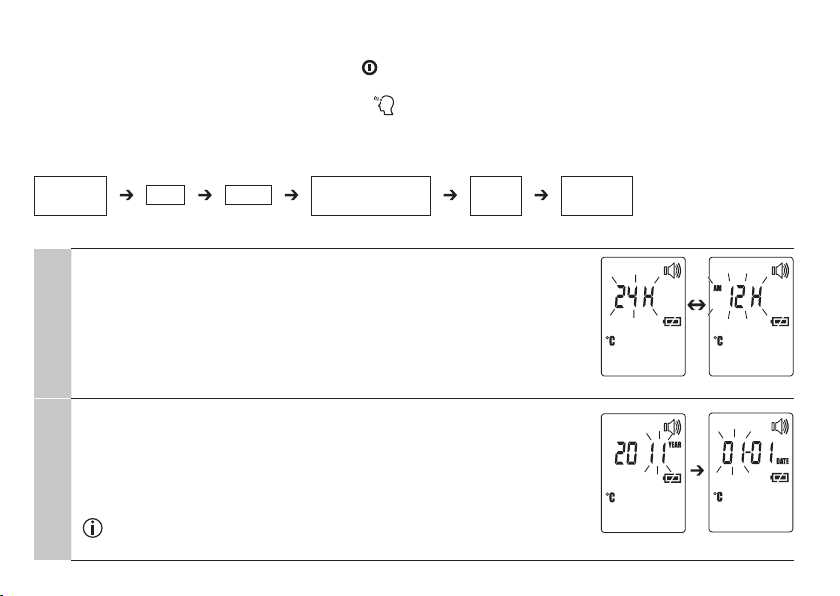
Format de l’heure
•
M
aintenez la touche LIGHT/SET enfoncée pendant 5 secondes quand le
thermomètre est allumé.
L’affichage du format de l’heure clignote à l’écran (Fig. 1).
• A
vec la touche MODE/MEM, réglez le format de l’heure souhaité et con-
firmez avec la touche LIGHT/SET.
Fig.1
Date
L’année clignote à l’écran (Fig. 2).
• A
vec la touche MODE/MEM, réglez l’année et confirmez avec la touche
LIGHT/SET.
Le jour/mois clignote à l’écran (Fig. 3).
• A
vec la touche MODE/MEM, réglez le jour et le mois et confirmez avec
la touche LIGHT/SET.
Au format 24h, la date s’affiche sous forme jour/mois. Au format 12h,
sous forme mois/jour.
Fig.3
Fig.2
Unité de mesure
de la température
Éclairage
de l’écran
Format de
l’heure
Date Heure
Signal
sonore
49
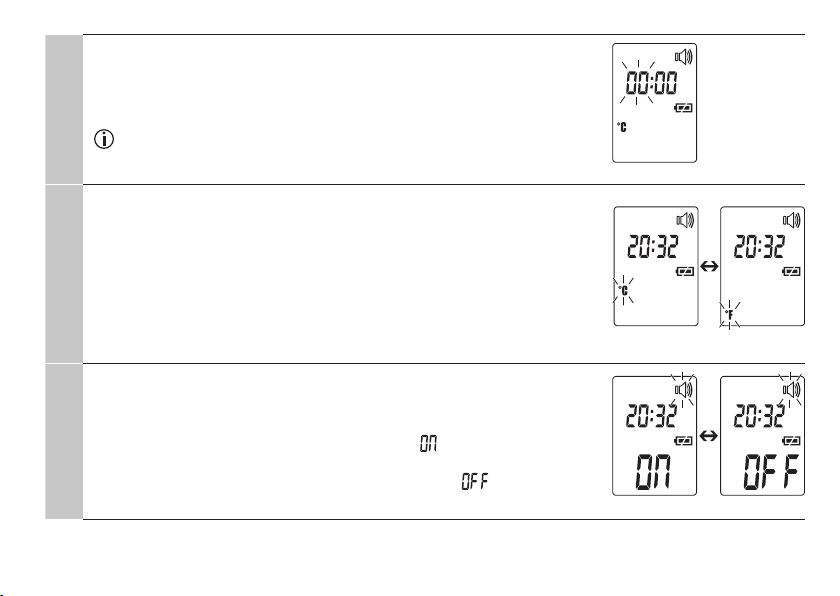
Heure
L’heure clignote à l’écran (Fig. 4).
• A
vec la touche MODE/MEM, réglez l’heure et confirmez avec la touche
LIGHT/SET.
Au format 12h, l’heure s’affiche avec AM/PM.
Fig.4
Unité de mesure de la tem-
pérature
L’unité de mesure de la température clignote à l’écran (Fig. 5).
Vous pouvez afficher vos résultats de mesure dans l’unité de mesure de la
température degrés Celsius (°C) ou degrés Fahrenheit (°F).
•
P
our afficher les résultats de mesure en Celsius, choisissez °C avec la
touche MODE/MEM et confirmez avec la touche LIGHT/SET.
• P
our afficher les résultats de mesure en Fahrenheit, choisissez °F avec la
touche MODE/MEM et confirmez avec la touche LIGHT/SET.
Fig.5
Signal sonore
Le symbole du signal sonore clignote à l’écran (Fig. 6).
Vous pouvez activer ou désactiver les signaux sonores (activation de l’appa-
reil, pendant la mesure, fin de la mesure).
•
P
our activer les signaux sonores, choisissez avec la touche MODE/
MEM et confirmez avec la touche LIGHT/SET.
•
P
our désactiver les signaux sonores, choisissez avec la touche
MODE/MEM et confirmez avec la touche LIGHT/SET.
Fig.6
50
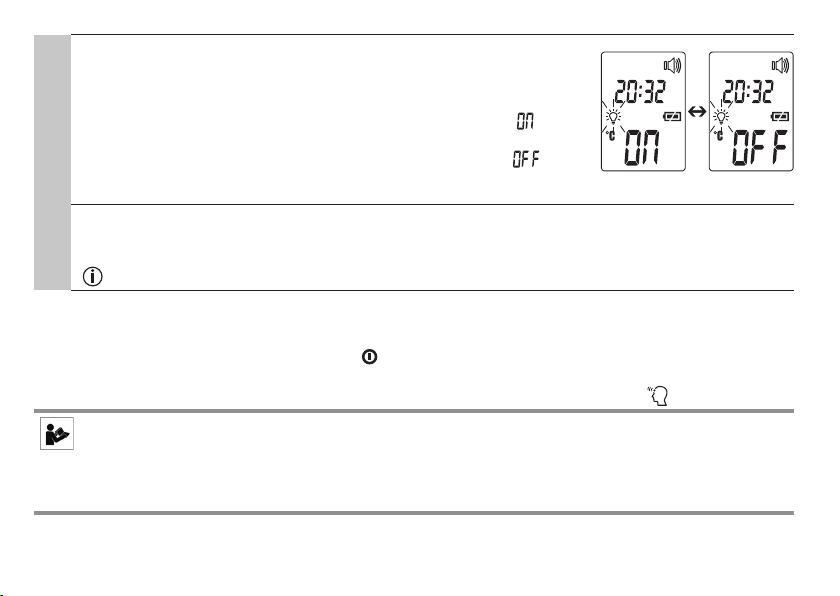
Éclairage de l’écran
Le symbole de la lumière clignote à l’écran (Fig. 7).
Vous pouvez activer ou désactiver l’éclairage automatique de l’écran (s’af
-
fiche après la mesure de la température frontale).
•
P
our activer l’éclairage automatique de l’écran, choisissez avec la
touche MODE/MEM et confirmez avec la touche LIGHT/SET.
•
P
our désactiver l’éclairage automatique de l’écran, choisissez avec la
touche MODE/MEM et confirmez avec la touche LIGHT/SET.
Fig.7
Vous pouvez également activer manuellement l’éclairage de l’écran en appuyant brièvement sur la
touche LIGHT/SET.
L’écran s’allume 5 secondes.
L’éclairage automatique et manuel de l’écran ne peut pas être utilisé pendant la mesure.
8. Mesure sur le front
Appuyez brièvement sur la touche marche/arrêt .
Après un bref auto-test et deux bips courts, l’appareil est prêt à mesurer la température au niveau du front. L’appa-
reil se trouve toujours en mode Température frontale. Ceci est reconnaissable au symbole .
Conseil Beurer
Notez que
• l
’activité physique, une formation accrue de transpiration sur le front, la prise de médicaments vaso-
constricteurs et les irritations cutanées peuvent fausser le résultat de la mesure,
• l
e front ou les tempes doivent être exempts de transpiration et de cosmétiques.
51
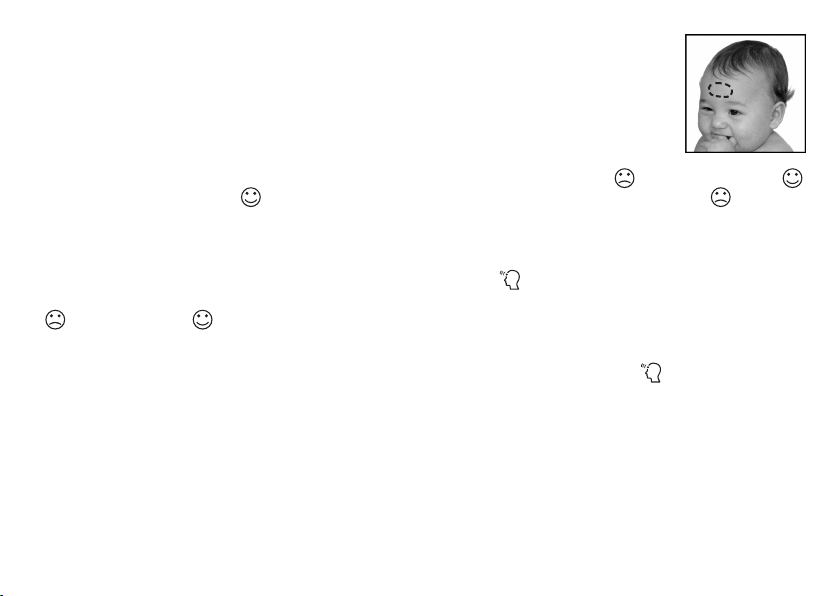
Tenez le thermomètre 2 à 3cm devant le lieu de mesure. Appuyez sur la touche SCAN et
passez le thermomètre sur la zone du front en faisant des allers-retours (Fig. 8).
Au cours de la mesure, vous pouvez entendre des bips brefs (uniquement si le signal sonore
est activé) qui indiquent que le thermomètre a trouvé une nouvelle mesure maximale.
La fin du temps de mesure est signalée par un long bip.
Relâchez la touche SCAN.
Vous pouvez à présent lire la valeur mesurée.
De plus, en fonction du résultat de la mesure, l’écran affiche les symboles «fièvre»
ou «pas de fièvre»:
Le symbole «pas de fièvre» indique une température corporelle normale, le symbole «fièvre» une valeur
de mesure supérieure ou égale à 38,0°C, c’est-à-dire une alerte de fièvre.
À la fin de la mesure, un signal sonore et trois bips retentissent si la température est supérieure ou égale à 38°C.
Le temps de mesure est normalement de 2secondes, mais il peut aussi durer jusqu’à 30secondes.
L’appareil indique avec deux bips brefs et un symbole de front fixe
qu’il est prêt à prendre une autre mesure.
La valeur mesurée est automatiquement enregistrée avec la date et l‘heure ainsi que la classification «fièvre»
/ «pas de fièvre»
8.1 Afficher les valeurs de mesure enregistrées
L’appareil enregistre exclusivement les valeurs de mesure en mode Température frontale . L’appareil enregistre
automatiquement les valeurs des 60 dernières mesures.
Si les 60 emplacements de mémoire sont dépassés, la valeur la plus ancienne est supprimée.
La mémoire peut être appelée comme suit:
•
M
aintenez la touche MODE/MEM enfoncée pendant 5 secondes quand le thermomètre est allumé.
La dernière valeur de mesure est affichée.
• À
chaque nouvelle pression de la touche MODE/MEM, le numéro de mémoire s’affiche d’abord, puis la valeur
de mesure quand vous relâchez la touche.
• L
’heure et la date s’affichent à tour de rôle dans la ligne supérieure.
Fig. 8
52
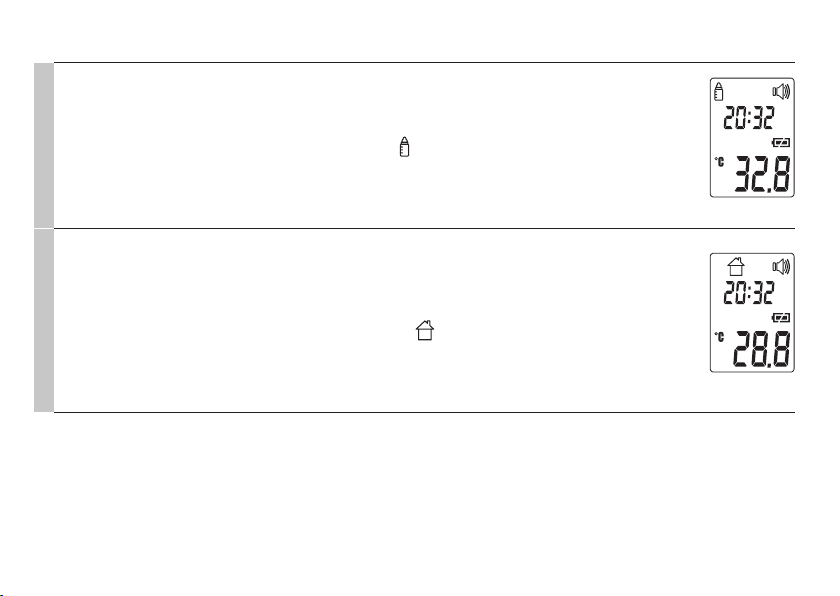
9. Mesure de la température d’objet / température ambiante
Mode température d’objet
Si vous voulez mesurer la température d’un objet avec ce thermomètre, vous devez passer au
mode Température d’objet.
•
P
our cela, appuyez brièvement sur la touche MODE/MEM sur le thermomètre allumé.
L’appareil passe en mode Température d’objet .
• T
enez le thermomètre 2 à 3cm devant le lieu de mesure souhaité. Appuyez brièvement sur
la touche SCAN et lisez la température sur l’écran (Fig. 9).
En mode Température d’objet, les valeurs de mesure ne sont pas enregistrées.
Fig.9
Mode Température ambiante
Si vous voulez utiliser le thermomètre pour mesurer la température ambiante, vous devez pas-
ser au mode Température ambiante.
•
P
our cela, appuyez deux fois brièvement sur la touche MODE/MEM sur le thermomètre allumé.
L’appareil passe en mode Température ambiante .
• L
a température ambiante s’affiche directement (Fig. 10).
En mode Température ambiante, les valeurs de mesure ne sont pas enregistrées.
Fig.10
53
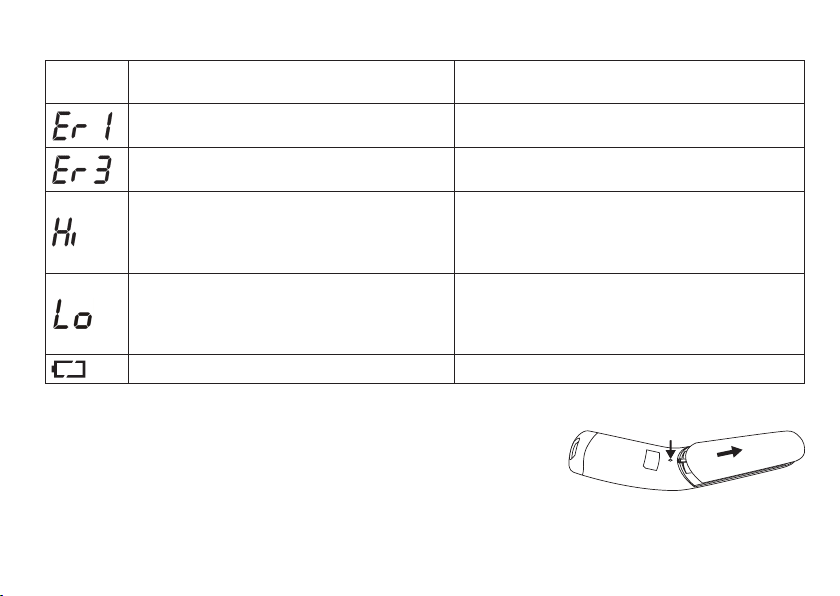
10. Affichage des erreurs
Message
d’erreur
Problème Solution
Mesure pendant l’auto-test, appareil pas encore
prêt à la mesure.
Attendre que le symbole du front ne clignote plus.
Température ambiante inférieure à 10 °C ou
supérieure à 40 °C (<50 °F, >104 °F).
La température ambiante doit être comprise entre
10 °C et 40 °C (50 °F, 104 °F).
(1) Mode Température frontale: la température
indiquée est supérieure à 42,2 °C (108 °F).
(2) Mode Température d’objet: la température
indiquée est supérieure à 80 °C (176 °F).
Utilisez le thermomètre uniquement dans les plages
de température indiquées. En cas d’affichages d’er-
reur répétés, consultez le revendeur ou le service
client.
(1) Mode Température frontale: la température
indiquée est inférieure à 34 °C (93,2 °F).
(2) Mode Température d’objet: la température
indiquée est inférieure à -22 °C (-7,6 °F).
Utilisez le thermomètre uniquement dans les plages
de température indiquées. En cas d’affichages d’er-
reur répétés, consultez le revendeur ou le service
client.
Les piles sont usées. Changez les piles.
11. Piles
L’appareil fonctionne avec deux piles, de type AAA, LR03.
• O
uvrez le compartiment à piles.
Pour cela, appuyez avec un objet pointu sur le déverrouillage du com-
partiment à piles et glissez en même temps le compartiment à piles vers
le bas.
• R
etirez les piles usées du compartiment.
54
• I
nsérez les nouvelles.
Faites attention à ce qu’elles soient positionnées dans le bon sens.
• F
ermez le compartiment à piles.
• L
es piles usagées et complètement déchargées doivent être mises au rebut dans des conteneurs spéciaux ou
aux points de collecte réservés à cet usage ou bien déposées chez un revendeur d’appareils électriques. L’élim-
ination des piles est une obligation légale qui vous incombe.
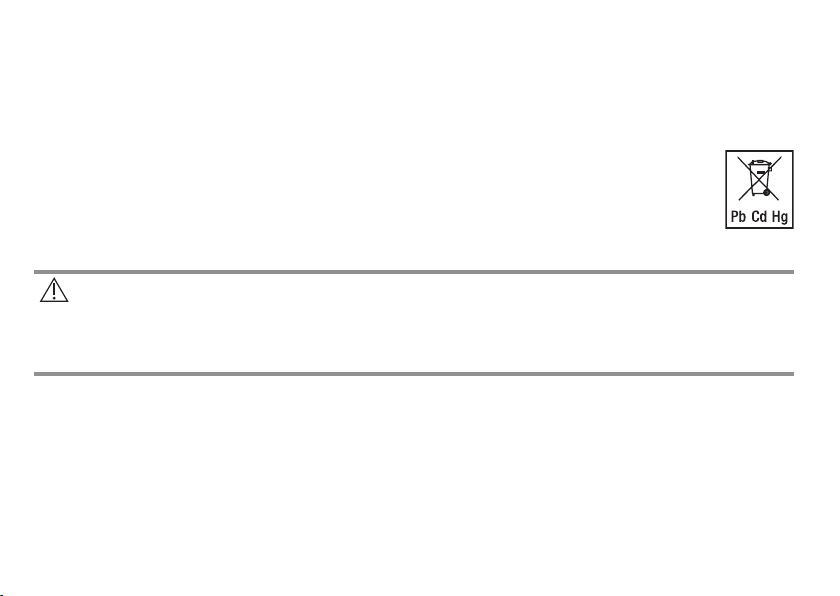
• Ces pictogrammes se trouvent sur les piles à substances nocives:
Pb = pile contenant du plomb,
Cd = pile contenant du cadmium,
Hg = pile contenant du mercure.
12. Nettoyer l’appareil
• L
e capteur de mesure est la partie la plus sensible du thermomètre. Manipulez-le avec le plus grand
soin lors du nettoyage.
• N
’utilisez pas de produits nettoyants agressifs.
• S
uivez toujours toutes les consignes de sécurité pour l’utilisateur et l’appareil.
w
3. Mises en garde et sécurité
Nettoyez le capteur de mesure après chaque utilisation. Pour cela, utilisez un chiffon doux ou un bâtonnet ouaté
qui peut être humidifié avec du désinfectant ou de l’alcool à 70 %.
Pour nettoyer l’appareil entier, veuillez utiliser un chiffon doux légèrement humidifié avec de la lessive douce. En
aucun cas de l’eau ne doit pénétrer dans l’appareil.
Ne réutilisez l’appareil que lorsqu’il est tout à fait sec.
55
13. Entreposer l’appareil
L’appareil ne doit pas être stocké ou utilisé sous des températures ou une humidité de l’air trop élevées ou trop
basses (voir spécifications techniques), à la lumière du soleil, connecté au courant électrique ou dans des endroits
poussiéreux. Sinon, cela pourrait entraîner des imprécisions de mesure.
Si vous prévoyez un stockage prolongé, retirez la pile.
14. Éliminer l’appareil
• D
ans l‘intérêt de la protection de l‘environnement, l‘appareil ne doit pas être jeté avec les ordures ménagères
à la fin de sa durée de service. L’élimination doit se faire par le biais des points de collecte compétents dans
votre pays. Veuillez éliminer l’appareil conformément à la directive européenne – WEEE (Waste Electrical
and Electronic Equipment) relative aux appareils électriques et électroniques usagés. Pour toute question,
adressez-vous aux collectivités locales responsables de l’élimination et du recyclage de ces produits.
15. Données techniques
En cas d’utilisation de l’appareil en dehors des spécifications, un fonctionnement irréprochable ne peut pas être
garanti!
La précision de ce thermomètre a été correctement testée et sa durabilité a été conçue en vue d‘une utilisation
à long terme.
Dans le cadre d‘une utilisation médicale de l‘appareil, des contrôles techniques de mesure doivent être menés
avec les moyens appropriés. Pour obtenir des données précises sur la vérification de la précision de l‘appareil,
vous pouvez faire une demande par courrier au service après-vente.
Nous nous réservons le droit d’effectuer des modifications techniques pour améliorer et faire évoluer le produit.
Type FT 90/1
Mode de mesure Mesure par infrarouge sans contact
56
Fonctions de base Mesure de la température frontale
Mesure de la température d’objet
Mesure de la température ambiante
Unités de mesure Celsius (°C) ou Fahrenheit (°F)
Conditions d’utilisation 10 °C à 40 °C (50 °F à 104 °F) avec une humidité de l’air relative < 95 %
Environnement de conservation -20 °C à 50 °C (-4 °F à 122 °F) avec une humidité de l’air relative < 85 %
Distance de mesure 2 à 3cm de distance avec la zone de mesure
Plages de mesure et précision de
la mesure de la température fron
-
tale
Mesure de la température frontale 34 °C à 42,2 °C (93,2 °F à 108 °F)
Précision 36 °C à 39 °C: ± 0,2 °C (96,8 °F à 102 °F: ± 0,4 °F)
Dans la plage de mesure restante ± 0,3 °C (± 0,5 °F)
Reproductibilité en usage clinique
0,23 °C (0,41 °F)
Plages de mesure et précision
Mesure de la température d’objet
Mesure de la température d’objet -22 °C à 80 °C (-7,6 °F à 176 °F)
Précision ± 4% ou ± 2 °C (± 4 °F)
Fonction d’enregistrement
Mesure de la température corpo
-
relle
Enregistre automatiquement les 60 dernières valeurs de mesure.
Signal sonore Lors de l’allumage de l’appareil, pendant la mesure, à la fin de la mesure
(réglable).
Affichage Affichage LCD
Fonctions d’économie d’énergie L’appareil s’éteint automatiquement après 1minute.
Dimensions
Largeur x profondeur x hauteur
env. 47,6mm x 29,0mm x 188,0mm
Poids 82g (sans les piles)
57
Sous réserve d’erreurs et de modifications
2 piles AAA, LR03 Utilisation pour environ 3000mesures
Les fonctions supplémentaires activées comme le signal sonore ou l’éclai
-
rage de l’écran réduisent la durée de vie des piles.
16. Directives
L’appareil est conforme aux exigences de la directive européenne 93/42/EEC sur les produits médicaux, de la loi
sur les produits médicaux, de la norme ASTM E 1965 - 98 et de la norme européenne EN60601 -1-2 et répond
aux exigences de sécurité spéciales relatives à la compatibilité électromagnétique.

58
Contenido
1. Símbolos ........................................................... 59
2. Utilización ......................................................... 60
3. Advertencias y Seguridad ................................ 61
3.1 Peligros para el usuario .............................. 61
3.2 Peligro para el aparato ............................... 61
3.3
Indicaciones para la manipulación de pilas
. 62
4.
Factores que influyen en la temperatura corporal
. 63
5. Descripción del aparato .................................... 65
5.1 Descripción de la pantalla .......................... 66
6. Puesta en funcionamiento ................................ 66
7. Encendido y ajuste del termómetro ................. 67
7.1 Ajustar las funciones básicas ..................... 67
8. Medición en la frente ........................................ 70
8.1 Indicar valores de medición guardados ..... 71
9. Medición de la temperatura objeto / temperatura
ambiente ........................................................... 71
10. Visualización de errores .................................... 72
11. Pilas ................................................................. 73
12. Limpieza del aparato.........................................74
13. Almacenamiento del aparato ........................... 74
14. Desecho del aparato ......................................... 74
15. Datos técnicos .................................................. 75
16. Directrices ........................................................ 76
ESPAÑOL
Lea atentamente estas instrucciones de uso,
consérvelas para su futura utilización, pón-
galas a disposición de otros usuarios y res-
pete las indicaciones.
Estimada clienta, estimado cliente:
Nos alegramos de que haya elegido un producto de
nuestra colección. Nuestro nombre es sinónimo de pro-
ductos de calidad de primera clase sometidos a un rigu-
roso control en los ámbitos del calor, las terapias no
agresivas, la tensión arterial/el diagnóstico, el peso, los
masajes y el aire.
Lea detenidamente las instrucciones de uso y tenga en
cuentas las indicaciones.
Atentamente,
El equipo de Beurer
Artículos suministrados
Compruebe que el envoltorio de los artículos suminis-
trados esté intacto y que su contenido esté completo.
Antes de utilizar el aparato deberá asegurarse de que
ni este ni los accesorios presentan daños visibles y de
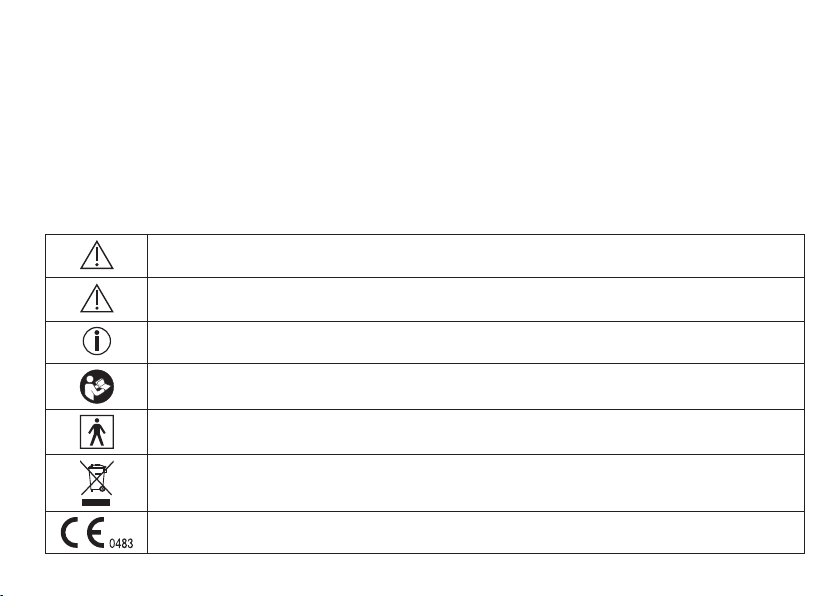
59
que se retira el material de embalaje correspondiente. En caso de duda no lo use y póngase en contacto con su
distribuidor o con la dirección de atención al cliente indicada.
• T
ermómetro clínico
• D
os pilas AAA LR03
• C
aja-depósito
• I
nstrucciones de uso
1. Símbolos
En estas instrucciones de uso y en el aparato se utilizan los siguientes símbolos:
ADVERTENCIA
Aviso sobre riesgos de lesiones u otros peligros para la salud.
ATENCIÓN
Indicación de seguridad sobre posibles desperfectos del aparato o de los accesorios.
Nota
Indicación de información importante.
Observe las instrucciones de uso
Pieza de aplicación tipo BF
Eliminación según la Directiva europea sobre residuos de aparatos eléctricos y electrónicos
(RAEE)
El sello CE certifica que este aparato cumple con los requisitos establecidos en la directiva 93/42/
EEC relativa a los productos sanitarios.
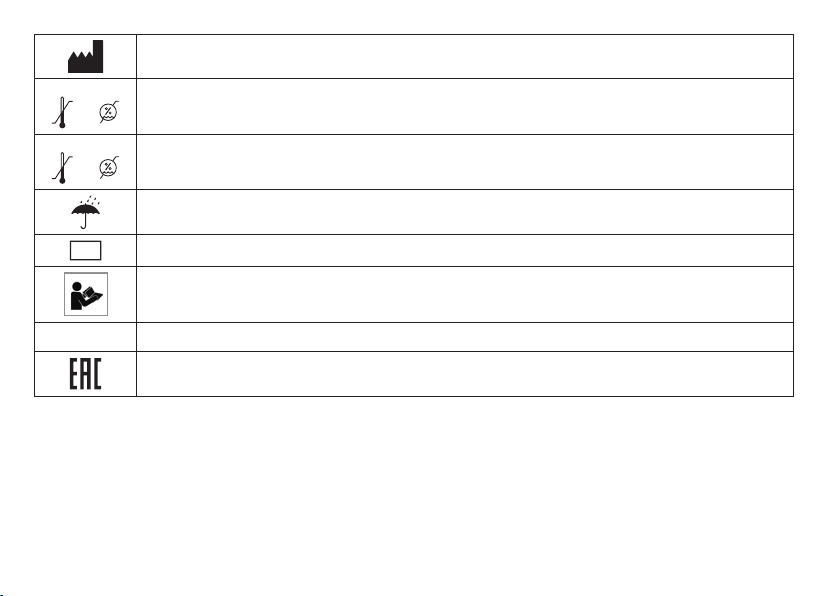
60
Fabricante
Storage
Temperatura y humedad relativa de almacenamiento admisibles
Operating
Temperatura y humedad relativa de funcionamiento admisibles
Proteger de la humedad
S
N
Número de serie
Información importante/sugerencia
w
Referencia cruzada a otro párrafo
Símbolo de certificación para aquellos productos que se exportan a la Federación Rusa y a los
países de la CEI
2. Utilización
Este termómetro sin contacto para medir la fiebre permite medir la temperatura de la frente, de objetos y de espa-
cios cerrados. El termómetro está diseñado para medir la temperatura en el hogar. Permite medir con rapidez y
sencillez la temperatura corporal. Los valores medidos se guardan automáticamente.

61
3. Advertencias y Seguridad
3.1 Peligros para el usuario
• N
o utilice el aparato hasta que haya leído y comprendido estas instrucciones de uso.
• C
onserve estas instrucciones de uso. Las instrucciones de uso deben encontrarse a disposición de todos los
usuarios. Deben respetarse todas las indicaciones.
• A
ntes de realizar la medición, mantenga el aparato durante al menos 30 minutos en la misma habitación en la
que se vaya a realizar dicha medición.
• E
l termómetro FT 90 solo está diseñado para usarse en el punto de medición del cuerpo humano indicado en
las instrucciones de uso.
• E
ste aparato está diseñado únicamente para el propósito que se indica en estas instrucciones de uso.
• L
os niños no deben utilizar el aparato, ya que los productos sanitarios no son juguetes.
• A
ntes de cada uso, compruebe que la lente esté intacta. En el caso de que esté dañada, póngase en contacto
con su distribuidor o con el servicio de asistencia técnica.
• E
ste aparato se ha creado para su uso práctico, pero no sustituye a una visita al médico.
• S
i todavía tiene dudas sobre cómo usar el aparato, póngase en contacto con su distribuidor o con el servicio
de atención al cliente.
3.2 Peligro para el aparato
• N
o deje que el aparato reciba golpes.
• N
o exponga el aparato a la luz directa del sol.
• N
o moje el aparato, no es impermeable. Evite cualquier contacto directo con agua o con otros líquidos.
•
S
olo los centros de servicio técnicos autorizados deben reparar el aparato; de lo contrario, se extinguirá el
derecho de garantía.

62
•
Los equipos de comunicación HF portátiles y móviles pueden influir en el funcionamiento de este aparato. Puede
solicitar información más precisa al servicio de atención al cliente en la dirección indicada en este documento o
leer el final de las instrucciones de uso.
3.3 Indicaciones para la manipulación de pilas
• E
n caso de que el líquido de las pilas entre en contacto con la piel o los ojos, lave la zona afectada con agua
y busque asistencia médica.
•
¡Peligro de asfixia! Los niños pequeños podrían tragarse las pilas y asfixiarse. Guarde las pilas fuera del
alcance de los niños.
• F
íjese en los símbolos más (+) y menos (-) que indican la polaridad.
• S
i se derrama el líquido de una pila, póngase guantes protectores y limpie el compartimento de las pilas con
un paño seco.
• P
roteja las pilas de un calor excesivo.
•
¡Peligro de explosión! No arroje las pilas al fuego.
• L
as pilas no se pueden cargar ni cortocircuitar.
• S
i no va a utilizar el aparato durante un periodo de tiempo prolongado, retire las pilas del compartimento.
• U
tilice únicamente el mismo tipo de pila o un tipo equivalente.
• C
ambie siempre todas las pilas a la vez.
• ¡
No utilice baterías!
• N
o despiece, abra ni triture las pilas.
Información sobre el termómetro
El valor de temperatura medido oscila en función de la parte del cuerpo en la que se tome la temperatura. En
personas sanas, la diferencia en las distintas partes del cuerpo puede oscilar entre 0,2 °C y 1 °C (0,4 °F y 1,8 °F).
63
Margen de temperatura normal en diferentes termómetros
Valor de medición Termómetro utilizado
Temperatura en la frente 35,8 °C a 37,6 °C (96,4 °F a 99,7 °F) Termómetro para la frente
Temperatura en el oído 36,0 °C a 37,8 °C (96,8 °F a 100,0 °F) Termómetro para el oído
Temperatura en la boca 36,0 °C a 37,4 °C (96,8 °F a 99,3 °F) Termómetro convencional
Temperatura en el recto 36,3 °C a 37,8 °C (97,3 °F a 100,0 °F) Termómetro convencional
Sugerencia de Beurer
• N
unca compare las temperaturas medidas con distintos termómetros.
•
I
ndique a su médico con qué termómetro ha medido la temperatura corporal y en qué parte del cuerpo.
Téngalo en cuenta también en el caso de un autodiagnóstico.
Si antes de realizar la medición se sostiene el termómetro en la mano durante mucho tiempo, el aparato
se calentará. Esto puede falsear el resultado de las mediciones.
4. Factores que influyen en la temperatura corporal
• E
l metabolismo particular de cada persona.
• L
a edad.
La temperatura corporal de los bebés lactantes y de los niños pequeños es más alta que la de los adultos. Las
grandes oscilaciones de temperatura son más rápidas y frecuentes en los niños. Con la edad desciende la tem
-
peratura normal del cuerpo.
• L
a ropa.
• L
a temperatura exterior.
64
• L
a hora del día.
La temperatura corporal es más baja por la mañana y aumenta a medida que transcurre el día, hasta la tarde.
• R
ealizar actividades.
Las actividades corporales y, en menor medida, las actividades mentales aumentan la temperatura corporal.
Sugerencia de Beurer
La medición de la temperatura corporal proporciona el valor de medición actual de una persona. Si no
está seguro de como interpretar el resultado de la medición o si los valores mostrados son anómalos
(por ejemplo: fiebre), diríjase a su médico de familia. Hágalo también si, además de producirse ligeros
cambios en su temperatura corporal, padece otros síntomas de enfermedad como p. ej., desasosiego,
sudoración intensa, enrojecimiento de la piel, pulso acelerado, desmayos frecuentes, etc.
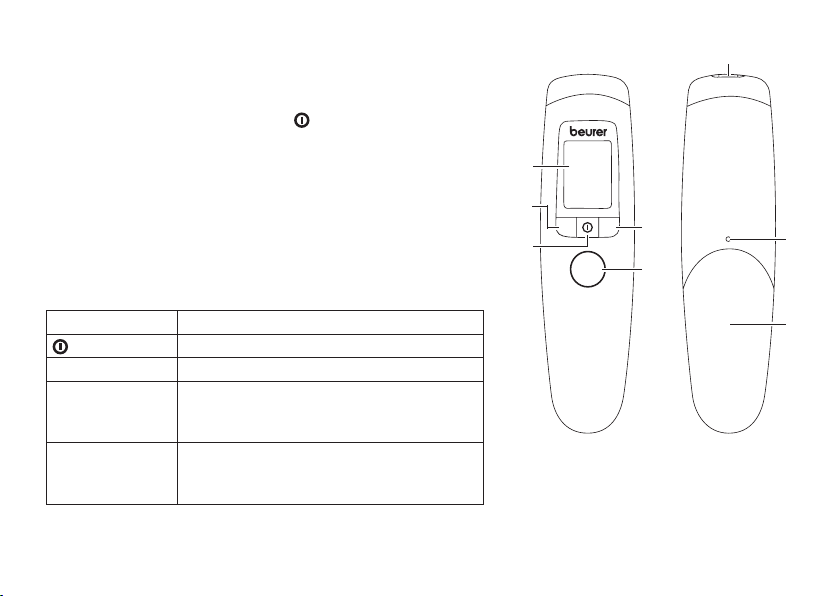
65
5. Descripción del aparato
1
Pantalla
2
Botón MODE/MEM
3
Botón de encendido y apagado
4
Botón LIGHT/SET
5
Botón SCAN
6
Sensor de medición
7
Desbloqueo del compartimento para
pilas
8
Tapa del compartimento para pilas
Botones Funciones
Conexión y desconexión del aparato.
SCAN Inicio de la medición de la temperatura.
MODE/MEM
MODE Ajuste del modo de medición.
MEM Indicación de los valores de medi
-
ción guardados.
LIGHT/SET
LIGHT Encendido manual de la iluminación
de la pantalla.
SET Ajuste de las funciones básicas.
SCAN
MODE
ME M
LIGH T
SE T
1
3
2
4
5
6
7
8
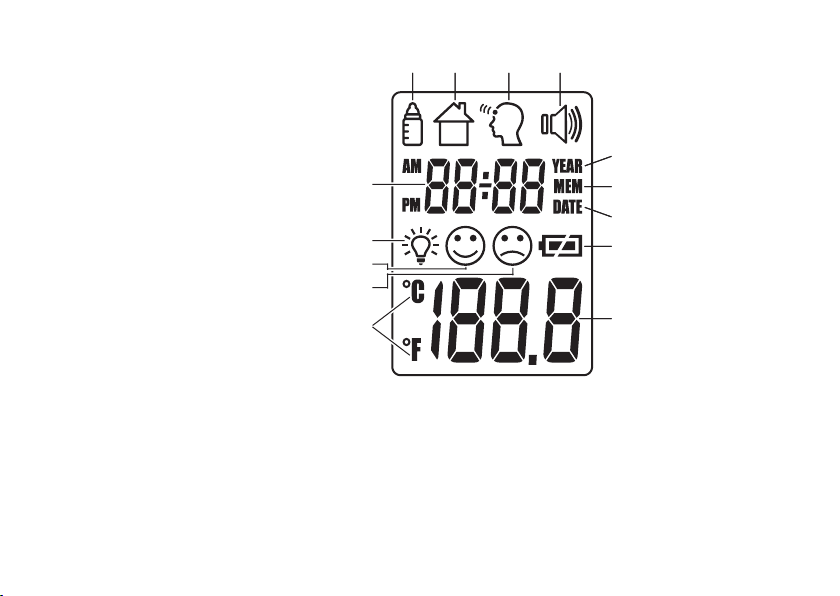
66
5.1 Descripción de la pantalla
1
Modo temperatura objeto
12 34
5
6
7
8
9
10
11
12
13
14
2
Modo temperatura ambiente
3
Modo temperatura de la frente
4
Símbolo de la señal acústica
5
Año
6
Función de almacenamiento
7
Fecha
8
Estado de la pila
9
Indicación del valor de la temperatura/
posición de grabación en la memoria
10
Unidad de medición Celsius/Fahrenheit
11
Resultado de la medición ≥ 38,0°C “fiebre”
12
Resultado de la medición < 38,0°C “sin
fiebre”
13
Símbolo de iluminación de la pantalla
14
Indicación del año/fecha/hora
6. Puesta en funcionamiento
Retire la cinta aislante, si la hubiera, puesta en la tapa del compartimiento de pilas o bien retire la lámina pro-
tectora de la pila y coloque la pila observando la polaridad correcta.
w
11. Pilas
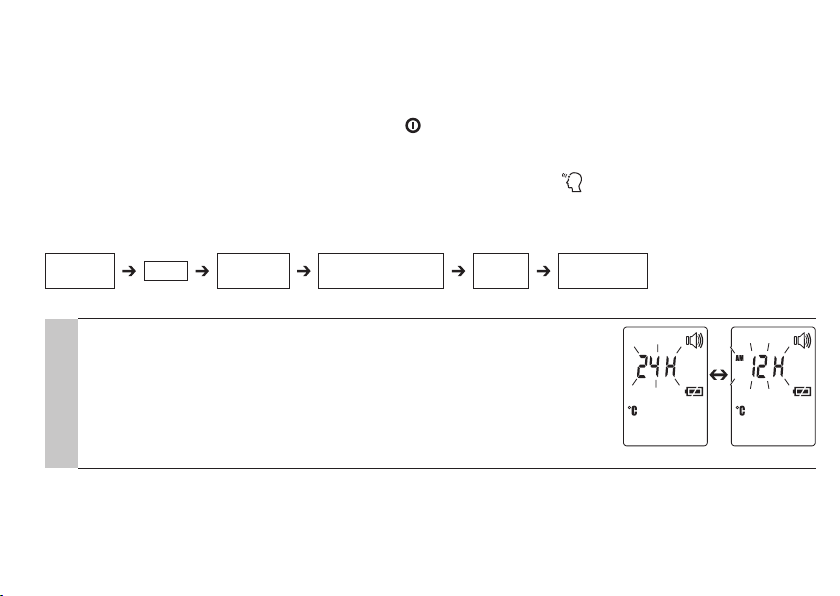
67
Tras una breve comprobación automática y dos pitidos cortos, el termómetro está listo para medir la tempera
-
tura en la frente.
7. Encendido y ajuste del termómetro
Pulse brevemente el botón de encendido y apagado .
Tras una breve comprobación automática y dos pitidos cortos, el termómetro está listo para medir la tempera
-
tura en la frente.
Al encenderse, el aparato está siempre en el modo temperatura de la frente
.
7.1 Ajustar las funciones básicas
Desde este menú podrá ajustar de forma individualizada las funciones que se mencionan a continuación.
Formato de la hora
• M
antenga pulsado el botón LIGHT/SET durante 5 segundos con el ter-
mómetro encendido.
En la pantalla parpadeará la indicación del formato de la hora (fig. 1).
• A
juste con el botón MODE/MEM el formato de la hora que desee y confír-
melo con el botón LIGHT/SET.
Fig. 1
Iluminación de
la pantalla
Tono de
aviso
Unidad de medición
de la temperatura
Indicación
de la hora
Fecha
Formato
de la hora
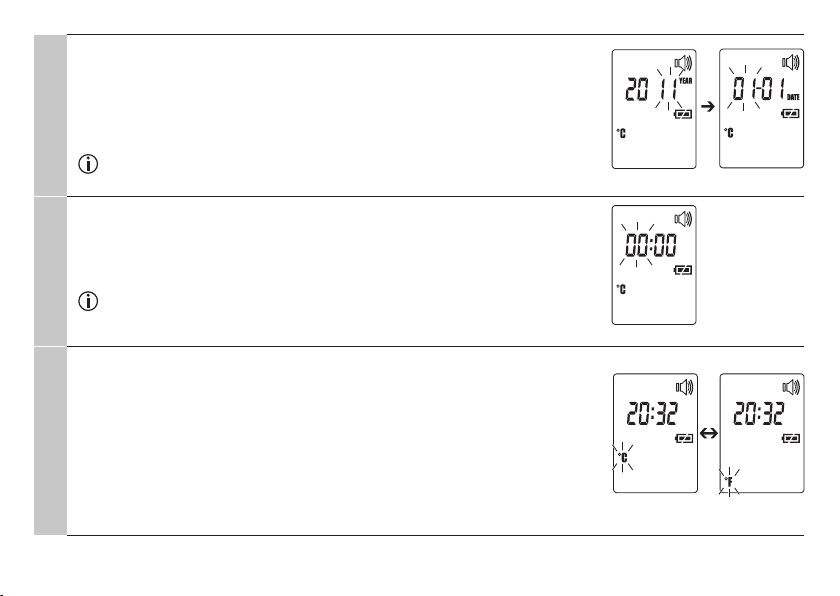
68
Fecha
El indicador del año parpadeará en la pantalla (fig. 2).
• A
juste con el botón MODE/MEM el año y confírmelo con el botón LIGHT/
SET.
• E
n la pantalla parpadeará el día/mes (fig. 3).
• A
juste con el botón MODE/MEM el día y el mes y confírmelos con el botón
LIGHT/SET.
En el formato de 24 horas, la fecha se indica con día/mes. En el formato
de 12 horas, con mes/día.
Fig. 3
Fig. 2
Indicación de la hora
La hora parpadeará en la pantalla (fig. 4).
• A
juste con el botón MODE/MEM la hora y confírmela con el botón LIGHT/
SET.
En el formato de 12 horas, la hora se indica con AM/PM.
Fig. 4
Unidad de medición de la
temperatura
La unidad de medición de la temperatura parpadeará en la pantalla (fig. 5).
Puede elegir que los resultados de la medición se muestren en grados Celsius
(ºC) o en grados Fahrenheit (ºF).
•
P
ara que los resultados de la medición se muestren en grados Celsius, selec-
cione con el botón MODE/MEM °C y confirme con el botón LIGHT/SET.
• P
ara que los resultados de la medición se muestren en grados Fahrenheit,
seleccione con el botón MODE/MEM °F y confirme con el botón LIGHT/SET.
Fig. 5
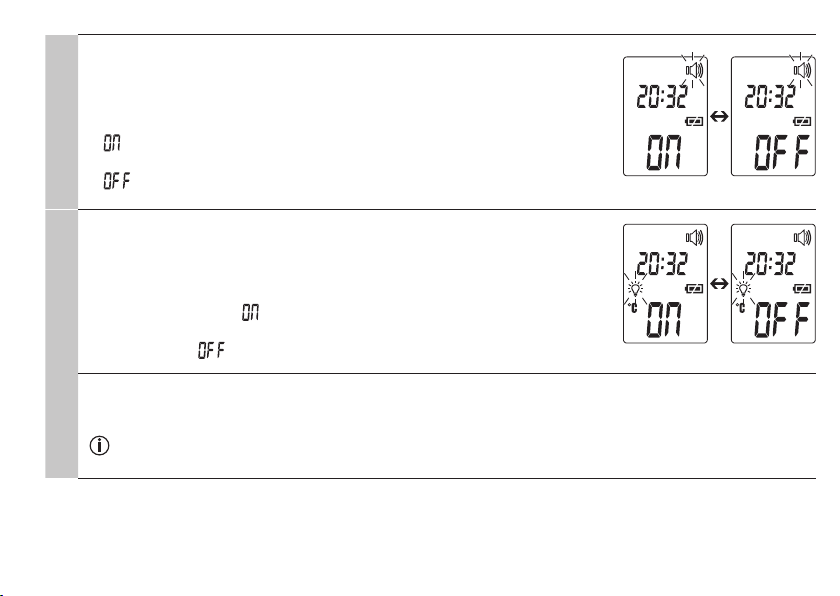
69
Tono de aviso
En la pantalla parpadeará el símbolo de la señal acústica (fig. 6).
Puede encender o apagar las señales acústicas que suenan al encenderse el
aparato, durante la medición y al finalizar esta.
•
P
ara encender las señales acústicas, seleccione con el botón MODE/MEM
y confirme con el botón LIGHT/SET.
•
P
ara apagar las señales acústicas, seleccione con el botón MODE/MEM
y confirme con el botón LIGHT/SET.
Fig. 6
Iluminación de la pantalla
En la pantalla parpadeará el símbolo de luz (fig. 7).
Puede encender o apagar la iluminación automática de la pantalla que aparece
después de medir la temperatura de la frente.
• P
ara encender la iluminación automática de la pantalla, seleccione con el
botón MODE/MEM
y confirme con el botón LIGHT/SET.
•
P
ara apagar la iluminación automática de la pantalla, seleccione con el botón
MODE/MEM y confirme con el botón LIGHT/SET.
Fig. 7
Además, puede encender manualmente la iluminación de la pantalla si pulsa brevemente el botón LIGHT/
SET.
La pantalla se ilumina durante 5 segundos.
La iluminación tanto automática como manual de la pantalla no se puede utilizar durante el proceso
de medición.
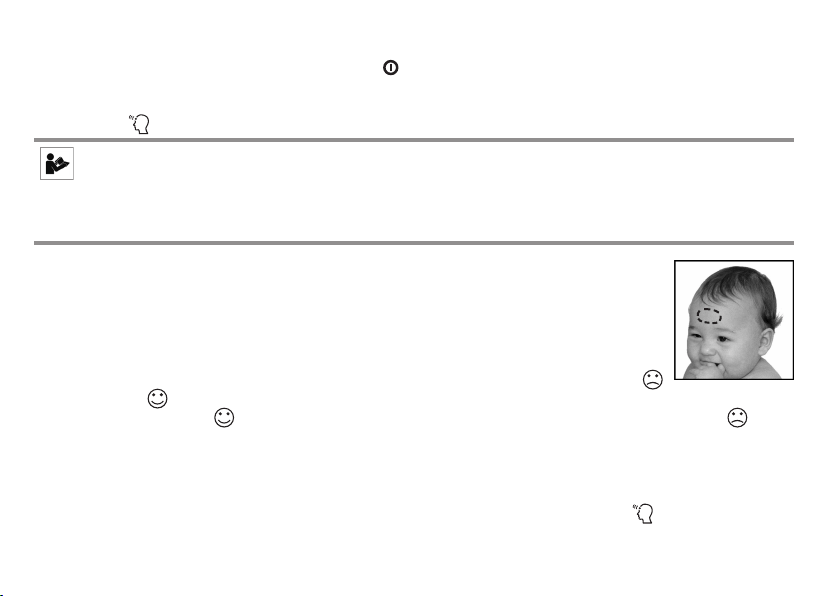
70
8. Medición en la frente
Pulse brevemente el botón de encendido/apagado .
Tras una breve comprobación automática y dos pitidos cortos, el aparato está listo para medir la temperatura en
la frente. Al encenderse, el aparato está siempre en el modo temperatura de la frente. Esto se puede comprobar
en el símbolo
.
Sugerencia de Beurer
Tenga en cuenta lo siguiente:
• L
a actividad física, una mayor sudoración en la frente, la ingesta de medicamentos vasoconstrictores
y las irritaciones de la piel pueden alterar el resultado de las mediciones.
• L
a frente, o las sienes, no deben tener ni sudor ni maquillaje.
Mantenga el termómetro entre 2 y 3 cm por encima del punto de medición. Pulse el botón
SCAN y desplace el termómetro por la zona de la frente (fig. 8).
Durante la medición puede oír pitidos cortos (solo con la señal acústica encendida) que indican
que el termómetro ha registrado un nuevo valor máximo de temperatura.
El final del tiempo de medición se indica con un pitido largo.
Deje de apretar el botón SCAN. Ahora puede leer el valor medido.
Además, según el resultado de la medición, la pantalla mostrará los símbolos de „fiebre“
o de „sin fiebre“
:
El símbolo de „sin fiebre“
muestra que la temperatura corporal es normal, el símbolo „de fiebre“ ise un
valor igual o superior a 38,0°C, es decir, alarma de fiebre.
Si la señal acústica está activada, al finalizar la medición sonarán además tres pitidos cuando la temperatura sea
superior o igual a 38,0°C.
El tiempo de medición se sitúa normalmente en 2 segundos, pero también puede durar hasta 30 segundos.
El aparato señaliza con dos pitidos cortos y el símbolo de la frente que ya no parpadea
, que el aparato está
listo para otra medición.
Fig. 8
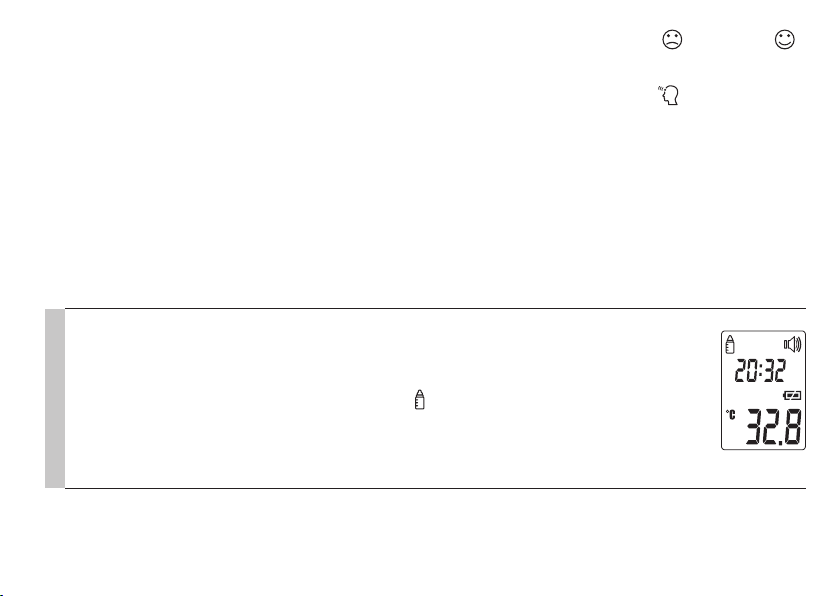
71
El valor medido se almacena automáticamente con la fecha/hora y la clasificación „fiebre“
/ „sin fiebre“ .
8.1 Indicar valores de medición guardados
El aparato guarda exclusivamente valores de medición en el modo temperatura de la frente . El aparato guarda
automáticamente los valores de medición de las últimas 60 mediciones.
Si se sobrepasan los 60 valores almacenados, comenzará a borrar valores empezando por más antiguo.
La memoria se puede consultar de la siguiente manera:
• M
antenga pulsado el botón MODE/MEM durante 5 segundos con el termómetro encendido.
Se mostrará el valor de medición más reciente.
• S
i se sigue pulsando el botón MODE/MEM, en primer lugar se mostrará la posición de grabación de la memo-
ria y, al soltar el botón, el valor de medición.
• E
n la fila superior aparecerán de forma alterna la hora y la fecha.
9. Medición de la temperatura objeto / temperatura ambiente
Modo temperatura objeto
Si desea medir la temperatura objeto con este termómetro, debe cambiar al modo tempera-
tura objeto.
Para ello, pulse brevemente el botón MODE/MEM con el termómetro encendido.
El aparato cambia al modo temperatura objeto
.
Mantenga el termómetro entre 2 y 3 cm delante del punto de medición que desee. Pulse bre
-
vemente el botón SCAN y lea la temperatura de la pantalla (fig. 9).
Los valores de medición en el modo temperatura objeto no se guardan.
Fig. 9
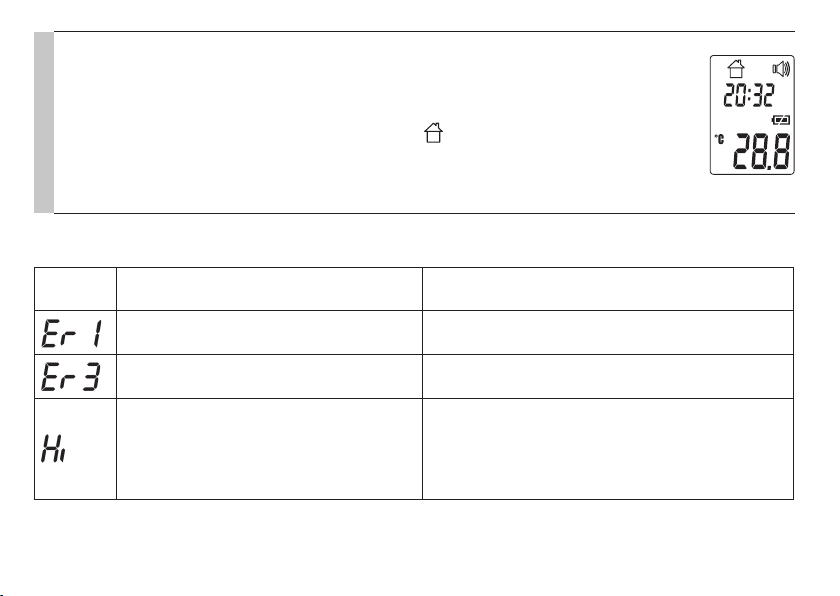
72
Modo temperatura ambiente
Si desea utilizar el termómetro para medir la temperatura ambiente, debe cambiar al modo
temperatura ambiente.
Para ello, pulse dos veces brevemente el botón MODE/MEM con el termómetro encendido.
El aparato cambia al modo temperatura ambiente
.
La temperatura ambiente se indica directamente (fig. 10).
Los valores de medición en el modo temperatura ambiente no se guardan.
Fig. 10
10. Visualización de errores
Aviso de
errores
Problema Solución
Medición durante la comprobación automá-
tica, el aparato aún no está listo para medir.
Espere hasta que el símbolo de la frente deje de par
-
padear.
Temperatura ambiente por debajo de 10 °C o
por encima de 40 °C (<50 °F, >104 °F).
La temperatura ambiente debe situarse entre 10 °C y
40 °C (50 °F, 104 °F).
(1) Modo temperatura de la frente: la tem-
peratura medida es superior a 42,2 °C
(108 °F).
(2) Modo temperatura objeto: la temperatura
medida es superior a 80 °C (176 °F).
Use el termómetro sólo dentro del rango de tem-
peraturas indicado. Si el aparato da error de forma
continuada, póngase en contacto con un distribuidor
especializado o con el servicio de atención al cliente.
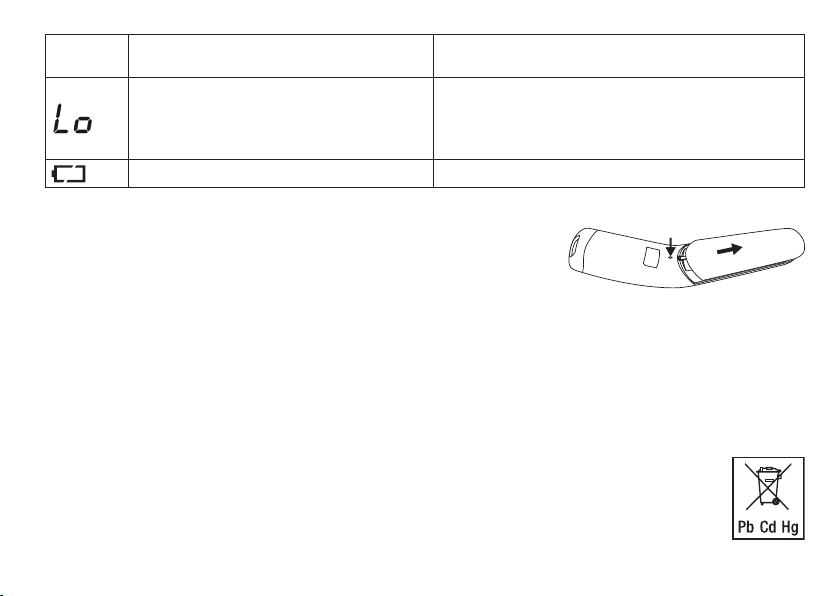
73
Aviso de
errores
Problema Solución
(1) Modo temperatura de la frente: la tempe-
ratura medida es inferior a 34 °C (93,2 °F).
(2) Modo temperatura objeto: la temperatura
medida es inferior a -22 °C (-7,6 °F).
Use el termómetro sólo dentro del rango de tem-
peraturas indicado. Si el aparato da error de forma
continuada, póngase en contacto con un distribuidor
especializado o con el servicio de atención al cliente.
Las pilas están agotadas. Cambie las pilas.
11. Pilas
El aparato requiere dos pilas AAA LR03.
• A
bra el compartimento para pilas.
Para ello, presione con un objeto punzante el desbloqueo del comparti-
mento para pilas y, al mismo tiempo, desplace hacia abajo el comparti-
mento para pilas.
• E
xtraiga del compartimento las pilas usadas.
• C
oloque pilas nuevas.
Asegúrese de que las pilas están bien orientadas.
• C
ierre el compartimento para pilas.
• L
as pilas usadas, completamente descargadas, deben eliminarse a través de contenedores de recogida seña-
lados de forma especial, los puntos de recogida de residuos especiales o a través de los distribuidores de
equipos electrónicos. Los usuarios están obligados por ley a eliminar las pilas correctamente.
• Estos símbolos se encuentran en pilas que contienen sustancias tóxicas:
Pb: la pila contiene plomo.
Cd: la pila contiene cadmio.
Hg: la pila contiene mercurio.
74
12. Limpieza del aparato
• E
l sensor de medición es la pieza más sensible del termómetro. Trate el sensor de medición con la
máxima precaución a la hora de limpiarlo.
• N
o utilice ningún producto de limpieza agresivo.
• S
iga siempre todas las indicaciones de seguridad para el usuario y el aparato.
w
3. Advertencias y Seguridad
Limpie el sensor de medición tras cada uso. Para ello, utilice un paño suave o un bastoncillo de algodón, que se
pueden mojar con desinfectante o alcohol de 70 %.
Para limpiar todo el aparato utilice un paño suave ligeramente mojado con lejía jabonosa. Bajo ningún concepto
debe entrar agua en el aparato.
No utilice el aparato hasta que no esté completamente seco.
13. Almacenamiento del aparato
No se debe usar ni guardar el aparato en un lugar con una temperatura demasiado alta o demasiado baja o con
humedad en el aire (consulte las especificaciones técnicas), expuesto a la luz solar, en contacto con la corriente
eléctrica o en lugares polvorientos. De lo contrario, el termómetro podría realizar mediciones imprecisas.
Si no va a usar el termómetro durante mucho tiempo, extraiga las pilas.
14. Desecho del aparato
• A
fin de preservar el medio ambiente, cuando el aparato cumpla su vida útil no lo tire con la basura doméstica.
Se puede desechar en los puntos de recogida adecuados disponibles en su zona. Deseche el aparato según
la Directiva europea sobre residuos de aparatos eléctricos y electrónicos (RAEE). Para más información,
póngase en contacto con la autoridad municipal competente en materia de eliminación de residuos.
75
15. Datos técnicos
¡No garantizamos el correcto funcionamiento de este aparato si se usa al margen de las especificaciones!
La precisión de este termómetro ha sido comprobada minuciosamente y su diseño ha sido desarrollado con vis
-
tas a una larga vida útil del aparato.
Si se utiliza el aparato en el ejercicio de la medicina deberán realizarse controles metrológicos utilizando para
ello los medios oportunos. Puede solicitar información más precisa sobre la comprobación de la precisión de los
valores de medición al servicio de asistencia técnica en la dirección indicada en este documento.
Nos reservamos el derecho de efectuar modificaciones técnicas para mejorar y perfeccionar el producto.
Tipo FT 90/1
Método de medición Medición infrarroja sin contacto
Funciones básicas Medición de la temperatura de la frente
Medición de la temperatura objeto
Medición de la temperatura ambiente
Unidades de medida Celsius (°C) o Fahrenheit (°F)
Condiciones de funcionamiento 10 °C a 40 °C (50 °F a 104 °F) con una humedad relativa del < 95 %
Entorno de almacenamiento -20 °C a 50 °C (-4 °F a 122 °F) con una humedad relativa del < 85 %
Distancia para la medición De 2 a 3 cm de distancia al punto de medición
Rangos de medición y precisión
de la medición de la temperatura
de la frente
Medición de la temperatura de la frente
34 °C a 42,2 °C (93,2 °F a 108 °F)
Precisión de la medición 36 °C a 39 °C: ± 0,2 °C
(96,8 °F a 102 °F: ± 0,4 °F)
En el resto del rango de medición ± 0,3 °C (± 0,5 °F)
Precisión clínica de repetición 0,23 °C (0,41 °F)
76
Rangos de medición y precisión
Medición de la temperatura objeto
Medición de la temperatura objeto
-22 °C a 80 °C (-7,6 °F a 176 °F)
Precisión de la medición ± 4% o ± 2 °C (± 4 °F)
Función de almacenamiento
Medición de temperatura corporal
Guarda automáticamente los últimos 60 valores de medición.
Tono de aviso Al encender el aparato, durante la medición, al finalizar la medición
(ajustable).
Indicación Pantalla LCD
Funciones de ahorro de energía El aparato se apaga automáticamente tras un minuto.
Medidas
Anchura x profundidad x altura
aprox. 47,6 mm x 29,0 mm x 188,0 mm
Peso 82 g (sin pilas)
Dos pilas AAA LR03 Autonomía para alrededor de 3000 mediciones
Las funciones activadas adicionalmente, como la señal acústica o la
iluminación de la pantalla, acortan la vida útil de la pila.
16. Directrices
Este aparato cumple las disposiciones de la Directiva europea n° 93/42/EEC relativa a los productos sanita-
rios, la ley alemana sobre productos sanitarios, la ASTM E 1965 - 98 y la norma europea EN60601-1-2 y está
sujeto a las medidas especiales de precaución relativas a la compatibilidad electromagnética.
Salvo errores y modificaciones

77
Contenuto
1. Spiegazione dei simboli .................................... 78
2. Applicazione ..................................................... 79
3. Avvertenze e Sicurezza .................................... 80
3.1 Pericoli per l’utilizzatore ............................. 80
3.2 Pericoli per l’apparecchio ........................... 80
3.3 Avvertenze sull’uso delle batterie ............... 81
4. Informazioni relative al termometro .................. 82
5. Descrizione dell’apparecchio ............................ 84
5.1 Descrizione del display ............................... 85
6. Messa in funzione ............................................. 86
7. Accensione e spegnimento del termometro ..... 86
7.1 Impostazione delle funzioni di base ............ 86
8. Misurazione sulla fronte .................................... 89
8.1 Visualizzazione dei valori memorizzati ........ 90
9. Misurazione della temperatura superficiale /
temperatura ambiente....................................... 90
10. Messaggi di errore ............................................ 91
11. Batterie ............................................................. 92
12. Pulizia dell’apparecchio .................................... 93
13. Conservazione dell’apparecchio ...................... 93
14. Smaltimento dell’apparecchio .......................... 93
15. Dati tecnici ........................................................ 94
16. Direttive ............................................................. 95
ITALIANO
Leggere attentamente le presenti istruzioni
per l’uso, conservarle per impieghi futuri,
renderle accessibili ad altri utenti e attenersi
alle indicazioni.
Gentile cliente,
siamo lieti che Lei abbia scelto un prodotto del nostro
assortimento. Il nostro marchio è garanzia di prodotti di
elevata qualità, controllati nei dettagli, relativi ai settori
calore, terapia dolce, pressione/diagnosi, peso, mas-
saggio e aria.
La preghiamo di leggere attentamente le presenti istru
-
zioni per l’uso e di attenersi alle indicazioni.
Cordiali saluti
Team Beurer
Fornitura
Controllare l’integrità esterna della confezione e del con-
tenuto. Prima dell’uso assicurarsi che l’apparecchio e gli
accessori non presentino nessun danno palese e che
il materiale di imballaggio sia stato rimosso. In caso di
dubbio non utilizzare l’apparecchio e consultare il pro
-
prio rivenditore o contattare il Servizio clienti indicato.
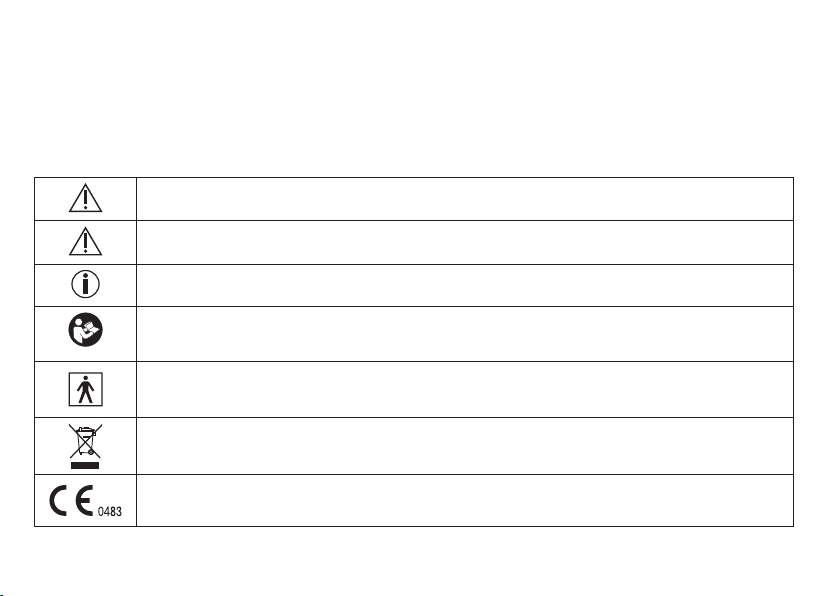
78
• T
ermometri per febbre
• 2
batterie AAA, LR03
• C
ustodia
• I
struzioni per l’uso
1. Spiegazione dei simboli
I seguenti simboli sono utilizzati nelle Istruzioni per l’uso e sull’apparecchio:
AVVERTENZA
Segnalazione di rischio di lesioni o pericoli per la salute
ATTENZIONE
Segnalazione di rischi di possibili danni all’apparecchio/agli accessori
Nota
Indicazione di importanti informazioni
Rispettare le istruzioni per l’uso.
Parte applicativa tipo BF
Smaltimento secondo le norme previste dalla Direttiva CE sui rifiuti di apparecchiature elettriche
ed elettroniche (RAEE)
Il marchio CE certifica la conformità ai requisiti di base della direttiva 93/42/EEC sui dispositivi
medici.
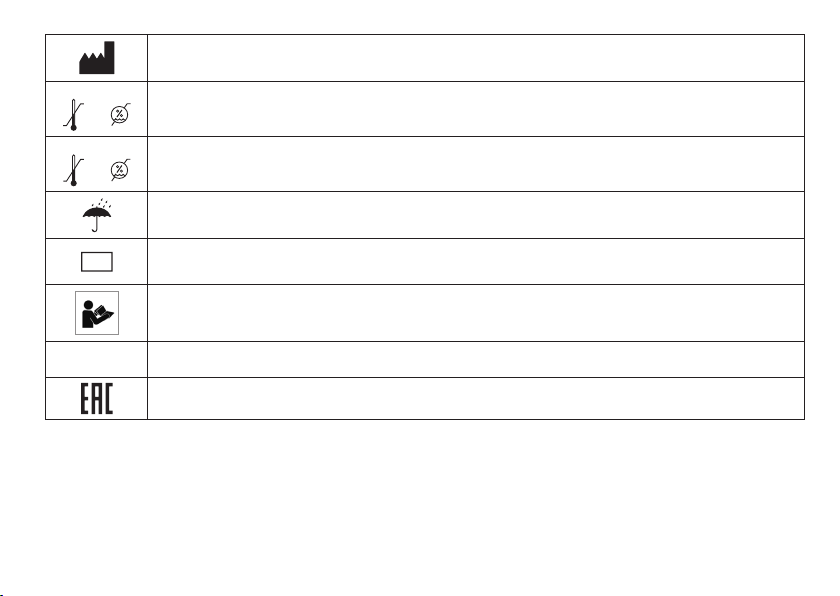
79
Produttore
Storage
Temperatura e umidità di stoccaggio consentite
Operating
Temperatura e umidità di esercizio consentite
Proteggere dall’umidità
S
N
Numero di serie
Informazione importante/Suggerimento
w
Riferimento incrociato a un altro paragrafo.
Marchio di certificazione per i prodotti esportati nella Federazione Russa e nei paesi CSI
2. Applicazione
Questo termometro per la febbre serve per misurare senza contatto la temperatura della fronte, di un oggetto o
di un locale. Il termometro è adatto per le misurazioni in casa. In questo modo è possibile conoscere in modo
semplice e veloce la temperatura corporea. I valori vengono memorizzati automaticamente

80
3. Avvertenze e Sicurezza
3.1 Pericoli per l’utilizzatore
• U
tilizzare l’apparecchio solo dopo aver letto e compreso le presenti istruzioni per l’uso.
•
C
onservare questo manuale d’uso. Le istruzioni per l’uso devono essere accessibili a tutti gli utilizzatori. Seguire
tutte le indicazioni.
• P
rima di effettuare la misurazione conservare il termometro per almeno 30 minuti nella stanza in cui verrà effet-
tuata la misurazione.
• I
l termometro FT 90 è stato concepito solo per la zona di misurazione del corpo umano indicata nelle istruzioni
per l’uso.
• L
’apparecchio è concepito solo per l’uso descritto nelle presenti istruzioni.
• N
on lasciar utilizzare l’apparecchio a bambini. I dispositivi medici non sono giocattoli.
• P
rima di ogni utilizzo, verificare che la lente sia intatta. Nel caso in cui la lente sia danneggiata rivolgersi al pro-
prio rivenditore o al Servizio clienti.
• L
’apparecchio è stato concepito per l’utilizzo pratico, ma non può sostituire una visita medica.
• P
er ulteriori domande sull’utilizzo delle apparecchiature, rivolgersi al proprio rivenditore o al Servizio clienti.
3.2 Pericoli per l’apparecchio
• E
vitare che l’apparecchio subisca degli urti.
• N
on esporre l’apparecchio alla luce diretta del sole.
• E
vitare che l’apparecchio entri in contatto con dei liquidi. Il termometro non è impermeabile. Evitare qualunque
contatto diretto con acqua o altri liquidi.
• F
ar riparare l’apparecchio solo da centri di assistenza autorizzati, in caso contrario la garanzia decade.
•
Gli apparecchi per la comunicazione portatili e mobili ad alta frequenza possono influire sul funzionamento dell’ap-
parecchio. Per informazioni più dettagliate, rivolgersi all’Assistenza clienti oppure consultare la parte finale delle
istruzioni per l’uso.

81
3.3 Avvertenze sull’uso delle batterie
•
S
e il liquido della batteria viene a contatto con la pelle e con gli occhi, sciacquare le parti interessate con acqua
e consultare il medico.
•
Pericolo d’ingestione! I bambini possono ingerire le batterie e soffocare. Tenere quindi le batterie lontano
dalla portata dei bambini!
• P
restare attenzione alla polarità positiva (+) e negativa (-).
• I
n caso di fuoriuscita di liquido dalla batteria, indossare guanti protettivi e pulire il vano batterie con un panno
asciutto.
• P
roteggere le batterie dal caldo eccessivo.
•
Rischio di esplosione! Non gettare le batterie nel fuoco.
• L
e batterie non devono essere ricaricate o mandate in cortocircuito.
• Q
ualora l’apparecchio non dovesse essere utilizzato per un periodo prolungato, rimuovere le batteria dal vano
batterie.
• U
tilizzare solo tipologie di batterie uguali o equivalenti.
• S
ostituire sempre tutte le batterie contemporaneamente.
• N
on utilizzare batterie ricaricabili!
• N
on smontare, aprire o frantumare le batterie.
82
4. Informazioni relative al termometro
La temperatura misurata varia a seconda del punto del corpo in cui viene rilevata. Nei soggetti sani in punti del
corpo differenti si parla di uno scostamento compreso tra 0,2 °C e 1 °C (da 0,4 °F a 1,8 °F).
Intervalli di temperatura normali con termometri diversi
Valori misurati Termometro utilizzato
Temperatura della fronte 35,8 °C – 37,6 °C (96,4 °F – 99,7 °F) Termometro frontale
Temperatura all’orecchio 36,0 °C – 37,8 °C (96,8 °F – 100,0 °F) Termometro per orecchio
Temperatura orale 36,0 °C – 37,4 °C (96,8 °F – 99,3 °F) Termometro convenzionale
Temperatura rettale 36,3 °C – 37,8 °C (97,3 °F – 100,0 °F) Termometro convenzionale
Suggerimento Beurer
• N
on confrontare mai le temperature misurate con termometri diversi.
• I
nformare il proprio medico sul tipo di termometro usato e sulla parte del corpo in cui si è misurata la
temperatura. Tenere in considerazione questo aspetto anche per l’autovalutazione.
Se si tiene in mano il termometro troppo a lungo prima della misurazione, l’apparecchio si riscalda e per-
tanto il risultato della misurazione potrebbe essere falsato.
83
Fattori che influenzano la temperatura corporea
• M
etabolismo individuale, dipendente dalla persona
• E
tà
La temperatura corporea dei neonati e dei bambini piccoli è più alta di quella degli adulti. Nei bambini si verificano
sbalzi di temperatura più repentini e frequenti. Con l’aumentare dell’età la temperatura corporea normale si abbassa.
• A
bbigliamento
• T
emperatura esterna
• O
ra del giorno
Al mattino la temperatura corporea è più bassa e tende ad alzarsi nel corso della giornata.
• A
ttività
Le attività fisiche e, in modo più limitato, le attività mentali aumentano la temperatura corporea.
Suggerimento Beurer
La misurazione della temperatura corporea fornisce il valore attuale di una persona. Se non si è sicuri
dell’interpretazione dei risultati o se risultano dei valori anomali (ad es. febbre), è consigliabile rivolgersi
al proprio medico curante. Lo stesso dicasi in caso di lievi oscillazioni della temperatura in presenza di
altri sintomi quali agitazione, intensa sudorazione, arrossamento della pelle, elevata frequenza cardiaca,
svenimenti, ecc.
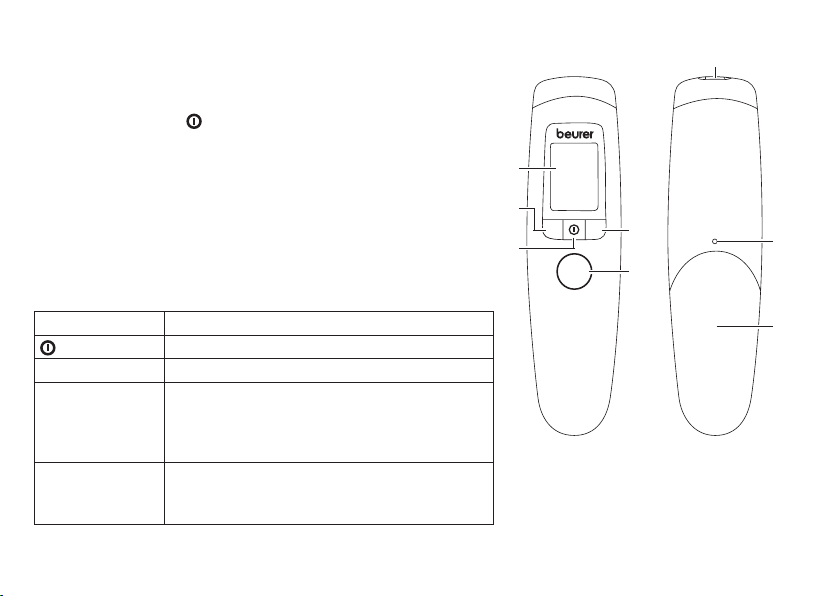
84
5. Descrizione dell’apparecchio
1
Display
2
Pulsante MODE/MEM
3
Pulsante ON/OFF
4
Pulsante LIGHT/SET
5
Pulsante SCAN
6
Sensore di misurazione
7
Rimozione del coperchio del vano
batterie
8
Coperchio vano batterie
Pulsanti Funzioni
Accensione e spegnimento dell’apparecchio.
SCAN Avvio della misurazione della temperatura.
MODE/MEM
MODE Impostazione della modalità di misura-
zione.
MEM Visualizzazione dei valori misurati
memorizzati.
LIGHT/SET
LIGHT Accensione manuale dell’illuminazione
del display.
SET Impostazione delle funzioni di base.
SCAN
MODE
ME M
LIGH T
SE T
1
3
2
4
5
6
7
8
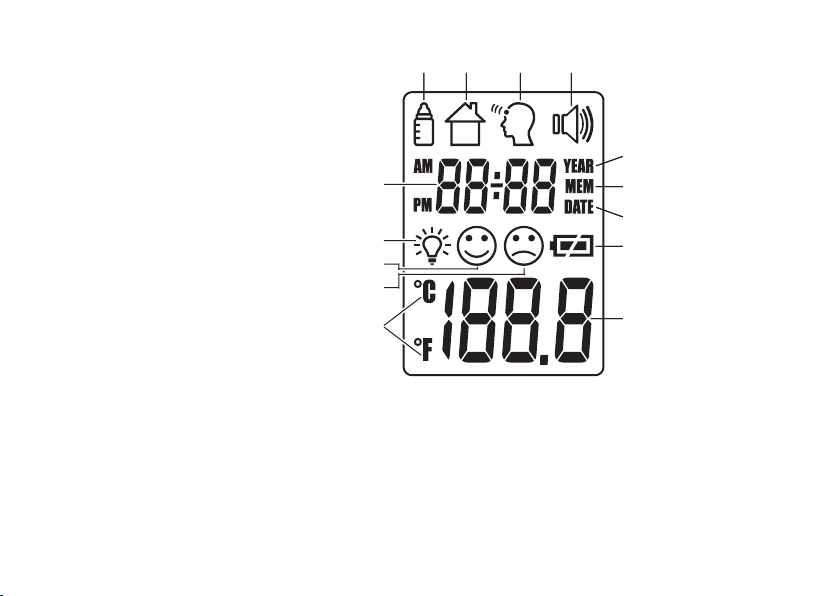
85
5.1 Descrizione del display
1
Modalità di misurazione superficiale
12 34
5
6
7
8
9
10
11
12
13
14
2
Modalità di misurazione della tempera
-
tura ambiente
3
Modalità di misurazione della tempera
-
tura della fronte
4
Simbolo del segnale acustico
5
Anno
6
Funzione di memoria
7
Data
8
Stato batteria
9
Indicatore del valore misurato/numero di
posizione
10
Unità di misurazione Celsius/Fahrenheit
11
Risultato di misurazione ≥ 38,0°C
“Febbre”
12
Risultato di misurazione < 38,0°C
“Assenza di febbre”
13
Simbolo illuminazione display
14
Indicatore anno/data/ora
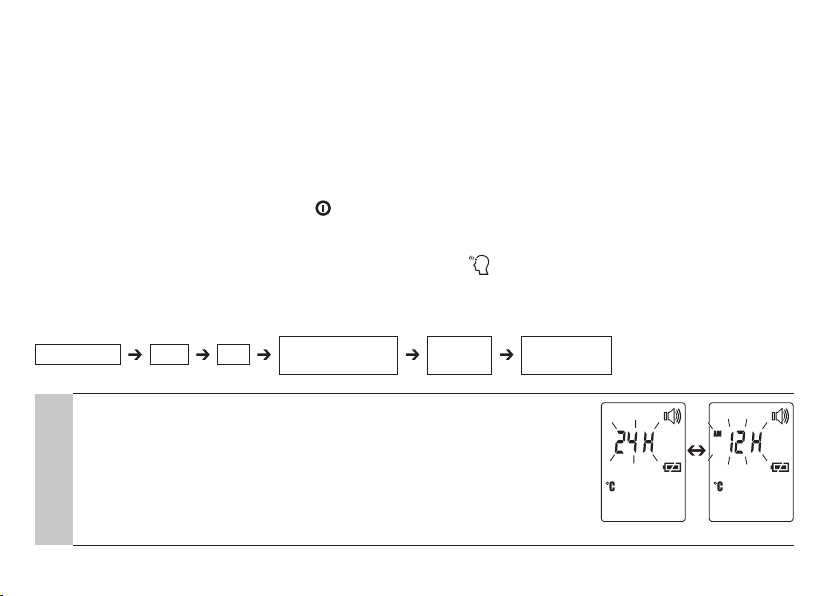
86
6. Messa in funzione
Se presente, togliere il nastro isolante dalla batteria sul coperchio del comparto batterie, o rimuovere il foglio
protettivo della batteria, e inserire la batteria rispettando la polarità.
w
11. Batterie
Dopo un breve autotest e un doppio segnale acustico il termometro è pronto per misurare la temperatura sulla
fronte.
7. Accensione e spegnimento del termometro
Premere brevemente il pulsante ON/OFF .
Dopo un breve autotest e un doppio segnale acustico il termometro è pronto per misurare la temperatura sulla
fronte.
L’apparecchio si avvia sempre in modalità Temperatura frontale
.
7.1 Impostazione delle funzioni di base
In questo menu è possibile impostare singolarmente in sequenza le seguenti funzioni.
Formato ora
•
A
termometro acceso tenere premuto il pulsante LIGHT/SET per 5 secondi.
Nel display lampeggia l’indicatore del formato ora (Fig. 1).
• I
mpostare il formato ora desiderato con il pulsante MODE/MEM e con-
fermare con il pulsante LIGHT/SET.
Fig. 1
Unità di misura
della temperatura
Illuminazione
display
Formato ora Data Ora
Segnale
acustico
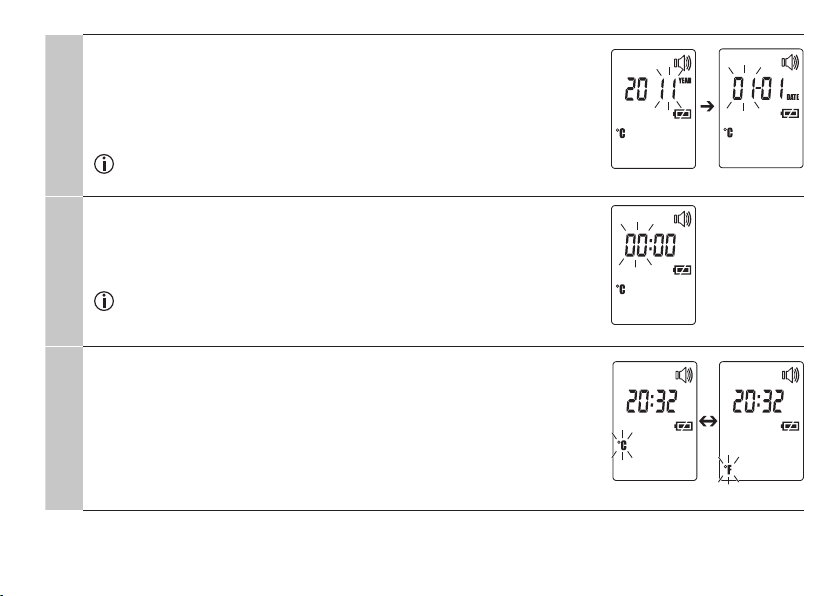
87
Data
Nel display lampeggia il numero dell’anno (Fig. 2).
•
I
mpostare l’anno con il pulsante MODE/MEM e confermare con il pul-
sante LIGHT/SET.
Sul display lampeggia giorno/mese (Fig. 3).
• I
mpostare il giorno e l’ora con il pulsante MODE/MEM e confermare con
il pulsante LIGHT/SET.
Nel formato 24h la visualizzazione della data è giorno/mese, nel formato
12h la visualizzazione della data è mese/giorno.
Fig. 3Fig. 2
Ora
Nel display lampeggia l’ora (Fig. 4).
•
I
mpostare l’ora con il pulsante MODE/MEM e confermare con il pulsante
LIGHT/SET.
Nel formato 12h la visualizzazione dell’ora è AM/PM,
Fig. 4
Unità di misura della tem-
peratura
Nel display lampeggia l’unità di misura della temperatura (Fig. 5).
I risultati della temperatura misurata possono essere visualizzati in gradi
Celsius (°C) e Fahrenheit (°F).
•
P
er visualizzare i risultati della misurazione in gradi Celsius selezionare °C
con il pulsante MODE/MEM e confermare con il pulsante LIGHT/SET.
•
P
er visualizzare i risultati della misurazione in gradi Fahrenheit selezionare
°F con il pulsante MODE/MEM e confermare con il pulsante LIGHT/SET.
Fig. 5
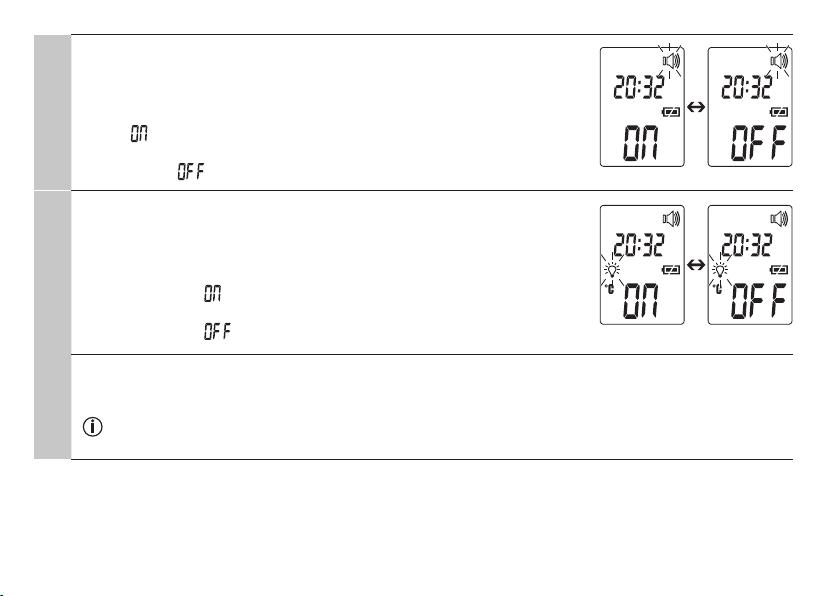
88
Segnale acustico
Nel display lampeggia il simbolo del segnale acustico (Fig. 6).
I segnali acustici (all’accensione dell’apparecchio, durante la misurazione,
alla fine della misurazione) possono essere attivati o disattivati.
• P
er attivare i segnali acustici usare il pulsante MODE/MEM per selezio-
nare e confermare con il pulsante LIGHT/SET.
•
P
er disattivare i segnali acustici utilizzare il pulsante MODE/MEM per
selezionare e confermare con il pulsante LIGHT/SET.
Fig. 6
Illuminazione display
Nel display lampeggia il simbolo della luce (Fig. 7).
L’illuminazione automatica del display (che appare dopo aver misurato la
temperatura della fronte) può essere attivata o disattivata.
• P
er attivare l’illuminazione del display utilizzare il pulsante MODE/MEM
per selezionare
e confermare con il pulsante LIGHT/SET.
•
P
er disattivare l’illuminazione del display utilizzare il pulsante MODE/MEM
per selezionare e confermare con il pulsante LIGHT/SET.
Fig. 7
Inoltre è possibile attivare manualmente l’illuminazione del display premendo brevemente il pulsante
LIGHT/SET.
Il display si illumina per 5 secondi.
L’illuminazione manuale e automatica del display non può essere modificata durante il processo di
misurazione.
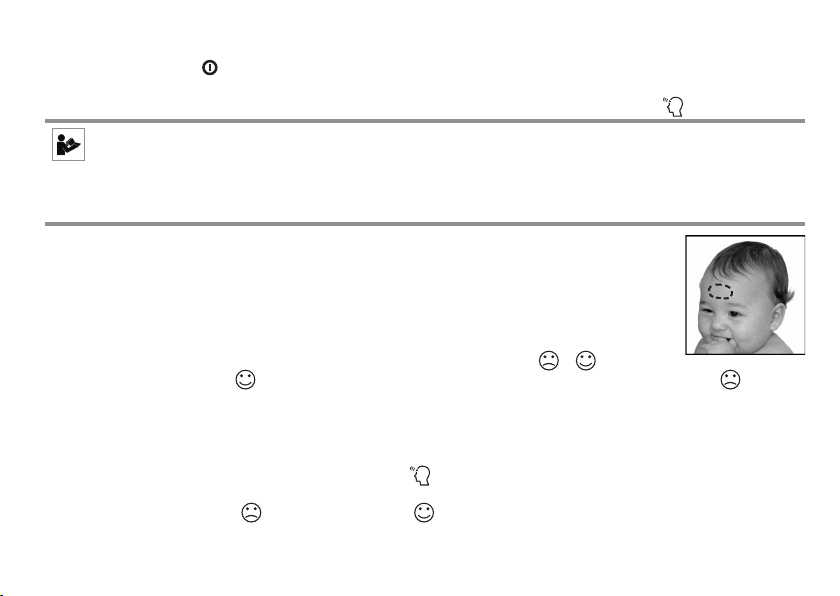
89
8. Misurazione sulla fronte
Premere brevemente il pulsante ON/OFF.
Dopo un breve autotest e un doppio segnale acustico l’apparecchio è pronto per misurare la temperatura sulla
fronte. L’apparecchio è sempre in modalità Temperatura frontale, riconoscibile dal simbolo
.
Suggerimento Beurer
Tenere presente che
• l
’attività fisica, una sudorazione della fronte particolarmente elevata, l’assunzione di medicinali vaso-
costrittori e le irritazioni della pelle possono alterare i risultati della misurazione,
• l
a fronte e in particolare le tempie devono essere libere da sudore e cosmetici.
Tenere il termometro a una distanza di 2-3 cm dal punto di misurazione. Premere il pulsante
SCAN e far scorrere il termometro nell’area della fronte avanti e indietro (Fig. 8).
Durante la misurazione è possibile sentire brevi segnali acustici (se attivati) che indicano che
il termometro ha rilevato un nuovo valore di misurazione più elevato.
La misurazione si ritiene conclusa quando viene emesso un segnale acustico lungo.
Rilasciare il pulsante SCAN.È ora possibile leggere il valore misurato.
Inoltre, in base ai risultati della misurazione, il display visualizza i simboli
o :
Il simbolo assenza di febbre indica che la temperatura corporea è normale, il simbolo della febbre un valore
pari o superiore a 38,0°C indica un allarme febbre.
Se il segnale acustico è attivo, al termine della misurazione saranno emessi tre segnali acustici se la temperatura
è pari o superiore a 38,0°C.
Il tempo di misurazione dura di norma 2 secondi, ma può arrivare fino a 30 secondi.
Un doppio segnale acustico e il simbolo della fronte
, non più lampeggiante segnalano che l‘apparecchio è
pronto per una nuova misurazione. Il valore misurato viene memorizzato in automatico con l‘indicazione Data/Ora
e la classificazione „Febbre“ / „Assenza di febbre“ .
Fig. 8
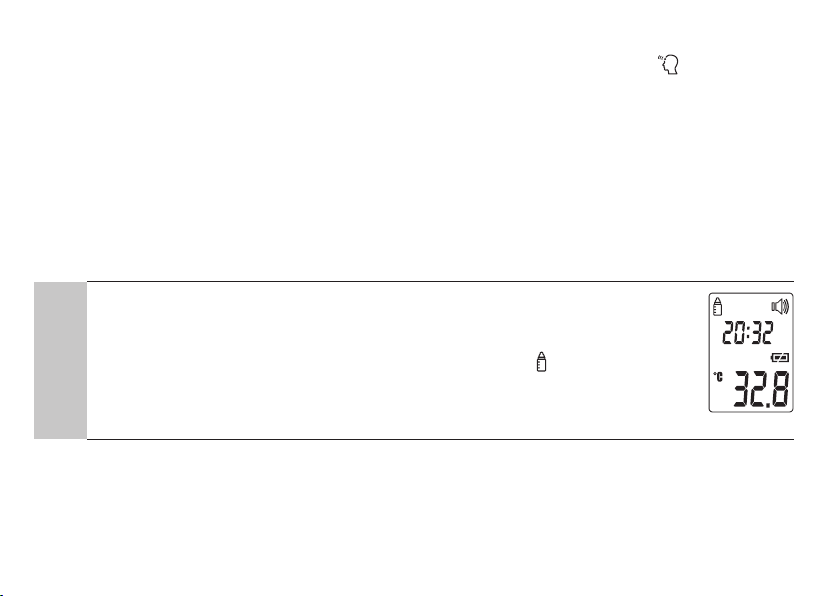
90
8.1 Visualizzazione dei valori memorizzati
L’apparecchio memorizza esclusivamente valori misurati in modalità Temperatura frontale e ne memorizza
automaticamente le ultime 60 misurazioni.
Se i 60 spazi sono tutti occupati, viene di volta in volta cancellato il valore più remoto.
Per richiamare la memoria:
• A
termometro acceso tenere premuto il pulsante MODE/MEM per 5 secondi.
Viene visualizzato il valore misurato più recente.
•
O
gni volta che si preme nuovamente il pulsante MODE/MEM viene visualizzato il numero di posizione nella
memoria e se si rilascia il pulsante appare il valore misurato.
• N
ella riga superiore vengono visualizzate alternativamente l’ora e la data.
9. Misurazione della temperatura superficiale / temperatura ambiente
Modalità di misurazione
superficiale
Se si desidera misurare la temperatura superficiale con questo termometro, è necessario
selezionare la modalità Temperatura superficiale.
• A
termometro acceso premere il pulsante MODE/MEM.
L’apparecchio passa alla modalità di Temperatura superficiale .
•
T
enere il termometro 2 – 3 cm davanti all’oggetto di misurazione desiderato. Premere
brevemente il pulsante SCAN e leggere la temperatura dal display (Fig. 9).
I valori misurati in modalità temperatura superficiale non vengono memorizzati.
Fig. 9
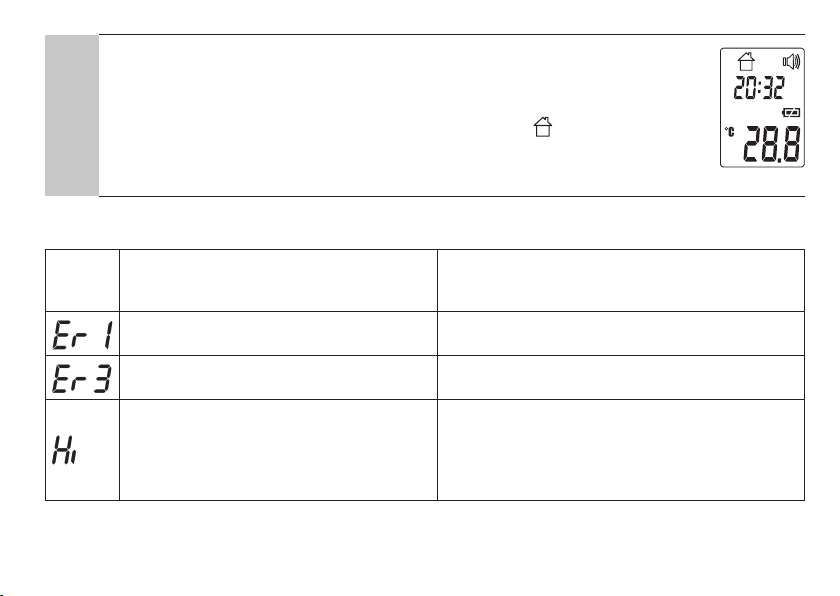
91
Modalità di misurazione
della temperatura ambiente
Se si desidera usare il termometro per misurare la temperatura dell’ambiente, è necessario
passare alla modalità della Temperatura ambiente.
• A
termometro acceso premere due volte il pulsante MODE/MEM.
L’apparecchio passa alla modalità di Temperatura ambiente .
• L
a temperatura ambiente viene mostrata direttamente (Fig. 10).
I valori misurati in modalità temperatura ambiente non vengono memorizzati.
Fig. 10
10. Messaggi di errore
Mes-
saggio
di errore
Problema Soluzione
Misurazione durante l’autotest, apparecchio
non ancora pronto.
Attendere finché il simbolo della fronte smette di lam-
peggiare.
Temperatura ambiente sotto i 10 °C o sopra i
40 °C (<50 °F, >104 °F).
La temperatura ambiente deve essere compresa tra i
10 °C e i 40 °C (50 °F, 104 °F).
(1) Modalità di misurazione della temperatura
frontale: la temperatura rilevata è superiore
a 42,2 °C (108 °F).
(2) Modalità di misurazione superficiale: la tem-
peratura rilevata è superiore a 80 °C (176 °F).
Utilizzare il termometro esclusivamente entro gli inter-
valli di temperatura indicati. Se il messaggio di errore
persiste, rivolgersi al rivenditore o al Servizio clienti.
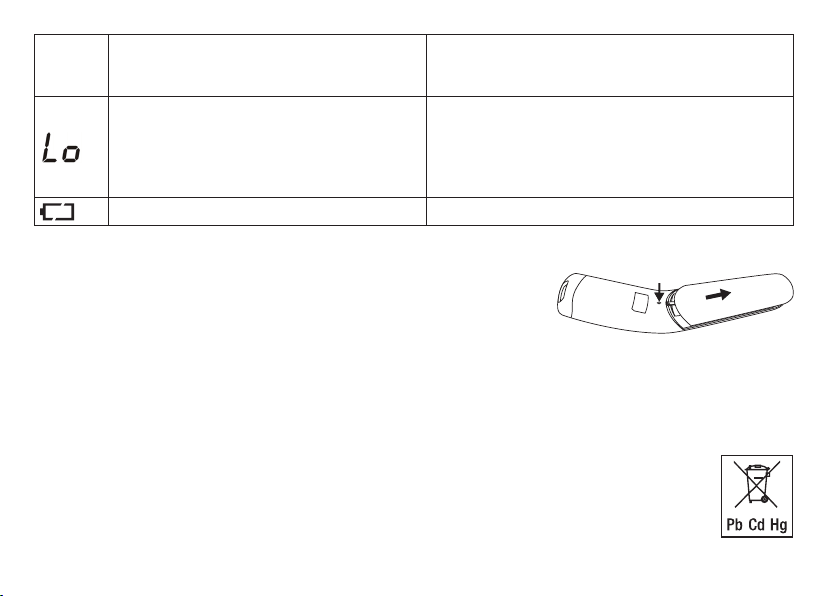
92
Mes-
saggio
di errore
Problema Soluzione
(1) Modalità di misurazione della temperatura
frontale: la temperatura rilevata è inferiore
a 34 °C (93,2 °F).
(2) Modalità di misurazione superficiale: la tem-
peratura rilevata è inferiore a -22 °C (-7,6 °F).
Utilizzare il termometro esclusivamente entro gli inter-
valli di temperatura indicati. Se il messaggio di errore
persiste, rivolgersi al rivenditore o al Servizio clienti.
Le batterie sono esauste. Cambiare le batterie.
11. Batterie
L’apparecchio necessita di due batterie, tipo AAA, LR03.
• A
prire il vano batterie.
Premere con un oggetto appuntito sul vano batterie e contemporanea-
mente premere verso il basso il coperchio delle batterie.
• E
strarre le batterie esauste dal vano batterie.
• I
nserire batterie nuove.
Accertarsi che le batterie siano orientate correttamente.
• C
hiudere il vano batterie.
• S
maltire le batterie esauste e completamente scariche negli appositi punti di raccolta, nei punti di raccolta per
rifiuti tossici o presso i negozi di elettronica. Lo smaltimento delle batterie è un obbligo di legge.
• I simboli riportati di seguito indicano che le batterie contengono sostanze tossiche.
Pb = batteria contenente piombo,
Cd = batteria contenente cadmio,
Hg = batteria contenente mercurio.
93
12. Pulizia dell’apparecchio
• I
l sensore di misurazione è la parte più delicata del termometro. Durante la pulizia maneggiare il sen-
sore di misurazione con la massima attenzione.
• N
on utilizzare detergenti aggressivi.
•
Seguire sempre tutte le indicazioni di sicurezza per l’utilizzatore e l’apparecchio.
w
3. Avvertenze e Sicurezza
Pulire il sensore di misurazione dopo ogni utilizzo. A tale scopo utilizzare un panno morbido o un cotton fioc imbe-
vuto di disinfettante o di alcol al 70 %.
Per la pulizia dell’intero apparecchio utilizzare un panno morbido leggermente inumidito con acqua e sapone.
Evitare assolutamente di lasciar penetrare acqua nell’apparecchio.
Utilizzare l’apparecchio solo quando è completamente asciutto.
13. Conservazione dell’apparecchio
Non utilizzare né riporre l’apparecchio in luoghi esposti a temperature troppo alte o troppo basse, all’umidità
(vedere specifiche tecniche), alla luce solare, alla corrente elettrica o alla polvere. Diversamente le misurazioni
potrebbero non essere corrette.
Se si prevede di non utilizzare l’apparecchio per un lungo periodo, rimuovere le batterie.
14. Smaltimento dell’apparecchio
•
P
er motivi ecologici, l’apparecchio non deve essere smaltito tra i normali rifiuti quando viene buttato via. Lo
smaltimento deve essere effettuato negli appositi centri di raccolta. Smaltire l’apparecchio secondo la
direttiva europea sui rifiuti di apparecchiature elettriche ed elettroniche (RAEE). Per eventuali chiarimenti,
rivolgersi alle autorità comunali competenti per lo smaltimento.
94
15. Dati tecnici
In caso di utilizzo dell’apparecchio al di fuori di quanto specificato nelle presenti istruzioni non è possibile garan-
tire un funzionamento corretto.
La precisione di questo termometro è stata accuratamente testata ed è stata sviluppata per una lunga durata di
vita utile.
Se l‘apparecchio viene utilizzato a scopo professionale, è necessario effettuare controlli tecnici con gli strumenti
adeguati. Richiedere informazioni dettagliate sulla verifica della precisione all‘indirizzo indicato del servizio assi
-
stenza.
Beurer si riserva il diritto di apportare modifiche tecniche al fine del miglioramento e del continuo sviluppo del
prodotto.
Tipo FT 90/1
Metodo di misurazione Misurazione a infrarossi senza contatto
Funzioni di base Misurazione della temperatura frontale
Misurazione della temperatura superficiale
Misurazione della temperatura ambiente
Unità di misura Celsius (°C) o Fahrenheit (°F)
Condizioni di funzionamento 10 °C - 40 °C (50 °F – 104 °F) in situazione di umidità relativa < 95 %
Condizioni di conservazione -20 °C - 50 °C (-4 °F – 122 °F) in situazione di umidità relativa < 85 %
Distanza misurazione Per effettuare la misurazione tenere una distanza di 2 – 3 cm
Intervalli di misurazione e pre
-
cisione della misurazione della
temperatura frontale
Misurazione della temperatura frontale
34 °C – 42,2 °C (93,2 °F – 108 °F)
Precisione di misurazione
da 36 °C a 39 °C: ± 0,2 °C
(da 96,8 °F a 102 °F: ± 0,4 °F)
Nel restante intervallo di misurazione: ± 0,3 °C (± 0,5 °F)
Precisione di ripetizione clinica 0,23 °C (0,41 °F)
95
Possibili errori e variazioni
Intervalli di misurazione e pre-
cisione
Misurazione della temperatura
superficiale
Misurazione della temperatura superficiale
-22 °C – 80 °C (-7,6 °F – 176 °F)
Precisione di misurazione ± 4% o ± 2 °C (± 4 °F)
Funzione di memoria
Misurazione della temperatura
corporea
Memorizza automaticamente gli ultimi 60 valori misurati.
Segnale acustico
All’accensione dell’apparecchio, durante la misurazione, a misurazione
conclusa (impostabile).
Visualizzazione Display LCD
Funzioni di risparmio energetico L’apparecchio si spegne automaticamente dopo 1 minuto.
Ingombro
Larghezza x profondità x altezza
ca. 47,6 mm x 29,0 mm x 188,0 mm
Peso 82 g (senza batterie)
2 batterie AAA, LR03 Autonomia per ca. 3000 misurazioni
L’attivazione di funzioni aggiuntive come il segnale acustico o l’illumina
-
zione del display diminuiscono la durata delle batterie.
16. Direttive
L’apparecchio è conforme ai requisiti della direttiva europea per i dispositivi medici 93/42/EEC, alla legge sui
dispositivi medici, alla norma ASTM E 1965 - 98 e alla norma europea EN60601-1-2, e necessita di precau
-
zioni d’impiego particolari per quanto riguarda la compatibilità elettromagnetica.

96
Içindekiler
1. İşaretlerin açıklaması ........................................ 97
2. Kullanım ............................................................ 98
3. Uyarılar ve Güvenlik .......................................... 98
3.1 Kullanıcılara yönelik tehlikeler .................... 98
3.2 Cihaza yönelik tehlikeler ............................ 99
3.3 Pillerle temas etme durumu için uyarılar ..... 99
4. Bu termometre hakkında bilgiler ..................... 100
5. Cihaz açıklaması ............................................. 102
5.1 Ekran açıklaması ....................................... 103
6. Çalıştırma ........................................................ 103
7. Termometrenin açılması ve ayarlanması ........ 104
7.1 Temel fonksiyonları ayarlama .................... 104
8. Alın bölgesinden ölçüm .................................. 106
8.1 Kaydedilen ölçüm değerlerinin
görüntülenmesi ......................................... 107
9. Nesne sıcaklığı / Oda sıcaklığının ölçümü ........ 108
10. Hataların gösterimi .......................................... 108
11. Piller ................................................................ 109
12. Cihazın temizlenmesi ...................................... 110
13. Cihazın saklanması ........................................ 110
14. Cihazın elden çıkarılması ................................ 111
15. Teknik veriler ................................................... 111
16. Yönetmelikler .................................................112
TÜRKÇE
Lütfen bu kullanım kılavuzunu dikkatle oku-
yun, ileride kullanmak üzere saklayın, diğer
kullanıcıların erişebilmesini sağlayın ve için-
deki yönergelere uyun.
Sayın müşterimiz,
Ürünlerimizden birini seçtiğiniz için teşekkür ederiz. Isı,
yumuşak terapi, kan basıncı/diyagnoz, ağırlık, masaj ve
hava konularında değerli ve titizlikle test edilmiş kaliteli
ürünlerimiz, dünyanın her tarafında tercih edilmektedir.
Lütfen bu kullanım kılavuzunu dikkatli bir şekilde okuyun
ve içindeki açıklamalara uyun.
Yeni cihazınızı iyi günlerde kullanmanızı dileriz
Beurer Ekibiniz
Teslimat kapsamı
Teslimat kapsamını kontrol ederek karton ambalajın
dıştan hasar görmemiş ve içeriğin eksiksiz olduğundan
emin olun. Cihazı kullanmadan önce, cihazda ve akse
-
suarlarında gözle görülür hasarlar olmadığından ve tüm
ambalaj malzemelerinin çıkarıldığından emin olunmalıdır.
Şüpheli durumlarda kullanmayın ve satıcınıza veya belir-
tilen müşteri hizmetleri adresine başvurun.
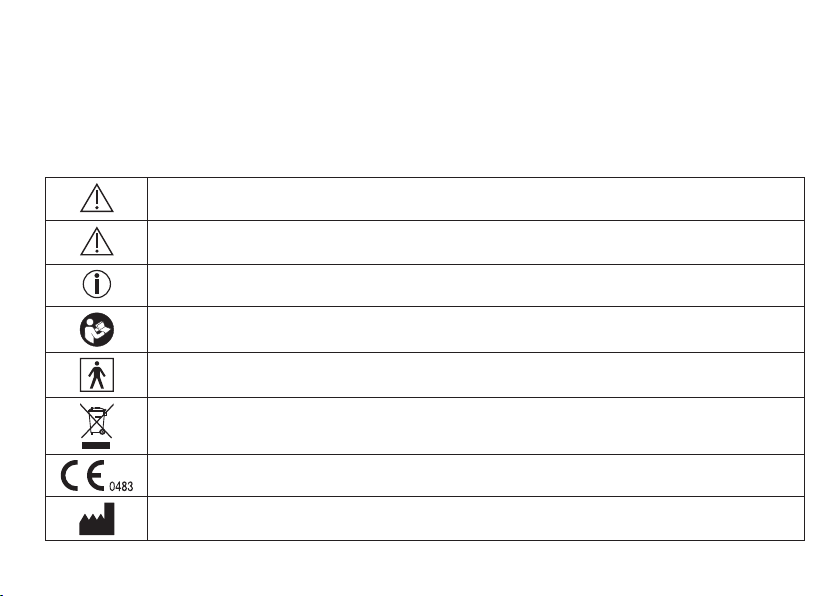
97
• T
ermometre
• 2
adet AAA, LR03 pil
• S
aklama kutusu
• K
ullanım Kılavuzu
1. İşaretlerin açıklaması
Aşağıdaki semboller kullanım kılavuzunda ve cihaz üzerinde kullanılmıştır:
UYARI
Yaralanma ve sağlığınız için tehlike uyarı talimatları.
DİKKAT
Cihaz ve aksesuarlarındaki olası hasarlar için güvenlik uyarısı.
Not
Önemli bilgilere yönelik not.
Kullanım kılavuzunu dikkate alın
Uygulama parçası tip BF
Elektrikli ve elektronik eski cihazlarla ilgili AB Yönetmeliği – WEEE’ye (Waste Electrical and Elec-
tronic Equipment) uygun şekilde bertaraf edilmelidir
CE işareti, tıbbi ürünler için 93/42/EEC yönetmeliğinin temel şartları ile uyumluluğu belgeler.
Üretici
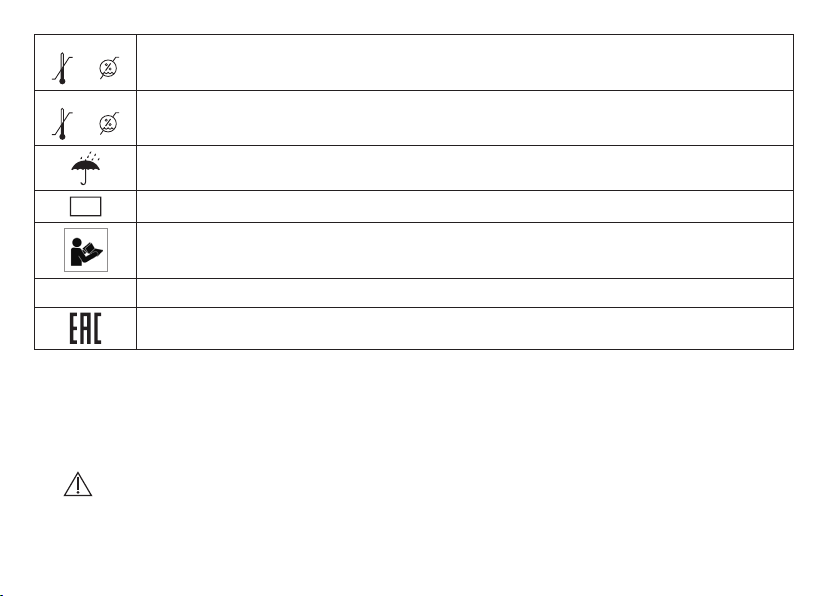
98
Storage
İzin verilen depolama sıcaklığı ve nem
Operating
İzin verilen çalışma sıcaklığı ve nem
Nemden koruyunuz
S
N
Seri numarası
Önemli bilgi/ipucu
w
Başka bir bölüme çapraz başvuru.
Rusya ve Bağımsız Devletler Topluluğu ülkelerine ihraç edilecek ürünler için sertifika işareti
2. Kullanım
Bu termometre alın, nesne ve oda sıcaklığının temassız ölçümü için kullanılır. Bu termometre evde ölçüm yapılması
için uygundur. Bununla vücut sıcaklığınızı hızlı ve basit biçimde ölçebilirsiniz. Değerler otomatik olarak kaydedilir.
3. Uyarılar ve Güvenlik
3.1 Kullanıcılara yönelik tehlikeler
• C
ihazınızı ancak bu kullanım kılavuzunu okuyup anladıktan sonra kullanın.
• L
ütfen bu kullanım kılavuzunu ileride tekrar kullanmak üzere saklayın. Kullanım kılavuzu tüm kullanıcılar için eri-
şilebilir olmalıdır. Tüm talimat ve uyarılara uyulmalıdır.

99
• C
ihazı, ölçüm yapmadan en az 30 dakika önce ölçüm yapılacak olan odada muhafaza edin.
• T
ermometre FT 90, insan vücudunda yalnızca kullanım kılavuzunda belirtilen ölçüm yerinde kullanılmak üzere
tasarlanmıştır.
• C
ihaz yalnızca kullanım kılavuzunda belirtilen amaçla kullanılmak üzere tasarlanmıştır.
• C
ihaz çocuklar tarafından kullanılamaz. Tıbbi ürünler oyuncak değildir.
• H
er kullanımdan önce lensin sağlam olup olmadığını kontrol edin. Arızalı olması halinde satıcınıza veya servi-
sinize başvurun.
• C
ihaz pratik kullanım amaçlı üretilmiştir, ancak doktor muayenesinin yerini tutamaz.
• C
ihazın kullanımıyla ilgili hala sorularınız varsa, lütfen satıcınıza veya müşteri hizmetlerine başvurun.
3.2 Cihaza yönelik tehlikeler
• C
ihazı herhangi bir mekanik darbeye maruz bırakmayın.
• C
ihazı doğrudan güneş ışığına maruz bırakmayın.
•
C
ihazı herhangi bir sıvıya maruz bırakmayın. Cihaz su geçirmez değildir. Su veya her türlü sıvıyla doğrudan
temas ettirmekten kaçının.
• C
ihazın yalnızca yetkili servisler tarafından onarılmasını sağlayın, aksi takdirde garanti hakkınız ortadan kalkar.
•
Taşınabilir veya mobil HF iletişim sistemleri bu cihazı etkileyebilir. Ayrıntılı bilgileri belirtilen müşteri servisi adresin-
den talep edebilir veya kullanım kılavuzunun son kısmında bulabilirsiniz.
3.3 Pillerle temas etme durumu için uyarılar
• P
il hücresindeki sıvı, cilt veya gözlerle temas ettiğinde, ilgili yeri suyla yıkayın ve bir doktora başvurun.
•
Yutma tehlikesi! Küçük çocuklar pilleri yutabilir ve bunun sonucunda boğulabilir. Bu nedenle pilleri, küçük
çocukların erişmeyeceği yerlerde saklayın!
• A
rtı (+) ve eksi (-) kutup işaretlerine dikkat edin.
• B
ir pil aktığında koruyucu eldiven giyin ve pil bölmesini kuru bir bezle temizleyin.
• P
illeri aşırı ısıya karşı koruyun.
100
•
Patlama tehlikesi! Pilleri ateşle atmayın.
• P
iller şarj edilmemeli veya kısa devre yaptırılmamalıdır.
• C
ihazı uzun süre kullanmayacağınız durumlarda pilleri pil bölmesinden çıkarın.
• Y
alnız aynı tip veya eşdeğer tip piller kullanın.
• H
er zaman tüm pilleri aynı anda değiştirin.
• Ş
arj edilebilir pil kullanmayın!
• P
illeri parçalarına ayırmayın, açmayın veya parçalamayın.
4. Bu termometre hakkında bilgiler
Ölçülen ısı değeri, ölçümün yapıldığı vücut bölgesine bağlı olarak değişiklik gösterir. Sapma sağlıklı bireylerde farklı
vücut bölgelerinde 0,2 °C ile 1 °C (0,4 °F ile 1,8 °F) arasında gerçekleşebilir.
Farklı termometrelerde normal ısı aralığı
Ölçüm değerleri Kullanılan termometre
Alın sıcaklığı 35,8 °C – 37,6 °C (96,4 °F – 99,7 °F) Alın termometresi
Kulak sıcaklığı 36,0 °C – 37,8 °C (96,8 °F – 100,0 °F) Kulak termometresi
Oral sıcaklık 36,0 °C – 37,4 °C (96,8 °F – 99,3 °F) geleneksel termometre
Rektal sıcaklık 36,3 °C – 37,8 °C (97,3 °F – 100,0 °F) geleneksel termometre
Beurer ipucu
• F
arklı termometrelerle ölçülmüş sıcaklıkları asla birbiriyle karşılaştırmayın.
•
D
oktorunuza vücut sıcaklığınızı hangi termometre ile ve vücudunuzun hangi bölgesinde ölçtüğünüzü
söyleyin. Bunu kendi kendinize yaptığınız teşhiste de göz önünde bulundurun.
101
Termometre ölçümden önce çok uzun süre elde tutulursa ısınır. Bunun sonucunda ölçüm sonucu yanlış
olabilir.
Vücut sıcaklığını etkileyen faktörler
• B
ireysel, kişiye bağlı metabolizma
• Y
aş
Vücut sıcaklığı, emzirilme dönemindeki bebeklerde ve küçük çocuklarda yetişkinlerdekinden daha yüksektir. Çocuk-
larda sıcaklık değişiklikleri daha çabuk ve sık ortaya çıkar. Artan yaşla birlikte normal vücut sıcaklığı da düşer.
• G
iysiler
• D
ış sıcaklık
• G
ünün saati
Vücut sıcaklığı sabahları daha düşüktür ve gün içerisinde akşam saatlerine doğru artış gösterir.
• A
ktiviteler
Vücut aktiviteleri ile etkisi daha düşük olan zihinsel aktiviteler vücut sıcaklığını arttırır.
Beurer ipucu
Vücut sıcaklığının ölçümü bir kimsenin güncel ölçüm değerlerini verir. Eğer sonuçları doğru yorumladığı
-
nızdan emin olamıyorsanız veya anormal değerler (örn. ateş) ortaya çıkarsa, doktorunuza başvurun. Bu
durum huzursuzluk, yoğun terleme, ciltte kızarıklık, şiddetli kalp atışı, kriz eğilimi vb. hastalık belirtilerinin
ortaya çıktığı küçük sıcaklık değişimlerinde de geçerlidir.
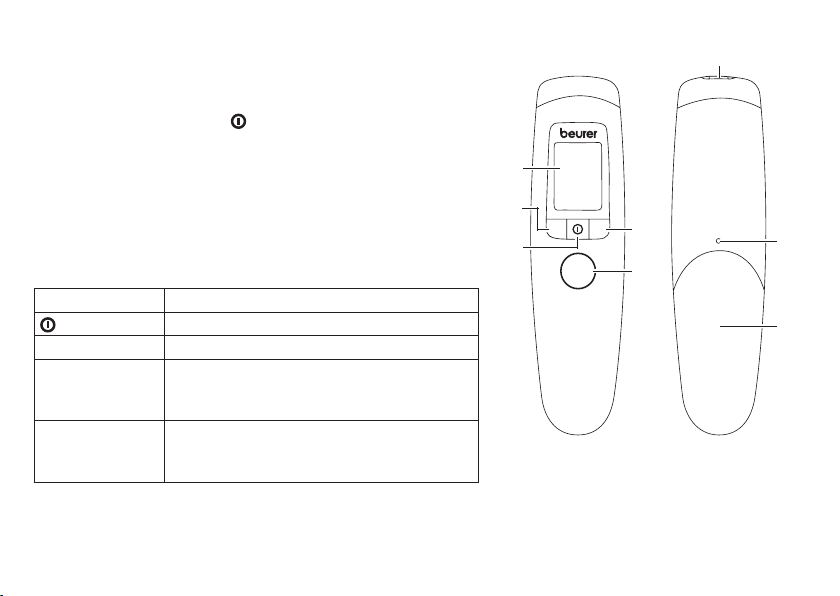
102
5. Cihaz açıklaması
1
Ekran
2
MODE/MEMdüğmesi
3
Açma/Kapama düğmesi
4
LIGHT/SET düğmesi
5
SCAN düğmesi
6
Ölçüm sensörü
7
Pil yuvası kilidi
8
Pil yuvası kapağı
Düğmeler İşlevler
Cihazı açın ve kapatır.
SCAN Sıçaklık ölçümünü başlatma.
MODE/MEM
MODE Ölçme modunun ayarlama.
MEM Kaydedilmiş ölçüm değerleri göster
-
gesi.
LIGHT/SET
LIGHT Ekran aydınlatmasının manuel olarak
açılması.
SET Temel fonksiyonların ayarlanması.
SCAN
MODE
ME M
LIGH T
SE T
1
3
2
4
5
6
7
8
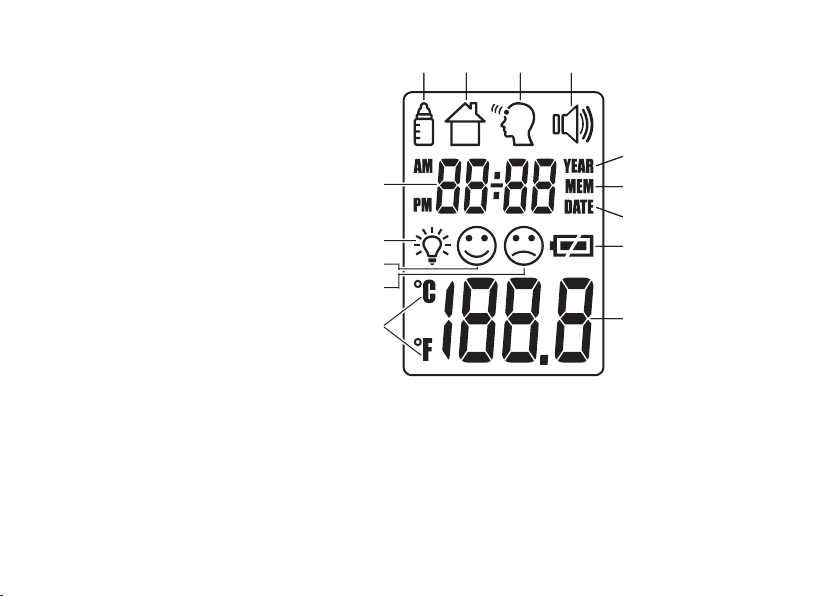
103
5.1 Ekran açıklaması
1
Nesne sıcaklığı modu
12 34
5
6
7
8
9
10
11
12
13
14
2
Oda sıcaklığı modu
3
Alın sıcaklığı modu
4
Sinyal sesi sembolü
5
Yıl
6
Bellek fonksiyonu
7
Tarih
8
Pil durumu
9
Sıcaklık değeri ve hafıza yeri numarası
göstergesi
10
Ölçüm birimi Santigrat/Fahrenheit
11
Ölçüm sonucu ≥ 38,0°C “ateş”
12
Ölçüm sonucu < 38,0°C “ateş yok”
13
Ekran aydınlatma sembolü
14
Yıl, tarih, saat göstergesi
6. Çalıştırma
Mevcut ise, pil haznesi kapağının izole bandını çekerek pil yatağı kapağını ve de pil koruma folyesini çıkartınız
ve pili kutuplarına göre yerleştiriniz.
w
11. Piller
Termometre kendi kendine kısa bir test uygulayıp iki kısa bip sesi çıkardıktan sonra, alın bölgesinde sıcaklık ölçümü
yapmaya hazırdır.
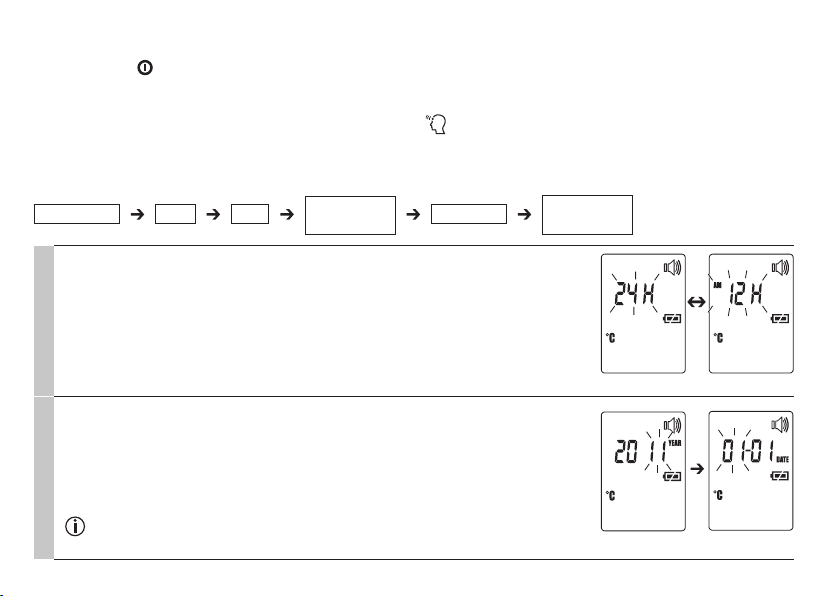
104
7. Termometrenin açılması ve ayarlanması
Açma/kapama düğmesine kısaca basın.
Termometre kendi kendine kısa bir test uygulayıp iki kısa bip sesi çıkardıktan sonra, alın bölgesinde sıcaklık ölçümü
yapmaya hazırdır.
Cihaz her zaman alın sıcaklığı modunda çalışmaya başlar
.
7.1 Temel fonksiyonları ayarlama
Bu menüde aşağıdaki fonksiyonlar sırayla kişiselleştirilebilir.
Saat formatı
•
T
ermometre çalışır durumdayken, 5 saniye boyunca LIGHT/SET düğme-
sine basın.
Saat formatı göstergesi ekranda yanıp söner (Res. 1).
•
MODE/MEM düğmesine basarak istediğiniz saat formatını ayarlayın ve
LIGHT/SET düğmesine basarak onaylayın.
Res. 1
Tarih
Yıl bilgisi ekranda yanıp söner (Res. 2).
•
MODE/MEM düğmesine basarak istediğiniz yılı ayarlayın ve LIGHT/SET
düğmesine basarak onaylayın.
Gün/ay ekranda yanıp söner (Res. 3).
•
MODE/MEM düğmesine basarak istediğiniz günü ve ayı ayarlayın ve LIGHT/
SET düğmesine basarak onaylayın.
24 saat formatında tarih, gün/ay ile birlikte gösterilir. 12 saat formatında
tarih, ay/gün ile birlikte gösterilir.
Res. 3Res. 2
Sıcaklık
ölçüm birimi
Ekran aydın-
latması
Saat formatı Tarih Saat Sinyal sesi
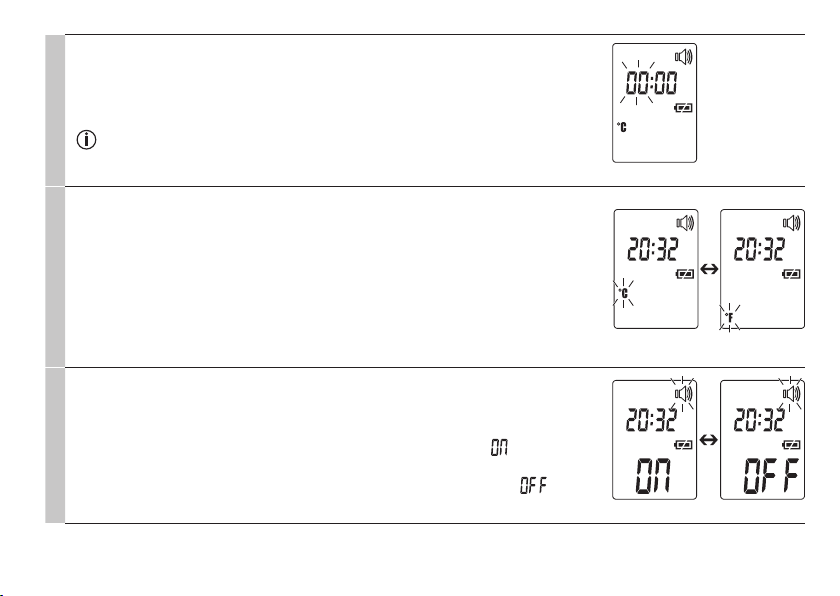
105
Saat
Saat ekranda yanıp söner (Res. 4).
•
MODE/MEM düğmesine basarak saati ayarlayın ve LIGHT/SET düğmesine
basarak onaylayın.
12 saat formatında saat, AM/PM (sabah/akşam) olarak gösterilir.
Res. 4
Sıcaklık ölçüm birimi
Sıcaklık ölçüm birimi ekranda yanıp söner (Res. 5).
Sıcaklık sonucunuzu derece Santigrat (°C) ya da derece Fahrenheit (°F) sıcaklık
birimi cinsinden görüntüleyebilirsiniz.
•
Ö
lçüm sonuçlarını Santigrat cinsinden görüntülemek için MODE/MEM düğ-
mesine basarak °C öğesini seçin ve LIGHT/SET düğmesine basarak onay-
layın.
•
Ö
lçüm sonuçlarını Fahrenheit cinsinden görüntülemek için MODE/MEM
düğmesine basarak °F öğesini seçin ve LIGHT/SET düğmesine basarak
onaylayın.
Res. 5
Sinyal sesi
Sinyal sesi sembolü ekranda yanıp söner (Res. 6).
Sinyal sesini (cihaz açıkken, ölçüm sırasında, ölçüm sonrasında) açabilir veya
kapatabilirsiniz.
• S
inyal sesini açmak için MODE/MEM düğmesine basarak öğesini seçin
ve LIGHT/SET düğmesine basarak onaylayın.
•
S
inyal sesini kapatmak için MODE/MEM düğmesine basarak öğesini
seçin ve LIGHT/SET düğmesine basarak onaylayın.
Res. 6
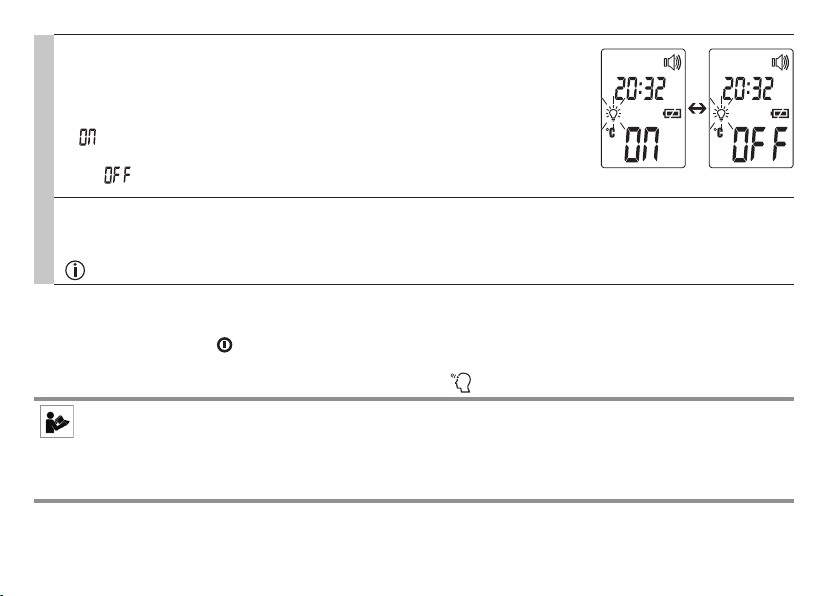
106
Ekran aydınlatması
Işık sembolü ekranda yanıp söner (Res. 7).
Otomatik ekran aydınlatmasını (alın sıcaklığını ölçtükten sonra) açabilir veya
kapatabilirsiniz.
•
O
tomatik ekran aydınlatmasını açmak için MODE/MEM düğmesine basarak
öğesini seçin ve LIGHT/SET düğmesine basarak onaylayın.
•
O
tomatik ekran aydınlatmasını kapatmak için MODE/MEM düğmesine basa-
rak öğesini seçin ve LIGHT/SET düğmesine basarak onaylayın.
Res. 7
Bunun yanı sıra ekran aydınlatmasını, LIGHT/SET düğmesine kısaca basarak manuel olarak da çalıştıra-
bilirsiniz.
Ekran 5 saniye boyunca aydınlanır.
Otomatik ve manuel ekran aydınlatması, ölçüm işlemi esnasında kullanılamaz.
8. Alın bölgesinden ölçüm
Açma/kapama düğmesine kısaca basın.
Cihaz kendi kendine kısa bir test uygulayıp iki kısa bip sesi çıkardıktan sonra, alın bölgesinde sıcaklık ölçümü yap-
maya hazırdır. Cihaz her zaman alın sıcaklığı modundadır. Bu sembolünde görülür.
Beurer ipucu
Fiziksel aktivite,
• a
lın bölgesinde aşırı terleme, damar büzücü ilaçlar ve ciltte kızarıklıkların ölçüm sonucunu etkileyebi-
leceğini dikkate alın.
• A
lın bölgesinin, terden ve kozmetik ürünlerden arındırılmış olması gerekmektedir.
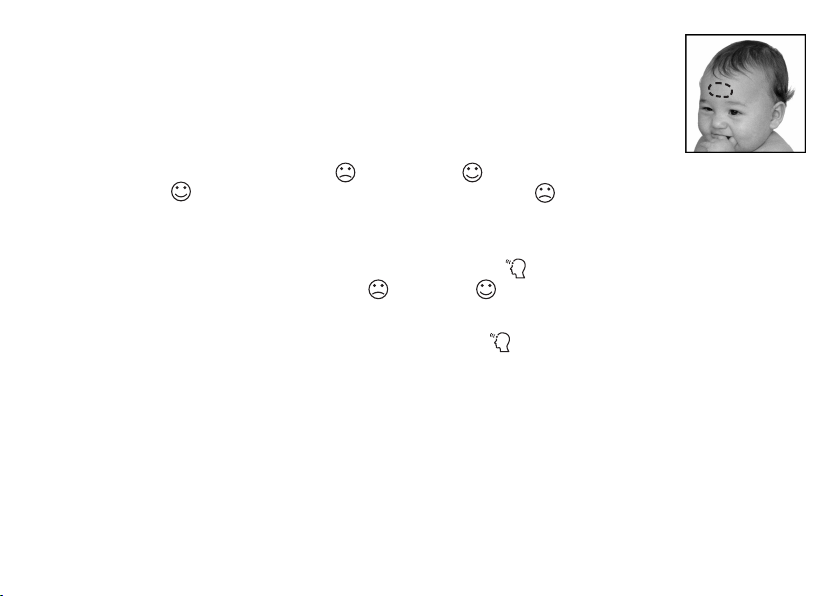
107
Termometreyi ölçüm yerinin 2 - 3 cm gerisine koyun. SCAN düğmesine basın ve
termometreyi alın bölgesinde sağa ve sola doğru hareket ettirin (Res. 8).
Ölçüm esnasında, termometrenin yeni bir yüksek ölçüm değeri bulduğunu bildiren kısa bir bip
sesi (sadece sinyal sesi açıkken) duyulur.
Ölçüm süresinin sonunda uzun bir bip sesi duyulur.
SCAN düğmesini bırakın.
Artık ölçülen değeri okuyabilirsiniz.
Ayrıca ekranda ölçüm sonucuna göre ateş
ya da ateş yok sembolü gösterilir:
Ateş yok sembolü
vücut sıcaklığının normal olduğunu, ateş sembolü ise ölçüm değerinin ölçüm değerinin
38,0°C veya üstünde olduğunu gösterir; bu da ateş alarmı anlamına gelmektedir. Sinyal sesi açık olduğunda ölçüm
sonunda ayrıca sıcaklık 38,0°C veya üstünde olduğunda üç bip sesi verilir.
Ölçüm süresi normal şartlar altında 2 saniyedir, ancak 30 saniyeye kadar sürebilir.
Cihaz iki kısa bip sesi ve artık yanıp sönmeyen bir alın sembolü ile
, cihazın başka bir ölçüm için hazır oldu-
ğunu belirtir. Ölçüm değeri, tarih/saat ve „ateş“ / „ateş yok“ sınıflandırmasıyla otomatik olarak kaydedilir.
8.1 Kaydedilen ölçüm değerlerinin görüntülenmesi
Cihaz, ölçüm değerlerini sadece alın sıcaklığı modunda kaydeder . Cihaz, ölçülen son 60 değeri otomatik ola-
rak kaydeder.
60 adetlik bellek alanı aşıldığında, en eski değer silinir.
Kayıt şu şekilde çağırılır:
• T
ermometre çalışır durumdayken, 5 saniye boyunca MODE/MEM düğmesine basın.
En yeni ölçüm değeri gözükecektir.
•
MODE/MEM düğmesine her bastığınızda ve ölçüm değeri düğmesini her bıraktığınızda, ilk olarak kayıt yeri
numarası görüntülenir.
• Ü
st satırda dönüşümlü olarak saat ve tarih görüntülenir.
Res. 8
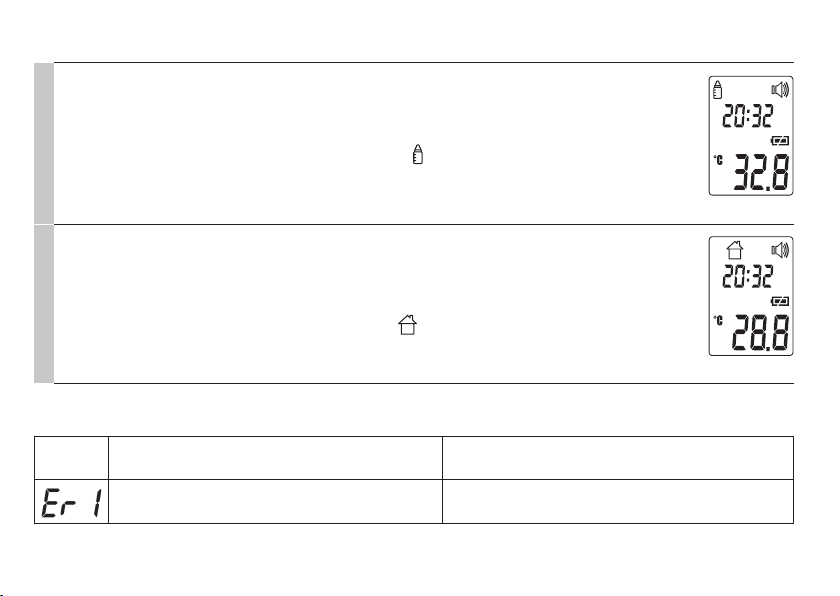
108
9. Nesne sıcaklığı / Oda sıcaklığının ölçümü
Nesne sıcaklığı modu
Bu termometreyle nesne sıcaklığını ölçmek istiyorsanız, termometreyi nesne sıcaklığı moduna
almanız gerekmektedir.
•
C
ihazı nesne sıcaklığı moduna almak için termometre çalışır durumdayken MODE/MEM
düğmesine basın.
Cihaz nesne sıcaklığı modunda çalışmaya başlar
.
•
T
ermometreyi ölçüm yapmak istediğiniz yerin 2 – 3 cm gerisine koyun. SCAN düğmesine
kısaca basın ve ekranda gözüken sıcaklığı okuyun (Res. 9).
Nesne sıcaklığı modundaki ölçüm değerleri kaydedilmemektedir.
Res. 9
Oda sıcaklığı modu
Termometreyi oda sıcaklığı ölçmede kullanmak istiyorsanız, oda sıcaklığı moduna almanız
gerekmektedir.
•
T
ermometreyi oda sıcaklığı moduna almak için, termometre çalışır durumdayken iki defa
kısaca MODE/MEM düğmesine basın.
Cihaz oda sıcaklığı modunda çalışmaya başlar
.
• O
da sıcaklığı doğrudan gösterilir (Res. 10).
Oda sıcaklığı modundaki ölçüm değerleri kaydedilmemektedir.
Res. 10
10. Hataların gösterimi
Hata
mesajı
Sorun Çözüm
Kendi kendine test sırasında cihaz ölçüm yap-
maya hazır değil.
Alın sembolü durana kadar bekleyin.
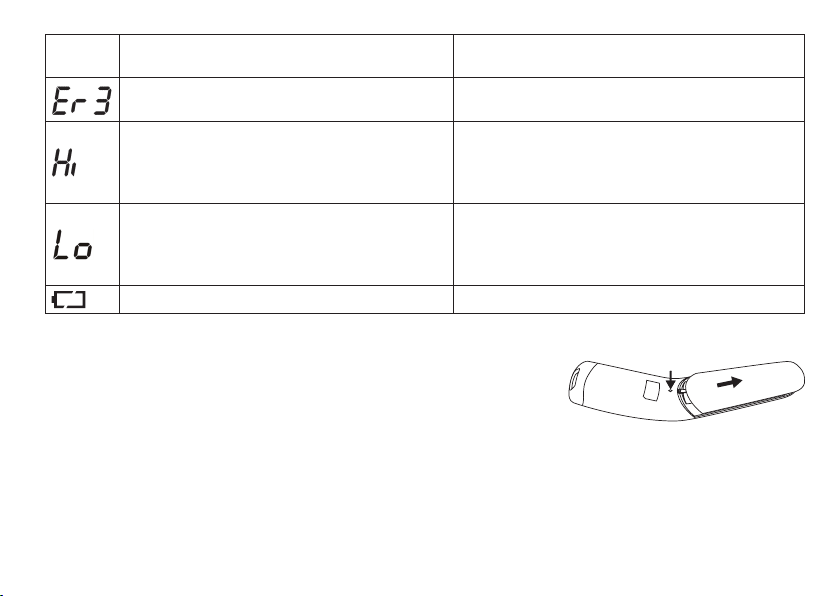
109
Hata
mesajı
Sorun Çözüm
10 °C’nin altında veya 40 °C’nin üzerinde
(<50 °F, >104 °F) oda sıcaklığı
Oda sıcaklığı 10 °C – 40 °C olmalıdır. (50 °F,
104 °F).
(1) Alın sıcaklığı modu: Tespit edilen sıcaklık
42,2 °C’nin üzerinde (108 °F).
(2) Nesne sıcaklığı modu: Tespit edilen sıcaklık
80 °C’nin üzerinde (176 °F).
Termometreyi yalnızca belirtilen sıcaklık aralıkları
içerisinde kullanın. Yeniden hatalı gösterim olursa
satıcınıza veya müşteri hizmetlerine danışın.
(1) Alın sıcaklığı modu: Tespit edilen sıcaklık
34 °C’nin altında (93,2 °F).
(2) Nesne sıcaklığı modu: Tespit edilen sıcaklık
-22 °C’nin altında (-7,6 °F).
Termometreyi yalnızca belirtilen sıcaklık aralıkları
içerisinde kullanın. Yeniden hatalı gösterim olursa
satıcınıza veya müşteri hizmetlerine danışın.
Piller bitmiş. Pilleri değiştirin.
11. Piller
Cihaz; AAA, LR03 tipinde iki pille çalışır.
• P
il yuvasını açın.
Sivri bir nesneyle pil yuvası kilidine bastırın ve aynı anda pil yuvasını aşa
-
ğıya doğru itin.
• B
itmiş pilleri, pil yuvasından çıkarın.
• Y
eni pilleri yerleştirin.
Pillerin doğru yönde yerleştirilmiş olmasına dikkat edin.
• P
il yuvasını kapatın.
110
• K
ullanılmış, şarjı tamamen boşalmış piller özel işaretli toplama kutularına atılarak, özel çöp alma yerlerine veya
elektrikli cihaz satıcılarına teslim edilerek bertaraf edilmelidir. Pillerin bertaraf edilmesi, yasal olarak sizin sorum
-
luluğunuzdadır.
• Bu işaretler, zararlı madde içeren pillerin üzerinde bulunur:
Pb = Pil kurşun içeriyor,
Cd = Pil kadmiyum içeriyor,
Hg = Pil cıva içeriyor.
12. Cihazın temizlenmesi
• Ö
lçüm sensörü, termometrenin en hassas parçasıdır. Ölçüm sensorünü temizlerken çok dikkat edin.
• A
şındırıcı temizlik maddesi kullanmayın.
• K
ullanıcıya ve cihaza yönelik güvenlik talimatlarına uyun.
w
3. Uyarılar ve Güvenlik
Ölçüm sensörünü her kullanımdan sonra temizleyin. Bunun için dezenfektan veya alkol ile nemlendirilebilen yumu-
şak bir bez veya pamuklu çubuk kullanın.
Tüm cihazı temizlemek için lütfen yumuşak, sabunlu su ile hafif nemlendirilmiş bir bez kullanın. Cihaza kesinlikle
su girmemelidir.
Cihazı, tamamen kuruyana dek kullanmayın.
13. Cihazın saklanması
Cihaz çok yüksek veya düşük sıcaklıktaki veya nemli ortamlarda (bkz: teknik özellikler), güneş ışığında, elektrik akımı
ile bağlantılı veya tozlu yerlerde saklanamaz veya kullanılamaz. Aksi takdirde ölçümlerde tutarsızlıklar ortaya çıkabilir.
Uzun süreli saklama planlanıyorsa, piller çıkarılmalıdır.
111
14. Cihazın elden çıkarılması
• Ç
evreyi korumak için, kullanım ömrü dolan cihazı evsel atıklarla beraber elden çıkarmayın. Cihaz, ülkenizdeki
uygun atık toplama merkezleri üzerinden bertaraf edilebilir. Cihazı hurda elektrikli ve elektronik eşya
direktifine – WEEE (Waste Electrical and Electronic Equipment) uygun olarak bertaraf edin. Bertaraf
etme ile ilgili sorularınızı, ilgili yerel makamlara iletebilirsiniz.
15. Teknik veriler
Cihaz belirtilen şartlar dışında kullanılırsa kusursuz çalışması garanti edilememektedir!
Bu termometrenin doğruluğu dikkatli bir şekilde kontrol edilmiştir ve alet uzun bir kullanım ömrüne yönelik olarak
geliştirilmiştir.
Aletin tedavi amacıyla kullanılması halinde, uygun araçlarla ölçüm kontrolleri yapılmalıdır. Doğruluk kontrolü ile
ayrıntılı bilgileri servis adresinden talep edebilirsiniz.
Ürünü iyileştirmek ve geliştirmek için teknik değişiklik yapma hakkımız saklıdır.
Tip FT 90/1
Ölçüm yöntemi Temassız kızılötesi ölçüm
Temel fonksiyonlar Alın sıcaklığı ölçümü
Nesne sıcaklığı ölçümü
Oda sıcaklığı ölçümü
Ölçüm birimleri Santigrat (°C) veya Fahrenheit (°F)
Kullanım şartları 10 °C – 40 °C (50 °F – 104 °F) bağıl nem oranı < % 95
Saklama ortamı -20 °C – 50 °C (-4 °F – 122 °F) bağıl nem oranı < % 85
Ölçme mesafesi Ölçüm yerine 2 – 3 cm uzaklık
112
Ölçüm aralığı ve alın sıcaklığı ölçü-
münün doğruluğu
Alın sıcaklığı ölçümü 34 °C – 42,2 °C (93,2 °F – 108 °F)
Ölçüm kesinliği 36 °C – 39 °C: ± 0,2 °C (96,8 °F ila 102 °F: ± 0,4 °F)
Kalan ölçüm aralığında ± 0,3 °C (± 0,5 °F)
Klinik tekrarlama hassasiyeti 0,23 °C (0,41 °F)
Ölçüm aralığı ve kesinliği
Nesne sıcaklığı ölçümü
Nesne sıcaklığı ölçümü -22 °C – 80 °C (-7,6 °F – 176 °F)
Ölçüm kesinliği ± %4 veya ± 2 °C (± 4 °F)
Bellek fonksiyonu
Vücut sıcaklığı ölçümü
Son 60 ölçüm değerini otomatik olarak kaydeder.
Sinyal sesi Cihazı açarken, ölçüm yaparken, ölçümün sonunda (ayarlanabilir).
Gösterge LCD Ekran
Enerji tasarrufu fonksiyonları Cihaz 1 dakika sonra otomatik olarak kapanır.
Ölçüler
Genişlik x Derinlik x Yükseklik
yakl. 47,6 mm x 29,0 mm x 188,0 mm
Ağırlık 82 g (piller hariç)
2 adet AAA, LR03 pil Yaklaşık 3000 ölçüme yeten çalışma ömrü
Buna ek olarak, sinyal sesi ya da ekran aydınlatması gibi aktifleştirilmiş
fonksiyonlar pilin ömrünü kısaltmaktadır.
16. Yönetmelikler
Bu cihaz, 93/42/EEC sayılı AB tıbbi cihazlar direktifine, tıbbi ürünler kanununa, ASTM E 1965 - 98 standardına,
EN 60601-1-2 Avrupa standardına uygundur ve elektromanyetik uyumluluk bakımından özel önlemlere tabidir.
Hata ve değişiklik hakkı saklıdır

113
Cодержание
1. Пояснения ксимволам ................................. 114
2. Область применения ....................................116
3. Предостережения и безопасность .............. 116
3.1 Опасности для пользователя ................ 116
3.2 Опасности для прибора ........................ 117
3.3 Обращение с элементами питания ........ 117
4. Информация о термометре .......................... 118
5. Описание прибора ........................................ 120
5.1 Описание дисплея ................................... 121
6. Подготовка к работе ..................................... 122
7. Включение и настройка термометра ......... 122
7.1 Настройка основных функций ............... 122
8. Измерение температуры на лбу .................. 125
8.1 Отображение измеренных значений .... 126
9. Измерение температуры объекта /
комнатной температуры ............................... 126
10. Индикация неисправностей ......................... 127
11. Батарейки ...................................................... 128
12. Очистка прибора ........................................... 129
13. Хранение прибора ....................................... 129
14. Утилизация прибора ..................................... 130
15. Технические характеристики ....................... 130
16. Директивы .................................................... 132
17. Гарантия ........................................................ 132
РУССКИЙ
Внимательно прочтите данную инструк-
цию по применению, сохраняйте ее для
последующего использования, храните
в месте, доступном для других пользова-
телей, и следуйте указаниям.
Уважаемый покупатель!
Благодарим Вас за выбор продукции нашей фирмы.
Мы производим современные, тщательно проте-
стированные, высококачественные изделия для
обогрева, мягкой терапии, измерения массы, арте-
риального давления, для диагностики, массажа
иочистки воздуха.
Внимательно прочтите эту инструкцию иследуйте
указаниям.
С наилучшими пожеланиями,
компания Beurer
Комплект поставки
Проверьте комплектность поставки иубедитесь, что
на картонной упаковке нет внешних повреждений.
Перед использованием убедитесь втом, что прибор
иего принадлежности не имеют видимых повреж-
дений, иудалите все упаковочные материалы. При
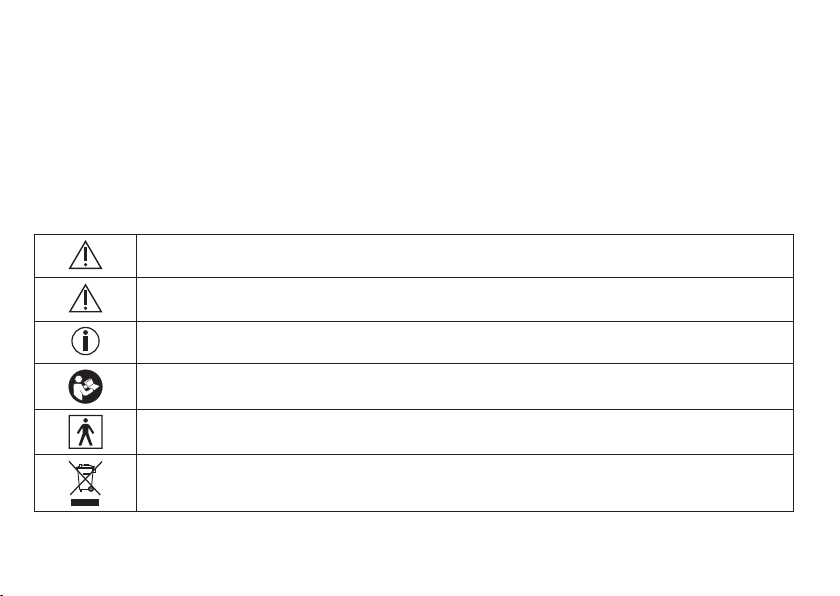
114
наличии сомнений не используйте прибор иобратитесь кпродавцу или по указанному адресу сервисной
службы.
• М
едицинский термометр
• 2
батарейки AAA, LR03
• К
оробка для хранения
• И
нструкция по применению
1. Пояснения ксимволам
В инструкции по применению ина приборе используются следующие символы.
ПРЕДОСТЕРЕЖЕНИЕ
Предупреждает об опасности травмирования или ущерба для здоровья.
ВНИМАНИЕ
Указывает на возможность повреждения прибора/принадлежностей.
Примечание
Отмечает важную информацию.
Соблюдайте инструкцию по применению
Рабочая часть типа BF
Утилизация прибора в соответствии с Директивой ЕС по отходам электрического
иэлектронного оборудования — WEEE (Waste Electrical and Electronic Equipment).
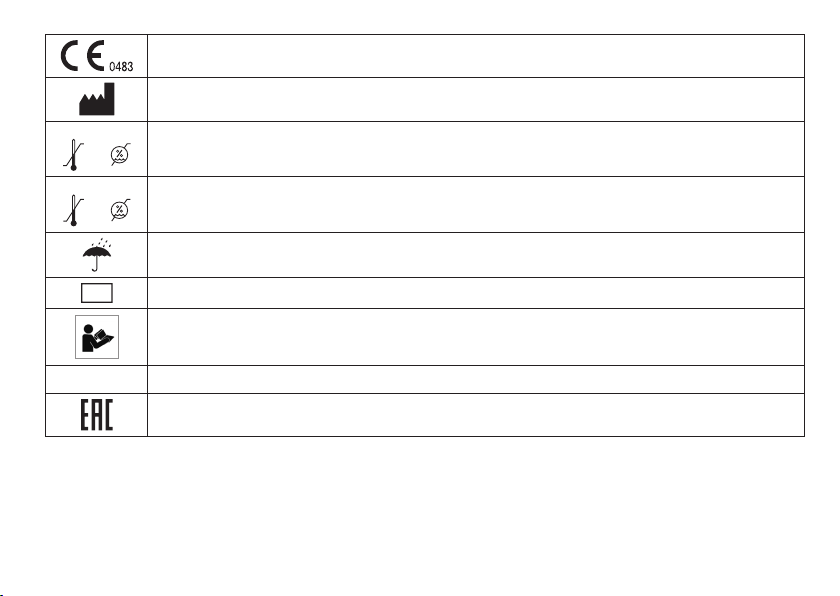
115
Символ CE подтверждает соответствие основным требованиям директивы омедицинских
изделиях 93/42/EEC.
Производитель
Storage
Допустимая температура хранения и влажность воздуха
Operating
Допустимая рабочая температура и влажность воздуха
Хранить в сухом месте
S
N
Серийный номер
Важная информация/совет
w
Перекрестная ссылка на другой абзац.
Соответствие изделий стандартам Таможенного союза «ЕАС»

116
2. Область применения
Медицинский термометр предназначен для бесконтактного измерения температуры лба, температуры
предмета и температуры помещения. Термометр подходит для измерения в домашних условиях. С его
помощью Вы можете быстро и просто определить температуру тела. Измеренные значения сохраняются
автоматически.
3. Предостережения и безопасность
3.1 Опасности для пользователя
•
И
спользуйте прибор только после того, как прочтете данную инструкцию и поймете содержащуюся в
ней информацию.
•
С
охраните данную инструкцию. Инструкция должна быть доступна для всех пользователей. Соблюдайте
все указания.
•
П
рибор перед измерением должен минимум 30 минут находиться в том помещении, в котором будет
проводиться измерение.
• Т
ермометр FT 90 предназначен для измерения температуры тела только в месте, указанном в инструк-
ции по применению.
• П
рибор должен использоваться только в целях, описываемых в данной инструкции по применению.
• И
спользование прибора детьми запрещено. Не разрешайте детям играть с медицинскими изделиями.
•
П
еред каждым применением проверяйте, не повреждена ли линза. В случае ее повреждения обратитесь
к поставщику или в сервисный центр.
•
П
рибор был сконструирован для практического применения, однако его использование не может заме-
нить посещения врача.
• Е
сли у Вас есть какие-либо вопросы по применению прибора, обратитесь к своему торговому предста-
вителю или в сервисную службу.

117
3.2 Опасности для прибора
• Н
е подвергайте прибор воздействию механических ударов.
• Н
е допускайте воздействия на прибор прямых солнечных лучей.
•
Н
е допускайте контакта прибора с жидкостями. Прибор не является водонепроницаемым. Избегайте
прямого контакта с водой или другими жидкостями.
•
Д
оверяйте ремонт прибора только авторизованным сервисным центрам, иначе гарантия потеряет свою
силу.
•
Переносные и мобильные высокочастотные коммуникационные устройства могут оказать влияние на
работу прибора. Более точные данные можно запросить по указанному адресу сервисной службы или найти
в конце инструкции по применению.
3.3 Обращение с элементами питания
• П
ри попадании жидкости из аккумулятора на кожу или в глаза необходимо промыть соответствующий
участок большим количеством воды и обратиться к врачу.
•
Опасность проглатывания мелких частей! Маленькие дети могут проглотить батарейки и подавиться
ими. Поэтому батарейки необходимо хранить в недоступном для детей месте!
• О
бращайте внимание на обозначение полярности: плюс (+) и минус (-).
• Е
сли батарейка потекла, очистите отделение для батареек сухой салфеткой, надев защитные перчатки.
• З
ащищайте батарейки от чрезмерного воздействия тепла.
•
Опасность взрыва! Не бросайте батарейки в огонь.
• Н
е заряжайте и не замыкайте батарейки накоротко.
• Е
сли прибор длительное время не используется, извлеките из него батарейки.
• И
спользуйте батарейки только одного типа или равноценных типов.
• З
аменяйте все батарейки сразу.
• Н
е используйте перезаряжаемые аккумуляторы!
• Н
е разбирайте, не открывайте и не разбивайте батарейки.
118
4. Информация о термометре
Измеренное значение температуры зависит от части тела, на которой она измеряется. Различия темпера-
туры разных частей тела здорового человека могут составлять от 0,2 °C до 1 °C (от 0,4 °F до 1,8 °F).
Нормальный диапазон температуры у различных термометров
Измеренные значения Использованный термометр
Температура на лбу 35,8 °C – 37,6 °C (96,4 °F – 99,7 °F) термометр для измерения температуры
на лбу
Температура в ухе 36,0 °C – 37,8 °C (96,8 °F – 100,0 °F) термометр для измерения температуры
в ухе
Температура в ротовой
полости
36,0 °C – 37,4 °C (96,8 °F – 99,3 °F) обычный термометр
Температура в прямой
кишке
36,3 °C – 37,8 °C (97,3 °F – 100,0 °F) обычный термометр
Совет от Beurer
• Н
икогда не сравнивайте между собой температуру, измеренную разными термометрами.
• С
ообщите своему врачу, каким термометром Вы мерили температуру и в каком месте. Учиты-
вайте это также при самодиагностике.
Если перед проведением измерения слишком долго держать термометр в руке, прибор может
нагреться. Это может привести к неверным результатам измерения.
119
Факторы влияния на температуру тела
• И
ндивидуальный обмен веществ
• В
озраст
Температура тела у младенцев и маленьких детей выше, чем у взрослых. У детей колебания температуры
возникают быстрее и чаще. С возрастом нормальная температура тела снижается.
• О
дежда
• Т
емпература окружающей среды
• В
ремя дня
Температура тела утром ниже и повышается в течение дня, достигая максимума к вечеру.
• А
ктивность
Физическая активность, а также умственная деятельность (в меньшей степени) повышают температуру тела.
Совет от Beurer
Измерение дает значение температуры тела человека в данный момент. Если возникли сомнения в
толковании результатов измерения или имеют место необычные значения (например, жар), обрати-
тесь к лечащему врачу. Это относится также к незначительным изменениям температуры, когда к
ним добавляются дополнительные симптомы заболевания, например, беспокойство, сильное пото-
отделение, покраснение кожных покровов, высокая частота пульса, склонность к коллапсам и т.д.
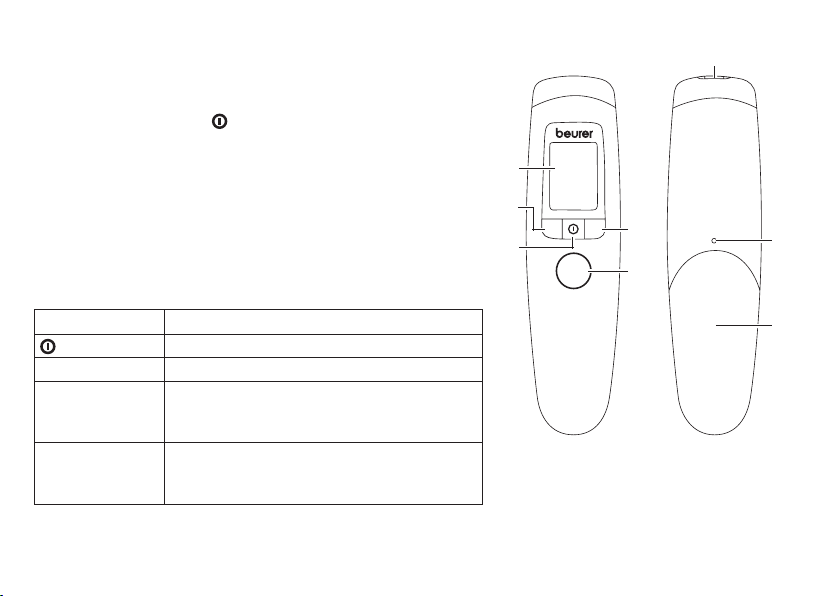
120
5. Описание прибора
1.
Дисплей
2.
Кнопка MODE/MEM
3.
Кнопка ВКЛ./ВЫКЛ.
4.
Кнопка LIGHT/SET
5.
Кнопка SCAN
6.
Измерительный датчик
7.
Отверстие для разблокировки
отделения для батареек
8.
Крышка отделения для батареек
Кнопки Функции
Включение и выключение устройства.
SCAN Начало измерения температуры.
MODE/MEM
(режим/память)
MODE Настройка режима измерения.
MEM Отображение сохраненных изме
-
ренных значений.
LIGHT/SET
(свет/
настройка)
LIGHT Ручное включение подсветки
экрана.
SET Настройка основных функций.
SCAN
MODE
ME M
LIGH T
SE T
1
3
2
4
5
6
7
8
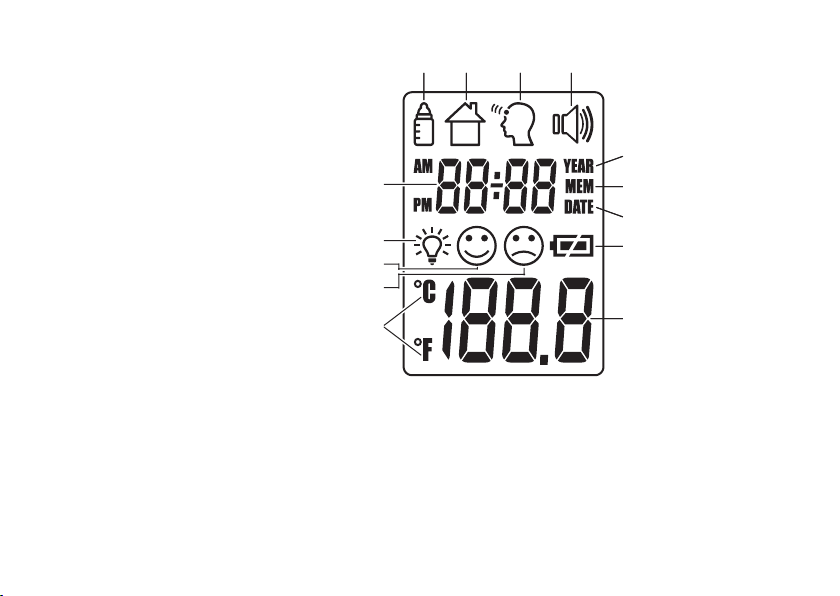
121
5.1 Описание дисплея
1.
Режим измерения температуры объекта
12 34
5
6
7
8
9
10
11
12
13
14
2.
Режим измерения комнатной темпера
-
туры
3.
Режим измерения температуры лба
4.
Символ звукового сигнала
5.
Год
6.
Функция памяти
7.
Дата
8.
Уровень зарядки батареек
9.
Отображение значения температуры/
номера в памяти
10.
Единица измерения: градус Цельсия/
Фаренгейта
11.
Результат измерения ≥ 38,0°C «жар»
12.
Результат измерения < 38,0 °C «нет
жара»
13.
Символ подсветки экрана
14.
Отображение года/даты/времени
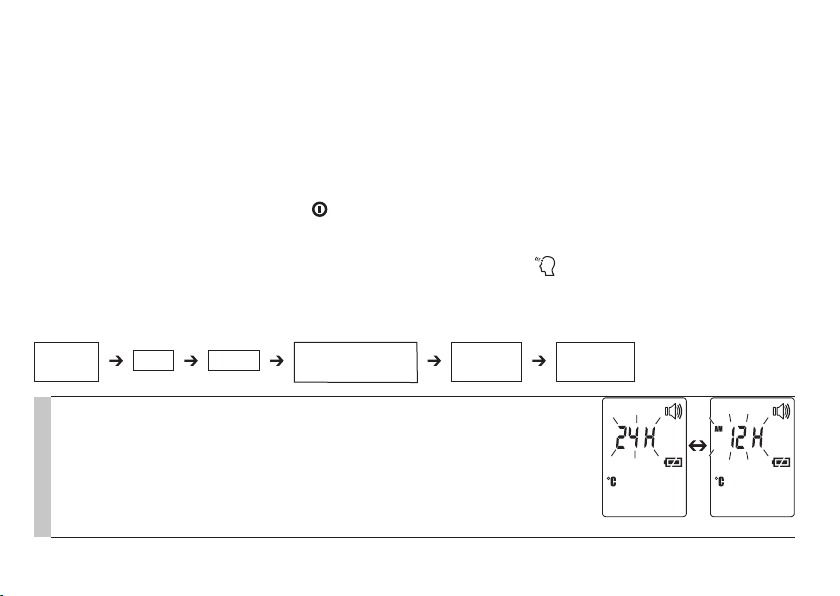
122
6. Подготовка к работе
Вытяните изолирующую полоску на крышке отсека для батареек (если таковая имеется), либо снимите
защитную пленку с самой батарейки и установите ее в отсек, соблюдая полярность.
w
11. Батарейки
После быстрой самопроверки и двух коротких звуковых сигналов термометр готов кизмерению темпе
-
ратуры на лбу.
7. Включение и настройка термометра
Коротко нажмите кнопку ВКЛ./ВЫКЛ. .
После быстрой самопроверки и двух коротких звуковых сигналов термометр готов к измерению темпе
-
ратуры на лбу.
Прибор всегда включается в режиме измерения температуры на лбу
.
7.1 Настройка основных функций
В этом меню можно последовательно индивидуальным образом настроить следующие функции.
Формат времени
•
У
держивайте кнопку LIGHT/SET в течение 5 секунд при включенном
термометре.
На дисплее замигает индикация формата времени (pис. 1).
•
С
помощью кнопки MODE/MEM выберите нужный формат времени и
подтвердите нажатием кнопки LIGHT/SET.
Рис. 1
Единица измере-
ния температуры
Подсветка
дисплея
Формат
времени
Дата Время
Звуковой
сигнал
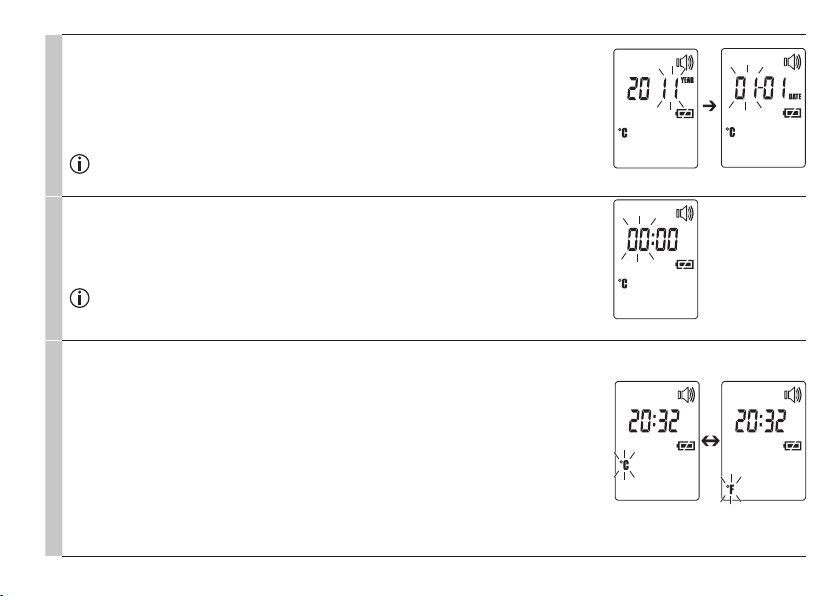
123
Дата
На дисплее замигает год (pис. 2).
•
С
помощью кнопки MODE/MEM установите год и подтвердите ввод нажа-
тием кнопки LIGHT/SET.
На дисплее замигает день/месяц (pис. 3).
•
С
помощью кнопки MODE/MEM установите день и месяц и подтвердите
ввод нажатием кнопки LIGHT/SET.
В режиме 24 ч дата отображается в формате день/месяц. В режиме 12
ч — в формате месяц/день.
Рис. 3Рис. 2
Время
На дисплее замигает время (pис. 4).
• С
помощью кнопки MODE/MEM установите время и подтвердите ввод
нажатием кнопки LIGHT/SET.
В режиме 12 ч время отображается в формате AM/PM.
Рис. 4
Единица измерения температуры
На дисплее замигает единица измерения температуры (pис. 5).
Отображение результатов измерения возможно в градусах Цельсия (°C)
или градусах Фаренгейта (°F).
• Д
ля просмотра результатов измерения в градусах Цельсия с помощью
кнопки MODE/MEM выберите °C и подтвердите выбор нажатием кнопки
LIGHT/SET.
• Д
ля просмотра результатов измерения в градусах Фаренгейта с помо-
щью кнопки MODE/MEM выберите °F и подтвердите выбор нажатием
кнопки LIGHT/SET.
Рис. 5
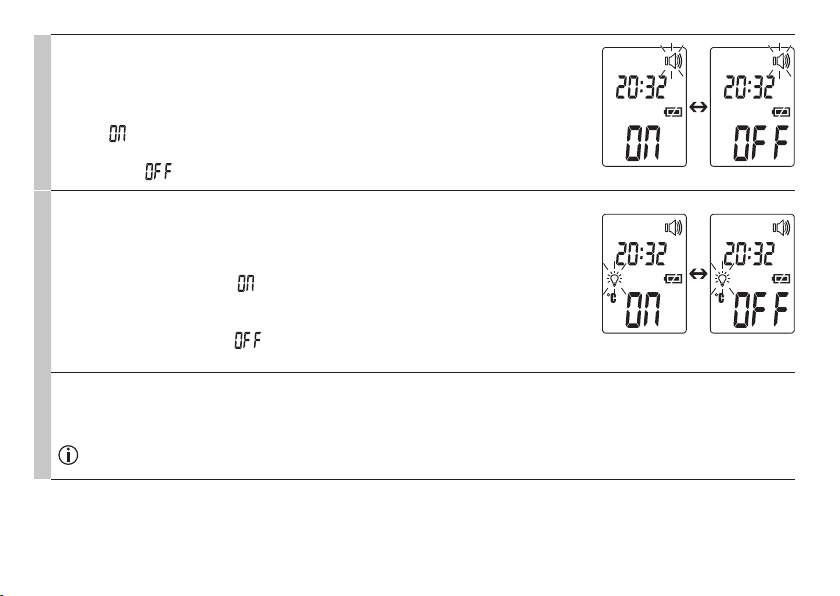
124
Звуковой сигнал
На дисплее замигает символ звукового сигнала (pис. 6).
Вы можете включить или выключить звуковые сигналы (включение прибора,
измерение, завершение измерения).
•
Д
ля включения звуковых сигналов с помощью кнопки MODE/MEM выбе-
рите и подтвердите выбор нажатием кнопки LIGHT/SET.
•
Д
ля выключения звуковых сигналов с помощью кнопки MODE/MEM
выберите и подтвердите выбор нажатием кнопки LIGHT/SET.
Рис. 6
Подсветка дисплея
На дисплее замигает символ звукового сигнала (pис. 7).
Вы можете включить или выключить автоматическую подсветку дисплея
(включается после измерения температуры на лбу).
•
Д
ля включения автоматической подсветки дисплея с помощью кнопки
MODE/MEM выберите и подтвердите выбор нажатием кнопки LIGHT/
SET.
• Д
ля выключения автоматической подсветки дисплея с помощью кнопки
MODE/MEM выберите и подтвердите выбор нажатием кнопки LIGHT/
SET.
Рис. 7
Кроме того, можно вручную включить автоматическую подсветку дисплея, коротко нажав кнопку LIGHT/
SET.
Подсветка дисплея включится на 5 секунд.
Автоматическую и ручную подсветку дисплея нельзя использовать в процессе измерения.
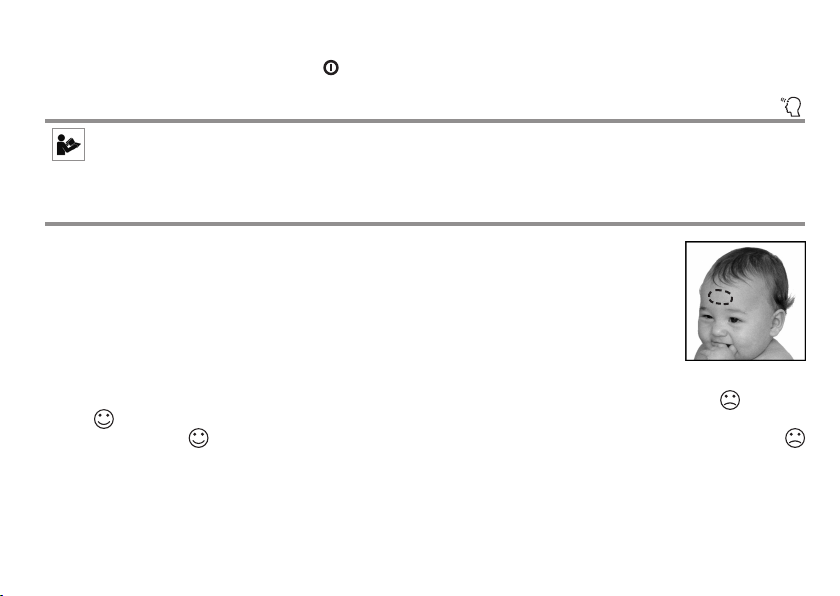
125
8. Измерение температуры на лбу
Коротко нажмите кнопку ВКЛ./ВЫКЛ. .
После быстрой самопроверки и двух коротких звуковых сигналов прибор готов к измерению температуры
на лбу. Прибор находится в режиме измерения температуры на лбу. Об этом свидетельствует символ .
Совет от Beurer
Учитывайте, что
•
ф
изическая активность, повышенное потоотделение на лбу, прием сосудосуживающих медика-
ментов и кожные раздражения могут привести к искажению результатов измерения,
• п
оэтому на лбу или висках не должно быть пота и косметики.
Удерживайте термометр на расстоянии 2–3 см от точки измерения. Нажмите кнопку
SCAN и перемещайте термометр по области лба (pис. 8).
В процессе измерения можно услышать короткие звуковые сигналы (только при вклю
-
ченном звуковом сигнале), которые означают, что термометр зафиксировал новое мак-
симальное значение.
О конце времени измерения сигнализирует длительный звуковой сигнал.
Отпустите кнопку SCAN.
Теперь Вы можете считать измеренные значения.
Кроме того, на дисплее будет показан соответствующий значению измерения символ «жар»
или «нет
жара»
:
Символ «нет жара»
показывает, что температура тела находится в пределах нормы, символ «жар»
свидетельствует о температуре выше 38,0°C, т.е. о лихорадочном состоянии.
При включенном звуке по завершении измерения также раздаются три коротких звуковых сигнала, если
температура выше или равна 38,0°C.
Как правило, процедура измерения занимает 2 секунды, но может длиться и до 30 секунд.
Рис. 8
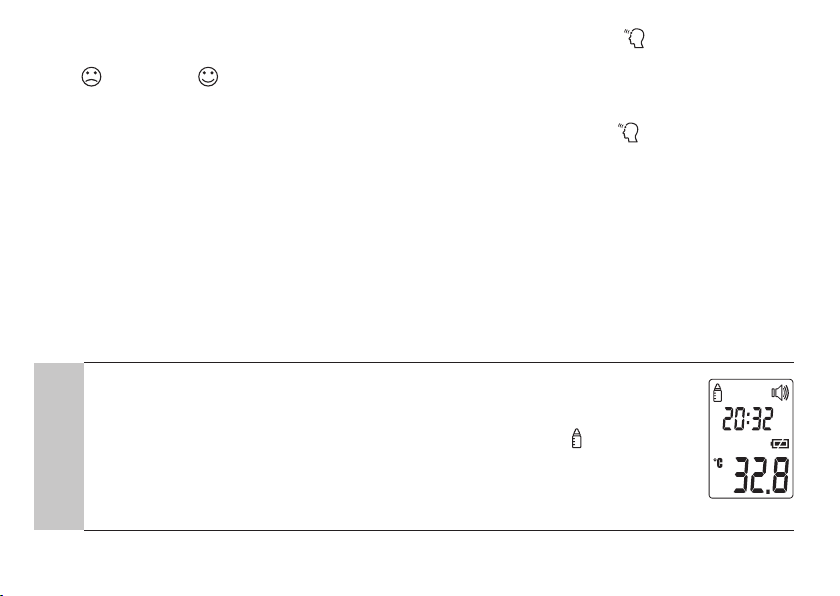
126
Прибор издает два коротких звуковых сигнала, и символ лба перестает мигать , что прибор готов к
дальнейшим измерениям. Значение измерения автоматически сохранится с датой/временем и оценкой
«жар» / «нет жара» .
8.1 Отображение измеренных значений
Прибор сохраняет в памяти значения исключительно в режиме температуры лба . Прибор автоматиче-
ски сохраняет значения 60 последних измерений.
Когда все 60 ячеек памяти заполнятся, новое значение будет записано в ячейку со самым старым из пре
-
дыдущих значений.
Память можно вызвать следующим образом:
• У
держивайте кнопку MODE/MEM в течение 5 секунд при включенном термометре.
Отобразится самое последнее измеренное значение.
• П
ри каждом последующем нажатии кнопки MODE/MEM сначала будет отображаться номер в памяти,
а при отпускании кнопки — значение измерения.
• В
верхней строке попеременно отображаются время и дата.
9. Измерение температуры объекта / комнатной температуры
Режим измерения темпе-
ратуры объекта
Для измерения температуры объекта с помощью этого термометра необходимо
перейти в режим измерения температуры объекта.
• Д
ля этого коротко нажмите кнопку MODE/MEM при включенном термометре.
Прибор переключится в режим измерения температуры объекта .
•
У
держивайте прибор на расстоянии 2–3 см от желаемой точки измерения. Коротко
нажмите кнопку SCAN и считайте температуру с дисплея (pис. 9).
Значения, определенные в режиме измерения температуры объекта, не сохраня-
ются в памяти.
Рис. 9
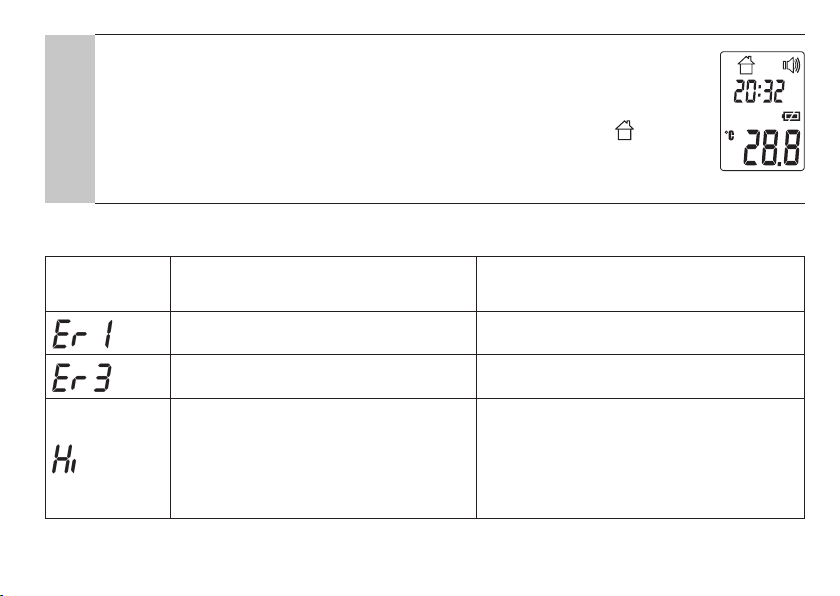
127
Режим измерения ком-
натной температуры
Для использования термометра для измерения комнатной температуры необходимо
перейти в режим измерения комнатной температуры.
•
Д
ля этого два раза коротко нажмите кнопку MODE/MEM при включенном тер-
мометре.
Прибор переключится в режим измерения комнатной температуры
.
• Б
удет отображаться комнатная температура (pис. 10).
Значения, определенные в режиме измерения комнатной температуры, не сохра-
няются в памяти.
Рис. 10
10. Индикация неисправностей
Сообщение
об ошибке
Проблема Решение
Измерение в процессе самопроверки,
прибор еще не готов к измерению.
Подождите, пока не перестанет мигать сим
-
вол лба.
Комнатная температура ниже 10 °C или
выше 40 °C (<50 °F, >104 °F).
Комнатная температура должна находиться в
пределах от 10 °C до 40 °C (от 50 °F до 104 °F).
(1) Режим измерения температуры лба:
Измеренная температура превышает
42,2 °C (108 °F).
(2) Режим измерения температуры объ-
екта: Измеренная температура превы-
шает 80 °C (176 °F).
Используйте термометр только для изме-
рений в пределах указанного диапазона
температур. При повторной индикации неис-
правности обратитесь к специализирован-
ному дилеру или в службу сервиса.
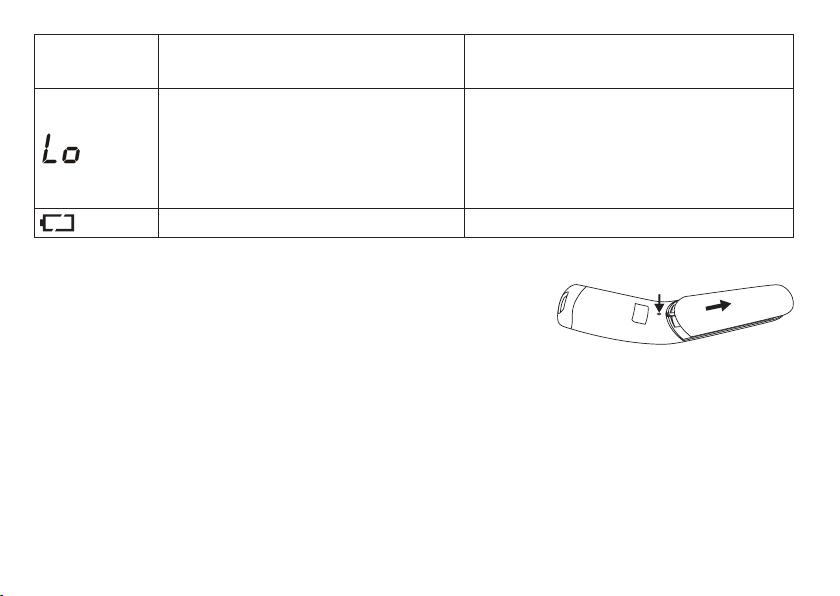
128
Сообщение
об ошибке
Проблема Решение
(1) Режим измерения температуры лба:
Измеренная температура ниже 34 °C
(93,2 °F).
(2) Режим измерения температуры объ-
екта: Измеренная температура ниже
-22 °C (-7,6 °F).
Используйте термометр только для изме-
рений в пределах указанного диапазона
температур. При повторной индикации неис-
правности обратитесь к специализирован-
ному дилеру или в службу сервиса.
Батарейки разряжены. Замените батарейки.
11. Батарейки
В приборе используются две батарейки типа AAA, LR03.
• О
ткройте отделение для батареек.
Для этого введите острый предмет в отверстие для разблокировки
отделения для батареек и одновременно с этим потяните крышку
отделения для батареек вниз.
• И
звлеките использованные батарейки из отделения.
• В
ставьте новые батарейки.
Следите за соблюдением полярности батареек.
• З
акройте отделение для батареек.
•
В
ыбрасывайте использованные, полностью разряженные батарейки в специальные контейнеры, сда-
вайте в пункты приема спецотходов или в магазины электрооборудования. Закон обязывает пользова-
телей обеспечить утилизацию батареек.
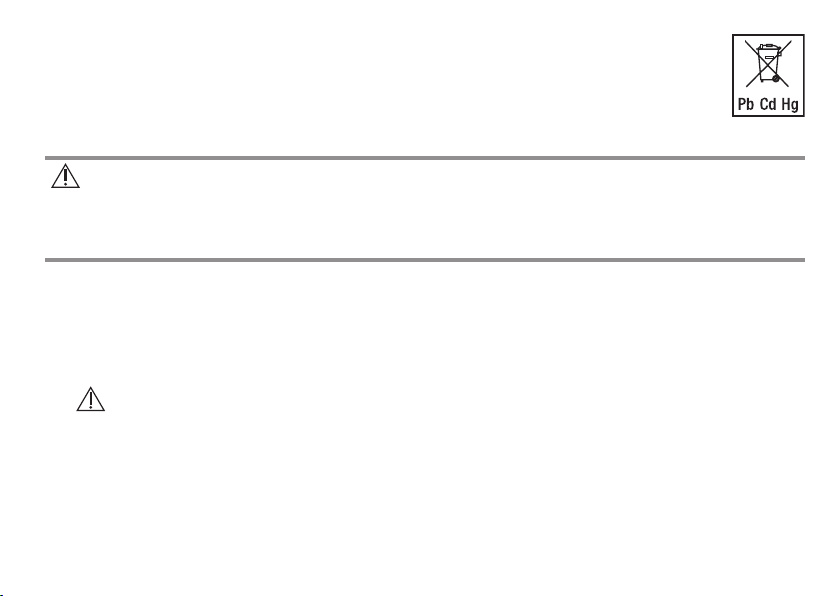
129
• эти знаки предупреждают о наличии в батарейках токсичных веществ:
Pb = свинец,
Cd = кадмий,
Hg = ртуть.
12. Очистка прибора
• И
змерительный датчик — это самая чувствительная часть термометра. При очистке обращай-
тесь с измерительным датчиком очень аккуратно.
• Н
е используйте агрессивных чистящих средств.
• В
сегда соблюдайте указания по технике безопасности для пользователей и прибора.
w
3. Предостережения и безопасность
Производите чистку измерительного датчика после каждого применения. Используйте для этого мягкую
салфетку или ватную палочку, смоченную дезинфекционным средством или 70 %-м спиртом.
Для очистки всего прибора используйте мягкую салфетку, слегка смоченную слабым мыльным раствором.
Не допускайте попадания жидкости внутрь прибора.
Используйте прибор снова лишь после того, как он полностью высохнет.
13. Хранение прибора
Запрещается хранить прибор или использовать его при слишком высокой или низкой температуре или
влажности воздуха (см. технические спецификации), на ярком солнечном свете, под воздействием элек-
трического тока или в пыльных местах. В противном случае возможны неточности измерения.
При запланированном длительном хранении прибора извлеките из него батарейки.
130
14. Утилизация прибора
•
В
интересах охраны окружающей среды категорически запрещается выбрасывать прибор по завершении
срока его службы вместе с бытовыми отходами. Утилизация должна производиться через соответствующие
пункты сбора в Вашей стране. Прибор следует утилизировать согласно Директиве ЕС по отходам
электрического и электронного оборудования – WEEE (Waste Electrical and Electronic Equipment).
Вслучае вопросов обращайтесь в местную коммунальную службу, ответственную за утилизацию
отходов.
15. Технические характеристики
В случае применения прибора не в соответствии со спецификацией безупречное функционирование не
гарантируется!
Точность данного термометра была тщательно проверена, прибор был разработан с расчетом на длитель-
ный срок эксплуатации.
При использовании прибора в медицинских учреждениях необходимо провести измерительную техни-
ческую проверку с помощью соответствующих средств. Точные данные для проверки точности прибора
можно запросить в сервисном центре.
Мы оставляем за собой право на технические изменения в связи с модернизацией и усовершенствова
-
нием продукта.
Тип FT 90/1
Метод измерения Бесконтактное инфракрасное измерение
Базовые функции Измерение температуры на лбу
Измерение температуры объекта
Измерение комнатной температуры
Единицы измерения Градусы Цельсия (°C) или Фаренгейта (°F)
131
Условия эксплуатации 10 °C – 40 °C (50 °F – 104 °F)
при относительной влажности воздуха < 95 %
Окружающие условия при хранении -20 °C – 50 °C (-4 ° – 122 °F)
при относительной влажности воздуха < 85 %
Расстояние при измерении 2–3 см от точки измерения
Диапазоны измерения и точность
измерения температуры на лбу
Измерение температуры на лбу
34 °C – 42,2 °C (93,2 °F – 108 °F)
Точность измерения 36 °C – 39 °C: ± 0,2 °C
(96,8 °F – 102 °F: ± 0,4 °F)
В остальном диапазоне измерения ± 0,3 °C (± 0,5 °F)
Клиническая точность воспроизведе-
ния результатов
0,23 °C (0,41 °F)
Диапазоны измерения и точность
Измерение температуры объекта
Измерение температуры объекта
-22 °C – 80 °C (-7,6 °F – 176 °F)
Точность измерения ± 4% или ± 2 °C (± 4 °F)
Функция памяти
Измерение температуры тела
Автоматическое сохранение последних 60измеренных значе
-
ний.
Звуковой сигнал При включении прибора, в процессе измерения, при заверше
-
нии измерения (настраивается).
Индикация ЖК-дисплей
Функции энергосбережения Прибор автоматически отключается через
1 минуту.
Размеры Ширина x глубина x высота ок. 47,6 мм x 29,0 мм x 188,0 мм
Вес 82 г (без батареек)
132
2 батарейки AAA, LR03 Срок службы ок. 3000 измерений
Дополнительно активированные функции, такие, как акустиче
-
ский сигнал или подсветка дисплея, могут приводить к умень-
шению срока службы батареек.
16. Директивы
Данный прибор соответствует требованиям Европейской директивы о медицинских изделиях 93/42/EEC,
Закону о медицинских изделиях, директиве ASTM E 1965-98, Европейскому стандарту EN60601-1-2 и тре-
бует соблюдения особых мер предосторожности в отношении электромагнитной совместимости.
17. Гарантия
Мы предоставляем гарантию на дефекты материалов и изготовления этого прибора на срок 12месяцев
со дня продажи через розничную сеть.
Гарантия не распространяется:
– на случаи ущерба, вызванного неправильным использованием,
– на быстроизнашивающиеся части (батарейки),
– на дефекты, о которых покупатель знал в момент покупки,
– на случаи собственной вины покупателя,
– при отсутствии кассового чека.
Срок эксплуатации изделия: мин. 5 лет
Фирма-изготовитель: Бойрер Гмбх,
Софлингер штрассе 218,
89077-УЛМ, Германия

133
2 батарейки AAA, LR03 Срок службы ок. 3000 измерений
Дополнительно активированные функции, такие, как акустиче
-
ский сигнал или подсветка дисплея, могут приводить к умень-
шению срока службы батареек.
16. Директивы
Данный прибор соответствует требованиям Европейской директивы о медицинских изделиях 93/42/EEC,
Закону о медицинских изделиях, директиве ASTM E 1965-98, Европейскому стандарту EN60601-1-2 и тре-
бует соблюдения особых мер предосторожности в отношении электромагнитной совместимости.
17. Гарантия
Мы предоставляем гарантию на дефекты материалов и изготовления этого прибора на срок 12месяцев
со дня продажи через розничную сеть.
Гарантия не распространяется:
– на случаи ущерба, вызванного неправильным использованием,
– на быстроизнашивающиеся части (батарейки),
– на дефекты, о которых покупатель знал в момент покупки,
– на случаи собственной вины покупателя,
– при отсутствии кассового чека.
Срок эксплуатации изделия: мин. 5 лет
Фирма-изготовитель: Бойрер Гмбх,
Софлингер штрассе 218,
89077-УЛМ, Германия
Возможны ошибки и изменения
Фирма-импортер: OOO БОЙРЕР,
109451 г. Москва,
ул. Перерва 62, корп. 2, офис 3
Сервисный центр: 109451 г. Москва,
ул. Перерва 62, корп. 2,
Тел(факс) 495–658 54 90
Дата продажи
Подпись продавца
Штамп магазина
Подпись покупателя

134
Zawartość
1. Objaśnienie symboli ........................................ 135
2. Zastosowanie .................................................. 136
3. Ostrzeżenia i bezpieczeństwo ........................ 137
3.1 Zagrożenia dla użytkownika ..................... 137
3.2 Zagrożenia dla urządzenia ....................... 137
3.3 Wskazówki dotyczące postępowania
z bateriami ................................................ 138
4. Informacje na temat termometru ....................138
5. Opis urządzenia .............................................. 141
5.1 Opis wyświetlacza .................................... 142
6. Uruchomienie .................................................. 142
7. Włączanie i ustawianie termometru ............... 143
7.1 Ustawianie funkcji podstawowych ........... 143
8. Pomiar temperatury na czole .......................... 146
8.1 Wyświetlanie zapisanych wartości
pomiarowych ............................................ 147
9. Pomiar temperatury obiektu / temperatury w
pomieszczeniu ................................................ 147
10. Symbole błędów ............................................. 148
11. Baterie ............................................................ 149
12. Czyszczenie urządzenia .................................. 150
13. Przechowywanie urządzenia .......................... 150
14. Utylizacja urządzenia ...................................... 150
15. Dane techniczne ............................................. 151
16. Przepisy ......................................................... 152
POLSKI
Należy dokładnie przeczytać i zachować
niniejszą instrukcję obsługi, przechowywać
ją w miejscu dostępnym dla innych użytkow-
ników i przestrzegać podanych w niej wska-
zówek.
Szanowna Klientko, szanowny Kliencie!
Cieszymy się, że wybrali Państwo nasz produkt. Nasza
marka jest znana zwysokiej jakości produktów podda
-
wanych surowej kontroli, przeznaczonych do ogrzewa-
nia, łagodnej terapii, pomiaru ciśnienia ibadania krwi,
pomiaru ciężaru ciała, masażu iuzdatniania powietrza.
Należy uważnie przeczytać instrukcję obsługi istosować
się do zawartych wniej wskazówek.
Z poważaniem
Zespół Beurer
Zawartość opakowania
Zestaw należy sprawdzić pod kątem zewnętrznych
uszkodzeń opakowania kartonowego oraz kompletno-
ści zawartości. Przed użyciem należy upewnić się, że
urządzenie iakcesoria nie wykazują żadnych widocz-
nych uszkodzeń iże wszystkie elementy opakowania
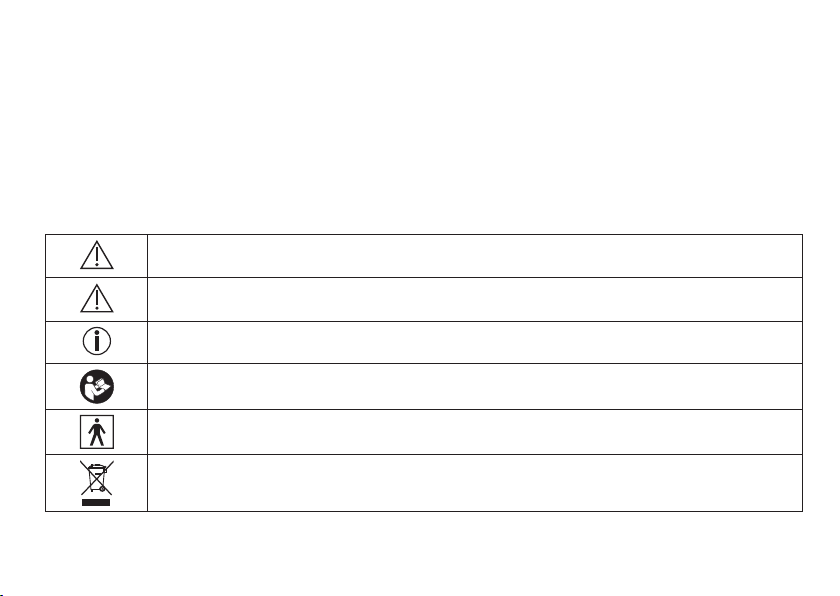
135
zostały usunięte. Wrazie wątpliwości należy przestać korzystać zurządzenia oraz zwrócić się do przedstawiciela
handlowego lub serwisu pod podanym adresem.
• T
ermometr lekarski
• 2
baterie AAA, LR03
• P
udełko do przechowywania
• I
nstrukcja obsługi
1. Objaśnienie symboli
W niniejszej instrukcji ina urządzeniu zastosowano następujące symbole:
OSTRZEŻENIE
Ostrzeżenie przed niebezpieczeństwem obrażeń ciała lub utraty zdrowia.
UWAGA
Wskazówki bezpieczeństwa odnoszące się do możliwości uszkodzenia urządzenia/akcesoriów.
Wskazówka
Wskazówka zważnymi informacjami.
Należy przestrzegać instrukcji obsługi
Część aplikacyjna typ BF
Utylizacja zgodnie zdyrektywą WE wsprawie zużytego sprzętu elektrycznego ielektronicznego
– WEEE (Waste Electrical and Electronic Equipment)
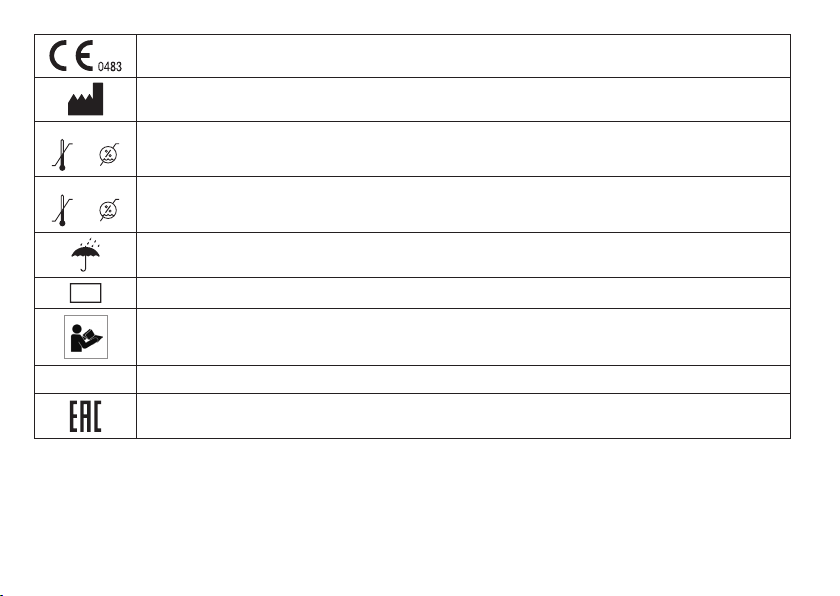
136
Oznakowanie CE potwierdza zgodność zzasadniczymi wymogami dyrektywy 93/42/EEC
wsprawie wyrobów medycznych.
Producent
Storage
Dopuszczalna temperatura i wilgotność powietrza w miejscu przechowywania
Operating
Dopuszczalna temperatura i wilgotność powietrza podczas pracy
Chronić przed wilgocią
S
N
Numer seryjny
Ważna informacja/ wskazówka
w
Odsyłacz do innego punktu.
Oznakowanie certyfikacyjne dla produktów eksportowanych do Federacji Rosyjskiej oraz państw
WNP
2. Zastosowanie
Ten termometr służy do bezdotykowego pomiaru temperatury ciała (czoło), obiektu i pomieszczenia. Termometr
służy do pomiarów wykonywanych w domu. Umożliwia on łatwy i szybki pomiar temperatury ciała. Wartości są
zapisywane automatycznie.

137
3. Ostrzeżenia i bezpieczeństwo
3.1 Zagrożenia dla użytkownika
• U
rządzenie można używać wyłącznie po przeczytaniu i zrozumieniu niniejszej instrukcji obsługi.
• N
iniejszą instrukcję obsługi należy zachować. Instrukcja obsługi musi być dostępna dla wszystkich użytkown-
ików. Należy przestrzegać wszystkich wskazówek.
•
T
ermometr powinien się znajdować co najmniej 30 minut przed pomiarem w pomieszczeniu, w którym dokony-
wany będzie pomiar.
• P
omiary temperatury za pomocą termometru FT 90 należy wykonywać wyłącznie w miejscach określonych w
instrukcji obsługi.
• U
rządzenie przewidziane jest do celu opisanego w niniejszej instrukcji obsługi.
• U
rządzenia nie mogą używać dzieci. Produkty medyczne nie służą do zabawy.
•
P
rzed każdym użyciem należy sprawdzić, czy soczewka jest nienaruszona. W przypadku uszkodzenia soczewki
należy się skontaktować ze sprzedawcą lub serwisem.
•
U
rządzenie zostało skonstruowane do praktycznego zastosowania, jednak nie może zastępować wizyty u lekarza.
• W
razie pytań dotyczących użytkowania urządzenia należy zwrócić się do punktu sprzedaży lub serwisu.
3.2 Zagrożenia dla urządzenia
• N
ie narażać urządzenia na wstrząsy mechaniczne.
• N
ie narażać urządzenia na bezpośrednie działanie promieni słonecznych.
•
U
ważać, aby urządzenie nie miało kontaktu z cieczami. Urządzenie nie jest wodoszczelne. Unikać każdego
bezpośredniego kontaktu z wodą i innymi płynami.
• U
rządzenie może być naprawiane wyłącznie w autoryzowanych punktach serwisowych. W przeciwnym razie
następuje utrata gwarancji.
•
Przenośne i mobilne urządzenia komunikacyjne pracujące na wysokich częstotliwościach mogą zakłócać działanie
urządzenia. Szczegółowe dane można uzyskać pod podanym adresem obsługi klienta lub na końcu instrukcji obsługi.
138
3.3 Wskazówki dotyczące postępowania z bateriami
• J
eśli dojdzie do kontaktu elektrolitu ze skórą lub oczami, należy przemyć dane miejsce wodą i skontaktować
się z lekarzem.
•
Istnieje niebezpieczeństwo połknięcia! Małe dzieci mogłyby połknąć baterie i się nimi udusić. Dlatego
baterie należy przechowywać w miejscach niedostępnych dla dzieci.
• N
ależy zwrócić uwagę na znak polaryzacji plus (+) i minus (-).
•
J
eśli z baterii wyciekł elektrolit, należy założyć rękawice ochronne i wyczyścić przegrodę na baterie suchą
szmatką.
• B
aterie należy chronić przed nadmiernym działaniem wysokiej temperatury.
•
Zagrożenie wybuchem! Nie wrzucać baterii do ognia.
• N
ie wolno ładować ani zwierać baterii.
• W
przypadku niekorzystania z urządzenia przez dłuższy czas wyjąć baterie z przegrody.
• N
ależy używać tylko tego samego lub równoważnego typu baterii.
• Z
awsze należy wymieniać jednocześnie wszystkie baterie.
• N
ie należy używać akumulatorów!
• N
ie wolno rozmontowywać, otwierać ani rozdrabniać baterii.
4. Informacje na temat termometru
Zmierzona temperatura waha się w zależności od miejsca pomiaru na ciele. U zdrowych ludzi różnica temperatury
w różnych miejscach ciała może wynosić od 0,2 °C do 1 °C (od 0,4 °F do 1,8 °F).
Normalny zakres temperatury w różnych termometrach
Wartości pomiarowe Użyty termometr
Temperatura na czole 35,8 °C do 37,6 °C (96,4 °F do 99,7 °F) Termometr czołowy
139
Temperatura w uchu 36,0 °C do 37,8 °C (96,8 °F do 100,0 °F) Termometr do ucha
Temperatura w ustach 36,0 °C do 37,4 °C (96,8 °F do 99,3 °F) Termometr tradycyjny
Temperatura w odbycie 36,3 °C do 37,8 °C (97,3 °F do 100,0 °F) Termometr tradycyjny
Wskazówka firmy Beurer
• N
ie należy porównywać ze sobą temperatur mierzonych za pomocą różnych termometrów.
•
L
ekarzowi należy udzielić informacji, jakim termometrem i w jakim miejscu na ciele mierzona była tem-
peratura. Należy pamiętać o tym również w przypadku samodzielnej diagnozy.
Jeśli przed pomiarem termometr będzie zbyt długo trzymany w dłoni, spowoduje to ogrzanie urządzenia.
Może to doprowadzić do zafałszowania wyników pomiaru.
Czynniki wpływające na temperaturę ciała
• I
ndywidualna, uzależniona od osoby przemiana materii
• W
iek
Temperatura ciała u niemowląt i małych dzieci jest wyższa niż u osób dorosłych. U dzieci wahania temperatury
występują szybciej i częściej. Wraz z wiekiem normalna temperatura ciała obniża się.
• U
branie
• T
emperatura na zewnątrz
• P
ora dnia
Temperatura ciała rano jest niższa i wzrasta w ciągu dnia.
• A
ktywność
Aktywność fizyczna oraz w mniejszym stopniu aktywność umysłowa podwyższają temperaturę ciała.
140
Wskazówka firmy Beurer
Pomiar temperatury ciała dostarcza aktualną wartość temperatury człowieka. W przypadku niepewno
-
ści przy interpretacji wyniku lub nietypowej wartości (np. gorączka) należy skontaktować się z lekarzem.
Dotyczy to również nieznacznych zmian temperatury, jeśli występują inne objawy choroby takie jak np.
niepokój, silne pocenie się, zaczerwienienie skóry, wysokie tętno, skłonność do zapaści itp.
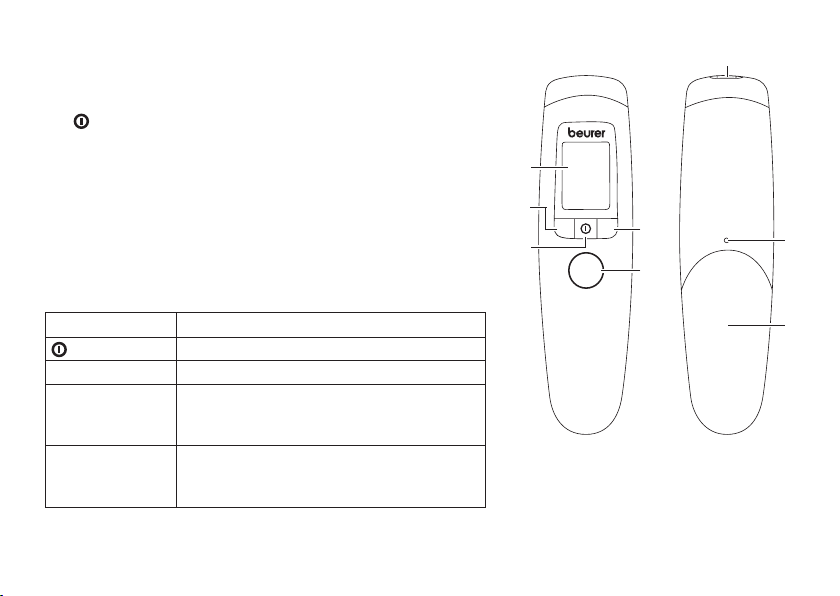
141
5. Opis urządzenia
1
Wyświetlacz
2
Przycisk MODE/MEM
3
Przycisk włączania/wyłączania
4
Przycisk LIGHT/SET
5
Przycisk SCAN
6
Czujnik pomiarowy
7
Mechanizm odblokowania przegrody
na baterie
8
Pokrywa przegrody na baterie
Przyciski Funkcje
Włączanie i wyłączanie urządzenia.
SCAN Rozpoczęcie pomiaru temperatury.
MODE/MEM
MODE Ustawianie trybu pomiaru.
MEM Wyświetlenie zapisanych wartości
pomiarowych.
LIGHT/SET
LIGHT Ręczne włączanie podświetlenia
wyświetlacza.
SET Ustawianie funkcji podstawowych.
SCAN
MODE
ME M
LIGH T
SE T
1
3
2
4
5
6
7
8
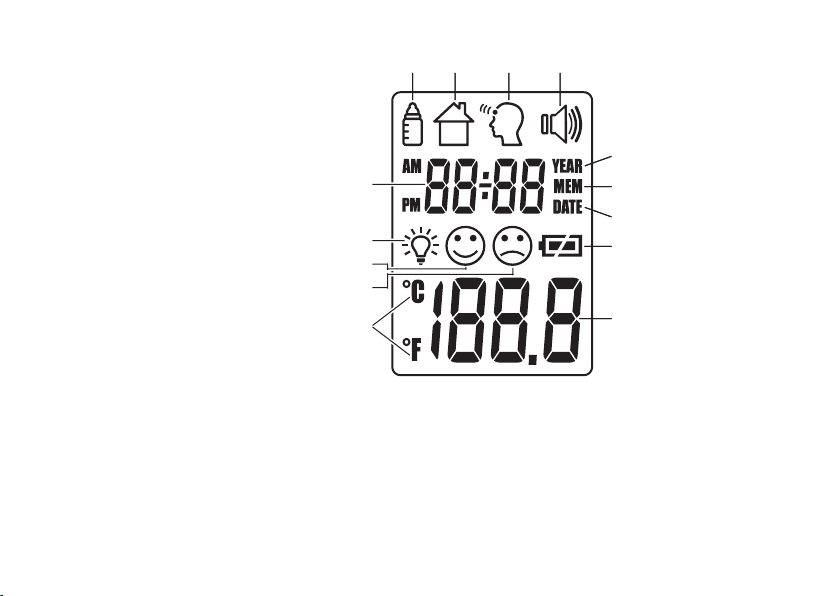
142
5.1 Opis wyświetlacza
1
Tryb „temperatura obiektu”
12 34
5
6
7
8
9
10
11
12
13
14
2
Tryb „temperatura w pomieszczeniu”
3
Tryb „temperatura na czole”
4
Symbol sygnału dźwiękowego
5
Rok
6
Funkcja zapisywania
7
Data
8
Stan baterii
9
Wskaźnik wartości temperatury/numeru
miejsca w pamięci
10
Jednostka temperatury Celsjusz/Fahren-
heit
11
Wynik pomiaru ≥ 38,0°C „gorączka”
12
Wynik pomiaru < 38,0°C „brak gorączki”
13
Symbol podświetlenia wyświetlacza
14
Wskaźnik rok/data/godzina
6. Uruchomienie
W razie potrzeby należy ściągnąć pasek izolacyjny z pokrywy komory baterii lub usunąć folię ochronną z baterii
i umieścić ją w komorze zgodnie z oznaczeniami biegunów.
w
11. Baterie
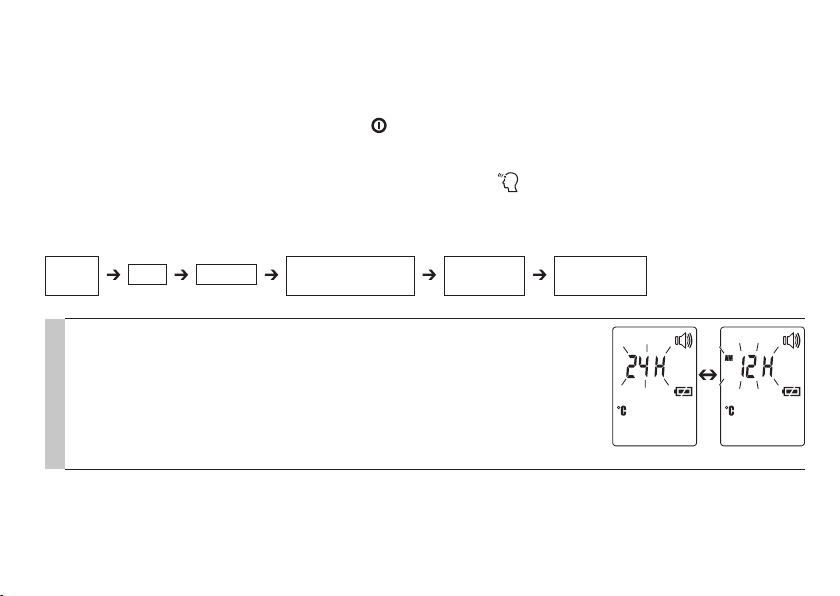
143
Po krótkim automatycznym teście i dwóch krótkich sygnałach dźwiękowych termometr jest gotowy do pomiaru
temperatury na czole.
7. Włączanie i ustawianie termometru
Krótko nacisnąć przycisk włączania/wyłączania .
Po krótkim automatycznym teście i dwóch krótkich sygnałach dźwiękowych termometr jest gotowy do pomiaru
temperatury na czole.
Urządzenie uruchamia się zawsze w trybie „temperatura na czole”
.
7.1 Ustawianie funkcji podstawowych
W tym menu można po kolei indywidualnie ustawić następujące funkcje.
Format czasu
• P
rzy włączonym termometrze nacisnąć i przytrzymać przez 5 sekund przy-
cisk LIGHT/SET.
Na wyświetlaczu miga wskaźnik formatu czasu (rys. 1).
• Z
a pomocą przycisku MODE/MEM ustawić wybrany format czasu i potwi-
erdzić przyciskiem LIGHT/SET.
Rys. 1
Jednostka pomiaru
temperatury
Podświetlany
wyświetlacz
Format
czasu
Data Godzina
Sygnał
dźwiękowy
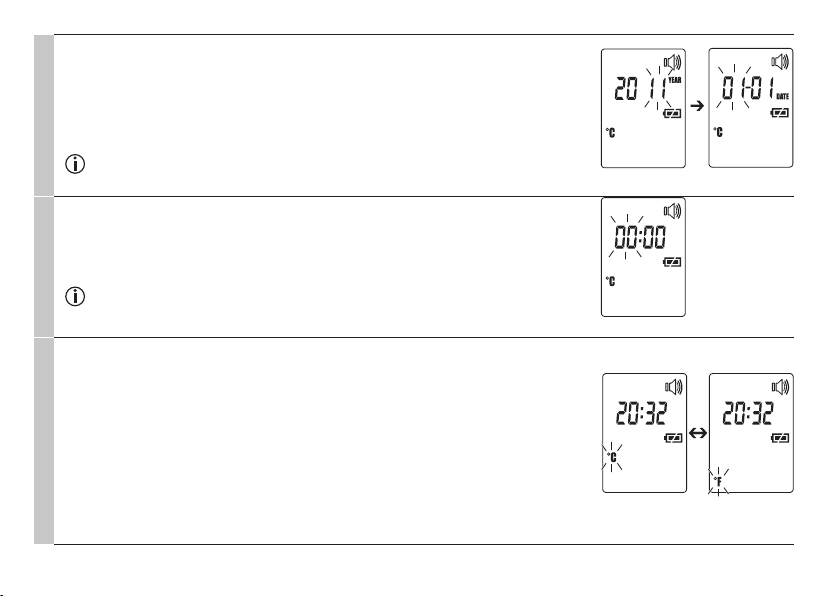
144
Data
Na wyświetlaczu miga rok (rys. 2).
•
Z
a pomocą przycisku MODE/MEM ustawić rok i potwierdzić przyciskiem
LIGHT/SET.
Na wyświetlaczu miga dzień/miesiąc (rys. 3).
•
Z
a pomocą przycisku MODE/MEM ustawić dzień i miesiąc i potwierdzić
przyciskiem LIGHT/SET.
W formacie 24-godzinnym data jest wyświetlana jako dzień/miesiąc. W
formacie 12-godzinnym jako miesiąc/dzień.
Rys. 3
Rys. 2
Godzina
Na wyświetlaczu miga godzina (rys. 4).
•
Z
a pomocą przycisku MODE/MEM ustawić godzinę i potwierdzić przyci-
skiem LIGHT/SET.
W formacie 12-godzinnym godzina wyświetlana jest z AM/PM.
Rys. 4
Jednostka pomiaru temperatury
Na wyświetlaczu miga jednostka pomiaru temperatury (rys. 5).
Wyniki pomiaru można wyświetlać w stopniach Celsjusza (°C) lub Fahrenheita
(°F).
•
A
by wyniki pomiaru były wyświetlane w stopniach Celsjusza, należy za
pomocą przycisku MODE/MEM wybrać °C i potwierdzić przyciskiem LIGHT/
SET.
•
A
by wyniki pomiaru były wyświetlane w stopniach Fahrenheita, należy za
pomocą przycisku MODE/MEM wybrać °F i potwierdzić przyciskiem LIGHT/
SET.
Rys. 5
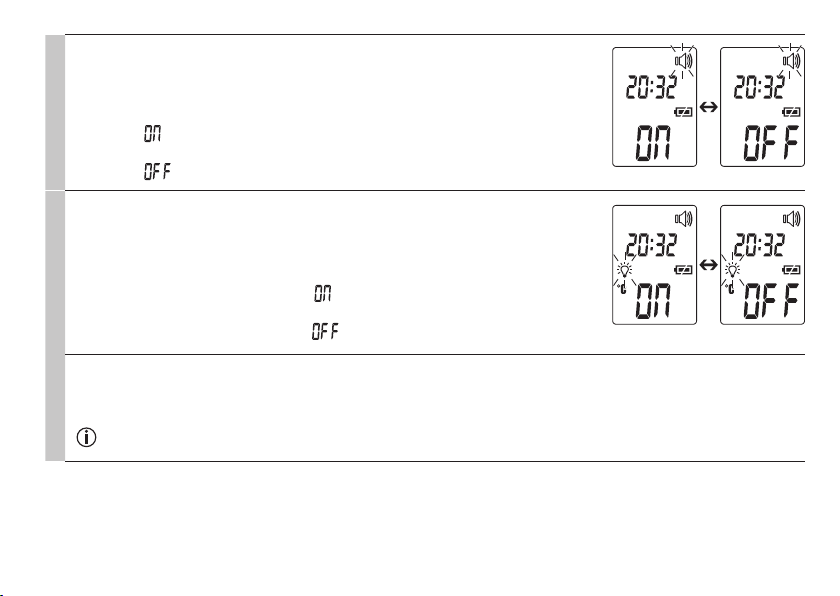
145
Sygnał dźwiękowy
Na wyświetlaczu miga symbol sygnału dźwiękowego (rys. 6).
Sygnały dźwiękowe (włączanie urządzenia, podczas pomiaru, zakończenie
pomiaru) można włączać lub wyłączać.
•
A
by włączyć sygnały dźwiękowe, za pomocą przycisku MODE/MEM należy
wybrać i potwierdzić przyciskiem LIGHT/SET.
•
A
by wyłączyć sygnały dźwiękowe, za pomocą przycisku MODE/MEM należy
wybrać i potwierdzić przyciskiem LIGHT/SET.
Rys. 6
Podświetlany wyświetlacz
Na wyświetlaczu miga symbol żarówki (rys. 7).
Automatyczne podświetlenie wyświetlacza (pojawia się po dokonaniu pomiaru
temperatury na czole) można włączyć lub wyłączyć.
•
A
by włączyć automatyczne podświetlenie wyświetlacza, za pomocą przyci-
sku MODE/MEM należy wybrać i potwierdzić przyciskiem LIGHT/SET.
•
A
by wyłączyć automatyczne podświetlenie wyświetlacza, za pomocą przyci-
sku MODE/MEM należy wybrać i potwierdzić przyciskiem LIGHT/SET.
Rys. 7
Poza tym istnieje możliwość ręcznego włączania podświetlenia wyświetlacza poprzez krótkie naciśnięcie
przycisku LIGHT/SET.
Wyświetlacz jest podświetlany przez 5 sekund.
Podczas pomiaru nie można używać automatycznego ani ręcznego podświetlania wyświetlacza.
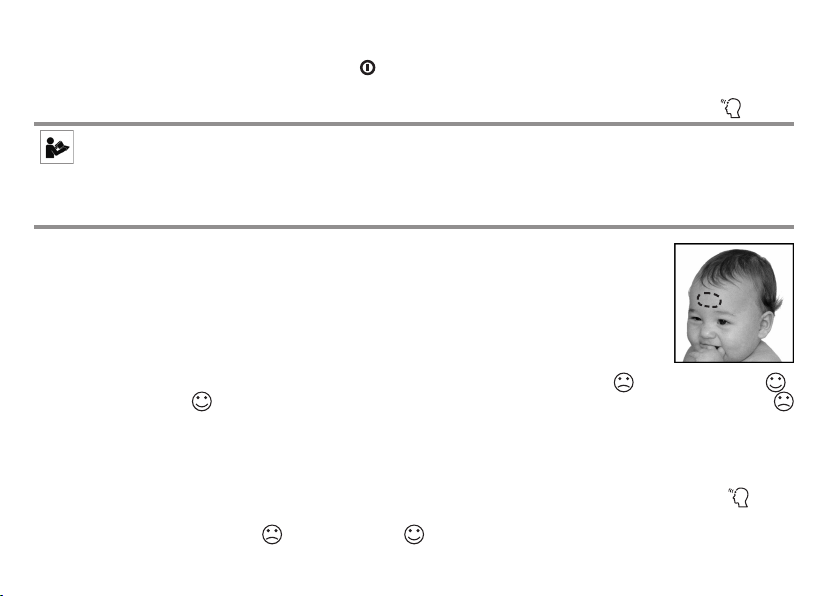
146
8. Pomiar temperatury na czole
Krótko nacisnąć przycisk włączania/wyłączania .
Po krótkim automatycznym teście i dwóch krótkich sygnałach dźwiękowych urządzenie jest gotowe do pomiaru
temperatury na czole. Urządzenie znajduje się w trybie „temperatura na czole”. Widać to po symbolu
.
Wskazówka firmy Beurer
Należy pamiętać, że
•
a
ktywność fizyczna, nadmierna potliwość na czole, przyjmowanie leków zwężających naczynia i podraż-
nienie skóry może zafałszować wyniki pomiaru,
• c
zoło lub skronie nie mogą być spocone i muszą być wolne od kosmetyków.
Przytrzymać termometr 2 do 3 cm od miejsca pomiaru. Nacisnąć przycisk SCAN i poruszać
termometr przy czole tam i z powrotem (rys.8).
Podczas pomiaru można usłyszeć krótkie sygnały dźwiękowe (tylko jeśli sygnał jest włączony),
które sygnalizują, że termometr znalazł nową wyższą wartość pomiarową.
Koniec czasu pomiaru sygnalizowany jest długim sygnałem dźwiękowym.
Puścić przycisk SCAN.
Teraz można odczytać zmierzoną wartość.
Dodatkowo zgodnie z wynikiem pomiaru na wyświetlaczu pojawi się symbol gorączki
lub braku gorączki :
Symbol braku gorączki oznacza, że temperatura ciała mieści się w normalnym przedziale, symbol gorączki
wartość zmierzona powyżej lub równa 38,0°C oznacza gorączkę alarmową.
Jeśli temperatura jest wyższa lub równa 38,0°C i aktywna jest sygnalizacja akustyczna, to po zakończeniu pomiaru
emitowany jest potrójny sygnał akustyczny.
Czas pomiaru wynosi zwykle 2 sekundy, lecz może trwać nawet do 30 sekund.
Urządzenie sygnalizuje dwoma krótkimi sygnałami akustycznymi i wyłączeniem migania symbolu czoła , goto-
wość do wykonania następnych pomiarów. Wartość pomiarowa zapisywana jest automatycznie wraz z datą/
godziną i klasyfikacją „gorączka“ / „brak gorączki“ .
Rys. 8
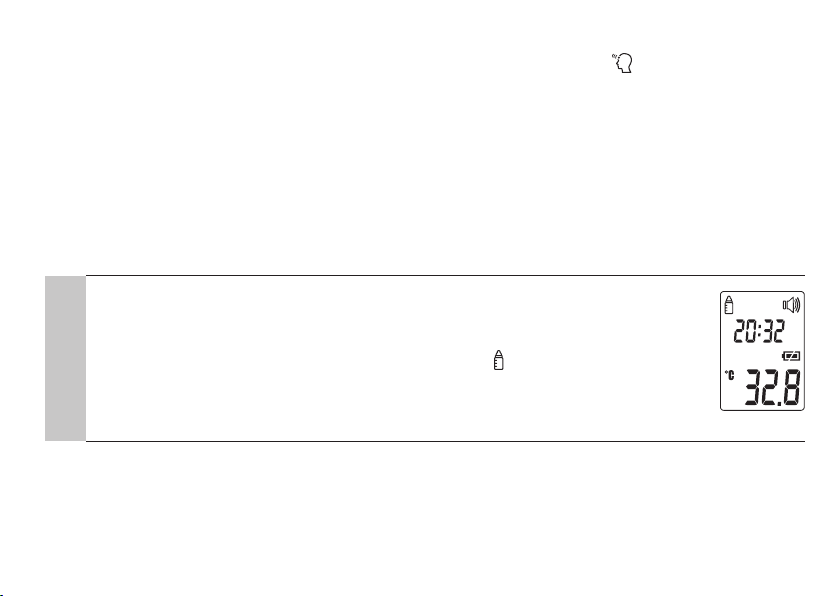
147
8.1 Wyświetlanie zapisanych wartości pomiarowych
Urządzenie zapisuje wyłącznie wartości pomiarowe w trybie „temperatura na czole” . Urządzenie automatycz-
nie zapisuje wartości pomiarowe z ostatnich sześćdziesięciu pomiarów.
Po przekroczeniu sześćdziesięciu miejsc w pamięci usuwana jest najstarsza wartość.
Pamięć można sprawdzić w następujący sposób:
• P
rzy włączonym termometrze nacisnąć i przytrzymać przez 5 sekund przycisk MODE/MEM.
Zostanie wyświetlona najnowsza wartość pomiarowa.
•
K
ażde kolejne naciśnięcie przycisku MODE/MEM powoduje wyświetlenie następnego numeru miejsca w
pamięci, a puszczenie przycisku wyświetlenie wartości pomiarowej.
• W
górnej linijce wyświetla się na zmianę godzina i data.
9. Pomiar temperatury obiektu / temperatury w pomieszczeniu
Tryb „temperatura
obiektu”
• A
by za pomocą tego termometru zmierzyć temperaturę obiektu, należy przełączyć go na
tryb „temperatura obiektu”.
• W
tym celu przy włączonym termometrze nacisnąć krótko przycisk MODE/MEM.
Urządzenie przełączy się na tryb „temperatura obiektu”
.
•
P
rzytrzymać termometr 2 do 3 cm od wybranego miejsca pomiaru. Nacisnąć krótko przy-
cisk SCAN i odczytać temperaturę na wyświetlaczu (rys. 9).
Wartości pomiarowe w trybie temperatury obiektu nie są zapisywane.
Rys. 9
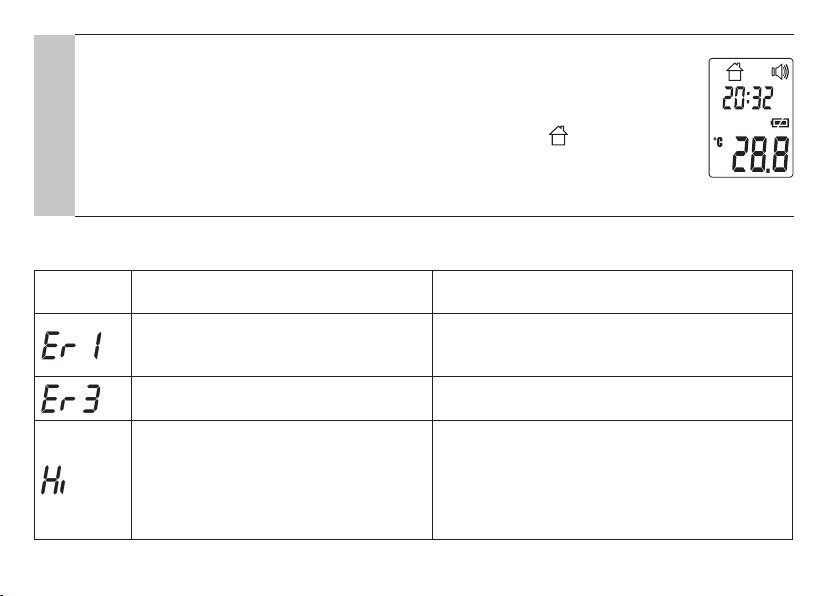
148
Tryb „temperatura w
pomieszczeniu”
Jeśli termometr ma być wykorzystany do pomiaru temperatury w pomieszczeniu, należy go
przełączyć na tryb „temperatura w pomieszczeniu”.
•
W
tym celu przy włączonym termometrze nacisnąć krótko dwa razy przycisk MODE/MEM.
Urządzenie przełączy się na tryb „temperatura w pomieszczeniu” .
• B
ezpośrednio wyświetla się temperatura w pomieszczeniu (rys. 10).
Wartości pomiarowe w trybie „temperatura w pomieszczeniu” nie są zapisywane.
Rys. 10
10. Symbole błędów
Komunikat
błędu
Problem Rozwiązanie
Pomiar podczas testu automatycznego,
urządzenie nie jest jeszcze gotowe do
pomiaru.
Poczekać, aż symbol czoła przestanie migać.
Temperatura w pomieszczeniu poniżej 10 °C
lub powyżej 40 °C (<50 °F, >104 °F).
Temperatura w pomieszczeniu musi się znajdować w
zakresie od 10 °C do 40 °C (50 °F, 104 °F).
(1) Tryb „temperatura na czole”: Zmierzona
temperatura jest wyższa niż 42,2 °C
(108 °F).
(2) Tryb „temperatura obiektu”: Zmie-
rzona temperatura jest wyższa niż 80 °C
(176 °F).
Termometr należy używać wyłącznie w podanych
zakresach temperatur. Jeśli błąd pojawi się ponow-
nie, należy skontaktować się ze sprzedawcą lub ser-
wisem.
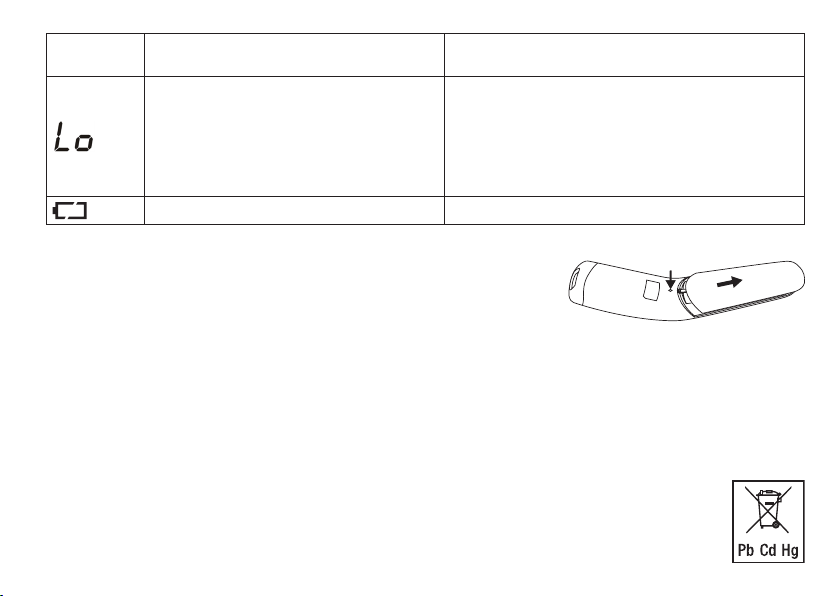
149
Komunikat
błędu
Problem Rozwiązanie
(1) Tryb „temperatura na czole”: Zmie-
rzona temperatura jest niższa niż 34 °C
(93,2 °F).
(2) Tryb „temperatura obiektu”: Zmie-
rzona temperatura jest niższa niż -22 °C
(-7,6 °F).
Termometr należy używać wyłącznie w podanych
zakresach temperatur. Jeśli błąd pojawi się ponow-
nie, należy skontaktować się ze sprzedawcą lub ser-
wisem.
Baterie są zużyte. Wymienić baterie.
11. Baterie
Do eksploatacji urządzenia potrzebne są dwie baterie typu AAA, LR03.
• O
tworzyć przegrodę na baterie.
Przedmiotem o ostrej końcówce nacisnąć mechanizm odblokowania prze-
grody na baterie, przesuwając jednocześnie przegrodę na baterię w dół.
• W
yjąć zużyte baterie.
• W
łożyć nowe baterie.
Uważać, aby baterie były prawidłowo włożone.
• Z
amknąć przegrodę na baterie.
•
Z
użyte, całkowicie rozładowane baterie należy wyrzucać do specjalnie oznakowanych pojemników zbiorczych,
przekazywać do punktów zbiórki odpadów specjalnych lub do sklepu ze sprzętem elektrycznym. Użytkownik
jest zobowiązany do utylizacji baterii zgodnie z przepisami.
• Na bateriach zawierających szkodliwe związki znajdują się następujące oznaczenia:
Pb = bateria zawiera ołów,
Cd = bateria zawiera kadm,
Hg = bateria zawiera rtęć.
150
12. Czyszczenie urządzenia
•
C
zujnik pomiarowy to najbardziej wrażliwy element termometru. Podczas czyszczenia należy się z nim
obchodzić z najwyższą ostrożnością.
• N
ie używać agresywnych środków czyszczących.
•
Zawsze przestrzegać wskazówek bezpieczeństwa dla użytkownika i urządzenia.
w
3. Ostrzeżenia i bezpieczeństwo
Po każdym użyciu należy wyczyścić czujnik pomiarowy. W tym celu należy użyć szmatki lub wacika nasączonego
środkiem do dezynfekcji lub alkoholem (70 %).
Do czyszczenia całego urządzenia należy używać miękkiej szmatki lekko zwilżonej wodą z mydłem. Do urządze
-
nia nie może dostać się woda.
Urządzenie można używać dopiero po całkowitym wysuszeniu.
13. Przechowywanie urządzenia
Urządzenia nie wolno przechowywać ani używać w miejscu o zbyt wysokiej bądź zbyt niskiej temperaturze i wilgot-
ności powietrza (patrz specyfikacje techniczne) ani w miejscach zakurzonych. Nie wolno go narażać na działanie
promieni słonecznych ani prądu elektrycznego. Mogłoby to spowodować niedokładność pomiaru.
Jeśli termometr nie będzie używany przez dłuższy czas, należy wyjąć baterie.
14. Utylizacja urządzenia
• Z
e względu na ochronę środowiska naturalnego po zakończeniu okresu eksploatacji urządzenia nie należy go
wyrzucać wraz ze zwykłymi odpadami domowymi. Utylizację należy zlecić w odpowiednim punkcie zbiórki w
danym kraju. Urządzenie należy zutylizować zgodnie z dyrektywą o zużytych urządzeniach elektrycznych
i elektronicznych – WEEE (Waste Electrical and Electronic Equipment). W razie pytań należy zwrócić się
do odpowiedniej instytucji odpowiedzialnej za utylizację.
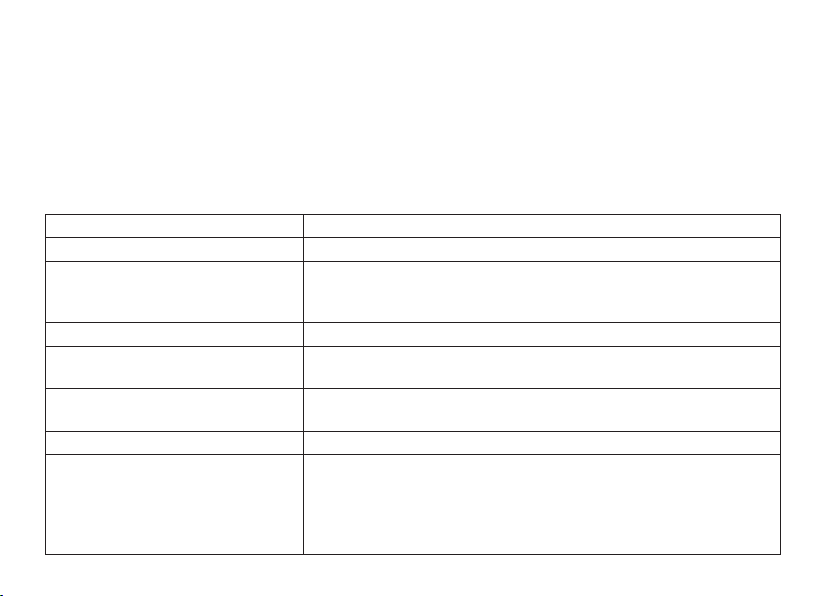
151
15. Dane techniczne
W razie stosowania urządzenia niezgodnie ze specyfikacją nie ma gwarancji prawidłowego działania.
Dokładność termometru została dokładnie sprawdzona. Ponadto został on zaprojektowany do długotrwałego
użytku.
W przypadku korzystania z urządzenia w praktyce lekarskiej należy przeprowadzać kontrole pomiarowe za pomocą
odpowiednich środków. Dokładne dane dotyczące sprawdzania dokładności można uzyskać, kontaktując się z
działem obsługi klienta.
Zastrzegamy sobie prawo do wprowadzania zmian technicznych mających na celu ulepszenie i dalszy rozwój
produktu.
Typ FT 90/1
Metoda pomiaru
Bezdotykowy pomiar z wykorzystaniem podczerwieni
Funkcje podstawowe Pomiar temperatury na czole
Pomiar temperatury obiektu
Pomiar temperatury w pomieszczeniu
Jednostki pomiarowe Celsjusz (°C) lub Fahrenheit (°F)
Warunki robocze 10 °C do 40 °C (50 °F do 104 °F)
przy względnej wilgotności powietrza < 95 %
Warunki przechowywania -20 °C do 50 °C (-4 °F do 122 °F)
przy względnej wilgotności powietrza < 85 %
Odległość pomiarowa 2 do 3 cm od miejsca pomiaru
Zakresy pomiaru i dokładność
pomiaru temperatury na czole
Pomiar temperatury na czole
34 °C do 42,2 °C (93,2 °F do 108 °F)
Dokładność pomiaru 36 °C do 39 °C: ± 0,2 °C
(96,8 °F do 102 °F: ± 0,4 °F)
W pozostałym zakresie pomiaru ± 0,3 °C (± 0,5 °F)
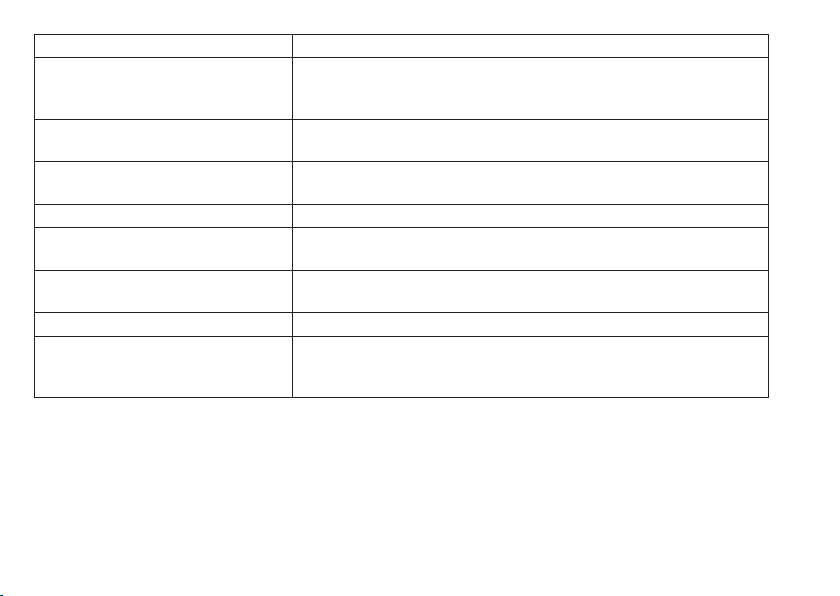
152
Zastrzega się prawo do pomyłek i zmian
Kliniczna powtarzalność pomiarów 0,23 °C (0,41 °F)
Zakresy pomiaru i dokładność
Pomiar temperatury obiektu
Pomiar temperatury obiektu
-22 °C do 80 °C (-7,6 °F do 176 °F)
Dokładność pomiaru
± 4% lub ± 2 °C (± 4 °F)
Funkcja zapisywania
Pomiar temperatury ciała
Automatyczny zapis ostatnich 60 wartości pomiarowych.
Sygnał dźwiękowy Podczas włączenia urządzenia, podczas pomiaru, po zakończeniu
pomiaru (z możliwością regulacji).
Wyświetlacz Wyświetlacz LCD
Funkcje oszczędzania energii Urządzenie wyłącza się automatycznie po upływie
1 minuty.
Wymiary
szerokość x głębokość x
wysokość
ok. 47,6 mm x 29,0 mm x 188,0 mm
Masa 82 g (bez baterii)
Baterie 2 x AAA, LR03 Czas pracy ok. 3000 pomiarów
Dodatkowe aktywne funkcje, takie jak sygnał dźwiękowy lub pod
-
świetlenie wyświetlacza, skracają trwałość baterii.
16. Przepisy
Urządzenie jest zgodne z dyrektywą Unii Europejskiej w sprawie produktów medycznych 93/42/EEC, ustawą
o produktach medycznych, standardem ASTM E 1965 - 98 oraz europejską normą EN60601-1-2 i wymaga
zachowania szczególnych środków ostrożności wzakresie kompatybilności elektromagnetycznej.
153
Electromagnetic Compatibility Information
Table 1
For all ME EQUIPMENT and ME SYSTEMS
Guidance and manufacturer’s declaration – electromagnetic emissions
The FT 90/1 is intended for use in the electromagnetic environment specified below.
The customer or the user of the FT 90/1 should assure that it is used in such an environment.
Emissions test Compliance Electromagnetic environment – guidance
RF emissions CISPR 11 Group 1
The FT 90/1 uses RF energy only for its internal function. Therefore, its RF emissions are very low
and are not likely to cause any interference in nearby electronic equipment.
RF emissions CISPR 11 Class B
The FT 90/1 is suitable for use in all establishments, including domestic establishments and
those directly connected to the public low-voltage power supply network that supplies buildings
used for domestic purposes.
Harmonic emissions IEC 61000-3-2 Not applicable
Voltage fluctuations/flicker emissions
IEC 61000-3-3
Not applicable
154
Table 2
For all ME EQUIPMENT and ME SYSTEMS
Guidance and manufacturer’s declaration – electromagnetic immunity
The FT 90/1 is intended for use in the electromagnetic environment specified below.
The customer or the user of the FT 90/1 should assure that it is used in such an environment.
Immunity test
IEC 60601 test
level
Compliance
level
Electromagnetic environment – guidance
Conducted RF
IEC 61000-4-6
Radiated RF
IEC 61000-4-3
3 Vrms
150 kHz to 80 MHz
3 V/m
80 MHz to 2.5 GHz
Not applicable
3 V/m
Portable and mobile RF communications equipment should be used no closer to any part of the
FT 90/1, including cables, than the recommended separation distance calculated from the equation
applicable to the frequency of the transmitter.
Recommended separation distance
d = 3.2
d = 3.2 80 MHz to 800 MHz
d = 2.3
800 MHz to 2.5 GHz
where P is the maximum output power rating of the transmitter in watts (W) according to the trans
-
mitter manufacturer and d is the recommended separation distance in meters (m).
Field strengths from fixed RF transmitters, as determined by an electromagnetic site survey, a
should be less than the compliance level in each frequency range b.
Interference may occur in the vicinity of equipment marked with the following symbol:
NOTE 1 At 80 MHz and 800 MHz, the higher frequency range applies.
NOTE 2 These guidelines may not apply in all situations.
Electromagnetic propagation is affected by absorption and reflection from structures, objects and people.
a. Field strengths from fixed transmitters, such as base stations for radio (cellular/cordless) telephones and land mobile radios, amateur radio, AM and FM
radio broadcast and TV broadcast cannot be predicted theoretically with accuracy. To assess the electromagnetic environment due to fixed RF transmit
-
ters, an electromagnetic site survey should be considered. If the measured field strength in the location in which the FT 90/1 is used exceeds the applicable
RF compliance level above, the FT 90/1 should be observed to verify normal operation. If abnormal performance is observed, additional measures may be
necessary, such as reorienting or relocating the FT 90/1.
b. Over the frequency range 150 kHz to 80 MHz, field strengths should be less than 3 V/m.
155
Table 3
For ME EQUIPMENT and ME SYSTEMS that are not LIFE-SUPPORTING
Guidance and manufacturer’s declaration – electromagnetic immunity
The FT 90/1 is intended for use in the electromagnetic environment specified below.
The customer or the user of the FT 90/1 should assure that it is used in such an environment.
Immunity test IEC 60601 test level Compliance level Electromagnetic environment – guidance
Electrostatic discharge
(ESD)
IEC 61000-4-2
6 kV contact
8 kV air
6 kV contact
8 kV air
Floors should be wood, concrete or ceramic tile. If floors are covered with
synthetic material, the relative humidity should be at least 30 %.
Electrical fast transient/
burst
IEC 61000-4-4
2 kV for power supply lines
1 kV for input/output lines
Not applicable
Mains power quality should be that of a typical commercial or hospital
environment.
Surge
IEC 61000-4-5
1 kV line(s) to line(s)
2 kV line(s) to earth
Not applicable
Mains power quality should be that of a typical commercial or hospital
environment.
interruptions and voltage
variations on power supply
input lines
IEC 61000-4-11
< 5 % UT (> 95 % dip in UT)
for 0.5 cycle
40 % UT (60 % dip in UT) for
5 cycles
70 % UT (30 % dip in UT) for
25 cycles
< 5 % UT (> 95 % dip in UT)
for 5 sec
Not applicable
Mains power quality should be that of a typical commercial or hospital
environment. If the user of the FT 90/1 requires continued operation during
power mains interruptions, it is recommended that the FT 90/1 be powered
from an uninterruptible power supply or a battery.
Power frequency (50/60 Hz)
magnetic field
IEC 61000-4-8
3 A/m 3 A/m
Power frequency magnetic fields should be at levels characteristic of a
typical location in a typical commercial or hospital environment.
NOTE UT is the a.c. mains voltage prior to application of the test level.
156
Table 4
For ME EQUIPMENT and ME SYSTEMS that are not LIFE-SUPPORTING
Recommended separation distances between portable and mobile RF communications equipment and the FT90
The FT 90/1 is intended for use in an electromagnetic environment in which radiated RF disturbances are controlled. The customer or
the user of the FT 90/1 can help prevent electromagnetic interference by maintaining a minimum distance between portable and mobile
RF communications equipment (transmitters) and the FT 90/1 as recommended below, according to the maximum output power of the
communications equipment.
Rated maximum output
power of transmitter
W
Separation distance according to frequency of transmitter
m
150 kHz to 80 MHz
d = 3.2
80 MHz to 800 MHz
d = 3.2
800 MHz to 2.5 GHz
d = 2.3
0.01 0.12 0.12 0.23
0.1 0.38 0.38 0.73
1 3.2 3.2 2.3
10 3.8 3.8 7.3
100 12 12 23
For transmitters rated at a maximum output power not listed above, the recommended separation distance d in meters (m) can be esti
-
mated using the equation applicable to the frequency of the transmitter, where P is the maximum output power rating of the transmitter
in watts (W) according to the transmitter manufacturer.
NOTE 1 At 80 MHz and 800 MHz, the separation distance for the higher frequency range applies.
NOTE 2 These guidelines may not apply in all situations. Electromagnetic propagation is affected by absorption and reflection from
structures, objects and people.
757.039 – 0417
Beurer GmbH • Söflinger Straße 218 • 89077 Ulm, Germany • www.beurer.com
www.beurer-gesundheitsratgeber.com • www.beurer-healthguide.com