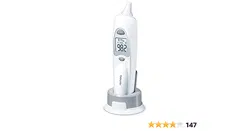
DE Ohrthermometer
Gebrauchsanweisung ........................... 2
EN Ear thermometer
Instructions for use .............................. 15
FR Thermomètre auriculaire
Mode d’emploi .................................... 27
ES Termómetro para el oído
Instrucciones de uso ........................... 40
IT Termometro per orecchio
Istruzioni per l’uso ............................... 52
TR Kulak Termometresi
Kullanım Kılavuzu ................................ 64
RU Термометр для измерения
температурывухе
Инструкция по применению.............. 76
PL Termometr douszny
Instrukcja obsługi ................................ 90
NL Oorthermometer
Gebruiksaanwijzing ........................... 103
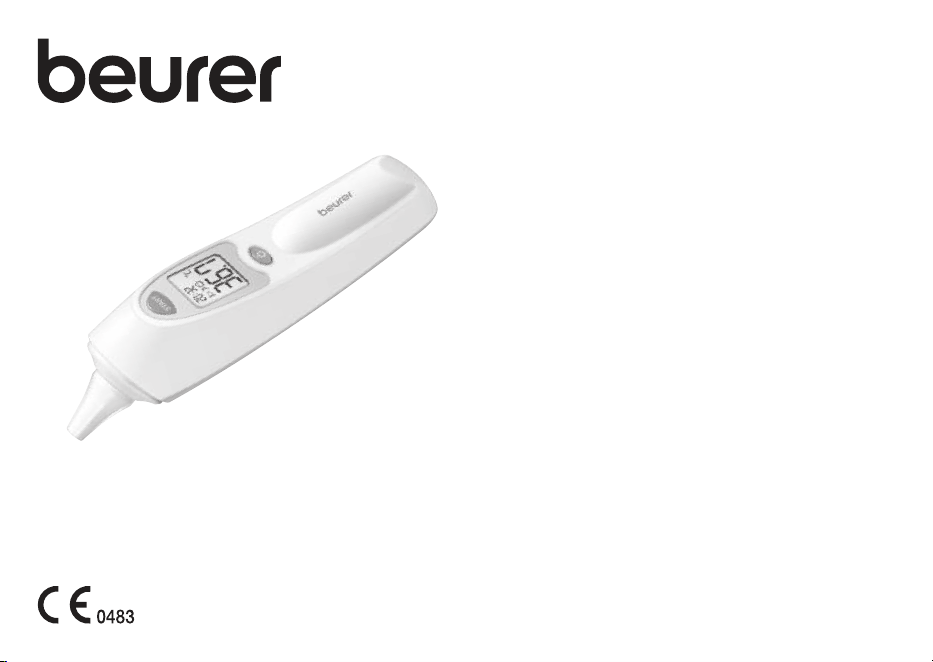
FT 58

2
DEUTSCH
Lesen Sie diese Gebrauchsanweisung sorgfältig durch, bewahren Sie sie für den späteren Gebrauch auf, machen Sie sie
anderen Benutzern zugänglich und beachten Sie die Hinweise.
1. LIEFERUMFANG
Überprüfen Sie den Lieferumfang auf äußere Unversehrtheit der
Kartonverpackung und auf die Vollständigkeit des Inhalts. Vor dem
Gebrauch ist sicherzustellen, dass das Gerät und Zubehör keine
sichtbaren Schäden aufweisen und jegliches Verpackungsmaterial
entfernt wird. Benutzen Sie es im Zweifelsfall nicht und wenden Sie
sich an Ihren Händler oder an die angegebene Kundendienstadres-
se.
1 x Ohrthermometer
2 x 1,5 V AAA-Batterien
10 x Schutzkappen
1 x Diese Gebrauchsanweisung
Nachkaufartikel
Schutzkappenset nachkaufbar: 2 x 10 Schutzkappen,
Art.-Nr. 795.34
2. ZEICHENERKLÄRUNG
Auf dem Gerät, in der Gebrauchsanweisung, auf der Verpackung
und auf dem Typschild des Geräts werden folgende Symbole ver-
wendet:
1. Lieferumfang..............................................................................2
2. Zeichenerklärung .......................................................................2
3. Bestimmungsgemäßer Gebrauch .............................................3
4. Hinweise .................................................................................... 4
5. Gerätebeschreibung .................................................................. 6
6. Inbetriebnahme .........................................................................7
7. Einstellungen ............................................................................. 7
7.1 Uhrzeit / Datum einstellen .................................................7
7.2 Temperatureinheit wählen (°C oder °F) ............................. 7
8. Messen ......................................................................................8
8.1 Körpertemperatur messen ................................................ 8
8.2 Objekttemperatur messen ................................................9
8.3 Raumtemperatur anzeigen .............................................10
8.4 Gespeicherte Messwerte anzeigen ................................10
9. Batteriewechsel ....................................................................... 11
10. Reinigung / Aufbewahrung ....................................................11
11. Entsorgung ............................................................................ 11
12. Was tun bei Fehlermeldungen? .............................................13
13. Technische Daten .................................................................. 13
14. Garantie / Service ...................................................................14
INHALTSVERZEICHNIS
3
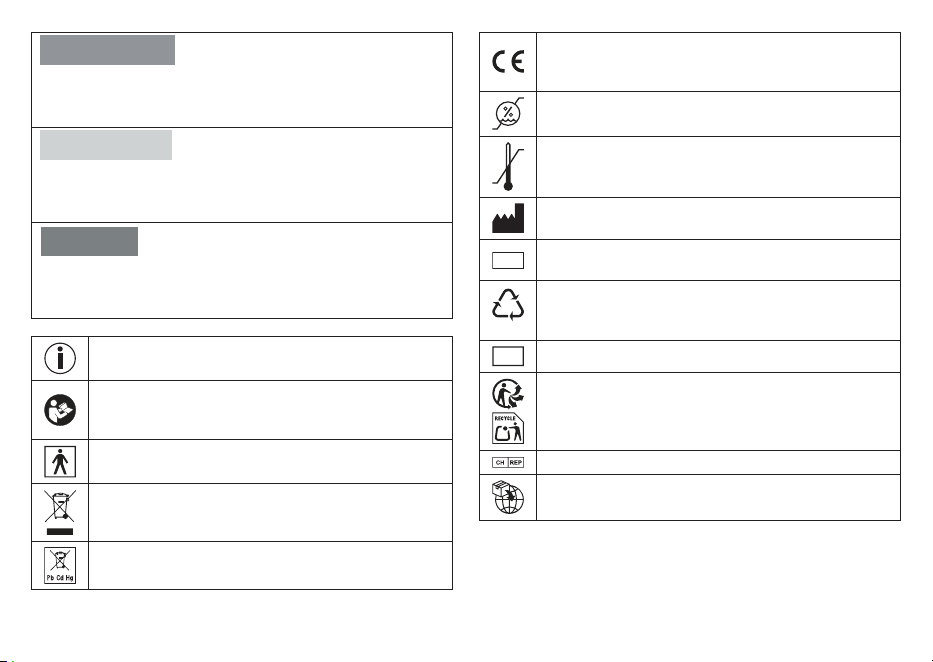
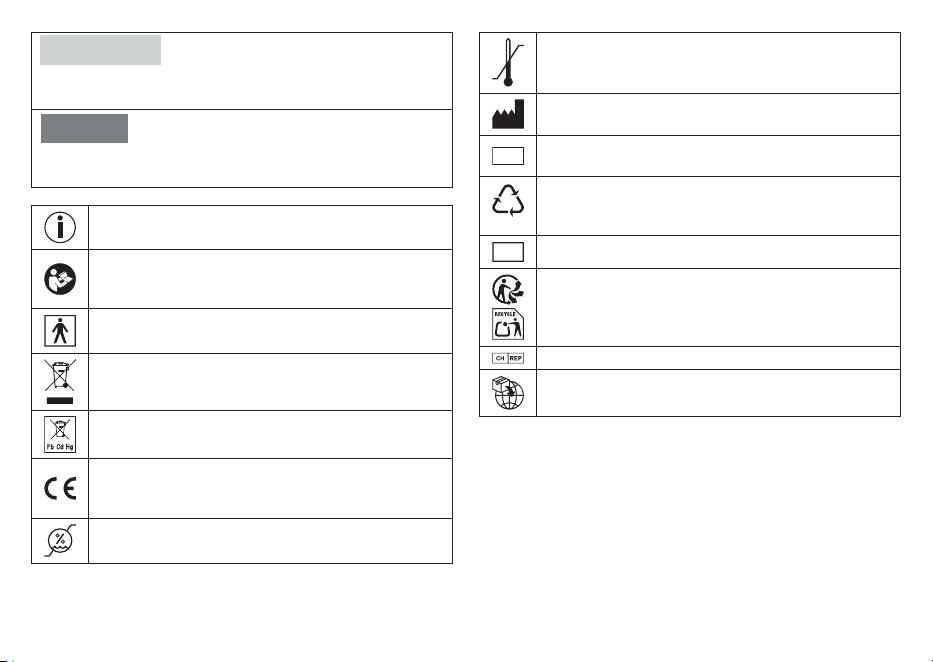
WARNUNG
Bezeichnet eine möglicherweise drohende Gefahr. Wenn sie
nicht gemieden wird, können Tod oder schwerste Verletzungen
die Folge sein.
VORSICHT
Bezeichnet eine möglicherweise drohende Gefahr. Wenn sie
nicht gemieden wird, können leichte oder geringfügige Verlet-
zungen die Folge sein.
HINWEIS
Bezeichnet eine möglicherweise schädliche Situation. Wenn
sie nicht gemieden wird, kann das Gerät oder etwas in seiner
Umgebung beschädigt werden.
Produktinformation
Hinweis auf wichtige Informationen
Anleitung beachten
Vor Beginn der Arbeit und /oder dem Bedienen von
Geräten oder Maschinen die Anleitung lesen
Anwendungsteil Typ BF
(Elektro-)Gerät darf nicht über den Hausmüll entsorgt
werden
Schadstohaltige Batterien nicht im Hausmüll entsorgen
CE-Kennzeichnung
Dieses Produkt erfüllt die Anforderungen der geltenden
europäischen und nationalen Richtlinien.
Luftdruckbegrenzung
Temperaturbereich
Hersteller
IP22
Gerät geschützt gegen Fremdkörper ≥12,5 mm und
gegen schräges Tropfwasser
B
A
Kennzeichnung zur Identifikation des Verpackungsma-
terials. A = Materialabkürzung, B = Materialnummer:
1-7 = Kunststoe, 20-22 = Papier und Pappe
S
N
Seriennummer
Produkt und Verpackungskomponenten trennen und
entsprechend der kommunalen Vorschriften entsorgen.
Schweizer Bevollmächtigter
Importeur
3. BESTIMMUNGSGEMÄSSER GEBRAUCH
Das Ohrthermometer ist für Messungen der Körpertemperatur im
Ohr bestimmt. Verwenden Sie das Ohrthermometer nicht für Mes-
sungen an anderen Körperstellen!

4
Sie können mit dem Ohrthermometer zusätzlich auch Raum- und
Objekttemperaturen messen.
Das Ohrthermometer wurde sorgfältig für exakte, sichere und
schnelle Temperaturmessungen im Ohr entwickelt. Es ist ein
nicht-invasives Ohrthermometer mit einem Infrarotdetektor zur
Erkennung der Körpertemperatur im Gehörkanal von Kindern und
Erwachsenen.
Verwenden Sie das Gerät ausschließlich für den Zweck, für den
es entwickelt wurde und auf die in dieser Gebrauchsanweisung
angegebene Art und Weise. Jeder unsachgemäße Gebrauch kann
gefährlich sein! Der Hersteller haftet nicht für Schäden, die durch
unsachgemäßen oder falschen Gebrauch verursacht wurden.
Das Gerät entspricht der EU-Richtlinie für Medizinprodukte 93/42/
EEC, dem Medizinproduktegesetz, der ASTM E 1965 - 98, der euro-
päischen Norm EN 12470-5: Medizinische Thermometer – Teil 5: An-
forderungen an Infrarot-Ohrthermometer (mit Maximumvorrichtung)
sowie der europäischen Norm EN 60601-1-2 (Übereinstimmung
mit CISPR11, IEC61000-4-2, IEC61000-4-3, IEC61000-4-8) und
unterliegt besonderen Vorsichtsmaßnahmen hinsichtlich der elektro-
magnetischen Verträglichkeit.
Beachten Sie dabei, dass tragbare und mobile HF-Kommunika-
tionseinrichtungen dieses Gerät beeinflussen können.
4. HINWEISE
Sicherheitshinweise
WARNUNG
• Führen Sie bei Messungen im Ohr die Sensorspitze des Ohrther-
mometers vorsichtig ein.
• Die Anwendung des Ohrthermometers an verschiedenen Per-
sonen kann bei bestimmten akuten, infektiösen Erkrankungen
aufgrund einer möglichen Keimverschleppung trotz der durch-
zuführenden Reinigung und Wischdesinfektion unzweckmäßig
sein. Fragen Sie im Einzelfall Ihren behandelnden Arzt.
• Die im Ohr gemessene Körpertemperatur kann von anderen
Messungen im Mund, Rektum oder in der Achselhöhle abwei-
chen. Daher macht es keinen Sinn, diese Werte zu vergleichen.
Messen Sie die Temperatur regelmäßig, um die normale Ohrtem-
peratur zu ermitteln, und nutzen Sie diese Messungen dann als
Vergleichsbasis für Messungen, bei denen Sie ein Fieber ver-
muten.
• Dieses Ohrthermometer ist für Ohrtemperaturmessungen vorge-
sehen. Verwenden Sie dieses Ohrthermometer nicht für Messun-
gen an anderen Körperstellen.
• Ersetzen Sie die Schutzkappe nach jeder Verwendung, um eine
exakte Messung zu gewährleisten und eine Kreuzkontamination
zu vermeiden.
• Das Ohrthermometer darf nur mit Schutzkappen von Sanitas
verwendet werden, andere Schutzkappen können Messfehler
verursachen. Wenn Sie keine Schutzkappen mehr haben, wen-
den Sie sich wegen Ersatz an den Hersteller oder Fachhändler.
• Wenden Sie sich an einen Arzt, wenn Ihr Gesundheitszustand
Ihrer Meinung nach schlecht ist.
Hinweise zum Umgang mit Batterien
WARNUNG
• Explosionsgefahr! Brandgefahr! Nichtbeachtung der nachfol-
genden Punkte kann zu Personenschäden oder an der Batterie
zu Überhitzung, Auslaufen, Entlüftung, Bruch, Explosion oder
Feuer führen.
• Dieses Gerät enthält nicht wiederaufladbare Batterien, welche
nicht aufgeladen werden dürfen.
• Keine Batterien ins Feuer werfen.

5
• Batterien niemals aufladen, zwangsentladen, erhitzen, zerlegen,
önen, zerkleinern, deformieren, einkapseln oder modifizieren.
• Niemals Batterien und Kontakte des Batteriefachs kurzschlie-
ßen.
• Die Batterien vor direkter Sonneneinstrahlung, Regen, Hitze und
Wasser schützen.
• Werden Batterien einer Umgebung mit extrem hohen Tempera-
turen oder extrem niedrigem Luftdruck ausgesetzt, kann dies zu
einer Explosion oder zum Auslaufen von entflammbaren Flüssig-
keiten und Gasen führen.
• Defekte und entladene Batterien sofort und ordnungsgemäß ent-
sorgen (s. Kapitel Entsorgung).
• Keine veränderten oder beschädigten Batterien verwenden.
• Immer den richtigen Batterietyp wählen.
• Batterien immer korrekt und unter Berücksichtigung der Polari-
täten (+ / -) einlegen.
• Niemals Batterien unterschiedlicher Hersteller, Kapazität (neu
und gebraucht), Größe und Typ innerhalb eines Gerätes mischen.
• Wenn eine Batterie ausgelaufen ist, Schutzhandschuhe anziehen
und das Batteriefach mit einem trockenen Tuch reinigen.
• Wenn Flüssigkeit aus einer Batterie mit Haut oder Augen in Kon-
takt kommt, die betroene Stelle mit Wasser auswaschen und
ärztliche Hilfe aufsuchen.
• Verschluckungsgefahr! Batterien außerhalb der Reichweite von
Kindern aufbewahren. Bei Verschlucken sofort ärztliche Hilfe
aufsuchen. Das Verschlucken kann zu Verätzungen, schweren
inneren Verletzungen und dem Tod führen.
• Niemals Kindern erlauben, Batterien ohne Aufsicht eines Er-
wachsenen auszutauschen.
VORSICHT
• Batterien in gut belüfteten, trockenen und kühlen Räumen in
einem nicht leitenden Behältnis lagern, in dem die Batterien
nicht gegenseitig oder durch andere Metallgegenstände kurzge-
schlossen werden können.
• Batterien sauber und trocken halten.
• Batterien von Wasser fernhalten.
• Bei längerer Nichtnutzung des Geräts, Batterien aus dem Batte-
riefach entnehmen.
HINWEIS
• Keine wiederaufladbaren Batterien verwenden.
Gefahren für das Gerät
VORSICHT
• Setzen Sie das Gerät keinen mechanischen Stößen aus.
• Setzen Sie das Gerät nicht direkter Sonneneinstrahlung aus.
• Setzen Sie das Gerät keinen Flüssigkeiten aus. Das Gerät ist
nicht wasserdicht. Vermeiden Sie jeden direkten Kontakt mit
Wasser oder anderen Flüssigkeiten.
• Lassen Sie das Gerät nur von autorisierten Servicestellen repa-
rieren, sonst erlischt Ihr Garantieanspruch.
• Tragbare und mobile HF-Kommunikationseinrichtungen können
das Gerät beeinflussen. Genauere Angaben können Sie unter
der angegebenen Kundenservice-Adresse anfordern oder am
Ende der Gebrauchsanweisung nachlesen.
6
HINWEISE ZU ELEKTROMAGNETISCHER
VERTRÄGLICHKEIT
• Das Gerät ist für den Betrieb in allen Umgebungen geeignet, die
in dieser Gebrauchsanweisung aufgeführt sind, einschließlich
der häuslichen Umgebung.
• Das Gerät kann in der Gegenwart von elektromagnetischen Stör-
größen unter Umständen nur in eingeschränktem Maße nutzbar
sein. Infolgedessen können z.B. Fehlermeldungen oder ein Aus-
fall des Displays/Gerätes auftreten.
• Die Verwendung dieses Gerätes unmittelbar neben anderen Ge-
räten oder mit anderen Geräten in gestapelter Form sollte ver-
mieden werden, da dies eine fehlerhafte Betriebsweise zur Folge
haben könnte. Wenn eine Verwendung in der vorgeschriebenen
Art dennoch notwendig ist, sollten dieses Gerät und die anderen
Geräte beobachtet werden, um sich davon zu überzeugen, dass
sie ordnungsgemäß arbeiten.
• Die Verwendung von anderem Zubehör, als jenem, welches
der Hersteller dieses Gerätes festgelegt oder bereitgestellt hat,
kann erhöhte elektromagnetische Störaussendungen oder eine
geminderte elektromagnetische Störfestigkeit des Gerätes zur
Folge haben und zu einer fehlerhaften Betriebsweise führen.
• Eine Nichtbeachtung kann zu einer Minderung der Leistungs-
merkmale des Gerätes führen.
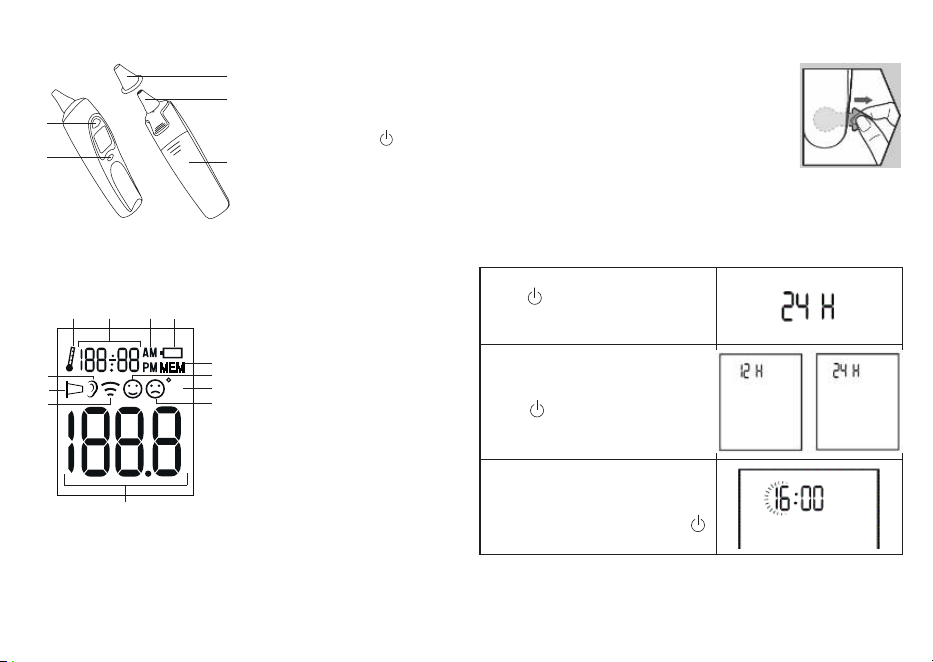
5. GERÄTEBESCHREIBUNG
1
2
3
4
5
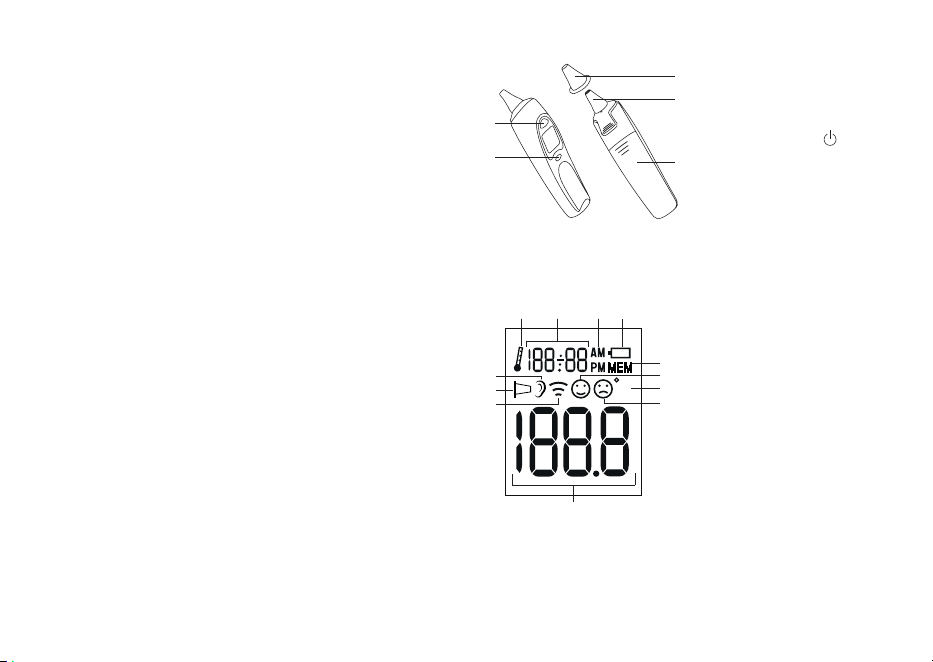
1. Schutzkappe
2. Messsonde
3. START -Taste
4. EIN/AUS-Taste
5. Batteriefach
LCD-Display
E
1
5
7
6
8
9
10
11
12
2 3 4
1. Raumtemperatur-Modus
2. Anzeige Raumtemperatur /
Uhrzeit / Datum
3. AM/PM-Anzeige (Uhrzeit)
4. Batterie-Symbol
5. Memory-Modus
6. Kein-Fieber-Symbol
7. Temperatureinheit (°C oder °F)
8. Fieber-Symbol
9. Temperaturanzeige
10. Objekttemperatur-Modus
11. Schutzkappen-Symbol
12. Körpertemperatur-Modus
7
6. INBETRIEBNAHME
Die Batterien sind beim neuen Gerät bereits ein-
gelegt. Ziehen Sie vor der ersten Anwendung den
herausstehenden Batterieschutzstreifen aus dem
Batteriefach. Das Ohrthermometer schaltet sich
dabei anschließend automatisch ein.
7. EINSTELLUNGEN
7.1 Uhrzeit / Datum einstellen
Bevor Sie mit den Messungen beginnen, empfehlen wir Ihnen die
aktuelle Uhrzeit und das Datum einzustellen. Auf diese Weise kön-
nen Sie später die gespeicherten Messungen einfacher zuordnen.
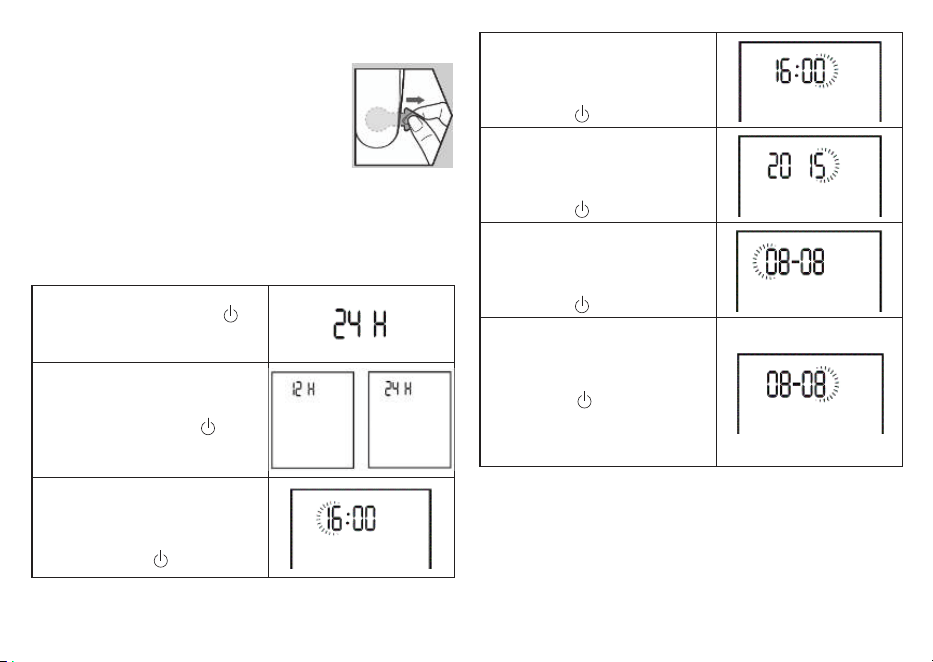
1.
Halten Sie am ausgeschalteten
Gerät die EIN/AUS-Taste für
drei Sekunden gedrückt. Auf dem
Display erscheint „24 H“.
2.
Wählen Sie nun mit der
START-Taste ein Stundenformat
(12h oder 24h) und bestätigen Sie
mit der EIN/AUS-Taste .
3.
Auf dem Display erscheint die
Stundenanzeige. Wählen Sie
mit der START-Taste die aktuelle
Stunde und bestätigen Sie mit der
EIN/AUS-Taste .
4.
Auf dem Display erscheint die Mi-
nutenanzeige. Wählen Sie mit der
START-Taste die aktuelle Minute
und bestätigen Sie mit der EIN/
AUS-Taste .
5.
Auf dem Display erscheint die
Jahresanzeige. Wählen Sie mit
der START-Taste das aktuelle Jahr
und bestätigen Sie mit der EIN/
AUS-Taste .
6.
Auf dem Display blinkt die Ta-
gesanzeige. Wählen Sie mit der
START-Taste den aktuellen Tag
und bestätigen Sie mit der EIN/
AUS-Taste .
7.
Auf dem Display blinkt die Mo-
natsanzeige. Wählen Sie mit der
START-Taste den aktuellen Monat
und bestätigen Sie mit der EIN/
AUS-Taste . Das Gerät schal-
tet sich anschließend automatisch
aus. Datum und Uhrzeit sind nun
gespeichert.
7.2 Temperatureinheit wählen (°C oder °F)
Sie können sich Ihre Messergebnisse in der Temperatureinheit
Grad Celsius (°C) oder Grad Fahrenheit (°F) anzeigen lassen.
8
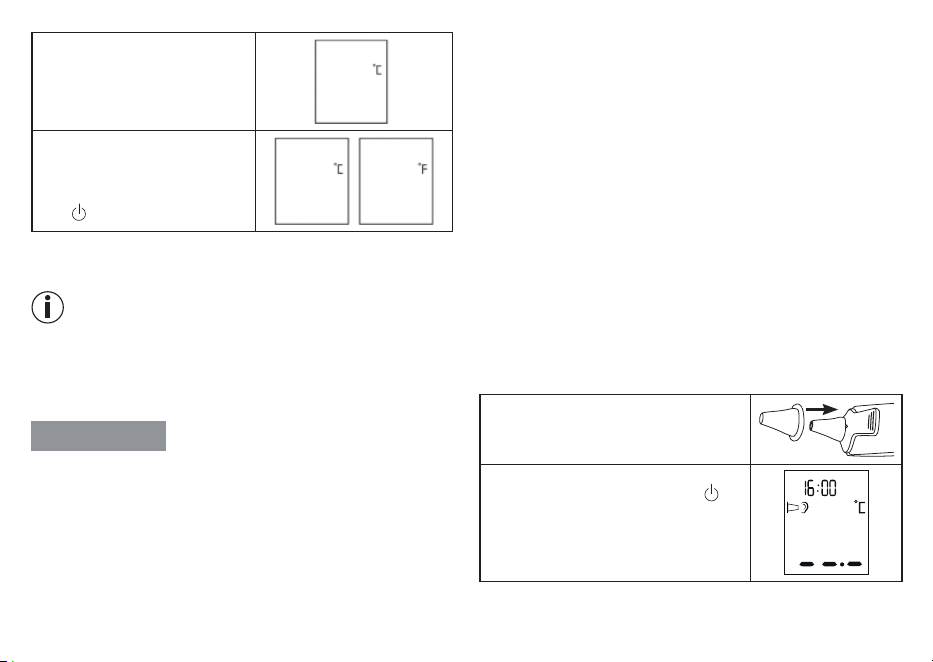
1. Halten Sie am ausgeschalteten
Gerät die START-Taste für drei
Sekunden gedrückt. Auf dem
Display erscheint „°C“.
2.
Wählen Sie nun mit der
START-Taste eine Temperatu-
reinheit (°C oder °F) und bestä-
tigen Sie mit der EIN/AUS-Tas-
te .
8. MESSEN
Prüfen Sie vor jeder Anwendung, ob die Linse beschädigt ist.
Falls diese beschädigt ist, wenden Sie sich an die Händler-
oder Service-Adresse. Berücksichtigen Sie, dass sich das
Ohrthermometer mindestens 30 Minuten in dem Raum befin-
den muss, in dem die Messung vorgenommen wird.
8.1 Körpertemperatur messen
WARNUNG
• Es gibt Personen, die unterschiedliche Messwerte im linken und
rechten Ohr haben. Um Temperaturveränderungen zu erfassen,
messen Sie bei derselben Person immer im selben Ohr.
• Das Ohrthermometer darf von Kindern nur unter Aufsicht von
Erwachsenen benutzt werden. In der Regel ist eine Messung ab
einem Lebensalter von 6 Monaten möglich. Bei Kleinkindern un-
ter 6 Monaten ist der Gehörgang noch sehr eng, sodass häufig
die Temperatur des Trommelfells nicht erfasst werden kann und
vermehrt zu niedrige Mess ergebnisse angezeigt werden.
• Die Messung darf nicht an einem Ohr durchgeführt werden mit
entzündlichen Erkrankungen (z. B. Eiterfluss, Sekretabgang),
nach möglichen Ohrverletzungen (z. B. Trommelfellschaden)
oder in der Heilungsphase nach operativen Eingrien. In all die-
sen Fällen sprechen Sie bitte mit Ihrem behandelnden Arzt.
• Die Anwendung des Ohrthermometers an verschiedenen Perso-
nen kann bei bestimmten akuten, infektiösen Erkrankungen auf-
grund einer möglichen Keimverschleppung trotz der durchzufüh-
renden Reinigung und Wischdesinfektion unzweckmäßig sein.
Sprechen Sie dazu im Einzelfall mit Ihrem behandelnden Arzt.
• Dieses Ohrthermometer darf nur mit aufgesetzter Schutzkappe
verwendet werden.
• Folgende Umstände können die Temperatur im Ohr beeinflus-
sen: wenn Sie längere Zeit auf einem Ohr gelegen sind, die Oh-
ren abgedeckt sind, die Ohren starker Hitze/Kälte ausgesetzt
sind oder nach dem Schwimmen/Baden. Wenn eines dieser
Umstände auf Sie zutrit, warten Sie 20 Minuten bevor Sie die
Messung durchführen.
• Ohrenschmalz kann die Messung beeinflussen, reinigen Sie des-
halb ggf. das Ohr vor der Messung.
1.
Setzen Sie eine saubere Schutzkappe
auf die Sensorspitze des Ohrthermo-
meters auf.
2.
Um das Ohrthermometer einzuschalten,
drücken Sie die EIN/AUS-Taste . Es
ertönen drei Signaltöne und das Display
schaltet sich ein.
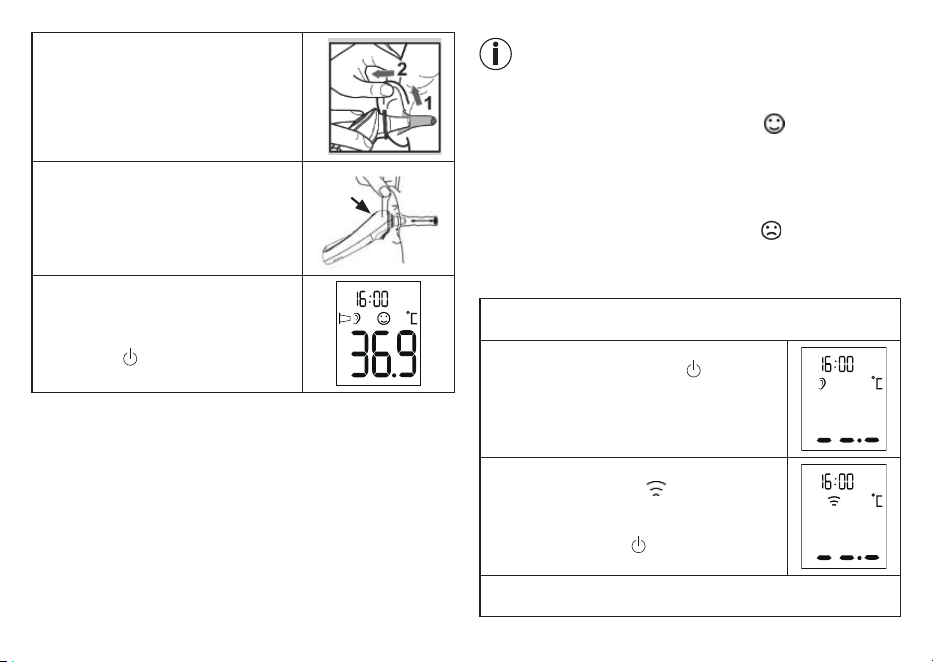
9
3.
Da der Gehörgang leicht gekrümmt
ist, müssen Sie vor dem Einführen der
Sensorspitze das Ohr leicht nach hin-
ten oben ziehen, damit die Spitze der
Schutzkappe direkt auf das Trommelfell
ausgerichtet werden kann.
4.
Führen Sie die Sensorspitze der Schutz-
kappe vorsichtig in den Gehörgang ein
und drücken Sie die START-Taste um
den Messvorgang zu starten.
5. Nach ca. einer Sekunde ertönt ein Sig-
nalton und das Messergebnis erscheint
im Display. Um das Ohrthermometer
auszuschalten, drücken Sie die EIN/
AUS-Taste .
Wenn Sie nach der Messung eine Minute lang keine Taste
drücken, schaltet sich das Ohrthermometer automatisch aus.
Fieberindikator
Liegt die gemessene Temperatur < 38 °C (100,4 °F), erscheint
auf dem Display ein lachendes Smiley
und ein kurzer Si-
gnalton ertönt.
Wenn die gemessene Temperatur zwischen 37,5 und 37,9 °C
liegt, ertönen zusätzlich zwei kurze Signaltöne (Indikation für
„erhöhte Temperatur“).
Liegt die gemessene Temperatur ≥ 38 °C (100,4 °F), erscheint
auf dem Display ein trauriges Smiley und nacheinander
ertönen ein kurzer, ein langer und drei kurze Signaltöne.
8.2 Objekttemperatur messen
1.
Nehmen Sie die Schutzkappe (wenn aufgesetzt) von der Sen-
sorspitze des Ohrthermometers ab.
2. Um das Ohrthermometer einzuschalten, drü-
cken Sie die EIN/AUS-Taste . Es ertönen
drei Signaltöne und das Display schaltet sich
ein.
3. Vergewissern Sie sich, dass Sie sich im Ob-
jekttemperatur-Modus ( ) befinden.
Um zwischen Körpertemperatur- und Ob-
jekttemperatur-Modus zu wechseln, halten
Sie die EIN/AUS-Taste und die START-Taste
gleichzeitig kurz gedrückt.
4.
Halten Sie die Sensorspitze des Ohrthermometers 1 bis 2 cm vor
die gewünschte Messstelle und drücken Sie die START-Taste .
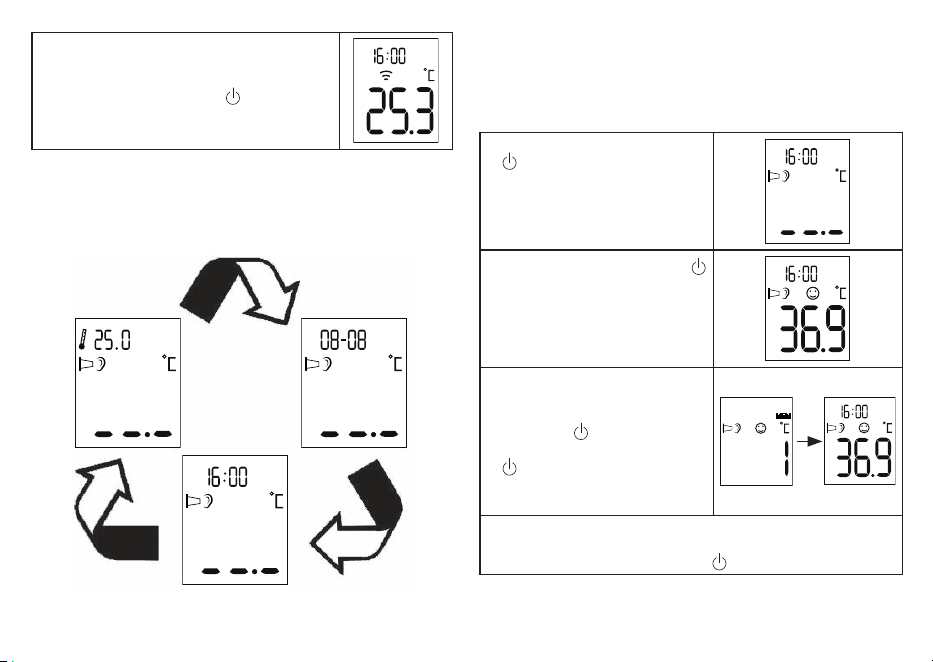
10
5. Nach einer Sekunde ertönt ein Signalton und
das Messergebnis erscheint im Display. Um
das Ohrthermometer auszuschalten, drücken
Sie kurz die EIN/AUS-Taste .
8.3 Raumtemperatur anzeigen
Wenn Sie das Ohrthermometer einschalten, erscheinen auf dem
Display die Raumtemperatur, das Datum und die Uhrzeit alle 3 Se-
kunden im Wechsel.
8.4 Gespeicherte Messwerte anzeigen
Das Ohrthermometer speichert automatisch die Temperatur-Mess-
werte der letzten 10 Messungen von jeweils Körper- und Objekttem-
peratur (inkl. Datum und Uhrzeit). Um die gespeicherten Messwerte
abzurufen, gehen Sie wie folgt vor:
1.
Drücken Sie die EIN/AUS-Taste
, um das Ohrthermometer ein-
zuschalten.
2. Halten Sie die EIN/AUS-Taste
für 3 Sekunden gedrückt. Auf dem
Display erscheint ein M und der
zuletzt gespeicherte Messwert.
3.
Um zwischen den einzelnen
gespeicherten Messwerten zu
wechseln, drücken Sie die EIN/
AUS-Taste . Bei jedem weite-
ren Drücken der EIN/AUS-Taste
wird zunächst die Speicher-
platznummer und anschließend
der Messwert angezeigt.
4.
Wenn Sie mit einer Messung fortfahren möchten, drücken Sie die
START-Taste. Wenn Sie das Ohrthermometer ausschalten möch-
ten, halten Sie die EIN/AUS-Taste für 3 Sekunden gedrückt.
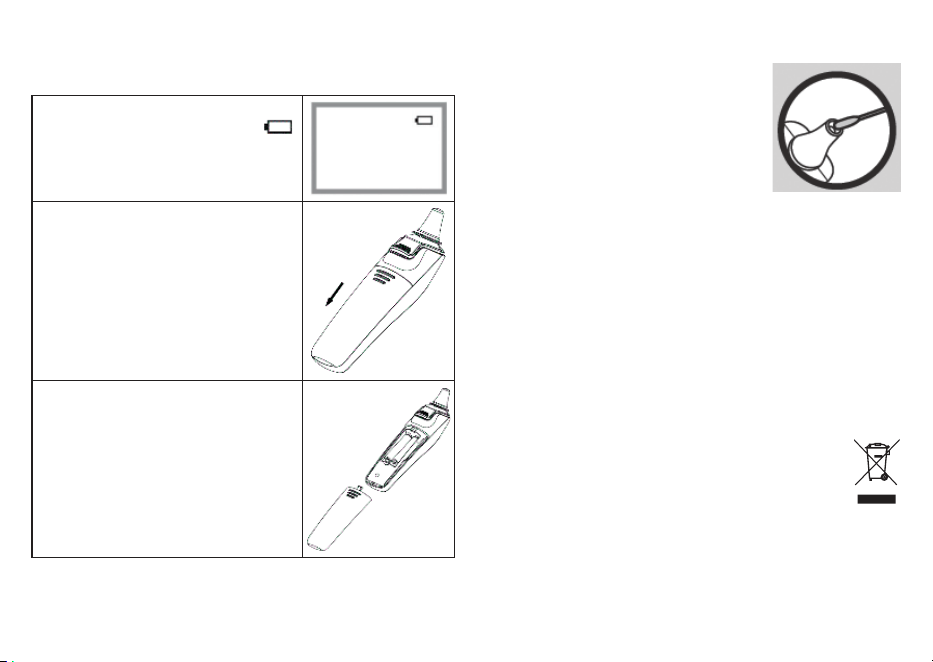
11
9. BATTERIEWECHSEL
Bevor Sie die Batterie wechseln, vergewissern Sie sich, dass das
Gerät ausgeschaltet ist.
1. Tauschen Sie die Batterien aus, sobald
im Display das Batterie-Symbol ( )
erscheint.
2. Schieben Sie das Batteriefach auf und
nehmen Sie die verbrauchten Batterien
aus dem Batteriefach.
3.
Setzen Sie zwei neue 1,5 V AAA-Bat-
terien ein. Achten Sie darauf, dass die
Batterien richtig ausgerichtet sind. Ver-
schließen Sie das Batteriefach.
10. REINIGUNG / AUFBEWAHRUNG
Schutzkappen sind nur für den einmaligen
Gebrauch bestimmt.
Die Sensorspitze ist das empfindlichste Teil
des Ohrthermometers. Arbeiten Sie bei der
Reinigung der Sensorspitze vorsichtig, um
eine Beschädigung zu vermeiden. Verwen-
den Sie dazu ein weiches Tuch oder ein
Wattestäbchen, welches mit Desinfektions-
mittel, Alkohol oder warmem Wasser ange-
feuchtet werden kann.
Zur Reinigung des gesamten Gerätes verwenden Sie ein weiches,
leicht mit Seifenlauge angefeuchtetes Tuch.
Verwenden Sie keine aggressiven Reinigungsmittel.
Bei beabsichtigter längerer Lagerung entfernen Sie die Batterien.
Das Gerät darf nicht bei zu hoher oder niedriger Temperatur oder
Luftfeuchtigkeit (siehe technische Daten), im Sonnenlicht, in Verbin-
dung mit elektrischem Strom oder an staubigen Orten gelagert oder
auch benutzt werden. Ansonsten kann es zu Messungenauigkeiten
kommen.
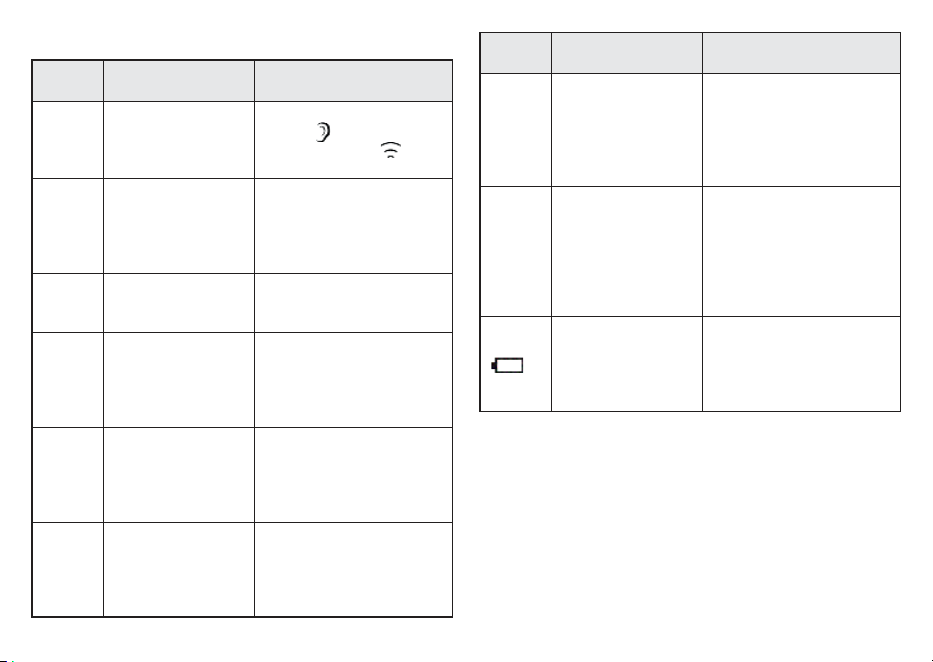
11. ENTSORGUNG
Im Interesse des Umweltschutzes darf das Gerät am Ende
seiner Lebensdauer nicht mit dem Hausmüll entfernt wer-
den. Die Entsorgung kann über entsprechende Sammel-
stellen in Ihrem Land erfolgen. Befolgen Sie die örtlichen
Vorschriften bei der Entsorgung der Materialien. Entsorgen
Sie das Gerät gemäß der Elektro- und Elektronik Altgeräte EG-Richt-
linie – WEEE (Waste Electrical and Electronic Equipment). Bei Rück-
fragen wenden Sie sich bitte an die für die Entsorgung zuständige
kommunale Behörde. Rücknahmestellen für Ihre Altgeräte erhalten

12
Sie z. B. bei der örtlichen Gemeinde- bzw. Stadtverwaltung, den
örtlichen Müllentsorgungsunternehmen oder bei Ihrem Händler.
Diese Zeichen finden Sie auf schadstohaltigen Batte-
rien:
Pb = Batterie enthält Blei,
Cd = Batterie enthält Cadmium,
Hg = Batterie enthält Quecksilber.
Hinweise für Verbraucher zur Altgeräteentsor-
gung und Verschrottung in Deutschland
Besitzer von Altgeräten können diese im Rahmen der durch die öf-
fentlich-rechtlichen Entsorgungsträger eingerichteten und zur Verfü-
gung stehenden Möglichkeiten der Rückgabe oder Sammlung von
Altgeräten unentgeltlich abgeben, damit eine ordnungsgemäße Ent-
sorgung der Altgeräte sichergestellt ist. Die Rückgabe ist gesetzlich
vorgeschrieben.
Außerdem ist die Rückgabe unter bestimmten Voraussetzungen
auch bei Vertreibern möglich.
Gemäß Elektro- und Elektronikgerätegesetz (ElektroG) sind die fol-
genden Vertreiber zur unentgeltlichen Rücknahme von Altgeräten
verpflichtet:
• Elektro-Fachgeschäfte, mit einer Verkaufsfläche für Elektro- und
Elektronikgeräte von mindestens 400 Quadratmetern
• Lebensmittelläden mit einer Gesamtverkaufsfläche von mindes-
tens 800 Quadratmetern, die mehrmals pro Jahr oder dauerhaft
Elektro- und Elektronikgeräte anbieten und auf dem Markt be-
reitstellen.
• Versandhandel, wobei die Pflicht zur 1:1-Rücknahme im pri-
vaten Haushalt nur für Wärmeüberträger (Kühl-/Gefriergeräte,
Klimageräte u.a.), Bildschirmgeräte und Großgeräte gilt. Für die
1:1-Rücknahme von Lampen, Kleingeräten und kleinen IT- u.
Telekommunikationsgeräten sowie die 0:1-Rücknahme müssen
Versandhändler Rückgabemöglichkeiten in zumutbarer Entfer-
nung zum Endverbraucher bereitstellen.
Diese Vertreiber sind verpflichtet,
• bei der Abgabe eines neuen Elektro- oder Elektronikgerätes an
einen Endnutzer ein Altgerät des Endnutzers der gleichen Ge-
räteart, das im Wesentlichen die gleichen Funktionen wie das
neue Gerät erfüllt, am Ort der Abgabe oder in unmittelbarer Nähe
hierzu unentgeltlich zurückzunehmen und
• auf Verlangen des Endnutzers Altgeräte, die in keiner äußeren
Abmessung größer als 25 Zentimeter sind, im Einzelhandels-
geschäft oder in unmittelbarer Nähe hierzu unentgeltlich zu-
rückzunehmen; die Rücknahme darf nicht an den Kauf eines
Elektro- oder Elektronikgerätes geknüpft werden und ist auf drei
Altgeräte pro Geräteart beschränkt.
Sie können sich bei Ihrem Händler über Rückgabemöglichkeiten vor
Ort informieren.
Enthalten die Produkte Batterien und Akkus oder Lampen, die aus
dem Altgerät zerstörungsfrei entnommen werden können, müssen
diese vor der Entsorgung entnommen und getrennt als Batterie bzw.
Lampe entsorgt werden.
Sofern das alte Elektro- bzw. Elektronikgerät personenbezogene
Daten enthält, sind Sie selbst für deren Löschung verantwortlich,
bevor Sie es zurückgeben.
13
12. WAS TUN BEI FEHLERMELDUNGEN?
Fehler-
meldung
Ursache Behebung
ER1
Das Ohrthermometer
ist noch nicht mess-
bereit.
Messen Sie erst, sobald
Körper- (
) oder Objekt-
temperaturmodus ( ) im
Display angezeigt wird.
ER2
Die gemessene Um-
gebungstemperatur
liegt nicht im Bereich
zwischen 10 °C – 40 °C
(50 °F – 104 °F).
Legen Sie das Ohrther-
mometer für 30 Minu ten in
einen Raum mit 10 °C – 40 °C
(50 °F – 104 °F) Umge-
bungstemperatur.
ER3
Das Ohrthermometer
ist nicht korrekt in
Ihrem Ohr platziert.
Beachten Sie die Hinweise im
Kapitel „Messen“. Führen Sie
die Messung erneut durch.
ER4
Das Ohrthermome-
ter hat eine große
Veränderung der
Umgebungstempera-
tur festgestellt.
Legen Sie das Ohrther-
mometer für 30 Minu ten in
einen Raum mit 10 °C – 40 °C
(50 °F – 104 °F) Umge-
bungstemperatur.
ER5
Das Ohrthermometer
funktioniert nicht
einwandfrei.
Wechseln Sie die Batterien
und versuchen Sie es erneut.
Sollte der Fehler erneut
auftauchen, kontaktieren Sie
den Kundendienst.
ER6
Sie befinden sich im
Modus „Objekttem-
peratur messen“ und
die Schutzkappe ist
noch aufgesetzt.
Um die Messung der Ob-
jekttemperatur durchführen
zu können, müssen Sie die
Schutzkappe abziehen.
Fehler-
meldung
Ursache Behebung
Hi
Ohrmessung: Gemes-
sene Temperatur über
43 °C (109,4 °F)
Objektmessung: Ge-
messene Temperatur
über 100 °C (212 °F)
Vergewissern Sie sich, dass
das Gerät und die Schutz-
kappe in einwandfreiem
Zustand sind. Führen Sie die
Messung erneut durch.
Lo
Ohrmessung: Gemes-
sene Temperatur liegt
unter 34°C (93,2°F)
Objektmessung: Ge-
messene Temperatur
liegt unter -20 °C
(-4 °F)
Vergewissern Sie sich, dass
das Gerät und die Schutz-
kappe in einwandfreiem
Zustand sind. Führen Sie die
Messung erneut durch.
Die Batterien sind
leer.
Entnehmen Sie die zwei
leeren Batterien und setzen
Sie zwei neue 1,5V AAA-Bat-
terien in das Ohrthermometer
ein.
Falls Ihr Problem hier nicht aufgeführt wurde, kontaktieren Sie un-
seren Kundenservice.
13. TECHNISCHE DATEN
Bei Verwendung des Gerätes außerhalb der Spezifikation ist eine
einwandfreie Funktion nicht gewährleistet!
Die Genauigkeit dieses Thermometers wurde sorgfältig geprüft und
wurde im Hinblick auf eine lange nutzbare Lebensdauer entwickelt.
Bei Verwendung des Gerätes in der Heilkunde entscheiden die
jeweils geltenden nationalen Bestimmungen, ob messtechnische
Kontrollen mit geeigneten Mitteln durchzuführen sind. Technische
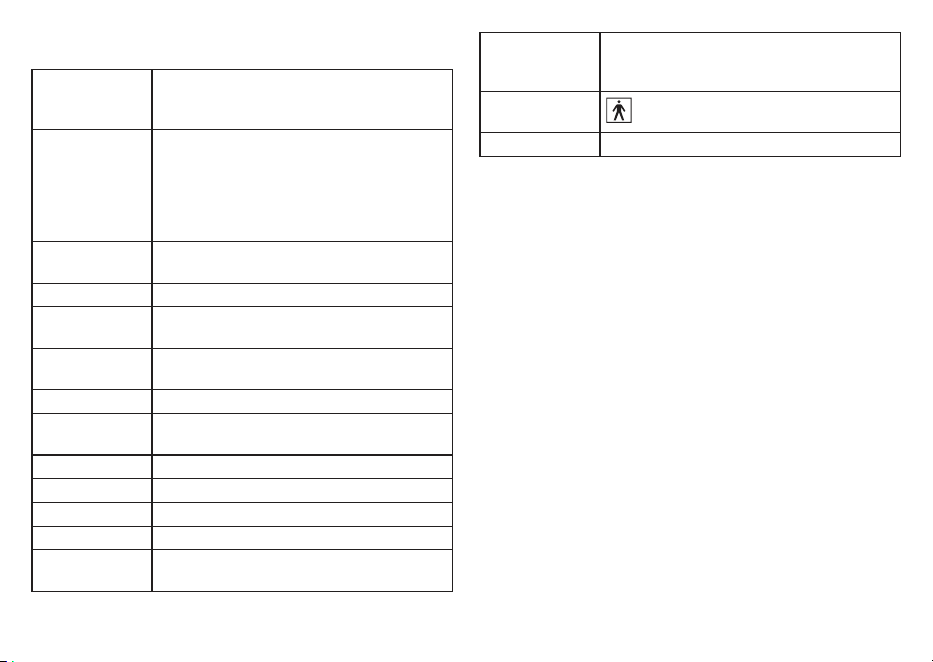
14
Änderungen zur Verbesserung und Weiterentwicklung des Produk-
tes behalten wir uns vor.
Temperatur-
messbereich
Im Ohr:
28°C
– 43,0 °C (
82,4°
– 109,4 °F)
Objekttemperatur: -20 – 100 °C (-4 – 212 °F)
Raumtemperatur: 0 – 50 °C (32 – 122 °F)
Labor-Messge-
nauigkeit
Im Ohr: ± 0 ,2 °C (0,4 °F) im Messbereich von
35,5 – 42,0 °C (95,9 – 107,6 °F); ± 0,3 °C (0,5 °F)
im Messbereich von ≤35,5 °C (95,5 °F) und
≥42,0 °C (107,6 °F)
Objekttemperatur: ± 4% oder ± 2 °C (4 °F)
Raumtemperatur: ± 2 °C (± 4 °F)
Klinische Wie-
derholbarkeit
0,11 °C (0,2 °F)
Messdauer Ca. eine Sekunde
Betriebstempe-
raturbereich
10 – 40 °C (50 – 104 °F), Luftfeuchtigkeit
15 – 85% (nicht kondensierend)
Lagertempera-
turbereich
-25 – 55 °C (-13 – 131 °F), Luftfeuchtigkeit
≤ 95% (nicht kondensierend)
Speicher 10 Speicherplätze
Anzeigen-
auflösung
0,1 °C oder 0,1 °F
Batterie DC 3V (2 x 1,5V AAA Batterie)
Abmessungen 155 x 38 x 47 mm
Gewicht ca. 63 g (ohne Batterien)
Schutzkappen 10
Automatische
Abschaltung
60 Sekunden
Batterie-
Nutzungsdauer
3.000 Messungen hintereinander oder ein
Jahr mit ein bis zwei Messungen pro Tag
einschließlich Standby-Modus.
Sicherheits-
klassifizierung
Angeschlossenes medizinisches Gerät
des Typs BF
IP-Schutzklasse IP22
Die Seriennummer befindet sich auf dem Gerät oder im Batteriefach.
14. GARANTIE / SERVICE
Nähere Informationen zur Garantie und den Garantiebedingungen
finden Sie im mitgelieferten Garantie-Faltblatt.
Irrtum und Änderungen vorbehalten
15
ENGLISH
Read these instructions for use care fully and keep them for later use, be sure to make them accessible to other users and
observe the information they contain.
1. INCLUDED IN DELIVERY
Check that the exterior of the cardboard delivery packaging is intact
and make sure that all contents are present. Before use, ensure that
there is no visible damage to the device or accessories and that all
packaging material has been removed. If you have any doubts, do
not use the device and contact your retailer or the specified Custo-
mer Service address.
1 x ear thermometer
2 x 1.5 V AAA batteries
10 x protective caps
1 x set of instructions for use
Subsequent purchase articles
Protective cap set replacement available: 2 x 10 protective caps,
item no. 795.34
2. SIGNS AND SYMBOLS
The following symbols are used on the device, in these instructions
for use, on the packaging and on the type plate for the device:
WARNING
Indicates a potentially impending danger. If it is not avoided,
there is a risk of death or serious injury.
1. Included in delivery .................................................................15
2. Signs and symbols .................................................................. 15
3. Intended use ...........................................................................16
4. Notes ....................................................................................... 17
5. Unit description ....................................................................... 19
6. Initial use .................................................................................19
7. Settings ...................................................................................19
7.1 Setting the time/date ......................................................19
7.2 Setting the temperature unit (°C or °F) ...........................20
8. Measuring ...............................................................................20
8.1 Measuring body temperature .........................................20
8.2 Measuring object temperature ........................................22
8.3 Displaying room temperature .........................................22
8.4 Displaying stored measurements ...................................23
9. Replacing the battery ..............................................................23
10. Cleaning and storage ...........................................................24
11. Disposal ................................................................................24
12. What if there are error messages? ........................................24
13. Technical data .......................................................................25
14. Warranty / service ................................................................... 26
TABLE OF CONTENTS
16
CAUTION
Indicates a potentially impending danger. If it is not avoided,
slight or minor injuries may result.
NOTICE
Indicates a potentially harmful situation. If it is not avoided, the
device or something in its vicinity may be damaged.
Product information
Note on important information
Observe the instructions
Read the instructions before starting work and/or ope-
rating devices or machines
Type BF applied part
The electronic device must not be disposed of with
household waste
Do not dispose of batteries containing hazardous subs-
tances with household waste
CE labelling
This product satisfies the requirements of the applicable
European and national directives.
Atmospheric pressure limitation
Temperature limit
Manufacturer
IP22
Device protected against foreign objects ≥ 12.5 mm and
against water dripping at an angle
B
A
Marking to identify the packaging material.
A = Material code, B = Material number:
1-7 = Plastics, 20-22 = Paper and cardboard
S
N
Serial number
Separate the product and packaging elements and
dispose of them in accordance with local regulations.
Swiss authorised representative
Importer
3. INTENDED USE
The ear thermometer is intended for measuring the body tempera-
ture in the ear. Do not use the ear thermometer for measurements in
other parts of the body.
You can also use the ear thermometer to measure room and object
temperatures.
The ear thermometer has been carefully developed for precise, safe
and rapid temperature measurements in the ear. It is a non-invasive

17
ear thermometer with an infra-red detector to determine the body
temperature in the auditory canal of adults and children.
Use the device for the intended purpose only and in the manner
specified in these instructions for use. Any form of improper use can
be dangerous. The manufacturer is not liable for damage resulting
from improper or careless use.
This device complies with the EU Directive 93/42/EEC concerning
medical products, the Medizinproduktegesetz (German Medical
Devices Act), the ASTM (American Society for Testing and Mate-
rials) E 1965 - 98 and the European Standard EN 12470-5: Clinical
thermometers – Part 5: Requirements for infrared ear thermometers
(with maximum device) and the European Standard EN 60601-1-
2 (in accordance with CISPR 11, IEC 61000-4-2, IEC 61000-4-3,
IEC61000-4-8), and is subject to particular precautions with regard
to electromagnetic compatibility.
Please note that portable and mobile HF communication systems
may interfere with this device.
4. NOTES
Safety notes
WARNING
• To measure temperature, insert the sensor tip of the ear thermo-
meter carefully into the ear.
• Use of the ear thermometer on dierent persons can be inappro-
priate in the event of certain acute infectious diseases because
of the possible spread of germs despite cleaning and disinfecti-
on. If you have any doubts, please consult your doctor.
• The body temperature measured in the ear may dier from other
measurements taken in the mouth, rectum or armpits. Any com-
parison of these values is therefore futile. Measure temperature
regularly to calculate the normal ear temperature and then use
these measurements as a basis for comparison when taking
measurements in the event of a suspected high temperature.
• This ear thermometer is intended for measuring the temperature
in the ear. Do not use this ear thermometer for measurements in
other parts of the body.
• Replace the protective cap after each use to ensure an accurate
measurement and prevent cross-contamination.
• The ear thermometer may only be used with protective caps
from Sanitas; other protective caps may result in faulty mea-
surements. If you have run out of protective caps, contact the
manufacturer or retailer for replacements.
• Consult a doctor if you believe your medical condition to be poor.
Notes on handling batteries
WARNING
• Risk of explosion! Risk of fire! Failure to comply with
the following points can result in personal injury or cause
overheating, leakage, venting, breakage, explosion, or fire on
the battery.
• This device contains non-rechargeable batteries which must not
be charged.
• Do not throw batteries into a fire.
• Never charge, forcibly discharge, heat, disassemble, open,
crush, deform, encapsulate, or modify batteries.
• Never short-circuit batteries or battery compartment contacts.
• Protect the batteries from direct sunlight, rain, heat, and water.
• Exposure of batteries to an environment with extremely high
temperatures or an extremely low air pressure may result in
explosion or leakage of flammable liquids and gases.
• Dispose of defective and discharged batteries immediately and
properly (see chapter on disposal).

18
• Do not use modified or damaged batteries.
• Always select the correct battery type.
• Always insert the batteries correctly, taking into account the
polarity (+ / -).
• Never mix batteries of dierent manufacturers, capacities (new
and used), size, or type within a device.
• If a battery has leaked, put on protective gloves and clean the
battery compartment with a dry cloth.
• If fluid from a battery comes into contact with your skin or eyes,
wash the aected areas with water and seek medical assistance.
• Choking hazard! Keep batteries out of the reach of children.
Seek medical attention immediately if swallowed. Swallowing
them may cause burns, severe internal injuries, and death.
• Never allow children to replace batteries without adult
supervision.
CAUTION
• Store batteries in a well-ventilated, dry, and cool place in a non-
conductive container in which the batteries cannot be short-
circuited to each other or by other metal objects.
• Keep batteries clean and dry.
• Keep batteries away from water.
• If the device is not going to be used for a long period of time,
remove the batteries from the battery compartment.
NOTICE
• Do not use rechargeable batteries.
Risks to the device
CAUTION
• Do not subject the device to mechanical impacts.
• Do not expose the device to direct sunlight.
• Do not expose the device to liquids. The device is not waterpro-
of. Avoid all direct contact with water or other liquids.
• Have the device repaired by authorised service centres only,
otherwise its warranty is invalidated.
• Portable and mobile HF communication systems may interfere
with this device. More details can be requested from the stated
Customer Services address or found at the end of the instruc-
tions for use.
NOTES ON ELECTROMAGNETIC COMPATI-
BILITY
• The device is suitable for use in all environments listed in these
instructions for use, including domestic environments.
• The use of the device may be limited in the presence of electro-
magnetic disturbances. This could result in issues such as error
messages or the failure of the display/device.
• Avoid using this device directly next to other devices or stacked
on top of other devices, as this could lead to faulty operation. If,
however, it is necessary to use the device in the manner stated,
this device as well as the other devices must be monitored to
ensure they are working properly.
• The use of accessories other than those specified or provided
by the manufacturer of this device can lead to an increase in
electromagnetic emissions or a decrease in the device’s electro-
magnetic immunity; this can result in faulty operation.
• Failure to comply with the above can impair the performance
of the device.
19
5. UNIT DESCRIPTION
1
2
3
4
5
1. Protective cap
2. Measuring sensor
3. START button
4. ON/OFF button
5. Battery compartment
LCD display
E
1
5
7
6
8
9
10
11
12
2 3 4
1. Room temperature mode
2. Displays room temperature/
time/date
3. AM/PM display (time)
4. Battery symbol
5. Memory mode
6. No fever symbol
7. Temperature unit (°C or °F)
8. Fever symbol
9. Temperature display
10. Object temperature mode
11. Protective cap symbol
12. Body temperature mode
6. INITIAL USE
The batteries are already inserted in new devices.
Before first use, remove the protruding plastic in-
sulating strip from the battery compartment. The
ear thermometer will then switch on automatically.
7. SETTINGS
7.1 Setting the time/date
Before beginning to take measurements, we recommend that you
set the current time and date. This will allow you to organise the
saved measurements more easily later.
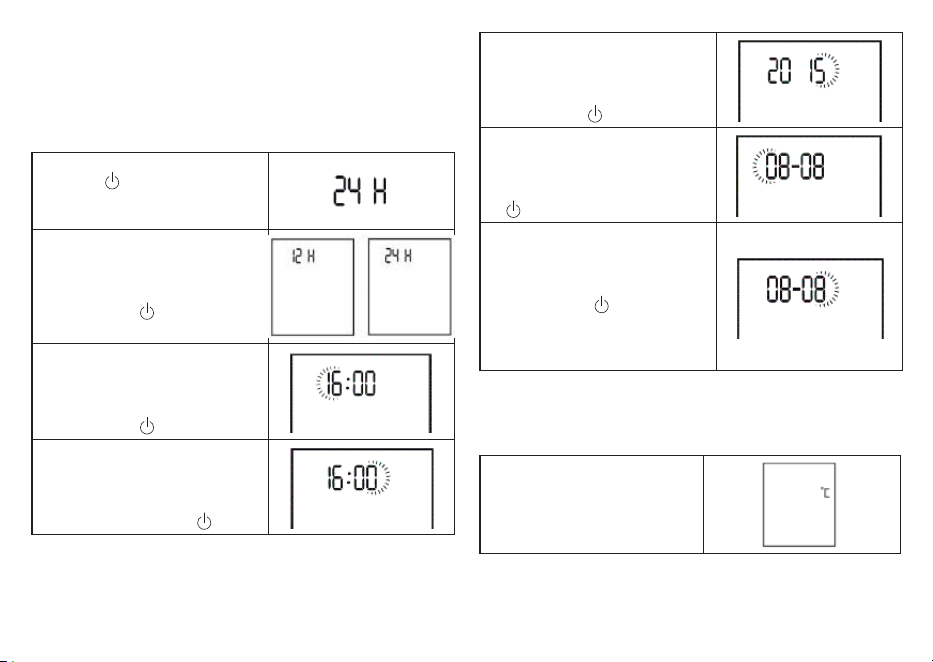
1. Press and hold the ON/OFF but-
ton on the switched-o device
for three seconds. “24 H” appears
on the display.
2.
Use the START button to select
the hour format (12h or 24h) and
confirm using the ON/OFF but-
ton .
3. The hour setting appears on the
display. Use the START button to
select the current hour and con-
firm using the ON/OFF button .
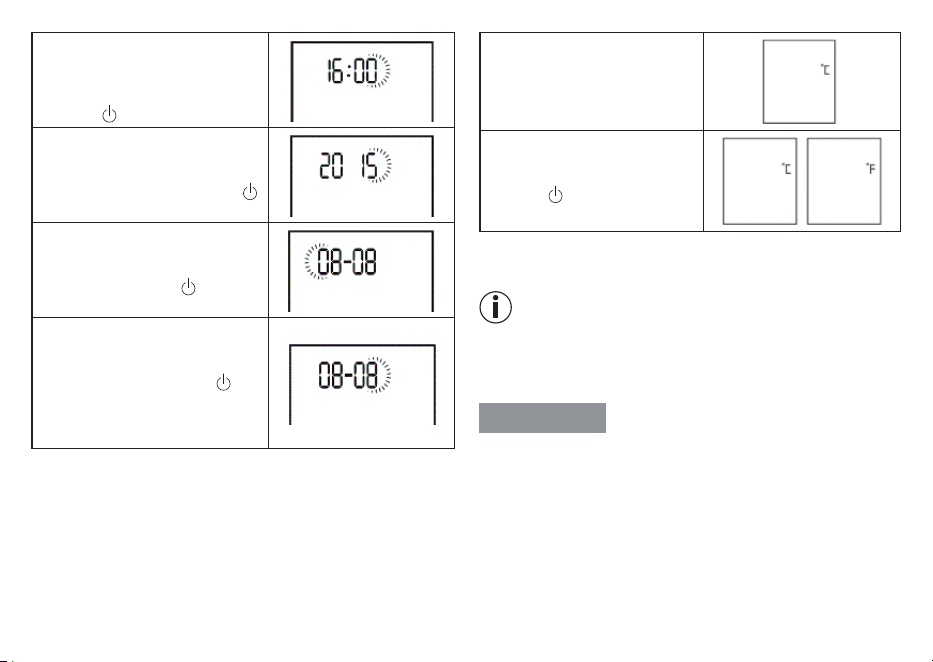
20
4.
The minute setting appears on
the display. Use the START but-
ton to select the current minute
and confirm using the ON/OFF
button .
5.
The year setting appears on the
display. Use the START button to
select the current year and con-
firm using the ON/OFF button .
6.
The day flashes on the display.
Use the START button to select
the current day and confirm using
the ON/OFF button .
7.
The month flashes on the display.
Use the START button to select
the current month and confirm
using the ON/OFF button . The
device then switches itself o au-
tomatically. The date and time are
now saved.
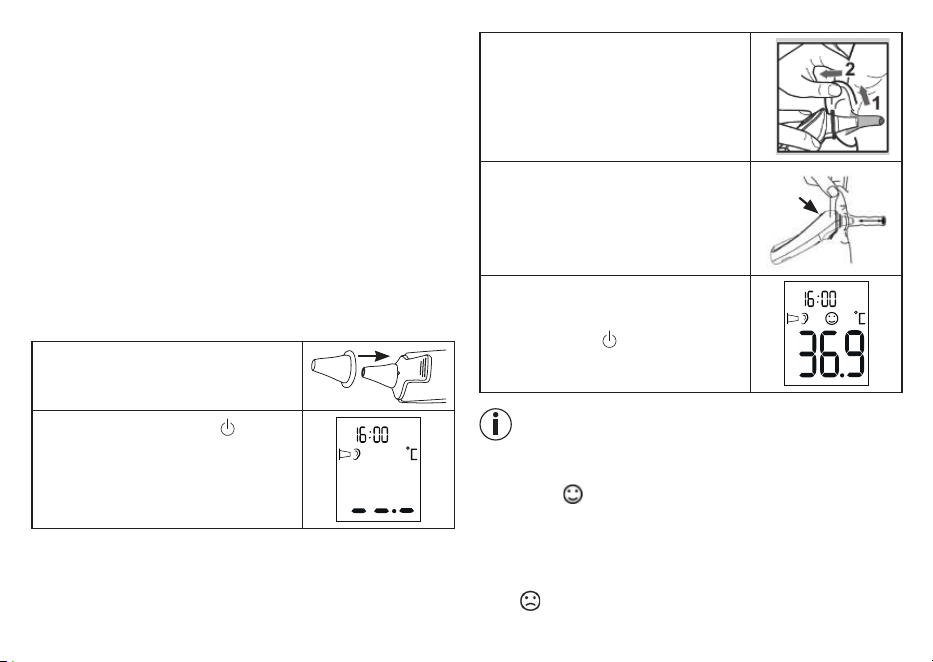
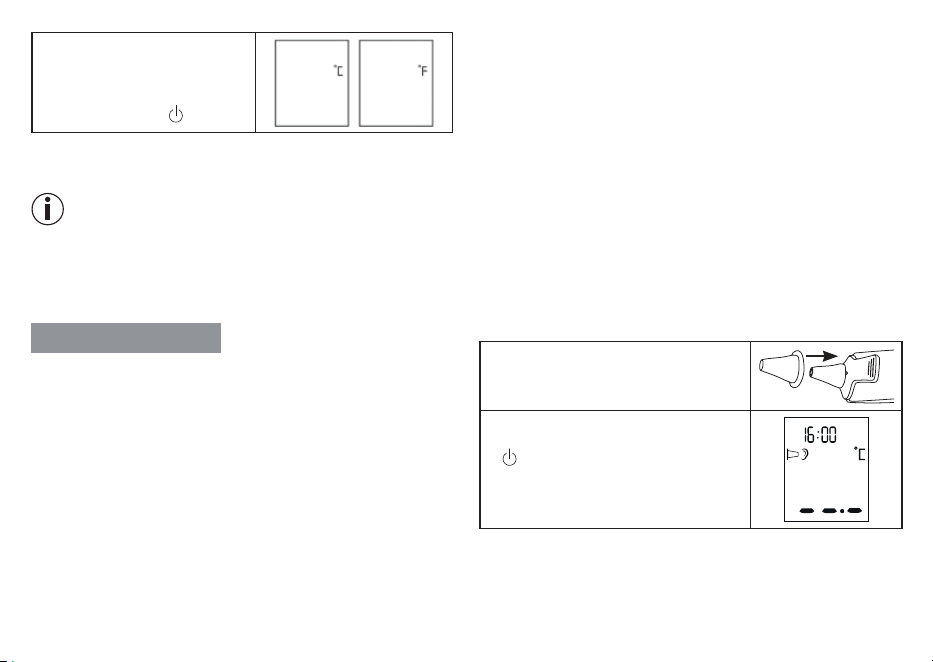
7.2 Setting the temperature unit (°C or °F)
You can set the device to display the temperature in degrees Celsius
(°C) or degrees Fahrenheit (°F).
1. Press and hold the START but-
ton on the switched-o device
for three seconds. “°C” appears
on the display.
2.
Use the START button to select
the temperature unit (°C or °F)
and confirm using the ON/OFF
button .
8. MEASURING
Check before each use that the lens is intact. If it is damaged,
contact your retailer or the service address. Bear in mind that
the ear thermometer needs to have been in the room in which
the measurement is taken for at least 30 minutes before use.
8.1 Measuring body temperature
WARNING
• Some people produce dierent readings in their left and right
ear. In order to record temperature changes, always measure a
person's temperature in the same ear.
• The ear thermometer may be used by children only under adult
supervision. Measurement is usually possible over the age of 6
months. In infants under 6 months, the ear canal is still very nar-
row so the temperature of the eardrum often cannot be recorded
and the result displayed is often too low.
• The measurement must not be taken in an ear aected by in-
flammatory diseases (e.g. discharging pus or secretion), after
21
possible ear injuries (e.g. eardrum damage) or in the healing
period after operative procedures. In all of these cases, please
consult your doctor.
• Use of the ear thermometer on dierent persons can be inappro-
priate in the event of certain acute infectious diseases because
of the possible spread of germs despite cleaning and disinfecti-
on. If you have any doubts, please consult your doctor.
• This ear thermometer may only be used with the protective cap
in place.
• The following circumstances may influence the temperature in
the ear: if you have been lying on the ear for an extended period,
the ears are covered, the ears are exposed to excessive heat/
cold, or after swimming or bathing. In the event of one of these
circumstances, wait 20 minutes before performing the measu-
rement.
• As ear wax can aect the measurement, you should clean the
ear before measuring if necessary.
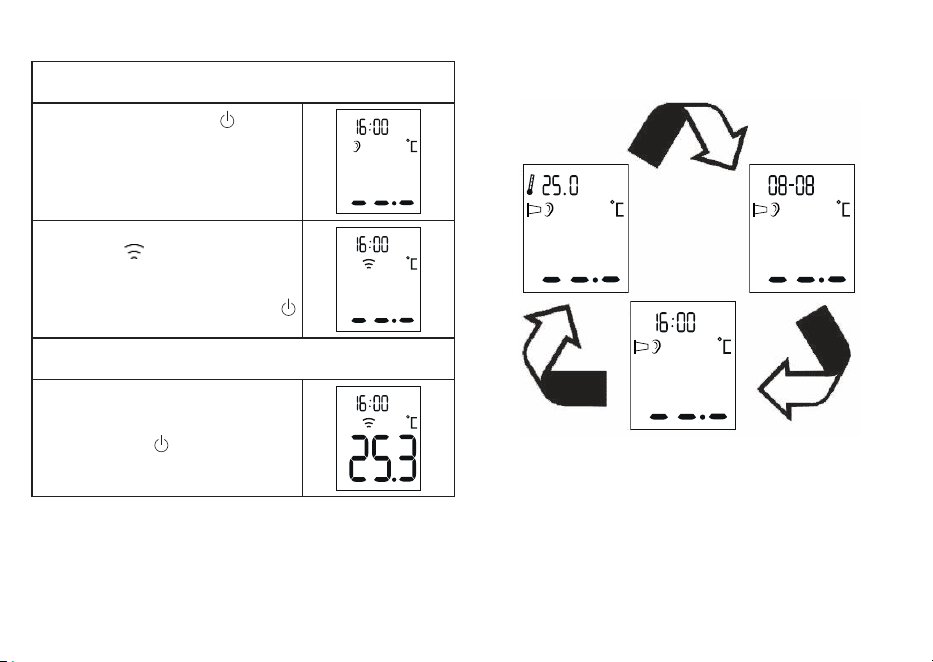
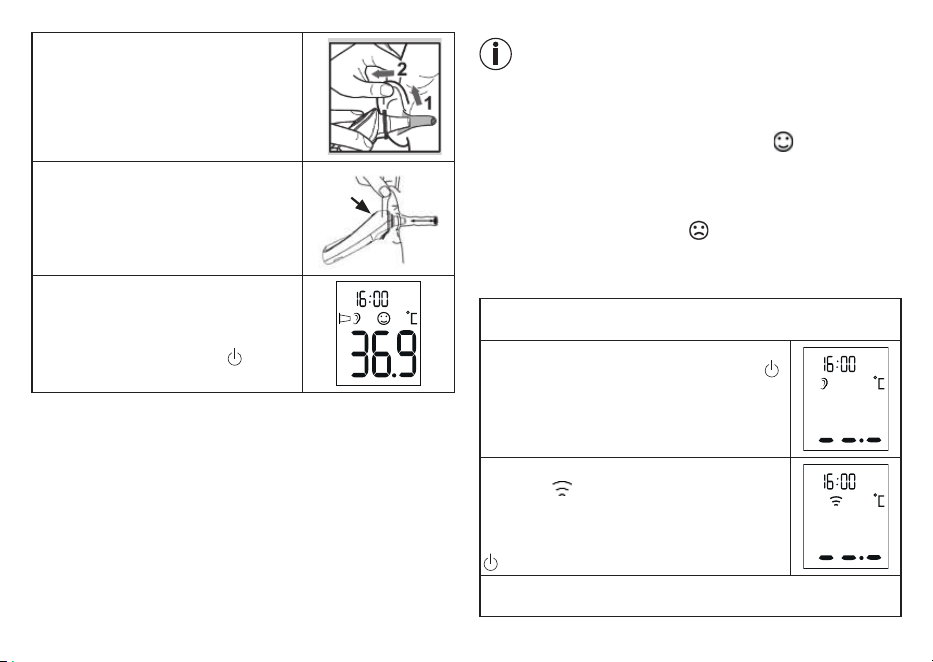
1.
Place a clean protective cap on to the
sensor tip of the ear thermometer.
2. Press the ON/OFF button to switch
on the ear thermometer. Three acoustic
signals sound and the display switches
on.
3. As the ear canal is slightly curved, you
have to pull the ear slightly up and back-
wards before inserting the sensor tip.
This is important so that the tip of the
protective cap can be pointed directly
at the eardrum.
4.
Insert the sensor tip with the protecti-
ve cap carefully into the ear canal and
press the START button to begin the
measurement.
5.
After approx. one second, a long
acoustic signal sounds and the measu-
rement is shown in the display. Press the
ON/OFF button to switch o the ear
thermometer.
If no button is pressed for one minute after the measurement,
the ear thermometer automatically switches itself o again.
Fever indicator
If the measured temperature is < 38 °C (100.4 °F), a laughing
smiley
appears on the display and a short acoustic signal
sounds.
If the measured temperature falls between 37.5 and 37.9 °C,
two short acoustic signals will also sound (the indication for
“raised temperature”).
If the measured temperature is ≥ 38 °C (100.4 °F), a sad smiley
appears on the display and a short, a long and three short
acoustic signals sound one after the other.
22
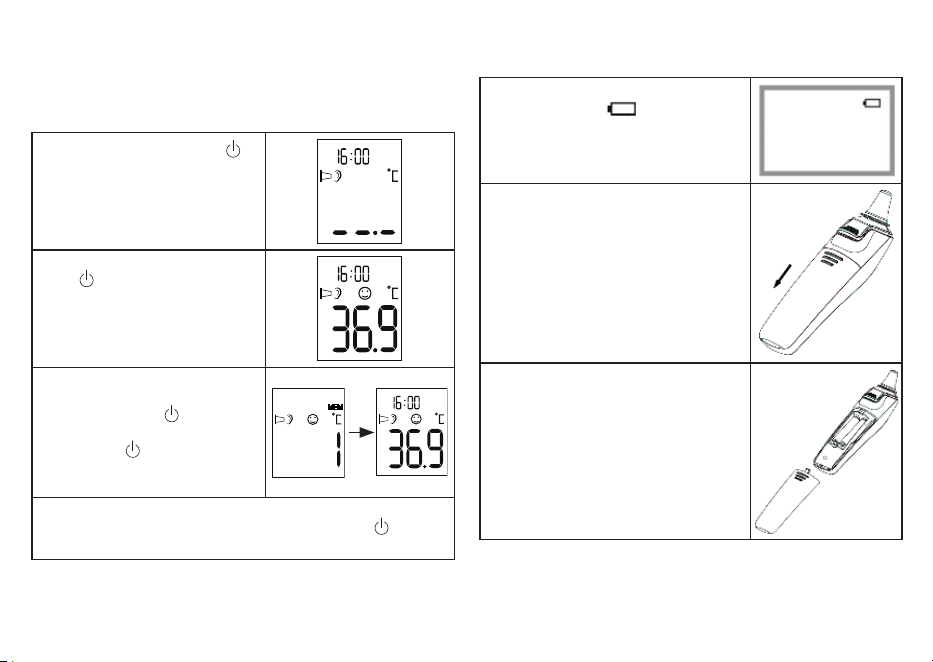
8.2 Measuring object temperature
1. Remove the protective cap from the sensor tip of the ear ther-
mometer (if it is on).
2. Press the ON/OFF button to switch
on the ear thermometer. Three acoustic
signals sound and the display switches
on.
3. Ensure that you are in object tempera-
ture mode ( ).
To switch between body temperature
and object temperature mode, briefly
press and hold the ON/OFF button
and the START button at the same time.
4.
Hold the sensor tip of the ear thermometer 1 to 2 cm from the
desired measuring point and press the START button.
5.
After one second, a long acoustic si-
gnal sounds and the measurement is
shown in the display. Briefly press the
ON/OFF button to switch o the ear
thermometer.
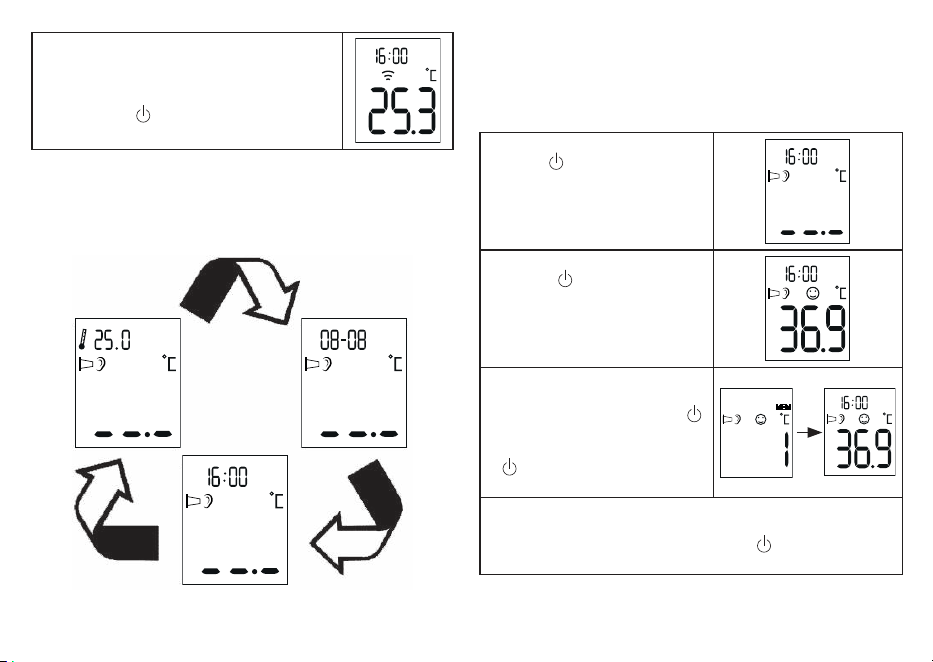
8.3 Displaying room temperature
When you switch on the ear thermometer, the room temperature,
the date and time appear alternately on the display every 3 seconds.
23
8.4 Displaying stored measurements
The ear thermometer automatically stores the last 10 temperature
measurements of body and object temperature respectively (incl.
date and time). To recall the stored measurements, proceed as fol-
lows:
1.
Press the ON/OFF button to
switch on the ear thermometer.
2. Press and hold the ON/OFF but-
ton for 3 seconds. An M and
the last stored measurement ap-
pear on the display.
3. To switch between the individual
stored measurements, press the
ON/OFF button . With each
subsequent pressing of the ON/
OFF button , the memory space
number is displayed first followed
by the measurement.
4.
If you would like to proceed with a measurement, press the
START button. Press and hold the ON/OFF button for 3se-
conds to switch o the ear thermometer.
9. REPLACING THE BATTERY
Before replacing the battery, ensure that the device is switched o.
1.
Replace the batteries as soon as the
battery symbol ( ) appears on the
display.
2.
Slide open the battery compartment
and remove the used batteries from the
battery compartment.
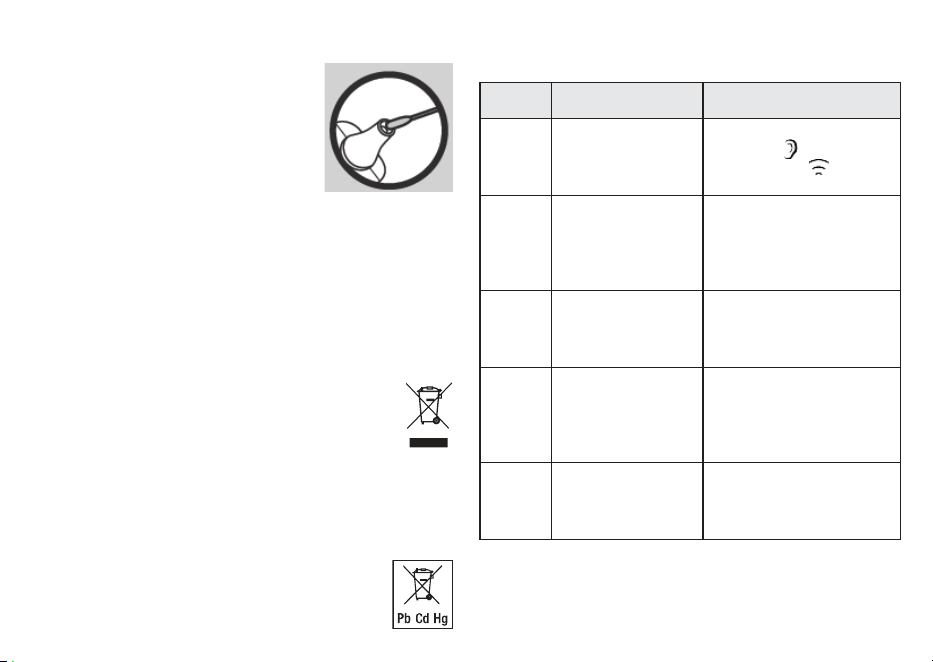
3.
Insert two new 1.5 V AAA batteries. Ma-
ke sure that the batteries are inserted
the right way round. Close the battery
compartment.
24
10. CLEANING AND STORAGE
Protective caps are only intended for single
use.
The sensor tip is the most sensitive part of
the ear thermometer. Work carefully when
cleaning the sensor tip to avoid causing any
damage. Use a clean cloth or cotton bud
that can be moistened with disinfectant, al-
cohol or warm water.
To clean the entire device, use a soft cloth
slightly moistened with a mild soapy solution.
Do not use any harsh cleaning products.
If prolonged storage is intended, you should remove the batteries.
The device must not be stored or used at an excessively high or
low temperature or humidity (see technical data), in sunlight, in as-
sociation with an electrical current or in dusty locations. Otherwise
inaccuracies can occur.
11. DISPOSAL
For environmental reasons, do not dispose of the device in
household waste at the end of its service life. Dispose of
the device at a suitable local collection or recycling point.
Observe the local regulations for material disposal. Dis-
pose of the device in accordance with EC Directive – WEEE (Was-
te Electrical and Electronic Equipment). If you have any questions,
please contact the local authorities responsible for waste disposal.
You can obtain the location of collection points for old devices from
the local authorities.
The codes below are printed on batteries containing harmful subs-
tances:
Pb = Battery contains lead, Cd = Battery contains cad-
mium, Hg = Battery contains mercury.
12. WHAT IF THERE ARE ERROR MESSA-
GES?
Error
message
Cause Solution
ER1
The ear thermometer
is not yet ready for
measurement.
Take measurements only
once body (
) or object tem-
perature mode ( ) appears
on the display.
ER2
The measured am-
bient temperature is
not in the range from
10 °C – 40 °C (50 –
104 °F).
Place the ear thermometer
in a room with an ambient
temperature between 10 °C
and 40 °C (50 °F and 104 °F)
for at least 30minutes.
ER3
The ear thermometer
is not placed in the
ear correctly.
Please observe the notes
in the chapter “Measuring”.
Perform the measurement
again.
ER4
The ear thermometer
registered a large ch-
ange in the ambient
temperature.
Place the ear thermometer
in a room with an ambient
temperature between 10 °C
and 40 °C (50 °F and 104 °F)
for at least 30minutes.
ER5
The ear thermome-
ter is not working
properly.
Replace the batteries and
try again. If the fault occurs
again, contact Customer
Services.

25
Error
message
Cause Solution
ER6
You are in the
“Measuring object
temperature” mode
and the protective
cap is still on.
The protective cap must be
removed to measure object
temperatures.
Hi
In-ear measurement:
the measured tem-
perature is over 43 °C
(109.4 °F).
Object measurement:
the measured tempe-
rature is over 100 °C
(212 °F).
Ensure that the device
and the protective cap are
fully functioning. Perform the
measurement again.
Lo
In-ear measurement:
the measured tempe-
rature is below 34°C
(93.2°F).
Object measurement:
the measured tempe-
rature is below -20 °C
(-4 °F).
Ensure that the device
and the protective cap are
fully functioning. Perform the
measurement again.
The batteries are
empty.
Remove the two empty
batteries and insert two new
1.5 V AAA batteries into the
ear thermometer.
If you cannot find a solution to your problem here, contact our
Customer Services.
13. TECHNICAL DATA
If the device is not used according to the specifications, perfect fun-
ctionality cannot be guaranteed!
The accuracy of this thermometer has been carefully checked and it
has been developed with a long service life in mind.
If the device is used for commercial medical purposes, the appli-
cable national regulations determine whether it must be tested for
accuracy by appropriate means.
We reserve the right to make technical changes to improve and de-
velop the product.
Temperature range In ear: 28.0 – 43.0 °C (82.4 – 109.4 °F)
Object temperature: -20 – 100 °C
(-4 – 212 °F)
R
oom temperature: 0 – 50 °C (32 – 122 °F)
Laboratory measure-
ment accuracy
In ear: ± 0 .2 °C (0.4 °F) in measurement
range of 35.5 – 42.0 °C (95.9 – 107.6 °F);
± 0.3 °C (0.5 °F) in measurement range of
≤35.5 °C (95.5 °F) and ≥42.0 °C (107.6 °F)
Object temperature: ± 4% or ± 2 °C (4 °F)
Room temperature: ± 2 °C (± 4 °F)
Clinical reprodu-
cibility
0.11 °C (0.2 °F)
Duration of measu-
rement
Approx. one second
Operating tempera-
ture range
10 – 40 °C (50 – 104 °F),
humidity 15-85 (non-condensing)
Storage temperature
range
-25 – 55 °C (-13 – 131 °F),
humidity ≤ 95% (non-condensing)
Memory 10 memory spaces

26
Display resolution 0.1 °C or 0.1 °F
Battery DC 3 V (2 x 1.5 V AAA batteries)
Dimensions 155 x 38 x 47 mm
Weight Approx. 63 g (without batteries)
Protective caps 10
Automatic switch-o 60 seconds
Battery operating life 3,000 measurements in succession or
one year with one to two measurements
per day, including standby mode.
Safety classification
Connected medical device of
typeBF
IP protection class IP 22
The serial number is located on the device or in the battery com-
partment.
14. WARRANTY / SERVICE
Further information on the guarantee and guarantee conditions can
be found in the guarantee leaflet supplied.
Subject to errors and changes
27
FRANÇAIS
Lisez attentivement cette notice, conservez-la pour un usage ultérieur, mettez-la à disposition des autres utilisateurs et
suivez les consignes qui y figurent.
1. CONTENU
Vérifiez si l’emballage carton extérieur du kit est intact et si tous
les éléments sont inclus. Avant l’utilisation, assurez-vous que l’ap-
pareil et les accessoires ne présentent aucun dommage visible et
que la totalité de l’emballage a bien été retirée. En cas de doute,
ne l’utilisez pas et adressez-vous à votre revendeur ou au service
client indiqué.
1 thermomètre auriculaire
2 piles 1,5V, type AAA
10 embouts de protection
1 mode d’emploi
Accessoires en option
Recharges lot d‘embouts de protection: 2 x 10embouts de protec-
tion, réf.-n°795.34
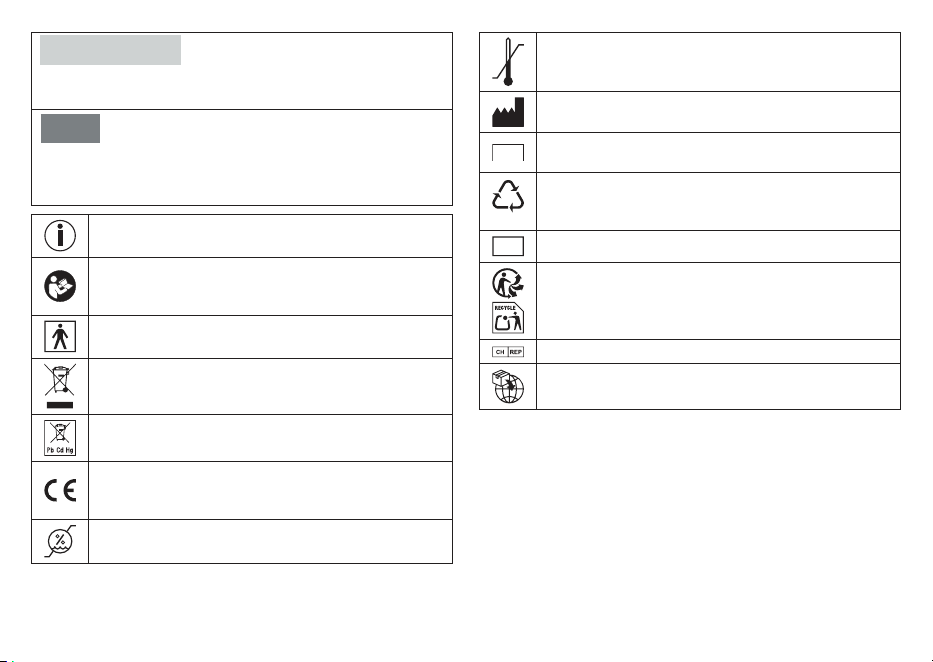
2. SYMBOLES UTILISÉS
Les symboles suivants sont employés dans ce mode d’emploi et
sur l’appareil:
AVERTISSEMENT
Désigne un danger potentiel. S’il n’est pas évité, il peut entraîner
la mort ou des blessures graves.
1. Contenu ...................................................................................27
2. Symboles utilisés ....................................................................27
3. Utilisation conforme aux recommandations ...........................28
4. Remarques ..............................................................................29
5. Description de l’appareil .........................................................31
6. Mise en service .......................................................................31
7. Paramètres ..............................................................................32
7.1 Réglage de l’heure/la date .............................................. 32
7.2 Sélection de l’unité de température (°C ou °F) ...............32
8. Mesures ................................................................................... 33
8.1 Mesurer la température corporelle ..................................33
8.2 Mesurer la température d’objet ......................................34
8.3 Acher la température ambiante ....................................35
8.4 Acher les valeurs de mesure enregistrées ...................35
9. Changement des piles ............................................................36
10. Nettoyage/stockage .............................................................. 36
11. Élimination des déchets ........................................................36
12. Que faire en cas de messages d’erreur? .............................37
13. Données techniques .............................................................38
14. Garantie / Maintenance ..........................................................39
TABLE DES MATIÈRES
28
ATTENTION
Désigne un danger potentiel. S’il n’est pas évité, il peut entraîner
des blessures légères ou mineures.
AVIS
Désigne une situation potentiellement dangereuse. Si elle n’est
pas évitée, l’appareil ou un élément de son environnement peut
être endommagé.
Information sur le produit
Indication d’informations importantes
Suivre le mode d’emploi
Lire le mode d’emploi avant de commencer le travail et/
ou de faire fonctionner les appareils ou les machines
Parties appliquées de type BF
Les appareils (électriques) ne doivent pas être jetés avec
les ordures ménagères
Ne pas jeter les piles à substances nocives avec les
déchets ménagers
Signe CE
Ce produit répond aux exigences des directives
européennes et nationales en vigueur.
Limitation de la pression atmosphérique
Limite de température
Fabricant
IP22
Appareil protégé contre les corps solides ≥ 12,5mm et
contre les chutes de gouttes d’eau en biais
B
A
Étiquette d’identification du matériau d’emballage.
A = Abréviation de matériau, B = Référence de matéri-
au: 1 – 7 = plastique, 20 – 22 = papier et carton
S
N
Numéro de série
Séparer le produit et les composants d’emballage et les
éliminer conformément aux prescriptions communales.
Mandataire suisse
Symbole de l’importateur
3. UTILISATION CONFORME AUX RECOM-
MANDATIONS
Le thermomètre auriculaire est conçu pour des mesures de la
température corporelle dans l’oreille. N’utilisez pas le thermomètre
auriculaire pour des mesures à d’autres endroits du corps!
Avec ce thermomètre auriculaire, vous pouvez également mesurer la
température ambiante ou la température d’objet.
Le thermomètre auriculaire a été développé pour des mesures de
température précises, sûres et rapides dans l’oreille. Il s’agit

29
d’un thermomètre auriculaire non invasif avec un détecteur infrarou-
ge pour le relevé de la température corporelle dans le canal auditif
d’enfants et d’adultes.
N’utilisez l’appareil qu’aux fins pour lesquelles il a été conçu et con-
formément aux indications données par ce mode d’emploi. Toute
utilisation inappropriée peut être dangereuse! Le fabricant ne peut
être tenu pour responsable des dommages causés par une utilisati-
on inappropriée ou non conforme.
L’appareil est conforme aux exigences de la directive européenne
93/42/EEC sur les produits médicaux, de la loi sur les produits mé-
dicaux, de la norme ASTM E 1965 - 98 et de la norme européenne
EN 12470-5: Thermomètres médicaux – Partie 5: exigences sur les
thermomètres auriculaires infrarouges (avec dispositifs à maximum)
ainsi que de la norme européenne EN 60601-1-2 (en conformité
avec CISPR11, IEC61000-4-2, IEC61000-4-3, IEC61000-4-8), et
répond aux exigences de sécurité spéciales relatives à la compati-
bilité électromagnétique.
Veuillez noter que les dispositifs de communication HF portables et
mobiles sont susceptibles d’influer sur cet appareil.
4. REMARQUES
Consignes de sécurité
AVERTISSEMENT
• Lors des mesures, insérez avec précaution la pointe du capteur
du thermomètre auriculaire dans l’oreille.
• Dans le cas de certaines maladies infectieuses aiguës, l’utilisa-
tion du thermomètre auriculaire sur plusieurs personnes peut
être inappropriée en raison d’une éventuelle transmission de
germes malgré le nettoyage et la désinfection nécessaires. Le
cas échéant, consultez votre médecin traitant.
• La température corporelle mesurée dans l’oreille peut varier par
rapport à d’autres mesures dans la bouche, le rectum ou les ais-
selles. Il ne sert donc à rien de comparer ces valeurs. Mesurez
régulièrement la température afin de déterminer la température
auriculaire normale et utilisez ensuite ces mesures comme point
de comparaison pour les mesures qui vous font soupçonner de
la fièvre.
• Ce thermomètre est conçu pour mesurer la température auricu-
laire. N’utilisez pas ce thermomètre auriculaire pour des mesures
à d’autres endroits du corps.
• Remplacez la protection après chaque utilisation afin de garantir
une mesure précise et empêcher toute contamination croisée.
• Le thermomètre auriculaire doit être utilisé uniquement avec des
embouts de protection de Sanitas. D’autres embouts de protec-
tion peuvent provoquer des erreurs de mesure. Si vous n’avez
plus d’embout de protection, consultez le fabricant ou un reven-
deur pour en obtenir d’autres.
• Consultez un médecin si vous constatez une dégradation de
votre état de santé.
Remarques relatives aux piles
AVERTISSEMENT
• Risque d’explosion! Risque d’incendie! Le non-respect des
points suivants peut entraîner des blessures ou une surchaue,
une fuite, une évacuation, une rupture, une explosion ou un in-
cendie de la pile.
• Cet appareil contient des piles non rechargeables qui ne doivent
pas être rechargées.
• Ne jetez pas les piles dans le feu.
• Ne chargez pas, déchargez pas de force, chauez, démontez,
ouvrez, écrasez, déformez, n’encapsulez ou ne modifiez pas les
piles.

30
• Ne court-circuitez jamais les piles et les contacts du comparti-
ment à piles.
• Protégez les piles de la lumière directe du soleil, de la pluie, de
la chaleur et de l’eau.
• L’exposition des piles à des températures extrêmement élevées
ou à une pression d’air extrêmement basse peut entraîner une
explosion ou une fuite de liquides et de gaz inflammables.
• Éliminez immédiatement et correctement les piles défectueuses
et déchargées (voir chapitre Destruction).
• N’utilisez pas de piles modifiées ou endommagées.
• Choisissez toujours le type de pile correct.
• Insérez toujours les piles correctement, en tenant compte de la
polarité (+/-).
• Ne mélangez jamais des piles de diérents fabricants, capacités
(neuves et usagées), tailles et types au sein d’un même appareil.
• Si une pile a coulé, enfilez des gants de protection et nettoyez le
compartiment à piles avec un chion sec.
• Si du liquide de la pile entre en contact avec la peau ou les yeux,
rincez la zone touchée avec de l’eau et consultez un médecin.
• Risque d’ingestion ! Conservez les piles hors de portée des
enfants. En cas d’ingestion, consultez immédiatement un méde-
cin. L’ingestion peut entraîner des brûlures, de graves blessures
internes et la mort.
• Ne laissez pas les enfants changer les piles sans la surveillance
d’un adulte.
ATTENTION
• Stockez les piles dans un endroit bien ventilé, sec et frais, dans
un conteneur non conducteur où les piles ne peuvent pas être
court-circuitées entre elles ou par d’autres objets métalliques.
• Maintenez les piles propres et sèches.
• Maintenez les piles à l’écart de l’eau.
• En cas de non-utilisation prolongée de l’appareil, retirez les piles
du compartiment à piles.
AVIS
• N’utilisez pas de piles rechargeables.
Risques pour l’appareil
ATTENTION
• Ne soumettez l’appareil à aucun choc mécanique.
• N’exposez pas l’appareil à la lumière directe du soleil.
• Ne soumettez l’appareil à aucun liquide. L’appareil n’est pas
étanche. Évitez tout contact direct avec l’eau ou d’autres liqui-
des.
• Ne faites réparer l’appareil que dans un centre de service auto-
risé, sous peine d’annulation de la garantie.
• Les dispositifs de communication HF portables et mobiles sont
susceptibles d’influer sur cet appareil. Pour plus de détails, veuil-
lez contacter le service après-vente à l’adresse mentionnée ou
vous reporter à la fin du mode d’emploi.
INFORMATIONS SUR LA COMPATIBILITÉ
ÉLECTROMAGNÉTIQUE
• L’appareil est prévu pour fonctionner dans tous les environne-
ments indiqués dans ce mode d’emploi, y compris dans un en-
vironnement domestique.
• En présence d’interférences électromagnétiques, vous risquez
de ne pas pouvoir utiliser toutes les fonctions de l’appareil. Vous
pouvez alors rencontrer, par exemple, des messages d’erreur ou
une panne de l’écran/de l’appareil.
• Éviter d’utiliser cet appareil à proximité immédiate d’autres ap-
pareils ou en l’empilant sur d’autres appareils, car cela peut pro-
31
voquer des dysfonctionnements. S’il n’est pas possible d’éviter
le genre de situation précédemment indiqué, il convient alors de
surveiller cet appareil et les autres appareils afin d’être certain
que ceux-ci fonctionnent correctement.
• L’utilisation d’accessoires autres que ceux spécifiés ou fournis
par le fabricant de cet appareil peut provoquer des perturba-
tions électromagnétiques accrues ou une baisse de l’immunité
électromagnétique de l’appareil, et donc causer des dysfonc-
tionnements.
• Le non-respect de cette consigne peut entraîner une réduction
des performances de l’appareil.
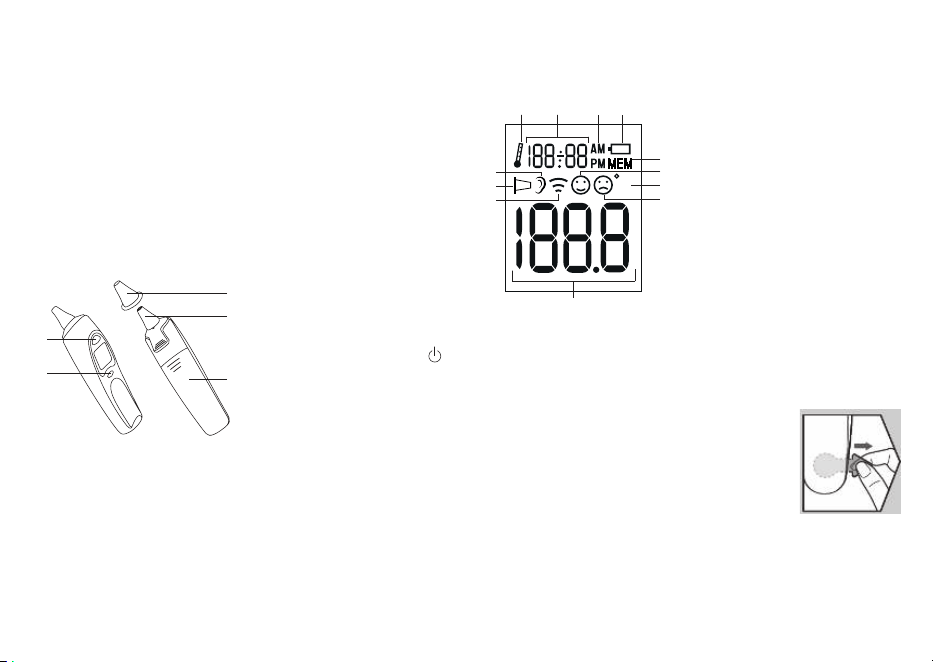
5. DESCRIPTION DE L’APPAREIL
1
2
3
4
5
1. Embout de protection
2. Capteur de mesure
3. Touche START
4. Touche MARCHE/ARRÊT
5. Compartiment à piles
Écran LCD
E
1
5
7
6
8
9
10
11
12
2 3 4
1. Mode température ambiante
2. Achage de la température
ambiante/l’heure/la date
3. Achage AM/PM (heure)
4. Symbole de pile
5. Mode mémoire
6. Symbole d’absence de fièvre
7. Unité de température (°C ou °F)
8. Symbole de fièvre
9. Achage de la température
10. Mode température d’objet
11. Symbole d’embout de pro-
tection
12. Mode température corporelle
6. MISE EN SERVICE
Les piles sont déjà insérées dans l’appareil neuf.
Avant la première utilisation, retirez la bande de
protection des piles qui dépasse du compartiment
à piles. Le thermomètre auriculaire s’allume alors
automatiquement.
32
7. PARAMÈTRES
7.1 Réglage de l’heure/la date
Avant de commencer les mesures, nous vous conseillons de régler
l’heure et la date. Ainsi, vous pourrez aecter les mesures enregis-
trées plus simplement plus tard.
1.
Maintenez la touche MARCHE/
ARRÊT de l’appareil enfoncée
pendant troissecondes. «24 H»
s’ache sur l’écran.
2.
À l’aide de la touche START,
sélectionnez alors le format de
l’heure souhaité (12h ou 24h) et
confirmez avec la touche MAR-
CHE/ARRÊT .
3.
L’heure s’affiche sur l’écran.
À l’aide de la touche START,
sélectionnez l’heure actuelle et
confirmez avec la touche MAR-
CHE/ARRÊT .
4.
Les minutes s’affichent sur
l’écran. À l’aide de la touche
START, sélectionnez les minutes
actuelles et confirmez avec la tou-
che MARCHE/ARRÊT .
5.
L’année s’affiche sur l’écran.
À l’aide de la touche START,
sélectionnez l’année actuelle et
confirmez avec la touche MAR-
CHE/ARRÊT .
6.
Le jour clignote sur l’écran. À l’ai
-
de de la touche START, sélecti-
onnez le jour actuel et confirmez
avec la touche MARCHE/ARRÊT
.
7.
Le mois clignote sur l’écran.
À l’aide de la touche START,
sélectionnez le mois actuel et
confirmez avec la touche MAR-
CHE/ARRÊT . Ensuite, l’ap-
pareil s’arrête automatiquement.
La date et l’heure sont alors en-
registrées.
7.2 Sélection de l’unité de température (°C ou °F)
Vous pouvez acher vos résultats de mesure dans l’unité de la
température degrés Celsius (°C) ou degrés Fahrenheit (°F).
1. Maintenez la touche START de
l’appareil enfoncée pendant tro-
issecondes. «°C» apparaît sur
l’écran.
33
2.
À l’aide de la touche START,
sélectionnez alors l’unité de
température souhaitée (°C ou
°F) et confirmez avec la touche
MARCHE/ARRÊT .
8. MESURES
Avant chaque utilisation, vérifiez que la lentille n’est pas en-
dommagée. Si elle l’est, adressez-vous au vendeur ou au ser-
vice après-vente. Tenez compte du fait que le thermomètre
auriculaire doit se trouver au moins 30minutes dans la pièce
dans laquelle la mesure est eectuée.
8.1 Mesurer la température corporelle
AVERTISSEMENT
• Certaines personnes ont des valeurs de mesure diérentes dans
l’oreille gauche et l’oreille droite. Pour évaluer les changements
de température, mesurez toujours dans la même oreille pour une
même personne.
• Les enfants ne doivent utiliser le thermomètre auriculaire que
sous la surveillance d’un adulte. En général, une mesure est
possible à partir de l’âge de 6 mois. Chez les petits enfants de
moins de 6 mois, le conduit auditif est encore très étroit. Ainsi, la
température du tympan ne peut souvent pas être évaluée et des
résultats de mesure trop bas peuvent être achés.
• La mesure ne doit pas être eectuée dans une oreille atteinte
de maladies inflammatoires (par ex. pyorrhée, sécrétions), après
d’éventuelles blessures des oreilles (par ex. blessures du tym-
pan) ou lors de la phase de guérison après une intervention chi-
rurgicale. Dans tous ces cas, veuillez consulter votre médecin
traitant.
• Dans le cas de certaines maladies infectieuses aiguës, l’utilisa-
tion du thermomètre auriculaire sur plusieurs personnes peut
être inappropriée en raison d’une éventuelle transmission de
germes malgré le nettoyage et la désinfection nécessaires. Le
cas échéant, consultez votre médecin traitant.
• Ce thermomètre auriculaire doit être utilisé uniquement quand
un embout de protection est installé.
• Les circonstances suivantes peuvent avoir un impact sur la
température auriculaire: si vous restez couché sur une oreille
pendant un temps prolongé, si les oreilles sont couvertes, si el-
les sont exposées à une chaleur ou un froid intense ou après la
natation/baignade. Si vous êtes dans l’un de ces cas, patientez
20minutes avant d’eectuer la mesure.
• Le cérumen peut influencer la mesure, veuillez donc nettoyer
l’oreille avant la mesure le cas échéant.
1. Vissez un embout de protection propre
sur la pointe du capteur du thermomèt-
re auriculaire.
2.
Pour allumer le thermomètre auriculaire,
appuyez sur la touche MARCHE/ARRÊT
. Trois signaux sonores retentissent et
l’écran s’allume.
34
3.
Comme le conduit auditif est légère-
ment incurvé, vous devez tirer légère-
ment l’oreille vers le haut et l’arrière
avant d’introduire la pointe de l’embout
de protection afin que celle-ci puisse
être dirigée directement sur le tympan.
4. Insérez la pointe du capteur avec l’em-
bout de protection dans le conduit audi-
tif et appuyez sur la touche START pour
commencer la mesure.
5. Au bout d’environ une seconde, un si-
gnal sonore retentit et le résultat de la
mesure s’ache à l’écran. Pour éteindre
le thermomètre auriculaire, appuyez sur
la touche MARCHE/ ARRÊT .
Après une mesure, si vous n’appuyez sur aucune touche
pendant une minute, le thermomètre auriculaire s’éteint au-
tomatiquement.
Indicateur de fièvre
Si la température mesurée est < 38 °C (100,4 °F), une
émoticône souriante s’ache à l’écran
et un signal so-
nore bref retentit.
Si la température mesurée se situe entre 37,5 et 37,9°C, deux
bips brefs retentissent (indication de «température élevée»).
Si la température mesurée est ≥ 38°C (100,4°F), une émoticô-
ne triste s’ache à l’écran et à la suite retentissent un si-
gnal bref, un signal long et trois signaux courts.
8.2 Mesurer la température d’objet
1. Retirez l’embout de protection (le cas échéant) de la pointe du
capteur du thermomètre auriculaire.
2.
Pour allumer le thermomètre auriculaire, ap-
puyez sur la touche MARCHE/ARRÊT .
Trois signaux sonores retentissent et l’écran
s’allume.
3.
Assurez-vous d’être en mode température
d’objet ( ).
Pour passer du mode température corporelle
au mode température d’objet, maintenez si-
multanément les touches MARCHE/ARRÊT
et START brièvement.
4. Placez la pointe du capteur du thermomètre auriculaire à 1 à 2
cm du point de mesure désiré et appuyez sur la touche START.
35
5. Au bout d’une seconde, un signal sonore re-
tentit et le résultat de la mesure s’ache à
l’écran. Pour éteindre le thermomètre auricu-
laire, appuyez brièvement sur la touche MAR-
CHE/ARRÊT .
8.3 Acher la température ambiante
Lorsque vous allumez le thermomètre auriculaire, l’écran ache
la température ambiante, la date et l’heure en alternant toutes les
3secondes.
8.4 Acher les valeurs de mesure enregistrées
Le thermomètre auriculaire enregistre automatiquement les valeurs
de température des 10 dernières mesures pour chaque tempéra-
ture corporelle et température d’objet (avec date et heure). Procédez
comme suit pour consulter les mesures enregistrées:
1.
Appuyez sur la touche MARCHE/
ARRÊT pour allumer le thermo-
mètre auriculaire.
2.
Maintenez la touche MARCHE/
ARRÊT enfoncée pendant
3 secondes. Un M et la der-
nière valeur mesurée s’achent
à l’écran.
3.
Pour passer d’une mesure enre-
gistrée à une autre, appuyez sur
la touche MARCHE/ARRÊT .
Chaque fois que vous appuyez
sur la touche MARCHE/ARRÊT
, le numéro de mémoire puis la
mesure s’achent.
4.
Si vous souhaitez poursuivre une mesure, appuyez sur la touche
START. Si vous souhaitez éteindre le thermomètre auriculaire,
maintenez la touche MARCHE/ARRÊT enfoncée pendant
3secondes.
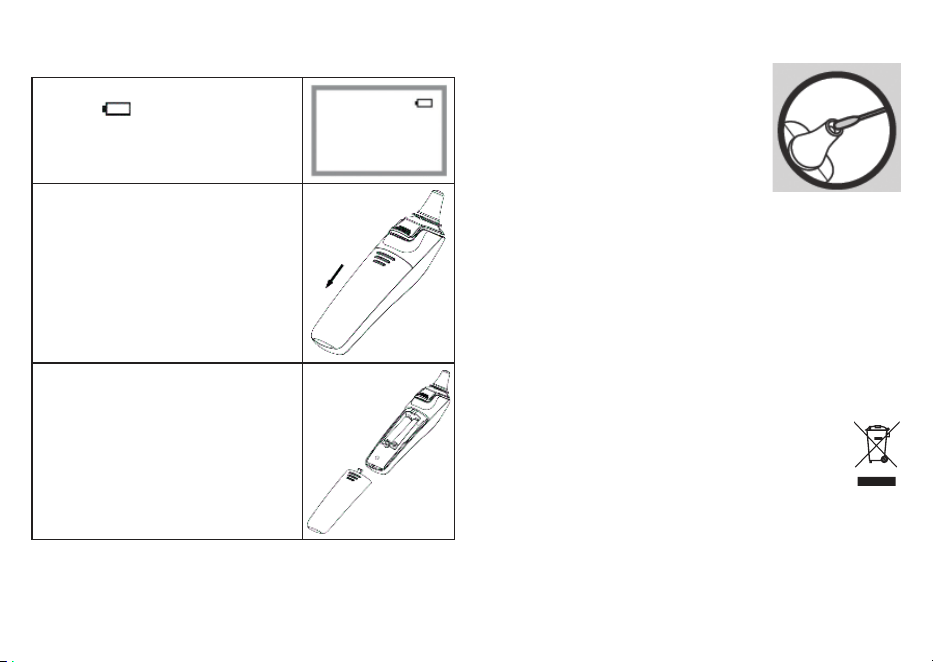
36
9. CHANGEMENT DES PILES
Avant de changer les piles, assurez-vous que l’appareil est éteint.
1.
Changez les piles dès que le symbole
de pile ( ) s’ache à l’écran.
2. Ouvrez le compartiment à piles et reti-
rez-en les piles vides.
3.
Insérez les deux nouvelles piles 1,5V
AAA. Faites attention à ce qu’elles soient
positionnées dans le bon sens. Fermez
le compartiment à piles.
10. NETTOYAGE/STOCKAGE
Les embouts de protection sont à usage
unique.
La pointe du capteur est la partie la plus
sensible du thermomètre auriculaire. Soyez
prudent lors du nettoyage afin d’éviter de
l’endommager. Pour cela, utilisez un chion
doux ou un bâtonnet ouaté qui peut être hu-
midifié avec du désinfectant, de l’alcool ou
de l’eau chaude.
Pour nettoyer l’appareil entier, utilisez un chion doux légèrement
humidifié avec de la lessive.
N’utilisez pas de produits nettoyants agressifs.
Si vous prévoyez un stockage prolongé, retirez les piles. L’appa-
reil ne doit pas être stocké ou utilisé sous des températures ou
une humidité de l’air trop élevées ou trop basses (voir données
techniques), à la lumière du soleil, connecté au courant électrique
ou dans des endroits poussiéreux. Sinon, cela pourrait entraîner des
imprécisions de mesure.
11. ÉLIMINATION DES DÉCHETS
Dans l’intérêt de la protection de l’environnement, l’appa-
reil ne doit pas être jeté avec les ordures ménagères à la fin
de sa durée de vie. Son élimination doit se faire par le biais
des points de collecte compétents dans votre pays. Vous
devez vous conformer aux réglementations locales en ma-
tière d’élimination des matériaux. Éliminez l’appareil conformément
à la directive européenne relative aux déchets d’équipements élec-
triques et électroniques (DEEE). Pour toute question à ce sujet, ad-
ressez-vous aux collectivités locales responsables de l’élimination
et du recyclage de ces produits. Pour de plus amples informations
37
sur les points de collecte, prenez contact avec la mairie, l’entreprise
locale de traitement des déchets ou le revendeur.
Ces pictogrammes se trouvent sur les piles à substan-
ces nocives: Pb = pile contenant du plomb,
Cd = pile contenant du cadmium,
Hg = pile contenant du mercure.
12. QUE FAIRE EN CAS DE MESSAGES
D’ERREUR?
Message
d’erreur
Cause Solution
ER1
Le thermomètre auri-
culaire n’est pas prêt
pour la mesure.
Eectuez la mesure dès
que le mode de tempéra-
ture corporelle (
) ou de
température d’objet ( )
s’ache à l’écran.
ER2
La température
ambiante mesurée
ne se situe pas
entre 10°C et 40°C
(50°F – 104°F).
Placez le thermomètre auri-
culaire pendant 30minutes
dans une pièce entre 10°C et
40°C (50°F et 104°F).
ER3
Le thermomètre
auriculaire n’est pas
placé correctement
dans l’oreille.
Respectez les consignes
indiquées au chapitre «Me-
sures». Eectuez à nouveau
la mesure.
Message
d’erreur
Cause Solution
ER4
Le thermomètre
auriculaire a remarqué
un grand change-
ment de température
ambiante.
Placez le thermomètre auri-
culaire pendant 30minutes
dans une pièce entre 10°C et
40°C (50°F et 104°F).
ER5
Le thermomètre auri-
culaire ne fonctionne
pas correctement.
Changez les piles et réessay-
ez. Si l’erreur se reproduit,
contactez le service client.
ER6
Vous êtes en mode
«Mesurer la tempéra-
ture d’objet» et
l’embout de protection
est encore en place.
Pour eectuer une mesure de
température d’objet, retirez
l’embout de protection.
Hi
Mesure auriculaire:
température mesurée
supérieure à 43°C
(109,4°F).
Mesure d’objets:
température mesurée
supérieure à 100°C
(212°F).
Assurez-vous que l’appareil
et l’embout de protection
sont en parfait état. Eectuez
à nouveau la mesure.
Lo
Mesure auriculaire:
température mesurée
inférieure à 34°C
(93,2° F)
Mesure d’objets:
température mesurée
inférieure à -20°C
(-4°F)
Assurez-vous que l’appareil
et l’embout de protection
sont en parfait état. Eectuez
à nouveau la mesure.
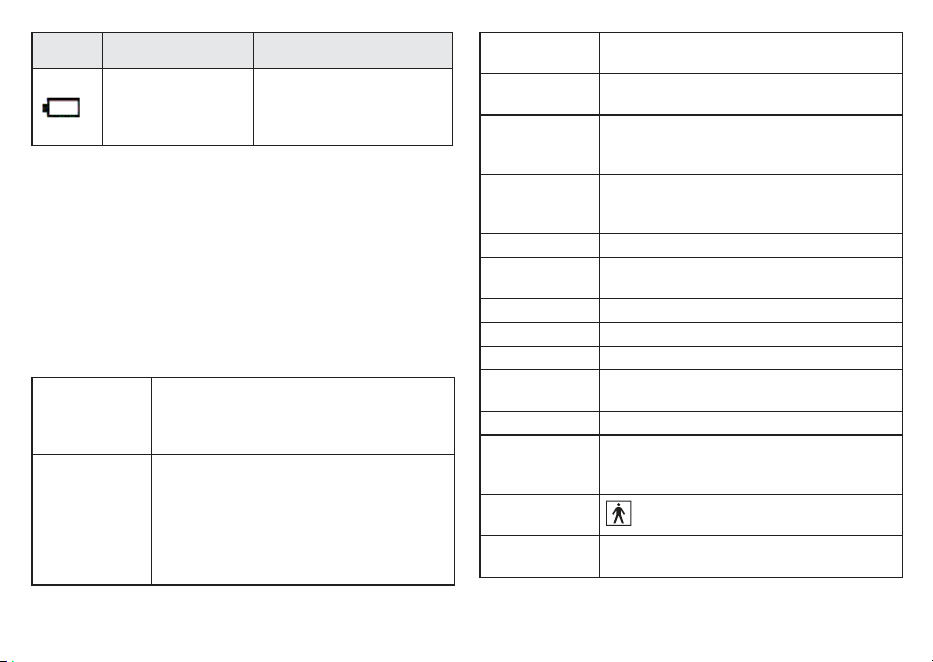
38
Message
d’erreur
Cause Solution
Les piles sont vides. Retirez les deux piles vides
et insérez deux nouvelles
piles 1,5V AAA dans le
thermomètre auriculaire.
Si votre problème ne figure pas ici, contactez notre service client.
13. DONNÉES TECHNIQUES
En cas d’utilisation de l’appareil en dehors des spécifications indi-
quées, son fonctionnement irréprochable ne peut pas être garanti !
La précision de ce thermomètre a été correctement testée et sa
durabilité a été conçue en vue d’une utilisation à long terme.
En cas d’utilisation de l’appareil en médecine, les dispositions natio-
nales en vigueur déterminent si des contrôles métrologiques doivent
être eectués avec des moyens appropriés. Nous nous réservons
le droit d’eectuer des modifications techniques pour améliorer et
faire évoluer le produit.
Plage de mesure
de température
Température auriculaire: 28,0 – 43,0°C
(82,4 – 109,4°F)
Température d’objet: -20 – 100°C (-4 – 212°F)
Température ambiante: 0 – 50°C (32 – 122°F)
Précision de
mesure de
laboratoire
Température auriculaire: ± 0,2°C (0,4°F)
dans la plage de mesure de 35,5 – 42,0°C
(95,9 – 107,6°F); ± 0,3°C (0,5°F) dans la plage
de mesure ≤35,5°C (95,5°F) et ≥42,0°C
(107,6°F)
Température d’objet: ± 4% ou ± 2°C (4°F)
Température ambiante: ± 2°C (± 4°F)
Reproductibilité
médicale
0,11°C (0,2°F)
Durée de la
mesure
Env. une seconde
Plage de
température de
fonctionnement
10 – 40°C (50 – 104°F), humidité de l’air
15 – 85% (sans condensation)
Plage de
température de
stockage
-25 – 55°C (-13 – 131°F), humidité de l’air
≤
95% (sans condensation)
Mémoire 10emplacements de sauvegarde
Résolution de
l’achage
± 0,1°C ou ± 0,1°F
Pile CC 3V (2 piles 1,5V AAA)
Dimensions 155 x 38 x 47mm
Poids Environ 63g (sans les piles)
Embouts de
protection
10
Arrêt automatique 60secondes
Durée de vie de
la pile
3000 mesures consécutives ou un an avec une
à deux mesures par jour, y compris en mode
veille.
Classe de
sécurité
Dispositif médical électrique de type BF
Indice de
protection IP
IP22
Le numéro de série se trouve sur l’appareil ou sur le compartiment
à piles.

39
Sous réserve d’erreurs et de modifications
14. GARANTIE / MAINTENANCE
Pour plus d’informations sur la garantie et les conditions de garantie,
consultez la fiche de garantie fournie.
40
ESPAÑOL
Lea atentamente estas instrucciones de uso, consérvelas para su futura utilización, póngalas a disposición de otros usua-
rios y respete las indicaciones.
1. ARTÍCULOS SUMINISTRADOS
Compruebe que el envoltorio de los artículos suministrados esté in-
tacto y que su contenido esté completo. Antes de utilizar el aparato
deberá asegurarse de que ni este ni los accesorios presentan daños
visibles y de que se retira el material de embalaje correspondiente.
En caso de duda no lo use y póngase en contacto con su distribui-
dor o con la dirección de atención al cliente indicada.
1 x termómetro para el oído
2 x pilas de 1,5 V AAA
10 x tapas protectoras
1 instrucciones de uso
Artículos de repuesto
Set de tapas protectoras disponible por separado: 2 x 10 tapas pro-
tectoras, n.º art. 795.34
2. SÍMBOLOS
En estas instrucciones de uso y en el aparato se utilizan los sigu-
ientes símbolos:
ADVERTENCIA
Indica un posible peligro inminente. Si no se evita, puede causar
la muerte o lesiones muy graves.
1. Artículos suministrados ...........................................................40
2. Símbolos .................................................................................40
3. Uso correcto ...........................................................................41
4. Indicaciones ............................................................................42
5. Descripción del aparato ..........................................................44
6. Puesta en funcionamiento .......................................................44
7. Ajustes ..................................................................................... 45
7.1 Ajustar hora/fecha ..........................................................45
7.2 Seleccionar unidad de temperatura (°C o °F) .................45
8. Tomar la temperatura ..............................................................46
8.1 Medición de la temperatura corporal ..............................46
8.2 Medir temperatura de objetos ........................................47
8.3 Mostrar la temperatura ambiente ...................................48
8.4 Mostrar valores guardados ............................................. 48
9. Cambio de pilas ......................................................................49
10. Limpieza/conservación .........................................................49
11. Eliminación ............................................................................ 49
12. Solución de problemas .........................................................50
13. Datos técnicos ......................................................................51
14. Garantía / Asistencia ............................................................... 51
ÍNDICE
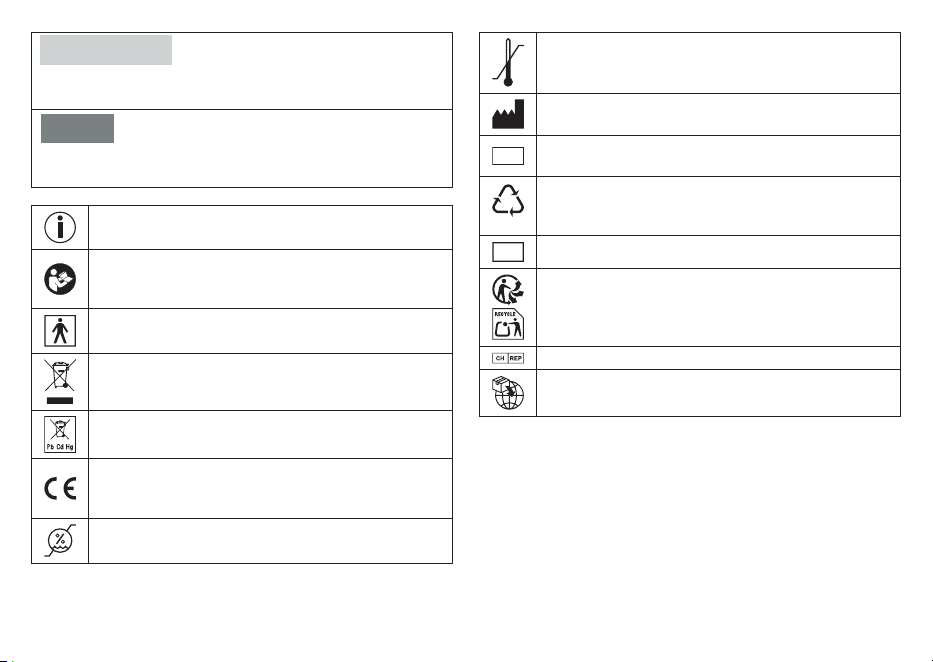
41
ATENCIÓN
Indica un posible peligro inminente. Si no se evita, pueden
producirse lesiones menores o leves.
AVISO
Indica una situación potencialmente perjudicial. Si no se evita, el
aparato o algo de su entorno puede resultar dañado.
Información sobre el producto
Indicación de información importante
Seguir las instrucciones
Leer las instrucciones antes de empezar a trabajar o a
manejar aparatos o máquinas
Pieza de aplicación tipo BF
No está permitido eliminar los aparatos (electrónicos)
junto con la basura doméstica
No deseche con la basura doméstica pilas que cont-
engan sustancias tóxicas
Marcado CE
Este producto cumple los requisitos de las directivas
europeas y nacionales vigentes.
Límite de humedad
Límite de temperatura
Fabricante
IP22
Aparato protegido contra cuerpos extraños ≥12,5 mm y
contra goteo oblicuo de agua
B
A
Etiquetado para identificar el material de embalaje.
A = abreviatura del material, B = número de material:
1-7 = plásticos, 20-22 = papel y cartón
S
N
Número de serie
Separe el producto y los componentes del envase y
elimínelos conforme a las disposiciones municipales.
Representante autorizado en Suiza
Símbolo del importador
3. USO CORRECTO
El termómetro para el oído está indicado para medir la temperatura
corporal en el oído. No utilice este termómetro para mediciones en
otras partes del cuerpo.
Con el termómetro para el oído también se puede medir la tempera-
tura de habitaciones y objetos.
El termómetro para el oído se ha diseñado minuciosamente para
proporcionar mediciones de la temperatura en el oído exactas, se-
guras y rápidas. Se trata de un termómetro para el oído no invasivo

42
con un detector de infrarrojos que detecta la temperatura corporal
en el canal auditivo de niños y adultos.
Utilice este aparato exclusivamente para el fin para el que ha sido
diseñado y del modo indicado en estas instrucciones de uso. ¡Todo
uso inadecuado puede ser peligroso! Por lo tanto, el fabricante
declinará toda responsabilidad por daños y perjuicios debidos a un
uso inadecuado o incorrecto.
Este aparato cumple las disposiciones de la Directiva europea n°
93/42/EEC relativa a los productos sanitarios, la ley alemana sobre
productos sanitarios, la ASTM E 1965 - 98 y la norma europea EN
12470-5: termómetros clínicos – Parte 5: Especificaciones de los
termómetros para el oído por infrarrojos (con dispositivo de máxi-
ma) y la norma europea EN60601-1-2 (conformidad con la norma
CISPR11, IEC 61000-4-2, IEC 61000-4-3, IEC 61000-4-8) y está
sujeto a las medidas especiales de precaución relativas a la compa-
tibilidad electromagnética.
Tenga en cuenta que los dispositivos de comunicación de alta fre-
cuencia portátiles y móviles pueden interferir en el funcionamiento
de este aparato.
4. INDICACIONES
Indicaciones de seguridad
ADVERTENCIA
• Al tomar la temperatura en el oído, introduzca con cuidado la
punta del sensor del termómetro.
• No se recomienda usar el termómetro para el oído en perso-
nas que sufran determinadas enfermedades infecciosas agudas
para evitar un posible contagio, aun cuando se haya limpiado y
desinfectado bien. Consulte cada caso individual con su mé-
dico.
• La temperatura corporal medida en el oído puede variar con re-
specto a otras mediciones realizadas en la boca, el recto o la
axila, de ahí que los valores no sean comparables. Mida la tem-
peratura periódicamente para determinar la temperatura normal
en el oído, y utilice esas mediciones para compararlas con las
mediciones en las que sospeche la existencia de fiebre.
• Este termómetro para el oído está indicado para realizar medi-
ciones de la temperatura en el oído. No lo utilice para medir la
temperatura en otras partes del cuerpo.
• Cambie la tapa protectora tras cada uso para garantizar una me-
dición exacta y evitar una contaminación cruzada.
• Utilice el termómetro para el oído únicamente con tapas pro-
tectoras de Beurer; si utiliza otras tapas protectoras pueden
producirse fallos en la medición. Si desea adquirir tapas pro-
tectoras de repuesto, diríjase al fabricante o a un distribuidor
especializado.
• Consulte a su médico si considera que su estado de salud no
es bueno.
Indicaciones para la manipulación de pilas
ADVERTENCIA
• ¡Peligro de explosión! ¡Peligro de incendio! El incumplimiento
de las siguientes indicaciones podría ocasionar lesiones per-
sonales, daños en la pila, sobrecalentamiento, fugas, escapes,
roturas, explosión o incendio.
• Este aparato contiene pilas no recargables que no deben recar-
garse.
• No arroje las pilas al fuego.
• No cargue, descargue, caliente, desmonte, abra, triture, defor-
me, encapsule ni modifique nunca las pilas.
• No cortocircuite nunca las pilas ni los contactos del comparti-
mento de las pilas.

43
• Proteja las pilas de la luz solar directa, la lluvia, el calor y el agua.
• La exposición de las pilas a temperaturas elevadas o una presión
atmosférica extremadamente baja puede provocar explosiones
o fugas de líquidos y gases inflamables.
• Elimine las pilas defectuosas y descargadas de inmediato y de
forma adecuada (véase el capítulo Eliminación).
• No utilice pilas modificadas o dañadas.
• Seleccione siempre el tipo de pila correcto.
• Coloque las pilas correctamente teniendo en cuenta la polaridad
(+/-).
• No mezcle nunca pilas de distintos fabricantes, capacidades
(nuevas y usadas), tamaños y tipos en un mismo aparato.
• Si se derrama el líquido de una pila, póngase guantes protec-
tores y limpie el compartimento de las pilas con un paño seco.
• En caso de que el líquido de una pila entre en contacto con la
piel o los ojos, lave la zona afectada con agua y busque asis-
tencia médica.
• ¡Peligro de asfixia! Mantenga las pilas fuera del alcance de los
niños. En caso de ingestión, acuda a un médico de inmediato.
La ingestión puede provocar quemaduras químicas, lesiones in-
ternas graves y la muerte.
• No permita nunca que los niños cambien las pilas sin la super-
visión de un adulto.
ATENCIÓN
• Guarde las pilas en un lugar bien ventilado, seco y fresco, en
un recipiente no conductor donde las pilas no puedan cortocir-
cuitarse entre sí ni con otros objetos metálicos.
• Mantenga las pilas limpias y secas.
• Mantenga las pilas alejadas del agua.
• Si no va a utilizar el aparato durante un periodo de tiempo pro-
longado, retire las pilas de su compartimento.
AVISO
No utilice pilas recargables.
PELIGROS PARA EL APARATO
ATENCIÓN
• No deje que el aparato reciba golpes.
• No exponga el aparato a la luz directa del sol.
• No moje el aparato, no es impermeable. Evite cualquier contacto
directo con agua o con otros líquidos.
• Solo los centros de servicio técnico autorizados deben reparar
el aparato; de lo contrario, se extinguirá el derecho de garantía.
• Los dispositivos de comunicación de alta frecuencia portátiles y
móviles pueden interferir en el funcionamiento de este aparato.
INDICACIONES RELATIVAS A LA COMPATI-
BILIDAD ELECTROMAGNÉTICA
• El aparato está diseñado para usarse en todos los entornos que
se especifican en estas instrucciones de uso, incluido el ámbito
doméstico.
• El aparato solo se puede usar cerca de perturbaciones electro-
magnéticas de forma restringida y en determinadas circunstan-
cias. Como consecuencia, podrían mostrarse mensajes de error
o producirse averías en la pantalla o el dispositivo.
• Se debe evitar el uso de este aparato junto a otros aparatos o
apilado con otros aparatos, ya que esto podría provocar un fun-
cionamiento incorrecto. Pero si resulta inevitable hacerlo, deberá
vigilar este y los demás aparatos hasta estar seguro de que fun-
cionan correctamente.
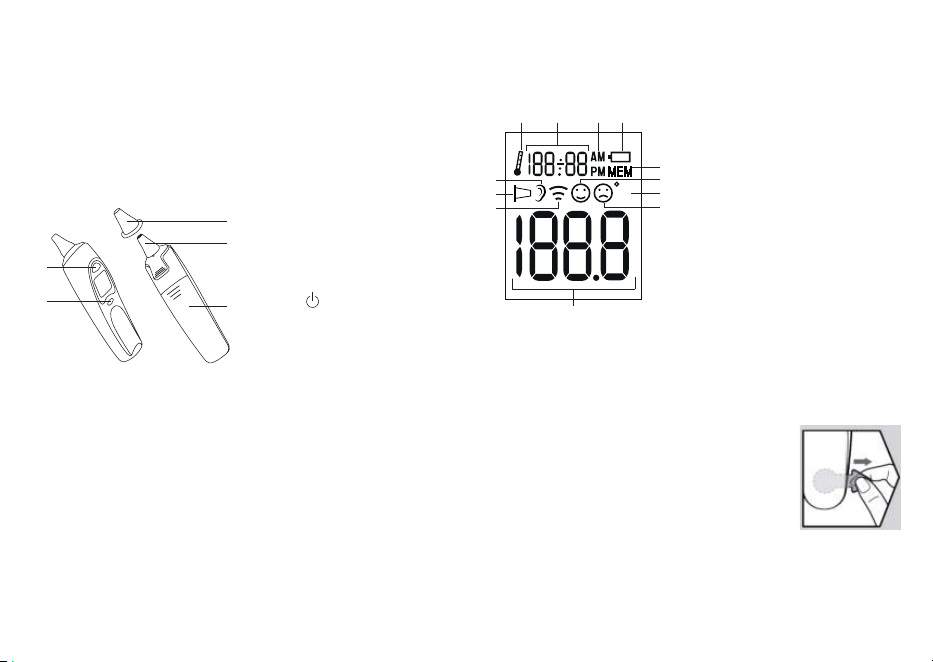
44
• El uso de accesorios que no sean los indicados o facilitados
por el fabricante de este aparato puede tener como consecu-
encia mayores interferencias electromagnéticas o una menor
resistencia contra interferencias electromagnéticas del aparato
y provocar un funcionamiento incorrecto.
• Si no se tienen en cuenta estas indicaciones, podrían verse afec-
tadas las características de funcionamiento del aparato.
5. DESCRIPCIÓN DEL APARATO
1
2
3
4
5
1. Tapa protectora
2. Sensor de medición
3. Tecla de inicio
4.
Tecla de encendido y apa-
gado
5. Compartimento para pilas
Pantalla LCD
E
1
5
7
6
8
9
10
11
12
2 3 4
1.
Modo de temperatura ambiente
2. Indicación de temperatura am-
biente/hora/fecha
3. Indicación AM/PM (hora)
4. Símbolo de pila
5. Modo Memory
6. Símbolo de ausencia de fiebre
7.
Unidad de temperatura (°C o
°F))
8. Símbolo de fiebre
9. Indicación de temperatura
10.
Modo de temperatura de ob-
jetos
11. Símbolo de tapa protectora
12.
Modo de temperatura corporal
6. PUESTA EN FUNCIONAMIENTO
Los aparatos nuevos se entregan con las pilas
ya colocadas. Antes de usarlos por primera vez,
quite las cintas de protección que sobresalen
del compartimento para pilas. A continuación, el
termómetro para el oído se enciende automática-
mente.
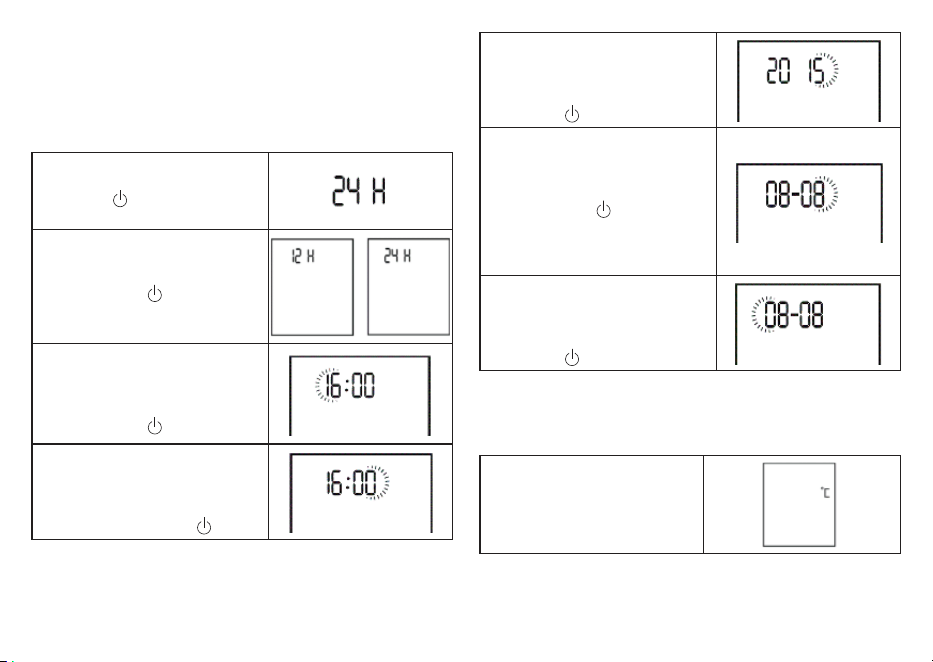
45
7. AJUSTES
7.1 Ajustar hora/fecha
Antes de comenzar con las mediciones, le recomendamos ajustar la
hora y la fecha actuales. Así podrá asignar después con más facili-
dad las mediciones guardadas.
1.
Mantenga pulsada durante tres
segundos la tecla de encendido y
apagado con el aparato apaga-
do. En la pantalla aparece “24 H”.
2. Seleccione con la tecla de inicio
un formato de hora (12h o 24h) y
confirme con la tecla de encendi-
do y apagado .
3.
En la pantalla aparece la indica-
ción de la hora. Seleccione con
la tecla de inicio la hora actual y
confirme con la tecla de encendi-
do y apagado .
4.
En la pantalla aparece la indica-
ción de los minutos. Seleccione
con la tecla de inicio el minuto
actual y confirme con la tecla de
encendido y apagado .
5.
En la pantalla aparece la indica-
ción del año. Seleccione con la te
-
cla de inicio el año actual y con-
firme con la tecla de encendido y
apagado .
6.
En la pantalla parpadea la indi-
cación del mes. Seleccione con
la tecla de inicio el mes actual y
confirme con la tecla de
encendi-
do y apagado
. Seguidamente,
el aparato se apaga automática-
mente. La fecha y la hora quedan
guardadas.
7.
En la pantalla parpadea la indi-
cación del día. Seleccione con la
tecla de inicio el día actual y con-
firme con la tecla de encendido y
apagado .
7.2 Seleccionar unidad de temperatura (°C o °F)
Puede visualizar los resultados de la medición en grados Celsius
(ºC) o en grados Fahrenheit (ºF).
1.
Mantenga pulsada durante tres
segundos la tecla de inicio con
el aparato apagado. En la pan-
talla aparece “°C”.
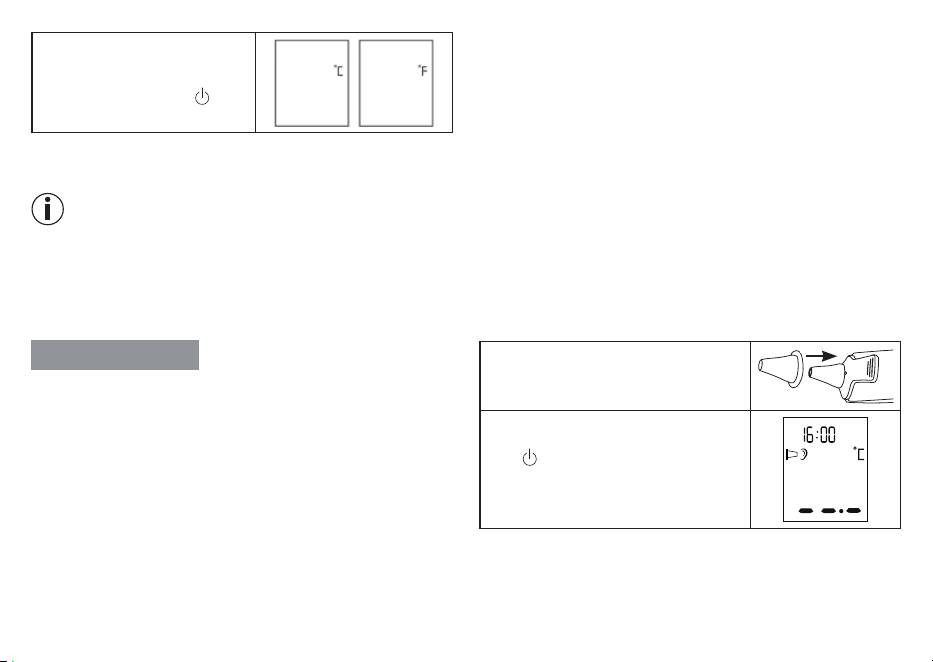
46
2.
Seleccione con la tecla de inicio
una unidad de temperatura (°C
o °F) y confirme con la tecla de
encendido y apagado .
8. TOMAR LA TEMPERATURA
Antes de cada uso, compruebe si la lente está dañada. En
caso de que esté dañada, póngase en contacto con su dis-
tribuidor o con el servicio de asistencia técnica. Tenga en cu-
enta que el termómetro para el oído debe estar en el mismo
lugar en el que se va a realizar la toma de temperatura durante
30minutos como mínimo.
8.1 Medición de la temperatura corporal
ADVERTENCIA
• Hay personas que tienen distintos valores de medición en el
oído izquierdo y en el derecho. Para captar cambios de tempe-
ratura en una misma persona, tome siempre la temperatura en
el mismo oído.
• Los niños solo pueden usar el termómetro para el oído bajo la
vigilancia de adultos. Por regla general, se puede tomar la tem-
peratura a partir de los 6 meses de edad. El conducto auditivo
de los bebés menores de 6 meses todavía es muy estrecho, por
lo que a menudo no se llega a tomar la temperatura del tímpano
y los valores de medición son demasiado bajos.
• No se puede tomar la temperatura en el oído si se padecen en-
fermedades inflamatorias (como piorrea o secreciones), tras po-
sibles lesiones de oído (p. ej. daños en el tímpano) o durante un
postoperatorio. En estos casos, consulte a su médico.
• No se recomienda usar el termómetro para el oído en perso-
nas que sufran determinadas enfermedades infecciosas agudas
para evitar un posible contagio, aun cuando se haya limpiado
y desinfectado bien. Consulte cada caso particular con su mé-
dico.
• Este termómetro para el oído solo se puede usar con la tapa
protectora puesta.
• Las siguientes circunstancias pueden influir en la temperatura en
el oído: estar acostado durante bastante tiempo sobre un oído,
oídos tapados, la exposición a calor o frío intenso o después de
nadar/bañarse. Si se produce alguna de estas circunstancias,
espere 20 minutos antes de tomar la temperatura.
• El cerumen puede influir en la medición de la temperatura. Por
ello, límpiese el oído si es necesario antes de tomar la tempe-
ratura.
1. Coloque una tapa protectora limpia en
la punta del sensor del termómetro pa-
ra el oído.
2.
Para encender el termómetro para el oí-
do, pulse la tecla de encendido y apaga-
do . Suenan tres pitidos y la pantalla
se enciende.
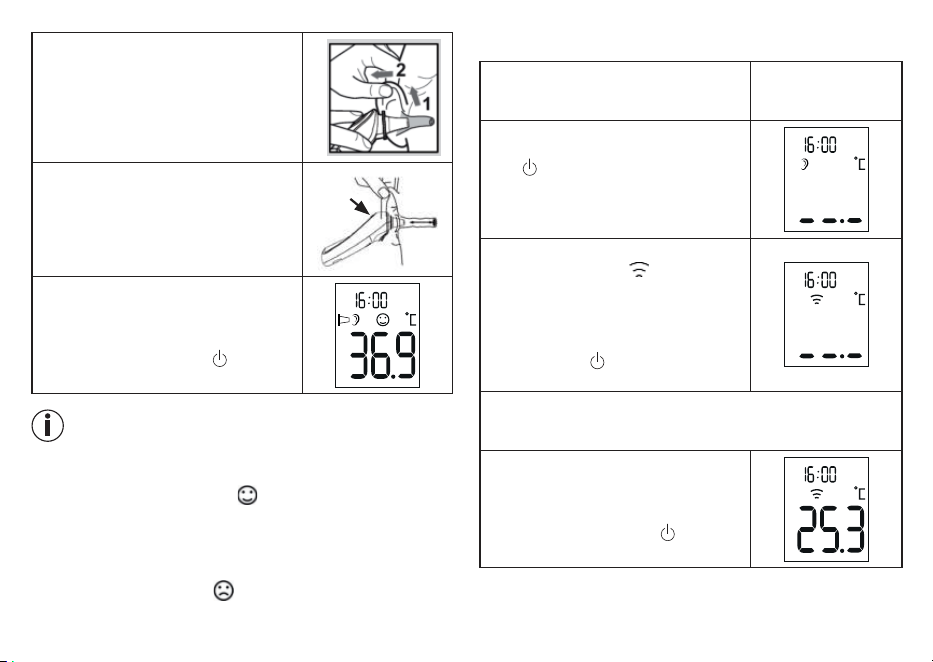
47
3.
Como el conducto auditivo está lige-
ramente curvado, antes de introducir la
punta del sensor debe estirar ligeramen
-
te la oreja hacia arriba y hacia atrás, de
modo que la punta de la tapa protec-
tora se pueda orientar directamente al
tímpano.
4.
Introduzca con cuidado la punta del
sensor con la tapa protectora en el con-
ducto auditivo y pulse la tecla de inicio
para iniciar la medición.
5.
Después de aprox. un segundo suena
un pitido y el resultado de la medición
aparece en la pantalla. Para apagar el
termómetro para el oído, pulse la tecla
de encendido y apagado .
Si no pulsa ninguna tecla durante un minuto después de la me-
dición, el termómetro para el oído se apaga automáticamente.
Indicador de fiebre
Si la temperatura medida es < 38 °C (100,4 °F), en la pantalla
aparece un cara sonriente y suena un pitido corto.
Si la temperatura medida está entre 37,5 y 37,9 °C, se es-
cuchan otros dos pitidos cortos (indicación de “temperatura
elevada”).
Si la temperatura medida es ≥ 38 °C (100,4 °F), en la pantalla
aparece un cara triste
y suenan sucesivamente un pitido
corto, uno largo y tres cortos.
8.2 Medir temperatura de objetos
1.
Retire la tapa protectora (si está puesta)
de la punta del sensor del termómetro
para el oído.
2.
Para encender el termómetro para el oí-
do, pulse la tecla de encendido y apaga-
do . Suenan tres pitidos y la pantalla
se enciende.
3.
Asegúrese de estar en el modo de tem-
peratura de objetos ( ).
Para cambiar entre el modo de tempe-
ratura corporal y el modo de tempe-
ratura de objetos, mantenga pulsada
brevemente la tecla de tecla de encen-
dido y apagado y la tecla de inicio al
mismo tiempo.
4. Mantenga la punta del sensor del termómetro para el oído entre
1 y 2 cm delante del lugar en el que desea realizar la medición y
pulse la tecla de inicio.
5.
Después de un segundo suena un pitido
y el resultado de la medición aparece en
la pantalla. Para apagar el termómetro
para el oído, pulse brevemente la tecla
de encendido y apagado .
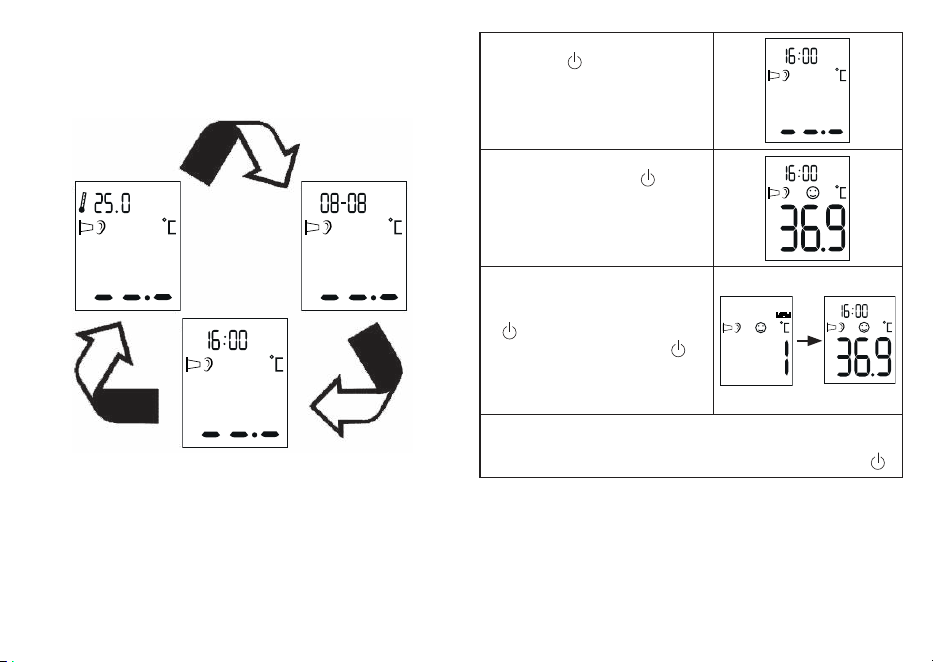
48
8.3 Mostrar la temperatura ambiente
Cuando se enciende el termómetro para el oído, en la pantalla apa-
recen la temperatura ambiente, la fecha y la hora alternativamente
cada 3 segundos.
8.4 Mostrar valores guardados
El termómetro para el oído guarda automáticamente los valores de
temperatura de las últimas 10 mediciones de temperatura corporal y
de objetos (incl. fecha y hora). Para consultar los valores guardados
proceda del siguiente modo:
1.
Pulse la tecla de encendido y
apagado para encender el
termómetro para el oído.
2.
Mantenga pulsada la tecla de
encendido y apagado durante
3 segundos. En la pantalla apa-
rece una M y el último valor me-
dido guardado.
3.
Para cambiar entre los distin-
tos valores guardados pulse la
tecla de encendido y apagado
. Cada vez que pulse la tecla
de encendido y apagado se
mostrará primero el número de
posición de memoria y a conti-
nuación el valor medido.
4.
Si desea continuar con una medición, pulse la tecla de inicio.
Si desea apagar el termómetro para el oído, mantenga pulsa-
da durante tres segundos la tecla de encendido y apagado .
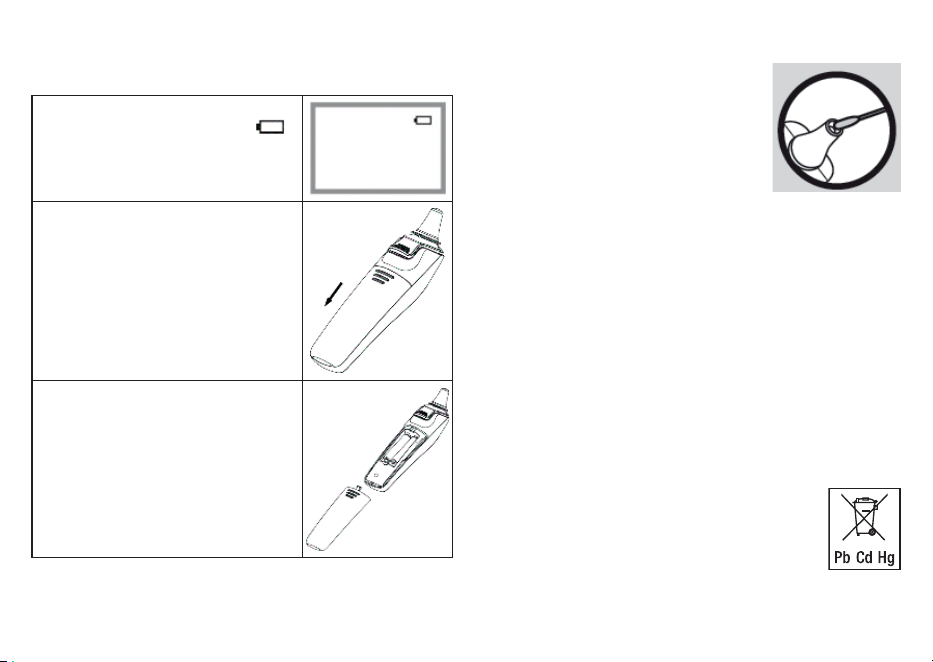
49
9. CAMBIO DE PILAS
Antes de cambiar las pilas asegúrese de que el aparato está apa-
gado.
1.
Cambie las pilas en cuanto aparezca
en la pantalla el símbolo de pila ( ).
2.
Abra el compartimento de las pilas y re-
tire las pilas gastadas.
3. Inserte dos nuevas pilas de 1,5 V AAA.
Asegúrese de que las pilas están bien
orientadas. Cierre el compartimento
para pilas.
10. LIMPIEZA/CONSERVACIÓN
Las tapas protectoras son desechables.
La punta del sensor es la pieza más sen-
sible del termómetro para el oído. Proceda
con cuidado durante su limpieza para evitar
daños. Para ello, utilice un paño suave o un
bastoncillo de algodón que se pueda mo-
jar en desinfectante, en alcohol o en agua
caliente.
Para limpiar todo el aparato utilice un paño
suave ligeramente humedecido con lejía jabonosa.
No utilice ningún producto de limpieza agresivo.
Si no va a usar el termómetro durante mucho tiempo, retire las pilas.
El aparato no se debe usar ni guardar en un lugar expuesto a la luz
solar con una temperatura demasiado alta o demasiado baja o con
humedad ambiental (consulte los datos técnicos), en contacto con
la corriente eléctrica o en lugares con exceso de polvo. De lo cont-
rario, el termómetro podría tomar mediciones erróneas.
11. ELIMINACIÓN
• Las pilas completamente descargadas deben desecharse en los
contenedores de recogida previstos para ello, en los puntos de
reciclaje o a través de los distribuidores de equipos eléctricos.
Los usuarios están obligados por ley a desechar las pilas correc-
tamente.
• Estos símbolos se encuentran en pilas que contie-
nen sustancias tóxicas:
Pb = la pila contiene plomo
Cd = la pila contiene cadmio
Hg = la pila contiene mercurio
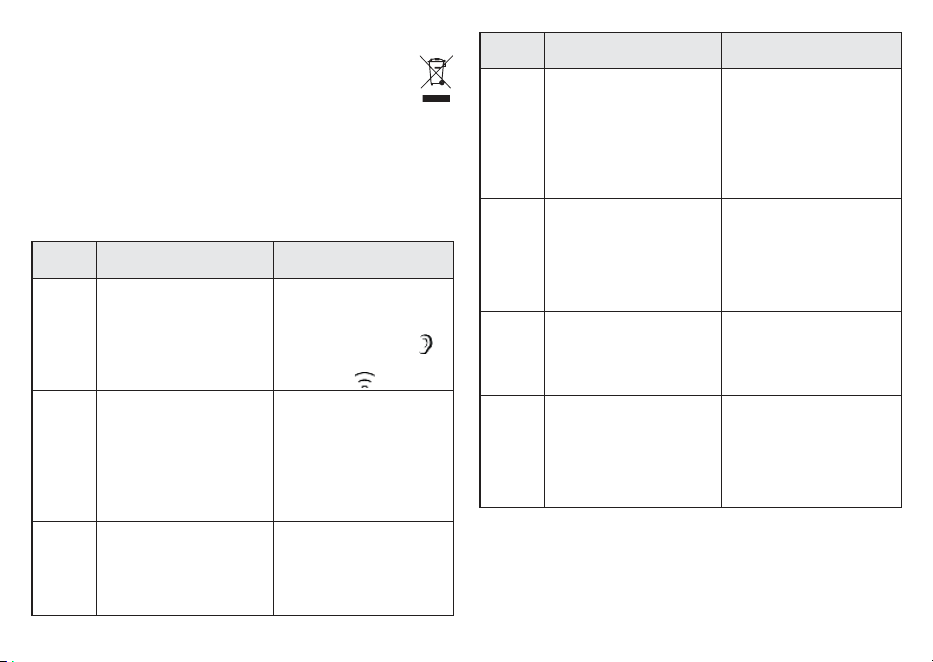
50
Eliminación general
A fin de preservar el medioambiente, cuando el aparato llegue
al final de su vida útil no lo deseche con la basura domésti-
ca. Lo puede eliminar en los puntos de recogida adecuados
disponibles en su zona. Deseche este aparato de acuerdo
con la Directiva de la Unión Europea sobre Residuos de Aparatos
Eléctricos y Electrónicos (RAEE). Para más información, póngase
en contacto con la autoridad municipal competente en materia de
eliminación de residuos.
12. SOLUCIÓN DE PROBLEMAS
Aviso de
errores
Causa Solución
ER1
El termómetro para el
oído todavía no está listo
para tomar la tempera-
tura.
Mida la temperatura en
cuanto se visualice en
la pantalla el modo de
temperatura corporal (
)
o el modo de temperatura
de objetos ( ).
ER2
La temperatura ambiente
medida no está en el
margen entre 10 °C – 40 °C
(50 °F – 104 °F).
Coloque el termómetro
para el oído durante
30 minutos en un lugar
que se encuentre a una
temperatura ambiente
de entre 10 °C – 40 °C
(50 °F – 104 °F).
ER3
El termómetro para el
oído no está colocado
correctamente en el oído.
Respete las indicaciones
incluidas del capítulo
“Tomar la temperatu-
ra”. Vuelva a realizar la
medición.
Aviso de
errores
Causa Solución
ER4
El termómetro para el
oído ha constatado un
gran cambio de la tempe-
ratura ambiente.
Coloque el termómetro
para el oído durante
30 minutos en un lugar
que se encuentre a una
temperatura ambiente
de entre 10 °C – 40 °C
(50 °F – 104 °F).
ER5
El termómetro para el
oído no funciona correc-
tamente.
Cambie las pilas e
inténtelo de nuevo. Si el
error vuelve a presentarse,
póngase en contacto con
el servicio de atención al
cliente.
ER6
Usted se encuentra en el
modo “Medir temperatura
de objetos” y la tapa pro-
tectora aún está puesta.
Para poder medir la
temperatura de objetos
deberá retirar la tapa
protectora.
Hi
Medición en el oído: tem-
peratura medida superior
a 43 °C (109,4 °F)
Medición en objetos: tem-
peratura medida superior
a 100 °C (212 °F)
Asegúrese de que el
aparato y la tapa protec-
tora están en perfecto
estado. Vuelva a realizar la
medición.
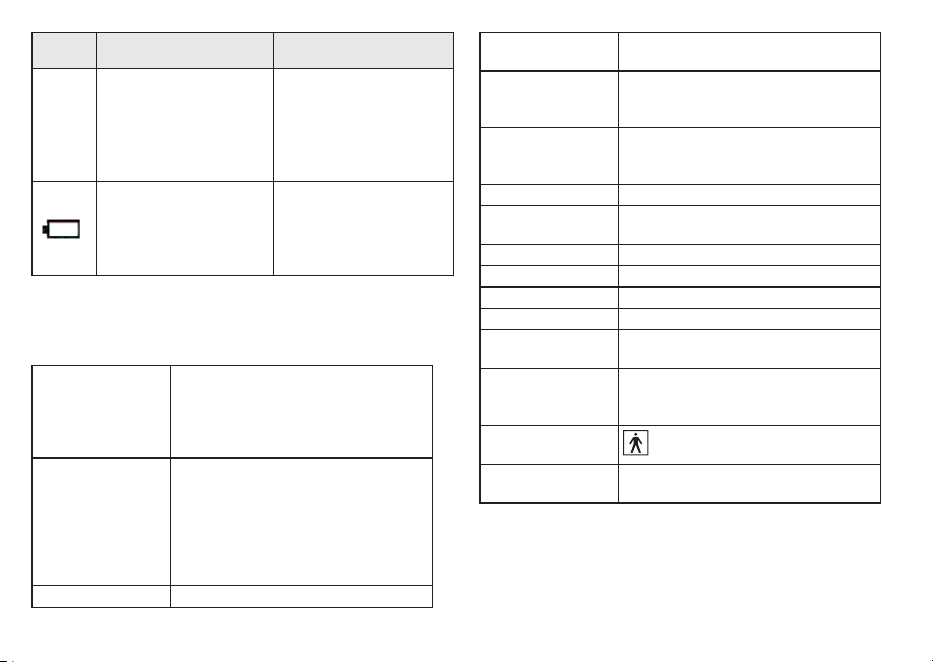
51
Aviso de
errores
Causa Solución
Lo
Medición en el oído: la
temperatura medida es
inferior a 28 °C (82,4 °F)
Medición en objetos: la
temperatura medida es
inferior a -20 °C (-4 °F)
Asegúrese de que el
aparato y la tapa protec-
tora están en perfecto
estado. Vuelva a realizar la
medición.
Las pilas están gastadas. Retire las dos pilas
gastadas y coloque dos
pilas nuevas de 1,5V AAA
en el termómetro para
el oído.
Si su problema no aparece en esta tabla, póngase en contacto con
el servicio de atención al cliente.
13. DATOS TÉCNICOS
Rango de medición
de temperatura
En el oído: 28,0 – 43,0 °C (82,4 – 109,4 °F)
Temperatura de objetos: -20 – 100 °C
(-4 – 212 °F)
Temperatura ambiente: 0 – 50 °C
(32 – 122 °F)
Precisión de medi-
ción en laboratorio
En el oído: ± 0 ,2 °C (0,4 °F) en el
rango de medición de 35,5 – 42,0 °C
(95,9 – 107,6 °F); ± 0,3 °C (0,5 °F) en el
rango de medición de ≤35,5 °C (95,5 °F)
y ≥42,0 °C (107,6 °F)
Temperatura de objetos: ± 4% o ± 2 °C (4 °F)
Temperatura ambiente: ± 2 °C (± 4 °F)
Repetibilidad clínica 0,11 °C (0,2 °F)
Duración de la
medición
Aprox. un segundo
Rango de tempera-
tura de funciona-
miento
10 – 40 °C (50 – 104 °F), humedad ambi-
ental 15 – 85% (sin condensación)
Rango de tempera-
tura de almacena-
miento
-25 – 55 °C (-13 – 131 °F), humedad
ambiental ≤ 95% (sin condensación)
Memoria 10 posiciones de memoria
Resolución de la
pantalla
0,1 °C o 0,1 °F
Pila CC 3V (2 pilas de 1,5V AAA)
Medidas 155 x 38 x 47 mm
Peso aprox. 63 g (sin pilas)
Tapas protectoras 10
Desconexión
automática
60 segundos
Vida útil de las pilas 3.000 mediciones seguidas o un año
con una o dos mediciones al día, inclui-
do el modo de reposo.
Clasificación de
seguridad
Dispositivo médico conectado de
tipo BF
Clase de protección
IP
IP22
El número de serie se encuentra en el aparato o en el compar-
timento de las pilas.
14. GARANTÍA / ASISTENCIA
Encontrará más información sobre la garantía y sus condiciones
en el folleto de garantía suministrado.
Salvo errores y modificaciones
52
ITALIANO
Leggere attentamente le presenti istruzioni per l'uso, conservarle per impieghi futuri, renderle accessibili ad altri utenti e
attenersi alle indicazioni.
1. FORNITURA
Controllare l‘integrità esterna della confezione e la completezza del
contenuto. Prima dell‘uso assicurarsi che l‘apparecchio e gli ac-
cessori non presentino nessun danno palese e che il materiale di
imballaggio sia stato rimosso. In caso di dubbio, non utilizzare l‘ap-
parecchio e consultare il proprio rivenditore o contattare il Servizio
clienti indicato.
1 termometro per orecchio
2 batterie AAA da 1,5 V
10 tappi di protezione
Le presenti istruzioni per l'uso
Articoli di acquisto garantito
Set di cappucci protettivi acquistabile in seguito: 2 x 10 cappucci
protettivi, n. art.: 795.34
2. SPIEGAZIONE DEI SIMBOLI
I seguenti simboli sono utilizzati nelle istruzioni per l‘uso, sull‘imballo
e sulla targhetta dell‘apparecchio:
AVVERTENZA
Identifica un possibile pericolo. Se non evitato, può provocare
lesioni gravi o mortali.
1. Fornitura ..................................................................................52
2. Spiegazione dei simboli ..........................................................52
3. Uso conforme .........................................................................53
4. Note .........................................................................................54
5. Descrizione dell'apparecchio .................................................. 56
6. Messa in funzione ...................................................................56
7. Impostazioni ............................................................................ 57
7.1 Impostazione di data e ora .............................................57
7.2 Selezione dell'unità di temperatura (°C o °F) .................. 57
8. Misurazione .............................................................................58
8.1 Misurazione della temperatura corporea ........................58
8.2 Misurazione della temperatura superficiale ....................59
8.3 Visualizzazione della temperatura ambiente ...................60
8.4 Visualizzazione dei valori memorizzati ............................ 60
9. Sostituzione delle batterie .......................................................60
10. Pulizia/Conservazione ..........................................................61
11. Smaltimento ..........................................................................61
12. Che cosa fare in caso di messaggi di errore? ....................... 62
13. Dati tecnici ............................................................................63
14. Garanzia / Assistenza .............................................................63
SOMMARIO
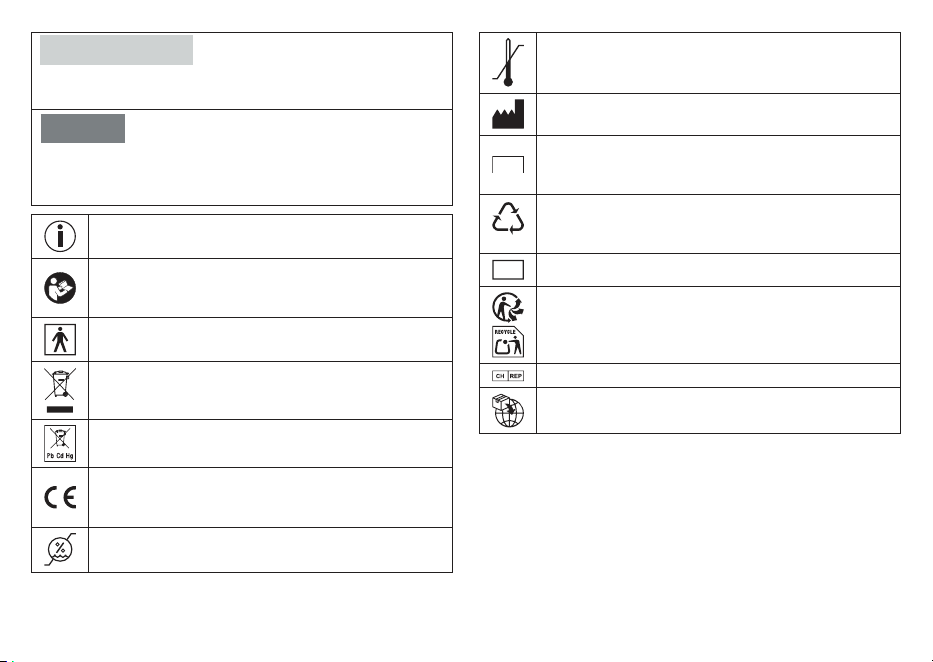
53
ATTENZIONE
Identifica un possibile pericolo. Se non evitato, può provocare
lesioni leggere o di lieve entità.
AVVISO
Identifica una situazione potenzialmente dannosa. Se non
evitata, può danneggiare il dispositivo o altri oggetti nelle sue
vicinanze.
Informazioni sul prodotto
Indicazione di informazioni importanti
Seguire le istruzioni
Prima dell‘inizio dei lavori e/o dell‘utilizzo di apparecchi
o macchine, leggere le istruzioni
Parti applicate di tipo BF
Il dispositivo elettrico non deve essere smaltito nei rifiuti
domestici
Non smaltire le batterie contenenti sostanze tossiche
insieme ai rifiuti domestici
Marchio CE
Il presente prodotto soddisfa i requisiti delle direttive
europee e nazionali vigenti.
Limitazione della pressione atmosferica
Limite di temperatura
Produttore
IP22
Apparecchio protetto contro la penetrazione di corpi
solidi ≥12,5 mm e contro la caduta inclinata di gocce
d‘acqua
B
A
Etichetta di identificazione del materiale di imballaggio.
A = abbreviazione del materiale, B = codice materiale:
1-7 = plastica, 20-22 = carta e cartone
S
N
Numero di serie
Separare il prodotto e i componenti dell‘imballaggio e
smaltirli secondo le norme comunali.
Rappresentante autorizzato per la Comunità Europea
Simbolo importatore
3. USO CONFORME
Il termometro per orecchio è destinato alla misurazione della tempe-
ratura corporea nell'orecchio. Non utilizzare il termometro per orec-
chio per misurazioni su altre parti del corpo!
Con questo termometro è possibile misurare anche la temperatura
ambiente e superficiale.
Il termometro per orecchio è stato sviluppato con la massima cura
per misurare la temperatura in modo preciso, sicuro e rapido. Si trat-

54
ta di un termometro per orecchio non invasivo con un rilevatore a
infrarossi per rilevare la temperatura corporea nel canale auricolare
di bambini e adulti.
Utilizzare l'apparecchio solo per lo scopo per il quale è stato con-
cepito e come descritto nelle presenti istruzioni per l'uso. Qualsiasi
uso non conforme comporta un pericolo! Il produttore non risponde
di danni causati da un uso inappropriato o non conforme.
L’apparecchio è conforme ai requisiti della direttiva europea per i
dispositivi medici 93/42/EEC, alla legge sui dispositivi medici, alla
norma ASTM E 1965 - 98, alla norma europea EN 12470-5: Termo-
metri clinici – Parte 5: caratteristiche dei termometri da orecchio
a infrarossi (con dispositivo di massimo) e conformità alla norma
europea EN60601-1-2 (conformità con CISPR11, IEC61000-4-2,
IEC61000-4-3, IEC61000-4-8), con precauzioni d’impiego partico-
lari per quanto riguarda la compatibilità elettromagnetica.
Apparecchiature di comunicazione HF mobili e portatili possono in-
fluire sul funzionamento di questo apparecchio.
4. NOTE
Avvertenze di sicurezza
AVVERTENZA
• In caso di misurazioni auricolari, inserire con cautela la punta del
sensore del termometro nell'orecchio.
• In presenza di determinate patologie acute e infettive, l'utiliz-
zo del termometro per orecchio su più persone, nonostante la
pulizia e la disinfezione, è da sconsigliare a causa del possibile
scambio di germi. Per casi particolari rivolgersi al proprio medico
curante.
• La temperatura corporea misurata nell'orecchio può discostarsi
da altre misurazione eettuate in bocca, nel retto o sotto alle
ascelle. Non ha quindi senso confrontare tali valori. Misurare
regolarmente la temperatura per calcolare la temperatura nor-
male dell'orecchio. Utilizzare poi tali misurazioni come base di
confronto con misurazioni eseguite in caso di sospetta febbre.
• Questo termometro è destinato a misurazioni della temperatu-
ra dell'orecchio. Non utilizzarlo per misurazioni su altre parti del
corpo.
• Sostituire il tappo di protezione dopo ciascun utilizzo per ga-
rantire una misurazione esatta ed evitare una contaminazione
incrociata.
• Il termometro per orecchio può essere utilizzato esclusivamente
con tappi di protezione di Sanitas, altri tappi possono determi-
nare errori di misurazione. Se si esauriscono i tappi, rivolgersi
al produttore o al rivenditore specializzato per acquistarne altri.
• Rivolgersi a un medico in caso di precarie condizioni di salute.
Avvertenze sull'uso delle batterie
AVVERTENZA
• Pericolo di esplosione! Pericolo di incendio! Il mancato ri-
spetto dei seguenti punti può provocare lesioni personali o, per
quanto riguarda la batteria, surriscaldamento, fuoriuscite di liqui-
do, di gas, rottura, esplosione o incendio.
• Questo dispositivo contiene batterie non ricaricabili che non de-
vono essere ricaricate.
• Non gettare le batterie nel fuoco.
• Non caricare, scaricare in modo forzato, riscaldare, smontare,
aprire, frantumare, deformare, incapsulare o modificare mai le
batterie.
• Non cortocircuitare mai le batterie e i contatti del vano batterie.
• Proteggere le batterie dalla luce solare diretta, dalla pioggia, dal
calore e dall’acqua.

55
• L’esposizione delle batterie a temperature estremamente eleva-
te o a una pressione dell’aria estremamente bassa può causare
esplosioni o la fuoriuscita di liquidi e gas infiammabili.
• Smaltire immediatamente e correttamente le batterie difettose e
scariche (vedere il capitolo Smaltimento).
• Non utilizzare batterie modificate o danneggiate.
• Scegliere sempre il tipo di batteria corretto.
• Inserire sempre le batterie correttamente e rispettando le polarità
(+ / -).
• Non utilizzare mai contemporaneamente batterie di diversi fab-
bricanti, capacità (nuove e usate), dimensioni e tipo all’interno
dello stesso dispositivo.
• In caso di fuoriuscita di liquido dalla batteria, indossare guanti
protettivi e pulire il vano batterie con un panno asciutto.
• Se il liquido della batteria viene a contatto con la pelle o con gli
occhi, sciacquare le parti interessate con acqua e consultare il
medico.
• Pericolo di ingestione! Tenere le batterie fuori dalla portata dei
bambini. In caso di ingestione consultare immediatamente un
medico. L’ingestione può causare corrosioni, gravi lesioni interne
e la morte.
• Non permettere mai ai bambini di sostituire le batterie senza la
supervisione di un adulto.
ATTENZIONE
• Conservare le batterie in ambienti ben ventilati, asciutti e freschi,
in contenitori non conduttivi in cui non possano essere cortocir-
cuitate tra loro o da altri oggetti metallici.
• Tenere le batterie pulite e asciutte.
• Tenere le batterie lontano dall’acqua.
• Qualora il dispositivo non dovesse essere utilizzato per un perio-
do prolungato, rimuovere le batterie dal vano batterie.
AVVISO
• Non utilizzare batterie ricaricabili.
Pericoli per l'apparecchio
ATTENZIONE
• Evitare che l'apparecchio subisca degli urti.
• Non esporre l'apparecchio alla luce diretta del sole.
• Evitare che l'apparecchio entri in contatto con dei liquidi. Il ter-
mometro non è impermeabile. Evitare qualunque contatto diretto
con acqua o altri liquidi.
• Far riparare l'apparecchio solo da centri di assistenza autorizzati,
in caso contrario la garanzia decade.
• Gli apparecchi per la comunicazione portatili e mobili ad alta
frequenza possono influire sul funzionamento dell'apparecchio.
Per informazioni più dettagliate, rivolgersi all'Assistenza clienti
oppure consultare la parte finale delle istruzioni per l'uso.
AVVERTENZE SULLA COMPATIBILITÀ
ELETTROMAGNETICA
• L’apparecchio è idoneo per l’utilizzo in qualsiasi ambiente ripor-
tato nelle presenti istruzioni per l’uso, incluso l’ambiente dome-
stico.
• In determinate circostanze, in presenza di disturbi elettromag-
netici l’apparecchio può essere utilizzato solo limitatamente. Ne
possono conseguire ad es. messaggi di errore o un guasto del
display/apparecchio.
• Evitare di utilizzare il presente apparecchio nelle immediate vici-
nanze di altri apparecchi o con apparecchi in posizione impilata,
poiché ciò potrebbe determinare un funzionamento non corretto.
Qualora fosse comunque necessario un utilizzo nel modo pre-
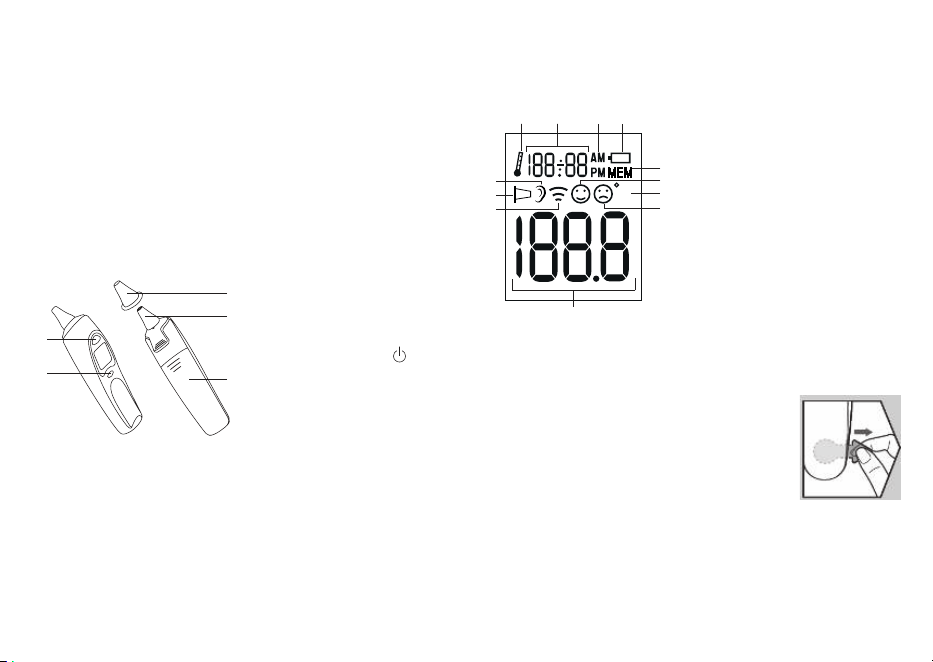
56
scritto, è opportuno tenere sotto controllo questo apparecchio
e gli altri apparecchi in modo da assicurarsi che funzionino cor-
rettamente.
• L’utilizzo di altri accessori diversi da quelli stabiliti dal produttore
dell’apparecchio o in dotazione con l’apparecchio può comport-
are la comparsa di significative emissioni elettromagnetiche di
disturbo o ridurre la resistenza dell’apparecchio alle interferen-
ze elettromagnetiche e a un funzionamento non corretto dello
stesso.
• La mancata osservanza può ridurre le prestazioni dell’apparec-
chio.
5. DESCRIZIONE DELL'APPARECCHIO
1
2
3
4
5
1. Tappo di protezione
2. Sensore di misurazione
3. Pulsante START
4. Pulsante ON/OFF
5. Vano batterie
Display LCD
E
1
5
7
6
8
9
10
11
12
2 3 4
1. Modalità temperatura ambiente
2. Indicazione temperatura ambi-
ente/ora/data
3. Indicazione AM/PM (ora)
4. Simbolo batteria
5. Modalità memoria
6. Simbolo assenza di febbre
7. Unità di temperatura (°C o °F)
8. Simbolo presenza di febbre
9. Indicazione temperatura
10. Modalità temperatura su-
perficiale
11. Simbolo tappo di protezione
12. Modalità temperatura cor-
porea
6. MESSA IN FUNZIONE
Le batterie sono già presenti sugli apparecchi
nuovi. Prima del primo impiego rimuovere la lin-
guetta protettiva dal vano batterie. Il termometro
per orecchio si accende automaticamente.
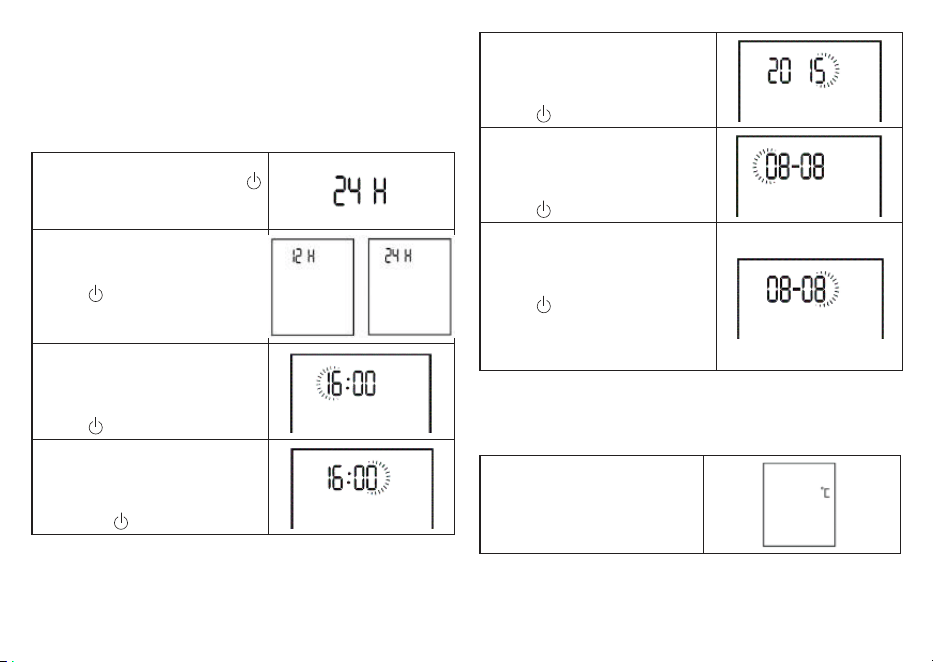
57
7. IMPOSTAZIONI
7.1 Impostazione di data e ora
Prima di iniziare le misurazioni, è consigliabile impostare la data e
l'ora attuali. In questo modo, sarà possibile in seguito assegnare più
facilmente le misurazioni memorizzate.
1.
Con l'apparecchio spento, tene-
re premuto il pulsante ON/OFF
per tre secondi. Sul display com-
pare la scritta "24 H".
2.
Con il pulsante START sceglie-
re un formato ora (12h o 24h) e
confermare con il pulsante ON/
OFF .
3.
Sul display viene visualizzata l'in-
dicazione dell'ora. Con il pulsan-
te START scegliere l'ora attuale e
confermare con il pulsante ON/
OFF .
4.
Sul display viene visualizzata l'in-
dicazione dei minuti. Con il pul-
sante START scegliere i minuti at-
tuali e confermare con il pulsante
ON/OFF .
5.
Sul display viene visualizzata l'in-
dicazione dell'anno. Con il pulsan-
te START scegliere l'anno attuale
e confermare con il pulsante ON/
OFF .
6.
Sul display lampeggia l'indica-
zione del giorno. Con il pulsante
START scegliere il giorno attuale
e confermare con il pulsante ON/
OFF .
7.
Sul display lampeggia l'indica-
zione del mese. Con il pulsante
START scegliere il mese attuale
e confermare con il pulsante ON/
OFF . Al termine l'apparecchio
si spegne automaticamente. A
questo punto, data e ora sono
memorizzate.
7.2 Selezione dell'unità di temperatura (°C o °F)
I risultati della temperatura misurata possono essere visualizzati in
gradi Celsius (°C) e Fahrenheit (°F).
1.
Con l'apparecchio spento, te-
nere premuto il pulsante START
per tre secondi. Sul display
compare la scritta "°C".
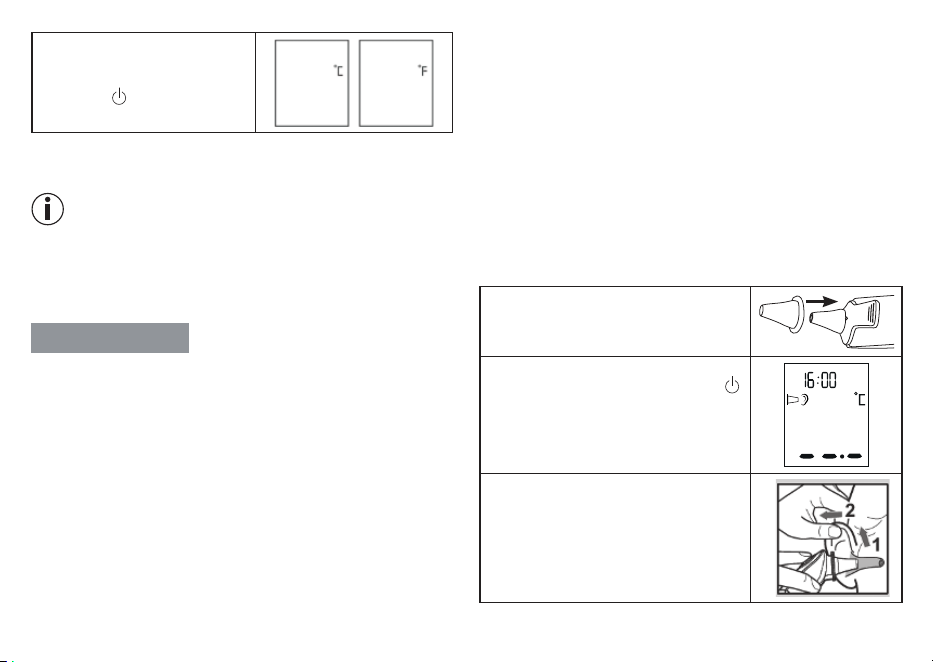
58
2. Con il pulsante START sceglie-
re un'unità di temperatura (°C o
°F) e confermare con il pulsante
ON/OFF .
8. MISURAZIONE
Prima di ogni utilizzo, verificare che la lente non sia danneggi-
ata. In caso di danni rivolgersi al proprio rivenditore o al Ser-
vizio clienti. Accertarsi che il termometro per orecchio si trovi
nelle stesse condizioni ambientali per almeno 30 minuti prima
di eseguire la misurazione.
8.1 Misurazione della temperatura corporea
AVVERTENZA
• Alcune persone presentano valori diversi nell'orecchio sinistro e
nell'orecchio destro. Per poter valutare l'andamento della tem-
peratura, misurarla sempre nello stesso orecchio.
• Il termometro per orecchio deve essere utilizzato dai bambini
solo sotto sorveglianza degli adulti. Generalmente è possibile
procedere a una misurazione nell'orecchio dopo i 6mesi di vita.
Nei bambini di età inferiore il canale auricolare è ancora molto
stretto e spesso non è possibile rilevare la temperatura del tim-
pano, dando luogo a valori di misurazione troppo bassi.
• Non eettuare la misurazione nell'orecchio in presenza di patolo-
gie infiammatorie (ad es. fuoriuscita di pus, secrezione) e possi-
bili lesioni (ad es. lesioni al timpano) o durante la convalescenza
in seguito a interventi chirurgici. In tutti questi casi si consiglia di
consultare il proprio medico curante.
• In presenza di determinate patologie acute e infettive, l'utilizzo
del termometro su più persone, nonostante la pulizia e la disinfe-
zione, è da sconsigliare a causa del possibile scambio di germi.
Per casi particolari rivolgersi al proprio medico curante.
• Questo termometro per orecchio può essere utilizzato solo con
tappo di protezione applicato.
• Le seguenti condizioni potrebbero influenzare la temperatura
dell'orecchio: si rimane per lungo tempo appoggiati su un orec-
chio, le orecchie sono coperte, le orecchie sono esposte a tem-
peratura molto calda/fredda oppure dopo il nuoto/il bagno. In
questi casi è necessario attendere 20 minuti prima di eseguire
la misurazione.
• La presenza di cerume può influire sulla misurazione: pulire per-
tanto l'orecchio prima di misurare la temperatura.
1. Applicare un tappo di protezione pulito
sulla punta del sensore del termometro
per orecchio.
2. Per accendere il termometro per orec-
chio, premere il pulsante ON/OFF .
Vengono emessi tre segnali acustici e
il display si accende.
3.
Poiché il canale auricolare è leggermen-
te curvo, prima di introdurre la punta del
sensore nell'orecchio tirare leggermente
indietro il padiglione verso l'alto per con-
sentire alla punta del tappo di protezione
di raggiungere direttamente il timpano.
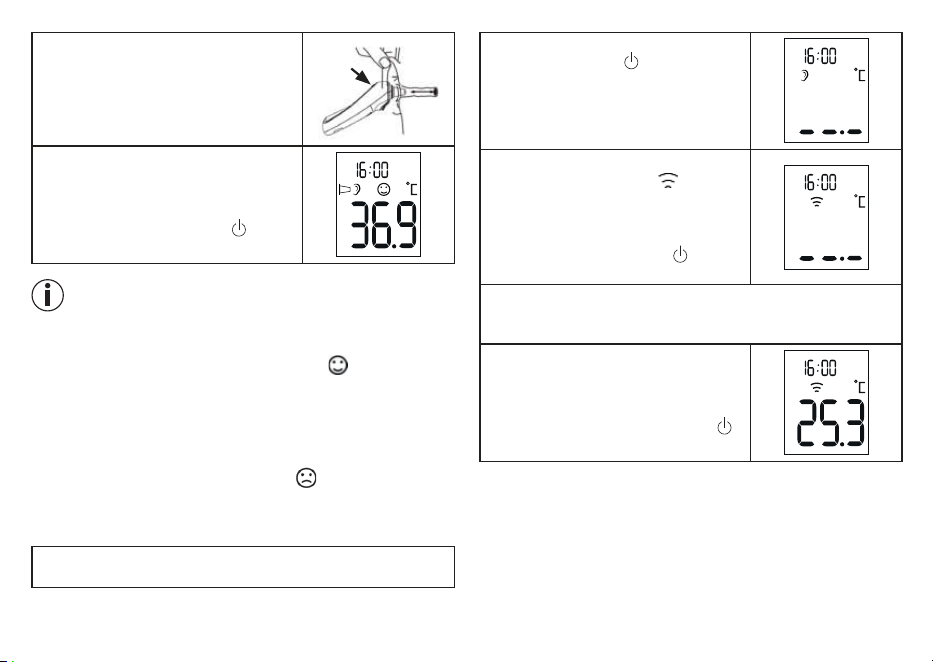
59
4. Inserire la punta del sensore con il tap-
po di protezione con cautela nel canale
auricolare e premere il pulsante START
per avviare il processo di misurazione.
5. Dopo ca. un secondo viene emesso un
segnale acustico e l'esito della misura-
zione viene visualizzato sul display. Per
spegnere il termometro per orecchio,
premere il pulsante ON/OFF .
Se dopo la misurazione non viene premuto alcun pulsante per
un minuto, il termometro si spegne automaticamente.
Indicazione della febbre
Se la temperatura misurata è < 38 °C (100,4 °F), sul display
viene visualizzato uno smiley sorridente e viene emesso
un breve segnale acustico.
Se la temperatura misurata è compresa tra 37,5 e 37,9 °C,
vengono emessi due brevi segnali acustici (indicazione di “au-
mento di temperatura”).
Se la temperatura misurata è ≥ 38 °C (100,4 °F), sul display
viene visualizzato uno smiley triste
e vengono emessi in
sequenza un segnale acustico breve, uno lungo e tre brevi.
8.2 Misurazione della temperatura superficiale
1.
Rimuovere il tappo di protezione (se applicato) dalla punta del
sensore del termometro per orecchio.
2.
Per accendere il termometro, premere
il pulsante ON/OFF . Vengono emes-
si tre segnali acustici e il display si ac-
cende.
3.
Assicurarsi che sia attiva la modalità
temperatura superficiale ( ).
Per commutare tra la modalità tempe-
ratura corporea e la modalità tempe-
ratura superficiale, tenere brevemente
premuti il pulsante ON/OFF
e il pul-
sante START contemporaneamente.
4.
Tenere la punta del sensore del termometro per orecchio a
1 – 2 cm dal punto di misurazione desiderato e premere il pul-
sante START.
5.
Dopo un secondo viene emesso un seg
-
nale acustico e l'esito della misurazione
viene visualizzato sul display. Per speg-
nere il termometro per orecchio, preme-
re brevemente il pulsante ON/OFF .
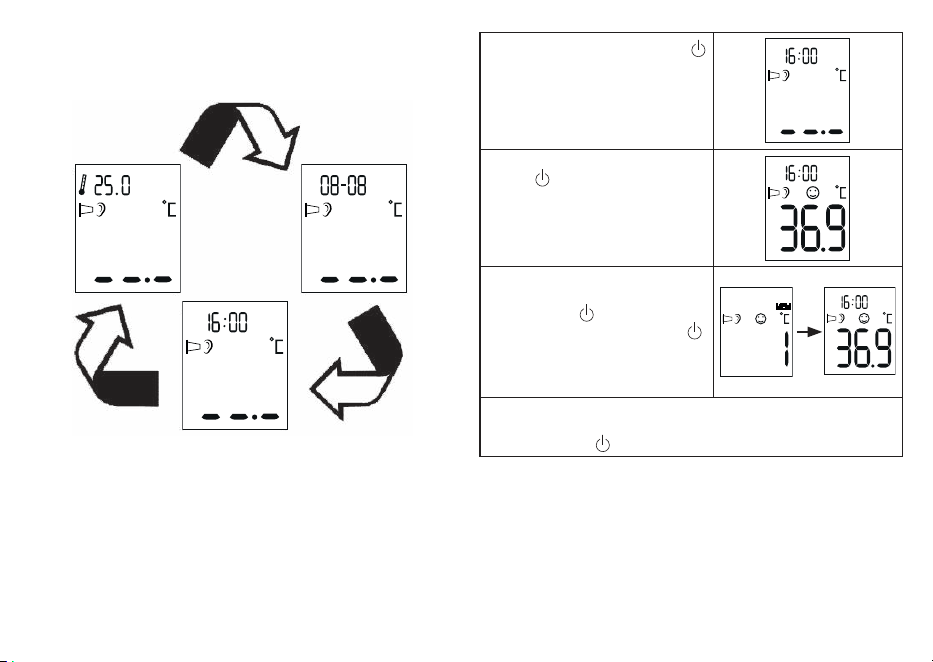
60
8.3 Visualizzazione della temperatura ambiente
Quando si accende il termometro per orecchio, sul display si alter-
nano ogni 3 secondi la temperatura ambiente, la data e l'ora.
8.4 Visualizzazione dei valori memorizzati
Il termometro per orecchio memorizza automaticamente le tem-
perature delle ultime 10 misurazioni della temperatura corporea e
superficiale (incl. data e ora). Per richiamare i valori memorizzati,
procedere nel modo seguente:
1.
Premere il pulsante ON/OFF
per accendere il termometro per
orecchio.
2.
Tenere premuto il pulsante ON/
OFF per 3 secondi. Sul dis-
play vengono visualizzati una M
e l'ultimo valore memorizzato.
3. Per commutare fra i singoli valori
memorizzati, premere il pulsan-
te ON/OFF . Premendo nuo-
vamente il pulsante ON/OFF ,
viene prima visualizzata la posizi-
one di memoria e quindi il valore
misurato.
4. Per procedere con una misurazione, premere il pulsante START.
Per spegnere il termometro per orecchio, tenere premuto il pul-
sante ON/OFF per 3 secondi.
9. SOSTITUZIONE DELLE BATTERIE
Prima di sostituire le batterie, accertarsi che l'apparecchio sia spen-
to.
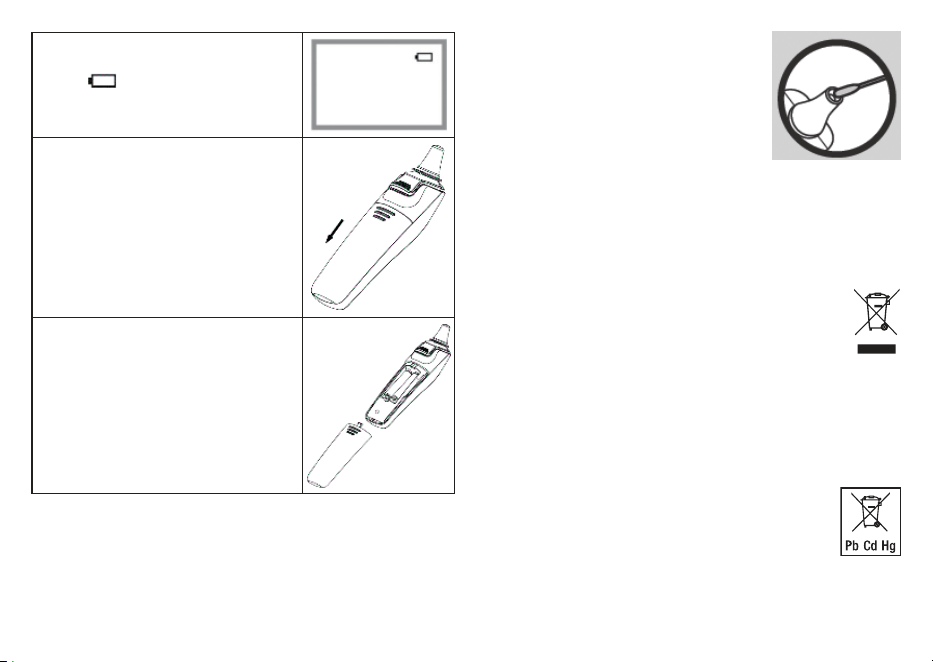
61
1.
Sostituire le batterie quando sul dis-
play viene visualizzato il simbolo bat-
teria ( ).
2.
Aprire il vano batterie ed estrarre le bat
-
terie esauste.
3.
Inserire due nuove batterie AAA da 1,5 V.
Accertarsi che le batterie siano orientate
correttamente. Chiudere il vano batterie.
10. PULIZIA/CONSERVAZIONE
I tappi di protezione sono concepiti come monouso.
La punta del sensore è la parte più delicata del termometro per
orecchio. Procedere con cautela durante la pulizia della punta del
sensore per evitare di danneggiarla. A tale scopo utilizzare un panno
morbido o un cotton fioc imbevuto di disin-
fettante, alcol o acqua calda.
Per la pulizia dell'intero apparecchio utilizza-
re un panno morbido leggermente inumidito
con acqua e sapone.
Non utilizzare detergenti aggressivi.
Se si prevede di non utilizzare l'apparecchio
per un lungo periodo, rimuovere le batterie.
Non utilizzare né riporre l'apparecchio in luoghi esposti a tempe-
rature troppo alte o troppo basse, all'umidità (vedere Dati tecnici),
alla luce solare, alla corrente elettrica o alla polvere, diversamente le
misurazioni potrebbero non essere corrette.
11. SMALTIMENTO
A tutela dell‘ambiente, al termine del suo ciclo di vita l‘ap-
parecchio non deve essere smaltito nei rifiuti domestici,
ma conferito negli appositi centri di raccolta. Attenersi alle
norme locali vigenti per lo smaltimento dei materiali. Smal-
tire l‘apparecchio secondo la direttiva europea sui rifiuti di
apparecchiature elettriche ed elettroniche (RAEE). In caso di dubbi,
rivolgersi agli enti comunali responsabili in materia di smaltimen-
to. Informazioni sui punti di raccolta per apparecchi usati vengono
fornite ad es. dai comuni, dalle società di smaltimento locali e dai
rivenditori.
I simboli riportati di seguito indicano che le batterie contengono
sostanze tossiche.
Pb = batteria contenente piombo,
Cd = batteria contenente cadmio,
Hg = batteria contenente mercurio
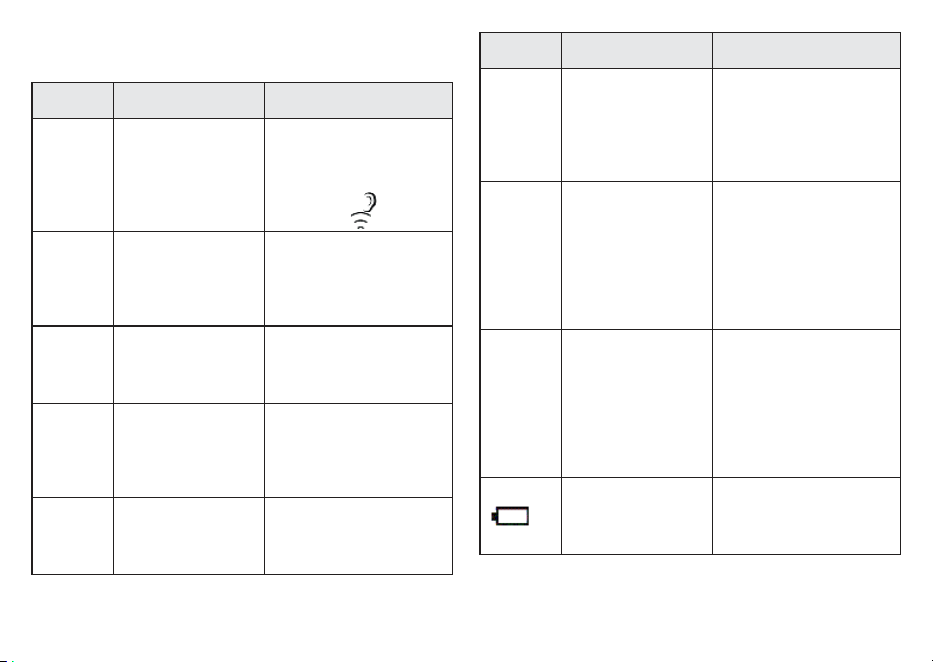
62
12. CHE COSA FARE IN CASO DI MESSAG-
GI DI ERRORE?
Messaggio
di errore
Causa Soluzione
ER1
Il termometro per
orecchio non è
ancora pronto per la
misurazione.
Eseguire la misurazio-
ne quando sul display
viene visualizzato il simbolo
della modalità tempera-
tura corporea (
) oppure
superficiale ( ).
ER2
La temperatura ambi-
ente misurata non è
nell'intervallo compre-
so tra 10 °C e 40 °C
(50 °F – 104 °F).
Tenere il termometro per
orecchio per 30 minuti in un
ambiente con temperatura
compresa tra 10 °C e 40 °C
(50 °F – 104 °F).
ER3
Il termometro per
orecchio non è posi-
zionato correttamente
nell'orecchio.
Attenersi alle indicazioni
del capitolo "Misurazio-
ne". Eettuare di nuovo la
misurazione.
ER4
Il termometro per
orecchio ha rilevato
una grande variazione
nella temperatura
ambiente.
Tenere il termometro per
orecchio per 30 minuti in un
ambiente con temperatura
compresa tra 10 °C e 40 °C
(50 °F – 104 °F).
ER5
Il termometro per
orecchio non funziona
correttamente.
Sostituire le batterie e pro-
vare di nuovo. Se l'errore si
verifica di nuovo, contattare
il Servizio clienti.
Messaggio
di errore
Causa Soluzione
ER6
È attiva la modalità
"Misurazione della
temperatura super-
ficiale" e il tappo di
protezione è ancora
applicato.
Per poter eseguire la misu-
razione della temperatura
superficiale, è necessario
rimuovere il tappo di
protezione.
Hi
Misurazione nell'orec-
chio: la temperatura
misurata è superiore a
43 °C (109,4 °F).
Misurazione superfi-
ciale: la temperatura
misurata è superiore a
100 °C (212 °F).
Accertarsi che l'appa-
recchio e il tappo di
protezione siano in buono
stato. Eettuare di nuovo la
misurazione.
Lo
Misurazione nell'orec-
chio: la temperatura
misurata è inferiore a
34°C (93,2°F).
Misurazione superfi-
ciale: la temperatura
misurata è inferiore a
-20 °C (-4 °F).
Accertarsi che l'appa-
recchio e il tappo di
protezione siano in buono
stato. Eettuare di nuovo la
misurazione.
Le batterie sono
scariche.
Rimuovere le due batterie
scariche e inserire due nuo-
ve batterie AAA da 1,5 V nel
termometro per orecchio.
Se il problema non viene trattato qui, contattare il Servizio clienti.

63
Possibili errori e variazioni
13. DATI TECNICI
In caso di utilizzo del dispositivo al di fuori di quanto specificato
nelle presenti istruzioni non è possibile garantire un funzionamento
corretto.
La precisione di questo termometro è stata accuratamente testata
ed è stata sviluppata per una lunga durata di vita utile.
Se il dispositivo viene utilizzato a scopo professionale, le normati-
ve nazionali in vigore stabiliscono se è necessario eseguire controlli
tecnici con strumenti adeguati.
Ci riserviamo il diritto di apportare modifiche tecniche al fine del
miglioramento e del continuo sviluppo del prodotto.
Range di misurazione
della temperatura
Orecchio: 28 – 43 °C (82,4 – 109,4 °F)
Superficiale: -20 – 100 °C (-4 – 212 °F)
Ambiente: 0 – 50 °C (32 – 122 °F)
Precisione di misurazio-
ne da laboratorio
Orecchio: ± 0,2 °C (0,4 °F) nel range
35,5 – 42 °C (95,9 – 107,6 °F); ± 0,3 °C
(0,5 °F) nel range ≤35,5 °C (95,5 °F) e
≥42 °C (107,6 °F)
Superficiale: ± 4% oppure ± 2 °C (4 °F)
Ambiente: ± 2 °C (± 4 °F)
Ripetibilità clinica 0,11 °C (0,2 °F)
Durata della misura-
zione
Ca. un secondo
Range temperature di
esercizio
10 – 40 °C (50 – 104 °F), umidità dell'aria
15-85% (non condensante)
Range temperature di
stoccaggio
-25 – 55 °C (-13 – 131 °F), umidità de-
ll'aria ≤95% (non condensante)
Memoria 10 posizioni di memoria
Risoluzione di visualiz-
zazione
0,1 °C o 0,1 °F
Batterie CC 3 V (2 batterie AAA da 1,5 V)
Ingombro 155 x 38 x 47 mm
Peso ca. 63 g (batterie escluse)
Tappi di protezione 10
Spegnimento auto-
matico
60 secondi
Durata utile della
batteria
3.000 misurazioni consecutive o un
anno con 1-2 misurazioni al giorno
inclusa la modalità di standby.
Classificazione di
sicurezza
Apparecchio medicale collegato
di tipo BF
Classe di protezione IP IP 22
Il numero di serie si trova sull’apparecchio o nel vano batterie.
14. GARANZIA / ASSISTENZA
Per ulteriori informazioni sulla garanzia e sulle condizioni di garanzia,
consultare la scheda di garanzia fornita.
64
TÜRKÇE
Lütfen bu kullanım kılavuzunu dikkatle okuyun, ileride kullanmak üzere saklayın, diğer kullanıcıların erişebilmesini sağlayın
ve içindeki yönergelere uyun.
1. TESLIMAT KAPSAMI
Teslimat kapsamını kontrol ederek karton ambalajın dıştan hasar
görmemiş ve içeriğin eksiksiz olduğundan emin olun. Cihazı kul-
lanmadan önce, cihazda ve aksesuarlarında gözle görülür hasarlar
olmadığından ve tüm ambalaj malzemelerinin çıkarıldığından emin
olunmalıdır. Şüpheli durumlarda kullanmayın ve satıcınıza veya belir-
tilen müşteri hizmetleri adresine başvurun.
1 x kulak termometresi
2 x 1,5 V AAA pil
10 x koruyucu kapak
1 x bu kullanım kılavuzu
Sonradan ek olarak satın alınan artikeller
Koruyucu kapak seti sonradan satın alınabilir: 2 x 10 koruyucu ka-
pak, Ürün No. 795.34
2. İŞARETLERIN AÇIKLAMASI
Aşağıdaki semboller kullanım kılavuzunda ve cihaz üzerinde kul-
lanılmıştır:
UYARI
Olası bir tehlikeyi belirtir. Önlenmemesi ölüme veya ağır yaralan-
malara yol açabilir.
1. Teslimat kapsamı ..................................................................... 64
2. İşaretlerin açıklaması ............................................................... 64
3. Amacına uygun kullanım .........................................................65
4. Yönergeler ...............................................................................66
5. Cihaz açıklaması .....................................................................68
6. Çalıştırma ................................................................................68
7. Ayarlar .....................................................................................68
7.1 Saat / tarih ayarı ..............................................................68
7.2 Sıcaklık birimini seçme (°C veya °F) ...............................69
8. Ölçme ...................................................................................... 69
8.1 Vücut sıcaklığının ölçülmesi ............................................69
8.2 Nesne sıcaklığı ölçme .....................................................71
8.3 Oda sıcaklığını gösterme ................................................71
8.4 Kaydedilen ölçüm değerlerinin görüntülenmesi .............72
9. Pil değişimi ..............................................................................72
10. Temizlik / Saklama ................................................................ 73
11. Bertaraf etme ........................................................................73
12. Hata mesajlarında ne yapılmalıdır? .......................................73
13. Teknik veriler .........................................................................74
14. Garanti / Servis .......................................................................75
İÇINDEKILER
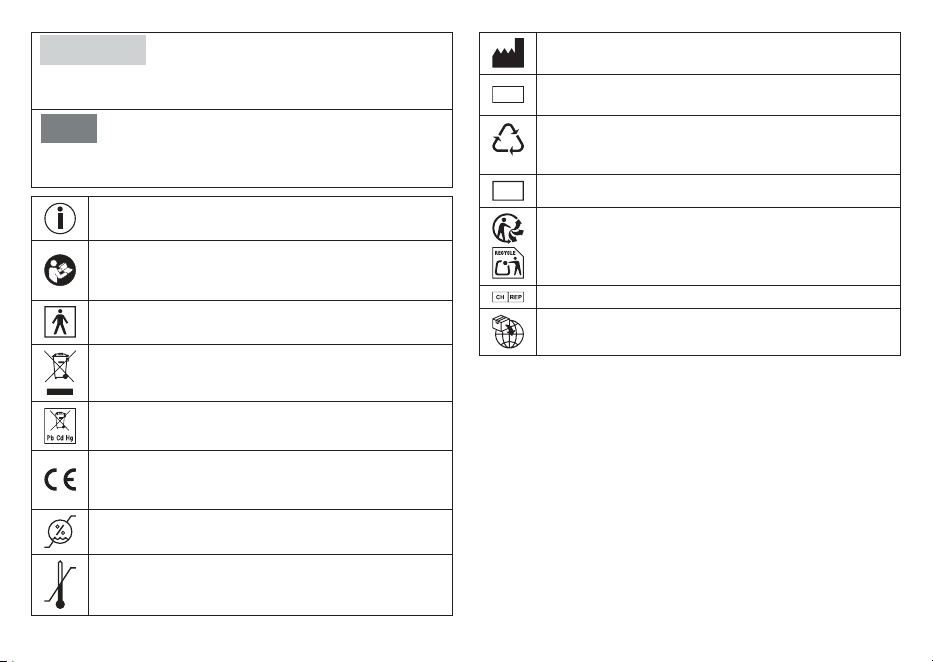
65
DİKKAT
Olası bir tehlikeyi belirtir. Önlenmemesi hafif veya ufak yaralan-
malara yol açabilir.
NOT
Olası bir zararlı durumu belirtir. Önlenmemesi cihazın veya
çevresindekilerin zarar görmesine yol açabilir.
Ürün bilgisi
Önemli bilgilere yönelik uyarı
Kılavuzu dikkate alın
Çalışmaya ve/veya cihaz ya da makineleri kullanmaya
başlamadan önce kılavuzu okuyun
BF tipi uygulama parçaları
(Elektrikli) cihazlar, evsel atıklar ile birlikte bertaraf
edilemez
Zararlı madde içeren pilleri evsel atıklarla birlikte bertaraf
etmeyin
CE işareti
Bu ürün gerekli Avrupa direktiflerinin ve ulusal direktifle-
rin gerekliliklerini karşılar.
Nem sınırlaması
Sıcaklık sınırı
Üretici
IP22
Cihaz ≥12,5 mm yabancı cisimlere ve eğri inen damlama
suyuna karşı korumalıdır
B
A
Ambalaj malzemesinin tanımlanması için kullanılan
işaret. A = malzeme kısaltması, B = malzeme numarası:
1-7 = plastikler, 20 -22 = kâğıt ve karton
S
N
Seri numarası
Ürünü ve ambalaj bileşenlerini ayırın ve belediyenin
kurallarına uygun olarak bertaraf edin.
İsviçre yetkili temsilcisi
İthalatçı simgesi
3. AMACINA UYGUN KULLANIM
Kulak termometresi kulaktan vücut sıcaklığını ölçmek için öngörül-
müştür. Kulak termometresini vücudun başka yerlerinde ölçüm yap-
mak için kullanmayın!
Kulak termometresiyle ayrıca oda veya nesne sıcaklıkları da ölçe-
bilirsiniz.
Kulak termometresi, kulakta kesin, güvenli ve hızlı sıcaklık ölçümleri
için özenli bir şekilde geliştirilmiştir. Çocukların ve yetişkinlerin işitme
kanalında vücut sıcaklığını tespit etmek için kullanılan, kızılötesi de-
dektörlü ve invazif olmayan bir kulak termometresidir.
Cihazı sadece geliştirilme amacına uygun ve bu kullanım kılavuzun-
da belirtilen şekilde kullanın. Amacına uygun olmayan her türlü kul-

66
lanım tehlikeli olabilir! Amacına uygun olmayan ve yanlış kullanımdan
ötürü oluşacak hasarlardan üretici firma sorumlu değildir.
Bu cihaz, 93/42/EEC sayılı AB tıbbi cihazlar direktifine, tıbbi ürün-
ler kanununa, ASTM E 1965 - 98 standardına, EN 12470-5: Tıbbi
termometreler – Bölüm 5: Kızılötesi kulak içi termometreler (ölçülen
maksimum değeri gösteren) Avrupa standardına ve EN60601-1-2
(CISPR11, IEC61000-4-2, IEC61000-4-3, IEC61000-4-8 uygun-
luğu) Avrupa standardına uygundur ve elektromanyetik uyumluluk
bakımından özel önlemlere tabidir.
Taşınabilir veya mobil HF iletişim sistemlerinin bu cihazı etkileyebi-
leceğini dikkate alın.
4. YÖNERGELER
Güvenlik bilgileri
UYARI
• Kulakta yapılan ölçümlerde kulak termometresinin sensör ucunu
dikkatli bir şekilde kulağa sokun.
• Kulak termometresinin farklı kişilerde kullanılması belirli akut, bu-
laşıcı hastalıklarda temizlik ve dezenfeksiyona rağmen olası bak-
teriyel enfeksiyon açısından uygun olmayabilir. Özel durumlarda
doktorunuza başvurun.
• Kulaktan ölçülen vücut sıcaklığı, ağız, rektum veya koltuk altın-
da yapılan diğer ölçümlerden farklılık gösterebilir. Bu nedenle
bu değerleri karşılaştırmak mantıklı değildir. Normal kulak sıca-
klığını tespit etmek için sıcaklığı düzenli olarak ölçün ve ardın-
dan bu ölçümleri, ateş olduğundan şüphelendiğiniz ölçümler için
karşılaştırma temeli olarak kullanın.
• Bu kulak termometresi, kulak sıcaklığı ölçümleri için öngörül-
müştür. Bu kulak termometresini vücudun başka yerlerinde
ölçüm yapmak için kullanmayın.
• Kesin bir ölçüm sonucu almak ve çapraz kirlenmeyi önlemek için
koruma kapağını her kullanımdan sonra değiştirin.
• Kulak termometresi sadece Beurer tarafından sağlanan koruyu-
cu kapaklarla kullanılabilir; başka koruyucu kapaklar, ölçüm ha-
talarına neden olabilir. Elinizde koruyucu kapak kalmadığında,
yedek koruyucu kapaklar almak için üreticiye veya yetkili satıcıya
başvurun.
• Sağlık durumunuzun kötü olduğunu düşünüyorsanız, bir doktora
başvurun.
Pillerin kullanımıyla ilgili bilgiler
UYARI
• Patlama tehlikesi! Yangın tehlikesi! Aşağıdaki maddelerin
dikkate alınmaması fiziksel yaralanmalara, pilde aşırı ısınmaya,
sızıntıya, hava çıkışına, kırılmaya, patlamaya veya yangına neden
olabilir.
• Bu cihaz, yeniden şarj edilmesi mümkün olmayan şarj edilemez
piller içerir.
• Pilleri ateşe atmayın.
• Pilleri asla şarj etmeyin, zorla deşarj etmeyin, ısıtmayın, parçaları-
na ayırmayın, açmayın, parçalamayın, deforme etmeyin, kapsül-
lemeyin veya modifiye etmeyin.
• Pilleri ve pil bölmesi kontaklarını asla kısa devre yaptırmayın.
• Pilleri doğrudan güneş ışığından, yağmurdan, ısıdan ve sudan
koruyun.
• Pillerin aşırı yüksek sıcaklıklara veya aşırı düşük hava basıncına
maruz kalması pillerin patlamasına veya pillerden yanıcı sıvıların
ve gazların sızmasına neden olabilir.
• Arızalanan veya boşalan pilleri derhal ve usulüne uygun şekilde
bertaraf edin (bkz. Bertaraf etme bölümü).
• Değiştirilmiş veya hasar görmüş pilleri kullanmayın.

67
• Her zaman doğru pil tipini seçin.
• Pilleri her zaman kutup yönlerine (+ / -) dikkat ederek doğru şe-
kilde yerleştirin.
• Bir cihaz içerisinde asla farklı üreticilere ait olan, farklı kapasi-
telerde (yeni ve kullanılmış), boyutlarda ve tiplerde pilleri birlikte
kullanmayın.
• Bir pil aktığında koruyucu eldiven giyin ve pil bölmesini kuru bir
bezle temizleyin.
• Pildeki sıvının cilde veya gözlere temas etmesi halinde, etkilenen
bölgeyi suyla yıkayın ve bir doktora başvurun.
• Yutma tehlikesi! Pilleri çocukların erişemeyeceği bir yerde mu-
hafaza edin. Yutulması durumunda derhal tıbbi yardım alın. Pille-
rin yutulması kimyasal yanıklara, ciddi iç yaralanmalara ve ölüme
neden olabilir.
• Çocukların bir yetişkinin gözetiminde değilken pilleri değiştirme-
lerine asla izin vermeyin.
DIKKAT
• Pilleri iyi havalandırılmış, kuru ve serin odalarda, birbirleriyle veya
diğer metal nesnelerle kısa devre yapamayacakları iletken ol-
mayan bir kap içerisinde muhafaza edin.
• Pilleri temiz ve kuru tutun.
• Pilleri sudan uzak tutun.
• Cihazı uzun süre kullanmayacağınız durumlarda pilleri pil bölme-
sinden çıkarın.
NOT
• Şarj edilebilir piller kullanmayın.
Cihaza yönelik tehlikeler
DIKKAT
• Cihazı herhangi bir mekanik darbeye maruz bırakmayın.
• Cihazı doğrudan güneş ışığına maruz bırakmayın.
• Cihazı herhangi bir sıvıya maruz bırakmayın. Cihaz su geçirmez
değildir. Su veya her türlü sıvıyla doğrudan temas ettirmekten
kaçının.
• Cihazın yalnızca yetkili servisler tarafından onarılmasını sağlayın,
aksi takdirde garanti hakkınız ortadan kalkar.
• Taşınabilir veya mobil HF iletişim sistemleri bu cihazı etkileyebilir.
ELEKTROMANYETIK UYUMLULUK HAK-
KINDA BILGILER
• Cihaz, konutlar dahil olmak üzere bu kullanım kılavuzunda belir-
tilen tüm ortamlarda çalıştırılabilir.
• Elektromanyetik parazit mevcudiyeti olduğunda cihazın fonk-
siyonlarının duruma bağlı olarak kısıtlanma ihtimali vardır. Bunun
sonucunda örneğin hata mesajları görülmesi veya ekranın/cihazı
devre dışı kalması mümkündür.
• Bu cihaz başka cihazların hemen yanında veya başka cihazlar
ile üst üste koyularak kullanılmamalıdır, aksi halde cihazın hatalı
çalışması söz konusu olabilir. Bahsedilen şekilde bir kullanım ke-
sinlikle kaçınılmazsa, gerektiği gibi çalıştıklarından emin olmak
için bu cihaz ve diğer cihazlar gözlemlenmelidir.
• Bu cihazın üreticisinin belirttiği veya sağladığı aksesuarlar ha-
ricindeki aksesuarların kullanılması, elektromanyetik parazit
emisyonlarının artmasına veya cihazın elektromanyetik uyumlu-
luğunun azalmasına neden olabilir ve cihazın hatalı çalışmasına
yol açabilir.
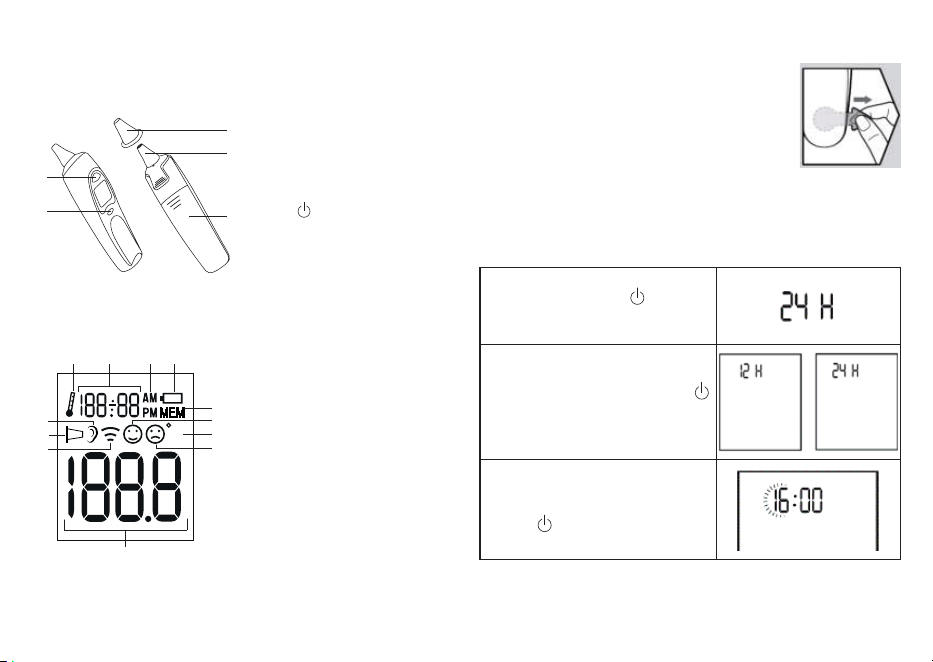
68
• Bunun dikkate alınmaması cihaz performansının olumsuz etki-
lenmesine neden olabilir.
5. CIHAZ AÇIKLAMASI
1
2
3
4
5
1. Koruyucu kapak
2. Ölçüm sensörü
3. START düğmesi
4.
Açma/Kapama düğme-
si
5. Pil bölmesi
Display LCD
E
1
5
7
6
8
9
10
11
12
2 3 4
1. Oda sıcaklığı modu
2. Oda sıcaklığı / saat / tarih gös-
tergesi
3. AM/PM göstergesi (saat)
4. Pil simgesi
5. Hafıza modu
6. Ateş yok simgesi
7. Sıcaklık birimi (°C veya °F)
8. Ateş simgesi
9. Sıcaklık göstergesi
10. Nesne sıcaklığı modu
11. Koruma kapağı simgesi
12. Vücut sıcaklığı modu
6. ÇALIŞTIRMA
Piller yeni cihaza önceden yerleştirilmiştir. İlk kul-
lanımdan önce, ucu dışarıda olan pil koruma şeri-
dini pil bölmesinden çekip çıkarın. Kulak termome-
tresi bunun ardından otomatik olarak açılır.
7. AYARLAR
7.1 Saat / tarih ayarı
Ölçümlere başlamadan önce güncel saati ve tarihi ayarlamanızı
öneririz. Bu sayede kaydedilen ölçümleri daha sonra kolayca sınıf-
landırabilirsiniz.
1.
Cihaz kapalı haldeyken Açma/
Kapama düğmesini üç saniye
basılı tutun. Ekranda “24 H” gö-
rüntülenir.
2. Şimdi START düğmesiyle bir sa-
at biçimini (12 veya 24 saat) seçin
ve Açma/Kapama düğmesiyle
onaylayın.
3. Ekranda saat göstergesi gösteri-
lir. START düğmesiyle güncel saati
seçin ve Açma/Kapama düğme-
siyle onaylayın.
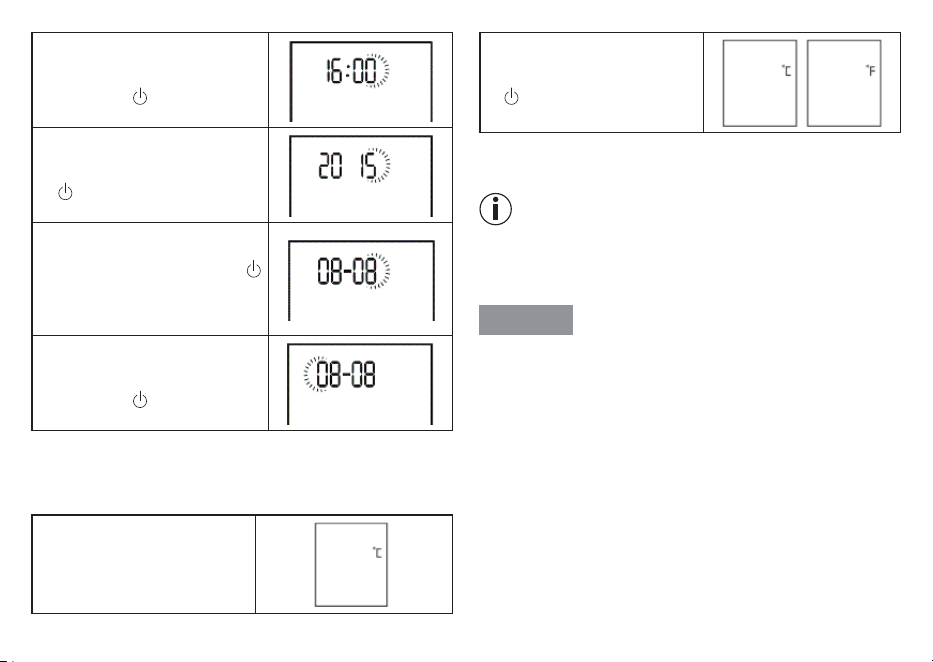
69
4.
Ekranda dakika göstergesi gös-
terilir. START düğmesiyle güncel
dakikayı seçin ve Açma/Kapama
düğmesiyle onaylayın.
5.
Ekranda yıl göstergesi gösterilir.
START düğmesiyle güncel yılı se-
çin ve Açma/Kapama düğmesiyle
onaylayın.
6.
Ekranda ay göstergesi yanıp söner.
START düğmesiyle güncel ayı seçin
ve Açma/Kapama
düğmesiyle
onaylayın. Cihaz bunun ardından
otomatik olarak kapanır. Tarih ve
saat ayarlanmıştır.
7.
Ekranda gün göstergesi yanıp
söner. START düğmesiyle gün-
cel günü seçin ve Açma/Kapama
düğmesiyle onaylayın.
7.2 Sıcaklık birimini seçme (°C veya °F)
Sıcaklık sonucunuzu derece Santigrat (°C) ya da derece Fahrenheit
(°F) sıcaklık birimi cinsinden görüntüleyebilirsiniz.
1.
Cihaz kapalı haldeyken START
düğmesini üç saniye basılı tutun.
Ekranda “°C” görüntülenir.
2.
Şimdi START düğmesiyle bir sı-
caklık birimi (°C veya °F) seçin
ve Açma/Kapama düğmesiyle
onaylayın.
8. ÖLÇME
Her kullanımdan önce merceğin hasar görüp görmediğini
kontrol edin. Hasar görmüşse satıcınıza veya servis adresine
başvurun. Kulak termometresinin ölçüm yapılacak olan odada
en az 30 dakika bulunması gerektiğini dikkate alın.
8.1 Vücut sıcaklığının ölçülmesi
UYARI
• Sağ ve sol kulaklarında farklı ölçüm değerleri olan insanlar vardır.
Sıcaklık değişikliklerini belirlemek için aynı kişide her zaman aynı
kulakta ölçüm yapın.
• Kulak termometresi çocuklar tarafından yalnızca yetişkinlerin gö-
zetiminde kullanılabilir. Normalde 6 ayını doldurduktan sonra ço-
cuklarda ölçüm yapılabilir. 6 aydan küçük olan bebeklerde kulak
girişi çok dardır ve bu nedenle kulak zarının sıcaklığı çoğu zaman
ölçülemez ve çok düşük ölçüm sonuçları gösterilir.
• Ölçüm, iltihaplanmış bir kulakta (örn. irin akması, salgı), olası ku-
lak yaralanmalarından sonra (örn. kulak zarının hasar görmesi)
veya ameliyatlardan sonra iyileşme dönemlerinde uygulanma-
malıdır. Bu durumlarda lütfen doktorunuza başvurun.
• Kulak termometresinin farklı kişilerde kullanılması belirli akut, bu-
laşıcı hastalıklarda temizlik ve dezenfeksiyona rağmen olası bak-
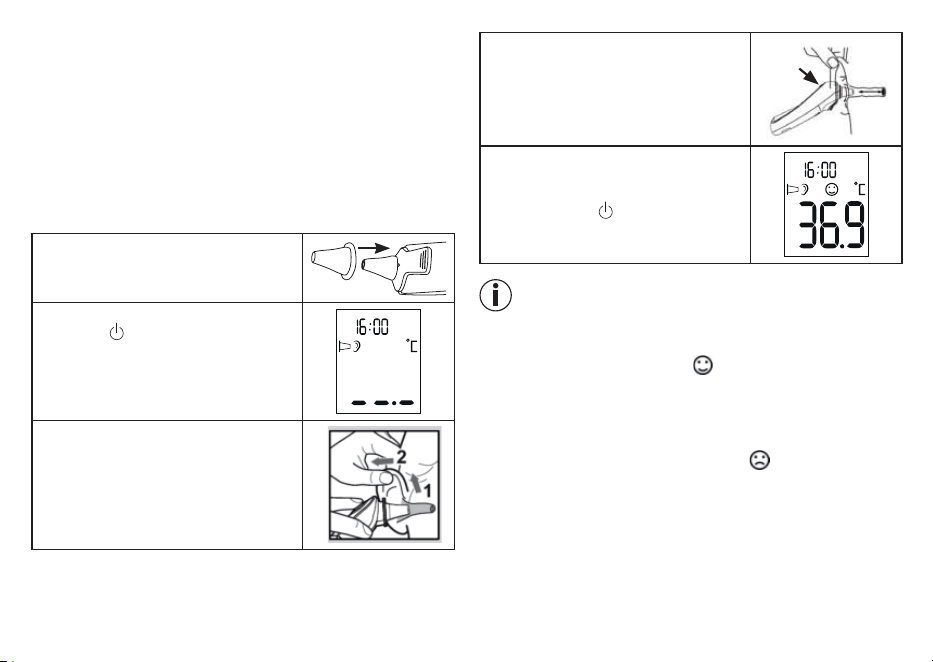
70
teriyel enfeksiyon açısından uygun olmayabilir. Özel durumlarda
doktorunuza başvurun.
• Bu kulak termometresi, sadece koruyucu kapak takılıyken kul-
lanılabilir.
• Aşağıdaki durumlar kulaktaki sıcaklığı etkileyebilir: Uzun bir süre
bir kulağınız üzerinde yattığınızda, kulaklarınızın üzeri örtülü ol-
duğunda, kulaklarınız aşırı sıcağa ya da soğuğa maruz kaldığında
veya yüzdükten ya da banyo yaptıktan sonra. Bu durumlardan
biri geçerliyse, ölçüm yapmadan önce 20dakika bekleyin.
• Kulak kirleri ölçümü etkileyebilir, bu nedenle ölçümden önce ge-
rekirse kulağı temizleyin.
1.
Kulak termometresinin sensör ucuna te-
miz bir koruyucu kapak yerleştirin.
2.
Kulak termometresini açmak için Açma/
Kapama düğmesine basın. Üç sinyal
sesi duyulur ve ekran açılır.
3.
Kulak kanalı hafif bükülü olduğundan,
sensör ucunu sokmadan önce kulağı ha-
fifçe arkaya ve yukarı doğru çekmelisiniz,
böylece koruyucu kapağın ucu doğru-
dan kulak zarına doğrultulabilir.
4.
Koruyucu kapak takılı sensör ucunu
dikkatlice kulak kanalı içine yerleştirin
ve ölçme işlemini başlatmak için START
düğmesine basın.
5.
Yakl. bir saniye sonra bir sinyal sesi
duyulur ve ölçüm sonucu ekranda belir-
ir. Kulak termometresini kapatmak için
Açma/Kapama düğmesine basın.
Ölçümden sonra bir dakika boyunca herhangi bir düğmeye bas-
mazsanız, kulak termometresi otomatik olarak kapanır.
Ateş göstergesi
Ölçülen sıcaklık 38 °C (100,4 °F) değerinden küçükse ekranda
bir gülümseyen yüz simgesi gösterilir ve kısa bir sinyal sesi
duyulur.
Ölçülen sıcaklık 37,5 ile 37,9 °C arasındaysa ek olarak iki kısa
sinyal sesi daha duyulur (“hafif ateş” durumuna işaret eder).
Ölçülen sıcaklık 38 °C (100,4 °F) değerinde veya bundan bü-
yükse ekranda bir üzgün yüz simgesi
gösterilir ve bir uzun,
üç kısa sinyal sesi duyulur.
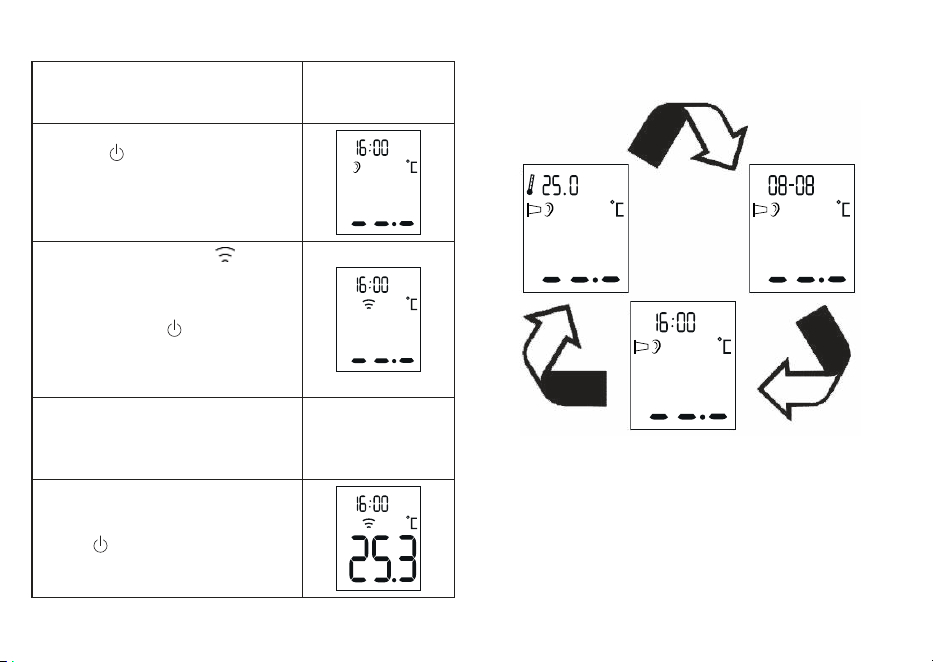
71
8.2 Nesne sıcaklığı ölçme
1.
Kulak termometresinin sensör ucundaki
koruyucu kapağı (eğer takılıysa) çıkarın.
2.
Kulak termometresini açmak için Açma/
Kapama düğmesine basın. Üç sinyal
sesi duyulur ve ekran açılır.
3.
Nesne sıcaklığı modunda ( ) olduğun-
uzdan emin olun.
Vücut sıcaklığı ve nesne sıcaklığı mod-
ları arasında geçiş yapmak için Açma/
Kapama düğmesini
ve aynı zamanda
START düğmesini kısa bir süre basılı
tutun.
4.
Kulak termometresinin sensör ucunu is-
tenen ölçüm noktasının 1 ila 2 cm önün-
de tutun ve START düğmesine basın.
5. Bir saniye sonra bir sinyal sesi duyulur
ve ölçüm sonucu ekranda belirir. Kulak
termometresini kapatmak için Açma/Ka-
pama düğmesine kısaca basın.
8.3 Oda sıcaklığını gösterme
Kulak termometresini açtığınızda ekranda oda sıcaklığı, tarih ve saat
3 saniye dönüşümlü olarak gösterilir.
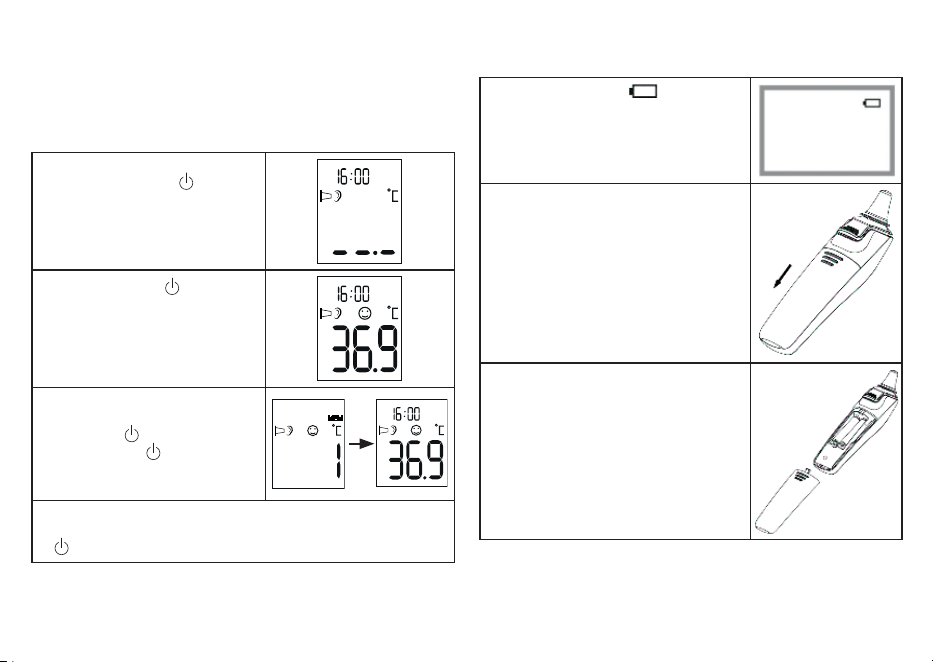
72
8.4 Kaydedilen ölçüm değerlerinin görüntülen-
mesi
Kulak termometresi vücut ve nesne sıcaklığı olmak üzere, son 10
ölçüme ait sıcaklık ölçüm değerlerini (tarih ve saat ile birlikte) oto-
matik olarak kaydeder. Kaydedilen ölçüm değerlerini görmek için
aşağıdakileri yapın:
1.
Kulak termometresini açmak
için Açma/Kapama düğmesi-
ne basın.
2.
Açma/Kapama düğmesini
3saniye basılı tutun. Ekranda bir
M simgesi ve en son kaydedilmiş
olan ölçüm değeri gösterilir.
3.
Kayıtlı ölçüm değerleri arasın-
da gezinmek için Açma/Kapama
düğmesine basın. Açma/Kapa-
ma düğmesine her bastığınızda
önce kayıt yeri numarası ve ardın-
dan ölçüm değeri gösterilir.
4.
Ölçüme devam etmek istiyorsanız START düğmesine basın. Kulak
termometresini kapatmak istediğinizde Açma/Kapama düğmesini
3 saniye basılı tutun.
9. PIL DEĞIŞIMI
Pili değiştirmeden önce cihazın kapalı olduğundan emin olun.
1.
Ekranda pil simgesi ( ) gösterildiğin-
de pilleri değiştirin.
2. Kapağı kaydırarak pil bölmesini açın ve
tükenmiş pilleri pil bölmesinden çıkarın.
3. İki yeni 1,5 V AAA tipi pil yerleştirin. Pil-
lerin doğru yönde yerleştirilmiş olmasına
dikkat edin. Pil bölmesini kapatın.
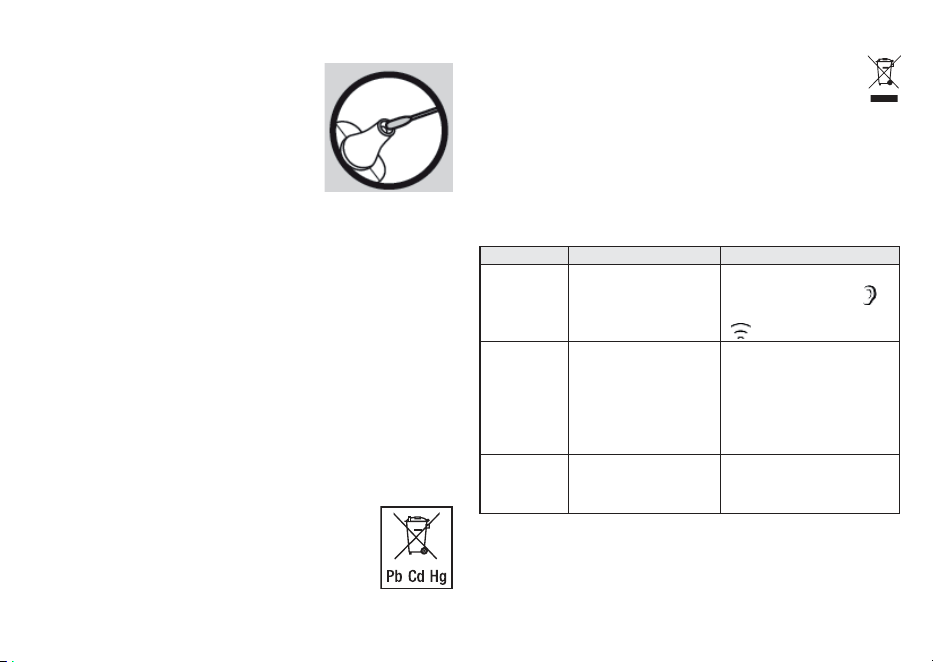
73
10. TEMIZLIK / SAKLAMA
Koruyucu kapaklar yalnızca tek kullanım
içindir.
Sensör ucu kulak termometresinin en has-
sas parçasıdır. Sensör ucunu temizlerken,
hasarları önlemek için çok dikkatli olun.
Bunun için dezenfektan, alkol veya sıcak su
ile nemlendirebileceğiniz yumuşak bir bez
veya pamuklu çubuk kullanın.
Tüm cihazı temizlemek için yumuşak, sa-
bunlu su ile hafif nemlendirilmiş bir bez kullanın.
Aşındırıcı temizlik maddesi kullanmayın.
Termometreyi daha uzun süreliğine kaldıracaksanız, pilleri çıkarın.
Cihaz çok yüksek veya çok düşük sıcaklıklarda veya nemli hava
olan yerlerde (bkz. teknik veriler), güneş ışığında, elektrikli akım ile
bağlantılı olarak veya tozlu yerlerde saklanmamalı ve kullanılma-
malıdır. Aksi takdirde hatalı ölçümler meydana gelebilir.
11. BERTARAF ETME
Pillerin bertaraf edilmesi
• Tamamen boşalmış piller özel olarak sunulan toplama kutularına
atılarak, geri dönüşüm noktalarına veya elektrikli cihaz satıcıları-
na teslim edilerek bertaraf edilmelidir. Pillerin bertaraf edilmesi
yasal olarak sizin sorumluluğunuzdadır.
• Bu işaretler, zararlı madde içeren pillerin üzerinde bulunur:
Pb = Pil kurşun içerir
Cd = Pil kadmiyum içerir
Hg = Pil cıva içerir
Genel bertaraf
Çevreyi korumak için, kullanım ömrü dolan cihaz evsel atıklar-
la beraber bertaraf edilmemelidir. Bertaraf etme işlemi, ülke-
nizdeki uygun atık toplama merkezleri aracılığıyla yapılabilir.
Cihazı elektrikli ve elektronik atık cihazlarla ilgili AT direktifine
(WEEE - Waste Electrical and Electronic Equipment) uygun şekilde
bertaraf edin. Bertaraf işlemiyle ilgili sorularınız olduğunda bölgeniz-
deki yetkili makamlarla iletişime geçin.
12. HATA MESAJLARINDA NE YAPIL-
MALIDIR?
Hata mesajı Neden Çözüm
ER1
Kulak termometresi
henüz ölçmeye hazır
değildir.
Ölçümü ancak ekranda
vücut sıcaklığı modu (
)
veya nesne sıcaklığı modu
( ) gösteriliyorken yapın.
ER2
Ölçülen ortam
sıcaklığı 10 °C – 40 °C
(50 °F – 104 °F) arasın-
da değildir.
Kulak termometresini en
az 30 dakika süresince
10 °C ile 40 °C(50 °F ile
104 °F) arasında olan
bir ortam sıcaklığında
bekletin.
ER3
Kulak termometresi
kulak içine doğru
yerleştirilmemiştir.
“Ölçme” bölümündeki
açıklamaları dikkate alın.
Ölçümü yeniden yapın.
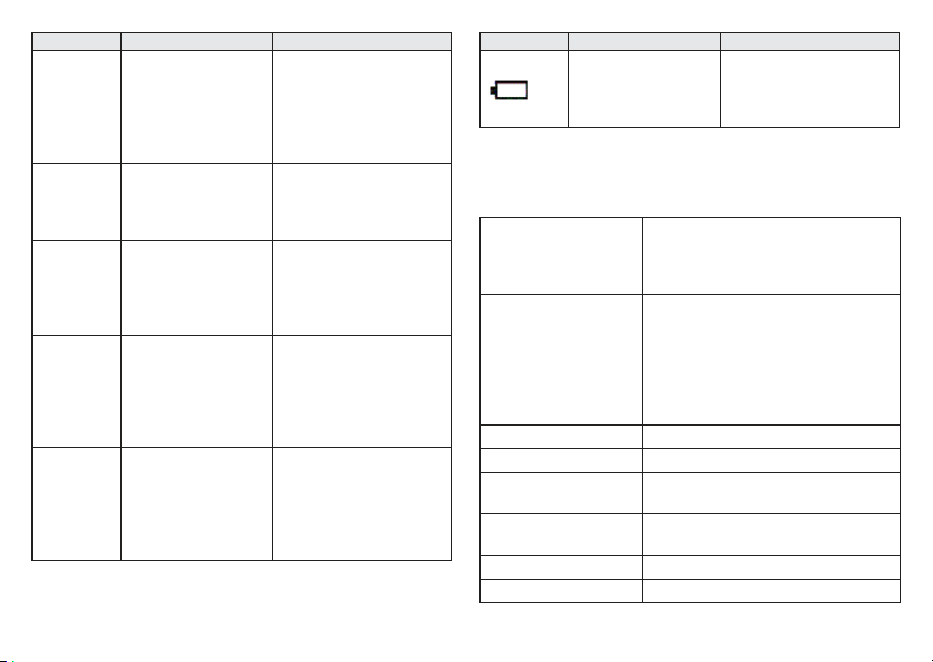
74
Hata mesajı Neden Çözüm
ER4
Kulak termometresi
ortam sıcaklığında
büyük bir değişiklik
tespit etmiştir.
Kulak termometresini en
az 30 dakika süresince
10 °C ile 40 °C(50 °F ile
104 °F) arasında olan
bir ortam sıcaklığında
bekletin.
ER5
Kulak termometresi
sorunsuz çalışmıyor.
Pilleri değiştirin ve yeniden
deneyin. Hata yeniden
ortaya çıkarsa müşteri
hizmetlerine başvurun.
ER6
“Nesne ölçme mo-
dunda” bulunuyor-
sunuz ve koruyucu
kapak hala yerine
takılıdır.
Nesne sıcaklığı ölçümü
yapabilmek için koruyucu
kapağı çıkarmalısınız.
Hi
Kulaktan ölçüm:
Ölçülen sıcaklık 43 °C
(109,4 °F) üzerindedir.
Nesne ölçümü: Ölçü-
len sıcaklık 100 °C
(212 °F) üzerindedir.
Cihazın ve koruyucu ka-
pağın kusursuz durumda
olduğundan emin olun.
Ölçümü yeniden yapın.
Lo
Kulaktan ölçüm:
Ölçülen sıcaklık 28 °C
(82,4 °F) altındadır.
Nesne ölçümü: Ölçü-
len sıcaklık -20 °C
(-4 °F) altındadır.
Cihazın ve koruyucu ka-
pağın kusursuz durumda
olduğundan emin olun.
Ölçümü yeniden yapın.
Hata mesajı Neden Çözüm
Piller bitmiştir. İki boş pili çıkarın ve iki
yeni 1,5V AAA tipi pili
kulak termometresi içine
yerleştirin.
Yaşadığınız sorun burada açıklanmamışsa, müşteri servisimiz ile ir-
tibata geçin.
13. TEKNIK VERILER
Sıcaklık ölçüm aralığı Kulak içinde: 28,0 – 43,0 °C
(82,4 – 109,4 °F)
Nesne sıcaklığı: -20 – 100 °C (-4 – 212 °F)
Oda sıcaklığı: 0 – 50 °C (32 – 122 °F)
Laboratuvar ölçüm
kesinliği
Kulak içinde: 35,5 – 42,0 °C
(95,9 – 107,6 °F) ölme aralığında
± 0 ,2 °C (0,4 °F); ≤35,5 °C (95,5 °F) ve
≥42,0 °C (107,6 °F) ölçme aralığında
± 0,3 °C (0,5 °F)
Nesne sıcaklığı: ± %4 veya ± 2 °C (4 °F)
Oda sıcaklığı: ± 2 °C (± 4 °F)
Klinik tekrarlanabilirlik 0,11 °C (0,2 °F)
Ölçüm süresi yakl. bir saniye
Çalışma sıcaklığı aralığı 10 – 40 °C (50 – 104 °F), hava nemi
%15 – 85 (yoğuşmayan)
Depolama sıcaklığı
aralığı
-25 – 55 °C (-13 – 131 °F), hava nemi
%≤ 95 (yoğuşmayan)
Hafıza 10 adet kayıt yeri
Ekran çözünürlüğü 0,1 °C veya 0,1 °F

75
Pil DC 3V (2 x 1,5V AAA pil)
Ölçüler 155 x 38 x 47 mm
Ağırlık yakl. 63 g (piller hariç)
Koruyucu kapaklar 10
Otomatik kapanma 60 saniye
Pil kullanım süresi Arka arkaya 3.000 ölçüm veya günde
bir ila iki ölçüm artı Bekleme Modu’nda
bir yıl.
Güvenlik sınıflandırması
BF tipi bağlı olan tıbbi cihaz
IP koruma sınıfı IP22
Seri numarası, cihazın üzerinde veya pil bölmesindedir.
14. GARANTI / SERVIS
Garanti ve garanti koşulları ile ilgili ayrıntılı bilgileri cihazla birlikte ver-
ilen garanti broşüründe bulabilirsiniz.
Hata ve değişiklik hakkı saklıdır

76
РУССКИЙ
Внимательно прочтите данную инструкцию, сохраните ее для последующего использования, храните еевместе,
доступном для других пользователей, иследуйте ее указаниям.
1. КОМПЛЕКТ ПОСТАВКИ
Проверьте комплектность поставки и убедитесь, что на кар-
тонной упаковке нет внешних повреждений. Перед использо-
ванием убедитесь, что прибор иего принадлежности неимеют
видимых повреждений, иудалите все упаковочные материалы.
При наличии сомнений не используйте прибор и обратитесь
кпродавцу или всервисную службу поуказанному адресу.
1 термометр для измерения температуры вухе
2батарейки 1,5В типаAAA
10 защитных колпачков
1 инструкция поприменению
Дополнительно покупаемые части
Набор защитных колпачков, который можно приобрести допол-
нительно: 2 x 10 защитных колпачков, № арт. 795.34
2. ПОЯСНЕНИЯ КСИМВОЛАМ
Наприборе, винструкции по применению, наупаковке ифир-
менной табличке прибора используются следующие символы.
1. Комплект поставки ................................................................76
2. Пояснения ксимволам .........................................................76
3. Использование поназначению ............................................ 78
4. Указания .................................................................................78
5. Описание прибора ................................................................80
6. Подготовка кработе .............................................................81
7. Настройки ..............................................................................81
7.1 Настройка времени/даты .............................................81
7.2 Выбор единиц измерения температуры (°Cили °F) ... 82
8. Измерение .............................................................................82
8.1 Измерение температуры тела .....................................82
8.2 Измерение температуры объекта ...............................84
8.3 Индикация температуры помещения .......................... 85
8.4 Отображение сохраненных измеренных значений ...85
9. Замена батареек ...................................................................86
10. Очистка/хранение ...............................................................86
11. Утилизация ...........................................................................86
12. Что делать, если появляются сообщения об ошибках? ..87
13. Технические характеристики ..............................................88
14. Гарантия / сервисное обслуживание ..................................89
СОДЕРЖАНИЕ
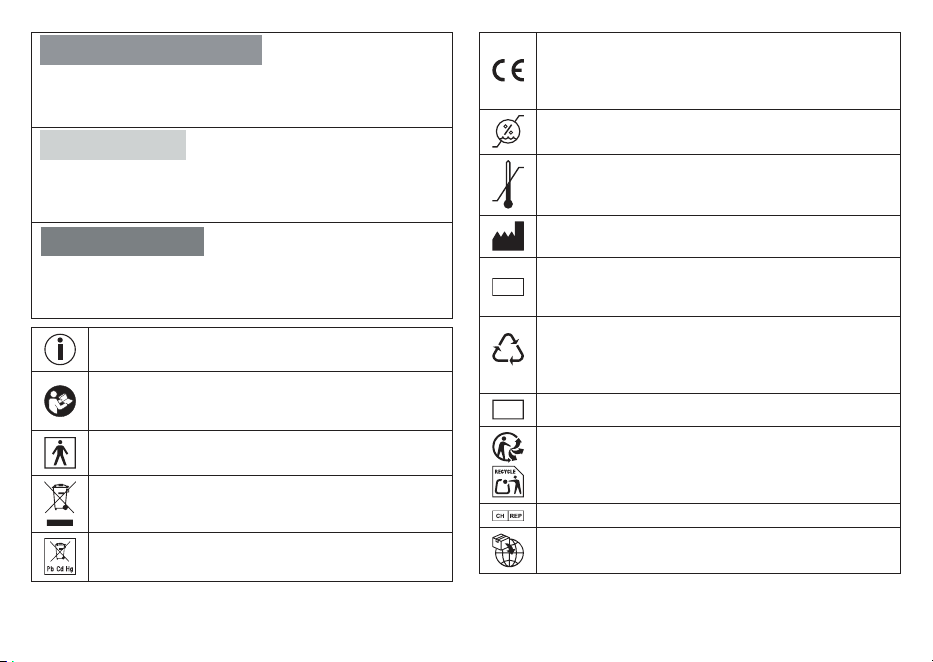
77
ПРЕДУПРЕЖДЕНИЕ
Указывает напотенциальную опасность. Если ее непредот-
вратить, последствиями могут быть смерть или тяжелые
увечья.
ВНИМАНИЕ
Указывает напотенциальную опасность. Если ее непредот-
вратить, последствиями могут быть легкие или незначитель-
ные травмы.
УВЕДОМЛЕНИЕ
Указывает навозможный материальный ущерб. Если его
непредотвратить, возможно повреждение прибора или
окружающих объектов.
Информация об изделии
Обращает внимание на важную информацию
Соблюдайте инструкцию
Перед началом работы и/или использованием
прибора или устройства изучите инструкцию
Рабочие части типаBF
Нельзя утилизировать (электро-)прибор вместе
сбытовым мусором
Не утилизируйте вместе сбытовым мусором
батарейки, содержащие токсичные вещества
Знак СЕ
Это изделие соответствует требованиям
действующих европейских инациональных
директив.
Ограничение давления воздуха
Ограничение температуры
Изготовитель
IP22
Прибор защищен от проникновения твердых тел
размером ≥12,5мм и капель воды, падающих под
углом
B
A
Маркировка для идентификации упаковочного
материала. A= сокращенное обозначение
материала, B= номер материала: 1-7= пластик,
20-22= бумага и картон
S
N
Серийный номер
Снимите упаковку сизделия иутилизируйте ее
всоответствии сместными предписаниями.
Полномочный представитель вШвейцарии
Символ импортера

78
3. ИСПОЛЬЗОВАНИЕ ПОНАЗНАЧЕНИЮ
Данный термометр предназначен для измерения температуры
тела в ухе. Термометр для измерения температуры в ухе не
следует использовать для измерения температуры на других
участках тела!
Дополнительно спомощью термометра для измерения темпе-
ратуры в ухе можно также измерять температуру помещения
иразличных объектов.
Данный термометр был тщательно разработан для точного,
безопасного ибыстрого измерения температуры вухе. Это не-
инвазивный термометр для измерения температуры вухе, име-
ющий инфракрасный детектор для определения температуры
тела вслуховом канале увзрослых идетей.
Используйте прибор только вцелях, для которых он был раз-
работан, и только способом, описанным вданной инструкции
по применению. Любое применение не по назначению может
быть опасным! Изготовитель не несет ответственности за
ущерб, вызванный неквалифицированным или ненадлежащим
использованием прибора.
Закону о медицинских изделиях, директиве ASTM E 1965 - 98,
Европейскому стандарту EN 12470-5: Термометры медицин-
ские. Часть 5. Требования к инфракрасным ушным термо-
метрам (с применением максимального спектра методов) а
также Европейскому стандарту EN 60601-1-2 (в соответствии
с CISPR11, IEC61000-4-2, IEC61000-4-3, IEC61000-4-8) и тре-
бует соблюдения особых мер предосторожности в отношении
электромагнитной совместимости.
Следует учесть, что переносные имобильные высокочастотные
средства связи ителекоммуникации могут оказывать влияние
на работу данного прибора.
4. УКАЗАНИЯ
Указания потехнике безопасности
ПРЕДУПРЕЖДЕНИЕ
• При измерении температуры вухе осторожно вводите на-
конечник датчика термометра для измерения температуры
вухе.
• При определенных острых инфекционных заболеваниях
не следует применять термометр для измерения темпе-
ратуры вухе для нескольких людей, т.к. при этом возмо-
жен перенос инфекции, несмотря на проведение очистки
ивлажной дезинфекции. Вотдельных случаях необходима
консультация лечащего врача.
• Температура тела, измеренная в ухе, может отличаться от
результатов других измерений, например во рту, впрямой
кишке или в подмышечной впадине. Поэтому нет смысла
сравнивать эти значения. Измеряйте температуру регуляр-
но, чтобы определить нормальную температуру вухе, иза-
тем используйте эти значения вкачестве контрольных вели-
чин для измерений, при которых Вы предполагаете наличие
повышенной температуры.
• Данный термометр предусмотрен для измерения темпера-
туры вухе. Данный термометр для измерения температуры
вухе неследует использовать для измерения температуры
надругих участках тела.
• Заменяйте защитный колпачок после каждого применения,
чтобы гарантировать точность измерения иизбежать пере-
дачи инфекции.
• Данный термометр для измерения температуры вухе раз-
решается использовать только с защитными колпачками
Sanitas; использование других защитных колпачков может

79
привести кошибкам визмерении. Если уВас закончились
защитные колпачки, обратитесь поповоду замены кпроиз-
водителю или специализированному дилеру.
• Обязательно обратитесь кврачу, если Вы считаете, что Вы
больны.
Обращение сбатарейками
ПРЕДУПРЕЖДЕНИЕ
• Опасность взрыва! Опасность пожара! Несоблюдение
следующих указаний может привести к травмам или к пе-
регреву, вытеканию, выпуску воздуха, поломке, взрыву или
возгоранию батарейки.
• Данный прибор содержит неперезаряжаемые батарейки.
• Небросайте батарейки вогонь.
• Запрещается заряжать, принудительно разряжать, нагре-
вать, разбирать, вскрывать, разбивать, деформировать,
герметизировать или модифицировать батарейки.
• Не допускайте короткого замыкания батареек иконтактов
батарейного отсека.
• Защищайте батарейки от воздействия прямых солнечных
лучей, дождя, сильного нагрева ипопадания воды.
• Воздействие на батарейки чрезвычайно высокой темпера-
туры или чрезвычайно низкого давления воздуха может вы-
звать взрыв или утечку легковоспламеняющихся жидкостей
игазов.
• Утилизируйте неисправные иразряженные батарейки сво-
евременно инадлежащим образом (см. главу «Утилизация»).
• Неиспользуйте модифицированные или поврежденные ба-
тарейки.
• Всегда выбирайте батарейки подходящего типа.
• Всегда правильно устанавливайте батарейки с учетом по-
лярности (+/–).
• Неиспользуйте внутри прибора батарейки разных произво-
дителей, разной емкости (новые ииспользованные), разного
размера итипа.
• Если батарейка потекла, очистите отсек для батареек сухой
салфеткой, надев защитные перчатки.
• При попадании жидкости избатарейки накожу или вглаза
промойте пораженный участок большим количеством воды
иобратитесь кврачу.
• Опасность проглатывания! Храните батарейки внедоступ-
ном для детей месте. При проглатывании немедленно об-
ратитесь кврачу. Проглатывание может привести кожогам,
серьезным повреждениям внутренних органов илетальному
исходу.
• Не позволяйте детям заменять батарейки без присмотра
взрослых.
ВНИМАНИЕ
• Храните батарейки в хорошо проветриваемом, сухом
и прохладном помещении вконтейнере из непроводящего
материала, чтобы исключить их короткое замыкание друг
сдругом или другими металлическими предметами.
• Содержите батарейки вчистоте исухости.
• Держите батарейки вдали отводы.
• Если прибор длительное время неиспользуется, извлеките
батарейки изотсека для батареек.
УВЕДОМЛЕНИЕ
• Неиспользуйте перезаряжаемые батарейки.
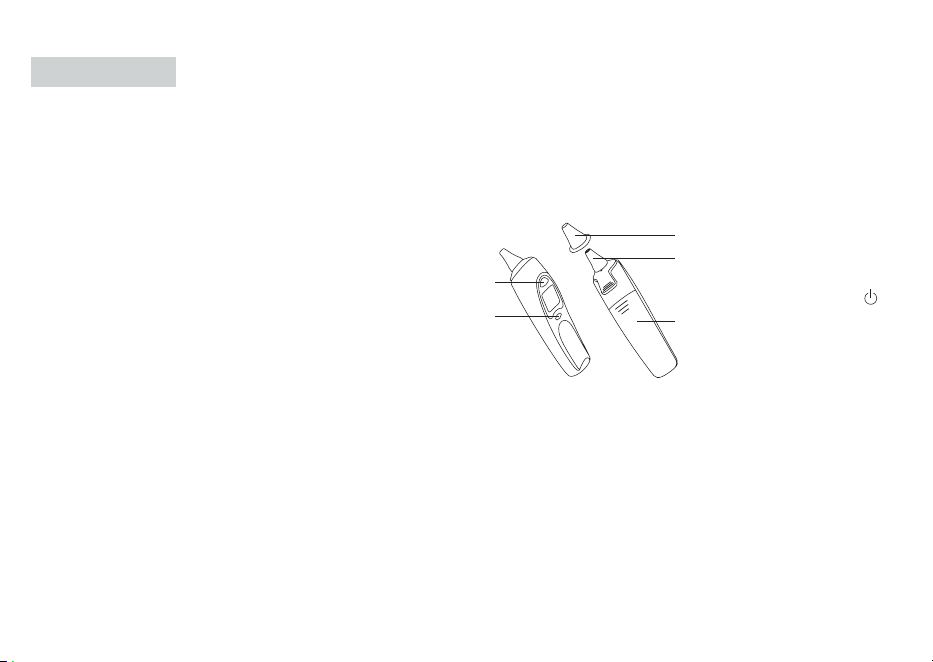
80
Опасности для прибора
ВНИМАНИЕ
• Не подвергайте прибор воздействию механических ударов.
• Не допускайте воздействия на прибор прямых солнечных
лучей.
• Не допускайте контакта прибора сжидкостями. Прибор не
является водонепроницаемым. Избегайте прямого контакта
сводой или другими жидкостями.
• Доверяйте ремонт прибора только авторизованным сервис-
ным центрам, иначе гарантия потеряет силу.
• Переносные и мобильные высокочастотные средства свя-
зи ителекоммуникации могут оказывать влияние наработу
прибора. Более точные данные можно запросить по указан-
ному адресу сервисной службы или найти вконце инструк-
ции по применению.
УКАЗАНИЯ ПО ЭЛЕКТРОМАГНИТНОЙ
СОВМЕСТИМОСТИ
• Прибор предназначен для работы в условиях, перечислен-
ных в настоящей инструкции по применению, в том числе в
домашних условиях.
• При наличии электромагнитных помех возможности исполь-
зования прибора могут быть ограничены. В результате, на-
пример, могут появляться сообщения об ошибках или прои-
зойдет выход из строя дисплея/самого прибора.
• Не используйте данный прибор рядом с другими устрой-
ствами и не устанавливайте его на другие приборы, это мо-
жет вызвать ошибки в работе. Однако, если использование
прибора все-таки необходимо в том виде, как описано выше,
следует наблюдать за ним и другими устройствами, чтобы
убедиться, что они работают надлежащим образом.
• Применение сторонних принадлежностей, отличающихся от
прилагаемого к данному прибору, может привести к росту
электромагнитных помех или ослаблению помехоустойчиво-
сти прибора и тем самым вызвать ошибки в работе.
• Несоблюдение данного указания может отрицательно ска-
заться на характеристиках мощности прибора.
5. ОПИСАНИЕ ПРИБОРА
1
2
3
4
5
1. Защитный колпачок
2. Измерительный датчик
3. Кнопка СТАРТ
4. Кнопка ВКЛ./ВЫКЛ.
5. Отделение для батареек
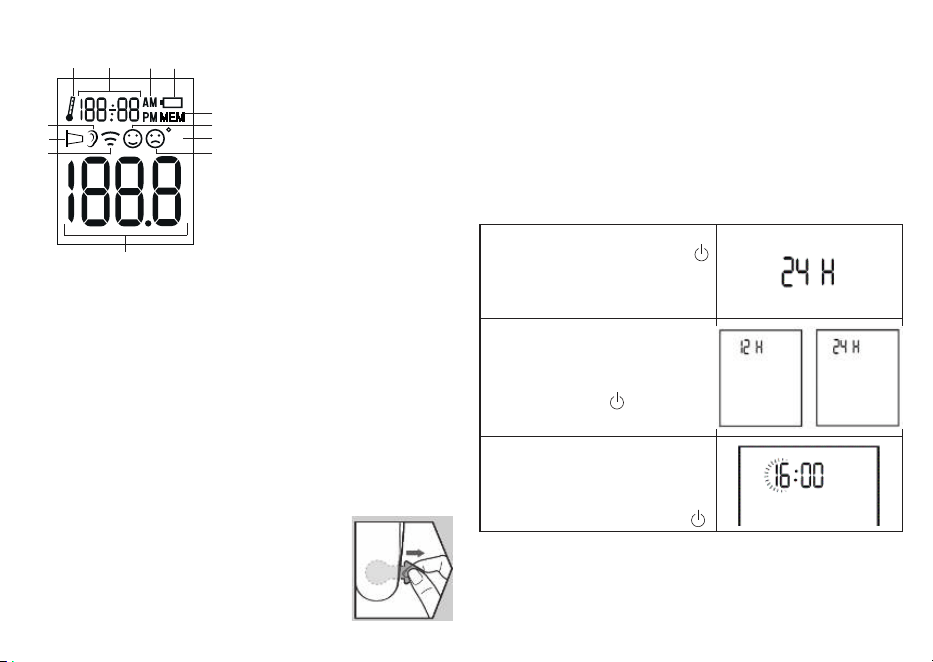
81
ЖК-дисплей
E
1
5
7
6
8
9
10
11
12
2 3 4
1. Режим измерения
температуры впомещении
2. Индикация температуры
впомещении/времени/даты
3. Индикация AM/PM
(дополудня/после полудня,
для времени)
4. Символ батарейки
5. Режим сохранения впамяти
6. Символ нормальной
температуры
7. Единица измерения
температуры (°C или°F)
8. Символ повышенной
температуры
9. Индикация температуры
10. Режим измерения
температуры объекта
11. Символ защитного
колпачка
12. Режим измерения
температуры тела
6. ПОДГОТОВКА КРАБОТЕ
Новый прибор поставляется уже со вставлен-
ными батарейками. Перед первым примене-
нием удалите с батареек защитную пленку,
кончик которой выступает из отделения для
батареек. Термометр для измерения температуры в ухе при
этом автоматически включится.
7. НАСТРОЙКИ
7.1 Настройка времени/даты
Прежде чем Вы приступите к измерениям, рекомендуем Вам
настроить текущее время и дату. Это позволит Вам впослед-
ствии легко определить, когда было выполнено измерение, со-
храненное впамяти.
1. При выключенном приборе на-
жмите кнопку ВКЛ./ВЫКЛ.
иудерживайте ее нажатой вте-
чение трех секунд. На дисплее
появится надпись «24H».
2. Спомощью кнопки СТАРТ вы-
берите формат отображения
времени (12ч или 24ч) ипод-
твердите выбор нажатием кноп-
ки ВКЛ./ВЫКЛ. .
3.
На дисплее появится индика-
ция часов. Спомощью кнопки
СТАРТ настройте показание
часа иподтвердите выбор на
-
жатием кнопки ВКЛ./ВЫКЛ. .
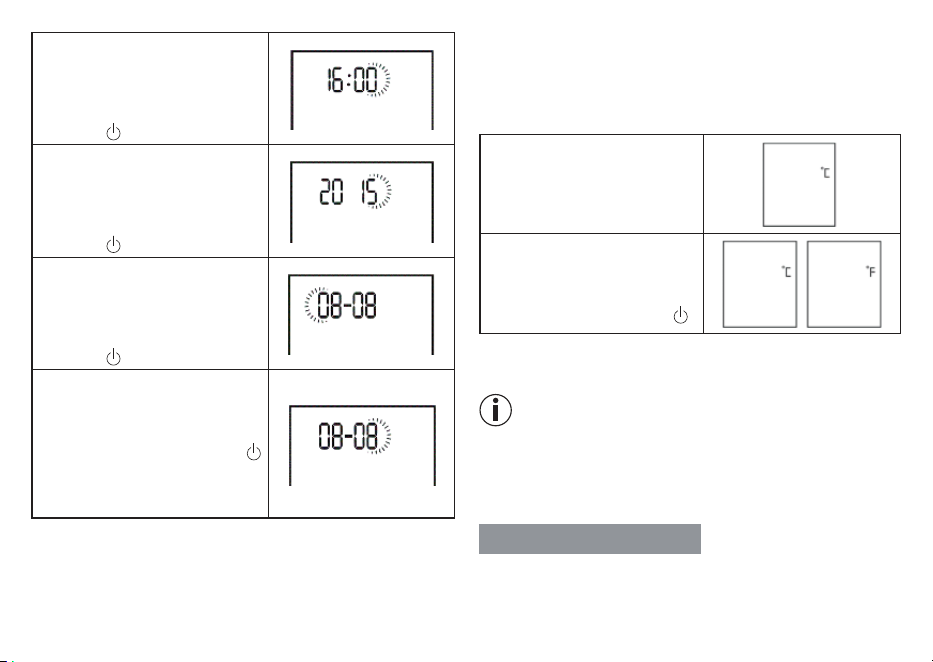
82
4.
На дисплее появится индика-
ция минут. С помощью кноп-
ки СТАРТ настройте показа-
ние минут и подтвердите вы-
бор нажатием кнопки ВКЛ./
ВЫКЛ. .
5.
На дисплее появится инди-
кация года. Спомощью кноп-
ки СТАРТ настройте показа-
ние года и подтвердите вы-
бор нажатием кнопки ВКЛ./
ВЫКЛ. .
6.
На дисплее замигает индика-
ция числа. Спомощью кноп-
ки СТАРТ настройте показа-
ние числа и подтвердите вы-
бор нажатием кнопки ВКЛ./
ВЫКЛ. .
7.
На дисплее замигает индика-
ция месяца. Спомощью кнопки
СТАРТ настройте показание ме-
сяца иподтвердите выбор на-
жатием
кнопки ВКЛ./ВЫКЛ.
. После этого прибор автомати-
чески выключится. Дата ивремя
будут сохранены впамяти.
7.2 Выбор единиц измерения температуры
(°Cили °F)
Вы можете выбрать отображение результатов измерения тем-
пературы в градусах Цельсия (°C) или вградусах Фаренгейта
(°F).
1.
При выключенном прибо-
ре нажмите кнопку СТАРТ
и удерживайте ее нажатой
втечение трех секунд. Надис-
плее появится надпись «°C».
2.
С помощью кнопки СТАРТ
выберите единицу измере-
ния температуры (°Cили °F)
иподтвердите выбор нажа-
тием кнопки ВКЛ./ВЫКЛ. .
8. ИЗМЕРЕНИЕ
Перед каждым применением проверяйте, не повреждена
ли линза. В случае ее повреждения обратитесь в сервис-
ный центр. Учтите, что перед использованием термометр
должен находиться в помещении, в котором выполняется
измерение, как минимум в течение 30 минут.
8.1 Измерение температуры тела
ПРЕДУПРЕЖДЕНИЕ
• Унекоторых людей температура влевом иправом ухе раз-
лична. Для отслеживания изменений температуры уодного
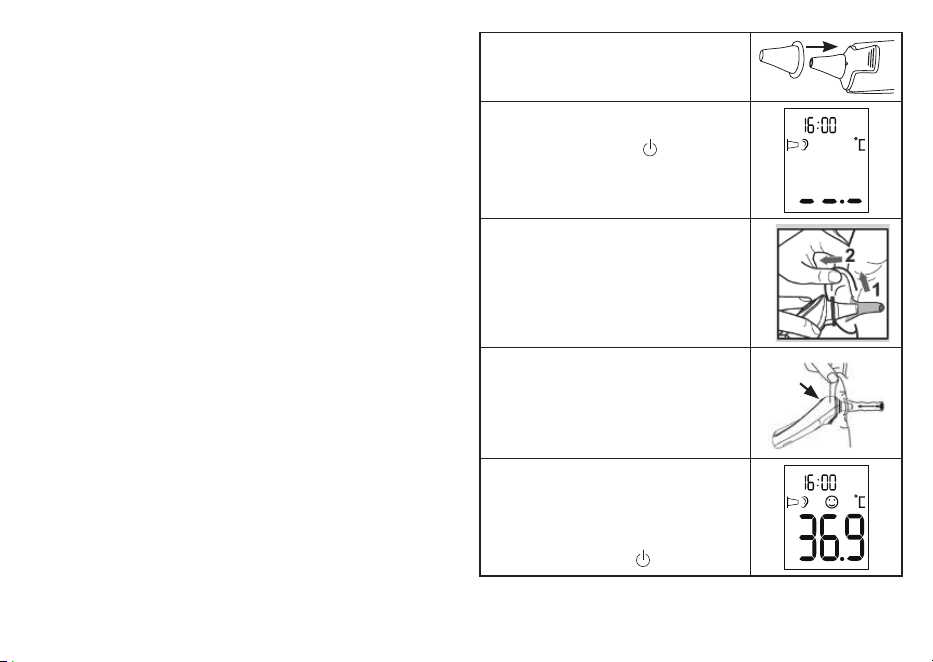
83
человека всегда измеряйте температуру водном итом же
ухе.
• Дети должны применять термометр для измерения темпе-
ратуры вухе только под присмотром взрослых. Как прави-
ло, измерение температуры удетей возможно с6месяцев.
Умладенцев до 6 месяцев слуховой проход еще очень мал,
поэтому часто температуру барабанной перепонки измерить
невозможно, всвязи счем нередко имеют место занижен-
ные результаты измерения.
• Запрещается проводить измерение температуры в ухе
с воспалительными заболеваниями (например, выделение
гноя, секрета), после возможных ушных травм (например,
при повреждении барабанной перепонки) или встадии вы-
здоровления после оперативного вмешательства. Во всех
подобных случаях необходима консультация с лечащим
врачом.
• При определенных острых инфекционных заболеваниях не
следует применять термометр для измерения температуры
вухе для нескольких людей, т.к. при этом возможен перенос
инфекции, несмотря на проведение очистки ивлажной де-
зинфекции. Вотдельных случаях необходима консультация
лечащего врача.
• Данный термометр для измерения температуры вухе раз-
решается использовать только с надетым защитным кол-
пачком.
• На температуру в ухе могут повлиять следующие обстоя-
тельства: если Вы долгое время лежали на одном ухе; если
уши закрыты; если уши не защищены от сильной жары или
холода, или после плавания/купания. Если вВашем случае
имеет место одно из перечисленных обстоятельств, подо-
ждите 20минут, прежде чем производить измерение.
• Ушная сера может повлиять на результаты измерения, по-
этому перед измерением при необходимости очистите ухо.
1.
Наденьте чистый защитный колпа-
чок на наконечник датчика термоме-
тра для измерения температуры вухе.
2.
Для включения термометра для из-
мерения температуры вухе нажмите
кнопку ВКЛ./ВЫКЛ. . После трех
звуковых сигналов включится ди-
сплей.
3.
Поскольку слуховой проход слегка
изогнут, перед введением наконечни-
ка датчика ухо следует слегка потя-
нуть назад ивверх, чтобы кончик за-
щитного колпачка можно было напра-
вить прямо на барабанную перепонку.
4. Осторожно введите наконечник дат-
чика взащитном колпачке вслуховой
проход инажмите кнопку СТАРТ, что-
бы начать измерение.
5.
Примерно через однусекунду раз-
дастся звуковой сигнал, ирезультат
измерения отобразится на дисплее.
Для выключения термометра для из-
мерения температуры вухе нажмите
кнопку ВКЛ./ВЫКЛ. .
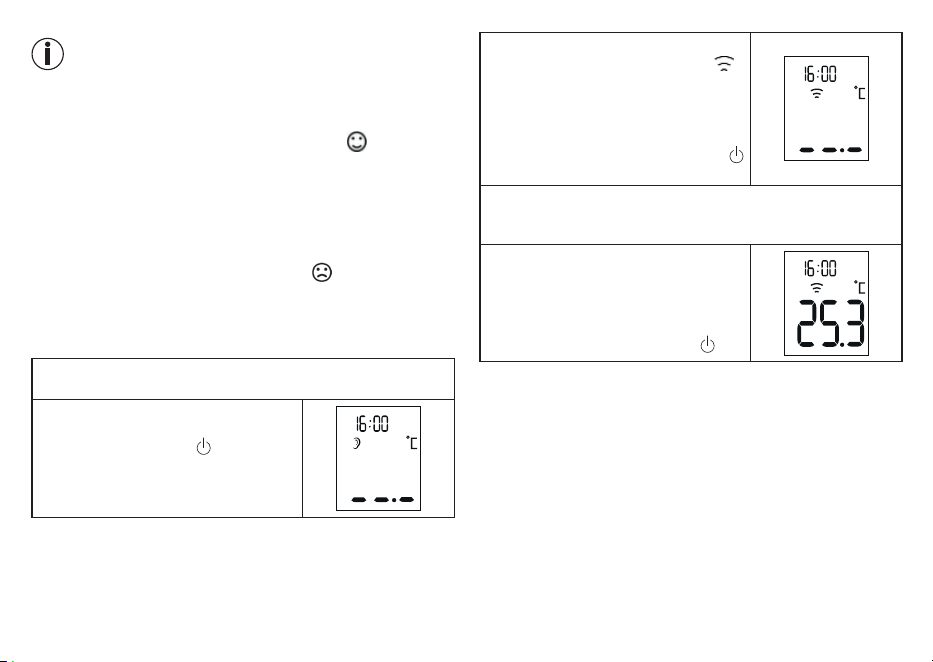
84
Если после измерения в течение минуты не будет нажато
никаких кнопок, термометр для измерения температуры
вухе выключится автоматически.
Индикатор повышенной температуры
Если измеренная температура < 38°C (100,4°F), на дис-
плее появляется улыбающийся смайлик и раздается
короткий звуковой сигнал.
Если измеренная температура находится в диапазоне
от37,5 до 37,9°C, дополнительно раздаются два корот-
ких звуковых сигнала (индикация для «повышенной тем-
пературы»).
Если измеренная температура ≥ 38°C (100,4°F), на дис-
плее появляется грустный смайлик
ираздается один
короткий звуковой сигнал, потом один длинный итри ко-
ротких сигнала.
8.2 Измерение температуры объекта
1.
Снимите защитный колпачок (если он надет) снаконечни-
ка датчика термометра для измерения температуры вухе.
2.
Для включения термометра для из-
мерения температуры вухе нажмите
кнопку ВКЛ./ВЫКЛ. . После трех
звуковых сигналов включится ди-
сплей.
3.
Убедитесь, что включен режим из-
мерения температуры объекта ( ).
Для переключения между режи-
мом измерения температуры тела
и режимом измерения температуры
объекта ненадолго нажмите одно-
временно кнопку ВКЛ./ВЫКЛ.
икнопку СТАРТ.
4. Поднесите наконечник датчика термометра для измерения
температуры вухе кнужному месту измерения на расстоя-
ние 1–2 см инажмите кнопку СТАРТ.
5.
Через однусекунду раздастся зву-
ковой сигнал, ирезультат измере-
ния отобразится на дисплее. Для
выключения термометра для изме-
рения температуры вухе ненадолго
нажмите кнопку ВКЛ./ВЫКЛ. .
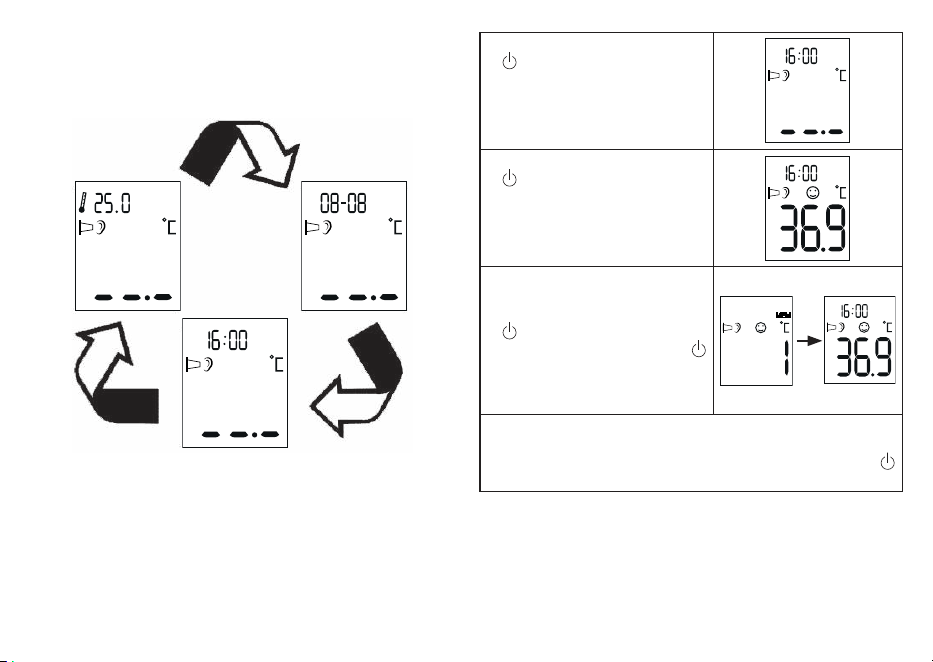
85
8.3 Индикация температуры помещения
При включении термометра для измерения температуры вухе
на дисплее поочередно отображаются температура помеще-
ния, дата ивремя, сменяя друг друга через каждые 3секунды.
8.4 Отображение сохраненных измеренных
значений
Термометр для измерения температуры в ухе автоматически
сохраняет в памяти результаты последних 10 измерений тем-
пературы тела или температуры объектов (сдатой ивременем).
Чтобы просмотреть сохраненные впамяти результаты измере-
ний, выполните следующие действия.
1.
Нажмите кнопку ВКЛ./ВЫКЛ.
, чтобы выключить термо-
метр для измерения темпера-
туры вухе.
2.
Нажмите кнопку ВКЛ./ВЫКЛ.
иудерживайте ее нажатой
втечение 3секунд. На дисплее
появится Mи результат измере-
ния, сохраненный последним.
3.
Для перехода от одного ре-
зультата измерений кдругому
нажимайте кнопку ВКЛ./ВЫКЛ.
. При каждом последующем
нажатии кнопки ВКЛ./ВЫКЛ.
сначала отображается номер
ячейки памяти, азатем очеред-
ной результат измерения.
4.
Если Вы хотите продолжить измерение, нажмите кнопку
СТАРТ. Если Вы хотите выключить термометр для измере-
ния температуры вухе, удерживайте кнопку ВКЛ./ВЫКЛ.
нажатой втечение 3секунд.
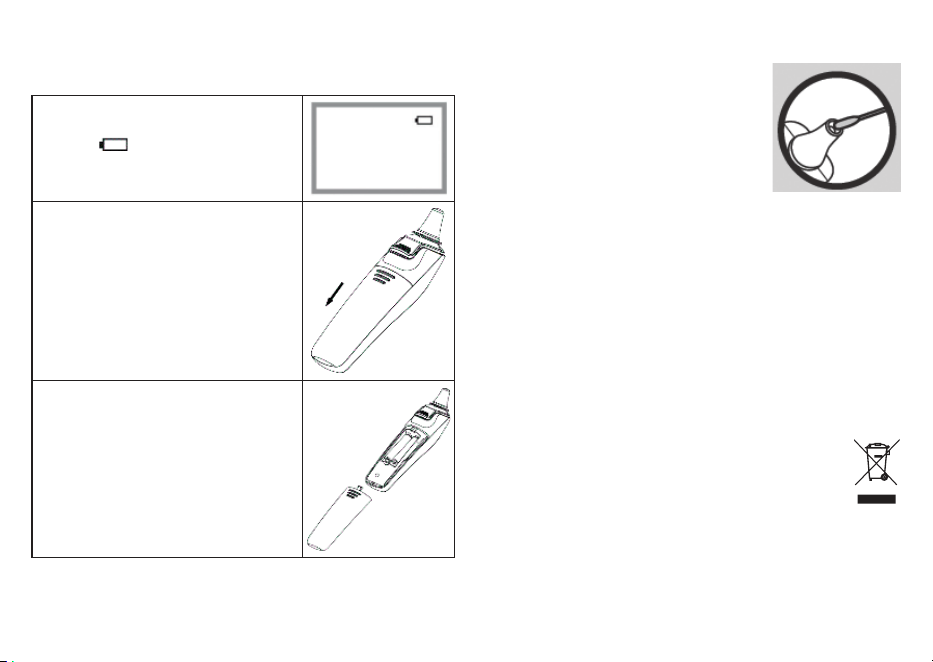
86
9. ЗАМЕНА БАТАРЕЕК
Прежде чем заменять батарейки, убедитесь, что прибор выклю-
чен.
1.
Заменяйте батарейки сразу же после
появления на дисплее символа бата-
рейки ( ).
2.
Выдвиньте крышку отделения для ба-
тареек иизвлеките батарейки.
3.
Вставьте новые батарейки 1,5В ти-
паAAA. Следите за соблюдением по-
лярности батареек. Закройте отделе-
ние для батареек.
10. ОЧИСТКА/ХРАНЕНИЕ
Защитные колпачки предназначены толь-
ко для однократного использования.
Наконечник датчика — это самая чув-
ствительная часть термометра для изме-
рения температуры в ухе. Будьте осто-
рожны при очистке наконечника датчика,
чтобы избежать его повреждения. Ис-
пользуйте для этого мягкую салфетку или
ватную палочку, смоченную дезинфекци-
онным средством, спиртом или теплой водой.
Для очистки всего прибора используйте мягкую салфетку, слег-
ка смоченную мыльным раствором.
Не используйте агрессивные чистящие средства.
Если Вы планируете длительное время не пользоваться прибо-
ром, извлеките из него батарейки. Запрещается хранить прибор
или использовать его при слишком высокой или низкой темпе-
ратуре или влажности воздуха (см. технические характеристи-
ки), на ярком солнечном свете, под током или впыльных местах.
Впротивном случае возможны неточности при измерении.
11. УТИЛИЗАЦИЯ
В целях защиты окружающей среды по окончании
срока службы следует утилизировать прибор отдель-
но отбытового мусора. Утилизация должна произво-
диться через соответствующие пункты сбора встране
использования изделия. Соблюдайте местные зако-
нодательные нормы по утилизации отходов. Прибор следует
утилизировать согласно директиве ЕС по отходам электриче-
ского иэлектронного оборудования — WEEE (Waste Electrical
and Electronic Equipment). При возникновении вопросов обра-
щайтесь вкоммунальную организацию, занимающуюся утили-
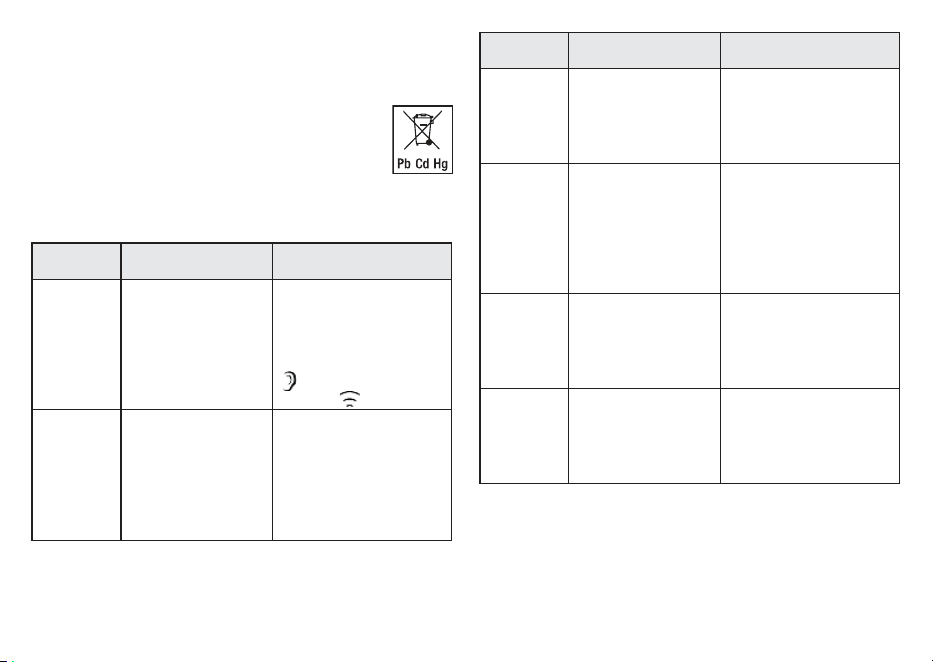
87
зацией. Информацию оприеме отслуживших приборов можно
получить вместной администрации, организации поутилизации
мусора или упродавца.
Указание: эти знаки предупреждают о наличии в батарейках
токсичных веществ:
Pb = батарейка содержит свинец,
Cd = батарейка содержит кадмий,
Hg = батарейка содержит ртуть.
12. ЧТО ДЕЛАТЬ, ЕСЛИ ПОЯВЛЯЮТСЯ
СООБЩЕНИЯ ОБ ОШИБКАХ?
Сообщение
об ошибке
Причина Меры поустранению
ER1
Термометр для
измерения темпе-
ратуры вухе еще
неготов квыполне-
нию измерения.
Приступайте кизмере-
нию только тогда, когда
на дисплее появится
индикация режима изме-
рения температуры тела
(
) или температуры
объекта ( ).
ER2
Измеренная темпе-
ратура окружающей
среды находится
за пределами диа-
пазона 10°C–40°C
(50°F–104°F).
Поместите термометр
для измерения темпера-
туры вухе на30минут
впомещение стемпе-
ратурой окружающей
среды 10°C–40°C
(50°F–104°F).
Сообщение
об ошибке
Причина Меры поустранению
ER3
Термометр для
измерения темпе-
ратуры вухе непра-
вильно размещен
вВашем ухе.
Внимательно следуйте
указаниям вразделе
«Измерение». Выполните
измерение заново.
ER4
Термометр для
измерения тем-
пературы вухе
зарегистрировал
сильное изменение
температуры окру-
жающей среды.
Поместите термометр
для измерения темпера-
туры вухе на30минут
впомещение стемпе-
ратурой окружающей
среды 10°C–40°C
(50°F–104°F).
ER5
Термометр для
измерения темпера-
туры вухе работает
нестабильно.
Замените батарейки
иповторите попытку.
Если ошибка появится
снова, обратитесь всер-
висную службу.
ER6
Термометр работает
врежиме «Измерение
температуры объ-
екта», азащитный
колпачок еще не снят.
Для выполнения изме-
рения температуры объ-
екта необходимо снять
защитный колпачок.

88
Сообщение
об ошибке
Причина Меры поустранению
Hi
Измерение вухе:
измеренное значе-
ние температуры
превышает 43°C
(109,4°F)
Измерение темпе-
ратуры объекта:
измеренное значе-
ние температуры
превышает 100°C
(212°F)
Убедитесь, что прибор
изащитный колпачок
находятся сисправном
состоянии. Выполните
измерение заново.
Lo
Измерение вухе: из-
меренное значение
температуры ниже
34 °C (93,2 °F)
Измерение темпе-
ратуры объекта: Из-
меренное значение
температуры ниже
−20°C (−4°F)
Убедитесь, что прибор
изащитный колпачок
находятся сисправном
состоянии. Выполните
измерение заново.
Батарейки разря-
жены.
Извлеките две разря-
дившиеся батарейки
ивставьте втермо-
метр для измерения
температуры вухе две
новые батарейки 1,5В
типаAAA.
Если Вы не нашли информацию о возникающей проблеме, свя-
житесь с нашей сервисной службой.
13. ТЕХНИЧЕСКИЕ ХАРАКТЕРИСТИКИ
Если способ и условия применения прибора не соответствуют
спецификации, его исправная работа не гарантируется!
Точность данного термометра была тщательно проверена; при-
бор разработан с расчетом на длительный срок эксплуатации.
При использовании прибора для терапии необходимость про-
ведения метрологических проверок с помощью подходящих
средств определяется соответствующими действующими
наци ональными предписаниями. Оставляем за собой право на
тех нические изменения в связи с модернизацией и усовершен-
ствованием изделия.
Диапазон измерения
температуры
Вухе: 28,0–43,0°C (82,4–109,4°F)
Температура объекта:
о
т
−
20 до 100
°C (о
т
−
4 до 212
°F)
Температура помещения: 0–50°C
(32–122°F)
Лабораторная
точность измерений
Вухе: ± 0,2°C (0,4°F) вдиапазоне
измерений 35,5–42,0°C (95,9–107,6°F);
± 0,3°C (0,5°F) вдиапазоне измерений
≤35,5°C (95,5°F) и≥42,0°C (1
07,6°F)
Т
емпература объекта: ± 4%, или ± 2°C
(4°F)
Т
емпература помещения: ± 2°C (± 4°F)
Клиническая
повторяемость
показаний
0,11°C (0,2°F)
Продолжительность
измерения
Прибл. одна секунда

89
Возможны ошибки и изменения
Рабочий диапазон
температур
10–40°C (50–104°F), влажность
воздуха 15–85% (без образования
конденсата)
Диапазон
температур для
хранения
От –25 до 55°C (от –13 до 131°F),
влажность воздуха ≤95% (без
образования конденсата)
Память 10ячеек памяти
Шаг отображения
температуры
0,1°C или 0,1°F
Батарейка Пост. ток 3В (2 батарейки 1,5В
типаААА)
Размеры 155x38x47мм
Вес Около 63г (без батареек)
Защитные колпачки 10
Автоматическое
отключение
60секунд
Ресурс батареек 3000 измерений подряд либо один
год при частоте измерений 1–2 вдень,
включая режим ожидания.
Класс безопасности
Подключенный медицинский
прибор, рабочая часть типаBF
Степень защиты IP22
Серийный номер находится на приборе или в отделении для
батареек.
14. ГАРАНТИЯ / СЕРВИСНОЕ ОБСЛУЖИ-
ВАНИЕ
Более подробную информацию огарантии игарантийных усло-
виях см.вприлагаемом гарантийном листе.
90
POLSKI
Należy dokładnie przeczytać i zachować niniejszą instrukcję obsługi, przechowywać ją w miejscu dostępnym dla innych
użytkowników i przestrzegać podanych w niej wskazówek.
1. ZAWARTOŚĆ OPAKOWANIA
Zestaw należy sprawdzić pod kątem zewnętrznych uszkodzeń kar-
tonowego opakowania oraz kompletności zawartości. Przed uży-
ciem upewnić się, że na urządzeniu ani na akcesoriach nie widać
żadnych uszkodzeń, a wszystkie części opakowania zostały usunię-
te. W razie wątpliwości zaprzestać używania urządzenia i zwrócić się
do sprzedawcy lub pod podany adres działu obsługi klienta.
1 termometr douszny
2 baterie 1,5 VAAA
10 kapturków ochronnych
1 instrukcja obsługi
Artykuły, które można dokupić
Możliwość dokupienia zestawu kapturków ochronnych:
2 x 10 kapturków ochronnych, nr art. 795.34
2. OBJAŚNIENIE SYMBOLI
Na urządzeniu, w instrukcji obsługi, na opakowaniu i tabliczce zna-
mionowej urządzenia zastosowano następujące symbole:
OSTRZEŻENIE
Oznacza potencjalne niebezpieczeństwo. Nieuniknięcie tego ry-
zyka może prowadzić do śmierci lub najcięższych obrażeń ciała.
1. Zawartość opakowania ...........................................................90
2. Objaśnienie symboli ................................................................90
3. Użytkowanie zgodne zprzeznaczeniem .................................91
4. Wskazówki ..............................................................................92
5. Opis urządzenia ......................................................................94
6. Uruchomienie ..........................................................................95
7. Ustawienia ...............................................................................95
7.1 Ustawianie godziny/daty ................................................95
7.2 Wybór jednostki temperatury (°Club °F) ........................96
8. Pomiar .....................................................................................96
8.1 Pomiar temperatury ciała ................................................ 96
8.2 Pomiar temperatury przedmiotu .....................................97
8.3 Wyświetlanie temperatury pomieszczenia ...................... 98
8.4 Wyświetlanie zapisanych wartości pomiarowych ...........98
9. Wymiana baterii .......................................................................99
10. Czyszczenie/przechowywanie ..............................................99
11. Utylizacja ............................................................................... 99
12. Co należy zrobić wprzypadku pojawienia się komunikatów
obłędach? .....................................................................100
13. Dane techniczne ..................................................................101
14. Gwarancja / serwis ...............................................................102
SPIS TREŚCI
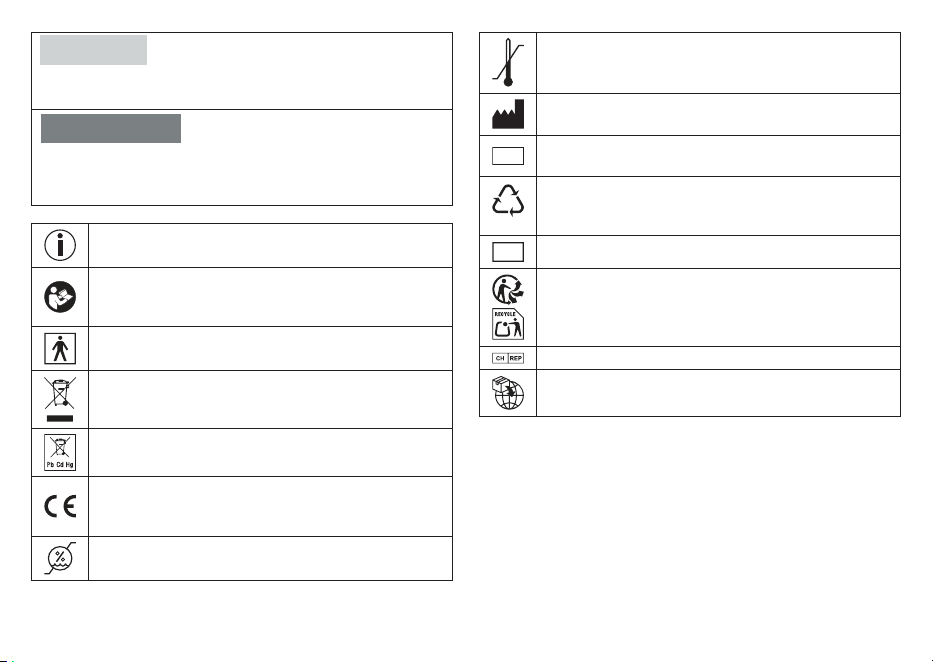
91
UWAGA
Oznacza potencjalne niebezpieczeństwo. Nieuniknięcie tego
ryzyka może prowadzić do lekkich lub niewielkich obrażeń ciała.
WSKAZÓWKA
Oznacza potencjalnie szkodliwą sytuację. Nieuniknięcie tego
ryzyka może prowadzić do uszkodzenia urządzenia lub przed-
miotów wjego otoczeniu.
Informacja o produkcie
Wskazówka z ważnymi informacjami.
Przestrzegać instrukcji
Przed rozpoczęciem pracy / użytkowania urządzeń lub
maszyn należy przeczytać instrukcję
Części aplikacyjne typuBF
Urządzenia elektrycznego nie wolno utylizować wraz
zinnymi odpadami domowymi
Schadstohaltige Batterien nicht im Hausmüll entsorgen
Oznakowanie CE
Niniejszy produkt spełnia wymagania obowiązujących
dyrektyw europejskich i krajowych.
Ograniczenie ciśnienia atmosferycznego
Temperatura graniczna
Producent
IP22
Ochrona urządzenia przed ciałami obcymi o wielkości
≥12,5 mm i kroplami wody spadającymi ukośnie
B
A
Oznakowanie identyfikujące materiał opakowaniowy.
A = skrót nazwy materiału, B = numer materiału:
1-7 = tworzywa sztuczne, 20-22 = papier i tektura
S
N
Numer seryjny
Oddzielić produkt i elementy opakowania i zutylizować
je zgodnie z lokalnymi przepisami.
Szwajcarski przedstawiciel
Symbol importera
3. UŻYTKOWANIE ZGODNE ZPRZEZNAC-
ZENIEM
Ten termometr jest przeznaczony do pomiarów temperatury ciała
wuchu. Nie wolno go używać do pomiarów temperatury winnych
miejscach ciała!
Za pomocą termometru dousznego można zmierzyć również tempe-
raturę wpomieszczeniu oraz temperaturę przedmiotu.
Termometr douszny został starannie zaprojektowany do dokład-
nych, bezpiecznych iszybkich pomiarów temperatury wuchu. Jest

92
to nieinwazyjny termometr douszny z detektorem podczerwieni
służący do pomiaru temperatury ciała w kanale słuchowym dzieci
idorosłych.
Urządzenie może być używane wyłącznie do celu, wjakim zostało
zaprojektowane iw sposób określony wniniejszej instrukcji obsługi.
Użycie niezgodne zprzeznaczeniem może być niebezpieczne! Pro-
ducent nie ponosi odpowiedzialności za szkody wynikłe zniewłaś-
ciwego użycia urządzenia.
Urządzenie jest zgodne z dyrektywą Unii Europejskiej w sprawie
produktów medycznych 93/42/EEC, ustawą o produktach medy-
cznych, standardem ASTM E 1965 - 98 oraz europejską normą EN
12470-5: Termometry medyczne – część 5: Termometry do uszu dzi-
ałające na podczerwień (z urządzeniem maksymalnym) oraz normą
europejską EN60601-1-2 (zgodność z CISPR11, IEC61000-4-2,
IEC61000-4-3, IEC61000-4-8) i wymaga zachowania szczególnych
środków ostrożności wzakresie kompatybilności elektromagnety-
cznej.
Należy pamiętać, że przenośne imobilne urządzenia komunikacyjne
pracujące na wysokich częstotliwościach mogą zakłócać działanie
urządzenia.
4. WSKAZÓWKI
Wskazówki dotyczące bezpieczeństwa
OSTRZEŻENIE
• W przypadku pomiaru w uchu należy ostrożnie wprowadzić
końcówkę czujnika termometru.
• Nie jest zalecane stosowanie termometru dousznego uróżnych
osób wprzypadku niektórych ostrych chorób zakaźnych. Pomi-
mo czyszczenia idezynfekcji może wówczas dojść do rozprze-
strzeniania się bakterii i zarazków. W przypadku pytań należy
skontaktować się zlekarzem.
• Temperatura ciała mierzona wuchu może różnić się od pomi-
arów wustach, odbycie lub pod pachą. Dlatego nie ma sensu
porównywanie tych wartości. Temperatura powinna być mier-
zona regularnie, aby można było ustalić normalną temperaturę
w uchu, a następnie wykorzystać te pomiary jako podstawę
porównania dla pomiarów, wprzypadku których podejrzewa się
gorączkę.
• Ten termometr jest przeznaczony do pomiaru temperatury
wuchu. Nie wolno go używać do pomiarów temperatury win-
nych miejscach ciała.
• Po każdym użyciu należy wymienić kapturek ochronny wcelu
zapewnienia dokładnego pomiaru iuniknięcia zanieczyszczenia
krzyżowego.
• Termometr ten może być używany tylko zkapturkami ochronny-
mi firmy Sanitas; inne kapturki mogą powodować błędy pomia-
rowe. Wrazie braku kapturków ochronnych należy skontaktować
się zproducentem lub sprzedawcą wcelu wymiany kapturków.
• Jeśli użytkownik termometru uważa, że jego stan zdrowia jest
zły, należy zgłosić się do lekarza.
Wskazówki dotyczące postępowania zbateriami
OSTRZEŻENIE
• Zagrożenie wybuchem! Zagrożenie pożarowe! Nieprzestrze-
ganie powyższych punktów może prowadzić do obrażeń ciała,
przegrzania, wycieku, odpowietrzenia, pęknięcia, wybuchu lub
pożaru baterii.
• Wurządzeniu znajdują się baterie jednorazowe, których nie na-
leży ładować.
• Nie wrzucać baterii do ognia.
• Nigdy nie należy ładować, wymuszać rozładowywania, podgrze-
wać, demontować, otwierać, zgniatać, odkształcać, zamykać
wszczelnym opakowaniu ani modyfikować baterii.

93
• Nigdy nie należy zwierać baterii ani styków baterii.
• Chronić baterie przed bezpośrednim działaniem promieni sło-
necznych, deszczem, gorącem iwodą.
• Wystawienie baterii na działanie skrajnie wysokiej temperatury
lub bardzo niskiego ciśnienia powietrza może spowodować wy-
buch lub wyciek łatwopalnych cieczy igazów.
• Uszkodzone irozładowane baterie należy natychmiast zutylizo-
wać zgodnie zprzepisami (patrz rozdział Utylizacja).
• Nie używać zmodyfikowanych lub uszkodzonych baterii.
• Zawsze wybierać odpowiedni typ baterii.
• Baterie należy zawsze wkładać prawidłowo izuwzględnieniem
biegunowości (+ / -).
• Nigdy nie należy użytkować jednocześnie wjednym urządzeniu
baterii różniących się producentem, pojemnością (nowe iużywa-
ne), rozmiarem ani typem.
• Jeśli z baterii wycieknie elektrolit, należy założyć rękawiczki
ochronne iwyczyścić pojemnik na baterie suchą szmatką.
• Jeśli dojdzie do kontaktu elektrolitu zbaterii ze skórą lub zocza-
mi, przemyć podrażnione miejsce wodą iskontaktować się zle-
karzem.
• Niebezpieczeństwo połknięcia! Baterie należy przechowywać
w miejscu niedostępnym dla dzieci. W razie połknięcia nie-
zwłocznie skonsultować się zlekarzem. Połknięcie może spowo-
dować oparzenia chemiczne, poważne obrażenia wewnętrzne
iśmierć.
• Nie wolno pozwalać dzieciom na wymianę baterii bez nadzoru
osoby dorosłej.
UWAGA
• Baterie należy przechowywać wdobrze wentylowanym, suchym
ichłodnym miejscu, wnieprzewodzącym pojemniku, wktórym
baterie nie mogą ulec zwarciu między sobą ani przez inne me-
talowe przedmioty.
• Utrzymywać baterie wczystości isuchości.
• Baterie należy przechowywać wmiejscu nienarażonym na dzia-
łanie wody.
• Jeśli urządzenie nie będzie używane przez dłuższy czas, należy
wyjąć baterie zpojemnika na baterie.
WSKAZÓWKA
• Nie używać baterii akumulatorowych.
Zagrożenia dla urządzenia
UWAGA
• Nie narażać urządzenia na wstrząsy mechaniczne.
• Nie narażać urządzenia na bezpośrednie działanie promieni
słonecznych.
• Uważać, aby urządzenie nie miało kontaktu zcieczami. Urząd-
zenie nie jest wodoszczelne. Unikać każdego bezpośredniego
kontaktu zwodą iinnymi płynami.
• Urządzenie może być naprawiane wyłącznie wautoryzowanych
punktach serwisowych. W przeciwnym razie następuje utrata
gwarancji.
• Przenośne i mobilne urządzenia komunikacyjne pracujące na
wysokich częstotliwościach mogą zakłócać działanie urządze-
nia.
WSKAZÓWKI DOT. KOMPATYBILNOŚCI
ELEKTROMAGNETYCZNEJ
• Urządzenie jest przeznaczone do użytkowania w każdym otoc-
zeniu wymienionym w niniejszej instrukcji obsługi, włącznie z
domem.
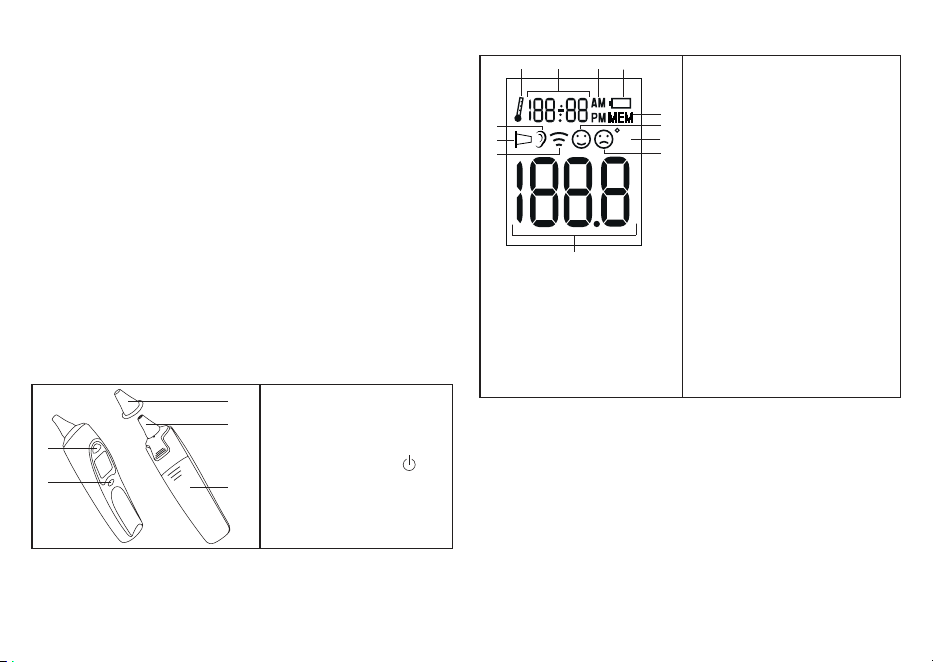
94
• Przy zakłóceniach elektromagnetycznych w pewnych wa-
runkach urządzenie może być użytkowane tylko w ograniczo-
nym zakresie. Wskutek tego mogą wystąpić np. komunikaty o
błędach lub awaria wyświetlacza/urządzenia.
• Należy unikać stosowania tego urządzenia bezpośrednio obok
innych urządzeń lub wraz z innymi urządzeniami w skumulowa-
nej formie, ponieważ mogłoby to skutkować nieprawidłowym
działaniem. Jeśli stosowanie w wyżej opisany sposób jest ko-
nieczne, należy obserwować niniejsze urządzenie i inne urządze-
nia w celu upewnienia się, że działają prawidłowo.
• Stosowanie innych akcesoriów niż te określone lub udostępnio-
ne przez producenta urządzenia może prowadzić do zwiększenia
zakłóceń elektromagnetycznych lub do zmniejszenia odporności
elektromagnetycznej urządzenia oraz do nieprawidłowego dzi-
ałania.
• Nieprzestrzeganie tej instrukcji może prowadzić do ograniczenia
wydajności urządzenia.
5. OPIS URZĄDZENIA
1
2
3
4
5
1. Kapturek ochronny
2. Czujnik pomiaru
3. Przycisk START
4. Przycisk WŁ./WYŁ.
5. Komora baterii
Wyświetlacz LCD
E
1
5
7
6
8
9
10
11
12
2 3 4
1. Tryb pomiaru temperatury po-
mieszczenia
2. Wskazanie temperatury po-
mieszczenia/godziny/daty
3. Wskazanie godziny przed
południem/po południu
4. Symbol baterii
5. Tryb pamięci
6. Symbol braku gorączki
7. Jednostka temperatury
(°Club °F)
8. Symbol gorączki
9. Wskazanie temperatury
10. Tryb temperatury przedmiotu
11. Symbol kapturka ochronnego
12. Tryb temperatury ciała
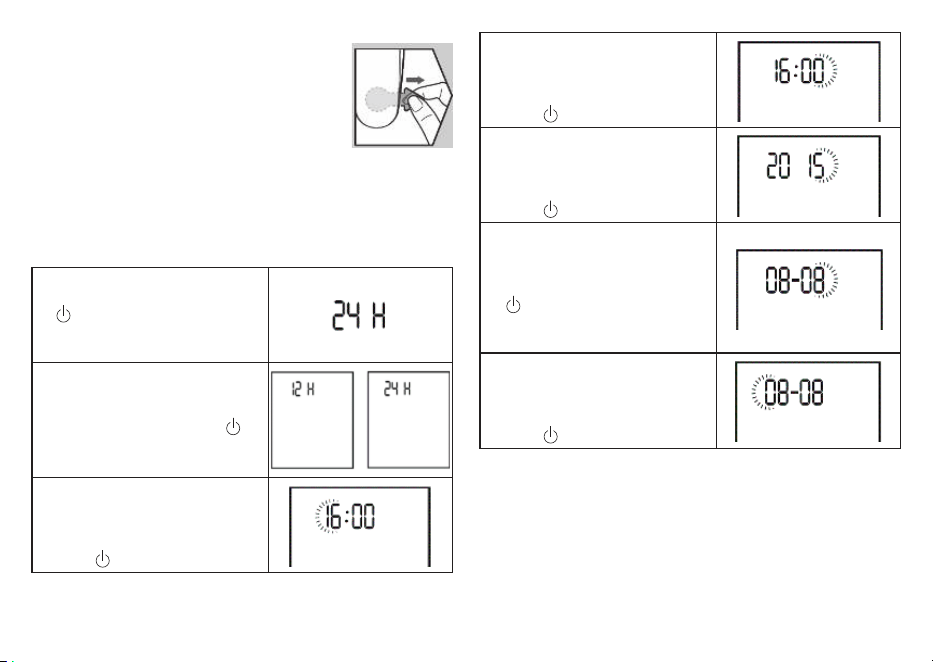
95
6. URUCHOMIENIE
Baterie są już założone w nowym urządzeniu.
Przed pierwszym użyciem wyjąć pasek ochron-
ny baterii wystający zkomory baterii. Termometr
douszny włączy się wówczas automatycznie.
7. USTAWIENIA
7.1 Ustawianie godziny/daty
Przed rozpoczęciem pomiarów zalecamy ustawienie aktualnej go-
dziny idaty. Wten sposób można później łatwiej przyporządkować
zapisane pomiary.
1.
Nacisnąć i przytrzymać przez
trzy sekundy przycisk WŁ./WYŁ.
przy wyłączonym urządzeniu.
Na wyświetlaczu pojawi się sym-
bol „24 H”.
2.
Za pomocą przycisku START
wybrać format godziny (12- lub
24-godzinny) izatwierdzić za po-
mocą przycisku WŁ./WYŁ. .
3.
Na wyświetlaczu pojawi się wska-
zanie godziny. Wybrać za pomocą
przycisku START aktualną godzi-
nę izatwierdzić przyciskiem WŁ./
WYŁ. .
4.
Na wyświetlaczu pojawi się wska-
zanie minut. Wybrać za pomocą
przycisku START aktualną minu-
tę izatwierdzić przyciskiem WŁ./
WYŁ. .
5.
Na wyświetlaczu pojawi się
wskazanie roku. Wybrać za po-
mocą przycisku START aktualny
rok izatwierdzić przyciskiem WŁ./
WYŁ. .
6.
Na wyświetlaczu miga wskazanie
miesiąca. Wybrać za pomocą przy-
cisku START aktualny miesiąc iza-
twierdzić
przyciskiem WŁ./WYŁ.
. Urządzenie wyłączy się auto-
matycznie. Data igodzina zostały
zapisane.
7.
Na wyświetlaczu miga wska-
zanie dnia. Wybrać za pomocą
przycisku START aktualny dzień
i zatwierdzić przyciskiem WŁ./
WYŁ. .
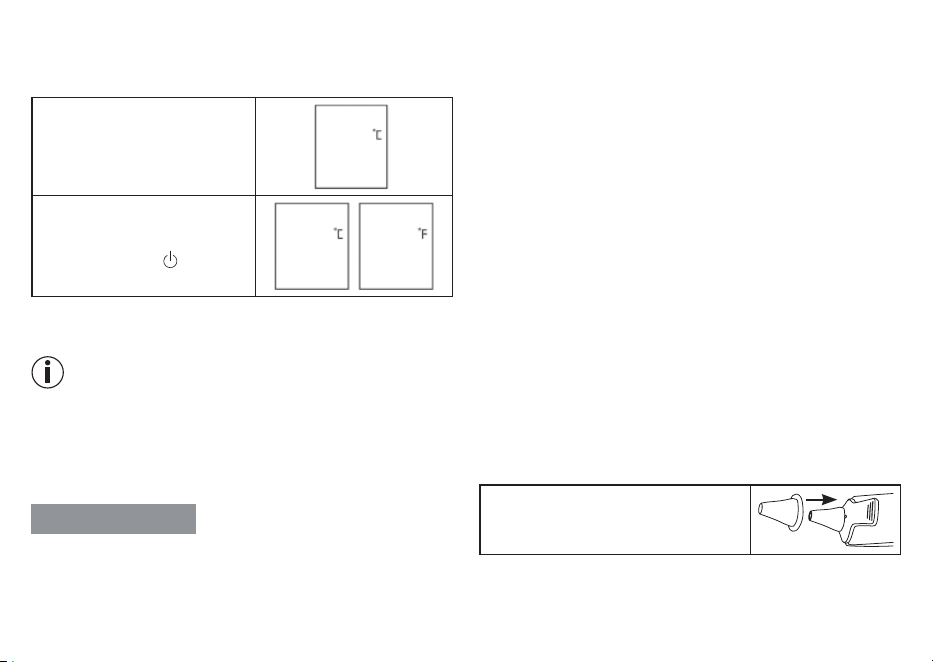
96
7.2 Wybór jednostki temperatury (°Club °F)
Wyniki pomiaru można wyświetlać wstopniach Celsjusza (°C) lub
Fahrenheita (°F).
1.
Nacisnąć iprzytrzymać przez
trzy sekundy przycisk START
przy wyłączonym urządzeniu.
Na wyświetlaczu pojawi się
symbol „°C”.
2.
Za pomocą przycisku START
wybrać jednostkę temperatury
(°Club °F) izatwierdzić przyci-
skiem WŁ./WYŁ. .
8. POMIAR
Przed każdym użyciem termometru sprawdzić, czy soczewka
nie jest uszkodzona. Jeśli soczewka jest uszkodzona, skon-
taktować się ze sprzedawcą lub serwisem. Należy pamiętać,
że termometr douszny musi się znajdować od co najmniej
30minut w pomieszczeniu, wktórym dokonywany jest po-
miar.
8.1 Pomiar temperatury ciała
OSTRZEŻENIE
• W przypadku niektórych osób mogą wystąpić różne wartości
pomiarowe wlewym i w prawym uchu. Aby rejestrować zmia-
ny temperatury u takich osób, pomiary należy przeprowadzać
zawsze wtym samym uchu.
• Termometr douszny może być używany przez dzieci tylko pod
nadzorem dorosłych. Z reguły można dokonywać pomiaru
od 6 miesiąca życia. Umałych dzieci poniżej 6 miesiąca życia
przewód słuchowy jest jeszcze bardzo wąski. Uniemożliwia to
zmierzenie temperatury błony bębenkowej i często powoduje
zaniżanie odczytów.
• Pomiar nie może być przeprowadzany wuchu ze stanem zapal-
nym (np. wysięk ropny), po ewentualnych obrażeniach ucha (np.
uszkodzenie bębenka) lub wfazie leczenia po ingerencjach oper-
acyjnych. We wszystkich tych przypadkach należy skonsultować
się zlekarzem.
• Nie jest zalecane stosowanie termometru dousznego uróżnych
osób wprzypadku niektórych ostrych chorób zakaźnych. Pomi-
mo czyszczenia idezynfekcji może wówczas dojść do rozprze-
strzeniania się bakterii i zarazków. W przypadku pytań należy
skontaktować się zlekarzem.
• Ten termometr może być stosowany tylko znałożonym kaptur-
kiem ochronnym.
• Następujące okoliczności mogą mieć wpływ na temperaturę
wuchu: długie leżenie na jednym uchu, zakrycie uszu, wysta-
wienie uszu na bardzo wysoką/niską temperaturę lub pływanie/
kąpiel. Wrazie wystąpienia powyższych okoliczności należy od-
czekać 20 minut przez wykonaniem pomiaru.
• Woskowina może mieć wpływ na pomiar, dlatego przed pomia-
rem należy wyczyścić ucho.
1.
Nałożyć czysty kapturek ochronny na
końcówkę czujnika termometru dousz-
nego.
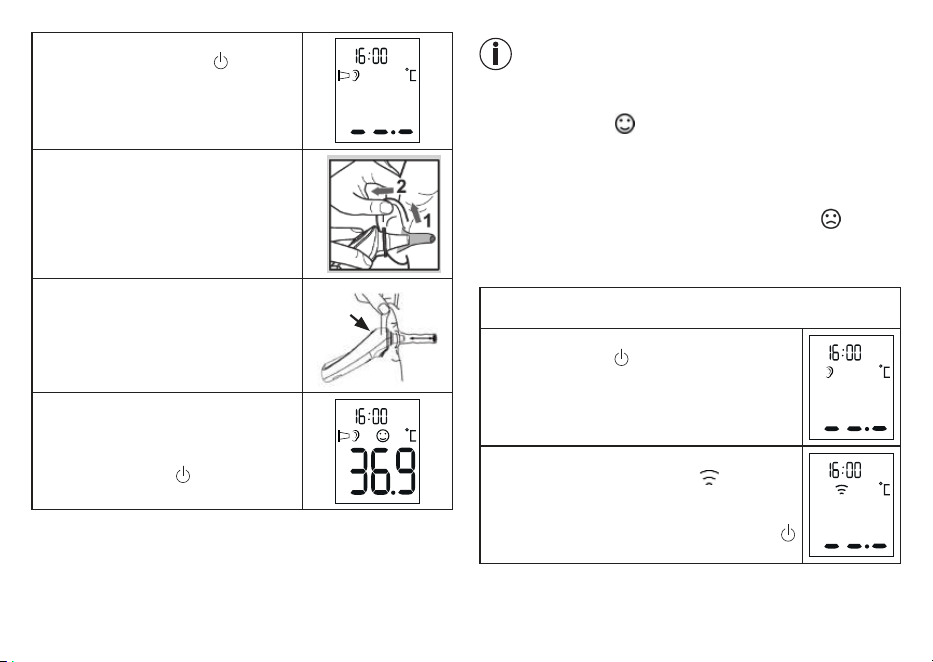
97
2. Aby włączyć termometr douszny, naci-
snąć przycisk WŁ./WYŁ. . Rozlegną
się trzy dźwięki. Włączy się wyświetlacz.
3.
Ponieważ przewód słuchowy jest lek-
ko zakrzywiony, przed wprowadzeniem
końcówki czujnika należy lekko pocią-
gnąć ucho do góry ido tyłu, aby koń-
cówka kapturka ochronnego była skie-
rowana na błonę bębenkową.
4. Wprowadzić ostrożnie końcówkę czuj-
nika zkapturkiem ochronnym do prze-
wodu słuchowego inacisnąć przycisk
START, aby rozpocząć pomiar.
5. Po mniej więcej jednej sekundzie rozle-
gnie się dźwięk, ana wyświetlaczu po-
jawi się wynik pomiaru. Aby wyłączyć
termometr douszny, należy nacisnąć
przycisk WŁ./WYŁ. .
Jeśli po pomiarze przez minutę nie zostanie naciśnięty żaden
przycisk, termometr douszny wyłączy się automatycznie.
Wskaźnik gorączki
Jeśli temperatura jest <38°C(100,4°F), na wyświetlaczu poja-
wi się uśmiech oraz rozlegnie się krótki dźwięk.
Jeśli zmierzona temperatura mieści się wzakresie od 37,5 do
37,9°C, rozlegną się dwa krótkie dźwięki (wskazanie „pod-
wyższonej temperatury”).
Jeśli zmierzona temperatura jest ≥38°C(100,4°F), na wyświe-
tlaczu pojawi się emotikona wyrażająca smutek
. Ponadto
rozlegnie się jeden krótki, jeden długi itrzy krótkie dźwięki.
8.2 Pomiar temperatury przedmiotu
1.
Zdjąć kapturek ochronny (jeśli jest nałożony) zkońcówki czujnika
termometru dousznego.
2. Aby włączyć termometr douszny, nacisnąć pr-
zycisk WŁ./WYŁ.
. Rozlegną się trzy dźwięki.
Włączy się wyświetlacz.
3.
Upewnić się, że wurządzeniu włączono tryb po-
miaru temperatury przedmiotu ( ).
Aby przechodzić pomiędzy trybem pomia-
ru temperatury ciała i przedmiotu, przytrzy-
mać krótko wciśnięte przyciski WŁ./WYŁ.
iSTART.
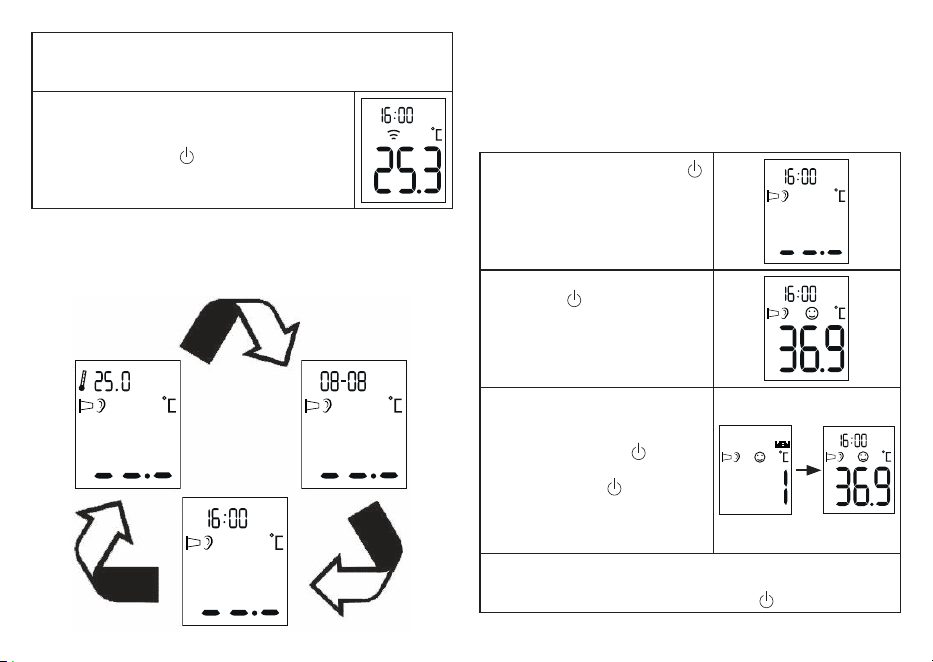
98
4. Przytrzymać końcówkę czujnika termometru dousznego wod-
ległości od 1 do 2 cm od wybranego miejsca pomiaru inacisnąć
przycisk START.
5.
Po sekundzie rozlegnie się dźwięk, a na
wyświetlaczu pojawi się wynik pomiaru. Aby
wyłączyć termometr douszny, nacisnąć krótko
przycisk WŁ./WYŁ. .
8.3 Wyświetlanie temperatury pomieszczenia
Po włączeniu termometru dousznego na wyświetlaczu będą co 3
sekundy wyświetlane temperatura pomieszczenia, data igodzina.
8.4 Wyświetlanie zapisanych wartości pomia-
rowych
Termometr douszny automatycznie zapisuje temperaturę ciała
i przedmiotu (z datą i godziną) zmierzoną w trakcie ostatnich 10
pomiarów. Aby wyświetlić zapisane wartości pomiarowe, należy
postępować zgodnie zponiższą instrukcją:
1. Nacisnąć przycisk WŁ./WYŁ. ,
aby włączyć termometr douszny.
2.
Przytrzymać wciśnięty przycisk
WŁ./WYŁ. przez 3 sekundy. Na
wyświetlaczu zostanie wyświetlo-
ny symbol Moraz ostatnio zapisa-
na wartość pomiarowa.
3.
Aby przechodzić pomiędzy po-
szczególnymi zapisanymi warto-
ściami pomiarowymi, nacisnąć
przycisk WŁ./WYŁ. . Po każ-
dym kolejnym naciśnięciu przy-
cisku WŁ./WYŁ. zostanie wy-
świetlony najpierw numer miejsca
wpamięci, anastępnie wartość
pomiarowa.
4.
Aby kontynuować pomiar, należy nacisnąć przycisk START.
Aby wyłączyć termometr douszny, należy nacisnąć iprzytrzy-
mać przez 3 sekundy przycisk WŁ./WYŁ. .
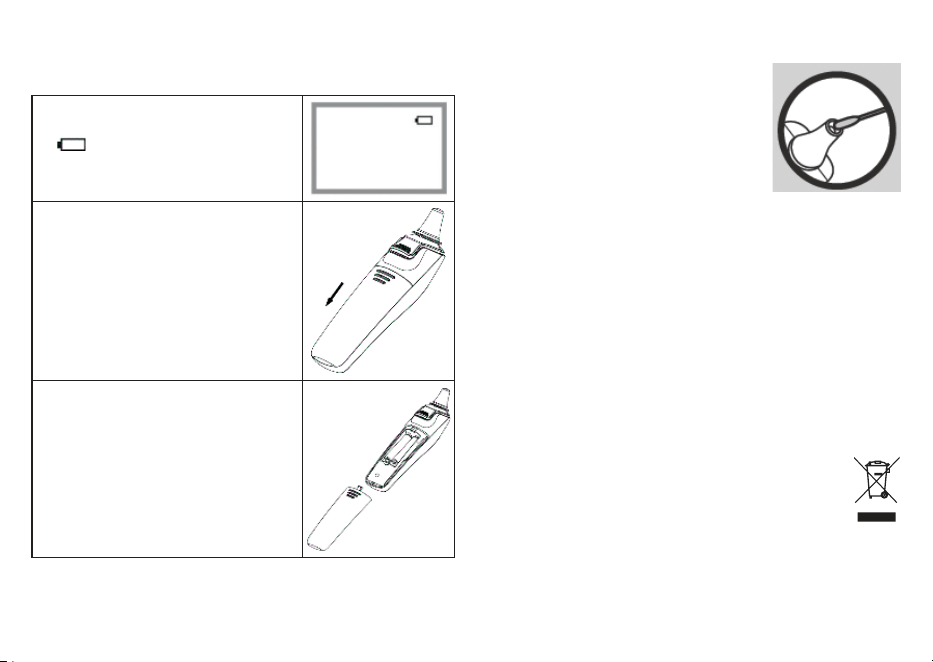
99
9. WYMIANA BATERII
Przed wymianą baterii należy się upewnić, że urządzenie jest wyłąc-
zone.
1.
Należy wymienić baterie, jak tylko na
wyświetlaczu pojawi się symbol baterii
( ).
2.
Otworzyć komorę baterii iwyjąć zniej
zużyte baterie.
3.
Włożyć dwie nowe baterie 1,5 Vtypu
AAA. Uważać, aby baterie były prawidło-
wo włożone. Zamknąć komorę baterii.
10. CZYSZCZENIE/PRZECHOWYWANIE
Kapturki ochronne są przeznaczone do jed-
nokrotnego użytku.
Końcówka czujnika to najbardziej czuły ele-
ment termometru dousznego. Aby uniknąć
uszkodzenia, należy zachować ostrożność
podczas czyszczenia końcówki czujnika.
Wtym celu użyć miękkiej szmatki lub paty-
czków zwatą, które można nasączyć środ-
kiem dezynfekującym, alkoholem lub ciepłą
wodą.
Do czyszczenia obudowy urządzenia należy używać miękkiej szmat-
ki, lekko nasączonej wodą zmydłem.
Nie używać agresywnych środków czyszczących.
Jeśli planowane jest dłuższe przechowywanie, należy wyjąć bate-
rie. Niedozwolone jest przechowywanie lub stosowanie urządzenia
wzbyt wysokich lub zbyt niskich temperaturach, przy zbyt dużej lub
zbyt niskiej wilgotności powietrza (patrz dane techniczne), wświetle
słonecznym, wmiejscach zapylonych lub narażonych na działanie
prądu elektrycznego. W przeciwnym razie pomiar może być nie-
dokładny.
11. UTYLIZACJA
W związku z wymogami ochrony środowiska urządzenia
po zakończeniu eksploatacji nie należy wyrzucać wraz z
odpadami domowymi. Należy je oddać do utylizacji w od-
powiednim punkcie odbioru wswoim kraju. Przestrzegać
lokalnych przepisów dotyczących utylizacji materiałów.
Urządzenie należy zutylizować zgodnie z dyrektywą WE o zużytych
urządzeniach elektrycznych i elektronicznych – WEEE (Waste Elec-
trical and Electronic Equipment). Wszelkie pytania kierować do lo-
kalnego urzędu odpowiedzialnego za utylizację odpadów. Informac-
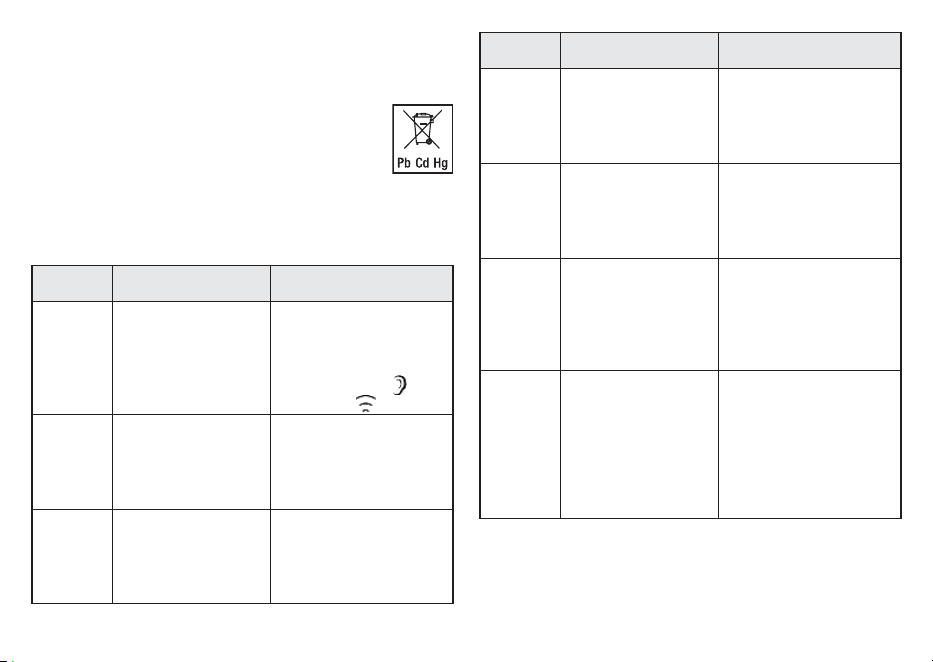
100
je na temat punktów odbioru używanych urządzeń można uzyskać
w lokalnym urzędzie gminy lub miasta, w zakładach oczyszczania
lub od sprzedawcy.
Wskazówka: Na bateriach zawierających szkodliwe związki znajdują
się następujące oznaczenia:
Pb = bateria zawiera ołów,
Cd = bateria zawiera kadm,
Hg = bateria zawiera rtęć.
12. CO NALEŻY ZROBIĆ WPRZYPAD-
KU POJAWIENIA SIĘ KOMUNIKATÓW
OBŁĘDACH?
Komunikat
błędu
Przyczyna Rozwiązanie
ER1
Termometr douszny nie
jest jeszcze gotowy do
pomiaru.
Pomiar można rozpocząć
dopiero wtedy, gdy na
wyświetlaczu pojawi się
wskazanie trybu pomiaru
temperatury ciała (
) lub
przedmiotu ( ).
ER2
Zmierzona tempe-
ratura otoczenia nie
mieści się wzakresie
10–40°C(50–104°F).
Termometr douszny
należy umieścić na
30minut wpomieszczeniu
otemperaturze 10–40°C
(50–104°F).
ER3
Termometr douszny
nie jest prawidłowo
umieszczony wuchu.
Należy przestrzegać
wskazówek znajdujących
się wrozdziale „Pomiar”.
Ponownie wykonać
pomiar.
Komunikat
błędu
Przyczyna Rozwiązanie
ER4
Termometr douszny
zarejestrował dużą
zmianę temperatury
otoczenia.
Termometr douszny
należy umieścić na 30
minut wpomieszczeniu
otemperaturze 10–40°C
(50–104°F).
ER5
Termometr douszny nie
działa prawidłowo.
Wymienić baterie ispró-
bować ponownie. Jeśli
błąd wystąpi ponownie,
należy skontaktować się
zdziałem obsługi klienta.
ER6
Termometr jest teraz
wtrybie pomiaru tem-
peratury przedmiotu,
akapturek ochronny
nie został jeszcze
zdjęty.
Aby wykonać pomiar
temperatury przedmiotu,
należy zdjąć kapturek.
Hi
Pomiar temperatury
wuchu: Zmierzona
temperatura prze-
kracza 43°C(109,4°F).
Pomiar temperatury
przedmiotu: Zmierzona
temperatura prze-
kracza 100°C(212°F).
Upewnić się, że stan
urządzenia ikapturka
ochronnego jest bez zar-
zutu. Ponownie wykonać
pomiar.
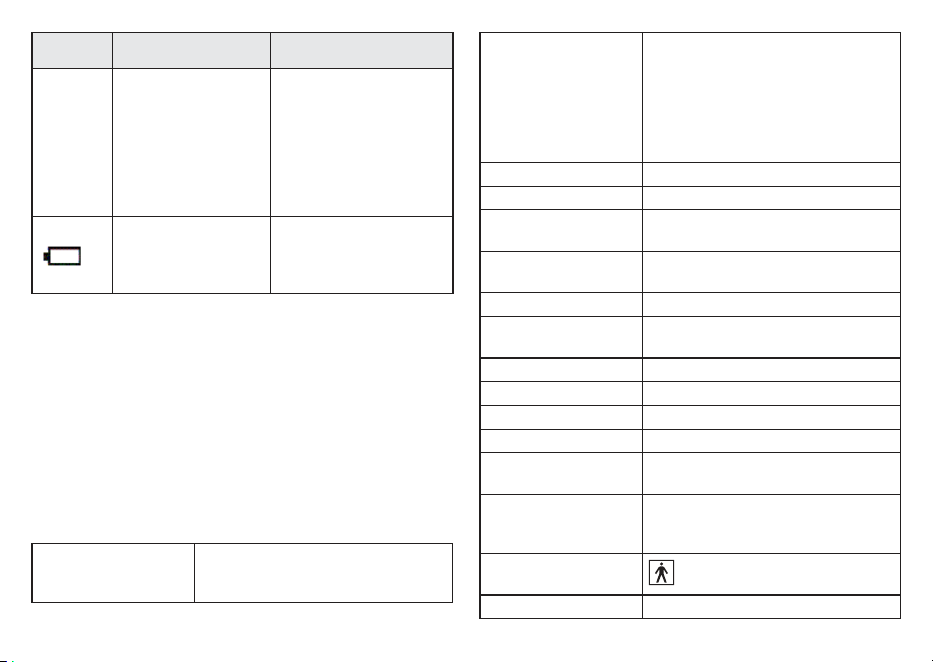
101
Komunikat
błędu
Przyczyna Rozwiązanie
Lo
Pomiar temperatury
wuchu: Zmierzona
temperatura wynosi
poniżej 28°C(82,4°F).
Pomiar temperatury
przedmiotu: Zmierzona
temperatura wynosi
poniżej -20°C(-4°F).
Upewnić się, że stan
urządzenia ikapturka
ochronnego jest bez zar-
zutu. Ponownie wykonać
pomiar.
Baterie są zużyte. Wyjąć dwie zużyte baterie
izastąpić je dwiema
nowymi bateriami 1,5V
typu AAA.
Jeśli problem nie został wymieniony na liście, prosimy o kontakt
znaszym działem obsługi klienta.
13. DANE TECHNICZNE
W przypadku używania urządzenia w warunkach wykraczających
poza specyfikację nie można zapewnić jego prawidłowego działa nia!
Dokładność termometru została dokładnie sprawdzona. Ponadto
został on zaprojektowany do długotrwałego użytkowania.
W przypadku stosowania urządzenia w medycynie obowiązujące
przepisy krajowe decydują o tym, czy należy przeprowadzać kont-
role pomiarowe za pomocą odpowiednich środków.
Producent zastrzega sobie prawo do wprowadzania zmian technicz-
nych mających na celu ulepszenie i dopracowanie urządzenia.
Zakres pomiaru tem-
peratury
Ucho: 28,0–43,0°C (82,4–109,4°F)
Przedmiot: -20–100°C (-4–212°F)
Pomieszczenie: 0–50°C (32–122°F)
Laboratoryjna dokład-
ność pomiaru
Ucho: ±0,2°C(0,4°F) wzakresie pomi-
arowym 35,5–42,0°C
(95,9–107,6°F); ±0,3°C (0,5°F) wza-
kresie pomiarowym ≤35,5°C (95,5°F)
i≥42,0°C(107,6°F)
Przedmiot: ±4% lub ±2°C(4°F)
Pomieszczenie: ±2°C(±4°F)
Powtarzalność kliniczna 0,11°C(0,2°F)
Czas pomiaru ok. 1 sekundy
Zakres temperatury
pracy
10–40°C(50–104°F), wilgotność po-
wietrza 15–85% (bez kondensacji)
Zakres temperatury
przechowywania
-25–55°C(-13–131°F), wilgotność
powietrza ≤ 95% (bez kondensacji)
Pamięć Pamięć: 10 pomiarów
Rozdzielczość wyświet-
lacza
0,1°Club 0,1°F
Bateria DC 3V (2 baterie 1,5V typu AAA)
Wymiary 155 x38 x47 mm
Waga ok. 63 g(bez baterii)
Kapturki ochronne 10
Automatyczne wyłąc-
zenie
60 sekund
Żywotność baterii 3000 pomiarów jeden za drugim lub
rok zjednym lub dwoma pomiarami na
dzień, wtym tryb gotowości.
Klasyfikacja bezpiec-
zeństwa
Podłączone urządzenie medyczne
typu BF
Klasa ochrony IP IP 22

102
Numer seryjny znajduje się na urządzeniu lub w komorze baterii.
14. GWARANCJA / SERWIS
Szczegółowe informacje na temat gwarancji i warunków gwarancji
znajdują się w załączonej ulotce gwarancyjnej.
Zastrzega się prawo do pomyłek i zmian

103
NEDERLANDS
Lees deze gebruiksaanwijzing aandachtig door, bewaar deze voor later gebruik, laat deze ook door andere gebruikers le-
zen en neem alle aanwijzingen in acht.
1. OMVANG VAN DE LEVERING
Controleer of de buitenkant van de verpakking intact is en of alle
onderdelen aanwezig zijn. Alvorens het apparaat te gebruiken, moet
worden gecontroleerd of het apparaat en de toebehoren zichtbaar
beschadigd zijn en moet al het verpakkingsmateriaal worden ver-
wijderd. Wij adviseren u het apparaat bij twijfel niet te gebruiken en
contact op te nemen met de verkoper of met de betreende klan-
tenservice.
1 oorthermometer
2 AAA-batterijen van 1,5 V
10 beschermkappen
1 gebruiksaanwijzing
Na te bestellen artikelen
Set beschermkappen na te bestellen: 2 x 10 beschermkappen, art.-
nr. 795.34
2. VERKLARING VAN DE SYMBOLEN
Op het apparaat, in de gebruiksaanwijzing, op de verpakking en
op het typeplaatje van het apparaat worden de volgende symbolen
gebruikt:
1. Omvang van de levering ........................................................ 103
2. Verklaring van de symbolen ..................................................103
3. Voorgeschreven gebruik .......................................................104
4. Aanwijzingen .........................................................................105
5. Beschrijving van het apparaat ...............................................107
6. Ingebruikname ......................................................................107
7. Instellingen ............................................................................107
7.1 Tijd / datum instellen ....................................................107
7.2 Temperatuureenheid selecteren (°C of °F) ....................108
8. Meten ....................................................................................109
8.1 Lichaamstemperatuur meten ........................................ 109
8.2 Objecttemperatuur meten .............................................110
8.3 Kamertemperatuur weergeven .....................................111
8.4 Opgeslagen meetwaarden weergeven .........................111
9. Batterijen vervangen .............................................................111
10. Reiniging/opslag ................................................................. 112
11. Verwijdering ......................................................................... 112
12. Wat te doen bij foutmeldingen ............................................113
13. Technische gegevens .......................................................... 113
14. Garantie / service .................................................................. 114
INHOUDSOPGAVE
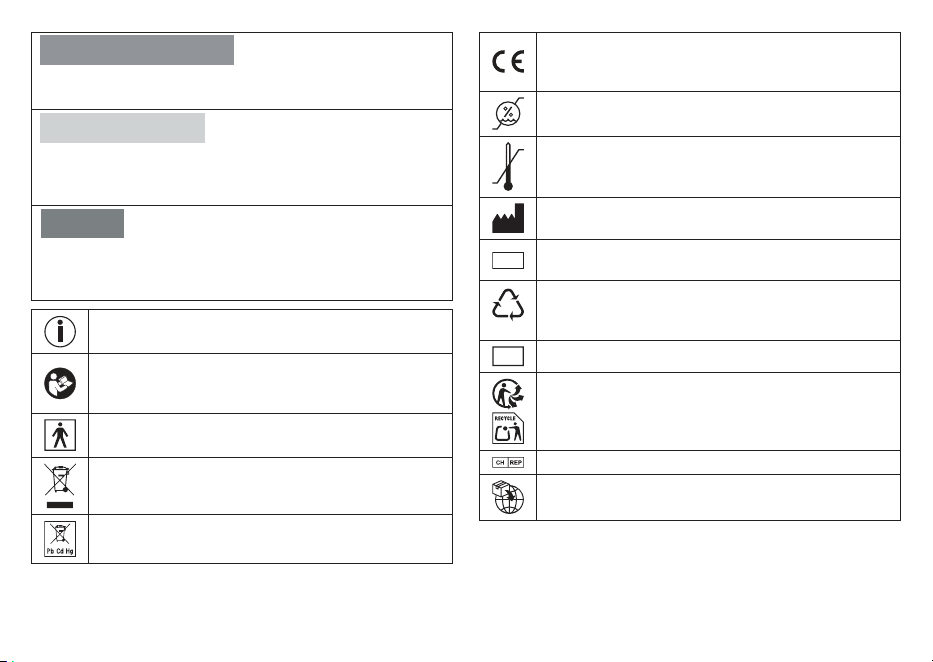
104
WAARSCHUWING
Duidt op een mogelijk dreigend gevaar. Indien dit niet vermeden
wordt, kan het de dood of ernstig letsel tot gevolg hebben.
VOORZICHTIG
Duidt op een mogelijk dreigend gevaar. Indien dit niet vermeden
wordt, kan het lichte of geringe verwondingen tot gevolg
hebben.
LET OP
Duidt op een mogelijk schadelijke situatie. Indien deze niet ver-
meden wordt, kan het apparaat of iets in de omgeving daarvan
beschadigd raken.
Productinformatie
Verwijzing naar belangrijke informatie.
Handleiding in acht nemen
Lees voor aanvang van het werk en/of het bedienen van
apparaten of machines de handleiding.
Toegepast deel type BF
Het (elektrisch) apparaat mag niet met het huisvuil
worden weggegooid
Batterijen die schadelijke stoen bevatten, mogen niet
met het huisvuil worden weggegooid.
CE-markering
Dit product voldoet aan de eisen van de geldende
Europese en nationale richtlijnen.
Luchtdruklimiet
Temperatuurlimiet
Fabrikant
IP22
Het apparaat is beschermd tegen voorwerpen van
≥12,5 mm en tegen schuin neervallende druppels.
B
A
Aanduiding voor de identificatie van het verpakkings-
materiaal. A = materiaalafkorting, B = materiaalnummer:
1-7 = kunststoen, 20-22 = papier en karton
S
N
Serienummer
Scheid het product en de verpakkingscomponenten en
voer het afval volgens de lokale voorschriften af.
Zwitserse geautoriseerde vertegenwoordiger
Importeursymbool
3. VOORGESCHREVEN GEBRUIK
De oorthermometer is bedoeld voor het meten van de lichaams-
temperatuur in het oor. Gebruik de oorthermometer niet voor het
meten van de temperatuur op andere plekken van het lichaam!

105
U kunt met de oorthermometer ook kamer- en objecttemperaturen
meten.
De oorthermometer is zorgvuldig ontwikkeld voor het nauwkeurig,
veilig en snel meten van de temperatuur in het oor. Dit apparaat is
een non-invasieve oorthermometer met een infrarooddetector voor
het meten van de lichaamstemperatuur in de gehoorgang van kin-
deren en volwassenen.
Gebruik het apparaat uitsluitend voor het doel waarvoor het is ont-
wikkeld en uitsluitend op de in deze gebruiksaanwijzing aangegeven
wijze. Elk onjuist gebruik kan gevaarlijk zijn! De fabrikant is niet aan-
sprakelijk voor schade die is veroorzaakt door onjuist of verkeerd
gebruik.
Het apparaat voldoet aan de EU-richtlijn 93/42/EEC voor medische
hulpmiddelen, de Duitse wet inzake medische hulpmiddelen, de
norm ASTM E 1965-98, de Europese norm EN 12470-5: Medische
thermometers – Deel 5: Bepaling van de prestatie van infrarode
oorthermometers (met maximaalelement) en aan de Europese norm
EN 60601 1 2 (overeenstemming met CISPR 11, IEC 61000 4 2, IEC
61000 4 3, IEC 61000 4 8) en is onderworpen aan bijzondere veilig-
heidsmaatregelen op het gebied van elektromagnetische compati-
biliteit.
Let er daarbij op dat draagbare en mobiele HF-communicatie-
installaties dit apparaat kunnen beïnvloeden.
4. AANWIJZINGEN
Veiligheidsrichtlijnen
WAARSCHUWING
• Breng de sensortip van de oorthermometer voorzichtig in bij me-
tingen in het oor.
• Het gebruik van de oorthermometer bij verschillende personen
kan ineciënt zijn bij bepaalde acute, infectieuze aandoeningen
door de overdracht van kiemen ondanks de reiniging en desin-
fectie van het apparaat. Laat u in voorkomende gevallen infor-
meren door uw behandelend arts.
• De in het oor gemeten lichaamstemperatuur kan afwijken van
metingen in de mond, het rectum of de okselholte. Het heeft
daarom geen nut om deze waarden met elkaar te vergelijken.
Meet de temperatuur regelmatig om de normale oortemperatuur
vast te stellen. Deze meetwaarden kunt u vervolgens gebruiken
als vergelijkingsbasis voor metingen waarbij u koorts vermoedt.
• Deze oorthermometer is bedoeld voor het meten van de tem-
peratuur in het oor. Gebruik deze oorthermometer niet voor het
meten van de temperatuur op andere plekken van het lichaam.
• Vervang de beschermkap na elk gebruik om een nauwkeurige
meting te kunnen garanderen en kruisbesmetting tegen te gaan.
• De oorthermometer mag alleen met beschermkappen van Sani-
tas worden gebruikt, andere beschermkappen kunnen foutieve
metingen veroorzaken. Als u geen beschermkappen meer hebt,
neemt u voor nieuwe kappen contact op met de fabrikant of de
verkoper.
• Raadpleeg een arts als uw gezondheidstoestand naar uw
mening slecht is.
Tips voor de omgang met batterijen
WAARSCHUWING
• Explosiegevaar! Brandgevaar! Wanneer de volgende punten
niet in acht worden genomen, kan dit persoonlijk letsel of over-
verhitting, lekkage, ontluchting, breuk, explosie of brand van de
batterij tot gevolg hebben.
• Dit apparaat bevat niet-oplaadbare batterijen die niet opgeladen
mogen worden.
• Gooi batterijen niet in vuur.

106
• Laad de batterijen nooit op, ontlaad ze niet geforceerd, verhit ze
niet, haal ze niet uit elkaar, open ze niet, hak ze niet in stukken,
vervorm ze niet, kapsel ze niet in en pas ze ook niet aan.
• Voorkom kortsluiting van de batterijen en van de contacten van
het batterijvak.
• Bescherm de batterijen tegen direct zonlicht, regen, hitte en
water.
• Als batterijen worden blootgesteld aan een omgeving met ex-
treem hoge temperaturen of een extreem lage luchtdruk, kan dit
een explosie of lekkage van ontvlambare vloeistoen en gassen
tot gevolg hebben.
• Voer defecte en lege batterijen meteen volgens de voorschriften
af (zie hoofdstuk Verwijderen).
• Gebruik geen gewijzigde of beschadigde batterijen.
• Kies altijd het juiste type batterij.
• Plaats batterijen altijd op de juiste wijze en let daarbij op de juiste
polariteit (+/-).
• Gebruik nooit batterijen van verschillende fabrikanten, met ver-
schillende capaciteiten (nieuw en gebruikt) of van verschillende
formaten of verschillende types door elkaar in één apparaat.
• Als er een batterij is gaan lekken, moet u veiligheidshandschoe-
nen aantrekken en het batterijvak met een droge doek reinigen.
• Als vloeistof uit een batterij in aanraking komt met de huid of
ogen, moet u de betreende plek met water spoelen en een arts
raadplegen.
• Gevaar voor inslikken! Bewaar batterijen buiten bereik van kin-
deren. Roep bij inslikken onmiddellijk de hulp van een arts in.
Inslikken kan chemische brandwonden, ernstig inwendig letsel
en overlijden tot gevolg hebben.
• Laat kinderen nooit zonder toezicht van een volwassene batte-
rijen vervangen.
VOORZICHTIG
• Bewaar batterijen in goed geventileerde, droge en koele ruim-
tes in een niet-geleidende verpakking waarin de batterijen niet
onderling of door andere metalen voorwerpen kunnen worden
kortgesloten.
• Houd batterijen schoon en droog.
• Houd batterijen uit de buurt van water.
• Haal de batterijen uit het batterijvak als u het apparaat langere
tijd niet gebruikt.
LET OP
• Gebruik geen oplaadbare batterijen.
Gevaren voor het apparaat
VOORZICHTIG
• Stel het apparaat niet bloot aan mechanische schokken.
• Stel het apparaat niet bloot aan direct zonlicht.
• Zorg ervoor dat het apparaat niet in aanraking komt met vlo-
eistoen. De thermometer is niet waterdicht. Vermijd elk direct
contact met water of andere vloeistoen.
• Laat het apparaat alleen repareren door geautoriseerde
servicebedrijven, anders vervalt uw garantie.
• Draagbare en mobiele HF-communicatie-installaties kunnen het
apparaat beïnvloeden.
AANWIJZINGEN MET BETREKKING TOT
ELEKTROMAGNETISCHE COMPATIBILITEIT
• Het apparaat is geschikt voor gebruik in alle omgevingen die in
deze gebruiksaanwijzing worden vermeld, waaronder de thu-
isomgeving.
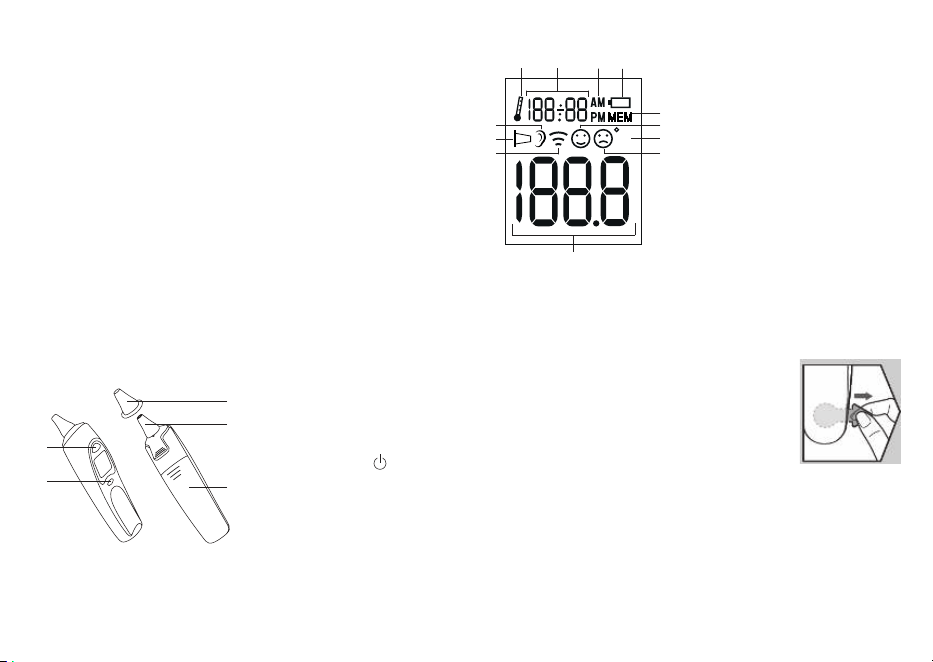
107
• Het apparaat kan bij de aanwezigheid van elektromagnetische
storingen onder omstandigheden mogelijk slechts beperkt wor-
den gebruikt. Als gevolg daarvan kunnen bijv. foutmeldingen
ontstaan of kan het display/apparaat uitvallen.
• Het gebruik van dit apparaat direct naast andere apparaten of
met andere apparaten in gestapelde vorm moet worden verme-
den, omdat dit een onjuiste werking tot gevolg kan hebben. Als
gebruik op de hiervoor beschreven wijze noodzakelijk is, moeten
dit apparaat en de andere apparaten in de gaten worden gehou-
den om er zeker van te zijn dat ze correct werken.
• Het gebruik van andere toebehoren dan de toebehoren die de
fabrikant van dit apparaat vastgelegd of beschikbaar gesteld
heeft, kan verhoogde elektromagnetische storingen of een ver-
minderde bestandheid tegen storingen tot gevolg hebben, waar-
door het apparaat mogelijk niet correct werkt.
• Als deze instructie niet in acht wordt genomen, kan dit de presta-
tiekenmerken van het apparaat negatief beïnvloeden.
5. BESCHRIJVING VAN HET APPARAAT
1
2
3
4
5
1. Beschermkap
2. Meetsensor
3. START-toets
4. AAN/UIT-toets
5. Batterijvak
LCD-scherm
E
1
5
7
6
8
9
10
11
12
2 3 4
1. Kamertemperatuurmodus
2. Weergave kamertemperatuur /
tijd / datum
3. AM/PM-weergave (tijd)
4. Batterijsymbool
5. Geheugenmodus
6. Geen koorts-symbool
7. Temperatuureenheid (°C of °F)
8. Koorts-symbool
9. Temperatuurweergave
10. Objecttemperatuurmodus
11. Beschermkapsymbool
12. Lichaamstemperatuurmodus
6. INGEBRUIKNAME
Bij een nieuw apparaat zijn de batterijen reeds ge-
plaatst. Trek vóór het eerste gebruik het uitsteken-
de beschermlipje uit het batterijvak. De oorther-
mometer wordt daarna automatisch ingeschakeld.
7. INSTELLINGEN
7.1 Tijd / datum instellen
Wij adviseren u de huidige tijd en datum in te stellen, voordat u
metingen verricht. Op die manier kunt u opgeslagen metingen later
eenvoudiger toewijzen.
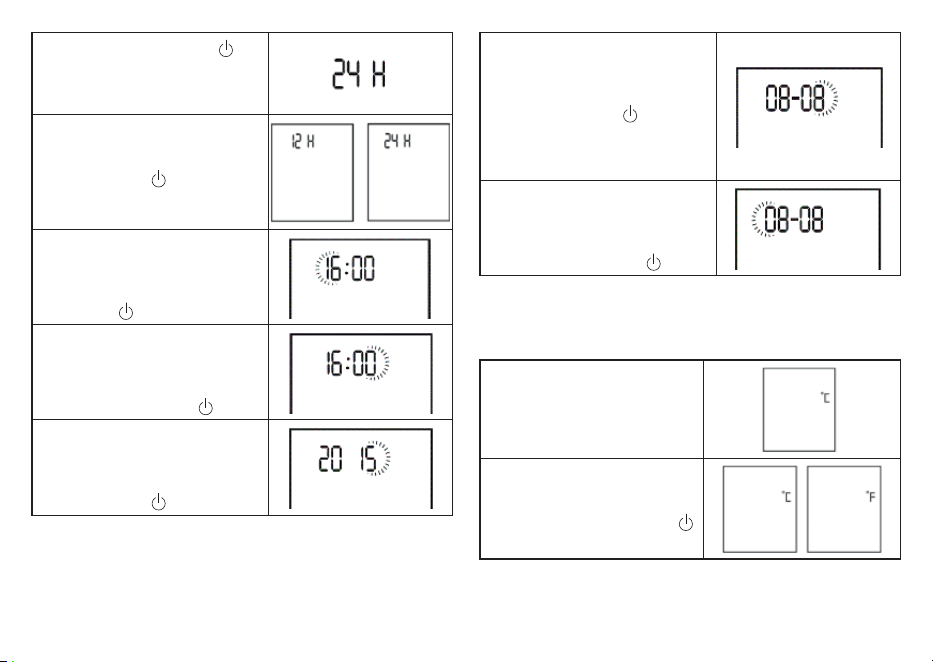
108
1.
Houd de AAN/UIT-toets van
het uitgeschakelde apparaat drie
seconden ingedrukt. Op de dis-
play wordt “24 H” weergegeven.
2.
Selecteer nu met de START-toets
de gewenste uurweergave (12h of
24h) en bevestig uw keuze met de
AAN/UIT-toets .
3. Op de display wordt de uurweer-
gave weergegeven. Selecteer met
de START-toets het huidige uur en
bevestig uw keuze met de AAN/
UIT-toets .
4. Op de display wordt de minuten-
weergave weergegeven. Selec-
teer met de START-toets de hui-
dige minuut en bevestig uw keuze
met de AAN/UIT-toets .
5.
Op de display wordt de jaarweer-
gave weergegeven. Selecteer met
de START-toets het huidige jaar
en bevestig uw keuze met de
AAN/UIT-toets .
6.
Op de display begint de maand-
weergave te knipperen. Selecteer
met de START-toets de huidige
maand en bevestig uw keuze met
de
AAN/UIT-toets
. Het appa-
raat wordt vervolgens automatisch
uitgeschakeld. Datum en tijd zijn nu
opgeslagen.
7.
Op de display begint de dag-
weergave te knipperen. Selec-
teer met de START-toets de hui-
dige dag en bevestig uw keuze
met de AAN/UIT-toets .
7.2 Temperatuureenheid selecteren (°C of °F)
U kunt de meetresultaten laten weergeven in de temperatuureenheid
graden Celsius (°C) of graden Fahrenheit (°F).
1.
Houd de START-toets van het
uitgeschakelde apparaat drie
seconden ingedrukt. Op de dis-
play wordt “°C” weergegeven.
2.
Selecteer met de START-toets
de gewenste temperatuureen-
heid (°C of °F) en bevestig uw
keuze met de AAN/UIT-toets .
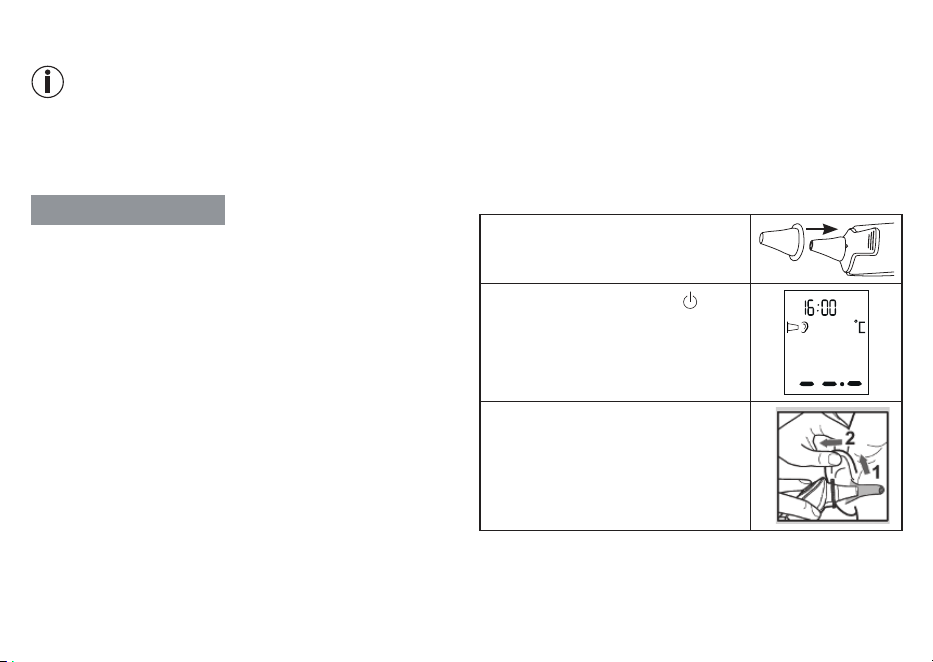
109
8. METEN
Controleer voor ieder gebruik of de lens in goede staat is. Als
deze beschadigd is, neemt u contact op met uw verkoop- of
servicepunt. Houd er rekening mee dat de oorthermometer
zich ten minste 30 minuten in de ruimte moet bevinden waar
de meting plaatsvindt.
8.1 Lichaamstemperatuur meten
WAARSCHUWING
• Sommige personen hebben verschillende meetwaarden in het
linker- en rechteroor. Om temperatuurveranderingen juist te kun-
nen registreren, moet bij dezelfde persoon steeds in hetzelfde
oor worden gemeten.
• De oorthermometer mag alleen onder toezicht van een volwas-
sene door kinderen worden gebruikt. Doorgaans kan de tem-
peratuur bij mensen met een leeftijd vanaf 6 maanden worden
gemeten. Bij kinderen jonger dan 6 maanden is de gehoorgang
nog zeer nauw. Hierdoor kan de temperatuur van het trommel-
vlies vaak niet worden vastgesteld en worden te lage meetresul-
taten verkregen.
• De meting mag niet worden verricht in een ontstoken oor (bi-
jvoorbeeld bij etterafscheiding of andere afscheidingen), bij
mogelijke verwondingen aan het oor (bijvoorbeeld schade aan
het trommelvlies) of tijdens het genezingsproces na operatieve
ingrepen. Wend u in zulke gevallen tot uw behandelend arts.
• Het gebruik van de oorthermometer bij verschillende personen
kan ineciënt zijn bij bepaalde acute, infectieuze aandoeningen
door de overdracht van kiemen ondanks de reiniging en desin-
fectie van het apparaat. Laat u in voorkomende gevallen infor-
meren door uw behandelend arts.
• Deze oorthermometer mag uitsluitend met een aangebrachte
beschermkap worden gebruikt.
• In de volgende gevallen kan de temperatuur in het oor worden
beïnvloed: als u langere tijd op een oor hebt gelegen, als uw oren
zijn afgedekt, als uw oren zijn blootgesteld aan extreme hitte/
kou of na het zwemmen/nemen van een bad. Als een van deze
gevallen van toepassing is, moet u 20 minuten wachten voordat
u de meting mag verrichten.
• De meting kan worden beïnvloed door oorsmeer; reinig het oor
daarom indien nodig voor de meting.
1.
Breng een schone beschermkap op de
sensortip van de oorthermometer aan.
2.
Druk op de AAN/UIT-toets om de
oorthermometer in te schakelen. Er klin-
ken drie geluidssignalen en de display
wordt ingeschakeld.
3.
Omdat de gehoorgang licht gebogen is,
moet u het oor wat naar boven en naar
achteren trekken voordat u de sensor-
tip inbrengt. Zo kan de tip van de be-
schermkap direct op het trommelvlies
worden gericht.
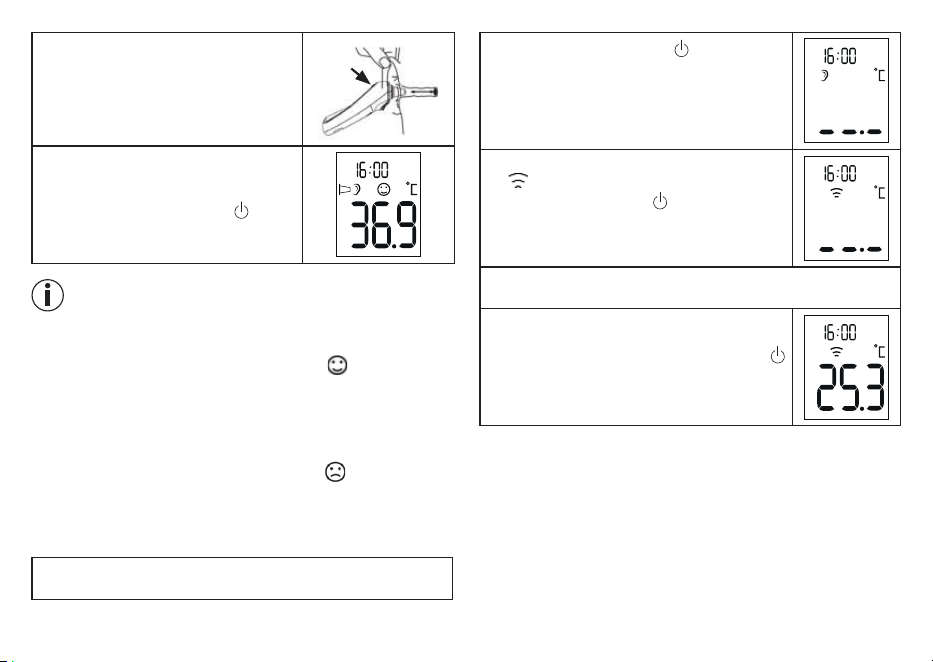
110
4. Breng de sensortip met de bescherm-
kap voorzichtig in de gehoorgang in en
druk op de START-toets om de meting
te starten.
5.
Na ongeveer één seconde klinkt er
een geluidssignaal en wordt het meet-
resultaat op de display weergegeven.
Druk op de AAN/UIT-toets om de
oorthermometer uit te schakelen.
Als u na de meting een minuut lang geen toets indrukt, wordt
de oorthermometer automatisch uitgeschakeld.
Koortsindicator
Als de gemeten temperatuur < 38 °C (100,4 °F) bedraagt,
wordt op de display een lachende smiley
weergegeven en
klinkt er een kort geluidssignaal.
Als de gemeten temperatuur tussen 37,5 °C en 37,9 °C ligt,
klinken er nog twee korte geluidssignalen (indicatie voor een
“verhoogde temperatuur”).
Als de gemeten temperatuur ≥ 38 °C (100,4 °F) bedraagt,
wordt op de display een treurige smiley
weergegeven en
klinken er een kort geluidssignaal, een lang geluidssignaal en
drie korte geluidssignalen.
8.2 Objecttemperatuur meten
1.
Verwijder de beschermkap (indien aangebracht) van de sensortip
van de oorthermometer.
2. Druk op de AAN/UIT-toets om de oorther-
mometer in te schakelen. Er klinken drie ge-
luidssignalen en de display wordt ingescha-
keld.
3. Zorg ervoor dat de objecttemperatuurmodus
( ) is geactiveerd.
Houd de AAN/UIT-toets
en de START-to-
ets tegelijkertijd kort ingedrukt om tus-
sen de lichaamstemperatuur- en de
objecttemperatuur modus te wisselen.
4.
Houd de sensortip van de oorthermometer 1 à 2 cm van de
gewenste meetplek en druk op de START-toets.
5.
Na een seconde klinkt er een geluidssignaal
en wordt het meetresultaat op de display weer-
gegeven. Druk kort op de AAN/UIT-toets
om de oorthermometer uit te schakelen.
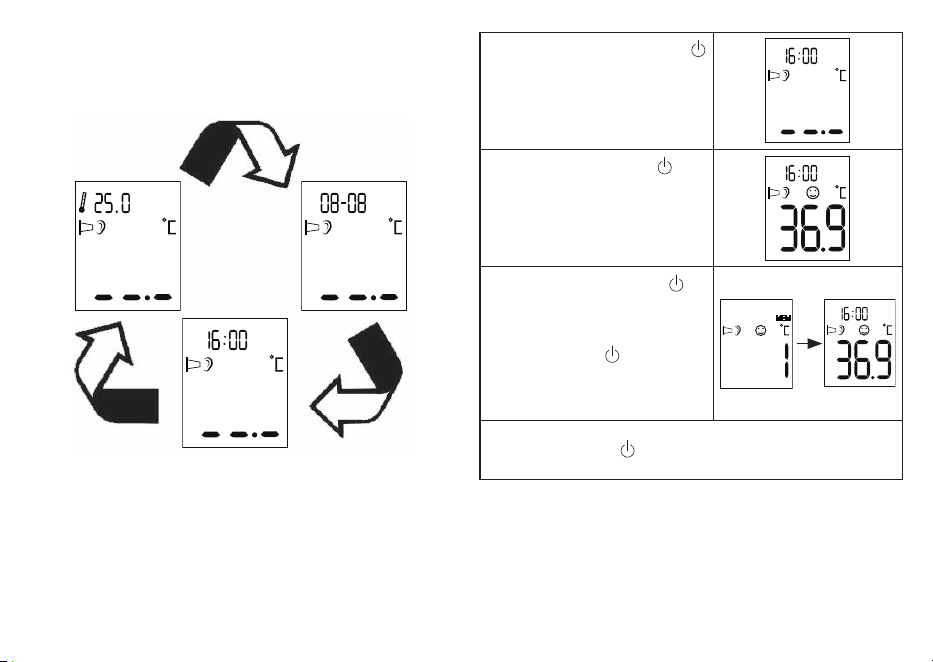
111
8.3 Kamertemperatuur weergeven
Als u de oorthermometer inschakelt, worden de kamertemperatu-
ur, de datum en de tijd elke 3 seconden om beurten op de display
weergegeven.
8.4 Opgeslagen meetwaarden weergeven
De oorthermometer slaat automatisch de temperatuurmeetwaarden
van de laatste 10 metingen van zowel de lichaams- als de objec-
ttemperatuur op (incl. datum en tijd). Ga als volgt te werk om de
opgeslagen meetwaarden op te vragen:
1.
Druk op de AAN/UIT-toets
om de oorthermometer in te
schakelen.
2.
Houd de AAN/UIT-toets 3se-
conden ingedrukt. Op de display
verschijnt een M en de laatst
opgeslagen meetwaarde wordt
weergegeven.
3.
Druk op de AAN/UIT-toets om
tussen de afzonderlijk opgesla-
gen meetwaarden te wisselen.
Elke volgende keer dat u op de
AAN/UIT-toets drukt, wordt
eerst het geheugenplaatsnum-
mer en vervolgens de meetwaar-
de weergegeven.
4.
Druk op de START-toets om met een meting door te gaan. Houd
de AAN/UIT-toets 3 seconden ingedrukt om de oorthermo-
meter uit te schakelen.
9. BATTERIJEN VERVANGEN
Voordat u de batterij vervangt, dient u ervoor te zorgen dat het ap-
paraat is uitgeschakeld.
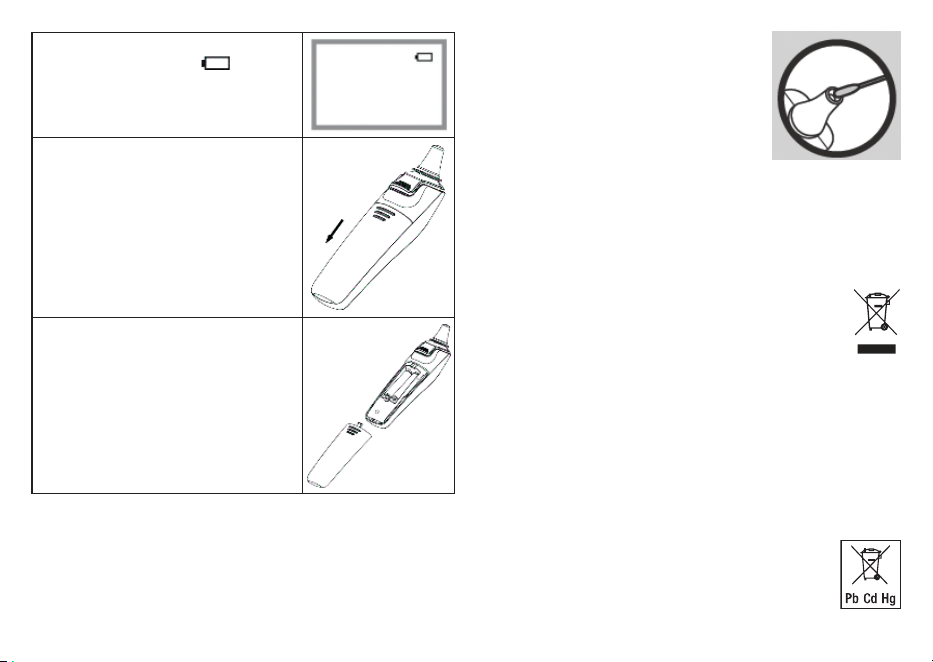
112
1.
Vervang de batterijen op het moment
dat het batterijsymbool ( ) op de dis-
play verschijnt.
2. Schuif het batterijvak open en haal de
lege batterijen uit het batterijvak.
3.
Plaats twee nieuwe AAA-batterijen van
1,5 V in het batterijvak. Let er daarbij op
dat u de batterijen in de juiste richting
plaatst. Sluit het batterijvak.
10. REINIGING/OPSLAG
Beschermkappen mogen slechts een keer worden gebruikt.
De sensortip is het gevoeligste onderdeel van de oorthermometer.
Ga bij het reinigen van de sensortip voorzichtig te werk om bescha-
digingen te voorkomen. Gebruik daarvoor een zachte doek of een
wattenstaafje, eventueel bevochtigd met
alcohol, warm water of een desinfecterend
middel.
Gebruik voor het reinigen van het complete
apparaat een zachte, licht met zeepsop be-
vochtigde doek.
Gebruik geen agressief reinigingsmiddel.
Verwijder de batterijen als u het apparaat
langere tijd wilt opbergen. Bewaar of gebruik het apparaat niet bij
een te hoge of te lage temperatuur of luchtvochtigheid (zie techni-
sche gegevens), in zonlicht, in combinatie met elektrische stroom of
in stoge ruimten. Anders kunnen er meetfouten ontstaan.
11. VERWIJDERING
Met het oog op het milieu mag het apparaat aan het einde
van zijn levensduur niet met het gewone huisvuil worden
weggegooid. U kunt het apparaat inleveren bij gespecia-
liseerde inzamelpunten in uw land. Neem de plaatselijke
voorschriften voor het verwijderen van de materialen in
acht. Verwijder het apparaat conform de EU-richtlijn voor afgedank-
te elektrische en elektronische apparatuur – WEEE (Waste Electri-
cal and Electronic Equipment). Neem bij vragen contact op met de
verantwoordelijke instantie voor afvalverwijdering in uw gemeente.
Voor inzamelpunten van oude apparatuur kunt u contact opnemen
met uw gemeente, bijvoorbeeld met het gemeentebestuur, met de
lokale afvalverwerkingsdienst of met de verkoper.
Deze tekens kunt u aantreen op batterijen met schadelijke stoen:
Pb = batterij bevat lood,
Cd = batterij bevat cadmium,
Hg = batterij bevat kwik.
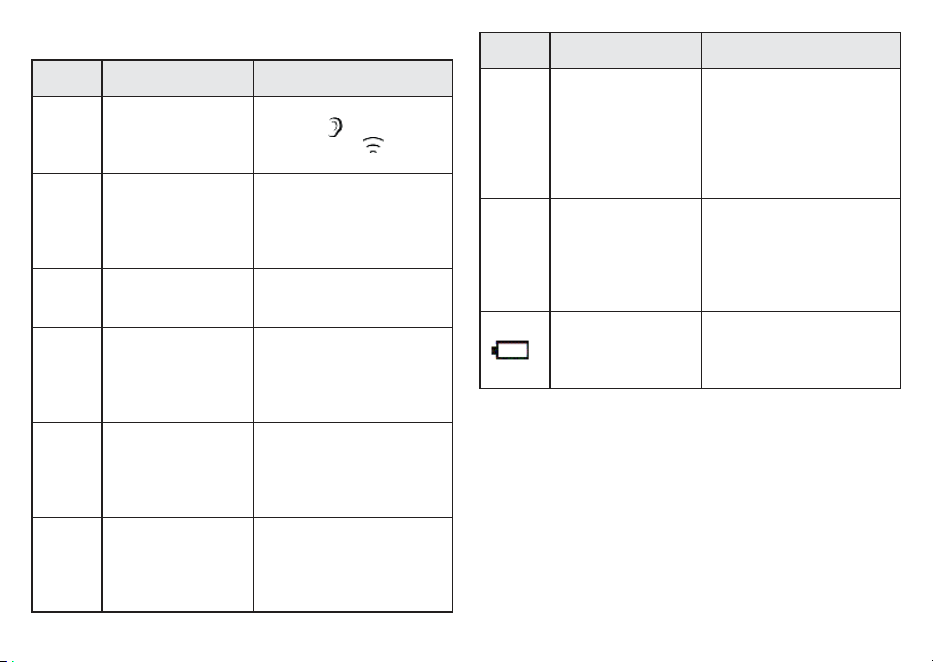
113
12. WAT TE DOEN BIJ FOUTMELDINGEN
Foutmel-
ding
Oorzaak Oplossing
ER1
De oorthermometer is
nog niet klaar om een
meting te verrichten.
Start pas met meten zodra de
lichaams- (
) of objecttem-
peratuurmodus ( ) op de
display wordt weergegeven.
ER2
De gemeten
omgevingstempe-
ratuur ligt nog niet
tussen 10 °C en 40 °C
(50 °F en 104 °F).
Leg de oorthermometer
gedurende 30 minuten in
een ruimte met een omge-
vingstemperatuur van 10 °C
tot 40 °C (50 °F tot 104 °F).
ER3
De oorthermometer is
niet correct in het oor
ingebracht.
Neem de aanwijzingen in het
hoofdstuk “Meten” in acht.
Voer de meting opnieuw uit.
ER4
De oorthermome-
ter heeft een grote
verandering van de
omgevingstemperatu-
ur vastgesteld.
Leg de oorthermometer
gedurende 30 minuten in
een ruimte met een omge-
vingstemperatuur van 10 °C
tot 40 °C (50 °F tot 104 °F).
ER5
De oorthermometer
werkt niet zonder
problemen.
Vervang de batterijen en
probeer het opnieuw. Neem
contact op met de klan-
tenservice als de fout zich
opnieuw voordoet.
ER6
De modus “Objec-
ttemperatuur meten”
is geactiveerd en de
beschermkap is nog
aangebracht.
Om de objecttemperatuur
te kunnen meten, moet u de
beschermkap verwijderen.
Foutmel-
ding
Oorzaak Oplossing
Hi
Oormeting: gemeten
temperatuur hoger
dan 43 °C (109,4 °F)
Objectmeting:
gemeten temperatuur
hoger dan 100 °C
(212 °F)
Zorg ervoor dat het apparaat
en de beschermkap onbe-
schadigd zijn. Voer de meting
opnieuw uit.
Lo
Oormeting: gemeten
temperatuur lager dan
28 °C (82,4 °F)
Objectmeting: geme-
ten temperatuur lager
dan -20 °C (-4 °F)
Zorg ervoor dat het apparaat
en de beschermkap onbe-
schadigd zijn. Voer de meting
opnieuw uit.
De batterijen zijn leeg. Verwijder de twee lege bat-
terijen en plaats twee nieuwe
AAA-batterijen van 1,5V in
de oorthermometer.
Als uw probleem hier niet wordt genoemd, neemt u contact op met
de klantenservice.
13. TECHNISCHE GEGEVENS
Als het apparaat niet binnen de specificaties wordt gebruikt, kan niet
worden gegarandeerd dat het apparaat correct werkt!
De nauwkeurigheid van deze thermometer is zorgvuldig gecont-
roleerd en het apparaat is ontwikkeld met het oog op een lange
levensduur.
Bij gebruik van het apparaat in de geneeskunde bepalen de betref-
fende geldende nationale bepalingen of er meettechnische contro-
les met geschikte middelen moeten worden uitgevoerd.

114
Technische wijzigingen voor de verbetering en verdere ontwikkeling
van het product voorbehouden.
Temperatuurmeet-
bereik
In het oor: 28,0°C – 43,0 °C
(82,4°F – 109,4 °F)
Objecttemperatuur: -20°C – 100 °C
(-4°F – 212 °F)
Kamertemperatuur: 0°C – 50 °C
(32°F – 122 °F)
Laboratorium-meet-
nauwkeurigheid
In het oor: ± 0 ,2 °C (0,4 °F) binnen een
meetbereik van 35,5°C tot 42,0 °C (95,9°F
tot 107,6 °F); ± 0,3 °C (0,5 °F) binnen een
meetbereik van ≤35,5 °C (95,5 °F) en
≥42,0 °C (107,6 °F)
Objecttemperatuur: ± 4% of ± 2 °C (4 °F)
Kamertemperatuur: ± 2 °C (± 4 °F)
Klinische herhaal-
baarheid
0,11 °C (0,2 °F)
Meetduur Ca. één seconde
Bedrijfstemperatu-
urbereik
10°C – 40 °C (50°F – 104 °F), luchtvochtig-
heid 15% – 85% (niet condenserend)
Bewaartemperatu-
urbereik
-25°C – 55 °C (-13°F – 131 °F), luchtvoch-
tigheid ≤ 95% (niet condenserend)
Geheugen 10 geheugenplaatsen
Weergave-
nauwkeurigheid
0,1 °C of 0,1 °F
Batterij DC 3V (2 AAA-batterijen van 1,5 V)
Afmetingen 155 x 38 x 47 mm
Gewicht Ca. 63 g (zonder batterijen)
Beschermkappen 10
Automatische
uitschakeling
60 seconden
Levensduur batterij 3000 achtereenvolgende metingen of een
jaar bij een tot twee metingen per dag
inclusief stand-bymodus.
Veiligheidsklasse
Aangesloten medisch apparaat van
het type BF
IP-beschermings-
graad
IP 22
Het serienummer staat op het apparaat of in het batterijvak.
14. GARANTIE / SERVICE
Meer informatie over de garantie en de garantievoorwaarden vindt u
in het meegeleverde garantieblad.
Fouten en wijzigingen voorbehouden

115

116
795.33_FT58_2025-01-03_05_IM1_BEU
UK Importer: Beurer UK Ltd., Suite 16, Stonecross Place, Stonecross Lane North, WA3 2SH Lowton,
United Kingdom
Beurer GmbH • Söflinger Str. 218 • 89077 Ulm, Germany • www.beurer.com
www.beurer-healthguide.com • www.beurer-gesundheitsratgeber.com