Nautilus
®
Bowflex
®
Schwinn
®
Fitness Pearl Izumi
®
StairMaster
®
Universal
®
Nautilus Institute
®
Owner’s Manual
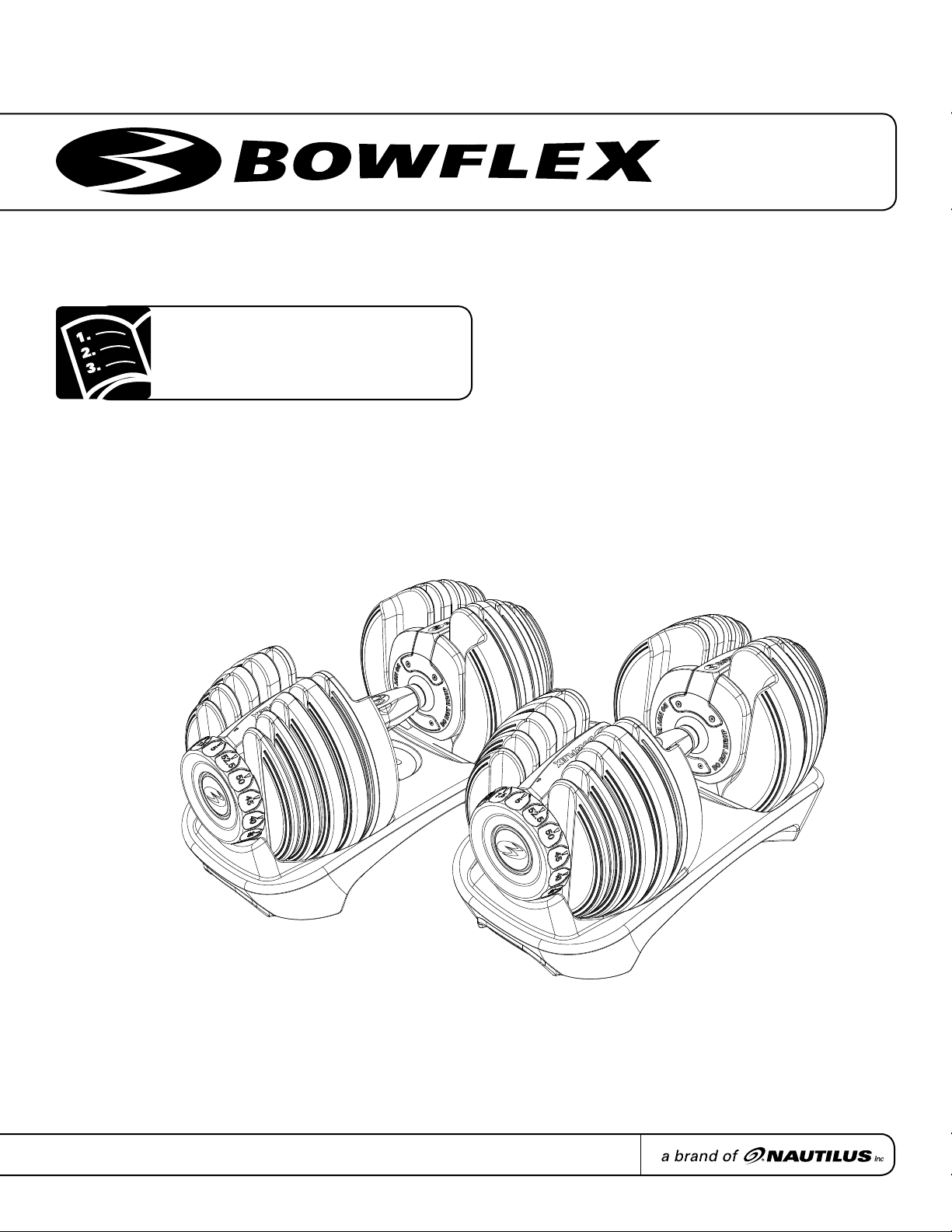
SelectTech
®
BD552 Dumbbells
001-7220-011608A
®
®

Introduction
Congratulations on the your purchase of the Bowflex
®
SelectTech
®
Dumbbell set. This innovative dumbbell is a
versatile training tool that will help you reach your fitness goal. This product has been carefully engineered and
manufactured to provide a wide array of weight options starting at 5 lbs (2.27 kg) and going all the way up to 52.5 lbs.
(23.9kg) In order to utilize this product to its fullest extent, it is critical that you read and fully understand this owner’s
manual prior to using the SelectTech
®
dumbbell.
Owner’s Manual
2

Table of Contents
Safety Warnings ............................................................................................................................................................ 4
Safety Warning Labels ..................................................................................................................................... 5
Product Specifications ................................................................................................................................................. 6
Operation ........................................................................................................................................................................ 7
Getting to Know Your Bowflex
®
SelectTech
®
Dumbbells ........................................................................... 7
Understanding and Testing Locking Mechanism Function ........................................................................ 8
Testing Proper Locking Mechanism Function .............................................................................................. 8
Offset Weight Selection ................................................................................................................................... 10
Maintenance ...................................................................................................................................................... 12
Troubleshooting Guide ...................................................................................................................................... 13
Dumbbell Stand ................................................................................................................................................. 14
Exercises ........................................................................................................................................................................ 15
Leg Exercises ..................................................................................................................................................... 15
Chest Exercises ................................................................................................................................................. 18
Arm Exercises .................................................................................................................................................... 21
Back Exercises .................................................................................................................................................. 25
Abdominal Exercises ........................................................................................................................................ 27
Shoulder Exercises ........................................................................................................................................... 30
Muscle Chart ................................................................................................................................................................. 33
Limited Warranty ........................................................................................................................................................... 34
Contact Information ...................................................................................................................................................... 35
Owner’s Manual
3
Safety Warnings
This icon means a potentially hazardous situation which, if not avoided, could result in death or serious injury.
Before using this equipment, obey the following warnings:
Read and understand the complete Owner's Manual.
Read and understand all Warnings on this machine.
Never allow children to use or play near this equipment. Teenagers under the age of 18 must always have parental •
supervision and instruction on the use of this product.
Consult a physician before starting an exercise program. Stop exercising if you feel pain or tightness in your chest, •
become short of breath, or feel faint. Contact your doctor before using the machine again.
This product is for consumer users only.•
Inspect the dumbbells prior to each use. Do not use a dumbbell with worn or damaged parts Contact Nautilus •
Customer Service for repair information.
Periodically inspect and test the locking mechanism for proper function. Follow the test procedures included in this •
manual.
Never attempt to force the adjustment knob to rotate when the dumbbell has been removed from the dumbbell base.•
Never allow the dumbbells to drop freely to the ground. Damage to the product and potential personal injury may •
occur. Please see the warranty section for specific warranty limitations related to dropped dumbbells.
Never allow dumbbells to forcefully bump together during use. Damage to the product and potential personal injury •
may occur.
Never attempt to disassemble your SelectTech•
®
Dumbbell handle, or base assembly–the product is not designed to
be user serviced. Contact Nautilus, Inc. directly for service.
Before beginning your workout, make certain that your surroundings are free from potential interference.•
The SelectTech•
®
dumbbells are very heavy; if you are not using the optional SelectTech
®
Dumbbell Stand, we suggest
you place the dumbbell assembly directly on the floor for best support.
Do not over exert yourself during exercise. Only use this product in the manner described in this manual• .
Owner’s Manual
4
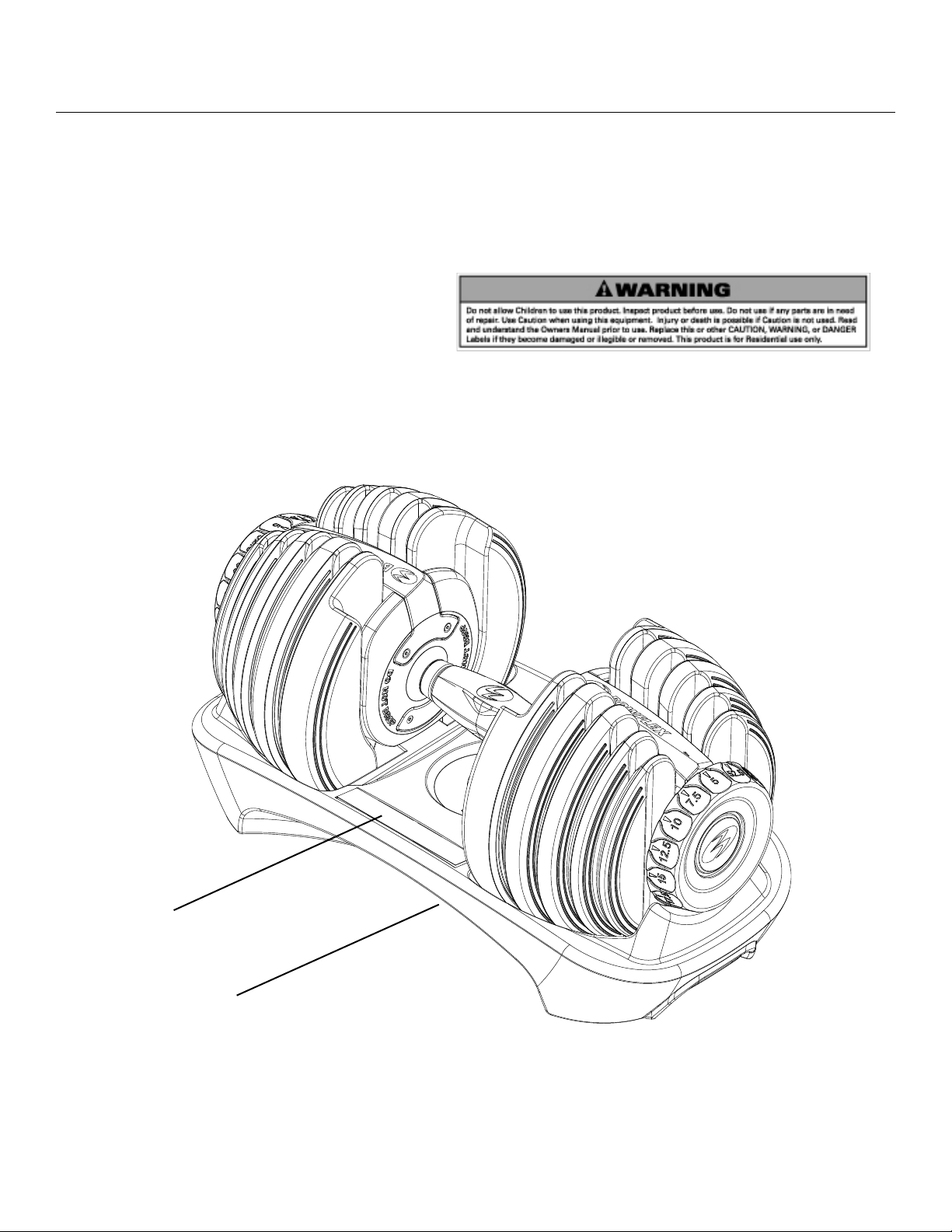
Safety Warning Labels
BEFORE USING YOUR PRODUCT: Find and read all warning labels. If any warning label is damaged, illegible or missing,
call 1-800-864-1270 for a replacement.
A: General warning label.
(Location: On the side of the base.)
B: Serial number.
(Location: On the bottom of the base.)
A
B
Owner’s Manual
5
Product Specifications and Features
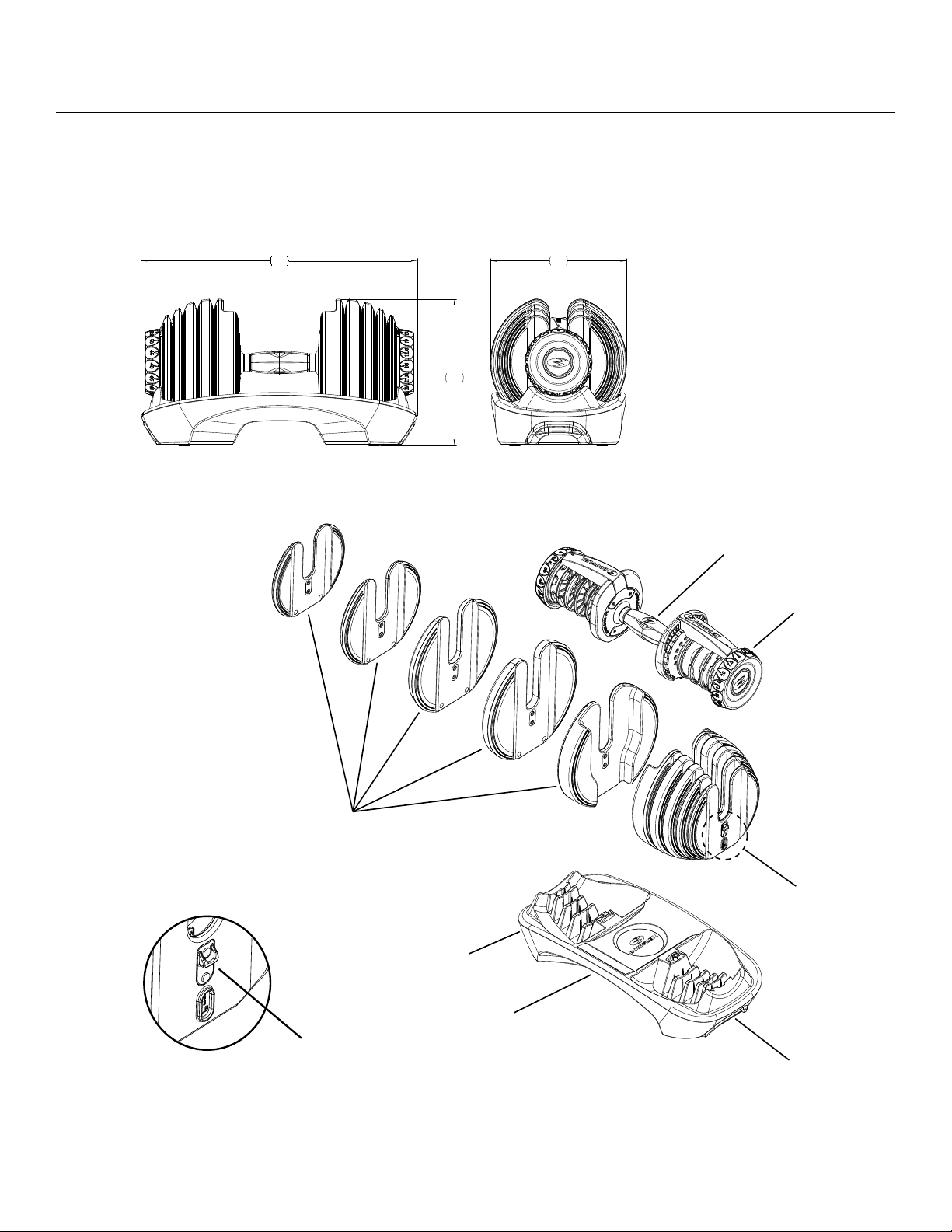
This product is covered by US and Foreign Patents and Patents Pending. See product for more information.
Dimensions 16.9” L x 8.3” W x 9” H (43cm x 21.2cm x 22.8cm)
Dumbbell Assembly Weight Approximately 58 lbs (26.3 kg)
Features
A. Handle grip
B. Adjustment knob
C. Weight plates
D. Weight locking tab
E. Base
F. Lifting handle
22.8cm
9.0”
43.0cm
16.9”
21.2cm
8.3”
C
A
B
F
F
E
D
D
Owner’s Manual
6
Operation
Getting to know your Bowflex
®
SelectTech
®
Dumbbells
The Bowflex
®
SelectTech
®
BD 552 dumbbells are shipped fully assembled, one dumbbell to a box. After carefully removing the
dumbbell from its box, there are some initial steps that should be taken to familiarize you with the function of the product, and to
assure that all aspects of the dumbbell are performing according their specifications.
Notice: Do not drop the dumbbell. Dropping the dumbbell will damage the weight plates and locking mechanism, which could
void the warranty of this product.
1. After removing the dumbbell from its protective packaging, inspect the products and packaging material for any damages.
2. Push down slightly on the handle assembly to make sure it is fully seated in the base. Rotate each adjustment knob several
full rotations to make sure it turns freely in both directions. Make sure there is a click at each weight increment of the
adjustment knob. This click will help you locate the proper alignment to select a given weight increment.
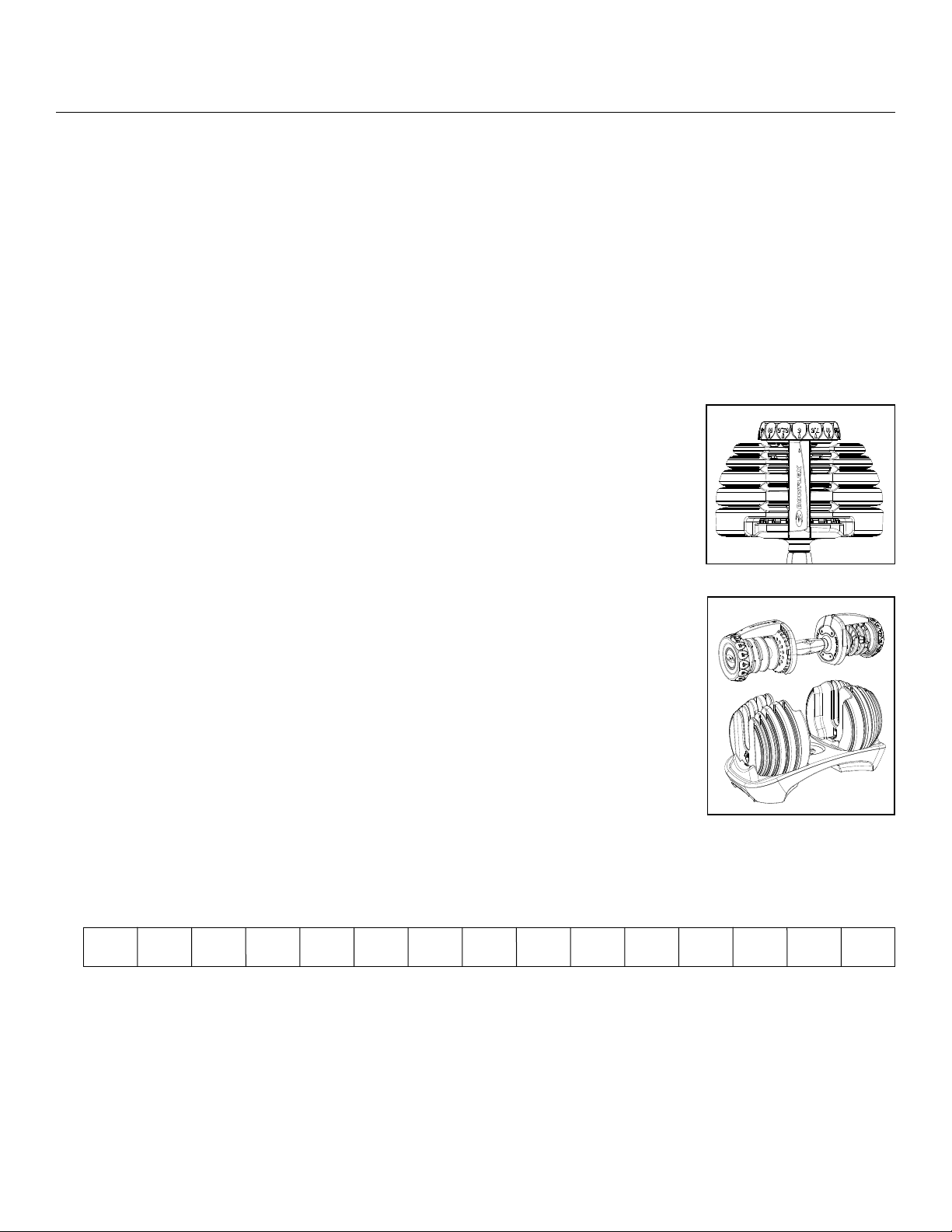
3. The weight increments range from 5 to 52.5 lbs (2.27kg to 23.9kg) on both adjustment knobs.
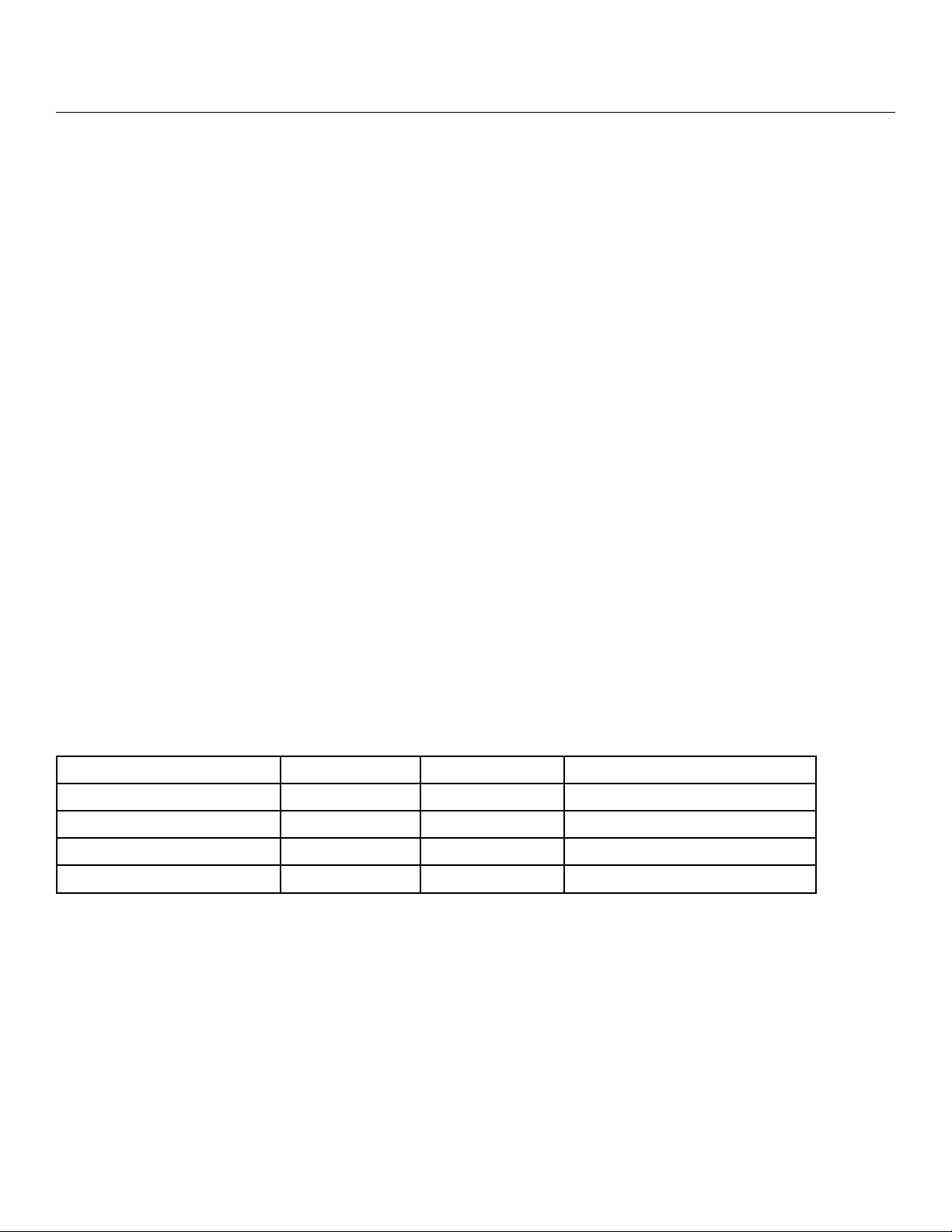
To properly select a given weight (20 lbs [9kg] for example), rotate both adjustment knobs
until that number (20) is aligned with the arrow located on the outward edge of the Bowflex
®
nameplate (Fig.1).
4. After confirming the proper rotational function of the adjustment knob, turn each adjustment
so that the number 5 is aligned with the arrow in the Bowflex
®
nameplate.
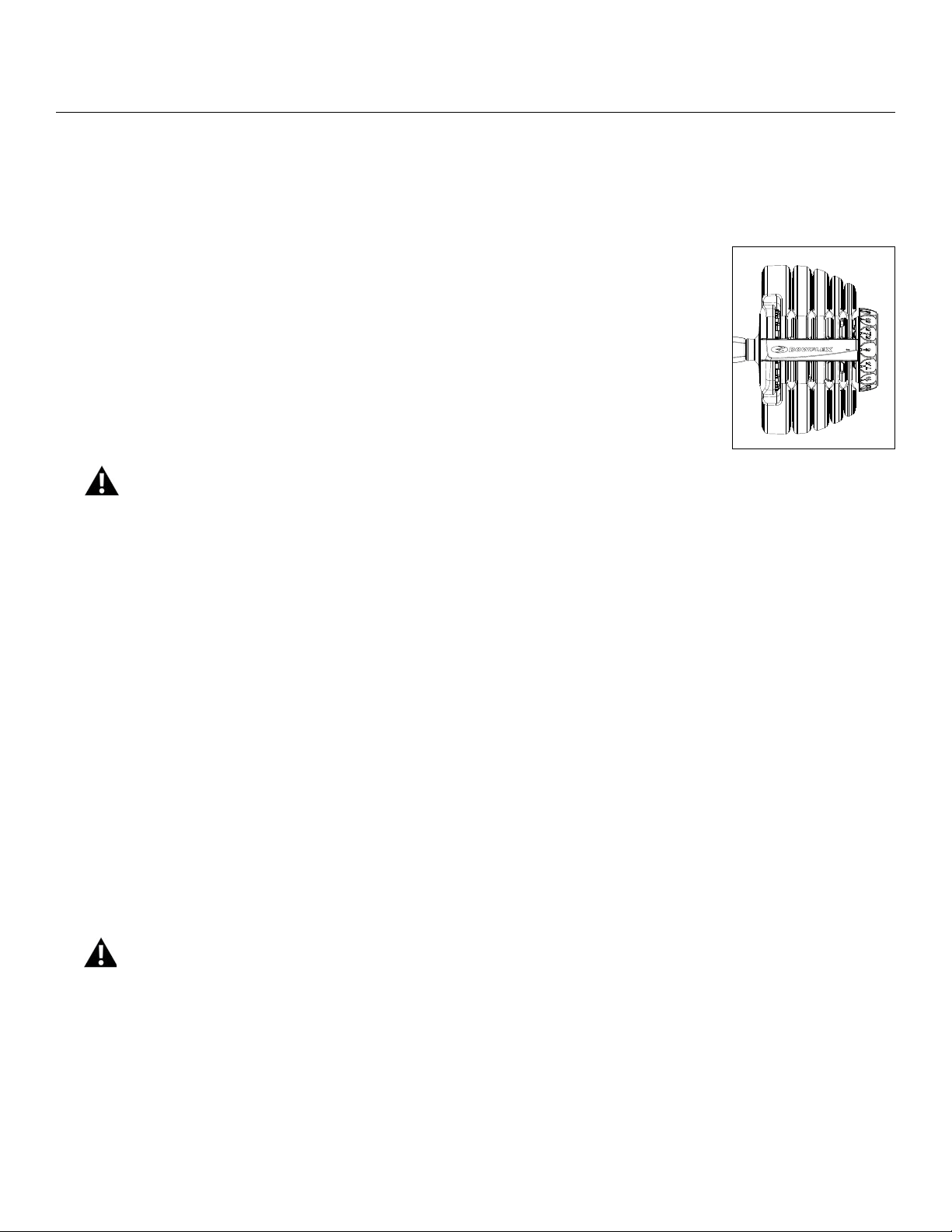
5. With both adjustment knobs set to 5, pull the handle straight up from the dumbbell. This
will remove only the handle from the base, leaving all of the weight plates standing in the
base (Fig. 2). The handle without plates represents the starting weight of 5 lbs (2.27 kg).
6. You may increase the selected weight by rotating each adjustment knob clockwise.
7. The dumbbell handle and weight plates are symmetrical. The handle is inserted with
either end facing the user, provided that you have selected the same weight number on
both ends of the dumbbell.
8. When either returning or removing the dumbbell to or from the base, use a vertical
motion, perpendicular to the base. Do not tilt the dumbbell or move it laterally (parallel to
the base) until it is fully clear of the unselected weight plates.
There are 15 weight increments:
5 7.5 10 12.5 15 17.5 20 22.5 25 30 35 40 45 50 52.5
(2.27kg) (3.4kg) (4.5kg) (5.7kg) (6.8kg) (8kg) (9kg) (10.2kg) (11.4kg)
(13.6kg) (15.9kg)
(18.2kg) (20.5kg)
(22.7kg)
(23.9kg)
Figure 1
Figure 2
Owner’s Manual
7
Operation
Understanding and testing the locking mechanism function
The Bowflex
®
SelectTech
®
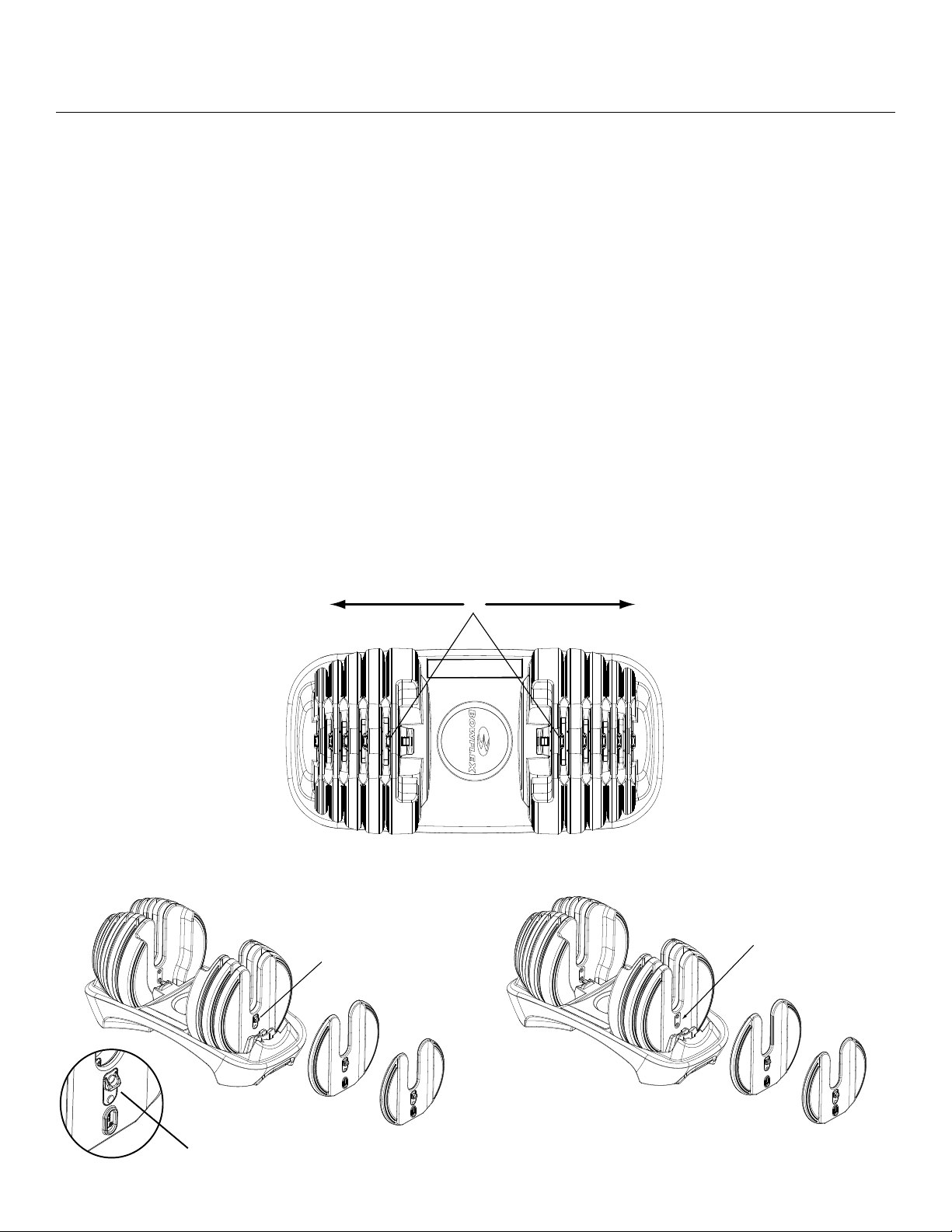
Dumbbell features a patent pending locking mechanism designed to ensure proper and complete
selection of the weight plates as well as to ensure weight plate retention during the workout. It is important that you fully
understand the function of this mechanism and periodically test it to ensure it is properly functioning.
Function
The locking mechanism provides two key functions:
1. The mechanism will only allow the adjustment knobs to be rotated when the dumbbell handle is completely inserted and
engaging the dumbbell base.
2. The mechanism is designed to lock the dumbbell handle to the base if either adjustment knob is not fully engaging the
selected weight plates.
Purpose
The locking mechanism serves two important purposes:
1. The mechanism will prevent deselecting (dropping) weight plates from the dumbbell when it is NOT in the dumbbell base.
2. The mechanism will prevent partial selection of the weight plates in which the plates are not fully supported and the
locking pin is not fully engaged.
D
All locking tabs (D) must point outward.
D
D
Correct—tabs (D) point outward.
Incorrect—tab reversed.
Owner’s Manual
8
Operation
Given the importance of this locking mechanism, it is critical that you understand how it operates, and periodically test it to make
sure it is functioning correctly.
Testing proper locking mechanism function
1. With the dumbbell handle set in the dumbbell base, turn both adjustment knobs to the
number 5. You will know you have fully and correctly selected the number when you feel
the adjustment knob settle into a notch (known as a detent). You will also hear a slight, but
audible, clicking noise that corresponds with the detent locations for each number.
2. You should be able to withdraw the handle from the base leaving all the weight plates behind.
3. With the handle removed from the base, grab one adjustment knob with your other hand and
gently attempt to turn the knob, the knob should not rotate. A locking pin in the mechanism will
have engaged the rotational assembly when the unit was withdrawn from the base. Perform
this test with all adjustment knobs.
Do not use a great deal of force in an attempt to turn the locked adjustment knob. Excessive force may damage the locking
mechanism.
4. After confirming the proper function of the locking mechanism as described above, return and fully insert the dumbbell
handle back into the base assembly.
5. With the handle back in the base, turn the adjustment knob on one side to a position that is between the numbers 5 and
7.5. This represents an incomplete weight selection where the adjustment knob has not fully selected a weight and the
knob is in-between the selection detents (clicks).
6. With the selection knob in this improper position, gently attempt to lift up on the handle to remove it from the base. You
should find that the handle is locked to the base and cannot be removed with light pressure, as it can normally.
7. Return the improperly selected adjustment knob to a full and proper weight selection and assure that the dumbbell handle
can once again be removed.
8. Repeat this test for all adjustment knobs.
9. Assure the entire dumbbell handle assembly is properly tightened. Do this by setting the adjustment knobs to 5 pounds and
removing the handle assembly from the base. Grab both adjustment knobs and very slightly push and pull the knobs toward
and away from the handle grip. The knobs should not exhibit free play and all of the selection discs should feel tightly
connected.
10. You have now tested the function of the locking mechanism. We suggest you repeat this test periodically (once a month) to
confirm the proper function of the locking mechanism.
Do not intentionally engage the locking mechanism and attempt to lift the entire dumbbell with the grip. The dumbbell and
base should only be lifted by using the lift handles molded into the base assembly.
If the dumbbell locking mechanism fails to perform in accordance with the test procedure above, do the following:
1. Discontinue use of the product immediately until proper service can be provided.
2. Contact your Bowflex
®
retailer or contact Nautilus, Inc. directly by phone at 1-800-NAUTILUS (628-8458) for service.
Owner’s Manual
9
Operation
Offset weight selection
As indicated previously, proper selection for a given weight is accomplished by selecting that weight number on both ends of the
dumbbell. For example: to select 20 lbs (9 kg), one must dial both adjustment knobs on the dumbbell to the number 20. By selecting
the same number on both sides of the dumbbell, you will replicate a common dumbbell (a balanced dumbbell with equal weight
on both sides). While this is the most common form of weight selection and will be used in the vast majority of workouts, the
Bowflex
®
SelectTech
®
Dumbbell offers a useful and unique workout alternative known as offset weight selection.
Offset weight selection involves using a different weight setting on one side of the dumbbell relative to the other. Doing so can be
a powerful muscle development tool during certain workouts, such as the biceps curl.
The SelectTech
®
Dumbbell functions exactly the same way whether you have selected balanced or offset weights. The only
exception is that when you are using offset weights, you must return the dumbbell to the base in the same orientation that you
removed it.
When you have offset weight selection, the combination of weight plates selected will not be the same on both sides of the
dumbbell. You must therefore make certain to return the dumbbell to the base in the same orientation in which it was removed, in
order for the weight plates to settle back into the corresponding vacant slots in the dumbbell base.
Example of offset weight selection workout
Performed traditionally, dumbbell curls strengthen the biceps, but do little for the forearm muscles that assist in supination
and pronation of the wrist. Supination and pronation are terms describing a rotating motion of the wrist. For example, turning
a doorknob and turning your key in your car’s ignition are examples of supination and pronation. Turning a doorknob clockwise
would be the supination direction, while counter-clockwise would be the pronation direction. Whether you are training for a
specific sport, or just training to become stronger and improve activities of daily living, training your forearm muscles that are
involved in supination and pronation can be beneficial.
These dumbbells allow you to train differently than traditional dumbbells. By using different weight settings on either side of
the dumbbells, you can use those supination/pronation muscles during your curls. Using more weight on the thumb side of the
dumbbell will improve pronation strength, while more weight on the little finger side will improve supination strength. Not only will
you be strengthening your biceps, but also you can become stronger in activities involving rotation of the wrist.
The following example of a Biceps Curl using offset weight is a good demonstration of the superior muscle development provided
by the SelectTech
®
Dumbbell.
Side 1 Side 2 Total dumbbell weight
Weight settings selected 20 lbs (9 kg) 30 lbs (13.6 kg) 25 lbs (11.4 kg)
Weight difference 10 lbs (4.5 kg)
Weight distribution 10 lbs (4.5 kg) 15 lbs (6.8 kg) 25 lbs (11.4 kg)
Weight offset + 5 lbs (2.27 kg)
The dumbbell weight has been set to 20 lbs (9 kg) on one side and 30 lbs (13.6 kg) on the other. The total weight of the dumbbell
is therefore 25 lbs (11.4 kg). This 25 lb (11.4 kg) dumbbell has the weight distributed such that there are 10 lbs (4.5 kg) on one side,
and 15 lbs (6.8 kg) on the other, for a total of 25 lbs (11.4 kg).
With the dumbbell weight configured as defined above, the user should grip the dumbbell with 20 lbs (9 kg) on the thumb side of
the hand and the 30 lbs (13.6 kg) on the little finger side of the hand.
Example of offset weight settings.
Owner’s Manual
10
Operation
Difference Offset
2.5 lbs + 1.25 lbs
5 lbs + 2.5 lbs
7.5 lbs + 3.75 lbs
10 lbs + 5 lbs
12.5 lbs + 6.25 lbs
15 lbs + 7.5 lbs
17.5 + 8.75 lbs
20 lbs + 10 lbs
22.5 lbs + 11.25 lbs
25 lbs + 12.5 lbs
30 lbs + 15 lbs
35 lbs + 17.5 lbs
40 lbs + 20 lbs
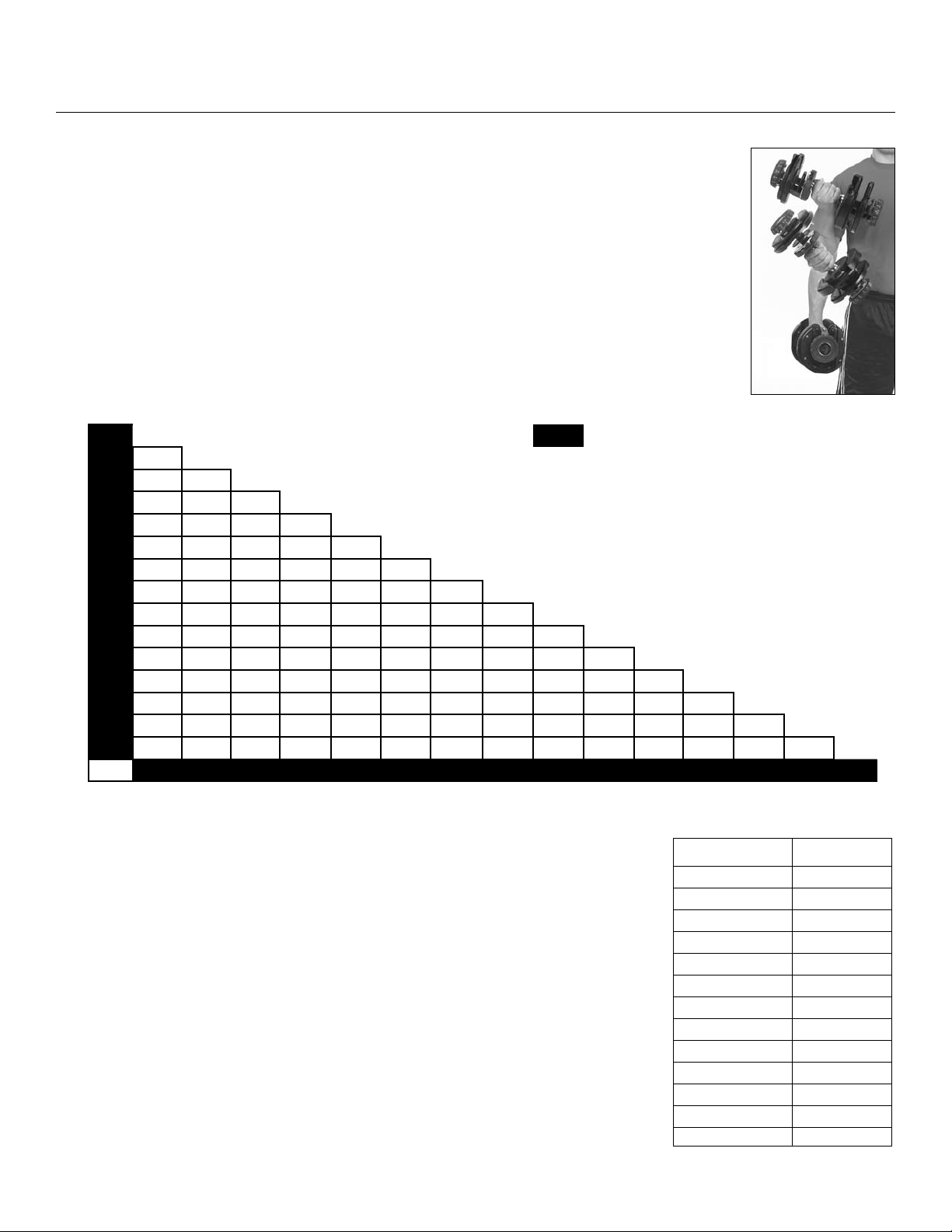
5 Indicates weight setting on adjustment knob
7.5 6.25
10 7.5 8.75
12.5 8.75 10 11.25
15 10 11.25 12.5 13.75
17.5 11.25 12.5 13.75 15 16.25
20 12.5 13.75 15 16.25 17.5 18.75
22.5 13.75 15 16.25 17.5 18.75 20 21.25
25 15 16.25 17.5 18.75 20 21.25 22.5 23.75
30 17.5 18.75 20 21.25 22.5 23.75 25 26.25 27.5
35 20 21.25 22.5 23.75 25 26.25 27.5 28.75 30 32.5
40 22.5 23.75 25 26.25 27.5 28.75 30 31.25 32.5 35 37.5
45 25 26.25 27.5 28.75 30 31.25 32.5 33.75 35 37.5 40 42.5
50 27.5 28.75 30 31.25 32.5 33.75 35 36.25 37.5 40 42.5 45 47.5
52.5 28.75 30 31.25 32.5 33.75 35 36.25 37.5 38.75 41.25 43.75 46.25 48.75 51.25
5 7.5 10 12.5 15 17.5 20 22.5 25 30 35 40 45 50 52.5
Offset weight selections.
The chart to the right is a quick reference to determine the amount of weight offset to
one side of the dumbbell.
The amount of weight listed in the Difference column indicates the difference
between the two weights selected with the dumbbell adjustment knob.
The symbol “+” indicates the amount of offset weight on the heavier side of the
dumbbell.
Although you can continue to increase the amount of weight offset, it is not generally
necessary to offset the weight more than 20 lbs (9 kg).
Start the biceps curl with a neutral wrist and forearm position (palm facing leg). As the curl progresses
from the start to finish position, the wrist should be rotated progressively outward (palm up). During this
curl the user will be lifting the weight of the dumbbell (25 lbs [11.4 kg]) with the biceps but also lifting
the offset weight of 5 lbs (2.27 kg) with wrist rotation (supination). Unlike a conventional dumbbell that
is balanced end to end, this offset weight will require more muscle activation and therefore develop the
forearm and wrist.
The following chart provides the total dumbbell weight for various combinations of weight settings.
Owner’s Manual
11
Maintenance
Bowflex
®
SelectTech
®
Dumbbell maintenance:
The Bowflex
®
SelectTech
®
Dumbbell is a very low maintenance product. However, there are steps that you should take to keep
the product performing and looking its very best.
1. Should your SelectTech
®
Dumbbell handle assembly, plates or base become soiled you may clean them with a cloth lightly
dampened with warm water and a small amount of mild soap. Wipe dry with a separate cloth.
2. The SelectTech
®
Dumbbell is internally lubricated and will not require further internal lubrication. The contact between
weight plates and selection discs is not lubricated but has naturally low friction. This generally will not require any
lubrication. Should you feel it necessary to lubricate the weight plates and/or selection discs, use only a silicon lubricant,
preferably “food grade”.
Do not use any solvents, harsh detergents, chemicals or bleach on this product − doing so may damage the materials,
resulting in degradation of the product’s performance or strength.
Do not attempt to disassemble the dumbbell handle or base assembly. These items are not designed to be user serviced.
Doing so will void the manufacturers warranty. Contact Nautilus, Inc. directly for service.
Owner’s Manual
12
Troubleshooting
Problem Solution
Dumbbell handle does not fully insert into base
when no plates are selected (handle has no
plates attached).
1. Make certain that both adjustment knobs are set directly to the num-
ber 5.
Dumbbell handle does not fully insert into base
when plates are selected (handle has plates
attached).
1. Check to see if you have selected different weights on each side of the
dumbbell (for example one adjustment knob is set to 2 and the other is
set to 3). If this is the case, you must replace the dumbbell in the base
with the same orientation in which it was was withdrawn. This is to
allow the plates to settle back into the correct and vacant openings in
the base.
2. Verify that the plates not selected (those plates remaining in the dumb-
bell base) are in their correct spots and have not been moved to differ-
ent support slots. This may be blocking the dumbbell from fitting back
into the base.
Adjustment knob will not turn while handle is in
base.
1. Check to assure that the dumbbell handle is fully depressed into the
dumbbell base. If not fully depressed, the locking mechanism will not
be released and may prevent the adjustment knobs from rotating.
2. Check to see if any weight plates have been put into the base assem-
bly backwards with the “Locking Tab” facing the grip of the dumbbell
handle. All weight plates must have the selection tongue facing away
from the grip of the dumbbell handle.
3. Check to see if there is any dirt, debris or other obstruction in the
dumbbell base. You may need to remove the weight plates from the
base to accomplish this check. Remember to put each weight plate
back in its appropriate location with the selection tongue facing away
from the dumbbell grip.
Plates are not secured to the handle and drop out. 1. Confirm that all of the weight plates have the “Locking Tab” facing
away from the dumbbell grip. If one or more of the weights are inserted
backwards with “Locking Tab” facing inward toward the grip, the
handle can get blocked, and the plates may wedge into the handle.
2. Verify that the plates not selected (those plates remaining in the dumb-
bell base) are in their correct spots and have not been moved to differ-
ent support slots. This may be blocking the dumbbell from fitting back
into the base.
Owner’s Manual
13
Optional Accessories
Optional exercise bench and mat are available separately.
Additional products are available from Nautilus, Inc. at www.nautilusinc.com
Bowflex
®
SelectTech
®
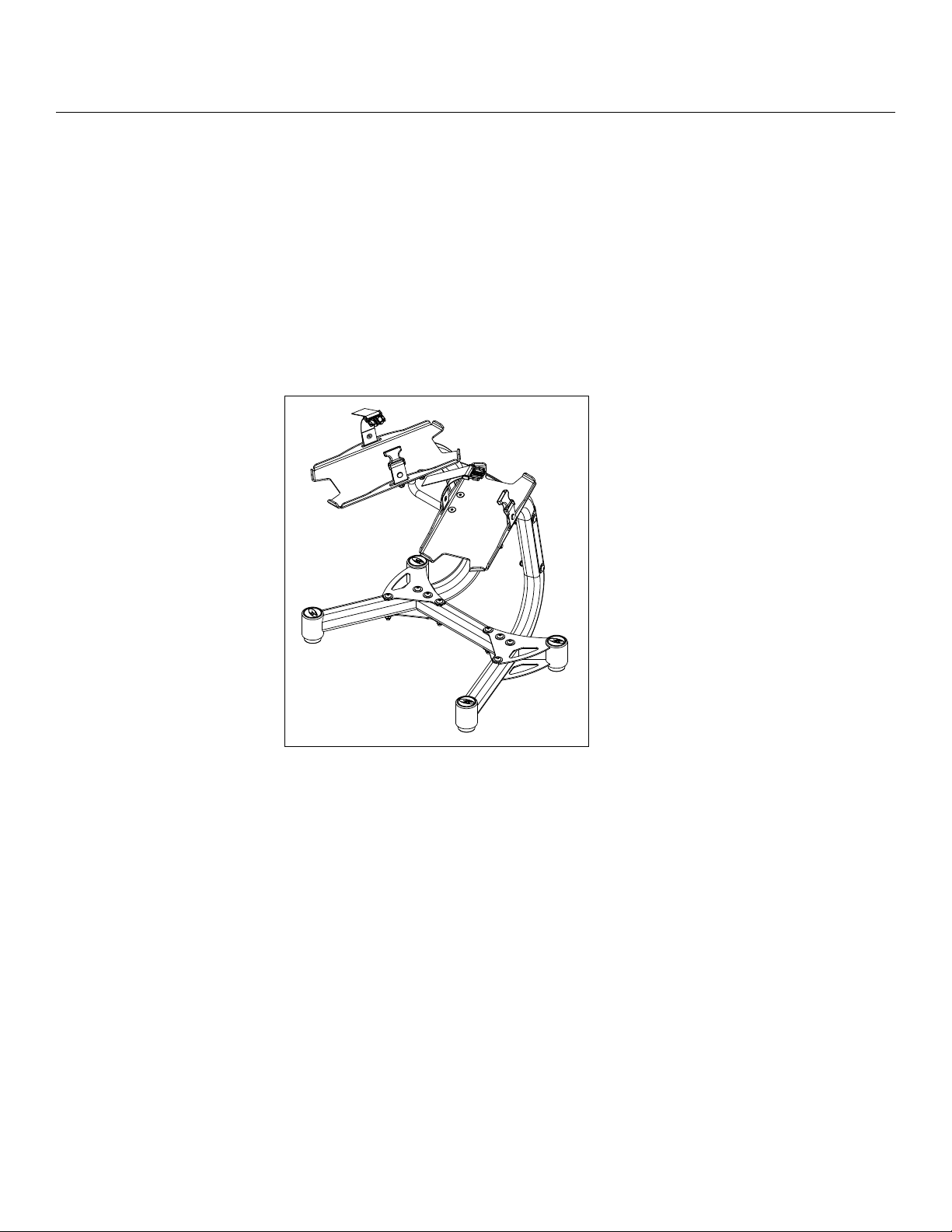
2-in-1 Dumbbell Stand
This attractive stand features an ergonomic design to enhance the functionality of the SelectTech
®
dumbbells.
• TheV-shape“step-in”designallowstheusertomaintainproperupperbodypositionwhileliftingorreplacingthedumbbells
in the base.
• Thedumbbellhandlesarepositionedinanaturalorientationprovidingacomfortableandsecureliftingposition.
• Largeadjustablestabilizerfeetassuremaximumstability.
• Includeswheelsforeasytransport.
• Includesfasteningstrapstosecuredumbbellstothebase.
• Integratedtowelrack.
• Dimensions(withoutdumbbells):27.75”Lx20.5”Wx24.5”H(70.5cmx52cmx62.2Hcm)
Owner’s Manual
14
Leg Exercises
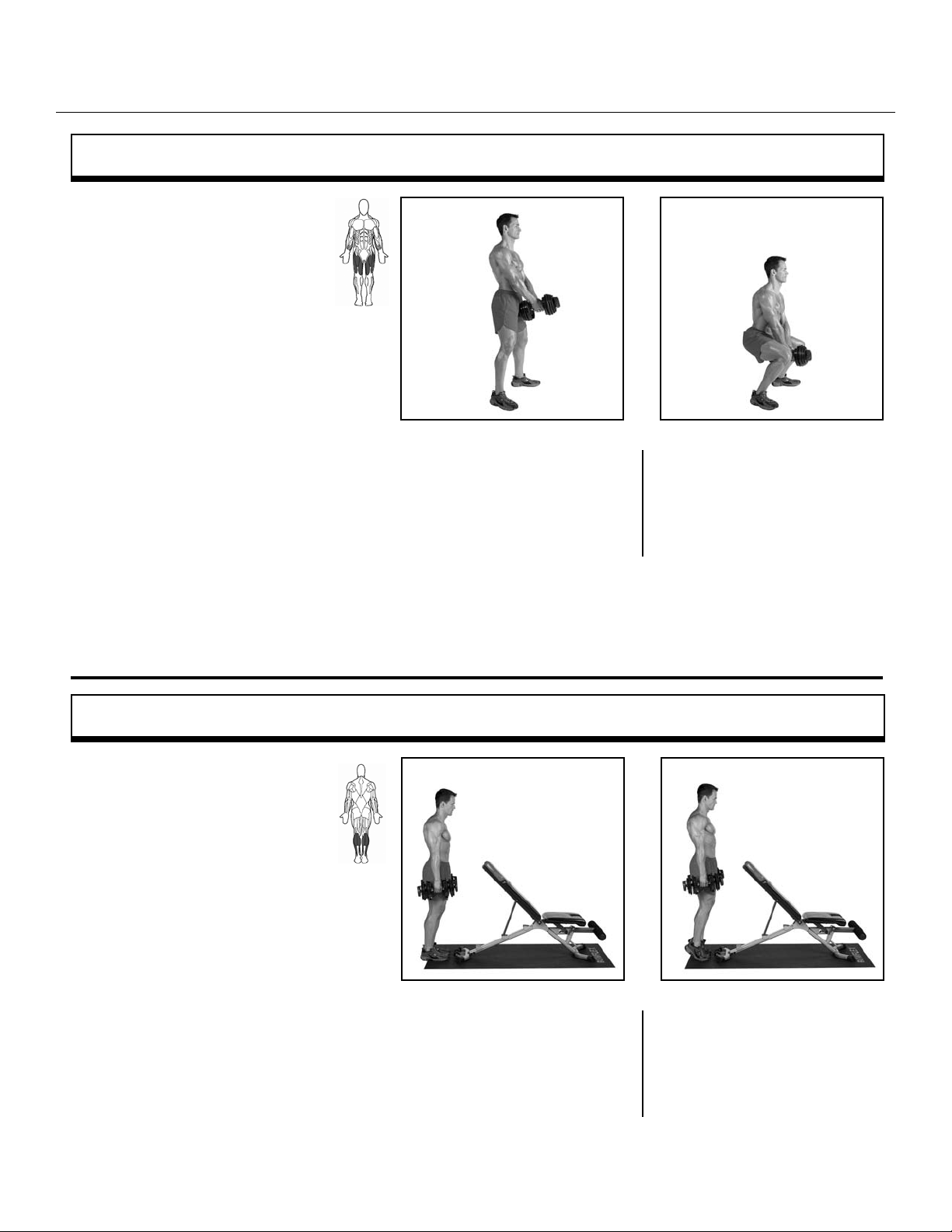
Wide Squats
START ACTION
START
• Grabthedumbbellwithboth
hands and stand with you feet
slightlywiderthanshoulder
widthapart.
• Slightlyrotateyourhipsoutward,
feetandkneesshouldbelined
upinthatoutwardpositionas
well.
• Stabilizeyourtorsobyliftingyour
chest,tighteningyourabsand
maintainingaslightarchinyour
lowerback.
• Undercontrol,slowlysquatdown
by sticking the hips back as the
kneesstarttobend.
• Keepthechestupandtheback
flatasthehipscontinuetomove
backward.
• Lowertoapproximately
90degreesattheknees,unless
otherwisedetermined.
• Returntothestartingposition.
• Donotlockoutthekneesatthe
topofthesquat.
FINISH
Calf Raises
START ACTION
START
• Standwithyourfeetabout
shoulderwidthapart,feetfacing
straightforward.
• Holdthedumbbellsatyoursides
withyourpalmsfacingin.
• Keepyourchestlifted,abstight
andaslightcurveinyourlower
back.
• Slowlyriseupontheballsof
yourfeet,liftingyourheelsas
highasyoucanoffthefloor.
• Slowlyreturntothestarting
position,keepingtensiononthe
calfmuscles.
FINISH
Muscles worked
Quadriceps,glutes,hamstringsand
adductors
Success tips:
• Keepthekneespointedinthesame
directionasthetoes.
• Keeptheheadandneckinlinewith
thetrunk.
• Paycloseattentiontoallalignment
andstabilizationissuesoneverypart
ofeachandrepetition.
Muscles worked
Gastrocnemiusandsoleus
Success tips
• Donotchangeyourhiporknee
positionduringtheexercise.
• Riseupashighasyoucan,
maintainingyourbalance,onthe
ballsofyourfeet.
Note:Optionalaccessoriesshownin
photos.
Owner’s Manual
15
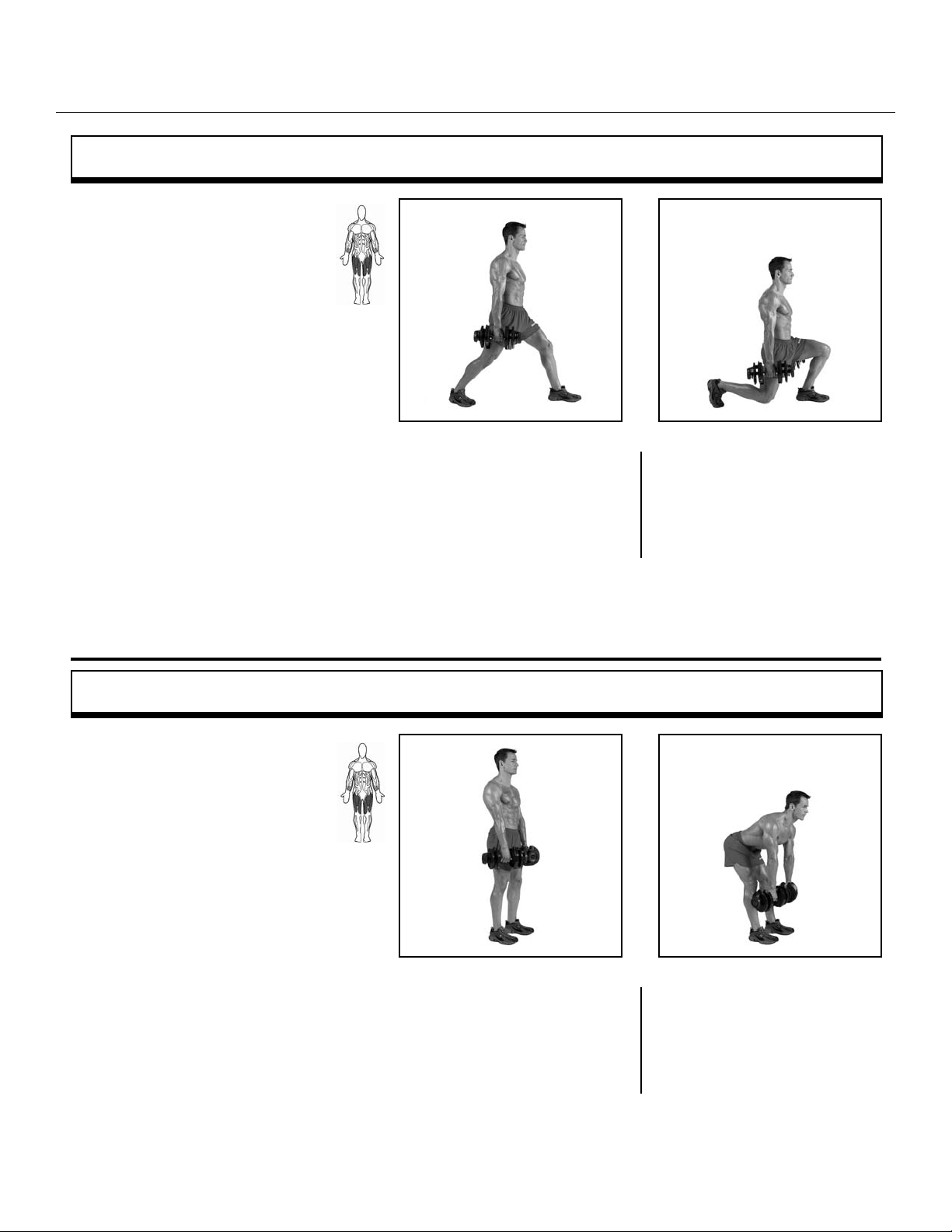
Stationary Lunges
Stiff-leg Dead Lift
START ACTION
START
• Standwithyourfeetapproximately
shoulderwidthapart.
• Holdthedumbbellsdowninfront
ofyourthighswithyourpalms
facing back.
• Standwithaveryslightbendat
the knees.
• Keepthechestlifted,abstightand
averyslightarchinyourlower
back.
• Maintainingyourkneeposition,
slowlybendforwardatthehips
movingyourbuttbackward.
• Stopasyourhamstingsbegin
togettautandbeforeyourback
beginstoround.
• Concentrateontensingyour
hamstringstopullyoubackupto
thestartingposition.
FINISH
START ACTION
START
• Standwithonefootforwardand
onefootbackwardinaposition
sowhenyoumovetothe
bottomofthelunge,yourfront
footisunderyourkneeandyour
backkneeisdirectlyunderyou
hip.
• Holdthedumbbellsatyoursides
withyourpalmsfacinginward.
• Keepthechestlifted,abstight
andaslightarchinthelower
back.
• Slowlyloweryourbodybending
atbothknees,simultaneously
keepingthefrontkneeinline
with the toes.
• Movedownandstopjustbefore
the back knee is going to touch
thefloor.
• Reversethemotionandcome
backuptothestartingposition.
FINISH
Muscles worked
Quadriceps,glutes,hamstringsand
adductors
Success tips
• Placefeetinapositionsothatwhen
youlungedown,yourfrontfootis
directlyunderyourkneeandyour
backleglinesupunderyourhip.
• Keepyourheadandchestlifted,with
aslightarchinthelowerbackduring
themovement.
• Doonlyonesidetofatigue,then
switchtotheotherside.
Muscles worked
Hamstrings,glutesandspinalerectors
Success tips
• Yourtorsoshouldmovefrom
standingverticaltoleaningforward
atthehipswithoutrounding
yourspineduringanypartofthe
movement.
• Keepthekneesslightlybent.
• Onlymoveasfarasyoucan
correctly.
• Itiscriticalthatyoukeepthechest
liftedanddonotallowyourspine
toroundatanytimeduringthe
movement.
Leg Exercises
Owner’s Manual
16
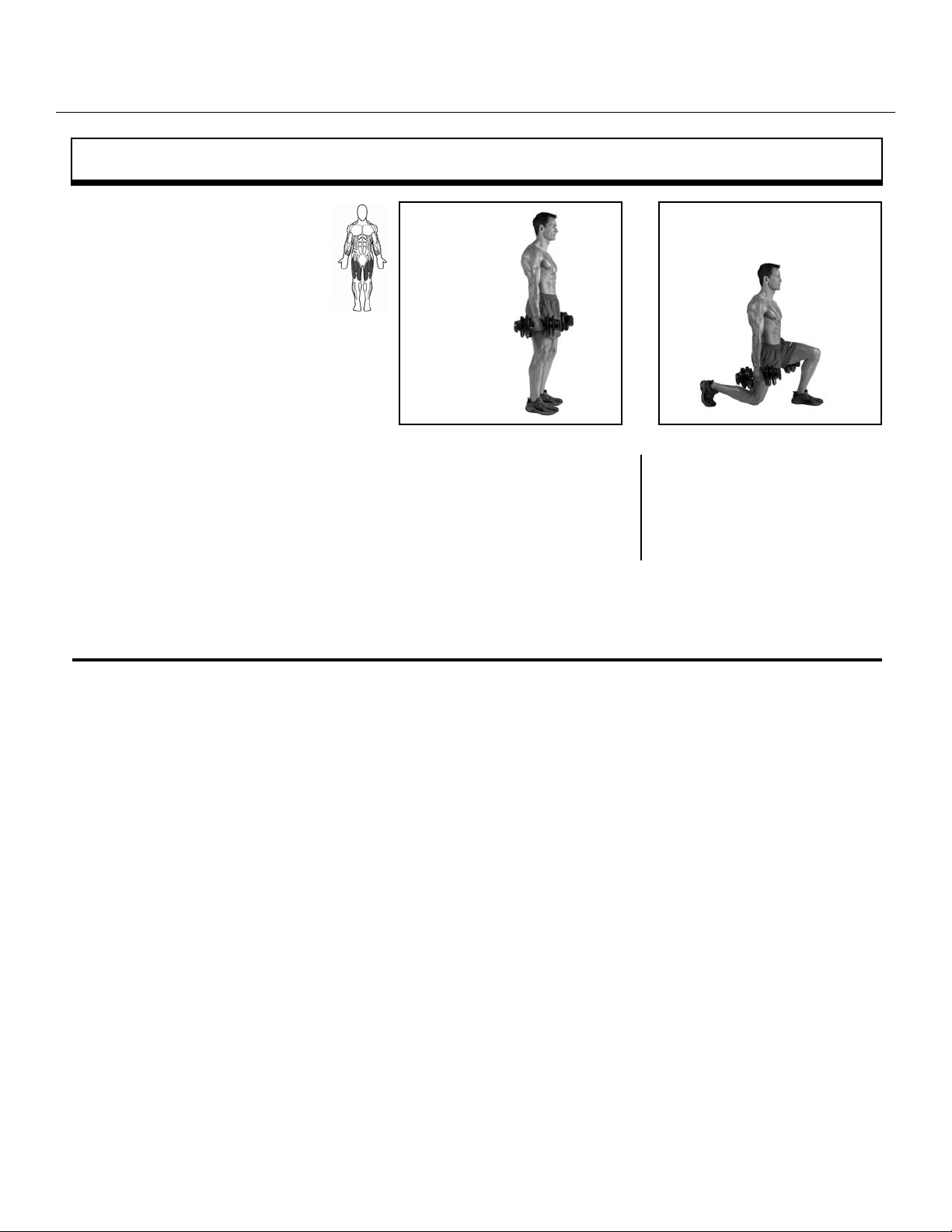
Leg Exercises
Reverse Lunge
START ACTION
START
• Standwithyourfeettogether.
• Holdthedumbbellsatyoursides
withyourpalmsfacinginward.
• Keepthechestlifted,abstight
andaslightarchinthelower
back.
• Initiatethemovementby
tighteningyourglutesandslowly
pivotingyourlegfromyourhip.
Moveyourentirelegbackward,
keepingyourkneesteadyata
90degreeangle.
• Slowlymoveyourlegasfaras
youcan,withoutallowingany
movementatthewaist,kneeor
lowerback.
• Slowlyreturntostartposition.
FINISH
Muscles worked
Quadriceps,glutes,hamstringsand
adductors
Success tips
• Placefeetinapositionsothatwhen
youlungeback,yourfrontfootis
directlyunderyourkneeandyour
backleglinesupunderyourhip.
• Keepyourheadandchestlifted,with
aslightarchinthelowerbackduring
themovement.
• Doonlyonesidetofatigueandthen
switchtotheotherside.
Owner’s Manual
17
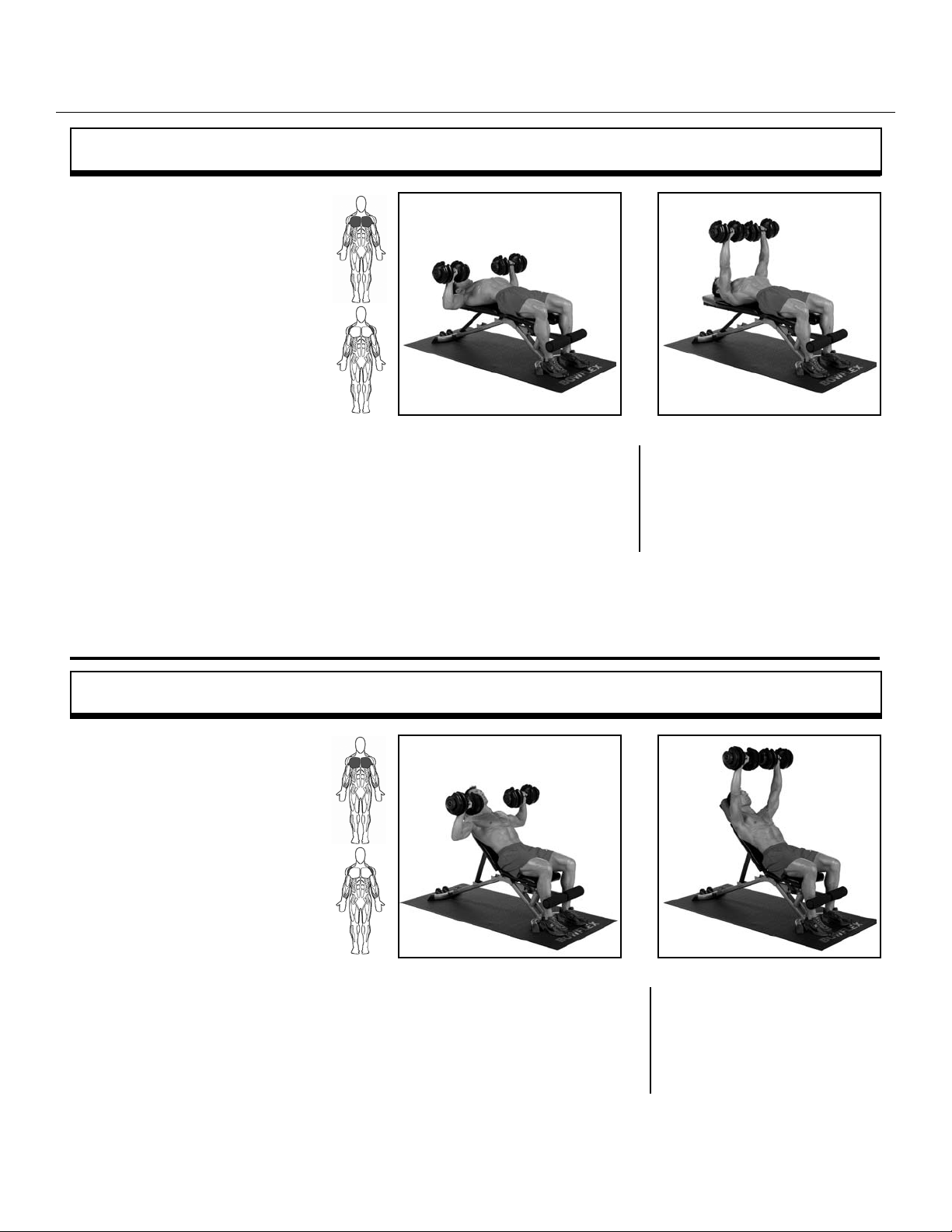
Chest Exercises
Flat Chest Press
Incline Chest Press
START ACTION
Muscles worked
Pectoralismajor,deltoidsandtriceps
Bench position
Inclinedto45degrees
Success tips
• Maintaina60-90degreeangle
betweenyourupperarmsandtorso
atthestartofthemotionandslightly
morethan90degreesfromyour
torsoatthetop.
• Keepkneesbentsoyourfeetare
positionedflatonthefloordirectly
underyourknees.
• Donotletyourelbowstravelbehind
yourshoulderswhenyouare
loweringthedumbbells.
• Keepshoulderbladespinched
togetherandmaintaingoodspinal
alignment.
• Keepyourarmsdirectlyinlinewith
thedumbbelloveryourwristsand
elbows.
START
• Grabthedumbbellsandliebackonthe
bench.
• Bendyourelbowsback,keepingyour
armsatapproximately
60-90degreesawayfromyoursides,
andyourelbowsequaltoyourshoulder.
• Raiseyourchest,pinchyourshoulder
bladestogetherandmaintaina
comfortablearchinyourlowerback.
• Slowlypressthedumbbells
upward,straighteningyourarms
whilemovingthedumbbells
towardeachother,directlyoverthe
centerofyourchest.
• Don’tlockoutyourelbows,keep
the tension on the chest.
• Slowlyreturntothestarting
position,keepingyourwrists
steadyandyourmovementsslow
andcontrolled.
FINISH
START ACTION
Muscles worked
Pectoralismajor,deltoidsandtriceps
Bench position
Flat
Success tips
• Maintaina60-90degreeangle
betweenyourupperarmsandtorso
atthestartofthemotion,anda90
degreeanglefromyourtorsoatthe
top.
• Keepkneesbentsoyourfeetare
positionedflatonthefloordirectly
underyourknees.
• Donotletyourelbowstravelbehind
yourshoulderswhenyouare
loweringthedumbbells.
• Keepshoulderbladespinched
togetherandmaintaingoodspinal
alignment.
START
• Grabthedumbbellsandliebackon
the bench.
• Bendyourelbowsbackkeepingyour
armsatapproximately60-90degrees
awayfromyoursides,andyour
elbowsequaltoyourshoulder.
• Keepyourarmsdirectlyinlinewith
thedumbbell,overyourwristsand
elbows.
• Raiseyourchest,pinchyourshoulder
bladestogetherandmaintaina
comfortablearchinyourlowerback.
• Slowlypressthedumbbells
uprward,straighteningyourarms
whilemovingthedumbbells
towardeachother,directlyover
thecenterofyourchest.
• Don’tlockoutyourelbows,keep
the tension on the chest.
• Slowlyreturntothestarting
position,keepingyourwrists
steadyandyourmovements
slowandcontrolled.
FINISH
Owner’s Manual
18
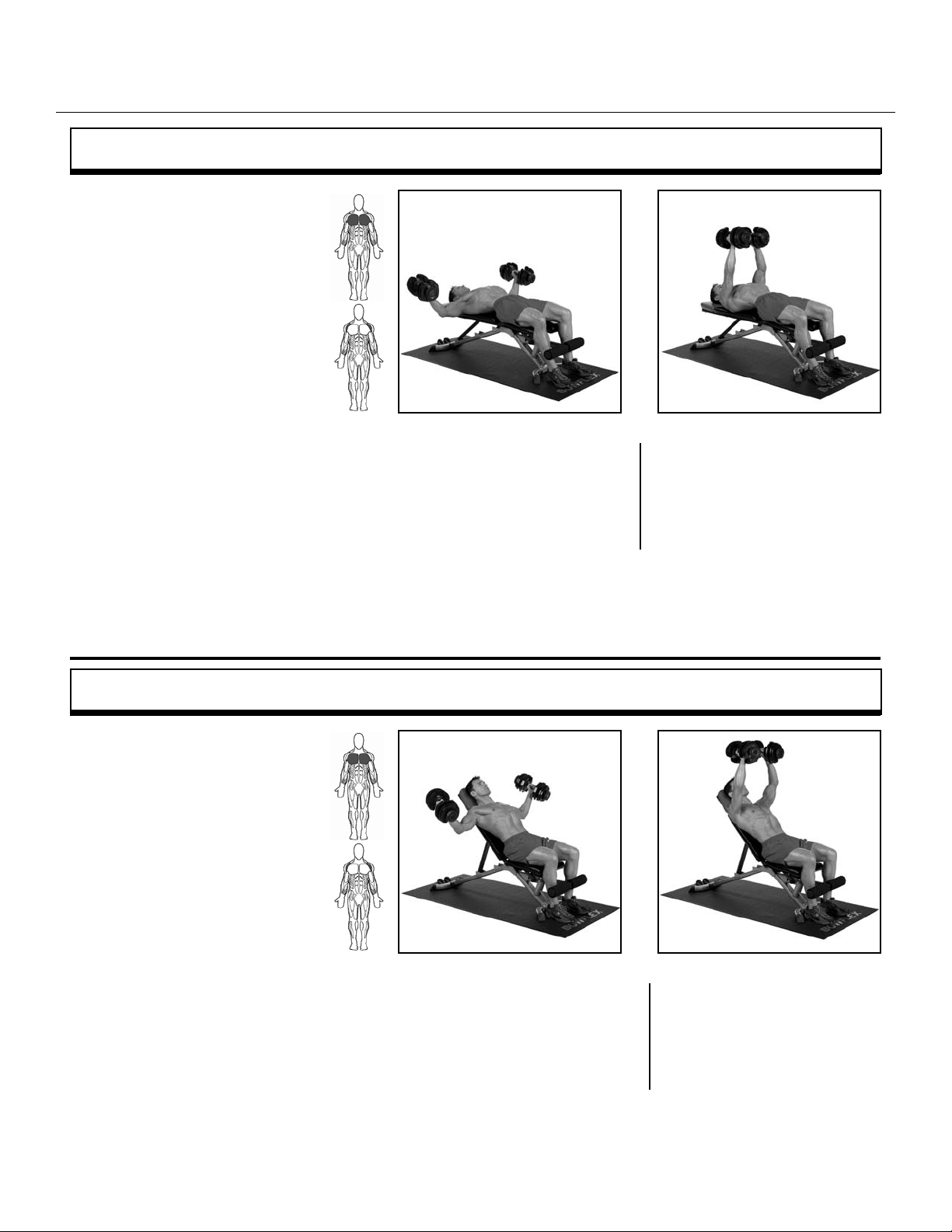
Chest Exercises
Flat Chest Fly
Incline Chest Fly
START ACTION
START
• Grabthedumbbellsandliebackonthe
bench.
• Rotateyourupperarmsawayfromyour
torsosothatyourelbowsandpalmsare
pointingupward.
• Maintainaslightbendattheelbowand
stabilizeyourwristinaneutralposition.
• Raiseyourchest,pinchyourshoulder
bladestogetherandmaintaina
comfortablearchinyourlowerback.
• Slowlymovethedumbbells
forward,thenupward,keeping
yourarmsstableattheelbow.
Movethedumbbellstowardeach
otherdirectlyoverthecenterof
yourupperchest.
• Keepthetensiononthechest
throughoutthemovement.
• Slowlyreturntothestarting
position.
FINISH
START ACTION
START
• Grabthedumbbellsandliebackon
the bench.
• Rotateyourupperarmsawayfrom
yourtorsosothatyourelbowsand
palmsarepointingupward.
• Maintainaslightbendattheelbow
andstabilizeyourwristinaneutral
position.
• Raiseyourchest,pinchyour
shoulderbladestogetherand
maintainacomfortablearchinyour
lowerback.
• Slowlymovethedumbbells
forward,thenupward,keeping
yourarmsstableattheelbow,
whilemovingthedumbbells
towardeachotherdirectlyover
thecenterofyourchest.
• Keepthetensiononthechest
throughoutthemovement.
• Slowlyreturntothestarting
position,keepingyourwrists
steadyandyourmovementslow
andcontrolled.
FINISH
Muscles worked
Pectoralismajoranddeltoids
Bench position
Flat
Success tips
• Maintaina60-90degreeangle
betweenyourupperarmsandtorso
atthestartofthemotion,andslightly
morethan90degreesfromyour
torsoatthetop.
• Keepkneesbentsoyourfeetare
positionedflatonthefloordirectly
underyourknees.
• Donotletyourelbowstravelbehind
yourshoulderswhenyouare
loweringthedumbbells.
• Keepshoulderbladespinched
togetherandmaintaingoodspinal
alignment.
Muscles worked
Pectoralismajoranddeltoid
Bench position
Inclined45degrees
Success tips
• Maintaina60-90degreeangle
betweenyourupperarmsandtorso
atthestartofthemotion,andslightly
morethan90degreesfromyour
torsoatthetop.
• Keepkneesbentsoyourfeetare
positionedflatonthefloordirectly
underyourknees.
• Donotletyourelbowstravelbehind
yourshoulderswhenyouare
loweringthedumbbells.
• Keepshoulderbladespinched
togetherandmaintaingoodspinal
alignment.
Owner’s Manual
19
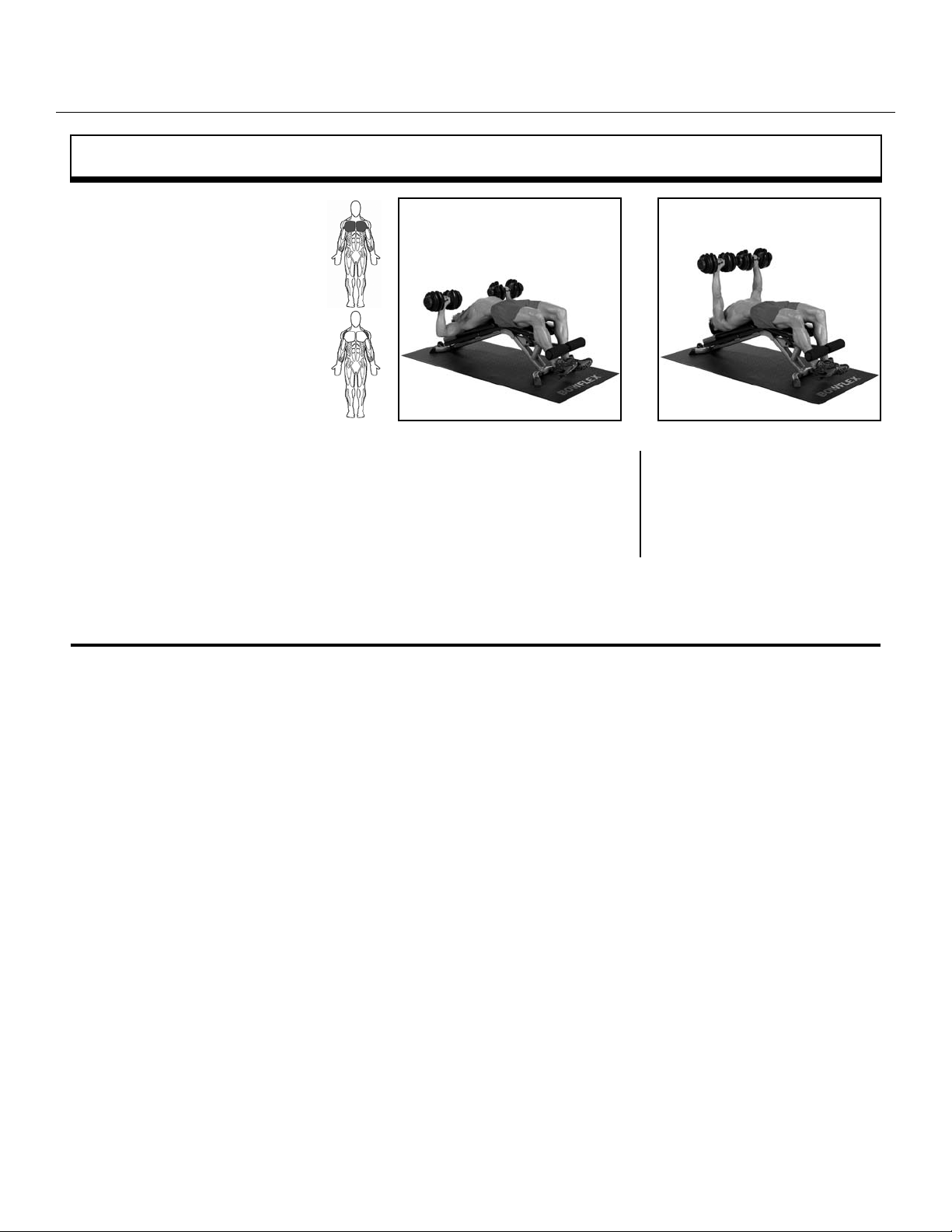
Chest Exercises
Decline Chest Press
START ACTION
START
• Grabthedumbbellsandlieback
on the bench.
• Bendyourelbowsback,keeping
yourarmsatapproximately
60-90degreesawayfromyour
sides,andyourelbowsequalto
yourshoulder.
• Raiseyourchest,pinchyour
shoulderbladestogetherand
maintainacomfortablearchin
yourlowerback.
• Slowlypressthedumbbells
upward,straighteningyourarms
whilemovingthedumbbells
towardeachother,directlyover
thecenterofyourchest.
• Don’tlockoutyourelbows,keep
the tension on the chest.
• Slowlyreturntothestarting
position,keepingyourwrists
steadyandyourmovements
slowandcontrolled.
FINISH
Muscles worked
Pectoralismajor,deltoidsandtriceps
Bench position
Declined
Success tips
• Maintaina60-90degreeangle
betweenyourupperarmsandtorso
atthestartofthemotion,and90
degreeanglefromyourtorsoatthe
top.
• Keepkneesbentsoyourfeetare
positionedflatonthefloordirectly
underyourknees.
• Donotletyourelbowstravelbehind
yourshoulderswhenyouare
loweringthedumbbells.
• Keepshoulderbladespinched
togetherandmaintaingoodspinal
alignment.
• Keepyourarmsdirectlyinlinewith
thedumbbelloveryourwristsand
elbows.
Owner’s Manual
20
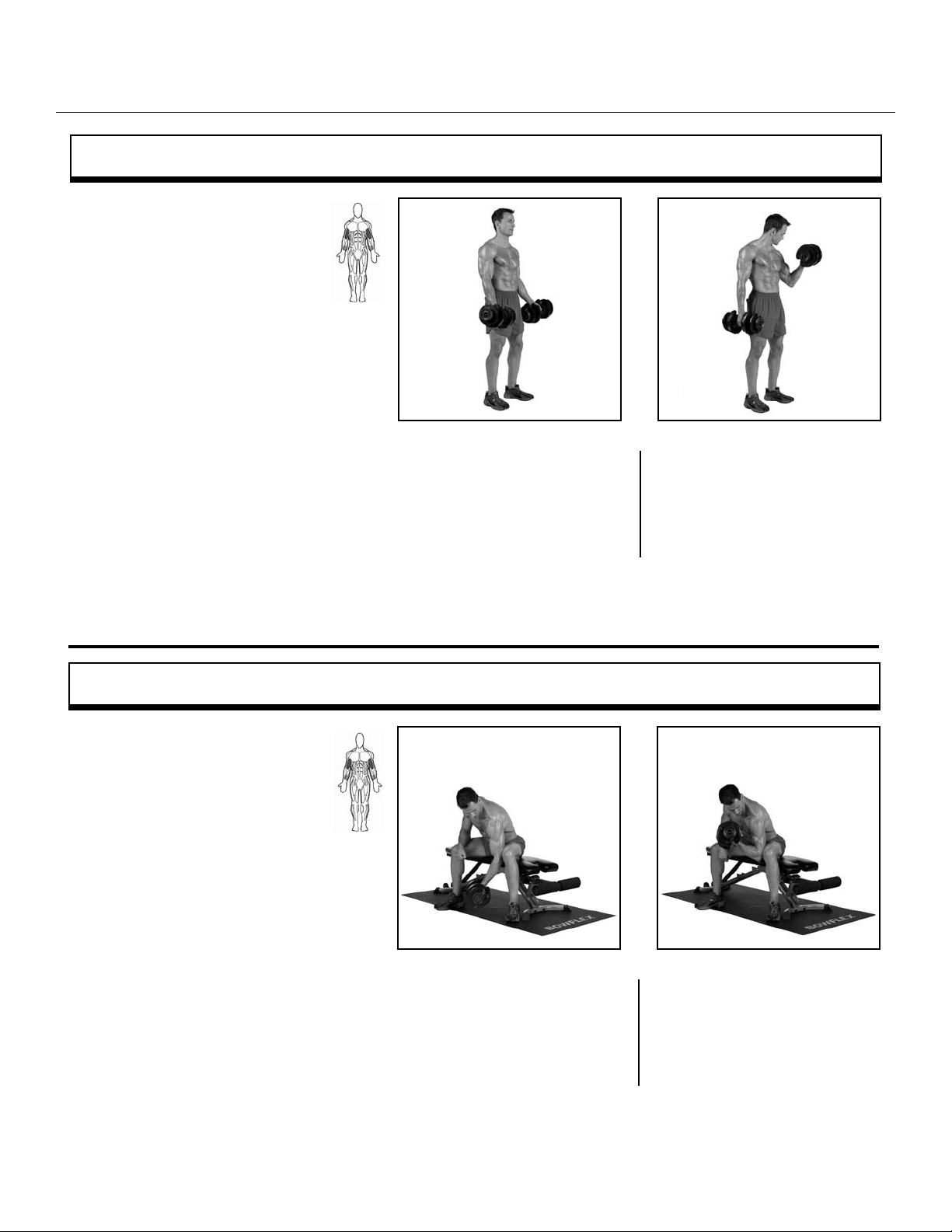
Arm Exercises
Standing Curls
Concentration Curls
START ACTION
START
• Sitonthebenchsidewaysandplace
yourfeetflatonthefloorslightly
widerthanshoulderwidth.
• Grabthedumbbellandresttheback
ofyourupperarmagainsttheinside
ofyourlegjustabovetheknee.
• Thearmholdingthedumbbell
shouldbeslightlybentmaintaining
tension on the biceps.
• Maintainagoodspinalalignment.
• Curltheforearmtowardthe
upperarm,keepingyour
upperarmandshoulderblade
completelystill.
• Slowlyreturntothestarting
positionwithoutrelaxingthe
biceps.
FINISH
START ACTION
START
• Holdthedumbbellswithyour
handsfacingforward.
• Standwithyourupperarmsby
yoursides,liftyourchest,tighten
yourabdominalsandmaintain
averyslightarchinyourlower
back.
• Curlthedumbbellsforward,then
upward,andthentowardyour
shoulderswhilekeepingyour
elbowsatyoursidesandyour
upperarmscompletelystill.
• Slowlylowertothestarting
positionbyperformingthesame
arcingmotion.
FINISH
Muscles worked
Bicepsandotherelbowexors
Success tips
• Keepelbowsatyoursides.
• Keepyourwristsstraight.
• Keepyourtrunkmusclestightand
maintainaveryslightarchinyour
lowerback.
Muscles worked
Bicepsandotherelbowexors
Bench position
Flat
Success tips
• Donotrocktheupperbodywhile
bendingtheelbow.
• Keepyourwriststraight.
• Keepyourchestlifted,trunkmuscles
tightandmaintainaveryslightarch
inyourlowerback.
Owner’s Manual
21
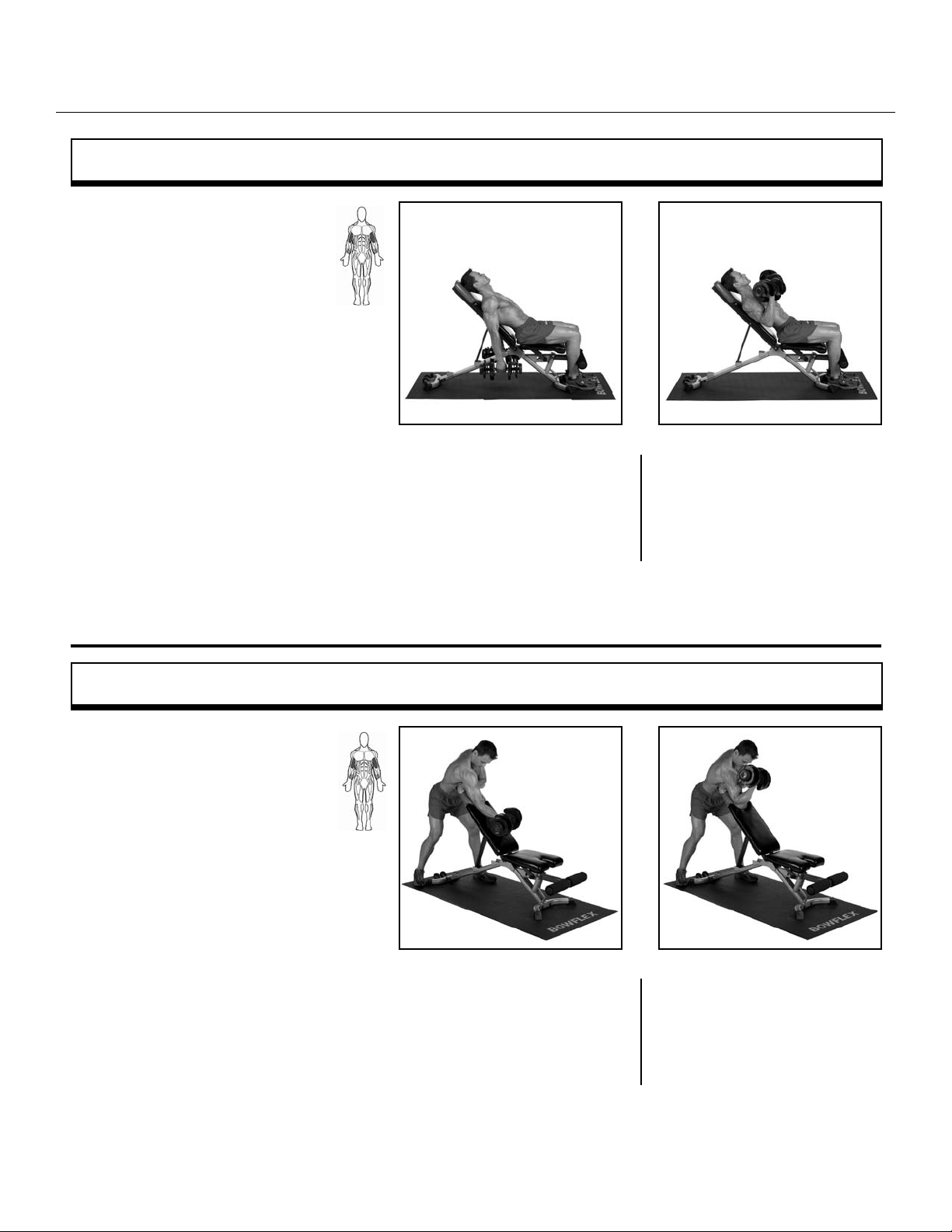
Arm Exercises
Incline Bench Curls
Scott Curls — Standing Concentration Curls
START ACTION
START
• Grabthedumbbellandrestthe
backofyourupperarmagainstthe
upperportionofthebenchpad.
• Thearmholdingthedumbbell
shouldbeslightlybentmaintaining
tension on the biceps.
• Placetheotherarmbetweenthe
benchandtheupperarm.
• Maintainagoodspinalalignment.
• Curltheforearmtowardthe
upperarm,keepingyour
upperarmandshoulderblade
completelystill.
• Slowlyreturntothestarting
positionwithoutrelaxingthe
biceps.
FINISH
START ACTION
START
• Grabthedumbbellsandsiton
theinclinedbenchandplace
yourfeetflatonthefloordirectly
underyourknees.
• Holdthedumbbellwithaslight
bendattheelbowmaintaining
tension on the biceps.
• Maintainagoodspinalalignment
withthechestliftedandtheabs
tight.
• Curltheforearmstoward
theupperarm,keepingyour
upperarmandshoulderblade
completelystill.
• Slowlyreturntothestarting
positionwithoutrelaxingthe
biceps.
FINISH
Muscles worked
Bicepsandotherelbowexors
Bench position
Inclinedto45degrees
Success tips
• Keeptensiononthebiceps
throughoutthemovement,don’t
allowthearmtogotofullextension.
• Keepyourwriststraight.
• Keepyourchestlifted,trunkmuscles
tightandmaintainaveryslightarchin
yourlowerback.
Muscles worked
Bicepsandotherelbowexors
Bench position
Inclinedto60degrees
Success tips
• Donotrocktheupperbodywhile
bendingtheelbow.
• Keepyourwriststraight.
• Keepyourchestlifted,trunkmuscles
tightandmaintainaveryslightarchin
yourlowerback.
• Stopthearmmotionatthetopofthe
movementslightlybeforeyourarmis
straightup.
• Keepfeetslightlywiderthanshouder
width.
Owner’s Manual
22
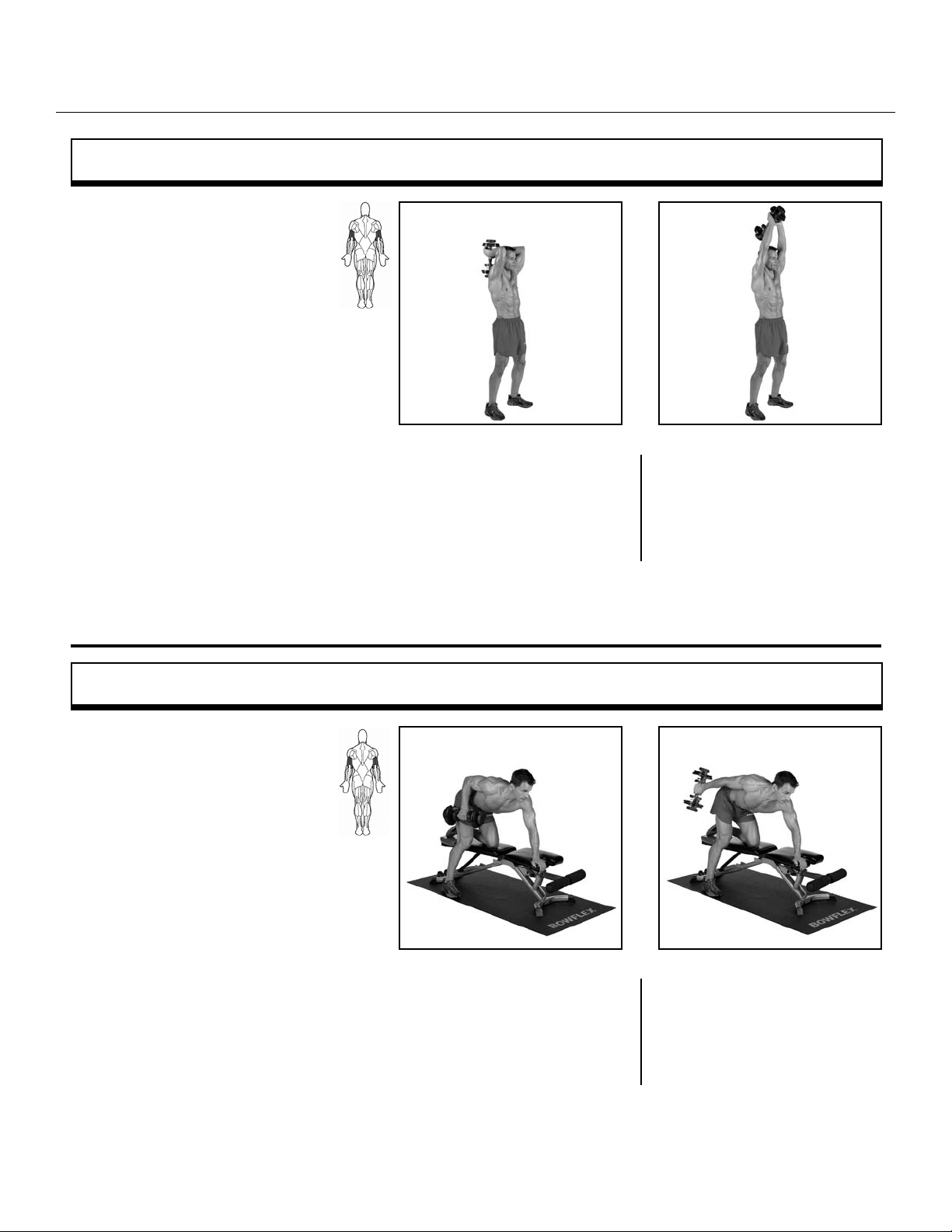
Arm Exercises
Overhead Triceps Extension
Triceps Kickback
START ACTION
START
• Kneelwithonelegonthebench,
bendforwardatthehipsand
placeonehandonthebench.
• Supportyourselfwithonearm
onthebenchandholdthe
dumbbellwiththeotherwith
yourpalmfacingin.
• Keepingyourelbowbent,bring
yourupperarmtoyourside,
paralleltotheground.
• Straightentheelbowwhile
keepingyourupperarm
completelystill.
• Whenthearmiscompletely
straight,slowlyreturntothe
startingposition.
FINISH
START ACTION
START
• Standwithyourkneesslightly
bentandfeetshoulderwidth
apart.
• Placebothhandsovertheinside
edgeofonesideofthedumbbell
weights.
• Bringthearmsupoveryour
headwithanapproximate90
bendattheelbow.
• Keepingyourupperarmsstable,
slowlystraightenyourelbows
movingyourarmsinaarcing
motionupward,overyourhead.
• Stopthemotionbeforeyour
armsarecompletelystraight,and
thenreversethemotion,slowing
returningtothestartingposition,
keepingtensiononthemuscle.
FINISH
Muscles Worked
Triceps
Success tips
• Keepyourkneesslightlybentwithyour
feetapproximatelyshoulderwidthapart.
• Keepyourchestlifted,shoulders
pinchedtogetherandaveryslightarch
inyourlowerback.
• Keepyourupperarmsandshoulders
motionlessandyourwristsstraight.
• Tightenyourtricepsthroughoutthe
exercise,usingacontrolledmotion.
Muscles Worked
Triceps
Bench position
Flat
Success tips
• Maintainspinalalignment.
• Keepyourarmatyoursideandyour
wriststraightthroughouttheentire
motion.
• Tightenyourtricepsthroughoutthe
exerciseandcontrolthemotion.
Owner’s Manual
23
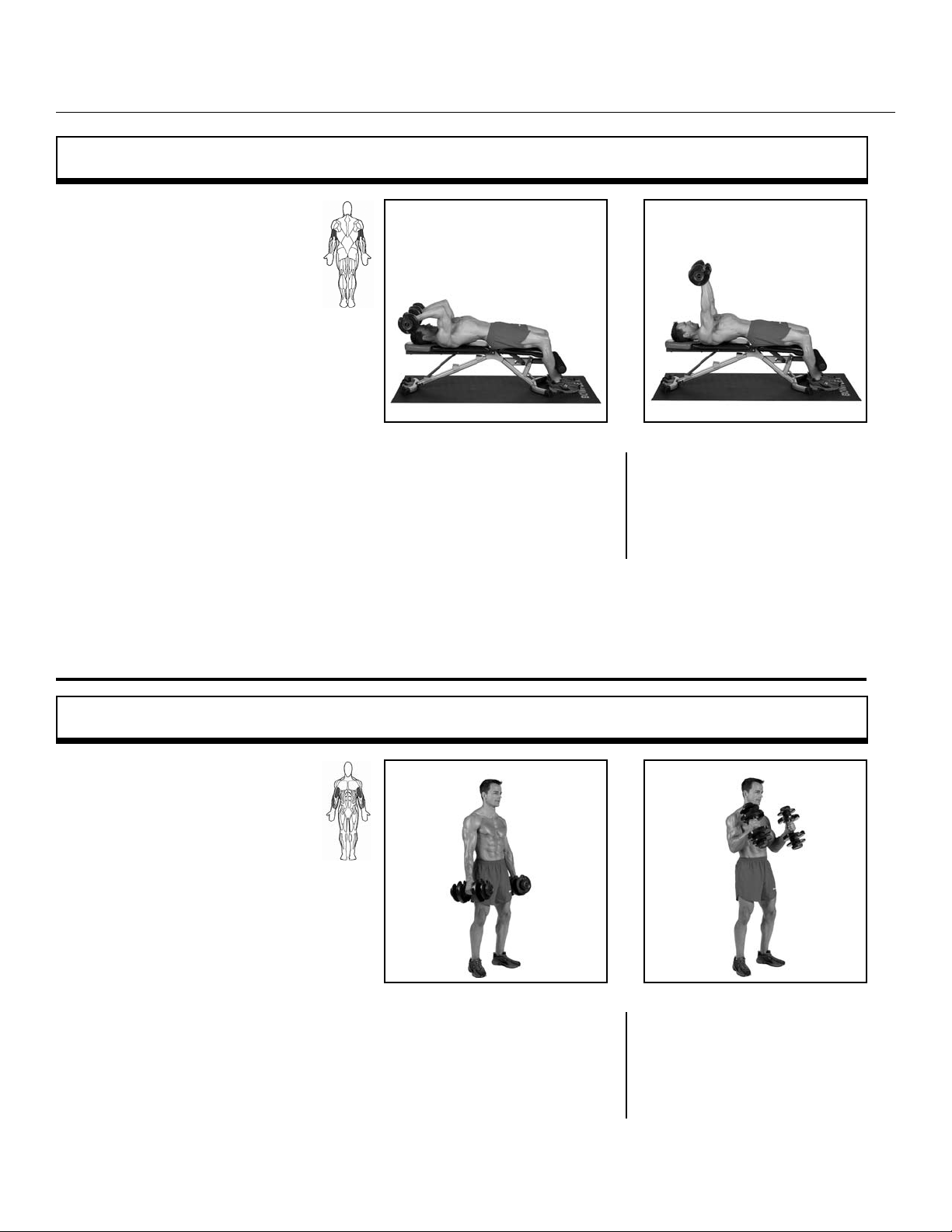
Arm Exercises
Lying Triceps Extension
Hammer Curls
START ACTION
START
• Standwithyourfeetshoulder
widthapartandkneesslightly
bent.
• Grabthedumbbellswithyour
palmsfacinginwardtowardeach
other.
• Stabilizethehips,kneesand
spine.
• Curlthedumbbellsforward,
thenupward,thenintowardthe
shoulder,keepingtheupperarm
completelymotionless.
• Keepthepalmsfacinginwithout
rotatingthelowerarm.
• Slowlymovebacktothestarting
position.
FINISH
START ACTION
START
• Liebackonthebenchwithyour
headsupportedonthebench.
• Grabthedumbbellsandmove
yourupperarmuptoaposition
thatyourelbowisfacingupward
andyourhandsholdingthe
dumbbellsarejustoveryour
forehead.
• Raiseyourchestandpinchyour
shoulderbladestogether.
• Maintainaveryslightarchinthe
lowerback.
• Keeptheupperarmsstationary
whilemovingthehandsinan
arcingmotionupward.
• Stopthemotionslightlybefore
lockingouttheelbows.Donot
lockouttheelbow!
• Slowlyreversethearcingmotion
backtothestartingposition.
FINISH
Muscles worked
Triceps
Bench position
Flat
Success tips
• Keeptheupperarmmotionless.
• Keepthewristsstraight.
• Tightenyourtricepsthroughoutthe
exerciseandcontrolthemotionall
the way down.
• Keepthekneesbendandthefeet
plantedonthefloordirectlyunder
yourknees.
Muscles worked
Biceps,brachioradialisandbrachialis
Success tips
• Keeptheupperarmsmotionlessand
yourwristsstraightthroughoutthe
entireexercise.
• Keepthechestlifted,spinestraight
andaslightarchinthelowback.
Owner’s Manual
24
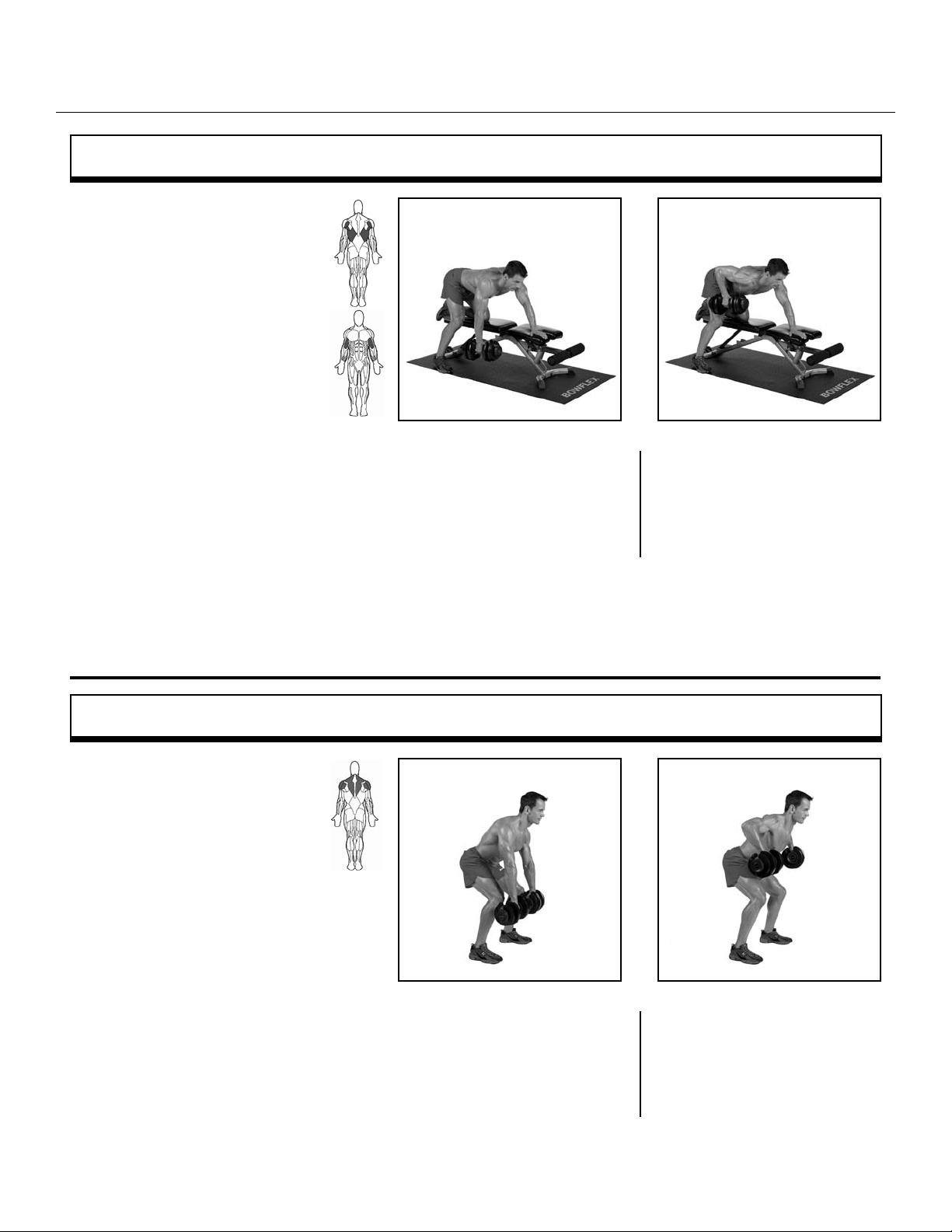
Back Exercises
Single Arm Row — Alternating Rows
Wide Rows
START ACTION
START
• Whilestandingholdingthe
dumbbells,leanforwardatthe
hipallowingthearmstoextend
directlyinlinewiththeresistance.
• Keepyourspineinastable
position.
• Rotatetheshouldersothatyou
palmsarefacingbehindyou.
• Allowyourarmstobendasyou
go,moveyourelbowsoutward
andbackwardkeepinga70-90
degreeanglebetweenyourupper
armsandyourtorso.
• Moveuntilyourelbowsareslightly
behindyourshoulders,thenslowly
reversetheactionkeepingtherear
shouldermusclestightenedduring
theentiremotion.
FINISH
START ACTION
START
• Putonekneeonthebenchand
placetheotherfootonthefloor
directlyunderyourhip.
• Placefreehandonthebench
slightlyinfrontofyouina
positionthatallowsyouto
stabilizeyourupperbody.
• Allowthearmwiththedumbbell
tohangstraightdown,while
maintainingcontrolofyourback
andshoulder.
• Holddumbbellinaneutralgrip
withyourpalmfacingthebench.
• Initiatethemovementbypinching
yourshoulderbladesback,while
simultaneouslymovingyour
elbowbackward,thenupward.
• Continuemovingtheelbowup,
slightlyabovetheheightofyour
trunkwhilekeepingtheforearm
linedupundertheelbow.
• Whilecontrollingtheresistance,
lowerthearmbacktothestarting
positionlettingtheshoulderblade
slideforwardwithoutslouching.
FINISH
Muscles Worked
LatissimusDorsi,teresminor,postier
deltoidandbiceps
Bench position
Flat
Success tips
• Stabilizeyourbodyinpositionsothe
effortisfocusedonyourlatasyou
leadthemovementwithextending
yourelbowupward.
• Keepthedumbbelllinedupdirectly
underyourwristandelbowwhen
doingthemovement.
• Keepyourspinealigned,abstightand
aslightarchinyourlowerback.
• Donotletyourspinerotateside
toside,keeptheshoulderatequal
heightduringthemovement.
Muscles worked
Reardeltoid,rearportionofthemiddle
deltoid,postierrotatorcuff,upperlats
andteresminor
Success tips
• Placethefeetinacomfortable
shoulderwidthposition.
• Keepthechestlifted,abstightanda
veryslightarchinthelowerback.
• Leanforwardslightlyatthehipwhile
keepingtheupperbodyinalignment.
• Yourforearmsshouldalwayspointin
thedirectionofthedumbbells.
Owner’s Manual
25
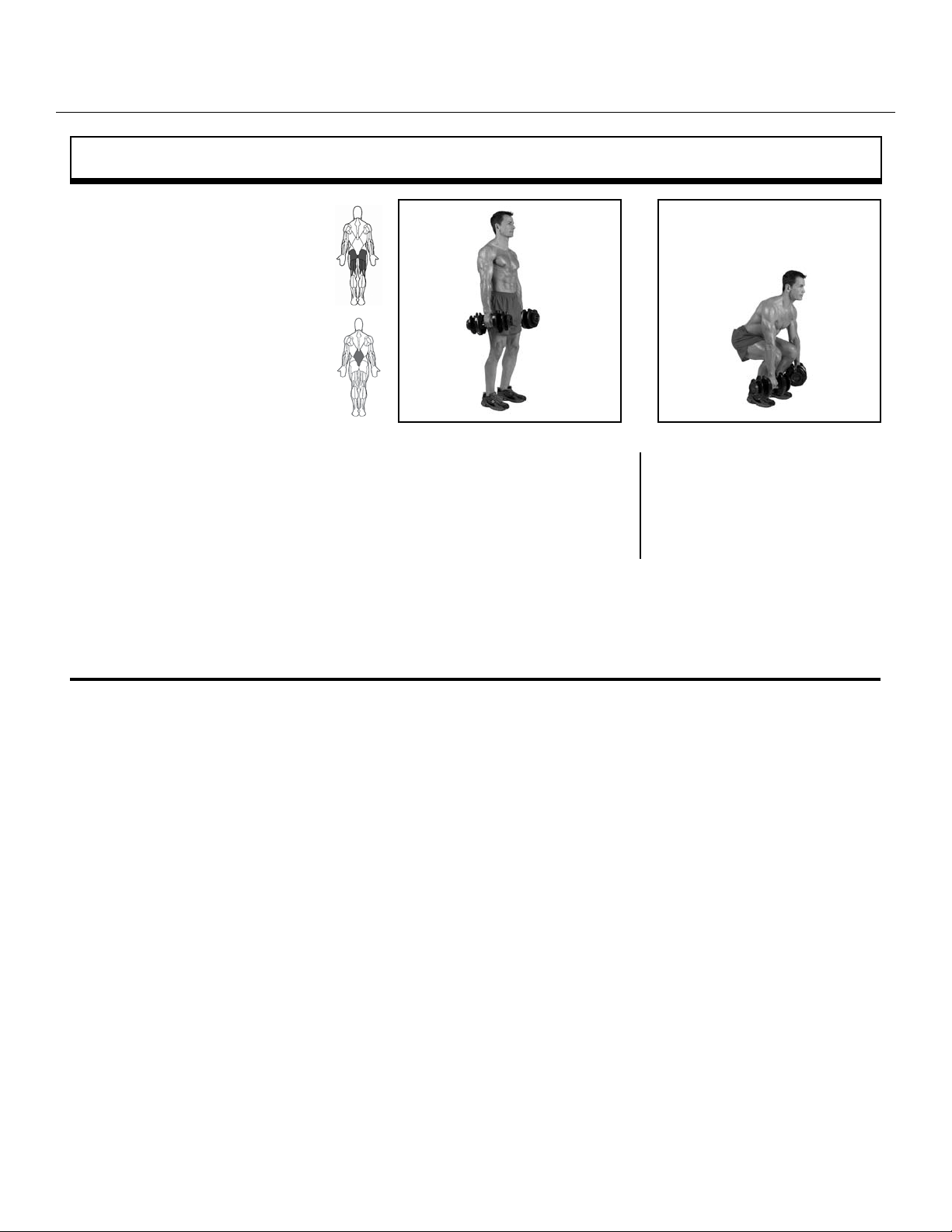
Back Exercises
Dead Lifts
START ACTION
START
• Positionyourfeetinlinewiththe
dumbbellaboutshoulderwidth
apart.
• Pointyourtoesoutwardslightly
anddirectthethighstothesame
outwardangleasthefeet.
• Holdthedumbbellswithyour
palmsfacingbackward.
• Undercontrol,slowlysquatdown
by sticking the hips out as the
kneesstarttobend.
• Keepthechestliftedandback
flatasthehipscontinuetomove
backward.
• Lowertoapproximatelya
90°bendattheknees,unless
otherwisedetermined.
• Movebacktothestarting
position,keepingthechestlifted
whilemovingthehipsforward
andextendingtheknee.
FINISH
Muscles worked
Glutes,adductors,hamstrings,quads,
spinalerectorsandtraps
Success tips
• Keepkneespointedinthesame
directionasthefeet.
• Keepheadandneckinlinewiththe
trunk.
• Paycloseattentiontoallthe
alignmentandstabilizationissueson
everypartofeachrepetition.
• Keeppressurethroughthemiddleof
thearches/feet,notthetoesorheels.
Owner’s Manual
26
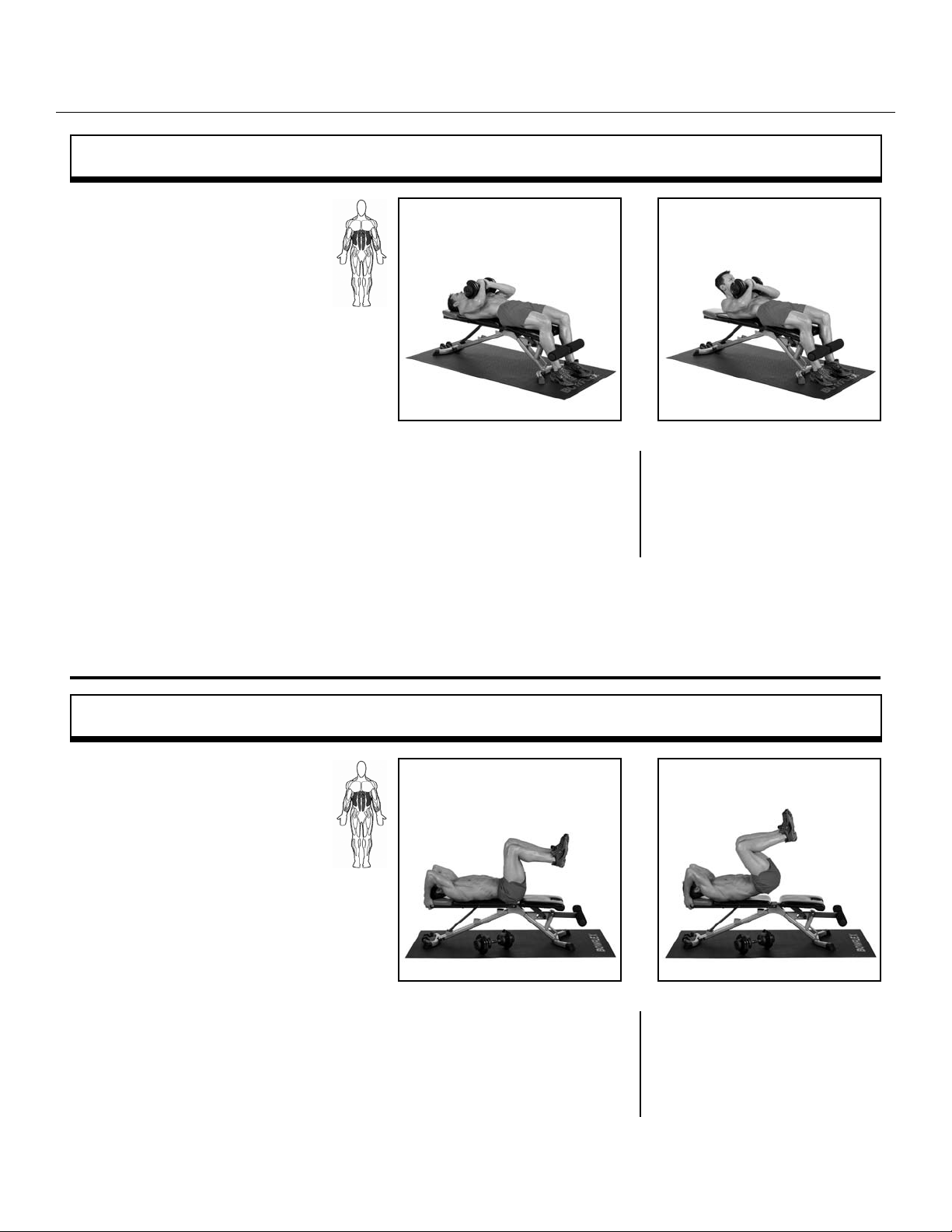
Abdominal Exercises
Ab Crunch
Reverse Crunch
START ACTION
START
• Lieonyourbackwithyourhead
restingonthebench.
• Bendyourkneesfully.
• Determinethesepositionsand
maintainthroughouttheexercise.
• Reachovertheheadandgraspthe
bench with each hand.
• Relaxtheneck.
• Tightenyourabsandslowlycurl
yourhipstowardyourribcage.
• Moveasfarasyoucan
withoutusingyourlegstoget
momentum,anddonotcurlup
ontoyourshoulderblades.
• Slowlyreversetheactionand
returntothestartingposition
withoutrelaxing.
FINISH
START ACTION
START
• Grabadumbbellwithboth
hands,asshown.
• Lieflatonthebenchholdingthe
dumbbelloveryourupperchest.
• Placeyourlegsbehindthe
rollerpads,asshown,foradded
support,withyourfeetflaton
thefloor.
• Yourlowerbackcanstartoutflat
orinanormalarch.
• Tightenyourabsandonlycurl
yourtorso,slowlymovingyour
lowerribstowardyourhips.
• Moveasfarasyoucanwithout
movingthehipsandneck.
• Thelowerbackshouldnotlose
contact with the bench when
fullycrunched.
• Slowlyreversetheaction,
returningtothestartposition
keeping tension on the abs
throughoutthemovement.
FINISH
Muscles worked
Rectusabdominusandobliques
Bench position
Flat
Success tips
• Donotliftyourheadorchin.Your
headshouldfollowtheribmotion,
ratherthanleadit.
• Maintainnormalneckposture.
• Moveslowlytoeliminatemomentum.
• Allowexhalationupandinhalation
down,withoutexaggerating
breathing.
Muscles worked
Abdominalarea,includingtherectus
abdominusandtheobliques
Bench position
Flat
Success tips
• Tightenyourabsbeforeyoumove.
• Keepkneesandhipsstationary.
• Allowexhalationupandinhalation
down,withoutexaggerating
breathing.
• Contractasfarintothemovements
aspossible.
• Lowerundercontrol.
• Theamountofbendinyourhips
basedupondesireddifficulty.
• Beginnersshouldbefullybent,
bringingyourlegsneartheabs.
Owner’s Manual
27
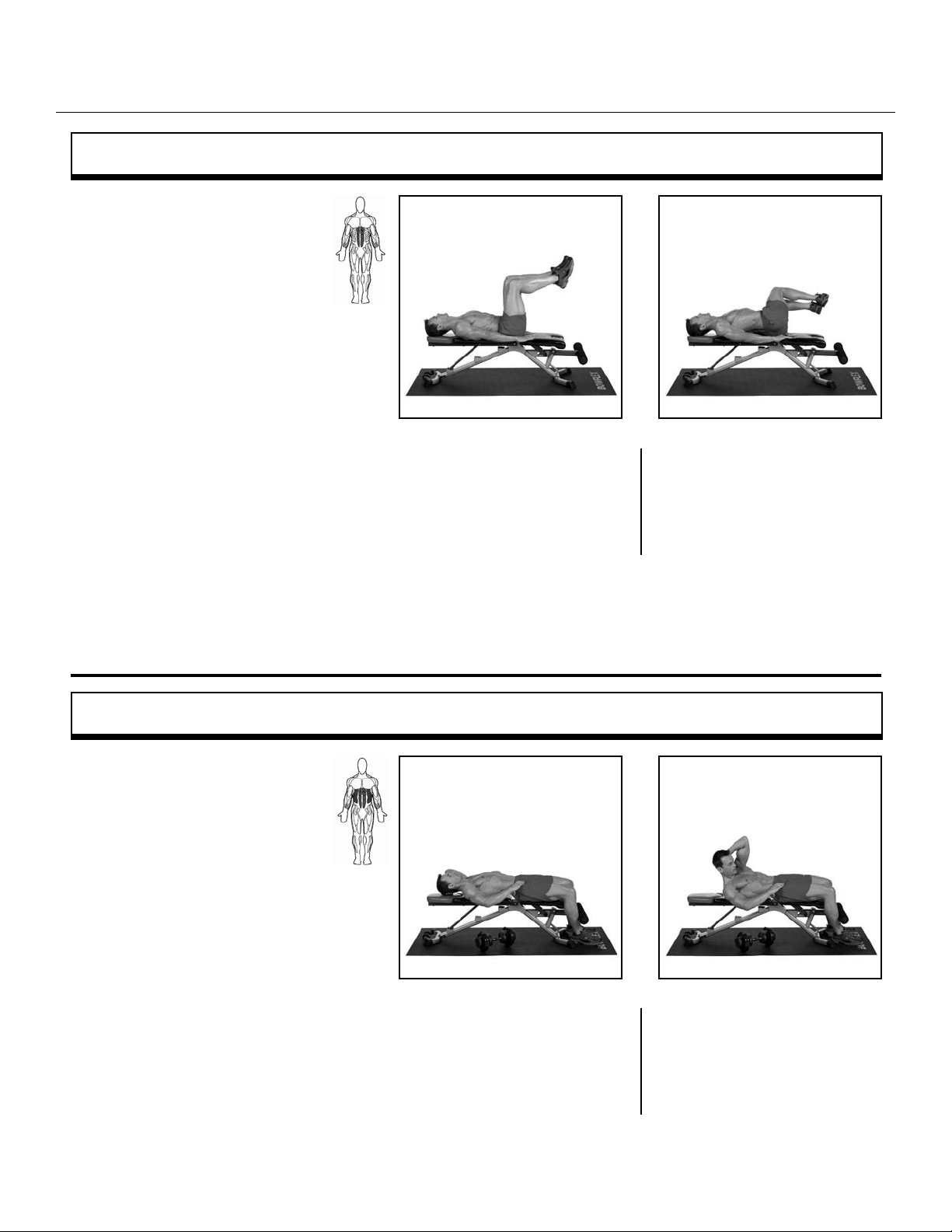
Abdominal Exercises
Lying Trunk Rotation
Twisting Side Crunch
START ACTION
START
• Liebackflatonthebenchand
placeonehandbehindthehead
oftheinvolvedside.
• Placelegsbehindtherollerpads
foraddedsupport,asshown.
• Yourbackcanstartflatagainst
thebenchorinanormalarch.
• Tightenyourabsandmoveina
diagonaldirection,slowlymoving
yourribstotheoppositehip.
• Thelowerbackshouldnotlose
contact with the bench when
fullycrunched.
• Slowlyreversethemotiontothe
startingpositionwithoutrelaxing
theabdominalmuscles.
FINISH
START ACTION
START
• Lieflatonthebench.
• Bendyourhipsandkneesto
approximately90degrees.
• Keepyourchestlifted,abstight
andaslightarchinyourlow
back.
• Holdontothesidesofthe
bench.
• Tightentheentireabdominalarea
andslowlyrotateyourlegsand
hips to one side.
• Moveslowandcontrolled,being
carefulnottoletyourlegsand
hipsrotateuncontrolledtothe
side.
• Movebacktothestarting
position.
• Workonesidetofatigueand
then do the opposite side.
FINISH
Muscles worked
Deepspinalandtrunkmuscles
Bench position
Flat
Success tips
• Thisisanimportantexercisebutcan
becomehighriskifdoneincorrectly.
• Keepthechestliftedandalways
maintainagoodspinalalignmentwith
averyslightarchinthelowerback.
• Morerangeofmotionisnot
necessarilybetter,especiallyinthis
exercise.
• Moveonlyasfarasyourmusclescan
takeyou.Trytoeliminateuncontrolled
momentum.
Muscles worked
Obliquesandrectusabdiminus
Bench position
Flat
Success tips
• Allowexhalationupandinhalation
down.
• Yourheadshouldfollowthemotion
oftheribcage.Maintainnormalneck
posture.
• Moveslowlytoeliminatemomentum.
• Moveasfarasyoucanwithout
movingyourhipsorneck.
Owner’s Manual
28
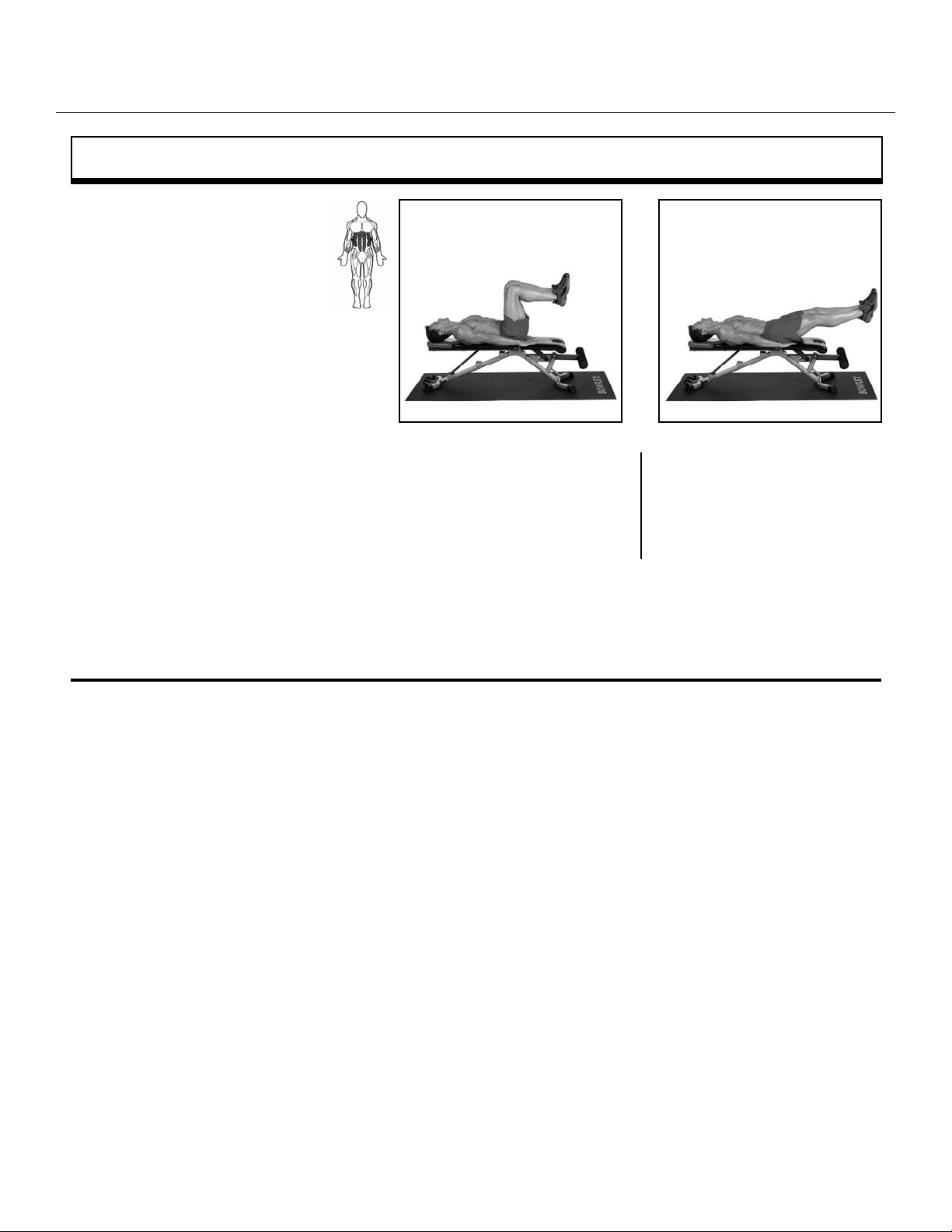
Abdominal Exercises
Lying Leg Raise
START ACTION
START
• Lieonyourbackwithyourhead
restingonthebench.
• Tightenyourabsandflattenyour
back against the bench.
• Bendyourkneesandhipsto90
degrees.
• Reachtothesideandgraspthe
bench with each hand.
• Relaxtheneck.
• Tightenyourabsandslowly
extendyourhipsandknees.
• Moveyourlegsawayfromyou
keepingthemparalleltothefloor.
• Keepyourbackflatagainstthe
benchfortheentiremovement.
• Slowlyreversetheactionand
returntothestartingposition
withoutrelaxing.
FINISH
Muscles worked
Abdominalarea,includingtherectus
abdominus,obliquesandquadriceps
Bench position
Flat
Success tips
• Tightenyourabsbeforeyoumove.
• Allowexhalationupandinhalation
down,withoutexaggerating
breathing.
• Contractasfarintothemovements
aspossible.
• Keepyourbackflatagainstthebench.
Owner’s Manual
29
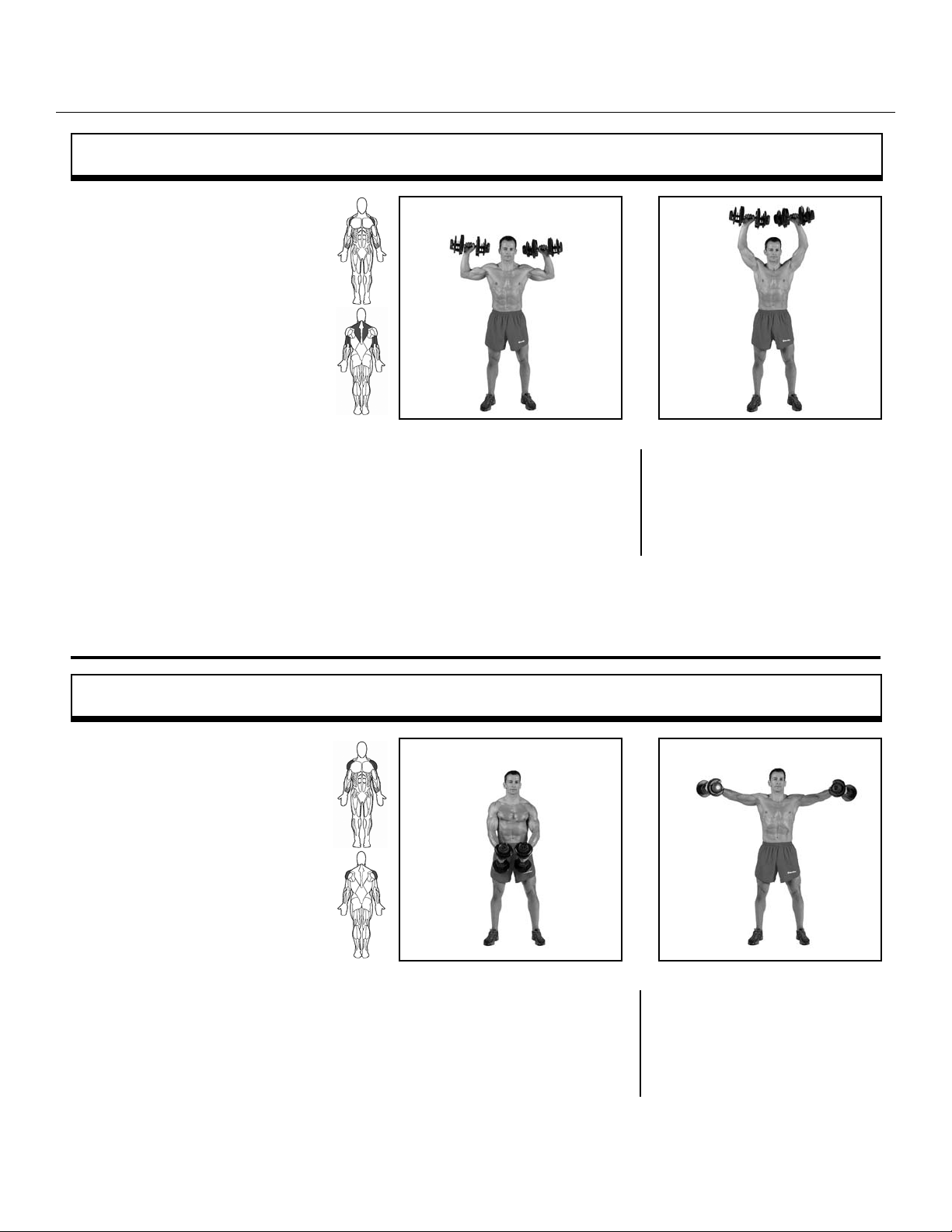
Shoulder Exercises
Standing Shoulder Press
Lateral Raise
START ACTION
START
• Grabthedumbbellswiththe
palmsfacingeachother.
• Standwithyourfeetslightly
widerthanshoulderwidthapart.
• Maintainanerectspinal
alignmentwiththechestlifted,
abstightandaslightcurveinthe
lowerback.
• Raisearmsdirectlyoutward,
thenupward,toapproximately
shoulderheight.
• Liftyourhandandelbowatthe
same speed.
• Doturnorrotateyourarmswhile
raisingthem.
• Keepthesideofyourarm/elbow
facingout/upthroughoutthe
movement.
FINISH
START ACTION
START
• Grabthedumbbellsandstandup
straight.
• Keepyourchestlifted,abstight
andaslightarchinthelower
back.
• Raisethedumbbellstoshoulder
height,keepingyourpalms
facingforward.
• Upperarmsshouldbe90
degreesawayfromyourtorso
andyourelbowsshouldbebent
to90degrees,asshown.
• Straightenyourarmsslowlyover
yourhead,focusingonmoving
yourelbowsupandinward
towardyourears.
• Straightenyourarmsslowlyover
yourhead,focusingonmoving
yourelbowsupandinward
towardyourears.
• Slowlyreturntothestarting
position,keepingtensiononyour
frontshouldermusclesthrough
theentiremotion.
FINISH
Muscles worked
Frontdeltoid,uppertrapsandtriceps
Success tips
• Keepkneesslightlybent.
• Keepabstightandagoodspinal
alignment.
• Donotincreasethearchinthelower
backasyouraiseyourarms.Keep
yourspinesteady.
Muscles worked
Frontandmiddledeltoids
Success tips
• Donotswingthearmsupwardor
movethetrunkduringthemotion.
• Maintaingoodspinalalignment.
Owner’s Manual
30
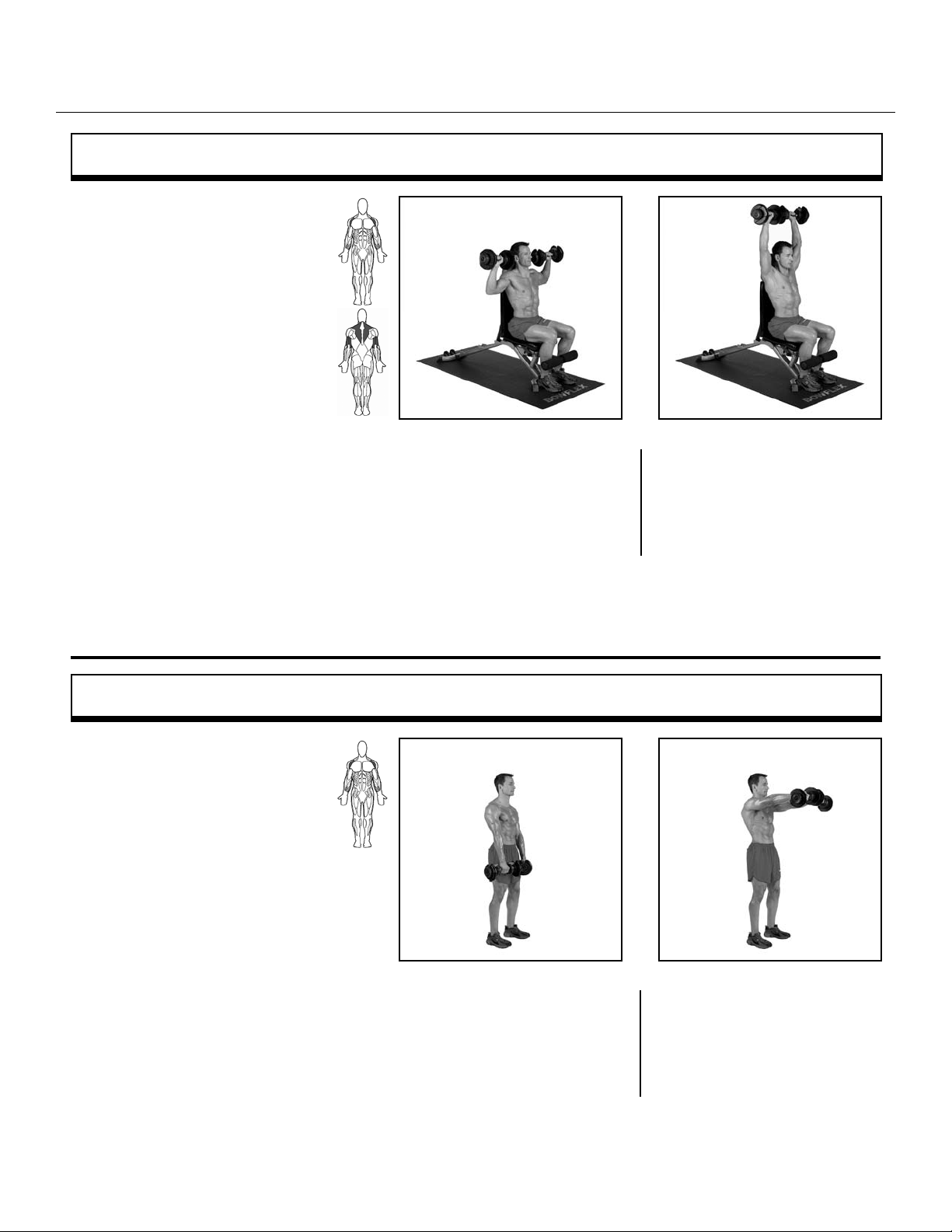
Shoulder Exercises
Seated Overhead Press
Front Raise
START ACTION
START
• Grabthedumbbellsandstandup
straight.
• Feetshouldbeapproximately
shoulderwidthapart.
• Keepyourchestlifted,abstight
andaslightarchinthelower
back.
• Holdthedumbbellsinfrontof
youwithyourpalmsfacingback.
• Keepthearmsstraightandthe
palmsfacingdown,moveyour
armsforwardandthenupward
toshoulderheight.
• Slowlyreturntothestarting
position,keepingtensiononyour
frontshouldermusclesthrough
theentiremotion.
FINISH
START ACTION
START
• Grabthedumbbellsandsitup
straight.
• Keepyourchestlifted,abstight
andaslightarchinthelower
back.
• Raisethedumbbellstoshoulder
height,keepingyourpalmsfacing
forward.
• Upperarmsshouldbe90
degreesawayfromyourtorso
andyourelbowsshouldbebent
to90degreesasshown.
• Straightenyourarmsslowlyover
yourhead,focusingonmoving
yourelbowsupandinward
towardyourears.
• Slowlyreturntothestarting
position,keepingtensiononyour
frontshouldermusclesthrough
theentiremotion.
FINISH
Muscles worked
Frontdeltoid
Success tips
• Keepkneesslightlybent.
• Keepabstightandagoodspinal
alignment.
• Donotincreasethearchinthelower
backasyouraiseyourarms.Keep
you spine steady.
Muscles worked
Frontdeltoid,uppertrapsandtriceps
Success tips
• Keepfeetflatontheflooranddirectly
underyourknees.
• Keepabstightandagoodspinal
alignment.
• Donotincreasethearchinthelower
backasyouraiseyourarms.Keep
you spine steady.
Owner’s Manual
31
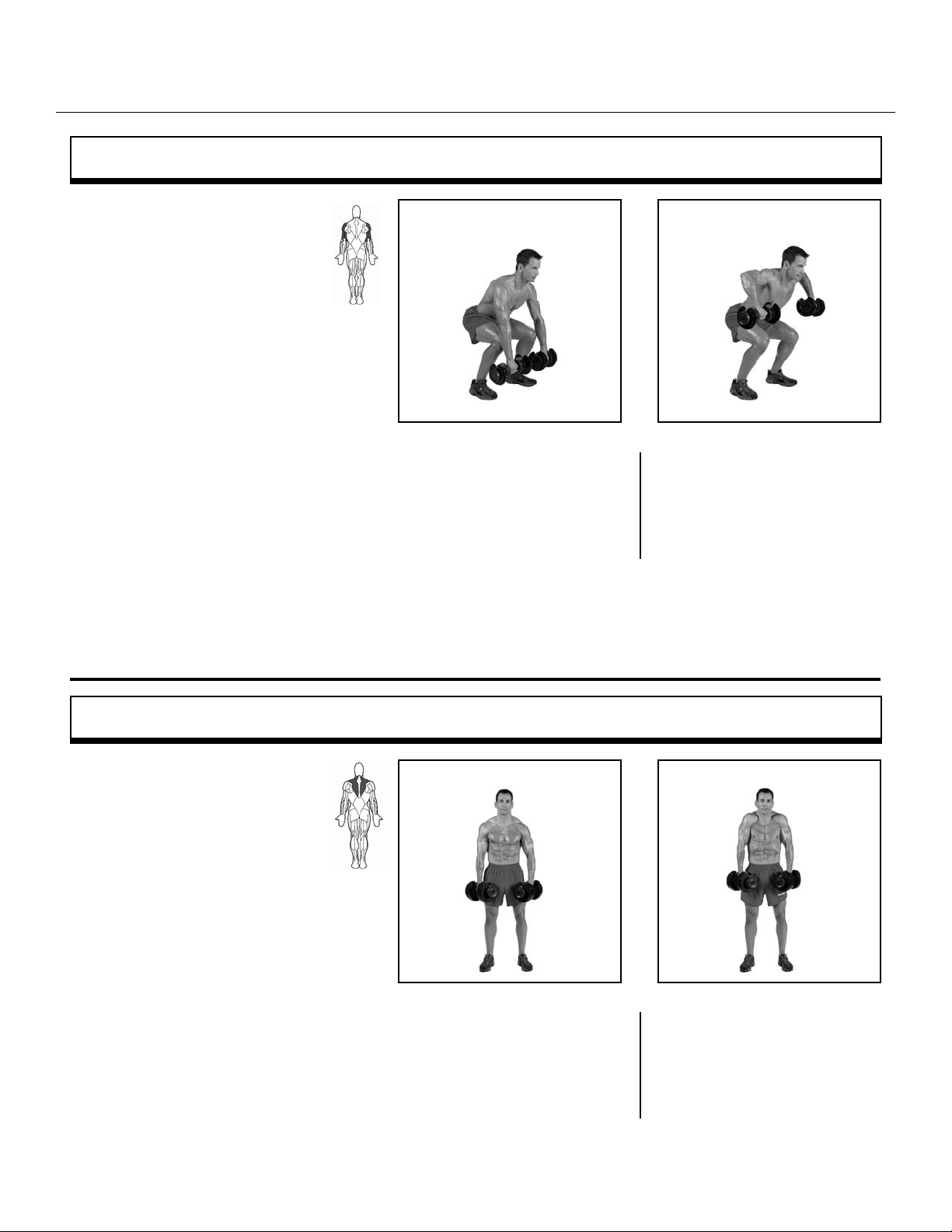
Shoulder Exercises
Rear Delt Row
Shrugs
START ACTION
START
• Grabthedumbbellsandstandup
straight.
• Feetshouldbeapproximately
shoulderwidthapart.
• Keepyourchestlifted,abstight
andaslightarchinthelowerback.
• Holdthedumbbellsnaturallyto
yoursides.
• Raiseyourshoulderstowardthe
backofyourhead,makingsure
yourneck/headpositiondoesnot
move.
• Slowlyreturntheshouldersto
thestartingposition,keeping
tensiononyouruppershoulder
andneckmusclesthroughthe
entiremotionwithoutslouching
orroundingyourupperspine.
FINISH
START ACTION
START
• Standwithyourfeet
approximatelyshoulderwidth
apart.
• Grabthedumbbellswithyour
palmsfacingback.
• Bendforwardatthekneesand
hipssothatyourarmswillhang
slightlyinfrontofyourknees
holdingthedumbbells.
• Keepyourhead/neckinlinewith
yourspine,asshown.
• Allowyourarmstobendas
youmoveyourelbowsupward
keepinga60-80degreeangle
betweenyourarmsandyour
torso.
• Yourforearmsshouldalwayspoint
inthedirectionofthedumbbells.
• Movetillyourelbowsareslightly
behindyourshoulders,then
slowlyreversethemotion,
keepingtensionontherear
shouldermusclesduringthe
entiremotion.
FINISH
Muscles worked
Backofthemiddledeltoid,thereardel-
toid,posteriorrotatorcuff,trapeziusand
rhomboids.
Success tips
• Keepyourspineandhipsstableanddo
notallowyourbodytoswayduringthe
motion.
• Fornormalpullingexercisesyoumay
choosetolettheshoulderblades
floatforwardandbackwardnaturally.
However,formoreemphasistothe
reardeltoid,keeptheshoulderblades
pinchedtogetherthroughoutthe
movement.
• Keepyourabstight,chestliftedand
maintainaslightarchinyourlower
back.
Muscles worked
Uppertrapezius
Success tips
• Donotbendtheneckbackwardor
forwardwhileraisingtheshoulders.
• Keepabstightandagoodspinal
alignment.
• Makesurebothshouldersareraised
evenly.
Owner’s Manual
32
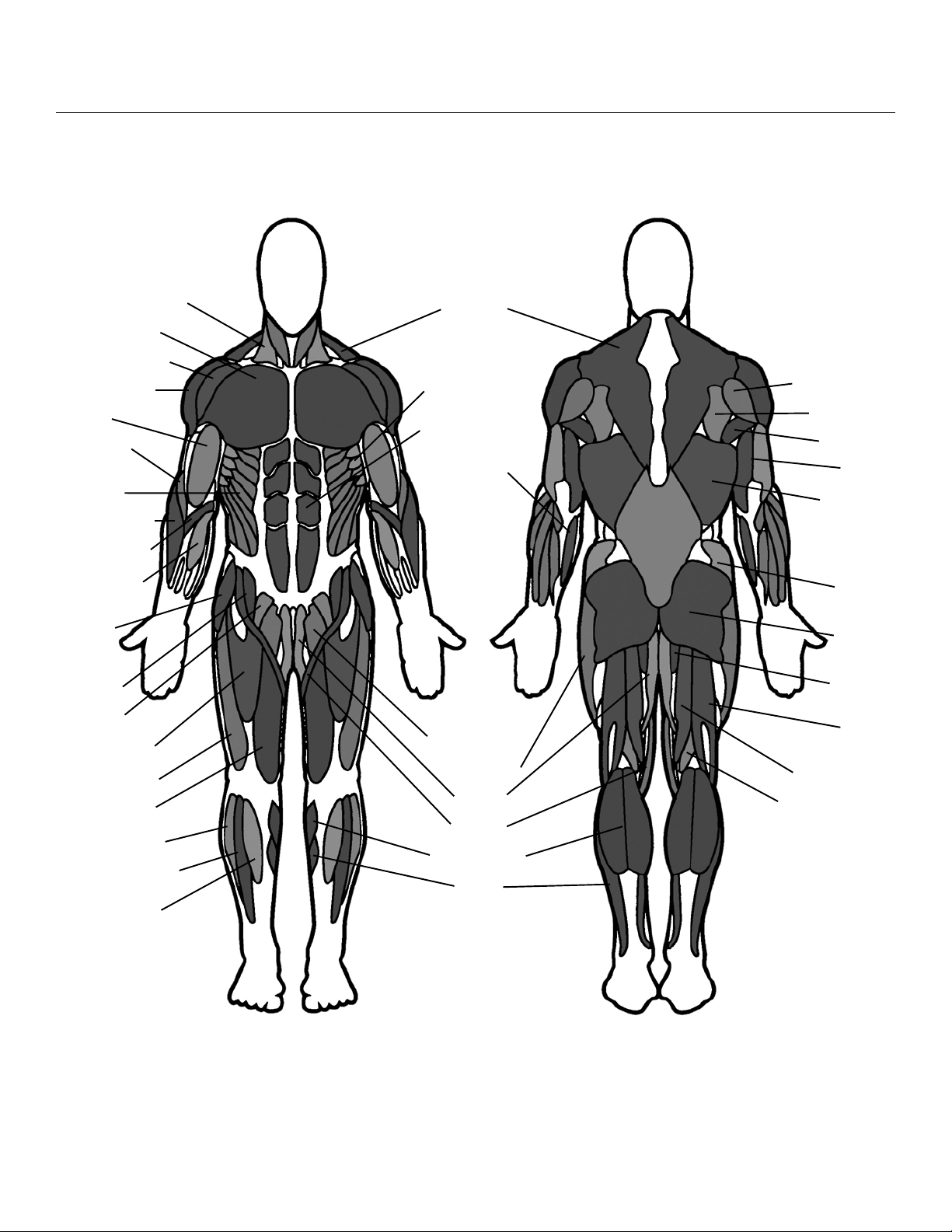
Muscle Chart
Sternocleidomastoid
Pectoralis Major
Anterior Deltoid
Medial Deltoid
Biceps
Brachialis
External
Obliques
Brachioradialis
Pronator Teres
Flexor Carpi
Radialis
Tensor
Fasciae
Latae
Iliopsoas
Pectineus
Rectus Femoris
Vastus Lateralis
Vastus Medialis
Peroneus Longus
Extensor Digitorum
Longus
Tibialis Anterior
Posterior Deltoid
Infraspinatus
Teres Major
Triceps
Latissimus
Dorsi
Gluteus
Medius
Gluteus
Maximus
Adductor
Magnus
Biceps
Femoris
Semitendinosus
Semimembranosus
Trapezius
Serratus Anterior
Rectus Abdominus
Flexor Digitorum
Superficials
Adductor Longus
Iliotibial Tract
Gracilis
Sartorius
Gastrocnemius
Soleus
Owner’s Manual
33

Limited Warranty
AllBowex
®
exerciseproductsarewarrantedtothe
retailpurchasertobefreefromdefectsinmaterials
andworkmanship.Warrantycoveragevalidtothe
originalpurchaseronlyandproofofthepurchasewillbe
required.Anyproductsoldorplacedinanapplicationnot
recommendedbyNautilus,Inc.(“Nautilus”)willvoidany
warrantycoveragesetforthbyNautiluswarrantypolicies
andprocedures.Thisdumbbellsetisforhomeuseonly.
Time Period
Thisproductwasdesigned,warranted,andintendedfor
residentialuseonly.
ResidentialEnvironment:
Parts(includinghandleassembly,weightplatesandbase
assembly):2years
What this warranty does not cover:
1.Damagetotheproductduetodroppingthedumbbell.
2.Normalwearandtear.
3.Anydamage,failureorlosscausedbyaccident,misuse,
neglect,abuse,improperassembly,impropermainte-
nance,ActsofGod(suchasfloodsorpowersurges),
orfailuretofollowinstructionsorwarningsinOwner’s
Manual.
4.Useofproductsinamannerorenvironmentforwhich
theywerenotdesigned.
5.Extendedwarranties:Nautilus,Inc.willnotberesponsible
foranyextendedcoveragetermsofferedbyadistributor
orserviceprovider.
Limitations
Theprecedingwarrantiesarethesoleandexclusive
expresswarrantiesmadebyNautilus.Theysupersedeany
prior,contraryoradditionalrepresentations,whetheroral
orwritten.Noagent,representative,dealeroremployee
hastheauthoritytoalterorincreasetheobligations
orlimitationsofthiswarranty.Anyimpliedwarranties,
includingtheWARRANTYOFMERCHANTABILITYand
anyWARRANTYOFFITNESSFORAPARTICULAR
PURPOSE,arelimitedindurationtothetermofthe
applicableexpresswarrantyprovidedabove,whicheveris
longer.Somestatesdonotallowlimitationsonhowlong
animpliedwarrantylasts,sotheabovelimitationmaynot
applytoyou.
Procedures:
Warrantyservicewillbeperformedbytheoriginalretailer
(seller)oranauthorizedBowex
®
serviceprovider.The
originalpurchasermustprovideproofofpurchase.Service
callsassembly,transportation,and/ordeliveryexpenses
aretheresponsibilityofthepurchaser.
1.Nautiluswillhavetheoptiontorepairorreplaceany
exerciseproduct,whichrequiresservice.
2.Nautiluswillreplaceanyequipmentframethatis
structurallydefectivewithanewframeorreplace
theunitwithaunitofequalvalue.Nautilusisnot
responsibleforlaborchargesinreplacingdefective
frames.
3. Intheeventaproductcannotberepaired,Nautilus
willapplyalimitedcreditreimbursementtoward
anotherBowex®exerciseproductofequalor
greatervalue.
4. Nautilusisnotresponsiblefordealerlaborcharges
forthecomponentchangeoverscompletedafter
thelaborrelatedwarrantyperiodstatedherein.
5.Ifyouelecttorepairanexerciseproductorpart
yourself,usingtheservicesofsomeoneother
thananauthorizedBowex
®
DealerorService
Technician,oruseareplacementpartnotsupplied
byNautilus,Nautilusshallnotbeliableforanycost,
damage,failureorlosscausedbytheuseofsuch
unauthorizedserviceorparts.
6.SeeanauthorizedBowexdistributorformore
informationorwritetousat:
Nautilius,Inc.
16400SENautilusDrive
Vancouver,Washington,USA98683
Owner’s Manual
34
Please supply the serial number of your machine and the
date of purchase when you call Nautilus. Use the space
in the boxes below to write down this information. To find
the serial number on your machine, refer to the Safety
Warning Label information page. Dial the number of the
office close to you.
Serial Number
Date of Purchase
Please record the following information for future reference.
Contact Information
UNITED STATES OFFICES:
E-mail: [email protected]
TECHNICAL/CUSTOMERSERVICE
Phone:800-NAUTILUS(800-628-8458)
Fax:(877)686-6466
E-mail:cstec[email protected]
CORPORATEHEADQUARTERS
Nautilus,Inc.
WorldHeadquarters
16400SENautilusDrive
Vancouver,Washington,USA98683
Phone:(800)NAUTILUS(800)628-8458
INTERNATIONAL OFFICES:
Fortechnicalassistanceandalistofdistributorsinyour
area,pleasecallorfaxoneofthefollowingnumbers.
INTERNATIONALCUSTOMERSERVICE
NautilusInternationalS.A.
RueJeanProuvé
1762Givisiez/Switzerland
Tel:(41)(26)4607777
Fax:(41)(26)4607770
E-mail:tec[email protected]
GERMANYandAUSTRIA
NautilusDeutschlandGmbH
Albin-Köbis-Str.4
51147Köln
Tel.:(49)0220320200
Fax:(49)0220320204545
ITALY
NautilusItalyS.r.l.,ViadellaMercanzia,103
40050FunodiArgelato-Bologna
Tel:(39)0516646201
Fax:(39)0516647461
SWITZERLAND
NautilusSwitzerlandSA
RueJean-Prouvé6,
CH-1762Givisiez
Tel:(41)0264607766
Fax:(41)0264607760
UNITEDKINGDOM
NautilusUKLtd
NautilusUK,4VincentAvenue,
Crownhill,MiltonKeynes,Bucks,MK80AB
Tel:(44)1908267345
Fax:(44)1908567346
CHINA
NautilusRepresentativeOfce
Nautilus,Shanghai,7ANo.728,Yan’anRd(West)
200050Shanghai,China
Tel:(86)2152370700
Fax:(86)2152370709
Owner’s Manual
35
©2008. Nautilus, Inc. All rights reserved. Nautilus, the Nautilus Logo, Universal, Bowflex, the Bowflex Logo, StairMaster, Pearl Izumi, Nautilus Institute and SelectTech are either registered
trademarks or trademarks of Nautilus, Inc. Schwinn is a registered trademark. All other trademarks are owned by their respective companies. Nautilus, Inc., World Headquarters, 16400 SE
Nautilus Drive, Vancouver, WA 98683 1-800-NAUTILUS www.nautilus.com
Nautilus
®
Bowflex
®
Schwinn
®
Fitness Pearl Izumi
®
StairMaster
®
Universal
®
Nautilus Institute
®
Printed in China