OWNER'S MANUAL
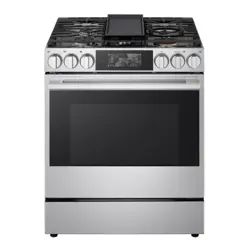
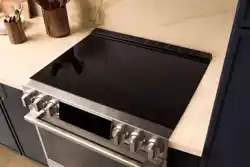
ELECTRIC INDUCTION RANGE
Read this owner's manual thoroughly before operating the appliance and keep
it handy for reference at all times.
ENGLISH
LSIU6339XE
MFL68920599
Rev.00_022326
www.LGSIGNATURE.com
Copyright © 2026 LG Electronics. All Rights Reserved
Scan to see the online manual.

TABLE OF CONTENTS
2
4 IMPORTANT SAFETY
INSTRUCTIONS
4 READ ALL INSTRUCTIONS BEFORE USE
4 Safety Messages
4 Anti-tip Device
5 WARNING
5 Installation
5 Operation
6 Maintenance
7 Risk of Fire and Flammable Materials
7 Button Cell or Coin Batteries Symbol
8 Safety Standard for Button Cell or Coin
Batteries
9CAUTION
9 Operation
9 Maintenance
10 PRODUCT OVERVIEW
10 Product Features
10 Exterior and Interior
10 Product Specifications
11 Accessories
12 INSTALLATION
12 Before Installing
12 Installation Overview
12 Tools Needed
13 Parts
13 Unpacking and Moving the Range
15 Choosing the Proper Location
15 Dimensions and Clearances
17 Electricity
17 Flooring
17 Ambient Temperature
17 Leveling
17 Leveling the Range
17 Connecting Electricity
17 Electrical Requirements
18 Connecting the Power Cord / Conduit
22 Optional Rear Filler
22 Installing the Rear Filler
23 Anti-tip Device
23 Installing the Anti-tip Device
24 Test Run
24 Test the Range Before Use
24 Rubber Gaskets
24 Installing the Rubber Gaskets
24 Removing/Assembling Oven Door Handle
24 Before Removing/Assembling the Oven
Door Handle
25 Removing Oven Door Handle
25 Assembling Oven Door Handle
26 OPERATION
26 Control Panel
26 Control Panel Features
28 Knob Features
28 Knob Lighting
29 Changing Oven Settings
29 Minimum & Maximum Default Settings
30 Wi-Fi
30 Remote Start
30 Camera & AI Gourmet
31 Control Lock
31 Display
32 Brightness
32 Clock Theme
32 Volume
32 Language
32 Date & Time
33 Temperature Unit
33 Sabbath
34 Start Screen
34 Temperature Adjustment
34 Convection Auto Conversion
34 Preheat Alarm Light
34 Smart Diagnosis
TM
35 Factory Reset
35 Open Source License
35 Cooktop
35 Precautions When Using the Cooktop
36 Cooking Areas
37 Benefits of Induction Surface Cooking
37 Induction Cookware
37 Cookware Placement

3
38 Pan Sensing
38 Minimum and Maximum Pan Size
39 Cookware Compatibility Indicator
40 Home Canning
41 Using the Cooking Elements
41 Using the Knob Lock
42 Recommended Surface Cooking Settings
42 Power Management
42 Turning on the Warm Zone
43 Oven
43 Before Using the Oven
43 Oven Vent
44 Using Gliding Oven Racks
44 Using Heavy Duty Oven Racks
44 Meat Probe
45 Bake
47 Convection Bake and Roast
48 Recommended Baking and Roasting
Guide
49 Broil
51 Recommended Broiling Guide
53 Air Fry
55 Recommended Air Frying Guide
56 Air Sous-Vide
57 Recommended Air Sous-Vide Guide
57 Air Roast
58 Pizza
59 Frozen Meal
60 Dehydrate
60 Warm
61 Proof
62 Crispy Reheat
62 Camera
64 Auto Cook
65 Auto Cook Guide
95 My Recipes
96 SMART FUNCTIONS
96 LG ThinQ Application
96 LG ThinQ Application Features
96 Installing LG ThinQ Application and
Connecting an LG Appliance
97 RF Module Specifications
97 FCC Statement
98 Open Source Software Notice
Information
98 Smart Diagnosis
TM
Feature
98 Using LG ThinQ to Diagnose Issues
98 Using Audible Diagnosis to Diagnose
Issues
100 MAINTENANCE
100 Cleaning
100 Interior
100 Exterior
102 Cooktop Surface
105 EasyClean
107 Self Clean
109 Removing/Assembling Lift-Off Oven
Doors
111 Removing/Assembling Drawers
111 Removing/Assembling the Vent Trim
112 Periodic Maintenance
112 Changing the Oven Light
113 TROUBLESHOOTING
113 FAQs
113 Frequently Asked Questions
115 Before Calling for Service
115 Cooking
117 Parts & Features
119 Noises
120 Wi-Fi
121 LIMITED WARRANTY
121 USA
121 TERMS AND CONDITIONS
121 THIS LIMITED WARRANTY DOES NOT
COVER:
125 PROCEDURE FOR RESOLVING DISPUTES:
4 IMPORTANT SAFETY INSTRUCTIONS
IMPORTANT SAFETY INSTRUCTIONS
READ ALL INSTRUCTIONS BEFORE USE
Download this owner's manual at http://www.LGSIGNATURE.com
Safety Messages
Your safety and the safety of others are very important.
We have provided many important safety messages in this manual and on your appliance. Always read and
follow all safety messages.
All safety messages will tell you what the potential hazard is, tell you how to reduce the chance of injury,
and tell you what may happen if the instructions are not followed.
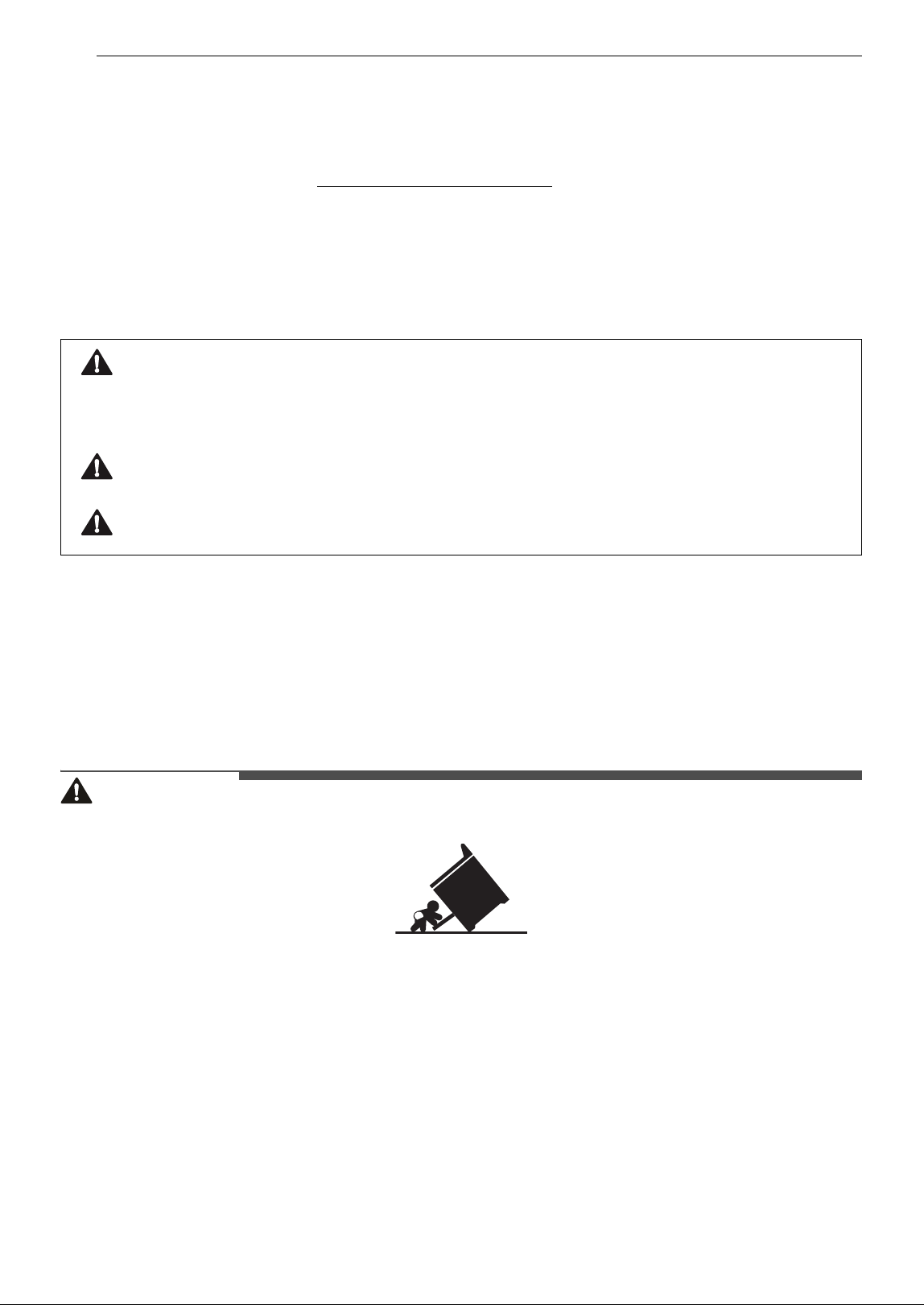
Anti-tip Device
To reduce the risk of tipping, the appliance must be secured by a properly installed anti-tip device. To
check if the device is installed properly, verify that the anti-tip device is engaged, or grasp the top rear
edge of the range back guard and carefully attempt to tilt it forward. Refer to the installation section for
instructions.
WARNING
• A child or adult can tip the range and be killed.
• Install the anti-tip device to the structure and/or the range. Verify the anti-tip device has been properly
installed and engaged by following the guide on the anti-tip bracket template.
• Engage the range to the anti-tip device by following the guide on the anti-tip bracket template. Ensure
the anti-tip device is re-engaged when the range is moved by following the guide on the anti-tip bracket
template.
• Re-engage the anti-tip device if the range is moved. Do not operate the range without the anti-tip device
in place and engaged.
• See installation instructions for details.
• Failure to do so can result in death or serious burns to children or adults.
• Do not rest large, heavy items such as whole turkeys on the open oven door. The range could tip forward
and cause injury.
This is the safety alert symbol.
This symbol alerts you to potential hazards that can kill or injure you and others. All safety messages
will follow the safety alert symbol and either the word WARNING or CAUTION.
These words mean:
WARNING
You may be killed or seriously injured if you do not follow instructions.
CAUTION
You may be injured or cause damage to the product if you do not follow instructions.
5IMPORTANT SAFETY INSTRUCTIONS
ENGLISH
• Do not step or sit on the oven door. The range could be tipped and injury might result from spilled hot
liquid, food, or the range itself.
• Never remove the oven legs. The range will not be secured to the anti-tip bracket if the legs are
removed.
WARNING
WARNING
• To reduce the risk of explosion, fire, death, electric shock, injury or scalding to persons when using this
product, follow basic precautions, including the following:
Installation
• Do not line the oven walls, racks, bottom, or any other part of the oven with aluminum foil or any other
material. Doing so will disrupt heat distribution, produce poor baking results and cause permanent
damage to the oven interior. (Aluminum foil will melt to the interior surface of the oven.)
• To eliminate the risk of burns or fire by reaching over heated surface units, cabinet storage space
located above the surface units should be avoided. If cabinet storage is to be provided, the risk can be
reduced by installing a range hood that projects horizontally a minimum of 5 inches beyond the bottom
of the cabinets.
• Do not use aluminum foil or any other material to line the oven bottom. Improper installation of these
liners may result in a risk of electric shock or fire.
• Make sure your range is properly installed and grounded by a qualified installer, according to the
installation instructions. Any adjustment and service should be performed only by qualified range
installers or service technicians.
Operation
• Do not leave children alone or unsupervised near the appliance when it is in use or is still hot. Children
should never be allowed to sit or stand on any part of the appliance as they could be injured or burned.
• Children should not be allowed to play with controls or other parts of the appliance.
• DO NOT TOUCH HEATING ELEMENTS OR INTERIOR SURFACES OF OVEN. Heating elements may be hot
even though they are dark in color. Interior surfaces of an oven become hot enough to cause burns.
During and after use, do not touch or let clothing or other flammable materials contact heating elements
or interior surfaces of the oven until they have had sufficient time to cool. Other surfaces, such as oven
vent openings and surfaces near these openings, oven doors, and windows of oven doors, also get hot
and may cause burns if not cooled.
• Surface units may be hot even though they are dark in color. Areas near surface units may become hot
enough to cause burns. During and after use, DO NOT TOUCH SURFACE UNITS OR AREAS NEAR UNITS or
let clothing or other flammable materials contact surface units or areas near units until they have had
sufficient time to cool. This includes the cooktop and the area above the oven door.
• Use care when opening the oven door. The hot air and steam that escape can cause burns to hands, face
and eyes. Let hot air or steam escape from the oven before removing or replacing food in the oven.
• Do not use plastic to cover food. Use foil or oven-safe lids only.
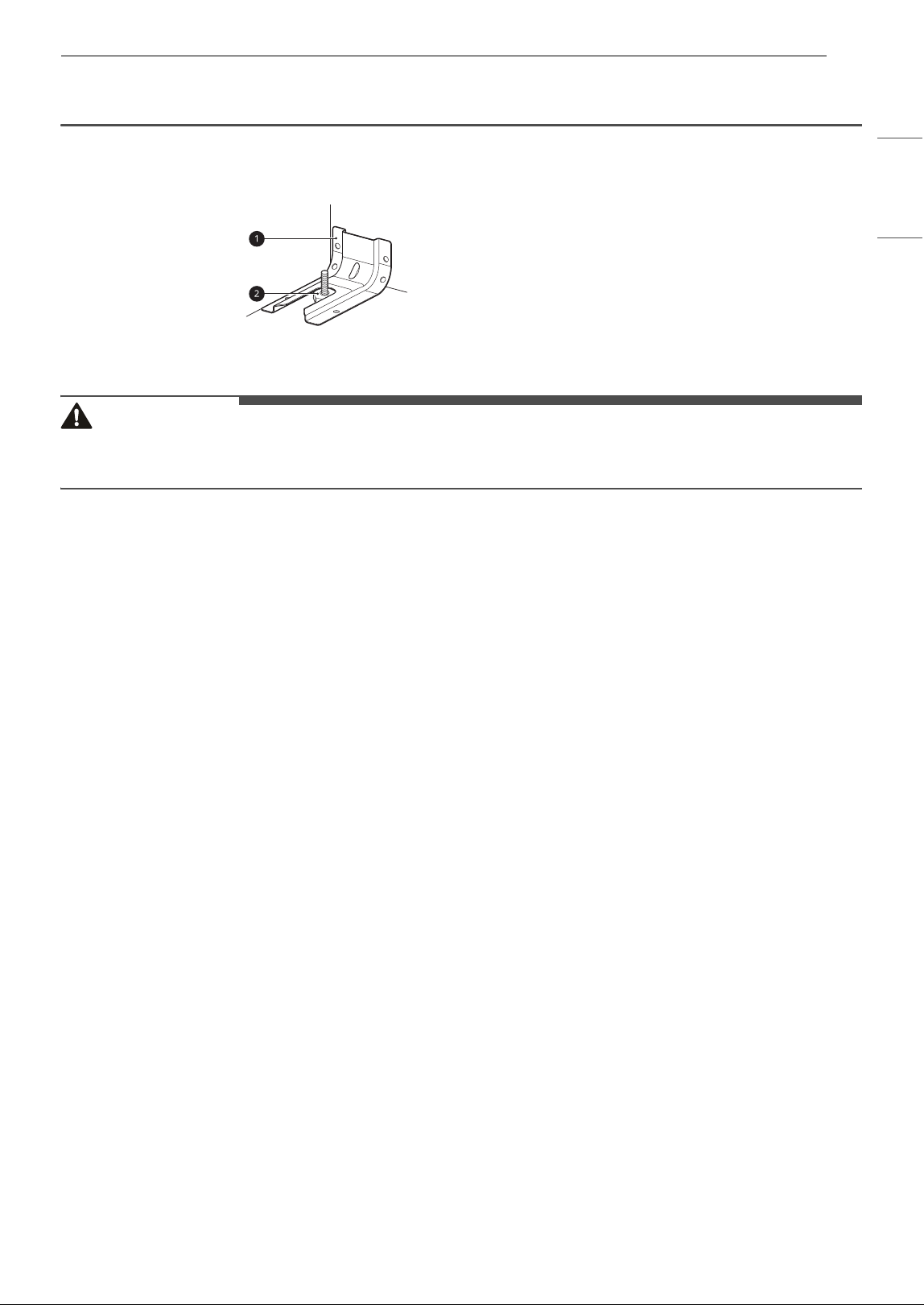
aAnti-tip bracket
bLeveling leg

6 IMPORTANT SAFETY INSTRUCTIONS
• Never attempt to dry a pet in the oven.
• Never use your appliance for warming or heating the room.
• Always use pot holders or oven mitts when removing food from the oven or the surface element.
Cookware will be hot. Use only dry pot holders. Moist or damp pot holders on hot surfaces may result in
burns from steam. Do not let the pot holder touch hot heating elements. Do not use a towel or other
bulky cloth to remove food.
• Do not heat unopened food containers. Pressure in the containers may cause them to burst which may
result in injury.
• Be certain that all packing materials are removed from the appliance before operating. Keep plastic,
clothes, paper, and other flammable materials away from parts of the appliance that may become hot.
• Do not allow aluminum foil or the temperature probe to contact heating elements.
• Do not touch the hot surface between the bottom of the oven door and the top of the drawer on the
front of the oven while the oven is in operation. The surface becomes hot and can cause burns and other
injury.
• Do not touch the oven racks while they are hot.
• If a rack must be moved while the oven is hot, do not let the pot holder contact the hot heating element
in the oven.
• Pull the oven rack to the stop-lock position when loading and unloading food from the oven. This helps
prevent burns caused by touching hot surfaces of the door and oven walls.
• Do not use the oven if a heating element develops a glowing spot during use or shows other signs of
damage. A glowing spot indicates the heating element may fail and present a potential burn, fire, or
shock hazard. Turn the oven off immediately and have the heating element replaced by a qualified
service technician.
• During oven operation, the upper surface of the drawer cavity becomes hot and may cause burns. Never
allow children to remain unsupervised near the oven or cooktop.
• Do not put your hand inside the drawer while the oven is operating.
• Keep Oven Vent Duct Unobstructed. Areas near the vent may become hot during operation and may
cause burns. Do not block the vent opening. Avoid placing plastics near the vent as heat may distort or
melt the plastic.
• REMOTE OPERATION - This appliance is configurable to allow remote operation at any time. Do not store
any flammable materials or temperature sensitive items inside, on top or near surface units of the
appliance.
• Never leave any items on the cooktop. The hot air from the vent may ignite flammable items and will
increase pressure in closed containers, which may cause them to burst.
Maintenance
• Do not allow children to crawl into the oven.
• Let hot cookware and utensils cool in a safe place, out of reach of small children.
• If the door glass, cooktop glass, surface, or oven heating unit of the range are damaged, discontinue use
of the range and call for service.
• Do not allow anyone to climb, stand or hang on the door, storage drawer or cooktop. They could
damage the range and even tip it over, causing severe personal injury.
• Always disconnect power from the appliance before servicing.
• Before replacing the oven light, switch off the electrical power to the oven at the main fuse or circuit
breaker panel. Failure to do so can result in severe personal injury, death, or electrical shock.
• Never pour cold water over a hot oven for cleaning. Doing so may cause the oven to malfunction.
7IMPORTANT SAFETY INSTRUCTIONS
ENGLISH
Risk of Fire and Flammable Materials
• Do not store or use flammable material in the oven or near or on the cooktop. Flammable materials
include paper, plastic, pot holders, linens, wall coverings, curtains, and gasoline or other flammable
vapors and liquids such as grease or cooking oil. These materials can be ignited when the oven and
cooktop are in use.
• Use extreme caution when moving or disposing of hot grease.
• Wear proper apparel. Do not wear loose-fitting or hanging garments, which may ignite if they contact
hot surfaces, and cause severe burns.
• Do not use the oven for drying clothes. Only use the oven for its intended purpose.
• If cabinet storage is provided directly above the cooking surface, only use it to store items that are not
frequently used and can be safely stored in an area subjected to heat. Temperatures may be unsafe for
volatile items such as flammable liquids, cleaners or aerosol sprays.
• Do not use water on grease fires. Should an oven fire occur, leave the oven door closed and turn the
oven off. If the fire continues, throw baking soda on the fire or use a fire extinguisher. Do not put water
or flour on the fire. Flour may be explosive and water can spread a grease fire and cause personal injury.
Button Cell or Coin Batteries Symbol
INGESTION HAZARD: This product contains a button cell or coin battery.
8 IMPORTANT SAFETY INSTRUCTIONS
Safety Standard for Button Cell or Coin Batteries
• Remove and immediately recycle or dispose of used batteries
according to local regulations and keep away from children.
- Do NOT dispose of batteries in household trash or incinerate.
• Even used batteries may cause severe injury or death.
• Call a local poison control center for treatment information.
• Non-rechargeable batteries are not to be recharged.
• Do not force discharge, recharge, disassemble, heat above 140 ℉
(60 ℃) or incinerate.
- Doing so may result in injury due to venting, leakage or explosion
resulting in chemical burns.
• Product contains non-replaceable batteries.
• Battery Type : ML621-TZ1
• Nominal Voltage : 3.0 V
WARNING
• INGESTION HAZARD: This product contains
a button cell or coin battery.
• DEATH or serious injury can occur if
ingested.
• A swallowed button cell or coin battery can
cause Internal Chemical Burns in as little
as 2 hours.
• KEEP new and used batteries OUT OF
REACH of CHILDREN.
• Seek immediate medical attention if a
battery is suspected to be swallowed or
inserted inside any part of the body.

9IMPORTANT SAFETY INSTRUCTIONS
ENGLISH
SAVE THESE INSTRUCTIONS
CAUTION
CAUTION
• To reduce the risk of minor injury to persons, malfunction, or damage to the product or property when
using this product, follow basic precautions, including the following:
Operation
• Always heat fat slowly, and watch as it heats.
• If frying combinations of oils and fats, stir them together before heating.
• Use a deep fat thermometer, if possible, to prevent overheating fat beyond the smoking point.
• Use the least possible amount of fat for effective shallow or deep-fat frying. Filling the pan with too much
fat can cause spillovers when food is added.
• Accessible parts may become hot when the broiler is in use.
• Do not place food or cookware on the bottom of the oven cavity. Doing so will cause permanent damage
to the oven bottom finish.
• When using cooking or roasting bags in the oven, follow the manufacturer’s directions.
Maintenance
• Do not store items of interest to children in cabinets above a range or on the back guard of a range.
Children climbing on the range to reach items could be seriously injured.
• Do not repair or replace any part of the appliance unless specifically recommended in the manual. All
other servicing should be performed by a qualified technician.
• Do not use harsh etching, abrasive cleaners or sharp metal scrapers to clean the oven door glass
because they can scratch the surface. Scratches may cause the glass to shatter.
• Make sure oven lights are cool before cleaning.
• Do not clean the door gasket. The door gasket is essential for a good seal. Care should be taken not to
rub, damage, or move the gasket.
• Clean in the self-clean cycle only parts listed in this manual. Before self-cleaning the oven, remove the
broiler pan, all oven racks, the meat probe and any cookware, utensils or food from the oven.
10 PRODUCT OVERVIEW
PRODUCT OVERVIEW
Product Features
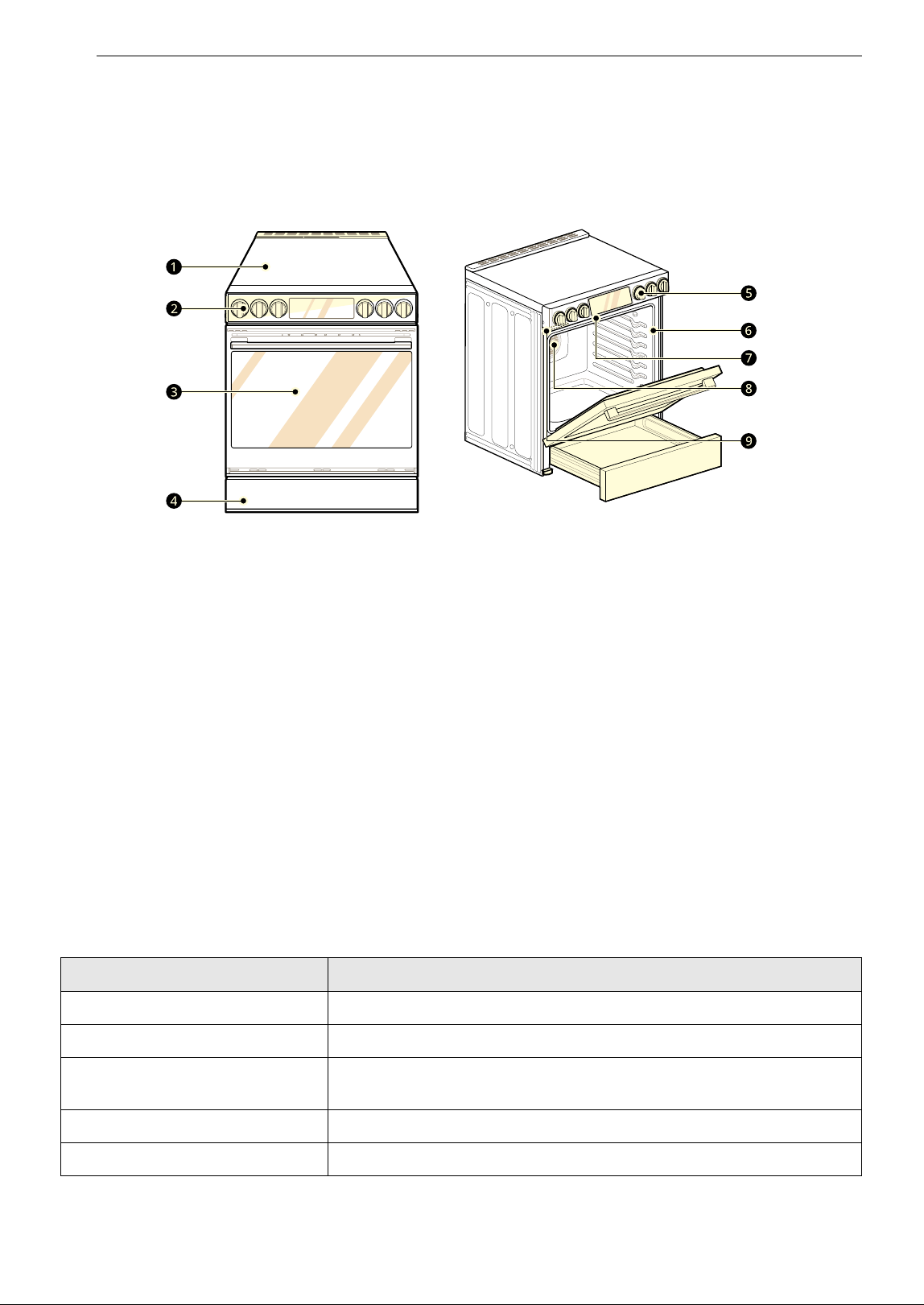
Exterior and Interior
a Cooktop
b Cooktop controller
c Oven door
d Storage drawer
e Temp Knob
f Gasket
g Broil Burner
h Convection burner
i Model & serial number plate
Product Specifications
The appearance and specifications listed in this manual may vary due to constant product improvements.
Oven Range Models LSIU6339XE
Description Electric Slide In Oven Range
Electrical requirements 12.1 kW 120/240 VAC or 10.2 kW 120/208 VAC
Exterior Dimensions 29 7/8" (W) x 36 1/2" (H) x 26 7/8" (D) (D with door closed)
75.9 cm (W) x 92.7 cm (H) x 68.3 cm (D) (D with door closed)
Height to cooking surface 36" (91.3 cm)
Total capacity 6.3 cu. ft.
11PRODUCT OVERVIEW
ENGLISH
Accessories
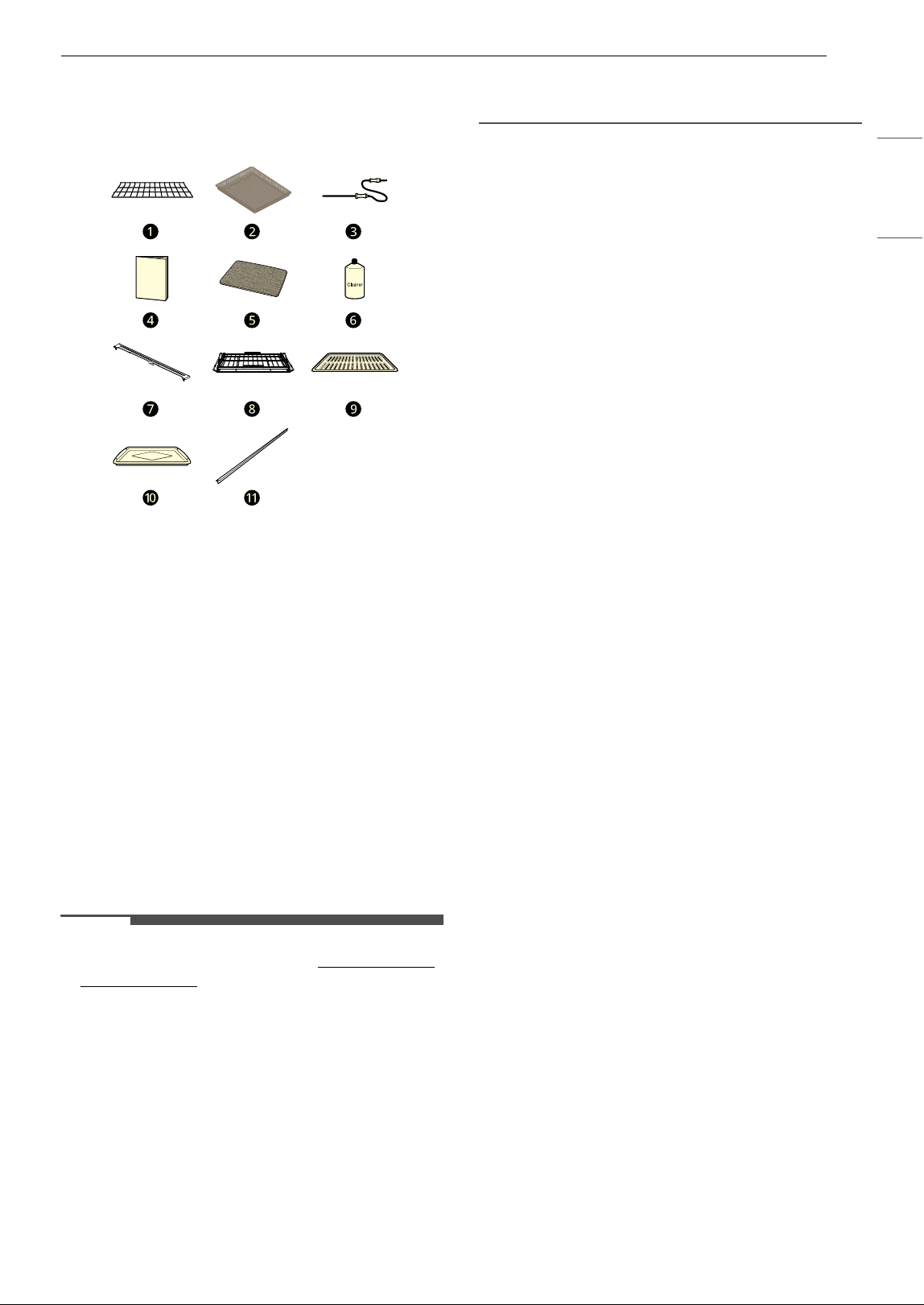
Included Accessories
a Heavy Duty Rack (2 ea)
b Air Fry Tray (1 ea)
c Meat Probe (1 ea)
d Owner’s Manual (1 ea)
e Non-scratch Scouring Pad (1 ea)
f Cooktop Cleaner (1 ea)
g Rear Filler (1 ea)
h Gliding Rack (1 ea)
i Grid (1 ea)
j Broiler Pan (1 ea)
k Rubber Gasket (2 ea)
NOTE
• Contact LG Customer Service at 1-800-984-6306
(1-888-542-2623
in Canada) if any accessories
are missing.
• For your safety and for extended product life,
only use authorized components.
• The manufacturer is not responsible for product
malfunction or accidents caused by the use of
separately purchased, unauthorized
components or parts.
• The images in this guide may be different from
the actual components and accessories, which
are subject to change by the manufacturer
without prior notice for product improvement
purposes.
12 INSTALLATION
INSTALLATION
Before Installing
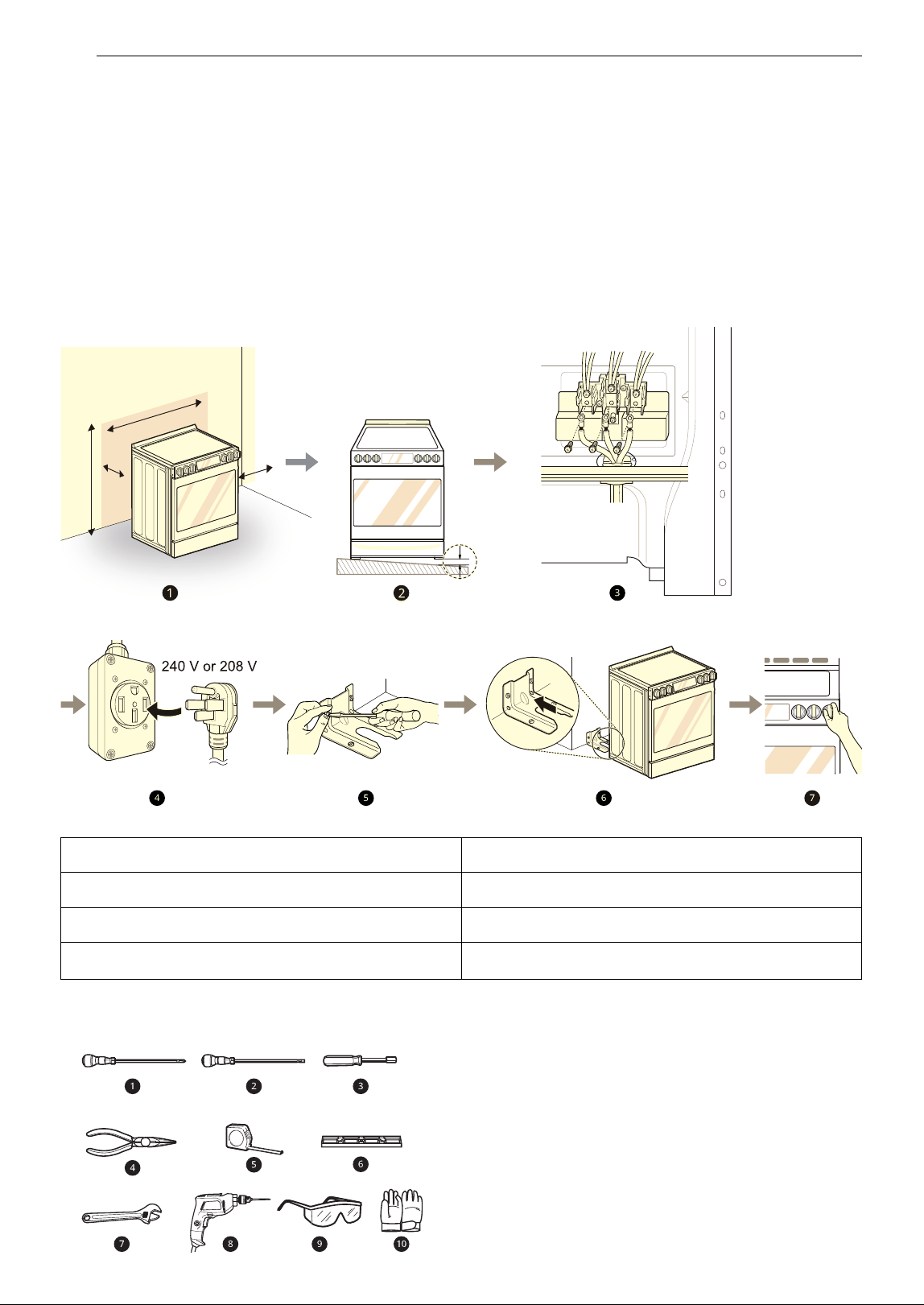
Installation Overview
Please read the following installation instructions first after purchasing this product or transporting it to
another location.
The images in this guide may be different from the actual components and accessories, which are subject
to change by the manufacturer without prior notice for product improvement purposes.
Tools Needed
a Phillips Screwdriver
b Flat-blade Screwdriver
c 1/4" Nut Driver
d Pliers
e Tape Measure
f Level
a Check and choose the proper location e Install anti-tip device
b Level the range f Engage the anti-tip device
c Connect electric range g Test run
d Plug in the power cord
13INSTALLATION
ENGLISH
g Adjustable Wrench
h Drill
i Safety Glasses
j Gloves
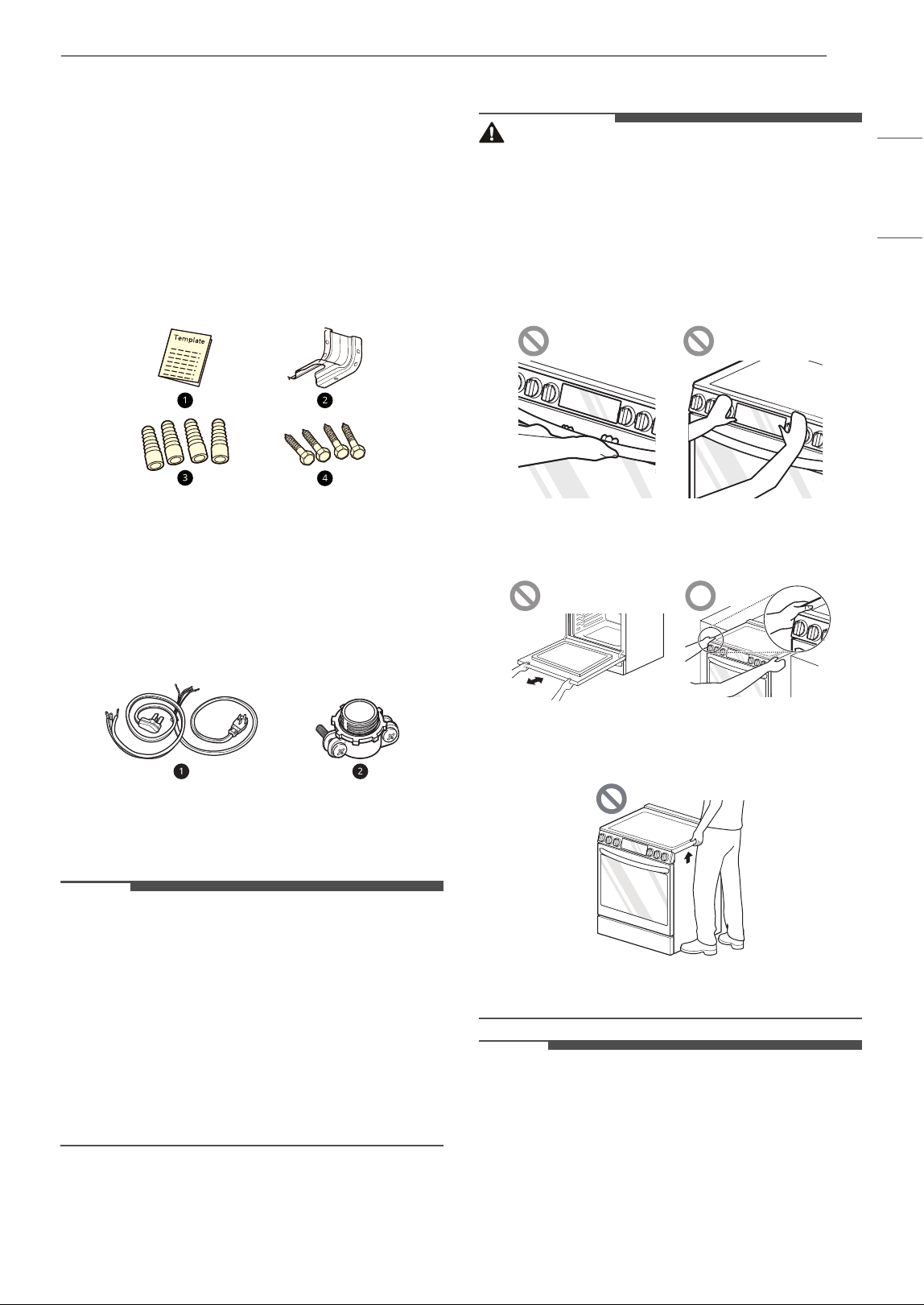
Parts
Parts Provided
a Template (1 ea)
b Anti-tip Bracket Kit (1 ea)
c Anchor Sleeves (4 ea)
d Lag Bolts (4 ea)
Parts Not Provided
a 4-Wire Cord or 3-Wire Cord (UL approved 40 or
50 AMP)
b Strain Relief (for conduit installations only)
NOTE
• Observe all governing codes and ordinances.
• Have the installer show you the location of the
circuit breaker or fuse. Mark it for easy
reference.
• As when using any appliance generating heat,
there are certain safety precautions you should
follow.
• Be sure your range is installed and grounded
properly by a qualified installer or service
technician.
Unpacking and Moving the Range
WARNING
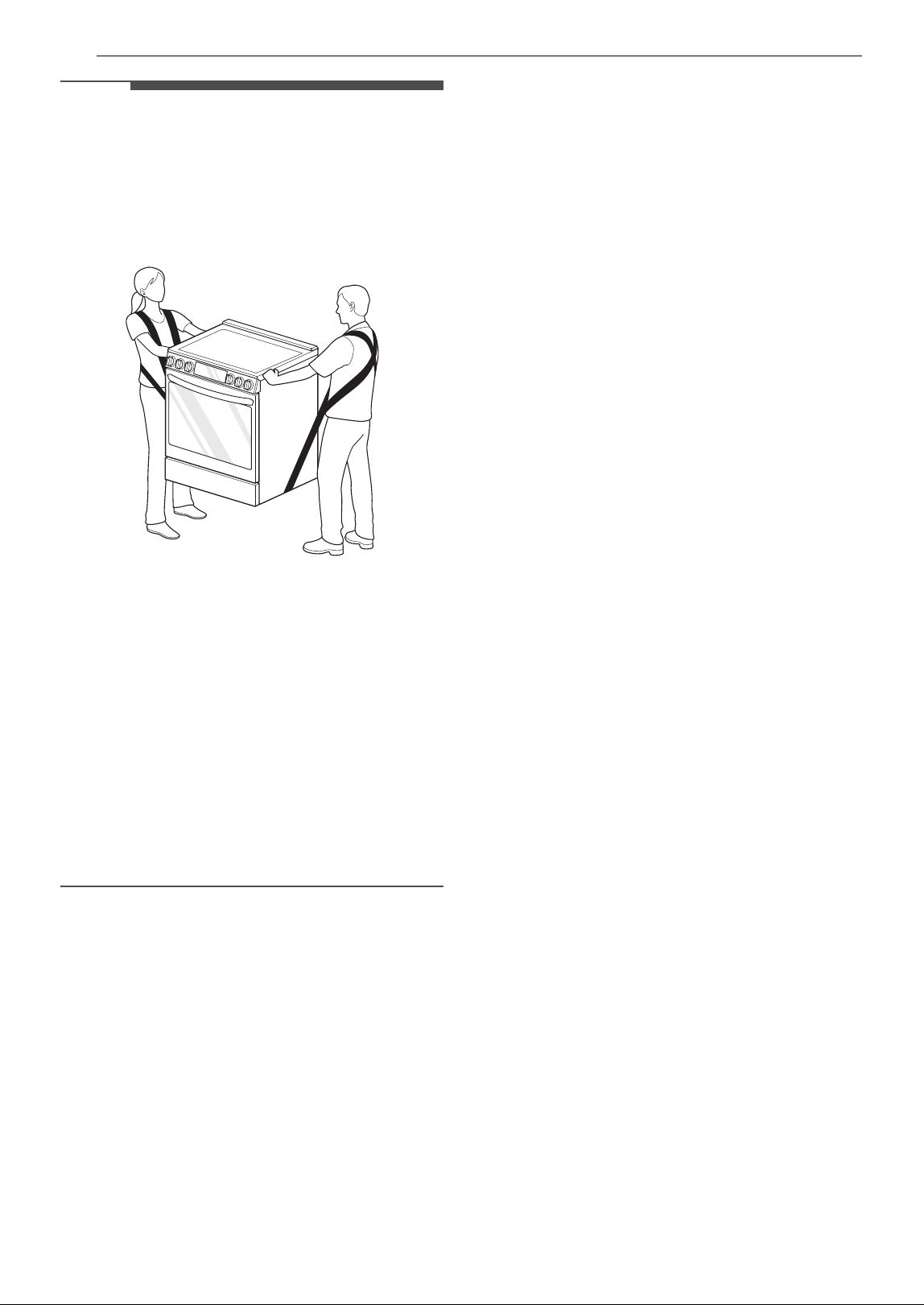
• You should use two or more people to move and
install the range. (Excessive Weight Hazard)
Failure to do so can result in back or other injury.
• Do not use the door handles or knobs to push or
pull the range during installation or when
moving the range out for cleaning or service.
Doing so can result in serious damage to the
range.
• Do not push or pull the range by grabbing the
open oven door or cooktop only. Doing so can
result in serious damage to the range.
• Do not lift the range using the cooktop or door
handle. Doing so can cause damage and
improper operation of the range.
• To reduce the risk of burns, do not move this
appliance while it is hot.
NOTE
• The image may differ from the actual model.
14 INSTALLATION
NOTE
• Your range is heavy and can be installed on soft
floor coverings such as cushioned vinyl or
carpeting. Use care when moving the range on
this type of flooring. Use a belt when moving the
range to prevent damaging the floor. Or slide
the range onto cardboard or plywood to avoid
damaging the floor covering.
• Remove packing material, tape and any
temporary labels from your range before using.
Do not remove any warning-type labels, the
model and serial number label, or the Tech
Sheet that is located on the back of the range.
• To remove any remaining tape or glue, rub the
area briskly with your thumb. Tape or glue
residue can also be easily removed by rubbing a
small amount of liquid dish soap over the
adhesive with your fingers. Wipe with warm
water and dry.
• Do not use sharp instruments, rubbing alcohol,
flammable fluids, or abrasive cleaners to remove
tape or glue. These products can damage the
surface of your range.
15INSTALLATION
ENGLISH
Choosing the Proper Location
Dimensions and Clearances
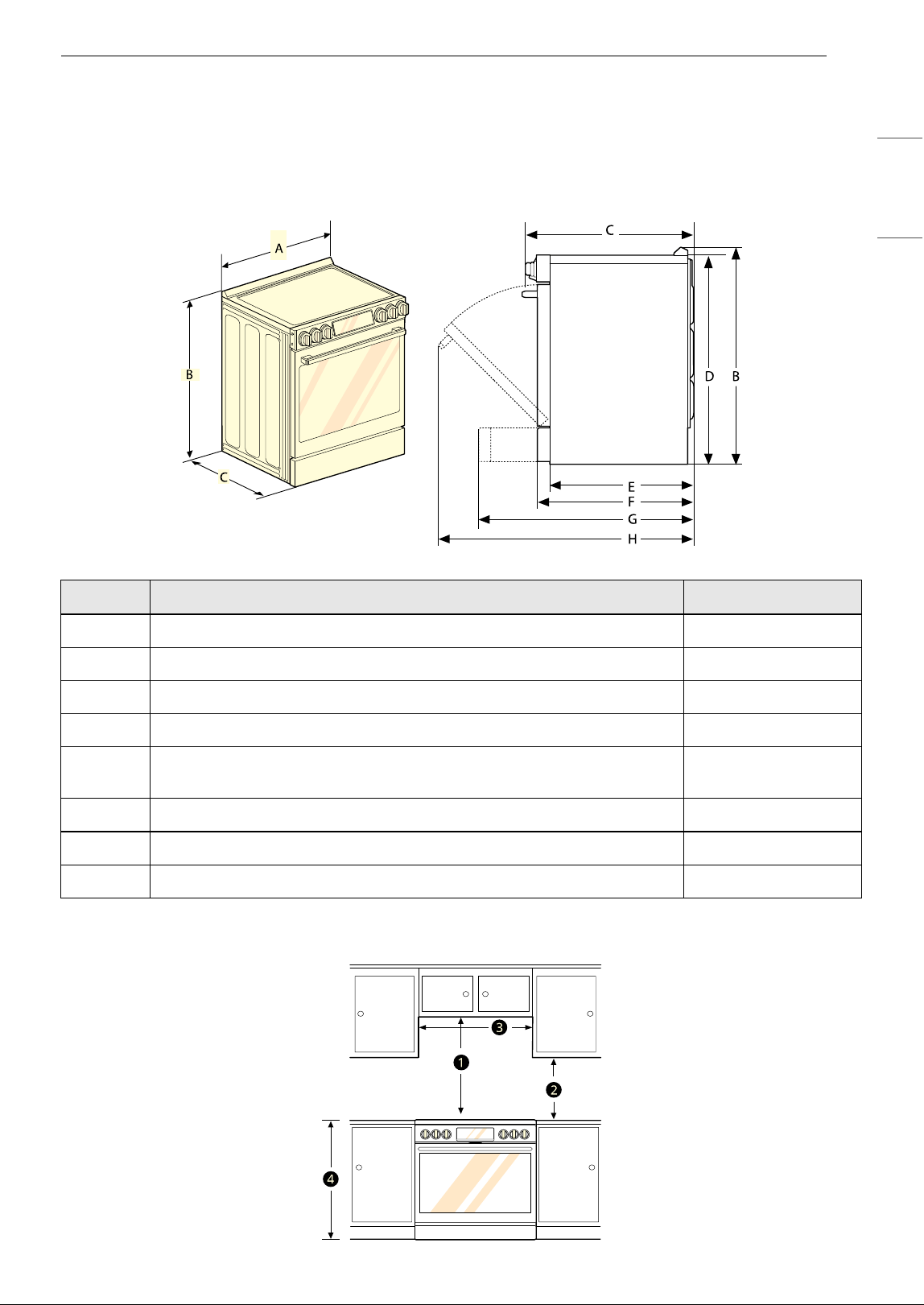
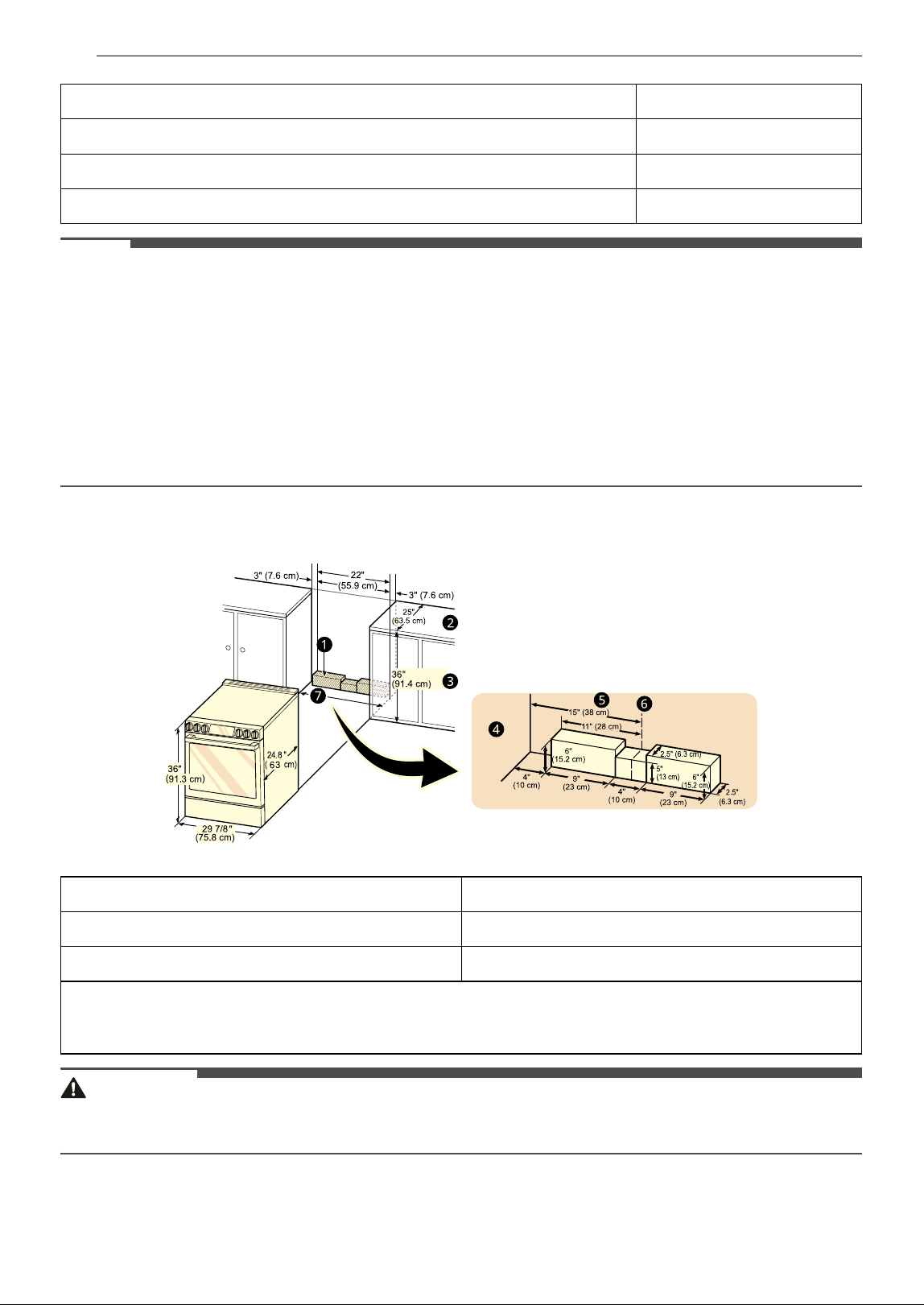
Dimensions
Minimum Dimensions
- Dimensions LSIU6339XE
AWidth 29 7/8" (758.8 mm)
BHeight 36 1/2" (927.1 mm)
C Depth (Includes Door Handle) 29 5/16" (744.5 mm)
D Height (Excludes Vent Trim) 36" (913 mm)
E
Depth (Includes only the product body that is loaded into the cabinet.
Excludes door, drawer, and handles)
24 3/4" (628.5 mm)
F Depth (Excludes Door Handle) 26 7/8" (682.5 mm)
G Depth when drawer is fully opened 36 1/16" (916.2 mm)
H Depth when door is fully opened 48 5/8" (1235.9 mm)
16 INSTALLATION
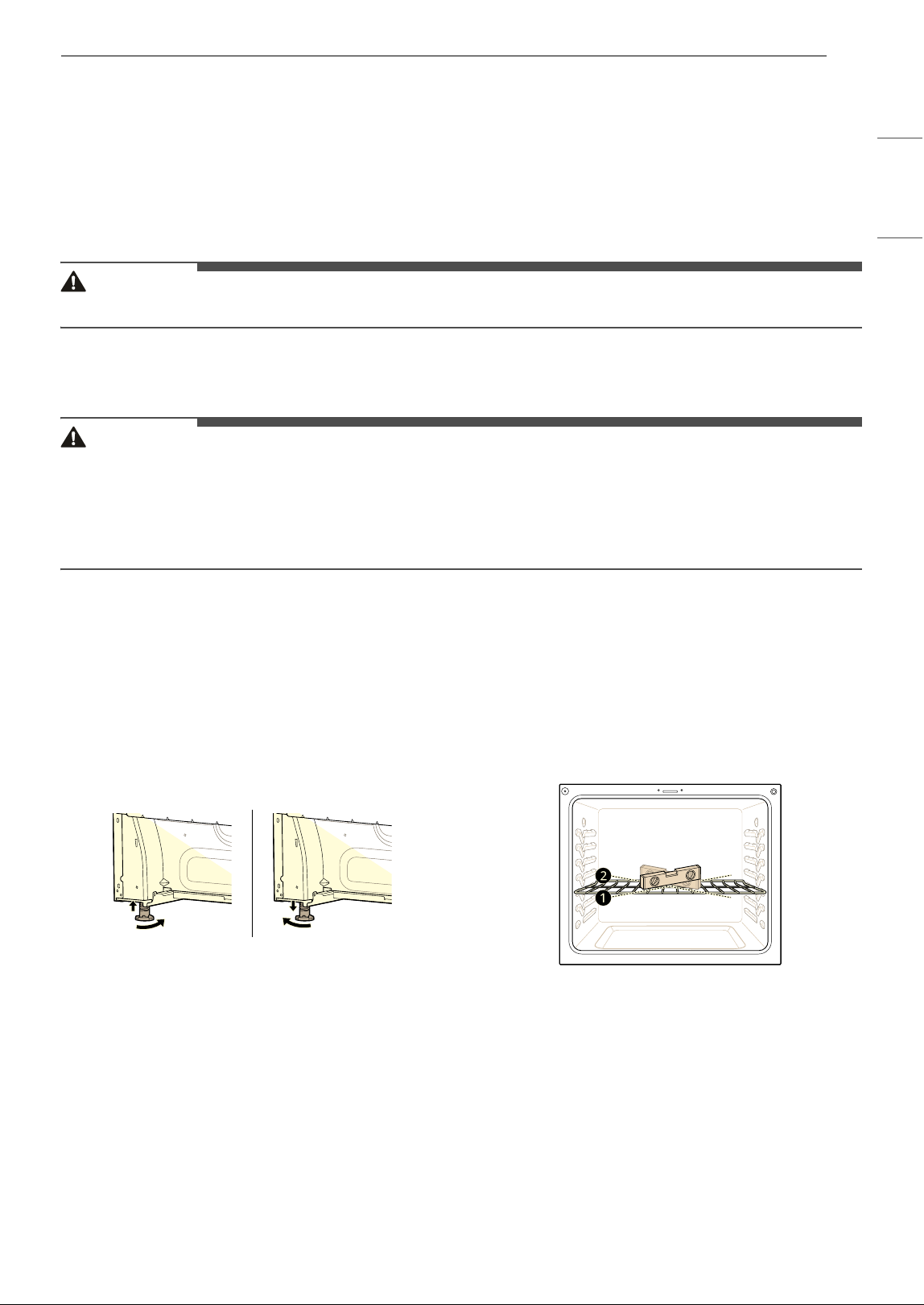
NOTE
• a 30" (76.2 cm) minimum clearance between the top of the cooking surface and the bottom of an
unprotected wood or metal cabinet; or 24" (60.9 cm) minimum when bottom of wood or metal cabinet is
protected by not less than 1/4" (0.64 cm) flame retardant millboard covered with not less than no. 28
MSG sheet steel, 0.015" (0.381 mm) stainless steel, 0.024" (0.610 mm) aluminum or 0.020" (0.508 mm)
copper.
•
b 15" (38.1 cm) minimum between countertop and adjacent cabinet bottom.
• Important – Save for the use of the local electrical inspector.
• For installation in Canada, a free-standing range is not to be installed closer than 15/32" (12 mm) from
any adjacent surface.
Clearances
CAUTION
• The height of the countertop afterleveling the range should be higher than the surface height of the
oven cooktop glass to prevent damage caused by impact on the glass rim.
a Minimum distance from top of range to combustible surface overhead
30" (76.2 cm)
b Minimum distance from countertop to overhead cabinets at side
15" (38.1 cm)
c Minimum opening in overhead cabinets
30" (76.2 cm)
d Height of countertop
36" (91.3 cm)
a Acceptable Electrical Outlet Area b Normal Countertop Depth
c Counter Top Height d Cabinet
e Wall f Center
g Cabinet Opening
= 30" (76.2 cm) For U.S.A
= 30" (76.2 cm) ~ 31" (78.7 cm) For CANADA
17INSTALLATION
ENGLISH
Electricity
The range should always be plugged into its own individual properly grounded electrical outlet.
• This prevents overloading house wiring circuits which could cause a fire hazard from overheated wires.
• It is recommended that a separate circuit serving only this appliance be provided.
Flooring
CAUTION
• Use an insulated pad or 1/4 in. (0.64 cm) plywood under the range if installing the range over carpeting.
Ambient Temperature
CAUTION
• Make sure wall coverings, countertops and cabinets around the range can withstand the heat (up to 194
°F) generated by the range. Discoloration, delamination or melting may occur. This range has been
designed to comply with the maximum allowable wood cabinet temperature of 194 °F.
• Before installing the range in an area covered with linoleum or other synthetic floor covering, make sure
the floor covering can withstand temperatures of at least 200 °F (93 °C).
Leveling
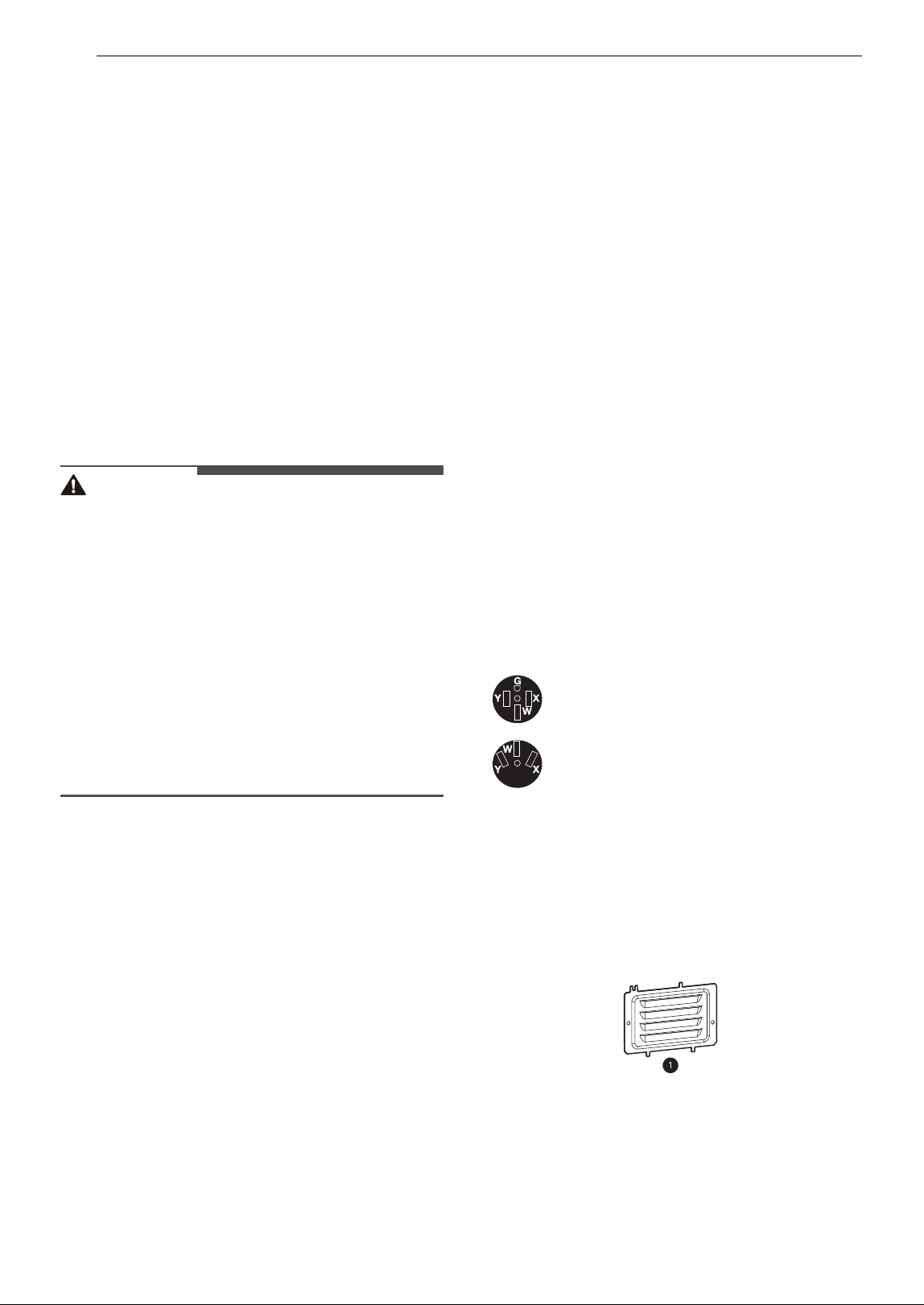
Leveling the Range
Level the range by adjusting the leveling legs with
a wrench. Extending the legs slightly may also
make it easier to insert the rear leg into the anti-tip
bracket.
Checking Adjustments
1 Place the level diagonally on the oven rack,
and check each direction for level.
• First check direction
a. Then check
direction
b.
2 If the level doesn’t show that the rack is level,
adjust the leveling legs with a wrench.
Connecting Electricity
Electrical Requirements
This appliance must be installed and grounded on
a branch circuit by a qualified technician in
18 INSTALLATION
accordance with the National Electrical code ANSI/
NFPA NO. 70 - latest edition.
All wiring should conform to local and NEC codes.
This range requires a single-phase, 3 wire, AC 120/
208 V or 120/240 V 60 Hz electrical system. Use
only a 3-conductor or a 4-conductor UL - listed
range cord with closed-loop terminals, open-end
spade lugs with upturned ends or similar
termination. Do not install the power cord without
a strain relief.
A range cord rated at 40 amps with 120/240 V
minimum range is required.
If a 50 amp range cord is used, it should be
marked for use with 1 3/8" diameter connection
openings. This appliance may be connected by
means of a conduit or power cord. If a conduit is
being used, refer to "3-Wire Connection: Conduit"
or "4-Wire Connection: Conduit" sections.
WARNING
• Allow 2 to 3 ft (61.0 cm to 91.4 cm) of slack in the
line so that the range can be moved if servicing
is ever necessary.
• The power supply cord and plug should not be
modified. If the plug will not fit the outlet, have a
proper outlet installed by a qualified electrician.
• Using an extension cord to connect the power is
prohibited. Connect the power cord and plug
directly.
• Electrical ground is required on this appliance.
• Make sure that the power cord is not pinched by
the range or heavy objects. Failure to do so can
result in serious burns or electrical shock.
Specified Power Cord Kit Rating
Case 1
• Voltage: 120/240 volts (3-wire)
• Range rating: 8,750 W - 16,500 W
• Specified rating of power supply-cord kit,
amperes: 40 A or 50 A
• Diameter (inches) of range connection opening
- Power cord: 1 3/8"
- Conduit: 1 1/8"
Case 2
• Voltage: 120/240 volts (3-wire)
• Range rating: 16,501 W - 22,500 W
• Specified rating of power supply-cord kit,
amperes: 50 A
• Diameter (inches) of range connection opening
- Power cord: 1 3/4"
- Conduit: 1 3/8"
Case 3
• Voltage: 120/208 volts (3-wire)
• Range rating: 7,801 W- 12,500 W
• Specified rating of power supply-cord kit,
amperes: 40 A or 50 A
• Diameter (inches) of range connection opening
- Power cord: 1 3/8"
- Conduit: 1 1/8"
Case 4
• Voltage: 120/208 volts (3-wire)
• Range rating: 12,501 W - 18,500 W
• Specified rating of power supply-cord kit,
amperes: 50 A
• Diameter (inches) of range connection opening
- Power cord: 1 3/4"
- Conduit: 1 3/8"
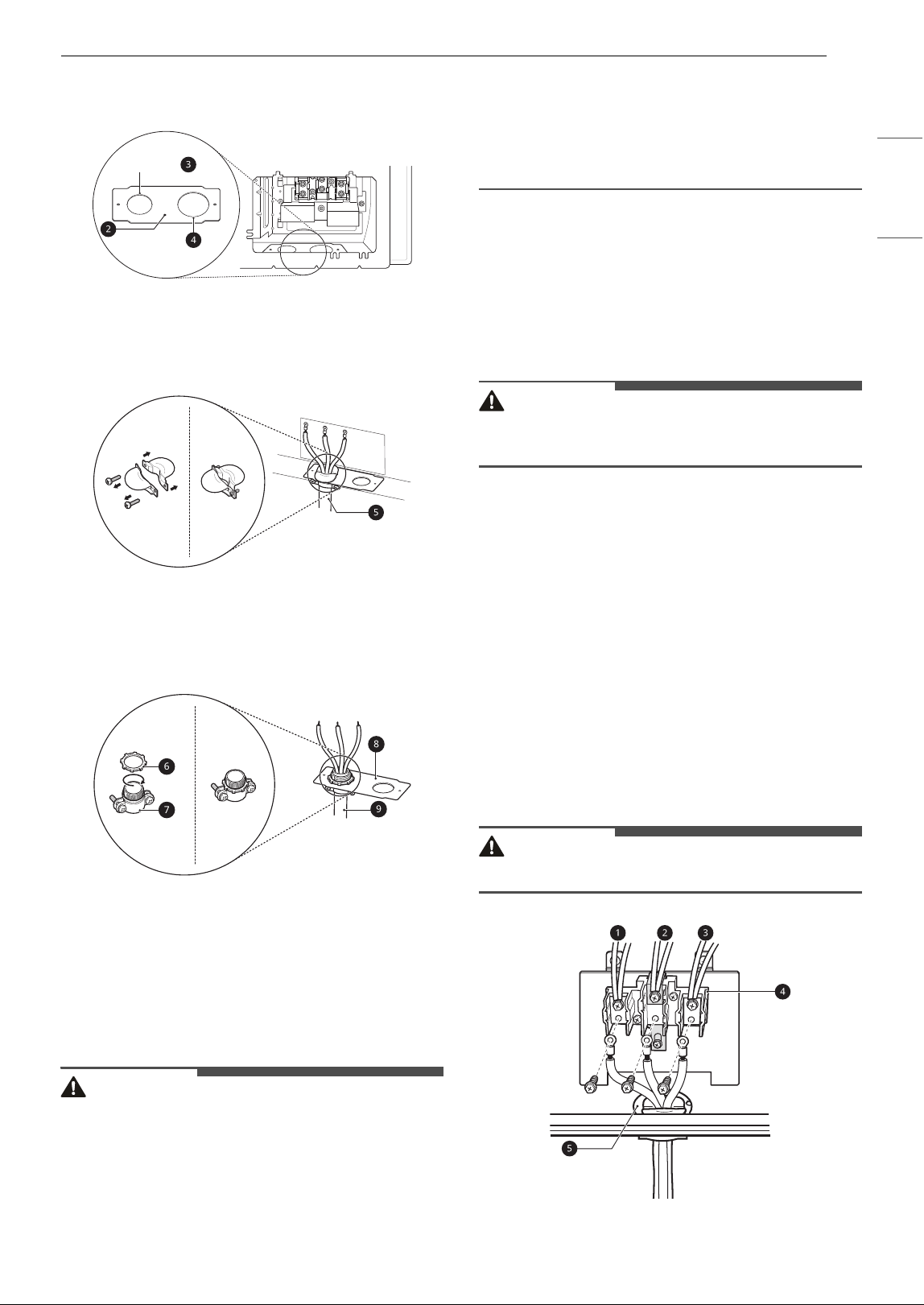
3, 4 - Wire Electrical Wall Receptacle
Connecting the Power Cord /
Conduit
The rear access cover a must be removed. Loosen
the two screws with a screwdriver. The terminal
block will then be accessible.
Use the cord/conduit connection plate
b to install
the power cord or conduit. Leave the connection
plate as installed for power cord installations.
Remove the connection plate for conduit
installations and rotate it to use the smaller 1 1/8
4 Wire receptacle (14-50R)
3 Wire receptacle (10-50R)
19INSTALLATION
ENGLISH
in. (2.8 cm) conduit hole c instead of the 1 3/8 in.
(3.5 cm) power cord hole
d.
For power cord
e installations, hook the strain
relief over the 1 3/8 in. (3.5 cm) power cord hole
located below the rear of the oven. Insert the
power cord through the strain relief and tighten it.
For conduit installations, insert the conduit strain
relief in the 1 1/8 in. (2.8 cm) conduit hole. Then
install the conduit through the body of the strain
relief and fasten the strain relief with its ring.
f Ring
g Body
h Cord/Conduit Connection Plate
i Conduit
3-Wire Connection: Power Cord
WARNING
• The white middle (neutral or ground) wire of a 3-
wire power cord or a 3-wire conduit has to be
connected to the middle post of the main
terminal block. The remaining two wires of the
power cord or conduit have to be connected to
the outside posts of the main terminal
connection block. Failure to do so can result in
electrical shock, severe personal injury or death.
• If screws are not tightened securely, it can result
in electrical spark and severe personal injury or
death.
1 For power cord installations, hook the strain
relief over the power cord hole (1 3/8") located
below the rear of the oven.
2 Insert the power cord through the strain relief
and tighten it.
CAUTION
• Do not install the power cord without a strain
relief.
3 Remove the lower 3 screws from the terminal
block and retain them.
4 Insert the 3 screws through each power cord
terminal ring and into the lower terminals of
the terminal block.
• Make sure that the white center wire is
connected to the center lower position of
the terminal block.
5 Tighten the 3 screws securely into the
terminal block.
CAUTION
• Do not remove the ground strap connections.
a Black
1
1
/
8
"
(2.8 cm)
1
3
/
8
"
(3.5 cm)
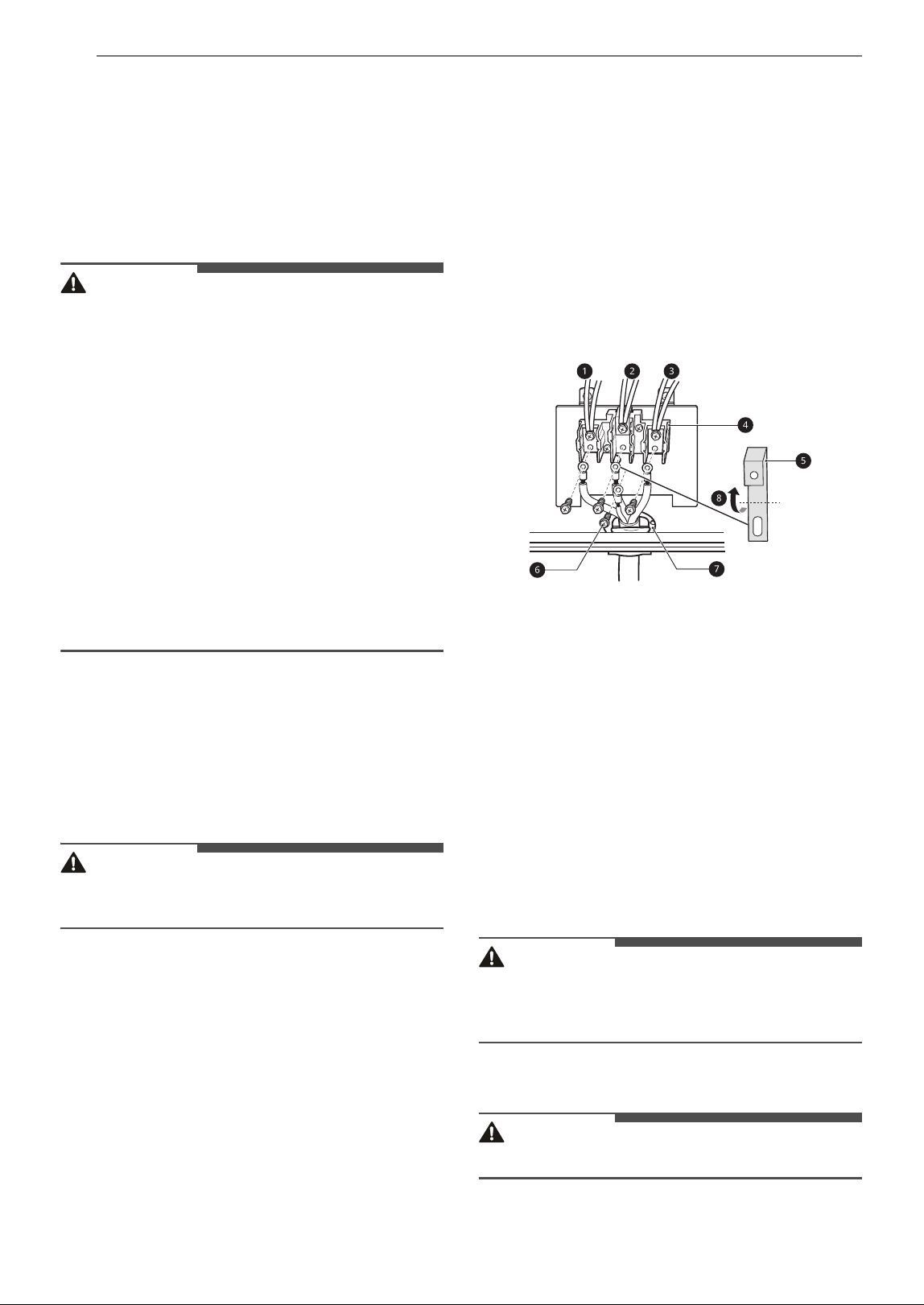
20 INSTALLATION
b White
c Red
d Terminal Block
e Cord/Conduit Connection Plate
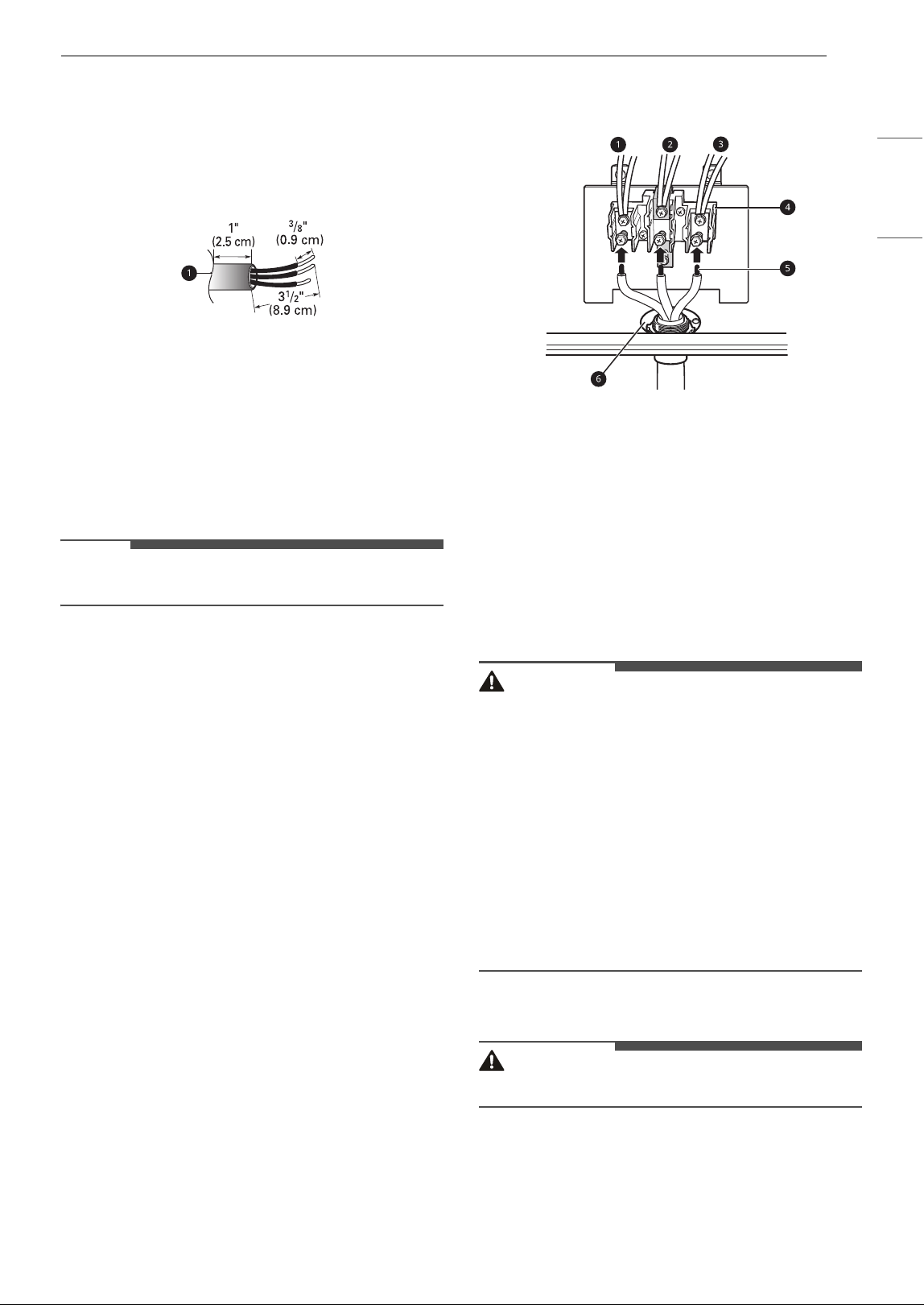
4-Wire Connection: Power Cord
WARNING
• Only a 4-conductor power-supply cord kit rated
120/240 volts, 50 amperes and marked for use
with ranges with closed-loop connectors or
opened spade lugs with upturned ends must be
used. The white middle (neutral) wire of the
power cord or 4-wire conduit has to be
connected to the middle post of the main
terminal block. The other two wires of the power
cord or conduit have to be connected to the
outside posts of the main terminal connection
block. The 4th ground wire (green) must be
connected to the frame of the range with the
ground screw. Failure to do so can result in
electrical shock, severe personal injury or death.
• If screws are not tightened securely, it can result
in electrical spark and severe personal injury or
death.
1 For power cord installations, hook the strain
relief over the power cord hole (1 3/8") located
below the rear of the oven.
2 Insert the power cord through the strain relief
and tighten it.
CAUTION
• Do not install the power cord without a strain
relief.
3 Remove the lower 3 screws from the terminal
block and retain them.
4 Remove the ground screw and bend the end
of the ground strap up so the slot is over the
hole of the center screw removed in step 3.
5 Insert the ground screw into the power cord
ground wire (green) terminal ring and secure
it to the range frame.
6 Insert the 3 screws through each power cord
terminal ring and into the lower terminals of
the terminal block.
• Make sure that the white center (neutral)
wire is connected to the center lower
position of the terminal block.
7 Tighten the 3 screws securely into the
terminal block.
• The center screw now attaches the bent up
ground strap to the block.
a Black
b White
c Red
d Terminal Block
e Ground Strap
f Ground Screw
g Cord/Conduit Connection Plate
h Bend strap up and attach.
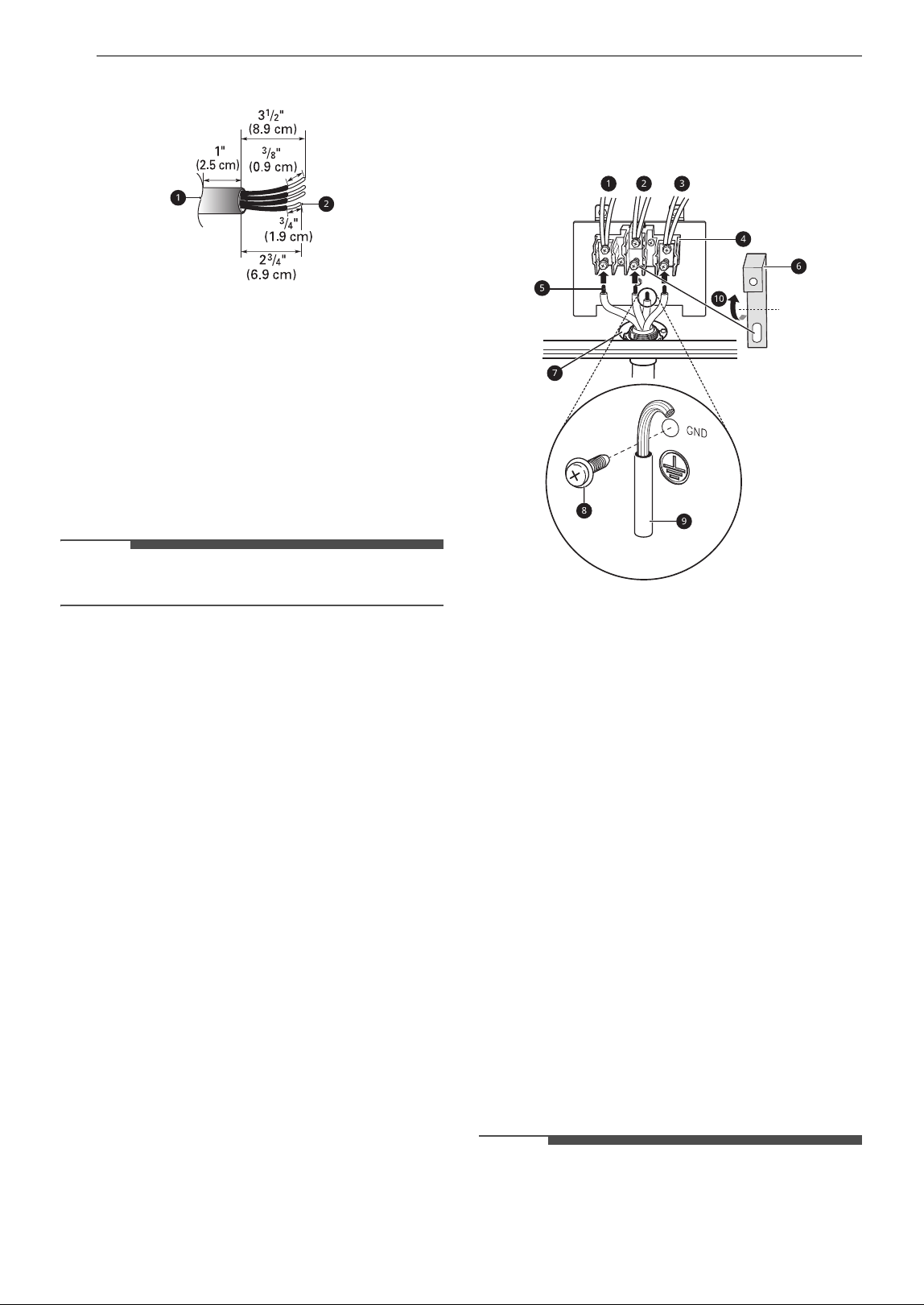
3-Wire Connection: Conduit
WARNING
• If screws are not tightened securely, it can result
in electrical spark and severe personal injury or
death.
Conduit Installations
CAUTION
• Do not install the conduit without a strain relief.
21INSTALLATION
ENGLISH
1 Remove the cord/conduit connection plate
from the rear of the oven and rotate it.
• The conduit hole (1 1/8") must be used.
2 Prepare the conduit wires as shown below.
a Cord/Conduit connection plate
3 Install the conduit strain relief.
1) Insert the strain relief in the 1 1/8 in. (2.8
cm) conduit hole.
2) Install the conduit through the body of
the strain relief and fasten the strain relief
with its ring.
NOTE
• For conduit installations, purchase a strain relief.
4 Reinstall the cord/conduit connection plate.
Conduit Connections
If the wire in the conduit is copper it must be 8 or
10 AWG wiring.
If the wire in the conduit is aluminum it must be 6
or 8 AWG wiring.
1 Loosen the lower 3 screws from the terminal
block.
2 Insert the bare wire (white/neutral) end
through the center terminal block opening.
Do not remove the ground strap connections.
3 Insert the two side bare wire ends into the
lower left and the lower right terminal block
openings.
4 Tighten the 3 screws securely into the
terminal block. (approximately 35 - 50 IN-LB)
a Black
b White
c Red
d Terminal Block
e Wire Ends
f Conduit Connection Plate
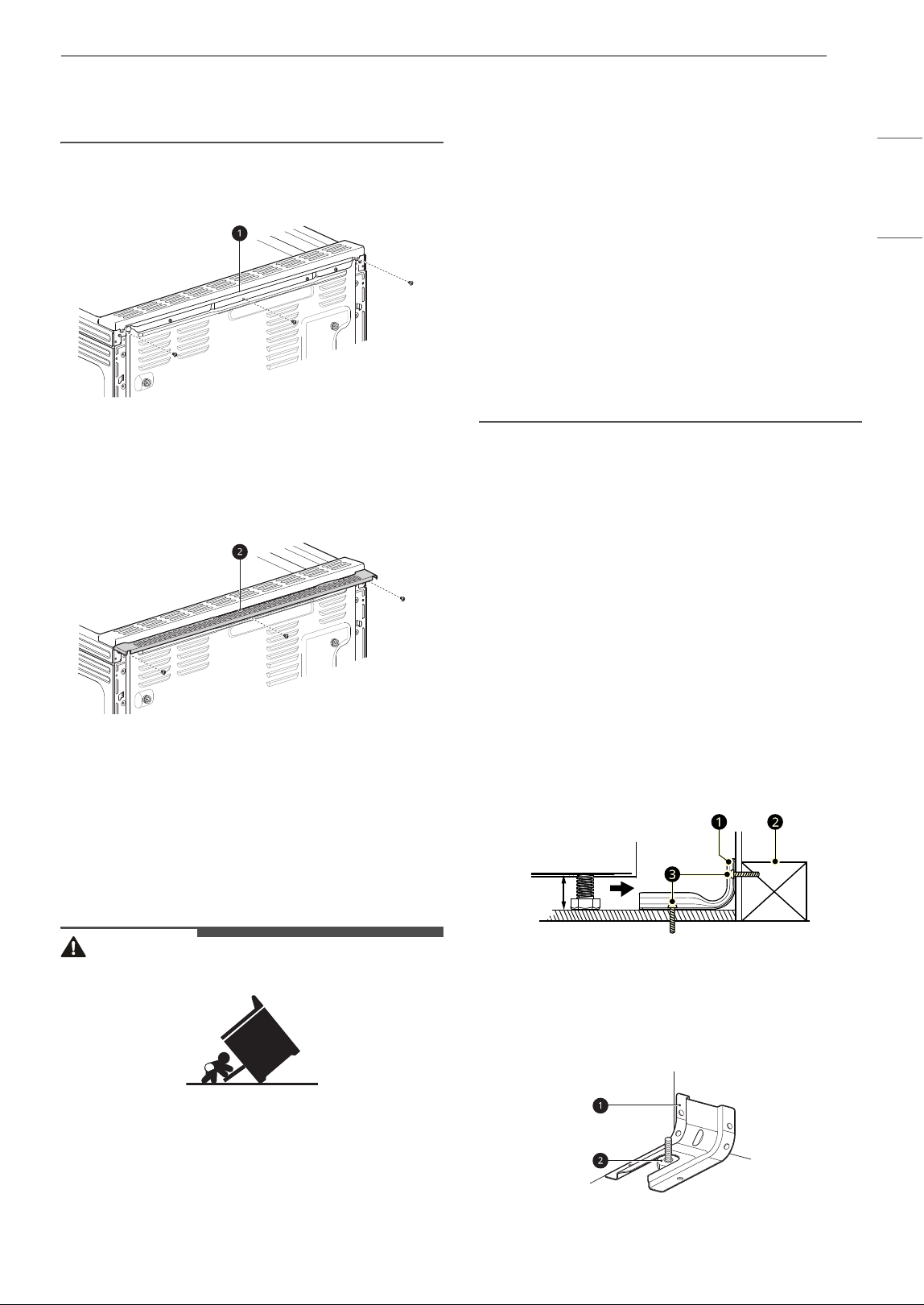
4-Wire Connection: Conduit
WARNING
• The white middle (neutral) wire of the power
cord or 4-wire conduit has to be connected to
the middle post of the main terminal block. The
other two wires of the power cord or conduit
have to be connected to the outside posts of the
main terminal connection block. The 4th ground
wire (green) must be connected to the frame of
the range with the ground screw. Failure to do
so can result in electrical shock, severe personal
injury or death.
• If screws are not tightened securely, it can result
in electrical spark and severe personal injury or
death.
Conduit Installations
CAUTION
• Do not install the conduit without a strain relief.
1 Remove the cord/conduit connection plate
from the rear of the oven and rotate it.
• The conduit hole (1 1/8") must be used.
22 INSTALLATION
2 Prepare the conduit wires as shown below.
a Cord/Conduit Connection Plate
b Ground Wire
3 Install the conduit strain relief.
1) Insert the strain relief in the 1 1/8 in. (2.8
cm) conduit hole.
2) Install the conduit through the body of
the strain relief and fasten the strain relief
with its ring.
NOTE
• For conduit installations, purchase a strain relief.
4 Reinstall the cord/conduit connection plate.
Conduit Connections
If the wire in the conduit is copper it must be 8 or
10 AWG wiring.
If the wire in the conduit is aluminum it must be 6
or 8 AWG wiring.
1 Loosen the 2 lower left and right screws from
the terminal block. Remove the lower 2 center
screws. Do not discard any screws.
2 Remove the ground screw and bend the end
of the ground strap up so the slot is over the
hole of the center screw removed in step 1.
3 Attach the ground (green) bare wire end to
the range frame and secure it in place with
the ground screw.
4 Insert the bare wire (white/neutral) end
through the center terminal block opening.
The center screw now attaches the bent up
ground strap to the block.
5 Insert the two side bare wire ends into the left
and the right terminal block openings.
Tighten the 3 screws securely into the
terminal block. (approximately 35 - 50 IN-LB)
a Black
b White
c Red
d Terminal Block
e Wire Ends
f Ground Strap
g Conduit Connection Plate
h Ground Screw
i Ground Wire
j Bend strap up and attach.
Optional Rear Filler
Installing the Rear Filler
If the counter does not bridge the opening at the
rear wall, the rear filler kit that is provided with the
slide in range will be needed.
NOTE
• If the countertop depth is greater than 25 3/8"
there will be a gap between the filler kit and the
back wall.
23INSTALLATION
ENGLISH
• If the countertop depth is less than 24 3/4", the
control panel will not sit flush with the
countertop.
1 Using a screwdriver, remove the three screws
holding the rear top plate in place.
a Rear Top Plate
2 Attach the rear top plate and filler assembly
as shown, using three screws removed in step
1.
b Rear filler
Anti-tip Device
Installing the Anti-tip Device
Tip Hazard
WARNING
• A child or adult can tip the range and be killed.
• Install the anti-tip device to the structure and/or
the range. Verify the anti-tip device has been
properly installed and engaged by following the
guide on the anti-tip bracket template.
• Engage the range to the anti-tip device by
following the guide on the anti-tip bracket
template. Ensure the anti-tip device is re-
engaged when the range is moved by following
the guide on the anti-tip bracket template.
• Re-engage the anti-tip device if the range is
moved. Do not operate the range without the
anti-tip device in place and engaged.
• See installation instructions for details.
• Failure to follow these instructions can result in
death or serious burns to children or adults.
• Range must be secured with an approved anti-
tip device.
• The range could be tipped by standing, sitting or
leaning on an open door if the range or anti-tip
device is not properly installed.
• The use of this device does not preclude tipping
of the range when not properly installed.
• After installing the anti-tip device, verify that it is
in place by carefully attempting to tilt the range
forward.
• This range has been designed to meet all
recognized industry tip standards for all normal
conditions.
• The installation of the anti-tip device must meet
all local codes for securing the appliance.
Using the Anti-tip Bracket Template
• The anti-tip bracket is packaged with an
installation template. The instructions include
necessary information to complete the
installation. Read and follow the range
installation instruction sheet.
•Screws
c must enter wood or concrete.
a Anti-tip Bracket
b Wall Plate
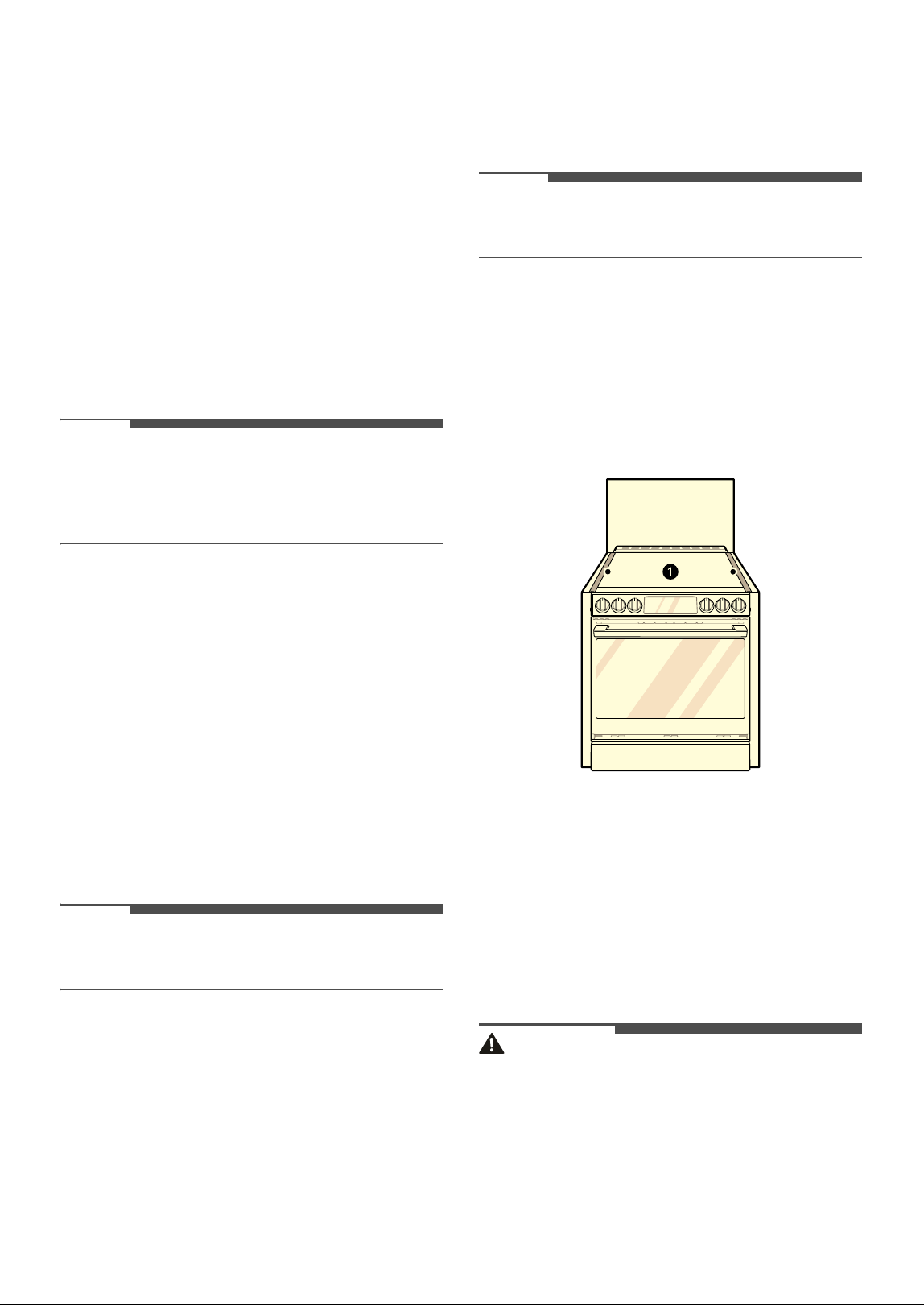
Engaging the Anti-tip Device
a Anti-tip Bracket
24 INSTALLATION
b Leveling Leg
1 Slide the range against the wall, making sure
the back leg slides into and engages the anti-
tip bracket.
2 Check for proper installation by grasping the
front edge of the cooktop and carefully
attempting to tilt the range forward.
Test Run
Test the Range Before Use
NOTE
• Do not try to light either the Bake or Broil
burners during a power outage. The range has
an electrical ignition system and cannot be used
without power.
Checking Operation of Bake Burners
To check ignition of the Bake burner, follow the
steps below:
1 Remove all packing materials from inside the
oven cavity.
2 Tap Manual Cook and tap Bake.
• Make sure the door is closed.
• Default Temperature is 350 ℉.
3 Tap START.
NOTE
• It may take between 30 and 90 seconds for the
burner to start heating.
Checking Operation of Broil Burners
To check ignition of the Broil burner, follow the
steps below:
1 Remove all packing materials from inside the
oven cavity.
2 Tap Manual Cook and tap Broil.
• Make sure the door is closed.
• Default Temperature setting is High.
3 Tap START.
NOTE
• It may take between 30 and 90 seconds for the
burner to start heating.
Rubber Gaskets
Installing the Rubber Gaskets
• Install one of the rubber gaskets provided on
each side of the range between the range and
the adjoining countertop. Look at a.
Removing/Assembling Oven
Door Handle
Before Removing/Assembling the
Oven Door Handle
• Tools Needed
- 3/32" Allen wrenches
CAUTION
• When assembling or disassembling the handles,
grasp the handle firmly to avoid dropping it.
• When assembling or disassembling the handles,
wear gloves for your safety.
• We suggest you have another person hold the
handle in place while you remove/insert the
screws.
25INSTALLATION
ENGLISH
• Do not swing the handle into nearby people or
animals.
• Make sure that the set screws are in place and
the pockets at the ends of the handles are
aligned correctly over the mounting fasteners on
the doors. The set screws should be loose
enough to allow the pockets to slide down into
place over the mounting fasteners on the door.
• Make sure that there is not a gap between the
door and handle after assembling the handle.
• After assembling the handle, pull the door open
to make sure the screws are fully assembled.
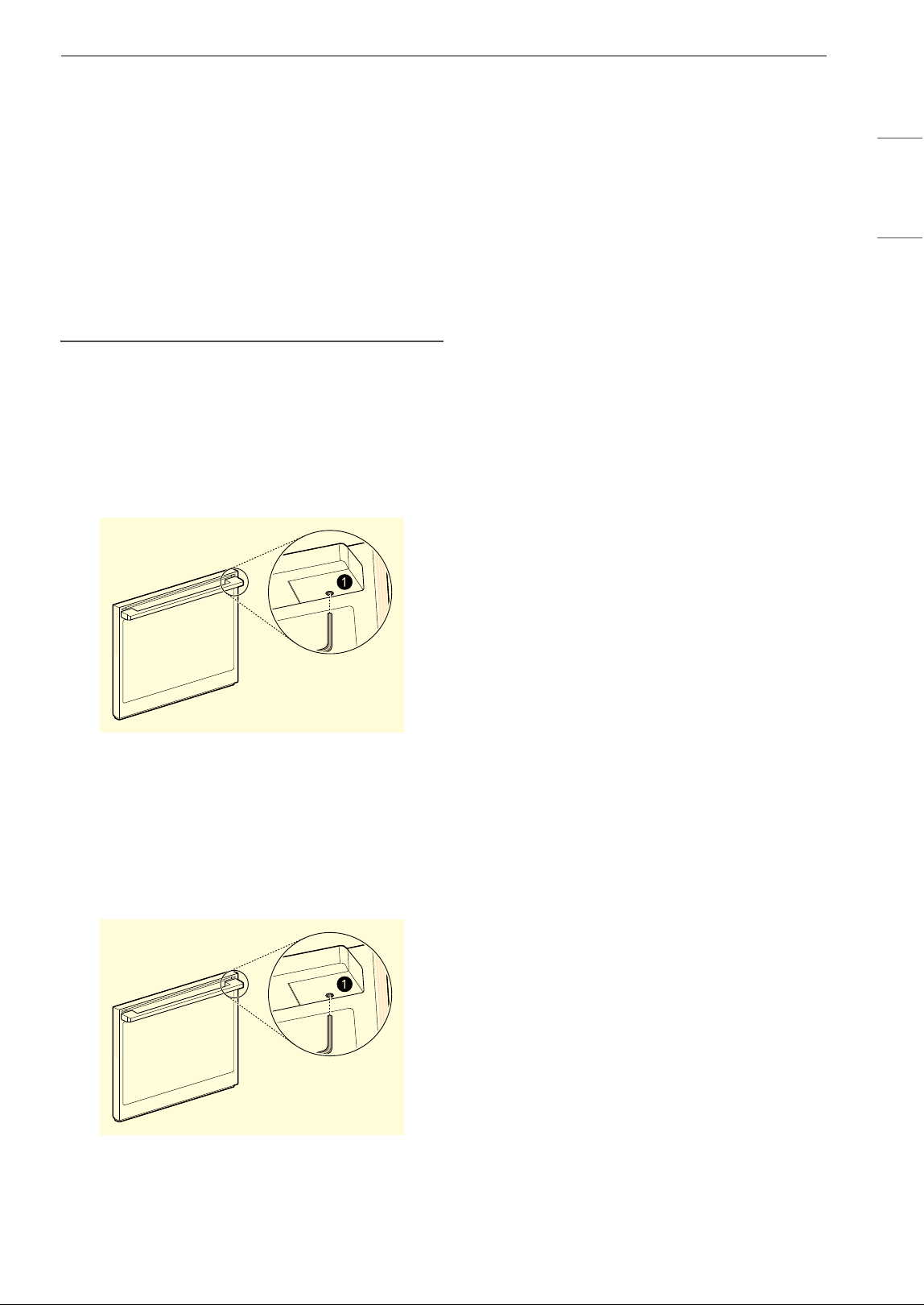
Removing Oven Door Handle
1 Loosen the set screws a located on the lower
side of the handle with a 3/32 in. Allen wrench
and remove the handle.
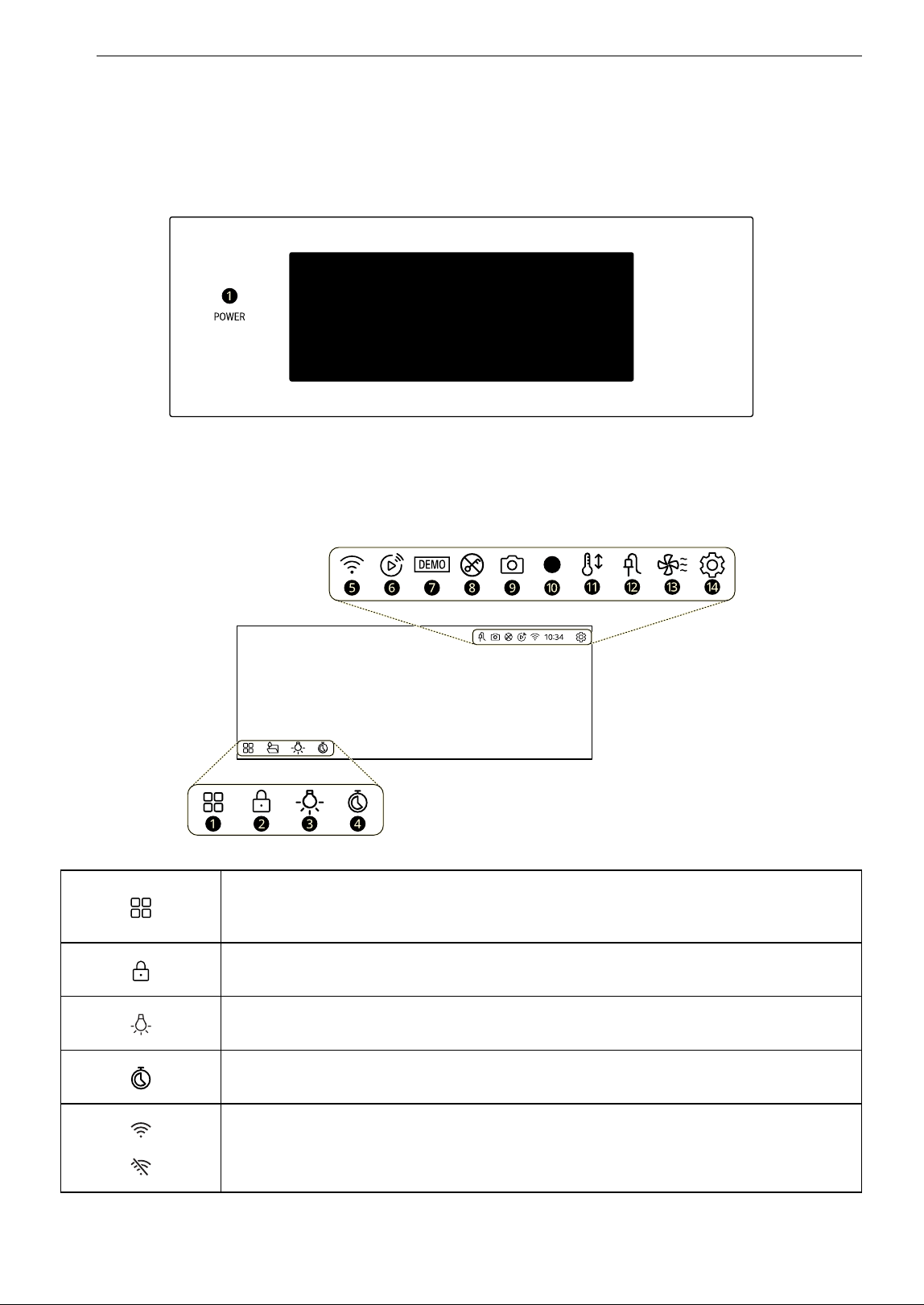
Assembling Oven Door Handle
1 Place the handle on the door by fitting the
handle footprints over the mounting
fasteners and tightening the set screws
a
with a 3/32 in Allen wrench.
26 OPERATION
OPERATION
Control Panel
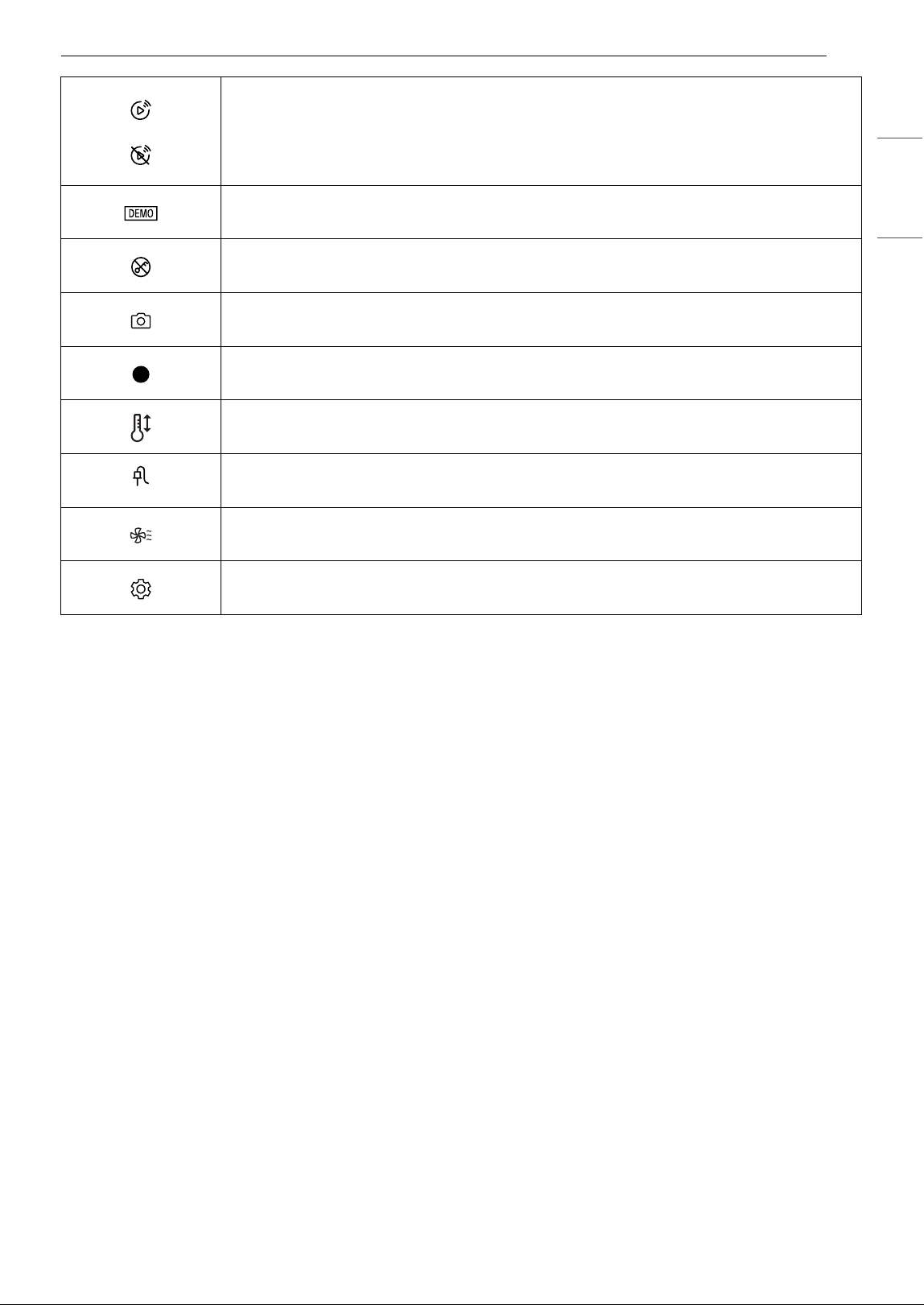
Control Panel Features
a Power On/Off button
Display Icons
Icons appear in display when activated.
a All Modes Icon
Tap to go to the All Modes screen.
Tap to go to the timer setting screen or timer editing screen.
b Control Lock Icon
Tap to activate the Control Lock function.
c Light Icon
Tap to turn on or off the interior oven lamp.
d Timer Icon
Tap to go to the timer setting screen or timer editing screen.
e Wi-Fi Icon
• Appears when oven is connected to Wi-Fi.
• Appears when oven is disconnected from Wi-Fi or is not connected in application.
27OPERATION
ENGLISH
f Remote Start Icon
• Appears when Remote Start is active.
• Appears when Remote Start is active, but Wi-Fi setting is OFF or Wi-Fi
disconnected.
g Demo Mode Icon
Appears when Demo mode is on.
h Door Lock Icon
Appears when Door Lock is on.
i Camera Icon
Appears when Camera is on.
j REC Icon
Appears when Camera is recording.
k Auto Conversion Icon
Appears when Convection Auto Conversion is turned on.
l Probe Icon
Appears when probe is connected.
m Oven Cooling Icon
Appears during or after oven operation to indicate cooling fan is running in oven.
n Settings Icon
Tap to go to the Settings Screen.
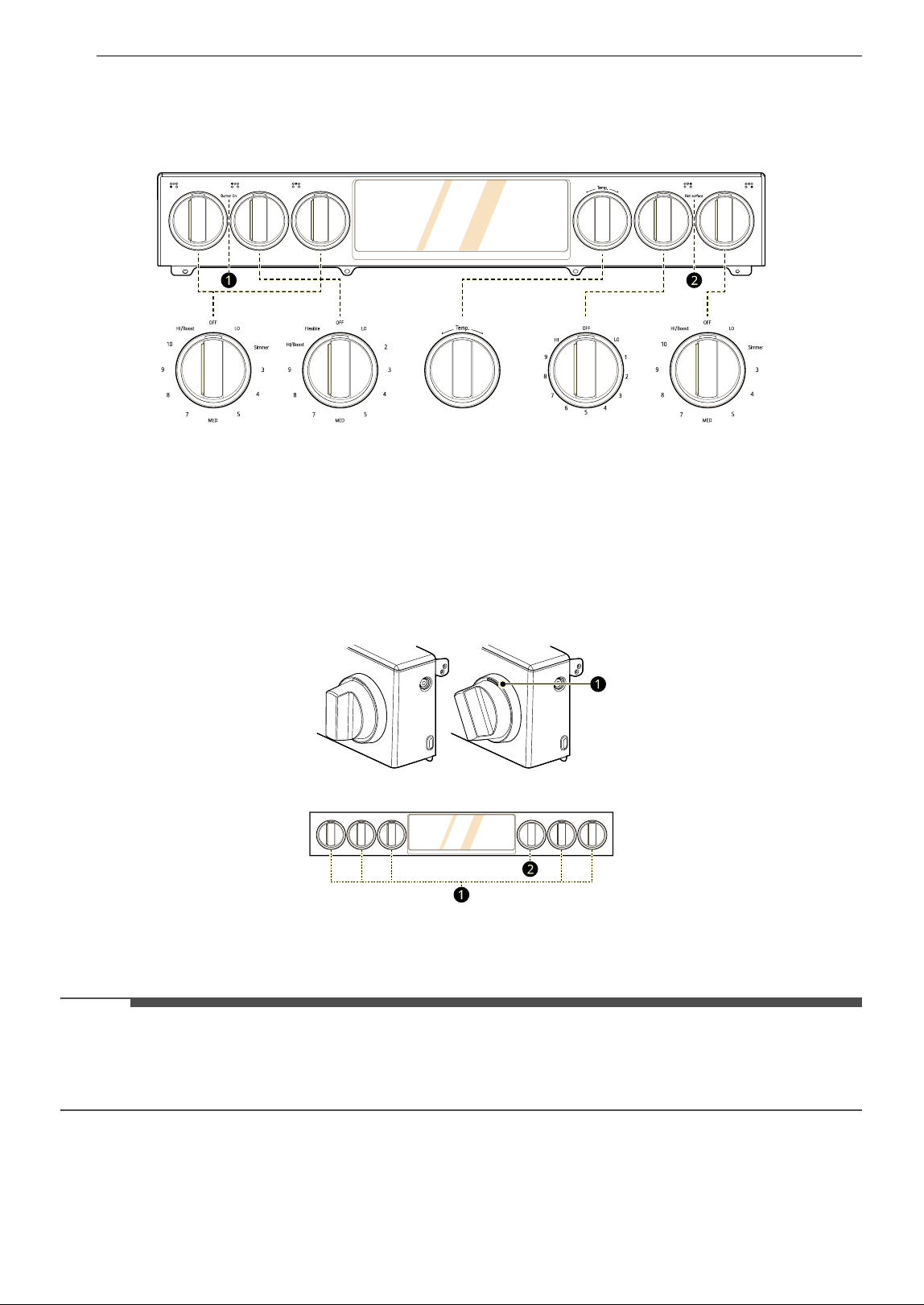
28 OPERATION
Knob Features
After cleaning the cooktop control knobs, make sure to replace each knob in the correct position. Failure to
do so can result in improper operation of the burners.
a Burner On Indicator
b Hot Surface Indicator
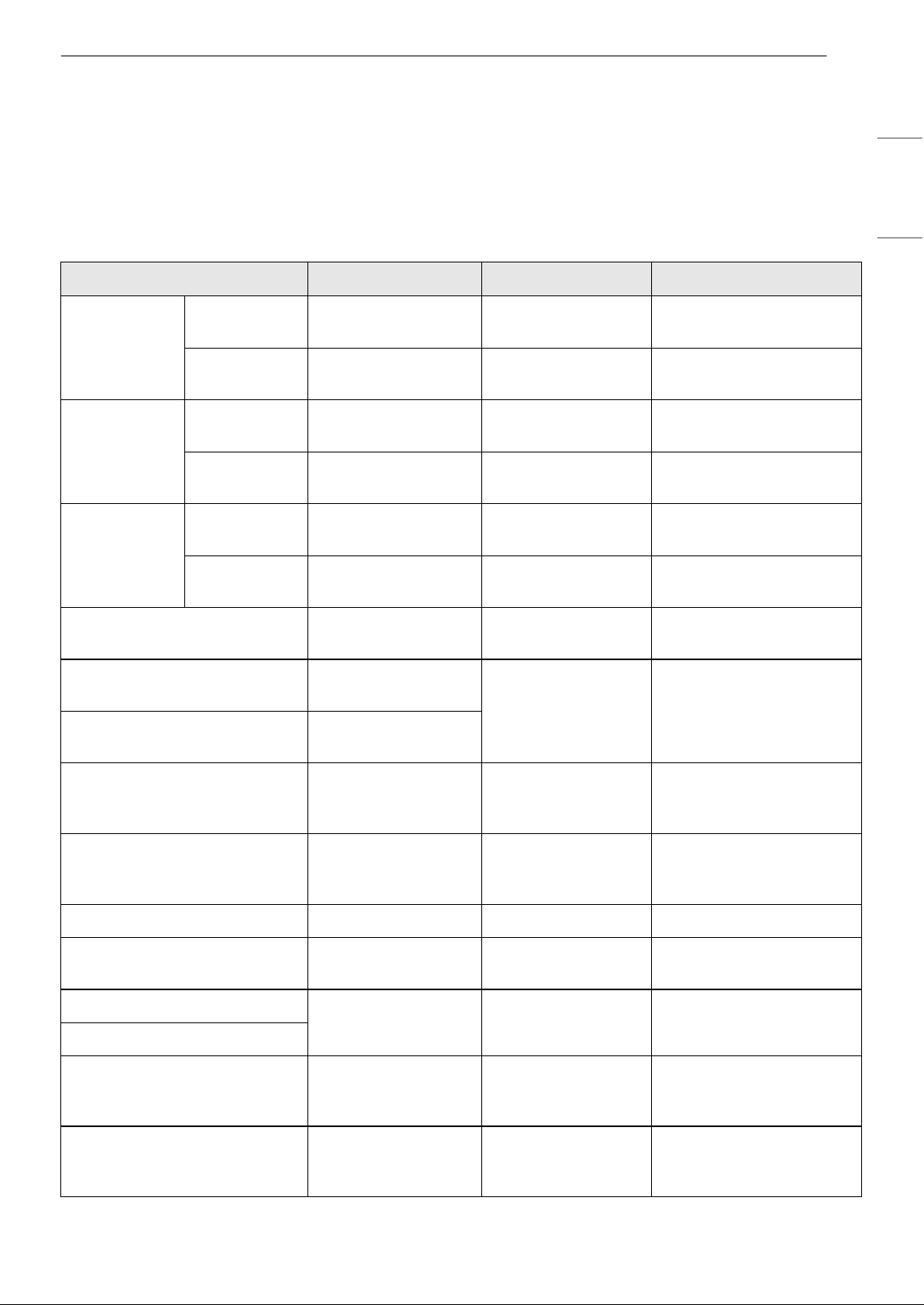
Knob Lighting
Knob lighting illuminates the edge of the knob when you turn the knob to operate the heating elements
(excluding Temp Knob).
a Knob Lighting
b Temp Knob
NOTE
• Temp Knob does not operate the Knob Lighting.
• Turning on Control Lock does not prevent the knob lighting or cooktop elements from turning on when
a cooktop knob is turned.
29OPERATION
ENGLISH
Changing Oven Settings
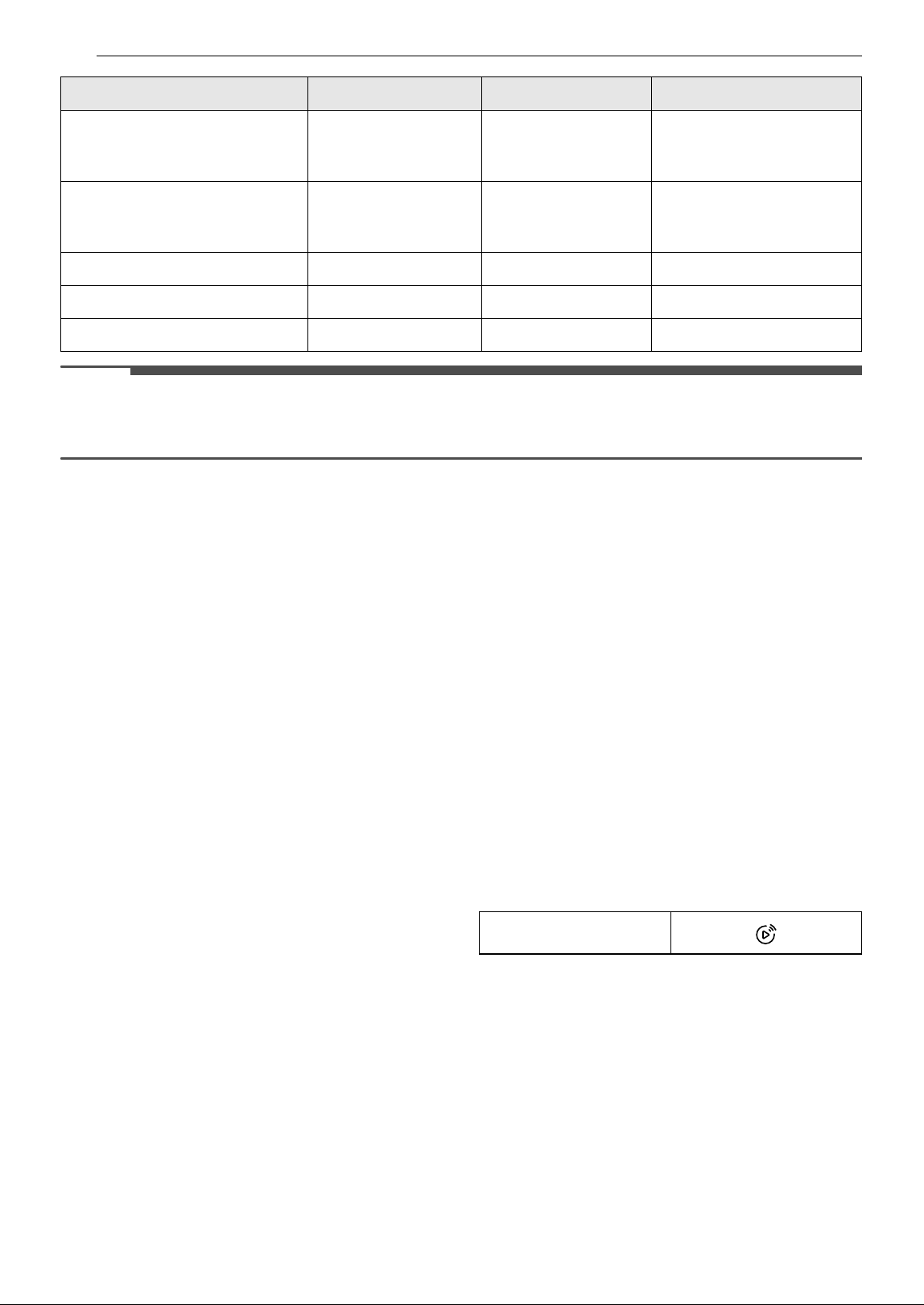
Minimum & Maximum Default Settings
All of the features listed have a minimum and a maximum time or temperature setting that may be
entered into the controls. An entry acceptance beep sounds each time a control button is pressed.
An entry error tone (two short tones) sounds if the entry of the temperature or time is below the minimum
or above the maximum setting for the feature.
Feature Min. Temp. / Time Max. Temp. / Time Default
Clock
12 hr.
1:00
hr. / min.
12:59
hr. / min.
-
24 hr.
0:00
hr. / min.
23:59
hr. / min.
-
Timer
12 hr.
0:01
min. / sec.
11:59
hr. / min.
-
24 hr.
0:01
min. / sec.
11:59
hr. / min.
-
Cook Time
12 hr.
0:01
hr. / min.
11:59
hr. / min.
-
24 hr.
0:01
hr. / min.
11:59
hr. / min.
-
Bake 170 °F / 80 °C 550 °F / 285 °C
350 °F / 175 ℃
12 hr.
Convection Bake
170 °F / 80 °C
80 ℃ (*66 ℃)
550 °F (*525 °F) /
285 °C (*271 °C)
350 °F (*325 °F) /
175 ℃ (*161 ℃)
12 hr.
Convection Roast 300 °F (*275 °F) /
150 ℃ (*136 ℃)
Broil
Low
0:01
hr. / min.
High
2:59
hr. / min.
High
3 hr.
Warm
Low
0:01
hr. / min.
High
2:59
hr. / min.
Medium
3 hr.
Proof - - 12 hr.
Pizza 300 °F / 150 °C 550 °F / 285 °C
350 °F / 175 ℃
12 hr.
Frozen Meal
300 °F / 150 ℃ 550 °F / 285 ℃
400 °F / 205 ℃
12 hr.
Air Fry
Air Sous-Vide
100 °F / 38 ℃
0:01
hr. / min.
205 °F / 96 ℃
47:59
hr. / min.
130 °F / 54 ℃
48 hr.
Air Roast
300 °F / 150 ℃
0:01
hr. / min.
550 °F / 285 ℃
11:59
hr. / min.
400 °F / 205 ℃
12 hr.
30 OPERATION
NOTE
• * Using auto conversion
• Default cook mode times are without setting a cook time.
Wi-Fi
Connect the appliance to a home Wi-Fi network to
use Remote Start and other smart functions. See
the Smart Functions section for more details.
Setting Up Wi-Fi
1 Tap the Settings icon at the top right of screen
and tap Network & System.
2 Tap Wi-Fi.
3 Tap Set Up Wi-Fi.
4 Follow the instructions in the Wi-Fi Guide in
the display.
Resetting Wi-Fi
1 Tap the Settings icon at the top right of screen
and tap Network & System.
2 Tap Wi-Fi.
3 Tap Reset Wi-Fi.
4 Follow the instructions in the Wi-Fi Guide in
the display.
Remote Start
This feature can be used with the Manual Cook
modes to remotely start or stop the cooking
operation. The appliance must be connected to a
home Wi-Fi network to use Remote Start.
Setting Remote Start
1 Tap the Settings icon at the top right of screen
and tap Network & System.
2 Tap the toggle switch next to Remote Start to
select On or Off.
3 If On is selected, the Remote Start icon
appears at the top of the display.
4 Follow the instructions in the LG ThinQ app
for using the Remote Start function.
Camera & AI Gourmet
When the camera setting is turned on, you can use
camera features in the LG ThinQ app. If the Menu
Recommendation setting is also turned on, an
Auto Cook menu is recommended when you place
food in the oven. If the AI Browning Alarm setting
is also turned on, it notifies you when the selected
browning level is reached.
Crispy Reheat
300 °F / 150 ℃
0:01
hr. / min.
550 °F / 285 ℃
11:59
hr. / min.
350 °F / 175 ℃
12 hr.
Dehydrate
100 °F / 38 ℃
0:01
hr. / min.
200 °F / 93 ℃
11:59
hr. / min.
160 °F / 71 ℃
12 hr.
Probe 80 °F / 30 °C 210 °F / 95 °C 150 °F / 65 °C
Self Clean 3 hr. 5 hr. 4 hr.
EasyClean - - 10 min.
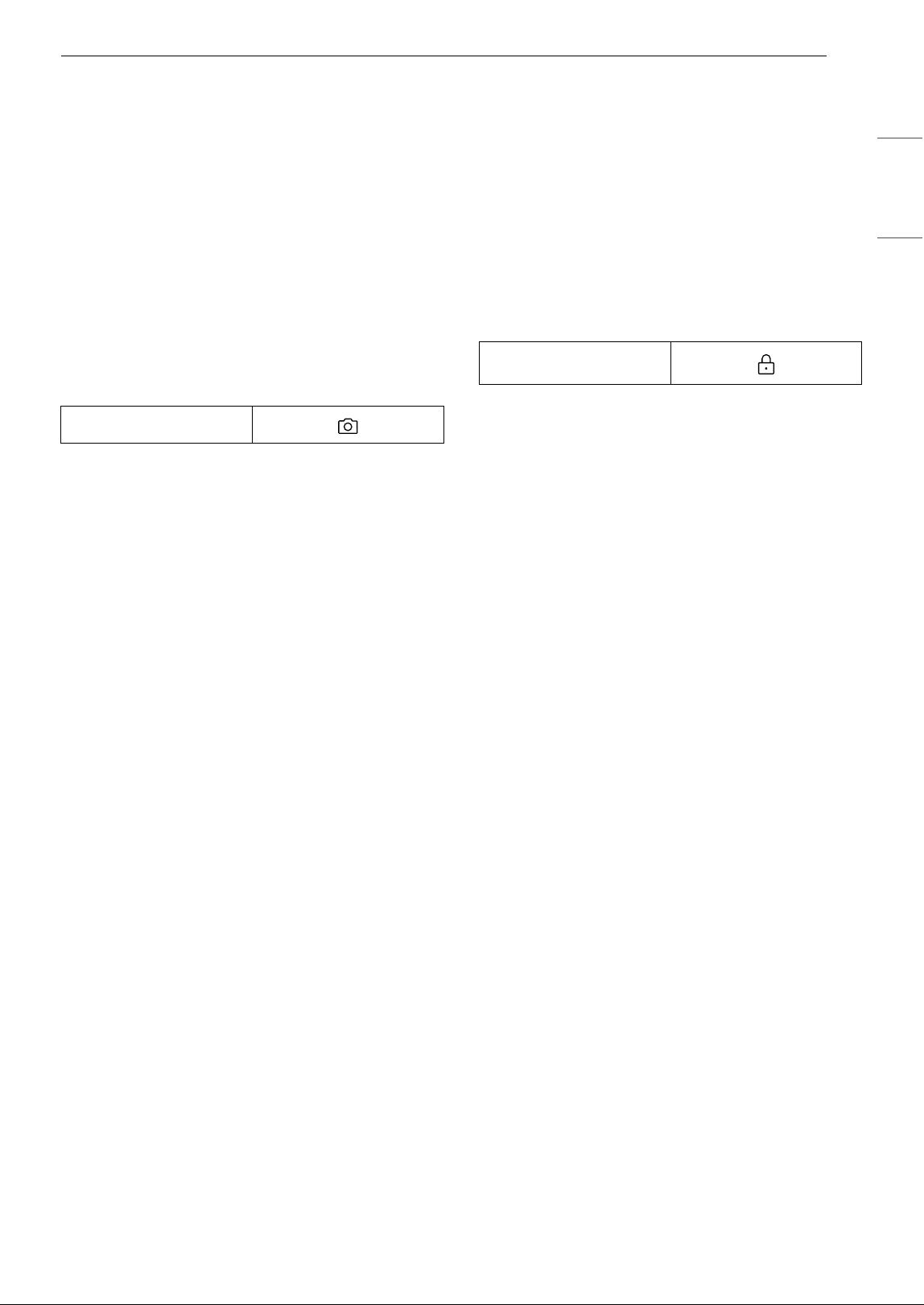
Feature Min. Temp. / Time Max. Temp. / Time Default
Remote Start icon
31OPERATION
ENGLISH
Setting Camera
1 Tap the Settings icon at the top right of
screen, and tap "Network & System".
2 Tap Camera & AI Gourmet.
3 Tap the toggle switch next to Camera to
select ON or OFF.
4 If ON is selected, the Camera icon appears at
the top of the display.
When the Menu Recommendation setting is ON
and the lower oven door is closed, food
recognition proceeds immediately after entering
the start screen.
Setting Menu Recommendation
1 Make sure the Camera is ON . Menu
Recommendation can only be activated when
Camera is ON .
2 Tap the toggle switch next to Menu
Recommendation to select ON or OFF.
When the AI Browning Alarm setting is ON and an
Auto Cook menu with a browning option is
cooking, the oven will notify you with a pop-up and
sound when the browning status reaches the
selected browning level.
Setting AI Browning Alarm
1 Make sure the Camera and Wi-Fi is ON. Menu
Recommendation can only be activated when
Camera is ON .
2 Tap the toggle switch next to AI Browning
Alarm to select ON or OFF.
Control Lock
The Control Lock feature automatically prevents
most oven controls from being turned on. All
functions are disabled except the POWER button.
Control Lock does not lock the oven door.
Lock
1 Tap the Settings icon at the top right of screen
and tap Display & Sound.
2 Tap the toggle switch next to Control Lock to
select On or Off.
3 When Control Lock is activated, the lock icon
appears at the top of the display.
Unlock
1 Tap any part of the screen while Control Lock
is on.
2 A popup screen appears. Tap and hold the
lock icon for 3 seconds to turn off Control
Lock.
3 The lock icon k disappears from the top of
the display.
Display
Set the length of time before the display sleeps.
There are three options you can select.
• ON : Always on
• OFF : Automatically turns off if idle for 5 minutes.
• Night Mode : Turns off from 10:00 PM to 5:00
AM.
Setting Display Option
1 Tap the Settings icon at the top right of
screen, and tap Display & Sound.
2 Tap Display.
3 Select the desired option.
Camera icon
Lock icon

32 OPERATION
Brightness
Adjust the brightness of the LCD display from 20 %
to 100 % in increments of 20 %.
Setting Display Brightness
1 Tap the Settings icon at the top right of
screen, and tap Display & Sound.
2 Tap Brightness.
3 Adjust the brightness by tapping the +/-
button, tapping the bar, or dragging the bar.
Clock Theme
There are five different clock themes available.
Setting Clock Theme
1 Tap the Settings icon at the top right of
screen, and tap Display & Sound.
2 Tap Clock Theme.
3 Swipe to browse through the clock themes.
And select a clock theme.
Volume
Adjust the volume of the following features: oven
start, button operation, end of cooking, preheating
complete.
Setting the Oven Volume
1 Tap the Settings icon at the top right of
screen, and tap Display & Sound.
2 Tap Volume.
3 Adjust the volume by tapping the +/- button,
tapping the bar, or dragging the bar.
NOTE
• Oven volume can be selected from 3 options:
High, Low, and Mute.
• Cooktop volume can be selected from 2 options:
High and Mute.
Language
Set the display language to English, Spanish, or
French.
Selecting a Language
1 Tap the Settings icon at the top right of
screen, and tap General.
2 Tap Language.
3 Select the desired language.
Date & Time
The date and time show in the LCD display when
the ovens are not in use.
NOTE
• When the Auto Time Sync setting is turned on,
the server's date and time is applied
automatically (Auto Time Sync requires a Wi-Fi
connection).
• When the Auto Time Sync setting is turned off,
Date & Time can be set separately.
Setting Auto Time Sync
1 Tap the Settings icon at the top right of
screen, and tap General.
2 Tap Date & Time.
3 Tap the toggle switch next to Auto Time Sync
to select On or Off.
Setting Date
1 Tap the Settings icon at the top right of
screen, and tap General.
2 Tap Date & Time.

33OPERATION
ENGLISH
3 Scroll to set the correct date.
Setting Current Time
1 Tap the Settings icon at the top right of
screen, and tap Time.
2 Tap Date & Time.
3 Scroll to set the correct hour and minutes. You
can also press the number pad icon and enter
the desired numbers.
Setting Time Format
1 Tap the Settings icon at the top right of
screen, and tap General.
2 Tap Date & Time.
3 Tap the toggle switch next to 24-Hour Time to
select 12 H or 24 H.
Temperature Unit
Set the oven temperature display to show either
Fahrenheit (℉) or Celsius (℃) units. The oven
defaults to Fahrenheit unless changed by the user.
Selecting Fahrenheit or Celsius
1 Tap the Settings icon at the top right of screen
and tap General.
2 Tap Temperature Unit.
3 Select the desired Temperature Unit.
Sabbath
Sabbath mode is typically used on the Jewish
Sabbath and Holidays. When the Sabbath mode is
activated, the oven does not turn off until the
Sabbath mode is deactivated. In Sabbath mode, all
oven function buttons are inactive. Sabbath and
the set temperature will appear in the display.
When Sabbath mode is enabled, the appliance can
be used without having to be powered on or
turned off.
While the oven is in Sabbath mode, the following
functions are disabled:
Temperature Adjustments, Cooking Time, Display,
Oven Light On/Off, Alarm Functions and Wi-Fi.
Setting Sabbath Mode
1 Tap the Settings icon at the top right of screen
and tap General.
2 Tap Sabbath.
3 Tap the temperature to set the desired
temperature. Adjust the temperature by
tapping the +/- button, tapping the bar, or
dragging the bar.
• You can also use the number pad icon to set
the temperature directly and then tap OK.
4 If desired, tap cook time to set the cook time.
Scroll to set the desired cook time.
• You can also use the number pad icon to set
the cook time directly and then tap OK.
5 Tap Start.
6 To stop the Sabbath mode, press the POWER
button on the control panel.
NOTE
• If a cook time is set, the oven turns off
automatically at the end of the cook time,
without chiming. The oven remains in Sabbath
mode, but is turned off.
• If no cook time is set, the oven will not
automatically turn off.
• After a power failure, the display will turn back
on in Sabbath mode, but the oven will be off.
• Always close the oven door before engaging
Sabbath Mode.
• Probe is not available in Sabbath mode.
Number pad icon

34 OPERATION
Start Screen
There are five different screen themes available.
Setting Start Screen
1 Tap the Settings icon at the top right of screen
and tap Customized.
2 Tap Start Screen.
3 Select the desired start screen theme.
• Main Menu
• Manual Cook
• Auto Cook
• Recent Cook
• My Recipes
Temperature Adjustment
Your new oven may cook differently than the one it
replaced. Use your new oven for a few weeks to
become more familiar with it before changing the
temperature settings. If after familiarizing yourself
with the new oven, you still think that it is too hot
or too cold, you can adjust the oven temperature
yourself.
NOTE
• To begin, either raise or lower the thermostat 15
℉ (8 ℃). Try the oven with the new setting. If the
oven still needs adjustment, raise or lower the
thermostat again, using the first adjustment as a
gauge. For example, if the adjustment was too
much, raise or lower the thermostat 10 ℉ (5 ℃).
If the adjustment was not enough, raise or lower
the thermostat 20 ℉ (11 ℃). Proceed in this way
until the oven is adjusted to your satisfaction.
Adjusting the Temperature
1 Tap the Settings icon at the top right of
screen, and tap Customized.
2 Tap Temperature Adjustment.
3 Adjust the temperature by tapping the +/-
button, tapping the bar, or dragging the bar.
Convection Auto Conversion
When Convection Bake and Convection Roast
are selected, Convection Auto Conversion
automatically converts the standard recipe
temperature entered to a convection temperature
by subtracting 25 ℉ / 14 ℃. This auto-converted
temperature shows on the display. For example,
select Convection Bake, enter 350 ℉, and 325 ℉
shows on the display after preheat.
Convection Auto Conversion is enabled by default.
To change the setting, follow these instructions.
Setting Convection Auto Conversion
1 Tap the Settings icon at the top right of
screen, and tap Customized.
2 Tap the toggle switch next to Convection
Auto Conversion to select On or Off.
3 When Convection Auto Conversion is
activated, the Auto Conversion icon appears
at the top of the display.
Preheat Alarm Light
When the oven reaches its set-temperature, the
preheat alarm light flashes 5 times or until the
oven door is opened.
You can turn the preheat alarm light on or off.
Setting the Preheat Alarm Light
1 Tap the Settings icon at the top right of
screen, and tap Customized.
2 Tap the toggle switch next to Preheat Alarm
Light to select On or Off.
Smart Diagnosis
TM
Smart Diagnosis
TM
can be run through the LG
ThinQ smartphone application or by calling for
support. Place your smartphone's mouthpiece
near the top left corner of the screen. See "Smart
Diagnosis Function" in the Smart Functions section
for detailed instructions.
1 Tap the Settings icon at the top right of
screen, and tap Maintenance & Info.

35OPERATION
ENGLISH
2 Tap Smart Diagnosis.
3 Tap Start to start the diagnostic tone.
Factory Reset
This function returns all settings to the factory
defaults.
CAUTION
• All stored data will be deleted.
1 Tap the Settings icon at the top right of
screen, and tap Maintenance & Info.
2 Tap Factory Reset.
3 A popup will appear in the display. If you want
to reset data to the factory defaults, then tap
Reset.
Open Source License
This screen displays a list of the open source
software contained in this product. Refer to the
indicated licenses for the terms and conditions of
their use.
1 Tap the Settings icon at the top right of screen
and tap Maintenance & Info.
2 Tap Open Source License.
3 Tap View Contents to Read Open Source
License contents.
Cooktop
Precautions When Using the
Cooktop
WARNING
Before Cooking
• Do not cook on a broken cooktop. If the cooktop
is broken, cleaning solutions and spillovers may
penetrate the broken cooktop and create a risk
of electric shock. Contact a qualified technician
immediately.
During Cooking
• Turn cookware handles inward so they don't
extend over adjacent surface units. This reduces
the risk of burns, ignition of flammable
materials, and spillage due to unintentional
contact with the cookware.
• Always place the pan in the center of the surface
unit you are cooking on. Never leave surface
units unattended at high heat settings. Proper
contact of cookware to burner also will improve
efficiency. Boilovers cause smoking and greasy
spills that may catch on fire.
After Cooking
• Clean cooktop with caution. Do not use sponges
or cloth to wipe spills on a hot cooking area. Use
a proper metal scraper. If a wet sponge or cloth
is used to wipe spills on a hot cooking area, it can
cause steam burns. Some cleaners can produce
noxious fumes if applied to a hot surface.
CAUTION
Before Cooking
• Do not use the glass cooktop surface as a cutting
board.
• Do not turn surface units on before placing
cookware.
• Do not store heavy items above the cooktop
surface that could fall and damage it.
• Do not place or store flammable or heat
sensitive items on the induction cooktop, even
when the cooktop is not in use.
• Place cookware on the cooking elements before
turning on the induction cooktop.
• Do not place sealed containers on the cooktop.
During Cooking
• Never cook directly on the glass. Always use
cookware.
• Do not place metallic objects such as knives,
forks, spoons, and lids on the induction cooktop
surface; they can get hot.
• Use this appliance only for normal household
use. It is not designed for commercial or
industrial use.
• Never use the appliance to heat the room.
• Use caution when plugging electrical appliances
into power outlets near the cooktop. Keep power
cords from any contact with the cooktop or
cookware.
36 OPERATION
CAUTION
• Overheated fat and oil can catch fire quickly.
Never leave surface elements unattended when
frying foods.
• Do not use the induction cooktop to heat
aluminum foil, products wrapped in aluminum
foil, or frozen foods packaged in aluminum
cookware.
• Use caution when plugging electrical appliances
into outlets near the cooktop to keep power
cords away from the hot cooktop or cookware.
• Users with pacemakers and active heart
implants must keep their upper body at a
minimum distance of 1 ft (30 cm) from active
induction cooking elements. If in doubt, consult
the implant manufacturer or your doctor.
After Cooking
• Immediately clean spills on the cooking area to
prevent a tough cleaning chore later.
• Do not use a steel-wool pad or scrub pad or
abrasive cleaning pads. They can scratch the
surface.
• After use, switch off the induction cooking
element using its control. Do not rely on the pan
sensor.
Pan Preheat Recommendations
Induction cooking may decrease the amount of
time required to preheat cookware compared to
cooking on a radiant element cooktop or gas
surface burner.
Pay close attention to all food items while cooking
on the cooktop or in the oven, and until all cooking
processes are complete.
CAUTION
• Remember that induction surface cooking
initially heats the cookware very quickly if the
cookware does not contain food.
Noises during Cooktop Operation
• Induction Sound: The electronic processes
involved with induction cooking create some
unfamiliar background noises such as a slight
buzzing sound. These noises are a normal part
of the induction cooking process.
• Cookware Vibration Sound: Some cookware
will buzz, depending on its construction or base
material. The buzz may be more noticeable if the
pan or its contents are cold or if the bottom of
the pan is not flat. As the pan heats up, the noise
will decrease. The noise will also decrease if the
power level setting is reduced.
• Cooling Fan Sound: The fan may operate while
the induction cooktop is in use to reduce the
temperature of the product. The cooling fan may
also operate after the cooktop is turned off.
NOTE
• When using the induction cooktop, operational
noises are more noticeable while cooking in
Boost mode. But very loud noises are not
normal when induction cooking.
Hot Cookware and Residual Heat
CAUTION
• Unlike radiant surface elements, induction
cooking elements do not glow red when hot. You
can be burned if the glass surface is hot from the
residual heat transferred from the cookware. Do
not touch hot cookware or pans. Use oven mitts
or potholders to protect hands from burns.
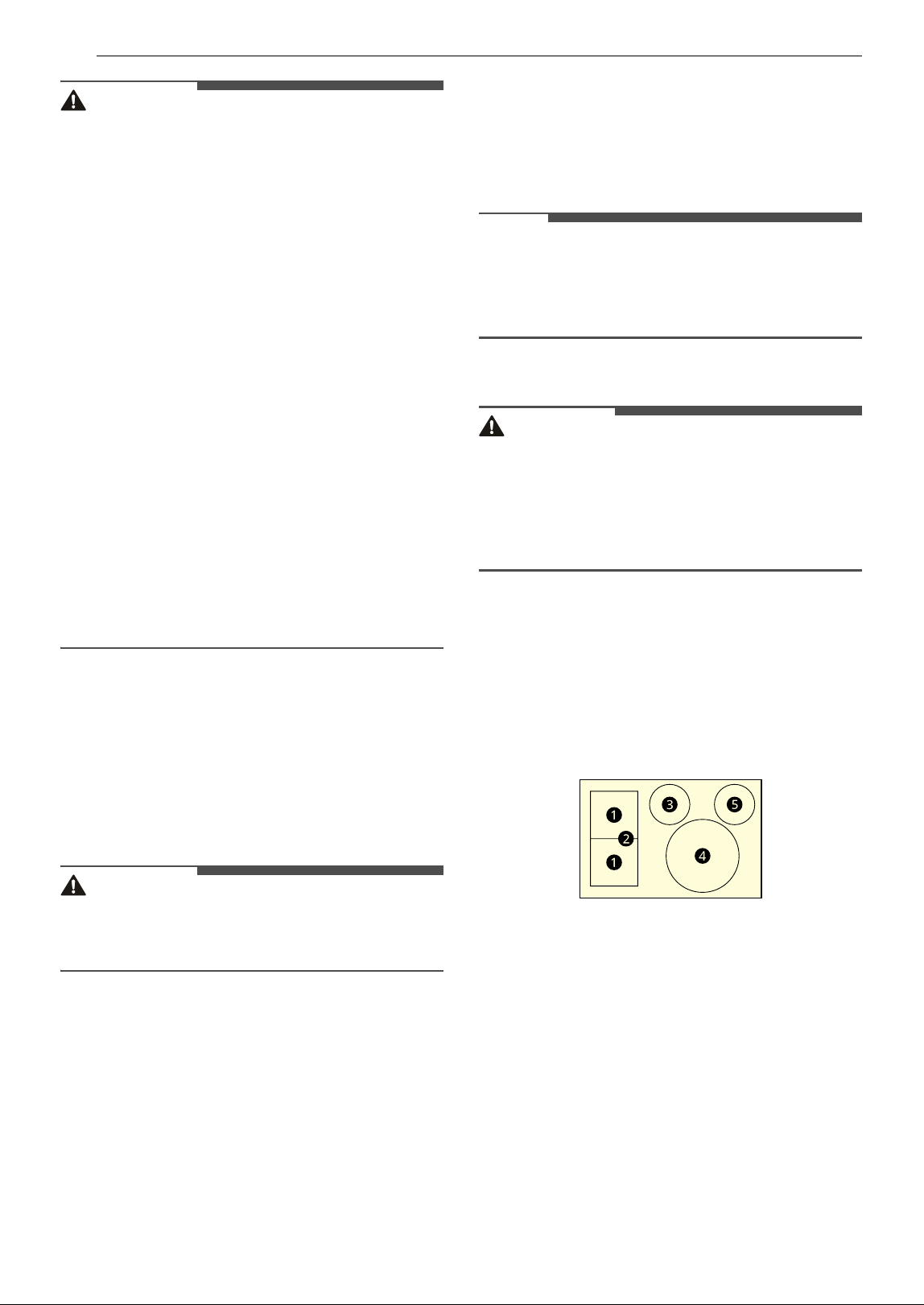
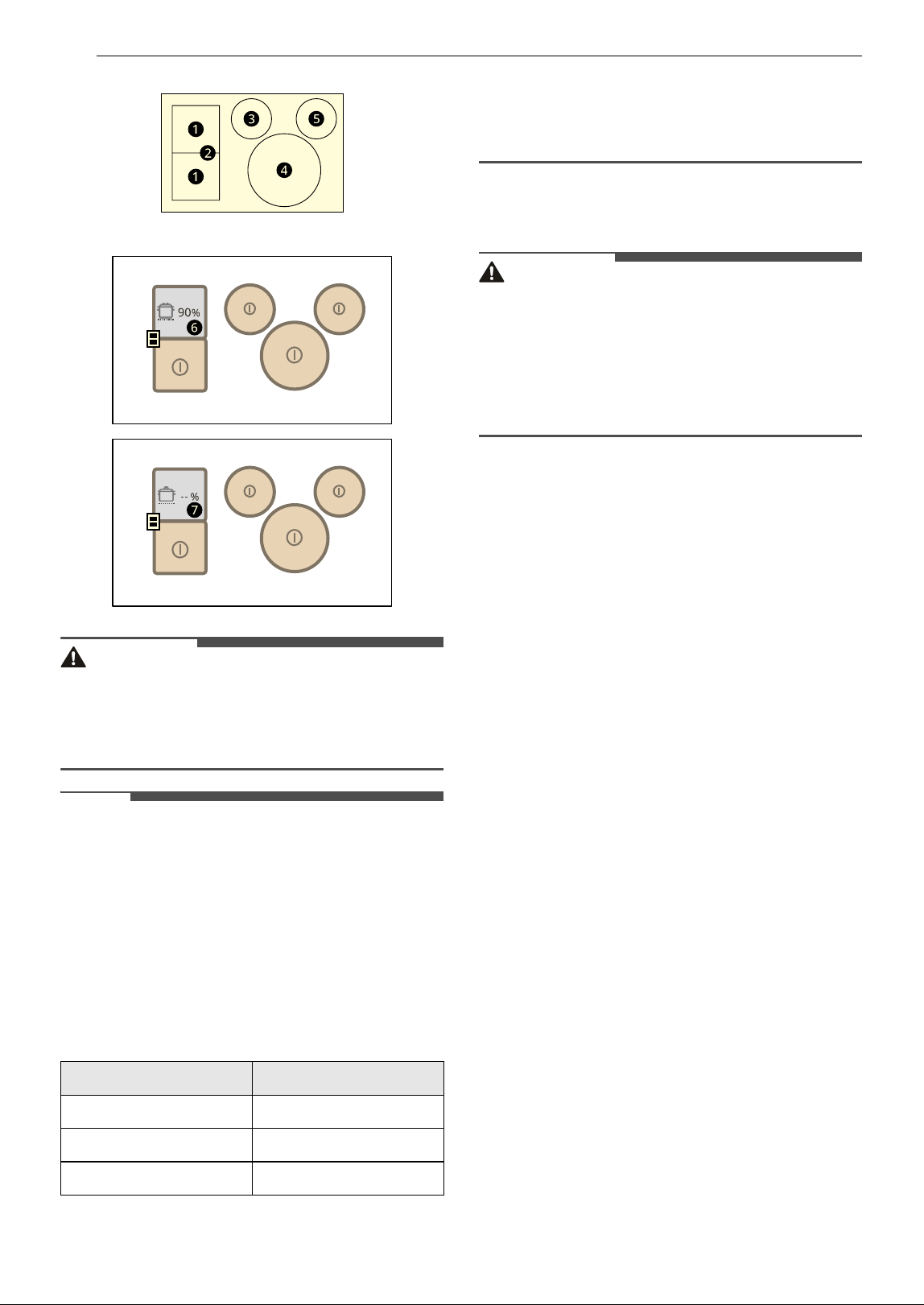
Cooking Areas
The cooktop is equipped with four induction
cooking elements of different sizes and a radiant
heat warming zone. The wattage ratings below are
maximum outputs. The second rating is the
maximum output for Boost mode.
a Induction Left Front/Rear Cooking Element:
8 1/2" x 7 1/8", 1650 W / 3300 W (240 V)
b Induction Flex Zone Cooking Element:
8 1/2" x 14 3/16", 2800 W / 3300 W (240 V)
c Induction Center Rear Cooking Element:
6", 1300 W / 1800 W (240 V)
d Induction Right Front Cooking Element:
11", 2400 W / 4300 W (240 V)
e Radiant Heat Warm Zone
6", 100W (240 V)
37OPERATION
ENGLISH
Benefits of Induction Surface
Cooking
Speed and Efficiency
Induction cooking elements heat faster and use
less energy. Induction power levels quickly boil
liquids and are efficient when simmering.
A Cooler Cooktop
Whether induction cooking elements are turned
on or off, they remain cooler than radiant
elements. Virtually no heat is wasted because the
heat begins with the presence of cookware.
Easy Cleanups
Cooler cooking elements make for easier cleaning.
Spills resist sticking or burning so they wipe up
easily.
Pan Size Detection
A sensor automatically detects and adapts the
induction cooking element to the pan size in use
for more consistent, even cooking.
Greater Responsiveness
Induction cooking elements are more responsive
than their electric or gas counterparts because
only the pan heats. Induction elements heat more
easily and are just as responsive when reducing
temperatures to a simmer.
Induction Cookware
NOTE
• Before using the induction cooking elements,
carefully read and follow these cookware
recommendations and the instructions in the
pan sensing sections.
When purchasing pans for use on the induction
cooktop, look for cookware identified by the
manufacturer as "induction ready" or "induction
capable", or that is marked by the manufacturer as
specifically designed for induction cooking.
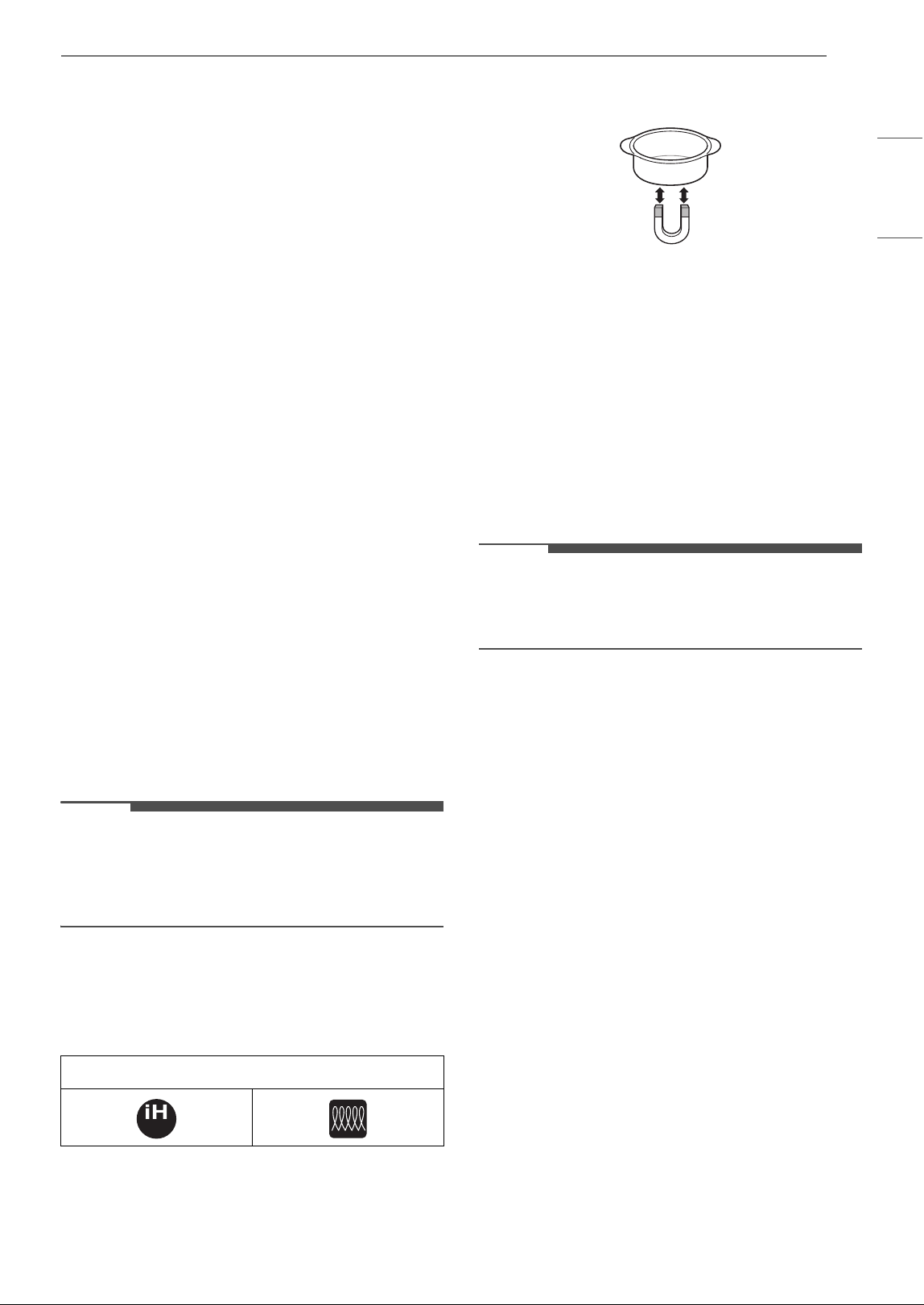
The base material of the cookware must be
magnetic for the cooking elements to activate. Use
a magnet to check if the cookware base material is
suitable. If the magnet sticks to the bottom of the
cookware, the cookware can be used for induction
cooking.
For the best possible surface cooking results, use
only high-quality, heavy gauge steel cookware on
the induction cooking elements. Follow
manufacturer's recommendations when using
induction cookware.
Induction Cookware Types
The three most common induction cookware types
available are stainless steel, cast iron, and
porcelain-enamel-coated metals.
• Stainless Steel is generally excellent for
induction cooking. It is durable, easy to clean,
and resists staining.
NOTE
• Not all stainless steel cookware is magnetic;
stainless steel is not always suitable for
induction cooking.
• Cast Iron cooks evenly and is also good for
induction cooking. Do not slide cast iron
cookware on the cooktop; cast iron cookware
with a rough surface will scratch the ceramic
cooktop.
• Porcelain-enamel-coated metals have variable
heating characteristics depending on the quality
of the base metal. Make sure the porcelain-
enamel coating is smooth to avoid scratching
the ceramic cooktop.
Cookware Placement
Use the proper cookware and place it correctly on
the cooktop. One or more of the cooking elements
will not heat if any of the incorrect conditions
shown is detected by the sensors located below
the ceramic cooktop surface. Correct the problem
before attempting to use the cooktop.
Symbols of Induction Compatible Cookware
38 OPERATION
Pan Sensing
The cooking-element sensors located below the
cooktop surface require certain cookware
conditions to be met before the induction cooking
elements can operate.
The cooking zone LED bar may display a pan
sensing error message. If a cooking element is
activated and no cookware is detected, the
affected induction cooking zone LED bar will
fluctuate. If the cookware does not meet the
correct conditions, the cooking zone may not heat.
If the problem is not corrected, the affected
cooking element will automatically deactivate after
one minute.
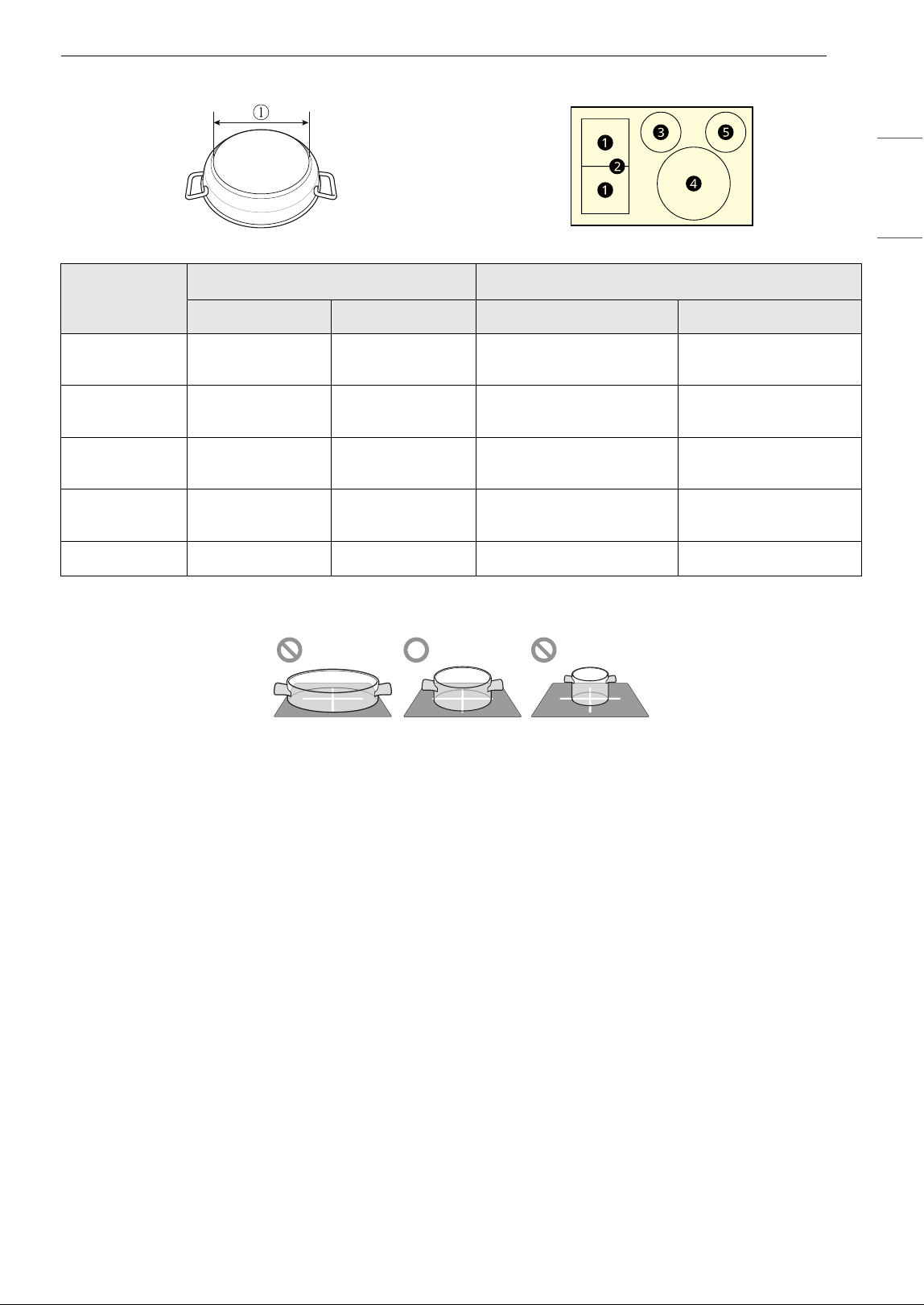
Minimum and Maximum Pan Size
There are four cooking elements on the induction cooktop. Each element requires an appropriate pan size
to be used effectively. The bottom size of the pan must be between the maximum and minimum diameter
A for proper cooking to occur.
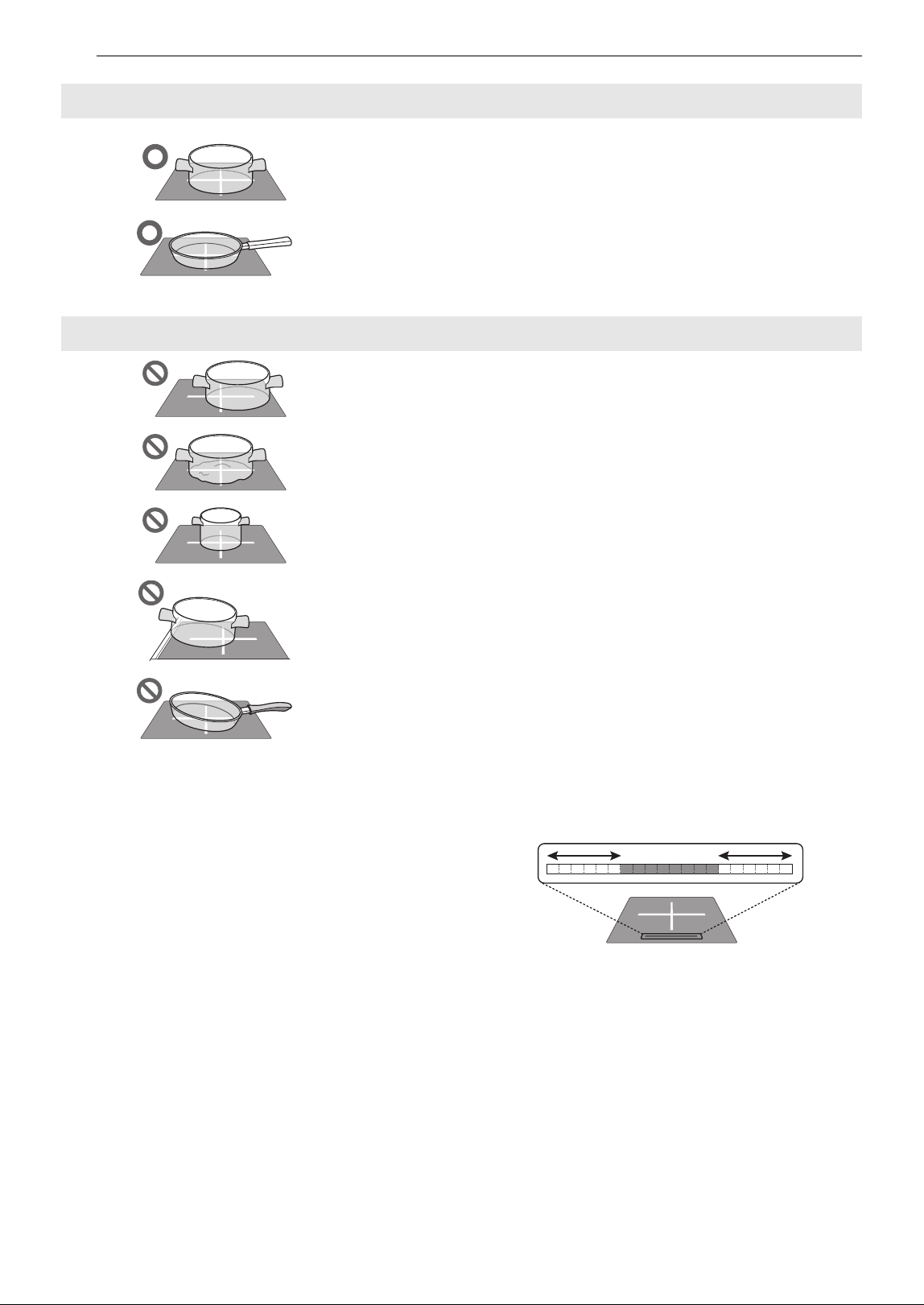
Correct Use
• Cookware is centered correctly on surface of cooking
element.
• Pan has flat bottom and straight sides.
• Pan size meets or exceeds the recommended minimum size
for the cooking element.
• Pan rests completely on the cooktop surface.
• Pan is properly balanced.
Incorrect Use
• Cookware is not centered on surface of cooking element.
• Pan has curved or warped bottom or sides.
• Pan does not meet the minimum size required for the
cooking element used.
• Pan bottom rests on cooktop trim or does not rest
completely on the cooktop surface.
• Pan is unbalanced by heavy handle.
39OPERATION
ENGLISH
The pan must make full contact with the glass surface without the bottom of the pan touching the metal
cooktop trim.
If the correct induction cookware—centered on any of the active cooking elements—is too small, the
affected cooking element’s LED bar fluctuates and the pan does not heat.
Cookware Compatibility Indicator
The cookware compatibility indicator shows how
efficiently the cookware will heat on the induction
cooktop elements.
1 Turn off all cooktop elements in use.
2 Put enough water in the cookware to cover
the bottom. Place the cookware on the center
of the desired cooktop element.
• Select an element that is appropriate for the
size of the cookware.
3 Tap the Settings icon at the top right of
screen, and tap Maintenance & Info.
4 Tap Cookware Compatibility Indicator.
5 Set the power level on the selected element to
10.
6 Tap OK, and the number of the desired
cooktop element (
a, c, d) at the same time
for at least 3 seconds. The indicator
f is
shown on the display. When indicator is not
checked,
g is shown on display.
7 This test does not apply to the Warm Zone e
and the cooktop element b with the Flex
function activated. .
Cooking Area
Heater
Diameter of Pan Bottom A
Type Size (inch) Min. Max.
a
Induction 8 1/2 x 7 1/8
5 13/16"
(147 mm)
7 1/8"
(180 mm)
b
Induction 8 1/2 x 14 3/16
4 3/4"
(120 mm)
10 5/8"
(270 mm)
c
Induction 6
5.5"
(140 mm)
7"
(178 mm)
d
Induction 11
9.5"
(241 mm)
11.8"
(300 mm)
e
Warm 6 - -
40 OPERATION
CAUTION
• Turn off all cooktop elements before starting to
avoid getting a false result.
• The indicator is not available if more than two
cooktop elements are in use.
NOTE
• The cookware compatibility indicator is based on
the manufacturer's internal standards and is for
reference only.
• The indicator may vary depending on the usage
environment, power voltage and cookware
temperature.
• The indicator may vary from element to element
even for the same type of cookware.
• For efficient cooking, use cookware with an
indicator of 90 or above.
• If the indicator is low, check the base material,
size and shape of the cookware. Cookware with a
low indicator, even if it has an IH mark, may heat
less efficiently or make noise when heated. This
is normal, and the cookware can still be used
safely.
Home Canning
CAUTION
• Canning can generate large amounts of steam.
Use extreme caution to prevent burns. Raise the
lid so that steam is vented away from you. Safe
canning requires that harmful micro-organisms
are destroyed and jars are sealed completely.
When using a water bath canner, maintain a
gentle but steady boil for the required time.
Read and observe the following precautions when
home canning. Read the information on the USDA
(United States Department of Agriculture) website
and follow the recommendations there for home
canning procedures.
• Use only quality, flat-bottomed canners when
home canning. Use a ruler to check the bottom
of the canner for flatness.
• Canners with ridges that radiate from the
bottom center are not suitable for use on a
ceramic glass cooktop.
• The diameter of the canner should not exceed
the maximum cooking element markings by
more than one inch. Use smaller diameter
canners on ranges with ceramic-glass or open-
coil-electric cooktops.
• Start with hot tap water to boil water more
quickly. Bring water to an initial boil using the
highest heat setting. Once the water is boiling,
reduce the heat as much as possible while
maintaining the boil.
• It is best to can small amounts and keep the
canner light enough to lift.
• Do not leave the water bath or pressure canner
on high heat for extended periods.
• Alternate surface elements between each batch
to allow the elements and surrounding surfaces
to cool down. Do not can using the same
element all day.
Indicator Compatibility
0 - 10 Low
20 - 80 Medium
90 - 100 High
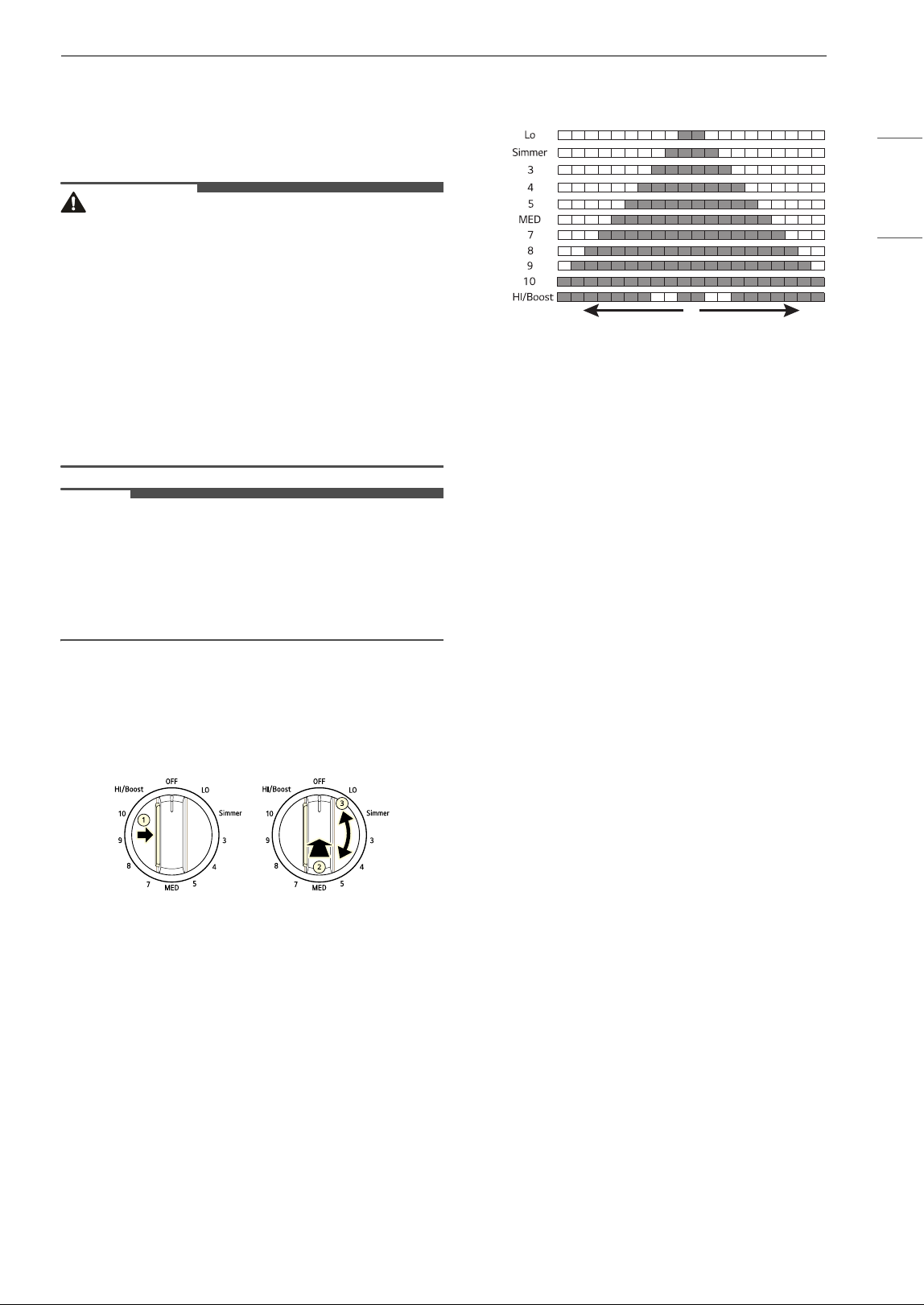
41OPERATION
ENGLISH
Using the Cooking Elements
Turning On Cooking Elements (Except
Warming Zone)
CAUTION
• Clean the knobs regularly. Soil or foreign objects
on the knobs may interfere with the operation of
the button.
• Do not apply excessive force when using the
buttons and lock functions, or they may be
damaged.
• The surfaces of the knobs may be hot after
cooking. Allow the knobs to cool sufficiently or
put on an oven mitt before touching them.
• The buttons must be properly set to ensure the
intended functions of the knobs.
NOTE
• To use the cooktop knobs without pressing in
the side button, use the button lock function.
• If removing and reassembling the knob, press
and hold the side button while pushing the knob
fully onto shaft.
1 Press in the side button on the knob. A
2 Push the control knob in. B
3 Turn the knob in either direction to select the
desired setting. A short beep sounds and the
cooking element's LED bar shows its current
setting.
Cooking Element LED Bar
The range provides an LED bar for each cooking
element on the cooktop. Check messages in the
display window and use the LEDs with the
corresponding control knobs to monitor the power
levels of the elements.
Boost Power Level
Boost mode is only available immediately after
activating a cooking element. When the cooking
element is set to the Boost mode, the LED bar
flashes and the Boost mode stays in operation for
up to 10 minutes. After 10 minutes, the cooking
element automatically returns to the Hi setting.
Hot Surface Indicator
The hot surface indicator light glows as long as any
surface cooking area is too hot to touch.
It remains on after the element is turned off and
until the surface has cooled to approximately 130
°F.
It is normal for the surface elements to cycle on
and off when cooking at lower temperature
settings.
Using the Knob Lock
You can adjust the Knob Lock on each cooktop
knob so you don’t have to press the button in to
use the knob. Remove and adjust one knob at a
time.
1 Make sure the knob is in the OFF position and
pull it straight off the stem.
2 On the back of the knob ring, rotate the black
tab to the 2 Step or 3 Step position.
• If you slide the tab to the 2 Step
a position,
the knob can be used without pressing in
the button.
• If you slide the tab to the 3 Step b position,
you must press in the button to use the
knob.
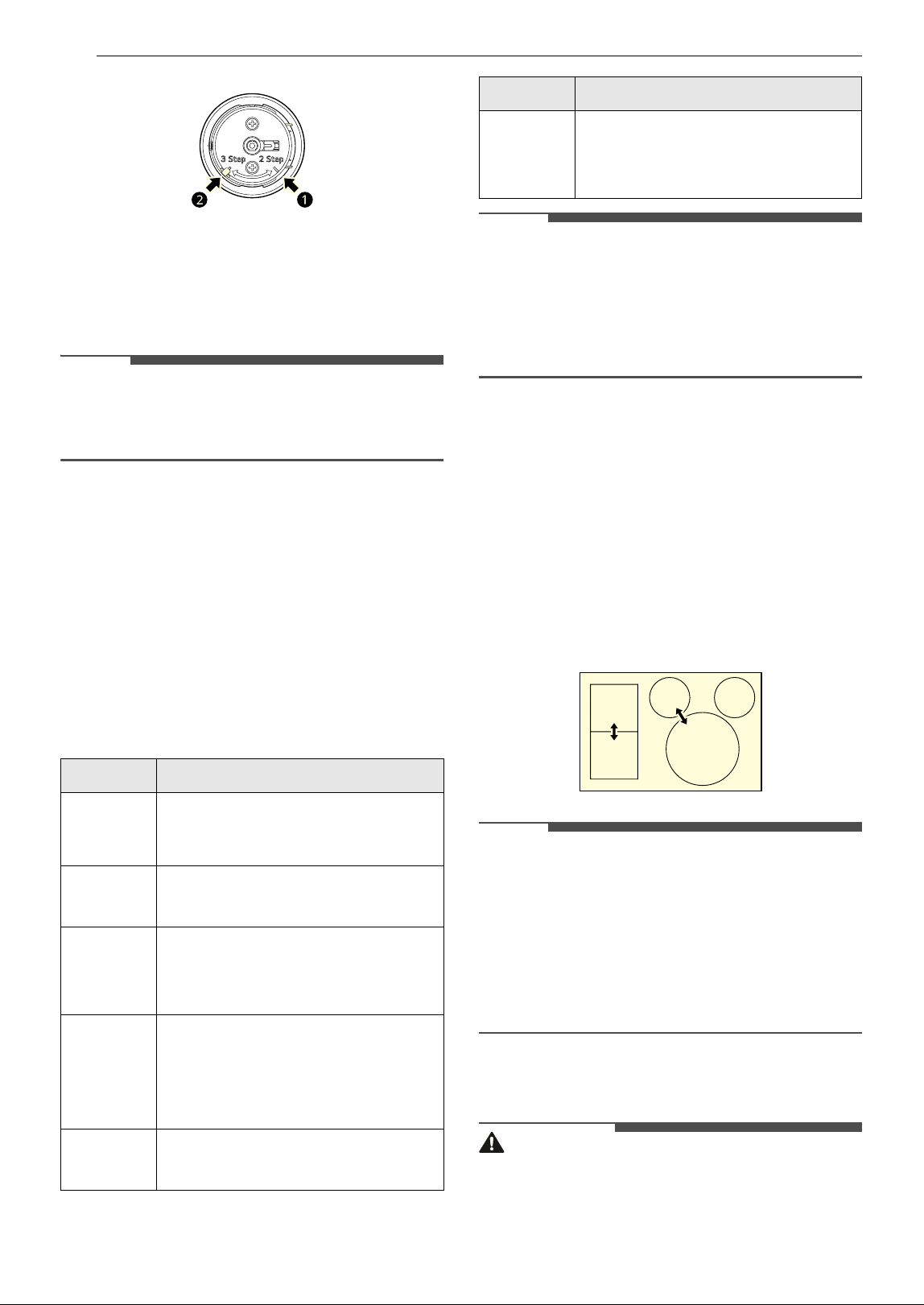
42 OPERATION
3 Once the Knob Lock is adjusted as desired,
reinstall the knob. To reinstall, hold the knob
with the OFF label at the top and slide the
knob directly onto the stem.
NOTE
• The black tab must be aligned with the 2 Step or
3 Step mark to ensure proper operation of the
knob and button.
Recommended Surface Cooking
Settings
Start most surface cooking on a higher setting and
then adjust to a lower setting to finish cooking.
The suggested settings may need adjustments,
depending on cookware design and quality and on
the amount of food being prepared.
Use quality cookware that is constructed with a
magnetic base material and that meets the
minimum and maximum pan size requirements.
NOTE
• Suggested cook settings are only a guide.
Results may vary depending on the type of
cookware being used on the induction surface or
the quantity of food being cooked. Adjust the
settings as needed to achieve the desired
results.
Power Management
The cooking zones, which consist of paired
cooking elements, are restricted to drawing a
certain maximum amount of power.
If you turn on the Boost function for one element
while its paired element is in use, the Power
Management function may automatically reduce
the power of both elements. For consistent
performance when using multiple elements, use
elements in separate cooking zones.
NOTE
• If the combined heat of the oven and the surface
burners is sufficiently high, the output of the
surface burners is reduced to avoid damage to
the product.
• Both elements in a set of paired elements cannot
use the Boost mode at the same time. To use the
Boost mode on two elements simultaneously,
use non-paired elements.
Turning on the Warm Zone
CAUTION
• FOOD POISON HAZARD : Bacteria may grow in
food at temperatures below 140 °F.
- Always start with hot food. Do not use the
warm setting to heat cold food.
Setting Recommended Use
HI/Boost
• Use to heat a large amount of
food or to bring large pans of
water to a boil
10-HI/
Boost
• Bring liquid to a boil
• Start most cooking
MED-10
• Hold a rapid boil, fry, deep fat fry
• Quickly brown or sear food
• Steaks, cutlets, grilled meat
3-MED
• Maintain a slow boil
• Fry or sauté foods
• Cook soups, sauces and gravies
• Eggs, pancakes
Simmer-3
• Stew or steam food
• Simmer
Lo-
Simmer
• Keep food warm
• Melt chocolate or butter
• Simmer
Setting Recommended Use
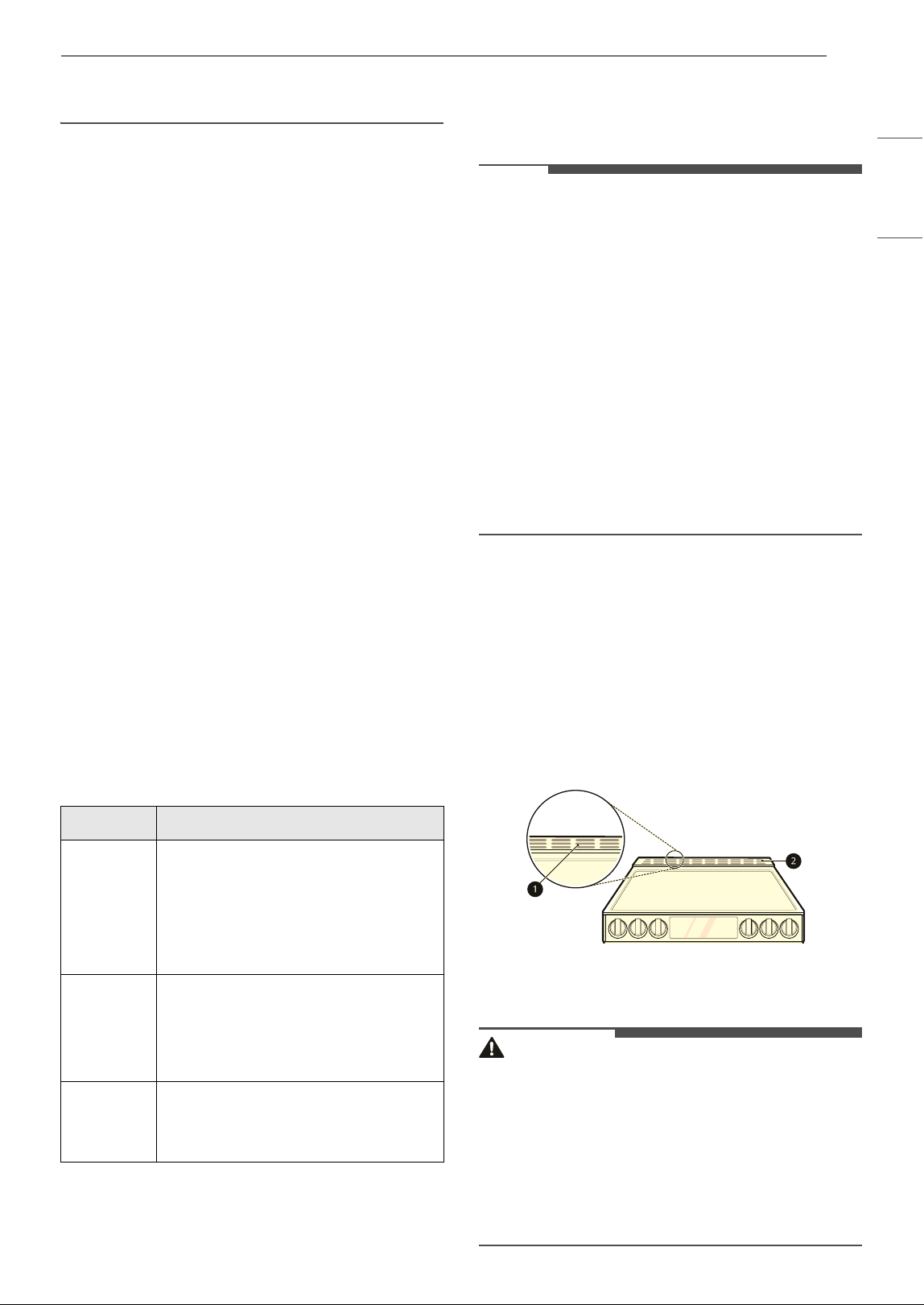
43OPERATION
ENGLISH
- Do not use the warm setting for more than 2
hours.
The Warm Zone, located in the back right of the
glass surface, will keep hot, cooked food at serving
temperature. Use the Warm Zone to keep food
warm after it has already been cooked. Attempting
to cook uncooked or cold food on the Warm Zone
could result in a food-borne illness.
1 Push the Warm Zone element knob in.
2 Turn the knob in either direction to the
desired setting.
For best results:
• When warming pastries or breads, leave an
opening in the cover to allow moisture to
escape.
• Do not use plastic wrap to cover food. Plastic
may melt onto the surface and be very difficult
to remove.
• Use only dishware, utensils and cookware that
are recommended for oven and cooktop use.
• Food on the warmer should be kept in its
container or covered with a lid or aluminum foil
to maintain food quality.
• Do not allow aluminum foil to contact the hot
induction cooktop surface.
If a particular food is not listed, start with the
medium heat level and adjust as needed. Most
foods can be kept at serving temperatures by
using the medium heat level.
Oven
Before Using the Oven
NOTE
• Because the oven temperature cycles, an oven
thermometer placed in the oven cavity may not
show the same temperature that is set on the
oven.
• It is normal for the convection fan to run while
preheating during a regular bake cycle.
• The convection fan motor may run periodically
during a regular bake cycle.
• The fan turns off if the door is left open during
baking. The fan turns back on automatically once
the door is closed.
• Avoid opening the oven door more than
necessary during use. This helps the oven
maintain temperature, prevents unnecessary
heat loss, and saves on energy use.
Oven Vent
Areas near the vent may become hot during
operation and may cause burns. Do not block the
vent opening. Avoid placing plastics near the vent
as heat may distort or melt the plastic.
It is normal for steam to be visible when cooking
foods with high moisture content.
a Oven Vent
b Vent trim
CAUTION
• The edges of the range vent are sharp. Wear
gloves when cleaning the range to avoid injury.
• Do not block, touch or place items around the
oven vent during cooking.
- Do not block the oven vent when cooking to
allow for proper air flow. Do not touch vent
openings or nearby surfaces during any
cooking operation.
Setting Food Item
Low
(Lo-3)
• Vegetables
•Rice
• Pasta
• Sugary sauces (tomato sauce,
BBQ sauce)
Medium
(3-7)
• Cream-based soups and sauces
• Stews and chili
• Warming empty plates or serving
dishes
High
(7-Hi)
• Broth-based soups
• Hot beverages (hot cider, hot
chocolate)
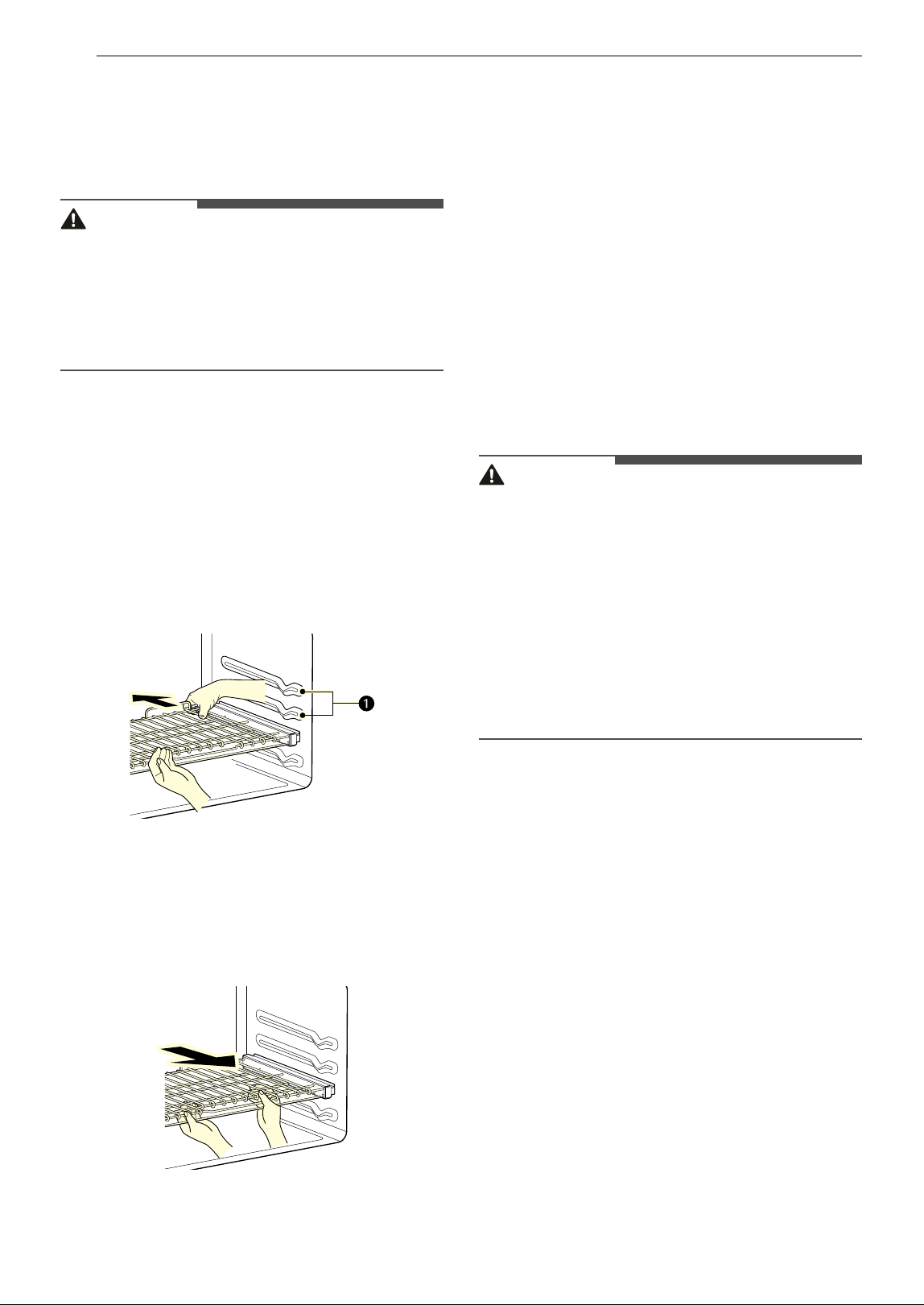
44 OPERATION
Using Gliding Oven Racks
The gliding racks slide in and out on a frame. This
keeps heavy cookware level and prevents it from
sliding forward when the rack is completely
extended.
CAUTION
• Place oven racks in the desired location before
turning on the oven to avoid burns.
• Do not cover the racks with aluminum foil, or
any other material, or place anything on the
bottom of the oven. Doing so will result in poor
baking and may damage the oven bottom.
Installing Gliding Racks
1 Start with the rack in the closed position. Hold
the rack with one hand at the center front and
the other hand at the back right corner.
2 Carefully insert the rack between the rack
guides, and slide it back until the shelf drops
into place.
a Rack guides
3 Once the rack is secured in the back, pull the
entire rack forward until the rack locks into
place.
Removing Gliding Racks
1 With the rack in the closed position, grasp the
front of the rack and frame and lift up. Slowly
push the rack towards the back wall until it is
free of the rack stop.
2 After disengaging the rack stop, lift the back
of the rack and pull the rack and frame out
between the rack guides.
Using Heavy Duty Oven Racks
The racks have a turned-up back edge that
prevents them from being pulled out of the oven
cavity.
CAUTION
• Reposition oven racks before turning the oven
on to prevent burns.
• Do not cover the racks with aluminum foil, or
any other material, or place anything on the
bottom of the oven. Doing so will result in poor
baking and may damage the oven bottom.
• Only arrange oven racks when the oven is cool.
• Do not place objects heavier than 33 lb (15 kg)
on the racks. Do not place heavy objects on the
corners of the racks. Doing so can damage the
racks.
Removing Racks
1 Pull the rack straight out until it stops.
2 Lift up the front of the rack and pull it out.
Replacing Racks
1 Place the end of the rack on the support.
2 Tilt the front end up and push the rack in.
Meat Probe
The meat probe accurately measures the internal
temperature of meat, poultry and casseroles. It is
available on Bake, Convection Bake, Convection
Roast, Air Roast, or some menus of Auto Cook.
Always unplug and remove the meat probe from
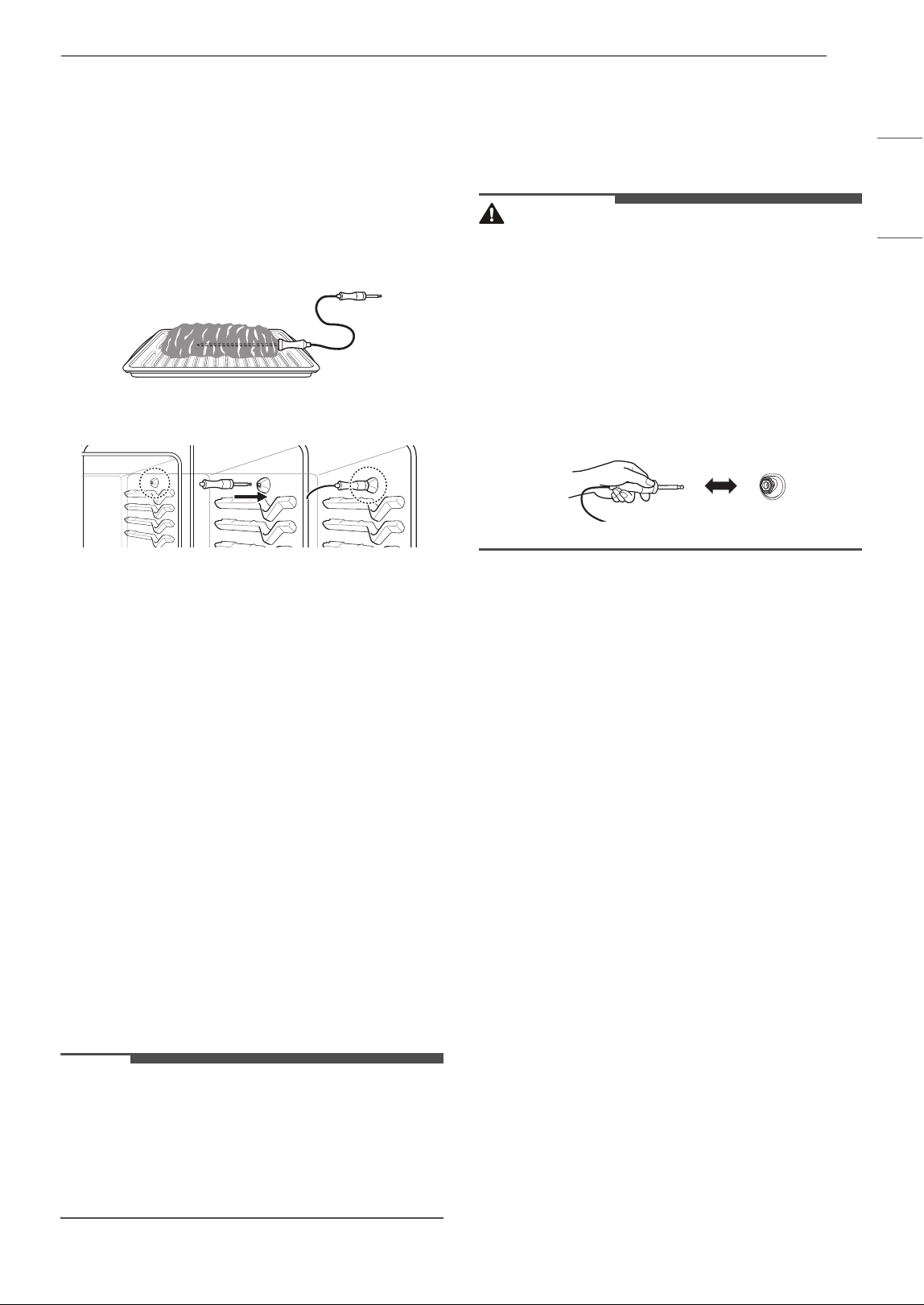
45OPERATION
ENGLISH
the oven when removing food. Before using, insert
the probe into the center of the thickest part of the
meat or into the inner thigh or breast of poultry,
away from fat or bones. Place food in the oven and
connect the meat probe to the jack. Keep the
probe as far away from heat sources as possible.
Setting the Meat Probe Function
1 Insert the meat probe into the meat.
2 Connect the meat probe to the jack.
3 The meat probe icon flashes in the display if
the meat probe is properly connected.
Method
1 Select cook mode. Probe is available on Bake,
Convection Bake, Convection Roast and Air
Roast.
2 Tap "Temp." to set the desired cooking
temperature. Then tap
! to save the
settings.
3 Tap "Probe" to set the desired probe
temperature. Then tap
! to save the
settings.
4 Press the START button.
NOTE
• The default probe temperature is 150 °F (65 °C),
but can be changed to any temperature between
80 °F (27 °C) and 210 °F (100 °C). The display
shows the changing probe temperature. When
the set probe temperature is reached, the oven
shuts off automatically.
IMPORTANT NOTE
Press the STOP button to cancel the cooking with
the probe at any time. To avoid breaking the
probe, make sure food is completely defrosted
before inserting.
CAUTION
• Always use an oven mitt to remove the
temperature probe. Do not touch the broil
element. Failure to obey this caution can result
in severe personal injury.
• To avoid damage to the meat probe, do not use
tongs to pull on the probe when removing it.
• Do not store the meat probe in the oven.
• Do not pull the wire to remove the probe. Hold
the probe head, not the wire, when inserting or
removing the probe.
Bake
Bake is used to prepare foods such as pastries,
breads and casseroles.
The oven can be programmed to bake at any
temperature from 170
8 (80 7) to 550 8 (285 7).
The default temperature is 350
8 (175 7). The
meat probe can also be used with this mode.
Setting the Bake Mode
1 Press the POWER button.
2 Tap Manual Cook and scroll to select Bake.
3 Tap 3 or drag the option card to set the cook
options.
4 Tap Temperature set the desired cook
temperature by tapping the +/- button,
tapping the bar, or dragging the bar. You can
also use the number pad icon to set the cook
temperature directly.

46 OPERATION
5 If desired, tap Cook Time or Start at to set
the cook time or cooking start time.
You can also use the number pad icon to set
the cooking temperature directly.
6 Tap When Finished to add a function after
cooking is complete.
• Keep Warm : Keeps the food warm after
cooking is complete.
• Stay On : Continues the previously selected
cooking mode after cooking is complete.
• Turn Off : Turns off automatically when
cooking is complete, without any additional
functions operating.
7 When you have selected the desired cook
settings, tap Start at the bottom right to
begin cooking.
8 A chime sounds once preheating is complete.
9 A chime sounds at the end of the set cook
time and a notification appears in the display.
10 Tap Done to complete cooking. If needed, you
can tap + Cook Time to continue cooking, or
tap Keep Warm to maintain the food at
serving temperature.
Changing the Cook Settings
1 Tap 3 at the middle right of the screen.
2 Tap option you want to change to make
adjustments.
3 Tap Apply at the bottom right to apply the
modified settings to your recipe.
4 Tap 4 to return to the previous screen without
making changes.
To Stop Cooking
1 Tap Stop at the button right of the screen.
2 A pop-up notification appears on the display.
Tap Stop.
Baking Pans
• When baking in Bake modes, use baking pans
with a dark metal or coated surface.
• When baking with Convection Bake, you can
also use baking pans with a bright metal surface.
• Always place cake pans in the middle of the tray
or oven rack.
• When baking with Bake, you can place two
baking pans side by side in the oven for a baking
time that is only slightly longer.
NOTE
• If no cook time is set, the oven turns off
automatically after 12 hours.
Tips for Baking
Results of Baking Possible Cause Solution
The cake base is too light Wrong oven rack position
Use a dark baking tin or put the
cake one rack lower down.
Cake collapses (turns lumpy,
soggy)
Oven temperature too high Set the temperature slightly lower.
Baking time too short
Set a longer baking time. The
baking time cannot be reduced by
setting a higher temperature.
Mixture contains too much liquid
Use less liquid. Follow instructions
for dough mixing times, especially
when using kitchen appliances.

47OPERATION
ENGLISH
Convection Bake and Roast
The convection system uses a fan to circulate the
heat evenly within the oven. Improved heat
distribution allows for even cooking and excellent
results while cooking with single or multiple racks.
The Convection Roast feature is designed to give
optimum roasting performance. Convection Roast
combines cooking with the convection fan to roast
meats and poultry. The heated air circulates
around the food from all sides, sealing in juices
and flavors. Foods are crispy brown on the outside
while staying moist on the inside. Convection
roasting is especially good for large tender cuts of
meat, uncovered.
Setting the Convection Bake and Roast
Mode
1 Press the POWER button.
2 Tap Manual Cook and scroll to select
Convection Bake or Convection Roast.
3 Tap 3 or drag the option card to set the cook
options.
4 Tap Temperature to set the desired cooking
temperature by tapping the +/- button,
tapping the bar, or dragging the bar.
You can also use the number pad icon to set
the cooking temperature directly.
5 If desired, tap Cook Time or Start at to set
the cook time or cooking start time.
You can also use the number pad icon to set
the cooking time directly.
6 Tap When Finished to add a function after
cooking is complete.
• Keep Warm : Keeps the food warm after
cooking is complete.
• Stay On : Continues the previously selected
cooking mode after cooking is complete.
• Turn Off : Turns off automatically when
cooking is complete, without any additional
functions operating.
7 When you have selected the desired cook
settings, tap Start at the bottom right to
begin cooking.
8 A chime sounds once preheating is complete.
9 A chime sounds at the end of the set cook
time and a notification appears in the display.
10 Tap Done to complete cooking. If needed, you
can tap + Cook Time to continue cooking, or
tap Keep Warm to maintain the food at
serving temperature.
NOTE
• If no cook time is set, the oven turns off
automatically after 12 hours.
Cakes are too dry
Oven temperature too low
Next time set a slightly higher
temperature.
Baking time too long Set a slightly shorter baking time.
Cakes are browned unevenly
Baking temperature too high and
baking time too short
Set a slightly lower baking
temperature and a slightly longer
baking time.
Mixture unevenly distributed
Distribute the mixture evenly over
the baking tray/tin.
Baking time too long Temperature too low
Next time set a slightly higher
temperature.
Results of Baking Possible Cause Solution
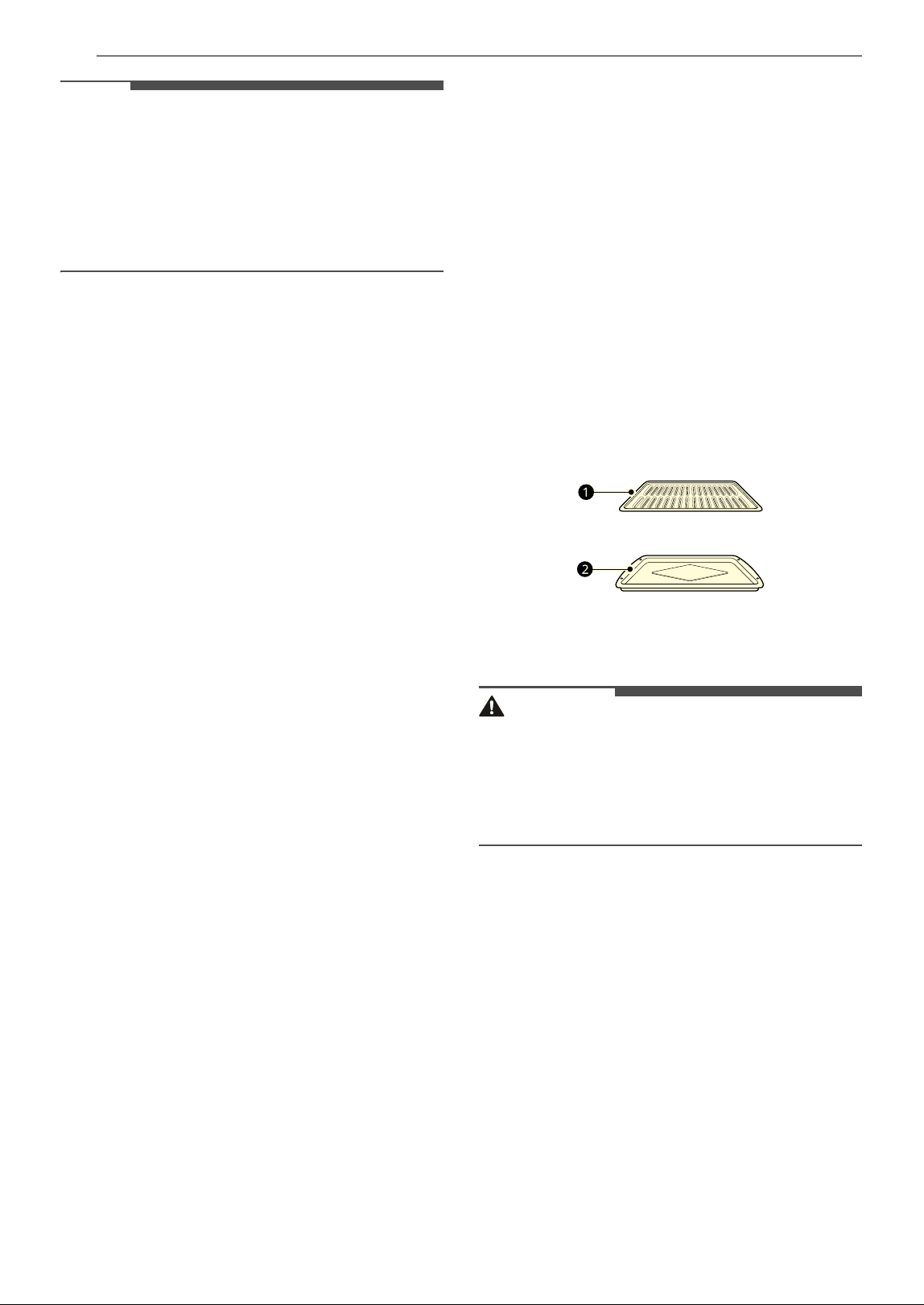
48 OPERATION
NOTE
• The heating elements and fan turn off if the door
is opened. They turn on again after the door is
closed.
• The oven fan runs while convection baking and
convection roasting. The fan stops when the
door is opened. In some cases, the fan may shut
off during a convection bake cycle.
Changing the Cook Settings
1 Tap 3 at the middle right of the screen.
2 Tap option you want to change to make
adjustments.
3 Tap Apply at the bottom right to apply the
modified settings to your recipe.
4 Tap 4 to return to the previous screen without
making changes.
To Stop Cooking
1 Tap Stop at the bottom right the of screen.
2 A pop-up notification appears on the display.
Tap Stop.
Tips for Convection Baking
• Use Convection Bake for faster and more even
multiple-rack cooking of pastries, cookies,
muffins, biscuits, and breads of all kinds.
• Bake cookies and biscuits on pans with no sides
or very low sides to allow heated air to circulate
around the food. Food baked on pans with a
dark finish will cook faster.
• When using Convection Bake, place the oven
racks in positions suggested in the charts in this
manual.
• Multiple oven rack cooking may slightly increase
cook times for some foods.
Tips for Convection Roasting
The Convection Roast feature is designed to give
optimum roasting performance. Convection Roast
combines cooking with the convection fan to roast
meats and poultry. The heated air circulates
around the food from all sides, sealing in juices
and flavors. Foods are crispy brown on the outside
while staying moist on the inside. Convection
roasting is especially good for large tender cuts of
meat, uncovered.
Use a broiler pan and grid when preparing meats
for convection roasting. The broiler pan catches
grease spills and the grid helps prevent grease
splatters.
1 Place the oven rack in the recommended
position.
2 Place the grid in the broiler pan.
3 Place the broiler pan on the oven rack.
a Grid
b Broiler Pan
CAUTION
• Do not cover the roasting rack with aluminum
foil.
• Position food (fat side up) on the roasting rack.
• Pressing the POWER button during cooking
clears all settings.
Recommended Baking and
Roasting Guide
Baking results will be better if baking pans are
centered in the oven as much as possible. If
cooking on multiple racks, place the oven racks in
the positions shown.
Multiple-rack cooking saves time and energy.
Whenever possible, cook foods requiring the same
cooking temperature together in one oven.
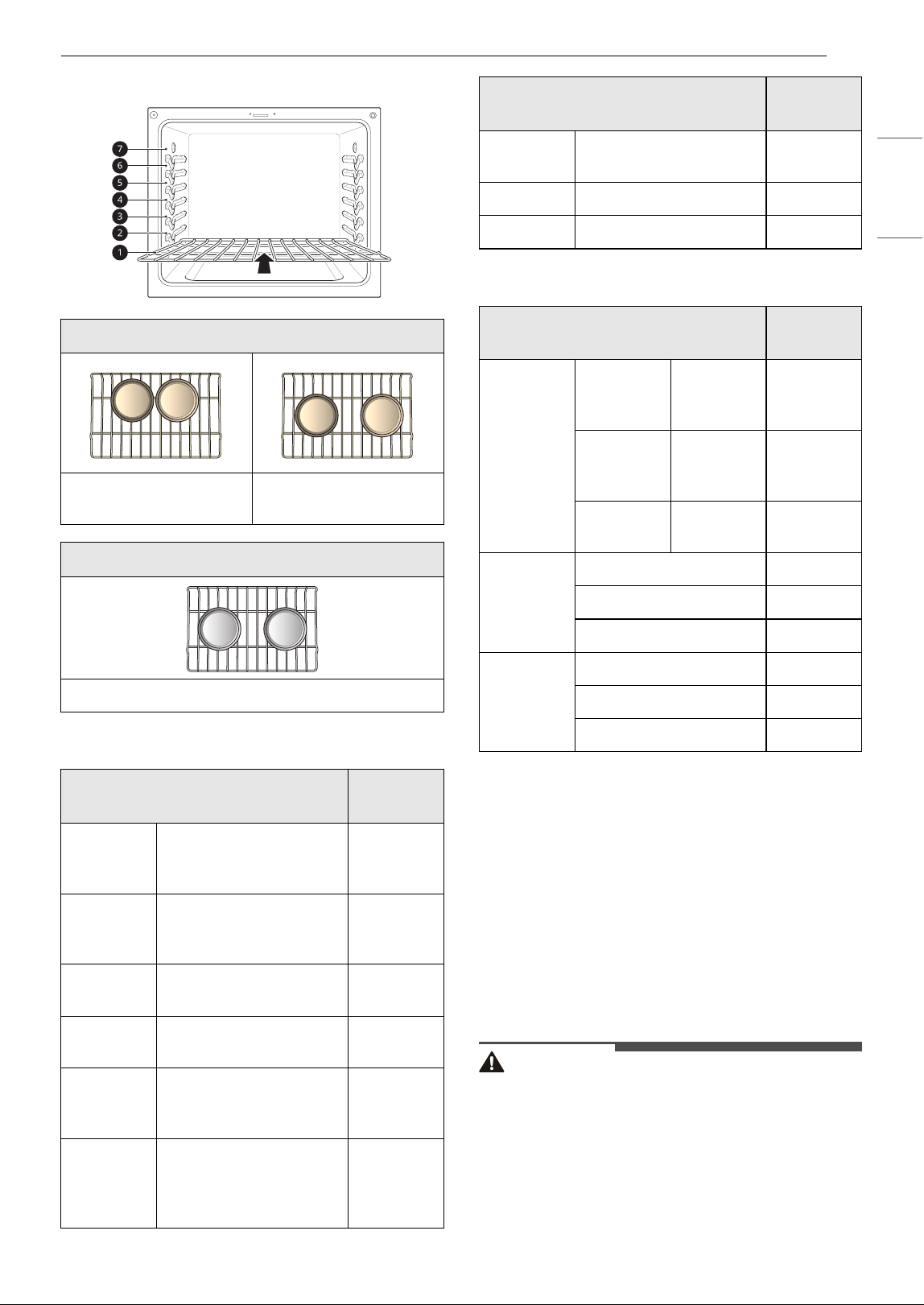
49OPERATION
ENGLISH
Rack and Pan Placement
Baking Rack Guide
Roasting Rack Guide
Broil
The Broil function uses intense heat from the
upper heating element to cook food. Broiling
works best for tender cuts of meat, fish, and thinly
cut vegetables.
Some models may feature a hybrid broiler
consisting of an inner broiler that utilizes a carbon
heating element which provides instantaneous
heat, and a traditional outer broiling element.
During normal broiler operation, it is normal for
either element to cycle off intermittently.
CAUTION
• Do not cover the oven rack with aluminum foil.
Doing so will cause a fire.
• Should an oven fire occur, leave the oven door
closed and turn the oven off. If the fire
continues, throw baking soda on the fire or use a
fire extinguisher.
Multiple rack baking
Heavy duty rack
(Position 1)
Heavy duty rack
(Position 5)
Single rack baking
Heavy duty rack
Food
Rack
position
Cakes
Layer cakes
Bundt cakes
Angel food cake
2
3
3
Cookies
Sugar cookies
Chocolate chips
Brownies
4
4
4
Pizza
Fresh
Frozen
3
3
Pastry
Crust
From scratch
Refrigerated
4
4
Breads
Biscuit, canned
Biscuit, from scratch
Muffins
5
5
4
Desserts
Fruit crisps and
cobblers, from scratch
Pies, from scratch, 2-
crust fruit
4
4
Custards
Cheesecake, crème
brulée
2
Soufflés Sweet or savory 2
Casserole Frozen lasagna 4
Food
Rack
position
Beef
Rib
Rare
Medium
Well done
2
2
2
Boneless
rib, top
sirloin
Rare
Medium
Well done
2
2
2
Beef
tenderloin
Rare
Medium
2
2
Pork
Rib 2
Bone-in, sirloin 2
Ham, cooked 2
Poultry
Whole chicken 2
Chicken pieces 2
Turkey 2
Food
Rack
position

50 OPERATION
CAUTION
• DO NOT put water or flour on the fire. Flour may
be explosive and water can cause a grease fire to
spread and cause personal injury.
• When using your broiler, the temperature inside
the oven will be extremely high. Take care to
avoid possible burns by:
- Keeping the door closed when broiling
- Always wearing oven mitts when inserting or
removing food items
NOTE
• This appliance is designed for closed-door
broiling. Close the door to set the Broil function.
If the door is open, the Broil function cannot be
set and Close the door to start cooking
appears on the display. Close the door and reset
the Broil function. If the door is opened during
broiling, the broil burner turns off after five
seconds. The broiler turns back on automatically
once the door is closed.
Setting the Broil Mode
1 Press the POWER button.
2 Tap Manual Cook and scroll to select Broil.
3 Tap 3 or drag the option card to set the cook
options.
4 Tap Temperature and select the desired cook
temperature : Low, or High.
5 If desired, tap Cook Time or Start at to set
the cook time or cooking start time.
You can also use the number pad icon to set
the cooking time directly.
6 Tap When Finished to add a function after
cooking is complete.
• Keep Warm : Keeps the food warm after
cooking is complete.
• Turn Off : Turns off automatically when
cooking is complete, without any additional
functions operating.
7 When you have selected the desired cook
settings, tap Start at the bottom right to
begin cooking.
8 A chime sounds at the end of the set cook
time and a notification appears in the display.
9 Tap Done to complete cooking. If needed, you
can tap + Cook Time to continue cooking, or
tap Keep Warm to maintain the food at
serving temperature.
NOTE
• If the cook time is not set, the oven automatically
turns off after 3 hours.
• The heating elements and fan turn off if the door
is opened. They turn on again after the door is
closed.
Changing the Cook Settings
1 Tap 3 at the middle right of the screen.
2 Tap option you want to change to make
adjustments.
3 Tap Apply at the bottom right to apply the
modified settings to your recipe.
4 Tap 4 to return to the previous screen without
making changes.
To Stop Cooking
1 Tap Stop at the bottom right the of screen.
2 A pop-up notification appears on the display.
Tap Stop.
Tips for Reducing Smoke
Due to the intense heat associated with broiling, it
is normal to experience smoke during the cooking
process. This smoke is a natural byproduct of
searing and should not cause you to worry. If you
are experiencing more smoke than you are
comfortable with, use the following tips to reduce
the amount of smoke in your oven.
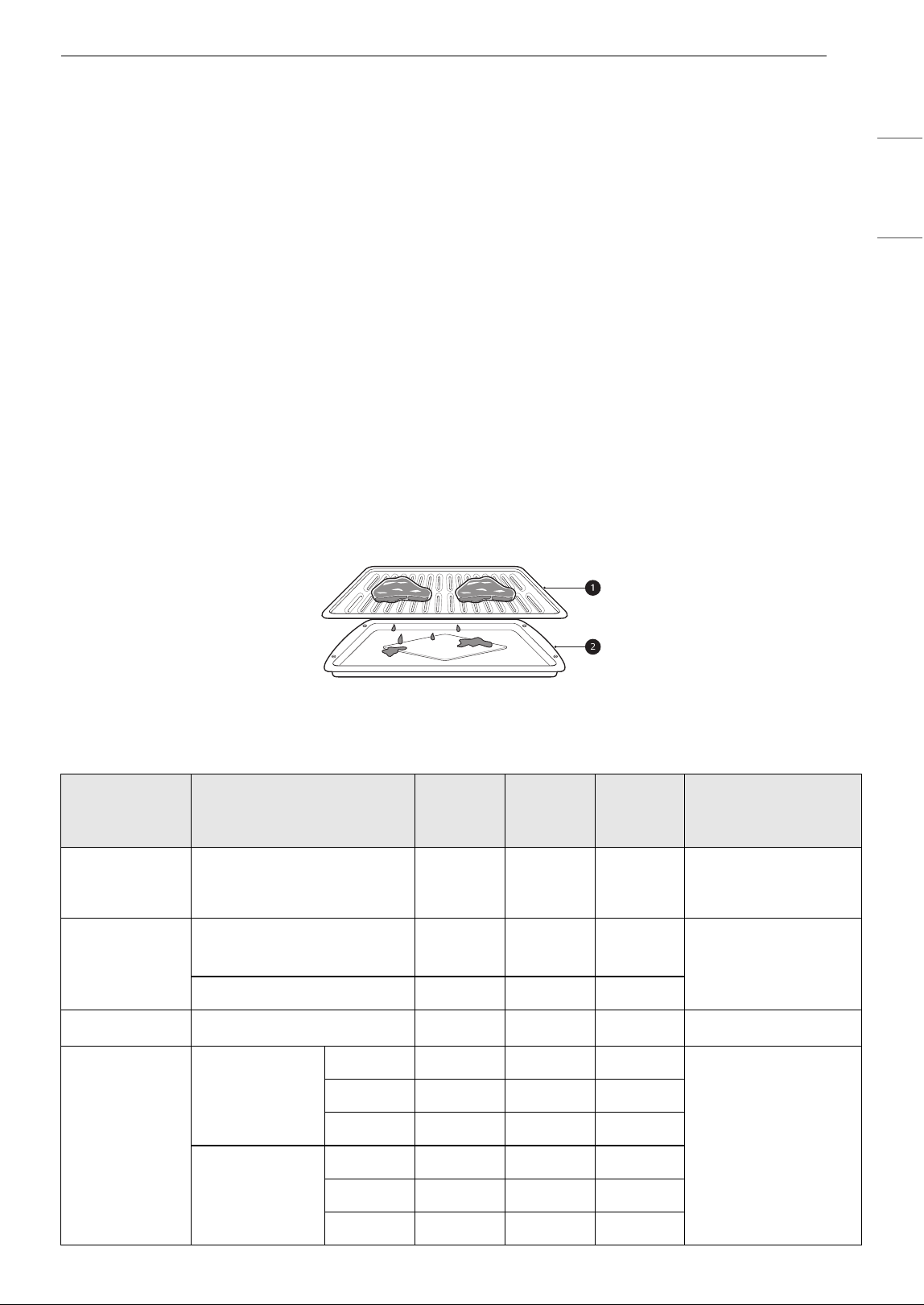
51OPERATION
ENGLISH
• Always use a broiler pan. Do not use saute pans
or regular baking sheets for safety reasons.
• The broiler pan should always be thoroughly
cleaned and at room temperature at the
beginning of cooking.
• Always run your cooktop ventilation system or
vent hood during broiling.
• Keep the interior of your oven as clean as
possible. Leftover debris from prior meals can
burn or catch fire.
• Avoid fatty marinades and sugary glazes. Both of
these will increase the amount of smoke you
experience. If you would like to use a glaze,
apply it at the very end of cooking.
• If you are experiencing significant smoke with
any food item, consider:
- Lowering the broiler to the Low setting.
- Lowering the rack position to cook the food
farther away from the broiler.
- Using the High broil setting to achieve the
level of searing you desire, and then either
switching to the Low broil setting, or switching
to the Medium broil setting.
• As a rule, fattier cuts of meat and fish will
produce more smoke than leaner items.
• Adhere to the guidelines in the Recommended
Broiling Guide section whenever possible.
Recommended Broiling Guide
The size, weight, thickness, starting temperature, and your preference of doneness will affect broiling
times.
This guide is based on meats at refrigerator temperature. For best results when broiling, use a pan
designed for broiling.
a Grid (sold separately)
b Broiler Pan (sold separately)
Food
Quantity and/or
Thickness
Rack
Position
First
Side
(min.)
Second
Side
(min.)
Comments
Hamburgers
9 patties
1
/
2
to
3
/
4
" thick
73-62-4
Space evenly. Up to 9
patties may be broiled
at once.
Chicken
1 whole, 2 to 2
1
/
2
lbs., split
lengthwise
5 8-10 4-6
Broil skin-side-down
first.
2 Breasts 5 8-10 5-7
Toast 1 to 9 pieces 7 0.5-1 0.5
Beef Steaks
1" thick
1 to 1
1
/
2
lbs.
Rare 7 3-5 2-4
Steaks less than 1"
thick cook through
before browning. Pan
frying is
recommended. Slash
fat.
Medium 7 4-6 2-4
Well done 7 5-7 3-5
1
1
/
2
" thick
2 to 2
1
/
2
lbs.
Rare 5 7-9 4-6
Medium 5 9-11 6-8
Well done 5 11-13 8-10
52 OPERATION
• This guide is only for reference. Adjust cook time according to your preference.
• Do not use the gliding rack in position 7.
NOTE
• The USDA advises that consuming raw or undercooked fish, meat, or poultry can increase your risk of
food-borne illness.
• The USDA has indicated the following as safe minimum internal temperatures for consumption:
- Ground beef: 160 °F (71.1 °C)
- Poultry: 165 °F (73.9 °C)
- Beef, veal, pork, or lamb: 145 °F (62.8 °C)
- Fish / Seafood: 145 °F (62.8 °C)
Tips for Broiling
• Beef
- Steaks and chops should always be allowed to rest for five minutes before being cut into and eaten.
This allows the heat to distribute evenly through the food and creates a more tender and juicy result.
- Pieces of meat that are thicker than two inches should be removed from the refrigerator 30 minutes
prior to cooking. This will help them cook more quickly and evenly, and will produce less smoke when
broiling. Cooking times will likely be shorter than the times indicated in the Broiling Chart.
Lobster Tails
2–4
10 to 12 oz. each
59-12
Do not
turn over
Cut through back of
shell. Spread open.
Brush with melted
butter before broiling
and after half of
broiling time.
Fish Fillets
1
/
4
to
1
/
2
" thick
62-42-4
Handle and turn very
carefully. Brush with
lemon butter before
and during cooking, if
desired.
Ham Slices
(precooked)
1
/
2
" thick
52-42-4
Increase time 5 to 10
minutes per side for 1
1/2" thick or home-
cured ham.
Pork Chops
Well done
2 (
1
/
2
" thick)
63-64-7
2 (1" thick) about 1 lb. 5 5-8 5-8
Lamb Chops
2 (1" thick)
about 10 to 12
oz.
Medium 6 3-5 2-5
Well done
65-74-7
2 (1
1
/
2
" thick)
about 1 lb.
Medium 6 7-9 7-9
Well done 6 9-11 7-9
Salmon Steaks
2 (1" thick) 5 8-10 3-5 Grease pan. Brush
steaks with melted
butter.
4 (1" thick) about 1 lb.
5 9-11 4-6
Food
Quantity and/or
Thickness
Rack
Position
First
Side
(min.)
Second
Side
(min.)
Comments

53OPERATION
ENGLISH
- For bone-in steaks or chops that have been frenched (all meat removed from around the bone), wrap
the exposed sections of bone in foil to reduce burning.
• Seafood
- When broiling skin-on fish, always use the Lo broil setting and always broil the skin side last.
- Seafood is best consumed immediately after cooking. Allowing seafood to rest after cooking can cause
the food to dry out.
- It is a good idea to rub a thin coating of oil on the surface of the broiling pan before cooking to reduce
sticking, especially with fish and seafood. You can also use a light coating of non-stick pan spray.
• Vegetables
- Toss your vegetables lightly in oil before cooking to improve browning.
Air Fry
The Air Fry function is specially designed for oil-
free frying.
The Air Fry mode can be programmed to cook at
any temperature from 300
8 (150 7) to 550 8
(285
7). The default temperature is 400 8 (205
7).
Temperatures can reach up to 50 8 (10 7) above
the set temperature for optimal crisping
performance.
Setting the Air Fry Mode
1 Press the POWER button.
2 Tap Manual Cook and scroll to select Air Fry.
3 Tap 3 or drag the option card to set the cook
options. Tap Temperature and set the
desired cook temperature by tapping the +/-
button, tapping the bar, or dragging the bar.
You can also use the number pad icon to set
the cooking temperature directly.
4 If desired, tap Cook Time or Start at to set
the cook time or cooking start time.
You can also use the number pad icon to set
the cooking time directly.
5 Tap When Finished to add a function after
cooking is complete.
• Keep Warm : Keeps the food warm after
cooking is complete.
• Stay On : Continues the previously selected
cooking mode after cooking is complete.
• Turn Off : Turns off automatically when
cooking is complete, without any additional
functions operating.
6 When you have selected the desired cook
settings, tap Start at the bottom right to
begin cooking.
7 A chime sounds at the end of the set cook
time and a notification appears in the display.
8 Tap Done to complete cooking. If needed, you
can tap + Cook Time to continue cooking, or
tap Keep Warm to maintain the food at
serving temperature.
Changing the Cook Settings
1 Tap 3 at the middle right of the screen.
2 Tap option you want to change to make
adjustments.
3 Tap Apply at the bottom right to apply the
modified settings to your recipe.
4 Tap 4 to return to the previous screen without
making changes.
To Stop Cooking
1 Tap Stop at the bottom right the of screen.
2 A pop-up notification appears on the display.
Tap Stop.
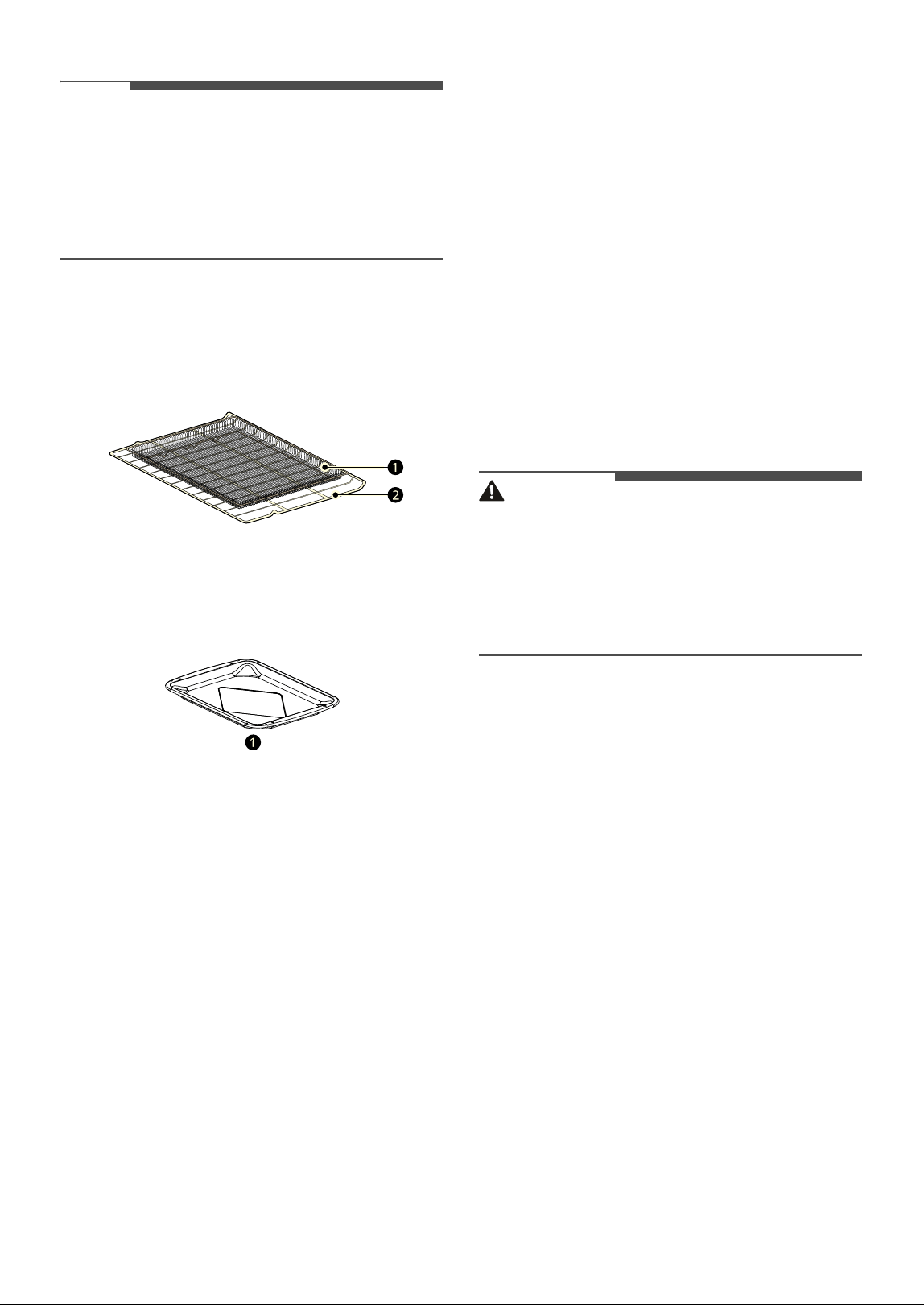
54 OPERATION
NOTE
• No preheating is required when using the Air Fry
mode.
• If cooking multiple batches, the later batches
may take less time to cook.
• Wet batters and coatings will not crisp or set
when using the Air Fry mode.
Tips for Air Fry
• For best results, use the provided air fry tray.
- The mesh section of the air fry tray can be
cleaned in a dishwasher.
a Air Fry Tray
b Heavy Duty Rack
• If you don't have the air fry tray, place food on a
wire rack inside a foil-lined broiler pan.
a Broiler Pan
• For best results, cook food on a single rack
placed in the positions suggested in the chart in
this manual.
• Spread the food out evenly in a single layer.
• Use either the air fry tray or a dark baking tray
with no sides or short sides that does not cover
the entire rack. This allows for better air
circulation.
• If desired, spray the baking tray or air fry tray
with a pan spray. Use an oil that can be heated to
a high temperature before smoking, such as
avocado, grapeseed, peanut or sunflower oil.
• Place a foil-lined baking tray on a rack in position
1 to catch the oil falling from the food. For high-
fat foods like chicken wings, add a few sheets of
parchment paper to absorb the fat.
• Check food often and shake it or turn it over for
crisper results.
• Prepared frozen foods may cook faster with the
Air Fry mode than stated on the package.
Reduce the cooking time by about 20 percent,
check food early, and adjust cooking time as
needed.
• Use a food thermometer to make sure food has
reached a safe temperature for consumption.
Eating undercooked meats can increase your
risk of food-borne illness.
• For the crispiest results, dredge fresh chicken
wings or tenders in seasoned flour. Use 1/3 cup
flour for 2 pounds of chicken.
Recommendations When Air Frying
High-Fat Foods
Foods high in fat will smoke when using the Air Fry
mode. For best results, follow these
recommendations when air frying foods that are
high in fat, such as chicken wings, bacon, sausage,
hot dogs, turkey legs, lamb chops, ribs, pork loin,
duck breasts, or some plant-based proteins.
CAUTION
• Never cover slots, holes, or passages in the oven
bottom or cover entire racks with materials such
as aluminum foil. Doing so blocks airflow
through the oven and can result in carbon
monoxide poisoning. Aluminum foil can also
trap heat, causing a fire hazard or poor oven
performance.
• Turn on your exhaust hood at a high fan setting
before you start Air Fry and leave it on for 15
minutes after you're done.
• Open a window or sliding glass door, if possible,
to make sure the kitchen is well-ventilated.
• Keep the oven free from grease buildup. Wipe
down the interior of the oven before and after
air frying (once the oven has cooled).
• Run oven cleaning cycles (EasyClean) regularly,
depending on how often and what types of food
you Air Fry.
• Avoid opening the oven door more than
necessary to help maintain the oven
temperature, prevent heat loss, and save
energy.
• Air-frying fresh chicken pieces such as wings or
drumsticks with the skin left on can produce
smoke as the fat renders at high temperatures.
If the smoke is excessive, use the Convection
Roast mode instead of Air Fry.
55OPERATION
ENGLISH
Recommended Air Frying Guide
• Arrange food evenly in a single layer.
• Put a foil-lined baking pan on a rack in position 1
to catch drips. If needed, add parchment paper
to absorb oil and reduce smoking.
• Flip food over during cooking to avoid burning it.
† High-fat items may produce more smoke when
cooked using Air Fry. For less smoke, cook using
Convection Roast mode.
Recommended Items
Quantity
(oz)
Temp. (°F)
Rack
Position
Time Guide
POTATOES-Frozen
Frozen French Fries
(Shoestring)
20 425 4 15-25
Frozen French Fries
(Crinkle cut, 3/8" or 10
mm)
35 400 4 20-30
Frozen Sweet Potato
Fries
25 425 4 15-30
Frozen Tater Tots 50 450 4 20-30
Frozen Hash Browns 40 450 4 20-30
POTATOES-Fresh/Homemade
Homemade French Fries
(3/8" x 3/8" or 10 x 10
mm)
25 450 4 20-30 Cut the potatoes and soak
for 30 minutes in hot tap
water. Drain and pat dry.
Brush or lightly spray with
3 tbsp. of oil. Add salt and
pepper to taste.
Homemade Potato
Wedges
60 450 4 25-35
CHICKEN-Frozen
Frozen Chicken Nuggets,
Crispy
30 425 4 15-25
Frozen Chicken Strips 35 425 4 30-40
Frozen Hot Wings, Bone-
in
50 425 4 30-40
CHICKEN-Fresh, Skin on
Fresh Chicken Wings
†
40 450 4 25-35 Brush or lightly spray with
1 tbsp. of oil. Add salt and
pepper to taste.
Fresh Chicken
Drumsticks
†
70 450 4 30-40
Thighs 40 450 4 25-35
Breasts 40 450 4 25-35
OTHER
Frozen Onion Rings,
Breaded
20 400 4 15-25
Frozen Spring Rolls (0.7
oz each)
45 425 4 15-25

56 OPERATION
Air Sous-Vide
This feature is only available on some models.
Air Sous-Vide cooking uses air to cook foods "low
and slow." Use it to cook meat, fish, seafood,
poultry or vegetables. Food must be vacuum
packed in pouches. It is not necessary to preheat
the oven when using Air Sous-Vide. Refer to the
cooking guide for recommended Air Sous-Vide
settings.
Benefits of Air Sous-Vide
The lower temperatures and long cooking times
used in Air Sous-Vide cooking provide many
benefits.
• Healthier
Compared to other cooking methods, sous vide
retains most of the original nutrients in food.
• Safe and Convenient
The long cooking times used in sous vide
cooking allow food to be pasteurized. Because
food is vacuum packed before cooking, the
unopened pouches can be quickly chilled then
easily stored after cooking.
• Crisp and Moist Results
The fine temperature control of sous vide
cooking is an excellent way to achieve the
perfect texture when cooking meat and poultry.
The low temperatures used retain more of the
moisture in food than conventional cooking
methods. After cooking, a final sear in a frying
pan adds the perfect crisp finish.
Setting Air Sous-Vide Mode
1 Press the POWER button.
2 Tap Manual Cook and scroll to select Air
Sous-Vide.
3 Tap 3 or drag the option card to set the cook
options. Tap Temperature and set the
desired cook temperature by tapping the +/-
button, tapping the bar, or dragging the bar.
You can also use the number pad icon to set
the cook temperature directly.
4 If desired, tap Cook Time or Start at to set
the cook time or cooking start time.
You can also use the number pad icon to set
the cooking time directly.
5 Tap When Finished to add a function after
cooking is complete.
• Stay On : Continues the previously selected
cooking mode after cooking is complete.
• Turn Off : Turns off automatically when
cooking is complete, without any additional
functions operating.
Thin Sausage
†
(2.5 oz
each, diameter 0.8")
90 400 4 15-25
Frozen Coconut Shrimp 25 400 4 15-25 Brush or lightly spray the
surface of food with oil.
Fresh Scallops on the half
shell (35.3 oz)
35 425 4 20-30 Melt 4 tbsp. of butter and
brush on scallops. Mix 1/2
cup bread crumbs, 1 tbsp.
minced garlic, 1/4 cup
grated parmesan cheese
and season to taste.
Sprinkle mixture over
scallops.
Fresh Shrimp 50 425 4 25-35
Mixed Vegetables 35 425 4 15-25 Brush or lightly spray with
4 tbsp. of olive oil. Add salt
and pepper to taste.
Recommended Items
Quantity
(oz)
Temp. (°F)
Rack
Position
Time Guide
57OPERATION
ENGLISH
6 When you have selected the desired cook
settings, tap Start at the bottom right to
begin cooking.
7 A chime sounds at the end of the set cook
time and a notification appears in the display.
8 Tap Done to complete cooking. If needed, you
can tap + Cook Time to continue cooking.
Changing the Cook Settings
1 Tap "Temp." or "Time" to bring up the Cook
Settings screen.
2 Adjust the settings using the number pad or
scroll function.
3 Press the START button on the control panel.
To Stop Cooking
Press the STOP button on the control panel.
Recommended Air Sous-Vide Guide
Air Roast
Air Roast is a quick and convenient way to roast
without preheating.
The Air Roast mode can be programmed to cook at
any temperature from 300
8 (150 7) to 550 8
(285 7). The default temperature is 400 8 (205
7). The meat probe can also be used with this
mode.
Setting the Air Roast Mode
1 Press the POWER button.
2 Tap Manual Cook and scroll to select Air
Roast.
3 Tap 3 or drag the option card to set the cook
options. Tap Temperature and set the
desired cook temperature by tapping the +/-
button, tapping the bar, or dragging the bar.
You can also use the number pad icon to set
the cook temperature directly.
Food
Quantity
(oz)
Rack
Position
Temp.
(°F)
Time
Min Target Max
Beef steak 1” thick
14~17 oz
3
135 - 2.5 hr. 3 hr.
Chicken
breast
4.2-5.3 oz
3
150 - 2 hr. 2.5 hr.
Chicken
Thighs(bone in)
6~8 oz 3 155 - 4 hr. 6 hr.
Salmon 1” thick
7 oz
3
140 - 2 hr. 2.5 hr.
Asparagus 2.8 oz / 6 ea
5.6 oz / 12 ea
3
185 20 min. 30 min. 45 min.
Potatoes 1/2”diced
up to 36 oz.
3 200 - 2.5 hr. -
Carrots 1/2”diced
up to 18 oz.
3 200 1.5 hr. 2 hr. 3 hr.

58 OPERATION
4 If desired, tap Cook Time or Start at to set
the cook time or cooking start time.
You can also use the number pad icon to set
the cook time directly.
5 Tap When Finished to add a function after
cooking is complete.
• Keep Warm : Keeps the food warm after
cooking is complete.
• Stay On : Continues the previously selected
cooking mode after cooking is complete.
• Turn Off : Turns off automatically when
cooking is complete, without any additional
functions operating.
6 When you have selected the desired cook
settings, tap Start at the bottom right to
begin cooking.
7 A chime sounds at the end of the set cook
time and a notification appears in the display.
8 Tap Done to complete cooking. If needed, you
can tap + Cook Time to continue cooking, or
tap Keep Warm to maintain the food at
serving temperature.
Changing the Cook Settings
1 Tap 3 at the middle right of the screen.
2 Tap option you want to change to make
adjustments.
3 Tap Apply at the bottom right to apply the
modified settings to your recipe.
4 Tap 4 to return to the previous screen without
making changes.
To Stop Cooking
1 Tap Stop at the bottom right the of screen.
2 A pop-up notification appears on the display.
Tap Stop.
Pizza
This system is designed to give the optimum
cooking performance for pizza by automatically
selecting a combination of the broil and bake
heating systems.
Setting the Pizza Mode
1 Press the POWER button.
2 Tap Manual Cook and scroll to select Pizza.
3 Tap 3 or drag the option card to set the cook
options.
4 Tap Temperature and set the desired cook
temperature by tapping the +/- button,
tapping the bar, or dragging the bar.
You can also use the number pad icon to set
the cook temperature directly.
5 If desired, tap Cook Time or Start at to set
the cook time or cooking start time.
You can also use the number pad icon to set
the cook time directly.
6 Tap When Finished to add a function after
cooking is complete.
• Keep Warm : Keeps the food warm after
cooking is complete.
• Stay On : Continues the previously selected
cooking mode after cooking is complete.
• Turn Off : Turns off automatically when
cooking is complete, without any additional
functions operating.
7 When you have selected the desired cook
settings, tap Start at the bottom right to
begin cooking.
8 A chime sounds once preheating is complete.
9 A chime sounds at the end of the set cook
time and a notification appears in the display.

59OPERATION
ENGLISH
10 Tap Done to complete cooking. If needed, you
can tap + Cook Time to continue cooking, or
tap Keep Warm to maintain the food at
serving temperature.
NOTE
• Preheating is necessary for better cooking
results.
• Place the food in the oven after preheating.
• Rotate frozen pizzas halfway through cooking.
Extend the cooking time as needed to meet the
desired level of doneness.
Changing the Cook Settings
1 Tap 3 at the middle right of the screen.
2 Tap option you want to change to make
adjustments.
3 Tap Apply at the bottom right to apply the
modified settings to your recipe.
4 Tap > to return to the previous screen without
making changes.
To Stop Cooking
1 Tap Stop at the bottom right the of screen.
2 A pop-up notification appears on the display.
Tap Stop.
Frozen Meal
The Frozen Meal function is specially designed for
cooking frozen prepared meals.
No preheating is required when using the Frozen
Meal mode.
Setting the Frozen Meal Mode
1 Press the POWER button.
2 Tap Manual Cook scroll to select Frozen
Meal.
3 Tap 3 or drag the option card to set the cook
options. Tap Temperature and set the
desired cook temperature by tapping the +/-
button, tapping the bar, or dragging the bar.
You can also use the number pad icon to set
the cook temperature directly.
4 If desired, tap Cook Time or Start at to set
the cook time or cooking start time.
You can also use the number pad icon to set
the cook time directly.
5 Tap When Finished to add a function after
cooking is complete.
• Keep Warm : Keeps the food warm after
cooking is complete.
• Stay On : Continues the previously selected
cooking mode after cooking is complete.
• Turn Off : Turns off automatically when
cooking is complete, without any additional
functions operating.
6 When you have selected the desired cook
settings, tap Start at the bottom right to
begin cooking.
7 A chime sounds at the end of the set cook
time and a notification appears in the display.
8 Tap Done to complete cooking. If needed, you
can tap + Cook Time to continue cooking, or
tap Keep Warm to maintain the food at
serving temperature.
Changing the Cook Settings
1 Tap 3 at the middle right of the screen.
2 Tap option you want to change to make
adjustments.
3 Tap Apply at the bottom right to apply the
modified settings to your recipe.
4 Tap 4 to apply the modified settings to your
recipe.

60 OPERATION
To Stop Cooking
1 Tap Stop at the bottom right the of screen.
2 A pop-up notification appears on the display.
Tap Stop.
Dehydrate
Use this function to dry fruit, vegetables, and beef
to create healthy and nutritious snacks without
using chemicals and preservatives. Place
parchment paper on the metal tray and spread the
food in a single layer. Dehydrate temperatures
range from 100 ℉ to 200 ℉.
Setting the Dehydrate Mode
1 Press the POWER button.
2 Tap Manual Cook scroll to select Dehydrate.
3 Tap <3 or drag the option card to set the cook
options. Tap Temperature and set the
desired cook temperature by tapping the +/-
button, tapping the bar, or dragging the bar.
You can also use the number pad icon to set
the cook temperature directly.
4 If desired, tap Cook Time or Start at to set
the cook time or cooking start time.
You can also use the number pad icon to set
the cook time directly.
5 Tap When Finished to add a function after
cooking is complete.
• Stay On : Continues the previously selected
cooking mode after cooking is complete.
• Turn Off : Turns off automatically when
cooking is complete, without any additional
functions operating.
6 When you have selected the desired cook
settings, tap Start at the bottom right to
begin cooking.
7 A chime sounds at the end of the set cook
time and a notification appears in the display.
8 Tap Done to complete cooking. If needed, you
can tap + Cook Time to continue cooking.
Changing the Dehydrate Settings
1 Tap 3 at the middle right of the screen.
2 Tap option you want to change to make
adjustments.
3 Tap Apply at the bottom right to apply the
modified settings to your recipe.
4 Tap 4 to return to the previous screen without
making changes.
To Stop Dehydrate
1 Tap Stop at the bottom right the of screen.
2 A pop-up notification appears on the display.
Tap Stop.
Warm
This function will maintain an oven temperature of
less than 200
8 (93 7). It will keep cooked food
warm for serving up to 3 hours after cooking has
finished.
Setting the Warm Mode
1 Press the POWER button.
2 Tap Manual Cook scroll to select Warm.
3 Select the desired temperature: Low,
Medium, or High.
4 If desired, tap Cook Time or Start at to set
the cook time or cooking start time.You can
also use the number pad icon to set the
cooking time directly.

61OPERATION
ENGLISH
5 Tap When Finished to add a function after
cooking is complete.
• Keep Warm : Keeps the food warm after
cooking is complete.
• Stay On : Continues the previously selected
cooking mode after cooking is complete.
6 When you have selected the desired cook
settings, tap Start at the bottom right to
begin cooking.
7 Tap Done to complete cooking. If needed, you
can tap + Cook Time to continue cooking.
Changing the Warm Settings
1 Tap 3 at the middle right of the screen.
2 Tap option you want to change to make
adjustments.
3 Tap Apply at the bottom right to apply the
modified settings to your recipe.
4 Tap 4 to return to the previous screen without
making changes.
To Stop Warming
1 Tap Stop at the bottom right the of screen.
2 A pop-up notification appears on the display.
Tap Stop.
NOTE
• The Warm function is intended to keep food
warm. Do not use it to cool food down.
Proof
This feature maintains a warm oven for rising
yeast-leavened products before baking.
Setting the Proof Mode
1 Press the POWER button.
2 Tap Manual Cook scroll to select Proof.
3 If desired, tap Cook Time or Start at to set
the cook time or cooking start time.You can
also use the number pad icon to set the
cooking time directly.
4 Tap When Finished to add a function after
cooking is complete.
• Keep Warm : Keeps the food warm after
cooking is complete.
• Stay On : Continues the previously selected
cooking mode after cooking is complete.
5 When you have selected the desired cook
settings, tap Start at the bottom right to
begin cooking.
6 Tap Done to complete cooking. If needed, you
can tap + Cook Time to continue cooking.
Changing the Proof Settings
1 Tap 3 at the middle right of the screen.
2 Tap option you want to change to make
adjustments.
3 Tap Apply at the bottom right to apply the
modified settings to your recipe.
4 Tap 4 to return to the previous screen without
making changes.
To Stop Proofing
1 Tap Stop at the bottom right the of screen.
2 A pop-up notification appears on the display.
Tap Stop.
NOTE
• To avoid lowering the oven temperature and
lengthening proofing time, do not open the oven
door unnecessarily. Check bread products early
to avoid over proofing.

62 OPERATION
NOTE
• Do not use the Proofing mode for warming food
or keeping food hot. The proofing oven
temperature is not hot enough to keep foods at
safe temperatures. Use the Warm feature to
keep food warm. Proofing does not operate
when the oven is above 125 ℉. "Oven is too hot.
Try again after it cools down." shows in the
display.
• It is normal for the fan to operate during the
Proof function.
• The proof feature automatically provides the
optimum temperature for the proofing process,
and therefore does not have a temperature
adjustment.
• For best results, cover the dough with a cloth or
with plastic wrap. (The plastic may need to be
anchored underneath the container so the oven
fan does not blow it off.)
Crispy Reheat
Crispy Reheat is a new cooking function that
restores the texture of foods that have become
soggy and lost their crispiness.
Setting the Crispy Reheat Mode
1 Press the POWER button.
2 Tap Manual Cook and scroll to select Crispy
Reheat.
3 Tap 3 or drag the option card to set the cook
options. Tap Temperature and set the
desired cook temperature by tapping the +/-
button, tapping the bar, or dragging the bar.
You can also use the number pad icon to set
the cooking temperature directly.
4 If desired, tap Cook Time or Start at to set
the cook time or cooking start time.
You can also use the number pad icon to set
the cooking time directly.
5 Tap When Finished to add a function after
cooking is complete.
• Keep Warm : Keeps the food warm after
cooking is complete.
• Stay On : Continues the previously selected
cooking mode after cooking is complete.
• Turn Off : Turns off automatically when
cooking is complete, without any additional
functions operating.
6 When you have selected the desired cook
settings, tap Start at the bottom right to
begin cooking.
7 A chime sounds at the end of the set cook
time and a notification appears in the display.
8 Tap Done to complete cooking. If needed, you
can tap + Cook Time to continue cooking, or
tap Keep Warm to maintain the food at
serving temperature.
Changing the Cook Settings
1 Tap 3 at the middle right of the screen.
2 Tap option you want to change to make
adjustments.
3 Tap Apply at the bottom right to apply the
modified settings to your recipe.
4 Tap 4 to return to the previous screen without
making changes.
To Stop Cooking
1 Tap Stop at the bottom right the of screen.
2 A pop-up notification appears on the display.
Tap Stop.
Camera

63OPERATION
ENGLISH
Before Using Camera
WARNING
• To avoid burns or other injuries, make sure the
oven and oven door are cool before cleaning
them.
CAUTION
• Do not use harsh, etching, abrasive cleaners or
sharp metal scrapers to clean the oven door
glass because they can scratch the surface. This
may cause the camera recognition to perform
poorly.
NOTE
• Before using the camera function, clean the
oven door glass.
• If the oven door glass is dirty, run the Self Clean
function.
• The Camera function does not operate when the
oven is in a cleaning mode.
• The LED in the door stays on while the camera
function is operating.
Menu Recommendation
The camera in the oven can recognize food and
recommend techniques, cook times and
temperatures. If the Camera function and the
Menu Recommendation function are On, the oven
automatically displays recommendations when
you put food items in the oven and close the door.
Using Menu Recommendation
1 Put food items in the oven and close the door.
2 After the camera recognizes the item, the
display shows the recommended options.
3 Select a category to filter the options.
4 Scroll through or tap the letters to find and
select an item.
5 Follow the recommendations in the display
regarding accessories and rack position.
NOTE
• After the camera recognizes the food item,
follow the Auto Cook Guide for details.
• If the camera does not recognize the food,
follow the instructions in the camera setting
menu on the oven.
- Place the food in the center of the rack on the
provided accessories.
- Clean the oven door glass around the camera
if it is dirty.
- If the menu matching issue persists, check the
available menus in Auto Cook.
• The Menu Recommendation function does not
operate if the oven is in any cooking mode or
cleaning mode.
• The recognition rate may be affected by the
container and accessories used. For best results,
use the accessories provided by LG.
• The recognition rate is affected by food size,
shape, and condition before cooking. For best
results, follow the Auto Cook Guide.
RealTime View
See video from inside the oven while cooking using
the LG ThinQ application. You can also take
photos. The appliance must be connected to a
home Wi-Fi network and the LG ThinQ application
to use the RealTime View function.
Using RealTime View
1 Run the LG ThinQ application on a
smartphone.
2 Select the connected oven to operate.
3 Tap "RealTime View".
4 Tap the v icon on the screen.
5 If the application is connected to the oven, the
inside of the product can be seen on a
smartphone.
NOTE
• If the inside of the product is not clearly visible
through the camera, clean the oven door glass
near the camera lens.

64 OPERATION
NOTE
• If the Wi-Fi is not connected, data charges may
apply.
• If the network signal is not strong enough, the
video could lag.
• You may appear on screen if using the oven
during monitoring.
• You can monitor the oven in real time, even
when the LCD is turned off in the standby mode.
• If the oven is empty or the food is not placed
appropriately, the screen in the app may not
display clearly.
• The surrounding wireless environment can
make the wireless network service run slowly.
Cook Record
The camera can record the cooking process and
make a time-lapse video. The appliance must be
connected to a home Wi-Fi network and the LG
ThinQ application to use the Cook Record
function.
Using Cook Record
1 Run the LG ThinQ application on a
smartphone.
2 Select the connected oven to operate.
3 Turn on the Cook Record function.
4 Select the desired video time: 5 seconds, 10
seconds or 20 seconds.
5 Cook while the oven is connected to Wi-Fi.
6 After the end of the cook, the time-lapse video
is saved.
NOTE
• If the Wi-Fi connection of the product is
unstable, the camera may not operate properly.
• Shots will be captured starting at least 4 minutes
into the cook time. Videos are stored for 72
hours, and up to 10 videos can be stored at once.
• Videos are stored in the LG ThinQ app. They can
be saved to the smartphone’s album or shared.
Auto Cook
The Auto Cook function provides guidance for
cooking foods or dishes that may be unfamiliar. It
contains preset programs for cooking many
popular food items, with information on
recommended preheating, accessories, and rack
position for optimal results.
Setting Auto Cook Mode
1 Press the POWER button and tap Auto Cook.
2 Select category to filter the options.
3 Scroll through or tap the letters to find and
select an item.
4 Follow the recommendations in the display
regarding accessories and rack position.
5 Tap Start at the bottom right to begin
cooking.
65OPERATION
ENGLISH
Auto Cook Guide
• Preheat oven first for most items.
• Preheat for 5 minutes when broiling.
• If using probe, insert food and probe before preheating.
NOTE
• When cooking thin cuts of meat, insert the probe into the thickest part of the meat. If the probe is
inserted incorrectly, the oven could turn off too soon. See the Probe section for instructions.
Beef
Menu
Amount Food Temp.
Remark Instructions
Cookware
Rack
Position
Beef
Tenderloin
2~4 lb. Refrigerated
Probe cook
Ingredients
Kosher salt, ground black pepper, garlic
powder to taste
Instructions
Prepare beef tenderloin, trimmed. Brush or
lightly spray with oil. Add salt, garlic powder
and pepper to taste. Place the tenderloin on the
grid on the broiler pan.
Grid on
broiler pan
2
Roast Beef
2~4 lb. Refrigerated
Probe cook
Ingredients
Kosher salt, ground black pepper, garlic
powder to taste
Instructions
Prepare beef sirloin, trimmed. Brush or lightly
spray with oil. Add salt, garlic powder and
pepper to taste. Place the sirloin on the grid on
the broiler pan.
Grid on
broiler pan
2
Prime Rib
8~12 lb. Refrigerated
Probe cook
Ingredients
Kosher salt, ground black pepper, garlic
powder to taste
Instructions
Prepare the bone-in prime rib. Brush or lightly
spray with oil. Add salt, garlic powder and
pepper to taste. Place the prime rib in the
roasting pan.
Roasting
pan
2
Pork
Menu
Amount Food Temp.
Remark Instructions
Cookware Rack Position
Pork Ribs
2~4 lb. Refrigerated Ingredients
Kosher salt, ground black pepper to taste
Instructions
Prepare bone-in pork ribs, trimmed. Brush or
lightly spray with oil. Add salt and pepper to
taste. Place the pork ribs on the grid on the
broiler pan.
Grid on
broiler pan
2
66 OPERATION
Pork Chops
1~6 EA Refrigerated Ingredients
Kosher salt, ground black pepper to taste
Instructions
Prepare bone-in pork chops, about 6 oz.
each, trimmed. Brush or lightly spray with oil.
Add salt and pepper to taste. Place the pork
chops on the grid on the broiler pan.
Grid on
broiler pan
4
Pork Loin
2~4 lb. Refrigerated
Probe cook
Ingredients
Kosher salt, ground black pepper to taste
Instructions
Prepare pork loin, about 4 inches in diameter,
trimmed. Brush or lightly spray with 1 tbsp.
of oil. Add salt and pepper to taste. Place the
pork loin on the grid on the broiler pan.
Grid on
broiler pan
2
Pork
Tenderloin
2~4 lb. Refrigerated
Probe cook
Ingredients
Kosher salt, ground black pepper to taste
Instructions
Prepare pork tenderloin, 2~3 inches in
diameter, trimmed. Brush or lightly spray
with 1 tbsp. of oil. Add salt and pepper to
taste. Place the tenderloin on the grid on the
broiler pan.
Grid on
broiler pan
2
Lamb
Menu
Amount Food Temp.
Remark Instructions
Cookware
Rack
Position
Rack of
Lamb
2~4 lb. Refrigerated
Probe
cook
Ingredients
Canola oil, kosher salt, ground black pepper to taste
Instructions
Prepare rack of lamb, trimmed. Brush or lightly
spray with 1 tbsp. of oil. Add salt and pepper to
taste. Place the rack of lamb on the grid on the
broiler pan.
Grid on
broiler pan
2
Bone-in
Leg of
Lamb
5~7 lb. Refrigerated
Probe
cook
Ingredients
Canola oil, kosher salt, ground black pepper to taste
Instructions
Prepare bone-in leg of lamb, trimmed. Brush or
lightly spray with 1 tbsp. of oil. Add salt and pepper
to taste. Place the leg of lamb in the roasting pan.
Roasting pan 1
Pork
Menu
Amount Food Temp.
Remark Instructions
Cookware Rack Position
67OPERATION
ENGLISH
Sausage
Menu
Amount Food Temp.
Instructions
Cookware Rack Position
Italian
Sausage
1~8 EA Refrigerated Prepare sausages, about 3.5 oz. each. Spray a rimmed
sheet pan with cooking spray. Place the Italian
sausages on the half sheet pan and space the sausages
1 1/2 in. apart from each other.
1/2 Sheet Pan 2
Hot dog
1~8 EA Refrigerated Prepare hot dogs, about 2 oz. each. Spray a rimmed
sheet pan with cooking spray Place the hot dogs on the
half sheet pan and space the hot dogs 1 1/2 in. apart
from each other.
1/2 Sheet Pan 2
Fish
Menu
Amount Food Temp.
Instructions
Cookware Rack Position
Fish Fillet
1~4 EA Refrigerated Ingredients
Kosher salt, ground black pepper, oil to taste
Instructions
Prepare the fish fillets, about 7 oz. each, and about
1~1.5 in. thick. Brush or lightly spray with oil. Add salt
and pepper to taste. Place the fillets on the grid on the
broiler pan.
Grid on broiler
pan
4
Cod Fillet
1~4 EA Refrigerated Ingredients
Kosher salt, ground black pepper, oil to taste
Instructions
Prepare the cod fillets, about 7 oz. each, and about
1~1.5 in. thick. Brush or lightly spray with oil. Add salt
and pepper to taste. Place the fillets on the grid on the
broiler pan.
Grid on broiler
pan
4
Salmon Fillet
1~4 EA Refrigerated Ingredients
Kosher salt, ground black pepper, oil to taste
Instructions
Prepare the salmon fillets, about 7 oz. each, and 3/4 in.
thick. Brush or lightly spray with oil. Add salt and
pepper to taste. Place the fillets on the grid on the
broiler pan.
Grid on broiler
pan
4
Baked
Shrimp
1~2 lb. Refrigerated Ingredients
Kosher salt, ground black pepper, oil to taste
Instructions
Prepare the shrimp, peel and devein (if necessary).
Brush or lightly spray with oil. Add salt and pepper to
taste. Place the shrimp on the grid on the broiler pan.
Grid on broiler
pan
4
Tilapia Fillet
1~4 EA Refrigerated Ingredients
Kosher salt, ground black pepper, oil to taste
Instructions
Prepare the tilapia fillets, about 7 oz. each, and about
1~1.5 in. thick. Brush or lightly spray with oil. Add salt
and pepper to taste. Place the fillets on the grid on the
broiler pan.
Grid on broiler
pan
4
68 OPERATION
Lobster Tails
1~2 EA Refrigerated Ingredients
Salt, pepper to taste, 1 tbsp butter - melted
Instructions
Prepare the lobster tails, about 5 oz. each. Butterfly
the lobster tails. Brush with melted butter. Add salt to
taste. Place the lobster tails on the grid on the broiler
pan.
Grid on broiler
pan
4
Salmon
Steak
1~4 EA Refrigerated Ingredients
Kosher salt, ground black pepper, oil to taste
Instructions
Prepare the salmon steaks, about 7 oz. each, and
about 1.5~2 in. thick. Brush or lightly spray with oil.
Add salt and pepper to taste. Place the salmon on the
grid on the broiler pan.
Grid on broiler
pan
4
Tuna Steak
1~4 EA Refrigerated Ingredients
Salt, pepper, oil to taste
Instructions
Prepare the tuna steaks, about 7 oz. each, and about
1.5~2 in. thick. Brush or lightly spray with oil. Add salt
and pepper to taste. Place the tuna on the grid on the
broiler pan.
Grid on broiler
pan
1
Poultry
Menu
Amount Food Temp.
Remark Instructions
Cookware Rack Position
Spatchcock
Chicken
4~6 lb /
chicken
Refrigerated
Probe cook
Ingredients
Kosher salt, ground black pepper, to taste
Instructions
Prepare the chicken, about 4~6 lb.
Spatchcock the chicken by removing the
backbone. Add salt, pepper and herbs to
taste. Place the chicken with the skin side up
on the grid on the broiler pan.
Grid on
broiler pan
2
Chicken
Drumsticks
4~16 EA Refrigerated Ingredients
Kosher salt, ground black pepper, oil to taste
Instructions
Prepare the chicken drumsticks, about 4 oz.
each. Brush or lightly spray with oil. Add salt
and pepper to taste. Place the chicken
drumsticks on the grid on the broiler pan.
Grid on
broiler pan
4
Fresh
Chicken
Wings
10~20 EA Refrigerated Ingredients
Salt, pepper, oil to taste
Instructions
Prepare the fresh chicken wings, about 3 oz.
each. Brush or lightly spray with oil. Add salt
and pepper to taste. Place the fresh chicken
wings on the grid on the broiler pan.
Grid on
broiler pan
4
Fish
Menu
Amount Food Temp.
Instructions
Cookware Rack Position

69OPERATION
ENGLISH
Frozen
Buffalo
Wings
10~20 EA Refrigerated Ingredients
Kosher salt, ground black pepper, oil to taste
Instructions
Prepare the frozen chicken wings, about 3 oz.
each. Add salt and pepper to taste, if
necessary. Place the frozen chicken wings on
the grid on the broiler pan.
Grid on
broiler pan
3
Frozen
Chicken
Wings
(Raw)
10~20 EA Refrigerated Ingredients
Kosher salt, ground black pepper, oil to taste
Instructions
Prepare the frozen chicken wings, about 3 oz.
each. Add salt and pepper to taste, if
necessary. Place the frozen chicken wings on
the grid on the broiler pan.
Grid on
broiler pan
4
Chicken
Breasts
1~8 EA Refrigerated Ingredients
Kosher salt, ground black pepper, oil to taste
Instructions
Prepare the fresh chicken breasts, about 6 oz.
each. Brush or lightly spray with oil. Add salt
and pepper to taste. Place the chicken
breasts on the grid on the broiler pan.
Grid on
broiler pan
4
Whole
Chicken
5~7 lb /
chicken
Refrigerated
Probe cook
Ingredients
Kosher salt, ground black pepper, to taste
Instructions
Prepare the whole chicken, about 5~7 lb.
Truss the chicken. Add salt and pepper to
taste. Place the whole chicken on the grid on
the broiler pan.
Grid on
broiler pan
2
Turkey
Breasts
1~4 EA Refrigerated
Probe cook
Ingredients
Kosher salt, ground black pepper, oil to taste
Instructions
Prepare the turkey breasts, about 3 lb. each.
Brush or lightly spray with oil. Add salt and
pepper to taste. Place the turkey breasts on
the grid on the broiler pan.
Grid on
broiler pan
2
Whole
Turkey
12~16 lb. Refrigerated
Probe cook
Ingredients
Kosher salt, ground black pepper, to taste
Instructions
Prepare the whole turkey, about 12~16 lb.
Add salt and pepper to taste. Place the whole
turkey in the roasting pan.
Roasting pan 1
Turkey with
Stuffing
12~16 lb. Refrigerated
Probe cook
Ingredients
Kosher salt, ground black pepper, to taste
Instructions
Prepare the turkey, about 12~16 lb. Add
stuffing to the cavity of the turkey. Add salt
and pepper to taste. Place the turkey with
stuffing in the roasting pan.
Roasting pan 2
Poultry
Menu
Amount Food Temp.
Remark Instructions
Cookware Rack Position

70 OPERATION
Spatchcock
Turkey
7~12 lb. Refrigerated
Probe cook
Ingredients
Kosher salt, ground black pepper, to taste
Instructions
Prepare the turkey, about 7~12 lb.
Spatchcock the turkey by removing the
backbone. Add salt, pepper and herbs to
taste. Place the turkey with the skin side up in
the roasting pan.
Roasting pan 2
Poultry
Menu
Amount Food Temp.
Remark Instructions
Cookware Rack Position

71OPERATION
ENGLISH
Casseroles
Menu
Amount
Food
Temp.
Remark Instructions
Cookware
Rack
Position
Homemade
Lasagna
1 casserole
(serves 6)
Room
When the
oven
beeps,
remove
the cover
on the
food.
Ingredients
1 lb. ground beef, cooked
32 oz ricotta cheese
2 cups mozzarella cheese
1/2 cup grated parmesan cheese
2 eggs
2 24-oz jars tomato sauce
1 box no-boil lasagna sheets
Instructions
Serves 6
1) Combine the ricotta cheese, 1 cup of
mozzarella cheese and 1/4 cup of
parmesan cheese in a bowl. Add the
eggs and combine.
2) Spread 1 cup of tomato sauce on the
bottom of the baking dish.
3) Lay down 4 lasagna sheets, then 1 cup
tomato sauce and 1/2 of the ricotta
cheese mixture. Top with half of the
cooked meat.
4) Repeat step 3.
5) Top with 4 more lasagna sheets and the
remaining tomato sauce.
6) Sprinkle with the remaining mozzarella
and parmesan cheeses.
7) Place the baking dish on the rack for the
image recognition.
8) Remove the baking dish while
preheating and cover with foil.
9) After preheating, place the covered
baking dish on the rack.
10) When the oven beeps, remove the foil.
11) Continue baking until cooking is
complete.
13 x 9 inch
baking dish
3

72 OPERATION
Homemade
Mac &
Cheese
1 casserole
(serves 6)
Room
Ingredients
Bread Crumb Topping
1 cup panko bread crumbs
2 tbsp unsalted butter, melted
Macaroni
1 pound elbow macaroni pasta
Cheese Sauce
4 tbsp unsalted butter
1/3 cup all-purpose flour
1 tsp ground mustard
1 tsp ground paprika
5 cups half and half
4 oz processed cheese
12 oz sharp white cheddar cheese, shredded
4 oz smoked gouda cheese, shredded
1 tsp Sriracha sauce
Instructions
Serves 6
Bread Crumb Topping
In a bowl, combine the bread crumbs and the
melted butter; set aside.
Macaroni
Cook the pasta in a large pot of boiling, salted
water until al dente, according to the package
recommendations. Drain and set aside.
13 x 9 inch
baking dish
2
Casseroles
Menu
Amount
Food
Temp.
Remark Instructions
Cookware
Rack
Position

73OPERATION
ENGLISH
Homemade
Mac &
Cheese
1 casserole
(serves 6)
Room
Cheese Sauce
1) In the same pot the pasta was cooked in,
melt the 4 tbsp butter over medium heat.
Add the flour and stir to combine with
the butter.
2) Stir the ground mustard and paprika into
the butter-flour mixture. Cook this
mixture for 2 minutes, stirring
frequently.
3) Whisk in the half and half slowly to avoid
lumps.
4) Bring the half and half and butter-flour
mixture to a simmer, stirring
occasionally all the way to the bottom of
the pot.
5) Lower the heat and stir frequently for
five minutes until the sauce has
thickened.
6) Add the processed cheese and stir to
melt it into the sauce.
7) Off the heat, add the cheddar and gouda
cheeses, a little bit at a time, until all the
cheeses are melted into the sauce.
8) Stir in the Sriracha sauce.
9) Add the drained pasta and stir to
combine with the cheese sauce.
10) Transfer the pasta and cheese sauce
mixture to a casserole dish.
11) Top evenly with the bread crumb
mixture.
12) After preheating, place the baking dish in
the oven.
13 x 9 inch
baking dish
2
Casseroles
Menu
Amount
Food
Temp.
Remark Instructions
Cookware
Rack
Position

74 OPERATION
Gratin
Potatoes
1 casserole
(Serves 6~8)
Room
When the
oven
beeps,
remove
the cover
on the
food.
Ingredients
1 tbsp unsalted butter, room temperature
1 garlic clove, smashed
2 1/2 pounds Yukon Gold potatoes or 4-5 russet
potatoes, washed
2 1/2 cups heavy cream
4 oz Gruyere or Parmesan cheese, grated
kosher salt and ground black pepper to taste
Instructions
1) Generously butter the casserole dish.
2) Rub the smashed garlic clove all over the
buttered casserole dish.
3) Cut the potatoes into 1/8 inch thick slices
using a knife or a mandolin.
4) Build the dauphinoise by placing a
portion of the heavy cream onto the
bottom of the casserole dish.
5) Follow this with some of the sliced
potatoes, the cheese, and salt and
pepper.
6) Add more of the heavy cream and repeat
with the potatoes, cheese, and salt and
pepper.
7) Continue to build and layer the potatoes
to fill the casserole dish.
8) Place the baking dish on the rack for the
image recognition.
9) Remove the baking dish while
preheating the oven and cover the top
layer of potatoes with parchment paper.
Press down on the paper so it touches
the potatoes.
10) After preheating, place the covered
baking dish directly on the rack.
11) When the oven beeps, remove the
parchment paper.
13 x 9 inch
baking dish
2
Casseroles
Menu
Amount
Food
Temp.
Remark Instructions
Cookware
Rack
Position

75OPERATION
ENGLISH
Pizza
Menu
Amount
Food
Temp.
Instructions
Cookware
Rack
Position
Frozen Thin
Crust
1 pizza (about
18.5 oz)
Frozen
1) Remove the pizza from the packaging.
2) Place the pizza directly on the rack for the image
recognition.
3) Remove the pizza while preheating the oven.
4) After preheating, place the pizza directly on the rack.
Directly On
Rack
4
Frozen
Rising Crust
1 pizza (about
29 oz)
Frozen
1) Remove the pizza from the packaging.
2) Place the pizza directly on the rack for the image
recognition.
3) Remove the pizza while preheating the oven.
4) After preheating, place the pizza directly on the rack.
Directly On
Rack
4
Homemade
Pizza
14-inch pizza
(serves 6~8)
Room
Ingredients
Dough
8 oz all-purpose flour
1/2 tbsp kosher salt
1/2 cup warm water, about 115
8
1/8 tsp sugar
1/2 tbsp active dry yeast
1 tbsp olive oil + more for brushing
Homemade Sauce
1 28-oz can of whole peeled tomatoes (preferably San
Marzano)
1 6-oz can of tomato paste, 1 tbsp fresh basil, roughly
chopped
2 tbsp olive oil, or olive oil blend, 1 tbsp kosher salt
1/2 tsp black pepper, 1 tbsp granulated garlic, 1 tbsp sugar
※ Store bought sauce can be used instead for simplicity.
Pizza
1/2 to 3/4 cup sauce, 8 oz shredded mozzarella cheese
On Pizza pan 4

76 OPERATION
Homemade
Pizza
14-inch pizza
(serves 6~8)
Room
Instructions
Dough
1) In the bowl of an electric stand mixer, whisk together
the flour and salt.
2) In a separate bowl, add the water, sugar, yeast, and
olive oil.
3) Whisk together the yeast mixture. Set it aside until it
foams and bubbles, about 3-5 minutes.
4) Place the mixer bowl onto the mixer stand and attach
the dough hook.
5) Add the yeast mixture to the flour and begin mixing
the dough on medium speed for 8 1/2 minutes. If the
dough is not completely combined, mix for another
minute. If the dough is sticking to the bowl, add
another 1/4 cup of flour and mix for another minute.
If the dough is too dry, add another 1/4 cup of water
and mix for another minute.
6) Pick the dough up and begin to form a ball by gently
folding the dough under itself.
7) Place onto a lightly oiled sheet pan.
8) Brush the dough ball with olive oil to keep it moist.
9) Cover with plastic wrap and allow dough to rise until
doubled in size, about an hour or so.
10) Turn the dough ball onto a lightly floured surface.
11) Begin shaping the dough ball by pressing down with
your fingertips into the dough to form a 6-inch-round
circle.
12) Use a small amount of flour as needed to prevent
sticking.
On Pizza pan 4
Pizza
Menu
Amount
Food
Temp.
Instructions
Cookware
Rack
Position

77OPERATION
ENGLISH
Homemade
Pizza
14-inch pizza
(serves 6~8)
Room
Sauce
1) Open the cans of tomatoes and empty them into a
blender.
2) Roughly chop the basil.
3) Add the tomato paste, chopped basil, and spices to
the blender.
4) Blend the ingredients until the sauce is well blended,
about 30 seconds.
Pizza
1) To stretch the dough, place the dough onto a lightly
floured surface and gently press into a circle, flipping
several times and adding a pinch of flour if the dough
is sticky. Once you have a 6- or 8-inch circle, begin
rolling with the rolling pin to gently stretch the
dough, turning it slightly to keep the circle shape.
2) Place your pizza dough onto a lightly floured pizza
peel or nonstick pizza pan. You can cut the dough
with a pizza cutter to form a circle or to make it
smaller.
3) Use a dough docker or fork to make indents in the
dough.
4) These holes prevent bubbles in your pizza crust.
5) Evenly spread the sauce over the entire surface of
the dough, leaving a 1-inch gap around the outer
edge of the dough.
6) Place the cheese on top of the sauce.
7) Leave about a half-inch border from the sauce edge.
The cheese is going to spread and will stay on top of
your pizza this way.
8) Place the pizza pan or peel in the oven for image
recognition.
9) Remove the pizza while preheating.
10) After preheating, place the pizza pan on the rack or
use the peel to transfer the pizza to a pizza stone.
11) After cooking, cool for 5 minutes before slicing.
On Pizza pan 4
Pizza
Menu
Amount
Food
Temp.
Instructions
Cookware
Rack
Position
78 OPERATION
Pastry
Menu
Amount Food Temp.
Instructions
Cookware Rack Position
Refrigerated
Croissants
2~8 EA Refrigerated Prepare the croissants. Roll the croissant triangles
into croissant shapes. Place the croissants on the
ungreased half sheet pan. Place the half sheet pan
in the oven for image recognition. Remove the half
sheet pan while preheating. After preheating, place
the half sheet pan with the croissants back in the
oven.
1/2 Sheet Pan 3
Frozen Dinner
Rolls
1~6 EA Frozen Place the frozen dinner rolls on the half sheet pan.
Place the half sheet pan in the oven for image
recognition. Remove the half sheet pan while
preheating. After preheating, place the half sheet
pan with the frozen dinner rolls back in the oven.
1/2 Sheet Pan 3
Refrigerated
Cinnamon Rolls
1 can(8 rolls) Refrigerated Prepare the Cinnamon Rolls. Place the rolls with
cinnamon side up on an ungreased cake pan. Place
the cake pan in the oven for image recognition.
Remove the cake pan while preheating. After
preheating, place the cake pan with the cinnamon
rolls back in the oven.
9 inch round
cake pan
3
Vegetables
Menu
Amount Food Temp.
Remark Instructions
Cookware Rack Position
Baby Carrots
15~30 oz Refrigerated Ingredients
Kosher salt, ground black pepper, oil to taste
Instructions
1) Wash and peel (if necessary) the baby
carrots.
2) Brush or lightly spray with oil.
3) Add salt and pepper to taste.
4) Place the baby carrots on the half sheet
pan.
1/2 Sheet
Pan
3
Carrots,
Diced
15~30 oz Refrigerated Ingredients
Kosher salt, ground black pepper, oil to taste
Instructions
1) Peel and cut carrots into 1/2~3/4 in.
cubes.
2) Brush or lightly spray with oil.
3) Add salt and pepper to taste.
4) Place the carrots on the half sheet pan.
1/2 Sheet
Pan
3
79OPERATION
ENGLISH
White
Mushrooms
5~20 oz Refrigerated Ingredients
Kosher salt, ground black pepper, oil to taste
Instructions
1) If desired, cut mushrooms into halves.
2) Brush or lightly spray with oil.
3) Add salt and pepper to taste.
4) Place the mushrooms on the half sheet
pan.
1/2 Sheet
Pan
3
Asparagus
5~20 oz Refrigerated Ingredients
Kosher salt, ground black pepper, oil to taste
Instructions
1) Trim the heartier, woody ends of the
asparagus and discard.
2) Brush or lightly spray with oil.
3) Add salt and pepper to taste.
4) Place the asparagus on the half sheet
pan.
1/2 Sheet
Pan
3
Broccoli
15~30 oz Refrigerated Ingredients
Kosher salt, ground black pepper, oil to taste
Instructions
1) Cut the broccoli into bite-size florets.
2) Brush or lightly spray with oil.
3) Add salt and pepper to taste.
4) Place the broccoli on the half sheet pan.
1/2 Sheet
Pan
3
Cauliflower
15~30 oz Refrigerated Ingredients
Kosher salt, ground black pepper, oil to taste
Instructions
1) Cut the cauliflower into bite-size florets.
2) Brush or lightly spray with oil.
3) Add salt and pepper to taste.
4) Place the cauliflower on the half sheet
pan.
1/2 Sheet
Pan
3
Brussels
Sprouts
15~30 oz Refrigerated Ingredients
Kosher salt, ground black pepper, oil to taste
Instructions
1) Cut brussels sprouts in half, or in
quarters if they are large.
2) Brush or lightly spray with oil.
3) Add salt and pepper to taste.
4) Place the brussels sprouts on the half
sheet pan.
1/2 Sheet
Pan
3
Vegetables
Menu
Amount Food Temp.
Remark Instructions
Cookware Rack Position
80 OPERATION
Beets, Diced
15~30 oz Refrigerated Ingredients
Kosher salt, ground black pepper, oil to taste
Instructions
1) Peel and cut beets into 1/2~3/4 in.
cubes
2) Brush or lightly spray with oil.
3) Add salt and pepper to taste.
4) Place the diced beets on the half sheet
pan.
1/2 Sheet
Pan
3
Sweet
Potatoes,
Diced
15~30 oz Room Ingredients
Kosher salt, ground black pepper, oil to taste
Instructions
1) Peel and cut sweet potatoes into 1/2~3/
4 in. cubes.
2) Brush or lightly spray with oil.
3) Add salt and pepper to taste.
4) Place the diced sweet potatoes on the
half sheet pan.
1/2 Sheet
Pan
3
Sweet
Potato,
Whole
1~4 EA (8 oz
each)
Room
1) Wash and prick the skin all over the
sweet potatoes.
2) Place the sweet potatoes directly on the
rack.
Directly On
Rack
3
Cherry
Tomatoes
15~30 oz Refrigerated Ingredients
Kosher salt, ground black pepper, oil to taste
Instructions
1) Wash the cherry tomatoes.
2) Remove stems, if present.
3) Brush or lightly spray with oil.
4) Add salt and pepper to taste.
5) Place the cherry tomatoes on the half
sheet pan.
1/2 Sheet
Pan
3
Corn on the
Cob
1 sheet
(8~12 oz
each)
Refrigerated
When oven
beeps,
turn food
over.
Ingredients
Kosher salt, ground black pepper, to taste, 1/2
tbsp. of oil per (1/2) piece
Instructions
1) Remove husks and silk from corn cobs
and cut cobs in half.
2) Brush or lightly spray with oil.
3) Add salt and pepper to taste.
4) Place the corn on a half sheet pan.
5) When the oven beeps, turn the food
over.
1/2 Sheet
Pan
3
Vegetables
Menu
Amount Food Temp.
Remark Instructions
Cookware Rack Position
81OPERATION
ENGLISH
Green Beans
10~20 oz Refrigerated Ingredients
Kosher salt, ground black pepper, oil to taste
Instructions
1) Wash the green beans.
2) Brush or lightly spray with oil.
3) Add salt and pepper to taste.
4) Place the green beans on a half sheet
pan.
1/2 Sheet
Pan
3
Potatoes
Menu
Amount Food Temp.
Instructions
Cookware
Rack
Position
Home Fries
15~30 oz Room Ingredients
For 15 oz of Yukon Gold potatoes
2 tbsp olive oil
1 tsp kosher salt
1/2 tsp ground black pepper
1 tsp smoked paprika
1/2 tsp garlic powder
2 tbsp chopped parsley, for garnish
Instructions
1) Dice potatoes into 1" cubes and place on half sheet
pan.
2) Season the potatoes with salt, spices, and olive oil. Mix
thoroughly.
3) Roast for 20 min depending on the size, stirring
halfway through the cooking process.
4) Garnish with fresh herbs for color and serve
immediately.
1/2 Sheet Pan 3
Potato
Wedges
15~30 oz Room Ingredients
Kosher salt, ground black pepper, oil to taste
Instructions
1) Wash and cut the potatoes into wedges.
2) Brush or lightly spray with oil.
3) Add salt and pepper to taste.
4) Place the potatoes on a half sheet pan.
1/2 Sheet Pan 3
Vegetables
Menu
Amount Food Temp.
Remark Instructions
Cookware Rack Position
82 OPERATION
Smashed
Potatoes
15~30 oz Room Ingredients
Kosher salt, ground black pepper, oil to taste
Instructions
1) Cook russet potatoes in boiling water for 15 minutes
and then strain and chill.
2) Combine all spices in a small mixing bowl.
3) Smash the potatoes using the side of a knife to flatten.
4) Place smashed potatoes on a half sheet pan.
5) Add olive oil and seasoning.
1/2 Sheet Pan 3
Dessert
Menu
Amount
Food
Temp.
Instructions
Cookware
Rack
Position
Apple Pie
9" pie
(serves 6)
Room
Ingredients
Pie Crust
2 1/2 cups pastry flour, 1 tsp salt, 1 tsp sugar
2 sticks unsalted butter, cut into small pieces and well chilled
4-6 tbsp ice water, as needed
Apples
8 tart apples, like Granny Smith
2 tbsp lemon juice, 1/4 cup sugar, 1/2 tsp ground cinnamon
1/2 tsp kosher salt, 1 tbsp unsalted butter, cut into small
pieces
Instructions
Pie Crust
1) Use a food processor with a blade attachment to
combine the pastry flour, salt and sugar.
2) Add the chilled butter pieces and pulse until it
resembles coarse meal.
3) Add ice cold water a tablespoon at a time and mix
until the dough just comes together.
4) Turn the dough onto a lightly floured counter and
bring the dough together.
5) Divide the dough into 2 equal portions and flatten
each into a disk. Wrap each in plastic wrap and
refrigerate for an hour.
Pie pan
directly on
rack and catch
pan on rack
below
3
Potatoes
Menu
Amount Food Temp.
Instructions
Cookware
Rack
Position

83OPERATION
ENGLISH
Apple Pie
9" pie
(serves 6)
Room
Apples
1) Peel, core, quarter and thinly slice the apples and
place them in a large bowl.
2) Toss the apples with the lemon juice, followed by the
sugar, cinnamon, and kosher salt.
To Assemble the Pie
1) On a well floured counter, roll each pie dough out to
12 inches in diameter. Use one rolled out pie dough
to line a deep pie pan.
2) Add the apples to the pie pan and dot with 1 tbsp
butter.
3) Use the other pie dough to cover the filling. Tuck the
top crust under the bottom crust all around. Pinch
together to close.
4) Cut a few slits in the top crust to allow steam to
escape. In a small bowl, combine 1 egg and 1 tbsp
milk. Brush the egg wash over the top crust.
5) Place the pie in the oven for image recognition.
6) Remove the pie while preheating the oven.
7) After preheating, place the pie pan directly on the
rack and a foil-lined catch pan on the rack below.
8) Cool on a rack for 1 hour before serving.
Pie pan
directly on
rack and catch
pan on rack
below
3
Dessert
Menu
Amount
Food
Temp.
Instructions
Cookware
Rack
Position

84 OPERATION
Brownies
1 Pan (serves
6)
Room
Ingredients
1/2 stick unsalted butter, 6 oz semisweet chocolate, chopped
1/2 cup dark brown sugar, 1 cup sugar, 3 large eggs
1/4 cup cocoa powder, 1/2 tsp kosher salt
1/2 cup + 2 tbsp all-purpose flour
Instructions
Serves 6
1) Line an 8"x8" baking pan with parchment paper.
2) In a microwave-safe bowl, combine the butter and
chocolate.
3) Microwave in short intervals and stir after each
interval until melted and smooth.
4) Add the sugars and whisk until combined.
5) Add the eggs one at a time, mixing until
incorporated.
6) Sift the cocoa powder, salt and flour into the bowl
and mix until combined.
7) Pour the batter into the 8"x8" baking pan.
8) Place the baking pan in the oven for image
recognition.
9) Remove the pan while preheating the oven.
10) After the oven preheats, place the pan back in the
oven.
11) After cooking, let the brownies cool for 15 minutes in
the pan before slicing.
8x8 inch pan 3
Dessert
Menu
Amount
Food
Temp.
Instructions
Cookware
Rack
Position

85OPERATION
ENGLISH
Scones
1 sheet of 24
scones
Room
Ingredients
2 1/4 cups pastry flour, 2 tsp sugar, 2 tbsp + 1 tsp baking
powder
4 1/2 tsp kosher salt, 3 sticks unsalted butter, chilled and cut
into small pieces 6 cups all-purpose flour, 3 cups buttermilk
Instructions
Makes 24 scones
1) Use a food processor with the blade attachment to
combine the pastry flour, sugar, baking powder and
salt.
2) Add the chilled butter pieces and pulse until the
mixture resembles coarse meal.
3) In a large bowl, combine the all-purpose flour with
the mixture from the food processor.
4) Add the buttermilk and mix until the dough comes
together.
5) Turn the dough onto a floured surface and roll out to
1 1/2 in. thick.
6) Cut the dough into the desired shape or use a round
biscuit cutter.
7) Transfer the cut scones to a parchment lined half
sheet pan.
8) Place the half sheet pan in the oven for image
recognition.
9) Remove the half sheet pan while preheating the
oven.
10) After the oven preheats, place the scones back in the
oven to cook.
1/2 Sheet Pan 3
Dessert
Menu
Amount
Food
Temp.
Instructions
Cookware
Rack
Position

86 OPERATION
Sponge Cake
2 cakes Room Ingredients
1 cup cake flour, 6 large eggs, separated
1 cup sugar, 3/4 cup sugar for egg yolks, 1/4 cup sugar for
egg whites
2 tsp vanilla, 1/4 tsp salt
Instructions
1) Grease the bottom and sides of two 9" cake pans
with unsalted butter. Line the bottoms of the cake
pans with parchment paper and butter the paper.
Dust the pans with all-purpose flour.
2) Use an electric mixer with a whisk attachment to
combine the egg yolks with 3/4 cup sugar. Beat on
medium high for 5 minutes until the egg yolk
mixture is thick and pale in color.
3) In a clean bowl, use an electric mixer with a whisk
attachment to beat the egg whites until soft peaks
form. Slowly add 1/4 cup sugar and continue beating
until stiff, glossy peaks form.
4) Fold 1/3 of the yolk mixture at a time into the
whipped whites.
5) Sift the cake flour over the egg mixture and gently
fold it in.
6) Divide the batter equally between the pans.
7) Place the pans in the oven for image recognition.
8) Remove the pans while preheating the oven.
9) After preheating the oven, place the pans in the oven
and bake.
10) Let the cakes cool for 5 minutes before inverting
onto a cooling rack.
9 in. cake pans 3
Dessert
Menu
Amount
Food
Temp.
Instructions
Cookware
Rack
Position

87OPERATION
ENGLISH
Cheesecake
1 cake
(serves 6~8)
Room
Ingredients
Cookie Crust
1 stick unsalted butter, room temperature
2 tbsp granulated sugar, 1 cup brown sugar, 1 egg
1 cup all-purpose flour, 1/4 tsp baking soda
1/8 tsp baking powder, 1/4 tsp salt
Cheesecake Batter
2 lb. cream cheese, room temperature, 1 1/2 cups
granulated sugar
2 eggs, 2 egg yolks, 5 tbsp heavy cream, 1/2 tsp vanilla
extract
Instructions
Cookie Crust
1) Preheat the oven to 350 8 in the Bake mode.
2) Pan spray and line the 9" springform cake pan with
parchment paper.
3) Place the butter in the bowl of a stand mixer and
begin to soften it with the paddle attachment.
4) Add the sugar and brown sugar and cream them
with the butter until well blended, 3 to 5 minutes.
5) Add the egg to the mixture and combine.
6) Add the flour, baking soda, baking powder and salt
to the mixer bowl and mix gently until just combined.
7) Remove the bowl from the mixer and empty it into
the prepared pan. Gently press the cookie dough
down to line the entire bottom of the springform
pan.
8) Place the pan in the oven and bake for 20 minutes.
9) Allow the cookie to cool while preparing the
cheesecake batter.
9" springform
pan in water
bath
3
Dessert
Menu
Amount
Food
Temp.
Instructions
Cookware
Rack
Position

88 OPERATION
Cheesecake
1 cake
(serves 6~8)
Room
Cheesecake Batter
1) Place the cream cheese in the bowl of a stand mixer
and mix to soften it.
2) Add the sugar and mix until well combined, about 5
minutes.
3) Add the eggs and egg yolks slowly to ensure they are
well combined.
4) Add the heavy cream and vanilla extract and mix
until just combined.
5) Pour the batter on top of the cooled cookie crust in
the springform pan.
6) Wrap the bottom of the springform pan with foil,
carrying it up the sides.
7) Place the foil-wrapped springform pan into a larger
casserole dish.
8) Add just enough water to the casserole dish to reach
up the sides of the pan but not above the foil.
9) Place the cheesecake in the oven for image
recognition.
10) Remove the cheesecake while the oven is preheating.
11) After preheating, place the casserole dish with the
cheesecake in the oven and bake.
12) Allow the cake to cool in the water bath for 1 hour.
After an hour, remove it from the water bath and
place it in the refrigerator overnight in the
springform pan.
9" springform
pan in water
bath
3
Dessert
Menu
Amount
Food
Temp.
Instructions
Cookware
Rack
Position

89OPERATION
ENGLISH
Chocolate
Chip Cookies
36 cookies (12
to a sheet)
Room
Ingredients
(Makes 3 dozen cookies)
2 1/2 sticks salted butter, 1 1/4 cups brown sugar, 1 cup + 2
tbsp sugar
2 large eggs, 1 tsp vanilla extract, 3 2/3 cups all-purpose
flour
1 1/4 tsp baking powder, 1 1/4 tsp baking soda
1 1/4 tsp fine sea salt, 20 oz chocolate chips
Instructions
Cooked 12 to a sheet pan.
1) Cream the butter with the sugars in an electric mixer
until light, about 5 minutes. Scrape down the bowl
and paddle as needed.
2) Add the eggs one at a time, mixing well after each
addition.
3) Scrape down the bowl and paddle and add the
vanilla.
4) Sift the flour, powder, baking soda and salt together.
5) Add the dry mixture to the wet mixture.
6) Scrape down the bowl and paddle.
7) Fold in the chocolate chips.
8) Line half sheet pans with parchment paper.
9) Scoop the cookie dough onto the pans in a 3x4
pattern.
10) Place a half sheet pan in the oven for image
recognition.
11) Remove the half sheet pan while preheating the
oven.
12) After preheating, place the half sheet pan in the
oven. Bake the cookies one half sheet pan at a time.
1/2 Sheet Pan 3
Dessert
Menu
Amount
Food
Temp.
Instructions
Cookware
Rack
Position

90 OPERATION
Baguette
2 demi
baguettes
Room
Ingredients
0.25 oz package active dry yeast, about 3/4 tbsp of yeast
11 oz water, about 100
8
18 oz bread flour
1 tbsp of salt
Instructions
1) In a small bowl dissolve the yeast in the warm water
using a whisk.
2) Add the yeast and water mixture to the bowl of an
electric mixer.
3) Add the bread flour and salt to the bowl.
4) Use the dough hook to mix the dough on low speed
for 7 minutes.
5) Place the dough into a bowl and let it rise for 30
minutes or until doubled in size.
6) Punch the dough down and let it rise again until
doubled in size.
7) Remove the dough and place it on a work surface.
8) Divide the dough into 2 equal pieces.
9) Shape each piece into a small baguette.
10) Place the baguettes onto a parchment lined half
sheet pan.
11) Cover the baguettes with plastic wrap and allow to
double in size.
12) After the baguettes have doubled in size, use a
serrated knife and slash each baguette with 3 four
inch long, half inch deep, diagonal slashes.
13) Place the baguettes on the half sheet pan.
14) Place the half sheet pan in the oven for image
recognition.
15) Remove the half sheet pan while preheating the
oven.
16) After preheating, place the half sheet pan back in the
oven.
1/2 Sheet Pan 3
Dessert
Menu
Amount
Food
Temp.
Instructions
Cookware
Rack
Position

91OPERATION
ENGLISH
Fruit Tart
1 tart Room Ingredients
Tart Dough
2 cups all-purpose flour, 1 1/2 tbsp sugar, 1 tbsp brown
sugar
1 1/2 sticks unsalted butter, cold and cut into small pieces
1 whole egg, 1 egg yolk, 2 tbsp ice water
Pastry Cream
2/3 cup sugar, 1/4 cup cornstarch
pinch of kosher salt, 2 large eggs, 2 cups milk
2 tbsp unsalted butter, cut into small pieces, 2 tsp vanilla
Instructions
Tart Dough
1) Place the flour and sugars into the work bowl of a
food processor and pulse to combine.
2) Add the cold pieces of butter and pulse until the
mixture resembles coarse meal.
3) Add the whole egg, egg yolk and the ice water and
pulse until the dough just forms a ball.
4) Remove from the work bowl and form into a disc.
Wrap the dough in plastic wrap and place it in the
refrigerator while the filling is being made.
Pastry Cream
1) In a saucepan, combine the sugar and milk. Gently
warm it to a lazy simmer.
2) In a bowl, combine the eggs, cornstarch, salt and
vanilla. Add the warm milk mixture to the egg
mixture in small amounts to temper the eggs and
avoid cooking them.
3) Return everything back to the saucepan and cook the
custard until it thickens and begins to bubble.
4) Strain through a fine mesh strainer and stir in the
butter. Cool the pastry cream to room temperature
before using.
Tart pan 3
Dessert
Menu
Amount
Food
Temp.
Instructions
Cookware
Rack
Position
92 OPERATION
Fruit Tart
1 tart Room To Assemble the Tart
1) Remove the tart dough from the refrigerator.
2) Place the dough on a lightly floured work surface.
3) Sprinkle a little more flour on the dough and roll the
dough out to 1/8" thick.
4) Gently spray the tart pan with pan spray and line the
tart pan with the dough.
5) Place the tart pan in the oven for image recognition.
6) Remove the tart pan while preheating the oven.
7) After preheating the oven, place the tart pan back in
the oven.
8) After cooking, allow the tart shell to cool completely
before adding the pastry cream and decorating with
fresh fruit.
Tart pan 3
Muffins
1 Pan Room Ingredients
2 cups all-purpose flour, 1/2 cup sugar, 2 tsp baking powder
1/2 tsp kosher salt, 3/4 cup milk
1/2 cup unsalted butter, melted and cooled, 2 large eggs
Instructions
1) Line a muffin pan with paper liners and set aside.
2) In a small bowl, whisk the flour, sugar, baking
powder, and salt together.
3) In a medium bowl, whisk the milk, butter, and eggs
together until well combined.
4) Add the dry ingredients to the wet ingredients and
stir with a silicone spatula just until combined.
5) Divide the batter evenly between the muffin cups.
6) Place the muffin pan in the oven for image
recognition.
7) Remove the muffin pan while preheating the oven.
8) After preheating is done, place the muffin pan in the
oven.
Muffin pan 3
Toast
Menu
Amount Food Temp.
Remark Instructions
Cookware
Rack
Position
Bagels
1~4 EA Room
Slice the bagels in half along the narrow edge.
Place the bagels with the inner side up on the
grid on the broiler pan.
Grid on
broiler pan
5
Dessert
Menu
Amount
Food
Temp.
Instructions
Cookware
Rack
Position
93OPERATION
ENGLISH
Bread
Slices
1~4 EA Room
When oven
beeps, turn
food over
Place bread slices on the grid on the broiler
pan.
When the oven beeps, flip the bread over.
Grid on
broiler pan
5
English
Muffins
1~4 EA Room Slice the English muffins in half along the
narrow edge.
Place the English muffins with the inner side up
on the grid on the broiler pan.
Grid on
broiler pan
5
Frozen Products
Menu
Amount Food Temp.
Instructions
Cookware
Rack
Position
Chicken
Nuggets
10~40 EA (0.6
oz each)
Frozen
Place frozen chicken nuggets on the LG air fry tray with a
catch pan below.
Air Fry Tray 4
Chicken
Tenders
6~24 EA (1 oz
each)
Frozen
Place frozen chicken tenders on the LG air fry tray with a
catch pan below.
Air Fry Tray 4
Mozzarella
Sticks
6~24 EA (1 oz
each)
Frozen
Place frozen mozzarella sticks on the LG air fry tray with a
catch pan below.
Air Fry Tray 4
Mac & Cheese
1 casserole
(40oz)
Frozen
1) Remove casserole from packaging.
2) Place the casserole on the half sheet pan in the
oven for image recognition.
3) Remove the casserole and half sheet pan while
preheating the oven.
4) After preheating, place the half sheet pan with the
frozen mac and cheese back in the oven.
1/2 Sheet Pan 3
Burritos
1~8 EA (5 oz
each)
Frozen
1) Remove burritos from packaging.
2) Place the burritos on the half sheet pan in the
oven for image recognition.
3) Remove the burritos and the half sheet pan while
preheating the oven.
4) After preheating, place half sheet pan with
burritos back in the oven.
1/2 Sheet Pan 3
Biscuits
5~20 EA (2 oz
each)
Frozen
Remove the package and place the frozen biscuits on the
LG air fry tray with a catch pan below.
Air Fry Tray 4
Toast
Menu
Amount Food Temp.
Remark Instructions
Cookware
Rack
Position
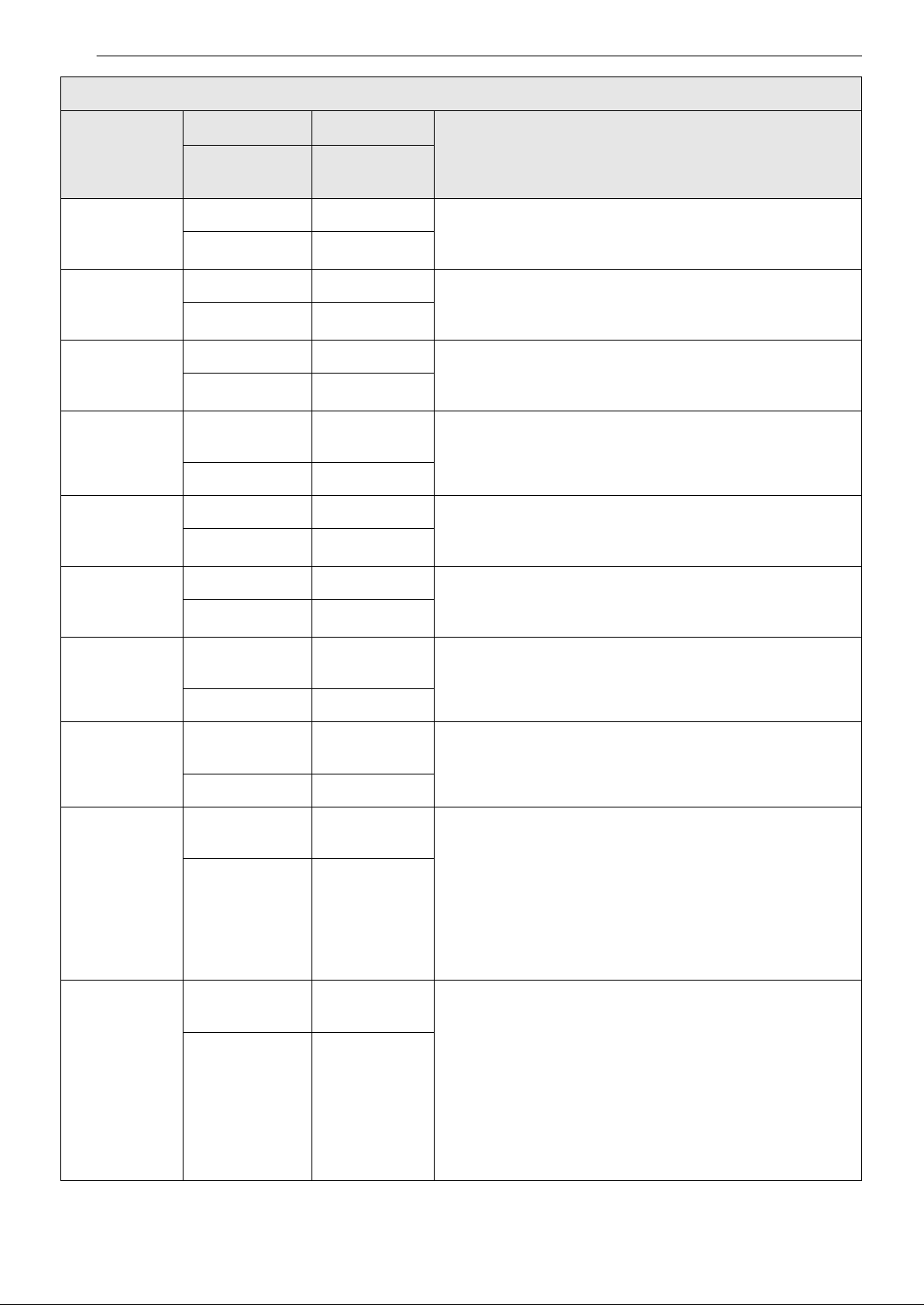
94 OPERATION
Tater Tots
1~4 servings Frozen Place the frozen tater tots on the LG air fry tray with a
catch pan below.
1 serving is about 12 oz.
Air Fry Tray 3
French Fries
Straight
1~4 servings Frozen Place frozen french fries on the LG air fry tray with a catch
pan below.
1 serving is about 5 oz.
Air Fry Tray 4
French Fries
Crinkled
1~4 servings Frozen Place frozen french fries on the LG air fry tray with a catch
pan below.
1 serving is about 8 oz.
Air Fry Tray 4
Hash Browns
Patties
4~16 EA (2.3 oz
each)
Frozen
Place frozen hash browns on the LG air fry tray with a
catch pan below.
Air Fry Tray 4
Sweet Potato
Fries
1~4 servings Frozen Place frozen sweet potato fries on the LG air fry tray with
a catch pan below.
1 serving is about 6 oz.
Air Fry Tray 4
Onion Rings
1~4 servings Frozen Place frozen onion rings on the LG air fry tray with a catch
pan below.
1 serving is about 5 oz.
Air Fry Tray 4
Breaded Fish
Fillets
4~16 EA (2 oz
each)
Frozen
Place frozen breaded fish fillets on the LG air fry tray with
a catch pan below.
Air Fry Tray 4
Breakfast
Sausages
6~24 EA (1 oz
each)
Frozen
Place frozen breakfast sausages on the LG air fry tray
with a catch pan below.
Air Fry Tray 4
Corn Dogs
2~8EA (2.75 oz
each)
Frozen
1) Remove corn dogs from packaging.
2) Place the corn dogs on the half sheet pan in the
oven for image recognition.
3) Remove the corn dogs on the half sheet pan while
preheating the oven.
4) Afterpreheating, place half sheet pan with corn
dogs back in the oven.
1/2 Sheet Pan 4
Egg Rolls
2~4EA (2.7 oz
each)
Frozen
1) Remove egg rolls from packaging.
2) Place the egg rolls on the half sheet pan in the
oven for image recognition.
3) Remove the egg rolls on the half sheet pan while
preheating the oven.
4) After preheating, place half sheet pan with egg
rolls back in the oven.
5) When the oven beeps, flip the egg rolls over.
1/2 Sheet Pan 3
Frozen Products
Menu
Amount Food Temp.
Instructions
Cookware
Rack
Position
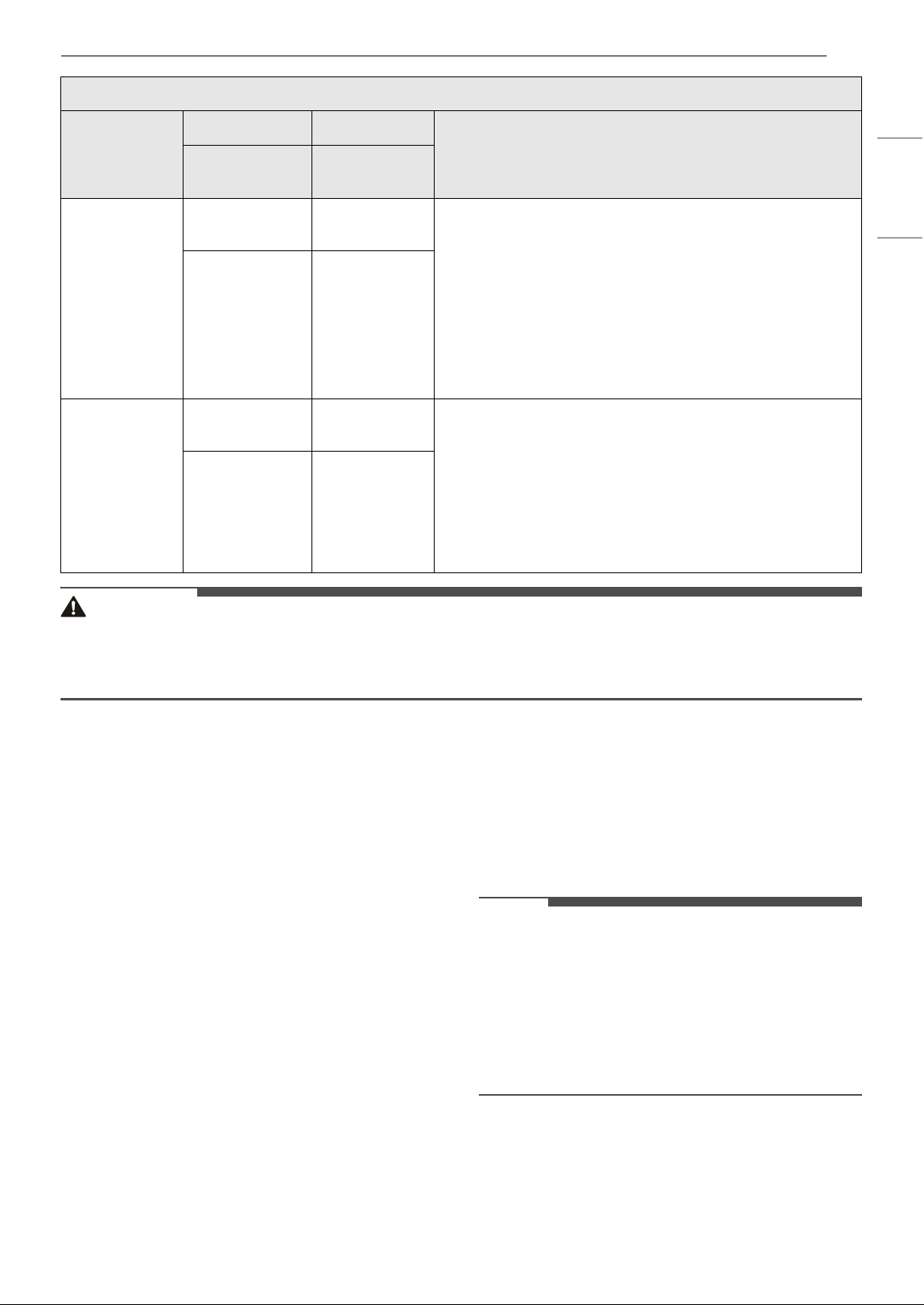
95OPERATION
ENGLISH
CAUTION
• Take care when opening the oven door during or after steam cooking. Hot steam can cause scalding.
• After any steam cooking cycle, the drying function will run automatically. It is normal to hear the steam
pump running during the drying function.
My Recipes
For frequently used cooking menus, you can
combine up to three different temperatures and
cooking modes into one hot key.
Creating My Recipe
1 Press the POWER button and tap My Recipe.
2 Tap Create.
3 Select a first cook mode listed in the display
and set the desired temperature and cook
time.
4 If there are no additional cooking stages, tap
Done. To add another cooking stage, set a
cooking time or probe temperature for the
first stage. Then tap Add Stage.
5 Repeat steps 3-4 until all desired cooking
stages have been entered. Then tap Done.
6 Enter a name for your recipe using the
keyboard and tap Save.
NOTE
• When combining two or more cooking modes, a
cooking time or probe temperature must be set
before selecting an additional cooking mode.
• The probe cannot be used with the Broil, Warm
or Proof modes.
• If the probe was inserted in the oven jack to add
a probe temperature, remember to remove it.
Meatballs
6~24 EA (0.5 oz
each)
Frozen
1) Remove meatballs from packaging.
2) Place the meatballs on the halfsheet pan in the
oven for image recognition.
3) Remove the meatballs on the half sheet pan while
preheating the oven.
4) After preheating, place half sheetpan with
meatballs back in the oven.
5) When the oven beeps, flip the meatballs over.
1/2 Sheet Pan 3
Pretzels
2~6EA (2.2 oz
each)
Frozen
1) Remove pretzels from packaging.
2) Place the pretzels on the half sheet pan in the
oven for imagerecognition.
3) Remove the pretzels on the half sheet pan while
preheating the oven.
4) After preheating, place half sheet pan with
pretzels back in the oven.
1/2 Sheet Pan 3
Frozen Products
Menu
Amount Food Temp.
Instructions
Cookware
Rack
Position

96 SMART FUNCTIONS
SMART FUNCTIONS
LG ThinQ Application
This feature is only available on models with Wi-Fi.
The LG ThinQ application allows you to
communicate with the appliance using a
smartphone.
LG ThinQ Application Features
• My Recipes
- Download new and special cooking recipes
that are not included in the standard cooking
mode on the appliance. Once My Recipes
download is completed in the appliance, the
appliance keeps the recipes. You can only
create, edit or delete the recipes in the LG
ThinQ application.
• Scan to Cook (USA Only)
- Scan the barcode on a ready-made meal using
the LG ThinQ application and send the
recommended or customized cooking
instructions straight to your oven. Remote
Start must be activated on the oven to use
Scan to Cook.
• RealTime View
- See video from inside the oven while cooking
using the LG ThinQ application. If you want,
you can take pictures. The appliance must be
connected to a home Wi-Fi network and the LG
ThinQ application to use the RealTime View
function.
• Cook record
- The camera can record the cooking process
and make a Time Lapse video. The appliance
must be connected to a home Wi-Fi network
and the LG ThinQ application to use the Cook
Record function.
• Product Upgrades
- On models with the LG UP Home Appliance
feature, experience new features by
upgrading the product through the LG ThinQ
app.
• Monitoring
- This function helps you check the current
status, remaining time, cook settings and end
time in one place.
• Product Notifications
- Turn on the Push Alerts to receive appliance
status notifications. The notifications are
triggered even if the LG ThinQ application is
not open.
• Timer
- You can set the timer from the application.
• Settings
- Allows you to set various options on the oven
and in the application.
• Smart Diagnosis
TM
- This function provides useful information for
diagnosing and solving issues with the
appliance based on the pattern of use.
• Firmware Update
- Keep the appliance updated.
NOTE
• In the following cases, you must update the
network information for each appliance in the
LG ThinQ application under Device Cards
~
Settings
~ Change Network.
- wireless router is changed
- wireless router password is changed
- Internet service provider is changed
• This information is current at the time of
publication. The application is subject to change
for product improvement purposes without
notice to users.
Installing LG ThinQ Application and
Connecting an LG Appliance
Models with QR Code
Scan the QR code attached to the product using
the camera or a QR code reader application on
your smartphone.
Models without QR Code
1 Search for and install the LG ThinQ
application from the Google Play Store or
Apple App Store on a smartphone.
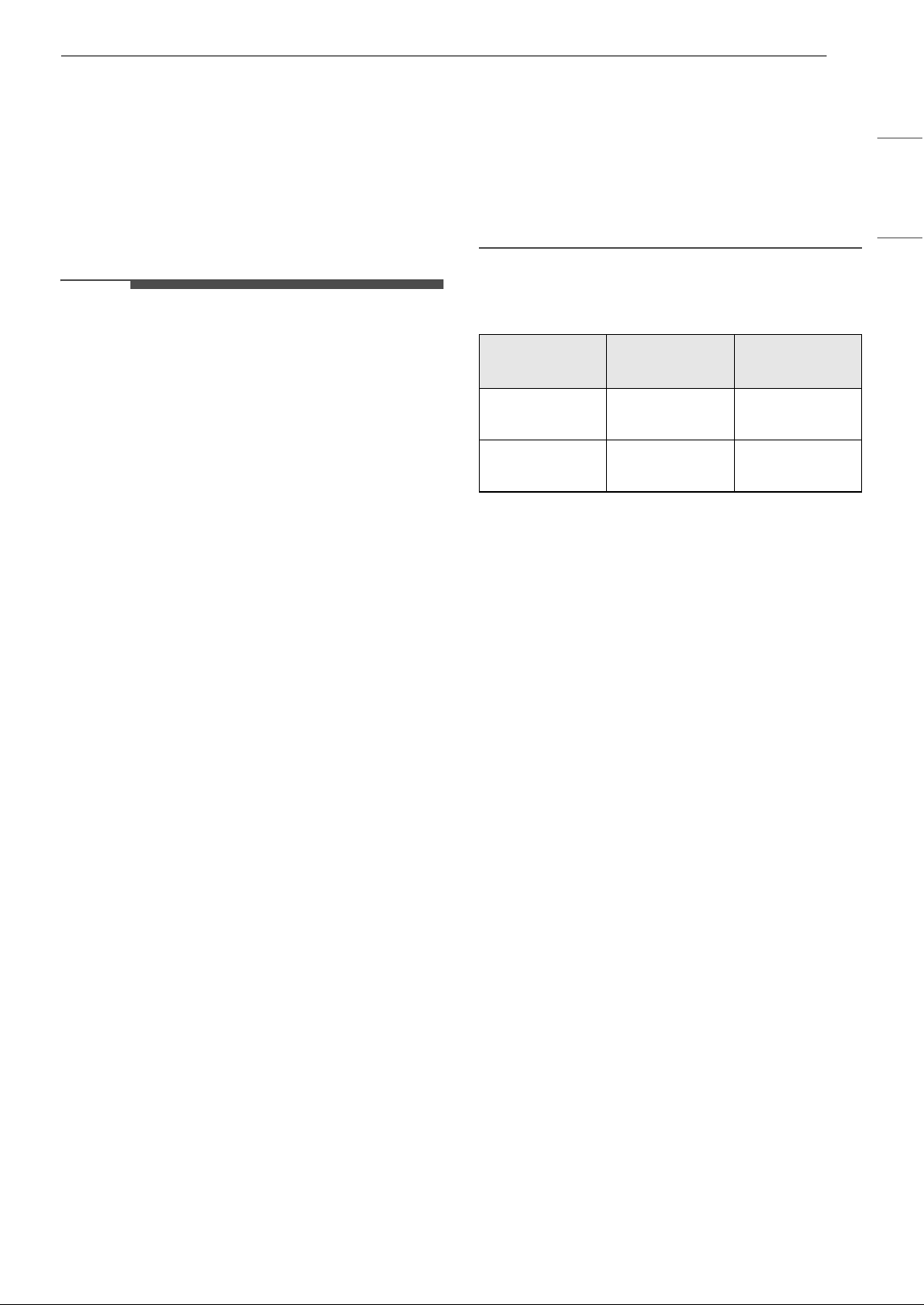
97SMART FUNCTIONS
ENGLISH
2 Run the LG ThinQ application and sign in with
your existing account or create an LG account
to sign in.
3 Touch the add (~) button on the LG ThinQ
application to connect your LG appliance.
Follow the instructions in the application to
complete the process.
NOTE
• To verify the Wi-Fi connection, check that the f
icon on the control panel is lit.
• The appliance supports 2.4 GHz Wi-Fi networks
only. To check your network frequency, contact
your Internet service provider or refer to your
wireless router manual.
• LG ThinQ is not responsible for any network
connection problems or any faults, malfunctions,
or errors caused by network connection.
• The surrounding wireless environment can
make the wireless network service run slowly.
• If the distance between the appliance and the
wireless router is too far, the signal becomes
weak. It may take a long time to connect or fail
to install the application.
• If the appliance is having trouble connecting to
the Wi-Fi network, it may be too far from the
router. Purchase a Wi-Fi repeater (range
extender) to improve the Wi-Fi signal strength.
• The network connection may not work properly
depending on the Internet service provider.
• The Wi-Fi may not connect or the connection
may be interrupted because of the home
network environment.
• If the appliance cannot be connected due to
problems with the wireless signal transmission,
unplug the appliance and wait about a minute
before trying again.
• If the firewall on your wireless router is enabled,
disable the firewall or add an exception to it.
• The wireless network name (SSID) should be a
combination of English letters and numbers. (Do
not use special characters.)
• Smartphone user interface (UI) may vary
depending on the mobile operating system (OS)
and the manufacturer.
• If the security protocol of the router is set to
WEP, network setup may fail. Change the
security protocol (WPA2 is recommended), and
connect the product again.
• To disable the Wi-Fi function, press and hold the
Wi-Fi button for 3 seconds. The Wi-Fi indicator
will be turned off.
• To reconnect the appliance or add another user,
press and hold the Wi-Fi button for 3 seconds.
Run the LG ThinQ application and follow the
instructions in the application to connect the
appliance.
RF Module Specifications
† This feature is only available on some models.
FCC Statement
This equipment has been tested and found to
comply with the limits for a Class B digital device,
pursuant to part 15 of the FCC Rules. These limits
are designed to provide reasonable protection
against harmful interference in a residential
installation. This equipment generates, uses and
can radiate radio frequency energy and, if not
installed and used in accordance with the
instructions, may cause harmful interference to
radio communications. This equipment generates
and uses ISM frequency energy and if not installed
and used properly, that is in strict accordance with
the manufacturer’s instructions, may cause
interference to radio and television reception. It
has been type tested and found to comply with
limits for ISM Equipment pursuant to part 18 FCC
Rules, which are designed to provide reasonable
protection against such interference in a
residential installation. However, there is no
guarantee that interference will not occur in a
particular installation. If this equipment does
cause harmful interference to radio or television
reception, which can be determined by turning the
equipment off and on, the user is encouraged to
try to correct the interference by one or more of
the following measures:
• Reorient or relocate the receiving antenna.
• Increase the separation between the equipment
and receiver.
Type
Frequency
Range
Output
Power (Max.)
Wi-Fi
2 412 - 2 472
MHz
< 12 mW/MHz
Bluetooth
†
2 402 - 2 480
MHz
< 3.6 mW

98 SMART FUNCTIONS
• Connect the equipment into an outlet on a
circuit different from that to which the receiver is
connected.
• Consult the dealer or an experienced radio/TV
technician for help.
This device complies with part 15 of the FCC Rules.
Operation is subject to the following two
conditions:
(1) This device may not cause harmful interference
and
(2) This device must accept any interference
received, including interference that may cause
undesired operation.
Any changes or modifications in construction of
this device which are not expressly approved by
the party responsible for compliance could void
the user’s authority to operate the equipment.
FCC RF Radiation Exposure Statement
This equipment complies with FCC radiation
exposure limits set forth for an uncontrolled
environment. This transmitter must not be co-
located or operating in conjunction with any other
antenna or transmitter.
This equipment should be installed and operated
with a minimum distance of 20 cm (7.8 inches)
between the antenna and your body. Users must
follow the specific operating instructions for
satisfying RF exposure compliance.
Open Source Software Notice
Information
To obtain the source code that is contained in this
product, under GPL, LGPL, MPL, and other open
source licenses that have the obligation to disclose
source code, and to access all referred license
terms, copyright notices and other relevant
documents, please visit https://
opensource.lge.com.
LG Electronics will also provide open source code
to you on CD-ROM for a charge covering the cost
of performing such distribution (such as the cost of
media, shipping, and handling) upon email
request to open[email protected].
This offer is valid to anyone in receipt of this
information for a period of three years after our
last shipment of this product.
Smart Diagnosis
TM
Feature
Use this feature to help you diagnose and solve
problems with your appliance.
NOTE
• For reasons not attributable to LGE’s negligence,
the service may not operate due to external
factors such as, but not limited to, Wi-Fi
unavailability, Wi-Fi disconnection, local app
store policy, or app unavailability.
• The feature may be subject to change without
prior notice and may have a different form
depending on where you are located.
Using LG ThinQ to Diagnose Issues
If you experience a problem with your Wi-Fi
equipped appliance, it can transmit
troubleshooting data to a smartphone using the
LG ThinQ application.
• Launch the LG ThinQ application and select the
Smart Diagnosis feature in the menu. Follow
the instructions provided in the LG ThinQ
application.
Using Audible Diagnosis to
Diagnose Issues
Follow the instructions below to use the audible
diagnosis method.
• Launch the LG ThinQ application and select the
Smart Diagnosis feature in the menu. Follow
the instructions for audible diagnosis provided
in the LG ThinQ application.
1 Tap the Settings icon at the top right of the
screen, tap Maintenance & Info, tap Smart
Diagnosis and tap Start to start the
diagnostic tone.
- If the display has been locked, you must
deactivate the lock and then reactivate it.
2 Place your phone's mouthpiece near the top
left corner of the screen.

99SMART FUNCTIONS
ENGLISH
3 Keep the phone in place until the tone
transmission has finished. The display will
count down the time. Once the countdown
is over and the tones have stopped, the
diagnosis will be displayed in the
application.
NOTE
• For best results, do not move the phone while
the tones are being transmitted.
100 MAINTENANCE
MAINTENANCE
Cleaning
CAUTION
• Do not clean this appliance with bleach.
• To prevent burns, wait until the cooktop has
cooled down before touching any of its parts.
• Always wear gloves when cleaning the cooktop.
Interior
Do not use oven cleaners to clean the oven cavity.
Use the product's EasyClean function regularly to
clean light soil. For stubborn soil, use the Self
Clean function (on some models) or clean
manually using the following tips.
• A plastic spatula can be used as a scraper to
scrape off any chunks or debris before and
during oven cleaning.
• Using the rough side of a non-scratch scouring
pad may help to take off burnt-on stains better
than a soft sponge or towel.
• Certain non-scratch scrubbing sponges, such as
those made of melamine foam, available at local
stores, can also help improve cleaning.
CAUTION
• Do not use oven cleaners, harsh chemical
cleaners, bleach, vinegar, steel scouring pads, or
abrasive pads or cleansers to clean the oven, as
they can permanently damage the oven surface.
• Do not clean the gasket.
Exterior
Control Panel
To prevent activating the control panel during
cleaning, disconnect power to the appliance. Clean
up splatters with a damp cloth using a glass
cleaner. Remove heavier soil with warm, soapy
water. Do not use abrasives of any kind.
Front Manifold Panel and Knobs
It is best to clean the manifold panel after each use
of the range. For cleaning, use a damp cloth and
mild soapy water or a 50/50 solution of vinegar
and water. Rinse with clean water and polish dry
with a soft cloth.
CAUTION
• Do not use abrasive cleansers, strong liquid
cleaners, plastic scouring pads or oven cleaners
on the manifold panel. Doing so will damage the
finish.
• Do not try to bend the knobs by pulling them up
or down, and do not hang a towel or other
objects on them. This can damage the gas valve
shaft.
• The control knobs may be removed for easy
cleaning.
• To clean the knobs, make sure that they are in
the OFF position and pull them straight off the
stems.
• To replace the knobs, make sure the knob has
the OFF position centered at the top, and slide
the knob directly onto the stem.
NOTE
• To prevent scratching, do not use abrasive
cleaners on any of these materials.
Painted and Decorative Trim
For general cleaning, use a cloth with hot soapy
water. For more difficult soil and built-up grease,
apply a liquid detergent directly onto the soil.
Leave it on for 30 to 60 minutes. Rinse with a damp
cloth and dry. Do not use abrasive cleaners.
Stainless Steel Surfaces
To avoid scratches, do not use steel wool pads.
1 Place a small amount of stainless steel
appliance cleaner or polish on a damp cloth or
paper towel.
2 Clean a small area, rubbing with the grain of
the stainless steel if applicable.
3 Dry and buff with a clean, dry paper towel or
soft cloth.
4 Repeat as necessary.
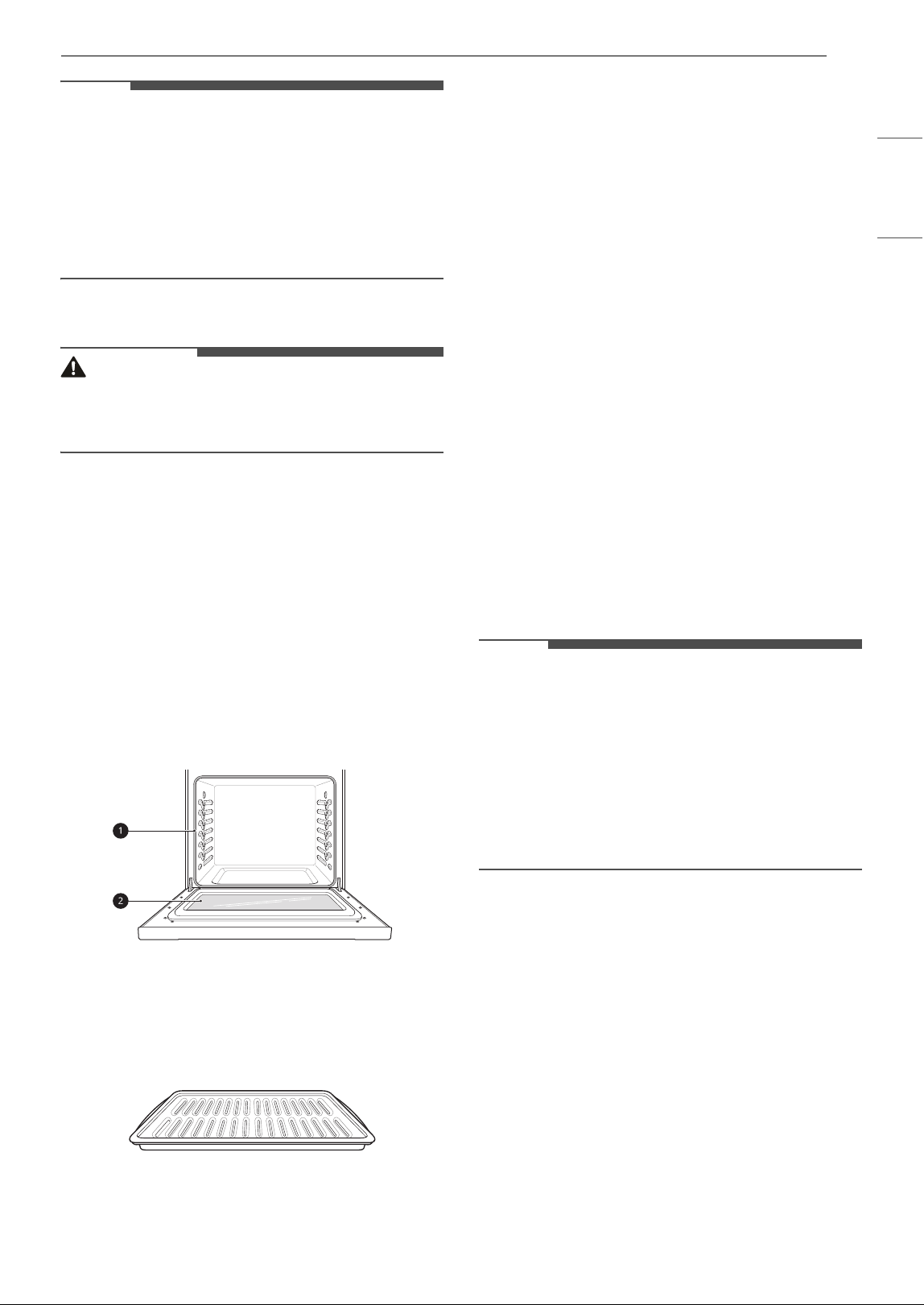
101MAINTENANCE
ENGLISH
NOTE
• To clean the stainless steel surface, use warm
sudsy water or a stainless steel cleaner or polish.
• Always wipe in the direction of the metal surface
finish.
• Stainless steel appliance cleaner or polish can be
purchased online or from most retailers of
appliances or home goods.
Oven Door
CAUTION
• Do not use harsh cleaners or harsh abrasive
cleaning materials on the outside of the oven
door. Doing so can cause damage.
• Use soapy water to thoroughly clean the oven
door. Rinse well. Do not immerse the door in
water.
• You may use a glass cleaner on the outside glass
of the oven door. Do not spray water or glass
cleaner on the door vents.
• Do not use oven cleaners, cleaning powders, or
harsh abrasive cleaning materials on the outside
of the oven door.
• Do not clean the oven door gasket. The oven
door gasket is made of a woven material that is
essential for a good seal. Care should be taken
not to rub, damage, or remove this gasket.
a Don’t hand clean oven door gasket
b Do hand clean door
Broiler Pan and Grid
• Do not store a soiled broiler pan or grid
anywhere in the range.
• Do not clean the broiler pan or grid in a self
cleaning mode. (Available on some models)
• Remove the grid from the pan. Carefully pour
out the grease from the pan into a proper
container.
• Wash and rinse the broiler pan and grid in hot
water with a soap-filled or plastic scouring pad.
• If food has burned on, sprinkle the grid with
cleaner while hot and cover with wet paper
towels or a dishcloth. Soaking the pan will
remove burned-on foods.
• Both the broiler pan and grid may be cleaned
with a commercial oven cleaner or in the
dishwasher.
Oven Racks
Remove the oven racks before operating the Self
Clean cycle (on some models) and EasyClean.
1 Clean with a mild, abrasive cleaner.
• Food spilled into the tracks could cause the
racks to become stuck.
2 Rinse with clean water and dry.
NOTE
• For models with Self Clean function:
- If the racks are cleaned using the Self Clean
cycle (not recommended), the color will turn
slightly blue and the finish will become dull.
After the Self Clean cycle is complete, and the
oven has cooled, rub the sides of the racks
with wax paper or a cloth containing a small
amount of oil. This will make the racks glide
more easily into the rack tracks.
Vent Louvers
• The appearance of the range may differ from
model to model.
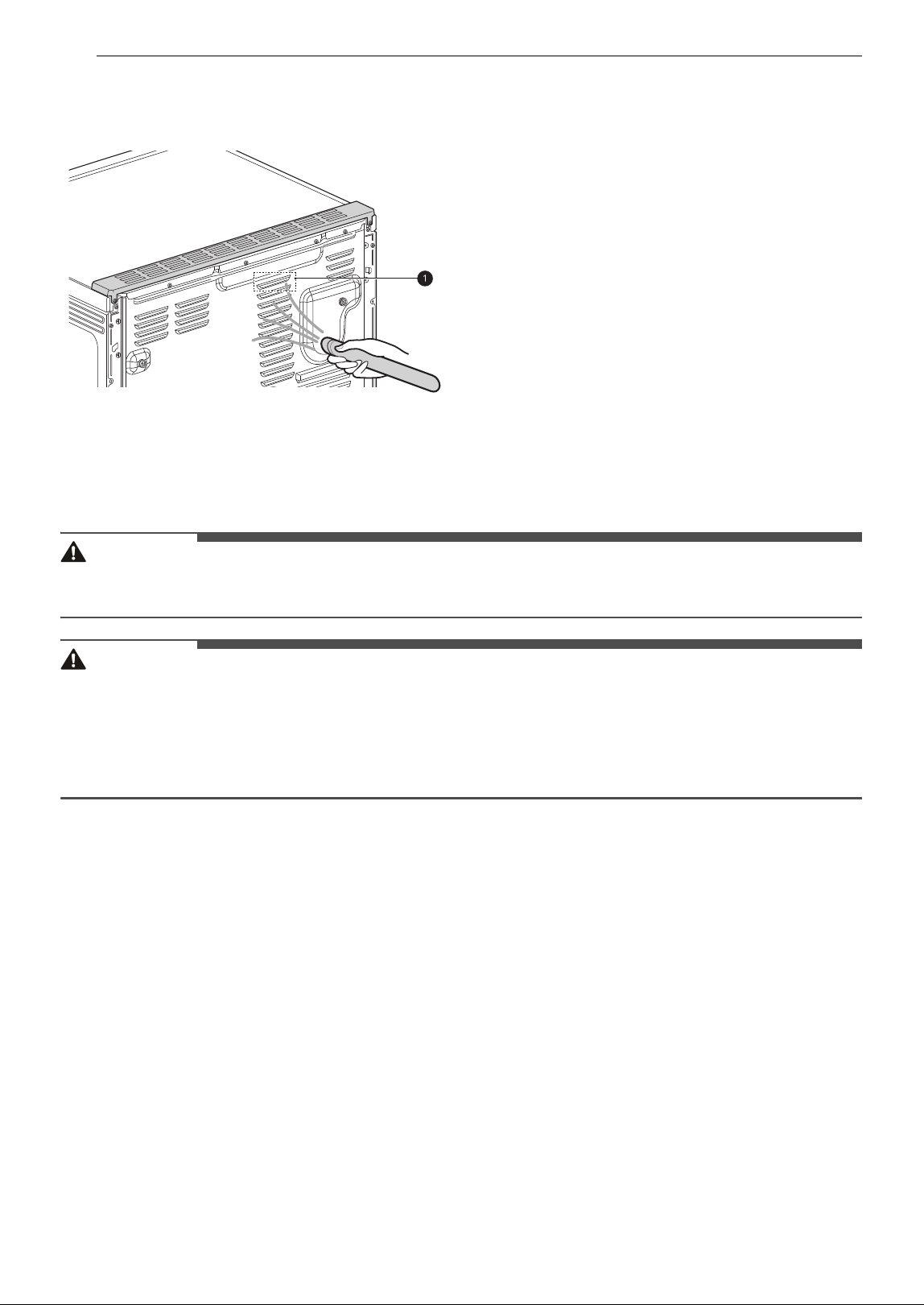
102 MAINTENANCE
Use a vacuum cleaner with a brush or crevice
attachment to clean the vent louvers
a. Do not
remove the panel covering the range.
Cooktop Surface
Glass-Ceramic Cooktop
WARNING
• To protect hands from burns, always wear oven mitts or use pot holders while using a scraper on the hot
cooking surface.
CAUTION
• If any sugar or food containing sugar spills, or plastic or foil melts on the cooktop, remove the material
IMMEDIATELY with a metal razor scraper while the cooking surface is still hot to avoid the risk of damage
to the glass-ceramic surface. When used correctly, the scraper will not damage the cooktop surface.
• If water or food containing water spills, remove the spill IMMEDIATELY with a dry paper towel.
• Do not use scrub pads or abrasive cleaning pads. They may damage your cooktop surface.
Use ceramic cooktop cleaner on the glass cooktop. Other cleaners may not be as effective or may scratch,
damage or stain the cooktop surface.
To maintain and protect the surface of the glass cooktop, follow these steps:
1 Before using the cooktop for the first time, clean it with a ceramic cooktop cleaner. This helps protect
the top and makes cleanup easier.
2 Use ceramic cooktop cleaner daily to help keep the cooktop looking new.
3 Shake the cleaner well. Apply a few drops of cleaner directly to the cooktop.
4 Use a paper towel to clean the entire cooktop surface.
5 Rinse with clear water and use a dry cloth or paper towel to remove all cleaning residue.
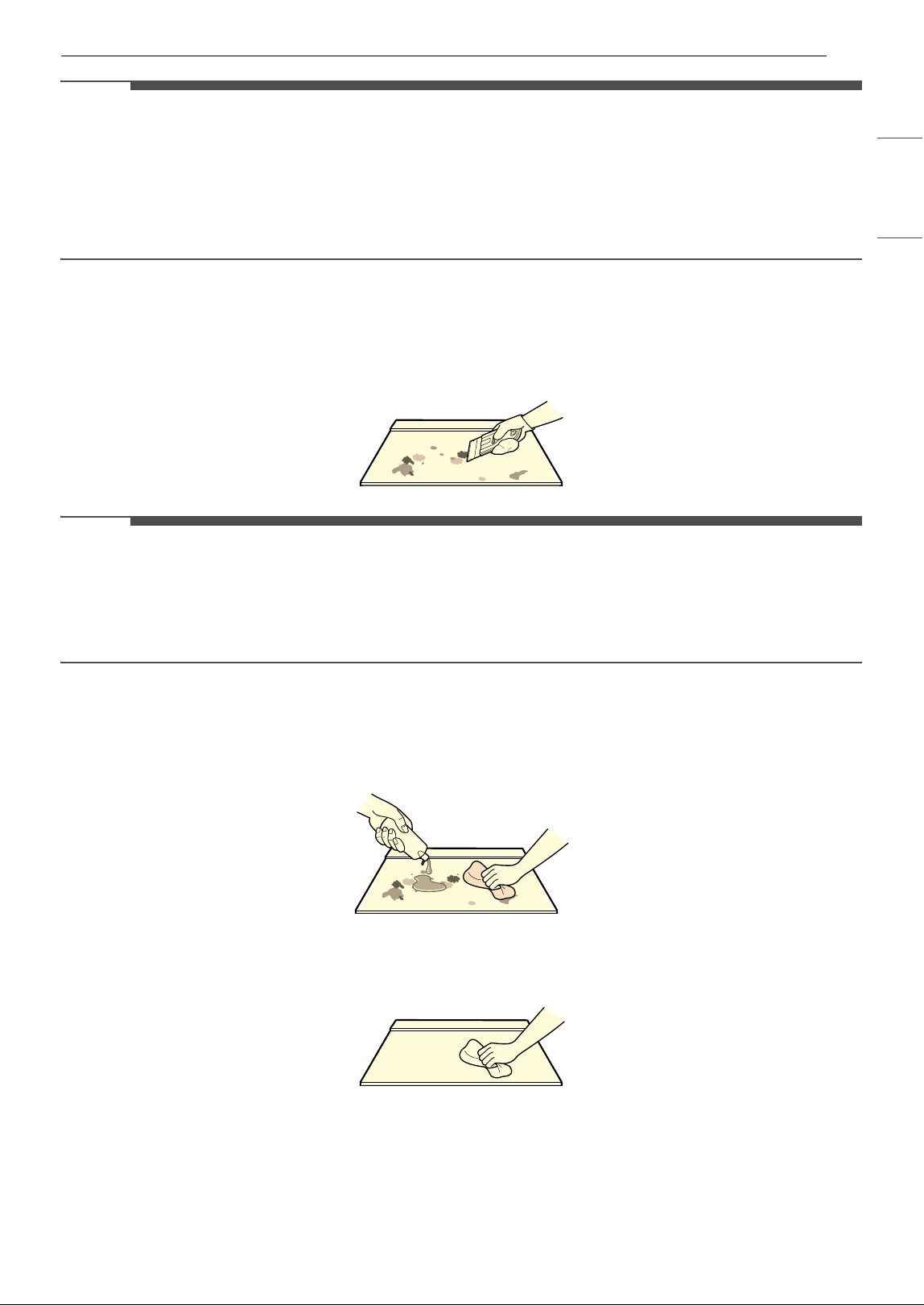
103MAINTENANCE
ENGLISH
NOTE
• Any damage or failure of the product resulting from the items below may not be covered under the
LIMITED WARRANTY.
- Sugary spillovers (such as preserves, ketchup, tomato sauce, jellies, fudge, candy, syrups, or chocolate)
or melted plastics can cause pitting on the surface of your cooktop.
- If food or water containing calcium (such as baking powder, wine, milk, spinach, or broccoli) is spilled
on the cooktop, it can permanently stain or discolor the surface.
Burned-On Residue
1 While the cooktop is still warm, remove any burnt on deposits or spilled food from the glass-ceramic
cooking surface with a suitable metal razor scraper.
NOTE
• Do not use a dull or nicked blade.
• Hold the scraper at approximately a 30° angle to the cooktop.
• The razor scraper will not damage the markings on the cooking surface.
• Take care to avoid damaging the seal when cleaning the cooktop with a metal razor scraper.
2 When the cooking surface has completely cooled, apply a few fingertip-sized dabs of a glass-ceramic
cooktop cleaner in each burner area. Spread the cleaner over the cooktop surface with a damp paper
towel. Leave the cleaner on for 10 minutes before rinsing it off.
3 Rinse with clean water and wipe the cooktop surface with a clean, dry paper towel.
Cooktop Seal
1 To remove burned-on soil from the seal around the outside of the glass-ceramic cooktop, cover the
area with a warm, wet cloth to soften the soil.
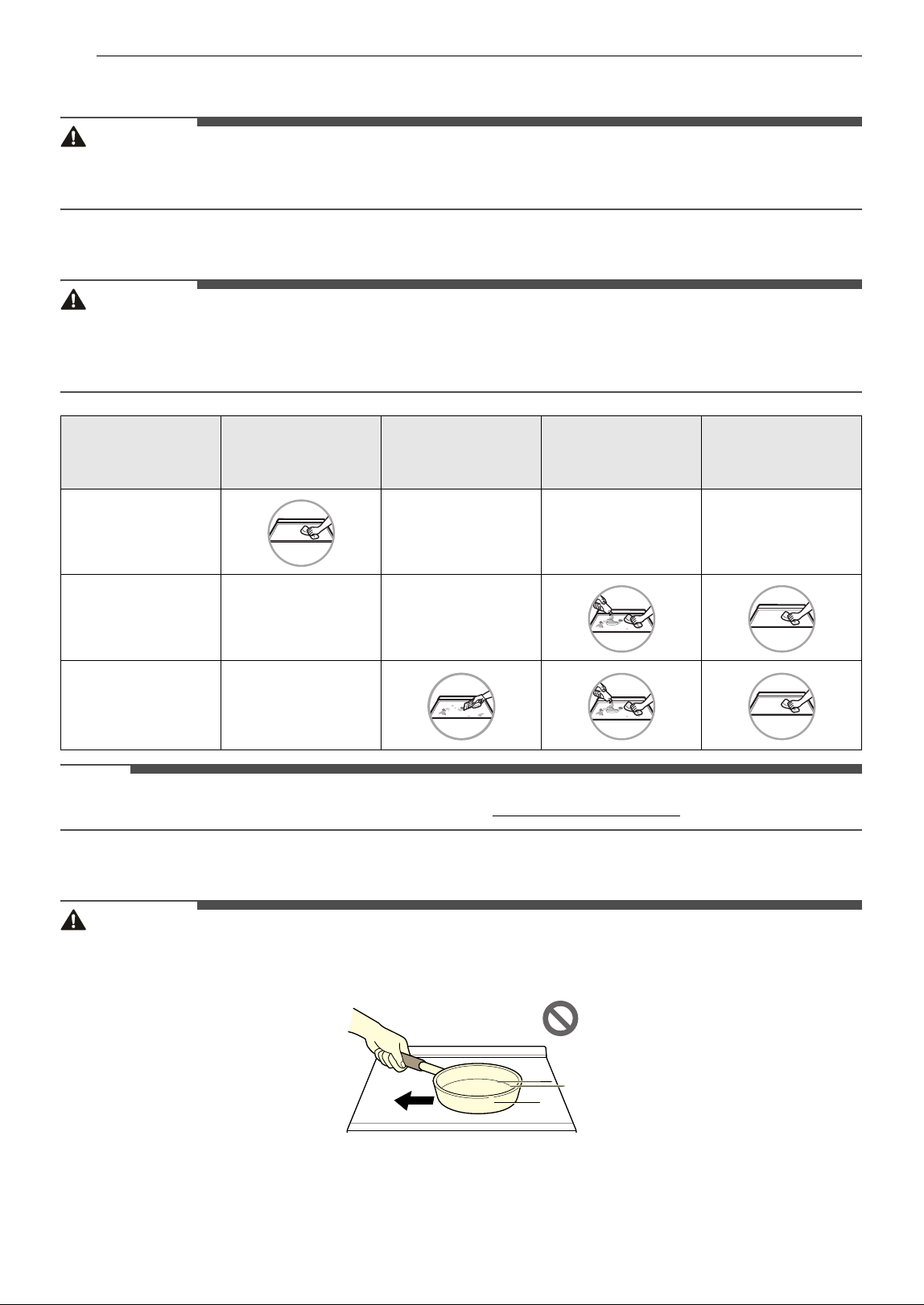
104 MAINTENANCE
2 After a few minutes, wipe the area clean with a mild, nonabrasive cleaner.
CAUTION
• Do not use a knife or any sharp object to clean the seal around the outside of the glass-ceramic cooktop.
• Take care to avoid damaging the seal when cleaning the cooktop with a metal razor scraper.
Maintaining the Cooktop
CAUTION
• Do not use chlorine bleach, ammonia, or other cleaners not specifically recommended for use on glass-
ceramic cooktops.
• Let your glass-ceramic cooking surface cool off before cleaning.
NOTE
• For additional product information, visit our website at www.LGSIGNATURE.com
Metal Marks and Scratches
CAUTION
• Always use heavier gauge, high-quality cookware on the cooking elements and do not slide it on the
ceramic cooktop surface. Even high-quality cookware can scratch the cooktop surface.
• Any cookware that has a rough or dirty bottom can mark and scratch the cooktop surface. Always start
with clean cookware.
-
Wipe off with a
damp towel and
mild detergent
Use a metal
scraper
Apply cooktop
cleaner. Rub with
a towel.
Rinse with a
damp towel, then
wipe dry.
Regular
(Recommended
after each use)
---
Occasional
(Recommended
every week)
--
Thorough
(Recommended for
tough stains or
burnt-on food)
-
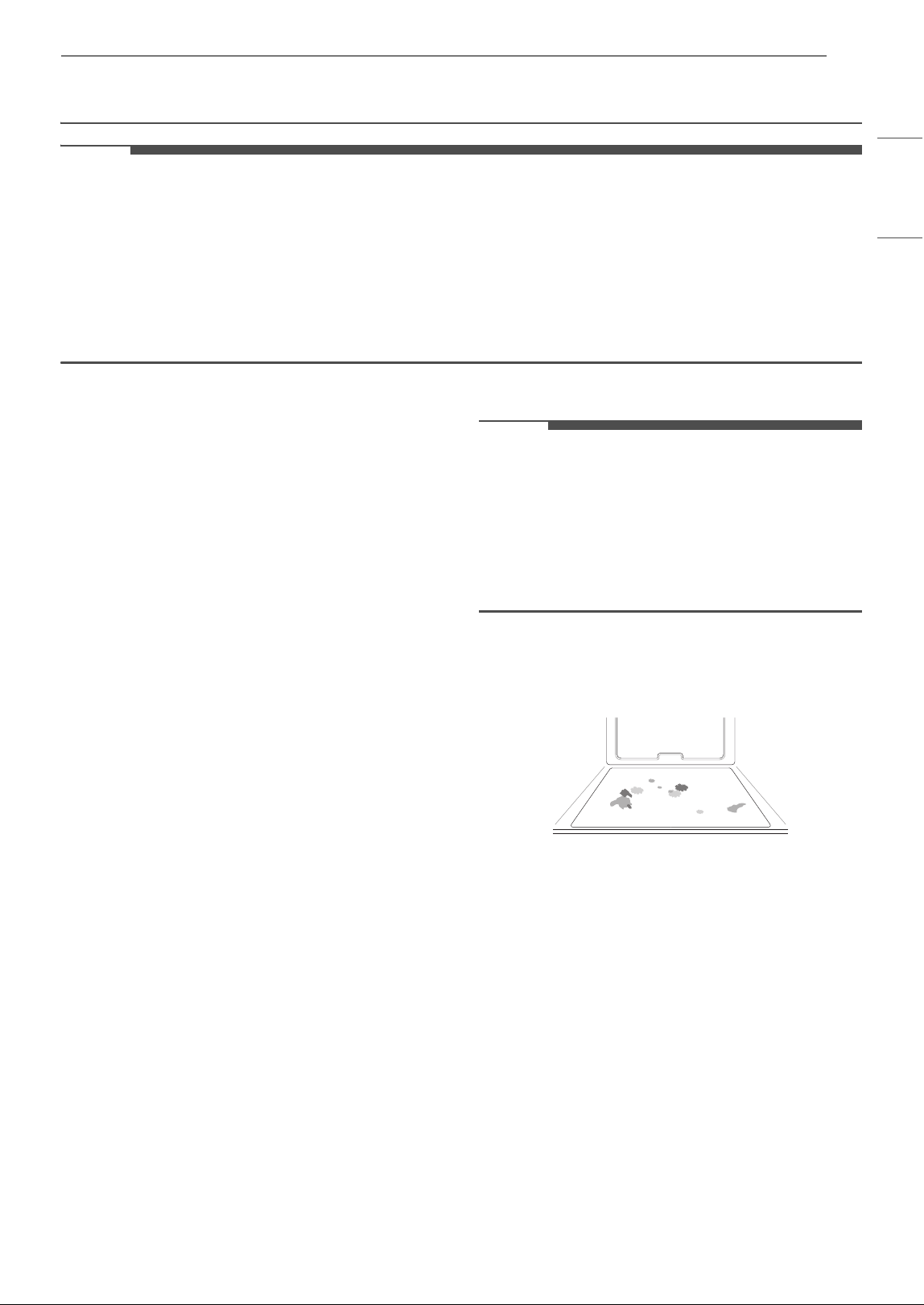
105MAINTENANCE
ENGLISH
• Do not use cookware if there is foreign matter on the cooktop surface. Always clean the cooktop surface
before cooking.
NOTE
• Any damage or failure of the product resulting from the items below may not be covered under the
LIMITED WARRANTY.
- Be careful not to slide pots and pans across the cooktop. Doing so will leave metal markings on the
cooktop surface. To help remove these marks, use a ceramic cooktop cleaner with a cleaning pad for
ceramic cooktops.
- If pots with a thin overlay of aluminum or copper are allowed to boil dry, the overlay may leave a black
discoloration on the cooktop. This should be removed immediately before heating again or the
discoloration may be permanent.
EasyClean
LG’s EasyClean enamel technology provides two
cleaning options for the inside of the range. The
EasyClean feature takes advantage of LG’s new
enamel to help lift soils without harsh chemicals,
and it runs using ONLY WATER for just 10 minutes
in low temperatures to help loosen LIGHT soils
before hand cleaning.
While EasyClean is quick and effective for small
and LIGHT soils, the Self Clean feature can be used
to remove HEAVY, built up soils. The intensity and
high heat of the Self Clean cycle may result in
smoke which will require the opening up of
windows to provide ventilation. Compared to the
more intense Self Clean process, your LG oven
gives you the option of cleaning with LESS HEAT,
LESS TIME, and virtually NO SMOKE OR FUMES.
You can reduce energy use by cleaning light oven
soils with the EasyClean feature instead of Self
Clean.
When needed, the range still provides the Self
Clean option for longer, more thorough oven
cleaning for heavier, built up soils.
• For hard to reach areas such as the back surface
of the oven, it is better to use the Self Clean
cycle.
Benefits of EasyClean
• Helps loosen light soils before hand-cleaning
• EasyClean only uses water; no chemical cleaners
• Makes for a better Self Clean experience
- Delays the need for a Self Clean cycle
- Minimizes smoke and odors
- Can allow shorter Self Clean time
NOTE
• For models without Self Clean option
- The EasyClean feature may not be effective in
removing heavy, built-up soils. Because the
range does not include a Self Clean option,
clean the oven regularly using the EasyClean
feature to prevent heavy, burnt-on soil from
building up in the oven.
When to Use EasyClean
• Example of oven soiling
Case 1
- Soil pattern: Small drops or spots
- Types of soils: Cheese or other ingredients
- Common food items that can soil your oven:
Pizza
Case 2
- Soil pattern: Light splatter
- Types of soils: Fat/grease
- Common food items that can soil your oven:
Steaks, broiled / Fish, broiled / Meat roasted at
low temperatures
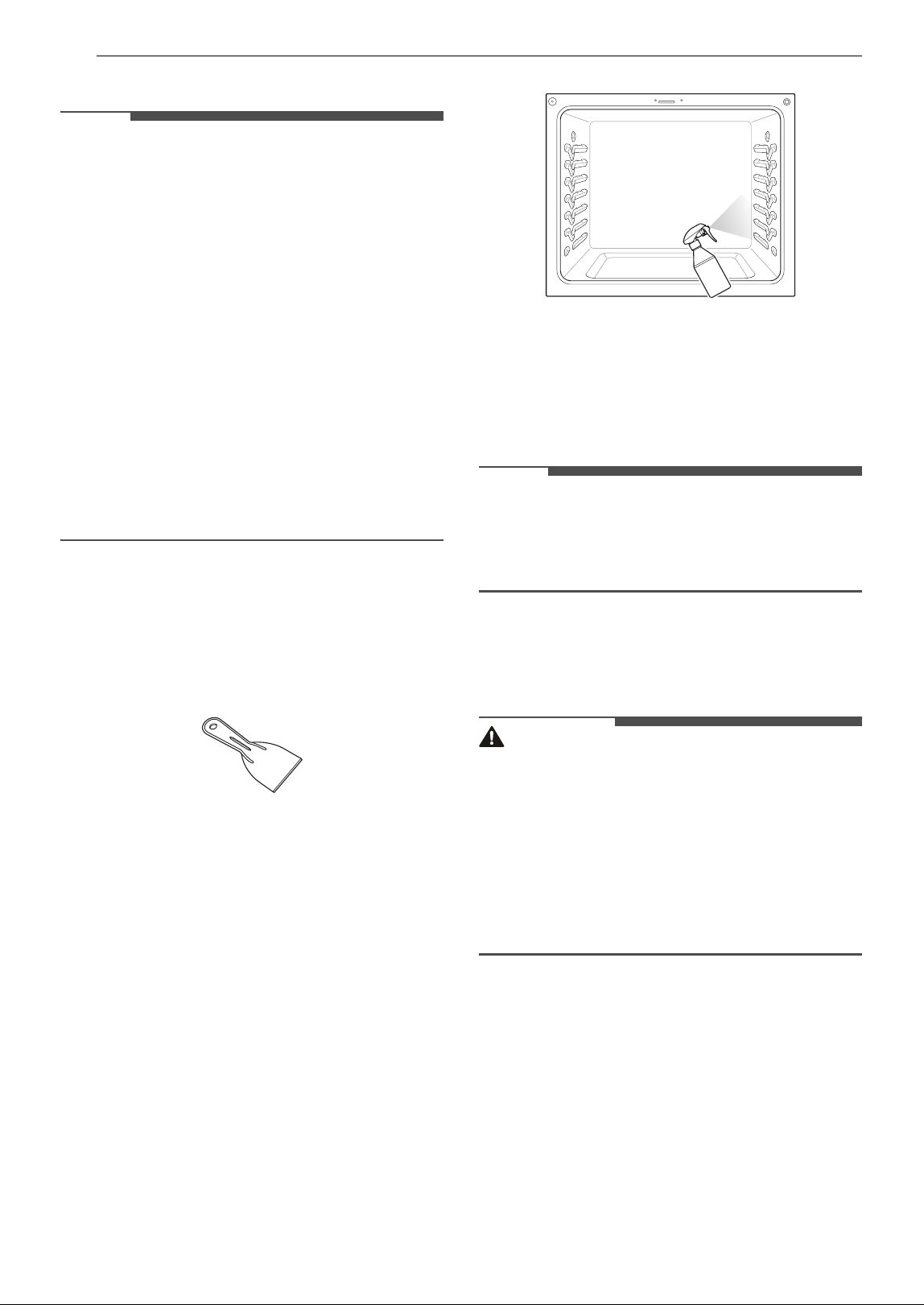
106 MAINTENANCE
EasyClean Instruction Guide
NOTE
• Allow the oven to cool to room temperature
before using the EasyClean cycle. If your oven
cavity is above 150 °F (65 °C), Hot will appear in
the display, and the EasyClean cycle will not be
activated until the oven cavity cools down.
• The range should be level to ensure that the
bottom surface of the oven cavity is entirely
covered by water at the beginning of the
EasyClean cycle.
• For best results, use distilled or filtered water.
Tap water may leave mineral deposits on the
oven bottom.
• Soil baked on through several cooking cycles will
be more difficult to remove with the EasyClean
cycle.
• Do not open the oven door during the EasyClean
cycle. Water will not get hot enough if the door is
opened during the cycle.
1 Remove oven racks and accessories from the
oven.
2 Scrape off and remove any burnt-on debris
with a plastic scraper.
• Suggested plastic scrapers:
- Hard plastic spatula
- Plastic pan scraper
- Plastic paint scraper
- Old credit card
3 Fill a spray bottle (10 oz or 300 ml) with water
and use the spray bottle to thoroughly spray
the inside surfaces of the oven.
4 Use at least 1/5 (2 oz or 60 ml) of the water in
the bottle to completely saturate the soil on
both the walls and in the corners of the oven.
5 Spray or pour the remaining water (8 oz or
240 ml) onto the bottom center of the oven
cavity. The indentation on the oven bottom
should be fully covered to submerge all soils.
Add water if necessary.
NOTE
• If cleaning multiple ovens, use an entire bottle of
water to clean each oven. Do not spray water
directly on the door. Doing so will result in water
dripping to the floor.
6 Close the oven door. Scroll and tap Cleaning.
Tap EasyClean. Tap Start at the bottom right
to begin cleaning.
CAUTION
• Some surfaces may be hot after the EasyClean
cycle. Wear rubber gloves while cleaning to
prevent burns.
• During the EasyClean cycle, the oven becomes
hot enough to cause burns. Wait until the cycle is
over before wiping the inside surface of the
oven. Failure to do so may result in burns.
• Avoid leaning or resting on the oven door glass
while cleaning the oven cavity.
7 A tone will sound at the end of the 10 minute
cycle. Tap Done to complete cooking.
8 After the cleaning cycle and during hand-
cleaning, enough water should remain on the
oven bottom to completely submerge all soils.
Add water if necessary. Place a towel on the
floor in front of the oven to capture any water
that may spill out during hand-cleaning.
107MAINTENANCE
ENGLISH
9 Clean the oven cavity immediately after the
EasyClean cycle by scrubbing with a wet, non-
scratch scouring sponge or pad. (The scouring
side will not scratch the finish.) Some water
may spill into the bottom vents while
cleaning, but it will be captured in a pan under
the oven cavity and will not hurt the burner.
NOTE
• Do not use any steel scouring pads, abrasive
pads or cleaners as these materials can
permanently damage the oven surface.
10 Once the oven cavity is cleaned, wipe any
excess water with a clean dry towel. Replace
racks and any other accessories.
11 If some light soils remain, repeat the above
steps, making sure to thoroughly soak the
soiled areas.
• For models with Self Clean function
- If stubborn soils remain after multiple
EasyClean cycles, run the Self Clean cycle.
Be sure that the oven cavity is empty of
oven racks and other accessories, and
that the oven cavity surface is dry before
running the Self Clean cycle. Consult the
Self Clean section of your owner’s manual
for further details. If a Self Clean option is
not available, scrape off and remove
stubborn soil using a scraper.
NOTE
• If you forget to saturate the inside of the oven
with water before starting EasyClean, turn the
oven mode knob to the OFF position to end the
cycle. Wait for the range to cool to room
temperature and then spray or pour water into
the oven and start another EasyClean cycle.
• The cavity gasket may be wet when the
EasyClean cycle finishes. This is normal. Do not
clean the gasket.
• If mineral deposits remain on the oven bottom
after cleaning, use a cloth or sponge soaked in
vinegar to remove them.
• It is normal for the fan to operate during the
EasyClean cycle.
• Using commercial oven cleaners or bleach to
clean the oven is not recommended. Instead,
use a mild liquid cleanser with a pH value below
12.7 to avoid discoloring the enamel.
Self Clean
The Self Clean cycle uses extremely hot
temperatures to clean the oven cavity. While
running the Self Clean cycle, you may notice
smoking or an odor. This is normal, especially if
the oven is heavily soiled. During Self Clean, the
kitchen should be well ventilated to minimize the
odors from cleaning.
Before Starting Self Clean
• Clean only parts listed in manual. Remove the
oven racks, broiler pan, broiler grid, all
cookware, aluminum foil or any other material
from the oven.
- If oven racks are left in the oven cavity during
the Self Clean cycle, they will discolor and
become difficult to slide in and out.
• The kitchen should be well ventilated to
minimize the odors from cleaning. Open a
window or turn on a ventilation fan or hood
before self-cleaning.
• Wipe any heavy spillovers on the bottom of the
oven.
• Make sure that the oven light cover is in place
and the oven light is off.
• Clean the frame of the oven and door with hot
soapy water. Rinse well.
WARNING
• If the oven is heavily soiled with oil, self-clean the
oven before using the oven again. The oil could
cause a fire.
• If there is a fire in the oven during self-clean,
turn the oven off and wait for the fire to go out.
Do not force the door open. Introduction of
fresh air at self-clean temperatures may lead to
a burst of flame from the oven. Failure to follow
this instruction may result in severe burns.
CAUTION
• Do not use oven cleaners. Commercial oven
cleaner or oven liner protective coating of any
kind should not be used in or around any part of
the oven.
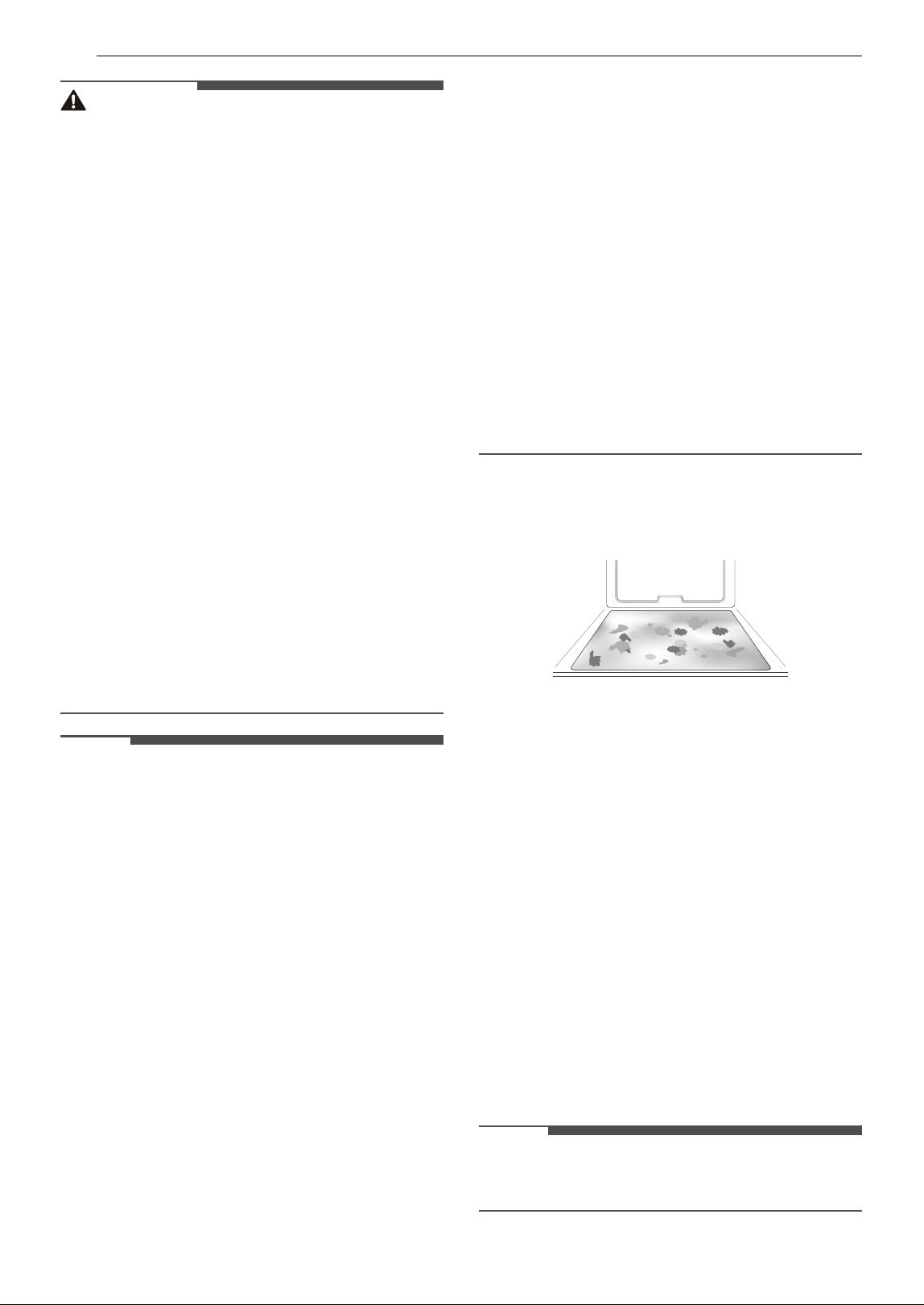
108 MAINTENANCE
CAUTION
•The oven displays an F error code and sounds
three long beeps during the self-cleaning
process if it malfunctions in the self-clean mode.
Switch off the electrical power to the main fuse
or breaker and have the oven serviced by a
qualified technician.
• If the self cleaning mode malfunctions, turn the
range off and disconnect the power supply. Have
it serviced by a qualified technician.
• It is normal for parts of the oven to become hot
during a Self Clean cycle. Avoid touching the
cooktop, door, window or oven vent area during
a Self Clean cycle.
• Do not leave small children unattended near the
appliance. During the Self Clean cycle, the
outside of the range can become very hot to the
touch.
•If you have pet birds, move them to another
well-ventilated room. The health of some birds is
extremely sensitive to the fumes given off during
the Self Clean cycle of any range.
• Do not line the oven walls, racks, bottom or any
other part of the range with aluminum foil or
any other material. Doing so will destroy heat
distribution, produce poor baking results and
cause permanent damage to the oven interior
(aluminum foil will melt to the interior surface of
the oven).
NOTE
• The oven light cannot be turned on during a Self
Clean cycle. The oven light cannot be turned on
until the oven temperature has cooled below
500 ˚F (260 ˚C) after a Self Clean cycle is
complete.
• During the Self Clean cycle, the cooktop
elements and warming drawer cannot be used.
• Clean the frame of the oven and door with hot
soapy water. Rinse well.
• Do not clean the gasket. The fiberglass material
of the oven door gasket cannot withstand
abrasion. It is essential for the gasket to remain
intact. If you notice it becoming worn or frayed,
replace it.
• It is normal for the fan to operate during the Self
Clean cycle.
• As the oven heats, you may hear sounds of metal
parts expanding and contracting. This is normal
and will not damage the oven.
• You may notice some white ash in the oven.
Wipe it off with a damp cloth or a soap-filled
steel wool pad after the oven cools. If the oven is
not clean after one Self Clean cycle, repeat the
cycle.
• If oven racks were left in the oven and do not
slide smoothly after a Self Clean cycle, wipe racks
and rack supports with a small amount of
vegetable oil to make them glide more easily.
• After a Self Clean cycle, fine lines may appear in
the porcelain because it went through heating
and cooling. This is normal and will not affect
performance.
• The Self Clean cycle cannot be started if the
Control Lock / Lockout feature is active.
• If the clock is set for a 12-hour display (default)
the Delayed Self Clean can never be set to start
more than 12 hours in advance.
• After the oven is turned off, the convection fan
keeps operating until the oven has cooled down.
When to Use Self Clean
• Example of oven soiling
Case 1
• Soil pattern: Medium to heavy splatter
• Types of soils: Fat/grease
• Common food items that can soil your oven:
Meat roasted at high temperatures
Case 2
• Soil pattern: Drops or spots
• Types of soils: Filling or sugar based soils
• Common food items that can soil your oven: Pies
Case 3
• Soil pattern: Drops or spots
• Types of soils: Cream or tomato sauce
• Common food items that can soil your oven:
Casseroles
NOTE
• The Self Clean cycle can be used for soil that has
been built up over time.
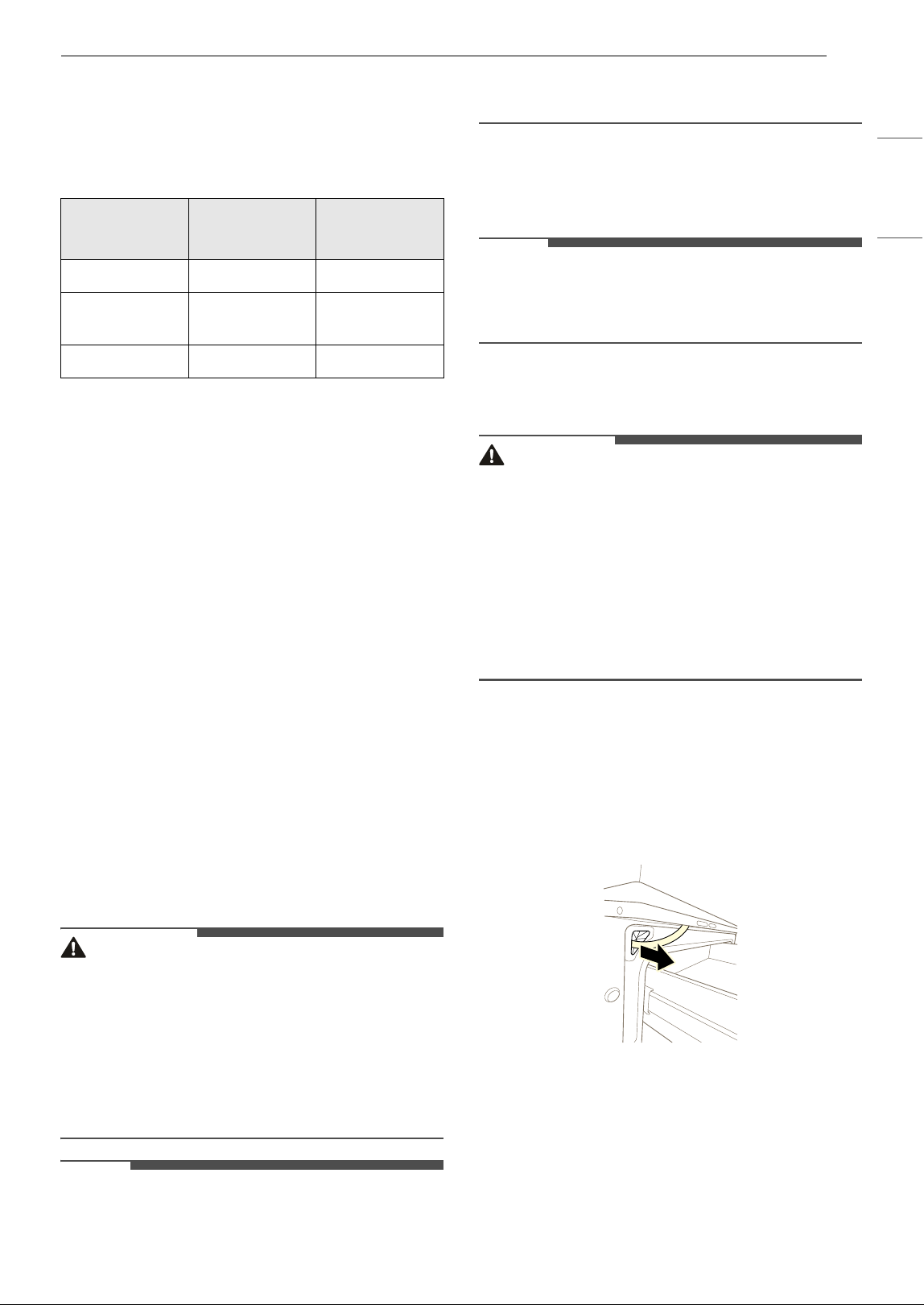
109MAINTENANCE
ENGLISH
Setting Self Clean
The Self Clean function has cycle times of 3, 4, or 5
hours.
Self Clean Setting Guide
1 Remove all racks and accessories from the
oven.
2 Close the oven door. Scroll and tap Cleaning.
Tap Self Clean. The oven defaults to the
recommended four-hour Self Clean for a
moderately soiled oven.
If desired, tap Cleaning Time to set the
cleaning time. Select one of the three: 3 hr, 4
hr, 5 hr.
If desired, tap Starts at to set the cleaning
start time.
3 Tap Start at the bottom right to begin
cleaning.
4 Once the Self Clean cycle is set, the oven door
locks automatically and the lock icon
k
displays. You will not be able to open the oven
door until the oven has cooled. The lock
releases automatically when the oven has
cooled.
CAUTION
• Do not force the oven door open when the lock
icon is displayed. The oven door remains locked
until the oven temperature has cooled. Forcing
the door open will damage the door.
• Use care when opening the oven door after the
Self Clean cycle. Stand to the side of the oven
when opening the door to allow hot air or steam
to escape. The oven may still be VERY HOT.
NOTE
• It may become necessary to cancel or interrupt a
Self Clean cycle due to excessive smoke or fire in
the oven. To cancel the Self Clean function, Tap
Stop at the bottom right.
Removing/Assembling Lift-Off
Oven Doors
NOTE
• Parts may be changed due to product
improvement and may look different than
shown in images.
Door Care Instructions
Most oven doors contain glass that can break.
CAUTION
• Do not close the oven door until all the oven
racks are fully in place.
• Do not hit the glass with pots, pans, or any other
object.
• Scratching, hitting, jarring, or stressing the glass
may weaken its structure causing an increased
risk of breakage at a later time.
• Do not lift the door by the handle. The door is
very heavy.
Removing Doors
1 Fully open the drawer.
2 Pull out the wire harness.
3 Pinch the clip while pulling the connector to
disconnect it.
Oven Cavity
Soil Level
Number
Button
Cycle
Time
Lightly Soiled 1 3 hr.
Moderately
Soiled
24 hr.
Heavily Soiled 3 5 hr.
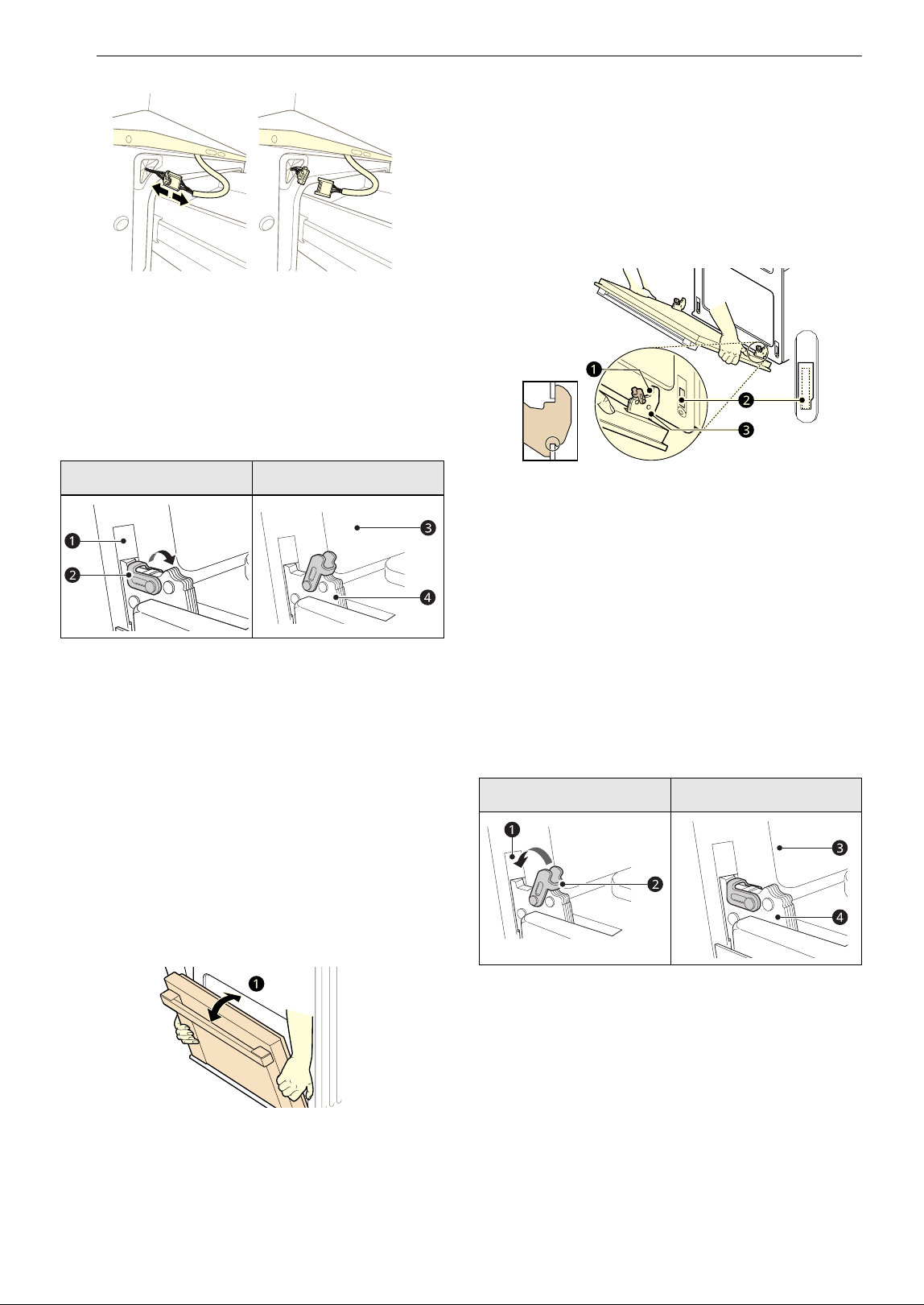
110 MAINTENANCE
4 Fully open the door.
5 Lift up the hinge lock b and flip it towards the
hinge arm d completely. Repeat on other
side.
a Slot
b Hinge Lock
c Oven Frame
d Hinge Arm
6 Firmly grasp both sides of the door at the top.
7 Partially close the door to approximately 5
degrees a. If the position is correct, the hinge
arms will move freely.
a about 5°
8 Lift and pull the door towards you until the
hinge latches are completely loosened.
Assembling Doors
1 Firmly grasp both sides of the door at the top.
2 Fully insert the hinge arms a into the slots b
until the indentations c on the hinge arms
rest on the bottom edges of the slots.
a Hinge Arm
b Bottom Edge of Slot
c Indentation
3 Slowly open the door fully. Make sure that the
hinge arms are properly engaged in the slots.
4 Lift up the hinge lock b and flip it towards the
oven
c until it clicks into position. Repeat on
other side.
a Slot
b Hinge Lock
c Oven Frame
d Hinge Arm
5 Close the oven door.
6 Assemble the wire connector.
Locked Position Unlocked Position
Unlocked Position Locked Position
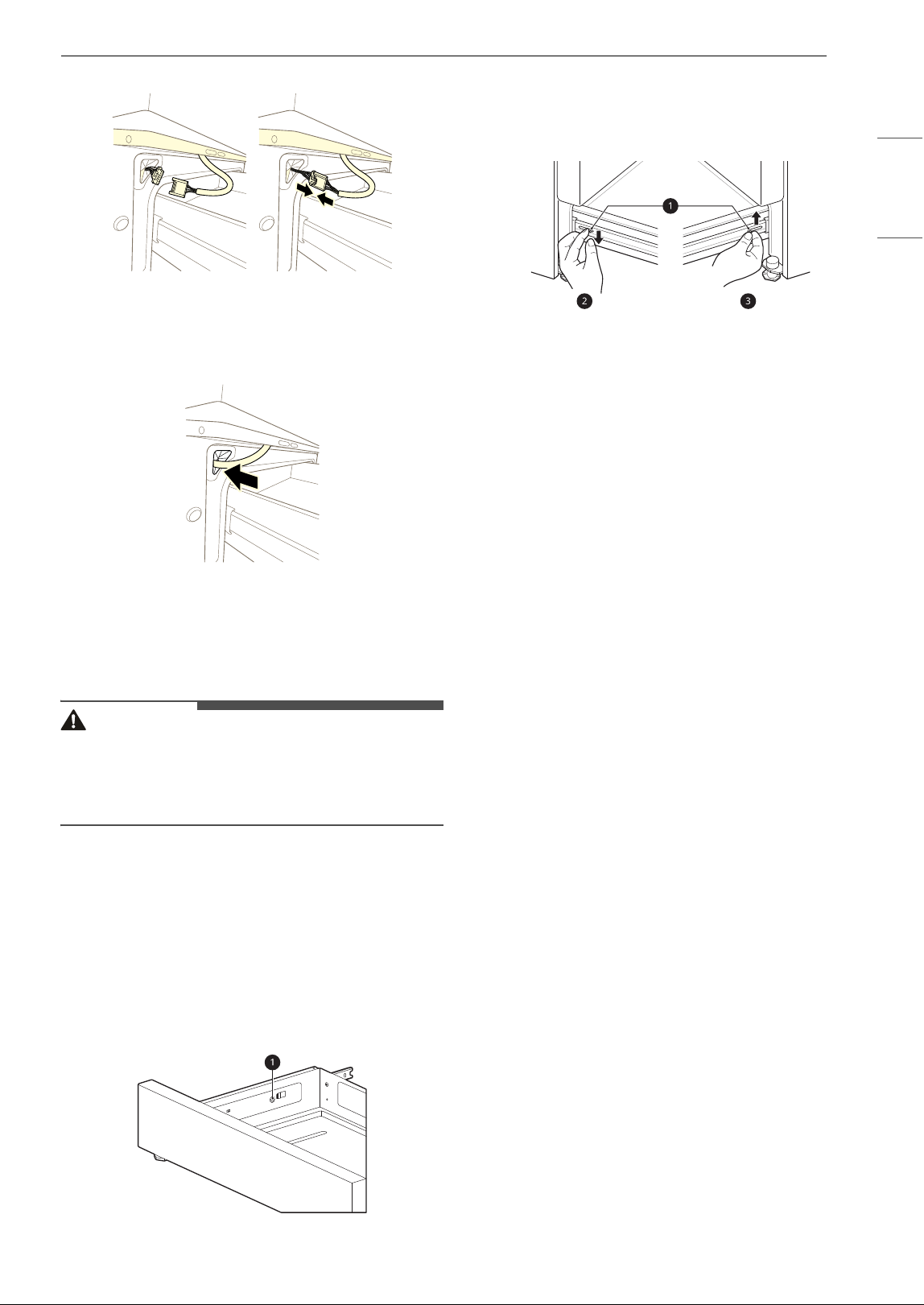
111MAINTENANCE
ENGLISH
7 Insert the wire harness into the hole so that it
enters the drawer.
Removing/Assembling Drawers
Removing Drawers
CAUTION
• Disconnect the electrical power to the range at
the main fuse or circuit breaker panel. Failure to
do so can result in severe personal injury, death,
or electrical shock.
Most cleaning can be done with the drawer in
place; however, the drawer may be removed if
further cleaning is needed. Use warm water to
thoroughly clean.
1 Fully open the drawer.
2 Unscrew the screw a on the side at the back
of the drawer.
3 Locate the glide lever on each side of the
drawer. Push down on the left glide lever and
pull up on the right glide lever.
a Lever
b Push down with finger
c Pull up with finger
4 Pull the drawer away from the range.
Assembling Drawers
1 Pull the bearing glides to the front of the
chassis glide.
2 Align the glide on each side of the drawer with
the glide slots on the range.
3 Push the drawer into the range until levers
click (approximately 2 inches).
4 Insert and tighten the screws on the side at
the back of the drawer.
5 Pull the drawer open again to seat the
bearing glides into position.
Removing/Assembling the Vent
Trim
Removing the Vent Trim
1 Using a screwdriver, remove the two screws
holding the vent trim in place.
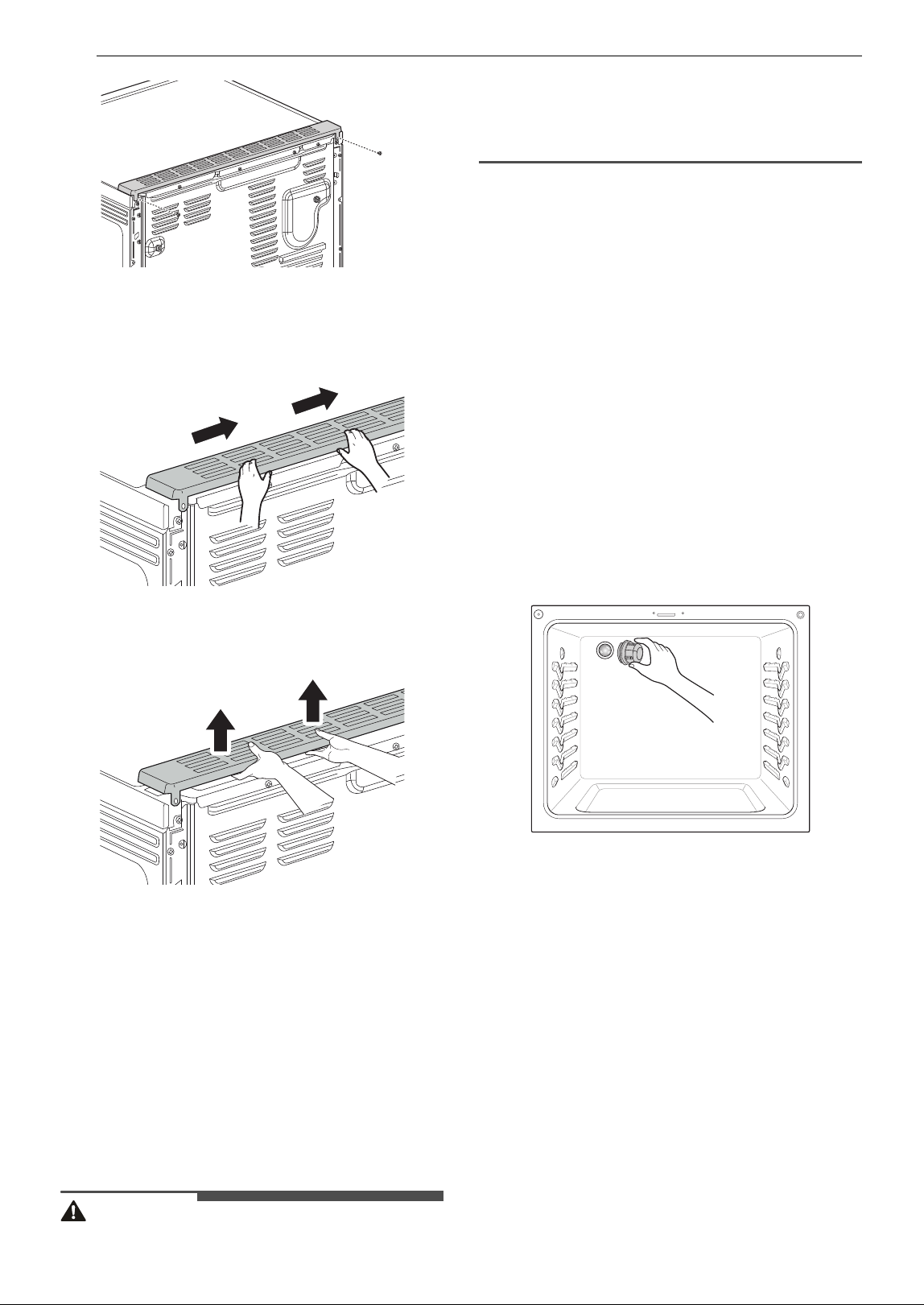
112 MAINTENANCE
2 Move the vent trim in the indicated direction
approximately 1/4".
3 Lift the vent trim.
Assembling the Vent Trim
Assemble the vent trim in the reverse sequence of
its removal.
Periodic Maintenance
Changing the Oven Light
The oven light is a standard 40-watt appliance
halogen lamp. It turns on when the oven door is
open. When the oven door is closed, press Light to
turn it on or off.
WARNING
• Make sure that the oven and lamp are cool.
• Disconnect the electrical power to the range at
the main fuse or circuit breaker panel. Failure to
do so can result in severe personal injury, death,
or electrical shock.
1 Unplug the range or disconnect power.
2 Turn the glass lamp cover in the back of the
oven counterclockwise to remove.
3 Remove the halogen lamp from the socket.
4 Insert the new halogen lamp.
5 Insert the glass lamp cover and turn it
clockwise.
6 Plug in the range or reconnect the power.

113TROUBLESHOOTING
ENGLISH
TROUBLESHOOTING
FAQs
Frequently Asked Questions
CAUTION
• Foil may be used to wrap food in the oven or warming drawer, but do not allow the foil to come into
contact with the exposed heating/broiling elements in the oven. The foil could melt or ignite, causing
smoke, fire, or injury.
Q: What types of cookware are recommended for use with the cooktop?
A:
• The pans must have a flat bottom and straight sides.
• Only use heavy-gauge pans.
• The pan size must match the amount of food to be prepared and the size of the surface
element.
• Use tight fitting lids.
• Only use flat-bottom woks.
Q: Why do the heating elements appear to be turning ON and OFF during use of the cooktop or
oven?
A: Depending on your cooktop element setting or the temperature selected in your oven, it is normal for
the cooking elements to cycle on and off.
Q: My new oven doesn’t cook like my old one. Is there something wrong with the temperature
settings?
A: No. Your oven has been factory tested and calibrated. For the first few uses, follow your recipe times
and temperatures carefully. If you still think your new oven is too hot or too cold, you can adjust the
oven temperature yourself to meet your specific cooking needs. Refer to the Changing Oven Settings
section in this manual for easy instructions on how to adjust your thermostat.
Q: Is it normal to hear a clicking noise coming from the back of my oven when I am using it?
A: Your new range is designed to maintain a tighter control over your oven’s temperature. You may hear
your oven’s heating elements click on and off more frequently on your new oven. This is normal.
Q: Why is the time flashing?
A: This means that the product has just been plugged in, or that it has experienced a power
interruption. To clear the flashing time, touch any button and reset the clock if needed.
Q: During convection cooking the fan stops when I open the door. Is that normal?
A: Yes, this is normal. When the door is opened, the convection fan will stop until the door is closed.
Q: Can I use aluminum foil to catch drippings in my oven cavity?
A: Never use aluminum foil to line the bottom or sides of the oven or the warming drawer (on some
models). The foil will melt and stick to the bottom surface of the oven and will not be removable. Use
a foil-lined sheet pan placed on a lower oven rack to catch drippings instead. (If foil has already
melted onto the bottom of the oven, it will not interfere with the oven’s performance.)
Q: Can I use aluminum foil on the racks?
A: Do not cover racks with aluminum foil. Covering entire racks with foil restricts air flow, leading to
poor cooking results. Use a sheet pan lined with foil under fruit pies or other acidic or sugary foods to
prevent spillovers from damaging the oven finish.

114 TROUBLESHOOTING
Q: Can I leave my racks in the oven when running a Self Clean cycle? (On some models)
A: No. Although it will not damage the racks, it will discolor them and may make them hard to slide in
and out during use. Remove all items from the oven before starting a Self Clean cycle.
Q: What should I do if my racks are sticky and have become hard to slide in and out?
A: Over time, the racks may become hard to slide in and out. Apply a small amount of olive oil to the
sides of the racks. This will work as a lubricant for easier gliding.
Q: What should I do for hard to remove stains on my cooktop?
A: The cooktop should be cleaned after every use to prevent permanent staining. When cooking foods
with high sugar content, such as tomato sauce, clean the stain off with a scraper while the cooktop is
still warm. Use an oven mitt when scraping to prevent burns. Refer to the MAINTENANCE section of
this owner's manual for further instruction.
Q: Why aren't the function buttons working?
A:
Make sure that the range is not in Control Lock / Lockout mode. The lock
k will show in the display if
Control Lock / Lockout is activated. To deactivate Control Lock / Lockout, refer to the Control Lock /
Lockout section. The unlock melody sounds and Loc appears in the display until the controls are
unlocked. On models with Sabbath mode, make sure that the range is not in Sabbath mode. See the
Sabbath Mode section of the manual for instructions.
Q: My range is still dirty after running the EasyClean cycle. What else should I do?
A: The EasyClean cycle only helps to loosen light soils in your oven range to assist in hand-cleaning of
your oven. It does not automatically remove all soils after the cycle. Some scrubbing of your oven
range is required after running the EasyClean cycle.
Q: I tried scrubbing my oven after running EasyClean, but some soils still remain. What can I do?
A: The EasyClean feature works best when the soils are fully soaked and submerged in water before
running the cycle and during hand-cleaning. If soils are not sufficiently soaked in water, it can
negatively affect the cleaning performance. Repeat the EasyClean process using sufficient water.
• For models with Self Clean function:
Sugar-based and certain greasy soils are especially hard to clean. If some stubborn soils
remain, use the Self Clean feature to thoroughly clean your oven.
Q: Soils on my oven walls are not coming off. How can I get the oven walls clean?
A: Soils on the side and rear walls of your oven range may be more difficult to fully soak with water. Try
repeating the EasyClean process with more than the ¼ cup (2 oz or 60 ml) of spray recommended.
Q: Will EasyClean get all of the soils and stains out completely?
A: It depends on the soil type. Sugar-based and certain grease stains are especially hard to clean. Also, if
stains are not sufficiently soaked in water, this can negatively affect cleaning performance.
• For models with Self Clean function:
If stubborn or built-up stains remain, use the Self Clean feature. Refer to the Self Clean section
of your owner's manual.
Q: Are there any tricks to getting some of the stubborn soils out?
A: Scraping the soils with a plastic scraper before and during hand-cleaning is recommended. Fully
saturating soils with water is also recommended.
• For models with Self Clean function:
Certain types of soils are harder to clean than others. For these stubborn soils, the Self Clean
cycle is recommended. Consult the Self Clean section of your owner's manual for details.
Q: Is it safe for my convection fan or heater element to get wet during EasyClean?

115TROUBLESHOOTING
ENGLISH
Before Calling for Service
Review this section before calling for service; doing so will save you both time and money.
For detailed information or videos, visit www.lg.com
for the troubleshooting page.
Cooking
A: Yes. The convection fan or heater element may get a little wet during cleaning. However, direct spray
onto the broil burner and heater elements is not necessary because these are self-cleaning during
regular use.
Q: Do I need to use all 1 ¼ cups (10 oz or 300 ml) of water for EasyClean?
A: Yes. It is highly recommended that 1 cup (8 oz or 240 ml) of water be sprayed or poured on the
bottom and an additional ¼ cup (2 oz or 60 ml) of water be sprayed on walls and other soiled areas to
fully saturate the soils for better cleaning performance.
Q: I see smoke coming out of my oven range’s cooktop vents during EasyClean. Is this normal?
A: This is normal. This is not smoke. It is actually water vapor (steam) from the water in the oven cavity.
As the oven heats briefly during EasyClean, the water in the cavity evaporates and escapes through
the oven vents.
Q: How often should I use EasyClean?
A: EasyClean can be performed as often as you wish. EasyClean works best when your oven is LIGHTLY
soiled from such things as LIGHT grease splatter and small drops of cheese. Please refer to the
EasyClean section in your owner's manual for more information.
Q: What is required for EasyClean?
A: A spray bottle filled with 1¼ cups (10 oz or 300 ml) of water, a plastic scraper, a non-scratch scrubbing
pad and a towel. You should not use abrasive scrubbers such as heavy-duty scouring pads or steel
wool.
Q: How can I help keep children safe around the range?
A: Children should be supervised around the range whenever it is in use, and after use until surfaces
have cooled. You can also use the Control Lock / Lockout feature to help prevent children from
accidentally turning on the cooktop or oven. The Control Lock / Lockout feature disables most control
panel buttons and the cooktop control knobs. On some models, it also locks the oven door. Consult
the Control Lock / Lockout section of your owner’s manual for details. (In models without a Self Clean
option, the Control Lock / Lockout feature locks the controls but does not lock the oven door.)
Q: Why isn't the Instaview working? (On some models only)
A: Level the range by adjusting the leveling legs with a wrench.
Problem Possible Cause & Solution
Oven will not work Plug on range is not completely inserted in the electrical outlet.
• Make sure electrical plug is plugged into a live, properly grounded outlet.
A fuse in your home may be blown or the circuit breaker tripped.
• Replace the fuse or reset the circuit breaker.
Oven controls improperly set.
• See the "Oven" section in the Operation chapter.
Oven too hot.
• Allow the oven to cool to below locking temperature.
116 TROUBLESHOOTING
Steam is exhausted
through the oven
vent.
Cooking foods with high moisture produces steam.
• This is normal.
Appliance does not
operate.
Cord is not plugged in correctly.
• Make sure cord is plugged correctly into outlet. Check circuit breakers.
Service wiring is not complete.
• Contact your electrician for assistance.
Power outage.
• Check house lights to be sure. Call your local electric company for service.
Sabbath mode is activated (on some models).
sb appears in the display and all function
buttons are inactive.
• Press and hold the Settings button for 3 seconds or until
sb disappears from the display.
Oven smokes
excessively during
broiling.
Control not set properly.
• Follow instructions under Setting Oven Controls.
Meat too close to the element.
• Reposition the rack to provide proper clearance between the meat and the element.
Preheat broil element for searing.
Meat not properly prepared.
• Remove excess fat from meat. Cut remaining fatty edges to prevent curling.
Insert on broiler pan wrong side up and grease not draining.
• Always place the grid on the broiler pan with ribs up and slots down to allow grease to drip
into the pan.
Grease has built up on oven surfaces. Old grease or food spatters cause excessive
smoking.
• Regular cleaning is necessary when broiling frequently.
Food does not bake
or roast properly
Oven controls improperly set.
• See the "Oven" section in the Operation chapter.
Rack position is incorrect or the rack is not level.
• See the "Oven" section in the Operation chapter.
Incorrect cookware or cookware of improper size being used.
• See the "Oven" section in the Operation chapter.
Oven sensor needs to be adjusted.
• See the "Calibrating the Oven Temperature" section in the Operation chapter.
Food does not broil
properly
Oven controls improperly set.
• Make sure you select the Broil mode properly.
Improper rack position being used.
• See the Broiling Guide.
Cookware not suited for broiling.
• Use broiling pan and grid.
Aluminum foil used on the broiling pan and grid has not been fitted properly and slit as
recommended.
• See the "Oven" section in the Operation chapter.
In some areas the power voltage may be low.
• Preheat the broil element for 5-7 minutes. See the Broiling Guide.
Problem Possible Cause & Solution
117TROUBLESHOOTING
ENGLISH
Parts & Features
Oven temperature
too hot or too cold
Oven sensor needs to be adjusted.
• See the "Calibrating the Oven Temperature" section in the Operation chapter.
Excessive smoking
during a Self Clean
cycle (On some
models)
Excessive soil.
• Turn off the Self Clean function. Open the windows to rid the room of smoke. Wait until the
Self Clean mode is cancelled. Wipe up the excess soil and reset the clean.
Burning or oily odor
emitting from the
vent
This is normal in a new oven.
• This will disappear in time. To speed the process, set a Self Clean cycle for a minimum of 3
hours. See the Self Clean section. (On some models)
Moisture collects on
oven window or
steam comes from
oven vent
This happens when cooking foods high in moisture.
• This is normal.
Excessive moisture was used when cleaning the window.
• Do not use excessive moisture when cleaning the window.
Problem Possible Cause & Solution
Range is not level. Poor installation.
• Place oven rack in center of oven. Place a level on the oven rack. Adjust leveling legs at
base of range until the oven rack is level.
• Be sure floor is level and strong and stable enough to adequately support range.
• If floor is sagging or sloping, contact a carpenter to correct the situation.
Kitchen cabinet alignment may make range appear unlevel.
• Be sure cabinets are square and have sufficient room for range clearance.
Cannot move
appliance easily.
Appliance must be
accessible for
service.
Cabinets not square or are built in too tightly.
• Contact builder or installer to make appliance accessible.
Carpet interferes with range.
• Provide sufficient space so range can be lifted over carpet.
Anti-tip device engaged.
• Uninstall the anti-tip device to move the range. Reengage the anti-tip device after pulling
the range out for cleaning, service, or any other reason.
Surface units will not
maintain a rolling
boil or cooking is not
fast enough.
Improper cookware being used.
• Use pans which are flat and match the diameter of the surface unit selected.
In some areas, the power(voltage) may be low.
• Cover pan with a lid until desired heat is obtained.
Surface units do not
work properly.
A fuse in your home may be blown or the circuit breaker tripped.
• Replace the fuse or reset the circuit breaker.
Cooktop controls improperly set.
• Check to see the correct control is set for the surface unit you are using.
Problem Possible Cause & Solution

118 TROUBLESHOOTING
Surface unit stops
glowing when
changed to a lower
setting.
The unit is still on and hot.
• This is normal.
Areas of
discoloration on the
cooktop
Food spillovers not cleaned before next use.
• See the "Glass-Ceramic Cooktop" section in the MAINTENANCE chapter.
Hot surface on a model with a light-colored cooktop.
• This is normal.The surface may appear discolored when it is hot. This is temporary and will
disappear as the glass cools.
Frequent cycling on
and off of surface
units
The element will cycle on and off to maintain the heat setting.
• This is normal.
Scratches or
abrasions on
cooktop surface
Coarse particles such as salt or sand between cooktop and utensils can cause
scratches.
• Be sure the cooktop surface and bottoms of utensils are clean before using. Small
scratches do not affect cooking and will become less visible with time.
Cleaning materials not recommended for glass-ceramic cooktop have been used.
• See the "Glass-Ceramic Cooktop" section in the MAINTENANCE chapter.
Cookware with rough bottom has been used.
• Use smooth, flat-bottomed cookware.
Metal marks Scraping of metal utensils on cooktop surface.
• Do not slide metal utensils on cooktop surface. Use a glass-ceramic cooktop cleaning
creme to remove the marks. See the "Glass-Ceramic Cooktop" section in the
MAINTENANCE chapter.
Brown streaks or
specks
Boilovers are cooked onto surface.
• Use a blade scraper to remove soil. See the "Glass-Ceramic Cooktop" section in the
MAINTENANCE chapter.
Areas of
discoloration on
cooktop
Mineral deposits from water and food.
• Remove using a glass-ceramic cooktop cleaning creme. Use cookware with clean, dry
bottoms.
Oven control beeps
and displays any F
code error.
Electronic control has detected a fault condition.
• Turn off the oven function you are using to clear the display and stop beeping. Reprogram
oven. If fault recurs, record fault number and contact a service agent.
- [Case 1]
Code: F-3
Cause: Key short error
- [Case 2]
Code: F-9
Cause: Oven not heating
Oven control
displays Sb/5b/S6/56
error code.
This code is not an error code. It indicates that the product's Sabbath mode
sb is
activated.
• See the "Using the Sabbath Mode" section in the Operation chapter.
Displayed colon in
the clock is flashing
This means that the product has just been plugged in, or that it has experienced a
power interruption.
• This is normal. Reset the clock or press any button to stop the flashing.
CLEAN and door
flash in the display
(On some models)
The Self Clean cycle has been selected, but the door is not closed.
• Close the oven door.
Problem Possible Cause & Solution
119TROUBLESHOOTING
ENGLISH
Noises
Loc is on in the
display when you
want to cook (On
some models)
The oven is locked because of the Control Lock / Lockout feature.
• Deactivate the Control Lock / Lockout feature.
Oven light does not
work.
It is time to replace the lamp or the lamp is loose.
• Replace or tighten lamp. See "Changing the Oven Light" section in this Owner’s Manual.
Convection fan
stops. (During
Conv.Bake mode)
Convection fan stops during a convection bake cycle. It is done to allow for more even
heating during the cycle.
• This is not a failure of the range and should be considered normal operation.
Fan operation
(During Bake mode)
This is to ensure even baking results.
• It is normal for the fan to operate periodically throughout a normal bake cycle in the oven.
Oven will not Self
Clean. (On some
models)
The oven temperature is too high to set a Self Clean operation.
• Allow the range to cool and reset the controls.
Oven controls improperly set.
• See the Self Clean section.
A Self Clean cycle cannot be started if the oven Control Lock / Lockout feature is active.
• See the "Control Lock / Lockout" in "Changing Oven Settings" section.
Oven door does not
open after a Self
Clean cycle (On some
models)
Oven is too hot.
• Allow the oven to cool below locking temperature.
The control and door may be locked.
• Allow about one hour for the oven to cool after the completion of a Self Clean cycle. The
door can be opened when the lock
k is no longer displayed.
The oven is not clean
after a Self Clean
cycle (On some
models)
Oven controls not properly set.
• See the Self Clean section.
Oven was heavily soiled.
• Clean up heavy spillovers before starting the clean cycle. Heavily soiled ovens may need to
Self Clean again or for a longer period of time.
Oven racks are
difficult to slide (On
some models)
The shiny, silver-colored racks were cleaned in a Self Clean cycle.
• Apply a small amount of vegetable oil to a paper towel and wipe the edges of the oven
racks with the paper towel.
Problem Possible Cause & Solution
“Crackling” or
“popping” sound
This is the sound of the metal heating and cooling during cooking. On models with Self
Clean, this can also happen during the Self Clean function.
• This is normal.
Fan noise A convection fan may automatically turn on and off.
• This is normal.
A chime sounds
when surface
elements are turned
on.
When any cooktop burner is activated, a chime sounds to indicate the cooktop is in use.
• This is normal.
Problem Possible Cause & Solution

120 TROUBLESHOOTING
Wi-Fi
Problem Possible Cause & Solution
Trouble connecting
appliance and
smartphone to Wi-Fi
network
The password for the Wi-Fi network was entered incorrectly.
• Delete your home Wi-Fi network and begin the connection process again.
Mobile data for your smartphone is turned on.
• Turn off the Mobile data on your smartphone before connecting the appliance.
The wireless network name (SSID) is set incorrectly.
• The wireless network name (SSID) should be a combination of English letters and
numbers. (Do not use special characters.)
The router frequency is not 2.4 GHz.
• Only a 2.4 GHz router frequency is supported. Set the wireless router to 2.4 GHz and
connect the appliance to the wireless router. To check the router frequency, check with
your Internet service provider or the router manufacturer.
The appliance and the router are too far apart.
• If the appliance is too far from the router, the signal may be weak and the connection may
not be configured correctly. Move the router closer to the appliance or purchase and
install a Wi-Fi repeater.
During Wi-Fi setup, the app is requesting a password to connect to the product (on
certain phones).
• Locate the network name which starts with "LG" under Settings > Networks. Note the last
part of the network name.
- If the network name looks like LGE_Appliance_XX-XX-XX, enter lge12345.
- If the network name looks like LGE_Appliance_XXXX, enter XXXX twice as your password.
For example, if the network name appears as LGE_Appliance_8b92, then you would
enter 8b928b92 as your password. In this instance, the password is case sensitive and
the last 4 characters are unique to your appliance.

121LIMITED WARRANTY
ENGLISH
LIMITED WARRANTY
USA
TERMS AND CONDITIONS
ARBITRATION NOTICE: THIS LIMITED WARRANTY CONTAINS AN ARBITRATION PROVISION THAT
REQUIRES YOU AND LG ELECTRONICS (“LG”) TO RESOLVE DISPUTES BY BINDING ARBITRATION
INSTEAD OF IN COURT, UNLESS YOU CHOOSE TO OPT OUT. IN ARBITRATION, CLASS ACTIONS AND
JURY TRIALS ARE NOT PERMITTED. PLEASE SEE THE SECTION TITLED “PROCEDURE FOR RESOLVING
DISPUTES” BELOW.
Should your LG Electric Range ("Product") fail due to a defect in materials or workmanship under normal
and proper use, during the warranty period set forth below, LG will, at its option, repair or replace the
Product. This limited warranty is valid only to the original retail purchaser of the Product (“You”) and
applies only when purchased lawfully and used within the United States including U.S. Territories.
• Replacement Products and parts are warranted for the remaining portion of the original warranty period
or ninety (90) days, whichever is greater.
• Replacement Products and parts may be new, reconditioned, refurbished, or otherwise factory
remanufactured.
• Replaced Product or part(s) will be the property of LG.
• Proof of original retail purchase specifying the Product model and date of purchase is required to obtain
warranty service under this limited warranty.
EXCEPT TO THE EXTENT PROHIBITED BY APPLICABLE LAW, ANY IMPLIED WARRANTY OF
MERCHANTABILITY OR FITNESS FOR A PARTICULAR PURPOSE ON THE PRODUCT IS LIMITED IN
DURATION TO THE DURATION OF THE ABOVE LIMITED WARRANTY. UNDER NO CIRCUMSTANCES
SHALL LG OR ITS U.S. DISTRIBUTORS/DEALERS BE LIABLE FOR ANY INDIRECT, INCIDENTAL,
CONSEQUENTIAL, SPECIAL, OR PUNITIVE DAMAGES, INCLUDING, WITHOUT LIMITATION, LOST
GOODWILL, LOST REVENUES OR PROFITS, WORK STOPPAGE, IMPAIRMENT OF OTHER GOODS, COST OF
REMOVAL AND REINSTALLATION OF THE PRODUCT, LOSS OF USE, OR ANY OTHER DAMAGES WHETHER
BASED IN CONTRACT, TORT, OR OTHERWISE. LG’S TOTAL LIABILITY, IF ANY, SHALL NOT EXCEED THE
PURCHASE PRICE PAID BY YOU FOR THE PRODUCT.
SOME STATES DO NOT ALLOW THE EXCLUSION OR LIMITATION OF INCIDENTAL OR CONSEQUENTIAL
DAMAGES OR LIMITATIONS ON HOW LONG AN IMPLIED WARRANTY LASTS, SO THE ABOVE
EXCLUSIONS OR LIMITATIONS MAY NOT APPLY TO YOU. THIS LIMITED WARRANTY GIVES YOU
SPECIFIC LEGAL RIGHTS AND YOU MAY ALSO HAVE OTHER RIGHTS THAT VARY FROM STATE TO STATE.
THIS LIMITED WARRANTY DOES NOT COVER:
• Service trips to deliver, pick up, or install, educate how to operate, correct wiring, or correct
unauthorized repairs.
• Damage or failure of the Product to perform during power failures and interrupted or inadequate
electrical service.
• Damage or failure of the Product caused by leaky or broken water pipes, frozen water pipes, restricted
drain lines, inadequate or interrupted water supply or inadequate supply of air.
• Damage or failure of the Product resulting from operating the Product in a corrosive atmosphere or
contrary to the Product owner’s manual.
Warranty Period Scope of Warranty HOW SERVICE IS HANDLED
Two (2) years from the
date of original retail
purchase, or from the
date of delivery as per
applicable law
Parts and Labor (internal
/ functional parts only)
LG will provide, free of charge, all labor and in-home
service to replace defective part(s).

122 LIMITED WARRANTY
• Damage or failure of the Product caused by accidents, pests and vermin, lightning, wind, fire, floods, acts
of nature, or any other causes beyond the control of LG.
• Damage or failure of the Product caused by unauthorized modification or alteration, or if the Product is
used for other than the intended purpose, or any water leakage where the Product was not properly
installed.
• Damage or failure of the Product caused by incorrect electrical current, voltage, or plumbing codes.
• Damage or failure of the Product caused by transportation, storage, and/or handling, including
scratches, dents, chips, and/or other damage to the finish of the Product, unless such damage is
reported within one (1) week of delivery.
• Damage or failure of the Product resulting from misuse, abuse, improper installation, repair, or
maintenance. Improper repair includes the use of parts not authorized by LG. Improper installation or
maintenance includes installation or maintenance contrary to the Product owner’s manual.
• Damage or failure of the Product caused by the use of parts, components, accessories, consumable
cleaning products, or any other products or services that were not authorized by LG.
• Damage or missing items to any display or open box Product.
• Refurbished Product or any Product sold “As Is”, “Where Is”, “With all Faults”, or similar disclaimer.
• Products with original serial numbers that have been removed, altered, or cannot be readily determined.
• Increases in utility costs and additional utility expenses.
• Any noises associated with normal operation.
• Products used for other than normal and proper household use (e.g., commercial, business, or industrial
settings, including any retail or food service establishments, or any commercial lodging/transient rental
setting), or any use contrary to the Product owner's manual.
• Costs associated with removal and reinstallation of the Product for repairs, or the removal and
reinstallation of the Product if it is installed in an inaccessible location or not installed in accordance with
the Product Owner's manual.
• Accessories, removable components, or consumable parts (e.g. Shelves, door bins, drawers, water/air
filters, racks, light bulbs, batteries, etc., as applicable), except for internal/functional parts covered under
this limited warranty.
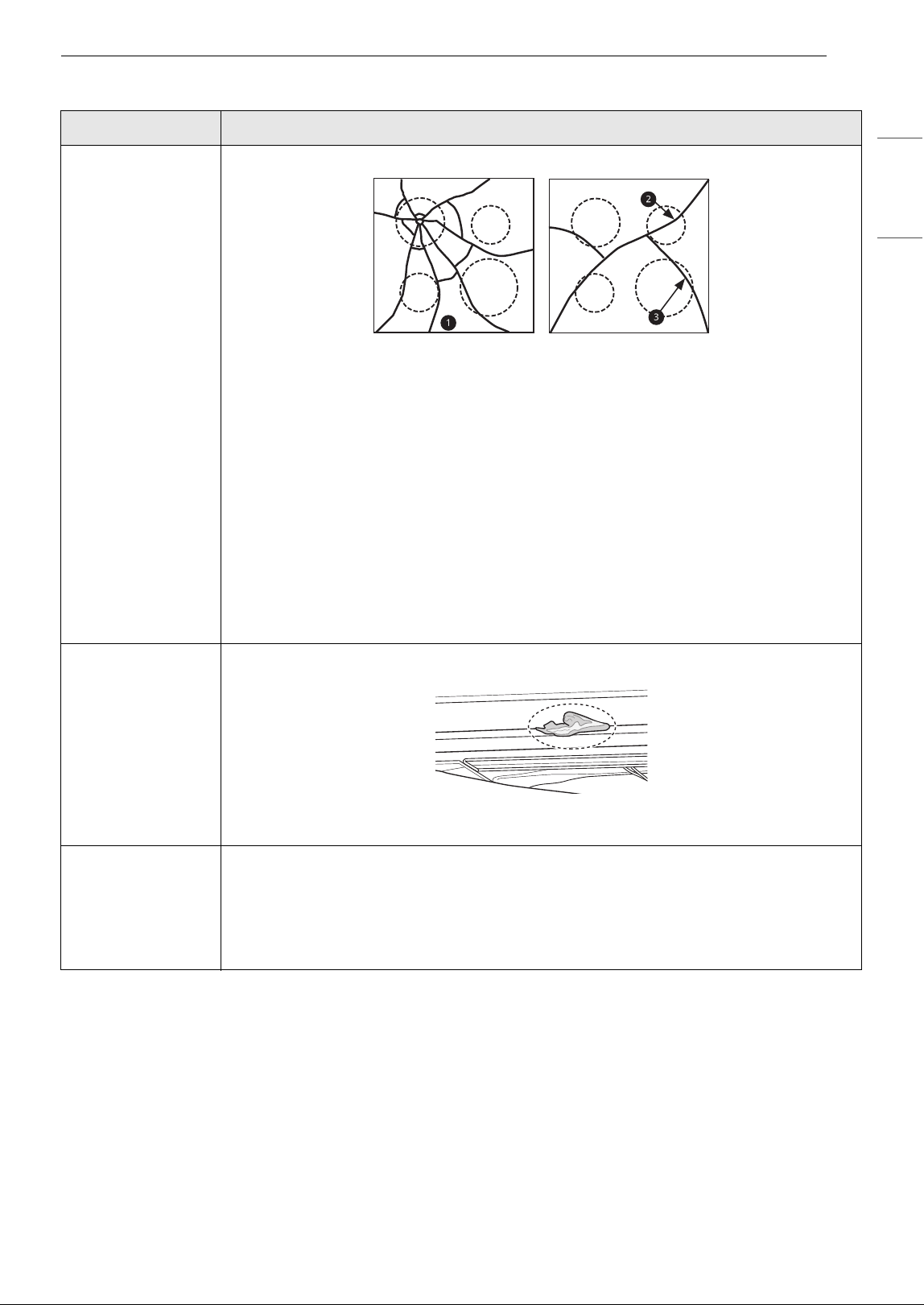
123LIMITED WARRANTY
ENGLISH
Not Covered by this Limited Warranty
Problem Possible Cause & Prevention
Cooktop crack Cooktop crack caused by impact of object
• A: Out of warranty
-
a Mechanical breakage
• B: In warranty
- b Primary crack c Secondary crack
• DO NOT store heavy items above the cooktop surface as they could fall and
damage it.
• DO NOT scratch the cooktop or the cooktop could crack.
• Clean the cooktop before and after using.
NOTE
• Damage caused after delivery (Not covered by warranty)
Cooktop enamel
chipping off
Improper usage
• Do not hit enamel cooktop.
Pitting of the
cooktop glass
If not removed immediately, sugary spillovers (such as preserves, ketchup,
tomato sauce, jellies, fudge, candy, syrups, or chocolate) or melted plastic or foil
can cause surface pitting of the cooktop. (Not covered by warranty)
• Remove the molten material IMMEDIATELY with a metal razor scraper.
• For safety, wear an oven mitt or hot pad while scraping the hot surface.
AB
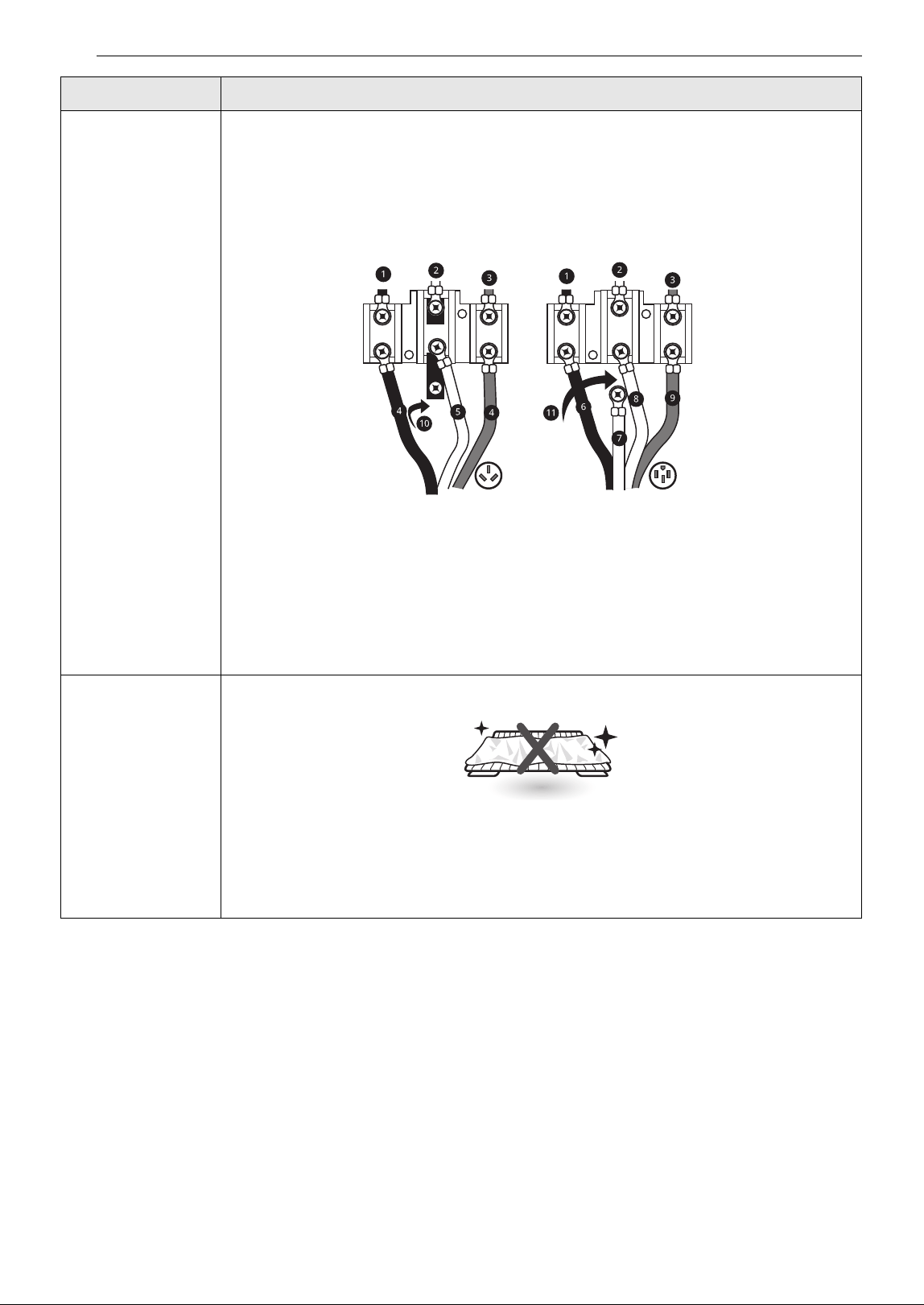
124 LIMITED WARRANTY
Unit has no power 1. House power turned off (power supply)
• Check power at main board before calling for service.
2. Tripped breaker
• Match power cord type and outlet type.
3. The power cord is not installed properly.
• Properly install the power cord.
• A: 3-WIRE HOOK UP
• B: 4-WIRE HOOK UP
a Black b White c Red d Outer wire
e Center wire (neutral) f Black wire
g Green ground wire h White wire (neutral)
i Red wire j Ground strap k Remove ground strap
Oven or racks are
stained after
using aluminum
foil
Aluminum foil has melted in the oven
• Never cover the oven bottom or cover an entire rack with materials such as
aluminum foil.
• If the foil has already melted onto the oven, it will not affect the performance of
the oven.
Problem Possible Cause & Prevention
<NEMA 10-50>
<NEMA 14-50>
AB
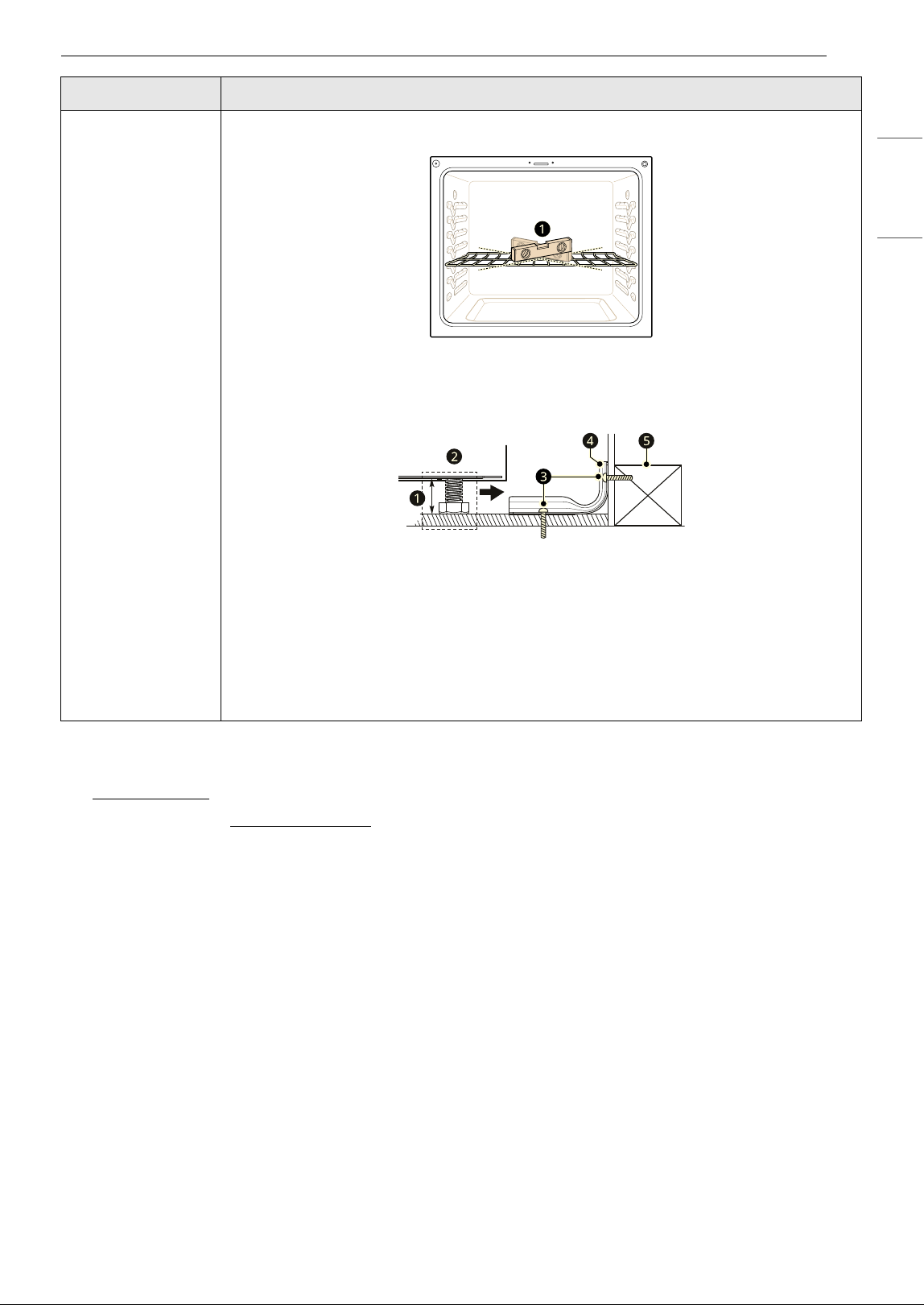
125LIMITED WARRANTY
ENGLISH
The cost of repair or replacement under these excluded circumstances shall be borne by You.
TO OBTAIN WARRANTY SERVICE AND ADDITIONAL INFORMATION
Call 1-800-243-0000
and select the appropriate option from the menu.
Or visit our website at http://www.lg.com
Or by mail: LG Electronics Customer Service P.O. Box 240007 Huntsville, AL 35813 ATTN: CIC
PROCEDURE FOR RESOLVING DISPUTES:
ALL DISPUTES BETWEEN YOU AND LG ARISING OUT OF OR RELATING IN ANY WAY TO THIS LIMITED
WARRANTY OR THE PRODUCT SHALL BE RESOLVED EXCLUSIVELY THROUGH BINDING ARBITRATION, AND
NOT IN A COURT OF GENERAL JURISDICTION. BINDING ARBITRATION MEANS THAT YOU AND LG ARE EACH
WAIVING THE RIGHT TO A JURY TRIAL AND TO BRING OR PARTICIPATE IN A CLASS ACTION.
Definitions. For the purposes of this section, references to “LG” mean LG Electronics U.S.A., Inc., its
parents, subsidiaries and affiliates, and each of their officers, directors, employees, agents, beneficiaries,
predecessors in interest, successors, assigns and suppliers; references to “dispute” or “claim” shall include
any dispute, claim or controversy of any kind whatsoever (whether based in contract, tort, statute,
regulation, ordinance, fraud, misrepresentation or any other legal or equitable theory) arising out of or
relating in any way to the sale, condition or performance of the product or this Limited Warranty.
Notice of Dispute. In the event you intend to commence an arbitration proceeding, you must first notify
LG in writing at least 30 days in advance of initiating the arbitration by sending a letter to LG at LG
Electronics, USA, Inc. Attn: Legal Department- Arbitration 111 Sylvan Avenue, Englewood Cliffs, NJ 07632.
You and LG agree to engage in good faith discussions in an attempt to amicably resolve your claim. The
notice must provide your name, address, and telephone number; identify the product that is the subject of
Surface is not level
Oven is tipping
Range not leveled
• Check with installer first.
• Use carpenter’s level a to check level.
Anti-tip device not installed correctly
a Approximately 0.65" (16.5 mm)
b Level both sides of range
c Screw must enter wood or concrete
d Anti-tip bracket
e Wall plate
• Check with installer first.
Problem Possible Cause & Prevention

126 LIMITED WARRANTY
the claim; and describe the nature of the claim and the relief being sought. If you and LG are unable to
resolve the dispute within 30 days, either party may proceed to file a claim for arbitration.
Agreement to Binding Arbitration and Class Action Waiver. Upon failure to resolve the dispute during
the 30 day period after sending written notice to LG, you and LG agree to resolve any claims between us
only by binding arbitration on an individual basis, unless you opt out as provided below. Any dispute
between you and LG shall not be combined or consolidated with a dispute involving any other person’s or
entity’s product or claim. More specifically, without limitation of the foregoing, any dispute between you
and LG shall not under any circumstances proceed as part of a class or representative action. Instead of
arbitration, either party may bring an individual action in small claims court, but that small claims court
action may not be brought on a class or representative basis.
Arbitration Rules and Procedures. To begin arbitration of a claim, either you or LG must make a written
demand for arbitration. The arbitration will be administered by the American Arbitration Association
(“AAA”) and will be conducted before a single arbitrator under the AAA’s Consumer Arbitration Rules that
are in effect at the time the arbitration is initiated (referred to as the “AAA Rules”) and under the
procedures set forth in this section. The AAA Rules are available online at www.adr.org/consumer
. Send a
copy of your written demand for arbitration, as well as a copy of this provision, to the AAA in the manner
described in the AAA Rules. You must also send a copy of your written demand to LG at LG Electronics,
USA, Inc. Attn: Legal Department- Arbitration 111 Sylvan Avenue, Englewood Cliffs, NJ 07632. If there is a
conflict between the AAA Rules and the rules set forth in this section, the rules set forth in this section will
govern. This arbitration provision is governed by the Federal Arbitration Act. Judgment may be entered on
the arbitrator’s award in any court of competent jurisdiction. All issues are for the arbitrator to decide,
except that issues relating to the scope and enforceability of the arbitration provision and to the
arbitrability of the dispute are for the court to decide. The arbitrator is bound by the terms of this
provision.
Governing Law. The law of the state of your residence shall govern this Limited Warranty and any
disputes between us except to the extent that such law is preempted by or inconsistent with applicable
federal law.
Fees/Costs. You do not need to pay any fee to begin an arbitration. Upon receipt of your written demand
for arbitration, LG will promptly pay all arbitration filing fees to the AAA unless you seek more than $25,000
in damages, in which case the payment of these fees will be governed by the AAA Rules. Except as
otherwise provided for herein, LG will pay all AAA filing, administration and arbitrator fees for any
arbitration initiated in accordance with the AAA Rules and this arbitration provision. If you prevail in the
arbitration, LG will pay your attorneys’ fees and expenses as long as they are reasonable, by considering
factors including, but not limited to, the purchase amount and claim amount. Notwithstanding the
foregoing, if applicable law allows for an award of reasonable attorneys’ fees and expenses, an arbitrator
can award them to the same extent that a court would. If the arbitrator finds either the substance of your
claim or the relief sought in the demand is frivolous or brought for an improper purpose (as measured by
the standards set forth in Federal Rule of Civil Procedure 11(b)), then the payment of all arbitration fees will
be governed by the AAA Rules. In such a situation, you agree to reimburse LG for all monies previously
disbursed by it that are otherwise your obligation to pay under the AAA Rules. Except as otherwise
provided for, LG waives any rights it may have to seek attorneys’ fees and expenses from you if LG prevails
in the arbitration.
Hearings and Location. If your claim is for $25,000 or less, you may choose to have the arbitration
conducted solely on the basis of (1) documents submitted to the arbitrator, (2) through a telephonic
hearing, or (3) by an in-person hearing as established by the AAA Rules. If your claim exceeds $25,000, the
right to a hearing will be determined by the AAA Rules. Any in-person arbitration hearings will be held at a
location within the federal judicial district in which you reside unless we both agree to another location or
we agree to a telephonic arbitration.
Opt Out. You may opt out of this dispute resolution procedure. If you opt out, neither you nor LG can
require the other to participate in an arbitration proceeding. To opt out, you must send notice to LG no
later than 30 calendar days from the date of the first consumer purchaser’s purchase of the product by
either: (i) sending an e-mail to [email protected]
, with the subject line: “Arbitration Opt Out” or (ii) calling 1-
800-980-2973. You must include in the opt out e-mail or provide by telephone: (a) your name and address;
(b) the date on which the product was purchased; (c) the product model name or model number; and (d)
the serial number (the serial number can be found (i) on the product; or (ii) online by accessing https://
www.lg.com/us/support and clicking on “How do I find my model number?”).

127LIMITED WARRANTY
ENGLISH
You may only opt out of the dispute resolution procedure in the manner described above (that is, by e-mail
or telephone); no other form of notice will be effective to opt out of this dispute resolution procedure.
Opting out of this dispute resolution procedure will not affect the coverage of the Limited Warranty in any
way, and you will continue to enjoy the full benefits of the Limited Warranty. If you keep this product and
do not opt out, then you accept all terms and conditions of the arbitration provision described above.

Memo

Memo

Memo

Memo