Installation Guide
Quality, Design and Innovation
home.liebherr.com/fridge-manuals
Contents
1 General safety instructions.................................. 2
2 Installation conditions.......................................... 3
2.1 Location......................................................................... 3
2.2 Mains connection......................................................... 3
3 Appliance dimensions........................................... 3
4 Recess dimensions................................................ 4
5 Unit front............................................................... 4
5.1 Unit front weight.......................................................... 4
5.2 Unit door........................................................................ 4
5.3 Unit front dimensions.................................................. 4
5.4 Decorative door panel unit front dimensions.......... 4
5.5 Adjusting the gap dimension without collisions.... 5
6 Transporting appliance......................................... 5
7 Unpacking the appliance...................................... 5
8 Disposing of packaging......................................... 5
9 Replacing the door hinge...................................... 6
9.1 Safety instructions...................................................... 6
9.2 Tool................................................................................. 6
9.3 Removing covers.......................................................... 6
9.4 Removing the door....................................................... 6
9.5 Removing the hinges................................................... 7
9.6 Relocating the mounting bracket.............................. 7
9.7 Fitting the hinges......................................................... 8
9.8 Relocating the upper bracket.................................... 8
9.9 Relocating the bottom bracket.................................. 8
9.10 Fitting the door............................................................. 9
9.11 Putting on the covers.................................................. 9
10 Recessed installation............................................ 9
10.1 Tool................................................................................. 9
10.2 Preparing the appliance.............................................. 10
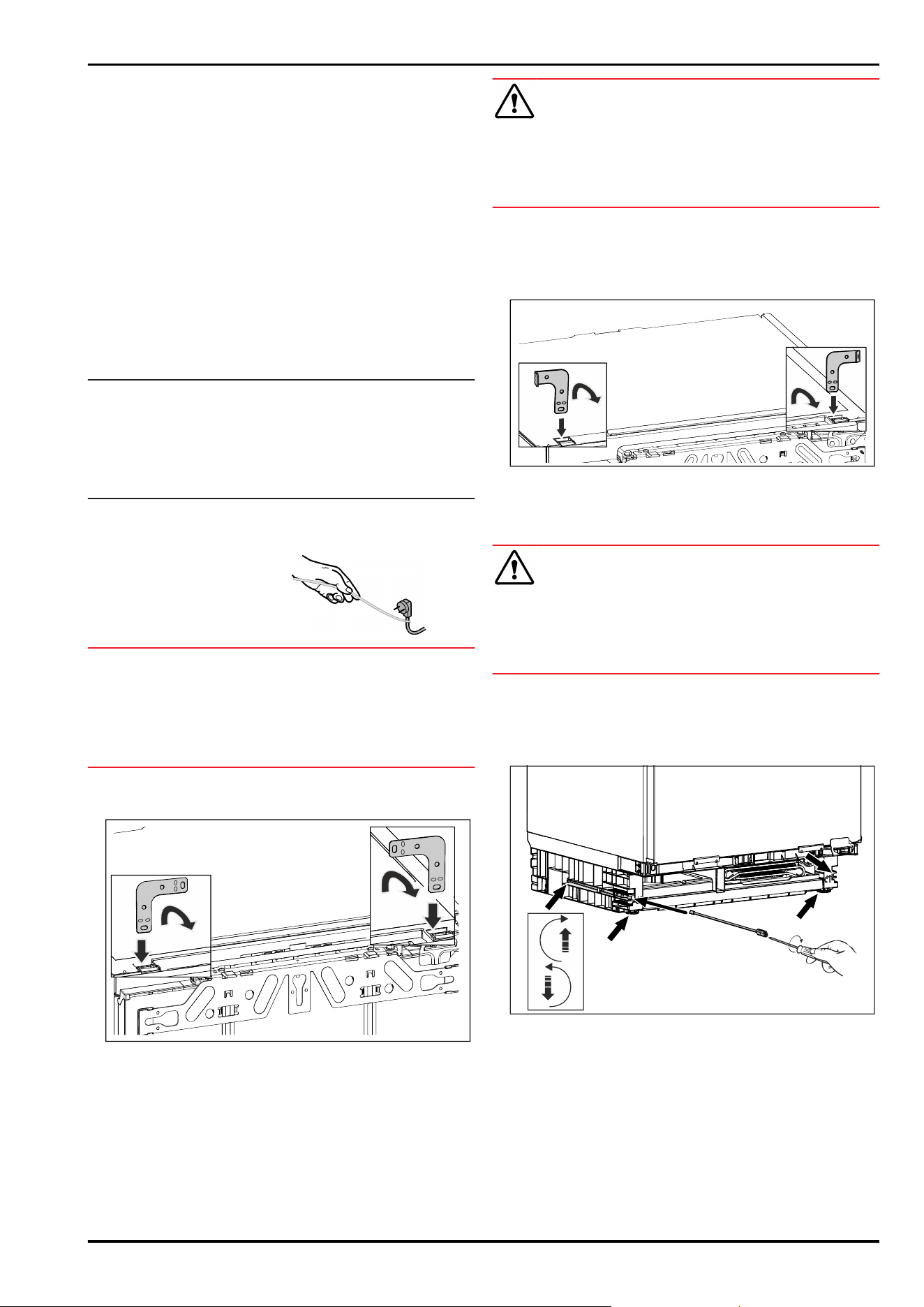
10.3 Ceiling mounting.......................................................... 10
10.4 Lateral fastening:......................................................... 10
10.5 Alignment of the appliance........................................ 10
10.6 Fitting the base............................................................ 11
10.7 Screwing the appliance into the niche..................... 11
11 Fitting the unit door.............................................. 11
12 Connecting device................................................. 13
The manufacturer is continually working on the further
development of all types and models. Please be aware that
we reserve the right to make changes to the shape, equip‐
ment and technology.
Symbol
Explanation
Read instructions
Please read the information in these instruc‐
tions carefully to understand all of the benefits
of your new appliance.
Symbol Explanation
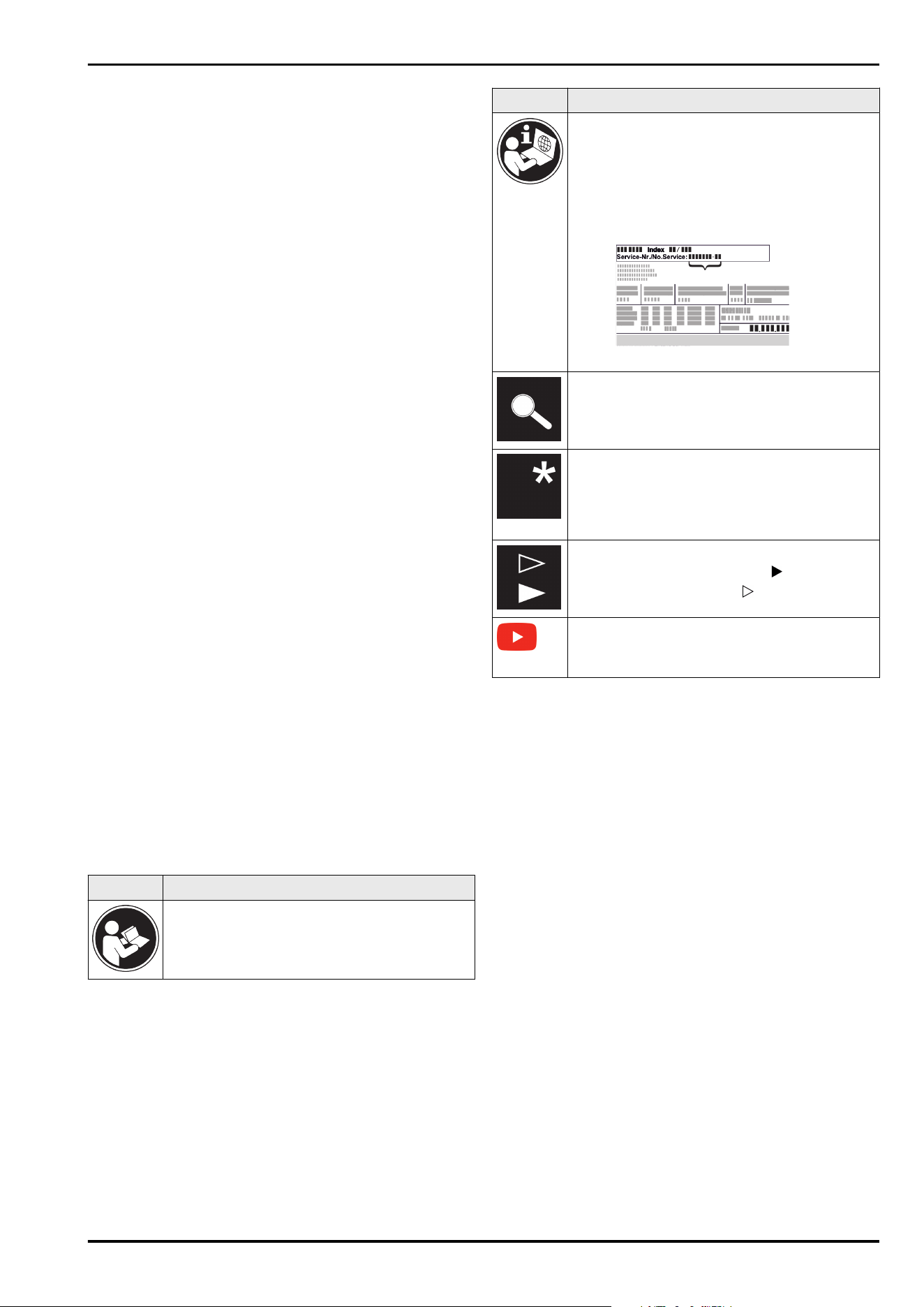
Additional information on the Internet*
The digital manual with additional information
can be found via the QR code on the front of
the manual or by entering the service number
at home.liebherr.com/fridge-manuals.*
The service number can be found on the serial
tag:*
Fig.Example illustration*
Check appliance
Check all parts for transport damage. If you
have any complaints, please contact your
agent or customer service.
Differences
These instructions apply to a range of models,
so differences are possible. Sections that
apply to certain models only are marked with
an asterisk (*).
Instructions and results
Instructions are marked with a .
Results are marked with a .
Videos
Videos about the appliances are available on
the YouTube channels of Liebherr-Hausgeräte.
1 General safety instructions
-
Please keep this assembly manual in a safe
place so you can refer back to it at any
time.
-
If you pass the appliance on, please hand
this assembly manual to the next user.
-
Read this assembly manual carefully before
installation and use to ensure safe and
correct use of the appliance. Follow
the instructions, safety instructions and
warning messages included at all times.
They are important for ensuring you can
operate and install the appliance safely and
without any problems.
-
First read the general safety instructions in
the “General safety instructions” section of
the operating instructions, which accom‐
pany these installation instructions, and
follow them. If you cannot find the
operating instructions, you can down‐
load the operating instructions from the
internet by entering the service number
at home.liebherr.com/fridge-manuals. The
General safety instructions
2 * Depending on model and options
service number can be found on the serial
tag:
-
Observe the warning messages and other
detailed information in the other sections
when installing the appliance:
DANGER identifies a situation involving
direct danger which, if not obvi‐
ated, may result in death or severe
bodily injury.
WARNING identifies a dangerous situation
which, if not obviated, may result
in death or severe bodily injury.
CAUTION identifies a dangerous situation
which, if not obviated, may result
in minor or medium bodily injury.
NOTICE identifies a dangerous situation
which, if not obviated, may result
in damage to property.
Note identifies useful instructions and
tips.
2 Installation conditions
WARNING
Fire hazard due to dampness!
If live parts or the mains lead become damp this may cause
short circuits.
u
The appliance is designed for use in enclosed areas. Do
not operate the appliance outdoors or in areas where it is
exposed to splash water or damp conditions.
Intended use
-
Install and use the appliance in indoor spaces only.
2.1 Location
WARNING
Leaking coolant and oil!
Fire. The coolant contained in the appliance is eco-friendly,
but also flammable. The oil contained in the appliance
is flammable. Escaping coolant and oil can ignite if the
concentration is high enough and in contact with an
external heat source.
u
Do not damage the pipelines of the coolant circuit and
the compressor.
-
If the appliance is installed in a very humid environment,
condensation can build up on the outside of the unit.
Always ensure good airlow and ventilation in the installa‐
tion location.
-
The more refrigerant there is in the appliance, the larger
the space that it is installed in must be. If the space is
too small, any leak may create a flammable mixture of
gas and air. For every 8 g of refrigerant, the installation
space must be at least 1 m
3
. Information regarding the
coolant can be found on the serial tag inside the appli‐
ance.
2.1.1 Supporting floor
-
The floor of the installation site must be horizontal and
even.
2.1.2 Positioning
-
Do not install the appliance in direct sunlight or near
radiators or similar sources of heat.
-
You can install the appliance directly next to an oven.
-
If the appliance is installed directly next to an oven,
the energy consumption may increase slightly. This is
dependent on the service life and usage intensity of the
oven.
2.2 Mains connection
WARNING
Danger of fire due to incorrect positioning!
If the mains cable or plug touches the back of the appli‐
ance, the vibration can damage the mains cable or the plug
resulting in a short circuit.
u
Make sure the mains cable is not trapped under the appli‐
ance when you position the appliance.
u
Stand the appliance so that it is not touched by connec‐
tors or main cables.
u
Do not connect any appliances to sockets in the area of
the back of the appliance.
u
Do not place and operate multi-sockets/power distribu‐
tors and other electronic devices (such as halogen trans‐
formers) at the back of the appliances.
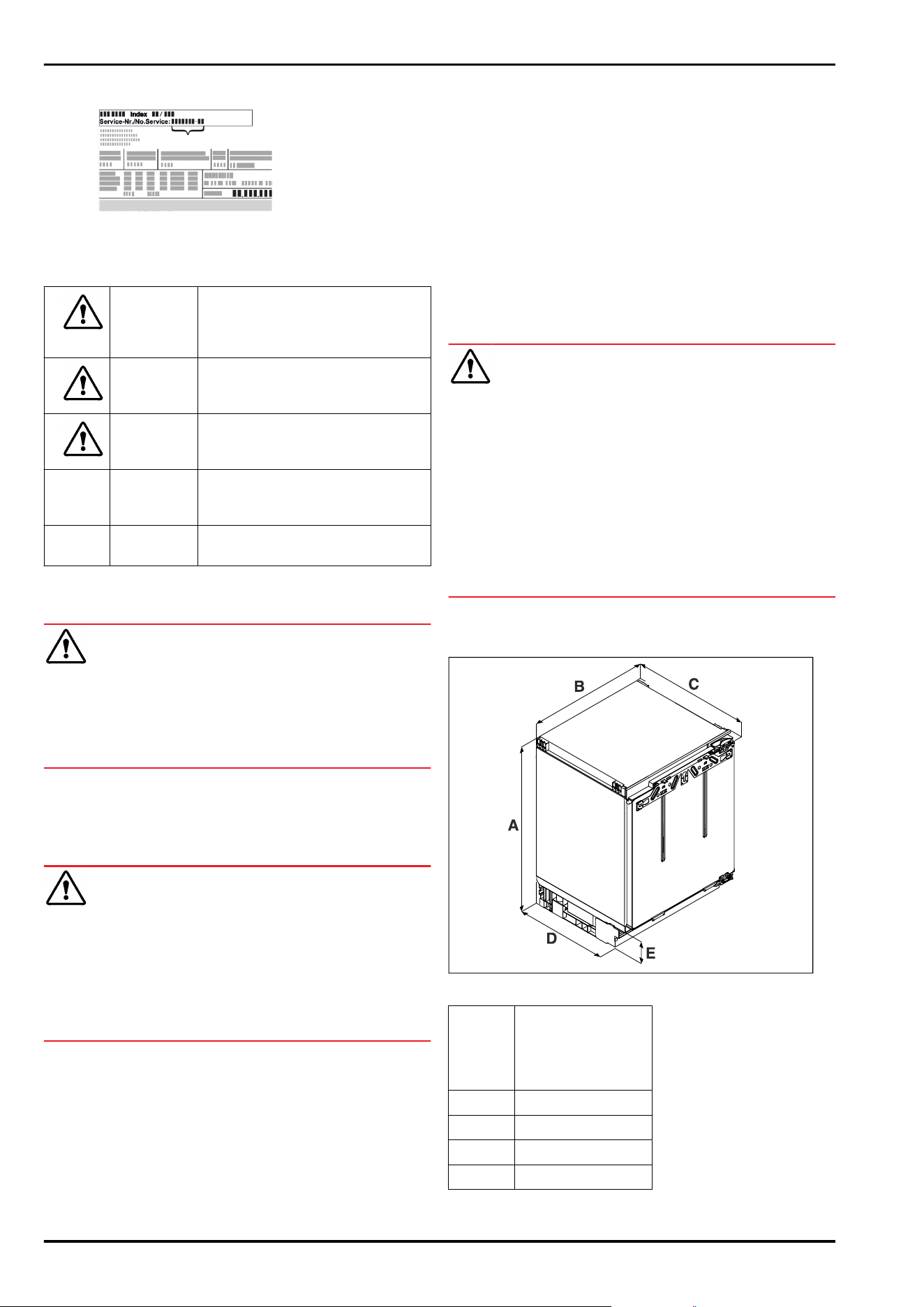
3 Appliance dimensions
Fig. 1 Example illustration
A
.... 36..:
820mm to 880mm
.... 37..:
860mm to 920mm
B 597mm
C 550mm
D 459mm
E 104mm to 164mm
A = Appliance height including feet
Installation conditions
* Depending on model and options 3
B=Appliance width
C = Appliance depth
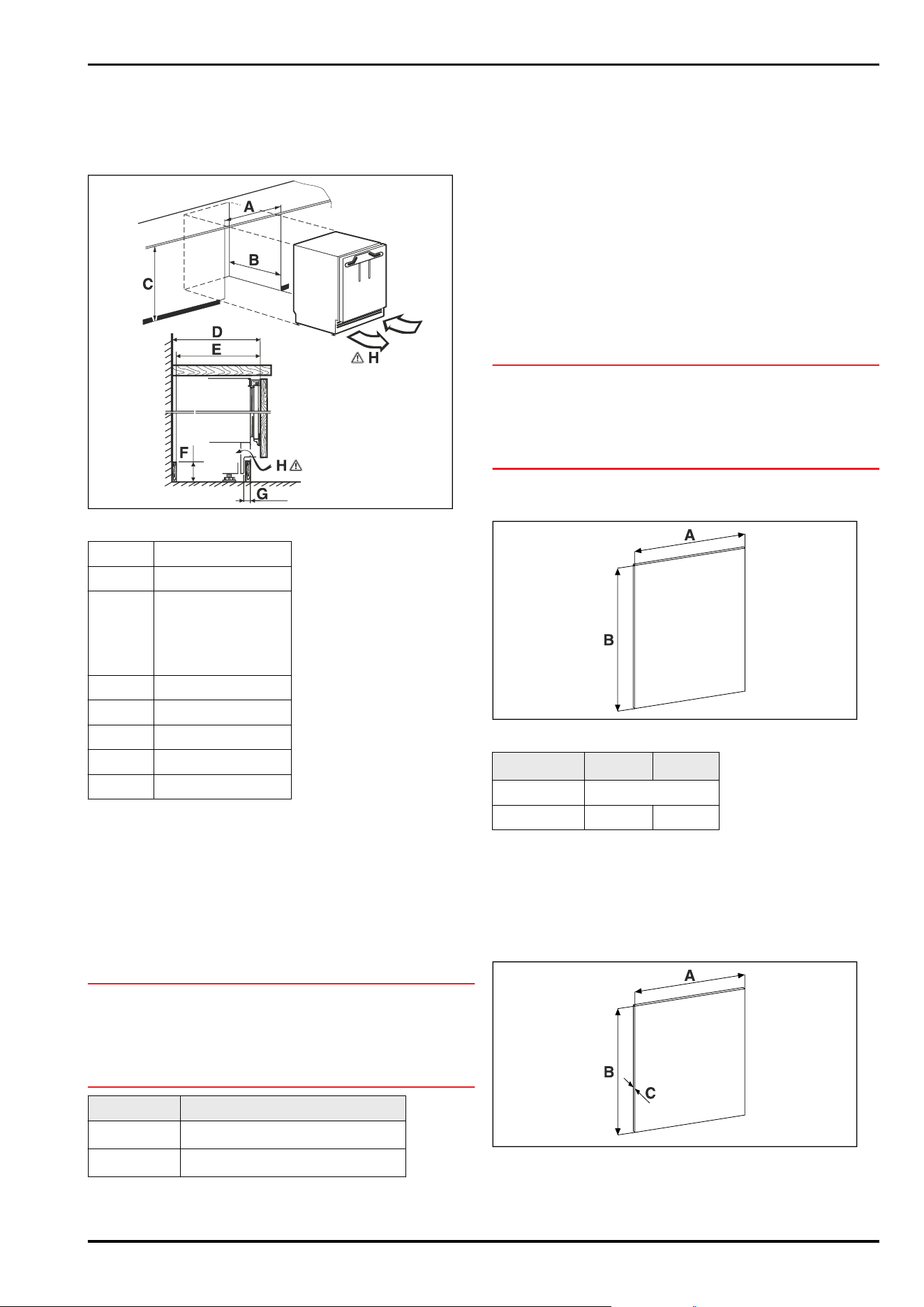
4 Recess dimensions
Fig. 2 Example illustration
A
600mm
B min. 560mm
C .... 36..:
820mm to 880mm
.... 37..:
860mm to 920mm
D 550mm
E 540mm
F 140mm
G 22mm to 77mm
H 200cm²
A=Niche width
B = Niche depth
C = Niche height
H = Ventilation cross-section
5 Unit front
5.1 Unit front weight
NOTICE
A heavy unit door may pose a risk of damage!
If the unit door is too heavy, damage to the hinges cannot
be ruled out, which may compromise functionality.
u
Before fitting the unit door, ensure that the unit door
does not exceed the permissible weight.
Niche height Maximum weight of the unit door
.... 36..:
A)
10 kg
.... 37..:
B)
10 kg
A)
820mm to 880mm
B)
860mm to 920mm
5.2 Unit door
-
A door is required for the kitchen unit.
-
The door must be at least 16 mm and no more than
19mm thick.
-
There must be a gap of at least 3 mm width between the
door and the cupboard door above (if present).
-
The width of the unit door depends on the style of the
kitchen and the size of the gap between the door panels
of the cabinet. In general, a vertical gap of 3 mm should
be left between the unit doors.
-
If there are other cupboards, the top edge of the unit
door should be at the same height as the doors of the
neighbouring unit.
-
The unit door must be flat and mounted without tension.
NOTICE
A heavy unit door may pose a risk of damage!
If the unit door is too heavy, damage to the hinges cannot
be ruled out, which may compromise functionality.
u
Before fitting the unit door, ensure that the unit door
does not exceed the permissible weight.
5.3 Unit front dimensions
Fig.3
Niche height
.... 36..:
A)
.... 37..:
B)
A 595mm
B 717mm 776mm
A)
820mm to 880mm
B)
860mm to 920mm
5.4 Decorative door panel unit front
dimensions
Fig.4
Recess dimensions
4 * Depending on model and options
Niche height
.... 36..:
A)
A 585mm
B 678mm
C maximum 4mm
A)
820mm to 880mm
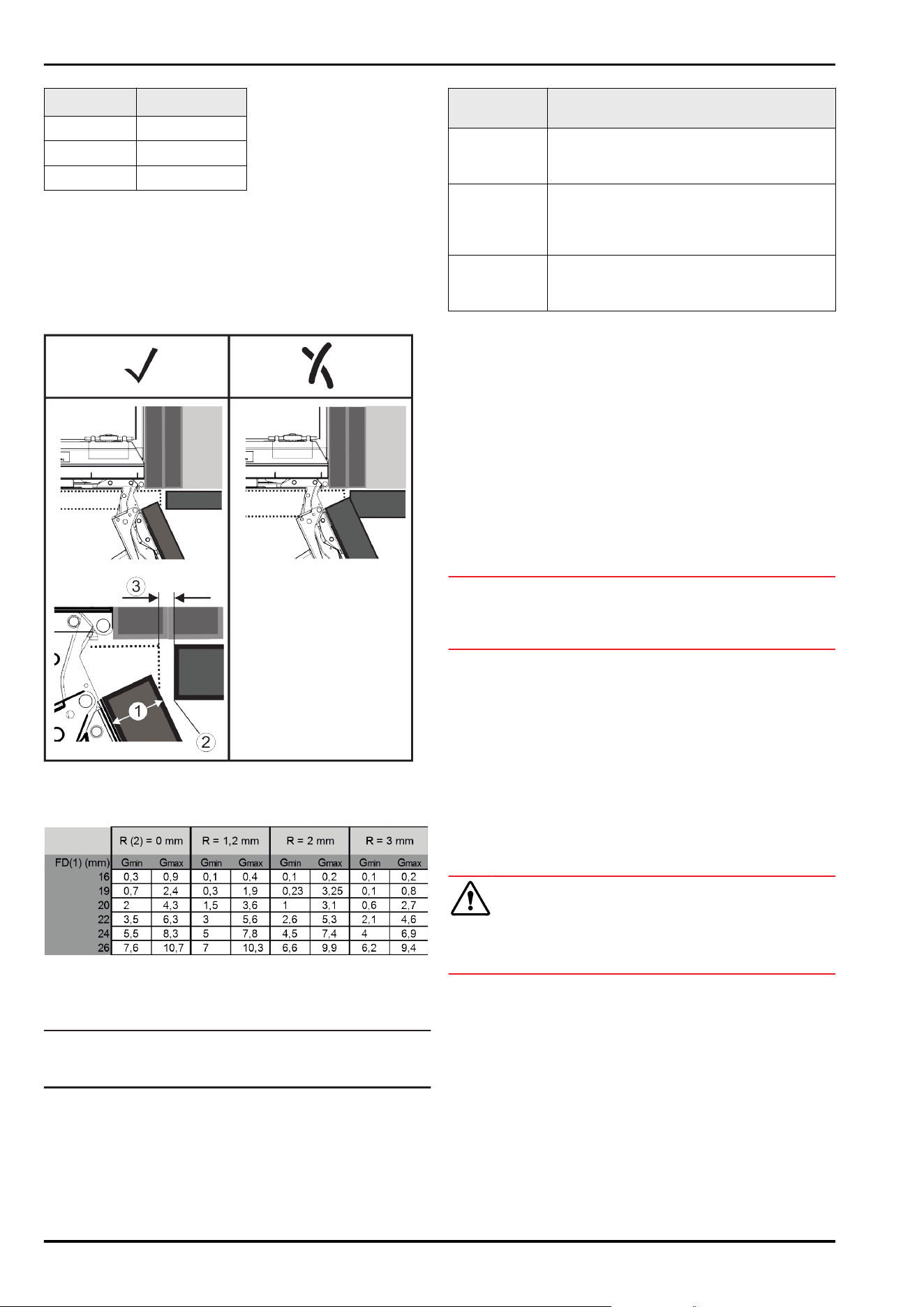
5.5 Adjusting the gap dimension
without collisions
After you have installed the unit front(s), you must check to
ensure that the unit fronts do not collide.
Fig.5
(1)
Front thickness (FT) (3) Gap dimension (G)
(2) Edge radius (R)
Fig. 6 Gap dimension limit range table
L
min
= lower limit range for the gap dimension in mm
L
max
= upper limit range for the gap dimension in mm
Note
When correcting, always ensure that the unit front is
adapted to the general appearance of the front.
Check the collision properties and correct accordingly:
u
Determine the front thickness and edge radius.
u
Read the limit range for the gap dimension from the table
Fig.6().
u
Compare the gap dimension to the values from the table.
u
Perform one of the following actions according to the
evaluated gap dimension.
Gap dimen‐
sion
Description
G > L
max
If the gap dimension is greater than both
limit values, you do not have to make any
corrections.
G < L
min
If the gap dimension is below the limit
values, you must increase the gap dimen‐
sion. Increasing the edge radius is another
option.
L
min
≤ G ≤ L
max
If the gap dimension is between both limit
values, you must work precisely. Collisions
may occur quickly in these situations.
6 Transporting appliance
Note when transporting the appliance:
u
Transport the appliance upright.
u
Use two people to transport the appliance.
During first use:
u
Transport the appliance packaged.
When transporting appliances after initial commissioning
(e. g. moving or cleaning):
u
Empty the appliance.
u
Secure the door against unintentional opening.
7 Unpacking the appliance
NOTICE
Risk of damage to the floor!
u
Protect your floors by covering them before removing
packaging from the appliance.
Before you connect the appliance, report any damage imme‐
diately to the delivery company.
u
Check the appliance and the packaging for damage
during transport. Contact the supplier immediately if you
suspect any level of damage.
u
Remove all materials from the back or the side walls
of the appliance that may prevent proper installation or
ventilation.
u
Remove all protective films from the appliance. Do not
use sharp or pointed objects for this.
8 Disposing of packaging
WARNING
Danger of suffocation due to packing material and plastic
film!
u
Do not allow children to play with packing material.
The packaging is made of recyclable materials:
-
corrugated board/cardboard
-
expanded polystyrene parts
-
polythene bags and sheets
-
polypropylene straps
-
nailed wooden frame with polyethylene panel*
u
Take the packaging material to an official collecting
point.
Transporting appliance
* Depending on model and options 5
9 Replacing the door hinge
9.1 Safety instructions
WARNING
Risk of injury if the door is not reversed correctly!
u
Replace the door hinge with specialist personnel.
WARNING
Risk of injury and material damage due to door weight!
u
Only change the door hinge if you can carry a weight of
15 kg.
u
Change the door hinge with two people.
NOTICE
Live parts!
Damage to electrical components.
u
Remove the mains plug before you reverse the door.
9.2 Tool
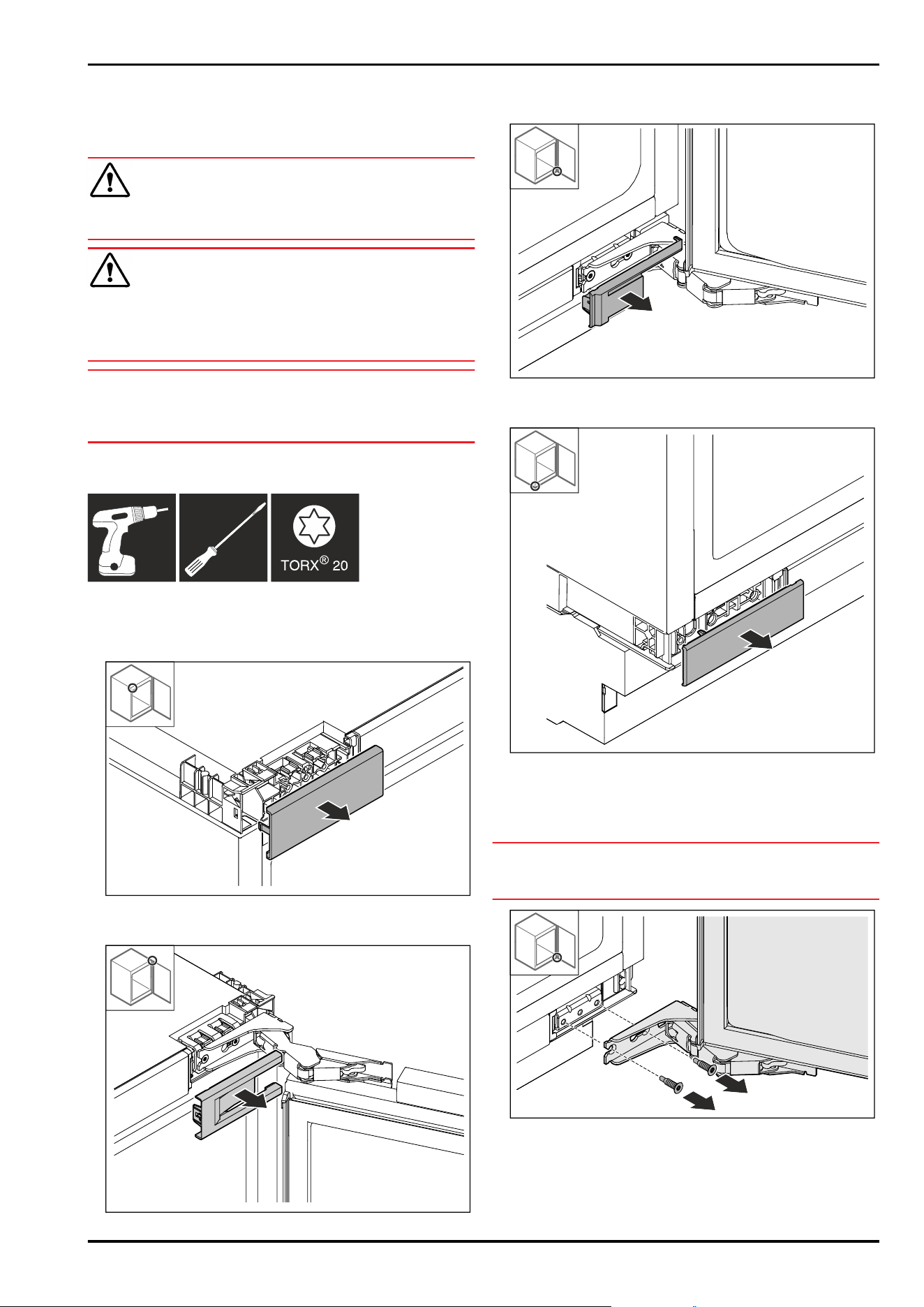
9.3 Removing covers
u
Open the door.
Fig.7
u
Remove cover.
Fig.8
u
Remove cover.
Fig.9
u
Remove cover.
Fig. 10
u
Remove cover.
9.4 Removing the door
NOTICE
Risk of injury if the door tips out!
u
Hold the door.
Fig.11
u
Remove the screws.
Replacing the door hinge
6 * Depending on model and options
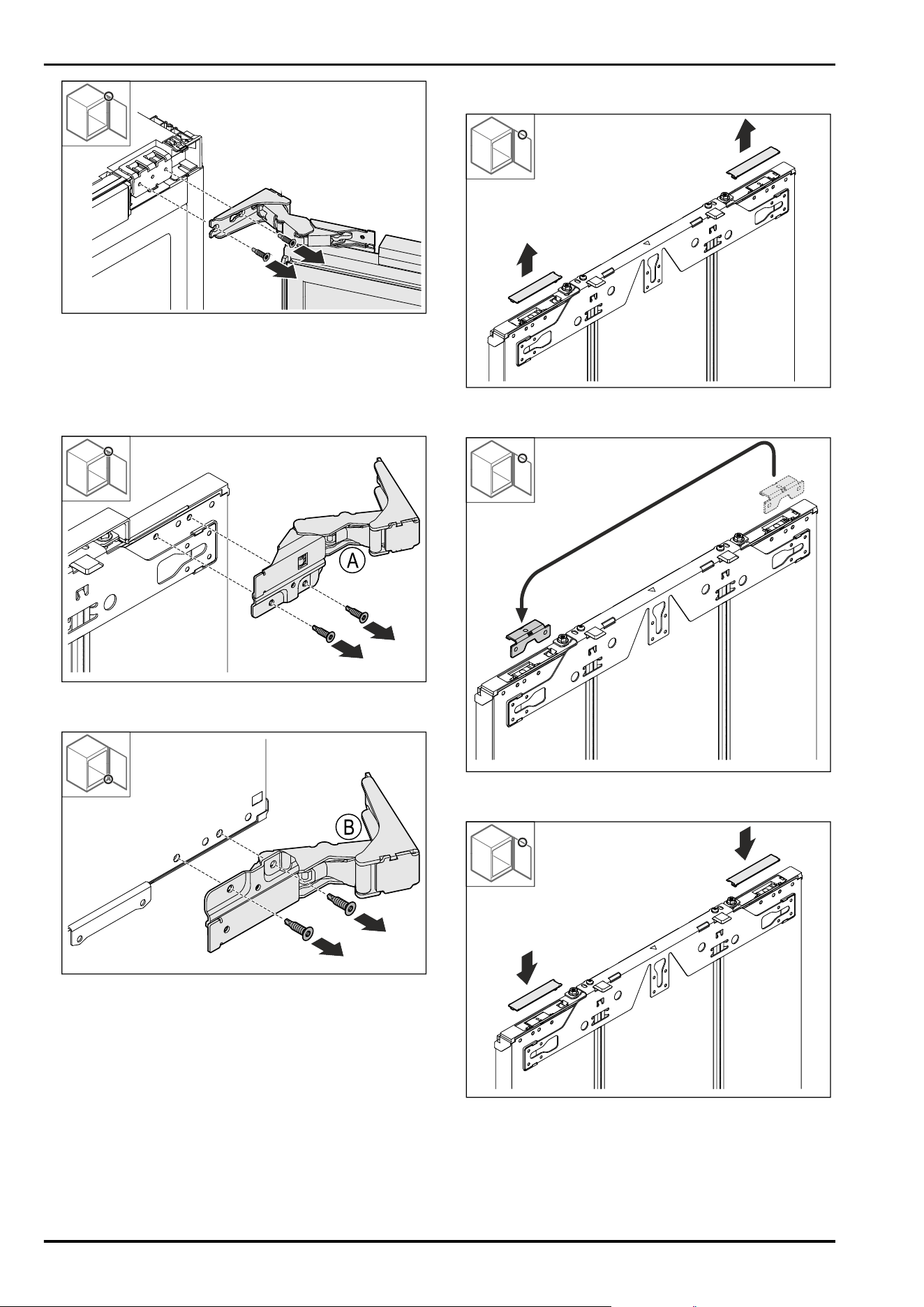
Fig.12
u
Remove the screws.
u
Remove the door.
u
Place the door on a soft surface.
9.5 Removing the hinges
Fig.13
u
Remove the screws.
Fig. 14
u
Remove the screws.
9.6 Relocating the mounting bracket
Fig. 15
u
Detach the covers.
Fig. 16
u
Relocate the lower bracket.
Fig.17
u
Fit the covers.
Replacing the door hinge
* Depending on model and options 7
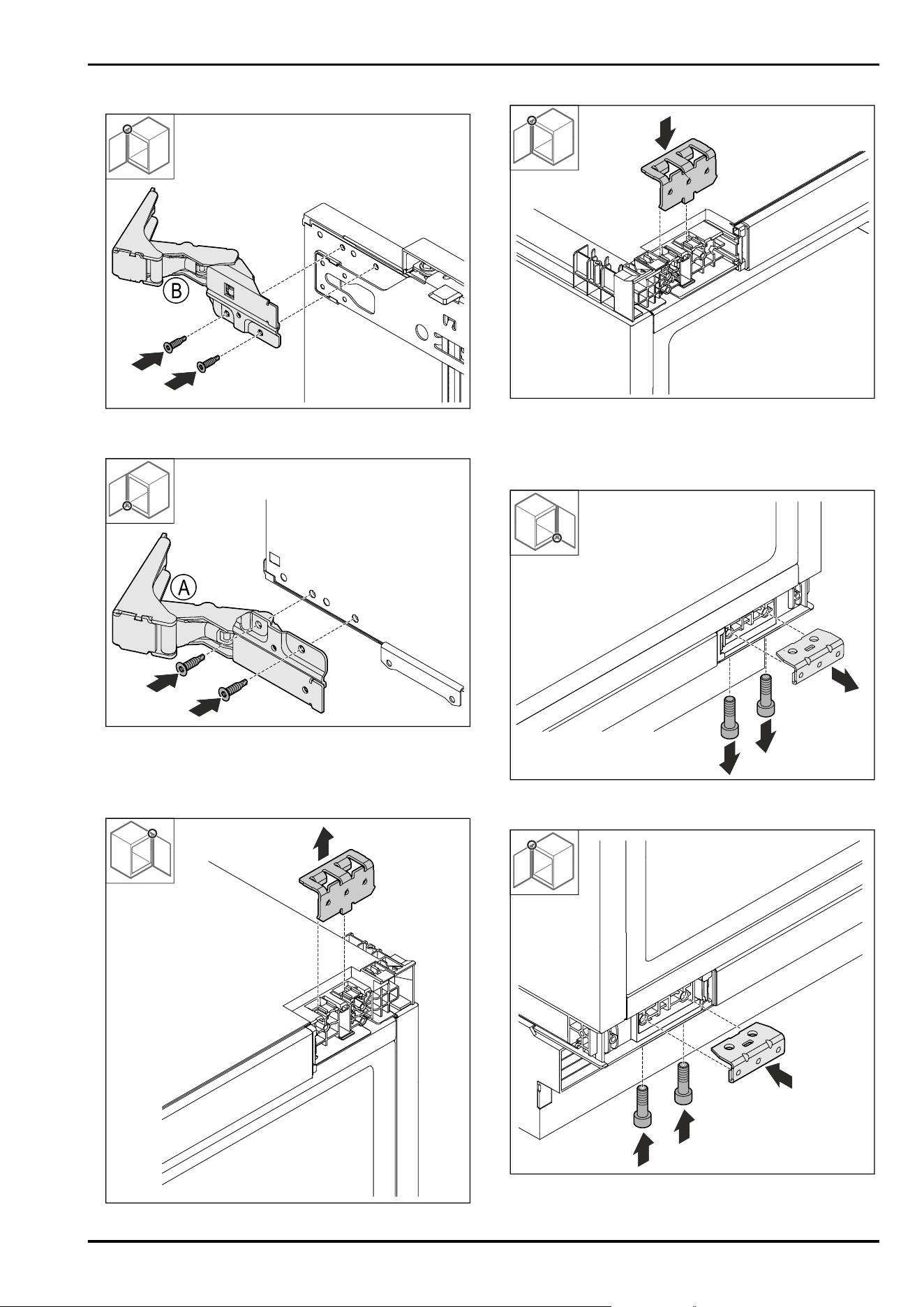
9.7 Fitting the hinges
Fig. 18
u
Screw on the hinge.
Fig. 19
u
Screw on the hinge.
9.8 Relocating the upper bracket
Fig.20
u
Remove the bracket.
Fig.21
u
Insert the bracket.
9.9 Relocating the bottom bracket
Fig.22
u
Detach the bracket.
Fig.23
u
Fit the bracket.
Replacing the door hinge
8 * Depending on model and options
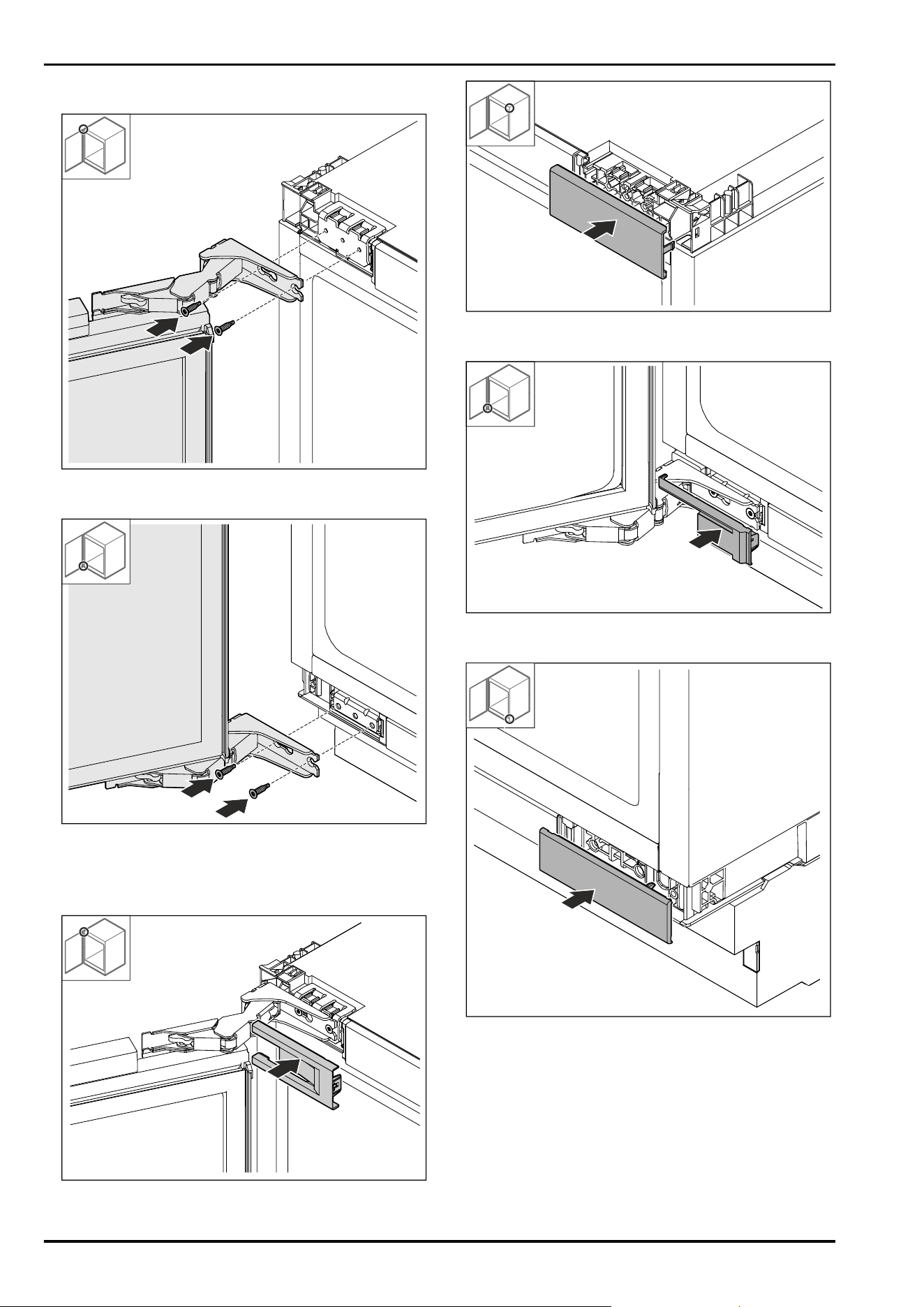
9.10 Fitting the door
Fig. 24
u
Screw on door at the top.
Fig.25
u
Screw on door at the bottom.
9.11 Putting on the covers
Fig. 26
u
Put on the cover.
Fig.27
u
Put on the cover.
Fig.28
u
Put on the cover.
Fig.29
u
Put on the cover.
10 Recessed installation
10.1 Tool
Make sure that the following tools are to hand:
q
Torx® 20
q
Slotted screwdriver
Recessed installation
* Depending on model and options 9
q
Measuring tape
q
Pencil
q
Cord
q
Spirit level
Lateral fastening
q
Substructure under a hard worktop such as granite.
q
The appliance is lower than the kitchen worktop when
the adjustable feet are fully extended.
q
Prerequisite: Unit side panel available for screwing.
Ceiling mounting
q
Appliance sits slightly braced under worktop when
adjustable feet are fully extended.
q
No granite slab.
10.2 Preparing the appliance
Note
The door hinge can only be switched if there is sufficient
space at the top to pull out the hinge mounting bracket and
install it again on the opposite side. This is not usually the
case after installation in the niche.
u
Change the door hinge before fitting the appliance in the
niche.
u
Plug the mains cable’s IEC socket completely into the
appliance plug on the back of the appliance. Ensure that
the IEC socket is tight.
u
Use a cord to lay the mains
plug to a freely accessible
socket.
Fig.30
NOTICE
Risk of harm to flooring susceptible to damage!
u
Under each adjustable foot at the side, place a cardboard
strip approx. 100 mm x 600 mm. Cut the strips out of the
packaging. For recess heights of less than 826 mm, use
strips of a firm but thin material.
u
After pushing the appliance in, remove the strips again.
10.3 Ceiling mounting
Fig. 31 Example illustration
u
Insert the bracket into the opening in the unit ceiling and
bend it forwards.
WARNING
Risk of fire due to short circuit!
u
When you push the appliance into the niche: do not kink,
jam or damage the mains cable.
u
The appliance must not be operated with a defective
mains cable.
u
Slide the appliance into the recess and align, see point
(see 10.5 Alignment of the appliance) .
10.4 Lateral fastening:
Fig. 32 Example illustration
u
Bend one end of each bracket before installation. Insert
the straight side into the opening in the appliance cover
and bend it forwards.
WARNING
Risk of fire due to short circuit!
u
When you push the appliance into the niche: do not kink,
jam or damage the mains cable.
u
The appliance must not be operated with a defective
mains cable.
u
Slide the appliance into the recess and align, see point
(see 10.5 Alignment of the appliance) .
10.5 Alignment of the appliance
Fig. 33 Example illustration
u
Unscrew the levelling feet to below the worktop.
u
Align the appliance in an upright position using a spirit
level.
Recessed installation
10 * Depending on model and options
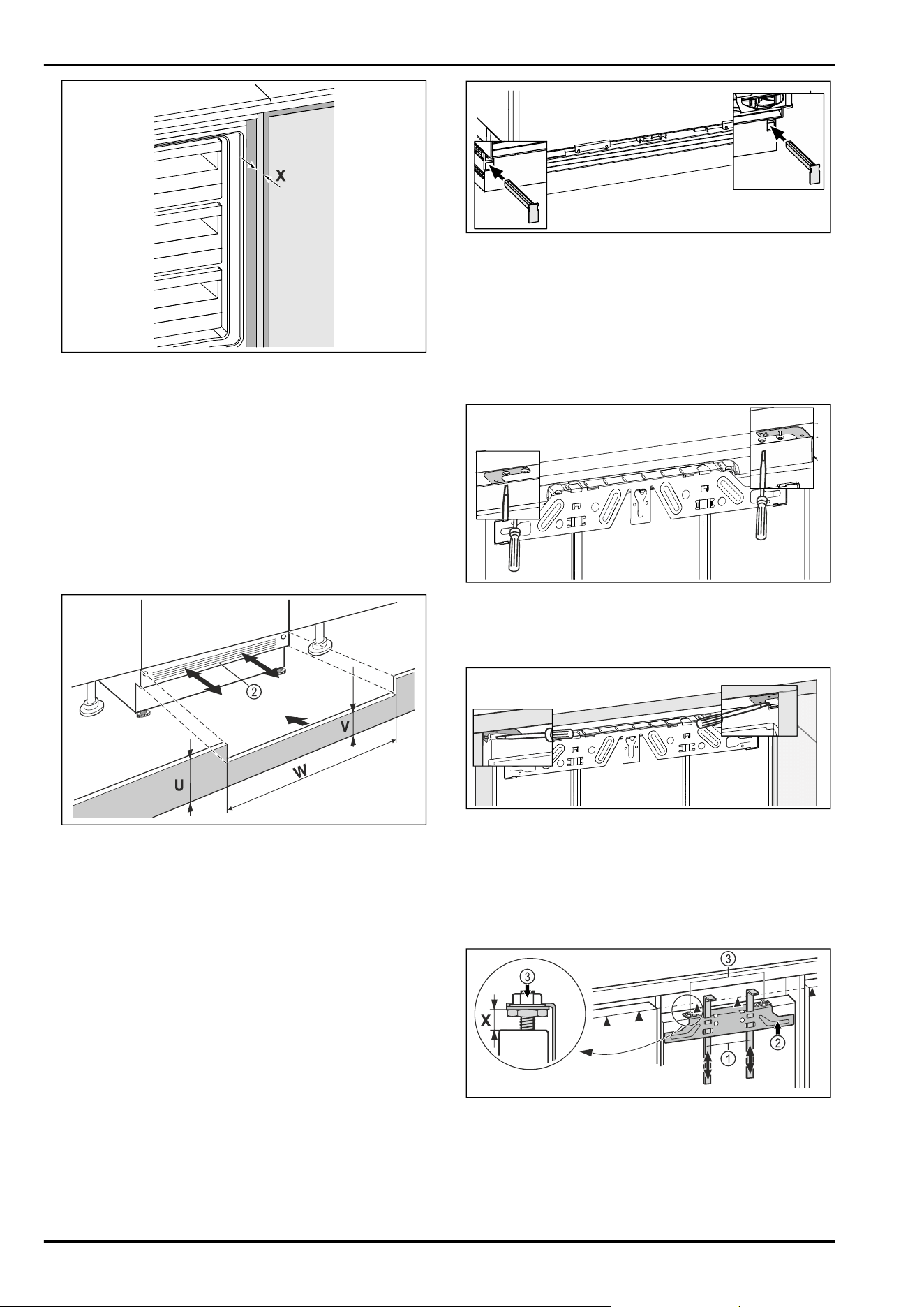
Fig. 34 Example illustration
w
The distance from the front edge of the unit side panel to
the appliance body on both sides is X = 41.5mm.
w
If there is no unit side panel, orientate on the worktop.
For units with door stop parts (knobs, sealing lips, etc.):
u
Subtract the installation dimension (depth of the door
stop parts) from the 41,5mm insertion depth.
u
Unscrew the levelling feet alternately to the maximum.
The maximum adjustment travel is 60mm.
w
Appliance is aligned upright
w
The appliance is slightly braced in the recess between
the floor and worktop.
10.6 Fitting the base
Fig. 35 Example illustration
u
Put on the appliance base cover Fig. 35 (2) but do not fix
it in place yet.
u
Position the unit door and unit base panel for testing
u
If the base panel is visible Fig. 35 (2), pull it forwards so
that the front edge of the ventilation grille and the unit
base panel are level.
-or-
u
If the base panel is concealed Fig. 35 (2), push it all the
way back.
u
Ensure that the ventilation slots are completely free:
If necessary, cut the height of the unit base panel
Fig.35(U) to size!
w
Adjust the web height Fig.35(V)under the appliance base
panel Fig.35(2)along the niche width Fig.35(W).
Fig. 36 Example illustration
u
Fix the appliance base panel: Insert the latch while
holding the appliance base panel.
u
Fasten the unit base panel.
10.7 Screwing the appliance into the
niche
Ceiling mounting:
Fig. 37 Example illustration
u
For mounting under the worktop, screw on the mounting
brackets with two screws each underneath the worktop.
Lateral fastening:
Fig. 38 Example illustration
u
For side mounting, screw the mounting bracket into the
niche with one screw on the right and one on the left.
11 Fitting the unit door
u
Fit the handle to the unit door
Fig. 39
u
Check the default setting of X = 8mm. (Distance between
appliance door and lower edge of traverse)
u
Push the assembly aids Fig. 39 (1) up to unit door height.
Lower stop edge ▲of the assembly aid = upper edge of
the unit door to be assembled.
Fitting the unit door
* Depending on model and options 11
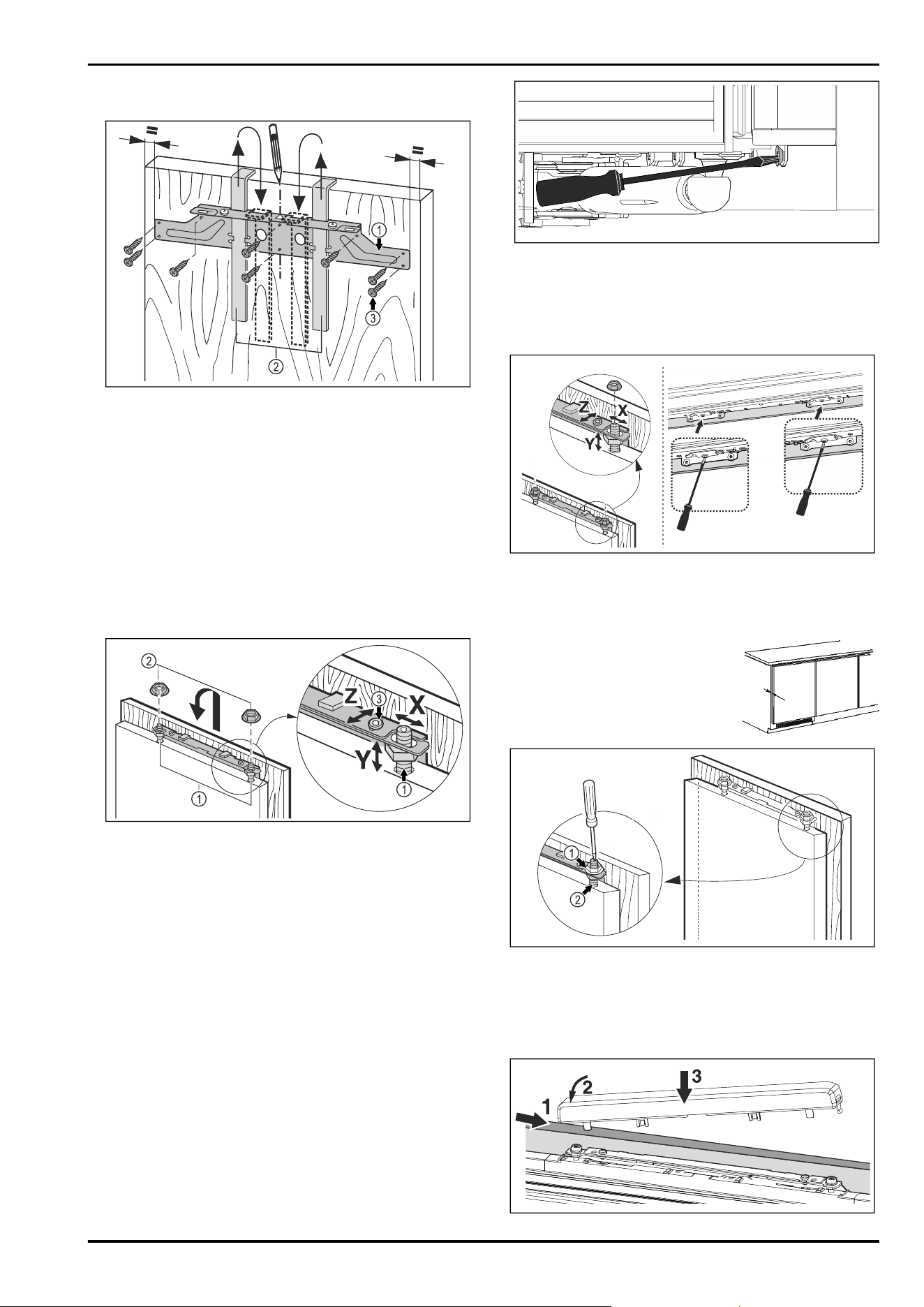
u
Unscrew the fastening bar Fig. 39 (2) using the lock nuts
Fig. 39(3).
Fig.40
u
Hang the fastening bar Fig. 40 (1) with the mounting aids
on the inside of the unit door Fig.40(2).
u
Align the fastening bar Fig. 40 (1) in the centre of the
door.*
w
The distances to the outer edge are the same on the left
and right.*
For chipboard doors:
u
Tighten the mounting bar Fig. 40 (1) with at least 6
screws Fig.40(3).
For panelled doors:
u
Screw the mounting bar Fig. 40 (1)to the edge with 4
screws Fig.40(3).
u
Pull the assembly devices Fig. 40 (2) upwards and push
them, at an angle, into the receiving openings.
Fig. 41
u
Hook the unit door onto the adjustment bolts Fig. 41 (1)
and screw the lock nuts Fig. 41 (2) loosely onto the
adjustment bolts.
u
Close the door.
u
Check the distance of the door against the surrounding
unit doors.
u
Align the unit door sideways: Move unit door in X direc‐
tion.
u
Align the unit door in height Y and in the lateral inclina‐
tion: Adjust the adjustment bolt Fig. 41 (1) with a screw‐
driver.
w
The unit door is aligned flush with the surrounding unit
doors.
u
Tighten the lock nuts Fig. 41(3).
Fig. 42
u
Screw the unit door to the appliance door.
u
Pre-drill the fastening holes in the unit door (if necessary,
pre-pierce with a graver).
u
Screw the appliance door to the unit door using screws
through the mounting brackets.
Fig.43
u
Align the unit door at depth Z: loosen the screws at the
top and bottom of the door, then move the door.
u
For good access to the screws under the door, open the
door approx. 45° wide.
u
Do not allow any burls or sealing
lips to touch - this is important for
correct function!
u
Allow an air gap of 2 mm between
the unit door and the cabiner
carcass.
Fig.44
u
Check the fit of the door and readjust if necessary.
u
Tighten all screws.
u
Tighten the lock nuts Fig. 44 (1) with a hexagon spanner
13, stabilising the adjusting bolt Fig. 44 (2) with a screw‐
driver.
Fitting the unit door
12 * Depending on model and options
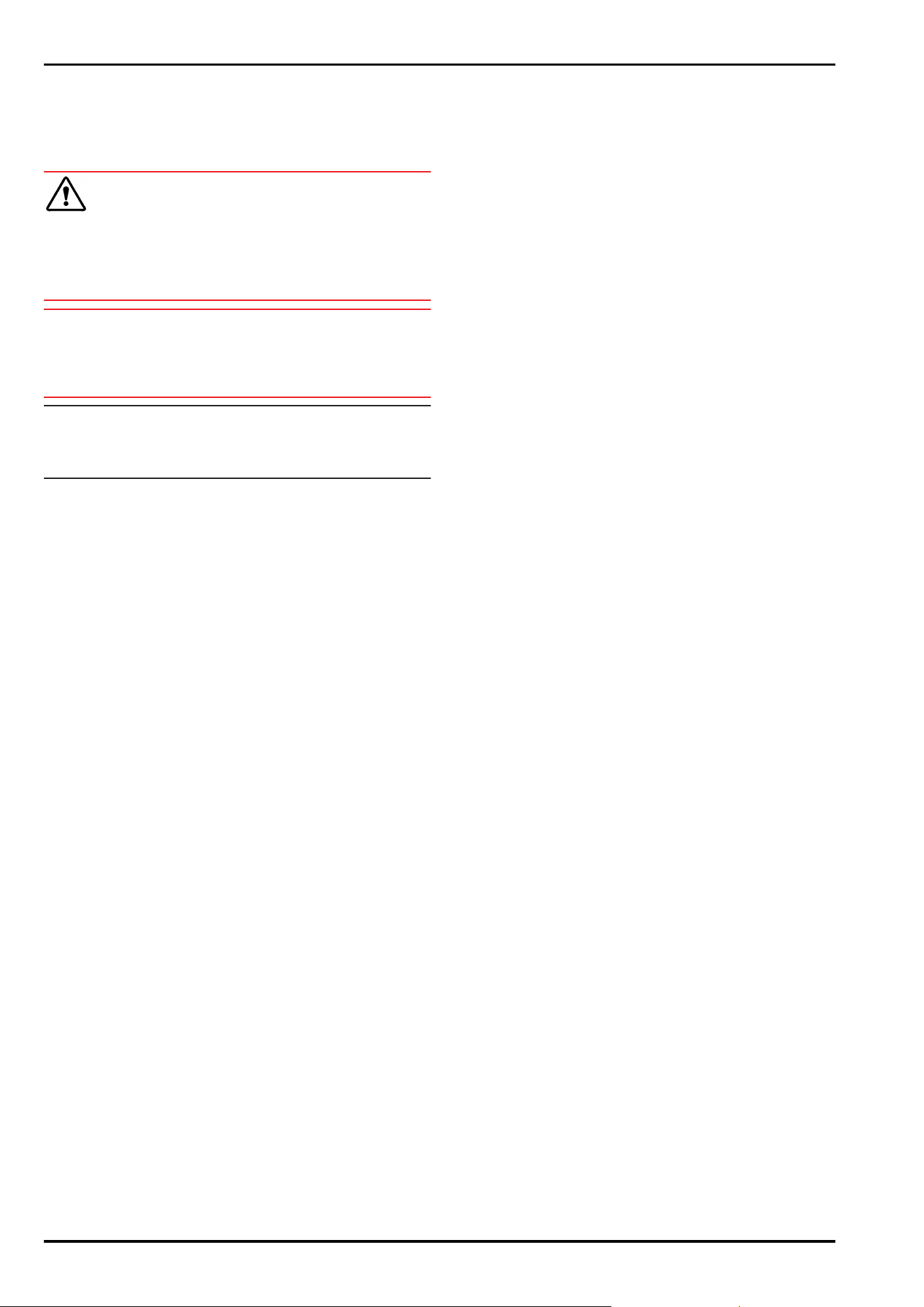
Fig.45
u
Position the upper cover and engage it.
12 Connecting device
WARNING
Danger of fire due to incorrect connection!
Burns.
Damage to the appliance.
u
Do not use an extension cable.
u
Do not use distributor blocks.
NOTICE
Danger of damage to incorrect connection!
Damage to the appliance.
u
Do not connect the appliance to a stand-alone inverter,
e.g. solar power systems and petrol generators.
Note
Only use the supplied mains cable.
u
A longer mains cable can be ordered from Customer
Service.
Ensure that the following conditions are met:
- The type of current and voltage at the installation site
match the information on the serial tag .
- The socket is earthed according to the regulations and
fused.
- The fuse tripping current is between 10 and 16A.
- The socket is easily accessible.
u
Check the electrical connection.
u
Connect the mains plug to the power supply.
Connecting device
* Depending on model and options 13
home.liebherr.com/fridge-manuals
base unit fridges and freezers
Issue date: 20240821
Part number index: 7083768-00
Liebherr-Hausgeräte GmbH
Memminger Straße 77-79
88416Ochsenhausen
Deutschland