
1 / 7
Why Should Brake Fluid Be Exchanged & Brake System Be Flushed?
Brake fluid is hygroscopic meaning it can absorb moisture or dirt from the air resulting in a
dangerous reduction of its boiling point. Water or dirt contaminated brake fluid under
repeated working pressure boils and creates air bubbles. Under severe conditions, this can
result in complete brake system failure.
Water-contaminated brake fluid causes electrolysis to occur inside the brake system. The
oxygen contained in the water droplets cause oxidation. Electrolysis and oxidation corrode the
hydraulic master cylinder and wheel cylinders, and steel brake lines from the inside. Pressure
bleeding has been proven the most effective method in flushing and bleeding hydraulic brake
systems. Flushing the brake system and replacing the dirty and contaminated brake fluid with
fresh brake fluid can often avoid expensive repairs.
It is highly recommended that the brake fluid should be exchanged thoroughly for every 2
years or 30,000 KM / 18,000 Miles.
WARNING
• Read this user manual carefully before operating this machine.
• Only operate this machine with the engine off, and far away from flames.
• Please visually inspect the machine before operation. If there is any damage, please
contact the dealer or manufacturer.
• Protection goggles and gloves should be worn during the service.
• Inspect the braking system for leaks prior to service.
• Never leave the machine running unattended.
• If you shift between various types of brake fluids (DOT3, DOT4, DOT5, DOT5.1, or others),
it is recommended to clean the New Fluid Bottle with a bit of the new type of brake fluid
before filling it massively.
Introduction
This Pulsating Brake Fluid Exchange Machine is controlled by micro-chipsets, which can
manage the fluid pressure, fluid flow rate and working time accurately. The smart pulsating
automation design provides a complete brake fluid exchange, simultaneously filling and
vacuuming the brake system (all hydraulic brake and clutch systems, especially ABS system) for
a fast, effective service. It delivers brake fluid into reservoir, at same time vacuums system and
reduces the introduction of air all while providing a constant supply of new brake fluid into the
system This product can be widely used for the exchange of various kinds of oil or fluid.
2 / 7
Features
• One-Man-Operation conducts a full brake service for 4 clutch cylinders;
• Combo of Pressure at Master Cylinder & Vacuum at Wheels.
• Adjustable pulse fluid exchange efficiently flush the brake system and its pipes, replace
the waste fluid more thoroughly.
• Handles High Pressure Hybrid Vehicle Brake Systems.
• Powerful recovery function can quickly and simultaneously reclaim waste brake fluid
swiftly.
• New and waste fluid pipes are designed independently to prevent cross contamination
between new and waster oils.
• Free set time, pulse and pressure values with LED to clean and exchange the brake fluid
system more accurately and thoroughly.
• Full Pack of connectors well fit brake fluid reservoirs for a wide range of US, European and
Asian vehicles.
• Pressure-Free Service Hose Removal with quick fittings.
• One 2.5L / 0.66Gal New Fluid Bottle + Four 1L / 0.27Gal Waste Fluid Bottles get the job
done in one go.
• Light weight and compact design, portable and easy storage.
Parameters
Input voltage: DC 12V Ampere: 3A or more
Power: 30W
Power Cable Length: 3.5 M / 11.5 ft
Fluid Hose Length: 3.5 M / / 11.5 ft
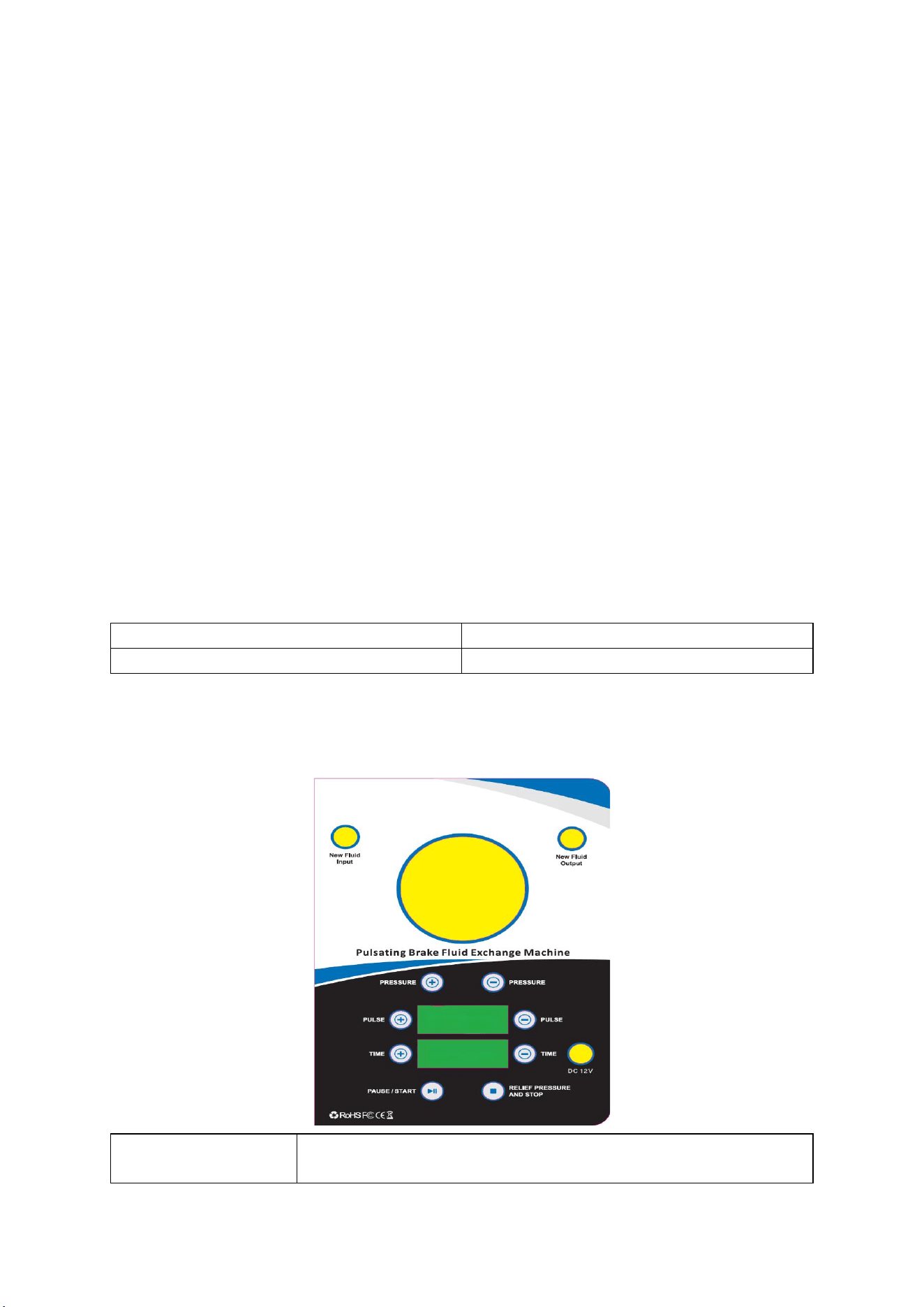
Control Panel Illustration
New Fluid Input
Extract the new fluid from the New Fluid Bottle, and return some
fluid to the Bottle to simulate pressing brake pedal to do the air

3 / 7
bleeding, to prevent air bubbles.
New Fluid Output
To be connected to the reservoir via proper adapters.
Pressure + -
Adjust the pressure to control the flow rate. The suggested
pressure is 1-1.5 bar / 14 -22psi. *DO NOT MAKE IT OVER 2 Bar /
30 psi. Overpressure may damage the brake system.
Pulse + -
Pulsating exchange fluid is for bleeding the air out by simulating
pressing the brake pedal. During the service, a certain amount of
new fluid will be returned to the New Fluid Bottle. (Pulse Range: 1-
10 adjustable). Press “Pulse +” to reduce the fluid return. Press
“Pulse -“ to increase the fluid return. The smaller pulse value the
more fluid return, the better to bleed the air, but the less pressure
and the longer exchange service time.
Time + -
Set the service time, the default time is 15 min. Time can be
adjusted at any stage during the service.
Pause /Start
Start or Pause at any stage during the service.
Relief Pressure /Stop
When the service is complete, One-Button relieve the remaining
pressure inside the machine and its pipes, and stop.
Operation
The new brake fluid is extracted out of the new fluid bottle by the air pump and continuously
pumped into the car’s brake fluid reservoir at the desired pressure, pushing the waste fluid
out of the brake system. When you see the fresh fluid flows out from the screws, which means
the service could be ended.
Compared to old-style compression brake fluid change, this pulsating brake fluid exchange
high efficiently avoids air bubbles during the filling process and optimizes or avoids manual
bleeding processes.
⚫ Correctly Set The Working Pressure
The working pressure is recommended to be set at between 1-1.5 bar / 14.5-22psi, which can
ensure that the brake fluid reservoir does not deform when exchanging the fluid, thereby
ensuring the sealing of the secondary seal. In addition, it is also feasible to vent or change the
fluid at a lower working pressure, which can be achieved by adjusting the pressure. In special
cases where there is a higher working pressure, please note that if the pressure is adjusted
too high (Over 2 Bar / 30 psi), the brake master cylinder of the brake system could be
damaged. (See Vehicle Manufacturer’s recommendation)
⚫ Low-pressure Sealing Performance Test

4 / 7
This machine can also be used to perform low-pressure testing on hydraulic brake devices.
Connect The machine to the brake fluid reservoir through a connector (Note that all exhaust
valves should be sealed at this time). Then the brake system is pressurized by the working
pressure of the machine (Usually lower than 2 Bar / 30 psi. Check the vehicle’s user manual to
find out the proper pressure required by this vehicle model); observe whether the entire master
cylinder and brake pipeline are leaking. If there is brake fluid flows out, it means that this brake
system is not sealed.
⚫ Operation Steps:
➢ Park and Lift the vehicle to a suitable height so that the wheels are suspended in the air.
➢ Pour at least 2L / 0.53Gal new brake fluid into the New-Fluid Bottle, and drop the New
Fluid Input Pipe down to the bottom of the New-Fluid Bottle. (You do not have to use our
New Fluid Bottle if you have original bigger bottle with 2L / 0.53Gal or more fluid).
➢ Connect the 4 Waste Fluid Bottle to the brake cylinder of the wheels respectively, and
loosen the exhaust screw of the brake cylinder to ensure that brake fluid flows out. (You
can do the service wheel by wheel, started from the furthest wheel-Right-Rear wheel,
then Left-Rear wheel, then Right-Front wheel, the latest driver’s wheel. Also you can do
the exchange service for 4 wheels at the same time, but please watch out new fluid level
and make sure enough new fluid there because the service time for each wheel is not
the same pace, might waste some new fluid. Also exchanging fluid for 4 wheels
simultaneously needs higher working pressure.)
➢ Connect the DC 12V power.
➢ Connect the adapter to the Fluid Output Pipe, then Press “Start” button to make sure new
fluid flows out a bit to build the pressure, then fit the service adapter to the vehicle’s brake
fluid reservoir.
➢ Press the "Start" button to start the service.
➢ During exchange service, observe the vehicle’s brake fluid reservoir. If the fluid is running
slow, press the "Pressure +" button on the machine to speed up the exchange; if the fluid
is pouring too fast, press the "Pressure -" button to slow down the filling. Suggested
working pressure 1-1.5 Bar/14-22 psi, in any case NOT higher than 2Bar/30 psi.
➢ Visually observe each wheel’s service. If the new fluid continuously flows out from the
screw into the waste fluid bottle and no any air bubbles. This indicates that the brake
system of this wheel is all filled with new fluid, then tighten the screw immediately. And
so with other wheels one by one, tighten the screws for all wheels. Then STOP the
machine and disconnect the four waster fluid bottles. (The default working time is 15 min,
you can press TIME+- to add or reduce the time, just make sure there is enough new fluid
inside the New Fluid Bottle)

5 / 7
➢ After the service is ended, generally, the machine and its pipes still retain some pressure,
and the machine’s pressure gauge is not at ZERO. To prevent the fluid in the pipe from
splashing out when disconnecting with car’s brake fluid reservoir, please press the “Relief
Pressure & Stop” button to relieve the machine’s pressure to ZERO (Another option is that
you could relieve the pressure through slowly loosening the adapter from the brake fluid
reservoir.)
Friendly Reminder:
1. During the service, please pay attention to whether there is fluid leakage at the joints,
whether the pipe is damaged, and keep the New-Fluid bottle clean.
2. After the exchange service, there remains some fluid (around 50ml) inside this machine
and its pipes. Please disconnect the New Fluid Output Pipe with the car’s fluid reservoir
and drain this machine and its pipes completely by operating the same exchanging
procedures as above (with New Fluid Input Pipe in the air and Fluid Output Pipe connecting
with any one adapter), set the Max pressure, push the remaining oil out by the pressurized
air. If the residual fluid in this machine and pipelines is not emptied for a long time, the
vacuum pump and pipes of the machine may be corroded.
3. After the fluid exchange service, if there is still some new fluid left in the New-Fluid Bottle,
please recycle this remaining new fluid in another tank and seal it for storage. Always keep
the New-Fluid Bottle empty, dry and clean. (Tip: You do not have to use the New Fluid Bottle
we provide. If you have a brand new original 2L / 0.5 gal pack of new fluid, you can put the
New Fluid Pipe into it, and use it directly)
Troubleshooting
Problem
Solution
LED not light up
• Ensure that the power cable is properly Connected.
• Make sure the voltage is around 12V and the current is 3A or more.
Not having enough
pressure
• The pressure is set too low; Increase the fluid pressure by pressing the
PRESSURE + button.
• Ensure the New Fluid Input Pipe is at the bottom of New Fluid bottle
and there is enough new fluid in it.
• Make sure the new fluid is clean, no debris in the new fluid bottle and
the filter at the end of New Fluid Input Pipe is not blocked by debris.
Can not relieve the
pressure to Zero
• Some dirt might be sucked into the pipes and blocked the Fluid Return
Valve.
• Slowly loosen the adapter from the brake reservoir, let the pressure
comes out, then disconnect the adapter from the Fluid Output Pipe.
Brand new machine
or a machine that has
been completely
drained, but new fluid
cannot be pumped
• Pause and Start the machine to run for about 20 seconds, and repeat
this cycle until new fluid pumped out.
• Or the pressure is set too low; press the "Pressure +" button to

6 / 7
out
increase the exchange pressure.
The pressure is
correct, but fluid
exchange flows too
slow
• The default working time is 15 min, you could extend service time.
• Make sure the new fluid is clean, no debris in the new fluid bottle and
the filter at the end of New Fluid Input Pipe is not blocked by debris.
Maintenance & Storage
• Avoid spilling fluid on the machine, If any, please wipe it clean immediately, otherwise it
may cause corrosion to the machine body.
• After service, please clean the fluid pipe, connectors and the spout of the New Fluid Bottle
with a soft & dry cloth. And keep them clean & dry.
Accessory & Adapters
➢ Machine * 1
➢ User Manual *1
➢ Power Cable * 1
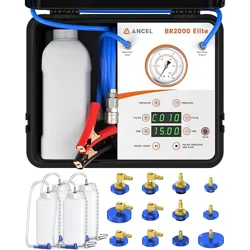
➢ 2.5L / 0.66 Gal New Fluid Bottle * 1 pcs & 1L / 0.27 Gal Waste Fluid Bottle* 4 pcs
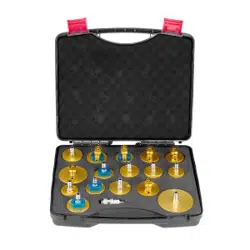
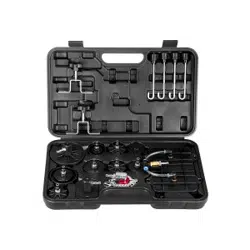
➢ Full Pack Of Adapters Box *1.
*2 TESLA adapters (one for Model 3/Y and one for Model S/X) are optional, please contact
your dealer to purchase.
FAQ: What are the benefits for brake fluid exchange with Pressure & Pulse?
Pressure & Pulse exchanging brake fluid is a popular method for changing brake fluid, and it
offers several significant benefits:
1. Efficiency and Speed:
- Single-Person Operation: Pressure bleeding allows one person to complete the entire
process, which is especially convenient compared to methods that require a second person.
- Quick Fluid Replacement: The pressurized system forces fluid through the brake lines quickly,
making the process faster than gravity bleeding or manual pumping.
2. Effective Air Removal:
- Thorough Air Purge: The constant pressure applied during the process helps push out air
bubbles more effectively than some other methods, reducing the likelihood of trapped air in
the system, which can lead to spongy brakes.

7 / 7
- Consistent Pressure: Unlike manual methods, where the pressure can vary with each pump
of the brake pedal, pressure bleeding maintains a consistent flow of fluid, ensuring even
removal of air and contaminants.
3. Reduced Wear on Brake Components:
- No Pedal Pumping Required: Since the brake pedal is not used during pressure bleeding,
there’s no risk of damaging the master cylinder seals or other components from repeated
pumping.
- Less Strain on the System: The process is gentler on the brake system overall, as it avoids
the pressure spikes that can occur during manual pumping.
4. Consistent Results:
- Controlled Process: Pressure bleeding provides more control over the fluid exchange
process, ensuring that all old fluid is thoroughly flushed out and replaced with fresh fluid.
- Minimizes Human Error: Since the process is largely automated, there’s less chance of
mistakes, such as not closing the bleeder valve in time, which can introduce air back into the
system.
5. Flexibility:
- Works with Various Systems: Pressure bleeders are compatible with a wide range of vehicles
and can be used on ABS systems, which can be more challenging to bleed using manual
methods.
- Adapts to Different Conditions: The pressure can be adjusted to suit different systems or
specific bleeding needs, such as flushing particularly contaminated brake lines.
6. Safety:
- Reduced Contamination Risk: Since the brake fluid reservoir remains sealed during the
process, there’s less chance of contamination from dirt or moisture entering the system.
- Minimal Fluid Spillage: The pressurized system helps control the flow of fluid, reducing the
likelihood of spills that can harm paint or other vehicle components.
7. Professional-Grade Results:
- High-Quality Outcome: Pressure bleeding is the preferred method in many professional
workshops because it consistently delivers high-quality, reliable results, making it a go-to
choice for ensuring a safe and well-maintained braking system.
Overall, pressure bleeding is a highly effective method for changing brake fluid, offering speed,
efficiency, and superior results with minimal effort.