
《Wireless Module User Manual》
VER:
V1.0
Product name:
Network Module For Conference Display
Model No.
VAX8852-UM
Prepared by:Liu Zhi Yong
Check by:Zhang Chao Bing
DATE :2026. 05 . 26
1、Product Description
As a customized dual-module wireless module, this product uses a standardized M.2
interface, which highly matches customer motherboard requirements.
The module's dual network card combination design meets users' dual demands for
performance and functionality. This module is equipped with WiFi 6 wireless communication
technology, supporting IEEE 802.11a/b/g/n/ac/ax protocols, and featuring WiFi 6 + Bluetooth
5.2 wireless functions. It provides a 20MHz/40MHz/80MHz coexistence mechanism, complete
dual-band (2.4GHz and 5GHz) 2×2 MIMO MAC/PHY/wireless system-on-chip, capable of
achieving transmission speeds of up to 1201Mbps in 802.11AX mode with 80MHz bandwidth
in wireless local area networks.
Meanwhile, the module also provides a WiFi 5 communication module conforming to
wireless network standards, supporting IEEE 802.11a/b/g/n/ac protocols, featuring dual-band
WiFi wireless functions, providing a 20MHz/40MHz/80MHz coexistence mechanism, and
complete dual-band (2.4GHz and 5GHz) WIFI 1×1 wireless system-on-chip.
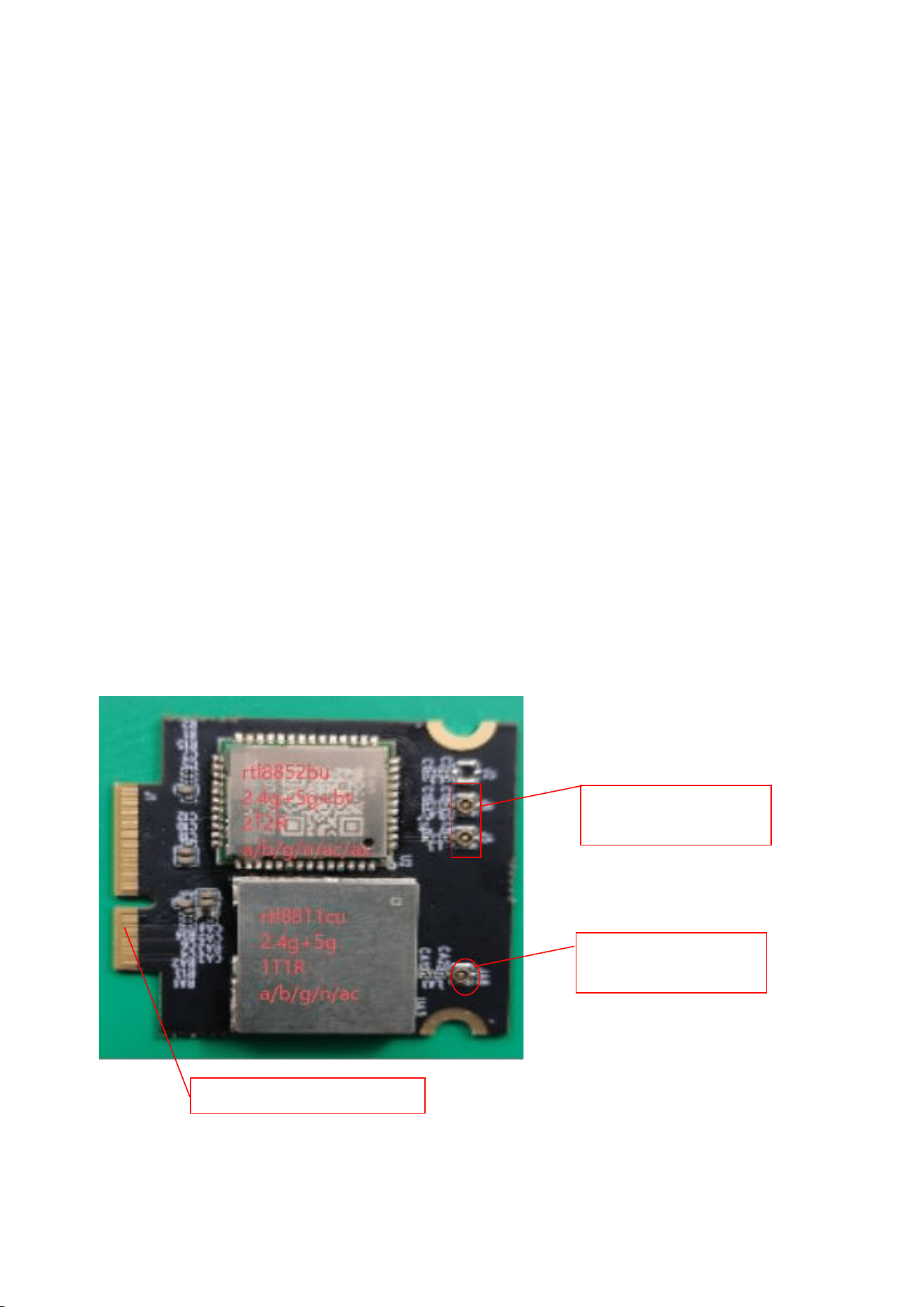
2、Hardware interface introduce
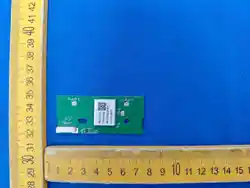
Rtl8852bu
Antenna IPEX Soket
Rtl8811cu
Antenna IPEX Soket
M.2 special definition interface
3、Operation module
The module is build-in wireless part of interactive panel.
The module is a custom-made device ,use for panel product.
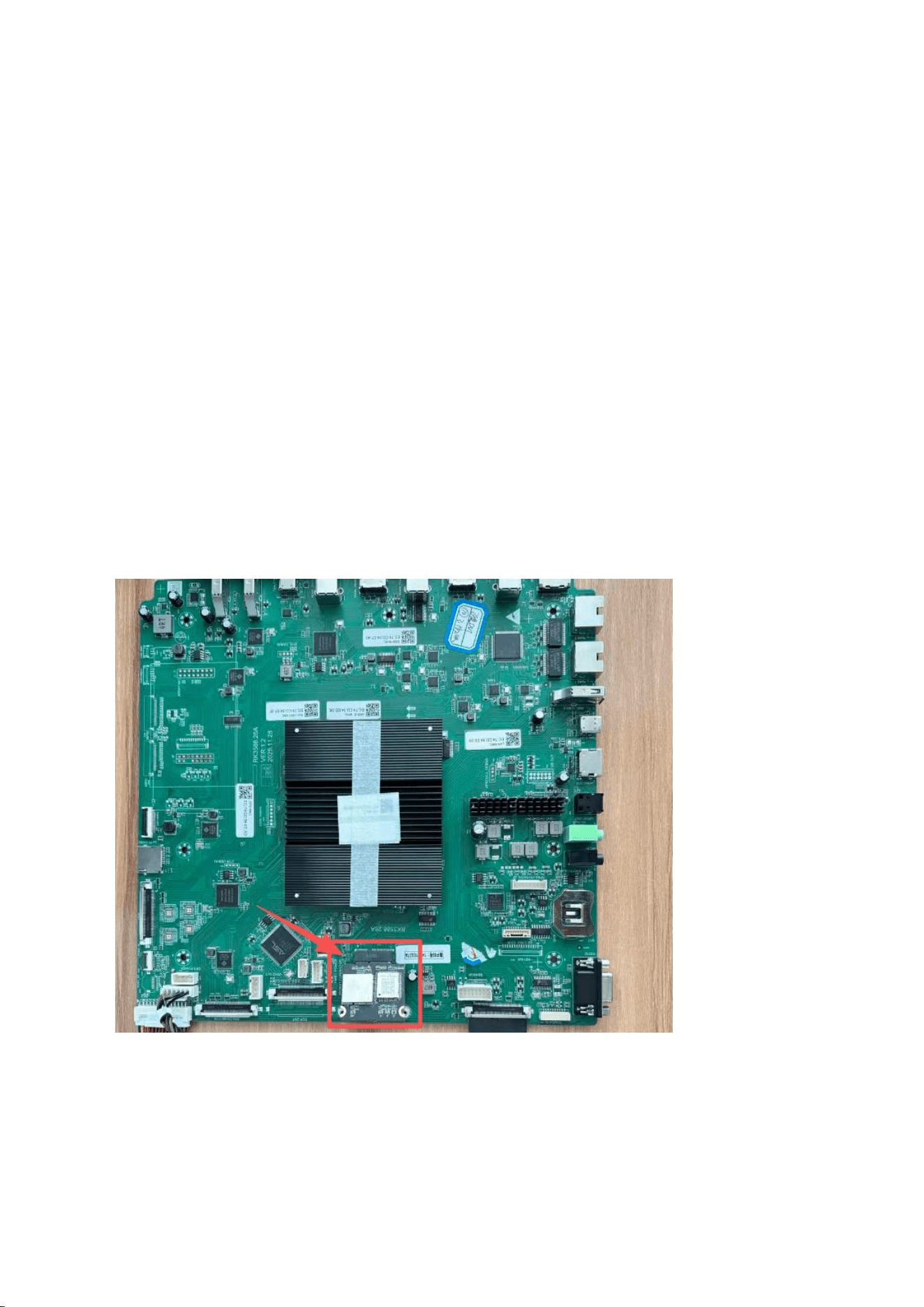
As follow picture:
1) you should inset module device in M.2 interface socket on base circuit board,and also
use special fixtures to test in certification Lab.
2) Then secure the screws on both sides. You need to ensure that the module is installed
in the correct position, with good contact, and that the system can properly recognize the
hardware.
3) At the same time, you must install 3 pieces antenna in product structure and andriod
device OS can receive a better signal.

FCC Notice:
This device complies with Part 15 of the FCC Rules. Operation is subject to the following
two conditions: (1) This device may not cause harmful interference. (2) This device must
accept any interference received, including interference that may cause undesired
operation.
NOTE: This equipment has been tested and found to comply with the limits for a Class B
digital device, pursuant to Part 15 of the FCC Rules. These limits are designed to provide
reasonable protection against harmful interference in a residential installation. This
equipment generates uses and can radiate radio frequency energy and, if not installed and
used in accordance with the instructions, may cause harmful interference to radio
communications. However, there is no guarantee that interference will not occur in a
particular installation. If this equipment does cause harmful interference to radio or
television reception, which can be determined by turning the equipment off and on, the user
is encouraged to try to correct the interference by one or more of the following measures:
---Reorient or relocate the receiving antenna.
---Increase the separation between the equipment and receiver.
---Connect the equipment into an outlet on a circuit different from that to which the receiver
is connected.
---Consult the dealer or an experienced radio/TV technician for help.
WARNING: Changes or modifications not expressly approved by the party responsible for
compliance could void the user's authority to operate the equipment.
RF Exposure
The equipment complies with FCC radiation exposure limits set forth for an uncontrolled
environment. This device should be installed and operated with minimum distance 20cm
between the radiator & your body.

4. OEM Integration Instructions (Per KDB 996369 D03)
This module is intended for use by OEM integrators only. In accordance
with FCC KDB 996369 D03 OEM Manual v01, the following conditions must
be strictly observed when using this certified module.
4.1 List of Applicable FCC Rules
This module has been tested for compliance with the following FCC rule
parts: FCC Part 15 Subpart C (for 2.4GHz band)
FCC Part 15 Subpart E (for 5GHz band)
4.2 Specific Operational Use Conditions
This module has been tested for standalone mobile RF exposure use
conditions. It is designed to be installed inside the final host product and
operated by professional installers.
The following conditions must be met:
The module must not be co‑located with any other transmitter or antenna.
A minimum separation distance of 20cm must be maintained between the
radiator and the user's body during installation and operation.
This module is approved for use in mobile devices only (not for portable
conditions).

IMPORTANT NOTE: If the above conditions cannot be met (e.g.,
co‑location with another transmitter or use in a portable condition), the FCC
authorization is no longer valid and the FCC ID cannot be used on the final
product. In such cases, the OEM integrator must re‑evaluate the final product
and apply for a separate FCC authorization.
4.3 Limited Module Procedures
Not applicable. The module is a Single module and complies with the
requirement of FCC Part 15.212.
4.4 Antenna Design Requirements
This module may only operate with the antennas with which it has been
certified. The antenna or any other part of the module must not be modified, as
this will invalidate the module certification and require a new application for
the final product.
Antenna No.
Model No.
Type of antenna
Gain
Frequency range
Antenna 1
120410064A
PIFA antenna
2.51dBi
2.51dBi
2.76dBi
2402-2480MHz
2412-2462MHz
5150-5850MHz
Antenna 2
Antenna 3
120410061A
PIFA antenna
2.95dBi
3.55dBi
2412-2462MHz
5150-5850MHz
4.5 RF Exposure Considerations

This equipment complies with FCC radiation exposure limits set forth for
an uncontrolled environment. This device should be installed and operated with
a minimum distance of 20cm between the radiator and your body.
If the module is installed in a portable host device, additional SAR
evaluation is required to confirm compliance with FCC portable RF exposure
rules.
4.6 Label and Compliance Information
The final host product must display the following statement in a visible
area: Contains FCC ID: 2ACYT-VAX8852
If the product dimensions make it difficult to place this label on the host
device, the statement may be placed in the user manual, or on the product
packaging or an accompanying label.
The user manual of the final host product must also include the following
warning: FCC CAUTION
Changes or modifications not expressly approved by the party responsible
for compliance could void the user's authority to operate the equipment.
4.7 Information on Test Modes and Additional Testing Requirements
Test modes should take into consideration the different operational
conditions of the stand‑alone modular transmitter in the host, as well as

scenarios involving multiple simultaneously transmitting modules or other
transmitters.
4.8 Additional Testing, Part 15 Subpart B Disclaimer
This transmitter module is granted FCC authorization only for the specific
rule parts listed in the FCC grant (i.e., the FCC transmitter rules). The host
product manufacturer is responsible for compliance with any other FCC rules
not covered by the modular transmitter certification.
The final host product still requires compliance testing for Part 15 Subpart
B (unintentional radiator) after the module is installed.
4.9 EMI Considerations
It is recommended that RF design engineering testing and evaluation be
performed when the module's layout may affect host components or create
non‑linear interactions, in order to ensure that no additional non‑compliant
emissions are generated.
4.10 How to Make Changes
This module is a limited modular approval. Any changes or modifications
made to the module may invalidate the certification and require a new
application.
OEM Integrator Responsibilities

As the OEM/host manufacturer, you bear the ultimate responsibility for the
compliance of the final product:
Re‑evaluation: The final product must undergo re‑testing for FCC Part 15
Subpart B compliance.
Verification Testing: It is recommended to perform basic verification tests
on the module installed in the host, including fundamental and spurious
emission measurements.
Compliance with Integration Instructions: The module must be installed
and used strictly in accordance with these instructions.
Provision of Compliance Information: The final product user manual must
include all required regulatory statements and warnings as specified in this
document.
Note to OEM Integrators: OEM integrators must not provide end users with
instructions on how to install or remove the RF module. The end‑user manual
should contain all regulatory information/warnings as specified in this
document.
Out-of-Band and Spurious Emissions: The host manufacturer is responsible for
ensuring that all radiated emissions, including those from simultaneous
operation, comply with the limits of Part 15 when the module is installed in the
final host product.