
PREFACE
Thank you for purchasing our Walkie-Talkie. This easy-to-use radio will
deliver you secure, instant and reliable communications at peak efficiency.
Please read this manual carefully before use. The information presented
herein will help you to derive maximum performance from your radio.
To begin operation, please fully charge the radios.
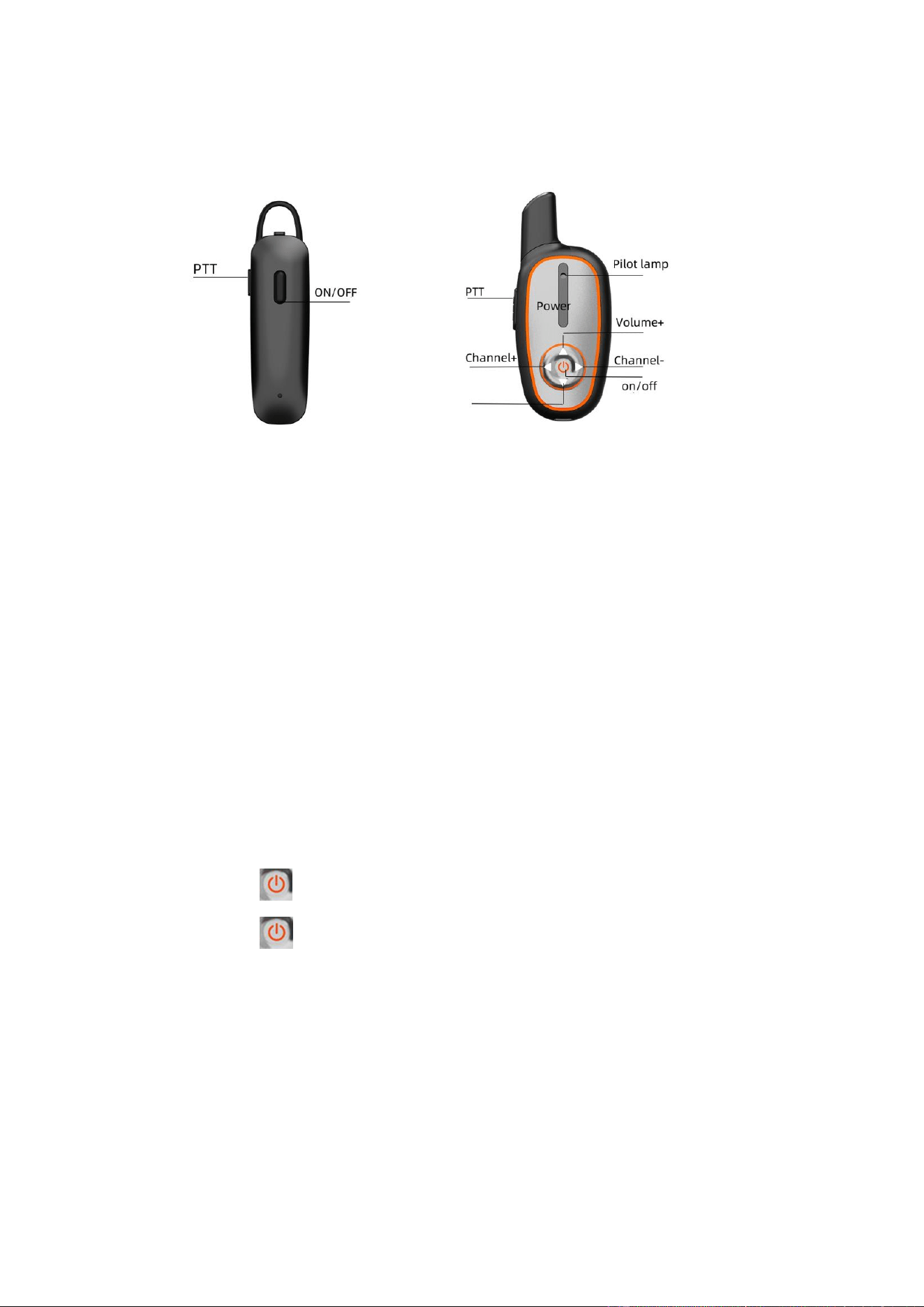
1.Radio Overview
2.Main Feature
▲Frequency Band:462.5625MHz~462.7125MHz and 462.5500MHz~462.7250MHz
▲15 Channel
▲PC Programmable
▲5 Level Volume Adjustment
▲CTCSS, DCS
3.Basic Operation
■Power On/Off
a. Press key for more than two seconds to turn on the radio.
b. Press key again to turn off the radio.
■ Walkie Talkie PTT (PUSH-TO-TALK)

1. Press and hold down the PTT button to transmit (the indicator light turns red).
2. Release PTT button to receive.
■Channel Selection
1. Press key to increase the channel number; Press key to decrease
the channel number.
The channel number is customized. The factory setting is 16 channels.
■Volume Selection
Press to increase the volume. Press to decrease the volume.

FCC statement
This device complies with Part 15 of the FCC Rules. Operation is subject to the following two
conditions: (1)
this device may not cause harmful interference, and (2) this device must accept any interference
received,
including interference that may cause undesired operation.
Changes or modifications not expressly approved by the party responsible for compliance could
void the
user's authority to operate the equipment.
NOTE: This equipment has been tested and found to comply with the limits for a Class B digital
device, pursuant to Part 15 of the FCC Rules. These limits are designed to provide reasonable
protection against harmful interference in a residential installation. This equipment generates,
uses and can radiate radio
frequency energy and, if not installed and used in accordance with the instructions, may cause
harmful interference to radio communications. However, there is no guarantee that interference
will not occur in a particular installation. If this equipment does cause harmful interference to radio
or television reception,
which can be determined by turning the equipment off and on, the user is encouraged to try to
correct the interference by one or more of the following
measures:
-- Reorient or relocate the receiving antenna.
-- Increase the separation between the equipment and receiver.
-- Connect the equipment into an outlet on a circuit different from that to which the receiver is
connected.
-- Consult the dealer or an experienced radio/TV technician for help.
This device and its antenna(s) must not be co-located or operation in conjunction with any other
antenna or
transmitter.
Hold the transmitter approximately 2 inches (25mm) from your face and speak in a normal voice,
with the
antenna pointed up and away.
Specific Absorption Rate (SAR) information:
walkie-talkie meets the government's requirements for exposure to radio waves. The guidelines
are based on standards that were developed by independent scientific organizations through
periodic and thorough evaluation of scientific studies. The standards include a substantial safety
margin designed to assure the safety of all persons regardless of age or health. FCC RF Exposure
Information and Statement the SAR limit of USA (FCC) is 8.0 W/kg averaged over one gram of
tissue. Device types: walkie-talkie has also been tested against this SAR limit.
This device was tested for typical body-worn operations with the back of the walkie-talkie kept
0mm body-worn Side and 25mm Front of face Side. To maintain compliance with FCC RF
exposure requirements, use accessories that maintain 0mm body-worn Side and 25mm Front of
face Side separation distance between the user's body and the back of the walkie-talkie. The use
of
belt clips, holsters and similar accessories should not contain metallic components in its assembly.

The use of accessories that do not satisfy these requirements may not comply with FCC RF
exposure requirements, and should be avoided.
RF Energy Exposure Awareness and Control Information and Operational Instructions for
Occupational Use
Notice: this radio is intended for use in occupational/controlled conditions where users have full
knowledge
of their exposure and can exercise control over their exposure to meet the occupational limits in
FCC and
International standards. This radio device is NOT authorized for general population consumer use.
Federal Communication Commission (FCC) Regulations
When Waterproof walkie-talkie is used as a consequence of employment, the FCC requires users
to be
fully aware of and able to control their exposure to meet occupational requirement. Exposure
awareness can
be facilitated by the use of a product label directing users to specific user awareness information.
Your
Waterproof walkie-talkie has a RF Exposure Product Label. Also, your Waterproof walkie-talkie
Radio
user manual includes information and operating instructions required to control your RF exposure
and
satisfy compliance requirements.
Compliance with RF Exposure Standards
Your Waterproof walkie-talkie is designed and tested to compliance with a number of national and
international standards and guidelines for human exposure to radio frequency electromagnetic
energy. This
radio compliance with the IEEE (FCC) and ICNIRP exposure limits for occupational/controlled RF
exposure
environments at operating duty factors of up to 50% talk – 50% listen and is approved for
occupational use
only. In terms of measuring RF energy for compliance with these exposure guidelines, your radio
generates
measureable RF energy only while it is transmitting (during talking), not when it is receiving
(listening) or in
standby mode.
Your Waterproof walkie-talkie complies with the following RF energy exposure standards and
guidelines:
● United States Federal Communications Commission (FCC), Code of Federal Regulations;
● Institute of Electrical and Electronic Engineers (IEEE) C95.1
● International Commission on Non-lionizing Radiation Protection (ICNIRP)
RF Exposure Compliance and Control Guidelines and Operating Instructions for Two-Way Radio
Operations
To control your exposure and ensure compliance with the occupational/controlled environment
exposure
limits, always adhere to the following procedures;
● DO NOT remove the RF Exposure Label from the device

● User awareness instructions should accompany device when transferred to other users.
Operational Instructions and Training Guidelines
To ensure optimal performance and compliance with the occupational/controlled environment RF
energy
exposure limits in the above standards and guidelines, users should transmit no more than 50% of
the time
and always adhere to the following procedures;
● In front of the face, hold the radio in a vertical position with microphone (and other parts of
the radio including the antenna) at least one inch (2.5 centimeters) away from the nose or lips.
Keep the
radio at a proper distance is important to ensure compliance.
Note: RF exposure decrease with increasing distance from the antenna.
● Body Worn Operation; when worn the body, always place the radio in an approved clip,
holder, or body harness for this product.
Using approved body-worn accessories is important because the use of non-approved
accessories may
results in exposure levels, which exceed the occupational/controlled environment RF exposure
limits
Using only approved supplied or replacement antennas, batteries, and audio accessories, use of
nonapproved antennas, batteries, and wired or wireless accessories may exceed the applicable
RF exposure guidelines (IEEE, ICNIRP or FCC).

