1
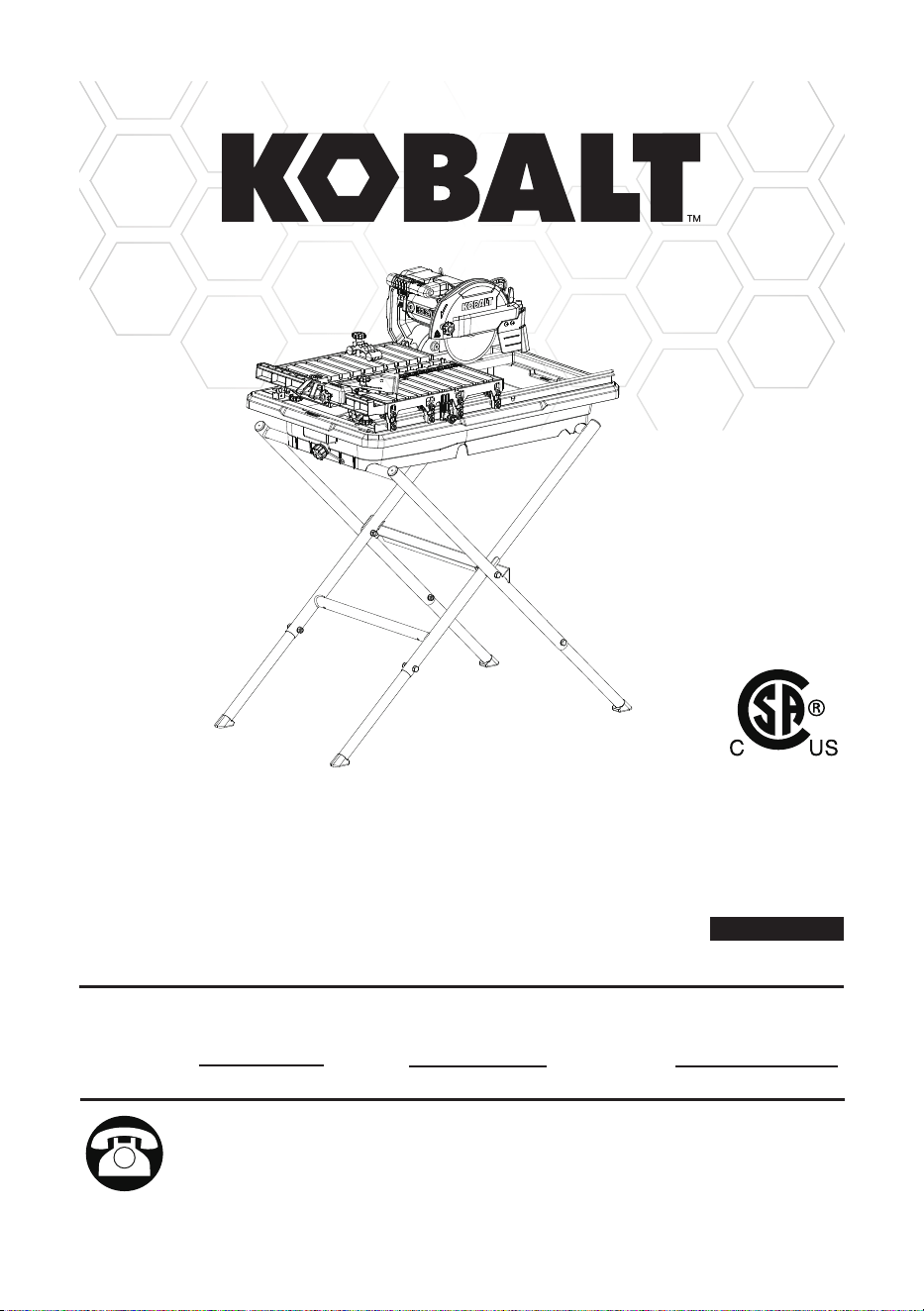
MODEL #SC1802LW
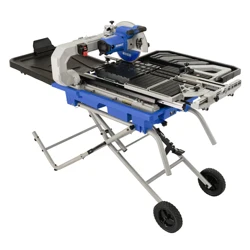
7-IN FOLDING WET TILE
SAW WITH STAND
Español p. 41
SS22236
Questions, problems, missing parts? Before returning to your retailer, call our
customer service department at 888-3KOBALT (888-356-2258), 8 a.m. - 8 p.m., EST,
Monday - Sunday. You could also contact us at [email protected].
Serial Number MFG Date Purchase Date
ATTACH YOUR RECEIPT HERE
KOBALT and logo design are trademarks or
registered trademarks of LF, LLC. All rights reserved.
ITEM #5202572
2
Product Specications ...................................................................................................... 2
Package Contents ............................................................................................................ 3
Know Your Tile Saw........................................................................................................... 6
Important Safety Information ............................................................................................. 8
Electrical Safety Information.............................................................................................. 11
Preparation........................................................................................................................ 14
Assembly Instructions ....................................................................................................... 15
Adjustment Instructions ..................................................................................................... 27
Operating Instructions ....................................................................................................... 30
Care And Maintenance ..................................................................................................... 35
Troubleshooting................................................................................................................. 37
Replacement Parts List ..................................................................................................... 38
Warranty ............................................................................................................................ 40
TABLE OF CONTENTS
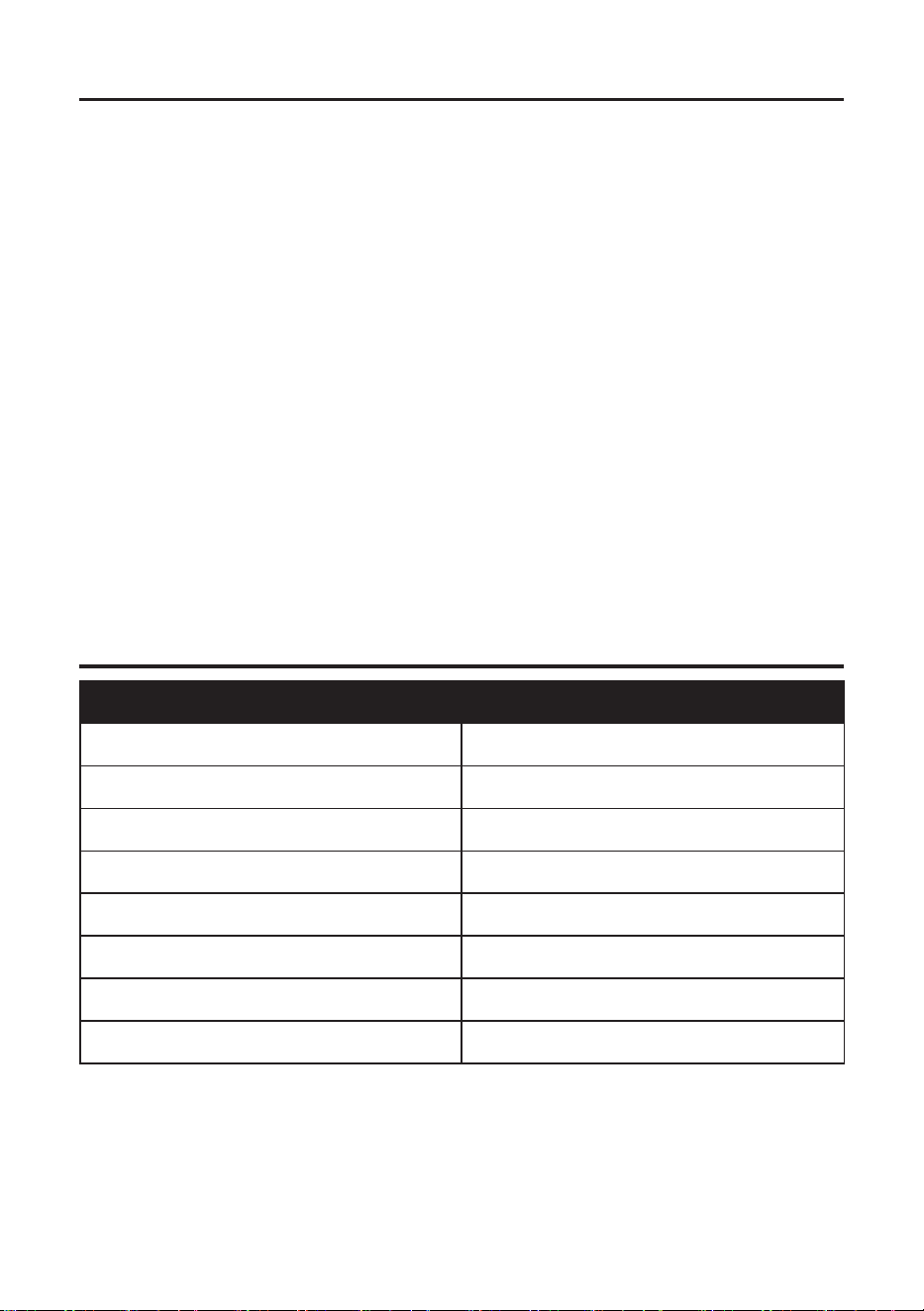
PRODUCT SPECIFICATIONS
DESCRIPTION SPECIFICATIONS
Power Supply 120 V, 60 Hz
Motor 9 A
No Load Speed 5,700 RPM
Wheel 7 in. x 5/8 in. (arbor)
Maximum Depth of Cut 2-1/4 in.
Rip Capacity (tile size) 30 in.
Diagonal Capacity (tile size) 18 in.
Bevel Angles 0°, 22.5°, 45°
3
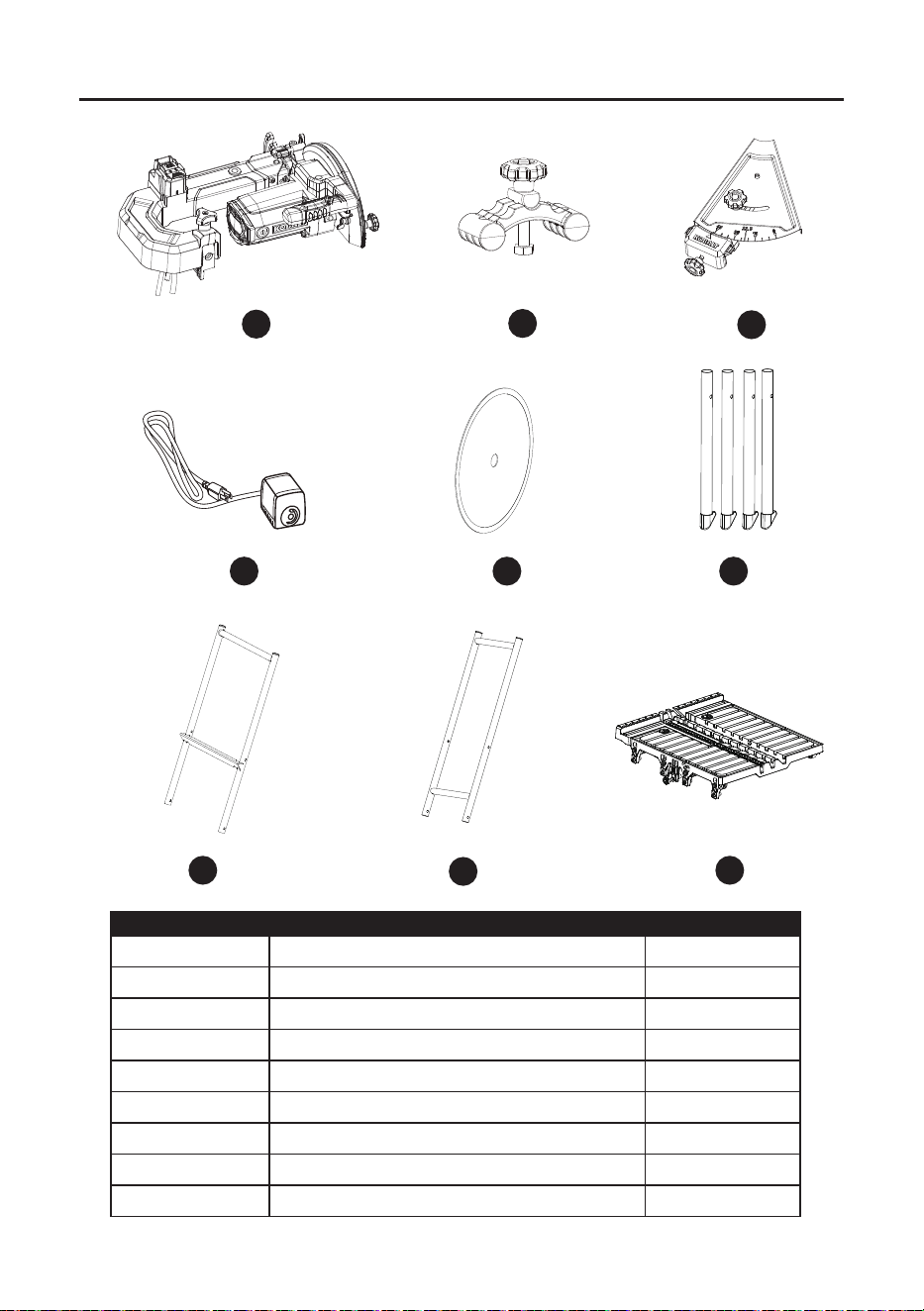
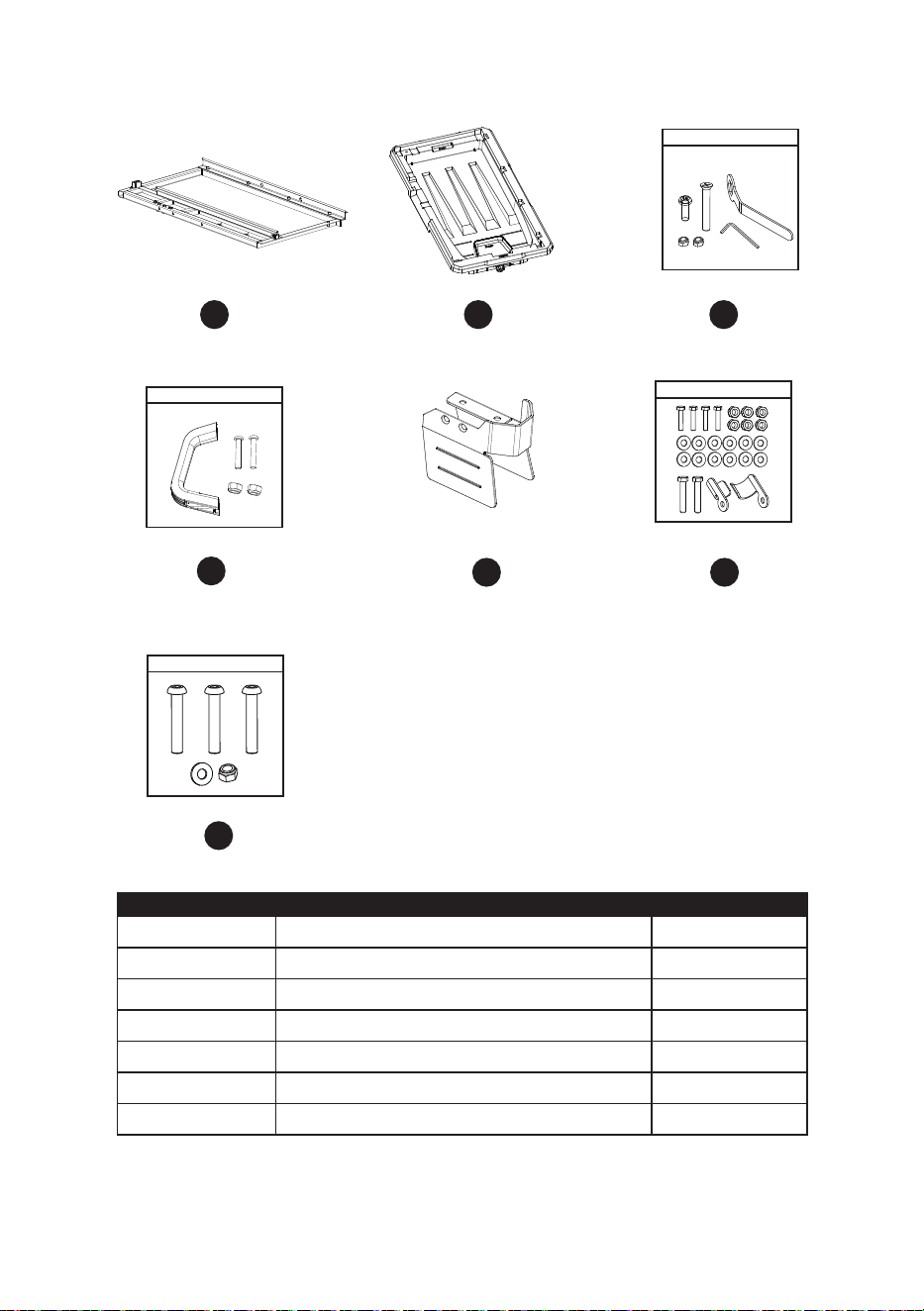
PACKAGE CONTENTS
PART DESCRIPTION QUANTITY
A Cutting head assembly 1
B Tile clamp 1
C Rip/Angle guide 1
D Water pump 1
E Cutting wheel 1
F Support legs 4
G Left support 1
H Right support 1
I Sliding table 1
C
B
A
MAX
MIN
D
E F
G
H
I
4
J K L
M
N
P
PART DESCRIPTION QUANTITY
J Table frame 1
K Water tray 1
L Cutting wrench hardware bag 1
M Carry handle assembly hardware bag 1
N Side splash guard 1
O Stand hardware bag 1
P Cutting head assembly locking hardware bag 1
O
5
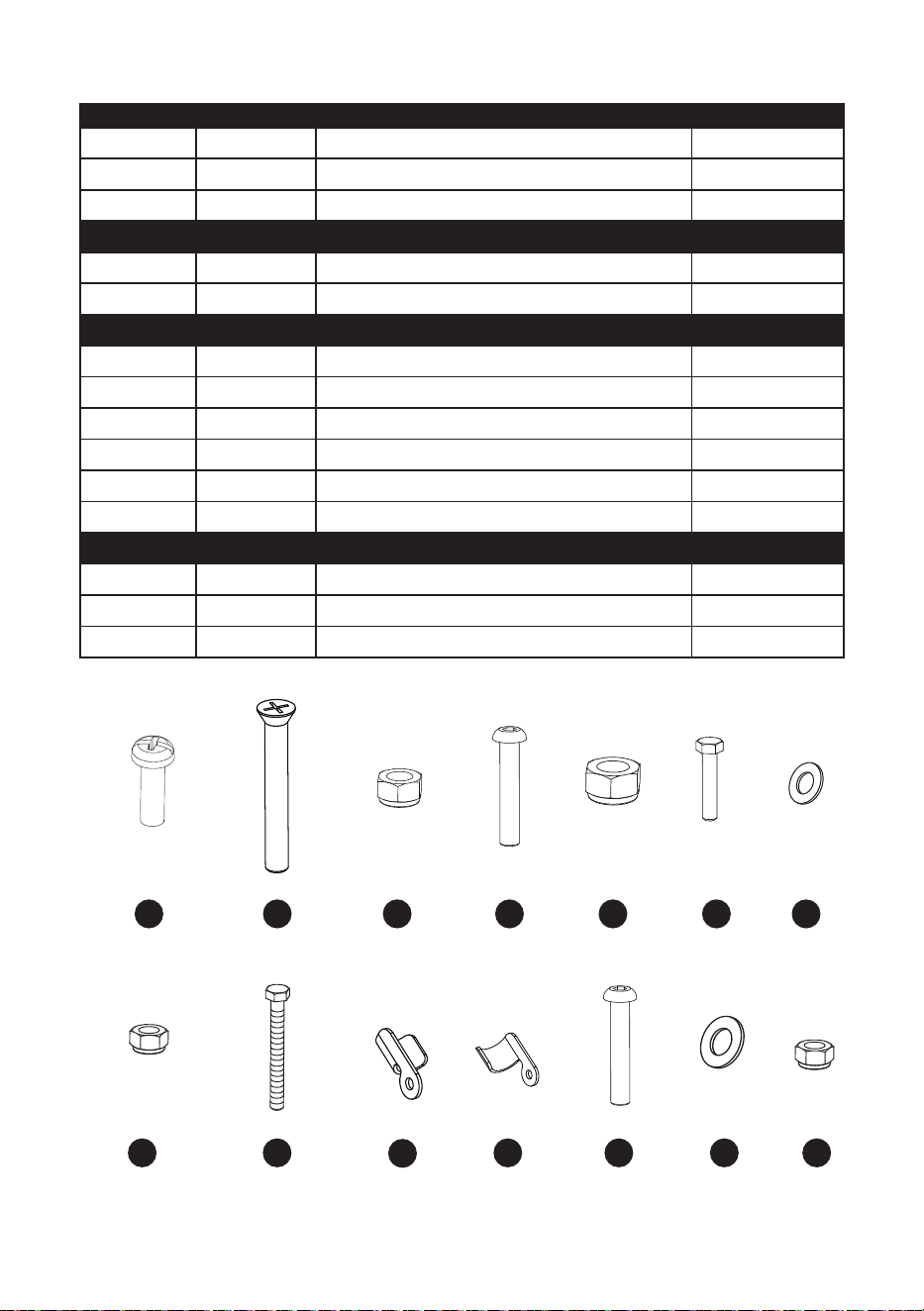
HARDWARE CONTENTS (not shown to actual size)
BAG PART DESCRIPTION QUANTITY
L aa M6*1.0-15 Screw 1
bb M6*1.0-40 Screw 1
cc M6*1.0 T=5 Lock nut 2
BAG PART DESCRIPTION QUANTITY
M dd M8*1.25-45 Socket head bolt 2
ee M8*1.25 T=8 Nut 2
BAG PART DESCRIPTION QUANTITY
O M8*1.25-40 Bolt 4
gg φ8*15-1 Washer 12
hh M8*1.25 T=8 Lock nut 6
ii M8*1.25-70 Bolt 2
jj Right anchor plate 1
kk Left anchor plate 1
BAG PART DESCRIPTION QUANTITY
P mm M8*1.25-40 Socket head bolt 3
nn φ8*18-2 Washer 1
oo M8*1.25 T=8 Lock nut 1
aa
bb
dd
ee
gg
hh
ii
jj
kk
cc
mm
nn oo
6
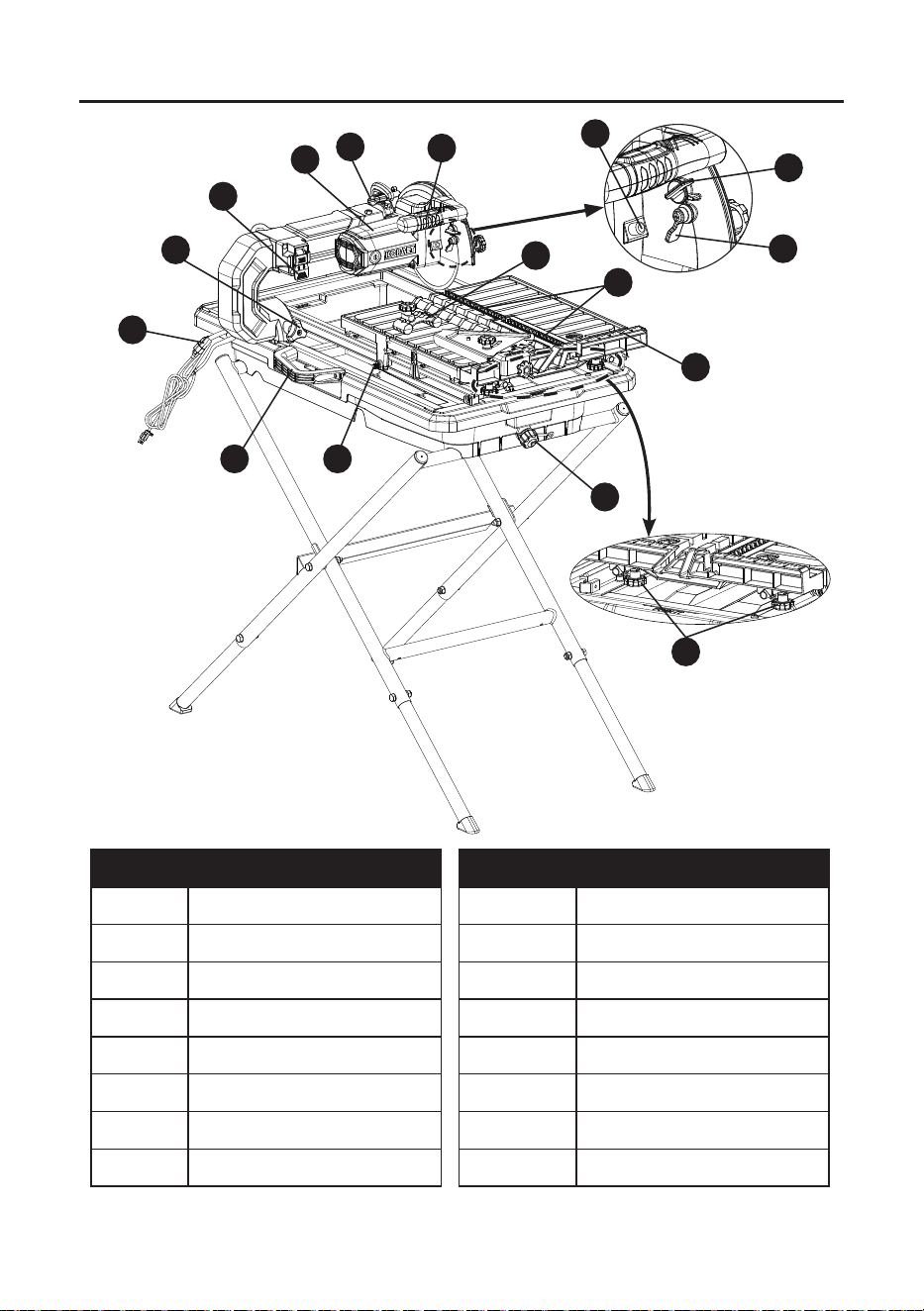
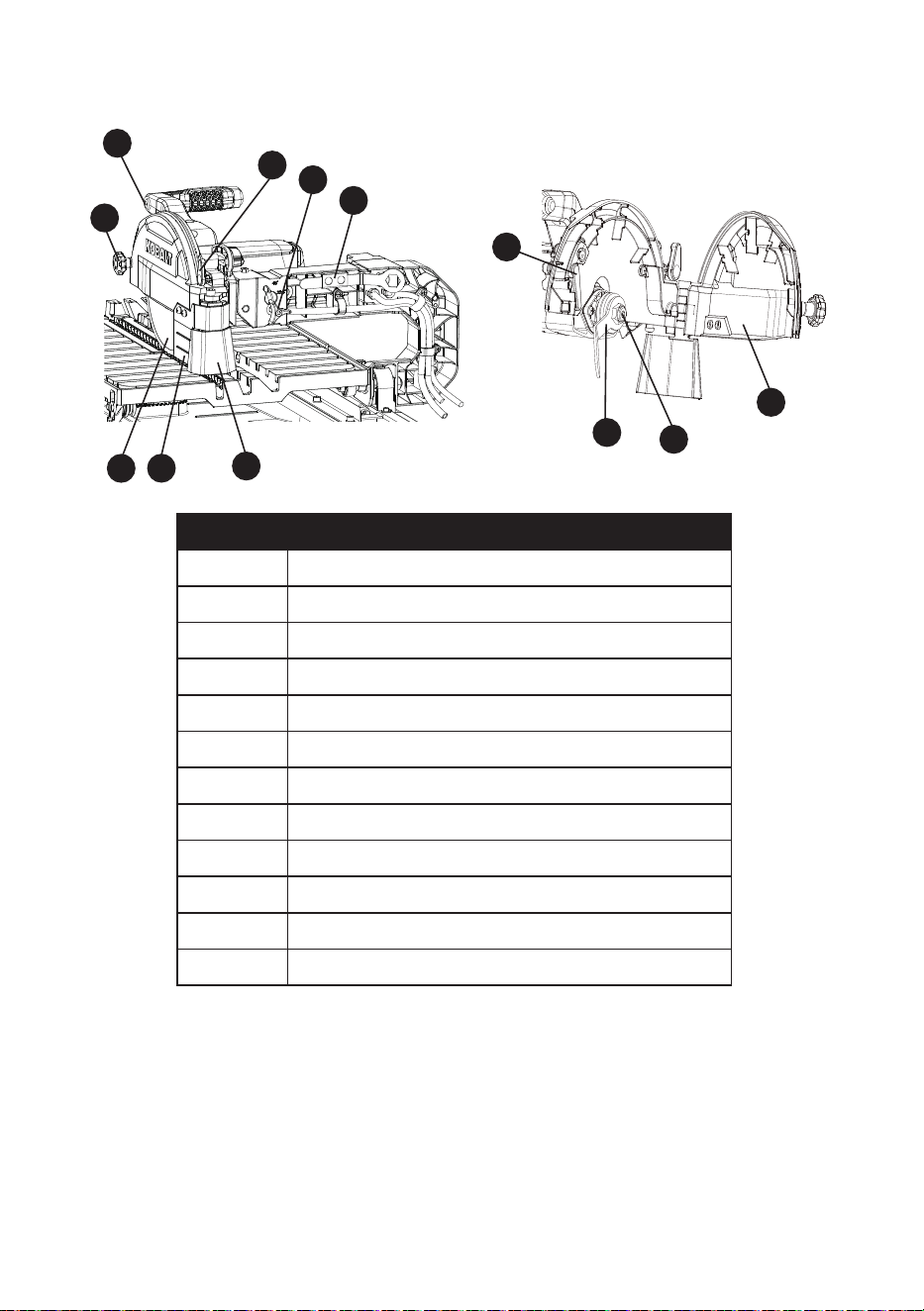
KNOW YOUR TILE SAW
PART DESCRIPTION
B Tile Clamp
Q Motor handle
R Arbor lock button
S Water volume control
T Water angle control
U Table inserts
V Sliding T-fence extension
W Drain plug
PART DESCRIPTION
X Table release pin
Y Carry handle
Z Power cord receptacle
AA Arm folding lock knob
BB ON/OFF switch
CC Motor
DD Cutting head lock knob
EE Sliding T-fence lock knobs
U
B
W
X
Y
V
S
T
AA
BB
CC
DD
Z
Q
FRONT OF SAW
R
EE
7
PART DESCRIPTION
E Cutting wheel
N Side splash guard
FF Hold-down latch
GG Bevel lock knob
HH Wheel wrench storage
II
Rear splash guard
JJ Wheel guard lock knob
KK LED light ON/OFF switch
LL Upper wheel guard
MM Arbor nut
NN Wheel wrench
OO Water nozzles
OO
MM
NN
LL
FF
GG
HH
II
JJ
KK
E
N

8
IMPORTANT SAFETY INFORMATION
WARNING
!
To reduce risk of injury:
● Before any use, be sure everyone using this tool reads and understands all safety instructions
and other information contained in this manual.
● Save these instructions and review frequently prior to use and in instructing others.
● Keep guards in place and in working order.
● Remove adjusting keys and wrenches. Form habit of checking to see that keys and
adjusting wrenches are removed from tool before turning it on.
● Keep work area clean. Cluttered areas and benches invite accidents.
● Don’t use in dangerous environment. Don’t use power tools in damp or wet locations, or
expose them to rain. Keep work area well lighted.
● Keep children away. All visitors should be kept safe distance from work area.
● Make workshop kid proof with padlocks, master switches, or by removing starter keys.
● Don’t force tool. It will do the job better and safer at the rate for which it was designed.
● Use right tool. Don’t force tool or attachment to do a job for which it was not designed.
●
Use proper extension cord. Make sure your extension cord is in good condition. When using
an extension cord, be sure to use one heavy enough to carry the current your product will
draw. An undersized cord will cause a drop in line voltage resulting in loss of power and
overheating. Minimum Gauge for Cord Sets shows the correct size to use depending on cord
length and nameplate ampere rating. If in doubt, use the next heavier gauge. The smaller the
gauge number, the heavier the cord.
● Wear proper apparel. Do not wear loose clothing, gloves, neckties, rings, bracelets, or other
jewelry which may get caught in moving parts. Nonslip footwear is recommended. Wear
protective hair covering to contain long hair.
●
Always use safety glasses. Also use face or dust mask if cutting operation is dusty. Everyday
eyeglasses only have impact resistant lenses, they are NOT safety glasses.
● Secure work. Use clamps or a vise to hold work when practical. It’s safer than using your
hand and it frees both hands to operate tool.
● Don’t overreach. Keep proper footing and balance at all times.
●
Maintain tools with care. Keep tools sharp and clean for best and safest performance. Follow
instructions for lubricating and changing accessories.
● Disconnect tools before servicing; when changing accessories, such as wheels, bits, cutters,
and the like.
● Reduce the risk of unintentional starting. Make sure switch is in o position before
plugging in.
●
Use recommended accessories. Consult the owner’s manual for recommended accessories.
The use of improper accessories may cause risk of injury to persons.
● Never stand on tool. Serious injury could occur if the tool is tipped or if the cutting tool is
unintentionally contacted.
● Check damaged parts. Before further use of the tool, a guard or other part that is damaged
should be carefully checked to determine that it will operate properly and perform its intended
function – check for alignment of moving parts, binding of moving parts, breakage of parts,
mounting, and any other conditions that may aect its operation. A guard or other part that is
damaged should be properly repaired or replaced.
● Direction of feed. Feed work into a wheel or cutter against the direction of rotation of the
wheel or cutter only.
● Never leave tool running unattended. Turn power o. Don’t leave tool until it comes to a
complete stop.

9
SAFETY INSTRUCTIONS FOR TILE SAWS
● Wear appropriate hearing protection during use. Under some conditions and duration of use,
noise from this product may contribute to hearing loss.
● Do not connect unit to electrical power source until complete instructions are read and understood.
●
Don't operate saw without the cutting wheel cover in place.
● Clean tile saw after each use for optimal operation.
● Use safety equipment. Always wear eye protection. Dust mask, non-skid safety shoes, hard
hat, or hearing protection must be used for appropriate conditions.
● Keep hands out of path of the cutting wheel. Never cut a piece where hand would be
3" (76 mm) or less from the cutting wheel.
● Do not perform any operation freehand, that is without holding the workpiece rmly against the
fence or edge guide.
● Never reach in back of the cutting wheel.
● Don’t - Cut dry. If the cutting wheel is not cooled with water, serious damage will occur. Dry
cutting will increase exposure to harmful airborne dust.
● Turn o the tool and wait for the cutting wheel to stop before moving the workpiece or
changing settings.
● To reduce risk of injury, return the table to it's forward position after each cut.
● Do - Make certain the cutting wheel rotates in the correct direction as indicated by the arrow
on the cutting wheel.
● Do - Be sure all clamp handles and knobs are tight before starting any operation.
● Do - Be sure all cutting wheel and clamp washers are clean and recessed sides of collars are
against the cutting wheel. Tighten arbor nut securely.
● Do - Keep the cutting wheel properly aligned.
● Do - Keep the motor air slots free of chips and dirt.
● Do – Always empty water from the reservoir and disconnect from the power source before
transporting. Water can splash into electrical components.
● Do - Keep hands out of the path of the cutting wheel.
● Do - Shut o power, disconnect cord from power source and wait for the cutting wheel to stop
before servicing, adjusting tool or changing cutting wheel.
● Don’t - Attempt to operate on anything but designated voltage. Incorrect voltage may result in
shock, re, or unpredictable operation.
● Don’t - Operate unless all knobs and clamps are tight.
● Don’t - Use cutting wheels larger or smaller than those which are recommended.
● Don’t - Force cutting action. Allow motor to reach full speed before cutting. Stalling or partial
stalling of motor can cause major damage.
● Don’t - Use metal cutting abrasive wheels. The excessive heat and abrasive particles
generated by them will damage the saw.
● Do - Use continuous rim wheels only, no serrated edges or toothed cutting wheels.
● Don’t - Allow anyone to stand behind saw.
● Don’t - Place either hand in the cutting wheel area when the saw is connected to the power source.
● Don’t - Use cutting wheel rated less than 5,700 R.P.M.
● Don't - Place hands closer than 3" (76 mm) from the cutting wheel.
● Don't - Reach behind or underneath the saw unless it is furned o and unplugged.
● Don't - Move either hand from saw of workpiece until the cutting wheel has stopped.
● Secure work. Always place tile at on table and securely against fence.
● Never use a pan heater or other heat source for heating water. Damage to the tool, re or
personal injury could result.
● If the plug or receptacle does get wet, Don't unplug the cord. Disconnect the fuse or circuit
breaker that supplies power to the tool. Then unplug and examine for presence of water in the
receptacle.
CAUTION
!

10
PROPOSITION 65 WARNING
WARNING: Some dust created by power sanding, sawing, grinding, drilling, and other
construction activities contains chemicals known to the State of California to cause cancer, birth
defects or other reproductive harm. Some examples of these chemicals are:
● Lead from lead-based paints,
● Crystalline silica from bricks and cement and other masonry products, and
● Arsenic and chromium from chemically treated lumber.
Your risk from these exposures varies depending on how often you do this type of work. To reduce
your exposure to these chemicals: work in a well-ventilated area and work with approved safety
equipment, such as dust masks that are specially designed to lter out microscopic particles.
Handling the power cord on this product may expose you to chemicals known to the state of
California to cause cancer and birth defects or other reproductive harm. Wash hands after handling.
For more information go to: www.P65Warnigs.ca.gov
READ INSTRUCTION MANUAL: To reduce the risk of injury, user and all bystanders
must read instruction manual before using this product.

11
ELECTIRCAL SAFETY INFORMATION
POWER SUPPLY AND MOTOR SPECIFICATIONS
WARNING: To avoid electrical hazards, re hazards, or damage to the tool, use proper circuit
protection. Use a separate electrical circuit for your tool. Your tile saw is wired at the factory
for 120 V operation. Connect to a 120 V, 9 Amp circuit and use a 9 Amp time delay fuse or
circuit breaker. To avoid shock or re, if power cord is worn, cut, or damaged in any way, have
it replaced immediately.
GROUNDING INSTRUCTIONS
WARNING: This tool must be grounded while in use to protect the operator from electrical shock.
IN THE EVENT OF A MALFUNCTION OR BREAKDOWN, grounding provides a path of least
resistance for electric currents and reduces the risk of electric shock. This tool is equipped with an
electrical cord that has an equipment-grounding conductor and a grounding plug. The plug must
be plugged into a matching receptacle that is properly installed and grounded in accordance with
all local codes and ordinances.
DO NOT MODIFY THE PLUG PROVIDED. If it will not t the receptacle, have the proper
receptacle installed by a qualied electrician.
IMPROPER CONNECTION of the equipment grounding conductor can result in risk of electric
shock. The conductor with the green insulation (with or without yellow stripes) is the equipment
grounding conductor. If repair or replacement of the electrical cord or plug is necessary, do not
connect the equipment grounding conductor to a live terminal.
CHECK with a qualied electrician or service person if you do not completely understand the
grounding instructions, or if you are not certain the tool is properly grounded.
USE only 3-wire extension cords that have three-pronged grounding plugs with three-pole
receptacles that accept the tool’s plug. Repair or replace damaged or worn cords immediately.
Use a separate electrical circuit for your tool. This circuit must not be less than #14 wire and
should be protected with a 9 Amp time delay fuse. Before connecting the motor to the power line,
make sure the switch is in the o position and the electric current is rated the same as the current
stamped on the motor nameplate. Running at a lower voltage will damage the motor.
GUIDELINES FOR EXTENSION CORDS
USE THE PR OPER EXTENSION CORD. Make sure your extension cord is in good condition.
Use an extension cord heavy enough to carry the current your product will draw. An undersized
cord will cause a drop in line voltage resulting in loss of power, overheating and burning out of the
motor. The table below shows the correct size to use depending on cord length and nameplate
ampere rating. If in doubt, use the next heavier gauge. The smaller the gauge number, the
heavier the cord.
Make sure your extension cord is properly wired and in good condition. Always replace a damaged
extension cord or have it repaired by a qualied technician before using it. Protect your extension
cords from sharp objects, excessive heat and damp or wet areas.
12
MINIMUM GAUGE FOR EXTENSION CORDS (AWG)
(When using 120 volts only)
Ampere Rating Total length of Cord
More Than Not More Than 25 ft. 50 ft. 100 ft. 150 ft.
0 6 18 16 16 14
6 10 18 16 14 12
10 12 16 16 14 12
12 16 14 12
Not Recommended
WARNING: Do not expose to rain or use in damp locations.
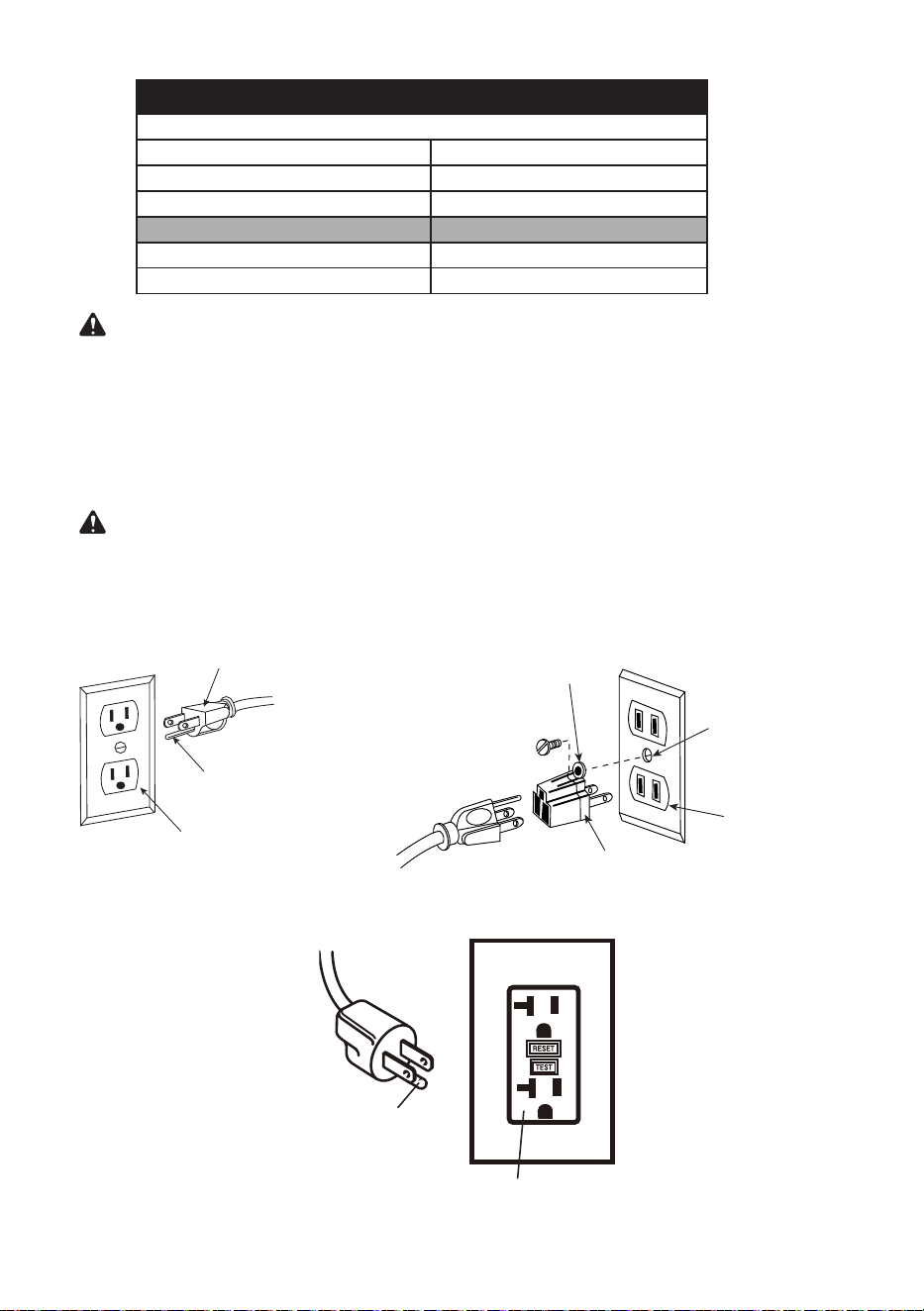
This tool is intended for use on a circuit that has a receptacle like the one illustrated in Fig. A.
Fig. A shows a three-pronged electrical plug and receptacle that has a grounding conductor. If
a properly grounded receptacle is not available, an adapter (Fig. B) can be used to temporarily
connect this plug to a two-contact grounded receptacle.
The adapter (Fig. B) has a rigid lug extending from it that MUST be connected to a permanent
earth ground, such as a properly grounded receptacle box.
CAUTION: In all cases, make certain the receptacle is properly grounded. If you are not sure,
have a qualied electrician check the receptacle.
Fig. A Fig. B
Make sure this is
connected to a
known ground.
Two-Pronged
Receptacle
Adapter
Grounding Lug
Three-Pronged Plug
Grounding Prong
Properly Grounded
Three-Pronged
Receptacle
Grounding Prong
Grounding Fault Outlet
Fig. C
13
EXTENSION CORDS
1. Use only extension cords that are intended for outdoor use. These extension cords are
identied by a marking “Acceptable for use with outdoor appliances; store indoors while not in
use.” Use only extension cords having an electrical rating not less than the rating of the product.
Do not use damaged extension cords. Examine extension cord before using and replace if
damaged.
Do not abuse extension cords and do not yank on any cord to disconnect. Keep cord away
from heat and sharp edges.
Always disconnect the extension cord from the receptacle before disconnecting the product
from the extension cord.
2. WARNING: To reduce the risk of electrocution, keep all connections dry and o the
ground. Do not touch plug with wet hands.
3. Ground Fault Circuit Interrupter (GFCI) (not included) protection should be provided on the
circuit(s) or Fig. C outlet(s) to be used for the tile saw. Receptacles are available having built-in
GFCI protection and may be used for this measure of safety.
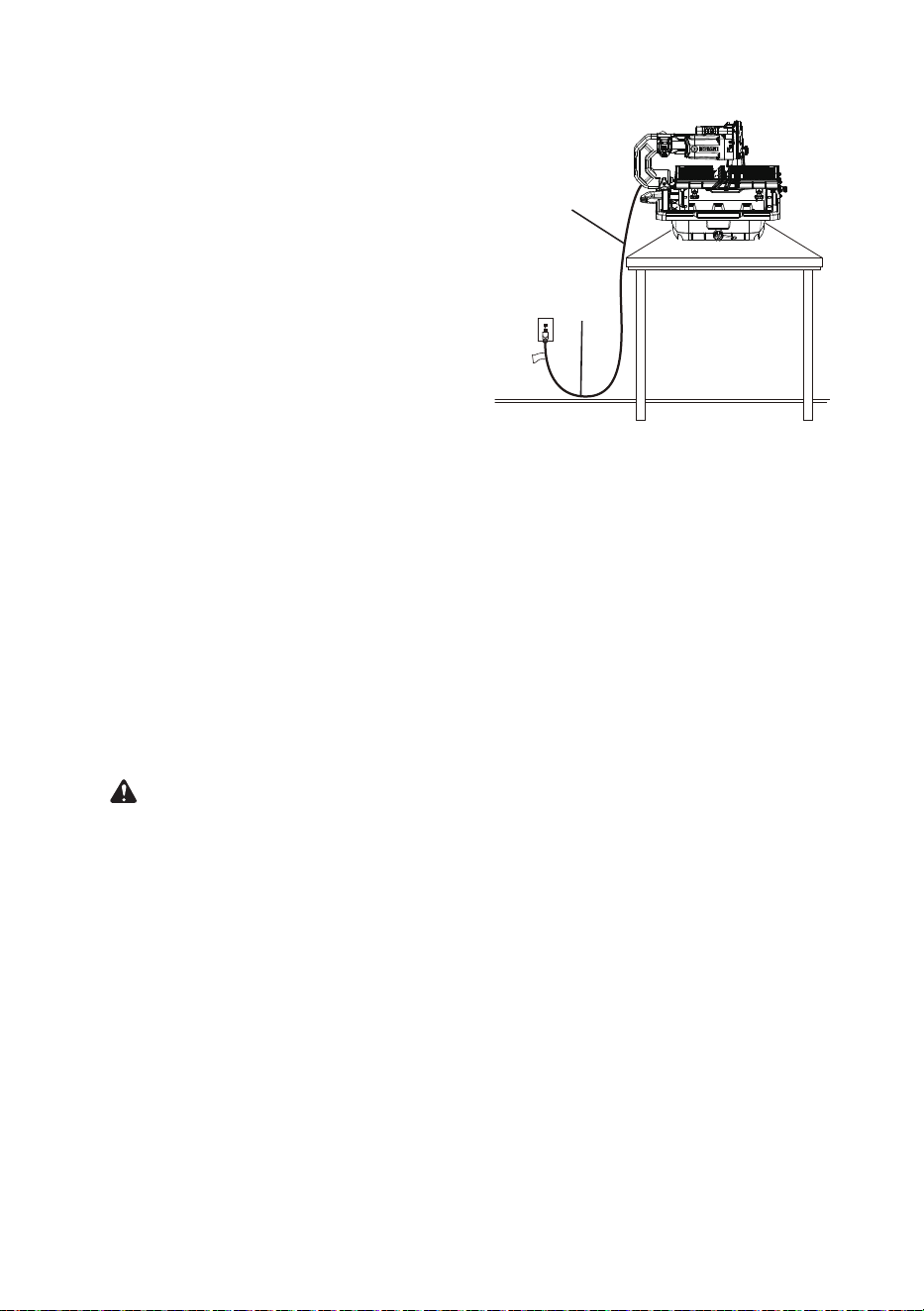
Fig. DPOSITION OF TILE SAW
To avoid the possibility of the appliance plug or
receptacle getting wet, position the tile saw to
one side of a wall-mounted receptacle to prevent
water from dripping onto the receptacle or plug.
The user should arrange a “drip loop” in the cord
connecting the saw to a receptacle (see Fig. D).
The “drip loop” is that part of the cord below
the level of the receptacle, or connector if an
extension cord is used, to prevent water traveling
along the cord and coming in contact with the
receptacle.
If the plug or receptacle does get wet, DO NOT
unplug the cord. Disconnect the fuse or circuit
breaker that supplies power to the tool. Then,
unplug and examine for presence of water in the
receptacle.
Power Cord
Drip
Loop

14
PREPARATION
Before beginning assembly or operation of the product, make sure all parts are present.
Compare parts with package contents list and hardware contents list on pages 3 to 5. If any part is
missing or damaged, do not attempt to assemble, install or operate the product.
Estimated Assembly Time: 30~60 minutes
Tools needed to remove or install wheel (included): Wheel Wrench,
5 mm Hex Wrench.
Tools required for assembly and adjustment (not included): Adjustable Wrench, 3 mm Hex Key,
13 mm Wrench,
Framing Square, Combination Square, Phillips Screwdriver, Flathead Screwdriver.
15
1
WARNING: To avoid injury, do not connect this tile saw to a power source until it is completely
assembled and adjusted and you have read and understood the instruction manual
.
ASSEMBLY INSTRUCTIONS
UNPACKING YOUR TILE SAW
Carefully unpack the tile saw and all its parts, and compare against the list and illustration on pages
3 to 5. With the help of an assistant, place the saw on a secure surface and examine it carefully.
● To avoid injury from unexpected starting or
electrical shock, do not plug the power cord into a
source of power during unpacking and assembly.
The cord must remain unplugged whenever you
are adjusting/assembling the tile saw.
●
If any part is missing or damaged, do not
attempt to assemble the tile saw, or plug in the
power
cord until the missing or damaged part is
correctly replaced.
● DO NOT use this product if any loose parts on
the Package Contents or Hardware Contents
sections are already assembled to your product
when you unpack it. Parts on this list are not
assembled to the product by the manufacturer
and require customer installation. Use of
a product that may have been improperly
assembled could result in serious injury.
If any parts are damaged or missing, please call
888-3Kobalt (888-356-2258) for assistance.
WARNING:
Do not attempt to modify this tool
or create accessories for use with this tool. Any
such alteration or modication is misuse and
could result in a hazardous condition leading to
serious personal injury.
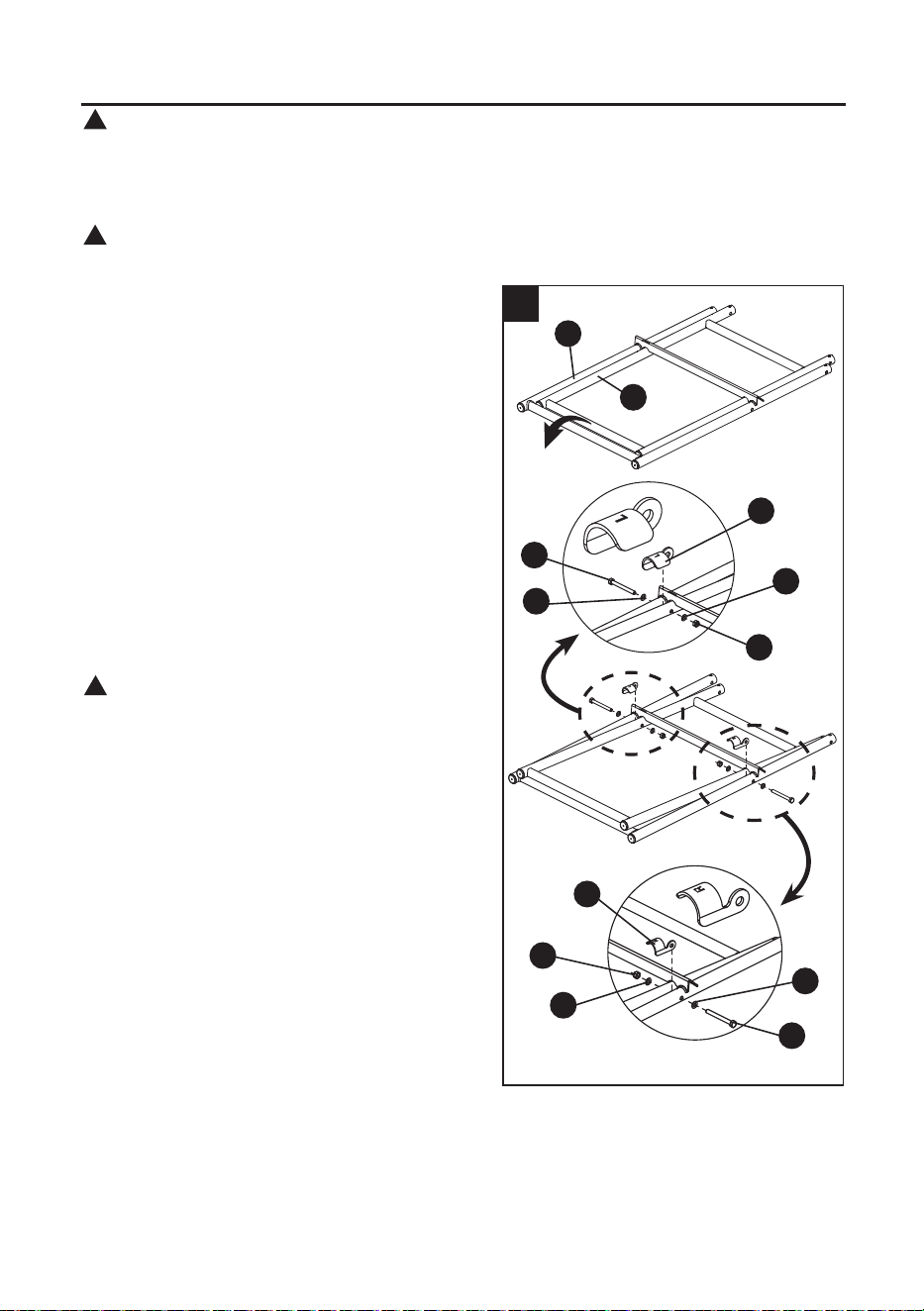
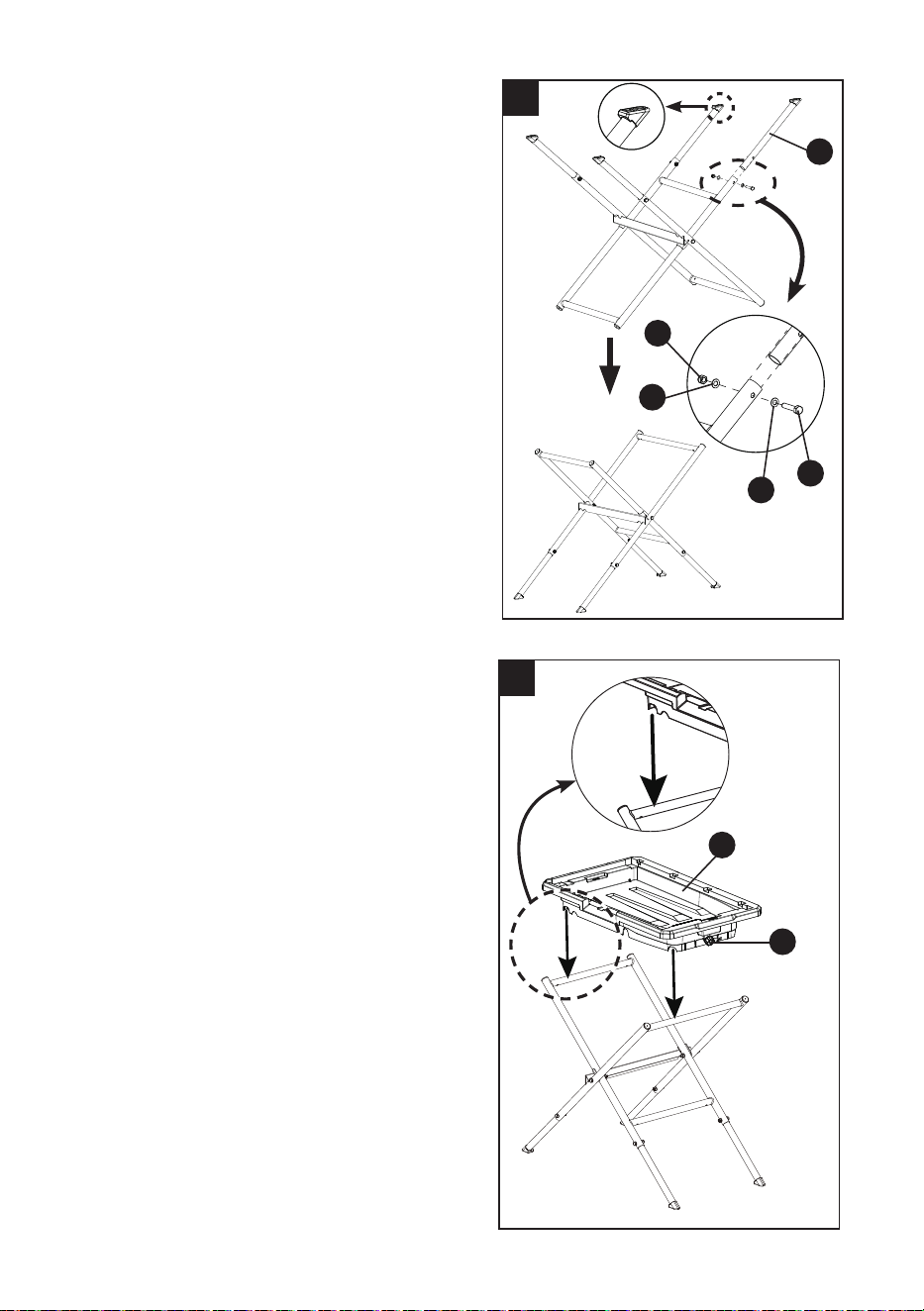
ASSEMBLING THE STAND (FIG. 1, 2) - BAG O
● Place the narrower right support (H) on at
ground rst, and then put the wider left
support (G) on the right support (H) as shown in
the Fig. 1.
● Lift the right support (H) up to align the mounting
holes of the two supports.
● Use the two long bolts (ii), four washers (gg),
two anchor plates (jj & kk) and two lock nuts (hh)
to connect the two supports.
NOTE: "L" (left) and "R" (right) are marked on
the two anchor plates (jj & kk) and install the two
anchor plates according to the Fig. 1.
● Tighten nuts (hh) with the adjustable wrench
and a 13 mm wrench.
NOTE: Do not overtighten, because doing so
will not allow the leg assembly to move.
WARNING
kk
gg
hh
ii
gg
H
G
ii
gg
jj
gg
hh
16
● Flip the stand assembly upside down as shown
in Fig. 2.
● Attach one support leg (F) into one of the stand
legs using the bolt (), the two washers (gg)
and the nut (hh), as shown. (Fig. 2)
NOTE: The tip of all the foot pads should be
facing outward as shown in Fig. 2.
● Tighten using the adjustable wrench and a
13 mm wrench.
● Repeat the above steps to install the other
three lower legs.
● When assembly is complete, ip the stand
upright as shown in Fig. 2.
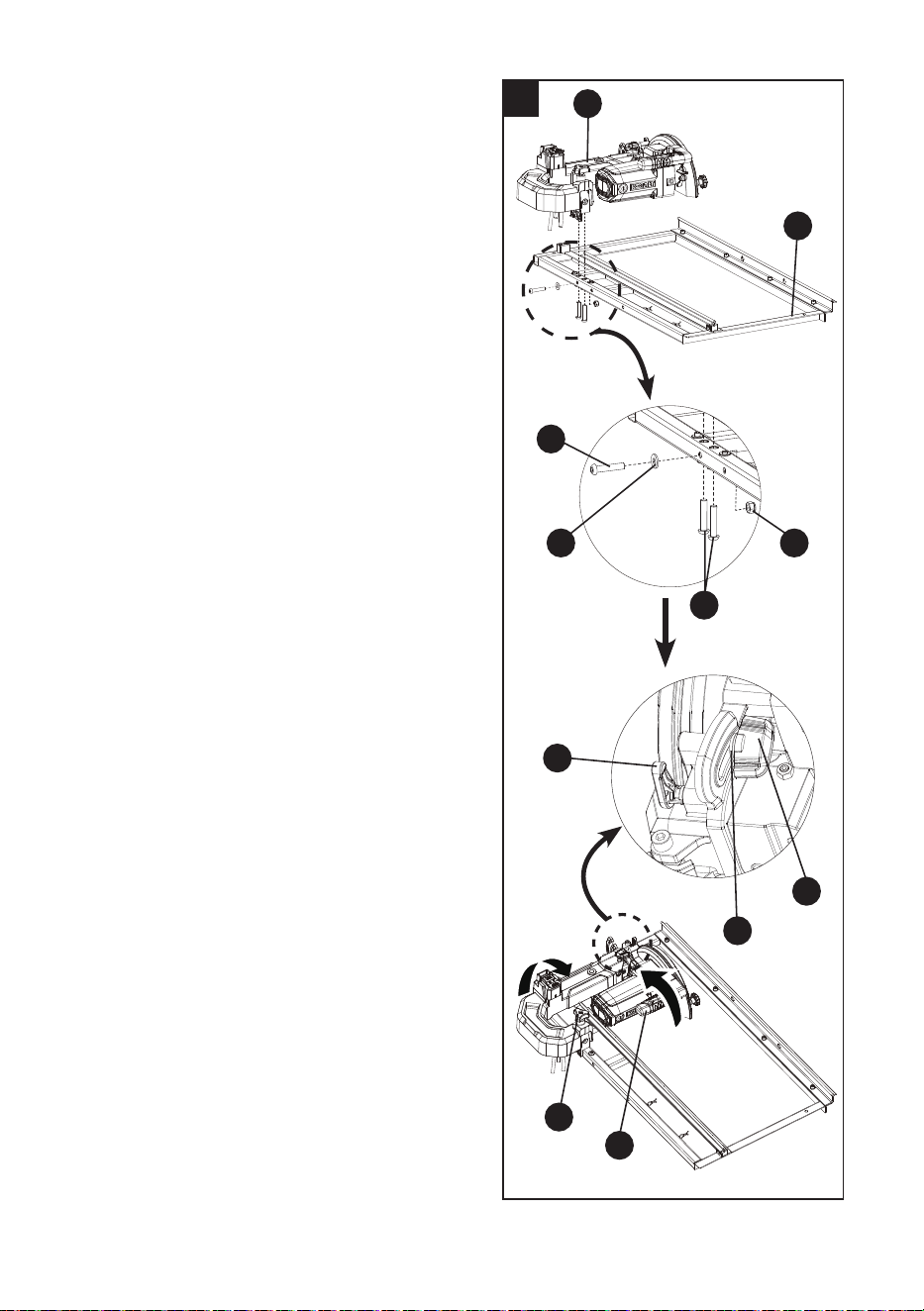
ASSEMBLING THE WATER TRAY ONTO THE
STAND (FIG. 3)
● Place the stand on level ground.
● Line up the four grooves under the water
tray (K) with the two upper support bars on the
stand to put the water tray on the stand.
NOTE: The drain plug (W) should be facing the front
of saw.
3
K
FRONT OF SAW
2
F
gg
gg
hh
W
17
4
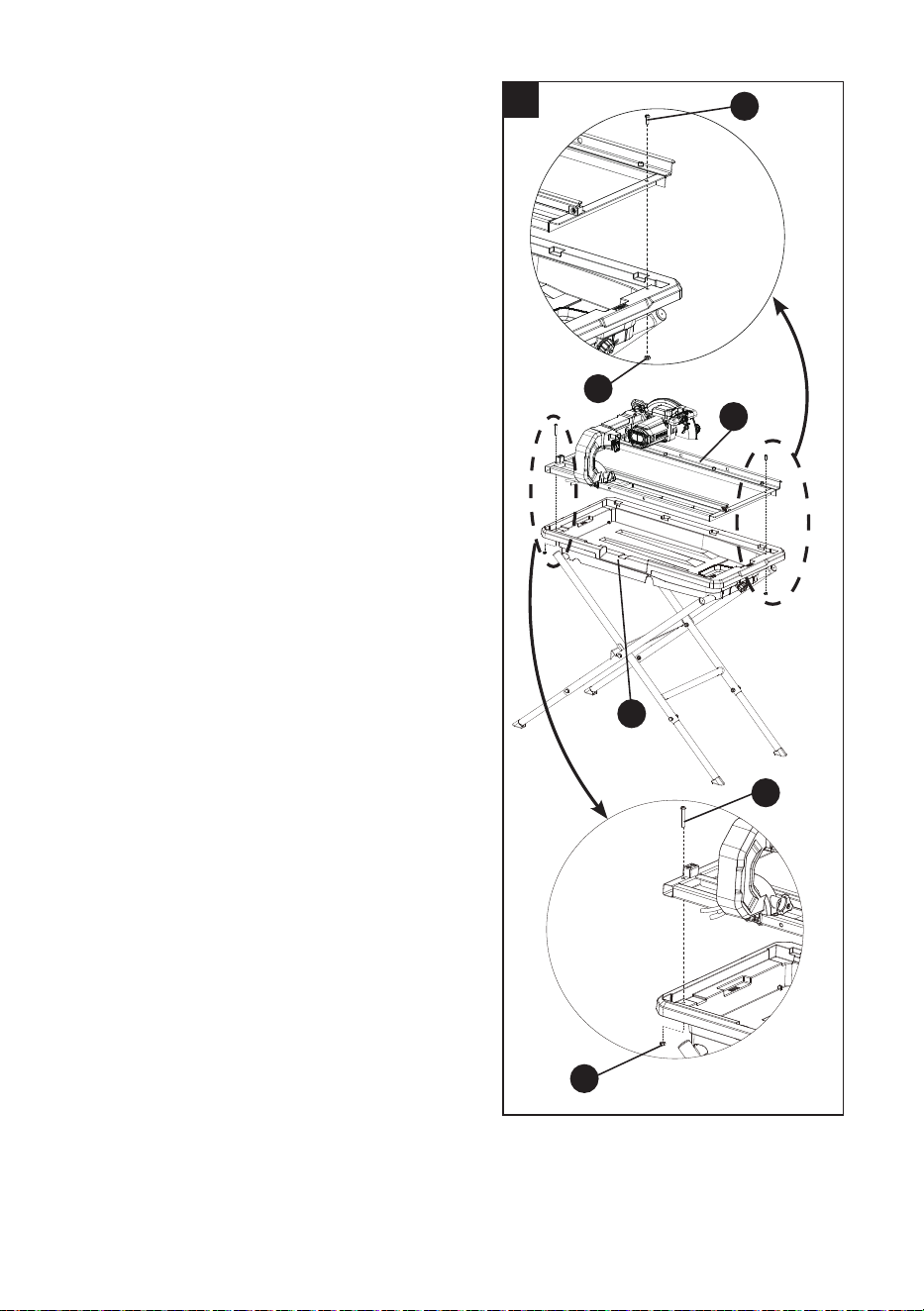
ASSEMBLING THE CUTTING HEAD ASSEMBLY
ON THE FRAME (FIG. 4) - BAG P
NOTE: The cutting head assembly and table frame
are heavy and it is recommended to be transported
with the help of 2 people, to safely move it.
● Place frame and cutting head assembly on at
stable surface.
● Align the holes in the cutting head assembly (A)
with the holes on the table frame (J).
● Insert the socket head bolt (mm) through the at
washer (nn) and the side of the table frame (J)
with the lock nut (oo). Tighten with the provided
5 mm hex wrench (RR) and 13 mm wrench (not
provided).
● Then, insert two socket head bolts (mm) through
the table frame (J) into the holes on the cutting
head assembly (A).
● Tighten the two socket head bolts using the
provided 5 mm hex wrench (RR).
RAISING THE CUTTING HEAD ASSEMBLY (FIG. 4)
● To raise the cutting head assembly, pull out
the hold-down latch (FF) and grasp the motor
handle (Q) to raise up the cutting head.
● Release the hold-down latch (FF) to lock
into place and tighten the cutting head lock
knob (DD) to secure the cutting head.
NOTE: Make sure the cutting head locking
knob (DD) is fully engaged with the channel
before locking and that the washer (1) is on the
outside of channel as shown.
● Turn the arm folding lock knob (AA)
counterclockwise to unlock and then pull out.
Grasp the motor handle (Q) to raise the cutting
head assembly up. Push in the arm folding lock
knob (AA) and tighten it by turning clockwise.
DD
Q
AA
A
J
nn
oo
mm
FRONT OF SAW
mm
FF
1
18
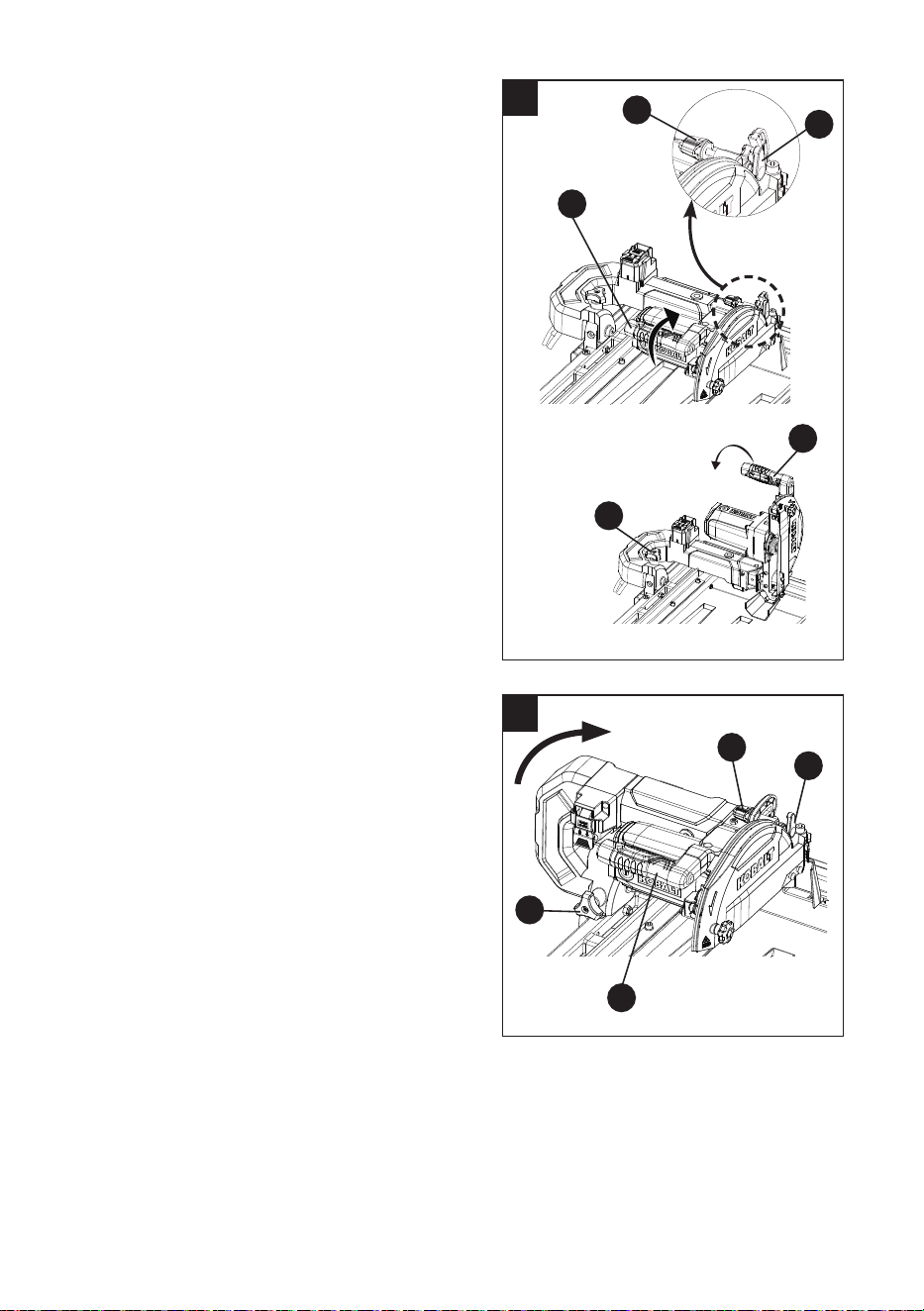
ASSEMBLING THE CUTTING HEAD/FRAME ON
THE WATER TRAY (FIG. 5) - BAG L
NOTE: The cutting head assembly and table frame
are heavy and it is recommended to be transported
with the help of 2 people, to safely move it.
● Place the cutting head assembly onto the water
tray (K) as shown.
● Insert the short
screw (aa) and long screw (bb)
through the table frame (J) and water tray (K) as
shown, and then tighten with the hex nuts (cc)
using a phillips screwdriver.
NOTE: The hex nuts (cc) t inside the round
casting on the bottom of the water tray as
shown in Fig. 5.
5
FRONT
OF SAW
K
bb
aa
cc
J
cc
19
RAISING, LOWERING AND FOLDING THE
CUTTING HEAD (FIG. 6, 7)
NOTE: Always turn the saw OFF when raising or
lowering
the cutting head.
To raise the cutting head (Fig. 6):
● Loosen the cutting head lock knob (DD) and
then pull out the hold-down latch (FF) as shown
in Fig. 6-1.
● Lift the motor handle (Q) upwards, push the
cutting head assembly backwards completely
and then pull the motor handle (Q) forward
to allow the cutting head locking in position
automatically. Tighten the cutting head lock
knob (DD).
● Loosen the arm folding lock knob (AA) and
lift the cutting head up slightly to pull the arm
folding lock knob (AA) as shown in Fig. 6-2.
● Then, hold the motor handle (Q) to raise the
cutting head assembly up. Tighten the arm
folding lock knob (AA).
To lower the cutting head (Fig. 7):
● Loosen the arm folding lock knob (AA) and pull
it out, move the motor handle (Q) clockwise to
lower the cutting head. Tighten the arm folding
lock knob.
● Loosen the cutting head lock knob (DD), and
pull out the hold-down latch (FF); then, hold the
motor handle (Q) and press down to lock the
cutting head assembly.
● Tighten the cutting head lock knob (DD).
To fold the cutting head (Fig. 6-2, 7)
● Loosen the arm folding lock knob (AA) and pull
it out; then, hold the motor handle (Q) to push
the cutting head backwards to a vertical position
as shown in Fig. 6-2.
● Loosen the cutting head lock knob (DD), pull
out the hold-down latch (FF) and then push
the motor handle (Q) downwards to lower the
cutting head until hear a "click" sound to lock in
position. (Fig. 6-2, 7)
● Tighten the cutting head lock knob (DD) and the
arm folding lock knob (AA).
NOTICE: Always fold the cutting head while
transportation. Make sure that all parts of the tile
saw are locked in position without moving.
6
7
Fig. 6-1
FF
DD
Q
AA
Fig. 6-2
Fig. 6-3
AA
Q
Q
DD
FF
20
INSTALLING THE CARRY HANDLE TO
FRAME (FIG. 8) - BAG M
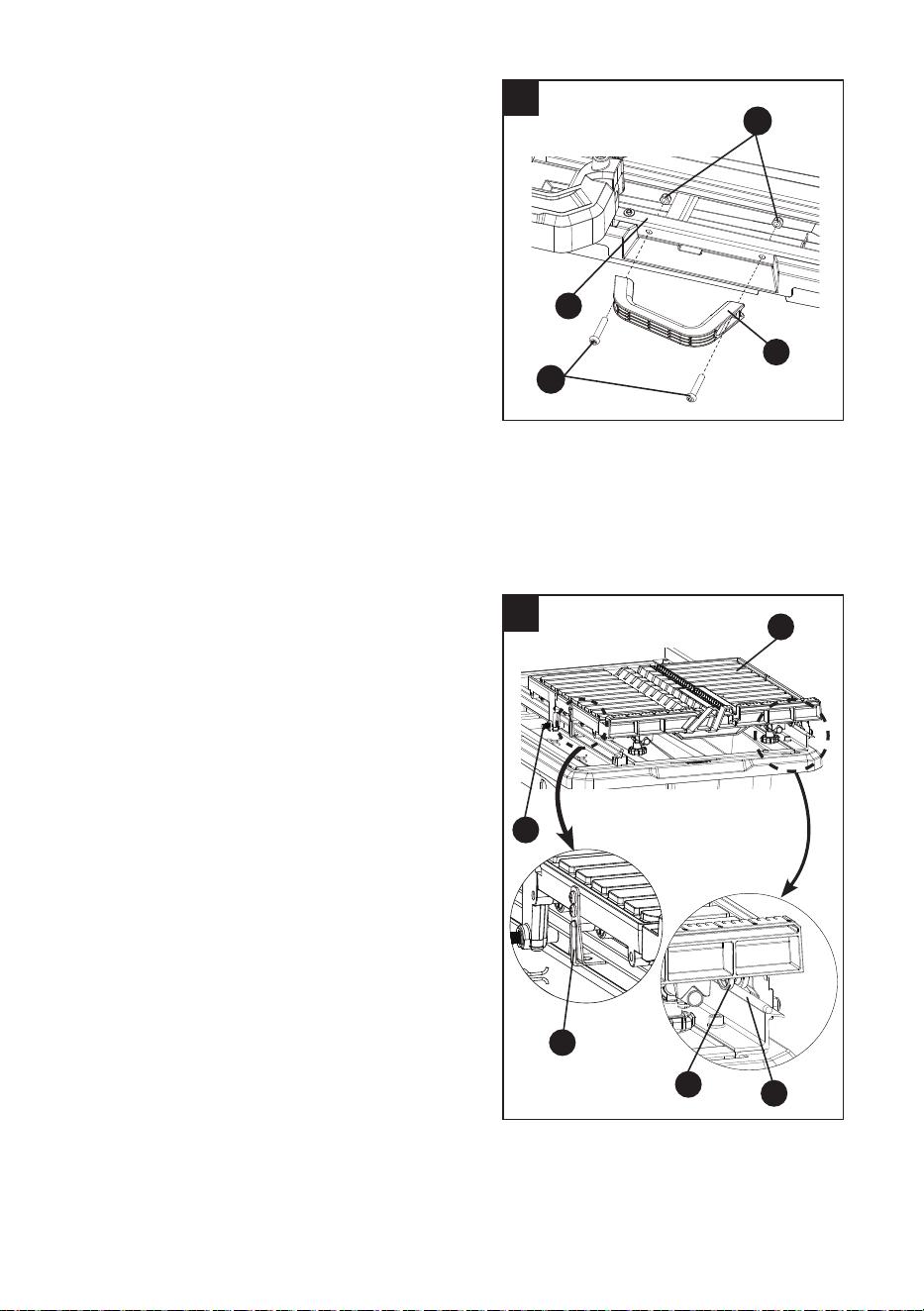
● Align the holes in the carry handle (Y) with
the holes on the table frame (J).
● Insert two socket head bolts (dd) through the
carry handle and frame, secure bolts in place
using lock nuts (ee).
● Tighten using the provided 5 mm hex
wrench (RR) and a 13 mm wrench (not
provided).
NOTICE: The tile saw, without the stand, can be
transported by holding the carry handle (Y) when
all parts are locked in position.
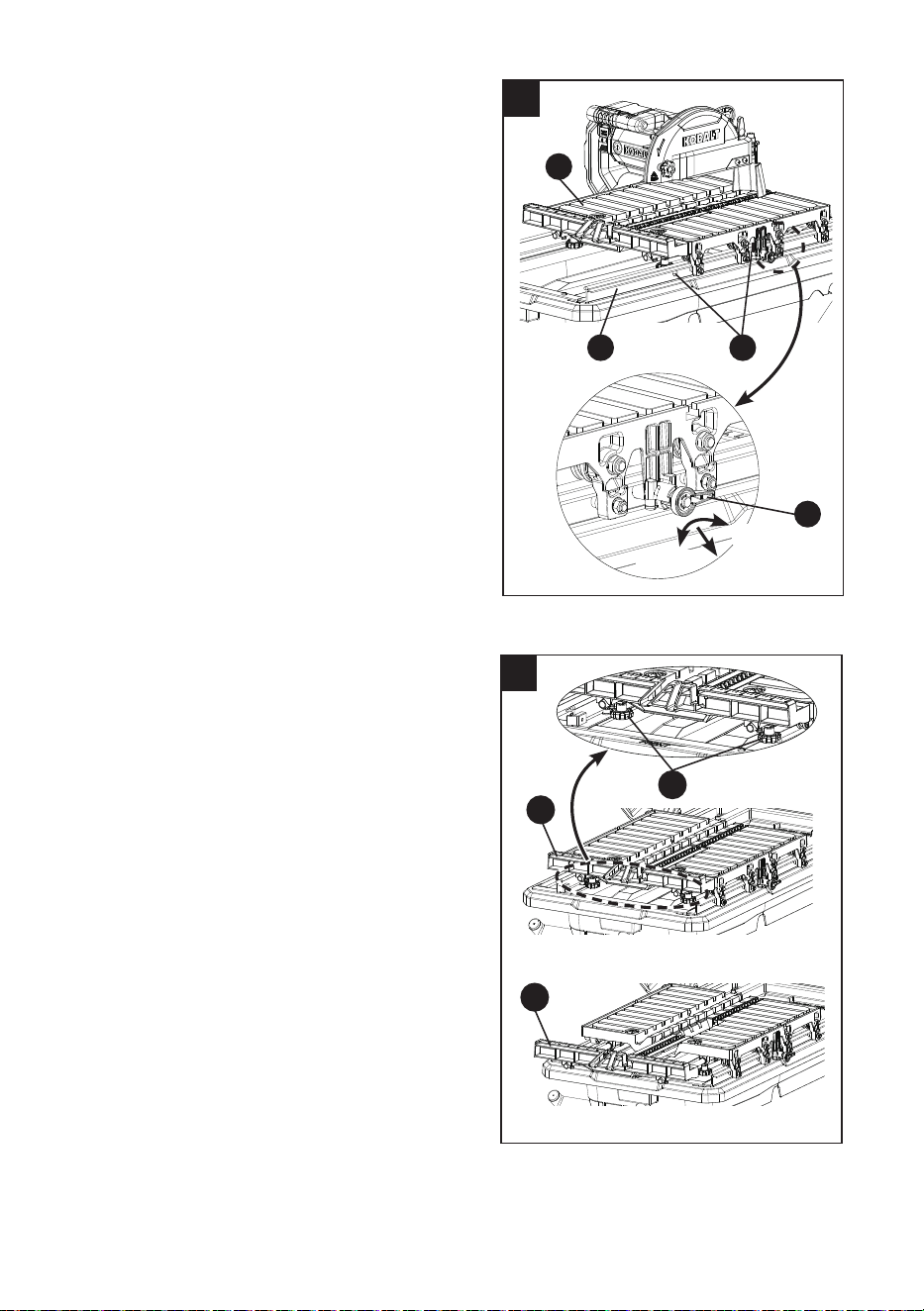
INSTALLING THE SLIDING TABLE (FIG. 9, 10,
11)
● Pull out the table release pin (X) on the left
side of table. (Fig. 9)
● Align the table rollers (1) with the rails (2)
on the frame, keeping the sliding table (I)
and the rails (2) parallel and then push the
sliding table toward the back of the saw.
NOTE: A set plate (3) is installed on the
left side of the sliding table to prevent
the sliding table from lifting upward while
pushing the sliding table toward the back
of the saw.
● Push the table release pin (X) back in
place.
8
J
Y
dd
ee
9
X
3
1
2
I
FRONT OF WATER TRAY
21
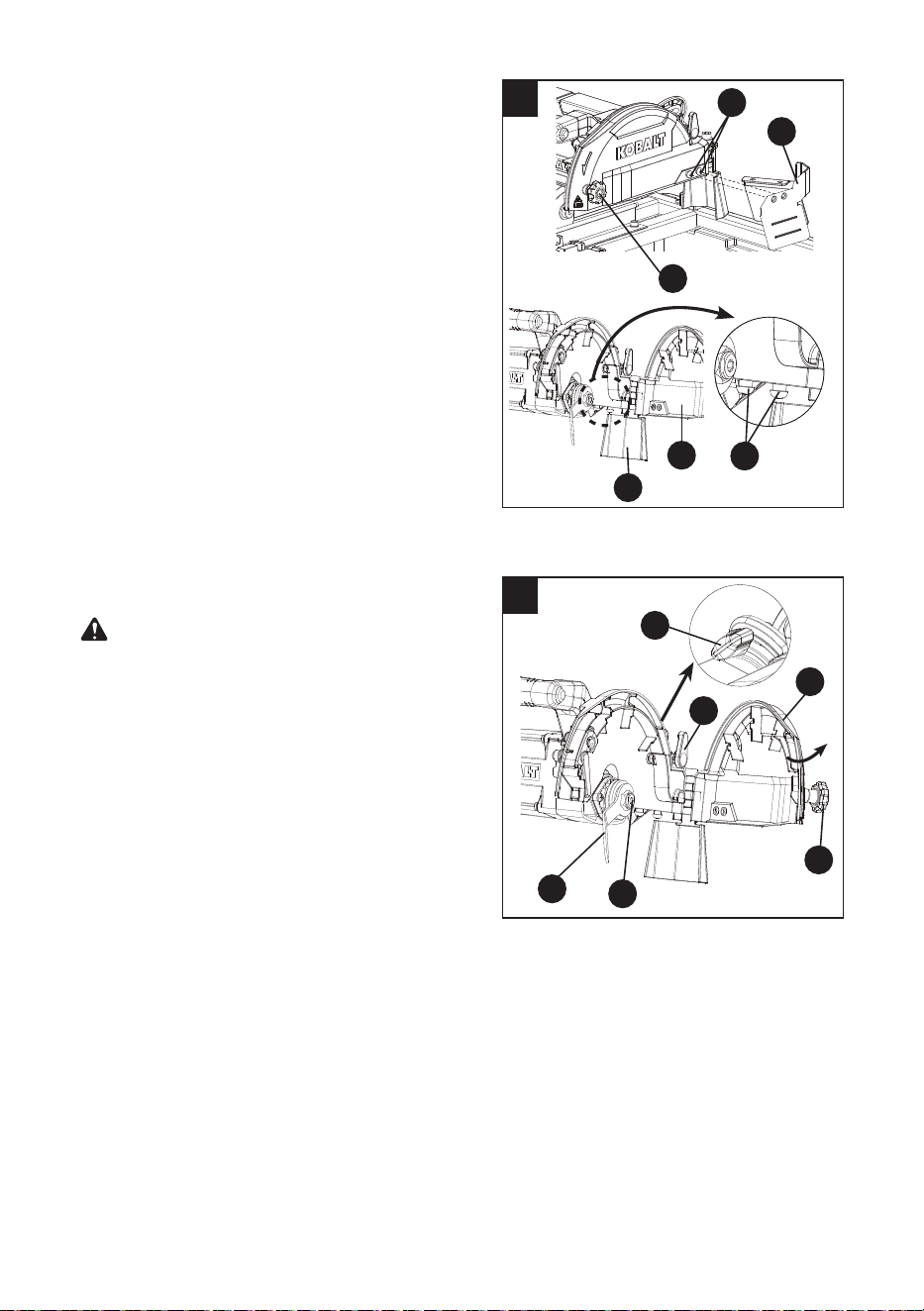
To unlock the sliding table (Fig. 10)
On the right side of the sliding table (I), turn the
table locking lever (1) to the left as shown in Fig. 10.
Release the lever.
To lock the sliding table (Fig. 10)
● Position the table with either of the two
holes (2) located on the table frame (J) as
shown in Fig 10. Turn the table lock lever (1)
to the right so that it inserts into the hole.
● Release the lever.
To lock/unlock the sliding T-fence extension
(Fig. 11)
● UNLOCK: Loosen the two sliding T-fence
lock knobs (EE) which are located under the
table, by turning clockwise. The sliding T-fence
extension (V) can be pulled out to the desired
position.
● LOCK: Tighten the two sliding T-fence lock
knobs (EE) by turning counterclockwise to lock
the sliding T-fence extension (V).
J
Unlock
Lock
11
2
I
1
Fold
V
Extend
V
EE
10
22
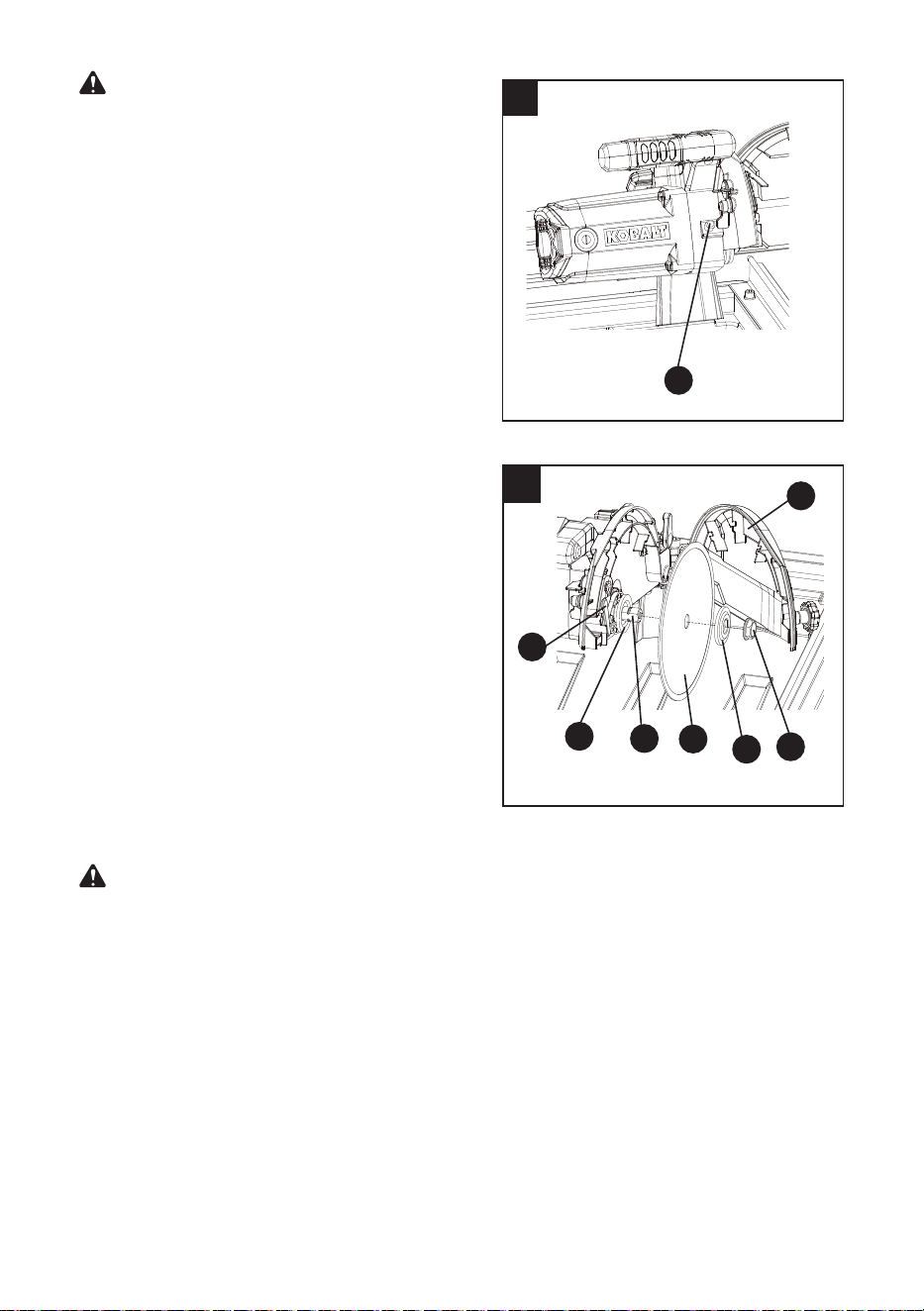
INSTALLING THE SIDE SPLASH GUARD (FIG. 12)
● Insert the two holes on the inside of the
side
splash guard (N) into the two screws (1)
located
on side of the upper wheel guard. Press into
place.
NOTE: It is not necessary to loosen or remove
the screws (1) on the wheel guard to install the
side splash guard.
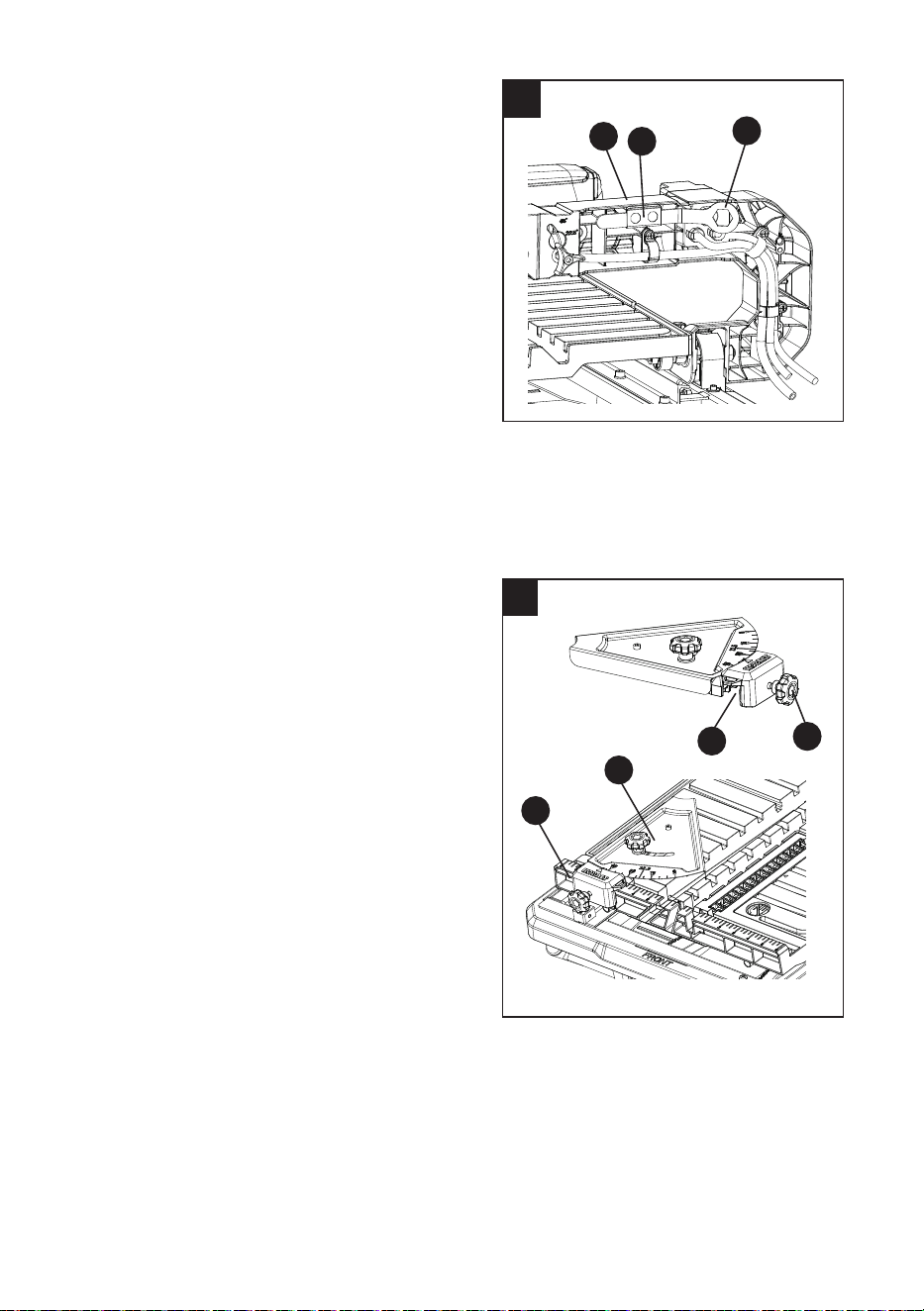
● Open the Upper Wheel Cover (LL) by turning
the lock knob (JJ) clockwise. Wrap the side
splash guard (N) over the installed rear splash
guard (II) and insert the other two holes into the
two screw heads (2) located in the back of the
blade guard.
NOTE: It is not necessary to loosen or remove
the screws (2) on the wheel guard to install the
side splash guard.
12
Fig. 12-2
INSTALLING THE TILE CUTTING WHEEL
(FIG. 13, 14, 15)
WARNING
● Do not use tile saw wheels rated less than the
no load speed of this tile saw. Failure to heed
this warning could result in personal injury. DO
NOT use a tile saw wheel with cracks, gaps, or
teeth.
● A 7 in. tile saw wheel is the maximum wheel
capacity of the tile saw.
NEVER use a tile saw
wheel that is too thick.
Larger wheels will come
in contact with the anti-
splash guard, while
thicker wheels will prevent
the wheel bolt from
securing the wheel on the arbor. Either of these
situations could result in serious accidents and
can cause serious personal injury.
● Disconnect the saw from the power source.
● Move the sliding table to the front of the saw.
● Loosen the wheel guard lock knob (JJ) to open
the upper wheel guard (LL). (Fig. 13)
● Place the wheel wrench (NN) on the arbor
nut (MM).
● Press the arbor lock button (R), holding
it in rmly while turning the wheel wrench
counterclockwise to loosen. (Fig. 14)
● Remove the arbor nut (MM) and outer wheel
ange (1). Do not remove the inner wheel
ange (2). (Fig. 15)
13
MM
LL
JJ
NN
DD
FF
Fig. 12-1
1
N
JJ
2
LL
II
23
14
WARNING: If the inner ange (2) has been
removed, replace it before placing wheel on
arbor. Failure to do so could cause an accident
since the wheel will not tighten properly. Never
use a wheel that has openings, grooves, or
teeth on this tool.
● Place the 7 in. cutting wheel (E) on the
arbor (3) until the wheel ts ush against
the inner ange (2) and the rotation arrow is
pointing in the correct direction. Make sure the
cutting wheel is installed between the two water
nozzles (OO).
NOTICE: Two water nozzles (OO) come
installed on this product. The hole in each
nozzle should face the cutting wheel.
● Replace the outer wheel ange (1) against the
wheel and on the arbor. Make sure the wheel
ts ush against the inner wheel ange and the
outer wheel ange, and the rotation arrow is
pointing in the correct direction and matches the
arrow on the outside of the upper guard.
● Replace the arbor nut (MM) on the arbor and
place the wheel wrench (NN) on the arbor nut.
Press the arbor lock button (R-Fig. 14), holding
it in rmly while turning the wheel wrench
clockwise to tighten.
● Close the upper wheel guard (LL) and tighten
the wheel guard lock knob (JJ). (Fig. 13)
15
Do not remove
inner ange
R
3
2
1
E
OO
MM
REMOVING THE TILE CUTTING WHEEL (FIG. 13, 14, 15)
WARNING: To avoid injury from an accidental start, make sure the switch is in the OFF
position and the plug is not connected to the power source outlet.
● Disconnect the saw from the power source.
● Move the sliding table to the front of the saw.
● Loosen the cutting head lock knob (DD) and then pull out the hold-down latch (FF) to raise the
cutting head assembly to its upmost position. Release the hold-down latch (FF) and tighten
the cutting head lock knob (DD). (Fig. 13)
● Loosen the wheel guard lock knob (JJ) and open the upper wheel guard (LL).
● Place the wheel wrench (NN) on the arbor nut (MM).
● Press the arbor lock button (R), holding it in rmly while turning the wheel wrench
counterclockwise to loosen. (Fig. 14)
● Remove the arbor nut (MM), outer wheel ange (1) and cutting wheel (E). Do not remove the
inner wheel ange (2). (Fig. 15)
LL
24
17
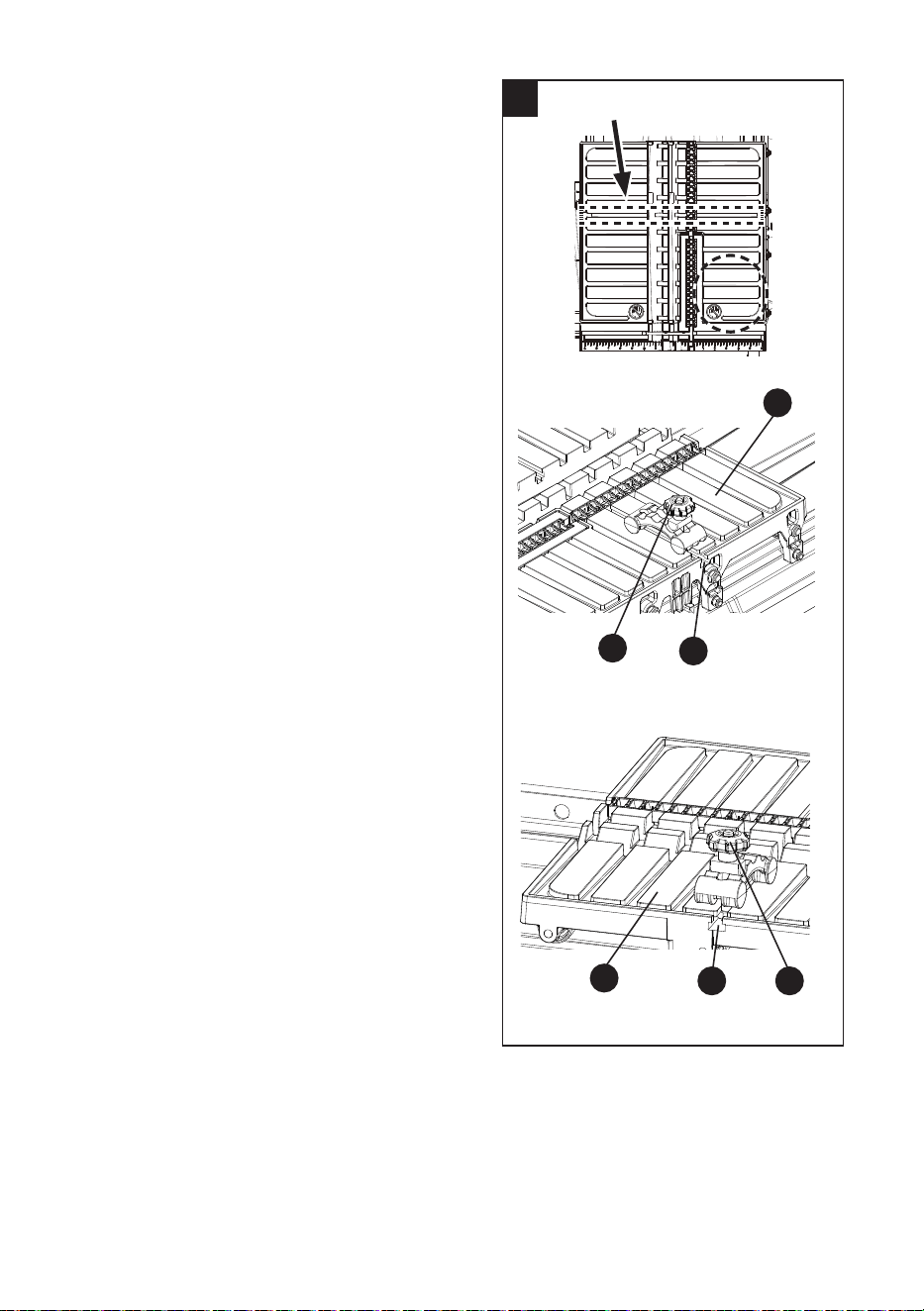
INSTALLING THE RIP/ANGLE GUIDE (FIG. 17)
The Rip/Angle guide can be used from either the left
or right side of the 7 in. cutting wheel.
● Place the slot (1) of the Rip/Angle guide (C)
on the sliding T-fence extension (V).
●
Move the Rip/Angle guide along
the fence to
the desire position and
turn the lock knob (2)
clockwise to lock in place.
1
V
C
2
16
HH
WHEEL WRENCH STORAGE (FIG. 16)
For convenient storage and prevention of loss,
there is a clip (HH) behind the arm (1) for storing the
wheel wrench (NN) when not in use.
1
NN
25
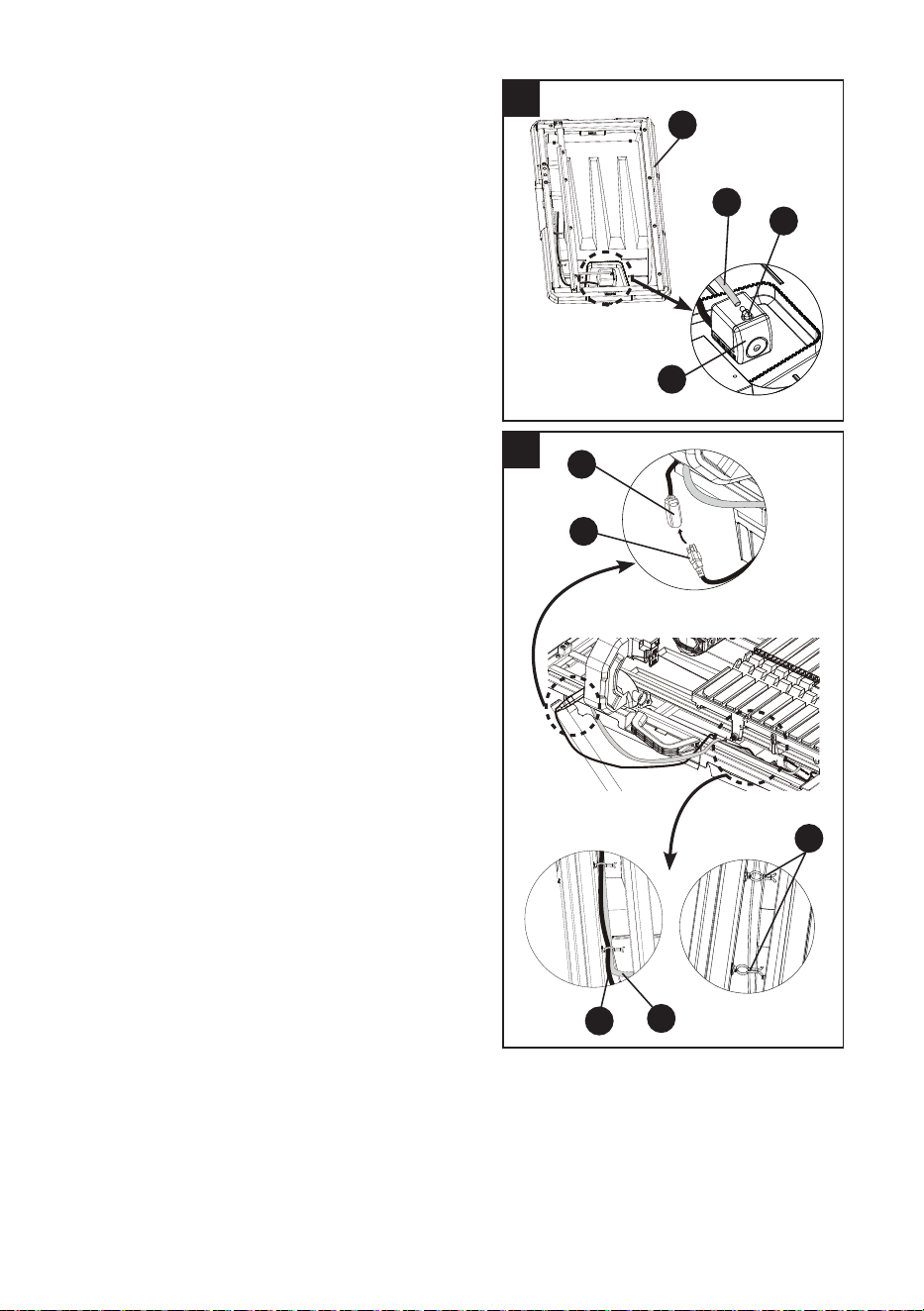
INSTALLING THE TILE CLAMP (FIG. 18)
NOTE: The tile clamp is designed to be used for
small or narrow pieces of tile. Use this clamp for
all cuts that cannot be held rmly by the miter/
angle guide and would require your hands to be
closer than 3” from the cutting wheel. The sliding
table has a channel for the tile clamp to be
located into position and tighten.
● For tile 3” and less in width: Insert the tile
clamp (B) into the T-shaped slot (1) from the
right side of the sliding table (I).
NOTE: Make sure the clamp will not contact
the cutting wheel before starting the cut.
● For tile larger than 3” in width: Insert the tile
clamp (B) into the T-shaped slot (1) from the
left side of the sliding table (I).
NOTE: Make sure the openings on the sliding
table for the 22.5 and 45 bevel angles do not
interfere with the tightening of the clamp.
18
I
B
1
Left
Side of
Saw
Right
Side of
Saw
Front of Saw
Right Side of Table
B1
I
Left Side of Table
Slot for Tile Clamp
26
20
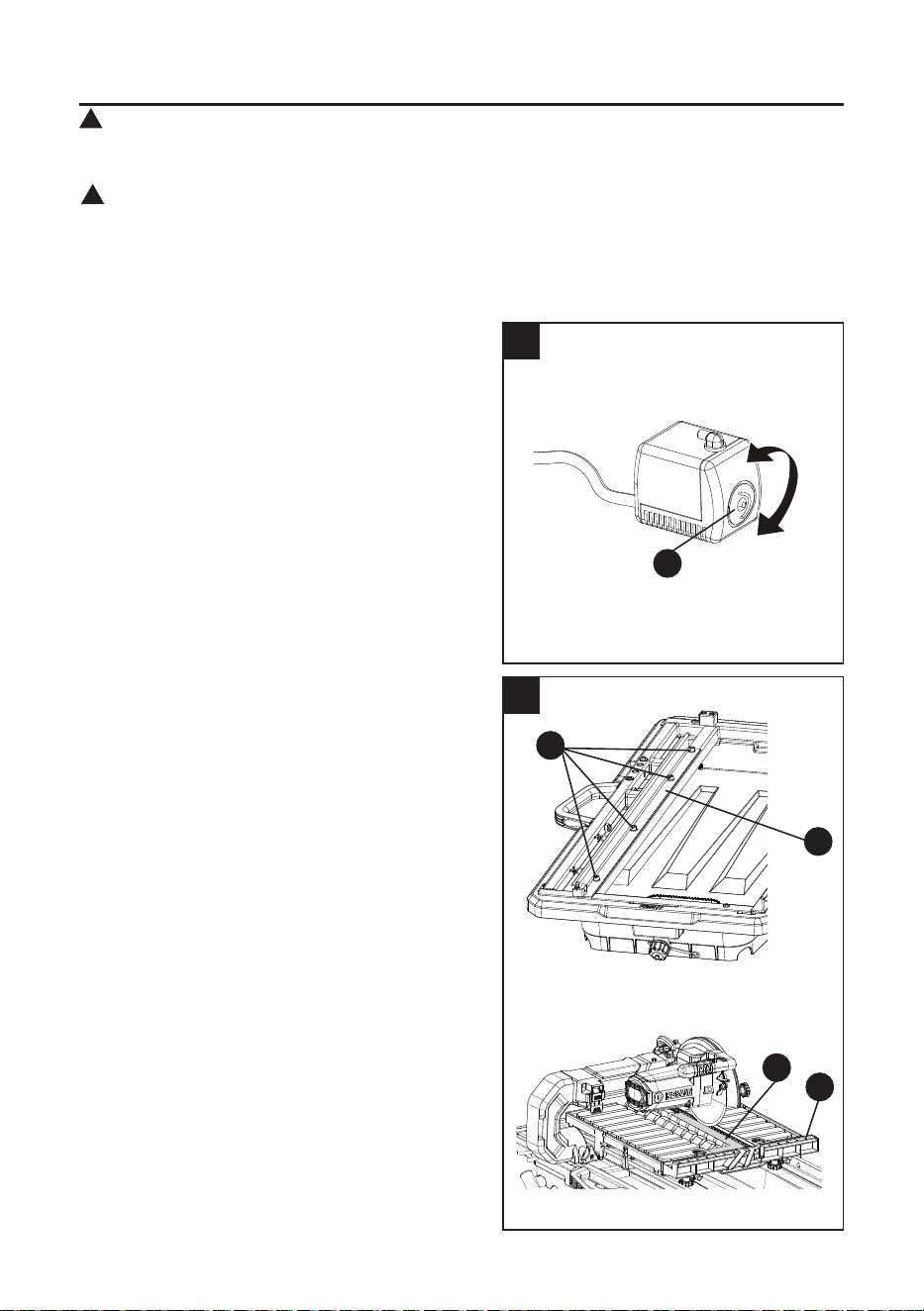
INSTALLING THE WATER PUMP (FIG. 19, 20)
● Move the table to the back position.
● Water pump (D) is equipped with suction feet to
secure in place. Press down rmly on the water
pump (D) to attach feet to bottom of the water
tray (K).
● Insert the clear water tube (1) into inside of
the water tray from the molded opening and
connect the clear water tube to the barbed end
of the 90° tting (2).
NOTE: Make sure the clear water tube doesn’t
contact the bottom of the sliding table. Adjust
the position of the clear water tube or pump if
necessary.
NOTICE: Make sure the water pump power
cord (3) and clear water tube (1) have been
placed under the frame rails and over the left
side of the frame. (Fig. 20)
● Secure the clear water tube (1) and water pump
power cord (3) by placing them into the two cord
clamps (4) and twisting the ends closed.
● Insert the water pump power cord plug (5)
into the
power
cord receptacle (Z) as shown in
Fig. 20. The water pump will start when the tile
saw is turned on.
NOTE: Do not use pump when not submersed
in water as it may damage the pump. If the
pump does not push water out of the clear
water tube onto the blade after starting the
saw, unplug the saw from the electrical outlet,
disconnect the clear water tube from the pump.
Submerse the pump in water, reconnect the
clear water tube to the pump, plug the saw back
into the electrical outlet and start the saw to get
the water owing through the tube to the blade.
19
D
2
K
1
1
3
4
5
Z
FRONT OF
WATER TRAY
27
WARNING: This saw was adjusted for accuracy at the factory. During shipping the components
may have been moved out of alignment. In addition, usage and time will necessitate
adjustments to be made.
To prevent personal injury:
● Always disconnect plug from the power source when making any adjustments.
● This adjustment must be correct or accurate cuts can not be made. Also inaccurate adjustment
can result serious personal injury.
TO CONTROL THE FLOW OF WATER (FIG. 21)
● Fill the water tray with clean water as
described below.
● Locate the “Max/Min” water ow selector (1)
on the pump. For best performance, set the
ow to “Max” to control the ow of water over
the wheel.
● The pump turns on when the motor is turned
on. Let the cutting wheel build up to full speed
and wait for the wheel to get wet before moving
the tile into the wheel.
NOTE: The ow of water can also be adjusted
using the external water volume control. See
page 31 for instructions.
TO SQUARE THE CUTTING WHEEL TO THE
TABLE (FIG. 22)
Do not loosen any screws for this adjustment
until you have checked with a square and made
test cuts to be sure adjustments are necessary.
Once the screws are loosened, these items must
be reset.
● Disconnect the saw from the power source.
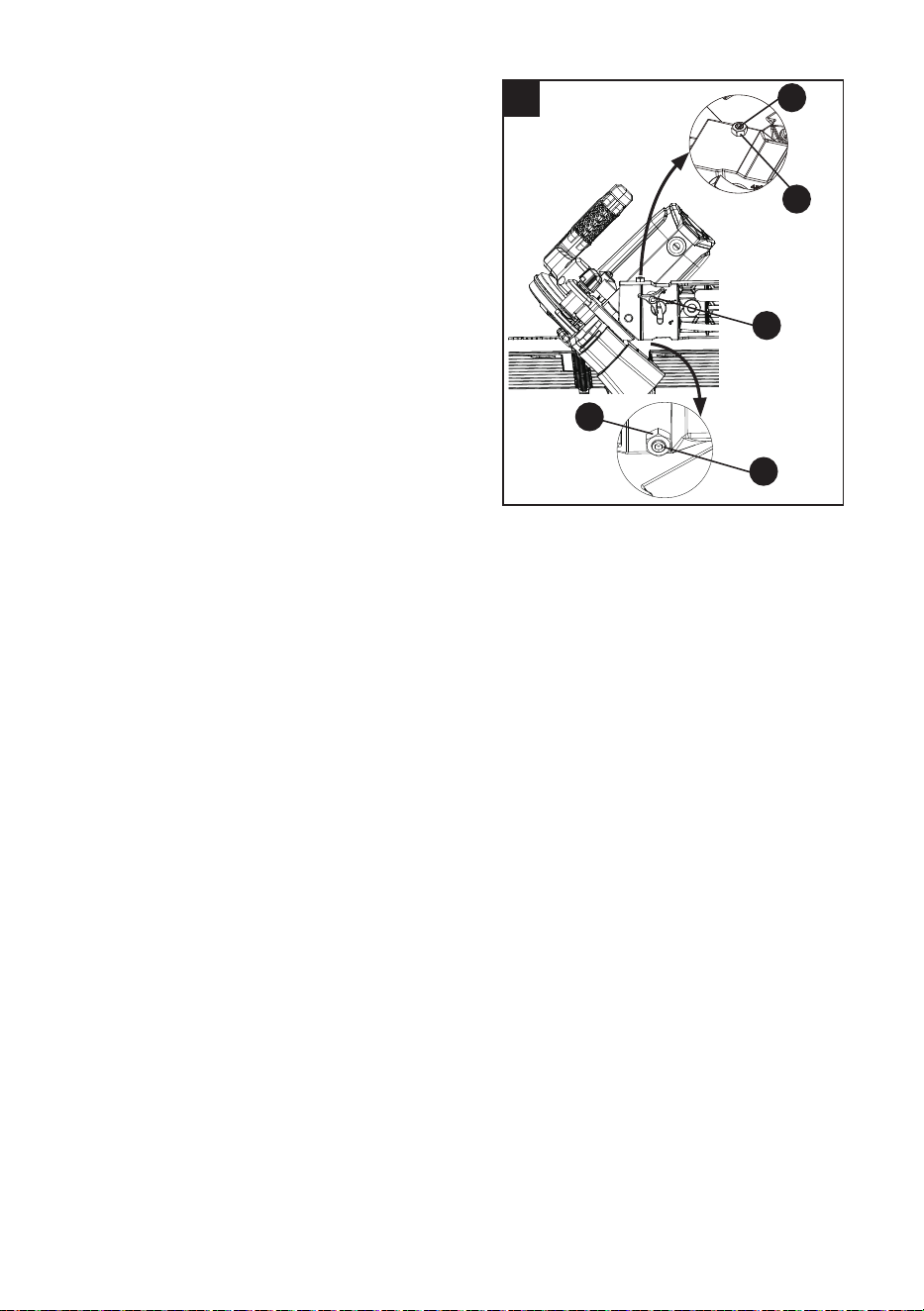
● Using the provided 5 mm hex key (RR),
loosen the four cap bolts (1) on the left rail (2).
● Place a framing square (3) against the sliding
T-fence extension (V) and the at part of the
wheel.
● Move the rail (2) until the sliding T-fence
extension (V) is square with the cutting wheel.
● Tighten the cap bolts (1) securely.
NOTE: Make sure the table stop is still
functional in the unlocked position so that
the sliding table does not slide o of the
table rails.
21
MAX
MIN
Max
Min
1
ADJUSTMENT INSTRUCTIONS
!
22
1
2
WARNING
!
3
V
28
23
2
3
GG
1
4
POSITIVE STOP ADJUSTMENT (FIG. 23)
NOTE: These adjustments were made at the
factory and normally do not require.
Adjusting the cutting wheel 90° to sliding table
● Disconnect the saw from the power source.
● Loosen the bevel lock knob (GG). Place a 90°
framing square on the cutting wheel surface.
● If the cutting wheel is not 90° to the groove,
loosen the lock nut (1) with a adjustable
wrench and use a 3 mm hex key to turn
the 0° hex bolt (2) clockwise to screw in or
counterclockwise to screw out
until the wheel
is ush with the framing square. Tighten the
lock nut (1).
● Tighten the bevel lock knob (GG).
● Make sure that the cutting wheel does not
touch either side of the groove in the sliding
table by pushing the silding table past the
cutting wheel.
Adjusting the cutting wheel 45° to sliding table
● Disconnect the saw from the power source.
● Loosen the bevel lock knob (GG).
● Place the combination square to the cutting
wheel surface.
● If the cutting wheel is not 45° to the groove,
loosen the lock nut (3) with a adjustable
wrench and
use a 3 mm hex key
to
turn the
45° hex bolt (4) until
the wheel is 45° to the
groove. Tighten the lock nut (3).
●
Tighten the bevel lock knob (GG).
● Make sure that the cutting wheel does not
touch either side of the groove in the sliding
table by pushing the silding table past the
cutting wheel.
29
CUTTING WHEEL DEPTH ADJUSTMENT
(FIG. 24)
WARNING: Improperly adjusting the cutting
wheel depth could cause the cutting wheel
to come in contact with the sliding table
resulting in damage to the unit and/or
possible serious injury.
Adjusting the cutting depth:
● Disconnect the saw from the power source.
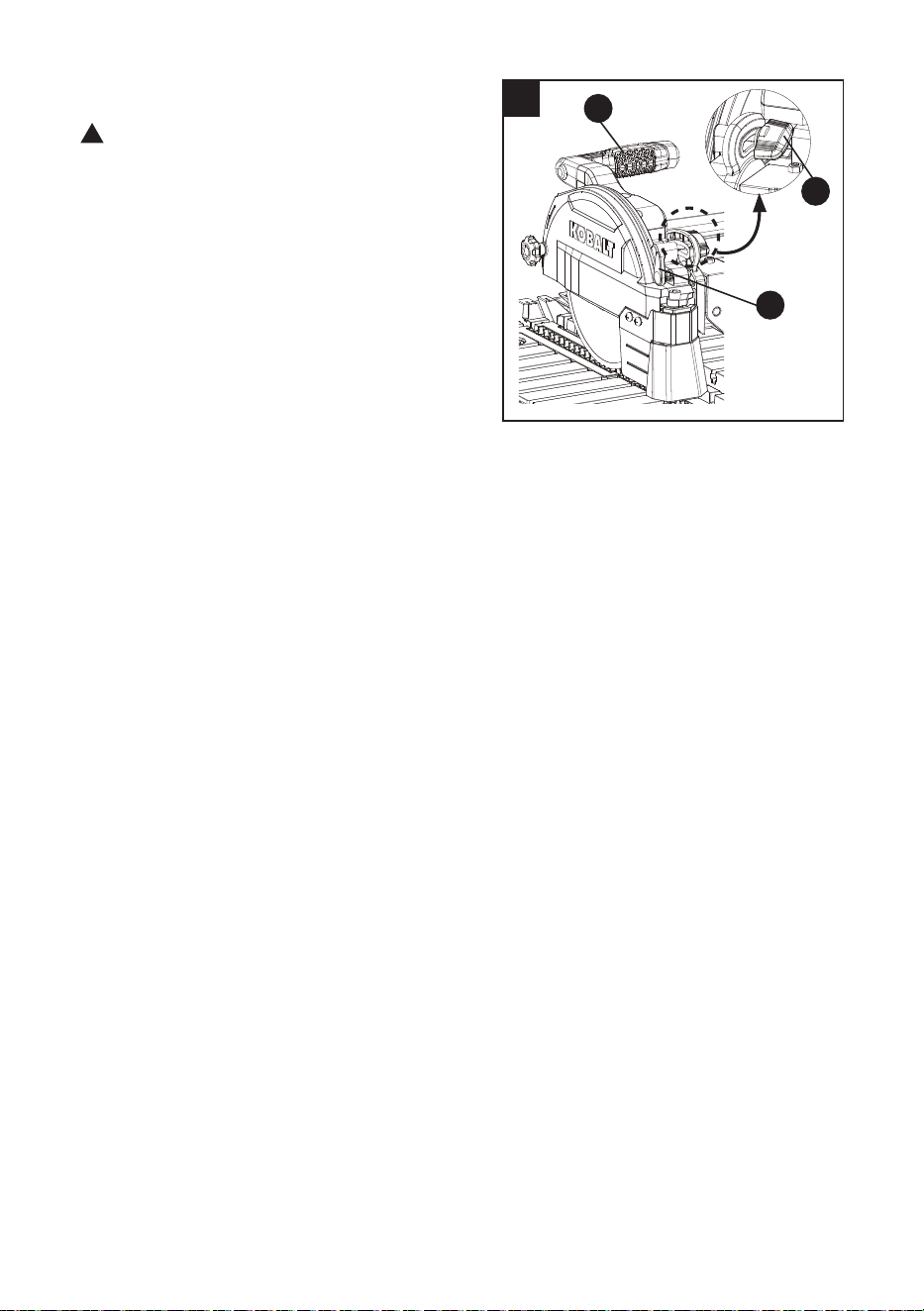
● Loosen the cutting head lock knob (DD),
pull out the hold-down latch (FF), and press
down the motor handle (Q) until the cutting
wheel is at the desired depth.
●
While holding the cutting head in the desired
position,
release the hold-down latch and
tighten the cutting head lock knob (DD).
Maximum cutting depth:
● Disconnect the saw from the power source.
● Loosen the cutting head lock knob (DD),
pull out the hold-down latch (FF), and press
down the motor handle (Q) to set the cutting
head to a 0° angle. Make sure the wheel sits
in the groove in the sliding table.
NOTICE: Do not lock the cutting head lock
knob while making this adjustment.
● After adjustment is complete, tigthen the
cutting head lock knob (DD).
● Recheck the cutting wheel depth by moving
the sliding table front to back.
!
24
FF
DD
Q
30
USING THE RIP/ANGLE GUIDE (FIG. 26)
● Loosen the Rip/Angle guide adjust knob (1).
● Move the Rip/Angle guide body (2) to align
the pointer (3) to the desired angle.
● Tighten the miter guide adjust knob (1) securely
before turning on the saw.
NOTE: Please make sure the cutting wheel will
not make contact with this guide during the
cutting operation.
BASIC SAW OPERATIONS
● Overlling the water tray can lead to water entering the motor compartment and potential
electric shock.
● When lling/draining water tray, make sure wet tile saw is unplugged from wall outlet.
BEFORE USING THE TILE SAW
WARNING: To avoid mistakes that could cause serious, permanent injury, do not plug the tool
in until the following steps are completed:
● Completely assemble and adjust the tile saw, following the instructions. (SEE ASSEMBLY
AND ADJUSTMENTS SECTIONS).
● Review the entire manual and understand all safety instructions and operating procedures in
this Instructions Manual. (SEE IMPORTANT SAFETY & OPERATIONS SECTIONS).
● To avoid injury or possible death from electrical shock, make sure your ngers do not touch
the plug’s metal prongs when plugging or unplugging your tile saw. (SEE ELECTRICAL
REQUIREMENTS AND IMPORTANT SAFETY SECTIONS).
!
OPERATION INSTRUCTIONS
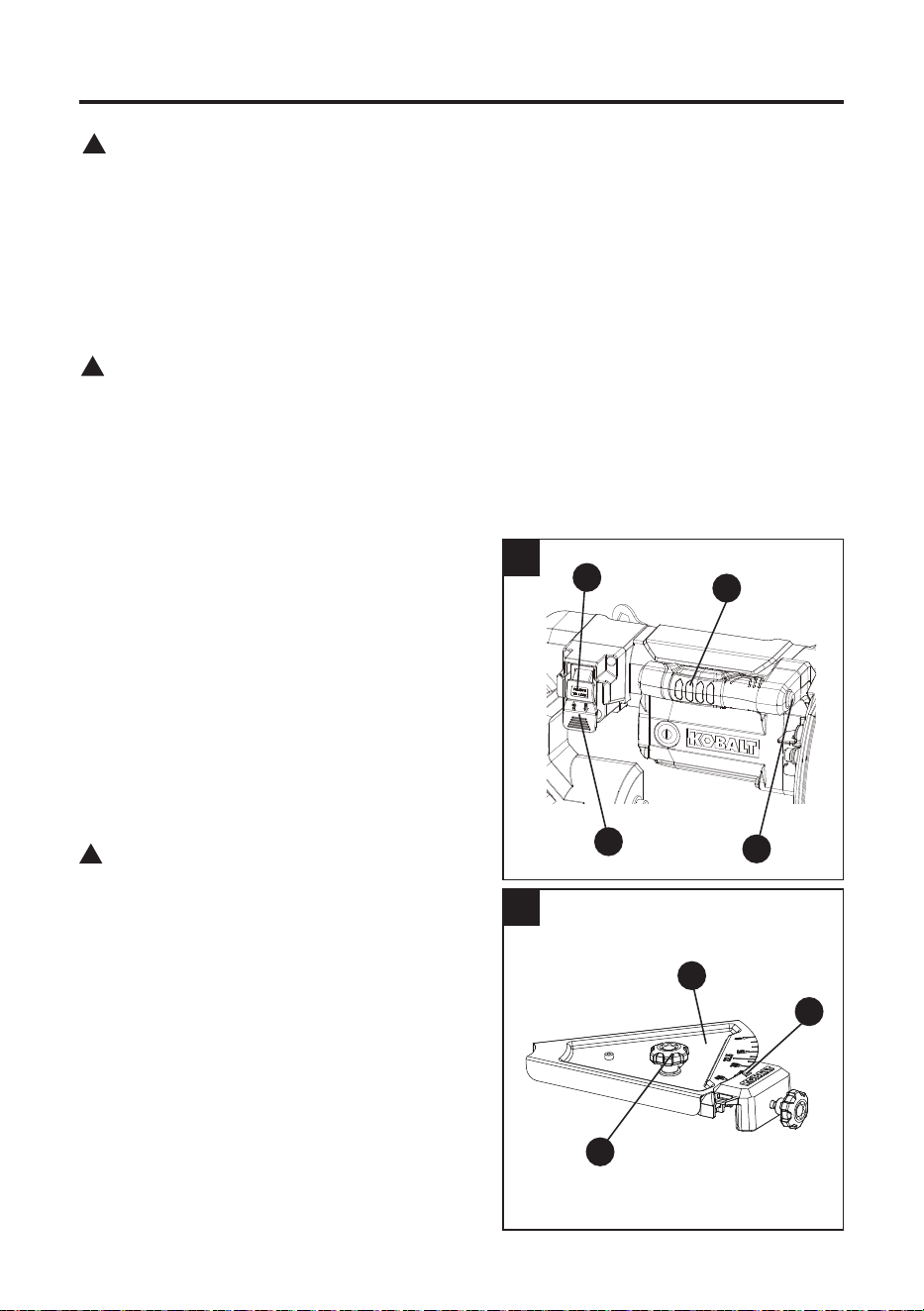
ON/OFF SWITCH (FIG. 25)
The ON/OFF switch (BB) has a removable safety
key (SS). With the key removed from the switch,
unauthorized and hazardous use by children and
others is minimized and the saw will not turn on.
●
To turn the saw “ON”, insert the safety key (SS)
into the slot of the ON/OFF switch (BB), and
move the switch upward to the “ON” position.
● To turn the saw “OFF”, move the ON/OFF
switch (BB) downward.
● To lock the switch in the OFF position, grasp the
sides of the safety key (SS), and pull it out.
● With the switch key removed, the switch will not
operate to power the saw on.
WARNING: ALWAYS lock the switch “OFF”
when the tile saw is not in use. Remove the
key and keep it in a safe place. In the event of
a power failure, blown fuse, or tripped circuit
breaker, turn the switch “OFF” and remove the
key, preventing an accidental startup when
power comes on.
LED LIGHT ON/OFF SWITCH (FIG. 25)
Turn the LED light on and o by pressing the LED light ON/OFF switch (EE) located on the side of
the motor handle (Q).
NOTE: The saw must be plugged in for the LED light to operate.
WARNING
!
26
25
EE
1
2
3
BB
SS
Q
!
31
FILLING/CHANGING THE WATER RESERVIOR
(FIG. 27)
WARNING: When lling/draining water tray,
make sure wet tile saw is unplugged from
wall outlet.
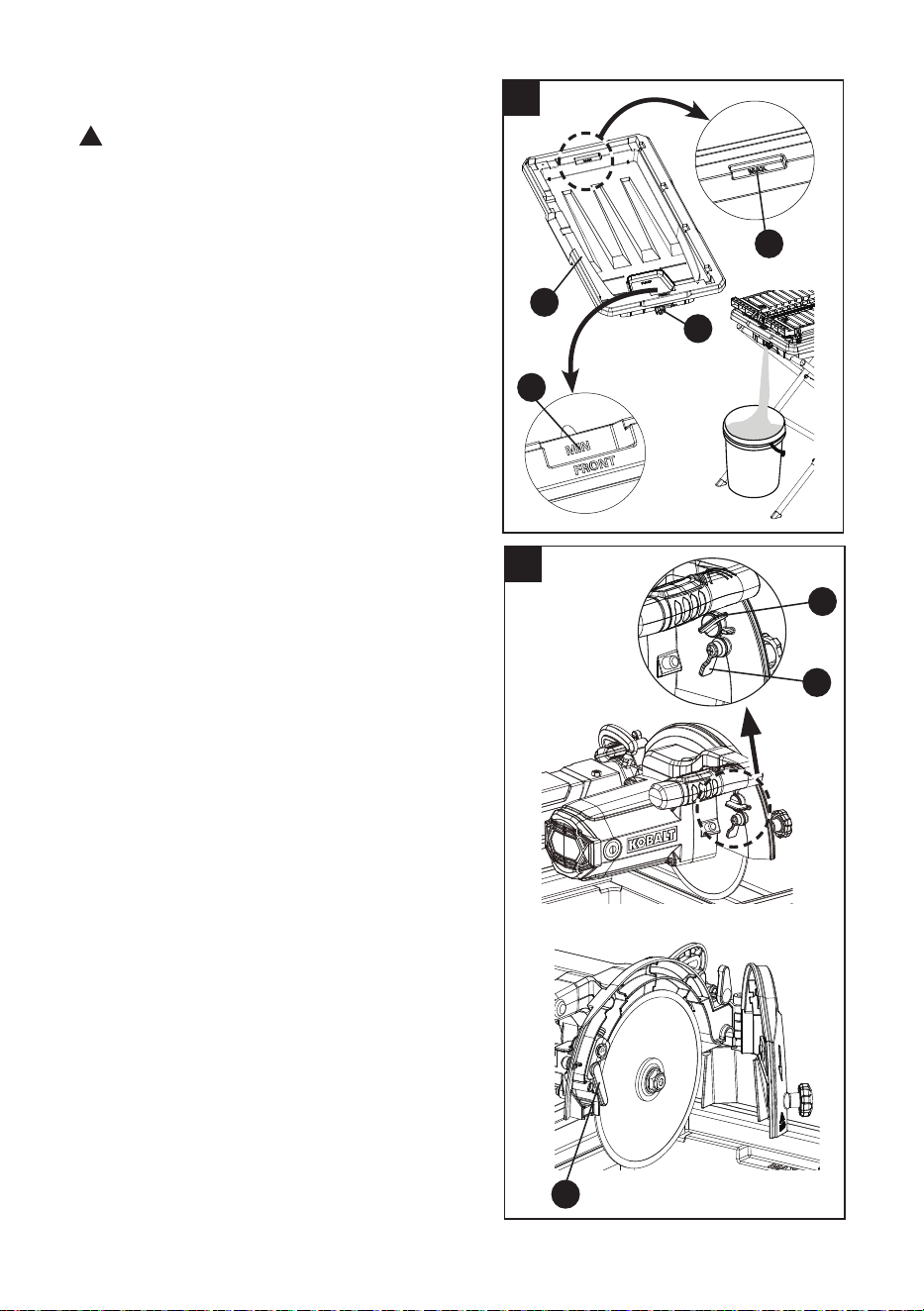
To ll the reservoir with water
● Make sure the drain plug (X) on the water
tray is tight.
● Fill the water tray (K) with clean water.
Ensure the water level is between "MAX" (1)
and "MIN" (2) ll lines. Do not overll.
To change the reservior water:
●
Place a bucket under the drain plug (X).
Remove
the drain plug and allow the water
to empty into the bucket
.
● Rinse the water reservoir thoroughly.
● Discard the waste water in accordance with
local regulations.
● Replace the drain plug (X) and rell water
tray with clean water.
EXTERNAL WATER CONTROLS (FIG. 28)
Water nozzles are adjustable to provide
maximum water for cutting and change water
spray direction.
● The water volume control (S) allows easy
adjustment of nozzles (OO) to provide water
volume. To provide maximum water volume,
turn the water volume control (S) clockwise.
To provide minimum water volume, turn the
water volume control (S) counterclockwise.
● The water angle control (T) allows easy
adjustment of nozzles (OO) to desired angle.
!
28
S
T
OO
1
K
X
FRONT OF SAW
2
27
32
CUTTING OPERATION
! WARNING: Before making any adjustments
or removing or installing attachments or
accessories, make sure the switch is in the
OFF position to avoid injury from an
accidental start.
Before turning the tile cutter on, verify the
alignment of the sliding table and the cutting
wheel. Always center the cutting wheel in one of
the cutting table grooves before cutting. Make
sure the cutting wheel does not contact the tile or
table before turning saw on.
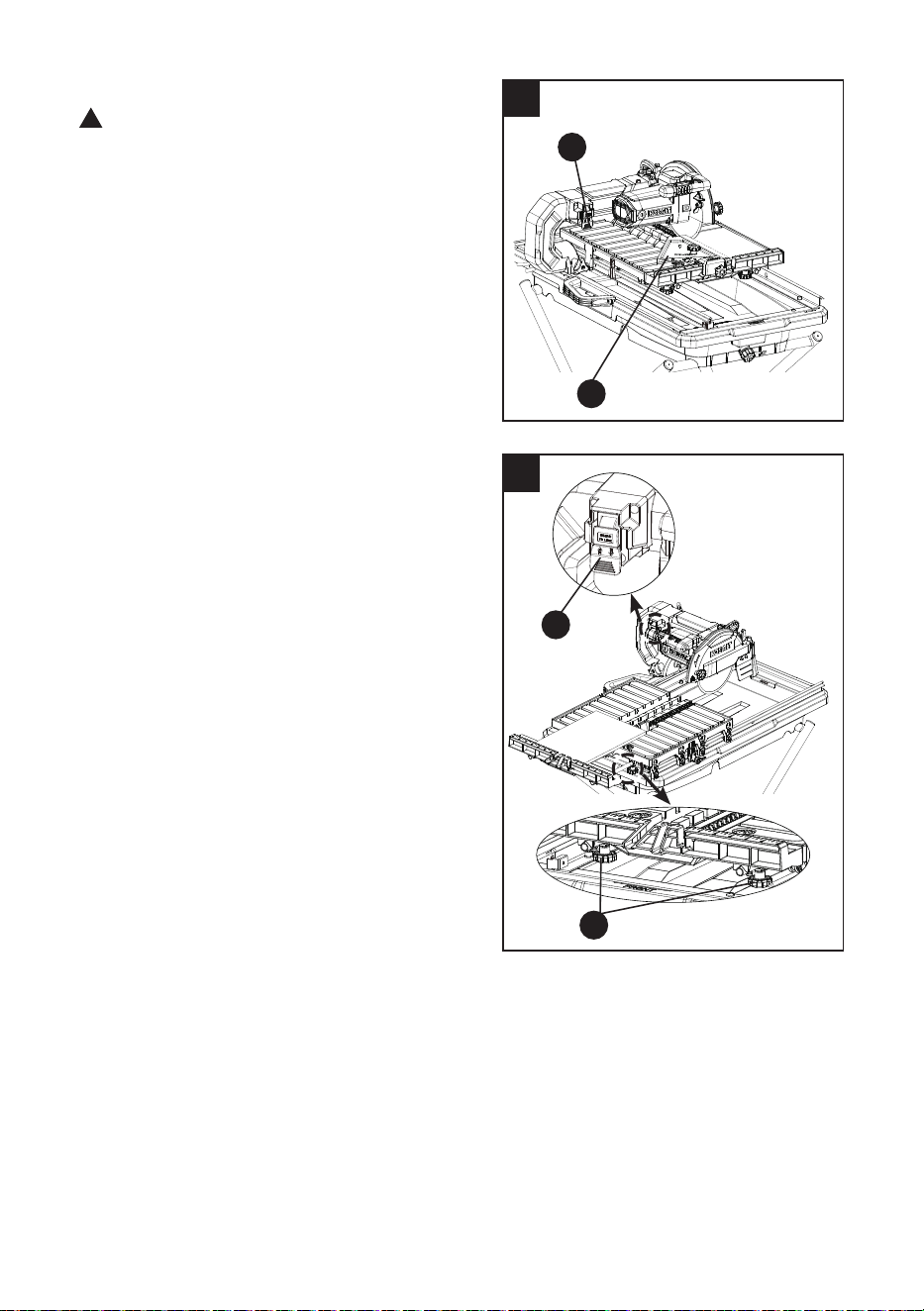
STRAIGHT CUT (FIG. 29)
● Using a pencil or marker mark the area to be
cut on tile.
● Place the tile on the sliding table and against
the Rip/Angle guide (C) and align the mark
with the cutting wheel.
● Pull the ON/OFF switch (BB) upward to turn
the tile saw. Allow the cutting wheel to reach
full speed and wait until the stream of water
from the water nozzle completely covers the
cutting wheel.
● Using both hands to slowly push the sliding
table toward the cutting wheel to feed the tile
into the cutting wheel (Never force the material
through the wheel. Move at a slow consistent
pace).
● Turn the tile saw o once cut is performed.
CUTTING LONG TILE (UP TO 30”) (FIG. 30)
● Move the sliding table to the front of the saw.
● Loosen the two sliding T-fence lock knobs (EE)
and pull the sliding T-fence extension to the
front position.
NOTE: Do not lock the sliding T-fence lock knobs.
● Using a pencil or marker mark the area to be
cut on tile.
29
C
BB
30
BB
EE
● Place up to the 30” tile on the sliding table and against the sliding T-fence extension.
● Pull the ON/OFF switch (BB) upward to turn the tile saw. Allow the cutting wheel to reach full
speed and wait until the stream of water from the water nozzle completely covers the cutting
wheel.
● Using both hands to slowly push the sliding table toward the cutting wheel. As the cutting
proceeds, simultaneously push the sliding T-fence extension forward to feed the tile into the
cutting wheel (Never force the material through the wheel. Move at a slow consistent pace) at
the same time.
● Turn the tile saw o once cut if performed.
NOTE: For cutting small/narrow tile, see the section of “INSTALLING THE TILE CLAMP” on page 25.
33
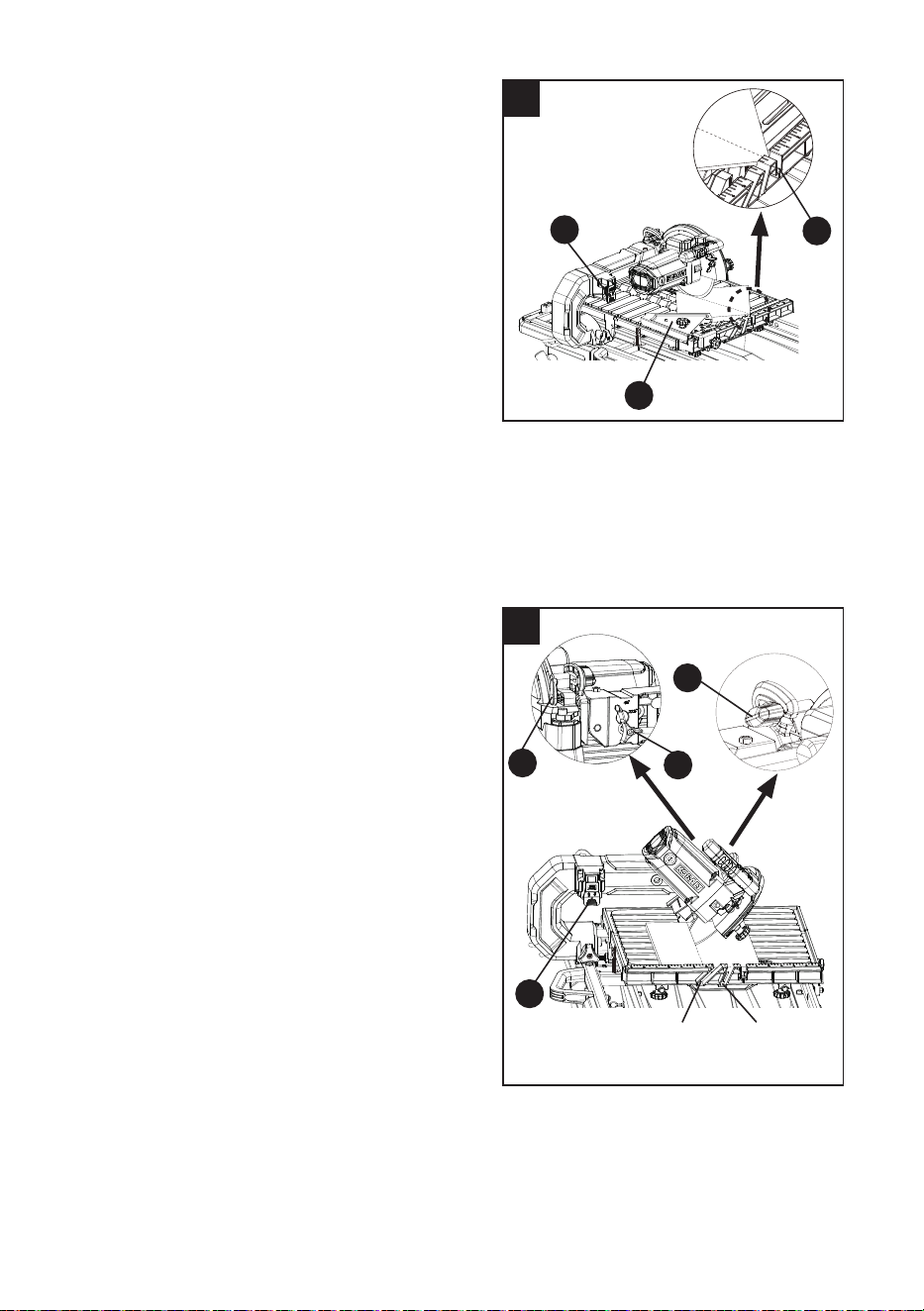
DIAGONAL CUT (FIG. 31)
NOTE: Diagonal cuts are also referred to as
“long point to point cuts.”
● Fill the water tray with clean water.
● Using a pencil or marker mark the area to be
cut on tile.
● Align one point of the tile against the cut
indicator (1) of the sliding table. The cut
indicator means the exact location where
the cutting wheel will pass through the
sliding table.
● Align the front of the tile to the cutting wheel
and hold against the Rip/Angle guide (C),
which should be adjusted to proper angle.
● Pull the ON/OFF switch (BB) upward to turn
the tile saw on to allow the cutting wheel at
the full speed and wait until the stream of
water from the water nozzle completely cover
the cutting wheel.
● Using both hands to slowly push the sliding
table toward the cutting wheel to feed the tile
into the cutting wheel.
● Turn the tile saw o once cut is performed.
BEVEL CUT (FIG. 32)
NOTE: Bevel cuts can be made at 22.5 and 45
angles.
● Using a pencil or marker mark the area to be
cut on tile.
● Loosen the bevel lock knob (GG) to tilt the
cutting head to 22.5° or 45° clockwise.
Tighten the bevel lock knob.
● Loosen the cutting head lock knob (DD) and
pull out the hold-down latch (FF) to lower the
cutting head in one of the 2 miter slots in the
sliding table. Release the hold-down latch
and tighten the cutting head lock knob.
NOTICE: Check to insure the cutting wheel
does not contact the table before turning
saw on.
● Put the ON/OFF switch (BB) upward to turn
the tile saw on to allow the cutting wheel at
the full speed and wait until the stream of
water from the water nozzle completely cover
the cutting wheel.
● Using both hands to slowly push the sliding
table toward the cutting wheel to feed the tile
into the cutting wheel.
● Turn the tile saw o once cut is performed.
31
32
For 45°
bevel cut
For 22.5°
bevel cut
GG
DD
FF
1
BB
C
BB
34
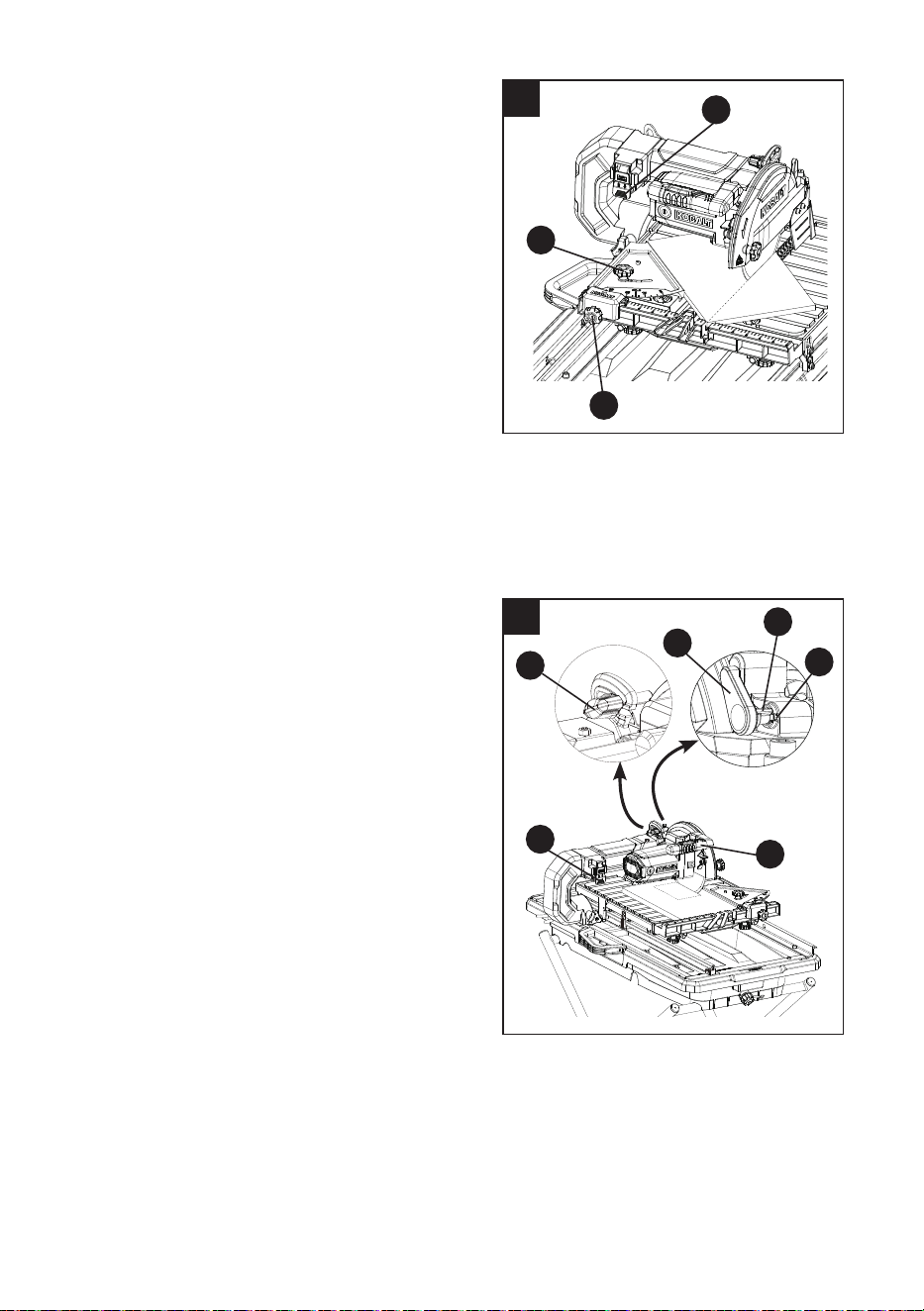
MITER CUT (FIG. 33)
NOTE: Miter cuts are used for cutting outside
and inside corners on material, decorative chair
rail and base moulding with the material at any
angle to the cutting wheel other than 90°.
● Using a pencil or marker mark the area to be
cut on tile.
● Loosen the Rip/Angle guide lock knob (1) to
make the Rip/Angle guide along the front rail
to the desired position and then tighten the
lock knob.
● Loosen the Rip/Angle guide adjust lock
knob (2) to turn the guide to the desired
angle along the arc slot and then tighten the
adjust lock knob.
● Pull the ON/OFF switch (BB) upward to turn
the tile saw on to allow the cutting wheel at
the full speed and wait until the stream of
water from the water nozle completely cover
the cutting wheel.
● Using both hands to slowly push the sliding
table toward the cutting wheel to feed the tile
into the cutting wheel.
● Turn the tile saw o once cut is performed.
33
2
1
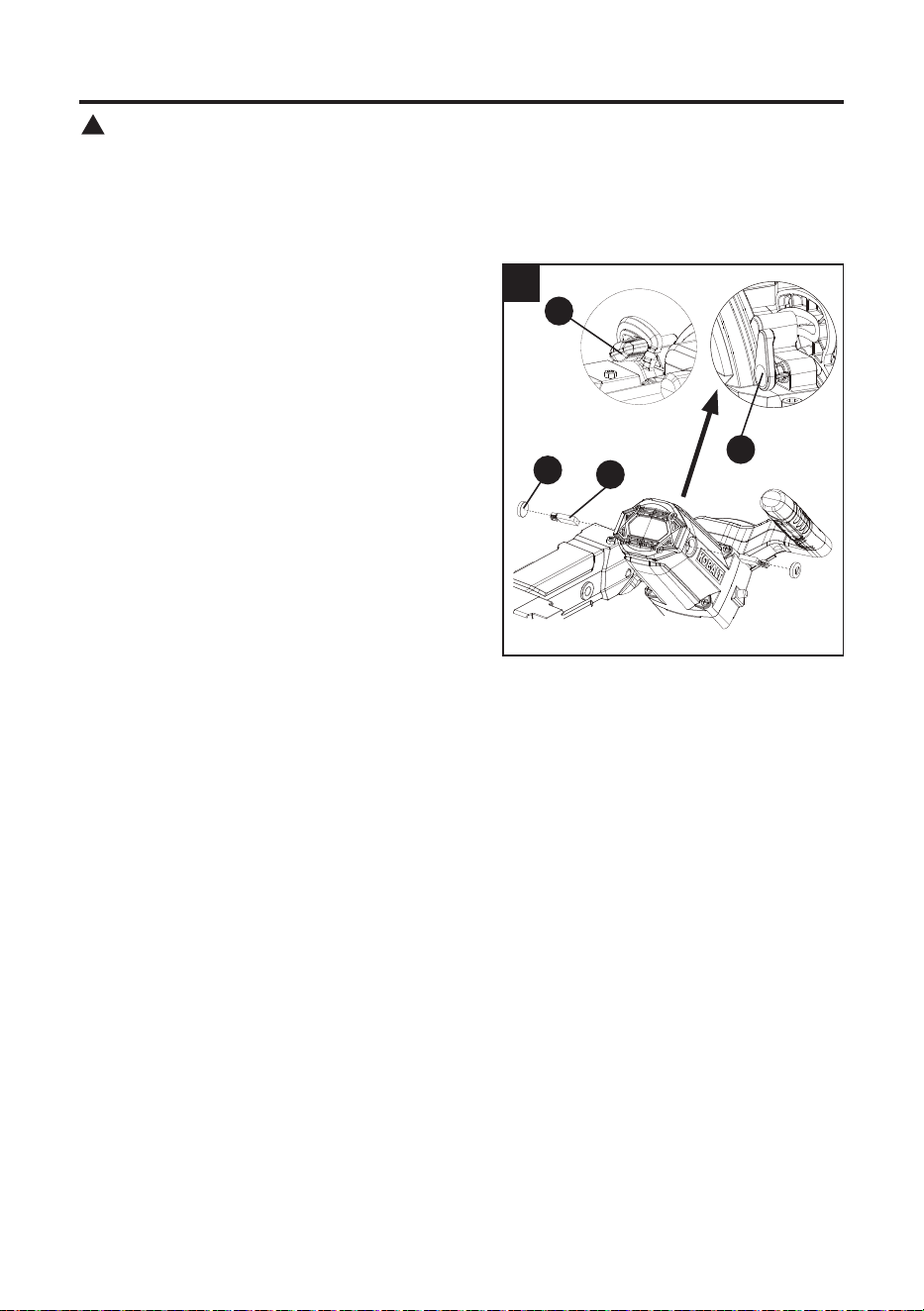
PLUNGE CUT (FIG. 34)
NOTE: Plunge cuts mean to position the tile
under
the cutting wheel directly and lower the
cutting head to make cuts onto the interior of the
tile, such as electrical outlets or air conditioner
registers.
● Using a pencil or marker mark the area to be
cut on tile.
● Loosen the cutting head lock knob (DD) and
pull out the hold-down latch (FF) to raise the
cutting head upward.
NOTICE: Turn the hold-down latch (FF) to
adjust the ribs (1) of the hold-down latch out
of the slots (2), so that the cutting head can
swing upwards and downwards limitedly.
● Pull the ON/OFF switch (BB) upward to turn
the tile saw on to allow the cutting wheel at
the full speed and wait until the stream of
water from the water nozle completely cover
the cutting wheel.
● Hold the cutting head rmly by the motor
handle (Q).
● Move the tile on the sliding table underneath
the cutting wheel.
● Slowly lower the cutting head to make a cut
on the tile. Then, raise the cutting head.
● Turn the tile saw o once cut is performed.
● Withdraw the sliding table from the cutting
head and then adjust the tile position for the
next cut.
34
BB
DD
1
2
FF
BB
Q
35
CARE AND MAINTENANCE
WARNING: Do not service, clean or maintain
the saw without rst turning o the motor
and unplugging the saw from the power
source. Failure to do so may result in serious
personal injury.
!
REPLACING CARBON BRUSHES (FIG. 35)
NOTICE: Replace both carbon brushes when
either has less than 1/4 in. length of carbon
remaining, or if the spring or wire is damaged
or burned.
● To inspect or replace brushes, rst unplug
the saw.
● Loosen the cutting head lock knob (DD) and
pull out the hold-down latch (FF) to raise the
cutting head at the maximun height. Release
the hold-down latch and tighten the cutting
head lock knob.
● Loosen the bevel lock knob to tilt the cutting
head at 45° clockwise. Tighten the bevel lock
knob.
● Then, remove the black plastic cap (1) on the
side of the motor. Remove the cap cautiously,
because it is springloaded. Pull out the carbon
brushes (PP) and replace.
● The ears on the metal end of the assembly
go in the same hole the carbon part ts into.
Tighten the cap snugly, but do not overtighten.
●
Repeat for the carbon brushes located on the
other side of motor.
35
1
NOTICE: To reinstall the same brushes, rst make sure the brushes go back in the way they came
out. This will avoid a break-in period that reduces motor performance and increases wear.
CLEANING
● Insert the water pump into a bucket with clean water and pump the water through the hose
allowing the hose to be cleaned.
● Turn o and unplug the saw from the power source.
● Place a bucket under the drain plug. Remove the drain plug and allow the water to empty into
the bucket.
● Slide the edge guide o the rail system. Spray the Rip/Angle guide with a hose or wipe with a
grout sponge or clean cloth.
● Wipe the cutting table, motor housing, and motor support arm with a grout sponge or clean
cloth. Spray lubricants are not required on the rail or cutting wheel.
● Clean the water tray by spraying with a hose or wiping with a grout sponge.
Use clean cloth to remove dirt, dust, oil, grease, etc. Do not use gasoline, turpentine, lacquer or
paint thinner, dry cleaning uids or similar products. Chemicals can damage, weaken or destroy
plastic which may result in personal injury.
Try not to let any liquid get inside the motor; never immerse any part of the tool into a liquid.
FF
DD
PP
36
FREE WARNING LABEL REPLACEMENT: If your warning labels become illegible or are missing,
call 888-356-2258 for a free replacement.
DO NOT replace the power cord. If you have any problem or questions concerning the power
cord, call the Customer Service Department at 888-356-2258.
WARNING
!
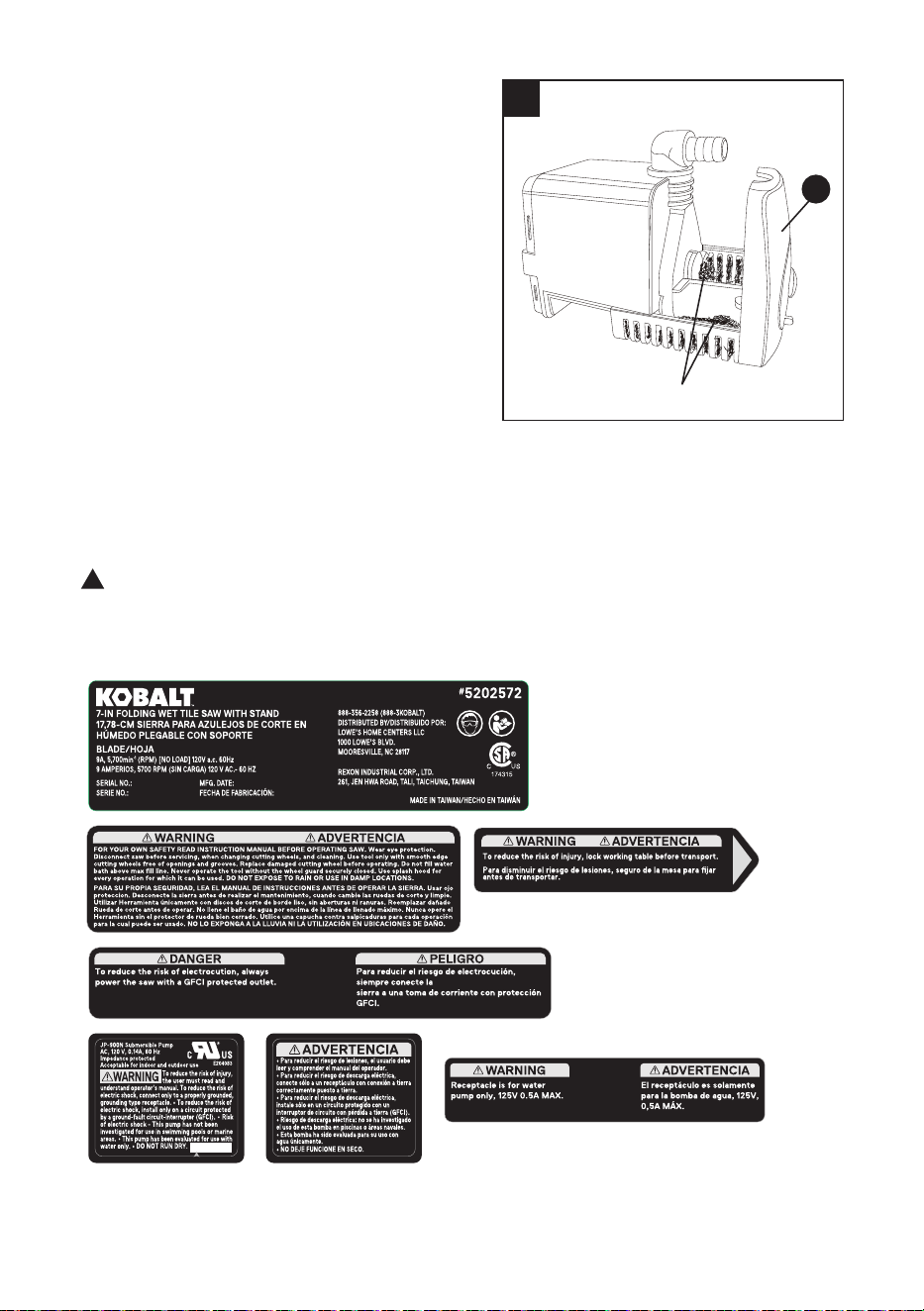
CLEANING THE PUMP (FIG. 36)
For best performance, the pump may be cleaned
periodically.
● Unplug pump before handling or cleaning the
pump.
● Pull out to remove the front cover (1).
● Using a small brush and/or water, clean any
debris or trash that is trapped on the inside of
the pump.
● Replace the front cover (1).
NOTE: To maintain eciency and extend the life
of the pump, check intake screen before use to
make sure it is clean.
36
1
Pump Filters
37
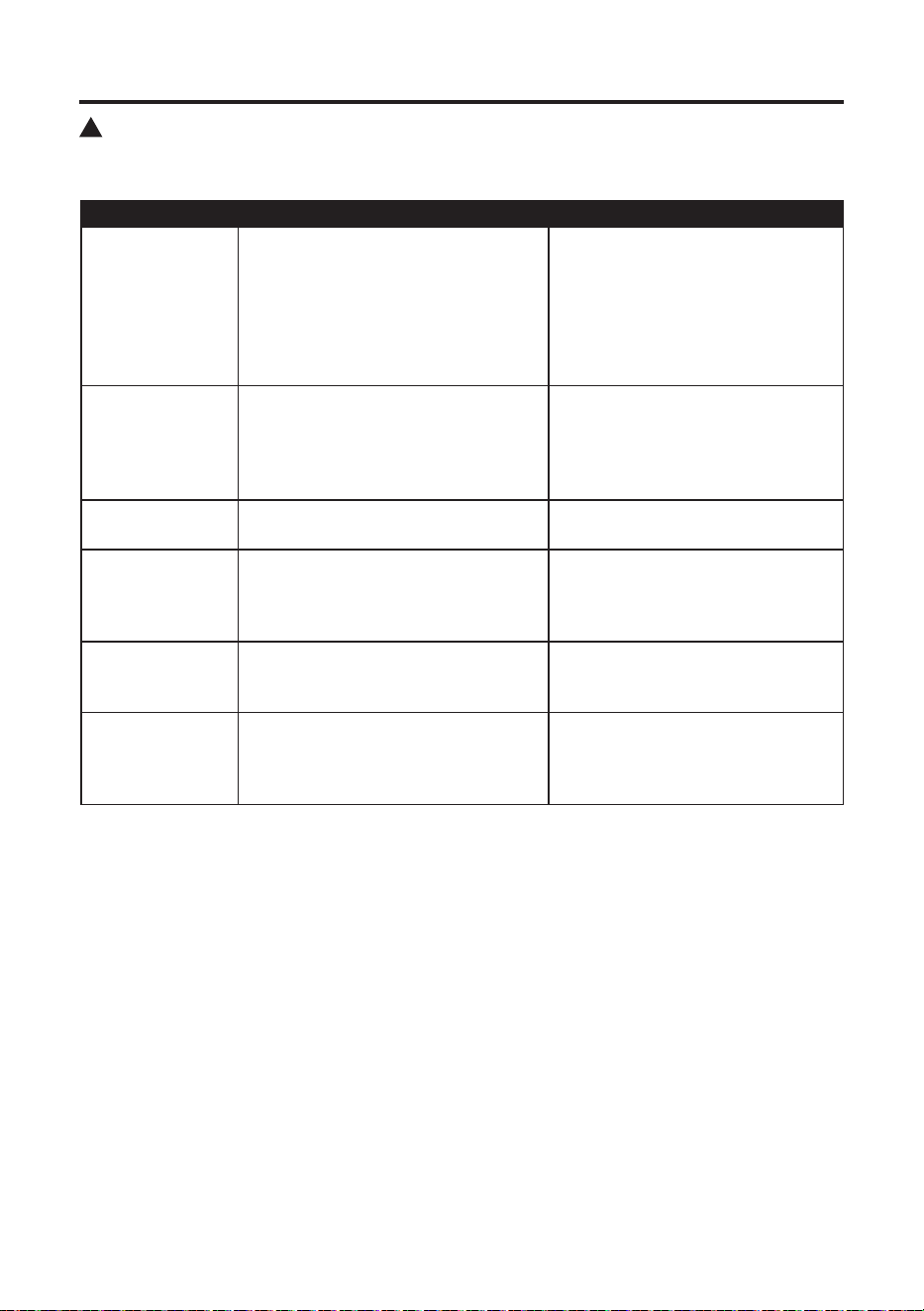
TROUBLESHOOTING
WARNING: To avoid injury from accidental starting, always turn switch OFF and unplug
the tool before moving, replacing the wheel or making adjustments.
!
PROBLEM PROBLEM CAUSE CORRECTIVE ACTION
Motor does not
start.
1. Power cord is not plugged into the
outlet.
2. Switch failure.
3. Brush worn.
4. Fuse blown or circuit breaker tripped
on home panel.
1. Plug in properly.
2. Replace switch.
3. Replace brushes. See Maintenance
section.
4. Verify there is electrical power at
the outlet.
Saw is overheating. 1. The saw continues to operate too
long under pressure.
2. Blockage or dirt jams the ventilation
slots of the motor.
1. Turn the saw o and let it rest until
the motor is cool to touch.
2. Check and clean the ventilation
slots of the motor, removing
blockage or dirt.
Brush spark when
switch released.
1. Brush worn. 1. Replace brushes. See
MAINTENANCE section.
The pump is not
owing water.
1. Water amount is not enough.
2. Water hose is jammed by dirt.
1. Add water until the pump is
submerged completely.
2. Clean the water hose and pump
lter.
Cutting table is not
sliding smoothly.
1. Dirt or tile dust is jammed too much
on the guide rails or cutting table
rollers.
1. Clean the dirt.
Saw vibrates or
shakes.
1. Saw wheel not round / damaged /
loose.
2. Wheel not tightened on saw, arbor
nut loose.
1. Replace wheel.
2. Tighten arbor nut.
38
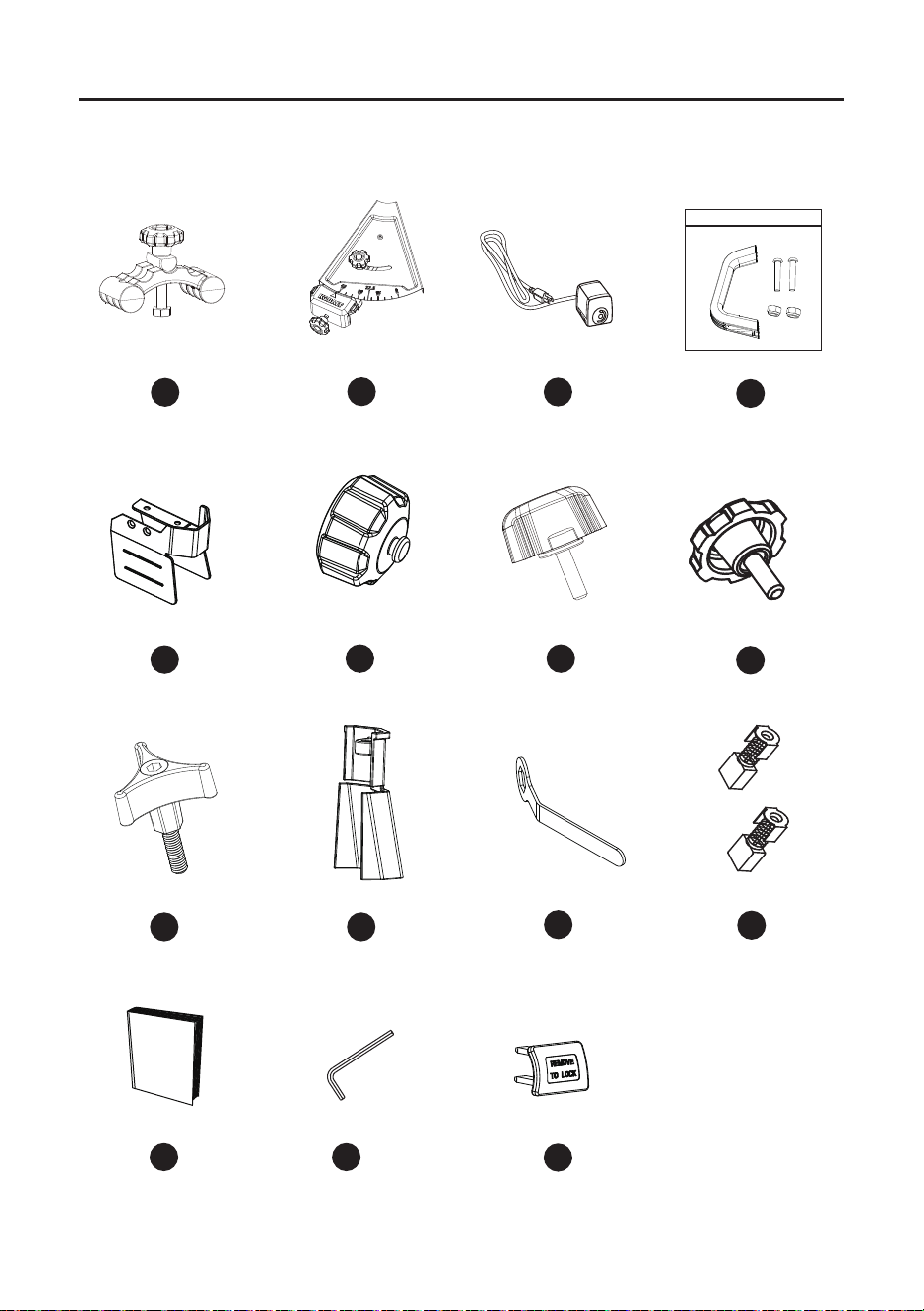
REPLACEMENT PARTS LIST
For replacement parts, call our customer service department at 888-3KOBALT(888-356-2258),
8 a.m. - 8 p.m., EST, Monday - Sunday. You could also contact us at [email protected].
B
C
MAX
MIN
D
N
X DD
GG
QQ
SS
PP
RR
EE
II
NN
M
39
DISTRIBUTED BY:
Lowe's Home Centers LLC
1000 Lowe's Blvd., Mooresville, NC 28117
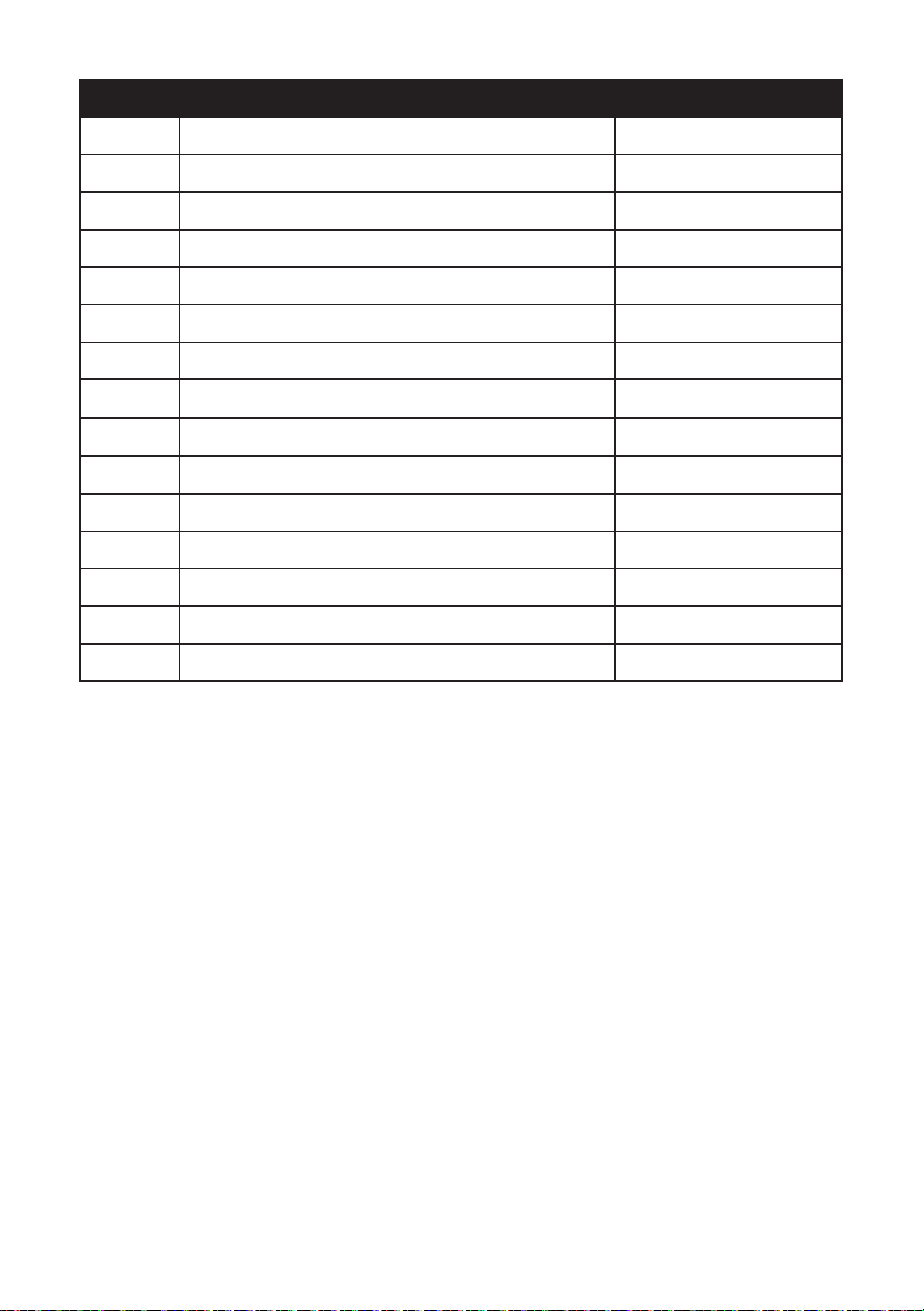
PART DESCRIPTION PART #
B
Tile clamp
50KG
C
Rip/Angle guide
50KF
D
Water pump
528E
M
Carry handle assembly hardware bag
50KH
N
Side splash guard
505W
X
Drain plug
530P
DD
Cutting head lock knob
52X4
EE
Sliding T-fence lock knob
505J
GG
Bevel lock knob
53KY
II
Rear splash guard
505V
NN
Wheel wrench
3ZYE
PP
Carbon brushes (set of 2)
3ZXC
QQ
Manual
52ZC
RR
5 mm hex wrench
3X8W
SS
Safety key
2X21

40
WARRANTY
The manufacturer will oer replacement parts for this product which under normal usage have
proven to be defective in their manufacture or workmanship for a period of THREE (3) years
from the date of initial retail purchase. This warranty is valid only to the original purchaser. This
warranty is not transferable and does not cover any parts that have been subjected to misuse,
abuse, alteration, overload, accident or normal wear of moving parts. Tools that have been sold
“as is,” sold reconditioned or used as rental equipment are not covered.
Warranty replacement parts can be obtained by contacting the manufacturer at 888-3KOBALT.
Only the manufacturer is authorized to perform warranty service on this product. This warranty
does not apply to accessories or damage caused where repairs have been made or attempted by
others.
The manufacturer is not responsible for direct, indirect, incidental or consequential damages.
Some states do not allow limitations on how long an implied warranty lasts and/or do not allow the
exclusion or limitation of incidental damages, so the above limitations may not apply to you. This
warranty gives you specic legal rights and you may also have other rights which vary from state
to state.
The manufacturer makes no warranties, representations or promises as to the quality of its power
tools other than those specically stated in this warranty.
WARRANTY VOID IF PRODUCT USED FOR COMMERICAL PURPOSES
For replacement parts, call our customer service department at 888-3KOBALT (888-356-2258).
Printed in Taiwan