1
※
In the interest of product improvement, the specications and/or the content of products (including but not limited to appearances, packaging design, manual content, accessories,
size, parameters and display screen), are subject to change without prior notice. Please check with local supplier for exact oers. Specications and features (including but not limited to
appearances, colors and size) may vary by model owing to environmental factors. and all images are illustrative.
User Manual
ForFirmwareV1.0.3

Content
Welcome ····································································································· 3
Attention ···································································································· 3
Overview ·····································································································5
Panel Introduction ······················································································· 6
Getting Started ··························································································· 7
Screen Introduction ·····················································································8
Main Display Screen ··················································· 8
TUNER ····························································· 10
Patch Editing ······························································································ 11
Global Settings ···························································································12
Compatible Software ················································································ 14
Application Scenarios ·················································································15
With other pedals ···················································· 15
With full-range speaker devices········································· 16
With guitar amps (INPUT jack)·········································· 17
With guitar amps (using FX Loop) ······································· 17
With guitar amps (using FX Loop to pre-position the GP-5)··················· 18
Audio Studio (for livestreaming)········································· 19
Effect List ·································································································20
NR································································· 20
PRE································································ 20
DST ································································ 22
N→S······························································· 23
AMP································································ 24
CAB································································ 30
EQ································································· 31
MOD································································ 32
DLY································································· 33
RVB································································ 35
Factory SnapTone Files ·············································································· 37
MIDI Control Information List ····································································40
Troubleshooting ························································································41
Specifications ····························································································42

3
Welcome
Welcome
Thank you for purchasing a VALETON product.
We know it might be tedious but please read this manual carefully to get the most
out of your GP-5.
Please keep this manual for future reference.
Attention
Handling
• Do not get the unit wet. If liquid is spilled on the unit, shut it o immediately.
• Do not block any jack of the unit.
• Keep away from heat sources.
• Disconnect the unit during storms to prevent damage.
• Operation of this unit within signicant electromagnetic elds should be avoided.
Connecting the power and input/output jacks
• Always turn OFF the power to the unit and all other equipment before connecting
or disconnecting any cables. Also make sure to disconnect all connection cables
and the AC adapter before moving the unit.
Cleaning
• Clean only with a dry cloth.
Alterations
• Do not open the unit.
• Do not attempt to service the unit yourself.
• Operation of this unit within signicant electromagnetic elds should be avoided.
AC Adapter Operation
• Always use a power adapter that falls within the recommended specications for
this product. Use of an adapter other than that specied could damage the unit or
cause malfunction and pose a safety hazard.

4
Attention
• Always connect the AC adapter to an AC outlet that supplies the rated voltage
required by the adapter.
• Unplug the unit during lightning storms or when unused for long periods of time.
Malfunction
• If the unit malfunctioned, disconnect the AC adapter. Then, disconnect all other
connected cables.
• Prepare information including the model name, serial number, specic symptoms
related to the malfunction, your name, address and telephone number and contact
the store where you bought the unit, or contact VALETON support (service@
valeton.net).
Thank you for choosing a VALETON product!
5
Overview
Overview
In the relentless pursuit of the ultimate balance between tone quality and portability,
Valeton proudly introduces the latest masterpiece of its GP series – the GP-5 Super
Compact Multi-Eects Pedal. This revolutionary product not only upholds Valeton’s
renowned high-quality sound and stability but also achieves unprecedented
breakthroughs in portability and ease of operation.
As a multi-eects processor, the GP-5 boasts a maximum capacity of 9 eect
modules, some of which can be moved sequentially. It oers over 100 organic
eects based on HD digital modeling technology. As a loader, the GP-5 not only
stores up to 20 third-party cabinet IR les, but also integrates Valeton’s latest
SnapTone technology – enabling NAM (Neural Amp Modeler) le conversion/import
functionality. Comes with 50 meticulously selected les and supports storing up
to 80 les. Thanks to its compact stomp design, you can easily integrate the GP-5
onto your pedalboard. Whether used as a SnapTone/IR loader or harnessing its rich
selection of built-in eects in combination with other pedals, the GP-5 smoothly
blends into your setup.
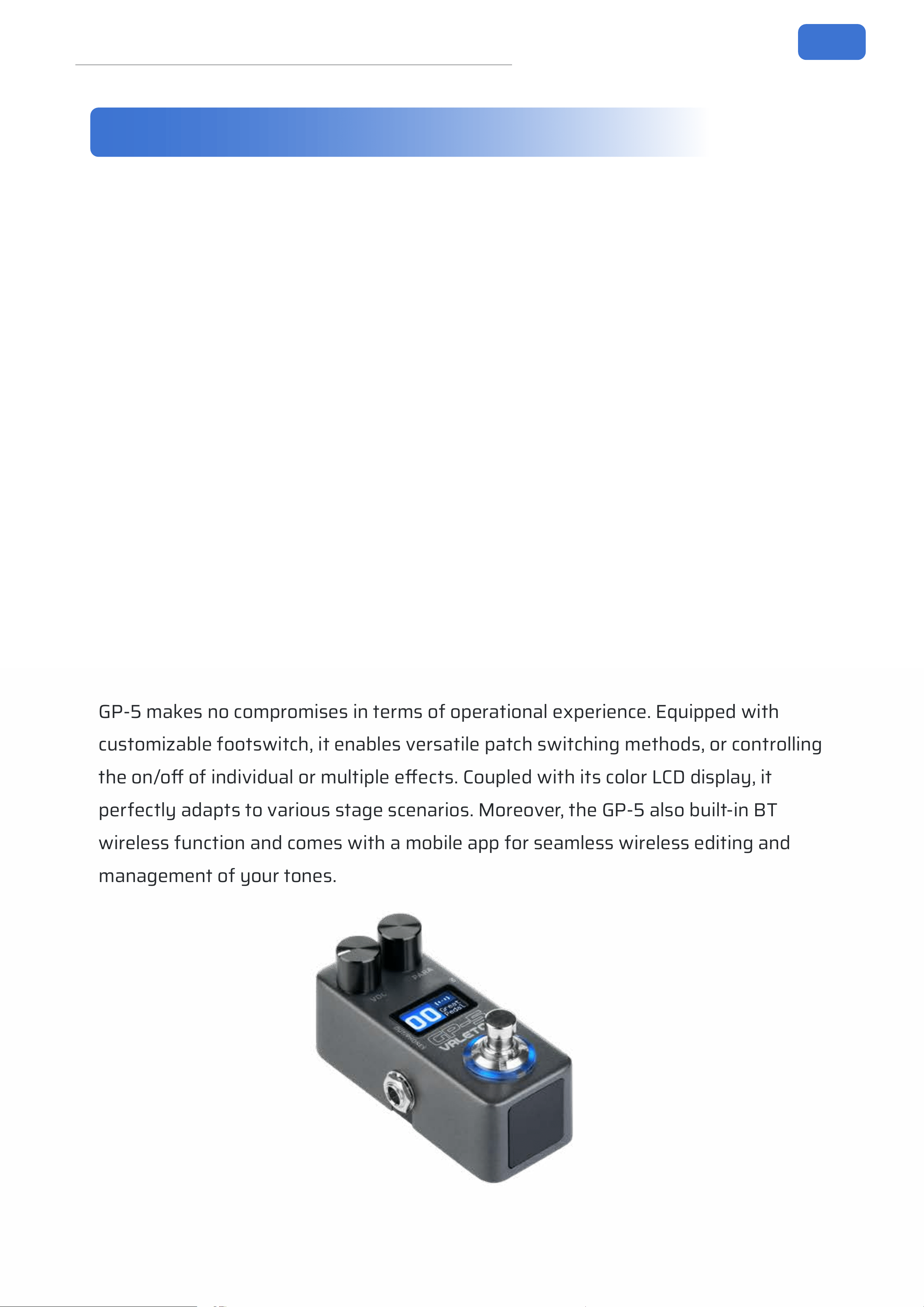
Despite adopting the classic single-footswitch mini pedal specication, the
GP-5 makes no compromises in terms of operational experience. Equipped with
customizable footswitch, it enables versatile patch switching methods, or controlling
the on/o of individual or multiple eects. Coupled with its color LCD display, it
perfectly adapts to various stage scenarios. Moreover, the GP-5 also built-in BT
wireless function and comes with a mobile app for seamless wireless editing and
management of your tones.
6
PanelIntroduction
Panel Introduction
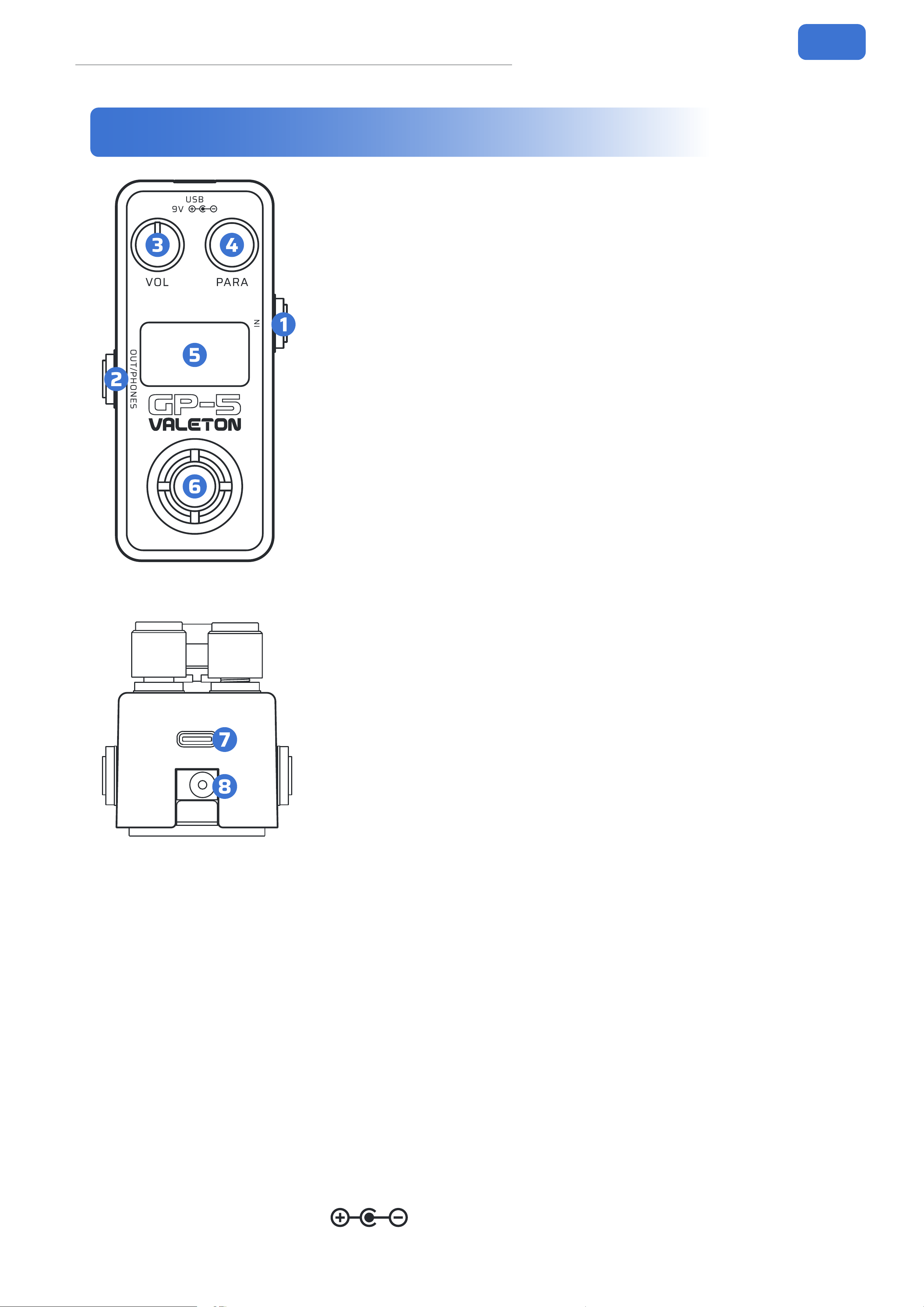
1. IN Jack
1/4" mono input connection for guitar or other instruments.
2. OUT/PHONES Jack
1/4" TRS stereo unbalanced output connection, compatible
with headphones. When connecting a mono device such as
a guitar amp or another pedal, a TS cable is sucient.
3. VOL Knob
Turn to control GP-5’s main output volume.
4. PARA Knob (with enter button)
On the main display screen, turn to switch patches, press
to enter global settings, and hold to toggle BT wireless
function on/o.
5. LCD Display
Color LCD shows GP-5’s patch numbers, patch names, and
other operation information.
6. Footswitch
Use to change patches, turn on/o eects, or bypass GP-5. On the main display
screen, hold the footswitch to enter the tuner.
7. USB Jack
USB 2.0 Type-C port to connect to a computer for data transfer or as an audio
interface, and it can also be connected to a mobile phone for as an audio interface.
Furthermore, it allows for the connection of a USB power adapter or power bank to
provide power to the GP-5.
8. DC 9V Jack
5.5 x 2.1mm DC 9V, 100mA

7
GettingStarted
Getting Started
1. Connect your device: Plug your guitar into the GP-5’s IN jack, and run a TS cable
from the OUT to your amp.
Please remember:
Keep your amp volume down.
Connect your cable to the amp’s FX Loop Return if it has one.
2. Turn the GP-5 VOL knob all the way down, then connect the power supply to turn
on the GP-5.
3. Tune your strings: Press and hold footswitch to enter Tuner interface. Pluck each
string and tune it until the pitch reaches the middle of the screen and turns green.
When all strings are tuned, press footswitch to exit the tuner.
Select a patch
GP-5 includes 100 patches, with the rst 50 (00~49) containing default factory
parameters.
In the default footswitch mode on the main display screen, pressing the footswitch
allows you to switch patches. Alternatively, you can switch patches by turning the
PARA knob regardless of the current footswitch mode.

8
ScreenIntroduction
Screen Introduction
Main Display Screen
Main Display Screen is the home page displayed right after the power is turned on.
The display content changes according to the selected footswitch mode. You can
switch between footswitch modes in the global settings.
In “0-99”, “0-9”, or “Tuner” footswitch modes, the screen shows patch number and
name:
In both “0-99” and “0-9” footswitch modes, pressing the footswitch advances to the
next patch.
“0-99” Mode: Cycles through all 100 patches (00-99).
“0-9” Mode: Cycles only through the units digit of the patch number (0-9). The
tens digit functions as a patch bank identier, allowing you to cycle through 10
patches within each group (e.g., Bank 1: 10-19, Bank 2: 20-29).
In “Tuner” footswitch mode, pressing the footswitch opens the tuner interface and
activates bypass on the GP-5. In this mode:
Each patch’s full signal chain can be treated as a virtual eects pedal.
Press the footswitch to instantly toggle the bypass state (on/o) of the entire
patch.
In “A-Z” footswitch mode, the screen shows song list numbers:
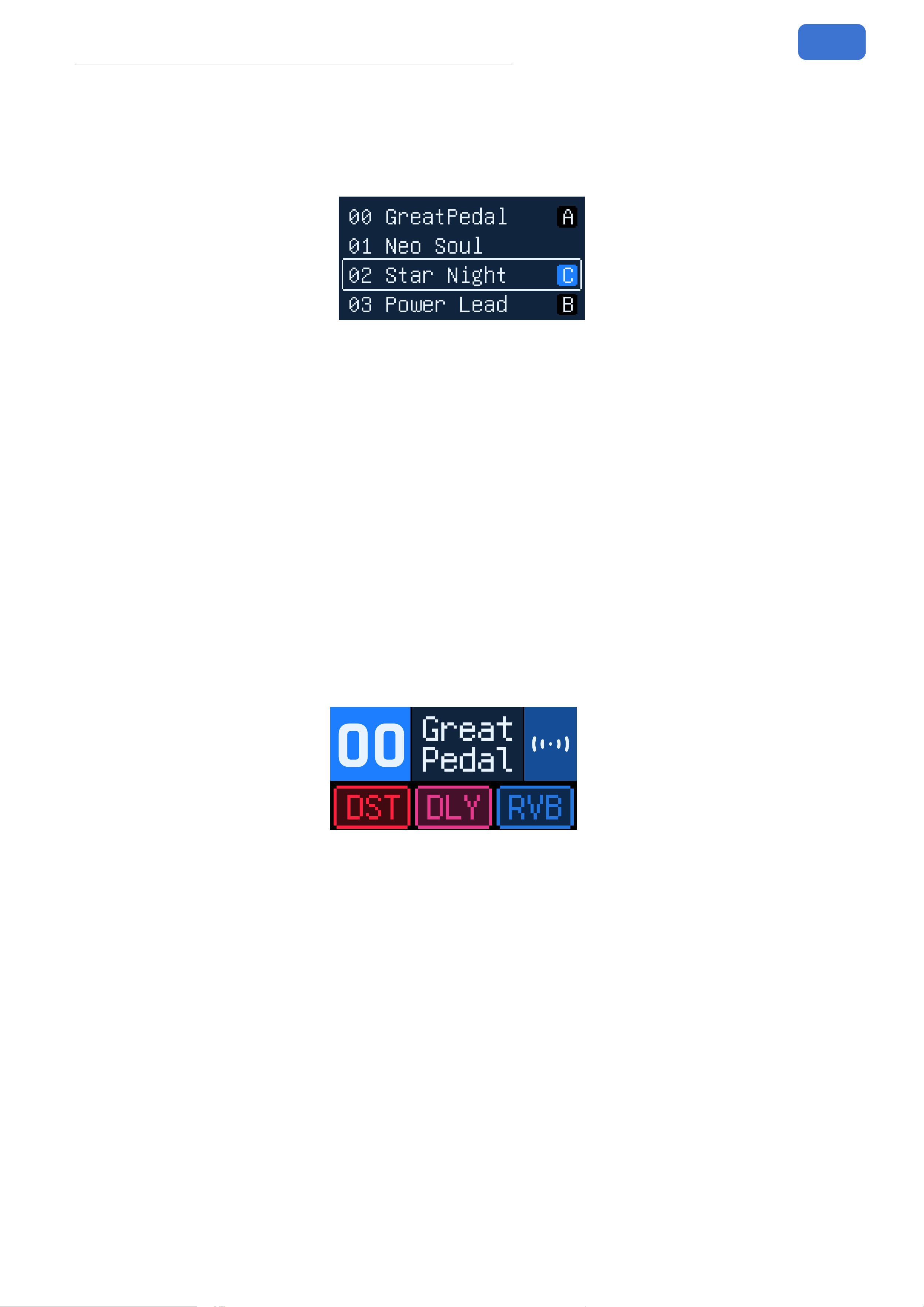
9
ScreenIntroduction
This footswitch mode is “Song List” mode, where “A-Z” corresponds to song list
numbers. In this mode, turn the PARA knob to access the patch list:
In the preset list:
Trun the PARA knob to select a patch.
Press the footswitch to add or remove the selected patch from the song list.
Press the PARA knob to conrm the selection and return to the main display
screen.
You can organize patches into the song list based on your live performance setlist.
On the main display screen, press the footswitch to cycle through patches in the
order of the song list.
In “CTL” footswitch mode, the screen lists eect modules controlled by the current
patch:
In this mode:
Press the footswitch to toggle the bypass state (on/o) of the assigned eect
modules.
Use the mobile app to select which eect modules in the patch are controlled by
the footswitch.

10
ScreenIntroduction
TUNER
To access the tuner interface, press and hold the footswitch on the main display
screen in any footswitch mode, or press the footswitch directly in “Tuner” footswitch
mode.
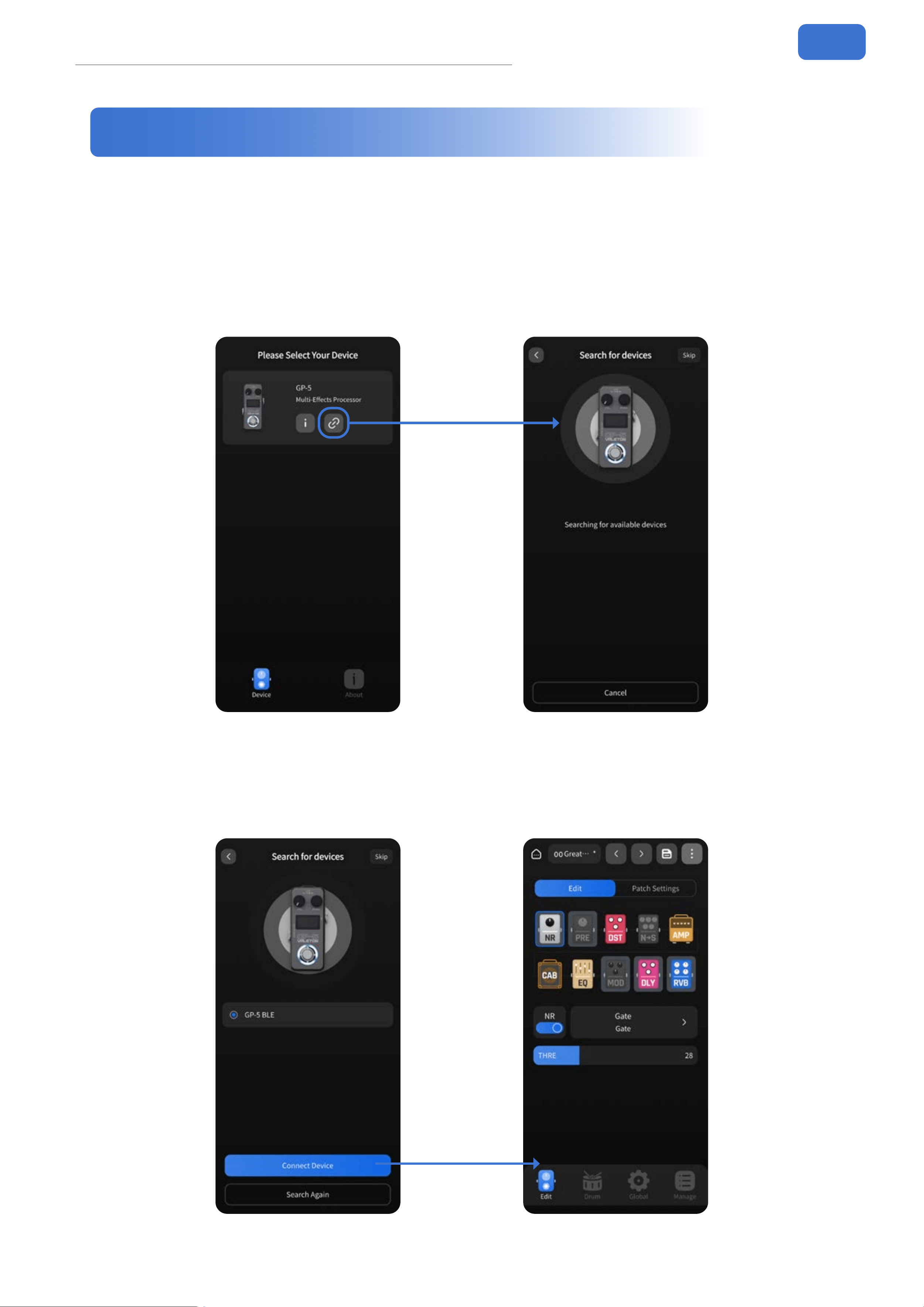
The screen will display the tuning interface. When
you pluck a string, the note will appear in the center.
Left of center is at, and right of center is sharp. As
you you’re your instrument towards the middle, the
color of the scale will change from red (out of tune) to yellow (near pitch) to green (in
tune).
In the tuner interface, turn the PARA knob to change the standard A’s frequency
ranged from 435Hz to 445Hz, with default set to 440Hz.
If you enter the tuner interface by pressing the footswitch in “Tuner” footswitch
mode, bypass tuning will activate; press the PARA knob to select Ana (analog) or
DSP (digital) Bypass. If you enter by long-pressing the footswitch in any mode,
muted tuning will be permanently enabled.
Note:
1. In bypass state, the USB audio interface functionality will also be bypassed
.
2. Analog bypass operates as a pure hardware bypass. This mode only supports
mono input/output, resulting in no audio output on the right channel.
In the tuner interface, press the footswitch to exit and return to the main display
screen.
11
PatchEditing
Patch Editing
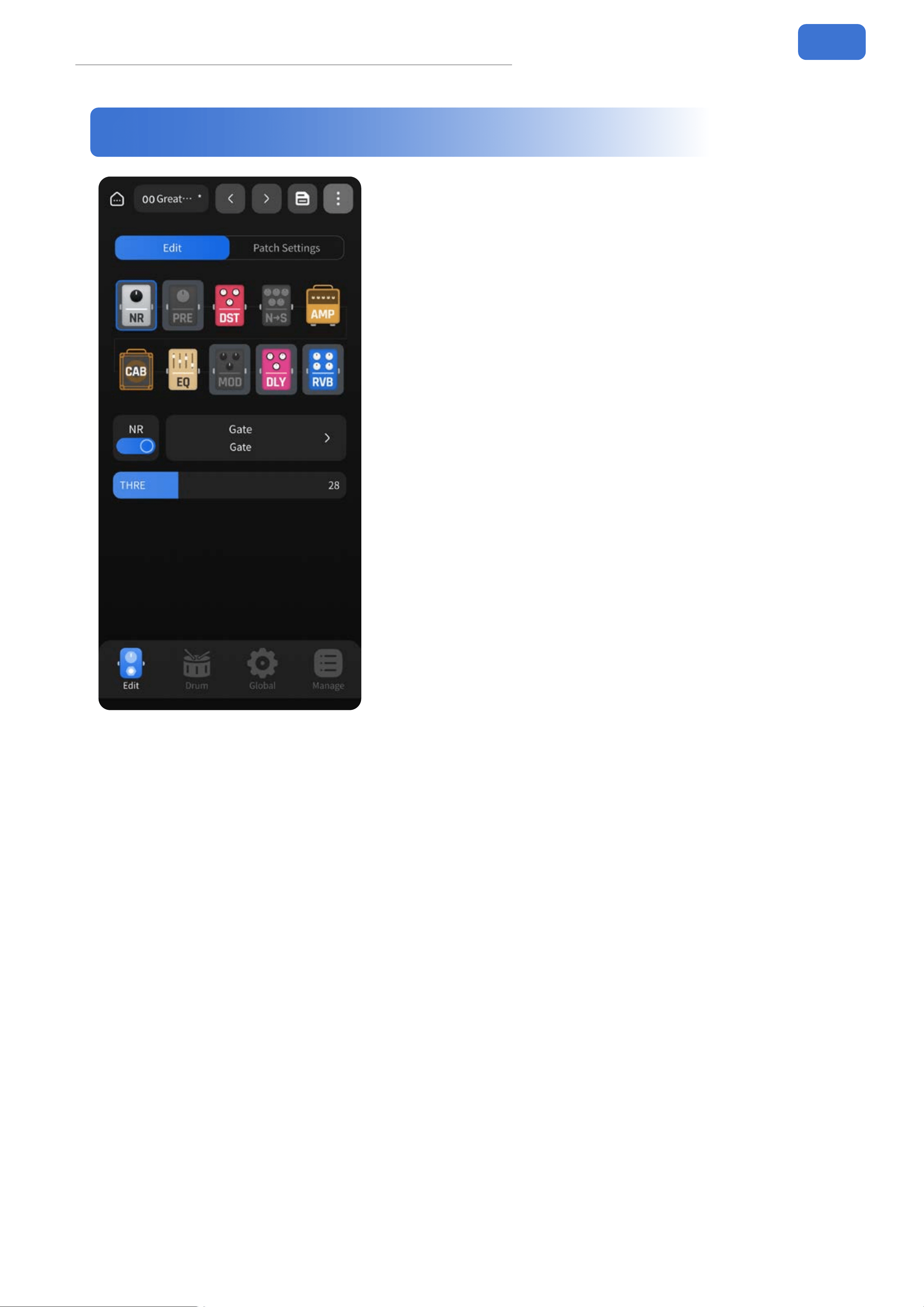
Patch editing is only available via the Valeton Suite mobile application.
On the GP-5 main display screen, long-press the PARA knob to activate BT wireless
function pairing mode.
Open the Valeton Suite app, select GP-5 as the target device, and navigate to the
device discovery interface:
Locate and connect to your GP-5 device in the app to manage its patches, including
tone adjustments, rearranging eect modules, conguring CTL-controlled modules,
importing NAM les, and loading third-party IR les.

12
GlobalSettings
Note:
If the app cannot nd the device, check if the relevant permissions on your phone
are enabled.
Global Settings
On the main display screen, press the PARA knob to enter the global settings
interface.
Global Settings will aect the whole status of the GP-5 and not change when
the patch has changed. All the settings will immediately function when editing is
nished. There are input level, USB Audio, footswitch mode, language and more in
this menu, as well as factory reset.
Input Level
Ranged from -20dB to +20dB with default value set to 0dB, you can adjust the value
to get the best experience based on varied instruments.
No Cab
By activating no CAB mode, you can get the audio eect where there is no CAB
module simulation in the output. The default is o.
FS Mode
This function congures the footswitch mode on the main display screen, with
options: “0-99”, “0-9”, “A-Z”, “CTL”, and “Tuner”. The default is “0-99”. For detailed
instructions on each mode, refer to Main Display Screen.
REC Level
To control the master volume of the output when recording, ranged from -20dB to
+20dB. The default is 0dB.

13
GlobalSettings
BT REC
To control the master volume of the BT wireless audio output when recording,
ranged from -20dB to +20dB. The default is 0dB.
MON Level
To control the volume of playback through USB, ranged from -20dB to +20dB. The
default is 0dB.
LANG
For choosing your system language.
Reset
This option allows you to restore your GP-5 to its factory default settings.
Note:
1. Remember, resetting the GP-5 will delete all of your saved changes and
personal settings. Once it is executed, it cannot be undone. Please back up
your settings before performing a factory reset.
2. During the reset process, ensure the device remains connected to the power
supply and do not disconnect it.
About
This option is to check the rmware version.
14
CompatibleSoftware
Compatible Software
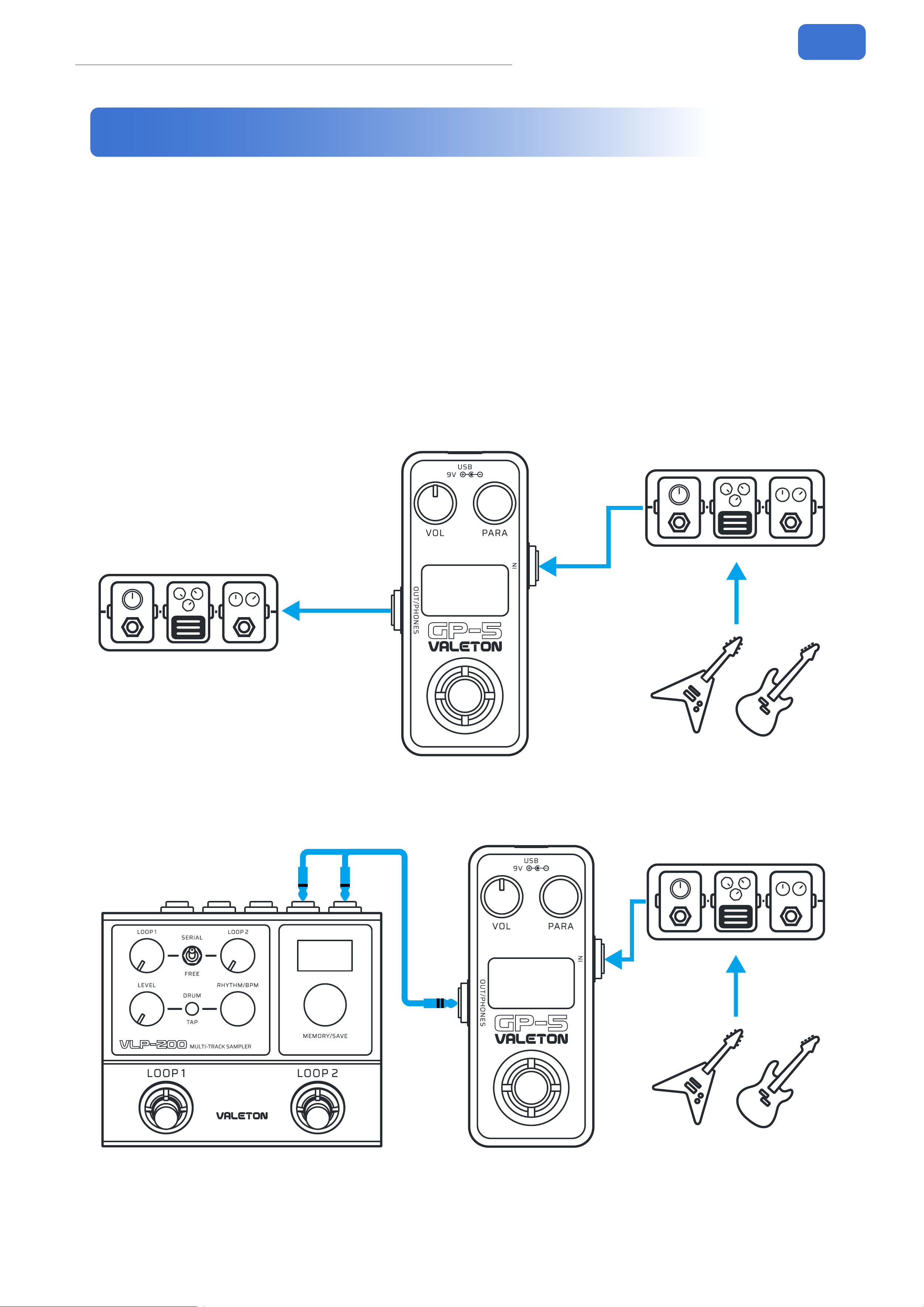
The GP-5 is supported by a free cross-platform
mobile app (iOS/Android). In addition to the patch
editing features described earlier (see Patch
Editing), the app includes drum machine
functionality. Download the app by searching for
“Valeton Suite” in your device’s app store. The
Android app installation package (APK le) can also
be downloaded directly from the Valeton ocial
website.
The GP-5 also oers desktop software for Windows
and macOS. Connect the GP-5 to your computer via
USB to use the software for batch management
of patches, SnapTone les, and IR les, as well
as rmware updates. To download the desktop
software, visit www.valeton.net/software.html,
then install and launch “Valeton Suite”.
15
ApplicationScenarios
Application Scenarios
In this section, we will introduce the connection methods of GP-5 in common usage
scenarios.
With other pedals
In this scenario, simply connect the GP-5’s input/output directly to other pedals. If
you wish to preserve the stereo eects within the GP-5, use a TRS stereo cable or
the TRS end of a Y-cable (one TRS connector on one end and two TS connectors on
the other) to connect to the GP-5 output.
16
ApplicationScenarios
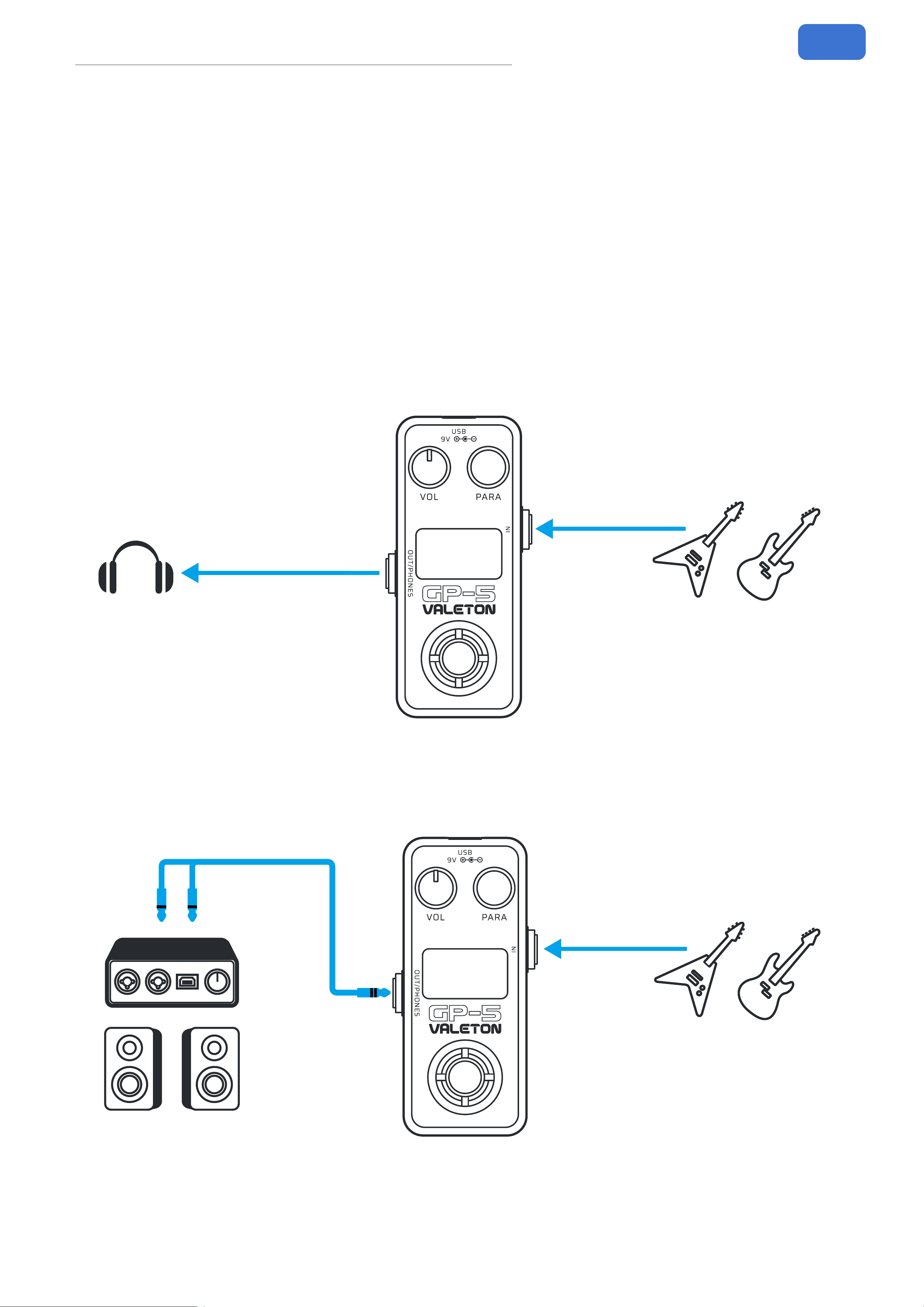
With full-range speaker devices
Full-range devices include audio interface, studio monitor, PA system, headphones
etc. In this scenario, the OUT/PHONES jack of the GP-5 can be connected according
to the need of subsequent devices. If you wish to preserve the stereo eects within
the GP-5, use a TRS stereo cable or the TRS end of a Y-cable (one TRS connector on
one end and two TS connectors on the other) to connect to the GP-5 output.
To get the best tonal performance, keep the AMP and CAB modules ON and keep the
“No CAB” mode o.
17
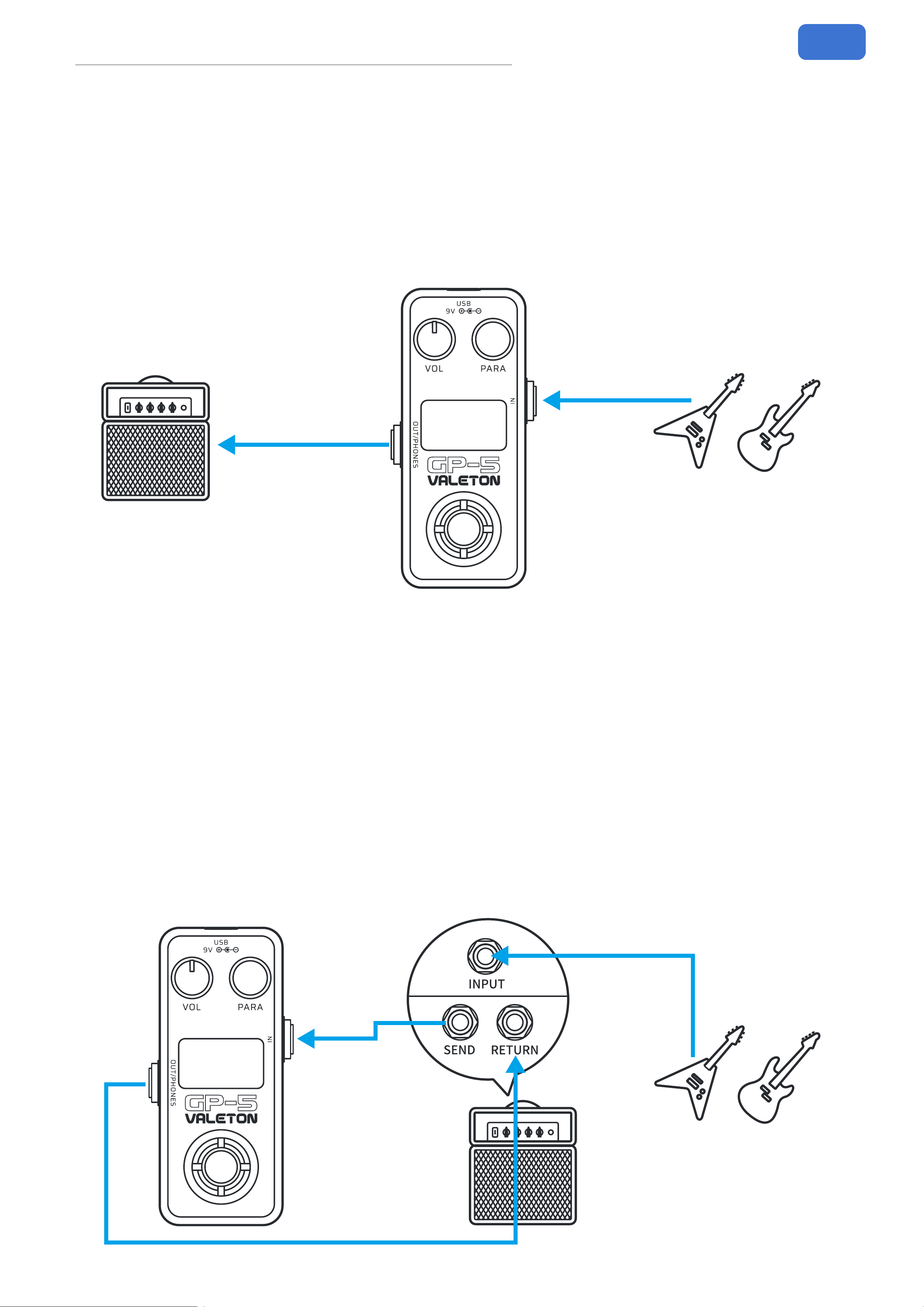
ApplicationScenarios
With guitar amps (INPUT jack)
In this scenario, directly connect the GP-5’s OUT to the guitar amp’s INPUT using TS
cable.
To get the best tonal performance, keep the AMP and CAB modules o to avoid
adverse eects on the tone.
With guitar amps (using FX Loop)
In this scenario, connect the GP-5’s IN and OUT to the guitar amp’s SEND and
RETURN jacks respectively using TS cables. This conguration places the GP-5
eects between the amplier’s preamp and power amp sections. For optimal
performance, it is recommended to use only the EQ, MOD, DLY, and RVB modules of
the GP-5.
To get the best tonal performance, keep the AMP and CAB modules o to avoid
adverse eects on the tone.
18
ApplicationScenarios
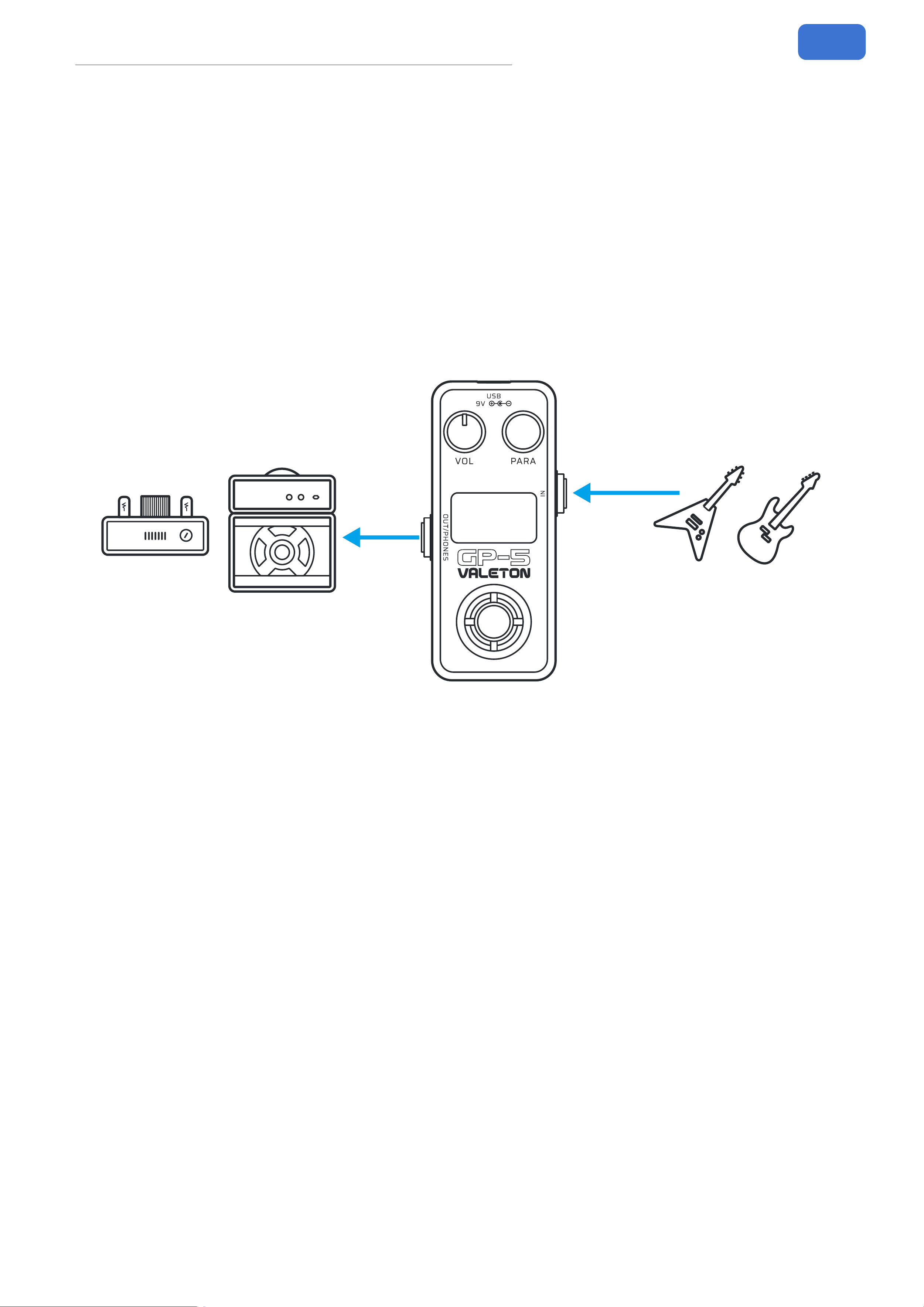
With guitar amps (using FX Loop to pre-position the GP-5)
In this scenario, connect the GP- 5’s OUT to a guitar amp’s RETURN using TS cable.
This way, by bypassing the preamp and using the power amp of the guitar amp to
pair with dozens of rened eects in the AMP module, you’ll get the more realistic
sound.
To get the best tone performance, keep the CAB module o or turn on the “No CAB”
mode to avoid adverse eects on the tone.
19
ApplicationScenarios
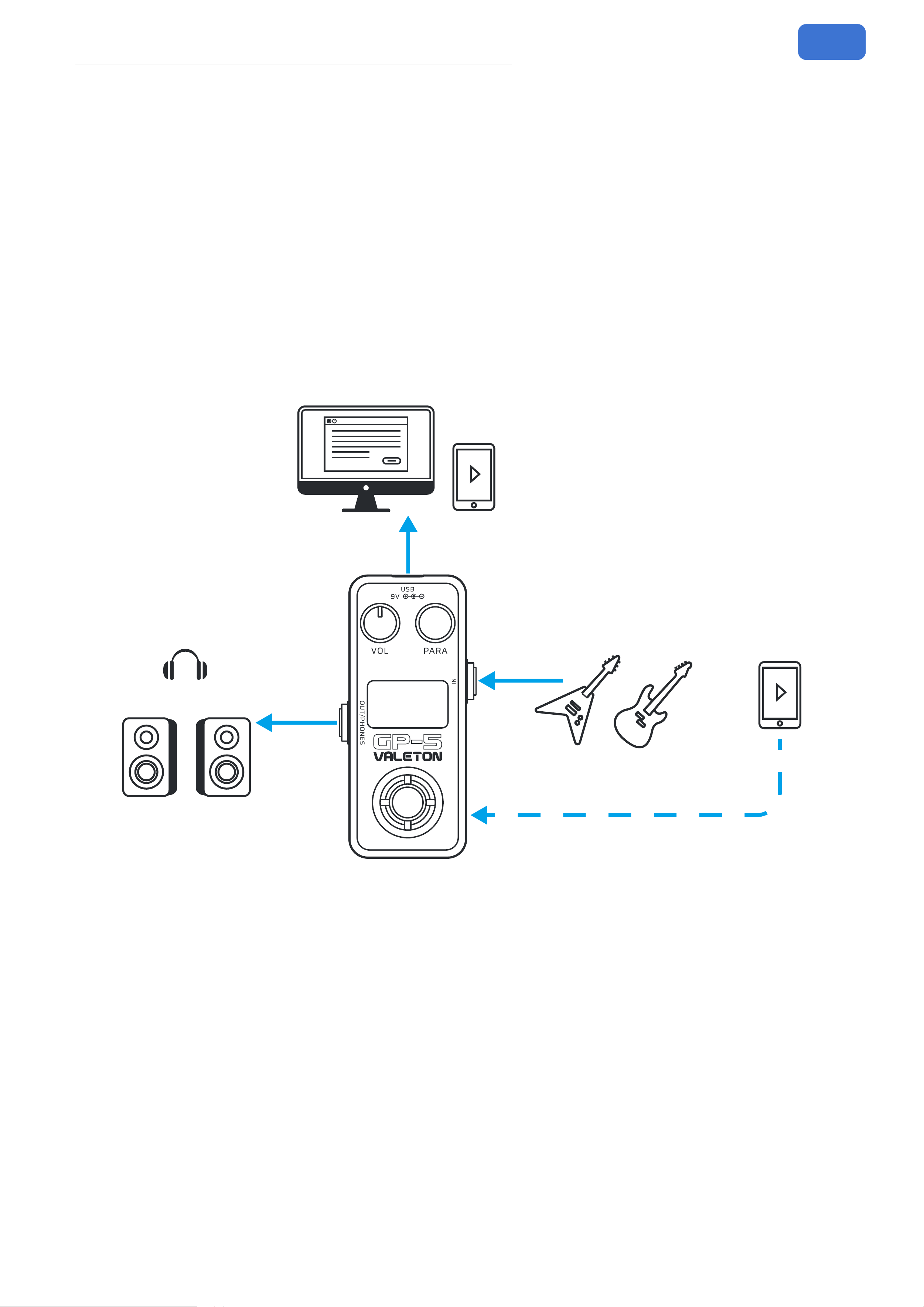
Audio Studio (for livestreaming)
In this scenario, the GP-5 will be functioned as an audio interface for a computer or a
mobile phone. Use the supplied USB cable to connect to the computer; if connecting
to a mobile phone, an additional OTG adapter cable may be required. When under
Windows system, it needs to be used with the ASIO driver available for downloading
on the Valeton ocial website; while on MacOS, iOS, Android system, it can be easily
plugged in and played. The eects chain signal and the BT wireless audio signal of
the GP-5 can be used by the connected devices.
BT

20
EectList
Eect List
FX Title Type Description Parameter Description
NR
Gate Gate
Based on famous ISP®Decimator™*
noise gate pedal. The Decimator
features improvements in the
expander tracking with their new
Linearized Time Vector Processing™.
This novel improvement provides a
more linear release time-constant
response for the exponential release
curve of the downward expander.
THRE: Controls the gate trigger level
PRE
COMP Comp
Based on the legendary Ross™
Compressor. This is the originator
of the guitar compression effect.
It brings the guitar compression
effect to the public and becomes
an important element in the future.
It has a very natural and mellow
compression effect.
Sustain: Controls the compression
amount
VOL: Controls the effect output
COMP4 Comp
Based on the Keeley® C4 4-knob
compressor*. A recording studio -
level compression effect. Clear sense
of hierarchy, the right amount of high
frequency makes your guitar sound
brighter.
Sustain: Controls the compression
amount
Attack: Controls how soon the
compressor starts to process the
signal
Volume: Controls the effect output
Clipping: Controls the input
sensitivity
Boost Boost
Based on famous Xotic® EP Booster*
pedal. Provides +20DB of pure
stimulation lift, strong low frequency,
bright high frequency, making clear
sound more pleasant.
Gain: Controls the effect output/
boost amount
+3dB: Selects the minimum boost
amount from 0dB (off) to +3dB (on)
Bright: Selects the sound character
from vintage (Bright off) to flat
(Bright on)
Micro
Boost
Boost
Based on the legendary MXR®
M133 Micro Amp2 pedal. Providing
up to 20dB of gain, the Micro Boost
elevates your amp sound without
changing its tonal character.
Gain: Controls the gain amount
*The mentioned manufacturers and product names are trademarks or registered trademarks of the respective owners.
The trademarks were used merely to identify the sound character of this product.

21
EectList
FX Title Type Description Parameter Description
B-Boost Boost
Any guitarist can benefit from the
Xotic® BB Preamp* overdrive pedal.
The pedal works equally well for
getting thick and creamy overdrive
tones with great sustain as it does
for pushing the clean front end of an
already driven amp with up to 30dB
of boost.
Gain: Controls the distortion amount
VOL: Controls the effect output
Bass/Treble: 2-band EQ that controls
the effect tone
Toucher Filter
Control the wah sound by playing
intensity. A wide range d envelope
filter (a.k.a. touch wah) designed for
guitarists and bassists that is touch-
sensitive and flexible.
Sense: Controls the effect sensitivity
Range: Controls the frequency range
of the filter
Q: Controls the sharpness of the
filter
Mix: Controls the wet/dry signal ratio
Mode: Selects from two modes:
Guitar/Bass
Crier Filter
Set the rate to make the wah pedal
work regularly. Providing a variable
auto wah effect for both guitars and
basses.
Depth: Controls the effect depth
Rate: Controls the effect speed
Volume: Controls the output level
Low: Controls the bottom point of
center frequency (low freq)
Q: Controls the sharpness of the
filter
High: Controls the top point of center
frequency (high freq)
OCTA Pitch Provides polyphonic octave effect.
Low: Controls the volume of lower
octave (1 oct down)
High: Controls the volume of higher
octave (1 oct up)
Dry: Controls the dry signal level
Pitch Pitch Polyphonic pitch shifter/harmonizer.
High/Low: Controls the high/low
pitch shifting range by semitones
Dry: Controls the dry signal level
H/L-VOL: Controls the high/low pitch
volume
Detune Pitch
This is a detuning effect that
combines a slightly shifted signal with
the original signal to create a chorus-
like tone.
Detune: Controls the detune amount
from -50 to +50 cents
Dry/Wet: Controls the dry/wet signal
level
*The mentioned manufacturers and product names are trademarks or registered trademarks of the respective owners.
The trademarks were used merely to identify the sound character of this product.

22
EectList
FX Title Type Description Parameter Description
DST
Green OD OD
Based on legenary Ibanez® TS-808
Tube Screamer®* overdrive pedal.
Since it was first shown to the world
in 1979, TS808 has opened up a new
world. There are countless guitarists
who love it. It is a warm, delicate
overdrive effect.Can be used as either
an overdrive or a Boost, can be used
in a variety of musical styles.
Gain: Controls the overdrive amount
Tone: Controls the effect tone
VOL: Controls the effect output
Yellow OD OD
Artist of the 70's was mostly using
a fuzz distortion sound and the
overdrive produced by it was not
typical. It was however soon accepted
as the new standard of guitar sound.
It features an asymmetric circuit
where the positive and negative
halves of the waveform isn't distorted
equally. The sound is therefore still
close to the original even though
distortion have been added.
Gain: Controls the overdrive amount
Tone: Controls the effect tone
VOL: Controls the effect output
Super OD OD
The unique asymmetric overdrive
effect circuit adds warm and pleasant
overdrive effect to the traditional
guitar timbre.
Gain: Controls the overdrive amount
Tone: Controls the effect tone
VOL: Controls the effect output
SM Dist Distortion
It is based on a classic orange three-
knob distortion effector, which can
be used to easily get the timbre
characteristics of the 70s-80s.
Gain: Controls the distortion amount
Tone: Controls the effect tone
VOL: Controls the effect output
Plustortion Distortion
This little yellow box has produced
lots of great soundings in countless
classic studio albums. Yeah, we're
talking the legendary MXR® M104
Distortion +*, and this M104-based
Plustortion. The Plustortion recreated
the Germanium-powered soft clipping
distortion, like what Randy Rhoads
and other hard rockers do!
Gain: Controls the distortion amount
VOL: Controls the effect output
*The mentioned manufacturers and product names are trademarks or registered trademarks of the respective owners.
The trademarks were used merely to identify the sound character of this product.
23
EectList
FX Title Type Description Parameter Description
La Charger Distortion
Based on MI Audio® Crunch Box®*
distortion pedal. Sensitive and
exquisite distortion beast, it satisfies
all the passion of Riff and Solo.The
response of each frequency band is
balanced, the dynamic feedback is
faithful to the fingertip, and the noise
can be well controlled even at high
gain.
Gain: Controls the distortion amount
Tone: Controls the effect tone
VOL: Controls the effect output
Darktale Distortion
Based on legendary ProCo™ The
Rat* distortion (early LM308 OP-
amp version). The Rat* has come to
life thanks to its wide range of Filter
knob, bright and compact sound head,
full end and strong plasticity, making
it a favorite of many musicians.
Gain: Controls the distortion amount
Filter: Counterclockwise controls the
effect tone
VOL: Controls the effect output
Sora Fuzz Fuzz
Based on legendary Dallas-Arbiter®
Fuzz Face®* fuzz pedal. Dallas Arbiter
conjured the sound of rock and roll
for half a century in 1966 with a few
simple transistors. The sound of Fuzz
Face was heavy and sharp, and its
sound influenced countless famous
musicians.
Fuzz: Controls the gain amount
VOL: Controls the effect output
Red Haze Fuzz
Based on legendary Dallas-Arbiter®
Fuzz Face®* fuzz pedal. Dallas Arbiter
conjured the sound of rock and roll
for half a century in 1966 with a few
simple transistors. The sound of Fuzz
Face was heavy and sharp, and its
sound influenced countless famous
musicians.
Fuzz: Controls the gain amount
VOL: Controls the effect output
Bass OD Bass Drive
This is an overdrive effect device
specially designed for bass. It
combines the original bass sound with
a unique overdrive effect to make
a very good distortion effect while
ensuring The original bass dynamic
tone. It can also be used as a pretty
good boost.
Gain: Controls the distortion amount
Blend: Controls the wet/dry signal
ratio
VOL: Controls the effect output
Bass/Treble: 2-band EQ that controls
the effect tone
N→S
Empty SnapTone
For loading SnapTone file converted
by NAM.
Gain: Controls the gain amount
VOL: Controls the output volume
Bass/Middle/Treble: 3-band EQ that
controls the effect tone
*The mentioned manufacturers and product names are trademarks or registered trademarks of the respective owners.
The trademarks were used merely to identify the sound character of this product.

24
EectList
FX Title Type Description Parameter Description
AMP
Tweedy Clean
Based on Fender® Tweed Deluxe*.
This amplifier with a dynamic range
from clean to wild overdrive, from
country rock to distortion, the
Fender® Tweed Deluxe* has been a
totem in every style for more than 60
years.
Gain: Controls the gain amount (pre
gain)
Tone: Controls the effect tone
VOL: Controls the output volume
(post gain)
Bellman
59N
Clean
Based on Fender® '59 Bassman®*.
The most dramatic speaker in the
history of Rock&Roll, originally
designed for bass, has become the
most classic guitar speaker. As clear
as water, Vacuum tubemakes the
sound more beautiful,make musical
instrument manufacturers are eager
to imitate the product.
Gain: Controls the gain amount (pre
gain)
PRES: Controls the effect headroom
VOL: Controls the output volume
(post gain)
Bass/Middle/Treble: 3-band EQ that
controls the effect tone
Dark Twin Clean
Based on Fender® '65 Twin Reverb®*.
With a Stratocaster*, the classic
sound can be easily restored in both
country jazz and rock music.
Gain: Controls the gain amount (pre
gain)
VOL: Controls the output volume
(post gain)
Bass/Middle/Treble: 3-band EQ that
controls the effect tone
Bright: Switches extra brightness
on/off
Foxy 30N Clean
Based on VOX® AC30HW* (normal
channel). The symbolic clear sound
and warm and sharp overdrive, since
the day of its birth, has become the
Shadows, The Beatles, the Rolling
Stones and other group's favorite
speaker. The British band led the
"British Invasion" has made VOX®
speaker a household name as a
British rock icon.Even in hard rock and
British rock, Radiohead, Suede, Oasis
and other super groups are preferred.
Gain: Controls the gain amount (pre
gain)
Tone cut: Counterclockwise controls
the effect tone
VOL: Controls the output volume
(post gain)
Bright: Switches extra brightness
on/off
J-120 CL Clean
Based on the legendary "Jazz Chorus"
solid state combo. When it came out in
1975, it is the first musical instrument
speaker equipped with Chorus effect.
It was famous for its pure sound and
stereo chorus effect.
VOL: Controls the effect gain/output
amount
Bass/Middle/Treble: 3-band EQ that
controls the effect tone
Bright: Switches extra presence on/
off
*The mentioned manufacturers and product names are trademarks or registered trademarks of the respective owners.
The trademarks were used merely to identify the sound character of this product.

25
EectList
FX Title Type Description Parameter Description
Match CL Clean
Based on Matchless™ Chieftain 212
combo* (clean tone). MATCHLESS®'s
philosophy since its founding in 1989
has been to make as many top-notch,
all-purpose speakers as possible. The
crisp graininess and perfect dynamic
feedback will make your playing easy.
Gain: Controls the gain amount (pre
gain)
PRES: Controls the effect headroom
VOL: Controls the output volume
(post gain)
Bass/Middle/Treble: 3-band EQ that
controls the effect tone
L-Star CL Clean
Based on Mesa/Boogie® Lone
Star™* (CH1). The pre-amp circuit
has extraordinary expressive power,
the comprehensive timbre and
intuitive operation are indicative
of Mesa/Boogie®'s far superior
technical capabilities. An engaging
and lively timbre experience.It has
a more compressed, balanced, soft
mid frequency sound, and its high-
frequency like gorgeous bell.
Gain: Controls the gain amount (pre
gain)
PRES: Controls the effect headroom
VOL: Controls the output volume
(post gain)
Bass/Middle/Treble: 3-band EQ that
controls the effect tone
UK 45 Drive
Based on Marshall® JTM45*
(normal channel). In 1962, Marshall®
introduced the first guitar speakers
specifically designed for rock music,
and its powerful sound laid the
foundation for rock music. So its panel
material plexiglas as the most classic
1960s sound specific name--- Plexi.
Gain: Controls the gain amount (pre
gain)
PRES: Controls the effect headroom
VOL: Controls the output volume
(post gain)
Bass/Middle/Treble: 3-band EQ that
controls the effect tone
UK 50JP Drive
Based on Marshall® JMP50* ("Jump"
connection). Through the adjustment
of JTM45*'s rectifier tube, the power
was improved. In 1966, Marshall
company launched JTM50*, and the
"Plexi" sound obtained utilizing the
overdrive by more people. The timbre
is more full compared to JTM45*.
Gain 1/2: Controls the gain amount
(pre gain)
PRES: Controls the effect headroom
VOL: Controls the output volume
(post gain)
Bass/Middle/Treble: 3-band EQ that
controls the effect tone
UK 800 Drive
Based on Marshall® JCM800*. In 1981,
the JCM800* quickly became the rock
and metal sound of the '80s with its
excellent higain sound.The founders
named it after their own license plate
number, inheriting and continuing the
legend of Plexi*.
Gain: Controls the gain amount (pre
gain)
PRES: Controls the effect headroom
VOL: Controls the output volume
(post gain)
Bass/Middle/Treble: 3-band EQ that
controls the effect tone
*The mentioned manufacturers and product names are trademarks or registered trademarks of the respective owners.
The trademarks were used merely to identify the sound character of this product.

26
EectList
FX Title Type Description Parameter Description
Bellman
59B
Drive
Based on Fender® '59 Bassman®*
Bright CH. The most dramatic speaker
in the history of Rock&Roll, originally
designed for bass, has become the
most classic guitar speaker. As clear
as water, Vacuum tubemakes the
sound more beautiful,make musical
instrument manufacturers are eager
to imitate the product.
Gain: Controls the gain amount (pre
gain)
PRES: Controls the effect headroom
VOL: Controls the output volume
(post gain)
Bass/Middle/Treble: 3-band EQ that
controls the effect tone
Foxy 30TB Drive
Based on VOX® AC30HW* (Top Boost
channel). The symbolic clear sound
and warm and sharp overdrive, since
the day of its birth, has become the
Shadows, The Beatles, the Rolling
Stones and other group's favorite
speaker. The British band led the
"British Invasion" has made VOX®
speaker a household name as a
British rock icon.Even in hard rock and
British rock, Radiohead, Suede, Oasis
and other super groups are preferred.
Gain: Controls the gain amount (pre
gain)
Tone cut: Counterclockwise controls
the effect tone
VOL: Controls the output volume
(post gain)
Bass/Treble: 2-band EQ that controls
the effect tone
Char: Selects from two sound
characters: Cool (lower gain)/Hot
(higher gain)
SUPDual
OD
Drive
Based on the Supro®Dual-Tone
1624T* (CH1+2, dirty tone). In the
mid 60's , vintage 1624T amps have
been sought-after for decades
because the Dual-Tone's volume knob
is turned beyond noon, a fat and
compressed clean tone evolves into
an immediately recognizable grind
that remains articulate and listenable
even when turned up to full blast.
Gain 1/2: Controls the effect gain
amount
Tone 1/2: Controls the effect tone
VOL: Controls the effect output and
gain amount
Solo100
OD
Drive
Based on Soldano® SLO100* (crunch
channel).
Gain: Controls the gain amount (pre
gain)
PRES: Controls the effect headroom
VOL: Controls the output volume
(post gain)
Bass/Middle/Treble: 3-band EQ that
controls the effect tone
Z38 OD Drive
Based on Dr. Z® Maz 38 Sr.* combo
(Hi Input). With its varied sound, wide
frequency response and dynamic
range, it is not only an excellent
single platform, but it can meet your
needs whether you are a British or An
American fan.
Gain: Controls the output volume (pre
gain)
Tone cut: Counterclockwise controls
the effect tone
VOL: Controls the output volume
(post gain)
Bass/Middle/Treble: 3-band EQ that
controls the effect tone
*The mentioned manufacturers and product names are trademarks or registered trademarks of the respective owners.
The trademarks were used merely to identify the sound character of this product.

27
EectList
FX Title Type Description Parameter Description
Bad-KT OD Drive
Based on Bad Cat® Hot Cat 30*
(overdrive channel). As the world's
first use of Class A circuit design
guitar speakers, the sound quality has
been greatly improved.It combines
British and American styles, with rich
harmonics and sufficient headroom.
Gain: Controls the gain amount (pre
gain)
PRES: Controls the effect headroom
VOL: Controls the output volume
(post gain)
Bass/Treble: 2-band EQ that controls
the effect tone
Edge: Controls the high and high-mid
tone character
Juice R100 Hi Gain
Based on Orange® Rockerverb 100™*
(Dirty channel). Once launched, this
amplifier has become a new favorite
of rock musicians. Its sound is unique,
and its timbre can be controlled from
warm and sweet clear tone to heavy
music, which will bring surprise to the
performers.
Gain: Controls the gain amount (pre
gain)
VOL: Controls the output volume
(post gain)
Bass/Middle/Treble: 3-band EQ that
controls the effect tone
Dizz VH Hi Gain
Based on Diezel® VH4* CH3. Born
in Germany in the 1990s, its timbre
and multifunction have attracted
countless guitar masters.The unique
Modern Higain quickly conquered
many musicians.
Gain: Controls the gain amount (pre
gain)
PRES: Controls the effect headroom
VOL: Controls the output volume
(post gain)
Bass/Middle/Treble: 3-band EQ that
controls the effect tone
Dizz VH+ Hi Gain
Based on Diezel® VH4* CH4. Born
in Germany in the 1990s, its timbre
and multifunction have attracted
countless guitar masters.The unique
Modern Higain quickly conquered
many musicians.
Gain: Controls the gain amount (pre
gain)
PRES: Controls the effect headroom
VOL: Controls the output volume
(post gain)
Bass/Middle/Treble: 3-band EQ that
controls the effect tone
Eagle 120 Hi Gain
"ENGL® Savage 120* Amplifier
embodies ENGL's rich legacy of
creating metal machines for delivering
truly punishing tones, with clear
dynamics and tremendous sonic
variety.
This incredible tonal flexibility comes
from the 4 channel layout of the
amp, with a dedicated Clean channel,
two separate Crunch channels, and
a super-saturated Lead channel, all
supported by two discrete EQs and a
wide selection of additional features."
Gain: Controls the gain amount (pre
gain)
PRES: Controls the effect headroom
VOL: Controls the output volume
(post gain)
Bass/Middle/Treble: 3-band EQ that
controls the effect tone
*The mentioned manufacturers and product names are trademarks or registered trademarks of the respective owners.
The trademarks were used merely to identify the sound character of this product.

28
EectList
FX Title Type Description Parameter Description
EV 51 Hi Gain
Based on Peavey® 5150® (LEAD
channel). Guitarist Eddie Van Halen,
who began working with Peavey® in
the 1980s, loved the sound and took
the album's title "5150" to the world
with its metallic sound.
Gain: Controls the gain amount (pre
gain)
VOL: Controls the output volume
(post gain)
Bass/Middle/Treble: 3-band EQ that
controls the effect tone
PRES: Controls the effect headroom
Solo100 LD Hi Gain
Based on Soldano® SLO100*
(overdrive channel). Also from Eddie
Van Hale's Brown Sound, Steve Vai's
classic album “Passion & Warfare”
was recorded in SLO100*.
Gain: Controls the gain amount (pre
gain)
PRES: Controls the effect headroom
VOL: Controls the output volume
(post gain)
Bass/Middle/Treble: 3-band EQ that
controls the effect tone
Mess
DualV
Hi Gain
Based on Mesa/Boogie® Dual
Rectifier* (CH3, Vintage mode). The
distortion of Rectifier series is warm,
and the distortion of Rectifier series
is very wide, which is more thick and
solid than Mark.
Gain: Controls the gain amount (pre
gain)
PRES: Controls the effect headroom
VOL: Controls the output volume
(post gain)
Bass/Middle/Treble: 3-band EQ that
controls the effect tone
Mess
DualM
Hi Gain
Based on Mesa/Boogie® Dual
Rectifier* (CH3, Modern mode). The
distortion of Rectifier series is warm,
and the distortion of Rectifier series
is very wide, which is more thick and
solid than Mark.
Gain: Controls the gain amount (pre
gain)
PRES: Controls the effect headroom
VOL: Controls the output volume
(post gain)
Bass/Middle/Treble: 3-band EQ that
controls the effect tone
Power LD Hi Gain
Based on ENGL® Powerball II E645/2*
(CH4). It can bring you extremely
compact low frequency, a lot of gain
and precise dynamic response, which
is very suitable for modern rock and
metal music.
Gain: Controls the gain amount (pre
gain)
PRES: Controls the effect headroom
VOL: Controls the output volume
(post gain)
Bass/Middle/Treble: 3-band EQ that
controls the effect tone
Flagman+ Hi Gain
Based on the famous "Brown Eye"
UK-style boutique amp head (HBE
channel).
Gain: Controls the gain amount (pre
gain)
PRES: Controls the effect headroom
VOL: Controls the output volume
(post gain)
Bass/Middle/Treble: 3-band EQ that
controls the effect tone
*The mentioned manufacturers and product names are trademarks or registered trademarks of the respective owners.
The trademarks were used merely to identify the sound character of this product.

29
EectList
FX Title Type Description Parameter Description
Bog RedV Hi Gain
The Bogner® XTC* red channel is
known for its fiery high gain distortion
and the main timbre.
Gain: Controls the gain amount (pre
gain)
PRES: Controls the effect headroom
VOL: Controls the output volume
(post gain)
Bass/Middle/Treble: 3-band EQ that
controls the effect tone
Classic
Bass
Bass
Based on Ampeg® SVT* bass amp.
Launched in 1969, Ampeg SVT has
always been the most mainstream
bass speaker, Have a strong ability to
sound shape.
Gain: Controls the gain amount
Bass/Middle/Treble: 3-band EQ that
controls the effect tone
MidFreq: Selects the center
frequency of MidFreq control:
220Hz/450Hz /800Hz/1.6kHz/3kHz
VOL: Controls the output volume
(post gain)
Foxy Bass Bass
Based on vintage VOX®* AC-100*
bass amp. In 1963, the Beatles was in
urgent need of a bass speaker with a
volume greater than that of the club's
crazy shouting, and the AC-100* came
into being. With 100W power and
4x12" box, it has successfully become
the most representative bass voice in
the 1960s.
VOL: Controls the effect gain/output
amount
Bass/Treble: 2-band EQ that controls
the effect tone
Mess Bass Bass
Based on Mesa/Boogie® Bass 400*
amp. You can hear the sound of the
early bass speakers in many albums.
Gain: Controls the gain amount (pre
gain)
VOL: Controls the output volume
(post gain)
Bass/Middle/Treble: 3-band EQ that
controls the effect tone
AC Pre1 Acoustic
Based on AER® Colourizer 2* acoustic
preamp. Originated in Germany, it is a
preamp designed for acoustic guitar
sound reinforcement. It will bring
richer dynamics and overtones to your
acoustic guitar, making the sound
more three-dimensional and vivid.
VOL: Controls the effect gain/output
amount
Tone: Controls the brightness
Balance: Controls the tone control
balance; set to 0 to disable tone
control
EQ Freq: Controls the EQ center
frequency from 90Hz to 1.6kHz
EQ Q: Controls the EQ bandwidth
EQ Gain: Controls the EQ boost/cut
amount; set to 50 to keep neutral
*The mentioned manufacturers and product names are trademarks or registered trademarks of the respective owners.
The trademarks were used merely to identify the sound character of this product.

30
EectList
FX Title Type Description Parameter Description
AC Pre2 Acoustic
Based on AER® Colourizer 2* acoustic
preamp. Originated in Germany, it is a
preamp designed for acoustic guitar
sound reinforcement. It will bring
richer dynamics and overtones to your
acoustic guitar, making the sound
more three-dimensional and vivid.
VOL: Controls the effect gain/output
amount
Tone: Controls the brightness
Balance: Controls the tone control
balance; set to 0 to disable tone
control
EQ Freq: Controls the EQ center
frequency from 680Hz to 11kHz
EQ Q: Controls the EQ bandwidth
EQ Gain: Controls the EQ boost/cut
amount; set to 50 to keep neutral
CAB
TWD CP
1x8
Small Cab
Vintage Fender® Champ* 1x8"
cabinet.
VOL: Controls the output volume
Dark VIT
1x12
Small Cab
Vintage Fender® Vibrolux* 1x12"
cabinet.
VOL: Controls the output volume
Foxy 1x12 Small Cab Vintage VOX® AC15* 1x12" cabinet. VOL: Controls the output volume
L-Star 1x12 Small Cab
Mesa/Boogie® Lonestar* 1x12"
cabinet.
VOL: Controls the output volume
Dark CS
2x12
Small Cab
Custom modified Fender®* 2x12"
cabinet.
VOL: Controls the output volume
Dark Twin
2x12
Small Cab
Vintage Fender® '65 Twin Reverb*
2x12" cabinet.
VOL: Controls the output volume
SUP Star
2x12
Small Cab
Mesa/Boogie® Lonestar* 2x12"
cabinet.
VOL: Controls the output volume
J-120 2x12 Small Cab
Legendary "Jazz Chorus" 2x12"
cabinet.
VOL: Controls the output volume
Foxy 2x12 Small Cab Vintage VOX® AC30* 2x12" cabinet. VOL: Controls the output volume
UK GRN
2x12
Small Cab Marshall® 2550* 2x12" cabinet. VOL: Controls the output volume
UK GRN
4x12
Large Cab
Vintage Marshall® 4x12" cabinet with
Celestion® Greenback®* speakers.
VOL: Controls the output volume
Bog 4x12 Large Cab Bogner®* 4x12" cabinet. VOL: Controls the output volume
Dizz 4x12 Large Cab Diezel®* 4x12" cabinet. VOL: Controls the output volume
EV 4x12 Large Cab Peavey® 6505* 4x12" cabinet. VOL: Controls the output volume
Solo 4x12 Large Cab Soldano®* 4x12" cabinet. VOL: Controls the output volume
Mess 4x12 Large Cab
Mesa/Boogie® Rectifier®* 4x12"
cabinet.
VOL: Controls the output volume
Eagle 4x12 Large Cab ENGL®* 4x12" cabinet. VOL: Controls the output volume
Juice 4x12 Large Cab Orange® PPC412* 4x12" cabinet. VOL: Controls the output volume
Bellman
2x12
Bass Cab
Vintgae Fender® "Piggyback"
Bassman®* 2x12" cabinet.
VOL: Controls the output volume
*The mentioned manufacturers and product names are trademarks or registered trademarks of the respective owners.
The trademarks were used merely to identify the sound character of this product.

31
EectList
FX Title Type Description Parameter Description
AMPG
4x10
Bass Cab
Ampeg® SVT-410HE* 4x10" bass
cabinet.
VOL: Controls the output volume
User IR
1-20
User IR User IR. VOL: Controls the output volume
EQ
Guitar EQ 1 EQ Equalizer designed for guitars.
Band 1: 125Hz
Band 2: 400Hz
Band 3: 800Hz
Band 4: 1.6kHz
Band 5: 4kHz
Use the five bands above to control
the EQ level
VOL: Controls the output level
Guitar EQ 2 EQ Equalizer designed for guitars.
Band 1: 100Hz
Band 2: 500Hz
Band 3: 1kHz
Band 4: 3kHz
Band 5: 6kHz
Use the five bands above to control
the EQ level
VOL: Controls the output level
Bass EQ 1 EQ Equalizer designed for basses.
Band 1: 33Hz
Band 2: 150Hz
Band 3: 600Hz
Band 4: 2kHz
Band 5: 8kHz
Use the five bands above to control
the EQ level
VOL: Controls the output level
Bass EQ 2 EQ Equalizer designed for basses.
Band 1: 50Hz
Band 2: 120Hz
Band 3: 400Hz
Band 4: 800Hz
Band 5: 4.5kHz
Use the five bands above to control
the EQ level
VOL: Controls the output level
Mess EQ EQ
Based on the 5-band EQ module on
Mesa/Boogie®* amps, can easily
realize the classic boogie V-shaped
sound.
Band 1: 80Hz
Band 2: 240Hz
Band 3: 750Hz
Band 4: 2.2kHz
Band 5: 6.6kHz
Use the five bands above to control
the EQ level
*The mentioned manufacturers and product names are trademarks or registered trademarks of the respective owners.
The trademarks were used merely to identify the sound character of this product.

32
EectList
FX Title Type Description Parameter Description
MOD
A-Chorus Chorus
Based on legendary Arion® SCH-
1* stereo chorus pedal. Eric Clapton
and Michael Landau used its sound
to create the wonderful atmosphere
of the 80s! Whether it's the classic
chorus effect or the wonderful
rotating speaker sound, you can
easily get it.
Depth: Controls the chorus depth
Rate: Controls the chorus rate
Tone: Controls the effect tone
B-Chorus Chorus
Based on the famous ensemble chorus
unit tuned for bassists.
Depth: Controls the vibrato depth
Rate: Controls the vibrato rate
VOL: Controls the effect level
Jet Flanger
Classic flanger effect, producing rich
and natural flanger tone.
Depth: Controls the flanger depth
Rate: Controls the flanger speed
P.Delay: Controls the pre delay time
F.Back: Controls the amount of
feedback
N-Jet Flanger
A flanger with negative feedback,
producing "underwater" style sound.
Depth: Controls the flanger depth
Rate: Controls the flanger speed
P.Delay: Controls the pre delay time
F.Back Controls the amount of
feedback
O-Phase Phaser
Based on legendary MXR® M101
Phase 90*. Have you heard the
guitar sound in Eddie Van Halen's
"Eruption"? That distorted tone with a
sense of rotation is realized by Phase
90.
Rate: Controls the effect speed
M-Vibe Phaser
Based on Voodoo Lab® Micro Vibe*.
Voodoo Lab Micro Vibe has the same
design as the original 1968 Uni-Vibe*.
Jimi Hendrix and Stevie Ray Vaughan
used these effects extensively in
their albums. The Vibe effect will
bring about slight and regular pitch
changes.
Depth: Controls the effect depth
Rate: Controls the effect speed
V-Roto Vibrato
Based on a BBD-based blue vibrato
pedal, producing natural analog
vibrato sound.
Depth: Controls the vibrato depth
Rate: Controls the vibrato rate
Vibrato Vibrato
A classic vibrato effect with wide
adjustable range.
Depth: Controls the vibrato depth
Rate: Controls the vibrato speed
VOL: Controls the effect level
*The mentioned manufacturers and product names are trademarks or registered trademarks of the respective owners.
The trademarks were used merely to identify the sound character of this product.

33
EectList
FX Title Type Description Parameter Description
O-Trem Tremolo
Based on legendary Demeter® TRM-
1 Tremulator*, offering classical
opto tremolo sound. In 1982, rock
pioneer Ry Cooder approached James
Demeter to ask whether the tremolo
sound of the Fender® twin series
speakers could be made into a pedal
effect device, and this classic effect
device was born.
Depth: Controls the tremolo depth
Rate: Controls the tremolo speed
Sine Trem Tremolo
Sine tremolo waveforms and super
wide tonal range.
Depth: Controls the effect depth
Rate: Controls the effect speed
VOL: Controls the effect output
Bias Trem Tremolo
Bias tremolo waveforms and super
wide tonal range.
Depth: Controls the effect depth
Rate: Controls the effect speed
VOL: Controls the effect output
Bias: Adjust the offset change of the
waveform
DLY
Pure Delay Produce pure, precised delay sound.
Mix: Controls the wet/dry signal ratio
Time: Controls the delay time
F.Back: Controls the amount of
feedback
Trail: Switched effect trail on/off
when the effect is bypassed
Analog Delay
Produciing warm delay sound with
analog feel.
Mix: Controls the wet/dry signal ratio
Time: Controls the delay time
F.Back: Controls the amount of
feedback
Trail: Switched effect trail on/off
when the effect is bypassed
Slapback Delay
Simulates the classic slapback echo
effect.
Mix: Controls the wet/dry signal ratio
Time: Controls the delay time
F.Back: Controls the amount of
feedback
Trail: Switched effect trail on/off
when the effect is bypassed
Sweet
Echo
Delay
This analog delay pedal was sold from
1981 to 1984 and is still sought after
thanks to its warm, natural sound. The
original only produced a delay time
ranging from 20 to 300 milliseconds.
Mix: Controls the wet/dry signal ratio
Time: Controls the delay time
F.Back: Controls the amount of
feedback
Trail: Switched effect trail on/off
when the effect is bypassed
*The mentioned manufacturers and product names are trademarks or registered trademarks of the respective owners.
The trademarks were used merely to identify the sound character of this product.

34
EectList
FX Title Type Description Parameter Description
Tape Delay
Simulates solid-state tape echo
sound.
Mix: Controls the wet/dry signal ratio
Time: Controls the delay time
F.Back: Controls the amount of
feedback
Trail: Switched effect trail on/off
when the effect is bypassed
Tube Delay
Simulates tube-driven tape echo
sound.
Mix: Controls the wet/dry signal ratio
Time: Controls the delay time
F.Back: Controls the amount of
feedback
Trail: Switched effect trail on/off
when the effect is bypassed
Rev Echo Delay
Producing a special delay effect with
reversed feedback.
Mix: Controls the wet/dry signal ratio
Time: Controls the delay time
F.Back: Controls the amount of
feedback
Trail: Switched effect trail on/off
when the effect is bypassed
Ring Echo Delay
Producing a delay effect with ring
modulated repeats.
Mix: Controls the delay wet/dry
signal ratio
Time: Controls the delay time
F.Back: Controls the amount of
feedback
R-Mix: Controls the ring mod wet/dry
signal ratio
Freq: Controls the ring mod
frequency
Tone: Controls the ring mod tone
Trail: Switched effect trail on/off
when the effect is bypassed
Sweep
Echo
Delay
Producing a delay effect with
sweeping filter modulated repeats.
Mix: Controls the wet/dry signal ratio
Time: Controls the delay time
F.Back: Controls the amount of
feedback
S-Depth: Controls the sweep filter
depth
S-Rate: Controls the sweep filter
speed
Trail: Switched effect trail on/off
when the effect is bypassed
Ping Pong Delay
A ping-pong delay producing stereo
feedbadk bounces back and forth
between left and right channels.
Mix: Controls the wet/dry signal ratio
Time: Controls the delay time
F.Back: Controls the amount of
feedback
Trail: Switched effect trail on/off
when the effect is bypassed
*The mentioned manufacturers and product names are trademarks or registered trademarks of the respective owners.
The trademarks were used merely to identify the sound character of this product.

35
EectList
FX Title Type Description Parameter Description
RVB
Air Reverb
An airy reverb effect with natural
decays.
Mix: Controls the wet/dry signal ratio
Decay: Controls the duration of
reverb time
Damp: Dampens the effect high
frequency amount
Trail: Switched effect trail on/off
when the effect is bypassed
Room Reverb Simulates the spaciousness of a room.
Mix: Controls the wet/dry signal ratio
Decay: Controls the duration of
reverb time
Trail: Switched effect trail on/off
when the effect is bypassed
Hall Reverb
Simulates the spaciousness of a
performance hall.
Mix: Controls the wet/dry signal ratio
Decay: Controls the duration of
reverb time
Trail: Switched effect trail on/off
when the effect is bypassed
Church Reverb
Simulates the spaciousness of a
church.
Mix: Controls the wet/dry signal ratio
Decay: Controls the duration of
reverb time
Trail: Switched effect trail on/off
when the effect is bypassed
Plate L Reverb
Simulates the sound character
produced by a large plate
reverberator.
Mix: Controls the wet/dry signal ratio
Decay: Controls the duration of
reverb time
Trail: Switched effect trail on/off
when the effect is bypassed
Plate Reverb
Simulates the sound character
produced by a vintage small plate
reverberator.
Mix: Controls the wet/dry signal ratio
Decay: Controls the duration of
reverb time
Damp: Dampens the effect high
frequency amount
Trail: Switched effect trail on/off
when the effect is bypassed
Spring Reverb
Simulates the sound character
produced by a vintage spring
reverberator.
Mix: Controls the wet/dry signal ratio
Decay: Controls the duration of
reverb time
Trail: Switched effect trail on/off
when the effect is bypassed
N-Star Reverb
Special-tuned reverb effect with lush,
bright decays.
Mix: Controls the wet/dry signal ratio
Decay: Controls the duration of
reverb time
Trail: Switched effect trail on/off
when the effect is bypassed
*The mentioned manufacturers and product names are trademarks or registered trademarks of the respective owners.
The trademarks were used merely to identify the sound character of this product.

36
EectList
FX Title Type Description Parameter Description
Deepsea Reverb
Special-tuned reverb effect with huge,
deep decays.
Mix: Controls the wet/dry signal ratio
Decay: Controls the duration of
reverb time
Trail: Switched effect trail on/off
when the effect is bypassed
Sweet
Space
Reverb
Produces a modulated reverb effect
that is lush and sweet.
Mix: Controls the wet/dry signal ratio
Decay: Controls the duration of
reverb time
Damp: Dampens the effect high
frequency amount
Mod: Controls the effect modulation
amount
Trail: Switched effect trail on/off
when the effect is bypassed
*The mentioned manufacturers and product names are trademarks or registered trademarks of the respective owners.
The trademarks were used merely to identify the sound character of this product.

37
FactorySnapToneFiles
Factory SnapTone Files
Name Description
Pedal
14 DST
This SnapTone le is modeled after the Fortin® NATAS* pedal's
tone
Force OCD
This SnapTone le is modeled after the Fulltone® OCD* V3 pedal
HP mode's tone
Revolt DST
This SnapTone le is modeled after the Suhr® Riot* distortion pedal
Natural mode's tone
SweetDrive
This SnapTone le is modeled after the Mad Professor® Sweet
Honey* pedal's tone
FlagmanDST
This SnapTone le is modeled after a famous British modern high-
gain pedal's tone
Clean Amp
Foxy 30
This SnapTone le is modeled after the VOX® AC30* with 2x12
cabnient
Twin RVB
This SnapTone le is modeled after the Fender® 65 Twin
Reverb®* NORMAL channel with 2x12 cabnient
Match 30
This SnapTone le is modeled after the Matchless
TM
DC-30* channel
1 with 2x12 cabnient
MessStar S
This SnapTone le is modeled after the Mesa Boogie® Lone Star®
Special
TM
* 30-watt with 1x12 cabnient
MessJP CH1
This SnapTone le is modeled after the Mesa Boogie® JP2C
TM
* Ch. 1
with 4x12 cabnient
Rock2 CL
This SnapTone le is modeled after the Two-Rock® Classic Reverb
Signature* with 1x12 cabnient
Lany LH20
This SnapTone le is modeled after the Laney® Lionheart L20H*
CLEAN channel with 2x12 cabnient
SUPDual
This SnapTone le is modeled after the Supro® Dual-Tone* CH1+2
clean tone with 2x12 cabnient
BJ3 CL
This SnapTone le is modeled after the Fender® Blues Junior
TM
III*
clean tone with 1x12 cabnient
UK BB CL
This SnapTone le is modeled after the Marshall® Bluesbreaker*
clean tone with 2x12 cabnient
Overdrive
Amp
BJ3 OD
This SnapTone le is modeled after the Fender® Blues Junior
TM
III*
overdrive tone with 1x12 cabnient
UK BB OD
This SnapTone le is modeled after the Marshall® Bluesbreaker*
overdrive tone with 2x12 cabnient
UK 410 OD
This SnapTone le is modeled after the Marshall® JVM410*
CRUNCH channel with 4x12 cabnient
Rock2 OD
This SnapTone le is modeled after the Two-Rock® Custom Reverb
Signature* with 2x12 cabnient
*The mentioned manufacturers and product names are trademarks or registered trademarks of the respective owners.
The trademarks were used merely to identify the sound character of this product.

38
FactorySnapToneFiles
Name Description
Overdrive
Amp
HW100
This SnapTone le is modeled after the Hiwatt® Custom 100
DR103* with 4x12 cabnient
Juice CR N
This SnapTone le is modeled after the Orange® CR120* Dirty
channel with 4x12 cabnient
Distortion
Amp
Foxy 30JMI
This SnapTone le is modeled after the VOX® JMI AC30* with 2x12
cabnient
Bog DST
This SnapTone le is modeled after the Bogner® Ecstasy 101B* CH3
with 4x12 cabnient
CV XV
This SnapTone le is modeled after the Carvin® XV-212* LEAD
channel with 2x12 cabnient
MessJP CH2
This SnapTone le is modeled after the Mesa Boogie® JP2C
TM
* Ch.
2 with 4x12 cabnient
MessJP CH3
This SnapTone le is modeled after the Mesa Boogie® JP2C
TM
* Ch.
3 with 4x12 cabnient
UK 800
This SnapTone le is modeled after the Marshall® JCM800* with
4x12 cabnient
UK SLP
This SnapTone le is modeled after the Marshall® 1959SLP* with
4x12 cabnient
UK410 DST1
This SnapTone le is modeled after the Marshall® JVM410* OD1
channel RED mode with 4x12 cabnient
UK410 DST2
This SnapTone le is modeled after the Marshall® JVM410* OD2
channel RED mode with 4x12 cabnient
UK 900
This SnapTone le is modeled after the Marshall® JCM900* CH. B
with 4x12 cabnient
Hi-Gain
Amp
UK 2000
This SnapTone le is modeled after the Marshall® JCM2000* with
4x12 cabnient
UK DSL
This SnapTone le is modeled after the Marshall® DSL100H* OD2
channel with 4x12 cabnient
Dizz VH
This SnapTone le is modeled after the Diezel® VH4* CH4 with
4x12 cabnient
Mess TriV
This SnapTone le is modeled after the Mesa Boogie® Triple
Rectier®* CH3 Vintage mode with 4x12 cabnient
Mess TriM
This SnapTone le is modeled after the Mesa Boogie® Triple
Rectier®* CH3 Modern mode with 4x12 cabnient
Mess 2C+
This SnapTone le is modeled after the Mesa Boogie® Mark IIC+*
LEAD channel with 4x12 cabnient
Eagle Iron
This SnapTone le is modeled after the ENGL® Ironball E606* Lead
channel with 4x12 cabnient
H&K
BLK200
This SnapTone le is modeled after the Hughes & Kettner® Black
Spirit 200* LEAD channel with 4x12 cabnient
JuiceCRMAX
This SnapTone le is modeled after the Orange® CR120* Dirty
channel max. para with 4x12 cabnient
*The mentioned manufacturers and product names are trademarks or registered trademarks of the respective owners.
The trademarks were used merely to identify the sound character of this product.

39
FactorySnapToneFiles
Name Description
Bass Amp/
Acoustic
Sim
AGL DB BS
This SnapTone le is modeled after the Aguilar® DB 750* with a
bass cabnient
AMPG 6 BS
This SnapTone le is modeled after the Ampeg® SVT-6 Pro* with a
bass cabnient
EB Faf BS
This SnapTone le is modeled after the EBS® Fafner* with a bass
cabnient
HACK BS This SnapTone le is modeled after the Hartke® HD50* combo amp
PV BS
This SnapTone le is modeled after the Peavey® VB-2* with a bass
cabnient
MATT BS
This SnapTone le is modeled after the Markbass® CMD 151P*
combo amp
H&K BS
This SnapTone le is modeled after the Hughes & Kettner®
Bassmaster* preamp, Class D power amp, and bass cabinet tonal
characteristics.
Juice ODBS
This SnapTone le is modeled after the Orange® Bass MKIII* with a
bass cabnient
AC SIM
This SnapTone le is modeled after the the ENHANCE mode of the
renowned 4-mode acoustic guitar simulator‘s tone
Piezo SIM
This SnapTone le is modeled after the the PIEZO mode of the
renowned 4-mode acoustic guitar simulator‘s tone
*The mentioned manufacturers and product names are trademarks or registered trademarks of the respective owners.
The trademarks were used merely to identify the sound character of this product.

40
MIDIControlInformationList
MIDI Control Information List
CC# Value Range Explain
0 0-99 Patch 00-99: CC0=0-99
7 0-100 Patch Volume
22 0-127 BANK - (ten digit of the patch number)
23 0-127 BANK + (ten digit of the patch number)
24 0-127 Patch -
25 0-127 Patch +
29 0-127 Patch (in the song list) -
30 0-127 Patch (in the song list) +
48 0-127
NR Module On/O:
0-63: O
,
64-127: On
49 0-127
PRE Module On/O:
0-63: O, 64-127: On
50 0-127
DST Module On/O:
0-63: O, 64-127: On
51 0-127
N→S Module On/O:
0-63: O, 64-127: On
52 0-127
AMP Module On/O:
0-63: O, 64-127: On
53 0-127
CAB Module On/O:
0-63: O, 64-127: On
54 0-127
EQ Module On/O:
0-63: O, 64-127: On
55 0-127
MOD Module On/O:
0-63: O, 64-127: On
56 0-127
DLY Module On/O:
0-63: O, 64-127: On
57 0-127
RVB Module On/O:
0-63: O, 64-127: On
58 0-127
Tuner On/O:
0-63: O, 64-127: On
69 0-127 CTL

41
Troubleshooting
Troubleshooting
Device Won’t Turn On
• Make sure the power supply is properly connected.
• Check if the power adapter is working properly.
• Check if you’re using the correct power adapter.
No Sound Or Slight Sound
• Make sure your cables are connected properly.
• Make sure the volume knob is adjusted properly.
• Check the eects module volume settings.
• Check the patch volume settings.
• Make sure your input device is not muted.
Noise
• Make sure your cables are connected properly.
• Check your instrument output jack.
• If the noise is coming from your instrument, try using the noise reduction module
to reduce it.
Sound Problems
• Make sure your cables are connected properly.
• Check your instrument output jack.
• If you’re using an external expression pedal to control distortion or other similar
parameters,
• check to see if the expression pedal is set up properly.
• Check your eects parameter setup. If eects are set to extremes, GP-5 may
have abnormal noise.

42
Specications
Specications
Technical Specications
A/D/A Converter: 24-bit high performance audio
Supported Sample Rate: 44.1kHz
SNR: 100dB
Module: 10, up to 9 modules can be used simultaneously.
Patch Memory: 100 Patch slots, 50 Factory Patches
Analog Input Connection
IN: 1/4" TS jack, 1M Ohms
Analog Output Connection
OUT/PHONES: 1/4" TRS stereo unbalanced jack, 100 Ohms
Digital Connections
USB Port: USB 2.0 Type-C Port
Size and Weight
Dimensions: 92mm (W) x 44.6mm (D) x 50.5mm (H)
Unit Weight: 250g
Power
DC 9V Power Requirements: 5.5 x 2.1mm, 100mA
USB Power Requirements: DC 5V, 190mA