User Manual & Warranty Card
Model:GSW03A
Congratulations on the purchase of your new pressure washer. In order to ensure you have the best
possible experience please read through the following instructions.


1
Table of Contents
1. Safety Advice..............................................................................................................2
2. Parts List.....................................................................................................................7
3. Assembled Model Diagram.......................................................................................9
4. Assembly Instructions...............................................................................................11
5. Operating Instructions...............................................................................................14
6. Engine Operation......................................................................................................16
7. Cleaning and Maintenance.......................................................................................19
8. Technical Specifications............................................................................................21
9. Troubleshooting.........................................................................................................22
2
1. S
AFETY
A
DVICE
IMPORTANT, RETAIN FOR FUTURE
REFERENCE AND READ
CAREFULLY!
Do not attempt to install or operate this product
until you have read the safety instructions in
this manual. Safety items throughout this
manual are labeled Danger, Warning, or
Caution depending on the risk type.
Read and understand the operating manual
and labels on the product. Familiarize yourself
with the product application and limitations and
the specific potential hazards. Know the
controls and their proper use. It is important to
know how to stop the product and disengage
the controls quickly.
1.1 Definitions
This is the safety alert symbol. It is used
to alert you to potential personal injury hazards.
Obey all safety messages that follow this
symbol to avoid possible injury or death.
DANGER
Indicates an imminently hazardous
situation which, if not avoided, will result
in death or serious injury.
WARNING
Indicates a potentially hazardous situation
which, if not avoided, could result in death
or serious injury.
CAUTION
Indicates a potentially hazardous situation
which, if not avoided, could result in minor
or moderate injury.
TOXIC GASES
Alerts against possible toxic gases which
can be harmful to your health or deadly if
you are exposed to them.
FLAMMABLE AND
COMBUSTIBLE MATERIALS
Alerts against the presence of materials
/gases which can be extremely
flammable.
POISONOUS
Alerts against materials/gases which are
very poisonous and can cause serious
bodily harm or even death.
IMPORTANT
Installation, operation, or maintenance
information which is important but not
hazard-related.
1.2 Safety Warnings
IMPORTANT
Never operate this product under the
following conditions:
•If a noticeable change occurs in the
engine speed
•If the engine misfires
•If there are flames or smoke in the area
•If there are excessive vibrations
DANGER
Read all safety warnings and all
instructions. Failure to follow the
warnings and instructions may result in
fire and/or serious injury.

3
1.2 Safety Warnings
DANGER–WORK AREA SAFETY
AND EXHAUST FUMES
• Keep work area clean and well lit. Cluttered
and dark areas incite accidents.
• Operate the product in a clean, dry and
well-ventilated area.
• Do not operate the product in explosive
atmospheres, such as in the presence of
flammable liquids, gases or dust. Power tools
create sparks which may ignite the dust or
fumes.
• Never operate the product on a steep slope.
• Keep children, pets, and bystanders away
from the operating area. Breathing exhaust
fumes can cause serious injury or even death.
• Never start or run the engine indoors. The
exhaust fumes are dangerous, containing
carbon monoxide, an odorless and deadly
gas. Operate this product only in a
well-ventilated outdoor area
GASOLINE ENGINES PRODUCE
T
O
XIC
CARBON MONOXIDE EXHAUST
FUMES.
BREATHING CARBON MONOXIDE
C
AN
CAUSE NAUSEA, FAINTING, OR
DEA
TH.
WARNING–INADEQUATE
VENTILATION
• Materials placed against or near the product,
or operating the product in areas where the
ambient temperature exceeds 40 °C (104 °F)
(such as storage rooms or garages) can
interfere with its proper ventilation features,
causing overheating and possible ignition of
the materials or buildings.
• Operate the product in a clean, dry, and
well-ventilated area at least 2 m away from
any buildings, objects, or walls.
• NEVER OPERATE THIS PRODUCT
INDOORS OR INPOORLY VENTILATED
AREAS.
CAUTION–HOT ENGINE AND MUFFLER
THE ENGINE AND MUFFLER BECOME VERY
HOT DURING AND AFTER USE. AVOID
TOUCHING THE ENGINE OR THE MUFFLER
DURING OR AFTER USE.
WARNING–PERSONAL SAFETY
• Stay alert, watch what you are doing, and use
common sense when operating a pressure washer.
Do not use a pressure washer while you are tired or
under the influence of drugs, alcohol, or medication.
A moment of inattention while operating a pressure
washer may result in serious personal injury.
• Use safety equipment. Always wear eye
protection. Protective equipment such as A dust
mask, non-skid safety shoes, A hard hat, or hearing
protection used for appropriate conditions will
reduce personal injuries.
• Do not use the product if the engine’s switch does
not turn it on or off. Any gasoline powered product
that cannot be controlled with the engine switch is
dangerous and must be repaired.
• Remove any adjusting key or wrench before
starting the pressure washer. A wrench or a key left
attached to a rotating part of the pressure washer
may result in personal injury.
• Do not overreach. Do not operate the product
while barefoot or when wearing sandals or similar
lightweight footwear. Wear protective footwear that
will protect your feet and improve your footing on
slippery surfaces. Do not stand on the product.
Keep proper footing and balance at all times. This
enables better control of the product in unexpected
situations.
• Avoid accidental starting. Be sure the engine’s
switch is off before transporting the product or
performing any maintenance or service on the unit.
Transporting or performing maintenance or service
on a product with its switch on invites accidents.
• Dress properly. Do not wear loose clothing or
jewellery. Keep your hair, clothing, and gloves away
from moving parts. Loose clothes, jewellery, or long
hair can get caught in moving parts.
• Do not place your hands or feet near moving parts.
• Do not use while on a ladder.

4
1.2 Safety Warnings
FLAMMABLE AND
POISONOUS MATERIALS
• Gasoline is highly flammable and its vapors can
explode if ignited. Take precautions when using
fuel to reduce the chance of serious personal
injury.
• When refilling or draining the fuel tank, use an
approved fuel storage container while in a clean,
well-ventilated outdoor area.
• Do not smoke or allow sparks, open flames, or
other sources of ignition near the area while adding
fuel or operating the product. Never fill fuel tank
indoors.
• Equip the operating area with a fire extinguisher
certified to handle gasoline or fuel fires.
• Keep grounded conductive objects, such as tools,
away from exposed, live electrical parts and
connections to avoid sparking or arcing. These
events could ignite fumes or vapors.
• Always stop the engine and allow it to cool before
filling the fuel tank. Never remove the cap of the
fuel tank or add fuel while the engine is running or
when the engine is hot. Do not operate the product
with known leaks in the fuel system.
• Loosen the fuel tank cap slowly to relieve any
pressure in the tank.
• Replace fuel tank and container caps securely
and wipe up spilled fuel. Never operate the product
without both caps securely in place.
• Avoid creating a source of ignition for spilled fuel.
If fuel is spilled, do not attempt to start the engine
near spill. Move the product away from the area of
spillage and avoid creating any source of ignition
until fuel vapors have dissipated.
• Store fuel in containers specifically designed and
approved for this purpose.
• Store fuel in a cool, well-ventilated area, safely
away from sparks, open flames, or other sources of
ignition.
• Never store fuel or product with fuel in the tank
inside a building where fumes may reach a spark,
open flame, or any other source of ignition, such as
a water heater, furnace, clothes dryer, or the like.
Allow the engine to cool before storing indoors.
CAUTION–ENGINE SAFETY
• Certain components in this product and its related
accessories contain chemicals which are known to
cause cancer, birth defects, or other reproductive
harm. Wash hands after handling.
• The engine exhaust from this product contains
chemicals which are known to cause cancer, birth
defects, or other reproductive harm.
• Check fuel lines, tank, cap, and fittings frequently
for cracks or leaks. Replace if necessary.
• This engine was shipped without oil. Before you
start the engine, make sure you add oil according to
the instructions in this manual. If you start the
engine without oil, it will be damaged beyond repair
and will not be covered under the warranty.
• When starting engine ensure that spark plug,
muffler, fuel cap and air filter are in place and
secured.
• Do not crank engine with spark plug removed.
• If engine floods, move the throttle control to fast
position and crank until engine starts.
• When operating the engine do not tip engine or
equipment at an angle which will cause fuel to spill.
• Do not choke the carburetor to stop the engine.
• Never start or run the engine with the air cleaner
assembly or the air filter removed.
• Transport or move the product only with empty fuel
tank.
• Rapid retraction of starter cord (kickback) will pull
hand and arm towards engine faster than you can
let go. Risk of injury – broken bones, fractures,
bruises, or sprains could result.
• Keep the engine and muffle free of grass, leaves,
excessive grease, or carbon build-up to reduce the
chance of a fire hazard.
• Do not tamper with any part of the engine to
increase its speed.
• If the product makes an unusual noise or vibration,
immediately shut off the engine, disconnect the
spark plug wire, and check for the cause. Unusual
noise or vibration is generally a sign of a problem.
• Use only attachments and accessories approved
by the manufacturer. Failure to do so can result in
personal injury.
5
1.2 Safety Warnings
CAUTION–SPECIFIC SAFETY
ADVICE
• Avoid dangerous conditions. Always operate this
product on dry, solid and level ground.
• Never operate this product on slippery, wet,
muddy, or icy surfaces. The operating area should
be free from any obstructions. There should be
plenty of room for handling, and the operator should
stay alert at all times.
• Do not use this product in wet or damp areas or
expose it to rain. Do not use it in areas where fumes
from paint, solvents or flammable liquids pose a
potential hazard.
• Inspect this product. Check before turning it on.
Keep guards in place and in working order. Form a
habit of checking to see that keys and adjusting
wrenches are removed from tool area before turning
it on.
• Replace damaged, missing or failed parts before
using it. Make sure all nuts, bolts, screws, hydraulic
fittings, hose clamps, etc. are securely tightened.
Always check the oil level in the oil tank. Never
operate this product when it needs to be repaired or
when it is in poor mechanical condition.
• Never move or pull this product while spraying.
• Do not run the engine at a high speed when you
are not using the product.
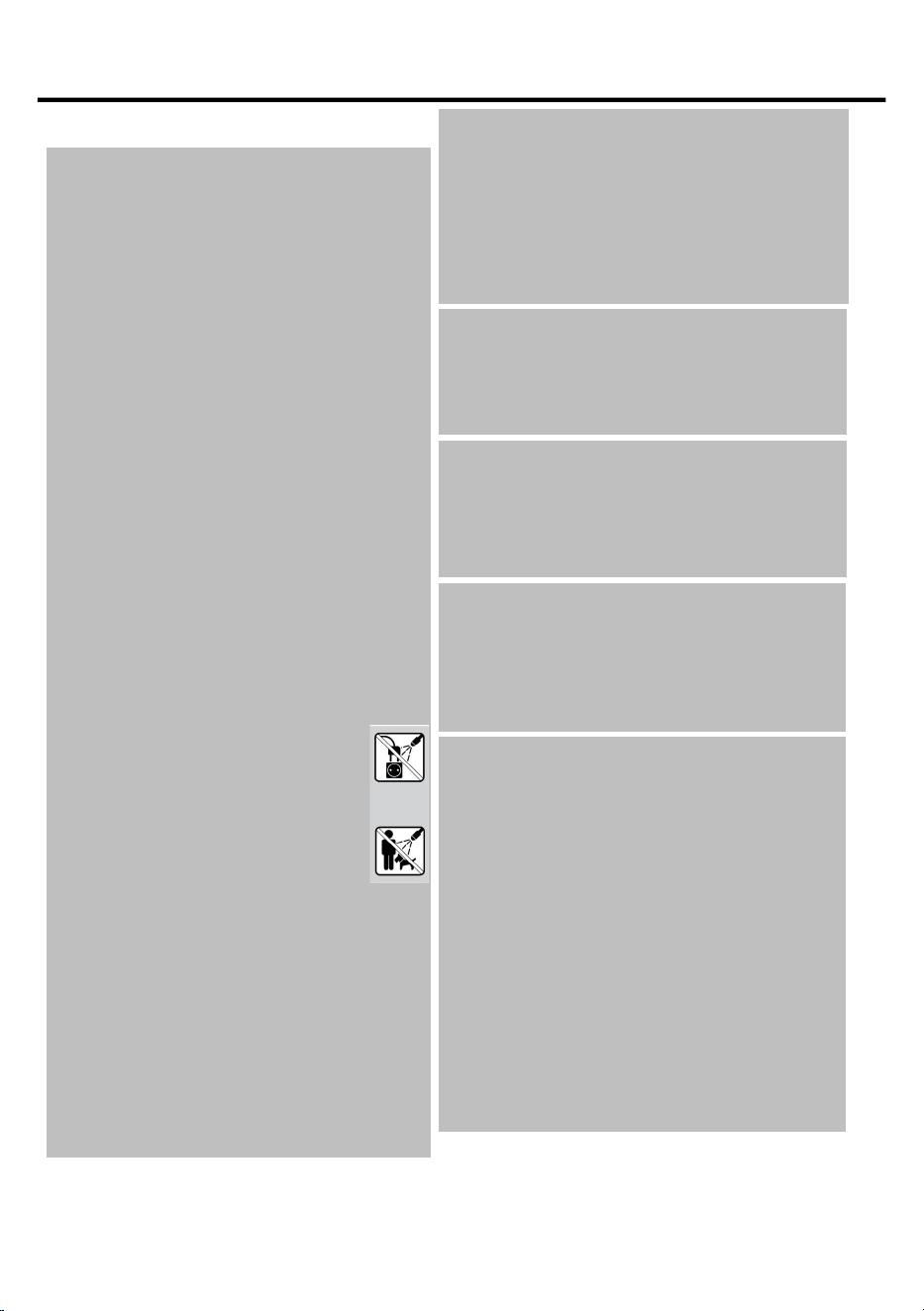
• Risk of electric shock!
The water spray
must never be directed towards any electric
wiring, devices, or directly towards the
pressure washer itself, or fatal electric shock
may occur.
• Risk of injury!
Do not direct the discharge
stream at people. The high-pressure jet can
be dangerous if misused, and therefore must
not be directed at people, animals, electrical
devices or the unit itself.
• Risk of explosion!
When a combustible liquid is
sprayed, there can be danger of fire or explosion,
especially in a closed area. Therefore, do not spray
flammable liquids. Do not use acids and solvents
with this product either. These products can cause
physical injuries to the operator and irreversible
damage to the product.
• Learn how to stop the product and release the
pressure quickly. Familiarize yourself with the
controls.
CAUTION–SPECIFIC SAFETY
ADVICE
•This product is capable of producing high pressure as
rated in the
Technical Specifications.
To avoid rupture
and injury, do not operate this product with components
rated less than the unit itself (including but not limited to
spray guns, hose, and hose connections).
WARNING–INJECTION HAZARD
•Equipment can cause serious injury if the spray
penetrates the skin. Do not point the gun at anyone or
any part of the body. In case of penetration, seek
medical aid immediately.
CAUTION–SPRAY GUN
•The spray gun kicks back, so hold it with both hands.
•The trigger gun safety lock prevents the trigger from
being engaged accidentally and it should be placed in
locked position when not in use.
CAUTION–DETERGENTS
• This product has been designed for use with
detergents that are specifically approved for pressure
washer use. The use of other cleaning detergents may
affect the operation
CAUTION–WATER CONNECTIONS
•For use with fresh and clean water only. Do not use
this product with other liquids.
•To minimize the amount of water spraying back on the
pressure washer, the device should be placed as far as
possible from the cleaning site during use.
•The water supply system must be protected against
backflow.
•Never use this product with water contaminated with
solvents (e.g. paint thinners, gasoline, oil, etc.).
•Always prevent debris from being drawn into the
product by using a clean water source and an
additional water filter, if required.
•If this device is connected to a potable water system,
the system must be protected against backflow.
•Suitable water temperature: 5℃(41℉) to 40℃(104℉).
6
1.2 Safety Warnings
CAUTION–SERVICE
•Before cleaning, repairing, inspecting, or adjusting,
shut off the engine and make sure that all moving
parts have stopped.
•Have your product serviced by certified repair
personnel using only identical replacement parts.
This ensures the safety of the product is maintained.
•Ensure proper maintenance. Check for
misalignment or binding of moving parts, breakage
of parts and any other condition that may affect the
product’s operation. If damaged, have the product
repaired before use. Many accidents are caused by
poorly maintained equipment.
IMPORTANT–COLD WEATHER
START
•Do not operate this pressure washer in
temperatures below 5℃. Operating pressure
washer below 5℃ may cause damage to the pump
and other pressure washer parts.
IMPORTANT–SAFETY FEATURES
•
Thermal Relief Valve:
Protects the pump from
overheating in case the nozzle gets clogged. This
system should not be abused. Make sure the pump
does not overheat.
•
Low-Oil Auto Shut-Off:
Protects the engine and
prevents operating without proper lubrication. If the
engine oil level goes below the recommended level,
the pressure washer shuts off automatically.
CAUTION–PREVENT PUMP
DAMAGE
•Do not run the engine for more than 5 minutes
without pressing the wand trigger or damage to the
pump might occur.
•Never let the engine run unless the product is
connected to a water supply. Ensure water is
running through the pressure washer before
attempting to start the engine.
•Never run caustic fluids or acid through this
product.
IMPORTANT–STORAGE
•Store the product in a well-ventilated area, with an
empty fuel tank. Fuel should never be stored or
placed near the product.
•When storing the product for winter, ensure that it
is stored indoors (at room temperature), in a dry
location away from any heat or ignition sources.
•If the product is to be stored with fuel in the fuel
tank, add a fuel stabilizer to keep the gas from
breaking down.
•To protect and extend the life of the product when
storing it, use an antifreeze for the pump, which can
be found at your local Canadian Tire store.
1.3 Intended Application
This product is designed for specific
residential applications. Do not modify or
use this product for any application other
than the one it was designed for. Doing so
will void the warranty.
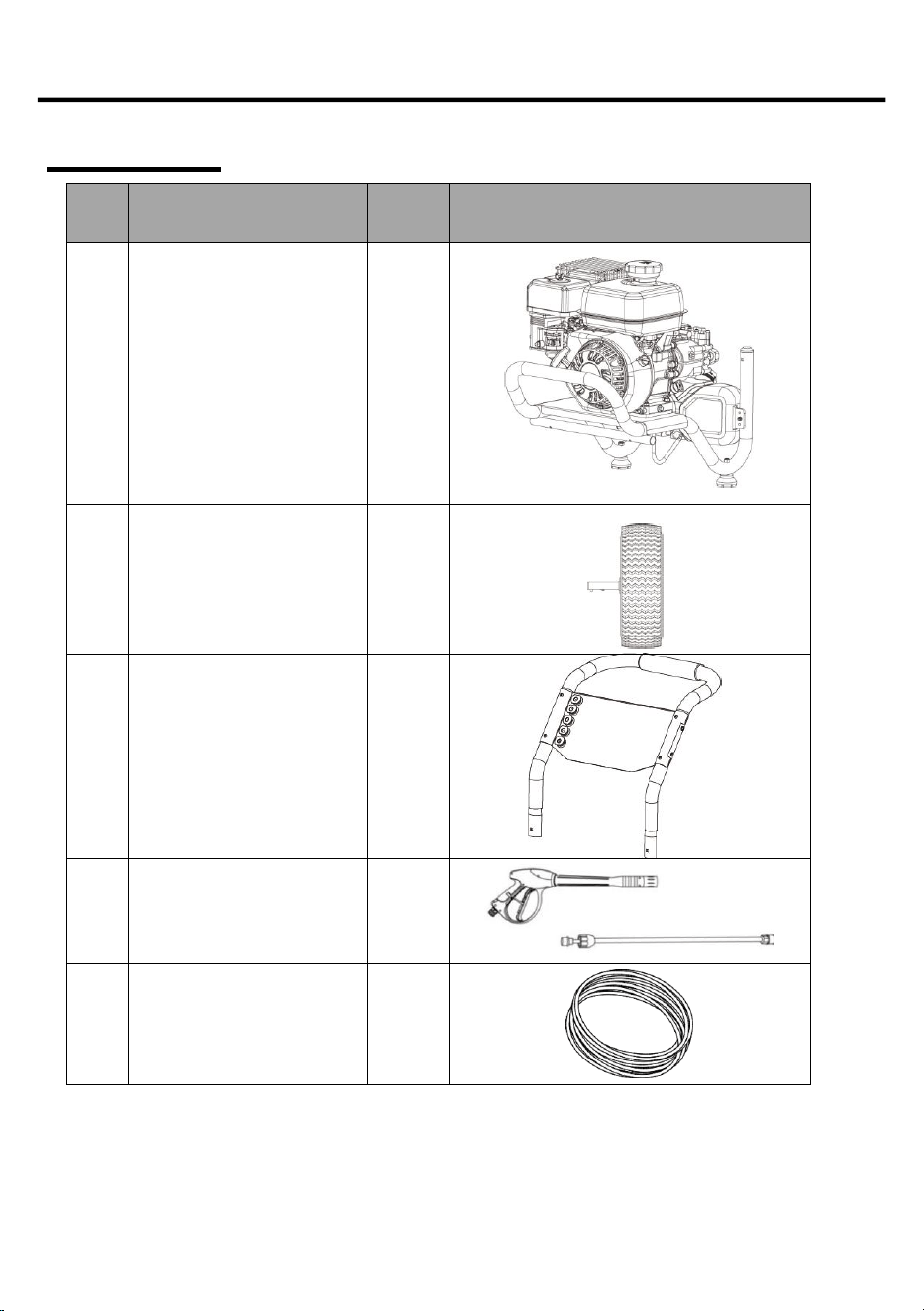
This equipment was not designed for
industrial use. Please refer to the icons
below for suggested applications.
IMPORTANT – APPLICATIONS
STAIRS
LAWN
EQUIPMENT
VEHICLE
FENCIN
G
SECOND STORY WINDOWS
GARAGE FLOOR
DRIVEWA
Y
DECK OR PATIO
SIDING
PAINT PREPARATION
SIDING
7
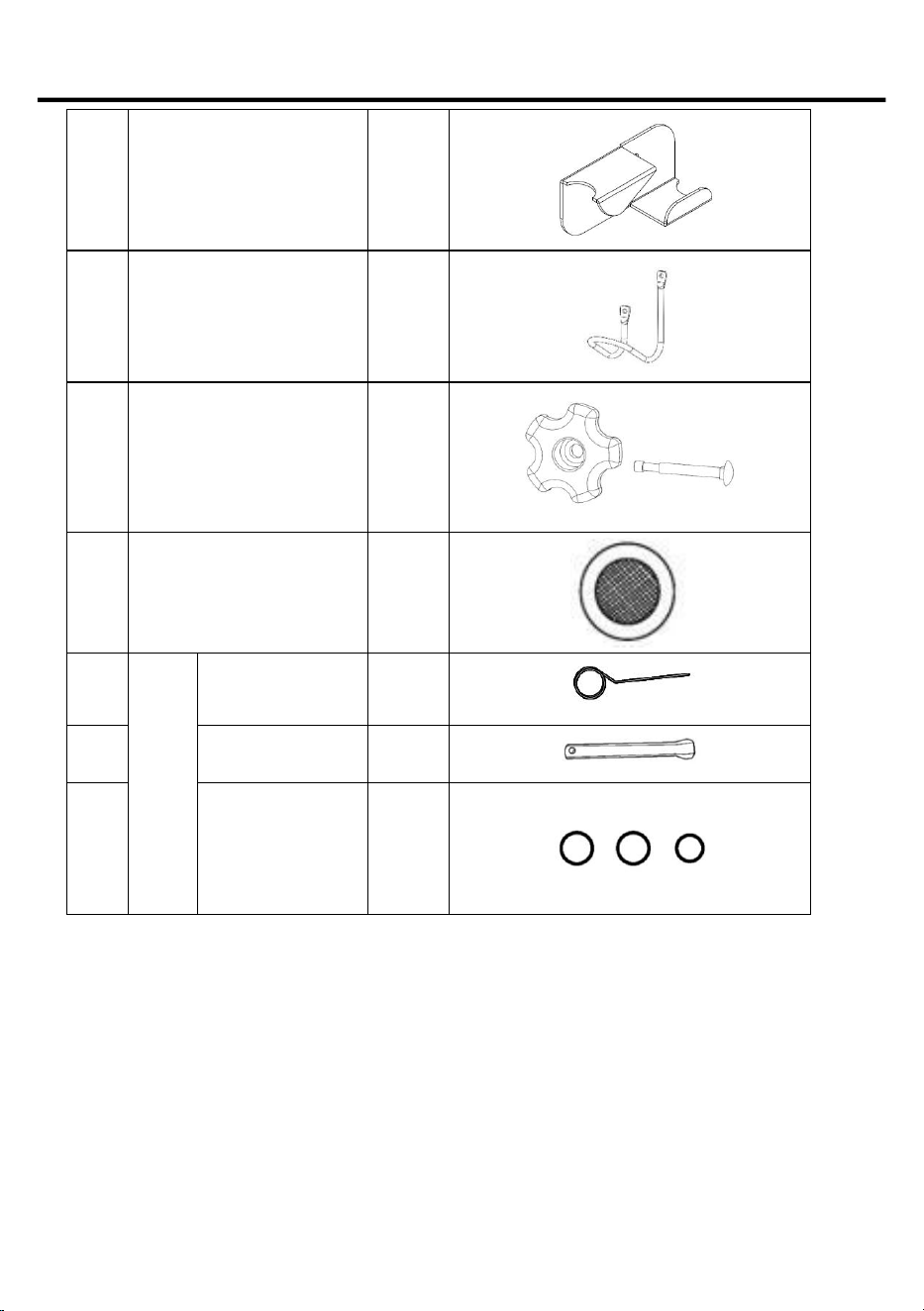
2. P
ART
L
IST
Ref.
Description
Qty.
Visual
A
Main frame
1
B
Wheel with axle
2
C
Handle and panel with
five nozzles
1
D
Spray gun with metal
wand
1
E
High-pressure hose 50’
(15m)
1
8
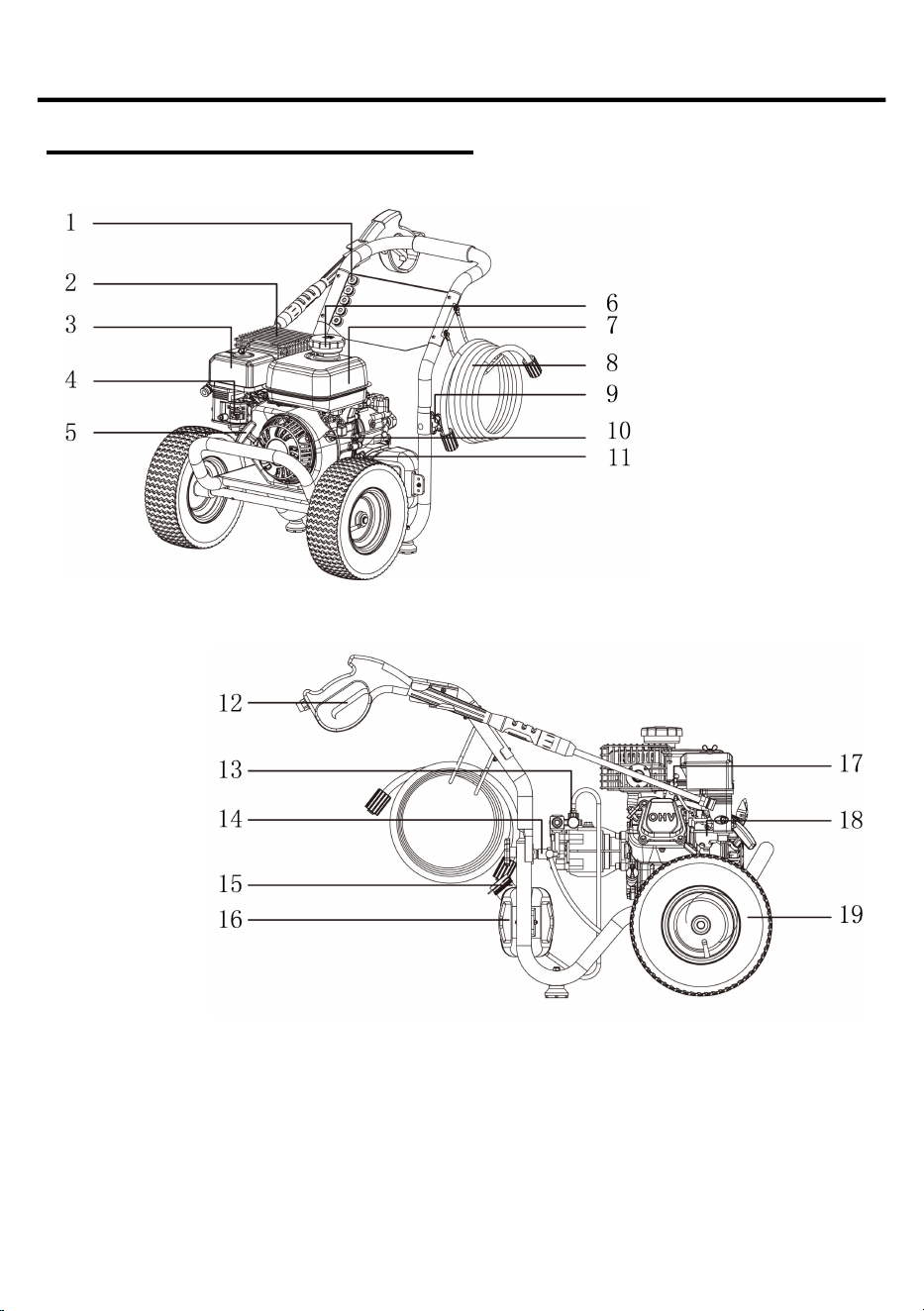
F
Gun holster with bolts
1
G
Hose holster with bolts
1
H
Knob with bolts
2
I
Water inlet filter
1
J
Accessory Kit
Spray tip
cleaner
1
K
Spark plug
wrench
1
L
Spare O-rings
(two for
high-pressure
hose, one for
quick-connector)
3
9
3. A
SSEMBLED
M
ODEL
D
IAGRAM
10
3. A
SSEMBLED
M
ODEL
D
IAGRAM
Note: Engine oil is not included. Always use oil type SAE 10W-30.
Ref.
Description
Ref.
Description
1
Spray nozzles(x5)
11
Engine Oil tank with dipstick
2
Muffler
12
Gun with Trigger safety lock
3
Air filter
13
Pump Outlet connector
4
Chock and Gas on-off switch
14
Pump Inlet Connector
5
Start cord handle
15
Detergent Bottle Cap
6
Fuel tank cap
16
Detergent Bottle
7
Fuel tank
17
Spark Plug
8
Pressure hose
18
Carburetor
9
Knob Switch
19
Tyre
10
Engine ON/OFF Switch
11
4. A
SSEMBLY
I
NSTRUCTION
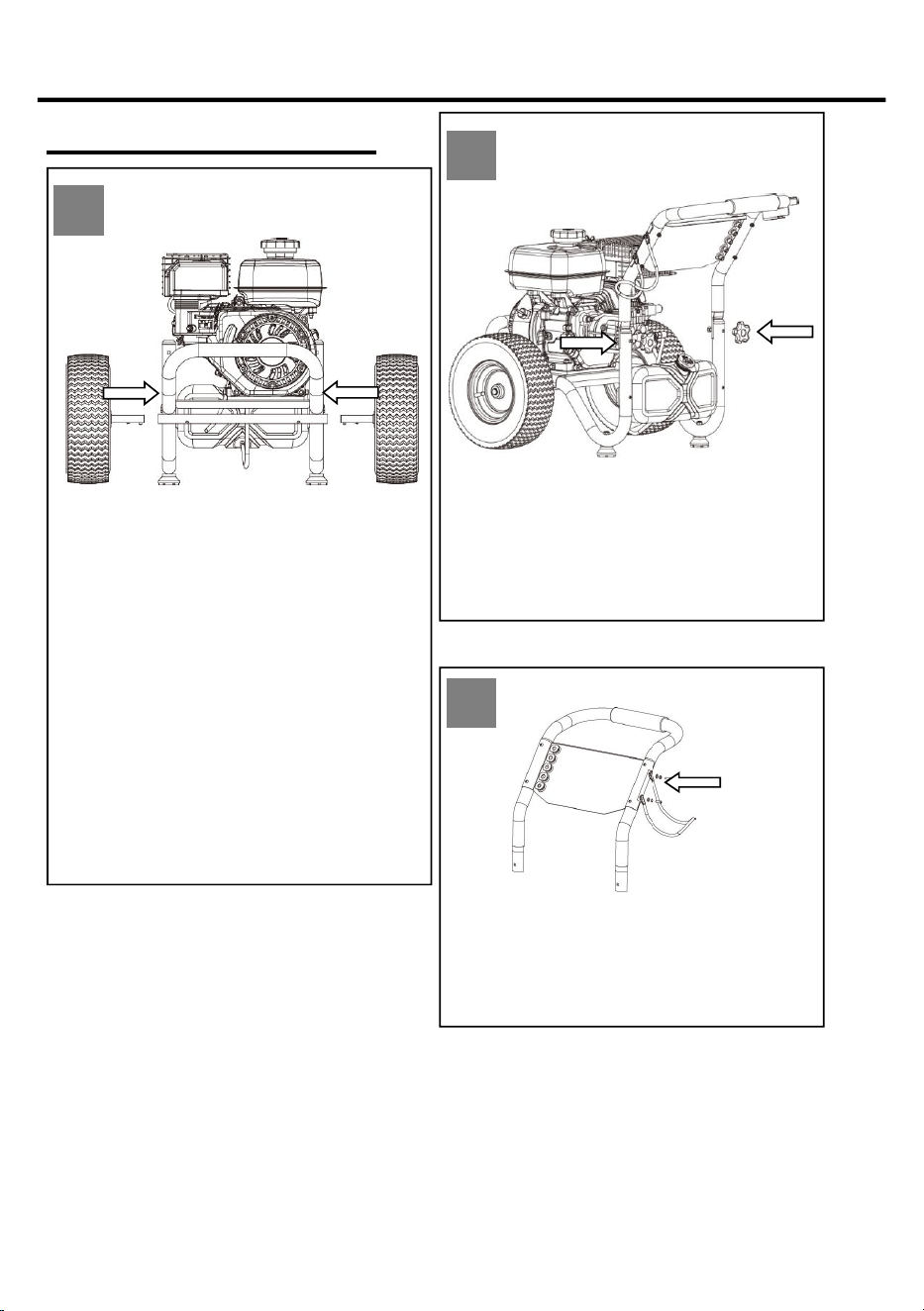
Wheel Assembly
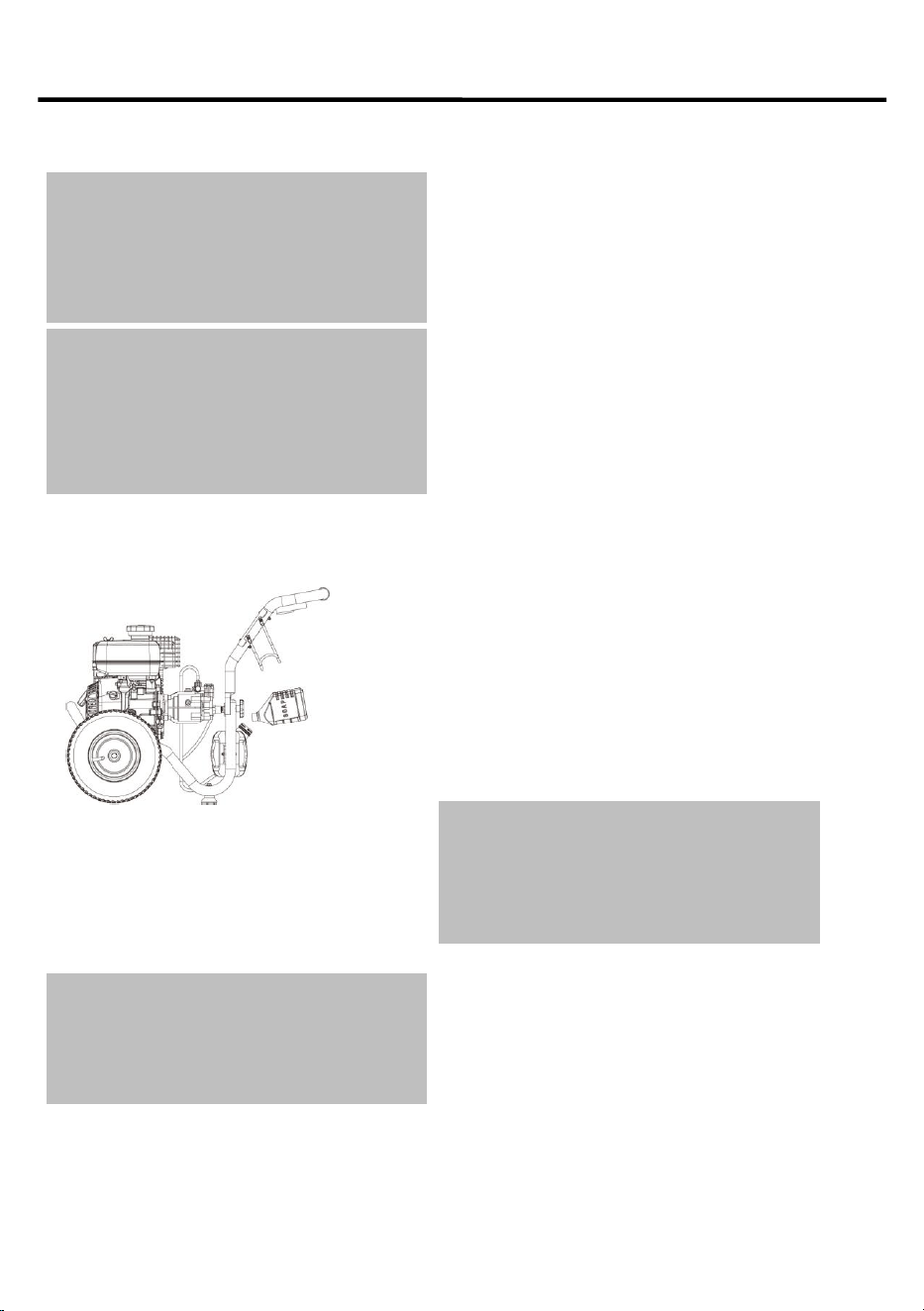
NOTE: Make sure that there is
enough air in wheel before
assembly.
Install the wheels to the frame by first
pressing its spring loaded pin on wheel
axle, then insert wheel shaft into
frame and align spring loaded pin
with hole in frame until the pin
snaps.
Install the Handle and panel(C) to
the main frame(A) by use Knob and
bolts(H). Assure the Handle and
main frame is tight install.
Gun holster Assembly
Assemble the Gun holster(G) to the
right side of the frame using 2 pan head
bolts, 4 washers and 2 nylon hex nuts.
1
3
2
12
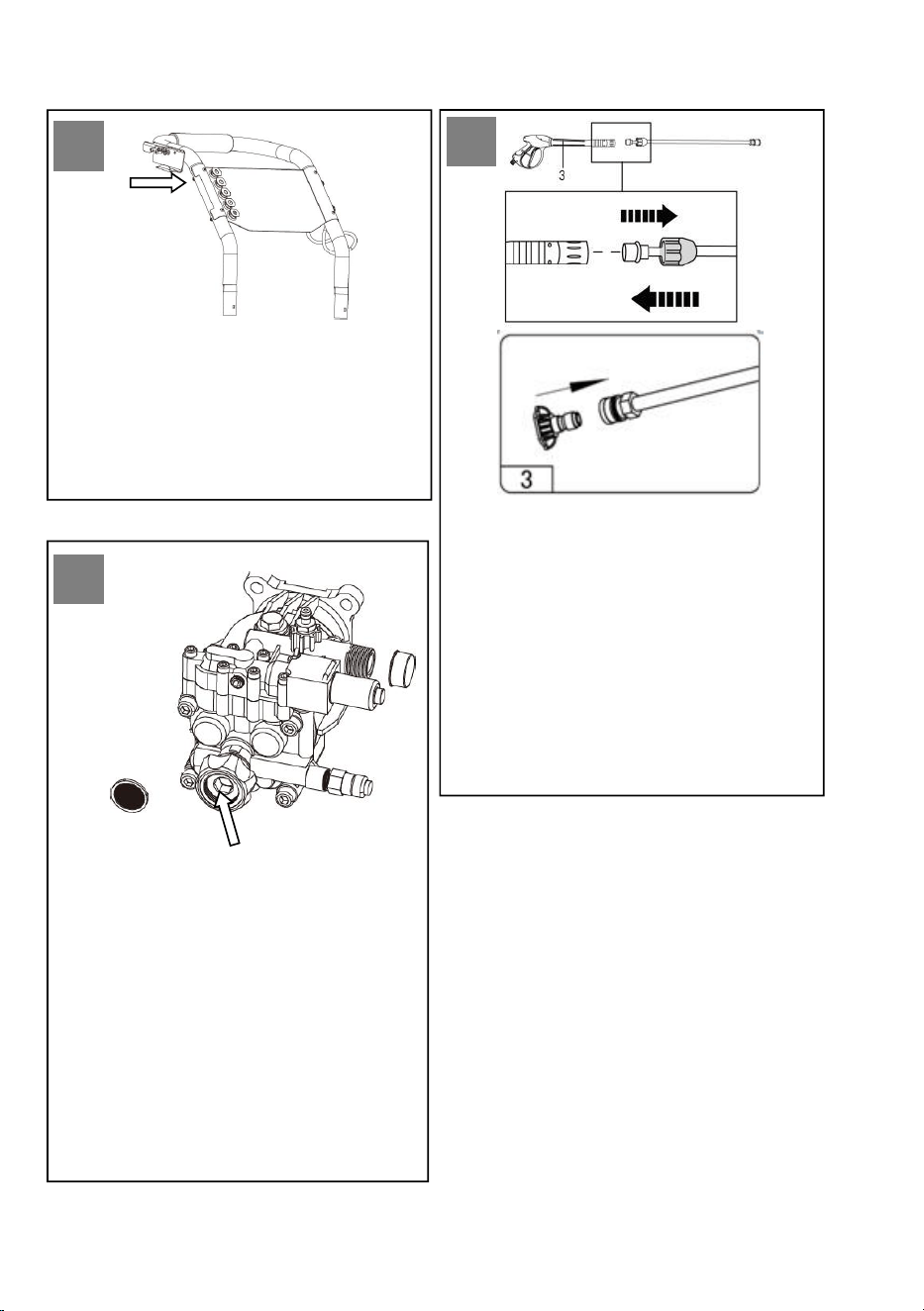
Gun holster Assembly
Slide the upper gun holster(F) all
the way down into the handle
assembly.
Hose Connection
Insert the water filter(I) into the
pump inlet first. Then attach one
end of garden hose to pump inlet,
and fasten the plastic nut
counter-clockwise.
Notice: Don’t forget to Install the
water filter , or may damage the
pump unit.
Gun & Wand Assembly
Assemble the spray gun with the
metal wand. Pull back the rubber
piece to expose the threaded fitting.
Then, screw the two pieces
together and move the rubber piece
back.
Insert the desired tip to the gun tip
connector.
4
5
6
Pump Inlet Connector
Water filter
13
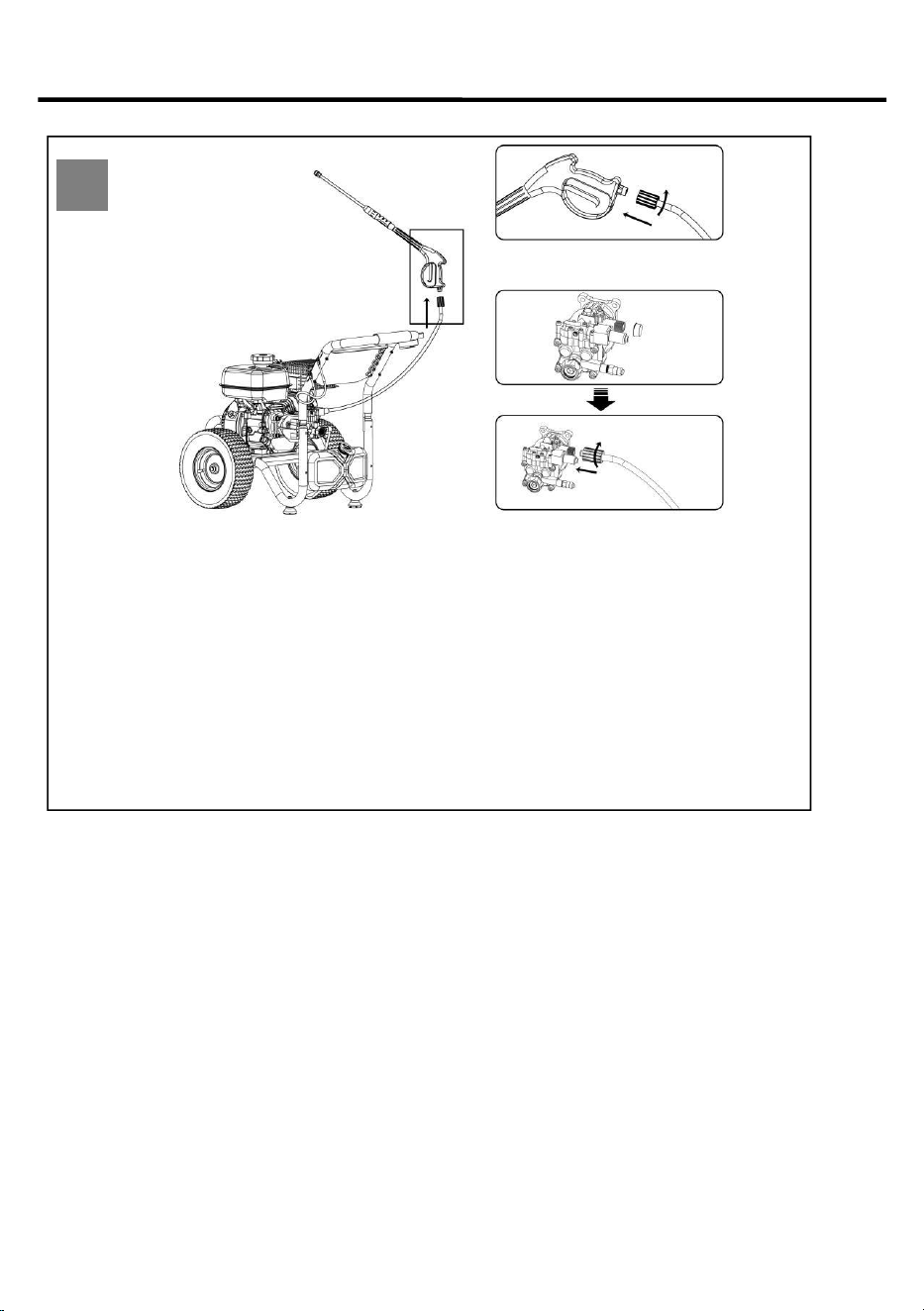
Gun/Hose Assembly
Remove the air shield on pump outlet, then connect one end of pressure
hose to pump outlet, and secure the plastic nut.
Connect the other end to pressure gun, and fasten the plastic nut.
7
14
5. O
PERATING
I
NSTRUCTIONS
5.1 Using Spray Nozzle
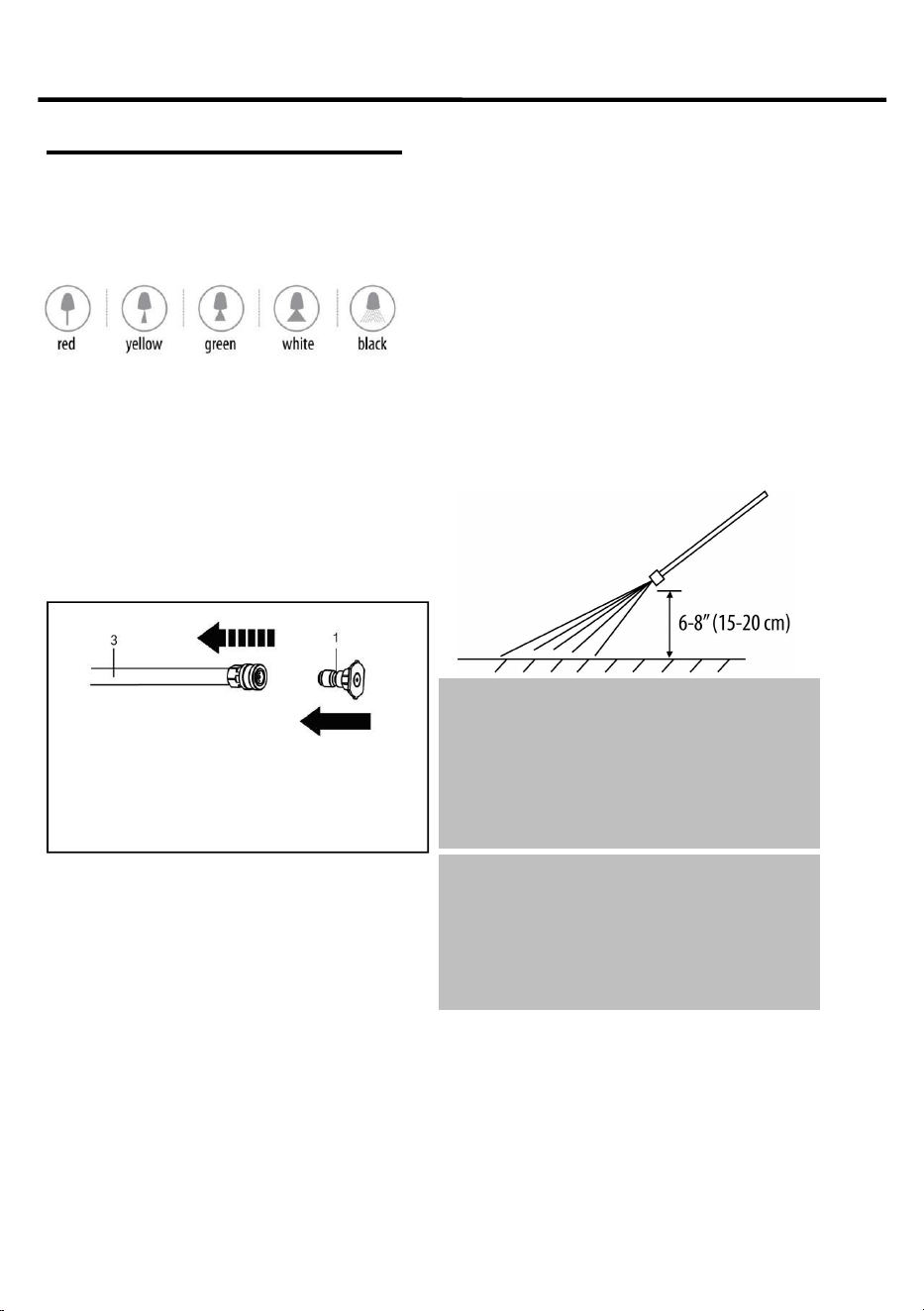
This pressure washer comes with five different
nozzles that can be installed on the metal wand.
The spray pattern is adjusted by installing the
appropriate spray nozzle.
0°(red): thin and powerful stream of water for difficult
stains and debris removal
15°(yellow): thin-angled spray for detailed cleaning
25°(green): medium-angled spray for detailed
cleaning
40°(white): large pattern for wider cleaning
applications
Detergent (black): this nozzle must be used together
with a cleaning detergent at a low pressure. Use only
this nozzle when using a detergent.
Installing spray nozzle to the quick-connect coupler:
Pull the coupler ring back and insert
the desired nozzle (1).
Release the coupler ring to lock it
back in place.
5.2 Water Supply (Cold Water
Only)
• The unit must be used with cold water supply only.
The water hose must be at least 1/2”(13 mm)in
diameter.
• The water flow rate must not fall below 18 litres per
minute (LPM) (4 gallons per minute (GPM)), or the
pump might be damaged. The flow rate can be
determined by running water for one minute into an
empty container.
• The water supply temperature must not exceed
40℃(104℉).
5.3 Starting Pressure Washer
• Attach one end of garden hose to pump inlet, and
fasten the plastic nut counter-clockwise. Then attach
the other end to water source..
• Turn on the water tap The water flow rate must not
fall below 18 litres per minute (4 gallons per minute),
or the pump might be damaged.
• Release the trigger safety lock if it is locked.
Purge the air by squeezing the trigger on the gun until
there is a steady stream of water.
• Install appropriate spray nozzle.
• Start the engine.
• Position the tip of the wand 6-8”(15-20 cm) away
from the surface to be cleaned, at an angle
appropriate to the spray nozzle used
(0°, 25° or 40°)
WARNING–INJECTION
HAZARD
• Pressure washer can cause serious injury if the
spray penetrates the skin. Do not point the gun at
anyone or any part of the body. In case of
penetration, seek medical aid immediately.
WARNING–DEPRESSURIZED
• After cleaning is completed, turn off the water
supply and pull the trigger to depressurize the unit.
Failure to do so might result in personal injury due
to discharge of high-pressure water.
15
5.4 Cleaning with Detergents
IMPORTANT
This pressure washer is intended for use with
special pressure washer detergents only. Do not
use powdered soaps, which clog the injection
system. Follow the detergent manufacturer’s
instruction
IMPORTANT
Working with a detergent ensures quick soaking of
the dirt, and allows the high-pressure water to
penetrate and remove the dirt more effectively.
Always spray detergent on a
dry
surface, do not
presoak the area. Soaking the surface dilutes the
detergent and reduces its cleaning ability.
• When using detergent , always use the
black
detergent nozzle
.
• Pour detergent into the detergent tank.
• Allow detergent to remain on the surface for a short
time before rinsing. Do not allow detergent to dry on
the surface.
• Rinse with clean water under high pressure.
WARNING
Damage may occur to painted surfaces if
chemicals(detergents) are allowed to dry on them.
Wash and rinse a small section at a time. Avoid
working on hot surfaces or under direct sunlight.
5.5 Shutting Down and Cleaning
Up
1. Skip step 2 if you are not using detergent.
2. After cleaning with detergent, fill the detergent tank
with clean water. Spray water at a low pressure for
one minute, so that all detergent is flushed out of the
system.
3. Stop the engine
4. Turn off the water supply and disconnect the water
supply from the water inlet.
5. Point spray gun in safe direction, push trigger lock,
and squeeze spray gun trigger to relieve retained
high water pressure. Engage the trigger safety lock
on the spray gun
6. Disconnect the garden hose from pump.
7. Disconnect the pressure hose from pump and
pressure gun for storage. For long term storage
instructions, see Instruction Manual.
8. Rewind the pressure hose and attach it to the hose
hook.
9. Disconnect the gun and wand, then insert them into
upper gun holder.
10. Fold the handle and store.
NOTE:
After turning off the machine, wait for 20
minutes to prevent plastic parts from being burned by
muffler, then fold the handle.
WARNING
Turn off the water supply and pull the trigger to
depressurize the unit. Failure to do so might result
in personal injury due to discharge of pressurized
water.
16
Fuel tank
6. E
NGINE
O
PERATION
6.1 Adding/Checking Oil
IMPORTANT
Oil has been drained for shipping. Failure to fill
engine with oil before starting engine will result in
permanent damage and will void engine warranty.
Add oil according to the instructions.
WARNING
• Always check the oil level before starting the
engine, making sure the pressure washer is on a
level surface.
• Always use engine oil type
SAE 10W-30
.
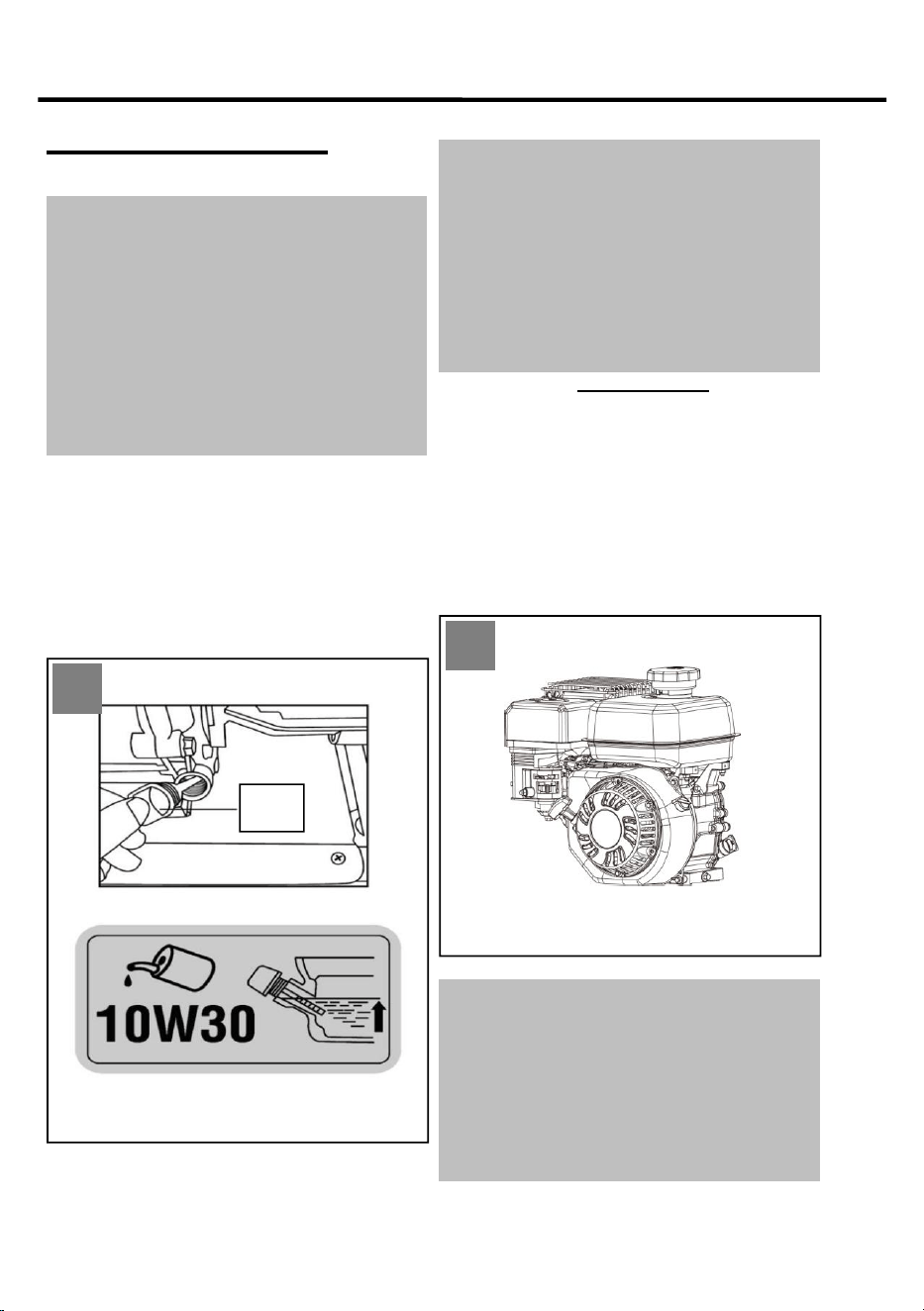
1. Remove oil tank dipstick and wipe it with a clean
cloth.
2. Replace and retighten the dipstick.
3. Remove the dipstick again and check the oil level.
It should be at the top of the full indicator on the
dipstick.
4. If low, add oil slowly into the oil tank. Do not overfill.
After adding oil, wait one minute and then recheck the
oil level.
5. Replace and retighten the dipstick.
OIL TANK CAPACITY: 0.6L
6.2 Adding Fuel
WARNING
•Make sure there is enough fuel in the fuel tank
before operating the pressure washer.
• Use only clean, fresh, unleaded fuel. Use a
minimum of 87octane/87 AKI (91 RON).
• Do not use old gas, and do not mix oil with
gasoline.
• Fuel and its vapors are extremely flammable and
explosive. Fire or explosion can cause severe burns
or death.
1. Stop the engine (→Stopping Engine) and let it cool
at least two minutes before removing the fuel tank
cap.
2. Clean the fuel cap area of dirt and debris. Remove
the fuel tank cap and make sure the fuel filter is in
place.
3. Fill the fuel tank with fuel. Never overfill the fuel
tank. Fill tank to no more than ½” (13 mm) below the
bottom of the filler neck to provide space for
expansion caused by the engine heat.
4. Replace the fuel tank cap(11).
FUEL TANK CAPACITY: 3.6L
IMPORTANT
• Keep fuel away from sparks, open flames, pilot
lights, heat, and other ignition sources.
• Check fuel hoses, tank, caps, and fittings
frequently for cracks or leaks. Replace if necessary.
• If fuel spills, wait until it evaporates before starting
engine.
• Fill the fuel tank outdoors or in well-ventilated
areas.
8
9
11
17
6.3 Starting Engine
IMPORTANT,
Before each use:
• Check the oil and fuel level and fill if necessary.
• Make sure that spark plug, muffler, fuel cap, and air
filter are in place and secured.
• Do not crank engine with spark plug removed.
See Section 5.3 Starting Pressure Washer
to start the pressure washer.
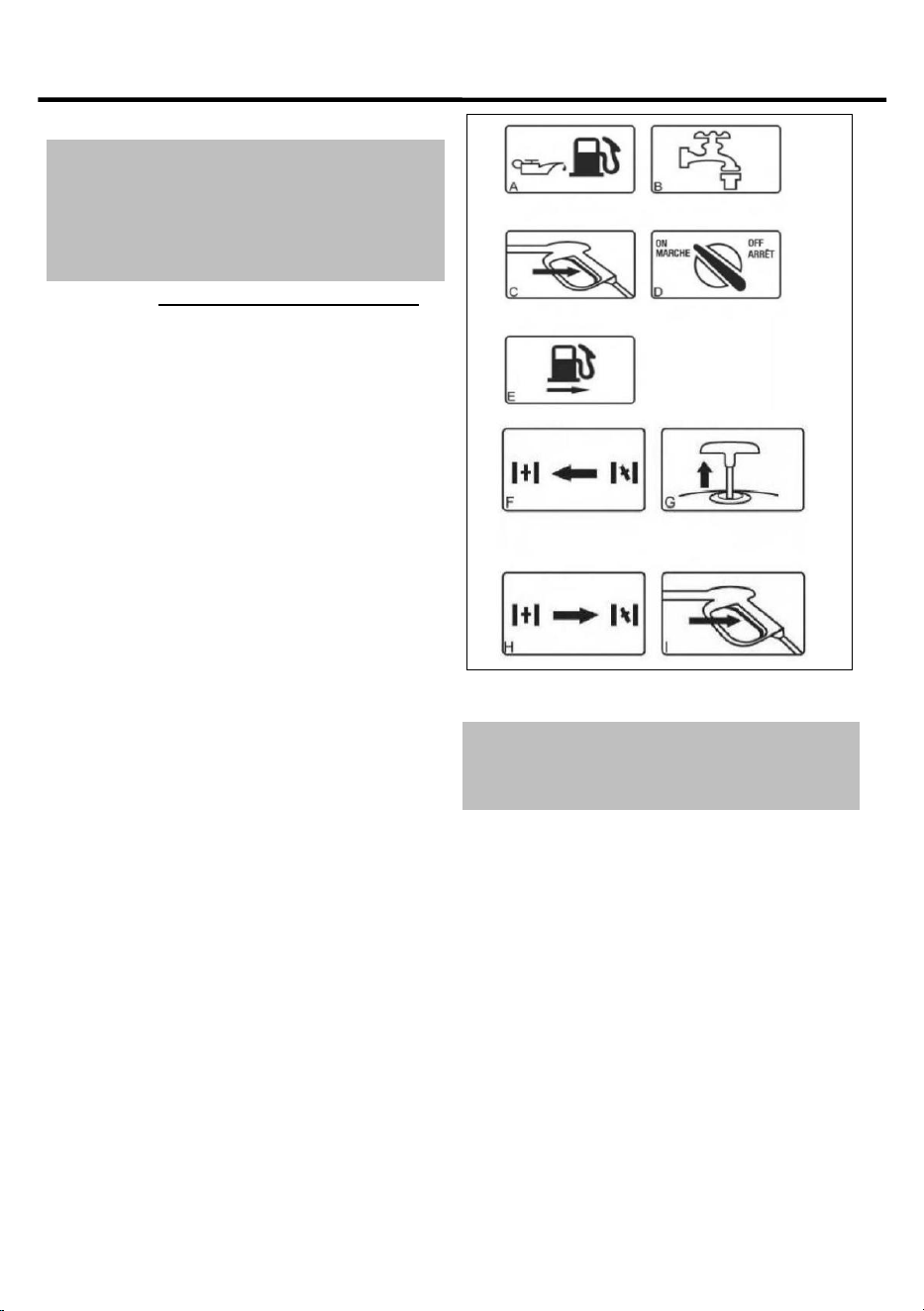
Follow these instructions to safely start
your pressure washer:
1.Check engine oil level; fill to recommended
level if necessary. Check gasoline level fill if
necessary. Fig. A
2.This pressure washer comes with garden
hose coupling. It allows you to connect or
disconnect the garden hose from the pump.
Screw the pump inlet connector and Connect
with garden hose, and TURN WATER ON. The
water supply must provide a minimum of 4 GPM
at 20 PSI or the pump may be damaged. Fig. B
3.Squeeze gun trigger. This will allow air to
escape from the hose in order to prime the
pump. Squeeze trigger until there is a steady
flow of water. Fig. C
4.Turn engine switch to the “On” position. Fig. D
5.Open fuel valve (“On” position). Fig. E
6.Close the Choke lever by moving the lever to
the left “OFF” position.
7.Locate recoil cord and pull slowly until
resistance is felt. At this point, pull rapidly to
start engine. Repeat if necessary. Fig. G
8.Once engine starts, moving the Choke lever to
the right“ON” position. Fig. H
If motor fails to start, repeat steps 3-8. Fig. I
6.4 Stopping Engine
1. To stop the engine move the choke lever to the
CLOSE position and then set the engine I/O switch to
O position.
2. Finally move the fuel valve to OFF position.
CAUTION
Return the starter cord handle gently to its starting
position to prevent damage to the starter .
18
7.
C
LEANNING AND
M
AINTENANCE
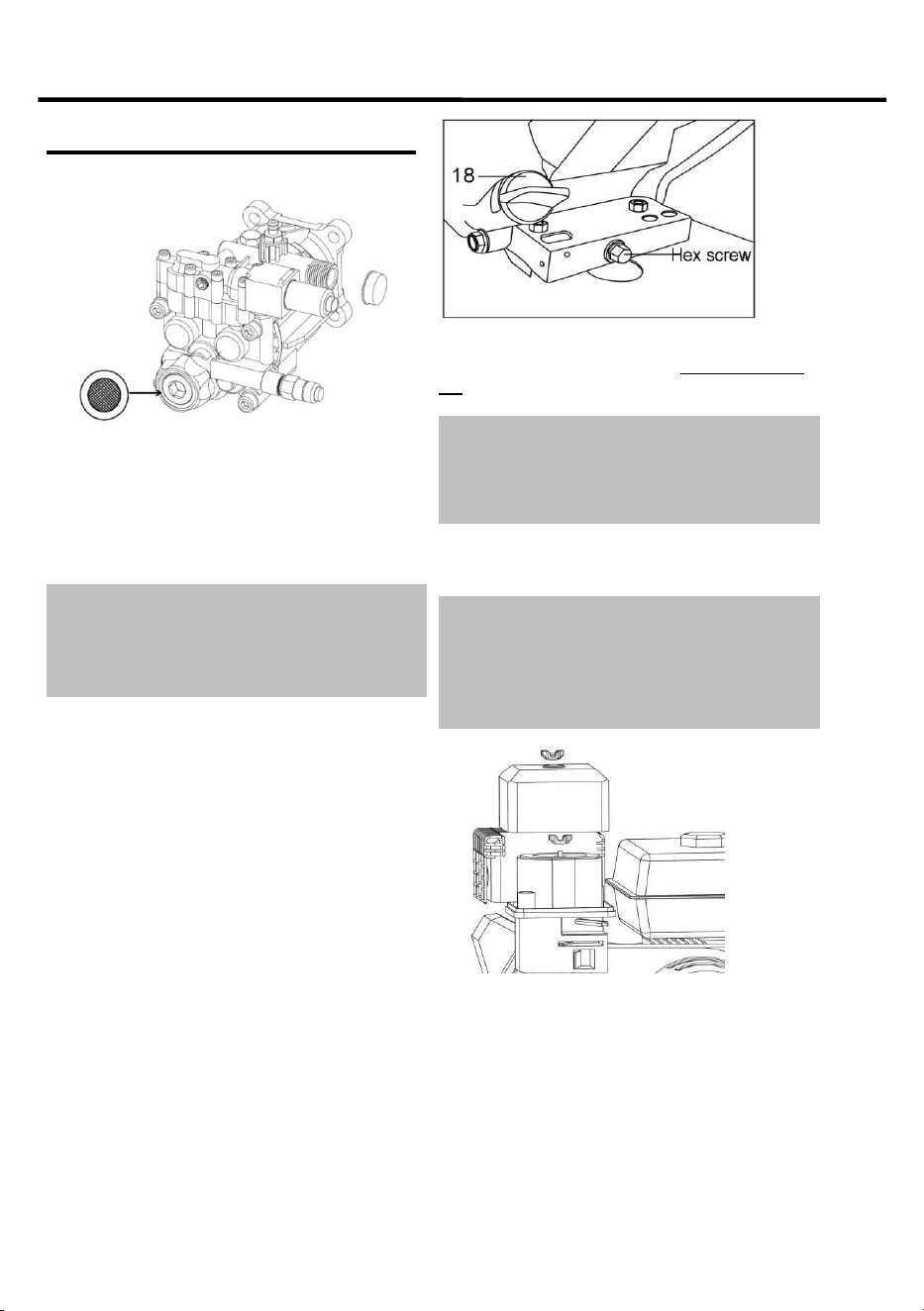
7.1 Cleaning Water Inlet Filter
•This pressure washer is equipped with a water inlet
filter.
• The water inlet filter must be kept clean at all times,
otherwise it can restrict the water flow to the pump
unit and damage it.
•Remove the water inlet filter from the pump inlet pipe
and clean.
CAUTION
DO NOT
operate this pressure washer without the
water inlet filter in place, as deposits could build up
internally and affect the functioning of the unit.
7.2 Engine Maintenance
Draining Engine Oil
The engine oil should be replaced after the first 20
hours of operation, or after the first month of use.
After that, it should be replaced every 100 hours
or every 6 months.
To drain the engine oil:
1. Loosen the oil tank dipstick .
2. Place an oil container underneath the opening on
the main frame.
3. Remove the hex screw and drain the oil.
4. Once the oil has been completely drained,
retighten the hex screw and oil tank dipstick.
Recommended Engine Oil
Add oil as described in chapter → Adding/Checking
Oil.
IMPORTANT
Used oil is a hazardous waste product and must be
disposed of properly. Do not discard with household
waste.
Checking Air Filter
IMPORTANT
Clean air filter element after every 50 hours of use
(every 10 hours under dusty conditions). Wash in
high flashpoint solvent, squeeze dry, dip in clean
engine oil, and squeeze out excess oil.
Screw down the nut by hand, and take down the
airfilter cap, then repeat the second, take out the air
filter. Wash it with clean water. Next, soak the filter in
engine oil, and then squeeze the oil out. Place the air
filter back and replace the air filter cover.
19
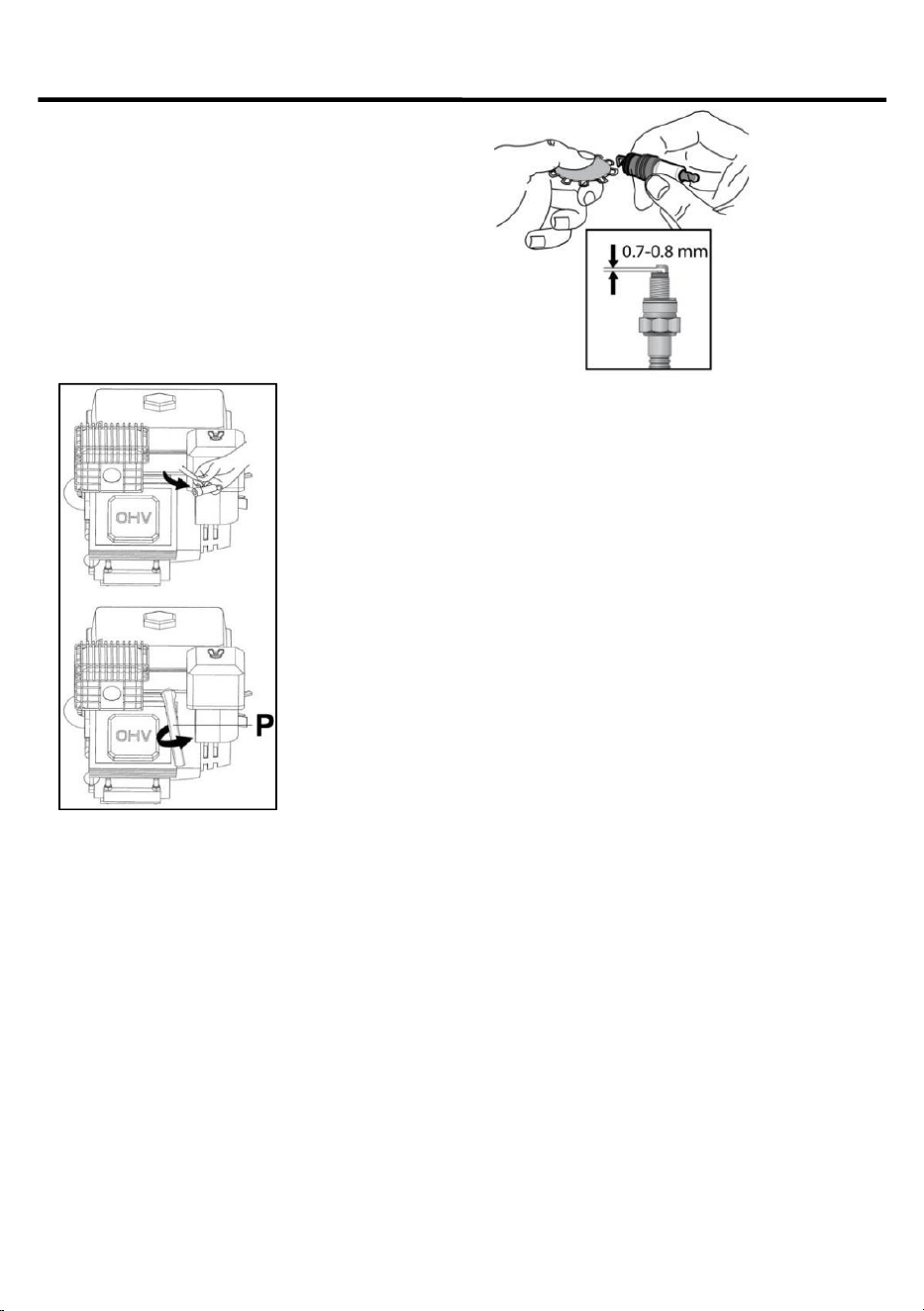
Inspecting, Replacing or Cleaning the
Spark Plug
The spark plug should be checked after every 100
hours of operation or every six months.
To replace or clean the spark plug:
1.Disconnect the spark plug wire by pulling it off the
spark plug.
2.Using provided spark plug wrench , remove the
spark plug by turning it counter-clockwise. If there is a
carbon sediment build-up, remove it. If there is too
much carbon sediment, replace the spark plug.
3.Check the gap with a wire gauge. If necessary,
reset the gap to 0.7-0.8 mm. Install and tighten the
spark plug to the recommended torque–180 lb-in (20
Nm).
4.Reinstall the spark plug wire and protection cage in
reverse order.
NOTE:
In some areas, local law requires using a
resistor spark plug to suppress ignition signals. If this
engine was originally equipped with a resistor spark
plug, use the same type for replacement.
20
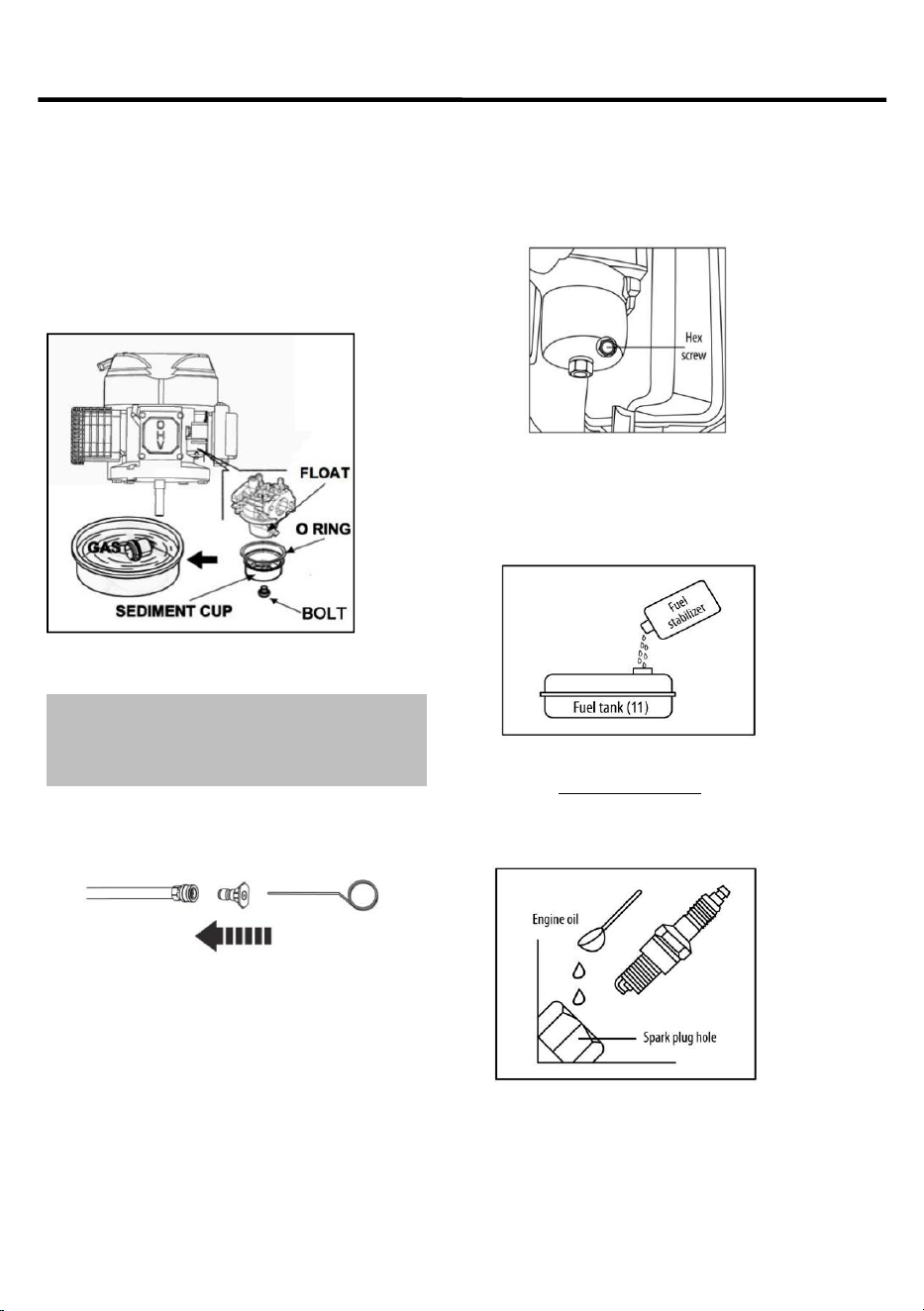
7.3 Cleaning the Carburetor
1. Screw down the bolt on the bottom of carburetor
with wrench.
2. Push the float up four to five times, then clean
sediment cup with gas.
NOTE:
Put the sediment cup back. Be careful not to
miss the O ring.
7.4 Cleaning the spray tips
WARNING
Clogging of the spray tip increases the water
pressure and might damage the pump unit .
Clean the spray tip by carefully inserting the provided
spray tip cleaner, or a thin, sharp object (e.g., paper
clip) into the tip to remove deposits.
7.5 Storing
Store idle product out of the reach of children and do
not allow anyone unfamiliar with the product or these
instructions to operate it. This product is dangerous in
the hands of untrained users. Cover and store
indoors, in a dry, well-ventilated area, such as a
tool-shed.
Long term storage of the pressure washer requires
additional preventive measures to protect it against
deterioration.
1. Drain fuel
• Try to use up the fuel before storage.
• Remove the hex screw from the carburetor. Drain
the fuel from the tank, carburetor, and hose. Screw
the carburetor drain hex screw back once the fuel has
been completely drained.
2. Add fuel stabilizer
• If you do not wish to drain the fuel tank, add a fuel
stabilizer into the fuel tank. Run the engine at least
five minutes after adding the stabilizer to distribute it
inside the fuel system.
3. Drain oil
• Drain the oil (→Draining Engine Oil).
• Remove the spark plug.
• Pour one tablespoon (14 ml) of 10W-30 oil through
the spark plug hole.
• Make sure the engine
I/O
switch is set to
O
position.
Slowly pull the starter cord handle until you feel
tension, which indicates the piston is on its
compression stroke and leave it in this position.
• Replace the spark plug.
21
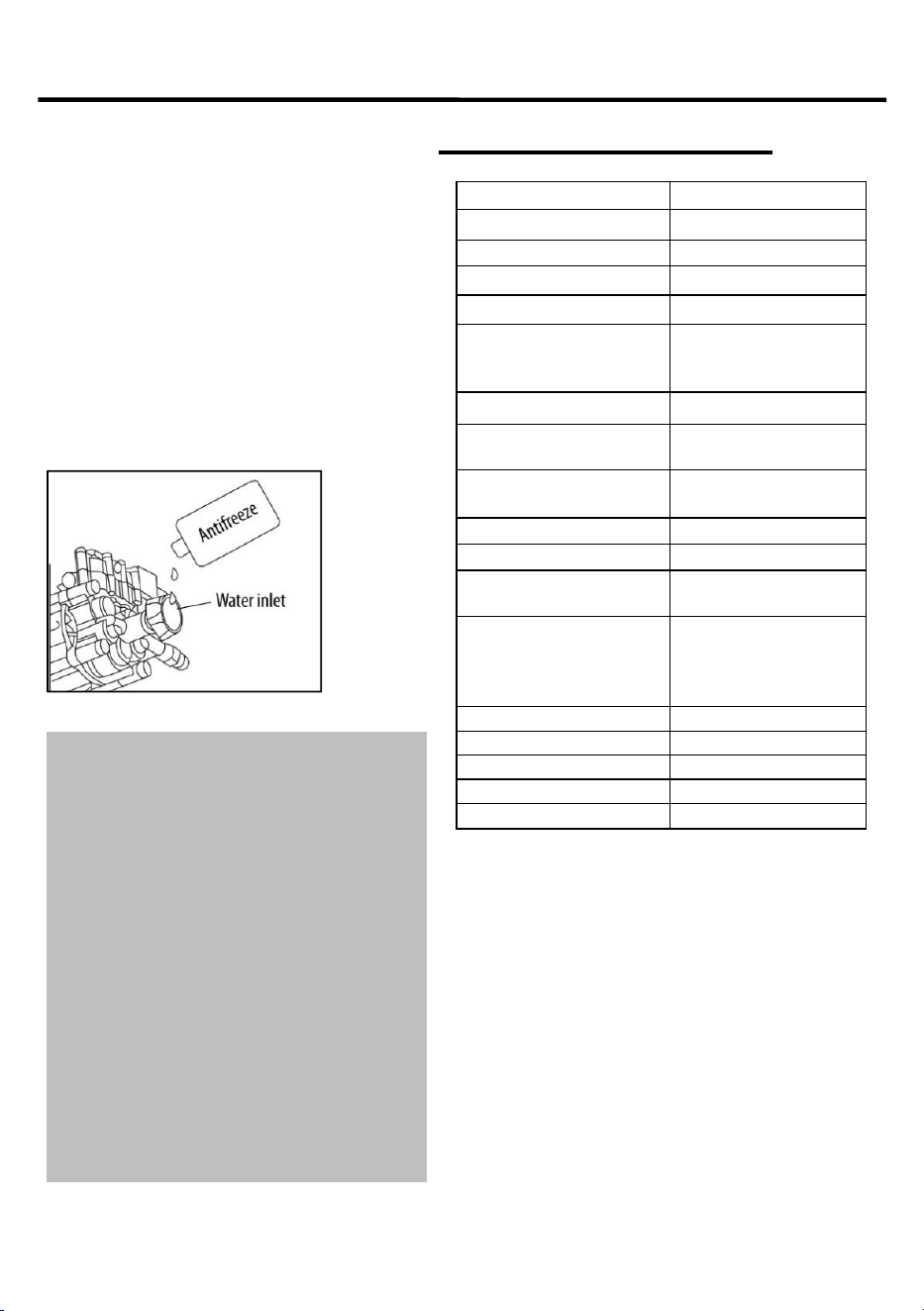
7.6 Winterizing Procedure
•
Pressure washer might be damaged if subjected
to freezing temperatures. This type of damage is
not covered by the limited warranty. To avoid
possible damages, use a small amount of
antifreeze.
• Place the pressure w asher on its side, with the
water inlet facing upwards, and pour 1/4 cup (60 ml)
of antifreeze into the water inlet .
• Make sure the engine
I/O
switch is set to
O
position
and pull the sta rter cord handle several times to
distribute the a nti
freeze inside the pump system.
• When taking the press ure washer out of storage,
run wa ter thro ugh the system until it runs cle ar.
IMPORTANT
• If the pressure washer is to be stored with
gasoline in the fuel tank and carburetor, it is
important to reduce the haza rd of gasoline vapour
ignition.
• Select a well-ventilated storage area away from
any appliance that operates with a flame, such as a
furnace, water heater, or clothes dryer. Also avoid
any area with a spark-producing electric motor, or
where power tools are operated.
• If possible, avoid storage areas with high humidity,
because that promotes rust and corr
osion .
• Place the pressure w asher on a level surface.
Tilting can cause fuel or oil leakage.
• Do not use plastic sheets as a dust cover. A
nonpo rous cover will trap moisture around the
pressure washer, pr omoting ru st and corrosion.
8.
T
ECHNICAL
S
PECIFICATION S
Maximum Pressure
3600 PSI
Rated Water Pressure 3000 PSI
Maximum Water Flow 2.7GPM
Minimum Inlet Pressure 30 PSI
Maximum Inlet Pressure 100 PSI
Pump Type
Heavy-duty,
maintenance-free
axial
Thermal Relief Valve Included
Detergent Tank
(Volume)
3.8L
Maximum Temperature
of Pumped Water
40°C (104°F)
Engine Power (OHV)
7.0 Gross HP
No Load Speed 3600 RPM
High Pressure Hose
Length
50' (15 m)
Inlet & Discharge Ports
3/4"
(13mm)standard
garden hose
connector
Displacement
212 (cc)
Oil Type
SAE 10W30
Oil Capacity
0.6 L
Fuel Type
Unleaded Gasoline
Fuel Tank
3.6 L
22
9.
T
ROUBLE
S
HOOTING
PROBLEM
POSSIBLE CAUSE
SOLUTION
Engine
Engine
doesn’t start
or is difficult
to start
The engine power switch is in
OFF (o) position
Ensure the switch is in ON (I) position
No fuel
Fill the fuel tank with regular gasoline
Low oil shut down sensor
tripped to protect engine
Add oil until it reaches minimum level on
dip stick
Excess water pressure in
pump or hose
Release water pressure by squeezing
trigger on gun
Choke lever not in right
position
1. When cold starting the engine, set the
choke to CLOSE or OFF.
2. When warm starting, set the choke to
OPEN or ON or try the middle position.
Clogged carburetor
Clean the carburetor. Refer to the
instruction manual
Carbon build-up on spark plug
Clean the spark plug. Refer to the
instruction manual
Incorrect starting method
Use correct starting method. Refer to the
instruction manual
Engine stops
after starting
Low oil or no fuel
Check oil and fuel levels
Choke lever in Close position
Move the choke lever to Open position
immediately after starting the engine
Engine lacks
power
Clogged air filter
Clean or replace the air filter. Refer to the
instruction manual
Clogged carburetor
Clean the carburetor. Refer to the
instruction manual
Engine stops
while moving
or being tiled
Low oil shut down sensor
tripped to protect engine
Do not tilt the machine past 15° when
operating. Check oil level and ensure it is
above the minimum level on the dip stick
Carburetor
leaks
Carburetor is clogged
Clean the carburetor. Refer to the
instruction manual
Starter rope
doesn't recoil
Recoil mechanism is broken
Call customer service toll-free
Engine
sounds
abnormal or
overloaded
Clogged nozzle
Clean nozzle with tip cleaner
Pressure is too high
Call customer service toll-free
23
PROBLEM
POSSIBLE CAUSE
SOLUTION
Pump
No pressure, low
pressure
Nozzle tip not attached
Attach required nozzle tip
Water supply faucet closed
Turn on faucet. Ensure there are no
kinks or blockage in hose
Water supply pressure is
low
Ensure faucet is fully opened. Check
to make sure water supply is a
minimum 30 psi, 4 GPM
Inlet water filter is clogged
Clean the water filter. Refer to the
instruction manual
Air in pump
Squeeze trigger to release the air in
pump when the machine is running
Clogged check valve
Call customer service
Damaged pump
Call customer service
Pressure too high
Clogged nozzle
Clean nozzle with tip cleaner
Water or oil leaks out of
pump
Damaged seal ring
Call customer service
Cold water keeps draining
out of thermal relief valve
Defective thermal relief
valve
Call customer service
Acces
sories
&
Conne
ctions
No intake of detergent
The detergent siphon tube
is not connected
Connect detergent siphon tube
properly. Refer to the instruction
manual
Damaged detergent siphon
tube
Replace the detergent siphon tube
Wrong nozzle
Use black nozzle when applying
detergent. Refer to the instruction
manual
Detergent adjustment knob
set to wrong position
Check adjustment knob. Refer to the
instruction manual
Clogged nozzle
Clean nozzle
Clogged pump detergent
siphon fitting
Detach the detergent siphon tube
and clean the fitting with tip cleaner
Detergent is too thick.
Clogged detergent filter
Use only detergent approved for use
with pressure washer
The trigger can’t be
squeezed
Safety lock is not open
Open the safety lock. Refer to the
instruction manual
There is water leakage at
joints/connections on gun,
hose and/or pump
Damaged seal ring
Change with back-up O-ring or
purchase accessory kit
High pressure hose can’t
be connected to pump or
gun
The O rings are not
lubricated
Put lubricating oil or water on the O
rings

24
Shenzhen Aoyi Technology Co., Ltd.
E-mail:[email protected]
ADD:No D710, South China Development
Center, South China City,
Pinghu Street, Longgang District, Shenzhen
BLUBERY